/


Author: Nolan C.J.
Tags: military history history of the middle ages history of europe world history religious wars
ISBN: 0-313-33733-0
Year: 2006
Similar


Text
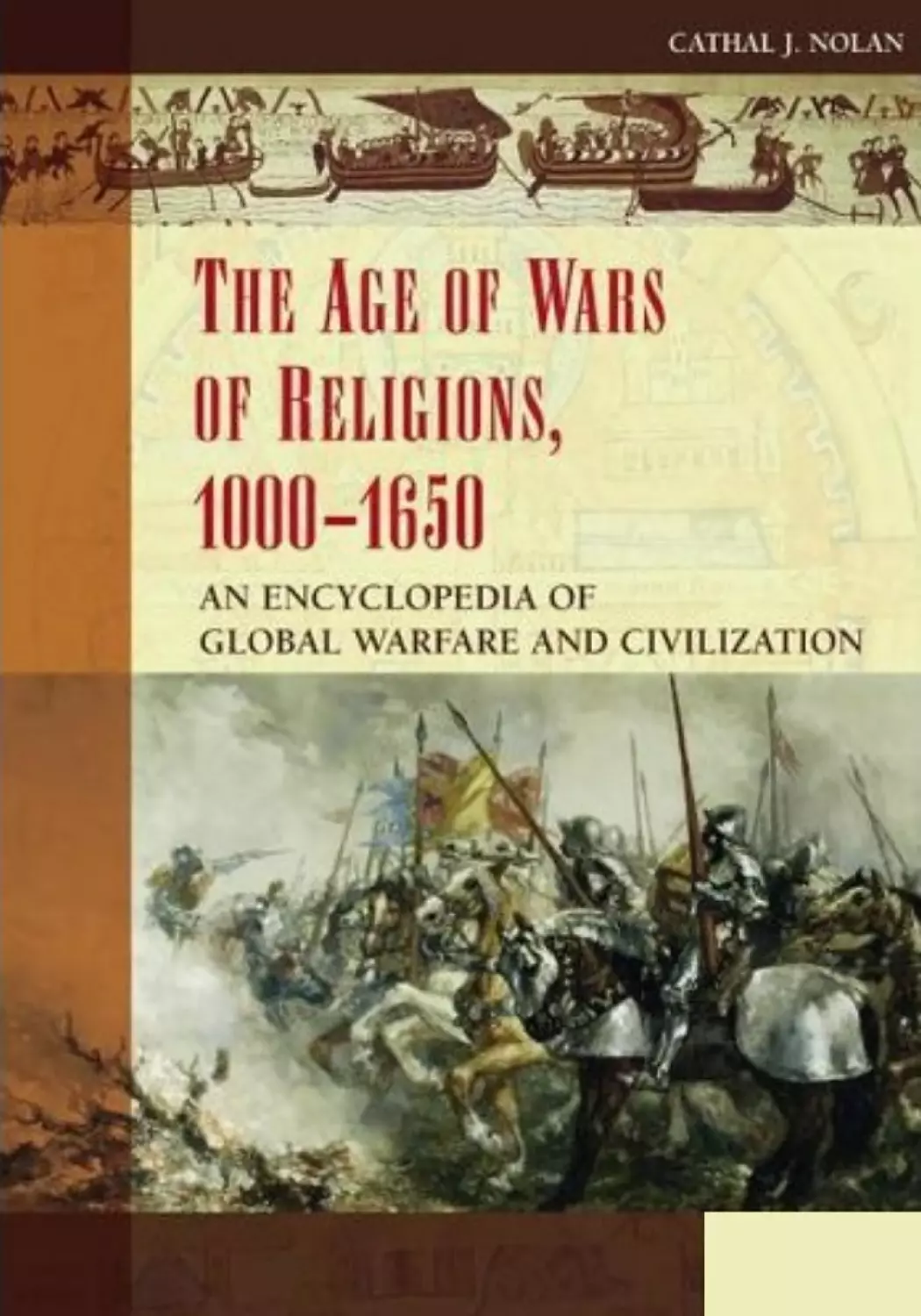
                    THE AGE OF WARS
OF RELIGION,
1000–1650

THE AGE OF WARS
OF RELIGION,
1000–1650
AN ENCYCLOPEDIA OF
GLOBAL WARFARE AND CIVILIZATION
Volume 1, A–K

Cathal J. Nolan

Greenwood Encyclopedias of
Modern World Wars

GREENWOOD PRESS
Westport, Connecticut  London

Library of Congress Cataloging-in-Publication Data
Nolan, Cathal J.
The age of wars of religion, 1000–1650 : an encyclopedia of global warfare and
civilization / Cathal J. Nolan.
p. cm.—(Greenwood encyclopedias of modern world wars)
Includes bibliographical references and index.
ISBN 0–313–33045–X (set)—ISBN 0–313–33733–0 (vol. 1)—
ISBN 0–313–33734–9 (vol. 2)
1. Middle Ages—History—Encyclopedias. 2. History, Modern—17th century—
Encyclopedias. 3. Military history, Medieval—Encyclopedias. 4. Military history,
Modern—17th century—Encyclopedias. 5. Biography—Middle Ages, 500–1500—
Encyclopedias. 6. Biography—17th century—Encyclopedias. I. Title.
D114.N66 2006
909.0703—dc22
2005031626
British Library Cataloguing in Publication Data is available.
Copyright # 2006 by Cathal J. Nolan
All rights reserved. No portion of this book may be
reproduced, by any process or technique, without the
express written consent of the publisher.
Library of Congress Catalog Card Number: 2005031626
ISBN: 0–313–33045–X (set)
0–313–33733–0 (vol. I)
0–313–33734–9 (vol. II)
First published in 2006
Greenwood Press, 88 Post Road West, Westport, CT 06881
An imprint of Greenwood Publishing Group, Inc.
www.greenwood.com
Printed in the United States of America

The paper used in this book complies with the
Permanent Paper Standard issued by the National
Information Standards Organization (Z39.48–1984).
10 9 8 7 6 5 4 3 2 1

Covenants without swords are but words.
—Thomas Hobbes, Leviathan (1651)

You are engaged in God’s service and in mine—which is the same thing.
—Philip II, of Spain

[The terms are] null and void, invalid, iniquitous, unjust, condemned,
rejected, frivolous, without force or effect, and no one is to observe
them, even when they be ratified by oath.
—Pope Innocent X,
On the articles of religious toleration in the Peace of Westphalia (1648)

Who brings famine? The army.
Who brings the plague? The army.
Who the sword? The army.
Who hinders trade? The army.
Who confounds all? The army.
—Hugh Peter,
A Word for the Army and Two Words to the Kingdome (1647)

CONTENTS
List of Entries

ix

Preface: Wars of Religion in History
Author’s Note

li

Note on Dates

lix

The Encyclopedia

1

Chronology of Major Events
Selected Bibliography
Index

1021

981

959

xliii

LIST OF ENTRIES
abatis
Abbas I (1571–1629)
Aceh
Acemi O
g lan
Acre, fall of (1291)
adarga
Aden
admiral
admiralty
Admiralty
Adwalton Moor, Battle of (1643)
Affair of the Placards (October 18, 1534)
Afghanistan
aftercastle
Agincourt, Battle of (October 25, 1415)
Agnadello, Battle of (May 14, 1509)
Ahlspiess
ailettes
Ain Jalut, Battle of (1260)
Aı̈r, Kingdom of
Akbar (1542–1605)
aketon
akincis/akinjis
Akritai
akutō
Alais, Peace of (June 28, 1629)
Alamut, Battle of (1234)
al-Andalus
Alarcos, Battle of (1195)
Alba, Don Fernando Álvarez de Toledo,
duque de (1507–1582)

Albania
Albert, Archduke of Austria
(1559–1621)
Albigensian Crusade (1208–1229)
d’Albuquerque, Alfonso de (1453–1515)
alcabala
alcancia
Alcántara, Battle of (August 25, 1580)
Alcántara, Knights of
Alcazarquivir, Battle of (August 4, 1578)
Alexandria, Siege of (1364)
alferes
Alfonso V (1432–1481)
Alfonso XI (1312–1350)
Alford, Battle of (July 2, 1645)
Algeciras, Siege of (1344)
Algiers
Alhama de Granada, Battle of (1482)
Ali Pasha
Aljubarrota, Battle of (August 14, 1385)
Alkmaar, Siege of (August 21–October 8,
1573)
alla moderna
Allerheim, Battle of (1645)
Almiranta
Almogavars
Almohads
Almoravids
Alte Feste, Siege of (August
24–September 18, 1632)
Altmark, Truce of (September 26, 1629)

List of Entries
Alton, Battle of (1643)
Alva
Alvarado, Pedro de (1485–1541)
Alwa
Amasya, Peace of (May 1555)
Amboise, Conspiracy of (March 1560)
Amboise, Peace of (1563)
Amiens, Siege of (1597)
ammunition
amphibious warfare
amsār
Anabaptism
Anatolia
ancient
Andorra, Principality of
Anegawa, Battle of (July 22, 1570)
Angola
Angora, Battle of
d’Anjou, duc (1555–1584)
Ankara, Battle of (July 20, 1402)
annates
Antichrist
anti-Semitism
Antwerp, Siege of (1584–1585)
Appanage system
appatis
Appenzell Wars (1403–1411)
Aquitaine
Arabs
Aragon
arbaleste
arbaletriers
Arbedo, Battle of (1422)
arceri
archers
Argentina
Argyll, Marquis of (1607–1661)
Arianism
aristocracy
arma
Armada Real (de la Guarda de la Carrera de
los Indias)
Armagnacs
arme blanche
Armee d’Allemagne
Armenia
armet
‘‘Armies of the Religion on the Sea’’
arming cap
x

arming doublet
Arminianism
armor
armories
Army of Flanders
Army of the Catholic League
Army of the States
Arnay-le-Duc, Battle of (June 26, 1570)
Arnim, Hans Georg von (1581–1641)
arquebus
arquebus à croc
arquebusiers
arquebusiers à cheval
Arques, Battle of (1303)
Arques, Battle of (September 21, 1589)
arr^et de cuirasse
arriere-ban
arrows
Arsenal of Venice
arsenals
Articles of War
artillery
artillery fortress
artillery towers
artillery train (1)
artillery train (2)
Art of War
ashigaru
askeri
Assassins
Assize of Arms
Astrakhan, Conquest of (1554–1556)
astrolabe
astrology
Atahualpa (c.1502–1533)
atlatl
atrocities
attrition
Augsburg, Peace of (September 25, 1555)
Augsburg Confession (1530)
‘Auld Alliance
Auldearn, Battle of (May 9, 1645)
Auray, Battle of (1364)
Austria
Austrian Army
Auszug
auto de fe
auxiliaries
avariz

List of Entries
aventail
aventuriers
‘‘Avignon Captivity’’ of the papacy
(1314–1362)
Aviz, Order of
axes
Axtorna, Battle of (1565)
ayatollah
Ayn Jālut, Battle of (September 3, 1260)
Azaps
Azerbaijan
Azores
Aztec Empire
Babur (1483–1530)
bacinet
back-staff
Baden, Margrave George Frederick
(1577–1622)
baggage train
Baghdad, Siege of (1638)
Bagirmi
Bahamas
bahşiş
bailey
bailli
bakufu
balance of power
baldric
balestrieri
balinger
balistae
balistarii equites
Balkh, Battle of (1602)
ballista
ballock
ballot
Baltic
bal yemez
Banbury, Battle of (1469)
bandeiras
bandolier
banduq
Banér, Johann (1596–1641)
ban et l’arriere-ban
banking
banner (bannieres) (1)
banner (bannieres) (2)
Banner (Swiss)

banneret
banner system (China/Manchuria)
banner system (Japan)
Bannockburn (June 24, 1314)
bannum
banquette
Barbados
Barbarossa (c.1483–1546)
Barbary corsairs
barber
barbican
barbuta
bard
barded horse
bardiche
barge
bark
Barletta, Battle of (1502)
Barnet, Battle of (1471)
Barons’ Wars (1215–1217 and
1264–1267)
barony
Bärwalde, Treaty of (January 1631)
bascinet
Basel-Ferrara-Florence, Council of (1431,
1438, 1439)
Bashi-Bazouks
basilard
basilisk
bastard feudalism
bastard musket
bastille
bastion
Batavia
Báthory, Stefan (r.1575–1586)
battalion
battery (1)
battery (2)
battery (3)
battle (1)
battle (2)
battle-axe
battle cries
Bavaria
Bayezid I (r.1389–1402)
Bayezid II (1447–1512)
Bay of Seine, Battle of (1417)
bayonet
Béal Atha Buı́, Battle of (1598)
xi

List of Entries
beat the drum
Beaugé, Battle of (March 21, 1421)
beaver
beaver wars
bedel-i n€
uzul
Bedouin
beeldenstorm
beg
Beggars (‘‘Gueux’’)
Beijing, Fall of (1214)
Beijing, Fall of (1644)
Bektashi Order
Bektaşi Order
belatores
beldar
belfry
Belgium Nostrum
Belgrade, Siege of (1456)
Belgrade, Siege of (1521)
bellum hostile
bellum justum
bellum se ipse alet
Benburb, Battle of (1646)
Benevento, Battle of (1266)
Benin, Kingdom of
Berbers
Bergen-op-Zoom, Siege of (1622)
Bergerac, Peace of (September 17, 1577)
Bergfreid
Bernardines
Bernard of Clairvaux (1090–1153)
Bernhard von Sachsen-Weimar
(1604–1639)
besagaws
besonios
Bestallungbrief
Bethlen, Gabriel (1580–1629)
bevor
bey
Beyliks
Bhutan
Bicocca, Battle of (1522)
bill
billhook
birlin
Biscuits, Battle of (1594)
Bishops’ War, First (1639)
Bishops’ War, Second (1640–1641)
Black Bands
xii

Black Company
Black Death
Black Guard
Black Legend
Black Prince (1330–1376)
Black Riders (Schwartzenreiter)
Blackwater River, Battle of (1598)
Blake, Robert (1599–1657)
blockade
blockship
Blois, Treaties of (1504–1505)
Blore Heath, Battle of (1459)
blunderbuss
boarding
boatswain
boatswain’s mate
Böblingen, Battle of (1525)
Bocskay Rebellion (1604–1606)
bodkin
Bogomil heresy
Bohemia
Bohemian Brethren
Boisot, Louis (c.1530–1576)
bolt
bomba
bombard
bombardetta
bombardier (1)
bombardier (2)
bonaventure
Bondetal
bonfire of the vanities
Bonnets Rouges
boom
booty
Bornholm, Battle of (August 1457)
Bornu
Boroughbridge, Battle of
(March 16, 1322)
Bosnia
Bostancilar
Bosworth, Battle of (1485)
boulevard
Boulogne, Siege of
(August–September 1544)
Bourbon, Charles, duc de (1490–1527)
Bourbon dynasty
Bouvines, Battle of (1214)
bow(ing)

List of Entries
bowlines
bows
bowsprit
boyars (Russia)
boyars (Ruthenia)
boyars (Ukraine)
boys
bracer
bracers
Braddock Down, Battle of (1643)
Branxton, Battle of (1513)
brayette
Brazil
breach
Breda, Siege of (1625)
breech
breeching
breech-loader
Bregenz, Battle of (1408)
breidex
Breitenfeld, First (September 17, 1631)
Breitenfeld, Second (November 2, 1642)
Brentford, Battle of (1642)
Brest, Union of
bretasche
Brétigny, Treaty of (1360)
Breton Succession, War of (1341–1365)
brevet
Brielle, Battle of (April 1, 1572)
brig (1)
brig (2)
brigade
brigandine
brigantine (1)
brigantine (2)
Brill (Brielle), Battle of (April 1, 1572)
British Army
broadhead arrow
broadside
Brömsebro, Peace of (August 1645)
brown bill
Bruce, Robert (1274–1329)
Brunkeberg, Battle of (1471)
Brustem, Battle of (October 28, 1467)
buccaneers
Buckingham, 1st Duke of (1592–1628)
buckler
Bucquoy, Count de (1571–1621)
Buddhism

Buenos Aires
buff coats
Bukhara, Battle of (1220)
Bulgaria
bullets
bullionism
burden (‘‘burthen’’)
Bureau, Jean (1390–1463) and Gaspard
(d.1470)
Burgundian-French War (1474–1477)
Burgundian-Swiss War (1474–1477)
Burgundy, Duchy of
Burma
Burnt Candlemas (1356)
Bursa, Siege of (1317–1326)
busby
bushidō
Byland, Battle of (1322)
byrnie
Byzantine Empire
cabasset
Cadiz, Raid on (1587)
Cadiz, Raid on (1596)
Cadiz, Raid on (1625)
Cairo, Sack of (1517)
Calais
Calatrava, Knights of
Calicut, Battle of (March 18, 1506)
caliph
caliphate
caliver
Calixtines
caltrop
Calven, Battle of (May 22, 1499)
Calvin, Jean (1509–1564)
Calvinism
Cambrai, League of (1508–1510)
Cambrai, Treaty of (1529)
camels
camino frances
camp followers
Canada
Canary Islands
canister shot
cannibalism
cannon
cannonballs
cannon-royal
xiii

List of Entries
cannon-serpentine
ca~
non
ca~
non de batir
caparison
Capitana
capitulations
capo de squadra
caprison
capsquare
captain
capture
Capuciati
caracole
Carafa War (1556–1557)
caravel
Carberry Hill, Battle of (1567)
Carbiesdale, Battle of (April 27, 1650)
carbine
carbiniers
Cardinal of Lorraine
Carmagnola, Francesco Bussone
(1390–1432)
carpenter
carrack
carreaux
carroccio
cartridges
carvel
casemate
casement
case shot
Casimir III (1310–1370)
Casimir IV (1427–1492)
Cassel, Battle of (August 1328)
Castagnaro, Battle of (1387)
Castelnaudary, Battle of
(September 1, 1632)
Castile
Castillon, Battle of (July 17, 1453)
casting
castles, on land
castles, on ships
castle towns
Castra Dei
casualties
cat ( ‘‘chatte’’ )
Catalan Great Company
Catalonia, Revolt of (1640)
catapult
xiv

Cateau-Cambrésis, Peace of (April 2–3,
1559)
Cathars
Catherine de Medici
Catholic Church
Catholic League (France)
Catholic League (Germany)
Catholic Reformation
cavalgada
cavalier (1)
cavalier (2)
Cavaliers
cavalry
Cebelu
Cebici başi
Cebicis (cebicilar)
Cecil, William (1520–1598)
Cecora (Ţuţora), Battle of
(November 20, 1620)
Celâli Revolts
celata
Les Cent-Suisses
Ceresole, Battle of (1544)
Cerignola, Battle of (April 21, 1503)
Český-Brod, Battle of (May 30, 1434)
Ceuta
chaiky
chain shot
Chaldiran, Battle of (August 23, 1514)
Chalgrove Field, Battle of (1643)
chamber
chambre ardente
Champlain, Samuel de (1567–1635)
chanfron
chapel-de-fer
char-aina
Charles I, of England (1600–1649)
Charles II, of England (1630–1685)
Charles V, Holy Roman Emperor
(1500–1558)
Charles VII, of France (1403–1461,
r.1429–1461)
Charles VIII, of France
(1470–1498, r.1483–1498)
Charles IX, of France (1550–1574)
Charles IX, of Sweden
Charles de Lorraine (1524–1574)
Charles the Rash (1433–1477)
charter colony

List of Entries
charter company
chase gun(s)
Chastillon, Battle of (1453)
Châteauneuf-de-Randon, Fall of (1380)
Châtillon
Chaul, Siege of (1571)
chausses
chauve-souris
chemin de ronde
Chemnitz, Battle of (April 14, 1638)
Cherasco, Peace of (1631)
Cheriton, Battle of (1644)
chertva lines
chevalier
chevauchee
chevaux de frise
chevaux-legers
Chiksan, Battle of (1597)
child-mother gun
Chile
chimalli
China
Chinese armies
Chinggisid Empire
Chinggis Khan (1162–1227)
chivalry
Chocim, Battle of (1621)
Chodkiewicz, Jan Karol
(1561–1621)
Chojnice, Battle of (September 18, 1454)
choragiew
Christendom
Christian Brotherhood
Christian humanism
Christianity
Christian IV (1588–1648)
Christian of Anhalt-Bernburg
(1568–1630)
Christian of Brunswick (1598–1626)
El Cid
cihuacoatl
cimarónes
Cinque Ports
Circles (of the Holy Roman Empire)
circumvallation
citadel
cit palankasi
city-states
civilians

Civitate, Battle of (1053)
claymore
Clermont, Battle of (1358)
clinker-built
Clontibret, Battle of (1595)
close-fights
close-haul
close order
close-quarters
club men
coaster
‘‘coat-and-conduct’’ money
coat of plates
cocha
cog
Cognac, League of (1527)
coiffe-de-maille
Colchester, Battle of (1648)
Coligny, Gaspard de (1549–1572)
colonel
colonialism
columbrina ad manum
combat
commandery
Committee of Both Kingdoms
Commonwealth of the Two Nations
communis exercitus
compagnies de l’ordonnance (du roi)
company
compass
composite bow
Comyn Wars (1297–1304)
Condé, Henri I, de Bourbon
(1552–1588)
Condé, Henri II, de Bourbon
(1588–1646)
Condé, Louis de Bourbon
(1530–1569)
Condé, Louis II, de Bourbon
(1621–1686)
condottieri
conestabularia
Confederate Army
Confederation of Kilkenny (May 10,
1641)
Confessio Augustana (1530)
confessionalism
confraternities
confratres
xv

List of Entries
confrere knights
Confucianism
Congo
Congregatio de Propaganda Fidei
Conitz
conquistadores
conrois
conscription
consorterie
Conspiracy of Amboise
constable
Constable of France
Constabulary
Constance, Council of (1414–1418)
Constantinople, Sack of (1204)
Constantinople, Siege of (April 5–May
29, 1453)
continuous bullet gun
contravallation
contributions
conversos
convoy
Coptic Church
Çorbasi
Córdoba, Battle of (1236)
Córdoba, Caliphate of
Córdoba, Gonzalo di (1453–1515)
corned gunpowder
cornet (1)
cornet (2)
cornette (1)
cornette (2)
corning/corned gunpowder
coronal
coronation wars
coronelia
corporal
Corpus Catholicorum
Corpus Christi
Corpus Evangelicorum
corpus mysticum
corsair
Cortes
Cortés, Hernán (1485–1547)
Cossacks
couched lance
coudieres
couleuveriniers
coulverin à main
xvi

coulverine
coulverines enfustees
Council of Blood
Council of Ten
Council of the Indies
Council of Trent (1545–1563)
Council of Troubles
counter-castle
counter-guard (1)
counter-guard (2)
counter-march
counter-mining
Counter-Reformation
counterscarp
counter-sinking
coureurs
courser
courtaux
Courtrai (Kortrijk), Battle of (July 11,
1302)
couseque
couters (coudieres)
coutillers
Coutras, Battle of (October 20, 1587)
Covenanters
covered way
‘‘Cowardice Peace’’ (1328)
coxswain
Cracow, Battle of (1241)
Cracow, Peace of (1525)
cranequin
crapadeaux
Crécy, Battle of (August 26, 1346)
crenel
Crete
crinet
Croatia
cromster
Cromwell, Oliver (1599–1658)
Cromwell, Thomas (c.1485–1540)
Cropedy Bridge, Battle of (1644)
Croquants
crossbow
crossbow à croc
crossbow à jalet
cross-staff
crouching tiger
crownwork
cruising

List of Entries
crupper
Crusades
cruzada
cuartel general
cuirass
cuirassier
cuir-bouilli
cuisses (cuissart)
cuius regio eius religio
culebrina
cultellus
culverin
culverin-bastard
culverin-moyenne
culverin-royal
curtain wall
Cyprus
Czasniki, Battle of (1564)
dag
daggers
daimyo
Danubian principalities
Danzig
Dar al-Harb
Dar al-Islam
dastana
Day of the Barricades (May 12, 1588)
deadmen’s eyes
dead-pays
dead reckoning
Declaratio Ferdinandei
‘‘Defenestration of Prague’’ (1419)
‘‘Defenestration of Prague’’ (May 23,
1618)
defilade
Delhi, Sack of (1398)
Delhi Sultanate (c.1200–1526)
demi-bastion
demi-cannon
demi-culverin
demi-lancers
demi-lune
demi-saker
demurrage
Denmark
Derbençi
desertion
Deshima

Dessau Bridge, Battle of (April 25, 1626)
destrier
Deulino, Truce of (January 1619)
Deutschorden
Deutschritter
Deventer, Siege of (1591)
devotes/devots
Devşirme system
dey
dhal
dhow
dice shot
Diet of Worms (1495)
Diet of Worms (1507)
Diet of Worms (1521)
dirlik yememiş
Dirshau, Battle of (October 17–18, 1627)
discipline
disease
Dithmarscher
Diu
Diu, Battle of (February 2, 1509)
divanı̂ hizmet
divine fire-arrow
dolman
do-maru
Dominum Maris Baltici
Donauwörth
Donauwörth Incident (1607)
donjon
Don Juan of Austria (1547–1578)
Doppelgänger
Doppelhacken
Doppels€
oldner
Doria, Andrea (1468–1560)
Doria, Gian Andrea (1539–1606)
Dornach, Battle of (July 22, 1499)
Dorpat, Battle of (1501)
Dorpat, Sack of (January 1558)
double cannon
double volley
doubling the ranks
Dover, Battle of (August 24, 1217)
The Downs, Battle of (October 11/21,
1639)
dragoons
drake
Drake, Francis (1540–1596)
Drang nach Osten
xvii

List of Entries
drekkar/drekki
Dreux, Battle of (December 19, 1562)
drill
Drogheda, Sack of (September 11, 1649)
dromon
drums
Druse
druzhyna
Dunbar, Battle of (April 27, 1296)
Dunbar, Battle of (September 3, 1650)
Dungan’s Hill, Battle of (1647)
Dupplin Moor, Battle of (1332)
Dutch Army
Dutch exercises
Dutch musket
Dutch Revolt
dziesietniks
eagle knight
Eastern Army
Eastern Association Army
Eastern Route Army
East India Company (EIC)
East Prussia
East Stoke, Battle of (1487)
Ecorcheurs
Ecumenical Councils
Edgecote Moor, Battle of (1470)
edged weapons
Edgehill, Battle of (October 23, 1642)
Edict of Alès (June 28, 1629)
Edict of Amboise (March 19, 1563)
Edict of Beaulieu (May 6, 1576)
Edict of Châteaubriant (1551)
Edict of January (1562)
Edict of Longjumeau (March 1568)
Edict of Nantes (April 13, 1598)
Edict of Restitution (June 1617)
Edict of Restitution (March 28, 1629)
Edict of Saint-Germain (January 17,
1562)
Edict of Saint-Germain-en-Laye
(August 8, 1570)
Edict of Toleration (1562)
Edict of Union (July 1588)
Edward I (1239–1307)
Edward II (1284–1327)
Edward III (1312–1377)
Edward IV (1442–1483)
xviii

Edward VI (1537–1553)
Effingham, Admiral Lord Howard of
(1536–1624)
Egmont, Lamoral Graaf van
(1522–1568)
Egypt
Eighty Years’ War (1568–1648)
einschildig Ritter
Elbing, Battle of (September 15, 1463)
El Dorado
elephants
Elizabeth I (1533–1603)
embargo
emir
enarmes
enceinte
encomienda
enfilade
engagements
engineers
England
English armies
English Civil Wars (1639–1651)
English Fury (April 1580)
Enrique the Navigator (1394–1460)
enseigne
ensign
‘‘Enterprise of England’’ (1588)
epauliere
equine armor
equitatores
equites
Erasmus (1466–1536)
Erastianism
Ermes, Battle of (1560)
esame
escarp
escutcheon
esmeril
espaliers
esplanade (1)
esplanade (2)
espringarda
esquire
Essex, 2nd Earl of (1566–1601)
Essex, 3rd Earl of (1591–1646)
Estates
etapes
Eternal Peace (1533)

List of Entries
Ethiopia (Abyssinia)
eunuchs
Everlasting League
Evesham, Battle of (1265)
exact militia
expeditio ultra Alpes
Exploration, Age of
expulsion of the Jews
(from Iberia)
expulsion of the Moors (from Iberia)
Eyâlet Askerleri
eyâlet-i Budin
facings
factory
F€
ahnlein
Fairfax, Thomas (1612–1671)
falchion
falcon
falconete
Falkirk, Battle of (July 22, 1298)
‘‘False Dimitri’’
Famagusta, Siege of (1570–1571)
familia
familiares ad arma
famine, as a weapon of war
Farangi
Farnesse, Alexander
fascine
Fastolf, John (d.1459)
Fatamids
fathom
fauld
Feldarzt
Feldobrist
Feldweibel
Ferdinand I, Holy Roman Emperor
(1503–1564)
Ferdinand II, Holy Roman Emperor
(1578–1637)
Ferdinand II, of Aragon (1452–1516)
and Isabella I, of Castile (1451–1504)
Ferdinand III, Holy Roman Emperor
(1608–1657)
Ferdinand V, of Castile
Ferrybridge, Battle of (1461)
feudalism
fief
fief de chambre

field artillery
field fortifications and obstacles
Field Marshal
‘‘Field of the Cloth of Gold’’ (1520)
Fifteen Years’ War (1591–1606)
Fifth Monarchists
fire
firearms
fire-lance
firepots
fireships
firing on the roll
fitna
flagellants
flags
flagship
flails
flanchard(s)
Flanders
Fleurus, Battle of (August 29, 1622)
flintlock
Flodden Field, Battle of (September 9,
1513)
Florence
Flores, Battle of (1591)
flota
flower wars
fodder
Foix, Gaston de, duc de Nemours
(1489–1512)
folangji
Fontainebleau, Treaty of (May 1631)
Fontaine-Francaise, Battle of
(June 5, 1595)
food
foot ropes
forecastle
Foreign Contingent
Forest Cantons
forged guns
Forlorn Hope
Formigny, Battle of (April 15, 1450)
Formula of Concord (1577–1578)
Fornovo, Battle of (July 6, 1495)
Fort Caroline
fortification
foundries
Fra
franc-archers
xix

List of Entries
France
Franche-Comté
Francis I (1494–1547)
Francis II (1544–1560)
François I
François II
Franco–Spanish War (1595–1598)
Franco–Spanish Wars (1494–1559)
Frankenhausen, Battle of (1525)
Frankfurt-an-der-Oder, Storming of
(1631)
Franks
Frastenz, Battle of (April 20, 1499)
free cities
Free Companies
freedom of the seas
free quarter
Freiburg, Battle of (August 3–10, 1644)
French armies
French Civil Wars (1562–1629)
Frey
Friedrich I (c.1125–1190)
Friedrich V (1596–1632)
frigate (1)
frigate (2)
Frobisher, Martin (1539–1594)
front (1)
front (2)
fryd
Fugger, House of
Fujian ships
Fulbe (Fulani)
Funj Sultanate
Fürstenberg, Count
F€
urstenverschw€orung
Fürth, Battle of (1632)
fuses
fusiliers de taille
fusta
gabions
gadlings
gaff
Gainsborough, Battle of (1643)
‘‘galeones’’
galets
galleass
galleon
galley
xx

galley slaves
Gallican Church
Gallican crisis
galliot
galloglass
galloper gun
gambeson
Gambia
ganimet
gardebraces
Gardetal
Garigliano River, Battle of
(December 28, 1503)
garrisons
garrots
gauntlets
Gazi
gekokujō
Gembloux, Battle of (January 31, 1578)
gendarmerie
gen d’armes
general
General at Sea
Generalfeldobrist
Generality
Generallissimus
Generalobrist
general officer
genitors
Genoa
genouillie`res
Gentili, Alberico (1552–1608)
Georg, Johann (1611–1656)
Georg Wilhelm, of Brandenburg
(1619–1640)
German brigade
German Peasant War (1525)
Germany
Gevierthaufen
Gewalthut
ghaz
ghazi
ghulams
Gibraltar
Gibraltar, Battle of (April 25,
1607)
Giornico, Battle of (December 28, 1478)
gisarmes
Giza, Battle of (April 2, 1517)

List of Entries
glacis
glaive
Glyndŵr’s Rebellion (1401–1406)
Goa, Seizure of (1510)
goat’s foot lever
Godunov, Boris Fyodorovich
(c.1552–1605)
goedendag
Golden Bull (1356)
Golden Bull of Rimini (1223)
Golden Horde
gomeres
Gonzaga, Giovanni (1466–1519)
gorget
Grace of Alais (1629)
graffle
Granada
Grand Parti de Lyon
Grandson, Battle of (March 2, 1476)
Grand Vezier (Vezir-i Azam)
Grantham, Battle of (1643)
grapeshot
Graub€
unden
Gravelines, Battle of (July 13, 1558)
Gravelines, Battle of (August 8, 1588)
Great Apostasy
Great Condé
Great Enterprise (1521–1522)
Great Galley
Great Helm
Great Interregnum (1250–1273)
Great Schism (1378–1417)
Great Ships
Great Swabian League
Great Wall
‘‘Great War’’ (1409–1411)
Great Zimbabwe
greaves
Greece
Greek fire
grenades
Grenville, Richard (1542–1591)
Grey, Lady Jane (1537–1554)
The Grisons
Grotius, Hugo (1583–1645)
Gr€
unhag
Grunwald, Battle of (1410)
Guangdong
guardas reales

guastatores
Guelphs and Ghibellines
Guerra Arciducale (1615)
guerra dels segadors
guerre couverte
guerre d’usure
guerre guerroyante
guerre mortelle
guerriers de Dieu
guerrilla warfare
Guinegate, Battle of (1513)
guisarmes
Guise, Charles, Cardinal de
Lorraine (1524–1574)
Guise, Charles de Lorraine (1554–1611)
Guise, François, duc de Lorraine
(1519–1563)
Guise, Henri, duc de Lorraine
(1550–1588)
Guise family
Gujarat
gun carriages
gun-deck
gun metal
gunner
Gunner’s Mark
gunner’s quadrant
gunner’s rule
gunnery
gun port
gunpowder empires
gunpowder revolution
gunpowder weapons
gun tackle
Gur states
Gustavus I (1496–1560)
Gustavus II Adolphus (1594–1632)
Haarlem, Siege of (December 11,
1572–July 12, 1573)
habergeon
Habsburgs
hackbut
hackbutters
hackney
hagbutters
Hague Alliance (December 9, 1625)
Haiduks
hail shot
xxi

List of Entries
Haiti
Hakata (Hakozaki) Bay, Battle of (1274)
Hakata (Hakozaki) Bay, Battle of (1281)
hakenb€
usche
haketon
halberd
halberdiers
half-pike
Halidon Hill, Battle of (July 19, 1333)
Hamburg, Treaty of (March 15, 1638)
han
hand cannon
hanger
Hansa
Hanse
Hanseatic League
Hara Castle, massacre of Christians at
(1638)
haramaki
Harfleur, Battle of (1416)
harness
harquebus
Harsth€orner
Hashemites
Hastings, Battle of (1066)
hata jirushi
hatamoto
hauberk
Haudenosaunee
Haufen
haul close
haul wind
Hauptmann
Hauptstuke
Hausa
havoc radius
Hawkwood, John (d.1394)
Hawkyns, John (1532–1595)
heave to
heavy cavalry
Hedgely Moor, Battle of (1464)
Heemskerk, Jacob van
Heerschild
Heerschildordnung
Heilbronn, League of
Heiligerlee, Battle of (1568)
Hejaz
Hellburners
helm
xxii

helmets
Helvetian Confederation
Hemmingstedt, Battle of (1500)
Hendrik, Frederik (1584–1647)
Henri de Navarre
Henri II, of France (1519–1559)
Henri III, of France (1551–1589)
Henri IV, of France (1553–1610)
Henry the Navigator
Henry V, of England (1387–1422)
Henry VIII, of England (1491–1547)
herald
Herat, Battle of (1221)
Herat, Battle of (1598)
heresy
Héricourt, Battle of (November 13,
1474)
Hermandad(es)
hermangildas
Herrings, Battle of the (1429)
hetman (otaman)
Hexham, Battle of (1464)
Highland galley
hijra
Hinduism
Hispaniola
hobelars
Hochmeister
Höchst, Battle of (June 20, 1622)
Hofkriegsrat
Hohenzollern
Holk, Heinrich (1599–1633)
Holy Lands
Holy League (France)
Holy League (Italy)
Holy Office
Holy Places
Holy Roman Empire (of the
German Nation)
Holy Union
‘‘holy war’’
Holy Water Sprinkler
Homildon Hill, Battle of (1402)
homosexuality
Homs, Battle of (1281)
Honganji fortress, Siege of (1570–1580)
Hongwu emperor (r.1368–1398)
Honigfelde, Battle of (1629)
honjō

List of Entries
hook gun
hoop-and-stave method
Hopton, Ralph (1598–1652)
Horasani technique
Hormuz
hornwork
horo
hors de combat
horse
horse armor
horseman’s axe
horses
Hospitallers
hostage-taking
Hotin, Battle of (1621)
hot shot
housecarls
Howard, Charles (1536–1624)
howdah
Hsiang-Yang, Siege of (1268–1273)
Huguenots
hulk
Hunderpanzer
Hundred Years’ War (1337–1453)
Hungarian Army
Hungary
Hung Taiji (d.1643)
Hunyadi, János (c.1407–1456)
Hurenweibel
Hus, Jan (1369–1415)
hussars
Hussite Wars (1419–1478)
ichcahuipilli
iconoclasm
Ifriqiya
Ikkō-ikki
Île de Re, Siege of (July–October, 1627)
Il-Khans
imam
Imperial Army (of the Holy Roman
Empire)
Imperial Diet
impressment
Inca Empire
incastellamento
incendiaries
indentures for war
Index Librorum Prohibitorium

India
Indian (subcontinental) armies
Indian Wars (Mexico, Central and
South America)
Indian Wars (North America)
indulgences
inermis
infantry
Inner Asia
Innocent III (1198–1216)
Inquisition (1478–1834)
intelligence
interior lines (of operations)
Inverlochy, Battle of (February 2, 1645)
Invincible Armada (1588)
invincible generalissimo
Iran (Persia)
Iraq
Ireland
Ireton, Henry (1611–1651)
Ironsides
Iroquois Confederacy
Isabella I (1451–1504)
ishan
Islam
Ismaili
Italian armies
Italian Renaissance
Italian traces
Italian Wars (1494–1559)
Italic League (1454–1494)
Italy
itqa
Ivan III (1440–1505)
Ivan IV (1530–1584)
Ivry-la-Bataille, Battle of (March 14,
1590)
jack
Jacob’s staff
Jacquerie (1358)
Jagiello dynasty
jaguar knight
jamber
James I and VI (1566–1625)
Jamestown
Jand, Battle of (1240)
Janissary Corps
Jankov, Battle of (March 6, 1645)
xxiii

List of Entries
Jansenism
Japan
Jargeau, Battle of (1429)
Jarnac, Battle of (March 13, 1569)
Java
Jeanne d’Arc (1412–1431)
Jemmingen, Battle of (July 21, 1568)
jeniçeri Ocak
Jerusalem
Jesuits
Jews
jihad
jinetes
jizya
Johannitterorden
John Company
Joinville, Treaty of (December 31, 1584)
jōkaku
jōkamachi
Juan of Austria
Jülich-Kleve, Crisis over (1609–1614)
Julius III (r.1549–1555)
junk
Junkers
jupon
J€
urchen
jus ad bellum
jus armorum
jus emigrandi
jus in bello
jus pacis et belli
justification by faith
just war tradition
kabuto
kaffir
kaim mekam
Kakure Kirishitan
kale
Kallo, Battle of (1638)
Kalmar, Union of
Kalmar War (1611–1613)
kamikaze
Kandurcha, Battle of (1391)
Kanem
Kapikulu
Kapikulu Askerleri
Kappel, Battle of (October 11, 1531)
Kapudan-i Derya
xxiv

kapu kulu
karacena
Karl IX (1550–1611)
Karrenb€
uchsen
karr-wa-farr
Karsthans
Katzbalger
Kazan
Kazan, Conquest of (1552)
keel-haul
keep
keep-and-bailey
kenshin
Kephissos, Battle of (1311)
Keresztes, Battle of (1596)
kerne
kettle-hat
Khanua, Battle of (1527)
Khanwa, Battle of (March 16–17, 1527)
Khotyn, Battle of (September 21–
October 9, 1621)
kieko
Kievan Rus
Kildare Rebellion (1534–1535)
Kilsyth, Battle of (August 15, 1645)
‘‘King’s Two Bodies’’
Kinsale, Battle of (1601)
Kirishitan
Kirishitan Shumon Aratame Yaku
Kirkholm, Battle of (September 27,
1605)
kizilbash
Klozb€
uchse
Klushino, Battle of (1610)
Knabenschaften
Knäred, Peace of (1613)
Knechte
knight
knighthood
knight marshal
Knights Hospitaller
Knights in the Service of God in Prussia
Knights of Alcántara
Knights of Aviz
Knights of Calatrava
Knights of Christ
Knights of Malta
Knights of Our Lady of Montesa
Knights of Our Lady of Montjoie

List of Entries
Knights of San Julián de Pereiro
Knights of Santa Maria
Knights of Santiago
Knights of Santo Stefano
Knights of St. George
Knights of St. James of the Sword
Knights of St. John of the Hospital
Knights of St. Lazarus
Knights of St. Thomas Acon
Knights of the Sword
Knights of Trufac
Knights Templar
Knights’ War (1522–1523)
knocking
Knocknanuss, Battle of (1647)
Knollen
knot
Knox, John (c.1513–1572)
Komaki-Nagakute, Battle of (1584)
Konfessionalisierung
Kongo, Kingdom of
Königshofen, Battle of (1525)
Konitz
k€opr€
ucu
Korea
Kosovo, Battle of (June 20, 1389)
Kosovo Polje, Battle of (October 16–17,
1448)
kote
Kreise
Kreisoberst
Kremlin
Krevo, Union of (1385)
Kriegskasse
Kringen, Battle of (1612)
kubi jikken
Kublai Khan (1214–1294)
kul
kulah
Kulikovo, Battle of (1380)
kumade
Kur’aci
Kurds
Kurf€
ursten
kurofune
Kutná Hora, Battle of (January 6, 1422)
La Bicocca, Battle of (April 27, 1522)
La Forbie, Battle of (1244)

laǧimci
Lake Boyang, Battle of (1363)
lamellar armor
lance (1)
lance (2)
lance (3)
lance-rest
lanceri
lancers
Landesabwehr
Landesaufgebot
Landsdown Hill, Battle of (1643)
Landsknechte
Landstrum
Landwehr
Landwere
Langport, Battle of (1645)
Langside, Battle of (1568)
‘‘Lanowa’’ infantry
Lansdowne, Battle of (1643)
lansquenets
Lanze
lanze spezzate
La Rochelle
Las Navas de Tolosa, Battle of (1212)
last
lateen sails
launciers
Laupen, Battle of (1339)
Laws of Olèron
laws of war
league
League of Public Weal
‘‘leather guns’’
Lech, Battle of (1632)
legharnesses
Lehnsaufgebot
Leicester, Earl of (c.1530–1588)
Leiden, Siege of (May 26–October 3,
1574)
Leipheim, Battle of (1525)
Leipziger Bund (1631)
Lens, Battle of (August 2, 1648)
Leonardo da Vinci (1452–1519)
Lepanto, Battle of (July 28, 1499)
Lepanto, Battle of (October 7, 1571)
Lerma, Duke of (1553–1625)
Les Espagnols sur Mer, Battle of (1350)
Leslie, Alexander
xxv

List of Entries
Leslie, David (1601–1682)
Leslie, Walter (1606–1667)
Le Tellier, Michel (1603–1685)
letters of marque
letters of reprisal
lettres de retenue
Letzinen
Levellers
Leven, Earl of (c.1580–1661)
levend/levendat
Lewes, Battle of (1264)
Liegnitz, Battle of (1241)
lieutenant
Lieutenant-General (Germany)
Lieutenant-general du royaume (‘‘of the
kingdom’’)
Liga
light cavalry
limacon
line abreast
line ahead
line ahead and astern
line astern
line of battle
Line of Demarcation (May 4, 1493)
line of march
line of metal
lines of circumvallation
lines of communication
lines of contravallation
lines of investment
lines of operations
lines of supply
Linköping, Battle of (1598)
linstock
Lipany, Battle of (1434)
Lipsius, Justus (1547–1606)
Lisowczyks
Lithuania, Grand Duchy of
living off the land
Livonia
Livonian Order
Livonian War (1558–1583)
Lobsters
lochaber axe
locks (on firearms)
locumentems
Lodewijk, Willem (1560–1620)
lodgement
xxvi

Lodi, Peace of (1454)
logistics
Loja, Battle of (1486)
Lollard Knights
Lollards
lombarda
longboat
longbow
longship
Long War (1593–1606)
Lord High Admiral
Lordship
Lorraine
Lorraine, Charles, Cardinal of (1524–1574)
Lorraine, Charles, duc de Mayenne
(1554–1611)
Lose-coat Field, Battle of (1470)
Lostwithiel, Battle of (1644)
Loudon Hill, Battle of (1307)
Louis de Bourbon
Louis of Nassau (1538–1574)
Louis XI (1423–1483)
Louis XII (1462–1515)
Louis XIII (1601–1643)
Lübeck, Peace of (July 7, 1629)
Lublin, Union of (1569)
Ludford, Bridge, Battle of (1459)
Luther, Martin (1483–1546)
Lutheranism
Lutter-am-Barenberg, Battle of (August
17/27, 1626)
Lützen, Battle of (November 6, 1632)
lymphad
Lyon, League of (February 1623)
Lyon, Treaty of (1601)
Maastricht, Siege of (1579)
Maastricht, Siege of (June–August 1632)
Macao
mace
Machiavelli, Niccolò di Bernardo
(1469–1527)
machicolation
Madrid, Treaty of (1526)
madu
magazines
Magdeburg, Sack of (May 20, 1631)
Maghreb
maghribis

List of Entries
magnus equus
mahdi
mail
mail-tippet
main-gauche
maıˆtre de camp
Majapahit
make sail
Malacca
Málaga, Siege of (1487)
Malaya
Malcontents (Flanders)
Malcontents (France)
Mali Empire
Malinche, La (c.1505–1529)
Malta
Mamlūks
Manchester, Earl of (1602–1671)
Manchuria
Manchus
mandate of heaven
mandrel
maneuvers
mangonel
Mannschaftsrodel
man-of-war
mansabdari
Mansfeld, Count Ernst Graf von
(1580–1626)
manteletes
Manzikert, Battle of (1071)
maps
marabout
Marathas
March
marechal de camp
marechal de logis
Mared, Battle of (1564)
Margaret of Parma (1522–1586)
Margate, Battle of (1387)
Marienburg (Malbork), Fortress of
Marignano, Battle of (September 13–14,
1515)
Marind dynasty
marines
Maritza River, Battle of (September 26,
1371)
Marj Dabiq, Battle of (August 24, 1516)
maroons

marshal
Marston Moor, Battle of (July 2, 1644)
martial music
martinet
Martinique
Martolos
Mary I (of England)
maryol taifesi
Mary Stuart, Queen of Scots
(1542–1587)
Mary Tudor (1516–1558)
Masaniello
masnada
masse
masse d’armes
master
master carpenter
master gunner
master’s mate
masts
match
matchcord
matchlock
mate
Matthias (1458–1490)
Matthias (1557–1619)
mattross
Maurice of Nassau
Maurits of Nassau (1567–1625)
Maximilian I (1459–1519)
Maximilian I, of Bavaria (1573–1651)
Maximilian II (1527–1576)
Mayenne, duc de (1554–1611)
Mazarin, Jules (1602–1661)
Mecklenburg, Duchy of
media culebrina
media falconeta
media sacre
Medici
Medici, Catherine de (1519–1589)
Medici, Marie de (1573–1642)
Medina Sidonia, duque de (1550–1615)
Mediterranean system (of war at sea)
Mehemet I
Mehemet II
Melegnano, Battle of (1515)
Melilla
Melo, Francisco di (1608–1666)
Meloria, Battle of (1284)
xxvii

List of Entries
men-at-arms
mendum
menzil-hane supply system
mercenaries
Mercy, Franz von (1590–1645)
Mergentheim, Battle of (May 2, 1645)
merlon
Mesopotamia
Mestre
mestres de camp
Methven, Battle of (1306)
Metz, Fortress of
Mewe, Battle of (1626)
Mexico
Mezókeresztes, Battle of (1596)
midshipman
Mikata ga Hara, Battle of (1572)
Milan
miles
Militargrenze (vojna krajina)
military colonies
military discipline
military flail
military fork
military labor
military medicine
Military Orders
military revolutions
military slavery
milites
militia
militia Sancti Petri
milling
Ming Army
Ming dynasty (1368–1644)
Mingolsheim, Battle of (April 22, 1622)
mining
minion (1)
minion (2)
miquelet
misericord
missile weapons
Missio Hollandica
missionaries
mitaille
mitrailleuses
mizzen
moat
mobility
xxviii

Moctezuma II (c.1470–1520)
Mogul Empire
Mohács, Battle of (August 29, 1526)
Mohi, Battle of (1242)
Moldova
monarchia universalis
Moncontour, Battle of (October 3, 1569)
Mongols
Monk, George (1608–1670)
Mons-en-Pévèle, Battle of (August 18,
1304)
Monsieur, Peace of (1576)
Montecuccoli, Raimundo (1609–1680)
Montezuma II
Montfort, John
Montfort, Simon de (d.1218)
Montiel, Battle of (1369)
Montihéry, Battle of (1465)
Montijo, Battle of (1644)
Montjoie, Knights of
Montmorency, Anne, duc de
(1493–1567)
Montpellier, Peace of (1622)
Montrose, Marquis of (1612–1650)
Monzón, Treaty of (May 1626)
Mookerheyde, Battle of (April 14, 1574)
Moors
Morat, Battle of (June 9–22, 1476)
Moray’s Rebellion (1565)
Mordax
More, Thomas (1478–1535)
Morgarten, Battle of (November 15,
1315)
Morgenstern
morion
Moriscos
‘‘Morning Star’’
Morocco
Morozov riots (1648)
mortar
Mortimer’s Cross, Battle of (1461)
Mossi states
motte
motte-and-bailey
mounted shock combat
Mountjoy, Baron of (1562–1606)
mourning war
moyen/moyenne
Mozambique

List of Entries
mudejar
mufflers
Mughal Army
Mughal Empire (1526–1857)
Muhammad I (r.1413–1421)
Muhammad II (1430–1481)
Mühlburg, Battle of (1547)
mujahadeen
mukai-jiro
Muley Hacen (d.1484)
mulkgiri
mullah
Münster, Siege of (1534–1535)
Münster, Treaty of (January 30, 1648)
Münster, Treaty of (October 24, 1648)
Müntzer, Thomas (c.1490–1525)
Murad I (c.1326–1389)
Murad II (r.1421–1444; 1446–1451)
Murbräcker
murder holes
Muret, Battle of (1213)
murtat
Muscovite Army
Muscovy, Grand Duchy of
musketeers
muskets
muster
mutilation
mutiny
muzzle-loader
Myongnyang, Battle of (1597)
Myton, Battle of (1319)
Nachhut
Nachrichter
Näfels, Battle of (1388)
Nagakute, Battle of (1584)
Nagasaki
Nagashino, Battle of (1575)
naginata
Nájera, Battle of (April 3, 1367)
Nancy, Battle of (January 5, 1477)
Nantes, Edict of (1598)
Nantwich, Battle of (1644)
nao
naphtha
Naples revolt (1647)
nariada
Narrow Seas, Battle of (1588)

Naseby, Battle of (June 14, 1645)
Nassau, William of
National Contingent
National Covenant (England)
National Covenant (Scotland)
naval warfare and tactics
Navarre
Navarrete, Battle of (1367)
nave
Navigation Acts
navy royale
Nayakas
nef
nefer-i am
Negora Temple
Negroponte, Battle of (1470)
Nemçe (Nemse)
Nêmecký Brod, Battle of (January 10,
1422)
Nemours, Treaty of (July 1585)
Netherlands
Neville’s Cross, Battle of (October 17,
1346)
Nevsky, Alexander (1220–1263)
Newburn, Battle of (1639)
Newbury, First Battle of (September 20,
1643)
Newbury, Second Battle of
(October 27, 1644)
New England
New English
New France
New Model Army
New Monarchies
New Ross, Battle of (1643)
New Spain, Viceroyalty of
Ngola
Nichiren Shonin (1222–1282)
Nicopolis, Battle of (September 25, 1396)
Nieuwpoort, Battle of (July 2, 1600)
Nijmegen, Siege of (1591)
Nine Years’ War (1594–1603)
ninja
Noblesse d’epee
Noblesse de robe
nobori
‘‘Noche Triste’’ (1520)
Nonsuch, Treaty of (August 20, 1585)
Nordic Seven Years’ War (1563–1570)
xxix

List of Entries
Nördlingen, First Battle of
(September 5–6, 1634)
Nördlingen, Second Battle of
(August 3, 1645)
Normaljahr
Normans
Northampton, Battle of (1460)
Northern Army
Northern War, First (1558–1583)
Novara, Battle of (1500)
Novara, Battle of (June 6, 1513)
Noyon, Peace of (1516)
Nuremberg, Congress of (June 26, 1650)
Nurgaci (1559–1626)
n€
uz€
ul
Oberster Feldhauptmann
Oberster Feldweibel
Obrist
Obrona Potoczna
ocak
Oda Nobunaga (1534–1582)
odoshi ge
officer
Oikoumene
Okehazama, Battle of (1560)
okka
Oldenbaarneveldt, Johan van
(1547–1619)
Old English
Old Irish
Olivares, conde-duque de (1587–1645)
olive line
Oliwa (Oliva), Battle of (November 28,
1627)
Oñate, Treaty of (March 1617)
O’Neill, Hugh
O’Neill, Owen Roe (c.1583–1649)
Ōnin War (1467–1477)
Opbud
open order
Oprichnina
Orange, Principality and House of
Ordensmarschall
Ordensstaat
Order of Aviz
Order of the Garter
Order of the Golden Fleece
Order of Trufac
xxx

Order States
Ordinary
ordu bazar
Orgelgesch€
utz
Orléans, Siege of (1428–1429)
Ormonde, 1st Duke of (1610–1688)
Orta
Orthodox Churches
Osaka Castle, Siege of (1615)
Osman I (1259–1326)
Osnabrück, Treaty of (October 24, 1648)
Ostend, Siege of (1601–1604)
otaman
Otterburn, Battle of (August 15, 1388)
Ottoman Army
Ottoman Empire
Ottoman-Safavid Wars
Ottoman warfare
Otumba, Battle of (July 2, 1520)
Outremer
outworks
overlordship
Oxenstierna (1583–1654)
o-yoroi
Pacification of Ghent
pacifism
Pacta Conventa
page
palace guards
palanka
The Pale
palfrey
Pancerna cavalry
Panipat, Battle of (December 17, 1398)
Panipat, Battle of (April 21, 1526)
Panipat, Battle of (November 5, 1556)
papacy
Papal States
Pappenheim, Graf zu (1594–1632)
parapet
parcq en champ
‘‘Pardon of Maynooth’’
parias
Parlement (of Paris)
Parliament
Parma, duque di (1545–1592)
Parthian shot
partisan (1)

List of Entries
partisan (2)
pasavolante
Passau, Convention of (1552)
pata
patache
Patay, Battle of (1429)
patis
patron
pauldrons
Paul IV (1476–1559)
Pavia, Battle of (February 23–24, 1525)
pavisade
pavisare
pavise
Pax Dei
Pax Hispanica
Peace of God
peasants
pedites
pedrero
Pedro the Cruel (1334–1369)
penal settlements
Penenden Heath, Battle of (1648)
pennant
pennon
peones
Pequot War (1636–1637)
permanent navies
‘‘Perpetual Peace’’
perrier
Persia
Peru, Viceroyalty of (1544)
pervase
Pescara, marchese di (1490–1525)
petering
petite mottes
petrariae
petrary
petronels
petty officer
peytral
Pfenningmeister
phalanx
Philip II, of Spain (1527–1598)
Philip III, of Spain (1578–1621)
Philip IV, of France (1285–1314)
Philip IV, of Spain (1605–1665)
Philip VI, of France (1293–1350,
r.1328–1350)

Philiphaugh, Battle of (September 13,
1645)
Philippines
Piatka River, Battle of (1591)
picchieri
Piccolomini, Ottavio (1599–1656)
picorreurs
pike
pike court
pikemen
pillage
Pilsen, Battle of (1618)
Pinkie Cleugh, Battle of (September 10,
1547)
pinnace
pioneers
piracy
pishchal
pishchal’niki
pistolade
pistols
Piyadeg˘an militia
Pizarro, Francisco (c.1478–1541)
placard
place d’armes
place de sûrete´
plantations
plate armor
Pluderhosen
plunder
poczet
podestà
point-blank range
poison
Poissy, Colloquy of (1561)
Poitiers, Battle of (September 19, 1356)
Poitou, Battle of (April 15, 1622)
Poland
polearm
poleax
poleyns
Polish Army
Polish-Lithuanian Commonwealth
(Rzeczpospolita)
Polish-Muscovite War (1609–1619)
Polish-Swedish War (1600–1611)
Polish-Swedish War (1621–1629)
politiques (France)
politiques (Netherlands)
xxxi

List of Entries
Pomerania
Pomest’e cavalry
‘‘Poor Conrad’’ revolt (1514)
Poor Knights
port
portcullis
port fire
Portland Bill, Battle of (1588)
portolan chart
port piece
Portugal
Portuguese India
porucznik
pots de fer
powder scoop
Powhatan War (1609)
Powick Bridge, Battle of (1642)
Prague, Battle of (1420)
Prague, Peace of (May 30, 1635)
Prague, Siege of (1645)
Prague, Siege of (1648)
prang˘i
predestination
Preliminaries of Pirna (1634)
Presbyterianism
press gang
Prester John, Legend of
Preston, Campaign of (August
17–20, 1648)
Preussische Bund
Preveza, Battle of (1538)
Prevôt des marechaux
price revolution (of the 17th
century)
prickers
printing
Prior Mor
prise
prisoners of war
privateer
Privilegium minus
prize
prize court
prize money
Procopius the Great (d.1434)
Procopius the Little (d.1434)
professed
prohibited weapons
propaganda
xxxii

Propositions
Protestant Reformation
Protestant Union
Providence Island
Provost
provost marshal
Prussia
Prussian Confederation
psychological warfare
Pubei rebellion
pulk
punishment
Puritans
purser
purveyance
push of pike
Pym, John (1583–1643)
Pyongyang, Battle of (1592)
Qing dynasty
Qizilbash
quarrel
quarter
Quarter Army
quarter deck
quartermaster
quartermaster’s mate
quarterstaff
quarto-cannon
Québec
quick match
Raad van State
rabito
race-built
rachat
raiding
Rain, Battle of (April 15, 1632)
Rajputs
rake
Rakoczy, George (1593–1648)
Raleigh, Walter (1552–1618)
ramming (of guns)
ramming (of ships)
rampart
ramrods
Rana Sangha (r.1509–1527)
ransom
Rathmines, Battle of (August 2, 1649)

List of Entries
rations
ravelin
Ravenna, Battle of (April 11, 1512)
Ravenspur, Battle of (1471)
rawcon
Raya
al-Raydaniyya, Battle of (1517)
Razats
razzia
real patronato
reaming
rear admiral
Reconquista
recruitment
redan
‘‘red barbarian cannon’’
redoubt
redshanks
Red Turbans
reflex bow
reformadoes
Reformation
regard
regementsstycke
Regensburg, Treaty of (1630)
Regensburg Diet (1640–1641)
regiments
Reichsgrafen
Reichskreis
Reichsritter
Reichsstädte
Reichstag
Reisläufer
Reiters
reıˆtres
Religionsfriede
Renaissance
renegades
Rennfahne
requerimiento
requisition
rerebrace
reservatum ecclesiaticum
resfuerzo
res publica Christiana
restaur
retirata
retrenchment
‘‘Revenge,’’ Fight of

Revolt of the Netherlands (1487–1492)
Revolt of the Netherlands (1568–1648)
revolution in military affairs
Rex christianissimus
Rheinfelden, Battle of (March 2–3, 1638)
Rhodes, Siege of (1444)
Rhodes, Siege of (1479–1480)
Rhodes, Siege of (1522–1523)
ribat
ribaudequin
Richard III (1452–1485)
Richelieu, Cardinal Armand Jean du
Plessis de (1585–1642)
Riddarhus
rifled-bore
Riga, Siege of (1621)
rigging
‘‘right to the bells’’
Rigksdag
Rigsdag
Rı́o Salado, Battle of (1340)
Ritter des Deutschordens
Ritterstand
robinet
rockets
Rocroi, Battle of (May 19, 1643)
Rohan, Henri, duc de (1579–1638)
Romanov, Michael (1586–1645)
Rome, Sack of (1527)
rondel
ronin
Roosebeke, Battle of (November 27,
1382)
‘‘Root and Branch’’ petition
(December 1640)
Rostjeneste
rota
rotmistrz
Rotte
Rottmeister
rotularii
Rouen, Siege of (1418–1419)
Rouen, Siege of (1449)
Rouen, Siege of (November 1591–April
1592)
rouncey
roundel (1)
roundel (2)
Roundheads
xxxiii

List of Entries
round robin
roundship
Roundway Down, Battle of (1643)
routiers
Rouvray, Battle of (February 12, 1429)
rowbarge
Royalists
Royal Navy
Royal Prussia
royal ships
Royal Touch
Rudolf II (1552–1612)
Rumania
Rumelia
Rumis
run the gauntlet
Rupert, Prince (1619–1682)
ruse
ruses de guerre
Russia
rusttjänst
Ruthven, Patrick (c.1573–1651)
sabatons
Sablat, Battle of (June 10, 1619)
Sachsen-Weimar, Bernhard von
sack (of a city)
sacre (1)
sacre (2)
Safavid Army
Safavid Empire
safeguard the sea
sail
sails
Saint-Denis, Battle of (November 10,
1567)
Saint-Quentin, Battle of (August 10,
1557)
Saka
saker
salade
Salāh al-Dı̄n (1137–1193)
Salic Law
sallet
salute
salva guardia
samurai
sanack bey
Santa Cruz, marques de (1526–1588)
xxxiv

Santiago, Knights of
Santiago Matamoros
sap
Sapa Inca
sapper
Saracens
Sardinia
Sarhu, Campaign of (1619)
sarmatian armor
sashimono
saubannerzug
sauve-garde
Savonarola, Girolamo (1452–1498)
Saxony
scalping
scarp
schiltron
schiopettari
Schladming, Battle of (1525)
Schlegelerbund
Schmalkaldic League
Schnepper
Schultheiss
schutterijen
Schweizerdegen
Schweizerdolch
schynbalds
scorched earth
Scotland
Scots Archers
Scottish Wars (13th–14th centuries)
Scottish Wars (15th–17th centuries)
scourers
scurvy
scutage (scutagium)
scuttle
Sea Beggars (‘‘Gueux’’)
Sea Brothers
Seacroft Moor, Battle of (1643)
sea dogs
sea power
Sea Victuallers
seclusion decrees
secret
Sefarad
sefer bahşişi
Sejm
sejmiki
sekban

List of Entries
Sekigahara, Battle of (September 15,
1600)
Selim I (1467–1520)
Selim II (1524–1574)
Seljuk Turks
Seminara, Battle of (June 28, 1495)
Sempach, Battle of (July 9, 1386)
Sempach, Covenant of (1393)
Sengoku daimyo
Sengoku jidai (1467–1568)
Seoul, Battle of (1592)
serasker
Serbia
Serb Sindin (‘‘Serbian Defeat’’),
Battle of (1371)
serdar
Serdengeçti (serden-geçtiler)
serfdom
sergeant
Seritsa River, Battle of (January
1501)
serpentine
serving the vent
servitium debitum
servitium scottianum
servitor classes
sesto
Sforza, Ludovico (1451–1508)
Sforza, Maximilian (1493–1530)
shaffron
shallop
shell-keep
shells
Sher Khan (1486–1545)
shı¯’a Islam
shields/shielding
shi’ite
shijō
Shimabara Rebellion (1637–1638)
shino-gote
ship money
ship-of-the-line
ships
ship’s boys
ship-smashers
shipyards
Shirley, Anthony (1565–1635)
Shirley, Robert (c.1581–1628)
shock

Shogun (‘‘Sei-i-tai-shogun’’)
shorten sail
shot
Shrewsbury, Battle of (1403)
shugo
shynbalds
sich
Sicily
Sickingen, Franz von (1481–1523)
siege engines
siege train
siege warfare
Sigismund (1368–1437)
Sigismund I (1466–1548)
Sigismund III Vasa (1566–1632)
Sigismund August II (1520–1572)
signals
Sikhism
silahdars
Silesia
Simon de Montfort (d.1218)
sipahis
sipar
Sis, Battle of (1606)
Sixteen, The
skeggøx
skeleton-built
‘‘skulking way of war’’
slavery and war
slave soldiers
sling
sloop-of-war
slow match
Sluys, Battle of (June 23, 1340)
small shot
small war
Smolino River, Battle of (1502)
smoothbore
Smutnoe Vremia (Smuta)
snacca
Society of Jesus
Sofala
sōhei
Sold
solid shot
sollerets
Songhay
Sound Tolls
Southern Route Army
xxxv

List of Entries
Sovereign Military Order of Malta
(SMOM)
‘‘sovereignty of the sea’’
sow (truies)
soyughal
spahis
Spain
Spanish America
Spanish Armada (1588)
Spanish Army
‘‘Spanish Captivity’’ of Portugal
(1580–1640)
‘‘Spanish Fury’’ (November 4–5, 1576)
Spanish Inquisition
Spanish Main
Spanish Monarchy
‘‘Spanish musket’’
Spanish Netherlands
Spanish riders
Spanish Road
spar
spaudlers
spears
Speicher (Vögelisegg), Battle of (1403)
Spice Islands
spice trades
spiking (guns)
Spı́nola, Ambrogio di (1569–1630)
sponge
springald
Spurs, Battle of (1302)
Spurs, Battle of (1513)
squadron
square rig
squares
squire
Sri Lanka
Stadholder
Stadtlohn, Battle of (August 6, 1623)
staff-weapons
St. Albans, First Battle of (1455)
St. Albans, Second Battle of
(1461)
standardization (of weapons)
standing army
standing navies
standing officer
Stangebro, Battle of (1598)
starotsy
xxxvi

starshnya
States General
St. Augustine Massacre (1565)
St. Bartholomew’s Day Massacres
(August 24, 1572)
St. Bernard of Clairvaux (1090–1153)
St. Denis, Battle of (1567)
Stegeborg, Battle of (September 8/18,
1598)
sternpost rudder
Stettin, Peace of (1570)
stiletto
Stirling Bridge, Battle of (September 11,
1297)
St. Jacob-en-Birs, Battle of (August 16,
1444)
St. Lazarus, Knights of
Stolbova, Peace of (1617)
stop-rib
storm
Stormakstid
Stoss, Battle of (1405)
Stow-on-the-Wold, Battle of (1646)
St. Quentin, Battle of (1557)
stradiots
Straslund, Siege of (May–July, 1628)
strategic metals
strategy
Stratton, Battle of (1643)
strel’sty
Stuart, Mary
Stuhm, Battle of (June 17–27, 1629)
Stuhmsdorf, Truce of (September 12,
1635)
Sturmgeld
subashi
subinfeudation
sub utraque specie
Sudan
Sud-Beveland, Battle of (1574)
Sudler
Sufism
Suleiman I (1494–1566)
Sully, duc de (1560–1641)
sultan
sultanate
sumpter
sunni Islam
supply lines

List of Entries
surcoat
surety towns
Susa, Peace of (1629)
sutlers
Swabia
Swabian League
Swabian War (1499)
Swahili Arabs
Sweden
Swedish Army
Swedish-Muscovite War (1554–1557)
Swedish-Muscovite War (1590–1595)
sweeps
Sweinfedder
Swiecino, Battle of (August 17, 1462)
swine feathers
Swiss Army
Swiss Confederation
Swiss square
swivel gun
Sword Brethren
sword hunts
swords
Syria
Szigetvár, Siege of (1566)
szlachta
tabard
tabor
Taborites
tackle
tactics
taifa states
taille
taillon
Taiwan
Talbot, John (c.1385–1453)
Tamerlane
Tangier
tanko
Tannenberg, Battle of (July 15, 1410)
Tarasb€
uchsen
Tard-Avises
targe
targhieri
tarides
tarpaulin
Tartaglia, Niccolò (c.1499–1557)
Tartars

tassets
tatami
Tatars
tate
taxes
teamsters
technology and war
Templars
tenaille
tenere in dominico
tenere in servitio
ten-eyed gun
Tennoji, Battle of (1615)
Tenochtitlán, First Siege of (June 24–30,
1520)
Tenochtitlán, Second Siege of (April 28–
August 13, 1521)
Tenth Penny
terakki
Terceira, Battle of (1582)
tercio
Terek River, Battle of (1262)
terrain
terre-plein
testudo
Teutonic Knights, Order of
Tewkesbury, Battle of (1471)
Thérouanne, Siege of (1543)
Third Rome
Thirteen Years’ War (1454–1466)
Thirteen Years’ War (1593–1606)
Thirty, Battle of the (1352)
Thirty Years’ War (1618–1648)
Three Kingdoms, Wars of (1639–1653)
thughur
Thurn, Count Mathias von (1567–1640)
tier
Tilly, Count Johann Tserclaes
(1559–1632)
timariots
‘‘Time of Troubles’’ (1604–1613)
Timur (1336–1405)
Timurid dynasty
Tippermuir, Battle of (1644)
Tokugawa Ieyasu (1542–1616)
Tokugawa Shogunate (1603–1867)
toleration
Tolsburg, Truce of (1618)
tompion
xxxvii

List of Entries
tonlet
tonnage
top
Top Arabacs (top arabacilar)
top castle
Topçu (Topçuar)
topgallant
Tophane-i Amire
Tordesillas, Treaty of (1494)
toredar
Toro, Battle of (1476)
Torquemada
torre alberrano
torre del homenaje
Torrington, Battle of (1646)
Torstensson, Lennart (1603–1651)
Torstensson’s War (1643–1645)
Torun, Second Peace of (October 19,
1466)
Tournai, Siege of (1581)
tournaments
tourney
Towarzysz
tower-keep
Tower of London
Towton, Battle of (1461)
Toyotomi Castle, Siege of (1614–1615)
Toyotomi Hideyori (1593–1615)
Toyotomi Hideyoshi (1537–1598)
Trabanten
trace italienne
train (1)
train (2)
train (3)
trained bands
transportation
Transylvania
trapper
treasure fleets
trebuchet
Trent, Council of (1545–1563)
Trent, Peace of (1501)
Treuga Dei
tribute
Tridentine Reforms
Triebel, Battle of (1647)
Trier, bishopric of
Triple Alliance
Tripoli (Tripolitania)
xxxviii

Triumvirate
Tromp, Maarten van (1598–1653)
Troppau, Battle of (1642)
Tross
trou de loup
Troyes, Treaty of (1420)
truages
Truce of God
True Pure Land
trunnion
Tuareg
Tudor, Mary
Tudors
tufang
T€
ufeçis
Tula River, Battle of (1372)
Tumu, Battle of (September 1, 1449)
Tunis
‘‘tunnage and poundage’’
Turcopoles
Turenne, Henri de (1611–1675)
Turkish bow
Turks
Turnham Green, Battle of (1642)
Turnhout, Battle of (August 22, 1597)
turtle ships
Ţuţora, Battle of (1620)
Tüttlingen, Battle of (November 24–25,
1643)
Twelfth-imam shi’ism
Twelve Years’ Truce (April 1609–April
1621)
two swords, doctrine of
Tyndale, William (d.1536)
Tyrone, Earl of (1540–1616)
Tyrone’s Rebellion
Uhlans
ujen cooha
Ukraine
Ula River, Battle of (1564)
ulema
Ulm, Treaty of (1620)
Ulster
uma jirushi
Umma
Uniate Churches
Unification Wars (1550–1615)
uniforms

List of Entries
Union of Arms
Union of Arras
Union of Brest (1595)
union of crowns
Union of Kalmar (1397)
Union of Krevo (1385)
Union of Lublin (1569)
Union of Utrecht
United Provinces of the Midi
United Provinces of the Netherlands
Uppbåd
Urban (n.d.)
Urban II
Urban VIII (1568–1644 )
urca
Ustı́ nad Labem, Battle of (1426)
Utraquists
Utskrivning
Uzbeks
Uzkok War (1615–1617)
vadia
valet
Valois, House of
Valtelline
vambraces
van
vanguard
Varna, Battle of (1444)
Vasa, House of
Vasco da Gama (1469–1524)
Vassy massacre (March 1, 1562)
vatahy
Vegetius
Venice
Vereenigde Oostindische Compaagnie (VOC)
Verneuil, Battle of (August 17, 1424)
verso
Vervins, Peace of (May 2, 1598)
Vesting Holland
veterans
veuglaire
vice admiral
victualer
Vienna, Siege of (September 27–October
15, 1529)
Vijayanagar
vintenar
Virginia

visor
vivente rege
Vlachs
vlieboot
VOC
Vögelisegg (Voegelinsegg), Battle of
(1403)
voivodes
volley fire
Vorhut
votchina/votchiny
vouge
Voynuqs (Voynuks)
waardgelders
Wachmeister
waft
wafter
Wagenburg
waist-lames
Wakefield, Battle of (1460)
wakō
Walcheren, Battle of (1574)
Waldstätte
Wales
Wallace, William (c.1274–1305)
Wallenstein, Albrecht von (1583–1634)
Waller, William (1597–1668)
Wallhof, Battle of (1626)
Walsingham, Sir Francis (c.1530–1590)
Wanli Emperor (r.1573–1620)
war at sea
War Between the Courts
war by diversion
war chest
war cries
war dogs
war elephants
war finance
war hammer
warhorses
War of Cologne (1583–1588)
War of Smolensk (December 1632–June
1634)
War of the Breton Succession
(1341–1365)
War of the Cities (1454–1466)
War of the Debatable Lands
(1532)
xxxix

List of Entries
War of the Eight Saints (1375–1378)
War of the Mantuan Succession
(1627–1631)
War of the Schmalkaldic League
(1546–1547)
War of the Sicilian Vespers (1282–1302)
War of the Three Henries (1587–1589)
warp
warrant officer
‘‘Warring States’’
Warrington, Battle of (1648)
warrior monks
warships
Wars of Investiture (1077–1122)
‘‘Wars of Religion’’ (in France)
Wars of the Roses (1455–1485)
Wars of the Three Kingdoms
(1639–1651)
war wagons
wastage
wasters
weapons
wear
weather (1)
weather (2)
weather, its effect on military
operations
weather gauge
weatherly
Weepers
Weimar Army
Wenden, Siege of (1577)
Werben, Battle of (July 22–28, 1631)
Werth, Johann Count von
(c.1595–1652)
Western Army (England)
Western Army (Japan)
Western Association
West Indies Company (WIC)
Westphalia, Peace of (1648)
Wexford, Sack of (October 11, 1649)
wheeling
wheel lock
Whiggamore Rising (1648)
white armor
White Company
White Hoods
White Mountain, Battle of
(November 8, 1620)
xl

Wiesloch, Battle of (April 27, 1622)
William I, of Nassau
William Louis, of Nassau (1560–1620)
William the Silent (1533–1584)
Wimpfen, Battle of (May 6, 1622)
Winceby, Battle of (October 11, 1643)
Winchelsea, Battle of (1350)
wind
windlass
windward
winged-tiger gun
‘‘Winter King’’
Winwick, Battle of (1648)
witchcraft
Witkov, Battle of (1420)
Wittstock, Battle of (October 4, 1636)
wolf holes
Wolgast, Battle of (September 2, 1628)
Wolsey, Cardinal Thomas (1471–1530)
women
Worcester, Battle of (1642)
Worcester, Battle of (1651)
worm
Worms, Diet of (1495)
Worms, Diet of (1521)
wounds
Wrangel, Karl Gustaf (1613–1676)
Wu Sangui (1612–1678)
Wyatt’s Rebellion (1554)
wybraniecka infantry
Wycliffe, John (1320–1384)
Xanten, Treaty of (1614)
xebec
Xochiyaoyotl
Xuande Emperor
yabusame
Yaka
yamajiro
Yamazaki, Battle of (1582)
Yang Yinglong Rebellion (1587–1600)
yard
yardarm
yari
yari fusuma
Yaya infantry
Yellow Ford, Battle of (1598)
Yellow Waters, Battle of (February 1648)

List of Entries
Yeniçeri Ağasi
Yeoman of the Guard
Yongle Emperor (1360–1424,
r.1402–1424)
Yoruba
Zabern, Battle of (May 16–17, 1525)
zabra
zakat
Zanzibar
Zaporozhian Cossacks
Zaragoza, Treaty of (1529)
zarbzens
Zatoka Swieza, Battle of (September 15,
1463)
Zemshchina

zemsky sobor
zereh bagtar
Zeugherr
Zheng He (1371–1433)
ziamet
Žižka, Jan (d.1424)
Zsitva Torok, Treaty of (November
1606)
Zuhab Treaty of (May 1639)
Zuider Zee, Battle of (1573)
Zúñiga y Requesens, Luis (1528–1576)
Zusmarshausen, Battle of (May 17,
1648)
Zutphen, Battle of (September 22, 1586)
Zutphen, Siege of (1591)
Zwingli, Huldrych (1484–1531)

xli

PREFACE: WARS OF RELIGION IN HISTORY
The states and empires of early modern Europe were not unique in waging
‘‘wars of religion.’’ Wars between rival faiths, whether in the name of the gods
or competing views of the place of the sacred in daily human affairs, have an
ancient pedigree. Religious motivation to combat has been located by
historians in most eras and among virtually all the world’s diverse peoples
and cultures, and usually on both sides in any given war. The hoary cry that
‘‘the gods are on our side’’ was among the earliest and most potent of
incitements to battle, ranking alongside collective theft and rapine as
perennial motivations for which men made war. The city-states that arose in
the Fertile Crescent fought to impose their civic gods on one another, believing
that success in war demonstrated who possessed the more powerful deities, a
claim the defeated also accepted. Great riverine empires such as Sumer and
Egypt developed complex civilizations that clashed with neighbors over such
material reasons as a need for ‘‘living space’’ or to secure trade routes and
frontiers. But they also had a theocratic purpose for making war, claiming that
they fought at the behest of their gods to establish divine primacy over the
lesser gods of enemies. Later casting of monotheism in the fires of ancient
civilizations of the Nile and Mediterranean did little to break the mold of wars
waged in the name of God. The ancient Israelites escaped Pharaoh into Sinai
in search of religious and personal liberty, searching for new kingdoms in lands
promised by Yahweh. Their kingdoms were made not by mere wandering and
discovery, however, but by stealthy wars of conquest and expulsion of the
beaten and the heathen. The ancient Greeks were among the most warlike of
Mediterranean peoples. They sanctified incessant hoplite battles with ritual
sacrifice and devotions even before Alexander became convinced of his own
godhead and led a war of conquest that nearly reached the Ganges. As did the
Romans, that most martial of ancient peoples. Once they achieved full military
mastery over their world they closed the circle by proclaiming dead emperorconquerors to be divine and built great temples in which to worship them.

Preface: Wars of Religion in History

Early Christians living in pagan Rome carefully distinguished between what
belonged to God and what was owed to Caesar, but they fundamentally rethought this discomforting notion once the Caesars became Christian. From
the 5th century, the Latin Church upheld a doctrine that ‘‘Two Swords’’ had
been given to Man by God, one secular and one religious, one for the emperor
and the other for the pope in Rome. For the next 1,000 years Latin Christians
could not conceive of war being waged outside the just purposes of God and
his anointed Church on Earth. Like pagans before them, they still believed
that divine judgment was evident in the outcome of martial contests fought
between knights, as between nations. Christian Orthodox in the east merged
the role of warlord and high priest in the doctrine of ‘‘Caesaropapism,’’ which
effectively lodged even military policy in the Holy of Holies, in the tabernacle
of the doctrines of the faith. The first Muslims spliced war and faith to form a
hybrid, the ‘‘jihad’’ (or ‘‘holy war’’) waged in the name of Allah and for
plunder. The first jihad, against the pagans of Mecca and the Arabian peninsula, was led by the Prophet Muhammad himself. Within a few generations, Muslim warriors swept aside older empires and opened parts of three
continents to conversion and exploitation. A powerful religious impulse to
war carried Bedouin warriors and their new Islamic faith far from the deserts
of Arabia. In the west they conquered Christian Egypt and North Africa,
crossed over to Spain, and raided even into the south of France. To the north
of Arabia they overran old Christian and Jewish communities in Palestine,
Syria, and parts of Anatolia, to arrive at the front porch of the Byzantine
Empire. Eastward they rode over Zoroastrian Iran, pushed into Afghanistan,
and conquered northern India. Jihadis also rode across Central Asia to reach
as far as the western borders of China. The Latin counterattack to recover the
formerly Christian lands of the eastern Mediterranean, the Crusades, began in
the 11th century and persisted over several centuries of intermittent war.
While religious fervor and greed for land alike ultimately expired in defeat in
the Middle East, the crusader spirit more successfully waged war and forced
conversion against the Moors of Spain and Christian ‘‘heretics’’ in the south
of France. And with great gore and slaughter, the Teutonic Knights and other
crusading orders brought fire and the terror of the cross into pagan Slav lands
of the Baltic, Poland, and what is today western Russia. Subsequently, the
impetus to ‘‘jihad’’ inspired a rising Ottoman tide that swept into Europe, to
ultimately capture Constantinople, bring new conquests in the Balkans, and
invasions of Austria that twice washed Muslim armies against the walls of
Vienna. All the while, orthodox Muslims fought Muslim ‘‘heretics,’’ as the
shi’ia Safavid Empire in Iran challenged sunni empires of the Uzbeks and
Ottomans.
Nor was religious warfare confined to the civilizations born of the Mediterranean world, where millennia of spiritual ferment troubled and reordered
the region’s history, and still does. In faraway lands which knew little of
Christian and Muslim quarrels, religious justification for war was nonetheless
ubiquitous. The island realm of Japan was said by its people to be ruled by the
‘‘Son of Heaven,’’ a divine emperor to whom total loyalty was owed, even
xliv

Preface: Wars of Religion in History

unto death. While in practice more that a few emperors were little more than
prisoners of some powerful daimyo or the later shoguns, kept under effective
palace arrest and compelled to carry out mind-numbing daily rituals, this
cultural and religious myth had enormous power to motivate men to combat.
To some degree, it continued to do so during Japan’s half-century of serial
wars of aggression from 1895 to 1945. The Japanese warrior ethic culminated
in a cult of death from 1943 to 1945, best but not solely expressed in the
extraordinary self-sacrifice of isolated island garrisons and by the ‘‘kamikaze.’’
In Chinese history, Buddhist monasteries had become military powers where
warrior monks and their armed retainers engaged in protracted fighting with
local warlords and bandits. In India, the Rajputs and Marathas, and later the
Sikhs, organized huge armies around religious communities. They made holy
war to throw off the ‘‘Muslim yoke’’ of the Mughal Empire, and fought also
against Christian invaders from Europe. As for the Americas, ideas of divine
kingship sustained by powerful priesthoods and religious warfare also developed there historically. Along the great spine of the Andes rose the extraordinary theocracy of Inca Peru, ruled by a Sapa Inca said by his priests, and
thought by his subjects, to reign as a god among men. Terrible were the
bloody rites carried out by warriors, priests, and emperors of the Aztecs in the
Central Valley of Mexico. For the Aztecs, war’s central purpose was not just to
conquer, but to capture prisoners for later human sacrifice needed to appease
ferocious Aztec gods. War and faith formed a seamless, sanguinary whole:
conquest of neighboring tribes and cities permitted ritual sacrifice of captives,
leading to further expansion and sacrifice, all to uphold a core religious purpose according to a calendar written in the heavens by the gods. Virtually all
major societies, in short, no matter how distant or diverse, have waged war for
the usual reasons material and political, but also to match their religious
beliefs and meet spiritual needs.
Nevertheless, in intensity of belief, ferocity of the zealotry displayed, global
scope, and their lasting impact on world economic, legal, political, and military affairs, the wars of religion fought by Europeans from the 15th through
17th centuries deservedly garner special attention in world military history.
These wars really began, though this is not always recognized, with the
Hundred Years’ War (1337–1453), which dovetailed with the later Crusades.
Its effects were greatly disintegrative of the old notion of Latin unity within
‘‘res publica Christiana.’’ It gave rise to the first nation-states, starting with
England and France. Then it spilled into Italy and Spain, and to a lesser
extent into Germany and even eastern Europe, as rootless and ruthless soldiers went in search of fresh vineyards and women to despoil. That prolonged
conflict furthered a fundamental shift in the conception of the political order
in western Europe. The change was long in the making, materially and intellectually, as Europe began to recover economically and demographically
from 600 years of hunkered down, castilian defense against barbarian invaders (Goths, Vandals, Arabs, Vikings, and Mongols). The Hundred Years’
War was decisive in pushing the governing classes away from the old belief in
a single Christian people, whose empire and far-off crusades were seen as the
xlv

Preface: Wars of Religion in History

finger of God writing the history of the world. This shift was greatly reinforced by the ‘‘Great Schism’’ (1378–1417), which shook the old Church to
its core. Replacing the Medieval worldview among the educated laity, and
some clergy, was a more modern worldview which held that history should be
understood in terms of human endeavor, unaided and undiluted by divine
purpose or intervention. This profound awareness of the primacy of human
agency as the motive force of history changed the basic conception and
practice of European statecraft: denying the historical necessity of Christian
unity necessarily favored the secular interests of princes, that is, of raw material power. The revolutionary change in outlook that proceeded from this
fact informed the spirit of the Italian Renaissance and found high expression
in the thought and writings of Niccolò Machiavelli. In turn, this resulted in a
great irony and paradox of the wars of religion fought from the early 16th
century: Europe’s Christians slaughtered one another over doctrinal differences even as their civilization was adopting a more secular focus by leaving
behind a view of history which said that restoration of a single Christian
empire was the will of God, the only sure path to peace, and a prerequisite to
the ‘‘Second Coming of the Redeemer.’’
Meanwhile, during the first half of the 15th century the shell of the Byzantine Empire, that once-proud bastion of Orthodox Christianity, staggered
to a tortuous end to its long conflict with the Ottoman Empire, the Great
Power of the Muslim world. The Ottomans, in turn, were still engaged in an
equally ancient intra-Muslim war, between sunnis and shi’ites, with the latter
in control of Iran (or Persia, as this Muslim empire was ineptly known in the
West). The Ottoman capture of Constantinople in 1453, the same year that
saw an end to the Hundred Years’ War in France, was a geopolitical earthquake that sent a tsunami of fear and unrest across the Mediterranean, with
tremors and aftershocks felt even in the faraway capitals of the rising Atlantic
states of western Europe. At this exquisite historical moment, when old
powers and voices like the popes invoked old ways of thinking by calling for
Christian unity in support of yet another crusade against the hated Muslim
foe, the Latin world was soon riven by fundamental religious and political
divisions. The West thus did not answer the call—which popes and the devout nevertheless still made with the old fervor and insistence. But the papacy
was already politically and spiritually impotent, with the Papal States
themselves militarily weak even within Italy, where throughout the 15th
century they struggled against other wolf-like city-states. This weakness was a
long-term consequence of the ‘‘Avignon Captivity’’ of the papacy during the
14th century and the grave shock to the faithful caused by prolonged clerical
scandal and confusion during the Great Schism. That divide had seen three
popes arrayed against each other, quarreling as well over power and legitimacy with general Church Councils. In addition, a militant ‘‘heresy’’ thrived
in Bohemia, that of the Hussites, which 200 years before would have been
crushed by the Inquisition, the power of the popes, and the ideal of Christian
unity. Jan Hus was burned at the stake by the Church and Empire, but migratory armies of his Hussite followers were eventually pushed out of
xlvi

Preface: Wars of Religion in History

Germany only with great violence. Other forces of rebellion were present
throughout Europe, needing only a moment of opportunity born of Catholic
division to awake from political dormancy. Such a moment was pending:
serial financial and priestly scandals in the Medieval Church had in fact
caused fatal damage to Latin Christian unity, not least by leading local princes
to become accustomed to the idea of themselves as sovereign—though they
did not yet know or use that word in the early modern sense. What was
needed to ignite the fires of princely ambition was a match to fall onto the
broad tinder of popular religious unrest. The hand that struck the light was
Martin Luther’s. The conflagration he started as an argument among priests
and monks would end by burning out much of Europe during vicious wars of
religion that lasted nearly 150 years. Neither the old Medieval vision of a
single people called ‘‘Christians’’ united in an empire called ‘‘Christendom,’’
nor the threat of rising Muslim power, could overcome doctrinal hatreds and
the new national and confessional geography that divided Catholic from
Protestant in Europe.
Nor was the rest of the world unaffected. The European wars of the 16th
and 17th centuries spread over the oceans to be fought out on several continents. The conflicts reshaped world commerce and marked the beginning of
the modern, integrated world economy. Crucially, confessional-cum-national
wars were fought with new weapons and tactics born of the ‘‘gunpowder
revolution,’’ the major feature of which was the eclipse of cavalry and the
expansion of infantry on the battlefield. Alongside the expansion of infantry
armies came the evolution of intense drill, standardized equipment, disciplined tactics and maneuver, and greater military discipline and princely
control of armed forces. Above all, there was a vast expansion in the size of
armies and a trend toward standing (permanent or year-round) military forces. The vast sums this required meant that the emerging nation-states of
Europe undertook a wholesale reorganization of their societies, including of
taxation, royal finances, state promotion of economic activity, and overseas
trade. These changes were so far-reaching in their impact on the character of
war, the nature of the state, and the balance of power in Europe and the
world, that most military historians agree that the period is best conceived as
having experienced a ‘‘military revolution.’’ In logistics and in strategy, on the
other hand, the wars of religion ended much as they had begun, as wars
between armies organized as not much more than marauding hordes. It was
not until the further development of the mature state structures and magazine system in the late 17th and early 18th centuries that wars were waged
between true standing armies. In sum, what emerged after the fires of confessional conflict finally burned out in the orgy of destruction of the Thirty
Years’ War and the Eighty Years’ War was a new type of warfare. In the
century and a half that followed the Peace of Westphalia, until the next
military revolution was revealed during the great fights occasioned by the
French Revolution, wars would be fought for dynastic and other secular
causes by small, professional standing armies backed by the financial and
bureaucratic resources of centralized states principally organized to make war.
xlvii

Preface: Wars of Religion in History

But all that lay in the future. To get there, Europeans first passed through
generations of religious conflict and carnage in which they cleaved, smashed,
stabbed, burned, and shot and bombarded each other on an unprecedented
scale, without ever proving on whose side God really stood, if any.
The wars of religion which broke out at the start of the Protestant Reformation in the early 16th century were, like the Hundred Years’ War of the
14th and 15th centuries, also wars of nation-building and raw princely ambition. This is crucial to note if one is to understand why it was that at the end
of the period what triumphed in Europe was not one confessional Christian
sect over another, but a secular states system ratified and upheld by all the
powers. Nor was the essential result of these wars defeat of Muslims by
Christians or Christians by Muslims (at least, not in any meaningful sense
beyond the extinction of the Byzantine Empire, which had long been a shadow of its former powerful and imperial self in any case). Instead, what
emerged from the era of the wars of religion was a new type of polity: the
nation-state, in which absolute ideas about the will of God were displaced by
ideas of absolutism and the will and sovereignty of princes. Over time, these
novel secular constructions spread across the globe, displacing most other
religious polities as well in favor of the modern state. This process was intimately connected to the era of the wars of religion, which closed with
overseas expansion and competition that led to European global commercial
and military dominance and vast seaborne empires. In short, the great doctrinal and military schism within Latin Christendom ended not with the
triumph of orthodox Catholic or reformist Protestant sectarians, but in a
military stalemate and stable balance of power within Europe. The era of the
wars of religion was thus closed at Westphalia in 1648 not by agreement on
doctrine, but by acceptance that disagreement over doctrine need not affect
the affairs of princes. The vexing religious questions were buried beneath a
shroud formed of the legal equality of secular sovereigns. Raw material power,
not asserted spiritual authority, was the foundation stone of a new, modern
international order. To the surprise and dismay of confessional fanatics, it
was thus kings who emerged supreme in temporal matters. Neither popes nor
preachers mattered for much after Westphalia in the councils of the great and
powerful. Popes were openly flouted even by Catholic monarchs who were as
jealously protective of their sovereign prerogatives as any proud Protestant
prince. So angry did this make Pope Innocent X he condemned the religious
toleration clauses of the Westphalian settlement as ‘‘null and void, invalid,
iniquitous, unjust, condemned, rejected, frivolous, without force or effect,
and no one is to observe them, even when they be ratified by oath.’’
Rail and rage as the pontiff might, the Reformation and the CounterReformation alike had failed to achieve doctrinal, political, or military supremacy. And so, the fierce passions they aroused began to fade for all but the
most zealous. Finished also was any loyalty to quasi-feudal military obligations on the part of princes, or any pretension to universal authority on the
part of Holy Roman Emperors. In place of old religious divisions and imperial
causes, an age of mostly secular conflict among sovereign states began. With it
xlviii

Preface: Wars of Religion in History

came a new pattern of international politics and therefore also of war, in
which Great Powers deployed their wealth in the form of standing armies, and
battered down the small and weak. In this brave new world, amoral principles
of statecraft such as raison d’etat and the idea of the balance of power swept
away older concerns about the truth or untruth of transubstantiation, who
filled the ranks of predestined salvation, or whether it was proper for clerics to
sell indulgences. Not until the bracing ruthlessness of the French Revolution
tempted France to seek dominion over the entire continent would Europeans
again embark on protracted war to decide whose ideas were the most true.
Yet, the religious impulse to make war did not wholly depart from international politics with the passing of the wars of religion. True, diplomats who
drafted the various treaties that codified the Peace of Westphalia sincerely
tried to remove confessionalism from diplomacy and war by elevating the
secular state to the supreme position it has enjoyed in theory and law ever
since. Long afterward, however, European states and rulers continued to
enunciate and pursue overtly religious goals in their foreign policies and wars.
Tsarist Russia prosecuted what amounted to a sustained Orthodox crusade
against the ‘‘infidel Turk’’ (who returned the religious insult, and the hostility)
from the 17th through the 19th centuries, even as ‘‘Old Believers’’ at home
accused more than one despotic tsar of being a usurper, or even the ‘‘Antichrist.’’ Robespierre and more radical French Revolutionaries waged war on
established religion within France, and the mature Revolution declared and
made war on the legitimacy of all the monarchies of the ancien regime from
1793 onward. Some monarchs, such as Alexander I of Russia, fought France to
defend the Faith as well as noble privilege, though more cynical kings and
foreign ministers only said that they did, so as not to frighten pious neighbors.
Napoleon, who was wholly cynical about religious affairs, was thought by some
Orthodox facing his onslaught in 1812 to be the ‘‘Antichrist,’’ even though he
had secured domestic legitimacy in the eyes of Catholic subjects by snatching
his crown directly from the hands of a pope. Even so late a conflict as the
Crimean War, fought after the mid-point of the 19th century, was said by key
participants to have started in part over a religious casus belli, the question of
control of the keys to the Church of the Holy Sepulcher and other ‘‘Holy
Places’’ in Jerusalem. One may be skeptical about that claim, but one cannot
understand the two bloodiest conflicts fought between 1815 and 1914, the
Taiping Rebellion and the American Civil War, without appreciating that they
had deep religious meaning for many involved. The Taiping Rebellion, which
consumed millions of lives, began as a revolt by a Christian cult led by a
messianic visionary who claimed he was the brother of Jesus of Nazareth.
Marked by fierce religious, class, and ethnic hatred, the Taiping Rebellion
ended in massacre and death on a genocidal scale. And many who fought in the
American Civil War, perhaps toward the end even including Abraham Lincoln,
believed they served the will of Providence to eradicate the sin of slavery from
the new promised land of North America.
It did not stop there. Through all the blood, mud, fire, murder, lethal
ideology, and bombast that made up World War I, the inscription on the belt
xlix

Preface: Wars of Religion in History

buckles of German soldiers read ‘‘Gott mit uns’’ (‘‘God is with us’’). That
concise expression voiced a spiritual arrogance common to all armies of the
Great War: Russians boasted that they fought for ‘‘God and the Tsar,’’ until
millions of them voted with their feet against both in 1917; the British stiffly
proclaimed that they were making war for ‘‘God, King and Country,’’ along
with the ‘‘rights of small nations.’’ Similar sentiments about siding with the
deity were expressed by Catholic Italians and Austrians, Orthodox Serbs and
Greeks, and Muslim Arabs and Turks, even as they fought co-religionists on
the other side. Most French believed the same, even if many were also convinced anti-clericals and republicans. Many Americans, most notably Woodrow Wilson, felt called by Providence to redress the imbalance of the Old
World with the redemptive sacrifice of boys and men from the New World.
After the war, among those who had experienced four years of bloody murder
and mayhem such pious cant was angrily rejected. Surviving soldiers had
learned to despise civilian and religious leaders who called for yet more men
to march, and to kill and maim, in the name of God.
Elsewhere, however, religious motivations continued to play a major role in
interstate relations and in motivations to war. The collapse of the Ottoman
Empire opened the Middle East to sectarian conflict between Muslim and Jew
in Palestine; to Christian, Druse, and Muslim infighting in Lebanon; and to
sunni versus shi’ia conflicts in Iraq, Iran, and Yemen. Religious conflict mixed
with land hunger and ethnic hatred scarred the politics of partition in India,
and thereafter contributed to three major wars between predominantly Hindu
India and self-consciously Muslim Pakistan. The founding of Israel as a Jewish
homeland in the old land of Palestine, and its rejection on religious and ethnic
grounds by most neighboring Arabs and Muslims, led to a series of armed
conflicts in the second half of the 20th century that some military historians
have called the ‘‘Fifty Years’ War.’’ The Soviet invasion of Afghanistan in
1979 provoked a widespread call for ‘‘jihad’’ against the Soviet Union, a call
answered by thousands of ‘‘mujahadeen’’ from across the Muslim world.
Muslim conflict with the Orthodox world flared again in the 1990s with a
murderous war by Russian forces in Chechnya. In the Balkans, that poor and
backward corner of Europe where old hatreds were only held in abeyance
between generations by outside influence, religious and ethnic hatred flared
again into war as Orthodox, Catholic, and Muslim resumed in arms their
ancient, sterile arguments. The terrorist attack on the United States of September 11, 2001, then revealed to a secular political world that the abiding
ferocity of religious hatred was not yet confined to history. After all the
posing, both pious and impious, it was made clear that war in the name of the
gods had been only partially and temporarily tamed at Westphalia in 1648.

l

AUTHOR’S NOTE
Specialization is properly prized and admired in historians and is the
fundamental basis of all advances in historical knowledge. But excessive specialization can lead to distortion in which one century’s political or cultural or
military evolution is misunderstood by a different set of specialists as revolution, because change is always more exciting and impressive than underlying continuities. Historical tribes comprised of period specialists are nearly
as territorial as actual tribes. General studies and encyclopedias have their
weaknesses as well, but at the end of the day a broad understanding of history
is the goal of all who study it, or should be. For this work I have delved into
sources ranging from remarkable in-depth studies of the chemistry of gunpowder combustion, the forging of tempered swords and the ballistics of
trebuchets, to sweeping general interpretations of Chinese and Islamic
civilization, the Crusades, the Hundred Years’ War, and the Protestant Reformation. It has been a thrilling intellectual ride and a scholarly experience
that revived and deepened my original enthusiasm for historical studies, even
as the ubiquity of death and war came close to crushing my optimism about
the human condition. For any study such as this must lead to the baleful
conclusion that war has been the singular engine of change shaping human
societies and cultures beyond any other intellectual, economic, or social force.
Wars have built and broken empires ancient and modern, made and unmade
dynasties and tyrants, shaped, reformed, or mercilessly exterminated whole
nations and peoples.
War is endlessly confusing. What does it really mean that this or that
border was crossed by an army, that fleets were sunk, castle walls toppled, or
great cities sacked? In studying war there is a natural temptation to focus on
the spectacular, to recount the great battle upon which history seemed to turn
and tell tales of great commanders who supposedly turned it. But war is a far
deeper phenomenon than battle, with much more elusive causes and effects.
Its meaning is entwined in symbiotic relation to changes in religion, culture,

Author’s Note

politics, and economics. In and of itself, war is usually morally agnostic: it has
upheld governing elites whether they were just or despotic, or overthrown
them in favor of some other set of masters who had advantages in weapons or
tactics but not better manners or morals. Yet war has moral significance even
if it is often unclear as to moral meaning. Somehow, we know that it matters
whether civilians are massacred or protected, whether prisoners of war have
their throats cut or are ransomed or paroled. It is important that some men
and women of conscience over the centuries have tried to limit or end war,
even as others with refined consciences supported some wars as necessary (if
nonetheless evil) means to longer-term or wider moral goods. It is significant
that some artists and poets have celebrated war while others have lamented it,
but that mothers only ever fear it.
War undresses humanity. Soldiers know better than anyone the murky
moral arena in which they live and work. The Duke of Wellington, walking
the field of his great victory at Waterloo, mumbled to an aide: ‘‘Nothing
except a battle lost can be half so melancholy as a battle won.’’ Half a century
later and a continent away, Confederate General Robert E. Lee spoke a different truth, one far less acceptable in polite modern company but an abiding
fact of war nonetheless: it has its own aesthetic, powerful and alluring. On the
spectacle and lure of war he said, after repelling a Union charge at Fredericksburg: ‘‘It is well that war is so terrible, else we should grow too fond of it.’’
On the other side of the lines William T. Sherman recalled the carnage of the
American Civil War this way: ‘‘War is at best barbarism. . . . Its glory is all
moonshine. It is only those who have neither fired a shot nor heard the
shrieks and groans of the wounded who cry aloud for blood, more vengeance,
more destruction. War is hell.’’ It is also the most expensive, technically
complex, physically, emotionally, and morally demanding enterprise which
humans undertake. No art, no music, no cathedral or mosque, no great city,
no space program or research into the cure for AIDS or cancer has ever
received a fraction of the money, time, and effort that people and societies
have regularly put into preparing for and waging war. Those hard truths have
shaped my approach to this work and the tone in which it is written.
In discussing so vast a range of issues and events I have relied heavily on
hundreds of specialist works by historians of enormously impressive erudition
and deep regional historical knowledge. I am immensely grateful to these specialists upon whose books and articles I have relied in such measure. I have not
hesitated to add interpretations of my own in areas I know well, or where it
seemed to me that larger patterns in history were readily apparent and broad
lessons might be fairly drawn. Yet, writing a work of history such as this is
primarily an exercise in synthesis. It is simply not possible for one author to
master all the primary sources which are the raw ore from which the purer
metals of historical truth are smelted. My challenge has been to gain sufficient
command of the specialty literature in order to provide enough detailed narrative that past events become comprehensible, while also communicating the
differing interpretations to which those events may be subject. In that I cleave to
the wisdom of G. M. Trevelyan that in assessing historical actors and events
lii

Author’s Note

‘‘the really indispensable qualities [are] accuracy and good faith.’’ Reconstructions of past events and motivations are as accurate as I have been able to make
them. I ask readers to accept that I have presented what I believe to be the facts
of history and drawn conclusions about the meaning of those facts in scholarly
good faith, without conscious bias or preference for the claims of any one faith
over another. I have, in sum, tried to the limits of my ability as a scholar to
present war in the medieval and early modern era as it really was: naked and
brutal and raw, as well as complex in motivation and effects. I am content to
leave it to readers and critics to determine how well I performed that task.
Concerning the comparative length of one entry as against another, it is
generally true that the more distantly great events recede from the present the
more the history of those events, and the historians who write about them,
compress their description. Ideally, that is done because more of the original
dross which always conceals the meaning of human affairs has been burned
away, and the right conclusions have been drawn about what place in the
larger human story a given historical event or person holds. In reality, it
probably more closely reflects a common tendency and need to fix all stars in
relation to one’s own time and point of view. I have made what effort I can to
correct for this baleful habit, but I am sure that I am as guilty of it as most. As
to the length of the overall work, I may only plead in the spirit of Blaise Pascal
that I would have written far less, but I did not have the time.

Logic of the Work
I have addressed the complexity of war in this period by including entries
that span questions of military technology, royal finance, social and class
relations, major confessional groups (including those seen as ‘‘heretics’’ by
orthodox communities), and elite mores and conceits about combat and
chivalry. I have summarized theological disputations that may seem arcane
and obscure to modern readers, but which clearly animated confessional
groups to do great violence to one another during the period. Also included
are key military, political, and intellectual biographies. Of course, as befits a
work of military history, most entries are concerned with narrative recounting
of major wars and descriptions of key battles and sieges. This includes explanations of their significance to the wars in which they occurred, and discussion of tactics and weapons employed. Longer battle entries concern fights
that revealed an important changing of the guard among disputing powers, or
were a turning point in a given war. Some longer battle entries, however,
concern fights from minor wars or that were not in themselves decisive, but
which nonetheless warranted extended treatment because they exposed some
key change in military technology or use of bold new tactics. Yet, other entries
illustrate opposite but arguably even more important truths, that battles were
seldom decisive in this period and that changes in military technology were
not usually ‘‘revolutions in military affairs’’ because they were not always or
quickly adapted to, or adopted. Why? Because fiscal or cultural or class restraints led to entrenched resistance to change.
liii

Author’s Note

In this work there are entries that explain minutely technical matters such
as the velocity and effect of drag on a spherical shot or a musket ball, the
evolution of drill, the peculiar nature of wounds caused by period weapons,
battlefield manifestation of class and warrior psychology in heraldic devices
and early uniforms, and the display and use of various flags from the Aztec
Empire to Medieval Europe to Japan, and also the banner system of the Qing
Army in Manchuria. There are entries that translate and/or define period
terminology, others which describe weapons and features of fortification,
and still more that explain naval construction techniques and describe the
period conduct of war at sea. There is extensive discussion of the burden of
logistics that so often determined the composition of opposing forces and
decided the strategies pursued, from Ming failure to penetrate the deserts of
Mongolia to wars of endless maneuver without battles of encounter by armies
of condottieri in Italy, or campaigns of maneuver by locust-like armies in
Germany during the Thirty Years’ War. Closely related to logistics were
problems of pay, so there are also entries on contributions, mutiny, military
discipline, and systems of war finance. There are entries that discuss the rise
and fall in the size of armies from the Ottoman Empire to early modern
France, to the vast Ming and Manchu armies of Asia, to the near-guerrilla
forces of rural Ireland or the Balkan Militargrenze. Other main entries deal
with the effects of technology and disease, including on campaigns of conquest and on class structure and the social make-up of armies. On religious
aspects of the period there are broad entries on all the major faiths, along with
their peculiar heresies and internal controversies. There is solid coverage of
outbreaks of toleration and persistent and terrible theological persecution
alike, and on disputes territorial between emperors and popes, kings and
barons, and the barony and rising urban classes. There are several entries on
peasant uprisings and other involvement of the ‘‘lower orders’’ in medieval
and early modern warfare, from the ashigaru of Japan to the great Jacquerie in
14th-century France, to the German Peasant War of the early 16th century.
The contemporary ‘‘clash of civilizations’’ thesis, which is popular among
journalists and social scientists, ostensibly explains the grand historical pattern of the post–Cold War period by reference to earlier eras. It rests heavily
on an ahistorical view that in pre-modern times wars were engaged across
‘‘civilizational lines.’’ It is then suggested that these lines remain more salient
today than the political borders established by modern nations and states.
Yet, many of the sharpest and most unforgiving wars of religion were in fact
fought among communities of a single faith, usually to destroy some sect
identified as heretical. In most wars of the era of ‘‘wars of religion’’ the majority of Muslims who were killed in battle were thus slain by other Muslims,
the majority of Christian dead were butchered or burned by other Christians,
and so on. This was true even during the Crusades and the later Ottoman advance into southern Europe, both of which saw Christians and Muslims ally
against clusters of coreligionists on the other side. Religious-military lines
were perhaps sharper in India, though even there dynastic wars and Mughal
civil wars were often more destructive than wars between Muslim conquerors
liv

Author’s Note

on one side and Hindu Marathas or Rajputs resisting on the other. Truly
protracted wars over religious differences were waged in the 16th–17th centuries within Western Christianity, as they were also between the sunni
Ottoman and Uzbek empires and shi’ia Safavid Ian. The title ‘‘Wars of Religion’’ therefore should not be taken as implying that all conflicts of the
period were rooted in theological or sectarian quarrels, that the ‘‘ghazi’’ or
‘‘crusader’’ spirit was always paramount. It is sufficient to note that religious
justifications, sincere or merely propagandistic, were present at some level in
nearly every war.
Analytically, this study starts from the straightforward observation that
large states, empires, and civilizations have dominated world affairs for most
of recorded history. Even so, smaller states and marginal societies sometimes
have been quite influential in the larger course of world history, even if mainly
as objects of aggression or imperial competition. Such societies can be interesting and important in their own right, in addition to being of regional
significance. Thus, some smaller kingdoms such as Scotland in Europe or
isolated Songhay and Mali in Africa are covered, at varying length, in addition
to all major kingdoms and empires. Each is treated in an entry which at the
least summarizes the main features of its military position and development,
and which tries to situate it in the larger contexts of time and region. It
remains true, however, that it was the most powerful kingdoms and empires,
the major civilizations from which they arose, and the wars in which they
were involved that were the prime movers of world history in this period.
Even small changes within certain key societies had a more important longterm impact on world affairs than signal events within or among smaller
countries. Comprehensive coverage is thus given to the policies and interactions of the most powerful kingdoms and empires, and to the dynamics which
drove them, including economic, intellectual, political, and social innovation
or decay. This includes some contenders for power which fell short and disappeared from modern maps, such as Burgundy.
Likewise, it is true that lesser—whether in character or talent—individuals
in charge of the affairs of major states had a broad influence on world history.
Often, their influence was weightier than that of a moral or intellectual titan, if
the latter was confined by chance or birth to a Lilliputian land. Therefore,
individuals who might be reasonably judged as of little personal consequence
are sometimes given their day in this work, owing to the indisputable public
consequences of their choices, actions, or omissions while in command of the
public affairs of some major power. More than one otherwise insignificant
pope or prince, or king or emperor, or some effete aristocratic general or admiral, has slipped into significant history via this back door, held ajar for them
by the pervasive importance of raw power as a motive and moving force in the
affairs of the world. Great and small alike pursued grand plans and strategic
interests within an international system which reflected wider economic, political, and military realities, and upheld—or at least, claimed to uphold—legal,
cultural, moral, and diplomatic norms. A full understanding of medieval and
early modern affairs would be incomplete without awareness of the historical
lv

Author’s Note

evolution and nature of the early modern ‘‘international system’’ (or better
said, ‘‘international society’’), its key terms, ideas, successes, and failures.
There are, therefore, entries in this work on various treaties, legal doctrines
and traditions, and evolving ideas about a rudimentary ‘‘international law’’
rooted in the just war tradition and cultural norms about the treatment of
civilians swept up or aside by war, later supplemented by the works of key
jurists and legal thinkers such as Alberico Gentili and Hugo Grotius, and
codified in 1648 in the great settlement known as the Peace of Westphalia.
War as a general phenomenon—and great wars among major players in
particular—receives direct attention in this work. War is more costly, and
requires more preparation, effort, sacrifice, ingenuity, and suffering than any
other collective human endeavor. There is no greater engine of social, economic, political, or technological change than war, and the ever-present threat
of war even in times of peace. An effort was made to capture something of this
reality in wide-ranging entries such as battle, castles, horses, and recruitment,
among others. Moreover, war and the early modern state, and the emerging
international states system, evolved together from c.1450, each greatly influencing the other. Large and protracted wars—wars which involved many
powers in determined conflict—greatly compounded these manifold effects.
Hence, major wars of the late medieval and early modern periods are covered
in detail, including the Hundred Years’ War (1337–1453), the Italian Wars
(1494–1559), the Thirty Years’ War (1618–1648), and the Eighty Years’ War
(1568–1648). Dozens of lesser wars, civil wars, and rebellions are also recounted, of course, as they constituted a good part of the local, regional, and
international history of the period.
In the interest of universality, a serious effort was made to cover regions of
the wider world which, objectively speaking, formed only tributary streams
of the riverine flow of world history during the period. Along with something
of the flavor of their local histories, it is recounted how such areas were
affected by larger historical trends that brushed against them, even in their
deep desert or distant continental isolation. Detailed knowledge of historical
events of even better-known societies is far greater after c.1300 than before
that date. As a result, there are more—and more detailed—entries for the
second half of the period covered in this work than there are for the first half.
Fortuitously, this division roughly corresponds with the advent of gunpowder
weapons in sieges and on the battlefield, from Asia to India, the Middle East,
and Europe. Special attention is paid to the evolution of gunpowder weapons,
along with the great and grave social, political, and fiscal changes they
wrought over several centuries. Also discussed is whether these changes occasioned a ‘‘revolution in military affairs.’’ The technological and social
changes effected by gunpowder weapons are referenced throughout the work,
while recounted most directly and plainly in such general entries as infantry,
cavalry, artillery, siege warfare, and gunpowder weapons. Major intellectual revolutions with global historical significance are also discussed, most notably
the Italian Renaissance, the Protestant Reformation, and the Catholic CounterReformation. While these tumultuous upheavals were originally and primarily
lvi

Author’s Note

European phenomena, they ultimately had profound effects on societies as far
afield as Asia, Africa, and the Americas. Paradoxically, they also contributed
to the spread and acceptance in Europe of secularism and the ascendancy of
the early modern state.

Structure of the Work
This work is organized alphabetically. Single-word entries are easy and
straightforward to locate. It is not always obvious, however, where a compound term should be listed. For ease of use by readers, compound entries are
listed as they are employed in normal speech and writing; that is, in the form
in which they are most likely to be first encountered by the average reader.
For example, Edict of Nantes and Union of Kalmar appear under ‘‘E’’ and ‘‘U,’’
respectively, with blind entries serving as guideposts to the proper location
placed under ‘‘N’’ and ‘‘K.’’ If readers are unable to find an entry they seek
under one part of a compound term, they should have little difficulty finding
it under another component of the term or phrase. Additionally, the book is
heavily cross-referenced (all words in italics, thus), with some licence taken
when cross-referencing adjectives or adverbs to entries which are actually
listed as nouns, such as feudal, which directs the reader to a main entry head
that is actually feudalism. Readers are advised to make use of this feature since
cross-references almost always provide additional information or insight not
contained in the original entry. Rather than clutter the text unduly with
italics, however, common references such as ‘‘battle’’ or specific weapons, as
well as all country names, have been left in normal font. In select instances,
even terms such as ‘‘knight’’ or ‘‘men-at-arms’’ or ‘‘longbow’’ have been left in
normal font since a cross-reference at that given point would not especially
illuminate the main entry being read. Yet, all such commonly used military
terms and all countries are discussed in discrete entries. In very rare cases,
some common terms have been highlighted to indicate that they contain
additional information that is highly relevant to the entry being perused. To
avoid confusion or sending the reader on a fruitless cross-reference search,
foreign words and phrases have not been italicized in the main entries (they
have, however, been italicized in the entry heads). With only one exception—
rare in-text references to book titles, which are clear from the context in which
they appear—all in-text terms or phrases rendered in italics in a main entry
indicate an active cross-reference.
Some technical points: (1) All dates are provided in the non-sectarian
‘‘Common Era’’ (C.E.) unless stated otherwise, in which case the designation
B.C.E. (‘‘Before the Common Era’’) is used. In cases where ambiguity exists,
C.E. has been added to ensure clarity. For other matters pertaining to calendar
issues, see the ‘‘Note on Dates’’ elsewhere in the frontmatter of this work. (2)
I have for the most part followed the practice of modern specialists in using
the Pinyin system for romanizing Chinese personal and place names. In cases
where place names remain more familiar to Western readers under their
Wade-Giles form, this alternate form has been provided in parentheses. (3) In
lvii

Author’s Note

areas where place names of battles or sieges differ significantly in spelling in
several regional languages, I have provided each alternative place name and its
language of origin at the start of the main entry. In many cases, blind entries
were also added directing readers to the main entry. This is especially the case
concerning Hungarian, Turkish, Greek, and other competing place names in
the Balkans. (4) To avoid confusion as to which Emperor Charles or King
John is being referred to, I have left German, Polish, Portuguese, Spanish,
Swedish, and most Balkan names in their original languages, with blind crossreferences provided elsewhere if it is likely English-language readers might
look there in the first instance. Thus, Charles IX of Sweden is rendered as Karl
IX in this work; Frederick V is given instead as Friedrich V, and so forth.
There are rare exceptions to this: Charles V, King of Spain and Holy Roman
Emperor, is so important a ruler, and so well known by that name to Englishlanguage readers, that I have listed his entry under its English spelling rather
than in German. For the same reason, familiarity to English-language students of history, I have listed French monarchs by their common English
names (hence, Francis II, not François II). Similarly, Ottoman emperors are
listed under generally accepted English spellings of Arab or Turkish personal
names.

lviii

NOTE ON DATES
In 1582 parts of Europe shifted to a new calendar issued by Pope Gregory
XIII. The old Julian calendar was 14 days out of sync with the solar year.
Gregory made a 10-day correction by using the Vernal Equinox as the base
marker. Thus, the day after October 4, 1582, was not October 5 but October
15. He also decreed that each new year would start on January 1 and that only
centuries evenly divisible by 400 would contain ‘‘leap years.’’ The Gregorian
calendar promised greater accuracy for several millennia. Even so, no selfrespecting Protestant would take orders from the pope concerning the correct
measure of time, a matter that rightfully belonged solely to eternity and to
God. Only Catholic countries shifted to ‘‘New Style’’ (NS): Austria and
Catholic states in Germany, France, Portugal, and Spain. Protestants cleaved
to ‘‘Old Style’’ (OS), which left them 10 days behind Gregorian dates until
1700 and 11 days behind after that.
Once the fires of religious conflict burned out, most Protestants were prepared to accept the logic and greater accuracy of the Gregorian system. Saxony shifted to New Style in 1697. Other German states followed suit two
years later. Great Britain and its overseas empire only changed to New Style
in 1752. Sweden used New Style from 1700 but reverted to Old Style in
1712, which meant the same events might be recorded on three different
dates. For instance, the Battle of Poltava in 1709 for many Protestants took
place on June 27 (OS) but on June 28 for Swedes and July 8 (NS) for
Catholics, some Protestants, and most later historians. In 1753, Sweden
decided that Gregory had been right after all and reconverted to New Style.
European empires imposed New Style on various conquered peoples of other
continents over the course of the 18th and 19th centuries. Orthodox Russia
declined to concede that the Latin West knew best how to keep God’s time
and remained staunchly committed to the inaccurate Julian calendar to the
end of the Tsarist era. The Bolsheviks—rough reformers of everything they
could conceive or lay hands to—forced Russians to shift to New Style in

Note on Dates

1918. Other Orthodox countries resisted the change until 1923. As part of
the imitative modernization of the Meiji Restoration, Japan adopted New
Style in 1873. Chinese bureaucrats kept to the ancient Confucian calendar as
they clung to most things traditional and non-Western. The successors to
China’s scholar-bureaucrats were impatient, modernizing republicans who
looked to the West for models of national development. They imposed New
Style on China in 1912.
Muslim societies continued to follow the Islamic calendar proclaimed in
639 by Caliph Umar I, dating ‘‘Year One’’ to the Hegira (flight of the Prophet)
in 622 and marking the new year in mid-July. Western scholars designated
this system the ‘‘Anno Hegirae’’ (‘‘In the year of the Hegira’’). The Muslim year
is lunar and thus just 354 days long, an 11-day difference from all solar
calendars. The A.H. calendar was divided into 12 lunar cycles of equal length
beginning with each crescent moon. It did not need to add leap days or years,
but the price for temporal evenness was that it took 34 solar years for a given
lunar month to repeat exactly in the same place and season of the solar year.
The Ottoman Empire introduced an Islamicized solar calendar but it ran 13
days behind the West. As part of a radical postwar modernization after World
War I, Turkey shifted to New Style along with Latin script. Stricter Islamic
societies refused the change but most Muslims eventually adopted NS for its
sheer convenience, making it a common international calendar. A.H. notation
remains in use to chart days of special Muslim religious obligation and
observance.
Unless otherwise indicated, most Julian, Hegira, Orthodox, and Ottoman
dates have been converted here to New Style, except where standard OS usage
is so accepted that any change would cause undue confusion. Finally, rather
than use the Christian ‘‘Anno Domini’’ (‘‘In the Year of Our Lord’’), all dates
are given in modern, nonsectarian ‘‘Common Era’’ (C.E.).

lx

lxi

lxii

lxiii

lxiv

lxv

lxvi

lxvii

lxviii

lxix

lxx

lxxi

lxxii

lxxiii

lxxiv

lxxv

lxxvi

lxxvii

lxxviii

lxxix

lxxx

lxxxi

lxxxii

lxxxiii

lxxxiv

lxxxv

A
abatis. An ancient field obstacle, dating at least to the wars of Rome. It was
made from a felled tree laid lengthwise with sharpened branches left facing
the enemy. Iron spikes were also used. Abatis protected miners and sappers
working on a siege, and archers, musketeers, and cannon in the field.
Abbas I (1571–1629). ‘‘Abbas the Great.’’ Safavid Shah of Iran (1587–1629).
Abbas was a civilizer by inclination and a builder, not least of a grand capital
at Isfahan starting in 1597. That move to central Iran was dictated by the
military vulnerability of the then Safavid capital Qazwin, and the yet more
vulnerable location of the original capital at Tabrı̄s. Mounting the throne at
age 17, Abbas suffered early military defeat and was compelled to surrender
large swaths of important territory to the Ottomans to the west—Christian
Georgia and Azerbaijan, as well as Tabrı̄s—in order to concentrate on fighting
the Uzbeks, who had captured several towns in northeastern Iran, including
Herat (1588). This costly peace bought time to consolidate power over the
fractious Iranian tribes by displacing them from their traditional place in the
army. This proved to be Abbas’ singular accomplishment: creation of a professional standing army. This was a radical change in a society where infantry
played a minor role and feudal cavalry was the dominant arm. Moreover, Safavid cavalry was recruited by tribe and retained local rather than ‘‘national’’ or
dynastic loyalties. The new system significantly reduced the number of horse
soldiers available. These were replaced by infantry armed with muskets, units
Abbas modeled on the Janissaries. This was intended to stop Ottoman gunpowder troops, who had so often beaten Iran’s armies in the long century of war
- empires that began at Chaldiran (1514).
between these rival sunni and shıa
Abbas also drew directly from Western expertise: he built Iran’s first artillery
corps utilizing European renegades, notably Robert Shirley (whose brother, Anthony Shirley, Abbas made ambassador to the crowns of Europe). The shah also
changed the ethnic mix of the army. Gone were the core Iranian tribes, replaced

Aceh

by Georgian, Armenian, and Circassian converts to Islam, descendants of
Christian prisoners from earlier wars. These military slaves, or ‘‘ghulams of the
shah,’’ were prized and trusted because of their unique dependence on Abbas.
This, too, imitated the close Janissary ties to the sultan.
As elsewhere, creation of a standing army soon led to a financial crisis.
Where tribal cavalry was paid for by servitor warlords, the new troops were
paid from central revenues. This meant, as it did with reforming monarchs
in Europe, that Abbas had to modernize Iran’s tax system and bureaucracy
and reduce the grip of the old religious elite, in his case the Qizilbash. Once
the reformed army was ready Abbas used it in a spectacular expansionist drive which carried almost to Iran’s pre-Islamic borders, from the Indus at
Kandahar to Baghdad in Iraq. In the first of a series of campaigns against
the Ottomans, he retook Tabrı̄s in 1603. Through sieges of Erivan, Shirvan,
and Mosul, he captured most of Iraq. Each side employed scorched earth
tactics along the frontier to deny resources to the enemy, but in 1606 Abbas
destroyed an Ottoman army at Sis. To the east, he retook Kandahar in
1621, a city seized by the Mughals under Akbar during his boyhood. Southward, in alliance with the East India Company (EIC) he captured Hormuz
from the Portuguese in 1622. Shrewdly, in the rest of his empire he granted
trading privileges to the EIC’s main rival, the Dutch Vereenigde Oostindische
Compaagnie (VOC). In 1623 he took Baghdad when its Ottoman garrison defected. While he was sometimes ruthless and cruel in court politics, in matters
religious or commercial he was open to foreign ideas and practices. By the
standards of the age he was a moderate, modernizing, and tolerant ruler.
Suggested Reading: Yves Bomati and Houchang Nahavandi, Shah Abbas, Empereur
de Perse, 1587–1629 (1998); Eskandar Beg Monshi, History of Shah Abbas the Great,
Roger Savory, trans. (1978).

Aceh. An independent Muslim sultanate on Sumatra. In the 1530s, facing
pressure from the Portuguese, it accepted military aid from the Ottoman
Empire, including 300 musketeers for which it paid with four shiploads of black
pepper. It contested Portuguese and Spanish control of Malacca for the next
century. In 1588 Philip II rejected a call from his governor in India to attack
Aceh, because Spain was already overcommitted to the Invincible Armada. In
1629, Sultan Iskandar Muda made a supreme, final effort to take Malacca. He
lost the bulk of Aceh’s fleet and army in the attempt: 250 ships and 20,000 men.

Acemi Oğlan. Training units of the Janissary Corps. They occupied two training
centers in the capital where they carried out military education of boy recruits.

Acre, fall of (1291). See Crusades; Knights Templar.
adarga. A heart-shaped shield that originated among the Moors of North
Africa, migrated from there to Iberia, and was subsequently adopted by
Spanish conquistadores.
2

aftercastle

Aden. A key port in the Indian Ocean trade, located at the mouth of the
Red Sea. It maintained an independent trade with Kilwa on the Sofala coast
of East Africa during the 13th–15th centuries. In 1538 it was attacked
by the Ottomans and captured in a classic galley action: an amphibious
operation.
admiral. The term was imported to Europe from Arabic, where it meant an
officer in command of a squadron (at the minimum) or fleet of ships. In most
maritime communities during the Middle Ages, and well into the early modern
period for some, admirals were often also land-based generals of note and
authority. In several states admirals were responsible for recruiting men and
outfitting ships, not necessarily for command at sea. In England, the Lord High
Admiral was at times wholly land-based. He oversaw the Admiralty and naval
administration. In several 16th–17th century Atlantic nations an admiral was
the first rank in command of a fleet, ahead of a vice admiral and any rear admiral.
See also Laws of Ole`ron.
admiralty. ‘‘Fleet.’’ In this period, a geographical region of command, usually
an expanse of coastal area for which an admiral (who was also often a general)
was responsible. It was a practical administrative division with little significance for command rank.
Admiralty. See Royal Navy.
Adwalton Moor, Battle of (1643). See English Civil Wars; Fairfax, Thomas.
Affair of the Placards (October 18, 1534). French exiles had broadsheets
printed in Switzerland, then pasted along routes passed by Catholics heading
to Mass in Paris and other French cities. The placards were ‘‘sacramentarian’’
propaganda: they attacked Catholic belief in transubstantiation in vitriolic
language that mocked the sacramental nature of the eucharist, and implicitly
attacked its social and political purposes of communal union. The ‘‘Affair’’
caused deep anger among Catholics. Francis I responded with repression of
French Protestants, increasingly seen as rebels as well as heretics. All religious
printing was banned by decree. Francis turned the 1535 Corpus Christi procession into a heresy hunt, adding six executions by fire to the traditional
feasting and prayers. Among others, the rector of the University of Paris and
Jean Calvin fled to Geneva in the wake of the ‘‘Affair.’’ Henceforth, distinctions
between Catholic orthodoxy and Protestant ‘‘heresy’’ were more clear, with
reform identified increasingly with rebellion as well as doctrinal error. See also
Edict of Saint-Germain.

Afghanistan. See Akbar; Babur; Mongols; Mughal Empire; Timur.
aftercastle. A fighting platform or tower built over the stern of a warship from
where archers or arqbusiers would shoot down onto an enemy’s deck. Other
3

Agincourt, Battle of

fighting men would throw caltrops, hurl blinding lime with the wind, pour oil
or resin to be lighted by fire arrows, and otherwise pelt the lower enemy deck
with harmful inconveniences. Aftercastles were a common feature of 13th–
14th-century ships.

Agincourt, Battle of (October 25, 1415). Fought on ‘‘St. Crispin’s Day,’’ late
in the Hundred Years’ War (1337–1453). Henry V crossed the Channel with
8,000 foot and 2,000 men-at-arms and embarked on an extended chevauche´e
into France. After a month’s siege and losing one-third of his army, he captured Harfleur on September 22. On October 8 he headed for Calais, 120
miles away by direct march. The destruction he caused along the route and
the smallness of his army provoked the French to block his crossing the
Somme with a large force of men-at-arms serving as cavalry and heavy infantry. However, after six days of searching and hot pursuit Henry found a
ford and slipped crossed (October 19). Outnumbered three to one, the English were forced to fight when the French pulled ahead of their line of march
and blocked the way forward (October 24). Henry chose the ground: a narrow valley near the village of Agincourt, about 30 miles from Arras. His front
was 1,200 yards wide, anchored at either end in small copses. He placed menat-arms in three battles at the center, each supported by longbowmen on
the flanks. The archers were organized ‘‘en herse’’ (in farrows), adding to the
line’s crenelated look. Henry’s small cavalry reserve was at the rear. To the
front the field was sloppy with mud, after a week of rain. This careful position
countered French numerical superiority, including a contingent of Armagnacs,
which could not be exploited on such narrow frontage. Having faced longbows at Cre´cy (1346) and Poitiers (1356), most French knights and men-atarms, about 8,000, dismounted to fight on foot. They deployed in two thick
lines lightly salted with crossbowmen, with about 500 cavalry apiece on either
flank. A large cavalry reserve formed a third, distant line.
When the French failed to advance, Henry moved his archers into range, at
about 250 yards. His longbowmen planted Spanish riders, stuck clusters of
arrows into the ground, and opened fire, sending an ‘‘arrow storm’’ arcing
forward to kill and wound French knights where they stood. This provoked the
first French line to advance through the mud, until it staggered into the English
men-at-arms. As the heavily armored French slogged forward the archers leveled aim and shot them down at point-blank ranges, while men-at-arms cut
them to pieces as they sank under the weight of armor, weapons, and sheer
physical exhaustion. Once the archers exhausted arrow stocks they dropped
bows and rushed forward to finish off the knights with dirks and short swords,
or weapons dropped by dead or dying French. The second line of French menat-arms also advanced, pushing into the backs of their panicking and dying
comrades, and dying in turn as the fighting became a close and bloody mêlée.
The mounted knights of the French reserve did nothing but watch and worry.
Many French were taken prisoner and shifted to the rear. When a scuffle
broke out in the baggage train (armed French peasants attacked and looted
it), Henry may have feared the prisoner knights might escape and attack his
4

Akbar

rear, so he ordered them killed. His men-at-arms refused, not from mercy but
from concern for ransoms they might lose. Lower-class archers happily obeyed
the order, however, impaling prisoners on swords, cutting throats, and burning some alive inside a thatch peasant cottage. The murders were halted when
it became clear that no threat existed. In
the interim 1,000 unarmed prisoners were
English dead numbered about 1,500,
butchered. The French reserve and survivors
but as many as 8,000 French may
now balked at any suggestion of a final
have died at Agincourt.
charge into the gore before them, and withdrew in great disorder. English dead numbered about 1,500, but as many as 8,000 French may have died at Agincourt.
That was a spectacular rise in the sanguinary price of war brought about by
the shift from cavalry to infantry as the principal arm of battle, and perhaps
also a corresponding decline in the restraints and mores of chivalry. See also
Verneuil, Battle of.
Suggested Reading: Alfred H. Burne, The Agincourt War (1956; 1999); John
Keegan, The Face of Battle (1976).

Agnadello, Battle of (May 14, 1509). Early in the Italian Wars (1494–1559),
a French army of 30,000 led by Louis XII stumbled into Venetian-paid condottieri at Agnadello, between Milan and Brescia. The French were part of the
League of Cambrai, an anti-Venetian alliance dedicated to dismemberment and
partition of the Republic. The Venetians fought off the first cavalry and pike
assaults, but failed to bring up reinforcements as some mercenaries bolted to
live to fight (or at least draw pay) another day. The rest were overrun. Venice
lost several thousand men and its artillery train. After the battle, Maximilian I
forced Venice to make large territorial and political concessions. See also Holy
League.

Ahlspiess. A halberd with a medium-sized haft but an extra-long spike.
ailettes. Small armor plates sometimes attached to spaudlers. They provided
little added protection and may have been merely decorative.

Ain Jalut, Battle of (1260). See Ayn Jālut, Battle of; Mamlūks; Mongols.
Aı̈r, Kingdom of. See Tuareg.
Akbar (1542–1605). ‘‘The Great.’’ Mughal Emperor. In 1562 Akbar wrested
control from his harem and regent and launched a new era in Indian history:
he sought accommodation with old Rajput foes by hiring many into his army,
and he married a Rajput woman. Still, he could be ruthless toward resisters,
as when he reduced the Rajput city of Chitor and slaughtered 30,000 inhabitants in 1568. Overall, he extended toleration to Hindus, ended forced
conversions to Islam, abolished the hated jizya tax on non-Muslims (‘‘dhimmı̂s’’), and lifted the Mughal ban on building new Hindu temples and shrines.
5

aketon

And he donated land in Amritsar to the Sikhs, who built the Golden Temple
there. Akbar altered the administrative power structure of Mughal society,
establishing new provincial emirs (‘‘mansabdar’’) whom he watched with a
vast intelligence network of spies and informers in every subdistrict, including
runners and camel messengers who delivered secret intelligence directly to
him. He distrusted the ‘‘ulema’’ (community of Islamic scholars), whom he
had offended by toleration of, and apparent personal interest in, other Indian
faiths. Muslims were also alienated by his fiscal assault on their hitherto taxprotected estates, even though his expensive state still rested mainly on hardpressed peasants taxed at suffocating rates. In 1579 his policies contributed to
a revolt by Muslim emirs in Afghanistan.
The mature Mughal military system laid great emphasis on fixed fortresses
guarding strategic locations, manned by garrisons of loyal infantry. The field
army consisted mostly of cavalry, with contingents of war elephants borrowed
from the pre-Muslim Indian military tradition, and poor supporting infantry.
Akbar expanded the infantry and added an artillery corps. Akbar was a restless warrior king—though not a notable general—overseeing an unstable but
still expanding realm. His Rajput and Mughal generals conquered Gujarat in
1572 and Bengal in 1576. In 1581 they took Kabul, reversing an age-old
pattern of invasion of India from Afghanistan. In 1592 Akbar conquered
Orissa, and three years later added Baluchistan to the Empire. While he
modernized the regime and army he never brought stability to the Empire or
escaped the trap of further expansion that made it more unwieldy and prone
to chronic rebellion. In his old age even his son, Salim, rebelled (1601), a
common succession problem for empires rooted in Central Asian warrior
cultures and governed by absolutist dynasties. Akbar died in 1605 after 47
years on the throne. He may have been poisoned by his son.

aketon. Also ‘‘haketon.’’ A stuffed cloth or leather garment worn under a mail
hauberk.

akincis/akinjis. Light horse, paid in booty. Recruited from villages and the
countryside, they were a key element in Ottoman armies in the 14th–15th
centuries, numbering perhaps 50,000 in all. They shrank to an auxiliary and
scouting role over the course of the 16th century. They were only marginal by
the 17th century as the Empire adopted state-paid, professional forces. Once
the Tatars allied with the Ottomans they assumed the foraging and scouting
role formerly performed by akincis.
Akritai. Frontier troops of the Byzantine Empire.
akutō. ‘‘Evil bands.’’ Wild, independent bands of lower-class infantry and
some ronin, who proliferated during the Sengoku period in Japan. They took
refuge in high mountain forts (jōkaku).

Alais, Peace of (June 28, 1629). See Edict of Ale`s.
6

Alba, Don Fernando Álvarez de Toledo, duque de

Alamut, Battle of (1234). See Assassins; Mongols.
al-Andalus. This Muslim kingdom in southern Spain sustained, along with
southern Italy, a wealthy urban culture long after the decline of most other
cities in Western Europe. It was host to the Umayyad Caliphate that ruled
from Córdoba, but collapsed in 1008 to be replaced by dozens of taifa states.
See also mercenaries; Reconquista.

Alarcos, Battle of (1195). See Castile; Reconquista.
Alba, Don Fernando Álvarez de Toledo, duque de (1507–1582). Castilian
general and Counter-Reformation fanatic. At age 16 he signed up to fight the
French in Italy. His noble birth conduced to the usual quick rise in rank, but in
Alba’s case bravery in action confirmed the justice of his ascent: his courage
was noted at Pavia, in Hungary, and on Charles V’s expedition to Algiers. He
made general by age 26 and was commander-in-chief of all Habsburg armies at
30. He fought against the Schmalkaldic League (1546–1547), crushing the
German princes at Mühlburg (1547). His victories in Germany made him a
court favorite, and Charles sent him back to Italy when the Italian Wars resumed. Alba defeated the French at Marciano (1553) and pushed François de
Guise out of southern Italy by 1556. Alba next enjoyed the trust of Philip II,
whom he encouraged to believe that every problem of the Spanish crown and
empire—and these were legion—was amenable to an unpitying military solution and calculated cruelty. Alba represented Philip at the negotiations leading
to the Peace of Cateau-Cambre´sis (1559), ending the 65-year conflict with France
over control of Italy. Philip sent Alba north in 1567, at age 60, with orders to
crush the Dutch rebellion and prosecute his perpetual crusade against Protestantism. Alba promised to do the job with his usual ruthlessness, saying: ‘‘I
have tamed men of iron. . . . I shall know how to deal with these men of butter.’’
He began his sojourn in the Netherlands by garrisoning the most important
towns with tercio veterans. Next, he established a trial court, the ‘‘Council of
Troubles,’’ which bitter Protestants quickly dubbed his ‘‘Council of Blood.’’
Alba used the Council to try 8,950 people, many in absentia, condemning
most for treason or heresy or both, and confiscating their property in the usual
style of an Inquisition. Alba’s Council executed over 1,000 people, including
leading Flanders nobles (84 on January 4, 1568, alone), starting with Egmont
and others who thought they had settled their differences with the king. Perhaps 60,000 more fled into exile, where they organized under the Princes of
Nassau and plotted their return. This ensured that the rebellion grew in
strength and determination and that Alba’s name would be forever linked to
the ‘‘Black Legend’’ of Spain. For all that, he was merely the trigger, not the
cause, of the great revolt of the Netherlands.
Alba handily beat Louis of Nassau at Jemmingen (July 21, 1568), and subsequently pushed a mercenary army under William the Silent out of Brabant.
As tens of thousands of refugees fled the Netherlands for Germany and
England the circle of Protestant states and princes opposed to Philip II
7

Albania

expanded. Alba did not understand this or care: his policy was always calculated terror, carried out by judicial murder of nobles and wholesale massacres
of rebel and heretic townsfolk—it was later his proud boast that he executed
18,000 Dutch heretics. He even proposed breaking the dams and sluices to
flood rebel areas, drowning all heretics within; but Philip forbade him. Still,
whole populations in breached and broken rebel towns like Mechlen and
Naarden were butchered, as was the garrison of Haarlem after it surrendered
in July 1573. That same year Alba’s troops mutinied for want of pay. Then he
was checked in his attempt to capture Alkmaar (1573) and was recalled to
Spain. At 73 he was entrusted to secure Portugal for Philip II, which he did
upon winning his last battle at Alcántara in 1580. He died two years later. See
also maps; prisoners of war.
Suggested Reading: W. Maltby, Alba (1983).

Albania. Mountainous Albania has most often been part of other people’s
empires: the ancient Greeks, the Romans, and the Byzantines all held some or
all of Albania under their sway. From the 11th to the 13th centuries coastal
Albania was contested ground between the declining power of Byzantium and
rising seaborne power of the dominant warrior-people of Latin Christendom,
the Normans. In the 14th century Albania was overrun by Serbs. In turn, Serbs
and Albanians were conquered and ruled by the Ottoman Empire; in Albania’s case for several centuries. It was conquered by the Ottomans in stages,
partly with the help of Albanian chieftains who allied with the invader against
local rivals, though the conquest was fiercely resisted by others. Albania’s
struggle against conquest was aided by a revolt of the Janissary garrison in
1443, but was completed by Muhammad II in 1468. The Ottomans governed
lightly, leaving much of Albania’s local custom intact though converting most
of its people to Islam.
Albert, Archduke of Austria (1559–1621). Son of Maximilian II; husband of
Isabella, daughter of Philip II. Appointed Spain’s governor in Brussels along with
his wife (they were known jointly as ‘‘The Archdukes’’), Albert marched out to
intercept Maurits of Nassau on the way to relieve the Siege of Ostend. They met in
battle at Nieuwpoort, where Albert’s tercios were badly beaten among the dunes.
The insistence by the Archdukes on nominal acceptance by the United Provinces of their sovereignty over all the Netherlands was a stumbling block to
peace prior to the Twelve Years’ Truce (1609–1621).

Albigensian Crusade (1208–1229). The Albigenses, or ‘‘Cathars’’ (‘‘Cathari’’), were a 12th–13th-century Christian sect concentrated in Languedoc
and elsewhere in southern France that cleaved to a radical vegan diet, a
Manichean image of the nature of good and evil, pacifism, and rejection of the
doctrine that Jesus of Nazareth had a corporeal and incorporeal nature. They
held that the Catholic Church was evil, that the only true Christian faithful
were the ‘‘parfaits’’ (or ‘‘perfecti,’’ or ‘‘perfect ones’’), known by the poverty
and asceticism of their lives. Worldly wealth of the monastery, cathedral, or
8

d’Albuquerque, Alfonso de

feudatory was a sure sign of sin, corruption, and faithlessness. This change was
hotly condemned as heretical by the Church, which was eagerly supported by
outraged northern French nobility. The Cathar revolt against the corrupt rich
of clergy and nobility was the gravest challenge to the authority of the Church
prior to the Hussite Wars and the Protestant Reformation. The Church responded
to the recruiting success of the sect’s ascetic preachers, including conversion of
some southern nobles, by sending Bernard of Clairvaux and his Cistercian
brethren, followed later by St. Dominic and his fanatic friars, to counterpreach in Cathar areas. The contest turned violent from 1208 when a papal
legate was murdered. Pope Innocent III (r.1198–1216) retaliated by proclaiming a crusade against the Cathar ‘‘heretics.’’ Catholics lined up behind a
regional warlord, Simon de Montfort, while Cathars looked to their noble
converts and hired thousands of routiers. They also accepted informal alliance
with Aragon, which had designs on Languedoc.
The northern nobility savagely repressed the Cathars, burning and wreaking
much of Languedoc in a brutal guerre mortelle. They massacred by sword and
burned Cathars at the stake, and killed routiers with merciless cruelty. In fact,
so many routiers died that France enjoyed an
unusual internal peace of several decades once
They massacred by sword and burned
the Cathar wars ended. Among the horrors of
a notoriously awful war, Simon de Montfort
Cathars at the stake . . .
had the population of the town of Bram
blinded, except for an old man he left to guide
them. In an unconnected act of justice, he was killed in 1218 by a stone
trebuchet ball (‘‘pomme’’) reportedly fired toward him by women from inside
fortified Toulouse, which he was besieging.
As was usual in medieval warfare, the Cathar wars were a matter of sieges
and savage chevauche´es rather than set-piece battles. Only one large battle took
place, at Muret (September 12, 1213), where de Montfort defeated a CatharCatalan army. In addition to the religious divide the war spoke to regional
rivalry: Languedoc nobles who protected the Cathars were besieged in their
great castles by armies of Catholic knights from the north. The Catholics
brought with them the new counterweight trebuchet, with which they
battered down thin-walled southern castles. Capetian monarchs also used the
war to expand royal reach into Languedoc: Louis VIII personally led an expedition south in 1226. After most fighting ended in 1229 a Dominican
Inquisition set out to ferret out lingering ‘‘heresy.’’ Over several decades all
Cathars were hunted down and their belief eradicated. However, powerful
regional resentments of northern and Catholic power lingered to play some
role in the French Civil Wars, and even after.
Suggested Reading: Stephen O’Shea, The Perfect Heresy (2000); Steven Runciman,
The Medieval Manichee (1947; 1961); Jonathon Sumption, The Albigensian Crusade
(1978).

d’Albuquerque, Alfonso de (1453–1515). Portuguese admiral, explorer, and
empire-builder. He voyaged to India in 1503 and again in 1506. In 1507 he
9

alcabala

led a failed expedition to capture Hormuz. He retreated to India where a rival
Portuguese commander jailed him. He was released in 1509. The next year he
took Goa, adding it to the growing number of coastal enclaves that constituted Portuguese India. He understood that a large territorial empire was beyond his country’s abilities, if not to acquire, at least to hold. Instead, he
captured Malacca in 1511 and finally took Hormuz in 1514, adding both
territories to a growing seaborne but essentially coastal empire. He carefully
fortified these and other enclaves which serviced armed traders and the navy
and could be defended by shipboard artillery, gaining a foothold for Portugal
in the international spice trade hitherto controlled by Muslim middlemen and
dominated by Venice at its terminus in the Mediterranean.

alcabala. A form of early sales tax imposed in Castile and critical to Imperial
Spain’s system of war finance. In 1571 Philip II modeled a new Netherlands
tax, the Tenth Penny, on the alcabala.

alcancia. ‘‘firepots.’’ Small incendiaries that were thrown like hand grenades
during ship-to-ship close fighting. They were in use in most navies into the
late 16th century. Not to be confused with the earlier pots des fer.

Alcántara, Battle of (August 25, 1580). When the Portuguese king died in
1580 without an heir, Philip II claimed the throne for Spain. The Duke of Alba
led a tough, veteran Spanish army into Portugal. Most Portuguese nobles
backed the Spanish merger, but popular opinion did not. A ragtag army of
peasants and townsfolk, and some knights, met the Spanish at Alcántara. The
fight was one-sided, and after the Spanish routed the defenders Portugal and
its entire empire were annexed to Spain.

Alcántara, Knights of. See Knights of Alcántara.
Alcazarquivir, Battle of (August 4, 1578). ‘‘Battle of the Three Kings.’’ The
Portuguese invaded Morocco in 1578, taking advantage of a Moroccan civil
and religious war raging among several factions organized by fanatic desert
marabouts. The Portuguese shrewdly engaged Muslim allies, followers of one
candidate in the struggle for the Moroccan throne. The armies of three
rivals met about 60 miles south of Tangier, at Alcazarquivir. The fighting
was so ferocious it led to the deaths of ‘‘Three Kings’’: the Moroccan pretender allied to the Portuguese, the King of Fes, and King Sebastian of
Portugal.
Alexandria, Siege of (1364). A Cypriot-Hospitaller galley fleet of 165 ships
landed besiegers and took up blockade positions off Alexandria. The mamlūks
defended their city with naphtha flamethrowers and incendiary bombs, traditional and gunpowder artillery, and liquid ammonia to blind assaulting
troops. When the city fell its Christian attackers raped indiscriminately, and
slaughtered 20,000 men, women, and children.
10

Algiers

alferes. In the Iberian Military Orders, this low-ranking officer was the standard
bearer.

Alfonso V (1432–1481). ‘‘The African.’’ King of Portugal. He campaigned
successfully against the Moors of North Africa, taking Tangier in 1471. But he
failed in his more ambitious attempt to marry Isabella of Castile. He lost the
war he waged to seize control of Castile and León. He abdicated in 1476, but
was compelled to ascend the throne again under the shadow of Spain. He died
of plague.

Alfonso XI (1312–1350). See Algeciras, Siege of; Gibraltar; Reconquista.
Alford, Battle of (July 2, 1645). Even as Charles I was losing the first English
Civil War in England, the Royalist cause was waxing in Scotland under the
Marquis of Montrose. A small Covenanter army moved north to check Montrose’s advances. He feigned a retreat that led the Covenanters into a trap at
Alford, where they suffered heavy casualties. A campaign of maneuver then
took both armies south.

Algeciras, Siege of (1344). Following his victory at Rı́o Salado (October 20,
1340), Alfonso XI moved to besiege Algeciras. His allied army from Castile
and León was supported by the Military Orders. The Christians nearly destroyed the city in the process of capturing it, during heavy fighting. Two
Mestres of the Knights of Alcántara died during the siege. The fall of Algeciras
left only Granada in Muslim hands. The ‘‘gentle, parfait Knight’’ of Chaucer’s
Canterbury Tales was present at Algeciras, as were the English Earls of Derby
and Arundel. See also Reconquista.

Algiers. Algiers was governed by a succession of Arab-Berber dynasties: Fatamids, Almoravids, Almohads, and Marinds. With the swing in military favor
toward the Christian kingdoms in Iberia during the Reconquista, Muslim
principalities in Africa faced a new naval threat. They built galley navies of their
own and became known in Europe as the Barbary corsairs. Algiers supported
major corsair raids on the lucrative trade of the western Mediterranean into
the Italian Renaissance, and on a lesser scale for another 300 years after that.
With the dominance of the Ottomans in the eastern Mediterranean, and with
Spanish power ascendant in the West, Algiers proved unable to maintain its
independence. The ‘‘corsairs’’ turned to the Ottomans for help against Spain
and Venice. The price exacted was Ottoman suzerainty over Algiers, although
the city retained de facto independence. From 1518 Algiers served as the main
Ottoman port in the western Mediterranean. That year, its corsair leader was
chased out by Spanish and Zayanid (a new dynasty) forces. His brother, Khair
al-Din, returned in 1525 as Ottoman pasha. He resumed corsair ways, briefly
occupying Tunis in 1534. A Christian fleet under Andrea Doria attacked in
force in 1541, but was repulsed with heavy losses. Algiers and its hinterland
was subsequently ruled by deys, nominally in behalf of the Ottomans.
11

Alhama de Granada, Battle of

Alhama de Granada, Battle of (1482). See Reconquista.
Ali Pasha. See Lepanto, Battle of (October 7, 1571).
Aljubarrota, Battle of (August 14, 1385). Portugal was threatened with
takeover by Castile when Ferdinand I died in 1383. His illegitimate halfbrother, then head of the Order of Aviz, led the knights in blocking a Castilian
succession to the Portuguese throne, proclaiming himself King Juan I. Another Juan I sat on Castile’s throne, however, and he invaded Portugal with
18,000 cavalry and 10,000 foot to assert his claim. About 200 Aviz knights,
along with 7,500 infantry, met the invaders at Aljubarrota, north of Lisbon.
In the Portuguese ranks were English and Gascon mercenaries, tough veterans
of the Hundred Years’ War (1337–1453) with France. The Portuguese also
adopted the tactics developed by Edward III: infantry and dismounted menat-arms were positioned at the center of their line, protected by large units
of archers anchored just forward of each flank and smaller groups at the flank
of each infantry echelon. Their enemies fought in the old way. As was the case
in France, in Portugal the new archery tactics and dismounted knights defeated massed heavy horse, the flower of the chivalry of Castile. The victory
secured Portugal’s independence from Castile.
Alkmaar, Siege of (August 21–October 8, 1573). Early in the Eighty Years’
War (1568–1648), Dutch resolve and fighting capacity was tested at Alkmaar. After capturing Haarlem, the Duke of Alba moved with 16,000 ruthless
tercio veterans to besiege Alkmaar, which was defended by just 2,000 militia.
The townsfolk successfully resisted the first assault, then opened the dikes.
Alba responded with a siege and by bringing up an inland fleet, but it was
bested by the ‘‘Sea Beggars’’ in a sharp fight on the Zuider Zee. The victory was
the first successful rebel defense of a major town, as well as the last battle
fought in the north by Alba.
alla moderna. ‘‘The modern style.’’ The Italian term for the new style of bastion
fortification that was invented in central Italy, and hence known everywhere
else as the trace italienne.
Allerheim, Battle of (1645). See Mercy, Franz von; Nördlingen, Second Battle of.
Almiranta. The vice-flagship of a Spanish war fleet. The Admiral sailed on the
Capitana.

Almogavars. Mountain soldiers drawn from the shepherds of Aragon and
Catalonia. They fought mainly for Aragon. They disdained all metal armor in
preference for leather so that they were far more agile than any armored
enemy, who were in any case forced by the mountainous terrain in which the
Almogavars lived to dismount to fight them. Almogavar fleetness afoot gave
12

Alvarado, Pedro de

them their name, which was derived from the Arabic ‘‘mugâwir’’ or ‘‘runner.’’
See also Catalan Great Company.

Almohads. See Algiers; caliph; Castile; Gibraltar; ‘‘holy war’’; Ifriqiya; Maghreb;
Morocco; Reconquista; taifa states.

Almoravids. See Algiers; caliph; Castile; ‘‘holy war’’; Reconquista; taifa states; Tuareg.
Alte Feste, Siege of (August 24–September 18, 1632). ‘‘Fürth.’’ Albrecht von
Wallenstein assumed a strong defensive position at the Alte Feste (Alte Veste)
near Nürnberg to await the advancing Swedish army. Gustavus Adolphus grew
impatient and attacked him, twice, but failed to carry the Catholic lines. After
two days Gustavus withdrew with a loss of some 2,000 dead, Johann Bane´r
wounded, and Lennart Torstensson captured. This rebuff, and the lure of Wallenstein’s gold and reputation as a reliable paymaster, induced some mercenaries to switch from the Protestant side. Gustavus marched south to eat out
Swabia and Bavaria, but Wallenstein marched into Saxony and took Leipzig,
drawing Gustavus back north. The armies met again at Lützen.

Altmark, Truce of (September 26, 1629). This truce of exhaustion between
Sweden and Poland was to last six years. In fact, it restored peace after seven
decades of war in northeast Europe and was extended for another 26 years at
Stuhmsdorf (1635). Altmark concluded the active phase of the Polish–
Swedish struggle that had resumed following expiration of the Truce of Tolsburg
in 1621. Mediated by Cardinal Richelieu and Georg Wilhelm of Brandenburg,
it freed Gustavus Adolphus to intervene in Germany in 1630. It left part of
Livonia in Swedish hands, but otherwise reflected the military stalemate
reached earlier that summer. See also Oxenstierna.

Alton, Battle of (1643). See Waller, William.
Alva. See Alba, Don Fernando Álvarez de Toledo, duque de.
Alvarado, Pedro de (1485–1541). Conquistadore. He explored the coast of
Yucatan in 1518, then accompanied Corte´s to Vera Cruz and the Central
Valley of Mexico in 1519. During Cortés’ absence from Tenochtitlán (1520),
Alvarado’s torments of Aztec priests and murder of nobles in a relentless
search for gold provoked the city to rise. He survived the causeway escape of
the ‘‘Noche Triste’’ (June 30, 1520) to fight in the desperate action at Otumba
(1520) and in the Second Siege of Tenochtitlán (1521). He was made ‘‘alcalde’’
(governor) of the city’s smoking ruins. Reckless and ill-tempered, he argued
constantly with other conquistadore commandants. In 1524 he campaigned
in Central America (Guatemala), and later in northern Mexico and modern
Ecuador (1534). Late in life he was made a Knight of Santiago, by then a hollow
shell of the former Military Order which survived as a mere civil list.
13

Alwa

Alwa. ‘‘Maquerra.’’ An early medieval, sudanic, and Christian kingdom on
the upper Nile (Nubia). In the 10th century it was still able to keep Muslim
traders away from its borders, though it conducted trade with Mamlūk Egypt.
Its king was captured by a mamlūk army in 1316, and replaced by a Muslim
ruler. Alwa migrated farther south, but was unable to fend off nomadic
Arabicized tribes also migrating southward. It fragmented into several smaller
states, some of which survived into the late 15th century.
Amasya, Peace of (May 1555). This treaty ended a protracted Ottoman–
Safavid war, whereupon the Safavids removed their capital to Qazwin from
Tabrı̄s. Iran recognized Ottoman suzerainty over Iraq and eastern Anatolia,
while Suleiman I accepted Iranian rule over parts of Azerbaijan and the
Caucasus. The peace lasted until an Ottoman offensive in 1578, timed to take
advantage of a period of weakness under Shah Muhammad Khudabanda
(1578–1587). This territorial division of Muslim lands along sectarian lines
paralleled Christian divisions in Germany codified in the Peace of Augsburg the
same year.
Amboise, Conspiracy of (March 1560). The French court was dominated by
the Guise brothers, who exerted great influence over their young nephew,
Francis II. Armed Protestant nobles conspired to kidnap Francis from his
summer palace at Amboise. Their intent was to free him from the influence of
the radical Catholic Guise, whom they would dismiss, arrest, try, and execute.
Before the plot could be carried out it was disrupted by troops sent to Amboise by the duc de Guise. In the aftermath, hundreds of Protestant nobles were tortured and executed, or drowned in the Loire. Corpses were left
hanging on the palace walls at Amboise into April as a warning to all hereticrebels. The Guise arrested Conde´, who played no role in the conspiracy but
whom they planned to execute to settle an old, personal score. But Francis
died suddenly (December 5, 1560), permitting Catherine de Medici to proclaim
herself regent for her other minor son, Charles IX. In the short run, the Guise
were checked and retreated to Lorraine while Protestants seized towns, including Lyon, and raised troops. Longer term, the ‘‘conspiracy of Amboise’’
confirmed the fears of most Catholics that the Huguenots were seditious
rebels even before they were heretics. Jean Calvin later wrote to Coligny disassociating himself from the attempt to usurp a king’s rightful authority,
though John Knox moved in a different direction.

Amboise, Peace of (1563). See Edict of Amboise.
Amiens, Siege of (1597). See Franco-Spanish War.
ammunition. See arrows; artillery; ballot; bolt; bullets; cannonballs; case shot; chain
shot; dice shot; grapeshot; gunpowder weapons; hail shot; hot shot; quarrel; shells; small
shot; solid shot.
14

Anabaptism

amphibious warfare. See Aden; Antwerp, Siege of; Aztec Empire; birlin; conquistadores; Cossacks; galley; Gravelines, Battle of; Drake, Francis; Hakata Bay, Battle of
(1274); Hakata Bay, Battle of (1281); Henry V, of England; Hundred Years’ War;
Janissary Corps; lymphad; Nine Years’ War; Normans; Sea Beggars; tarides; wakō;
war at sea.
amsār. An Arab military colony and administrative center. Initially, Bedouin
warriors in conquered lands lived inside the amsār according to tribe. Over
time, the markets they provided and the centers of military and political power
they represented led to growth of administrative cities around the garrisons.
As a result, amsār played a key role in Arabization and conversion to Islam
of non-Arab and non-Muslim peoples. Not least important in this process was
the assimilation into Arab armies of non-Arab converts who resented the
entrenched privileges of Bedouin and demanded, and effected, reform.

Anabaptism. A fervent, minority Protestant sect that first arose in Zürich
under the guidance of Conrad Grebel, who broke with Zwingli in the mid1520s and was vehemently opposed by Martin Luther. It was especially
prominent in the Netherlands after 1530. Elsewhere, it was a marginal
movement. Doctrinally, Anabaptism was prone to frequent fractures; politically, it lurched toward anarchism. Emotionally and psychologically, early
Anabaptists were excitable, often violent, iconoclastic utopians who believed in
a voluntary church of true believers as opposed to uniform religious belief
and practice enforced by the state. They objected, therefore, to infant baptism, arguing
Anabaptists were burned,
instead that baptism be confined to condecapitated, or drowned for their
senting adults who understood the spiritual
faith, the latter a particularly vicious
obligations it demanded. This opposed them
form of symbolic retribution.
to mainstream cultural acceptance that infant
baptism inaugurated a child into the spiritual
care of the believing congregation. Adult baptism was first performed in
Zürich on January 21, 1525. It was made a capital offense on March 7, and
families who declined to submit newborns for baptism were expelled from
the city. Charles V made adult baptism a capital offense throughout the Holy
Roman Empire in 1529. It has been estimated that between 1525 and 1618
from 1,500 to 5,000 Anabaptists were burned, decapitated, or drowned for
their faith, the latter a particularly vicious form of symbolic retribution.
Anabaptism divided into two main factions. The first was determined to
take up arms against all comers. Adherents of this group ran naked through
the streets of Amsterdam in 1534, threatening the ungodly with swords and
hellfire. One group later attacked a monastery with artillery. Others sacked
churches and smashed altars, images, and statuary. A large group of aggressive, polygamist Anabaptists seized control of Münster, in Westphalia. They
quickly set up a radical theocracy and persecuted all in the city who would
not undergo adult baptism. Hundreds of armed Anabaptists joined them as
15

Anatolia

Münster was besieged for 18 months (1534–1535), before succumbing.
Along with the German Peasant War (1525), the Anabaptist revolution in
Münster was seen by Lutherans and Calvinists as the dark underside of
Protestantism.
The other faction was eventually formed by the vast majority of Anabaptists who took the lessons of Münster to heart and became radical pacifists
who eschewed arms and war, and religious separatists who declined to participate in any coercive acts or responsibilities of the state. They set up segregated communities that sought to remain aloof from worldly struggle and
war, but were persecuted just as fiercely as their more aggressive and violent
co-sectarians. By far, the majority executed in the Spanish Netherlands on
charges of ‘‘heresy’’ were Anabaptists; they were also persecuted north of the
rivers throughout the first four decades of the new Dutch Republic. Mennonites were specially targeted from 1596. After 1612 the situation improved as
confessional lines settled down and each sect had less to fear from mass
conversion or reconversion to the faith of its enemies. Anabaptists thus survived on the margin of Dutch society. In 1650 they formed about 5 percent of
the Dutch population.
Suggested Reading: C-P. Clasen, Anabaptism (1972); A. Verheyden, Anabaptism in
Flanders, 1530–1650 (1961).

Anatolia. See Ankara, Battle of; Byzantine Empire; Iran; Mongols; Ottoman Empire;
Turks.

ancient. A ship’s flag; an ensign.
Andorra, Principality of. A political curiosity even for the Middle Ages. Holy
Roman Emperor Charles II appointed the Archbishop of Urgel to control
Andorra, but this was disputed by the local prince, the Comte de Foix. In
1278 a compromise was agreed whereby joint suzerainty was established.
Andorra remained for centuries a feudal holding of the archbishops, while on
the French side it was considered an independent princedom ruled by successive Comtes de Foix, who controlled Andorra to 1574 when their claim
finally passed to the crown during the French Civil Wars.
Anegawa, Battle of (July 22, 1570). Nobunaga Oda and Tokugawa Ieyasu
joined forces to defeat their main northern enemies, the daimyo Azai Nagamasa and Asakura Yoshikage. Tokugawa’s men attacked the Asakura position
while Nobunagu’s forces held back the Azai. Once Tokugawa pushed all
Asakura troops from the field he wheeled to take the Azai position in the right
flank. Nobunaga then committed his reserve against the left flank, and the
battle was won. See also Unification Wars.

Angola. See Ngola.
Angora, Battle of. See Ankara, Battle of.
16

Antichrist

d’Anjou, duc (1555–1584). Né François. Youngest son of Henri II and
Catherine de Medici, brother of Francis II, Charles IX, and Henri III. Although he
had no Protestant inclinations he was so politically ambitious he briefly allied
with the Huguenots. Along with Henri de Navarre, d’Anjou was held prisoner
at court for three years, from the first night of the St. Bartholomew’s Day
Massacres (August 24, 1572) until his escape on September 15, 1575. He took
refuge among the Huguenots in the Midi, with whom he sided in the fifth of
the French Civil Wars. He was closely associated with the Edict of Beaulieu
(‘‘Peace of Monsieur’’) in 1576. That reconciled him to the childless Henri III
and to French Catholics worried about the succession. D’Anjou was touted as
a match for Elizabeth I, but she found him physically repellant when they met
in 1579 and probably never intended to marry him in any case. Instead, he
was installed by William the Silent as ‘‘prince and lord’’ of the Dutch rebel
provinces, which had rejected Philip II but were not yet ready to establish a
republic. The deal was signed in September 1580 and d’Anjou arrived in
January 1581. He proved an inept military commander immediately, and a
treacherous leader over time. Fretting over restraints on his authority, he
attempted a coup in Flanders and Brabant in January 1583, seizing Aalst and
Dunkirk, but failing to take Antwerp. Tired of his plots and battlefield ineptitude, the Beggars forced him to leave the Netherlands. His unexpected
death, in June 1584, left Henri de Navarre presumptive heir to the French
throne.

Ankara, Battle of (July 20, 1402). Also known as ‘‘Angora.’’ Having won
decisively at Nicopolis, Sultan Bayezid I besieged Constantinople. Meanwhile,
Timur invaded Asia Minor with a large Mongol-Tatar army, and sacked
Aleppo, Damascus, and Baghdad. Bayezid broke off the siege and turned east
to meet the Tatars at Ankara. Cavalry predominated on both sides, feudal
levies for the Ottomans and light steppe cavalry under Timur. The Janissaries
fought well, holding several hilltops in a defensive line. But the Ottoman
timariots and sipahis deserted in droves before the highly skilled and motivated
Tatar assault. Bayezid was captured and shortly after killed himself, setting
off an Ottoman civil war over the succession.

annates. Fees tendered to a pope upon appointment to a ‘‘reserved’’ office.
Such fees, amounting to a full year’s income of a bishopric, or more, were key
to papal financial adjustment to the new money economy. They also occasioned fierce opposition from all opposed to Ultramontane claims by the
popes. See also Council of Trent.
Antichrist. The Apocalyptic opponent of Jesus of Nazareth (‘‘The
Christ’’) who was expected by the early and Medieval Church, and by all
millenarians in spirit, to appear on Earth before the Final Judgment at the
‘‘End of the World.’’ Depictions of confessional opponents as the Antichrist were both sincere and commonplace in propaganda of the wars of
religion.
17

anti-Semitism

anti-Semitism. Anti-Semitism as a virulent, specific hatred of Jews was, until
modern times, commonly found among Christians rather than Muslims,
though it was known to Islam as well. In this period, anti-Semitism was
state policy in Spain, Turkey, Poland, Russia, the Holy Roman Empire, and
the Berber states. It usually took the form of proscriptions on the occupations Jews might enter and restrictions on where they could live. Jews were
forced into ghettos as early as 1280 in Moorish-Berber North Africa. From
the early 13th century anti-Jewish legislation became commonplace in
Europe. In 1235 the Church Council that met in Arles, France, ordered all
Jews to wear a yellow patch, four fingers wide, over their heart. In most
cities in Europe Jews were confined to ghettos known as ‘‘Jewish Quarters.’’
In 1290, England expelled its small Jewish community. In 1306 France
expelled many Jews. In both countries, Jews returned and resettled in later
decades. The Catholic Church stepped up persecution of Jews across Europe
with founding of the Medieval Inquisition in 1232. In Castile, it was forbidden for anyone to convert from Islam to Judaism or from Judaism to
Islam. In 1255 it was made illegal for Christians to apostatize. This new
aggressiveness toward Jews (and Muslims) was paralleled by a more intolerant attitude toward Christian heretics and other religious dissenters. In
southern France an all-out ‘‘holy war’’ against the Albigensian heresy aimed
at eradicating the Cathars, against whom the Medieval Inquisition was
originally targeted.
Throughout Christendom, but most notably in the Swiss lands and in
Germany, Jews were blamed for the spread of the Black Death. There were
ferocious outbreaks of anti-Semitism and massacres of Jews by German
Christians in 1349, with thousands more killed by crowds stirred to religious
frenzy by the flagellants. This had happened before, when Crusaders detoured
into Jewish villages or ghettos to commit murder for Christ; it would happen
again in Germany during the Thirty Years’ War (1618–1648). In each case,
Jews became victims of religious zeal run amok and of scapegoating by local
elites eager to deflect blame for all the social, economic, and military turmoil that coursed over Germany and Europe in the mid-14th and again in
the mid-17th centuries. Everywhere, Jews were blamed by superstitious, ignorant Christians—who also ferreted out supposed ‘‘witches’’ and ‘‘demonworshipers’’ for persecution and death—during episodes of natural calamity
or wartime suffering. Such Christians neglected to recall the persecution of
their own founding generations, who were blamed for natural disasters or
misfortune in war by distraught pagans of the Roman Empire. The culminating act of anti-Semitism in the Middle Ages was the expulsion of the Jews
from Spain in 1492. Many who left were welcomed to settle inside the Ottoman Empire. Those Jews who formally converted to Catholicism in order to
remain in Iberia after 1492 (‘‘conversos’’) were the main target of the Spanish
Inquisition over the next 150 years. Even longtime, loyal ‘‘converso’’ families
were persecuted and expelled, including from Portugal after it was annexed
to Spain in 1580.
18

Aquitaine

Antwerp, Siege of (1584–1585). Eight years after the Spanish Fury, Antwerp
was again attacked by the Army of Flanders, this time led by the Duke of Parma.
The townsmen cut all dikes to protect the city, but Parma built a fortified,
floating bridge and gun platforms across the Scheldt. That brought the city of
80,000 inhabitants under close artillery fire and cut it off from resupply via
the sea during the lean winter months. Sea Beggars from Holland and Zeeland
launched an amphibious relief operation in April 1585, but it was repelled by
Parma’s tough veterans. After 14 months of fighting, disease, starvation, and
death, Antwerp surrendered in August. For once, the Spanish did not sack a
defeated rebel town. Instead, they garrisoned it and forced the Protestant
population to convert or leave. About 38,000 left for the north.

Appanage system. See Muscovy, Grand Duchy of; war finance.
appatis. ‘‘Truce payments.’’ Contracts that set out the amount of protection money extorted from civilians to be paid to enemy (or even ‘‘friendly’’)
troops garrisoned in the area, in exchange for soldiers abstaining from burning crops and villages or killing peasants or townsfolk. Mercenaries often demanded ‘‘patis’’ because pay from a distant employer was months in arrears.
The worst excesses came from routiers or Free Companies who took over a
stronghold and then systematically wasted the surrounding region. Their most
common method of intimidation was to burn out peasant huts or an entire
village or town if money was not paid. If a chevauche´e or other scorched earth
campaign was underway, even prompt payment might not spare property from
being razed. And appatis might be demanded from the same village or town by
two or more companies in a frontier war zone, or from multiple groups of
routiers.

Appenzell Wars (1403–1411). Following the Covenant of Sempach (1393),
the Canton of Appenzell sought to break free from the control of its feudal
liege lord, the Abbot of St. Gallen. Appenzell won the initial fight at Speicher, or Vögelisegg (May 15, 1403), where the Swiss forces used ‘‘Letzinen’’
palisades to great effect, not by defending from behind the barricades but by
leaving them undefended to lure the enemy into a trap. Once the troops of
St. Gallen crossed over the earthworks, concealed Swiss closed behind them
and a slaughter commenced. The Swiss employed the same tactic at Stoss
(June 17, 1405), where the men of Appenzell, fighting under their Banner of
an angry standing bear, similarly trapped and defeated an Austrian army
behind Letzinen. Appenzell was defeated at Bregenz (January 13, 1408) by
the Austrians, but it was saved by alliance with the Swiss Confederation
(1411). Appenzell formally joined the Swiss Confederation a hundred years
later (1514).

Aquitaine. See Black Prince; Bre´tigny, Treaty of; castles, on land; Edward III;
Hundred Years’ War; Nájera, Battle of; Poitiers, Battle of.
19

Arabs

Arabs. Originally, a nomadic pastoralist (Bedouin) people from Arabia. More
loosely, any of the Semitic peoples of North Africa, the Arabian peninsula,
Palestine, Lebanon, Syria, Iraq, and northern Sudan—excluding Jews, who
are also a Semitic people historically living in the Middle East, but with a
distinct history and faith. Originally located on a strategically sited peninsula which joins the Indian Ocean to the Mediterranean, and the worlds of
India and Asia to Europe and Africa, Arabs emerged as a people of world
historical significance with the ‘‘explosion of Islam’’ out of the Arabian desert
in the 7th century C.E. While Arab military ascendancy was brief and the
tribes either retreated to the desert or were assimilated into more advanced
civilizations they conquered, Arab language, politics, and the Muslim faith
remained as a lasting influence on world history. The Arab caliphate lasted
until defeat of the Abbasid caliphs in Baghdad by the Mongols in 1258. After
that, Mongol and Turkic dynasties and empires, or Mamlūks, ruled the
many and divers peoples converted to Islam under the Arab caliphs. For the
Ottomans, Arab militia played an important military role east of the Jordan
River, but other Arab troops allied with Azaps in local wars against the Janissaries.
Aragon. This north Iberian state became an independent kingdom in 1076.
Along with Castile and Portugal, it engaged in a prolonged war of raids,
plunder, and enforced tribute against the taifa states of al-Andalus. Aragon
emerged as a real power under Alfonso I (‘‘The Battler,’’ d.1134) in the early
12th century. He summoned Christian knights from France in 1117, and
with their help took Muslim Zaragoza from the Almoravids the next year.
He later captured Malaga. James I (‘‘The Conqueror,’’ 1208–1276, r.1213–
1276), captured the Balearic Islands (1229–
1235), Majorca (1229), and Valencia
Aragon emerged as a real power
(1238), laying the foundation for an Aragounder Alfonso I in the early 12th
nese trading and martial empire with its
economic core in Catalan Barcelona, and in
century.
control of the eastern seaboard of Iberia.
Aragon was more tolerant of its Muslim
subjects than was Castile: it left intact a large Muslim population in Valencia,
which contributed to economic growth and a social, legal, and cultural sophistication that Castile lost by driving its Moors as refugees to Granada. See
also Albigensian Crusade; Almogavars; Ferdinand I, Holy Roman Emperor; Inquisition; Reconquista; Sardinia; Spain; War of the Sicilian Vespers.
arbaleste. See crossbow.
arbalétriers. Mounted crossbowmen. They were also known by the Latin balistarii equites.

Arbedo, Battle of (1422). Several Swiss cantons wished to expand into
northern Italy. The Milanese contracted the condottieri captain Carmagnola to
20

Arianism

defend them with an army of 16,000 mercenaries, including 5,000 cavalry.
The Swiss fielded a force of just 2,500. Carmagnola surprised these men in
camp. The Swiss quickly formed a pike square and held back repeated attacks
by the enemy horse, until Carmagnola ordered men-at-arms to attack dismounted. Sheer weight of numbers forced the Swiss into a fighting retreat
along a steep defile, in which they became trapped. When Carmagnola ordered no quarter the Swiss ranks stiffened and steadied. Swinging halberds
wildly, the men of the Cantons cut their way right through the Italian foot
and escaped the trap, although they left many hundreds of dead behind.
Shortly after the battle a Diet was held in Lucerne that decided to add more
pikes to the Swiss square to better protect halberdiers and archers. This reform
led to the maturation of Swiss formations and tactics, so that they became the
supreme infantry of the 15th century in Europe.

arceri. Fifteenth-century Italian archers armed with ordinary bows, not crossbows.
archers. See individual battles and abatis; arceri; armor; arquebus; arrows; artillery; ashigaru; Azaps; Bedouin; bracer; cavalry; compagnies de l’ordonnance; composite
bow; crossbow; dragoons; drill; Edward III; elephants; franc-archers; galley; heavy
cavalry; hobelars; howdah; hussars; indentures for war; jack; Janissary Corps; junk;
lance (1); longbow; Mamlūks; mercenaries; Mongols; morion; murtat; muskets; pavisare; pavise; pike; reflex bow; Scots Archers; shock; siege warfare; Swiss square; tate;
torre del homenaje; Turcopoles; uniforms; warhorses; war wagons; yabusame.

Argentina. See Buenos Aires.
Argyll, Marquis of (1607–1661). Né Archibald Campbell. Covenanter general. Presbyterianism was his bedrock belief, for which he fought hard and
often, but not well: he was repeatedly bested in battle by the Marquis of
Montrose. David Leslie defeated Montrose at Philipaugh (September 13, 1645),
restoring control of Scotland to Argyll. At the start of the Second English Civil
War Argyll supported Charles I, but he backed away from the Royalists when
Oliver Cromwell won at Preston (August 17–20, 1648) blocking the border to
reentry by beaten English Royalists. He led the Whiggamore Rising in 1648,
then returned to cursing Montrose, the Great White Whale of his hatred and
obsession, until Montrose was caught, humiliated by Argyll, and hanged in
1650. When Cromwell invaded Scotland, Argyll spun another of his many
political pirouettes and made peace. He survived into the Restoration, but by
then he had betrayed too many men and causes to die quietly in bed. He met
death instead on the block, unpitied and unmourned.
Arianism. The original ‘‘Arian heresy’’ dated to the 4th century thinker Arius,
whose arguments were condemned by the Council of Nicaea (325 C.E.) and
banned and repressed by the Catholic Church thereafter. In the early modern
period the term applied to believers in the ‘‘unitarian’’ nature of God, who
emerged as a small but important, and largely urban, religious and social
21

aristocracy

movement. As in original Arianism, 17th-century Arians rejected the claimed
divinity of Jesus of Nazareth and the doctrine of the Trinity (or, as Muhammad
once put it: ‘‘God does not beget, nor is he begotten’’). Some Arians promoted radical economic and social reforms such as communal holding of
property, equality of all regardless of birth or social station, pacifism, and rejection of moral or political allegiance to any state. Arianism had small but
influential congregations as far afield as Poland and Ukraine.

aristocracy. See armor; Aztec Empire; baggage train; Burgundy, Duchy of; caliph;
cavalry; caste system; castles, on land; castles, on ships; chivalry; Confucianism; consorterie; esquire; feudalism; gunpowder weapons; Hundred Years’ War; Hungary;
Hussite Wars; infantry; Janissary Corps; Japan; jus in bello; knights; Landsknechte;
logistics; Mamlūks; Mughals; new monarchies; Normans; officer; Order of the Garter;
Order of the Golden Fleece; price revolution; Rajputs; Reconquista; Richelieu, Armand
Jean du Plessis de; revolution in military affairs; samurai; servitor cavalry; sipahis;
Teutonic Knights; Tuareg; war finance.
arma. In 1591 Songhay was invaded by Moroccan troops equipped with
firearms, who made an extraordinary trek across the desert to capture Timbuktu, where they completely outmatched Songhay’s spear-bearing cavalry
and bowmen. The Moroccans were reinforced for a number of years, but ties
to Morocco were broken in 1618 when the material fruits of conquest failed
to meet expectations in Marrakesh. The Moroccans abandoned in Songhay
clung to power, and over time formed an ethnically distinct ruling class called
the ‘‘arma’’ (‘‘gunmen’’). In the 1660s a succession crisis in Morocco led the
arma to formally repudiate the old connection. Steeped in desert mysticism,
the arma were disdainful of the older, alternate, and more tolerant Muslim
intellectual tradition of Timbuktu. For another 200 years the arma, also
known as the ‘‘Moors of Timbuktu,’’ ruled an area centered on old Songhay,
the cities of Gao, Jenne, and Timbuktu, but little else of what had once been
governed by the Mali and Songhay empires.
Armada Real (de la Guarda de la Carrera de los Indias). Prior to 1570 Spain had
no permanent navy. That year, it formed a flotilla of 12 small galleons to
escort the flota to and from the Americas. Ten larger galleons were added in
the 1580s; these formed the ‘‘Castilian Squadron’’ of the Invincible Armada of
1588. To this fleet were added the great galleons of Portugal, annexed to the
Spanish Empire in 1580. After the catastrophe of 1588 the fleet was rebuilt
remarkably fast, and in 1591 the Armada Real resumed escort of the flota.

Armagnacs. French mercenaries, leftovers from the Free Companies brought
together by the Count of Armagnac in Languedoc. In 1407 they became
embroiled in a local civil war, gaining a fearsome reputation for atrocities
committed in the region of Paris. They were hired by French kings during the
final decades of the Hundred Years’ War. The Dauphin (later, Charles VII)
allied with them, which helped drive Burgundy into alliance with England. The
22

Arminianism

French army which lost to Henry V at Agincourt (1415) had a large Armagnac
contingent. During this nadir of French military fortunes, when most royal
resistance to the English invasion collapsed, Armagnac captains and companies continued to resist English and Burgundian advances. After the Peace of
Arras (1435) many Armagnacs joined companies of comparably brutal
Ecorcheurs. See also St. Jacob-en-Birs, Battle of.

arme blanche. With bayonet fixed or saber drawn. Gustavus Adolphus abandoned
the tactic of caracole by 1630, in favor of cavalry that charged with sabers
drawn for maximum shock effect.

Armeé d’Allemagne. The French Army in the Rhineland and Germany during
the Thirty Years’ War.

Armenia. Armenia has existed in some form since the 9th century B.C.E. In
300 C.E. most of its population converted to Christianity—a faith preserved
by Armenians despite conversion of neighboring populations to Islam from
the 7th century. It was divided between the Roman and Iranian Empires in
387 C.E. Located at a major geopolitical crossroads, Armenians suffered repeated invasion: Seljuk Turks, 11th century; Mongols, 13th century; Turkmen
tribes, 14th–15th centuries; then Tamerlane followed by the Safavids. The
resulting waves of emigration and Armenian displacement constituted a
prolonged diaspora. Armenia was conquered by the Ottomans in the 14th
century, who occupied a devastated and underpopulated country.

armet. A late medieval (mid-15th-century) helmet of Italian origin that replaced the bascinet in most armies. It was formed of a large iron globe reaching
to the ears, which were covered by separate pieces, with a long hollow projection covering the back of the neck. In front it sported a visor and gorget.
‘‘Armies of the Religion on the Sea.’’ See Malta.
arming cap. A quilted coif worn under a helm to ease discomfort and secure it
to the head.

arming doublet. A thinner form of cloth padding that replaced the heavier
habergeon in the 15th century as armor climaxed in form of the articulated full
suit of plate.

Arminianism. A movement led by the Dutch theologian Jacobus Arminius (né
Jacob Harmensen, 1560–1609) who sought a ‘‘via media’’ (middle path)
between hardening Catholic and Protestant doctrines, and to moderate
increasingly intemperate beliefs among Dutch Calvinist preachers. He rejected Calvinism’s doctrine of absolute predestination (election), preaching
instead that salvation was available to all who repented their sins and embraced ‘‘The Christ.’’ This embroiled him in a lifetime of controversy which
23

armor

he only escaped in death, but which continued in a series of famous debates
(‘‘Remonstrances’’) after his passing. His followers were more rigid than he
was, and as they also tended to support peace with Spain they were suspect on
political grounds. Neither doctrine nor politics endeared Arminians to Calvinists or Dutch nationalists. The crisis neared civil war in Holland over the
issue of waardgelders in 1617, which was resolved only by a coup d’etat carried
out by Maurits of Nassau. Maurits purged Arminians from town councils,
replacing them with members of old noble families.
In England, Charles I was a follower of Arminianism, of sorts. He got into
trouble in 1637 over introduction of the Arminian prayer book in place of
the Book of Common Prayer and his effort to Anglicize the Scottish Kirk.
English Latitudinarians shared Arminian views. In fact, all who wished to
emphasize the differences between the reformed English church and more
radical, continental-style Protestantism were called ‘‘Arminians,’’ whether or
not they agreed with the views of Jacobus Arminius. For English Puritans,
Arminianism represented all the subtle artifice, black arts, moral trickery, and
doctrinal falsehood that they abhorred and more usually associated with the
papacy and the Catholic Church, which was in their eyes the Whore of
Babylon or even the Antichrist. See also Grotius, Hugo.

armor. Armor was a distinguishing characteristic of the medieval knight in
Europe, as it was also of the samurai in Japan. Medieval soldiers in China wore
armor as well, but in African warfare it was seldom worn, with exceptions in
Ethiopia and in naval warfare. In Europe, chain mail was the standard form
through the 12th century when the principal threat was blade strikes. Plate
was adopted to better deflect or stop missiles as these improved in hitting
power and penetration. This began a prolonged transition, starting in the
12th century and not reaching fruition until full, head-to-toe plate armor was
adopted in the 15th century, just as armor became obsolete in the face of the
‘‘infantry revolution’’ of pike and square and more powerful crossbows and
gunpowder weapons. By that time Milanese armor was widely sought after. It
was much lighter and cheaper than German ‘‘gothic’’ armor that hitherto
dominated the market. These styles were part fashion, but had a functional
purpose, too: Italian warfare saw more cavalry-to-cavalry action with swords
and lances, hence it took a more rounded form to ward off glancing blows.
German and north European warfare involved many more archers, to which
armorers responded with added grooves and crenelations to prevent penetration by quarrels or arrows. The new style of wearing white armor (uncovered by cloth) caught on, so that knights actually fought clad in ‘‘shining
armor.’’
In China and Japan, chest plate for horses was produced as early as the 6th
century. Several centuries later the Mongols made lamellar horse armor in
which small plates were bound with leather to make larger flexible strips.
Horse armor appeared in Europe in the late 12th century, usually in the form
of mail. This was a response to the increasing number of archers on the
battlefield. Equine plate was manufactured much later, in tandem with the
24

armor

move toward fully articulated suits of plate armor for riders. Again, the spur to
defensive innovation was improvement in the power and volume of missile
weapons on the battlefield in the 14th century. The Italians pioneered in
horse armor as they did in armor generally, with Milan emerging as a major
center of equine armor production. By the mid-15th century, equine plate
protected every part of a battle horse except its legs. Thirty years later, just
before armor in general fell out of use (though not out of fashion), some
magnates ordered equine suits that covered their chargers from nose to fetlock. Late horse armor was made of iron or steel plate, but hardened leather
and wood were still in wide use in the late Middle Ages. The lack of equine
armor told heavily against the French at Cre´cy (1346) and Poitiers (1356), as a
result of which French knights dismounted to fight on foot, as did 14thcentury men-at-arms everywhere. At Agincourt, the French thought their
equine armor sufficient to fight mounted again, but it was not. Even so, by the
end of the armor age some warhorses were clad in full plate akin to that of
their riders, which forced an increase in the size of chargers and a reduction in
speed afoot.
Despite improvements in the punching power of missile weapons and the
increasing tactical prevalence of pike-and-firearms infantry, knights continued to wear armor. They increased its body coverage and thickness and remodeled it, adding crenelations and deflective surfaces. The full suit of body
armor was thus a product of the end of the age of armor, and still in use into
the 16th century. But personal plate became ineffective and obsolete with
introduction of more powerful firearms capable of using corned gunpowder,
which gave far greater penetrating power to handguns and cannon. At that
point, the weight of ever-thickening plate became too great a burden: a
fully articulated suit of 16th-century plate
weighed 60 pounds. Though fully encased in
The new style of wearing white
metal, a fit warrior was capable of supple
movement in suit armor. At least one case
armor (uncovered by cloth) caught
was reported of a knight able to turn and leap
on, so that knights actually fought
onto his horse unaided. Still, this was the
clad in ‘‘shining armor.’’
exception rather than the rule: most armor
restricted movement and interfered with
sight and hearing to the point that dismounted knights would often fight in
pairs, guarding each other’s back. A number of older knights died of heart
attacks, and younger ones died from dehydration or heat stroke after a hot
summer’s day spent in suffocating heat inside a full suit of plate. Discomfort
was magnified by stuffing armor suits with shock-absorbent cloth, horsehair,
or straw. Added to the problems of weight and discomfort was sharp limitation on sight, hearing, and a knight’s defensive and offensive movements.
These negatives came to outweigh suit armor’s protective quality, and it was
discarded along with the heavier horses needed to bear up a fully armored
knight. Instead, cloth or leather garments were worn and smaller, fleeter
steeds were newly desired: the fully armed knight and the destrier retired from
war together, into romantic memory and imagination.
25

armor

Professionals (mercenaries) were the first to abandon armor in order to
regain combat mobility. By the 17th century most had discarded all armor
other than a helmet and cuirass, in favor of cloth or leather and unobstructed
sight and hearing. Speed was now to be the horse soldier’s best defense, and
freedom of movement replaced torpor, discomfort, tactical confinement,
and immobility. By the mid-17th century even cavalry units, which were still
predominantly aristocratic in origin, discarded most armor other than the
helm and breastplate. Leg armor went first, replaced by three-quarter leather
skirts. Over time, further recessions were made. By the end of the 17th
century only bits and pieces of burnished metal survived here and there, and
then mostly as polished ceremonial accouterments for officers-on-parade. A
partial exception to the trend was princely armor, worn as a boastful but
militarily anachronistic display by high aristocrats who refused to accept any
social leveling in their politics or on the field of battle. Since such men seldom came within the range of enemy fire they could afford to continue to
broadcast their social status through shiny metal burnished by some servant.
Ceremonial and decorative armor lasted longest among heavy cavalry, the most
aristocratic arm, but was more quickly discarded by pragmatic hussars and
dragoons. Conversely, infantry armor became more common and heavy during
the 16th and 17th centuries. This was partly because prices fell and armor
retained utility for front ranks of pikemen whose job was to make contact
with enemy lancers. Even so, most infantry preferred cheaper and more
comfortable hardened leather buff coats and boots to confining breastplates
and steel leggings.
Body armor was more useful and hence lasted much longer in Japan and
China because effective personal firearms arrived there later than in Europe.
Early Japanese armor left the right arm uncovered to allow mounted archers
(the standard deployment of samurai) maximum freedom of movement. Later,
splints of plate (‘‘shino-gote’’) were added to the right arm. The lower body
was covered by four large plates. Subsequently, the Japanese developed a
unique form of lamellar, or scale, armor. Samurai protection from the 5th to
8th centuries, called ‘‘tanko,’’ was made of discrete, overlapping iron plates.
The Japanese developed this into ‘‘kieko’’ or hanging armor for mounted
archers. In turn, kieko evolved into the great and justly famous ‘‘o-yoroi’’
armor. This was made of hundreds of small iron plates arranged like articulated blinds and was remarkably flexible. It was usually lacquered in black to
prevent rusting and laced together with brightly colored silk cords (‘‘odoshi
ge’’). The method of lacing allowed armorers to form intricate and beautiful
patterns that gave Japanese armor its signature appearance. Sometimes leather was used in place of silk, but silk was preferred for its resistance to
weather, the status it signified, and its sheer beauty. Japanese infantry originally wore a simpler form of rounded armor called ‘‘do-maru,’’ or the still
simpler armor body wrap called ‘‘haramaki.’’ Later, infantry wore more elaborate armor known as ‘‘tatami,’’ made of mail and plate sewn onto a fabric
shirt and leggings. After meeting the Mongols twice at Hakata Bay, battles
26

armor

which were largely infantry affairs along a confined beach and wall defense,
some samurai cavalry began to fight on foot. To do so they adopted functional
elements of ‘‘do-maru’’ while retaining as much as possible of the more colorful
‘‘o-yoroi.’’
The Aztecs wore cotton armor sufficient to deflect the obsidian-tipped arrows and blades of their enemies, but which did nothing to stop penetration by
bronze-tipped quarrels or sword blades forged from Toledo steel. Quilted
‘‘armor’’ was also worn in India by fierce Hindu warriors, the Rajputs and
Marathas. This native armor was later adopted by some Muslim troops. As
with Aztec cloth armor, it was primarily useful in defense against archers using
standard bows. The Mughals introduced Iranian-style plate armor to warfare in
India. This so-called ‘‘Four Mirrors’’ (‘‘char-aina’’) armor was comprised of
four large curved plates, tied together and worn girdle-style around the chest
and stomach over a long mail coat. The upper arms were protected by mail,
with smaller hinged plates (‘‘dastana’’) worn over mail on the lower arm.
Often, Iranian ‘‘Four Mirror’’ armor was cut and inlaid with gold, which added
real beauty and dazzled the first Europeans to see it. The Mongols were light
cavalry with no iron or metal industries, but they were not wholly unarmored.
Chinese armor impressed them and they plundered and adopted hauberks
and plate. Mongols generally preferred lamellar-style armor (small plates
bound with leather to make larger, flexible armored strips), which they also
used to protect their ponies. Because they remained highly dexterous mounted
archers, they did not use armor below the elbow of either arm. Most of their
armor was made from hardened ox-hide leather. Sharkskin was sometimes
used, along with ox-hide, as waterproofing. In Africa in this period body armor
was rare. Among the cavalry empires of the Sahel and sudan, quilted horse and
body armor were common but plate was rarely used. Mail was common in
North Africa among the Berbers and Moors. Braves of some of eastern North
American Indian nations wore wooden armor that worked well enough against
arrows, which they also learned to dodge from a young age. This wooden armor
was quickly abandoned, along with the bows and arrows, once firearms were
widely adopted in the 17th century and braves became expert marksmen. See
also ailettes; arming cap; arming doublet; armor; arreˆt de cuirasse; aventail; barber;
barbuta; bard; barded horse; bascinet; beaver; besegaws; bevor; bracers; brayette; brigantine (1); byrnie; caparison; Cebicis; chanfron; chapel-de-fer; coiffe-de-maille; couters;
crinet; crupper; cuir-bouilli; cuisses; destrier; elephants; espaliers; fauld; flanchard(s);
gadlings; gardebraces; gauntlets; genouillie`res; gorget; greaves; habergeon; haketon;
hauberk; helm; Hunderpanzer; jack; jamber; jupon; karacena; kote; lance (1); lancerest; Landsknechte; legharnesses; mufflers; pauldrons; peytral; placard; poleyns; sabatons; salute; sarmatian armor; sashimono; schynbalds; secret; shields/shielding; sollerets;
spaudlers; stop-rib; surcoat; tassets; tonlet; tournaments; vambraces; waist-lames;
warhorses; white armor; zereh bagtar.
Suggested Reading: Claude Blair, European Armour, 1066–1700 (1958; 1979);
Robert Elgood, ed., Islamic Arms and Armour (1979); Maurice Keen, ed., Medieval
Warfare (1999); H. Russel, Oriental Armour (1967).
27

armories

armories. In Europe, the first state armories date to the beginning of the 13th
century when England, France, and the Italian city-states began to stockpile
arms and armor in castles and fortified towns. Most emerging medieval polities maintained centralized arms manufacturing sites with foundries and
villages or quarters housing skilled smiths, fletchers, bow-makers, and materials of war. Other polities likely did as well, but records are not extant for
most. Early in the period crossbows and quarrels were the most important and
numerous items stored. Other stockpiled equipment included basinets, padding to be worn by knights and men-at-arms beneath their armor, various
mail, doublets, gorgets, plate, halberds, and pikes. Additionally, catapults and
trebuchets and their hand-cut, stone ammunition were stored. Still, general
stockpiling of weapons was not common practice until the 15th century, but
from that point large concentrations of artillery, ammunition, and gunpowder
were added to military storehouses kept by kings and the greater nobility.
Armories were also maintained by most large towns in expectation of defense
against a siege. The most famous was the Arsenal of Venice. From the early 15th
century cannon and iron cannonballs were cast there for the galley fleet as
well as stored in great warehouses near the docks. In England the main royal
armory was the Tower of London; in Muscovy artillery and firearms were stored
in the Kremlin. Austrian dukes and emperors kept an arsenal and foundry in
Innsbruck, while the dukes of Saxony located their substantial arsenal in
Dresden.
There were several advanced arsenal systems outside Europe in this period.
In China the Palace Armory—as well as much Ming military production—was
located in the Forbidden City and controlled by court eunuchs. The Ottomans
carefully monitored weapons production and storage. They maintained numerous powder mills and stockpiles of charcoal, saltpeter, and sulphur, as well
as copper, lead, iron, and tin, the latter imported from England. The Ottomans produced siege guns and other artillery at central foundries at the Imperial Arsenal (‘‘Tophane-i Amire’’), the state cannon foundry set up by
Muhammad II at Pera. Assisted by renegade gunsmiths from Europe, the Ottomans produced unique styles of guns and effective recipes for gunpowder.
In general, their technology kept pace with European developments in artillery almost to the end of the 17th century. This is the conclusion of newer
research, which corrects an older view of the Ottomans as culturally closed to
advances in military technology and already ‘‘backward’’ by 1600. See also
artillery train (1); Burgundy, Duchy of; Henry VIII, of England; logistics.

Army of Flanders. The Spanish army in Flanders. About half its manpower
was recruited locally from among Flanders and Brabant Catholics. The other
half came from Italy and Castile, or Germany, with a growing proportion of
tough tercio troops as the Dutch rebellion and war became protracted. The
Army of Flanders was resupplied and reinforced over many decades via the
Spanish Road, along which some 100,000 troops traveled north between 1567
and 1620. After that, French military activity squeezed then cut the overland
route. Since resupply by sea was problematic in the face of English and French
28

arquebus

privateers and ruthless ships and crews of the Sea Beggars, isolation often led to
loss of food and pay and then to mutiny: between 1572 and 1607 the Army of
Flanders mutinied in whole or part no fewer than 46 times. During the Twelve
Years’ Truce (1609–1621) it was reduced from 60,000 men to just 20,000.
When the war resumed its ranks swelled again. In 1635 it still numbered
70,000 men, before declining in size, along with all other armies, in the 1640s.
On its several commanders and many battles and sieges, see Alba, Don Fernando
Alvarez de Toledo, duque de; Alkmaar, Siege of; Antwerp, Siege of; Don Juan of Austria;
Eighty Years’ War; French Civil Wars; Gembloux, Battle of; Haarlem, Siege of; Invincible Armada; Jemmingen, Battle of; Leiden, Siege of; Maastricht, Siege of (1579);
Mookerheyde, Battle of; Oldenbaarneveldt, Johan von; Olivares, conde-duque de; Ostend, Siege of; Parma, duque di; Philip II, of Spain; Philip III, of Spain; Philip IV, of
France; ‘‘Spanish Fury’’; Spı´nola, Ambrogio di; tercio; Thirty Years’ War; Turnhout,
Battle of; volley fire; Zúñiga y Requesens, Luis.
Suggested Reading: Geoffrey Parker, The Army of Flanders and the Spanish Road,
1567–1659 (1972).

Army of the Catholic League. See Catholic League (Germany).
Army of the States. The Dutch army in the Eighty Years’ War. See also Maurits
of Nassau.

Arnay-le-Duc, Battle of (June 26, 1570). See French Civil Wars; Henri IV, of
France.

Arnim, Hans Georg von (1581–1641). Mercenary field marshal. Nominally a
Lutheran, he fought in Poland and Russia with Gustavus Adolphus, 1613–
1617, then against the Swedes in behalf of Poland (1621). In Germany he
fought for the Catholics under Albrecht von Wallenstein, but resigned his imperial commission in 1629 upon proclamation of the Edict of Restitution
(1629). He commanded the Saxon Army, 1631–1635, but resigned with
Saxony’s signature of the Peace of Prague. He was arrested by the Swedes in
1637, but escaped. Back in the saddle in Saxony in 1638, he worked with
Johann Georg to organize the smaller German states as a third force in Imperial
politics leading to a general settlement. He died while that project was yet
unfulfilled.
arquebus. Also ‘‘arkibuza,’’ ‘‘hackbutt,’’ ‘‘hakenbüsche,’’ ‘‘harquebus.’’ Any of
several types of early, slow-firing, small caliber firearms ignited by a matchlock
and firing a half-ounce ball. The arquebus was a major advance on the first
‘‘hand cannon’’ where a heated wire or handheld slow match was applied to a
touch hole in the top of the breech of a metal tube, a design that made aiming
by line of sight impossible. That crude instrument was replaced by moving the
touch hole to the side on the arquebus and using a firing lever, or serpentine,
fitted to the stock that applied the match to an external priming pan alongside
the breech. This allowed aiming the gun, though aimed fire was not accurate
29

arquebus à croc

or emphasized and most arquebuses were not even fitted with sights. Maximum accurate range varied from 50 to 90 meters, with the optimum range
just 50–60 meters. Like all early guns the arquebus was kept small caliber due
to the expense of gunpowder and the danger of rupture or even explosion of
the barrel. However, 15th-century arquebuses had long barrels (up to 40
inches). This reflected the move to corning of gunpowder.
The development of the arquebus as a complete personal firearm, ‘‘lock,
stock, and barrel,’’ permitted recoil to be absorbed by the chest. That quickly
made all older handguns obsolete. Later, a shift to shoulder firing allowed
larger arquebuses with greater recoil to be deployed. This also improved aim
by permitting sighting down the barrel. The arquebus slowly replaced the
crossbow and the longbow during the 15th century, not least because it took
less skill to use, which meant less expensive troops could be armed with arquebuses and deployed in field regiments. This met with some resistance: one
condottieri captain used to blind and cut the hands off captured arquebusiers;
other military conservatives had arquebusiers shot upon capture. An intermediate role of arquebusiers was to accompany pike squares to ward off enemy
cavalry armed with shorter-range wheel lock pistols. Among notable battles involving arquebusiers were Cerignola (April 21, 1503), where Spanish arquebusiers arrayed behind a wooden palisade devastated the French, receiving
credit from military historians as the first troops to win a battle with personal
firearms; and Nagashino, where Nobunaga Oda’s 3,000 arquebusiers smashed a
more traditional samurai army. The arquebus was eventually replaced by the
more powerful and heavier musket. See also cartridges; Charles V, Holy Roman
Emperor; Gustavus II Adolphus; hackbutters; marines; Swiss square; tercio.

arquebus à croc. An over-sized arquebus, usually mounted as a hook or rail gun
on the side of a ship, or on the side of a heavy wagon. See also Pinkie Cleugh,
Battle of.

arquebusiers. Infantry armed with arquebuses. See also hackbutters.
arquebusiers à cheval. Mounted arquebusiers or dragoons. These were special units
in the French Army of the 15th–16th centuries. Their extremely slow rate of
fire (as low as two shots every 20 minutes) limited their use to scouting and
escorting, or raiding out of garrisons.

Arques, Battle of (1303). See Courtrai, Battle of.
Arques, Battle of (September 21, 1589). The assassination of Henri III (August
1, 1589) launched a new phase of the Eighth of the French Civil Wars by
ending the Valois line and leaving the Huguenot prince and captain, Henri de
Navarre, the most legitimate candidate for the crown. Abandoning his siege of
Paris, Navarre took up a strong defensive position with about 5,000 men at
Arques, near Dieppe in Normandy. He dug two sets of trenches that maximized local topographical advantages by forming a narrow frontage. The duc
30

Arsenal of Venice

de Mayenne pursued Navarre into Normandy with an army of 24,000 Catholic
League troops. He probed Navarre’s fortifications for three days, then moved
to assault through a thick fog. The terrain and defensive works channeled the
Leaguers into a single front, barring flanking actions and disallowing the full
weight of the larger army from being brought
to bear. Mayenne’s German infantry breaNavarre dug two sets of trenches
ched the first trench line but were stopped at
the second by Navarre’s hired Swiss. Once
that maximized local topographical
the fog lifted, heavy guns Navarre had earlier
advantages by forming a narrow
emplaced at Arques Castle opened fire,
frontage.
scything the Catholic ranks. The Huguenot
infantry repelled repeated attacks with volley
fire, killing or wounding perhaps 10,000 of their enemy. The position was so
strong that Mayenne was forced to withdraw even though Navarre’s Swiss
defected in the middle of the battle for want of pay. After the fight, Navarre
had the Swiss ringleaders executed in front of the assembled army. Six
months later the two sides clashed again, at Ivry-la-Bataille (1590).

arrêt de cuirasse. A late medieval device, something like a bracket, used to anchor
a heavy lance against the breastplate of a full suit of plate armor. It temporarily
revived an offensive role for heavy armored cavalry in Europe.

arrière-ban. The shock of the crushing defeat of France’s heavy cavalry at
Courtrai (1302) at the hands of Flemish militia prompted Philip IV (‘‘The
Fair’’) to undertake major military reforms aimed at raising trained infantry
for his army. He also sought to more efficiently mobilize money by asserting a
royal right to summon all able-bodied men of fighting age to military service
to the crown. This was an ancient right of French kings (the ‘‘ban et l’arrièreban,’’ or feudal levy) that had fallen into disuse and disrespect. Its reassertion
by the monarch after Courtrai was a novel and important response to the new
role of infantry on the field of battle, mainly because it allowed the crown to
impose a tax in lieu of service. The money raised was then used to hire and
equip military professionals, lessening the king’s reliance on the old aristocracy. Still, it was not until 1448 that Charles VII used the system to establish
a royal infantry reserve of 8,000 franc-archers. The dukes of Burgundy used a
similar system until the reforms implemented by Charles the Rash, starting in
1470. By the 16th century, during the Italian Wars (1494–1559), French
nobles served seasonally or they paid to avoid military service altogether, as
the arrière-ban became a substitute military tax. Many nobles had to mortgage property or borrow against future rents at ruinous rates to avoid serving.
See also French Army.
arrows. See bodkin; bolt; broadhead arrow; crossbow; longbow; pots de fer; quarrel.
Arsenal of Venice. In 1104, Venice founded its famous Arsenal, which grew to
cover 30 hectares of enclosed shipyards, docks, warehouses, ships’ armories,
31

arsenals

gunsmiths, foundries, and related crafts and services. In the warehouses were
stored necessary items of war: trebuchet ammunition, tackle, oars, rigging,
crossbows, and later, arquebuses, cannon, powder, and shot. By 1500 it reportedly had 12 powder mills worked by horsepower and drawing on huge
storehouses filled with saltpeter, sulphur, and charcoal, the ingredients of black
powder. This latent military capability allowed Venice to put much larger galley
fleets into action than it maintained in peacetime. The Arsenal lagged in
shipbuilding from the late 16th century, however, and never fully mastered the
design of the new galleons (‘‘galeones’’), which it first built in 1608.

arsenals. See armories; artillery; logistics; Tower of London; Urban VIII; Venice.
Articles of War. In a Landsknechte company or regiment, the ‘‘Schultheiss’’
was an officer responsible for overseeing application of the ‘‘Articles of War.’’
These were read out to new recruits (most of whom were illiterate). They
included a nod in the direction of formal laws of war and related moral
warnings against military sin promulgated by the Church, including the usual
useless prohibitions against swearing, gambling, and whoring. Mostly, the
Articles dealt with rates of pay and conditions of service, such as the penalties
for cowardice in battle or desertion, the punishment for mutiny, and how
booty would be divided. In ‘‘German’’ companies an oath to God and the
Emperor was also sworn.

artillery. The term ‘‘artillery’’ originally covered all projectile equipment used
in war, including ordinary bows and crossbows. It could even refer to any
instrument of war, including swords, pikes, and armor. In ancient and medieval siege warfare torsion and counter-poise projectile weapons (catapults,
springalds, and trebuchets) were termed artillery. They could be quite effective,
hurling heavy stone balls with great smashing power against, or from within,
walls of wood or stone. In Europe, there was wide adoption of the trebuchet
from 1200 in response to thickening of military architecture in towns and
encastellation of the countryside. It was not until the 15th century that
normal military usage modified the original term to ‘‘artillery pieces,’’ which
distinguished gunpowder cannon from nonchemical artillery. Chemically
powered or gunpowder artillery had appeared earlier than that, but it took
centuries of slow development for cannon to be recognized as a special arm of
war. The appearance on the late medieval battlefield of effective cannon
hastened the end of individual combat in Europe and the chivalric values that
supported it. (This pattern was repeated two centuries later when the samurai
first faced gunpowder weapons in the hands of other samurai or peasants or
wild ashigaru.) While this shift took centuries to complete, the pattern was
everywhere the same: artillery in the hands of kings made possible centralized
power, eroded established privileges of aristocracy, and made low-born master
gunners a greatly valued military asset.
Why? Because artillery permitted literal bombardment of the old, fragmented feudal order into submission to the monarch. That partly reflected the
32

artillery

great expense of artillery, which for the most part only kings (or emperors or
shoguns or sultans) could sustain, and even they had difficulty. It also arose
from artillery’s raw destructive power: siege cannon, especially those firing cast
iron cannonballs rather than cut stone (c.1380), enabled kings to batter in the
castellan fortresses of rude or recalcitrant barons and reduce to rubble the walls
of cities. Field armies had a new importance as the Middle Ages ended, for
many reasons, including the rise of money economies and decline in respect for
feudal institutions and social and religious mores. An additional reason was
that armies with the latest artillery could do what only the chevauche´e did
before: cause so much destruction that the other side felt compelled to attack
first, even though the advantage remained with the defense. Smaller nations
such as the Flemings, Scots, and Swiss were able to use new infantry tactics
and formations to fend off larger predatory neighbors, such as France, England, and Burgundy. Still, in the end it was only the wealthiest and most
powerful monarchs who could afford enough of the best artillery and use it to
smash internal enemies and overrun smaller neighbors. The new logic of expensive firepower thus advantaged the Great Powers over the small and middling, until independent cities, duchies, baronies, and petty kingdoms, with
some exceptions in each case, fell to one greater sovereign or another. This
meant even further concentration of military and political power, and sharp
differentiation among the survivor sovereigns of the European states system.
However slowly, change wrought by artillery was inexorable and revolutionary, as gunpowder weapons excited the minds of warriors and improved
in reliability and rate of fire. Records show Muslim armies in Spain using
gunpowder cannon by 1342, and that three years later Edward III had 100
cannon stored in the Tower of London. Earlier or comparable dates exist
concerning China. Similarly, rates of fire accelerated over time. In the late
14th century a cannon might be fired just five times per day, with the largest
capable of only a single firing. By the mid-15th century the trend was toward
mid-sized siege guns that could fire several dozen times per day, which made
them vastly more effective and shortened sieges. Casting and related gunpowder technology only slowly spread to regions or economies where both
sides lacked the wealth to buy or make enough guns to make a difference on
the field of battle, but where the technology did catch on it was embraced
with rarified enthusiasm and its use in battle and sieges became universal and
dramatic.

The First Cannon
Gunpowder rockets were used in warfare in Asia from the early 11th century. There was also experimentation with bamboo-tube gunpowder weapons.
By the 13th century the Chinese developed metal tubes that lay fair claim to
be the first gunpowder cannon. The first references to gunpowder artillery in
Europe are to ‘‘pots de fer’’ (‘‘fire pots’’). These were small, vase-like, bellshaped pieces. That was important: the long-term lead Europe eventually
took in casting artillery was partly rooted in the skills of bell-makers used to
casting bronze bells to fill the huge demand from churches. Because ‘‘pots de
33

artillery

fer’’ were fired from the ground rather than a stabilizing gun carriage they
were wildly inaccurate. Also, illustrations suggest they shot thick arrows,
wrapped in leather to better fit the mouth of the vase and seal in propellant
gasses, not stone or metal balls. They were so ineffective they often did little
or no damage to the enemy beyond making a frightful noise and belching
fire and smoke to befuddle superstitious troops unused to such daemonic
devices and artificial cacophonies. However, this effect cannot have lasted
long once it was noticed that no one was actually hurt. Such primitive cannon posed more danger to their own side than to the enemy: a cracked or
flawed bell would allow expanding gases to explode the casing into shrapnel,
killing or wounding anyone nearby. Or a mishandled match might set off
spare powder to scorch, sear, and blind the crew. As late as 1460 a defective
cannon exploded at Roxburgh and killed the Scottish king, James II (1437–
1460).
As barrels were made tubular, longer, and thicker, it was common practice
to affix the gun to a thick board; this allowed adjustments to be made to the
angle of fire (which remained line-of-sight only) by adding or decreasing
the earth rampart on which the whole contraption rested. Only much later
were gun carriages made. The first recognizable, tubular cannon of which
there is a record appeared in Florence in 1314. Twelve years later guns capable of firing iron balls were certainly ordered for the defense of Florence,
and guns may have been used in France that year. In 1327, Edward III
probably brought small cannon (‘‘crakys’’) north to use against the Scots, a
prelude to his use of artillery against the French during the opening fights of
the Hundred Years’ War (1337–1453). While such primitive weapons were
useful in sieges, it may be doubted they did more than frighten inexperienced
enemy troops in open battle. The early inefficacy, general expense, and the
huge difficulty of transporting cannon across difficult terrain largely untamed
by law or many roads slowed the spread of gunpowder artillery. By the 1460s
cast bronze, muzzle-loading cannon replaced built-up bombards, especially in
France, though the older guns remained valued and in use. Despite the greater
cost of bronze (three to four times that of comparable iron casting), it was
preferred since it was less brittle than iron, did not rust, and was cast with
fewer of the deadly imperfections that led some iron cannon to burst when
fired. Two-wheeled, towed carriages also replaced older four-wheeled, unsprung gun carts.

Artillery in Asia
Ottoman sultans boasted a fine artillery train, purchased from Europe or
cast in their own foundries with initial assistance from renegade gunsmiths.
Ottoman commanders campaigning along or beyond the frontier often left
the big guns in reserve. Instead, they hauled ore or iron slag to the siege site
and cast guns in place as needed. This partly solved the problem of transporting huge siege guns. In China artillery progress paralleled changes occurring in Europe, though it remains unclear to what extent one civilization
influenced trends or ideas in the other, or even if they did. At the end of the
34

artillery

15th century some Chinese guns were bigger than the greatest bombards then
made in Europe. Chinese armies also mounted greater numbers of small
cannon, many on two-wheeled gun carriages that made them mobile in the
field or at least speeded their arrival at sieges. This progress reflected China’s
advanced knowledge of metallurgy and its vastly greater wealth. Chinese
smiths even experimented with two-barreled cannon which faced in opposite
directions while mounted on a rotary, a clever trick which doubled the rate of
fire. The Chinese also invented a form of grapeshot as early as the 13th century
and a form of exploding shell well before these were seen in Europe. Chinese
armies also used rocket artillery as an adjunct to their cannon, which European armies did not.
Still, it was developments in Europe that ultimately spread to reshape world
military practice and history. The key advances in development of artillery, in
the sense of large-bore metal tubes firing high-velocity solid or explosive projectiles, along with the skilled and specialized troops and the science of ballistics that accompany such guns, took place in Europe during the 14th and
15th centuries. Until then, Europe’s technology had just kept pace with China’s (for instance, in both regions the hoop-and-stave or forged gun method of
assembling large cannon was used, with casting reserved for smaller pieces).
But thereafter Europe pulled ahead to stay. Moreover, cannon became central
in a global military revolution as casting technology spread to other continents
and civilizations from the decks of European armed merchants and warships,
along with European traders, mercenaries, renegade technicians, and priests.
In 1511 the Portuguese brought their most modern cannon to China, where
they were quickly recognized as superior to domestic models. The Jesuits were
especially important in transferring casting technology to the Chinese and
Japanese in the 16th century. The dual mode of technology transfer—slowly
by land across central Eurasia, more rapidly by sea—meant that artillery might
be technically decades ahead in one area compared even to a nearby region.
Thus, the Moors in Spain probably used gunpowder weapons as early as the
12th century, and certainly Muhammad IV of Granada used it at Alicante in
1331 and after. But after that they did not
have access to the advanced models of their
The Jesuits were especially important
Christian enemies. Various Turkic peoples
in transferring casting technology
acquired artillery in the 14th century, possibly directly from the Chinese. It is known
to the Chinese and Japanese in the
that Turks introduced artillery to India at the
16th century.
latest by 1368 and that cannon were soon in
wide use in the Deccan by Muslims and by
Hindu Vijayanagar. Turkish technology was dominant in north India into the
17th century, reflecting Muslim power and external contacts. That included a
tendency to gigantism in artillery, with za few monster bombards exceeding
50 metric tons of iron. In southern India more modern European gun types
were available as contact was made with Portuguese, French, Dutch, and
English ships and traders along the coast. Ceylon (Sri Lanka) became a major
center of European-style cannon manufacture in the Indian Ocean during the
35

artillery

16th–17th centuries. Similarly, in SE and North Asia most local powers
sought to set up their own foundries, often hiring renegade gunsmiths to help
them (Venetians in Malabar, Dutch in Japan, Portuguese, English or Dutch in
SE Asia, Italian and German Jesuits in China). European powers also set up
foundries in Asia to cast guns for their fortification and other local needs: the
Dutch had a foundry in Hirado, Japan, then a much larger operation in Batavia; the Portuguese had a cannon foundry in Macao; the Spanish cast
cannon for their Asian forts and ships in Gavite, in the Philippines.

Field Artillery
To kill men in battle outside their fortifications, field artillery was developed. Mobile guns light enough to accompany infantry and cavalry on the
march and still be effective weapons took a long time to develop. Field guns
were first used in Iberia in 1385, at Aljubarrota. The first recorded use in Italy
was by John Hawkwood, at Castagnaro in 1387. But in no early example was a
sufficient rate of fire achieved to effect anything resembling a bombardment,
let alone a barrage. Bulky hoop-and-stave cannon in India were positioned to
the front of the battle line but used only to signal the start of a day’s fighting.
Then they just lay on the field while cavalry and infantry attacked or defended. Lack of corned powder and primitive carriages also impeded development and deployment of true field artillery in India, as they did everywhere
initially. That began to change in Europe in the late 15th century, where
ribaudequins originally mounted on town or castle walls were moved onto fourwheeled carts to form an early, small-bore field artillery. The French astonished Italian defenders in 1494 when they used 40 such small cannon to
knock down, in days or weeks, thin walls designed to stop scaling that had
stood for months or years in prior sieges. Yet, these guns remained poor
quality with low practical mobility and very low rates of fire. Slowly, more
and bigger guns appeared on the battlefield in the 16th century. Once in place
they could not be moved, and so were easily overrun in the thick of a fight.
But they could outrange small arms and archers, and that was something.
As casting improved, barrels thinned and artillery lightened and improved.
As it did so, the presence of big guns on the battlefield expanded the scale of
war as opposing troops sought to move beyond hitherto unheard of killing
ranges. At the start of the 16th century bombards could throw a large stone
ball close to 2,500 meters, and an iron ball perhaps 1,800. No archer—not
even a longbowman—came close to that range, while handguns were useless
as aimed weapons past 50 meters. Artillery also encouraged broadening of
formations by compelling defenders to stretch their squares so fewer ranks
were exposed to frontal cannon fire, which could bore bloody holes many
ranks deep through a densely packed human square. But this should not be
overstated: the shift to fewer infantry ranks did not take hold until the start of
the 17th century and had more to do with increasing the effect of massed
offensive fire by infantry than trying to avoid cannon fire. As demand for
cannon that might be deployed as field artillery grew, efforts were made to
further reduce size and weight. Other experiments refined the recipe for black
36

artillery

powder, or altered the weights of powder charges and projectiles. One result
was that for a long time types of guns and calibers of ammunition proliferated
wildly. This meant that even though cannon were at hand in an artillery train,
available ammunition and pre-measured charges might not fit the tubes.
Charles V was the first major ruler to standardize artillery. He ordered Imperial guns to conform to seven types. Henri II followed suit, ordering French
guns to conform to six standard calibers (cannon, great culverin, culverin-bastard,
culverin-moyenne, faucon, and fauconneau). By 1500, France had the best artillery
in Europe, a lead it kept to the end of the 16th century.
The real breakthrough in field artillery did not occur until the turn of the
17th century, with the innovations of Maurits of Nassau. He reduced artillery
used by the United Provinces to four standard calibers (6, 12, 24, and 48
pounders) at a time when the Spanish were still using over 50 types of guns
spread over 20-odd calibers. Maurits also limited types and designs of gun
carriages. Finally, he deployed a siege train of truly massive cannon. This was
only possible because he also made innovative use of river transport, which
could be done in the Netherlands but not everywhere. The largest guns in his
train, known as ‘‘Karouwen,’’ weighed up to 51⁄2 tons and had to be disassembled prior to transport by river or canal barge. This meant that their
usefulness was limited to deployment against those garrisons and strongpoints
reachable by barge, even in watery Flanders. On land, these behemoths needed
30 horses apiece to haul them into firing position. Dozens more horses pulled
the heavy carts needed to bring their massive shot and tons of black powder
used to hurl stone and iron death and destruction against enemy fortifications.
All that took time. And slowing the pace of moving armies not only decreased the chance of achieving tactical surprise while permitting improvements to be made to the defense faced upon arrival, it hugely increased
the logistics problem of feeding men and beasts of burden. Once the logistical
wall was reached, campaigns quickly failed. Even small field cannon (‘‘demi’’
or ‘‘half-cannon’’) needed as many as 16 horses per gun to move. While
wheeled gun carriages were pulled along main roads, albeit at an appallingly
high rate of loss of horses or oxen to death-in-harness from overwork against
the pull of mud and the raw strain of too much tonnage, they were not true
field pieces since off-road maneuver was still extremely difficult. In battle,
once positioned the guns stayed in place, allowing the enemy to evade their
fire by moving or capturing them with a surprise attack.
The innovations of Gustavus Adolphus took Maurits’ reforms and advanced
them to deploy the first true field artillery. The great Swede accepted standardization and limited calibers, adding manufacture of interchangeable
parts. Most important, he cast ultra-light, genuinely mobile guns which a
single horse or two men might move. Gustavus’ famous early experiment with
‘‘leather guns’’ failed, but he oversaw production of light iron cannon that were
easily towed off-road and could be repositioned during battle. He cast bores as
small as 11⁄2-pounders, and far more of his favorite 3-pounders. These he
deployed in front of his infantry, and like his flexible infantry formations his
field guns could adjust and move position as the battle unfolded. Some of his
37

artillery

field pieces also achieved a rate of fire exceeding the rate of contemporary
muskets. Finally, Gustavus reorganized his heaviest guns into batteries, to
concentrate fire. That was a highly effective and still novel deployment. As
Swedish-style guns were replicated and deployed by other armies, by the middle of the 17th century true field artillery arrived on the battlefield and
changed the face of land combat.

Ammunition
The projectiles fired by cannon also changed over time. Where ‘‘pots de
fer’’ fired darts with iron or wood ‘‘feathers,’’ the first tubular cannon fired
stone balls (the type of stone varied according to availability, from sandstone,
to marble, alabaster, and granite). These were hand cut by masons to approximate the diameter of the barrel. The introduction of cast iron cannonballs greatly increased impact power by standardizing size and weight and
more snugly fitting the barrel. In addition, iron balls were sometimes retrievable where stone balls were destroyed on impact. And yet, while iron
cannonballs are referenced as early as 1341, stone balls were preferred much
longer because they were cheaper and their raw material far more plentiful. It
took discovery of new deposits of iron and better mining techniques that
allowed for deeper delving after ore to bring down the cost of iron ammunition. A stone cannonball was also lighter, and so required less expensive black
powder to heave it at the enemy. On the other hand, hand-cut stone balls
inevitably varied in size and weight, and some fit a given barrel better than
others. A bad fit resulted in wasted powder and reduced projectile force, as
propulsive gasses escaped past the ball instead of pushing it from behind. This
led to wide variation in the distance and accuracy of successive shots. In the
14th century, one cannoneer who hit the same target three times in succession was compelled to make a penitential pilgrimage, because observers could
not conceive that this feat could have been accomplished without daemonic
aid. In consequence, siege cannon—and these were by far the most common
type of early guns—had to be hauled close to the targeted city or castle wall,
because with point-blank shooting even imperfect guns did capable work of
transforming the chemical energy of gunpowder to propellent force, as stone
balls hurled at great speed cracked and broke opposing stone on impact.

Sieges
A main effect of the ‘‘artillery revolution’’ in hitting power and accuracy was
to reduce the role of fixed fortifications and briefly restore battle to a primary
place in war. It did this by forcing defenders to emerge from their fortifications
and offer combat in the field, or lose. This effect was exaggerated by a general
shortage of cannon that was not made up until discovery of new iron casting
techniques in England, which made cheap cannon available even for emplacement in fortified defenses. This shifted the firepower imbalance back to
the defense. Revived usefulness of fortifications in turn resuscitated siege
warfare. By the time of the Italian Wars (1494–1559), cannon played a major
role in deciding the outcome of sieges, though they were still problematic in
38

artillery

battle because they remained largely immobile once position was taken and
the first shot fired. Dragging cannon close to enemy parapets exposed guns
and crew to capture or death should the defenders sortie, or a skilled archer
land a flame-arrow among the powder sacks. That meant a besieging army had
to deploy more troops to defend the guns, a tactic met by more men in the
sortie, and so on. Early siege cannon were also slow-firing and defended by
easy counter-measures such as hanging fascines of wood and wool wadding
over outer walls. Even so, some did enough damage to stone defenses that
were otherwise unbreachable to make worthwhile hauling big guns by barge or
overland (using as many as 40 oxen per gun), handling the treacherous black
powder that was their constant companion, paying master gunners to conduct
the bombardment, and devoting hundreds of expensive mercenaries to protect
the guns. All that was justified by the resulting broken walls, dead enemies,
ceded positions, and war booty. Improved casting technology allowed guns
to move back, out of range of archers or mounted sorties. By the early 15th
century bombards could hurl stone balls 25 inches in diameter great distances,
causing severe damage to fortifications unprotected by shock-absorbing
earthworks. Experimentation led to gigantism, and huge bombards were assembled that were so impressive they were given names. With such great
bombards as ‘‘Elipolos’’ (‘‘City-Taker’’) Muhammad II smashed the high walls
of Constantinople that had withstood a dozen prior sieges over a thousand
years. That same year, the French used cannon to crush an English army at
Castillon, the final battle of the Hundred Years’ War. By then cast-iron cannonballs were in wider use, better recipes for gunpowder were crafted, and
gunners were more skilled. Other innovations included primitive explosive
shells, improved wheeled gun carriages from 1470, and rifling of some guns as
early as 1520. Accuracy, throw weight, range, and power had all increased. The
Age of Castles was over and the Age of Artillery began. Whatever chivalry and
glory there ever was in medieval warfare was burned away by the new, and
utterly morally indifferent, weapons of the gunpowder age.

Artillery at Sea
A distinct area of artillery development was warfare at sea. Ships’ guns were
used to bombard shore positions in support of amphibious operations, and in
ship-to-ship or fleet actions to de-mast, demobilize, and sometimes sink
enemy ships. French warships are known to have used guns in 1356; an
Iberian ship mounted guns in 1359; and Genoese and Venetian ships used
guns against each other from 1379. In the evolution of artillery at sea pirates
and privateers, and the armed merchants on whom they preyed, played a
greater role than the primitive state navies that marked most of this period.
Big guns were brought to bear in war at sea earlier than in land warfare
because ships solved the key problem of early artillery: its weight and lack of
mobility. Cannon were housed and employed differently by galleys and ships
of sail. Because of the weak hull construction of galleys and their straightahead, hard-charging tactics, all cannon were mounted forward, with perhaps
a small chase gun or two at the rear. The prow was cut away to accommodate
39

artillery

big, multi-ton culverins and demi-culverins, along with smaller anti-personnel
pieces such as swivel guns. Arming galleys stimulated demand for naval artillery
(there were 600 war galleys in all Mediterranean fleets in the late 16th century). Existing foundries had difficulty meeting the need. Once Atlantic-built
armed merchants and purpose-built sailing warships armed with cast-iron
cannon arrived in the Mediterranean, and with Venetian deployment of the
hybrid galleass, the days of strict galley-togalley warfare ended. Ships of sail progresBig guns were brought to bear in war
sively substituted weight of guns for sheer
at sea earlier than in land warfare
numbers of fighting men and developed new
because ships solved the key problem
broadside tactics to match the change. In turn,
of early artillery: its weight and
reducing the size of a ship’s crew reduced the
lack of mobility.
amount of food and potable water carried in
the hold. When that change was combined
with new building techniques that greatly increased tunnage, long-distance
navigation and commerce became possible and lucrative. And with that,
cruiser warfare and long-range naval attrition of an enemy’s merchant marine
became feasible and perhaps even command of the sea.

Terminology
Before the era of standardized manufacture artillery pieces went by many
names in many countries, each type with some novel characteristic or use.
Phillipe Contamine noted that in the 14th century in Europe only two terms
were used for artillery in France, ‘‘cannon’’ and ‘‘bombard,’’ but that the next
century saw a great proliferation in gun types and names. On gun types,
European and otherwise, in addition to types cited above, see bal yemez; basilisk; blunderbuss; bombard; bombardetta; cannon; cannon-royal; cannon-serpentine;
cañon; cañon de batir; columbrina ad manum; coulverines enfuste´es; courtaux; crapadeaux; crouching tiger; culverin; demi-cannon; demi-culverin; demi-saker; esmeril; falcon; falconete; farangi; folangii; Karrenbüchsen; minion (2); mortar; moyen/moyenne;
Murbräcker; nariada; pasavolante; pedrero; perrier; pishchal; port piece; pran
g i;
quarto-cannon; ribaudequin; robinet; saker; serpentine; Tarasbüchsen; verso; veuglaire.
On other matters pertaining to artillery, see armories; artillery towers; breach;
breech; Burgundy, Duchy of; canister shot; case shot; casting; chamber; corning/corned
gunpowder; Fornovo, Battle of; French Army; Fugger, House of; fusiliers de taille;
gabions; galloper gun; Grandson, Battle of; gunner’s quadrant; gunner’s rule; gun port;
Habsburgs; Hakata Bay, Battle of (1274); Henry VIII, of England; Ivan III; linstock; Lützen, Battle of; Marignano, Battle of; Morat, Battle of; Nancy, Battle of;
Nobunaga Oda; okka; port fire; powder scoop; printing; quick match; ramming;
reaming; ‘‘red barbarian cannon’’; sling; slow match; solid shot; spiking; sponge; stiletto; strategic metals; Tartaglia, Niccolò; teamsters; The´rouanne, Siege of; tompion;
trunnion; worm; wounds; zarbzens; Zeugherr.
Suggested Reading: Martin van Creveld, Technology and War (1989); H. W. Hime,
The Origin of Artillery (1915); John Norris, Artillery: A History (2000); John Patrick,
Artillery and Warfare During the Thirteenth and Fourteenth Centuries (1961); Hugh Rogers,
Artillery Through the Ages (1971).
40

Art of War

artillery fortress. A felicitous term introduced by historian John Lynn in
reference to what traditionally was called the trace italienne.
artillery towers. These were mostly a product of the 16th century. Some were
scratch-built, others were add-ons to existing fortifications. Many had winches and other hoist systems to raise powder and shot to the firing platform.
Their purpose was to host larger defensive cannon to engage in counterbattery fire during a siege. Purpose-built artillery towers were squat and sited
along killing-zones outside the walls. Some were much more impressive:
Reval, in the Baltic, built a six-story artillery tower called ‘‘Kiek in de Kök’’ to
support a roundel hosting the potbellied bombard ‘‘Fat Margaret.’’ See also
bastion; casemate; cavalier (1).

artillery train (1). The guns; carriages and wagons, the gunners and assistants,
all wagons filled with powder and shot, engineers and military laborers, and all
others associated with an army’s artillery when on the move. A ‘‘siege train’’
was a variant, moving the largest siege guns to their place of use.
artillery train (2). All artillery belonging to a king or state, whether on the
move or in an artillery park. The size of the trains needed to move the artillery
of even a small power was staggering. In 1472, Milan needed 334 wagons and
754 oxen and buffaloes to move eight large bombards, eight smaller cannons,
and 34,000 pounds of powder and shot. In 1568 a French Royalist army took
just 20 guns on campaign, along with 5,000 cannonballs and 91 ‘‘milliers’’ of
black powder. To move this lot 1,550 horses were needed to haul the guns
and hundreds of wagons filled with forges, tools, fodder, powder and shot,
spare wheels, and parts. Nearly 3,000 men were required, including 2,000
pioneers to smooth the road and put shoulders to the gun carriages.
Art of War. At its narrowest definition, the ‘‘art of war’’ is the study of tactics
and strategy. More broadly, it is all literary studies, military manuals, and
guides to weapons, tactics, and strategy peculiar to a historical time and place.
In China for most of this period the guiding text remained Sun Tzu’s Art of
War, dating to the 4th century B.C.E., along with associated commentaries by
later writers. In 1571 the Ming author Qi Jiguang published a treatise on
strategy and tactics called Lianbing shiji, in which he proposed major reforms
that included mixed fighting brigades and a new emphasis on firearms, along
with a special corps of war wagoneers and portable defensive walls for field
armies. In Europe the most widely read and venerated medieval text was
Epitoma de re militari, a study of the late Roman Army in the West written
by Vegetius in the late 4th (or possibly, the early 5th) century. It was available initially only in Latin, but later was translated into most of the major
vernacular languages. Vegetius stressed the inherent tactical superiority of
defense in war, recommending fortification but also close-order infantry formations to enliven this principle. This emphasis on a ‘‘Fabian strategy’’ of
defense and attrition was well-received in an era that found offensive war too
41

Art of War

difficult, expensive, and unrewarding: medieval commanders husbanded armies out of fear of the high stakes of battle, in preference for siege warfare, or to
conduct chevauche´es. Other medieval military lore and literature included rules
and histories of the Military Orders, especially the Templars; tales, fables, and
some serious memoirs of the Crusades; and contemporary chronicles, notably
that by Froissart during the Hundred Years’ War (1337–1453).
During the Italian Renaissance new attention was paid to histories and
biographies of classical military leaders, primarily Alexander the Great, Julius
Caesar, Quintus Fabius Maximus, Sulla, Scipio Africanus and other notable
Roman generals, and Hannibal of Carthage. In the early 1490s Leonardo da
Vinci published Codex Madrid II, a highly influential and reliable guide to gun
types and gunpowder recipes. At the start of the 16th century Niccolò Machiavelli wrote his Art of War (‘‘Arte della guerra’’) urging revival of GraecoRoman virtues and citizen military systems, reflecting on the respective
merits of militia versus mercenaries in his own day, and arguing for a strategy of annihilation of enemy armies as the path out of indecisive yet ruinous
condottieri wars. Although Machiavelli did not transform Florentine military capabilities as he hoped and has received sharp criticism from modern
military historians, his work was quite influential on developments in the
Netherlands a century later where it inspired Justus Lipsius to write De Militia
Romana (1596). In turn, that helped shape neoclassical military reforms
introduced by Maurits of Nassau. The key contribution made by Machiavelli
and Lipsius was renewed emphasis on military discipline and drill. In the view
of Max Weber, this led to a shift in military norms that initiated the final
transformation to true gunpowder armies: ‘‘gunpowder and all the war techniques associated with it became significant only with the existence of discipline.’’
Professionalism and social acceptance of military careers as suitable for the
middle classes took hold by necessity and in advanced imaginations during
the 16th–17th centuries. Printing presses and expanded lay literacy led to a
proliferation of new military manuals and texts. Most had some practical
utility and reflected the new cultural empiricism, even though many merely
relied on reworkings of classical texts and formal ideas. Niccolò Tartaglia
published his extraordinary study of ballistics, Nuova Scientia, in 1537. In
France, Marin du Bellay’s Discipline Militaire appeared in 1548, while John
Smythe published Instructions, Observations, and Orders Mylitarie in England
in 1598. On the new style and techniques (alla moderna) in fortification,
J. Perret published Des fortifications et artifices d’architecture et perspective in 1594;
a Dutch military engineer, Simon Stevin, published De Sterctenbouwing in
1594. The real impact of military literature came with illustration of the new
tactics and drill methods introduced by the Dutch. In 1607, Count Johann of
Nassau, brother of Maurits, published the first fully illustrated drill manual
under the nom de plume ‘‘Jacob de Gheyn.’’ His Exercise of Arms for Calivres,
Muskettes, and Pikes (the English translation) was widely copied, amended, and
reprinted in multiple languages. His sponsorship of a military academy in
Siegen (‘‘Schola Militaris’’), to educate better officers in the service of Dutch
42

Assassins

Reform in arms, led to wide dissemination of Dutch ideas and drill techniques. Its director, Johann Jacob von Wallhausen, published numerous training manuals. Lesser authors still found it necessary to pretend to a classical
pedigree in order to gain wide acceptance. Thus, in 1616, John Bingham, an
English officer who had served with the Dutch, published The Tacktics of Aelien,
purporting to study classical principles of war but really reporting on the Dutch
system. More self-consciously empirical and up-to-date was Robert Barret’s
1598 tract Theorike and Practike of Moderne Warres. Other influential works
included Nicholas Goldman’s La nouvelle fortification, published in Leiden in
1630. As a result of the English Civil Wars (1639–1651) a host of manuals and
works in English appeared, including how-to books by artillerymen and other
veterans such as John Vernon’s Young Horseman, or Honest Plain-dealing Cavalier,
published in 1644. Others were solid memoirs published decades later by experienced field commanders such as George Monk. See also drill; strategy; tactics;
tournaments.

ashigaru. ‘‘Lightfoot.’’ New infantry that appeared in the chaos of 15th-century
Japan. They began as wild successors to the rural akutō, but were recruited
more from townsmen than surrounding peasants. They were men themselves
uprooted by war or attracted to the easy prospect of booty. Some were so
destitute they fought wearing only sandals and loincloths, or naked. Most were
armed with kumade, naginata, or yari, and all used arson as a weapon. They
earned an evil reputation for atrocity. Later, ashigaru evolved into a trained
infantry supporting more expensive samurai cavalry. In Sengoku jidai–era battles
ashigaru spearmen acted much like European pikemen, protecting archers and
arquebusiers from cavalry within a ‘‘yari fusuma’’ (spear circle). See also
aventuriers; Celâli Revolts; Ecorcheurs; fire; Free Companies; guerre couverte; ronin;
schiltron; wakō.

askeri. The servitor military class of the Ottoman Empire, mainly the sipahis
and timariots.They were exempt from taxation, unlike the ‘‘reaya’’ (taxpayers,
mostly peasants). Jealous protection of their legal privileges led them to accept performance of military labor rather than see civilians do the work. This
was very different from the attitude of comparable warrior classes elsewhere,
notably in Europe. See also Kapikulu Askerleri.
Assassins. A secret sect of Ismaili fanatics known as ‘‘hashshāshin’’ (‘‘hashish
eaters’’), or ‘‘Assassins.’’ They were followers of a radical, messianic Ismaili cult
of Islam that awaited the return of the rightful caliph, or ‘‘hidden Imam.’’ From
- fanatics were headquartered in a mountain redoubt at
1090 these shı’a
Alamut, in northern Iran. From there they spread into Syria, building fortress
retreats (‘‘eagle nests’’) in high mountain passes. The Grand Masters of the
hashshāshin ordered campaigns of terror and political murders of orthodox
(sunni) Muslim princes, whom they deemed illegitimate, supposedly to clear
the way for the return of the hidden Imam. They also fought the Latin kingdoms of the Crusaders in Syria into the 13th century, in a jihad that promised
43

Assize of Arms

martyrdom to mujahadeen high on Allah and hashish. Yet, some Assassins paid
tribute to the Templars and Hospitallers in northern Syria. Their favorite
weapon was a poison dagger. The Assassins were displaced from Iran in 1256
by the Mongols, who massacred most of the brethren they found. The last
Syrian Assassins were overwhelmed by a combination of military pressure from
the Mongols in the north and the Mamlūks of Egypt to their south.
Suggested Reading: Bernard Lewis, The Assassins (1967).

Assize of Arms. A traditional military obligation of all free Englishmen was to
bear arms in the general defense ( fryd). Henry II proclaimed the Assize of
Arms in 1182, listing the arms, and armor nobles were expected to provide retainers according to their lands and wealth. A ‘‘knight’s fee’’ detailed
equipment for each service-bound knight, and the Assize expanded service to
all ‘‘free and honourable men.’’ It was later used to distrain men of property
but ignoble birth to become knights. In 1230 ‘‘unfree’’ English were added to
the rolls. The Assize was revised again in 1242. Twenty-two years later another
revision assigned every village a quota of infantry to raise and equip, akin to
the old ‘‘select fryd.’’ The Assize was eventually replaced by scutage and other
sources of revenue used to hire professional soldiers.

Astrakhan, Conquest of (1554–1556). See Ivan IV.
astrolabe. An instrument for calculating a ship’s latitude by measuring altitude from the horizon of known stars (notably, the Pole Star) or the Sun.
Despite its utility, the astrolabe was never a common item in a ship’s stores.
Even after the astrolabe became available, for decades most navigators clung
to dead reckoning, the simple cross-staff or magnetic compass, and close navigation of known coastlines.

astrology. The pseudo-science of astrology was believed in by the rulers of
most countries in this period, as well as mercenary generals and ordinary folk.
Among the leaders who consulted astrologers and their charts when making
major political and military decisions were Christian IV, Elizabeth I, Ferdinand
II, Ivan III, Ivan IV, Albrecht von Wallenstein, a good many popes, and most
every Ottoman sultan and Chinese emperor. Even such great empirical scientists as Johannes Kepler were devotees.
Atahualpa (c.1502–1533). See Inca Empire.
atlatl. A sling used by Aztec warriors to hurl their javelins. It greatly extended
the range and velocity of their spears.

atrocities. See Agincourt, Battle of; akutō; Albigensian Crusade; Armagnacs; ashigaru;
Aztecs Empire; Baghdad; Black Prince; Buddhism; civilians; Coligny, Gaspard de;
condottieri; confraternities; Constantinople, Siege of; Corte´s, Hernán; Cromwell, Oliver;
44

Augsburg, Peace of

Crusades; Dorpat, Sack of; Drogheda, Sack of; Eighty Years’ War; Fort Caroline;
Frastenz, Battle of; French Civil Wars; German Peasant War; Grandson, Battle of;
guerre guerroyante; guerre mortelle; Haarlem, Siege of; Hawkwood, John; Hideyoshi
Toyotomi; hostage-taking; Hundred Years’ War; Indian Wars; Ivan IV; Japan, Jerusalem; jus in bello; Kakure Kirishitan; Kalmar War; kerne; Knights Templar;
Maastricht, Siege of (1579); Maastricht, Siege of (1632); Magdeburg, Sack of;
Mongols; Naseby, Battle of; Nicopolis, Battle of; Nobunaga Oda; Oprichnina; Pequot
War; Philiphaugh, Battle of; Pizarro, Francisco; prisoners of war; Rajputs; Roosebeke,
Battle of; Rupert, Prince; scalping; Selim I; Sempach, Battle of; siege warfare; ‘‘skulking
way of war’’; St. Augustine Massacre; St. Bartholomew’s Day Massacres; Tenochtitlán, First Siege of; Tenochtitlán, Second Siege of; Teutonic Knights, Order of;
Timur; True Pure Land; Vassy Massacre; Wexford, Sack of.

attrition. French: ‘‘guerre d’usure.’’ German: ‘‘Ermattungsstrategie.’’ Wearing
down an enemy by eroding his forces and morale, and destroying his resource
base and supplies. In the era covered in this work, in which dense fortifications
made battle a rare event, this was a major strategy of war. The central way it was
accomplished was by raiding and burning or the grand chevauche´e. Attrition was
not accomplished by battle, as it would be in the appallingly destructive wars of
the 20th century. Instead, raids exhausted the enemy’s treasury, burned out his
lands, and forced his armies into starvation or surrender, while the attacker’s
troops lived off the fat of enemy farms and towns in order to make ‘‘war pay for
itself.’’ See also bellum se ipse alet; castles, on land; fortification; guerre guerroyante;
siege warfare.

Augsburg, Peace of (September 25, 1555). Following the Convention of Passau
(1552), Ferdinand I and Charles V agreed to a general settlement of the
confessional and princely wars in Germany. What occasioned concession for
Ferdinand was pragmatism; for Charles it was military defeat and personal
melancholia, which also moved him to abdicate. Augsburg established a principle of religious truce, rather than peace, based on limited tolerance between
Catholics (‘‘the old religion’’) and Lutherans (those ‘‘espousing the Augsburg
Confession’’). The great principle of the Peace was: ‘‘cuius regio eius religio’’
(‘‘whosoever rules the territory decides the
religion’’), although that famous summary
Attrition was not accomplished
phrase was not coined for many more years.
by battle, as it would be in the
The toleration afforded at Augsburg was
appallingly destructive wars of the
importantly limited by the reservatum eccle20th century.
siaticum and freezing of the religious status
quo in Imperial Cities, with only 8 out of 60
confessionally divided. Calvinists, Anabaptists, and other reformed faiths
were explicitly excluded from the settlement (‘‘all such as do not belong to
the two above named religions shall not be included in the present peace but
be totally excluded from it’’). Nor did Augsburg toleration apply outside the
confines of the Holy Roman Empire. Still, the Peace of Augsburg tempered
45

Augsburg Confession

the religious question in Germany for 50 years, until it broke down leading
into the Thirty Years’ War (1618–1648). This was a major accomplishment
in the very land that midwifed the Protestant Reformation, and where triconfessional zealotry burned perhaps most fiercely. No one thought that
permanent peace would result from the agreement; few even desired such
an outcome, since all sides regarded the Church as indivisible. It was understood by all that religious debate would continue, just as all were convinced
that the obvious truth of their own position must surely prevail. Augsburg
promised only a military peace, not civil or social tranquility. A cynic might
say that it only delayed the violent resolution of confessional conflict until the
next century, and then at the cost of perpetuating Germany’s fragmentation
even as other powers around it were emerging as powerful ‘‘new monarchies.’’
An idealist would say that Augsburg presaged a future where medieval civil
and religious authority gave way to rational secularism in politics, leading to
broad tolerance of the disparate beliefs of individuals in civil and private
affairs. A realist would say that it was an expedient, short-term pause in a ferocious conflict that had temporarily exhausted both sides, and that it was
probably the most that could be achieved at the intersection of limited religious imagination and the hard confessional realities of the day.
Augsburg is all the more remarkable for the contrasting solutions essayed by
other rulers in other states at that time. In Spain, Philip II refused a request
from his Burgundian subjects to permit limited tolerance of individual conscience, then launched a crusade to repress traditional liberties in the Spanish
Netherlands that provoked the Dutch to rebellion and led directly to the
Eighty Years’ War (1568–1648). Philip also made war against Elizabethan
England in the name of a Catholic policy while she sent Francis Drake to sack
his ports and supported Spain’s Protestant enemies in the Netherlands.
While Germany remained at peace, the French Civil Wars (1562–1629) tore
that society apart, ravaging France for 30 years as Catholics and Calvinists (Huguenots) killed with abandon and kept France in a chronic state of
weakness, civil war, and murderous strife. Given those choices and national
tragedies, the German peace achieved at Augsburg must be judged a considerable success, even if by the 1570s confessionalism became more rigid and
pronounced as all sides recognized a new reality of perpetual doctrinal warfare and a divided Church in fact. The most direct parallel to Augsburg was
actually in the Islamic world, where the Treaty of Amasya, also signed in
1555, divided the territory of Muslims between hostile shi’ia and sunni states
just as Augsburg divided German Christians. While both treaties offered
respite, neither ultimately kept the peace. See also Carafa War; CounterReformation; Declaratio Ferdinandei; Edict of Nantes; jus emigrandi; Westphalia,
Peace of.

Augsburg Confession (1530). ‘‘Confessio Augustana.’’ A great summary
statement of Martin Luther’s theological positions. In law, from 1555 it was
the only Protestant creed deemed legal within the Holy Roman Empire. That
meant all followers of Jean Calvin or Zwingli or Anabaptism were excluded from
46

Austria

toleration. In practice, from 1555 German Calvinists claimed and often received the Augsburg protections afforded Lutherans.

‘Auld Alliance. The long military, political, and sometimes also dynastic alliance of Scotland and France, which held from the 13th to the 17th century,
mainly as a result of mutual propinquity to a common enemy: England. It was
shattered by the diplomatic revolution that accompanied the Protestant Reformation, which saw England, France, Scotland, Spain, and the Netherlands
take different doctrinal paths that redefined who was a potential ally and who
was seen as an eternal foe. See also Scottish Wars.

Auldearn, Battle of (May 9, 1645). During the first English Civil War, the
Marquis of Montrose kept the Royalist cause alive in Scotland even as it was
losing in England. At Auldearn, with a small force of 2,200 men, he routed a
much larger Covenanter army, thereby protecting the Gordon lands from invasion and burning.
Auray, Battle of (1364). The final stage of fighting in the War of the Breton
Succession (1341–1365). It secured the decision for John of Montfort, the
English candidate for the ducal title.
Austria. In 1156 the dukes of Austria gained the right to abstain (‘‘Privilegium minus’’) from the military expeditions of the Holy Roman Empire sent to
territories beyond its immediate region. This was a key loosening of ties that
allowed it to evolve separately from Germany, under control of the Habsburgs
from c.1300. Habsburg Austria devolved defense of the Militargrenze against
the expanding Ottoman Empire to local nobles and clan lords, while Vienna
was increasingly occupied with wars in southern Germany or Italy. During the
14th century Austrian knights were repeatedly bested in battle by Swiss infantry. At the start of the 15th century Austria was drawn into the Appenzell
Wars (1403–1411) with the Swiss and the more important and protracted
Hussite Wars (1419–1478) in Bohemia. Maximilian I (1459–1519) married
Mary of Burgundy after her father, Charles the Rash, was killed at Nancy
(1477) by the Swiss. This gained Burgundy, greatest of all French medieval
feudatories, for the Austrian Habsburgs. The rest of Europe looked on in envy
as once again Austria used dynastic marriage to expand without making war
(‘‘Tu, felix Austria, nube’’ or ‘‘You, happy Austria, marry’’). Another marriage
produced a son who came into a spectacular inheritance: Charles V, who
united Austrian and Spanish empires in his person. This preeminence did not
go unchallenged: Austria was deeply involved in the Italian Wars (1494–
1559) against France through the reign of Charles V, and fought off the
Ottomans who besieged Vienna itself. From 1530, Charles was concerned
with Martin Luther and the Protestant Reformation in Germany, culminating in
war against his own subjects in the Schmalkaldic League. A truce was called in
Germany with the Peace of Augsburg (1555). Charles abdicated and retired into
melancholia and an early death in Spain.
47

Austrian Army

By the mid-16th century Austria’s rulers were too weak to reimpose Catholicism on those of their subjects who embraced Protestantism, although
Ferdinand I tried hard to do so. From 1568 to 1571, Maximilian II instead
legalized Protestant parishes in Lower Austria and even approved their reformed Prayer Book. That was prudent, since by the 1570s the majority of
Upper and Lower Austria’s nobility was Protestant. The rights of Protestants
of the lower orders and in the towns were not as secure. The Imperial Court
remained staunchly Catholic, moreover, while a Catholic revival was already underway in Inner Austria by the 1560s. Protestants there, notably the
citizens of Graz and three other large towns, were granted toleration because of
the Ottoman threat. But these temporary freedoms were whittled away by
Jesuit missionaries as the threat from Constantinople receded and the spirit and
tactics of the Counter-Reformation seized the Catholic world. From 1599 to
1601, Catholic bishops in Graz and other towns, supported by Imperial and
Austrian troops, suppressed reformed religion in Inner Austria. They closed
reform churches, burned Lutheran and Calvinist books, and exiled or even
burned Protestant clergy. The start of the 17th century saw Austria pulled
reluctantly into the indecisive Thirteen Years’ War (1593–1606) with the similarly reluctant Ottomans, and 10 years later into the Uzkok War (1615–1617)
with Venice. A decisive turn of fortune, for the worse, came when Bohemia
rejected the candidacy of then Archduke Ferdinand, later Ferdinand II, and
carried through the ‘‘Defenestration of Prague’’ (1618). That launched Bohemia,
Austria, and Europe into the Thirty Years’ War (1618–1648). Austria emerged
from that titanic contest a lesser power than before, but with more clearly
defined boundaries and Catholicism more uniformly enforced and established.
See also Bergfreid; Catholic League (France); Catholic League (Germany); Don Juan of
Austria; Fugger, House of; German Peasant War; The Grisons; March; Oñate, Treaty
of; Reichskreis; Ritterstand; Rudolf II; Silesia; Swabian League; Vienna, Siege of.
Suggested Reading: R. Kann, History of the Habsburg Empire, 1526–1918 (1974);
V. S. Matmatey, Rise of the Habsburg Empire, 1526–1815 (1978); Robin Okey, The
Habsburg Monarchy (2000).

Austrian Army. Throughout this period the Austrian Habsburgs did not
maintain a standing army. Instead, they relied on the Reichskreis and on contributions and recruiting skills of mercenary captains such as Albrecht von
Wallenstein. In 1648, Vienna finally decided to maintain a permanent force of
25,000 men, begun with leftovers from the Thirty Years’ War (1618–1648).
Some of these regiments served the Habsburgs until 1918. See also Appenzell
Wars; armories; Breitenfeld, First; Breitenfeld, Second; The Grisons; Italian Wars;
Jankov, Battle of; Laupen, Battle of; Lützen, Battle of; Maximilian I; Mercy, Franz
von; Morgarten, Battle of; Näfels, Battle of; Nemçe; Pappenheim, Graf zu; partisan
(2); Reichskreis; Sempach, Battle of; Thirty Years’ War; Tilly, Count Johann Tserclaes; Uzkok War; Vienna, Siege of; Wallenstein, Albrecht von; war finance; Westphalia, Peace of; White Mountain, Battle of; Zusmarshausen, Battle of.

Auszug. See Swiss Army.
48

Aviz, Order of

auto de fe. ‘‘Act of faith.’’ Public declarations of the judgments of the courts of
the Inquisition, and execution of the court’s judgments by secular authorities.
Penalties ranged from fines or imprisonment to banishment and confiscation
of all property, to death by cruel torments and burning at the stake. See also
Corpus Christi; expulsion of the Jews; expulsion of the Moors.

auxiliaries. Settled civilizations which bordered the Asian steppe learned to
hire nomad warriors as effective light cavalry auxiliaries. This was important
to counter other, more dangerous steppe peoples who conducted raids against
settled populations. Essentially, nomads were used to fight nomads. The
Chinese thus employed Mongol auxiliaries to fight other Inner Asian peoples,
including other Mongols. This not only solved the problem of not having an
indigenous light cavalry capability, it answered the problem of China’s lack of
grass-fed horses that could pursue fleeing raiders across the steppe (most
Chinese horses were grain-fed). The Russians similarly solved their Cossack
problem by alternately conquering and co-opting Cossacks to fight other
Cossacks. In Europe, comparable frontier and fringe zone peoples who were
enlisted as auxiliaries in foreign armies included, at various times: the Celts
(Irish, Scots, and Welsh); Croats and other Balkan populations in service to
the Austrians; and Tatars who fought in large numbers for the Ottomans. See
also Derbençi; feudalism; Hakata Bay, Battle of (1274); Hakata Bay, Battle of
(1281); hobelars; Hungary; Janissary Corps; levend/levendat; mercenaries; Militargrenze; Ming Army; Morgarten, Battle of; Raya; Sekban; St. Jacob-en-Birs, Battle of;
turcopoles; Voynuqs.

avariz. An Ottoman land tax initially imposed only on peasants to pay for
advance purchases of grain used by the army on campaign but still marching
within the borders of the empire. By the mid-17th century it ceased to be an
extraordinary war tax and became a fixture of Ottoman war finance. It was also
expanded to include townsfolk.

aventail. A mail curtain hung from the helm to protect the neck. See also coiffede-maille.

aventuriers. French ‘‘new bands’’ of the 16th century, or troops only called up
during wartime. Like their medieval predecessors, the routiers, they were disbanded upon the making of peace and often scoured and scourged the
countryside until the next war began. See also akutō; ashigaru; Ecorcheurs; guerre
couverte; ronin; wakō.

‘‘Avignon Captivity’’ of the papacy (1314–1362). See Great Schism; Guelphs
and Ghibellines; Holy Roman Empire; Italian Renaissance; Papal States; res publica
Christiana; War of the Eight Saints.

Aviz, Order of. In 1211, Alphonso II of Portugal gave the town of Aviz to a set
of Brethren who evolved into a new Military Order. Although the Hospitallers
49

axes

were also important in Portugal, it was the knights of Aviz who dominated
military affairs. In 1383 the bastard half-brother of Ferdinand I, Mestre of the
Order, led the Brethren in blocking a Castilian succession to the Portuguese
throne. Using the tactics of Edward III the Portuguese learned from the Black
Prince, he won at Aljubarrota. He was crowned Juan I, first king of the Aviz
dynasty that ruled until 1580 when Philip II of Spain seized a vacant throne.
The knights played a role in Enrique the Navigator’s southward expansion.
Along with his Knights of Christ, in 1437 knights of Aviz mounted a raid-inforce on Tangier. They met defeat, humiliation, and death.

axes. Small axes could be thrown, often in unison, but most medieval
battle-axes were too large for that and were swung instead. The Viking, or
‘‘Danish,’’ axe was of two types: the ‘‘skeggøx’’ or beard axe, and the ‘‘breidex’’
or more familiar broad axe. German axes had a Gothic appearance, with
multiple spikes added to the main blade. By the 14th century most short battleaxes were discarded by the infantry in favor of pole-axes. However, as cavalry
cast aside the heavy couched lance some took up light axes in its place, which
they swung downward in battle. See also halberd; lochaber axe; Mordax; tournament.
Axtorna, Battle of (1565). See Nordic Seven Years’ War.
ayatollah. ‘‘The sign of God.’’ A title of senior clerics within the shı¯’a tradition
of Islam. See also caliph; imam; mahdi; sultan.

Ayn Jālut, Battle of (September 3, 1260). ‘‘The Spring of Goliath.’’ A Mamlūk
army out of Egypt met and defeated a Mongol horde in Galilee, stopping its
southward march of conquest. Babyars, the Mamlūk commander, was a
Kipchack Turk who had been captured by the Mongols as a boy and thus
knew their fighting style and tactics. The Egyptians also outnumbered the
Mongols by five to one. On the other hand, the Mongols had adopted some
weapons of their Middle Eastern enemies: in addition to their usual light
cavalry of archers armed with composite bows they had some heavy lancers in
their ranks. The Mongols attacked with their usual and predictable aggression. Babyars turned this to his advantage by feigned retreat of a small part of
his army, luring the main body of over-eager Mongols deep into a narrow
valley. Then he revealed the ruse by closing the trap behind them and on each
flank. The Mongols fought hard but were wiped out almost to a man. The few
allowed to surrender were sent to the galleys or into some other slavery.
Following the victory Babyars rode north, scourging and scorching the land to
deny food and fodder to any successor Mongol horde that might enter Syria
seeking revenge.
Azaps. ‘‘Azabs’’ or ‘‘bachelors.’’ Infantry archers, mostly volunteer Turkic
or Kurdish tribesmen from Anatolia, in auxiliary service to the Ottomans.
These bowmen were drawn from among the hunters of the Anatolian rural
50

Aztec Empire

population, and were not equal to the highly trained slave archers of the
Janissary Corps, with which Azaps maintained a fierce rivalry. During the 14th
century many Azaps served as marines with Beylik or Ottoman fleets. Although some adapted to firearms, by the early 16th century most were employed in support roles as ammunition carriers, runners, guards, or sappers.
By the end of the century, however, their combat role was revived as new
volunteers from the frontiers of the Empire joined Azap units.
- land was part of the Safavid
Azerbaijan. This Central Asian, mainly shı’a
Empire established in Iran at the start of the 16th century. It was surrendered
to the Ottomans by Abbas I at the start of his reign, and subsequently became
a province in the Ottoman Empire.

Azores. An uninhabited island group in the Atlantic which came under Portuguese control after being discovered in 1427 by ships sent out by Enrique the
Navigator. Portuguese settlement followed from c.1439, with heavier settlement in the 1460s. Unusually, slavery did not take hold in the Azores since its
climate was not conducive to plantation agriculture. The islands were conquered by Spain in 1582. See also Canary Islands.
Aztec Empire. The Aztecs began as four discrete Nahuatl-speaking tribes—
Achlhua, Chichimecs, Mexica, and Tepanecs—who migrated from the north
into the Central Valley of Mexico in the early 13th century. The Toltecs
(centered on the city of Tula) and Mixtecs had preceded the Mexica (Aztecs)
into the Central Valley. But their states were in decline by the 12th century.
Through mercenary service to these city-states, which were engaged in
chronic warfare, the Mexica evolved as a fierce warrior people, tributary servants of Mezoamerican peoples who preceded them in status, wealth, and
accomplishment. When the Mexica were defeated in a war by the Tepanecs
they became supplicants of Culhua, and subsequently minor allies as their
status increased through success in battle.
However, when Culhua sent a princess to the
. . . when Culhua sent a princess to
Mexica to fix the alliance through marriage,
the Mexica to fix the alliance through
the Mexica misread the offering and sacrimarriage, the Mexica misread the
ficed her instead. Enraged, Culhuacan waroffering and sacrificed her instead.
riors drove the Mexica away, leaving them
outcast in the Valley. They settled on a barren, scrubby island inside Lake Texcoco. This proved a felix culpa, a happy
fault: in 1320 they began to build their capital there, Tenochtitlán, and a
sister city, Tlatelolco, strategically sited at the junction of the three main
powers in the Central Valley: Culhua, Tepaneca, and Achlhua. During the
14th century the Mexica remained vassals of Tepaneca. In 1420, however, in
a ‘‘reneversement des alliance’’ they turned on Tepaneca in concert with another city-state, Tecacoco, and a rebellious tributary of the Tepanecs, Tlacopan. The Mexica shucked off their tributary status and made war to
gather tribute for themselves. After the three upstart cities overthrew
51

Aztec Empire

Tepaneca and ritually sacrificed its ruler and nobility, they formed a ‘‘Triple
Alliance’’ and divided the rich Central Valley, though Tlacopan got the lesser
share. This set the mold for future Aztec expansion: conquered lands were
distributed to an ever more distant aristocratic and military elite which lived
for wars of conquest that marched tens of thousands of prisoners to Tenochtitlán in dreary files to feed a voracious appetite for human sacrifice,
while fields were worked by an enserfed peasantry cowed by religious, military, and state terror.
The Aztec were driven by an imperial-religious ideology which demanded
annual, ritual human sacrifice on a scale that expanded with each extension of
Aztec rule. Every time a ‘‘tlatoani’’ (emperor) was crowned, religion and ritual
demanded ‘‘coronation wars’’ be fought whose principal aim was to take
prisoners to Tenochtitlán for ritual sacrifice, so that their blood would renew
the Sun, Earth, and seasons. Other Mezoamerican states practiced ritual
sacrifice, but after formation of the Triple Alliance and conquest of the Central
Valley traditional communal checks on Aztec megalomania were shredded, as
each tlatoani seemed to grow more bloodthirsty. Itzcoatl (d.1440) consolidated control of the Aztec Empire, which was a confederation of city-states
dominated by the Mexica of Tenochtitlán, rather than a unitary empire.
Moctezuma I (or Motecuhzoma, d.1469) greatly expanded the Aztec Empire,
conquering the Mixtecs, razing their temples, and sending long, miserable
lines to ritual murder in Tenochtitlán. Axaycatl (1450–1481), elected tlatoani
at age 19, was a failure under whom war broke out with Tlatelolco in 1473.
Axaycatl won this and several other small wars, but led the Aztecs to a crushing
defeat at the hands of Tarascan to the northwest. Tarascan was the only other
Mesoamerican civilization to have organized a grand confederation comparable to the Aztecs. Over 30,000 Aztec warriors may have perished in battle
with the Tarascans in 1479. Ten years was spent reconquering vassal cities
that rebelled in wake of that catastrophe, a pattern that marked the history of
the Aztecs’ unstable empire of fear. It would repeat in climactic form when the
Spanish arrival triggered a massive Indian uprising against the Aztecs from
1519 to 1521. The climax, though not the end, of Aztec bloodlust came under
Ahuizotl (r.1486–1502). His coronation war was no small affair. It was a
sweeping campaign to suppress vassal city rebellions and instill mass terror in
all tributary lands, and in Tenochtitlán itself. To rededicate the Great Temple
in Tenochtitlán in 1487, Ahuizotl had hearts ripped from 20,000 captives.
The slaughter lasted four days, during which the steps of the Great Temple
literally ran with blood, to form black pools in the plaza below. The skulls of
the dead were then assembled in a great skull-rack (‘‘tzompantli’’), so that
after death they continued to terrify the living. The next year, Ahuizotl killed
all the adults in two conquered cities, redistributed 40,000 captive children across the empire, and resettled 9,000 married Mexica couples in the
dead zone. This was ‘‘ethnic cleansing,’’ 15th-century-Aztec style.
The Aztecs expanded in part because their economic system required it,
and because they were led by dynamic emperors chosen by the military elite
for their promise as warlords, not because they were law givers or great
52

Aztec Empire

builders (except of more bloodstained temples). The coronation act itself
demanded war and human sacrifice, which meant both practices were built
into the religious-political structure of the society and state. Each war of
expansion was followed by another, then another. New peoples were terrorized into submission and annual tribute, and the appalling levels of annual
sacrifice kept rising. In 1502, Moctezuma II was elected. He, too, waged a
coronation war, sacrificed thousands to propitiate the gods, and expanded the
Aztec Empire. By the time of his reign the Aztecs had conquered cities and
territory so far outside the Central Valley that they controlled a vast and
complex tributary domain stretching to northern Guatemala. In Tenochtitlán
a highly privileged military-theocratic elite rode herd on a mass of peasants,
artisans, and conquered and cowered Mesoamerican nations. From these
ranks, sacrificial victims were taken by the thousands each year, not just to
feed a religious rite but also as a deliberate policy of political terror: the
sacrifices atop the Great Temple could be seen from every point in the city.
Terror undergirded a ferocious theology in service to a merciless warrior-god,
Huitzilopochtli. The warrior elite also engaged in ritual cannibalism as a reward for courage displayed in battle, with the choicest flesh (arms and thighs)
awarded to the bravest warriors. Terror kept the military and nobility in
power, but it also made the Aztec Empire brittle and unstable. Aztec social,
political, and military structures were all overly hierarchical, as the problem of
chronic rebellion showed. The Aztecs were so deeply hated by city-states and
tribes they conquered and exploited, and from whose populations they may
have taken several hundred thousand lives in war and as tribute over the
course of the 15th century, that even a band of unwashed Christian savages
from Spain who also slaughtered with zeal and abandon might be viewed as
liberators, of a sort, for a time. Something similar happened in Ukraine in
1941.
Technologically, the Aztecs were centuries behind the conquistadores who
invaded the Central Valley of Mexico from 1519 to 1521. Aztec weapons
were primarily obsidian knives, simple bows that shot obsidian-tipped arrows,
fire-hardened darts, and blunt javelins used to stun rather than pierce flesh.
Simple stone-throwing slings were also common, and could be effectively
lethal. The Aztecs used blunt wooden swords without thrusting tips. Instead,
shards of obsidian were embedded along the edges to make a shallow cutting weapon. These swords were of minimal lethality unless multiple strikes
were made: they were designed to cut, bleed, and weaken an enemy so that he
could be captured and sacrificed, not to kill him outright. Aztec knights wore
cotton armor that stopped such blades when wielded by similarly armed
Mesoamerican enemies. However, their equipment was of little avail against
European weapons, from bronze-tipped crossbow bodkins designed to penetrate armor, to swords sharpened to open gaping wounds and pointed for
lethal thrusts, to iron balls and jagged projectiles fired from arquebuses, demicannon, and falconetes. Moreover, Aztec warriors did not use shock tactics
or fight in close order. They preferred loose formations, fighting almost as
individual braves, as warriors rather than soldiers, with an emphasis on
53

Aztec Empire

capturing enemies, not killing them right away. Although they mustered and
fought by region, their tactical units were led by officers (renowned warriors)
who led by displays of personal courage rather than selecting tactics and
ordering concerted, practiced actions. This befitted a style of combat whose
main purpose was not to kill the enemy, but to stun or blind and then bind
him, so he could be passed back through the ranks and taken away for later
sacrifice. The greatest warriors and generals wore the most gaudy and distinctive headdresses and decorations, which made them easy to identify as
key targets for Spanish lancers, swordsmen, or marksmen. Once these great
knights were killed, leaderless groups of lesser Aztec warriors often dispersed.
Although the first Spanish came with barely a dozen horses—an animal then
unknown in the Americas—and a few cannon, they wore plate armor and
carried arquebuses, crossbows, and deadly swords made of Toledo steel. These
impious Iberian cutthroats and brigands were led by a brilliant strategist and at
least capable tactician, Hernán Corte´s. In 1520 he led 550 conquistadores in a
peaceful entry into the Aztec capital, Tenochtitlán. But his men plundered
with a greed that astonished the Aztecs, and caused the death of Moctezuma.
This caused an Aztec rising that cost the Spanish most of their gold and half
their men in the bloody First Siege of Tenochtitlán in June 1520. After a fighting
retreat and the sharp exchange at Otumba, Cortés regrouped. He gathered more
Spanish amphibious pirates to his command, and returned—crucially aided by
thousands of Indian allies—in the summer of 1521 for the Second Siege of Tenochtitlán and great slaughter of the city’s people. In the course of the conquest
of Central Mexico the Spanish and their Indian allies—or was it Indian rebels
with a few Spanish allies?—threw down three Aztec emperors from life or
power and destroyed the Aztec Empire.
For all the advantages afforded to Cortés by European weaponry and shock
tactics, the Aztecs were not primarily the victims of technological inferiority;
that is a crudely technologically deterministic thesis argued by those historians who also cling to the ahistorical view that conquistadores harkened back
to a supposed 2,000-year tradition of ‘‘linear warfare’’ unique, and uniquely
lethal, to the West. Disregarding the fact that war in the West from Greece to
Spain did not share a linear history, and that Medieval warfare was closer to
the style of the warriors of Tenochtitlán than the ruthless squares of Sparta or
the Legions of Rome, it remains the case that the Aztecs were not overthrown
by a tiny force of 2,000 (counting reinforcements) technologically advanced
Spaniards with a superior military culture, but by a vast Indian rebellion that
rallied tens of thousands of warriors to an alien banner because it afforded an
opportunity to overthrow a loathed and brittle imperial theocracy. The second great ally of the conquistadores was pandemic disease. This not only
wiped out huge numbers of Aztec warriors; it may have demoralized the
Aztecs and undermined their religious and cultural supports when they
needed them most. In sum, the Aztecs were not conquered by the Spanish so
much as by a massive uprising of their long subject and suffering Indian
tributaries that was triggered by the arrival of the Spanish. Aztec defeat was
made more likely by ravages of virgin diseases and to a lesser extent, perhaps
54

Aztec Empire

the coincidences of events with Aztec prophesy. On the other hand, the
Spanish provided critical leadership and military advantages, and Cortés
showed exceptional tenacity in pursuing his goal of conquest, and not just
plunder, of the Aztec Empire.
The psychological-religious factor may have been critical to the conquest of
Mexico: both sides believed that ‘‘God’’ or ‘‘The Gods’’ were with them, so
that each victory or defeat took on a religious as well as strategic meaning.
Beyond that, it is hard to say more. In the traditional version, faith in the
potency of Aztec gods supposedly cracked when Moctezuma was kidnaped by
Cortés, then killed. That fissure of doubt widened as thousands of warriors
went down in droves in battle against strange enemies with thunderous
weapons and a magical ability to kill at a distance. The worldview that upheld
Aztec martial confidence then broke apart when pandemic disease devastated
their warriors and people—all this suffering, death, and disease was taken as a
sign that the Aztec gods were weak, or had deserted them, and that the cyclical
destruction of the world they deeply believed in and had been prophesied was
now at hand. For the Spanish, the same events
confirmed that they were divinely favored
. . . ‘‘We came here to serve God and
over the pagan civilization whose bloodthe King, and also to get rich.’’
smeared priests, dressed in cloaks of human
skin, who performed human sacrifice and ritual cannibalism, they slew in the name of their Catholic faith and emperor.
Victories in arms and the mass death of enemies by disease were read as clearly
affirming the justice of the conquistadore ‘‘cause.’’ And if external events failed
to inspire, priests were ready to say Mass, preach the rectitude of crusade
against heathens, and console or intimidate doubters. One unusually honest
conquistador, Bernal Dı́as del Castillo, who accompanied Cortés to plunder
Aztec temples, those sites of awful carnage in the midst of glorious urban vistas
and sophisticated building and craftsmanship, put it succinctly: ‘‘We came
here to serve God and the King, and also to get rich.’’ On the other hand, Ross
Hassig—the leading contemporary military historian of the Aztec Empire—
argues forcefully and convincingly that the Aztecs ‘‘did not surrender, did not
relinquish their beliefs, and were not paralyzed, but rather fought to the end—
bitterly, effectively, and valiantly—with no sign of the various forms of ideological or psychological collapse to which their defeat is often attributed.’’
It is possible that over 1 million Mesoamericans died during the course
of the Spanish conquest, 1519–1521, most from disease but several tens of
thousands in battle. When pandemics also wiped out Mesoamericans like the
Tlaxcalans who were allied with the conquistadores, the Spaniards were left to
collect the spoils of victory won by the Indian rebellion. They quickly enslaved Aztec and Tlaxcalan alike, driving the pathetic and demoralized remnants of Indian city-states into the encomienda system the ‘‘conquerors’’ set up
on the ashes of Mesoamerican civilization in Mexico. This was possible because the collapse of the Aztecs was sudden, and left the other city-states still
divided by old hostilities and deeply distrustful. Over the next three years
the Spanish played off one Indian power against another, conquering them
55

Aztec Empire

severally then altogether. The original population of Mexico and Central
America then underwent a catastrophic decline from exposure to a Pandora’s
Box of epidemic diseases of European and African origin, to which Mesoamericans had no native resistance. Within 50 years of the conquest the Indian
population fell by 90 percent, from 25–30 million to just 2–3 million. By
1620 there were only 1.2 million Mesoamericans left in Mexico, at which
point demographic decline stopped, to slowly reverse during the 17th century
as natural resistance built. Given the horrors of the Aztec state it might be
argued that the tragedy of the conquest was not their political downfall, but
the unintentional killing of 95 percent of the Mesoamerican population by
pandemics that would have arrived by ship from Europe and Africa even if
Cortés and the conquistadores had borne gifts and good will, not swords and
muskets. See also chimalli; cihuacoatl; eagle knight; flower wars; jaguar knight;
Xochiyaoyotl.
Suggested Reading: Inga Clendinnen, Aztecs (1991); Geoffrey Conrad and Arthur
Demarest, Religion and Empire (1984); Noble Cook, Born to Die: Disease and New World
Conquest, 1492–1650 (1998); Nigel Davies, The Aztec Empire (1987); Ross Hassig, Aztec
Warfare (1988) and Mexico and the Spanish Conquest (1995); Richard Townsend, The
Aztecs (1990; 2000).

56

B
Babur (1483–1530). Né Zahir ud-Din Muhammad. King of Kabul; founder
of the Mughal Empire. Babur was descended from Timur and Chinggis Khan by
blood, and in his predatory warlordism. However, in the Uzbeks he faced a
formidable enemy he was not able to overcome: they resisted his repeated
attempts to recapture Samarkand and other, formerly Timurid cities in
Central Asia. This forced Babur into Afghanistan, where he took Kabul in
1504. From there he continued to battle the Uzbeks, failing again to take
Samarkand in 1512. Babur next looked to India as a wealthy yet vulnerable land ripe for raiding, to enrich his dynasty. In 1519 he began raiding in
force into north India. In 1526 he met and defeated a much larger Indian
army at Panipat (1526), killed the sultan, took Agra and Delhi, and toppled
the Delhi Sultanate. The next year, at Khanwa, he won a key victory over the
Rajputs. This laid open all of northern India for invasion rather than mere
raiding. His grandson, Akbar, completed the Mughal conquest of north India.
Suggested Reading: Babur, The Babur-nama in English, Susannah Beveridge, trans.
(1921); Bamber Gascoigne, The Great Moghuls (1971).

bacinet. See bascinet.
back-staff. See cross-staff.
Baden, Margrave George Frederick (1577–1622). See Wiesloch, Battle of;
Wimpfen, Battle of.

baggage train. As European armies expanded during the 16th and 17th
centuries, so too did the baggage trains which followed them in the field and
into camp. These required an enormous effort in organized transportation
that strained to the limits the logistical capabilities of the day. Thus, in 1602,
Maurits of Nassau needed over 3,000 four-horse wagons to support a field

Baghdad, Siege of

army of just 24,000 men, and even this great land convoy carted only about
10 percent of the food or fodder which his troops consumed. The rest was
bought or plundered from the countryside, from peasants and from villages
or towns so unfortunate as to reside along the chosen route of march.
Aristocratic officers used to a pampered life of personal servants and luxury
goods were a particularly heavy logistical burden on armies. For instance, on
his 1610 campaign, Maurits requisitioned 942 wagons of which just under
130 were devoted to hauling goods and baggage for staff officers and his own
household. As to camp followers, Martin Van Creveld estimates that a typical
16th-century European army of some 30,000 troops (principally homeless
mercenaries reliant on the army for their pay, food, and shelter) needed
4 horses to each 15 men, and was likely followed by a throng of servants, sutlers,
prostitutes, and wives and children of the troops, totaling perhaps 150 percent
the size of the actual army. The women of the train were wholly dependent on
the men for their living, some as wives who might become prostitutes if their
husband was killed, others as prostitutes who hoped to become wives. One bit
of crucial military work done by the train, in particular by women and children,
was to dig field works which European (though not Ottoman) professional
soldiers in this period regarded as beneath their dignity. This attitude to the
spade was not changed until the reforms of Gustavus Adolphus. See also
bombard; Hurenweibel; Provost.

Baghdad, Siege of (1638). Baghdad had 211 defensive towers and 52 crenels
fixed in 25-meter-high walls that were 15 meters thick at the base and 7
meters at the top. They were built of hard brick in the Horasani mode,
surrounded on three sides (the Tigris protected the fourth wall) by three
wide rings of dry moats, each up to 40 meters across. Abbas I took this impressive fortress-city in 1623 only because its garrison defected. Over the
following 16 years the Ottomans devoted most of their military resources to its
recapture. A seven-month siege failed in 1625–1626. A second attempt was
made in 1630, with a caravan of 2,000 camels carrying bales of cotton to fill
in the dry moats. However, the Safavid garrison counter-mined and trapped
the attackers in a concealed pit, where they were slaughtered. It took a 39-day
siege in 1638 to finally crack Baghdad’s defenses. For the final siege the
Ottomans brought 24,000 beldar (military laborers) and another 8,000 lagimci
(sappers and miners), as well as specialized engineers and thousands of assault troops. Instead of cotton bales, brush and boughs to make gabions were
carried in from lusher locales, on top of the regular kit of the laborers and
soldiers, during the last leg of the march. Immediately, sapping of zigzag
trenches began a mile out from the walls. Once the main guns were in place,
on high ramparts on top of filled-in moats, shifts of Janissaries kept up a slow
but constant bombardment of the inner defenses. A wide breach was made
and the city was stormed after hard fighting atop the broad walls, not just
with firearms but also with older weapons, including bows, sabers, hatchets,
halberds, and knives.
^

58

balance of power

Bagirmi. A small Central African state with its capital at Massenya. Around
1500 its governing class converted to Islam. Along with adoption of cavalry
and firearms, this spurred it to violently expand. It did so mainly through
slave-raiding at the expense of technologically less-advanced, pagan peoples to
the south, around the Lake Chad basin. It also made war on Bornu.
Bahamas. A chain of hundreds of small islands of which but a handful were
inhabited by Lucayas Indians. To fill out the encomienda system, from 1509 the
Lucayas were deported by the Spanish to Hispaniola, where the local Indian
population was dying in droves from disease and maltreatment. The Lucayas
were subsequently made outright slaves and bought and sold in island
marketplaces. Within four years there were no Lucayas left on the Bahamas.
Permanent European settlement started in 1647.

bahşiş. The Ottoman pay system of cash bonuses given to members of the
regular army; this was less a reward than a permanent salary increase (terakki).
It was unrelated to payment from spoils (‘‘ganimet’’), the system used by the
sultans to reward irregulars and auxiliaries.
bailey. A ringwork fort or enclosure made of timber, across a moat or dry
ditch dug when building up a motte. The bailey afforded refuge inside a simple
fort and allowed stockpiling of supplies. However, it was extremely susceptible to mining and fire. See also keep-and-bailey; motte-and-bailey.
bailli. A French official in charge of a ‘‘bailliage,’’ the basic unit of government
in medieval France. Traditionally, his military duty was merely honorary: he
summoned the feudal levy (arrie`re-ban).

bakufu. ‘‘Tent government.’’ The military bureaucracy, dominated by one
major clan or another, which supported emperor-rule in Japan from 1185.
The bakufu played a key role in mobilizing Japanese defenses against the
Mongol invasion attempts that led to the Battles of Hakata (1274 and 1281).
The Kamakura bakufu was displaced by the Muromachi bakufu in 1333.
Under the shoguns the ‘‘baku-han’’ system (shogunal administration with local
authority delegated to the daimyo) maintained a pretense of national
government. Later, ‘‘bakufu’’ referred to the civil bureaucracy of the Tokugawa
shogunate centered in Edo (Tokyo) and monitoring the Imperial Court at
Kyoto and all regional daimyo. The lead bakufu council in charge of foreign
policy and daimyo relations was the ‘‘Rōjū.’’ The bakufu wrote the ‘‘Code for
Military Houses’’ which established control over the daimyo, regulated commoners, enforced the Tokugawa ban on Christianity, and oversaw submission
of the samurai.

balance of power. See ‘Auld Alliance; Elizabeth I; Ethiopia; gunpowder empires;
Habsburgs; Italian Renaissance; Italian Wars; Lodi, Peace of; Machiavelli, Niccolò di
59

baldric

Bernardo; Pavia, Battle of; Philip II, of Spain; Revolution in Military Affairs; slavery
and war; Thirty Years’ War; Venice; Westphalia, Peace of.

baldric. A leather sword belt or harness, usually slung over the breast or back.
balestrieri. Italian infantry of the 15th century armed with ordinary crossbows.
If they were armed with the much heavier type of crossbow that had to be
transported on wheeled carts and manned by a firing crew of three or four
men, they were known instead as ‘‘balestrieri ad molinellum.’’
balinger. During the 14th–16th centuries, a class of clinker-built, oared ship,
with a single mast and sail. Originating in the Basque whaling industry, its
design migrated to England where balingers were used in war and trade,
displacing English galleys from local waters during the 14th century. See also
barge.
balistae. Naval crossbows, whether ship-mounted or hand-fired.
balistarii equites. Mounted crossbowmen. They were known to the French as
‘‘arbalétriers.’’

Balkh, Battle of (1602). See Uzbeks.
ballista. See springald.
ballock. See daggers.
ballot. The action of, and loss of power and accuracy caused by, solid shot
rebounding from side-to-side inside the bore as it traveled up the barrel of an
artillery piece. This was unavoidable in early cannon, each of which had
individualized and idiosyncratic bores. The problem was compounded by the
fact that big guns fired nonstandardized stone shot. Since stonecutters only
approximated the fit of shot to a specific bore, despite their great skill at
cutting each cannonball was as unique in size, shape, and trajectory as the
individual bores of the guns that fired them. The problem was worsened by a
natural tendency to cut the ball significantly smaller than the bore to ensure a
fit, which dramatically reduced propellent power of the expanding, explosive
gases. The problem of balloting was lessened by later adoption of cast-iron
cannonballs and standardized cast iron or bronze cannon, but it is in the
nature of artillery ballistics and physics that it cannot be perfectly resolved for
gravity-directed ordnance and remains a problem today.

Baltic. See Christian IV; Danzig; Denmark; Dominum Maris Baltici; Gustavus II
Adolphus; Hanse; Livonian Order; Muscovy, Grand Duchy of; Northern War, First;
Poland; Sigismund III Vasa; Sound Tolls; Sweden; Teutonic Knights, Order of;
Thirty Years’ War; Wallenstein, Albrecht von; War of the Cities.
60

Banner (Swiss)

bal yemez. Intermediate-size Ottoman siege guns, firing 24-okka shot (equivalent to 68-pound shot).

Banbury, Battle of (1469). See Wars of the Roses.
bandeiras. See Brazil.
bandolier. See cartridges.
banduq. A light matchlock firearm in use in India from the 15th century.
Banér, Johann (1596–1641). Swedish general. He served Gustavus Adolphus
in Livonia, Poland, and Russia before moving with the king into Germany in
1630. He fought at First Breitenfeld (1631), where he commanded the Swedish
horse on the right. He also fought at Rain. He was wounded at Alte Feste, but
remained in command in the west while
Gustavus marched to his death at Lützen in
In 1634 Bane´r led 16,000 men into
1632. In 1634 Banér led 16,000 men into Bohemia, joined with the Saxons, and marched
Bohemia, joined with the Saxons, and
on Prague. He was recalled after the Swedes
marched on Prague.
lost at First Nördlingen. He next fought and
won at Wittstock (1636), but could not hold
the territory taken. In 1637 he retreated into Pomerania. In 1639 he defeated
the Saxon Army at Chemnitz, and went on to occupy parts of Bohemia. After
wintering in the west, 1640–1641, Banér tried to seize Regensburg in a rare
winter campaign, but fell short. He died later that spring.

ban et l’arrière-ban. The feudal levy of France. See also arrie`re-ban.
banking. See Fugger, House of; war finance.
banner (bannières) (1). A small, square flag used as the ensign of a band
(banneret) of knights fighting as a group under the designated commander of
their constabulary, or unit of 10 or more knights. Such banners were celebrated
and venerated under the code of chivalry, and were fiercely defended. They
slowly evolved into sophisticated heraldic devices of the great magnate
families of Europe. See also choragiew; flags; pennant; sashimono.

banner (bannières) (2). A small tactical unit, several of which made up a battle,
which was the main medieval cavalry formation in Europe. They were often
recruited on a lineage basis. Knights were supposed to cluster around the
banner, which served as a rally point; but they also relied on discrete
battle cries.
Banner (Swiss). Cantonal units each carried large flags, ‘‘Banners’’ displaying
the unique symbol of their Canton. Around these, cantonal troops formed a
61

banneret

Swiss square. In battle, the Banner was carried at the center of the square by a
‘‘Venner’’ (‘‘ensign’’), tasked to keep close to the ‘‘oberster Feldhauptmann’’
(commanding officer). The Banners were capable of arousing deep devotion
and sacrifice in battle, as the Swiss fought ferociously to defend standards in
which they stored great pride. They were assigned honored hand-picked
guards, over two dozen in some cases, who represented the guilds or towns of
the Canton. If the army was confederate (an alliance of cantons), then all the
major Banners were gathered around the main Swiss banner under heavy
protection. The Banners provided each square with a central focus on the
march, in assaults, and in defense. This enforced tight combat discipline and
helped make the Swiss famously maneuverable. It also inspired confidence in
commanders and in the collective endeavor. These large flags were often
works of embroidered art, carefully stored and protected in peacetime by a
designated officer. Most Banners were accompanied by fifers and drummers. The larger and wealthier cantonal Banners also retained ‘‘Harsthörner’’
(‘‘Great War Horn’’) players, to inspire their own men and frighten the
enemy. See also carroccio; Fähnlein; Grandson, Battle of; mercenaries.

banneret. From the 13th century an ‘‘officer’’ knight, usually a baron, in
command of a small group of knights gathered to fight under a square banner,
in place of each flying his own pennant. This formation was called a constabulary.
In English armies a banneret had 10–15 knights and men-at-arms.

banner system (China/Manchuria). Chinese: ‘‘baqi,’’ Manchu: ‘‘jakūn gūsa.’’
A highly effective military organization established among the Manchus
(Jürchen) by Nurgaci. While there is evidence of banner organization as early
as 1595, it is conventionally said that Nurgaci arranged his 150,000-strong
army into four banners in 1601. Each was grouped beneath a colored ‘‘plain’’
banner commanded by one of his kinsmen: blue, red, yellow, and white. In
1615–1616 he added four banners under ‘‘bordered’’ flags using the same
four colors. About 300 ‘‘households’’ made up a company (Chinese
‘‘zuoling,’’ Manchu ‘‘niru’’), with 25 companies comprising a banner. This
organization allowed coordinated and flexible tactical maneuvers; and the
banners built unit solidarity and morale. Yet, they remained loyal to their
generals as much as to Nurgaci or his son, Hong Taiji, until the conquest of
Ming China. Late in that campaign, which lasted in the north from 1618 to
1644, Han Chinese and Mongol banners were formed within the Qing army
from ‘‘ujen cooha’’ immigrant units which fought under a distinct black
banner in the early 1600s. Chinese martial banners and Mongol units were
officially added in 1642, raising the number of banners to 24 (with additional
specialized companies): eight Manchu, eight Mongol, and eight Chinese.
Additional banners were added later for ‘‘New Manchus’’ (the Sibo of
Siberia) and Muslims from Turkmenistan. Many of the ethnically Han soldiers were experienced professionals, released prisoners of war who swore
allegiance to the Manchus, or they were renegades. Unlike the Manchus, the
62

bannum

Chinese knew how to cast cannon and were skilled in siegecraft, which was
important when facing China’s fortified cities. On the other hand, Han
banners did not tend herds in the winter but had to be maintained yearround, unlike Manchus and Mongols who were used to life as seasonal
campaigners. This fact forced the Qing to modernize their empire and added
incentive to acquire richer lands in China. After 1644 an elite guard drawn
from the banners was positioned around Beijing displacing the armed
eunuchs who previously guarded the Forbidden City. A few Russian captives also served in Qing banners. The banners survived to the end of the
dynasty (1911). They were formally eliminated by the dictator Yuan Shikai
in 1914.

banner system (Japan). Under the Tokugawa, ‘‘bannermen’’ (‘‘hatamoto’’)
served as shogunal retainers and guards of the main routes to Edo. This was
of minimal military significance since the Tokugawa ended Japan’s chronic
civil wars, bringing a peace that lasted over 250 years.

Bannockburn (June 24, 1314). A key battle of the Scottish Wars fought astride
the Bannock Burn, a small creek that fed into the Forth River. England’s
Edward II sent a relief army north to try to lift sieges of the last castles his
men held in Scotland, at Berwick and Stirling. The English army comprised
2,000 knights and 12,000 men-at-arms, archers, and other infantry. The Scots,
under Robert ‘‘The Bruce’’ (later Robert I) had just 8,000 men, mostly armed
with pikes, along with 700 to 800 noble horse, and a few other mounted menat-arms. Although outnumbered, the Scots knew about the dramatic lesson
taught by Flemish militia to French knights at Courtrai (1302). Bruce chose
the high ground, setting his right flank in a bend of the Burn while anchoring
the left flank against a small wood. The English horse crossed the Bannock in
broken formation. Bruce saw the opportunity to strike before his enemy was
in position and sent four schiltrons of pikemen down the slope in echelon
formation to close with the English knights. This lessened the impact of
Edward’s longbowmen, who tried to outflank the Scots but were met instead
by a charge of the Scottish cavalry which scourged and scattered the archers.
As the English knights turned to run the sheer weight of their own armor and
horses trapped them in the fens astride the Bannock Burn, with the Scots
pursuing and killing from the rear with bloody pikes and dirks. Thousands of
knights and men-at-arms fell on the single bloodiest day for English chivalry. It
was also a bloody day for the Scots, who lost half their men. Still, Stirling
Castle soon surrendered, leaving only Berwick in English hands for a few years
more. After Bannockburn, Scotland was assured of remaining an independent
kingdom.
Suggested Reading: W. M. Mackenzie, Battle of Bannockburn (1913).

bannum. The feudal right of public recruitment and command of military
service of vassals in one’s immediate household or set of retainers. It was held
63

banquette

by many noble ranks, from emperor to kings, dukes, counts, and other
magnates. It was different from the obligations of military service based on
the fief. See also Imperial Army.

banquette. See parapet.
Barbados. The Spanish never bothered to settle Barbados, concentrating on
richer Caribbean islands. It was settled by England from 1627. Intended as a
base from which to penetrate the monopoly of Iberian trade with New Spain
and as a site to grow tobacco, it quickly became a refuge for privateers. When
the tobacco crop failed planters turned to sugar, importing African slaves
to work the fields. The success of sugar had an unintended consequence:
Barbados became a market for food crops and fish that helped keep the
tentative New England colonies viable. By the 1640s Barbados was dominated
by a planter elite and made a small market for luxury goods in an increasingly
integrated and burgeoning English empire in the Atlantic.

Barbarossa (c.1483–1546). Né Khayr ad-Din. Muslim corsair. As dey of
Algiers he expanded the hinterland, took over the slave trade, fought off the
Spanish, and imposed his will on other pirates with the help of European
renegades. In command of an Ottoman galley fleet in the name of Suleiman I, in
1534 this red-bearded (‘‘barbarossa’’) pirate and nominal Ottoman vassal
captured Tunis. The next year he was driven off by Andrea Doria in command
of an Imperial fleet sent by Charles V. Barbarossa built a Barbary battle fleet
that scourged the western Mediterranean, raiding for slaves and capturing
prizes on a grand scale. When not corsairing, this fleet supported the Ottoman navy. Barbarossa’s skills were such that he commanded the entire
Ottoman fleet at Preveza (1538), inflicting a sharp defeat on Andrea Doria
and the Holy League. From 1541 to 1544 he raided Spanish coastal
territories in Italy, in secret accord with France. Thirty years later, the corsair
fleet he built up was annihilated at Lepanto (1571).
Barbary corsairs. While some actual pirates infested the North African coast,
most of the so-called ‘‘Barbary corsairs’’ were navies of small Muslim states
(Tunis, Algiers, and Tripoli) in the Maghreb which harassed and plundered Mediterranean commerce, especially after the end of the Reconquista in Spain.
Regarded as pirates by Europeans, these ‘‘corsairs’’ were a thorn in the side of
Ferdinand of Aragon, who fought them from 1490 to 1511, but then became
their tacit protector against the Ottoman Empire as the Barbary states loosened
ties with Constantinople. Charles V violently opposed them, and Oliver
Cromwell sent an expedition against them in the 1650s. See also Ifriqiya.
Suggested Reading: Peter Earle, Corsairs of Malta and Barbary (1970).

barber. A layer of iron plate worn on top of other armor for extra protection
during a tournament.
64

barony

barbican. An overhang or outer barrier emplaced to protect the gate (the
weakest point of defense) of a castle or city wall. Some contained machicolations through which hot oils and water could be poured on attackers, or
missiles hurled or fired down at them. They were later replaced by boulevards.
barbuta. From the 15th century, a widely used armored helmet hammered
out in the style of ancient Corinth: it fully covered the head, neck, and throat,
with a T-shaped slit in front instead of a visor. It offered maximum protection
while preserving visibility and was thus highly popular among soldiers.

bard. An early form of quilted blanket armor for horses, comparable to a
caparison. Also, a generic term for horse armor. See also chanfron; crinet; crupper;
flanchard(s); peytral.
barded horse. A horse covered by a thick, armored blanket (bard) worn as
light armor. See also caparison.

bardiche. A type of halberd with an elongated blade-head that curved back
toward the haft. Also called a ‘‘vouge.’’

barge. In this period (14th–16th centuries), not a flat floating or towed craft
as today, but a clinker-built oared ship with a single mast and sail used in trade
or war. Fifteenth-century versions were larger than their cousin-in-design, the
balinger.

bark. A class of 16th-century, small, sea-capable sailing ship. The variety of
vessels covered by the term was vast. The key distinction was not size but
ocean capability.
Barletta, Battle of (1502). See Italian Wars.
Barnet, Battle of (1471). See Wars of the Roses.
Barons’ Wars (1215–1217 and 1264–1267). See England.
barony. Throughout the Middle Ages in Europe a lack of revenue and
administrative skills in the lay population forced kings to rely on the most
powerful magnates to help them raise armies greater than those drawn from
royal lands, retinue, and vassals. Only the barons, dukes, and other great subjects had the capability to gather large numbers of followers from their
extended family and vassal networks, equip them for war, and lead them into
battle. The price paid by kings for lack of revenues and state structures
sufficient to maintain a standing army was acceptance of the effective military
independence of powerful magnates, who could and frequently did use private
armies in rebellion, lead them away on Crusades, or spend them fecklessly in
65

Bärwalde, Treaty of

private wars over some local grievance with another great noble. See also boyars
(Russia); boyars (Ruthenia); boyars (Ukraine); Burgundy, Duchy of; Casimir IV;
feudalism; Guise family; Hundred Years’ War; knights; Muscovy, Grand Duchy of;
Poland; Polish Army.

Bärwalde, Treaty of (January 1631). Signed by Cardinal Richelieu, this treaty
promised a French subsidy of 400,000 taler per year in support of
intervention by Gustavus Adolphus and the Swedish Army in the Thirty
Years’ War. It was superceded by another alliance treaty in 1635.

bascinet. A conical, visored helmet which had an aventail attached at the back
to protect the neck. It was widely adopted in the 14th century, mainly by
knights and men-at-arms but also by common soldiers who captured one
in battle. They slowly evolved a high point to deflect glancing blows from
swords and arrows. They came with various types of moveable visor, including
a snout visor that gave the bascinet a pig-like appearance. The ‘‘great helm’’
was sometimes worn over the bascinet. The armet replaced the bascinet in the
mid-15th century. See also beaver; mail-tippet.
Basel-Ferrara-Florence, Council of (1431, 1438, 1439). An Ecumenical
Council of the Medieval Church which dealt with the Hussite rebellion in
Bohemia and Hussite invasions of Austria, Hungary, and Germany. The
moderate Hussites (Utraquist) accepted a compact that brought them back
into the Catholic fold, but the offer was rejected by the more radical
Taborites. See also Hussite Wars.
Bashi-Bazouks. Mercenaries in service to the Ottoman Empire. As irregulars,
they fought in tribal dress rather than Ottoman uniform, and took payment
in plunder rather than wages. Originally, they were mostly Afghan tribesmen.
In later periods they came from marginal tribes of various ethnic backgrounds
from all over the Empire. They were widely renowned for ferocity and
merciless treatment of civilians.
basilard. See daggers.
basilisk. The term ‘‘basilisk’’ was most commonly used in England for 15th–
16th-century big guns of the cannon class. The earliest were typically breechloaded. The most famous was a huge gun, over seven meters in length,
nicknamed ‘‘Queen Elizabeth’s Pocket Pistol,’’ a brass 12-pounder cast in
Germany in 1544. It was presented to Henry VIII by Charles V when those
monarchs allied against France. In 1643, during the English Civil War, it was
deployed by Charles I and the Cavaliers at the siege of Hull. It was later
captured by the Roundheads and used against the Royalists at the siege of
Sheffield. By the end of the 16th century the term referred to the biggest guns
(thousands of pounds deadweight) of the cannon class. These used huge
amounts of black powder to hurl a 90-pound shot 750 yards with good
66

Báthory, Stefan

accuracy and effectiveness. Theoretically, they could fire heavy projectiles as
far as 4,000 yards.

bastard feudalism. See feudalism; war finance: England.
bastard musket. An early 17th-century English gun that weighed less than
the standard ‘‘Dutch musket.’’ It had a larger bore than a normal musket
but was smaller than a caliver. The bastard musket fired one-ounce bullets
(16 to a pound of lead). It saw limited service in a time of sustained peace in
England.
bastille. A siege tower, or ‘‘counter-castle.’’ By the 14th century they
achieved final form as large towers built on earthen bases 30–40 yards
wide and 2–3 yards high. A great bastille might house up to 500 men-at-arms
and archers.

bastion. A shaped mound of earth surrounded with geometrically arranged
walls, forming two angles and two faces in relation to the curtain wall of a
castle or other fortification. It permitted defenders to fire in enfilade along the
curtain wall, moat, or dry ditch. The development and spread of bastions
swung the military advantage away from field
armies back to defended strongpoints, mainly
The complex geometrical bastion or
fortified towns and restructured castles. This
full trace ialienne was perfected in
forced most fighting, with important excepcentral Italy by Guilliano da
tions, back into prolonged sieges. J. R. Hale
Sangallo . . .
has convincingly demonstrated that the origins of the trace italienne date to a variety of
sources around 1450. The complex geometrical bastion or full trace italienne
was perfected in central Italy by Guilliano da Sangallo (1445–1516) between
1500 and 1515 and was widespread in its final form by 1530. See also
casement; chemin de ronde; counter-guard (1); crownwork; demi-bastion; demi-lune;
front; rampart; ravelin.

Batavia. The Dutch naval base and entrepôt at Jakarta, Asian headquarters of
the Vereenigde Oostindische Compaagnie (VOC) and the most valuable Dutch
colony in the Far East. It served the spice trade. In Jonathon Israel’s words,
Batavia was ‘‘the foremost military, naval, and commercial base in Asia’’ in
the 17th century, with ‘‘the largest concentration of Europeans anywhere in
Asia,’’ at 6,000 souls.

Báthory, Stefan (r.1575–1586). Duke of Transylvania; king of Poland. He
was elected by the powerful Polish nobility, who compelled Anna Jagiellon to
again marry a foreign prince to give him legitimacy on the throne. Báthory
added Poland’s military might to his own efforts to resist Ottoman pressure
on Hungary and Transylvania. This required that he assert central control
over the irascible and independent Polish nobility, raise taxes, and reform the
67

battalion

bureaucracy and the army. In 1578 he reformed the infantry, units in which
nobles had less interest or control. He established elite ‘‘wybraniecka’’ units
which were attractive to peasants because military service freed them from
feudal labor service. He had less luck with the cavalry, where the nobility
predominated. His new taxes and tribunals and religious tolerance were
resisted by Polish nobles across the land, and his engagement in foreign wars
was deeply resented and opposed. Danzig refused to accept his election and in
1576 invited Denmark to intervene. Báthory blockaded Danzig by land and
sea, but was unable to force the well-fortified and defended city to terms. In
1577 he agreed to effective autonomy for Danzig in exchange for nominal
annual tribute. In the interim, Muscovy moved against Livonia, threatening
greater Polish interests. Báthory led his new army on three expeditions into
Russia during the First Northern War (1558–1583). See also Polish Army.

battalion. A basic infantry unit comprised of about 600 men. See also brigade;
company; drill; Ming Army.

battery (1). ‘‘Ship’s battery.’’ The array of large cannon mounted on a single side
of a ship; alternately, an array of broadside guns mounted on a single gun deck of
a ship.

battery (2). ‘‘Shore battery.’’ An array of large guns mounted along a shoreline or cliff’s edge, usually protecting a harbor or placed at the mouth of a
navigable river to fire upon and deny access to enemy ships.
battery (3). An array of cannon emplaced together on a battlefield to
concentrate fire of the guns on a specific point in the enemy line. The usual
number of guns per battery was 4, 6, or 8.
battle (1). The major division of a medieval army. A large medieval army was
divided into three or four ‘‘battles,’’ with each battle subdivided into banners.
In cavalry armies, one or more battles might wait in reserve until the main
battle had either broken against or through the enemy’s line. Wings were
added to protect the flanks. By the end of the Middle Ages cavalry armies
usually had a main battle, a rearguard, two wings, and a small van. See also pulk.

battle (2). Combat at sea was for centuries mostly an affair of piracy and
privateering, or amphibious actions intended to capture or relieve important
coastal bases. Only occasionally did opposing fleets meet in open battle.
When they did, until the 16th century the principal tactic was to close rapidly
and grapple and board the enemy vessel. Combat at sea was, until the
mounting of gunpowder cannon in the prows of galleys and broadside artillery
on ships of sail, largely a matter of closing, ramming, grappling, boarding, and
hand-to-hand and face-to-face killing and maiming. Opposing ships of sail
would first maneuver for position, trying to catch the weather gauge and windward position. In a galley-to-sail action, the galleys had the upper hand
68

battle (2)

initially as they were faster and more maneuverable, especially into the wind.
As ships closed, if one had castles and the other did not, the height-advantaged
troops would shower the enemy with missiles: stones, quarrels, and arrows,
arquebus and swivel gun fire. If the wind was to their back they would throw
lime over the enemy to blind him, unless he had anticipated this and erected
protective nets. Also thrown were pots of hot pitch, resin, and oil, started
aflame with fire arrows. Or soaps might be spilled, slicking the enemy’s deck
to impede his boarders or hamper his defense. Greek Fire was spat from
flamethrowers by Byzantine ships. In the Atlantic pots de fer were launched at
the enemy, or flaming tar arrows fired into his hull and deck. Weapons
specialists with unique broadhead arrows that tore through sails went into
action, while men with scythes cut the enemy’s rigging, disabling his ship
while other men fought his crew and marines. Once ships grappled, every
slashing, puncturing, clubbing, thrusting, murderous hand weapon available
for land warfare was used at sea as well. Close fighting seldom allowed for
taking prisoners or for giving or receiving quarter.
Land combat was largely a matter of prolonged sieges and confused
skirmishes. Small garrisons sallied to harass enemy lines and camps, or attacking infantry stormed broken town or fortress walls where a beech was
made by artillery bombardment or a sapper’s tunnel or mine. When field
armies clashed the fighting was at remarkably close quarters. The carnage and
savagery of a Swiss square was awesome, as men hacked off limbs or heads
from other men and their horses, and impaled each other with ‘‘push of pike.’’
Even when arquebusiers arrived on the battlefield fighting remained close:
early hand guns were hardly accurate past 50–75 yards, and produced so
much obscuring smoke that beyond the first volley or two little visual contact
was had with the enemy, or even one’s own formations. As a result, after
discharging single-shot, muzzle-loading arquebuses or muskets, infantry advanced to engage in hand-to-hand fighting, deploying pikes, using muskets as
clubs, thrusting and slashing at legs and belly with hard steel axes or swords or
halberds. If winning cavalry had chased the opponent’s horse from the field, it
overran the baggage train or pivoted to attack into the flank of the enemy’s
infantry. As one side prevailed at the bloody, slogging, smoke-beclouded
front, the enemy’s formation disintegrated as file after file broke and ran from
the rear, abandoning beaten comrades in the front files to wounding or death.
From the 11th to 15th centuries it is thought that the losing side in the
average battle left from 20 to 50 percent of its men dead on the field. At
Courtrai (1302) the French lost 40 percent of their army, the same figure for
French losses at Poitiers (1356) and Agincourt (1415).
This sort of encounter was, understandably, highly risky in the eyes of
commanders. Not just the military outcome of a given battle, but the political
stakes of the whole war were put in jeopardy by the vagaries of combat. Also,
threat to life and limb of nobles was extremely high; even worse, destitution
loomed possible if one was captured and had to pay a huge ransom to regain
liberty. Field armies were also expensive and most of all, extremely hard
to supply. Reserve armies were rare to nonexistent because it was just too
69

battle-axe

expensive and inefficient to raise and billet an army and not use it. A single
defeat of a king’s field army might prove decisive, losing the war and with it
much territory, titles, prestige, and wealth. In addition to the usual haphazards
and chance outcomes of battle, field commanders could never be sure of the
loyalty or fighting quality of the numerous mercenaries in their employ: would
these men fight or run? And for whom would they fight? More than one
commander rose on the morning of battle to observe that, during the night, a
part of his army had gone over to the enemy and had lined up on the other
side of the field, where the pay was better or the chance of survival deemed
greater.
Mercenary captains made war as a game in which competitive positioning of
field armies by each commander was designed to avoid more than to engage in
battle, while gaining some slight advantage should battle nevertheless result.
Both might then withdraw without offering combat, one giving an admiring
salute to his opposite number in concession that he had been outmaneuvered
and lost the advantage of topography or secure lines of supply. Given the
contingency and risk of battle, wise commanders and monarchs usually preferred the controlled risks of a siege. Kingdoms could be, and were, made and
unmade in battles that turned on some chance event or unpredictable act of
heroism or cowardice by some underling. An old English nursery rhyme
captured this reality well: ‘‘For want of a nail the shoe was lost, for want of a
shoe the horse was lost; for want of a horse the battle was lost, for want of
a battle the kingdom was lost.’’ In China also, commanders often tried to
avoid battles, seeing them as too risky militarily and politically. Dynasties rose
and fell as a result of battles, cities were saved or sacked, thousands lived or
died. That meant those who had wealth and power usually hunkered down
behind solid fortifications and fought to keep it at the least possible risk, while
those who sought power or plunder employed ruses and stratagems of any
and every kind to force a battle that might bring the chance to rise high in
the world in the course of a single hour or day. See discrete battles and castles,
on land; chevauche´e; chivalry; condottieri; fortification; knight; raiding; siege warfare;
war at sea.

battle-axe. See axes; poleax.
battle cries. A common means to either pluck up collective courage, or signal
rally points, or issue commands was the battle cry. The Ottomans timed prebattle shouts to the crash of musket volleys, to frighten the enemy and raise their
own spirits. Constant beating of battle drums served similar purposes. Battle
cries of this period, as in all war, were extremely varied. Only a handful of
illustrative samples are listed here. Among the most famous and most typical of
an age that mixed God and battle in every recipe for war was the battle cry of the
Teutonic Knights. They shouted as they charged toward some poor Wend or other
pagan village on the Baltic coast, or against a more equal Lithuanian host: ‘‘Gott
mit uns!’’ (‘‘God is with us!’’). French Crusaders fighting Muslims or heretics
yelled ‘‘Dieu le veut!’’ (‘‘God wills it!’’). Matching deity to deity, when Muslims
70

Bayezid II

drew swords they shouted toward heaven: ‘‘Allah akbar!’’ (‘‘God is Great!’’). The
yell of Hospitallers was ‘‘St. Jean! St. Jean.’’ When Hussites fought the Ordensstaat
in the 1450s they beat a war drum made from the skin of their dead commander,
Jan Žizka, and sang the battle hymn: ‘‘We, warriors of God!’’ which ended: ‘‘slay,
slay, slay, slay them every one.’’ It was common to shout out the name of one’s
country alongside that of the deity. The conquistadores who slew with Corte´s
shouted ‘‘Castilla! Castilla!’’ as they charged into the Aztecs at Otumba (1520)
and at Tenochtitlán (1521), while Mezoamerican allies chanted the name of their
city-state: ‘‘Tlaxcala! Tlaxcala!’’
Some battle cries were intended more for enemy ears than one’s own.
Finnish cavalry fighting for Gustavus Adolphus in Poland or Muscovy or Germany raised terror among their enemies when they foretold bloodthirsty
deeds to come: ‘‘Hakkaa paalle!’’ (‘‘Cut them down!’’). In battles of the Thirty
Years’ War fought after the sack of Magdeburg by a Catholic army in 1631,
Protestants cried: ‘‘Magdeburg Quarter!’’ meaning they would give none.
Royalist gunners in the English Civil Wars
(1639–1651) rather languorously exclaimed
. . . crying ‘‘Havoc!’’ was a self-issued
the politically sophisticated battle cry: ‘‘First
warrant from the most savage soldiers
shot for the devil! Second for God! Third for
to commence murder, burning,
the King!’’ Conversely, some things just were
pillaging, and rape . . .
not said on the battlefield. For instance, in
medieval English armies it was forbidden to
shout ‘‘Monte’’ (‘‘to horse!’’), because it tended to induce panic if mistaken as
the signal to dismounted knights to remount and flee. On the other hand,
crying ‘‘Havoc!’’ was a self-issued warrant from the most savage soldiers to
commence murder, burning, pillaging, and rape, a practice recalled, though
predated to ancient Rome, by Shakespeare’s ‘‘Cry Havoc! And let slip the dogs
of war!’’ (Julius Caesar, Act III, Scene I).

Bavaria. See Catholic League (Germany); Guelphs and Ghibellines; Gustavus II
Adolphus; Holy Roman Empire; Maximilian I; Rupert, Prince; Swabian League;
Swabian War; Thirty Years’ War; Wallenstein, Albrecht von.
Bayezid I (r.1389–1402). Ottoman sultan. Following the Battle of Kosovo, he
consolidated the European holdings of the Ottoman Empire and absorbed
remaining independent Turkic statelets in Anatolia. From 1390 he built a
standing army, including a large artillery train and expanded Janissary Corps. His
navy challenged the fleets of Venice and Genoa and pressured the coastline
of the weakening Byzantine Empire. He defeated a Christian coalition army at
Nicopolis (1396), but was himself defeated and taken prisoner by Timur at
Ankara (1402). Unable to bear humiliation and torment, he committed suicide
in captivity. His defeat and death set off a civil war within the Ottoman Empire
that did not end until the emergence of Murad II.

Bayezid II (1447–1512). Ottoman sultan, 1481–1512; successor to Muhammad II. He continued the Ottoman advance into the Balkans, built up the
71

Bay of Seine, Battle of

Ottoman artillery train, and expanded the Janissary Corps. In a naval war
with Venice, 1499–1503, his fleet severely damaged the Venetians at
Lepanto (1499), thereby securing domination of the eastern Mediterranean.
He was less successful regarding the Mamlūks of Egypt, whose army he
fought in Iraq. He was stymied by the zealous Safavid regime in Iran, partly
because in his last decade he concentrated on domestic reform and personal religious study. A tolerant ruler, he accepted 200,000 Jews into the
Empire after their expulsion from Spain, Portugal, and Italy, settling most
near Salonika. Bayezid was deposed by his murderous son, Selim I (‘‘The
Grim’’).

Bay of Seine, Battle of (1417). See Hundred Years’ War.
bayonet. Named for Bayonne, where it originated. Blades had long been
attached to hunting weapons to finish off wounded animals without reloading
or wasting shot and powder. The earliest military use of bayonets was by the
French Army in 1647, at Ypres. These were plug-fitted into the barrel. That
prevented firing once they were mounted, but allowed musketeers to act as
their own pikemen, which gave infantry formations greater firepower. By
1650 some muskets had bayonets fixed to the gun at manufacture, hinged and
foldable back along the barrel. French fusiliers adopted the plug bayonet as
standard equipment in 1671; English fusiliers followed suit in 1685. The
socket, or ring, bayonet did not appear until shortly after this period when it
was introduced to the French Army by Sébastien le Prestre de Vauban. See
also child-mother gun.
Béal Atha Buı́, Battle of (1598). See Nine Years’ War.
beat the drum. Recruiting parties offering pay, board, and other enticements
to prospective soldiers marched through towns accompanied by a boy or
young soldier beating a small drum. After a crowd gathered the recruiter made
his pitch, which usually included a token up-front payment (known as ‘‘beer
money’’ in England). This crude approach was surprisingly effective.

Beaugé, Battle of (March 21, 1421). A Franco-Scots army raided English
lands in Normandy and Maine, provoking an English army into the field. The
two forces met at Beaugé in Anjou. The English cavalry made a French
mistake—over pursuit—and were cut off, surrounded, and slaughtered. The
English infantry arrived later and fared better, pushing the French and Scots
from the field, but not compensating for the loss of the English horse. This
victory for France was a small premonition of the coming turn of the tide in the
Hundred Years’ War (1337–1453).
beaver. A moveable face-guard on a bascinet. Sometimes connected to, other
times replacing, the visor.
72

Bedouin

beaver wars. Large-scale wars between the Iroquois and Huron Indians of
northeastern North America in the 17th century, fought over control of the
fur trade. They engaged armies with many hundreds of braves, not small war
parties conducting frontier raids. See also Indian Wars.
bedel-i nüzul. An exceptional surtax used to provide grain to the army,
increasingly relied on by the Ottoman sultans in the 17th century as military
expenditures rose. It was partly offset by compulsory state buying of grain at
local market prices along the lines of march, so that it proved more a boon
than a bane to the peasantry. This contrasted greatly with the European
system of contributions.

Bedouin. Nomadic tribes originally of the Arabian desert, but after the expansion of Islam found across North Africa and into southern Iraq. While the
majority of early Muslim rulers and generals were townsfolk from Mecca or
Medina, most warriors of the first decades of Arab expansion were tough
desert tribesmen, schooled in the razzia tactics and caravan warfare of the
Arabian desert. Their style and strategy has often been compared to war at
sea, where the deep desert provided refuge from more powerful infantry
armies which could not penetrate it, while also offering opportunities for
lightning strikes against high-value targets around its perimeter. In this they
most closely resembled the Mongols, although the camel was nowhere near
the quality of war animal that the Mongol grass-fed pony was. Archery from a
camel’s back was even more difficult than from horseback. Also, camels could
not be made into a desert equivalent of heavy cavalry since they would not
charge the way a trained destrier did. Bedouin instead fought as dragoons,
riding to battle but dismounting for combat. In defense, camels took the
Bedouin deep into the desert where neither horse cavalry nor infantry from
plush riverine lands in Egypt or Iraq could follow.
Bedouin caught the fire of religious zeal when they converted to Islam in
the 7th century. They joined Muhammad on the first jihad, conquering and
converting pagan Arabia. Then they burst outward in one of the most explosive and lastingly influential campaigns of conquest in world history.
Wherever possible, conquering Arab-Bedouin armies preferred to set up
military bases where their barren desert refuge bordered on conquered agricultural lands. Of course, where a major city such as Cairo or Damascus fell it
became a new Arab capital. Garrison towns of Bedouin military colonists grew
from tent encampments into administrative centers of a vast empire, then
into rich and prosperous cities (amsār). Such was the case with Basra in
northern Iraq, Qomm in Iran, and Qaurawān in Tunisia, all centers of Islamic
and Arab military power that were originally Bedouin military camps. Over
time, Bedouin were assimilated by the more advanced urban populations they
conquered. Traditional Bedouin ways of military and cultural life persisted in
Arabia and deep inside other desert fringes such as the northern border of the
Sahara. There, Bedouin skills remained finely honed by a climate unforgiving
73

beeldenstorm

of error. From there, religious revivals of a puritanical nature would sweep
Bedouin mujahadeen out of the desert to assault coastal Muslims seen as
grown lax in the faith. African Bedouin frequently came under the influence
of desert marabouts, and warred with the coastal city-states of Africa. Later,
they fiercely resisted European penetration of Tunisia, Tripoli, and Morocco.

beeldenstorm. See Eighty Years’ War; iconoclasm.
beg. See bey.
Beggars (‘‘Gueux’’). See Eighty Years’ War; Margaret of Parma; Sea Beggars.
Beijing, Fall of (1214). See China; Mongols.
Beijing, Fall of (1644). See China; Ming Army.
Bektashi Order. See Bektaşi Order.
Bektaşi Order. An important dervish order founded by Hacci Bektash Veli.
Moderate Bektashism was broadly tolerated by Ottoman sultans, and
Bektashi troops served in the army alongside orthodox sunni and Christian
soldiers. See also Janissary Corps; Ottoman warfare.

belatores. ‘‘Men of war.’’ The second class in the mature feudal worldview of
three orders: clergy, nobles, and peasants. ‘‘Belatores’’ were great nobles and
knights, men who lived for and from war.
beldar. Ottoman military laborers. Employed mainly in trench digging during
sieges, they were civilians recruited in Anatolia (one from every 20 households)
and used solely for military labor, not as fighting men. See also lagimci.
^

belfry. A moveable siege tower that could be rolled against a castle or town
wall to permit storming. It was made of wood, usually with hide, lead, or
copper shielding to block or impede arrows.

Belgium Nostrum. The idea of a single ‘‘fatherland’’ encompassing all 17
provinces of the Habsburg Netherlands. It did not survive the Protestant
Reformation and Eighty Years’ War.
Belgrade, Siege of (1456). See Hunyadi, János; Muhammad II.
Belgrade, Siege of (1521). See Suleiman I.
bellum hostile. A just war waged by a rightful, sovereign ruler. If proclaimed
by right authority and recognized as such, no legal or moral impediment
74

Bergerac, Peace of

barred his doing harm to the lives and property of enemy civilians (subjects
of the enemy lord against whom the ‘‘bellum hostile’’ was declared and
fought).

bellum justum. See just war tradition.
bellum se ipse alet. ‘‘War should pay for itself.’’ A widely accepted principle
holding that armies should sustain themselves to the highest degree possible
by plunder. In countries with semi-representative bodies, usually controlled
by the nobility, there was a corresponding belief that war was largely the
king’s business and that he should pay for it from royal revenues rather than
new or general taxes. See also attrition; chevauche´e; contributions; logistics; war
finance.
Benburb, Battle of (1646). See English Civil Wars; O’Neill, Owen Roe.
Benevento, Battle of (1266). See Saracen.
Benin, Kingdom of. A West African city-state centered on the walled Edo city
of Benin. In the 13th century (the precise date is unknown) Benin adopted a
dynasty from the prestigious and ancient Yoruba city of Ife, to fill the position
of ‘‘Oba,’’ and settled into a stable period. In the mid-15th century it began to
expand and sell prisoners as slaves to the Portuguese, who arrived in 1486,
based on São Tomé and Principe. From 1520, Benin chose a policy of
isolation from European traders. It remained insulated from Europe for nearly
200 years. Within its region it maintained trade and political relations with
the Yoruba city-states, toward which it steadily expanded. By the end of the
16th century Benin governed most Edo as well as some Ibo and Yoruba
within the Niger delta.
Berbers. Hamitic peoples of North Africa living along the Barbary Coast, and
penetrating as well into the Sahara desert. Their peak influence in world
history came when, united under the Almohads ruling from Marrakesh from
the 12th century, they governed all the Maghreb and most of Spain. Their
military was predominantly light cavalry who wore mail armor and spiked
onion-helmets. They used javelins or thrusting spears, not lances. Their
infantry were normally black slave soldiers armed with stabbing spears, slings,
and bows. Their tactics were to swarm the enemy, overwhelming with numbers. However, the Christian Reconquista eroded this advantage as attacks by
heavy cavalry routinely broke up the Muslim battle-order. See also caliph;
Granada; ‘‘holy war.’’

Bergen-op-Zoom, Siege of (1622). See Eighty Years’ War.
Bergerac, Peace of (September 17, 1577). See French Civil Wars.
75

Bergfreid

Bergfreid. A type of early castle typical of the mountainous regions of Austria,
Germany, Italy, and Switzerland. It was characterized by a watchtower rather
than a motte, built on a highpoint.
Bernardines. See Bernhard von Sachsen-Weimar.
Bernard of Clairvaux (1090–1153). Cistercian Abbot. See also Albigensian
Crusade; Crusades; Knights Templar.

Bernhard von Sachsen-Weimar (1604–1639). ‘‘Saxe-Weimar.’’ Mercenary
general. A minor noble without income, he became a mercenary at an early age
and saw action in many of the key battles of the Thirty Years’ War. He served
Frederick V of the Palatinate first, losing at Wiesloch and Wimpfen in 1622, and
Stadtlohn in 1623. Where other captains, such as Graf von Mansfeld, were
greedy but dilatory and incompetent, Bernhard was ruthless and avaricious but
at least kept his regiments together. He hired out to Christian IV in 1624, and
Gustavus Adolphus in 1630. He was courageous at First Breitenfeld (1631), for
which he reaped the reward of the bishoprics of Würzburg and Bamberg.
He fought at Lützen, rallying the Swedes to
victory
after Gustavus was killed and personWhere other captains . . . were greedy
ally capturing the Imperial artillery train. In
but dilatory and incompetent, Berncommand of the League of Heilbronn army,
hard was ruthless and avaricious, but
Bernhard and Horn were beaten at First
at least kept his regiments together.
Nördlingen (1634), losing 21,000 out of
25,000 men. The next year Bernhard allied
with the French and campaigned in Alsace and northern Germany. He fought
at Rheinfelden and took the key fortress of Breisach, in December 1638. When
he died on July 18, 1639, of smallpox, his contract army (the ‘‘Bernardines’’ or
‘‘German brigade’’) was released to Louis XIII. Bernhard’s generalship was
spotty, but he was second only to Albrecht von Wallenstein as an entrepreneur of
war. Both men enforced contributions on occupied territory more ruthlessly
than any other field commander. See also prisoners of war.

besagaws. Small, round pieces of plate armor that protected the underarms.
besonios. Raw recruits for the Army of Flanders trained by the Spanish in Italian
garrisons before sending them up the Spanish Road to glory or to gory death.

Bestallungbrief. ‘‘Letter of appointment.’’ A document issued to a mercenary
captain laying out terms of payment and the number of men he was expected to
recruit, and naming him or some other officer as the Obrist (colonel) of the
Landsknechte company raised.

Bethlen, Gabriel (1580–1629). Transylvanian prince. A tolerant Protestant,
he allied with Friedrich V against the Habsburgs. After the White Mountain
(1620), he made peace with Ferdinand II and retained control of parts of
76

Bishops’ War, First

Hungary. Mansfeld tried to link with Bethlen in 1626, after losing at Dessau
Bridge. Bethlen then confirmed his understanding with Ferdinand.

bevor. An armored collar worn to protect the chin and throat.
bey. Turkish: ‘‘beg’’ (‘‘lord’’). The term had three related meanings. Originally,
it referred to semi-independent Turkic or Kurdish begs who ruled large parts of
eastern Anatolia after the collapse of the Abbasid Caliphate. From this, it was
later used for any provincial governor in the Ottoman Empire ruling a territory
called a Beylik. The ‘‘sanjak bey’’ governed a sanjak, the main administrative
unit of the Empire. A ‘‘kahya bey’’ acted as the field agent of the Grand Vezier
in military and political affairs. More generally, a ‘‘bey’’ was the local ruler of
any independent Muslim principality. The honorific was used in this sense
throughout the Maghreb. In Tunis and Algiers the bey was formally, though not
always actually, subordinate to the dey.

Beyliks. In its original meaning, this referred to minor Muslim (usually, Turkic)
principalities that emerged in Anatolia after the collapse of the Abbasid
caliphate, the defeat of the Crusader states, and the defeat and retreat of the
Mongols. The westernmost Beyliks waged a prolonged frontier war with the
declining Byzantine Empire. Further east, the Beyliks were steadily gobbled up
by the expanding Ottomans. Later the term was applied to any Ottoman
province governed by an autonomous official called a bey. See also Piyadegan
militia; Yaya infantry.

Bhutan. A mountain kingdom ruled from Tibet in the 16th century. Under
Buddhist rule, it followed a policy of strict isolationism throughout this
period.
Bicocca, Battle of (1522). See La Bicocca, Battle of.
bill. See brown bill; gisarmes; halberd; staff-weapons.
billhook. See brown bill.
birlin. A small oared warship used for raids and amphibious assaults in the
isolated West Highlands and outer islands of Scotland. They were still in use
into the 17th century. See also galley.
Biscuits, Battle of (1594). See Nine Years’ War.
Bishops’ War, First (1639). This bloodless war of maneuver was provoked by
the effort of Charles I to impose episcopacy on Scotland, along with a Scottish
Book of Common Prayer. Outraged, the Scots drafted a National Covenant
and stripped bishops of all authority, while Alexander Leslie raised a Covenanter
army and seized Edinburgh and other Royalist outposts. The king planned a
77

Bishops’ War, Second

campaign to include an amphibious landing and tried to raise an Irish army,
but it never mustered. Instead, about 15,000 English troops, mainly drawn
from the trained bands moved to York under Arundel, an inept Catholic general
favored by the Queen. Forward detachments of the two armies brushed near
Kelso but no fight ensued there or the next day at Duns Law (June 5). Charles
lost his nerve despite vastly greater numbers, and opened negotiations. This
handed the Scots a strategic victory without the risk or sacrifice of battle.
Meanwhile, wild Gordons routed a small Covenanter detachment at Turriff,
the first bloodletting of the English Civil Wars.

Bishops’ War, Second (1640–1641). Charles I again tried to raise an Irish
army in 1640, to supplement pressed men from England he raised instead of the
trained bands. However, Alexander Leslie recruited a Covenanter army of 20,000
‘‘godly soldiers,’’ officered by veteran Scots mercenaries. Leslie crossed the
Tweed and took Newcastle hostage to the king’s word before the English fully
mobilized. The armies finally met at Newburn, where the English foot fled after
losing several hundred men. With his army badly commanded and underfunded, Charles agreed to pay for upkeep of the Covenanter army and sought
to seal the truce through elevation of Leslie and other Scots nobles to English
peerages. His Irish army later entered the fray of the great Irish rebellion that
began in 1641. See also English Civil Wars.
Suggested Reading: Mark Fissel, The Bishops’ Wars (1994).

Black Bands. Mounted arquebusiers active in the Italian Wars (1494–1559).
Black Company. Bohemian mercenaries hired by King Mathias (1458–1490)
of Hungary to supplement his hussars and artillery train.

Black Death. Repeated episodes of pandemic plague affected large areas of
Eurasia over millennia. The ‘‘plague’’ was almost certainly a combination of
bubonic plague (rat flea borne, and highly disfiguring), pneumonic plague (a
more lethal variety, and because air-borne also the most infectious strain),
and septicaemic plague (human flea borne, and a quick killer). Early records
suggest it may first have struck in Mongolia in 46 C.E., wiping out over
half the population. Other outbreaks, most probably of the ‘‘Black Death,’’
devastated large parts of China between 312 and 468 C.E. A Mediterranean
outbreak in the 4th century may have fatally undermined the western Roman
Empire. In the mid-14th century these variants of plague combined to
devastate much of Asia and Europe. The pandemic was not usually called the
‘‘Black Death’’ at the time. It was known as the ‘‘Great Plague’’ or the ‘‘Poor
Plague’’ or simply as ‘‘The Plague,’’ though in France it was called ‘‘le morte
bleue.’’ The disease most likely originated in Central Asia in the early 1330s,
spreading in all directions from there. It may have arrived in China in 1331,
where 9 of every 10 people in Hopei province died of some still unidentified
epidemic. A plague pandemic was reported in China for 1353–1354. The
78

Black Death

dislocation caused by these waves of plague destabilized China, compounding
the distress of a dramatic shift in the course of the Yellow River in 1344 that
killed more millions. The social pressures these events released underwrote a
calamitous civil war that saw radical Buddhists, the Red Turbans, topple the
Yuan dynasty and allowed a peasant, Zhu Yuanzhang, to found the Ming
dynasty as the Hongwu (‘‘Vast Military’’) emperor. The plague may have
halved China’s population within just a few decades, dispiriting survivors and
opening frontiers to deep raiding by Inner Asian nomads exquisitely organized for war.
The plague also became established in Inner Asia, doing its worst work in the
towns and cities that straddled the main trade routes, notably parts of the old
Silk Road. It was likely spread by itinerant merchants unknowingly carrying
flea-infested rats hitching rides in grain bags, and by infected Tartar and Turkic
invaders. It reached India in 1338. Even as it scourged the subcontinent it
penetrated Iran. Moving directly west from Central Asia, an outbreak was
reported in the Crimea in 1346, where it interrupted the Mongol siege of Caffa.
From the Crimea it spread throughout the Mediterranean basin on merchant
ships. It arrived in Europe by several routes, but certainly on Genoese galleys
pulling from Caffa, their crews fleeing the infection and invading Tartars but in
fact bringing the disease with them. Plague first broke out in Italy at Messina in
October 1347. Three major centers of Mediterranean contagion then developed: Sicily, Genoa, and Venice (Milan was virtually untouched at first). The
Black Death moved thence to Tunis and North Africa, on to Iberia, and up and
down Italy. Everywhere, it hit coastal towns first and hardest, then migrated
inland, along with the men who made their living from inland riverine commerce. It appears to have moved into Russia with infected crews arriving from
the northwest via the sea, not overland from the Tartars. It came not by horse
and rider, but inside fleas riding on rats aboard Baltic cogs and on plague ships
from England, the Netherlands, and infected cities of the Hanse. It killed
200,000 in a late outbreak in Muscovy in 1570.
Mortality rates reached from 30 percent to 90 percent everywhere it appeared. Death might occur within 24 hours of the first outward signs of contagion, a speed which only heightened the terror. At least one-third of Europe’s
25 million people died in the first outbreak (1347–1350). The populations of
China, India, and Europe all declined intermittently but unrelentingly from
fresh outbreaks during the next century. Fear gripped the healthy: suspected
plague ships arriving in Genoa were driven away by clouds of flaming arrows
fired by militia upon the desperate urging of terrified city-folk. Victims were
viewed with almost as much revulsion as fear: as well as bringing death the
plague was horribly disfiguring of beauty and dignity. Physicians offered no
real aid, and survivors were usually so stunned and overwhelmed by the scale
of loss and grief that charity and solace was rare. The old social custom for
leprosy was revived: 40 days’ quarantine on the first sign of infection, although
this was difficult to enforce. Almost overnight the plague made arable land—
the true coinage of the medieval economy—more plentiful, while sharply
79

Black Death

curtailing available labor and thus driving higher wages and prices. Thus, inflation contributed its own evils to a sharp economic decline already underway
from other 14th-century upheavals and torments such as the Hundred Years’
War (1337–1453) and the Reconquista. The plague briefly interrupted those
conflicts, in the former by killing more English and French in a passing summer
than had killed each other in the prior 10 years. After its first wave, field armies
were much smaller than a century before. And although the plague freed land,
it killed off so many peasants and landlords and so reduced demand for
foodstuffs in depopulated towns that marginal agricultural areas were left
fallow or allowed to return to bog or forest.
The Black Death recurred in frequent but less virulent waves for 130 years,
until resistance was built up among survivors. Even then, plague could bring
catastrophe at a moment’s notice, as it did in 1575–1577 and 1630–1631 in
Venice where outbreaks killed one-third of the population; or Naples where it
killed 300,000 in 1656; or the ‘‘Great Plague of London’’ in 1665; or from
1648 to 1652 and again from 1677 to 1685 in northern Spain, where it
advanced that country’s decline as a major economic and military power.
During the English Civil Wars (1639–1651) outbreaks of plague in 1644 and
1645 decimated armies and cities on both sides. This lingering threat of
plague lent a sense of psychological precariousness to private and public affairs that surely contributed to the general breakdown of religious authority
in Europe that anticipated the great religious disturbances of the 16th–17th
centuries. The plague underlay abortive revolutions, peasant uprisings, civil
wars, and economic, social, and millenarian-like religious unrest, as many
concluded that the Black Death was the ‘‘flagellum Dei’’—the ‘‘scourge of
God’’—sent to punish Mankind for its wickedness. But since the plague
scourged godly and wicked alike its work among men raised doubts about
the moral standing of the Church and even about the Christian worldview.
The utter devastation of normal life that plague brought encouraged excesses
of both piety and hedonism, dislocations experienced from Ireland to Byzantium, from Italy to Scandinavia, and throughout the Middle East and
North Africa. In some countries peasants and townsfolk were aroused to
murderous rage against scapegoat populations. In the Swiss Confederation
and Germany, Christian mobs murdered thousands of Jews with a ferocity
and zealous hate not seen again in Germany until the 20th century, not even
during the anti-Semitic outbursts of the Thirty Years’ War (1618–1648).
Some rulers tried to stop such persecutions but lacked the means; others
encouraged the pogroms. Many Christians in Germany also turned to mass
flagellation to expiate the weight of sin thought to have caused this terrible
punishment. Elsewhere, those called ‘‘heretics’’ or accused of witchcraft were
targeted and killed. Many now openly said what previously only a few had
dared to think: the Church, too, perhaps even especially, had provoked God’s
righteous anger with scandalous misbehavior by the clergy and endemic
corruption, including selling indulgences in this life as a guarantee of reduced
suffering in the afterlife. This established an important intellectual legacy of
anti-clericalism that blossomed into ‘‘heresy’’ in Bohemia, Germany, and
80

Black Legend

England in the 14th century, and to some degree underlay the later religious
upheavals and wars attending the Protestant Reformation.
Muslims in general took a harder attitude than Christians (or Hindus)
against quarantine or other ‘‘ungodly’’ efforts to deny the apparent will of
Allah to use plague to separate the wicked from the good. In the long run this
weakened Muslim regimes, which were more urban and hence more susceptible to the spread of pandemics than Balkan Christian or Hindu or other
rural populations they governed. Also, by decimating Mongol, Uzbek, Tartar,
and other nomad populations of the Eurasian Steppe which had a lesser
ability to recover population losses, the Black Death opened the way for the
settled civilizations of Russia, Iran, and
China to expand into, and finally control, the
. . . many concluded that the Black
great grasslands of Eurasia. That reversed a
Death was the ‘‘flagellum Dei’’—the
trend of world migratory and military history
‘‘scourge of God’’—sent to punish
several millennia old. The plague subsided in
Mankind for its wickedness.
Europe partly because new construction
techniques eliminated thatch roofing as a
nesting place for plague rats. It was eliminated only in the 18th century when
an invasion of Europe by non-plague-bearing grey house rats helped squeeze
out the last dormant bacillus clusters. In China and India, however, in times
of war or famine especially, major outbreaks of plague occurred as late as the
1890s: an outbreak in Bombay in 1898 may have killed six million. In Egypt
there was a significant outbreak as late as the 1940s. See also Council of Trent;
Crusades; Falkirk, Battle of; Gibraltar; Hanse; Hongwu emperor; Reconquista; Red
Turbans; Teutonic Knights, Order of.
Suggested Reading: John Kelly, The Great Mortality (2005); William H. McNeill,
Plagues and Peoples (1977; 1998); Philip Ziegler, The Black Death (1969).

Black Guard. See Landsknechte.
Black Legend. Iberian and Latin American historians have long debated the
character of Spanish government in Europe and the fundamental nature of
Spanish colonial rule. The ‘‘Black Legend’’ refers to Spain’s reputation among
those historians, mainly classical liberals, who condemned Spanish civilization and government as especially oppressive, backward, and obscurantist,
even by the standards of lingering Medievalism and early modern history and
colonialism elsewhere. The principal contribution to the Black Legend was
the Inquisition, notorious for its corruption, repression of conscience, torture
and inspired terror, and burning of books and people (auto de fe). The Black
Legend was also advanced by English Protestant historians who wrote about
the great war with Spain from a nationalist and Protestant perspective. Also
contributing was the widespread Protestant perception that the policies of
Charles V and Philip II were driven by a core ambition to restore a single
Catholic empire, by any means, including deliberately sending ruthless
generals such as the Duke of Alba to slaughter Protestants in the Netherlands.
The Spanish Fury in Antwerp also advanced the legend. With regard to Spain’s
81

Black Prince

colonies, the picture was attended by portrayal of pre-colonial Indian political
and social life as pacific and idyllic, which was far from the truth concerning
the Inca or the Aztec, at the least. The converse propaganda produced by
Spanish and Catholic historians was a ‘‘White Legend’’ which stressed the
benefits of the Pax Hispanica, and the supposed mildness of conditions of
slavery in New Spain as compared to Brazil or the English slave colonies of
the Caribbean and North America.

Black Prince (1330–1376). Edward, Prince of Wales. At age 16 his father,
Edward III, put him in command of the English right flank at Cre´cy (August
26, 1346). When the young prince asked for reinforcements his father
declined, supposedly saying ‘‘Let the boy earn his spurs.’’ In 1355 the Black
Prince led a bloody chevauche´e from Bordeaux to the Mediterranean Sea,
burning hundreds of towns and villages in a wide swath of destruction and
round trip of 900 km in just two months. The Black Prince won a victory for
England at Poitiers (1356), where he captured and held for ransom the French
king, Jean II. He took his father’s infantry tactics into Iberia, where he used
them to win a victory for Pedro the Cruel at Nájera (1367). In 1370 he carried
out an atrocity in Limoges, slaughtering 3,000 civilians. Late in his father’s
reign, the Black Prince championed the clerical faction in a growing quarrel
among the English elites over the place of the Church in national life, royal
revenues, and papal authority. He never ruled as Edward IV because he
predeceased his father by a year. His son, Richard II, reigned from 1377 to
1399. See also Bre´tigny, Treaty of; Jacquerie.
Suggested Reading: H. Hewitt, The Black Prince’s Expedition of 1355–1357 (1958).

Black Riders (Schwartzenreiter). German Reiter cavalry who wore all black
armor. They were active in the war between Charles V and the Schmalkaldic
League.

Blackwater River, Battle of (1598). See Nine Years’ War.
Blake, Robert (1599–1657). Parliamentary soldier in the English Civil Wars.
He was a talented tactician and leader, winning several early defensive battles
against superior Royalist forces. In 1649 he was appointed ‘‘General at Sea.’’
He subsequently proved equally adept in naval warfare as he was on land,
against the Royalists and later in the Republic’s several wars with the
Netherlands.

blockade. Sea blockades, in the modern sense, were beyond the capabilities of
this era. The most that was assayed was occupation of small harbors, such as by
Ottoman galleys during the sieges of Malta. More common were river blockades
in densely populated areas like Germany and the Netherlands. On land, the
small size of many castles meant that, unlike towns, they were susceptible
to circumvallation and blockade. Land blockades sometimes deployed a
82

boatswain

‘‘counter-castle’’ (‘‘siege bastilles’’) or small fort used to intercept commercial
traffic, but the main technique was starvation-induced despair. This meant
burning all crops, hamlets, and villages surrounding a castle or town. See also
convoy; Danzig; Eighty Years’ War; freedom of the seas; Hanse; Invincible Armada;
Jeanne d’Arc; Leicester, Earl of; Macao; Normans; Olivares, conde-duque de; Oliwa,
Battle of; Rhodes, Siege of (1522–1523); Sea Beggars; siege warfare; spice trades;
tribute; True Pure Land; Twelve Years’ Truce.

blockship. Any vessel, though for obvious reasons usually confined to valueless, leaky, unseaworthy ships, sunk on purpose with the intent to block a
channel or obstruct traffic in a harbor. See also scuttle.
Blois, Treaties of (1504–1505). Louis XII (1462–1515) continued the Italian
Wars (1494–1559) started by his predecessor, the reckless Charles VIII
(1470–1498), who invaded Italy in 1494. Following breakdown of a Franco–
Spanish agreement to partition Naples, fighting resumed in 1502. The French
suffered serious reverses and while they held on to Milan and Genoa, by these
treaties they were forced to agree that Naples should go to Ferdinand II, who
already controlled Sicily.

Blore Heath, Battle of (1459). See Wars of the Roses.
blunderbuss. Dutch: ‘‘Blonder bus’’ (‘‘thunder gun’’). The term was used
as early as 1353 in reference to a variety of early hand cannon in the
Netherlands. By the mid-17th century it was reserved to short-barreled,
large-bore guns with a flared muzzle—either round or oval—which permitted
fast reloading. They came in musket and pistol types, either of which could
fire several small balls or jagged metal fragments at once for a powerful
shotgun effect at close ranges. This made the blunderbuss an ideal weapon for
close defense against tightly packed infantry on land, or in boarding actions at
sea where fighting was always intimate. Some armies and navies built large
blunderbusses that approached artillery calibers. Smaller versions were used
by couriers, customs officials, and the first mail deliverers.

boarding. Rushing aboard an enemy ship to which one’s own was grappled,
lashed, or bound, to engage in hand-to-hand fighting in an effort to gain
control of the enemy’s ship. Usually carried out by shipboard infantry
(marines), this was a costly and risky tactic. On land, the same tactic of
rushing a breach in a defended position was called storming. See also castles, at
sea; Invincible Armada; Lepanto, Battle of (October 7, 1571).

boatswain. Originally, a minor naval officer responsible for navigation of a ship.
On later, specialized warships the boatswain was generally responsible for
overseeing the ship’s rigging, tackle, and sails, and the crewmen who worked
them.
83

boatswain’s mate

boatswain’s mate. A petty naval officer who assisted the boatswain in his
duties, and apprenticed for his position.
Böblingen, Battle of (1525). See German Peasant War.
Bocskay Rebellion (1604–1606). See Bethlen, Gabriel; Hungary; Rudolf II.
bodkin. An arrow fitted with a stiff, straight metal point to better penetrate
plate armor. It was lighter and flew straighter, at a lower trajectory yet farther,
than the earlier broadhead arrow. The old barbed broadhead was now reserved
for use against cavalry, to gash and bring down horses. See also longbow.

Bogomil heresy. See Bulgaria.
Bohemia. See Counter-Reformation; ‘‘Defenestration of Prague’’ (1419); ‘‘Defenestration of Prague’’ (1618); Ferdinand II, Holy Roman Emperor; Hussite Wars;
Maximilian I, of Bavaria; Protestant Reformation; Thirty Years’ War; Tilly, Johann;
Wallenstein, Albrecht von; White Mountain, Battle of.

Bohemian Brethren. A small reform religious community in Bohemia. Although influenced by Calvinism, it had roots in the older and native Bohemian
Taborite movement.
Boisot, Louis (c.1530–1576). Sea Beggar admiral. Given command by William
of Orange, he smashed a Spanish fleet at Sud-Beveland in early 1574, severely
harming Spanish interests and military prestige. He fought his way into
Leyden, across fields flooded by broken dikes, to lift the Spanish siege later
that year and bring herring and white bread to the starving population. In
1576 he failed to lift the siege of Zierikzee, where he was killed.
bolt. A thick-shafted short arrow with a diamond-shaped iron or steel head fired
from a crossbow; also called a quarrel. Most were made from ash or yew, as were
most bows. Early bolts had wood fins; others were fitted with feathers. Very large
iron bolts with large wooden fletchings were fired from springalds and could kill
several men at once.

bomba. See fire-lance.
bombard. ‘‘Stone throwing engine.’’ The term ‘‘bombard’’ is somewhat arbitrary, but generally referred to the largest guns of the medieval period. They
were usually breech-loaders, using removable ‘‘pots de fer’’ containing powder,
wadding, and a stone cannonball. Some balls thrown by these guns were
gigantic, so large they were cut at the site by masons rather than transported
with the bombard. Several were in use over many decades, some for centuries.
Bombards were mainly used in sieges during the 14th–15th centuries. Most
were made by the hoop-and-stave method rather than cast, although a few were
84

bombardier (2)

cast in two pieces, barrel and breech. The biggest bombards were so powerful
they could hurl stones three kilometers. This was so impressive, and really big
guns so rare, that bombards were given distinctive noms de guerre and passed
down from emperors and kings to successor princes in royal wills and charters.
The ‘‘King’s Daughter’’ was a famous English bombard. ‘‘Mons Meg,’’
weighing in at 15,000 pounds of iron, was ordered by Philip the Good for
Burgundy’s arsenal in 1449. ‘‘Dulle Griete’’ (‘‘Mad Margot’’) was the bombard
of Ghent, while ‘‘Chriemhilde’’ served Nuremberg. At 40 tons, the largest
stone-throwing bombard ever made, the ‘‘Tsar-Pushka,’’ was built by Muscovy
to frighten the Tatars. It was never fired.
Very large bombards were built by renegade gunsmiths for the Ottoman
sultans. These were so heavy that 60 oxen were needed to move one on
dozens of carts, before which 200–300 men leveled the roadway along which
they moved. In action, they were served by gun crews of dozens and closely
guarded by 200 men. The Ottomans had not only the greatest armory of big
guns but the most numerous. The most extraordinary was a bombard called
‘‘Elipolos’’ (‘‘City-Taker’’), which could hurl a stone ball of 300 kilograms
some 1.5 kilometers. In 1453 this gun, and several sister pieces, was used to
reduce the walls of Constantinople. Bombards
were also built in India. The Mughal bombard ‘‘Raja Gopal’’ weighed an extraordinary
The Mughal bombard ‘‘Raja Gopal’’
40 metric tons of iron. Only by water transweighed an extraordinary 40 metric
port on barges were such guns manageable,
tons of iron.
which greatly restricted their utility at any
distance from the waterway. The lack of gun
carriages carried over to the battlefield, where bombards were raised on
mounds of sloped earth or piles of logs. Angle of fire was adjusted by adding
or removing earth, or hammering or removing wedges under the logs. By
the mid-15th century some bombards had lifting rings attached to facilitate
repositioning on stepped firing blocks. By the mid-16th century bombards
were outmoded, replaced by smaller but more powerful cast cannon using
corned powder and firing iron shot. Yet, as late as 1807 the Ottomans fired
some ancient bombards against enemy ships in the Straits. More generally,
the late medieval bombard survived into the early modern period redefined as
the mortar. See also artillery; artillery towers; gunpowder weapons; invincible generalissimo; Muhammad II.

bombardetta. ‘‘lombarda.’’ An older Spanish wrought-iron breech-loader, used
mainly on armed merchant ships. The English term for similar guns was
‘‘port-piece.’’

bombardier (1). A gunner working any of the various types of artillery
employing gunpowder.

bombardier (2). An early (c.1420) infantry weapons specialist who threw
primitive, usually two-handed, bombs or grenades.
85

bonaventure

bonaventure. See masts.
Bondetal. The Swedish system of raising armies via direct peasant levies. See
also Swedish Army.

bonfire of the vanities. See Savonarola, Girolamo.
Bonnets Rouges. ‘‘Red caps.’’ A self-descriptive term by a band of a thousand
armed peasants who rose in 1593 in Burgundy to prevent troops crossing
their lands during the climactic period of the French Civil Wars. See also club
men; Tard-Avise´s.

boom. See spar.
booty. Moveable enemy property which was claimed as part of the spoils
of war. Most prized were portables such as gold, coin, or jewels, but armor,
weapons, and warhorses were considered nearly equally valuable. See also
Articles of War; ashigaru; chevauche´e; contributions; Ecorcheurs; Free Companies;
guerre couverte; guerre mortelle; logistics; plunder; ronin; routiers.

Bornholm, Battle of (August 1457). Danzig, a major port of the Hanse, took a
lead role in the ‘‘War of the Cities’’ (1454–1466), a revolt within Prussia to
break free of the overlordship of the Teutonic Knights. Danzig built a war fleet
on orders from its ally and suzerain, Casimir IV of Poland. Supplemented by
hired privateers, these warships harassed Dutch and Danish shipping plying
the Baltic trade with the Teutonic Knights. In August 1457, three Danziger
ships met a Danish-Teutonic fleet off the island of Bornholm and, in a battle
that lasted on-and-off for nearly two weeks, the Danziger fleet defeated at
least 16 enemy warships.
Bornu. An independent West African emirate under the Saifawa dynasty,
located near Lake Chad during the African middle ages. It traded with Kanem
and the Hausa states, and was a terminus of the trans-Saharan trade route
which led to Tripoli. It later migrated south of the lake to evade pressure from
Kanem—itself collapsing and migrating to the southwest—and to conduct
slave raids in southern sudan to feed the ancient trade with North Africa. Its
armored knights resisted a Kanem migration in the 16th century. They
repeatedly raided deep into Hausa lands to the south, and warred with the
Tuareg to the north. After the fall of Songhay, Bornu was the largest state in
sub-Saharan Africa. It faced pressure from Bulala, which had occupied much
of old Kanem in the 15th–16th centuries, and later also from Bagirmi, another
cavalry power of central sudan. Bornu reconquered much of old Kanem from
the Bulala in the late 16th century, forcing the Bulala to accept tributary
status. Bornu passed its peak during the 17th century, falling well behind the
Hausa states in military capabilities.
86

bows

Boroughbridge, Battle of (March 16, 1322). Fought during a baronial revolt
against Edward II. The Royalists successfully deployed dismounted men-atarms and longbowmen to unhorse and defeat the rebel noblemen and their
knights and retainers. Boroughbridge was one of a string of early battles where
infantry defeated heavy cavalry, altering the tactical balance of military power
in Europe.
Bosnia. This mountainous province was ruled by Catholic Croatians in the
Middle Ages (12th–15th centuries), then was briefly an independent duchy
before becoming a province of the Ottoman Empire, 1463–1878.

Bostancilar. ‘‘Gardeners.’’ The elite guard of Ottoman sultans.
Bosworth, Battle of (1485). See Wars of the Roses.
boulevard. A late addition to castle and town fortifications, replacing the
barbican with an advance work that protected the gate(s). This permitted
enfilade fire along external moats or dry ditches.
Boulogne, Siege of (August–September 1544). In alliance with Charles V
against France, Henry VIII took an English army to besiege Boulogne, which
surrendered after two months (September 14, 1544). Five days later Charles
made a separate peace with France without consulting Henry. In 1550,
England sold Boulogne back to the French.
Bourbon, Charles, duc de (1490–1527). Constable of France (1515). He
quarreled with Francis I and conspired with Charles V. When his treason was
discovered he fled to the Empire and took up arms with the Habsburgs. In
1524 he invaded France from Italy in an effort to depose Francis. He fought
also at Pavia (1525). He was killed in the Imperial assault on Rome.

Bourbon dynasty. The branch of the Capetian dynasty which ascended the
throne of France in the person of Henri IV, and held it until overthrown
during the French Revolution (1792). Its ancient rival was the House of Valois.
See also French Civil Wars.
Bouvines, Battle of (1214). See routiers.
bow(ing). Handling and angling a ship’s gun through a gun port so that a
cannon normally mounted and fired broadside could track and fire forward, in
the direction of the bow.

bowlines. See rigging; sails.
bows. See arrows; crossbow; longbow; reflex bow; Turkish bow.
87

bowsprit

bowsprit. See sails.
boyars (Russia). Originally, the military retinue of princes of Muscovy. By the
15th century, a noble servitor class below the rank of prince. Used especially
about those hereditary servitors residing in and around Moscow. They had
the right to representation in the Boyar Duma. See also strel’sty; ‘‘Time of
Troubles.’’
boyars (Ruthenia). A Lithuanian petty service class. Ruthenian boyars
did not enjoy the social status, wealth, or political influence of Russian
boyars.
boyars (Ukraine). See Poland; Ukraine.
boys. See Acemi Og˘lan; beat the drum; Black Prince; Corte´s, Hernán; Devşirme syssirme system; eagle knight; ensign; esquire; Mamlūks; revolution in military affairs;
ship’s boys; slavery and war; St. Augustine massacre; taifa states; top; tribute; uniforms.

bracer. A leather covering for the left wrist of an archer protecting against the
snap of the bow string.
bracers. Plate armor for the arms. They were comprised of ‘‘rerebraces’’ covering the upper arms (originally, the back side only); ‘‘vambraces’’ for the
lower arms; and ‘‘spaudlers’’ to cover the shoulders.

Braddock Down, Battle of (1643). See English Civil Wars; Hopton, Ralph.
Branxton, Battle of (1513). See Flodden Field, Battle of.
brayette. Mail underpants, worn beneath even fully articulated suit armor to
protect the groin.
Brazil. Discovered for Europe by Pedro Cabral, coastal Brazil fell into the
Portuguese sphere of influence under terms of the Line of Demarcation. At first,
sparse settlements cleaved to the coastline, planted there to support escort
ships protecting the Portuguese merchants returning from India around
Africa. The main threat was French privateers, a naval contest that continued
to the end of the 16th century. In 1532, Lisbon decided to encourage more
settlement in order to forestall encroachment. The native population, mainly
Tupı́-speaking Indians, was too politically divided and heavily engaged in
intertribal warfare to effectively resist. The various Tupı́ peoples were killed
mainly by disease, though some were exterminated deliberately. All were
overrun, with survivors pushed into the interior of the Amazon basin in a
slow but steady process that covered some 200 years. In 1549 a local
government was established by royal decree, at Salvador. In 1570 the devout
88

breeching

Catholic King Sebastião decreed all Indians free. Exceptions were made for
cannibals or rebels, which provided the excuse needed for planters to keep
most Indians in slavery despite the king and the efforts of the Society of Jesus.
However, there were not enough Indians left alive to fill the forced labor
needs of a growing colony. Therefore, white settlers started importing African
slaves in larger numbers to work on plantations growing sugar, a new crop
imported from the Caribbean. African slaves were first imported in 1538,
when only about 2,000 settlers and traders were in Brazil. The number of
African slaves thereafter grew rapidly. During Portugal’s ‘‘Spanish Captivity’’
(1580–1640), Portuguese coastal settlements in Brazil were targeted by
Dutch and English privateers. In 1624, marines of the Dutch West Indies
Company (WIC) invaded Brazil, but were repulsed by the settler militia. A
WIC fleet returned in force and captured Recife after a bloody battle in
1630. Dutch settlers arrived, and skirmished constantly with local Portuguese. At one point, the Dutch controlled 2,000 miles of Brazilian coastline.
When Portugal reasserted its independence from Spain in 1640, Lisbon and
Amsterdam became uneasy allies. This new geopolitical reality in Europe
abated fighting in Brazil, but did not end it: the local Dutch were not
defeated (driven into Surinam) until 1654, and then mainly by Brazilian
militia rather than Portuguese soldiers. See also Eighty Years’ War; Hendrik,
Frederik.

breach. A gap made in a defensive wall by mining or artillery.
Breda, Siege of (1625). See Eighty Years’ War; Maurits of Nassau; Spı´nola,
Ambrogio di.

breech. The rear end of the bore of a gun that held the charge and shot. In
muzzle-loaders the breech was the inner chamber at the rear of the gun. Early
breech-loaders had detachable chambers, roughly cylindrical in shape, which
were pre-loaded with powder and shot then wedged into place for firing.
However, the seal was never airtight and this reduced reliability and range.
Some breech-loaders were screwed into place, but heat from ignition of the
prior shot often expanded the thread so that the gun could not be reloaded
until the metal cooled, which might take several hours. Breech-loaders were
slowly phased out in favor of muzzle-loaders as the hoop-and-stave method of
building cannon was displaced by improved technology that permitted
casting of guns in single pieces. This occurred along with invention of
corned gunpowder which raised firing pressures beyond what hoop-and-stave
guns could handle. Muskets were actually welded shut at the breech to
prevent explosive gases erupting into the eyes and searing the face of the
musketeer.

breeching. Ropes attaching a naval gun to the side of the ship to control its
recoil and movement.
89

breech-loader

breech-loader. See breech.
Bregenz, Battle of (1408). See Appenzell Wars.
breidex. A Viking-style broad axe. See axes.
Breitenfeld, First (September 17, 1631). A major victory for the Swedish
Army under Gustavus Adolphus over the Imperial Army and the army of the
Catholic League commanded by Johann Tilly. It was the largest battle of the Thirty
Years’ War (1618–1648). Gustavus was looking for a fight. He needed to shore
up shaky German alliances by proving to cautious Protestant princes that his
army could hold its own in battle against the immense forces of the Habsburgs
of Austria and Spain and the Catholic states of southern Germany. He got his
wish at Breitenfeld, northwest of Leipzig. His artillery train of 70 small but
highly mobile and rapid-firing field guns was under the able command of
Lennart Torstensson. The Swedish army of 24,000 was supported by 18,000
coerced Saxons and troops of the Leipziger Bund. These were on the Swedish left
flank, commanded by the timid Elector Johann Georg. Gustavus faced 35,000
Spanish on loan to Ferdinand II. Tilly’s tercios were supported by Bavarians,
Croats, and others from the Catholic League. He had 30 big but immobile guns:
the Catholic guns were large 24-pounders, not true field artillery. They required
teams of 24 horses each to tow and an additional dozen or more draught
animals to pull carts burdened with ammunition and casks of black powder.
Once emplaced, it was almost impossible to shift these behemoths even if the
battle drifted out of range. Torstensson placed his highly mobile 3-pounders in
batteries in front of his infantry. These true field pieces were served by crews of
two men, and could be swung around or moved with speed and ease by a pair of
horses. Gustavus had also integrated gunners into his army: he did not depend
on civilian specialists for hire as did the Catholic army. Highly trained, the
Swedish gunners supported equally well-drilled musketeers and achieved a rate
of fire that may have exceeded that of their enemies by three-to-one. Gustavus
also set blocks of infantry between his cavalry, so that each arm supported and
steadied the other two. Tilly positioned his army in standard formation: solid
blocks of infantry at the center, with two cavalry wings. His artillery was at his
center-right in front of his infantry.
Torstensson opened the fight, peppering the Imperial cavalry with accurate fire from his forward field guns. This seems to have provoked Graf zu
Pappenheim to charge with one wing of Imperial cavalry, but Swedish musketeers cut down the Imperial horse. Swedish light cavalry counterattacked and
drove Pappenheim’s cuirassiers from the field. On Gustavus’ left Imperial
cavalry under Count Fürstenberg had attacked upon seeing Pappenheim move.
Unlike the Swedes on the right, after just a few salvoes the Saxons wavered,
then ran, leaving their artillery to be overrun. Johann Georg also galloped off in
fright, tending to neither the exposed flank of his ally nor to his own men. The
suddenly exposed Swedes held fast, articulating their flexible infantry line
to meet the onrushing Imperial horse, and blasted away at the surprised
90

Breitenfeld, Second

cavalrymen—who had expected to roll up an exposed flank—with heavy
musket fire supported by their light field cannon, which had also repositioned
and now blasted away with grapeshot at intimate ranges. The Imperials fell
back under withering fire while taking heavy casualties. The Swedes rushed
forward and recovered the Saxon cannon which Fürstenberg’s cavalry had
overrun but was forced to leave behind. As the Imperials also neglected to spike
the guns, the Swedes turned them around and fired into what was now the
enemy’s exposed flank. Then the Swedes again articulated their line, moving
with a tactical speed the clumsy tercios simply could not match. Thus, they
enfiladed the Spaniards (and Walloons and
Croats) and poured musket fire into exposed
Casualty estimates vary, but as
ranks and files from both front and side.
many as 12,000 Habsburg–Catholic
Meanwhile, some Swedish cavalry maneuLeague troops were left dead
vered to the rear of the tercios, cutting at their
or dying . . .
back ranks with sabers or stabbing with lances. The fighting went on for seven hours,
with the Swedes tearing up the Imperial tercios with musket and artillery fire.
Gustavus personally led his Finnish cavalry reserve (about 1,000 horse) in a
fierce charge against the Spanish, already bled white by his artillery and badly
exposed by the earlier flight of their cavalry. Many were crushed or trampled to
death by comrades as panic set in and the tercio ranks finally broke. Tilly was
wounded thrice, in the neck, chest, and arm, and taken by his bodyguards from
the field.
Casualty estimates vary, but as many as 12,000 Habsburg–Catholic League
troops were left dead or dying on the field, to just 2,000 lost by Gustavus (and
two-thirds of those were allied troops, not Swedish). Another 6,000 Imperials
were taken prisoner, along with all the heavy Imperial artillery and 120 regimental and company standards. That represented two-thirds losses for an
Imperial Army previously undefeated in battle with Protestant forces. The
victory, the first major success by the Protestant side in 12 years of fighting,
opened the way for Gustavus to move west or south. This was critical, as he
had eaten out his original base and resupply areas in Pomerania and Brandenburg. First Breitenfeld scattered the surviving Habsburg and Catholic
troops. Gustavus failed to pursue them, but that was largely due to the more
pressing need he had of bringing his own army into fat new lands from which
it could feed. After the battle, the Catholic position in north Germany, the
Rhineland, and parts of southern Germany, utterly collapsed. The next year,
Gustavus invaded Bavaria, occupied Munich, and threatened Vienna. The
more general consequence of Breitenfeld was discrediting of the old tactics of
‘‘push of pike’’ by infantry squares in favor of more mobility and greater
firepower, a lesson read and applied all over Europe.
Suggested Reading: Fletcher Pratt, Battles that Changed History (1956).

Breitenfeld, Second (November 2, 1642). Swedish Field Marshal Lennart
Torstensson besieged Leipzig with 20,000 men, intent on pushing Saxony out
of the Thirty Years’ War (1618–1648). Arrival of a larger Imperial force, under
91

Brentford, Battle of

Archduke Leopold Wilhelm, brother of Ferdinand III, and Piccolomini, lifted
the siege. Leopold then vigorously pursued Torstensson as he withdrew six
miles to Breitenfeld. The battle began with an Imperial artillery bombardment intended to cover a cavalry charge on the left. But the Swedish cavalry
did not wait to be killed by whirling chain or solid shot: it charged, catching
the Imperial horse in the flank. As Leopold’s cavalry fled in broken disorder,
Torstensson wheeled left to attack enemy infantry pressing hard on the
Swedish infantry at the center. These Imperials also wilted, leaving only
cavalry on Leopold’s right and that, too, was soon engulfed by the Swedes.
Those Imperial troops who did not die or fall wounded, or spur their horses to
flight, soon surrendered. About 5,000 Imperials were killed and an equal
number taken prisoner. Swedish losses were light. Imperial fortunes never
recovered from this defeat, the military nadir for the Habsburg cause in the
Thirty Years’ War.

Brentford, Battle of (1642). See English Civil Wars.
Brest, Union of. See Union of Brest.
bretasche. A wooden screen used to protect skirmishers, archers, and others
engaged in siege warfare.

Brétigny, Treaty of (1360). This treaty ended the first phase of the Hundred
Years’ War (1337–1453) in France, though fighting continued in Brittany to
1364 and broke out in Castile in 1365. It was forced on the French by the
capture of Jean II (‘‘The Good,’’ 1319–1364) by the Black Prince at Poitiers
(1356). Also contributing was a sorrowful chevauche´e in 1359–1360, in which
an English army cut a swath of destruction many miles wide from Calais to
Reims, through the heart of Burgundy, and on to the suburbs of Paris. Finally,
the French monarchy was faced with internal fears and challenges born of the
Jacquerie of 1358 and, more important, virtual secession of several provinces
under powerful barons. France had had enough of war for the moment, and
agreed to a huge ransom for Jean II (three million ‘‘livres tournais’’), gave most
of the Aquitaine as an independent fief to the Black Prince, and surrendered
nearly a third of France to English sovereignty in a new ‘‘Gascony’’ that was
vastly enlarged by territory taken from neighboring provinces. The treaty
brought formal peace with England but not real peace within France: disbandment by both armies of common troops and thousands of mercenaries led to
formation of over 100 Free Companies, some of mixed French and English
troops, who moved through the land taking or burning whatever they wished.
More fighting took place in Brittany and Normandy and along the border of
English Languedoc. The larger war between England and France broke out
again in 1369. See also routiers; War of the Breton Succession.

Breton Succession, War of (1341–1365). A war for control of Brittany
fought within the larger context of the Hundred Years’ War (1337–1453). It
92

Brill, Battle of

was sparked when the duke of Brittany died without a clear heir. England’s
Edward III backed one candidate, John de Montfort, while France supported
the claim of Charles of Blois. The first phase left England in control of Brest,
which it held from 1346 to 1362 and from 1372 to 1397, securing lines of
supply and trade with Gascony. The fighting in Brittany was intermittent,
with only a single set-piece battle at Auray (1364). During that clash Charles
of Blois was killed. The fate of Brittany was settled the next year when France
recognized Montfort’s claim in the Treaty of Guérande.

brevet. A royal decree bestowing some privilege. Brevets conceding limited
military rights to the Huguenots were key to the short-term success of the
Edict of Nantes.
Brielle, Battle of (April 1, 1572). See Brill, Battle of.
brig (1). A military prison, especially if on a ship.
brig (2). See brigantine (2).
brigade. A basic infantry formation of the 15th and 16th centuries, of varying
size. In the 17th century standardized brigades were formed modeled on the
Dutch system of Maurits of Nassau, in which four battalions or regiments
formed a single brigade. This cut Dutch battlefield deployment time in half,
or even to a quarter that of other armies: Hans Delbrück suggested that the
Dutch could deploy 2,000 men in under half an hour, where opponents could
deploy 1,000 in no less than an hour. Gustavus Adolphus also adopted a
brigade system, which allowed Swedish armies to articulate their lines to
cover open flanks or otherwise adjust to battle conditions. His brigades had
four squadrons each, with three forming an arrow-head formation and the
fourth in reserve. Each brigade was supported by nine regimental field pieces.
See also First Breitenfeld.
brigandine. See brigantine (2).
brigantine (1). Also ‘‘brigandine.’’ A type of armored jacket or ‘‘coat of plates’’
made from overlapping plates of armor sewn onto a leather or canvas vest.
Commonly worn in land battles and sea actions.
brigantine (2). A small 16th-century oared warship, two-masted and squarerigged on the foremast. Hernán Corte´s built 14 brigantines which his
men launched from the shore of Lake Texcoco. See also Tenochtitlán, Second
Siege of.

Brill (Brielle), Battle of (April 1, 1572). In early 1572 the Sea Beggars were
denied use of English harbors where they had been based since 1568. In
search of a safe harbor, a fleet of 28 Beggar ships (galleys, vlieboots, and
93

British Army

cromsters) carrying 600 ‘‘Gueux’’ entered the Scheldt estuary and anchored off
Brill on Walcheren Island. Beggar marines took the town—the garrison was
absent, guarding the border with France—then scoured and burned all
Catholic churches. The Spanish counterattacked with small boats, but these
were broadsided out of the water with much loss of life. Five days later the Sea
Beggars were invited into Flushing, on the Scheldt. Major risings followed in
the towns of Zeeland and Holland, with Spanish garrisons killed or expelled.
The Sea Beggars secured most of Walcheren by the end of April, establishing
a secure haven for supporters of William the Silent and the rebellion. This
marked a definitive shift from small-scale rebellion to the full-scale warfare of
the ‘‘Great Revolt,’’ or Eighty Years’ War.

British Army. Strictly speaking, there was no ‘‘British Army’’ prior to the Act
of Union of 1707, though a certain ‘‘Britishness’’ existed from the union of
the crowns under James I/VI in 1604 and proclamation of the title ‘‘Great
Britain.’’ The main outlines of the English military system are covered here
under English armies. See also Edward III; English Civil Wars; Hundred Years’
War; Ireland; New Model Army; Scottish Wars; Wars of the Roses.

broadhead arrow. An arrow tipped with wide (broad) and angled head that
ripped gaping wounds in flesh. After invention of the bodkin they were used
mainly to bring down horses in a cavalry charge, so that their riders might be
killed as they turtled on the ground.

broadside. This term had several meanings. At its simplest, it referred to the
broad side of a ship, as opposed to the prow or stern. From this, it was used in
reference to an array of guns along the broad side of a ship. Lastly, it meant
firing all the guns along the broad side of a ship at the same time. Ships in this
period would sometimes steer in a figure-eight pattern so that guns along one
side could be reloaded while firing from the other broadside. Some historians
consider the development of broadside artillery and tactics to constitute a
revolution in military affairs at sea, though that was not fully evident or evolved
until the late 17th century.

Brömsebro, Peace of (August 1645). Having lost Torstensson’s War (1643–
1645), Denmark was forced to cede Gotland, Jämtland, Ösel, and Härjedal to
Sweden, and to cede Halland for 30 years.
brown bill. Precursor to the pike, but closer in idea to the halberd, this English
polearm was fitted with a flat iron blade. The blade always rusted, leaving a
browned surface that gave the weapon its name.
Bruce, Robert (1274–1329). See ‘Auld alliance; Bannockburn; Falkirk, Battle of;
Scottish Wars; Wallace, William.
Brunkeberg, Battle of (1471). See Denmark; Union of Kalmar.
94

Bucquoy, Count de

Brustem, Battle of (October 28, 1467). Fought outside Liège as a result of
Burgundy’s efforts to expand at the expense of neighboring free cities and
other minor territories. The squares of Liège militia entrenched at the edge of
the village of Brustem, with prepared positions for their culverins and cannons.
The Burgundian van was made up mostly of mounted archers and pikemen,
supported by artillery. An exchange of artillery began the battle. After that,
artillery played little further role. The Burgundians prevailed, forcing the
Liège militia to abandon guns and positions.
buccaneers. ‘‘Boucaniers.’’ French pirates. Initially, they raided Spanish and
Portuguese shipping in the Caribbean and partway down the Atlantic coast of
South America from bases nestled in caves and coves of Central America.
Raids by ‘‘boucaniers’’ (or ‘‘buccaneers,’’ as they were known to English
seamen who faced them) caused the Spanish to evacuate all settlements on
the north coast of Hispaniola in 1603.

Buckingham, 1st Duke of (1592–1628). Né George Villiers. A relative
unknown, he emerged as a fey court favorite of James I at age 22 and soon was
recipient of so many titles, lands, and royal favors that intense jealousy
followed him everywhere. In 1623 he traveled in secret to Madrid with
Charles I, only to be rebuffed in his effort to arrange a royal match. This was
partly due to Buckingham’s arrogance and pretension, but more because a
Protestant match had no appeal for Spain. This soured James and Charles on
Spain, contributing to their foolhardy decision to declare war. Buckingham
soon arranged for Charles to marry a French Catholic princess, Henrietta. He
remained favored at court after Charles succeeded James in 1625. Bringing a
Catholic queen to England did not win him many favors with the country,
however. Buckingham led an ill-planned raid on Cadiz in November 1625,
in which he lost 30 ships and accomplished nothing. In 1627 he led another badly executed expedition to relieve the Huguenots at La Rochelle. They
refused to admit him to the harbor, so he landed on Île de Ré, where his men
fought and died to no end. While in Portsmouth to organize a third expedition he was assassinated by a subaltern. The fleet sailed to La Rochelle
without him. It did no better, but perhaps less badly, for his absence.

buckler. An early medieval shield, small and round with a metal boss in
the center and a bar or straps at the back by which it was held or secured to
the arm.

Bucquoy, Count de (1571–1621). Né Charles de Longueval. Catholic general. During the opening rounds of the Thirty Years’ War he caught Graf von
Manstein strung out on the march and bested him at Sablat (1619). He
commanded the Austrian wing of the Imperial Army in support of the army of
the Catholic League under Johann Tilly. In that role he helped smash the
Protestant army of Anhalt, Mansfeld, and Thurn at the White Mountain
(November 8, 1620).
95

Buddhism

Buddhism. A world historical faith founded by the Nepalese aristocrat Prince
Siddhartha (‘‘The Buddha,’’ or ‘‘Enlightened One,’’ 563?–480? B.C.E.).
Buddhism was distinctively Indian in origin, though in later times it is hardly
to be found in India. That shift was brought about by disruptive invasions, by
the co-option of the Buddha in north India into a revived Hinduism (as an
Avatar in the cult of Vishnu-worship), and in part by violent repression by a
new devotional cult of Shiva-worshipers (bhakti), who slaughtered so many
Jains they wiped out that faith in south India. The Asoka emperor (269–232
B.C.E.) was more kindly disposed, and sent out Buddhist missionaries to Sri
Lanka and west Asia. Buddhism spread from
north India to Bhutan, Burma, China, Indochina, Japan, Sri Lanka, Thailand, and Tibet.
These great souls could intercede for
It reached Southeast Asia in the 1st century
the salvation of the still earth-bound
C.E. Buddhism was introduced to China in the
and unenlightened.
Han dynasty and enjoyed a ‘‘golden age’’
there from the 5th to the 9th centuries, until
it was harshly repressed by the Tang from 845 C.E. In defense, Buddhist
monasteries were rebuilt as mountaintop fortresses and housed thousands of
well-trained and armed monks. A ‘‘White Lotus’’ sect of Buddhism evolved a
military offshoot known as the Red Turbans, who were so adept at the martial
arts they helped overthrow the Mongol (Yuan dynasty) in 1368.
Classical Buddhism was rooted in the mystical traditions of ancient Indian
belief, but was founded also as a reaction against Aryan ritual and rigidity.
The Buddha rejected Brahman claims to simply inherit piety. Instead, he
posited that suffering could be eliminated only through self-perfection and
through prajna, or ‘‘enlightenment,’’ in which an end to Earthly woes came
from the extinction of desire via the ‘‘eightfold path’’ (right conduct, effort,
meditation, memory, occupation, resolve, speech, and views) of right living
on the ‘‘middle way’’ between extremes of radical asceticism and hedonism.
Classical Buddhism thus stressed a tolerant, moderate, personal discipline and
self-correction leading via a cycle of reincarnations to nirvana (in the Mahayana tradition, a condition of holiness, purity, and release from all desires
and travails of earthly life—an end to suffering rather than a mystical paradise). One may halt the cycle of births and deaths only with full enlightenment and merger with the Buddha, the first being to achieve nirvana. This
later led to development of the doctrine of ‘‘Bodhisattvas,’’ or enlightened
souls, of whom the Buddha (Siddhartha) was the first. These great souls
could intercede for the salvation of the still earth-bound and unenlightened.
Along with elevation of Buddha to godhead came development of a monastic movement dedicated to preservation of the original doctrine—in short,
Buddhism became more anthropomorphic as well as rigidly doctrinaire over
time. As also happened in medieval Christianity, its monastic movement
shifted from purist contemplation to great material wealth, lurched into
radical reformism, then repeated the cycle in some variant form. A highly
meditative version of Buddhism developed in China known as ‘‘Chan’’ (in
Japan, ‘‘Zen’’).
96

Bulgaria

Socially, Buddhism tended to promote fatalistic resignation by the masses,
but encouraged charity and good works that gave rise to its hugely influential
and widespread monastic movement. Buddhist monasteries played an important role in the accumulation of wealth and dissemination of learning and
culture in Asia, directly comparable to the great Cistercian and other monastic movements in European history. Politically, Buddhism was associated
with traditional kingship systems. In Japan, Buddhism thrived for many
centuries before its monasteries and sectarian armies were crushed in the 16th
century by Nobunaga Oda and Hideyoshi Toyotomi. Under the Tokugawa shoguns,
Buddhism was co-opted to serve the bakufu state, though in Satsuma prefecture a break-away sect emerged that was heavily persecuted. See also Nichiren
Shoni; True Pure Land.
Suggested Reading: William T. de Bary, ed., The Buddhist Tradition in India, China,
and Japan (1972); N. McMullen, Buddhism and the State in 16th Century Japan (1984);
R. Robinson, The Buddhist Religion (1982).

Buenos Aires. A colony established by Spain in 1515 at Rı́o de la Plata to
block southward expansion by Portugal. In fact, the Portuguese were barely
ensconced along coastal Brazil and in no position to expand further. Buenos
Aires was so distant from other Spanish colonies it was beyond the effective
reach of Madrid’s rule for many decades. As such, it became a haven for
Dutch, English, and French smugglers (that is, free traders). Privateers found
in the port a refuge and market for pirated goods. This distorted development
arose because Madrid forbade Buenos Aires to trade even with other Spanish
colonies, including Peru and New Spain. This was done to staunch untaxed,
illegal silver moving overland to Buenos Aires from the silver mines of Mexico
and Peru, and thence to Europe.

buff coats. Thick leather coats that replaced most armor on the continent
during the Thirty Years’ War (1618–1648), and in Britain during the English
Civil Wars (1639–1651). Oliver Cromwell dressed his Ironsides cavalry in buff
coats and high leather boots. These were not cheap garments: although some
infantry wore them, they were mostly restricted to more affluent cavalry
troopers. What made them different was that during manufacture the leather
was washed in lime and heavily oiled. This made it more resistant to wear,
hardening, and rot, the main hazards facing cavalrymen. Buff coats provided
protection against slashing swords and bills, but not musket or caliver balls.
Gustavus Adolphus was wearing a buff coat when he was pierced by several
musket balls at Lützen (1632). The result would have been the same had he
worn armor, and that would have militated against his new cavalry doctrine
and tactical innovations, which is why he wore buff instead.

Bukhara, Battle of (1220). See Mongols.
Bulgaria. In the 9th century the population of Bulgaria was converted to
Orthodox Christianity and made a rough peace with the Byzantines. This
97

bullets

truce was upset by the ‘‘Bogomil heresy,’’ a dualist belief which split its intense
adherents from communion with the larger body of Orthodox believers. The
new doctrine began in Bulgaria and was most deeply rooted there, though
it spread to other areas of the Balkans. Heavily persecuted, Bogomil belief
nonetheless lasted for several centuries in remoter areas. Intra-Christian quarrels ceased to mean much once Bulgaria was conquered by the Ottomans in
1396. It remained under Ottoman rule for nearly 500 years.

bullets. Standardized, centrally produced, and issued ammunition was not in
general use before the end of the 17th century. Instead, soldiers were issued
lumps or bricks of lead, with each expected to cast his own bullets from a mold
he carried in his kit. A soldier issued a bastard musket would cast 16 one-ounce
bullets from a pound of lead; one with a caliver cut a smaller ball at 20 to the
pound; a full musket took a ball cut 12 to the pound, or 11⁄2 ounces per bullet.
bullionism. A crude, mercantilist practice in which sovereigns desperate to
maintain the full war chests thought necessary to military strength restricted
exports of monetary metals. The practice arose from the quite literal need for
bullion and coin to finance a nation’s wars, and from a basic misunderstanding of the nature of the underlying value of monetary metals. See also war
finance.
burden (‘‘burthen’’). The internal volume of a ship’s hull; the carrying
capacity of a ship. See also tonnage.
Bureau, Jean (1390–1463) and Gaspard (d.1470). These brother engineers
were the driving force behind France’s acquisition of the best artillery train
anywhere during the final days of the Hundred Years’ War. The Bureau brothers brought powerful cannon to bear in over 60 separate sieges of English
fortified positions and in several field battles. As suppliers and advisors to the
French Army they gave Charles VII a superior siege train as he set out to retake
Normandy from the English in 1449–1450. They helped take Rouen on
October 19, 1449, then directed successful assaults on Harfleur (December
1449) and Honfleur (January 1450). They were also instrumental in the
campaign in Guyenne in 1451–1453. They likely convinced the king to
switch to cast-iron cannonballs, greatly increasing the hitting power of his
artillery and taking full advantage of corned gunpowder. The Bureau brothers
perfected the siege artillery technique of seeking to hit the same spot in a wall
several times with smaller ordnance rather than the medieval method of
seeking a single crushing hit. See also Castillon, Battle of; Formigny, Battle of.
Burgundian-French War (1474–1477). In 1428 and 1443 forays were made
into the French-Imperial borderlands by Philip the Good of Burgundy,
who also expanded toward the Low Countries. This westward thrust was
consummated by a reckless invasion of Alsace and Lorraine by Charles the
98

Burgundy, Duchy of

Rash in 1474. Charles lacked his father’s tact and diplomatic skills. Rather
than make up for these deficiencies in superior generalship, he was inadequate
in that area also. Instead of maximizing alliances with local German princes
who wanted to see France humbled and reduced, Charles alienated potential
friends by striking in too many directions at once. He provoked René of
Lorraine into an alliance with the Swiss, alienated powerful cities such as
Strasbourg, lost the favor of the Medici bank, and provoked the hostility
of Louis XI (1461–1483). The predictable end was defeat.

Burgundian-Swiss War (1474–1477). Burgundy’s conflict with the Swiss
Confederation resulted principally from the effort by Charles the Rash to
expand his domain and elevate his Duchy to the rank of kingdom and even one
of the Great Powers of Europe. To connect his core holdings in the north with
rich Italian lands to the south, he sought to carve a path of conquest and
annexation through the Swiss Confederation. The inevitable clash came at
He´ricourt in 1474, where mature Swiss square tactics allowed the men of the
Cantons to catch in a pincer maneuver a mercenary relief column, mostly
comprised of armored cavalry, and destroy it. The next major encounter came
at Grandson (1476), where the Swiss captured the Burgundian artillery train of
over 400 very fine cannon and many more ammunition and support wagons.
However, the Swiss pursuit floundered when it reached Charles’ hastily
abandoned camp and a frantic and ill-disciplined scramble for booty began.
The Cantons thereby missed a main chance to destroy the Burgundian army.
The two forces met again at Morat (1476), where some 12,000 Burgundians
and allied mercenaries in lance formation fell to Swiss ‘push of pike’ and the
spears and pistols of allied cavalry from Lorraine. At Morat, a further 200
Burgundian cannon were lost to the Swiss, giving them one of the finest
trains in Europe. This string of defeats unhinged what might have become a
Burgundian empire. Along with mutinies and treachery by mercenary garrisons, Charles’ power and territorial holdings were alike eroded. The final act
came at Nancy (1477), where Charles lost another battle through stilted tactics
to a superior and more disciplined enemy, saw the Burgundian army built up
over a century destroyed, and surrendered his life. The defeat ensured that
Burgundy would not emerge as one of the Great Powers of the early modern age
but would instead see its territory eaten by more powerful and militarily
successful neighbors, especially Austria and France.

Burgundy, Duchy of. During the Hundred Years’ War (1337–1453) the Valois
dukes of this largest and greatest of all French medieval feudatories moved
into the enemy’s camp, allying with England (to which its duke handed
over Jeanne d’Arc) and establishing themselves as a rising power. Burgundy
switched back to the French side, restoring occupied Paris to France in 1435,
once it was clear France would win the Hundred Years’ War. Like Austria,
Burgundy often expanded by making love rather than war: the dynastic
marriage of Philip the Bold to the daughter of the Count of Flanders and
99

Burma

Artois in 1369 was the first of many such bloodless advances. When Louis
de Malle died in 1384, Margaret inherited Flanders, which was joined to
Burgundy. Brabant and Limburg were added in 1404–1406, Namur was
annexed in 1421, followed by Hainault in 1428, Holland and Zeeland in
1425–1428, Luxembourg in 1451, with Utrecht taken by force in 1455 and
Gelderland invaded in 1473. The dukes were also students of the art of war.
They were the first to add gunpowder artillery units to a regular army, and
the first to appoint salaried nobles as artillery officers (most nobles preferred
to serve in the cavalry, the traditional arm
of aristocracy). They were also the first to
concentrate cannon in batteries, rather than
Like Austria, Burgundy often
disperse them evenly across a battle front. In
expanded by making love rather
a series of military reforms from 1468 to
than war. . . .
1473, the Burgundian army was remade,
partly on the French model but also making
use of a unique four-man lance as its core unit. Subsequently, Burgundy
fought with France (1474–1477), then with the Swiss (1474–1477), in the
hope of becoming a full kingdom and one of the emerging Great Powers of
Europe, stretching from Lorraine to Milan. Instead, the Swiss destroyed
the Burgundian army and killed Charles the Rash. Control of Burgundy was
then contested by claimants from the Houses of Habsburg and Valois, and
later also by the Bourbons. Charles’ daughter, Mary, married Emperor
Maximilian I, which gave most Burgundian possessions to the Habsburgs.
The original duchy, however, was annexed to France by Louis XI. See also
Brustem, Battle of; Grandson, Battle of; Landsknechte; Morat, Battle of; Nancy,
Battle of.
Suggested Reading: R. Vaughan, Valois Burgundy (1975).

Burma. The site of several ancient kingdoms, it was also ruled at times as a
Chinese province. In the 11th century C.E., a long Burman struggle entered a
new phase with conquest of an ancient rival state, the Mons, a Buddhist
kingdom to the south. The enlarged Burman empire survived until overrun by
the Mongols (under Kublai Khan) in 1287. When the Mongols departed,
control of Burma was contested between Burman and Mons dynasties. In the
16th century the Toungoo dynasty (Burman) was ascendant.

Burnt Candlemas (1356). A harrying expedition, or small chevauche´e, conducted by Edward III into Scotland. This was a poor substitute for invasion and
occupation and in fact a sign of military weakness, or at least preoccupation
with the Hundred Years’ War with France. See also Scottish Wars.

Bursa, Siege of (1317–1326). The Ottomans crossed into Europe after
securing control of Asia Minor (Anatolia). Although the siege of Bursa lasted
nine years, little detail is known. Still, it is clear from duration alone that the
Ottomans did not have adequate siege artillery (theirs was primarily a cavalry
army) and that Byzantine morale and resolve was high. Osman I died just
100

Byzantine Empire

before the walls were breached and the victory won. His son, Orkhan, made
Bursa the Ottoman capital from 1326 to 1366.

busby. See hussar.
bushidō. ‘‘Way of the Warrior.’’ The feudal martial code of honor of the Japanese
warrior elite, the samurai. It was rooted in vassal obedience to the daimyo and
supported by Confucian and Buddhist teaching about self-sacrifice and mastery
of physical pain. It was not adhered to by lower-class Japanese infantry or
ashigaru.
Byland, Battle of (1322). See Scottish Wars.
byrnie. A long cuirass or coat of mail, whether made from cuir-bouilli or metal
rings.

Byzantine Empire. From the 9th to 11th centuries the Byzantine Empire
enjoyed a succession of strong emperors as well as a respite from imminent
danger of being overrun by fragmenting Islamic foes. However, it faced a new
enemy in the form of seaborne attacks by the Normans, who rounded Iberia by
longship from their Atlantic strongholds to loosen much of southern Italy
from Constantinople’s grasp, and rip Sicily away from the Muslims. They also
raided and plundered along the Adriatic coast. The Byzantines held on to
territory in Italy for some time in the face of this threat, but never again went
on the offensive in the West or otherwise tried to restore ‘‘the glory that had
been Rome.’’ Byzantium’s final doctrinal break with the res publica Christiana
in the West came in 1054, with formal confirmation of a schism brewing for
centuries in a cauldron of disputes in earlier Ecumenical Councils and
conflicting bulls, spiced with conflicting episcopal and conciliar decrees. The
argument produced false histories issued by the Patriarchate in Constantinople and the Papacy in Rome, each supporting narrow claims. Meanwhile,
Venice emerged as commercial competitor for the eastern Mediterranean
carriage trade, though also as a partner carrying Byzantine goods to the West.
This relationship was eventually cemented by granting a monopoly on trade
to Venetian ships. As always, when the Empire enjoyed relative peace its
depths of talent in law, art, philosophy, architecture, and high culture enjoyed a renaissance befitting one of the world’s great civilizations. In military affairs, too, the Byzantines were far advanced in comparison to the
fragmented states of Europe. Byzantium was a major territorial empire, with a
sophisticated and effective tax system and bureaucracy. It had a powerful
standing army and permanent navy, both capable of long-distance and sustained
campaigns and wars. However, over the course of the 11th century, central
control by the emperors was weakened by provincial lords whose semi-feudal
authority gave them great political and military independence.
Even leaving aside such internal troubles, the Byzantines could never rest
secure for long: some new and grave external threat always arose. The next
101

Byzantine Empire

danger came from the East in the form of the Seljuk Turks, a nomadic warrior
people from Central Asia then engaged in constructing an empire of their own
in the greater Middle East in place of the old Arabicized caliphates. Pressure
from the Seljuks, who first broke through Byzantine defenses in Anatolia in
1058–1059, prevented reinforcement or even proper defense of provinces in
the West, even as the Normans moved out from their fortified bases to attack
Byzantine Apulia and Calabria. The Seljuks captured Asia Minor upon defeating a Byzantine army at the crucial and decisive Battle of Manzikert
(1071), where Emperor Diogenes was unhorsed and captured. In grave and
imminent danger, and despite the bitter schism with the West, the Byzantines turned for help to their co-religionists in the Latin states and to the
popes. The result was the fanatically exuberant Latin military response known
as the Crusades. The next 200 years saw extensive and direct intervention by
Latin Christendom in the affairs, external and domestic, and the wars of
Byzantium and the eastern Mediterranean basin. This gained immediate relief for the Byzantine Empire during the 12th century, but led to disaster in
1204 when cruder knights and retainers of the Fourth Crusade sacked Constantinople instead of attacking Muslim armies in the Holy Land. They displaced the ancient Greek empire from its capital, and established in its place
the ‘‘Latin Empire of Constantinople.’’
All this occurred just as another scourge from Inner Asia arrived in the
Middle East and Levant: the Mongols. Remarkably, the Byzantine Empire was
not entirely finished: its Hellenic peoples persisted and resisted, preserving
essential institutions and the line of Byzantine succession intact in Nicaean
and other exile, until they were able to expel the faux-emperors of the ‘‘Latin
Empire’’ and restore Byzantine emperors to their palace in Constantinople
in 1261. The Byzantines then plotted the War of the Sicilian Vespers (1282–
1302) in order to forestall an Angevin invasion from the West. But they had
lost control of their outer provinces to other invaders: Bulgars, Serbs, and
Slavs. They next faced a renewed assault from a new and rising Muslim
power: the Ottoman Empire. The Ottomans pressed home a sustained invasion
of Byzantium, taking Bursa in 1326 and progressively cutting off Constantinople from its Balkan hinterland, one province after another. Other
vultures circled as well: corsairs from North Africa, armed merchant ships
from Venice and Genoa, and Slavs and Bulgars in the northern mountains.
The Empire was reduced to the confines of its capital and a tiny hinterland
by the middle of the 15th century. Under Muhammad II the Ottomans crossed
the Straits with a huge army that battered down the famous walls of Constantinople with great bombards, even as his navy hammered them from the
fabled harbor of the Golden Horn. In 1453 the Siege of Constantinople finally
ended in defeat and massacre, including inside the great, 1,000-year-old cathedral of Hagia Sophia (‘‘Church of the Holy Wisdom,’’ subsequently converted into a grand mosque). Thereafter, the cities and lands of what had been
Byzantium were made over in the image of its Muslim conquerors. The fall of
Constantinople was an event of world historical importance, despite the fact
that the Byzantine Empire was a fraction if its former self. Its violent end sent
102

Byzantine Empire

psychological shock waves through Europe and the Middle East. Explorers,
adventurers, misfits, and conquerors of the Age of Exploration would ride these
waves around the entire world in the century to come.
Bitterness over the great betrayal by fellow Christians in the sack of Constantinople in 1204 remained deeply felt among the Greeks who lived
thereafter under Ottoman rule. Byzantium’s success as a civilization and its
longevity at the crossroads of world-shaking military conquests and civilizations must impress. It stood for a millennium under constant military threat
from warlike peoples from Arabia and North Africa, fierce nomadic invaders from Central Asia, and crude Franks and Normans from Western Europe.
To survive all that, to recover at all after the betrayal of the Fourth Crusade,
was a remarkable achievement attributable to flexible Byzantine diplomacy,
determination, and an advanced culture and skilled people. ‘‘Byzantine’’ later
became a synonym in the West for excessive adornment and ‘‘oriental bureaucracy,’’ corruption, and license. In fact, it describes an advanced, powerful, centralized state akin in its sophisticated political and military culture
to that of Imperial China, and centuries ahead of later states and empires in
the Muslim world or the Latin West.
Suggested Reading: Michael Angold, The Byzantine Empire, 1025–1204 (1997);
Humfrey Bartusis, The Late Byzantine Army, 1204–1453 (1992); Robert Browning, The
Byzantine Empire (1992); Edward Gibbon, Decline and Fall of the Roman Empire (1960);
John Haldon, Byzantium (2000); D. Oblonsky, The Byzantine Commonwealth (1971).

103

C
cabasset. Also ‘‘cabacet.’’ A 16th–17th-century Spanish helmet in the basic
style of a morion but with a narrow brim and overall almond shape, and
pointed at the rear.

Cadiz, Raid on (1587). See Drake, Francis; Invincible Armada.
Cadiz, Raid on (1596). See Raleigh, Walter.
Cadiz, Raid on (1625). See Buckingham, 1st Duke of; Charles I, of England.
Cairo, Sack of (1517). See Selim I.
Calais. Early in the Hundred Years’ War (1337–1453) this crucial port was
besieged (September 4, 1346–August 4, 1347) by Edward III, during which siege
artillery may have been used for the first time in Europe. The townsfolk of Calais
resisted vigorously for 11 months. A French relief army arrived at the start of
August 1347, but withdrew in face of the strength of Edward’s forces. Shorn of
hope, the town surrendered. Edward expelled the population and resettled Calais
with English, making it the forward base for a planned conquest of France. In this,
the capture of Calais accomplished far more for English policy than the
celebrated battlefield victory won the year before at Cre´cy (1346). At the end of
the Hundred Years’ War England was forced to reduce its holdings in France to
the port of Calais, which it held for another 100 years. It lost Calais when Philip II
married Mary Tudor in 1558. That drew England into Philip’s war with France, so
the French attacked. The Calais garrison surrendered to the duc de Guise after a
five-day siege (January 1–6, 1558). Thirty years later the Invincible Armada hove
to at Calais (August 6, 1588) on its way to disruption and defeat in the Channel.
Calatrava, Knights of. See Knights of Calatrava.

Calicut, Battle of

Calicut, Battle of (March 18, 1506). A Portuguese naval squadron of just nine
ships of sail, but mounting broadside artillery, met and bested a large galley
fleet of the ‘‘Zamorin of Calicut’’ said by some to have numbered over 200
small galleys. The victory was a milestone in Portuguese and sailing ship
dominance of the Indian Ocean. A similar episode had occurred at the Siege of
Constantinople in 1453, where more than 120 Ottoman galleys failed to stop a
dash for the Golden Horn made by just four Genoese galleasses defended by
broadside cannon and missile troops in high castles.

caliph. A spiritual and temporal leader claiming succession from the Prophet
Muhammad (570–632 C.E.) in his guidance and political functions, and thus the
right to rule all Muslims. The title ‘‘caliph’’ (‘‘Khalı̄fa’’) meant ‘‘Successor of the
Prophet of God,’’ or more ambiguously but also more importantly, ‘‘Deputy of
God.’’ Claimants thus asserted the ambitious claim to supreme religious and
temporal authority over the entire ‘‘Community of the Faithful’’ (‘‘Umma’’).
The main division in Islam, between the majority sunni and minority shı’a
traditions, is rooted in a dispute over the proper succession to the early
caliphate. The first four caliphs were all related to Muhammad and chosen by
the ‘‘Companions’’ of the Prophet, and on their legitimacy there was such
general agreement that they are known as the ‘‘Rāshidan’’ or ‘‘Rightly-Guided
Ones.’’ Alternately known as the ‘‘Orthodox Caliphs,’’ they ruled in succession
from 632 to 661 C.E.
Abu Bakr was the first (573–634, r.632–634), the direct successor to Muhammad by virtue of election by the ‘‘Companions of the Prophet.’’ He was
succeeded by Umar (c.581–644, r.634–644), with majority though not unanimous support among the Companions. Umar was the first to claim the title
‘‘Commander of the Faithful.’’ He was assassinated by a Christian slave.
Uthman (or Usman, c.574–656, r.644–656) was the third caliph, and the first
from one of the aristocratic families of Mecca. During his reign most of Syria,
Iraq, Iran, and Egypt were conquered by the Arabs. He was murdered by fellow
Muslims, Egyptian converts but mutineers, a fact which severely troubled the
intensely devout Umma. Uthman was succeeded by Ali (c.598–661, r.656–
661), made caliph by the mutineers who killed the third caliph. Ali was acceptable because he was cousin to Muhammad and son-in-law by virtue of his
marriage to Fatima, the Prophet’s daughter. Thus was set in play a deep and
lasting division between those who accepted an elective caliphate (sunnis), and
those who insisted that only members directly descended from the Prophet’s
family could rule Muslims (shı̄’a). Ali, too, was assassinated (661) by Muslim
Arab rebels against his claimed authority. His successor was Mu’awiya, head
of the Meccan clan of Umayya, who founded the Umayyad Caliphate (661–
750). He and his clan successors were accepted by sunnis as legitimate, but
were rejected by the shı̄’a minority who viewed only familial descendants or
relatives of Ali as rightful successors to the Prophet. Shı̄’a claimants thus became known as ‘‘Alid’’ candidates, for their insistence on sole descent through
Ali. They cleaved to this view despite Ali’s own son, Hassan, renouncing his
familial claim and recognizing the legitimacy of Mu’awiya and the Umayyads.
106

caliph

The Umayyads ruled most of the Islamic world from Damascus. Their
conservative reign saw the consolidation of the early Arab conquests despite
internal upheavals and civil wars with Kharijites and the shı̄’a. Some of these
events are commemorated still in bloody annual rituals of self-flagellation in
shı̄’a communities, 1,300 years after they took place. At first, Umayyad
policies of discrimination against non-Arabs and half-Arabs worked. Over
time, however, non-Arab Muslims called for a return to the original message
of a single Umma, all equal before God irrespective of tribe or race. The
Umayyads were overthrown and succeeded by a shı̄’a dynasty, the Abbasids,
which asserted descent from Muhammad’s uncle. The Abbasids moved the
caliphate to Baghdad and reigned—more in the imperial Iranian than the
tribal Arab style—over the ‘‘Abbasid Caliphate’’ (750–1258). In response to
the majority faith of the populations they ruled, the Abbasids slowly became
less overtly shı̄’a and leaned more toward the orthodox sunni Islam of their
subjects. Drawing on pre-Islamic Iranian example, the Abbasids also established the first standing army in the Islamic world, thereby lessening their
reliance on Arab tribal levies and opening the military to promotion of the
numerous non-Arabs who had converted to Islam. The Abbasids were not
recognized in Spain, however, where a branch of the Umayyads survived and
ruled from 756 to 800, while a successor and even more localized ‘‘caliphate’’
governed al-Andalus from Córdoba to 1008. Nor after a time were the Abbasids accepted in Egypt (868) or in the Maghreb, where a rival shı̄’a dynasty
rooted in a Berber resurrection, the Fatamids, claimed the caliphate based on
direct (‘‘alid’’) descent from Fatima. The Berber Fatamids thereby partly reversed the Arab conquest of North Africa, in ethnic and religious if not in
cultural or linguistic terms. The Fatamids ruled in Egypt, 909–1171, and
sometimes controlled Syria, too. This allowed the desert Bedouin between
them to raid the frontiers of the rival caliphates. Long before the Fatamids
lost control in Egypt in 1171, to Salāh-al-Dı¯n and his Ayyubid successors,
they had already lost most of the Maghreb to rival Berber dynasts: the Almohad Caliphate, based in Marrakesh. And they lost Jerusalem (1099) and
most of Palestine and Syria to the Crusaders.
A separate shı̄’a dynasty in Iran, the Būyids (932–1055), attacked the Abbasid caliphs from the east. In 946 they took Baghdad and captured the caliph,
whom they kept a prisoner in his palace. This marked an Iranian interval between the collapse of Arab power and the rise of Turkic peoples to overlordship
in the Muslim Middle East, culminating in the Seljuk Turks occupation of
Baghdad and rule as ‘‘Great Sultans’’ while leaving the Abbasid caliphs in place
as useful puppets. The main line of Abbasids was overthrown by the Mongols
when Baghdad fell to them in 1258. The last Abbasid caliph to reside in
Baghdad was brutally murdered. The remnant of the Abbasids retreated to
Egypt at the behest of the Mamlu-k general, Baybārs, who had overthrown
and murdered the Ayyubid sultan, Turan Shah, in Cairo. Following the Seljuk
example, he supported the Abbasids as a convenient front for his own rule
(Egypt had long since seen the end of the Fatamid caliphs). These so-called
‘‘Cairo caliphs’’ had no effective authority, as real power was held by successive
107

caliphate

slave-soldier (Mamlūk) sultans. Meanwhile, Berber warriors established the
Almoravid caliphate in the far western reaches of North Africa. Still fresh with
founder’s zeal, they intervened in Iberia in the 12th century. They overran
extant Muslim taifa states, which they saw as impure, and much Christian
territory. These radical jihadis ruled their Iberian-North African empire from
Córdoba. In the main Arab lands the title ‘‘caliph’’ was allowed to lapse by the
Ottomans upon Selim I’s conquest of Egypt in 1517. Later claims made by
Ottoman sultans were more political than theological, as Ottoman rulers used
the title to reinforce the legitimacy of their imperium over Arabs and other
subject Muslims. Partly because they did not claim the title early, and partly
because of the Alid issues, Ottoman emperors did not earn acceptance as caliphs
by all Muslims within their own empire, let alone the millions of Muslims in faroff Africa, India, Indonesia, and Inner Asia who entirely rejected Ottoman
pretensions to a right to govern all Muslims. Regional potentates and ‘‘heretics’’
(false claimants) sometimes adopted the title ‘‘caliph,’’ though without asserting
the Alid claim that they stood in direct line to the Prophet and without claiming
the right to rule Muslims beyond those they actually did. See also ayatollah;
imam; mahdi; mullah; sultan.
Suggested Reading: Marshall Hodgson, The Classical Age of Islam (1974) and The
Expansion of Islam (1974); Hugh Kennedy, The Prophet and the Age of the Caliphates
(1986).

caliphate. The jurisdiction of a caliph. Theoretically, this extended to all
- Islam and the
Muslims. Historically, after the split between sunni and shı’a
later rise of non-Arab, Muslim empires, the authority of caliphs was often
disputed or ignored in more distant provinces or by rival empires.

caliver. An English corruption of ‘‘calibre’’ used about early types of handguns
more widely known as arquebuses. Most 16th-century calivers were heavier
and had a larger bore than the average arquebus, but were still lighter than the
heavy musket. They fired a small ball cut 20 to a pound of lead, where a musket
fired a ball cut 12 to the pound. See also bastard musket.
Calixtines. From the Latin for ‘‘chalice.’’ Those who accepted service of the
sacrament in sub utraque specie (‘‘in both kinds’’), as both bread and wine. This
was an issue of ferocious, even murderous, disputation in the 14th–16th
centuries. See also Hussite Wars; Utraquists; Zwingli, Huldryeh.

caltrop. A simple devise in which metal spikes were arranged around a core in
such a way that, like a child’s ‘‘jumping jack,’’ no matter how the caltrop
landed one spike would point upwards. They were scattered by the hundreds in
front of infantry or artillery positions to hobble the horses of advancing enemy
cavalry. They were used effectively by the English to protect longbowmen at
Cre´cy (1346) and Agincourt (1415), among many other battles. They were also
used in war at sea, before the general shift from boarding to broadside tactics in
the mid-17th century. Just before boarding, attackers would throw caltrops
108

Calvinism

onto the opposing deck in front of the enemy defenders as an anti-personnel
weapon of considerable—but potentially double—effect.

Calven, Battle of (May 22, 1499). This was the second large battle of the
Swabian War (1499), a frontier conflict between the Holy Roman Empire and
the Swiss Confederation. The Germans held a strong position and outnumbered the approaching Swiss. Neither advantage availed: the terrible
Swiss squares tore into the German ranks without hesitation, scattering many
who would not stand and fight, butchering those who did. The victory secured
independence for The Grisons but did not end the Swabian War.

Calvin, Jean (1509–1564). See Calvinism.
Calvinism. The stern, reformed confession founded by a French exile, Jean
Calvin (1509–1564). Trained as a lawyer and theologian in Paris, and deeply
read in Christian humanist scholarship, Calvin fled France for Basel in 1535
to escape persecution following the Affair of the Placards. In Switzerland he was
influenced by several leading reformers already preaching there. In 1536 he
published the first of many editions of his Institutes of the Christian Religion,
which was outlawed and burned in France from 1542. Nevertheless, it
became the key reformist text in shaping French Protestantism in particular,
as well as defining a community of believers more generally. His adherents
were soon called ‘‘Calvinists,’’ distinguishing them from followers of the
German reforms of Martin Luther. Calvin
moved to Geneva in 1536 and immediately
His adherents were soon called
tried to institute his reforms in the city’s law
and practice. This proved too much for a
‘‘Calvinists,’’ distinguishing them
population who only recently had disposed of
from followers of . . . Martin Luther.
a Catholic bishop and was in no mood to
accept a new dogmatist: Calvin was dismissed
in April 1538. He resided in Strasbourg from 1538 to 1541, refining and
revising his views. Then he returned to Geneva, where he moved more
cautiously to put ‘‘godly rule’’ into practice. In the interim he published
Ordonnances eccle´siastiques (1541). Once firmly established, he ruled with a
hard hand against all he deemed ‘‘heretics.’’ His political and religious
enemies were burned or beheaded, infamously including, in 1553, the physician Michael Servetus, an incident Reformation historians depict as the
Calvinist equivalent of the Catholic inquisition trial and ultimate silencing of
Galileo Galilei.
Calvin accepted many of Luther’s published positions: justification by faith
alone (though with greater emphasis on the ‘‘Fall from Grace’’); the literal
truth of the Christian Bible and corresponding primacy of scripture over
papal and episcopal authority; the associated doctrine of a ‘‘priesthood of all
believers’’; the sanctifying role of grace; and the doctrine of predestination
(‘‘eternal election, by which God has predestined some to salvation, others
to destruction’’), in which faith is the fruit of a predestined salvation and
109

Calvinism

‘‘divine grace’’ offers no consolation for the damned. Also with Luther, Calvin
rejected Catholic ideas about Purgatory, praying for the dead, the cult of
saints, and intercession through prayer. Calvin’s lasting impact thus did not
lie in developing much new theology but instead in providing an expanded,
more legally informed and clearly reasoned, and above all more easily communicated set of explanations of reformed beliefs.
Calvin also dwelled on the dark, corrupt attributes of human nature, seeing
the ‘‘ways of the flesh’’ as perversely opposed to a disciplined will beloved of
God. This gave his views a distinct sexual puritanism that he combined with
an overbearing personal paternalism. On the other hand, Calvin freed many
laity from the Catholic cult of celibacy, which he dismissed as ‘‘this ornament
of chastity.’’ Approving clerical marriage, one of the truly successful reforms
of the Reformation, arose partly from Calvin’s own lusty appetites but also
because celibacy was observed mainly in the breach by a corrupt Catholic
clergy that openly practiced concubinage then forgave each other’s sexual sins
in the confessional. In other ways Calvin opposed the severe asceticism espoused by more radical Protestant reformers. But his paternalistic instincts as
well as the tenor of the Age drove him to favor strict obedience to secular
authorities as God’s lieutenants on Earth. This was the defining characteristic
of early Calvinists: their insistence that true faith transformed not just the
inner life of individuals but the pubic sphere as well.
Calvin’s refusal to sanction the Huguenot revolt in France did not prevent a
good many rulers, Lutheran and Catholic, from suppressing Calvinism there
or elsewhere. Still, Calvinism spread across Germany where the ground was
prepared by Lutheranism; throughout the Swiss Confederation, where by
mid-century Calvinists and Zwinglians joined in confessional and military
alliance against Swiss Catholics; and into southern France. Calvin’s teachings crossed the Channel to Scotland and England, carried there by refugees
returning from Geneva, most notably John Knox. Calvinist political thought
after the death of the founder in 1564 often tended to political radicalism
which threatened or alienated temporal rulers. What offended Catholic and
Lutheran monarchs especially were the social implications of the way Calvinist communities were organized and Calvinist doctrine enforced—this was
crucial, as all three confessions saw Christianity more as a body of believers
than a body of beliefs, and all thought the 16th-century state duty-bound to
intervene in spiritual affairs. In Calvinist communities social and spiritual
discipline was upheld by a council of elders (consistory), that merged church
and state into one body with powers of punishment in both the mortal and
immortal realms: death and excommunication. These twin threats, and much
social coercion, were used to restrain natural human passions, condemn
backsliding and perceived spiritual weakness, and govern and guide the laity
in the way of the flesh and the ways of the Lord. If Catholic and Lutheran
communities used the church to legitimate and uphold temporal power, in
Calvinist communities the reverse was true.
Luther died in 1546, leaving Calvin the preeminent reformer by default and
by virtue of his extraordinary writings. In 1555 he drove his last enemies off
110

Cambrai, League of

the council in Geneva, even as Calvinists were excluded from the Peace of
Augsburg in Germany. Also that year, he launched his mission to France to
recruit leading nobles to protect the vibrant Huguenot communities of artisans and professionals concentrated in the towns of the Midi. These conversions of nobles proved crucial when the French Civil Wars broke out in
1562. The only reform confession barely tolerated by Catholics was Lutheran,
as defined in the Augsburg Confession (1530). In 1557–1578, Lutherans, too,
drew up a rigidly anti-Calvinist declaration called the Formula of Concord. This
increased isolation of Calvinists within Germany but pushed them into foreign alliances with reform communities in England, France, and the Netherlands. The militancy of the Huguenots in France and the fanatic reaction
against them of the Guise and the Catholic League contributed much to
prolonging the French Civil Wars. Dutch Calvinists could also be severe, to
the point that Flemish Catholics who shared Dutch political grievances were
driven back under the protection of Spain during the Eighty Years’ War. And
in 1595, Lutheranism was banned by the Calvinist regents of Amsterdam,
while an outbreak of plague in that city in 1602 was blamed on secret Lutheran services. Later in the 17th century accommodations were made in
some Dutch and German cities between Lutherans and Calvinists, including
Amsterdam.
At the mid-16th-century mark few reform territorial princes had accepted
Calvinism over Lutheranism. In Saxony the brief reign of the crypto-Calvinist
Christian I (1586–1591) was followed by Lutheran revenge taken against Calvinist theologians, preachers, and laity. Some progress was achieved in the
first half of the 17th century, so that by the onset of the Thirty Years’ War
several key princes, among them two Imperial Electors, had converted to
Calvinism. Of these, the most important were the Landgrave of Hesse-Kassel,
the Elector Palatine, and the pro-Dutch Johann Sigismund of Brandenburg.
But Calvinism only gained legal standing within Germany in the Corpus
Evangelicorum at Westphalia, in 1648. In Bohemia, many erstwhile Utraquists
also moved into the Calvinist camp but they were either killed, driven into
exile, or forcibly recatholicized after 1620. Calvinists played leading roles into
the mid-17th century in the expansion of Dutch commercial and military
power. They were prominent as well in the English Civil Wars and engaged in
rebellion and national and dynastic conflict in England and Scotland even
longer than in Germany or the Netherlands. See also Amboise, conspiracy of;
National Covenant; New Model Army; Protestant Reformation; Puritans.
Suggested Reading: William Bouwsma, John Calvin (1988); John McNeill, History
and Character of Calvinism (1957); Meena Prestwich, ed., International Calvinism (1985).

Cambrai, League of (1508–1510). An alliance of Pope Julius II (r.1503–
1513), Louis XII (1462–1515) of France, Emperor Maximilian I, and
Ferdinand II of Spain, as well as several Italian states. In name it was a treaty
that aimed at punishing the Ottomans. In fact, it was an aggressive
alliance that aimed to dismember Venice and divide the carcass of that
watery empire. A French army defeated the Venetians at Agnadello in 1509.
111

Cambrai, Treaty of

The alliance quickly collapsed, however, as a result of too many competing
ambitions and interests among the allies. Spain withdrew into neutrality and
the Papal States switched sides upon receiving some concessions from Venice,
and in order to forestall further French advances in Italy. See also Italian
Wars.

Cambrai, Treaty of (1529). ‘‘The Ladies’ Peace.’’ See also Italian Wars.
camels. See Bedouin; logistics; magazines; Mamlūks; martial music; Mughal Army.
camino francés. ‘‘French Road.’’ A pilgrim road leading to Santiago, in Spain. It
was, as the name suggested, frequented mainly by French pilgrims. It was
sometimes protected by French knights.

camp followers. Civilians, mainly women and children, but also sutlers and
craftsmen, following an army to beg, steal, or sell goods or themselves (as
prostitutes). They supplied services from laundry to cooking to nursing to sex.
In Europe, women and children also dug entrenchments and gun pits because
soldiers viewed military labor as beneath them. This was not the case in the
Ottoman Army. See also baggage train; casting; gabions; logistics; mulkgiri; Naseby,
Battle of; wounded.
Canada. See Champlain, Samuel de; Haudenosaunee; Indian Wars.
Canary Islands. Located in the Atlantic off West Africa, they were discovered
around 1350 by Castilian and Portuguese explorers. In 1393 a Castilian
expedition took the first slaves from the native population (Guanches).
Portugal also claimed the islands, but settlement was delayed by strong native
resistance. A Castilian invasion captured several small islands in the chain in
1402. Portugal invaded Grand Canary in 1425 and the Guanches were
overcome by this twin assault. The Canaries were granted to Castile by a
treaty confirmed by the pope in 1479, in exchange for which the Portuguese
gained title to the Azores, Madeira, and the Cape Verde Islands. This proved a
forerunner of the later, more sweeping Line of Demarcation (1493) and Treaty
of Tordesillas (1494) that purported to divide the world beyond Europe
between the Iberian powers.

canister shot. Unlike the more sophisticated grapeshot, canister was simply a
can or sack full of nails or other bits of jagged metal. It burst when fired to
scatter shrapnel at close ranges, with the spray effect of a shotgun but on a
cannon-scale. There are records of canister shot dating to 1410.

cannibalism. See Aztec Empire; Brazil; Corte´s, Hernán; Indian Wars; rations;
‘‘skulking way of war’’; Tenochtitlan, First Siege of; Tenochtitlan, Second Siege of;
Thirty Years’ War.
112

Capitana

cannon. The term ‘‘cannon’’ (from the Greek ‘‘kanun,’’ and the Latin
‘‘canna’’) meant ‘‘tube weapon.’’ It was originally used about any tubular
weapon that fired heavy-caliber ordnance, such as stone or cast-iron balls, but
using gunpowder as propellant. ‘‘Cannon’’ was later confined to mean a
specific class of gun that fired heavy shot over relatively short distances.
These second-generation weapons normally had cast barrels, rather than
barrels assembled by the hoop-and-stave method used in crafting early
bombards. By the 16th century basic cannon were relatively standardized.
They could hurl 50-pound solid shot to an effective hitting range of 600
yards, and a maximum (though largely ineffective) throwing range of 3,500
yards. At sea, cannon remained inaccurate dueling pieces when used at
long range. This fact midwifed the phrase ‘‘long shot,’’ in reference to the
high risk of firing at a distance without real effect, which allowed one’s
enemy to close before a cannon could be reloaded. Cannon proved to be
adept ship-killers at close ranges. On land, they were powerful siege weapons, though unwieldy even when mounted, without much mobility, and
hence of little use in battle. Firing 1,000 rounds from a battery of full cannon consumed 32,000 pounds of iron shot and 20,000 pounds of powder.
This presented a massive logistics problem to any early modern army
seeking to move its guns. Other large caliber guns classed as ‘‘cannon’’ (as
opposed to long-barreled culverins or stubby mortar types) included: basilisk,
cannon-royal, cannon-serpentine, demi-cannon, and quarto-cannon. See also artillery;
siege warfare.

cannonballs. See artillery; ballot; casting; chain shot; fortification; gunpowder
weapons; hot shot; solid shot.

cannon-royal. A big gun of the cannon type, that could fire 60-pound solid
shot to an effective range of 750 yards and a maximum range of 4,000 yards.
The only larger class was the basilisk.

cannon-serpentine. A big gun, in service by the end of the 16th century, that
threw 42-pound solid shot to an effective range of 500 yards and a maximum
range of 3,000 yards. While smaller than the cannon-royal or basilisk, it was
more powerful than several cannon or culverin types.
cañon. A Spanish demi-cannon.
cañon de batir. A full-sized Spanish cannon with a bore of 7–8 inches and a
length of 10–12 feet. English equivalents were called ‘‘double cannon.’’

caparison. Early horse armor comprised of a heavy quilt or leather ‘‘blanket.’’
See also armor.

Capitana. In a Spanish armada, this was the flagship that bore the commander.
113

capitulations

capitulations. Contracts drawn up with mercenary companies, especially Swiss
or Landsknechte.

capo de squadra. See corporal.
caprison. See caparison.
capsquare. See trunnion.
captain. At sea, this rank was used in the Mediterranean to mean a commodore or commander of a squadron of ships. An officer in charge of a single
galley was called patron. On land, a captain was the leader of a sizeable body of
troops, usually a company.
capture. The legal right whereby a state took ownership of enemy property
seized at sea during a war. See also prize court.
Capuciati. ‘‘White Hoods.’’ See also routiers.
caracole. Once wheel lock pistols and carbines made it possible for cavalry to
fire while mounted, European troopers—especially Reiters—adopted the tactic
of ‘‘caracole.’’ This was first used in battle at Dreux (1562). It involved lines of
horsemen riding one-by-one or two-by-two up to the pike hedge of an infantry
square, discharging their pistols (each rider carried a brace), then whirling
away to reload at a safe distance before returning to fire weapons a second or
third time. However, since 16th-century pistols had an effective range barely past six feet
The caracole thus presented great
and the average pike was 18 to 24 feet long,
and the reach of musket balls much farther
danger to the cavalry while offering
than that, human nature encouraged riders in
little offensive punch against infantry.
the caracole to fire from outside effective
pistol range. The caracole thus presented
great danger to the cavalry while offering little offensive punch against
infantry. Danger was heightened when facing aggressive infantry with hooked
spears or halberds, or where pikemen protected arquebusiers or musketeers
behind them.
So why try the caracole? Because cavalry had been forced out of its historic
shock role and was still searching for a replacement on the battlefield. At least
the caracole engaged large bodies of infantry so that cavalry could do more
than scout ahead or chase down stragglers. More importantly, the caracole
was actually an effective tactic when engaging other cavalry, especially lancers. The problem concerning infantry was partly solved by Gustavus Adolphus,
who replaced his cavalry’s wheel lock pistols with lances and a return to
slashing sabers. This discarded the caracole cantor in favor of a return to attack at the gallop, albeit on lighter horses and dressed in leather and
cloth rather than encased in armor. In short, Gustavus ordered a return to
114

carbine

full-speed charges by lancers, a throwback to shock as the staple tactic of horse
soldiers. On the Catholic side, Pappenheim also disdained the caracole in favor
of shock. Yet, even in Sweden, Gustavus’ reforms took decades to implement:
recent research has shown that Swedish cavalry squadrons did not wholly
abandon the caracole prior to the 1680s. Other nations effected changes at
varying rates, so that mixed tactics were often in play. In Poland, Pancerna
cavalry employed the pure caracole to the end of the 17th century.

Carafa War (1556–1557). The Archbishop of Naples, Giovanni Carafa was
elected Pope Paul IV in 1555. A confessional fanatic of the first order, and a
warrior pope, he sharply opposed the Peace of Augsburg in Germany. When
Charles V abdicated Carafa allied with France and moved to seize Naples from
the Habsburgs. Philip II sent the Duke of Alba to Italy where he quickly won
the war and occupied the Papal States to punish the pope. See also CateauCambre´sis, Peace of.

caravel. ‘‘carvel.’’ Originally, this was a two- or three-masted, all-lateen sail
ship, skeleton-built by Spanish and Portuguese shipwrights in the 15th and
16th centuries. First laid down at less than 70 tons displacement, these
shallow-draft vessels were sleek and handy. Fast and versatile, it was used for
trade, small raids, and in piracy. The caravel migrated northward, where it
grew in Dutch shipyards to about 200 tons displacement. By the mid-15th
century it was rigged with three or four masts that lofted square mainsails
and lateen foresails. In this form it moved back into the Mediterranean,
captained by Iberian, Catalan, and Sicilian merchants. Juan II (r.1481–1495)
of Portugal shifted cannon mounted on caravels to near their waterline, to fire
through gunports cut in their sturdy hulls. This lowered the center of gravity
and allowed caravels to carry many more guns, on two decks. Some carried as
many as 40 cannon or culverins; most carried 15–20. Caravels made oceancrossing voyages possible and played a key role in exploration. Christopher
Columbus took two, the Niña and Pinta, on his first voyage west in 1492–
1493.

Carberry Hill, Battle of (1567). See Mary Stuart, Queen of Scots.
Carbiesdale, Battle of (April 27, 1650). After five years in exile, the Marquis
of Montrose returned to Scotland with 1,500 men, including 500 Swedish
mercenaries, hoping to raise a larger Royalist force and take the war to Oliver
Cromwell. Some Scots rallied to him, but most did not. Montrose was taken by
surprise at Carbiesdale by Puritan cavalry that quickly routed his infantry. He
was later betrayed out of his hiding place, and hanged at Edinburgh (May 21,
1650) by Argyll.
carbine. Ottoman: ‘‘karabina.’’ A shortened musket, cut down to make it light
enough to be used on horseback. It had a short-range and lacked punching
power but was better than a wheel lock arquebus or pistol.
115

carbiniers

carbiniers. Irregular French horse soldiers who accompanied war tax collectors
(‘‘intendants’’).

Cardinal of Lorraine. See Guise, Charles, Cardinal de Lorraine.
Carmagnola, Francesco Bussone (1390–1432). Italian condottieri. Named for
his place of birth near Turin, he entered military service at age 12 with a
company of condottieri hired by Milan. When he was just 30 he took
command of an army of mercenaries and led them to quick success in a
Milanese civil war over the ducal succession. In 1422 he commanded a large
Milanese and mercenary army against the Swiss at Arbedo, where his order to
deny any quarter so stiffened Swiss resistance that a much smaller force
hacked its way through his men and escaped. Fear of his ability and ambition
on the part of his Milanese employer led to an offer of a strictly civilian post
in 1525, as governor of Genoa. More interested in the lucrative life of a
mercenary playing all sides against the middle, Carmagnola offered his services
to Venice, which he then persuaded to attack Milan. He was appointed
Captain-General of St. Mark (1526) and led Venetian forces in a costly, but
inconclusive, war with Milan which he did much to deliberately prolong. All
the time, he secretly negotiated a possible return to Milanese service. The
Council of Ten learned of this treachery and brought him to trial. Upon
conviction, he was beheaded.

carpenter. A skilled naval craftsman who, by the 17th century, served under the
master carpenter. The carpenter’s job was to keep the ship weatherly and ready for
action, and to effect repairs during and following combat, such as by hammering
wooden plugs into holes punched in the hull by enemy cannonballs and
repairing masts and spars. See also impressment; ship’s boys.

carrack. An ocean-capable ship which could be fitted out for trade or war.
Originating in Bayonne, it was dominant in northern waters during the 15th–
16th centuries. It was a hybrid design, combining the clinker-built hull of the
cog with sleeker skeleton-built lines of ships of the Mediterranean, where
carracks were known as cocha. Its distinguishing feature was a set of high castles
at the bow and stern, full rigging, and a sternpost rudder. The 100-ton Santa
Maria, flagship of Christopher Columbus on his 1492–1493 voyage, was a
carrack (or nao, as carracks were known in Spain). As they moved north to
trade, Atlantic seaboard and Baltic shipwrights admired and imitated them.
They built a hybrid version with a clinker hull. This produced the first great
warships of the ‘‘Age of Fighting Sail’’ of the 16th–18th centuries. Henry V
added to his oared fleet of 15 balingers and barges several great carracks,
including the 500-ton Trinity Royal (1416), the 1,000-ton Jesus (1416), the
700-ton Holy Ghost of the Tower (1416), and the massive 2,750-ton Grace Dieu
(1418), a warship as big as an 18th-century man-of-war which may have only
cruised once, in 1420, and was accidentally burned in the River Hamble in
1439. A general slump in shipping ended the carrack line. As N.A.M. Rogers
116

Casimir IV

put it: ‘‘They continued to be valued as ‘capital ships’ well into the sixteenth
century, but in the long run they represented a ‘dead end’ in warship design.’’
See also junk; kurofune; man-of-war.
Suggested Reading: N.A.M. Rogers, Safeguard of the Sea: A Naval History of Britain,
vol. I (1997).

carreaux. Any of several types of early, almost wholly ineffective gunpowder
weapons that hurled large iron and wood quarrels rather than stone or iron
balls. A synonym was ‘‘garrots.’’

carroccio. A war wagon of the Italian communes in the 13th–14th centuries. It
was not a fighting vehicle like the Hussite Wagenburg, but an oxcart filled with
talismans, religious relics, and the town’s holy banners. It was heavily guarded
and its loss in battle was a cause of common shame. For instance, in 1237 the
Milanese carroccio was captured and, to add to Milan’s humiliation, it was
hauled through the streets of its enemy by an elephant to be jeered at by the
crowd. See also banner (1).

cartridges. Paper cartridges that held a fixed amount of black powder and
protected it from dampness or rain were in use by 1560. This significantly
improved the performance of muskets, arquebuses, and cannon. A further
advance came in 1590, when fixed cartridges that included the ball as well as the
powder were invented. For much of the 17th century the preferred ammunition of musketeers was a pre-measured cartridge charge in a wooden or metal
container, affixed to a bandolier worn as a belt or over the shoulder.
carvel. See caravel.
casemate. A chamber built into the earth or stone wall of a rampart, with
loopholes or gunports through which defenders could fire. Large casemates
doubled as barracks.

casement. A bomb-proof vault built into the curtain wall or bastion of a stone
fortification, or under the rampart, and used to house guns and defenders.
Probably a corrupt usage of casemate.
case shot. Invented about 1410, there were two forms of this short-range
artillery ammunition: canister shot and grapeshot. All case shot were short-range
projectiles made of nails or metal fragments, or encased iron balls, fired from a
cannon. It could mow down an assaulting force of infantry or cavalry. Its
antonym was ‘‘solid shot.’’

Casimir III (1310–1370). See Poland; Ukraine.
Casimir IV (1427–1492). Grand duke of Lithuania (1440–1492); king of
Poland (1447–1492). The major accomplishment of his kingship was to
117

Cassel, Battle of

decisively defeat the Teutonic Knights in the War of the Cities (1454–1466). The
conflict started badly for Casimir, who barely escaped alive from the disaster
of Chojnice in 1454. He forced the Brethren to cede ‘‘Royal Prussia’’ to Poland
in the Second Peace of Torun 12 years later. Through dynastic marriage of his son
to a Habsburg princess, Casimir secured Poland’s southern borders. Other
marriages secured the hold of the Jagiellon dynasty over the thrones of Bohemia
and Hungary. On the other hand, the decline of the authority of the Knights
set in motion a struggle for power and territory in the eastern Baltic that pulled
Poland into endemic warfare which lasted for over a century, during which its
powerful nobility and constitutional decentralization ultimately fatally handicapped its chances. Casimir contributed to this outcome by confirming, in
1467, the traditional privileges of the feudal nobility. This was contrary to the
general trend in Western Europe, where monarchs were increasingly consolidating and centralizing power at the expense of the feudal barons.

Cassel, Battle of (August 1328). Following the catastrophic defeat of the
French nobility at Courtrai (1302), the revolt of Flanders gained nearly three
decades of independence for the Flemish towns. However, Philip VI ascended
to the French throne in 1328 determined to reverse the verdict of Courtrai. His
army was comprised of heavy cavalry but included a mass of infantry and
archers. At Cassel, French heavy horse slammed into the Flemings, overwhelming the militia and killing many thousands. After the battle Philip restored his
vassal as Count of Flanders, which returned to French control for half a century.

Castagnaro, Battle of (1387). See ribaudequin.
Castelnaudary, Battle of (September 1, 1632). With the fall of La Rochelle the
Huguenot threat to the policies of Richelieu and Louis XIII was finally ended,
but internal instability continued. Next came a rebellion of noble families led
by the Marshall of France, duc Henri de Montmorency, and the king’s
bitter brother, the duc d’Orléans. A royal army handily defeated the rebels at
Castelnaudary, ending their revolt. Montmorency was executed, but not
Orléans.

Castile. Castile began as a rough province where war-hardened colonists
sprinkled the land with rude castles to seize and hold it from others just as
hardened. It was recognized as a kingdom in 1035. In the 11th and 12th
centuries, Castilian armies went on the offensive, raiding and burning the
lands of small Muslim states, the taifa of al-Andalus. During the 11th century
Fernando I (1035–1065) used the threat of raids to exact tribute (‘‘parias’’)
from Granada and the taifa states. A turning point came in 1092 when ‘‘El
Cid’’ (Ruy Dı́az de Vivar) captured Valencia for Castile. The Christians of
Castile benefitted greatly from the division of Muslim power among the
petty taifa states. However, a more powerful Muslim foe, the Almoravids,
intervened in Iberia’s wars. These puritanical Berbers from North Africa
crushed Castile’s army at Badajoz, forcing Castile back on the defensive before
118

Castillon, Battle of

a new, united, and militant Muslim power. A set of still more fervent jihadis,
the Almohads, overthrew the Almoravids and invaded Iberia in 1146. By 1172
they were in full control of all Muslim lands in Morocco and Spain and began to move against Christian territory. In 1195 the full forces of the AfricanSpanish empire of the Almohads met and destroyed Castile’s army at Alarcos
(July 18, 1195). A Christian victory at Las Navas de Tolosa (July 16, 1212)
stanched the Almohad advance. That was followed in 1230 by unification of
Castile and León. The central plain of Iberia then came under Castilian control
over the second half of the 13th century, elevating Castile to the front rank of
Iberian powers and the sword’s edge of the so-called Reconquista.
Because Castile’s method of conquest was to strip Muslims of land and
forcibly remove them from surrendered cities, its southward expansion drove
tens of thousands of refugees before it. That impoverished the agricultural
lands it overran, much of which reverted from rich farming to poorer ranching,
mainly of sheep for their wool. The loss of population also despoiled urban
economies. By the end of the 13th century Castile crossed the ‘‘olive line.’’ It
conquered Toledo, and forced Seville into tributary status. The only substantial Muslim power left in the peninsula was mountainous Granada, toward
which the frontiers of Castile stretched out converted ranch lands (‘‘latifundia’’) and an engorged medieval barony. After the death of Alfonso XI in 1349
a 20-year civil war broke out between his son, Pedro the Cruel (r.1350–1369),
and the eventual successor, Enrique of Trastamara (r.1369–1379). Until the
early 15th century (1412), Castile’s southward crusade paused and it fought
mostly with neighboring Christian kingdoms, especially Portugal and Aragon.
The Trastamaran capture of the crown of Aragon subdued the conflict with
Castile and smoothed the way for a union of the crowns of Castile and Aragon
under Ferdinand and Isabella in the second half of the century. After recovering
from another civil war provoked by a succession crisis, which once more witnessed intervention by Portugal, Castile retook the lead in renewal of the
campaign to expel Moorish power from Iberia. This final campaign culminated
in the fall of Granada in 1492. From that point, Castile was the core territory
of the new state and empire of ‘‘Spain,’’ shaping its imperial and crusading
spirit more than any other component part—Castile became to Spain what
England later was to Great Britain. Living out Castile’s crusading spirit, but
also to escape from its stifling orthodoxy, nearly one million Castilians left
their homeland for the New World in the 200 years after Columbus claimed
it for Spain. See also conquistadores; Corte´s, Hernán; Inquisition; Philip II, of Spain;
Philip III, of Spain; Philip IV, of France; Spain.

Castillon, Battle of (July 17, 1453). Also known as ‘‘Chastillon.’’ The final
battle of the Hundred Years’ War (1337–1453). It stemmed from an English
occupation of Guyenne, which had risen against the French and allied with
England. John Talbot, then in his seventies, led 3,000 English troops into
Bordeaux. He was reinforced by his son with 3,000 more men. The French
dispatched several armies to the region and set up a siege camp (‘‘parcq en
champ’’) around the town of Castillon, which was held by some 5,000–6,000
119

casting

English infantry and 1,000 horse. This maneuver induced Talbot to sally forth
to relieve the garrison at Castillon. With about 6,000 English and 3,000
Gascons, he made a 30-mile forced march to the French camp, then immediately attacked with his cavalry before his infantry could join him. This rash
decision brought on the battle. The French were mostly armed with bows,
swords, axes, lances, and other nongunpowder weapons. Although an engineer
rather than a noble, Jean Bureau took effective, though not official, command.
Also present was Giraud de Samian, a famous and experienced cannoneer, and
Jean’s brother, Gaspard. The Bureau brothers had pioneered the royal French
artillery, and may have brought as many as 300 guns to the battle. Their exact
types are not known. These guns are ofttimes reported as being all ‘‘cannon,’’
but 300 cannon would have been a fantastic number for the period and simply
beyond credibility. It is likely that the largest number were handguns of
various types (though these may have been large caliber muskets, resting on
tripods and served by two or three men each). Some larger cannon were also
certainly present.
In any case, the French had more gunpowder weapons and field guns at
Castillon than any battle fought to that time in Europe, and they used these
to inflict enormous, flesh-tearing losses on the English. Talbot and his forward
cavalry detachments were lured onto a preset firing line of big guns by a
feigned withdrawal of the French wagons and baggage. Following blocks of
English horse were thus caught in enfilading fire even as they were torn apart
by point-blank cannonades from the big guns to the front. Arrows storms also
rained down on the English, while French arquebusiers peppered their ranks.
The English infantry arrived late, piece-meal, and exhausted, adding their
numbers to the carnage without increasing the fighting power or position of
Talbot’s force as a whole. The cumbersome
English artillery train never even made it to
. . . the French had more gunpowder
the battle. Talbot’s horse was killed beneath
him by a cannonball, and the old man was
weapons and field guns at
finished off while on the ground by an axe
Castillon . . .
swung by a French archer. At Formigny, just
three years earlier, two French cannon had
played an important role in the victory but the French infantry and cavalry
did most of the killing. Castillon was the first battle where gunpowder
weapons, and specifically artillery, unquestionably decided the outcome
against a less-modern and more poorly armed force. The casualty toll confirmed the one-sided outcome: compared to about 100 French dead the English lost nearly 4,000 men, almost all who made it to the battlefield. If red
revenge was still wanted by the French for their misery and losses at Cre´cy
(1346) and Agincourt (1415), it was had in full measure at Castillon. Bordeaux
surrendered on October 19 and the last English troops in France (other than
at Calais) were allowed to sail home from La Rochelle.

casting. While barrels for small artillery pieces were easily cast as early as the
13th century, most larger cannon and the great bombards were constructed by
120

casting

the hoop-and-stave method. It was not until improved casting techniques and
mature foundries were developed that large barrels could be made as single
pieces of cast metal, first in iron and bronze, and later still in brass. By c.1550
cast barrels of muzzle-loaders were cooled as a single, solid piece, after which
the bore was reamed and a touch-hole drilled. Iron cannonballs were also being
cast from greased, clay molds. Women from among the camp followers were
frequently employed as laborers to dig the pit in which the mold was cast,
gather faggots for the casting fire, dig out the gun after the metal cooled, and
drag it to its siege site or for emplacement on the walls of a nearby castle or
fort. During the 17th century Jesuit priests taught Chinese gunsmiths and
generals up-to-date Western casting methods. English gunsmiths worked with
local forges in India, and Dutch traders and governors brought the new
technology to the Spice Islands, where guns of varying caliber were cast in
local forges for use in Dutch fortifications and ships. Late medieval and early
modern artillery varied greatly in size, caliber, and utility, but over time
certain locales gained reputations as centers of quality gun manufacture.
Permanent, large-scale foundries were set up and an international trade in
cannon, it must be said, boomed. Northern Italy, Flanders, and Nuremberg
were known for casting the best bronze guns. England and Sweden grew
famous for casting cheap iron cannon in very large numbers that were
nonetheless of excellent quality.
As cannon grew in importance in land and sea warfare in the mid-16th
century the Spanish crown set up arsenals and foundries at Medina del
Campo, Malaga, and Barcelona, and another at Seville in 1611. However,
Spain lacked the skilled labor to meet its foundry needs—partly because its
economy stagnated after expelling the Jews and Moors—and so remained
dependent on additional purchases from the cannon markets of Flanders,
Italy, and Germany. This lack of foresight and strategic planning cost Spain
dearly as the Eighty Years’ War (1568–1648) led to an acute crisis in armaments that was compounded by war with Elizabethan England and later also
with France. This lack of cannon hamstrung Spanish armies and fleets. Due to
shortage of skilled labor, Spain’s foundry at Seville barely produced three
dozen average caliber guns per year during the first half of the 17th century.
In contrast, England, the Netherlands, and Sweden each had multiple foundries that cast 100–200 cannon per year. Spain was cut off from these
northern markets by its wars with England and the Dutch rebels, although
merchants in England sometimes sold to Spain in evasion of royal bans on
exporting cannon outside the realm. Portugal also failed to develop a serious
cannon production capability. Its chronic shortage of cannon for ships and
fortified bases overseas was a significant factor in the loss of empire in Asia to
the better armed Dutch and English in the 16th–17th centuries.
During the 15th and 16th centuries German foundries cast guns for use
in Italy, by Spanish armies, and in the Netherlands. The Thirty Years’ War
(1618–1648) created a huge domestic demand for cannon, but so disrupted
the metals trade and skilled labor markets that German production declined.
English, Dutch, and Swedish guns were imported and dominated that war.
121

casting

German cannon foundries recovered quickly after 1648, however, and soon
challenged England and Sweden in international gun exports.
Netherlands foundries supplied the Dutch army’s growing need for artillery, which was driven by its prolonged war with Spain, its ultimately very
large blue water as well as coastal navy, and the huge requirements of fortifying border towns as well as a growing overseas empire. The Netherlands
also became a major exporter of first-rate artillery pieces of all calibers. This
was not the case at first. The Dutch rebellion cut off the northern provinces from the industries of southern Flanders and the important metals
market of Antwerp, which the Spanish still occupied. Over much of the last
four decades of the 16th century, until foundries were built north of the rivers
and skilled labor imported or trained, the Dutch imported cast iron cannon
from England that were happily supplied by Elizabeth I to a Protestant ally
against Spain. By 1600, Dutch foundries were so efficient they met domestic
needs and began exporting ordnance to other European markets. Eventually,
the Dutch set up a system whereby bronze ordnance was cast at home while
iron cannon were cast in Dutch-owned foundries in Germany and at overseas
bases. In Asia, the Dutch cast bronze cannon in Batavia for local use using
‘‘red copper’’ from Japan, but cast iron cannon wherein sufficient ore was
available and nearby forests provided charcoal fuel.
Sweden and Russia were late starters in the foundry business. Both had
great natural advantages—large deposits of iron, copper, and tin, and rich and
abundant forests to produce charcoal for the blast furnaces of their great
foundries—but only Sweden took full advantage in the 16th and 17th centuries to catch up to the rest of Europe, once social and military-cultural
inhibitions to the adoption of gunpowder weapons were overcome. In Sweden
the crown played a central role in encouraging casting of guns. Wrought-iron
cannon were made from the 1530s; casting of bronze ordnance began in the
1560s; cast iron foundries overtook the older method of making iron cannon
after 1580. By the time of Gustavus Adolphus, Swedish foundries were among
the world’s best. Using both local labor and imported ‘‘Walloons’’ (gunsmiths
from the Low Countries), Sweden emerged as a leading maker and exporter of
cast guns in the 17th century. Tolerance of imported Catholic master gunsmiths in Sweden contrasted sharply with Spain, where Protestant gunsmiths
eventually refused to work because they were not exempted from torments
and execution by the Inquisition. The Dutch brought iron casting techniques to
Russia, establishing a foundry at Tula in the 1630s. As skilled labor did not
exist in Russia at that time, gunsmiths were imported from the Low Countries
and Sweden, while unskilled peasants hewed the forests and worked the
charcoal pits. Despite foreign aid, Russia remained a minor power in terms of
both gun casting and artillery deployment until the great military reforms of
Peter the Great around the turn of the 18th century.
English gun casting declined in the 17th century as the countryside was
badly stripped of forests to feed the blast furnaces of the foundries and the
shipbuilding industry. England’s long continental peace also sapped innovation and profit from its military industries. France similarly went into decline
122

castles, on land

after an early lead in gun design and manufacture. The great French siege
trains of the early Italian Wars (1494–1559) were no longer seen in the 17th
century, as royal armies declined and skilled workers left for better-paying
markets or to escape religious persecution of the French Civil Wars (1562–
1629), during which Frenchmen killed each other mainly with imported
cannon. This situation was not reversed until Richelieu reestablished the
French cannon industry to meet the demands of the Thirty Years’ War on
land, and of a vastly expanded French navy. See also armories; corning/corned
gunpowder; strategic metals.
Suggested Reading: Carlo Cipolla, Guns, Sails, and Empires (1965).

castles, on land. In inspiration, castles were instruments of raw military
power. They also reflected political independence of local magnates and
aristocratic warlords who exacted taxation from the surrounding population
and economy. In return, they dispensed primitive justice, or injustice, with or
without formal legal right. Every noble’s castle was his home ground and
fortress, and every castellan was a miniature king ruling his own ‘‘civilization
of stone.’’ This was true despite a feudal legal distinction between ‘‘jurable’’
castles (those held in behalf of the king by an oath) and ‘‘rendable’’ castles
(which had to be handed over to the king or lord in times of danger). Many
castles were also centers of economic activity, not just places of refuge when
locals faced an enemy raiding party. They provided a market for manufactured arms and armor, for grain, meat, horses, sheep, cattle, pots, and cloth.
These local markets attracted merchants and craftsmen, who in turn drew in
more buyers and sellers. All this activity created portable wealth and that,
along with the even more valuable land on which a castle stood and protected,
brought armed men from afar determined to steal it. Thus, defense and
occupation of surrounding lands remained the first order of business of any
castle, however humble.
In Europe
During the early Middle Ages simple stone roundtowers enabled and
encouraged chronic ‘‘small wars’’ among petty nobles and hundreds of greater
castellans whose private fortresses—some 500 in France alone by the 13th
century—ran up and down mountainsides, controlled great rivers and valleys,
and dominated open country. Local lords of all they surveyed, but not much
more, showed little regard for ‘‘national’’ claims of a distant king, let alone the
universalist pretensions of pope or emperor. Greater authority in law was
defied by force majeure in fact, by armed and armored men hunkered with
their private armies inside nearly unbreachable stone perimeters. Control of
castles and the lands they dominated was thus the principal issue at stake in
most local quarrels and in the great ‘‘national’’ wars of the Middle Ages. For
instance, many Austrian, German, Italian, and Swiss castles date to the 11thcentury Wars of Investiture with the papacy, which saw local uprisings against
an excommunicated emperor that produced outright anarchy in Saxony and
areas of southern Germany. The reality of fragmented polities and private
123

castles, on land

military power together made the Middle Ages an era of chronic if low-level
warfare in which a scourge of warlords defined politics by the crudest forms of
force majeure. This near-anarchy of the Medieval countryside separated that
period from the era of universal law and empire that ended with the fall of
Rome, and from the era of political and military consolidation that followed
with the rise of powerful monarchies and then the nation-state.
A wave of castle-building began around 1000 C.E., representing political
fragmentation as well as physical fortification of the countryside. Castles could
be as simple as an earth and wood motte-and-bailey fort or a round tower like
those of coastal Ireland. Or they might rise above already grand natural
heights as some extraordinary multi-towered
and bastioned edifice, as in Normandy and
Castles could be as simple as an earth
the Aquitaine, Castile and Catalonia, or Syria
and Palestine. In the 12th and 13th centuand wood motte-and-bailey fort or a
ries stone fortifications remained nearly unround tower . . .
breachable by torsion artillery, although a
patient and well-organized attacker might be
able to sap under thick walls, or batter down thin ones with a catapult or trebuchet. Alternately, a surrender might be forced through surprise attack at night
or at dawn, or intimidation by slow torture or execution of prisoners in view
of the defenders. If the attacker could afford the money and the men, assault
from a siege tower might bring a mighty castle down. This was rarely tried,
however, as loss of life in a storming—from a siege tower or through a breach in
the wall—was usually prohibitive. Also, the solution to such direct assaults
was simple and obvious: build stone walls higher at the top and thicker at the
base. That proved an effective response by military architects at least until the
advent of truly effective gunpowder artillery forced defensive walls to shorten
and demanded their reinforcement and insulation with external earthworks.
Castles rose to dominate the countryside in region after region. The most
heavily encastellated region of Europe was Italy, because it was the richest and
most worth the expense of erecting stone defenses. Castle-building was extensive even in modestly urbanized areas, such as Castile, southern England,
Normandy, Saxony, and Thuringia. Castles were built along important overland trade routes to better sweep in taxes and monitor suspicious travelers, or
as centers for local administration, or to display private overlordship, power,
wealth, and privilege. Given the option of simply out-waiting an enemy, defenders became ever more reluctant to fight a numerically superior, equal, or
even slightly inferior army on the battlefield. Encastellation thus led to a
characteristic form of medieval warfare wherein battles took place almost exclusively between besieging and relieving armies. Otherwise, commanders
stayed behind high stone walls to try to outlast enemy besiegers, perhaps occasionally sending out a sortie to disrupt and kill sappers or overturn and burn
a siege engine. If caught in the open, defenders tried to regain the castle or
sometimes just ran away. The most effective way to entice defenders out to give
battle was to assault their economic base by burning crops and killing livestock.
In short, by ravaging the land around the castle with a blockade or chevauche´e.
124

castles, on land

Castle innovation moved in step with improvements in siegecraft, after
some earlier design was proven faulty by being overcome. Earth and timber also
gave way to stone with rising wealth. Then came improved central design
around a keep (or donjon). Walls grew higher and thinner to deny assault from
various siege engines, while gate design grew more complicated and deceptive
in order to protect what was the weakest point of any fortification. Moats, dry
ditches, and earth banks were added to slow and expose attackers to defensive
fire. As artillery improved, square façades became too vulnerable and were
displaced by rounded keeps and towers to deflect rather than absorb high
velocity stone or iron shot. Walls also dropped in height as bombardment
rather than storming emerged as the main danger to defenders. Castles grew in
scale with the expansion of economic activity and enclosure of additional
buildings within the outer walls. Multiple towers were now located along extended curtain walls, linked by wall-walks and sited within crossbow shot of
one another. The larger enclosed areas could accommodate expanded garrisons; some later castles had more than one large enceinte. Architecturally attractive, but principally functional defensive features proliferated: merlons and
crenels atop the curtain wall, machicolations and barbicans above the gates. These
modifications were fitted into a grand redesign of the whole fortification on a
geometric pattern such as a quadrangle. Some late castles were built as complex
octagons with their many sides supported by boulevards and bastions, features
also added to older structures to extend their useful life. At the end of the castlebuilding era, around 1450 in Europe (170 years later in Japan), stone walls
were fitted with slings and swivel guns. Larger defensive cannon were placed
inside or atop specially built artillery towers, while squat gun platforms were
built behind preexisting curtain walls with gun ports cut close to ground level.

In Asia
Hideyoshi limited all daimyo to a single castle and razed all smaller forts. As a
result, the daimyo put all their efforts into the one edifice permitted to them
so that Japanese castles built in the late-15th and early 16th centuries rose on
the most secure and solid foundations and to spectacular heights. Around
them grew up jōkamachi (‘‘castle towns’’). This does not mean that 16thcentury Japanese castles would have remained impregnable, as one historian
suggested, until aerial bombardment became possible in the 20th century.
That most late Japanese castles did in fact survive into the 20th century is
testimony to the long peace under the Tokugawa shoguns, during which no
castle was tested by modern weaponry, not to their intrinsic qualities as
fortifications. During the Tokugawa shogunate an increasingly useless and
parasitic samurai warrior class was organized around the jōkamachi built
during the Sengoku jidai, and sustained by a bonded peasantry. China did not
build castles per se (with exceptions). Instead, Chinese emperors and warlords
walled in entire cities and put enormous effort, especially during the Ming
dynasty, to defend the Inner Asian frontier with the Great Wall and many
lesser defensive walls. Similarly, Indian fortifications tended to be supermassive city defenses rather than ‘‘castles’’ in the countryside. Some of these
125

castles, on ships

were so substantial they later withstood bombardment by 19th-century artillery. See also Albigensian Crusade; artillery; bastille; bastion; Bergfreid; feudalism;
keep-and-bailey; Livonia; murder holes; Normans; portcullis; shell-keep; siege warfare;
tower-keep.
Suggested Reading: W. Anderson, Castles of the Middle Ages (1970); Motoo
Hinago, Japanese Castles (1986); Maurice Keen, ed., Medieval Warfare (1999);
D. Pringle, The Red Tower (1986).

castles, on ships. Hoisting rounded tubs of missile troops to the masthead of
galleys was a long-standing practice of the Byzantine Empire. From there, the
practice of missile platforms on ships spread to Venice and around the
Mediterranean. Ships’ castles may have been separately invented in England.
Once stable hulls became available, permanent platforms were built to replace
the first ad hoc arrangements. Their elevated, crenelated look and use as
missile perches caused them to be termed ‘‘castles.’’ From the 12th to 15th
centuries, ‘‘forecastle’’ referred to a fighting platform or tower built in the fore
of a ship in the style and appearance of a tower on land. Its essential purpose
was to gain a height advantage over would-be boarders, to better shower them
with lime, stones, crossbow bolts, arquebus shot, or other missiles. From the
16th to 18th centuries, ‘‘forecastle’’ referred to an upper deck built over top of
the fore end of the main deck. From the 13th to 16th centuries, a ‘‘top castle’’
was a fighting platform secured to a top mast. See also close-fights; cog; gun port;
junk; line ahead; ship-smashers.
castle towns. See jōkamachi.
Castra Dei. ‘‘God’s Camp.’’ The northern terminus of the Spanish Road. See
also Eighty Years’ War.
casualties. See individual battles, armies, sieges, and wars.
cat (‘‘chatte’’). One of many names given to various smaller siege engines,
usually erected on carts or rollers so that they could be moved right against
the walls of a castle or fortified town. They were constructed of wood with
some metal and leather shielding to retard fire.

Catalan Great Company. ‘‘Universitas Catalanorum.’’ An early and highly
unusual example of a Free Company or band of condottieri. It was formed in
Sicily in the 13th century by Aragonese and other veterans of the early
Reconquista. After the War of the Sicilian Vespers (1282–1302) ended fighting in
Sicily in 1302, some 6,000 men of the Catalan Great Company (about 4,000
of them Almogavars) moved east to operate in the outer provinces of the
Byzantine Empire, and later fought for the Latin state erected in Greece after
the Fourth Crusade expelled the Byzantines from Constantinople. The
Catalans learned much from the victory of the Flemish infantry at Courtrai
(1302), and adapted Flemish tactics in their own fight at Kephissos in 1311.
126

Cateau-Cambrésis, Peace of

That year, they took control of the principality of the ‘‘Duke of Athens’’ and
used this as their base until the dissolution of the Company in 1388. See also
prisoners of war.

Catalonia, Revolt of (1640). From 1635 billeting of Castilian and Italian
troops in Catalonia under terms of the ‘‘Union of Arms’’ proclaimed by
Olivares added to the heavy tax burden he imposed to pay for the protracted
wars of Imperial Spain. There was also a growing sense in Catalonia that the
Empire was failing, and a corresponding rise of local patriotism which took a
sharply devotional form among peasants. In May 1640, agrarian workers
known as ‘‘segadors’’ (‘‘reapers’’) attacked tax collectors and soldiers in the
towns. The mobs congealed into a peasant army whose leaders proclaimed a
holy war against the corrupt and oppressive Spanish state (a change from
earlier peasant disturbances that the clergy aimed at Jews, Moors, ‘‘heretics’’ or
‘‘Turks’’). On the feast of Corpus Christi (June 7, 1640), a mob from the
peasant ‘‘Christian Army’’ entered Barcelona where they cornered Philip IV’s
viceroy and beat him to death in the street. The urban elite of Catalonia shared
many of the peasants’ grievances, but they feared to rebel and were frightened
by this display of lower-class violence. In December an Imperial army entered
Catalonia from Castile. Popular agitation demanded a fight as rebel leaders
proclaimed a Catalan republic. This complicated their appeal to Louis XIII of
France to take them under his protection in exchange for their acceptance of
his title as ‘‘Count of Barcelona.’’ This appeal to a foreign monarch and
historic enemy of the Habsburgs made the Catalan rebels unforgivable traitors
in the eyes of Madrid. For the next 11 years Catalonia was fought over by
France and Spain, and by pro-French and pro-Spanish Catalans, in what was
called locally the ‘‘guerra dels segadors.’’ In October 1652, resistance finally
crumbled and Barcelona surrendered to the armies of Philip IV.

catapult. An ancient as well as medieval siege engine that threw projectiles
(stones, carcasses, fireballs) great distances with reasonable accuracy. The
projectile force came from torsion built up by twisting strong fiber (often,
human hair), then releasing the arm. Catapults worked best in dry climates:
moisture affected both the wooden frame and fiber properties. The trebuchet
was a major advance over the catapult since it threw greater weight of stone
shot, and weight was more important than range in siege warfare. See also
armories; artillery; castles, on land; fortification; Osaka Castle, Siege of.
Cateau-Cambrésis, Peace of (April 2–3, 1559). Two treaties were agreed that
finally ended the Italian Wars (1494–1559) between Habsburg and Valois
waged on-and-off for 65 years. The settlement was prompted by French
defeats at Saint-Quentin (1557) and Gravelines (1558), and the rising need of
Henri II to deal with militant Protestantism in France. On April 2, 1559,
representatives of France and England signed a treaty whereby Elizabeth I
agreed to withdraw from military commitments in France. The next day,
representatives of Henri II and Philip II of Spain signed the more important
127

Cathars

agreement wherein Henri conceded the key point at issue in the war: Habsburg
claims to primacy in north Italy. Specifically, France returned control of
Piedmont and Savoy to the Duke of Savoy while recovering Charolais. Paris
retained control of more important and defensible territories, notably Saluzzo,
Calais, and the key fortresses and bishoprics of Metz, Toul, and Verdun. Spain
acquired Franche-Comté. The treaty was cemented with dynastic marriages
between the royal houses of Savoy and France, and France and Spain. CateauCambrésis codified de facto Spanish supremacy in Italy, granting legal rights
which Madrid defended for the next 150 years. It gravely weakened the Valois
since most Frenchmen regarded it as a national humiliation. In sum, a temporary accommodation was reached between the greatest powers in Europe. As
France fell into civil war, Philip II was freed to resume twin crusades against
Islam and Protestantism. See also Vervins, Peace of.

Cathars. See Albigensian Crusade.
Catherine de Medici. See Medici, Catherine de.
Catholic Church. The Medieval Catholic Church upheld belief in the apostolic succession of bishops, including the primacy of the pope (bishop of
Rome) on matters of faith and doctrine; at least it did so other than in periods
such as the 14th–15th-century Great Schism, which ended when the Council
of Constance decreed (‘‘Sacrosancta’’) that Church Councils were superior to
popes, deposed three contending popes, and elected a new one. The Medieval
Church maintained a vast scheme of moral and theological doctrine, much of
it actively debated and challenged from within by clerical dissidents and other
reformers. On matters of abstract doctrine the hierarchy was often ferocious,
as during the Albigensian Crusade and Hussite Wars. The Medieval Church also
evolved formal moral teaching that essentially upheld saintly lives and clerical
piety and celibacy as idealized models for the laity. However, in practice the
Church tolerated corruption in the sale of benefices and indulgences, open fornication and clerical concubinage, pilgrimages and reliquaries that scammed
the credulous faithful, pagan folk beliefs and superstitions among the laity
that even found representation (for instance, gargoyles) in the great cathedrals, and other daily vices and outlets for spiritual emotion that made life
worth living for the majority of plain folk. The Catholic Church did not move
to harden and enforce its doctrinal and moral positions until forced to do so
by the severe challenge of the Protestant Reformation, which was marked from
the outset by disobedience by the clergy and radical innovation in doctrine by
theologians.
During the late Middle Ages the papacy weakened not from doctrinal
challenge but due to decentralization of the Church, and from the corrosive
absenteeism of hundreds of bishops who preferred to live in Rome rather than
supervise conformity with Catholic teachings in their sees. That allowed regional churches to take on a territorial and even proto-national character.
Popes were unable to counteract this trend away from the old ideal of a single
128

Catholic Church

res publica Christiana due to: damage done to their reputation by the Wars of
Investiture and their general involvement in temporal politics; preoccupation of
warrior popes with such conflicts as the War of the Eight Saints (1375–1378);
the scarring scandals of the ‘‘Avignon Captivity’’ of the papacy (1314–1362)
and Great Schism; and strong resistance to papal authority by territorial
princes and ‘‘national churches,’’ notably the Gallican Church in France.
Meanwhile, conciliar reforms floundered on revived papal resistance anchored to the need of warrior popes of the Italian Renaissance to collect annates
from new bishops to finance their wars. Papal influence also waned as once
cosmopolitan and ‘‘vertical’’ religious loyalties became more territorial and
‘‘national,’’ as educated lay administrators replaced literate clergy in the royal
bureaucracies of powerful new monarchies. This process was greatly advanced in
England and France during the Hundred Years’ War (1337–1453), in Spain
and southern Italy under Ferdinand and Isabella, and in the rest of Italy,
though only regionally, during the chronic city-state wars of the Renaissance
before and after the Peace of Lodi (1454). German princes were made supreme
by the Golden Bull of 1356 and secured in that independence by the fractured
condition of the Holy Roman Empire into the 17th century. Even within the
Church, enhanced state control was defended during the 16th century by
Catholic ‘‘Erastians’’ in general and Gallicans in particular.
The building challenge to corrupt Church practices, then quickly also
doctrine, spiraled out of control during the opening years of the Reformation,
from 1517 to 1530. The Catholic response was unsystematic repression for
several decades, then a calculated hardening and counterattack at the midcentury mark that mirrored early generations of Protestants in its spirit of
doctrinal intolerance and spiritual coercion. The Council of Trent became the
centerpiece of this Counter-Reformation, and the Jesuits its commandos. Even
so, before the mid-16th century, Catholic observance and commitment among
the general population was weak across much of Europe, especially in England, Germany, and the Netherlands. Similarly, Protestant conversions remained conFolk belief, including growing belief in
fined mainly to towns. Among the vast rural
population awareness of the fierce doctrinal
the prevalence of witches, daemons,
and reform disputes underway was sketchy or
and dark magic, was predominant.
nonexistent. Folk belief, including growing
belief in the prevalence of witches, daemons,
and dark magic, was predominant. This nonconfessionalism of the masses
changed around the turn of the 17th century, when Catholic and Protestant
elites alike seized on religious education of the laity as the route to confessional expansion, as well as to military power and political privilege. In
deepening confessionalism, raw coercion—mandatory church attendance,
spies, informers, courts of the Inquisition—played a large role on both sides of
the doctrinal divide.
On controversies and conflicts involving the Catholic Church that were
formative in medieval and early modern history see anti-Semitism; Arianism;
Arminianism; Calvinism; Catholic League (France); Catholic League (Germany);
129

Catholic League (France)

Charles V, Holy Roman Emperor; Crusades; Ecumenical Councils; Edict of Restitution; Eighty Years’ War; English Civil Wars; Erastianism; feudalism; flagellants;
French Civil Wars; Guelphs and Ghibellines; gunpowder empires; Henry VIII, of
England; heresy; Holy Roman Empire; iconoclasm; Index Liborum Prohibitorum;
Italian Wars; Jeanne d’Arc; just war tradition; Kakure Kirishitan; Lollards; Luther,
Martin; Orthodox Churches; Papal States; Pax Dei; Philip II, of Spain; prohibited
weapons; real patronato; requerimiento; serpentine; Thirty Years’ War; Treuga Dei;
two swords, doctrine of; Union of Brest; witchcraft; Zwingli, Huldrych.
Suggested Reading: Owen Chadwick, The Popes and European Revolution (1981);
John O’Malley, ed., Catholicism in Early Modern Europe (1988); Steven Ozment, The Age
of Reform, 1250–1550 (1980).

Catholic League (France). ‘‘Holy Union.’’ When the duc d’Anjou died unexpectedly in June 1584, Henri de Navarre became presumptive heir to the
French throne, then occupied by Henri III. The Guise grew in power as Henri
III weakened, and Catholic militants rose in ferocious opposition to the idea
of a Protestant succession. This was the essential, perhaps the only, common
goal of the Catholic League: spiritual predecessors of the 17th-century de´vots/
de´votes joined with Guise schemers and Catholic Royalists to block the
ascension of a Protestant king to a throne they regarded as uniquely Catholic
and sacral, a common purpose made clear in a manifesto of 1585. Philip II of
Spain lent support to these ‘‘guerriers de Dieu’’ (‘‘warriors of God’’) in the
Treaty of Joinville (December 1584). The Guise and other aristocrats provided
the officer corps of the League’s military wing. The higher bourgeoisie, led by
lawyers and magistrates, formed the main body within the towns and cities.
All members swore an oath to take up arms to defend Catholic control of
the throne. Heavily armed fanatics partook of violent self-abnegation, marching in flagellant processions, beating themselves bloody to accompaniment
of martial music. As the movement grew, not all League cells were controlled by the Guise. Most importantly, in Paris the ‘‘Sixteen’’ (named for
‘‘committees of public safety’’ set up in the 16 quarters of the city) was
controlled by some 255 upper bourgeoisie. This key cell had wide public
support inside Paris. It was politically independent and more radical than
the Guise.
The League forced the Treaty of Nemours (July 1585) on the king, who
capitulated to demands for revocation of all prior concessions to the Huguenots. This launched the eighth of the French Civil Wars (‘‘War of the
Three Henries’’), in which Leaguers promised to ‘‘exterminate the heretics by
blood and fire.’’ In this project they were opposed by the king and more
moderate Catholic politiques. In April 1588, Henri III ordered Henri Guise to
stay out of Paris, but the king lost control of the city on May 12, the Day of
the Barricades, when the Sixteen and the Catholic League rose against him. He
was driven from the city in favor of Henri Guise. For the next five years the
Sixteen and Leaguers ruled Paris and several other Catholic cities. Their grip
was made tighter by Henri III’s disastrous decision to murder the duc and the
Cardinal of Guise in December 1588, which deed was followed by a League
130

Catholic League (Germany)

rebellion and inspired assassination of the king (August 1, 1589). League
dictatorships were set up in most Catholic towns, no longer under the Guise
but run by local bourgeoisie. Afterward, ascetic radicals in the League became
near-hysterical in their millenarianism and hatred for the Huguenots and
their prince, Henri de Navarre. The League refused to accept this heretic and
excommunicate on the sacral throne. Instead, Leaguers seized the major cities
and launched a terror purge of Protestants and Catholic compromisers.
However, the League lost on the field of battle to newly combined armies of
Huguenots and royalist Catholics. In September 1589, Mayenne lost 10,000
League troops in battle with Henri IV at Arques. Six months later, Henri
pushed aside the last Leaguer army at Ivry-la-Bataille, and besieged Paris. In
desperation, the League turned once more to Philip II, who ordered Parma to
relieve Paris with a Spanish army from the Netherlands. Die-hard Leaguers
looked to seat a foreign Catholic on the throne after 1590, but most French
Catholics balked at such an assault on the grand tradition of the Gallican
Church. When Henri abjured Calvinism and reconverted to Catholicism on
July 25, 1593, the political fight was over. During the next two years League
military bitter-enders were run down by royalist troops.
Suggested Reading: Frederic Baumgartner, Radical Reactionaries (1975).

Catholic League (Germany). ‘‘Liga.’’ An alliance of German Catholic princes
formed under the Treaty of Munich signed on July 10, 1609, which gave
Maximilian I of Bavaria control over the Kriegskasse of the Reichskreis and
command of all troops raised. It was formed in response to the founding of
the Protestant Union, and stayed together thereafter to promote ‘‘the one, allembracing, true church.’’ It ultimately included 15 bishops, 5 abbots, the city
of Aachen, and Bavaria. In addition to confessionalism, the League promoted
autonomy of its members and Bavarian influence in the Empire. However, an
Imperial attempt to co-opt the League by forcing the admission of Austria
resulted in break-up of the original League in 1617. Two years later Bavaria
reformed a confessional alliance with neighboring bishoprics, again explicitly
excluding Austria. Spain’s intervention in Bohemia in May 1619, lessened
concern over Austrian predominance and the Liga was accordingly reconstituted under Bavarian leadership. The ‘‘Army of the Catholic League’’ gave
as much or more aid to Ferdinand II as did Spain during the Bohemian revolt.
It scored a signal victory at the White Mountain (November 8, 1620), where it
destroyed a patchwork Protestant coalition army led by Anhalt, Mansfeld, and
Thurn. That secured Bohemia permanently for the Habsburgs and allowed
them to forcibly recatholicize it.
The Liga signed a treaty of neutrality with the Protestant Union at Ulm in
1620 in a joint effort to prevent the war from spreading to Germany; but it
could not restrain Ferdinand from pursuing Friedrich V into the Palatinate and
thereby widening and prolonging what became the Thirty Years’ War (1618–
1648). From 1621 to 1623 the Liga Army repeatedly outfought its opponents,
largely because its commander was Johann Tilly and not the divers incompetents who commanded the Protestant armies. The Liga benefitted in early
131

Catholic Reformation

battles from fighting alongside tough Spanish veterans of the Imperial tercios
and against divided enemies and mostly feckless, confessionally indifferent
mercenaries. It did not do as well against the fervently Lutheran Swedes when
they entered the war in 1630, under Gustavus Adolphus. The reputation of the
Liga Army was darkened by participation in the sack of Magdeburg in 1631.
The next year, it joined Wallenstein outside Nürnberg, before Alte Feste. On
average, the Liga Army fielded 30,000–40,000 troops before 1635, when it
was dissolved under terms of the Peace of Prague. See also Jülich-Kleve, Crisis
over; Maximilian I, of Bavaria.

Catholic Reformation. See Counter-Reformation.
cavalgada. A fast, vicious cavalry raid. These were the most common feature on
both sides of Iberian warfare during the Reconquista. See also chevauche´e; raiding;
razzia.

cavalier (1). A small tower, 10–12 feet high at most, made of earth and stones
and used either as an observation post or as a platform to mount small guns.

cavalier (2). A generic term for a trooper in any cavalry unit.
Cavaliers. Originally used as a term of contempt for gentlemen adventurers
supporting Charles I in the English Civil Wars, who played at war the way they
hunted, followed fashion, and pursued fast women—for sport. It was later
used in reference to Royalist cavalry, and to the more serious nobles and
retainers who fought not so much for Charles, who played a feckless Machiavelli
to his own interests, but to preserve traditional religion, class structure, and
the English constitution. Many were English Catholics (up to 40 percent of all
loyalist officers) who stood to gain nothing and to lose much from a Parliamentary or Puritan victory.

cavalry. Soldiers who fought from horseback, not dragoons who rode to battle
but dismounted and fought on foot. There were several great cavalry empires
in antiquity, notably the Parthians and Persians. The late Roman Empire saw
a transition away from the infantry legions which had built it toward cavalry,
necessary to defend it against the horse soldiers of invading barbarian tribes.
During the second millennium C.E., the Fulbe of West Africa built an empire
from horseback, as did the feudal knights of Songhay. In fact, cavalry empires
dominated West Africa until they met their match in the infantry of the
Ashante and other coastal and forest peoples, newly armed with European
firearms. The Bedouin empire was won by Arabian cavalry, while the Mongols
conquered the greatest land empire in history from the backs of fleet war
ponies, and with composite bows and incomparable ruthlessness. The
Mamlu-ks of Egypt were a cavalry dynasty that held the reins of overlordship
in much of the eastern Mediterranean for nearly 800 years. They survived in
truncated form nearly to the 19th century, until crushed by Napoleon at the
132

cavalry

‘‘Battle of the Pyramids’’ in 1798. Ottoman armies were dominated by akinci
freelance cavalry, heavy mailed sipahis, light cavalry timariots, and allied Tatar
scouts and skirmishers. Even at the peak of Janissary enlistment Ottoman
armies never exceeded one infantryman for every two horse soldiers. The
armies of the Safavids of Iran were almost exclusively cavalry until the time of
Abbas I. Then the Safavids shifted from cavalry as their principal arm, not
least because they lost too often and badly to Ottoman gun-bearing infantry
and mobile artillery. Horse cavalry did not dominate Indian warfare primarily
because the humid Indian climate was inimical to most breeds. Instead,
Indian armies relied on elephants as cavalry, military transports, and in
construction of fortifications.
Whatever the breed of warhorse, and despite sharp limitations imposed on
horse archers by siege warfare, only cavalry could effectively patrol borders,
provide swift reinforcement of threatened areas, and hound and pursue a
defeated enemy. Medieval Europe was constructed socially as well as militarily around the mounted warrior, as much or more than it was based on the
Church. In England, medieval cavalrymen were divided into bannerets, knights,
and men-at-arms. In France the key distinction was between those knights who
were ‘‘dubbed,’’ and those who were not (sergeants or squires) Knights became
progressively more heavily armored in response to the penetrating power of
the crossbow and of early gunpowder weapons. They were the core of all Crusader
armies and frequently won against staggeringly greater numbers of Muslim infantry
and light horse. Their dominance of the
. . . the Mongols conquered the
battlefield in Europe began to erode from the
greatest land empire in history from
late 13th century when England’s heavy
the backs of fleet war ponies . . .
cavalry was surprised and defeated by William Wallace’s army of fierce Scots at Stirling
Bridge (1297). More influentially, Flemish militia decimated the French
mounted nobility at Courtrai (1302). Learning from this, Robert I (‘‘The
Bruce’’) defeated the English again at Bannockburn (1314). In all these fights,
heavily armored men on big horses, of the type that dominated Norman and
European warfare for 200 years, were met and bested by common infantry.
To even greater educational and psychological effect, Swiss infantry formed
into pike squares began to inflict ever greater defeats on Austrian knighthood,
at Morgarten (1315), Laupen (1339), Sempach (1386), and Näfels (1388). Once
they had fully incorporated the pike into their tactics, after a close battle at
Arbedo (1422), they destroyed the Burgundian heavy horse at Grandson
(1476), Morat (1476), and Nancy (1477).
Within Europe, the distinction of cavalry from infantry was military and
social: the French ‘‘chevalier’’ (‘‘horse warrior’’) or Italian warrior from one of
the consorterie came from the aristocracy. He was distinguished from a peasant
or town militiaman by his warhorse, armor, and weapons, especially the couched
lance and sword. Such a heavy cavalryman was recruited from between 2 and
4 percent of the population, at most. Only in France, therefore, did large
population and national wealth mean that armies were made up principally of
133

cavalry

aristocrats. Elsewhere, infantry from the lower orders necessarily supplemented small feudal levies. In chivalric warfare most horse actions involved a
line of armored horsemen (1,500 to 2,000 three or four ranks deep formed a
line one mile wide) charging en masse to achieve maximum shock effect. Opposing infantry either opened alleys before the great, panting and pounding
destriers, or broke apart and scattered. In either case, armored nobles happily
slaughtered with lance and sword the unarmored peasants or town militia as
they ran in terror. However, infantry tactics evolved around various forms of
the pike that effectively countered cavalry shock. When first faced with disciplined arrays of infantry with long spears, and still brimming with an arrogant sense of class and martial superiority, noble cavalry rode on in the same
old way to meet disaster at Courtrai, Bannockburn, and elsewhere. Of course,
adaptation came with time. The first, simple expedient was a new role assigned
to specialized infantry. As enemy archers did their best to interrupt one’s heavy
cavalry charge with harassing fire into the assembling mass of lumbering
horsemen, it became the crucial job of friendly pike infantry to protect friendly
archers deployed to pin down the enemy archers interfering with the charge. A
sort of light artillery duel ensued, with archers fighting archers. While this
occurred, the heavy cavalry could form and move, accelerating into a full
charge against the enemy line of infantry or horse at the critical moment (from
about 50 to 100 meters out). Where such counter-archery preliminary to the
charge was not employed, where the cavalry instead charged first and unsupported by infantry archers as the French did at Courtrai, the result was massive
defeat and heavy casualties among the noble horse.
Cavalry slowly learned to avoid the head-on charge in favor of sweeping
wide to encircle the infantry’s flanks, or to maneuver to the rear to attack the
baggage train. However, the main shift in horse soldier tactics—starting in
England in the early 1330s—was for cavalry to dismount so that men-at-arms
could fight on foot, using their lances as pikes before turning to the sword and
mace for close-in fighting. Such tactics still permitted dismounted men to
resume a cavalry role for pursuit of a fleeing enemy once close fighting and
archery had broken his line. In this the English nobility had learned much
from their earlier defeats by pikemen in the Scottish Wars, when they were led
by Edward I and his son, Edward II. Under the grandson, Edward III, radical
new tactics were used to defeat a far larger Scots army at Halidon Hill (1333).
The new English tactics called for longbowmen protected by shaved stakes or
stands of pikemen to stand forward of the flanks of the main body of English
men-at-arms, who dismounted to hold the center of the English line. Or,
longbow formations were placed at the flanks of each of two or three smaller
ranks of dismounted knights. The archers then shot out arrow storms at long
range, breaking up the enemy formations or provoking them to premature
attack, which was met well by the dismounted men-at-arms. In this way,
Edward destroyed the Scots national host. These new tactics were taken to
France by Edward III and his son, the Black Prince, and by their successors
during the Hundred Years’ War (1337–1453). The heavy cavalry of the French
nobility first ran into them at Cre´cy (1346). The scale of that defeat taught the
134

cavalry

French nobility to also dismount so that they, too, fought on foot at Poitiers
(1356) and later. Lessons learned are often forgotten, however, so that decades later Henry V again used Edward III’s formations and tactics to kill and
capture thousands of mounted French knights at Agincourt (1415).
The gunpowder revolution greatly increased infantry firepower at the expense of cavalry, while siege warfare hampered cavalry’s effectiveness. The
advent of effective firearms in time unhorsed the knight by rendering his own
armor and that of his mount equally useless. In Western Europe, 14th- and
15th-century cavalry tried to counter with their own firearms by adopting the
pistol and developing the caracole. But this proved of little effect against pike
squares and musketeers, who drove cavalry to the margins of the battlefield.
During the early years of the Thirty Years’ War, cavalry made up about 20–25
percent of most armies. Heavy cavalry was often supplemented with ‘‘dragoons,’’ musket-bearing mounted infantry, who provided mobile firepower.
Light cavalry provided reconnaissance and skirmishers to the large infantry
armies that dominated the early 17th century. The great innovator was
Gustavus Adolphus, who modeled his cavalry reforms on the Polish style, reducing armor in favor of leather (buff coats) or plain uniforms, and replacing
the ineffective pistol and caracole cantor with the slashing saber and fullspeed charge. This change was captured in the fierce and merciless battle cry
of his feared Finnish horse: ‘‘hakkaa paalle!’’ (‘‘cut them down’’). Sweden’s
success provoked imitators throughout Germany and as far afield as England,
where at mid-century Cromwell and the cavalry of the New Model Army
adopted the proven Swedish tactics and training and drove the individually
more skilled horsemen of the Cavaliers from the field. On the continent, the
ratio of cavalry to infantry increased dramatically after 1635, to 50 percent or
more. This was largely due to logistical problems: horsemen could forage more
widely, which was necessary in lands burned and eaten out over several decades of war.
In Eastern Europe, things were very different. Light cavalry hussars and
medium cavalry of the Polish Army dominated, fighting against vast horse
armies of Tatars and Cossacks, as well as against Swedish horse and Russian
servitor cavalry. The most probable explanation of this significant difference
was topography rather than ‘‘inferior’’ or ‘‘backward’’ military culture, as too
many Western European histories have suggested. The need for infantry in
chronic warfare with mounted nomads, other than in garrisons armed with
firearms, was minimal. Instead, eastern armies properly recognized that foot
soldiers, other than dragoons, could not yet make up in firepower on the vast
eastern plains what they lacked in mobility, even when protected by pikes.
And since infantry was mostly ineffective in Eastern Europe and on the
Ukrainian and Russian steppes, cavalry remained the principal arm. Likewise,
light cavalry could not operate as well as infantry in the densely populated,
heavily forested, and riverine geography of Western Europe (or the mountains of Japan), so that infantry over time became the preferred arm in
those areas, with archers and gunmen protected by pikemen or ashigaru. See
also arbale´triers; arquebusiers à cheval; castles, on land; chivalry; close order; conrois;
135

Cebelu

demi-lancers; doubling the ranks; drill; fortification; hobelars; Ironsides; jinetes; Lisowczyks; motte-and-bailey; open order; Pancerna cavalry; Parthian shot; Reiters;
scourers; secret; slavery and war; stradiots; tournaments; turcopoles.
Suggested Reading: Andrew Ayton, Knights and Warhorses (1994); Patricia Crone,
Slaves on Horses (1980); R. Law, The Horse in West African History (1980); John Ellis,
Cavalry: The History of Mounted Warfare (2002).

Cebelu. An armed cavalry retainer in service to a timariot or sipahi.
Cebici başi. An Ottoman officer in charge of an arsenal.
Cebicis (cebicilar). ‘‘Armorers.’’ A specialized unit of support within the Janissary Corps responsible for making and repairing armor and weapons. They also
formed a small, separate fighting unit. In the mid-16th century they
numbered fewer than 1,000 men and were attached to the artillery. In the
17th century their number was expanded many times, and they worked inside
large garrisons.

Cecil, William (1520–1598). ‘‘Lord Burghley.’’ English statesman. Chief
minister to Elizabeth I. Under Mary Tudor he outwardly conformed to
Catholicism. In 1558, Elizabeth appointed him secretary of state, a position
from which he guided her and England’s policy with unparalleled shrewdness
for 40 years. His main interest was to secure Elizabeth on the throne, which
made him a lifelong enemy of Mary Stuart. Cecil viewed her as twice damned,
as a Catholic enemy of England and as a harlot queen and traitor. His extensive
network of spies finally gathered the evidence he needed to persuade the
reluctant Elizabeth to execute Mary for treason. Cecil was instrumental in most
of the successes of Elizabethan government.
Cecora (Ţuţora), Battle of (November 20, 1620). Outraged by the second
burning of Constantinople harbor by the Cossacks inside five years, a huge
Ottoman army of 160,000 invaded Poland-Lithuania (Moldavia). At Cecora,
40,000 Tatars and Ottomans met just 9,000 Poles and Cossacks, who
suffered a crushing defeat. That opened Galicia to pillage.

Celâli Revolts. A series of mutinies in segments of the Ottoman military
probably caused by the loss of income due to confiscation of the ‘‘timars’’ of
some 30,000 timariots for failure to report for military duty during the Thirteen
Years’ War (1593–1606). Adding to the turmoil was the demobilization
without pay of thousands of sekban. The main revolt was suppressed by 1603,
but rootless troops continued organized robbery and violence in the country
to mid-century, behaving rather like Free Companies or Ecorcheurs in Europe or
the ashigaru of Japan.

celata. An early Italian barbuta helmet. See also sallet.
136

chain shot

Les Cent-Suisses. ‘‘The Hundred Swiss.’’ See also palace guards.
Ceresole, Battle of (1544). See Italian Wars.
Cerignola, Battle of (April 21, 1503). Spain’s ‘‘Gran Capitan’’ Gonzalo di
Córdoba had been beaten by a Franco-Swiss army at Seminara in 1495. To
counter Swiss tactics, at Cerignola he dug a ditch in front of his line. This
broke up the cadence of the Swiss pikers, exposing them to murderous
Spanish arquebus fire. Once the enemy lines grew ragged Córdoba sent his
tercios forward. These were newly reformed units with added pikes and more
arquebusiers, which gave the Swiss a taste of their own famous ‘‘push of
pike.’’ The Spanish infantry drove the Franco-Swiss troops backward and
downslope, while Spanish cavalry pursued and cut down individual soldiers as
they ran. The French artillery train was captured. Naples fell to Córdoba on
May 13. While the pike remained an integral part of the Spanish tercio, it was
the arquebus and musket that gave the formation its power at Cerignola. The
battle was the beginning of the end for Swiss infantry dominance. See also
Marignano, Battle of.

Český-Brod, Battle of (May 30, 1434). ‘‘Lipany.’’ The major battle of the
second civil war among the Hussites, in which the radical Taborites fought the
more moderate Utraquists 20 miles east of Prague. The Taborite general and
former priest, Procopius the Great, led an army of Bohemian peasants
and townsmen against a force dominated by Utraquist nobility, who had
reconciled and allied with Bohemian Catholics at the Council of Basel. The
clash on the field of battle was unusually sanguinary, reflecting the vicious
hatreds of a full-fledged religious civil war. Perhaps 18,000 Czechs died that
day on both sides, all killed by fellow Czechs and Hussites. This toll severely
weakened the Hussites for when they next faced external enemies. In 1436
they were temporarily subdued by Sigismund.

Ceuta. This coastal enclave was occupied by Portugal in 1415 as part of an
effort to bypass North African middlemen and gain direct access to the gold of
Guinea. Prince Enrique ‘‘the Navigator’’ was present at the capture. Afterward,
he launched new coastal explorations from Ceuta. See also Melilla; Morocco.
chaiky. A shallow galley some 40–80 feet long, used from the 16th century by
Cossacks to raid Tatar settlements in the Crimea and Ottoman towns along the
Black Sea coastline.

chain shot. A form of cannon shot used in war at sea. It was comprised of a
hollowed cannonball inside which rested a chain affixed to two loops linking
the half-spheres of the shell. When fired the shell separated to the length of
the chain, creating a whirling bola that tore through an enemy ship’s rigging
and any sailor or marine unlucky enough to stand in the way.
137

Chaldiran, Battle of

Chaldiran, Battle of (August 23, 1514). The Janissaries of the Ottoman Empire, fighting for Selim I, smashed the army of the Safavids of Iran in this first
major battle between the two Muslim empires. The wholly lopsided outcome
resulted from the more modern gunpowder weapons and advanced infantry
tactics of the Janissaries, but also because the Iranian army was almost
exclusively cavalry archers recruited from tribal levies and lacked modern
firepower. The Ottomans deployed serried ranks of Janissary musketeers
behind wagon-forts. They had also hauled as many as 200 heavy cannon to
the battle. The musketeers and cannon exacted a great toll of Iranian horse
archers, many thousands of whom fell. Most military historians agree that
Ottoman artillery was decisive in the battle, though the Janissary infantry also
played a key role in stopping Iran’s cavalry which had scattered the Ottoman
timariot cavalry, before falling in droves before the guns. There is some
evidence that the Iranians had access to artillery but foreswore it as unmanly
and unworthy of holy war. Chaldiran did much to disabuse them of that
prejudice while resetting the frontier between the Ottoman and Safavid
empires and securing Azerbaijan and Kurdistan to the Ottoman Empire. After
Chaldiran the Safavids removed their capital from vulnerable Tabrı̄s to more
distant Qazwin.
Chalgrove Field, Battle of (1643). See English Civil Wars.
chamber. In breech-loading guns, a detachable chamber pre-loaded with shot
and powder. In muzzle-loaders, the rear part of the bore which narrowed to
accommodate a smaller powder charge, and to provide ‘‘shoulders’’ on which
the wadding and cannonball rested.
chambre ardente. ‘‘Burning Chamber.’’ Instituted by Henri II in October 1547
immediately upon his ascension, this was a court of royal inquisition into
‘‘heresy’’ set up in the Parlement of Paris. Its punishments ranged from
torments and fines to death by hanging (for repentant heretics), to execution
by burning (for unrepentant heretics). Extant records show that the chambre
ardente was principally concerned with the spread of heresy among the clergy,
which was the class most directly responsible for the early direction of the
Protestant Reformation.
Champlain, Samuel de (1567–1635). French explorer and soldier who set
the early pattern of French colonization in North America, which emphasized
trade over settlement. His first voyage to the New World was actually in
service to Spain, to the Caribbean in 1599–1601. He sailed to Canada on
a fur trading expedition in 1603, during which he explored the outer
St. Lawrence River valley. He returned to chart the coasts of Nova Scotia and
New England, 1604–1607. In 1608 he founded Québec city as a military
outpost and trading center. In alliance with the Huron, he led several FrenchIndian expeditions against the empire of the powerful Iroquois League,
traditional enemies of the Huron, from 1608 to 1609. In 1611 the French
138

Charles I, of England

pushed further up the St. Lawrence and established another fortified outpost at Montréal. He went to Paris in 1612 to obtain royal approval of
his monopoly over the lucrative fur trade, then returned to New France as its
governor. In 1615 he led another expedition against the Iroquois. He was
active in the Anglo-French War of 1626–1630, and was forced to surrender
Québec to English troops in 1629. When the town was restored as part of a
general settlement in 1632 he resumed his governorship of the colony. As
governor, he continued to promote French exploration and expansion into the
interior of North America. His close alliance with the Huron set the stage for
a century of French-Indian wars with the British and their North American
colonists. See also Indian Wars.

chanfron. Equine plate armor that protected the head of a medieval warhorse.
See also peytral.

chapel-de-fer. A light, iron kettle-hat type of infantry helmet, bowl-shaped to
cover most of the head with a wide brim. It was similar in appearance to
World War I British helmets and was the most common infantry helmet in
Europe for several centuries.

char-aina. See armor.
Charles I, of England (1600–1649). A sickly youth, he did not speak until age
five or walk until age seven, and retained a stammer all his life. A competent
scholar and amateur theologian, but arrogant and aloof, his first foreign
misadventure came in 1623 when he traveled to Madrid with Buckingham to
negotiate a dynastic marriage, and was rebuffed. That contributed to his
decision to fight Spain in behalf of his exiled brother-in-law, Friedrich V.
Buckingham arranged his marriage to a French Catholic princess, Henrietta
Maria (1609–1669), sister of Louis XIII. The match was viewed with suspicion in England for its pro-Catholic clauses.
Charles succeeded as king on March 27,
1625, and the next month received Henrietta
Thus began in foreign misadventure
at Dover. Within a year he grew tired of her
the long and fatal crisis of his reign.
two dozen priests and 400 attendants and
sent them all back to France. Thereafter,
Henrietta was a cardinal influence in his life and policy. Charles intervened in
Europe militarily, and foolhardily, from 1625 to 1630. His war aims were
wholly beyond his means: a vague defense of Protestantism everywhere;
restoration of Friedrich V to the Palatinate; even toppling of Spanish
hegemony. In pursuit of these chimeras he joined the Hague Alliance. When
Parliament refused to fund his promises of aid, he dissolved it and tried to
force a war loan. Thus began in foreign misadventure the long and fatal crisis of
his reign.
The war against Spain was going badly when Charles also went to war with
France, sending Buckingham to relieve the Huguenots at La Rochelle. Two
139

Charles I, of England

expeditions were so ineptly planned and executed they were an international
humiliation for England, and did nothing to prevent the Huguenot surrender
to Richelieu and Louis XIII. After Buckingham’s assassination Charles ended
the foolhardy war, signing the Peace of Susa (April 14, 1629). He ended his
other useless conflict, the long-distance naval war with Spain, the next year. It
was too late: his foolish and expensive wars, his Catholic marriage, and his
dismissal of Parliament reopened fissures of confessional and constitutional
politics in England which would only widen in the deceptive years of peace
that remained before the start of the English Civil Wars.
In 1634, Charles imposed collection of ship money from the coastal towns.
In 1637 he extended this arbitrary tax to inland counties. That year, he also
tried to impose the Arminian prayer book on the Scottish Kirk. In 1639 he
provoked the First Bishops’ War (1639) by seeking to impose episcopacy on
Scotland. Without Parliament to pay for England’s defenses, Charles looked
to raise an Irish army to fight the Covenanters, but was forced to back down.
The Second Bishops’ War (1640–1641) started when Charles broke his word
on imposition of episcopacy. Again, he was compelled to retreat after failing to raise an Irish army. Charles was finally forced to recall Parliament.
When the Commons met its members were hostile and defiant and refused to
vote the king war monies until long-standing grievances were addressed.
Charles dissolved this ‘‘Short Parliament’’ (April 13–May 5, 1640) and tried
once more to govern by fiat. On November 3 he was compelled to recall
Parliament as the Scots invaded northern England. This ‘‘Long Parliament’’
sat well after Charles lost his crown and the head that carried it, until
dismissed by Oliver Cromwell in 1653 (formally, to March 16, 1660).
Over the king’s meek objections Parliament, led by John Pym (1584–
1643), impeached his key advisers, the Earl of Strafford and Archbishop
Laud, executing the former. Charles cast the iron dice of war on January 4,
1642, when he sent troops into the Commons to arrest five members, all of
whom took flight. Charles declared war on Parliament from his camp at
Nottingham on August 22, 1642. During the four years of civil war that
followed he proved as cautious and competent a general as he was rash and
incompetent a king. He was in command at Edgehill (1642) and First Newbury
(1643), and defeated a small Roundhead army at Cropedy Bridge (1644). He
led the Royalist to a decisive defeat at Naseby (1645), however, despite displaying real personal courage in a lost cause.
Leaving his headquarters in Oxford, Charles surrendered to David Leslie at
Newark on May 5, 1646. The next January the Scots sold him to Parliament.
He was closely guarded near Northampton for four months, and three more
at Hampton Court. He spent more time on the Isle of Wight. He was seized
by the Army on June 2, 1647. In December 1648 he was brought to
Westminster on the insistence of Oliver Cromwell and the New Model Army to
be tried by Parliament as a ‘‘tyrant, traitor, and murderer.’’ It was, perhaps,
the king’s finest hour: he refused to plea, rejected the competence of any
English court to try a sovereign, and conducted himself with great personal
dignity as he was convicted and condemned to death. On the scaffold before
140

Charles V, Holy Roman Emperor

Whitehall he proclaimed anew his view of sacred monarchy: ‘‘A subject and a
sovereign are clean, different things.’’ His final declamation before the
executioner’s axe fell on January 30, 1649, was: ‘‘Remember!’’ See also exact
militia; Fifth Monarchists.
Suggested Reading: L. Reeve, Charles I and the Road to Personal Rule (1989); Kevin
Sharpe, The Personal Rule of Charles I (1992).

Charles II, of England (1630–1685). See Cromwell, Oliver; Dunbar, Battle of;
English Civil Wars; Worcester, Battle of (1651).
Charles V, Holy Roman Emperor (1500–1558). Habsburg emperor of the
Holy Roman Empire; king of Spain; duke of Burgundy. During the Italian
Wars (1494–1559), his grandfather Ferdinand I (of Aragon) acquired extensive
holdings in Italy, giving Charles titles and domains in Naples and Sicily as well
as Spain. He was duke of Burgundy by inheritance of his mother, Mary of
Burgundy, daughter of Charles the Rash. On January 12, 1519, Maximilian I
died. After paying handsomely to secure election, Charles was elevated to
‘‘king of the Romans’’ on June 28, 1519. At age 19, he already possessed more
power, lands, wealth, and legal authority than any king since Charlemagne, in
whose capital, Aachen, he was crowned Holy Roman Emperor on October 23,
1520. Europe was impressed, as was Charles, with the idea that the old
universal empire (res publica Christiana) might be revived in his person. Charles
was also titular master of the immense new world empire claimed by Spain in
the Americas. In the same year he came into his German inheritance, Hernán
Corte´s began the conquest of the Aztec Empire; within two years this immensely
rich land was added to Charles’ dominion. Before he was 40, the gold rich Inca
Empire and most of the remainder of Central and South America also came
under his sway. And Charles would add the crowns of Hungary, Bohemia, and
Lombardy to his many lesser titles. All that came at a price: throughout his
reign he had hostile fronts on many frontiers, not least in the Militargrenze
against an expanding Ottoman Empire.
Charles I’s European holdings encircled France on three sides. Although
this was the product of serial accidents of birth, death, and inheritance rather
than intention, France was implicitly threatened. And Charles inherited the
ongoing Italian Wars with young Francis I determined to secure Milan. To
fight him, Charles relied on the Spanish way of war and military system of
heavy infantry squares, or tercios. The apex came early, when Charles personally won a great victory at Pavia (1525), capturing Francis I and holding
him in Spain until he agreed to a peace, which he immediately renounced
upon his release. Charles thus remained committed in Italy against France
continuously, with brief respites in 1526, 1529, 1538, and 1544. In 1527,
angry with Pope Clement VII’s involvement in the League of Cognac, Charles
sent an army to occupy Rome. While there, unpaid mercenaries mutinied and
sacked the city, raping nuns and murdering civilians. They also took Clement
prisoner. The pious Charles was shocked (some historians date his later,
paralyzing melancholia to this incident). He restored Clement both from
141

Charles V, Holy Roman Emperor

principle and in order to obtain his assistance dealing with the religious revolt
then in full-throated roar in Germany.
When Martin Luther made his resounding protest against Church abuses in
1517 young Charles was faced with a crisis that would bedevil his efforts to
either crush or compromise with religious dissent in the Empire. The theological thunderstorm and wars of the Protestant Reformation that followed
would long outlast him. But he was there at the beginning. In March 1521
he called the Diet of Worms to consider Luther’s writings. It condemned
them and ordered Luther’s books and pamphlets burned. The next year,
Charles extended the Inquisition to his Burgundian holdings, shocking the
tolerant Netherlands. Yet, it was Charles’ preoccupation with his wars with
France and the Ottomans that probably saved the Reformation: before 1530
Charles never even ventured into the Empire, and by the time he did Lutheranism had taken permanent root in many of its provinces. The next year,
German Protestant princes formed the Schmalkaldic League to oppose him
and any recatholicization. Thus religious and secular revolt blended. For
the rest of his life Charles remained determined to hold the empire together and to defend the Catholic faith, as he understood it. He would fail,
but also pass his urgent sense of Habsburg religious mission down to his
son, Philip II.
Financed with loans from the Fuggers, in 1535 Charles defeated the Ottomans and captured Tunis. Then it was back to Germany to fight rebellious
princes and make a final effort to heal the religious breach. He convened
another Imperial Diet, in Regensburg (1641). However, Charles was again
pulled into war with the Ottomans and France, who allied against him and all
conventional religious allegiance. In 1542 a combined Franco-Ottoman fleet
raided Habsburg territory. Charles won a major victory over the Protestant
princes at Mühlberg (1547), but badly overreached in restoring imperial authority, thereby alienating even Catholic princes. By 1552 Charles was losing
to rebels and the French in Germany, and to foreign armies on several other
fronts. In deep despair, he agreed to the Convention of Passau in 1552, then the
great compromise of the Peace of Augsburg (1555) which granted legal protections to his Lutheran subjects. Considering that the Habsburg domains
were too diverse and scattered to be ruled from one place, but also afraid of
the crypto-Protestant sympathies of his brother, Maximilian II, Charles divided his inheritance. He abdicated in two installments: first, he stepped
down as Holy Roman Emperor (1555) in favor of another brother, Ferdinand I.
In 1556 he abdicated in Spain in favor of his son, Philip II. Then he retired to
a monastery in Estramadura, where he died in a profound melancholy in
1558.
Habsburg power peaked with Charles, though for a time it looked as though
Philip II might succeed where Charles had failed. Because of the division of his
inheritance the Habsburg territories evolved as separate Spanish and Austrian
empires, allied yet increasingly discrete and apart. Charles also left Philip a
‘‘political testament’’ which called for defense of the Catholic faith even above
empire. Charles cautioned Philip to permit more rights to the conquered
142

Charles the Rash

Indians of the New World, but to crush the effort of the Dutch to break free of
Habsburg control. He feared this would lead to disintegration of the entire
Habsburg edifice. In fact, the empire was already too large when he inherited
it, with too many distant borders and far-flung enemies; and he had expanded
it since then. What he assayed had been too grand, his empire too unwieldy to
be defended with the military technology and fiscal and transportation systems of his day. Mostly, however, Charles failed because he sought to preserve
two ideas which over the course of his life and reign were increasingly
anachronistic and out of favor with the Age: a sole, unifying Catholic faith for
all Christendom, and a single empire to rule the same. Tragically, his son and
grandson would continue to tilt at these imperial and confessional windmills
from their base in Spain, over another half-century of bloody but ultimately
useless religious warfare. See also Alcántara, Battle of; Anabaptism; artillery;
Counter-Reformation; Corte´s, Hernán; encomienda; Imperial Diet; Knights of Calatrava; Malta; Moctezuma II; Passau; Preveza, Convention of; Rhodes, Siege of (1522–
1523); Santiago, Matamoros; Tenochtitlán, First Siege of; Tenochtitlán, Second
Siege of.
Suggested Reading: Martyn Rady, Emperor Charles V (1988; 1995); James Tracy,
Emperor Charles V, Impresario of War (2002); Royall Tyler, Emperor Charles the Fifth
(1956).

Charles VII, of France (1403–1461, r.1429–1461). See Armagnacs; Bureau,
Jean and Gaspard; compagnies de l’ordonnance; Ecorcheurs; franc-archers; French
Army; Hundred Years’ War; Jeanne d’Arc.
Charles VIII, of France (1470–1498, r.1483–1498). See Fornovo, Battle of;
franc-archers; Italian Wars; Seminara, Battle of.

Charles IX, of France (1550–1574). See French Civil Wars; Medici, Catherine
de; St. Bartholomew’s Day Massacres.

Charles IX, of Sweden. See Karl IX.
Charles de Lorraine (1524–1574). See Guise, Charles, Cardinal de Lorraine.
Charles the Rash (1433–1477). ‘‘Charles the Bold.’’ Compte de Charolais; duc
de Burgundy, 1467–1477. Son of ‘‘Philip the Good,’’ he clashed early with
Louis XI of France, whom he briefly imprisoned in 1468. That same year he
secured an English alliance by marriage to Margaret, sister of King Edward IV.
A military perfectionist who believed in the ideal of rational organization of
soldiery, and that ideal formations and battle plans could be formulated in
advance, he planned elaborate schemes of deployment, carefully accumulated
an enviable artillery train, and generally was in the lead of most innovations
in the military arts. The core element of the Burgundian army he set up was a
force of 1,250 lances, which he subdivided into 100 lance units. In a famous
143

charter colony

ordinance in 1473, Charles set up ‘‘compagnies de l’ordonnance’’ of four
uniformed squads, each comprised of five lances of nobility of the sword. But
he was not blind to the new role of infantry on the European field of battle.
He raised infantry regiments from traditional town militia and incorporated
these into his army, and added regular infantry to his compagnies de l’ordonnance, which were comprised of a core of men-at-arms but also mounted
archers, infantry crossbowmen, and a large number of ‘‘couleuveriniers’’
(hand-gunners). Ultimately, Charles’ compagnies de l’ordonnance were built
on redesigned lances that counted nine infantrymen for every man-at-arms
(three archers, three pikemen, and three couleuveriniers).
On the other hand, as a battlefield commander Charles left much to be
desired by his men and duchy. His life’s ambition was to elevate Burgundy to
a full kingdom and himself from duke to king. He hoped, in addition, to make
Burgundy one of the emerging Great Powers, stretching from Flanders to
northern Italy and rivaling France and the Holy Roman Empire in wealth and
lands. That meant he needed to conquer and annex Alsace and Lorraine and
cut a swath through part of the Swiss Confederation. His assault on Lorraine
brought him into direct conflict with the allied Swiss, whose pike squares destroyed his
. . . he planned elaborate schemes of
Burgundian and mercenary armies at Grandson
(1476) and Morat (1476). In his last
deployment, carefully accumulated an
battle with the Swiss, at Nancy (1477),
enviable artillery train . . .
Charles lost his army, then his mount and his
life: he was hooked from his horse by Swiss
halberdiers, who then hacked him to death on the ground. The historical
chance for Burgundy to emerge as an independent state, perhaps even as a
Great Power, died with him: shortly after his demise Burgundy was claimed
and partitioned between Austria and France. See also Burgundian-French War;
Burgundian-Swiss War; Charles V, Holy Roman Emperor; condottieri; drill; He´ricourt, Battle of; League of Public Weal; Maximilian I.
Suggested Reading: R. Vaughan, Charles the Rash (1973).

charter colony. A colonial settlement founded by grant of a Royal charter or
license, such as Virginia. This loose legal connection allowed exploration and
exploitation of new colonies by private interests within a framework that
formally recognized the authority and indirect rule of a distant sovereign.
charter company. Private commercial enterprises that were granted governing
powers over colonial territories by distant governments which did not wish to
take on the commitment or expense of direct rule. The most spectacular
examples were the East India Company (EIC) and the Dutch Vereenigde
Oostindische Compaagnie (VOC). Other charter companies were founded by
various European countries to explore and monopolize trade with the Caribbean, China, Muscovy, Africa, and the Americas. (Spain was an exception,
governing its overseas colonies through vice royalties, the real patronato, and the
144

Cheriton, Battle of

Council of the Indies.) Joint-stock companies allied the interests of monarchs
and commercial classes in bellicose overseas adventures that promised high
profits and gave both an interest in naval affairs. In England and the Netherlands, this helped form an incipient sense of ‘‘nationhood’’ around support
for permanent navies.

chase gun(s). Originally, a main gun mounted to the fore of a galley to permit
firing when chasing enemy ships. This tactic was also imitated in sailing ships.
Later, ‘‘chase gun’’ referred to cannon mounted in the rear of sailing vessels,
used to fire upon pursuers or to give a ‘‘parting shot’’ as the ship turned to
reload its broadside guns out of range. See also frigate; weather gauge.
Chastillon, Battle of (1453). See Castillon, Battle of.
Châteauneuf-de-Randon, Fall of (1380). See Hundred Years’ War.
Châtillon. See French Civil Wars; Montmorency, Anne, duc de.
Chaul, Siege of (1571). The sultan of Ahmednagar sent an army of 150,000
to besiege this Portuguese artillery fortress defended by a garrison of just 1,100
men. With its back to the sea, from whence it was resupplied by Portuguese
ships, the bastioned fort held off the sultan’s host for six months, after which
the Indian troops withdrew.

chausses. Leggings made of mail. They were widely adopted by European
knights and men-at-arms from the 12th century. Comparable armored leggings
were worn by Ottoman soldiers and by warriors in India, Iran, and China.

chauve-souris. ‘‘Bald mouse’’ (that is, a bat). A French halberd marked by a long
central spike flanked by double side blades resembling a bat’s ears.

chemin de ronde. A path for either infantry or cavalry atop a wide rampart, used
to quickly reinforce weak or threatened parts of a fortification under attack.
See also terre-plein.
Chemnitz, Battle of (April 14, 1638). Following the Treaty of Hamburg, which
provided Sweden with badly needed French subsidies, a Swedish army under
Johann Bane´r defeated the Saxon Army at Chemnitz and went on to occupy
parts of Bohemia.
Cherasco, Peace of (1631). See Richelieu, Armand Jean du Plessis de; War of the
Mantuan Succession.

Cheriton, Battle of (1644). See English Civil Wars; Hopton, Ralph; Waller,
William.
145

chertva lines

chertva lines. See servitor classes.
chevalier. See cavalry; knight.
chevauchée. Its original meaning was ‘‘riding services,’’ one of the three forms of
military obligation of knights under the servitium debitum. Its later and more
general and lasting meaning was a major cavalry raid, in the Angevin and later
English tradition and style. In a major chevauchée arable land outside town or
castle walls was devastated in order to provoke the owners to sally out to
defend it in battle. A chevauchée also garnered plunder, and hence helped war
pay for itself (bellum se ipse alet). Foragers and plunderers from a chevauchée
moving through open country typically devastated land five to seven miles
broad (‘‘havoc radius’’) on either side of the line of march of an advancing
army, and sometimes well beyond that range—in 1356 the Black Prince wasted
lands as far as 40 miles on either side of his army’s path. England’s Edward III
was a master of the large-scale, strategic chevauchée. He led one into Scotland
in 1333 that provoked the Scots to meet him in battle at Halidon Hill, where
he crushed their army and relaunched the Scottish Wars. He led a chevauchée
through northern France in 1339 in an effort to provoke the French king and
nobility to fight. He began by besieging Cambrai, but tired of the effort after
just 19 days. When that attempt at provocation failed he moved into the
countryside, where he burned and plundered some 200 French villages and
towns. Philip VI, who was the stronger party militarily, did not take the bait.
Instead, he responded with a Fabian strategy and scorched earth policy of his
own to deny Edward’s army the food and fodder it needed to continue the
raid.
Edward led or ordered a dozen major chevauchées against his Scottish or
French enemies: 1339 to Cambrésis, the first English campaign of the Hundred Years’ War; one in each of 1340, 1342, and 1345; two in 1346, when the
English burned out Barfleur, Cherbourg, most of the Carentan peninsula, and
provoked the French to fight at Cre´cy in 1346, and a second in Scotland which
led to the Battle of Neville’s Cross; 1349 to Toulousain; three in 1355, one in
Ireland, a second in Scotland, and the third in Languedoc; two in 1356, one
of which provoked the French to fight at Poitiers; and a climactic great chevauchée in 1359–1360 from Calais to Burgundy and Paris, which forced
France to accede to the Treaty of Bre´tigny. In the 1355 chevauchée in France,
Languedoc was torched by the Black Prince who rode from central France to
the Mediterranean and back, scorching some of the richest agricultural
provinces in Europe. In its course the English burned over 500 castles, large
villages and towns (if hamlets and small villages are counted, the number was
over 1,000), and two large cities: Toulouse and Narbonne. In the 1355 riding the Black Prince devastated four times the area his father destroyed in
1339. Not to be outdone, the next year Edward III led a chevauchée into
Scotland, the ‘‘Burnt Candlemas’’ raid. As usual, he savaged, burned, plundered, and killed, laying further waste to an already poor and thinly populated
land. Additional major chevauchées took place in France in 1369, 1370,
146

chevauchée

1373, and 1380. Other raids, comparable in the ferocity with which they
brought death and destruction, though carried out on a smaller scale, took
place from similar enmities between smaller entities; for instance, Liège
campaigned against Namur in 1430.
After the exhausting defeat and huge loss of territory in 1360, the French
devised a two-part counter to the chevauchée. First, they upgraded the fortification of major urban centers. Next, they developed a strategic response:
shadowing a raiding English or Burgundian army with a large field army. The
French still did not offer battle, but the effect of keeping a battle-capable army
near the raiding force at all times was to compel the English to concentrate.
This narrowed the path of destruction they could cut through the French
countryside, which lessened the political and economic effect of their raiding
while limiting the plunder and supply available to the raiders. If the English
Army was intent on conquest, this counter-strategy forced it to resort to timeconsuming and expensive sieges, which were then absorbed by the improved
fortifications. If the English interest was merely plunder, they were limited in
what they could damage or carry away. Even so, shame and dishonor, along
with aristocratic overconfidence, occasionally prompted the French into a
foolhardy decision to accept or offer battle. The most famous example of this
was the incursion into France made by Henry V in 1415, an extended chevauchée that provoked the French to move a large army of heavy cavalry and
Genoese mercenaries to block his path back to Calais, which in turn led to a
crushing French defeat by Henry’s hand at Agincourt (1415). After that, Henry
returned to a slow campaign of sieges and successfully conquered Normandy.
The effects of a chevauchée were complex. The first effect was physical
devastation: people were scattered or killed, or returned to burnt-out homes,
shops, and farms that could no longer provide shelter or sustain livelihoods;
barns, windmills, water mills, and other capital investments were special
targets and usually burned down; stores of grain and wine were plundered;
herds of livestock (pigs, sheep, cattle) were herded away, or slaughtered. The
amount of physical destruction of whole towns and villages was staggering, and extended also to monasteries, convents, abbeys, village churches, and
alms houses, amounting to many hundreds of thousands of hours of labor
reduced to cinders in just hours or days. Second, repeated chevauchées drove
up the cost of defense as towns that had been open throughout the early
Middle Ages now fortified against wrack and ruin. This included enforced
garrison and guard tower duty for the inhabitants, on a rotating but most
burdensome basis. And it meant destroying existing buildings that came too
close to the new walls, either to create interior boulevards for quick defense
and ‘‘interior lines,’’ or to deny the enemy use of outer buildings for shelter or
a base for his siege. A chevauchée also stripped most capital from the economy, as soldiers extorted vast sums in protection money (appatis) from nobles, towns, villages, or hamlets in the path of men of war. A particularly
unfortunate village might have to pay off both sides, or even four, five, or
more independent bands or Free Companies hovering in the region. This impoverished the locals and also the king, who lost tax revenues, which was a
147

chevaux de frise

goal of all the destruction in the first place. Fourth, long-distance trade fell off
to nothing as the safety and upkeep of roads could not be guaranteed. Fifth,
local nobles were freed to also extort and exploit the misery of towns and
peasants. This led to rural uprisings such as the great and brutal Jacquerie of
1358, which was followed by noble reprisals far more savage than even the
‘‘Jacques Bonhommes’’ committed.
The motives behind undertaking a chevauchée were also mixed. In part,
they arose from the principle of ‘‘bellum se ipse alet’’ by which kings deferred the wages of war to plunder by soldiers. A more important reason was
strategic: to wage a war of economic attrition against the enemy so as to
weaken his legitimacy in the eyes of his people, lessen his capacity to wage
war, and intimidate the population into demanding from its king or lord
peace on any terms. For this reason troops did not just burn buildings: they
cut down fruit trees and destroyed vines, stopped to burn down mills that
otherwise gained the attacker nothing, spoiled wells and polluted creeks, and
slaughtered livestock they could not themselves herd away or eat even though
this made it more difficult for the attackers to live off the land themselves in
future campaigns. All this served a strategic purpose: to provoke an enemy to
battle, as happened at Crécy, Poitiers, and Agincourt.
The suffering induced by the great chevauchées was great and the men who
caused it were pitiless, but the kings and states that commissioned such raids
were too strong to be defeated quickly so that wars and suffering became
protracted. Yet, the chevauchée was used to deliberately target civilians because in the end it worked: major raids caused political, economic, strategic,
and military damage to the enemy, usually at far greater levels than either
risky battles or costly sieges. See also cavalgada; civilians; cog; Nordic Seven Years’
War; Otterburn, Battle of; raiding; razzia; routiers; war finance.
Suggested Reading: Philippe Contamine, War in the Middle Ages, Michael Jones,
trans. (1984; 1990); Clifford Rogers, ‘‘By Fire and Sword: bellum hostile and Civilians
in the Hundred Years’ War,’’ in Clifford Rogers and Mark Grimsley, eds., Civilians in
the Path of War (2002).

chevaux de frise. French: ‘‘Frisian (or Friesland) horses,’’ Dutch: ‘‘Vriesse
ruyters’’ or ‘‘Frisian horsemen,’’ German: ‘‘spanische Reiter’’ or ‘‘Spanish
horsemen.’’ A field obstacle that may have originated with the Dutch for use
in the siege of Groningen during the Eighty Years’ War (1568–1648). Chevaux
de frise were made from a log or timber axle about 10 feet long, driven
through in three directions with long iron spikes (lances). This made a sixpoint hedgehog that stood on its own while opposing a row of lethal stakes to
the enemy. They were employed chiefly to check cavalry assaults, acting as an
inanimate substitute for pikemen so that the Dutch could increase the
number of musketeers firing into the Spanish ranks. Alternately, they were set
across a breach in a town wall to block the men of the Army of Flanders from
storming the defenses. In addition to field or siege defense, they were used to
block roads or serve as primitive field works where there was no time to make
permanent structures or where the ground was frozen or too soft or hard to
148

China

erect a palisade. They might be made in advance and transported to a
battlefield or held ready inside a town to fit any breach. Alternately, iron
spikes were hauled by cart to the battlefield and chevaux de frise easily made
on the spot from logs culled from felled trees. While highly effective against
cavalry, they seldom held up infantry and were highly vulnerable to artillery
fire. On occasion, large chevaux de frise would be sunk in a shallow river or
harbor, to block passage by enemy ships by ripping out the bottom of their
hull. See also abatis; swine feathers.

chevaux-légers. ‘‘Light horse.’’ Discrete companies of 100 French cavalry each
made up of nobles who served outside the gendarmerie.
Chiksan, Battle of (1597). See Toyotomi Hideyoshi; Korea.
child-mother gun. A Chinese adaptation of the European musket, utilizing
features of the swivel gun as well. It was essentially a musket (the ‘‘mother’’)
with a removable breech (the ‘‘child’’). The Chinese also developed a plug
bayonet to fit the muzzle. See also ten-eyed gun.

Chile. See Inca Empire.
chimalli. A small, oval shield used by an Aztec warrior. It was usually brilliantly
painted and decorated with colorful plumage.

China. In 1211 northern China was first invaded by the Mongols. Beijing fell
in 1214, and the whole north was overrun between 1217 and 1223. The
Southern Song were crushed later, in 1279, after a five-year siege of the
fortress at Hsiang-Yang (1268–1273). The end for the Song came with a final
naval battle off Guangzhou (Canton) in April 1279. Their thirst for conquest
unslaked, the Mongol khans looked to invade Japan utilizing the Chinese and
Korean navies. Two invasion attempts were blocked more by inclement
weather than by samurai, at Hakata Bay in
1274 and 1281. The Mongols ruled China
for a century but never gained acceptance.
The Mongol grip on China was so
The widespread belief that the Yuan dynasty
shaken . . . the door was opened to a
lacked the ‘‘mandate of heaven’’ seemed
violent change of dynasty.
confirmed when the Black Death struck in
the 1330s and 1340s, and when the Yellow
River shifted its course to the south in 1344, causing massive destruction and
loss of life and provoking a prolonged period of banditry, religious (mainly
Buddhist) rebellion, and peasant uprisings. The Mongol grip on China was
so shaken by these catastrophes the door was opened to a violent change
of dynasty. Zhu Yuanzhang, a former leader of the ‘‘Red Turban Rebellion,’’
captured Nanjing in 1356. He then won the key naval battle of Lake Boyang
(1363), which opened the path for his Ming army to defeat the rival rebel
territory of Han (centered on Wuhan). Next, he crushed Wu, the third major
149

China

rebel area to have broken with the Yuan dynasty. The Wu capital of Suzhou
fell to the Ming in 1367. The Ming dynasty was then proclaimed in 1368,
although it took more fighting to subdue several smaller rebel provinces in the
south. Zhu broke with the Red Turbans (a White Lotus Buddhist sect) to
claim descent from the former Song dynasty, a move necessary to acquire
greater legitimacy than mere conquest. He was proclaimed emperor under the
reign name Hongwu (r.1368–1398). He governed from Nanjing, with ever
greater cruelty rooted in deepening paranoia. In military affairs he harkened
to pre-Mongol traditions while in fact retaining several key Mongol military
innovations.
During the 15th century Ming China experienced a surge in economic
growth and launched an impressive overseas exploration, but then turned
inward to defense of the northwest frontier and radical isolationism. Following a brief war of succession Hongwu was followed to the throne by the
third Ming emperor, Yongle (r.1402–1424). He moved the capital north to
Beijing, from where he could more easily rule a vast empire that he regarded
as including both China proper and Mongolia. It was the Yongle emperor who
commissioned the first six of seven spectacular transoceanic voyages made
by Zheng He from 1405 to 1433. During these decades, China experienced a
surge in population growth to 130 million. Ming blue-water ships, merchants,
ambassadors, and admirals spread into Asia and as far afield as eastern Africa,
opening markets and establishing direct trade relations nearly 100 years before Columbus sailed west in far flimsier and much smaller vessels. These
contacts influenced local histories, but faded from memory and significance in
China after 1433, when the Xuande emperor dry-docked the fleet, forbade
overseas trade, and banned all construction of ocean-capable ships. In 1436
he imposed radical isolation on China, abandoning its huge lead in naval
power and turning its face from the seas to the Inner Asian frontier. Within
150 years European galleons, not Chinese war junks, took command of the
world’s oceans. Meanwhile, wakō ravaged long stretches of China’s coast.
Worse, the Ming emperors penalized differential economic growth in the
coastal regions, since they believed that wealth garnered from overseas trade
threatened central control and imperial unity. This policy stifled possibilities
for early capitalism in China by redirecting mercantile wealth and investment
into land rather than manufactures. It helped set the table for the ‘‘great
divergence’’ from the West after 1500.
In the late 15th century China was still a world leader in many areas of
technology, having enjoyed advanced economic development for many centuries before the West. However, it began to suffer from worsening ossification of the central government and scholar-elite into endemic corruption
and a rigid interpretation of Confucianism which ultimately was unable to adapt
the rural economy to the expanding population. Late Ming China slowly
withered under a baleful climate of stifling bureaucracy and self-imposed
insulation from the emerging centers of world trade and technological innovation, which were shifting from China to Europe. For instance, the tendency
to concentrate firearms production and casting artillery in centralized
150

China

locations may have inhibited innovation in design. Political crisis also interfered with military reform and adaptation. At least on land the Xuande emperor had been a committed war leader. His son, Zhu Qizhen (Zhengtong
Emperor), was not. Goaded to invade Mongolia, he was captured and lost
an army of 500,000 to the Mongols at Tumu in 1449, after which the
Mongols advanced on Beijing. After that, the terrified Ming rebuilt old
frontier fortifications and added 700 new miles of Great Wall to huddle behind in fear of Mongol raids—in short, they surrendered the old claim to rule
Mongolia and shifted to a purely defensive strategy. From 1474 wall-building
intensified and the number of firearms troops multiplied, with most in garrisons along the walls. Since their major enemies lacked fortifications, Chinese field tactics emphasized the use of guns mainly in defense. It was only in
civil wars that Chinese gunners faced the tactical problem of overwhelming
fortifications.
The Portuguese first reached China in 1514, but a seven-year effort to
establish formal relations floundered over an earlier Portuguese attack on
Malacca, which was a Ming tributary. The Ming were impressed with the
advanced firearms the Portuguese brought to Asia, recognizing them as superior to extant Chinese and Ottoman makes. In 1521 the Ming experienced
firsthand the power of these Portuguese cannon when a trade dispute led to a
fight in a southern harbor. The Portuguese did much damage but were too
few in number to remain. The next year the Portuguese returned to try to force
a trade deal on China, but one of their ships was destroyed and another boarded
by the Chinese. Within three years Chinese gunsmiths cast copies of recovered
or captured Portuguese cannon, at which point the Portuguese made a virtue
out of reality by selling their weapons expertise to Chinese smiths. China also
acquired and copied European muskets from the Portuguese before the mid16th century. These were important advances in military technology but they
did not constitute a military revolution and did not stop the Mongols from
raiding deep into China in force in 1541, 1545, and 1547–1549. These raidsin-force were an attempt to compel a resumption of trade which the Ming
had cut off in the north as punishment for earlier Mongol raids. In 1550 a
Mongol army attacked Beijing but could not breach the city’s improved walls.
Annual Mongol raids continued to 1566.
Over the 277 years of Ming rule there were more than 600 rebellions or
incidents of banditry on a scale sufficient to be noteworthy. The prolonged
crisis of Ming regime and military paralysis was personified and aggravated by
the steady isolation of, and then gross abdication of governing responsibility
by, the Wanli Emperor (r.1572–1620). As he withdrew from imperial responsibilities daily governance in China was left to a corrupt and tyrannical
cadre of court eunuchs. This exposed the country to new external threats, such
as Hideyoshi’s two invasions of Korea in the 1590s with large Japanese armies.
The Ming opposed those invasions with hastily dispatched armies sent into
Korea. The wars against Japan over Korea were extremely costly in Ming lives
and treasure and further destabilized China, but they disrupted Hideyoshi’s
scheme to overthrow the Ming and replace them with the Japanese emperor
151

China

in a great, new Japanese empire in Asia. Internally, matters continued to
deteriorate. In a system where all power flowed from the top, the Wanli
Emperor’s withdrawal resulted in administrative paralysis, the rise of provincial warlordism, and increasingly violent factionalism in the imperial
court. Tax revenues fell, army mutinies and desertions increased, and a hugely
damaging inflation set it with the arrival of large amounts of monetary metals
associated with European seaborne trade.
Then, to the north at the start of the 17th century, Nurgaci began to build
the Manchu empire. In 1618 he invaded China proper. His Mongol banners
inflicted a crushing defeat on the Ming at Sarhu (1619), forcing them to ask
the Portuguese in Macau for aid. They received several late model European
bronze and cast iron cannon (‘‘red barbarian cannon’’), recovered from a sunken English or Dutch ship. Ming gunsmiths copied the guns with help from
several Jesuit master smiths. And they bought more powerful cannon cast in a
Portuguese foundry set up in the south in 1623. With these new cannon and
firearms they held back the Manchus in 1626. But the Ming now faced active
threats on too many fronts. In the south and west, by 1630, Li Zicheng and
Zhang Xianzhong emerged as powerful warlords in full rebellion. They each
commanded huge armies and controlled large parts of China. The country was
additionally ravaged and destabilized by outbreaks of epidemic disease and
famine. Continuing internal political divisions—especially between the
scholar-elite and out-of-control imperial eunuchs—and desertions to various
enemies by several key Ming generals, contributed to more political fragmentation and a fatal decline in military effectiveness.
After the death of Nurgaci the Qing (‘‘Pure’’) army mobilized under his
son, Hung Taiji, and readied to finish the conquest of China. This involved
dozens of campaigns and hundreds of battles over 30 years. As more and
more Han prisoners joined the Qing they brought knowledge of firearms,
cannon, and siegecraft to the Manchu generals. This closed the technological
gap with Chinese armies and fortified cities, as the Qing learned to decide
fights with guns. In 1631 the Qing had 40 Portuguese-cast and quality cannon manned by a special all-Han gunnery unit. The Ming also faced a massive
rebellion by the regional warlord Li Zicheng. On April 24, 1644, Li took
Beijing. The last Ming emperor, Chongzhen, hanged himself the next day,
from a tree on Coal Hill outside the Forbidden City. Li Zicheng proclaimed
himself emperor and prepared to crush the last Ming armies in the north. In
desperation, a Ming ‘‘traitor,’’ General Wu Sangui, now caught between the
Qing and the rebels, allied with the Qing. Into the chaos of rebellion and civil
war rode the huge Qing army, a massive force born of a frontier horse culture
bred and organized for nothing but war, now supplemented with skilled
Chinese banner troops who knew how to take down a city. General Wu
marched on Beijing to capture it for the Qing, drove off Li Zicheng, buried the
Chongzhen emperor, then bent to serve a new set of foreign masters. For the
Qing claimed the ‘‘mandate of heaven’’ fell to them, and smashed all rebel
and Ming resistance in the north. Qing armies then rode south in ethnically
cohesive units of Manchu, Mongol, and Han banners. Fighting continued in
152

chivalry

southern China against ‘‘Ming Princes’’ (pretenders and die-hards) for another 17 years, from 1644 to 1661. The last Ming prince fled to Burma. His
retainers were slaughtered on arrival and he and his family were made prisoners by the Burmese king. Handed over to Wu Sangui, who invaded Burma
for the Qing in 1661, they were all strangled to death. See also gunpowder
weapons; Ming Army; mutiny; war wagons.
Suggested Reading: Charles Hucker, China’s Imperial Past (1975); J. Langlois, ed.,
China under Mongol Rule (1981); Ann Paludan, Chronicle of the Chinese Emperors (1998);
Jonathan Spence and John Wills, From Ming to Ch’ing (1979).

Chinese armies. China had a highly sophisticated recruitment system well
before any in Europe, Under Hongwu the Ming maintained parts of the older
Mongol military system which involved registration of all households
according to types of service owed to the state, including military service.
Beyond commoners, hereditary military households were most numerous.
These were exempted from taxes but were expected to maintain themselves
in colonies located on lands granted by the regime and scattered across the
country. The major Qing military innovation was the banner system. On other
aspects of Chinese arms and armies, see fortification; Great Wall; gunpowder
weapons; logistics; Manchus; Ming Army; Mongols; Nurgaci; Red Turbans; Sarhu,
Campaign of; Tumu, Battle of.
Chinggisid Empire. See Mongols.
Chinggis Khan (1162–1227). ‘‘Jenghiz Khan’’ and ‘‘Ghengis Khan.’’ See also
Mongols.

chivalry. Chivalry was a medieval institution and tradition that had military,
social, and religious manifestations. The military aspect of chivalry revolved
around the knight. Specifically, it was an aristocratic code of conduct closely
associated with equestrian ‘‘shock’’ combat. A noble’s social function was
given religious sanction, and his military function granted sanctification, in
the oath-taking and dubbing ceremony (‘‘Benedictio novi militis’’). In this
ceremony a knight swore solemn vows of
religious obligation, then a sword blessed by
In this ceremony a knight swore
the Church was used to confer his new social
and military status. This reconciled the forsolemn vows of religious obligation . . .
mally proclaimed peaceful ideals of Christianity and the ethical code of the just war
with the reality of a thoroughly militarized society in which the ‘‘Fathers of
the Church’’ were a major power, and the many orders of clergy numbered
among the principal beneficiaries of a steeply hierarchical social system.
During the Crusades the normal ideals of chivalry were set aside in fighting
pagans in the Baltic and eastern Europe, and Muslims in the Middle East,
Spain, and the Balkans. During the Hundred Years’ War (1337–1453) the
high ideal of chivalry was proclaimed by nearly all, although dishonorable
153

chivalry

conduct, theft, murder, savage punishment, and rapine abounded among
the knightly classes of England and France. Chivalry thus might be understood as a pragmatic and quasi-legal response to the near complete absence
of strong states, wherein the clergy sought to secure social order by direct
communication with the armed classes. A powerful and just monarch remained the political ideal, but if strong kings could not be found or crowned
at least knights might be dubbed and sworn to justice by the Church. In this
way, the just war tradition and the ideal of chivalry were kin, a relation
embodied in the widespread cult of martial saints such as St. George and
St. Denis, and seen also in the ecstatic reception given by the French to the
advent of Jeanne d’Arc, the Maid who won for France where so many knights
had failed.
The decline of heavy cavalry as the principal arm in European warfare hastened the end of martial chivalry. At Courtrai (1302), Flemish militia stood
and slaughtered the flower of French chivalry. That disaster was repeated at
English hands at Cre´cy (1346), Poitiers (1356), and Agincourt (1415), where
French knights were killed in their thousands by English archers. Austrian
knights were similarly done in by Swiss peasants and guildsmen at Morgarten
(1315), Laupen (1339), Sempach (1386), and Näfels (1388). Burgundy lost its
duke, its army, and its independence as a result of defeat by Swiss infantry at
Grandson (1476), Morat (1476), and Nancy (1477). After the Crusades ended
and the military importance of Military Orders faded, forms of chivalry assumed a more secular tone and ideal. Personal honor and courtly love displaced Christian zeal and love of God and the Church as the central ambition
of the knight, who was now more likely to be a harmless courtier than a heavily
armed and dangerously aggressive warrior. In its final and most decadent form,
chivalry was tamed and turned by the great monarchs of Europe, who usefully
twisted its lingering fantasies into velvet chains to bind the remnant of hereditary knighthood to court service. That was the essential purpose of such
feckless associations as the Order of the Garter and the Order of the Golden Fleece.
It should also be remembered that most of the population lived outside the
circle of chivalric grace, beyond the mercy that the brotherhood in arms extended to itself and to women of the noble class. Despite the efforts of some
in the Church to expand the ideals of chivalry, peasants were not considered
protected by its rules. Instead, they could be robbed, burned out, even killed
with relative impunity from the laws of Man or God. It was, for instance, a
fairly common practice to hold peasant women until they paid a ‘‘ransom’’ in
sexual favors. Such routine rape was not usually the fate of upper class
women, unless they were so unlucky as to be in a town or city that fell by
storm, in which case they, too, were subject to the accepted right of sack and
rapine. Chivalry, in sum, protected its practitioners from legal, moral, and
heavenly consequences; it did not protect the common people from depredations by the chivalrous. See also civilians; esquire; page; prisoners of war; siege
warfare; tournaments; two swords, doctrine of.
Suggested Reading: R. Barber, The Knight and Chivalry (1970); G. Duby, The
Chivalrous Society (1978); M. Strickland, War and Chivalry (1996); D. Trim, ed., The
154

Chojnice, Battle of
Chivalric Ethos and the Development of Military Professionalism (2003); Malcolm Vale, War
and Chivalry (1981); Juliet Vale, Edward III and Chivalry (1983).

Chocim, Battle of (1621). See Khotyn, Battle of.
Chodkiewicz, Jan Karol (1561–1621). Polish general. Despite fighting for a
rash and vacillating king, Sigismund III, he led Polish cavalry armies to a series
of battlefield victories over armies of Cossacks, Ottomans, Russians, and
Swedes. He was also adept at guerre guerroyante along the Cossack and
Russian–Swedish frontiers. He took Riga and Dorpat in 1601. In 1605, at
Kirkholm, he defeated a much larger army led by Karl IX. He won again over
the Swedes in 1609. His march into Russia in relief of the Polish garrison
occupying Moscow failed when his troops mutinied. He was killed in the
midst of a victory over the Ottomans and Tatars at Khotyn (Chocim) in 1621.
Chodkiewicz’s success with cavalry against larger infantry armies, feats which
place him in the front rank of horse soldiers, so impressed Gustavus Adolphus
that he reformed the Swedish cavalry along Polish lines.

Chojnice, Battle of (September 18, 1454). Conitz or Konitz. The first major
battle of the ‘‘War of the Cities’’ (1454–1466), fought between PolandLithuania and the Teutonic Knights. The Poles, led personally by Casimir IV,
anticipated support from Prussian peasants then in rebellion against the
warrior monks, their hard overlords. The Polish army of 16,000 men was
itself mostly drawn from feudal peasant levies, badly officered by quarrelsome
nobles. Chojnice was a critical entrepôt and a main base of the remaining
economic power of the Teutonic Knights, which a small force of Saxons
occupied in their behalf. The city had been under ineffective siege
by a Prussian peasant army, and some mercenaries, since April. But a
combination of inept Polish officering and a shortfall of Prussian monies to
pay the mercenaries left the city in Teuton-Saxon hands. Casimir now
ordered his main army to Chojnice. Since the great strength of the Poles was
noble cavalry, and since fortified towns rarely if ever succumbed to horse
soldiers who disdained sapping or trench work, the city stood firm. In early
September a large band of German mercenaries (9,000 horse and 6,000
foot) arrived in answer to a summons from the Teutonic Knights. These
professionals gave the advantage to the Knights who, along with levies of
peasant conscripts, smashed the Polish army and nearly captured Casimir.
The Teutons went on to recapture numerous Prussian towns. Unfortunately
for the Knights, however, they did not have the money to pay such a large
mercenary force. The Grand Master of the Order was therefore forced to
promise Prussian cities as collateral to the Germans in the event he could not
meet the payroll due in February 1455. This deal cost the Teutonic Knights
the war in the end as they lost mercenary support and the greater strength
and manpower of Poland told against them. But for awhile longer the victory
at Chojnice and the infusion of German mercenaries meant the war
continued.
155

choragiew

choragiew. ‘‘Troop,’’ ‘‘company,’’ or ‘‘banner.’’ In the Polish Army, the choragiew
was the smallest tactical unit. It was led by a rotmistrz, who recruited the men,
contracted for their pay (and for dead-pays), and appointed junior officers
(‘‘porucznik’’). There was, as a result, no uniform size to these units, which
could number as few as 60 men or exceed 150. Multiple choragiews were
grouped into a larger tactical unit, the pulk.
Christendom. See res publica Christiana.
Christian Brotherhood. See German Peasant War.
Christian humanism. See Francis I; Italian Renaissance; Luther, Martin;
Protestant Reformation.

Christianity. See Albigensian Crusade; anti-Semitism; Arianism; Arminianism;
Byzantine Empire; Calvinism; Castile; Catholic Church; Catholic League (France);
Catholic League (Germany); Charles I, of England; Charles V, Holy Roman Emperor;
chivalry; Confederation of Kilkenny; Coptic Church; Counter-Reformation; Cromwell,
Oliver; Crusades; Ecumenical Councils; Edict of Restitution; Eighty Years’ War;
English Civil Wars; Erastianism; feudalism; Fifth Monarchists; flagellants; French
Civil Wars; Great Schism; Guelphs and Ghibellines; gunpowder empires; Henry VIII,
of England; heresy; Holy Roman Empire; Hospitallers; Hussite Wars; iconoclasm;
Index Librorum Prohibitorum; Inquisition; Ireland; Italian Wars; Japan; Jeanne
d’Arc; Jesuits; just war tradition; Kakure Kirishitan; knights; Knox, John; Livonian
Order; Lollards; Luther, Martin; Military Orders; Orthodox Churches; Papal States;
Pax Dei; Philip II, of Spain; prohibited weapons; Protestant Reformation; Puritans;
real patronato; Reconquista; Renaissance; requerimiento; res publica Christiana;
Spain; Teutonic Knights, Order of; Third Rome; Thirty Years’ War; Treuga Dei; two
swords, doctrine of; Union of Brest; War of Cologne; War of the Eight Saints;
witchcraft; Zwingli, Huldrych.

Christian IV (1588–1648). Duke of Holstein; king of Denmark. He also controlled the fortified bishoprics of Bremen, Halberstadt, and Verden, but later
lost them to Ferdinand II, then Sweden. Christian longed to be well-regarded
for his military virtues and prowess, though he had few of the first and none of
the second. He posed as a devout champion of Protestantism, but in private
was a womanizer and heavy drinker who spent as much or more time
consulting astrology charts as the Bible. His major policies were promotion of
the interests of the mercantile classes (he chartered a Danish East India
company in 1614 and sought to control the Baltic trade), and expensive
military adventurism that cost Denmark its preeminent position in the Baltic,
starting with a loss to Sweden in the Kalmar War (1611–1613) and ending
with his disastrous intervention in the Thirty Years’ War (1618–1648). In
1625, Christian was elected commander (Kreisoberst) of the Lower Saxon
Circle (Reichskreis). He gathered the Hague Alliance around a plan to intervene
156

Christian of Brunswick

in Germany and plunged into war against vastly superior enemies, personally
leading 20,000 mercenaries across the Elbe. What drew him in was dynastic
interest, a desire to block intervention by his old enemy Sweden (Richelieu was
already courting Gustavus Adolphus), and perhaps also the Protestant cause.
The Danish Estates refused to pay for his German war: two aggressions
inside 15 years was too much for the Council. That forced Christian to fight
as the Duke of Holstein, using revenue from his demesne lands, the Sound
Tolls, and subsidies from France, the Netherlands, and England (which paid
less than one-third of what it promised). Retreating from early defeats in
Germany, Christian was pursued and routed in 1626 by Johann Tilly at Lutteram-Barenberg. He fled the battlefield, leaving half his army dead or captured on
it. The next year he was driven into Holstein by an Imperial army led
by Albrecht von Wallenstein. Christian’s anti-Habsburg alliance now melted:
Brandenburg returned to neutrality; England was untrustworthy; in 1627
France allied with Spain against England; and Sweden was still fighting Poland over Royal Prussia instead of entering the German war. Denmark lay
open to invasion. In 1628, Christian reinvaded Germany in an attempt at
preemption, but was again soundly beaten, at Wolgast. Wallenstein then occupied Jutland. On July 7, 1629, Christian came to terms with Ferdinand in
the Peace of Lübeck, in which he surrendered all claims within the Holy Roman
Empire, with Bremen, Halberstadt, and Verden ceded outright to the Emperor. Twenty years later he was tempted to re-enter the German war, but all
his machinations earned him was another defeat at the hands of Sweden, in
Torstensson’s War (1643–1645). For all his defeats, Christian IV left Denmark
with a national standing army officered by Danish professionals, despite his
famous prejudice in favor of foreign mercenaries.
Suggested Reading: P. D. Lockhart, Denmark in the Thirty Years’ War, 1618–1648
(1996).

Christian of Anhalt-Bernburg (1568–1630). Protestant general in the Thirty
Years’ War. Before 1618 it was his grand ambition to form and lead a grand
military coalition against the Habsburgs and the Counter-Reformation. He tried
to do this with the Protestant Union, but opposition from the cities that
provided most military finance blocked his ambition. He encouraged the
Bohemian Estates to depose Ferdinand II, and thereafter was commissioned by
Friedrich V, whom he served as regent in Amberg, to raise an army to defend
Friedrich’s claim to the Bohemian throne and make war on Austria. Anhalt
joined his force with a mercenary army commanded by Mathias Thurn. This
allied army was smashed by Tilly and Bucquoy at the White Mountain
(November 8, 1620).

Christian of Brunswick (1598–1626). Administrator of Halberstadt and
reckless military adventurer. This brash German prince earned a reputation
for courageous impetuosity in battle, but not much else. His failure to link
with Graf von Manstein before Wimpfen (May 6, 1622) cost the Protestants the
157

El Cid

battle. He fought a brilliant, because desperate, holding action at Höchst (June
20, 1622). He was dismissed by Friedrich on July 13, 1622. Two months later
he and Mansfeld joined and beat Tilly at Fleurus. That victory pushed the
Imperials out of the Netherlands, even though Christian lost most of his
infantry and one of his arms in the fight. At Stadtlohn (August 6, 1623),
Christian lost badly to Tilly and the army of the Catholic League and was
finished as a field general. He commanded indifferently in several minor
campaigns before his death in 1626.

El Cid. Né Ruy Dı́az de Vivar. See Castile; mercenaries; Reconquista; siege warfare.
cihuacoatl. An Aztec senior commander, roughly equivalent to a general. They
wore large and colorful headdresses made of animal skins and/or feathers
which made them easily identifiable in battle. This worked well enough when
facing other Mesoamericans, but it allowed Hernán Corte´s and his men to
single out Aztec commanders, kill them quickly with arquebus, lance, or
sword, and thus paralyze and defeat much larger Aztec armies. See also
Otumba, Battle of.

cimarónes. Or ‘‘cimarrones,’’ or ‘‘maroons.’’ Runaway black slaves from
Spanish colonies who established independent enclaves in the Caribbean,
notably along the Mosquito Coast. These free black and mulatto communities lived by their wits and by waylaying passing ships. They traded fruit and
produce with English, French, and Dutch privateers, and sometimes allied with
them to prey on Spanish ports and shipping. See also Drake, Francis.
Cinque Ports. Five strategically located English ports first listed in a Royal
Charter in 1155: Dover, Hastings, Hythe, New Romney, and Sandwich. Rye
and Winchelsea were added a few decades later, and seven more towns were
associated with the Cinque Ports in the 15th century. In theory, these ports
were obliged to provide 57 ships and supporting crew for a fortnight’s service
upon notice from the crown, in exchange for special privileges amounting
almost to self-governance. This was the only compulsory naval service in
England before the introduction of demurrage and impressment. From time to
time the Cinque Ports gave service to the crown when a war was in their own
interest, notably in the 13th century. Thus, the majority of ships used to
transport and supply Edward I in his conquest of Wales, 1277–1283, came
from the Cinque Ports: 25 in 1277 and another 40 in 1282–1283. During the
Hundred Years’ War (1337–1453), ships from the Cinque Ports accompanied
numerous English expeditions, but so did ships from other coastal towns. The
Black Death ravaged the Cinque Ports, as did major raids and burnings by the
French and their allies. The move to a permanent navy in the 16th century
eliminated any rationale for special privileges, in addition to which some of
the harbors of the Cinque Ports silted badly.

Circles (of the Holy Roman Empire). See Reichskreis.
158

civilians

circumvallation. See lines of circumvallation.
citadel. More than a donjon, tower, or stronghold inside a castle or fort, a
citadel was an entire fort occupied by a garrison positioned well inside a city.
They were most common in the Muslim Middle East, where many cities had
strong inner forts but only thin outer walls. This reflected the fact that in
Arab states the main military danger was often from within, in form of
rebellious troops or a palace coup. Citadels also played a role in repressing
popular discontent where some unpopular ruler (say, from a shi’ia dynasty
ruling over a sunni populace, or vice versa) was unsure of the ultimate loyalty
of the city. The same phenomenon sometimes occurred in Europe where
occupying armies could not be certain of the loyalty of the common people.
See also jōkamachi.

çit palankasi. Simple reed-palisade forts constructed by the Ottomans in areas
where stone forts (kale) were not needed or were too expensive to build.
Often, they were also poorly garrisoned and hence easily overpowered or
forced to surrender.

city-states. See Aztec Empire; Hanse; Italian Renaissance; Machiavelli, Niccolo` di
Bernardo.

civilians. In the Middle Ages it was mostly taken for granted that brutal
treatment of civilians (‘‘inermis’’ or ‘‘unarmed persons’’) was part of war. This
was because of the nature of raiding and the razzia for slaves, or the chevauche´e
in which destruction of property, foodstuffs, and livelihoods was an essential
part of strategy. Contributing to indiscriminate killing was the general
absence of uniforms comparable to those which had clearly demarcated
soldiers in Roman times. Lastly, ferocious religious zealotry led to atrocity
against civilians of other faiths, as in the Crusades, or against heretics. Despite
the mores of chivalry, making life miserable
for the population of enemy territories was a
main tool of medieval warfare, as it was also
There was, in fact, no prohibition in
in early modern times. There was, in fact, no
the chivalric code in Europe against
prohibition in the chivalric code in Europe
attacking civilians.
against attacking civilians. There was a prohibition in the jus in bello and the Pax Dei
against violence directed at clergy, women, children, Jews (generally considered noncombatants, though some in Spain were forced to serve in garrisons),
hermits, merchants, shepherds, farmers, and the unfree. This effort to restrain
war remained mostly a distant ideal, as it was practically unenforceable.
Throughout this period, in Europe and Africa, Asia and the Americas, the
effects of war on civilian populations was roughly comparable. Some died in
rank atrocities, others from sacks of towns and razing of villages. Most died
from disease or starvation. Ancillary effects of the dislocations and privations
of wartime included higher infant mortality rates and low fertility rates
159

Civitate, Battle of

among malnourished adults. Family life always suffered: marriages broke
down, older children were kidnaped into armies or ran away, old people died
off in droves from disease or abandonment. The cost of foodstuffs always rose
in war, as grain grew scarce or not at all in fallow fields. Abandoned children
usually became beggars; abandoned women turned to prostitution, trailing
armies as camp followers. In general, if a war was underway it was far safer to be
a soldier. See also Alba, Don Fernando Álvarez de Toledo, duque de; Albigensian
Crusade; Anabaptism; anti-Semitism; appatis; askeri; baggage train; Bashi-Bazouks;
beldar; bellum hostile; Black Prince; booty; camp followers; chivalry; club men;
Constantinople, Siege of; contributions; Cromwell, Oliver; Crusades; Derbençi; disease;
Dorpat, Sack of; Drogheda, Sack of; expulsion of the Jews; expulsion of the Moors;
French Civil Wars; Grotius, Hugo; guerre couverte; guerre mortelle; heresy; hors de
combat; Inquisition; Ireton, Henry; Jews; jus in bello; just war tradition; logistics;
Maastricht, Siege of (1579); Magdeburg, Sack of; military discipline; Parma, duque
di; Raya; Reconquista; requisition; routiers; Rupert, Prince; scorched earth; Sempach,
Covenant of; siege warfare; ‘‘Spanish Fury’’; St. Bartholomew’s Day Massacres;
teamsters; Thirty Years’ War; Tilly, Johann; Treuga Dei; Wexford, Sack of;
witchcraft; women.

Civitate, Battle of (1053). See cavalry; heavy cavalry; Normans.
claymore. A two-edged (not two-handed) broadsword original to the Scottish
Highlands. Later, the term was also used in reference to a short broadsword,
sometimes single-edged with a classic basket-hilt. This type of claymore was
more commonly used by the Scots from the 16th century.

Clermont, Battle of (1358). See Jacquerie.
clinker-built. An expensive, northern shipbuilding technique that constructed a roundship’s hull by overlapping planking, starting at the keel and
working out and up, not inward from a skeleton as was the practice in the
Mediterranean. This used a lot of iron riveting but produced sturdy,
walnut-shaped hulls that would be very large (over 1,000 tons displacement) by medieval European standards, though still small compared to
contemporary Chinese vessels. See also balinger; barge; cocha; cog; galleon;
skeleton-built.

Clontibret, Battle of (1595). See Nine Years’ War.
close-fights. Bulkheads built at the fore and aft end of a warship, under the
castles, as a final defense against boarders. They worked by giving cover to
defenders and by compartmentalizing the ship to prevent it being overrun all
at once. They were made of heavy wooden slats and fitted with loop-holes for
firing guns and bayonet work. From this came the synonym and additional
meaning of fighting an enemy hand-to-hand and face-to-face, or at ‘‘close
quarters.’’
160

cog

close-haul. See haul close.
close order. In the cavalry: the spacing between horses side-by-side in a troop;
generally three feet, but sometimes as close as 11⁄2 feet. This was the mode in
which heavy cavalry charged in order to maximize shock. In the infantry:
Maurits of Nassau enforced a model of close-order drill that was ultimately
emulated by all modern armies. See also open order.

close-quarters. See close-fights.
club men. Gentry and others who supported neither side in the English Civil
Wars, but instead raised local forces to interfere with recruiting by the king
and impressment by Parliament. They objected to unpaid quartering to
troops and the common abuses of soldiers against civilians. After Naseby, they
seriously impeded cross-country movement by Fairfax and Cromwell, who
dealt violently with several thousand at Hambledon Hill on August 5, 1645.
See also free quarter; Tard-Avise´s.
coaster. Small, coast-hugging transport ships of various types. They played a
prominent role in the Crusades and in later trade and military supply in
Mediterranean warfare.

‘‘coat-and-conduct’’ money. In the English system of military recruitment,
this was money raised and paid at the county level to new recruits to buy a
proper coat and travel to a designated muster point. It was paid following
complaints by the army and navy about the utterly destitute condition of too
many recruits, who were clearly the dregs of society sent up to fill the county
quota and to spare its more favored sons. The coats provided varied greatly
and did not constitute a uniform.
coat of plates. See brigandine.
cocha. In the 14th–15th centuries, a mid-sized ship representing a redesign of
the cog. It could be fitted for trade, war, or both (as an armed merchantman).
It was first laid in the Mediterranean, where the skeleton-built system of the
south blended with the clinker-built designs of the north to produce this
hybrid. In northern waters it was called a carrack.
cog. In the 12th–15th centuries, a flat-bottomed single-masted ship that
probably first employed the true sternpost rudder. It was developed and most
widely used in the Baltic and Atlantic. Built primarily for trade—it could sit on
a mud flat at low tide to load or unload—it was also well-armed for defense
against predatory galleys and longships. It had a high freeboard that made
boarding from lower-lying oared ships difficult while permitting defenders to
throw stones or shoot quarrels into the attacking ship. Later versions sported
high castles to maximize this effect, taking additional advantage of the cog’s
161

Cognac, League of

unusual stability. The Danes and Teutonic Knights used primitive cogs to crush
Wend oared seapower in the Baltic from 1210, and to attack pagan Prussia
and Lithuania in the 13th and 14th centuries. England relied on the cog to
transport thousands of warhorses and carts and baggage horses used in
chevauche´es to France during the Hundred Years’ War (1337–1453). See also
clinker-built; tarides.

Cognac, League of (1527). An alliance among Pope Clement VII, Henry VIII
of England, the Republic of Venice, and Florence, against Charles V. It was
formed in the wake of the defeat and capture of Francis I by forces led
personally to victory by Charles V at Pavia (February 25, 1525). It was an
ineffective alliance, however, whose main accomplishment was to provoke
Charles V to send an army to Rome to punish the pope for his disloyalty.
While there, it ran amok, sacked the city, and took the pope captive, all of
which appalled Charles. After a few summers of desultory fighting the first
phase of the Italian Wars ended with the Peace of Cambrai (1529).

coiffe-de-maille. A mail head piece worn under a helmet. It incorporated an
aventail, but also protected the chin and cheeks from slashing wounds.

Colchester, Battle of (1648). See English Civil Wars.
Coligny, Gaspard de (1549–1572). Admiral of France. He gained his position
by virtue of vast land holdings in Normandy and the prominence at Court of his
powerful uncle, Anne de Montmorency. Coligny was taken prisoner by the Spanish,
along with Montmorency, at St. Quentin (1557). He was held captive for three
years. A moderate Protestant, he condemned the ‘‘conspiracy of Amboise’’ but
joined the Huguenot army at the onset of the French Civil Wars (1562–1629).
Along with Conde´, he fought Montmorency at Saint-Denis (1567). After Condé’s
murder at Jarnac in March 1569, Coligny became military leader of the
Huguenots. Later that year he took revenge for Jarnac by ordering a slaughter of
Catholic prisoners and peasants, for which a price of 50,000 gold écus was
placed on his head. After the Edict of Saint-Germaine-en-Laye restored peace,
Coligny returned to Court at Blois where he urgently argued for war with Spain,
both to advance his own fortunes and heal the religious divide by turning
outward against a common and hated enemy. Welcomed by Charles IX to
Court, he was distrusted by Catherine de Medici. It was thought by many Parisians
(probably falsely, but intensely nonetheless) that Coligny had undue influence
over the young king and that he had persuaded Charles to back Protestant
Dutch rebels against Spain. An attempt to assassinate Coligny in Paris failed on
August 22, 1572. The attempt was certainly a Guise plot. Wounded, but
determined to uncover the assassins, Coligny remained in Paris. That was a
fateful and fatal decision: he was among the first to die—killed personally by the
duc de Guise—during the first hours of the St. Bartholomew’s Day Massacres two
nights later. His head was cut off and embalmed to be sent as a trophy to the
pope. The rest of his corpse was hurled to the street where it was given a mock
162

compagnies de l’ordonnance

trial then dismembered and dragged over the cobblestones of Paris by a Catholic
mob. For good measure, and in punishment for ‘‘heresy,’’ his various body parts
were burned and thrown into the Seine.
Suggested Reading: J. Shimizu, Conflict of Loyalties (1970).

colonel. Originally, the rank of officers in the Spanish army of Ferdinand and
Isabella in command of a ‘‘coronelia,’’ a unit of 12 companies of 500 men
each. The title spread, along with the fame of Spanish infantry. In 1507 the
Diet of Worms laid out that a colonel had a right to a personal staff of 22
attendants. In practice, size and quality of a staff varied with the wealth of the
colonel. By the mid-17th century, evolving from the original Dutch model,
regiments of 1,000 to 1,200 men in most armies were commanded by
colonels. The equivalent title in the French Army prior to 1661 was mestres de
camp. See also Fähnlein; Landsknechte; Trabanten.

colonialism. See England; Elizabeth I; Netherlands; Ottoman Empire; Philip II, of
Spain; Portugal; Spain.

columbrina ad manum. A mid-15th-century French gun falling between a
‘‘hand cannon’’ and a small artillery piece. It was a portable, shoulder-fired
weapon.

combat. See battle (2).
commandery. The basic organizational unit of knights of the Military Orders.
The Teutonic Knights set the minimum at 12 brother-knights, plus sergeants,
per commandery. Santiago set the maximum at 13. In both cases the idea was
imitation of ‘‘The Christ,’’ or rather the apostles of Jesus of Nazareth.
Spanish commanderies tended to be fortified towns while Military Orders in
Palestine and Syria built hilltop forts along with some extraordinary
mountaintop castles. As professional troops displaced Military Orders in
the affections and employment of kings, the number of knights per
commandery fell to as few as four in the early 14th century and just one at
century’s end. See also encomienda; torre alberrano; torre del homenaje.

Committee of Both Kingdoms. A unified English-Scots command formed in
1644 to coordinate military operations by the Scots army in England allied to
Parliament’s forces fighting Charles I.

Commonwealth of the Two Nations. Poland-Lithuania after the Union of
Lublin in 1569.

communis exercitus. See Scotland.
compagnies de l’ordonnance (du roi). Mid-15th-century military reforms carried
through by Charles VII set up mixed units of infantry archers and heavy
163

company

cavalry (nobility of the sword), supported by smaller groups of specialist
troops. All told, they comprised 1,800 men-at-arms, 3,600 archers, and 1,800
auxiliaries. They were organized at the tactical level into lances. These
‘‘compagnies’’ comprised a rudimentary corps in peacetime, not a full standing
army. Still, this was a rare permanent force in early modern Europe. Also, it
provided a military option for that important minority of French nobles who
were determined to display their nobility the old way, in feats of arms. As
captains, they filled the compagnies with relatives and ‘‘clients’’ who wore
their family livery and carried their pennants into battle. The French
compagnies served in the final campaigns in Normandy (1449–1450) and
Guyenne (1451–1453) that closed out the Hundred Years’ War (1337–1453).
They were the mainstay of Royalist armies deep into the French Civil Wars
(1562–1629), surviving until France adopted reforms on the Dutch model
pioneered by Maurits of Nassau. Comparable reforms and units, utilizing the
same terminology, were made in Burgundy by Charles the Rash. See also
Ecorcheurs; French Army.

company. The main body of recruitment and tactical maneuver in armies of
the early modern period, which had not yet developed the regimental system
of the late 16th–early 17th centuries. Companies varied in size by their place
of origin and the army served, averaging anywhere from small units of 100
men to very large companies of 500 or more. In the French Army of the mid16th century companies were made up of lances and ranged from 40 to 100
men. Their captains were all nobles. The term
was of continental European origin. In the
In the French Army of the mid-16th
early 17th century English military profescentury companies were made up
sionals adopted it in preference to the older
of lances and ranged from 40 to
term for civic militia, ‘‘trained bands.’’ A shift
100 men.
to regiments as the main tactical unit in
European armies started in the Netherlands
in the 1590s with the reforms of Maurits of Nassau. The Dutch retained
companies as sub-regimental units, averaging between 200 and 300 men.
Mid-17th-century English armies kept small companies of 100 to 120 men
within regiments formed by 10–12 companies. See also Catalan Great
Company; colonel; dead-pays; Fähnlein; Free Companies; regiments; Rotte.
compass. As a serious aid to naval and commercial navigation the magnetic
compass was useful long before it became widely adopted in Europe during
the 13th century (probably via contacts with Muslims, who got it from the
Chinese). Prior to its adoption, and for decades afterward, even experienced
navigators preferred to steer by dead reckoning and stayed close to known
coastlines so that they could use direct sighting from point to point. See also
astrolabe; cross-staff.

composite bow. A powerful bow composed of three or more layers of materials
of different strength: wood, bone, and sinew. They were harder to make than
164

Condé, Louis de Bourbon

plain bows but their complex forms and reinforcing tensile qualities imparted
much greater force and range to arrows than either the crossbow or longbow. See
also Mongols; reflex bow; Turkish bow.

Comyn Wars (1297–1304). See Falkirk, Battle of; Scottish Wars; Stirling
Bridge, Battle of; Wallace, William.

Condé, Henri I, de Bourbon (1552–1588). Son of Conde´(Louis de Bourbon),
father of Conde´(Henri II, de Bourbon). He took up his father’s Protestant cause
with passion, but spent most of his foreshortened life in the political and
military shadows cast by more talented men. He served under Coligny and saw
action at Moncontour (October 3, 1569), where his face was slashed by a saber.
Upon Coligny’s murder in the St. Bartholomew’s Day Massacres, the young
Condé dwelled in the shade cast by Henri de Navarre from the first night of the
massacres, when they were both forced to abjure Calvinism. In 1574, Condé
was elected commander of the republican defensive alliance formed by
surviving Huguenot towns in the Midi. He fought alongside Henri de Navarre
in the sixth, seventh, and eighth of the French Civil Wars (1562–1629).

Condé, Henri II, de Bourbon (1588–1646). He was born several months
after the death of his father, Henri I, Conde´. Henri II eventually abandoned
the Protestantism of his famous rebel family and converted to Catholicism.
He then fought against the Huguenots in behalf of Louis XIII, becoming one of
their fiercest persecutors. Toward the end of the Thirty Years’ War Henri
conspired with the king’s enemies, foreign and domestic, and took up arms in
revolt against him.

Condé, Louis de Bourbon (1530–1569). Military leader of the Huguenots in
the early French Civil Wars. In 1555 he visited Geneva on his way home to
Navarre from campaigning for France in the Italian Wars, and converted to
Calvinism. The Guise arrested him as part of their anti-Huguenot campaign
that included execution of hundreds of Protestant nobles who partook of the
‘‘conspiracy of Amboise’’ to kidnap Francis II. Condé had not participated in the
plot but would have been executed anyway had not the young king suddenly
died. Instead, Catherine de Medici moved quickly against the Guise, declared
herself regent for her minor son, Charles IX, and freed Condé in an effort to
heal the confessional rift within France. But the Guise rejected Catherine’s
call for religious toleration set out in the Edict of Saint-Germain (1562) and
instead attacked Huguenot worshipers at Vassy. A Protestant synod formed in
the wake of Vassy called upon Condé to raise and head an army of protection
for the Huguenots. Along with Coligny, Condé led the Huguenot army during
the first three Civil Wars that marked out the early struggle of French
Protestants for royal recognition. He was felled at Jarnac (March 13, 1569)
while leading a charge into a superior Catholic force. As he lay prisoner on the
ground, having broken his leg in the charge, a Royalist officer murdered him
with a pistol shot. See also Saint-Denis, Battle of.
165

Condé, Louis II, de Bourbon

Condé, Louis II, de Bourbon (1621–1686). ‘‘Great Condé,’’ duc d’Enghien.
At age 22 he won a spectacular victory at Rocroi (May 19, 1643). He won
again at Freiburg (August 5, 1644), and at Lens (August 29, 1648). His major military successes and failures came after this period, in behalf of Louis
XIV.
condottieri. ‘‘Contract captains.’’ From the Italian ‘‘condotte’’ or military
contracts. Condottieri refers to great mercenary captains who hired highly
trained mercenaries and formed them into large companies (‘‘masnada’’ or
‘‘conestabularia’’), in whose behalf the captains negotiated terms. But it is also
used about the companies and men they hired and led. The condottieri were
cavalry-heavy units which dominated warfare in Italy before the Italian
Renaissance. The prominence of the condottieri was made possible (and
necessary) by the expansion of the money economy and endless warfare
among the city-states of Italy. Initially, they were hired for just a few weeks
or months—for a summer’s campaigning. They were generally asked to provide their own armor and weapons, though crossbow bolts were supplied by
the cities that hired them. Like the Free Companies of France, to which some
condottieri owed their origin, seasonal warfare left them unpaid and unemployed over the winter months, with predictable results of unauthorized
marauding, rape, and pillage. At their height, they held entire cities to ransom
and stole vast amounts of wealth. Many of their men were Germans, including
as many as 10,000 men-at-arms drawn to Italy for its riches, climate, and
chronic but relatively bloodless warfare. Hungarians, English, French, Iberians, and many Italians also joined.
Various ‘‘Great Companies’’ were formed, usually named for their commanders. A German Free Company formed in 1334, called ‘‘Knights of the
Dove,’’ rampaged over central Italy for years. In 1339 another German outfit,
the ‘‘Company of St. George,’’ fought in the wars of Lodrizio Visconti. In 1342
a Great Company was assembled by Werner von Urslingen, one of some 700
German cavalry leaders identified by historians. His personal motto, engraved
on his breastplate, captured the ferocity of all early condottieri: ‘‘Enemy of
God, Enemy of Piety, Enemy of Pity.’’ When the Treaty of Bre´tigny (1360)
paused fighting in France, mixed Free Companies of unemployed French and
English infantry drifted into Italy. The most powerful company of this type was
the ‘‘White Company,’’ initially commanded by John Hawkwood. Despite overseeing a massacre of 5,000 Italian innocents, he finished his days in peaceful
opulence thanks to a Florentine salary and ill-gotten titles and estates from the
condottieri wars. Other famous condottieri captains were Montreal d’Albarno
(‘‘Fra Moriale,’’ an ex-Hospitaller executed in Rome in 1354); Francesco Carmagnola (beheaded by Venice in 1432); Prospero Colonna; Conrad von Landau
(partner of Fra Moriale); Michele (‘‘Micheletto’’) degli Attendoli, who was
prominent from 1425 to 1429 in the service of nearly all the Italian states; his
cousin Francesco; Paolo Vitelli; and Giovanni Gonzaga (1466–1519), whose
condottieri army was devastated by the French at Fornovo (July 6, 1495),
marking the beginning of the end of the condottieri way of war. Those captains
166

condottieri

who were not executed for disloyalty often acquired large fiefs, titles, and
fabulous wealth. In the late 15th century the pattern of military migration
reversed as condottieri fought for pay outside Italy, notably for Charles the Rash.
The primary interest of the condottieri was to survive to eat, drink, whore,
and collect payment another day. They fought almost as artisans, with a
minimum of violence. As a result, battles among condottieri armies were few
and far between, and those few that were fought were often desultory affairs
wherein hired men on both sides of the field of battle shied away from taking
risks or life, and refused to expose themselves to mortal dangers. Instead, they
applied their skills (which were real enough) to unhorse or slightly wound
some ransomable opponent. The most prized command skill was the art of
maneuver, which was engaged in by officers as often, or more often, to avoid a
potential battlefield as to secure a superior position on it. Taking prisoners for
ransom was almost always the first objective. Machiavelli reported on several
condottieri ‘‘battles’’ in which as few as a handful of skilled men-at-arms were
killed, but tens or hundreds of prisoners surrendered themselves. These either
joined the company of their captors or were ransomed back to the city-state
so unfortunate as to have hired them in the first place. Charles Oman, writing
in 1921, summed up condottieri warfare as ‘‘a mere tactical exercise or a game
of chess, the aim being to manoeuvre the enemy into an impossible situation,
and then capture him, rather than to exhaust him by a series of costly battles.
It was even suspected that condottieri, like dishonest pugilists, sometimes
settled beforehand that they would draw the game. Battles when they did
occur were often very bloodless affairs.’’
As the Italian city-states gained greater control over condottieri the latter’s
fortunes declined, and inconstant captains and soldiers were more often
executed or banished. This was mainly a result of the Italian city-states developing sizeable town militia that freed them from condottieri extortion:
captains died off or entered long-term salaried service as ‘‘Captain-General’’ of
one of the city-states; their leaderless soldiers of fortune were then absorbed
into emerging standing armies. Machiavelli held the condottieri in unique
contempt, devoting a lengthy part of his thinking, writing, and organizational
energy to training citizen militia to replace them. He hoped his militia would
shoo untrustworthy and militarily useless professionals from the field. He even
thought that Florence, and perhaps Italy as a whole, might rid itself of feckless
and troublesome mercenaries if it inculcated civic and martial virtue in its
young men, and trained and armed them in permanent and motivated republican militia on the model of the ancient Roman Republic. In this he was
out of tune with his time, though perhaps also ahead of it by about 200 years.
It should also be recalled that for all the savagery that characterized condottieri warfare and the mayhem caused, the mercenary wars in Italy were almost
civilized compared to the horrors witnessed in Germany and France during the
religious wars of the 16th and 17th centuries. See also Agnadello, Battle of;
Catalan Great Company; Fornovo, Battle of; Lodi, Peace of.
Suggested Reading: M. E. Mallett, Mercenaries and Their Masters (1974); G. Trease,
The Condottieri, Soldiers of Fortune (1970).
167

conestabularia

conestabularia. A company of condottieri.
Confederate Army. The forces that gathered to defend the view of Irish
nationhood set out in the Confederation of Kilkenny. At its core were thousands
of Irish veterans returned from the Army of Flanders, joined later by more
veterans of tough Spanish or French armies. These organized and officered
poorer clan militia raised by the Gaelic lords of the Irish countryside, with the
addition of a few redshanks from Scotland. The Confederates led the Irish
rebellion of 1641–1653 that in turned triggered civil war in England in 1642
and blended with the Scottish civil war to form the ‘‘War of the Three
Kingdoms,’’ a fight rich in religious and ethnic hatreds and ferocity. The
Confederate Army armed itself with guns taken from town armories and
cannon lifted from shipwrecks or enemy prizes. They received munitions,
money, and still more guns and cannon via Irish ports, shipped in by foreign
Catholic powers. The Confederate Army was divided into four commands
that corresponded to each of the Irish provinces: Ulster, Leinster, Munster,
and Connaught. The Confederates also put to sea an impressive privateer navy
of a dozen or so ‘‘Dunkirk frigates’’ and over 30 foreign warships. See also
English Civil Wars; O’Neill, Owen Roe.
Confederation of Kilkenny (May 10, 1641). A document laying out the
principles of the Catholic leaders of the Irish rebellion. Unlike the National
Covenant of the Scots, it rejected rebellion against Charles I. Royalist on the
surface, it was cognizant of divisions among Old English, Old Irish, and New
English, all of whom were seen as ‘‘Irish.’’ It thus was a patriotic document
that defined the kingdom in Ireland along legal and confessional (Catholic),
rather than ethnic lines. It did not, however, necessarily speak for the Gaelic
peasantry, who resorted to more spontaneous and less abstractly motivated violence against their hated English or Scots landlords, especially in
Ulster.

Confessio Augustana (1530). See Augsburg Confession.
confessionalism. Generally, the distinct religious convictions of discrete communities organized around some confession of faith or theological system.
More narrowly, in German historiography confessionalism (‘‘Konfessionalisierung’’) is identified as a process of more pervasive influence of strict
religious belief in all walks of life in the latter 16th and early 17th centuries, a
hardening of dogma and sharper separation among well-defined communities
of faith, and a greater role of secular power in enforcing uniformity of belief.
During the Protestant Reformation in Germany confessionalism took the form of
Lutheran princes (the ‘‘temporal sword’’) forming close alliances with ‘‘godly’’
(reform) preachers. These preachers warned the faithful to submit to the
prince’s authority in return for princes defending reform preachers and flocks
against Catholic efforts to advance the Counter-Reformation, as well as
encroachment by more radical Calvinists. This idea appealed to territorial
168

confraternities

princes more than to anointed kings because it did not recognize the sacral
nature claimed by early modern kings, and indeed threatened efforts by
powerful monarchs to impose religious peace (meaning, uniformity) within
their kingdoms. Calvinist princes did likewise, but there were fewer of them
and the strongest were outside Germany. Catholic territorial princes also
formed secular-clerical alliances, though they did so more uneasily than
Calvinists or Lutherans since the Empire and Church were so much more
powerful than they.
Despite strenuous efforts by priests and preachers, the majority of English,
Dutch, French, Germans, and other Europeans as late as 1600 were not clearly
Catholic or Protestant but only vaguely ‘‘Christian.’’ This was especially true
outside the large towns where the rural population stayed wedded to peasant
folklore and superstitions, for which they were ferociously condemned by
‘‘men of God’’ (soi-dissant) on all sides. The intensity of confessionalization
programs in the late 16th century had much to do with the fact that most
people did not yet reside in the Castra Dei (‘‘God’s Camp’’) of any of the major
sects. And it should be recalled that neither Catholicism nor the variants of
Protestantism were voluntary or ‘‘democratic’’ faiths then as they are today:
most adherents were forced into confessional identification and compliance by
coercive institutions of church and state, and by social and moral pressure
from fanatic adherents. Why did this matter? Because it was the political
danger posed by the chance that some other
faith might convert the weak-willed or uncommitted first that elevated fears and led to
And it should be recalled that neither
interconfessional violence and atrocity. By
Catholicism nor the variants of
the mid-17th century, however, confessional
Protestantism were voluntary . . .
communities had solidified so that few further
gains could be made by any of the major religious camps. It is not a coincidence that around the same time the fires of the
‘‘wars of religion’’ burned out, leaving only the odd smoldering ember here or
there to warm bitter memories of past wrongs. See also Anabaptism; Antichrist;
Augsburg, Peace of; Calvinism; Catholic Church; Catholic League (France); Catholic
League (Germany); Charles I, of England; Confederation of Kilkenny; Corpus Catholicorum; Corpus Evangelicorum; corpus mysticum; Cossacks; Council of Trent; Edict of
Nantes; Eighty Years’ War; English Civil Wars; Estates; Ferdinand II, Holy Roman
Emperor; Formula of Concord; French Civil Wars; Henri III, of France; Holy Roman
Empire; Huguenots; Imperial Diet; Jülich-Kleve, Crisis over; Leipziger Bund; Luther,
Martin; Malcontents (1); Maximilian II; Missio Hollandica; politiques (France);
politiques (Netherlands); printing; Protestant Union; reservatum ecclesiaticum; Richelieu, Armand Jean du Plessis de; Rudolf II; sacre (2); Thirty Years’ War; War of
Cologne; Westphalia, Peace of; Zsitva Torok, Treaty of.

confraternities. Originally, French Catholic devotional societies which grew
up in the towns as defense associations first in 1562, again in 1568, and most
importantly after the Edict of Beaulieu in 1576. They represented popular
frustration with the failure of the Crown to extirpate ‘‘heretic’’ Protestantism
169

confratres

from French soil, so that a holy mission of Catholic piety to purify and cleanse
the body social and the body politic alike could be fulfilled. The confraternities took on something of the fanatic spirit and habits of mind of
earlier crusades as piety and religious zeal led to murder and massacre. They
were run out of towns in the south where the Huguenots were strong, but
elsewhere they proved a real bulwark against the spread of Protestantism and a
vehicle of violent religious ‘‘cleansing’’ of the population. They also served as
a conduit of men and arms to Catholic armies fighting against the Huguenots
in the protracted French Civil Wars (1562–1629).

confratres. See confre`re knights.
confrère knights. An honorary ‘‘knight brother’’ of one of the Military Orders.
They served only for short periods, donating half their property for
the opportunity. Unlike full brethren, they were permitted to marry. The
Hospitallers and the Templars, among other Orders, allowed confrères.

Confucianism. A philosophical system founded by Confucius (Kongfuzi, or
K’ung Fu-tse; 551–479 B.C.E.), and amended by his major disciple Mencius
(372–289 B.C.E.). It was crucially important in shaping the histories of China,
Japan, Korea, and Vietnam. Some scholars view Confucianism as an ethical system existing in the absence of formal religion since, in spite of historical association with religious rites in various countries and eras, classical
Confucianism did not insist upon piety or adoration of a deity or produce a
priesthood per se. Others see it as a broad, but essentially still religious
worldview. Its main texts are comprised of Confucius’ known writings and
compendiums of his teachings arranged by disciples into two compilations.
First is the ‘‘Four Books,’’ or Analects of Confucius (dialogues with rulers and
students) and the Mencius; along with parts of the Book of Rites or Great
Learning (which most think was written by Confucius), and the Doctrine of the
Mean. The second set is the ‘‘Five Classics,’’ or Book of Changes (‘‘I-ching’’),
Book of Documents, Book of Songs, Book of Rites, and a collection of antiquarian
writings usually ascribed to the Shang and Zhou periods. These nine works
were the core curriculum of the famous Chinese examination system. For
2,500 years Chinese civilization to a remarkable degree aspired to implement
the ethical constructs of Confucius. During the Song dynasty renaissance,
official ‘‘neo-Confucian’’ ideas added a sternly hierarchical thrust through
an emphasis on virtue rooted in contributing to harmonious family, social,
and political relations, or the ‘‘Three Bonds’’ of minister to prince, children
to parents, and wives to husbands. Confucian family and political ideas
were thus broadly similar and mutually reinforcing, amounting to a call for
familial and social unity under a single authority.
Classical Confucians believed in moral perfectibility through education, a
tradition which marked Chinese culture and government for two millennia.
From 136 B.C.E. to 1911 C.E., China’s imperial system upheld blended versions
of ‘‘Imperial Confucianism’’ (‘‘Legalism,’’ or ‘‘Neo-Confucianism’’) as a state
170

conquistadores

philosophy, and most dynasties based crucial scholar-elite (roughly, civil
service) exams on its main texts. However, Confucian scholars tended to
denigrate the callings of merchants and warriors, while state Confucianism
repeatedly ossified into rigid conservatism. In the view of some scholars, this
tendency held China outside the scientific and mercantile progress made
in the West after 1500. Some Chinese blamed the whole tradition for the fall
of the Ming dynasty. In contrast, a school of Confucian scholars returned to a
purified canon, convinced that corruption of classic texts, rather than obedience to them, caused China’s relative decline and martial weakness. They
carried out close textual analysis of records dating to the Han dynasty, exposing numerous forgeries in the canon. Some looked to later periods, elevating the Song at the expense of the Ming. And a few smuggled Western and
more recent Chinese ideas into gaps in the classical canon opened by the
criticisms of the ‘‘New Text Movement.’’ See also bushidō; mandate of heaven;
tribute.
Suggested Reading: William T. de Bary, The Trouble with Confucianism (1991);
Irene Eber, Confucianism (1986).

Congo. See Kongo.
Congregatio de Propaganda Fidei. ‘‘Congregation for the Propagation of the
Faith.’’ A Catholic committee established by Pope Gregory XV (1554–
1623) to supervise foreign missions and proselytize among native populations, and most of all, to recatholicize those parts of the Empire overrun by
Ferdinand II and his allies. It was centrally involved in the success of the
Counter-Reformation in Germany, despite its main colleges being located in
Italy.

Conitz. See Chojnice, Battle of.
conquistadores. Principally, a term used for the Spanish adventurer-soldiers who
conquered the Americas. Secondarily, it is used about similar Portuguese
slavers and raiders who operated in the African interior from coastal bases.
These were truly ruthless warriors, literally soldiers of fortune who disdained
literacy, manual labor and commerce, in favor of moving in mercenary
companies—like flocks of raptors—whose members shared in the spoils of war
and conquest. In their lifestyle they resembled the many nomad warrior tribes
which invaded Western Europe after the 5th century. Their methods were
learned, and their hearts steeled to cruelty, in generations of ‘‘holy war’’
against Muslim states during the Iberian Reconquista. In the New World, they
first conquered the Caribbean islands. From there, Hernán Corte´s led an
expedition to conquer the Aztec Empire in the Central Valley of Mexico (1519–
1521). Inspired by the vast wealth Cortés and his men obtained, Pizarro led
an even smaller group of conquistadores on a remarkably similar conquest of
the even larger Inca Empire. From these two fallen centers of Mesoamerican
power and wealth smaller conquistadore expeditions fanned out in all
171

conrois

directions to overrun southern Mexico and Central America in the 1520s and
1530s, though they did not complete the conquest of the inland peoples of
northern Mexico until c.1600. From Cuzco in Peru, in the 1530s and 1540s
conquistadores moved north into Panama, south to the Rı́o de la Plata, and
thence north again into what is today Paraguay. Other expeditions penetrated
the Amazon Basin, with equal ruthlessness and torment of the local Indians
but far less luck in finding the mythical city of gold (‘‘El Dorado’’) or escaping
with their lives. There was little honor among these cutthroats, thieves, and
amphibious pirates. Within a generation of the conquest of the New World,
with no sizeable empires or even concentrations of Indians left to conquer,
many of the conquistadores in Peru rebelled violently against Spain’s attempt
to assert imperial authority over their claimed lands. Other conquistadores
made war on each other. A wise few, foremost among them Cortés, returned
to Iberia engorged with gold and silver to buy landed estates and noble titles.
See also Alvarado, Pedro de; encomienda; Otumba, Battle of; Peru; requerimiento;
Tenochtitlán, First Siege of; Tenochtitlán, Second Siege of.
Suggested Reading: Michael Wood, Conquistadors (2001).

conrois. A squadron of medieval European cavalry numbering anywhere from a
handful of knights to several hundred. It practiced tactics of feint, false retreat
and flank attack as well as the heavy charge. See also tournaments.
conscription. See English armies; English Civil Wars; French Army; fryd; Ottoman
Army; Polish Army; recruitment; sekban; Spanish Army; Swedish Army; Swiss Army.

consorterie. The aristocratic clans of the Italian communes and city-states. They
were tasked with raising cavalry for civic armies. They were largely displaced
by the condottieri.
Conspiracy of Amboise. See Amboise, Conspiracy of.
constable. In late Medieval England a constable was a junior military ‘‘officer’’
assigned to lead a unit of about 100 foot soldiers raised by quota from
country villages. He might sometimes serve, with his men, as a constable of
marines under a ship’s master. See also English armies.

Constable of France. The highest military office in France, above even maréshal, and carrying political as well as military responsibilities as commander-inchief in the absence of the king. See also Montmorency, Anne, duc de.
constabulary. In the European Middle Ages, a battle group of at least 10
knights gathered under the banner of a great magnate (a duke or baron).

Constance, Council of (1414–1418). A general council of the Catholic
Church held at the close of the Great Schism, to which it helped put an end.
172

Constantinople, Siege of

Constance reaffirmed earlier condemnations of the teachings of John Wycliffe
and ordered the trial for ‘‘heresy’’ of Jan Hus, arrested and burned at the stake
in violation of an Imperial safe conduct. This betrayal provoked confessional
violence in Bohemia and launched the Hussite Wars. See also Ecumenical
Councils.

Constantinople, Sack of (1204). See Byzantine Empire; Crusades; Orthodox
Churches; Venice.

Constantinople, Siege of (April 5–May 29, 1453). From its founding in 660
B.C.E., the ancient Greek city Byzantium commanded the strategic Dardanelles. In the early 4th century C.E. it was officially renamed ‘‘Constantinoupolis Nea Roma’’ or ‘‘Constantinople the New Rome’’ by Constantine the
Great (274–337 C.E.). More simply, it was called ‘‘Constantinople’’ (‘‘City of
Constantine’’), or by the Greeks, just ‘‘The City.’’ It was the most famous and
important city in the Western Hemisphere, and occupied the most strategic
ground: it guarded the Bosphorus, the straits that linked the Mediterranean
with the Black Sea and divided Europe from Asia. Slavs called it ‘‘Tsarigrad’’
(‘‘City of the Emperors’’), and many converted to the Orthodox faith it
championed and defended. The Christians of Armenia knew it as ‘‘Gosdantnubolis.’’ Even the distant Norse heard of it: they called it ‘‘Mikligaard’’
(‘‘The Big City’’). After the sacks of Rome (410 and 455 C.E.) and the end of
the Western Empire (476 C.E.), Constantinople remained for a thousand
years capital of the Byzantine Empire (except for an interlude of Latin
occupation and Nicaean exile for the emperors following the Fourth Crusade).
For all that time it was the epicenter of politics, religion, and culture for the
whole Hellenistic and Orthodox world. By the mid-15th century, however,
the Byzantine Empire was reduced to an enclave, stripped of Balkan provinces by rebellion or conquest and encircled by the burgeoning Ottoman
Empire. As the Ottomans gathered for the final battle following their defeat of
the Hungarians at Kosovo Polje (1448), the Byzantines once more called on
fellow Christians in the West for military aid. But the spirit of the Latin
Crusades was nearly spent: few replied, and fewer still came. It was principally
for geopolitical rather than religious reasons that Genoa, Venice, and the
Papal States sent minor aid: detachments of 200, 400, and 700 men to a city
forlorn of hope that all knew must soon fall.
In April 1452, Muhammad II tasked 1,000 masons to construct a stone
artillery fort on the Bosphorus across the Straits from the city as a prelude to
his planned crossing and siege of Constantinople the next year. This fort was
called ‘‘Cutter of Throats’’ (‘‘Boghaz-kesen’’), but later renamed ‘‘Rumeli
Hisar.’’ It was complemented by an older fort built by Bayezid I some six miles
south of Constantinople, ‘‘Anadolu Hisar.’’ These artillery positions gave the
Sultan command of the Bosphorus and platforms from which to pound
Constantinople into submission with his great bombards. What faced
Muhammad was a metropolis that withstood nearly two dozen sieges before

173

Constantinople, Siege of

him, and which never fell to assault—its capture by Latin knights in 1204 was
achieved by treachery from within. The city was protected by three great,
concentric walls on its landward side. The outermost wall had eight gates,
each flanked by guard towers, and continued along the south shore of the
‘‘Golden Horn,’’ the main harbor with its great iron boom to block enemy
galleys. The second wall, the ‘‘Wall of Constantine,’’ was half the size of the
outer perimeter. The innermost or ‘‘Byzantine’’ wall formed a sea wall where
it abutted the Straits. More importantly, it enclosed the central hub of the city
and the Hagia Sophia, the ‘‘Church of the Holy Wisdom’’ built by Emperor
Justinian from 532–537 C.E. and host of the Patriarchate for over 1,000 years.
All told, there were four miles of land walls and nine miles of sea walls,
paralleled by a deep ditch. The defenses also boasted 100 watch and guard
towers. However, to defend these long walls Emperor Constantine XI Paleologus (r.1449–1453) had only 6,000 soldiers, supplemented by 3,000
foreigners from various Italian city-states or just mercenaries. Another 700
Genoese arrived in January. Their leader, a tough captain called Giovanni
Giustiniani, was given command of the city’s defenses.
Starting early in the new year the Sultan amassed 120,000–150,000 men
across from the city. At the core of his army were thousands of elite Janissaries
and tens of thousands of Bashi-Bazouks, irregular tribal mercenaries of ferocious reputation. Muhammad began with fire from his cannons and culverins
immediately, while still positioning the bombards. These had to be dragged
overland on a purpose-built road. The greatest, ‘‘Elipolos’’ or ‘‘City-Taker,’’
could hurl a 600-pound stone ball three-quarters of a mile, with devastating
impact and reasonable accuracy. The Sultan protected his big guns with an
earth palisade built with dirt removed from a protective ditch he ordered
prepared in front of his lines. His men were all in place by April 5. A fleet of
200 galleys arrived on April 12, with supplies and more assault troops. A
minor breach was made in the outer wall and a probing assault was launched
on April 18, but it was easily repulsed. Two days later four Genoese galleasses
broke into the harbor. They raced across at flank speed to escape fire from
Ottoman shore batteries while repelling boarders from Ottoman galleys by
firing down from high castles into the lower Muslim warships. Muhammad
reacted to this seaborne relief with real imagination: he had 30 galleys rolled
overland on logs to bypass a secondary sea wall on the north shore of the
harbor, at Galata. The ships moved along another purpose-built special road
constructed by his superb corp of military engineers. Thus, the Ottoman ships
slipped past the great chain by land and quickly took strategic control of the
Golden Horn.
With Ottoman galleys inside the main harbor all hope of relief failed. The
next three weeks inside the city were grim as multiple saps were dug toward
the walls, covered by a continuous bombardment. On May 6 a second breach
of the outer wall was made near the Fifth Gate, the ‘‘Military Gate of
St. Romanus.’’ Muhammad’s early morning attack was stopped only because
the defenders built a secondary wall behind the breach during the night, then
174

Constantinople, Siege of

held it with fierce resolve, pikes, and muskets. Ottoman siege towers were
burned and blocked as troops pulled them toward the wall, and further sapping and mining was defeated by brilliantly effective Byzantine countermining. All the while, the outer walls were pounded by the distant bombards
and by cannon and culverins, while powerful mortars hurled ordnance and
incendiaries into the city to smash and burn
buildings and demoralize civilians. Muhammad’s artillery hammered at the defenses
Emperor Constantine fell with
for 55 days, the first mass bombardment of a
his men, defending his broken city
major city in military history. More breaches
to the last.
were made on May 28, and several all-out
assaults were made by Bashi-Bazouks and
Janissaries, starting just after midnight of the following day. But these attacks
did not take the city. It fell by accident, or perhaps from treachery: a small
gate was left open through which Muslim troops rushed, seized a guard tower,
and struck into the flank of the last defenders at the gate. Emperor Constantine fell with his men, defending his broken city to the last.
There followed a bloodbath that lasted several days and took the lives of
nearly all the defenders and tens of thousands among the civilian population.
Most were slaughtered in their homes and shops or in the streets. Churches
and nunneries offered no protection. Those who did not die were taken away
to be sold as slaves. Muhammad ordered an end to the killing, but not even he
could easily damp down the bloodlust of an army fresh inside after two
months of hard siege. When the massacre was over Muhammad had the blood
washed from the floors of Hagia Sophia, pulled down its icons, and converted
the church into one of the main mosques of the Islamic world. Then he took
up residence in what became the Ottoman capital, strategically situated at the
center of an expanding empire and symbolically located between the original
Asian capital of his ancestors at Brusa and their first European capital at
Adrianople. From Constantinople, Muhammad and his descendants gazed
west and north toward future conquests in Europe, east toward their core
Anatolian possessions and beyond to shi’ia foes in Iran, and south across the
eastern Mediterranean, now an Ottoman lake, to their empire in Africa.
The fall and sack of Constantinople sent cultural, political, and military
shock waves around the Christian and Islamic worlds. For Muslims the city
was a prize sought for centuries and its capture confirmed that Islam was still
advancing as Allah willed. For the Orthodox nothing could salve the tragedy.
For Latin Christians the realization suddenly struck that a new and powerful
enemy was moving in the east. Ottomans, too, understood that a new Great
Power had arrived on the world stage, one animated by military success and
freshly confident of its religious and imperial mission. Commercially, the fall
of Constantinople blocked Italian city-states and merchants from their traditional markets in the eastern Mediterranean, and beyond to China. That
gave them and Iberian and other competitors a huge incentive to find alternate routes to the sources of the spice trade in India and Cathay, sending the
175

continuous bullet gun

Portuguese ever further around the edges of Africa and a Genoese captain
across the Atlantic in 1492. Finally, to all military men the city’s fall seemed
to announce like a clarion that the best medieval defenses could not stand
against the new gunpowder artillery. The Middle Ages were over.
Suggested Reading: Michael Antonucci, ‘‘Siege Without Reprieve,’’ Military
History 9/1 (April 1992); J.F.C. Fuller, Military History of the Western World, Vol. I
(1954; 1955); Edward Gibbon, ‘‘End of the Roman Empire,’’ in Decline and Fall of the
Roman Empire (1783); Steven Runciman, The Fall of Constantinople (1903; 1968).

continuous bullet gun. A remarkable Chinese invention of a multi-shot gun.
It used paper cartridges that were pre-loaded in sequence with lighted fuses,
while bullets dropped into place from an attached holder before each charge
exploded. It was, in effect, a primitive machine gun.

contravallation. See lines of contravallation.
contributions. With the dramatic expansion in the size of 17th-century armies
and navies, and their establishment on a more permanent basis, the problem
of military finance overwhelmed the primitive bureaucratic structures and tax
systems of early modern states. A notable exception was the Netherlands,
whose advanced economy enabled the Dutch to actually pay their troops on
time and in full. This gave them a huge advantage in the long run over the
Spanish, whose troops in Flanders were usually owed many months’ back pay
and who mutinied dozens of times. To solve this problem the Habsburgs
turned to the ‘‘contribution system’’ first imposed by Ambrogio Spı´nola on the
Palatinate in 1620, which reached maturity under the mercenary entrepreneur Albrecht von Wallenstein a few years thereafter. The old system of supply
was simply seizure or requisition of foodstuffs and fodder by troops from
towns and villages along the line of march, or surrounding a garrison, in
exchange for promissory notes on the Habsburg treasury that most often went
unpaid. This encouraged peasants and sutlers to hide grain and goods rather
than supply the army, and eroded support for the Habsburg war effort in
Catholic provinces. Spı́nola and Wallenstein substituted a system of cash
taxes (‘‘contributions’’) paid directly into their war chest. Then the commanders distributed the cash as payment to mercenaries and to buy foodstuffs,
fodder, and equipment. This ensured that professional soldiers were paid
regularly and was acceptable to peasants and merchants because the money or
tax taken flowed back into the local economy. Most importantly, contributions relieved soldiers of the need to forage widely in search of plunder in lieu
of pay, or just to keep body and soul together.
Contributions were a ruthless but efficient method of extortion at pike and
musket point, in which pay displaced plunder as the principal form of compensation for fighting men. It was also a much more effective system of
supply, freeing armies to move more quickly and making commanders virtually self-sufficient—a crucial feature in an era dominated by mercenary
generals on all sides. The system was eventually adopted by nearly all armies
176

convoy

in the Thirty Years’ War. Contributions, along with sales of confiscated
Protestant estates and some revenue from the Habsburg hereditary lands,
kept the Imperial Army in the field and damped down mutiny. However, it
attached primary loyalty to the army’s commander, especially Wallenstein.
This became clear when he was dismissed for the first time in 1630. His
refusal to provide collected contributions to his successor, Johann Tilly, paralyzed the Imperial Army. The fact that Imperial troops were primarily loyal
to their paymaster and commander was a major concern to Ferdinand II and
other Catholic princes. Ultimately, it posed such a threat to the Emperor he
secretly dismissed Wallenstein a second time in 1634, then sent assassins to
kill him. From 1635 Imperial garrisons were no longer principally supported
by forced contributions. Instead, taxes were agreed to by the princes and
Estates under terms of the Peace of Prague, extended to the end of the war by
the Imperial Diet in 1641. In effect for decades, the practice of collecting cash
contribution, and the war taxes that replaced this system within the Empire,
permanently raised levels of taxation. After 1648 high taxes dating to the war
were kept in place by princes and monarchs all over Europe to support their
new standing armies. See also bedel-i nüzul; Engagements; free quarter; logistics;
mutiny; Propositions.

conversos. After the pogroms of 1391 in Iberia, Jews converted to Christianity,
either sincerely or to protect themselves from persecution at the hands of
Christians, were called ‘‘conversos.’’ See also expulsion of the Jews; galley slaves;
Inquisition; moriscos; war finance.

convoy. For centuries, Venetian merchants traveled the Mediterranean in
convoy as protection against pirates and predatory rivals. Corporate bodies
of merchants, such as the ‘‘Bayonne Shipowner’s Society,’’ also organized
convoys for mutual protection. English kings arranged convoys of merchants
to Gascony from the 12th century (Henry II). In the 13th century they
extended this system to traders plying the Irish Sea and to ships headed for
Calais. Warship escorts were added in the 14th century, a late date reflecting
the paucity and impermanence of English naval power prior to the late 15th
century. The most famous convoys of the period were the great treasure
fleets that sailed from the New World to Spain. In 1562 the city of Seville,
confirmed by royal decree issued by Philip II two years later, forced merchants
sailing to the Spanish Main into two convoys—the ‘‘flota’’ and ‘‘galeones,’’
each of which sailed annually from Seville. The flota sailed in April for
Veracruz, New Spain, while the galeones sailed in August for Panama. After
wintering and taking on cargos of treasure and other New World goods, all
ships rendezvoused in Havana in order to return as a single fleet numbering some 80–100 vessels. From 1568 the treasure fleets were escorted by a
squadron of warships; by 1584, this squadron comprised eight large ships and
six galleons. Other Spanish warships patrolled the Atlantic and Caribbean
coasts, but not in convoy. The annual treasure fleet made port in Spain every
autumn, at Seville until 1717.
177

convoy

The convoy system mostly worked: from 1588 to 1603, when Spain’s
shipping was hunted by English, Dutch, and French privateers, more gold and
silver reached the Spanish treasury than in any other period of comparable
length. During the Eighty Years’ War the Dutch captured the treasure fleet just
once, and not for want of trying: Piet Hein of the Dutch West Indies Company pounced on it off the Cuban coast in September 1628. The loss of the
treasure fleet led immediately to a major fiscal crisis for Spain, where American silver was crucial to sustain Spain’s already debased currency; to pay its
mercenary troops fighting in Germany, Italy, and the Netherlands; and to pay
off Fugger and Genoese loans and notes. Spanish convoys were harder to
organize in the Indian Ocean and across the vast Pacific, and hence more rare.
This was due to the far greater distances involved and a lack of ships and men
on either side of the fight, hunted and hunter.
An additional purpose of the treasure fleets was less obvious: to concentrate royal control over trade and the importation of monetary metals.
In this, the convoy system was less successful than in fending off privateers:
there was much conniving at smuggling silver when loading and unloading
the treasure fleet, and more smuggling by single ships slipping into some port
other than Seville—in all, perhaps as much as one-quarter of all the silver
entering Europe was smuggled. Alternately, silver smugglers might take the
long, dangerous Pacific route to Manila, and thence to the markets of China
where goods were bought with illegal or stolen silver to be sold in Europe the
next year—a sort of 16th-century international money-laundering scheme.
Also, not all merchants sought the protection of the king’s ships since
the king took a share of all cargoes as tax for his troubles. Many preferred to
take their chances alone on the high seas in armed merchantmen that fought
even as they ran from English or Dutch pirates or privateers. The fact was
that profit margins were so high if a ship made it back to Europe with a New
World or Chinese or Indian cargo, that it was cost-effective to chance losing
the ship and all its cargo by running the gauntlet of pirates, privateers,
enemy commerce raiders, and the occasional formal but ineffective naval
blockade.
In contrast to Spain, most English and Dutch merchant ships plying the
Atlantic trade in the 16th century were private. But they still used convoys:
only a few captains risked pirates and privateers by sailing alone to the sugar
isles of the West Indies, though some did it for the same profit motive that
moved Spanish sailors to cross the wild and storm-tossed Pacific (a most illnamed ocean). Most English captains preferred to sail together, to afford
mutual protection from bad weather and accident as much as from enemy
action. Ships headed for the rich fisheries off Newfoundland (nearly 200 per
year) or Cape Cod, or plying the Chesapeake trade, most often traveled together but without the protection of the king’s (or queen’s) warships. Later in
the 17th century English merchants formed armed convoys of up to 100 ships
to the Caribbean. These sailed at regular times of the year to avoid winter
weather and to arrive in time to collect highly perishable tropical crops. They
were seldom molested. See also Flanders; Gibraltar.
178

Córdoba, Gonzalo di
Suggested Reading: Timothy Walton, The Spanish Treasure Fleets (1994).

Coptic Church. The Christian church and community in Egypt dating to the
3rd century C.E. It maintained links to Christians in Ethiopia for over 1,000
years. After conversion of most Egyptians to Islam in the 8th century,
Egyptian Copts clung to a minority but tolerated position. Their distinctive
rite was old Monophysite, dating to association with the Orthodox patriarchate in Constantinople. The Copts were first
distanced from Christian traditions in the
Their distinctive rite was old
Latin West and the Orthodox world by the
decision taken against the extreme MonophMonophysite, dating to association
ysite view of the nature of ‘‘The Christ’’ (a
with the Orthodox patriarchate . . .
singular divine nature, not divided by a
subordinate human nature). That position
was condemned by the Ecumenical Council of Chalcedon in 451, which left the
Copts in schism. Copts were additionally distanced by their discrete and
distinct hierarchy. The Coptic Church in Egypt upheld a paternal relationship
with the Coptic Church in Ethiopia, to which it sent bishops and other high
clerics into the late 20th century.

Çorbasi. ‘‘Soup maker.’’ An officer in the Janissary Corps in command of an
Orta (company) of 100 men and roughly comparable to colonel. The title
derived from his original role as the man who fed the sultan’s slave soldiers.
He was assisted by other officers with titles similarly derived from kitchen
functions, which in later years bore no relation whatever to their military
roles: the ‘‘master cook,’’ ‘‘cook,’’ ‘‘head scullion,’’ and ‘‘scullion.’’ This
culinary motif of the Janissaries was best represented by the Kazan—the
prized cooking pot that was the center of Janissary camp life and part of every
battle order.

Córdoba, Battle of (1236). See Reconquista.
Córdoba, Caliphate of. See caliph; itqa; Reconquista.
Córdoba, Gonzalo di (1453–1515). ‘‘el Gran Capitan.’’ Castilian general who
reformed the tercios, reducing reliance on polearms and bringing more guns to
reinforced pike formations that could operate independently because of their
increased firepower. He fought in Castile’s civil war that attended the
ascension of Isabel to the throne. Next, he fought in the long war to conquer
Granada, and again against Portugal. He was sent to Naples from 1495 to
1498 to stop the French conquest. He lost to Swiss mercenary infantry at
Seminara, but adjusted his strategy and slowly pushed the French out of
southern Italy. He used the same tactics in Italy that worked in Granada:
progressive erosion of the enemy’s hold over outposts and the countryside,
blockading garrisons, and avoiding pitched battles where he could. He fought
the Swiss again, and won, at Cerignola (1503), handing them their first battle
179

corned gunpowder

loss in 200 years. He beat them again that year at their encampment on the
Garigliano River. Between fighting the French and Swiss he fought rebellious
Moriscos in Granada and against the Ottomans in behalf of Spain and in
alliance with Venice. He retired in 1506, well-regarded as a great general of
pike and arquebus warfare.

corned gunpowder. See corning/corned gunpowder.
cornet (1). A junior officer in an English cavalry troop, charged with
protection of the standard of the troop (also called a cornet).
cornet (2). A troop of cavalry.
cornette (1). A French cavalry standard or pennant.
cornette (2). The standard bearer (‘‘le cornette’’).
corning/corned gunpowder. A process (and its product) for refining gunpowder
developed in France c.1429. Mealing gunpowder ingredients—charcoal, saltpeter, and sulphur—in a dry container only led to later reseparation by weight of
each component: saltpeter sank to the bottom since it was heavier than sulphur,
which in turn outweighed charcoal. This separation happened through ordinary
transport by horseback, backpack, or from rough jogging in an unsprung cart.
An interim solution was to delay mixing until the gunpowder was actually
needed, but this only posed different dangers. Moreover, mealed or ‘‘serpentine’’ black powder was too fine to combust efficiently. Coarser grains were
needed to provide a lower surface-to-volume ratio to aid fast combustion. In
corning the three ingredients were mixed with water or, more often with vinegar,
wine, brandy, or urine from hard drinkers. The thick paste thus formed was
forced through a perforated plate or animal hide to even the grains. Then it was
shaped into cakes (in German, Knollen, in French, petite mottes) and dried under
the sun or in a powder room. The Knollen were later milled and the resulting
granules sorted by degree of coarseness. This method not only produced more
sure and powerful combustion, it solved the problem of spoilage of black powder
in storage.
Corning permitted standardized powder to be prepared, eventually leading
to a triple division of corned powder grades. The finest grains were reserved as
‘‘musket-grade,’’ while coarser sorts were used in cannon, mines, and for
making fuses or quick match. This method solved the separation problem while
making gunpowder quicker burning and more explosive, but also more expensive to manufacture. The additional power of the new powder provided a
great incentive to also improve casting techniques as it was now much more
likely that refined powder would explode older guns made with the hoop-andstave method. Larger forges capable of bigger castings resulted and that meant a
progressive move from breech-loaders to muzzle-loaders as single-cast guns were
better able to contain the expanding gases and explosive force of corned
180

Corpus Christi

powder. At the same time, corning stimulated development of hand guns,
notably the long-barreled arquebus. By the middle of the 16th century corned
powder had compelled a basic redesign of all guns from cannon to muskets
and pistols, including the length of the barrel, the shape and diameter of the
bore, the form of the breech, and the weight of the shot. The Japanese and
Chinese acquired corned powder from Europe in the mid-16th century, the
same time they first obtained European muskets. It appears that Indian gunpowder was not corned until very late. That was just as well since most Indian
cannon were still hoop-and-stave and could not handle corned powder, which
is of course precisely why intelligent Indian gunners did not use it. See also
Bureau brothers.
Suggested Reading: Bert Hall, Weapons and Warfare in Renaissance Europe (1997).

coronal. A blunted spearpoint attached to a practice lance for use in a fight
‘‘à plaisance’’ (for pleasure or for fun) in a medieval tournament. It stopped
the lance from punching through the opponent’s armor and causing grave
injury.

coronation wars. See Aztec Empire; Moctezuma II.
coronelia. See colonel; Spanish Army.
corporal. From the 16th century, a junior or noncommissioned officer who
acted as assistant to a lieutenant. In the Spanish army, from which the English
and most other armies copied the rank, the ‘‘capo de squadra’’ was the man in
command of a company subunit, a squadron of 20–25 men. A variation on this
was introduced by the Dutch in the great military reforms of the 1590s.
Corpus Catholicorum. The collective body of Catholic Estates of the Holy Roman
Empire, numbering 72 members large and small, that gathered to negotiate the
Peace of Westphalia from 1644 to 1648. At Westphalia it was agreed that future
confessional disputes would be settled not by the Imperial Diet but by negotiations with its counterpart, the Corpus Evangelicorum, representing Protestant interests and including for the first time Calvinists as well as Lutherans.
While most members supported the Emperor at Westphalia, two subgroups
did not: an anti-Imperial faction that was prepared to use concessions to
France and Protestant Germans to counterbalance the Habsburgs, and a
militant Catholic faction (‘‘Triumvirs’’) backed by Spain and—even after 120
years of stalemated religious wars in Europe—still opposed to religious
toleration.
Corpus Christi. The Catholic feast of the ‘‘Body of Christ,’’ a central ritual of
the faith for the medieval and early modern Church. Princes and kings, even
Emperor Ferdinand II, marched at the head of Corpus Christi processions.
These had a quasi-martial character that exuded the spirit of the Crusades long
after those military misadventures ended. Francis I used the 1535 feast to
181

Corpus Evangelicorum

reinforce and advertise his persecution of Protestants in the wake of the Affair
of the Placards. The Inquisition sometimes added autos de fe to the festivities. In
1640, Corpus Christi rites triggered riots that quickly became the revolt of
Catalonia.

Corpus Evangelicorum. The collective body of Protestant Estates of the Holy
Roman Empire, numbering 73 members, including for the first time both
Lutherans and Calvinists, gathered from 1644 to 1648 to negotiate terms
leading to the Peace of Westphalia. It was divided into a small state and more
Calvinist faction that wanted total revocation of the Edict of Restitution and
full toleration for all Protestants everywhere in the Empire, and larger
principalities, mainly Lutheran, who wanted real peace more than some abstract argument on toleration. Eventually, the Corpus Evangelicorum proved
more united than its counterpart, the Corpus Catholicorum, representing
Catholic interests. At Westphalia, on March 14, 1648, it was agreed that all
future confessional disputes within the Empire would be settled not by the
Imperial Diet but by negotiations with the Corpus Catholicorum, and on the
basis of a Normaljahr of 1624.

corpus mysticum. ‘‘Mystical body.’’ The idea that royal sanctity (and sovereignty)
resided not in the physical body of the monarch but in his or her ‘‘corpus
mysticum.’’ This competed directly with claims to unique personal holiness
made by the clergy, a contest which played out in the great struggle between
popes and Holy Roman Emperors and their surrogates among Guelphs and
Ghibellines. From this claim to special sanctity the idea of the ‘‘Royal Touch’’
developed in France and England, by which monarchs claimed the power of
miraculous healing of scrofula by laying on hands. The problem of mortality
was resolved around 1500 with promotion of the idea of the monarch’s
‘‘dignitas,’’ which survived death of the sovereign’s earthly body. In practice,
European monarchs soon approached ancient Egyptian, Alexandrine, or
Roman claims to semi-divinity, while maintaining the theological assertion
that the king remained human even if he ruled ‘‘by the grace of God.’’ This was
especially true in France, where kings took the title Rex christianissimus and
asserted a quasi-divine status. To maintain this elaborate fiction religious
rituals continued even after the physical death of a sovereign. Thus, Henri III’s
deceased body was ‘‘fed’’ twice daily for several weeks before its interment.
With the Protestant Reformation and Catholic Counter-Reformation, thinkers
on both sides of the religious divide reexamined kingly claims to a sacred,
incorporeal body. Although the full movement to secular political theory did
not occur in this period, in one sense it began with a shift in theology that
moved the corpus mysticum away from the king to reside instead in the people
as a whole. Why? Because the long search to secure the ‘‘corpus mysticum’’ of
the old Christian commonwealth, to build the ideal Christian polity, failed in
country after country: in Spain, the Crusader spirit led to national calamity; in
England, there was religious civil war and the grave moral disappointment
of the Puritan republic; in France and Germany confessionalism ushered in
182

Cortés, Hernán

decades of civil war and breathtaking atrocities by one body of Christian believers against another. By the mid-17th century many devout Catholics and
Protestants believed with equal fervor that Babylon, not Jerusalem, was ascendent in affairs of the world. Given absolute sovereign power as conceived in
Thomas Hobbes’ Leviathan, which began to displace the old idea of the res
publica Christiana formally and in fact from the Peace of Westphalia in 1648,
such devouts seemed proven right just as the fires of the ‘‘wars of religion’’
finally burned out, leaving only embers of emnity glowing in the darker fringes
of the continent.

corsair. ‘‘To chase.’’ Arab and Berber merchant clans who governed Algiers.
Contrary to popular belief, their war galleys were usually rowed by free
Muslim soldiers, not by Christian slaves. The latter were used in corsair
coastal transport and trading galleys. Slaves took up too many places that
were needed for fighters to be used in a fighting ship. Corsairs, or Barbary
pirates, engaged in trade, raids, and outright piracy in the Western Mediterranean for centuries. See also Algiers; Barbarossa; dey; Tunis.
Cortes. See Estates.
Cortés, Hernán (1485–1547). Conquistador and conqueror of the Aztec Empire.
Born in Estramadura, Cortés studied at a fairly high level at Salamanca but, at
age 19, he left for the Caribbean to try his hand as a plantation farmer in
Hispaniola. He first fought in the New World with a conquistadore army that
brutally occupied Cuba in 1511. There, he witnessed a mindless slaughter of
Indians. A decade later he said he was determined to avoid repeating this error
when he invaded Mexico. It was not moral sensibility that drove him to that
conclusion: his preference was to instead exploit Indian labor within the
encomienda system. He left Cuba on February 18, 1519, under orders from the
governor of Cuba, Diego Velásquez, to conquer Mexico. He had just 11 ships
carrying 550 men, 16 horses, some war dogs (mastiffs), and 10 brass cannon.
They landed on the Tabasco coast where they allied with the Totonac people,
a coastal tribe that was nominally a vassal of the Aztec. They supplied 20
young girls and women slaves to Cortés, who took ‘‘La Malinche’’ as his
interpreter and mistress. Cortés moved up shore, then paused for four months
to reconnoiter the Aztec position. Bypassing his superiors in Cuba, he sent a
ship laden with gold and a secret letter written directly to Charles V, asking for
the concession of the conquest of Mexico. Meanwhile, he mishandled two
Aztec tax collectors, the first representatives of that empire he met. Puzzled,
Emperor Moctezuma (Motechuzoma) II sent an embassy bearing gifts of gold,
religious costumes, and food. Cortés thereafter received orders from Diego
Velásquez, who had learned of his insubordinate correspondence with
Charles V, to return to Cuba. Cortés disregarded the command and instead
made his base camp at a site he named Vera Cruz (‘‘The True Cross’’). From
there he gathered more intelligence from the Totonac and other tribes. He
learned that many tribes and cities were fiercely opposed to the Aztecs and
183

Cortés, Hernán

hated their submission to a tribute system that exploited them economically
and took people from their communities for ritual sacrifice in the Great
Temple in Tenochtitlán. Indian warriors willing to fight alongside Cortés were
thus legion. In the Spanish telling, Cortés added thousands of Mesoamerican
slingers and javelin throwers to his tiny army. From the vantage point of the
Totonac and other Indians, they added small but unique Spanish military
capabilities to an armed rebellion they were preparing to rid themselves of the
Aztecs.
Before moving inland Cortés sank his remaining ships to show there was no
going back and to leave his reluctant men no choice but to follow. On August
16, 1519, he started for Tenochtitlán 150 miles inland, across a range of
volcanoes. Over the mountains, he arrived at Tlaxcalan, an independent citystate 70 miles from Tenochtitlán which the Aztecs had never been able to
conquer. An army came out to crush the strangers and their Indian allies. In a
sharp battle, Spanish discipline and firepower won the day: arquebuses and
muskets broke up loose Tlaxcalan lines before their warriors could approach
to hurl stones and javelins. The 16 Spanish lancers then further deformed the
Indian ranks and picked off their leaders. Then the Spanish foot charged,
shoulder-to-shoulder with swords and pikes, slashing and stabbing hundreds
of warriors to death before they could swing
heavy obsidian clubs in reply. Armor and
. . . Corte´s sank his remaining ships
steel, but even more discipline and ferocity,
to show there was no going back and
won over the Mesoamerican style of warfare
to leave his reluctant men no choice
that emphasized individual heroism in loose,
but to follow.
lightly armed formations, and taking an
enemy alive so he could be sacrificed later.
This victory at Tlaxcalan was a key moment in the conquest because the
Tlaxcalans immediately allied with Cortés. They, too, thought his unusual
military skills could be used against the hated Aztecs. Tlaxcalan henceforth
provided tens of thousands of dedicated, veteran Indian warriors. And it
became the key forward base and logistical center for the Spanish for the next
two years. Reinforced with 3,000 more Mesoamerican allies, Cortés reached
the Aztec tributary city of Cholollan (modern Cholula). Moctezuma tried a
stratagem: the Spanish were invited into the city where a trap was laid of
missile troops hidden on the rooftops, with ditches filled with sharp stakes to
impale riders and horses. But the trick was betrayed so that Cortés struck
first, killing Cholollan troops and commanders without mercy.
Moctezuma was unable to muster his full army because it was harvest
season. Instead, he made a fatal—and fateful—decision: he invited Cortés, the
conquistadores, and 3,000 Tlaxcalan warriors into Tenochtitlán, which the
expedition reached on November 8. Possibly, Moctezuma hoped to arrange a
second, larger Cholollan-style trap, using urban confinement to neutralize the
demonstrated superiority of the Spanish in the field. Far less likely is the
widely popular legend that he lost confidence due to belief in an old prophesy
that Cortés appeared to fulfill, which foretold of a feared, pale Aztec deity
(Quetzalcoatl), who would return from the east to reclaim his Aztec kingdom.
184

Cortés, Hernán

The allied intruders were quartered in an older palace, off the ritual square at
the city center. After two weeks, Cortés feared such a trap and decided to
spring his own first. He asked for an audience with Moctezuma, whom he
seized and kept prisoner for six months, effectively decapitating the regime
and paralyzing its response. The Aztec nobility obeyed Moctezuma’s initial
command to bring the city’s gold to the conquistadores, to whom they also
brought food and women. Doubt about the superiority, let alone quasidivinity, of their guests grew as they watched the Spaniards eat, rut, and
defecate as did other men, and exhibit an extraordinary lust for gold. A crisis
for Cortés came when he led most of his men back to the coast to fend off a
rival force of 900 conquistadores from Cuba. This group knew of the planned
conquest, had orders to arrest Cortés, and intended to take their share of gold.
Cortés attacked by surprise, killing a few and capturing their leader (Pánfilo
de Narváez). With oratory laced with Crusader ecstacy and promised plunder,
he persuaded the survivors to join his little army and together they returned
to Tenochtitlán. However, so cruel was the occupation of the man he left in
charge in the city, Pedro de Alvarado, so insatiable was the Spanish lust for
gold, and so numerous the murders of priests and Aztec nobles they committed (probably on the orders of Cortés), the Aztecs at last rebelled. But first
they shrewdly let Cortés re-enter the city, which he did against the advice of
his Mesoamerican allies.
On June 24, 1520, the Aztecs cut the causeways that led to the city, trapping
1,200 Spanish and about 2,000 Tlaxcalans, along with mounds of hoarded
gold in the temple and palace complex. The First Siege of Tenochtitlán lasted a
week. After several sorties failed, on the night of June 30, Cortés led an effort
to sneak out of the city which ended in a desperate flight that left half his men
dead or trapped in the temple complex, surrounded by tens of thousands of
enraged Aztecs. As Cortés pulled out from Tenochtitlán he left it burning and
Moctezuma dead (whether from errant Aztec missiles or Spanish strangulation is unclear). Streams of Spanish and Tlaxcalan blood literally flowed down
the temple steps as men left behind or cut off were captured and ritually
sacrificed for all to see. The remnant fled with Cortés down the causeway,
fighting off thousands of pursing Aztec warriors en route to a dramatic stand at
Otumba. The Aztecs were by now in full roar: they had killed enough Spaniards, in battle or by ritually cutting out their hearts, to know they faced not
demi-gods but mere men who bled, screamed, died, or ran in fear like other
men. Their horses, too, were demystified by death and dismemberment.
Cortés lost 70 percent of his horses and 65 percent of his men. The Tlaxcalans suffered as heavily, and in far greater numbers. In the Spanish accounts,
it was now that Cortés proved himself an exceptional leader with qualities of
strategic foresight, tactical brilliance, and above all, thorough ruthlessness and
pitiless single-mindedness of purpose. He spent the rest of 1520 gathering a
new anti-Aztec alliance from surrounding cities, and awaiting the successive
arrival at Vera Cruz of seven squadrons of ships bringing new cannons, arquebuses, crossbows, powder, and shot. With the weapons came more conquistadores, some intent on revenge for dead brothers or fathers, others keen
185

Cortés, Hernán

to crusade against the rumored pagan ‘‘empire of cannibals.’’ The smallpox
that came with the Spanish now decimated Aztec ranks, killing Cuitláhuac as
well. This reduced the numbers of warriors the Spanish faced and may have
undermined Aztec morale, but it also ravaged the Tlaxcalans and other tribes
allied with the Spanish. Cortés busied some men with raids against Aztec
tributaries, cutting off supplies to Tenochtitlán. Others he set to building 14
brigantines, using timber and struts from the wreaks at Vera Cruz. He then had
these small ships dismantled and hauled to the shores of Lake Texcoco by
thousands of Mesoamerican porters. The 500 Spaniards Cortés had left after
Otumba were reinforced by 400–500 fresh arrivals at Vera Cruz, who brought
much-needed fresh horses and more arquebuses and cannon. This still left him
mainly reliant on Tlaxcalan warriors who were determined to overthrow the
Aztecs. Some Indians adapted their weapons to make them more lethal, for
instance, switching to copper-tipped arrows with metal obtained from the
Spanish. The second expedition—was it a Spanish assault with Indian allies or
the reverse?—arrived at the foot of the causeways across Lake Texcoco on
April 28, 1521. The aqueducts were quickly broken, cutting off Tenochtitlán
from its supply of food and fresh water. The brigantines went into the lake to
destroy the Aztec war canoes. This was quickly accomplished. The Second Siege
of Tenochtitlán now began. It lasted three months. On August 13, 1521, the
third and last Aztec leader to face the Spanish assault and Indian vassal rebellion, the boy-emperor Cuauhtémoc, surrendered the city.
Cortés subsequently became governor of the conquered Aztec lands and one
of the richest men of the Age. He ruled cruelly, in accordance with his nature:
he was an unimaginative, brutal kleptocrat with no regard for the welfare of the
Indian population, except an instrumental concern with Indian welfare such
that the encomienda system was sustainable. Tenochtitlán was razed so that
a Christian citadel of the Spanish Empire in America, Mexico City, might be
built atop its ruins. Cortés called in Franciscan priests and other religious
radicals to destroy the last temples and indoctrinate Mesoamericans with the
usual Catholic pieties. Those Indians who survived were weakened morally as
well as physically by pandemic diseases, and were also politically weak and
divided. They were effectively enslaved by Spanish settlers who hurried to
Mexico following the conquest, many of whom demonstrated even less conscience than did Cortés. The native economy was destroyed, its riches plundered and exported to buy estates or pay royal taxes in Spain. Central Mexico
would take centuries to recover from the decimation.
Cortés led several more expeditions to expand ‘‘Spanish America,’’ including to Central America in 1524 (during which he had Cuauhtémoc
murdered), and later to Baja California. In 1528 he returned to Spain to
regain his Mexican governorship, which had been taken from him by a royal
appointee. He was unsuccessful, but received a captaincy, a noble title, and a
huge land grant in Mexico along with tens of thousands of encomienda forced
laborers. Ever the conquistador, he did not rest content in landed wealth. He
later fought in Africa, joining the Habsburg attack on Algiers in 1541. He died
of dysentery, amidst his riches, in Spain.
186

Cossacks
Suggested Reading: Ross Hassig, Mexico and the Spanish Conquest (1995); Hugh
Thomas, Conquest (1994).

Cossacks. Turkish: ‘‘kazak’’ or ‘‘outlaw.’’ A blended people comprised of
masterless Turkic and Slavic horsemen from southern Russia, Poland, and
Ukraine, occupying the grassland frontiers between Christian and Muslim,
and Orthodox and Catholic. Cossacks were at first little more than selfdefense bands (‘‘vatahy’’) living off the steppe. These grew and founded
fortified camps (sich), as Cossackdom evolved from seasonal hunting and
grazing on the wild grassland into a year-round livelihood. From the 1480s
Slavic Cossacks appeared, mostly runaway slaves or serfs but also down-andout burghers, penurious nobles, and defrocked priests. Others descended from
nomadic invaders who had passed through in earlier centuries, and local tribes
beyond the reach of the tsars of Muscovy or the khans of Central Asia. During
the 15th and 16th centuries there was an explosion in Cossack numbers as
military burdens increased in surrounding societies, making private warfare,
and hunting and farming far more attractive than staying at home to be
enserfed or conscripted. Cossacks enjoyed broad autonomy for several
reasons: they were too ferocious to conquer without great cost; their land
was not deemed valuable enough to warrant full-scale invasion and conquest;
and their scattered grassland fortresses and superb natural cavalry set up
effective and useful buffer zones between Poland and Muscovy on one side
and the Ottoman Empire and its Tatar allies to the south.
In 1553–1554 the Zaporozhian Cossacks built a sich south of Kiev on the
island of Mala Khortytsia, ‘‘below the rapids’’ (‘‘za porohamy’’) on the
Dnieper. The ‘‘Zaporozhian Sich’’ then became the center of Ukrainian
Cossackdom. Indifferent to confessionalism but reserving a violent hatred of
Jews, they accepted any Christian male who applied (women and children
were barred). This rough, democratic, propertyless military brotherhood was
led by an ‘‘otaman’’ or ‘‘hetman,’’ aided by ‘‘osavuly’’ (lieutenants). The
‘‘chern’’ (ordinary Cossacks) lived in wooden barracks (‘‘kurin’’) and elected
their officer corps (‘‘starshnya’’).
Cossacks were divided by wealth and ethnicity, by town and rural living,
and by which contending power they faced at their nearest grassy frontier.
The majority in the Dnieper basin were Ukrainian, while Russians settled
farther south along the Don. Without any uniform religious leaning during
this period Cossacks, especially the ‘‘Little Russian Cossack Host,’’ were hard
pressed to determine if their interest lined up best with expanding Orthodox
Muscovy, contracting Catholic Poland, or the sprawling Muslim empire of the
Ottomans. As a result, they raided deep into all three states at one time or
another. In addition, from 1572 Poland registered ‘‘town Cossacks,’’ recognizing them as a distinct social class and employing them as salaried frontier
guards and a buffer against unregistered, rural Cossacks. By 1589 there were
3,000 registered Cossacks compared to 50,000 unregistered, both distinct
from the Zaporozhians. In the early 17th century they conducted deep amphibious raids against the Ottomans along the Crimean and Black Sea coasts.
187

couched lance

In 1615 they slipped into Constantinople harbor and burned it. The next year
they broke the pens of the slave market in Kaffa, freeing thousands. They
burned Constantinople harbor again in 1620, then joined the Poles to fend
off an Ottoman-Tatar invasion, 1620–1621. In the 1630s the Zaporozhians
fought the Polish-Lithuanian Commonwealth, joined by many peasants.
Cossacks were deeply involved in the savage upheaval in Ukraine and
Poland known as the Khmelnitsky Uprising (1648–1654). In the Treaty of
Pereiaslav (1654), some accepted protection and pay from Muscovy. See also
Cecora, Battle of; chaiky; Eternal Peace; Khotyn, Battle of; Pancerna cavalry; Polish
Army.
Suggested Reading: G. Gajecky and A. Baran, Cossacks in the Thirty Years’ War,
2 vols. (1969).

couched lance. A long equestrian spear (not a javelin) made of sound wood
that tapered to a lethal point, tipped with metal. Its use required adoption of
the stirrup and a heavy saddle that hugged the horse and had a cantle
(perpendicular board) to brace the rider’s back and keep him in the saddle
when his lance met opposing armor or flesh. This combination of saddle and
stirrup made it possible for a mounted warrior to brace his feet and back while
leveling and ‘‘couching’’ the lance under his arm in the charge. The technique
channeled the weight of rider and horse into the lance point as the blow was
delivered, penetrating armor and shielding and impaling the man inside or
behind it. When this effect was multiplied by heavy cavalry, or lines of armored
men riding great destriers, new ‘‘shock’’ tactics came to dominate the medieval
battlefield for over 200 years. See also chivalry; knight; lancers; plate armor;
shields/shielding; warhorses.

coudières. See couters.
couleuveriniers. French hand-gunners of the 15th century. ‘‘Coulverine’’ was
then still used as a generic for almost any kind of gun, from arquebus to
culverin.

coulverin à main. A French term for early handguns: ‘‘hand culverins.’’
coulverine. See culverin.
coulverines enfustées. A mid-15th-century French gun falling between a ‘‘hand
cannon’’ and a small artillery piece. It was a portable, shoulder-fired weapon.
Council of Blood. See Alba, Don Fernando Álvarez de Toledo, duque de; Eighty
Years’ War; French Civil Wars.

Council of Ten. The governing body of the Republic of Venice. See also
Carmagnola, Francesco Bussone; Machiavelli, Niccolò di Bernardo; Lepanto, Battle of
(October 7, 1571).
188

Council of Trent

Council of the Indies. Set up in 1524, this council of the king and his advisers
administered and made law for Spain’s possessions in the Americas. In
theory, it commanded Spanish viceroys and captains-general, regulated trade,
conducted Spain’s overseas wars, and was the final court of appeal of any
decision taken in the audiencia (local courts) of Spain’s discrete colonies. In
fact, local officials had a great deal of autonomy from Spain.
Council of Trent (1545–1563). A general council of the Catholic Church
that met to consider and condemn ‘‘errors’’ of Protestantism, which it
opposed on every major point of doctrine. Its proclamations revised Church
doctrine, revived Catholic confidence, and encouraged a new militancy in the
politics and military activity of Catholic princes. It doctrinal achievement is
generally known as the ‘‘Tridentine Reform’’ (from the Latin ‘‘Tridentum’’ or
Trent). The Council was called in 1534 by Pope Paul III, who was known to
favor reform and wished to end the religious wars in Germany. It opened in
1545 after a decade of delay by those opposed to real Church reform, but also
with solid preparation by those supporting change. Trent’s deliberations were
interrupted by plague several times, so that it met only from 1545 to 1547
(under Paul III), 1551 to 1552 (under the still more pro-Habsburg Julius III),
and 1562 to 1563 (under Pius IV). The Jesuits were especially influential in its
intermediate session, under Julius.
The Council denied Protestant insistence on the sole authority of scripture,
upholding tradition (papal and conciliar rulings) as an additional authoritative source of religious truth. The Council addressed clerical abuse of simony
(selling indulgences or relics), imposed new restrictions on clergy intended to
end the problem of absentee bishops, and addressed common lay practices
such as ‘‘secret marriages.’’ Its sessions on doctrine led to rebuttal of the
Protestant thesis on ‘‘justification by faith,’’ for which Trent substituted the
traditional medieval position of the need for
good works inspired by ‘‘caritas’’ (love). It
The reforms that followed on the
affirmed that transubstantiation took place
during the Mass and spoke directly against
ground were the most effective and
the Hussite and Utraquist position by adimportant in Catholic history.
monishing lay reception of the eucharist in
the form of bread alone. Trent defined the
nature and set the number of Catholic sacraments at seven, reaffirming such
controversial sacraments as penance. It forbade clerical marriage while imposing harsh punishment for clerical concubinage; confirmed the existence of
Purgatory and the propriety of indulgences; and reaffirmed veneration of
saints and relics. Its deliberations culminated in issuance of a definitive
statement of Catholic belief: the ‘‘Catechism of the Council of Trent’’ or
‘‘Roman Catechism.’’ This both answered and competed with Jean Calvin’s
Institutions in the growing campaign to confessionalize the peasantry and
broad masses.
The reforms that followed on the ground were the most effective and
important in Catholic history. They significantly reshaped and restated
189

Council of Troubles

Catholicism and informed and hardened the Counter-Reformation. However,
they thereby widened the divide with Protestant communities that were
by then also settling into final molds. Even some Catholic monarchs, notably
those of France, resented Trent’s conciliar and papal infringement on the
traditional liberties of national churches. In addition, Francis I and his son,
Henri II, had no interest in advancing the cause of religious peace in Germany,
where even heresy might be welcome if it worked to weaken their political
enemies, just as alliance with the Ottoman sultan was an established fact of
French policy. Henri II ordered French bishops not to attend Trent and cut
off the traditional payment to Rome of a bishopric’s income for a full year
upon a new bishop’s appointment (annates). Later, Charles Guise, Cardinal de
Lorraine, represented France at sessions of the Council of Trent, upholding the
Gallican position despite his reputation at home for Catholic fanaticism. See
also Ecumenical Councils; Joinville, Treaty of.
Suggested Reading: H. Jedin, History of the Council of Trent (1957; 1961).

Council of Troubles. ‘‘Council of Blood.’’ See also Alba, Don Fernando Álvarez
de Toledo, duque de; Eighty Years’ War.

counter-castle. See bastille; blockade.
counter-guard (1). A small, supplemental defense work—often a narrow,
detached rampart—emplaced before a more important fortification to protect
against its being breached.

counter-guard (2). Part of the hilt of a sword. It protected against an enemy
blade sliding down to injure the hand.
counter-march. See caracole; drill; La Bicocca, Battle of; Maurits of Nassau; volley
fire.

counter-mining. See mining.
Counter-Reformation. The term ‘‘Catholic Reformation’’ is preferred by
Catholic historians to refer to efforts at self-reform by the Catholic Church
that actually began in the late medieval period, well before the Protestant Reformation. Many reject ‘‘Counter-Reformation’’ entirely as a ‘‘reactionary’’ term.
Even most non-Catholic historians now regard the Counter-Reformation as
more a continuation of medieval reform than a wholly new effort made in
reaction to the Reformation. In the early 15th century the Catholic Church
was divided over differences between lay and clerical piety and practices and
the scandal of the Great Schism. The Council of Constance ended the schism
by asserting conciliar authority over the popes. This left unresolved demands
for moral and administrative reform, whose need was made clear by the
Hussite Wars and widespread lay disgust at ongoing Church corruption.
190

Counter-Reformation

During the 15th century efforts at reform were stymied by papal opposition
to the conciliar movement and the increase in cardinals and bishops who
resided in Rome while drawing income from absentee benefices. In 1460 a
papal decree reasserted the primacy of the Renaissance popes and thus placed
the reform program back in the hands of anti-reformers. The last effort at
internal reform came just before the Reformation broke out in Germany. The
Fifth Lateran Council (1512–1517) was convened by Pope Julius II in
opposition to a renegade council called by Louis XII, with whom the Papal
States were then at war. As it drew to a close, Fifth Lateran had no effective
response to the Protestant broadsides that emanated from Geneva, Zürich,
and Wittenberg. The papal monarchy and Church had failed to reform itself
in time or in depth before the advent of full-throated Protestant rejection of
Catholic doctrine and papal authority. In the first flush of conflict with radical
clergy who would no longer wait for reform, men soon to be known as
‘‘Protestants,’’ Counter-Reformation popes would attack as well all internal
conciliar and episcopal efforts at reform, denouncing them as cryptoProtestantism.
By 1540 Catholic and Protestant alike were horrified by the prospect that
they might split Latin Christendom permanently (they had long become used
to hostile division from Orthodox and Copts). A final effort was made to
heal the breach when Charles V convened the Imperial Diet at Regensburg in
January, 1541. It failed. Thereafter, the Catholic position hardened at the
Council of Trent (1545–1563) while Charles went to war with the German
Protestant princes and free cities of the Schmalkaldic League. Even when German Catholics and Lutherans agreed to a religious truce in the Peace of
Augsburg (1555), popes and some bishops elsewhere continued a powerful
counterattack against the Reformation, with the new order of Jesuits the
‘‘sword and shield’’ of doctrinal and missionary warfare. In this period the
Counter-Reformation surely was reactionary, as revival of the Index and Inquisition demonstrate. Its character was marked by a new militancy and sharp
reaction against the ‘‘sins of Luther,’’ which were clerical disobedience and
doctrinal invention. Certainly, Catholics of the day agreed that repression of
Protestants and suppression of heresy were proper complements to any internal reform. The return to parochial conformity of doctrine and practice
was aided by Tridentine reform of the episcopacy, which relocated bishops
from Rome back to their sees. As the competition for conversions outside the
towns intensified in the 1570s, more rigid confessionalism was evident among
elites on all sides. In Germany, there was sharp movement away from respect
for the terms of the Augsburg peace by Protestant princes in the north and by
Catholic emperors and princes in the south. Maximilian II had some sympathy
for toleration of Protestantism, but he gave way to firmer Counter-Reformation views under Rudolf II, succeeded seven years later by open fanaticism
under Ferdinand II.
It is less clear what role the Catholic laity played, though recent research
has uncovered important insights into this neglected area of confessional
191

Counter-Reformation

history. It is clear that Catholic missionaries within the ‘‘Indies of Europe’’
kept what they told the laity deliberately simple, as compared to the clergy’s
improved religious education and instruction in the formalism of Tridentine
doctrine. Insistence on priestly interposition between believer and God contrasted with Protestant printers and preachers bringing scripture directly
even to children. But Catholics made an easier peace with traditional folk
religion and superstitions than doctrinally more utopian (and more rigid)
Protestants. Bishops issued instructions to clergy to steer Catholic flock away
from complex doctrinal questions, which were considered answered by rote
recital of the Roman Catechism, with belief additionally garnished with certain ‘‘mysteries of the faith.’’ Given this lower standard for conversion and
observance, and a good deal of coercion, whole principalities earlier converted to Lutheranism or Calvinism were reconverted to Catholicism by the
Counter-Reformation. In the Habsburg hereditary lands of Bohemia and Inner Austria this reconversion was harsh, effective, and nearly complete. In
southern Germany (Silesia was an exception), the frontier of Protestantism
was rolled back by Tridentine reform and Catholic League and Imperial troops
and state support of the Church. In Poland and Lithuania, entire populations
reconverted. But the Counter-Reformation was not successful in Prussia,
Courland or Livonia, nowhere in Scandinavia, and only marginally in England and Scotland.
Counter-Reformation teaching was deeply contemptuous of the material
and political world. It inserted a new puritanism into Catholic life by radical
rejection of the ‘‘ways of the flesh.’’ It endorsed moral and physical selfdenial, including medieval mortifications of the body from sado-masochistic
devotional practices like flagellation, to hair shirts, excessive kneeling at
prayer, and extreme fasting. More generally, it turned away from the celebration of family and lay sexuality within marriage promoted by Protestant,
especially Calvinist, churches. Instead, even nonclerical lust was to be curtailed by strict regulation and monitoring by a (putatively) celibate clergy.
This movement for renewed piety and clerical authority received support
from several, though not all, Habsburg monarchs. Catholic extremism clashed
directly with comparably militant—and in the case of Calvinism, even more
militant—Protestantism. Together, confessional fanatics combined to wage
protracted, highly destructive sectarian wars. These climaxed internationally
in the Eighty Years’ War and the Thirty Years’ War, while ripping apart France
internally during the French Civil Wars and convulsing the three island kingdoms of England, Ireland, and Scotland in the English Civil Wars. Of course,
underlying those conflicts and infusing papal and conciliar policy on one side
and princely and sectarian responses on the other, were princely egos, divers
reasons of state, and class and ethnic bigotry that had little to do with religion. The deepest political legacy of the Counter-Reformation was probably
etched in Spain, always the most ideological and committed of the Catholic
nations. When the wars of religion ended Spain was left cocooned within
rigid dogma and religious and racial reaction, dethroned from its former hegemony and thus culturally brittle.
192

Courtrai, Battle of
Suggested Reading: C. H. Carter, ed., From the Renaissance to the Counter-Reformation
(1965); N. S. Davidson, The Counter-Reformation (1987); Steven Ozment, The Age of
Reform, 1250–1550 (1981); A. Wright, The Counter-Reformation (1982).

counterscarp. The exterior sloping wall of a defensive ditch surrounding a
fortified position, usually supporting a covered way and sometimes also the
glacis.
counter-sinking. See fortification; trace italienne.
coureurs. ‘‘Runners.’’ Men assigned by an army on the move to serve as
outriders, to scout out and forage for food and fodder, and to raid, kill, burn,
and pillage enemy subjects and provinces. See also chevauche´e.

courser. A breed of warhorse less expensive, smaller, and fleeter than the destrier
or rouncey. It was the preferred mount for cavalry raiding and chevauche´e.

courtaux. A medium-size medieval French canon.
Courtrai (Kortrijk), Battle of (July 11, 1302). ‘‘Battle of the Spurs.’’ On a
soggy field south of Ghent, Flemish militia infantry met the heavy cavalry of
France in battle, and annihilated it. The trigger was a Flemish siege of
Courtrai Castle. At the order of Philip IV (‘‘The Fair’’), against whom the
revolt aimed, a French relief army set out. It was comprised of 2,500 knights
and men-at-arms, led by Robert of Artois, along with 8,000 German and
Genoese mercenary infantry. The Flemings chose the ground well, taking up
defensive positions in three echelons of eight ranks each with a fourth in
reserve facing toward the French garrison in the Castle to the rear. In front
was a marshy flat, crisscrossed with small
streams and muddy ditches: a natural cavalry
The critical error was Robert’s, but
trap. The critical error was Robert’s, but it
it reflected a wider contempt for
reflected a wider contempt for the Flemings
on the part of all his knights. Before Genoese
the Flemings on the part of
archers could thin and demoralize the ranks
all his knights.
of Flemish militia armed with goedendags (a
short, stabbing pike), clubs, and flails, Robert
ordered a charge of his heavy horse. As mounts floundered in the marsh and
muck they were gashed open or had forelegs hacked off. French knights by the
hundred were pulled from the saddle with hooked polearms; well-disciplined
militiamen methodically slaughtered these turtled noblemen, without mercy.
A counterattack was assayed by Robert’s hired foreign infantry, but it failed.
All knights who could, turned and fled, followed by panicking Germans and
Genoese. The Flemings could not pursue mounted knights on foot, so they
concentrated on finishing off wounded and stragglers.
Courtrai is usually cited as marking the end of dominance of the battlefield
by heavy cavalry, although historian Norman Housley adds the wise caution
193

couseque

that it was ‘‘a triumph over stupidity as much as a revelation of what infantry
could achieve.’’ Through recklessness and stupidity then, but also raw Flemish
courage and tenacity, the French lost perhaps half their strength, including
several dozen top nobility and as many as 1,000 men-at-arms. Spurs taken
from 500 dead French knights were hung as trophies in St. Mary’s Church in
Courtrai, where they remained until retrieved by the French 80 years later,
after Roosebeke. The next year, at Arques, the French were again defeated by
town militia, though more ambiguously. The shock of these defeats persuaded
Philip IV to undertake a major military reform, the arrie`re-ban, which aimed at
raising better infantry for his army. His reformed army had better success
against the Flemings at Mons-en-Pe´ve`le (1304). Even so, the lessons of Courtrai
were widely touted. Sometimes they were even applied, as by the Catalan Great
Company at Kephissos (1311) and the Scots at Bannockburn (1314). It is possible
that Swiss tactics at Morgarten (1315) were also inspired by Courtrai, though
the difference in terrain militates against that conclusion. It is clear, on the
other hand, that at Laupen (1339) the Swiss applied lessons learned from
Courtrai. See also cavalry; England; French Army; Scottish Wars.

couseque. A French halberd type marked by a long central spike flanked by
double side blades.
couters (coudières). Armored elbow-caps.
coutillers. In medieval French armies, foot soldiers armed with short swords.
Coutras, Battle of (October 20, 1587). Henri de Navarre led a ragged but
veteran Huguenot army, 6,300 men in all, out to meet a young and inexperienced Catholic force of 5,000 foot and 1,800 horse under the duc de
Joyeuse. Although Navarre had seen combat before, this was the first real test
of his field generalship. He interspersed groups of musketeers between units
of cavalry, with his line spanning a narrow valley between two wooded hills.
The Catholic cavalry, mostly young nobles dressed in silks and plumage, were
cocky and overconfident. In contrast, the Huguenots were dour veterans,
praying and singing Protestant psalms before the battle. Expecting an easy
victory, the Catholic cavalry charged Henri’s lines, only to be cut down by
volleys of accurate gunfire. The remnants were overridden by a counterattack
of Huguenot horse. Within two hours Joyeuse and 3,500 of his troopers were
dead. The Protestants lost fewer than 200 men. Henri then squandered these
fine results by tending to his mistress at Béarn rather than to his army, which
broke up while he played fecklessly at fornication.

Covenanters. Adherents to the principles of the ‘‘National Covenant,’’ the
central document of the Scottish patriotic and religious revolt of 1637.
It declared that the ‘‘true Christian faith and religion’’ found expression in
the Kirk of Scotland, and that all true Scots ‘‘abhor and detest all contrary
religion and doctrine.’’ This was radical patriotism united to, and defined by,
194

Crécy, Battle of

Calvinist (Presbyterian) confessionalism. The great commanders of the Covenanters were the Earl of Leven (Alexander Leslie) and David Leslie, while the
main political leader was the Marquis of Argyll. The latter’s bête noire was a
former Covenanter turned Royalist, the Marquis of Montrose. Montrose won at
Tippermuir (September 1, 1644), and three times in the summer of 1645, at
Auldearn (May 9), Alford (July 2), and Kilsyth (August 15). But he came to a
bad end at the hands of Argyll after Carbiesdale (1650). Internationally, the
Scots found a ready ally in Sweden for whom Scottish mercenaries had fought
for decades. In 1638 the Swedes released Scots officers to return to their
homeland, where they trained the new levies that opposed the king in the
Bishops’ Wars. See also Charles I, of England; Confederation of Kilkenny; Cromwell,
Oliver; English Civil Wars; Kilsyth, Battle of; Knox, John; Philiphaugh; Preston,
Campaign of; ‘‘Root and Branch’’ petition.

covered way. Also ‘‘covert way.’’ In field fortification, any wide path sheltered
from enemy view and fire by a sunken road or trench, usually atop the
counterscarp but shielded (‘‘covered’’) by the parapet and crest of the glacis. In
permanent fortifications the covered or covert way ran astride the counterscarp as an outwork sunk below the glacis. Troops used it to defend the glacis
against an enemy lodgement and as an assembly or rally point. See also
lodgement.

‘‘Cowardice Peace’’ (1328). See Edward III; Scottish Wars.
coxswain. A minor (petty) officer put in charge of the crew of a ship’s boat.
Cracow, Battle of (1241). See Mongols.
Cracow, Peace of (1525). See Livonia; Prussia; Teutonic Knights, Order of.
cranequin. A mechanical device for drawing a powerful crossbow that could not
be spanned by muscle alone. It involved a tiller that turned a cogwheel, which
engaged a ‘‘tooth’’ that bumped along a ratchet bar until the cord was taut.
The quarrel or bolt could then be loaded and fired. Its pull was much greater
than with a graffle or windlass, but its reloading speed meant that the weapon
could fire no faster than twice a minute.

crapadeaux. A medium-size medieval French cannon.
Crécy, Battle of (August 26, 1346). A key battle in the opening phase of the
Hundred Years’ War (1337–1453). England’s Edward III (1312–1377) led an
army on an extended chevauche´e into northern France with the intention of
provoking Philip VI to give battle. The tactic nearly backfired when the
French burned several bridges in an effort to trap the English against the
Somme: Edward was fortunate to ford under cover of his skilled archers. Two
days later the armies met near the village of Crécy, in Normandy, where they
195

Crécy, Battle of

formed opposing battle lines 2,000 yards long. The English were well-rested
and fed. Though outnumbered 2:1 they took position atop a low ridge with
their left flank abutting a stream, the Maie, and their right flank touching
Crécy Wood. At the center were three blocks of men-at-arms with protecting
pikemen. Two sets of archers with longbows were on the flanks, each in a ‘‘V’’
formation. Each archer had ready about 100 broad arrows, their lethal metal
tips pushed into the ground to permit rapid reloading. Hundreds of caltrops
were scattered atop the sod and mud to their front, to hobble oncoming
warhorses or infantry. Tens of thousands more arrows were packed in wood
and leather quivers stacked in carts to the rear. This large supply was key to
the English victory. The initial rate of fire of a good longbowman was from six
to ten arrows per minute, falling thereafter as muscle fatigue set in. Several
hundred thousand arrows thus were likely fired toward the French that day,
most from beyond the range of effective retaliation by the gay, pennantdecked lances of the French knights, looking splendid in burnished armor,
colorful livery, and plumed helms, but utterly exposed to plunging arrow
storms. Nor could Edward’s archers be reached by Genoese mercenaries on
the French side firing stubby quarrels from crossbows, a deadly and feared
weapon of their chosen profession that was wholly outmatched in range by
the longbow on this bloody day.
Neither French cavalry nor Genoese infantry nor the Czech mercenaries of
‘‘Blind King John,’’ an allied prince, had ever faced the longbow. In ignorance
and battle lust, they arrived piecemeal on the field of battle in the late afternoon, hungry and tired but straining to attack the English line. Heavy rain had
soaked the field, turning it into sticky mud. The sun also favored the English,
as it shone into the faces of the French. When the French heavy cavalry arrayed for the attack it formed in the old manner: a mass of armored horse
supported by crossbow fire on the flanks and to the front. It is thought that
Edward fired several small cannon at the Genoese to break up their formations.
If true, these guns would have been so primitive they likely produced more a
psychological than a physical effect. What mattered was that the Genoese were
slowed by the Normandy mud and then slaughtered by flights of English arrows, not cannon, well before they got into crossbow range. Worse, in the rush
to battle most had left their pervase with the baggage wagons. Nor could their
slow-loading crossbows do comparable damage to the rapid-firing Welsh and
English archers, thus rendering the Genoese attack ineffective and leaving the
English lines unbroken and unharried before the French horse arrived. As
casualties mounted among the Genoese they broke, turned, and ran, mud
sucking at their boots and adding to the agony of panic as they exposed their
backs to deadly enemy archers, firing aimed shots at the level.
The French knights, filled with Gallic disdain for everything on foot,
spurred callously through the retreating Genoese, slashing at hired infantry in
utter contempt, some with cries of ‘‘kill this rabble!’’ A large earthen bank
channeled the French cavalry into a narrow front. Edward’s archers, positioned nearly perfectly, now turned their bows against the plodding, funneled
196

Crécy, Battle of

cavalry and cut it down, too. Ill-formed, repeated French charges, with
horsemen at the rear pushing hard against the forward ranks, were repulsed
time and again by the longbowmen. Most were broken apart before they
began, with staggering losses among the brave but reckless fathers and sons
of the nobility of France. Edward’s archers kept up an extraordinary rate of
fire, impaling knights and horse alike and hundreds of men-at-arms. No
cowards the French, despite the carnage they charged, again and again. It is
thought they made as many as 16 charges that day, utterly bewildered at their
inability to beat or even reach an inferior enemy. For two centuries heavy
cavalry had dominated battlefields from Europe to the Holy Land. But at
Crécy there were no tattered squares of scrambling peasants to skewer on
great lances, no clumps of overmatched men-at-arms to chase down with
mace or run through on one’s sword. Instead, the chivalry of France met
flocks of missiles that felled knight and mount alike at unheard of killing
distances. Eye-witnesses reported French awe at the flapping, vital sounds of
thousands of feathers on long-shafted arrows arcing in high swarms from an
unreachable ridge, to plunge into men, horses, or both. Baleful accounts
survive telling how arrows ripped through shields and helmets, pierced faceplates and cuirasses, and arms, legs, and groins, or pinned some best friend to
his mount.
Much of this occurred at incredible distances, as unaimed plunging fire
reached the French from as far away as 250–300 yards. Longbow accuracy
only improved at closer ranges, as bows were leveled and each shot singly
aimed at the lumbering steel and flesh targets the French cavalry presented. In
prior battles cavalry had been safe at 200 yards or more, the usual distance
where riders massed before trotting forward to about 60–100 yards, the distance at which they began the charge. Now death and piercing wounds fell
from the sky at double the normal range, slicing through shields and armor to
stab deep into chest or thigh, or horse. The French could make no reply to this
long-distance death with their lances and swords: knights died in droves that
day without ever making contact with their enemies. Armor was pierced and
limbs, backs, and necks broken as falling knights entangled in bloody clots of
swords and snapped lances, and kicking and screaming dying men and horses.
So they charged: anything was better than standing beneath such lethal rain.
The nearly 8,000 longbowmen at Crécy probably fired 75,000–90,000 arrows
in the 40–60 seconds it took the French to close the range, each arrow
speeding near 140 miles per hour, each archer keeping two and some three in
the air at once. Those knights who reached the English lines piled up before
them, pierced with multiple arrows and forming an armor-and-flesh barrier in
front of the English men-at-arms that impeded fresh assaults. With French
chivalry broken and its survivors staggering in the mud, the English infantry
and Edward’s dismounted knights closed in to kill off the lower orders and
take nobles prisoner, to be held for later ransom. Then the English stood in
place through the night, holding in case of a renewed attack in the morning
which never came.
197

crenel

Most casualties at Crécy were inflicted by the longbow and thus losses were
hugely lopsided: between 5,000 and 8,000 French and Genoese were killed,
including as many as 1,500 knights, compared to about 100 of Edward’s men.
This was a huge number for a 14th-century battle, and left nearly every castle
and chateau in France in mourning. The defeat of its warrior elite shattered
France’s military capabilities and shook its confidence for a generation. This
one-sided battle further eroded the old illusion that heavy cavalry was invincible against common infantry, and elevated recognition of the importance
of archers across Europe. A parallel effect was that for the next 50 years
French knights, too, preferred to dismount to fight, a practice they followed
until better horse armor was made that enticed them back into the saddle at
Agincourt. See also artillery; Black Prince; Calais; gunpowder weapons.
Suggested Reading: Andrew Ayton and Philip Preston, The Battle of Cre´cy, 1346
(2005); Alfred H. Burne, The Cre´cy War (1955; 1999); G. C. Macauly, ed., The
Chronicles of Jean Froissart (1904); Henri de Wailly, Cre´cy, 1346: Anatomy of a Battle
(1987).

crenel. An open space between two merlons on a castle or town wall through
which defenders could fire on besiegers below or in an opposing bastille or
belfry.

Crete. During this period Crete, the largest island in the eastern Mediterranean, was the object of near constant naval warfare (blockades, sieges,
piracy, privateering, raids, and so on) between Venice and the Ottoman
Empire. It was not finally taken from the Venetians, after a long Ottoman
siege, until 1669.
crinet. Articulated, laminated or mail equine armor that sat below the
chanfron and protected the neck of a warhorse. This replaced the original mail
curtain that had protected the throat from slashing weapons but was
insufficient to stop powerful missile weapons like crossbows or arquebuses.
More generally, ‘‘crinet’’ referred to armor that filled the spaces between
larger, single pieces such as the crupper and peytral.
Croatia. See Austria; Hungary; Militargrenze; Ottoman Empire.
cromster. A Dutch merchant ship developed as a coastal warship by the Sea
Beggars. A shallow-draughted, wide-beamed cargo vessel, it was designed to
carry trade in the shallow waters of the Netherlands coast and river estuaries.
In wartime its sturdy hull accepted a heavy brace of guns. Cromsters also were
popular with English allies of the Dutch.

Cromwell, Oliver (1599–1658). Puritan general and revolutionary. He
converted to Puritanism after his marriage in 1620, and like many converts
embraced his new faith with unbridled zeal. First elected to Parliament in
198

Cromwell, Oliver

1628, he rose to prominence during the ‘‘Long Parliament’’ as both statesman
and military leader. At the start of the English Civil Wars he served as colonel of
a cavalry regiment in the Eastern Association Army. Having spent the winter in
training, he led 400 of his new Ironsides troopers in a small but sharp action
against 800 Cavalier cavalry at Grantham (May 13, 1643), in Lincolnshire. He
served under Thomas Fairfax at Winceby (October 11, 1643), and afterward
helped secure the eastern counties. On July 27, 1643, Cromwell led 1,800
Ironsides in scattering 2,000 Cavaliers at Gainsborough. Under Manchester
and Fairfax, he led his Ironsides and dragoons well at Marston Moor (1644). He
broke with Manchester after Second Newbury (1644), bringing charges that
forced him to resign. He strongly supported Fairfax’s creation of the New Model
Army. On June 10, 1645, he was appointed
Lieutenant General of Horse with Ireton, his
. . . Cromwell led the Puritan faction
future son-in-law, his subordinate. At Naseby
(1645) Cromwell began the fight in command
in insisting on taming the king . . .
of the right wing but dramatically rallied the
left and played a crucial role in the overall
victory. After Charles I surrendered and was handed over to Parliament by the
Scots, Cromwell led the Puritan faction in insisting on taming the king, whom
he fundamentally distrusted, and with good reason. Charles conspired
endlessly from his seat of exile on the Isle of Wight, then from Holdenby
House, encouraging the Scots to rise and intriguing with Catholic ambassadors
to bring about foreign intervention, all the while dragging out negotiations
with Parliament. At this, Cromwell lost all patience. On June 2, 1647, he had
the king seized and brought under the Army’s control and ‘‘protection’’ at
Newmarket.
When Parliament voted to disband part of the New Model Army and send
the rest to Ireland, raised trained bands and brought reformadoes and deserters
into regiments loyal to itself, Cromwell and Fairfax chose the Army over
Parliament. They occupied London on August 6, 1647, and chased their
opponents from Westminster. After putting down a mutiny by Levellers,
Cromwell pacified Wales (May–July 1648). Then he moved north and won a
brilliant victory over the Scots at Preston (August 17–20, 1648). Determined
to settle with the king he pressured Charles to come to terms with the results
of the civil wars but could not convince him to do so. Cromwell moved the
Rump Parliament to charge Charles with treason. The king was tried in December 1648, and executed on January 30, 1649, ‘‘a cruel necessity’’ in
Cromwell’s words. Cromwell next led a punitive expedition to Ireland, 1649–
1650, a campaign remembered to the present day in Ireland for its reputed
special savagery, including massacres of the captured garrison towns Drogheda
and Wexford. Fighting continued against his sub-commanders as the Irish
reverted to guerrilla warfare until 1653. That year, Cromwell dismissed the
Long Parliament and erected a military dictatorship. He ruled for the next five
years as ‘‘Lord Protector’’ of the Commonwealth. See also Dunbar, Battle of;
Fifth Monarchists; Navigation Acts.
199

Cromwell, Thomas
Suggested Reading: Frank Kitson, Old Ironsides (2004); John Morrill, Oliver Cromwell and the English Revolution (1990); James Wheeler, Cromwell in Ireland
(1999).

Cromwell, Thomas (c.1485–1540). ‘‘Malleus monachorum’’ (‘‘hammer of
the monks’’). He served as a mercenary in the Italian Wars from 1504 to 1512.
He worked for Cardinal Wolsey by 1514 and was elected to Parliament in
1523. Fawning his way into the king’s good graces, he counseled Henry VIII to
cower the nobility and break the independence of the Church. He advised
Henry to resolve the ‘‘great matter’’ of his divorce by splitting from Rome, a
policy carried through in the Act of Supremacy (1534). He suggested
resolution of the king’s fiscal problem by dissolution of the monasteries,
which he implemented from 1536 to 1539. He was central to the religious
terror that cost Thomas More and other men of conscience their titles,
property, and lives. His advocacy of Anne of Cleves as wife to Henry, and the
general hatred and contempt in which he was held by so many, led to his
arrest and beheading on Tower Hill. See also printing.

Cropedy Bridge, Battle of (1644). See Charles I, of England; English Civil Wars;
Waller, William.

Croquants. ‘‘Country Bumpkins.’’ See Tard-Avise´s.
crossbow. The crossbow was invented in China during its wars of unification,
sometime prior to 221 B.C.E. Early crossbows were made from horn, wood,
and some small metal parts, with the horn lashed to a wooden stock with
cords or animal sinew. Later composite crossbows were heavier and sturdier,
with the bow attached to the stock through a mortise and tenon, and held by
metal bands in place of cords. The key to all crossbow fighting was that it took
both hands (and usually, also both feet) to draw even a simple crossbow,
which was done while sitting or standing stooped over the bow. More
advanced models could be drawn only with a mechanical aid. Christian
Europe at first viewed the weapon as morally ambiguous. A widely perceived
diabolical nature was illustrated by placing crossbows in daemons’ hands in
illuminated manuscripts. At Toulouse cathedral daemon gargoyles were
sculpted as having trouble drawing crossbows, which at least got part of the
tale right. This early sense that the crossbow was inherently evil led to its
condemnation in 1096 by Pope Urban II. The ban was reiterated by the
Second Lateran Council (1139). As with most measures of moral condemnation of highly useful and richly rewarding things, these grand proscriptions
had no effect: by the end of the 12th century the crossbow was in wide use
as both an offensive and defensive weapon, especially in sieges: Richard I
(‘‘Coeur de Lion’’) was mortally wounded by a crossbowmen while
conducting a siege in Limousin. In light of the weapon’s popularity the ban
was subsequently eased to permit use against Muslims and heretics and in all
wars deemed ‘‘just’’ by the Church.
200

crossbow

Early Muslim crossbows encountered by the Crusaders were shorter,
composite types held together with hammered sinew from the neck of oxen,
and glue made from boiled fish bladders. The ‘‘Frankish crossbow’’ used by
the Crusaders was more powerful and greatly impressed Muslims who encountered it in battle. As crossbows became more powerful a ‘‘goat’s foot
lever’’ or rack-and-pinion device was used to draw them. Starting in the late
14th century crossbows were made from tempered steel that made them more
powerful as well as lighter. Steel also gave the crossbow a draw weight of over
1,000 pounds, which compelled adoption of a windlass to arm the weapon
which in turn slowed down the rate of fire from perhaps four shots per minute
to just two. Modern experiments have shown that steel crossbows could
penetrate heavy plate armor from as far away as 350 yards, though at such
extreme ranges accuracy was problematic. By the 15th century there were two
major types of crossbow in use. The ‘‘arbaleste’’ was mainly deployed in
Western Europe. It used either a claw (‘‘graffle’’) to draw the bow, or a pulley
system, with more powerful models using a windlass. A different type was
found mainly in Central Europe and among the Swiss, who employed a
windlass called a ‘‘cranequin’’ to draw the string. For all types, both hands were
needed to span the bow and load the quarrel or bolt. Modern experiments
have achieved quite rapid rates of fire, up to six bolts per minute where two to
four was earlier thought by historians to be the maximum. Such a high rate of
fire would have been utterly exhausting in battle, however, and would not
have permitted proper aiming.
Crossbows were also widely used in war on the water, particularly in galley
fighting in the Mediterranean. One highly specialized naval crossbow fired a
crescent-headed bolt designed to tear up the rigging and sails of ships. Some
Italians became so adept with the weapon they were prized as specialized
mercenaries and hired out to armies all over Europe. Many Genoese and
Pisans, especially, made their fortunes fighting for the kings of France. They
were used to break up enemy ranks prior to the traditional charge of French
heavy horse. In all-Italian wars crossbowmen were shielded by pavisare while
they reloaded, a practice made necessary by the weapon’s slow rate of fire and
the need to use both hands to draw the string or wind the windlass. The later
Swiss square incorporated crossbowmen behind the front ranks of pikers, and
at times deployed mounted archers as scouts and skirmishers. They would
dismount to fight in front of the Vorhut (van) before melting into it for
protection as it closed with the enemy. Hungarian and Provençal forces also
mounted some crossbowmen.
It is probable that the penetrating power of the crossbow is what forced a
shift from mail to plate armor during the 13th–14th centuries. A great advantage of the crossbow was the fact it did not require men to be born to
arms: the ease with which commoners were trained to use crossbows made it
superior even to the longbow, which was harder both to make and master.
Also, heavy defensive crossbows could shoot large quarrels with far heavier
heads than the longbow could manage, especially once crossbows were
made from steel instead of bone and wood. The steel crossbow dominated
201

crossbow à croc

battlefield and siege archery in continental armies even after the proven
success of the longbow during the Hundred Years’ War (1337–1453), and was
not finally displaced until the advent of truly effective muskets, departing
most battlefields by about 1550. Some later crossbows were built to shoot
bullets instead of quarrels, but outside of the German Schnepper and some
sporting weapons, this idea did not find its way to the battlefield. See also
arbale´triers; arceri; armories; balistarii equites; crossbow à croc; crossbow à jalet;
equites; goat’s foot lever; graffle.
Suggested Reading: Jim Bradbury, The Medieval Archer (1985).

crossbow à croc. A crossbow mounted on a wooden rest or support to aid in
aiming and firing.

crossbow à jalet. An adaptation of the traditional crossbow that permitted it to
fire stones or small lead balls.
cross-staff. Also called ‘‘Jacob’s staff.’’ A portable astronomical instrument
used in maritime navigation. It was probably invented in the early 14th
century by a Jewish scholar from Provence, Levi ben Gershon (1288–1344).
The cross-staff assessed distance via trigonometry by measuring angles
formed by lines drawn to two distant points that diverged along the central
line-of-sight of the instrument. Latitude was estimated by measuring the
elevation of the noon sun above the horizon, adjusted in accordance with
navigational tables that related the varying inclination of the Earth’s axis by
time of year. The ‘‘back-staff’’ was a later model cross-staff that measured
from a target, which allowed the user to avoid looking directly into the sun.
The cross-staff was used at sea until it was surpassed as a distance-estimator
by invention of the telescope.

crouching tiger. A compact, short-range Chinese cannon, no more than two
feet long. It had no carriage. Instead, it could be carried on horseback or even
by a man (it weighed under 50 pounds). It was fired from the ground, to
which it was staked with iron pegs and hoops. It mostly fired grapeshot, a
favorite Chinese anti-personnel ammunition.

crownwork. In fortification, an outwork made with two full bastions connected
to each other by a curtain, and to the main enceinte by parallel joining walls. It
secured advantageous ground that lay outside the enceinte.
cruising. Warship patrols in the modern sense were not possible during most
of this period, mainly due to deficiencies in ship design that required large
crews on small ships (this was especially true of galleys), which placed absolute logistical limits on long-distance ‘‘cruising.’’ Most navigation hugged the
coasts in the medieval period and even into early modern times. That meant
galleys were the principal ship type used in coastal patrols in closed or nearly
closed seas, such as the Mediterranean and Caribbean. Long-range oceanic
202

Crusades

cruising, whether as convoy escort or privateer, became feasible only with
development of the galleon in the 16th century. At first cruising was sharply
limited by shipboard diseases born of prolonged exposure to bad food and
water in confined conditions, and vitamin deficiency (scurvy) whose effects
were felt after much time was spent at sea, which had not been a problem before. Fast frigates improved on galleons and cut back on disease by
shortening journeys; and a preventive for scurvy, lime juice, was eventually
discovered.

crupper. Large plate armor that protected the rear half of a warhorse;
introduced in Europe in the mid-15th century.

Crusades. The motivations behind the Crusades, which occupied over 200
years of Latin interaction with the Islamic world of the Middle East, were
deep and complex. They included economic pressures born of a growing
European population and renewed prosperity, regional competition arising
from a revival of long dormant trade within the Mediterranean, and the
alternately politically shrewd and spiritually sincere movement behind the
Treuga Dei. The Crusades also represented a historic reversal of 600 years of
invasions of Europe by Asiatic, Arab, and Viking non-Christian peoples. The
shift to offense was at first led by Medieval Christendom’s leading warriorculture, the Normans. Later, German knights and the new Military Orders
played key roles. The Crusades got underway as Western European societies
as a whole were moving from hunkered castellan defense against invasion
to aggressive territorial expansion in the name of the Christian faith. Crusading also offered alternate careers to members of the warrior classes no longer
needed for domestic defense against pagan or Muslim invaders, but whom
Europe still strained to maintain through feudal social and economic
structures. The Crusades thus may have provided a martial and economic
release for societies increasingly wealthy and urban, whose populations were
rapidly expanding and desirous of internal peace. It would have been shrewd
to send away on ‘‘holy war’’ the superfluous and dangerous armed men the
countryside continued to produce but who were no longer needed for the
homeland defense of Christendom. Yet, it would be an error to overemphasize such material motivations, for the Crusades also bespoke an apocalyptic
religious tradition, genuine and deep piety, and a mass penitence movement
seeking climactic expiation of sin. Thus, scholars note that it is difficult to tell
Crusader from Christian pilgrim until about 1200, so mixed were the
populations who moved east and so complex were their material, martial, and
spiritual motives. This admixture of godly and godawful impulses helped
sustain the crusading spirit for 200 years, sending vast amounts of silver east
in the form of donations, legacies, and support for individual knights, along
with a thinner and inconstant stream of armed monks and other reinforcements.
Crusading was enormously expensive: to outfit and maintain a knight and
his mounts, along with his attendants and armed retainers, might take four
203

Crusades

years’ income of a reasonable sized estate. It was crucial, therefore, that
crusading was made hugely spiritually attractive by the Church, not least so
that it might be self-financing. Several popes, and even more the body of the
Church and the Latin Christian people as a whole (res publica Christiana),
embraced crusading. The pious were granted ‘‘remission of sins’’ as crusading
was licensed by the clergy as a form of penance. Indulgences thus went to holy
warriors, while the more brutal among them also enjoyed the fact that the
just war restrictions of the Church were waived for those fighting ‘‘infidels.’’
Reinforcing this sense of religious mission and strategically underlying the
Crusades was an even older geopolitical antagonism to Muslim power and
interruption of Mediterranean trade, a related hatred for corsairs and ‘‘pirates’’ operating from the Muslim emirates of North Africa, and a new antagonism to Islamic revival in Egypt and Anatolia and the consequent military
pressure that had brought to bear on fellow Christians, albeit Orthodox, in
the Byzantine Empire.
The First Crusade was called at the Council of Clermont on November 27,
1095, by Pope Urban II (the ‘‘Clermont Appeal’’). Its proclaimed aim was to
retake Jerusalem from the Muslims, who had held it since their original imperial surge out of Arabia took it away from older communities of Christians
(Armenians, Syrians, Nestorians, and others) in 638. It was a fortuitous year
to launch a crusade to the Middle East, for the Islamic world was deeply
divided politically and in great religious turmoil at the end of the 11th century: Muslim Syria was under prolonged assault by Seljuk Turks and the Fatamid Caliphate in Cairo was collapsing into its terminal stage. Medieval
Europe, in contrast, was bursting with martial energy, ascendant societies, confident
warriors, and aggressive kings. These facts
It was a fortuitous year to launch a
prompted René Grousset to conclude that
crusade to the Middle East . . .
the First Crusade should be seen as a victory
of ‘‘French monarchy over Moslem anarchy.’’
Or at least, Muslim divisions. Whether or not Grousset overstates the case,
the fact was that in 1099 the First Crusade took, then sacked, Jerusalem,
where Crusaders mercilessly put to the sword thousands of Muslims, Jews,
and even eastern rite Christians, whom they did not recognize as co-religionists or whom they disdained. That atrocity is remembered still in the
Middle East, a region with more than its share of recalled horrors. Yet, news
of the fall of Jerusalem and the ‘‘Holy Land’’ to the First Crusade was received
in the West as an obvious blessing by God of the effort to recover Christian
lands lost to ‘‘infidel’’ Islam during that other warrior faith’s first jihad.
In other words, at the strategic level the Crusades were seen as a counterattack by Christians to recover for Christendom lands lost to the Muslim
jihad (just as today many Muslims see attacks on Israel or even Spain as
a strategic counterattack against usurpers of part of the historic Dar al-Islam).
A string of Latin (mainly Norman) principalities was established along the
coast, linking Antioch, Edessa, and Tripoli to Jerusalem. Initially, the Muslim
204

Crusades

response was tepid, as the Islamic world was divided among quarrelsome
emirates, rival caliphates, and sectarian factions. In the longer run, however,
the greater population and military resource advantages lay with the Muslims.
Once the ‘‘Franks’’ (as Crusaders were called by Muslims, who did not distinguish Norman from German or English knights) raided and attacked the
heart of Islam in the Hejaz, the Muslim world was roused to an outraged
military response. On the other hand, the Seljuk state was rising at this time
in the north to straddle Iraq and Syria, from Mosul to Damascus. This new
power warred with the Latin states over access to Egypt, where the Fatamids
were collapsing. These Seljuk wars absorbed most northern Muslim energies
in fratricidal conflict.
The Second Crusade (1147–1149) was preached by Bernard of Clairvaux,
and called by Pope Eugene III in response to the fall of Edessa to the Muslim
warlord Nur al-Din in 1144. A mostly German army was led by Emperor
Conrad III, while a discrete French army set out under Louis VII. Each army
passed overland through the Byzantine Empire, eating out much of the
countryside and pillaging the Christian populations. The Byzantines therefore
eagerly agreed to provided ships to take the Crusaders to Asia Minor (and
thereby, out of their Empire). Once in the Holy Land the Germans were met
in battle by a Turkic force against which they fared badly. This induced them
to join with the French. This joint army assaulted Damascus in July 1148, but
could not take it, in part because of treason by jealous knights resident in the
Holy Land. The two kings left for home having accomplished nothing of
lasting significance except uniting Muslim Syria against the Latins and irreparably harming Frankish military prestige. Nur al-Din seized effective
control of ‘‘Fatamid Egypt’’ in 1168. Jerusalem remained in Frankish hands,
as the ‘‘Latin Kingdom of Jerusalem,’’ until 1187. That year the great Salāh-al- successor to Nur al-Din (who died in 1174) and Sultan of all Egypt and
Dın,
Syria, destroyed a Latin army at Hattin (July 4, 1187) in Galilee and recaptured Jerusalem for Islam (October 2, 1187). A Third Crusade (1188–
1192) was proclaimed and three Western armies set out to retake the ‘‘Holy
City,’’ led by three great kings: Richard I (Coeur de Lion) of England; Philip II
(Augustus) of France; and Friedrich I (Barbarossa) of Germany. The Germans
never arrived, Emperor Friedrich having drowned en route in Asia Minor. The
Anglo-French armies arrived separately and never fully joined forces. Still,
they recaptured Acre in 1191 after Richard’s fleet defeated a Muslim navy.
(The only other major naval battle of the Crusades was in 1123, when a
Venetian fleet defeated the Fatamid navy off Ascalon.) Salāh-al-Dı̄n asked
that Muslim civilians be spared, but Richard massacred men, women, and
children. The Crusaders were unable to capture Jerusalem in two attempts,
one of which fell short by just 12 miles. Philip returned to France later in 1191
and made war on Richard’s possessions. Richard left for home the next year
after agreeing to a treaty with Salāh-al-Dı̄n and selling Cyprus to the Templars.
Several small Crusader kingdoms survived for awhile in the Levant, while
others took root on Malta, Rhodes, and Cyprus under the Military Orders.
205

Crusades

But the Latin states had lost their defensible borders and stood now as isolated, vulnerable outposts surrounded by larger hostile populations. Reinforcements declined in wake of the failure of the Third Crusade to recover
Jerusalem. The Fourth Crusade (1204) never even made it to the Holy Land,
instead diverting to Constantinople where it overthrew the Orthodox emperors and sacked the city. A Latin kingdom was set up in Constantinople
that lasted from 1204 to 1261. The Fifth Crusade (1217–1221) was recruited
heavily among French knights, but it too failed to achieve lasting results.
Emperor Friedrich II crusaded in 1228 and secured Christian access to Jerusalem to 1244, when it fell to a Khorasmian assault. Louis IX (‘‘St. Louis’’)
led the Sixth Crusade in 1248–1250, to Egypt. He fared badly, was captured
and held, literally, for a ‘‘king’s ransom.’’ He returned at the head of the
Seventh Crusade (1267–1270), this time attacking Tunis. Again he failed,
and this time also died. Two years earlier the Latin Kingdom of Antioch
surrendered to the Muslims. In 1289, Tripoli reverted to Berber control and
in 1291 Acre fell, ending the era of Crusader states in the Holy Land.
Muslim counterattacks had worn down outlying Crusader states and finally
drove the Military Orders to island refuges in the eastern Mediterranean.
Conflicts in Europe kept potential Crusaders at home to contest for power in
the fractured West. As reinforcements thinned, women donned armor and
fought in Crusader garrison defense and field battles. Chronic shortages of
men also forced the Crusader states to hunker down inside massive fortifications and pursue a strictly defensive strategy. Few pitched battles were fought
toward the end of this long religious war, as for Muslim and Christian alike
raiding became both the dominant and preferred mode of warfare. Moreover,
both sides faced a new, common threat: the Mongols. Mongol invasions of Syria
and Palestine did not unite local Muslims and Christians, however. Instead,
they were mutually distracted and weakened. The Crusader states thus barely
held on after the Third Crusade. Ultimately, their isolation, lack of reinforcements, and greater Muslim population and superior resources led to their
demise. The era of crusades to the Middle East ended in military failure in the
Holy Land and with secular depression of Europe’s population and economy
during the 14th century, partly as a result of the Black Death. Their principal
legacy was not territorial conquest or new military skills learned from distant
enemies. It was development of capabilities of military bureaucracy in their
home states in the West, where an enormous effort was made to organize,
transport, feed and supply over huge distances, large expeditions and campaigns that lasted more than two centuries. It would not be the last time
Europe displayed unique, though not necessarily admirable, martial qualities:
the Crusades provided an early logistical training ground for later expansion of
European empires and global military dominance after 1500.
Christian offensives against Muslims outside the core Holy Lands were
more successful than the campaigns in the Middle East. Castilian Crusaders
overran the Muslim taifa states of Iberia in a ‘‘Reconquista’’ that was part
crusade and part migration that lasted from the 8th century to the fall of
Granada in 1492. The zealous religious impulses and material greed that
206

cuartel general

underlay the Reconquista influenced Spanish policy for another 150 years,
sustaining fanatic military opposition to the Protestant Reformation and driving conquest and conversion of the Americas and parts of Asia. Southern Russia
and Ukraine, where Orthodox Kievan Rus had flourished before falling to
Mongol and Tatar armies, was also ‘‘recovered’’ from Islam by a martial spirit
of crusade that animated Muscovy. The language of ‘‘holy war’’ still coursed in
Russian foreign policy and propaganda toward Central Asian emirates in the
19th century, and about the Ottoman Empire into the early 20th century. The
Teutonic Knights and Livonian Order forcibly converted or exterminated and
expropriated the lands of pagan tribes residing in Prussia and around the Baltic
coast. (Centuries later, Crusader talk recurred among German invaders of the
Soviet Union in a perverse Nazified-Christian form in 1941, recalling in tones
of fascist romanticism prior eastern crusades that were also genocidal invasions
of Slavic lands.) The Albigensian Crusade in France was fought simultaneously
with the Fifth Crusade to the Holy Land, to suppress heresy. Smaller ‘‘crusades’’ were proclaimed by popes to punish personal and excommunicate enemies in Italy. On the other side of the ledger, in 1453 the Ottomans captured
Constantinople and in general brought a muted form of Muslim ‘‘holy war,’’
the jihad, into eastern and southern Europe.
A lasting irony attending the Crusades is that the war with the Latin states
in the Holy Land was ultimately won by the Muslims, many of whom never
forgot or forgave the ‘‘infidel’’ Christian intrusion into the Dar al-Islam. Yet,
the Crusades were largely ignored or forgotten in the West even while still
underway, as Europeans turned to fight each other with greater intensity
culminating in fratricidal wars of religion over fractures in their once common
faith in the 16th–17th centuries. See also Assassins; cruzada; Cyprus; Hospitallers; Hussite Wars; Inquisition; jihad; just war tradition; Knights Templar; Lithuania, Grand Duchy of; Livonian Order; Mamlu-ks; Nicopolis, Battle of; Northern
War, First; Rhodes, Siege of (1444); Rhodes, Siege of (1479–1480); Rhodes, Siege of
(1522–1523); turcopoles; Varna, Battle of.
Suggested Reading: E. Christiansen, The Northern Crusades (1980); J. France,
Western Warfare in the Age of the Crusades (1999); Carole Hillenbrand, Crusades: Islamic
Perspectives (2000); P. M. Holt, Age of the Crusades (1986); T. Madden, Concise History of
the Crusades (1999); Hans Mayer, The Crusades (trans. and rev. ed., 1988); Jonathon
Riley-Smith, The Crusades (1990) and A History of the Crusades (2000); Jonathon RileySmith, ed., Oxford History of the Crusades (1999).

cruzada. A special tax on Spanish clergy and laity permitted by the pope to
finance the Reconquista against the Moors of Granada. After 1492 it remained
in place, providing the Spanish monarchy as much revenue as it gleaned from
the silvermining of its American empire.

cuartel general. An agreement on exchanges of prisoners of war first signed by
Spain and the Dutch rebels in 1599 and reissued periodically after that. It
stipulated that ransom of all prisoners should occur within 25 days of capture.
Prisoners were exchanged by rank, with higher officers also requiring cash
207

cuirass

ransoms. In 1637 its terms were published in English. Two years later it was
also adopted between Spain and France.

cuirass. An armored breastplate with or without matching back piece. It was
originally made of cuir-bouilli, later of iron and early steel. The breastplate
alone was sometimes called a ‘‘half-cuirass.’’ See also byrnie.

cuirassier. A term for the new type of ‘‘heavy cavalry’’ that appeared in Europe
during the Thirty Years’ War (1618–1648). They were lightly armored, often
wearing just a helmet and cuirass, but rode a larger mount. They were
distinguished from fully armored mounted knights and lancers or dragoons. The
latter were even more lightly armored, often wearing just a helmet, and they
rode small ponies or nags, rarely a true warhorse.

cuir-bouilli. A form of early plate armor in the 13th century, made not from
metal but of leather hardened by cooking in wax or oil, shaped to fit, then
dried.

cuisses (cuissart ). Plate armor for the thighs.
cuius regio eius religio. ‘‘Whosoever controls the territory decides the religion.’’
See also Augsburg, Peace of; Prague, Peace of; reservatum ecclesiaticum; Westphalia,
Peace of.

culebrina. See culverin.
cultellus. A large, dagger-like infantry weapon whose principal use was to kill
unhorsed cavalry.

culverin. French ‘‘coulverine,’’ Spanish ‘‘culebrina.’’ The types of gunpowder
weapons covered by this term varied greatly. The main usage referred to
cannon, but a secondary meaning was small firearms that evolved into the
first handguns (coulverines à main). These fired lead rather than stone or iron
shot. Even concerning artillery alone, the term was used for guns of greatly
varying and imprecise sizes, including light guns less than three feet long with
bores as small as one inch (esmeril, demi-saker, falcon, falconet, minion,
pasavolante, and serpentine). Some early types were small, firing 1/3-pound
shot 200 yards or less. Others were medium-sized guns that could throw 6- to
9-pound shot several thousand yards, though just one-tenth that distance with
any accuracy or power. The largest were capable of hurling 32-pound stone or
iron balls several thousand yards with moderate accuracy. In time, ‘‘culverin’’
came to mean fairly large and long, thick-barreled guns designed to throw shot
accurately at extended ranges. The French carted two ‘‘coulverines’’ to
Formigny, one of the last battles of the Hundred Years’ War (1337–1453).
Culverins were useful in sieges to hammer walls and provide covering fire for
engineers, sappers, and military laborers engaged in digging or infantry
208

Czasniki, Battle of

guarding approaches and mines. A hundred years later culverins were the main
gun used in war at sea, as long-range chase weapons or ship-smashers that could
cripple a ship if fired broadside at close range. In the early 16th century one
type of naval culverin was standardized at a caliber of 140mm. It fired solid shot
or specialized ordnance up to 8 kilogram in weight. By the start of the 17th
century ‘‘culverin’’ described a gun 11–12 feet long, that could shoot 18-pound
shot to an effective range of 1,700 yards and a maximum range of 6,500. A
‘‘culverin-bastard’’ was a 9-foot gun that fired 12-pound shot an effective range
of 600 yards and a maximum range of 4,000. A ‘‘demi-culverin’’ (‘‘media
culebrina’’ or ‘‘culverin-moyenne’’) was also nearly 9 feet long, but fired 10pound shot to a greater effective range, 850 yards, and a maximum range of
5,000 yards. The ‘‘culverin-royal’’ was the monster of the class at many tons
deadweight and 16 feet in length. It could hurl 32-pound shot with reasonable
accuracy and great effect to 2,000 yards, and had an impressive maximum
range of 7,000 yards. Never before had killing been possible at such distances.
See also artillery; gunpowder weapons; hackbut; Invincible Armada.

culverin-bastard. See culverin.
culverin-moyenne. See culverin.
culverin-royal. See culverin.
curtain wall. In permanent fortified defenses, the straight outer wall formed
by the rampart. In early works the curtain wall might be uninterrupted except
for the town or castle gate. In later times, it was divided into sections by
bastions and towers. See also casement; castles, on land; fortification.
Cyprus. A Crusader kingdom was set up on Cyprus by the Hospitallers after the
island fell to Richard I of England. They were later joined by the Templars, until
their Order was persecuted to extinction. In 1364, Cyprus and Rhodes
mounted an expedition that sacked and butchered the population of
Alexandria. The Mamlu-ks struck back in 1426, razing Nicosia and forcing the
Cypriots into vassalage. In 1440 the Hospitallers agreed to neutrality in the
religious wars of the eastern Mediterranean, leaving Rhodes as the last
Crusader outpost. Cyprus became a forward commercial and naval base for
Venice in 1489. In July 1570, an Ottoman fleet landed 50,000 invaders who
overran the island and besieged an isolated garrison (7,000 men) at Famagusta.
Christians in Europe made Crusader-like noises, but sent no relief. Famagusta
surrendered on August 3, 1571, whereupon its governor and a few others were
murdered by the victors. See also Lepanto, Battle of (October 7, 1571).

Czasniki, Battle of (1564). See Ivan IV; Northern War, First.

209

D
dag. English slang for a stubby, short-range pistol commonly wielded by light
cavalry.

daggers. Early medieval daggers were little more than iron spikes on handles
of wood or bone. Their principal use was to punch through armor in close
quarter fighting among knights. Or they were plunged into gaps between
armor plates and mail protections, usually at the neck, armpit, or groin.
Daggers went by names such as ballock, basilard, and rondel, none of which
were uniform in design. See also Assassins; cultellus; gomeres; main-gauche;
misericord; Schweizerdolch; stiletto.

daimyo. ‘‘great names.’’ The feudal lords of Japan, the great barons who
controlled the countryside; not emasculated court nobles (‘‘kuge’’). Late
medieval daimyo (‘‘shugo’’) were displaced by regional warlords (‘‘Sengoku
daimyo’’) during the Sengoku jidai era. These men exercised enormous power
over peasants and household samurai, and were effectively independent
of emperors and shoguns alike. Among the most important were the Hōjō,
Usegi, and Takeda in central Japan; the Ouicha and Mori of western Japan;
the Otomo and Ryuzoji on Kyushu; the powerful Shimazu of the south,
and the Arima of the Shimabara peninsula. All these and many more
were destroyed or coerced into submission by the end of the Unification
Wars, leaving Oda Nobunaga, Toyotomi Hideyoshi, and Tokugawa Ieyasu as
Japan’s military hegemons. Subsequently, the daimyo were tamed and
remained subservient for over 250 years under the bakufu and Tokugawa
shoguns.

Danubian principalities. Moldavia and Wallachia, which stood astride the
strategic mouth of the Danube River. In the 13th century they were overrun
by the Ottoman Empire.

Danzig

Danzig. This great Pomeranian city (population 50,000 by 1600) was a key
entrepôt in the Baltic grain and other trades, and a leading member of the
Hanse. During the ‘‘War of the Cities’’ (1454–1466) it appealed to Poland,
with which it had ancient ties predating the Teuton conquest, for help in
throwing off the economic yoke of the Teutonic Knights. Its small but powerful
navy defeated a combined Danish-Teutonic war fleet at Bornholm (1457).
Danzig then accepted a Polish alliance and garrison. From inside its walls
Polish troops and Danziger militia sortied to defeat the Teutonic Knights at
Swiecino (1462). Danzig was annexed to Poland, becoming its major Baltic
outlet under terms of the Second Peace of Torun (October 19, 1466). In 1576
Danzig rejected the election of Stefan Báthory as king of Poland and invited
Denmark to support its rebellion. Bathory blockaded Danzig without much
success. The city hired mercenaries who helped it push Báthory’s army away
from its walls. The next year, agreement was reached on autonomy for Danzig
in exchange for payment of annual tribute to Poland.
Dar al-Harb. ‘‘Realm of War’’ or, literally, ‘‘Realm of the Sword.’’ In Islam, all
territory not occupied or ruled by Muslims. For militant Muslims the term
implied that, in the fullness of time, it would be. The idea dated to the original
era of Islamic expansion in the first century after the death of the Prophet
Muhammad. Over time, its more aggressive implications faded. It is doubtful,
for instance, that later Ottoman armies were inspired by fierce religious zeal
more than they were by common material desires and interests.

Dar al-Islam. ‘‘Realm of the Faithful’’ (Submission), or ‘‘Abode of Islam.’’ All
territory occupied or ruled by Muslims that must be defended against
reversion to pagan or non-Muslim control. The Christian Crusades, seen in the
West as a strategic counterattack to recover the birthplace of the Christian
faith overrun by Muslim invaders in the 7th–8th centuries, were thus viewed
by Muslims as an invasion of a region divinely ordained for Muslim rule, as
evidenced by the fact that they ruled it.

dastana. See armor.
Day of the Barricades (May 12, 1588). In the midst of the eighth of the
French Civil Wars (1562–1629), the long-simmering dispute between Henri
III’s Royalists and the Catholic League came to a head. Angry over Henri’s
move of 4,000 Swiss guards to Paris, for his own protection, and bestowal of
titles and riches on court favorites (‘‘mignons’’), the Committee of The Sixteen
set in motion a long-planned coup d’état. Paris rallied to this revolt against
a despised king, spurred on by rising food prices and recent battlefield
misfortunes and losses. Fearing a royal massacre akin to the St. Bartholomew’s
Day Massacres of 1572, only this time of Catholics, the population of Paris
erected barricades and took up arms. This caused Henri to waver as he waited
pensively in the Louvre. By the time he decided to act it was too late: Paris
had gone over to the League. The king fled the city in haste and disguise,
212

‘‘Defenestration of Prague’’ (May 23, 1618)

leaving Paris under the control of the radical, even revolutionary, bourgeois
Committee of The Sixteen. Paris greeted Henri Guise, who did not fully
embrace the radical agenda of The Sixteen, with wild acclaim. The low point
of the monarchy was reached and the Catholic side in the civil wars fatally
divided. Next came Henri III’s murder of Guise, followed by his own
assassination shortly thereafter.

deadmen’s eyes. See rigging.
dead-pays. Imaginary private soldiers credited to the roster of a company or
regiment so that the captain could collect their wages, sometimes for company
use but most often for himself. While this was one way of compensating
officers, it meant that few units ever mustered at their paper strength. As many
as five or six dead-pays per 100 men was not uncommon. The dead-pay
‘‘system’’ was normal for most armies in early modern Europe, from England
to Poland. Similarly, in the Ottoman Army dead Janissaries were kept on the
roll by comrades in order for Corp members to collect their much-valued esame
(pay tickets). See also choragiew; dziesietniks; Haiduks; rotmistrz.

dead reckoning. Estimating the position of a ship without benefit of instruments or astronomical observations by calculating how far the ship had
drifted or sailed, on what course, from the known port of departure. See also
astrolabe; compass; cross-staff.
Declaratio Ferdinandei. A commitment made by Catholic negotiators prior to
final agreement on the Peace of Augsburg (1555) permitting Lutheran cities or
knights to continue in the reformed faith if they had practiced it for some
time. See also reservatum ecclesiaticum.

‘‘Defenestration of Prague’’ (1419). Radical Czech priests, furious over the
betrayal and judicial murder of Jan Hus, led an angry mob to the center of
Prague where they threw seven despised members of the Town Council out a
high window to fall to their deaths on paving stones below, or onto the pikes of
the town militia. This proved to be the opening act in the Hussite Wars between
Bohemia and the Holy Roman Empire and Catholic Church.

‘‘Defenestration of Prague’’ (May 23, 1618). Imperial regents representing
Austrian Archduke and future Holy Roman Emperor Ferdinand of Styria
(later, Ferdinand II), a known Catholic fanatic, met with Bohemian Protestant
leaders at Hradein (Hradshin) Castle in Prague. The Protestants, led by Count
Matthias Thurn, engaged in heated argument with the regents, accusing them
of abusing the rights of the Bohemian Estates. The confrontation in fact had
been planned months in advance, to set up murders of the seven regents. Their
deaths would shut the door on compromise with Ferdinand, who had in 1617
shut the leading Protestants out in a stage-managed coronation as kingdesignate of Bohemia. In turn, that would give him the Imperial crown upon
213

defilade

the death of Emperor Matthias. Thurn denounced two of the bluntest regents,
William Slavata and Jaroslav Martinic, as traitors and had them and their
secretary thrown out a high window, or ‘‘defenestrated,’’ whence they landed
in a pile of dung and debris that filled Hradein’s dry moat. A Protestant
mob waiting to complete the murders instead collapsed in applause and laughter.
That allowed the regents to escape with
A Protestant mob waiting to complete
their lives, albeit with their Imperial dignity
the murders instead collapsed in
badly stained. Catholic propagandists porapplause and laughter.
trayed their survival as a miracle, circulating
prints showing them borne up by angels or the
Virgin Mary. Protestant propagandists replied with prints that showed the
regents arriving at the dung heap, which grew in malodorous size which each
retelling and printing. With this quasi-comic incident Bohemia and Austria
started Europe down the road to a general war that ended laughter on all sides.
For also left in the dung was any chance for agreement that Ferdinand should
be named king of Bohemia. And that was a title he was determined to have,
since Bohemia held the decisive vote among the seven Kurfürsten in the
Imperial Diet who selected the emperor.
The ‘‘Defenestration of Prague’’ thus signaled the revolt of Bohemia, a
kingdom with a tradition of bitter dissent against Catholic orthodoxy and
Imperial rule dating to the Hussite Wars. Thurn and the rebels offered the
crown to any prince of Protestantism prepared to defend Bohemia against the
Habsburgs. Most demurred, unwilling to face the military might of Austria and
Spain. The challenge was finally accepted by 22-year-old Friedrich V, Elector
Palatine. He raised a small Protestant army, engaged several minor allies, and
marched to Bohemia to accept the crown. After a brief flurry of Bohemian
offensive action toward Vienna, Spain and Austria were joined by Bavaria and
other south German Catholic estates in marching a large coalition army into
Bohemia. The decisive clash came at the White Mountain (November 8, 1620),
where the rebels were crushed. Friedrich was cast out of Bohemia and into
history as the ‘‘Winter King,’’ whose reign had lasted but a year, to melt with
the spring thaw. The great German war which followed was so devastating it is
recalled still for unusual barbarity, ideological ferocity, and physical destruction: the flames of rebellion and religious war overleaped all diplomatic fire
lines, to roar up the Rhine and burn out Friedrich’s Palatinate. From there it
fanned out, to lick the walls of fortified Protestant cities in Denmark, the
United Provinces, and Germany. In the end, all the Great Powers of Europe
were engulfed. Thus from a constitutional ember grew the conflagration of
three decades of general war in Europe. See also Thirty Years’ War; Uzkok War.

defilade. In fortification, any position or works providing protection against
flank or enfilading fire.

Delhi, Sack of (1398). See Delhi Sultanate; Panipat, Battle of (December 17,
1398); Timur.
214

Denmark

Delhi Sultanate (c.1200–1526). The original Muslim sultanate in India. The
universal claim of its title notwithstanding, it was but one of several Muslim
Indian kingdoms. It was ruled by the Khalji dynasty, then the Saiyids, and
finally the Lodi dynasty. It was attacked by Timur, but survived a massive
defeat at Panipat (1398) and the sack of Delhi. It was finally overthrown by
Babur, who founded the Mughal Empire on its ruins. See also Gujarat; Panipat,
Battle of (April 21, 1526).

demi-bastion. An outwork, a half-bastion with only one face and flank. See
also hornwork.

demi-cannon. A 16th-century gun weighing about 4,000 pounds that fired
32-pound shot to an effective range of 450 yards and a maximum range of
2,500. See also cannon; cañon.
demi-culverin. Spanish: ‘‘media culebrina.’’ From the later 16th century, a
type of cannon that could hurl 10-pound shot to an effective range of 850
yards and a maximum range of 5,000 yards. See also culverin.

demi-lancers. French: ‘‘launciers.’’ A type of English light-to-medium cavalry,
sporting more armor and weapons and riding bigger horses than true light
cavalry, but not as slow or cumbersome as older heavy cavalry. An innovation of
the 16th century and forerunner to Roundhead cavalry of the 17th, they
discarded leg armor in favor of leather boots, dispensed with lower back armor
in favor of a cuirass, and discarded helms in preference for soft hats. Many
favored wheel lock pistols as a supplement to their primary weapon, the ‘‘demilance’’ or short-staffed lance.
demi-lune. In fortification, an outwork (detached) bastion in shape of a
crescent—hence the name—protecting a section of the curtain wall.

demi-saker. Minion. A medium caliber gun that fired 6-pound shot to an
effective range of 450 yards and a maximum lobbing range of 3,500 yards.
See also saker.

demurrage. Payment made (or only promised) to ship owners when a ship
was detained beyond an agreed date upon being impressed into the service of
the king. See also Cinque Ports.

Denmark. Denmark tried to force Sweden into a more unitary monarchy than
was envisioned in the Union of Kalmar, but lost badly at Brunkeberg (1471).
Sweden formally broke away in 1523, under Gustavus I. Denmark remained
hostile to Sweden’s independence. It had a great advantage since it controlled
both sides of the Baltic Sound and all toll revenue on passing ships—including
Hanse, Dutch, and English vessels—plying the rich trade between the Baltic
and the Atlantic and Mediterranean ports of Europe. Denmark rose in
215

Derbençi

prominence and became a significant naval power when the Oldenburg
dynasty built a large fleet of warships. It overreached, however, in laying
specious claim to a Dominum Maris Baltici. The Danes also failed to enforce
tolls on the Archangel route, which they based on claims to the Faroes and
Iceland. During the 16th century the Danish elite converted to Lutheranism.
Denmark stayed out of the war between Charles V and the Schmalkaldic League
(1546–1547), but fought the Nordic Seven Years’ War (1563–1570) with
Sweden. As a result of the First Northern War (1558–1587), under Frederick II
(1559–1596), Denmark retained supremacy in the Baltic and even gained
some island territories.
Danish soldiers were assigned to farms in an ‘‘allotment system’’ (‘‘Tidelning’’). They lived on and worked these farms as tenants in peacetime. If
Denmark was attacked its kings could exercise their right of ‘‘Opbud’’ to call
up emergency levies. This was the constitutional right of the kings of Denmark
to raise militia levies (one man in every five) to defend the realm when it came
under attack. However, this right did not extend to any of the king’s wars
fought for aggressive ends beyond the recognized borders of the kingdom,
which is why Christian IV was forced to wage his aggressive wars, and pay for
them, not as the Danish king but in his capacity as Duke of Holstein. The
Danish infantry conscription system was known as ‘‘Udskrivning’’ (‘‘Registration’’). For cavalry, Denmark relied on the Rostjeneste.
Denmark enjoyed sustained maritime hegemony in part due to Sweden’s
protracted dynastic struggle with Poland-Lithuania, lasting into the 17th
century. Denmark was permanently knocked from its perch of great power
pretension by the foolhardy decision of Christian IV to intervene in the Thirty
Years’ War. From 1625 to 1629, the so-called ‘‘Danish Phase’’ of that conflict, Danish and Protestant arms suffered a series of unmitigated defeats,
even though by 1629 Christian was able to raise 22,000 troops from Denmark, 6,000 in Norway, and 19,000 from Schleswig. No effective Protestant
coalition formed around Christian, and after four years of fighting which
devastated north Germany and lower Denmark, the Danes were beaten into
submission. When war threatened again in 1637–1641, Denmark raised its
first ever peacetime army: 16,500 Danes, 6,500 Norwegians, and 11,000
Holstein mercenaries. Altogether with the Rostjeneste, this represented a
standing army of 40,000 men in 1642. The Danes were quiet during the
climax of the confessional wars in Europe, only venturing into another brief
and disastrous conflict in Torstensson’s War.
Suggested Reading: Paul Lockhart, Denmark in the Thirty Years’ War, 1618–1648
(1996); S. Oakley, War and Peace in the Baltic, 1560–1790 (1992).

Derbençi. ‘‘Pass guards.’’ Ottoman auxiliaries specializing in mountain warfare.
They were first recruited in the 15th century among subject Greek, Kurdish, and
Tatar populations. They were basically civilians given a semi-military, specialized function. As guns became available the central government tried to stop the
Derbençi from acquiring them, fearing rebellion. This policy did not survive the
216

Deshima

acquisition of firearms by mountain bandits, against whom the Ottomans
opposed the Derbençi at minimal cost.

desertion. Desertion was a chronic problem for all armies in this period.
Although especially pronounced among infantry serving under compulsion,
feudal nobility was also prone to ‘‘desert’’ once their obligation under the
servitium debitum ran out. Or they might just run, if battle loomed or turned
out badly, as when a third of the French cavalry at Poitiers (1356) rode from
the field without engaging the enemy. English armies suffered high desertion
rates in wars in Wales and Scotland, where walking or riding home was
relatively easy. There were fewer desertions during the Hundred Years’ War
due to the difficulty of transport back to England, but more because that
was at first a popular and profitable war. Garrisons were prone to desertion
from want of pay, hunger, or bribery, so that control of whole frontiers
might change without combat. English troops in the Netherlands during the
Eighty Years’ War were especially guilty of this. Numerous battles turned
partly on the number of troops who deserted in advance. The usual cause of
desertion was lack of pay and food. Outside the Dutch and Ottoman armies
where pay was plentiful and regular, most troops in this period could expect
pay to be several months, and sometimes even several years, in arrears.
Withholding pay was sometimes used as an incentive to keep contract
armies in the field, but this risked mass desertion or mutiny. See also
Agnadello, Battle of; Ankara, Battle of; Arques, Battle of; Articles of War; Dunbar,
Battle of; fitna; Edgehill, Battle of; English Civil Wars; French Army; French Civil
Wars; impressment; Kildare Rebellion; La Rochelle; Laupen, Battle of; Mansfeld,
Count Ernst Graf von; Mary Stuart, Queen of Scots; military discipline; Ming
Army; Mookerheyde, Battle of; Nancy, Battle of; Nine Years’ War; Nördlingen,
First Battle of; Panipat, Battle of (April 21, 1526); Polish Army; Pre´vôt des
mare´chaux; Provost; reformadoes; Rhodes, Siege of (1479–1480); Rhodes, Siege of
(1522–1523); Teutonic Knights, Order of; Thirty Years’ War; uniforms; Wars of
the Roses.

Deshima. This small (600'  200') artificial island in Nagasaki harbor was
reserved to foreigners, in order to limit their contact with Japanese. It was
prepared for the Portuguese in 1636 but given to the Dutch Vereenigde
Oostindische Compaagnie (VOC), which was ordered to move there from Hirudo
in 1641. Until the late Tokugawa era the Dutch were the only Europeans
allowed in Japan. Only the VOC factor could leave Deshima and then solely to
perform a required annual ceremonial visit to the Imperial Court at Edo. For
the Tokugawa, trade with the Dutch was relatively unimportant. Deshima was
more valued for its window of key intelligence on the outside world and the
access it permitted to European military technology. Nearby was the much
larger ‘‘Chinese Quarter’’ of Nagasaki where Qing merchants and traders
resided and conducted the far more valuable Japanese trade with China and
Korea.
217

Dessau Bridge, Battle of

Dessau Bridge, Battle of (April 25, 1626). Graf von Mansfeld moved south
with an army of 12,000 mercenaries intent on finding and defeating Albrecht
von Wallenstein, the great mercenary general in overall command of Catholic
and Imperial forces. Wallenstein knew of Mansfeld’s plan and moved faster.
With 20,000 men he crossed the Elbe and set up a blocking position before
the bridge at Dessau, forcing Mansfeld to attack him. The old man fell into
the tactical trap set by Wallenstein, who hid the greater part of his force.
When the fight was over nearly one-third of Mansfeld’s men were dead. He
was driven back to Silesia and died soon afterward, whereupon his contract
army dissolved.

destrier. The ‘‘magnus equus’’ or ‘‘great horse’’ of the Middle Ages in Europe
that helped give heavy cavalry its battlefield preeminence. The name derived
from the Anglo-Norman ‘‘destrer,’’ which in turn came from the rough Latin
‘‘dexterius,’’ or ‘‘dexterarius,’’ meaning ‘‘right-handed.’’ This large breed was
best known across Europe by the French ‘‘destrier.’’ First bred in the 12th
century, it became the main battle horse of every full-fledged, wealthier knight.
It was always a stallion, highly spirited, and trained to charge straight toward
the enemy. It was led to the fight by hand rather than ridden, being mounted
only in training, perhaps in tournaments, or for real battle. It was never used for
mere transport. The great destriers of the 14th century were huge horses by the
standard of the day; probably 16 hands and 1,300 pounds, not the 18 hands
sometimes cited, but still 3–4 hands bigger than the average medieval horse. At
first these great horses were clad in padded cloth and gaily decorated with
personal coats-of-arms. As missile power increased they were given mail
trappers. Later, they wore plate armor on their head (chanfron) and chest
(peytral). A knight in full armor needed assistance of his attendants to mount
a great warhorse (leading to the expression that well-captured a common
knightly smugness and assumed superiority, ‘‘mount one’s high horse’’). These
large chargers were hugely expensive, costing from 5 to 35 times the price of a
hackney, a horse type used solely for transport of men or goods. This meant
they were ridden almost exclusively by the great nobles and wealthier knights,
but not by the average man-at-arms. They were taken to the Levant on the
Crusades, where they sometimes succeeded in ‘‘shock’’ defeats of Arab and
Turkic armies. But they could be easily blown under heat, which exposed them
to Muslim tactics of closing after a failed Crusader charge to fight at close
quarters with bows, lance, or sword from fleeter and more maneuverable
Arabian mounts. See also couched lance; courser; hauberk; rouncey; warhorses.
Deulino, Truce of (January 1619). It established a 14-year truce between
Poland-Lithuania and Muscovy. Muscovy ceded Smolensk, Seversk, and
Chernihiv to Poland.

Deutschorden. ‘‘German Order.’’ See Teutonic Knights, Order of.
Deutschritter. ‘‘German knight.’’ See knights.
218

Devşirme system
Deventer, Siege of (1591). See Maurits of Nassau.
dévotes/dévots. Devout Catholics who belonged to, or just supported, the
Catholic League during the protracted French Civil Wars (1562–1629),
especially after the Edict of Beaulieu (1576). Most were petty nobles or
bourgeoisie, or monks, nuns, and fanatic laity. Women played a key role in
their political and devotional activities. Military and political defeat of the
League in 1593–1594 turned dévots away from politics to a renewed
concentration on personal piety. Many despised Cardinal Armand Richelieu as
insufficiently devout, and feared that his anti-Habsburg policy would divide
the Catholic world (which was in fact already badly divided) and aid the
survival of Protestantism (which it did, but only outside France). Their main
foreign sympathies lay with Spain as champion of Catholic causes. They also
supported the Habsburgs in Germany, since success for Catholic arms there
would help undo the Edict of Nantes at home, which was a key goal. However,
by the time Richelieu took France into the Thirty Years’ War on the side of
Sweden and against Catholic Spain and the Catholic emperor, the dévots
were too internally divided over the acceptability of Jansenism to actively
oppose the king’s war policy. They enjoyed a brief revival of influence at court
during the regency of Louis XIV. See also politiques (France).
Devşirme system. ‘‘Recruitment of Tribute Children.’’ The recruitment system
of accepting levies of boy slaves, ages 8 to 20, taken from the Christian
villages of the Ottoman Empire starting in the 1390s. The boys were raised as
Muslims and either inducted into the Janissary Corps or the state bureaucracy.
The system may have had origins in a prior Byzantine system which took onein-five male Slav children as military slaves. In any case, it sustained the
Janissaries for two centuries, though it was stopped for several decades after
the incursions of Timur at the start of the 15th century. Murad II revived it in
1438 and it lasted until 1648 (with one last attempt at a European draft in
1703). The formula was one child every five years taken from a set of 40
Christian households with two or more sons,
totaling 5,000–8,000 boys per year. In pracThe formula was one child every
tice, the numbers taken were often smaller, as
five
years taken from a set of 40
the state placed a premium on fiscal pruChristian households with two or
dence and worked to keep the Janissary
more sons . . .
Corps small, with retired or dead Janissaries
replaced with caution and care. Devşirme
drafts rotated through the rural areas of the Balkans and Christian villages in
Anatolia. Most towns and cities were exempt, as what was wanted was
healthy, country youths with the stamina for military training and war. The
Greek islands were exempt by the treaty terms under which they entered the
Empire. Jews were excluded, as were miners needed to dig the metals and
minerals required by early modern war. Also exempt were Christian
households which performed garrison duty along strategic roads. Christian
villages forced to surrender their children initially seethed over this form of
219

dey

tribute. Later, some volunteered children to what was from any peasant’s
perspective an affluent and desirable future as an elite soldier in the capital.
Some Islamic scholars objected to the Devşirme system as a violation of the
Koranic proscription against enslavement of the sultan’s own subjects, rather
than permitted slavery of non-Muslim enemies or prisoners of war. Proponents argued for the spiritual advantage to boys raised as Muslims rather than
in a ‘‘false faith.’’ In that claim, they used terms strikingly similar to
arguments made by Christians who forced conversion of Iberian Muslims
(and Jews) after 1492. The system was abolished in the early 18th century.

dey. The title of Ottoman military commanders in Algiers and Tunis. It was an
electoral rather than hereditary office, chosen initially from among the local
corsairs. See also Barbarossa; bey.
dhal. A Persian-Mughal style of small, round shield. It was made of beaten and
polished steel with a small boss in the center, outlined by four or five smaller
bosses. Carried in the left hand or on the arm, it was principally used by
swordsmen and javelin troops.
dhow. A generic European term for Arab and Iranian sailing vessels, lateenrigged, which dominated trade and war in the waters between Africa, Arabia,
and the Indian subcontinent until the 15th century. They were largely
displaced during the 16th century by the arrival of caravels and galleons.

dice shot. Anti-personnel ammunition comprised of many small, jagged pieces
of iron. It was fired from point-blank range from a ship’s rail or swivel guns
down onto the crew of an enemy ship.

Diet of Worms (1495). See Maximilian I.
Diet of Worms (1507). It set out rules governing ranks, rates of pay, and
general organization of the Imperial Army and defined the personal staff
permitted to a colonel.
Diet of Worms (1521). See Charles V, Holy Roman Emperor; Luther, Martin.
dirlik yememiş. Ottoman troops paid a regular salary from general revenues. If
they performed well in battle they might be promoted to payment from timar
revenue or, in exceptional cases, from a ziamet.
Dirshau, Battle of (October 17–18, 1627). The ‘‘new model’’ Swedish army
under Gustavus Adolphus met the Polish-Lithuanians in another battle for
control of Royal Prussia. Gustavus deployed skirmishers to try to lure the
Polish cavalry onto his well dug-in musketeers, but the Poles did not budge
from their lines. Outnumbered 7,800 to 10,200, the Poles were withdrawing
when Gustavus sent in his cavalry in a surprise assault. A hussar counterattack
220

disease

saved the Polish infantry from being pushed into a bog. Depicted by Swedish historians as the first time the new model Swedish cavalry bested Polish
hussars at their own game, it is probably more accurate to say that Swedish
infantry firepower again proved master of the cavalry charge, which is why the
Poles did not attempt one except to counterattack when facing death and
defeat in the bog. Gustavus Adolphus was lightly wounded in the neck during
the fighting.

discipline. See military discipline.
disease. As in all wars prior to the 20th century, death from disease was
far more common among soldiers in the medieval and early modern eras
than violent death at the hand of enemies in some now-forgotten siege or
vaguely remembered battle. In military camps and among itinerant camp
followers, pestilence of all kinds bred and spread. Bad food, worse water, lack
of simple hygiene, rotten teeth, common respiratory infections, cold weather,
damp clothes, and moldy straw beds, all conduced to febrile suffering,
infection, and death. And there was plague, of all kinds. The Black Death
of the mid-14th century carried away so many lives that death appeared as
the Grim Reaper, the great harvester of souls who scythed down humans by
the bushel without regard for their age, moral quality, or worldly goods and
status. Could anything have more unsettled rigid hierarchical societies
and old faiths? The suddenness with which epidemic or pandemic disease
wiped out sizeable populations could, and often did, have a devastating
impact on military operations. In 1524, for instance, 12,000 Swiss heading
home from the Italian Wars lost no fewer than two-thirds of their
complement to an uncertain plague. Three years later, a Habsburg army
that had just raped and butchered its way through Rome was nearly wiped
out by ‘‘camp disease,’’ a generic for any killing fever. The conquest of the
Mezoamerican empires of the Aztec and Inca cannot be understood in the
absence of the work of pandemic disease, which was far more devastating to
their defenses than any Toledo steel blade or Castilian arquebus or lance
wielded by the unwashed conquistadore who unknowingly infected them.
Similarly, the English and French conquest of eastern North America was
accomplished more by disease than battle, in which the local Indians were
usually markedly superior. The fantastic reduction of the Indian population
by disease in the 15th century, while immigration swelled the settler
population, meant that the Indian Wars of the 16th–18th centuries were
hugely lopsided and determined more by demographics than combat. On the
other hand, while disease in the Americas preempted effective military
opposition to European conquest and domination, African diseases blocked
Europeans from settlement beyond a handful of coastal enclaves. As one
forlorn Portuguese sailor wrote in the late 15th century: ‘‘God, in all the
entrances of this Ethiopia [Africa] we navigate . . . has placed a striking angel
with a flaming sword who prevents us from penetrating into the interior . . . whence proceed these rivers of gold.’’
221

Dithmarscher

Matters were, if anything, worse at sea. Dysentery, known to sailors as the
‘‘bloody flux,’’ was so commonplace as to be taken for granted as a normal
hazard of a sailor’s occupation. Not so with scurvy, a much feared disease of
longer voyages and then unknown cause, called by sailors ‘‘plague of the
sea.’’ It was encountered once new ship designs made long-distance sailing
possible, thereby extending time spent at sea beyond the reach of fresh fruits
and vegetables. Other illness came from food that rotted during months of
storage in the bottom of a ship’s hold, or from small beer or wine or water
gone bad and scummy in green wooden casks. Waves of sickness swept over
whole battle fleets, including the Invincible Armada of 1588 on its tragic
return voyage, wiping out crews and military discipline in tandem. The general
lack of potable water at sea, the need to relieve bodily functions below decks
during storms or heavy swells, unhealthy companionship of livestock and
animal offal in a ship’s hold, and ignorance of basic hygiene killed the better
part of many a crew on privateers, armed merchants, and warships. When
new ship designs permitted long-range voyages to the coasts of West Africa,
Brazil, or the Caribbean, a tropical stew of strange new diseases was introduced that further ravaged crews without any natural immunity. See also
Indian Wars; mourning war; Nine Years’ War; siege warfare; Tenochtitlán, Second
Siege of.

Dithmarscher. A medieval levy available to German rulers who wished to raise
peasant infantry. A Dithmarscher call up was made as late as 1500 for a war
with Denmark.
Diu. See Portuguese India.
Diu, Battle of (February 2, 1509). A small fleet of Portuguese ships under
Francisco de Almeida used highboard deck cannon to blow a much larger (at
least 15,000 men) but low-lying Arab and Indian fleet out of the water. Victory
over the combined Mamlu-k and Gujarati galley fleets off Diu enabled the
Portuguese to break the Arab-Venetian monopoly on the East Asian spice trade.
Within a few years Gujarat was eliminated as an Indian Ocean sea power,
replaced by Portugal. The victory was so decisive it secured Portuguese control
of Indian Ocean trade routes and coastal markets for decades.
divanı̂ hizmet. See Kapikulu Askerleri; sipahis.
divine fire-arrow. An early, primitive firearm developed in Ming China,
though probably dating to the pre-Ming 13th century, made of bronze and
firing an arrow over two feet long. See also Yongle Emperor.

dolman. See hussars.
do-maru. See armor.
222

Doppelgänger

Dominum Maris Baltici. ‘‘Dominion over the Baltic Sea.’’ This was the claimed
right and status of the Danish monarchy, which demanded tolls of all
shipping passing through the Baltic Sound. The Netherlands and England
were content to pay for access to the rich Baltic trade with Sweden, Muscovy,
and the cities of the Hanse. As Sweden developed a serious navy it moved to
challenge Danish hegemony over the Sound. Denmark and Sweden fought
two major wars over this issue, from 1563 to 1570 and 1611 to 1613. The
defeat of Christian IV in 1629 and the intervention in Germany by Gustavus
Adolphus the next year secured dominion of the Baltic for Sweden. See also
Northern War, First; Sound Tolls.

Donauwörth. The most westerly Bavarian fortress. It was the site of numerous
sieges in the wars of the 14th–17th centuries. Gustavus Adolphus took it on
April 10, 1632, five days before the fight at Rain.

Donauwörth Incident (1607). See Holy Roman Empire; Protestant Union;
Reichskreis.

donjon. The inner keep, tower, or stronghold of a castle. During the 12th
century the donjon replaced the motte in most European castles, as siege
techniques improved to the point that earth-and-timber forts were too easily
and regularly breached and overwhelmed. During the 13th century donjons
were rounded to account for the greater hitting power of the trebuchet. Square
donjons were only built in outlying and more militarily backward areas after
that, such as Ireland.
Don Juan of Austria (1547–1578). Bastard son of Charles V; half-brother
of Philip II. He held commands on land and at sea. In 1568 he led a
squadron of Spanish galleys against the corsairs of Algiers. Over he next two
years he led a brutal, systematic, and successful suppression of a Morisco
revolt in occupied Granada. In 1571 he led the Christian fleet to a spectacular
victory at Lepanto. The next year he captured Tunis, briefly restoring the
Hafsid dynasty. He was sent to the Netherlands in 1576 to subdue the Dutch
Revolt. Initially, he lacked troops and money and was forced to acquiesce in
the Pacification of Ghent as he tried to rebuild royal authority from the ruble
that Alba left behind. But after a few months Don Juan returned to arms to
repress the rebellion. Together with his cousin, the Duke of Parma, he routed a
Beggar army at Gembloux (January 31, 1578). He died of fever in October
1578.

Doppelgänger. ‘‘Counterpart’’ or ‘‘dead ringer.’’ In a Landsknechte company or
regiment, recruits passed through a symbolic portal erected in the camp. As
they passed, the muster officer called out their name, rate of pay, and the
military equipment they were required to possess. Other officers watched to
ensure that no ‘‘Doppelgänger’’ passed through the portal to collect double
223

Doppelhacken

pay, and to prevent recruits wearing armor or carrying weapons borrowed
solely for the purpose of the walk-through but whose actual absence would
leave the company underarmed for battle. This was important to ensure a
company’s head count was correct and that all men carried the arms called for
in the mercenary contract. See also Doppelsöldner.

Doppelhacken. A German wall or hook gun in common use in town defense in
the 15th–16th centuries. See also hackbut.
Doppelsöldner. ‘‘Double pay.’’ An experienced mercenary in a Landsknechte
company who earned double pay (Sold) for standing in the front ranks in battle.
In an army of Landsknechte a Doppelgänger, in the sense of ‘‘dead ringer,’’ was
always engaged in scamming the company whereas a Doppelsöldner received
honest double pay for assuming extra combat risk. See also Gevierthaufen.
Doria, Andrea (1468–1560). Genoese naval condottieri. He built a private
pirate fleet to capture Barbary and Ottoman ships and raid Muslim ports. In
1528 he retook Genoa from the French. Made an Imperial admiral by
Charles V, he pushed the Ottomans from the Morea, which provoked
Barbarossa to counterattack and take the fight to coastal Italy. Doria led the
great Imperial assault on Tunis in 1534. In 1537 he lifted the Muslim siege of
Corfu. He finally forced Barbarossa to fight at Preveza (1538), only to lose to
the Algerian corsair and dey. Andrea Doria opposed, but led, a disastrous
expedition to Algiers in 1541. He retired in 1555, handing command to his
nephew, Gian Andrea Doria.

Doria, Gian Andrea (1539–1606). Nephew of Andrea Doria. He inherited
command of the Genoese and allied galley fleet from his uncle. His conduct
on the Christian flank at Lepanto (1571), was less than stellar. His failure to
engage the enemy led to speculation that he made a secret deal with the
sultan.
Dornach, Battle of ( July 22, 1499). This was the third major clash of the
Swabian War (1499) between Maximilian I and the Swiss Confederation. The
Swiss had already beaten Swabian troops twice that year, at Frastenz and
Calven. On the field of Dornach, south of Basel, the Swiss square first met its
great imitator, the Landsknechte. Marching through the night, the Swiss caught
the careless Germans wholly unprepared for battle, startling them awake in
poorly protected field works. The fight was short-lived but the slaughter
immense, as the Swiss pitilessly ran down and butchered fleeing Landsknechte. The victory at Dornach confirmed the independence of the Swiss
Confederation for once and all. Within 15 years Basle, Schaffhausen, and
Appenzell all agreed to join, raising the number of unified Cantons to 13. The
Swiss were thereafter free of invasions of their homeland for over 200 years.

Dorpat, Battle of (1501). See Livonian Order; Muscovy, Grand Duchy of.
224

dragoons

Dorpat, Sack of ( January 1558). Ivan IV denounced the Livonian Order as
criminal heathens who did not follow the true religion and sent a large
army to slay its way through Estonia. At Dorpat the Muscovites slew at
least 10,000 civilians as an example to inspire terror elsewhere. The tactic
worked: they moved on to capture Narva and 20 other cowed and terrified
towns.

double cannon. See cañon de batir.
double volley. See volley fire.
doubling the ranks. Infantry and cavalry were usually aligned in ranks of even
number (12, 8, or 6, the latter being the preferred Swedish number
introduced by Gustavus Adolphus). That meant the frontage of guns they
opposed to the enemy could be easily doubled by ordering back ranks
forward, each man filling a gap between two men in a front rank. Such a
maneuver was called ‘‘doubling the ranks.’’ See also drill.
Dover, Battle of (August 24, 1217). A large French squadron sailed for
England from Calais under Eustace the Monk. The English, under Hubert de
Burgh, gained the weather gauge, bore up to the French and attacked. The
English broke apart the French formation and proceeded to defeat their ships
in detail. This was a highly unusual, because mobile, medieval sea battle. It
secured England from assayed French invasion for many generations.
The Downs, Battle of (October 11/21, 1639). Olivares sent 20,000 Spanish
reinforcements north in a grand convoy of 40 Spanish (and a few English)
transports and 60 warship escorts, a fleet he built up for years to wrest
strategic initiative from the Dutch. The convoy was met by a much smaller
Dutch fleet under Admiral Marten van Tromp. The fleets engaged briefly on
September 16 and again on September 18.
While the Spanish regrouped and made for
neutral English shores, the Dutch reinforced.
. . . bombarded the desperate Spanish,
Off the mouth of the River Thomas in ‘‘The
sinking, burning, or taking as prizes
Downs,’’ a small English squadron tried to
fully 70 Spanish ships.
prevent the fight. Tromp attacked the Spanish fleet after brushing aside the English
ships. The highly proficient Dutch navy systematically raked and bombarded
the desperate Spanish, sinking, burning, or taking as prizes fully 70 Spanish
ships. The defeat was far more thorough and decisive than that of the
Invincible Armada of 1588, and helped push Spain to the peace table at
Westphalia. See also Eighty Years’ War; Spanish Road.

dragoons. Soldiers who rode to battle but dismounted to fight on foot, as
opposed to cavalry, or soldiers who rode to battle and fought from horseback.
Firearms encouraged development of dragoons because it was difficult to fire
225

drake

a gun with any accuracy, and impossible to reload, from horseback. Firearms
dragoons appeared in China by 1429. Within 100 years, light cavalry units
that dismounted to fight were to be found all over Asia, the Middle East, and
Europe. These troops specialized in scouting, raiding, foraging, devastation
of the countryside, and convoying supply trains. In terms of accuracy and
firepower, they remained a poor match for horse archers until cartridge-using,
breech-loading carbines made firing and reloading from horseback feasible.
See also arquebusiers à cheval; Bedouin; equites; ghulams; hobelars; petronels;
pishchal’niki; stradiots; strel’sty; Tüfeçis, turcopoles.

drake. A 16th–17th century naval gun of varying caliber.
Drake, Francis (1540–1596). ‘‘El Drache.’’ English privateer. Born to the
Devonshire gentry, he was mentored by John Hawkyns, accompanying him on
his third voyage in 1569 which ended in disaster and defeat at San Juan de
Ulúa. Only Drake and Hawkyns escaped, with their ships badly damaged and
with bloodied and depleted crews. From 1570 to 1573, Drake preyed on the
Spanish, seeking not just profit but also revenge, and cooperating toward
those ends with French corsairs. He raided treasure ships of the Spanish flota,
securing a great fortune while winning lasting fame in England and infamy in
Spain. His constant aggressions against the shipping and ports of the New
World ensured that Spain enjoyed ‘‘no peace beyond the line’’ (of
demarcation) set by the pope between Spain and Portugal in the 1494
Treaty of Tordesillas. In 1572 he seized Nombre de Dios after a brief skirmish
with the town militia in which he was wounded. This forced him to
withdraw, leaving the town and its full treasure house to be retaken by
Spanish reinforcements. Drake allied with cimarónes the next year to carry out
a failed ambush of a mule train carting silver overland to Nombre de Dios. He
joined Huguenot pirates in a second try a few months later, and seized so
much treasure his men could not carry it. Already a court favorite and
perhaps also a royal lover to Elizabeth I, Drake sailed for Peru in December
1577, in the race-built galleon the ‘‘Golden Hind,’’ with four smaller ships in
tow. He sacked Valparaiso, captured a treasure ship, and decided to return to
England via the Pacific. That meant traveling from Peru to Java, but then to
Sierra Leone, the last leg covering 8,500 miles without benefit of friendly ports.
He arrived back in Plymouth on September 26, 1580, having circumnavigated
the globe and proven that ocean-going trade and war were now feasible. In
1585–1586, Drake undertook still wider and more damaging raids against
Spanish interests, carrying 12 companies of soldiers armed with firearms to be
put ashore by his fleet on amphibious raids. One of the captains in this small
fleet was Martin Frobisher. On November 17, Drake landed his infantry east of
Santiago in Cape Verde. They stormed the city while he bombarded it from the
harbor. On January 1, 1586, he used the same drill to capture Santo Domingo.
A subsequent attack on well-defended Cartagena was met by stronger
resistance and return fire from several harbor galleys, but he carried that
town also.
226

Dreux, Battle of

On April 11, 1587, Drake sailed for Cadiz, where he burned a half dozen
Spanish warships, desecrated Catholic churches, and generally ‘‘singed the
beard of the King of Spain.’’ In 1588 he was one of four captains who led the
English fleet during running battles in the Channel with the Invincible Armada.
The next year Drake commanded an English fleet that was supposed to destroy the remnants of the Spanish Armada at Santander. Instead, he sailed
to Lisbon, where his marines were repulsed with casualties. Ever the pirate,
he took 60 neutral Hanse ships as prizes off the Tagus. After sacking Vigo,
Drake sailed for the Azores in hope of intercepting the annual treasure fleet
en route to Seville, but missed it. With hundreds of men dying onboard ship,
he returned profitless to England. This failure kept Drake out of favor with
the Queen for the next five years. In 1595, Drake and Hawkyns sailed to
plunder the Caribbean with 26 ships and 2,500 men. The two ‘‘sea dog’’
captains had a falling out over strategy which was only resolved by Hawkyns’
death from fever on November 22, 1595. Drake went ahead with his preferred attack on Puerto Rico, which was repulsed as Hawkyns had warned.
Drake took Nombre de Dios (January 6, 1596) landing 600 men in hope of
again intercepting the silver mule train from Panama. But he came down with
fever and died aboard ship on February 7, 1596.
Suggested Reading: Kenneth Andrews, Drake’s Voyages (1968; 1970); Harry
Kelsey, Sir Francis Drake: The Queen’s Pirate (1998); John Sugden, Sir Francis Drake
(1992).

Drang nach Osten. ‘‘Drive to the East.’’ See Teutonic Knights, Order of.
drekkar/drekki. ‘‘Dragon ship(s).’’ A generic term for any very large warship,
but notably a longship.

Dreux, Battle of (December 19, 1562). The first set-piece battle of the French
Civil Wars (1562–1629). A Huguenot army of 11,000 men was led by Conde´
and Coligny. They faced a Catholic-Guise army numbering 19,000 under Anne
de Montmorency, Constable of France. The Catholics crossed the Eure and
formed a battle line between two villages south of Dreux. After two hours of
hesitation over whether to spill the blood of fellow nobles and Frenchmen, at
last some Protestants charged the Catholic line. They were beaten off in part
because their hired Reiters used the ineffective tactic of caracole and fell back
in disorder after first contact with enemy artillery. After reforming, the
Huguenot cavalry penetrated the Swiss pike ranks on the Catholic left,
then routed the Royalist cavalry and captured Montmorency. While the
Swiss stood fast, the rest of the left wing of the Catholic line turned and ran.
The Huguenot cavalry overpursued, overrunning even the baggage train. As
they returned they again engaged the Swiss, who were attacked simultaneously by companies of Landsknechte in Huguenot pay. The Swiss repulsed
their hated German enemies, then attacked the Huguenot guns. As they fell
back from that failing effort German Reiters charged them, thinking the
victory secure and hoping to plunder royalist baggage and pick over Swiss
227

drill

corpses. The Huguenot cavalry was by now badly dispersed. That permitted a
counterattack by the right wing of the Catholic army, which had stood fast all
through the heavy action on the left. The Catholics now attacked into the
exposed Huguenot infantry, bereft of any cavalry screen or flank protection.
Great damage was done and Condé was captured. Coligny rallied 1,000
Huguenot horse and sallied from the woods. This prevented a rout of the
Protestant infantry, which withdrew protected by Coligny’s cavalry. The
whole fight had taken just two hours. Each side was badly mauled and neither
was sure it had won or lost. At least 6,000–8,000 lay dead, many among them
Swiss and German mercenaries. The Swiss had proven their mettle in battle
yet again and remained in Royal service, but French monarchs never again
hired Landsknechte companies. Among the dead were nearly 1,000 French
nobles, a fact that stunned France when it was later learned and hardened
hearts against compromise. Catholics claimed victory in the end, but they had
paid a huge price: several of their top leaders were dead or taken prisoner, the
crown was near bankruptcy, and the rebellion continued.

drill.
In the Infantry
As foot soldiers displaced heavy cavalry from the battlefield, men raised to
war were replaced with commoners recruited for a season or two of campaigning. Drill became the key to victory in battle for these new armies, as a
means of turning inexperienced townsmen or peasants into soldiers. New
infantry tactics were developed by Flemings, English, Scots, and Swiss during
the 14th century, and mimicked deliberately by everyone after that. These
required keeping tight formation above all else, with pikes supporting halberdiers, arquebusiers, and archers. If a square became disordered enemy
cavalry could break into it, opening alleys of confusion, panic, searing
wounds, and death. On the other hand, if a formation was too tight men
could not swing slashing polearms or load guns or shoot bows or crossbows.
Drill was developed to teach the new infantry to keep in formation while on
the move, and to shift from march order to battle order, and into different
tactical deployments. It was crucial to move with alacrity from line or column
into pike squares (or later, battle lines), whether on the attack or in defense.
Defensive drills were the most important as defense in this era, as in all, was
inherently more potent and rugged than offense. Drills were devised to
practice fighting from inside or behind palisades or other fortifications, as well
as on an unobstructed field of battle. Drill became so important several European rulers tried to outlaw popular games and replace them with military
exercises and martial arts. During the Hundred Years’ War (1337–1453),
France and England both passed laws or issued edicts banning games such
as bowls and dice, and ordered plain folk to instead practice archery on
Saturdays. Charles the Rash of Burgundy, as in all matters related to the theory
if not the actual practice of war, took the lead in enforcing rigorous drill.
Constant practice in uniform procedures produced unforeseen positive side
228

Drogheda, Sack of

effects, notably greater unit cohesion: men who drilled together tended to stay
together in battle, to obey unit orders, and to develop an early form of esprit
de corps.
The breakthrough to modern firearms drill came with reforms inaugurated
by Maurits of Nassau in the 1590s. The ‘‘Dutch system’’ became the standard
for all European and modern armies during the 17th century. It involved a
number of discrete areas of infantry training. First was small arms drill,
wherein men practiced how to load and fire their muskets in files (small units).
Next came practice of maneuvering to the beat of a drum, with the main
emphasis on learning drum signals. Some armies used brass trumpets instead, or voice calls, but the low reverberations of drums—like an elephant’s
trumpeting—carried farthest in battle and was therefore the most widely
adopted means of signaling. The next major drill was movement of larger units
(squadrons and companies). This included ‘‘distance marching,’’ or practicing
various regular spacings between ranks and files. Open order drill with wider
spaces was permitted for marching to battle, but close order drill was required for
action during battle. Other large unit drills included ‘‘doubling the ranks,’’ where
ranks in echelon merged by back ranks stepping forward. This was especially
important for pikemen. Separation of doubled ranks was also practiced, as
was facing left, right, and about on command. Also drilled was double-time
marching and counter-marching, the latter a complex maneuver wherein ranks
in echelon practiced moving through or around one another in both forward
and reverse directions. Wheeling involved movement either at right angles to
one end of the line or anchored at the center. Once squad and company drill
was mastered, battalion (battle group) drill was practiced. On rare occasions,
rehearsed maneuverings of an entire army were carried out.

In the Cavalry
Older medieval weapons training and horsemanship skills learned in tournaments gave way during the late 15th century to a variety of new battlefield
maneuvers that emphasized not the blunt charge, but quicker wheeling
formations designed to bring missile weapons to bear (such as the wheel lock
pistol), not to try to break through the ranks of a deadly pike-and-arquebus
square by force majeure. Such drill was as much about training the horses as
training their riders. It was essential to practice deployment from columnar
march formation into a battle frontage. Fighting drill usually concerned
halving cavalry ranks from eight to four, or later, from six to three, and ‘‘facing
about’’ to right or left to widen the frontage presented an enemy. Redoubling
ranks would produce additional frontage. While this created highly vulnerable
flanks of one’s own, if properly executed these maneuvers offered the chance of
catching a less well-trained enemy cavalry troop in the flank. Against infantry,
cavalry practiced the caracole until some returned to shock tactics under reforms introduced by Gustavus Adolphus. See also Feldweibel.

Drogheda, Sack of (September 11, 1649). Oliver Cromwell moved against
Drogheda, in Ireland, with 10,000 hardened Puritan veterans of the English
229

dromon

Civil Wars. Awaiting them were just 3,000 Irish and English Catholics under
Ormonde. Cromwell blew down the town’s thin walls with his artillery and his
men stormed and sacked the city. All Catholic clergy were butchered, along
with many civilians, in a massacre that embittered Anglo-Irish relations for
many decades. See also Wexford, Sack of.

dromon. A large galley peculiar to the Byzantine navy. It sported two banks of
25 oars each.
drums. See drill.
Druse. A small Middle Eastern sect in schism from mainstream Islam since
the 11th century, and highly secretive and socially closed as a result. The
Druse fought the Christian invaders during the Crusades, but in later centuries
they were mostly left alone in their mountain isolation by the Egyptian
Mamlūks, and by the Ottomans. See Ismaili.

druzhyna. The armed retinue of the princes of Kievan Rus.
Dunbar, Battle of (April 27, 1296). See Scottish Wars.
Dunbar, Battle of (September 3, 1650). To put down Scottish support for
the exiled Charles II, Oliver Cromwell moved north with 16,000 veterans of the
English and Irish wars, assisted by George Monk and John Lambert. The Puritans
were met by a Scottish army of 25,000 under David Leslie. The Scottish
general cleverly maneuvered Cromwell against the coast, even as the English
army was reduced by some 5,000 men through harassing attacks, disease, and
desertion. Under pressure from Presbyterian
fanatics and clerics to crush the English,
It was a mistake: Cromwell smashed
Leslie gave up his advantage in the heights
Leslie’s right flank, then charged
above Cromwell and moved downslope to
across the field to dismantle
attack. It was a mistake: Cromwell smashed
his center.
Leslie’s right flank, then charged across the
field to dismantle his center. Cromwell lost
few men, but Scottish losses were staggering: 3,000 dead and 10,000
prisoners, most of whom were forcibly deported to the West Indies as
indentured laborers.

Dungan’s Hill, Battle of (1647). See English Civil Wars.
Dupplin Moor, Battle of (1332). See Edward III; Scottish Wars.
Dutch Army. At the start to the Eighty Years’ War (1568–1648) the Dutch
relied on their superb urban militia, the schutterijen, supplemented by German
and other mercenaries. In the 1590s, Maurits of Nassau was commissioned to
undertake a major modernization and reform of the army. In addition to the
230

dziesietniks

qualitative changes he made in its training, tactics, transport, and weapons, it
grew from 20,000 men in 1588 to 32,000 by 1595. By 1607 it was second
only to the Spanish in size, at 51,000 men, and first in the world in technical
proficiency and advanced tactics and training. During the Twelve Years’ Truce
(1609–1621) it was cut back to 47,000 men, then to a low of 29,000. When
the war resumed in 1621 the numbers rose again, to 48,000 in the garrisons
alone. At its greatest enlistment, during the late 1620s, the Dutch Army
mustered 130,000 (including garrisons). About 70,000 of these were raised
directly from the population by the government of the United Provinces, the
rest were foreign mercenaries. All troops were paid through a sophisticated tax
and war finance system unique in Europe (only the Ottomans were more
advanced during this period). In training, equipment, and professionalism,
the Dutch Army was the most modern and effective in Europe, unbeatable
by the also tough and talented, but badly overstretched and underfinanced
Spanish. Note: The figures here do not include the sizeable and powerful
Dutch navy, originally run by the Sea Beggars and later by the state.

Dutch exercises. See counter-march; drill; Maurits of Nassau.
Dutch musket. See Gustavus II Adolphus; Maurits of Nassau; muskets.
Dutch Revolt. See Eighty Years’ War.
dziesietniks. ‘‘Tenth-men.’’ A low-rank, closer to a modern NCO than a modern
officer, in charge of a file of 10 Polish infantrymen inside a rota of pikers,
shield-bearers, arquebusiers, and musketeers. Given the extent of dead-pays,
each rota was probably only eight or fewer men. See also Haiduks.

231

E
eagle knight. A class of elite soldier of the Aztec Empire. They wore an elaborate
eagle mask and headdress decorated with eagle feathers and presenting a
projecting beak and feral appearance. On ritual occasions the best warriors
were given the thigh or arm of a captured and sacrificed enemy to eat. Eagle
knights took in boys for military apprenticeship, training them in the ‘‘Eagle
House’’ (‘‘cuauhcalli’’). The other class of elite Aztec warrior was the jaguar
knight.
Eastern Army. See Ōnin War; Sekigahara, Battle of.
Eastern Association Army. The most famous of the regional armies that fought
the English Civil Wars, because it hosted Oliver Cromwell’s regiment of Ironsides
cavalry and operated in the critical theater around London. It comprised
forces from Cambridge, Hertford, Norfolk, and Sussex. It was dissolved in
1645, its veterans joining the New Model Army.

Eastern Route Army. See Hakata Bay, Battle of (1281).
East India Company (EIC). ‘‘John Company.’’ Ultimately the most successful
of several East India Companies, it received a monopoly charter from Elizabeth I
on December 31, 1600. Dutch, French, and Danish East India companies
were founded in 1602, 1604, and 1614, respectively. The EIC was not much
active before 1604, when peace with Spain ended profits made close to home
(in the Channel) from privateering. London’s merchants then became more
interested in joint stock monopolies to exploit more distant opportunities.
The EIC was not an imperial exercise: Asian trade, unlike that with America,
was not associated with settlements via crown or charter colonies, but with
entrepôts and pure trade unsaddled by settlements. The first EIC expedition
to India threaded through the Portuguese-controlled Indian Ocean in 1608.

East Prussia

Its first factory was established at Surat in 1612. In 1622 the EIC allied with
Abbas I of Iran, ferrying his troops to engage the Portuguese on Hormuz. With
the Portuguese gone Abbas gave control of trade with western Iran to the
EIC. Cleverly, Abbas granted monopoly access to the rest of his empire to
the Dutch Vereenigde Oostindische Compaagnie (VOC). Thereafter, the EIC
employed a factory system of fortified trading posts in competition with the
VOC over the spice trade, and with the French to penetrate the Indian interior
and control nawab allies and armies. It broke relations with the VOC in 1623
after 10 EIC officers were murdered in Amboina. In 1640 it built a fort and
factory in southwest India that later grew into the metropolis of Madras. Its
glory days lay ahead of this period, in the 17th–18th centuries.
Suggested Reading: Philip Lawson, The East India Company (1993).

East Prussia. ‘‘Ducal Prussia.’’ The historic base of the Order of the Teutonic
Knights. It was incorporated into Brandenburg-Prussia during the late Middle
Ages. See also Elbing, Battle of; Prussia; War of the Cities.
East Stoke, Battle of (1487). See Wars of the Roses.
Ecorcheurs. ‘‘Skinners’’ Successors to the routiers and Free Companies, these
murderous, pillaging bands ran amok in France and western parts of Germany
in the later part of the Hundred Years’ War (1337–1453). Many were former
Armagnacs. Charles VII turned some of these dangerous men into frontier
garrison troops, taming their wilder and more desperate natures with a
constant salary. He placed others in his compagnies de l’ordonnance. See also
- ashigaru; aventuriers; Celâli Revolts; guerre couverte; ronin; wako.
akut o;
Ecumenical Councils. General church councils called to consider matters of
faith and doctrine and to determine what was orthodox belief and what might
be condemned as heresy. For the Catholic Church they provided guidance on
doctrine in addition to scripture, at least wherever popes decreed conciliar
findings to be canon law (or councils so decreed, as during the 15th century).
The first seven councils were accepted by the Orthodox Church as
authoritative, but from the eighth onward Catholics and Orthodox divided
over conciliar authority in a schism which only hardened over the centuries.
The main issue in the divide was papal assertion of superior doctrinal and
governing authority. Most Protestants accepted the first four councils as
‘‘ecumenical,’’ but following the advice of Martin Luther they did not consider
canon law to be binding in preference to revelations of scripture or even
individual conscience. The most important ecumenical councils of the period
of concern here, were: First Lateran (1123), which spoke to new issues arising
from the Crusades; Third Lateran (1179), which condemned the Waldensian
and Albigensian ‘‘heresies’’ and led to savage military suppression of heretics
in southern France; it also founded the Medieval Inquisition; Fourth Lateran
(1215), which marked the peak power of the Medieval Church in Western
234

Edict of Alès

Europe; Lyons (1245), which excommunicated Holy Roman Emperor
Friedrich II and preached a Crusade that was led by the Louis IX (‘‘St.
Louis,’’ 1215–1270); Vienne (1311–1313), held during the ‘‘Avignon
Captivity’’ of the papacy, which repressed the Knights Templars and other
accused ‘‘heretics’’; Constance (1414–1418), which ended the Great Schism and
condemned and executed Jan Hus, triggering the Hussite Wars in Bohemia;
Basel-Ferrara-Florence (1431, 1438, 1439), which again dealt with the Hussite
rebellion and invasions of Austria, Hungary, and Germany; Fifth Lateran
(1512–1517), whose planning for a crusade by the Holy League against the
Ottomans was interrupted by the initial public protest of Martin Luther and
the start of the Protestant Reformation in Germany; and Trent (1545–1563),
which condemned the ‘‘errors’’ of Protestantism and set the stage for hard
confessional confrontation and the Counter-Reformation. See also Coptic
Church.

Edgecote Moor, Battle of (1470). See Wars of the Roses.
edged weapons. See axes; daggers; halberd; lance (1); mace; pike; poleax; swords.
Edgehill, Battle of (October 23, 1642). The first major battle of the English
Civil Wars. Parliament sent an army of 15,000 poor foot and 5,000 horse,
under the 3rd Earl of Essex, to defend London against a Cavalier army of about
13,500 led by Charles I that was strong in cavalry but weak in infantry. The
Roundheads deployed in two lines of eight ranks each, Dutch style. The
Royalists lined up Swedish style: five blocks with cannon to the front and
cavalry on the wings. One troop of Roundheads advanced, fired into the
ground and changed sides. The fight really began with a Cavalier charge led
by Prince Rupert, and another on the far wing that routed both wings of
Roundhead horse. But the impetuous Rupert overpursued (a bad habit of
English cavalry as late as Waterloo). That left the Royalist infantry exposed.
Essex attacked with his infantry and captured the Royalist artillery train.
Rupert returned, horses spent, but in time to prevent disaster. About 2,000
were killed or wounded in total, but no decision was reached. Still, Charles
went on to occupy Banbury and Oxford and remained in control of Wales and
the west of England.

Edict of Alès ( June 28, 1629). ‘‘Édit de Grace Alès.’’ This royal edict issued by
Louis XIII established peace between the confessional communities in France
following the surrender of La Rochelle in 1628. It confirmed the loss by the
Huguenots of all fortress towns and military rights guaranteed in the royal
brevets of the Edict of Nantes (1598). While disbanding corporate and military
structures, it affirmed the Huguenots as a distinct religious community within the French nation, but one now clearly defined as an island of heresy
within a broad Catholic sea, never again a continent apart or a state-within-astate.
235

Edict of Amboise

Edict of Amboise (March 19, 1563). First of the ‘‘edicts of pacification,’’ this
compromise by Catherine de Medici and Conde´ formally ended the first of the
French Civil Wars. It amended the terms of the Edict of Saint-Germain to permit
Huguenots to worship in the suburbs of one town in each bailliage of France.
Protestant nobles were additionally allowed to worship in the new fashion
within their homes and on their estates. This grant spoke to the prominent
military role of Protestant nobles but left the main locus of religious strife,
non-noble Protestant communities in the towns, outside the limits of official
toleration. Notably, it was sent directly to provincial governors instead of the
parlements. In Orléans, Protestants burned churches rather than hand them
back to Catholics. While Protestants were disappointed, Catholics were
enraged. Most wanted war to drive ‘‘heresy’’ from the sacred kingdom and
repress rebellion. Paris was especially vigilant in ferreting out and murdering
Protestants and preventing the return of pardoned heretics. The effort at
Amboise to bypass confessional opposition by imposing peace on nonreligious lines thus failed.
Edict of Beaulieu (May 6, 1576). ‘‘Peace of Monsieur.’’ Henri III ended the
fifth of the French Civil Wars with this edict, forced upon him by bankruptcy
that denied him an army sufficient to meet the Huguenot army and German
mercenaries massed in the south. His brother, Francois, also aligned against
him. Beaulieu represented an unexpected about turn for Huguenot fortunes
following the catastrophe of the St. Bartholomew’s Day Massacres (1572). It
called on Protestants to restore Catholic worship inside towns, forbade
Protestant services in Paris, and provocatively referred to the Huguenot faith
as the ‘‘religion prétendue réformée.’’ Nevertheless, Beaulieu was an affirmation of Huguenot military and political rejuvenation and Henri III’s
weakness. For the first time since the persecutions of Francis I, Protestants
were granted freedom of conscience and religion everywhere except within
the walls of Paris. The massacres were formally declared a crime and the
number of fortified ‘‘surety towns’’ (place de sûrete´) permitted the Huguenots
was raised from four to eight. A set of ‘‘secret articles’’ not published with the
main text granted extensive lands and pensions to leading Protestant princes
and Catholic Malcontents as a hoped-for guarantee of future quietude. Many
of its articles were revived in whole or part by Henri IV in the Edict of Nantes.
See also devotes/de´vots; politiques (France).
Edict of Châteaubriant (1551). See Henri II, of France.
Edict of January (1562). See Edict of Saint-Germain.
Edict of Longjumeau (March 1568). ‘‘The Little Peace.’’ The peace that
ended the second French Civil War as mass desertions and shortage of funds and
supplies struck both armies. It restored the terms of the Edict of Amboise:
Protestantism was recognized by the crown and allowed in one suburb of one
town in each bailliage, and on the estates of Huguenot nobles. Since it was the
236

Edict of Nantes

failure of Amboise that sparked the Second Civil War, its revived terms in
Longjumeau only suffered loathing and opposition from the Guise and from
most Catholics, inside and outside France. The Cardinal de Lorraine secured
revocation of the edict in August. Some historians posit that Longjumeau was
never intended to keep the peace but was a trap set for the Huguenots, since
they partly disarmed but the Catholics did not. Within just six months the third
of the French Civil Wars broke out.

Edict of Nantes (April 13, 1598). A royal edict issued in four separate
documents by Henri IV, including a number of secret articles that exempted
specific towns and individuals from its terms. It extended legal toleration to
the Huguenots and established temporary religious coexistence within France.
The traditional view was that the Edict of Nantes was intended by Henri to
establish religious toleration of Calvinism and thereby settle forever the deep
confessional division that led to the French Civil Wars (1562–1629). Recent
scholarship stresses instead that the edict was never intended to, and did not,
establish a permanent religious settlement. Nor was it a direct anticipation of
the 18th-century idea of religious toleration achieved along secular lines, as
older histories often argued. What it did was more limited in ambition and
effect: call a halt to confessional warfare and active persecution in order to
give the nation time to heal in an atmosphere of cold war between hostile
confessions. Intriguingly, the edict did not
refer to the doctrinal issues that divided the
Christian world into warring camps, largely
The Edict of Nantes was not univerbecause the religious divide was as much
sally well-received, but was especially
social as doctrinal and the edict wisely aimed
opposed by the majority Catholics.
to bridge the first by ignoring the second. In
its 92 general articles and 56 secret articles,
and two royal brevets, the Edict of Nantes drew heavily from the Edict of
Beaulieu (1576). Its articles allowed freedom of conscience and worship in
Huguenot towns and the homes of Protestant nobles, and made provision for
Protestant instruction; other articles exempted specific Catholic towns from
having to suffer Protestant services. Huguenots were granted full civil rights in
education, public offices, and matters of inheritance, but not to levy taxes or
raise armies, erect fortifications, or otherwise act as if they were a sovereign
republic within France. On the other side, the sacral and Catholic nature of
the French crown was affirmed and Catholic worship was to be permitted
everywhere, including Protestant areas where it had been banished during the
civil wars. Moreover, Huguenots were obliged to keep and respect all Catholic
feast days, to marry under the Catholic rite, and to pay tithes to the Catholic
Church. This was not a treaty between equals: it was a peace based on a
guarantee of limited minority rights for Protestants within a kingdom clearly
defined as permanently and fundamentally Catholic.
The royal brevets were key. They proved effective since they did not have to
be registered with provincial parlements (courts), which were still dominated
by Catholic militants and which had earlier rejected all royal attempts to
237

Edict of Restitution

extend limited legal rights to Calvinists. By that same token, the brevets could
be (and would be) revoked by Henri’s successors. The first granted Protestants a subsidy for the salaries of their pastors, somewhat assuaging the requirement to tithe to Catholic bishops. The second brevet guaranteed limited
military rights, including to armed Huguenot garrisons in some 200 fortified
towns, with the Protestant militia paid by the crown. This military brevet was
to expire in eight years, confirming that Henri expected the Huguenots to
abjure and return to the Gallican church, and that even he would not forever
tolerate Huguenot demands that they be left as a state-within-a-state. In 1606
he would be forced by circumstance to renew the second brevet for another
eight years, but he managed to cut the subsidy in half. His successor would
revoke the military brevet entirely, but for the moment it helped secure the
Huguenots in their core holdings and hence kept the peace.
The Edict of Nantes was not universally well-received, but was especially
opposed by the majority Catholics. What forced acceptance was the understanding that rejection meant resumption of the bloody civil wars, against
which even the peasants were now rebelling. Even so, the edict was not formally registered by the Parlement of Paris until February 25, 1599, while
radical Rouen did not ratify it until 1609. Still, the edict achieved broad if
begrudging support from moderate Catholics, Protestants, and Royalists. The
peasants probably did not understand it, but they welcomed anything that
ended fighting in the countryside. The edict’s main purpose and effect was to
bring a 10-year halt to protracted civil wars that had weakened France internationally and led to repeated armed foreign intervention over a period of
30 years. France regained a measure of internal stability that enabled Henri to
rescue it from bankruptcy and begin to repair a shattered political and economic order, even as he hoped that in time abjuration by all Huguenots might
restore social peace as well. If the military articles of the edict rankled against
Henri’s assertion of indivisible royal authority and sovereignty, they upset his
successor more, and they enraged the de´vots, spiritual successors to the
Catholic League. After a brief Huguenot revolt following Henri’s assassination in 1610, with small fighting lasting to 1614, the young Louis XIII
renewed the amended brevets of the edict. Its main military provisions remained in effect until Richelieu finally crushed the Huguenots militarily and
took La Rochelle in 1628. That led to the Edict of Ale`s in 1629 which left the
Edict of Nantes’ religious terms intact but ended all Protestant military rights.
The religious terms were observed until Louis XIV formally revoked them in
1685, 87 years after their promulgation.
Suggested Reading: Janine Garrison, L’Edit de Nantes et sa re´vocation (1985); Mack
Holt, French Wars of Religion, 1562–1629 (1995).

Edict of Restitution ( June 1617). See French Civil Wars; Louis XIII.
Edict of Restitution (March 28, 1629). An imperial edict by Ferdinand II
ratified on March 6 and published on March 28, 1629, dealing with the
238

Edict of Saint-Germain

religious question in the Holy Roman Empire. Its assumption of Imperial
victory, and tone of Catholic triumphalism, marked the summit of Habsburg
power and of Counter-Reformation influence over the course of the Thirty Years’
War, and the beginning of the end for both. It reaffirmed that Calvinist
worship remained illegal within the empire and promised in effect to reduce
Lutherans to a weak minority, despite the support Ferdinand had received in
the war from several important Lutheran princes. It called for restoration to
Catholics of ecclesiastical rights, offices, and properties secularized since
the Convention of Passau (1552). In the view of Catholics this perfected
the ‘‘Religionsfriede’’ (religious peace) agreed at Augsburg in 1555, but for
Protestants that peace was illegally invalidated by the new edict. If implemented as written, the edict promised to settle the religious question in
the whole empire the way it had been settled in Bohemia after 1621: by
stripping Protestants of titles and lands, returning numerous monasteries and
bishoprics to control of the Catholic Church, revoking religious toleration
that had taken deep root over the preceding 75 years, and driving many
Protestants into exile. Moreover, Ferdinand planned to put family members
into several of the restored bishoprics, extending Habsburg power into parts
of Germany it had never before reached. All this was, in the words of Ronald
Asch, ‘‘a political miscalculation of gigantic proportions. If a chance for a
concerted religious crusade against Protestantism all over Europe ever existed,
it was already gone by spring 1629.’’ The reaction came at a meeting of
Ferdinand and the Electors at Regensburg in August 1630. Ferdinand was
refused election of his son as King of Rome, he was not voted funds for
his army in Italy, and the resignation of Albrecht von Wallenstein was insisted
upon. Seldom has a would-be autocrat fallen so far, so fast. By promoting a
Catholic policy above reasons of state, the authors of the edict—Ferdinand,
and his lawyers and priests—failed to realize that much of Catholic Europe
was already past any willingness to support a ‘‘Catholic’’ war. For its own
‘‘raisons d’etat,’’ Catholic France was at that moment readying to wage war, if
need be, against Catholic Spain and Catholic Austria, in open alliance with
Protestant princes and kings and tacitly also with the Sultan of the Ottoman
Empire. See also Arnim, Hans Georg von; Edict of Ale`s; Ferdinand III, Holy Roman
Emperor; Magdeburg, Sack of; Prague, Peace of; Westphalia, Peace of.
Suggested Reading: Ronald Asch, The Thirty Years’ War (1997).

Edict of Saint-Germain ( January 17, 1562). ‘‘Edict of Toleration’’ or ‘‘Edict
of January.’’ Issued by Catherine de Medici, this edict granted limited but legally
recognized toleration of the Huguenots. It denied them rights of worship within
town walls and forbade them nighttime assembly or the right to bear arms. It
permitted peaceful and open preaching of the new faith only in the
countryside and in daytime. Nevertheless, it was the first act of formal
toleration by the crown since Francis I began persecution of French Protestants
after the Affair of the Placards in 1534. It represented the Queen Mother’s effort
to avoid civil war by uniting all within the Gallican Church, but it had the
239

Edict of Saint-Germain-en-Laye

opposite effect: it unhinged the Guise and unsettled even more moderate
Catholics. The Parlement of Paris initially refused to register it, warning that
‘‘every kingdom divided against itself goes to ruin.’’ It quickly proved
unenforceable, as Catholics led by the Guise responded to its call for toleration with a massacre of Protestant worshipers at Vassy. The shots fired there
were the first in the protracted agony known as the French Civil Wars (1562–
1629).

Edict of Saint-Germain-en-Laye (August 8, 1570). This compromise ‘‘peace’’
is normally viewed as a genuine effort by Catherine de Medici and the crown to
end the French Civil Wars (1562–1629). Reflecting revived Huguenot military
fortunes, it reinforced religious privileges previously granted to Protestant
nobles and extended the right of public worship more generally inside two
towns in each of the 12 ‘‘gouvernements’’ of France. While toleration was not
extended to Paris or the Court, the edict was the first to grant civil and judicial
protections to Protestants on equality of taxation, restoration of seized
property, admission to schools and universities, and holding public offices. It
left Catholics bitterly opposed, as the Huguenots secured control of four key
fortified towns, place de sûrete (La Rochelle, La Charité, Cognac, and
Montauban). Therein, they continued to arm and train. On the other hand,
Protestants were delivered paper rights that often proved unenforceable in face
of Catholic majority opposition. Each confessional community was thus left
deeply anxious that the war would resume on terms adverse to its own position.
Within two years the Peace failed, as the Queen Mother’s effort to bridge the
religious divide by marrying her daughter to Henri de Navarre instead
occasioned the St. Bartholomew’s Day Massacres (1572).

Edict of Toleration (1562). See Edict of Saint-Germain.
Edict of Union ( July 1588). Forced on Henri III by the Catholic League after
his flight from Paris on the Day of the Barricades, it reaffirmed the harsh terms
of the Treaty of Nemours and admonished the king to uphold his sacred
coronation oath and thus never make peace with heretic Huguenots. It also
compelled him to call into session the Estates General to raise funds for a final
war to exterminate the Huguenots. The Edict of Union recognized Cardinal
de Bourbon as the rightful heir in place of Henri de Navarre, acknowledged
government by The Sixteen in Paris, and placed Henri Guise in command of all
Royalist and Catholic forces. See also Estates; French Civil Wars.
Edward I (1239–1307). ‘‘Longshanks.’’ See England; Falkirk, Battle of;
longbow; Scottish Wars; Stirling Bridge, Battle of; uniforms; Wallace, William.

Edward II (1284–1327). See Bannockburn; longbow; Scottish Wars.
Edward III (1312–1377). King of England, 1327–1377. His father, Edward
II, was deposed in 1327. Edward III began his reign with an effective coup
240

Edward III

three years later, in which he arrested and executed his mother’s consort,
Roger de Mortimer, and sent his mother back to her homeland, France. He
moved quickly to reverse a settlement arranged by the regency in 1328,
whereby he had renounced the Scottish throne first claimed by his grandfather, Edward I, in 1296. Edward III’s revived hegemonic ambitions for the
island of Great Britain were aided by an ongoing civil war in Scotland. His
intervention revived the Scottish Wars. Aware of the success of Flemish militia
against knights at Courtrai (1302), and of the Scots against his father at
Bannockburn (1314), Edward experimented with bold new tactics designed to
substitute armored infantry defense for mounted armored attack. His most
notable move was to dismount his men-at-arms and deploy them as armored
infantry in three close formations at the center of his line where they used
their lances like pikes. The archers were positioned somewhat forward on
each flank, thereby flanking any enemy who chose to attack the men-at-arms
in the middle. Edward kept a small cavalry unit in reserve in a wagon park for
exploitation and pursuit of the defeated enemy. Or he placed them in a
nearby wood, in ambush. The archers shaped the enemy attack and drove it
onto the men-at-arms at the center. These tactical innovations were wrapped
in a strategic overview in which Edward never offered battle except on ground
of his own choosing, which he compelled his enemies to accept by a policy
of scorched earth that challenged their legitimacy as sovereigns through
deliberate and widespread terrorism against their subjects.
Edward III altered the English way of war and contributed to a general shift
in European warfare away from heavy cavalry toward heavy infantry supported by light infantry archers. The new system enabled Edward to win
repeatedly against the Scots, including at Halidon Hill (1333), a battle that set
the mold for his later successes in France during the opening phase of the
Hundred Years’ War (1337–1453). In 1339 he led a major chevauche´e—along
with besieging an important town, this was the principal instrument of
English terrorism used to provoke enemies to
battle—in France, besieging Cambrai and
. . . Edward experimented with bold
burning out hundreds of towns. The next
new tactics designed to substitute
year he commanded at the naval Battle of
armored
infantry defense for mounted
Sluys ( June 23, 1340). He won a substantial
armored attack.
and famous victory at Cre´cy (1346), and led a
1346–1347 siege of Calais. His son, the Black
Prince, used the same infantry tactics to achieve victory at Poitiers (1356).
Edward was preoccupied to his final days with the Scottish and French wars,
which were partly linked by the ‘Auld Alliance. He also had to contend with
the ravages of the Black Death, which reached England during his reign. Edward’s later years were marked by personal and political decline, and a
growing quarrel within his faction-ridden court over royal revenues that might
be extracted from the Church, and over the degree of papal authority to be
exercised over the national church in England. The Black Prince died two
years before Edward, but the king’s tactical innovations remained the standard for English armies into the mid-15th century. See also Aljubarrota, Battle
241

Edward IV

of; chevauche´e; chivalry; Free Companies; Jacquerie; Nájera, Battle of; routiers; warhorses.
Suggested Reading: H. Hewitt, Organization of War under Edward III, 1338–1362
(1966); Clifford Rogers, War Cruel and Sharp: English Strategy under Edward III, 1327–
1360 (2000).

Edward IV (1442–1483). See Wars of the Roses.
Edward VI (1537–1553). See Elizabeth I; Henri II, of France; Henry VIII, of
England; Mary Tudor.

Effingham, Admiral Lord Howard of (1536–1624). See Howard, Charles.
Egmont, Lamoral Graaf van (1522–1568). Flemish general. At the head of a
Spanish army he defeated the French at Saint-Quentin (1557) and, with
English naval aid, again at Gravelines (1558). Although a Catholic partisan, he
preached toleration for Protestants and worked against the persecutions of
Cardinal Granvelle, Philip II’s much-hated representative in Flanders. A
defender of the traditional liberties of the Dutch Estates, Egmont was arrested
by the Duke of Alba in 1567, illegally detained and tried on trumped up
charges of treason, then executed in 1568. That hard act helped spark the
great Flanders revolt that became the Eighty Years’ War.
Egypt. Following the fall of the ancient empire of the Pharaohs, Egypt was
repeatedly conquered by external powers: first came the ancient Persians and
Greeks (under Alexander the Great, who moved Egypt’s capital from the Nile
to a new city he founded on the Mediterranean coast, at Alexandria); next
it was the Romans, followed by their eastern successors the Byzantines.
Each of these foreign empires left behind settlers and distinctive cultural
contributions which mixed with the culture and populations already there.
Additionally, the Greeks and Romans fundamentally changed Egyptian
history by reorienting it toward an expansive Mediterranean trading civilization, and away from Egypt’s earliest roots in Nilotic Africa. In the 7th
century C.E., Arabs (Bedouin) rode out of the desert to conquer and convert
Egypt to a new world faith: Islam. Over time, most but not all of Egypt’s Coptic
population (which had converted to Christianity during the heyday of the
Roman Empire under and after Constantine I), was converted to Islam. Along
with the Arabs, who settled in large numbers from the 8th century, came a
new institution: the caliphate. Egypt was thus governed from outside for
several centuries, first by the Umayyad caliphs, then by the Abbasids based in
Baghdad. A schismatic and rival shi’a caliphate, that of the Berber Fatamids,
seized control and ruled in Egypt from 909 until 1171. The Fatamids came to
rely increasingly on the slave soldiery of the mamlu-ks. Egypt was spared
devastation by the Mongols at ‘Ayn Ja-lut (‘‘The Spring of Goliath’’) in Galilee
in 1260, when a mamlūk army out of Egypt defeated a Mongol advance party,
stopping their southward invasion. The mamlūks subsequently blocked
242

Eighty Years’ War

multiple Mongol attempts to conquer Syria, and themselves absorbed Syria as
a protected province. During the Crusades, Egypt was the base from which the
Islamic counterattack was organized. As the Fatamids declined, Egypt’s
- used its great wealth to gather
Grand Vizier and effective ruler, Sala-h-al-Dın,
Muslim armies with which he recaptured Jerusalem and confined the Latins to
a strip of coastal kingdoms in northern Palestine and Syria. These, too, were
eventually overwhelmed and the Crusaders forced to take refuge on various
eastern Mediterranean islands (Cyprus, Malta, Rhodes). In 1250 the Ayyubid
dynasty that had been founded by Salāh al-Dı̄n lost control to the Mamlūk
general Baybārs. There followed a long contest between the Mamlūks in
Egypt and the Il-Khans of Iran. A peace was agreed between these rival centers
of Muslim power in 1323. Meanwhile, Egypt was ruled by a Circassian-Turk
military dynasty, the Bahri (River) Mamlūks, 1250–1382, and then by the
Burji (Citadel) Mamlūks, 1382–1517. Thus was established a pattern in
which Egypt’s great wealth and population enabled ostensibly provincial
governors owing allegiance to more expansive empires to nod in the direction
of the empire, but rule autonomously in fact. Similarly, after Selim I sacked
Cairo in 1517 the Ottomans governed Egypt only nominally, through
appointed Mamlūk generals.

Eighty Years’ War (1568–1648). ‘‘Revolt of the Low Countries.’’ The long
struggle of the United Provinces for independence from Spain. Confessional
warfare broke out in Flanders 13 years after the great religious peace was
achieved in Germany, where the Peace of Augsburg was agreed to in 1555 by
Emperor Maximilian. Philip II, an austere Catholic zealot, continued Charles
V’s campaign against noble liberties and the spread of Protestantism. To meet
the first goal he needed to make a ‘‘revolution from above’’ that rationalized
administration and taxation of the Netherlands. This would save his
larger empire from financial collapse. However, his reforms threatened local
freedoms with war taxes and new restrictions on commerce, the source of
Dutch prosperity. As for religion, Phillip’s sense of personal godly and
Spanish imperial mission, support for the Counter-Reformation, and stern
refusal to reign in the northern Inquisition, all gave great offense. The crisis
arrived in 1559 with the end of the Italian Wars. The Netherlands’ alreadystrained finances were taxed again to pay the old war debts of Philip II from
the French war and finance a new whole war with the Ottomans. This bad
news arrived even as Philip tightened the thumbscrews of the Inquisition in
his northern possessions. When the French Civil Wars began in 1562, Philip
saw the Huguenot revolt as a baleful example of what might happen to his
own cosmopolitan empire if he did not establish religious conformity and
crush any and all signs of heresy and rebellion, which were incestuously linked
in his mind. The Eighty Years’ War began as an effort led by Netherlands
nobles to preserve their traditional liberties from reforms imposed at the
top, as well as by the old city-states to return to the golden days of their
autonomy from any kings, and not as a radical or nationalist revolution.
Nevertheless, due to Philip’s hard religious policies and fiscal needs, it soon
243

Eighty Years’ War

became radicalized along confessional lines that also divided Flanders
regionally.

Repression and Revolt
Catholics and Calvinists alike saw Philip’s reforms as an unprecedented
extension of royal power that impinged on local liberties. On April 5, 1566,
some 200 nobles took ‘‘The Petition of Compromise’’ to Brussels demanding
an end to the Inquisition, but not yet to the monarchy or the dominant role
of the Catholic Church. They were dubbed ‘‘Beggars’’ (‘‘Gueux’’) by Margaret
of Parma, who nevertheless sought real compromise. A delegation she sent to
Spain was rudely dismissed, however, by the hard men around Philip II and
by the king himself. Rejection of reasonable grievances turned noble petitioners into leaders of a burgeoning national resistance, just as follow-on
harsh treatment of bread rioters turned bourgeoisie and urban protesters into
armed rebels. Stirred by ‘‘hedge-row’’ Calvinist preachers, a wave of violent
iconoclasm (‘‘beeldenstorm’’) broke out in August: Calvinists in Flanders
smashed Catholic statues and paintings and stole Church gold and silver
plate, even breaking into convents to do so. In Brussels, they were cheered on
by excited mobs crying ‘‘Vivent les Gueux!’’ (‘‘Long Live the Beggars!’’). The
‘‘beeldenstorm’’ spread north of the rivers in late August, becoming more
systematic as it was organized by local nobles. In Catholic cities, retaliation
broke up Protestant services and forced Catholic baptisms on the cowed and
unwilling. Wherever local schutterijen (militia) did not oppose the mobs, whole
towns were protestantized or recatholicized by force. Alarmed, Margaret
called in royal troops to suppress Walloon Protestants, but that only provoked nobles north of the rivers to arm and organize. The country was fast
dividing on confessional and regional lines.
With royal authority disintegrating in 1567, and against Margaret’s advice,
Philip sent the Duke of Alba north with 10,000 men to reimpose order with
fire, blood, and steel. In fact, before he arrived the rebellion had already
abated, with some cowed Calvinists reconverting to Catholicism and others
fleeing north or to London or into Germany. Rebellion broke out again, in
earnest, in 1568 once Alba executed Egmont and hundreds of other nobles on
trumped-up charges accepted by a toady ‘‘Council of Troubles,’’ which
Protestants dubbed the ‘‘Council of Blood.’’ It did not help that Alba also
raised taxes, built citadels, and garrisoned German troops across the Netherlands. The princes of Nassau and Orange led the renewed armed revolt.
Louis of Nassau beat a small Spanish army at Heiligerlee (May 23, 1568), an
early but lonely rebel victory. Two months later, Alba handily beat Louis at
Jemmingen ( July 21, 1568). Louis’ brother, William the Silent (‘‘Orange’’), invaded Brabant with an army recruited in Germany but Alba defeated Orange,
too. He followed up with construction of citadels and punitive billeting of
troops on disloyal towns, and introduction of the Tenth Penny tax by decree on
July 31, 1571. Following their Stadholder, and provoked by the new punitive
measures, Holland and Zeeland took up arms. Even Catholic Flanders was
restless under Alba’s hard rule.
244

Eighty Years’ War

With the rebellion stymied on land, initiative passed to the Sea Beggars,
based in England from 1568 to 1572. Denied ports in England from early
1572, Beggar ships and marines took Brill on Walcheren Island on April 1,
1572, then Flushing, on the Scheldt, five days later. The northern Netherlands now rose in full-throated revolt. Spanish garrisons were killed or expelled. Louis of Nassau invaded Hainault with a mercenary army and took
Mons. However, the St. Bartholomew’s Day Massacres in France interrupted
plans to send a large Huguenot army north to the aid of Calvinist brethren. A
second rebel force took Zutphen, as Gelderland and Overijssel also rebelled. A
third army invaded Brabant out of Germany in August, and dozens of towns
declared for Orange. William tried to keep to the moderate road, but was
unable to contain a new wave of iconoclastic, anti-Catholic ‘‘beeldenstorm’’
that arrived in his wake, driving Catholic refugees south to loyalist towns.
Alba took Mons back in September, then countered the rebellion with
wholesale, calculated terror and frontal assaults on rebel cities, including sacks
and massacres of Mechlen and Zutphen, towns which had rebelled but not
resisted the return of Alba’s men. Alba ordered the massacre of the entire
population of Naarden, down to the last child (December 2, 1572). The next
summer, his troops butchered the rebel garrison of Haarlem after a brutal
eight-month siege in July 1573. Alba was stopped from carrying out more
atrocities only by a lack of money to pay his executioners. That summer, the
first of many mutinies began which hamstrung Spain’s war effort: between
1572 and 1607 the Army of Flanders mutinied no fewer than 46 times.
Frustrated, Alba proposed to break the Dutch dams and sluices and flood the
rebel areas, but Philip forbade this on moral grounds. Alba was checked by
Sea Beggar ships and a handful of schutterijen at Alkmaar early in 1573, and
again at the Zuider Zee (October 11, 1573), where his fleet and royalist ships
from Amsterdam lost to the Sea Beggars. Alba was recalled in November, and
replaced by Luis Requesens y Zúñiga. He fared little better. In 1574, Zúñiga
failed in an attempt to crush the Sea Beggars in a naval battle off Walcheren
( January 29, 1574). On land, Zúñiga won a sharp fight at Mookerheide in April
1574, killing many Flanders nobles, including Louis and Henry of Nassau.
However, he failed to complete the critical Siege of Leiden (May 26–October 3,
1574) after Orange daringly broke the dikes on the Maas and floated in a Sea
Beggar fleet in relief.

A New State Emerges
By 1575 the northern Netherlands was beyond the physical control of
Spain. Yet, Philip would not be reconciled to a negotiated peace that permitted Protestant services and rights. A regional revolt led by nobles in defense of traditional privileges had become a civil war within the Netherlands,
and a war of religious ideology between Spain and the Calvinist, northern half
of its colony. In late 1575 the fiscal crisis that underlay all Philip’s troubles
resulted in one of his periodic bankruptcies, leaving the Army of Flanders,
70,000–90,000 troops who cost 30,000 ducats a day to maintain, without
pay through July 1576. The troops mutinied, starting just hours after rebel
245

Eighty Years’ War

Zierikzee surrendered to them: they sacked the town, then sacked Aalst three
weeks later. The worst was yet to come, at Antwerp. On November 4–5,
1576, in acts of murder and mayhem remembered still in the Low Countries
as the ‘‘Spanish Fury,’’ much of the city was destroyed and 8,000 civilians
were butchered. It was a decisive moment in the war: all 17 Dutch provinces,
with a population of some three million, united around the goal of removal
of Spanish troops and restoration of the medieval freedoms of the old citystates, as codified in the Pacification of Ghent. Yet, beneath the surface alliance
Catholic–Protestant fissures existed that would ultimately prove unbridgeable, as fresh outbreaks of iconoclasm and religious rioting confirmed. More
importantly, deeper and far older cultural differences existed between
the regions north and south of the rivers.
And so the provinces divided. The southernmost, Walloon provinces—the
major ones were Artois, Drouet, Flanders, Hainault, Liege, Limburg, Luxemburg, and Namur—combined to defend Catholicism in the Union of Arras
(‘‘Unie van Atrecht’’) on January 6, 1579. In reaction, Holland, Zeeland, and
Utrecht formed the Union of Utrecht on January 23, 1579. The Union of
Utrecht gained the early endorsement of Orange, who was forced to accept
its intolerant Calvinism because the populace rejected his idea of ‘‘Religious
Peace’’ in the north, while Spanish military success in Flanders and Brabant
denied him those rich and populous southern areas as a base for the rebellion.
Organized around the growing hegemony of Holland over the north, as well as
an explicit Calvinist identity, by 1580 the Union of Utrecht added Friesland,
Gelderland, and Overijssel, plus Drenthe (deemed too poor and underpopulated to warrant a vote) and other small territories. In 1594, after the fall
of Groningen to Maurits and a purge of the local Raad and all Catholic clergy,
it added that city to the surrounding Ommelands as a seventh voting province. This consolidated the core of the ‘‘United Provinces of the Netherlands.’’ In theory a loose sovereign confederation, during the 17th century the
United Provinces emerged as a strong federal state dominated by Holland and
a rising military and economic power. Meanwhile, under pressures of Spanish
occupation but also out of mutual attractions of shared language, history, and
religion, the Union of Arras declared for Catholicism, and eventually also for
Spain. This fateful partition was reinforced by ‘‘ethnic cleansing’’ of religious
minorities on both sides of the rivers in the early 1580s, and mirrored intolerance of alternate forms of worship.
In the end, Protestants could not accept a king or fellow countrymen who
would not tolerate their faith, while Philip would not concede toleration to
any part of his empire lest confessional divisions tear apart the whole. As the
war proceeded, the Army of Flanders routinely hung Calvinist ministers and
church elders, while Beggars butchered Catholic priests, nuns, and prisoners.
On land, fighting henceforth was mostly a matter of breached canals and
dikes, fortification and slow sieges, long waits in winter quarters, and very
occasional battles. Denied the ocean lanes by the Sea Beggars, Spanish supplies and reinforcements had to make the slow crawl up the drawn-out, difficult ‘‘Spanish Road.’’ Decade after decade, reinforcements from Italy or
246

Eighty Years’ War

Castile wended up this dangerous road through Lombardy, The Grisons, and
the Rhineland, to spill into the ‘‘Castra Dei’’ (‘‘God’s Camp’’) in the Spanish
Netherlands. Often, they detoured to engage in other Habsburg wars in Italy
or in the great German war after 1618. Then they resumed the northward
trek to lay in sieges and fight an occasional summer battle in the heavily
fortified, close-confined, and densely populated Netherlands.
In 1576, Philip sent Don Juan of Austria north, the third commander dispatched to quell the ‘‘Revolt of the Netherlands.’’ After a year of forced
compromises Don Juan and his cousin, the Duke of Parma, returned to a policy
of military confrontation that would reconquer the south for Philip by 1585.
They began by routing a rebel army at Gembloux ( January 31, 1578), a nearbloodless Spanish victory but a crushing defeat for the rebellion in the south.
Parma succeeded Don Juan as governor when the latter died in October, and
set out to appease Catholics while reducing all Protestant outposts by force.
His troops sacked Maastricht in 1579, murdering over 10,000 civilians and
thereby ensuring the rebellion continued. Orange proposed the duc d’Anjou as
sovereign of the Netherlands, and a baleful experiment with this unstable
and untrustworthy prince began in January 1581. In July, Philip II was formally renounced in an Act of Abjuration passed by the States General and
sworn to by oath. With the north–south split now clearly irreducible and
Parma on the march, Orange returned to Holland and the States General
transferred from Antwerp to The Hague. With 45,000 local troops at his
disposal in 1580 and 61,000 tough tercio veterans by 1582 (released by the
end of Philip’s war with the Ottomans), Parma reduced rebel towns in a
systematic campaign. He took Tournai and Breda in 1581, advanced through
Gelderland in 1582, and reduced Ieper,
Bruges, Ghent, and Ypres in 1584. With the
His troops sacked Maastricht in
main outposts taken he conducted a suc1579, murdering over 10,000
cessful, 14-month Siege of Antwerp (1584–
civilians . . . ensuring the rebellion
1585). In desperation, a Dutch mission ofcontinued.
fered sovereignty to Henri III of France in
February 1585, but he declined out of fear of
the fanatics of the Catholic League and of the reaction in Spain. Other
Frenchmen, in the Catholic League or among the Huguenots, intervened in
the Netherlands on occasion, though more often Spanish armies from
Flanders intervened in France. Meanwhile, in Delft in May 1584, Orange was
assassinated by a Catholic fanatic. In the deed’s aftermath Parma rolled up
more rebel towns in Flanders and Brabant, leaving only Holland among the
major provinces unoccupied. Parma then moved directly north across multiple river barriers and past fortified garrisons, while a second Spanish army
attacked from the east toward Utrecht, Holland, and Zeeland. This threat of a
Dutch military collapse brought Elizabeth I and England openly into the fray.
She, too, declined an offer of sovereignty over the Dutch but lent substantial
aid in return for real military rights and powers, as agreed in the Treaty of
Nonsuch. This moved England and Spain from undeclared naval warfare closer
to direct military confrontation. Much fighting thereafter took place at sea,
247

Eighty Years’ War

inaugurating the world’s first global maritime war as English privateers and
Sea Beggar ships preyed on Iberian and neutral shipping. Philip retaliated
with an embargo against trade with the United Provinces from 1585 to 1590,
reimposed by Philip III in 1598. These embargoes did more damage to the
stagnant and overstretched Spanish economy than to the more modern and
diverse Dutch economy: Netherlands manufacturing and trade expanded in
the 1590s, on the way to becoming the preeminent commercial system in the
world in the 17th century.
An ‘‘English Interregnum’’ under the Earl of Leicester, Elizabeth’s chosen
commander and court favorite, lasted in the Netherlands from 1585 to 1587.
It was marked by tensions between Leicester and the regents of Holland, and
between extremist Calvinists and more moderate ‘‘politiques.’’ Finally, there
were hard frictions between Dutch towns with memories of the English Fury of
1580, and unpaid and hungry English troops. The crisis arrived in January
1587, when English garrisons in Deventer and near Zutphen, two key defense
points, defected to Parma. The populace reacted with anger and violence
against other English garrisons, so that more went over to the Spanish. Leicester attempted a coup in September 1587, entering The Hague with troops,
but his plot fizzled and he returned to England, leaving Anglo-Dutch relations
in tatters on the eve of the Invincible Armada. Parma wanted to continue his
steady conquest but Philip was absorbed by the looming invasion and ordered
Parma to muster the Army of Flanders for rendevous with the Invincible
Armada, a Channel crossing, and a triumphal march on London. When the
Armada was instead lost to storms and English fireships and captains, Spain’s
prestige was seriously damaged and its military reach shortened. The next
year Philip again diverted a reluctant Parma, ordering him to intervene in
behalf of Catholics in the French Civil Wars. After a brief campaign in France,
Parma again advanced in the south and east Netherlands in 1589. The
English garrison at Geertruidenberg betrayed itself to him and Dutch troops
were pushed back across the IJssel. And yet, everything was about to change
in favor of the Dutch Republic, as a military and diplomatic revolution took
place with the end of the French Civil Wars that led to new alliances and
conflicts that shaped the early 17th century.
Philip’s attention was on France from 1590, where the Huguenot Henri de
Navarre stood to ascend the throne as Henri IV. When the fighting finally
stopped in France in the mid-1590s, Henri IV threw military resources behind the Dutch revolt as a counter to Spain. With Oldenbaarneveldt skillfully
negotiating a fresh alliance with England, and shifting effective political
power from the Raad to the Holland regents, the United Provinces enjoyed
newfound security. Maurits of Nassau now rose to prominence upon his elevation to Stadholder, then through command and reform of the Dutch army.
A driving force behind his successful military reforms was the fact that the
United Provinces were unable to ‘‘make war pay for itself’’ (bellum se ipse alet)
by billeting troops abroad or forcing contributions from a foreign population.
Reliance solely on customs and direct taxes was a great incentive to make the
most of military resources. In addition to meeting strategic interests, there
248

Eighty Years’ War

was a civil and moral concern arising from Calvinist sexual mores to site the
army in garrisons along the frontiers, far away from the main towns. Over
time, the reforms undertaken told the tale on land against the Spanish tercios
the way Sea Beggar ships already did on the water. In 1590, with his New
Model Army, Maurits surprised the Spanish and retook Breda. The next year
he liberated Zutphen, Deventer, Hulst, and Nijmegen in a series of brilliant
sieges. He used the IJssel to move his heavy artillery by barge and paid bonuses to soldiers to dig siege trenches, a rare use at that time of soldiers as
military labor in European warfare. In 1592, Maurits took Steenwijk and
Coevorden, and he retook Geertruidenberg after a celebrated four-month
siege in 1593. These victories opened the IJssel, Rhine, and Waal to Dutch
river trade with Germany, further strengthening the economy of the United
Provinces. Maurits cleared the Spanish from Groningen in 1594. In a second
major offensive that made use of riparian transport to move siege guns, in
1597 Maurits advanced along the Rhine to capture the key fortress of
Rheinberg. He then took the garrison towns of Oldenzaal, Enschede, and
Grol, before crossing into Germany to capture Lingen and Moers. Maurits
then stunned the Spanish in the field at Turnhout (September 22, 1597). The
end of the Franco-Spanish war, codified in the Treaty of Vervins in 1598, freed
more enemy troops for the Netherlands. But the same year witnessed the
death of Philip II and passing of the Spanish Netherlands to his daughter
Isabella and her Austrian husband, Albert, together known as ‘‘The Archdukes.’’ In 1599, a year after the death of Philip II, the Army of Flanders
mutinied yet again. All these events forced Philip III to reconsider Spain’s
strategy.

Stalemate and Truce (1609–1621)
The flow of military events continued to favor the Dutch as the new century turned: Maurits defeated a Spanish army on the dunes outside the privateer port of Nieuwpoort (1600), though no great strategic gain resulted. He
took Sluis in 1603, then IJzendijk and Aardenburg. And although he supplied
the army from the sea as it fought to relieve the three-year Siege of Ostend, the
city finally fell to Ambrogio di Spı´nola in 1604. After Ostend and Nieuwpoort,
Spı́nola partly revived Spanish military fortunes by daringly outrunning
Maurits into Brabant, taking Oldenzal without a fight. In early 1606, Spı́nola
crossed north of the Rhine. Taking and garrisoning key fortresses as he passed, he moved to the IJssel to threaten Zutphen and Deventer and sow panic
in the United Provinces before withdrawing. Maurits counterattacked in
the fall but did not reverse all Spı́nola’s gains. A prolonged stalemate ensued
in which each side built advanced fortified defenses while the diplomats
talked. Philip III had made peace with France at Vervins in 1598 and with
England in 1604, following Elizabeth I’s death. In 1607 he offered to recognize the Dutch Republic in return for dismantlement of the Vereenigde
Oostindische Compaagnie (VOC) and return of Iberian outposts in the Indies.
But the Dutch balked and instead inflicted great damage to Spanish pride
and a Spanish fleet at Gibraltar (1607). That forced Philip away from a
249

Eighty Years’ War

lasting peace. In 1609 he instead accepted terms of the Twelve Years’ Truce
with the United Provinces, granting them de facto but not de jure recognition. In effect, Spain finally decided to let the Dutch ‘‘heretics’’ go to hell
after their own theological fashion. The war would resume later because
Madrid’s war aims shifted from religious crusade to more limited secular, but
still unachievable, goals: sustaining hegemony in the European states system
rather than imposing a religious monarchia universalis upon a permanently
fractured Christendom. And it resumed because the Dutch were consumed by
commercial greed and would not stop aggressing against Iberian interests in
Asia.
During the Twelve Years’ Truce the Dutch economy continued its remarkable expansion and the VOC continued to predate in the Indies, while
other Dutch fleets muscled into the rich Baltic and Russian trades. Meanwhile, Dutch international status soared as the Netherlands became known as
the little Protestant country that fought mighty Catholic Spain to a standstill.
Even Muslim powers (Algiers, Morocco, the Ottoman Empire) recognized
the Dutch republic as sovereign. Prudently, the Dutch did not pose as the
champion of Protestantism within Europe—that role would be played in the
1620s–1630s, without much success and at great cost, by the Palatinate,
Denmark, and then Sweden. As the end of the truce neared pro-war parties
took power in each belligerent. In Spain, the accommodating Duke of Lerma
was dismissed while the secret Treaty of Oñate (1617) cleared the way for an
aggressive alliance with Ferdinand II of Austria, who was bent on suppressing
Protestantism and rebellion in the Holy Roman Empire. In the Netherlands,
the United Provinces succumbed to bitter factionalism over matters of religion, trade, and the virtues of resuming the Spanish war. Civil war loomed
by 1617 as Holland and Utrecht raised discrete waardgelder units which swore
municipal, not national allegiance. This provoked Maurits to launch a coup
d’état in August 1618, and later to execute Oldenbaarneveldt. The new supremacy of Calvinist ‘‘Counter-Remonstrants’’ under Maurits turned the
United Provinces into the champion of confrontational Protestantism, even
as Habsburg and Catholic power was resurgent. Then a revolt in distant
Bohemia began the Thirty Years’ War. That general conflagration drew in
Spain and the Netherlands because of deep confessional loyalties and hatreds,
but also out of old dynastic interests and new reasons of state.

Conflagration (1621–1648)
Once the Twelve Years’ Truce expired in April 1621, the Netherlands war
and the German war merged. Hoping to detour Spain into Germany, Maurits
was deeply complicit in encouraging the brash Friedrich V to accept the Bohemian crown, sending subsidies and 5,000 Dutch troops (or Dutch hires)
to fight at the White Mountain (November 8, 1620), and at Pilsen. The
Dutch also paid for 4,000 English troops who set up in the Palatinate. With
religious casus belli of diminished importance, economic warfare was the
new order of the day. The embargos and river and port blockades resumed
in April 1621, ending Dutch trade with Iberia and the Levant and Spanish
250

Eighty Years’ War

trade with Flanders. Privateers reemerged from Dunkirk and Ostend, and
Spanish warships attacked Dutch merchants off Brazil and in the Caribbean.
The powerful Sea Beggar navy replied in kind. On land, the Army of Flanders
expanded threefold from 20,000 men during the truce to 60,000 in 1621.
The Dutch army leaped from 30,000 to 48,000 well-trained professionals,
almost all deployed in a hard ring of fortresses around the frontier and none
paid with foreign subsidies, all of which had stopped in 1609. By 1622,
Maurits changed his mind and tried to back out of the war, but now Philip IV
and Olivares took a hard line. Spı́nola took Jülich early that year, but was
forced to abandon his siege of Bergen-op-Zoom after taking sharp losses.
Dutch policy in Germany looked defeated after Stadtlohn (August 6, 1623),
but Spı́nola failed to take strategic advantage while Maurits played for time
by pretending negotiations. Spı́nola besieged Breda from 1624 to 1625, even
as another Spanish army attacked from the east. Plague and butter tax riots
broke out across Holland. As Maurits grew ill and died in April 1625, a
noticeable malaise spread among the Dutch. Maurits was replaced in command by Frederik Hendrik, his half-brother. At first he could not stem the
Spanish advance in Brabant or Germany. Fortunately for the Dutch, Spain
could not sustain war on several fronts. In May 1625, Madrid cut funds by
one-sixth and went strictly on the defensive in the Netherlands, in order to
concentrate on its wars in Italy and Germany. England also entered the fight,
briefly, in 1625. This pause in offensive action in the Netherlands shifted
the military balance of power in favor of the Dutch, who wisely used it to
rebuild and rearm as Spain cut back the Army of Flanders from 80,000 to
50,000 men.
In 1628 the fleet of the Dutch West Indies Company (WIC) captured the
Spanish treasure fleet off Cuba. This deprived Philip IV of finances for his
wars even as it allowed the Dutch to fund a large army of 128,000 men,
including thousands from the WIC preparing to invade Brazil. For the first
time, the Dutch fielded an army superior in numbers as well as quality to the
Army of Flanders. Frederik Hendrik used the army in a sustained offensive
that captured Wesel by storm and ’s-Hertogenbosch by siege, forcing abandonment of Amersfoort by its Spanish garrison and a pullback across the
IJssel from Utrecht and Gelderland. This was the greatest blow to Spanish
arms and prestige since the failure of the Invincible Armada in 1588. Over the
next two years, with Spain distracted by the War of the Mantuan Succession,
Hendrik forced out nearly all Spanish garrisons in northwest Germany. The
Spanish reached a point of near total military collapse: their river blockade
failed and Johann Tilly was given control of all remaining forts. However, Tilly
was killed at Rain in April 1632. The Dutch next moved to drive Spain from
southern Flanders. In June, they took Venlo, Roermond, Straelen, and Sittard
in rapid succession, then besieged Maastricht, which fell on August 23. The
Republic was now secure. Henceforth, it waged war not just to survive but to
gain rich overseas markets, and because of intrigue at home.
In early 1635 the United Provinces and France agreed to invade the Spanish
Netherlands, granting sovereignty should the southern provinces rise against
251

Eighty Years’ War

Spain but partitioning and annexing them if they did not. Spanish garrisons
fought hard against a French invasion in the south while trying to carry the
war home to the United Provinces with a counterattack in the north. Spanish
arms enjoyed a partial reversal of military fortune in the Maas valley and along
the Dutch frontier. This reflected a new aggressiveness following First Nördlingen (1634) in Germany. Indeed, Jonathan Israel argues that Madrid made
its most massive military effort ‘‘in terms of outlay and manpower of the
entire Spanish-Dutch war’’ from 1635 to 1640. Even so, final victory eluded
Philip IV. From 1635 the Spanish Road was blocked by the French, who also
occupied Alsace, Lorraine, and Trier. And in 1636—the year of the tulip
craze—Frederik Hendrik retook the key forts lost to Spain the prior summer.
But Frederik was rebuffed with much loss at Kallo in 1638. Despite the victory, Spain remained stymied on land. Olivares therefore tried to resupply
the Army of Flanders and to win the war by a concerted effort at sea. That
meant facing the French and Dutch navies in
the Channel and North Sea. In late 1639,
Olivares sent 20,000 reinforcements north in
The loss at sea ended Spain’s last
a convoy of 40 transports and 60 escorts, only
hope of imposing hard terms
to have nearly the entire fleet destroyed at The
on the Dutch.
Downs (October 21, 1639) by Admiral Marten
van Tromp. After that, reinforcements reached
Flanders only in single ships that ran the gauntlet of French and Dutch naval
power as best each could. The loss at sea ended Spain’s last hope of imposing
hard terms on the Dutch. The Revolt of Catalonia began in May 1640, followed
by a coup and full-scale rebellion in Portugal in December. Uprisings against
Spanish rule also broke out in Naples and Andalusia. Seizing the moment, the
Dutch moved to reduce the territory of the Spanish Netherlands, taking
Gravelines (1644), Hulst (1645), and Dunkirk (1646).
Overseas, the WIC lengthened the strip of coastal Brazil it controlled
(1638). Expeditions to Africa captured Pernambuco and Elmina (1637),
and Luanda (1641). The VOC set up a fortified settlement on the Cape of
Good Hope to service ships plying the waters of what was already a transoceanic Dutch empire that rivaled Spain’s and overshadowed Portugal’s. This
had enormous consequences for African and world history. Mostly, it meant
that Africa was to be drawn into a dynamic world trading system—mainly via
the slave trade, which was soon mostly taken over by merchants and ships
from the United Provinces. This rising sea power had far greater capabilities
to penetrate the African interior than poor Portugal had ever exerted.
Meanwhile, the VOC occupied Ceylon (1638–1641) and Malacca (1641).
The Dutch first sent a flotilla around the Horn to raid the west coast of South
America in 1624; they did so again, with impunity as well as impudence, in
1643. Authorities in distant Japan correctly read the shifting tide and
transferred the Portuguese monopoly at Deshima to the Dutch. Meanwhile,
Portuguese possessions in East Africa, other than Luanda, and most of India
were bypassed. Dutch ships sailed farther south and east, then turned north
252

El Dorado

to the Spice Islands. As a result, Omani military power and slaving revived in
the western Indian Ocean.
The Dutch finally won the Eighty Years’ War because of superior finance,
their more modern economy and army, their rich overseas commercial empire, an exceptional national political effort, skilled leadership, and highly
defensible and heavily fortified terrain where canals and river barriers formed
successive lines of natural defense that were easily reinforced with artificial
structures and barriers. More important even than the Dutch effort, however,
were the problems faced by Spain. The Spanish had to supply and maintain a
large army without access to the sea lanes and with the Scheldt estuary and
the Flemish ports usually denied to them. That left only the vulnerable
Spanish Road, and not even that reliably after France joined the German war
in 1635. Despite this enormous difficulty in conducting large-scale military
operations in the Netherlands, the Spanish made an extraordinary military effort over eight full decades. But with the rebel cause favored by topography and supported by the key classes in the local population, reconquest of
the Netherlands proved impossible. When peace was finally agreed with the
Dutch in the Treaty of Münster (1648) Spain was beaten, bitter, exhausted,
bankrupt, inward-looking, and in terminal decline as a major power. And it
was still at war with France, until 1659. In contrast, the Netherlands was selfconfident, modernist in outlook, advanced economically and technologically,
and enriched by its long war of overseas expansion and empire-building, even
if it was abridged in size by the loss of southern Flanders and already peaking
in its brief historical moment as a world power. See also Fleurus, Battle of;
Jülich-Kleve, Crisis over; Portuguese India; Taiwan.
Suggested Reading: Paul C. Allen, Phillip III and the Pax Hispanica, 1598–1621
(2000); A. Duke, Reformation and Revolt in the Low Countries (1990); Jonathon Israel,
Conflicts of Empires (1997) and Dutch Republic (1995); Geoffrey Parker, The Dutch Revolt
(1977; 1985); Marco Van der Hoevan, ed., Exercise of Arms (1997).

einschildig Ritter. ‘‘Single-shielded knight.’’ See Heerschildordnung.
Elbing, Battle of (September 15, 1463). This naval battle was fought for
control of access to the Vistula, whose mouth was guarded by the ancient
Teutonic Knight fortress at Elbing. Twenty-five Polish warships engaged 44
ships of the Teutonic Knights. Overcoming the adverse odds, the Poles
defeated the water-borne Brethren. Elbing, which had been a castle town of
the Order since 1237, then fell to Polish land forces. It was followed in due
course by most of the other Teutonic towns of Prussia.

El Dorado. The fabled ‘‘Kingdom of Gold’’ of the mythical tribe of
‘‘Amazonians.’’ Unfortunately, too many conquistadores believed the myth,
so thousands of Indians were tortured to death in the belief they were
withholding information about its whereabouts. Walter Raleigh also looked for
it in 1595.
253

elephants

elephants. Elephants as war animals were in common use in ancient Persia
and North Africa. Most famously, Hannibal of Carthage crossed the Alps with
several war elephants in 218 B.C.E. to descend with them into the north Italian
plain on the road to Rome. In this period they were used extensively in
warfare in India. Indian war elephants carried ‘‘howdahs,’’ or high platforms
for as many as a dozen archers or javelin throwers. Swords were sometimes
attached to their tusks: as the war elephant swayed his great head from side to
side in rage and confusion, these opened terrible slashing wounds in infantry
or cut down the horses of opposing cavalry. However, the main use of war
elephants was as living rams to smash through enemy formations. The
disadvantages of elephants over conventional cavalry were twofold. First,
elephants were overlarge and inviting targets for missile weapons. This was an
exaggerated form of the same trait—the vulnerable bulk of the great medieval
warhorse, or destrier—that drove English, and later French, knights to
abandon their mounts and fight on foot. Second, elephants were more easily
frightened and stampeded than were horses by the noise and smoke of
gunpowder weapons. If wounded, they often went berserk with pain and
panic, to trample and crush nearby friendly troops as much or more than the
enemy. To try to preserve these great beasts in battle, elephant armor was
introduced. The main piece was made of plate sewn into a large blanket and
hanging to the knees. Other pieces covered the throat (to prevent slashing
from beneath by a swordsman), the face and trunk, but not the ears, which
though left exposed to injury were not vital. However, plate armor thick
enough to stop musket balls proved too heavy even for an elephant to bear,
as well as too expensive even for a maharaja or Mughal emperor to provide to
his elephant corp. War elephants were also used in southern China and across
southeast Asia. In the final campaigns of the Hongwu emperor, a Ming army
used its superior firearms and cannon to panic or kill a number of war
elephants employed by southern rebels. Similarly, a Ming army sent by the
Yongle emperor into Dai Viet in 1424 used firearms to frighten and stampede
enemy troops mounted on the backs of elephants. Elephants were not
normally used in fighting in northern China. See also Akbar; carroccio; Khanwa,
Battle of; Panipat, Battle of (April 21, 1526); Panipat, Battle of (November 5,
1556).
Suggested Reading: Simon Digby, Warhorse and Elephant in the Delhi Sultanate
(1971).

Elizabeth I (1533–1603). Queen of England, 1558–1603. Daughter of Henry
VIII and Anne Boleyn (1504–1536). Given the complexities of the succession
and her parentage (her father had her mother judicially murdered), Elizabeth
barely survived childhood. Fairly or not, she was suspected of complicity in
the plot known as Wyatt’s Rebellion (1554), which aimed to depose her halfsister and Catholic fanatic, Mary Tudor. Elizabeth was for a time imprisoned
in the Tower of London, in jeopardy of execution for treason. Instead, in
1558 the childless Mary died and Elizabeth succeeded to the throne. Mary’s
widower, Philip II of Spain, offered to marry Elizabeth in order to keep his
254

Elizabeth I

title as King of England. She demurred and played him well—she needed his
help against the French—leaving him the first but by no means the last prince
and suitor spurned by the ‘‘Virgin Queen.’’
Elizabeth ascended the throne outwardly a faint Catholic. Inwardly, most
suspected she was already a Protestant. Her ascension at the age of 25 was
therefore greeted anxiously by Catholics but with relief by her mostly Protestant subjects, as whatever her ceremonial trappings she ended the persecutions of Protestants carried out by Mary and was more tolerant of religious
difference. Elizabeth generally tacked with winds favorable to Protestantism,
recognizing that England was part of an increasingly Protestant northern
Europe. In 1559, now more secure in her hold on power, she decreed that
overt Protestant rites should displace Catholic ritual in national church services. For that and for establishing Protestantism over the next decade, in
1570 she was excommunicated by Pope Paul IV, who held her succession to
be illegitimate in any case.
Excommunication of the monarch ensured that henceforth the cause of
Protestantism merged with that of English patriotism and that Elizabeth was
seen as champion of both. For centuries, England had allied with Castile
against France and Scotland (the ‘‘Auld Alliance’’), a balance of power whose
last gasp was the dynastic marriage of Philip to Mary Tudor. Elizabeth’s slow
revelation of her Protestant sympathies forced a diplomatic revolution of the
first order, aligning Protestant England with Dutch rebels waging the Eighty
Years’ War (1568–1648) against Spain. Serious and responsible as a ruler,
almost to a fault, before plunging into Europe’s confessional warfare Elizabeth spent a quarter century consolidating her grip on power in face of
repeated disloyalty and assassination plots by members of the nobility and
a former Queen of France, Mary Stuart, also Queen of Scots. Mary was a
Catholic with a fair claim to the English throne and enjoyed support
from the Habsburgs, France, and the pope. Such plots—over her reign Elizabeth survived more than 20 assassination plots—arose from the confessional wars coursing through Europe. (It should be noted that Elizabeth used
assassins as well, to be rid of some of the Gaelic lords of Ireland, for instance.)
They also centered on the succession problem, which grew more urgent as
Elizabeth aged unmarried and barren of a direct heir; Elizabeth was destined
to be last of the Tudor monarchs. Having kept Mary Stuart a prisoner for 20
years, with great public reluctance and much sincere private distress, Elizabeth ordered her fellow monarch’s execution. It was carried out on February
8, 1587.
As queen, Elizabeth rationalized England’s troubled finances as best a
monarch could in an age of limited financial structures or knowledge of
economics. She improved the administration of justice, fortified national
defenses, and encouraged commerce. She reformed the Church of England,
completing the process of making it subordinate to the state in return for
establishment by the state. She had the foresight to charter the East India
Company, and reigned over a tolerant cultural renaissance that witnessed
and welcomed the likes of Francis Bacon, Edmund Spenser, and William
255

Elizabeth I

Shakespeare, when writers and thinkers elsewhere were harried, hounded,
and burned by the Inquisition or Protestant confessional fanatics. Still, ‘‘Elizabethan England’’ remained a minor power, distinctly disadvantaged vis-àvis the true Great Powers by its small population and the weakness of its
army. Elizabeth compensated for weak territorial defenses by building a firstclass navy and commissioning privateer ships and captains. She used this naval
power to deflect French plans to invade Scotland in support of the Catholic
party there (1558, 1560, and 1600). She instructed her privateers in a long
though unofficial war at sea with Spain, from which she profited handsomely.
With the help of William Cecil, she was brilliantly effective at diplomacy. She
kept the pot boiling between an ancient foe, France, and a new archenemy,
Spain, to keep both distracted and from her shores. She declined a desperate
offer of sovereignty over the Netherlands in May 1585, but materially supported the Dutch ‘‘Beggars’’ as they stumbled toward near-defeat, exacting
hard terms for her aid in the Treaty of Nonsuch. She dispatched privateers to
the Caribbean to troll for treasure ships and to Newfoundland to harry the
Iberian fishing fleets off the Grand Banks. When Philip replied with an embargo on English trade she sent Francis Drake to raided the Spanish coast in
1587, ‘‘singeing the beard’’ of the king by burning his ships and warehouses.
Drake’s insouciant desecration of Catholic churches and smashing of shrines
in Spain, along with Elizabeth’s execution of the Catholic Queen, Mary Stuart,
provoked Philip to finally declare war on the ‘‘harlot usurper’’ in London.
Added to Elizabeth’s mounting blows against Spain’s economic interests
and her alliance with the Dutch rebels was Philip’s belief that it was God’s
plan that he should annex England to his empire to return it to the Catholic
fold. Direct conflict no longer could be avoided. In 1588 the Navy Royale,
along with bad weather in the Channel, defeated—or rather, deflected
northward—the ‘‘Invincible Armada’’ sent by
Philip to collect an army from Flanders and
convoy it to England. That victory, or more
. . . Elizabeth survived more than 20
accurately that avoidance of defeat, appeared
assassination plots . . .
so miraculous that many of Elizabeth’s subjects came to see in England the New Israel,
defended by God himself and his favorable ‘‘Protestant Wind.’’ Her generals
pressed the war hard against Catholic rebels in Scotland and Ireland who had
accepted Spanish backing. Inflows of troops extended the Elizabethan conquest of Ireland, that dangerous Catholic neighbor and potential strategic
backdoor to England, during the Nine Years’ War (1594–1603). Upon Elizabeth’s death in 1603, she left a kingdom more secure and united and more
stable and prosperous than she had found it. And she left a realm that was
ready to set out on a path of overseas colonization that would culminate in a
world-spanning empire. Though her wars left the country financially crippled, that was not a situation of her choosing or a result she might have
avoided. It was the common fate of royal finances in an age of chronic
confessional warfare and ever expanding armies and navies. Among her
256

encomienda

greatest achievements was recognition that it was in England’s interest to
oppose any large power that might dominate the Continent, be it Spain or
France. She never carried confessionalism in foreign policy to the point of
foolish promotion of the unattainable goal of destruction of either Catholic
power. Reduction or distraction of the threat they posed to her small kingdom was enough. Besides, it was better that they balance against each other
while she prepared the way for England’s maritime expansion and later
military greatness. To her anguished regret, Elizabeth died a childless spinster, last of the Tudors. She was succeeded by James I, son of her archrival
Mary Stuart. See also Essex, 2nd Earl of; French Civil Wars; Hanse; ‘‘King’s Two
Bodies’’; Knox, John; Walsingham, Sir Francis.
Suggested Reading: Paul Hammer, Elizabeth’s Wars (2003); A. L. Rowse, Expansion
of Elizabethan England (1955); R. Wernham, The Making of Elizabethan Foreign Policy,
1588–1603 (1980) and The Return of the Armadas (1994).

embargo. See Eighty Years’ War; Philip II, of Spain; Philip III, of Spain; Twelve
Years’ Truce.
emir. A Muslim chieftain or prince.
enarmes. Leather straps securing a buckler, or other shield, to the arm.
enceinte. A fortified enclosure. This was often a simple keep or donjon in early
fortifications, but grew to become the main defensive perimeter—excluding
all outwork—in later defensive complexes. See also hornwork.
encomienda. ‘‘Entrust system.’’ This was the Castilian equivalent of the commanderies run elsewhere in Europe by the Hospitallers and Teutonic Knights. It
was basically a military organization of economic life during the Reconquista,
designed to sustain expansion and control of conquered territory in Iberia. It
was subsequently introduced to the New World by Columbus. On Hispaniola
it developed into a system of Indian forced labor, in which form in later years
and decades it spread throughout the West Indies and much of Spanish
America. In this system Spanish settlers obtained rights to compulsory Indian
labor for their plantations or mines. This service was formally distinguished
from slavery only by a legal veneer which instructed the Spanish ‘‘employer’’
to hold the physical and spiritual welfare (defined as conversion to Christianity) of their Indian laborers ‘‘in trust.’’ Charles V issued a suppression
edict in 1520 but this came too late for the Aztecs and other soon-to-be
conquered Indian nations of the Central Valley of Mexico: Hernán Corte´s
impressed Mexico’s surviving Indians into the encomienda system after 1521,
while banning Indian forced labor in mines, work for which he thought
Indians were ill-suited. The Dominicans and Jesuits opposed Indian enslavement, and won a legal—though in some ways hollow—victory against these
practices in ‘‘New Laws’’ promulgated in 1542 following reports to the Court
257

enfilade

by the Dominican Bartolomé de Las Casas (1474–1566). These abolished
formal Indian slavery while affirming the encomienda system in practice. This
rough compromise between Christian conscience and Spanish conquest
served to encourage colonial settlement by providing a guaranteed Indian
labor force to the settlers. A formal ban on the encomienda system was
declared by the Spanish crown in 1559, but was mostly ignored by the settlers
in practice.
Since the crown refused to make Indian forced labor legally hereditary, the
encomienda system could not evolve into permanent or outright slavery and
thus slowly died out in most of New Spain and Peru by c.1600. It survived
throughout most of the colonial period in Paraguay and Chile, in the latter
partly because of successful Indian resistance to conquest in the southern half
of the province. The system was supplanted in practice by a near-feudal enserfment of Indian peasants in a new type of compulsory wage labor called
‘‘repartimiento’’ in New Spain and ‘‘mita’’ in Peru. This was accompanied by
forced purchase of goods at fixed prices for the ‘‘corregidores’’ (provincial
governors), which ensured pitiable wages led to perpetual indebtedness, and
hence effectively hereditary servitude. Even this did not suffice to meet
Spanish colonial labor needs, given the rate at which Indians died of exposure
to virulently communicable European and African diseases in the 16th century. The complex system of Indian labor was therefore augmented from the
1570s with debt peonage among ‘‘free’’ Indians and importation of African
slaves, who were not subject to the ‘‘New Laws.’’ For ideological and racist
reasons, black slaves never engaged the same sympathy from the Iberian
clergy that Indians did. See also requerimiento.
Suggested Reading: Leslie Simpson, The Encomienda In New Spain (1966).

enfilade. Establishing a position to bring sweeping crossfire to bear on the
enemy’s flanks or at an oblique angle to his front. See also solid shot.

engagements. A Royalist contribution system, especially in support of supplying
warhorses, in use during the English Civil Wars (1639–1651). In 1644 such
‘‘donations’’ were made compulsory.

engineers. Troops specializing as engineers developed primarily out of siege
warfare, in which mining, earthworks, siege engines, and general field fortification were paramount. Muhammad II had engineers (köprücu) build bridges to
move his guns and level roads. Engineer specialties also grew from the
increasing importance of artillery in both offense and defense. The first modern
corps of military engineers, specializing in field fortifications and building
pontoon bridges as well as town walls, was organized by the United Provinces. It
had 25 members by 1598. Gustavus Adolphus borrowed and adapted this idea,
along with many others he took from the Dutch, deploying field engineers who
were critical to the success of the Swedish army. See also Bureau, John and
Gaspard; la gimci.
^

258

England

England. The limit of Roman military control of the island of Great Britain
was marked by a series of defensive walls crossing the island at a series of
narrow waists. The most famous of these frontiers was Emperor Hadrian’s
wall, which protected Roman towns and settlements from ‘‘barbarian’’ tribes
to the north, while also channeling trade with these tribes (and tolls and
taxes) through choke-point fortified gates. After the departure of the Romans,
who progressively recalled the legions to fight in the protracted civil wars of
the later Roman Empire, a progression of fragmented Anglo-Saxon kingdoms
succeeded in England. Of these, the most important was Wessex. Next came
the Vikings, first as coastal and estuary raiders but later as invaders and
settlers. They overran most of the independent kingdoms, leaving only
Wessex, which paid tribute to Danish kings resident in the north, in the
Danegeld. The rump of Anglo-Saxon England was conquered by the Normans
under Duke William from 1066 to 1070. Some historians argue that the
Normans then replaced a strong, unitary Anglo-Saxon monarchy with a weak
feudal state and ‘‘Norman ascendancy,’’ and that this importantly divided
rather than unified the peoples of Great Britain. Norman and Angevin kings
of England held vast swaths of territory in France. They also sought to
conquer and control Scotland and Ireland, the ‘‘Celtic fringe’’ (and also,
strategic flanks) of their holdings in England that might serve as forward bases
for invasion by a powerful continental enemy. During this period the main
threat to England was local rebellion and the chronic low-level feuding and
rural warfare that characterized feudal life in the 12th–14th centuries. Thus,
the Barons’ War (1260s) saw just two significant battles, at Lewes (1264) and
Evesham (1265). The next decade opened a new phase in consolidation of
English power in Britain. For 200 years following the Norman conquest,
would-be invaders of Wales were stymied by the terrain and by Welsh
defenses, notably Offa’s Dyke. However, coastal Wales lay open to warships
and landings. Edward I ‘‘Longshanks’’ (1239–1307) seized upon this fact and
used the sea route to invade Wales in 1277, also resupplying his army from
ships. In his second major Welsh campaign (1282–1283) the superiority of
English logistics overwhelmed Welsh defenses. Edward then consolidated his
hold over southern Wales by building (some historians think, overbuilding)
expensive castles, some on nonstrategic sites. The Welsh rebelled in the
north in 1294, forcing Edward to end a campaign in Gascony and shift his
naval and land assets to Wales, where desultory fighting continued through
1295.
Norman, then Angevin, England had struggled constantly with France over
possession of the rich Atlantic provinces of Normandy and Gascony. This
dispute intensified at the end of the 13th century as the regional wine trade
grew extraordinarily rich (over 1,000 ships per year left the Gironde) and
both monarchies grew more potent. In 1293, France occupied English Gascony to force concessions on other disputes. This interrupted the wine trade,
as well as English food exports to Bayonne. Hard-pressed to fight the French
in Gascony, the English looked to Flanders and Normandy instead. In 1294
259

England

an English fleet landed an army that retook Bayonne. Contemptuously defying the English claim to ‘‘sovereignty of the sea,’’ in 1295 the French Mediterranean galley squadron came up the Channel, burned Dover and attacked
several other coastal towns. Edward organized an alliance with the Flemings,
but France invaded Flanders in 1297. A truce was arranged, then a peace in
1299. England’s fortunes in France were saved by the stunning Flemish defeat
of French chivalry at Courtrai (1302). A legacy of hostility remained to erupt
again in the 1330s. Meanwhile, the three Edwards were distracted by chronic
wars in Ireland and Scotland. Edward I’s attempt to conquer Scotland was
initially repulsed by William Wallace, his son, Edward II was repeatedly bested
by the Bruce dynasty, and his grandson, Edward III inherited the bitter
‘‘Scottish Wars’’ that still wracked the British Isles at the end of his reign. In
1337, Edward III plunged England into a much greater fight on the continent:
the Hundred Years’ War (1337–1453). Edward developed a new tactical system that some think amounted to a revolution in military affairs in its use of
massed infantry archers and dismounted men-at-arms. This innovation won
repeated battles in Scotland and France. Nevertheless, England fell behind
continental developments in land warfare by the end of the 14th century, and
was greatly retarded also as a naval power: in the 14th century, England was
attacked by fleets it could not match from Scotland, France, Genoa, Castile,
and even Morocco.
Why? Because military advantages gained from Edward III’s military reforms were squandered by moral and military complacency in the nation, and
by lesser kings. England then descended into a brief civil war, from the deposition of Richard II (1399) to the victory of Henry IV at Shrewsbury
(1403). England was a resurgent power, and a highly aggressive one, under
Henry V. But after his premature death it again suffered from military smugness born of overly easy victories. It lost the Hundred Years’ War in the end,
along with all of its once formidable continental empire save for the treaty port
of Calais. From 1327 to 1485, England also experienced the violent overthrow
of three dynasties: the Plantagenets were usurped by the House of Lancaster
in 1399; Lancaster was deposed by the House of York (1461–1485). The socalled Wars of the Roses ended with a third dynasty, the Tudors, mounting the
throne. The civil wars decimated the landed nobility but freed minor gentry
and the merchant classes to fill political and economic spaces. Military niches
were also opened by the death or exile of nobles, leading to a new type of
professional officer in England in the 16th–17th centuries.
The Protestant Reformation gripped England next, but took a peculiar form
dictated at first by the marital, monetary, and martial interests of Henry VIII,
rather than being shaped by the divisive issues of doctrine then shaking
Germany and continental Europe. The confiscations of lands and wealth integral to Henry’s ‘‘reformation’’ were used to pay for repeated, and ruinous,
wars with France and Scotland, notably in 1528 and 1544. For half a century
thereafter, the debts created by Henry left successors in penury. The instability and religious turmoil of the reign of Edward VI kept England out of
foreign adventures, but this changed when Mary Tudor married Philip II and
260

England

England briefly joined Spain’s war against France. That led to loss of the last
Angevin territories on the continent: Calais in 1558 and New Haven (Le
Havre) in 1562, as well as defeat at Gravelines (1558). As France stumbled
through 30 years of civil war, Elizabeth I cautiously countered Spanish ascendancy and the Counter-Reformation in northwest Europe. She allied with
Dutch rebels on land and sea, where she also challenged Spain with commissioned privateers. This led to a protracted but undeclared naval war. The
crisis came a year after Elizabeth executed Mary Stuart. In 1588 Philip dispatched the Invincible Armada to escort the Army of Flanders to England’s
shores. Twice more before the 16th century ended England was threatened by
Spanish fleets and invasions. Yet, during Elizabeth’s last decade merchant
companies and sea dogs planted the first settlements in the West Indies and
North America. These were used as bases from which to attack Spanish
shipping and ports, to promote English trade inside the Spanish monopoly
zone and as a new source of royal revenue.
This colonial effort increasingly became ‘‘British’’ rather than English in
the first half of the 17th century, following the union of crowns under James I,
who also ruled as James VI of Scotland. With the union came peace along
the border with Scotland and the proclamation that England and Scotland
should henceforth be jointly called ‘‘Great Britain.’’ Under the Stuarts the
first toeholds of overseas empire were gripped in Virginia (1606), Bermuda
(1609), Newfoundland (1610), New England (Plymouth, 1620, Massachusetts Bay, 1628), St. Kitts and Nevis (1924), Barbados (1627), Antigua
(1632), and Maryland (1634). Nationalist propagandists and Protestant
zealots saw this as fulfilling a providential English mission to uphold the ‘‘true
Christian faith’’ and spread it to ‘‘heathens’’ in the Americas. But they also
clung overlong to fear of Spain as an imperial and Catholic enemy—long after
that threat subsided in fact. After 1600 England had greatly reduced reasons
to fear Spain, which was itself much reduced. In any case, religious zealots did
not (yet) speak for England: the government and merchant alliance that
backed and oversaw early colonization schemes were moved far more by the
promise of profits than by Protestantism, and not yet by the runaway Puritan
convictions that would mark English policy at mid-century.
England was only briefly engaged in the Thirty Years’ War. In the 1620s,
James I intervened half-heartedly in behalf of the lost cause of his son-in-law,
Friedrich V. A few years later Charles I sent ill-organized and badly commanded
fleets that failed to prevent the Huguenots of La Rochelle from surrendering to
France. Overall, England stayed out of the war upon making separate peaces
with France (1629) and Spain (1630). Nevertheless, it was affected by
the German war when thousands of English, Scots, and Irish returned to join
in the convulsions and rebellions of the English Civil Wars (1639–1651). The
outcome of the ‘‘Wars of the Three Kingdoms’’ of the 1640s–1650s was social
revolution, judicial regicide, Oliver Cromwell’s theocratic republic, and the
crushing of Catholic Ireland. The Civil Wars formalized the split between the
Church of England and dissenters while leaving English, Scottish, and Irish
Catholics outside a permanently fractured faith and newly established
261

English armies

Protestant Church. The Civil Wars also established the navy as the principal
military arm of an island nation which over the next 200 years would acquire
the greatest seaborne empire the world has ever seen. See also Cromwell, Thomas.
Suggested Reading: Cyril Falls, Elizabeth’s Irish Wars (1950); Mark Fissel, English
Warfare, 1511–1642 (2001); Bruce Lenman, England’s Colonial Wars, 1550–1688
(2001); Michael Prestwich, The Three Edwards (1980) and Armies and Warfare in the
Middle Ages (1996); James Wheeler, Irish and British Wars, 1637–1654 (2002).

English armies. Anglo-Saxon England relied on the fryd to raise men for
armies and navies alike. The Normans replaced this system with enfeoffed
feudal military obligations, although the idea of fryd-style ‘‘national’’ service
and collective obligation survived beneath the Norman surface to influence
later attitudes and ease the transition to pay-for-service and large infantry
formations. Still, the medieval English army was principally comprised of
heavy cavalry recruited on a feudal basis, supplemented with mercenary
infantry from as early as the 11th century. Most often, armies were led
personally by the king, whatever his military competence. The cavalry was organized
Most often, armies were led
into bannerets, with larger knightly armies
personally by the king, whatever
wrapped around a core of housecarls. England
made the earliest and most successful transihis military competence.
tion to paid military service, in part because
it had a strong monarchy sooner than most
other European countries. In 1181, Henry II passed the Assize of Arms
requiring ‘‘national’’ service of all knights (‘‘free and honourable men’’). In
1230 ‘‘unfree’’ English were added. By 1264 each village was assigned a quota
of foot soldiers it had to raise and equip. Units of 100 village infantry were
organized, led by mounted constables. These troops supplemented the royal
housecarls and noble horse of the servitium debitum. More noble cavalry and
men-at-arms were raised through the feudal levy, last called in 1327. More
often, they were paid for with scutage.
Early in the Scottish Wars, Edward I demanded service even from lower
propertied orders not bound by vassalage, but who had a specified and substantial annual income. These ‘‘distrained’’ men rode to battle as men-at-arms.
All told, England could put about 5 percent of its male population under arms
by 1300, at least in theory. The use of scutage and the rise of ‘‘bastard feudalism,’’ in which the switch to a system of land tenure made it necessary to
create new ties of quasi-vassalage to replace lost real ones, along with massive
reliance on the nonfeudal levies with skill in the longbow, meant that England
was first to abandon the old idea of reliance on unpaid military service by the
landed nobility. The infantry that fought for Edward II at Bannockburn (1314)
was mostly recruited by ‘‘commissions of array,’’ in which the sheriffs and
clerks of two counties were paired in order to muster a quota of adult freemen.
After the Shameful Peace of 1328 even most nobles served for pay. By 1334 all
of Edward III’s men were paid. Scutage slowly faded from use, and was not
demanded to raise troops after 1385. Instead, a system of indentures, or fee
262

English Civil Wars

contracts paid to recruiting officers, was employed that lasted into the 15th
century. Scholars estimate that as many as 10–12 percent of English armies at
this time were outlaws, recruited to fight in the king’s wars in return for a royal
pardon in lieu of wages. With defeat in the Hundred Years’ War (1337–1453),
English armies ceased to be a factor in land warfare in Europe. England also
lost its lead at sea, lagging badly behind several continental navies.
Michael Roberts excluded English armies from his consideration of the revolution in military affairs, suggesting that there was virtually no progress made
toward military modernization during the Wars of the Roses, which saw little to
no adoption of continental weapons or tactical advances. More recently, Mark
Fissel argued that the English military system actually showed high levels of
flexibility and absorbed numerous foreign military ideas, though giving them a
unique English character in practice. A major difference from the continent
was that military development in England relied far more on private interests
than the state, and was more closely tied to naval warfare. From 1588 to the
start of the English Civil Wars (1639–1651) most English soldiers were raised
through conscription. For the first years of the Civil Wars men joined up to
fight for pay, or for reasons of religious or constitutional conviction, personal
honor, or class or ethnic hatred. While the Civil Wars saw major advances,
notably in the New Model Army, men had to be conscripted by levy to fight in
Ireland. After 1660, the smaller army England retained relied on volunteers. It
was not until 1689 that England formally established a standing army. See also
Black Prince; Cavaliers; chevauche´e; Cromwell, Oliver; Eighty Years’ War; Essex, 2nd
Earl of; Fairfax, Thomas; Henry V, of England; Henry VIII, of England; Ireton, Henry;
Manchester, Earl of; Nine Years’ War; Roundheads; trained bands.

English Civil Wars (1639–1651). ‘‘The Great Rebellion.’’ From 1629,
Charles I governed without Parliament, even raising new taxes such as the
infamous ship money by decree. He was supported by most of the Anglican
episcopacy and segments of the nobility. He looked to Arminianism and
ascendant royal authority to overcome competing confessional cultures that
had divided the ‘‘Three Kingdoms’’ of England, Ireland, and Scotland since
the reign of Henry VIII. In trying to impose a unitary monarchy and conformist
religion on the diverse peoples of the British Isles, Charles provoked three
discrete oppositions to himself and the monarchy, each defending a distinct
confessional-patriotic identity. Nascent Irish patriotism was linked to
international Catholicism but divided by ethnic and religious differences
among Old Irish, Old English, and New English. Scotland was steered by a radical
assembly of the Scottish Kirk, the Covenanters, who sought to outmaneuver
rather than overthrow the king. Outlying areas such as Cornwall and Wales,
and parts of northern England, were staunchly loyal to the crown. But the
English south was very different. English patriots were restrained, at first, by a
conservative Parliament that emphasized tradition and public order over
aspiration to utopian godliness. But in the end, king and Parliament alike
would be set aside by zealots who set up an English theocracy, enforced by
military dictatorship, in place of what they saw as the twin evils of a corrupt
263

English Civil Wars

and heretic monarchy under Charles and moral timidity and an overly compromising spirit in Parliament.

1640–1641
Dissent was everywhere evident in the ‘‘Three Kingdoms’’ in 1640. The
Covenanters controlled Scotland, except where Highland clans attacked their
outposts in the old style of private raids and warfare, while Ireland was
plunging toward a confessional insurrection and murderous violence in 1641.
English troops had sacked churches on their way to the Bishops’ Wars, apprentices rioted in London, and payment of taxes was refused. The Long
Parliament, which first met on November 3, focused its discontent on Charles’
key ministers, the Earl of Strafford and Bishop Laud, impeaching them
for recruiting Catholic troops in Ireland and for promoting Arminianism in
the English Church. In December the Commons declared ship money illegal
and accepted the Root and Branch petition. When Charles refused to disband
his 9,000-man Royalist army in Ireland, Parliament sharply curtailed his
legal authority (February 15, 1641), then executed Strafford for treason
(May 12). Peace talks with the Covenanters nearly foundered over religious
conformity, with the Scotts offering Presbyterianism and the English arguing
for episcopacy, each deeply distasteful to the other camp. Still, a truce was
agreed (Treaty of London, August 1641). Then the long-simmering revolt of
Catholics against the advance of Protestantism in Ireland erupted in serial
massacres of some 4,000 ‘‘Plantation’’ Protestants. Local Irish armies were
quickly reinforced by tough mercenary captains and soldiers home from the
German and Dutch wars. Soon, Catholics controlled most of the countryside while Protestant militia and a Royalist army under Ormonde held the
major towns of the Pale and Ulster. More than any other factor, the Irish
rebellion influenced English and Scottish politics until 1651: neither Parliament nor the Covenanters, both virulently anti-Catholic, could accept a
Catholic ascendancy in Ireland, but neither would they pay for or entrust any
army to the king for fear he would turn it against them. After his death, they
could not trust armies raised by Irishmen or by each other.

1642–1643
The Scots sent a Covenanter army to Ulster to assist the Protestant settler
militia. No sizeable English army was sent to Ireland until 1647, however,
because civil war now broke out in England. The trigger was Parliament’s
effort to take control of the Army by introducing impressment, which in turn
brought confrontation between Commons and king over exclusion of bishops
from the Lords, where they could block Acts passed in the Commons. Brash
young nobles egged the king to confrontation. He gave in, sending the
Sergeant-at-Arms to arrest five members of the Commons on January 4, 1642,
then going there himself surrounded by reformadoes, only to find the sparrows
had flown. The members retired to London under protection of the trained
bands. Charles moved to Hampton Court and then to Oxford, to raise an army
to impose his will on Parliament and the Kingdom. The queen crossed to
264

English Civil Wars

France to raise money and allies, while Charles tried but failed to seize the
armories at Portsmouth and Hull: this was important, as England had been
so long at peace, 1603–1642, it was barely armed. By October each side had
scrounged or imported enough arms to field large, if rather poorly equipped
and trained armies: the king had 19 regiments of foot and 10 of horse, close to
24,000 men; Parliament had a larger force of mostly trained bands, London
apprentices, and most of the navy.
When fighting started the Royalists (Cavaliers) were strong in Wales, the
West counties and the Midlands, while Parliamentary forces (Roundheads)
controlled London and the south, including most naval assets, officers, and
men. The first Royalist attempt to take London led to a skirmish at Powick
Bridge, near Worcester, on October 23, 1642, where Prince Rupert saw his first
action. The larger battle of Edgehill was also fought that day. A renewed
Royalist advance led to a scuffle at Brentford, 10 miles north of London, on
November 12, 1642, after which the victorious Royalists sacked the town.
However, an uninspired Cavalier pursuit of the beaten Roundheads allowed
Essex to join with 12,000 men of the trained bands of London. There followed
a standoff ‘‘battle’’ at Turnham Green (November 13–14, 1642), where Essex
barred the Royalists with a display of superior numbers. The two sides exchanged desultory cannon fire, but neither attacked and no blood was shed.
The first year of the war ended ingloriously, with Charles withdrawing to
winter quarters in Oxford. The Royalists had displayed a highly aggressive
spirit, compared to much lethargy and tactical caution on the part of Essex
and other Parliamentary generals. Frustration with the Army built among
harder men of zealous views in Parliament’s ranks.
Meanwhile, rebellion broke out in Ireland in 1641. It drew thousands of
Irish veterans of the continental wars home, including 1,300 from the Army
of Flanders and 1,000 from French or Swedish service. These formed the core
of the Confederate Army that gathered to support the principles of the Confederation of Kilkenny. The Irish rebels never controlled a major harbor in Ulster, and thus had great difficulty supplying their troops with modern artillery
and shot or preventing Royalist amphibious operations and resupply. In the
south the Confederates held onto Waterford, Wexford, and Limerick. While
protecting these ports was a drain on limited resources, they supported naval
actions and kept contact open with the Catholic powers of Europe. At sea,
about a dozen Confederate 18- or 24-gun ‘‘Dunkirk frigates’’ and other light
warships were quite successful in coastal raiding, harassment of English
supply lines, and protection of southern Irish ports. In addition, letters of
marque were issued to over 30 foreign frigates to operate in Irish waters
against Protestant shipping, of which they took hundreds of prizes. The
Confederate navy peaked at close to 50 warships in the late 1640s. From the
outset all sides built artillery fortresses, most extensively around Limerick,
Dublin, and Belfast. In the country, older castles served as forts, compelling
the Royalists to spread overly thin as they occupied too many small garrisons.
In turn, that meant field armies in Ireland remained small and battles were
mostly indecisive.
265

English Civil Wars

During the winter of 1642–1643, Parliament created four ‘‘Association’’
armies. The Western Association army was quickly defeated, by Ralph Hopton
at Braddock Down ( January 19, 1643). Then Rupert sacked Birmingham
(April 3) and took Lichfield (April 21). The Roundheads struck back as William Waller captured Hereford (April 25) and Essex forced surrender of the
garrison at Reading (April 26). Oliver Cromwell spent a winter training the
Eastern Association Army, then fought a sharp action at Grantham (May 13)
where his Ironsides beat a Cavalier force twice their strength: the Royalists no
longer enjoyed the advantage of superior cavalry, but not all Parliamentary
horse was up to Cromwell’s standard. Returning to Oxford from a raid, Rupert
met Roundhead cavalry at Chalgrove Field ( June 18). He charged, as always,
scattering the enemy and killing their commander, John Hampden. Pym
ushered the National Covenant through Parliament and impeached the queen
for raising foreign monies and troops, while Essex only sat while Parliament’s
army deteriorated from disease and desertion. In Yorkshire, Thomas Fairfax was
beaten at Adwalton Moor ( June 30), but secured Hull for Parliament as he fell
back. In the West, Hopton defeated ‘‘Lobsters’’ from London at Stratton (May
16) and again at Lansdowne ( July 5), where he captured their artillery and
baggage train. Hopton lost so many troopers at Lansdowne, however, he had
to retreat to Wiltshire. He won again at Roundway Down ( July 13), killing
nearly 1,000 and capturing or scattering Waller’s whole army of 4,500. That
opened the way for Rupert to take Bristol for the Royalists, which he did on
July 26 after hard fighting and the loss of over 500 Cavaliers. A hard fight, but
Bristol was a real prize: it gave the Royalists access to commercial wealth,
trade, and foreign aid. The next day a cavalry fight at Gainsborough saw
Cromwell and 1,800 Ironsides scatter some 2,000 Cavaliers. Still, the king was
enjoying real military success. Cavalier armies moved into Dorsetshire and
Devonshire in August, took Exeter, and laid siege to Plymouth and Gloucester.
It was the apex of Royalist fortunes: Charles was winning in the regions and
planned a final assault on the stronghold of London. In near panic, Parliament
approved new excise taxes and ordered conscription of 6,500 horse and
10,000 foot for the Eastern Association Army. Reinforced, Essex relieved
Gloucester (September 8) while the navy resupplied Plymouth. Essex’s route
back to London was blocked by Charles and Rupert, so that Essex had to fight
at First Newbury. There, Charles deployed poorly and lost badly and Essex
fought well and won. In October, Parliament agreed to the ‘‘Solemn Oath and
Covenant,’’ a military alliance with the Scots against ‘‘papists . . . in arms under
pretext of serving the king.’’ Meanwhile, the Irish Confederates allied with
Charles. It was becoming a whole other war.

1644–1645
In early 1644 the Earl of Leven led 21,000 Scots, the largest army in Britain,
south to fight the king. As they moved, Rupert took Newark, giving the
garrison generous terms. Waller won for Parliament at Cheriton (March 29),
forcing Hopton to withdraw to Cornwall. There, he was hemmed in until
forced to surrender in 1646. On May 28, Rupert sacked Bolton, massacring
266

English Civil Wars

1,600 defenders and civilians. On June 11 he took Liverpool and two weeks
later Charles won at Cropedy Bridge ( June 29), near Banbury. That rout
allowed him to release Rupert to relieve the siege of York, where Fairfax,
Manchester, and Cromwell had linked forces with Leven, gathering 27,000
men. Charles gave Rupert just 18,000 men and orders to seek battle. The
great clash came at Marston Moor on July 2, a disaster for the king that lost
him the north and much of the center of England. York fell on July 16,
and other garrisons followed as Manchester and Cromwell marched south.
Meanwhile, Charles caught Essex at Lostwithiel (September 2), in the far
west. Over two days Charles surrounded and
crushed Essex, who deserted his men and
fled, leaving 6,000 prisoners to Charles. The
Over two days Charles surrounded
king magnanimously allowed them to leave,
and crushed Essex, . . . leaving 6,000
stripped only of muskets and cannon. That
prisoners to Charles.
was foolhardy considering Parliamentary armies now outnumbered the king’s, though it
is hard to see what else he might have done short of atrocity. He was aided by
Roundhead generals falling into bitter quarrels over strategy and the prestige
of command. An indecisive clash at Second Newbury (October 27) did
nothing to staunch jealousies, or fears, among higher officers about social
radicalism brewing in the Parliamentary Army. The core dispute was that
Cromwell and the Puritans were determined on victory over Charles, while
Manchester, Essex, and the Lords doubted the war could be won if the king,
the rightful sovereign whatever his faults, refused to surrender his will.
Over the winter Parliament funded, and Fairfax and Cromwell officered and
trained, the New Model Army. The older, Northern Army took Shrewsbury by
surprise on February 22, 1646. That forced Charles to send Rupert north and
delayed operations to clear the southwest, where Waller’s unpaid men were
near mutiny and Waller himself resigned. But Cromwell scoured the Oxford
countryside, scooping up small parties of Royalists and denying Charles the
horses he needed to move his armies while the New Model Army completed
training. The war in Ireland continued to no real end other than to tie down
potential Royalist reinforcements and 10,000 Covenanters in Ulster. In
Scotland, the Royalist cause fared better under the inspired leadership of the
Marquis of Montrose. He led Highlanders to victory over the Covenanters at
Tippermuir (September 1, 1644), and three more times in 1645, at Auldearn
(May 9), Alford ( July 2), and Kilsyth (August 15). However, when Montrose
moved south at the behest of the king, who was desperate to retake the north
of England and for relief from Roundhead pressure, Montrose’s highlanders
were wiped out by David Leslie at Philiphaugh (September 13, 1645). Montrose barely escaped with his life, and later went into exile.
All that was peripheral: the decisive battle was fought in England on June
14, when the New Model Army caught up with the Royalists at Naseby. That
brilliant and decisive victory for Fairfax and Parliament broke Charles’ ability
to lay siege or wage aggressive war. Among the spoils were the king’s papers,
proving he was conspiring to bring 10,000 Irish Catholics to fight in England.
267

English Civil Wars

That did in the Royalist cause politically, as well. Fairfax and Cromwell
moved directly to the southwest, to reduce that core Royalist stronghold.
Cavaliers tried to stop them at Langport ( July 10, 1645), but were no match
for the New Model Army. That fight cleared the way for a siege of Bristol,
starting on August 23. Rupert surrendered the town on September 11, to the
lasting disgust of the king, who disgraced and banished the talented if impetuous Bavarian.

1646–1651
The last Royalist field army in England, just 1,500 men, was trapped and
crushed at Stow-on-the-Wold (March 21, 1646). Charles I was forced to
abandon Oxford, and on May 5 he surrendered to David Leslie’s Scottish
army. His hopes to bring the Scots to his side foundered on his known
mendacity and his lack of understanding of the depth of religious feeling loose
in the Three Kingdoms. In any case, Montrose was on the run in Scotland.
The Royalists in Ireland were ascendant after Owen Roe O’Neill crushed the
Covenanters at Benburb in 1646, but that was not enough. Royalist rats
deserted the king’s sinking ship by the hundreds, going abroad or to London
to submit to Parliament. With Charles in semi-exile on the Isle of Wight, the
Army and Parliament controlled England. Disputes immediately broke out
with the Scots over pay-in-arrears for Scottish troops in England, and over
gentler Erastianism versus rigid Presbyterianism in the Church of England.
The king’s continuous plotting with the Irish, French, and Spanish, his duplicitous negotiating and easy lies, raised Cromwell’s suspicions that the
‘‘peace party’’ in Parliament might surrender in negotiations with the king all
fruits of victory won by the Army. As fighting continued in Ireland, Parliament struggled with paying off its war debts and argued with Fairfax and
Cromwell about quartering and arrears, as well as Presbyterianism versus
Puritanism and who really controlled policy and the government. Inside the
Army grumbling increased as Levellers agitated for radical social change.
Matters came to a head on August 6, 1647, when Fairfax and Cromwell
occupied London over objections of Parliament. For the next eight months
they were the effective government. In 1648, Fairfax split with Cromwell over
the matter of the king. Cromwell then moved to settle for once and all with a
stubborn man who refused to recognize in law what had been decided in fact
on the field of battle. In December 1648, Charles was charged with treason
and tried before Parliament. He was beheaded on January 30, 1649.
While events were moving toward the king’s execution, Royalist and Confederate fortunes also deteriorated in Ireland. The papal nuncio, Rinuccini,
failed to unite Irish Catholics politically even as the Confederates lost their
Leinster army to defeat at Dungan’s Hill (August 8, 1647) and their Munster
army at Knocknanuss (November 13, 1647). Anti-Parliament riots by London
apprentices, a major Army mutiny, a naval mutiny, rebellion in Wales, and
Royalist risings in Essex and Kent consumed the first half of 1648. Cromwell
marched to Wales in May and put down the rebellion by July, more by offering
generous terms than by fighting. Fairfax smashed the uprising in Kent at
268

Enrique the Navigator

Penenden Heath ( June 2) and in Essex at Colchester ( June 13), the latter one of
his harder fights. A Scots-Royalist army of just 10,000 men invaded England on
July 8, reopening hostilities (‘‘Third Anglo-Scots War’’) over the matter of establishing Presbyterianism in England and demands that religious dissenters be
ruthlessly suppressed. The Scots-Royalists were destroyed by Cromwell at Preston (August 17–20, 1648). In Ireland, George Monk seized Belfast, Colerane, and
Carrickfergus for Parliament. In August 1649, Ormonde was surprised and
routed at Rathmines (August 2, 1649). A month later, Cromwell sacked Drogheda, butchering all Catholic clergy still alive when the walls fell; he repeated the
deed at Wexford. Montrose landed in Scotland a year later with 1,500 men,
vainly hoping to spark a Royalist uprising. He was surprised, routed, and captured at Carbiesdale (April 27, 1650), and executed by Argyll the next month.
Fighting in the island kingdoms continued for several years, but the major
issues were decided by 1649. Parliament was established as supreme in law,
though the Army was superior to the Commons in fact and deed. England
henceforth was overwhelmingly dominant among the Three Kingdoms, with
Scotland warily independent but increasingly subservient, and Ireland pressed under the iron heal of foreign garrisons and government. Catholicism
would not be established in Ireland; it would be barely tolerated on the
margin in England, and repressed in Scotland. Militarily, guerrilla fighting in
Ireland and mopping up operations in Scotland were all that remained, and
were mostly completed by 1653. From an amateur start, England had developed one of best land forces in Europe and possessed a superior navy. It
was prepared to use both against whatever dash of Gaelic romanticism or
fatalistic resistance remained within the Three Kingdoms, and to support a
burgeoning overseas territorial and commercial empire. See also Blake, Robert;
club men; Committee of Both Kingdoms; Fifth Monarchists; Levellers; Nantwich,
Battle of; Puritans; redshanks; Winceby, Battle of.
Suggested Reading: John Barratt, Cavaliers (2000); Charles Carlton, Going to the
Wars (1992); R. Cust and Ann Hughes, eds., The English Civil War (1997); James
Wheeler, Irish and British Wars, 1637–1654 (2002).

English Fury (April 1580). English troops sent to the Netherlands by
Elizabeth I to assist William the Silent and the Dutch rebels against Spain, ran
amok and sacked the predominantly Catholic town of Mechelen. The appellation recalled what had been suffered in Antwerp during the ‘‘Spanish Fury’’
in 1574.

Enrique the Navigator (1394–1460). Prince of Portugal. Mestre of the
Knights of Christ. This Portuguese prince was a navigational and maritime
pioneer, a key early explorer of Africa and the Atlantic. A devout Catholic,
he wore a hair shirt and performed extreme devotions. He was also dedicated
to the expansion of Christendom. To this end, he founded an observatory and
school of navigation from which later explorers, aided by Jewish cartographers
and Muslim pilots, sailed to map the coasts of Africa, India, and South
America. Like Enrique, his captains went in search of gold as well as knowledge,
269

enseigne

and looked for pagan souls to harvest for ‘‘The Christ.’’ Enrique was present at
the capture of Ceuta in 1415. His explorers discovered Madeira in 1418, en
route to the gold fields of Guinea. In 1433 his ships reached Cape Bojador and
in 1440, Cape Blanco. Enrique settled permanently at Sagres, on Cape Vincent
in 1443, and thereafter all his vision and energy was devoted to exploration. In
1427 one of his ships reached the Azores, where Portuguese colonization
began in 1439. In 1444 another of Enrique’s ships touched shore on uninhabited Cape Verde, and by 1460 other ships made landfall in Sierra Leone,
600 miles farther south along the West African coast. His life’s work challenged
the scientific—and thus, also certain religious—assumptions of his day and
launched Europe into the Age of Exploration. His efforts also forced changes in
the international law of the sea, and led to the later promulgation of the line of
demarcation which had such an impact on the fortunes of far-off peoples of
whom Enrique and his Brethren as yet knew nothing. Along with Columbus,
Enrique is therefore widely considered a key progenitor of the modern age.
Suggested Reading: Peter Russell, Prince Henry ‘‘the Navigator’’ (2000).

enseigne. ‘‘Band.’’ A small tactical unit in French armies (Huguenot and
Royalist). Several enseignes made up a company.

ensign. In an early Landsknechte company, this was a large man chosen for his
strength and bravery to carry the Fähnlein, or banner. Later, once firearms
came to dominate the field of battle, young boys of little martial value, who
could be easily replaced, were assigned the task. From this practice, a junior
rank of ‘‘ensign’’ was instituted.

‘‘Enterprise of England’’ (1588). See Invincible Armada.
epaulière. See pauldrons.
equine armor. See armor.
equitatores. See lance (2).
equites. Mounted infantry. See dragoons.
Erasmus (1466–1536). See Luther, Martin; Protestant Reformation.
Erastianism. The argument for state control of the Church (benefices,
bishoprics) made by Thomas Erastus (1524–1583), a devout German Catholic
who opposed what he thought were Lutheran and Calvinist ambitions and
tendencies to local theocracy. Erastus argued for a return to the original
condition of the Church, as he imagined it, before the Cluniac and Gregorian
reforms of the 11th and 12th centuries expanded papal independence from
secular power. Erastian arguments were especially influential in the Protestant
Reformation in England. See also English Civil Wars; Gallican Church.
270

Essex, 2nd Earl of

Ermes, Battle of (1560). An early battle in the First Northern War (1558–
1583) and last stand of the Livonian Order. Several hundred Brethren and 500
auxiliaries foolhardily attacked several thousand Muscovite troops. Half the
knights were killed. Most of the were rest captured, taken in chains to
Moscow, and executed by Ivan IV. The next year, the Order disbanded.

esame. The pay ticket of a Janissary. It was the most prized privilege of the
Corps. See also dead-pays.

escarp. In fortification, the inner face of a ditch that formed a steep bank
before and below the rampart.

escutcheon. The great shield of a knight of the European Middle Ages.
esmeril. By the late 16th century this term described the smallest class of
artillery piece, about 200 pounds deadweight and 2.5 feet long. An ‘‘esmeril’’
fired shot weighing less than a third of a pound to an effective range of 200
yards. At sea, it was used principally as a man-killer.

espaliers. Armor protection for the shoulders.
esplanade (1). The sloping part, or glacis, of the parapet that led away from the
main fortification toward the countryside and the enemy’s forward position.

esplanade (2). An open space between the citadel and a town’s buildings and
walls.

espringarda. Originally, a type of Iberian crossbow, but by the 15th century it
referred to a ‘‘hand cannon’’ that was closely related to the later arquebus.

esquire. Originally, one of the lowborn attendants of a knight. From the 13th
century, esquires (or squires) accompanied aristocratic masters into battle
bearing arms themselves. Over time, martial endeavor earned some of them
the right to elevation to knighthood, as commoners who had nonetheless
displayed the attributes and skill, and thus earned the social status, of a true
gentleman. Alternately, a squire was the second stage of apprenticeship and
ascendancy to knighthood for a young noble. It followed years as a page and
preceded the dubbing ceremony and oath-taking of full knighthood. The
terms were not written in stone: Philippe Contamine notes that comparable
classes of auxiliary knights were called ‘‘valets’’ or just ‘‘boys,’’ with corresponding terms in Latin, German, Italian, French, and so on.

Essex, 2nd Earl of (1566–1601). Né Robert Devereux. A court favorite
of Elizabeth I, and son-in-law to Leicester, he fought in the Netherlands,
1585–1586. In 1591 he commanded English forces sent to France to aid
Henri IV against the Catholic League. In 1596 he captured Cadiz, but the next
271

Essex, 3rd Earl of

year led a disastrous expedition to the West Indies. In 1598 he literally turned
his back on Elizabeth and fell out of her favor. He served as Lord Lieutenant
of Ireland for half a year, concluding a peace with the Earl of Tyrone during
the Nine Years’ War (1594–1603). He was imprisoned and disgraced by the
queen. In answer, he formed a quarter-baked plot to do her in, trying to raise
London against her (February 8, 1601). Condemned for high treason, he was
beheaded.

Essex, 3rd Earl of (1591–1646). Né Robert Devereux. Elder son of the
executed 2nd Earl, he took command of the Parliamentary Army in 1642 at
the start of the English Civil Wars. He was personally brave, but a mediocre
strategist and overly cautious field general. He demonstrated both qualities
at Edgehill. He joined with and led the trained bands of London in the standoff ‘‘fight’’ at Turnham Green (November 13–14, 1642). In 1643 he took
Reading, relieved Gloucester, and showed some real tactical skill at First
Newbury. He was crushed at Lostwithiel (September 2, 1644) by Charles,
losing 6,000 men who were taken prisoner, along with most of his guns. His
expedition to Cornwall was a major disaster from which he was forced to flee
by ship. He resigned his command in April 1646. He died in September.

Estates. Medieval Europe was traditionally divided into three estates, or
orders or classes: the clergy, the warrior class of knights, and laborers of town
or country. In the early modern period most European monarchies had some
‘‘representative’’ institutions for the Estates of their societies, but nowhere
was the distinction between l’état and les l’états (‘‘state’’ and ‘‘estates’’) as
sharp as it would become in the 18th century. The Swedish Rigksdag may have
come closest to representing the ‘‘nation,’’ and as such played a key role in
sustaining Sweden’s conscription and war tax system and military effort in
Germany after 1630. An advanced representative institution was the English
Parliament at Westminster. During the English Civil Wars it defeated the king
in arms, tried and executed him, then raised
taxes and governed for a time without him—
The Cortes in Castile was limited
until the Army decided to govern without
to the merchant class and hardly
Parliament. The Reichstag of the Holy Roman
Empire waxed and waned in importance.
influenced the Spanish monarchy . . .
Although fatally divided by confessionalism
during the Thirty Years’ War, the German
Estates still managed to frustrate the attempt by Ferdinand II to monopolize
the right to wage war. The Dutch Estates, too, exercised sovereignty on
matters of war and peace, and gained full legal status in 1648. Elsewhere, the
relative power of Estates and monarchs varied widely. In Poland, the Sejm was
dominated by the barony and persistently hamstrung the monarchy’s ability
to wage war. The Danish Estates refused to pay for Christian IV’s German
war, forcing him to wage it in his capacity as the Duke of Holstein. The
Russian ‘‘zemsky sobor’’ had only dim influence on governance, and even
then only during the reign of Boris Godunov and the ‘‘Time of Troubles.’’ Its
272

Ethiopia

single most important act was to elect Michael Romanov tsar in 1613. The
Cortes in Castile was limited to the merchant class and hardly influenced the
Spanish monarchy on any issue. In France, the Estates General (Étatsgénéreaux) had little power and did not even meet from 1484 to 1560.
During the French Civil Wars (1562–1629) the impecunity of the monarchy
forced calling of the Estates in 1560–1561, 1576–1577, 1588–1589, and
1593. After that they did not meet again until 1789. See also contributions;
‘‘Defenestration of Prague’’ (May 23, 1618); Edict of Union; Imperial Diet; Louis
XIII; Osnabrück, Treaty of.

étapes. A logistical system developed along the Spanish Road in which towns
were required to store food and fodder at preset rest stations for purchase by
arriving Habsburg troops. This was not quite a magazine system, but something
close to it. During the Thirty Years’ War local villagers were replaced by sutlers
under contract to the crown. The French tried to replicate this system for
troops moving to the Rhineland or into Flanders. They were not as efficient as
the Spanish due to sabotage of the system by French officers who profited
from the older method of regimental supply, corruption among sutlers, and
lack of central royal funds.

Eternal Peace (1533). A treaty signed by Poland-Lithuania and the Ottoman
Empire wherein Poland accepted the loss of Hungary to the Ottomans. In an
exaggeration typical of the age, and of peaces in general, it declared that peace
between these powers would be ‘‘eternal.’’ It actually lasted longer than most
such agreements: the Poles and Ottomans remained mostly at peace to 1620,
when Poland was held responsible by the Ottomans for Cossack raids into the
Crimea.

Ethiopia (Abyssinia). An ancient Christian and feudal empire, Ethiopia
maintained pilgrimage ties to Jerusalem even after the expansion of Islam in
the 7th–10th centuries cut it off from direct links with the Mediterranean
world. Also, it sent to the Coptic community of Egypt for Monophysite
bishops to head the Ethiopian church. In 1270, when the Solomonid dynasty
was founded, Ethiopian power reached its zenith. The Solomonids abandoned ancient capitals in favor of peripatetic military encampments which
furthered their ambition for westward expansion at the expense of smaller,
pagan kingdoms. Under Emperor Amda Syon (r.1314–1344) Ethiopia
also expanded southward, overrunning several Islamic ‘‘Sidama,’’ small
Muslim slave-trading states, and exacting tribute from others (Ifat). Solomonid Ethiopia enjoyed mostly peace and prosperity in the 15th century. The first
Portuguese visited in 1490 when the explore Pero de Covilhã arrived at court,
only to be held prisoner for the final 30 years of his life. A Portuguese mission
which arrived in 1510 was similarly detained. A third came in 1520, and was
finally allowed to leave in 1526. The Portuguese were astonished to discover
a large Christian state deep within Africa, and offered military support. In
this, they were matched bid for bid by the Ottomans, who sent firearms in
273

eunuchs

1527 to coastal Muslims battling Ethiopia’s Christian rulers. Portuguese aid
was important because Ethiopia’s position had collapsed suddenly as a result of
a radical shift in the balance of power resulting from an invasion of firearmsbearing coastal Arabs, who were supported by the Ottomans who were
themselves then expanding into the Red Sea. In 1529 a technologically
overmatched Ethiopian army was crushed in a plunder raid by musketeers from
the Muslim coastal state of Adal, which had access to Ottoman firearms. Much
of the country was ravaged until 400 Portuguese musketeers, under Vasco da
Gama’s son, responded to an appeal in 1541, marched with the Ethiopian army
and defeated the army of Adal (1542). The Portuguese musketeers remained to
train Ethiopians on guns they sold them. The Jesuits arrived in 1557 along with
artillery and more muskets, and enjoyed a brief success by converting King
Susenyos to Catholicism in 1612. However, upon his abdication in 1632 the
Monophysite (Coptic) Ethiopian Church reasserted its ascendancy and by
1648 all Jesuits were expelled as Ethiopia entered a period of 200 years of
radical isolationism.
Suggested Reading: Roland Oliver, ed., Cambridge History of Africa, Vol. 3 (1977);
Sergew Sellassie, Ancient and Medieval Ethiopia (1972).

eunuchs. In 14th–17th-century China, court eunuchs were often placed in
command of the Ming Army to prevent an untrustworthy general from
challenging the dynasty. Production of military equipment was also largely in
the hands of eunuchs, and concentrated around the capital. Different groups
of eunuchs controlled the Palace Armory, the Saddlery Service, the Armor
Service, and the Sewing Service. In addition, eunuchs indirectly controlled
the Gunpowder Office and a Wagon Depot, which manufactured cannon and
small firearms. Eunuchs were also powerful in the courts of various Muslim
caliphs and sultans. See also banner system (China/Manchuria); Hongwu emperor;
Janissary Corps; Tumu, Battle of; Wanli Emperor; Zheng He.
Everlasting League. See Swiss Confederation.
Evesham, Battle of (1265). See England.
exact militia. An attempt by James I and then Charles I to modernize English
defenses on the cheap, by commanding the trained bands and other militia to
purchase on their own, and practice with, the most modern weapons
available.
expeditio ultra Alpes. See Holy Roman Empire.
Exploration, Age of. Arabs, Indians, Vikings, and Polynesians all made
impressive voyages of discovery at the height of their civilizations. In
1400, Ming China was the world’s greatest naval power. It sent out seven
spectacular and enormous expeditions under Zheng He, a Muslim eunuch and
admiral. These were vast fleets set on expeditions of trade and exploration
274

Exploration, Age of

which far exceeded anything Europe then mounted, both in size of individual
ships and the expeditions as a whole. Yet, having touched the shores of Sri
Lanka, Iran, the east coast of Africa, and even distant Australia, the Ming
suddenly ceased oceanic travel: Zheng He’s expedition of 1433 to the Middle
East and East Africa was the last Chinese fleet to sail west. In 1436 a new
Ming emperor banned further journeys, dismantled the fleet, and forbade
building of blue water ships. It fell to Europe’s carracks and frigates, not to
Chinese Fujian ships, to map the oceans and force open whole continents to
intellectual and cultural intercourse along with economic exploitation and
colonization. The ‘‘Age of Exploration’’ by Europeans was different from all
others, therefore, in having the lasting effect of linking the world’s oceans into
unified navigational and trading systems. In turn, this permitted a
transformation of world affairs in which the center of gravity of world
history shifted to Europe over a 400-year period, based largely on command
of the sea.
The ‘‘Age of Exploration’’ was also the second half of a two-part response to
the geopolitical reality and power of Islam. Europe’s initial military attempt
to reverse the Muslim conquest of the Middle East and North Africa, the
Crusades, had failed after 200 years of effort and much expenditure of lives
and treasure. Now, with an even great Muslim power rising in the east—the
Ottoman Empire—Europeans sought a way by sea around the immoveable
Islamic world to the markets of India and China. The new approach to an old
problem was made possible by key navigational innovations, including the
magnetic compass, astrolabe, and portolan chart, stern-mounted rudders, and
triangular lateen sails. Those technological breakthroughs combined with new
astronomical knowledge acquired from Muslims via the Norman conquest of
Sicily and Iberian contact with the great scholars of the Emirate of Granada to
make maps more accurate and ocean-going navigation somewhat less perilous to crews and investors. The effort was also partly inspired by the famous
journals of Marco Polo and visions of Asia as a land of vast wealth, by dreams
of mythical empires like Atlantis or the lost ‘‘Kingdom of Prester John,’’ and
by desire to reach the sources of African gold suspected to exist somewhere
along the Guinea coast. It is important to understand the extraordinary lure
of gold (and spices), the core motive behind European voyages of exploration
for which religious mission provided a pretext and justifying propaganda. But
it is also worth recalling that some monarchs granted clergy extraordinary
powers of administration, which suggests a sincere if secondary religious
motive was in play as well.
By 1375 the Portuguese reached Cape Bojador, 1,500 miles south of Ceuta.
Concerted voyages of discovery were then made in the African Atlantic by
Enrique the Navigator, whose ships reached the Azores in 1427 and rounded
Cape Bojador in 1434. Ten years later Portuguese caravels reached Cape Verde,
and by the time of Enrique’s death in 1460 they had made landfall 600 miles
farther south in what is today Sierra Leone. Meanwhile, Constantinople fell to
the Ottomans in 1453, cutting off the prosperous city-states of the Italian
Renaissance from their historic commerce with Asia—except for Venice, which
275

Exploration, Age of

continued to trade in the eastern Mediterranean under a monopoly agreement
negotiated with the Ottoman sultans. The Genoese explorer Christopher
Columbus was one of many who sailed in search of an alternate route to the
east, but the first to do so by sailing west, where he encountered the New
World in 1492. The next year, the pope drew a line of demarcation dividing the
globe between the Catholic crowns of Spain and Portugal. Meanwhile, in
1488, Bartolomeu Dias had rounded the Cape of Good Hope. Six years later
Portuguese ships reached Ethiopia—was this the fabled lost land of ‘‘Prester
John’’? Vasco da Gama (1469–1524), who explored parts of India’s coast,
1497–1498, actually took with him a letter for Prester John which offered an
alliance against Islam. In fact, east African shores were reached earlier by Pero
de Covilhã, in 1488–1489. As he ended a prisoner of the Ethiopian court,
where he spent the last 30 years of his life, his name was lost to fame and
almost to history as well. Across the Atlantic another Genoese captain, John
Cabot, discovered Newfoundland and Nova Scotia.
In 1500, Pedro Cabral first touched the shores of Brazil, paused to found
the town of Veracruz, then continued with his primary mission to bring a
Portuguese war fleet to the Indian Ocean to make good on the discoveries of
Vasco da Gama. The next year Amerigo Vespucci mapped the east coast of
South America, to the La Plata estuary. On the East African coast, Zanzibar
was attacked and occupied. Mombasa was sacked in 1505 and once again in
1528, and permanent Portuguese trading forts were set up at Kilwa, Sofala,
and in Mozambique, plying trade in east African gold and slaves with the
Arabian Gulf states and India. By 1510 small Portuguese war fleets arrived in
the Indian Ocean. Employing knowledge of the monsoon winds acquired
from local Arab and Indian traders, and with broadside cannon perched on
the deck of their ships, they swept much larger Arab and Indian galleys from
the East African and Indian coasts and took control of ancient trade routes
and markets. On the other side of the Pacific, Vasco Nunez de Balboa traversed the isthmus of Panama in 1513 and became the first European to gaze
westward on the Pacific Ocean. In 1514 the pope granted Lisbon the right to
any newly discovered lands to the east. The Spanish therefore hurried to cross
the Pacific from the west, looking for a route to the Spice Islands from the
west coast of Central and South America. Ferñao de Magalhães (Ferdinand
Magellan) sailed from Seville in 1519 in search of the Moluccas. He skirted
South America and survived mutiny, hurricanes, ship’s fever, and scurvy, only
to be killed by natives in the archipelago later called the Philippines (1521),
which his landfall ensured would become a Spanish conquest and colony. The
Pacific was fully crossed, and the world circumnavigated, by his second-incommand, Sebastian del Cano, who returned to Portugal with a single ship
and just 18 men from an original complement of 265.
Pacific exploration remained difficult until the 1560s, when the Spanish
mapped seasonal circular winds and currents which permitted reliable passage
between Asia and the west coast of the Americas, comparable to the seasonal
‘‘trade winds’’ which by then were familiar to all ships plying the vibrant and
expanding Atlantic trade in slaves, sugar, fish, and furs. A measure of the
276

expulsion of the Jews

difficulty may be seen in the calculation scholars have made of ship losses: of
912 ships Portugal sent to the ‘‘Indies’’ from 1500 to 1635, fully 144 sank
before arrival and another 298 never finished the journey home, lost to weather
or to pirates. Still, by 1600 Europe’s naval powers had charted most of the
globe, set up forts and trading posts on—and claimed segments of—the coasts
of nearly all inhabited continents, and began to penetrate and colonize the
Americas. Portugal had 40 forts and factories (entrepôt) strung out between
East Africa and Japan, serving the trade in
spices, slaves and gold—and it was already a
He skirted South America and
declining power. Other naval powers soon
survived mutiny, hurricanes, ship’s
surpassed those numbers. Lesser voyages of
fever, and scurvy, only to be killed
exploration included John Davis in the Arctic
by natives . . .
in 1586 and 1587, and Henry Hudson’s illfated Arctic voyage from 1610 to 1611. What
followed in the 17th century was a raw era of mercantile exploration and
exploitation by divers East India Companies and other monopoly trading companies in other regions. Accompanying exploration were mercantilist wars over
the lucrative spice and slave trades, but little cultural or military penetration of
continental interiors other than in the Americas, and only tentative settlement.
Suggested Reading: C. Boxer, ed., Portuguese Commerce and Conquest in Southern
Asia, 1500–1750 (1985); John R. Hale, The Age of Exploration (1974); G. V. Scammel,
The World Encompassed (1981); L. Withey, Voyages of Discovery (1989).

expulsion of the Jews (from Iberia). In the mid-14th century civil war in
Castile encouraged fanatic persecution of Jews, largely as scapegoats for the
nation’s troubles and to placate popular sentiment. In June 1391, a Christian
mob stirred by a fanatic anti-Semite preacher carried out a pogrom in Seville,
killing hundreds of Jews and forcing others to submit to baptism. The
violence spread: pogroms were launched in Valencia, Barcelona, and other
cities, with many hundreds more deaths (400 in Barcelona alone). Authorities
in Aragon and Castile tried to protect Jews from a populace that lusted for
blood, led by clerics mouthing the usual blood libels about supposed ritual
murders by Jews of Christian children, or opportunistic nobles wanting to
be free of debts owed to Jewish moneylenders. These pogroms so changed circumstances for Jews in Spain from 1391 that the majority became conversos—
real or feigned converts to Christianity. This greatly reduced identified Jews in
Iberia. For instance, in Aragon, openly observant Jews dropped to one-quarter
the number registered in 1391. However, there was a reversal of misfortune
from 1416 when the crown of Aragon protected Jews against popular animosity, mainly because Jews paid special taxes directly to the king, bypassing the
Cortes. Aragon also guaranteed autonomy of the Jewish enclave in Saragossa.
In the second half of the 15th century, however, the military balance on the
peninsula swung decisively in favor of Christians, and Ferdinand and Isabella
won the civil war over the succession in Castile. Thereafter, they redirected the
martial energies of their noble classes into a final crusade against Muslim
Granada.
277

expulsion of the Jews

Jews began leaving Spain semi-voluntarily in large numbers in the 1480s, an
exodus spurred by social unrest and violent religious excitement occasioned by
the war with Granada, and because of the founding of Castilian and Aragonese
Inquisitions (as distinct from the Medieval Inquisition, based in Rome) to deal
with the ‘‘converso problem.’’ In theory, Jews (and Muslims) were legally
excluded from the Inquisition into ‘‘error’’ because they were theologically
excluded from Catholic doctrine. That was moot in practice, however, since
Jews were so hounded for their Judaism that most who stayed had to feign
conversion, and that exposed them to inquisition into the soundness and
sincerity of their newly declared Christian faith. In fact, Jews became the
principal target of Inquisitors, who focused on conversos above all others. This
led, as severe repression and terror always does, to communal divisions and
self-preserving denunciations by frightened conversos of other conversos for
supposed backsliding into ‘‘heresy’’ or ‘‘secret Judaising.’’ In 1487 the Inquisition overturned Ferdinand’s protection order for Saragossa and expelled
the city’s Jews; it could not have done so without his consent. Other cities soon
followed suit, pandering to the worst instincts of Christian populations by
expelling Jews and, sometimes, also Moors. The crown did nothing to prevent
or reverse these deportations, which were paralleled by expulsion of Italian
Jews from Parma (1488) and Milan (1491), and a few years later, by expulsions of French Jews from Provence. The Hebrew communities of Spain were
by far the largest, wealthiest, and best educated in Europe, and their destruction arose from more vicious inspiration and had greater and wider
consequences than the smaller affairs in Italy and France.
In 1490, Grand Inquisitor Torquemada convinced Ferdinand and Isabella
that a radical separation of Christians and Jews was essential, as too many
conversos were sliding into heresy or, even worse, ‘‘re-Judaizing.’’ In January
1492, Granada surrendered to Ferdinand and Isabella and the ‘‘Catholic
Crowns’’ moved to consolidate and celebrate God’s great gift of martial victory. They hesitated over an order for total expulsion of Jews as they
were advised that such an order would have deleterious consequences for the
economy, and that they would lose a unique source of royal revenue since
Jews (and Muslims) were taxed directly by the crown, unlike Christians. Also,
several officers in the Royal Treasury were Jews, as were the royal physicians.
In the end, their bigotry trumped their banking interests: Ferdinand and
Isabella issued an expulsion order giving all Jews a choice of immediate conversion to Christianity or permanent exile from July 1492. Many Jews left for
Portugal, raising the Jewish portion of the population there to about one-fifth
the national total. Others departed for Navarre. More crossed to North
Africa. Smaller numbers of highly skilled and affluent Jewish families moved
to France, the Netherlands, and England. The Portuguese profited handsomely from Jewish discomfiture: they charged a ducat per head for the right
to reside for six months. In 1497 a Spanish princess married the Portuguese
king, an alliance that meant Spanish Jews in Portugal were again faced with a
choice of conversion or deportation. In 1498, Navarre, too, demanded conversion or exile. Poorer Jews left right away. Many headed to North Africa,
278

expulsion of the Jews

where they were met with robbery and murder. Tens of thousands of Iberian
Jews left for the Ottoman Empire where Bayezid II welcomed them. Many
settled around Salonika, others in Athens and Constantinople.
Richer Jews purchased extended toleration in Iberia: the Portuguese court
granted a 20-year amnesty in exchange for large financial favors and ‘‘loans.’’
In 1507, however, Lisbon’s Christians conducted their first great pogrom,
rampaging and massacring Jews. Officialdom was more tolerant, at least until
1532, when King João III sought to introduce a discrete Portuguese Inquisition modeled on Spain’s. This effort was frustrated for a few years by
bribes paid by ‘‘New Christians’’ to the curia in Rome. However, in 1542,
Cardinal Carafa (later, Pope Paul IV), a vicious anti-Semite and fanatic reactionary, established a ‘‘Holy Office’’ of the Inquisition in Rome, and the
weight of papal influence tipped toward even greater persecution. In July
1547, a papal bull authorized a separate Portuguese Inquisition. The Portuguese and Spanish Inquisitions remained discrete religious courts even after
the ‘‘union of the crowns’’ of Portugal and Spain effected by Philip II in 1580.
By 1600 the Grand Inquisitor in Lisbon had overseen some 50 autos de fe,
hounding fresh waves of religious refugees out of Portugal.
The severity of the Portuguese Inquisition led Spanish inquisitors to express alarm over what they saw as a new cultural and religious threat to Spain:
the return of Spanish conversos and Jews driven out of Portugal. On the other
hand, Madrid was facing bankruptcy and this exodus presented a chance to
squeeze funds from frightened Jews. Jewish refugees, bounced from one Inquisition to the other, were subjected to intense persecution but offered the
chance to save themselves from the flames by paying heavy fines and accepting public baptism. At the turn of the 17th century Philip III was so
desperate for money to finish his father’s wars and pay his father’s debts that
he sought another way. In 1602 the wealthiest of the exiles heavily bribed
Spanish officials, offering Philip personally 1,860,000 ducats, to issue a
general pardon to ‘‘Judaizers’’ that would allow them to return to Spain. Over
the objections of his own Inquisitors Philip asked permission of the pope to
accept the bribe. On August 23, 1604, the pope issued a pardon that came
into effect on January 16, 1605, granted in exchange for ‘‘gifts’’ of several
million ducats to the king and to the pope raised from Iberian Jewish communities and bankers. The bribe and pardon bought a generation of moderated treatment by the Inquisition, nothing more.
In 1628 an appeal was made by Portuguese ‘‘New Christians’’ to be allowed
to leave for Spain, or for the Netherlands, Germany, or England, upon payment to Philip IV of 80,000 ducats. When Philip declared the first state
bankruptcy of his reign in 1626, older Italian banking houses had suffered
such losses that Spanish access to the banking operations and lending capital
of leading Iberian Jews proved irresistible to the crown, and Philip permitted
some Portuguese Jews to resettle in Spain. At last, but too late, the economic
loss to Spain of this skilled exile community was noticed. Olivares tried to
convince other exiled Iberian Jews, in North Africa and the Levant, to return
so that Spain could gain access to their unique skills and their capital. This
279

expulsion of the Moors

initiative met with popular hostility, however, and he was compelled to retreat from it. The economic damage done to Spain by the expulsions was
considerable. It at least contributed to repeated royal bankruptcy that degraded Spanish credit and wiped out the older Italian (Genoese) banking
houses on which the monarchy relied for loans to pay for its old Eighty Years’
War (1568–1648) and its new Thirty Years’ War (1618–1648), and additional wars with the Ottomans and France. While the crown eventually
sought to place penury before religious principle, if that term may be applied
to institutional bigotry, the Holy Office continued fevered work of murderous
anti-Semitism throughout the 17th century, continuing its baleful work
against the wider national interest.
Some revisionist historians have tried to paint the Iberian expulsions as
national policy rather than the result of religious bigotry or clerical fanaticism.
Yet, the persecutions were carried out in the face of economic self-interest and
for only short-term economic benefit to the crown from confiscation of forcibly abandoned property. Religious prejudice thus seems the better core
explanation. Royal anti-Semitism was reinforced by a renewed confidence in
Spain’s divine mission, which in turn reinforced an ancient but widespread
mystic belief—most prominent in Ferdinand’s home of Catalan, and a view he
is known to have shared—that the defeat of Islam had been identified in
prophesy with simultaneous destruction of the Jews. The official justification
given in the order was that ‘‘New Christians’’ would be re-Judaized
(‘‘seduced . . . from our Holy Catholic Faith’’) by contact with unconverted
Jews. But money was in play, too: all synagogues and Jewish cemeteries were
seized by the crown and families going into exile had to sell everything they
could not carry at desperation prices. Those too poor or too frail to leave were
forced to choose between baptism and death. The overall numbers involved
remain a matter of controversy. Some Jewish historians assert that as many as
200,000 (from a total Jewish population of 220,000) chose exile. Henry
Kanem, a sharp revisionist generally sympathetic to the Crown and the Inquisition, claims 80,000 Jews resided in Spain, that fewer than half that
number left, and that many returned voluntarily ‘‘to the Christian fold’’ [sic].
Most historians believe instead that the forced diaspora was large, that it was
devastating culturally and economically to Jews and to Spain, and that it
caused considerable suffering and not a few deaths. See also Bayezid II; expulsion of the Moors; Fifth Monarchists; war finance.
Suggested Reading: J. H. Elliot, Imperial Spain, 1469–1716 (1964; 1970); Henry
Kamen, The Spanish Inquisition (1998).

expulsion of the Moors (from Iberia). In negotiations leading to the surrender
of Granada in 1492, Ferdinand and Isabella agreed to protections for the city’s
Muslims, Over the next decade, however, agitation by the Holy Office of the
Inquisition led to a reversal of policy: in 1499 Grenadine Muslims were told to
accept baptism or go into permanent exile, following in the footsteps of
Iberian Jews. In 1502 a similar order, ‘‘convert or leave,’’ was issued to all
Muslims remaining in Castile. The Inquisition was then directed by the
280

eyâlet-i Budin

monarchs to investigate ‘‘Moriscos,’’ former Muslims accused of insincerely
converting to Christianity to avoid the expulsion order, heavy fines, or the
fires of an auto de fe. Even those who had sincerely converted attracted
suspicion and investigation by the Inquisition; many more suffered accusations of inconstancy rooted in the confiscatory greed of Inquisitors, or the
spite of jealous or vicious neighbors. In addition, there likely was a racist
component to Spanish policy toward the Moors. Developing Spanish
nationalism did not accept that even converted Muslims, people generally
of darker complexion and different ethnicity than Spanish Christians, should
or could be assimilated into society. On the other hand, the Moors presented
a more complex problem for the Crown than did Spanish Jews. First, there
were many more of them. Second, they were concentrated in the Aragon and
the south. Their numbers and location suggested a potential for revolt and fed
into widespread fear that they might serve as a ‘‘fifth column’’ for Ottoman or
Berber raids or even more fantastically, a Muslim invasion of Spain. Iberian
Jews posed no comparable security problem, not even in the imagination.
Anti-Muslim laws proceeded more slowly, therefore, with bans on traditional
dress followed after a few years by bans on Arabic education and writing.
Only much later were more forceful policies of ‘‘ethnic cleansing’’ and
physical relocation introduced. In all this the Inquisition operated as a
principal weapon of political repression and intelligence gathering for the
state concerning the Moors. The final, physical expulsion of the Moors from
Spain and Portugal was carried out 1609–1614, by order of Phillip III. It was
overseen by the Duke of Lerma and the Inquisition. Expulsions moved perhaps 350,000 Morisco refugees to North Africa. By then the Inquisition was
moved as much or more by racialist motives as it was by religious intolerance
in its dealings with the last, lingering Moriscos. See also expulsion of the Jews.
Suggested Reading: J. H. Elliot, Imperial Spain, 1469–1716 (1964; 1970); Henry
Kamen, The Spanish Inquisition (1998).

Eyâlet Askerleri. The ‘‘Provincial Army’’ of the Ottoman Empire, consisting
of all troops not in the Sultan’s household service (Kapikulu Askerleri). It
included both cavalry and infantry divisions. Its infantry were local levies, in
no way comparable in quality, weapons, or political loyalty to the Janissaries.

eyâlet-i Budin. The most strategically important of the four occupied provinces
of Ottoman Hungary. It was garrisoned by about 8,000 Janissaries.

281

F
facings. See drill.
factory. A fortified overseas base or entrepôt used to carry out trade. See also
East India Company; Eighty Years’ War; Portugal; Vereenigde Oostindische
Compaagnie.

Fähnlein. ‘‘Small flag.’’ In the Swiss Army, below the Banners (great cantonal
standards), soldiers were grouped under smaller flags of discrete guilds to
which they belonged, or of the towns or rural districts from which they hailed.
These ‘‘Fähnlein,’’ or companies grouped around a flag, numbered from 50
to 150 men depending on the size of the canton they served. They acted as a
large tactical subunit within the Swiss square. The majority of Fähnlein were
comprised of halberdiers and pikemen, but some developed as specialized
units of crossbowmen, arquebusiers, or musketeers. The Landsknechte also used
this system, though German Fähnlein were larger, from 250 to 300 men. By
the mid-16th century regiments of up to 3,000 men were commanded by a
colonel and organized in 8 to 10 Fähnlein. A key difference from later armies
was that Swiss and Landsknechte Fähnlein carried flags in the center of their
battle squares, not to the front. These banners were objects of murderous
devotion, were therefore highly valued as prizes to be seized from an enemy,
and were used to taunt a foe by mistreatment if captured. For example, at
Marignano one Landsknechte unit cut up and ate a captured Swiss Fähnlein to
show contempt for their traditional enemy; more often, they were taken home
and displayed as trophies. See also ensign; martial music.
Fairfax, Thomas (1612–1671). Parliamentary general. He first experienced war in the Netherlands and Germany. He next led a regiment of
dragoons for Charles I in the bloodless First Bishops’ War (1639). He raised
a Yorkshire army for Parliament when the English Civil Wars broke out.

falchion

Although a solid cavalry commander, he lost two small skirmishes in 1643
to more skilled Cavaliers, at Seacroft Moor (April 13) and Adwalton Moor
(June 30). Fairfax was joined by Oliver Cromwell and defeated the Royalists
in a sharp cavalry action at Winceby (October 11, 1643). He relieved the siege
of Nantwich on January 24, 1644, taking 1,500 prisoners. He commanded
on the right at Marston Moor (July 2, 1644). Fairfax pushed hard for
professionalization in the military and was key to setting up the New Model
Army, which he led to a brilliant victory at Naseby (June 14, 1645). To
his shame, after the battle he lost control of his men, who murdered
hundreds of women taken with the baggage. He later took the lead in
pressuring Parliament to meet pay arrears, quartering, and other obligations
to the troops. From 1648 to 1649, Fairfax fought in the southeast against
Royalist holdouts. United with Cromwell over dealing with Parliament on
issues of quartering and payment of arrears to the Army, Fairfax ordered
troops to occupy London on August 6, 1647. They marched through the
city with swords drawn and matches lighted. Fairfax broke with Cromwell
over the great matter of whether to execute the king and on the matter of
repressing the Scots. In 1650 he left the military and politics. See also
Levellers.

falchion. A short, broad-bladed sword with a convex edge introduced in
the later Middle Ages. Primarily used by infantry, it caused deep slashing
wounds.

falcon. French: ‘‘faucon,’’ Spanish ‘‘media falconeta.’’ A relatively standardized class of 16th-century cannon weighing about 800 pounds and capable
of firing 3-pound solid shot or other ordnance to an effective range of 400 yards
and a maximum range of 2,500 yards.

falconete. French: ‘‘fauconneaux.’’ A ‘‘falconete’’ was a smaller version of the
16th-century falcon. It fired a one-pound shot to an effective range of just
under 300 yards and a maximum throwing range of 1,500 yards.

Falkirk, Battle of ( July 22, 1298). Fought early in the Scottish Wars, a year
after the Scots crushed an English army at Stirling Bridge. The Scots were again
led by William Wallace, the English by Edward I. The Scots formed four
schiltrons of pikemen and repelled several charges by Edward’s heavy cavalry,
which included some Templars. However, the king brought forward Welsh
longbowmen who cut bloody gaps in the schiltrons until they ran out of
arrows. Into the holes English knights charged with lance and sword, winning
decisively. It is thought by specialists that the English army at Falkirk was the
largest ever raised to that time. This fact reflected the new realities of an
emerging money economy and wage-based system of war finance, as well as
high population levels that preceded the Black Death.

‘‘False Dimitri.’’ See Godunov, Boris Fyodorovich; ‘‘Time of Troubles.’’
284

Feldweibel

Famagusta, Siege of (1570–1571). See Cyprus.
familia. See housecarls.
familiares ad arma. See palace guards.
famine, as a weapon of war. See fortification; logistics; siege warfare; Thirty Years’
War.

Farangi. Mughal term for European artillerymen in the service of Muslim
emperors in India. See also folangji; renegades; Rumis.

Farnesse, Alexander. See Parma, duque di.
fascine. A faggot of brush or cordwood, usually collected and carried to the
siege site by the cavalry or in carts by civilian laborers. They were used to fill
in ditches or dry moats around besieged fortifications.
Fastolf, John (d.1459). English soldier, and part-basis for Shakespeare’s
caricature, Sir John Falstaff. The real Fastolf fought in Ireland, Gascony, and
France, under Henry V. Most famously, he led a supply column to Orléans,
fighting off a French and Scots army at Rouvray (February 12, 1429) along
the way.

Fatamids. See Algiers; caliph; Crusades; Egypt.
fathom. A naval measure of water depth equivalent to six feet.
fauld. A skirt of hinged and crenelated plate protecting the waist. It was
constructed of three or four ‘‘lames’’ of overlapping metal. It might be
attached to ‘‘tassets’’ that protected the upper thighs. Also called a ‘‘tonlet.’’

Feldarzt. ‘‘Field surgeon.’’ A rough doctor in a Landsknechte or other company
or regiment, responsible for amputations of wounded limbs, sewing up gaping
wounds, and other crude medical treatments. The Feldarzt supervised those
doing the actual cutting and sewing.

Feldobrist. ‘‘Field colonel.’’ A much higher rank than Obrist, an officer of this
stature would command a whole army, one comprised of cavalry and artillery
as well as Landsknechte infantry. Modern German usage is ‘‘Oberst.’’

Feldweibel. ‘‘Field sergeant.’’ The lowest rank of Landsknechte officer selected by
the company or regiment colonel. He was put in charge of all drill, including
the precise order of battle. This was a crucial assignment, especially when
Landsknechte met a Swiss square in battle. For this reason the Feldweibel was
usually an older, experienced mercenary.
285

Ferdinand I, Holy Roman Emperor

Ferdinand I, Holy Roman Emperor (1503–1564). Archduke of Austria,
1521–1564; King of Bohemia and Hungary, 1526–1564; emperor, 1558–
1564. The younger brother of Charles V. Ferdinand spent many years in
intermittent war with the Ottomans in the Militargrenze, but kept the conflict
local by also paying tribute to the sultans for lands in Hungary. He put down
the peasant uprising known as the German Peasant War in 1525, and 10 years
later dealt with several rebellious German princes leading into the war with
the Schmalkaldic League. Ferdinand was an advocate of the Counter-Reformation,
notably recatholicization of Inner Austria by the Jesuits. But he was capable of
major compromise on religious issues in the interest of social peace and good
order, more so than his more fanatical brother, as was demonstrated at Passau
(1552) and Augsburg (1555). Ferdinand succeeded to the Imperial throne
when Charles abdicated because Charles feared softness toward Protestantism
of another brother, Maximilian II, and to compensate for Ferdinand’s being
passed over in favor of Charles in 1519. He supported the Council of Trent, but
hoped for more moderation from the Church than that conclave in fact
delivered.

Ferdinand II, Holy Roman Emperor (1578–1637). Archduke of Austria and
Styria, 1596–1619; King of Bohemia, 1617–1637; King of Hungary, 1619–
1637; Holy Roman Emperor, 1620–1637. He was educated by the Jesuits and
all his life was a fanatic, as well as devout, Catholic and ardent proponent of
the Counter-Reformation. He ruthlessly suppressed the Estates and Protestants
in his hereditary lands, promoting an early ‘‘confessional absolutism.’’ He
shut out Protestants from his stage-managed coronation as king-designate of
Bohemia in 1617, which promised him the Imperial crown upon the death of
Emperor Matthias. Bohemian Protestants retorted with the ‘‘Defenestration of
Prague’’ (1618). Ferdinand then dismissed the dying Matthias’ chief minister
and began to rule the Empire in fact. When Matthias at last died in March
1619, the Bohemian Estates took the final step into rebellion: they deposed
Ferdinand from the crown of St. Wenceslaus (August 19, 1619). Nevertheless, he was unanimously elected Holy Roman Emperor nine days later.
With that, each side raised armies and what became the Thirty Years’ War got
underway. Ferdinand crushed the Bohemian revolt inside a year, but there
was a key moment when he thought he might lose. Besieged in Vienna by a
Bohemian army in 1619, he had, or at least claimed he had, a vision in which
the Christ figurine on a chapel crucifix said to him: ‘‘Ferdinande, non te
deseram!’’ (‘‘Ferdinand, I will not desert you!’’). He considered that divine
promise fulfilled with arrival of a Bavarian army to lift the siege. This
deliverance confirmed every Habsburg legend Ferdinand already believed
about his own, and the Habsburg, providential mission to restore and defend
universal Catholicism. It was thereafter celebrated in Habsburg masses
and proclaimed in Jesuit-led Corpus Christi processions, in imitation of
Constantine if not of Christ.
After Ferdinand’s armies won at the White Mountain in 1620 he forcibly
reconverted Bohemia, expelling or executing nobles who would not switch to
286

Ferdinand II, Holy Roman Emperor

Catholicism and making its kingship hereditary rather than elective. His
success in reconversion of the nobility of Austria and Bohemia was not just
by coercion: he also used shrewd bribery with lands, offices, and benefices.
Stubborn and self-righteous at least, and a political tyrant and religious bigot
at worst (as were many, it must be said, on all sides of the confessional wars),
Ferdinand had no capacity for empathy toward genuine grievances of his
Protestant subjects. He turned instead, hard and often, to the sword and the
Inquisition as the solutions to problems of Imperial governance. That was a
deeply and inherently flawed policy: Ferdinand could field no army that the
Estates refused to pay, and they were confessionally divided. That left his only
resort to contract the mercenary captain Albrecht von Wallenstein. But the
armies he raised, financed, and commanded were loyal to their commander,
not to Ferdinand. Schooled as a duke in tiny Inner Austria, Ferdinand never
displayed a capacity to rule a vast and complex empire. He tried to impose the
Counter-Reformation policies that succeeded in the Habsburg hereditary
lands everywhere in Germany, but they could not be instituted in the Empire
given opposition in the Estates, the military capabilities of Protestant princes, and the internationalization of the war as Protestants called on outsiders
to counterbalance the Emperor. And Ferdinand had a habit of making this situation
worse with arbitrary and spiteful gestures
And Ferdinand had a habit of
that gained him no material advantage but
making this situation worse with
united his enemies. For instance, in 1621 he
arbitrary and spiteful gestures . . .
declared outlaw Friedrich V, the foolhardy
prince who tried to seize the Bohemian
crown in 1618. Friedrich was stripped of all titles and inheritances in the
Palatinate without consultation with the Imperial Diet or due process of law.
That act of imperial fiat may have been emotionally gratifying for Ferdinand,
but, as Tallyrand said of a comparably foolish act by Napoleon, worse than a
crime it was a mistake. It clarified that the fulcrum of the balance of power
had shifted to the Emperor and away from the Estates, which worried even
Catholic princes. And it threatened every Protestant prince with like arbitrary
treatment outside imperial tradition and law. It could not stand.
Ferdinand displayed imperial hubris on a grander scale when, again by mere
fiat, in 1628 he stripped the Dukes of Mecklenburg of all their lands and titles
and gave both to Wallenstein, in lieu of cash-for-services rendered. His arrogant confessional intolerance was then codified and announced the next
year in the Edict of Restitution. This twin assault, on the religious settlement
established in the Peace of Augsburg in 1555 and against the rights of princes,
guaranteed that the war would continue and expand but also that he would
face paralyzing opposition within Germany from Catholics as well as Protestants. His power peaked, then began to fade: the princes refused to pay for
his proposal to send 50,000 troops to intervene in the War of the Mantuan
Succession and enticed him to sack Wallenstein. Overconfident as usual, Ferdinand listened to whispering courtiers who hated the upstart Bohemian, and
to his own jealousy, and dismissed Wallenstein from command (August 13,
287

Ferdinand II, of Aragon and Isabella I, of Castile

1630). His grand strategy thereafter was blocked by Sweden’s king and
warlord, Gustavus Adolphus, who was supported by Cardinal Armand Richelieu
of France. Ferdinand did not understand what he had done or what had
occurred. He foolishly remarked on Sweden’s entry into the war in 1630: ‘‘So,
we have another little enemy.’’ Sycophants stroked this delusion, telling him
that ‘‘the snow king will melt’’ as he moved south under the hot German sun
(the sun was a cult symbol of the Habsburgs as it would later be for the
Bourbons).
Two years later, frantic over the unopposed advance toward Vienna of
Gustavus at the head of a Swedish-Saxon army following First Breitenfeld,
Ferdinand groveled to recall Wallenstein. Then, after Gustavus died in battle
at Lützen and the tides of war seemed to turn in his favor, Ferdinand had
Wallenstein tried in secret then pursued and murdered (1634). Again acting
outside the law to kill a powerful vassal, even if a despised upstart Bohemian, was a grave error that frightened his most powerful subjects, the German princes. Ferdinand did it because he was distraught over lack of military
success by Wallenstein the prior year; fearful that quartering the Imperial
Army in Habsburg provinces might provoke peasant rebellions; believed he
could replace Wallenstein’s mercenaries with tercio veterans on loan from
Spain; and was angered by Wallenstein’s secret peace negotiations with
Saxony, Brandenburg, and Sweden. Ferdinand later pretended the murder
was Providential, not political (a view encouraged by Jesuits who put on a
political theater in 1635 where Wallenstein was played as an apostate whose
death was ordered by the Virgin Mary). As Ferdinand’s fortunes declined his
fanaticism increased: starting in 1633 he issued edicts ordering all subjects to
inform on any person not leading ‘‘a godly life’’ or just absent from church
services. He ordered religious police to enforce attendance at Easter Mass, and
violently suppressed common folk belief in witches and magic, substituting
for these sanctioned Catholic belief in saints and miracles. His great dream
was of a unified Catholic empire, though perhaps not an absolute monarchy.
In any case, the dream failed before his death, and he knew it. To gain the
Imperial throne for his son, Ferdinand III, he abandoned pretensions to confessional crusade and agreed to the Peace of Prague in 1635. See also Congregatio
de Propaganda Fidei; Corpus Christi; Regensburg, Treaty of.

Ferdinand II, of Aragon (1452–1516) and Isabella I, of Castile (1451–
1504). ‘‘Reyes Católicos’’ (‘‘The Catholic Monarchs’’). Ferdinand was also
King of Naples and Sicily (1502). He reigned as Ferdinand V in Castile. As an
18-year-old prince he married 19-year-old princess Isabella of Castile, a match
that united their crowns and kingdoms instead of a union of Isabella with
Alfonso V of Portugal. But that also meant several years of war to secure the
succession, which was challenged by Alfonso and by Isabella’s half-sister.
The conflict ended with Ferdinand’s victory over the Portuguese at Toro
(March 1, 1476). The young couple then became joint rulers of a new power
formed by their ‘‘Union of Crowns,’’ commonly called Imperial Spain. The
significance of Ferdinand’s legal subordination to Isabella, the senior monarch
288

Ferdinand II, of Aragon and Isabella I, of Castile

in the marriage, may be measured by the fact that of 37 years spent as King of
Aragon, Ferdinand resided there for only seven. Religious warfare and persecution of Jews and Muslims marked their joint reign, as it did that of contemporary monarchs who also sought tight religious unity as a means to social
and political cohesion of a ‘‘national’’ monarchy. Their rough, conquistadore
armies completed the Reconquista on January 2, 1492. The Monarchs then
marched in grand procession into Granada, conquerors of the last Moorish
state in Iberia. To celebrate, they ordered all Spanish Jews to convert to
Christianity by mid-year, then exiled the majority who refused. Nor did they
stop with expulsion of the Jews. They betrayed their word to the Moors, within
seven years breaking the surrender promise of toleration and forcing most
Moors to convert (to become ‘‘Moriscos’’) or accept impoverished exile in
North Africa. Their successors later completed this process of expulsion of the
Moors.
One revisionist historian, Henry Kanem, argues that neither monarch was
anti-Semitic or anti-Muslim, that their policy was general centralization and
conformity of everyone within their domain regardless of faith, that it applied
as well to nobles, cities, peasants, merchants, Christians, Muslims, and Jews.
He also argues that they did not seek religious conformity per se while admitting that the practical effects of royal policy were disproportionately harsh
for non-Christians. Nor does this conclusion accord with his curious admission that the expulsion decision was taken by the crowns alone yet ‘‘exclusively for religious reasons.’’ While it is likely true that popular animosity
toward Muslims and Jews exceeded that of the monarchs personally, they
moved faster toward radical intolerance the closer victory over the Moors of
Granada approached. Most important, the expulsions were a colossal strategic
error which damaged Span’s commercial, social, and intellectual life for many
decades.
Also in celebration of the victory over Granada, Isabella sponsored the first
cross-Atlantic voyage by Christopher Columbus. Her interest (which was
greater than Ferdinand’s) was to give thanks to God for victory over the
Moors, but also to find a strategic back door through Asia by which Christian
armies might attack the Ottoman Empire and again ‘‘liberate’’ the Holy
Lands as they did during the First Crusade. Instead, the trip led to discovery
of the New World and to an empire many times the size of Spain, in accord
with a papal grant of half the Western Hemisphere along the Line of Demarcation. Isabella was more fervent in her Catholicism and strove always to
continue the crusade against Islam. After her death, Ferdinand turned Spain’s
enormous energies northward, into Italy and Germany. He expelled the
French from Italy at the start of the Italian Wars. Castile and Aragon were
formally united under Ferdinand, as King of Spain, in July 1512. That same
month he conquered Navarre. Yet, when he died four years later he left no
Spanish heir. Instead, Charles V of Austria and Burgundy, his grandson but
also a distant German prince, succeeded to command of the great empire that
Ferdinand spent a lifetime constructing. See also Cerignola, Battle of; O~
nate,
Treaty of.
289

Ferdinand III, Holy Roman Emperor
Suggested Reading: J. H. Elliott, Imperial Spain: 1469–1716 (1963); F. FernandezArmesto, Ferdinand and Isabella (1975).

Ferdinand III, Holy Roman Emperor (1608–1657). His father, Ferdinand II,
ordered Albrecht von Wallenstein killed and replaced by the young Ferdinand III
as supreme commander of all Catholic troops in the Empire. He joined his
18,000 men with 15,000 Spaniards under the Cardinal Infante (also called
Ferdinand), just in time to crush 25,000 Swedes at First Nördlingen (September
5–6, 1634). After the Peace of Prague (1635), he was elected ‘‘King of the
Romans’’ in 1636 and elevated to emperor in 1637, upon his father’s death. By
1640 it was clear to him that desolation and despair in Germany, and the raw
fact that the Habsburgs were losing the Thirty Years’ War militarily, meant it
was past time to make peace. He recalled the Imperial Diet for the first time since
1613, readmitted banished Protestant princes, abandoned the Edict of
Restitution, and in general reversed his father’s confessional policy. That did
not mean he abjured all war: Ferdinand supported Denmark against Sweden in
Torstensson’s War (1643–1645), sending 20,000 troops north. The intervention ended in total failure: the Imperial Army lost two-thirds of its men and
Denmark was still forced to accept humiliating terms. After another disastrous
loss at Jankov (1645) Ferdinand III had no choice but to accept Franco-Swedish
proposals for a comprehensive settlement as confirmed in the Peace of
Westphalia three years later.
Ferdinand V, of Castile. See Ferdinand II, of Aragon and Isabella I, of Castile.
Ferrybridge, Battle of (1461). See Wars of the Roses.
feudalism. This term remains highly controversial among social historians,
with some rejecting it outright. However, it retains validity in military history
as a description of a complex organization of social and economic life to support
a martial class in Western Europe in the Middle Ages, and in that sense is also
roughly applicable to other societies with land-for-military-service systems. Its
central characteristic was the semi-sovereignty of hundreds, even thousands, of
principalities with independent military capabilities including, as Philippe
Contamine put it, ‘‘specific means of attack and defense, the right and power to
declare, pursue and terminate war.’’ The collapse of the ‘‘Pax Romana’’ and fall
of the western Roman Empire left land as the principal source of wealth in the
politically, economically, and demographically shrunken successor states of
Western Europe. This situation was exacerbated by the ‘‘explosion of Islam’’
out of Arabia in the 7th century, which broke apart the ancient Mediterranean
trading economy and further isolated the West. The small Christian kingdoms
of Europe next faced six centuries of barbarian invasions, by Goths, Vandals,
Vikings, Magyars, and Arab and Berber Muslims. ‘‘Feudalism’’ was a response to this prolonged security threat: it represented a profound militarization on a land-for-military-service system (‘‘tenere in servitio’’), as vulnerable
populations retreated from cities and seacoasts to hunker down within or near
290

feudalism

castellan strongholds maintained by a new, knightly class. There has been much
debate among historians as to whether adoption of the stirrup in the 9th
century drove enfeoffment in France and then Europe, as well as debate over
the special role of mounted shock combat in general, and knighthood and
chivalry in particular. Whatever the connections, military mastery in the early
Middle Ages was the province of heavy cavalry.
In the ‘‘classical’’ form spread by the Carolingian monarchs, feudalism
emerged as a way for kings lacking cash revenues to raise armies, principally of
heavy cavalry. It was marked by large-scale demesne land-holding (that is,
possession of land rather than ownership, or ‘‘tenere in dominico’’). In this
manorial system, which later became hereditary, peasants owed specified
numbers of days of farm labor to the lord of the manor lands. Otherwise, most
cropped their own strips and shared access to a ‘‘commons,’’ usually a pastureland to graze animals. This proved a fairly
stable system, resting on loan of lands and
‘‘Feudalism’’ also denoted
jurisdiction to vassals who owed military service in return. ‘‘Feudalism’’ also denoted raradical political and military
dical political and military decentralization:
decentralization: . . .
the whole social and economic system sustained a martial order wherein nobles (military specialists sustained by rural labor) pledged military service that was determined by a complex hierarchy of vassalage in return for title to landed
wealth (the ‘‘fief’’), which later rigidified into land claims literally fortified
by private castles. A notable exception to this system was southern Italy,
where urban centers and a town militia tradition survived amidst the ruins of
fallen empire and declining commercial economy. Another such area was
Muslim Spain, where great centers of commerce and learning such as Granada
survived the more general economic and cultural decline of the Mediterranean
world after the fall of Rome.
As military technology advanced, when the stirrup and couched lance made
heavy cavalry shock combat possible, the landed aristocracy adopted equipment, martial techniques, and tactics that further elevated them, literally as
well as socially when they mounted great destriers to sit above men of town
or country. Feudal economic and military structures were overlain by conservative religious sanction under the universal authority of the Catholic
Church. Thus, even though the term ‘‘feudalism’’—especially if used or defined overly rigidly—is viewed with disdain by some scholars, it remains true
that throughout the Middle Ages the military structure in Europe was based
on land grants to highly privileged lords, the belatores. These men held in
bonded military service other men of lesser, but still highly prized, social
status and specialized martial skill, with the military class as a whole reserving
unto itself the right to use force, including a seigneurial right to raise small
armies to wage local war over private grievances.
From the 11th century the highly aggressive military aristocracy of Western
Europe began to expand, moving from defense against successive waves of
invasion to offense against Muslims in Spain and the eastern Mediterranean,
291

feudalism

as well as into pagan and Slav lands in eastern and northeastern Europe.
Among the most successful feudal empire-builders were the Normans, who
conquered the British Isles, Sicily, and southern Italy. To the north there were
bloody campaigns by the Teutonic Knights against the Wends and other pagans
in Prussia, Poland, and along the Baltic coast. The Black Death accelerated
breakdown of the land-tenure system by making labor scarce and forcing a
shift to wages from service. In turn, that led to economic expansion and
diversification in Western Europe. New commercial and trading classes and
growing urbanization furthered the change, as did a cultural shift from seeking
overlordship to attempts at outright conquest and economic development via
plantation of agricultural settlers in annexed regions. The English pursued
this policy in Ireland; the Teutonic Knights did it in Prussia; and the Saxons
did the same in Wagria. In each case the native population was forced off
the most fertile land or exterminated. In easternmost Europe and the Russias,
the plague years had a different effect than in Western Europe: peasants were
pushed back into a harsh system of serfdom in which their freedom of
movement and sale of labor was sharply restricted by the regional nobility.
Instead of an agricultural labor market, peasants were more tightly bound to
the land they worked and the lords who ruled them. In Medieval Poland weak
kings continued to struggle against a powerful barony that insisted upon
continuation of their landed privileges and military monopoly.
Warfare in Europe in the Middle Ages was messy. There were few set
borders; the idea of territorial ‘‘sovereignty’’ lay centuries in the future; political allegiances were unclear; and along the numerous frontiers or marches
that marked off clusters of vague loyalty wars, raids, and rebellions were
endemic. This was also true between, across, and within societies. Emperors
fought popes and kings; kings fought other kings and each others’ powerful
barons; nobles fought each other over some slight, real or imagined; and lesser
knights fought in ubiquitous private wars that ranged from clashes of hundreds of men-at-arms per side to smaller cavalry raids, from skirmishes and
burning villages and fields, to feuding knightly families entangled in combat
for obscure reasons of honor or revenge. Feudal lords fought rebellious peasants while towns and cities raised militia and formed defensive leagues to
hold off attacks or assert traditional rights against the barony. Ordinary folk
were swept into forced service as expendable auxiliaries in seasonal armies, or
they were swept away by tides of war, famine, disease, and death that coursed
over the land. Christian fought Christian; Catholic fought Orthodox and
Muslim, who fought with and against each other. Armies of all religions repressed and exterminated ‘‘heretics’’ in their midst. Yet, weaknesses of finance, organization, and logistics meant that no one could raise or sustain an
army large enough to impose order on a large area, or for long. That forced
everyone to seek short-term alliances, pacts among robber-barons and kings
who bonded only briefly and by mere convenience for the prospect of shared
plunder. Some dynasts sustained longer-term alliances via political marriages,
a practice at which the Habsburgs were especially adept. The pace of technological change was slow before the gunpowder revolution. The result was a
292

feudalism

feudal miasma of overlapping historic, dynastic, and familial claims, evershifting local political and military alliances, and chronic betrayal, assassination, rebellion, and small wars.
On the other hand, during the 12th century the literacy rate began to climb,
contributing to a breakthrough in the bureaucratic administration of war
in Europe. With better record-keeping came political centralization and a
marked increase in the ability of monarchs to marshal economic resources—in
short, to tax and borrow—in order to make war on an expanded scale. During
the Hundred Years’ War (1337–1453), kings in France and England used this
capability to lessen reliance on feudal military vassals and the clergy. They
slowly but certainly displaced servitor classes and peasant levies with military
professionals recruited from an expanded population base, and forced taxes
on the nobility and towns that allowed them to hire whole armies of domestic
professionals or foreign mercenaries. All this military change rested on prior
and more fundamental changes in society at large brought about by demographic expansion, a commercial revolution, more efficient and literate public
administration, and new sources of royal revenue and capabilities that allowed monarchs to tap into a growing money economy. The rulers of Spain,
too, began to establish large-scale standing forces during the 14th–15th centuries, though from a different economic base. By 1500 rudimentary standing
armies were forming in several of the larger kingdoms, which used their armed
forces to devour neighboring duchies, baronies, free cities, and sometimes
entire would-be kingdoms such as Burgundy.
Several military systems in the Islamic world were also feudal or semi-feudal
at base. The ancient trade with China enjoyed by Rome and Byzantium which
was inherited by the Arab empire declined because of internal chaos in China
that sharply limited its external trade, and in part because of a steep economic
decline of Western Europe that shrank the end-market for Chinese goods.
Also contributing to the decline of the Mediterranean economy from c.500 to
1000 C.E. was culturally based hoarding of precious metals throughout the
Middle East. That led, as it had in the ancient world before Alexander the
Great broke open the treasure rooms of Persia, to a chronic shortage of
monetary metals that stifled new capital investment and trade. As the money
economy declined land-for-military-service was substituted for pay through
plunder or royal revenue. In Egypt and the Levant, however, Turkish and
Circassian slave soldiers, mamlūks, displaced the Arab tribal levies that sustained the original Muslim caliphate. In Iran and Anatolia another Turkic
people, the Seljuks, established a social order based on military service in
return for land granted to officers. Some African and Asian societies had
extended feudal periods. The Hausa of West Africa developed a system of
agricultural enserfment that lasted into the 19th century, sustaining in power
a Muslim overlord and military class.
Indian and Chinese agriculture and military systems were so different in
comparison to Western Europe, and varied so greatly internally, that most
historians reject the term ‘‘feudal’’ with regard to those civilizations. The
most notable difference from Europe was that China was highly centralized
293

fief

politically and did not support a servitor martial class, but hired armies paid
out of cental tax revenues. Conversely, India had no single religious tradition
corresponding to Islam or Christianity, or even Confucianism, and no central
political authority to impose uniform military or social conditions. Japanese
‘‘feudalism,’’ if the term is to be used at all, had the closest parallels to Europe.
In Japan as in late medieval Europe, a parasitic warrior class—the samurai—
dominated because of its skill in making war from horseback (in the case
of the samurai, as mounted archers). They wore armor and were organized
around castles and fortified towns or on great baronial estates worked by a
bonded and servile peasantry. This system survived until the Unification Wars
of the late 16th–early 17th centuries, and in emasculated form into the second half of the 19th century. It formally ended with the Meiji Restoration in
1868. See also bannum; demurrage; Estates; Franks; Holy Roman Empire; itqa;
knight; Ottoman Empire; Salic Law; servitium debitum; war finance.
Suggested Reading: Kelly DeVries, Medieval Military Technology (1992); D.
Herlihy, ed., The History of Feudalism (1970); F. L. Ganshof, Feudalism (1952);
Maurice Keen, ed., Medieval Warfare (1999); J. W. Thompson, Feudal Germany, 2 vols.
(1927; 1962); J. R. Strayer, Feudalism (1979).

fief. A grant of land to a knight or magnate, held in return for military service
and political allegiance to a liege lord. This was a form of military service
distinct from that of the bannum. See also feudalism.
fief de chambre. Military wages disguised as feudal obligations. See also war
finance: France.

field artillery. See artillery.
field fortifications and obstacles. See abattis; caltrop; chevaux de fries; gabions;
Grünhag; Letzinen; redan; retirata; Spanish riders; swine feathers; tabor; trou de loup;
Wagenburg.
Field Marshal. A general officer in the Imperial Army, third in rank below
Lieutenant General and Generallissimus.

‘‘Field of the Cloth of Gold’’ (1520). See Henry VIII, of England.
Fifteen Years’ War (1591–1606). See Thirteen Years’ War.
Fifth Monarchists. A millenarian intellectual movement, with some popular
following, identifying one state or another as the ‘‘Fifth Monarchy,’’ or
universal empire, identified in the Book of Daniel (2:44) as the last of five
prophesied godly kingdoms on Earth and the one immediately preceding
the ‘‘Second Coming of the Christ.’’ The prophesy was read as promising the
conversion of Jews to Christianity and the collapse of the Ottoman Empire
and all other Muslim powers. The movement was mostly intellectual and
294

fire-lance

dynastic in Portugal, where it was employed to glorify the expansion of the
whole ‘‘Catholic nation’’ overseas, notably the Iberian empires. Habsburg
writers identified Spain rather than Portugal as the chosen nation. To purify
the country and ready it for divine mission the other chosen people, the Jews,
were forcibly converted or expelled, as later were the Moors. In England,
‘‘Fifth Monarchy Men’’ were most active during the later English Civil Wars,
from 1649. Their program pointed to the execution of Charles I as a sign the
prophesy was about to be fulfilled, with godly England the chosen nation.
Many served in the New Model Army and supported Oliver Cromwell and
Thomas Fairfax, until they crushed the Levellers. Fifth Monarchy Men felt
betrayed by Cromwell after he became Lord Protector in 1653, and several
tried to assassinate him. A Fifth Monarchist coup against the restored
monarchy failed in 1660. See also Third Rome.

fire. Fire was, as it still is, a principal weapon of war. At sea the use of fire
dated to antiquity, to the extraordinary naval flamethrower of the ancient
Greeks and the Byzantine Empire that spewed Greek fire. Medieval ship
artillery included dangerous pots de fer. More spectacularly, entire ships—even
small fleets—were deliberately set afire and steered toward the enemy, such
as the famous English fireships that scattered the Invincible Armada in 1588.
On land, fire was the main tool of destruction during a chevauche´e and in
comparable practices of ‘‘scorched earth.’’ This often provided recruits to
armies or marauding bands of Free Companies. ‘‘Whose house doth burn, must
soldier turn’’ was a widely spoken, and true, proverb of the Hundred Years’
War (1337–1453). Henry V put it as only an aristocrat could: ‘‘War without
fire is as worthless as sausages without mustard.’’ In offense, fire destroyed the
enemy’s economy and resupply, weakened the wooden palisades of his motteand-bailey forts, or cracked the stone foundation of a resisting town or castle
wall. To repel attacking soldiers burning oil was pumped through pipes or
poured over the wall, or down a machicolation. Fire arrows were used by
attackers against town roofs and by defenders against counter castles and
siege engines. In Europe, fire was seen as ideologically cleansing, as when used
to burn ‘‘heretics’’ by the Inquisition or to rid Protestant society of witches on
the order of some local civil authority or preacher. In Japan fire was key to a
strategy of reducing regional defenses and dealing with over 40,000 forts
(honj
o and shij
o) during the century of warfare known as Sengoku jidai. See also
aftercastle; appatis; ashigaru; blockade; divine fire-arrow; fire-lance; Jeanne d’Arc;
 nin War; raiding; siege warfare; trebuchet; witchcraft.
Hus, Jan; naphtha; O
Suggested Reading: J. F. Finó,‘‘Le Feu et ses Usages Militaires,’’ Gladius, 9 (1970).

firearms. See artillery; cavalry; gunpowder weapons; infantry; revolution in military
affairs.

fire-lance. ‘‘bomba.’’ An early incendiary weapon documented in China in
1132 but almost certainly much older than that in fact. It was a primitive
flamethrower formed by slow burning black powder which emitted sparks and
295

firepots

flames from a tube made of paper or bamboo. This was attached to a spear or
javelin and either thrust toward or thrown at an enemy. The fire-lance may
have been the direct forerunner of the first firearm, as sometimes small
projectiles were placed in the tube that flew a short distance upon ignition.
Fire-lances approached true firearms more closely when the tubes were formed
of metal, c.1100. The fire-lance reached the Middle East by 1294. Evidence of
its use in Europe dates only to 1396, though it may have been used before
that. Fire-lances were employed in close fighting at sea by Spain into the early
17th century: a two-foot incendiary was mounted on a longer stick, to be
ignited and thrust into the faces of enemy crew during boarding actions.

firepots. See alcancia; pots de fer.
fireships. In the age of wooden walls at sea fire was the deadliest of weapons.
Fireships took account of this vulnerability to attack the enemy in the
confines of a harbor, where lack of maneuverability promised to cause great
damage. Small, broken, or obsolete ships were chosen for the suicide run.
Their holds were filled with pitch, tinder, and faggots of dry wood. Cannon
left aboard might be double or triple-shotted. Skeleton crews steered toward
the enemy harbor, lighted the tinder and oils, and made their escape in the
ship’s boats, rowing at speed. It was important to abandon ship at the last
possible moment and to use the tide to carry the fireship deep into the harbor,
as once adrift all control was lost. On April 5, 1585, the Sea Beggars launched
uniquely dangerous fireships, known as ‘‘Hellburners,’’ toward a bridge across
the Scheldt held by the Spanish. The ‘‘Hellburners’’ were not just packed with
the usual combustibles, but with kegs of black powder. Several blew up short
of the target but one detonated against the heavily defended bridge, killing
over 800 of Parma’s men. Unable to stop the Invincible Armada at sea even
with their superior gunnery, English captains sent eight Hellburners into the
densely packed Spanish fleet at Calais, seeding panic and scattering its ships.
Then they closed to fight it out in the morning, blasting through the fog and
spraying blood and splinters. See also Lake Boyang, Battle of; Rhodes, Siege of
(1479–1480).

firing on the roll. Firing a ship’s guns accurately was highly problematic in
any ship-to-ship action. In the absence of scientific aids or mechanical aiming
devices strict line-of-sight was all that was available. The best that most ship’s
gunners could do was to fire at close range while timing ignition to the roll of
the ship on the sea’s swells. Firing on the down-roll of one’s own ship was
preferred, as it lessened the chance that the shot would overfly the target.
Firing on the up-roll of the enemy’s ship, if achievable, improved the chance
of holing it below its waterline.

fitna. ‘‘rebellion.’’ A Muslim term for the tendency of medieval Islamic
military alliances to break down, as loose allegiances shifted when a captain
296

flagellants

was bought off by an enemy to pre-arrange a battlefield desertion or to attack
his former master. Under the Mughals, defectors were seldom harmed but
were instead brought into the mansabdari system. On occasion, military
superiority had to be demonstrated by actually fighting, after which it was
normal to revert to military accommodation and assimilation.

flagellants. Self-flagellants annually performed displays of corporal ‘‘piety’’
as a key part of the shi’ia tradition within Islam, in pilgrimages to the holy
cities of Iraq, site of Caliph Ali’s murder in the first century A.H. In Europe,
mass processions of flagellants appeared in the late Middle Ages mainly in
response to war and plague. Their displays of corporal penitence were
intended to expiate widespread sin, including—even especially—that of the
clergy, believed to have brought such calamities of divine wrath down on
the heads of men. The Catholic Church eventually came to see flagellants as
heretics, though in some periods it encouraged and benefitted from their
displays (as during the War of the Eight Saints). Many clergy participated,
often leading processions holding up icons and large crosses. Most monkish
orders had long practiced self-flagellation within cloister, officially or not.
Mendicant penitential and flagellant processions of the 12th century were
wildly popular, until repressed by less excitable elements of the clergy.
The Black Death revived flagellation as a devotional and penitential practice. It spread from Italy and Iberia to Germany, France, and hence to
northern Europe, though it found little favor in England. In Germany, flagellants organized a sado-masochistic sect, the ‘‘Brotherhood of the Cross.’’
They proceeded from town to town in ecstatic, bloody processions that
greatly excited a population terrified and decimated by the plague, easily riled
by apocalyptic visions, despairing over the war-torn woes of the Age, and
shaken by schism and corruption in the Church. Sometimes the frenzy of the
flagellants led to murders of Jews. When the
flagellants began to develop a crude doctrine
higher clergy grew alarmed at their challenge
They proceeded from town to town in
to the Church’s monopoly on prescribed
ecstatic, bloody processions . . .
corporal punishment for moral transgressions. The doctors of theology of the University of Paris asked Pope Clement VI to condemn flagellants, which he did
in 1349. They were thereafter hunted down as heretics. There was a brief
flagellant revival in Germany in the 1360s, but it was suppressed by the rigors
and tortures of the Medieval Inquisition. Over the next century smaller instances of flagellant fervor broke out in isolated areas, in response to later
waves of plague or war. The Church also dealt with flagellants by incorporating some of their self-abusive methods into accepted penitential orders. For instance, in France, Black, Blue, Grey, and White brotherhoods of
flagellants were set up during the dislocations of the French Civil Wars, supported and approved by the Church, the Catholic League, and sometimes by
the monarchy.
297

flags
Suggested Reading: G. Dickson, ‘‘The Flagellants of 1260 and the Crusades,’’
Journal of Modern History, 15 (1989); Malcolm Lambert, Medieval Heresy (2002).

flags. In Medieval European warfare flags bearing a family coat of arms
of noble commanders were common. On battlefields such as Agincourt or
Marignano, brightly colored fork-tailed pennants were attached to the lances
of individual knights, while larger square banners displayed the coat-of-arms
of some great magnate designating his command as a banneret in a larger
fighting unit of at least 10 knights called a constabulary. Royal standards were
also displayed. ‘‘National’’ flags were a very late development of the early
modern period, and did not appear in medieval warfare, although the radical
Hussites, or Taborites, fought under a goose flag (‘‘hus’’) befitting their peasant
origins. As warfare emerged from the age of chivalry, generic flags and
pennants served to identify distant bodies of troops (or warships) to their
commanders and to each other. This helped avoid casualties by friendly
archery or artillery fire, but did not yet represent truly national ensignia.
Signal flags were also used, but were of diminishing utility once gunpowder
cannon sent up great volumes of smoke to obscure the view.
The Swiss may have been the first to adopt a national symbol, the white
cross, which Swiss troops wore or carried from the Battle of Laupen (1339)
onward to identify them to foe or friend alike. Yet even the Swiss remained
most devoted to their cantonal standards, or Banners. They also deployed
‘‘small flags’’ (Fähnlein) representing towns or guilds within each Canton.
Charles the Rash organized the Burgundian army under distinctive tactical
pennants, banners, and standards according to whether a unit (lance) was
made up of men-at-arms, archers, or mixed troops. Polish cavalry carried
large, multi-tailed medieval-style banners longer than in the West, where
smaller more convenient flags found favor sooner. Polish flags were judged to
be important according to sheer size and the number of tails they sported.
Many Polish-Lithuanian flags bore heraldic or religious imagery well into the
17th–18th centuries. During the Thirty Years’ War (1618–1648) more tactically useful flags appeared. The mercenary entrepreneur Graf von Mansfeld
pioneered battlefield unit flags, but this reform did not keep his poor-quality
armies together or prevent their frequent defeats. Gustavus Adolphus identified
his regiments by the color of their cloth standards (‘‘The Red’’ or ‘‘The
Blue’’). Like other regimental banners of that war, these were six square feet,
in pennant form for cavalry and swallow-tail for infantry.
Outside Europe the use of battle flags was more complex and important.
The reorganization of the Manchu (Qing) armies by Nurgaci in 1601 was
based on four-colored flags (blue, red, yellow, and white), with four bordered
flags added later for Han and Mongol regiments. The Qing banner system
survived to the end of the dynasty in 1911. In Japan, the horo signified arrival
of a courier, while the colored streamers of the hata jirushi, nobori, and
sashimono played an important role in unit designation and deployment.
They also painted the battlefield with extraordinary shapes, motions, and
colors not seen elsewhere in the history of war. The spectacle they made was
298

Flanders

vividly recreated in Akira Kurosawa’s fictional masterpiece Ran (1985).
Other interesting variations on flags include the Seljuk Turks habit of tying
horsetails (‘‘tugh’’) to their battle standards. The Ottomans used crescentshaped finials instead. Muslim troops appear to have put a crescent moon on
their green battle flags as a representation of Islam only after encountering
Christian armies bearing the cross on shields and battle standards during
the Crusades. Aztec banners were flown attached to baskets strapped to the
backs of notable warriors. On the march, they usually took a center position
in a long strung-out formation (most Mesoamerican roads accommodated
no more than two walking abreast, as the wheel and cart were unknown in
the Americas). See also ancient; cornet (1); knight; siege warfare; uma jirushi;
uniforms.

flagship. The ship in a fleet that bore the commanding admiral or the king,
and flew his pennant.

flails. See mace; military flail.
flanchard(s). Plate armor for warhorses that covered the flanks, fitting around
the saddle and into the crupper to the rear. It was developed in Europe around
the mid-15th century.
Flanders. Flanders was among the first areas in Europe to emerge from
feudalism, during the latter 13th century. By the 14th century the city-states
of Flanders, notably Bruges, Ghent, and Ypres, fielded militia organized by
guild. They were highly disciplined, wore distinctive uniforms, and fought
wearing gauntlets, helmets, shields, and some plate. They were armed with
bows, crossbows, and goedendags, a specialized Flanders short-pike. Flemish
infantry impressed all of Europe with their victory at Courtrai (1302), won
by shrewd use of terrain that exploited gross overconfidence on the part of
charging French heavy horse. However, the Flemings were beaten by the French
two years later, at Mons-en-Pe´ve`le (1304). A treaty was negotiated the next
year that surrendered most French-speaking towns to Philip IV (‘‘The Fair’’),
but left the rest of Flanders autonomous of its erstwhile overlord. However,
France was not beaten as easily as its knights. When Philip VI ascended the
throne in 1328 he raised an army to suppress the Flemings and scored a signal
victory at Cassel (1328). In the 1380s the Flemish towns allied with England,
with which they had close commercial ties and which was then at war with a
common enemy, France. A major clash came at Roosebeke (1382), where the
Flemish infantry were slaughtered by French horse. The next year, Flanders
was ceded to Burgundy. By 1385 the dukes brutally crushed the last vestiges
of Flemish independence.
Flanders prospered from the Baltic trade in herring, forest, and mining
products. It also enjoyed a rich trade with England that underlay its 14thcentury military alliances. Blessed with excellent harbors, Flanders led Europe
in shipping in the 14th–15th centuries: great merchant fleets (the ‘‘Flanders
299

Fleurus, Battle of

Fleets’’) formed annual convoys from Venice and Genoa and smaller Italian
cities and sailed to Bruges, carrying an expanding trade between older states
of the Mediterranean and rising Atlantic economies. The last ‘‘Flanders Fleet’’
sailed in 1532. Flanders was on the front line in the long war between the
great dynastic houses of Valois and Habsburg, and again between the Dutch
and the Spanish during the Eighty Years’ War (1568–1648), when it suffered
lengthy blockades by the Sea Beggars. With independence of the United
Provinces recognized by all in 1648, the Catholic half of Flanders that remained tied to Spain became known as the ‘‘Spanish Netherlands.’’

Fleurus, Battle of (August 29, 1622). Following the Catholic-Habsburg
invasion of the Palatinate and the near disaster for Protestants at Höchst in
June, an Imperial army invaded the Netherlands to aid the Spanish against
Dutch rebels. Graf von Mansfeld and his mercenaries, and Christian of Brunswick
and a second Protestant army, moved against the Imperials. The armies met
at Fleurus. Christian charged headlong with his cavalry and was initially
repulsed. Repeated charges broke the Spanish lines, though at a high cost in
Brunswick infantry (nearly 50 percent casualties). Fleurus was one of the first
battles to link the Thirty Years’ War with the Eighty Years’ War, which had
resumed following expiration of the Twelve-Years’ Truce in 1621.

flintlock. The first flintlock mechanism for firing guns was introduced in
Germany in the mid-15th century, but it did not catch on for another
hundred years. Around 1547 primitive flintlocks appeared in Florence and
Sweden. More advanced models were made in France, but not outside it until
the 1640s. By the 1660s knowledge of the flintlock had diffused throughout
Europe. Still, this new lock device did not displace the matchlock as the
preferred firing mechanism for the infantry musket until the 1680s in most
advanced armies, and later still among marginal peoples engaged in border
and frontier warfare. ‘‘Flintlock’’ was first used about any gun in which
the lock mechanism deployed a spring that snapped a piece of flint against
steel, creating sparks that fired the fine powder in the pan, which in turn
ignited the main charge. ‘‘True’’ flintlocks had the steel striker and pan cover
made in one piece, and could be both ‘‘half-cocked’’ and ‘‘full-cocked.’’ This
mechanism made pistols far more dependable and popular.
Flodden Field, Battle of (September 9, 1513). ‘‘Battle of Branxton.’’ The
young Henry VIII sent an army of 25,000 under the Yorkist Earl of Surrey
to secure his northern border against a Scottish army of 50,000 that had
invaded Northumberland, an act urged on the equally young and reckless
Scottish king, James IV (1488–1513), by Louis XII of France. James took the
French lure against the advice of his council. Henry was preoccupied trying to
reclaim territories in France lost during the Hundred Years’ War (1337–1453).
The clash in the north opened with an artillery exchange. Then the English
charged poorly armed and ill-led Scottish foot dug in atop a small hill, but
otherwise badly deployed. The Scots made a fatal error of leaving their
300

Foix, Gaston de, duc de Nemours

trenches to engage hand-to-hand with outmoded weapons. In bloody closequarter fighting the Scots were dislodged, encircled, and slaughtered. Through
all this their reserve inexplicably held back from any fighting. The young king,
many Scottish lairds (at least 8 earls and 20 lords), and thousands of
clansmen were put to the sword.

Florence. See condottieri; Francis I; Giornico, Battle of; Italian Renaissance; Italian
Wars; Italy; Lodi, Peace of; Marignano, Battle of; Sforza, Maximilian; Swabian
War; Venice.
Flores, Battle of (1591). A fleet of seven English warships looking for Spanish
treasure ships in the Azores was met by 15 Spanish warships. The action is
most famous for the fight of the ‘‘Revenge,’’ in which Captain Richard
Grenville fought a suicidal rearguard action alone against the whole Spanish
fleet for over half a day, sinking two of his tormentors before surrendering the
burning wreck of his ship.
flota. ‘‘fleet.’’ The primary reference was to the Spanish treasure fleet which
sailed yearly from Seville. Once it arrived in the Caribbean it split into smaller
flotas that sailed off to collect the treasure brought to the coast from the great
Potosi silver mine in Peru, and from smaller mines throughout New Spain to
the ports of Nombre de Dios, San Juan de Ulúa, Santo Domingo, Cartagena,
and Vera Cruz. The small fleets reassembled into a single flota at Havana to
make the journey back to Seville under armed escort. Additional protective
measures included fortification of the major Caribbean ports and attacks
against hostile settlements, such as the massacres of Huguenots in Florida
(1565). See also convoy; Fort Caroline; ‘‘galeones.’’

flower wars. See Xochiyaoyotl.
fodder. Food supply for horses, cavalry mounts, and draught animals, was a
major constraint on military operations throughout this period. Steppe
ponies were grass fed, but for settled peoples from China to Europe grave
problems with provision and cartage of fodder usually determined the ability
of an army to remain in the field. On average, even a small packhorse
consumed 14 pounds of hay and 7 more of straw per day, along with 11⁄2
pecks of peas, oats, or other grains. This meant that a good portion of a pack
animal’s burthen was taken up by its own food requirements. See the main
discussion under logistics. On related matters see baggage train; chevauchee;
contributions; coureurs; etapes; gun carriages; Le Tellier, Michel; magazines; requisition;
warhorse.
Foix, Gaston de, duc de Nemours (1489–1512). French general. His father
was killed at Cerignola (1503). In January 1512, at age 22, he carried out
skilled maneuvers that positioned him to lift the Spanish-Papal siege of
Bologna. Then he stormed and sacked Brescia. His only set-piece battle came
301

folangji

at Ravenna (April 11, 1512), where he won the field but threw away his life in
a reckless pursuit.

folangji. A small breech-loading swivel gun manufactured in China starting in
1524. The design was copied directly from more than 20 Portuguese cannon
captured in a firefight in 1521. The name appears to derive from the Ottoman ‘‘pran
g i’’ and/or the Mughal ‘‘farangi,’’ both breech-loading swivel guns
of European origin but non-European manufacture with which the Chinese
may have been already familiar.

Fontainebleau, Treaty of (May 1631). A defensive alliance signed between
Maximilian I of Bavaria, and France. It aimed to counterbalance Habsburg
power in Germany following the Edict of Restitution and France’s escape from
the War of the Mantuan Succession in Italy. In that respect, it was a Catholic
counterpart to the Leipziger Bund.
Fontaine-Francaise, Battle of ( June 5, 1595). See Franco-Spanish War.
food. The crucial facts about food and war in this period are discussed under
logistics. On strategy, tactics and other considerations related to food, see: Ayn
Jalut, Battle of; baggage train; Barbados; Black Death; chevauchee; civilians;
contributions; coureurs; cruising; desertion; disease; etapes; fodder; galleon; galley; gun
carriages; Indian Wars; Invincible Armada; Le Tellier, Michel; logistics; magazines;
ordu bazar; prise; purveyance; quartermaster; rations; requisition; siege warfare;
Spanish Road; sutlers; Swiss Army; Tatars; Treuga Dei; victualer; warhorses; Werben,
Battle of.

foot ropes. See rigging.
forecastle. See castles, on ships.
Foreign Contingent. See Polish Army.
Forest Cantons. Schwyz, Unterwalden, and Uri. They were known
collectively as the ‘‘Waldstätte.’’ See also Kappel, Battle of; Laupen, Battle of;
Morgarten, Battle of; Swiss Confederation; Zwingli, Huldrych.

forged guns. See hoop-and-stave method.
Forlorn Hope. The wings of a Swiss square, often comprised of crossbowmen
or arquebusiers without protective cover of the pikemen in the strong center
of the formation. At Grandson (1476), the Forlorn Hope was comprised
mostly of crossbowmen and arquebusiers deployed as a skirmish line in front
of a massive (10,000-man) pike square. At Nancy (1477) a larger Forlorn
Hope decoyed the Burgundians out of defensive positions, setting them up
for an attack by the Vorhut in the flank.
302

Fornovo, Battle of

Formigny, Battle of (April 15, 1450). One of the closing battles in the
Hundred Years’ War (1337–1453). An English army of 2,500 men landed at
Cherbourg in mid-March 1450, and advanced down the Cotentin peninsula.
The landing was made in reaction to a sweeping, three-pronged French assault
on remaining English holdings in Normandy. With reinforcements from
English garrisons that already had been abandoned this force increased to
4,000. Two smaller French armies, one of 2,000 the other of 3,000 men,
maneuvered against the English. After marches and several small skirmishes
the English met the first body of French, led by le compte de Clermont, at
Formigny, west of Bayeux. Some 75 percent of the English troops were
longbowmen. They took positions behind a crop of Spanish riders, backed by a
small creek. The French probed but were repulsed by the usual English arrow
storms. Clermont then brought forward two long-range coulverines on wheeled
carriages, enfilading the English line. These guns fired into the dense pack of
archers, out of range of return longbow fire but with a rate of fire and accuracy
of their own rapid enough to tell heavily
against limbs and lives. In desperation, the
. . . the whole English army was
longbowmen charged and overran the coulkilled, captured, or fled the field
verines. But terrible casualties had been
(the latter ran all the way to Caen)
inflicted and the French had other cannon
in utter panic.
with which to pound the English position.
The second French army now arrived: 1,200
horse trailed by 800 crossbowmen. These reinforcements forced English
survivors into a defensive arc so dense that it inhibited firing by many
longbowmen, while the French assaulted from two directions at once. The
English line collapsed under intense crossbow and gun fire; the whole English
army was killed, captured, or fled the field (the latter ran all the way to Caen)
in utter panic. The defeat left England without a field army to support its few
remaining holdings in Normandy, almost all of which soon fell to the French,
including Falaise and Cherbourg. Formigny also ended forever the continental
reputation for superiority of the longbow. Henceforth, while the longbow was
used in England through the Wars of the Roses, elsewhere infantry with
handguns predominated along with long-range artillery.

Formula of Concord (1577–1578). An anti-Calvinist declaration drawn up
by Lutheran theologians. It was so rigid in its doctrine that it made forever
impossible any reconciliation of the two main branches of reformed religion.
This reflected a view among some Lutheran clerics and princes that the
Calvinists were worse confessional enemies than Catholics.

Fornovo, Battle of ( July 6, 1495). Early in the Italian Wars (1494–1559),
Charles VIII was forced to retreat from Naples. South of Milan the path of his
army of just 10,000 French and Swiss was blocked by 20,000 Venetians and
Mantuans led by the condottieri captain Giovanni Gonzaga. Instead of the
usual feckless and nearly bloodless affair then common in Italian condottieri
warfare, the French opened with an artillery bombardment, intending to kill
303

Fort Caroline

as many of their enemy as possible. Then they charged with heavy cavalry,
destroying and scattering the disordered Italian ranks in just minutes. The
fight was perhaps most memorable for the ineffectiveness of artillery on either
side, other than the psychological effect achieved by the French guns: of the
100 French and 3,500 Italian dead, one eyewitness estimated that fewer than
10 men were killed by cannon fire.

Fort Caroline. A Huguenot privateer colony was established at Fort Caroline,
Florida, in early 1564. The following September the settlement was attacked
by a Spanish military expedition led by Admiral Pedro de Menendez, who
was determined to protect the annual flota and end Huguenot desecrations
of Catholic colonies and churches. The Spanish overwhelmed the defenders inside an hour and killed every man in the Fort, though the few
women and children were repatriated to France. The fort was renamed ‘‘San
Mateo.’’ In 1568 a Huguenot fleet returned and hanged every Spaniard in the
garrison.

fortification.
Asia
Fortified citadels and walled cities were part of warfare in thickly settled
areas of China from ancient times. The most spectacular fortification system
was the Great Wall, dating in some areas to the Han dynasty though importantly upgraded and extended by 700 miles of new walls built by the Ming
dynasty starting in 1474, to fortify the frontier against Mongol raiders. The
Ming wall system involved hundreds of watchtowers, signal-beacon platforms, and self-sufficient garrisons organized as military colonies. China’s
large cities were also walled, but private castles akin to those of feudal Europe
or the daimyo of Japan were uncommon. Smaller forts beyond border posts or
to guard mountain passes in the south did not matter much when China
faced great cavalry armies of steppe invaders such as the Mongols or Manchus. Nor was Chinese fortification technology pressed hard by such invaders,
since they lacked siege engines or effective artillery. In Chinese civil wars
control of the cities was usually key, and siege operations more common. In
the later Ming period rebel Chinese armies acquired gunpowder cannon
capable of smashing older city walls, and during the first half of the 17th
century Manchu invaders captured or bought a siege train they then manned
with Chinese gun crews and engineers. Once the Ming field armies were
beaten, cities rapidly fell to rebel and Manchu assault.
Japan underwent a period of extensive, even frantic, fortification in its
anarchic 16th century (Sengoku jidai). Some elaborate yamajiro, and perhaps
40,000 lesser forts of the honjō and shijō type, were erected. Arson was a
widespread tool in countering these weaker structures. The Sengoku period
also saw proliferation of jōkaku (mountaintop forts). In the second half of the
16th century substantial stone castles and full jōkamachi (castle towns) were
304

fortification

built. Oda Nobunaga was a notable castle builder, but from 1580 forward most
of Japan’s older fortifications were destroyed by decree of Toyotomi Hideyoshi.
His intent was to facilitate central political and military control and effect
national unification under the shogunate, and daimyo forts stood in the way
of this just as baronial castles did of centralization in Europe. Late Japanese
castles were more elaborate in construction and far more decorative, paralleling a late shift among English gentry and in certain Rhine castles in Germany away from military structures to merely boastful homes.
Korean cities and towns had high, thin walls. Just as in medieval Europe,
this impeded scaling but did not stand up against modern siege artillery,
which was first brought to Korea by Hideyoshi in the 1590s. Older Korean
forts and walled cites fell quickly and easily to Hideyoshi, who used his artillery effectively to breach the defenses of Pusan, Seoul, and Pyongyang.
Even where bombardment failed, Korean forts lacked bastions and most had
no dry ditches or moats. As a result, Japanese infantry were able to reach the
walls with relative ease to overwhelm defenders by storming through even
small breaches made by siege cannon.
The Ottomans did not fortify overmuch during the early centuries of their
expansion. When they did, they were mostly content with simple çit palankasi,
or reed palisades. Once their frontiers reached the outer limits of logistical
support in the second half of the 16th century they paid more attention to
fixed defenses and built more kale, or moated stone fortresses. Ottoman
builders were especially adept in the ‘‘Horasani’’ (‘‘rose colored’’) brick
technique, which used lime and brick dust instead of sand for mixing mortar.
This lent enhanced strength to thick brick or stone walls that were impregnable by most artillery of the day, partly because terracing of kale forts
trapped solid shot. The Ottomans adopted the ‘‘trace italienne’’ shortly after
it spread into Europe from Italy. Due to their great expense, the Ottomans
only built the new bastioned forts in strategic locations such as Baghdad and
Mosul in the east, and in key sites in the Balkans. That was military and fiscal
prudence, not the product of any putative military ‘‘backwardness’’ of the
Ottoman Empire. Ottoman and other Muslim fortification methods had
some influence on Mughal practices in northern India, arriving along with
gunpowder artillery. In Hindu India gunpowder weapons led not to the
downfall of fixed fortifications but a revival of forts built by new military
elites, the Marathas, Rajputs, and Nayakas.

Europe
Castles appeared in large numbers in Europe during the early Middle Ages,
with a shift in the 11th century in Britain, France, and Spain to more expensive and lasting stone fortifications where earlier mottes and simple donjons
had sufficed, or were all that could be afforded. A variation on this change
occurred in Flanders, the Netherlands, and lands controlled by the Teutonic
Knights in Poland and along the Baltic coastline. There, brick was used in the
absence of good building stone, supported by more extensive water barriers.
305

fortification

The move to stone (and brick) fortification reflected a vast increase in expenditure on war by societies growing in wealth and population. Stone walls
were also more militarily effective when opposed by ancient or medieval siege
weapons comprised of catapults, battering-rams, and related torsion weapons.
Infantry attack and scaling of the walls became the main threat, with the obvious solution of building walls and towers ever higher, until scaling became
impracticable. This trend accelerated in the 12th century after introduction of
the counterpoise or torsion trebuchet. Facing a stone castle attackers usually
concluded that assault or bombardment were too dangerous or likely to be
ineffective. Instead, they relied on starvation. That too was difficult: the
trick was to avoid starvation oneself, a difficult task in an age of primitive
logistics where armies needed to move and forage just to eat. Still, sieges often
lasted weeks or months; from the late 16th century, some lasted years. This
core fact, that a fortified position was a tremendous strongpoint out of which
defenders could foray or sit and wait for relief, colored the nature of war in the
West until the advent of gunpowder artillery.
Early gunpowder artillery was relatively easily deflected: the first cannon
were too inaccurate for shots to hit the same target twice, which was critical to
cracking stone, and fascines of wood and wool wadding hung over walls absorbed much of the impact of stone cannon balls. As guns grew more powerful
and cast iron cannonballs increased impact power, the old high thin walls
began to tumble. Cannon did not make castles wholly obsolete, but they
forced major changes. High walls and towers fell too easily, so lower walls
(‘‘countersinking’’) were built and insulated with earthworks to absorb iron
shot. Cutaway gun ports were added to the curtain wall and the base of towers
to allow cannon to shoot back at enemy batteries or siege engines or spray
sappers and miners with grapeshot at point-blank range. To prevent scaling of
the lower walls and squat gun platforms by attacking infantry, defenders built
bastions that supported each other with enfilading fire from arquebusiers,
musketeers, and archers shooting through slits or merlons. This forced attackers to counter with siege trenches and armored engines like cats, and so on.
By the second half of the 14th century many older castles had gun embrasures cut into their walls, and new ones were designed to accept cannon.
However, big defensive guns weakened stone walls through their recoil
vibrations. This, too, recommended a move to lower and thicker walls. A
major breakthrough in design, which most historians agree caused nothing
short of a military revolution, was the alla moderna or trace italienne: low
polygonal forts and bastions fitted with gun emplacements for heavy defensive artillery. The defenders could now shoot down kill zones created by the
bastions and further prepared by clearing obstructions and sloping the perimeter to allow unobstructed defensive fire by canon and small arms. Ditches
were widened to obstruct and slow defenders, and bastions were further
protected by adding a counterscarp. Dirt removed from the ditch was thrown
against the counterscarp to make a sloped glacis, which further slowed infantry
trying to fight their way up, keeping them exposed longer to defensive fire.
Dutch innovators, notably Adriaen Anthonisz (1541–1620), worked in this
306

fortification

basic style while adding features from their special expertise in field works
that incorporated dikes and canals and other watery perimeters. The United
Provinces established a permanent corps of military engineers, numbering 25
in 1598, that exerted wide international influence in both the new style in
fortification and the siegecraft needed to overcome it.

Bridges and Towns
In addition to castles, bridges might be fortified. Large forts protected
major bridges across the Seine and the Elbe, for instance. Within riverine
towns bridges connecting the halves of a city were usually fortified and garrisoned. The fight led by Jeanne d’Arc in Orléans in 1429 was over a heavily
fortified bridge spanning the Loire, protected by a bastille hosting 500 English
troops. Urban fortification in Europe kept pace with castellan developments in
wall height and girth, use of towers, donjons, citadels, and the like. The key
difference was that town fortification took place on a much larger scale and
was financed as a form of public defense, unlike castles built for a private
purpose with baronial or knightly funds and feudal labor. As towns grew in size
and population much longer walls were needed to enclose new suburbs. Even
small cities had extensive walls: provincial York’s walls stretched for 4,800
yards and some very small towns in France or Germany had walls thousands of
meters in circumference. City walls might be 11–12 meters high. They supported defensive artillery, watchtowers, archer and arquebus walkways, and
armored and heavily defended gates. An aesthetic yearning for height and civic
competition comparable to that seen in cathedral building, especially of towers, has been suggested as reinforcing the general skyward trend in medieval
military architecture in Europe. Fortification of towns also produced counter
tactics of scorched earth and chevauche´e, which sought to lure defenders out
by destroying all of value outside the walls. To stop Magyar raiders, whole
fortress towns in Germany were built from scratch, radiating outward from a
citadel position at the center (for example,
Brandenburg and Magdeburg). Similarly, the
The fight led by Jeanne d’Arc in
Hausa city-states of West Africa were surrounded by high, thick, baked-mud walls.
Orleans in 1429 was over a heavily
Cities in India, too, were fortified. Some were
fortified bridge spanning the Loire . . .
defended by walls of colossal girth, so strong
and wide they withstood bombardment
hundreds of years later by 19th-century artillery firing high-explosive shells.
Constantinople had three concentric rings of walls, some sections over 1,000
years old. Baghdad had 211 defensive towers and 52 crenels fixed in 25-meterhigh walls that were 15 meters thick at the base and 7 meters at the top, built
of hard brick in the Horasani mode favored by the Ottomans.
Some medieval and early modern sieges were so spectacular they changed
the world, in fact and in psychological and political perception and historical
legacy. That was especially true of the Muslim Siege of Constantinople in 1453
by Muhammad II. His innovative use of heavy bombardment to reduce triple
walls that had withstood twenty prior sieges over a thousand-year period
307

foundries

demonstrated the new power of gunpowder artillery. Yet, the majority of
town defenses built to withstand sieges in Europe or the Middle East or India
or China did their intended job of deterrence; they were never attacked at all.
Instead, fortifications guarding strategic points or routes or mountain or river
passes took the brunt of warfare, suffering assaults or sieges year after year,
one campaign following another, decade upon decade, even century after
century. See also abatis; artillery towers; barbican; bastion; boulevard; cavalier (2);
chemin de ronde; counter-guard (1); covered way; crownwork; defilade; demi-bastion;
demi-lune; escarp; esplanade; front; gabions; hornwork; Indian Wars; lines of circumvallation; lines of contravallation; lodgement; outworks; parapet; rampart; ravelin;
redan; redoubt; retrenchment; sap; tabor; technology and war; tenaille; terre-plein; torre
alberrano; torre del homenaje; trou de loup.
Suggested Reading: A. Chatelain, Architecture militaire me`die´vale (1970); Maurice
Keen, ed., Medieval Warfare (1999); B. H. O’Neil, Castles and Cannon (1960); R. Ritter,
L’architecture militaire me`die´vale (1974).

foundries. See casting.
Fra. Abbreviation of the Latin ‘‘Frater’’ (‘‘Brother’’), used in reference to a
fully professed knight of one of the Military Orders. The equivalent Spanish
address was ‘‘Frey.’’ Among Brethren the abbreviation ‘‘Fr.’’ was used. In
modern times ‘‘Fra’’ became the more common usage to avoid confusion with
the English abbreviation of ‘‘Father,’’ meaning Catholic priest.

franc-archers. Regiments of archers armed at first with ordinary bows, not
longbows or crossbows, set up by Charles VII in 1448 in an effort to counter the
English advantage in archery. A reserve of some 8,000 men was established utilizing an amended arrie`re-ban. Over time the units came to include
pikemen, crossbowmen, and handgunners as well as ordinary archers. Louis XI
doubled the size of the reserve. However, he subsequently completely
disbanded the franc-archers when he became convinced that Swiss infantry
victories over Charles the Rash had exposed comparable and dangerous
weaknesses in his own army. Louis replaced them with Swiss mercenaries who
emphasized the pike and halberd as the principal infantry weapons, in preference to archery. His successors reinstated some franc-archers units in the
1490s, rather than pay wages to the Swiss.

France. In 987 Hugh Capet succeeded the last Carolingian king and began
the long process of Capetian construction of the state that eventually became
France: Capetian monarchs ruled France, descending through several branches, from 987 to 1792 and 1815 to 1848. From Charlemagne’s old capital at
Aachen, the early Capetians expanded against fierce opposition from feudal
barons and rival powers based in Normandy, Aquitaine, and Burgundy. With
the Norman conquest of England in 1066 the land-owning and martial classes
in France and England were entangled in a mailed web of overlapping
vassalage, a fact that importantly contributed to entanglement in each other’s
308

France

wars over several centuries. These two emerging polities, each slowly
centralizing under royal authority, were at war more often than not for four
centuries. That fact compelled France to become a sea power: during the first
half of the 13th century the Capetians acquired ports in Normandy (1204)
and Poitou (1224) on the Atlantic, and a Mediterranean port at AiguesMortes (1240). Capetian France reached the peak of its power and prestige
under Louis IX (1226–1270), and so dominated the armies of the Crusades
that Muslims called all Latin knights in the east ‘‘Franks’’ regardless of their
actual origin. French knights also fought bloody, even genocidal, crusades
against ‘‘heresy’’ within France—most notably the Albigensian Crusade in the
Midi. During the 13th century roving bands of mercenaries (routiers) were
thrown up by incessant internal conflict and protracted fighting with
England. To deal with the anarchy they threatened, the merchant classes
agreed to levels of taxation that permitted French kings to raise royal armies
and later, also the best gunpowder artillery train and park in the world. They
used these forces to smash the armed nobility and begin to forge a ‘‘French’’
identity and nation.
The long conflict with England climaxed in the Hundred Years’ War (1337–
1453). The 14th century in France was marked by baleful military defeats
and decline, political fragmentation, and nearly endless war fought almost
exclusively on French soil with a succession of aggressive English kings. The
dynastic and territorial disputes that gave rise to the Hundred Years’ War
triggered succession crises and civil wars in both kingdoms. For most of the
Hundred Years’ War victory by England and Burgundy looked to be the most
likely outcome. Then France rallied behind Jeanne d’Arc in 1429, and later
around the king she crowned, Charles VII. Royalists armies used artillery to
expell English garrisons from Guyenne, Gascony, and Normandy, indeed all
of France except Calais. France thus emerged victorious from the long war and
under a powerful king, Louis XII (1423–1483). It was one of the first states in
Europe to move out of the Middle Ages and assume an early modern form: its
great feudatories were beaten into submission politically and militarily, and
their interests, titles, and fortunes tied to service to the crown. This resulted
in good measure from military reforms implemented by French kings. They
replaced old feudal levies raised by barons and comprised principally of
mounted knights, with a new army built around the best artillery train in the
world and professional infantry, much of it foreign mercenary. The royal
army retained nobles as officers but professional gunners and infantry, and
even some mercenary heavy cavalry alongside its noble horse. Paid formations
dealt with England’s archers and dismounted men-at-arms more effectively,
and finally expelled English power from the Continent. The monarchy
then used its newfound military power to launch the Italian Wars (1494–
1559). France enjoyed some early success, as in 1515 when Francis I defeated
the famed pike squares of the Swiss at Marignano. Francis did not do so
well, however, at Pavia (February 23–24, 1525). On the whole, the Italian
Wars were a financial drain and distraction for France that lasted seven
decades.
309

Franche-Comté

In the 16th century, beginning with the Italian Wars, France faced a
powerful continental enemy who replaced England in French military imagination and attention until 1660: the Habsburgs. The long struggle between the
Houses of Valois and Habsburg pitted military giants against each other for
160 years, though with an important interregnum: for over 40 years after
1562, France was torn apart by serial ‘‘wars of religion,’’ or the French Civil
Wars. The Guise and Catholic League, sometimes in alliance with the crown,
sometimes not, warred with the Huguenots for four decades. The civil wars
ended with the coronation of Henri IV, who abjured his Protestantism to
ascend the throne and unite a nation. France thereafter reemerged as principal rival to Spain to the middle of the 17th century, supplanting Elizabethan England in that role. France benefitted enormously from the inspired
statecraft of Cardinal Armand Richelieu, who bribed, cajoled, and maneuvered
other powers and other kings’ armies to fight the Habsburgs in place of
France. Meanwhile, Richelieu and Louis XIII finished with France’s ‘‘Huguenot problem’’ and girded for the final showdown with the Habsburgs. By the
time France overtly entered the Thirty Years’ War in 1635 it could call upon a
rich resource base, a growing and modernizing urban economy, and a swelling
population: 16 million in 1600, or four times that of England. By 1635,
French finances were in order, the Huguenots had been eliminated as a
military factor and threat to internal peace and stability, and the Spanish and
Austrians were near military and fiscal exhaustion from over-extension in
wars in Germany, the Netherlands, and with the Ottomans. Although the first
battles went badly for France, in 1643 a French army crushed the Spanish
at Rocroi. That victory, and several others, set the stage for peace talks that
culminated in the Peace of Westphalia (1648). There, French diplomats ensured the continuing division of Germany and the preeminence of France as
the dominant military power in Europe. See also Agincourt, Battle of; Cassel,
Battle of; chevauchee; chivalry; Courtrai, Battle of; Crecy, Battle of; feudalism; Francis
II; Free Companies; Henri II, of France; Medici, Catherine de; Poitiers, Battle of;
Roosebeke, Battle of.
Suggested Reading: P. S. Lewis, ed., The Recovery of France in the 15th Century
(1972); Victor-Louis Tapié, France in the Age of Louis XIII and Richelieu, D. Lockie, trans.
(1975).

Franche-Comté. An Imperial territory for most of this period, it was acquired
by Spain under the terms of Cateau-Cambresis in 1559. It was a contested
region with France during the Thirty Years’ War (1618–1648).
Francis I (1494–1547). King of France, 1515–1547. He inherited an army
fundamentally reshaped after defeating England in the Hundred Years’ War. It
no longer relied on feudal levies commanded by barons. It was still strong in
heavy cavalry but it also led the way in gunpowder artillery and expanded
infantry. In 1515, Francis took this army back into Italy, where it performed well in a new round of the Italian Wars (1494–1559), defeating the
310

François II

pike squares of the Swiss Confederation over two days at Marignano (September
13–14, 1515) and taking Milan. But the next foe Francis faced was the most
powerful monarch in Europe since Charlemagne: Charles V. Altogether, his
Habsburg territories encircled France on three sides. It was a strategic dilemma
that dogged Francis his entire reign. Francis won at La Bicocca (April 27, 1522),
but then the war in Italy turned against him. There followed an invasion of
southern France by Charles de Bourbon. The climax came at Pavia (February 23–
24, 1525), where Francis was defeated, captured, taken to Madrid, and held
until he surrendered all claims in Italy and Burgundy, a false promise he
renounced immediately upon his release in 1526. Francis spent the next 20
years conspiring against the Habsburgs, but achieved few successes in the
continuing Italian Wars despite signing a formal alliance with the Ottoman
Empire in 1536. In 1534 he ordered formation of seven ‘‘legions’’ of 6,000
men, each raised within France, to reduce his dependence on the Swiss for
infantry and in mimicry of the Spanish tercio. These were to be all pike,
halberd, and arquebus units. They never challenged the tercio effectively,
however, since they were badly officered and ill-trained. In religious matters
Francis was a supporter of Christian humanism and scholarship, notably that
of Erasmus. He embraced Catholic orthodoxy as defined for the Gallican
Church by faculty of the Sorbonne. He was among the first major Catholic
monarchs to denounce Lutheranism and Calvinism as heresy. His response
to conversion of French nobles to Calvinism was active repression, starting
with the Affair of the Placards (1534). See also Corpus Christi; Henry VIII, of
England.
Suggested Reading: Robert Knecht, Francis I (1982); Desmond Seward, Prince of
the Renaissance (1973).

Francis II (1544–1560). King of France, 1559–1560. A sickly child, he
was married as a youth to Mary Stuart. He reigned briefly but never ruled after
his father, Henri II, was mortally wounded in a jousting accident. His wife’s
uncles, the militant Catholics François, duc de Guise and Charles, Cardinal de
Lorraine, seized effective power from his mother, Catherine de Medici. The
Guise brothers arrested and executed many Protestants for heresy, aggravating confessional tensions so that in March 1560, the ‘‘conspiracy of Amboise’’
took form around a plot to kidnap Francis and depose the Guise. In the
middle of the crisis he died suddenly, from an ear infection. His early death so
soon after his powerful father’s passing unsettled the affairs of France and
its ally, Scotland, and thereby also of England and Spain. In 1562, during
the opening skirmishes of the French Civil Wars (1562–1629), Huguenot
rioters sacked his tomb in Orléans, fed his entrails to dogs, and mutilated his
heart.

François I. See Francis I.
François II. See Francis II.
311

Franco–Spanish War

Franco–Spanish War (1595–1598). Even as the eighth of the French Civil
Wars was drawing to a close, Henri IV declared war on Spain. He had
discovered yet another in a long line of plots by Philip II to invade France, or
at least occupy several of its strategic Atlantic ports. More importantly, the
Spanish were supporting Mayenne, then in Burgundy with a dwindling but
defiant army of the Catholic League. Henri intended to push over the tottering
League by exposing its alliance with foreign powers against France’s legitimate
king, while assuring newly suspicious Huguenots that his reconversion to
Catholicism had not bound him too closely to a purely Catholic policy. With
another of his political master strokes Henri thus converted the League into
an association of traitors while uniting and redirecting most of France’s
martial energy outward, against a hated foreign foe. In May 1595, a Spanish
army 10,000 strong moved to Dijon and joined Mayenne. Henri met the
enemy at nearby Fontaine-Française on June 5. The fighting was desperate,
with Henri leading several cavalry charges, the last French king to personally
lead cavalry into battle. His reckless but effective tactics bested the numerically superior Catholic force. General Velasco, the Constable of Castile,
then fell out with Mayenne with the result that Henri’s enemies divided their
forces. Mayenne retreated to Chalon while Henri secured Burgundy with
short, sharp sieges, and by bribing the master of the citadel in Dijon to
submit. In 1596 the new Spanish governor of Flanders, General Fuentes,
invaded from the north and seized Le Catelet, Doullens, and Cambrai (the
latter after a fierce bombardment). Henri looked to Italy for Catholic allies
but found none willing or able to rise up,
while Protestant powers trusted him no
His reckless but effective tactics
more. Another Spanish army took Calais in
early 1597 while Spanish troops disguised as
bested the numerically superior
French peasants entered and seized Amiens.
Catholic force.
When Henri moved to retake the city even
his old Huguenot comrades-in-arms refused
to help him. Still, the king managed to raise an army with which he invested Amiens from April to September 1597. On September 25, mounted
and holding his scepter and looking every inch the warrior king, Henri
reviewed withdrawal of the Spanish garrison to which he had granted terms.
Several thousand enemy troops filed past, pulling hundreds of carts loaded
with dead and wounded Spaniards while their officers saluted a conqueror.
Henri garrisoned Amiens with a citadel and loyal troops then moved on and
subdued Brittany, where the last great Catholic rebel, the duc de Mercoeur,
submitted in early 1598. Henri made peace with Spain at Vervins and settled
with the Huguenots in the Edict of Nantes. France was at peace for the first
time since 1562.

Franco–Spanish Wars (1494–1559). See Italian Wars.
Frankenhausen, Battle of (1525). See German Peasant War.
312

Free Companies

Frankfurt-an-der-Oder, Storming of (1631). See Thirty Years’ War.
Franks. Originally, the Germanic conquerors of Gaul (6th century). They
later fended off the Muslim invasion of Gaul, established the empire of
Charlemagne, and gave their name to the early medieval kingdom of France.
From the late 11th century ‘‘Franks’’ was the Muslim name for all Latin
Crusaders, regardless of their actual origin in the divers states of Western and
Central Europe. The Byzantines also called Westerners ‘‘Franks,’’ though
sometimes the Greeks used the still older Roman term, ‘‘Celts.’’ See also
Crusades; lance (3); Normans.
Frastenz, Battle of (April 20, 1499). The first battle of the Swabian War
(1499), in which the Swiss defended their frontier against encroachment
by Maximilian I, Holy Roman Emperor. His mixed Swabian and German
mercenary army took up position hear Frastenz. The Swiss split their force of
10,000 men into two groups. When the Vorhut (or van) arrived it attacked the
German center. Meanwhile, the second square scaled a small cliff that was left
undefended, which allowed it to attack into the German flank. The Swiss
‘‘push of pike’’ was unstoppable: the Germans broke and ran, leaving their
wounded to be slaughtered by the merciless Swiss.

free cities. ‘‘Reichsstädte.’’ See Holy Roman Empire; Prague, Peace of; Schmalkaldic League; Westphalia, Peace of.
Free Companies. The earliest bands of 12th-century ‘‘free companions’’ were
small (seldom more than 1,000 men), mostly infantry, and fought under
regionally identifiable names such as ‘‘Aragonais’’ or ‘‘Navarais.’’ That reflected the tendency of recruits to come from poorer rural areas of southern France, or the fringes of Flemish society. Close bonds formed among
these men of violence, many of whom were highly skilled with bows and
crossbows. Their independence and knight-killing weaponry competed with
the feudal bonds of older, Church-sanctioned social and military relations.
Other Free Companies emerged out of mixed bands of mercenaries formed to
survive through extortion during lulls in the fighting (and pay) during the
13th–14th centuries. When in royal employ, Free Companies might be as
loyal or disloyal on the field of battle as other professional troops. But no
duke or baron or even king could pay them year-round, so they resorted to
living off the land in winter, and they reverted to existence as military locust
whenever peace broke out.
Recruitment into Free Companies broadened during the Hundred Years’ War
(1337–1453), when the fully mercenary character of the companies became
clear. More than 100 ‘‘Free Companies’’ appeared after the Peace of Bre´tigny
(1360), which let them loose on the people and the land while temporarily
ending fighting between the monarchs of France and England. Several of
these companies were mixed formations: French and English joined together,
313

freedom of the seas

out of pay and out of service. They seized strongholds as bases from which to
ravage towns and the countryside, extorting appatis and terrorizing peasants
and good burghers. They were far rougher than the routiers, who at least
enjoyed the legal (and to a degree, also moral) cover of fighting in the name of
kings of England. That the Free Companies recognized and celebrated their
rogue status was made apparent in the personal motto of one captain: ‘‘Everyone’s Enemy.’’ Clifford Rogers makes a key point differentiating routiers
from Free Companies: whereas routiers did the dirty work of economic attrition commissioned by Edward III, the Free Companies ‘‘must be considered
as a result of the Hundred Years’ War rather than an element of its prosecution.’’ Once they had ‘‘eaten out’’ France some drifted to Iberia; others
left for the warm climate and rich vineyards and olive groves of Italy. From
1340 to 1380 the majority of members of Free Companies in Italy were
foreigners: mostly English, French, and German condottieri. By the end of
the 14th century Italians regained majority membership in the condottieri and even foreigners in Free Companies became more settled and semipermanently attached to one city-state or another. This was the case, most
notably, with the English mercenary captain John Hawkwood. See also Armagnacs; ashigaru; Catalan Great Company; Celâli Revolts; Ecorcheurs; ronin; routiers; Saracen; White Company.
Suggested Reading: N.A.R. Wright, Knights and Peasants: the Hundred Years’ War in
the French Countryside (1998).

freedom of the seas. A fundamental principle of international law holding
that the principle of national sovereignty ends at the edge of the delimited
‘‘territorial sea,’’ and therefore that all shipping may by right sail the ‘‘high
seas’’ without interference in peacetime and with only limited interference in
wartime. Its acceptance and codification was much advanced by the great
work Mare Liberum by Hugo Grotius. Although often associated with England,
the eventual rise of British naval mastery actually involved abandonment of
older notions of free seas and sovereignty of the sea in favor of an incipient policy
of continental blockade and commerce raiding, evident as early as the
Elizabethan war with Spain.
free quarter. A variation on forced contributions used during the English Civil
Wars (1639–1651), in which a promissory ticket was given in exchange for
boarding and feeding soldiers. See also club men.

Freiburg, Battle of (August 3–10, 1644). A Bavarian force of 15,000 under
Franz von Mercy besieged Freiburg, in Baden, from June 17, 1644. A French
relief army 16,000 strong, led by the Great Conde´, with Turenne in command
of the cavalry, arrived on August 3. The first French attempt to take the city
failed, at a cost of 5,000 infantry casualties during a blunt, bloody frontal
assault on the German trenches. These were overrun, but too late in the day
to exploit fully. That allowed Mercy to fall back on a second line of
314

French armies

fortification. Taking advantage of shorter and superior lines of supply and
reinforcement the French pressed the attack for a week, finally compelling
Mercy to withdraw to Rothenburg.

French armies. Traditional feudal military obligations, and a large population, permitted France to raise armies comprised almost exclusively of
knights and men-at-arms, supplemented by occasional peasant and town
levies. However, after the crushing defeat and slaughter of the French
nobility at Courtrai (1302), Philip IV (‘‘The Fair’’) and the monarchy claimed
a right to summon all and sundry physically fit to bear arms under the arrie`reban (until 1356), without making the old and legally and socially accepted
distinctions as to whether such men were subjects of the crown, other liege
lords, or the Church. Also, a tax was offered to those who wished to
substitute cash payment to the crown for personal military service. This
allowed the crown to hire more professional soldiers, mainly infantry, and
the wealthy to avoid risks in battle. During the first half of the Hundred Years’
War (1337–1453) France developed a recruitment scheme known as ‘‘lettres
de retenue’’ that paralleled English ‘‘indentures for war.’’ This allowed
French kings to engage military contractors for set sums in exchange for
provision of agreed numbers and types of troops. Overseeing the national
muster were two Maréchals of France, assisted by eight lieutenants, who were
charged with ensuring that the terms of contracts were met, appointment of
captains, inspection of arms and equipment, and payment of the king’s coin
to the contracted soldiery. In France to a greater extent and later date than in
England, feudal recruitment under the servitium debitum was still enforced.
For instance, in garrisoning frontier posts or when serving as auxiliaries
town militia were paid only from the forty-first day of enlistment, affirming
the traditional obligation to provide 40 days of free military service to the
crown.
A national French army emerged from the great trials of the Hundred Years’
War as one of the most powerful in Europe. For most of the war the French
defended fortified positions well, but suffered bloody and humbling battlefield
defeats. In the field, the French Army remained a medieval force overly dependent on heavy cavalry. For this it paid a huge price in blood at Cre´cy (1346),
Poitiers (1356), and remarkably, as late as Agincourt (1415). From 1444 to
1448, Charles VII brought roving mercenary bands under control by organizing ‘‘compagnies de l’ordonnance du roi’’ (1439). These gave the best soldiers
royal pay, and swore all officers to personal service to the crown. Charles paid
for these troops with the ‘‘taille,’’ a central tax that became the basis of royal
military control over what became under his successors one of the great armies
of Europe. What was most remarkable was that the French added a corps of
permanent infantry (‘‘camp du roi’’) in form of the franc-archers to the previously established permanent heavy cavalry and artillery corps. By 1500 the
royal army totaled about 25,000 men. French reforms were paralleled in
Burgundy under Charles the Rash, who organized his army around lances with
315

French Civil Wars

accompanying reforms in drill, officering and equipment. However, Charles
rolled the ‘‘iron dice of war’’ far too often, and eventually lost everything—
including his army—on the field of battle against the French and Swiss.
The French army that invaded Italy to begin the Italian Wars (1494–1559)
has been appropriately described as the first modern army, since it sought to
use advanced artillery, cavalry, and infantry in a ‘‘combined arms’’ manner
and had specialized units of engineers and other troops in its companies and
lances. In peacetime the king maintained 64–70 companies in 2,500 lances,
or just over 7,000 men. In 1558, Henri II inspected the army in Picardy,
where it mustered 11,000 cavalry and 29,000 infantry, a vast force for the
day. However, over 70 percent were foreign mercenaries. This exposed the
great military weakness of France, as of all early modern states: its system of
war finance. On the eve of the French Civil Wars (1562–1629) the core of the
Royalist army was still the ‘‘gendarmerie,’’ comprised of noble heavy cavalry.
These troops were scattered across France, though with the greater concentration in the northeast. The wide geographical dispersal of more than 90
companies of gendarmerie, each comprised of 200 gendarmes, militated
against effective mobilization, while the preeminence of cavalry and lack of
native infantry made Royalist armies ineffective against Huguenot fortified
towns. The crown thus continued to import specialist mercenaries (up to onethird of the army). During the Civil Wars the national component of armies
on both sides grew, to over 60 percent for the Royalists in 1562, due to the
fiscal strains involved as the ability of either side to raise mercenaries was
reduced as fighting dragged on. Nevertheless, many Landsknechte and Swiss
saw service in France.
The Thirty Years’ War (1618–1648) stretched the French Army to maximum limits, progressively shrinking it over 10 years through death, disease,
desertion, and a fundamental failure of foraging and logistics. Recent research
suggests that a maximum of 125,000 men served in French armies in 1639
(including garrison troops) but just 80,000 in 1643, with average annual
attrition rates from all causes about 30 percent. One estimate of French
military casualties from 1635 to 1659 claims one-half million, not including
deserters. Most other historians are sharply critical of that figure as highly
exaggerated. See also arquebusiers à cheval; chevaux-le´gers; Francis I; Freiburg,
Battle of; Henri III, of France; Henri IV, of France; Louis XI; Louis XIII; pioneers;
Richelieu, Cardinal Armand Jean du Plessis de; Rocroi, Battle of.
Suggested Reading: James Wood, The Army of the King (1996).

French Civil Wars (1562–1629). ‘‘French Wars of Religion.’’ Older histories
dealing with the French Civil Wars pointed to core material interests as their
primary cause, depicting professions of faith by participants (especially
nobles) as mostly cynical cover for more mundane concerns. It is clear that
underlying this protracted conflict were complex class, economic, and regional
fissures within French society, not least between restlessly expanding urban
classes and older and more conservative powers in the countryside. Also
clearly, the coals of civil conflict were fanned by general discontent among the
316

French Civil Wars

old ‘‘nobility of the sword’’ and competitive ambitions of specific noble
families, especially the Valois and Bourbon, Guise, and Châtillon. All that was
intensified by serial succession crises and the always strained politics of long
regencies. A drawn-out contest for royal power aggravated the much deeper
confessional divide due to the uniquely intimate relationship of Church
and crown in France, which was reflected in the oath proclaimed during the
coronation ceremony (sacre) and venerable royal title (Rex christianissimus).
Notwithstanding material causes, recent scholarship has persuasively demonstrated that the central issue in the civil wars was, as contemporaries said it
was, confessional antagonism. The French ‘‘wars of religion’’ engaged distinct
communities of faith, each of which saw the other body of believers (rather
than body of doctrines) as a vile pollutant within the national body politic,
so that each set out to purge the other by inquisition, burnings, persecution,
and force of arms. This clash between
opposing ‘‘godly cultures’’ was not resolvable
This clash between opposing ‘‘godly
by secular compromise: Catholics saw Huguenots as irredeemable heretics and rebels,
cultures’’ was not resolvable by
while Protestants viewed Catholics as priestsecular compromise . . .
ridden, corrupt, and superstitious idolators
beyond hope of spiritual recovery. Each side
believed with matching fervor that the poison of heresy, or of rank
superstition, had to be bled from the community of faithful if civic and
religious peace were to be restored. Mack Holt summarized the problem thus:
‘‘There was a religious foundation to 16th century French society that was
shared by elites and popular classes alike, and it was the contestation of this
essential religious fabric of both the body social and the body politic that led
to the French civil wars taking the shape they did.’’
The key facts in prolonging the fighting, once it began, were: decentralization of the Royalist army; political impotence of the French monarchy
due to serial regencies and ducal and Catholic League interference; the inability of 16th-century battle to produce decisive outcomes even though
many noble officers were killed (twinned facts which led to smaller fights
as the ‘‘wars of religion’’ progressed); the defensive strength of Huguenotfortified towns capable of withstanding the cavalry-heavy ‘‘gendarmerie’’
that comprised the core of Royalist armies; the sheer size of France, which
made decisive defeat and occupation costly and difficult given the scale of
forces involved; direct and indirect intervention by external powers that kept
the embers of civil and religious strife stoked with new fuel over several
decades; and a perennial lack of funds available to the crown, a frailty
worsened by a royal debt of 60 million livres held over from the Italian Wars
with Spain that ended in 1559. Weakness at the center, especially chronic
royal debt, led to repetition of the military dilemma experienced by Spain in
the Netherlands: final victory was forestalled because royal companies mutinied or deserted in large numbers on numerous occasions, for want of supplies and pay. Moreover, after each ‘‘peace’’ and before the onset of renewed
civil war, debt and ongoing military expense compelled the monarchy to
317

French Civil Wars

demobilize the army, only to have to remobilize it a few months or a few
years later. In contrast, the Huguenots were able to stay in the fight despite
their smaller resource base because, after 1572, they mostly stayed inside
their fortified towns and thus were better able to concentrate available forces
to defend selected sites along a limited frontier. And they drew recruits from
a highly motivated population, right out of the pews of their churches and
from special militia formed all over France before the civil wars began to
guard open-air Protestant services from Catholic interference. Pastors and
churches were also used to mobilize revenue collection from the faithful,
which ensured regular pay for troops foreign or domestic. More often than
not, Huguenot generals were also superior strategists and tacticians to their
Catholic counterparts.

First Civil War
In 1559 the Treaties of Cateau-Cambre´sis finally ended the Italian Wars between Valois and Habsburg. That same year, Henri II was killed in a jousting
accident. Real power now passed to two brothers, the duc and the Cardinal of
Lorraine, masters of the House of Guise and uncles to a suggestible 15-year
old heir, Francis II. The young king was also tied to the Guise as husband of
Mary Stuart, daughter of Mary of Guise and herself niece to the duc and the
cardinal. The known extreme intolerance of the Guise, along with their sudden rise to power at Court, immediately raised confessional tensions. The
Huguenots then appeared to confirm the worst fears of Catholics by mounting the ill-advised conspiracy of Amboise. When Francis II died suddenly, his
mother, Catherine de Medici, seized the moment and power at Court by proclaiming herself regent for another minor son, Charles IX. Dismissing the
Guise, she moved to end persecution of the Huguenots and restore internal
peace by uniting all Frenchmen within the Gallican Church. She also released
religious prisoners and ended heresy trials and executions. This effort failed,
however, as her toleration agitated more radical Catholics who feared that she
would concede overmuch to Protestants, even as French Calvinists moved
into the open and embarked on campaigns of violent iconoclasm, breaking into
Catholic churches to smash statues, crucifixes, and altars. Catholics were
whipped into hysterical frenzy and counter-violence by accusations and agitations that Huguenot conventicles were really daemonic orgies. Massacres of
Protestants ensued in several towns. Catherine’s overarching royalism and
dynastic interest were thus undermined by her pose of tolerance, which left
her holding a weakened center that was unsupported by either side in the
brewing confessional confrontation. In this climate, in 1561 the Guise joined
Anne de Montmorency in an armed Catholic alliance (‘‘Triumvirate’’) that also
sought outside aid from Philip II of Spain for a campaign to ‘‘extirpate all
those of the new religion,’’ including the hated Bourbons. Meanwhile, the
Queen Mother called the ‘‘Colloquy of Poissy’’ which wrung fiscal concessions from the clergy but failed to provide a national alternative to the hard
terms of the Council of Trent for which she had hoped. In January 1562, she
tried once more to grant limited legal toleration of the Huguenots in the Edict
318

French Civil Wars

of Saint-Germain. Again, the intemperate Guise but also nearly all Catholics
rejected her initiatives.
In July 1562, some 2,000 Protestants were expelled from Dijon, not least
because of rank superstition that their heresy had caused withering of the
rich vineyards of the region. The first major act of violence came at Vassy
(March 1, 1562), where the duc de Guise had his men fire on and hack to
death dozens of Protestant worshipers. The massacre pushed Protestants into
armed defense, while thrilling most Catholics with its cleansing ruthlessness.
The confessions were now fully politicized, with local noble interests displacing clerics in the leadership on either side and the ancient rivalry of Bourbon
and Valois newly linked to Protestant or Catholic martial fortune, respectively. The Guise marshaled a Catholic army at Paris, which remained a center
of radical Catholicism throughout the civil wars. Conde quickly raised a small
Protestant army and took Orléans (April 2), then called upon the militia of
the colloquies of the Midi to assemble. This raised his numbers to 2,000
horse, the core of which was four former compagnies de l’ordonnance. He also had
6,000 foot. Money and mercenaries poured in from Germany, some at Jean
Calvin’s behest: 3,000 Reiters and 4,000 Landsknechte joined Condé, paid for
with private resources, confiscated Catholic property, and royal taxes expropriated in the Midi and Huguenot towns. The Royalists took longer to
assemble: the gendarme cavalry were scattered across the north, while bands
of aventuriers had to be mustered and equipped and teamsters secured to cart
the royal artillery train from Paris to the southern theater. A further 6,000
Swiss were hired to stiffen the Royalist infantry. Meanwhile, Condé carried
out an urban strategy, taking major towns astride key inland waterways and
roads in the Loire valley, then occupying Guyenne, Dauphiné, and Normandy. A dozen large cities went over to him within three months, some by
siege or taken from within by Protestant fifth columns, but most by persuasion or from confessional conviction. The Mass was abolished in all captured
towns while orgies of iconoclasm and desecration followed, with chalices and
bells melted down to make Protestant coins and cannons. Catholic refugees
streamed out of the fallen towns, further widening the confessional chasm
dividing the French.
After meeting with Condé and other Huguenot leaders, the Queen Mother
moved reluctantly to put down what was now a large-scale revolt, threateningly led by a prince of the blood with a legitimate claim to her son’s throne.
Each side also looked for aid outside France, setting a pattern that would
prolong and internationalize the French Civil Wars. Huguenots sought aid
from Protestant German princes and imported German and Swiss mercenaries, and they looked to Elizabeth I and England for relief. Elizabeth sent some
early aid in exchange for a right of occupation of Le Havre and Dieppe (Treaty
of Hampton Court), which she planned to hold pending a permanent return
of Calais to England. Despite Calvin’s earlier meddling in French affairs,
Geneva remained neutral; it even forbade Huguenot captains from raising
troops there or buying arms or horses (though in the usual Swiss style, many
arms sales were made anyway). French Catholics turned to the pope, who sent
319

French Civil Wars

2,500 men, and the Duke of Savoy. But mostly they looked to Philip II for men
and money, and they hired religiously indifferent Reiters and Landsknechte.
The fighting that ensued was mainly over control of France’s towns, with
each side enjoying successes and both engaging in reprisal atrocities. Towns
were sacked after surrendering; whole populations had their throats cut or
were drowned en masse. Refugees were indiscriminately attacked outside
several towns by peasants, animated by much older grievances than the new
confessional divisions. From May 28 to October 26, Rouen was besieged by
the main Catholic force of 30,000 men. A few hundred Scots and English
mercenaries tried to reach the city but failed to bring much relief. In the end,
the city was sacked for three days at a cost of 1,000 lives. As part of the Royal
army disbanded for the winter, Condé moved on Paris. That forced Guise to
force march to reach the city first. On December 10, Condé broke camp
outside the capital and marched on Chartres. This move led to the only setpiece battle of the First Civil War (April 1562–March 1563), at Dreux on
December 19. The Catholics won a close but short-lived victory: each army
overran the other at one point in the fight; each thus captured the other side’s
top commander, Condé and Montmorency, respectively. The Huguenot army
withdrew to Orléans. The duc de Guise was assassinated outside Orléans a
few months later, while besieging the city. That left three of the top four
Catholic generals dead or captured while Protestant towns rested secure. The
Queen Mother arranged for Condé and Montmorency to be released once
they agreed to the terms she set out in the Edict of Amboise (March 19, 1563).
This inconclusive outcome to the First Civil War set the mold for a protracted conflict. Neither side could defeat the other decisively on the battlefield, which forced a search for foreign allies to tip the military balance.
Meanwhile, a weak monarchy wished to put down rebellion without succumbing to a total Catholic victory, but could not enforce periodic pauses in
the fighting that it arranged. Each lull thus masqueraded as a peace settlement
but was in fact a mere truce that allowed all to rearm, rebuild defenses, and
ready for the next round of fighting. Not even a joint expedition to expel the
hated English from La Havre, a feat accomplished on July 30, 1563, could
bridge the deeper national divide.

Second Civil War
The Edict of Amboise proved unenforceable: the Parlement of Paris and
several provincial parlements refused to register it, many towns would not
enforce it, and murders and atrocities were carried out by both sides. All that
compelled Catherine to take extraordinary constitutional measures and embark on a two-year royal tour with her son, Charles IX, to enforce the edict.
This helped keep the peace for a few years, but despite her efforts the letter
and spirit of the Edict of Amboise were ignored. The growing power of Charles
Guise, Cardinal de Lorraine, and the radical Catholic faction within France
frightened Protestants and drove them back into arms. Their fear was matched by Catholic anger over iconoclastic riots and desecration of Catholic
places of worship by radical Dutch Calvinists, spiritual and political allies of
320

French Civil Wars

the Huguenots. Hard winters and grain shortages aggravated urban unrest.
When Alba marched up the Spanish Road in 1567 with a Catholic-Habsburg
army intent on exterminating Calvinism in the Netherlands, unfounded—but
reasonable—Huguenot fears of a Spanish–Guise alliance and invasion of
France provoked a second Protestant plot to kidnap a Catholic king. Charles
IX unwittingly contributed to Protestant fears by contracting 6,000 Swiss
guards to protect his person and palaces, also against the chance that Alba
might invade France in alliance with the Guise. The Second Civil War
(September 1567–March 1568) broke out when a Huguenot army, striking
preemptively, failed to capture Charles but went on to seize numerous fortified towns. Coligny and Condé—reinforced by Landsknechte companies—
pursued the king to Paris, where he took refuge and which they besieged. The
only significant battle took place at SaintDenis (November 10, 1567), where MonThis helped keep the peace for a few
tmorency beat Condé and Coligny, but later
years, but despite her efforts the letter
succumbed to his wounds. His death deand spirit of the Edict of Amboise
prived the Queen Mother of any major field
were ignored.
commander not loyal to the Guise, leading to
a period of unsuccessful collective command
of Royalist forces. Meanwhile, the defeated Protestants only withdrew to
Lorraine in hopes of joining with mercenary reinforcements from Germany.
The Royalists pursued with the largest army fielded during the civil wars:
38,000 men with another 12,000 camp followers, swelling to over 60,000
within a few weeks. The Protestants linked with the Germans on January 11,
1568. Despite their much superior numbers, the Royalists balked at another
bloody battle that might kill hundreds of nobles. Instead of attacking, they
ravished the land. The more nimble Huguenot army marched on to Orléans,
then besieged Chartres. Both sides soon ran out of funds: the Germans in
the Protestant army went home, as did the Swiss on the Royalist side. The
Second Civil War thus ended in stalemate like the first, producing another
false peace in the Edict of Longjumeau (March 1568).

Third Civil War
The Third Civil War (September 1568–August 1670) started six months
later, arising from a conspiracy headed by the Cardinal de Lorraine and
Philip II to overturn the terms of Longjumeau. The plan was to capture key
Huguenot towns while also murdering Coligny and Condé. But the generals
escaped on August 23, 1568. They galloped for La Rochelle in an epic flight
that gathered Huguenots to their banner as they rode, until they arrived at the
head of an army of thousands. Tens of thousands more Protestants mobilized
in the weeks that followed. International events also impinged, as news arrived that Alba’s ‘‘Council of Blood’’ had executed hundreds of Calvinist
nobles in the Netherlands, including Coligny’s cousin. This pushed the Dutch
rebels against Spain into alliance with France’s Huguenots, a key factor in the
wars and politics of both countries over the next 16 years. In addition, England moved more clearly into the Protestant camp, as did Scotland following
321

French Civil Wars

Mary Stuart’s flight into English exile in May 1568. There was extensive
fighting from 1568 to 1570, in which the Huguenots were joined by the usual
German mercenaries, but also by Dutch ‘‘Beggars’’ led by William of Orange
and Louis of Nassau. Even so, the Protestants fared badly at first. At Jarnac
(March 13, 1569) a Catholic army nominally led by the future Henri III
defeated the Huguenots. Condé was one of many Protestants murdered as
they lay wounded on the field. That left Coligny the preeminent Protestant
general. He led the army back to Cognac, where it resisted a Royalist siege.
Meanwhile, an army of Dutch Protestants briefly crossed into northern
France. Unpaid and unruly, its men soon forced it home. An army of German
mercenaries, hired with a loan secured by the crown jewels of Navarre, crossed
into France from the east and joined the main Huguenot force. Emboldened,
Coligny broke camp and crushed a small Royalist army at La Roche-l’Abeille.
Blood revenge for Jarnac was taken when Coligny ordered Catholic prisoners,
along with hundreds of peasants, slaughtered. Coligny briefly besieged Poitiers before moving to engage another Royalist army at Moncontour (October
3, 1569), where he suffered a stiff defeat.
The remnant of the Huguenot army retreated from Moncontour to Languedoc, where it was reinforced by local troops and soon regained a strength
of about 12,000 men. Coligny, believing like Robert E. Lee that he had to
invade to bring the war home to his larger northern enemy, marched the
Huguenot army into Burgundy in the spring. Accompanied by Henri de Navarre, he threatened Paris. Coligny easily defeated a hastily raised Catholic
army at Arnay-le-Duc (June 26, 1570), near Dijon, then resumed his march
on Paris. However, he lacked the strength or siege guns to take the city. All
this maneuvering gave the Third Civil War a different character from the first
two: rather than a contest of sieges and relief battles, more men were mobilized and fought actively over a much wider area, killing more civilians and
destroying more of the countryside in the process. This brought peasants into
the fight in larger numbers, as murder and massacre flowed from religious
zeal, pent up rural grievances, or simple opportunity. The Edict of St. Germainen-Laye ended the Third Civil War by confirming the military facts on the
ground with a generous settlement of Protestant grievances: the Huguenots
won conditional religious freedom commensurate with their battlefield success. Thereafter the question was: Could the terms of St. Germain be enforced
on a resistant Catholic majority dedicated to purging heretic-rebels from the
New Jerusalem called France?

Fourth Civil War
The rising magma of pietism and bloody-minded zeal of the French masses
in the early 1570s confirmed the fundamentally religious nature of the conflict, while also distinguishing the Fourth Civil War (August 1572–July 1573)
with an eruption of popular violence unknown to the earlier clashes of confessional armies. Popular and spontaneous religious violence became commonplace, provoked by mocking words or a procession by one side that was
seen as sacrilegious by the other. Catholic confraternities carried out violent
322

French Civil Wars

purges of Protestants. Meanwhile, Huguenot pamphleteers proclaimed new
theories of popular sovereignty and a right of rebellion against tyrants. This
was important, as Huguenot rejection of the sacral traditions of the French
monarchy were seen by even moderate Catholics as undermining the bedrock
of social order and peace. The Queen Mother tried to settle the issue at the
highest level by marrying Charles IX to a Habsburg princess, daughter of
Philip II, and his sister to a Habsburg prince. She also sought a grand reconciliation of Valois and Bourbon via the marriage of her daughter, Margaret
de Valois, sister to Charles IX, to Henri de Navarre. Instead, this intrigue at
the top brought to a boil popular animosities. Adding fuel to the confessional
fires, the Sea Beggars took Brill and William of Orange and Louis of Nassau,
cousins of the French king, declared war on Spain. In support, excited Huguenots mustered to join the Dutch Calvinist army and others seized Mons
and Valenciennes. Coligny urged an alliance with Orange and raised an army
of 14,000 men while a second Huguenot army moved to relieve Mons, which
was under Spanish siege. It is still disputed among historians whether this
moved the Queen Mother to plot against his life. In any case, a failed attempt
to assassinate Coligny during the royal wedding celebrations in Paris—most
likely by the Guise for reasons of family vendetta—set off the St. Bartholomew’s Day Massacres in the early hours of August 24, 1572. The capital, where
hatred for the Huguenots had built for years, exploded into three days of
communal, even ritual, violence. More butchery of Huguenots in provincial
towns took place over the following six weeks. Whether planned or spontaneous, the massacres were highly effective: they immediately and severely
crippled the Huguenot movement by eliminating much of its noble leadership and reducing its military power and territorial grip. Longer-term, the
slaughter undercut via terror the attractiveness of Protestantism to prospective converts and led many more to undertake prudential reconversion to
Catholicism. The massacres thus marked the beginning of the end of the
Huguenots in France and the key turning point in the French Civil Wars.
The weakness of the monarchy permitted Huguenot armies and fortified
‘‘surety towns’’ (place de s^
urete) to survive for several decades more, but merely
as heretical enclaves not as an alternative godly community. Huguenots also
became more clearly political rebels and enemies of the crown, in their own
eyes and the king’s. To this point the Huguenots had, in Jean Delumeau’s
felicitous phrase, retained an ‘‘underlying conservative royalism.’’ Now, as the
Fourth Civil War got underway, Protestant towns for the first time openly
rejected the authority of the king, spurned his governors, refused to pay his
taxes, and acted in relations with foreign Protestant powers as if they were
themselves sovereign. In strictly military terms, after the massacres fewer
battles were fought as most Huguenots took refuge in fortified towns in the
Midi. Also, as fighting shifted south of the Loire, Royalist capabilities were
strained by the great distance from recruiting bases across the north and
the royal artillery depot in Paris. The main military event of the Fourth Civil
War was the siege of La Rochelle from February to June 1573. Carried out by
over 25,000 men, it was the single largest military effort of all the French Civil
323

French Civil Wars

Wars. It began after much delay caused by the usual ineptitude of Royalists
commanders and the hard realities of 16th-century logistics. With an ill-led
and expensive army that Charles could not afford floundering outside La
Rochelle’s walls, he called off the siege. He had lost 20,000 men to death,
disease, and desertion, to no great end. Still, the Peace of La Rochelle (July 2,
1573) reflected deeper post-massacre realities: Huguenot freedom to worship
was restricted to noble homes and just three towns—La Rochelle, Montauban, and Nı̂mes. Everywhere else the reformed religion was outlawed. This
ban was ignored in practice wherever Protestants were dominant, a continuing
defiance that undermined the young king’s authority with his Catholic subjects. In addition, the disaster at La Rochelle prolonged the civil wars by
stripping the Royalists of irreplaceable officers and leaving the monarchy once
more on the edge of bankruptcy. It also demonstrated the defensive power of
large Huguenot towns and the inability of the crown to overcome them. All
that set the table for 15 more years of siege warfare, feckless maneuvers, and
small battles. Charles was spared further military and political humiliations
by his death, at age 24, on May 30, 1574.

Fifth Civil War
Charles’ younger brother, Henri Valois, duc d’Anjou, had been elected King
of Poland a few months earlier. Upon receiving the news of his brother’s death
Henri abdicated his Polish title (after just 118 days in Cracow) to mount the
French throne as Henri III. He returned, very slowly through Italy, to a nation
deeply cloven by intense confessional hatreds, threatened by foreign powers,
and girding for another round of civil war. As for the Huguenots, after the
catastrophe of the massacres they were nearly leaderless on the national stage
for several years: Coligny was dead and Henri de Navarre a captive, while
Henri and the young Conde (Henri I, de Bourbon) had been forced to publicly
abjure Calvinism. Local leaders of Huguenot fortress towns therefore filled
the leadership vacuum with an urban league, a radical republican alliance
that rejected the royal system and elected the young Condé commander
of the Protestant army. The Huguenots had moved emphatically and selfconsciously toward a new political status and claim: they were now avowedly a
state-within-a-state, separate and distinct from old, Catholic France. It was a
fundamental challenge that Catholics and the monarchy were fiercely determined to meet and crush. The rebellion posed an even greater threat when
Henri III proved unable to keep his greatest enemies prisoners at Court. In
September 1575, his brother François, the new duc d’Anjou, escaped and fled
south to join the rebels. Five months later Henri de Navarre escaped and also
joined the rebellion. Meanwhile, Condé signed an alliance with Frederick III
of the Palatinate that brought 20,000 German mercenaries into France. Henri
III, in contrast, was broke and could not raise a countervailing Catholic army.
As a result, during the usual maneuvering of opposing forces only small
skirmishes between small armies took place in the near-bloodless Fifth Civil
War (November 1574–May 1576). Little serious fighting occurred beyond
raids and ambushes and a handful of sieges. Even these were restricted as
324

French Civil Wars

hungry, unpaid troops deserted Henri’s armies by the thousands, scourging
the peasants as they fanned over the countryside. In September 1575, some
1,000 noble Malcontents rallied against the war in Paris. In October, 20,000
Reiters invaded the Champagne district from Germany. Humiliated and
desperate, the king disguised another truce as peace. He sent the Queen
Mother in secret to appease the Malcontents and bought off the Germans with
all that was left in his treasury, and more. Then he issued the Edict of Beaulieu
(‘‘Peace of Monsieur’’) on May 6, 1576, granting nearly all demands made by
French Protestants since the onset of the religious wars. Lastly, he brought his
renegade brother François back into the Valois fold.

Sixth Civil War
Beaulieu was the apex of paper political advances made by the Protestant
movement and the nadir of Catholic legal concessions forced by military
weakness. Yet, the underlying fact remained that the massacres of Huguenots
four years prior had so severely weakened them that such gains could not be
held. Catholic opinion refused to sanction the terms. The Parlement of Paris,
the Guise, and militant clergy led ferocious opposition to the edict and now
also to the king. Membership in confraternities and Catholic ‘‘defense leagues’’ surged. More moderate Catholics, the so-called politiques who favored at
least a temporary peace, were shouted down by demands that the king make
war on all rebel-heretics, even as the deputies of the Third Estate meeting at
Blois refused to vote him the taxes needed to prosecute a successful campaign:
bourgeois mouths yelled for war but bourgeois purses stayed clamped shut.
This ensured that the Sixth Civil War (December 1576–September 1577) was
short and indecisive. An ill-equipped and badly led Royalist army gathered in
March, then moved south. It took and sacked two fortified towns after brief
sieges, La Charité on April 25, 1577, and Issoire on June 12, 1577. Both were
attacked in violation of their security grant to the Huguenots in the Edict of
Beaulieu, with Issoire razed to the ground on the personal order of the king.
Henri de Navarre—recognized by this time as the Huguenot leader—along
with Condé kept a Protestant army in the field. With aid from Elizabeth I they
took Brouage on the coast. Once more, royal impecunity forced Henri III to
end a war he could not afford in search of a peace he could not sustain. The
Peace of Bergerac (September 17, 1577) outlawed all confessional leagues
while whittling down toleration of Protestant freedoms to one town in each
gouvernement (administrative district). The princes had again agreed on
peace despite the fact most Catholics still opposed even limited concessions,
while most Huguenots no longer trusted a king who signed serial pacification
edicts only to break their terms when the spring rains stopped and the next
campaign season arrived. France continued to dwell in a purgatory of confessional conflict half-way between peace and war. In the Midi, local warlordism and regional anarchy were the order of the day. The king was no
longer master in Paris, the Catholic League controlled most of the north, and
bored courtiers and mignons engaged in stupid duels involving hundreds of
restless nobles playing at war.
325

French Civil Wars

Seventh Civil War
From 1575 to 1580 further suffering flowed from peasant revolts in Province, Dauphiné, and Vivarais. These were occasioned by the economic dislocations and privation caused by the civil wars, but had nothing to do with
the confessional divide in France. Thus, peasants in Provence formed crossconfessional armed bands (Razats) that murdered hundreds of nobles and
raised the usual grievances of the ‘‘Jacques.’’ The response of the Catholic
nobility and urban bourgeoisie was to demand the same harsh treatment of
the peasants—using comparable methods and displaying similar fervor and
savagery—that they demanded against Protestants. No one was permitted to
disrupt the sacral social order. Even as the peasant revolts wound down or
ended in bloody massacres, the Seventh Civil War (May 1580–November
1580) broke out, provoked by the personal ambitions for office of the young
Condé. The shortest and least important of the French wars of religion, the
seventh saw fighting that lasted only a few months during the campaign
season of 1580. This time it was the Protestants who broke the peace, when
Henri de Navarre besieged and took the Catholic stronghold of Cahors, ostensibly in payment of the dowry owed him by virtue of his marriage to
Margaret of Valois. Otherwise, neither side had the strength nor money to
defeat the other, so that most soldiers remained in barracks or were dismissed
from the ranks. This near-farcical conflict was ended by the Peace of Fleix
(November 26, 1580), which simply reiterated the terms set at Bergerac.

Eighth Civil War
Such political and military indecision did not guarantee peace so much as set
the table for the Eighth Civil War (1585–1589), the most destructive of them
all. The spark was the death of the duc d’Anjou. With the monarchy seen to be
weakened, the de´vots increasingly supported the Catholic League, which the
Guise formally allied with Philip II in the Treaty of Joinville (December 1584).
Eight months later the League forced the radically intolerant Treaty of
Nemours on Henri III, effectively banning
Protestantism and stripping Huguenots of
legal and military protections. Confused
All these events provoked the so-called
fighting, attempted town coups, and general
‘‘War of the Three Henries’’
disruption coursed over the south and the
(1587–1589).
Atlantic coast of France. In January 1585,
Pope Sixtus V excommunicated Henri de
Navarre and Condé to remove them from the line of succession. Even Catholics
were shocked at this foreign intervention in the Gallican Church, but the king
was too weak to retaliate. All these events provoked the so-called ‘‘War of the
Three Henries’’ (1587–1589). The young Henri Guise, the new duc de Lorraine,
took the lead military role on the Catholic side, taking control of much of
the north out of the hands of the king, Henri III. Supported by Spanish gold,
Guise and the League prepared to meet the third Henri, Henri de Navarre, and
the Huguenot army. In mid-1587 the Huguenots were reinforced by Palatine
326

French Civil Wars

mercenaries bought with 50,000 English gold crowns sent by Elizabeth I,
herself girding for war with Spain (see Invincible Armada) and in great need of
distraction of potential Catholic enemies in France. Henri de Navarre failed to
link with German Reiters hurrying to France under John Casimir, regent of the
Palatinate. These mercenaries were instead defeated in two sharp engagements
with Guise’s army. Surviving Germans were simply bought off by the king and
went home. Meanwhile, Navarre aligned with two Catholic Bourbon princes
and moved into Maine and Normandy before falling back to winter in Guyenne. He won handily against a small Royalist army at Coutras (October 20,
1587).
In the wake of the Day of the Barricades (May 12, 1588), a coup d’état in
Paris carried out by The Sixteen (a radical bourgeois council), and Henri III’s
murder of Guise in December, the League moved to make war on the king.
Most fighting shifted north of the Loire once a truce and alliance was agreed
between Henri de Navarre and Henri III, signed on April 3, 1589. A joint
campaign to retake Paris from the League followed in the summer, but was
interrupted by assassination of the king on August 1, 1589. After that,
Royalist troops refused to serve Navarre, reducing his force within days from
40,000 to just 18,000. Henry turned to mercenaries instead, selling off his
patrimonial lands in Béarn and Navarre to pay them. Huguenots looked to his
coming coronation as their salvation, but despite the Salic Law that made
Henri the rightful heir, the Catholic League rejected the idea that a heretic
and excommunicate could ascend the sacral throne of France. League cells
seized control of the cities across the north, bringing to them a fresh League
terror and ensuring that the civil war would continue.
Finally, significant battles were fought. On September 21, 1589, the League
lost 10,000 men to Henri at Arques, despite outnumbering his army 4:1.
Reinforced by 5,200 Scots and English, making his army 18,000 strong,
Henri marched on Paris and attacked into its suburbs on November 1.
Lacking siege guns he could not breach the city’s inner walls, and lacking
money to pay his troops neither could he starve Paris into submission. He met
Mayenne in battle and crushed him, and the last large-scale Leaguer military
opposition, at Ivry-la-Bataille. The League still backed his uncle, a Bourbon
Catholic cardinal (whom they called Charles X) for Henri’s throne, but he
died in 1590 while in Henri’s custody. That gutted the League’s confessional
hopes and its political program. Meanwhile, supported by 5,000 English
troops, Henri leisurely besieged Paris (April 7–August 30, 1590). The city
held out, but 13,000 starved to death. Only the intervention of the Duke of
Parma with an army of 20,000 Spanish foot and 7,000 horse from the
Netherlands saved the French capital from its king. Even after the siege,
inside Paris fear and terror governed as The Sixteen purged and murdered
‘‘politiques’’ and ‘‘traitors.’’ Mayenne occupied the city (November 28,
1591) and executed several of The Sixteen in their turn.
Pope Gregory XIV now interfered in French affairs, excommunicating
Henri IV for a second time in March 1591. A Spanish force landed in Brittany
that same month, a fact that frightened Elizabeth I into sending Henri still
327

French Civil Wars

more men, money, and warships. Her clear interest was to prevent a Leaguer
victory that could mean a Franco–Spanish alliance against England. From
November 1591 to April 1592, Henri conducted the Siege of Rouen. He was
forced away only when Parma intervened again from the Netherlands. Papal
usurpation of Gallican privileges and Spanish troops on French soil rallied the
country’s tired nobles for one last hurrah. Henri gathered 24,000 men and
moved to trap and destroy Parma. But the irascible old Spaniard crossed the
Seine and burned his barges behind him, leaving Henri stranded on the far
bank but satisfied to see a foreign army depart in haste. Only a small Spanish
garrison in Paris remained and some scattered League resistance in Brittany,
Provence, and Dauphiné. In any case, foreign intervention had come too late.
By 1592 most Royalist Catholics accepted Henri as their legitimate king.
Without an alternate French candidate after the death of Charles X, some
Leaguers looked to foreign Catholic princes to displace Henri, but the majority
of French balked at renunciation of the traditions and rights of the Gallican
Church and the primacy of the Salic Law even over Catholicity. A majority of
Catholic delegates in the Estates General reaffirmed this position on June 28,
1593. A month later, on July 25, Henri formally abjured Calvinism and submitted to formal instruction in Catholicism. With a single brilliant stroke
he removed the last obstacle to his acceptance by most Catholics. With
the country exhausted by war and the majority on both sides reconciled to the
monarchy, over the next two years League bitter-enders were run down or
driven into exile. On February 27, 1594, Henri was crowned at Chartres
(Leaguers still held Reims). Paris submitted on March 22. Its Spanish garrison
was given safe passage out of the city and left with arms shouldered and colors
intact. Most, though not all, League towns submitted in due course as Henri
shrewdly and amply rewarded those which surrendered without violence: he
spent over 30 million livres forgiving taxes or bribing nobles and councils to
accept him.
During 1594, Tard-Avise´s peasant revolts broke out in Agenais, Burgundy,
Limousin, and Périgord, in part in reaction against economic deprivations of
protracted civil war in whose largely urban quarrels and arcane doctrinal
disputes peasants in France’s 30,000 villages never had much stake or interest. Henri wisely appeased the peasants, as he had Spanish troops and Leaguer garrisons. The next year he declared war on Spain (January 17, 1595),
upon discovery of another plot by Philip II to invade France, and to undermine Mayenne and the League bitter-enders by exposing their alliance with a
foreign power. That brought about the Franco-Spanish War of 1595–1598.
Meanwhile, Huguenots became uneasy as Henri became evermore overtly
Catholic in his royal persona and public displays of religiosity. Mayenne ritually submitted before his king in 1595, with Henri paying the duc’s war
debts and restoring him to a provincial governorship. All other great nobles
submitted soon thereafter, except the duc de Mercoeur. He did not submit
until Henri invaded Brittany in early 1598, gave him a bribe of four million
livres, and married Mercoeur’s daughter to his own illegitimate son. The
Treaty of Ponts de Cé formally ended the eighth war of religion. Henri settled
328

French Civil Wars

the outstanding Huguenot issue, at least temporarily, with issuance of the
Edict of Nantes (April 13, 1598). He then made peace with Spain at Vervins.
Peace in France was born of weariness with protracted war, weaned on famine
and massacres, reared on economic hardship and decline, and finally seduced
into bed with the king by baubles and bribery. Still, it was peace, at last.

Ninth Civil War
France enjoyed peace under Henri IV for another 12 years, until his assassination by a mad Dominican monk unsettled the realm, plunged it into
another divisive regency, and thus raised the specter of renewed civil war. The
Huguenots prepared by holding an assembly at Saumur (1611) at which they
appointed a young militant, Henri, duc de Rohan, as their commander. In
1614 there was a court revolt against the regency’s marriage plans for young
Louis XIII, with the rebels led in name by the new Prince de Conde´ (Henri II,
de Bourbon). As Catholics divided between factions supporting Condé and
the Regent, Marie de Medici, each side looked to the Huguenots for military
aid should it come to a fight. In the midst of this crisis the clerical estate called
for an end to the settlement of Nantes and suppression of all Huguenots. In
April 1617, the revolt of the princes climaxed in Louis XIII seizing power
from his mother and declaring an intention to ruin and reduce the Huguenots. The 16-year-old king issued an Edict of Restitution for Béarn in June,
and launched his first military campaign to restore Catholic rights in Béarn
and Navarre. His march south and assault on Béarn was bloodless, as the
governor capitulated, restored Catholic churches, and allowed Catholics to
worship. In November, Huguenots met in assembly in La Rochelle to plan a
response. Louis declared the assembly illegal and all participants guilty of high
treason. The Huguenots now revived their ‘‘republic’’ in the south, based on
their eight place de sûreté, with Henri de Rohan as commander. Events were
swirling out of control abroad, as well. In Bohemia the Battle of the White
Mountain shook the Holy Roman Empire, and soon thereafter all of Europe.
With France not yet drawn into the great war looming over Germany, Louis
launched a campaign against the Huguenots in 1621 that led to two extended
sieges, at La Rochelle and Montauban, along with a handful of skirmishes.
Louis was forced to abandon the sieges when a quarter of his army fell ill with
‘‘camp disease,’’ and his treasury ran out. Still, more Huguenot notables
abjured as La Rochelle was isolated. A second campaign was conducted in
1622, with Louis under intense pressure from dévots and clergy at Court to
crush the last Protestant resistance. After the Huguenots lost badly at Poitou
(April 15, 1622), dozens of smaller fortified towns surrendered as soon as the
king reached the outer walls, without a shot fired in anger. The next year a
third southern campaign culminated in a great siege of Montpellier and devastating defeat for the Protestant cause. In the Peace of Montpellier (October 19, 1622) over 100 fortified Huguenot towns surrendered to Louis, who
then announced that the military brevet of the Edict of Nantes would expire
in 1625. Not all Huguenot walls came down as agreed, but the end was in
sight.
329

Frey

There followed a slow reduction of the last Huguenot stronghold at La
Rochelle. In 1625 much of the coast around La Rochelle and several key
islands were captured by the Royalists, despite pledges of English military aid
from James I, then Charles I. Louis allowed a respite in the internal war as he
marshaled forces to fight Spain in northern Italy. Even so, in 1626 he landed a
royal garrison on Ile de Re´. In 1627 the War of the Mantuan Succession broke out
in Italy, draining money and men from the fight over La Rochelle. The Huguenots were nearly spent in any case. Louis and Richelieu began the final siege
in August 1627. After 14 months of bombardment and the grinding effects of
slow starvation, after a humiliating English failure to raise the siege, the Rochelais capitulated on October 28, 1628. The
king and Richelieu led the army into the city,
and the rest of the Midi surrendered in short
This pragmatic settlement
order. The walls of Huguenot towns were
contrasted starkly with the arrogant,
demolished, a number under direct superreactionary Catholicism . . .
vision by Richelieu. The victory in the civil
wars was more Royalist than Catholic, though
such distinctions were less than clear at the time. This fact was personified by
Armand Richelieu, the ‘‘éminence rouge’’ who was cardinal and general all at
once. The conclusion is also supported by extension of limited religious toleration to the surviving Huguenots in the Edict of Ale`s (1629), even as all their
military rights and capabilities—which most threatened the monarchy—were
demolished. This pragmatic settlement contrasted starkly with the arrogant,
reactionary Catholicism of the Edict of Restitution proclaimed by Ferdinand II in
Germany that same year. Nor were Huguenot commanders executed or exiled. They were instead pardoned and many entered royal service, just in time
to partake in the ‘‘Great War’’ of the 17th century in Germany. See also
flagellants.
Suggested Reading: Denis Crouzet, Les guerriers de Dieu (1990); H. Heller, Iron and
Blood (1991); Mack Holt, French Wars of Religion, 1562–1629 (1995); Robert Knecht,
The French Civil Wars (2000); James Thompson, Wars of Religion in France (1958).

Frey. See Fra.
Friedrich I (c.1125–1190). ‘‘Barbarossa.’’ See Crusades; Knights Templar;
Teutonic Knights, Order of.

Friedrich V (1596–1632). Elector Palatine; King of Bohemia, 1619–1620.
Son-in-law of James I and brother-in-law of Charles I; nephew of Maurits of
Nassau; head of the Protestant Union. A pleasure-seeking mediocrity, he rashly
accepted the Bohemian crown offered by rebels to any Protestant prince in
Europe who would defend it, an offer made after the ‘‘Defenestration of Prague’’
(1618) and intended to deny Bohemia to Ferdinand II. Friedrich’s decision
ultimately cost him the Palatinate as well as Bohemia. More importantly, it
helped bring on the Thirty Years’ War (1618–1648). Where James I feared a
general war and warned Friedrich not to accept, Maurits urged him on in the
330

fryd

faux-Machiavellian hope of deflecting Spain’s martial energy into the German
war, since Maurits was planning to resume the Dutch war with Spain upon
expiration of the Twelve Years’ Truce in 1621. Friedrich hesitated until Maurits
sweetened the offer with a large loan and 5,000 Dutch troops. Friedrich
moved south and was elected ‘‘King of Bohemia’’ on August 16, 1619. He was
glorified by a neo-Platonic Protestant cult, the ‘‘Brotherhood of the Rosy
Cross’’ (Rosicrucians), who, appealing to his vanity, acclaimed him as the
fulfilment of Biblical prophesy. The glory did not last long: his army and allies
were crushed at the White Mountain (November 8, 1620) and Friedrich was
driven from Bohemia, to be remembered derisively for his brief sojourn there
as the ‘‘Winter King.’’ He was also soon hounded from the Palatinate, as
Habsburg armies brought the war up the Rhine. He was officially declared
‘‘outlaw’’ by the Empire in 1621. He took refuge in the Netherlands,
temporarily in 1622 and permanently the next year. Until his death, his
court-in-exile in The Hague was a center for Protestant dissenters from
across Europe. In the Peace of Prague (1635) his heirs were banished from the
Palatinate in perpetuity: their lands, rights, titles, and Palatine Electorship
were ceded to Bavaria.

frigate (1). A small Mediterranean galley of the 16th century.
frigate (2). A fast 17th-century ship of fighting sail, with rows of cannon on a
single deck numbering between 20 and 40 guns, with the most common type
sporting 24 cannon. It was smaller and faster than a man-of-war but larger and
better armed than a sloop-of-war. It proved ideal for privateering, piracy, and for
long-distance patrols and cruising.
Frobisher, Martin (1539–1594). English privateer and Arctic explorer. Born
in Yorkshire, he grew up in London under the tutelage of an uncle engaged in
‘‘discriminating piracy’’ in the English Channel. He accompanied Francis
Drake on his 1585–1586 extended raid against Spanish holdings from Cape
Verde to Cartagena, and fought as one of four English commanders in the
Invincible Armada campaign of 1588. He died from wounds delivered by the
Spanish during a raid on Brest.

front (1). In fortification, a section of curtain wall located between a pair of
bastions.

front (2). In a line of battle, the first rank of soldiers. In this period, ‘‘front’’
had not yet acquired its modern meaning of a theater of war or long boundary
between two or more engaged armies.

fryd. An early, Anglo-Saxon general mobilization of freemen. A ‘‘select fryd’’
was a more limited levy for small campaigns, normally calling up just one
freeman in five. The Saxon kingdoms also used the fryd to construct and crew
warships by laying a levy on the coastal population. Along with Anglo-Saxon
331

Fugger, House of

knighthood, the fryd was defeated at Hastings (1066) at the onset of the
Norman conquest of England. The select fryd survived under the Normans for
several decades, as infantry support to Norman heavy cavalry. It was called on
a few occasions to fight in Norman wars on the continent. The first English
settlers in Virginia revived a version of the fryd in the early Indian Wars. See
also English armies.

Fugger, House of. A Catholic merchant and banking house from Augsburg,
Germany, which along with the Welsers and Hochstetters financed most
Habsburg wars in the 16th–17th centuries. Johannes Fugger (1348–1409) was
a master-weaver whose three sons married well and helped build the family
business, which profited especially from investment in mining at the dawn
of the gunpowder age. The Fuggers made a great deal of money from trade
in raw copper and bronze guns manufactured at their family foundry in
Fuggerau, near Willbach. The Fuggers dominated international finance in
southern Europe by the 16th century, underwriting most wars of the popes,
Holy Roman Emperors, and of Habsburg monarchs, notably Charles V and
Philip II. In 1527, Charles V pledged revenues confiscated from all the Iberian
Military Orders as collateral for Fugger loans. The Fuggers eventually controlled
the finances of much of eastern Europe as well. And they made fortunes from
the spice trade and the wider misfortunes of war which stoked international
trade in copper, tin, saltpeter, and cannon. The Fuggers were fiercely opposed
to the Protestant Reformation, not least because it threatened sales of indulgences and benefices, which were the effective collateral for loans to the
popes and emperors. Fugger influence peaked under Charles V then waned
along with the fortunes of his heirs in Austria and Spain. See also Knights of
Alcántara.

Fujian ships. Large, two-masted Chinese junks capable of blue water voyages.
They carried a crew of about 100. While they sported numerous swivel guns,
muskets, bows, fire lances, and other anti-personnel weapons, their weak planking
could neither support nor withstand large-caliber broadside artillery.

Fulbe (Fulani). Hausa: Fulani; French: Peul. The nomadic pastoralist Fulbe
were pagans (Animist) allowed to move with their cattle among settled
Muslim towns and empires of West Africa for several centuries after most of
the region converted to Islam (c.11th century). By the 16th century they were
concentrated around Futa Jalon and the Niger Valley west of Timbuktu, with
some found in the Hausa lands and as far east as Bornu. For the most part they
remained distinct from the peoples among whom they moved. Some Fulbe
settled in the western towns of Futa Toro (Takrur) and Futa Jalon, and
became known as Tukolor; they would found a new Muslim empire in the
mid-19th century. Others settled as ‘‘town Fulbe’’ in lands farther east and
south, reaching to Lake Chad. The majority remained nomadic. Town Fulbe
converted to Islam while most of the nomads stayed Animist, though more
were converted to Islam by marabouts in the 16th–17th centuries. This
332

fusta

late conversion endowed the nomadic Fulbe with a religious fervor which had
long since subsided among most urban West African Muslims. The wide
dispersal of Fulbe permitted a vast network of contact which played a key role
in diffusion of fevered political and religious ideas once these began to grip
the Fulbe at the end of the 17th century.

Funj Sultanate. See Sudan.
Fürstenberg, Count. See First Breitenfeld.
Fürstenverschwörung. ‘‘Conspiracy of princes.’’ See Passau, Convention of;
Schmalkaldic League.

Fürth, Battle of (1632). See Alte Feste, Siege of.
fuses. See shells.
fusiliers de taille. Irregular French mounted soldiers who accompanied war tax
collectors (‘‘intendants’’).
fusta. An oared warship smaller than a galliot and much smaller than a war
galley. It had just 15 banks of oars in bireme formation, and 60 crew at two
men per oar. Fustas carried 40 infantry sharpshooters and boarders. See also
Lepanto, Battle of (October 7, 1571).

333

G
gabions. Wicker cylinders, usually four or five feet high, filled with earth and
stones to make field fortifications for musketeers or artillery or to reinforce
permanent walls. Wicker was easily portable and the shot-absorbing barrier it
made had real strength. A major problem was getting overly proud mercenaries to do the spade work needed to fill the gabions. Until the reforms of
Gustavus Adolphus made entrenchment an accepted part of a soldier’s job most
spade work in European armies was done by women and children camp
followers.

gadlings. Iron spikes attached to the knuckles of a gauntlet.
gaff. See spar.
Gainsborough, Battle of (1643). See English Civil Wars.
‘‘galeones.’’ The Spanish fleet that sailed yearly for Panama from Seville. See
also convoy; flota.
galets. Cast iron cannonballs.
galleass. A hybrid warship with oars and sails and a high forward castle. See
also Constantinople, Siege of; Great Galley; Invincible Armada; Lepanto, Battle of
(October 7, 1571).

galleon. From the late 15th century, but especially preeminent in the 16th
century, a revolutionary new sailing ship of war appeared that made oceanic
trade a reality and far-flung commerce raiding possible. It had a narrow waist
(‘‘fine lines’’), two or more gun decks housing ship-smasher cannon, and
batteries of chase guns fore and aft. The galleon essentially added the forepart

galley

of a galley to the afterpart and fighting castle of a carrack, with the additional
strength of a clinker-built hull. This gave the galleon its trademark crescent
shape. It was a fast, powerful warship quickly favored by pirates and privateers. Its preeminence flowed from several key advantages. First, it combined
greater hull capacity and a small crew that consumed less food and water than
a galley crew, allowing more goods to be carried farther than ever before.
Next, its clinker-built hull was strong enough to mount broadside cannon
for defense against pirates and enemy warships. This, too, displaced crew as
cannon, not men, became the main fighting instrument in war at sea. Third,
the galleon sported full rigging; that is, a combination of square sails for power
and lateen sails to aid maneuvering. Along with the new sternpost rudder, this
rig gave the galleon unmatched maneuverability. Finally, the long, narrow hull
of race-built versions made the galleon sleeker and faster than any warship of
comparable size. A galleon was not as powerful as the late-17th-century, fullfledged man-of-war, but it was bigger than a sloop-of-war and could serve as a
ship-of-the-line. It excelled in long-range cruising and prize-taking and drove
galleys and dhows from all but closed, shallow seas. Francis Drake’s ship, the
‘‘Golden Hind,’’ was a typical race-built galleon. That reflected the fact that it
was the English and Dutch who perfected and best exploited this ship type.
See also Arsenal of Venice; Gibraltar, Battle of (April 25, 1607); Great Ships;
Invincible Armada.

galley. The galley, or oared warship, was an extraordinarily successful ancient
ship design that lasted millennia rather than centuries. In one form or another
oared warships dominated all coastal waters up to the 15th century, and into
the early 17th century in the Mediterranean and other shallow or enclosed
seas. Galleys were used far less in the rough waters of the North Atlantic. An
important exception was the Viking longship. Most longships were used as
coastal and riverine raiders but larger models were capable of ocean crossings.
In the Middle Ages many areas had native oared ships to which the term
‘‘galley’’ was later, somewhat indiscriminately, applied. Most northern oared
ships were descendants of the Viking longship, not copies or derivatives of
Mediterranean-style galleys. English kings built dozens of oared warships in
the 13th–14th centuries, but these were small balingers and barges, not true
galleys. The Scots and Irish built a few large ‘‘Highland galleys’’ (longships),
but far more birlins and lymphads, some of which still operated in the western
isles in the late 17th century. Other than Viking or Highland longships, war
galleys in northern waters were confined to a Great Galley commissioned
by Henry V (which was actually a galleass); armed Venetian and Florentine
ships that made annual voyages north through the English Channel to the
Dutch and Baltic ports; some Italian galleys hired by France for its wars with
England; other French galleys built in the ‘‘Clos des Gallées’’ at Rouen, with
Genoese assistance, active in the 14th century; and a handful of 15th-century
Burgundian galleys. The French used coastal galleys into the 18th century but
these were local transports or prison ships rowed by criminals sentenced to
hard time at the oars, not warships. The Spanish deployed fleets of true war
336

galley

galleys in the Caribbean to protect their settlements and patrol among the
islands. The Portuguese used galleys to service factories and forts along the
coasts of East Africa, India, and in Southeast Asia. Malays substituted copies
of Portuguese galleys for Chinese junks starting in the 16th century. All such
galleys preferred calm waters and hugged the coastline. In those conditions
they were unmatched as fighting ships and more reliable on patrol than ships
of sail.
Most galleys were single, double (‘‘bireme’’), or triple (‘‘trireme’’) oared. A
few had four or five racks of oars but size and additional weight of ship and
crew set sharp upper limits to galley size and speed. Three men to an oar was
normal. Later hybrid oar-and-sail ships such as the xebec used as many as eight
men per oar because they had a high freeboard requiring longer oars; this
caused great energy loss for each oarsman. These were mongrel, dead-end ship
designs representing a transition from the true galley to the true ship of sail.
The basic features of a war galley were these: they lay low in the water so
that shorter oars could be used, saving crew energy; they were long and narrow to seat the maximum number of oarsmen and reduce drag; they had
collapsible masts and lateen sails. Wind power was their primary mode, with
human muscle saved for short bursts of battle speed or in becalmed waters.
Galleys could be built quickly, as the Ottomans showed by replacing their
massive losses at Lepanto (1571) in just a few years. By the same token, their
hulls rotted easily if left in water and more rapidly if beached and exposed on
a tidal flat. This meant building expensive dry docks to preserve a galley fleet.
They were also fragile and prone to sink in storm-tossed seas: several entire
Roman fleets were lost to storms during the Punic Wars with Carthage. Such
frailty meant that safe havens had strategic importance. To make long-range
expeditions one needed to control ports and islands along the way. This was
hard to do, which helped set the outer limits to seaborne empires. In addition,
galleys could not stay at sea for long periods for logistical reasons: they were
heavy in crew but severely limited in storage space for food and water. They
operated by hugging a coastline, stopping frequently to reload food and potable water. To defeat a galley fleet one thus had to capture and hold its
multiple island or coastal bases, so that the deeper one proceeded into the
enemy’s seas the fewer ships and troops remained to penetrate farther. That
was why Malta, Rhodes, Sicily, and Cyprus had strategic importance during
the Crusades, continuing through the 14th–17th-century trade wars of
Western powers with the Ottoman Empire.
A typical war galley had 24 banks of oars served by 144 oarsmen and
carried 40 more soldiers, sailors, and officers. A galley with close to 200 crew,
marines and officers, consumed about 90 gallons of water per day; food was
less important. The oarsmen were sometimes slaves or convicts, but more
often in the early modern period they were professional troops who would
join boarding parties or fight as missile troops when their ship entered combat. In either case, limited storage space for food and water kept galleys to a
maximum of 10–14 days voyaging before they had to put ashore to resupply.
That was a sharp limitation which made them useless as ocean-crossing
337

galley

vessels (with the remarkable exception of Viking longships). From c.1500
new types of sailing warships armed with broadside cannon—carracks, galleons,
and frigates—repeatedly defeated galleys, even when swarmed by vastly greater
numbers. Portuguese, Dutch, French, and English ‘‘Fighting Sail,’’ not galleys,
explored the coasts of Africa and traded with India and in the Far East.
During the first half of the 16th century they also blew the galley navies of
Iran, India, and later the Malay kings, out of the water. Only in the Mediterranean and Caribbean did fleets of war galleys survive for another century.
Galley warfare in the ancient world had involved ramming, burning, or
boarding. Burning was done with Greek Fire or other incendiaries. Since the
sides of galley hulls had to accommodate tiers of oars but keep weight down,
they were lightly timbered and vulnerable to ramming, a basic tactic in sea
fights in the ancient world. But ramming all but disappeared by the early
modern period, as did the ancients’ use of fire at sea. The ram was abandoned
for economic reasons: successor states to ancient Rome were too poor to
sustain navies of specialized warships. And once the galley had to double as an
armed transport the front half of the ship where the bulky base and bracings
of a ram once sat was instead filled with cargo. The surviving spur on the
Renaissance galley was a boarding bridge rather than a ram, and just before
Lepanto even this was cut off Spanish galleys. The recipe for Greek Fire was
lost upon the sack of Constantinople in 1453, and other incendiaries were too
dangerous to use from a wooden warship. As a result, all Mediterranean navies abandoned rams and fire. Boarding became the sole method of attack for
another reason: it offered opportunities for rich rewards. In this regard pirates
and navies had the same objective: capture the enemy ship by killing its crew
or taking them prisoner. Boarding required direct contact to enable grappling
with hooks and spiked planks, so that an assault could be made over the prow:
about 95 percent of the deck of a galley was devoted to oars and benches,
which left only the prow (beak) for assaults. This made Renaissance galley
fights essentially infantry battles at sea, carried out by shipboard marines. As
ships grappled archers and gunmen fired into the enemy ship while other
attackers hurled caltrops onto the deck to hobble defenders; if the wind was
right, lime was thrown, blinding men so they could be more easily killed.
Then the assault was made by leaping from the spur or running across a plank
bridge.
A running fight between unequal fleets—as so often happened with ships of
sail—was nearly impossible for galleys because galley fleets in the early
modern period nearly always fought prow-to-prow. Galleys arrayed for battle
in line abreast (with the flagship in the middle) but with no intention of
turning line ahead or line astern upon contact. A battle line of 60 galleys abreast
became the standard formation. Beyond that number the line proved too
hard to maintain, as turns at the center or on one flank led to a ‘‘crack-thewhip’’ effect for ships on the other end of the line; that only exhausted crews
who were forced to pull hard at the oars to maintain relative position. And
exhaustion was fatal in a galley fight. Besides, line abreast was a powerful
defensive formation: it was impossible to attack other than with an opposing
338

galley

battle line, since any smaller attack by just a few galleys would be encircled by
the defenders. Usually, as at Lepanto, reserve lines stayed close, ready to row
into any gap left by a burning or badly bloodied ship. Also, from the rear they
could be lashed to a friendly galley already engaging the enemy to feed in
marines to replace the first ship’s casualties, whose dead bodies were tossed
overboard to make way.
Most galley actions were head-to-head jousts, with some ships firing and
veering while raising oars at the last second to sheer off an enemy’s oars. Most
often, a prow-to-prow collision was effected by both sides that resulted in
vicious hand-to-hand fighting. Flank attacks were rare, except during a mêlée.
If a galley was taken in flank it was game over for ship and crew. Why fight
prow-to-prow? Because in the 15th century, Venetian shipwrights put culverins in the prows of galleys (the sides could not support artillery), later
adding demi-cannon, sakers, and swivel guns. That was a dramatic change in
offensive firepower that was quickly copied by every competing navy. Prow
guns made the galley a totally offensive weapon: like a mid-20th-century
fighter, the gunpowder galley always faced its enemy. Naval artillery was still
too inaccurate in the 16th century for long-range stand-off duels between
ships or fleets. Galleys had to close range for their guns to be effective. Headto-head, each galley line rowing at battle speed covered about 200 yards per
minute. That meant only a single volley could be fired before the fleets collided. Reloading was impossible under fire, even of breech-loaders, as galleys
had almost no shelter from marine marksmen on enemy ships. The result was
that captains held fire to maximize effect until point blank range; even until
the prow crashed into the enemy ship (hopefully, riding over his prow to give
one’s own sharpshooters, marines, and boarders the advantage of height). Nor
was there much advantage to firing first as big guns were seldom knocked out
by ammunition intended to kill men rather than sink ships. It was better to
wait to be sure to kill large numbers of the enemy, whatever damage his guns
might do first.
As with a flank attack, offering the stern in a galley fight was an invitation
to destruction: if a galley turned to run it was naked before the big guns of its
pursuer, who would fire from just feet away. Chase guns would devastate a
running crew with grapeshot and canister (Ottoman gunners loaded such antipersonnel ammunition almost exclusively). One galley taken from the rear
this way recorded 40 men killed or laid low from a single enemy discharge. If
retreat was required the best method was for a ship or the whole battle line to
row backwards, always showing iron teeth to the enemy. One could not
outrun a pursuer this way, but once ashore (galleys were easily beached) prow
guns could be reloaded and fired from a far more stable position than the
enemy’s guns, as he still roiled on the water. Or survivors could just run away,
leaving easily replaceable ships to be taken or burned. Of course, not all could
get away: some men in every fight between galley fleets were slaves chained to
the oars. For them the romantic exhortation ‘‘victory or death!’’ had a hard,
literal meaning. See also Calicut, Battle of; chaiky; cruising; dromon; galley slaves;
galliot.
339

galley slaves
Suggested Reading: John Guilmartin, Gunpowder and Galleys (2003); J. Morrison,
ed., Age of the Galley (2003).

galley slaves. Slaves were used as oarsmen by all the main galley powers of the
Mediterranean. The Ottomans preferred free oarsmen because they doubled
as marines once a boarding action began. Often, these were Christian
mercenaries from Greece and the Balkans who dropped oars and took up
weapons in a fight. Most Ottoman ships also had a minority of Christian
slaves chained to the oars. Venice also preferred freemen at the oars of its
galleys for tactical reasons: it was rich but had a tiny population relative to its
enemies, which forced it to hire mercenaries as oarsmen who could double
as marines. Venice used a few slaves, usually criminals or prisoners of war. The
Barbary Corsairs used all freemen in galliot raids, in which on-deck combat
power was the primary concern. In fleet actions they used Christian slaves at
the oars. They captured most of these poor fellows in raids on Sicily, Italy,
and Spain, but sometimes as far afield as England, Wales, and Ireland.
Most captured Christians preferred the hard
life of a pirate to the harder life of a slave.
Most captured Christians preferred
Some were skilled seamen and were allowed
to leave the oars if they converted to Islam.
the hard life of a pirate to the harder
Some of the most dangerous Muslim captains
life of a slave.
were therefore Englishmen. Among the Mediterranean powers Spain was the most reliant
on slave oarsmen. This held down costs, a concern for a country overcommitted on many fronts against too many enemies in the 16th–17th
centuries. Slaves on Spanish galleys were a mix of North African and
Ottoman prisoners of war, and religious convicts (conversos and moriscos)
sentenced to the oars after falling afoul of the Inquisition. Other Italian
powers, including the warrior popes of the Papal States, kept small fleets of
galleys rowed by a mix of slaves and mercenaries. The Scots and Irish used
galleys that descended from Viking longships. These were rowed by allwarrior crews who took part in raids, not by slaves. The French used coerced
oarsmen in coastal galleys into the 18th century, but these were convicts
condemned to prison galleys, not slaves per se.

Gallican Church. The Catholic Church in France, which fiercely defended its
traditions and liberties from Ultramontane interference by Rome. It rooted
its position in the ‘‘Pragmatic Sanction of Bourges’’ (1438), which deprived
popes of rights of appointment and taxation (annates) and affirmed the
supremacy of general councils over the papacy. During the 15th century this
became a self-conscious doctrine affirming traditional practice. See also French
Civil Wars.
Gallican crisis. See Henri II, of France.
galliot. A small galley.
340

garrisons

galloglass. Gaelic: ‘‘gallóglaigh’’ or ‘‘foreign warrior.’’ Armed retainers of
Celtic chieftains normally depicted wearing armor and armed with a battleaxe.
‘‘Foreign’’ usually meant Scots warriors from another chieftaincy or one of the
smaller isles which supplied these mercenaries. During the 14th century
hereditary galloglass kinship and retainer groups became more attached to
given Irish lords, and probably more Irish in composition. Their reputation
improved accordingly. In the Scottish Highlands, ‘‘galloglass’’ could also mean
‘‘henchman’’ or ‘‘armored bodyguard.’’ See also kerne; redshanks.
galloper gun. A small caliber brass field gun mounted on a two-wheeled gun
carriage and towed by a single horse. They were probably modeled on field
artillery pioneered by Gustavus Adolphus. The Cavaliers deployed them during
the English Civil Wars.
gambeson. A coat of mail armor that was cheaper and less prestigious than a
hauberk. It was mostly worn by infantry, among whom it replaced cumbersome shields.
Gambia. The mouth of the Gambia River was reached by Portuguese explorers
in 1455. The interior of this riparian territory was thereafter penetrated by a
variety of European traders, explorers, and slavers, all eroding the traditional
tributary relationship to the distant power of Mali. From 1618 the British sought
a monopoly on Gambia trade. They secured this with a fort on James Island,
built in the river’s estuary in 1664. The French fortified nearby, at Albreda.
ganimet. The Ottoman pay system for irregulars and auxiliaries (Voynuks and
Tatars) which offered a share in the spoils of the campaign. It was little more
than the usual approved plunder, a feature of war finance common to all early
modern armies.

gardebraces. Add-on armor plates attached to the backside of pauldrons from
c.1430.

Gardetal. The Swedish system of raising peasant levies by homestead. See also
Swedish Army.

Garigliano River, Battle of (December 28, 1503). Gonzalo di Córdoba led a
Spanish army across the Garigliano River and caught a Franco-Swiss army
still in its camp. In sharp, close fighting, the Spanish killed several thousand
of their enemies and captured the French artillery train. The victory
convinced Louis XII to surrender Naples to Spain in return for recognition
of his control of Milan, and to sue for peace. This brought a brief respite in
the Italian Wars (1494–1559).
garrisons. During the Hundred Years’ War (1337–1453), each side used
garrisons not merely to hold territory but to carry out a prolonged war of
341

garrots

economic attrition against the enemy. Edward III’s garrisons included not just
regular troops but also freely operating formations of routiers, who savaged the
French economy and significantly depopulated whole provinces. The French
played this game as well. Their garrisons along the border with English
Guienne carried out 100 years of raids and extortions. In Japan during the
Unification Wars (1550–1615) the loyalty of garrisons was seldom assumed
and never guaranteed: garrisons switched sides, sometime more than once,
as a result of bribery or threat far more often than as an outcome of siege
or battle. The Janissaries began by rotating troops into garrisons for nine
months, after which they returned to Constantinople. As the Ottoman
Empire expanded, permanent garrisons of Janissaries and other troops were
established that played a large role in local government as well as regional
defense. These troops sometimes took on such a local perspective that they
opposed control from the center; that was especially true in Iraq and Syria,
and to a lesser degree in Egypt after defeat of the Mamlūks. The North African
provinces of the empire were virtually independent of Constantinople and
raised their own garrisons of local Janissaries and other troops. See also Akbar;
Alba, Don Fernando Álvarez de Toledo, duque de; amsār; appatis; Army of Flanders;
arquebusiers à cheval; Baghdad, Siege of; banner system (Japan); besonios; castles, on
land; Cebicis; citadel; çit palankasi; contributions; desertion; Ecorcheurs; Eighty Years’
War; English Civil Wars; fortification; French Civil Wars; guerre mortelle; Hongwu
emperor; Hundred Years’ War; Indian Wars; kerne; logistics; magazines; mercenaries;
Militargrenze; military discipline; Ming Army; New English; Normans; place de
sûrete´; Razats; ribat; schiopettari; servitium debitum; Spanish Army; Spanish Road;
sutlers; Thirty Years’ War; waardgelders; war finance; Yongle Emperor.

garrots. Any of several types of early gunpowder weapons that hurled quarrels
rather than stone or iron balls. A synonym was ‘‘carreaux.’’ From this primary
usage, a secondary usage was large quarrels or bolts that were fired from pots de
fer or other primitive gunpowder cannon.
gauntlets. Armored gloves made of leather and articulated plate. They
replaced mail mittens during the 13th century. Some had iron spikes
(gadlings) attached to the knuckles.

Gazi. See ghazi.
gekokujō. ‘‘The lower overthrowing the higher.’’ A standard reference in Japanese
military and political history to the century of Sengoku jidai that followed the Ōnin
War (1467–1477). Peasants and townsfolk (ashigaru) took up arms and directly
challenged the samurai, and abnormal careerism and greed is said to have
motivated warriors to betray their honor code along with their daimyos.

Gembloux, Battle of (January 31, 1578). Don Juan and his cousin, the Duke of
Parma, routed a Dutch army at Gembloux. The Spanish killed or captured
342

Genoa

several thousand rebels for a loss of fewer than 100 of their own men. The
outcome rendered Brussels unsafe for William the Silent and signaled the
revival of Spanish military power in the southern Netherlands.

gendarmerie. See chevaux-le´gers; French Army; men-at-arms.
gen d’armes. Mounted men-at-arms. See also French Army.
general. A military rank superior to colonel but below field marshal.
General at Sea. See Blake, Robert.
Generalfeldobrist. A senior commander of the main Imperial Army. The title
was usually reserved to major princes who took personal command in the
field, such as Emperor Maximilian I.

Generality. The government of the United Provinces formed by its seven
constituent member provinces. See States General.

Generallissimus. The highest ranking commander in the Imperial Army, above
both lieutenant general and field marshal.

Generalobrist. A commander of a German army comprised of several companies or regiments.
general officer. Any military rank or command above colonel.
genitors. Spanish light cavalry of the late 15th–16th centuries.
Genoa. This Italian city-state founded a seaborne empire on the ruins of
Pisa’s sea empire, after the Genoese naval victory at Meloria (1284). The
Genoese empire nearly equaled that of Venice, its great rival for the lucrative
trade of the eastern Mediterranean. From the 13th century the Aegean Sea was
divided between the Genoese and Venetians who controlled alternate routes
to Constantinople, with the Genoese running via Chios. Genoese trading
interests extended as far as outposts on the Black Sea. Genoa controlled
Sardinia until 1353 when it lost that large but poor island to Aragon. Genoa’s
internal politics were violent and forced into exile several noble families,
notably the Grimaldis, who set up a powerful private galley fleet at Monaco
that allied with France. Genoa taught the French how to build galleys at the
‘‘Clos des Gallées’’ at Rouen. The Genoese were granted a merchants’ quarter
in the Byzantine capital, a favor they repaid with only minor aid when
Constantinople fell to the Ottomans in 1453. To the west, Genoa competed
with the Iberian states, particularly Catalonia and Aragon, while to the south it
fought against the Barbary corsairs. See also Italian Renaissance.
343

genouillières

genouillières. Articulated armored knee-caps.
Gentili, Alberico (1552–1608). Italian jurist. A Protestant, he fled Catholic
Italy for England (1580), where he was welcomed and made regius professor
of law at the University of Oxford. He specialized in the rapidly developing
field of international maritime law, on occasion acting as advocate for Spain
and other powers in English prize courts. His two greatest works, De legationibus
(1585) and De jure belli (1598), helped shape the diplomatic and legal
practices of states in peace and war at a critical historical moment—just as
they were moving into the climactic phase of ‘‘wars of religion’’ from which
they would emerge with a newly secular understanding of sovereignty and
international law in 1648. The themes he broached greatly influenced the
writings of Hugo Grotius, and through him the legal structure of the emergent
state system was shaped.

Georg, Johann (1611–1656). Elector of Saxony. Although a Lutheran prince
he maintained an unusually close relationship with Ferdinand II and refused to
back the bid of Friedrich V to take power in Bohemia. In the aftermath of the
Protestant defeat at the White Mountain (1620), Georg imposed a relatively
tolerant settlement on Lusatia and Silesia, at least as compared to what
Maximilian I did in Bohemia and Moravia. He formed the Leipziger Bund to
represent a third way, a neutral force in Germany between the Habsburgs and
Sweden. He was pulled back into the war by Gustavus Adolphus, the impact of
the sack of Magdeburg, and the move by Johann Tilly’s army into Saxony
(September 4, 1631) to eat out that country as he moved north to meet the
Swedish invasion. Within a week, he allied the Bund with Sweden. However,
he fled the field of battle at First Breitenfeld (1631). He was always deeply
suspicious of Sweden: he saw himself, not Gustavus, as the natural leader of
Germany’s Protestants. He was also convinced that the best way to remove
foreign armies from his lands was to make peace with the Emperor. And he was
deeply influenced by the pro-Imperial Count Schwarzenberg. After Nördlingen
(1634) he abandoned the Swedish alliance and reconciled with Ferdinand.
Some of Georg’s early commitments to preserve the traditional liberties of the
Silesian Estates were incorporated in the Peace of Westphalia (1648). See also
Arnim, Hans Georg von; Prague, Peace of.
Georg Wilhelm, of Brandenburg (1619–1640). See Altmark, Peace of;
Gustavus II Adolphus; Thirty Years’ War.

German brigade. See Bernhard von Sachsen-Weimar.
German Peasant War (1525). A revolt of German peasants—the latest in a
long line of uprisings—began in mid-1524 in Stühlingen and Thuringia,
spreading from there to the Black Forest. What began as unconnected local
revolts in aid of petitions against serfdom, market prices, and other grievances
quickly spread over large parts of southern Germany and into Austria, Tyrol,
344

German Peasant War

and Styria. Underlying economic grievances included demands for abolition
of serfdom, the uncertain legal status of peasant land holdings, compression
of the forests and reduction of the commons, rising local and imperial taxes
related to the expanding costs of war, and a price revolution in daily staples
brought on by increased population and the influx of monetary metals from
the Americas that was aggravated by bad harvests in 1523 and 1524. Political
grievances included noble and town demands for institutional reform of the
Holy Roman Empire. Religious grievances flowed from ferment over the new
ideas of Martin Luther and older anger over corruption and clerical abuses in
the Catholic Church. Several priests, peasants themselves or only recently
removed, joined and led peasant bands. Others looked to the dramatic
rhetoric of social leveling of the radical preacher, Thomas Müntzer. Miners
and guildsmen also joined in, as the ‘‘common man’’ in town and village rose
in general revolt.
The ‘‘peasant army’’ was a polyglot affair. It started with bands of peasants
organized regionally, notably around Lake Constance and in the Black Forest,
armed with farm implements, long knives, or boar spears which they used to
hunt and kill landlords and local nobles. These bands were soon joined by
artisans, town militia, some nobles, robber and poor knights, radical preachers
inspired by Luther, and Landsknechte and Reisläufer mercenaries. Some large
towns were coerced into the uprising, others joined willingly. Several of
the largest German cities barred their gates and denied arms to the peasants. The
peasant army swelled to over 40,000 by mid-summer, almost all infantry.
While it always lacked sufficient cavalry it acquired some artillery by hiring
or capturing guns from smaller cities: Rothenburg hired out two bombards,
complete with carts and gunners, while the
towns of Marktdorf and Meersdorf were
overrun, whereupon they surrendered 13
Because the ‘‘peasants’’ had no
guns of various calibers along with tons of
central command the war was
black powder and shot. In July a peasant band
characterized by serial uprisings . . .
captured intact the entire artillery train of
Habsburg Styria. Other arms and armor were
looted from sacked castles, monasteries (also plundered of grain and wine
stores), and towns along the line of march. Lastly, the peasants employed
primitive Wagenburgs made from farm carts and hay wagons, not the sturdy
Hussite type that was purpose-built for war. As a result, these provided little
defense when facing Rennfahne cavalry of the Great Swabian League. Because the
‘‘peasants’’ had no central command the war was characterized by serial uprisings rather than a planned or coherent campaign. This was typical of
peasant revolts nearly everywhere, and a key reason why most ended in defeat
and savage reprisals carried out by frightened nobility and priests.
On the other side, many nobles were away serving in the army of Emperor
Charles V fighting the Italian Wars with France. Charles asked his brother,
Ferdinand I, then Archduke of Austria, to take command of Imperial forces in
Germany. Georg of Waldburg commanded the separate army of the Swabian
League. Meanwhile, the dispossessed and exiled Ulrich of Württemberg
345

German Peasant War

raised a private army of Landsknechte and Swiss to retake his ducal lands and
marched on Stuttgart. However, news of the Swiss defeat at Pavia caused the
Swiss part of his force to depart while releasing thousands of Landsknechte to
fight against him for the Swabian League. The main advantage of the Swabian
Leaguers was their cavalry, which they repeatedly used to flank, chase down,
and butcher the peasants. Also, the disciplined pike formations and gunners
of the Landsknechte inflicted terrible damage on peasants armed with shorter
polearms or clubbing weapons. Joining the Leaguers were contingents of menat-arms and infantry supplied by various petty territorial German princes, the
real enemies of the peasants.
In December 1524, a peasant band formed at Baltringen. In January 1525,
Tyrolean miners and Kempton peasants rebelled. The Swabian League sent in
negotiators in order to buy time to organize a countering army. In February a
third peasant band formed in Allgäu and the next month a fourth band was
set up around Lake Constance. The Allgäu, Baltringen, and Lake Band then
joined to form the ‘‘Christian Brotherhood,’’ a loose confederacy in arms. The
Brotherhood had a radically egalitarian command structure but borrowed
ranks and unit organization from the Landsknechte. On March 26, the Baltringen Band rejected compromise and stormed the castle at Schemmerberg; a
week later the Allgäu Band stormed the monastery at Kempten. Also in April,
the peasants of Würzburg formed a new band; a band was established in the
Neckar Valley; several small bands joined to form the Tauber Valley Band;
other bands were formed in Alsace and Odenwald, and so on. On April 4 the
army of the Swabian League met and defeated the Baltringen peasants at
Leipheim, killing over 1,000, of whom 400 drowned in the Danube. On April
15 the Lake Band, numbering some 12,000 peasants, town militia, and a
leavening of Landsknechte, faced down the Swabian Leaguers and forced
them to withdraw. On April 17 a truce was called in Swabia while a court
heard grievances and a settlement took Upper Swabia out of the fight. But the
revolt had by then spread like wildfire through late summer pastures: a fresh
revolt broke out in Limburg and another band, the Werra, was formed in
Thuringia. On April 23 fighting broke out in the Rhineland-Palatinate. The
next week, Stuttgart and Erfurt fell to peasant bands and revolt spread to
several Swiss cantons. On May 5, despite some sympathy for the cause, Luther denounced the peasants, admonishing them from the comfort of a castellan sanctuary where he lived under the protection of a powerful prince and
benefactor. ‘‘It is not for a Christian to appeal to law, or to fight, but rather to
suffer wrong and endure evil,’’ he told the peasants.
Three days later, a peasant band took Würzburg and rebellion broke out in
Tyrol. Then the tide turned. On May 12 the Swabian League defeated a
peasant band at Böblingen, after which peasant leaders who had sanctioned
the execution of nobles were roasted alive. In a two-day fight a noble army of
2,300 horse and 4,000 foot—with contingents from Brunswick, Hesse, and
Saxony—smashed the Frankenhausen Band, butchering 5,000 peasants and
militia, including 300 beheaded in the town ‘‘pour encourager les autres.’’
346

ghazi

The next day Alsatian bands were defeated at Zabern by an army of Lorrainers; many hundreds of peasants were massacred after they gave up the fight.
A week later, 12,000 peasants surrendered at Freiburg (May 24), which they
had only just taken. The next day Mühlhausen in Thuringia fell and Müntzer
was captured, tortured, and beheaded—much to the satisfaction of Luther,
who despised the man. On June 2 the Odenwald Band was beaten by the
Leaguer army at Königshofen. Two days later the revolt in Franconia was
crushed. A prolonged fight with dug-in peasants took place along the Leubas
River during July. When key Landsknechte ‘‘comrades’’ left the trenches and
defected to the Swabian League, the survivors were starved and blasted into
surrender by July 23, whereupon they were slaughtered to a man. Thus ended
the ‘‘Peasant’s War’’ in Germany.
In Austria, however, the fight lasted into 1526. A rare peasant victory came
at Schladming on July 2, 1525, where Salzburg miners and peasants beat back
an overconfident Austrian army. This forced concessions from Ferdinand and
led to a truce signed in September. The princes reneged on their word, leading
to renewed fighting in the spring with bands of peasants who took refuge in
inaccessible alpine valleys. The death toll for the war as a whole was 80,000 to
100,000, mostly peasants and townsfolk. Defeat left serfdom in place (though
in fact, conditions somewhat improved after 1525), the Empire unreformed,
and a bitter residue of confessional and class anger across Germany. See also
Anabaptism; Croquants; Jacquerie; Karsthans; Razats; Tard-Avise´s.
Suggested Reading: Janos Bak, ed., The German Peasant War of 1525 (1976);
R. Scribner and G. Benecke, The German Peasant War, 1525 (1979).

Germany. See Holy Roman Empire.
Gevierthaufen. A pike square formed by German Landsknechte. It consisted of
anywhere from 3,000 to 10,000 men, with the front ranks filled by
Doppelsöldner followed by newer recruits, all surrounding and protecting the
company Fähnlein. The square moved to the beat of a fife-and-drum band and
to shouted and trumpeted signals. More Doppelsöldner took up the rear to
ensure tactical discipline and keep raw recruits in line and from running. The
flanks were herded by sergeants on the outer corners.

Gewalthut. See Swiss square; tactics.
ghaz. Jihad for Islam. See also ghazi; ‘‘holy war.’’
ghazi. ‘‘Warrior for the Faith.’’ A religious-military title of Muslim warriors
embarked on ‘‘holy war.’’ Many of the first ‘‘Turkish’’ converts to Islam,
before the founding of the Seljuk or Ottoman states, became ghazi in the Arab
or Iranian Muslim armies. That lent the term an additional meaning of border
or frontier warrior. On the controversial thesis that the later Ottoman Empire
remained a ‘‘ghazi state’’ in its expansionist motives, see Ottoman warfare.
347

ghulams

ghulams. ‘‘Slaves’’ (of the shah). At the start of the 17th century Abbas I
reformed Iran’s military, replacing traditional reliance on tribal recruitment
(especially in the cavalry) with professional soldiers drawn from communities
of former Christian slaves or prisoners or their descendants. Most came from
Armenia, Circassia, or Georgia. Upon conversion to Islam these men could
join the ranks of ‘‘ghulams.’’ Although ghulam units started as infantry, over
time they evolved into dragoons. As was the case with the Janissaries of the
Ottoman Empire, ghulams were more trustworthy soldiers in the shah’s eyes
because they lacked connection to Iran’s tribes or any social standing. Tribal
leaders resented being displaced from the cavalry with its attendant loss of
status and income. But there was little to be done.
Gibraltar. ‘‘The Rock.’’ This strategic ground guarding the entrance (and
exit) from the Mediterranean into the Atlantic was known to the ancient
Greeks, along with Jebel Musa in North Africa, as one of the ‘‘Pillars of
Hercules’’ marking the edge of world beyond which few dared sail. It was
fortified by the radical Muslim Almohads of al-Andalus in 1260 to secure the
link between the African and Iberian halves of their empire. In 1350, Alfonso
XI (1312–1350) tried to take Gibraltar but died of the Black Death en route.
The waters around Gibraltar were extremely dangerous. Pirate-infested, they
could be safely traversed only in convoy or by paying protection money to the
corsairs. Gibraltar was taken for Spain by the Duke of Medina Sidonia in
1462.

Gibraltar, Battle of (April 25, 1607). While peace negotiations to end the
Eighty Years’ War (1568–1648) were underway between Spı´nola and Oldenbaarneveldt, a Dutch fleet of 26 small and mid-sized warships sailed into
Gibraltar harbor and took by surprise a Spanish fleet of 21 ships, all at
anchor, including 10 first-rate galleons. Although outgunned, the Dutch
blocked egress from the bay then blew the startled and unready Spanish ships
out of the water, destroying all 10 galleons and many of the smaller warships
in a fight that lasted four or five hours. For the loss of a few hundred
Dutchmen and Admiral Jacob van Heemskerk, the ‘‘Dutch Nelson,’’ an
enemy fleet was destroyed and several thousand Spaniards killed. Many were
shot in the water as they swam away from burning hulks. However, the
victory proved counter-productive: such a humiliating defeat led Madrid to
back away from its offered peace terms and to accept only the more limited
Twelve Years’ Truce (1609–1621).

Giornico, Battle of (December 28, 1478). Following the defeat and death of
Charles the Rash in the Burgundian Wars, the Duchy of Milan tried to invade
the Swiss Confederation. This was unwise. The Milanese were met by veteran
pikemen, arquebusiers, crossbowmen, and halberdiers, hardened in earlier
battles and now unmatched experts at ‘‘push of pike.’’ Although outnumbered, the Swiss formed their usual lethal pike square and overran and
slaughtered the Milanese.
348

Godunov, Boris Fyodorovich

gisarmes. A generic term for hacking staff weapons ranging from battleaxes
mounted on stout poles to bills, halberds, and poleaxes. See also glaive.

Giza, Battle of (April 2, 1517). See Mamlūks.
glacis. In fortification, the sloping face of the parapet of the covered way,
reaching to the ground so that the entire face was exposed to defensive fire
from the parapet. See also hornwork.
glaive. A term used confusingly during the Middle Ages in reference to three
distinct weapon types: the halberd, sword, and lance (the latter in English only).
Which usage is correct may be determined only by reference to the
surrounding context, and even then is not always clear. This probably results
from the fact that the glaive was essentially a single-edged sword-blade
attached to a long haft, and hence might be called a sword by one writer, a
halberd by another, or even a lance (as in England). See also gisarmes.

Glyndŵr’s Rebellion (1401–1406). A Welsh rebellion against English rule.
It drew in the French, who landed several small armies in Wales and signed a
formal alliance in 1404. Led by Owain Glyndŵr, the Welsh obtained naval
support from the Scots, then from France and the Bretons. In 1404 some 120
allied ships landed French troops at Milford Haven from where they walked
near to Worcester (all their horses had died of thirst during transport) while
the fleet advanced up the Bristol Channel. This and later fleets were attacked
by royal ships in alliance with English pirates, who were commissioned as
privateers. In 1406 the French army was beaten and withdrew. It took 10
more years of campaigning and hard repression of guerillas led by Glyndŵr,
who was never captured, before Wales was subdued.

Goa, Seizure of (1510). See Portuguese India.
goat’s foot lever. A cloven lever fitted under the bowstring of an early crossbow
to aid in drawing it.
Godunov, Boris Fyodorovich (c.1552–1605). Tsar of Russia, 1598–1605. A
Tartar and boyar by ethnic and class origins, after the death of Ivan IV he served
as regent (1584–1598) for Feodor I, Ivan’s imbecilic older son and Boris’s
brother-in-law. Boris Godunov continued many of Ivan’s policies, expanding
farther into Siberia and the Crimea and seeking to implement administrative
and other reforms to keep the boyars from regaining high office or power over
the provinces. This done, an assembly of tamed boyars chose Boris to succeed
as tsar in 1598. With the old patriarchate of Constantinople ensconced within
the Ottoman Empire, Boris elevated the Russian Orthodox Church to an
independent patriarchate (1589), thereby advancing its emergence as the
major national church in the Orthodox world even as he rendered it subservient to the Russian state. A great famine from 1602 to 1604 underwrote
349

goedendag

superstitious suspicions that Godunov had murdered his way to the throne and
raised popular mistrust that led ultimately to widespread rebellion. Military
opposition to Boris Godunov gathered behind the ‘‘False Dimitri,’’ a pretender
claiming to be the lost son of Ivan IV whom Boris Godunov had banished to
the upper Volga and probably also murdered
in 1591. The armies of the ‘‘False Dimitri’’
. . . Gudunov had murdered his
invaded Russia, to wide popular acclaim, in
way to the throne and raised
1604. Tsar Boris died just before the rebellion
popular mistrust that led ultimately
reached Moscow, where it would surely have
to . . . rebellion.
both deposed him and disposed of him. Until
1613, there followed a deepening of this ‘‘Time
of Troubles’’ (‘‘Smutnoe Vremia’’), marked by a continuation of the dynastic
struggle, widespread unrest, famine, uprisings, ever more harsh repression, and
Polish and Swedish military intervention.

goedendag. ‘‘Good day’’ weapon. A specialized short pike used by the town militia of Flanders. It was made of a thick staff some four or five feet long, ending in
a lethal steel spike and sometimes also an attached mace. It was used to hook a
knight off his horses then punch through his armor with the long spike or smash
in his helm and skull with the mace. It was used to enormously bloody effect this
way by the Flemings against French heavy cavalry at Courtrai (1302). Its use did
not spread far from Flanders since the longer pike was preferred elsewhere. Even
in Flanders, the goedendag was abandoned at the start of the 15th century.

Golden Bull (1356). See Holy Roman Empire.
Golden Bull of Rimini (1223). See Teutonic Knights.
Golden Horde. See Ivan III; Mongols; Timur.
gomeres. Black warriors allied with, though more often slave soldiers of, Berber
and Granadine armies fighting Christians during the Reconquista. Their
preferred weapon was a long knife, whose use required that they charge
rapidly and engage in close-quarter fighting.

Gonzaga, Giovanni (1466–1519). See condottieri; Fornovo, Battle of.
gorget. A small piece of plate positioned to protect the throat.
Grace of Alais (1629). See Edict of Ale`s.
graffle. A claw device used to draw the string on an early model crossbow. See
also windlass.

Granada. Long home to advanced cultural and intellectual life, including a
great madrassa where Latin and Greek texts were kept alive in Arabic
350

Grandson, Battle of

translations, Granada was the last taifa state to fall to the centuries-long
Christian ‘‘Reconquista.’’ By 1264, Granada was already alone facing the
Christian onslaught. It adapted by moving from light to heavier, Europeanstyle cavalry and armor, and attacking in dense formation rather than the
traditional Berber style of envelopment. The Granadine heavy horse units
were supported by jinetes. The last effective emir was Muley Hacen (d.1484),
who expanded Granada’s frontiers in the 1470s. But the building power of
the Christian north was too much to hold back. The final offensive began
when a Granadine civil war between Muley Hacen, his brother (Abdullah alZagel), and his son (Boabadil) split the kingdom and gave Ferdinand and
Isabella the opportunity to divide and conquer the last Muslim emirate in
Iberia. The first Christian offensive culminated in a successful assault in 1482
against the main outer fortress, the Alhama de Granada. In 1486, Ferdinand
took the other guard fortress, at Loja, just 21 miles north of the city. That left
only Málaga in the path of the Christians, and it fell following a siege in 1587,
after which most of its Moorish population was sold into slavery. As Spanish armies closed around Granada, troops on both sides hurled religious insults across the siege lines. These included tying Christian or Muslim relics or
scriptures to the tails of donkeys or swine, respectively, and dragging them in
the dirt and muck. The Christians also played hymns endlessly on carillons
(an early form of excruciating ‘‘psychological warfare’’). Granada negotiated
surrender terms, including a promise of toleration of the Muslim faith, and
opened its gates to Ferdinand and Isabella on January 2, 1492. Partly in
celebration, Isabella agreed to finance Christopher Columbus on his search
for a new route to India and Cathay and, she hoped, a back door through
which to smite the Muslims and retake the ‘‘Holy Land.’’ Forcible conversions and expulsion of the Jews were ordered immediately, followed after a few
years by expulsion of the Moors. From 1502 there began burnings of books in old
Granada, then of people, by the Inquisition.

Grand Parti de Lyon. See war finance: France.
Grandson, Battle of (March 2, 1476). After defeat of his relief army at
He´ricourt, Burgundy’s Duke Charles the Rash moved against Berne. The
Bernese reinforced their garrison at Grandson but Charles overran it. He
allowed his troops to massacre the garrison, which provoked the Swiss Confederation to rage. A confederate army moved to intercept the Burgundians
near Concise, a village south of Neuchâtel a few kilometers from Grandson.
The Swiss moved in their standard formation of three pike squares: the
‘‘Vorhut,’’ ‘‘Gewalthut,’’ and ‘‘Nachhut.’’ In the early hours of March 2,
1476, an advance column of Swiss foragers unexpectedly stumbled into the
Burgundian camp set up in a shallow valley of small copses and vineyards.
Charles hastily formed up his men while more Swiss arrived to take command
of the sloped high ground above the camp. Some minor skirmishing by Swiss
handgunners provoked Charles to order part of his infantry to attack up
the valley side. Archers and gunners of both armies began to inflict casualties,
351

Grand Vezier

but neither side gave ground. Then the Swiss Gewalthut arrived, raising the
number of Swiss on the field to some 10,000. At mid-morning, the Swiss
decided to move downslope toward the Burgundians. They formed a single
massive square at whose center fluttered the great Banner of the Swiss
Confederation along with cantonal standards and Fähnlein. Charles ordered his
artillery to open a bombardment and sent his cavalry to attack directly. The
Swiss set a Forlorn Hope of 300 crossbowmen and arquebusiers in front of the
square to act as a light skirmisher screen. At their rear, atop the slope just
descended, canon were manhandled into position and opened fire.
At first the Burgundian canon had the better of it, cutting gaping holes—as
much as 10 or 12 files deep—in the Swiss ranks. Burgundian cavalry charged
the Forlorn Hope, which scrambled for cover under the pikes in front of the
square. Charles led a second charge of lancers from which he emerged sans
horse and barely in possession of his life. Another company of cavalry tried to
flank the Swiss, but could not navigate the steep slope. The result was sharp
combat with lance, halberd, crossbow, pike, pistol, and arquebus. The fight
lasted several hours, until the Swiss ran out of quarrels, shot, and powder.
Charles’ artillery was still well-supplied and kept up a deadly bombardment
while his cavalry rested and reformed. But then he repositioned the artillery and moved his infantry back, hoping to draw the Swiss off the sloping vineyards. This was a grave error, as at that moment two more Swiss
squares arrived. Upon blowing of a Harsthörner (‘‘Great War Horn’’), all
three squares advanced at once. This movement, along with the disorder of
the retreat Charles’ men were attempting, spread panic in the Burgundian
ranks. Particularly unruly were his German mercenaries. The flight of most
of his foot left Charles exposed with only artillery and cavalry, and neither
arm could hold the field against the Swiss ‘‘push of pike.’’ Charles considered the situation then wisely fled with his army, in part to save himself and
partly in an effort to regroup his infantry. The Swiss fell upon the Burgundian camp and looted it, foregoing any advantage they might have had
by pursuing a defeated enemy. On the other hand, they captured Charles’
superb artillery train of nearly 400 cannon along with many more supply
carts. Given the duration of the fight, casualties were relatively low on both
sides.

Grand Vezier (Vezir-i Azam). The direct deputy to an Ottoman sultan. They
enjoyed extraordinary powers over other kuls and were the main recruiters
(and dismissers) of the Ottoman military. They used their power of dismissal
or reinstatement to control the timariots, but even more the Janissary Corps
and sipahis, especially the elite administrative sipahis regiments barracked
in the capital. Some Grand Veziers took personal command of field armies
in the absence of the sultan—after 1596, Ottoman sultans seldom accompanied armies on campaign. The office of Grand Vezier was much sought
after and therefore held insecurely in face of constant court intrigue, schemes,
and betrayal. Deputies to the Grand Vezier were called ‘‘kaim mekam.’’ Some
352

Great Interregnum

actively campaigned to unseat their master, others coveted his position and
tried to seize it upon his death. See also bey; Thirteen Years’ War; Yeniçeri Agasi.
^

Grantham, Battle of (1643). See Cromwell, Oliver; English Civil Wars.
grapeshot. French: ‘‘mitaille.’’ By the 13th century an early form of grapeshot
comprised of a cloth sack of 100 or more lead balls fired from a cannon was in
use in China. This ammunition arrived much later in Europe. An early
advantage of grapeshot was that the powder charge in unreliable hoop-andstave cannon could be increased without increasing the risk of lethal (to the
crew) explosion of the gun barrel. When it finally matured, grapeshot was
comprised of musket balls spaced around a wooden spindle and covered by
a cotton bag. When fired from a cannon the flame and force of exploding
powder consumed the bag and scatter-shot the musket balls (weighing from a
half-ounce to one ounce each) into the enemy ranks. A 24-pounder cannon
fired grapeshot containing about 300 balls. This was devastatingly effective at
close ranges against massed infantry or cavalry. See also canister.

Graubünden. See The Grisons.
Gravelines, Battle of (July 13, 1558). With the marriage of Philip II and
Mary Tudor, England briefly joined Spain’s drawn-out war with France. A
Spanish tercio of 10,000 men, under Graaf van Egmont, moved into northwest
France. Supported by a bombardment from a squadron of English warships
off Gravelines, Spanish cavalry smashed through French shoreline positions.
Some 2,000 French were killed, half of whom drowned when they were forced
into the sea by the Spanish horse.

Gravelines, Battle of (August 8, 1588). See Invincible Armada.
Great Apostasy. See Teutonic Knights.
Great Condé. See Conde´, Louis II, de Bourbon.
Great Enterprise (1521–1522). See Henry VIII, of England.
Great Galley. A hybrid warship which may have first appeared in Venice in
1295. It combined sweeps of elongated oars with the higher hull construction
of roundships and could carry from 30 to 50 guns. A specific ship by that
name, actually a galleass, was launched by Henry VIII in 1515. It had 60
oars, 70 brass cannon, and 147 iron guns. It was broken up in 1523.

Great Helm. See bascinet; helm.
Great Interregnum (1250–1273). See Holy Roman Empire.
353

Great Schism

Great Schism (1378–1417). ‘‘Schism of the West.’’ The ‘‘Avignon Captivity’’ of the papacy lasted from 1314 to 1362, after which the possibility of
intervention by France was still felt as a constant threat by the city-states of
Italy. In 1378 the last ‘‘French’’ Pope, Gregory XI, died at the end of the War
of the Eight Saints. Romans insisted that he be succeeded by an Italian. Urban
VI was elected, but he soon alienated several powerful church factions. A
council of cardinals was held at Agnani that vitiated Urban’s pontificate and
elected in his place a Genoese pope, Clement VII. Urban refused to step
down, however, and Clement was compelled to withdraw into exile at
Avignon. Each claimant and faction denied the others’ legitimacy, asserting
that they alone embodied the apostolic succession claimed by the papacy.
As these men died their place in the Great
Schism was taken by successor rivals. In
And so the scandal of the papacy
Rome, Urban VI (1378–1389) was followed
continued to bitterly divide,
by Boniface IX (1389–1404), Innocent VII
humiliate, and undermine respect
(1404–1406), and Gregory XII (1406–
for the Catholic Church.
1415). At Avignon, the longer-lived Clement
VII (1378–1394) was succeeded by Benedict
XIII (1394–1417). And so the scandal of the papacy continued to bitterly
divide, humiliate, and undermine respect for the Catholic Church. For a time
the Gallican Church rejected both lines. There was an effort to revive conciliar
authority at the Council of Pisa (1409), but this resulted in election of a third
line of claimant pontiffs, Alexander V (1409–1410) and his successor, John
XXIII (1410–1415). In 1414, John convened the Council of Constance to
decide the issue. Having lost most of his support Gregory XII resigned, but
John XXIII and Benedict XIII refused to follow suit. The delegates at
Constance resolved the dispute by decreeing (‘‘Sacrosancta’’) that councils
were superior to popes, then deposed the contending popes in favor of a new
one they elected, Martin V.
Despite this tortuous rivalry and sequence, the Catholic Church maintained
that an unbroken line of popes proceeded in uninterrupted ‘‘apostolic’’ succession to Peter, apostle of Jesus of Nazareth. The claim was upheld by the
sophistry of a retroactive agreement that the line from Urban to Gregory was
the true, canonical, and authoritative succession. Catholic historians have
reinforced this argument by insisting that the schism was merely political in
character and so never touched on matters central to papal authority or
Church doctrine. The Great Schism helped open the door to the political
revolution of the Italian Renaissance by whittling down the universalist claims
of popes during the formative period of Italy’s emergent city-state system.
Still, during the 15th century doctrinal disquiet was still treated as heresy, as in
the two challenges to papal authority and Catholic doctrine and practice that
did make headway during the Great Schism: Lollardism in England and the
Hussite movement in Bohemia. More widely and longer term, the schism exposed the sordid political role and decadence of the papacy in its capacity as a
temporal power and undermined for many its spiritual claims as well. This
354

Great Wall

stirred unrest among the faithful that would contribute to demands for reform
that fed into the Protestant Reformation and the Catholic Counter-Reformation in
the 16th century.
Suggested Reading: M. Gail, The Three Popes (1969); J. H. Smith, The Great Schism
(1970).

Great Ships. Huge 16th-century ships mounting many guns, with gay decoration and ornate castles. They were more waterborne fortresses than true
ships of war as they were not fast or handy. Their main purpose was to garner
prestige to the king and kingdom that built them. Competitive construction of
Great Ships was something of an early modern substitute for medieval cathedral building, this time in wood and canvas, rivets, and rigging. (Would-be sea
powers all over the world did this again during the steam battleship craze of
the 1890s.) Henry VII of England cannibalized the old ‘‘Grâce Dieu’’ in 1486
and used her parts to build the ‘‘Royal Sovereign,’’ armed with 31 big guns and
over 100 serpentines. By the early 16th century even small nations built at least
one Great Ship. Scotland built the ‘‘Great Michael’’ in 1511. Henry VIII laid
down the ‘‘Henry Grâce à Dieu’’ in 1514, an ungainly and massive vessel that
sported 384 guns (counting rail and swivel guns) that was later rebuilt to carry
21 brass cannon, 130 iron cannon, and 100 rail-mounted hand guns. The
Maltese Knights built a great carrack, the ‘‘Santa Anna,’’ in 1523. France built
the ‘‘Grande François’’ in 1527. Sweden launched the ‘‘Elefant’’ in 1532, and
two years later Portugal sent to sea the gigantic ‘‘São João,’’ replete with 366
guns (counting small pieces). Yet, the ‘‘Great Ships’’ were a design dead end. By
the mid-16th century they gave way to the galleon as the dominant fighting
vessel in actual war at sea; a century later more moderate and functionally
designed men-of-war were built that carried serious broadside armament. Thus,
England launched a 100-gun ship also christened ‘‘Sovereign of the Seas’’ in
1637; France commissioned the comparably powerful ‘‘Couronne’’ the next
year. See also Great Galley; Henry V, of England; Royal Navy.
Great Swabian League. See German Peasant War; Swabian League; Swabian
War.

Great Wall. Construction of defensive walls began during the reign of China’s
‘‘First Emperor,’’ Qin Shi Huang, in 221 B.C.E. These connected sections of
preexisting border fortifications of Qin’s defeated and annexed enemies,
dating to the Warring States period, from which the Qin empire had emerged
as victor. The building technique of this remarkable structure was the ancient
method of stamped earth that employed masses of slave laborers as well as
military conscripts. Some parts of the wall stood for nearly two millennia and
were incorporated into the modern ‘‘Great Wall’’ built by the Ming dynasty
following the humiliation of defeat and capture of the Zhengtong Emperor at
Tumu (1449). After he regained the throne in 1457, the Ming court decided
on a purely defensive strategy and began building 700 miles of new defensive
355

‘‘Great War’’

walls starting in 1474, fortifying the northern frontier against Mongol raiders.
The Ming system involved hundreds of watchtowers, signal-beacon platforms,
and self-sufficient garrisons organized as military colonies. Infantry were
positioned along the wall to give warning. But the main idea was for cavalry to
move quickly to any point of alarm and stop raiders from breaking through.
In that, the Ming strategy emulated Mongol practices from the Yuan dynasty.
It was also reminiscent, though not influenced by, the Roman defensive
system of ‘‘limes’’ which in Germania alone were 500 kilometers long.
The Great Wall was meant to reduce costs to the Ming of garrisoning a
thousand-mile frontier by channeling raiders and invaders into known invasion routes to predetermined choke points protected by cavalry armies. This
strategy was mostly ineffective. The Great Wall was simply outflanked in
1550 by Mongol raiders who rode around it to the northeast to descend on
Beijing and pillage its suburbs (they could not take the city because they had
no siege engines or artillery). The wall was also breached by collaboration with
the Mongols of Ming frontier military colonies, which over time became increasingly ‘‘barbarian’’ through trade, marriage, and daily contact with the
wilder peoples on the other side. Some Han garrisons lived in so much fear of
the Mongols they were militarily useless; others lost touch with the distant
court and hardly maintained military preparations at all. Finally, the Great
Wall could always be breached by treachery or foolhardy invitation. Either or
both occurred when a Ming general allowed the Manchus to enter China via
the Shanhaiguan Pass to aid in the last Ming civil war in 1644, which brought
the Ming dynasty to an end and put the Qing in power.
China never built a defensive wall along its Pacific sea frontier, as it felt no
threat from that quarter. And yet, the main threat to its long-term stability
and independence came across the Pacific in the form of European navies and
marines. As with the 20th century Maginot Line in France, building the Great
Wall in some ways signaled Ming defeatism rather than advertised Ming
strength. The overall historical meaning of the Great Wall is ambiguous. To
some, it signifies the worst features of China’s exploitative past; to others, it
celebrates the longevity of China’s advanced, classical civilization.
Suggested Reading: Sechin Jagshid and V. J. Symons, Peace, War, and Trade Along
the Great Wall (1989); Arthur Waldron, The Great Wall of China (1990).

‘‘Great War’’ (1409–1411). See Poland; Prussia; Tannenberg, Battle of; Teutonic
Knights, Order of.

Great Zimbabwe. A stone-building, gold-producing, cattle-rearing, and Indian
Ocean–trading East African civilization, usually dated to about 1150 C.E.
Some 200 distinct ruin sites have been found, of which the most important
was ‘‘Great Zimbabwe,’’ probably a royal palace or temple complex. Its stone
foundations spread over 60 acres. It clearly achieved real prosperity in the
early 13th century, mostly from cattle and farming but also from trading gold
with Arab merchants along the Sofala coast. The Shona capital at Great
356

The Grisons

Zimbabwe was abandoned as the kingdom migrated north, probably in the
late 15th century. The Portuguese arrived in the region in the 1560s and set
up slave trading stations. The Mwene Mutapa governed the area from the
north in the face of rising interference from the Portuguese and growing
pressure from surrounding tribes.

greaves. Leg armor comprised of plate, usually in front and back pieces linked
by leather ties. By the 15th century, in a full armor suit, they were hinged.

Greece. See Byzantine Empire; Ottoman Empire.
Greek fire. The chemical recipe for this weapon, which reputedly ignited on
contact with air and was inextinguishable by water, was a technological secret
of the ancient Greeks and closely guarded also by the Byzantine Empire. In
the final hours of the Siege of Constantinople, defenders poured pots of Greek
fire on attacking Janissaries and Bashi-Bazouks, after which the recipe was lost
to history. Modern historians think that Greek fire was mainly petroleum,
pumped through pipes and ignited as in a modern flamethrower. Its oil base
allowed it to burn atop water, the feature so often wondered about in awe by
contemporary observers who lacked the recipe.
grenades. Small hand bombs may have been used in China from the 10th
century. They were first clearly used in Europe only in 1382, when hollow
cast iron balls were filled with black powder to be set off by a lighted wick.
They were sometimes used in land battles but were most effective in marine
combat. Much improved grenades were available from 1536 and were used at
the siege of Arles. Within 60 years, the invention of stubby wheel lock grenadelaunchers gave hand bombs much greater range. Primitive portable mortars
followed. All such weapons were highly dangerous to users due to unreliable
fuses that might result in premature detonation. See also alcancia.

Grenville, Richard (1542–1591). English sea captain. He fought against the
Invincible Armada in 1588. At Flores (1591) he fought off 15 Spanish warships
for half a day, allowing the rest of his fleet to escape before he finally surrendered the wreck of the ‘‘Revenge.’’ He died a few days later. He is most famously
remembered in a rather strained, even turgid, verse by Lord Tennyson: The
Revenge. See also Mountjoy, Baron of.

Grey, Lady Jane (1537–1554). See Elizabeth I; Mary Tudor; Wyatt’s Rebellion.
The Grisons. ‘‘Graubünden’’ was governed as a bishopric from the 9th century but came under Habsburg control in the 12th century. It was repeatedly
drawn into the Swiss wars of the 14th and 15th centuries, ending in the
Swabian War (1499) which cut The Grisons free of the Habsburgs and gained
it protection of the Swiss Confederation. The Protestant Reformation sharply
357

Grotius, Hugo

divided the population along confessional lines, a rift not healed until well
after the Thirty Years’ War. Throughout the late 16th to early 17th centuries
the lower end of the Spanish Road cut through The Grisons, making it a
strategic territory much coveted and fought over by the Great Powers of
Austria, France, and Spain. In 1601 the French secured a treaty reserving
The Grisons ‘‘for her alone’’ in terms of military transportation. Yet, in 1603,
Venice signed a comparable agreement. The Grisons refused passage to
Spanish troops in 1603. That led Spanish engineers to build a fortress, The
Fuentes, to guard access to the valleys and mountain passes. There was heavy,
if intermittent, fighting over control of the passes, the Protestant Grisons,
and Catholic Valtelline from 1607 to 1617, involving Spain, Savoy, Venice,
and France. In 1618, Grisons troops invaded the Valtelline. In 1620, Madrid
moved troops into the Valtelline in support of a Catholic uprising against
The Grisons. After the locals massacred 600 Protestants, Spain garrisoned
The Grisons with 4,000 men. In 1624, France took over The Grisons and
surrendered it to papal control two years later. Until 1634 The Grisons
remained hotly contested territory. After that, the French occupation of
Lorraine and ascendant French military power in the Rhineland prevented
further Spanish overland reinforcement of its armies in Flanders.

Grotius, Hugo (1583–1645). Né Huig van Groot. Dutch jurist, humanist,
and diplomat in the Swedish service, 1635–1645, at the French court. His
early work sought to frame a republican constitution for the United Provinces
that, as in classical antiquity, preserved liberty though rule by an oligarchy of
regents. He was similarly conservative in religious matters, personally leaning
toward Arminianism. His ambition for a moderate political compromise was
wrecked by the dispute between Oldenbaarneveldt and Maurits of Nassau.
Grotius was arrested along with Oldenbaarneveldt and others during Maurits’
coup d’état of August 1618. He was convicted of treason in May 1619, and
sentenced to life in prison (Maurits had Oldenbaarneveldt executed). Grotius
escaped in March 1621, concealed by his wife in an empty book chest and
smuggled past guards used to seeing crates of books coming and going from a
scholar’s cell. The couple fled to Paris. The next month, all hopes for domestic
and international religious peace were dashed when the princely vanity of
Maurits of Nassau united with bloody-mindedness in Catholic Spain to
cause resumption of the Eighty Years’ War upon expiration of the Twelve Years’
Truce.
Grotius’ later and greater works dealt with international affairs: Mare Liberum (‘‘Freedom of the Seas’’) published in 1609, and De jure belli et pacis (‘‘On
the Law of War And Peace’’), published in 1625. The latter was written while
in political exile in Paris. Grotius’ writings are widely regarded as major landmarks in the development of international law as well as the just war
tradition. They drew deeply from the well of natural law theory, the prior
legal work of Gentili, and the new idea of ‘‘social contract’’ that was still
germinating in his day and would not flower fully until mid-century, in
the great work of Thomas Hobbes, Leviathan. Most of all, Grotius’ work
358

guastatores

responded to the awful experience of religious warfare which culminated in
decades of conflict that dominated his life, thinking, and writings. Grotius
devised from varied sources several general and rational principles, which he
put forward as the basis for a system of law among nations. His work was an
essential rejection of the international anarchy of his times, especially the
unlimited form the wars of religion were taking. Yet, he did not propose
legal abolition of war as the solution, knowing full well that was a utopian
pipedream. Rather, he argued carefully for moderation in accepted methods of fighting, a more limited notion of conquest, more humane behavior
by generals and troops when living off an enemy’s land, and more lawgoverned treatment of the civilian population in countries passed through or
occupied.
Grotius bequeathed three key ideas to legal and political discourse about
war. First, states ought not to seek to impose their national or religious
ideologies—in his day and corner of the world, Catholicism and variants of
Protestantism—upon each other; they should instead abstain from interference in each others’ ‘‘internal affairs.’’ Grotius maintained a theoretical but
highly circumscribed exception for ‘‘armed humanitarian intervention’’ to
this general rule. Second, he posited that a ‘‘law of nature’’ exists separate
from and higher than human affairs but that this natural law is knowable by
human intellect through the application of reason. He saw general elaboration
and acceptance of this natural law by statesmen and nations as the only path
to eventual escape from international anarchy. Finally, he called for an ‘‘assembly of the nations’’ to enforce these laws drawn out of nature by human
reason and encoded in treaties and the common practices of states. Grotius
profoundly influenced thinkers as diverse as Thomas Hobbes, John Locke,
and Immanuel Kant. His works became the foundation for all later thinking about the law of nations and about the character of international relations
as a society of states bound by practical requirements of social existence and
the balance of power rather than allegiance to a putatively superior religious
authority. In his own day his writings were widely influential, affecting the
worldview even of a warlord king such as Gustavus Adolphus.

Grünhag. An earthwork palisade. See also Morat, Battle of.
Grunwald, Battle of (1410). See Tannenberg, Battle of.
Guangdong. A large Chinese junk, built tougher and stronger than the Fujian
class and used for coastal and oceanic trade. They were well-armed with a
variety of anti-personnel weapons, but given their weak hull design they could
not support heavy, ship-killer broadside artillery. Some had long oars
(‘‘sweeps’’).

guardas reales. See Palace Guard.
guastatores. See wasters.
359

Guelphs and Ghibellines

Guelphs and Ghibellines. Terms of art for two German houses with opposing
dynastic and territorial claims in Germany and Italy: the Guelphs (‘‘Welf’’),
originally based in Saxony and Bavaria, and the Ghibellines (‘‘Waiblingen’’
or ‘‘Waibling’’), from the town and castle of that name near Stuttgart.
The terms took on far wider significance as
‘‘Guelph’’ came to stand for the papal party
and ‘‘Ghibelline’’ for supporters of local auThe two parties engaged in a
tonomy for the Hohenstaufen dynasty and
protracted struggle for supremacy
the rights of the Holy Roman Emperor. Each
within the Holy Roman Empire.
represented leagues of rival lords, cities, and
feuding families, including the family of
Dante Alighieri, who served in the Guelph army. The two parties engaged
in a protracted struggle for supremacy within the Holy Roman Empire. Long
after the great contest between popes and emperors ended the Guelphs and
Ghibellines fought over the baser material interests that had always divided
them. See also corpus mysticum.

Guerra Arciducale (1615). See Uzkok War.
guerra dels segadors. See Catalonia, Revolt in; Spain.
guerre couverte. Private warfare, as distinct from wars waged by the crown or
state. This form of warfare was progressively, but never entirely, suffocated
by the emergence of the modern state. On land it marked and even defined
the feudal eras in Europe and Japan. At sea, it took the form of privateering
and outright piracy. An important distinction was that devastation was not
permitted in just war theory. However, utilizing the same logic as the chevauche´e,
it was often committed in practice in order to force one’s enemy to come out of
his fortifications and fight. See also ashigaru; castles, on land; castles, on ships; Free
Companies; Ireland; Militargrenze; ronin; routiers; wakō.

guerre d’usure. See attrition.
guerre guerroyante. A style of war common to frontiers or marches, such as the
Inner Asia–China frontier; the Steppe frontier between Russia, Poland, and the
Cossacks; the Scottish Highlands; the Gaelic lordships outside the Dublin
Pale; the mountains of Hungary and the Balkan Militargrenze. In such areas, protracted wars of attrition were fought but on a reduced scale of raids,
ambushes, counter-sallies, burnings, and small massacres. Occurring over a
long period, attritional conflict took on an incoherent and seemingly disconnected character that approached anarchy more than it reflected strategy. See
also kerne; Montrose, Marquis of; pillage; plunder; raiding.

guerre mortelle. In medieval siege warfare proclamation of ‘‘guerre mortelle’’ was
permissible against a town or garrison which refused to surrender after some
lengthy, but indeterminate, time under assault. This declaration allowed the
360

Guise, François, duc de Lorraine

attacking army not merely to lay waste or pillage property, but legally and
morally to forfeit most or all defender lives—whether soldier or civilian. It was
a status much abused in order to sanction wanton plunder and slaughter by
cruel or disreputable commanders. See also Albigensian Crusade; just war
tradition; quarter.

guerriers de Dieu. See Catholic League (France).
guerrilla warfare. See Glyndŵr’s Rebellion; guerre couverte; Indian Wars; Ireland;
Korea; Martolos; Militargrenze; raiding; Razats; Scottish Wars; ‘‘skulking way of
war’’; Toyotomi Hideyoshi; Wallace, William; William I, of Nassau.

Guinegate, Battle of (1513). ‘‘Battle of the Spurs.’’ See Henry VIII, of England.
guisarmes. See gisarmes.
Guise, Charles, Cardinal de Lorraine (1524–1574). Practical church reform
interested him far more than doctrinal disputes. He was, therefore, initially
a seeker after dialogue with the Huguenots who thought peace might be
restored by their abjuration within a Gallican framework. Yet, he became a
leading figure in the anti-Huguenot movement of radical Catholics during the
first four French Civil Wars. He represented France at the Council of Trent,
whose spirit of militant intolerance he is usually, but wrongly, said to have
embodied. In fact, he hoped for German and English Protestant attendance
and was dispatched to Trent by Catherine de Medici with explicit orders to
secure Gallican liberties from papal or conciliar interference. Still, at Trent he
cemented the ties of the Guise to foreign Catholic power in Rome and
Madrid. Known as the ‘‘minister of mischief ’’ by his enemies, he succeeded
his brother, François Guise, as leader of the increasingly radical Catholic
faction from 1563 to 1574. In his last years Charles had two great desires: to
crush the Huguenots as a class and confession and to destroy Admiral Coligny,
blood enemy of the Guise family. To those ends, in 1568 he conspired to
revoke the Edict of Longjumeau, thereby starting the Third Civil War. He also
plotted to place Mary Stuart, his niece, back on the throne of Scotland and
raise her to the English throne as well. He thus joined in plots with Philip II
and the pope to overthrow Elizabeth I.

Guise, Charles de Lorraine (1554–1611). See Mayenne, duc de.
Guise, François, duc de Lorraine (1519–1563). A militant Catholic and key
opponent of the spread of Calvinism among the French nobility and population. A noted soldier, he was badly wounded at the siege of Boulogne (1545),
after which he was known to his men as ‘‘la Balafré’’ (‘‘Scarface’’). Guise held
the fortress of Metz during a two-month siege by Charles V in 1552, forcing
the German emperor to pull back after losing 30,000 men. Guise took Calais
from the English after a five-day siege in 1558. He dominated policy during
361

Guise, Henri, duc de Lorraine

the brief reign of Francis II, who was married to his niece, Mary Stuart. He was
a powerful noble and one of the principal persecutors of the Huguenots.
Along with his brother Charles, Cardinal de Lorraine, he headed the Guise
family and led the most radical Catholics in France. The Guise lost power to
Catherine de Medici when Francis died suddenly and she proclaimed a regency
for Charles IX. When she tried to end the religious divide with an act of legal
toleration (Edict of Saint-Germain), Guise chose war instead, firing the first
shots of the French Civil Wars against Protestant worshipers at Vassy.
Received as a hero in Paris for this deed, Guise was raised to lieutenantgeneral in wake of the capture of Montmorency at Dreux. While besieging the
Huguenot citadel at Orléans he was shot in the back by the Protestant
nobleman, Poltrot de Méré, who was a paid spy for Coligny. Guise died after
several days. Poltrot was tortured and executed and his corpse torn apart by a
Catholic mob. The murder of Guise added to the vitriol in France by framing
a blood feud between the noble families of Guise and Châtillon that played
out in the horrors of the St. Bartholomew’s Day Massacres (1572), and after.

Guise, Henri, duc de Lorraine (1550–1588). Son of François, duc de Lorraine.
Head of the Guise family at a precocious age, once he achieved his majority he
assumed leadership of the radical Catholic party in France and of the Catholic
League. He directly and continually challenged Henri III’s authority after
1584. His great popularity among the Catholic mobs of Paris on the Day of the
Barricades (May 12, 1588) forced the king to flee to Blois. The Edict of Union
then named Guise overall commander of all Catholic and Royalist forces.
That December, Henri III lured Guise to Blois and had him murdered.
Guise family. The most powerful, and reactionary, Catholic family in France
during the French Civil Wars (1562–1629). Among the ‘‘foreign princes’’ of
France, the family was founded by Charles de Lorraine who became duc de
Guise in 1527. The Guise had their main client power base in Champagne,
but branches of the family controlled much of Brittany, Maine, Normandy,
and Picardy. See also de´votes/de´vots; Francis II; Guise, Charles, Cardinal de
Lorraine; Guise, François, duc de Lorraine; Guise, Henri, duc de Lorraine; Henri III,
of France; Henri IV, of France; Mary Stuart, Queen of Scots; Richelieu, Cardinal
Armand Jean du Plessis de; St. Bartholomew’s Day Massacres.

Gujarat. An Indian principality on the Malabar coast of India. A bastion of
Jainism until the 12th century, it was overrun by the Delhi Sultanate in 1298.
In 1390, Gujarat broke free of the Delhi sultans and declared itself an
independent Muslim sultanate. It was extraordinarily wealthy, largely due to
its strategic position in the Indian Ocean trades in spices and slaves with
Mamlūk Egypt and other states in the Middle East, and more rare but lucrative
exchanges with China. It is known to have used guns no later than 1421, and
probably had the technology much earlier than that. Into the early 16th
century it was the dominant sea power of coastal India. In 1509, at Diu, the
Gujarat galley navy was utterly destroyed by a small Portuguese fleet using
362

Gunner’s Mark

broadside artillery. Gujarat lost Diu to Portuguese marines in 1536, then
failed to retake it in the face of Portuguese fortification and defensive cannon.
It never recovered Diu, despite military assistance from the Ottomans.
Gujarat was also under pressure from the Mughals to its north. Although it
briefly recovered after the mid-century mark in its long contest with this
Muslim rival, the loss of Diu fatally weakened its economy. In 1572, Gujarat
was conquered and annexed to the Mughal Empire.

gun carriages. Early cannon were not held in carriages but either fixed to boards
or angled on a sloped mound of earth. The French and Burgundians introduced
four-wheeled and two-wheeled carriages toward the end of the 15th century. By
1500 many towns had multi-barreled, small bore guns mounted in shielded carts
(ribaudequins). In the early 17th century Gustavus Adolphus finally introduced
small two-wheeled carriages pulled by one or two horses that allowed deployment of the first true field artillery. While this improved battlefield firepower, it
also increased the logistical challenge, as more horses to pull more carts filled
with power and shot increased the demand for fodder for the horses and food for
the gun crews. At sea, the difference between English truck-wheeled carriages
and the heavy Spanish two-wheeled carriages made a great difference during the
Invincible Armada campaign of 1588, giving the English a clear advantage.
Because English guns could be run closer to the gun port they protruded further
out and could be bowed and traversed over a greater range. That increased the
number of aimed shots which could be fired while passing Spanish ships in
broadside line astern. Also, English guns could be reloaded and wheeled back
into firing position much faster than their Spanish counterparts, an advantage
increased by use of blocks-and-tackle which halted full recoil and facilitated
rapid return of the gun to the port. In contrast, the Spanish lashed their big guns
to the hull and needed a huge crew to manhandle each gun back into position
after every shot. Finally, the English truck carriages were smaller and lacked the
long tail of the Spanish carriages. This allowed easier handling, and reduced
weight and the size of each gun crew. In combination, modern estimates are that
the English enjoyed a 3:1 rate of fire advantage. See also ‘‘crouching tiger’’; galloper
gun; pots des fer; trunnion.
gun-deck. Whichever deck of a warship supported the main battery of the
heaviest guns. In a multi-decked ship-of-the-line, this was always the lowest
deck. See also gun port.
gun metal. Bronze or brass or sometimes iron, but of sufficient strength to
cast large gun barrels capable of containing the explosive forces produced by
corned gunpowder. See also ship-smashers.
gunner. On land, a skilled artillery man. At sea, an assistant to the master gunner
on a warship. Alternately, any infantryman sporting a firearm, of any type.
Gunner’s Mark. See gunner’s rule.
363

gunner’s quadrant

gunner’s quadrant. A right-angled instrument held in the mouth of a gun as it
was raised, until a plumb line showed the correct muzzle elevation for the
estimated range to target. It may have been invented by Niccolò Tartaglia.
gunner’s rule. Invented in England in the early 17th century, this slide rule
aided gunners in finding the proper range, weight of shot, and size of charge.
The 1146 mark on the rule became generally known as the ‘‘Gunner’s
Mark.’’
gunnery. See artillery; broadside; fortification; galley; gun carriages; gunner’s
quadrant; gunner’s rule; linstock; mattross; powder scoop; quick match; ramming;
shot; siege warfare; sling; sponge; stiletto; Tartaglia, Niccolò; teamsters; trunnion;
worm; wounds.
gun port. A small door cut in the side of a ship to permit firing of cannon
closer to the waterline of an enemy vessel. Initially, guns were mounted in
castles. As cannon grew heavier they were shifted to the main deck and fired
over the bulwarks. At the start of the 16th century (by convention, 1501)
cutting gun ports in the hull was introduced to allow a ship to carry many
more and bigger guns by better distributing their weight. The heaviest guns
always went on the lowest deck in the ship. This made round ships more
seaworthy as well as more stable gun platforms. See also galley; junk; port
piece.

gunpowder empires. The rise of large Muslim empires in the 14th century
(Mughal, Ottoman, and Safavid) was attributed by historians Marshal Hodgson
and William H. McNeill to military adaptation to gunpowder. Just as in
Europe, they said, new artillery and infantry formations helped rulers expand
and control vast domains that hitherto had seen only cavalry armies and feudal
politics and military systems. Other historians pointed to the Ming and
Manchu empires in China and Inner Asia as further examples; or Japan during
the Unification Wars and under the Tokugawa shoguns; or to Muscovy’s expansion
into Central Asia and Siberia. At sea, they noted the Portuguese empire and,
greatest of all in terms of global girth and influence, the Spanish Empire.
Some historians objected that the term was misleading in its identification
of technology as the principal determinant of such vast historical outcomes.
For one thing, as late as the mid-17th century the effective range of field
artillery was only about 300 meters, and it took weeks to prepare trenches and
cover and move heavy siege guns into position. Given constraints of transportation and logistics and the shortness of campaign seasons, critics argued,
guns did not provide a sufficiently decisive strategic advantage to supply an
explanation for all the military and political success of the major 14th–17th
century empires. See also gunpowder weapons; technology and war.

gunpowder revolution. See artillery; cavalry; fortification; gunpowder weapons;
infantry; revolution in military affairs; technology and war; war at sea.
364

gunpowder weapons

gunpowder weapons. Gunpowder—an admixture of charcoal, saltpeter, and
sulphur—was first fabricated by the Chinese, possibly as early as the 9th
century C.E. The first known written instructions on how to compose
gunpowder date to a Chinese book on war from the mid-11th century, the
Wujing zong yao (1044), though its recipe would produce only an incendiary,
not an explosive. The Chinese used early gunpowder in public festivals but
also—and contrary to widespread belief—extensively in warfare. In addition
to noisemakers to frighten less civilized and more superstitious invaders from
Inner Asia, the Chinese built hand-thrown bombs, mines, rockets, fire-lances,
and primitive flamethrowers, graphic representations of which survive from
the 9th century. The best available evidence confirms that, contrary to what
was long thought, the Chinese also invented the first guns (defined as
projectile weapons using chemical combustion to produce explosive propellant gases inside metal tubes). By the late
12th to early 13th centuries Chinese engineers were designing small cannon, some
The Chinese used early gunpowder in
sculpted to appear as fire-breathing dragons.
public festivals but also . . . extensively
The technology spread from China, though
in warfare.
the exact routes and time lines are not clear.
Perhaps travelers brought gunpowder and
early firearms along the Silk Road to India, the Middle East, and Europe. Or
maybe gunpowder made the journey in saddle pouches of swift Mongol war
ponies. In either case, there is linguistic evidence of Chinese origins of the
technology: in Damascus, Arabs called the saltpeter used in making gunpowder ‘‘Chinese snow,’’ while in Iran it was called ‘‘Chinese salt.’’ Whatever the
migratory route of the technology, the remarkable fact is that within just 20
years of the first definitive record of gunpowder weapons in Italy they
appeared in every major European country. Manufacture of gunpowder soon
became a matter of high importance, demanding government attention and
regulation. Saltpeter production from animal manure became a major
industry in England, where it was also extracted from human feces and
urine collected daily from the doorsteps of the residents of London.

Early Gunpowder
Gunpowder made a huge impression on the leading minds of the day in
science and religion in Europe. Roger Bacon (1214–1294) learned of ‘‘black
powder,’’ experimented with it and secretly recorded the results in his notes in
1267. The Catholic Church remained deeply suspicious and far too quickly
decided that gunpowder (called ‘‘serpentine’’ in apparent reference to Satan)
made daemon fire and thus must be daemons’ work. The Church declared its
use in war anathema. Although the ban failed the sentiment lingered. Ben
Jonson, war veteran turned playwright, expressed a widely held view about
the daemonic genesis of artillery when he wrote: ‘‘From the Devil’s arse did
guns beget.’’ The Puritan poet, John Milton, veteran of the English Civil Wars
(1639–1651), likewise put guns in the hands of Satan’s minions in Paradise
Lost (1667). Such judgments were ignored on the battlefield in part because
365

gunpowder weapons

the influence of the Church and religious restraint on war in the West was
waning, but more because gunpowder promised military advantages that
could not be neglected by kings or the warrior classes. Thus, while the gun was
invented in China it was perfected in Europe. From there the technology
migrated in the reverse direction, spreading directly or indirectly from Europe
into the Muslim lands to displace older Asian designs. It reached the Turks,
Tartars, Iran, and penetrated northern India no later than the 15th century.
Improved, European-style guns were imported to China in the early 16th
century, others were taken from the Portuguese in 1521 after a sharp firefight.
The return of guns to China in improved models, and with more powerful
black powder, closed the circle of global technology migration and diffusion.
There were two important exceptions to this pattern: Koreans obtained firearms directly from China in the 14th century while Japan acquired guns from
European traders only in the mid-16th century. Thereafter, Europe, the Ottoman Empire, China, and Japan (briefly, to 1615) were the principal regions
producing guns of all types.
Gunpowder was refined and became more reliable as a result of numerous
experimenters adjusting the proportions of its three ingredients to improve its
projectile force (modern gunpowder is normally 75 percent saltpeter, 15
percent charcoal, or carbon, and 10 percent sulphur). Then it was married to
advances in metallurgy and ballistic science to form weapons capable of
hurling heavy stone balls at increasing range and great destructive impact,
although accuracy considerably lagged other properties. The first painted
record of handguns in Europe dates to Italy in 1340. The first written reference to firearms, ‘‘guns with handles’’ (‘‘gunnis cum telar’’), dates to c.1350.
The middle of the 14th century, therefore, is a reasonable marker for the
advent of handheld personal firearms in Europe. The first documented use of
guns in Poland was 1383, but it was another century before Polish troops
used gunpowder weapons extensively. Muscovite troops used guns by 1380,
but not effectively until 1481. Hereditary warrior classes were slow to take up
guns, which caught on more quickly among mercenaries and rebels: the Swiss
first used handguns at Sempach (1386) and as early as 1419 the Hussites of
Bohemia poked guns out firing-slits in their heavy war-wagons (tabor) and
brought leaden death to Austrian and Imperial troops who charged them with
pikes and swords. Yet, some aristocrats were more far-sighted than others.
Already by 1411, John the Good, Duke of Burgundy, had a store of some
4,000 infantry firearms and within 40 years Royal French armies were using
cannon and arquebuses to destroy English garrisons and even field armies in
the last battles of the Hundred Years’ War (1337–1453).
Gunpowder was expensive, dangerous to use, and easily affected by adverse
weather. Gusts of wind might carry sparks from a slow match or wick—which
needed to remain lighted at all times—into exposed powder pans or worse,
sacks or kegs. Alternately, rain and humidity dampened powder, rendering it
unusable. On the road to battle coarse grains of early gunpowder separated as
a result of hard jogging in pouches or unsprung wagons. Heavy saltpeter
settled to the bottom, sulfur sought the middle, while the light carbon rose to
366

gunpowder weapons

the top. This meant gunpowder had to be remixed before use, which reduced
its potency if not done right. Unready powder might leave guns and cannon
useless just when they were most needed, as when a column stumbled into
the enemy on the march or tripped an ambush. Social inertia, superstition,
technological unfamiliarity, and the superiority of nonchemical missile weapons also ensured that guns did not instantly dominate battle. Older arms
and armaments, from armored knights with lances and swords, to arrays of
crossbowmen or longbows, to squares of pikemen—retained real utility and
killing power for over 200 years after the first guns appeared. A major battle
was not arguably decided by guns until Cerignola in 1503. And it was not until
Marignano in 1515 that Swiss squares, dominant for 200 years, were decisively
broken by pistol wielding cavalry and still more, by point-blank cannonades
into their ranks. It was at Marignano that gunpowder weapon superiority
was finally proven, and even then it was a close-run thing with guts as much as
guns deciding the issue. After Marignano older weapons systems survived on
the battlefield for many decades. This is best explained by cultural rather than
technological factors: the old ways were still favored by the conservative
warrior nobility whose exceptional status on and off the field of battle was
threatened by the leveling power of musketry. A slower, but comparable,
pattern of incremental penetration of older military cultures by gunpowder
weapons was repeated in the Middle East, Central Asia, India, China, and
Africa, but not Japan, where adoption and adaptation was remarkably rapid
and the battlefield results were spectacular.

Social Consequences
Guns shook the social dominance of all warrior classes who ruled from
armored equine perches supported by land-for-service feudal military systems.
Along with killing large numbers of knights in battle, gunpowder weapons
knocked down their castellan strongholds. Armed with ever larger artillery
pieces, kings and emperors battered down provincial castles of rebellious, or
just defiant, vassals. Once internal enemies fell to their knees before the
throne, or were sent sprawling into graves, powerful kings enlarged the royal
domain. Guns played a crucial role in this process: nearly everywhere, except
in the great sand deserts or on the vast Eurasian steppe where cavalry still
moved like ships on the sea, guns facilitated and accelerated the demise of
older warrior classes from positions of social privilege. Everywhere, power
increasingly concentrated at the center. Guns rendered obsolete and anachronistic military horse cultures of lance and sword by eliminating the need to
spend a lifetime acquiring equestrian warrior skills. They eroded the servitium
debitum by throwing up large numbers of militia or professional infantry who
were quickly trainable and reasonably lethal. In sum, guns did not require the
skills, weapons, or tactics of established warrior classes and thus undermined
entrenched privilege. The dehorsed old aristocracies were bound to royal
service as officers of the crown, no longer proud and independent warlords.
Or they were emasculated entirely, turned into silken fops desperate to join
feckless court societies like the Order of the Garter or the Golden Fleece.
367

gunpowder weapons

The transition to the new era of socially leveling weapons actually took
centuries to complete, proceeded at variable rates in different lands, and began
not with guns but with the even earlier ‘‘infantry revolution’’ of massed archers
and dismounted men-at-arms. And it should be recalled that aristocratic officers, along with their peculiar values and habits, noble-only military units,
and elitist military preferences and prejudices, survived on the battlefield
throughout the 16th–17th centuries in Europe, and even into the 19th century
in some cases. The cluttered pace of this transition is recorded in diaries,
letters, and eyewitness accounts, in etchings and battle paintings. A particularly dramatic painting of Henri IV at Arques (September 21, 1589) captures
this well. It shows Henri and veteran Huguenot fighters wearing leather and
cloth and wielding pistols and swords. Arrayed against them are Catholic noble
cavalry in full armor and armed with lances. In the background wave groves of
pikes upheld by the new style of infantry, supported by musketeers. In the
distance stands an undefended castle, toward which all combatants appear
utterly indifferent. It is worth noting that this extraordinary painting was
composed to represent a battle fought at least 200 years into the ‘‘Age of
Gunpowder’’ in Europe. And yet, it remains true that in time the new weaponry overthrew the old moral order as surely as it made for drastic social and
political change. The early modern worldview displaced the medieval as it
became ever more clear to men that God did not decide the outcome of battles,
not even those fought in his name. Only raw military power and skilled generalship did that. God was not yet dead for kings and warriors, but Machiavelli
and the artilleryman stood pointing to his gaping tomb.

Gunpowder and the State
Gunpowder weapons gave all older, settled societies an enhanced ability to
fend off invasion by powerful nomad nations still organized mainly to raid
and make war. Gunpowder thus contributed to the final victory of Russians,
Iranians, and Ottomans—all descendants of earlier invading armies—over the
age-old scourge of those countries: invasion by fierce warrior peoples chased
out of Central Asia by even fiercer peoples behind them. These long-settled
and advanced areas now expanded into previously unreachable lands, subduing or exterminating nomads as opportunity or policy suggested. Only in
this sense, rather than from technological determinism, can it be fairly said
that ‘‘gunpowder empires’’ emerged, including the French, Russian, Ottoman,
and Mughal (and later, American), while other states succumbed because they
were unable to make the wrenching social adaptations necessary to incorporate guns into their military culture. The Mamlūks of Egypt, for instance, were
overly wedded to a centuries-old but too rigid slave-recruitment and cavalry
system which led them to disdain firearms. They fell under Ottoman control
not just because they were defeated by the firearms corps of the Janissaries, but
because of the larger resource base of the Ottoman Empire that could sustain
a protracted war of attrition they could not. In sub-Saharan Africa firearms
shifted the balance from medieval cavalry and slaving empires based in the
savannah to rising and expanding states of previously subservient coastal and
368

gunpowder weapons

forest peoples but who had first come into contact with European traders.
Thus, Songhay relied far too long on armored cavalry while the military balance shifted to coastal infantry bearing muskets bought from Portuguese,
Dutch, and English traders. Songhay was itself overrun in 1591 by Moroccan
gunmen known from their weapons as the arma, or ‘‘gunmen.’’ In Japan
gunpowder weapons arrived (1543) in the middle of the ongoing chaos of
Sengoku jidai warfare among dozens of feudal warlords (daimyo). Unquestionably, guns helped Oda Nobunaga, Toyotomi Hideyoshi, and Tokugawa Ieyasu
conquer the daimyo and centralize power in Japan during the final decades of
the Unification Wars. The Battle of Nagashino (1575), for instance, witnessed
radical military change as mounted Takeda samurai were destroyed by volley
fire from 3,000 of Nobunaga’s musketeers.
In Western Europe topography and local history combined to produce a
uniquely decentralized state system by the 17th century, as feudalism was
progressively replaced by new monarchies. In this process, gunpowder artillery
was used to smash baronial opposition—because it brought down castle
keeps, towers, and walls that in some cases had withstood catapult and
trebuchet assaults for centuries. Adjustments were made by defenders, of
course, such as building lower walls and earthen breastworks that better absorbed high impact shot. Still, the balance swung irrevocably in favor of kings
since only they could afford the powerful new weapons and expensive professionals who operated them. With this literally elemental force the barony
was harried from power and position. Instead of a unitary gunpowder empire,
gunpowder kingdoms arose in Europe that asserted independence from the
old idea of a single res publica Christiana. That ideal had been marked by a
medieval muddle of overlapping vassalage, and always was nearer in fact to
anarchy than to God. The hard reality of the European balance of power
replaced it.
The late medieval revolution in military affairs stimulated a frantic search by
everyone—princes of the blood and the Church, free cities, duchies and
baronies, petty kingdoms, great lords from ancient houses, and Holy Roman
Emperors—for short-term military advantage against all the other rapacious
cities, states, armed popes, and rising kingdoms. This gave European military
and political culture a deeply pragmatic, empirical, and competitive impulse
and edge over more staid military cultures. An extraordinary military dynamism was revealed in France and England during the final phase of the
Hundred Years’ War, again and more clearly among the city-states of the
Italian Renaissance, and in Germany during the wars of the Protestant Reformation. The wars of religion masked more basic military and cultural changes
that soon spilled out of Europe into naval campaigns conducted thousands of
miles away, stimulating and shaping world exploration and commerce. Such
martial and commercial vigor was not enjoyed—or perhaps suffered—by more
rigid, hierarchical, and intellectually conservative societies in China, India,
and the Americas. After 1500, European militaries slowly pulled away from all
others, until by 1700 even smaller European powers had sophisticated and
advanced military systems and cultures. Europe was armed to the teeth by
369

gun tackle

1700, and on its way to eventual global military, political, and economic
dominion though overseas conquest and colonial settlement.
These processes were most advanced where the ‘‘gunpowder revolution’’
went to sea, where it mated with advances in oceanic navigation to develop
rich trade routes that spurred merchants to arm and rulers to pay for permanent national navies. Europe’s navies were far more potent than its armies,
relative to non-European military systems. They launched massive ships
sporting hundreds of cannon that served as mobile artillery platforms the
like of which the world had never seen, and wondered at. Navies gave Europe’s monarchs (and one republic, the United Provinces) the ability to project military power and national cultures hundreds and even thousands of
miles away. Meanwhile, the obsolete navies
of Africa, Arabia, Egypt, India, and Southeast Asia were swept out of their home waters
They launched massive ships sporting
and barred from oceanic trade. By 1650 the
hundreds of cannon that served as
only threat to a European-built and -crewed
mobile artillery platforms . . .
man-of-war on the high seas was another manof-war built and crewed by other Europeans.
One sea power after another—Portugal, Spain, the Netherlands, France, and
England—rose to global dominance starting in the 15th century, a pattern of
naval dominance not broken until the 20th century when two non-European
powers, Japan and the United States, challenged Europe’s naval supremacy.
See also carreaux; Constantinople, Siege of; corning/corned gunpowder; garrots; hoopand-stave method; mining.
Suggested Reading: Brenda Buchanan, Gunpowder: The History of an International
Technology (1996); J. Guilmartin, Gunpowder and Galleys (1974; 2003); Robert Held,
The Age of Firearms (1967; 1970); Marshall Hodgson, The Gunpowder Empires and
Modern Times (1974).

gun tackle. Blocks and tackle used to move or restrain a gun carriage aboard
ship.

Gur states. Five slave-raiding and heavily militarized West African states of
the 14th–15th centuries, located in the ‘‘middle belt’’ between savannah and
the forested south of the great bend of the Niger: Dagomba, Fada N’Gurma,
Mamprussi, Wagadugu, and Yatenga.
Gustavus I (1496–1560). Also known as Gustav I, Gustav Vasa. King of
Sweden. During patriotic disturbances over Sweden’s ties to Denmark,
Gustavus was taken hostage in 1518. A year later he escaped to Lübeck. He
wandered as an outlaw with a price on his head, doing menial work to stay
alive while failing to rouse his fellow Swedes to revolt. After the ‘‘bloodbath of
Stockholm’’ (1520) many Swedes finally joined him. He led an army that
took Stockholm in 1523, broke the Kalmar Union with Denmark and Norway,
and drove Danish forces out of the country. That same year Gustavus was
370

Gustavus II Adolphus

elected king. Domestically, he allied with the merchants and lesser gentry
against the entrenched power of the great nobility and the Catholic Church.
He attempted extensive centralizing reforms but met stiff resistance within
the ranks even of his noble supporters in the provincial Estates, and among
peasants. His most significant reform was establishment of Lutheranism.
His main accomplishment was to give Sweden several decades of peace,
guaranteed by a full treasury. He also left Sweden a modernized army for
when war later broke out with Poland.

Gustavus II Adolphus (1594–1632). ‘‘Lion of Midnight’’ (that is, of the
North). Also known as Gustav II and Gustav Adolph. King of Sweden,
military reformer, statesman, and greatest general of the Thirty Years’ War
(1618–1648). Gustavus was crowned at age 17 when his father, Karl IX, died
prematurely in the midst of the bitter War of Kalmar with Denmark. Gustavus
immediately proved a brilliant organizer, innovator, and diplomat. Later, he
would prove an even more able battlefield commander: Napoleon actually
compared him to Alexander. For the first 10 years of his reign he was
preoccupied with consolidating Sweden’s territory against Danish and Polish
encroachment. He negotiated a peace with Denmark that permitted Swedish
goods and copper, largely carried on Dutch ships, to pass through the Baltic
Sound, in exchange for payment of a burdensome indemnity. He ended
Sweden’s wars with Poland and Muscovy temporarily so that he could
modernize Sweden internally and militarily, largely on the Dutch model. He
compromised with the Swedish nobility, agreeing to a constitutional Charter
that promised to uphold Lutheranism as the state religion. He did all this in
order to clear the way for Sweden’s rise as a Great Power in the north, but also
because he was a sincere Lutheran: he led troops in singing hymns as they
marched to war, ordered prayers twice daily by the whole army, and assigned
pastors to every regiment. This blend of prayer and black powder made the
Swedish army feared and respected. It also gave Swedish troops unusual
discipline and character on the battlefield.
Key to Gustavus’ political success was his thoroughgoing reform of the
Swedish military. He professionalized the army, changing it from a semifeudal levy whose formations consisted of ill-trained peasants recruited locally
to a national force of well-trained regulars secured through conscription. He
emphasized drill, military discipline, and volley fire by regiments freed from the
old formation of infantry squares and reorganized instead into flexible linear
formations. Most of these changes had been advanced already by Maurits of
Nassau. Gustavus took the best Dutch innovations out of the waterlogged and
canalized environment of the Netherlands to maximize their revolutionary
battlefield potential on the broad plains of Poland and Russia. This made the
Swedish Army one of the first and the finest standing armies of the era. This
well-drilled and disciplined army, infused with a conjoined spirit of martial
patriotism and fervent Protestantism, was uniquely able to shift from offense
to defense with a speed and efficiency unmatched by any other army in
371

Gustavus II Adolphus

Europe, or the world. Gustavus then elevated Sweden to the first rank of
powers by taking his new model army, strategic vision, and advanced and
well-drilled tactics to Germany, where he decisively intervened in the ‘‘Great
War’’ of the 17th century.

Artillery
Gustavus understood the role of shock in combat and sought to maximize it
by hauling genuine field artillery to the field of battle to support his infantry
while it maneuvered, and in firefights, rather than having the big guns follow
in a cumbersome siege train to be deployed mainly against fortifications or
solely in static position in battle. This achievement of massed, mobile cannon
fire was made possible by long experimentation with shortening and thinning
the extremely heavy barrels of the cumbersome Murbräcker cannon that then
dominated Swedish (and German) service. This reduced weight, cut back the
number of horses or oxen (and fodder) required to move the guns, and thus
greatly improved their mobility. While Gustavus’ experiment with ‘‘leather
guns’’ failed, he produced 4-pounder iron cannon that could be towed from
place to place according to the dictates of battle. In 1629 he ordered a series
of small caliber, short-range pieces cast. They were pulled by a pair of horses
using a two-wheeled gun carriage and hence were capable of off-road maneuvers. Some pieces were so small (11⁄2- and 3-pounders, sometimes called ‘‘regiment guns’’ or ‘‘regementsstycke’’), they could be towed by a single horse or
manhandled by a crew of two or three men. Several of these small cannon
achieved rates of fire that exceeded the best rates of musketeers.
Swedish light pieces were supported by heavies, which Gustavus standardized at 6-, 12-, and 24-pound calibers. The heavy cannon traveled with
the siege train, each piece hauled by large teams of draught animals, or he
moved them by barge, marching the army alongside the guns along riverine
routes. The light pieces always traveled ahead, along with his infantry and
cavalry for quick deployment. Gustavus also refined and standardized gunpowder charges for each caliber of gun. Bagged powder in pre-measured cartridges improved rates of fire and increased accuracy. His main tactical
innovation was to reorganize the heavies into batteries to concentrate fire at
selected targets. This was a highly effective and then still novel battle tactic.
His light pieces were deployed in front of his infantry lines to provide harassing fire. In sum, changes in size and weight and standardization of caliber
and ammunition permitted Gustavus to deploy the first true field artillery of
the gunpowder era. In the view of some historians, this feat represented
nothing short of a military revolution. If it did, that was not universally recognized by contemporaries: after his death even the Swedish Army sometimes
reverted to using larger guns that were best suited to the siege operations that
dominated mid-17th-century war in Europe. It was not until the innovations
of Frederick the Great, who studied and appreciated the Swedish example of
the previous century, along with more frequent battles of encounter in the
mid-18th century, that field artillery became standard in all modern armies.
372

Gustavus II Adolphus

Infantry and Cavalry
Gustavus reformed the infantry by increasing the proportion of musketeers
to pikemen to two-to-one (with variations), so that more men in each formation were able to bring fire to bear on the enemy, giving each brigade—the
main Swedish formation—greater punching power. He adopted wheel lock
muskets that were smaller and lighter than the Spanish matchlock and did not
require a forked rest, which made his musketeers more mobile. He shortened
the pike to just 11 feet, making his pikemen just as light and maneuverable as
the musketeers they protected and drilled with. Brigades were divided into
three ‘‘squadrons’’ of about 500 men each. More importantly, Gustavus reduced the ranks to six, so that interior and back ranks had clear fields of fire
(after firing, the front ranks knelt), while at any given moment a brigade was
confident that half its men (three back ranks) stood ready to repel an attack
with muskets loaded. Gustavus developed new divisional tactics to overcome
the solid and less mobile Spanish tercios. He shifted from dense infantry
squares to linear formation, wherein three or four brigades formed a flexible,
articulated and extended battle line. The thinner ranks of his line infantry
gave the Swedish Army a tactical maneuverability denied to heavy squares.
Gustavus placed his smaller iron cannon before the infantry, adding to firepower in attack or defense. When flanked, Swedish infantry quickly articulated their line to bring musket volleys and light (11⁄2-pounder) field artillery
to bear on their tormentors. The cavalry was deployed more traditionally on
the wings of the infantry, from where they might attack the enemy’s cavalry
and exploit exposed enemy flanks or rear. But the weight of a Swedish attack
came from the infantry. The mobile field guns raked the enemy square or line
with canister, punching bloody gaps in the ranks. Then the infantry closed to
about 40 yards to maximize the effect of their musket volleys. After firing two
or three salvoes, at most, the front ranks charged with pikes level and muskets
reversed and used as clubs. Through all this, the back three ranks stood ready
to exploit a breakthrough or pivot to defend the brigade’s flanks, or to
counterattack if arrayed in defense.
Gustavus modeled his cavalry on the superb Polish horse that was still
dominant in East European warfare but largely unknown in Western Europe.
He stripped armor from men and mounts and replaced the wheel lock pistol,
used to such little effect in the caracole, with the saber. Horses were retrained
to trot and gallop rather than cantor toward the enemy. In sum, as Michael
Roberts has shown, Gustavus returned to cavalry shock and speed in place of
firepower. This took advantage of a widely noted Swedish military ferocity
and ability to pursue a defeated enemy, whereas other cavalry deployed in
overly dainty and largely ineffectual columns to perform the caracole. In
battle, the first obligation of Swedish horse was to block enemy cavalry from
taking offensive action, and secondly to exploit gaps or exposed flanks or
other opportunities created by the superior firepower of the Swedish infantry and artillery. In strategy and tactics Gustavus stressed preparation,
373

Gustavus II Adolphus

deliberation, and an offensive spirit that sought always to carry war to the
enemy. He was among the first to employ recognizably modern techniques of
combined arms by coordinating attacks by mutually supporting infantry,
artillery, and cavalry units. Similarly, he pioneered fire and movement, and
reverted to and restored the ancient principle of concentration of force at a
chosen point of local superiority on the field of battle. The changes Gustavus
wrought stunned more staid and conservative enemies and set their armies
and generals reeling. These reforms took many years to implement, however,
even in the Swedish Army: more recent research than Roberts’ has shown that
Swedish cavalry never entirely abandoned the caracole before the 1680s.

At War
While Gustavus honed the Swedish military and replaced its old guard of
senior officers with new professional officers he personally trained and promoted, he relied more on diplomacy than battle to consolidate and protect his
northern realm. He thus recovered Sweden’s Baltic provinces by appeasing
Denmark with a huge indemnity that ended the Kalmar War in 1613. In a
sharp war with more backward Muscovy, he added parts of Finland (1617) to
the Swedish empire, and he continued to fend off Polish territorial and dynastic claims on Sweden. His power rested solidly on his successful reform of
the bureaucracy, the education system, and a national military. Since Sweden
was a poor and sparsely populated country he went to war to enrich it with
new lands. Like all commanders of his era, he sought to ‘‘make war pay for
war’’ by battening and billeting his army on other people’s estates and cities. He briefly made peace with Poland in 1620, only to regroup the next
year and capture Riga in the first real use of
his reformed army. By 1626 he added most
. . . he sought to ‘‘make war pay for
of Latvia to the Swedish empire. Next, he
war’’ by battening and billeting
campaigned to take Royal Prussia, driving
his army on other people’s estates
amorphous Polish forces before him. He won
and cities.
in the forest at Wallhof (January 17, 1626)
in a surprise dawn attack on an ill-sited
camp. At Mewe (September 22–October 1, 1626), Swedish infantry firing
volleys with heavy ‘‘Dutch muskets’’ overmatched Polish infantry armed with
arquebuses. Shooting from behind field fortifications, they devastated Polish
hussars, taking a measure of revenge for the slaughter at Kirkholm (September
27, 1605). In 1627, Gustavus attacked Danzig. At Dirshau (August 17–18,
1627) he was seriously wounded in the neck but won the battle. This was one
of many occasions where he led bravely but recklessly from the front, and not
the last: he was nearly killed or captured, as well as badly beaten, at Stuhm
(June 17/27, 1629). As Gustavus withdrew to prepare defenses, Cardinal
Richelieu arranged the Truce of Altmark with Sigismund III, who finally renounced his claim to the Swedish throne. That freed Gustavus to enter the
Thirty Years’ War.
The Imperial defeat and humiliation of Christian IV in 1629 ended the
Danish phase of the German war and opened to door to Swedish intervention.
374

Gustavus II Adolphus

Geopolitics, piety, princely ambition, fear of Habsburg domination of the
Baltic, and long-standing Swedish ambition to control the mouths of major
Baltic rivers and the Baltic trade combined to shape Gustavus’ fateful decision
to intervene. Yet, he would not move until assured of rich financing from the
deep coffers of France. Despite that alliance with Catholic power, Gustavus was
received by ordinary Protestants as the great, indeed prophesied, champion of
the Reformed Faith come to rescue the cause at the apex of Catholic-Habsburg
triumph. He was widely seen as nothing short of a Protestant Joshua marching
at the head of an ‘‘Army of God.’’ Singing Lutheran hymns on the march only
reinforced this popular image. Protestant princes were not nearly so enthusiastic: Saxony and Brandenburg alike refused his initial entreaties to form an
alliance of northern powers. As a result, Gustavus landed at Peenemünde, on
Usedom, in July 1630, with just 14,000 men. He brought with him 80 field
pieces along with larger siege guns. The ratio of nearly 10 artillery pieces per
1,000 men in the Swedish Army compared to just one cannon per 1,000 men
for the Imperials. Bogged down by the need to secure provisions for the Imperial Army, the Habsburg General Conti failed to concentrate against Gustavus at this, his most vulnerable moment. Yet, supply problems—which were
endemic to the age—along with Gustavus’ great caution about securing a
strategic base in north Germany also delayed any decisive move on the
Swedish side.
Instead, Gustavus moved slowly and in force from Straslund to Stettin in
search of food and fodder. This took the Swedish Army beyond Pomerania
which had already been eaten out by prior invasions and other armies. As he
moved along the major river routes, Gustavus subjugated and garrisoned the
largest towns, securing lines of supply and building a buffer between Sweden
and its enemies in Poland and the Habsburg lands. Then he settled down for
the winter months, during which he recruited and trained tens of thousands
of Germans and other mercenaries in the Swedish way of war. This grew
combat strength but exacerbated logistical problems and so forced him onto
the road with the spring thaw of 1631. Gustavus marched into Brandenburg
to expand his base and force the Elector to join the war. Insofar as he took a
strategic direction it was south to capture the fortress at Küstrin, then west to
Berlin to take Spandau. This move secured the confluences of the major
navigable rivers in north Germany, which Gustavus needed to move his heavy
artillery closer to the Habsburg heartland and bring in follow-on supplies.
While he was thus engaged Magdeburg fell to Johann Tilly and was sacked,
before the Imperial siege could be relieved by Gustavus, who was unable to
move his artillery or army without negotiating with Elector Georg Wilhelm
for unimpeded access down the riverine routes of north-central Germany.
Gustavus belatedly engaged Tilly at Werben (July 22–28, 1631), inflicting a
hard and punitive defeat on the Catholic army.
At the peak of his power Gustavus commanded a coalition army that exceeded 100,000 men and was supported by river barge supply lines drawing
resources from half of Germany. By 1632 this host was no longer made up of
disciplined Swedish conscripts but of largely non-Swedish mercenaries,
375

Gustavus II Adolphus

including 10,000 Scots. It was reinforced by several untrustworthy Saxon
regiments supplied by a most reluctant ally he essentially forced into the war.
With this polyglot force he won at First Breitenfeld (September 17, 1631) over
the combined Imperial Army and the army of the Catholic League, led by Tilly.
The defeat scattered Habsburg and Catholic forces. Once again, logistical
problems slowed Gustavus so that he was unable to pursue the Imperials or
the advantage won in battle. In the autumn of 1631 he moved farther south,
to Erfurt, thence west to winter in Frankfurt. For the 1632 campaign he
hoped to raise a force of 200,000 men with which to invade the Habsburg
heartland from multiple directions, coordinating attacks by five armies. This
strategic ambition was admirable, but also technically and logistically impossible in his day (war on such a scale would not be achieved until Ulysses S.
Grant managed multiple invasions of the Confederacy using railways and the
telegraph in 1864). Nor was he able to raise the forces envisioned. The lands
he traversed could not sustain so large an army, and by 1632 even allies feared
what the great Swede might attempt and achieve with such a force. Might not
the Empire itself fall to him if he drove Ferdinand II from Vienna? Gustavus
instead sought a decisive battle of encounter with the Imperial Army. In
March 1632, he moved southeast to Nördlingen, then stormed the Bavarian
fortress of Donauwörth. He again defeated the Imperials, mortally wounding
Tilly, at Rain (April 5, 1632). That left the Catholic armies scattered and
leaderless. Gustavus was free to eat out Bavaria or move on to Vienna; he
chose Bavaria. He received huge contributions from Nuremberg and Augsburg.
Even so, he was once again impelled by logistical need to keep moving his
men, who ate out the country as they meandered through it following the
course of the Danube.
With Tilly dead Ferdinand had no choice but to recall Albrecht von Wallenstein, who raised a new army of 70,000 mercenaries from his own resources
which he hired to the desperate Ferdinand. Meanwhile, some Protestant cities
and princes were restless as the Swedish Army moved through Germany for a
second season, eating out whole regions like so many locust. They had reason
to be suspicious: it was likely the Swedish king’s plan to make Germany a
forward base to defend his enlarged Swedish empire, to include large parts of
northern Germany. Through deliberate depredations, Gustavus tried to
compel Wallenstein to move into Bavaria to protect its Catholic population
and towns. Instead, Wallenstein marched into Bohemia to drive out the Saxon
Army. This might look to modern eyes like an effort to cut off the Swedish lines
of supply, reinforcement, and communication, but those were minor considerations in 17th-century warfare. Instead, as Basil Liddell Hart argued, Wallenstein was employing a strategy of ‘‘indirection.’’ By taking Leipzig and
despoiling Saxony he looked to break the fragile Swedish–Saxon alliance and
draw Gustavus north, away from Vienna. It worked: Gustavus swung north
with 20,000 men, arriving at Nuremberg in May and moving to Naumburg in
October, capturing crucial crossings over the River Halle. North of the river,
near Leipzig, he caught up with Wallenstein’s army of 33,000 men. The two
great captains and armies fought a desperate battle at Lützen (November 6,
376

Gustavus II Adolphus

1632). Gustavus was brought low while leading a cavalry charge, shot off his
horse by three musket balls: one struck his arm, a second hit him in the back,
the fatal third opened his skull. The Swedes won the battle but Gustavus was
dead before it ended. The Swedish warlord-king and champion of the Protestant cause was just 38 years old.
What Gustavus proved in his battles was that the old tactic of standing on
the defensive behind a wall of pikes no longer assured victory. He showed that
superior mobility, combined with rapid rates of musketry and field artillery,
could dislodge and defeat even a numerically superior force in prepared defensive positions, such as behind the double ditch line at Lützen. This put
another nail in the coffin of late-medieval-style warfare. No more was it sufficient to raise lumbering armies of pikemen protected by a few musketeers. That
was the style of Tilly and Imperial tercios. Modified by the contribution system, it was also Wallenstein’s before he saw the Swedes in action. After Lützen,
Wallenstein and other generals and militaries imitated to the degree they were
able the new Swedish way of war, emphasizing drill, professionalism, firepower, and mobility. So influential were Gustavus’ reforms and reputation as a
field commander that, 70 years later, Peter I of Russia, and 50 years after him,
Frederick II of Prussia, emulated the great Swede’s reforms in their own armies
so that they, too, could ride a military tiger into the upper ranks of the Great
Powers. See also Alte Feste, Siege of; baggage train; Bärwalde, Treaty of; brigade; buff
coats; Chodkiewicz, Jan Karol; engineers; Haiduks; Grotius, Hugo; Hague Alliance;
military discipline; New Model Army; Oxenstierna; Prague, Peace of uniforms.
Suggested Reading: Nils Ahnlund, Gustavus Adolphus the Great (1940); Michael
Roberts, Gustavus Adolphus and the Rise of Sweden (1973) and Gustavus Adolphus (1992).

377

H
Haarlem, Siege of (December 11, 1572–July 12, 1573). The Duke of Alba
sent 30,000 Spanish and Imperial troops to take Haarlem, defended by just
4,000 militia. An initial bombardment and direct assault failed. As the
Spanish dug entrenching lines the Hollanders frequently sortied, damaging
the works and killing Alba’s engineers. There was little mercy on either side:
the Dutch hanged Spanish prisoners in full view of the besiegers in retaliation
for sacks and massacres carried out at Mechlen, Zutphen, and Naarden.
When Haarlem finally surrendered on July 12, 1573, its 1,800 surviving
militia were butchered by the Spanish, along with hundreds of burghers.
Haarlem’s resistance did much damage to Spanish arms and prestige and gave
the rebellion time to take root in other towns.
habergeon. A small mail coat. It was lighter, shorter, and less expensive than a
full-length hauberk.
Habsburgs. The great dynastic house founded by Albert in Swabia in 1153,
which expanded as often by marriage as by war to rule large parts of Europe
from 1282 to 1918, including most of Germany for four centuries, and for a
time also Spain and its vast overseas empire. The original family lands were
absorbed by the Swiss Confederation, 1386–1474. The dynasty thereafter was
centered on its holdings in ducal Austria and its reign over the Holy Roman
Empire, 1438–1740, and again, 1745–1806. The marriage of Maximilian I to
Mary of Burgundy connected rich lands in northwest Europe with the
Austrian heartland. Their son, Charles V, governed all Habsburg territory,
including Imperial Spain from 1519 to 1556. The Habsburgs were intricately
involved with the great banking house of Fugger, which financed their wars
over many decades. Charles fought France for much of the Italian Wars, the
Ottoman sultans intermittently, and against German princes and cities of the
Schmalkaldic League. He was hampered in pursuit of his Imperial and Catholic

Habsburgs

causes by the fact little linked the scattered Habsburg lands except a union of
crowns and his person: they shared no single army or navy, no common
language or economy or currency, no uniform code of law, and after 1517 and
the Protestant Reformation, no common faith. When he abdicated in the
Empire in 1555 and in Spain in 1556, the succession was divided between his
brother, Ferdinand I, and his son, Philip II, into Austrian and Spanish
branches, respectively. Even divided, these remained the two great centers of
Catholic power in Europe for another century. Governed by discrete branches
of the House of Habsburg, they did not always cooperate closely or well as
they faced a shifting coalition of German princes, France, the Ottoman
Empire, and despite Habsburg championship of Catholicism, sometimes one
or other of the popes (a Habsburg army sacked Rome in 1527 and another
starved the Papal States into submission in 1556–1557). The compromise
Peace of Augsburg (1555) brought confessional peace in Germany in reflection
of the reality that Habsburg emperors were too weak to reimpose Catholicism
on all their Protestant subjects.
Things changed in the last decades of the 16th century as the Habsburgs
successfully reimposed Catholicism and imposed the Counter-Reformation on
Austria, Carinthia, Carniola, Styria, and other core areas. In several cases
Habsburg troops backed Catholic bishops in repression of Protestantism,
closing parishes, burning books, and exiling reform clergy. As the Thirty Years’
War (1618–1648) approached, the Austrian Habsburgs had already remade
their core territories Catholic. Their policies thus stood as a warning to other
Protestants of what might be in store should the Catholic-Habsburg powers
win the German war, and the Eighty Years’ War (1568–1648) with The
Netherlands. On the other hand, the Habsburgs came close to collapse from
1606 to 1612. Rudolf II was by then gravely mentally unbalanced and his
powers were progressively stripped from him by his brother, Matthias, though
not without a threat of a Habsburg civil war over Hungary and Bohemia in
1606 and again in 1611. This weakness at the center permitted militant
Catholics to gain influence at Court even as Protestant Estates forced concessions on toleration that reached their apogee in 1611. That set the stage
for crisis and war once Ferdinand II (then Ferdinand of Styria) moved to claim
the Imperial throne and fanatically advance the Counter-Reformation everywhere he could reach.
Meanwhile, Spain was led into long, losing wars with the Netherlands and
England by Philip II. His reign saw both the launch of the Eighty Years’ War
and the despair of the Invincible Armada. Upon his death his son, Philip III,
made a humiliating peace with England in 1604 and then agreed to the Twelve
Years’ Truce (1609–1621) with the Dutch. Ferdinand II and Philip IV took
Austria and Spain, respectively, into the Thirty Years’ War, which the
Habsburg lost. All these Habsburg rulers were religious zealots convinced that
the family had an Imperial as well as a Catholic mission. There were also
chronic wars with the Barbary States to the south and the Ottomans to the
east, including the Thirteen Years’ War (1593–1606) in the Balkans. For those
reasons and others, an anti-Habsburg coalition won the Thirty Years’ War
380

hackbut

while the Dutch won the Eighty Years’ War, both outcomes codified at
Westphalia in 1648. Spain then bowed to a final defeat by France in 1559
from which it never recovered.
The Habsburg drive for dominance was never an effort to achieve monarchia
universalis, despite that charge leveled by their enemies (and some historians).
Habsburg policy was limited to seeking hegemony within an emerging system
of independent powers. Even so, it was an ambitious failure. Principally, this
was due to the balance of power which arrayed most of Europe and the
Ottomans against the Habsburgs. The rise of new Atlantic economies in the
Netherlands, France, and England lay beyond Habsburg reach and eventually
gave those northern powers a far greater capacity to sustain protracted war
than Austria or Spain could achieve. Misunderstanding and mismanagement
of Imperial economics was severely damaging—the Spanish Habsburgs declared bankruptcy in 1557, 1575, 1596, 1607, and 1647, while debasement
of the currency contributed to the ‘‘price revolution’’ of the 17th century which
fatally undermined their grand strategic plans. The intervention of Sweden in
the German war presented the Habsburgs with a whole new enemy which
they seriously underestimated. The situation was made worse by confessional
and imperial hubris such as Ferdinand II’s stripping princes of lands and titles
by fiat and his confessional overreach in the Edict of Restitution. The limits to
Habsburg power in Central Europe were set by 1630. After that, the Habsburgs fought more to retain what they held than to add to their German
estates. Finally, the revival of France after 1600 under the fiercely antiHabsburg Henri IV, and later the brilliant anti-Habsburg diplomacy of
Cardinal Richelieu, confirmed that not even the combined populations and
resources of Austria and Spain could overmatch the new balance of power in
Europe. These powerful facts were compounded by Habsburg failure to match
any of their major enemies in war at sea, where the Dutch, English, and
French all surpassed Habsburg naval power by the mid-17th century. All that
occurred as a revolution in military affairs dramatically raised the costs and
expanded the scale of war, which the new urban and market economies of the
north could sustain but the conservative dynasts and rural economies ruled by
Madrid and Vienna did not understand and could not emulate. See also
German Peasant War.
Suggested Reading: R. W. Evans, The Making of the Habsburg Monarchy (1979);
R. Kann, The History of the Habsburg Empire, 1526–1918 (1974); V. S. Matmatey, The
Rise of the Habsburg Empire, 1526–1815 (1978); Robin Okey, The Habsburg Monarchy
(2000); A.J.P. Taylor, The Habsburg Monarchy (1948); Andrew Wheatcroft, The
Habsburgs (1996).

hackbut. ‘‘hook gun.’’ Also aquebute, hackbush, hakenbüsche, haquebut,
harqbute. A handheld culverin usually operated by two men, though smaller
versions could be fired by one man. The ‘‘hook’’ was a small metal pin at the
base of the front of the barrel that allowed the gunman to rest the barrel on a
battlement or atop a pavise to prevent recoil. This did not so much improve
aim as lend support in place of a bipod or tripod rest.
381

hackbutters

hackbutters. An English corruption of ‘‘harquebusiers’’ used in reference to
mounted gunmen (more dragoons than cavalry) armed with arquebuses. It
probably did not, as it might otherwise seem, refer to infantry troopers armed
with hackbuts, though both meanings may have been in use. Sometimes
spelled and pronounced in the German manner, as ‘‘hagbutters.’’

hackney. A nag. A cheap horse good for packing goods or carrying a retainer
or mounted infantryman. Not a true warhorse.

hagbutters. See hackbutters.
Hague Alliance (December 9, 1625). In the mid-1620s Cardinal Richelieu was
moving toward an alliance with Spain (Treaty of Monz
on) that would permit
him to finish off the Huguenot rebellion. England, Denmark, and the
Netherlands were thus left without France as their main anti-Habsburg
ally. They formed this truncated, all-Protestant alliance instead, opposing
Ferdinand II and the Catholic League in the war in Germany. Sweden declined
membership once Gustavus Adolphus learned of the paucity of the military
contribution actually made by Charles I of England. Joining the allies more as
a supplicant than partner was Friedrich V, who had already lost Bohemia and
the Palatinate to Ferdinand. See also Thirty Years’ War.

Haiduks. ‘‘Marauders.’’ A style of infantry that originated in Hungary, but
became famous in Poland where they were the core infantry from 1569 to
1633. They were nearly exclusively musketeers, although their dziesietniks
(‘‘tenth-men’’) carried staffs as well, possibly as a device to signal and time
volley fire. They fought in standard square formations of 10  10 ranks and
files (or more likely, 8  10 if one discounts the usual dead-pays). Unusually,
these squares were not protected by pikemen. Instead, the vast Polish cavalry
detached troopers to guard the infantry. That proved successful against some
Western pike formations in the 16th century, but whenever the cavalry screen
failed in the east Haiduks were left utterly exposed to Cossack or Tartar
horsemen. In several battles with Sweden the combined arms approach taken
by Gustavus Adolphus demonstrated the need to add pikemen to the front
ranks of Haiduk infantry. Westernizing reforms that followed the clash with
Sweden signaled terminal decline for the all-firearms Haiduks. They lingered
as ceremonial troops into the 18th century, with the last serving as mere
decorations in the palace guards of wealthy Polish nobles.

hail shot. A type of small shot comprised of many small pellets, akin to shot fired
from a modern shotgun. So-called because it was said to fall like hail on the enemy.

Haiti. See Hispaniola.
Hakata (Hakozaki) Bay, Battle of (1274). In 1268 the Mongol lord Kublai
Khan (1214–1294) was refused tribute by Japan. Each side marshaled forces for
382

Hakata Bay, Battle of (1281)

a coming invasion. In Japan the samurai made ready while commoners were
inspired by the charismatic but doctrinaire prophet and reformer, Nichiren
Shonin (1222–1282) and his Buddhist followers. In 1274 some 50,000 Mongols,
along with forced Chinese and Korean auxiliaries, embarked on 900 junks and
barges and crossed the Sea of Japan. After capturing Tsushima Island the
invasion fleet moved to Hakata Bay on the northwestern shore of Kyushu. They
seized Hakata after a fierce fight with local samurai. Mongol horse archers were
highly effective against the Japanese infantry along the shore. The Mongols also
employed a catapult, almost certainly captured from the more technologically
advanced Chinese, that shot a primitive, exploding gunpowder shell. The
combined effect of these blows drove the Japanese into prepared earthworks as
night fell. To escape exposure to a great storm rising on the horizon many
Mongols reboarded the invasion junks. During the night they were blown to sea
by the storm, where as many as one-third of the Mongol army drowned. Korean
pilots then led surviving ships back to the Asian mainland.

Hakata (Hakozaki) Bay, Battle of (1281). Kublai Khan (1214–1294) finished repressing the Southern Song in China in 1279 and began planning a
second invasion of Japan. He correctly concluded that his first attempt in
1274 was not repulsed by the Japanese so much as blown away by forces of
nature. He planned to return with a Mongol army three times the size of the
one lost in 1274. In the meantime, the Hojo dynasts in Japan fortified
the shoreline and harbor at Hakata Bay and built up a small, coastal navy
with which the bakufu hoped to hinder the Mongol’s impressed Korean
and Chinese junks. Kublai Khan assembled two invasion fleets, the first
utilizing Korean junks and pilots (‘‘Eastern Route Army’’), the other using
captured Song junks (‘‘Southern Route Army’’). Over 3,000 junks and
barges may have been assembled to transport 100,000 Mongols and their
horses, along with tens of thousands of
Korean and Chinese auxiliaries. The smaller
At night stealthy Japanese boats
Eastern Route Army arrived at Hakata on
June 21, landing to the north of the town on
carried samurai into the harbor to
a small peninsula where the Japanese had
slip aboard invasion junks . . .
not finished the defensive wall. Local samurai
and some peasants threw themselves into the
gap, trapping the Mongols along the shore. At night stealthy Japanese boats
carried samurai into the harbor to slip aboard invasion junks and kill the
Mongols and Korean crews. This tactic drove the ships of the Eastern Route
Army back to Tsushima. The far larger Southern Route Army arrived in midJuly. By early August the full invasion force was assembled and readied to
move inland. But on August 15 a cyclone struck the coast of Japan. Over
several days it battered the exposed fleet at Tsushima Island and in Hakata
harbor, severely damaging or destroying most of the junks. The majority of
Kublai Khan’s vast army drowned. Those stranded ashore were butchered
by the Japanese, who alternately slaughtered or enslaved thousands of
prisoners. The Japanese later called the storm ‘‘kamikaze’’ (‘‘divine wind’’)
383

hakenbüsche

out of belief that the Deity had intervened to save them from the Mongol
scourge.
Suggested Reading: Theodore Cook, ‘‘Mongol Invasion,’’ Military History Quarterly, 11/2 (1998); Stephen Turnbull, The Samurai: A Military History (1977).

hakenbüsche. See arquebus; hackbut.
haketon. A hardened leather jacket reinforced with, or worn over, a mail
surcoat.

halberd. An elongated axe in which an ash handle five to six feet long was
tipped with a cutting blade that ended in a forward-aiming spike, with the
metal head attached by metal straps to the wooden shaft or by a two-eyed
socket. Later halberds added a bill, or hook, which protruded horizontally just
below the forward spike. This was used to great effect in pulling armored riders
off their mounts. Still later versions, made famous by the Swiss at Sempach
(1386), trimmed or even eliminated the cutting blade, substituting two
horizontal iron spikes faced in opposing directions at right angles from the
shaft. This gave the weapon three lethal spikes, two of which also served as
hooks. Late-14th-century halberds were also much stronger by virtue of rivets
that replaced the older eye/socket attachment of blades and spikes to the shaft.
In whatever form, the halberd was the favorite weapon of nearly all late
medieval infantry. In China a trident-halberd was in wide use during the Ming
dynasty. It had a half-yard steel blade-head fitted with a crescent-shaped
crossbar attached to a haft seven to eight feet long. Variations went by such
names as ‘‘gilded halberd,’’ ‘‘dragon-beard,’’ ‘‘ox-head,’’ ‘‘swallow-wing,’’ and
so forth. All could be used to club an enemy or to thrust at and penetrate his
armor. Defensively, the head and heavy staff were used to deflect blows. See
also Ahlspiess; brown bill; chauve-souris; couseque; gisarmes; glaive; lochaber axe;
Mordax; partisan; rawcon; Swiss square.
halberdiers. See Appenzell Wars; Arbedo, Battle of; brown bill; F€ahnlein; Giornico,
Battle of; Grandson, Battle of; halberd; Laupen, Battle of; La Bicocca, Battle of;
Marignano, Battle of; mercenaries; Morat, Battle of; Morgarten, Battle of; Na€fels,
Battle of; Nancy, Battle of; pike; Sempach, Battle of; St. Jacob-en-Birs, Battle of; Swiss
square; uniforms.

half-pike. A short pike, eight to nine feet in length. It was used mainly in shipto-ship actions, especially by the Spanish.

Halidon Hill, Battle of (July 19, 1333). A late battle in the Scottish Wars
prompted by Edward III’s siege of Berwick. Having adapted English tactics
from lessons learned from prior defeats at Scottish hands, Edward
dismounted his men-at-arms and split the army into three formations: heavy
infantry at the center with the flanks protected by longbowmen deployed
slightly forward. The Scots charged headlong and were cut down at long range
384

Hanse

by Edward’s archers, then finished off by the men-at-arms who remounted to
pursue when the Scots turned to flee. This tripartite deployment was Edward
III’s signature tactic. The Black Prince also used it to win several battles in the
Hundred Years’ War (1337–1453) and in Portugal. See also Agincourt, Battle of;
Aljubarrota, Battle of; Crecy, Battle of; Poitiers, Battle of.

Hamburg, Treaty of (March 15, 1638). Signed reluctantly by Oxenstierna for
Sweden and more eagerly by Cardinal Richelieu of France, it provided a French
subsidy to the Swedish army in Germany for three years but gave France
control of alliance policy. Most importantly, both parties foreswore any
separate peace with the Holy Roman Empire. The treaty also called for a
general settlement based on a Normaljahr of 1618, with ‘‘satisfaction’’ for
France and Sweden in territory and indemnities. The treaty was extended in
1641 and lasted the duration of the war.
han. The ruler/commander of the Tatars.
hand cannon. See arquebus.
hanger. A short sword originally used in hunting that was taken to sea in the 14th–
16th centuries for use in boarding actions. It was later replaced by the cutlass.

Hansa. See Hanse.
Hanse. ‘‘Hanseatic League.’’ A medieval association of Baltic coastal cities
from the late 12th century that dominated the Baltic end of trade with the rich
Mediterranean cities and economies. They had limited defense arrangements
but were capable of raising war fleets when necessary. They were more likely to
employ bribes, punitive tariffs, and embargoes than arms in a conflict. Only if
pushed too hard did the Hanse resort to naval blockade. Although active from
the 12th century the Hanse was not formally organized until 1367, in response
to a threat from Denmark to curtail the independence and privileges of Baltic
merchants and towns. It eventually grew to include over 200 large towns and
cities, most prominently Bremen, Brunswick, Breslau, Cologne, Cracow,
Danzig, Hamburg, Lübeck, Magdeburg, Memel, Straslund, and Riga. It backed
England, where it was granted special diplomatic and trade privileges, during the
Hundred Years’ War (1337–1453). By 1400 the Hanse was in decline as a result
of a sharp drop in trade related to the Black Death, as well as military decline
of the Teutonic Knights and Ordensstaat. In 1425 the Scanian herring fisheries
failed, further undercutting the Hanse. Its dominance was challenged in the
Baltic by the rise of Danish, Dutch, and English traders and pirates, and later
also the expansion of Muscovy toward the Baltic coast, as its very success in
developing the Baltic trade attracted competitors. The Hanse towns were
outmatched in war with the Dutch, 1438–1441. In 1467 cities in Livonia and
Prussia abandoned the Hanse, and in 1493, Ivan III expelled Hanse traders from
Novgorod. Dutch naval and merchant fleets accelerated Hanse loss of control of
385

Hanseatic League

the key herring trade, and it was expelled from the London Steelyard by
Elizabeth I as she moved to consolidate English naval and commercial power. As
the Hanse declined, Antwerp, then Amsterdam and London, replaced Baltic
seaports as the great entrepôts and banking centers of northern Europe. See also
Drake, Francis; Olivares, conde-duque de; Straslund, Siege of.
Suggested Reading: P. Dollinger, The German Hansa (1964; 1970).

Hanseatic League. See Hanse.
Hara Castle, massacre of Christians at (1638). See Japan.
haramaki. See armor.
Harfleur, Battle of (1416). See Henry V; Hundred Years’ War.
harness. An archaic term for armor, as in Shakespeare’s ‘‘Blow, wind! come
wrack! At least we’ll die with harness on our back.’’ Macbeth, act 5, verse 51.
harquebus. See arquebus; hackbutters.
Harsthörner. ‘‘Great War Horn.’’ The Swiss used these large and resounding
alpine horns for military signaling. Their low reverberations, similar to an
elephant’s trumpeting, carried much greater distances than high-pitched notes
of brass trumpets. Harsthörner were borne into battle by the Swiss, often at
the cantonal level and almost always by large Confederate formations. In a
mature Swiss square Harsthörner players stayed close to the senior commanders, usually beside the well-guarded cantonal Banners. The Great Horns served
two main purposes: they were used to rally troops and to signal—well beyond the normal range for shouted commands—the general advance of squares
toward the enemy. A valuable side effect was that they inspired fear, and on
occasion induced panic, among enemy troops. See also Grandson, Battle of;
Swiss Army.

Hashemites. A line of Arabian emirs claiming direct descent from Muhammad.
They served for generations as sharifs in Mecca under the Ottomans.

Hastings, Battle of (1066). See England; fryd; Normans.
hata jirushi. Colored streamers used in early Japanese warfare to signify
positions of units of samurai. They were later supplemented by nobori and
sashimono.
hatamoto. See banner system (Japan).
hauberk. A knee-length mail shirt dating to the 11th century. It was slit in
front and back to facilitate mounting a destrier or other charger, and slit at the
386

havoc radius

hip to take the knight’s sword. It weighed 25 or more pounds, and was made
in one piece from between 25,000 and 40,000 individual rings. The hauberk
was worn over a quilted undercoat such as a gambeson or aketon. So labor
intensive was the production of such ring mail, a single hauberk might cost
the equivalent of the annual wealth of a fair-sized village. The term was
sometimes also used for later ‘‘suits’’ of lamellar-style plate armor. See also
habergeon; surcoat.

Haudenosaunee. ‘‘Great League of Peace and Power.’’ Called by the French the
‘‘Five Nations,’’ this Iroquois confederacy was formed by the Cayuga, Mohawk,
Oneida, Onondagas, and Senecas. They were joined by the Tuscaroras in 1714,
to form the ‘‘Six Nations’’ that played such a key role in the wars of North
America in the 18th century. See also Indian Wars.

Haufen. ‘‘Heap’’ or ‘‘company.’’ See Swiss square.
haul close. On a warship or other sailing vessel, to steer as near the direction
of the prevailing wind as the sails would allow and the ship would go. See also
weatherly.

haul wind. On a warship or other sailing vessel, to change course into the
prevailing wind.

Hauptmann. ‘‘Headman.’’ A late medieval rank in a German mercenary
company, equivalent to captain.

Hauptstuke. A class of bombard cast for the Habsburgs in their Austrian
foundries.

Hausa. An agricultural people long-settled between the southern Sahara
and the great rainforest of the coast of West Africa. They developed advanced
manufacturing centuries prior to most of their neighbors and were renowned
as early as the 13th century for leather production, dyed cloths, and vibrant
markets. They were organized in a complex city-state system (comprised of
Kano, Katsina, Kaduna, Gobir, Daura, and Zaria) which pre-dated the arrival
of Islam. The governing class was converted to Islam during the 15th century,
likely by Dyula traders and teachers from Mali. The Hausa also adopted
cavalry and armor in the 15th century, on the Turkish model, and began to
expand. They conducted slave raiding among tribes farther south, settling
captives in slave villages which supported with forced farm labor the growing
sophistication of Hausa urban life. They fended off invasion by Songhay in
c.1515 and absorbed a mass migration from Kanem which began in the late
14th century. They were great indirect beneficiaries of the defeat of Songhay
by the Moors, seeing a real expansion in their trade and power.

havoc radius. See chevauchee.
387

Hawkwood, John

Hawkwood, John (d.1394). Commander of the White Company and condottieri
captain of the first order. He entered Italy to sell his services as a mercenary
officer in 1362. He fought against Florence initially, then against the Papal
States and Holy Roman Emperor Charles IV. In 1372 he left the White
Company and raised another to fight for the pope against the Visconti of
Milan. When the Papal States and Milan made peace he turned his men—who
were always most deeply loyal to his purse—against Florence, savaging its lands
and outer villages. He returned to papal service in 1375, invading Tuscany in
behalf of the pope. Florence bought him off and he entered its employ with a
salary guaranteed for life, and titles and lands that made him one of the
wealthiest men in Italy. Despite taking Florentine gold he fought again for the
popes against Florence in the War of the Eight Saints. In 1377 he ordered a
massacre of some 5,000 innocents at Cesena. In 1387 he made the first
undisputed use of gunpowder field artillery in European warfare. He returned
to Florentine service as ‘‘Captain-General.’’ Florence’s lifetime guarantee of a
large salary and awards of lands and titles was designed as much to tame and
control him as to reward service. Hawkwood was for two decades the most
powerful and feared military man in Italy. See also ribaudequin.

Hawkyns, John (1532–1595). Elizabethan sea dog. Born into a Plymouth
merchant and shipping family, Hawkyns made his fortune running cargos
of slaves to the Spanish Main in 1563. This breached the Spanish trade
monopoly but met the interests and enjoyed the connivance of local slave
dealers and planters. Queen Elizabeth I joined other investors in financing his
1565 slave run to the port of Borburata. On his third voyage in 1567 he was
accompanied by Francis Drake, whom he mentored in the ways of piracy and
the sea. The voyage was dogged by trouble from the start. Hawkyns took a
raiding party onshore to join a local war in Sierra Leone and to capture enough
slaves to fill his holds. He later met armed resistance when he tried to dock in
the Caribbean port of Rio Hatcha, but took the town and managed to sell some
of his human cargo at Santa Maria. When he
reached Cartagena the governor refused to
deal with him, so Hawkyns bombarded the
Hawkyns made his fortune running
town. On September 16, 1569, he seized the
cargoes of slaves to the Spanish
port of San Juan de Ulúa, near Veracruz,
Main in 1563.
Mexico. The next day a 12-ship flota arrived
and docked alongside Hawkyns’ small fleet.
On September 23 fighting broke out and Hawkyns was chased away, losing
many men and suffering great damage to his ships. Hawkyns struggled back to
England with few men left alive, and no profit. This ended his active sea career:
he was instead made navy treasurer in 1573. In 1595, Drake and Hawkyns
sailed to plunder the Caribbean with 26 ships and 2,500 men. The two ‘‘sea
dog’’ captains had a falling out over strategy which was only resolved by
Hawkyns’ death from fever on November 22, 1595.
Suggested Reading: Harry Kelsey, Sir John Hawkins: Queen Elizabeth’s Slave Trader
(2002).
388

Heerschild

heave to. On a warship or other sailing vessel, to stop moving forward by
backing the sails (‘‘drop the wind’’).
heavy cavalry. Cavalry wearing heavy or full armor and mounted for battle
on a destrier. Heavy cavalry began a rise to preeminence under the Carolingian kings of France in the 8th and 9th centuries with adoption of nailed
horseshoes, the stirrup, and a saddle with pommel and cantel that kept a horseman mounted and upright as he collided with an enemy. The era of heavy
cavalry dominance of warfare in Europe is said by some to have dawned at
Civitate (June 17, 1053) in southern Italy, where Norman heavy horse rode
down German and Italian infantry in the service of Pope Leo IX, who was
captured as a result. Some historians dispute that conclusion, arguing that
Lombard infantry ran away before the fight began, leaving just 700 Germans
to fight several thousand mounted Normans, a superiority in sheer numbers
that renders meaningless any judgment as to which was the superior arm that
day. In any case, heavy cavalry thereafter rose in importance throughout
Western Europe to culminate as a full horse-and-warrior culture of chivalry
and knights. By the 11th century heavy cavalry was clearly the dominant
battlefield arm, though that did not mean it was always and everywhere
victorious. Its primary role was shock using the couched lance. The roles of
escorting land convoys, ambush, and scouting were left to light cavalry that
supplemented heavy cavalry during the 14th century. In response to the
imposing defense of a pike square, archers (and later, arquebusiers) were sent
forward to harry enemy infantry and open gaps in the front ranks through
which the heavy horse could charge. Heavy cavalry in the old style was made
obsolete by the steel crossbow and heavy, armor-piercing musket, the latter
from 1570 onward. Once knights discarded their armor and shifted to lighter
horses the principal difference from light cavalry was that heavy cavalry still
made occasional close order charges, whereas light horse were used nearly
exclusively to scout, forage, ambush, and skirmish. Unlike European cavalry,
most Chinese, Mongol, Central Asian, and Indian cavalry throughout this
period was light to medium in its mounts, armor, and weapons. See also
Agincourt, Battle of; armor; arriere-ban; Bannockburn; Boroughbridge, Battle of;
Cassel, Battle of; Courtrai, Battle of; Crecy, Battle of; Crusades; cuirassier; demilancers; drill; Falkirk, Battle of; Fornovo, Battle of; fryd; hussars; Laupen, Battle of;
Moh
acs, Battle of; Mons-en-Pevele, Battle of; Morgarten, Battle of; Mughal Army;
Poitiers, Battle of; Roosebeke, Battle of; Spanish Army; Stirling Bridge, Battle of;
warhorses.

Hedgely Moor, Battle of (1464). See Wars of the Roses.
Heemskerk, Jacob van. See Gibraltar, Battle of.
Heerschild. The body of armed retainers of a German prince or abbot,
comprised mainly of mounted men-at-arms of one or another class, of which
there were at least seven.
389

Heerschildordnung

Heerschildordnung. The ‘‘Knightly order,’’ or ranking system, of feudal classes of
German knights. At the top was the Kaiser. The lowliest rank were known as
‘‘einschildig Ritter’’ (‘‘single-shielded knight’’) and were not permitted to subinfeud other knights.
Heilbronn, League of. An alliance formed by Oxenstierna in April 1633, to
secure Sweden’s interests in Germany after the death of Gustavus Adolphus. It
sought to secure Sweden to its main allies among the German princes. The tug
of Imperial ties and possibilities for a separate peace with the emperor rendered
the League a hollow vessel. Saxony soon pulled out and other princes followed
suit, leaving the Swedes exposed and overly reliant on their main alliance with
France. Its nominal field commander was Bernhard von Sachsen-Weimar.

Heiligerlee, Battle of (1568). See Eighty Years’ War; Louis of Nassau.
Hejaz. The religiously and historically important region within Arabia which
hosts the holy cities (for Muslims) of Mecca and Medina and was the scene of
most of the Prophet Muhammad’s life. See also Islam.

Hellburners. See fireships; Invincible Armada.
helm. The early helm in Europe (11th–12th centuries) was flat-topped and
had a fixed visor, posing the ancient problem of the trade-off between vision
and protection. The visor was mainly a defense against missiles and was
probably lifted during close combat. For the same reason, knights often fought
back-to-back, protecting each others’ blind spots. Even so, the obliteration of
clear vision by the visored helm made identification of friend and foe difficult,
a fact which encouraged wearing of heraldic devices. The ‘‘Great Helm’’ was a
heavy, full-cover helmet (in various styles) adopted by European knights in
the early 13th century, and was most often complemented with gaudy
decorations and worn in tournaments. In battle, plainer versions of the Great
Helm were worn over a skull plate, or arming cap, with a mail coif that
protected the neck. Little more than a cylinder in its earliest form, it deflected
glancing sword blows and missile strikes but did not protect well against a
crushing blow on its flat top. Later models tapered the top and added
deflecting surfaces. See also bascinet; chapel-de-fer.

helmets. See armet; arming cap; barbuta; bascinet; cabasset; celata; chapel-de-fer;
helm; ichcahuipilli; kabuto; kettle-hat; kulah; mail-tippet; morion; salade; sallet; secret.

Helvetian Confederation. See Switzerland; Westphalia, Peace of.
Hemmingstedt, Battle of (1500). See Landsknechte.
Hendrik, Frederik (1584–1647). ‘‘Frederick Henry.’’ Prince of Orange;
Stadholder and Captain-General of the United Provinces. His father, William
390

Henri II, of France

the Silent, was assassinated the year Frederik was born. He was a politique by
instinct and experience who evinced little interest in religion or spirituality
and none in confessionalism. He succeeded as head of the army when his halfbrother, Maurits of Nassau, died in April 1625. Hendrik’s initial command
went badly: he failed to relieve Breda and lost most of Brabant to Sp{nola.
From 1628 to 1629 he took full advantage of Spanish distraction with the
War of the Mantuan Succession, and of the growing strength of the Dutch army,
to launch a grand offensive that broke the ring of Spanish fortresses that
encircled the United Provinces. He retook so many towns, starting with
‘s-Hertogenbosch and Wesel, he was soon called ‘‘stedendwinger’’ (‘‘citytaker’’) by admirers. After that, for two decades he dominated Dutch politics
and warfare. Still, things did not always go his way. In 1631 he invaded
Flanders with 30,000 men and an artillery train of 80 big guns, all moved and
supplied via 3,000 riverboats and barges. However, arguments with civilian
authorities over whether to risk the army forced him to turn back without
making any strategic gains. The next year he promised toleration of southern
Catholics who surrendered to the Generality, and again invaded Flanders with
a large army. He took Venlo, Roermond, Sittard, and Staelen in quick order,
securing the Maas valley. He then besieged Maastricht while calling on all
Catholics to rebel against Spain. Some did, but most did not. Still, when
Maastricht fell the whole strategic situation changed in favor of the Dutch,
never again to reverse. From 1633 he was in constant conflict with the regents
of Holland, over the invasion and occupation of coastal Brazil and the
governance of the United Provinces. Against his will, Holland forced drastic
cuts in army size (to 35,000) and finance in the 1640s. In this and other
ways, Holland whittled away at princely power and regained control of the
United Provinces. Although his son, William, married a daughter of Charles I
of England, Frederick Hendrik made no effort to intercede in the English Civil
Wars (1639–1651). Long ill, he died on March 14, 1647.

Henri de Navarre. See Henri IV, of France.
Henri II, of France (1519–1559). King of France, 1547–1559. Son of
Francis I, from whom he inherited a war with Spain and growing confessional
division at home. A ferocious fanatic for Catholicism, he severely persecuted
French Protestants from the beginning of his reign, when he introduced the
infamous chambre ardente. Yet, he also opposed the popes, against whom he
defended the traditional liberties of the Gallican Church. French–Papal
relations reached their nadir in the ‘‘Gallican crisis’’ when Henri ordered
French bishops not to attend the Council of Trent. He was nearly excommunicated by Pope Julius III, who threatened to replace him with Prince Philip of
Spain. That was at most a hollow threat—the popes had long since lost power
to effect such changes in Europe’s governing classes—but it could have caused
Henri still more diplomatic and military difficulties. The definitive split of
England from Rome under Henry VIII, and the succession of Edward VI in
1547, brought Henri II and the pope together again in the interest of avoiding
391

Henri III, of France

a further weakening of the Catholic Church. In June 1551, Henri issued the
‘‘Edict of Châteaubiant’’ comprehensively banning Protestantism in France,
and with it the danger he saw of fissures in the body politic that might lead to
rebellion. The Edict proscribed publication or dissemination of Protestant
ideas, banned Protestant gatherings, set up a system of paid informers, and
prohibited Protestants from holding public offices or teaching posts. He
followed this with the Edict of Compiègne (1557), sharply increasing the
penalties for persistent heresy.
Henri oversaw some important military reforms, notably standardization of
French artillery into six calibers. In 1555 he tried to reform France’s system of
war finance, but within a few years was deeper in debt and then went officially
bankrupt. On the field of battle he was even less successful in the continuing
Italian Wars (1494–1559). While Henri was fighting in Italy, an army under
Montmorency lost badly to an invading Spanish force at Saint-Quentin. Henri
was forced to concede formal surrender to Spain of all French claims to
northern Italy in the Peace of Cateau-Cambresis (April 2–3, 1559). On June 30
he was severely wounded in a jousting accident, taking a lance though the eye
during a tournament celebrating the Peace. He died 10 days later, struck
down by God for his great sins and repression of the Huguenots, said his
Protestant subjects. He was succeeded by his minor son, Francis II.
Suggested Reading: Frederic Baumgartner, Henri II (1988); I. Cloulas, Henri II
(1985).

Henri III, of France (1551–1589). Duc d’Anjou; King of Poland (1574);
King of France (1575–1589). Refined to the point of effeminacy and prone to
extravagant penitent gestures that even devout Catholics thought oddly out of
place in their king, Henri III was also an intelligent reformer who tried to
unite and serve France during its civil wars but who lacked the political,
financial, or military means to do so. As a young prince he fought at Jarnac
and Moncontour, earning an early military reputation that he failed to match in
later years. With his older brother ensconced as Charles IX of France, and in
the midst of a siege of La Rochelle, in May 1573, Henri accepted election to the
Polish throne. He swore the oath in Notre Dame Cathedral and left for
Cracow. He abdicated after just 118 days when Charles died unexpectedly, at
age 24. Henri returned to France at leisure, through Italy. He was crowned at
Reims on February 13, 1575. His younger brother François, the new duc
d’Anjou, escaped from Court on September 15, 1575, after three years of
captivity following the St. Bartholomew’s Day Massacres. François embraced
the rebellion in the south, where he was joined by Henri de Navarre after he,
too, escaped from a Court prison in February 1576. Facing bankruptcy as
well as a powerful alliance of Protestant princes and foreign mercenaries,
Henri III tried to end the French Civil Wars by granting unprecedented
legal rights to the Huguenots with the Edict of Beaulieu (May 6, 1576). As had
been the case with his mother, Catherine de Medici, the effort to extend
toleration to Protestants provoked deep suspicion and active hostility among
the Catholic majority and brought Henri III into protracted—and ultimately,
392

Henri III, of France

mortal—conflict with the Guise and the Catholic League. Unable to wage the
war of suppression that Catholics demanded, Henri was also too weak to
sustain the peace that Protestants sought. As a result, he dwelled throughout
his reign in a shadow-land of confessional conflict, rising violence, and
weakening authority. Thus, in 1585 Henri was forced by the League to agree
to the Treaty of Nemours which banned Protestantism in France and precipitated the Eighth Civil War.
A pious Catholic, Henri’s very piety and genuine religious humility undercut his following among Catholics of the militant Leaguer persuasion, who
objected to the king’s personal fasting and participation in rituals that abdicated royal symbols of the sacral nature of the French monarchy. Henri was
forced to flee Paris in haste and humiliation on the Day of the Barricades (May
12, 1588), after which Henri, duc de Guise entered the city to wild acclamation.
The Sixteen and Guise forced the king to issue the Edict of Union (July 1588),
reaffirming the harsh terms of Nemours and abjuring from ever again making
peace with Huguenots. When the clergy and the Catholic bourgeoisie split in
December over the issue of new taxes to pay for a final crusade against the
Huguenots, Henri finally acted: he called the duc to Blois on December 23,
and had him murdered by the ‘‘Forty-Five,’’ the king’s hand-picked royal
guards who also killed the Cardinal de Guise the next day. The bodies of the
Guise brothers were hacked apart and burned to deny them status as holy
relics. The king also had the mother and son of the murdered duc arrested, as
well as many leaders of the Catholic League. Then he went to Christmas
Mass, exuding a rare royal contentment. But Henri’s belated boldness came
much too late: Charles, duc de Mayenne took over command of the army of
the League, enraged Catholics in Paris went back to the barricades, and the
League made a radical call for Henri’s deposition as a tyrant, something that
all Leaguers had found repugnant and treasonous when earlier preached by
Protestants. The Sorbonne declared Henri excommunicate, Parisians whispered he was the Antichrist, and all good Catholics were exhorted to rise in
rebellion. A Leaguer army was raised against Henri and entered Paris on
February 12, 1589, led into the city by Mayenne.
Isolated from his people, absent from his capital, and opposed by the
Gallican Church to which he was personally devoted, Henri III agreed to an
alliance with Henri de Navarre (April 26, 1589). They joined forces and
besieged Paris, but their assault plans were interrupted by an assassin. On the
morning of August 1, 1589, Henri III was stabbed in the stomach by a zealous
Dominican monk, Jacques Clément, acting out the call of the Catholic League
to bring down the tyrant. Before Henri collapsed he drew his knife and slashed open the young monk’s face; his retainers did the rest, cutting Clément
to pieces and throwing the corpse out the palace window (it was later drawn
and quartered). Before expiring, Henri III recognized Henri de Navarre as his
legitimate heir. Rather than stopping Henri de Navarre from mounting the
throne as the League hoped, assassination of the last and childless Valois
king instead cleared the way for a blood enemy of the Leaguers to ascend as
Henri IV. Henri III’s heart was interred at St. Cloud with his other bodily
393

Henri IV, of France

remains stored in an abbey at Compiègne; the parts were reunited upon a
final entombment in St. Denis in 1610.
Suggested Reading: Jacqueline Boucher, La cour de Henri III (1986); K. Cameron,
Henry III (1978); Robert Sauzet, ed., Henri III et sons temps (1992).

Henri IV, of France (1553–1610). King of Navarre; King of France (1589–
1610). Henri was born to a zealous Calvinist mother who raised him in the
Huguenot religious and political faith. In 1569 she took him to the Protestant
fortress port of La Rochelle. He first stood at the head of a Huguenot army at
age 16. He was a born fighter rather than thinker and, while a good tactician,
no strategist at all, political or military. He acquitted himself well at Arnay-leDuc (June 26, 1570), leading a cavalry charge into the Royalist ranks.
Following the Third of the French Civil Wars the Queen Mother, Catherine de
Medici, tried to effect a religious and dynastic
compromise by arranging the marriage of
Henri III had the Guise brothers
Henri de Navarre, a Bourbon prince, to her
daughter, Margaret of Valois. The marriage
murdered just before Christmas and
took place on August 18, 1572, but was
the League declared war on the king.
quickly followed by an assassination attempt
against Coligny and then the St. Bartholomew’s
Day Massacres (August 24, 1572). Henri barely survived and was forced to
abjure his Calvinist faith. He was held prisoner at Court for over three years,
until he escaped in February 1576. Henri then renounced his conversion to
Catholicism and resumed command of the Huguenot army in the south of
France, leading it throughout the Fifth, Sixth, and Seventh Civil Wars. By
1584 a sequence of royal deaths ending with the death of the duc d’Anjou
left Henri presumptive heir to the throne. To forestall his claim the Guise
and Catholic League forced the Treaty of Nemours on Henri III while Pope
Sixtus V excommunicated Henri de Navarre to remove him from the line of
succession.
Henri won his first real battle convincingly at Coutras (October 28, 1587),
then he squandered the result by tending to his mistress rather than his army.
Fortunately, his Catholic enemies fell out in the wake of the Day of the Barricades (May 12, 1588) and a coup d’état in Paris by the Catholic League
and Guise. Henri III had the Guise brothers murdered just before Christmas and the League declared war on the king. This led to a remarkable alliance between Henri de Navarre and Henri III signed on April 26, 1589. A
joint campaign to retake Paris from the League followed in the summer, but
was interrupted by the assassination of Henri III by a Catholic monk on
August 1, 1589. Henri de Navarre’s blood claim to the throne was clear but
his path remained blocked by his Protestant faith, which offended too many
of his countrymen. He quickly assured the country that he would protect its
dominant Catholic faith, but still faced the conundrum of swearing a pending
coronation oath to repress heresy that would put him at odds with his old
companions, the Huguenots. The League rejected Henri’s claim regardless,
which delayed his decision by ensuring that the civil wars would continue. At
394

Henri IV, of France

the head of the Royalist army, Henri pushed aside the last Catholic military
opposition at Arques in 1589 and Ivry-la-Bataille in 1590. Political considerations still barred him from the throne, even though Pope Sixtus V—to whom
he was reconciled—invalidated his 1572 forced conversion so that he could
not be charged by fanatic Catholics with being a ‘‘lapsed heretic.’’ On May
16, 1593, Henri announced his intention to abjure Calvinism. After submitting to several weeks of Catholic instruction, on July 25, 1593, Henri
abjured, made a public profession of Catholic faith, and was formally absolved
by the French bishops.
Henri did these things to end the civil wars and restore the luster and
authority of the crown, but also as a sincere—if sometimes indifferent and
sinful—believer. He probably never said ‘‘Paris is worth a mass’’ (‘‘Paris vaut
bien une messe’’), a charge of coarse cynicism that was hurled against him by
embittered propagandists from the Catholic League. He was in fact broadly
accepted and embraced by the nation as a unifying, sacral king. An exhausted,
bleeding, and demoralized France turned to Henri to restore social peace
because his conversion met the condition of preservation of the Catholicity of
the throne, and he was trusted by the Calvinist minority which he had led for
so many years in war and peace. Besides, neither party had much choice. The
military and political power of the League was spent while the Huguenots
knew that they had been sharply reduced by war, abjurations and emigration,
and that while they had not been defeated in the civil wars neither could they
ever win them. On February 27, 1594, Henri was consecrated with holy oil
and crowned at Chartres (the League still held Reims). Paris submitted
peacefully on March 22; Henri let the Spanish leave with full military honors,
then attended mass at Notre Dame. Other League cities followed, as Henri
offered conciliation to Catholic moderates rather than threats, and hurled at
them bribes instead of bullets. In September 1595, he received absolution
from Pope Clement VIII, as much to serve the papacy’s interest in lessening
its dependency on Spain as for sincere religious purposes. In return, Henri
helped the pope secured Ferrara for the Papal States in 1598 and agreed to
publish the articles of the Council of Trent.
Henri was not wholly devoted to the arts of peace. During his reign he made
much love but also war. On January 17, 1595, he declared war on Spain,
inaugurating the Franco-Spanish War. He did so mainly to undercut Mayenne,
who was still holding out in Burgundy, and other League bitter-enders allied
with the ideologue in Madrid, Philip II. Henry made peace within France in
April 1598, by extending legal toleration to the Huguenots in the Edict of
Nantes. The next month he made peace with Spain at Vervins. He married
Marie de Medici, princess of Savoy, securing all territory west of the Rhône for
France in the Treaty of Lyon (1601). But why did he oversee a wholesale
reconfiguration of French artillery, ordering castings which totaled 400 field
pieces for the royal artillery park before his death in 1610? It is likely that he
was preparing to resume the old wars between France and Spain, not for
religious reasons this time but in favor of the new idea of the balance of
power: he needed to break what many French perceived as Habsburg strategic
395

Henry the Navigator

encirclement. To that end, Henri built a system of alliances across confessional lines that he hoped would counter-balance and contain Spanish influence in Germany, Italy, the Rhineland and Flanders. That is also why he
supported the Protestant Union as it intervened in the crisis in J€
ulich-Kleve. Just
before his death he was poised to attack Spain on three fronts: at Milan, along
the Meuse, and in the Rhineland. He also looked to cut the Spanish Road. But
while prepared to fight Spain over specific interests, Henri did not want unlimited war: his effort to gain influence over the Protestant Union aimed at
preventing an all-out international religious war, the outcome he feared most.
In just a dozen years, assisted by superb administrators such as Maximilien
de Béthune, duc de Sully, Henri set France on the road to recovery and even
to greatness. That was not recognized by many in his lifetime. The country
still seethed with religious fears and hatreds and Henri was not fully accepted
by all: no fewer than 20 assassination attempts were made against him during
his reign. The work of this tolerant king was cut short when one assassin
finally got through. Henri was stabbed to death through the window of his
coach by a pious, deranged Catholic, François Ravaillac. The murderer heard
voices telling him to kill the king because he had failed to convert the Huguenots and was secretly planning to slaughter Catholics. Ravaillac was terribly tortured, drawn and quartered, but confessed no wider plot. It was a
testament to Henri’s success at national reconciliation that, despite the fact
he was succeeded by an 8-year-old, Louis XIII, under the regency of Marie de
Medici, the French Civil Wars did not immediately resume. On the other
hand, the assassination showed that no French king could pursue a purely
secular foreign policy when Europe had not yet burned out all the fires of
Reformation and Counter-Reformation. The best that could be done was to
retreat into isolation from the religious war that was about to break out in
Germany, which is just what the regent Marie de Medici did. And although
Cardinal Richelieu de facto, and Louis XIV de jure, undid Henri’s legal toleration of the Huguenots by revoking the Edict of Nantes, it was still thanks to
Henri that France emerged from the French Civil Wars intact and a powerful
rival to Spain as the dominant power in the European states system.
Suggested Reading: Henry Baird, The Huguenots and Henry of Navarre (1886;
1970); David Buisseret, Henry IV (1984); Mark Greengrass, France in the Age of
Henry IV (1995); Michael Wolfe, The Conversion of Henri IV (1993).

Henry the Navigator. See Enrique the Navigator.
Henry V, of England (1387–1422). King of England, 1413–1422. While
still Prince of Wales he began to collect warships. He was the only English
king to own a true Mediterranean galley. He also spent royal revenues to build
a fleet that included the usual English oared vessels, balingers, and barges, but
also Great Ships that modified and advanced the design of carracks. Henry
tried to enforce the idea of England as safeguard of the sea with only limited
effectiveness. He was more successful in his larger effort to exploit the strategic advantages of mobility provided by sea power to wage the Hundred
396

Henry VIII, of England

Years’ War (1337–1453) in a way that prior English kings had not. Where
Edward III and his successors struck overland from distant but friendly bases,
rarely achieving sustainable successes, Henry used sea power to invade and
occupy nearby Normandy. This was the start of the great quest of his reign:
the attempt to conquer France, to which end he reasserted England’s old
claim to the French crown in 1414 and revived major fighting in France after a
period of dormancy. He used his fleet not just to escort armies across the
Channel or to Gascony, but to destroy French seapower in the Atlantic as a
prelude to stripping France of its Atlantic ports and establishing permanent
English naval dominance in the Channel. He invaded in August 1415, taking
Harfleur on September 22 after battering its walls with his artillery. A month
later he won a spectacular victory at Agincourt. His fleet won at Harfleur
(August 15, 1416), and again at the Bay of Seine (July 25, 1417). In 1417 he
invaded France again, conquering Normandy by the end of 1418. In the
Treaty of Troyes (1420) he appeared to achieve complete victory: he was
recognized as ‘‘heir of France’’ and secured the title by dynastic marriage to
a daughter of the House of Valois, even though his claim was rejected in
fact by many Frenchmen. Henry died at age 35, leaving an expanded but
unconsolidated empire to an infant son. The long war with France thus
intensified after his death as the French rejected the inheritance provision of
the ‘‘perpetual peace’’ of Troyes. The regents and Henry’s successor lost most
of his conquests during the 1430s and 1440s. English seapower also
dissipated upon his death as most of his royal ships were sold off by the
regency. See also fire; piracy; uniforms.
Suggested Reading: Christopher Allmand, Henry V (1992); M. Labarge, Henry V:
The Cautious Conqueror (1975).

Henry VIII, of England (1491–1547). King of England. The young, virile
Henry ascended the throne in 1509 but took little interest in government,
much preferring hunts for wild game or women. Politics he left to his
chief minister, Cardinal Thomas Wolsey (1471–1530), Archbishop of York,
the most powerful English cleric since Thomas à Becket. In matters religious
Henry was a loyal Catholic who wrote a scholarly treatise arguing against
Martin Luther’s ideas. For this the pope granted him the honorific: ‘‘Defender
of the Faith.’’ Along with the hunt Henry enjoyed a good war. In 1513 he
invaded France in a vain attempt to recapture territories long since lost by his
forebears, winning a meaningless skirmish against a handful of French knights
at Guinegate, or the ‘‘Battle of the Spurs’’ (August 13, 1513). He also sent
armies north to secure his border against a Scottish invasion. At Flodden Field
the Scottish king, James IV (1488–1513), was killed, after which the frontier
was pacified for a generation. Henry used the time for self-absorbed splendor
and indulging his lusts, while Wolsey governed the realm with an extraordinary free hand. In 1521–1522, Henry launched the foolhardy and ill-fated
‘‘Great Enterprise,’’ an invasion of France for which he was preposterously illprepared. His ally was Charles V, Holy Roman Emperor and King of Spain.
With the aid of Pope Leo X, Charles took Milan from France in 1521. When
397

Henry VIII, of England

Charles won his great victory over Francis I at Pavia (1525) without Henry’s
aid, England was denied any spoils of war. Henry proposed that the captive
French king be executed, portending his later solution to all thorny issues of
legitimacy. Charles refused and also declined Henry’s proposal to partition
and annex large parts of France. Henry never forgave the slight or what he
thought was a lost opportunity. He became a lifelong enemy of the German
emperor.
Though always concerned with affairs of the heart, or at least the bedroom,
Henry now took a closer interest in affairs of the realm. Wolsey was dismissed
from all civil offices and had his property seized by the king (1529), dying in
disfavor and disgrace in 1530. The Cardinal was treated with such rank ingratitude for failing to secure an annulment of Henry’s marriage to Catherine of
Aragon from Pope Clement VII. Henry claimed the marriage was illegitimate,
unlawful, and immoral, since he had bedded his brother’s widow. The real
reasons for seeking annulment were Catherine’s failure to produce a male heir
and the king’s rising lust for Anne Boleyn. But
a princess of Aragon was not lightly discarded
Henry claimed the marriage was
in a world where the Habsburgs ruled much
illegitimate, unlawful, and immoral,
of Europe. Charles V was Catherine’s nephew,
since he had bedded his
and he intervened with the pope to deny
brother’s widow.
Henry’s annulment request. Henry’s blood
was up—Anne held him at sexual bay until he
delivered on his courtship promise to make her Queen. Breaking with the pope
and the wider Catholic world, Henry divorced Catherine by fiat. He married
Anne on January 25, 1533, thereby conceiving the Protestant Reformation in
England. In 1635, to his lasting disgrace, Henry carried out the execution of his
erstwhile chancellor, Sir Thomas More. The legally and morally murky circumstances by which Henry married Anne left a cloud of illegitimacy over their
daughter, Elizabeth I, which would plague her entire reign. Easily bored once his
lusts were satisfied and still without a male heir, Henry had Elizabeth’s mother
executed on May 19, 1536, on trumped-up charges of treason.
While this domestic drama played out Henry was busy at serious governmental reform. He called the famous ‘‘Reformation Parliament’’ in 1529,
instructing it to pass a series of extraordinary statutes that reshaped the
governmental and religious face of England over the next several years, not
least because Parliament declared the sovereign supreme in all matters ecclesiastical (May 15, 1532). By asserting royal supremacy in religion through
these Acts, Henry gave the unfolding English Reformation a legal basis and
confirmed its moderate character (most changes affected ritual rather than
dogma). He also ensured that the coming struggle over a divided faith in the
Three Kingdoms centered on succession to the English throne and the
crown’s relation to the English Church. The English Reformation retained its
moderate character until the question of which sovereign in England was
supreme—Parliament or the king—led to the enormous religious and constitutional upheaval of the English Civil Wars of the mid-17th century. Henry
cemented the Reformed Religion in place by dissolving the great monasteries
398

herald

of England to seize their wealth, which he took mostly for himself but
shrewdly also distributed among the higher nobility to buy loyalty. Most of
this treasure was wasted in serial small wars, for which bronze bells ripped
from the monasteries were literally recast as cannon. In his final years Henry
descended into ever more sordid personal and dynastic acts, just as he grew
more corpulent and corrupt in his person. Jane Seymour followed Anne Boleyn to Henry’s bed and in time gave birth to Edward VI, a male heir but a
sickly youth. Three more wives followed: Anne of Cleves (divorced), Catherine Howard (beheaded), and Katherine Parr (who outlived him). Thomas
Cromwell also went to the block for having recommended Anne of Cleves to
Henry and otherwise serving his king, and himself, too well.
In his early years Henry had sought to catch up with continental rivals
militarily. His enemies and allies alike were far ahead of England in the
growing professionalization of their militaries, and in use of gunpowder weapons, especially artillery. Henry’s most significant military move came not in
battle but in setting up royal armories and gun foundries and promoting cast
iron cannon manufacture. In this he was aided by England’s exceptional iron
ore deposits and rich forests (for making charcoal). To these resources he
added imported and highly skilled foreign gunsmiths. He had sakers and other
smaller cannon cast in England but imported large bombards and siege mortars
from Germany and Flanders. He built expensive but ineffective artillery forts
along England’s southeastern coast to ward off an invasion that was not really
threatened during his reign. In 1543 he again waged wasteful war in France,
to no lasting gain beyond a mere technical feat of arms at Therouanne. In 1544
his army besieged and took Boulogne, but it was sold back to France after his
death. And in 1545 he had Edinburgh burned in a failed effort to reduce
Scotland. In naval affairs, Henry added several ‘‘Great Ships’’ to the Navy
Royal. In general, he lacked the strategic sense of his predecessor, Henry VII,
and the diplomatic skill of his daughter and ultimate successor, Elizabeth I.
They both understood in ways that escaped Henry VIII’s ken that England
was a minor power and best served by a policy of cautious isolation from the
struggle underway between the titans of Valois and Habsburg. A light touch
of nuisance-making in increasingly Protestant northern Europe might be all
that was needed to deflect those Catholic giants away from England into
entangling wars with each other. Instead, Henry pursued rash but spectacular
interventions for which he lacked proper military means and which worked
against England’s strategic interests. See also artillery; Henri II, of France;
Kildare Rebellion; ‘‘King’s Two Bodies’’; Mary Tudor.
Suggested Reading: H. M. Smith, Henry VIII and the Reformation (1948);
D. Starkey, The Reign of Henry VIII (1986).

herald. In ancient and medieval diplomacy a herald was a minor official
who announced the arrival of peace envoys and invoked religious sanction
and the protections of diplomatic immunity. In war, heralds formally notified
a castle or town that a siege had begun, arranged truces and parlays, and
negotiated ransoms for prisoners. In Medieval Europe heralds were also
399

Herat, Battle of (1221)

responsible for interpreting and upholding aspects of the chivalric code.
Heralds were displaced by the creation of permanent diplomatic missions
during and after the Italian Renaissance. However, as late as the Thirty Years’
War, on May 19, 1635, a French herald was sent to the marketplace in
Brussels to read out a formal declaration of war against Spain.

Herat, Battle of (1221). See Mongols.
Herat, Battle of (1598). See Abbas I; Uzbeks.
heresy. See Affair of the Placards; Albigensian Crusade; Anabaptism; Arianism;
Arminianism; Assassins; Buddhism; caliphate; Calvinism; Catholic Church; chambre
ardente; Ecumenical Councils; Eighty Years’ War; English Civil Wars; expulsion of
the Jews; expulsion of the Moors; Ferdinand II, Holy Roman Emperor; flagellants;
Francis I; French Civil Wars; Henri II, of France; Hussite Wars; Index Liborum
Prohibitorum; Inquisition; Islam; Ismaili; Knights Templar; Lollards; Luther, Martin;
Nichiren Shoni; Orthodox Churches; Philip II, of Spain; Philip III, of Spain; Philip
IV, of Spain; Protestant Reformation; Richelieu, Cardinal Armand Jean du Plessis de;
sacre (2); Safavid Empire; Savonarola, Girolamo; Seljuk Turks; shi’ia Islam; Thirty
Years’ War; sunni Islam; witchcraft; Zwingli, Huldrych.

Héricourt, Battle of (November 13, 1474). This first field battle of the
Burgundian Wars resulted when a Swiss army, supported by minor allied
contingents from Austria and Alsace, besieged the Burgundian garrison town
of Héricourt. A column of some 12,000 mercenaries was sent to relieve
Héricourt by Charles the Rash, who was engaged besieging the Lower Rhine
town of Neuss. The Burgundians built a large Wagenburg outside the Swiss
lines, then forayed cavalry toward Héricourt to draw out the Swiss. But the
Swiss had heard of the Burgundian Wagenburg and were already on their way
to attack it. The Burgundian horse turned back toward their field fortification
but were caught between two bodies of Swiss. The highly effective tactics of
the mature Swiss square combined with the usual ruthlessness and aggressiveness of Swiss infantry to overwhelm the Burgundians. The Swiss suffered few
casualties but nearly annihilated the entire relief column. Charles did not
learn much from this encounter, however: he would again overestimate his
strength, blunder, and lose even more severely to the Swiss at Grandson.
Hermandad(es). ‘‘Civic Brotherhood(s).’’ Town-based militia in medieval Iberia.
The Hermandades were the backbone of military organization of the
Christian armies of the late Reconquista. They organized as militias in
imitation of the successful Muslim rabitos. They supplemented Castilian and
Aragonese men-at-arms and the knights of the Iberian Military Orders. The
martial skills of these town brethren did not suffice during the Italian Wars
(1494–1559), where they soon were replaced by the tougher, better armed
and armored men of the tercios. See also Spanish Army.
400

Hinduism

hermangildas. Small groups of Iberian farmers banded together for self-defense
against raids (razzia). These served as a model for later town militia, the
Hermandades. In addition, two frontier hermangildas evolved into full Military
Orders: Alc
antara and Calatrava.
Herrings, Battle of the (1429). See Rouvray, Battle of.
hetman (otaman). The armies of Poland-Lithuania were commanded by
hetmans, a military office held for life and enjoying wide powers. Given
reliance on contributions, the office of hetman was also highly lucrative to its
holder. Hetmans participated in Commonwealth politics, though usually only
as a potential rival to a weak monarch or a rally point for the political
opposition. Poland and Lithuania each had a Grand Hetman nominally in
charge of all their military operations. In fact, these officers usually were
resigned to giving out loose strategic directions. On the march or during a
siege a Field Hetman made the key maneuver, tactical, and other operational
decisions.

Hexham, Battle of (1464). See Wars of the Roses.
Highland galley. See birlin; galley; lymphad.
hijra. See Islam.
Hinduism. An umbrella term for the varied beliefs of 80–85 percent of
medieval India’s population, as well as significant historic populations in Java,
Nepal, Burma, and Indochina. Ancient India was conquered by the ‘‘Aryans,’’
Indo-European, Sanskrit-speaking tribes which spilled out of the Caucasus
and Central Asia around 2000 B.C.E. Their migration was multifaceted,
fracturing into Greek, Germanic, Italic, Celtic, Iranian, Sanskritic, and Hindi
peoples who moved in nearly every direction and remade the history of
Europe and the Mediterranean as well as India. The Aryan migration-cumconquest of India is conventionally dated to c.1500 B.C.E., when their cavalry
armies overran less militarily proficient Indian city-states. The Aryan
conquerors subsequently intermingled with the indigenous population to
form a new ruling elite, while also absorbing much from the peoples they had
mastered. It was long thought that the Aryan conquest destroyed India’s
ancient urban civilizations, but that thesis is now widely disputed; catastrophic ecological and economic changes have been offered as competing
explanations. Aryan contribution to the rise of classical Indian civilization is
also moot. Some evidence suggests that—contrary to the conclusions of
earlier historians who saw the Aryans as having civilized a more primitive
India—they were in fact semi-barbarians, the Mongols of an distant age,
organized for war but inferior in cultural terms to the more advanced citydwellers and cultures of Gangetic India which they overran. On the other
401

Hinduism

hand, the Aryans were singularly responsible for writing the Vedas (magical
incantations and hymns with assumed scriptural form, reverence, and
veneration) and they thus contributed importantly to the development of
Brahman Hinduism. That syncretic religion combined pre-Aryan indigenous
cults of worship with the institution of Aryan priesthood and Aryan traditions
of sacrifice and elaborate ritual (‘‘Brahmanas,’’ or ‘‘manuals of ritual’’). And
Aryans composed the Upanishads, key texts of secret knowledge of the path to
salvation. These deeply influenced Indian systems of belief and contributed
to the reformation of Hindu society, along with a new rigidification of the
caste system. Also, the Aryans introduced Sanskrit, giving license to an
efflorescence of much wider Indian literature, poetry, and spiritual speculation.
Recognizable Hinduism emerged many centuries after the Aryan conquest
but before the rise of the Gupta kingdoms. It, too, was a highly syncretic
belief system drawing from Buddhism, Jainism, and even early Christianity,
with strong influences from the Vedas and Brahmanism of Aryans. Hinduism’s main books of scripture were settled as the Vedas, the Upanishad, and
the Bhagavad-Gita. These works and the intellectual tradition they recorded
established formal law and taught broad tolerance and respect for all life. Also
finding expression in Hinduism were pre-Aryan Indian myths, devotional
cults, and many local folk beliefs. Yoga, one of six ‘‘schools’’ (‘‘darshana’’) of
classical Hindu philosophy, probably antedated the Aryan conquest of the
subcontinent in some form. The other schools of Hindu thought were Samkhya, Nyāya, Vassesika, Pūrva-mı̄mānsa, and Vedānta. All of these traditions
emerged more fully developed during and after the 6th century C.E. Hinduism
is only quasi-polytheistic: at the elite, if not at the local folk level, it always
had a strong monotheistic principle at its core, as reflected in the view that all
sub-deities were really different aspects of the trinity of Brahma, Vishnu, and
Shiva. It suggested that spiritual learning through reincarnation was a pathway to perfection of the spirit and eventual unity with the deity (godhead).
Hindu scripture and practice also supported and underwrote an elaborate
caste system. This originated in an idealized Vedic class division of Hindus
by Aryans according to skin color (‘‘varna’’) and social status. The four broadest varnas (color categories or castes) were brahman, kshatriya, vaishya,
and shudra, each ranked morally and socially by the degree of ‘‘pollution’’
which attached to its members at birth. The class of ‘‘untouchables’’ (‘‘harijan’’) developed later, as a lower-ranking ‘‘fifth caste’’ or ‘‘out caste’’ (‘‘panchamas’’) for those shudra (or ‘‘dasas’’) in the most menial occupations,
which were considered wholly ‘‘unclean’’ by all the higher castes. The caste
system thus arose not just from socio-economic forms and conquest, though
both played a role, but also from Hindu-Aryan ritual and ideas of religious
and racial taboo. Thus, an even older, pre-Aryan ‘‘jati (birth group) system,’’
which determined one’s occupation, worked to subdivide each varna class
into many hundreds of sub-castes. This complex socio-economic and political
arrangement, sustained in religious guise and with ritual sanction, varied even
further in India’s diverse regions. Although there was some social mobility
402

hobelars

among castes, overall the caste system hobbled economic development by
decreasing incentive and erecting barriers to upward mobility based upon
occupation and merit. This kept a large portion of India’s population restricted to subsistence agriculture and other forms of menial, unproductive
labor. In turn, that limited their purchasing power as consumers and retarded
development of a merchant/middle class and service sector. Those problems
were only compounded by a deeply rooted misogyny in Indian society,
whether Hindu or Muslim.
Hinduism developed complex theories of ‘‘karma’’ (action) and samsāra
(metaphyschosis), in which every good or evil action has repercussions at
some point: the sum of past karma determined the course and stature of one’s
present lifetime. This evolved into a profoundly negative view of material life,
in which cyclical suffering predominated and
accidents of birth and caste position were
instead seen as incarnations of moral judg. . . the sum of past karma determined
ment on one’s past deeds. On the other hand,
the course and stature of one’s
much of Hinduism in practice—as was also
present lifetime.
the case with medieval Christianity—derived
not from points of scripture or elaborate
theology but from local folk traditions and cults of worship. Bhakti Hinduism, for example, involved deep devotion to Shiva and Vishnu and their
various incarnations (Avatars). In its early form in southern India, it was
greatly intolerant and led to widespread violence against Buddhists and Jains.
Members of both those older, rival confessions were slaughtered or driven
from large areas of India they had historically occupied.
Suggested Reading: A. L. Basham, The Origins and Development of Classical Hinduism
(1989); Jeaneane Fowler, Hinduism: Beliefs and Practices (1997); Burton Stein,
A History of India (1998).

Hispaniola. This large Caribbean island was inhabited by Arawak Indians
when discovered by Columbus in 1492. As the Arawak died off from disease
and mistreatment African slaves were imported in large numbers to work a
growing plantation economy located mainly on the eastern part of the island.
From this base conquistadores fanned out to conquer the other islands of the
Caribbean, and then the Aztec and Inca empires. In the 16th century French
‘‘boucaniers’’ (buccaneers) so harried Spanish trade and shipping that in 1603
all Spanish settlers on the north coast of Hispaniola were resettled elsewhere.
The buccaneers then moved in, transposing their language onto the slave
population during the course of the 17th century in a French colony known as
St. Domingue (Haiti), which was only formally ceded to France by Spain in
1697.

hobelars. A class of lightly armed and armored horse archers and lancers
peculiar to medieval England, though actually Irish in origin. They were
named for their ponies, or ‘‘hobelins.’’ Their first recorded appearance was in
403

Hochmeister

the early Scottish Wars, under Edward I. They did not fight from horseback but
rode to battle as early dragoons. This required that they own a cheap nag or
hackney, but not a warhorse out of their financial and social reach such as a
rouncey or destrier. Hobelars were deployed as inexpensive auxiliaries to English
heavy cavalry and in marcher wars in Ireland and Scotland where terrain made
longbowmen and heavy horse ineffective. See also stradiots; turcopoles.

Hochmeister. The commanding officer of the Teutonic Knights.
Höchst, Battle of (June 20, 1622). The army of the Catholic League under
Johann Tilly and an allied Spanish army moved north from the Palatinate to
Main to block Christian of Brunswick from linking forces with Graf von
Mansfeld’s mercenaries. Christian was caught at the bridgehead at Höchst
with about 12,000 men and little artillery, trapped by a much larger force
under Tilly. Under heavy fire, Christian held a tight defensive perimeter with
a blocking force while his main body crossed. He lost most of his baggage
train and nearly 2,000 men, but managed to escape with the rest and join
Mansfield. Two months later their conjoined armies beat the Catholics at
Fleurus.

Hof kriegsrat. The Imperial War Council of the Holy Roman Empire. It controlled, at the maximum, about 25,000 Imperial troops. These were mostly
called up from the ‘‘armed provinces’’ of the Empire and were in fact
controlled by the electoral princes. These were impossibly divided during the
Thirty Years’ War (1618–1648), rendering the Hofkriegsrat ineffectual.

Hohenzollern. A north European dynasty with roots traceable to 9th-century
Swabia. In 1165 the house split into two lines. The Franconian line received
the electorate of Brandenburg from Holy Roman Emperor Sigismund in 1415,
and later founded the rising state of Brandenburg-Prussia. It acquired East
Prussia in 1618.

Holk, Heinrich (1599–1633). Mercenary field marshal. He fought for
Denmark in the 1620s and withstood the siege of Straslund (1628) by Albrecht
von Wallenstein. In 1630 he went over to the Imperial side, taking a cavalry
command (‘‘Holk’s Horse’’) under Wallenstein. He was an enthusiastic collector of contributions, ravaging Protestant Saxony especially hard. He was
chased from the field at L€
utzen (1632) by the Swedish horse under Gustavus
Adolphus. Holk died ingloriously, of the plague.

Holy Lands. See Crusades; Hejaz; Holy Places; Jerusalem; Military Orders.
Holy League (France). See Catholic League (France).
Holy League (Italy). ‘‘Sacra Ligua.’’ An anti-French coalition formed in 1495
in response to the French invasion of Italy. It was comprised of Spain, the
404

Holy Roman Empire

Holy Roman Emperor, the pope (as ruler of the Papal States), Milan, and
Venice. Later, Venice was excluded out of papal enmity and territorial
jealousy. See also Italian Wars; Cambrai, League of; Novara, Battle of; Preveza,
Battle of.

Holy Office. See Inquisition.
Holy Places. Sites of spiritual importance to one or other of the three main
faiths that originated in the Middle East: Christianity (Catholic, Orthodox
and Protestant), Islam (sunni and shi’ia), and Judaism. They included the
Dome of the Rock mosque, the Church of the Holy Sepulcher, the ‘‘Wailing
Wall’’ (the surviving remnant of the Temple of Solomon), the Tomb of
David, and other tombs of divers prophets.

Holy Roman Empire (of the German Nation). A mostly Germanic empire,
but at times including also parts of northern Italy, Bohemia, Flanders, the
duchies of Schleswig-Holstein, and some Swiss cantons. It was established in
962 C.E. by Otto I, ‘‘the Great’’ (912–973). It was self-consciously modeled
on the empire of Charlemagne, which also maintained the fiction that it was
the linear successor to the Roman Empire in the West. Otto succeeded in
uniting most of Germany, Italy, and Burgundy into a medieval empire of
overlapping vassalge. From the beginning the Empire was at odds with France:
Otto invaded France, then ruled by Louis IV, in 942 and again in
948. For centuries emperors competed with the popes for primacy within
Latin Christendom while also cooperating with the papacy to prevent the rise
of challengers to either from among the barony and minor kings of Germany.
Emperors were crowned by popes and claimed supreme temporal authority
over all Christians in greater Germany. During this period the defenses of the
Empire, which was still a frontier state facing multiple barbarian threats,
were organized into eight military districts known as Marches. These were,
north to south: Billungs, Nordmark, Lusatia, Misnia, Ostmark (Austria),
Styria, Carinthia, and Carniola. The main military activity was fending
off Slavic raiders, along with larger campaigns over the Alps into Italy called
the ‘‘expeditio ultra Alpes.’’
In the 11th century, papal–imperial relations were rent by the ‘‘Investiture Controversy’’ over whether popes or secular rulers should appoint local
bishops. This was crucial since several sees hosted Imperial electors who chose
the emperors. Investiture itself was a feudal ceremony that granted a fief or
clerical office to a vassal, and few fiefs in Europe were as valuable as bishoprics
and abbeys which were held by lords both temporal and religious. The emperors had long asserted a right of ‘‘lay investiture,’’ and as the Church entered one of its cyclical convulsions of reform enthusiasm, those seeking to
eliminate corrupt practices focused on lay investiture. In 1075, Pope Gregory
VII forbade the practice, but Emperor Henry IV (r.1084–1105) refused to
accept papal appointees. For this ‘‘disobedience’’ he was excommunicated in
1076. In theory, that dissolved all bonds of vassalage binding barons, dukes,
405

Holy Roman Empire

and princes of the Empire to the emperor. This was a radical papal challenge
to Imperial power and it launched the ‘‘Wars of Investiture’’ (1077–1122).
The excommunication initially proved a near fatal blow to the emperor’s
perceived legitimacy, forcing Henry IV to ‘‘go to Canossa’’ in 1077 to perform public penance before Gregory. He groveled and gained absolution and
lifting of the interdict on Church services and sacraments that accompanied
the excommunication. War came anyway, during which Henry—who did not
regain Gregory’s favor but did recover enough legitimacy in the eyes of his
subjects that he saved his crown—organized a conclave to elect a more
friendly pope, Clement III. In 1084, Henry took Rome and installed Clement.
However, Clement was chased from Rome by Norman knights from southern
Italy, rough allies of Pope Gregory who reinstated him after sacking his city.
The sack of Rome left the populace so opposed to Gregory that it quickly
became prudent for him to withdraw. Henry was then forced to abdicate
(1105) by relatives and other members of the Imperial party who feared a
long-term breach with the papacy would undermine the dynasty’s claim to the
throne. Thus began a battle between popes and emperors that would last
several centuries. Ultimately, the Investiture controversy severely undermined the temporal and spiritual authority of popes and emperors, in time
helping to clear the way for the rise of local monarchs across Europe.
In 1156 the dukes of Austria were granted the ‘‘Privilegium minus,’’ which
excused them from long-distance military expeditions. In 1212, Bohemia was
dispensed from its military obligations by payment of a lump sum of silver.
These territories remained part of the Empire in name, but grew more distant
and independent in fact. An imperial succession crisis from 1250 to 1273,
‘‘The Great Interregnum,’’ reduced parts of the Empire to military anarchy
after 1250. At its close Count Rudolf of Habsburg was elected ‘‘King of the
Romans.’’ Thereafter, secure control of the Holy Roman Empire was the
central preoccupation of the Habsburgs, who brought mystical imagery and
belief in a Catholic mission to their reign in Germany. The affairs of central
Europe and the Balkans were another Habsburg concern, as myriad Germanspeakers migrated into once Slavic lands as far east as the Vistula, led by a
powerful but fractious nobility and warrior monks such as the Sword Brothers
and Teutonic Knights. The murder of Albert I in 1308 led to ascension of a
Luxemburg dynasty to the Imperial throne, causing high tension between
Habsburg designs in Germany and Luxemburg dependence on Bohemia
for electoral support. In 1356 the ‘‘Golden Bull’’ was forced on Emperor
Charles IV. This recognized local rights and established election procedures
by which seven ‘‘Kurf€
ursten’’ (‘‘Elector Princes’’), three bishops, and four
territorial princes chose the emperor. These electors were autonomous rulers
acting through representatives who met in the Reichstag (Imperial Diet) at
Ratisbon, with representation also for hundreds of large and petty dukedoms,
bishoprics, baronies, fiefdoms, and free cities. To many, the Empire seemed
to be in terminal decline at the start of the 15th century. However, in 1438
the Habsburgs united the Austrian, Hungarian, Bohemian, and German
crowns through a series of dynastic marriages. From 1504 to 1508, Emperor
406

Holy Roman Empire

Maximilian I instituted modernizing military reforms, including setting up a
royal foundry in Innsbruck and lesser foundries elsewhere. These cast iron
and bronze cannon of various quality and caliber, from great bombards known
as ‘‘Hauptstuke’’ to small ‘‘falconettes’’ and other early field artillery which
could be pulled by just one horse.
With the ascension to the throne of Charles V in 1519 it seemed to many
that a great military and imperial revival might be underway centered on
events in the Holy Roman Empire. At that moment, Europe was sundered by
the first soundings of the Protestant Reformation. In Germany this led to confessional division and then warfare between the emperor and some territorial
princes, culminating in war with the Schmalkaldic League from 1546 to 1547. A
general truce was achieved on the religious issue in the Peace of Augsburg
(1555), which instituted partial religious toleration for Lutherans. Charles
left the Imperial stage that year, dividing his vast inheritances between Austrian and Spanish branches of the Habsburg dynasty. In Germany, Augsburg
helped avoid war over the religious question for 60 years. Under Maximilian II
and even the erratic and actively anti-Protestant Rudolf II, Germany was
relatively peaceful into the early 17th century. This was the case even though
France descended into religious civil war and Habsburg cousins in Spain,
Philip II and Philip III, conducted a protracted Catholic crusade against
Protestantism in northern Europe. However, beneath the surface peace debate over the emperor’s constitutional position was unresolved and had become fixed to permanent religious conflict. Protestant princes were deeply
loyal to the Empire, but felt the tug of reform subjects who demanded defense
of their religious and legal rights against emperors and courts increasingly
devoted to the Counter-Reformation. The stage was thus set for a great struggle, and eventually a great war, to reinterpret constitutional meanings in an
ancient empire newly split by tri-confessionalism. Perhaps only war could
resolve the attendant question of whether Germany’s territorial princes,
Catholic and Protestant alike, were merely Estates of a larger and far more
powerful monarchy, or themselves sovereign, joined in a voluntary confederation of over 1,000 polities, which in 1600 contained 20 million souls. Of
the Empire’s component polities, eight large and populous principalities were
key: Bavaria, Bohemia, Brandenburg, Hesse, the Palatinate, Saxony, Trier,
and Württemberg. None could dominate the Empire, but neither could the
Habsburgs of Austria. And all efforts to establish a joint standing army were
frustrated by refusal of the Imperial Diet to vote the necessary funds.
The great crisis of 1618–1648 had roots in the paralysis of Imperial institutions (the Imperial Diet, Hofkriegsrat, Reichskreis, Chancery, Aulic Council,
and Imperial Tribunal). Erosion of the great religious and constitutional
compromise of the Peace of Augsburg accelerated as all Europe headed toward
war. Institutions and principles alike fell into disuse and disdain without
being fundamentally challenged on grounds of legitimacy. Instead, they unraveled from the 1580s as Rudolf II supported the Counter-Reformation and
the Chamber Court of the Empire repeatedly ruled to restore secularized
estates and benefices to the Catholic Church. In 1588, Catholic bishops in the
407

Holy Union

Court refused to sit the Protestant bishop of Magdeburg. In 1600, Protestant
princes paralyzed the ‘‘Deputationstag,’’ a subunit of the Diet, by abstaining
from its deliberations. The first overt military move was Imperial occupation
of the free city of Donauwörth in 1607, in behalf of a Catholic minority at
war with the Protestant majority and town council. This violated the traditional right of each of the Reichskreis to maintain internal peace, and that
provoked the founding of the Protestant Union in 1608. Bavaria and southern
Catholics responded by founding of the Catholic League in 1609. Both steps
further divided the Empire on confessional lines and moved it closer to war.
From 1609 to 1614 inability to resolve a succession crisis in J€
ulich-Kleve
demonstrated the Empire’s precipitous fall from real authority on the ground,
and dangerous connections between German princes and external allies and
interests. Within four more years these would propel Germany into the Thirty
Years’ War (1618–1648). That great conflict began with a crisis over who
would succeed as king of Bohemia, and thus exercise the deciding vote for the
new emperor as an Imperial elector. An awful war was extended and widened
by the fanatic Catholicism of Ferdinand II, whose overreach united the princes
against him, prolonged the war, and ensured that outside powers intervened
in German affairs. The primary beneficiary of the effective demise of the Holy
Roman Empire by 1648 was France, which emerged as first among equals
among the Great Powers of the European state system as ratified by the Peace
of Westphalia. Lacking any standing army, permanent corps of state officials,
or central organs of government—at a time when other monarchies in Europe
were beginning to build centralized nation-states—the Holy Roman Empire
was thereafter a mere constitutional shell. It was kept in place by component
members because this appeared to protect their freedoms from the larger
powers which surrounded Germany, but it also allowed external powers to
control parts of Germany, keeping it divided and weak as they added bits of
its latent strength to theirs. See also German Peasant War; Imperial Army;
Livonian Order; Reichsgrafen; Reichsst€
adte.
Suggested Reading: James Bryce, The Holy Roman Empire (1892; 1978); John R.
Hale et al., Europe in the Late Middle Ages (1965); Friedrich Heer, The Holy Roman Empire
(1968); R. E. Herzstein, ed., The Holy Roman Empire in the Middle Ages (1966).

Holy Union. See Catholic League (France).
‘‘holy war.’’ The notion that war is imbued with religious purpose was a
persistent approach to armed conflict in many eras and societies. For a ‘‘holy
warrior’’ (soi-dissant), one’s own cause was seen as perfectly just and oneself
as entirely moral, while the enemy was perceived as the personification of evil
and battle as an all-out contest between forces of light and forces of darkness.
Many faiths have engaged in ‘‘holy war,’’ though under various names. The
most prominent historically were the warrior faiths of Islam and Christianity.
For Muslims the doctrine of ‘‘jihad’’ dates from the founding of the Faith, to
the teaching and leadership of the Prophet Muhammad. Jihad is translated as
‘‘striving [in the path of God],’’ by some modern Islamic scholars, who
408

‘‘holy war’’

interpret it as a moral command to individual self-improvement rather than
a collective obligation to armed defense of the Faith. Historically, however,
the majority of Islamic jurists considered jihad—identified as one of the five
fundamental duties or ‘‘pillars’’ of Islam—as armed struggle against pagans,
infidels, and apostates and ‘‘heretics.’’ As a core obligation, this more militant understanding was codified in the sharia (Islamic law), which explicitly delineated when force could be used, against whom, and under what
circumstances, as well as detailing when mercy in war should be offered. If a
jihad was offensive in character (intended to spread the Faith), it was deemed
the responsibility of the whole community of the Faithful. In practice, that
meant military volunteers who expected, and enjoyed, broad public support.
If the jihad was one of defense of Islamic lands or people against external
enemies, which was its main meaning, it became the obligation of all ablebodied Muslim males (women were strictly forbidden to participate in military jihad).
The original jihad of the 7th century, led by the Prophet Muhammad
himself, was waged against the pagans of the Arabian peninsula. Launched
from Medina, it gained control of the traditional holy places in Mecca, uniting
them in the territory called the Hejaz. It was underwritten by sincere spirituality as well as material greed and took
place within a context of historic unification
of the Bedouin tribes into an Arab nation.
If a jihad was offensive in character,
For Allah and booty, desert warriors riding
it was deemed the responsibility of the
under the green banners of Islam swarmed
whole community of the Faithful.
out of Arabia into Syria and Anatolia,
through Egypt, across North Africa, and into
Iberia. Only at the March of the Franks was the high tide of the first Islamic
jihad stopped, in 732 C.E., by a cobbled-together Frankish army under Charles
Martel (‘‘The Hammer,’’ c.688–741), whose heirs headed the Carolingian
dynasty. Eastward, the Arab jihad washed over Iran, converting that ancient
civilization to Islam with the sword and with word of its success elsewhere.
The Muslims later expelled the Crusaders from the Holy Land and pushed the
failing Byzantine Empire out of Anatolia. As Bedouin power declined Seljuk
Turks converted to Islam and renewed its ghazi expansion with the enthusiasm
of fresh converts. Successive ‘‘Turkish’’ or slave (Mamlūk) dynasties adopted
Islam and dominated the Middle East for the next 1,000 years.
After converting to Islam the Ottomans defeated the last serious shı¯’a
challenge to orthodoxy, confining the shı̄’a to Iran and isolated mountain
valleys scattered across the Middle East. The Ottoman tide then washed into
the Balkans and against the walls of Constantinople. That great fortress was
finally overwhelmed by Muhammad I in 1453. The Ottoman surge carried to
Vienna in 1529 before subsiding. Was this grand advance of the Ottoman
Empire motivated primarily by jihad transmuted into rank imperial aggrandizement? For the most part, no. From the 16th century, the Ottoman Empire was a sophisticated and complex state in many ways more materialist
and secular in its functioning than most states in Europe prior to the 18th
409

‘‘holy war’’

century. The sultans routinely employed Christian troops, notably in the
Militargrenze along the frontier with the Habsburgs. While they used violent
religious rhetoric concerning Christian enemies, this was more exhortation
and propaganda than base motive that was (and is) common to most wars.
And although they fought heterodox shı̄’a Muslims in Iran they did so mostly
reluctantly and without railing about crushing ‘‘heresy,’’ lest they open religious fissures within their own Empire. Lastly, they tolerated a wide range of
Islamic beliefs and practices as well as large communities of Christians and
Jews. Rhoads Murphey is therefore right to conclude that ‘‘Ottoman sultans,
unlike the contemporary rulers of Reformation Europe, studiously avoided
embroilment in what is often termed ‘wars of religion.’ ’’
Second only to Islam historically in its penchant for ‘‘holy war’’ was
Christianity. In the Christian world the tradition dates to the time of the
Roman Emperor Constantine the Great (c.274–337 C.E.). He claimed a vision
in which the Christian cross appeared in the heavens before a great battle in a
Roman civil war, accompanied by the message ‘‘In hoc signo vinces’’ (‘‘In this
sign you shall conquer’’). That remained the motto of repression of heretics in
early Medieval Europe, the Crusades against Islam and for Outremer, the Reconquista in Iberia, and all 16th- to 17th-century wars between Catholic and
Protestant. Latin Crusaders invaded the Muslim Middle East in the late 11th
century, retaking Jerusalem during the First Crusade (1099). Christian invaders established several Crusader states in Palestine and Syria, some of
which survived for nearly two centuries. They faced constant Muslim counterattacks organized by the main Islamic power in Egypt, and by the fanatic
Ismaili sect of Assassins. Savage wars of Christian conquest were also waged by
the Teutonic Knights against the pagan tribes of the Baltic region, to exterminate Wends and native Prussians, and to wipe out or convert pagan Lithuanians and Poles. The crusade in Iberia (the Reconquista) was a ‘‘holy war’’ as
protracted migration-cum-invasion of Muslim taifa states. Drawn out over
centuries, it concluded when the walls of the last emirate, the magnificent
scholarly and trading city-state of Granada, fell before a Spanish gunpowder
siege in 1492. The campaign provoked several jihads out of North Africa—
Muslim counterattacks against the Christian counterattack. Granadine
troops were assisted, but also swept aside, by powerful dynasties like the
Almohads and Almoravids, Berber radicals from North Africa intent on retaking the fabled gardens of ‘‘al-Andalus’’ for Islam. In the end, Iberian
Christians triumphed when Ferdinand and Isabella besieged Granada and accepted its negotiated surrender on January 2, 1492.
All that notwithstanding, one should not exaggerate the motive power of
‘‘holy war’’ for most ordinary soldiers, whether Muslim ghazis or Christian
Crusaders. With rare exceptions, foot soldiers or sailors fought not for God
but for money, or advancement, or their families and comrades, after their
homes and farms were burned, or because they were forced to fight by more
powerful men. In this era, as in most others, soldiers displayed a mix of
motives ranging from vulgar and venial to the most ideal and romanticized. In
short, the motives of warriors in the era of ‘‘wars, of religion’’ resembled those
410

Hongwu emperor

of most soldiers in most countries in most other wars, including those of
secular ages and civilizations. See also Chaldiran, Battle of; Dar al-Harb; Dar alIslam; just war tradition; Ottoman warfare.
Suggested Reading: James T. Johnson and John Kelsey, Cross, Crescent and Sword
(1990); P. Murphy, ed., The Holy War (1976).

Holy Water Sprinkler. A staff weapon of the late medieval period combining
the main features of a multi-headed mace, or spiked flail, with the longer reach
of a lance.

Homildon Hill, Battle of (1402). See Scottish Wars.
homosexuality. See Henri III, of France; Knights Templar; Mary Stuart, Queen of
Scots; military discipline.

Homs, Battle of (1281). See Mongols.
Honganji fortress, Siege of (1570–1580). Oda Nobunaga had already
occupied Kyoto and was well on his way to winning the first phase of the
Unification Wars in Japan. To take the fortress headquarters of the True Pure
Land Buddhist sect in Osaka he sent 20,000 troops, including 3,000
musketeers as well as sōhei from the Negora Temple. Honganji was protected
by its position at the end of the Inland Sea. The defenders resisted Nobunaga
for 10 years, holding out against his bombardments and assaults behind
moats and dry ditches filled with straw fascines. The sectarians had guns, but
far fewer than Nobunaga’s men. In the end, Nobunaga forced Honganji to
surrender via a sea blockade supporting his envelopment.

Hongwu emperor (r.1368–1398). ‘‘Vast Military emperor,’’ né Zhu
Yuanzhang. Zhu was a peasant who rose to power through rebellion and
sheer military exploits to become the founder of the Ming dynasty. His path
to power was leveled by two decades of social, political, and military chaos in
China following the ravages of the Black Death from c.1331 and a sudden
change of course in the Yellow River in 1344, a colossal tragedy for China that
also killed Zhu’s whole family and left him a destitute beggar. He began his
astonishing climb to the throne as a minor bandit, then a warlord fighting the
Mongol (Yuan) dynasty as part of a radical ‘‘White Lotus’’ Buddhist sect
know as the ‘‘Red Turbans.’’ Squat and famously ugly, he governed from his
capital at Nanjing, which he captured in 1368 after breaking with the Red
Turbans. In 1372 he sent several armies across the Gobi Desert to cut out the
heart of Mongol power. In 1373, Hongwu sent 150,000 men into Mongolia
some 600 miles north of Beijing. The Ming caught the Mongol horde
encumbered with its women, children, and herds, defeated the fighters, and
took nearly 80,000 Mongols prisoner as well as 50,000 horses. The Mongols
were beaten by the Ming at the Tula River, but two months later a Mongol
horde caught a Ming army strung out and exposed in the desert and savaged
411

Honigfelde, Battle of

it. It was another 15 years before the Ming again tried to quell the Mongols
on the northern frontier and then they struck at Mongols in Manchuria, not
Mongolia proper. Once again, as the campaign closed and the Ming withdrew,
a pursuing Mongol force ambushed and destroyed a Ming detachment.
To hold the north Hongwu copied from the Yuan dynasty a system of
frontier garrisons comprised of resident troops and their families, military
colonies located at eight strategic choke points. He planned, and to some
degree he succeeded in creating, a self-sufficient system of military-agricultural colonies that transferred the expense of border defense to the frontier
itself. Meanwhile, he used a powerful standing army to prosecute the Ming
conquest of southern China, though fighting continued throughout his reign:
Ming armies pacified Sichuan province by 1371 but did not control all of
Yunnan until two years after Hongwu’s death. Hongwu was ferocious and
intense by nature. He may have had good governing intentions to begin, but
as his long reign passed he grew ever more cruel, suspicious, despairing, and
bitter. In his later years swelling suspicion led to frequent bloody purges reminiscent of Josef Stalin in motivation, even if carried out on a 14th-century,
nonindustrial scale: not only his enemies but their entire extended families,
even whole communities, were wiped out. The usual method was beheading.
In 1380 alone Hongwu butchered 40,000 people, most of whom were only
nominally and distantly associated with a conspiracy against him led by a
former prime minister. In his deepening isolation and paranoia Hongwu deliberately hamstrung the Chinese bureaucracy in order to concentrate all
power in the Imperial Court (again, reminiscent of Stalin). Over time, that
Imperial precedent and governing legacy meant that successive Ming courts
became profoundly corrupt, detached from the people, and eunuch-dominated. Hongwu was succeeded, but only after four years of Ming civil war, by
the Yongle emperor. See also elephants; Great Wall; Tumu, Battle of.

Honigfelde, Battle of (1629). See Stuhm, Battle of.
honjō. Japanese forts, mainly wooden and often supported by branch forts
called shijō. They were prevalent in the Sengoku era. During the Unification
Wars and under Toyotomi Hideyoshi most were razed by fire.

hook gun. See hackbut.
hoop-and-stave method. In the early days of gunpowder weapons in Europe
small artillery pieces such as ‘‘pots de fer’’ were directly cast from iron, or more
rarely, from expensive bronze (brass was not available until the early 16th
century). Longer-barreled guns were beyond medieval casting ability. If their
size and weight did not surpass the skills of gunsmiths they exceeded the
technical capabilities and temperatures of existing forges. An alternative method
was required to make larger cannon. It was found by adapting the practice of
coopers, who made wooden barrels by fastening staves together with hoops.
Cannon were assembled in a similar fashion: billets of heated iron were welded
412

hornwork

together by placing them around a central wooden form (‘‘mandrel’’), then
hammering hot hoops around the billets to fix long iron bars in place. When two
dozen or more rings of iron were assembled around lengths of iron in this way
they created a type of simple tube, termed a ‘‘barrel’’ from its manufacturing
origin in cooping. This type of ‘‘forged gun’’ manufacture permitted breechloaders to be built, although by the start of the 15th century most cannon were
made as muzzle-loaders. There is strong evidence that this early method of assembling
large cannon was used in China as well as
. . . the smallest imperfection . . .
Europe by the 13th century, but none to say
permitted violently expanding gasses
which area was first, if one learned from the
to escape the barrel . . .
other, or if the inventions were wholly independent. A major problem with hoop-andstave guns was that the smallest imperfection in a hammered weld or billet
permitted violently expanding gasses to escape the barrel when the gun was
fired, which meant it was liable to explode with deadly results for the crew. Even
if a gun worked at first, repeated firings would in time open hairline fractures
and imperfections in the metal or welds. Therefore, as casting methods and
capabilities improved for larger pieces, the hoop-and-stave method was slowly
abandoned. See also bombard; corning/corned gunpowder; strategic metals.

Hopton, Ralph (1598–1652). Cavalier general. He was mainly active in the
southwest of England, especially in Cornwall, from 1642 to 1646. He won
four small actions in 1643, at Bradock Down (January 19) and Stratton (May
16); he won again at Landsdown Hill (July 5), and beat William Waller a week
later at Roundway Down (July 13). Hopton was beaten by Waller at Cheriton
(May 29, 1644), where his 6,000 Royalists were pushed off the high ground
by 10,000 Roundheads. He managed to keep his little army together and in
the field for another two years, until he was defeated by Thomas Fairfax at
Torrington. He went into exile in Flanders, where he died.

Horasani technique. See fortification.
Hormuz. This island sited in the Strait of Hormuz was for centuries a key
port in the rich Indian Ocean trade in spices, slaves, gold, and other goods. It
was attacked by armed Portuguese led by Alfonso de d’Albuquerque in 1507. The
assault was repulsed, but Hormuz fell to a second Portuguese attack in 1514.
The Ottomans failed to retake it in several expeditions launched from 1551 to
1554. For over a century it served as a gateway to the Portuguese empire in
India and East Asia. In 1622 it was captured by Emperor Abbas I of Iran in
alliance with the East India Company (EIC). Abbas granted monopoly trade
privileges to ‘‘John Company’’ but moved the main trading station to the
mainland, sending Hormuz into terminal decline.

hornwork. In fortification, an outwork made of two demi-bastions joined by
their own curtain wall, in turn connected to the main fortification by two
413

horo

connecting walls. It took advantage of ground left outside the main enceinte.
See also crownwork.

horo. A cloth stretched over a wicker frame and bearing the insignia of a
daimyo. It inflated as the horse and rider moved. It was the signature flag of a
courier in Japanese warfare.

hors de combat. ‘‘Beyond battle.’’ In just war doctrine this referred to a wounded
enemy incapable of further fighting, who therefore reverted to the moral
status of a civilian and was protected from further harm. This status also
applied in theory to the clergy, unarmed lay folk, and any nonresisting
townsfolk during a siege. It could even apply to religious edifices, mills, or
other places of gainful but nonmilitary employment. In practice, the status
was observed as much in the breach as the observance.

horse. Military idiom for cavalry, as in ‘‘a thousand French horse advanced
toward the English line.’’

horse armor. See armor.
horseman’s axe. See axes.
horses. See barded horse; cavalry; destrier; dragoons; hackney; hobelars; logistics;
palfrey; rouncey; sumpter; warhorses.

Hospitallers. ‘‘Order of the Hospital of St. John in Jerusalem.’’ An international Military Order originally comprised of male nurses devoted to providing
succor to Christian pilgrims in the ‘‘Holy Land.’’ It was founded in 1070
by Italian merchants from Amalfi. Following the capture of Jerusalem by the
First Crusade the nursing brothers hired a number of knights with crusading
experience in Iberia to protect pilgrims journeying to nearby holy sites and
shrines, a service already offered by the Knights Templar. The Order of the
Hospital was recognized by the papacy in 1113 and was much pampered by
successive popes. Its first military action was in 1136, when the Order was
given land to fortify and defend at Beit Jibrin, between Gaza and Hebron. In
the 1140s the Brethren fended off Muslim raids into the Crusader states, after
which more Hospitallers took up arms and accepted contracts to protect Latin
castles and pilgrims. Soon this military function overshadowed the original
nursing purpose of the Order: by 1187 it held over 20 key strongholds in
the Holy Land, including the spectacular Krak des Chevaliers. However, the
Brethren always took their hospital duties seriously. Perhaps that was because, unlike the rival Templars, Hospitallers permitted women in the Order.
Like other military orders, they had four classes of Brethren: knights,
sergeants, serving brothers, and chaplains. They also allowed confrere knights.
Any knight catching leprosy was required to leave the main Order to join the
Knights Hospitaller of St. Lazarus. Although few in number, the ‘‘Lazars’’
414

hostage-taking

founded many leper asylums in Europe (200 in England alone), supported by
commanderies in the Holy Land. In 1134 defense of Aragon itself was left to the
Hospitallers and Templars. As Iberian Hospitallers were drawn more into the
Reconquista fewer left as Crusader reinforcements for the Middle East. Still,
the main concern of the Order remained Outremer.
When Jerusalem was recaptured for Islam in 1187 by the great warrior- the Knights Hospitaller retreated to Acre. In the Muslim
prince Salāh al-Dın,
storming and sack of Acre in 1291 every Knight Hospitaller, Lazar, Knight of
St. Thomas, and Teutonic Knight (except the Hochmeister) died fighting.
Upon the loss of that last Crusader state in 1291, the Hospitallers withdrew
to island strongpoints from which their long-established navy continued to
fight ascendant Muslim power in the eastern Mediterranean. Along with
other defeated Latins, surviving Hospitallers settled on Cyprus (1291) then
Rhodes (1306). Although they benefitted hugely from persecution of the
Templars, fear of similar treatment confirmed the Hospitallers in their decisions to make Rhodes their headquarters (1310) and to reorganize as a federation of national associations. From Rhodes they remained active as pirates
(‘‘Sea Brothers’’) against Muslim and Christian ships alike. In 1344, in alliance with Venice, they captured Smyrna. In 1365 they captured Alexandria. In
neither case could they hold what they took, and Muslim counterattacks soon
retook both cities. In 1440 and 1480 the Hospitallers repelled two Muslim
sieges of Rhodes. In 1522 they were finally defeated by the Ottomans; survivors were allowed to depart Rhodes (January 1, 1523). Already well-established and respected in Austria and Germany, in 1530 Charles V granted the
Order sovereignty over Malta. It held that island as a Christian outpost in the
Muslim eastern Mediterranean for several centuries. A much different and
distant outpost was on St. Croix in the Virgin Islands. The Protestant Reformation led to suppression of Hospitaller branches in most Protestant countries,
and confiscation of their great estates, although the Lazars continued a quiet,
almost underground, existence in France and Italy. Attenuated in all ways, the
Hospitallers remained in control of Malta until Napoleon dispensed with them
in 1798. See also battle cries; Johannitterorden; wounds.
Suggested Reading: E. Bradford, The Shield and the Sword (1973); Helen Nicholson,
The Knights Hospitaller (2001); Desmond Seward, The Monks of War (1972; 1995);
Jonathon Riley-Smith, The Hospitallers (1999).

hostage-taking. Taking hostages as a means of enforcing peace terms or
of deterrence against rebellion was an ancient practice, still common in
medieval warfare, and not unknown in early modern warfare in Asia and
Europe. The term ‘‘a king’s ransom’’ meant literally the price of recovery of a
king, whether taken by treachery or dehorsed in battle. In the late 16th
century Tokugawa Ieyasu was given to a rival daimyo by his father at age 4 and
served as a hostage until age 18. To ensure compliance with their overlordship
the Inca took hostage the sons and families of rulers of conquered cities. In
Europe hostage-taking and killing was upheld as legal and proper by leading
jurists, including Johann Moser and Emerich de Vattel, well into the early
415

Hotin, Battle of

modern period. See also Gustavus I; Toyotomi Hideyoshi; Poitiers, Battle of; siege
warfare.

Hotin, Battle of (1621). See Khotyn, Battle of.
hot shot. Heated shot, made of stone early on but of cast iron later. It was used
in siege warfare to set fire to towns or fortifications. Less common and more
dangerous in war at sea, it was nevertheless used to set fire to enemy rigging
and decks, or in hope of exploding exposed powder beside the guns. A tripod
holding a pan of hot coals heated the shot; these coals could also be used to
light the slow match or heat a wire primer used to set off the cannon.

housecarls. The king of England’s personal, household troops. Before the
Norman conquest they were known as ‘‘gesiths’’ and later as ‘‘thegns.’’ The
Norman term was ‘‘familia.’’ The housecarls formed a near-standing army
that was tied to the king by blood or intimate family, or by oaths of loyalty, or
tenancy on the king’s lands. Some were foreign knights. Others were children
of defeated rebels who sought to earn back the king’s favor. Their numbers
varied from a peacetime low of perhaps 40 to a wartime peak of several
hundred or more. They formed the core of English royal armies in the
medieval period.

Howard, Charles (1536–1624). Admiral Lord Howard of Effingham. Son of
a Catholic, though displaying no sign of that faith himself, he was raised to
Lord High Admiral by Elizabeth I in 1585. He was the overall commander of
the English fleet that sailed to meet the Invincible Armada in 1588. He
commanded the 1596 raid-in-force on Cadiz, accompanied by the 2nd Earl of
Essex and Walter Raleigh. For that successful undermining of Spanish naval
power and prestige he was elevated to Earl of Nottingham. In 1601 he
quashed Essex’s abortive rising against Elizabeth.
howdah. A high platform perched on the back of a war elephant, carrying
archers or javelin throwers.

Hsiang-Yang, Siege of (1268–1273). See China; Mongols.
Huguenots. French Calvinists. They formed a separate body of believers in an
age and country where orthodoxy was associated with loyalty and ‘‘heresy’’
with sedition and rebellion. Henri II and his contemporaries, and numerous
historians, believed that most Huguenots came from the lower social orders.
This has been disputed in more recent studies. On the eve of the ‘‘Wars of
Religion’’ in France they numbered about 1.8 million, or 10 percent of the
population. Some communities were scattered over the north, particularly in
Normandy where they enjoyed noble protection, but the majority were south
of the Loire. There, traditional regional autonomy and animosity to northern
rulers became linked to Protestantism and resistance to rising royal taxation
416

Huguenots

in several provinces. Almost no Huguenots lived in Brittany, Burgundy,
Champagne, or Picardy. Significantly, in recently annexed Burgundy the
question of local autonomy was associated with royal protection of Catholicism, not Protestantism, in large measure because the rich vineyards of the
region were mostly owned by cathedral towns and monasteries and peasants
were closely tied to the vines. Early on, Protestantism was most successful
in the towns among literate classes of artisans and the professions. These
communities were protected by local nobility, among whom Protestantism made early and disproportionate numbers of converts. Huguenots were
predominant among French boucaniers in the Caribbean, with some based
locally and others sailing from as far away as La Rochelle. In the 1540s
Huguenot pirates attacked Havana and Santiago, Cuba. The Canary Islands
were raided in 1552, as were many ports along the Spanish Main over the
following decade. In 1555, Havana was taken by the Huguenot captain
Jacques de Sores, who looted and burned the town and tortured and murdered all priests he found. Sores made smaller but similar raids against coastal
towns of the Spanish Main for another 15 years. Most Huguenot corsairs
took special pleasure in attacking the shipping and settlements of Catholic
Spain, whatever the state of war or peace between Spain and France. They did
not just plunder, rape, and kill; they desecrated Catholic churches in orgies of
violent iconoclasm, killed priests and nuns, and burned out whole towns. The
Spanish responded with two massacres of Huguenots, at Fort Caroline and
St. Augustine.
The real test of Huguenot arms came inside France. Calvinist piety and
independence presented a threat to the French crown and patronage interests,
as the king controlled all Church appointments. Even more dangerous, Huguenots represented a threat of social and political heterogeneity which neither the crown nor the bulk of the French population was prepared to accept.
Jean Calvin launched a mission to France in 1555 that aimed at recruiting
nobles, and this made much headway in the Midi. Several Bourbons from
Navarre converted, led by Queen Jeanne, daughter of Francis I. She raised her
son, Henri de Navarre, the future Henri IV, in the reformed faith. Also converting were such key military men as Louis de Bourbon, Prince of Conde
(killed at Jarnac), and Coligny, Admiral of France. Conversion of militarily
skilled nobles—up to one-third of all French provincial nobility converted—
was crucial to Huguenot hopes once fighting broke out in 1562, when the
‘‘massacre’’ at Vassy led Condé to issue a call to arms that began the protracted French Civil Wars (1562–1629). In 1574, in the wake of the St. Bartholomew’s Day Massacres of 1572, a Huguenot federation was established in
the Midi (‘‘United Provinces of the Midi’’). After the massacres, sharply reduced Huguenot numbers (many more abjured from fear than were killed or
exiled) led to a change in tactics: Huguenot armies tended to use forests for
cover and to set ambushes; they lived directly off the land and set up forts
from which they sallied to eat out the countryside in Catholic areas.
A second low point in Huguenot fortunes came with the Treaty of Nemours
in 1585. Huguenot fortunes improved once Henri de Navarre became king in
417

hulk

1589, even though he was not initially accepted by Catholics and ultimately
was compelled to abjure five years later in order to actually mount the throne.
Henri delivered peace of a sort to the Huguenots in the Edict of Nantes, but
fighting resumed after his assassination in 1610. The end of Huguenot claims
to be a distinct godly community and their
ability to sustain a state-within-a-state came
They took the Huguenot capital of
under Louis XIII and Cardinal Richelieu. They
La Rochelle in 1628 and crushed
took the Huguenot capital of La Rochelle
all military resistance to royal
in 1628 and crushed all military resistance
authority . . .
to royal authority, ending forever Huguenot
military power and political independence
within France. Survivors subsequently were driven out by Louis XIV, who
finally and fully revoked the religious and civic toleration clauses of the Edict
of Nantes in 1685. Some Huguenot refugees joined the militaries of adopted
countries to fight France. Others migrated to the Americas or South Africa,
where they blended with other refugee and Protestant populations.
Suggested Reading: Henry Baird, The Huguenots and Henry of Navarre (1886;
1970); Janine Garrison, Protestants du Midi, 1559–1598 (1980); N. M. Sutherland, The
Huguenot Struggle for Recognition (1980).

hulk. ‘‘Urca.’’ In the 15th–17th centuries, a class of three-masted, clinker-built
merchant ship as big as 650 tons. A hulk or urca was usually armed and could
serve as a warship. It was a later development from the original cog. It was
widely used in the Baltic in the 16th century. The Spanish took a number of
urcas along as supply ships with the Invincible Armada. Several wrecked off the
west coast of Ireland.
Hunderpanzer. ‘‘Dog armor.’’ Armor for dogs of war was developed and used in
Germany, Italy, Spain, and the Netherlands. In some places, armored war
dogs wore ‘‘Hunderpanzer’’ into the 17th century. It usually consisted of
heavily padded linen or hardened leather plates, often with a spiked collar.
Some fully articulated suits of steel dog armor were produced in Germany,
but probably for court display rather than battlefield use.
Hundred Years’ War (1337–1453). In 1328 the young French king, Charles
IV, ‘‘The Fair’’ (1294–1328) died. Two claimants to the throne stepped
forward: England’s Edward III, whose mother was sister to the deceased king;
and Philip VI, ‘‘The Fortunate,’’ representing a competing dynastic line, the
House of Valois. Under the Salic Law, which barred succession to women and
to descendants in the female line, Edward’s claim was denied in favor of
Philip. In the long-running conflict between England and France that ensued
the main issue was a contest for control of Normandy. The war was also
stoked by discontent of Flemish cities with their French overlords and English
attempts to monopolize the Flanders trade, and French aid to Scotland aimed
at tying down English armies there. Still, the main casus belli was a raw
territorial quarrel over Normandy and other provinces of France. The political
418

Hundred Years’ War

and dynastic conflict broke into open warfare in 1337 when Edward agreed to
pay simple homage but not liege homage to Philip of France, as required of
Edward as a feudal vassal of Philip with regard to holdings in Guyenne. Philip
seized on this breach of formal obligation to proclaim all English territories in
France forfeit, and moved to occupy them militarily. The war that followed
greatly aggravated the suffering and dislocation of population caused by
epidemics that raged wildly in the second half of the 14th century in nearly
every country in Europe.
In 1339, Edward III crossed the English Channel with a largely mercenary
army (partly paid for by the Hanse) to prosecute his claim to the French crown
in the first of many great chevauchees that desolated large parts of France in a
deliberate war of scorched earth and economic attrition. After losing a series
of skirmishes the French wisely avoided further battle, retreating instead into
fortified ‘‘surety towns’’ (place de s^
urete). Edward brought with him some 15
cannon and about 40 kilograms of gunpowder, but this early artillery was not
powerful enough to break stone defenses and was too clumsy and unreliable
to use to any real effect on the battlefield. Repeated attempts to invade
northern France failed due to the usual causes of poor logistics, insufficient
finances, and unreliable weather, weapons, and troops. Indeed, English forays
are best thought of not as efforts at conquest but as futile, indeed reckless,
military parades by outnumbered English armies through the French countryside. On some occasions the French moved a field army to intercept and
block English withdrawal. But these moves did not lead to what many anticipated would be catastrophic English defeat. Instead, spectacular English
victories were won over a far more numerous enemy, partly due to the longbow
deployed in support of new infantry tactics devised by Edward and earlier
tested in his Scottish Wars. The longbow far outranged the crossbows wielded
by mercenary Genoese serving the French. More importantly, English commanders took advantage of their enemy’s inferior frontal assault tactics and
obsolete weapons to draw French knights down upon longbowmen protected
by terrain and Spanish riders. Thus, Edward’s archers devastated great numbers of heavily armored French knights and men-at-arms at Crecy (1346). The
year after that victory Edward besieged and took Calais. Then the war settled
into a pattern of intermittent raids and sieges, as each side was ravaged by the
arrival of a far greater foe, known in France as ‘‘le morte bleue’’ and in
England as the Black Death.
In 1352 the quaintly chivalric ‘‘Battle of the Thirty’’ was fought, in which
30 French knights challenged and defeated 30 English knights in a lethal
exhibition of mostly archaic tournament skills. That demonstrated knightly
courage, but even more the rooted backwardness of the military culture of
Europe’s aristocratic warrior caste. In fact, knights were becoming irrelevant
on the battlefield as combat was increasingly decided by armor-piercing
missiles from longbows and crossbows deployed in ever larger numbers,
joined later in the war by the arquebus, musket, and cannon. Facing these
powerful projectile weapons an armored noble mounted on an armored
warhorse became as militarily obsolete as he was overly expensive, socially
419

Hundred Years’ War

privileged, and politically reactionary. Even so, several crushing defeats of
French chivalry would be needed to drive that point home, and drive heavy
cavalry from the battlefield. A second great victory of English longbowmen
over French heavy horse and mercenary Italian crossbowmen came at Poitiers
(1356). There, King Jean II (‘‘The Good,’’ 1319–1364) was taken prisoner,
held for a ‘‘king’s ransom,’’ and compelled to sign a draconian peace with
England (Treaty of Bretigny, 1360). There followed a decade of English dominance in which routiers accepted English silver to hold down hundreds of
strongpoints and continued Edward’s war of economic attrition against
France even more brutally and successfully than in the great chevauchées of
1339–1360. English rule and taxes sat poorly with most French, however, and
large-scale fighting resumed in 1369, once Charles V (r.1364–1380) reconstructed much of the government of France and its army. By the mid1370s he won back much that had been lost at Poitiers, forcing numerous
English garrisons and castles to capitulate.
By 1380 the burden of a protracted war fought mainly on French soil meant
that financial and social strain reached crisis point. Bertrand the Guesclin, the
‘‘Eagle of Brittany,’’ led a sustained guerrilla resistance and forced the garrison at Châteauneuf-de-Randon to surrender (1380), but this did not drive the
English from the country. France was only saved by England’s distraction
during the minority of Richard II (1367–1400), and the attendant succession
struggle leading to Richard’s dethronement and probable murder by Henry IV
(1367–1413). In addition, a peasant revolt rocked England in 1381 while
complications related to the Great Schism unsettled much of Europe from
1378. The 1380s saw a short period of French ascendancy in alliance with
Castile against England. In 1387, however, an English fleet destroyed over
100 French and Castilian warships in the Channel, ending a French threat to
land an army in England. Thereafter, both monarchies hovered near bankruptcy and fought only limited campaigns in France. It was not until the
ascent of a vigorous and aggressive new king, Henry V, that England reasserted
with strong force its old claim to the throne of France. Henry resumed chevauchées, leading one in 1415 that resulted in the fight at Agincourt where he
won an extraordinarily lopsided victory over a superior force of French
knights and Genoese crossbowmen. That fight on St. Crispian’s Day, 1415,
devastated the French aristocracy. Before the battle the flower of France’s
chivalry (and its Armagnac allies) expected an easy victory over a boxed-in,
tired, hungry and smaller English army. At the end of the day 5,000
Frenchmen lay dead or dying on Agincourt’s rain- and blood-soaked field.
Adding injury upon injury, an English fleet won at Harfleur (August 15,
1416), and again at the Bay of Seine (July 25, 1417). These multiple defeats
on land and water were far worse than the French losses at Sluys, Crécy, and
Poitiers in their combined demoralizing and strategic effects. Henry was free
to conquer Normandy in a two-year campaign from 1417 to 1419 (Rouen fell
in January 1419). Shaken and defeatist, France agreed to the ‘‘perpetual
peace’’ of Troyes (1420) in which Henry was recognized as ‘‘heir of France’’
and large territories were ceded to England and smaller lands granted to
420

Hundred Years’ War

Henry’s Burgundian ally. France looked to be decisively defeated. And yet,
Troyes actually guaranteed that the war continued since it disinherited the
Dauphin, the future Charles VII, left the Armagnacs wholly outside the peace
settlement, and pushed all of France south of Gascony into opposition to a
shameful peace with the English aggressor.
The great war thus lasted for 40 more years. When it finally ended England
was expelled from lands in France it had held since the heyday of the Angevin
Empire. How did this extraordinary reversal happen? It came about because
the French reshaped a feudal muddle of knights and retainers into a semiprofessional and disciplined army that effectively combined cavalry with infantry, with both supported by mobile artillery. It happened because France
overcame the longbow with more advanced military technology: cannon and
effective hand guns. It helped greatly that the English rested cocksure on
old laurels won with the longbow by fathers and grandfathers in battles past,
and thus failed to adapt to the rising black powder face of war. First, the French
used cannon to bash down English castles and fortified towns, consolidating
and extending central control of the countryside. Next, arquebusiers protected
by ranks of pikemen appeared in large numbers in French ranks, where they
proved the equal and then the better of longbowmen. An early indication of
the shift in military fortunes to come was seen at Beauge (March 21, 1421).
The French cause was also helped by accidents of death and birth, notably
as the early expiration of Henry V in 1422, the same year Charles VI died.
Henry VI (1421–1471) was anointed at less than a year old and although the
English crushed the French (and the Scots Archers) at Verneuil (August 17,
1424), during his long minority most English holdings in France were lost.
For decades the war had been marked by one indecisive siege leading to the
next. But in the late 1420s the French asserted a new forcefulness and offensive spirit and capability. There is no doubt they were inspired by Jeanne
d’Arc, ‘‘The Maid.’’ On May 8, 1429, she raised the English siege of Orléans;
on June 12 she led the storming of the fortress at Jargeau; on June 18 her army
slaughtered a fleeing English column at Patay before it could deploy archers.
This precipitated a strategic collapse of the English military position north of
the Loire. In the last two weeks of June, garrisons at Meung and Beaugency
surrendered. John Talbot gathered in most remaining garrisons and retreated
to the Seine, where he was taken prisoner by Jeanne d’Arc. She then persuaded a reluctant Dauphin to lead the army to Reims. On July 17 she
watched in religious ecstasy and adoration as he was elevated to the throne as
Charles VII. French military and political fortunes subsequently improved
dramatically. As for Jeanne d’Arc, she was repaid with martyrdom by fire at
English Catholic hands without any succor from the French Catholic army
she led to victory and without an offer of ransom from Charles.
The Maid burned but after her death French armies remained on the permanent offensive. Final French victory had nothing to do with divine intervention, though faith in that idea was a great spur to morale and there can be
no doubt that France’s fortunes were turned decisively by The Maid and her
‘‘Voices.’’ Victory came primarily from feats of French arms made possible by
421

Hundred Years’ War

gunpowder troops organized by a centralized bureaucracy: France won the
war because it undertook essential military reforms that led to basic reorganization away from a feudal military culture and social order in favor of a
modernizing, bureaucratic, centralized monarchy and state. This shift to a
gunpowder/fiscal-state entailed more than accepting new technologies into
the order of battle. It meant core reform of the king’s finances and tax collection; royal determination to elevate his forces above all baronial rivals;
reducing resistance of provincial castellans to the royal will; and taming of the
rough warriors of the ‘‘Free Companies’’ who were running amok, occupying
French towns, ravaging the countryside, and forcing peasants into desperate
rebellions reminiscent of the infamous ‘‘Jacquerie’’ of 1358. In carrying out
this great reform French kings were aided by an early, pre-modern form of
‘‘nationalism,’’ an emerging sense of ‘‘Frenchness’’ separate from the old res
publica Christiana. That was what Jeanne d’Arc had tapped into, furthered,
and deeply inspired. Her martial successors then rode this proto-nationalism
to final victory over the English and Burgundians.
By 1435 it was clear that the tide had turned irreversibly. And so, England’s
ally Burgundy switched sides (Treaty of Arras) and its duc restored longoccupied Paris to France (1436). Other than Bordeaux and Bayonne, Gascony fell to the French by 1442. During these advances and contributing
to them, Jean and Gaspard Bureau made major strides in casting field cannon.
With these guns, Charles VII retook Normandy from the English in 1449.
Rouen surrendered on October 19, 1449, Harfleur in December 1449,
and Honfleur in January 1450. Two months later the French took Caen. In
1450 came another major blow to English fortunes as a field army of some
4,000 men—three-quarters of them still armed with longbows—was trapped
and decimated at Formigny. Winning the field that day were French cannon,
arquebusiers, musketeers, but only a few bowmen, who together broke up
the ranks of English archers with a bloody barrage of shell and shot. Once the
English ran, the job was finished with lance, sword, and dirk. The French went
on to reconquer all Normandy and Guyenne, often without firing a shot
as English garrisons capitulated out of fear of the new French artillery. Bordeaux fell on June 30, 1451. The final battle was fought at Castillon on July
17, 1453, marking the failure of an English counter-invasion of Guyenne,
where Gascons had risen to preserve a long-standing trade relationship
with cross-Channel English overlords as against new lords closer at hand.
French cannon great in number, power, and accuracy pounded the last English and Gascon resistance into agony, death, and surrender. Once Bordeaux
submitted the war was over. In the end, France overmatched an overly confident but less prepared enemy with greater firepower and a more efficient
marshaling of superior economic and military resources. When fighting subsequently broke out in England over yet another succession crisis, starting
the bloody torment romantically disguised by the name Wars of the Roses, the
English at last abdicated their long cross-Channel war and agreed to reduce
their hold on the continent to the single port of Calais, which they controlled
until 1558.
422

Hundred Years’ War

The Hundred Years’ War was also fought importantly at sea. Each of the
English chevauchées required an extraordinary naval effort, especially to
transport the horses. The French replied with raids into England and efforts to
intercept invasion fleets. In 1338 they chartered 20 Genoese galleys and 17
more from the Grimaldi family fleet in Monaco. They also built a fleet of their
own, with Genoese technical advice, at the ‘‘Clos des Gallées’’ at Rouen. England had no effective naval reply to French galleys in the Channel, which
burned Portsmouth and raided Jersey while the Genoese took Guernsey. These
ships arrived too late to intercept Edward III’s crossing of the Channel but they
burned Southampton, sending southern England into a state of panic. In 1339
the Genoese entered the North Sea and attacked Harwich. On the return
journey the Genoese entered the Bristol Channel, destroyed Hastings, and
captured a number of ships at Plymouth. The English finally responded by
organizing a convoy system for their armies and merchants trading with Gascony.
Henceforth, each side preyed on the other’s merchants, with escorts fighting a
few sharp though indecisive actions. Eventually, the Genoese mutinied over lack
of pay and rowed back to Italy.
At sea, the English were always less disciplined: their privateers constantly
raided neutral shipping, costing England much financially and diplomatically.
In 1340 the Cinque Ports sent a fleet to Boulogne harbor that burned 18 galleys
and 24 merchantmen, as well as a large part of the town. Other English raids
hit Dieppe and Le Tréport. The climax of the opening phase of the naval war
came at Sluys (1340), the major sea battle of the 14th century and a devastating—but still not decisive—defeat for France. Within a month of Sluys the
French navy—which was always more professional and better administered in
this period than the ad hoc English navy—cut 30 ships out of a wool convoy.
Three months later the French raided Portland and attacked Plymouth. The
next year a French fleet cut off Gascony from
England, and in 1342 another fleet burned
Portsmouth. In 1345 a French galley fleet took
Edward took Caen, where he burned
Guernsey again. In 1346 a fleet of 32 large
over 100 ships built to replace the
galleys from Genoa, Monaco, and Nice moved
French fleet lost at Sluys.
north, but failed to intercept Edward’s crossing
and chevauchée through Normandy. Moving
overland, Edward took Caen, where he burned over 100 ships built to replace
the French fleet lost at Sluys. A Castilian fleet allied to France ran the English
Channel but was intercepted by Edward and the Black Prince, leading to a
fight at Winchelsea called ‘‘Les Espagnols sur Mer’’ (August 29, 1350), a
modest English victory. A civil war in Castile prevented further naval battles
for another 20 years. The next major raid on England was in 1360, when a
French fleet burned Winchelsea. Throughout this period, England’s armies
were unmatched on land, but it had no fleet to compare or contend with the
professional forces of Castile, France, or Genoa—a rare moment in England’s
military history where its army surpassed its navy in value and effectiveness.
In 1364 civil war in Castile drew in England and France, leading by 1369
to most Castilian galleys pulling oars for France (this distraction delayed
423

Hundred Years’ War

resumption of the Reconquista). That same year Denmark and Scotland allied,
posing a major new naval threat to England in the north. The English response was to mandate archer practice for all freemen and to ban all other
Sunday sports (including football), a deeply unpopular effort to reinforce
homeland defense. Undeterred, French raiders burned Portsmouth in 1369
and the next year sent a small galley fleet into the Channel to take prizes. Two
years later 12 Castilian galleys intercepted a fleet at La Rochelle, took on
board a huge amount of English gold, and burned all ships in the harbor. In
response, England at last set out to build a ‘‘Navy Royal.’’ By 1375 this new
force led to an uneasy naval truce with Castile and France (though mere
legalities did not prevent a Castilian fleet later capturing 37 merchants, the
largest loss of English shipping in the century). On June 24, 1377, just days
after the death of Edward III, a massive galley fleet attacked and destroyed
seven English coastal towns, including Folkestone, Portsmouth, and Plymouth. More amphibious raids followed, in both directions. Coastal towns were
deserted and English prestige plummeted, only to be saved by a new French
king, Charles VI, who did not appreciate France’s naval advantage. Also
tipping the balance was Portugal, already an important naval power that now
allied with England in opposition to Castile. Portuguese raids on Castile
forced its galleys home in 1381. Domestic and dynastic unrest in England and
France quieted the war for a decade, though France made a Scottish alliance,
briefly invaded Kent (1383), and planned but did not carry out a massive
amphibious invasion in 1384. Three years later an English fleet was beaten off
Dieppe, but another French invasion plan failed. In 1389 a truce was agreed,
and the war at sea declined to little more than chronic piracy until 1406. An
exception was a Welsh-Bretagne-French naval threat to England, and several
^r’s Rebellion’’ in Wales (1401–
French troop landings, related to ‘‘Glyndw
1406). Piracy and privateering—at which the English were more adept than
any other sea nation—thereafter became the main form of naval conflict.
French pirates also fared well, operating under Scottish protection while
English pirates acted independently or under licence from the crown. Hundreds of prizes were taken and dozens of coastal towns were raided and
burned. Still, the English monarchy failed to see the strategic advantage of
seapower or develop the ability to finance it, so that by the time Henry V
prepared to invade France the state of English shipping had sunk so low that
the majority of ships carrying his horses, cannon, and troops were Dutch or
Flemish hires.
France’s ultimate victory in the ‘‘Great War’’ of the Middle Ages ended
England’s military importance for many decades. It also set the stage for a
new round of dynastic conflict, this time between the houses of Valois and
Habsburg, centering initially on control of northern Italy as in the Italian
Wars (1494–1559), and continuing with the complex 17th-century struggle
over Germany and northwest Europe generally known as the Thirty Years’
War (1618–1648). A major effect of the long war over Normandy and Gascony was to propel both France and England far down the road toward
powerful centralized monarchies, decades ahead of most other powers in
424

Hungary

Europe. Finally, and most importantly, the war clearly demonstrated that
lower-class folk protected by nothing more than plain cloth, but quickly
trained to deploy lethal projectile weapons, could unhorse the chivalric order
of Europe. By defeating the old warrior nobility in battle, the only sphere of
activity which justified the social and economic privileges enjoyed by Europe’s
landed aristocracies and upheld by law and the Church, the way was cleared
for radically egalitarian ideas about reordering society. Most of all, the way
was freed by war for political reforms that looked to represent the interests of
rising classes of urban professions who made up the new infantry. No place
was this change more evident than in Italy, where the wars and ideas of the
Renaissance continued some and adapted other changes that began during
the Hundred Years’ War. See also Black Prince; drill; flagellants; Rouvray, Battle
of; safeguard the sea; War of the Breton Succession.
Suggested Reading: Christopher Allmand, The Hundred Years’ War (1988); Alfred
H. Burne, The Crecy War (1955; 1999); and The Agincourt War (1999); Anne Curry,
The Hundred Years’ War, 1337–1453 (2003); J. Favier, La Guerre de Cent Ans (1980);
Frances Gies, Joan of Arc: The Legend and the Reality (1981); Robin Neillands, The
Hundred Years’ War (1990; 2001); Édouard Perroy, The Hundred Years’ War (1951);
N.A.M. Rodger, Safeguard of the Sea (1997); Jonathon Sumption, The Hundred Years’
War (1990; 1999); Malcolm Vale, English Gascony, 1399–1453 (1970).

Hungarian Army. The protracted threat to Hungary from the advancing
Ottoman Empire led King Mathias (1458–1490) to set up the first hussars as a
permanent, mobile force to protect the frontier. He supplemented these with
mercenaries of the Black Company and levies of wilder troops from Wallachia
and Moldova. But Hungary was not as wealthy as Austria, France, or the
Ottomans, and could hardly afford all the mercenaries it actually needed to
defend its frontiers. Its forces thus were not so much a standing army as an ad
hoc frontier defense screen in front of a still medieval land-for-service army.

Hungary. This former Roman province was settled in the 9th century C.E. by
Magyar nomads from out of Central Asia. Others arrived after being driven
south from Germany by the Teutonic Knights and hemmed into Hungary by
Otto I, founder of the Holy Roman Empire. Hungary became a Christian kingdom during the 11th century. In 1222 its nobility forced the ‘‘Golden Bull’’
on its kings, establishing effective government by the aristocracy. In 1241 the
Mongols invaded, defeating the Hungarians decisively at Mohi. That defeat
opened Hungary to repeated Mongol depredations and to social chaos. In the
14th century it slowly recovered, expanding to the Dalmatian coast and into
Poland. János Hunyadi led Hungarian resistance to the Ottomans, but also
suffered major losses at Varna (1444) and Kosovo Polje (1448). The core of
Hungarian armies was still mailed cavalry, supplemented by lighter horse
archers in the form of auxiliaries drawn from fierce but minor Steppe peoples
such as the Cumans, Pechenegs, and Szeklers. From this system the first
hussars originated under King Mathias (1458–1490), who deployed them as a
mobile force to protect his endangered frontier with the Ottoman Empire.
425

Hung Taiji

Mathias also assembled a permanent artillery park and hired Serbian and
Bohemian mercenaries (the ‘‘Black Company’’) to supplement his feudal
heavy cavalry. The Hungarians were greatly aided by inhospitable terrain:
northeast Hungary was almost impenetrable by Ottoman armies, with other
regions of the country crisscrossed by rivers or hosting large areas of marsh
and bog that impeded cavalry.
Nevertheless, the Ottomans brought large armies into Hungary, notably
under Muhammad II, who was repelled by Hunyadi, and Suleiman I, who crushed
the Hungarians at Mohacs (1526). Charles V sent Habsburg forces to Hungary’s
aid. Still, after the capture of Buda and annexation of central Hungary in 1541,
the Ottomans were well-ensconced. They garrisoned their new province with a
peak force of 22,000 men paid with revenue from Egypt. In 1552 the Ottomans
unsuccessfully besieged the fortress of Eger (Eğri), but added territory in
northern Hungary to their empire. From 1593 to 1606 much of the ‘‘Long
War,’’ or Thirteen Years’ War, was fought in and over Hungary. Eger fell to
Muhammad III in 1596. For most of the 17th century Hungary was divided
between its erstwhile ally and its great enemy, as Austrian emperors paid tribute
to the Ottomans in return for a share of Hungarian territory and peace along the
Militargrenze. Hungary avoided total conquest less due to its own military efforts
than because the two contending empires preferred that it remain a buffer
between them. Religious differences began to impinge on Hungarian affairs as
they did everywhere in Europe in the 17th century, though in odd ways: from
1604 to 1606 Stephen Bocskay led a Hungarian revolt in alliance with the
Ottomans against an effort by Rudolf II to reimpose Catholicism. Hungary
thereafter was a marcher state, with the dominant player the Ottoman governor
in Buda. The main pattern of warfare was small scale border raiding carried out
by local forces. Hungary remained militarily quiet as the Ottomans completed
their long wars with Safavid Iran, and the Austrian Empire was sucked deep into
the Thirty Years’ War in Germany. Thus, from 1606 to 1660 there was no largescale war on the Hungarian frontier.
Suggested Reading: J. M. Bak and R. Király, eds., From Hunyadi to Rakocki (1982);
Géza Perjés, The Fall of the Medieval Kingdom of Hungary, Mario Fenyó, trans. (1977;
1989); K. Péter et al., eds., A History of Hungary (1990).

Hung Taiji (d.1643). See China; Manchus; Nurgaci.
Hunyadi, János (c.1407–1456). Hungarian patriot; Transylvanian knight;
Habsburg general. Governor of Hungary, 1446–1452. He led the Hungarians
in many battles against the Ottomans, including sharp losses at Varna (1444)
and Kosovo Polje (1448). In his last year he organized resistance to the
invasion of the Balkans by Muhammad II, routed the Muslim army before
Belgrade, and lifted the Muslim siege of the city. It remained in Christian
hands until 1521.

Hurenweibel. ‘‘Whore sergeant.’’ In a Landsknechte company or regiment this
officer was responsible for overseeing the baggage train. The train included
426

hussars

women, many of whom were prostitutes, which gave the position its unusual
name. He was charged with making sure fights among the men did not get out
of hand, but his most important duty was to maneuver the train out of danger
when contact was made with the enemy. It was important not only to prevent
the train from interfering with field maneuvers but to reduce the likelihood
that an enemy threat to the women of the baggage train would entice fighting
men to abandon their positions in order to save their wives and children, and
other valuables.

Hus, Jan (1369–1415). Bohemian reformer. He was born into a peasant
family in Husinetz, the village for which he was named. In his study at the
University of Prague he was deeply influenced by the reformist teachings of
John Wycliffe. Hus was named rector of the University in 1402. In 1409 the
Archbishop of Prague began an inquisition into his writings and preaching,
even as Pope Alexander V consigned all books by Wycliffe to be burned as
heretical texts. In July, Hus was excommunicated. Riots ensued throughout
Bohemia. This popular support among the common people and nobility kept
Hus in place at the University. In 1411, Prague was placed under papal
interdict for protecting Hus. By 1413 his thinking was more radical: he
published scathing critiques of scandalous and immoral practices among the
clergy, high and low, from concubinage to preying on the superstitions of
the ignorant and simple. In addition to protesting abuses by the clergy Hus
parted company on doctrine by upholding the Utraquist position that lay folk
be allowed to take the sacrament of the Mass sub utraque specie (‘‘in both
kinds’’). This undermined his support at the University. He was advised by
King Wencislaus to leave Prague and took refuge in a castle of one of his noble
supporters. Hus was ordered to appear before the Council of Constance (1414–
1418), to which he was given a ‘‘safe conduct’’ pass by Emperor Sigismund
(r.1411–1437). Within three weeks the safe conduct was broken and he was
arrested and imprisoned, in violation of the Imperial promise. At his trial he
was not permitted to speak in his own defense, not given a defense counsel,
and was ordered to recant in full on pain of torture and death. He refused. He
was burned at the stake for ‘‘heresy’’ on July 6, 1415. This enraged his
followers and launched the Hussite Wars. A century later, Martin Luther
remarked: ‘‘We are all Hussites without realizing it.’’

hussars. The term originates either from the Hungarian ‘‘husz,’’ meaning
‘‘twenty,’’ or more likely from Slavonic ‘‘gussar,’’ meaning ‘‘bandit.’’ In either
case, hussars were light cavalry that originated in the Balkans and took formal
shape in Hungary’s hybrid system of mailed feudal cavalry supplemented by
mounted archers on faster, smaller mounts. Hussars were recruited by King
Mathias (1458–1490), who saw that Hungary needed a frontier force to face
the Ottoman threat. These wild horsemen were deployed as fast reinforcements for a barrier of permanent fortresses and watch posts that guarded
Hungary’s southern frontier. On the offense, they conducted harassing and
punitive raids into Muslim lands and participated in rare battles fought in the
427

Hussite Wars

mountains. They held the Hungarian flanks at the losing fight with the
Ottomans at Kosovo Polje (1448). As the battlefield dominance of purely heavy
cavalry faded everywhere other armies adopted the Hungarian hussar model.
That included their famously elaborate dress: hussars were distinguished by
brilliant colors and ornate embellishments, notably the long, Turkish-style
dolman with loose-hanging sleeves and a tall fur cap with attached cloth bag
or busby.
Polish hussars were originally modeled on Hungarian hussars, except for
the important difference that most Polish horsemen ultimately hailed from
the upper reaches of the szlachta. Polish hussar units were comprised of one
‘‘comrade’’ (‘‘towarzysz’’) and four retainers (‘‘pacholeks’’). This was reduced
to two ‘‘pacholeks’’ in the late 17th century. Early Polish hussars were mainly
foreign mercenaries known as ‘‘Racowie’’ (or ‘‘Serbs,’’ from their locale of
origin, Ras). Over time, Poland’s hussars grew heavier in horses and weapons
to become medium cavalry, whereas Hungarian hussars remained true light
cavalry, and Polish nobles replaced foreign mercenaries. Polish hussars were
primarily lancers, but also carried two swords: a short saber (‘‘szabla’’) worn
on the belt, and a long, rapier-like sword (‘‘koncerz’’) carried astride the
saddle and wielded almost like a lance. Many
also carried bows, and from 1576 all were
Many also carried bows, and from
required to carry two pistols holstered to the
saddle. Hussars were the mainstay of Polish
1576 all were required to carry two
cavalry by the time of Stefan Bathory, but fell
pistols holstered to the saddle.
to just 20 percent of the cavalry force by
1648. Famously, they attached great ‘‘wings’’
to the back of their armor in the Serbian and Turkish manner. These were in
evidence from the mid-16th century. Tremendously elaborate versions appeared early in the 17th century. They were made from a wooden frame
covered in velvet and brass. Each brace held a row of large feathers that might
rise two or three feet above the rider’s head. No one knows why this was done.
Theories range from a rear defense against swords (unlikely), to a display of
trophy tokens from prior battles (but why so unwieldy?), to psychological
intimidation of infantry (the most likely reason). Any psychological benefit—
and wings made hussars appear as angels of death to superstitious, foot bound
enemies—was reinforced by every cavalryman’s normal vanity, accentuated in
Poland by his haughty noble origins. See also Pancerna cavalry; Polish Army.

Hussite Wars (1419–1478). This prolonged conflict was provoked by the
trial and burning at the stake of Jan Hus by the Council of Constance in 1415, in
violation of an Imperial ‘‘safe conduct’’ issued to coax him to travel to
Constance. His followers rebelled against the Catholic Church and Emperor
Sigismund (r.1411–1437). Their reasons were doctrinal as well as ‘‘nationalistic’’ and constitutional: they were Utraquists in doctrine who opposed the
episcopalian structure of the Church as well as the German constitution of the
Holy Roman Empire. The Hussite revolt was the largest religious rebellion in
Europe since the rising of the Cathars of France and the Albigensian Crusade of
428

Hussite Wars

the 13th century. The conflict began when the Hussites carried out the first
‘‘defenestration of Prague’’ (1419). Fighting began after King Wenceslaus died,
shortly after the defenestration. The main aim of the Hussites was to prevent
the hated Sigismund mounting the throne of Bohemia, but fighting between
Bohemian Hussites and Catholics spread into Moravia. Hussite armies would
later carry the war beyond these core areas to terrorize the nobility of much of
Central Europe. Masses of peasants organized into Hussite bands and joined
with militia from Hussite towns. The Hussite army was officered by nobles
and knights who embraced the teaching of Jan Hus, though not always with
the same passion as the burghers and peasants. Still, this cross-class support
gave the Hussite Wars a tripartite and even ‘‘national’’ character unusual for
the age, and a religious and social unity of purpose, faith, and hate.
The experienced mercenary Jan Zi
zka quickly emerged as the top Hussite
commander, winning an initial victory at Sudomer (March 25, 1420). He
then organized the defense of Prague in which the Hussites bolted the city’s
gates and fortified and defended the nearby Hill of Vı́tkov with 9,000 men.
On July 14, 1420, a large Imperial and Catholic army attacked the Hussite
hill fort, only to be repulsed with heavy casualties by the unmatched firepower
brought to bear by the military genius of Žižka and the fanatic ferocity of the
Hussites. Žižka subsequently cleared all remaining Imperial forces out of
Bohemia. At the Diet of Nuremberg (1422), Sigismund and the German
territorial princes agreed to raise two armies to put down the Hussites. The
first was sent to raise a Hussite siege of Karlstein; the second was commissioned to pursue the Hussite field army until it was utterly destroyed. Instead,
Žižka led the Hussite army flying a goose flag (‘‘hus’’) to a major victory over
the Imperials at Kutn
a Hora, and beat them again just four days later at
N^emeck
y Brod. In each rout Žižka and the Hussites employed their soon-to-befamous Wagenburg (mobile fort) from behind which they fired hand culverins,
early arquebuses, and several small cannon. This devastated the surprised
Imperial cavalry at close range. Two unexpected victories for the Hussites
ended the first Imperial and Catholic attempt to crush the Bohemian ‘‘heretic
rebellion.’’
However, civil war broke out among the Hussites that split them into a
radical Taborite sect named for their mobile war camps (tabor) and drawn
mostly from the lower social orders, and a more moderate and predominantly
noble Utraquist faction. The Tabor were not merely religious dissenters.
Their actions and demands spoke to a radical social and even proto-socialist
agenda that alienated and frightened the Utraquists, who had doctrinal differences with the Catholic Church but were propertied, social conservatives.
Žižka was killed (October, 11, 1424) in fraternal fighting that ensued between the factions. Pope Martin V preached a crusade against the Hussites in
1427, calling especially on England to provide knights to put down, as Martin
put it, the ‘‘awful heresy’’ for which he held the English heretic Wycliffe
responsible. Most English nobles were too busy besieging Orléans and fighting
Frenchmen to participate, but German Catholic knights and princes formed
another army to crush what they regarded as an army of upstart peasants. The
429

Hussite Wars

Germans engaged the Hussites at Ust{ nad Labem (1426). Once more, Taborite peasants prevailed over the armored knights and men-at-arms of the
Holy Roman Empire. After their third defensive victory over the best that
German chivalry offered, the Hussites went on the offensive. They attacked
into Austria, Hungary, and Germany, everywhere enjoying success and
everywhere pillaging and killing the ungodly. What stopped them was
not German arms but another outbreak of doctrinal argument and Hussite
civil war.
A Hussite army invaded Germany again in 1429–1430, reaching deep into
Franconia. As before, the late-medieval tactics of their militarily conservative
enemies failed to beat the mobile fortification and firepower of the Wagenburgs. The Council of Basel then offered an olive branch that was accepted by
moderate Hussite nobles but was rejected by the Taborites. This renewed the
civil war between Taborite and Utraquist factions, leading to fratricidal carnage at Cesk
y-Brod (1434). The blood of confessional brothers left on that
field so weakened the Taborites they were forced to accept Sigismund as King
of Bohemia in 1436. A desultory peace ensued until the War of the Cities in the
1450s, when Hussite Wagenburgs raided deep into the Ordensstaat in mercenary service. There followed another uneasy peace to 1462, until the pope
revoked the ‘‘Compactata’’ agreed at Basel 30 years earlier. The Hussite Wars
thus broke out again in 1466. This time they took on the character of an
Utraquist revolt against papal and Imperial authority, not a war of radical
Taborite ‘‘heresy’’ against Catholic orthodoxy. They thus lacked the bitter
hatred and uncompromising positions of the first war. A peace was agreed in
1478, after which Hussite bands again hired out as mercenaries well beyond
Bohemia. The Hussite motto, ‘‘Truth Prevails,’’ became a powerful nationalist slogan for all later generations of Czechs, including Catholics after 1620.
Suggested Reading: F. Bartos, The Hussite Revolution (1986); F. Heyman, John Zizka
and the Hussite Revolution (1955); H. Kaminsky, A History of the Hussite Revolution
(1967).

430

I
ichcahuipilli. Aztec cotton armor formed of a knee-length padded jacket, with a
cotton helmet. It was useful against Mezoamerican obsidian-blade weapons,
but did not protect against Tuledo steel blades or arquebus-fire by the
conquistadores.
iconoclasm. Smashing of holy images and statuary thought to be conducive to
idolatry, heresy, or rank superstition. Iconoclasm had an ancient pedigree
within the Byzantine Empire and under Islam. In the 8th century, for
instance, fanatic Muslim invaders of India smashed Buddhist and Hindu
statuary and images. In Latin Christendom it was more a phenomenon of the
Protestant Reformation, usually carried out by fresh converts to Protestantism
against Catholic imagery and statuary, crucifixes, and altars. Protestant
mockery of Catholic icons extended to roasting crucifixes over bonfires,
feeding the eucharist to dogs or pigs, fouling altars with excrement, and
scattering bones from the reliquaries of Catholic saints. Clergy who resisted
were beaten; some were killed. Martin Luther opposed these practices but
many Calvinists and all followers of Zwingli were fanatic iconoclasts. Waves of
violent iconoclasm (‘‘beeldenstorm’’) across the Netherlands were part of the
essential prelude to the Eighty Years’ War (1568–1648), as what began as
spontaneous violence became organized repression of Catholic worship in the
northern Netherlands in 1566, 1576–1579, and 1580–1581. In Holland, the
Mass was no longer allowed anywhere after 1581, partly for iconoclastic
reasons. See also Anabaptism; French Civil Wars.

Ifriqiya. A North African kingdom comprising much of Tripoli and Tunis.
In 827, Muslims from Ifriqiya began the conquest of Sicily, which they
completed in 969. Sicily was divided into emirates sustained by an imported
itqa system of military recruitment. Its ruling Hafsid dynasty broke away from
the Almohads of Morocco from the 13th century onward. Centered on Tunis

Ikkō-ikki

at one terminus of the trans-Saharan trade, Ifriqiya conducted maritime
trade with Mamlūk Egypt and overland trade with Kanem. It reached its peak in
the 15th century as a major naval power in the western Mediterranean,
employing Christian galley-slaves captured from Italy and the Dalmatian
coast. It expanded during the 15th century at the expense of neighboring
Tlemcen, which it made a tributary. From 1504, Muslim ‘‘pirates’’ infested
the Ifriqiya coast, leading to Spanish occupation of Tripoli in 1511. The
Ottomans tried to impose their writ over Tlemcen and Ifriqiya, causing a turn
by those smaller Muslim powers to Spain for protection. The Hafsids were
briefly chased from Tunis in 1534 by Algiers corsairs working for the
Ottomans, but returned with Spanish help to rule for 40 more years. Expelled
again in 1569, and again restored by Spain after 1571, the Hafsids were ousted
for good by the Ottomans in 1574. Ifriqiya thereafter remained an Ottoman
province.

Ikkō-ikki. See Odo Nobunaga; True Pure Land.
Île de Ré, Siege of (July–October, 1627). An ill-fated English naval expedition,
badly organized and commanded by the Duke of Buckingham, was sent by
Charles I to support the Huguenots at La Rochelle. When the French Protestants refused Buckingham permission to bring his ships and 8,000 soldiers
into the harbor, he disembarked the troops on nearby Île de Ré. In desultory
fighting, the English failed to take the citadel held by Royalist forces since
their defeat of the Rochelais in February 1626. The English suffered many
casualties in an incompetent military misadventure that brought Buckingham
to disgrace, Charles into disfavor, and lasting embarrassment to English arms.

Il-Khans. The Mongol rulers of Iran; they converted to Islam in 1295.
imam. In the majority sunni tradition of Islam, the head of a mosque and

- tradition of Islam, a Muslim leader said
a prayer leader. In the minority shı’a
to descend from Muhammad’s family (Alid candidate) and, therefore, a
divinely appointed guide and the sole rightful ruler of the Faithful, to be
upheld above all secular authority. A quasi-messianic variant of this tradition,
called ‘‘Twelfth-imam shı̄’a,’’ or just ‘‘Twelvers,’’ recognized eleven anointed
imams but asserted that the rightful succession stopped in 765 C.E. with the
death of the sixth caliph, Ja’far al-Sādiq, the last true caliph visible to earthly
eyes. Ultimately, they held that the succession rightly fell to his son, Musa,
and awaited his return as the 12th or ‘‘Hidden Imam.’’ Ismailis (Fatamids) are
sometimes called ‘‘Seveners’’ because they believed the succession fell immediately to Ja’far al-Sādiq’s other son, Ismail. Similarly, the Nizari sect followed the rightful succession only to the fourth caliph.

Imperial Army (of the Holy Roman Empire). ‘‘Landesabwehr.’’ The emperor
traditionally had the right, as a German king, to issue a ‘‘bannum’’ in times of
extreme need. In theory, this and other edicts applied to all subjects of military
432

Imperial Diet

age, excepting only women, shepherds, and clergy. In fact, the bannum mostly
called on the feudal service obligations of German knighthood (the ‘‘Ritterstand’’). In some cases, peasant militia were called up as foot soldiers while
townsmen served as auxiliaries, usually, as archers or crossbowmen. The old
feudal military order, dating to Charlemagne, required enfeoffed nobles and
retainers to serve free for three months, which was significantly longer than the
servitium debitum in France and England. This rule was invoked as late as the
mid-13th century, but otherwise was eroded by the rise of service-for-pay
arrangements even among German nobility. Still, as late as the early 15th
century the idea of mandatory feudal service survived in the Empire: in 1401
German towns and nobles were summoned to an Imperial campaign in Italy by
region (‘‘Landesaufgebot’’) and by individual fief (‘‘Lehnsaufgebot’’). While
noble ‘‘officers’’ were paid a set fee, town militia received nothing. In the late
1480s, Emperor Maximilian I organized Landsknechte companies to mimic, and
hopefully to best, the Swiss squares. In 1500 he gave responsibility for regional
defense and recruitment to the Reichskreis.
In the 16th century the Hof kriegsrat, or Imperial War Council, controlled
25,000 Imperial troops, but only on paper. Real control rested with the Imperial princes, and with commanders responsible for regional military order
appointed by discrete Reichskreis. The Landsknechte were strictly mercenary
troops. That meant in a shooting war the emperors relied principally on
military contractors to raise mercenary armies to supplement noble heavy
cavalry. There was no serious attempt to raise a conscript Imperial force
because the emperors had no funds to pay for it outside revenues from their
hereditary lands. Once the Protestant Reformation took hold in Germany it was
next to impossible for emperors to obtain necessary funds and authorization
from divided princes to raise and maintain Imperial troops, a problem made
evident during Charles V’s desultory war with the princes of the Schmalkaldic
League. Just before the outbreak of the Thirty Years’ War (1618–1648) the
Imperial princes divided openly into confessional associations that briefly
fielded their own armies: the Catholic League and Protestant Union. As a result,
most Imperial troops from 1618 to 1648 were mercenaries raised by military
entrepreneurs and sustained not by taxes but by forced contributions. On Imperial commanders, battles, wars, and related matters see: Alte Feste, Siege of;
armories; Breitenfeld, First; Breitenfeld, Second; Dessau Bridge, Battle of; Ferdinand
II, Holy Roman Emperor; Ferdinand III, Holy Roman Emperor; Fleurus, Battle of;
Freiburg, Battle of; The Grisons; Gustavus II Adolphus; H€
ochst, Battle of; Holy
utzen,
Roman Empire; Italian Wars; Jankov, Battle of; Kutna Hora, Battle of; L€
Battle of; Maximilian I; Mercy, Franz von; Nêmecky Brod, Battle of; N€
ordlingen,
First Battle of; N€
ordlingen, Second Battle of; Pappenheim, Graf zu; partisan (2);
Tilly, Count Johann Tserclaes; Wallenstein, Albrecht von; war finance; White
Mountain, Battle of; Zusmarshausen, Battle of.

Imperial Diet. The assembly of all territorial rulers of the Holy Roman Empire,
divided into three colleges: Electors, Princes, and Towns. It met at
Regensburg. The Diet called for 1541 by Charles V to heal the breach
433

impressment

between Catholics and Protestants failed miserably. The Diet met just six
times from 1555 to 1603. It was paralyzed by confessionalism in 1608, when
Protestant princes refused to attend. It was suspended in 1613 in the run-up
to the Thirty Years’ War, and was never convened during the long reign of
Ferdinand II. However, Ferdinand III recalled the Diet from 1640 to 1641 to
raise taxes for the final phase of the war and strengthen the negotiating
position of the Empire in coming peace talks. In return, he was forced to agree
that all territorial princes should be separately represented at the peace
conference. This principle was extended in 1645 to allow all Estates to
participate in the talks leading to the Peace of Westphalia (1648). See also
contributions; Imperial Army; Prague, Peace of.

impressment. In England, county authorities and the central government
encouraged impressment of local vagrants, masterless men, the lame or diseased, and local criminals. Since the attrition rate from disease or combat was
extremely high and most men sent overseas never saw England again, this
was seen as a useful way to rid the country of ‘‘undesirables’’ while sparing
its favored sons. For war at sea, most impressment was of whole ships and
crews. Carpenters and shipwrights were also impressed to build or repair the
king’s ships with little or no recompense, but at least they served in major
ports where most already lived. The king’s prerogatives did not just concern
war: impressment was a traditional right that extended to his household
services, fishing and gaming for the king’s table, and construction of his
palaces. As the Middle Ages waned, so too impressment of skilled craftsmen
was slowly replaced by paid labor. However, impressment was revived by
Charles I to replace politically unreliable trained bands during the Second
Bishop’s War. When Parliament turned to impressment in 1642 as a means of
whittling away the king’s control of the Army, the move provoked a national
division and the first skirmishes of the English Civil Wars (1639–1651). See
also Cinque Ports; club men; ‘‘coat-and-conduct’’ money; demurrage.

Inca Empire. ‘‘Tahuantinsuyu’’ or ‘‘Land of the Four Quarters.’’ In c.1200
C.E., the central Andes was politically fragmented with one concentrated but
declining power, Tiahuanacu, presiding over the region south of Lake
Titicaca. As Tiahuanacu decayed each mountain valley hosted an irrigationbased microstate, usually involved in violent competition for arable land and
potable water with neighboring valley-states. Around 1440 a hitherto littleknown mountain tribe, the Inca of the Cuzco valley, took advantage of this
situation in the Andes highlands to expand along the west coast of South
America. From this process emerged the Inca Empire, the largest Indian state
created in the Americas. It was managed by forced resettlement to break up
resistance after conquest, and political assimilation of neighboring tribes. The
Inca Empire boasted populous cities sustained by high-calorie crops of
potatoes and maize. It governed most of the 20–25 million who lived in the
Andes region, making it one of the larger states in the world at that time. The

434

Inca Empire

Inca domain was assembled and ruled by a powerful military headed by a
warlord called the ‘‘Sapa’’ (‘‘Sole’’) Inca. It was sustained by a sophisticated
bureaucracy which included an elaborate system of runners (‘‘chasquis’’) and
imperial roads, the latter providing for communication, political and military
intelligence, and rapid military reinforcement throughout an empire thousands of miles long. The main founder was Pachacutec (né Cusi Yuanqui),
who as Sapa Inca from 1438 to 1471 expanded the state 1,000 miles from
Cuzco. His successor, Túpac Yupanqui (r.1471–1493), overcame a rival empire, Chimor. He thereby added the most territory of any Sapa Inca, though
he sometimes did this by negotiation and treaty rather than military conquest. Under Huayna Capac (r.1493–1525) the Inca pushed out of northern
Peru into modern Ecuador, to Quito. At its greatest extent the Inca tribute
empire stretched 4,500 miles along the Pacific coast of South America, nearly
the full length of the Andes range. Yet, it was rapidly conquered by a small
group of brutal Spanish conquistadores led by a reckless adventurer, Francisco
Pizarro. How?
Politics in the Inca Empire were marked by frequent violent rebellions and
by ‘‘caesarism’’ and palace revolt in Cuzco. This gave the Spanish an opportunity to divide and conquer. Afro-European diseases had already reached
the northern Inca lands, traveling overland from Mexico through Central
America, by the time the Spanish arrived. The demographic collapse these
virgin diseases caused aggravated an Inca civil war already underway over
the succession. The Spanish entered the Inca domain just as it was consumed by demographic devastation and divided by a major civil war. They
were thus able to form alliances with oppressed or recently conquered
tribes before moving against the center of Inca power at Cuzco. Also, the
advancing wave of disease appeared to the Inca to be a divine scourge. The
Spanish agreed with this thesis, seeing outbreaks of plague, smallpox, and other epiPolitics in the Inca Empire were
demic diseases as God’s just punishment of
marked by frequent violent
non-Christian Indians: natural phenomena
rebellions and by ‘‘caesarism’’ and
caused one society to lose religious confidence while giving the other an ideological
palace revolt in Cuzco.
swagger and renewed enthusiasm for martial
adventure. Atahualpa, the last Sapa Inca to rule, gravely underestimated the
technological advantages of Spanish horses, firearms, and cannon, none of
which his legions possessed. He was captured by surprise and murdered by
Pizarro in July 1533, possibly in deliberate imitation of how the Spanish
thought Hernan Cortes toppled the Aztecs. A climactic battle between warring
factions of conquistadores took place after Pizarro’s death, at Ayacucho
(Huramanga), on September 18, 1542. The losers were beheaded. Surviving
conquistadores in Peru refused to submit to the authority of the royal viceroy
who was trying to limit the excesses of the encomienda system they had introduced, and to impose Imperial rule from Spain. Pizarro’s half-brother
Gonzalo led an attack on Lima in 1546 and won a victory over the viceroy,
435

incastellamento

whom he beheaded. Some rebels urged Gonzalo to proclaim a Peruvian
kingdom with himself as monarch. However, a replacement viceroy suspended the ‘‘New Laws’’ protecting Indians and offered pardons to most
rebels. This caused the rebellion to collapse and led to the beheading of its
leaders, including Gonzalo (April 1548).
Upon direct contact with the Spanish, the Indians of the Andes suffered a
catastrophic population decline from a witches’ cauldron of epidemic diseases of European or African origin: typhus, tuberculosis, bubonic plague,
but especially smallpox, and killer ‘‘childhood’’ diseases such as measles,
whooping cough, mumps, dysentery, meningitis, influenza, and jaundice,
which also wiped out Amerindian adults who lacked the slightest natural
resistance. Within 50 years of the conquest the native population of the
Andes had been reduced by 90 percent. This had more than a physical impact: it fundamentally demoralized Amerindian civilization, reducing the will
to rebel against Iberian overlordship imposed during the 16th century and
conducing to mass conversions to Christianity by populations made docile
and compliant by too much death and despair, and perhaps by priest-obeying
habits learned under the Inca. Further south, small tribes of nautical migrants known as ‘‘sea nomads’’ and Araucanian Indians remained independent into the 19th century. From 1541 to 1664 fighting was heavy and
bloody, with the Araucanians forcing the Spanish to remain north of the
Bı́o Bı́o.
Suggested Reading: Geoffrey Conrad and Arthur Demarest, Religion and Empire
(1984); Richard Keatinge, ed., Peruvian Prehistory (1988); Thomas C. Patterson, The
Inca Empire (1991).

incastellamento. See castles, on land.
incendiaries. See fire; fire-lance; Greek fire; gunpowder weapons; naphtha.
indentures for war. A type of military contract. With England waging the
Scottish Wars, then involved in the Hundred Years’ War (1337–1453), the old
system of feudal levies no longer sufficed. Scutage also failed to raise funds to
recruit enough of the new types of specialized infantry and archery dragoons
needed by warlord monarchs like Edward III. Instead, contracts for military
service farmed out recruitment to a contractor (‘‘conductor’’) who brought
groups of ‘‘retainers’’ to camp in return for a fee drawn from land tenures or
other royal revenues. Such ‘‘indentures for war’’ were used starting in the
14th century and survived into the 15th century. Indentures also served naval
recruitment. During the Wars of the Roses indentures were used by both sides,
though when loyal troops were needed personal recruitment among ‘‘clients’’
and tenants of the great magnates was the mainstay.

Index Librorum Prohibitorium. Cardinal Carafa (later, Pope Paul IV) established
the ‘‘Holy Office’’ of the Inquisition in Rome during the Catholic CounterReformation. As pope, in 1559 he revived a little used medieval practice of
436

India

listing on an ‘‘Index’’ books prohibited to the faithful. Since most Catholics
still could not read, this measure aimed mostly at clergy and the lay upper
classes.

India. In the early 8th century plundering Muslim invaders swept into India
from the northwest. Fanatic iconoclasts, they smashed Hindu and Buddhist
temples. The Ghaznavids (originally based in the Afghan town of Ghazi,
southwest of Kabul) were the first of several Turkic-Afghan Muslim peoples to
raid north India, riding on an Indian military revolution all its own—the
warhorse. The Ghaznavids overran the Punjab, to which they brought Islam in
its early and highly militarized form. They caused much bitterness with a
policy of forced conversions of Hindus, but succeeded in planting the new
religion deep in the soil of northern India. Islam also attracted many
voluntary converts, especially among the lower Hindu castes and ‘‘untouchables’’ who were drawn to its doctrine of moral and spiritual equality among
all believers. Others were attracted to the ability of Muslim emirs to protect
local areas militarily and provide law and public order. As so often in world
history, religious change followed migration and conquest, then took deeper
root with peacetime trade, assimilation, and state support. The Ghaznavids
were followed by the Ghurids, who captured and plundered Delhi in 1193. In
1202, Ghurid persecutions scattered most of India’s remaining Buddhists to
Nepal, Tibet, and beyond, so that already by the 12th century north India
was divided among Muslim kingdoms. The most important of these was
established by Turkic invaders in 1206 in Delhi, employing mamlūk slave
soldiers to ensure elite and military loyalty. The ‘‘Delhi Sultanate’’ lasted from
1200 to 1526 under various dynasties. Afghan in origin, it sought an ethnic
identification of elite troops as the path to dynastic security, which left it
exposed to rebellion by the excluded majority. A third wave of Central
Asian invaders, the Khaljis, took over in Delhi in 1290. All these invasions
were opposed by Hindus, notably the warrior Rajputs, themselves probably
descended from earlier Central Asian invaders. The Muslim states were in
turn subjected to assault by pagan Mongols. A Mongol horde moved into India
from Afghanistan in the first decade of the 14th century. The earlier TurkicMuslim invaders of India thus probably preserved it from still worse
depredations by the Mongols, deflecting that appalling scourge instead into
Ukraine, southern Russia, and Anatolia and Iraq.
Sultan Ala-ud-din (r.1296–1316) turned Muslim military attention south,
overrunning the Rajputs and invading the ancient Tamil states for the first
time. The Tughluqs, a Muslim dynasty founded by a slave soldier, followed
Ala-ud-din to the throne of Delhi, ruling much of the north from 1320.
However, a terrible famine from 1335 to 1342 spawned rebellions by Muslim
and Hindu chieftains alike, in Madura, 1335; Vijayanagar, 1336; Bengal,
1338, which remained independent to 1576; and the Deccan Sultanate in
1347, where the vaguely Turkic Bahmāni dynasty ruled independently of
Delhi until 1528. The ‘‘Lords of the Horse’’ in Vijayanagar fought the
Bahmāni Deccan Sultanate in 10 indecisive wars over the following 150
437

Indian armies

years, with Vijayanagar progressively adopting imported Arabian horses and
Ottoman cavalry tactics along with Muslim advisers and mercenaries. It thus
survived as the major non-Muslim state on the subcontinent. The chronic
nature of Indian wars reflected the March character of the ‘‘inner frontiers’’ of
India’s states, with most fighting occurring in the frontier zones. Campaigns
were launched to coincide with the end of the monsoon season in October,
once the mud dried and rivers receded from their crest and became fordable.
They ended before the high heat of March or April.
Adding new torments to already great suffering born of India’s internal
conflicts, Timur took advantage of the lack of a single center of power to
invade. He sacked Delhi in 1398 but was drawn away by his own restless
nature and rebellion elsewhere in his sprawling, incoherent, and not-fully
subjugated empire. For another hundred years, into the early 16th century,
India remained badly fragmented, at war internally, and laid open to Central
Asian raiders. Into this vacuum of power stepped the Timurids (descendants
of Timur), out of Afghanistan. They brought with them imported firearms
from 1400 and European and Ottoman renegade gunsmiths. Only much
later did they import the technology needed to produce guns and cannon
locally. Mughal rule over most of northern India was established in 1526–
1527 by Babur. He beat the army of the Delhi Sultanate at Panipat
(1526), and defeated the Rajputs at Khanwa (1527). Thereafter, the Mughals
shrewdly used marriage ties to forge alliances with leading Rajputs and consolidate their hold on northern India. See also Akbar; artillery; corning/corned
gunpowder; fitna; fortification; Marathas; mansabdari; mulkgiri; Portuguese India;
Sher Khan.
Suggested Reading: John Keay, India: A History (2000); Dirk Kolff, Naukar,
Rajput, and Sepoy (1990); J. Sarkar, A Military History of India (1970); Stanley Wolpert,
A New History of India, 6th ed. (2000).

Indian (subcontinental) armies. See Akbar; artillery; Babur; elephants; infantry;
Khanwa, Battle of; Marathas; Mamlūks; Mughal Empire; Panipat, Battle of (April
21, 1526); Rajputs; Timur.

Indian Wars (Mexico, Central and South America). See Alvarado, Pedro de;
Aztec Empire; Brazil; Charles V, Holy Roman Emperor; conquistadors; Cortes,
Hernan; disease; encomienda; Inca Empire; Jesuits; Moctezuma II; Otumba, Battle of;
Pax Hispanica; Peru, Viceroyalty of; Philip II, of Spain; Pizarro, Francisco; real
patronato; requerimiento; Spain; Tenochtitlan, First Siege of; Tenochtitlán, Second
Siege of.
Indian Wars (North America). In 1492 the Indian population of North
America probably numbered several million (estimates range wildly, from one
to twelve million). But European and African diseases ravaged all Indian
nations which came into contact with settler populations. Half or more of
most tribes died; up to 90 percent of Great Lakes Indians perished. More than
any other factor, mass death from disease assured the eventual military defeat
438

Indian Wars (North America)

of the Indians of eastern North America. As the European and African
populations significantly increased in the late 17th and early 18th centuries,
demographics multiplied settler military resources while disease divided those
of the Indians. Thus, New England Indians decreased from over 100,000 in
1600 to 8,600 seventy years later, while immigration and natural increase
raised the settler population to 50,000. Comparable shifts occurred in other
regions of European–Indian conflict. On first contact, the Iroquois Haudenosaunee, the ‘‘Five Nations,’’ had about 25,000 members divided among the
Cayuga, Mohawk, Oneida, Onondagas, and Senecas (they were joined by
the Tuscaroras in 1714). Despite the Iroquois practice of assimilating
captives into their own nations, disease and casualties from chronic warfare
with settlers over land, and even more with neighboring tribes over control
of the fur trade, ensured that Haudenosaunee numbers did not rise significantly over the next 200 years. The Huron of Upper Canada were similarly
devastated, losing half their numbers to epidemic diseases and still more to
death or capture at the hands of Iroquois war parties. These reductions
were compounded by cultural factors, notably internal contention over the
conversion of some Indians to Christianity. Many Huron were converted to
Catholicism by Jesuits who astutely controlled access to European trade goods
as an inducement. In New England, Puritan preachers converted ‘‘praying
Indians’’ among some tribes, while others refused all entreaties and most
converts retained many traditional beliefs. Besides, conversion was no guide
to Indian loyalty or participation in settler wars: Christian Indians fought for
and against Europeans, just as those who retained native faiths allied, or not,
with the English or French. Indians, in short, looked to their immediate
interests in deciding when to make war and whom to make it alongside or
against.
In an older historiography marked off by the works of Francis Parkman, the
technological, organizational, moral, and cultural superiority of European
settlers was assumed; the ‘‘frontier’’ was portrayed as the cutting edge of
civilization shearing through barbaric and pagan regions; and the level and
effectiveness of Indian military resistance was underrated and portrayed as
primitive and savage. Some later writing moved to the other extreme, wrongly
portraying Europeans as uniquely murderous and rapacious and engaged in a
deliberate genocide of all Indians. Setting aside the important fact that much
peaceful trade and other interaction occurred between settlers and Indians,
more recent military histories have placed the Indian Wars of eastern North
America in a proper global context. In so doing, historians have uncovered a
remarkable martial adaptability of settlers, but especially of natives, as compared to European regulars, and told a far more complex tale than either
earlier version of events.
The long conflict began with arrival of English settlers in Virginia in
1607 and the French in Québec in 1608. Thus was initiated what amounted
to a series of invasions of Indian lands and nations that mixed cooperation
with hostility and crossed trade with religion and war. The actors were many
and the play complex: American settlers, English regulars, French regulars,
439

Indian Wars (North America)

French-Canadians, and some Spanish fought other white troops or allied with
multiple Indian nations, including the Algonquian, Huron, Iroquois, Mohawk, Mohican, Narragansett, Pequot, Powhatan, and Wampanoag. Also, the
military balance of power was far more even than the later history of the
continent suggests. Indeed, in this era Indians showed great ability to adapt
and adopt imported technology, while Europeans and settlers were slow to
appreciate that native irregular tactics were far better suited to a land of thick
forests and strange topography than the set-piece formations and tactics then
in vogue in Europe. It was, in fact, only those settlers and imported European
regulars who adapted to the Indian ‘‘skulking way of war,’’ and who appreciated
and used the special military virtues of Indian allies (notably their extraordinary woodcraft and high skill as scouts and skirmishers), who succeeded
and survived when fighting Indians or even other Europeans in eastern North
America. So what did Europeans bring that was new to North American
warfare? Horses, steel weapons, gunpowder, muskets and cannon, and
stronger fortifications. Yet, these new technologies did not assure settler
military dominance prior to the late 18th century. Before then, it was Indians
who remained masters of the ‘‘skulking way of war,’’ and who were more than
the equal in battle of regular troops or settler militias.
Samuel de Champlain (1567–1635), French explorer and soldier, is usually
identified as the first to provide matchlock firearms to Indian allies (Mohawks). Forming an alliance with the Huron, from 1608 to 1609 Champlain
led several French-Indian expeditions against the Iroquois. In 1615 he led
another mixed French-and-Indian war party against the Iroquois. Later, as
governor of Québec, he cemented the French alliance with the Huron nation
based on the fur trade that set the stage for a century of French-Indian wars
with the English and their key Indian allies in the Iroquois Confederacy, a
native military alliance formed in response to the new pressures of 17thcentury eastern warfare. Regulars were scarce
before the 1660s, so that settlers formed
Samuel de Champlain . . . is usually
and relied on local militia for defense or aggression, including black slaves and white
identified as the first to provide
indentured servants (many former rebel solmatchlock firearms to Indian allies.
diers deported from Ireland) at first, but not
later. Militia played a role from the founding
of Jamestown, Virginia, when fighting with the Powhatan nation began there
in 1609. The settlers were led from 1610 by regular officers with experience in
anti-guerilla tactics learned in the Elizabethan conquest of Ireland. They built
out-garrisons and scorched the Powhatan food supply to force pitched battles
where superior firepower and steel armor told the tale against braves armed as
yet only with bows and arrows (this would not be repeated in later decades,
once Indians adopted and became expert in firearms). In addition, the English
secured the waterways of the Chesapeake with armed boats, progressively
squeezing the Powhatan into defeat and surrender by 1614.
Although natives soon outmatched even frontier settlers as expert rifle
marksmen, Europeans maintained a monopoly on artillery before 1660. This
440

infantry

meant that Indian pre-artillery fortifications were useless, or worse, became
death traps for entire settlements. Thus, Pequot villages were assaulted and
massacred in New England in the Pequot War (1636–1637). This led to a new
defense: native women and children scattered into the forest when a European army approached while braves set ambushes, picked off stragglers, and
sent war parties to counter-burn white farms and kill white families. As for the
reputed greater savagery of Indian warfare, in fact both sides indulged. Some
Indian tribes scalped to collect battlefield trophies; others did not. Some indulged cannibalism; others did not. Or they gave up the practice, as did the
Huron after 1550. Some Europeans accepted the full humanity of Indians,
others did not (this was also true in reverse). Some settlers murdered Indians
on sight and massacred whole villages, others sought peaceful trade and comity. Whites and Indians fought each other, but also as allies against other
whites and Indians. War and politics, in short, pretty much ran their normal
course in North America as elsewhere in the 16th–17th centuries. See also
armor; beaver wars; mourning war.
Suggested Reading: W. J. Eccles, The French in North America, 1500–1783 (1998);
J. Ferling, A Wilderness of Miseries (1980); N. Salisbury, Manitou and Providence (1982);
A. Starkey, European and Native American Warfare (1998); Ian Steele, Warpaths:
Invasions of North America (1994); B. Trigger, Children of Aataentsic (1976); A. Vaughan,
The New England Frontier (1965).

indulgences. See Council of Trent; Fugger, House of; Luther, Martin; Protestant
Reformation.

inermis. ‘‘unarmed.’’ See civilians; just war tradition.
infantry. The first organized and drilled, offensive infantry formation of note
was the Macedonian phalanx, which devastated much larger armies of the
ancient world with its extraordinary discipline. Similarly, the core of all
Roman armies was highly organized infantry armed with stabbing weapons
and shields for close fighting, intensely drilled and disciplined and capable of
highly sophisticated battlefield tactics and maneuvers. The basic formations
of the cohort and legion remained intact and dominant for over a millennium,
to the end of the Roman Empire. In India, in contrast, massive infantry
armies were usually deployed yet they appear to have been ineffective when
facing cavalry, which remained the principal Indian arm into the 18th century. As Jos Gommans frames it, given its ‘‘almost limitless supply of superior
cavalry, India lacked the inducement to develop disciplined and drilled
infantry.’’ A huge peasant population enabled Chinese armies to field large
formations of infantry, but these did not fare well against peoples born to war
and to horses, such as the Mongols or other nomadic invaders who made light
cavalry their principal arm.
It is events in Europe that most military historians identify with the
‘‘infantry revolution’’ that had such a lasting impact on world history.
Throughout the Middle Ages heavy cavalry still predominated in Europe. As
441

infantry

army sizes increased after 1200, infantry began to specialize into ‘‘light infantry’’ (missile troops such as crossbowmen, longbowmen, or arceri and
pavesari) and ‘‘heavy infantry’’ (wearing armor and wielding pikes, halberds,
and other staff weapons). Most infantry units were organized by county or
town. Town militia tended to be much better trained and disciplined, especially in Flanders. The Swiss cantons produced superb rural units as well as
town Banners, and proved the most effective offensive infantry for over 200
years. Infantry broke the dominance of heavy cavalry progressively, starting
with defeats of England’s mounted chivalry by Scots infantry at Stirling Bridge
(1297) and Bannockburn (1314), which bracketed the stunning Flemish militia defeat of the French heavy cavalry at Courtrai (1302). That was a special
feat of arms widely admired, studied, and imitated. Yet, the Flemings lost
badly to the French just two years later at Mons-en-Pevele (1304), where they
did not have the advantage of terrain they had exploited so well at Courtrai. It
was instead the Swiss who emerged as the dominant force in the ‘‘infantry
revolution’’ of the 14th century, beginning with a series of progressively
greater victories over Austria’s mounted nobility at Morgarten (1315), Laupen
(1339), Sempach (1386), and Na€fels (1388). The rule (though not the role) of
the armored knight on a heavy horse, armed with lance and sword, drew to an
end during the Hundred Years’ War (1337–1453). Edward III dismounted his
men-at-arms against the Scots at Halidon Hill (1333), to great success. He took
his new tactical ideas and thousands of Welch and English archers armed with
longbows to France, where he deployed them to unhorse and slaughter the
flower of French chivalry at Crecy (1346). The Black Prince repeated his father’s feat at Poitiers (1356), where French knights dismounted as well. On the
grand chevauchees Edward III and the Black Prince conducted, their archers
traveled on horseback as mounted infantry rather than true foot. To the end
of the period most infantry were best deployed behind natural or prepared
obstacles such as ditches, sunken roads, or artificial forests of caltrops, Spanish
riders, or chevaux de frise.
The shift to mass infantry led to changes not just in battle but in wider
society, as new classes of men fought in wars that had previously passed them
by. Commoners could be made into soldiers cheaply and quickly because they
were armed and trained with inexpensive and simple weapons such as the pike
or halberd. Even the skills needed to use the crossbow or arquebus could be
taught in weeks or months, rather than years. Thus, large numbers of lightly
armored and inexpensive commoners slowly replaced the hugely expensive
warrior aristocrats, armed with weapons that took years to learn, clad in
costly armor and mounted on great destriers that required a small fortune to
purchase and maintain and also took years to train. Now, man and mount
were vulnerable to impalement or slashing by a cheaply raised, lightly armed
and unarmored peasant or townsman. Infantry, not cavalry, was fast becoming the principal source of military power in Europe. This new infantry
went about the business of war with less concern for the life or limb of nobles
than had been the case earlier, when aristocratic warriors expected the price of
defeat to be paid in gold rather than blood. The Swiss rarely took prisoners,
442

infantry

and Henry V’s lowborn infantry disabused the highborn of France of the old
conceit when they massacred over a thousand prisoner knights at Agincourt
(1415) after English men-at-arms refused to carry out the deed. In return,
when aristocratic warriors gained the advantage they did not spare common
soldiers who could not pay a ransom and were not worth feeding or keeping
alive. In short, rage trumped ransom and class conquered chivalry on the
sanguinary battlefields of the 15th–17th centuries. It was also harder to take
prisoners when most men were packed into disciplined formations wherein
any break in the line either to take or guard prisoners—whether prompted by
motives of pity or greed—threatened all one’s comrades in the ranks with
wounds or death.
From the 14th century it was common for veteran mercenary infantry to be
recruited from areas of endemic frontier warfare such as the Pyrenees, Flanders, Scotland and northern England, Ireland, or the Balkans. Also in the
14th century the Cantons developed a deadly new formation, the Swiss square,
comprised of pikemen protecting halberdiers, and later arquebusiers. The Swiss
became the most deadly and feared infantry in Europe by the end of the 15th
century, a reputation secured by decisive victories over the Burgundians at
Grandson (1476), Morat (1476), and Nancy (1477). Swiss pike infantry were
the most admired and feared until they met defeat in 1515 at Marignano,
where they were beaten not by cavalry but German Landsknechte infantry and
especially Francis I’s artillery and gunmen. Similarly, the French finally won
the Hundred Years’ War when their superb artillery, rather than noble cavalry, tore apart English archers on the field of battle and breached the stone
walls of English and Burgundian castles and fortified garrisons. A pattern was
developing of artillery as the answer to infantry, as infantry had earlier proved
the answer to cavalry. As infantry took more and more arquebuses and muskets
into battle they further displaced cavalry to supporting roles—scouting, foraging, and pursuit. Also contributing to the rise in the importance of infantry
were improvements in fortification and a general drift into siege warfare in
which cavalry was virtually useless (except in Poland, where tactics were developed by which cavalry effectively blockaded besieged sites). This shift had
an enormous impact on society and politics over time. It helped break down
the old monopoly on force of the feudal knighthood—a narrow aristocracy
based on exclusive and lengthy weapons training and skill and tied to monopoly control of land and enserfed rural labor. Reliance on knights was eased
by a move to cheaper and far more numerous town militia. This also promoted a decline in social standing for aristocrats and a concomitant elevation
of townsfolk who served as militiaman. As J.F.C. Fuller famously put the
argument in its most extreme form: ‘‘The musket made the infantryman and
the infantryman made the democrat.’’ A nice phrase, but the ‘‘infantry revolution’’ actually predated the use of firearms. Besides, since the adoption of
muskets foot soldiers have raised up and sustained terrible tyrants far more
often than they ever midwifed democracy.
Whether armed with an early arquebus or with later smooth-bore muskets,
the accuracy of infantry gunpowder weapons was so poor that European
443

Inner Asia

armies in this period usually closed to within 50–90 yards of each other before
firing. Weapons utilizing unreliable matchlock firing mechanisms also had
slow rates of fire. This led infantry to organize ranked formations many men
deep. As lock technology improved the rate of fire of muskets by 1600 the
number of ranks declined: Maurits of Nassau deployed just 10 and Gustavus
Adolphus reduced the number to six. This trend would continue in the next
era, that of the fusil or flintlock, dropping to four ranks in the mid-18thcentury system of Frederik the Great and just two or three during the
Napoleonic Wars of the early 19th century. The new power of commoner
infantry at first made it easier for small nations to assert themselves in arms,
as did the Flemings, Portuguese, Scots, and Swiss. It also made it possible for
regions of large nations to rebel more successfully and more often. There was
a further impact of infantry on warfare: as its role expanded, so too did the
size of armies and the corresponding destructive scale of the wars they fought.
During the French Civil Wars (1562–1629) armies rarely exceeded 25,000; a
few decades later Cardinal Richelieu raised nearly 100,000 to intervene in the
Thirty Years’ War, with the additional levies mostly made up by infantry; by
the 19th century infantry armies counted millions of men and by the mid20th century, tens of millions. See also arceri; ashigaru; Azaps; Aztec Empire;
balestrieri; Charles the Rash; compagnies de l’ordonnance; conquistadores; countermarch; drill; franc-archers; fusiliers de taille; galloglass; Inca Empire; Janissary Corps;
kerne; Kur’aci; lanceri; levend/levendat; Martolos; peones; picchieri; rotularii; schiopettari; Sekban; targhieri; T€
ufeçis; Voynuqs; Yaya infantry.

Inner Asia. A wide, sweeping plateau region outside classical China from
Manchuria, Mongolia, and Turkestan to Tibet, forming a grand crescent
embracing the historic Han lands and bordering also on India and eastern
Russia. From the time of the Aryans through to the Mongols and Manchus, Inner
Asian nomads played crucially important roles as raiders and conquerors of
settled peoples, deeply affecting the history of India, Iran, Russia, the Middle
East, the Western Roman Empire, the Byzantine Empire, North Africa, and
Europe. Inner Asia’s history was especially linked to that of the Han (Chinese)
and northern India. Inner Asian peoples organized for war repeatedly raided
China and India, and for several centuries ruled both regions through imposed
dynasties. They did this despite China and India being settled civilizations that
were technologically far more advanced. Ultimately, nomadic and seminomadic invaders were assimilated into the larger and far more deeply civilized
agrarian societies they overran. The Ming tried to reverse the process by
incorporating parts of Inner Asia into their empire and subordinating its
minority ethnic groups. However, the Qing eventually overran China from
Manchuria, forcing the final collapse of the Ming. The Mughals enjoyed slightly
more success in counter-invading Afghanistan.
Suggested Reading: Cambridge History of Early Inner Asia, Denis Sinor, ed. (1990);
Sechin Jagchid and Luc Kwanten, Imperial Nomads: A History of Central Asia, 500–1500
(1979); Morris Rossabi, China and Inner Asia from 1368 (1975); Svat Souchek, A
History of Inner Asia (2000).
444

Inquisition

Innocent III (1198–1216). See Albigensian Crusade; Knights of Calatrava;
Knights of Santiago.

Inquisition (1478–1834). The ‘‘Medieval Inquisition’’ into dissent (‘‘heresy’’) from Catholic orthodoxy dates to Pope Gregory IX (r.1227–1241), who
instituted it as a special court of inquiry in 1231. Its initial purpose was to
aid in suppression of heresy, specifically the bloody campaign in southern
France to extirpate the Albigensian and Waldensian heresies. Inquisitors
used interrogation into faith and morals, including torture and threats of
excruciating execution, to ferret out and purge heretical belief among Catholics. The court also spread its inquiries to include charges of witchcraft,
divination, demon-worship, blasphemy, and other religious crimes, and acquired extraordinary powers to summon accused. A distinct Inquisition was
established in Castile by Isabella in 1478 with
the approval of the corrupt Pope Sixtus IV
(1414–1484, r.1471–1484). It had a high
The court also spread its inquiries to
degree of involvement and control by the
include charges of witchcraft, divinamonarchy. In 1483, Ferdinand revived the
tion, demon-worship, blasphemy . . .
Medieval Inquisition in Aragon after a long
dormancy. With the union of the crowns of
Aragon and Castile the Iberian variant became known, infamously, as the
‘‘Spanish Inquisition.’’ A separate Inquisition was set up in the Netherlands
by Charles V in 1522. The Inquisition was formally established by Philip II
throughout the vast overseas Spanish empire, which included Portugal and its
empire from 1580. It expanded to the New World in 1565 and was in place
by 1570 in Lima and Mexico City. It drew many an unfortunate colonial
Spaniard or Creole into dark and bewildering chambers of canonical law and
torture. Indians were exempt: their faith (or faithlessness) was left to inquiry
by the local bishops of the real patronato. In accordance with the ban issued by
the Council of Trent on vernacular translations of scripture, in 1576 the
Inquisition seized and burned texts translated into native languages. The
main focus of the assault was on Franciscans, the leading translators of
the day.
All non-Christians were theoretically exempt from jurisdiction of the various Inquisitions. However, in Spain that amounted to a distinction without a
difference as the Court applied itself principally and ruthlessly against Jews
and, to a lesser extent, Muslims. Persecution accelerated after the fall of
Granada in 1492. Isabella celebrated the victory by dispatching Christopher
Columbus on his first voyage to the New World but also by coerced conversion and the expulsion of the Jews from her kingdom. Forcible conversions of
Granadine Moors from 1502 were accompanied by a similar expulsion of the
Moors and violent persecution of all refusing to convert. This included a
public ban on ‘‘non-Christian’’ (that is, Moorish) dress. For many ‘‘Moriscos’’
(converted Moors) this persecution forced a retreat across the water to join
co-religionists in North Africa. For the Jews, Isabella’s edict led to yet another
diaspora which scattered hundreds of thousands across Europe and the
445

Inquisition

Mediterranean. Some ultimately settled in faraway Russia, Poland, and
Ukraine; others went north, where in later decades they played a role in
bankrolling Dutch resistance to Spain; many settled in Ottoman Greece,
welcomed by Sultan Bayezid II. Subsequently, the Spanish Inquisition investigated former Jews and Muslims thought to have insincerely converted to
Catholicism to avoid the expulsion orders. Such converts, known as ‘‘New
Christians,’’ swelled the ranks of older ‘‘converso’’ communities of Jews and
Muslims who had been baptized, often forcibly, during the Reconquista. Some
inquisitors doubted the sincerity of mass conversions, others were moved by
anti-Semitism, while a great many were more basely interested mainly in
confiscated Jewish or Moorish property or imposing large money fines. Those
New Christians who admitted to ‘‘secret judaizing’’ (practicing their real faith
in private, as a matter of conscience) were heavily fined and faced a second
choice of conversion or exile. Under such pressure Jewish life was driven
underground and largely out of the country as New Christian communities
were severely eroded over time by a combination of fear, death, and exile. By
the 1530s conscientious Jews who remained in-country lived completely
hidden religious lives in constant danger of betrayal to the avaricious savagery of the Inquisition by some other of its frightened victims, or by a
covetous neighbor or business competitor. Ultimately, even those who honestly converted did not escape suspicion and accusations of inconstancy. And
despite conversion, early in the 17th century many New Christians were
expelled anyway by Philip III. This was not merely religious or racial prejudice,
though it was that in good measure, too. It had much to do with consolidating
royal control of Spain as one of the ‘‘new monarchies’’ in an Age that believed
only religiously homogenous societies were sustainable.
The Inquisition and monarchical absolutism together ended centuries of
vibrant and civilized life for the Jews and Moors of Iberia. This had two major
consequences for the long-term future of Spain as a Great Power. First,
forcing abroad many of Spain’s most skilled and entrepreneurial subjects left
the economy in the hands of a rude country gentry, and over-reliant on the
heavily protected and traditional wool industry they controlled. Moreover,
this happened just as the ‘‘Age of Exploration’’ introduced competitive fabrics
such as calico to the European marketplace. Over the next 150 years not even
American gold and silver would make up for Spain’s lack of a modernizing
economy, without developed banking and commercial sectors, the very areas
where Jews and Moors had predominated and excelled before 1492. Second,
Spain’s enemies in the Netherlands, north Germany, Denmark, and England
welcomed exiled Jewish scholars, and more important, embraced the secular
and classical knowledge which had been kept alive for centuries in Arabic
translation in Spain. Meanwhile, the Inquisition denied these same works to
Catholic scholars.
As the once vibrant intellectual and commercial life which Muslim and
Jewish scholars and communities had provided in Spanish cities was lost, a
long night of repressive religious orthodoxy descended. A deep cultural and
intellectual isolation from the mainstream of Europe set in from which Spain
446

Inquisition

arguably did not truly emerge until the last decades of the 20th century. Lest
this vision be overdone, however, it is important to recall—as the latest
scholarship does—that the Spanish Inquisition was never a large or pervasive
affair and was almost wholly confined to the cities where most conversos and
Moriscos lived. That meant it left largely untouched the majority of the
Christian population, which was predominantly rural. Which is to say, the
Inquisition in Spain was a fairly typical instrument of early modern repression: it was limited in its reach and capability, though not its intent, to
produce conformity through pervasive fear. That said, some of the worst
inquisitors—notably the Dominican Torquemada (1420–1498)—would have
done far worse than they did if they only had the means. True mass terror was
simply beyond the capability of a 15th- or 16th-century state or Church. It
awaited the mass industrial technologies and exterminationist ideologies and
hatreds of a later age.
Outside Spain, after 1500 the Inquisition had twin purposes: to oppose
heresy and to bring the weight and authority of the Catholic Church down
upon all political and military enemies of the popes, who were secular rulers in
their own right (of the Papal States). It also acted in behalf of key papal allies,
notably the Habsburgs. In 1542, Cardinal Carafa (later, Pope Paul IV) established a ‘‘Holy Office’’ in Rome. This ‘‘Roman Inquisition’’ was to advance
an inquiry into the new heresies of Lutheranism, Calvinism, Anabaptism, and
others. More intellectual and tightly controlled than either the Medieval or
Spanish Inquisitions, the Holy Office in Rome served principally as an instrument of the Catholic Counter-Reformation against the burgeoning Protestant
Reformation, as did the militant new order of the Jesuits. To a lesser extent, it
was also a weapon in the Habsburg effort for hegemony under Charles V and
Philip II, whose armies were heavily engaged in war with Protestant princes in
Europe through most of the 16th century. In 1559, Carafa, a true fanatic and
one of the original cardinal Inquisitors, instituted the infamous Index of books
prohibited to literate Catholics. It was the Roman Inquisition which in 1616
first censored the work on Copernican motions of the planets by Galileo
Galilei (1564–1642), then condemned it as heretical after a trial in 1632.
‘‘And yet, it does move’’ (‘‘Eppur si muove’’). In 1992, 360 years later, the
Catholic Church formally acknowledged that it, not Galileo, had erred.
As the wars of religion faded in intensity and from living memory, as the
secular settlement of the Peace of Westphalia took hold, as Spain fell precipitously from the ranks of the Great Powers and the Habsburgs of Austria were
beaten back from Germany in the Thirty Years’ War (1618–1648), the influence of the Spanish and Roman Inquisitions also waned and their activity
abated. Heavy restrictions were placed upon Inquisitors in Spain in the 1760s
and the Jesuits were expelled from Iberia and France. The Spanish Inquisition
was formally ended by decree on July 15, 1834. As an instrument of internal
Church governance on issues of ‘‘error,’’ the Roman Inquisition survived to be
replaced (or rather, renamed) by a new doctrinal body, the ‘‘Congregation for
the Doctrine of the Faith,’’ in the early 1960s. It was long headed by Cardinal
Joseph Ratzinger, who was elected Pope Benedict XVI in 2005. See also
447

intelligence

casting; chambre ardente; Henri II, of France; Henri IV, of France; Hus, Jan; Hussite
Wars; Jeanne d’Arc; Knights Templar; Kakure Kirishitan; Kirishitan Shumon Aratame Yaku; Lollards; Savonarola, Girolamo; witchcraft.
Suggested Reading: J. H. Elliot, Imperial Spain, 1469–1716 (1964; 1970);
B. Hamilton, The Medieval Inquisition (1981); Henry Kamen, The Spanish Inquisition
(rev. ed., 1998); Albert C. Shannon, The Medieval Inquisition (1991).

intelligence. Ancient and extensive empires such as China or the Ottoman
and Byzantine Empires were practiced in the art of spying, and incorporated
political and military intelligence into their planning of major military
campaigns. More primitive governments gathered intelligence on an ad hoc
basis, buying information—good and bad—from foreign merchants and other
travelers where and when they could. Medieval Europe had only peripatetic
ambassadors who rarely were able to gather operational intelligence and did
not even see that as a legitimate function of their office. The city-states of
Italy set up more substantial intelligence operations during the wars and
intrigues of the Italian Renaissance, attaching these to the staffs of the first
resident ambassadors and permanent diplomatic missions. Otherwise, armies
on the march sent out a screen of scouts and foragers before them. Some, like
the Austrians and Ottomans, had specialized troops for this function. Most
just made do. Philip II and Elizabeth I had spies at the highest levels of each
others’ courts and diplomatic service, but it was Cardinal Richelieu who
established and maintained the first large and permanent espionage bureau,
an innovation other European states copied during the latter part of the Thirty
Years’ War (1618–1648), and after. Poor military intelligence was bad enough
in land warfare, but it was the major reason that sea battles were few and far
between in this period: navies, such as they were, seldom knew the whereabouts of enemy fleets. Most major clashes, such as Sluys (1340), happened
because enemy fleets accidentally collided at sea or moved deliberately just
outside known and likely target ports. See also Akbar; Cecil, William; Cortes,
Hernan; Deshima; Inca Empire; Inquisition; maps; military discipline; Mary Stuart,
Queen of Scots; Moctezuma II; Mongols; Nagasaki; ninja; Twelve Years’ Truce;
Walsingham, Sir Francis.

interior lines (of operations). See lines of operations.
Inverlochy, Battle of (February 2, 1645). See Montrose, Marquis of.
Invincible Armada (1588). ‘‘Spanish Armada.’’ Dispatch of a large fleet by
Philip II of Spain to escort an invasion army against England was a decision
long in the making. In 1585, Pope Sixtus V called on Philip to launch a crusade
in behalf of the Counter-Reformation to restore England to the Catholicism it
enjoyed when Philip was wed to Mary Tudor. Philip demurred, as he was
preoccupied with the Eighty Years’ War in the Netherlands and protracted
conflicts with the Ottomans and Barbary corsairs. When Elizabeth I finally
executed Mary Stuart in 1587, a 20-year cold war between Protestant England
448

Invincible Armada

and Catholic Spain finally went hot. At age 53, the shrewd and cautious
‘‘Virgin Queen’’ would never have provoked so powerful an enemy as Philip if
she thought peace could be preserved. But she knew the dice were down the
moment Mary’s head landed in the executioner’s basket. Therefore, striking
with bold preemption, she ordered Francis Drake to the Galicia coast to burn
Philip’s ships and dockyards to reduce any fleet he might send against her. This
was escalation, but not the first shot of the war. For decades English and
Dutch pirates had raided Spanish colonies and taken Spanish prizes in the
Caribbean. Elizabeth had personally financed and profited from several
privateer expeditions. However, the judicial murder of a Catholic queen by a
heretic strumpet tipped the balance for Philip (who neglected to recall his own
plotting with Mary Stuart to assassinate Elizabeth). He dusted off invasion
plans tinkered with for over a decade, took money offered by the pope, and
ordered an invasion. His weak private code for the project of conquest and
reconversion of the island kingdom was ‘‘Enterprise of England.’’
Methodical as always, years earlier he had commissioned a study of previous invasions and learned that since the Norman conquest of 1066 England
had seen nine governments fall or be seriously weakened by invasion from the
sea, seven more landings of armies in Britain, and dozens of successful largescale coastal raids. After his usual vacillation, Philip settled on a plan of
attack that involved bringing together all his ships into a grand armada. This
would be sent to collect the Army of Flanders and escort it to England. An
armed host of 40,000 tough tercio veterans led by Parma would then march on
London, topple the harlot usurper, and restore the ‘‘one true faith’’ (in place
of the other one). Knowing what was coming from well-placed spies, from
1685 Elizabeth had intrigued with the sultan of the Ottoman Empire (though
to little avail), supported the Dutch rebellion
to keep Philip tied down in the Netherlands,
For decades English and Dutch
commissioned new royal warships, and empirates has raided Spanish colonies
bargoed all merchant vessels which might be
and taken Spanish prizes
converted into warships from leaving English
in the Caribbean.
ports. It was only then that she sent Drake
to Spain with a squadron to destroy all shipping he found there that might be used in Philip’s invasion. On April 29,
1587, Drake entered the harbor at Cadiz and destroyed or captured 24
Spanish ships and burned the docks and warehouses. He then cruised the
coastlines of Spain and Portugal, burning whole towns, taking hostages, and
desecrating every Catholic church he found. The religious hatred was real and
cannot be subtracted from explanation of the Armada campaign: men of the
16th century did not fight merely for economic or rational causes; they sincerely believed in religious war. Even a cut-throat like Drake wrote in his
notes as he left for Cadiz that Philip was the Antichrist. Among all the major
players, perhaps only Elizabeth was a mild skeptic at heart. In any case, the
Cadiz raid steeled Philip’s determination to deal once and for all with England. The cost of his grandiose invasion plan was so fearsome he had to sell
his wife’s jewels to finance it; his righteousness caused him to do so.
449

Invincible Armada

Elizabeth, too, was feeling stretched: she had one army guarding the
Scottish frontier and another she could ill-afford in Flanders. Unbeknownst,
her ambassador in Paris, Sir Edward Stafford, was actually a spy for Philip and
fed him much accurate information. Her spies were similarly well-placed—
one delivered an exact copy of Philip’s plans. But the sheer disparity of forces
was truly intimidating. Elizabeth knew she could not stop Parma’s veterans
on land with her ill-equipped and outnumbered trained bands. She and her
captains therefore decided to stop the Spanish at sea. That is why, as she laid
the keels of new fighting galleons and converted armed merchants to fullfledged warships, she sent Drake to reduce the size of the coming Armada
even before it assembled. Upon his return Drake told her: ‘‘I have singed the
beard of the King of Spain.’’ He had done much more: Philip could stand
the loss of a few ships, but neither he nor Drake yet knew that the real damage
had been done when Drake’s crews burned thousands of barrels and barrel
staves stacked in warehouses waiting to be filled with potable water for the
Spanish fleet. These had to be replaced with fresh-cut, green staves which
would slowly poison their contents and later, Spanish crews.
Philip’s plan called for a fleet of 50 royal galleons and 100 more ‘‘great
ships,’’ plus 40 hulks to carry supplies. Parma’s men would cross on 200 flatbottomed barges being built in Flanders. By the spring of 1588, Philip had
gathered only 13 galleons, 6 galleasses, 40 galleys, and a dozen small cargo
ships. To these he added a motley crew of 70 hired or commandeered merchants, many of them rotten and slowed by cracks, bilge water, and barnacles.
Worse, Spain did not have the skilled sailors to man even these ships. Men
were hurriedly pressed from all over Iberia, and not just the sea towns. This
produced seamen but not seamanship. When his top admiral, the Marques de
Santa Cruz, died before the Armada was ready to sail Philip gave the task to
Medina Sidonia on short notice. Sidonia hailed from a respected Castilian
family but had no experience of either the sea or war, told Philip this, and
begged to be relieved. He was denied. Sidonia arrived in Lisbon, where the
Armada was assembling, to find utter chaos. Guns and powder, barrels of
fresh water, casks of ship’s biscuit, had all been loaded in haste. And Philip
kept some ships at the ready all winter: crews and marines had eaten the
stores and many were already sick with ‘‘ship’s fever.’’ There were no reliable
records as to what was stored on any given ship. Some had cannons but no
shot or the wrong shot (the Spanish failure to standardize calibers would cost
many lives); some had shot but no guns; other ships had guns and shot buried
so deep in their holds they were effectively lost. Sidonia set about redistributing guns and stores and buying new supplies to replace those rotten or
eaten: bacon, fish, hard cheese, rice, beans, vinegar, olive oil, and water by the
hundredweight stored in new, green barrels. He doubled the powder order
and raised the rounds of shot to 50 for each gun, for a total of 123,790
cannonballs (Sidonia and Philip kept excellent records, which have survived).
Everyone in command thought that was plenty of powder and shot. In
fact, the supply would prove woefully short. Smartly for a man with no sea
450

Invincible Armada

experience, Sidonia ordered rotten timbers replaced and had ships careened,
scraped, and tallowed. Still, in the nature of a convoy, the Armada would sail
at the speed of its slowest ships.
As these preparations were underway Philip agreed to lend the Armada
great ships from his India fleet, eight huge galleons from Portugal, which he
had annexed in 1580, and more from the Caribbean. Other ships straggled
in from Naples or Sicily. On May 25, 1588, Sidonia attended mass in Lisbon
Cathedral. Every man on every ship was confessed and took communion;
each captain read warnings of severe punishment for blasphemy and cursing;
each ship was searched to ensure no women were aboard; and 180 priests
boarded the fleet, to tend to its crews but more, expecting to land in England
to do God’s work of reconversion of a heretic land, where they expected to be
received by English Catholics as liberators. Each ship was freshly painted,
though in too many the new paint merely hid rotten decks and creaky, unsound hulls. In the Cathedral the Archbishop gave Sidonia a great banner
with the Arms of Spain and Christ crucified on one side and the Virgin Mary
on the other. In Latin, it read: ‘‘Arise, O Lord, And Vindicate Thy Cause.’’ It
was not just Philip who thought God fought on Spain’s side: most everyone in
Lisbon and Madrid believed the Armada was Invincible. Later, the name
‘‘Invincible Armada’’ stuck, not as a boast but as tragic irony remembering a
terrible national disaster.
In contrast, the English fleet stayed at the half-ready over the winter with
most crew ashore and thus with ship’s stores intact. Its sailors were men and
boys who had grown up to the sea and knew their home waters. Also, where
the Spanish fleet took 20,000 marines onboard, expecting an infantry battle
at sea, English ships had only a few dozen sharpshooters each. The English
plan was to stand off and use long-range ship smashers, not grapple and fight in
galley-fashion as the Spanish, with a long history of Mediterranean naval
warfare, intended. Yet, even the English would be surprised at what actually
happened when the battle fleets met in the Channel. Never before, and never
again until the great carrier battles of World War II, had so many warships
put to sea with so little knowledge of their own or their enemy’s real capabilities. It was, after all, the first fleet-to-fleet battle of the ‘‘Age of Fighting
Sail.’’
The Armada sailed by national contingent: 10 galleons of Castile paralleled
by 10 more from Portugal; next came 4 galleasses from Naples; then 40 armed
merchants in squadrons of 10; plus 34 small and fast ships to serve as couriers, scouts, and dispatch carriers. Bringing up the rear were 23 hulks and 4
galleys. Flitting and darting among the larger ships were a squadron of zabras
and pataches. All together 143 ships, 8,000 sailors, and 20,000 soldiers,
among them 12,000 raw recruits, moved out of the harbor that fine May day.
Sidonia had salted renegade English and Dutch pilots into each squadron to
guide his captains through unknown Channel waters, but his crews were
mostly green and lacked seamanship. It thus took 13 days for the Armada to
move just 150 miles up the Portuguese coast. Then the crews were sorely
451

Invincible Armada

tested by a great storm. When it was over it took Sidonia four days just to find
and gather his ships and another month to repair them. The Armada did not
set out again until July 21.
The English commander waiting to meet it was Admiral Lord Howard of
Effingham. His top captains were all once and future privateers: John Hawkyns,
Francis Drake, and Martin Frobisher. They set sail with Elizabeth’s fleet on July
29. The next night, Saturday, having weathered a second storm in which four
galleys were lost along with another ship, the Armada moved into the
Channel. It was spotted from shore and beacon fires lighted. Quickly, a line of
fires hopscotched from hilltop to hilltop until the entire south coast of England was awake and warned from Plymouth to Dover. A second string of
signal fires raced inland faster than man or horse or ship, to London, York,
and as far north as Durham. The queen and militia were alerted and England
readied to repel invasion.
From the moment the Spanish entered the Channel they lost the weather
gauge, as English ships pulled in behind them out of Bristol and Portsmouth.
Because winds held steady westerly for the next nine days, the English kept
the wind advantage throughout. Moreover, the best English galleons were
race-built and had skilled crews while too many Spanish ships were ponderous, leaky hulks or crewed by inexperienced sailors. Unable to outrun his more
agile pursuers, Sidonia formed a great crescent with his strongest fighting
ships at the tips to ward off the English and protect his weakest and slowest
ships at the center. Howard and his captains followed at a distance while
much of England gather at the coast to watch the fleets slowly pass. If the
English were astonished at the size of the Armada the Spanish wondered at
the speed and handling of the English race-built galleons, and at their number.
No one had seen fleets like these before. This was something entirely new in
the world: great battle fleets of Fighting Sail. Although no one knew it then,
these ships and their descendants would dominate war at sea for the next 300
years, until the advent of steam and armor plate.
The first battle in modern naval history, fought by broadside navies, began
on July 31, 1588, with an old chivalric gesture: an exchange of defiant notes
delivered by each admiral’s pinnace (ship’s boat). Howard then formed a line
astern and moved to attack the north tip of the Spanish crescent while Drake
and Hawkyns attacked the southern wing. Each side’s tactics failed. Sidonia
wanted to force a mêlée in which his ships would close and grapple and his
marines overmatch the English. But even his best ships were not fast or handy
as the enemy, so he was forced instead to hold formation and crawl northeast
at one or two knots per hour. Howard wanted to stand off and hammer away
with his long-range ship-smashers, a tactic never before used in a fleet-to-fleet
action at sea, to avoid tangling with Spanish boarders and thousands of
shipboard marines. English long-range gunnery was accurate, scoring many
hits, but to Howard’s surprise his great culverins did not fire or sink any enemy
ships. He moved his line in to 300 yards range to pound away some more.
English gunners were again faster and more accurate than the Spanish, partly
due to a difference in gun carriages. Hundreds of Spaniards died and Spanish
452

Invincible Armada

sails flapped uselessly in the wind as rigging and spars were shot away at close
range. Still without sinking one of Sidonia’s ships, Howard finally turned away
at 1:00 P.M. Sidonia immediately broke the tips off his defensive crescent and
sent his best warships in columns after the fast-fading English. Howard simply
outran them, refusing to close for boarding actions with ships that overmatched his in upper deck small arms firepower and the number of their marines. After three hours the Spanish gave up, turning back north to rejoin the
crescent that became their signature formation. That ended the first day.
The Spanish had been bloodied and were frustrated, but not seriously hurt.
If this was all Howard and ‘‘El Draque’’ could do, they would soon join
Parma’s army and escort it to English shores, and the invasion would succeed.
The English ships were hardly hurt at all, but the English captains were deeply
alarmed. They had scored hundred of hits with their big guns, yet the Armada
still moved in unbroken order toward its rendezvous with Parma, and England’s bane. The first real losses came not from English gunning but when two
Spanish capital ships fell to accident: one lost to a collision that forced her
into a French port, the other blown up by ignition of its magazine. With the
English closing, the burning wreck was left behind. So close were the English,
in fact, that Howard was startled to discover on the second night that he was
following the poop lantern of Sidonia’s flagship, not one of his own galleons in
line ahead as he thought. Finding himself deep inside the curve of Sidonia’s
crescent, Howard silently tacked away. The English pursuit lines broke up
overnight in the foggy dew and had to reform in the morning. On the third
day Drake, ever the pirate, broke away to take a 46-gun Spanish straggler and
prize into port, for his personal profit. And so it went for a week, the Spanish
crawling north hugging their vulnerable hulks; English ships following to pick
off the wounded and stragglers, but not slowing the herd. There was also one
skirmish in which a Spanish galleon dropped its topsails in the classic invitation to a boarding action, only to have English galleons race in to fire pointblank broadsides as they passed her in a tight battle line.
A second big fight took place off Portland Bill, 170 miles south of Calais. It
went much the same as the fight on the first day: men died and ships were
damaged, but somehow struggled on. The English were learning that only
close-in broadsides did real harm to the thick beams of Spanish galleons. And
there was something else: both fleets were out of shot, or nearly so. Howard
restocked with cannonballs brought out to the fleet by fishing boats from
nearby English ports. More ammunition was rushed to the coast from all over
England. Soon, even this supply would run low. The Spanish were in worse
shape: many ships were almost out of shot; others discovered they still had
the wrong sizes, rendering their guns useless. Deep into hostile waters against
a fleet that showed itself equal or better than their own in seamanship and fire
power, all Spanish thoughts turned to Calais. For all the dash and daring of
experienced English captains, however, nothing they did stopped the slow
progress of the Armada. When it hove to at the safe harbor of Calais on
August 6 it looked like the ‘‘Enterprise of England’’ might well succeed despite English skill. Fortunately for England, Sidonia was still 30 miles from
453

Invincible Armada

Dunkirk where the invasion army and its 200 barges were blockaded by small
but deadly warships of the Sea Beggars, then allied to England. Parma refused
to load men on the barges without Sidonia dealing with the Dutch ships. He
might have walked his men to Calais but he could not get the barges there,
unescorted through the Dutch blockade. This was a major flaw in Philip’s
grand design all along. As so often, Philip had trusted to God to find a way
that he could not see yet. Now it was God’s favor the Spanish could not find.
As matters turned out Parma’s dilemma did not matter: Howard sent eight
fireships two-by-two into Calais harbor that night, riding brilliantly toward
more than 100 tightly packed Spanish vessels. These were not the usual ship’s
boats or burning rafts: they were ‘‘Hellburners,’’ copies of explosive fireships
the Dutch used to blow up 800 of Parma’s men on a fortified bridge over the
Scheldt three years earlier. Tall ships culled from the weaklings of the fleet,
soaked in tar, loaded down with faggots of oil-soaked wood, with barrels of
black powder on their decks and in holds, they floated in with the wind and
on a rising tide. Their iron cannon were loaded with double or triple shot,
each a time bomb waiting for flames to lick its barrel and explode the gun into
deadly shrapnel. These were fireships that might blow up the harbor. Beyond
them, waiting in line along the horizon, curved the English battle fleet readying to blast away at all who sought escape. To his credit, when the little lights
appeared over the distant water Sidonia did not panic. He sent out pinnaces
with grapples to tow the fireships ashore shy of the harbor. Brave Spaniards got the first two, but then white-hot cannons on the second pair went off
and all hell broke loose. Panic swept through the suddenly vulnerable ships of
the Armada. Captains slipped or even cut their cables and scattered in utter
disorder as the four remaining Hellburners floated into the harbor, doubleshotted guns exploding at random, burning rigging and spars falling onto
the wooden decks and rolled canvas of trapped ships and men desperate to
live another day.
When dawn came, the Spanish were completely disordered. Some captains
ran before the wind and the English battle line; others had floundered onto
rocks in the night. Regardless, they were set upon by English sail and guns.
This was the ‘‘Battle of Gravelines.’’ Through collisions at sea, shot off rudders and random groundings in night fog and unknown waters, the Spanish
lost several capital ships. The fighting was ship-to-ship rather than fleet-tofleet as all order was lost in a tangled, swirling fight in which all were carried
by heavy winds farther up the Channel toward the North Sea. The Spanish
fought bravely, desperately trying to close and board—the only fight left in
their ships. The English fought ferociously, standing off and blasting men and
ships into surrender or the sea. The English ships came in close, to 50 yards or
less, not to board but to make every shot and broadside count. English crews
and captains were proving fast learners of this new way of war at sea. At
Gravelines they sank one Spanish ship-of-the-line and forced two Portuguese
galleons to run aground, losing no ships themselves in any engagement beyond the eight small suicides they had expended the night before. The key
was superior gunnery: the Spanish lacked heavy naval artillery and had much
454

Invincible Armada

inferior gun carriages, which made even their smaller guns cumbersome to
reload and fire. And they carried a motley crew of calibers. That may well have
befitted the convoy escort assignment for which Philip intended the Armada,
but it ill-served a battle fleet engaged with the well-trained and better-armed
Elizabethan navy, commanding large caliber weapons and enjoying possibly a
3:1 greater rate of fire. Nor did any of the 20,000 soldiers the Spanish ships
carried in order to close and board the enemy actually manage to do so: not
a single English ship was boarded, and while Spanish marines killed English
sailors with volley musket fire the English killed far more with grapeshot and
snipers.
Sidonia gave no more thought to the invasion. All his thinking was of
getting home with as many ships and men as he could. He shepherded survivors back into a ragged defensive crescent and looked to escape. He had few
choices: prevailing winds and the English fleet blocked the Armada from the
direct route back to Spain. It would have to go the long way around the
British Isles, with English guns barking at its heels. The two fleets thus
resumed their northward passage and sedate chase. When the Armada was off
the shores of Scotland Howard at last turned away, confident Sidonia could
not now meet with and escort Parma. It was
now that Spanish suffering really began. The
. . . while Spanish marines killed
fleet spent many days rounding Scotland and
English sailors with volley musket fire
the Orkneys, through frigid and unfamiliar
the English killed far more with
seas without even portolan charts for guidgrapeshot and snipers.
ance. Then it was south past the west coast
of Ireland: more days of struggling through
vicious Atlantic storms, shipwrecking on unseen Irish rocks or promontories,
tending to 3,000 horribly wounded and burned sailors and marines, sick with
hunger or from spoiled fish and bad water, days upon nights of despair and
death. On the voyage home though Gaelic waters dark to Spanish ken or
experience, the Armada lost fully one-third of its complement: 50 ships and
15,000 men. In all this misery military discipline at last broke down. Sidonia
removed and condemned 20 captains and actually hanged one, a neighbor of
his from Castile. The corpse dangled from the yardarm of a pinnace which
Sidonia paraded through the fleet ‘‘pour encourager les autres.’’
There was no fresh food and the salt fish and pork were rotten in the casks.
Far worse, there was almost no unspoiled water. It was only now that the full
import of Drake’s raid on Cadiz was understood and felt. To save potable
water for the men Sidonia had all horses and mules thrown overboard. The
strange sight of thousands of poor beasts swimming in open ocean with no
land or ship to be seen was later reported by English and Danish fishing boats.
Besides those men dying of battle wounds, burns, and impalements by huge
wooden slivers blasted out of the wooden walls of the Spanish ships, hundreds
more fell deathly ill daily from disease. When the tattered fleet rounded the
bitter coast of Galway it must have seemed that God had abandoned Spain:
two weeks of storms ensued and thousands of Spaniards drowned in cold Irish
waters as ships wreaked almost daily. Hundreds more had their brains caved
455

invincible generalissimo

in by Irish bounty hunters or English troops as they lay exhausted on rocky
beaches. A few made it inland and were given shelter, but most died or were
murdered. What is remarkable is that Sidonia got as many ships home as he
did: 44 straggled into Spanish harbors, though some of these never sailed
again. Nor did the suffering stop even then. For weeks men kept dying, victims of fevers or wounds and of neglect. They died in droves in England, too,
from the same causes: medical ignorance and military backwardness that
made no provision for plain folk, victor or defeated.
What was won and lost? England remained Protestant and independent.
The Eighty Years’ War burned on for another 60 years, leading ultimately to
independence also for the Calvinist Netherlands. Yet Spain remained so
militarily dominant that it sent two more armadas north against England in
the coming decades, and still fought several wars at once against mightier
enemies than Elizabeth. But Spain’s reputation for invincibility was lost
forever and its confidence was deeply shaken. Imperial Spain was not yet the
decrepit and delusional old man it was portrayed to be by one of Philip’s own
soldiers, not yet the Don Quixote of Miguel Cervantes’ gentle and affectionate mocking. But it was a wounded and shaken power. The evidence of
that change was not long in coming: the very next year Elizabeth sent Drake
and a fleet of 126 English warships to Santander, to destroy at anchor what
was left of the Spanish Armada.
Suggested Reading: J.F.C. Fuller, A Military History of the Western World, Vol. 2
(1954; 1955); David Howarth, Voyage of the Armada (1981); Colin Martin and
Geoffrey Parker, The Spanish Armada (1988); Geoffrey Parker, The Grand Strategy of
Philip II (1998).

invincible generalissimo. A Chinese-designed, muzzle-loading cannon of the
mid-15th century. It was essentially a bombard, massive in size and served by a
crew of several dozen men who were needed to reposition it after each firing
and to cart its ammunition and shot. By the mid-16th century the term was
applied to a smaller breech-loader that came with a towable cart and a crew of
just three or four gunners.

Iran. In the 8th century Zoroastrian Iran was forcibly converted to Islam
by Arab conquerors. This was a key period for the Iranian nation and for
Islam. Within a generation of the Prophet Muhammad’s death a succession
- branches. Most Iranians cleaved
crisis had divided Islam into sunni and shı’a
to the minority shı̄’a faction. This split deepened over the centuries, adding
to the ethnic differences which divided Iran from the dominant Arab, and
later Turkic, nations of the Muslim world. In the 12th century the Mongols
overran Iran, an interregnum which actually gave the country some internal stability and even prosperity without much influencing or changing its
unique Islamic culture or people. The Mongol ruling class was slowly
assimilated to the majority culture, with the Il-khans converting to Islam in
1295. The main contest of these years was with Mamlūk-governed Egypt,
though a peace was agreed in 1323. Islamicized Mongols divided Iran into
456

Iran

small states upon the death of their Il-Khan in 1336. This weakening opened
the door to later conquest by Timur and his Turkish-Mongol followers. After
Timur’s death in 1405 his ‘‘Timurid’’ successors ruled eastern Iran from
militarized capitals at Herat, Samarqand, and Bukhara. They were followed
by Turkic overlords until 1502, when the Safavid dynasty was founded by
Shah Ismail I (1486–1524, r.1502–1524) in partnership with the Qizilbash.
Shı̄’a Iran thus regained its political independence from foreign (and sunni)
rule. Under Ismail, shı̄’ism was established as the state religion. This aggravated tensions with the Uzbeks and Ottomans, both sunni peoples. In 1510,
Ismail pushed the Uzbeks back but chronic warfare along the frontier
continued throughout the 16th century. In 1514, Safavid Iran was attacked
by Ottoman Emperor Selim I. Conservative Safavid military elites had not yet
adapted to the gunpowder revolution, viewing firearms—as did the Mamlūks
of Egypt—with distaste and as dishonorable and disruptive of their preferred
social order and feudal levies. The Iranian Army was still comprised mostly of
mounted archers. These were overwhelmed by musket-bearing Janissaries and
some 200 cannon which the Ottomans mustered for battle at Chaldiran
(1514). Only a mutiny in the Ottoman ranks afterward prevented Selim from
occupying and destroying the Safavid regime in Iran.
Chaldiran initiated a century of violence along the Iranian border arising
from a potent mixture of religious, ethnic, and imperial divisions and ambitions. The shahs learned from Chaldiran and began to adopt gunpowder
weapons along with imported military advice from Venetian, Portuguese, and
English renegades and some Ottoman deserters. Within a year of Chaldiran
2,000 muskets were manufactured in Iran along with 40 cannon copied from
a broken and abandoned Ottoman gun found in a river bed. Still, this was
merely ad hoc and supplementary, not a true reform of the Safavid reliance on
mounted archers. The Safavids were additionally handicapped by numbers: in
the mid-16th century they could field only about 20,000 troops, far fewer
than the Ottomans. Fighting continued along the frontier despite the Peace of
Amasya (1555), which ended the Ottoman–Safavid war by recognizing Ottoman rule over Iraq and eastern Anatolia and Iranian suzerainty over
Azerbaijan and parts of the Caucuses. Iran used the respite to rearm. By the
1570s the Iranians were manufacturing larger numbers of handguns with
imported machinery. Nevertheless, Iran was so weakened by internal dissent
under Muhammad Khudabanda (1578–1587) the Ottomans launched an
offensive into the Caucasus in 1578. The threat from the Ottomans caused
the Safavid capital to be moved from Tabrı̄z to Qazwin in 1555, then to
Isfahan in 1597.
During most of this period the Iranian Army was still an almost exclusively
tribal cavalry force armed with bows, swords, and some firearms. It was not
until truly radical military reforms were instituted by Abbas I that the Iranian
Army became an infantry-heavy and predominantly firearms-using force.
When it did, it emerged as an even match for the Ottomans as war resumed in
1603, while the latter were distracted by the Thirteen Years’ War (1593–1606)
with the Habsburgs in the Militargrenze. The shift in the military balance was
457

Iraq

made clear at Sis (1606), where Iranian guns left 20,000 Ottoman dead on
the field. Safavid capture of the key fortresses of Tabrı̄s (1603) and Erivan
(1604) quieted the Caucasus frontier for several decades. But from 1623 to
1638 the rival Muslim empires struggled over Iraq, after the Ottoman garrison in Baghdad went over to the Safavids in 1623. Iranian offensives were
launched into Iraq in 1624, 1629–1630, and 1638. After the death of Abbas
the Ottomans made gains as the division of Europe by the Protestant Reformation freed troops and resources to retake Iraq from Iran. The Safavids lost
Kandahar, then Baghdad to the Ottomans. Iraq returned to the Ottomans
and the balance of power was restored in 1639, as codified in the Treaty of
Zuhab, or Qasr-i Shirin. The settlement left each empire intact and reasonably
secure. The Iranians held their own against other regional enemies during the
17th century even as the Safavid regime itself went into terminal decline. Iran
had avoided being absorbed into the powerful Ottoman Empire. That meant
creating a key and lasting historical distinction to add to the cultural and
religious differences from the Arab and Turkic areas of the greater Middle
East, and the wider Muslim world.
Suggested Reading: Charles Melville, ed., Safavid Persia (1996); David Morgan,
Medieval Persia, 1040–1797 (1988); A. T. Olmstead, A History of the Persian Empire, 2nd
ed. (1969); Said Arjomand, The Shadow of God and the Hidden Imam (1984); Roger
Savory, Iran Under the Safavids (1980).

Iraq. Iraq was overrun by the Arab conquest of the 7th century, which brought
with it a new language, military elite, and religion (Islam). During the first centuries of the Islamic era Baghdad was home to the Abbasid caliphs, to great
universities (madrasa), and a florescence of ancient science and learning.
Baghdad fell to the Mongols in 1258. It was sacked and burned and the caliph
and his family slaughtered in a gory public spectacle. As the regime collapsed
so too did the great irrigation works that sustained high civilization along the
Tigris and Euphrates. The Mongols chose to rule from distant Azerbaijan
(Tabrı̄z), leaving Iraq so weakened that the desert Bedouin were emboldened
to raid its southern reaches. Unlike in Iran, therefore, Mongol rule had a
devastating impact on Iraq. In the early 17th century the Ottomans and
Safavids fought several times over possession of Baghdad and greater Iraq. In
1623 the Ottoman garrison in Baghdad defected to the Safavids, provoking a
sustained Ottoman campaign to recover Iraq. After three sieges of Baghdad the
city was recovered by the Ottomans in 1638. Iraq was then secured
permanently to the Ottoman Empire by the Treaty of Zuhab (1639).

Ireland. Ireland was formally annexed by Henry II (1133–1189) of England.
Between 1169 and 1175 it was invaded by the Normans under ‘‘Strongbow’’
(Earl Richard de Clare). This was part of the larger Norman attempt to
conquer the ‘‘Celtic fringe’’ of the British Isles. Norman castles and garrisons
soon controlled Irish towns but the bog country and forests remained Irish,
home to guerillas and ambushes. The Normans stayed inside their castles or
458

Ireland

retreated into ‘‘The Pale’’ around Dublin, while small war became a way of life.
This period of Irish history was not marked by national differences from
England, Scotland, and Wales so much as by the shared ‘‘Norman Monarchy’’ that was rooted in England but had branches in the Gaelic areas of the
British Isles (except for Scotland). An attempted invasion of Ulster from
Scotland, 1315–1318, was beaten back. Thereafter, war in Ireland was
marked by skirmishes and raids typical of frontier zones, or Marches. This
was not fundamentally changed until the mid-17th century when the main
currents of European military advances in artillery, fortification, infantry
firepower, and naval armaments finally reached Ireland’s shores. Until then
the Old English remained in control of most Irish towns, outside of which
there were few roads, many impassible bogs, and a ‘‘bandit-ridden’’ countryside dominated by Old Irish Gaelic warlords and clan wars. In fighting the
English these lords usually avoided pitched battle but were expert at ambush
and ruse and other elements of guerre couverte. It was thus topography more
than technology, along with appropriate tactics, that kept the Irish and
English military worlds separate and in rough balance.
Although Irish labor migrated across the Atlantic as an integral part of
the Anglo-Scottish colonization of the New World, and some Irish prospered
as landlords and plantation owners in the West Indies, in general Ireland
was more a target of colonization than a source of colonists prior to the
18th century. Successive waves of Anglo-Scottish colonization, the so-called
‘‘plantations’’ of the 16th–17th centuries, aimed at securing England’s strategic rear from foreign invasion and to enforce a Protestant ascendancy over
Ireland’s stubbornly Catholic population. The key event was the Kildare Rebellion, a violent response by Catholic Ireland to Protestant reforms in England. Over the next 70 years the Tudor conquest was completed, but it would
be misleading to say that Ireland was constantly at war. Prior to the 1590s
most conflicts were local and sporadic and not always against the government
in the Pale. The masters of the Lordship had only 1,200 men available to
them in 1560, rising to 3,000 in 1570 but falling thereafter to 1,500 in 1593.
Fortunately for the Tudors, Shane O’Neill’s battles of the 1560s were mainly
against Scots and other Irish, not the ‘‘English garrison.’’ A revolt in Munster
from 1569 to 1573 was but a sporadic guerilla affair. Besides, many lords,
notably those of Ulster, actively supported the Crown until the great revolt of
the 1590s. The major English military effort was thus made from 1598 to
1603 to put down the one truly national revolt that threatened Tudor governance: the Nine Years’ War (1594–1603). The victory of 1603 established
English rule unchallengeably over the whole island for four decades, broke the
old Gaelic aristocracy, and opened the door to a further and deeper ‘‘Plantation of Ulster.’’
Ireland remained nearly as religiously divided as contemporary Poland or
Germany. Catholics were split between a Gaelic peasant underclass and a
ruling class of Catholic Old English and Old Irish, both divided from the
Protestant New English. Constitutionally, too, Ireland was a confused domain
falling part way between colony and kingdom. In October 1641, a religious
459

Ireton, Henry

rebellion broke out in Ireland led by Old English and Old Irish landowners
who feared the success of the Covenanters in England and Scotland would lead
to massive plantation of radical Protestants. Starting in Ulster in December,
some 4,000 Protestants across Ireland were massacred. That was far fewer
than alleged in Protestant propaganda at the time, but about as many as died
in the St. Bartholomew’s Day Massacres in France in 1572. The massacres and
repeated efforts of Charles I to raise Catholic Irish armies to put down Parliamentary and Protestant rebellion in Scotland and England meant that
Ireland was swept into the English Civil Wars (1639–1651) that engulfed the
Three Kingdoms in the 1640s.
Throughout these wars Gaelic Irish were seen by plantation Protestants,
and by the merchant-monarchical alliance in England that dispatched them,
as barbarous and backward, on a social and moral par with New World
‘‘savages.’’ They would surely benefit from enforced subservience to the ‘‘true
religion’’ and superior culture and law of the Anglo-Scots, it was thought. As
Gaels were progressively dispossessed of lands and legal rights, like New
World Indians they rose in rebellion in the mid-17th century. Their rising was
met with ferocious military, legal, and political retaliation by the Anglo-Scots,
leading to additional dispossession and efforts at furthering Protestantization
through plantation. The military-settlement technique used in the plantations of Ireland resembled the Roman and
Norman models of expansion by coloniza. . . cheap indentured Irish labor ‘‘was
tion, and the Iberian Reconquista. Irish planthe largest single flow of white
tations later became a model for methods
immigrants to the 17th century
used by Anglo-Scots colonizers overseas:
West Indies.’’
stark military assertion of authority over the
native population, expropriation of land, and
marginalization of the native elites. Oliver Cromwell later dragooned thousands
of Irish as forced laborers sent to the Bahamas. Other Irish dispossessed
‘‘voluntarily’’ joined the flow of conquered Celtic peoples to England’s
overseas colonies. This migration of cheap indentured Irish labor ‘‘was the
largest single flow of white immigrants to the 17th century West Indies.’’ The
loss of population was not made up by Protestant inflows as from the 1660s
Ireland proved less attractive to potential settlers than the brave new worlds
opening in America. Even some former planters uprooted to seek greater
fortune across the Atlantic. See also Confederation of Kilkenny; Confederate Army;
galloglass; hobelars; kerne; March; Ormonde, 1st Duke of; redshanks; Wars of the
Roses.
Suggested Reading: T. Bartlett and Keith Jeffrey, eds., A Military History of Ireland
(1996); Nicholas Canny, Making Ireland British: 1580–1650 (2001); Pádraig Lenihan,
ed., Conquest and Resistance (2001).

Ireton, Henry (1611–1651). Roundhead general. His first military experience
came after he raised a troop of cavalry for Parliament. He fought at Edgehill
(1642), Gainsborough (1643), Marston Moor (1644), and Second Newbury
(1644). When the New Model Army was organized by Thomas Fairfax, Ireton
460

Islam

was appointed Commissary General of Horse under Oliver Cromwell. He was
bested by Rupert, wounded, and taken prisoner at Naseby (1645). In 1646 he
married Cromwell’s daughter. A close ally of his father-in-law, he was among
those who signed the king’s death warrant. He served with Cromwell in
Ireland, 1649–1650, and took command when Cromwell departed for
England. He was especially cruel to civilians during the siege of Limerick
(October 1651), but merciful upon the town’s surrender. He died of fever in
Ireland. In 1660 his corpse was exhumed and displayed by the king’s men,
marked as that of a traitor and regicide. See also Levellers.

Ironsides. Originally, a Royalist appellation for Oliver Cromwell. Later, it was
used for all Roundhead troopers but especially Puritan devouts. Ironside
cavalry abandoned most armor, which offered little protection against heavy
muskets and calivers. Instead, they wore buff coats and buff leather thigh-high
boots to protect against slashing swords and bills. They had a rough merit
system in which troopers who proved mettle in battle, whatever their social
origin, might rise to command. They were well-trained, well-armed, highly
disciplined, and devout ‘‘soldiers of the Lord.’’ Cromwell said of his Ironside
cavalry: ‘‘I raised such men as had the fear of God before them, and made
some conscience of what they did; and from that day forward . . . they
were never beaten.’’ See also English Civil Wars.

Iroquois Confederacy. See Haudenosaunee; Indian Wars (North America).
Isabella I (1451–1504). See Ferdinand II, of Aragon, and Isabella I, of Castile.
ishan. Cash bonuses given to Janissaries and other Ottoman troops by the
sultan or his serdar. They were usually distributed ritually, to mark important
political milestones or reward service in battle.
Islam. ‘‘Submission’’ (to the will of Allah). The prophetic revelation to
Muhammad (570–632 C.E.) is traditionally dated to 609 C.E. Persecuted
in Mecca by its polytheistic community, in 622 Muhammad and a handful of
monotheistic followers moved 220 miles north to the oasis town of Yathrib
(later called Al-Madı̄na, or ‘‘The City’’), which promised them the protection
of a political and military alliance. This ‘‘Hijra’’ (migration) of the first
Muslims was key to Muhammad’s apostolate and to Muslim military success.
In recognition of this, it marks the first year of the Muslim calendar (A.H.).
Muhammad soon wielded supreme military and political power as well as
religious authority within the ‘‘Umma’’ (community of the faithful). Proclaimed as the ‘‘Seal’’ (last) of the Prophets, he suppressed idolatry and
polytheism, proclaimed Allah’s final revelation, and waged holy war against
surrounding pagan communities. Conversions came through persuasion but
also by way of the sword, as pagan Bedouin were defeated and absorbed into
the Umma and their desert power made subservient to Muhammad’s urban
leadership. At Medina the first Muslims thus gained valuable experience in
461

Islam

desert warfare. They not only fought and subdued nearby pagan tribes, they
campaigned as well against the rich caravans and more substantial armies of
the pagan rulers of Mecca. After eight years of razzia and some set-piece
battles, Muhammad led his Muslim followers in the conquest of Mecca. He
expelled from that great crossroads city all idol-worshipers who would not
convert, and enacted Muslim law and rule. This made the Umma the most
powerful religious and political community in Arabia. The faith was then
spread throughout the desert peninsula by the sword of ‘‘jihad’’ and by
devout preachers and prosperous Muslim traders. Within a few generations of
Muhammad’s death on June 8, 632, the Umma had expanded far beyond his
Arabian homeland to become one of history’s great empires, shaped and
sustained by a major world religion.
The ‘‘explosion of Islam’’ out of Arabia in the 7th century C.E., was one of
the seminal and spectacular events of world history. Along with prospects of
plunder the new faith inspired, or at least justified, conquest of non-Muslim
areas by Arab armies. Islam spread with Allah’s promise to desert armies of
sure conquest of fertile, irrigated lands beyond Arabia. And what a conquest
it was: Arab armies overran the Middle East, North Africa, Spain, Iran,
Anatolia, Central Asia, northern India, and reached into parts of what is
today western China. A new world power had arisen that was Arab in its
military organization and rulership and Muslim by faith. Its emergence cut
off the Byzantine Empire and Western Europe from their ancient and rich
trade with the Far East. As it spread, Islam attracted the genuine loyalty of
conquered populations, and especially of opportunistic elites. Many traders
were drawn to Islam as a means of gaining access to the markets of the new
Arab amsa-r (garrison) towns, which soon became the foci of political and
economic power in a transformed region. Some converted out of sincere piety,
others to avoid special taxes on non-Muslims or to improve social standing:
Arab military-governing elites kept themselves separate and upheld sharp
social distinctions concerning even non-Arab Muslims. This situation lasted
until a set of great social reforms were implemented during the second century
A.H. (ninth century C.E.). Thereafter, Arabs played an ever-decreasing
role in leadership of the Muslim world, assimilated into or displaced by
converted local elites and later by Islamicized dynasties and empires founded
by various Turkic peoples.
The location and power of this new empire, and direct military pressure
from Muslim armies, helped push Byzantium on the path toward terminal
decline and, though less directly, helped move Western Europe down the road
to impoverished, castellan feudalism. Within the conquered areas of the
Mediterranean world older communities of Christians and Jews were tolerated as ‘‘dhimmı̂s’’ (‘‘peoples of the Book [of God]’’), who earlier had received partial prophesies from Abraham, Moses, and Jesus, among others.
Some peoples were classified as pagans (‘‘infidels,’’ or ‘‘kaffirs’’) and might be
put to the sword if they refused conversion, though this practice proved impracticable on a large-scale in densely populated Zoroastrian Iran and Hindu
India. Those who persisted in faiths that were acceptable but inferior (because
462

Islam

prior) to Islam, Christians and Jews, were subjected to the jizya, a tax imposed
on non-Muslims. Taxes were lower for any who converted while broad religious tolerance of those who did not preserved civic peace. In the ancient
world Alexander had overrun the Persian Empire and unintentionally freed
enormous stockpiles of gold and silver hoarded for centuries, which thereafter
stimulated an economic renaissance. So, too, the Arab conquest freed vast
amounts of wealth that had been underutilized in pre-Islamic economies by
nonproductive and highly privileged aristocracies, or locked up as bequests to
monasteries and churches. The economic boom which followed additionally
facilitated acceptance of foreign Arab military aristocracies and their new
religion, laws, and language.
As Islam expanded into areas of large non-Muslim populations exceptions
to persecution of adamant nonbelievers were allowed. Persia’s Zoroastrians
and India’s Hindus, who each proved too numerous to wholly convert or
annihilate, in time achieved de facto status as dhimmı̂s. Indeed, Iranian influences importantly reshaped Islamic culture and government, as that nation’s highly talented ruling classes worked from within to hold onto what
they could. By the 10th century, in many lands Islam had discarded its
original Arabian character through absorption of local influences from older,
much more established and literate civilizations in Egypt, Iran, India, and
across North Africa (for example, ‘‘sufi’’ mysticism was deeply rooted in preIslamic Iranian practices). Relations with the Christian world were permanently damaged by centuries of warfare with the Byzantine Empire, and
several centuries more war with Latin Christians who joined the Crusades or
fought the Reconquista in Iberia. Islam’s political capital moved several times
after the 8th century: from Medina to Damascus, and thence to Baghdad,
with important outposts in Egypt, North Africa (Ifriqiya), and Iberia (Córdoba and Granada). Much of the eastern and central Mediterranean became
a Muslim lake with the conquest of Malta, Sicily, Corsica, and Sardinia.
However, Muslims had to fight constantly to retain those islands from assaults by Pisans, Genoese, Venetians, Byzantines, and the Normans. The loss
of these island outposts, mainly during the 11th century, ruined the Muslim
sea empire.
By about 1000 C.E., the dominance of the original Arab-Bedouin conquerors drew to a close. From the 11th through the 20th centuries, almost
without exception, every major Muslim dynasty and empire from India
through Central Asia to the Middle East was established by converted Turks or
Mongols or intermingled groups of both. The first major Turkic conquerors
were Islamicized Ghaznavids, who ruled Afghanistan and the Punjab until
displaced by the Seljuk Turks in 1040. Starting in the early 13th century
Mongol hordes invaded and overran successive Muslim lands. By mid-century
all of Central Asia and Iran succumbed. In 1258 the Mongols captured
Baghdad and murdered the last Abbasid caliph (though a branch captive to
the Mamlūks reigned, without ruling, for some time still in Egypt). This precipitated a succession crisis within Islamic civilization that marked a major
turning point in Muslim history: long moribund, the caliphate was finally
463

Islam

buried by a non-Muslim military power. Sultanates now replaced it in distinct
power centers of a fractured Islamic world: Egypt, Iran, and what is today
Turkey. This new political fact—the Umma was permanently fractured and
broken—was accommodated to religious tradition by most Muslim jurists and
holy men, though fundamentalist purists still looked to a restored, unitary
caliphate at some future date. From this point onward the dominant Muslims
were not Arabs but converted Slavic or Turkic tribes: the Mamlu- ks of
Egypt and the Ottomans. The latter claimed the caliphate only much later (a
claim not universally accepted), and governed Arab Muslims (and many nonMuslims) in a vast empire run from Constantinople after that city was captured from the Christian Orthodox in 1453. In sum, Islam controlled the
eastern Mediterranean and was firmly established in the northern third of
Africa by c.1400, controlled the northern half of India (under the Mughals) by
c.1500, and was still expanding into West Africa, Central Asia, Southeast
Asia, and western China during the 16th–17th centuries. In short, it had
become a principal world religion and power.
Historically and doctrinally Islam is closely related to Judaism and Christianity. All three religions are apocalyptic in their eschatology, all originated in
the Middle East, and they share variations of certain core beliefs. For Muslims, these are: monotheism; a succession of revelatory prophets with Muhammad the last and greatest of these; social justice based upon the radical
equality of (male) persons in a single brotherhood of the faithful (‘‘umma’’),
which is open to all who accept Allah; and for some, a recessed messianism in
the form of latent expectation of arrival of the mahdi. All Muslims are enjoined to embrace the great monotheistic credo: ‘‘There is no god but Allah
and Muhammad is his Prophet.’’ They are expected to give alms to support
the poor; to pray five times per day while facing Mecca; to fast during the
daytime in the ninth lunar month (Ramadan); and, if feasible, to make the
pilgrimage (haj) to Mecca. Islam’s scripture is
al Qur’an (the Koran) revealed to Muhammad
. . . until the 14th century, Islam was
from the true book of law written by Allah
and resting in Heaven, declaimed on Earth by
among the most progressive cultures
Muhammad and copied in earthly form, for
and civilizations in the world.
the edification of men. Islam’s jurisprudence
(fiqh) is enshrined in a legal code (sharia)
drawn from the Koran and the Sunna, or accepted interpretations by leading
religious scholars (ulema) of the meaning of the model life and practices of
Muhammad. No new interpretation was permitted after the first two centuries of debate on the meaning of the Sunna. Still, until the 14th century,
Islam was among the most progressive cultures and civilizations in the world.
Prohibition on fresh interpretation subsequently produced a rigidity in Islamic customs and public institutions, notably banking, that gravely handicapped Islamic civilization when faced with competition from early modern
Europe. In its most fundamentalist guises Islam offered a distinctly lesser
place to women in public and even in family life. Purist, or reactionary, Islam
was thus propelled into direct conflict with cosmopolitan conceptions of
464

Italian armies

social and political organization as well as the practical needs of early modern
market efficiency. Yet, much the same could be said of contemporary Christian societies, several of which were less modern in other ways in comparison
to Islamic countries. In addition, because Islam offered equality to all believers it was and is still a greatly attractive faith to the socially disadvantaged
and anyone trapped in rigid hierarchical cultures. And so it continued to
make converts in sub-Saharan Africa and southeast Asia, especially in the
16th–17th centuries. Moreover, while in theory Islamic societies did not accept the separation of religion and state, the standard for international order
established in the Peace of Westphalia, in practice Ottoman rulers subsequently
adapted with their usual pragmatic realism to newly secular principles of
international law and state conduct. See also Assassins; ayatollah; caliph; Druse;
Fulbe; imam; Ismaili; mullah; zakat.
Suggested Reading: F. Gabrielli, Muhammad and the Conquests of Islam (1968);
Marshall Hodgson, The Venture of Islam, 3 vols. (1958–1961); Hugh Kennedy, The
Prophet and the Age of the Caliphates (1986).

- Muslims who split with other shı̄’a over the
Ismaili. A sect of radical shı’a
succession of the 7th caliph (Ismail). They emphasized the sufi (mystic)
tradition. They tended to be extremists not just doctrinally, but also politically,
seeking to erect a radical theocracy over the whole Islamic world. They
established an early base in Yemen from which they attacked North Africa,
where they set up the Fatamid caliphate. From there they conquered Egypt
in 969, building a new capital at Cairo. Thereafter they assumed some characteristics and pretensions of the ancient Pharonic power. Out of Egypt they
conquered Palestine, Syria, and parts of Arabia; to the west they invaded Sicily
but traded peacefully with the rising city-states of Medieval Italy. From the
11th century the Fatamids were governed in fact by generals though still in
name by local caliphs. Sub-sects or offshoots of the Ismaili movement included
the original Druse and the infamous Assassins. Ismailis eventually concentrated
in the Indian subcontinent and Central Asia, with smaller communities scattered across the Middle East and Africa. See also imam.

Italian armies. In the urban north of Italy feudal military service never took a
deep hold, and paid military were more often recruited to wage the endless
small wars of the peninsula. For instance, by the end of the 13th century
Milan could raise a militia of 25,000 from its population of about 200,000.
Florence, which had a population of 400,000, could raise 17,000 troops,
including 2,000 heavy cavalry. Of these, only 1,500 were mercenaries. In the
14th–15th centuries, Free Companies and condottieri dominated Italian recruitment and warfare. Cities always kept some militia on hand for core defense
and to man the walls, but Italy’s rich urban elites generally preferred to hire
expensive mercenaries rather than perform military service themselves or arm
the general populace. On other matters relating to Italian armies and warfare
see Italian Renaissance; Italian Wars; Machiavelli, Niccolo di Bernardo; Papal
States; trace italienne; Venice.
465

Italian Renaissance

Italian Renaissance. A profound intellectual and cultural efflorescence, as well
as a political and diplomatic revolution away from the res publica Christiana
toward the modern secular state, which began in Italy but influenced all
Europe and even all the world. It can be traced as far back as the life work of
Francesco Petrarch (1304–1374), among others in the high Middle Ages, but
reached its vital and brilliant peak in the late 15th century. Some consider it
to have spread beyond Italy, lasting through the life of René Descartes
(1596–1650). The Italian Renaissance is closely identified with events in
Venice and Florence and other northern Italian polities, but affected most
of the peninsula before spreading over the Alps to influence all Europe and
shape the character of the emerging modern age. Culturally, it was distinguished by a revival of classical learning—in particular in the natural sciences,
but also in theological criticism and moral philosophy—inspired in part by
recovered or newly translated Greek and Roman texts acquired from Muslim
middlemen in such great centers of Islamic scholarship as Sicily, Granada,
and Seville. Its profound impact on cultural life arose from an empirical ideal
and spirit of celebration of humanism and rationalism, if not yet full
secularism. The Italian Renaissance is justly famous, though historically less
important, for its extraordinary advances in the fine arts and literature.
Commercially, it marked a dramatic expansion of commerce by credit in
which the Medici political and banking family of Florence played a central
role as the single most important financial center in Europe from the late 14th
century until 1494, the year of the French invasion of Italy by the brash
young king, Charles VIII (1470–1498). That brought on a Habsburg counterintervention and the protracted woes for Italy of the Italian Wars (1494–
1559).
The most world-changing influences of the Renaissance concerned war and
diplomacy. Italian thinkers changed perceptions of the political realm forever,
away from the ideals of chivalry and the just war toward more realistic assessments of base material motivations and the requirements of raison d’etat.
Italian diplomats and contract soldiers (condottieri) fanned out into Europe
after the French invasion of 1494, selling their martial services to powerful
foreign monarchs along with new ideas about resident diplomacy, Machiavellian state ethics, and close coordination of espionage with sovereign representation. Europeans flocked to Italy to study the ‘‘Italian school’’ of war,
fortification (the alla moderna), and diplomacy, as much or more than to study
the new Italian styles in painting, poetry, and sculpture. The Renaissance
witnessed the ‘‘golden age’’ of the Italian system of city-states, whose unique
political patterns later were copied and helped supplant more general feudal
relations in Western Europe, and helped overturn the old sense of universal
community in Christendom in favor of more narrow definitions of political loyalty to individual secular states. Italy gave Europe a more lusty exercise
of power by new ‘‘princes’’ who governed through exciting, and often also
illicit, new political relations. It was these city states which first explicitly
formulated and practiced as a mutual policy the concept of the balance of
power, following agreement on the Peace of Lodi (1454). Beginning as an
466

Italian Wars

empirical description of the actual state of affairs in Italy, it evolved into a
theoretical justification for sustaining an interstate equilibrium among the
five largest Italian powers: Venice, Florence, Milan, Naples, and the Papal
States. The machinations and wolf-like relations of this insulated sub-system,
isolated by Alpine borders and the distant preoccupations of the Great Powers
with other wars during most of the 15th century, gave rise to the central ideas
of early modern ethical and political theory. That included a revival of interest in constitutional republics and civic militias.
The new diplomacy of the Italian Renaissance took form roughly between
1420 and 1530. It would become the model for all subsequent diplomacy.
When the movement passed north of the Alps it reinforced a shift in the
European balance of power already underway from the Mediterranean to the
Atlantic states, from Byzantium and the Holy Roman Empire to England,
France, and the Netherlands. In sum, the Renaissance marked the transition
from the ancient and feudal eras to modern times, not just in culture but also
in war and diplomacy, and not just for Europe but through the subsequent
expansion and global dominance of Europe in the age of imperialism, for the
entire world. Its rational curiosity, core empiricism, and impulse toward
creative change in economics, politics, religion, philosophy, and technology,
echoes familiarly to modern hearing. See also Art of War; Machiavelli, Niccolo
di Bernardo; Muhammad II; Savonarola, Girolamo; spice trade.
Suggested Reading: Thomas F. Arnold, The Renaissance at War (2001); Jerry
Brotton, The Renaissance Bazaar (2002); G. Gash, Renaissance Armies (1975; 1982);
John R. Hale, War and Society in Renaissance Europe, 1450–1620 (1986) and Machiavelli
and Renaissance Italy (1960); Niccolo Machiavelli, The Prince (1532); M. E. Mallett,
Mercenaries and Their Masters (1974); Garrett Mattingly, Renaissance Diplomacy (1955).

Italian traces. See alla moderna; trace italienne.
Italian Wars (1494–1559). A series of sharp but also intermittent conflicts
broke out over control of Italy at the close of the Italian Renaissance, shattering
the peninsular balance of power system achieved in the Peace of Lodi (1454).
The main antagonists were no longer Italy’s city-states, but two rival dynasties:
the Valois of France and the Habsburgs of Austria and Spain. Northern Italy—
occupied by small and fractious states—was vital to Habsburg security, and
secondarily to their control of Burgundy and the Netherlands: it was both a
base for the strategic Spanish Road and a recruitment area for reinforcements
for the Army of Flanders. Open warfare began when France’s young king,
Charles VIII (1470–1498), invaded Italy in 1494 with an army of 25,000,
including a cohort of Swiss mercenaries. With a siege train of 40 smaller and
mid-sized mobile cannon he blasted through and captured, in just days,
fortified towns that had stood against prior sieges for months or in some cases
for years. His powerful artillery astonished Italian observers, including
Machiavelli. The French penetrated as far south as Naples, entering the city
in February 1495. That provoked formation of an anti-French coalition
(‘‘Holy League’’) comprised of Spain, the Holy Roman Emperor, the pope,
467

Italian Wars

Milan, and Venice. But Charles won at Seminara in June and still held Naples.
Under Louis XII, in 1499 the French took Genoa and seized Milan, where they
deposed the Sforzas (1499). A brief respite from fighting resulted from the
Peace of Trent (1501) between Louis XII and Ferdinand II of Spain, who agreed
to partition Naples but leave the French in occupation of northern Italy. A
quarrel soon broke out over details of the Milanese partition and the war
resumed in 1502. The Battle of Barletta (1502) was indecisive, but the
Spanish won definitively at the Garigliano River (1503), where French and
Swiss troops suffered sharp reverses at the hands of the new Spanish tercios,
even though French artillery sometimes ripped bloody lanes in the Spanish
ranks. France accepted the permanent loss of Naples to Ferdinand of Aragon in
the Treaties of Blois (1504–1505), in return for confirmation of French control
of Milan. In 1508, Pope Julius II (1443–1513) arranged an aggressive alliance,
the League of Cambrai, nominally aimed at the Ottomans but in fact intended to
reduce or at least contain Venice. That city-state had taken advantage of the
chaos in the peninsula engendered by the Italian Wars to expand its holdings
within Italy, not least at papal expense. The Venetians were bested by a French
army at Agnadello (May 14, 1509). Meanwhile, armies and populations alike
were decimated by epidemics of syphilis and typhus directly related to the
spread of fighting, and therefore of infected soldiers, flowing from the Italian
Wars. Syphilis notably infected the ruling House of Valois in France, and
spread as well into the harems and blood streams of the rulers of the Ottoman
Empire, weakening both royal families.
French success broke up the League of Cambrai, as Venice appeased the
pope and emperor with fresh concessions. The renowned army of the Swiss
Confederation then intervened, taking Milan from the French in 1512. At
Ravenna (April 11, 1512), the French destroyed a sizeable Spanish army, but
at Novara (1513) the Swiss routed the French to take control of Lombardy.
The young French king, Francis I, crushed the Swiss at Marignano (1515),
regaining Milan and most of Lombardy for France. The Peace of Noyon
(1516) essentially partitioned Italy between France and Spain until a vigorous young Emperor, Charles V, united all Habsburg power in a single pair of
hands in 1519. Fighting recommenced in 1521. Francis was defeated at La
Bicocca (April 22, 1522), and trounced and taken captive at Pavia (February
23–24, 1525). That forced him to sign the Treaty of Madrid renouncing
French claims in Italy. Francis denounced this coerced concession once he was
ransomed and set free. He assembled an anti-Habsburg alliance, the ‘‘League
of Cognac,’’ that included England, Florence, Venice, and the Papal States.
Charles responded to the pope’s perfidy by sending an army to take Rome,
which it did with real ferocity, running amok there in May 1527. Francis
besieged Naples but could not take the city. In September 1529, Charles and
the Austrians were briefly distracted by the first Ottoman siege of Vienna. This
may have been coordinated in secret with Francis to draw the Emperor east. If
so, the plan failed: Charles stayed in the west and forced France to terms in
the Treaty of Cambrai (1529), which reconfirmed renunciation of French
claims to territory in northern Italy.
468

Italy

War between the Valois and Habsburgs over control of Italy resumed from
1542 to 1544. Battles, such as the French victory at Ceresole (April 14,
1544), were indecisive: neither victory nor defeat led to permanent political
change. In any case, France was militarily incapable of matching its Habsburg
enemies or displacing them by force from north Italy. A final try to push back
the French frontier in the south came in 1556–1557. At St. Quentin (August
10, 1557) the French lost 14,000 men out of a 26,000-man army and Coligny
and Montmorency were both captured. This time the defeat was complete: the
supremacy of Philip II and the Habsburgs in Italy was codified in the Peace of
Cateau-Cambresis (1559). It was then sanctified by royal marriages between
and among the various warring houses. The end of the Italian Wars and the
start of the French Civil Wars (1562–1629) then together opened the door to
the Spanish effort to crush rebellion in the Netherlands during the Eighty
Years’ War (1568–1648). See also Alba, Don Fernando Álvarez de Toledo, duque
de; Carafa War; disease; Fornovo, Battle of; Savonarola, Girolamo; Swabian War.
Suggested Reading: J. R. Hale, Renaissance War Studies (1983); Bert Hall, Weapons
and Warfare in Renaissance Europe (1997); F. L. Taylor, The Art of War in Italy, 1494 to
1529 (1921).

Italic League (1454–1494). See Lodi, Peace of.
Italy. After the fall of the Western Roman Empire the Catholic Church
remained fixed in Rome, radiating doctrinal authority and cultural and legal
influence across the Latin world. This state of affairs lasted until doctrinal and
other disputes shattered agreement with the Orthodox of the Byzantine
Empire, most notably over the authority of Ecumenical Councils. An irreparable schism with the Orthodox Church cut the Latin Church off from the
Christian communities in the old Eastern Roman Empire. The explosion of
Islam out of Arabia in the 8th century then cut Italy and the Catholic Church
off from the historical birthplace of Christianity in Middle East, as well as
from formerly Christian areas in North Africa and Iberia.
The feudal military system of the Carolingians was not adopted in Italy, as it
was elsewhere in the res publica Christiana that succeeded Rome in the West.
Instead, economic and military life remained centered on towns and cities,
which survived post-Roman economic and demographic contraction in Italy
to a greater degree than elsewhere in the Christian West. As a centuries-long
contest was waged between popes and the Holy Roman Emperors, between
Guelphs and Ghibellines, each camp drew external military forces into Italy. The
Wars of Investiture continued even as new barbarian tribes attacked from the
east. By the 12th century Magyars and Muslims alike had been repulsed,
although coastal raiding by Barbary corsairs remained a common affliction.
The Norman conquests of Sicily and southern Italy were slowly assimilated
into a monarchical system. Elsewhere, Italian politics and wars remained
communal, as hundreds of towns and cities fought for control of trade routes,
for access to agricultural regions and hinterlands, and to control and tax
markets. In 1200 there were nearly 200 warring city-states in Italy. The
469

Italy

Italian countryside became the most heavily encastellated region of Europe,
and in the 13th and 14th centuries also the most war-ridden. The basic cause
of conflict was the richness of the land and the large towns, which justified
the cost of stone defenses as well as town militias and intercity wars for
control of the sources of wealth. The richest families built castles in the
countryside to protect their private agricultural holdings, and also built stone
towers inside the towns. Historian John Gillinham noted: ‘‘city governments
tried to set legal limits to the height of towers. Aggrieved neighbors took more
direct action, bringing up their own siege artillery.’’ In Medieval Italy, good
cannon made better neighbors.
Within the Italian communes (the early form of the central and northern
city-states) the military was highly organized and specialized. Each ‘‘sesto’’
(‘‘sixth’’) of an Italian commune provided both infantry and cavalry, with the
latter coming from the ‘‘consorterie’’ (aristocratic clans). As each growing city
tried to enforce control of the surrounding grain-producing areas and markets, areas from which it also drew manpower for its civic militia and taxes to
pay for it, conflict grew apace. Outside powers, notably the Holy Roman
Empire in the 12th and 13th centuries, tried to gain control of Italy. However, heavy fortification and the ability of cities to form coalitions and to
contract condottieri kept Italy mostly free of external interference. Italians used
this liberty to fight each other all through the 14th and 15th centuries. Italy’s
relative isolation was reinforced by Iberian preoccupation with the Reconquista, and France’s and England’s long and distracting Hundred Years’ War
(1337–1453). On the other hand, republicanism declined as the ‘‘Signorie,’’ or urban
magnates, rose to power in several key cities
In Medieval Italy, good cannon made
in the latter 13th century. In the last third
better neighbors.
of the 14th century the larger cities consolidated surrounding territories under powerful military leaders: the Visconti controlled Milan and much of Lombardy; the
Medici dominated Florentine politics and war in Tuscany; Venice used its
sea-bought wealth to extend its influence into eastern Lombardy; and the
Avignon popes began to plot a return from French captivity. That provoked
the War of the Eight Saints (1375–1378), sparked by disagreement over the
conditions of the papal return to Rome. This dispute also contributed to the
Great Schism that so scandalized the devout of the Christian commonwealth.
In the south an Angevin-Aragonese conflict for control of Naples ended in
1442 with the triumph of Alphonso V of Aragon. Meanwhile, war broke out
between Florence and Milan from 1423 to 1445. It was fought by the condottieri captains Niccolò Piccinino in behalf of Milan and Francesco Sforza
for Florence (except for the three occasions when he switched over to fight for
Milan). Venice allied with Florence until 1427, with the Papal States and
Naples drawn into the war during the 1440s. The conflict ended with the
Peace of Lodi (1454).
Much of Italy remained fragmented and either at war or preparing for
it through most of the period known as the Italian Renaissance. That
470

Ivan III

extraordinary outburst of economic, intellectual, and martial energy gave
Europe its modern diplomacy, including the idea of the ‘‘balance of power,’’
and its first generation of resident ambassadors. Italy in the 15th–16th centuries incubated the remarkable political thought of Machiavelli, and many
new ideas arising from unbound scientific inquiry. And of course, Renaissance
Italy produced much of lasting cultural and artistic value in the visual and
musical arts. Not all of this was interrupted when the French invasion of
1494, the Habsburg counter-invasion, and the onset of the Italian Wars
(1494–1559) ended the independence of most of the Italian city-states.
Continual internecine warfare (the last all-Italian conflict was the Castro
War, 1642–1644) and serial foreign invasions left Italy fatally weak vis-à-vis
the Great Powers of Europe, especially France and Austria, over the next three
centuries.
Suggested Reading: Jacob Burkhardt, The Civilization of the Renaissance in Italy
(1995); J. R. Hale, Machiavelli and Renaissance Italy (1960); Bert Hall, Weapons and
Warfare in Renaissance Europe (1997); M. E. Mallett, Mercenaries and Their Masters:
Warfare in Renaissance Italy (1974).

itqa. A form of feudal military recruitment common among the Muslim states
of North Africa, who also extended it to Sicily and parts of Iberia. It blended
feudal features of the European fief with aspects of contract akin to the Italian
condottieri, though it predated both. Essentially, emirs contracted out land
grants known as ‘‘itqa’’ to tribal chiefs, who in turn recruited mercenaries for
the emir. The caliphs in Córdoba employed this system to supplement their
central reliance on imported mamlūks, their lesser supply of jihadis from North
Africa, and the weak militia of al-Andalus. See also Ifriqiya; taifa states.

Ivan III (1440–1505). ‘‘The Great.’’ Ivan III was the Grand Duke of Moscow
when he threw off the ‘‘yoke of the Tatars’’ from Muscovy and united the
Orthodox peoples of the surrounding steppes into a powerful and aggressively
expansionist Slavic dukedom. He launched Muscovy on a historic trajectory
of imperial expansion, tripling its size in his lifetime and setting it on the path
to creation of a vast continental empire. As a young man he led an expedition
against the Tatars in 1458. Upon becoming Grand Duke in 1462 he set about
the defeat of the ‘‘Golden Horde,’’ the vestige of the Mongol empire which
held Muscovy and other Rus states in vassalage for 200 years. He struck in
1467–1469, liberating Muscovy from Mongol overlordship in a series of
brilliant victories. He next conquered the surrounding Rus city-states which
lay within reach, including Tver, Yaroslavl, Rostov, and most importantly,
Novgorod. From that long-time military-commercial rival to Moscow he
expelled the traders of the Hanse and all Germans. There followed a bitter
contest with several of his brothers, two of whom allied with Poland-Lithuania.
In his wars Ivan made use of large cannon as siege weapons. The biggest was
cast from bronze in 1502. It was a gigantic bombard over five meters long,
which Ivan called ‘‘King of Cannon.’’ This monster could fire a huge stone
ball some 1,000 kilograms in weight. More importantly, he reformed the
471

Ivan IV

Muscovite military around ‘‘servitor cavalry’’ whom he seeded throughout the
countryside to control his conquests. These military vassals helped him keep
order locally, while owing him several months riding service each year, aiding
greatly in his wars of expansion. At his death Ivan had converted Muscovy
into a rising empire which would one day dominate much of eastern Europe
and expand deep into the Caucasus, Central Asia and Siberia.
Suggested Reading: Ian Grey, Ivan III and the Unification of Russia (1964).

Ivan IV (1530–1584). ‘‘The Terrible.’’ Grand Duke of Moscow (1533–
1584). He ended his regency at age 17, then moved quickly to tame the
boyars, transferring their traditional powers to a bureaucracy and governing
council he controlled. He set up the strel’sty palace guard in 1550. Ivan
conquered the Tatar khanates of Kazan (1552) and Astrakhan (1556), which
he held against an invading Ottoman army in 1569. Ivan also beat back
Polish and Lithuanian assaults, including by the Livonian Order. In 1558 he
sent an army into Estonia that slashed and slew, massacring 10,000 at Dorpat,
sacking 20 other towns, and launching the First Northern War (1558–1583).
In 1559 he sent 130,000 men to devastate Livonia. These brutal advances
opened access to the Baltic trade long closed to Muscovy. Trade contacts were
even made with England, from where sailors arrived in strange ship types
unknown to Russians, selling and buying goods out of Archangel. Ivan
suffered defeats, too: in 1564 the Lithuanians crushed his armies at Czasniki
and the Ula River, driving him into mad revenge against the boyars whom he
blamed for his setbacks. Evermore paranoid and subject to wild and violent
rages, he launched a reign of brutal terror known as the Oprichnina. His main
targets were boyars and subject cities he suspected of rebellious intent, with or
without evidence. From 1564 to 1572 he earned his infamous sobriquet ‘‘The
Terrible’’ by stripping boyar families of land holdings, crushing their
traditional liberties, then taking their lives with horrible torments and sadistic
methods of execution. In one fit of rage he killed his own son, an act that
shocked his countrymen and haunted him in his final days. The chaos
permitted the Crimean Tatars to sack Moscow in 1571. Then Ivan killed the
oprichniki who had carried out his orders to kill the boyars—no wonder or
accident that Ivan IV was Joseph Stalin’s favorite tsar. In 1583, Ivan lost the
First Northern War to Poland and Sweden, returning to those Baltic powers
what he had earlier gained in the north. In the interim, he had begun a creeping
annexation of Siberia, where he used Cossack cavalry and peasant conscripts to
overwhelm sparse native resistance.
Suggested Reading: Hugh F. Graham, Ivan the Terrible (1981); R. G. Skrynnikov,
Ivan the Terrible (1981); Henri Troyat, Ivan the Terrible (1984).

Ivry-la-Bataille, Battle of (March 14, 1590). Fought six months after Arques
(1589) about 40 miles west of Paris, this was the last significant battle of the
eighth of the French Civil Wars. The duc de Mayenne raised 20,000 troops for
the Catholic League, who were joined by some 2,000 Spanish arquebusiers sent
by Philip II. Most of the Leaguer host were poorly armed pikemen or light
472

Ivry-la-Bataille, Battle of

horse deploying lances. In opposition, Henri IV had 12,000 men, of whom
9,000 were veteran Huguenot infantry, Swiss pikemen, or mercenary musketeers. Fully 3,000 were disciplined and experienced Huguenot cavalry skilled
in Henri’s patented pistolade tactics. Henri formed a line of six cavalry
squadrons screened by light infantry, with blocks of heavy infantry interspersed between two squadrons of cavalry. He put his artillery at the center.
Right away, both sides opened with their big guns. The Catholic horse then
charged the Huguenot infantry, whose natural defenses were reinforced with
field fortifications, while the Huguenot cavalry charged the Catholic infantry.
Protestant musketeers firing in volley, along with supporting cannon, cut
bloody swaths in the Catholic ranks. Some 6,000 Leaguers were killed to just
500 dead Protestants, and thousands more were captured. Determined not to
repeat his mistake of failing to pursue after Arques, Henri marched on Paris
immediately after the battle. But once more, he had too few men to storm or
besiege that great capital. He broke off the siege after learning that Parma was
approaching with part of the Army of Flanders out of the Netherlands. After
Ivry-la-Bataille, Mayenne’s reputation went into permanent decline even as
Henri’s soared, both facts conducing to a quicker end to the long civil wars in
France.

473

J
jack. A coat made from canvas or other cloth into which were sewn iron
plates. It was worn by Elizabethan soldiers as well as American colonists.
Although outdated for war in Europe, the ‘‘jack’’ served well enough against
Indian archers in North America.

Jacob’s staff. See cross-staff.
Jacquerie (1358). A violent peasant uprising named for the French sobriquet
‘‘Jacques Bonhomme.’’ It was particularly bloody and ferocious in Champagne, Picardy, and the Beauvaisis. It was underlain by the economic
dislocations and privations of the Hundred Years’ War (1337–1453). Peasant
anger aimed at occupants of the chateaux, excessive royal taxation, and hated
tax collectors. They resented making payments in labor or kind to a privileged
warrior class and a distant king (Jean II, taken prisoner at Poitiers and held for
ransom by the English) who did not provide them with protection from the
appalling chevauchees of Edward III and the Black Prince. A secondary symptom
of this fundamental problem was their suffering from excesses and exploitation by freelance mercenary bands, the Free Companies who marauded across
France as social and military order broke down. These bands of mixed French
and English veterans continued depredations and extortions long after the
fighting stopped between the main armies. The direct trigger for the rebellion
was a demand for forced labor to rebuild chateaux damaged in the war or by
Free Companies. The rising was extensive and bloody but initially unorganized. A leader then emerged, Guillaume Cale, who gathered a large peasant
army near Clermont, 40 miles from Paris. The peasants were routed there,
and nearly 1,000—including Cale—beheaded or otherwise butchered by local
nobles. The rising was squashed everywhere within a few weeks. Like most
peasant armies, the ‘‘Jacques’’ lacked cohesion, strategic planning, and a
precise and articulate agenda of reform. They were, as a result, savagely

Jagiello dynasty

repressed by the crown and nobility, which set aside all differences when
faced with rebellion by armed ‘‘Jacques.’’ See also Croquants; German Peasant
War; Razats; Tard-Avises.

Jagiello dynasty. A powerful family whose members ruled Bohemia, Hungary,
and Poland-Lithuania, and were related by marriage to the Wittelsbach and
Habsburg dynasties. It was founded by a grand duke of Lithuania who
became Wladyslaw II Jagiello, King of Poland-Lithuania in 1386. The family
also sat on the thrones of Hungary (from 1440), and Bohemia (from 1471).
The most important of the Jagiellon monarchs was Casimir IV of Poland. After
Casimir, and in part because of him, the dynasty lost real authority to the
untamed and unruly Polish-Lithuanian nobility. The dynasty lost control of
Bohemia and Hungary in 1526. The last Jagiellon king was Sigismund II of
Poland (r.1548–1572). Anna, a Jagiellon princess, was then twice compelled
to marry princes chosen for her by the Polish nobility and elected to the
kingship: Henri Valois (later, Henri III of France) and Stefan Bathory, Duke of
Transylvania.

jaguar knight. A class of elite soldier of the Aztec Empire who dressed in a
jaguar-skin-and-fur suit, with the dead cat’s head cut and sewn to wear as a
headdress. The other class was eagle knight.
jamber. Pieces of plate armor protecting the shins. Also called schynbalds.
James I and VI (1566–1625). James VI of Scotland, 1567–1625; James I of
England, 1603–1625. He was crowned king of Scotland five days after his
mother, Mary Stuart, abdicated in 1567. He grew to despise the Calvinist
teachers of his boyhood for their dour doctrines and because they helped
depose his mother. He succeeded Elizabeth I in 1603. Raised a Protestant, as
monarch he avoided religious conflict fairly well, despite ruling three
kingdoms divided by deepening confessional argument. In 1603 he was
asked by German princes to head an international Protestant alliance. He
declined, and thereafter showed little interest in German affairs. His domestic
policies were helped by a quiet international scene prior to 1618. James was
initially popular but slowly lost support by excessive partiality to court
dandies and favorites, especially Buckingham. Puritans looked to James as a
righteous king who would act with just force against heresy at home and aid
and succor the ‘‘True Protestant Faith’’ abroad to preserve it from pernicious
popery and superstition. James gravely disappointed them when he instead
pursued policies tolerant at home and mostly peaceful abroad.
Why he did this is crucial to understand. Some historians agree with
contemporary critics that his basic policy of appeasement of Spain was foolish and dangerous. Yet, England was in no position to wage war against any
Great Power in the early 17th century. And if James appeared to veer the
other way, toward a Protestant policy after 1610 in his support of intervention by the Protestant Union in the crisis over J€
ulich-Kleve, and by signing a
476

Janissary Corps

treaty of assistance with the Union in 1612, he likely did so to counterbalance
the rising influence of devots in France following the assassination of Henri IV.
Similarly, his 1620 dispatch of just 2,000 troops to aid his foolhardy, overreaching son-in-law, Friedrich V, Elector Palatine and would-be King of Bohemia, did as little as possible to assuage Protestant demands without leading
to all-out war with the Habsburgs. In 1621 James rejected Parliament’s demand to declare war on Spain. Just before his death he made a feeble military
gesture against Spain to symbolically avenge a marriage slight to his son and
heir, Charles I, which had no chance of harming Spain or restoring Friedrich.
James used his meager funds to finance a meaningless expedition by Graf von
Mansfeld in Germany, which only backfired by worsening England’s relations
with France. In matters administrative and fiscal James was neither shrewd
nor successful, and this severely undercut his effort to conduct a more military
foreign policy late in his reign. He tried to get by on the cheap with exact
militia; let the Royal Navy fall into disrepair and abject corruption; refused to
issue letters of marque even though other nations still supported privateering;
and failed to protect merchants from Dunkirk and Barbary pirates who operated with impunity in the Channel. See also Raleigh, Walter.

Jamestown. See Indian Wars (North America).
Jand, Battle of (1240). See Iran; Mongols.
Janissary Corps. Turkish: ‘‘jeniçeri’’ (‘‘new militia’’ or ‘‘new army’’) ‘‘Ocak’’
(‘‘corps’’). They were the heart of the Kapikulu Askerleri, the sultan’s personal
or household troops. Janissary infantry at first included enslaved prisoners of
war. They began as infantry archers, though they also used javelins and
swords, but they ended as a premier firearms corps. Starting under Murad I
in 1438 the Ottomans raised an annual levy of boys from the corps from
subject Christian populations, through the Devşirme system. By the 1470s
there were nearly 10,000 Janissaries, far surpassing any palace guard
maintained by European rulers (only the tsars came close), and thereafter
forming an elite infantry rather than a mere household guard. Greek and
Slavic boys inducted into the elite Janissary Corps underwent years of
training. The Bektaşi dervish sect had considerable influence over their
education as Muslims, with Bektaşi often living in barracks with the recruits
and enjoying an honored place in parades and other public occasions.
Recruits were raised and lived in barracks as strict Muslims, forbidden alcohol
and gambling, banned from marrying before reaching pensioner (‘‘Oturak’’)
status, and barred from inducting their children into the Corps. That rule was
intended to prevent the rise of a hereditary military caste. After six years
of religious indoctrination, another six years of military training followed
under instruction by adult eunuchs. While most boys entered the ordinary
infantry, the brightest—Janissaries received an excellent education at state
expense, and were tested on it—served in the administration as effective
‘‘staff officers’’ for the army and navy. Other promising candidates went to
477

Janissary Corps

the technical corps: the ‘‘Cebicis’’ (‘‘armorers’’), ‘‘Topçu’’ (‘‘gunners’’), or ‘‘Top
Arabacs’’ (‘‘gun-carriage drivers’’). Drawn from the large Bostanci (‘‘Gardener’’) division were two more elite units: the ‘‘Hasekis’’ (personal bodyguard
of the sultan) and ‘‘Sandalcis’’ (personal rowers of the sultan). All Janissary
units had a highly sophisticated system of unit flags, emblems, and badges, well
beyond anything then extant in European armies. Some cleaved to the strong
Muslim preference for geometric or astrological symbols; most, however, had
culinary themes.
To avoid concentrating wealth where military power also resided, Janissaries were not allowed to engage in commerce of any sort. Trained from an
early age solely for war, and sporting a white felt cap (‘‘Börk’’) that distinguished them from regular Ottoman troops wearing red headgear, Janissaries
were the most professional and tactically disciplined troops of their time.
As such, they formed the stable core of one of the first and finest standing
armies of the early modern age. Given each sultan’s primary reliance on this
body of elite infantry, the feudal masters of the outer provinces of the widespread Ottoman Empire seldom rose to become regional warlords. The sultans thereby avoided the baronial problem posed by feudatories in Europe.
On the other hand, sultans were exposed to danger flowing from Janissary
disgruntlement: at Buçuk Tepe in 1446, anger over arrears in military pay
delayed the ascent of Muhammad II to the throne until 1551. Into the 17th
century Ottoman lords made up a solid cavalry force that augmented the
Janissary infantry; politically, however, they remained a loose aristocracy that
seldom challenged central authority. This military system guaranteed that the
sultans could always deploy a crack infantry corps with a cavalry auxiliary
always available that could be expanded quickly when needed.
No other army that the Ottomans fought, whether in Iran, North Africa,
Central Asia, or Europe, could field units even close to a match for the firstrate Janissaries and the flexible military organization that produced them.
The Janissaries were also the first Ottoman troops trained in firearms, and
hence formed the paramount military corps during the first decades of
adoption of gunpowder weapons by the Ottoman army. In the wake of the
Janissaries strike of 1446–1451 Muhammad II increased their pay, improved
their weapons, and expanded their numbers. He also disbanded several of the
original Orta, replacing them with three new divisions drawn in inspiration and original membership from the sultan’s Royal Hunt: ‘‘Sekban’’ or
‘‘dog-handlers,’’ further subdivided into elite guard units; ‘‘Doğanci’’ or
‘‘falconers’’; and somewhat later, ‘‘Bostanci’’ or ‘‘gardeners.’’ The latter were
responsible for defense of Constantinople and dozens of imperial estates
scattered over the Empire. By 1475 there were 6,000 Janissaries compared
to 40,000 sipahis and another 3,000 household cavalry. Fifty years later
Suleiman I had nearly 38,000 household troops, including the Janissaries. By
that time their principal weapon was a ‘‘log-barrel’’ wheel lock musket made
by renegade German gunsmiths in Ottoman foundries. Older, ‘‘pensioner’’
Janissaries served as marine archers on the sultan’s galleys and as amphibious
assault troops in the Black Sea. Over the 16th century the Janissary barracks in
478

Janissary Corps

Constantinople usually housed about 14,000 boys and men, but at their peak
in the 17th century they contained 40,000 troops organized into 196 companies. Another 14,000 Janissaries served in garrisons in strategic provinces
such as ey^
alet-i Budin in Hungary, bringing peak Corps numbers to about
54,000 by 1650.
The first major Janissary battle was against the Karamanian Turks in 1389,
where they fought as archers. They were defeated with the rest of the Ottoman
army by Timur at Ankara (July 20, 1402), even though the Corps fought well.
The Janissaries began the switch from bows to arquebuses in the 1440s, having
felt the sting of these new weapons in frontier fights in Hungary. Thereafter,
the Corps became most renowned as an elite firearms unit. Janissary musketeers were unique in that they did not deploy
pikemen in square for protection as they reloaded. Instead, in a trick learned fighting
. . . a common Janissary tactic was to
the Hungarians, who learned it from fightfire all guns at once, form a wedge,
ing Hussites, Janissaries made wagon-forts
and charge into the breach . . .
(Wagenburgs or tabor) by chaining together
heavy carts. This was so successful they set up
a specialized ‘‘gun wagon corps’’ that accompanied musketeers to battle. From
behind these war wagons Janissaries fired muskets and cannon while larger
formations of timariot cavalry attacked the enemy’s flanks. If a break in the
enemy line appeared a common Janissary tactic was to fire all guns at once,
form a wedge, and charge into the breach swinging swords and maces. This was
the closest the Corps came to volley fire: their strength was instead individual
marksmanship, which they practiced and emphasized to a degree unknown in
Europe, where unaimed fire remained standard.
In 1514 the firearms discipline and superiority of the Janissaries utterly
destroyed a Safavid army, made up mostly of mounted archers, at Chaldiran
(August 23, 1514). Over time Janissary political power grew. From 1550, like
the Roman Praetorian Guard which once made and unmade emperors, the
Corps sometimes elevated or deposed sultans. This led to a shift in 1568
toward allowing sons of older Janissaries into the Corps, and from 1582 to
permitting free men to enlist so that by the start of the 16th century the
Janissaries were a mostly hereditary outfit. In 1594 the wealth and political
power of the corps so attracted Muslim recruits eager for political advancement that the Devşirme system was effectively phased out, disappearing entirely by 1648. The Janissaries remained influential within the empire
throughout this period, though near its end their military effectiveness was
already fading. After their defeat and humiliation by the Poles and Cossacks
at Khotyn in 1621, a Janissary revolt deposed and killed Sultan Othman
(Osman) II. By mid-century, recruitment was kept low as the expense of the
Corps no longer led to commensurate battlefield reward for the sultan. See
also Çorbasi; ishan; Kazan; levend/levendat; rations; Saka; sekban; Serdengeçti;
Thirteen Years’ War; uniforms; Varna, Battle of; Yeniçeri A
gasi.
Suggested Reading: Ahmed Djévad, Etat Militaire Ottoman, Vol. 1: Les Corps des
Janissaires (1882); Geoffrey Goodwin, The Janissaries (1995).
479

Jankov, Battle of

Jankov, Battle of (March 6, 1645). ‘‘Jankau.’’ Even as talks dragged on at
Westphalia, fighting continued where the Thirty Years’ War first broke out, in
Bohemia. Lennart Torstensson led a Swedish mercenary army 15,000 strong
against Prague. It was met at Jankov by an Imperial-Bavarian force of
comparable size. The heavily forested terrain broke up formal battle lines,
which disadvantaged the heavier Imperial units. When Torstensson’s cavalry
chased its Austrian counterpart from the field the Imperial infantry turned
and followed. Abandoned, the Bavarians could not stand alone and fell back
toward Prague. Torstensson besieged the city but could not sustain the effort
due to a failure of logistics. He moved on Vienna but was again too
undermanned and ill-equipped to take the city. The major effects of Jankov
were to break the military power and will of Bavaria and conduce it to peace,
to compel Ferdinand III to accept the Franco-Swedish proposal for a
comprehensive peace to be negotiated in Westphalia, and to ensure that
the settlement would be unfavorable to the Habsburgs, who had no army left
with which to fight since the entire Imperial ‘‘general staff’’ (or rather, its
cruder 17th-century equivalent) was captured and held for a ransom of
120,000 thalers.
Jansenism. A Catholic mystic movement following the teaching of the
Holland theologian Cornelis Jansen (1585–1638), Bishop of Ypres. His major
work was the four-volume Augustinus, completed just before his death and
published in 1640. It caused an immediate firestorm of theological controversy. It was placed on the Index Librorum Prohibitorium by the Inquisition in
1641 and condemned in a papal bull issued by Urban VIII in 1642. Jansen’s
core and austere contention, which was aimed squarely at the Jesuits, was that
salvation depended on ‘‘divine grace’’ not good works or predestination, and
that the gift of ‘‘interior grace’’ was irresistible but received only if one
abandoned selfhood before the majesty of God. Such pessimistic, inwardly
directed pietism directly challenged traditional Catholic devotion, and implicitly joined in Protestant criticism of the veneration of images and saints.
Politically, Jansen opposed France’s leadership of the anti-Habsburg coalition
during the final phase of the Thirty Years’ War. Cardinal Richelieu held in
contempt all devots who embraced Jansenism. The controversy was most acute
in France, where occasional violent clashes between Jansenists and Jesuits
occurred over nearly a century, until most French Jansenists migrated to the
United Provinces. The Missio Hollandica sharply divided over Jansenism, with
Jesuits leading the opposition. Yet, Jansenists in Utrecht were in fact such
strict Catholics that Dutch Calvinists knew them as ‘‘Oude Roomsch’’ (‘‘Old
Roman’’).

Japan. By the start of the 13th century Japan was already on a descending
path from aristocratic-emperor rule to fragmented provincialism under
warlord clans, to protracted civil war and anarchy. The Mongols twice tried
to invade Japan but were repulsed at Hakata Bay in 1274 and 1281. The
Kamakura shogunate ended in violence in 1333. The Ashikaga shogunate
480

Japan

(1333–1603) was born into chaos and bloody strife as rival military houses
backed rival imperial lines, and as turmoil in China spilled over into
destabilization and civil war in Japan. This ‘‘War Between the Courts’’ lasted
from 1336 to 1392. As central power collapsed Japan’s coasts and outer
islands were preyed upon by wak
o (pirates). In the mid-15th century more
decades of civil war climaxed in a shogunal succession dispute, leading to the
 nin War (1467–1477). Thus began a period known as the Sengoku jidai or
O
‘‘Warring States,’’ during which power shifted to the ‘‘Sengoku daimyo,’’ or
military houses of the regions, and Ashikaga shoguns ruled only on paper.
Several emperors despaired and fled ruined Kyoto; others were assassinated.
This era of so-called gekokuj
o saw general anarchy, widespread arson (a favorite
weapon of the ashigaru), a plague of ronin, and ubiquitous civil warfare marked
by endless small battles. One defense against this anarchy was the growth of
j
okamachi (‘‘castle towns’’). A better defense would have been unification and
pacification, but before 1560 no one among the daimyo could provide this.
The arrival of firearms in Japan changed all warfare and politics. Samurai
faced gunpowder weapons (small rockets) at Hakata Bay, but not guns. Korea
acquired firearms from China around 1300 but kept the technology secret
from the Japanese for over 200 years. Some primitive Chinese firing tubes
were used during the Ōnin War, but did not catch on. Japan acquired its first
true guns not from China but from Europe, when several Portuguese merchants shipwrecked at Tanegashima. Portuguese records set the date as 1542;
Japanese histories say 1543. What is important is that they brought with
them two matchlock arquebuses. These merchants, the first Europeans to visit
Japan, were followed by Jesuits, experts in forging guns and peddling Catholicism. Spanish traders arrived in 1581 with more guns and cannon, by
which time some Japanese daimyo were manufacturing their own firearms
and were already using them to overwhelm more traditional neighbors (in
battle, perhaps as early as 1549). This is when large infantry formations first
appeared in daimyo armies, partly in response to the breakdown of samurai
loyalty during Sengoku, but also due to the introduction of peasant levies
armed with arquebuses.
The last half of the 16th century saw the unification of Japan by three great
warlords, each effectively using guns in combination with older arms to wage
and win the Unification Wars. The first was Oda Nobunaga, who put an end to
the Ashikaga shogunate and the old daimyo order. He conquered the most
advanced and heavily populated third of Japan, crushing daimyo and Buddhist
opposition by 1582. The second unifier was Toyotomi Hideyoshi, who rose from
modest origins to rule much of Japan from behind the imperial throne.
Hideyoshi twice sent massive armies into Korea. He planned this as the start of
an empire to include Indochina, Siam, the Philippines, and China, but was not
able to conquer even Korea. In 1587 he ordered Christian missionaries to leave
Japan. Ten years later he oversaw mass executions of Japanese Christians,
whom he feared as a fifth column and as adherents of a subversive cult. In
1600, Dutch traders arrived and Western trade interests and influence looked
set to make headway. The last of the unifiers, Tokugawa Ieyasu, triumphed at
481

Japan

Sekigahara in 1600 and became shogun in 1603. His successors, the Tokugawa
shoguns, chose a path of isolation from the West trod by Japan for 250 years.
Having overcome endless civil wars and the arrival of strange and perhaps
threatening foreigners, the Tokugawa steadfastly resisted externally induced
change. This policy was undertaken at a time when China was overrun by the
Manchus and penetrated by Europeans, India was conquered by the Mughals,
and Europe itself was wracked by sectarian wars. However, the price of the
Tokugawa ‘‘great peace’’ was suppression of creative social forces and a selfimposed technological and military inferiority to the West. The Tokugawa
shoguns gave Japan political stability and domestic peace, albeit harshly enforced, along with seclusion from Western and Christian influence. Isolation
was not as extreme toward Korea and China, however. Ieyasu restored relations with Korea in 1609 and during the Tokugawa shogunate Korea sent
twelve major missions (tsūshinshi) to Japan. Westerners, on the other hand,
met harassment and were forbidden to take up permanent residence. Thus
English traders who arrived in 1612 left in frustration in 1623, while the
French established no trade links with Japan in this period.
After 1613, Buddhism—its martial monks now disarmed and so mostly
harmless—was reestablished as the state religion, while ‘‘Kirishitan’’ (Japanese Christians) were sharply persecuted. In 1614 all Catholic clergy were expelled. In 1618 other Christian missionaries were killed or forced to leave. A
ferocious persecution of Christianity followed, including a series of ‘‘seclusion
decrees’’ passed from 1633 to 1641. These aimed at tightening control over
the daimyo, among whom a handful were ‘‘Kirishitan,’’ and ending all
Christian subversion of Japan’s putatively homogenous religious and social
order. Under pressure from enforcement of anti-Christian edicts by the Tokugawa inquisition, the Kirishitan Shumon Aratame Yaku, in 1637–1638 the
Kirishitan of Shimabara rebelled. Mostly converted peasants supported by a
few samurai, and with some aid from Europeans in the area, they were brutally crushed: some 35,000 were butchered in their last stronghold at Hara
Castle. With the rebellion ended, survivors went underground as Kakure
Kirishitan (‘‘Hidden Christians’’). Western trade also fell away: England’s East
India Company left in 1623, the Spanish were expelled in 1624, and the
Portuguese were thrown out in 1639. That left only the Dutch Vereenigde
Oostindische Compaagnie (VOC), and it was confined to the single entrepôt of
Deshima. Chinese merchants were more welcome, but they too were controlled in their movements and trade. Additional ‘‘seclusion decrees’’ by
Shogun Tokugawa Iyemitsu forbade any Japanese from leaving the home
islands and enforced execution of all who returned from abroad, even shipwreck survivors. Shipbuilders were ordered not to construct vessels capable of
ocean travel, trade with Europe was limited to regulated and authorized goods
through Deshima, and all Korean and Chinese junks were directed to the
confined port of Nagasaki. Korea retaliated by limiting Japanese traders to
Pusan while China banned official trade with Japan, though an extensive
private trade (smuggling) flourished that was permitted by the shoguns as a
valued source of intelligence on the wider world.
482

Java

There has been a fierce argument among military historians as to whether
or not the Japanese ‘‘gave up the gun’’ during the long Tokugawa shogunate.
At one level, they clearly did not: firearms were still produced in Japan and
gun militia were maintained under strict shogunate and bakufu control. Yet,
prohibitions on anyone other than samurai owning firearms (but also any
other deadly weapon, including bows and swords) were enforced by occasional gun and ‘‘sword hunts’’ in the spirit of Hideyoshi’s 1588 decree banning ownership of military weapons by commoners. The main argument in
favor of the ‘‘Japan gave up the gun’’ thesis is that after the isolated rebellion
of 1637–1638 it saw no more battles for 200 years, not until 1837. But it
would be more accurate to say that Japan gave up civil war rather than guns.
Once Japanese made war again in the second half of the 19th century they
took guns out of storage, bought modern models from the West, and took to
battle again with real gusto. See also j
okaku; Nichiren Shoni; s
ohei; True Pure
Land; yamajiro.
Suggested Reading: W. G. Beasley, The Japanese Experience: A Short History of Japan
(2000); J. Hall et al., eds., Japan before Tokugawa (1981); George Sansom, A History of
Japan, 1334–1615 (1961); R. Toby, State and Diplomacy in Early Modern Japan (1984);
Conrad Totman, Early Modern Japan (1993).

Jargeau, Battle of (1429). See Hundred Years’ War; Jeanne d’Arc.
Jarnac, Battle of (March 13, 1569). The future Henri III nominally led a
Catholic army to victory over the Huguenots at the start of the third of the
French Civil Wars. For several days the armies held fast on opposite banks of the
Charente river, then the Royalists crossed over to offer battle. The Huguenot
army was divided between Conde at Jarnac and Coligny several miles off. The
Catholics attacked Coligny first. He was quickly reinforced by the main
Protestant battle under Condé, who led a foolhardy charge in which he was
dehorsed then murdered after he was taken prisoner (other Protestant noble
prisoners also had their throats cut at Jarnac). After the loss of Condé the
Huguenots withdrew to Cognac, nursing their casualties. The Royalists pursued
but failed to take Cognac since their siege artillery was still en route from Paris.
Java. In the 7th century C.E., a mixed Hindu-Buddhist kingdom was founded
on Java. The Sailendra dynasty (760–860) then unified Java with Sumatra,
governing an archipelagic empire from Java. An invasion attempt by the
Mongols was repulsed in 1292. There followed several centuries under a Hindu
kingdom (Majapahit), which expanded throughout the Indonesian archipelago and part of the Malay Peninsula. Islam made inroads from the 13th
century. In the 16th century a Muslim state, Mataram, was established
in Java. Portuguese traders arrived toward the close of the 16th century,
followed closely by the Dutch Vereenigde Oostindische Compaagnie (VOC) and
English East India Company. The Dutch displaced the Portuguese and slowly
took over the Javanese interior, ruling harshly and imposing a forced-labor
system that by the mid-17th century amounted to effective slavery.
483

Jeanne d’Arc

Jeanne d’Arc (1412–1431). ‘‘La Pucelle’’ (‘‘The Maid’’). Jeanne, daughter of
the shepherd Jacques d’Arc, was born at Domrémy in Lorraine in 1412.
According to her testimony delivered to the Inquisition that burned her, at age
13 she began hearing voices which she believed were those of the Saint
Queens of France, Margaret and Catherine, and Archangel Michael. At age 17
they told her she was appointed to break the siege of Orléans by the English,
and to escort the Dauphin Charles from Poitiers to Rheims (the French did
not then hold Paris) to be crowned King of France. She traveled to
Vaucouleurs, where her renown and reputation took flight and great
merchants outbid each other for the honor of arming and armoring her. It
was late in the Hundred Years’ War (1337–1453), and France had known
nothing but defeats for several decades. Word of her mission reached the
Dauphin, and fanned over a country emiserated by war, long desolate of hope
of victory, and fervently ready to believe that God would send help to punish
the cruel English occupiers of their ravished homeland. This was normal for
an age that took for granted angelic interposition in everyday affairs, a belief
enthusiastically encouraged by the Catholic Church, which also taught that
diabolical spirits vied directly for the will and souls of men and women. Thus,
everyone—friend and foe—accepted that Jeanne d’Arc was inspired by
incorporeal creatures. Where the French, like Jeanne herself, believed these
to be saints and angels, the English and
Burgundians feared that ‘‘The Maid’’ was in
league with daemons who had taught her
. . . at age 13 she began hearing
Satan’s enchantments. Even the Dauphin
voices . . .
rigorously tested her faith, fearing that she
might prove to be a sorceress. When satisfied,
and noting the patriotic and martial passion she inspired in the army and the
common people, he agreed to let her try to relieve Orléans. Henceforth, she
normally appeared clad in white armor and mounted on a white horse. She was
armed with a small battle axe inscribed with small crosses and devotions and a
lance, the weapon of choice of the warrior class. Her lance was white and
topped by a white pennant embroidered with fleurs-de-lis and the words
‘‘Jhesus Maria.’’ She held it aloft as Crusaders had, assuring the French that
God was on their side and that in his sign they would conquer (‘‘In hoc signo
vinces,’’ as in Emperor Constantine I’s vision). This was critical, as France was
deeply defeatist. Jeanne d’Arc’s promise of divine assistance was essential to
shake off decades of torpor and make the soldiery believe again in the
possibility of victory.
On April 25, 1429, the 17-year-old Jeanne d’Arc rode from camp at Blois,
co-commander with the duc d’Alençon. She rode at the head of a supply and
relief column, a mere girl untested in war yet welcome in the company of,
indeed adored by, most of the veteran soldiers and captains of France. Three
days later, under cover of night, this column slipped past lax English guards
and entered Orléans. Jeanne d’Arc rode through the city in the morning,
inspiring a religious rapture in many who saw her, for she looked the part to
fulfill an old prophesy which foretold that a maid from Lorraine would save
484

Jeanne d’Arc

France. Preferring a bloodless victory over fellow Christians, Jeanne d’Arc
rode out to address the English soldiery at the great armored gate (Tourelles)
on the main bridge over the Loire that prevented relief of the city. She was
met with coarse sexual mockery and defiant contempt by the English captain,
and told to go home and mind her cows.
The next day an assault was launched against English garrison troops barricaded into one of eight fortified siege towers, some connected by earthworks,
that blockaded Orléans. ‘‘The Maid’’ was absent at the start of the attack,
which was repulsed. She rode to the fight to rally the bloodied and retreating
French, who turned to follow her and took the tower. On May 5, Jeanne d’Arc
led the French across the Loire in boats to attack two more English positions.
In close fighting, during which she was wounded slightly in the heel, they
captured two small forts. Word was received in town that English reinforcements were on the way so it was decided to assault the Tourelles—manned by
some 500 English archers and men-at-arms—without delay, on May 7. While
climbing an assault ladder Jeanne d’Arc was pierced in the shoulder by a
crossbow quarrel, helped down, and carried to the rear. Shaking off the
wound, which was slight, she returned to battle. This inspired the French to
heroic efforts. The victory came with an attack into the rear of the English
position by a separate group of French led by a wily, veteran captain. The next
day the English lifted the siege and abandoned two military camps across the
Loire. After burning their stores, they departed. She forbade pursuit in favor of
prayers of thanks, banished prostitutes from the company of camp followers,
banned swearing by all soldiers of France, and gave personal thanks to her God
for victory. It was barely three months since she had promised the Dauphin to
relieve Orléans and already she had changed France forever.
After Orléans volunteers flocked to Jeanne d’Arc’s banner. She and the
army quickly took back Jargeau, Meung-sur-Loire, Beaugency, and other
French towns and fortresses. Troyes and Rheims, held by the Burgundians,
surrendered to her without resistance. Her army defeated an English force at
Patay (June 18, 1429). Within just three months of the relief of Orléans she
fulfilled the rest of her mission by escorting the Dauphin to liberated Rheims,
where she watched in rapture as he was invested as Charles VII, heir to St.
Louis, on July 17, 1429. Jeanne d’Arc asked leave to go home to Lorraine, but
she was far too valuable to the king, the army, and France to permit her
departure. Reluctantly she took up arms again and captured Compiègne. She
led a failed attack on Paris in September, where she was seriously wounded
and found herself bereft of the comfort of her Voices, which fell silent.
With premonitions of defeat and her own death, she campaigned for
Charles again in 1430. Jeanne d’Arc was with the army when it captured
Laon, Soissons, Beauvais, and other fortress towns. She next rode to relieve a
Burgundian siege of Compiègne, where she was captured while making a sally
from the town. The Burgundians took her to Arras and then into Flanders. In
November she was sold to the English, who took her to Rouen. There she was
tortured, recanted, relapsed, and was formally tried before an English Catholic court of Inquisition. During her ordeal Charles made no effort to aid the
485

Jemmingen, Battle of

girl who put him on the throne; he proved more rousable by the tickles of his
mistress, Agnes Sorel, than by the torments of The Maid. Abandoned by
her king and her Voices, Jeanne was condemned to death for witchcraft
and heresy by the English court. On May 30, 1431, age 19, she was burned
at the stake. In 1456, three years after the French finally retook Rouen, a
court of the Gallican Church reheard the witnesses against her and revoked
the verdict as fraudulent and malicious. From witch she was elevated to
martyr, reclaimed for the Faith. Five centuries removed from the passions of
her day the Catholic Church canonized her (1920). In death she became a
supreme martyr of France, whose story riveted and helped shape its national
imagination. It was no accident or coincidence that Free French forces in
World War II wore as the symbol of their patriotism and willingness to
sacrifice for France her Cross of Lorraine. See also chivalry; Talbot, John; Verneuil, Battle of.
Suggested Reading: Edward Creasy, Fifteen Decisive Battles of the World (1851;
1992); Kelly DeVries, Joan of Arc: A Military Leader (2003); J. Glénisson, ed., Jeanne
d’Arc, une e`poque, un rayonnment (1982); M. Gordon, Joan of Arc (2000); H. Guillemin,
Joan, Maid of Orleans (1973); Bonnie Wheeler and Charles Wood, eds., Fresh Verdicts on
Joan of Arc (1996).

Jemmingen, Battle of (July 21, 1568). A Spanish army under the Duke of Alba
smashed a Dutch rebel army of 15,000 led by Louis of Nassau, brother of
William the Silent. The rebels lost over 7,000 men, most of them pursued and
slaughtered by Alba on the German side of the River Ems, whose banks and
waters literally ran with rebel blood. The victory freed Alba to turn to meet an
invasion by William with a mercenary army out of Germany, in Brabant.

jeniçeri Ocak. See Janissary Corps.
Jerusalem. Capture of Jerusalem was the main objective of the Latin Crusades.
The First Crusade captured the city in 1099 and sacked it, butchering
thousands of inhabitants, Muslim, Christian, and Jew. Once the blood was
washed from the paving stones of the Holy Places, the Crusaders erected the
‘‘Latin Kingdom of Jerusalem.’’ The city was recovered for Islam in 1187 by
Salāh al-Dīn. It remained in Muslim hands (Arab, Mamlūk, then Ottoman)
into the second half of the 20th century.

Jesuits. ‘‘Society of Jesus.’’ A highly disciplined, rigorous, militant Catholic
religious order founded in 1540 by the Spaniard Ignatius Loyola (1491–1556),
under the authority of Pope Paul III. Loyola had served in the Spanish Army in
the Italian Wars from 1517 to 1521, and was severely wounded in both legs.
Military surgeons badly set the breaks, leaving a bone protruding, and he was
later racked to stretch one leg back to its original length. It was during convalescence from this excruciating ordeal that Loyola experienced visions of saints
and underwent a spiritual epiphany, that he should become a ‘‘soldier of Christ.’’
He made a pilgrimage to Montserrat, reputed resting place of the Holy Grail,
486

Jesuits

where after fasting and acts of self-abnegation he dedicated his crippled body to
a lifetime of spiritual knighthood. This formerly proud and lusty youth, infused
with romantic visions and histories of chivalry, henceforth would limp though
the world of ordinary men, a monastic and saintly presence commanding others
to join his ‘‘holy army’’ on a new crusade for Christ. At least, so Loyola
convinced himself. Like medieval Military Orders the Jesuits ran hospitals,
orphanages, missions, and schools, and bound members by oaths of rigid
obedience, including the infamous 13th rule of Loyola’s Spiritual Exercises: ‘‘I will
believe that the white that I see is black, if the hierarchical church so defines.’’
Reflecting its origins in Loyola’s romanticized missionary militarism, the
Society of Jesus was headed by a ‘‘General’’ chosen for life. Its initial goals
were to serve the Counter-Reformation by combating the Protestant Reformation
on intellectual grounds, but still more to make Catholicism appealing to laity
by inculcating an activist spirituality to match the raw energy that made
reformed religion so appealing to so many. The Jesuits conducted missionary
work in Old World areas such as Inner Austria where Protestantism had made
inroads in Catholic-governed lands. They also went abroad. In 1540 the first
Jesuits arrived in Goa to begin centuries of proselytizing work in Asia. Jesuit
missionaries worked in India, the Philippines, Japan, and China, all through
New France (where they were known as the ‘‘Black Robes’’), Brazil and
Spanish America (c.1570), and wherever else Iberian or other Catholic wood
might carry a priest. They showed their Counter-Reformation iron teeth at
the intermediate session of the Council of Trent, 1551–1552, and remained
adept casuists ever after. In 1580 the Jesuits sent a mission to England,
stirring the already boiling pot of religious conflict in Great Britain leading to
Philip II’s dispatch of the Invincible Armada. They remained keen supporters of
Irish Catholic rebellion for many decades more. They were intensely devoted
to the cause of indoctrination through religious education. Jesuits tutored
many of Europe’s leaders, including Albrecht von Wallenstein, though the
course did not take at all with him. Close to the popes, whose ear they had
and to whom all Jesuits were deeply loyal by conviction and oath, the Order
was correspondingly unpopular and distrusted by Catholic opponents of excessive papal power and by all Protestants.
During the 16th century the Jesuits expanded their overseas mission along
with the Portuguese empire into east Africa, coastal India, and Southeast
Asia, and with the Spanish empire into the Americas and Philippiness. In
Europe, however, its area of operations contracted during the 17th century:
the Order was expelled from Venice, traditional enemy of the popes, in 1607.
They were banned in Bohemia in 1618 when that kingdom’s Protestants
rebelled and the Thirty Years’ War began. That same year, they were tossed
out of Ethiopia at the urging of Coptic bishops. Jesuits returned to Bohemia
to impose the Counter-Reformation after the defeat of the Protestant army at
the White Mountain (1620); they were not allowed back into Ethiopia. They
were a major influence on Ferdinand II. In 1634 they agreed to say 1,000
masses calling for divine favor for him and for Habsburg arms. More important and just as profitable, they were successful in recatholicizing Austria
487

Jews

and southern Germany: where there were four Jesuit colleges in the Habsburg
lands in 1550, by 1650 there were 50, and nearly a thousand priests.
The Jesuits were stern and unbending, rigid, and legalistic. In Asia, on
several occasions Jesuit fathers capitalized on the intense interest of local
rulers in firearms and cannon to trade knowledge of European military secrets
for a monopoly foothold in the Court or better, a right to open Catholic
missions. This was especially the case in Ming China, where these ‘‘soldiers of
Christ’’ were the chief instrument of the transfer of Western gun technology,
including on occasion to enemies of the Ming. During a Dutch attack on the
Portuguese at Macau in 1622 an Italian Jesuit commanded the artillery that
blew a Dutch ship apart and ended the assault. Nor were some Jesuits loathe
to turn guns on fellow Catholics: also at Macau, Jesuit gunners blew up a
mission of their rivals, the Dominicans. A German Jesuit built a large cannon
foundry near the Imperial Palace in the 1640s. Other Jesuits built cannon for
the new Qing court in the 1670s, easily adapting their service to the destroyers of their former Ming patrons. In this way, as a Chinese scholar put it:
‘‘While Buddha came to China on white elephants, Christ was borne on
cannonballs.’’ See also Ferdinand I, Holy Roman Emperor; Indian Wars (Mexico,
Central and South America); Jansenism.
Suggested Reading: John Aveling, The Jesuits (1982); Robert Bireley, Jesuits and the
Thirty Years’ War (2003); Philip Carman, Lost Paradise (1976); John O’Malley, ed., The
Jesuits (1999).

Jews. See anti-Semitism; Bayezid II; Black Death; civilians; Cossacks; Crusades;
Devşirme system; expulsion of the Jews; flagellants; Inquisition; Jerusalem; Reconquista; Seljuk Turks; Swiss Confederation; Thirty Years’ War.
jihad. The Muslim obligation to armed struggle against pagans, infidels,
apostates and ‘‘heretics.’’ See also Assassins; ghazi; ‘‘holy war’’; Islam; mujahadeen;
Ottoman warfare.

jinetes. Lightly armed and armored, highly mobile mounted warriors who
served as dragoon auxiliaries to the heavy cavalry in Christian armies and
Military Orders during the Reconquista. They were meant to match Muslim
light cavalry in speed and style of fighting. They were drawn from towns or
supplied at the expense of rural magnates in return for land from the crown.
They rode in distinctive low saddles upon fleet thoroughbred breeds
introduced to Iberia by the Muslims of Sicily and North Africa. Jinetes
were clearly distinguished from ordinary infantry, who were called peones. See
also Granada.
jizya. A traditional poll tax on all non-Muslims (‘‘dhimmı̂s’’) in strict Muslim
societies. It was a source of conflict wherever non-Muslim communities were
ruled by strict Muslim regimes, especially within the Christian areas of the
Ottoman Empire and among subject Hindus in Mughal India. See also Akbar;
zakat.
488

Jülich-Kleve, Crisis over

Johannitterorden. Protestant Military Orders in Germany, known together as the
‘‘Alliance Orders of St. John,’’ which descended from the Hospitallers of
Brandenburg. An amicable settlement with the Catholic Maltese Knights was
reached in the Treaty of Osnabr€
uck in 1648.

John Company. See East India Company (EIC).
Joinville, Treaty of (December 31, 1584). By this treaty Philip II supported
the Guise and the Catholic League in opposing the ascension to the French throne
of Henri de Navarre or any other ‘‘heretic’’ prince, and the Guise and League
agreed to collaborate in crushing Protestantism in the Netherlands. France was
bound to end its alliance with the Ottoman Empire and stop privateering
against Spanish and Portuguese shipping out of Dunkirk. Philip subsidized the
Guise thereafter in their war with the Huguenots in return for minor Spanish
claims against the territory of Navarre and a promise of enactment as part of
the fundamental laws of France of decrees issued by the Council of Trent, which
until then had been resisted by Gallican Catholics. Joinville kept Spain
involved in the French Civil Wars for more than 10 years.

jōkaku. Mountaintop forts that proliferated in Japan from the 14th century.
Their great remove and use of extreme topographical features enabled
defenders to withstand sieges even by large armies.

jōkamachi. ‘‘Castle towns.’’ During the anarchic gekokujo period in Japan, outer
walls were added to enclose buildings that lay outside the perimeter of
existing castles, converting the castle into a citadel. As merchants and ordinary
folk sought refuge inside the new walls, markets, and fortified towns grew up
protected by the outer wall and citadel. Several grew into considerable cities.
By 1600 many samurai had taken up permanent residence in the castle towns
of their daimyo.

Juan of Austria. See Don Juan, of Austria.
Jülich-Kleve, Crisis over (1609–1614). This small Rhineland duchy strategically located on the border of the Spanish Netherlands and the Dutch
Republic became a focus of diplomatic intrigue when its last duke, long
mentally unfit, died in 1609. The main claimants to the succession were
Sigismund of Brandenburg, the Count Palatine, and the Elector of Saxony, but also pressing a claim was Holy Roman Emperor Matthias. The
Netherlands, Spain, and France all had interests in the outcome. When
Henri IV intervened an international crisis ensued. The Catholic League and
Protestant Union also intervened, with the latter opposing an effort to govern
the duchy through an imperial commissioner in the name of Rudolf II. In July
1609, the Archbishop of Strassburg occupied the Imperial fortress town of
Jülich. The Protestant Union, with Dutch and French support, took the
fortress in 1610 and attacked the Archbishop’s holdings in Alsace. Then
489

Julius III

Henri IV was assassinated in France and the Protestant princes of Germany
argued over division of the spoils. The two confessional alliances now gave
way before the intervention of larger powers, as the Dutch and Spanish made
clear that no settlement was acceptable that gave the other side control of
the duchy. In 1614 the duchy was partitioned in the Treaty of Xanten, mediated by France and England after Spain and the Netherlands had intervened
militarily (the Spanish took Wesel and the Dutch occupied Jülich). This
compromise split the duchy between a Catholic, the pro-Spanish Wittelsbach
Prince of Pfalz-Neuburg, and a Protestant, the pro-Dutch Johann Sigismund
of Brandenburg, who converted to Calvinism in 1613.
Although it took five years to settle the succession and required some force
to do so, the dispute was not permitted to break the Twelve Years’ Truce
(1609–1621) between the Spanish and Dutch that temporarily suspended
hostilities during the Eighty Years’ War (1566–1648). This ability of the
diplomats to isolate a serious local conflict strongly suggests that neither the
outbreak of the Thirty Years’ War (1618–1648) four years later, nor its swift
spread across Europe, was ‘‘inevitable.’’ The dispute over Jülich-Kleve revealed that religious differences and confessional alliances were not of themselves suffi. . . the Dutch and Spanish made
cient to provoke a general war, not least
clear that no settlement was accepbecause neither Catholic nor Protestant soltable that gave the other side control
idarity could be assumed. On the other hand,
of the duchy.
the crisis also showed that the Holy Roman
Empire was impotent, no longer master of its
internal affairs. And it demonstrated that the various powers and princes of
Germany were closely linked to external allies and hence tied to external
interests and initiatives. Under these circumstances, any major change in
Germany would affect overall international relations and vice versa, which is
exactly what happened from 1618 to 1648. Once war broke out the Dutch
held the fortress of Jülich only until 1622, when it was taken by storm by the
Spanish.
Suggested Reading: Alison Anderson, On the Verge of War (1999).

Julius III (r.1549–1555). Pope. See Council of Trent; Henri II, of France.
junk. A variety of highly seaworthy sailing ships of Chinese origin and design,
widely employed in war and commerce in Asia. From the 10th century
Chinese junks displaced Arab and Indian ship types on the Sino-Islamic trade
routes, voyaging as far west as southern India. Junk warships protected
against pirates on the Huai and Yangzi Rivers and in the East China Sea, at
least from the Song dynasty. The Mongols took control of the junk fleets of
Korea and south China to launch two invasions of Japan that met defeat at
Hakata Bay, in 1271 and again in 1284. War junks were designed for
ramming and boarding actions. They had high castles for archers, but their
hulls were too thin to take gun ports or heavy cannon. Some Asian nations
stopped building them once they encountered Western ships. The Malays, for
490

jus in bello

example, no longer built war junks after the Portuguese arrived. But instead
of copying Portuguese galleons they built European-style galleys, which they
as well as the Portuguese used effectively in coastal waters. In 1565 a Portuguese carrack was attacked by several dozen Japanese junks but fought them
off with its broadside guns. This helped discourage further building of war
junks. For other reasons, after the voyages of Zheng He the Chinese no longer
built junk war fleets (or blue water fleets of any kind). However, they still
built ships for trade, including such large types as the Fujian and Guangdong.
See also tribute.

Junkers. See Preussische Bund; Prussia; Thirteen Years’ War.
jupon. A short, tight-fitting coat of armor peculiar to England. It replaced the
surcoat.

Jürchen. See banner system (China/Manchuria); China; Manchus; Nurgaci.
jus ad bellum. ‘‘Law of going to war,’’ or right to wage war. It incorporated
notions of just cause, right intention, right authority, proportionality and the
requirement that the decision for war be taken as a last resort. Fundamentally,
jus ad bellum said that one could go to war only for just reasons, such as selfdefense or last resort resistance to great evil. It was never morally permissible
to make war for bad reasons, such as conquest or other collective theft. In
practice, this principle was observed more in the breach than the observance.
The right to embark on a war was limited to legitimate secular authorities to
whom knights were bound or, for those embarking on a Crusade, to the Church
itself. As primitive and self-serving as this system of religious law was, it
nonetheless represented a sustained effort within the limits of the day to
morally restrain warriors and subject war itself to the rule of law. It is also
worth noting that moderns seldom fared better than medievals in later legal
efforts to limit or restrain war.

jus armorum. ‘‘Law of arms.’’ See jus ad bellum; jus in bello; just war tradition.
jus emigrandi. The legal right within the Holy Roman Empire, established by
the Peace of Augsburg in 1555, to leave towns and villages where one’s religion
was persecuted. It extended beyond princes to the humblest subjects of the
emperor, which was an extraordinary advance in law for that time. On the
other hand, leaving one’s home was exceptionally hard for most people so that
in practice the jus emigrandi could be as much or more a punishment for
religious dissent as it was a legal right.

jus in bello. ‘‘Law of making war,’’ or the law of combat. Its cardinal principles
were noncombatant immunity (immunity of civilians), with only combatants constituting morally permissible targets. Note that causing ‘‘collateral
damage’’ to civilians or property was permitted if targets were selected with
491

jus pacis et belli

‘‘right intent’’ and the violence done respected the principle of ‘‘proportionality’’ wherein retributive violence was proportionate to the original injury
suffered. The jus in bello sought to restrain the extent of harm done by
combatants even in a just war and further, to limit the violent and destructive
means by which even permissible harm was carried out. In practice, jus in
bello limitations were even less regarded that those of the jus ad bellum. Even
most theorists paid it little attention once it became clear it was wholly
unenforceable and that most men thought judgment of warriors’ actions
should only be made by God.

jus pacis et belli. ‘‘Law of peace and war.’’ The legal right to declare war or make
peace, to build fortifications and maintain garrisons, to raise and field armies,
and to levy war taxes or billet troops. Originally a right of all belatores, by the
mid-17th century it was increasingly limited to recognized sovereigns. See
also Grotius, Hugo; Westphalia, Peace of.

justification by faith. See Calvinism; Counter-Reformation; Luther, Martin;
Protestant Reformation.

just war tradition. A centuries-old tradition of moral reasoning about war
that waxed then waned during the Middle Ages and ‘‘wars of religion,’’ to wax
again in more secular form in the mid-17th century. It drew on the writings of
Augustine of Hippo (354–430 C.E.) and Moses ben Maimun, or Maimonides
(1135–1204), but was most importantly extended and elaborately codified by
Thomas Aquinas (1225–1274). Aquinas and other medieval theologians were
interested in expanding moral and religious restraints on war already found in
the Pax Dei and Treuga Dei. The just war school thus sought to make all
private war illegal and to limit violence to acts necessary to the prosecution of
a just or good war. The just war doctrine of the Catholic Church was
challenged during the Italian Renaissance by the new military theories and
overtly pagan political ethic of Machiavelli and other thinkers. In turn, that
intellectual challenge provoked an effort to save the tradition by adapting it to
emerging secular international law and the looming reality of the end of the
res publica Christiana. Despite being rooted in religious thought (not only
Christian, but also Jewish and Islamic traditions), the just war gained an
international legal, secular, and rationalist pedigree when adapted by secular
jurists such as Hugo Grotius, who hoped thereby to limit the horrors of the
great wars of the first half of the 17th century, the Thirty Years’ War (1618–
1648) and the Eighty Years’ War (1568–1648).
The just war tradition required moral distinctions to be drawn between
aggressor and victim which obliged third parties to aid the victim of an unjust
war, unjustly waged. Practitioners of the tradition, clerics and the first international lawyers mostly, asked key questions to arrive at reasonable judgments
in specific cases. These were: Was the cause just (did it proceed from selfdefense, protection of prior legal rights, reparation of injuries, or punishment
of wrong-doers)? Was it declared by ‘‘right authority,’’ a legitimate sovereign
492

just war tradition

power, or merely by a raw de facto power? Was it marked by ‘‘right intention’’
on the part of kings and warriors? Were soldiers using force to promote the
general good, or was the force used merely self-serving and egoistical? Was the
violence used and the physical and moral damage done in close accord with
the moral ends sought? That is, was the principle of ‘‘proportionality’’ between
cause and consequence, provocation and response, respected? Finally, was
care taken to minimize damage and casualties among the innocent (‘‘collateral
damage’’)?
On the other hand, medieval thinkers also saw war as a valid tool of
statecraft and even as essential in the resolution of disputes among kings and
to preserve the general good of the Christian Commonwealth (res publica
Christiana). Destruction of lives, livelihoods, and property in a bellum hostile,
and just war waged by a just ruler, was even seen as the correct punishment by
God of sinful men. War was a scourge brought down on the wicked not by the
hand of other men but by sinfulness that moved the ‘‘Hand of God’’ to
correct injustice on Earth. In practice, most rulers neither learned about nor
cared for such fine moral reasoning about the military instrument of kingship.
For them war was the blunt force of their political will. It sustained all power,
privilege, and prestige. If some bishop or abbot scribbled an objection to a
king’s acts of war, well, priests and monks were bribed easily enough. And if
that failed, they could be held prisoner until they agreed to grant absolution
to the king, or hard men would be found to rid the king of some ‘‘scurrilous
priest.’’ Even so, the just war was a sophisticated yet practical approach to the
problem of war. Even for theologians it was concerned far more with practical
application than abstract dogma or doctrine. This was its great strength and
real contribution.
In its later secular form, the just war continued to reject pacifism but added
rejection of the idea of ‘‘holy war.’’ A core moral presumption was held against
war, but the just war school recognized that secular powers would nonetheless
resort to violence to advance their material interests. The tradition did not
bemoan this fact. It sought instead to lend guidance as to when war was
morally or legally permissible. It asked: ‘‘What are the exceptional cases
which overcome the core moral presumption against war?’’ It sought the
answer in sophisticated historical casuistry. Rather than railing ineffectually
against reality, the just war looked to limit the occasions when war was accepted as a legitimate recourse for civilized men and states. It sought formal
agreement on the jus ad bellum, or the legal right to make war under specified
conditions and within an overarching moral context. It proposed that no war
could be just on both sides and allowed that some might be unjust from all
points of view. It sought to limit the killing and destruction which accompanied even a just war. That aspect of the doctrine was the jus in bello, or the
search for mercy and justice in the conduct of warfare, which emphasized
restraint in the force used and respect for innocents (civilian immunity). For a
war to be just both jus ad bellum and jus in bello requirements had to be met.
Hence, it was possible to wage war unjustly, in terms of means, even in a just
cause. In this rational form the just war tradition entered the secular realm,
493

just war tradition

infusing its principles and formal reasoning into the laws of war of the
modern states system. See also chivalry; Crusades; German Peasant War; guerre
couverte; guerre mortelle; jihad; knights; Lipsius, Justus; Luther, Martin; Magdeburg,
Sack of; prohibited weapons; requerimiento; siege warfare.
Suggested Reading: James Turner Johnson, Just War Tradition and the Restraint
of War (1981); Maurice Keen, The Laws of War in the Late Middle Ages (1965);
F. H. Russell, The Just War in the Middle Ages (1975).

494

K
kabuto. A spectacularly ornate and fierce Japanese armored helmet and mask
(the ‘‘men gu,’’ replete with oversized silk mustache) dating to the 14th–16th
centuries. It was worn over a padded skull cap, holed at the top to allow the
samurai’s queue an exit.

kaffir. In Islam, an ‘‘infidel’’ or nonbeliever. This usually meant a pagan, but
for extremist Muslims the term also embraced Christians and Jews who were
otherwise considered by most Muslims to be ‘‘people of the book’’ of divine
revelation by a succession of recognized prophets, of whom Muhammad was
the last, or ‘‘Seal of the Prophets.’’

kaim mekam. A deputy Grand Vezier.
Kakure Kirishitan. ‘‘Hidden Christians.’’ Japanese Christians who went
underground to survive anti-Christian edicts, persecution, and the inquisition
(‘‘Kirishitan Shumon Aratame Yaku’’) pursued by the Tokugawa Shogunate.
There were about 300,000 left after the failed Shimabara rebellion (1637–
1638) and attendant massacres. Some survived 250 years of Tokugawa
seclusion of Japan from contact with the West by outward conformity with
Buddhism and Shinto observance.
kale. Ottoman stone fortresses surrounded by several wide moats. They were
built in more strategic locales where simple çit palankasi, or reed palisades,
proved inadequate.
Kallo, Battle of (1638). See Eighty Years’ War.
Kalmar, Union of. See Union of Kalmar.

Kalmar War

Kalmar War (1611–1613). The immediate cause was Sweden’s wish to
escape payment of the Sound Tolls claimed by Denmark by opening a new,
northern trade route. Denmark responded by invading Sweden. Fighting
commenced along the border with each side enjoying small victories and
suffering modest defeats. Denmark prevailed at sea while Sweden—engaged
also in Muscovy—fielded contingents of raw conscripts to fight it out in
the arctic Finnmark. On August 26, 1612, at Kringen, a force of 500 Norwegians intent on revenge for an earlier Swedish massacre ambushed 300
Scottish mercenaries who were cutting across Norway to reach employment
with Sweden. After the fight the Norwegians massacred all their prisoners.
With the unexpected death of Sweden’s Karl IX, the young Gustavus Adolphus
needed to end the war quickly. He did so in the Peace of Kna€red (1613), which
favored Denmark and forced Sweden to pay a large indemnity.

kamikaze. See Hakata Bay, Battle of (1281).
Kandurcha, Battle of (1391). See Timur.
Kanem. A large medieval state in the central sudan, north of Lake Chad on the
southern fringe of the Sahara. It was governed by martial nomads whose range
straddled one of the trans-Saharan trade routes between Tripoli and Tunisia
on the coast and Hausa lands to the southwest. It sold slaves to Ifriqiya and
Egypt and was extant in some form from the 9th century C.E., when references
to it first appear in Arab chronicles. The kings and much of the population of
Kanem converted to Islam in the 11th century, and thereafter Kanem helped
channel Islam into the southern sudan and to Bornu. From the 10th to the 19th
centuries Kanem was ruled by some faction of the Saifawa dynasty, though
with interruptions. These Muslim kings claimed a Yemeni origin. They may
actually have had one, but just as likely this was a propaganda device to attain
greater legitimacy within the wider Islamic world of which Kanem was an
integral part. In the 13th century Kanem extended its control to areas south
of Lake Chad, then entered upon three centuries of near-constant internal
quarreling among its ruling class and dynasty. In the late 14th century
Kanem’s military elite (Mais) retreated into eastern Hausaland, and Kanem
went into steep decline as its northern provinces were conquered by a rising
cavalry power, the Bulala. In the 16th century a new Saifawa kingdom arose in
Bornu. It made the Bulala rulers of Kanem its tributary. Still, even in reduced
form Kanem remained among the most advanced sudanic states into the 18th
century, a time when it still raided for slaves among less advanced areas and
stateless peoples to its south and east.
Kapikulu. ‘‘Slave of the Porte.’’ Devsirme employed in the Ottoman military or
˛

in the sultan’s palace.

Kapikulu Askerleri. ‘‘The Sultan’s Army.’’ The permanent, household troops of
Ottoman sultans. They were salaried and comprised both infantry and
496

Karl IX

cavalry, as distinct from provincial levies (Eya^let Askerleri) of timariots, seasonal
cavalry tied to land revenues in exchange for military service. At first,
household regiments were merely palace guards, with many recruited among
military slaves or prisoners of war. The combination of Janissaries and sipahis,
who otherwise maintained a deep inter-service rivalry, along with silahdars,
greatly enhanced the power of sultans within the Empire. From the late 16th
century the Kapikulu Askerleri formed the core of Ottoman armies fighting
on the frontiers even when the sultan was not present, which was most often
the case after 1596. Kapikulu Askerleri troops were extremely well-trained
and highly specialized, dividing into various technical units (armorers,
engineers, gunners, wagoners, training units), while retaining units of regular
infantry and cavalry. Kapikulu Askerleri were paid quarterly and well, with
active units receiving an additional campaign bonus (sefer bahsisi). This meant
the sultan’s armed kuls rarely refused to fight for want of pay, though they
were known to refuse long service in the harsh eastern deserts. Six richly paid
regiments of sipahis (‘‘alti bölük sipahileri’’) held noncombat, military administration posts (‘‘divanı̂ hizmet’’). It was the ambition of Serdengeçti
Janissaries to receive, as a permanent reward, elevation to the higher paid
ranks of these pampered sipahis regiments. See also askeri; Devsirme system;
magazines; Thirteen Years’ War.
˛˛

˛

Kappel, Battle of (October 11, 1531). The teachings of Zwingli held sway in
Zürich but not in the Catholic Forest Cantons of Switzerland. The latter
formed an alliance in 1528, supported by Ferdinand of Austria. Zürich
declared war in 1529 following the burning of a reformed preacher who had
been seized on neutral territory. The ‘‘war’’ lasted only 16 days, as fighting
was avoided when Zürich marched out and demonstrated its army. Two years
later 8,000 men from the Forest Cantons made a surprise assault on Zürich,
which could only muster 2,000 men to meet them, at Kappel. Both sides
fought with high religious zeal, but raw numbers told the tale. Zwingli
was found among the wounded after the battle and was killed. His corpse was
burned, his ashes mixed with dung and scattered.
Kapudan-i Derya. The grand commander (admiral) of an Ottoman fleet.
kapu kulu. See Kapikulu Askerleri.
karacena. A Polish term for what was otherwise known as sarmatian armor.
Karl IX (1550–1611). King of Sweden, 1604–1611. He deposed the
Catholic king of Sweden, Sigismund III. That provoked a long and costly war
with Poland in which Swedish arms, which were still semi-feudal, were closely
tested. Sigismund landed at Kalmar with a Polish-Lithuanian army in 1598,
but was met by Karl and defeated at Stangebro (Stegeborg), on September
8/18, 1598. In 1600, Karl invaded Livonia, launching an intermittent but sixdecade-long struggle with Poland for control of that territory (to the Peace of
497

Karrenbüchsen

Oliwa). He beat Sigismund III at Linköping (1598), south of Stockholm.
Fighting with Poland over the succession in Sweden continued to the end of
his reign. Despite a private leaning toward elements of Calvinism, at the
national level Karl reaffirmed the Lutheran profession of Sweden. From an
early age he educated his son, Gustavus Adolphus, in the arts of war and
governance. His death in the midst of the Kalmar War thrust on his young son
the full demands of making war and negotiating peace.

Karrenbüchsen. Czech: ‘‘houfnice.’’ Medium-caliber, mid-14th-century guns
mounted on carts. The Hussites used them to defend gaps in their Wagenburgs.

karr-wa-farr. A common Muslim and light cavalry tactic (also used by Mongols
and jinetes). It was based on the ancient ruse of a feigned retreat from the enemy
designed to draw overeager pursuers out of position into a trap, whereupon
the simulated flight was terminated as erstwhile retreating horsemen turned
to envelop and destroy their pursuers, usually with the aid of additional
ambushers.

Karsthans. From ‘‘Hans Karst,’’ the German caricature of peasant life and
manner represented by ‘‘Hans,’’ a crude bumpkin and political equivalent to
the ‘‘Jacques Bonhomme’’ figure of France. It was a widely used term of
contempt for peasant rebels during the German Peasant War (1525).
Katzbalger. ‘‘Cat’s claw.’’ A short sword with a double-edge and a sharp, though
rounded tip. It was a favorite close combat weapon of the Landsknechte.
Kazan. A large copper cauldron that was the prized possession of every
Janissary unit. It was used to prepare the single meal per day promised by the
sultan (‘‘The Father Who Feeds Us’’) to every Janissary. Ortas (companies)
carried it in military parades and protected it in battle. To tip over the Kazan
was the accepted signal to begin a mutiny. An Orta that lost its Kazan in
battle was disgraced before all.
Kazan, Conquest of (1552). See Ivan IV.
keel-haul. A rare, brutal naval punishment that entailed hauling a man by
ropes beneath a ship from one side to the other. If done slowly this could lead
to drowning. More often, it led to death from severe loss of blood caused by
scraping against the sharp encrustation of marine life that adhered to the hulls
of all wooden ships.

keep. The inner donjon, tower, or stronghold of a castle. See also keep-andbailey; shell-keep; torre del homenaje; tower-keep.

keep-and-bailey. An early form of stone castle built from the 12th century to
replace the motte-and-bailey fort. It combined a new stone keep built atop the
498

Khanwa, Battle of

old motte, while either retaining the existing wood bailey or replacing it with a
stone perimeter.

kenshin. The samurai belief in total self-sacrifice as a vassal to his lord (daimyo).
Kephissos, Battle of (1311). The Catalan Great Company learned from the
victory of Flemish infantry over French knights at Courtrai (1302), and
adapted their infantry tactics when fighting against the so-called ‘‘Frankish’’
Duke of Athens at Kephissos. Specifically, the Catalan infantry took position
behind a marsh that impeded the cavalry of their enemy, as the Flemings had
done at Courtrai.
Keresztes, Battle of (1596). See Thirteen Years’ War.
kerne. Gaelic: ‘‘ceithearnach.’’ An Irish light infantryman, though sometimes
also used to refer to Scottish infantry. They had a reputation for ill-discipline
and atrocity that earned them hatred from Irish peasants and townsfolk, but
not from Irish poets. This reputation probably reflected Church propaganda
and distaste for the pagan origin of kernes, as well as their actual deeds. After
the Kildare Rebellion Irish kerne were employed by English armies in Scotland
and France and to garrison the Pale. The end of the Tudor conquest of Ireland
in 1603 rendered kerne unemployed, since private warfare was banned,
and most became outcast or were deported to overseas colonies. See also
galloglass; redshanks.

kettle-hat. A conical infantry helmet with a wide brim in common use in the
14th–15th centuries. In appearance, essentially the same helmet as worn by
British and Commonwealth troops in World War I.
Khanua, Battle of (1527). See Khanwa, Battle of.
Khanwa, Battle of (March 16–17, 1527). ‘‘Khanua.’’ A clash in north India
between Babur, who founded the Mughal Empire in Delhi the year before, and
a coalition army of seven Rajput rulers. The Rajputs were nominally generaled
by one of their greatest warrior heroes, Maharana Sangram Singhi, better
known as Rana Sanga. His army enjoyed a huge numerical advantage,
deploying 80,000 men and some 500 war elephants. Moreover, Babur’s army
of just 20,000 Afghans, Mongols, and Turks was virtually surrounded, in
unfamiliar territory, unused to the oppressive Indian heat, and most of its
men wanted to go home after more than a year of campaigning in India. Only
the promise of more plunder of India’s wealth kept the men from returning to
cooler homes around Kabul. At Khanwa, as also happened to the army of the
Delhi Sultanate at Panipat (1526), the marked superiority in musketry and
artillery of Babur’s men told the tale against superior Indian numbers. Babur
also displayed exceptional leadership. When the clash came the Rajputs
overwhelmed by sheer numbers a Mongol van of just 1,500 men. The
499

Khotyn, Battle of

advantage gained by Rana Sanga was dissipated, however, by dissent among
his confederate generals over how to proceed and who would command. In
the interim the Afghans entrenched, forming a strong defensive line and
securing their position as they had at Panipat by lashing together wagons to
make a field fortification (tabor). They left strategic gaps among the wagons
through which artillery could fire and their
cavalry sally forth. Rajput warriors repeatedly hurled themselves against the centerRajput warriors repeatedly hurled
right of Babur’s line, making furious charges
themselves against the center-right of
and fighting hand-to-hand over several hours.
Babur’s line . . .
Sanga, who was wounded several times, then
sent his elephant corps forward. Babur’s cannon killed a number of the beasts and panicked and stampeded the rest. This
swung the battle for the Afghans. Seeing this, part of Sanga’s army crossed over
to join Babur. After his victory Babur decamped for Agra, 60 miles away.

Khotyn, Battle of (September 21–October 9, 1621). The Christians of
Moldavia rebelled against Ottoman suzerainty in 1621 and allied with
Poland. The Ottomans responded with an invasion of Ukraine with a huge
army, led by Othman (Osman) II. Jan Chodkiewicz rode to meet the invaders at
Khotyn (Chocim), astride the Dniester River. The Poles were badly
outnumbered until reinforced by 40,000 Ukrainian Cossacks. Chodkiewicz
won the battle but was killed. The fight was notable for the breaking and
panicked flight of the Janissary Corps. The sultan was forced to return in defeat
and disgrace to Constantinople, where the Janissaries revolted and killed him.

kieko. See armor; samurai.
Kievan Rus. See Crusades; Lithuania, Grand Duchy of; Livonian Order; Muscovy,
Grand Duchy of; Sweden; Ukraine.

Kildare Rebellion (1534–1535). A rebellion in the Lordship of Ireland
arranged by Gerald Fitzgerald, Ninth Earl of Kildare, but provoked by the
evolving religious policies of Henry VIII. Most fighting was in or around the
Pale. The Archbishop of Dublin was murdered (July 27, 1534) and the city
besieged by 15,000 men, including reluctant Pale landowners forced to take
part in the siege. The rebellion was so dangerous that Henry dispatched the
largest expedition to Ireland in 140 years. Once it landed at Dublin most
‘‘Englishery’’ found their courage and deserted Kildare to rally to the Crown.
After a 10-day siege of Maynooth the rebel garrison surrendered, only to be
summarily executed. Similarly, Kildare was promised mercy but executed in
the Tower on February 3, 1537. This rendered the ‘‘Pardon of Maynooth’’ a
bitter phrase and memory of English military justice that inspired generations
of later Irish rebels. Once the last Irish kernes and galloglass were suppressed the
ascendancy of the New English Protestant military class was established. The
New English were dedicated to the Tudor project to end medieval disunity in
500

Klozbüchse

Ireland and unite it under the Crown. They became major landlords in the
process.

Kilsyth, Battle of (August 15, 1645). The Royalist Marquis of Montrose
continued his successful Scottish campaign which led to victories at Auldearn
(May 9) and Alford (July 2). At Kilsyth he again beat a Covenanter army.
Several thousand Covenanter infantry were wiped out, perhaps as many as
6,000. That left Montrose militarily supreme in Scotland. See also English
Civil Wars.

‘‘King’s Two Bodies.’’ An English legal doctrine developed under Henry VIII.
It sought to reconcile England’s deeply fractured religious and political
communities under the doctrine that the people and Church were alike
subsumed in the king’s ‘‘royal body’’ (his ‘‘body politic’’ rather than his
‘‘body natural’’). After Henry’s death there was misogynist opposition to
allowing his daughters, Mary Tudor and Elizabeth I, to make the same claim. In
the end, Elizabeth settled on the title ‘‘governor’’ rather than ‘‘head’’ of the
Church of England. The doctrine was vehemently repudiated by Parliament
when Charles I tried to uphold it before and during the English Civil Wars. See
also corpus mysticum; Rex christianissimus.

Kinsale, Battle of (1601). See Nine Years’ War.
Kirishitan. Japanese Christians. See Japan; Kakure Kirishitan; Kirishitan Shumon
Aratame Yaku; Tokugawa Ieyasu; Toyotomi Hideyoshi; Unification Wars.

Kirishitan Shumon Aratame Yaku. The office of inquisition set up under the
Tokugawa Shogunate in 1640 to enforce anti-Christian edicts and seclusion
decrees. See also Japan; Kakure Kirishitan.

Kirkholm, Battle of (September 27, 1605). A Swedish army, led, trained,
and newly equipped by Karl IX, met a smaller Polish-Lithuanian cavalry army
under Jan Chodkiewicz. The Swedes had 8,500 foot and 2,500 horse against
fewer than 4,000 Poles and Lithuanians. The Swedes made a rash, frontal
cavalry assault which the Poles met with a fast counterattack that dispersed
the Swedish horse on either wing. Then they attacked the abandoned
Swedish infantry, breaking through their pike defenses and massacring foot
soldiers where they stood. The Swedes lost 75–85 percent casualties, or nearly
9,000 men. The Poles and Lithuanians suffered just 100 dead.

kizilbash. See Qizilbash; Safavid Empire.
Klozbüchse. A German multi-shot gun dating to the early 16th century. The
barrel was loaded with several charges and balls in succession so that as the
first charge at the front of the muzzle fired it ignited the second, the second
ignited the third, and so on.
501

Klushino, Battle of

Klushino, Battle of (1610). See ‘‘Time of Troubles.’’
Knabenschaften. ‘‘Band of (young) companions.’’ See Landsknechte.
Knäred, Peace of (1613). This treaty put an end to the Kalmar War (1611–
1613) between Denmark and Sweden allowing the young Swedish king,
Gustavus Adolphus, time to consolidate his hold on power and complete crucial
internal political and military reforms. It permitted Swedish goods and
copper to pass through the Baltic Sound without triggering the Sound Tolls, in
exchange for a burdensome but not crippling indemnity paid to Denmark.
The Swedes also withdrew their forces from northern Norway, allowing the
Danes to add Lappland to their empire.
Knechte. See Landsknechte.
knight. French: ‘‘chevalier,’’ German: ‘‘Ritter.’’ Knights were mounted, armored, aristocratic warriors who enjoyed a special or even exclusive right to
use force, and who constituted the hard core of any battle in a Medieval
European army. The martial class of Europe was raised within a literary
tradition, which matured during the 12th century, that emphasized a code of
chivalry. They also participated in a cult of honor that emphasized personal
courage, strength, skilled horsemanship, mastery of a variety of (mainly
edged) weapons, and ferocity in battle. This code was presented and accepted
as a Christian vocation, an idea promulgated by the Church and reinforced
with social privilege matched to the critical function of a hereditary military
Estate. Still, as late as the 11th century European knights did not enjoy full
mastery over infantry on the battlefield. They gained supremacy during the
12th century when the couched lance was more widely adopted. This was not a
wholly new weapon or fighting technique, but its spread proved decisive as
cavalry tactics were developed to accommodate the lance. These were
practiced in tournaments where bodies of knights jousted while infantry
was elsewhere engaged, or even sat on the sidelines watching. Knighthood was
the principal role and aspiration of the noble fathers and first sons of Europe,
and carried great social prestige as a result. In many areas the old rule of
inheritance by primogeniture coupled with general population growth in the
11th century to create a class of landless nobles—second, third, or fourth sons
of landed nobles. These were knights by class, name, and training but had no
title, land, or vassals and thus made up a body of rootless armed warriors.
Some sought to shelter in one or other of the Military Orders. Others went on
Crusade. Hence, while some knights were great magnates and the wealthiest
men of the age, whose armor, steeds, and retainers boasted wealth, power,
and social dominance, others were landless and near-penniless men-at-arms
who fought for pay or the chance to get rich through plunder and holding one
of the richer knights for ransom.
All knights were distinguished in battle by their armor, weapons, warhorses,
attendants, and the pennants on which they displayed their family’s or liege
502

knight

lord’s coat-of-arms. Costs of knighthood varied by country and century but a
rough guide would be that it took about a year’s landed income, or the equivalent in scutage, to outfit a knight. Regardless of wealth, knights wore expensive
armor. They started out with mail protection, usually a hauberk, which was
supplemented from the 14th century by heavy plate, usually worn over the mail
as ‘‘double armor.’’ Later plate displaced mail, with the full ‘‘suit of armor’’
donned only with great difficulty and assistance, from the feet up. Further
protection came from the escutcheon that knights carried. The sword was the
preferred weapon of warrior-aristocrats in all ancient and medieval martial
cultures, from Japan to Roman Britain, to India or Medieval Europe. Alternately, the mace or some other clubbing weapon was acceptable. In the 12th
century the couched lance was widely adopted as the main weapon, which
greatly increased the shock value of heavy cavalry. Most knights disdained missile weapons for reasons of cultural and class prejudice, but also from practical
concerns: bows and crossbows were difficult to aim and shoot from horseback
while rattling and bouncing inside cumbersome armor; and they were impossible to reload without leaving go the reins. Early firearms faced the problem of
wind extinguishing a slow match or blowing powder out of the firing pan. Again,
reloading guns was impossible on horseback while in the midst of combat.
On the way to and during battle knights were accompanied by retainers:
esquires, pages, valets, and personal servants. The page or a trusted commoner
was assigned the task of holding the reins of the knight’s destrier and of any
additional horses. A valet helped the knight mount (a fully armored knight
could not do this unaided), and followed behind to assist him regain the
saddle should he fall or be wounded. The esquire carried his weapons and
escutcheon (heavy shield), and handed these up to the knight prior to, or even
during, combat. A fourth attendant might follow with a packhorse in expectation of collecting armor from the dead or shepherding noble prisoners back
to camp to be ransomed another day. Socially important and wealthier
knights were escorted and protected in battle by several armed retainers,
mounted or on foot as men-at-arms. Such an enfeoffed knight flew his own
banner. If he had paid knights and armed retainers serving under him he was
known as a ‘‘knight banneret.’’ A lowlier knight serving under the enfeoffed
knight’s banner or alongside him was known as a ‘‘knight bachelor.’’
There was once great debate over whether medieval knights fought as disjointed bodies of individuals or as cavalry. Hans Delbrück, writing during
World War I, argued that knights were not cavalry, which replaced them
rather than evolved out of medieval equestrian warfare. Later research showed
that while most knights did not drill anywhere near the extent that later
cavalry did, they fought in sufficiently coordinated ways—as tactical units
rather than as individual warriors—to qualify as true cavalry. See also Agincourt, Battle of; Assize of Arms; Bannockburn; Bornu; camino frances; Cassel, Battle
of; cavalry; confrere knights; Courtrai, Battle of; Crecy, Battle of; daggers; eagle knight;
einschildig Ritter; estates; feudalism; Grandson, Battle of; Hericourt, Battle of;
housecarls; jaguar knight; Johannitterorden; Knights Templar; Laupen, Battle of; Livonian Order; milites; Morat, Battle of; Morgarten, Battle of; N€
afels, Battle of;
503

knighthood

Nancy, Battle of; Order of the Golden Fleece; Poitiers, Battle of; Reconquista; recruitment; Roosebeke, Battle of; routiers; salute; samurai; Schlegelerbund; Sempach,
Battle of; servitium debitum; Sickingen, Franz von; tabard; Teutonic Knights, Order
of; valet; wheel lock.
Suggested Reading: Andrew Ayton, Knights and Warhorses (1994); G. Duby, The
Chivalrous Society (1978); Maurice Keen, ed., Medieval Warfare (1999); R. E.
Oakeshott, A Knight and His Armour (1961) and A Knight and His Weapons (1964);
Nigel Saul, Knights and Esquires (1981); J. F. Verbruggen, The Art of Warfare in Western
Europe during the Middle Ages (1977).

knighthood. See chivalry; knight.
knight marshal. The effective commander of the English garrison army in
Ireland, though not necessarily the formal commander.

Knights Hospitaller. See Hospitallers.
Knights in the Service of God in Prussia. A small crusading order that waged
a war of conquest and forcible conversion against the native pagans of Prussia,
but failed to make much headway. Their place was taken by the Teutonic
Knights, who succeeded with ‘‘Sturm und Drang’’ to spread ‘‘Gottesfurcht’’
(‘‘fear of God’’) where the Brethren of Dobrzyn failed.

Knights of Alcántara. Named for the Roman bridge over the Tagus River, this
Iberian Military Order originated in 1170 out of a local hermangilda on the
frontier of Léon. Originally called ‘‘Knights of San Julián de Pereiro,’’ it was
chartered by the pope in 1176, at first in association with Calatrava. It was
integral to the Reconquista in Portugal. Over time, the Brethren were drawn
into secular politics. Then Pedro the Cruel murdered the Order’s Mestre
and intimidated some of the Brethren. Thus, at Najera (1367), Alcántara
knights fought on both sides. In 1394 the Mestre proclaimed a new crusade
against the Moors of Granada, but led the Brethren into a mountain valley
ambush and massacre. Until the reign of Ferdinand and Isabella they were
larger and better equipped than royal armies, which they accompanied in the
final conquest of Granada. Then they gave way to the new terclo infantry. In
1523 Charles V took over all Iberian Military Orders and in 1527 pledged
their resources as collateral for Fugger loans. Thereafter, they lost all military
function but retained social prestige as a court list.
Knights of Aviz. See Aviz, Order of.
Knights of Calatrava. The fortress of Qalat Rawaah (‘‘Castle of War’’) was a
forward base for Muslim razzia against Toledo. It was captured by a Christian
army in 1147, given to the Templars to hold, and renamed Calatrava. In 1157
the Templars quit Calatrava under pressure from new rabitos and razzia. From
1158 to 1164 the fort was held by armed monks and volunteer soldiers from a
504

Knights of Christ

nearby hermangilda. This became the foundation of a new Military Order,
named for the castle. They wore black armor, kept monkish rules of silence,
and lived in fortified barracks. In 1179 they expanded to Aragon. In 1195
they were overwhelmed by the Berber invasion, losing Calatrava and most of
the Brethren. A counterattack retook Calatrava on July 1, 1212. The knights
marched out to fight at Las Navas de Tolosa two weeks later, wining a victory
that opened the crucial Guadalquiver Valley to a Christian advance into
Córdoba. In 1218, Calatrava transferred its Portuguese holdings to Aviz, to
reconcentrate in Castile. The Order held a large expanse of land which it
worked with mudejar slaves. The Masters of the Order evolved into great
landowners who hired secular mercenaries to reinforce the ranks of knights.
After the death of Alfonso XI in 1350 the
Brethren were drawn into secular politics and
In 1476 the Mestre was thrown
thereafter more often fought rebellious Chrisout a window by angry townsfolk,
tian barons than enemy Moors. Pedro the
landing on a hedge of pikes upheld
Cruel murdered the Order’s Mestre, which
to greet him . . .
cleft its command and loyalties. In 1366 one
of the rival Mestres of Calatrava murdered
the Archbishop of Santiago, then joined the invasion of Spain by the Black
Prince. As a result, at N
ajera (1367) the Order saw its members fight on both
sides. By the 15th century Calatrava was wholly decadent: Brethren did not
keep vows and commanders were viewed as, and were, petty tyrants. In 1476
the Mestre was thrown out a window by angry townsfolk, landing on a hedge
of pikes upheld to greet him by a mob of women. On the battlefield, however,
during the last phase of the Moorish wars the Brethren remained formidable.
Into the reign of Ferdinand and Isabella they were larger and better equipped
than the royal armies which they accompanied in the conquest of Granada.
The centralization of state power under the Catholic Crowns replaced them
with tough veterans of the new tercio infantry. In 1523, Charles V took over all
Iberian Military Orders and the next year pledged their resources as collateral
for a Fugger loan. Thereafter, they lost all military function but retained a
certain social status.

Knights of Christ. Suppression of the Templars led to creation of this new
Military Order in Portugal in 1318 and its installation in confiscated Templar
commanderies under a former Brother of Aviz. It remained a minor order in
Portugal relative to the dominant Hospitallers and Aviz. In the early 15th
century their Mestre was Enrique ‘‘the Navigator.’’ Under him, the Brethren
colonized Madeira (1425) and the Azores (1445). In 1437 they mounted a
raid on Tangier, only to suffer defeat and death. But they grew rich off
growing overseas trade for which they manned African and Atlantic entrepôts.
In 1460 Enrique granted his Order 5 percent of all African revenues. From
1496 the knights were allowed to marry, mainly to mask extant widespread
concubinage. In 1523, Charles V took over all Iberian Military Orders and in
1527 pledged their resources as collateral for Fugger loans. The Brethren were
reduced to an honorary society of no military importance.
505

Knights of Malta

Knights of Malta. See Hospitallers.
Knights of Our Lady of Montesa. An Aragonese Military Order created upon
the ruination of the Templars. It was given control of several confiscated Templar commanderies and charged with putting down mudejar piracy and rebellion.
It was unusually poor, which meant it upheld less demanding recruiting
standards. In 1400 its penury drove it to join with the Order of Alfama.

Knights of Our Lady of Montjoie. A 12th century Military Order in Outremer
named for the location of their castle in the mountains outside Jerusalem
where pilgrims reputedly cried out in joy upon first seeing the Holy City. The
Brethren swore an oath to fight the Saracens and dedicated special funds to this
end. Unlike the Templars, the Brethren of Montjoie were permitted to take
prisoners for ransom. Founded by a former Knight of Santiago, over time they
accrued lands in Castile and Aragon. The Order withered when recruiting fell
as Iberian knights joined the Reconquista Orders instead. In 1187 the last
Montjoie knights in the Middle East retired to Aragon under the name Order of
Trufac.

Knights of San Julián de Pereiro. See Alcantara, Knights of.
Knights of Santa Maria. A Portuguese Military Order founded in 1162. In
1169 they were promised one-third of any lands they reconquered from the
Moors. This gave them their major fortress at Thomar.

Knights of Santiago. Founded in Léon in 1171 to protect pilgrims headed for
Iberian shrines, this Military Order quickly spread throughout Aragon, Castile,
and Portugal, and later drew recruits from England, France, Hungary, Italy,
and Outremer. Each commandery housed thirteen Brethren. Unusually among
Military Orders, knights of Santiago were allowed to marry. By 1287 the
Order separated from the Knights of Calatrava with whom it was initially
associated. Over time, Santiago knights were drawn into secular politics.
With the treachery and murders of Pedro the Cruel the Order was so divided
that at Najera (1367), Santiago knights fought on both sides. In 1523,
Charles V took over all Iberian Military Orders. The next year he pledged their
collective resources as collateral for a Fugger loan. Thereafter, Santiago lost all
military function. See also Alvarado, Pedro de.
Knights of Santo Stefano. A Tuscan Military Order that maintained a small
navy on Elba. It was active until 1684, usually in cooperation with one or
other ‘‘Holy League’’ arranged by the popes.

Knights of St. George. A late-founded Military Order that claimed a Byzantine
origin but was actually formed by Greek exiles from Albania. The popes
recognized it as the rightful inheritor of the lost Greek empire in
Constantinople. Some of its Brethren fought at the siege of Vienna in 1683.
506

Knights Templar

Knights of St. James of the Sword. See Knights of Santiago.
Knights of St. John of the Hospital. See Hospitallers.
Knights of St. Lazarus. See Hospitallers.
Knights of St. Thomas Acon. A Military Order with a preceptory in Cyprus
through the 14th century, and 30 commanderies in England, including
Hampton court, with others in Wales and Ireland. Its Grand Commandery
was at Kilmainham, Ireland. In the Muslim storming and sack of Acre in 1291
every defending St. Thomas knight died fighting.
Knights of the Sword. See Livonian Order.
Knights of Trufac. See Knights of Our Lady of Montjoie.
Knights Templar. ‘‘Knights of the Temple of Solomon,’’ or ‘‘fratres militiae
Templi.’’ Also known as the ‘‘Poor Knights,’’ ‘‘Red Friars,’’ or just as the
‘‘Templars.’’ One of the three major Military Orders of the Middle Ages, along
with the Knights Hospitaller and Teutonic Knights. The Templars took early form
c.1119 under the guidance of their Burgundian founder, Hugues de Payens. In
effect military Cistercians, they took vows of poverty, chastity and obedience;
lived together in humble barracks; and undertook to aid and protect pilgrims
en route to Jerusalem. In 1120, King Baldwin II gave them the captured alAqsa mosque, built atop part of Solomon’s Temple. From this central locale
they derived the popular name ‘‘Templars.’’ They were also called ‘‘Red Friars’’
by common folk. In 1128 they received the rule of their Order from the
towering intellectual of the Church Militant and 12th-century Latin renaissance, the Cistercian Abbot Bernard of Clairvaux. This made them holy warriors of the Crusades. Their rule precisely defined the equipment each warrior
monk was expected to maintain, from his armor to shields and weapons (spears,
swords, clubs, and daggers), and his three warhorses. This was an expensive kit.
Fortunately, the role of Templars in protecting pilgrims in the ‘‘Holy Land,’’
along with military service to Crusader states, gained endowments from
charitable beneficence, alms, and private wills, and attracted volunteer knights
to fill the places of the fallen. The growing wealth of the Templars in Europe
enabled them to equip knights in the Middle East, expand their military and
economic activities, and led to a large part of the Order’s personnel remaining
in Western Europe to manage estates and assets. In 1134 the protection of
Aragon itself was left to the Hospitallers and Templars, and Iberian Templars
were increasingly drawn off into the Reconquista.
The Templars in Outremer fought hard and often. In their first century five
Masters died in combat, and several times the whole order was nearly wiped
out in battle. Of 22 Masters in the history of the Brethren, five fell in battle or
died in sieges, five more died later of wounds, and one starved to death in a
Muslim prison. In battle they did not request or offer quarter, and were not
507

Knights Templar

permitted to take prisoners for ransom. They waged a protracted war with the
Assassins. The Templar objective, in the words of Bernard of Clairvaux, was
‘‘killing for Christ.’’ Like their fiercest Muslim opponents, Templars viewed
death in battle as the path to martyrdom. In all, 20,000 Templars died in 200
years of fighting, and not always against Muslims: Templars at times allied
with Turks to fight the Hospitallers after 1201. After the fall of Jerusalem to
- (‘‘Saladin’’) in 1187, the Templars fell back to Acre. In 1242 the
Salāh al-Dın
Poor Knights captured Nablus and massacred the whole population, including many Arab Christians. In 1243 they retook the Temple but within
months they were turned out by Kwarismian Turks fleeing the Mongols. At
La Forbie (October 17, 1244), Templars, Hospitallers, and other ‘‘Franks’’
were all crushed. Lax and corrupted far from their rule and vows—they no
longer lived in barracks and hardly a knight kept his vows of poverty and
chastity—the Templars were also a much reduced military force. When Acre
was overrun and sacked by a Muslim army in 1291, the last Templars left the
Holy Land for Cyprus.
While the Templars lost their bases in the Middle East other than Cyprus,
they retained vast wealth in Europe. This was put to use in money-lending:
the Paris Temple was banker to kings and emperors, financing secular wars.
The ‘‘Poor Knights’’ became widely unpopular because their Temples were
more splendid than their hospitals, which were notably few, and avaricious
knights too often enforced claims to benefices left the Temple by dead
husbands or fathers with brutal violence against widows and children. Rumors
spread that the Templars (and other Military Orders) reached secret treaties
with the Muslims to abandon the Holy Land. The fall of Acre thus opened
floodgates of suspicion. Philip IV of France coveted Templar wealth for his
fight with Rome and the Empire, even though in 1306 he took refuge in the
Paris Temple in fear of the pope’s wrath. Aided by a Chancellor whose parents
had been burned as heretics during the Albigensian Crusade, and thus who had
little love of the papacy, Philip moved against the Templars. His was mainly a
campaign to expropriate Templar wealth for the French monarchy, but also
reflected the fact that no one, least of all a king, loves their banker. On October
12, 1307, he struck: within a week 15,000 Templars were arrested. Some were
the richest men in France but many were ordinary folk. The Templars were
always an association mainly of common folk rather than the nobility or
clergy, which is a main reason it was unable to defend itself when the wolves of
monarchy and church, already red in tooth and claw, circled for more.
Templars were charged with denying Christ, worshiping cats, idols, and
daemons, ‘‘indecent kisses’’ and sodomy, spitting on the crucifix, ritual child
murder, and similar tired but useful falsities of the Dominican ‘‘Hounds of
Heaven’’ who conducted the Medieval Inquisition in France. Thousands were
tortured into forced confessions; over 100 were burned for heresy. Sensational
‘‘discoveries’’ of demon-relics and forged ‘‘secret documents’’ followed. Pope
Clement V, who initially baulked at arrest of the Templars and how this would
enhance the French monarchy, was persuaded to issue a Bull confirming the
arrests. This spread the persecution outside France, across the res publica
508

Knox, John

Christiana. Proud Aragonese Templars made last fighting stands in several
commanderies while Templars on Cyprus were allowed to negotiate surrender
terms. English Templars were sent to the Tower but most Scottish Templars
were quietly allowed to escape, though without their property. In Castile,
Cyprus, and the Holy Roman Empire, bishops reported urgently to the pope
that the Templars were innocent. Clement would not listen. Instead, he ordered lay rulers to use torture to extract confessions from all Templars who
denied their dark acts. Before a grand commission of the Church in Paris in
1309 hundreds of Templars, momentarily free of the tongs or rack or wheel,
retracted their forced confessions. Of these,
120 were burned as lapsed heretics, and the
rest of the retractions were soon retracted.
On April 3, 1312, the Templar
On April 3, 1312, the Templar Order was
Order was condemned for harboring
condemned for harboring heretics, almost
heretics . . .
certainly unjustly and without canonical
evidence, and was formally disbanded by
Clement. A second bull issued on May 2 dispossessed the Templars and gave
all their wealth to the Hospitallers. In fact, their ancient rivals only got half, as
the rest had already been seized kings or bishops, and by the pope. The last
Master of the Temple, Jaques de Molay, was roasted to death slowly over lowburning coals by officers of the Inquisition. See also Art of War; confrere knights;
Falkirk, Battle of; Knights of Calatrava; Knights of Christ; Knights of Santiago.
Suggested Reading: M. Barber, The New Knighthood (1994); Edward Burman, The
Templars (1986; 1990); Piers Read, The Templars (2000); Desmond Seward, The Monks
of War (1972; 1995).

Knights’ War (1522–1523). See Sickingen, Franz von.
knocking. Fitting an arrow or bolt onto the drawstring.
Knocknanuss, Battle of (1647). See English Civil Wars.
Knollen. See corning/corned gunpowder.
knot. One nautical mile per hour sailing or rowing speed.
Knox, John (c.1513–1572). Scottish reformer. In 1535, at age 22, he was
ordained a Catholic priest. He became an enthusiast for Martin Luther by the
mid-1540s but thereafter was most impressed by Jean Calvin. He preached
briefly at St. Andrews until taken captive by the French, who held him for 18
months on a prison galley. He rose in prominence under Edward VI and
helped shape English Protestantism. Upon the failure of Wyatt’s Rebellion,
which he supported, and the ascension of Mary Tudor, he fled to Dieppe.
From there he moved to Geneva where he came under the direct influence of
Calvin. Knox’s singular contribution to Protestantism was to devise justifications for the overthrow of unjust and ungodly rulers, whom he saw as those
509

Komaki-Nagakute, Battle of

failing to uphold ‘‘true religion,’’ the definition of which he abrogated to
people such as himself. In this he parted company with Calvin, who disapproved of any association between religion and rebellion. In 1558, Knox
was summoned back to Scotland by the Covenanters, to become the key figure
in establishing Protestantism in Scotland from August 1559. Thunderous in
his misogyny and hatred for Catholicism alike, he vehemently objected to
private Masses said for Mary Stuart and was instrumental in turning her out
of Scotland. Elizabeth I never forgave Knox, even as she received his principal
victim into prison exile within her realm.
Suggested Reading: Jasper Ridley, John Knox (1968).

Komaki-Nagakute, Battle of (1584). See Tokugawa Ieyasu; Toyotomi Hideyoshi.
Konfessionalisierung. See confessionalism.
Kongo, Kingdom of. In 1400, Kongo, a tributary empire spanning the great
Congo River, was the largest state in Central Africa. In 1482 the first Portuguese ships reached the mouth of the Congo. Upon their return they carried
Kongo emissaries to Lisbon. These Kongolese were baptized in Portugal and
in 1491 returned to Kongo along with several Portuguese Jesuits. They quickly
converted Kongo’s king. Portuguese mercenaries and guns then helped Kongo
fight border wars from which Portuguese ships carted away enemy captives
into slavery. This slaving partnership, along with patronage of Christianity,
lasted to 1543 and the death of Afonso I. By then Portugal had shifted its
main trading interests southward into Ngola (Angola). In 1556 a Kongo army
was defeated by Ngola, which was supplied with firearms by Portugal. Kongo
thereafter went into decline, passed over by the main currents of the slave
trade and itself raided rather than raider. The main slavers were Ngola and
Yaka, hunting for the São Tomé and Principe slave markets. In 1569 the
eastern half of the kingdom was overrun by Yaka and many Kongolese sold
into slavery. An appeal to Lisbon secured Portuguese military intervention,
1571–1574, in behalf of Kongo’s Christian monarchy. However, the permanent Portuguese military presence in Ngola eventually led to large-scale
slaving wars which helped break up Kongo. At Ambuila (1665) a large Kongo
army was destroyed by the Portuguese and their African allies and Kongo
broke into provincial factions governed by rival dynasts.

Königshofen, Battle of (1525). See German Peasant War.
Konitz. See Chojnice, Battle of.
köprücu. Ottoman military engineers who specialized in bridge and road repair.
Korea. ‘‘The Hermit Kingdom.’’ Throughout this period Korea was the most
stable of all tributaries of China. The Mongols invaded in 1231, conquering
510

Korea

Korea by 1259. Koreans obtained their first firearms from China sometime in
the early 14th century. Records also show a request to the Ming in 1373 for a
large shipment of guns, powder, and shot. Once Koreans discovered the secret
of extracting saltpeter they began manufacturing small arms from 1377,
including arrow-firing ‘‘hand cannon.’’ They made cannon from 1445, if not
earlier. Guns proved useful in warding off raids by wakō which continued to
the end of the 15th century. In 1392 the Koryo dynasty (918–1392) was
displaced by the Choson dynasty (1392–1910), which valued guns even more
highly and manufactured them on an expanded scale. The Koreans kept guns
secret from Japan for some 200 years. In that they mimicked the Chinese,
who kept their most modern designs secret from Koreans and Japanese
alike. In 1545 shipwrecked Chinese and their guns fell into Korean hands and
were quickly copied. Secrecy about gun technology did not help in the long
run because Japan obtained even better guns and cannon from the Portuguese
in 1543. When Toyotomi Hideyoshi twice sent Japanese armies to invade Korea
the Japanese outgunned the Koreans and the Ming. Japanese troops in the
1590s were better armed, better drilled, and more tactically disciplined than
the Koreans. As a result, the Korean army had great difficulty holding back
the ferocious samurai and ashigaru in set-piece battles. The Koreas were more
effective when they resorted to resilient guerilla resistance outside the fallen
cities. At sea it was a different tale. The Korean navy, always the country’s
main strength, performed exceptionally well. Admiral Yi Sun-Sin’s ironclad
turtle ships destroyed much of Hideyoshi’s war fleet and sank many of his
resupply junks.
The Ming intervened in Korea to prevent Hideyoshi from conquering one
of their tributaries and to protect their own border. An initial Ming force of
just 3,000 was quickly crushed, but by the end of 1592 some 40,000 Ming
and 10,000 Koreans marched together against the Japanese at Pyongyang.
After a three-day siege in which the Chinese and Koreans deployed fire-arrow
artillery as well as more modern cannons, the allies took Pyongyang back from
the Japanese. The Ming–Korean coalition army moved on Seoul where the
Japanese came out to meet them, presenting a battle front outside the city
walls. The main Chinese attack was blunted, demoralizing Ming commanders
and troops. The Japanese then turned on the Koreans who fought back with
fire-arrows and rockets as well as hand guns and more traditional weapons.
Their second attack frustrated, the Japanese returned to the safety of the city.
The Ming and Koreans could not take it, but neither were the Japanese strong
enough to drive them away.
The war was effectively stalemated on land, so it was decided at sea. Admiral Yi Sun-Sin cut off Hideyoshi’s army from resupply from Japan by
continuous aggressive actions against convoys of supply junks. Running out
of food and ammunition, Hideyoshi agreed to a truce early in 1593. The
Japanese withdrew to Pusan while the Ming agreed to remove their army from
Korea. A formal treaty was not agreed for some years, however, as each side
demanded the other perform ritual submission without fully understanding
511

Kosovo, Battle of

that was what the other was also asking. A diplomatic trick left both persuaded the other had conceded the ritual point and a treaty was finally signed
in 1596. But no treaty could decide the main issue of Japan’s ultimate position in Korea and the fate of the Japanese garrison in Pusan. Only another war
could provide an answer to that question.
In 1597, Hideyoshi realized he had been duped and, in one of his more
prolonged rages, re-invaded Korea with a second massive army. This time he
brought fewer traditional samurai cavalry and more of the invaluable musketeer infantry. The Ming counter-intervened immediately. Knowing the
terrain and the enemy better than in 1592, the Japanese moved across Korea
like a tsunami. They washed over by storm or battered down thin-walled
Korean fortresses incapable of withstanding bombardment from late 16th
century gunpowder cannon. The Japanese overwhelmed several Korean garrisons and cities, annihilating their civil populations. Savagery abounded:
mounds of Korean and Chinese ears and noses were collected and sent to
Kyoto as symbols of Hideyoshi’s victory. As matters turned out, he proclaimed
victory prematurely. The Japanese were beaten in a major battle fought at
Chiksan, south of Seoul, in late 1597. Their northward advance was halted.
With a week the Korean navy won a major naval battle at Myongnyang, and
once again Hideyoshi was cut off from his bases of supply and left to face
winter in a hostile and scorched land. He had an impossible logistical problem
and therefore fell back to a defensive perimeter around Pusan. The Koreans
and Ming followed and attacked him there over the winter of 1597–1598.
After a failed frontal assault, a siege was instead undertaken for which the
Japanese were most ill-prepared. However, the Chinese and Koreas were little
better off. As each side settled in both were afflicted by slow starvation and
epidemic disease. When Hideyoshi died in 1598 the second invasion of Korean ended. The Japanese army pulled out with the Korean navy harrying
them even as they boarded transports and sailed for Japan. The years of Japanese invasion left Korea weakened military, fiscally, and demographically;
much of the land and most of its cities were ruined. The war also inflicted huge
Chinese casualties, possibly to the point of fatally undermining the Ming
military and dynasty. Forty years later, as Japan entered its Tokugawa isolation,
a new enemy rode out of the north to overrun China and Korea: the Manchus
conquered Korea in 1637–1638. Once they conquered northern China in
1644 Korea became once again a Chinese tributary, only of the Qing rather
than the Ming dynasty.

Kosovo, Battle of (June 20, 1389). Under Sultan Murad I, the Ottoman
Empire expanded deep into the Balkans. In 1365, Adrianople fell and was made
into the second Ottoman capital, the first inside Europe. In 1389, Lazar I of
Serbia marshaled a multi-ethnic, Balkan army of perhaps 25,000 to face the
advancing Ottomans, led by the sultan. Despite the Serbs deploying cannons,
Ottoman horse (sipahis and timariots) and the Janissary Corps decisively defeated
the Serbs and their allies, capturing and later executing Lazar I. However, on the
512

Kublai Khan

night of his victory Murad was assassinated, run through with a sword inside his
own tent by a disguised Serb. Kosovo was a turning point in Serb and Balkan
history. Along with Maritza, it shifted most of the Balkans under Ottoman
control for the next 500 years.

Kosovo Polje, Battle of (October 16–17, 1448). Four years earlier the
Hungarians were badly defeated by the Ottomans at Varna. Their leader, Janos
Hunyadi, gathered a new army 25,000 strong, including knights from
Transylvania, hussar cavalry, and Landsknechte infantry. Hunyadi inflicted
major casualties on a much lager Ottoman army led by Sultan Murad II. The
key to initial Hungarian success was deployment of arquebusier infantry,
which held the field on the first day. However, the next morning Hungarian
lightly armed and armored hussars were overmatched by Ottoman sipahis
(heavy mailed cavalry) on the flanks of Hunyadi’s infantry. That allowed
the sheer weight of massed Ottoman forces, infantry and cavalry, to overwhelm
the Hungarian and German infantry at the center of the line, which bent
backward under heavy assault, then broke. Casualties were enormous: half the
Hungarian army never rose from the field while over a third of Ottoman troops
were dead or wounded by the end of the second day. But the Ottomans could
more readily absorb such loss. The battle thus allowed completion of the
Ottoman conquest of much of the Balkans and opened the way for Murad’s
successor, Muhammad II, to conduct the Siege of Constantinople in 1453.
kote. A Japanese armored sleeve made of mail and plate.
Kreise. See Reichskreis.
Kreisoberst. The commander of a Reichskreis. See also Christian IV.
Kremlin. ‘‘The Citadel.’’ The exceptionally ornate citadel of Muscovy
surrounded by churches, living quarters, and barracks. It was designed and
built for Muscovite princes by Italian engineers. In addition to serving as a
palace and seat of central government, it was used as an armory and stored the
Muscovite artillery train.

Krevo, Union of (1385). See Union of Krevo.
Kriegskasse. See war chest.
Kringen, Battle of (1612). See Kalmar War.
kubi jikken. ‘‘Inspection of heads.’’ See samurai; scalping; swords.
Kublai Khan (1214–1294). See China; Hakata Bay, Battle of (1274); Hakata
Bay, Battle of (1281); Mongols.
513

kul

kul. ‘‘Slave of the sultan.’’ Top servants of the Ottoman sultan, including the
Grand Vezier. Competition for favors and office was intense, and sometimes
deadly, among senior kuls.

kulah. A conical-shaped, Persian-Mughal spiked helmet. It had sliding bars
that could be positioned over the nose. It fully covered ears and neck, ending
on the shoulder. They were often decked out with bird plumage, especially
large peacock feathers.

Kulikovo, Battle of (1380). See Muscovy, Grand Duchy of.
kumade. ‘‘bear claw.’’ A rake-like weapon used by infantry grooms who
accompanied samurai into battle.

Kur’aci. ‘‘Conscripts.’’ Regular troops conscripted for service in the armies of
the Ottoman Empire.

Kurds. Ottoman Sultan Selim I (r.1512–1520) granted limited autonomy to
the ‘‘Black Nation’’ of southeast Turkey, thus uniting an eclectic group of
Turkomen, Assyrians, Arabs, and other tribes under the name ‘‘Kurd.’’ This new
‘‘nation’’ lacked a common culture or religion (most were sunni Muslims, but
some were Christian). The Kurds retained a chieftain system and clan military
organization for centuries. Although they often enjoyed de facto independence
in their mountain strongholds and valleys, they never attained sovereignty or
much affected the larger ebb and flow of military affairs in the region.
Kurfürsten. The seven ‘‘Elector Princes’’ who formally elected and crowned the
emperors of the Holy Roman Empire. In theory they selected and closely advised
the emperor; in practice, they usually thwarted attempts by strong emperors
who sought to concentrate power at the center. Just before the onset of the
Thirty Years’ War (1618) three Kurfürsten
were ‘‘Princes of the Church’’: the Catholic
In theory they selected and closely
Archbishops of Cologne, Mainz, and Trier.
advised the emperor; in practice, they
They were offset by three Protestant territousually thwarted attempts by strong
rial princes: the Duke of Saxony, a Lutheran,
emperors . . .
and two Calvinists, the Count Palatine of the
Rhine and the Margrave of Brandenburg. The
King of Bohemia thus held the decisive seventh vote, from the confessional
point of view, and in 1618 the Bohemian throne was vacant. That is why the
Empire was thrown into deep crisis and then war following the ‘‘Defenestration
of Prague’’ (1618). In 1630 the Kurfürsten played the key role in opposing
enforcement of the Edict of Restitution in Germany and subsequently forcing Ferdinand II to dismiss Albrecht von Wallenstein. The Imperial dignity of the
Palatinate was ceded to Bavaria during the war, after Friedrich V was declared
outlaw within the Empire. His heirs sought its return when the war ended
but instead, in the Peace of Westphalia (1648), an eighth Imperial dignity
514

Kutná Hora, Battle of

was created and granted to the Palatinate so that Bavaria might retain the
seventh.

kurofune. ‘‘Black ship.’’ Japanese term for European carracks, and later a
generic for all European ships of sail.

Kutná Hora, Battle of (January 6, 1422). An early battle in the long Hussite

Wars. The Hussite army was led by Jan Zi
zka who expelled the Imperial Army
from Bohemia in 1420 that was sent to crush the rebellion by Emperor
Sigismund (r.1411–1437). The next year Sigismund took direct command of
the Imperial Army, intending to again invade Bohemia to crush the Hussites.
In the interim, Žižka developed the Hussite tabor, a system of mobile wagon
forts that protected Hussite archers and arquebusiers. The two armies clashed
at Kutná Hora, about 45 miles southwest of Prague, in a rare winter battle.
Žižka had about 25,000 men to face a much larger, but less tactically
disciplined, Imperial Army. Žižka assembled and deployed his tabor as a field
fortification and assumed a defensive stance. The cocky Imperials attacked in
their usual manner, with cavalry charges and push of pike, and were cut down
in droves by heavy fire from arquebuses, crossbows, and small cannon from
within the tabors. As the Imperials fell back in bloody confusion Žižka
ordered his men out from gaps deliberately left in the circle of wagons. The
Hussites, filled with religious zeal and a bitter taste for revenge for the judicial
murder of Jan Hus, commenced a pursuit and slaughter of the badly beaten
Imperials. Four days later Žižka and the Hussite army met and severely
defeated Sigismund a second time, at N^emecký Brod.

515

L
La Bicocca, Battle of (April 27, 1522). During the Italian Wars (1494–1559)
Francis I assembled an army of 25,000, including thousands of Swiss
mercenaries, and marched to take back Milan which he had earlier lost to
Charles V. Waiting to meet him with 20,000 Spanish and Italian troops,
supported by German mercenaries, was Marchese di Pescara. The Habsburgs
were positioned behind a sunken road and were well dug in. Their musketeers
stood in four ranks partially concealed by heavy hedges and unusually, with
pikemen to the rear. The Swiss in French employ charged with their usual
ferocious abandon only to see a third of their number fall to the massed
Habsburg gunmen. Each rank fired in turn, then retired, a countermarch tactic
developed to maximize the fire effect of the new ‘‘Spanish musket.’’ That
heavier weapon had been used in a siege at Parma in 1521 but this was its first
test in a field battle. It was devastating: 3,000 Swiss fell dead or wounded inside
30 minutes. No more would the Swiss used outdated pike and halberd tactics
in the face of opposing firearms. Henceforth, the Spanish tercio was admired
as the best infantry formation in Europe, ahead of the suddenly outdated Swiss
square. Francis withdrew toward Venice, his ally. See also Pavia, Battle of.
La Forbie, Battle of (1244). See Knights Templar.
laǧimci. Ottoman engineers who specialized in sapping and mining. See also
beldar.

Lake Boyang, Battle of (1363). Zhu Yuanzhang (Hongwu), former leader of
the Red Turbans, sent his Ming fleet to do battle with the Han fleet on this
hundred-mile-long lake. His men fired off their early firearms, then switched to
crossbows and bows. The battle waxed and waned over four days, with heavy
casualties. In the end, Ming use of fireships turned the battle in their favor.

lamellar armor

lamellar armor. Armor made from scales rather than mail rings or plate. See
also armor; waist-lames.
lance (1). A long cavalry spear used for thrusting at the enemy. It was not a
javelin, which it replaced among the Franks in the late 9th century. Early
medieval lances were 8 to 10 feet long, usually carved from a sturdy wood
such as ash or apple. Reliance on the lance by medieval cavalry began under
Charlemagne (r.768–814), who ordered all knights to use lances in his 792–
793 edict ‘‘Capitulare missorum.’’ Frankish armies continued to use the lance
as a thrusting weapon, and did not yet unite weight of warrior and warhorse
in combined mounted shock combat. That development only arrived with
the couched lance, probably around 1100 (the date of introduction remains
controversial). It established battlefield dominance by 1150. The heavy lance
thereafter served as the principal weapon of cavalry in the Middle Ages, and
the main weapon of specialized units of lancers into the gunpowder era.
Since shock and not thrusting was the new method of attack, cavalry lances
became heavier, sturdier, and longer: up to four meters of hardened wood
with a solid iron tip (usually leaf-shaped to cut deeply into mail and flesh),
and a pennon to prevent its passing right through an enemy soldier. When full
plate armor became common for rider and warhorse in the 15th century the
‘‘arr^et de cuirasse’’ was used to bracket the lance against the breastplate. This
allowed a still heavier lance to be used. However, this change came just as heavy
lancers were being shuffled off the battlefield by gunpowder weapons, which
led to abandonment of the lance in favor of alternate cavalry weapons and
tactics such as the pistol and caracole, and a reduced assault combat role for
cavalry in favor of large infantry formations. It has been argued by Claude
Gaier and other French military historians that what finally drove the heavy
lance from the battlefield, or at least from French battlefields, was ‘‘not infantry
but mounted pistoleers.’’ That is not the dominant view in more general military histories.

lance (2). A late medieval cavalry formation first set up in the mid-14th
century. It consisted of a single heavily armed and armored knight on a heavy
warhorse, surrounded by horse archers on spry mounts. Lances required many
horses to operate: two or more rounceys to carry the knight to and from battle;
a destrier to carry him in battle; and various sumpters for attendants, as carters
of armor and weapons, and to haul away any captured armor or other plunder
he might secure. This basic unit of heavy cavalry later varied in size according
to country, with a tendency toward increased numbers and specialization
during the 15th century when the man-at-arms was suppoted at the center of
the lance by several mounted specialists, sometimes called ‘‘equitatores.’’

lance (3). The core organizational element of the Burgundian army set up by
Charles the Rash. In 1470 he created a force of 1,250 lances subdivided into
100 lance units. Each lance included a man-at-arms and three infantrymen: a
crossbowman, an arquebusier, and a pikeman. In his ordinance of 1473, Charles
518

Landsknechte

set up ‘‘compagnies de l’ordonnance’’ of four uniformed squads each comprised
of five lances. He added innovations in drill, officering, and equipment. The
French Army also used lances as its basic unit into the 16th century. A lance at
the start of the French Civil Wars (1562–1629) consisted of a man-at-arms and
four mounts, two archers with two horses each, and two pages. French lances
were in companies that varied from 40 to 100 men, with about 50 arquebusiers
added by c.1550. Introduction of the wheel lock permitted cavalry to fire pistols while mounted, so that lances were discarded as the principal weapon of
Western European cavalry by the end of the 16th century. See also Cossacks;
lancers; poczet; tournaments.

lance-rest. A bracket in the center of an armor breastplate that supported a
couched lance.
lanceri. Italian infantry of the late 15th century, armed with either long or
short lances.

lancers. During the Middle Ages most European heavy cavalry used the couched
lance as their primary weapon. Later, medium cavalry using lances as their
principal weapon also arose. Uhlan light cavalry lancers may have originated in
Hungary, but the style was also adopted by the Poles and from there it spread
throughout northeastern Europe and Muscovy via contact with Polish armies.
Uhlans may have spread to Western Europe via Poland’s close military
contacts with France. Stradiots from the Balkans hired out as mercenaries to
Venice were also light cavalry lancers. They doubled as mounted infantry,
dismounting to use crossbows. Similarly, English hobelars could fight with
lances or dismount and fight on foot with bows. Lancers survived in Eastern
Europe and Russia as a cavalry mainstay into the 18th century. They were still
an important part of Western European cavalry in the 19th century and
appeared in battle as late as World War I and even World War II. See also demilancers; hussars; knights; Maml
uks.
Landesabwehr. ‘‘Territorial defense.’’ The army of the Holy Roman Empire in the
feudal period. See Imperial Army.

Landesaufgebot. ‘‘Territorial recruitment.’’ See Imperial Army.
Landsdown Hill, Battle of (1643). See English Civil Wars; Hopton, Ralph.
Landsknechte. ‘‘Companions of the country.’’ French: ‘‘lansquenets.’’ Mercenary
infantry originally formed in the late 15th century from petty war bands
(‘‘Knabenschaften’’) of wild youths. These were unemployed older apprentices overflowing from the highly restrictive Guilds, or other surplus young
males produced by a time of demographic expansion. Such ‘‘lads’’ (‘‘Knechte’’)
waged private wars that usually amounted to little more than rural banditry
against unarmed peasants; or they sometimes banded together to threaten
519

Landsknechte

extreme violence to extort money from vulnerable towns. In the 1470s all
Europe was deeply impressed by the stunning defeat of the ‘‘rational’’ and
‘‘modern’’ army of Charles the Rash by the lowly Swiss during the BurgundianSwiss War (1474–1477). Desire to emulate the Swiss fighting for France led to
creation of Landsknechte infantry that drew in the ‘‘Knechte’’ of the country
and trained them in service to the Holy Roman Empire. These ‘‘lads’’ were
supplemented, and eventually replaced by, veteran mercenaries from Alsace
and the Rhineland, the Low Countries and Scotland. Landsknechte were
trained (initially, by Swiss renegade instructors) in the tactics of the Swiss square.
Hence, they were mainly pikemen and halberdiers, though most also carried
short swords (Katzbalger). Like the Swiss, many Landsknechte fighting behind
the front ranks of the square wore little body armor so that they could better
wield 18-foot pikes, swing their halberds, and fire crossbows and muskets. This
origin in imitation contributed to an intense hatred the Landsknechte had for
the Swiss, an animosity that was wholly reciprocated and which lasted many
decades.
The first Landsknechte unit was formed in Bruges in 1487. The next year,
the ‘‘Black Guard’’ was formed in Friesland by Emperor Maximilian I, who
gave them special license and exemptions from civil law that the Landsknechte exploited to the hilts of their swords. For over a decade his ‘‘Black
Guard’’ fought a savage frontier war around the North Sea, until it was wiped
out by a large peasant army at Hemmingstedt (February 17, 1500). Other
Landsknechte units fought in Hungary, but they mutinied and abandoned the
campaign once they collected sufficient booty. To counter this tendency to
indiscipline Maximilian seeded Landsknechte companies with noble officers
(the Emperor himself set an example by marching like a common foot soldier,
pike on shoulder) and imposed strict military discipline. Rather than replacing
the old service nobility, later German emperors persuaded or compelled nobles to join Landsknechte units, thereby reinforcing aristocratic control of
the new infantry. Finally, although many Landsknechte were northern Protestants they remained loyal to Catholic emperors because the latter did not
try to catholicize the troops, even permitting them Protestant chaplains. Also,
they paid well. As for the emperors, they tolerated religious dissent in the very
armies that they used to fight prolonged wars to repress confessionalism in
German and European society.
The Landsknechte first encountered the hated Swiss in battle during the
Swabian War, at Dornach (1499). They fought hard but were defeated and
then massacred by the ferocious Swiss. About 9,000 Landsknechte under
Francis I fought and helped defeat the Swiss at Marignano (1515). Landsknechte fought for Charles V against Francis I at Pavia in 1525. Afterward,
many returned to Germany to fight for the Swabian League in the German
Peasant War (1525), against peasant bands sometimes led and stiffened by
other Landsknechte in their ranks. It was Landsknechte mercenaries who
sacked Rome in 1527. However, at Dreux (1562), they fared so badly in
comparison to Swiss mercenaries that the French crown never again
hired Landsknechte. See also Bestallungbrief; Doppelg€
anger; Doppels€
oldner; ensign;
520

La Rochelle

Feldarzt; Feldobrist; Feldweibel; Generalfeldobrist; Generalobrist; Gevierthaufen;
Hurenweibel; locumentems; martial music; Moncontour, Battle of; Nachrichter;
Northern War, First; oberster Feldhauptmann; oberster Feldweibel; Obrist; Pfenningmeister; Pluderhosen; Provost; Reisl€
aufer; Rottmeister; Schultheiss; Sold; Trabanten; uniforms; Vienna, Siege of; Wachmeister; wounds.

Landstrum. See Swiss Army.
Landwehr. See Swiss Army.
Landwere. German militia. Although they were primary used in local defense
and so were ill-equipped and poorly trained, they were sometimes mustered
by the Holy Roman Emperor for major offensive campaigns.
Langport, Battle of (1645). See English Civil Wars.
Langside, Battle of (1568). See Mary Stuart, Queen of Scots.
‘‘Lanowa’’ infantry. See Polish Army.
Lansdowne, Battle of (1643). See English Civil Wars.
lansquenets. The French term for Landsknechte.
Lanze. See lance (3); men-at-arms.
lanze spezzate. Rudimentary standing armies (permanent forces) maintained by
several of the major Italian city states, including Milan, Naples, and Venice,
from the mid-15th century. They were mainly militia but included mercenaries
under long-term contract. This reserve greatly reduced reliance on more seasonal condottieri, some of whom were tamed by accepting the new form of
salaried service.
La Rochelle. This French port was a key locale of fortified land power, as well
as of marauding sea power, from the 13th to 17th centuries. In the 13th
century it was a historic rival of Gascony, whose army did heavy damage to
the town in 1293 and killed many of its inhabitants. La Rochelle was long a
base for pirates preying on the Baltic–Mediterranean trade. Castilian galleys
allied to France also operated from La Rochelle during the Hundred Years’
War. In 1372 their ships intercepted and overpowered a passing fleet of
armed English merchants. In other years they ravaged English shipping and
raided southern England’s seaports, adding to damage done by French pirates.
During the French Civil Wars, La Rochelle was the main base of the Huguenots,
servicing privateers and pirates and withstanding several Catholic-Royalist
sieges. The siege of February–June 1573, was the single largest military effort
of the entire civil wars. It was begun by 25,000 Royalist troops who received
521

Las Navas de Tolosa, Battle of

many thousands more reinforcements as the fight continued, along with royal
ships prowling the outer harbor. It saw multiple assaults and miles of mining
and countermining, but was decided by a steady diminution of the Royalists
by desertion and disease. The king’s army suffered at least 12,000 dead and
perhaps as many as 22,000 total casualties, leaving just 7,500 survivors still
outside the walls. Among the dead were 73
percent of royal captains. The effect of these
The king’s army suffered at least
losses was to significantly prolong the civil
12,000 dead and perhaps as many
wars. La Rochelle’s quasi-independence was
as 22,000 total casualties, leaving
guaranteed in the settlement brokered by
just 7,500 survivors . . .
Henri IV and affirmed in the Edict of Nantes.
As Huguenot numbers and military power
declined, La Rochelle became a final refuge for hardliners, then an isolated
military anomaly that could no longer be tolerated by France. It was besieged
by an army sent by Louis XIII and Richelieu in 1627. It surrendered on October
28, 1628, after repeated failures by English fleets to raise the siege and once
Charles I abandoned the city by signing the Peace of Susa (April 1629) with
France. See also Buckingham; Castillon, Battle of; Edict of Ales; Henri III; I^le de Re,
Siege of.
Suggested Reading: David Parker, La Rochelle and the French Monarchy (1980).

Las Navas de Tolosa, Battle of (1212). See Knights of Calatrava; Reconquista.
last. A measure of gunpowder on an English warship: 2,400 pounds divided
among 24 barrels.
lateen sails. Large triangular canvases hoisted to mastheads by long yards
secured to the deck with rope and tackle. Originating in the Mediterranean,
they were adopted by Atlantic and Baltic shipbuilders during the 15th century
and made already ‘‘weatherly’’ northern ships handle even better. Lateen sails
were integral in development of the great hybrid ships of sail. See also caravel;
carrack; galleon; galley; masts; rigging; sails; sternpost rudder; zabra.

launciers. See demi-lancers.
Laupen, Battle of (1339). Here, rather than at Morgarten (1315), Europe first
witnessed the unfolding superiority of the Swiss square as it routed a
numerically superior army of mounted knights on ground favorable to
cavalry, and thus presaged the eventual demise of heavy cavalry in European
warfare. The tactics used grew mainly from Swiss experience but may also
have owed something to the lessons of the famous Flemish victory at Courtrai
(1302). The battle resulted from the struggle of the plains city of Berne to
break away from the growing menace of Burgundy, then allied with Fribourg.
Berne struck preemptively by attacking and occupying the fortified city of
Laupen. Its enemies responded with an allied army of some 12,000, which
laid siege to Laupen. Berne appealed to the Forest Cantons for aid, and was sent
522

League of Public Weal

about 500 men. Other cantons sent another 500 for a total of 6,500 Swiss.
For the first time the troops of the cantons wore the white cross on their
weapons or clothing that became the signature of the Swiss Confederation.
Outside Laupen the Swiss formed two columns with their backs to a nearby
forest. The Forest Cantons and other allied contingents formed a van that
faced the Burgundian heavy cavalry, while the Bernese militia faced mainly
infantry from Fribourg. The Bernese immediately suffered desertions from rear
ranks into the nearby woods, but front ranks held on both sides. Soon, Bernese skill with halberds began to tell: deep and bloody defiles were cut into the
Fribourg ranks and the Fribourg infantry broke and ran. Instead of pursuing,
the Bernese wheeled to attack across the flank of the badly outnumbered
Forest Cantons. The Swiss were still mainly armed with halberds (the pike had
not yet become a main weapon). Even so, they pinned the Burgundian knights
between the Forest men and the Bernese. The Burgundian line was broken and
scattered by a sudden onslaught: ferocious axe men and halberdiers pierced the
enemy’s warhorses with the iron spikes of their weapons, while others opened
up a gut or hacked off the legs of horses, turtling riders to the ground. Still
others went for the riders, using their hooked halberds to pull bewildered and
frightened knights from their saddles to finish them off on the ground with
axes and daggers. The battle ended in a swirl of spraying blood and screaming
horses, shattered and splintered lances, the metallic clang of axe meeting
helmet and breastplate, and the curses and screams of terror from men who
knew there was no escape from great pain and death.

Laws of Olèron. A code of Atlantic maritime law promulgated c.1150–1339.
The code was probably devised to govern the rich wine trade that flowed
between Gascony and England, on which passage merchant ships passed the
Ile d’Olèron. The laws forbade a ship’s master from directly punishing a
member of his crew for a major infraction of ship’s rules. Instead, they
granted the accused a right to trial by an admiral (in those days, often a landbased official in overall charge of naval affairs). The Laws of Olèron further
specified that if ship’s master struck one blow against a sailor this should
be suffered without retaliation, but that if the master struck further blows the
sailor had a right to physically defend himself without fear of punishment or
accusation of mutiny.

laws of war. See Articles of War; bellum hostile; chivalry; civilians; guerre couverte;
guerre mortelle; ‘‘holy war’’; Laws of Oleron; prisoners of war; prohibited weapons;
requerimiento; siege warfare; ‘‘skulking way of war.’’
league. Generally, three miles (of varying national lengths) on land. At sea, a
league was one-twentieth of a degree of longitude, an inexact measure subject
to disagreement among medieval and early modern navigators.
League of Public Weal. An anti-French noble alliance headed by Charles the
Rash. It joined the ducs de Alençon, Berry, Bourbon, Burgundy, and Lorraine
523

‘‘leather guns’’

against Louis XI of France. At Montihéry, just south of Paris, the ducs beat
Louis, forcing him to agree to major concessions (Treaty of Conflans).
However, Louis mostly ignored the terms because he knew that the
conflicting ambitions of each great duc militated against continuing alliance.

‘‘leather guns.’’ An experiment to reform the Swedish artillery undertaken by
Gustavus Adolphus early in his reign led to these unique field guns. They were
cast from iron but lined with brass or copper and reinforced with alloy. The
barrel was bound with wire and rope splints, wrapped in canvas secured
by wooden rings, and hard leather was nailed to the exterior. They weighed
about 600 pounds and could be pulled by two horses (or just one, in a
pinch). All-metal castings ultimately proved far more successful, especially the
3-pounder Swedish ‘‘regimental gun.’’ In 1640, Scots mercenaries home from
the German war, usually from service with the Swedish Army, used a version
of ‘‘leather guns’’ to effect to cover their crossing of the River Tyne. However,
by the 1640s leather guns were long discarded in Sweden in favor of cast
iron cannon. Some Irish armies also tried to deploy leather guns, mostly to
disastrous effect.
Lech, Battle of (1632). See Rain, Battle of.
legharnesses. Leg armor. See also cuisses; poleyns.
Lehnsaufgebot. See Imperial Army.
Leicester, Earl of (c.1530–1588). Né Robert Dudley. Arrested in the
aftermath of Wyatt’s Rebellion in 1554, Dudley was tried for treason but
pardoned by Philip II; his father was not so fortunate. Dudley joined Philip in
his war with France but returned to England when Mary Tudor died. Tactless
and vain about his aristocratic breeding, he was nevertheless a favorite of
Elizabeth I. Many at court thought that he was her lover. In 1563 she made
him an earl and he remained a close advisor. A well-known patron of English
Calvinists, in 1585 he was sent to the Netherlands to lead English troops
dispatched there under the Treaty of Nonsuch. Nominally, he was also head of
the Raad. In April 1586, Leicester instituted a blockade of the Flemish coast
and other Spanish occupied areas, extending this as far south as the Somme in
August. He also fought at Zutphen. In 1586, Leicester backed the most radical
Calvinist factions in Dutch internal political wars. He earned the ire of
Holland by plotting a failed coup against its regents in September 1587. He
returned to England a failure and disgrace and soon died of a fever.

Leiden, Siege of (May 26–October 3, 1574). Leiden was first besieged by the
Duke of Alba in 1573. Ultimately, it was under siege for 20 months, one of the
longest and hardest sieges of the Eighty Years’ War (1568–1648). It was
defended by schutterijen (militia) who held out until the Spanish withdrew in
March 1574, to fight William the Silent who had invaded from Germany. The
524

Leonardo da Vinci

Spanish came back in May and surrounded Leiden with 8,000 men. In a act
of desperation (Leiden was key to survival of the revolt), William ordered
Oldenbaarneveldt to cut the dikes along the Maas south of the city on August 3,
and sent a Sea Beggar relief fleet on flat-bottomed boats over the flooded plain.
The waters did not rise high enough, however, and for weeks the Dutch ships
could not reach the city. After a heavy rain the waters rose and finally lifted
the Beggar boats, which fought off Spanish infantry who came out on barges
to attack the relief fleet as it moved. The Dutch ships had taken two months to
work up to the city walls, but they finally broke the Spanish lines at a dash to
deliver food and supplies to Leiden’s skeletal defenders. This was a crucial
event in the Dutch Revolt as after the failure of its siege at Leiden the Army of
Flanders evacuated Holland and Zeeland.

Leipheim, Battle of (1525). See German Peasant War.
Leipziger Bund (1631). A defensive alliance of the Protestant princes of north
Germany who opposed Ferdinand II’s radical confessional and imperial
policies but were reluctant to see Gustavus Adolphus intervene in the Thirty
Years’ War. It was formed on April 12, 1631, to resist further recatholicization and warn off the Swedes. On paper it created an army of 40,000 to be
raised by the Reichskreis to advance these ends. However, Johann Tilly’s sack of
Magdeburg in May 1631, and the strength of the Swedish Army in Germany,
forced the princes to side with Gustavus. Its Catholic counterpart was created
by the Treaty of Fontainebleau (1631).

Lens, Battle of (August 2, 1648). The last battle of the Thirty Years’ War. As
peace negotiations dragged on in Westphalia a Habsburg army of 15,000 men
under Leopold Wilhelm, younger brother of Ferdinand III, attacked toward
Arras in France. Conde feigned retreat, then doubled back on the AustroSpanish force. He caught it strung out in line of march and annihilated it. The
Spanish lost 8,000 dead and 30 field guns. This final defeat helped persuade
Ferdinand to sign the peace accords, ending the great and terrible war in
Germany.

Leonardo da Vinci (1452–1519). Florentine inventor, painter, scientist,
sculptor and gun maker. He moved to Milan in 1482 under commission to
the Sforza dukes, first Ludovico, then Maximilian. He pursued mostly the
peaceful arts in Milan for some 16 years, achieving unparalleled brilliance in
multiple fields, most especially the fine arts. He also turned his unmatched
genius to designing machines of war. He built various siege weapons for the
dukes and drafted more fanciful, yet brilliant designs for what centuries later
would become tanks, submersible warships, and even a helicopter. In the early
1490s he published Codex Madrid II, a highly influential and reliable guide to
gun types and gunpowder recipes. He was forced to leave Milan upon the
overthrow of the Sforzas in 1499 at the start of the Italian Wars (1494–
1559). In 1502 he accepted service under Cesar Borgia as a military engineer
525

Lepanto, Battle of

and spent a year in the field with the army. In 1506 he returned to Milan in
the service of its French conqueror, Louis XII, whom da Vinci served as
architect as well as military engineer. He closed out his remarkable life in the
service of the French King Francis I, who allowed him to live and work
undisturbed in the royal chateau at Amboise. Leonardo da Vinci knew Niccol
o
Machiavelli, but while enigmatic his varied and superficially mercenary career
had far more to do with the turbulence of Italian finance and politics than any
personal bent for Machiavellian intrigue.

Lepanto, Battle of (July 28, 1499). A climactic fight in the long naval struggle
for supremacy in the eastern Mediterranean between Venice and the
Ottoman Empire. Bayezid II’s large, new galley fleet won handily over the
smaller Venetian fleet. As a result, Venice gave up some Greek island bases
and came to an understanding on trade with the Ottomans, who henceforth
controlled the eastern Mediterranean.
Lepanto, Battle of (October 7, 1571). In the eighth decade of the 16th century some 500 war galleys operated in the Mediterranean. Of these, 450 met
in the last great galley fight in history, off the coast of Greece in the Gulf of
Lepanto. On one side was an allied fleet of Spanish and Venetian galleys,
supported by a few more ships sent by the pope, Malta, Genoa, and other
minor powers. On the other was the Ottoman galley navy and the galliots of
the Barbary corsairs. The Christian fleet was commanded by Don Juan of
Austria, a cocky 24-year-old and half-brother
of Philip II of Spain. It numbered 220 galleys
Also present was a young Spaniard
and six Venetian galleasses and was crewed by
50,000 men; it carried another 30,000 mawho would later famously mock
rines on its decks. Sultan Selim II put 230
Spain’s tired crusade . . .
galleys and 70 Barbary galliots into the water,
carrying 90,000 men, including thousands of
marines and 6,000 of the sultan’s crack Janissary Corps. The Muslim fleet
was commanded by Ali Pasha. This staggering commitment of men and
resources gathered to fight for the usual reasons of territory, trade, and the
vanity of sovereigns. But they were also there to decide on whose side God
truly fought in a long war of civilizations by then into its eighth baleful
century. Thus, both sides indulged the usual rhetoric of ‘‘holy war’’: the
Christians fought as the ‘‘Holy League’’ and sailed to war with the pope’s
blessing; the Ottomans rowed to battle confident that theirs was the superior
civilization and that the green flag of Islam would soon fly over Venice and
Rome, and once more over Córdoba, Granada, and Madrid. There were also
men on each side of more worldly views, however. Among the Ottomans the
normal cynicism of sultans nestled easily alongside ascendant imperial power,
while sailing with the Christians were hard-headed Venetian merchant
captains. Also present was a young Spaniard who would later famously mock
Spain’s tired crusade in the greatest novel of his age and culture: Miguel
Cervantes, future author of Don Quixote.
526

Lepanto, Battle of

The majority of the Muslim galleys were lighter and lay lower in the water
than Western ships, especially the oversize Spanish galleys. To counter this,
Don Juan ordered ships to cut off their spurs so that the centerline guns were
not blocked from firing down into the lower Muslim ships. With the enemy
spotted, he anchored his left near the north shore of Lepanto Bay, putting his
fastest ships (the Venetian galleys) there out of fear that Muslim advantages
in speed and shallow draft might lead to his left being flanked and becoming
disordered. He put the heavy Spanish galleys at the center, with galleasses in
front to disorder the Muslim line. His right was supposed to hold the Muslim
left while the heaviest action was fought at the center. It was a straight-ahead,
no nonsense plan. The Christian line of battle was: Right, 38 galleys and 2
galleasses; Center, a front line of 62 galleys and 2 galleasses, with a Reserve of
54 galleys; Left, 53 galleys and 2 galleasses.
The problem for Don Juan, and the opportunity for Ali Pasha, was along
the north shore where shallow-draft Muslim galleys might outflank the
Christian line and force a general mêlée. This was indeed the essence of Ali
Pasha’s plan—to get his faster ships in among the heavier Christian galleys
and wreak havoc on them with his more numerous and highly skilled marines.
Ali Pasha lined up his galleys in a near-mirror image of the Christian line of
battle: standard formation on the right, heavy in the center, and standard on
the left. His reserve was pre-committed behind his center. Each battle plan
correctly assumed the main action would take place at the center. The difference was that the Muslims hoped for, while the Christians feared, a secondary flanking action along the north shore. The Muslim line of battle was:
Right, 60 galleys, 2 galliots; Center, front line of 62 galleys and a second line
of 25 galleys and 8 galliots, with a Reserve line of 8 galleys, 22 galliots, and 64
smaller fustas; Left, 61 galleys, 32 galliots.
The fleets spotted one another just after dawn. Over the next few hours
they formed parallel lines ahead and astern and slowly approached, prow facing
prow, each ship waiting for a signal from the commander at the center for the
whole line to break into battle speed. This was crucial, because once it was
given a signal to engage could not be rescinded: commanders committed the
fleet to all-out battle or backed away from the fight, iron teeth bared to the
front. There was no middle choice. The opening shots were fired around
11:30 a.m. on the north flank where a squadron of fast Muslim galleys broke
into the shallows to outflank the Venetians. The Muslims, under Mehemet
Suluk, were partially successful: five ships got around the north flank, sinking
eight Venetian galleys in the process. The Venetians skillfully pivoted their
line by backing water in unison, avoiding disaster by presenting a new front to
the Muslims. All other ships on the north flank then closed at battle speed,
firing all guns when prows touched, or even after, into the faces of the enemy
crew. Survivors of the crashing cannon volley shifted to crossbows, muskets,
swivel guns, and fought hand-to-hand with sword, knife, and pistol. The five
Muslim ships free on the Venetian flank poured musketry into the unprotected sides of several enemy galleys, as all around a hundred galleys collided
in a frenzy of intimate murder and bloody mayhem. The two galleasses played
527

Lepanto, Battle of

a crucial role, turning the fight with unmatched firepower from deck-mounted
broadside cannon and their reloadable bow guns (galleasses could reload on
high, protected decks while low-lying galleys could not). The whole northern
wing of the battle now disappeared from view by both commanders at the
center, concealed beneath rolls of cannon and musket smoke and darker
clouds rising from burning ships and men. The fight on the north flank ended
when surviving Muslim galleys were deliberately grounded so that their marines and officers could run away. Thousands of Christian slaves were rescued
from the abandoned ships, which were then burned. More drowned as broken
galleys went to the bottom, or died screaming chained to their oar and unable
to escape the flames.
Don Juan and Ali Pasha remained calm throughout the fury and confusion
on the north flank. The fight in the center started at mid-day, 30 minutes after
firing broke out to the north. The thunder of heavy cannon at the center was
immense, as the main battle fleets closed and loosed thousands of big guns at
point-blank range along four heavy lines of over 200 galleys charging headlong and together. The cannon spent, the fleets locked and sent marines at
each other. Fighting was ferocious around the two flagships, Don Juan’s ‘‘Real’’
and Ali Pasha’s ‘‘Sultana.’’ The commanders locked prows, blasted raw holes
in each other’s crew with bow guns, and sent streams of men forward to have
at each other with pistols, axes, knives, and swords. Twice, boarding parties
from the ‘‘Real’’ pushed forward to the mast of the ‘‘Sultana,’’ but twice they
were pushed back by Muslim reinforcements fed in from the stern by ships of
the reserve. The Christians reinforced the same way, so that the piles of
bodies clustered around the masts of the ‘‘Sultana’’ grew by the minute.
Meanwhile, other galleys closed in from the sides. Again, Muslim ships
proved more maneuverable but also more vulnerable to action by the galleasses. The greater weight of firepower, including from better model pistols
and muskets, lay with the Spanish. As the fight continued superior volume of
hot metal from the Christian side carried the hour and began to win the battle
at the center. Height advantage of the Christian galleys and galleasses allowed
the tough veterans of Spain’s tercios to fire down into the Janissaries and other
Ottoman marines. The Muslims could not win this battle of crude attrition.
Still, the outcome remained in doubt during more than an hour of hand-tohand combat. Dozens of damaged and burning galleys drifted together,
locked at the prow or grappled from the side, as their crews fought to the last
man. Some men dived over board to flounder and drown in their armor or
were shot in the water as they swam for their lives.
At first, things went better for the Ottomans on the southern flank where
the Christian galleys stretched away from the Center. Their commander, Gian
Andrea Doria, was either duplicitous or, more likely, feared another flanking
maneuver like the one that nearly succeeded on the northern flank. His line
kept stretching toward the south shore of Lepanto Bay to prevent flanking.
But this opened a wide gap from the Christian center. The Muslim wing
commander, Uluj Ali, ordered his galleys into the open water to fall on Don
Juan’s now exposed inner flank. Fifteen galleys broke ranks with Andrea
528

Lerma, Duke of

Doria to try to reinforce the Christian center. Before they arrived the situation was recovered by the marques de Santa Cruz in command of the Christian
reserve, already positioned at the center. He moved forward and trapped Uluj
Ali’s squadrons between two lines of more powerful Christian ships.
Back on the ‘‘Sultana’’ a musket ball passed into Ali Pasha’s eye, killing him
instantly. A third boarding party, this time led by Don Juan himself, rushed
the deck of the Muslim flagship under cover of volleys of musketry and killed
its last defenders. With the Muslim commander dead and the Sultana taken,
panic visibly rippled through the Muslim battle line. It suddenly burst apart
as individual galleys broke formation and tried to run for shore. Only a few
escaped a vigorous Christian pursuit and the immense slaughter that followed. Men were killed and ships burned without mercy. When it was over,
Lepanto saw more death than any battle would for another 350 years: more
died in the Gulf of Lepanto in two hours than died at Lützen, Blenheim, or
Waterloo; more than at the Nile or Trafalgar; more than any battle on land or
at sea anywhere prior to the failed British attack on the German trenches at
Loos in 1915. The list of dead at Lepanto numbered no fewer than 50,000
fathers, brothers, and sons, all gone in an afternoon. The Christian side had
lost dozens of galleys and about 10,000 men. Muslim losses were 40,000 dead
and over 200 galleys sunk, burned, or captured. Thousands of heavy guns
were forever lost to the sultans.
Selim II did not fully appreciate his loss. He said: ‘‘The infidels only singed
my beard; it will grow back again.’’ He was right in that the Ottoman Empire
quickly replaced all galleys lost. Longer-term, he was wrong: among the dead
were nearly all the Janissaries and sipahis who put to sea and more important,
thousands of irreplaceable Ottoman pilots and sailors. Thousands more taken
prisoner would never see home or family again. Most were sold into slavery,
but some were murdered: the next year the Council of Ten in Venice polled its
prisoners from Lepanto to identify galley pilots among them, pulled them out
and put them to death. The Council secretly advised Philip II to do the same;
he replied that he already had. This loss of skilled seamen, more than the loss
of the ships and guns, crippled the Ottoman navy for decades. It did not
recover for a generation, and when it did it found that galleys were obsolete,
overtaken by great galleons that only Atlantic Europe built and which launched
the ‘‘Age of Fighting Sail.’’ Within just 17 years of the last great battle among
galleys the first great battle of the Age of Sail was fought in the English Channel
when the Invincible Armada sailed north from Lisbon in the summer of 1588.
Suggested Reading: J.F.C. Fuller, Military History of the Western World, vol. 1
(1954); John Guilmartin, Gunpowder and Galleys (2003).

Lerma, Duke of (1553–1625). Né Francisco Gómez de Sandoval y Rojas. First
minister to Philip III, 1598–1618. He sought to maintain Spain’s dominant
position in Europe by shoring up through dynastic marriages what was being
lost in battle with too many enemies. He negotiated peace with England in
1604 and agreed to the Twelve Years’ Truce (1609–1621) with the Netherlands.
Lerma was a strong supporter of expulsion of the Moors, which he oversaw during
529

Les Espagnols sur Mer, Battle of

the Truce. He focused on war in the Mediterranean but tried to stay out of all
conflicts brewing north of the Alps, and in the mind of Ferdinand II. This policy
was reversed over his objections in the secret Treaty of O~
nate (1617). Sensing
the end was near Lerma obtained a cardinal’s hat from Pope Paul V in March
1618. In October he was stripped of all offices by Philip and forced to retire.
He is not to be confused with Olivares, also Duke of Lerma.

Les Espagnols sur Mer, Battle of (1350). See Hundred Years’ War.
Leslie, Alexander. See Leven, Earl of.
Leslie, David (1601–1682). Scots general in the English Civil Wars. He
fought under Gustavus Adolphus in the Thirty Years’ War (1618–1648) and as
lieutenant-general to the Earl of Leven early in the English Civil Wars (1639–
1651). He fought alongside Oliver Cromwell at Marston Moor, and beat
Montrose at Philiphaugh (1645); he took the surrender of Charles V at Newark
on May 5, 1646. He joined the Whiggamore Rising in 1648. He took over
command of the Covenanter army from his uncle, the Earl of Leven, and led it
to disaster at Dunbar against Cromwell in 1650. He was beaten again by
Cromwell at Worcester in 1651, where he was taken prisoner. He was
imprisoned in the Tower of London until the end of the Commonwealth.
Leslie, Walter (1606–1667). Scots mercenary in Austrian service. He
ingratiated himself with Ferdinand II by participating in the assassination of
Albrecht von Wallenstein, whom he served under for years. He later secured the
release of Prince Rupert, though it seems he wanted him to fight in the
Palatinate rather than venture to serve Charles I in England. In reward for his
years of service to the Habsburgs, Leslie accumulated titles, huge estates, and
a vast fortune. He was promoted to Field Marshal, named an Imperial Count,
and later appointed ambassador to the Sublime Porte. He died one of the
most richly successful mercenaries of a mercenary age.
Le Tellier, Michel (1603–1685). Appointed Intendant to the Army of Italy
(September 6, 1640), Le Tellier developed a system of standardized supply
that ultimately included extensive use of magazines. This innovation was
further advanced and completed by his son and successor, the marquis de
Louvois (François Le Tellier). The idea of maintaining reserves of food, cloth,
fodder for the transport and cavalry horses, dry powder and shot, and so forth
was an old one. But the primitive levels of bureaucracy in the early modern
state meant that most armies through the end of the Thirty Years’ War relied on an admixture of plunder, and its handmaiden contribution, to supply
field armies. No European army had its own transport corps. Instead, all
leased civilian wagons and teamsters, or requisitioned wagons on the march
(with or without compensation). Starting with the French Army in Italy, Le
Tellier imposed tight contracts on merchants, insisting that they actually
maintain at the ready all wagons and draft animals leased, even during the
530

letters of reprisal

winter when little to no campaigning was undertaken. Appointed Secretary of
War by Louis XIII in April 1643, Le Tellier set about fundamental reform of
the French military supply and transportation system. For the first time a
study of the matériel requirements of the French Army was made. This
reduced corruption by contracted sutlers and royal officials long used to
padding bills. It also led to standardization of food, armaments, uniforms,
and equipment provided to the troops. Le Tellier even regulated the number
of carts and teams allowed officers, strictly according to rank, of course.
Once the basic list of requirements was established, Le Tellier drafted
standardized contracts through which he better controlled expenses. To further reduce corruption, all contracted goods were delivered not as before to
commanders or regimental officers, but to central depots where they were
checked by royal agents (‘‘général de vivres’’). Transport was arranged
through major sutlers given special powers to draft wagons and teams, laborers, millwrights, cooks, and bakers. Le Tellier set aside a reserve of government owned wagons and horses which carried the first few days of supplies
whenever an army moved into the field. In
1643 he set up a series of magazines along
Le Tellier created the first true Minthe usual routes used by the army when it
istry of War to set standards and
moved out of its base area toward the Rhine;
protect merchants who cooperated
that is, at Metz, Nancy, and Pònt-à-Mouswith the royal system . . .
son. The next year he built a fodder magazine for the cavalry during the siege of
Dunkirk, and in 1648 he set up more magazines at Arras and Dunkirk while a
French army was besieging Ypres. In short, Le Tellier created the first true
Ministry of War to set standards and protect merchants who cooperated with
the royal system (including exempting their convoys from local road and river
tolls). Most of all, he ensured that soldiers received good working equipment
and regular pay, food, clothing, and shelter. Le Tellier further advanced this
early magazine system during Turenne’s 1658 campaign of successive sieges
against Dunkirk, Brégues, Oudenaarde, and Ypres. Le Tellier’s system ultimately altered the conduct of logistics for the next 150 years. Yet, in his
lifetime the changes made had only a modest effect on specific campaigns.
Real progress toward a permanent magazine system was made by his son
during the wars of Louis XIV.
Suggested Reading: Louis André, Michel le Tellier et l’organisation de l’armee
monarchique (1906; 1980).

letters of marque. A license given by a state or monarch to a privateer
designating the captain and ship as a warship of the realm. This permitted
private warships to capture or destroy enemy shipping in time of war.
Captures were adjudicated by a prize court, and the monarch always took a
share. See also Sea Beggars.
letters of reprisal. A license given by a state or monarch to a privateer permitting capture of enemy shipping from a foreign power, an act justified by some
531

lettres de retenue

insult or injury whether real or imagined. The high margins and profits of
privateering often led to deliberate misreading of innocent remarks or gestures
as slights requiring a campaign of reprisal. And reprisals often far outstripped
the original insult or injury in numbers of prizes captured or the time covered
by the letter, which rendered otherwise piratical acts by the privateer
permitted and legal. Such authority might be granted generally against the
shipping of a foreign power or be given as a commission to a single ship.

lettres de retenue. See French Army.
Letzinen. Earth and log palisades and earthworks employed by the Swiss in
defense. They were used to great effect at Morgarten (1315), Na€fels (1388),
V€
ogelisegg (1403), and Stoss (1405). See also Mordax.
Levellers. Democratic agitators and proponents of radical social reform in
England. Their concentration in the New Model Army in 1646–1647 meant
the political balance at a crucial moment in the English Civil Wars (1639–
1651) teetered on Leveller demands. Their program called for a secular
republic with universal male suffrage, abolition of the Lords, free speech, and
religious toleration. This alarmed the Lords and Commons, the gentry and
episcopacy, Presbyterians in England, Covenanters in Scotland, and the Army
high command of Fairfax, Cromwell, and Ireton. In March 1647, the generals
sat with the rank and file to discuss political change, and did so again in
December 1648. What kept the movement alive were issues of arrears of pay,
impressment, and veterans’ relief. Renewal of the war in Ireland undercut
Leveller influence. When some mutinied at Corkbush Field in November
1648, Fairfax and Cromwell had three ringleaders draw lots and one shot.
Then they demobilized several regiments suspected of Leveller, Presbyterian,
or Royalist infection, ending the threat to their own leadership of the Army
and the Army’s command over the country. See also Fifth Monarchists.
Leven, Earl of (c.1580–1661). Né Alexander Leslie. Protestant field marshal.
A Scot by birth, he fought for the Netherlands at Straslund in 1628, and under
Gustavus Adolphus in Germany. In 1630 he went to Moscow as a military
adviser. Leslie saw action at L€
utzen (1632) and continued fighting in Germany
to 1636. He then brought his skills home to Scotland in 1638 and led the
Covenanter army in both Bishops’ Wars, after which Charles elevated him to Earl
of Leven. He fought with brutal cruelty against Catholics in Ireland from 1642
to 1644. Recalled to Scotland, he led the Covenanters in the difficult struggle
against Montrose in the Highlands, then commanded the large Scots army that
intervened in the English Civil Wars. He took Charles’ surrender at Newark in
1646 and was the king’s jailor to 1647. He joined the Whiggamore Rising in
1648. He later resigned his command to his nephew, David Leslie.
levend/levendat. ‘‘levents.’’ The term, originally meaning ‘‘landless ones,’’
applied to temporary Ottoman recruits used as irregular infantry and
532

line abreast

provincial troops from the 14th century. Some also served as marines. They
were recruited at first among the bandits of Anatolia, but later from the wider
Raya (general population). By the 16th century levendat auxiliary infantry
expanded in numbers as the Ottomans looked for inexpensive musketeers to
supplement the well-paid, professional Janissary Corps. Unlike the latter, a
levend unit was demobilized at the end of a campaign. This made them less
reliable.

Lewes, Battle of (1264). See England.
Liegnitz, Battle of (1241). See Mongols; Teutonic Knights, Order of.
lieutenant. On land: A junior officer who assisted the commanding officer of a
body of troops. At sea: In the 16th century, an army officer in command of
soldiers aboard a warship. In the 17th century, a new rank for younger naval
officers who assisted the captain.

Lieutenant-General (Germany). A general officer in the Imperial Army,
second in rank; above a Field Marshal but below Generallissimus.
Lieutenant-général du royaume (‘‘of the kingdom’’). The second in command of
royal armies, after the Constable of France. During the French Civil Wars
(1562–1629) the title was held by François, duc de Guise (1557); Antoine de
Bourbon (1561); Henri, duc de Guise (1588); and the duc de Mayenne (1589).

Liga. See Catholic League (Germany).
light cavalry. Cavalry wearing less than full armor and mounted on small,
swift ponies, not the destriers of medieval heavy cavalry. Their primary roles
were to escort land convoys, set ambushes, scout ahead of the main body,
forage, and raid. They could also serve as auxiliary cavalry in battle. They
went by many names: genitors in Spain; chevaux-legers in France; demi-lancers in
Medieval England, and ‘‘prickers’’ and ‘‘scourers’’ during the Wars of the Roses.
See also Bedouin; cavalry; chevauchees; hobelars; jinetes; lancers; Mongols; samurai;
stradiots; Turcopoles.

limacon. See caracole.
line abreast. A naval formation in which all ships in a line sailed parallel to
each other as they approached the enemy’s line. This offered the narrowest
profile (the bow) to the enemy’s guns while allowing the attacker to turn all
ships in his line at once, either ahead or astern, to engage with broadside
cannon as each ship sailed along the enemy line. It is important to appreciate that while these orders and formations were used late in the period they
were not fully mature until the late 17th or even early 18th century. See also
galley; Lepanto, Battle of (October 7, 1571).
533

line ahead

line ahead. A key naval tactic of the later Age of Sail used primarily by ships-ofthe-line of the Atlantic nations, it had loose origins in the Elizabethan era. In
line ahead a fleet of warships sailed not in the Spanish crescent or Ottoman
scimitar-like broad front, but in single-file columns ahead of the flagship or
designated captains, with all following ships mimicking maneuvers of the lead
ship. This avoided an inconclusive but potentially damaging and unpredictable mêlée in which individual ship-to-ship actions took place, while
maximizing the power of broadside fire of the whole fleet. See also line astern.

line ahead and astern. A naval formation in which the flagship occupied the
center of the line so that all other ships were either ahead or astern of it.
line astern. A naval formation in which all ships in line of battle followed the
flagship. See also line ahead.

line of battle. Any fighting formation in which warships formed a line and
imitated the movements of the lead ship or carried out uniform orders from
the flagship. See also line abreast; line ahead; line ahead and astern; line astern;
ship-of-the-line.

Line of Demarcation (May 4, 1493). With breathtaking arrogance, Pope
Alexander VI issued a papal bull (‘‘Intervention cetera divina’’) on May 4,
1493, dividing the non-Christian, non-European world between the empires
of Spain and Portugal. (There was minor precedent for this in a 1479 papal
mediation of a dispute over the Canary Islands.) The division ran along a
nautical line 100 leagues west of Cape Verde and the Azores. Spain received
the Western Hemisphere containing the newly discovered Americas; Portugal
was granted the Eastern Hemisphere, including most of Africa where the
Portuguese were already established. The Treaty of Tordesillas (June 1494)
moved the line to 370 leagues west, securing West Africa for Portugal and
giving the whole Caribbean to Spain. But the move meant that the great bulge
of Brazil (then unknown to Castile, but probably known in secret in Lisbon)
would fall within Portugal’s sphere. Pedro Cabral landed on the Brazilian
coast in 1500, securing the claim. With the Spanish discovery of the Pacific
on the other side of the Panamanian isthmus in 1512, the line was extended
into the new ocean. In 1514 the pope granted Portugal the right to any new
lands discovered while sailing east from Africa. This spurred Spain to sail west
across the Pacific from its base in the Americas, as both powers raced to reach
and claim the Spice Islands. The Philippines thus went to Spain despite lying
inside Lisbon’s sphere because that archipelago was discovered by Ferdinand
Magellan while he was in service to Charles V, King of Spain. In 1529 the
Treaty of Zaragoza finalized the Tordesillas settlement by extending it into
the Pacific at 1458 East. All these ‘‘lines of demarcation’’ were ignored by
other maritime powers from the start, and still more with the Protestant
Reformation. As early as 1497 the Genoese explorer John Cabot claimed
Newfoundland and Nova Scotia for England. In later decades explorers from
534

lines of supply

Protestant England and the Netherlands and from anti-Habsburg Catholic
France mapped and settled much of eastern North America without regard for
Spain’s claims to the entire hemisphere. In addition, French, English, and
Dutch privateers not only ignored Iberian claims, they preyed regularly on
Spanish and Portuguese merchants, fishing, and treasure ships.

line of march. See chevauchee; Le Tellier, Michel; lines of supply; logistics; magazines.
line of metal. A gunner’s line of sight, looking straight from the base down the
muzzle.

lines of circumvallation. Making an entrenchment around an enemy position
was a preliminary move in siege warfare. The parapet and accompanying ditch
thus formed around the besieged place, or around the besieging army, was
called the line (or lines, as plural trenches were often dug) of circumvallation.
lines of communication. Since lines of supply were weak to nonexistent in this
era, lines of communication were similarly unimportant: movement of armies
was determined far more by the requirements of foraging for basic supplies
than by strategic direction or concern for communications. A rare exception
was Gustavus Adolphus in Germany during the Thirty Years’ War (1618–1648).

lines of contravallation. An entrenchment comprised of redoubts, earthworks,
and a ditch—with or without a connecting parapet—engineered by a besieging
force to protect their base camp against sallies by the besieged garrison.
lines of investment. Siege trenches dug toward the defending walls, until the
terminus of the trench was close enough to serve as a sally point for storming.

lines of operations. There were two kinds of environmental lines along which
any military operation was conducted and by which it was constrained in this
period: ‘‘natural’’ markers such as mountains, rivers, plains, or oceans; and
artificial barriers raised by fortifications, trenches, roads, or canals. Political
barriers were far more pliable than in later eras. ‘‘Interior lines’’ (of operations)
were created when a military force found itself between enemy armies, which
happened rarely in this period. For some theorists, this created an advantage
of shorter lines of reinforcement and supply, which derived from occupying
the ‘‘interior’’ position. Many modern military theorists dismiss the idea of
lines of operations as narrowly technical. The idea survives, however, as a
familiar term of art among military historians.

lines of supply. Roads and wagon transport used by 16th- and 17th-century
armies were rudimentary at best. Transport by river or along the sea coast was
more efficient and did not require fodder (the most bulky item among all
essential supplies) since horse-drawn transport was left on the bank or shore.
However, rivers limited military maneuver to lines paralleling their course,
535

Linköping, Battle of

while ocean transport was subject to interception by pirates or enemy warships. These facts meant that field armies simply could not be adequately
supplied and therefore had to resort to plunder or some version of contributions.
In turn, that meant armies tended to move
constantly, eating out each area before moving on. While this freed armies from any sort
Armies of this era thus did not march
of base of supply and made it next to imposon their stomach, . . . so much as
sible to isolate them strategically, it limited
march to fill their stomachs . . .
their usefulness since most time, energy, and
motivation was devoted to endless foraging
rather than strategic maneuver or battle. Armies of this era thus did not march
on their stomach, as Napoleon later famously said his did, so much as march to
fill their stomachs and the bellies of their horses. See also Gustavus II Adolphus;
logistics; magazines; Maurits of Nassau; Wallenstein, Albrecht von.

Linköping, Battle of (1598). See Karl IX; Sigismund III.
linstock. A gunners’ tool formed of a long pole with curved arms at the top
end. These held the slow match which gunners used to light their quick matches,
which in turn were used to touch off charges in nearby loaded cannon.
Usually, one linstock was placed between two guns and used by both crews.
At sea shorter linstocks were used, often with a carved hand grip and
sometimes with the head also carved to resemble a dragon or other mythical
beast. The slow match was wound around the handle while the jaws gripped
the burning end. Otherwise, the basic actions of firing guns were the same as
on land.

Lipany, Battle of (1434). See Cesky-Brod, Battle of.
Lipsius, Justus (1547–1606). Neostoic Dutch philosopher at the University
of Leiden. He was a great admirer of Machiavelli, on whose work he based his
own contribution to the art of war, ‘‘De Militia Romana’’ (1596). He was a
key mentor to Maurits of Nassau from 1583 to 1584. Lipsius argued for a
rational understanding of war as an instrument of state policy, not merely as
feral violence. This led him to embrace just war notions of right authority and
limited force correlated to limited goals. Drawing on the Italian Renaissance
and Machiavelli’s rediscovery of Graeco-Roman virtues and military systems,
Lipsius promoted drill, unit cohesion, military discipline, and a new professional ethic among officers that tied their loyalties to the state rather than the
old reliance on lordship, client systems, or personal gain. Responding to the
confessional divisions of the Eighty Years’ War (1568–1648), he tried to
develop a universal ethics based on secular principles. In this he lost out in his
homeland to Catholic reactionaries in the south and Calvinist fanatics in the
north. He was a poor judge of more practical and political men: he was
bitterly disappointed by the duc d’Anjou, then by the Earl of Leicester, eventually
returning to a vaguely pro-Habsburg romanticism.
536

Lithuania, Grand Duchy of

Lisowczyks. ‘‘Lisowczycy Cossacks.’’ Polish cavalry named for their commander, Aleksander Lisowski (d.1617). This unit was formed into a single pulk
for service in Muscovy during the ‘‘Time of Troubles’’ (1604–1613). As an unofficial adjunct to the Polish Army, it conducted a sustained border war against
Muscovy. The Lisowczyks were unpaid but were given license to plunder
freely. This backfired on Poland whenever they returned from campaigning, as
they did not cease their habit of brigandage on the Polish side of the border.
Although no longer led by their founder and first commander after 1617, they
still fought under his name in the Thirty Years’ War (1618–1648), to which
they were sent as a secret contribution from the Polish king to the Catholic
emperors of the Holy Roman Empire. They saw action in France, Germany,
Hungary, Italy, and the Netherlands, earning everywhere a reputation for
ferocity and pillage unusual even in an age of merciless confessional warfare.
Lithuania, Grand Duchy of. Early medieval Lithuania was a pagan land that
consolidated politically in response to crusades launched against its Slavic
population by several German Military Orders. Once the knights of the
Livonian Order and the Teutonic Knights merged in 1237, they sought to follow the earlier conquest of Prussia (1230) with new crusades into the Slav
lands. A protracted war thus broke out between the Ordensstaat and pagan
Lithuania. Medieval Lithuania remained a major regional power in Central
and Eastern Europe and parts of modern Belarus and Ukraine. It even
competed for dominance in the region while Muscovy still labored under the
‘‘Mongol Yoke.’’ Lithuania expanded into what is today western Russia,
beyond Smolensk, reaching toward Moscow in the east, south to Starodub
and north to Courland and Livonia. As Muscovy threw out the Golden Horde
and as Cossack raiders attacked from the Ukraine, thinly populated Lithuania
required military assistance to hold onto its far-flung lands. The solution was
a dynastic marriage of the Jagiellon to link Lithuania with Poland in a 14thcentury ‘‘union of crowns.’’ Most Lithuanian nobles thereafter spoke Polish
and converted to Catholicism, which distanced them from Ruthenianspeaking peasants who remained Orthodox. In 1410 a combined PolishLithuanian army defeated the Teutonic Knights at Tannenberg, finally ending
that threat from the west. Over the next century Lithuania expanded into
Ukraine, where the end of Kievan Rus left a fragmented, militarily weak state.
In 1452, Volhynia was incorporated as a province of Lithuania; Kiev was
annexed in 1471. The next existential danger to Lithuania came from the east
with the rise of Muscovy. Poland-Lithuania faced an aggressive and expansionist Muscovite empire led by the brutal tyrant Ivan IV during the First
Northern War (1558–1583). Unable to defend itself, Lithuania fused fully
with Poland in the Union of Lublin (1569).
By the middle of the 17th century the sprawling Union of Poland-Lithuania
occupied nearly one million square kilometers, making it larger than Muscovy
or the Holy Roman Empire and twice as big as France. Its population
stretched thinly over a vast plain that presented no natural frontiers before
the Carpathian Mountains to the south. It was, therefore, easily invaded and
537

living off the land

difficult to defend. Moreover, following annual spring rains Poland and Lithuania were divided from each other by vast flooded marshlands and swollen
rivers. This reserved military action to the winter season when frozen rivers
were crossed easily by the great cavalry armies that dominated Eastern European warfare. This was the obverse of the Western European experience
where winter brought campaigning to an abrupt halt. The Lithuanian army
was about one-half the size of Poland’s. It contained a high proportion of
Tatars, and thus fought with less tactical discipline and in looser cavalry
formations than their partners in Poland. The army was raised in ‘‘grand’’ and
‘‘small’’ levies, with the former reserved for national emergencies. In most
other military matters, such as organization and terminology, the Lithuanians
followed Polish practice. The quality and morale of this army was extremely
poor due to its combination of overly proud nobles and peasant conscripts
who were nearly worthless in battle. Tactical indiscipline led it to panic more
easily than most armies, as happened most spectacularly at Pilawice in 1648
when the entire Lithuanian army scattered in face of a mere rumor that a
Cossack host was approaching. See also Livonia; Poland; Ukraine.

living off the land. See bellum se ipse alet; contributions; logistics.
Livonia. Between 1198 and 1263 this Baltic region north of Prussia was
attacked by smaller German Military Orders then conquered by the Livonian
Order or ‘‘Knights of the Sword.’’After 1237 further conquest was carried out
in tandem with the Teutonic Knights who absorbed the Livonian Order and
ruled Livonia into the 16th century. From Livonia the Teutonic Knights
crusaded against pagans of Prussia and Slavs in Poland. They built stone
castles to mark and hold territorial conquests, notably at Königsberg (1254)
and Ragnit (1275), as they expanded their Ordensstaat. Native tribes rebelled
against the Teutonic Knights in 1240 and 1269. By 1340 the Brethren had
completed the conquest of Prussia, but in 1525 they lost the long struggle
with Poland-Lithuania. In the ‘‘Peace of Cracow’’ the Brethren surrendered
much of territorial Prussia while a new ‘‘Duchy of Prussia’’ was created,
becoming one of the first Lutheran states in Europe. That caused the Catholic
knights of the old Livonian Order to break their association with the Teutonic
Knights and return to Livonia. They arrived in time to face a Muscovite
invasion that year, which they helped fight off. Given Muscovy’s expansion
and annexationist intentions, the Livonian Brethren sought and received
Polish protection in 1557. A Muscovite invasion led by Ivan IV ensued from
1558 to 1561, marked by the opening atrocity of the Dorpat massacre that
launched the ‘‘Livonian War,’’ or First Northern War (1558–1583). The
Livonians received assistance from Denmark, Poland, Sweden, and what
remained of the Teutonic Knights. After four years of fighting Livonia agreed
to become a Polish protectorate. The few Teutonic Knights left disbanded
and Livonia was divided between Poland-Lithuania and a new ‘‘Duchy of
Courland.’’ Muscovy continued to covet Livonia and Poles and Swedes also
fought over it from 1600 to 1611.
538

lodgement

Livonian Order. ‘‘Brothers of the Knighthood of Christ in Livonia,’’ or
‘‘Knights of the Sword,’’ or ‘‘Sword Brothers.’’ An ethnically German Military
Order founded in 1202 at Riga by the Bishop of Livonia. Intensely zealous
initially, the Livonian Brethren launched a crusade to Christianize the Baltic
region. They enjoyed spectacular success in forcibly converting local pagans
(Livs and Prussians), not least by killing those who refused. The territory the
Order carved out in the east included what came to be called Livonia and
Courland. In 1236 the Brethren were defeated by a pagan Lithuanian army,
and in 1242 they were checked in their advance into western Russia by
Alexander Nevsky (1220–1263), Prince of Novgorod. That also prevented
further penetration of Kievan Rus. The Livonian Order merged with the
Teutonic Knights in 1237. By the 15th century recruits were scarce as the
Sword Brothers came under intense Muscovite assault by troops led by
Ivan III, 1501–1503. Still, they bested an army of 40,000 Muscovites with
just 12,000 Brethren and auxiliaries at the Seritsa River (January 1501).
Three months later, 100,000 Russians and 30,000 allied Tatars annihilated
the Livonian Knights at Dorpat. The Order did not become independent
of the Teutonic Knights until a split between Catholic and Protestant Brethren in 1525. In 1558 the last territorial holdings of the Livonian Order were
overrun by the Muscovite armies of Ivan IV. The last battle of the last crusade
came on August 2, 1560, at Ermes, where the Order was utterly broken and
humiliated. It was disbanded the next year. Its collapse destabilized northeastern Europe, contributing to prolongation of the First Northern War
(1558–1583).

Livonian War (1558–1583). See Northern War, First.
Lobsters. A loosely contemptuous term for Roundhead cavalry in the English
Civil Wars. It originally referred to a unit of London cuirassiers who wore full
armor. It was later transposed to British redcoats.
lochaber axe. A Scottish infantry weapon falling some way between a halberd
and a bill.

locks (on firearms). See flintlock; matchlock; miquelet; wheel lock.
locumentems. ‘‘Lieutenant-colonel.’’ An officer second in command of a
Landsknechte or comparable mid-16th-century regiment numbering about
3,000 men.
Lodewijk, Willem (1560–1620). English: William Louis of Nassau. Dutch
military reformer. See also Maurits of Nassau; New Model Army; volley fire.
lodgement. In siege warfare, when the attacking force secured a position on the
covered way and used part of the broken defensive structure to set up a
temporary fortified position of their own.
539

Lodi, Peace of

Lodi, Peace of (1454). This treaty settled a round of war between Venice and
Milan and for a time stabilized the political and military situation in Italy.
This was possible because a balance of power had in fact been established by
the mid-15th century. Lodi was followed by the founding of an ‘‘Italic
League,’’ a sophisticated security arrangement which helped keep peace
among the main city-states (Florence, Milan, Naples, the Papal States, and
Venice) for 40 years. This system gave early modern Europe, and later the
world, a great part of the daily machinery and terminology of modern
diplomacy. Also contributing to temporary stability, many condottieri had been
bought out or otherwise tamed by salaried positions, or by taking power as
in Milan. The city-states were financially exhausted by a half-century of
inconclusive warfare and the Ottomans had taken Constantinople the year
before, gravely threatening papal and Venetian interests in the eastern
Mediterranean. With the once contested buffer spaces separating the five
major city-states absorbed and annexed by one or another, a real and durable
balance of power came into being. The peace lasted, with exceptions, until
the French invasion of 1494 ignited the Italian Wars that lasted to 1559.
Suggested Reading: Garrett Mattingly, Renaissance Diplomacy (1955).

logistics. The problem of logistics, or supply of armies on the move, had an
enormous impact on the strategy of medieval and early modern warfare and
the makeup of armies. The problem was greatly exacerbated by a tremendous
expansion in the size of armies brought about by the so-called ‘‘infantry
revolution,’’ which saw a shift from heavy cavalry to far larger armies of
peasant foot soldiers and town militia armed with missile weapons, from
bows to firearms. Also straining military supply was erosion of feudal military
service systems in favor of mercenary and other professional soldiery.
Whatever its form, no army in this period solved the core logistics problem
by carrying all its needed supplies with it. Primitive transport, poor
conditions of what few roads there were, and reliance on draught animals
whose fodder needs made up a large share of whatever load they pulled or
carried, all militated against a solution. The basic method of supplying an
army on the move thus was to steal the food needed along the line of march,
preferably through enemy lands that could be ‘‘eaten out’’ as a means of
damaging his interests far beyond battle. This dictated that most wars were
fought in densely populated areas sufficient to produce the food and fodder
that all armies needed to steal to survive.
Not even the Ottomans, with their advanced system of internal supply
depots (menzil-hane), could overcome the harsh limits imposed by fodder and
food requirements. These forced all campaigns onto strict timetables that
seldom exceeded 180 days. Thus, the traditional Ottoman campaign start
date was May 3 with an end date usually in late October and no later than
November 5 (New Style), on pain of risking destruction of the entire army.
Troops were called up 40 days in advance of the departure date so that horses
could fatten on rich spring grasses; there was no such leeway at the other end.
By the mid-16th century the frontiers of the Ottoman Empire were, not
540

logistics

wholly coincidentally, at the outer logistical reach of a single season’s campaign march from Constantinople, or some other major assembly point
within the Empire. In eastern and northern Europe winter campaigns were
more common, even preferable. There, winter froze rivers that were unfordable in summer and allowed the vast and fast-moving cavalry armies maintained by all steppe powers to traverse frozen fields that in warmer weather
were impassable bogs. Muscovy even deployed ski troops by the 1560s. This
region was the exception, however, as everywhere else winter placed sharp
limits on military operations.

Limits of Burden
Certain core logistic facts remained the same for all early modern armies.
They were: (1) An average soldier consumed 3 pounds of food per day but
could only carry about 65–80 pounds of equipment, weapons, and supplies.
That irreducible fact limited soldiers to about 10 days’ food supply (30
pounds) at the beginning of a march, and less if any food spoiled. (2) A
normal packhorse ate 10 pounds of hay and another 10 of grain per day.
Mongol ponies were grass fed, which gave them much greater range and
utility. Most Chinese and European packhorses ate only grain. Each horse
could carry about 250 pounds burden of which 100 pounds were devoted to
its fodder. If a man rode the horse, even with additional packhorses in tow
cavalry could move only 10 or 12 days before exhausting its portable food
supply, which meant it had a return range of just five to six days without
foraging. Camels were hardier than horses and carried a greater burden at
about 400 pounds. Still, as many as 50,000 were needed to support a modest
Ottoman field army for just three months. And even camels had to carry
fodder along with their load of human food. Supply wagons improved these
ratios but also reached a maximum dictated by fodder demands. The heavier a
wagon, the greater the number of draught animals needed to pull it, which
meant devoting still more space in the wagon to fodder. Oxen and water
buffalo pulled much heavier wagon loads or heavy guns but were limited to
certain climates and terrain and had high replacement costs. In any case, there
were few passable roads in most of Europe. There were better road systems
within China, and the Ottoman Empire was able to use excellent roads dating
to the Roman and Byzantine Empires, but everywhere there were places of
military interest carefully sited on hard terrain that were inaccessible by
wheeled transport. Barges were the most efficient means of transport of bulk
food and fodder, but using them limited lines of march to the route taken by a
river for reasons of its own.
The need to carry potable water posed even greater problems of weight and
range. Essential to man and beast but a terrible dead weight, fresh water was
a major logistical worry. There was really no solution other than to drink from
streams, ponds, and wells that one passed, all of which exposed troops to
water-borne diseases. The problem was aggravated if an enemy poisoned wells
as he retreated. Most non-Muslim soldiers preferred to drink small beer
(a watery brew) or wine, which was far more healthy than taking a chance with
541

logistics

an unknown water source. Nomads did much better at water rationing than
armies of more settled peoples. Bedouin camels were famously capable of longer
voyages in the desert. The small steppe ponies of the Mongols and Turkic
peoples of Central Asia drew moisture from the grass they ate and certainly
needed less water than a destrier. Chinese and European cavalry, on the other
hand, faced a nearly absolute water barrier when they reached the edge of the
steppe, which lacked both grain and potable water required by their mounts.
The Yongle Emperor discovered this harsh reality on five campaigns he launched
across the Gobi Desert into Mongolia. Each time the Mongols avoided battle
until the Chinese were forced to turn back by a logistical wall, then they
attacked. The key geographical determinant of Asian logistics in this period
was thus proximity to the steppe: steppe nomads could survive and fight on the
great ocean of grass because to their enemies it was closer to a desert.
Similarly, in Arabia and other desiccated regions nomad armies had a huge
logistical advantage over neighboring populations of settled peoples. If the
Bedouin chose not to fight a numerically or technologically superior foe they
retreated to the desert and waited until their enemy’s supply system failed.
Then they pursued demoralized forces or
stayed safely home in tent and oasis cities.
Either way, the choice was invariably theirs.
Each time the Mongols avoided battle
In the Americas, despite the absence of
until the Chinese were forced to turn
wheeled vehicles or large domesticated pack
back by a logistical wall . . .
animals (with the partial exception of the
llama), the Aztec and Inca created huge territorial empires. Still, it must be asked whether they had in fact reached the
outer limits of logistically sustainable expansion before the arrival of Europeans. Great civil wars within, and unrepressed opposition at the edges of,
each empire well before the first Spanish boot touched their land suggests that
they may well have been near realistic territorial limits.

Plunder
Given fundamental transportation problems compounded by weak state
finances, the basic rule for all armies was essentially to steal (‘‘requisition,’’
‘‘forage for’’) food and fodder along the line of march, even if this left civilians
on farms or in towns stripped bare of the necessities of life to starve to death,
as it frequently did. In Europe logistical systems adopted by expanding
infantry armies amounted to little more than organized plunder of the
countryside—preferably, though not always, of provinces belonging to an
enemy prince. Commanders relied on, and thus were tied to, a huge ‘‘logistical
tail’’ comprised of an extended baggage train and large numbers of sundry camp
followers. In good times and friendly territory local merchants might join a
military column for a short time as it passed through their area, bringing
goods for sale to what amounted to a traveling market place equivalent in
population to a good-sized city. Wealthier and well-supplied sutlers would be
engaged by a commanding general to supply bread and other basic necessities
542

logistics

to the troops. As large as some sutler land convoys were, under the primitive
road and vehicle restrictions of the day they could not support the swelling
ranks of the new armies. This left armies no choice but to live off the land
they passed through. Seizing field supplies from local peasants or markets was
often disguised as legal requisition: promissory notes were dutifully passed
out but almost always proved irredeemable later.
A mass of soldiers, along with their women and children in the baggage
train, quickly consumed all there was in any area no matter how rich the fruits
of its vines and fields. That often left the local population in such dire straits
that many abandoned their homes to join the passing army, to eat out the
next lush valley or province in turn. Without new sources of supply mutiny
and chaos was a pressing danger to any army, but especially to one comprised
of mercenaries. In short order, the impulse to move mustered troops out of
one’s home country and into enemy territory became a logistical imperative,
and an alternative way of war to offering risky battle. Beyond the first days or
weeks of the campaign season, which usually began after the spring rains,
plunder of the peasantry and of small and mid-sized towns (walled and welldefended cites were less readily extorted) remained the mainstay of supply in
early modern warfare. In truly hard times and always in enemy territory,
armies and camp followers had the character and effect of a swarm of locust,
eating out whole regions then moving on to consume the next.
The basic fact of 16th- and 17th-century logistics of European land warfare—
that no army could bring with it on the march supplies sufficient to its needs
beyond a few days—framed all strategy. Monarchs and commanders naturally
sought to feed their unruly hordes at enemy expense by eating out his lands
and billeting troops on his territory. The smartest converted this logistical
necessity into an offensive strategy in which the main purpose of an invasion
was economic dislocation rather than victory in battle. Large armies made up
mostly of battle-shy mercenaries avoided combat in favor of destruction of an
enemy’s economic base by physical consumption of wealth in food and fodder,
and by burning and plunder of portable goods. When enough damage was
done the prince whose lands hosted the swarm would sue for peace to bring
about removal of enemy troops. This suited the invading monarch as much as
his troops, who went contentedly fat into winter quarters.
Plunder of basic supplies was an ancient solution to an age-old problem, but
it no longer worked as a reliable system by the mid-16th century. What
changed was the sheer size of the forces involved. Where an army of 10,000
was an impressive host in 1500, a century later armies were quadruple or
quintuple that size: by 1600 European armies numbering many tens of
thousands of men were on the move, a several fold-increase over the prior
century. By the middle of the Thirty Years’ War just three decades later, the
Habsburgs and their enemies put armies into the field that exceeded 100,000
men. In the last years of the war, however, the armies shrank to less than half
or even a quarter that size, and only resumed their secular growth trend
during the reign of Louis XIV. Why? Because the destruction, depopulation,
543

logistics

and length of the Thirty Years’ War meant that in its closing decade most of
Germany was already eaten out several times over, and could no longer supply
either the military manpower or the food and fodder needed by large armies.
In addition, plunder as a system of supply led to a loss of command and
control by generals. Even the best generals had to bend to the sheer physical
demands of foraging, which meant that their armies frequently deteriorated
into little more than marauding bands of armed, hungry, and vicious men.
Rape, murder, and pillage thus became the order of the day. These horrors so
impressed themselves upon the German and European mind that, worse
horrors and 350 years later, the dark years of the Thirty Years’ War are still
widely recalled and lamented.

Innovation
In trying to overcome this appalling situation commanders began to adjust
the basic relationship between an army and its men. Instead of relying on
soldiers who were themselves reliant on plunder more than on battle to make
their living, far-sighted generals began to provide for the basic needs of the
troops. In this they mostly followed the example of the mercenary general
Albrecht von Wallenstein, who first introduced contributions. As should be expected, reform came about first in the two major powers of the Age: Spain and
France. (China and the Ottoman Empire already had sophisticated internal
magazine systems; the real changes came in European warfare, which shifted
rapidly from primitive to modern.) Arms, food, fodder, and cloth were provided to the troops by a central cashier. The costs of items were deducted from
a soldier’s pay, but at least he no longer had to wander far from camp pillaging
peasants just to keep body and soul together. And that meant the commander
controlled an army which was increasingly professional rather than an armed
rabble.
Even so, with the exception of the capital-rich Dutch Republic, states in
early modern Europe were usually unable to pay their men as promised (arrears was a chronic problem) or supply expanding armies. Deficit financing of
war leading to royal or state bankruptcy and to mutiny in the field was almost
the standard of the day. This had a major impact on strategy, as it meant that
other than garrisons attached to towns, in order to keep an army together
it had to be kept constantly on the move. Strategic forays into enemy territory
by bloated but mostly ineffective field armies resulted in economic catastrophe for peasants and towns along the line of march. Martin Van Creveld
summed up the situation: ‘‘The fundamental logistic facts of life upon which
seventeenth-century commanders based their strategy were . . . First, in order
to live, it was indispensable to keep moving. Second, when deciding the directions of one’s movements, it was not necessary to worry overmuch about
maintaining communications with base. Third, it was important to follow the
rivers and, as far as possible, dominate their courses.’’ All that made it impossible for armies to fix defensive lines and reduced most warfare to extended raids into enemy territory that could not bring about strategic victory
544

lombarda

but which were indulged in, year after year, to the dismay and destruction of
the population, towns, and countryside. This situation was only slightly relieved by the development of an early and fairly primitive magazine system by
France toward the end of the Thirty Years’ War. Outside the interior lines of
the Ottoman Empire and China, a true logistical revolution awaited the wars
of the 18th century. See also artillery; artillery train (1); bellum se ipse alet; bedel-i
n€
uzul; chevauchee; Edward I; Gustavus II Adolphus; Le Tellier, Michel; lines of
supply; maneuvers; Maurits of Nassau; Ottoman warfare; prize; purveyance; raiding;
Scottish Wars; siege warfare; Spanish Road; trebuchet; warhorses.
Suggested Reading: John Childs, Warfare in the Seventeenth Century (2004); Martin
Van Creveld, Supplying War (1977).

Loja, Battle of (1486). See Reconquista.
Lollard Knights. English nobles who initially endorsed the teachings of John
Wycliffe and the Lollards, but later abandoned the movement.
Lollards. Middle English, from the Dutch ‘‘Lollaerd’’ or ‘‘mutterer.’’ A
Christian sect with a distinct pacifist tendency that grew out of the teachings of
the Oxford teacher (Master of Balliol College) and reformer John Wycliffe
(1320–1384). He made sharp criticism of widespread scandals of the clergy
and of mechanical substitution of public ritual in the Church for true inner
piety. He upheld the right of the secular arm to control the clergy, an idea later
called Erastian. That attracted elements of the nobility (‘‘Lollard Knights’’) but
alienated the episcopacy and papacy. The Church hierarchy mobilized to
condemn the Lollards as ‘‘heretics.’’ In 1377, Pope Gregory XI issued a papal
bull calling for Wycliffe’s arrest. But when Gregory died in 1378 a papal succession crisis led instead to the Great Schism that produced two, then three rival
popes and deeply undermined Church authority. Wycliffe and the Lollards
used the respite to assault the constitution of the Church as well as the clergy’s moral failures. He called for an end to the papacy and all episcopalian
structures. He was one of the first reformers to publish in English, including a
translation of the Bible. He sent out ‘‘poor priests’’ to spread the Lollard
message. Doctrinally, in 1380 he rejected the central Catholic doctrine of
transubstantiation during the Mass and rejected the claimed right and ability
of priests to absolve sin. The theological faculty of the University of Oxford
condemned Lollardism, as did the English Church in 1382. The Lollards were
thereafter hunted, arrested, and forced to recant by torture and threat of execution, so that Lollardism was driven underground. Its influence remained
dormant in England until a reform spirit broke out again during the Protestant
Reformation. In Bohemia, Hussites were inspired by Wycliffe’s teachings and
rode out to do physical as well as spiritual battle with Catholic kings and popes.
Suggested Reading: G. M. Trevelyan, England in the Age of Wycliffe (1904; 1975).

lombarda. See bombardetta; port piece.
545

longboat

longboat. The largest of a ship’s boats, useful for towing the mother ship on a
becalmed sea, landing shore parties to gather supplies, and communicating
with other ships in a fleet.

longbow. A six- to seven-foot (‘‘two ells’’) yew bow with a plump ‘‘belly’’ and
heavy draw. It took a strong man to ‘‘knock’’ the bow—pull the 36-inch ‘‘cloth
yard’’ arrow on the drawstring and fit it into
precut notches. The yew was critical: after it
. . . the longbow . . . could kill or maim
was boiled, bent, and sanded smooth with the
scales of a dogfish, it presented a hard front
an unarmored man or horse at
yet a supple underside that imparted firing
200–300 paces with plunging fire.
characteristics comparable to a composite
bow made from different woods. Loosing
three-foot arrows fitted with ‘‘bodkins’’ (metal-tips), the longbow could
penetrate plate when shot directly from 20 paces, punch through chain mail at
100 paces when fired at the level, and could kill or maim an unarmored
man or horse at 200–300 paces with plunging fire. At longer ranges longbows
fired parabolic flocks of arrows (‘‘arrow storms’’). These took just a few seconds
to reach the target, usually a mass of milling armored horse or a block of infantry arrayed beyond the range of their own cutting or thrusting weapons or of
crossbows. A skilled longbowman kept two or even three arrows in the air
simultaneously and could fire 10 or more per minute before fatigue set in.
This exceptional weapon probably originated with the Welsh (some historians disagree), who used it to such great effect against English armies in the 13th
century that the traditional English short bow was discarded in favor of longbows. Edward I (‘‘Longshanks’’) buttressed his armies in Scotland and France
with over 10,000 Welsh and English archers. They helped him win at Falkirk
(1298). His son, the military incompetent Edward II, lost at Bannockburn in
1314 despite deploying longbowmen. Major victories over French heavy cavalry
that were greatly aided by longbows came under Edward III and his bastard son,
the Black Prince, during the opening decades of the Hundred Years’ War (1337–
1453). The first of these was fought at sea. At Sluys (1340) longbowmen won
the greatest naval victory of the 14th century, slaughtering the crews of enemy
ships at long range before they could close and board. On land the longbow
destroyed French armies at Crecy (1346), Poitiers (1356), and Agincourt (1415).
The longbow had an effective killing range of between 250 and 400 yards
(or meters). This greatly exceeded that of mercenary crossbowmen, usually
Genoese, found in the French ranks as an adjunct to the standard French
reliance on men-at-arms and heavy horse. Yet, range was not the real secret of
the longbow. It was the fact that under Edward III the English began to use
such large numbers of archers with a superior rate of fire (starting at 8–10
arrows each per minute, declining thereafter with rising muscle fatigue) that
they created an ‘‘arrow storm’’ on the field of battle that devastated enemy
formations, especially the large and relatively unprotected warhorses of the
French knights. Recent research suggests that the direct killing power of
546

Lord High Admiral

the longbow was not what proved decisive in these battles. Instead, it was the
ability of longbowmen to harass and break up enemy formations at extreme
ranges that forced disordered French charges into waiting lines of English
men-at-arms, where they were also exposed to level flanking fire from archers
on each wing. So important were longbowmen to English fortunes in the
Hundred Years’ War that fletchers and bow-makers were impressed into the
army, and football and golf were forbidden as common holiday pastimes in
favor of compulsory archery practice.
The demonstrated ability of longbowmen to devastate ranks of French
knights as late as Agincourt made the English smug about their putative
weapon superiority and overconfident that it would last. But defeat—the
greatest teacher in military affairs—forced the French to change tactics. They
incorporated more numerous and powerful hand guns and artillery into their
armies and these proved a more than effective counter to longbowmen. Now
it was the turn of long-range French cannon to break up longbow concentrations before the arrow storms could be launched, so that the French horse
could then drive into the bleeding English infantry, ruining them with charges
of lance and sword. The first such battlefield defeat of English archery by the
new French tactics and weapons took place at Formigny (1450). A more definitive display of the mastery of gunpowder over the bow came at Castillon
(1453), which ended the battlefield dominance of the longbow and closed out
the Hundred Years’ War all at once. Only in England’s small wars in Ireland
and during the Wars of the Roses (1455–1485) were longbows still used. And
even in England’s little wars a shift was underway to firearms and cannon.
Still, English armies did not finally and completely replace the longbow with
guns until 1595, and then only after a comical experiment in fitting longbows
to pikes. See also uniforms.
Suggested Reading: R. Hardy, Longbow: A Social and Military History (1976); T.
McGuffe, ‘‘The Longbow as a Decisive Weapon,’’ History Today, 5 (1955); Clifford
Rogers, ‘‘The Efficacy of the Medieval Longbow,’’ War in History, 5/2 (1998).

longship. A sleek, northern galley pioneered by the Vikings, with descending
versions used in Irish and Scottish waters for centuries thereafter. ‘‘Longship’’
was a generic term for all northern warships from the 9th to 13th centuries.
Some were capable of oceanic travel, though at great risk to the crew. They
were called snacca (‘‘snake’’ or ‘‘serpent’’) by victims of the fierce raiders they
bore. The reference was to their unusually elongated frames, and to the fear
inspired when these ships appeared out of the fog along some quiet seashore,
disgorging barbarian raiders intent on rapine and plunder; or when they
worked hundreds of miles inland along a river way to appear suddenly outside
the walls of Paris or a dozen other towns.

Long War (1593–1606). See Thirteen Years’ War.
Lord High Admiral. See admiral.
547

Lordship

Lordship. See Ireland.
Lorraine. See Burgundian-French War; Burgundian-Swiss War; Catholic League
(France); Guise family; Jeanne d’Arc; League of Pubic Weal; Morat, Battle of; Nancy,
Battle of; Richelieu, Cardinal Armand Jean du Plessis de; Spanish Road; Thirty
Years’ War.

Lorraine, Charles, Cardinal of (1524–1574). See Guise, Charles, Cardinal de
Lorraine.

Lorraine, Charles, duc de Mayenne (1554–1611). See Mayenne, duc de.
Lose-coat Field, Battle of (1470). See Wars of the Roses.
Lostwithiel, Battle of (1644). See English Civil Wars.
Loudon Hill, Battle of (1307). See Scottish Wars.
Louis de Bourbon. See Conde, Louis de Bourbon.
Louis of Nassau (1538–1574). Dutch rebel. Brother of William the Silent. He
won a lonely rebel victory at the onset of the Eighty Years’ War (1568–1648)
at Heiligerlee, on May 23, 1568, but was defeated two months later by Alba at
Jemmingen (July 21, 1568). Once the Sea Beggars took Brill (April 1572), Louis
followed by taking Flushing, then invaded the southern Netherlands with an
army of Dutch Calvinists, French Huguenots, and hired Germans. He was
killed in battle at Mookerheyde (April 14, 1574).
Louis XI (1423–1483). King of France. He benefitted greatly from the military reforms of his father, Charles VII, who established a standing army under
terms of the compagnies de l’ordonnance. Under Louis XI France emerged as the
first early modern state in Europe. Its great feudatories had been beaten into
submission, politically and militarily, during the final phase of the Hundred
Years’ War (1337–1453). This required Louis to replace the old feudal levies
commanded by barons and other liege lords and knights with a new army
built around trained artillery and heavy cavalry, a formation designed to deal
with England’s infantry archers and men-at-arms. In all this he gained from a
burst of commercial prosperity in France that constituted a national ‘‘peace
dividend’’ after 150 years of war, and royal protection given to commercial
centers such as Bordeaux, Lyons, and Rouen, and the higher bourgeois
families in general. In 1465 he was defeated by the League of Public Weal at
Montihéry. Charles the Rash of Burgundy had him arrested and imprisoned in
the middle of negotiations in 1468. But Louis had the final word: four years
after the crushing defeat of Burgundy by Swiss mercenaries at Nancy (1477)
Louis hired 6,000 Swiss for his own army. By the end of his reign he stretched
548

Louis XIII

the borders of France to the Pyrenees and annexed the original Duchy of
Burgundy.

Louis XII (1462–1515). King of France. See also Agnadello, Battle of; Blois,
Treaties of; Cambrai, League of; Counter-Reformation; Flodden Field, Battle of; Foix,
Gaston de, duc de Nemours; Francis I; Garigliano River, Battle of; Italian Wars;
Leonardo da Vinci.

Louis XIII (1601–1643). ‘‘The Just.’’ He succeeded to the throne upon the
assassination of his father, Henri IV, in 1610. When his mother, Queen Marie
de Medici, betrothed him in 1614 to Anne of Austria, daughter of Philip III of
Spain, the Court split with each Catholic faction seeking military aid from
the Huguenots. Louis seized power from his mother in 1617, at age 16, after he
had her favorite adviser assassinated. He reaffirmed the Edict of Nantes while
also vowing to reduce the Huguenots. Then he called into session the ‘‘États
généreaux’’ (Estates) for the last time in 160 years. Louis was at first
sympathetic toward Ferdinand II concerning the revolt of Protestant subjects
in Bohemia and the Palatinate, not for confessional reasons but as a sovereign
dealing with comparable rebellion by a religious minority. He issued an Edict
of Restitution for Béarn in June 1617, rolling back church property transfers
since 1569, and intervened militarily in 1620 to restore Catholic worship in
Béarn and Navarre. He was more concerned with Huguenot military and
political infringements on his royal prerogatives than with their conversion,
which he said was best left to God.
Louis thus reacted to a Huguenot assembly called in La Rochelle in November 1620 with a pronouncement not that those involved were heretics but
that they were rebels and traitors. He led a military campaign against them
the next spring which petered out when most of his soldiers fell ill. Confessional pressure on Louis came from the devots in 1622. To placate the Catholic
majority he adopted a more confessional stance in public. But his displays of
piety gained little support from the more fanatic dévots. So he turned to
Cardinal Richelieu, whom he appointed chief minister in 1624, to eliminate
autonomous Huguenot military power within France without sweeping the
monarchy or the country into the religious conflagration in neighboring
Germany or succumbing to Spanish and papal influence. To Richelieu the
king surrendered some royal will and much power, in return for which the
‘‘eminence rouge’’ expanded and deepened the powers of the French monarchy vis-à-vis French society. Richelieu also led an anti-Huguenot military
campaign that culminated in the fall of La Rochelle in 1628, completing the
military defeat of French Protestantism. This victory was capped by a return
to religious and social toleration with the Edict of Ales (1629), a settlement
that contrasted hugely with the Edict of Restitution in Germany that same year.
With the home front secured, Richelieu and Louis embarked on the War of the
Mantuan Succession in Italy, and war with Spain in alliance with the Netherlands. But they only actively entered the Thirty Years’ War in 1635.
549

Lübeck, Peace of
Suggested Reading: Lloyd Moote, Louis XIII (1989).

Lübeck, Peace of (July 7, 1629). This settlement between the Holy Roman
Empire and Denmark, that is, between Ferdinand II and Christian IV, ended the
‘‘Danish phase’’ of the Thirty Years’ War (1618–1648). It followed four years of
repeated military failure by the Danes and Hague Alliance, culminating in
occupation of Jutland by the Imperials. Christian IV was allowed to keep
possessions outside the Empire and north of the Elbe, namely Holstein, Jutland,
and Schleswig. In return, he foreswore all engagement in Imperial affairs by
direct military action or in the ‘‘Reichskreis’’ (Lower Saxon Circle).

Lublin, Union of (1569). See Union of Lublin.
Ludford, Bridge, Battle of (1459). See Wars of the Roses.
Luther, Martin (1483–1546). Religious reformer. A Saxon by birth, he was
schooled at Erfurt before joining an Augustinian monastery in 1505. He
lectured in moral philosophy and theology at Wittenberg, 1513–1515. Luther
was scornful of all with whom he disagreed, including the gentle Erasmus, and
angrily intolerant of any who valued religious tranquility over doctrinal
principle and conformity. He thus grew evermore outraged by the crass sale of
‘‘indulgences’’ (promissory notes of time off in Purgatory, a realm he denied
existed, in exchange for giving money to the Catholic Church in this life)
and other fiscal and moral corruptions of the clergy. In 1517, at age 34, he
nailed to a church door in Wittenberg a statement of 95 theses protesting
sales of indulgences and taking reform positions on salient moral and doctrinal issues then roiling the Church. Moving him to protest was his new
theology of ‘‘justification by faith,’’ a broad critique of scholastic theology
(especially that of Thomas Aquinas), and total rejection of Aristotelian ethics
as the ‘‘worst enemy of grace.’’ Drawing instead from the writing of Duns
Scotus and William of Ockham, Luther defined the central promise of theology as the certainty of salvation. He denied as unimportant Thomistic proofs
of doctrinal positions, substituting for scholastic rationalism a theology of
covenant with the word of God.
As for Church practices, Luther rejected the authority of clergy, mere men,
to forgive sin in the name of God in exchange for donations; denounced
clerical concubinage; railed against petty clerical fees; and raged against toleration of folk superstitions. Catholic authorities responded by publicly
burning Luther’s scroll. Reciprocal burning of competing lists of theses carried
the argument into 1518. Then Luther was summoned to Rome by the Medici
Pope Leo X (1475–1521), to answer to his critics. However, the Elector of
Saxony and his University intervened to block the subpoena. In 1519, Luther
expanded his protest into an all-out assault on papal power and doctrinal
authority. In 1520 he published ‘‘The Babylonian Captivity of the Church,’’
repeating to the German nobility his earlier protests but also denouncing
the papacy as the ‘‘whore of Babylon.’’ Rome answered with a papal bull
550

Luther, Martin

condemning Luther’s ideas and threatening excommunication should he not
recant. With studied impudence he burned the papal bull in public on December 10, 1520, to the delight of his growing and increasingly fervent following. Luther was excommunicated and declared ‘‘heretic’’ by the pope on
January 3, 1521.
Habsburg Emperor, and devout Catholic, Charles V, convened the Diet of
Worms in 1521 to contend with the religious revolt in Germany. Although a
condemned heretic under papal ban, Luther attended the Diet under safe
conduct (which had not protected Jan Hus a century earlier). He defended his
propositions and departed, closing with the famous statement: ‘‘I cannot do
otherwise, here I stand, may God help me, Amen.’’ The Diet banned all Luther’s writings and ordered his books burned, declaring war on what was beginning to be called ‘‘Lutheranism.’’ As always when one burns books to stop
the spread of ideas, before long people were also burned, denounced as heretics
by one side or the other. The Catholic Church reintroduced and ramped up the
powers of the Inquisition and turned to the mighty Habsburgs to enforce
doctrinal orthodoxy in Germany. Lutherans looked to the swords of secular
princes in Germany and northern Europe to protect and defend reform communities and preachers from Catholic armies and courts.
Luther was in grave danger after Worms but was taken into protective
custody by the Elector of Saxony. During a year of pleasant castellan living,
he translated the Bible into German and advanced and deepened his critique
of Church practices and dogma. Most famously, he emphatically defended
‘‘justification by faith,’’ the idea of a ‘‘priesthood of all believers,’’ and the
primacy of scripture over papal and episcopal authority. The hardest divide
from Rome came in his proclamation on justification by faith: salvation depended on God’s grace alone, he argued, unsupported by the Medieval
Church’s encouragement of good works and charity. Luther denied the existence of Purgatory and hence the need to sell ‘‘indulgences.’’ For good measure he denounced Catholic devotion to the Virgin Mary and intercession
by the ‘‘community of saints.’’ In 1525, Luther broke openly with Erasmus,
the great Christian humanist scholar who advocated reform from within the
Catholic fold. Schisms of a different sort broke out within the reform movement as well, notably when Luther split with Zwingli over the question of
the sacramental nature of the Mass (which Luther declared ‘‘an evil thing
that must be abolished’’). Also in 1525, Luther abandoned clerical celibacy
and married a former nun. The German Reformation, and the permanent
Lutheran split from Rome, took a giant step forward in 1530 with promulgation of the Augsburg Confession of basic principles of reformed belief.
In more mundane affairs, Luther was a political and social conservative
with no desire to shake kings from their thrones, not even Catholic ones. For
him religion was about faith: it had nothing to do with ethics or social justice,
however great the good one sought. Instead, Luther looked to the German
princes to act as bulwarks to preserve virtue against the assaults of wickedness
and the Devil. At no time was this more clear than in his reaction to the
German Peasant War, which he denounced in a tract published on May 5,
551

Lutheranism

1525, enjoining rebellious peasants to suffer and endure evil and injustice just
as Christ had done. This calculated distancing from social radicalism probably
ensured the survival of Lutheranism in Germany, which partly explains why
Luther took the position. More tellingly, his opposition to revolution and
regicide simply reflected the majority opinion of his class and of his day: like
Thomas Hobbes a century later, and like most educated men of the 16th
century, Luther much preferred tyranny to
anarchy. Nevertheless, the ferment his ideas
. . . like Thomas Hobbes a century
caused revived old debates about the power
of episcopal appointments and the relalater, . . . Luther much preferred
tive authority of secular princes versus the
tyranny to anarchy.
Church that had so troubled Medieval Christendom. Where Luther denied the just use of
force to foment radical social change, he had fewer objections to secular
magistrates using swords to defend religious truth. And so, for much of the
rest of his life, Luther and Germany plunged into deepening confessional
conflict that ultimately led to open religious warfare. See also Augsburg, Peace
of; Henry VIII, of England; Maximilian I; printing.
Suggested Reading: Richard Marius, Martin Luther (1999); Heiko Oberman,
Luther (1989); Stephen Ozment, The Age of Reform (1980).

Lutheranism. See Augsburg, Peace of; Augsburg Confession; Calvinism; Charles V,
Holy Roman Emperor; confessionalism; Corpus Evangelicorum; Counter-Reformation;
Declaratio Ferdinandei; Denmark; Ecumenical Councils; Formula of Concord; German
Peasant War; Gustavus II Adolphus; Holy Roman Empire; Inquisition; Luther,
Martin; Maximilian II; Netherlands; printing; Protestant Reformation; reservatum
ecclesiaticum; Sweden; Teutonic Knights, Order of; Thirty Years’ War; Utraquists;
Westphalia, Peace of.

Lutter-am-Barenberg, Battle of (August 17/27, 1626). The 18,000-man
army of the Catholic League under Johann Tilly, reinforced by 8,000 Imperial
troops, pursued a Danish-German Protestant army of 15,000 commanded by
Christian IV. Tilly caught Christian at Lutter-am-Barenberg, just 20 miles shy
of the Danish safe haven at Wolfenbüttel. The Danes faced about, blocking
the main road, and the fight commenced. Tilly attacked the center with his
infantry, who overran the main Danish battery of 20 field guns after hard
fighting. With that the Danish flanks broke and ran. Some 6,000 Danes were
killed and 2,500 were captives, accounting for half of Christian’s army. The
Lower Saxon Circle (Reichskreis) collapsed and Denmark was opened to
Catholic and Imperial invasion.

Lützen, Battle of (November 6, 1632). As the campaign season began in 1632,
Gustavus Adolphus was in Bavaria at the head of a Swedish and Protestant
army, threatening to move into the core Habsburg lands. Perhaps he might
even capture Vienna itself. Johann Tilly, who had commanded the combined
army of the Catholic League and the Imperial Army, had been killed in April
552

Lützen, Battle of

trying to prevent Gustavus from crossing the River Lech. That left Emperor
Ferdinand II with no choice but to recall the great mercenary entrepreneur he
had dismissed from command in 1630, Albrecht von Wallenstein. No one else
could save Vienna. Wallenstein dictated extraordinary terms to Ferdinand
even as he raised an army of 70,000 men. Soldiers of fortune from across
Europe—Croats, Czechs, English, Germans, Irish, Italians, Scots, Swiss, and
men like Wallenstein himself, of no faith or nation—rallied to the Great
Captain and the prospect of wages of war and opportunity for plunder. Inside
a month an army took form in Moravia.
Wallenstein marched north in a set of brilliant maneuvers designed to
draw Gustavus away from Austria. He resisted calls to turn east and relieve
the beleaguered Elector of Bavaria, Maximilian I, who was frantic over the
Protestant horde eating out his country. Instead, Wallenstein moved into
Bohemia where he attacked and defeated the weak Saxon Army which was
reluctantly allied to Gustavus. Wallenstein next threatened Saxony, cutting
Gustavus’ lines of supply and blocking the Swedes from their base area of
recruitment in north Germany. Joined by a small Bavarian force, Wallenstein
was capable of directly threatening the Swedes, who therefore prudently
withdrew to Nuremberg. When Wallenstein arrived he did not attack a force
he knew to be superior in training and firepower, though inferior in numbers,
to his own. Instead he dug in, as did the Swedes across from the Imperial
lines. The two armies formed a series of parallel fortified trenches where they
remained for the next several weeks. Wallenstein used light horse to harass
Swedish foraging parties while the Swedes probed the Imperial lines, provoking minor skirmishes. Finally, moved by the hunger of his men, warlord
hubris, and desire for decisive battle, and provoked by Wallenstein’s hussars,
Gustavus attacked. For the first time he was repulsed. While the action was
not militarily significant, this first check to the great Swede’s advance in
Germany cracked his reputation for invincibility.
The effect reverberated through the strategic calculations of Europe. Because this made the Swedish position less secure politically, and therefore
ultimately also militarily, Gustavus felt compelled to draw Wallenstein out of
his trenches and defeat him in an open battle between the main armies. He
thought he could entice Wallenstein from his fortified earthworks by moving south into Bavaria to once more ravage territory allied to the Habsburgs
and threaten a dash toward Vienna. This was the moment when Wallenstein
showed superior strategical ability. He declined the bait Gustavus dangled in
the south and instead struck out northward, into Saxony. This move recreated
the dilemma faced earlier by the Protestant alliance: Gustavus was again halted
by a brilliant campaign of maneuver that avoided battle yet twice pulled his
army back north by threatening its strategic rear. Next, it was the turn of the
‘‘Lion of the North’’ to display advanced command skills. Making use of
the markedly superior training and maneuverability of his Swedish regiments,
joined now by thousands of mercenaries and allies he had trained to make
war in the Swedish way, Gustavus moved north to intercept Wallenstein. He
did so with far greater speed than any contemporary army could achieve or
553

Lützen, Battle of

commander imagine. The two forces thus met at Lützen on November 6,
1632.
Wallenstein had partly adopted Swedish tactics, marginally increased the
flexibility of his tercios, and significantly increased their firepower by multiplying the number of musketeers within them. While the Swedes retained a
clear qualitative edge, they were a reduced force in numbers and quality from
the crisp professional army that crossed the Baltic two years before. In fact,
Gustavus’ army was no longer really ‘‘Swedish.’’ Two years of fighting and
Sweden’s limited reserves and small population meant Gustavus now commanded an army close to 80 percent foreign mercenary. It had been trained to
make war in the Swedish style, however, and the critical field artillery was still
Swedish by nationality and command, and fiercely Lutheran by confessional
temperament. The odds were also evened by a heavy fog that shrouded the
battlefield during the most critical hours of combat, reducing the ability of
Gustavus to take full advantage of his army’s greater maneuverability and
increasing the comparative fighting value of fixed Imperial heavy infantry.
Still, Gustavus remained a master of tactical thrust and parry, and much to be
feared.
The morning of the battle broke with the armies concealed from one another by a thick fog. Wallenstein chose the ground, placing his 35,000 troops
in a broken line protected by a natural double ditch which he had deepened
into full trenches. These he lined with ranks of musketeers. He thought this
obstacle would blunt Gustavus’ cavalry, obviate the superior training of
Swedish troops, and deliver victory. Gustavus breakfasted, then led the troops
in singing a Lutheran hymn. Next, he set in motion an attack plan that rested
on superior maneuvers to dislodge the Imperials from their trench line. He
sent a small cavalry force to attack Wallenstein’s right, which was anchored on
the small village of Lützen. He led the overweight Swedish cavalry on the
right in a long ride right around the Imperial extreme left. This cut Wallenstein’s lines of resupply and retreat. The main Swedish infantry was positioned at the center, deployed in their usual six ranks per line, two lines deep.
As usual, the field artillery was placed before the mass of infantry at the center
of the Swedish line. As the Swedish cavalry enveloped each Imperial flank, the
infantry moved toward the tight ranks of Imperial musketeers awaiting them
in the line of double ditches. The heavy fog concealed the movement of the
Swedish infantry until they reached close quarters. As their formations broke
through the fog and came into view of the Imperial musketeers both sides
opened at close range. Then they slid into a heavy, prolonged small arms fight.
The Swedish regimental field guns were maneuvered into an enfilade position, to support the capture of the immobile Imperial artillery train by the
cavalry. Under this threat many Imperial guns were spiked. Overrunning the
Imperial artillery exposed large blocks of pikemen standing in rigid tercio
formation, but with little of their usual firearms support because most musketeers were already lost to artillery fire or tied down by the fight over control
of the line of double ditches. In the face of deadly fire, the overmatched
pikemen retreated, pressed by ferocious charges by Swedish and Finnish
554

Lützen, Battle of

cavalry on either flank of the Imperial line. In addition, the Swedish rate of
musket and cannon fire was likely three times that of the Imperial side. Volley
after volley tore into the static tercios. On the right, Gustavus led from the
front, crashing into and through Croat light cavalry at the head of a Swedish
charge with arme blanche. That brought him barging into Austrian cuirassiers,
with whom a close fight ensued as the wider battle dissolved into a desperate struggle among clusters of men oblivious to all else but the enemy in front
of them.
Wallenstein counterattacked with his surviving tercios, rolling up the
Swedish left and retaking part of the ditch line. Meanwhile, Pappenheim led
8,000 Imperial horse in a successful attack against the Swedish cavalry which
had become strung out and entangled with the Imperial baggage. Unprepared
to receive this counterattack, the Swedish horse took heavy casualties. It was
Bernhard von Sachsen-Weimar who saved the hour. He marshaled the rapidfiring Swedish artillery and cut down Imperial troopers and horses with
volleys of canister, turning survivors away in disorderly retreat and killing
Pappenheim. Bernhard then broke the Imperial line by rallying a Swedish
charge that carried the main Imperial battery and captured the whole artillery
train. Triumphant shouts quickly caught in Protestant throats as word went
out that Gustavus was being carried bloody and dead from the field. He had
been pistoled off his horse, then holed with three musket balls by the Austrian
cuirassiers; one shot took off part of his skull. The reserve line of Swedish infantry now showed its mettle: it swept forward, retook the part of the
ditch line Wallenstein had recovered, firing musket volleys and fighting furiously hand-to-hand. Wallenstein’s last tercios wobbled and broke under this
assault, then turned and fled. At least one-third of the Swedish Army, about
10,000 men, were dead or wounded. They lay intermingled with 12,000–
15,000 Imperial dead.
Lützen was a sharp defeat for the Catholic cause. It shattered the Imperial
military system built up by Wallenstein and ensured the survival of the major
Protestant states of Germany. It was in that sense a decisive battle, the only
one of the Thirty Years’ War. Yet, even Lützen was determinative only in the
immediate sense, for it did not directly shape the final settlement. The death
of its warlord did not force Sweden out of the war, but it robbed the Protestant cause of its most dynamic champion. Never again would a Protestant
prince alone decide the strategy of the anti-Habsburg coalition. After Lützen,
Sweden remained in the German war, but it was Cardinal Richelieu of France,
Prince of the Catholic Church, who henceforth took the lead in setting alliance policy, controlled the larger course of the war, and shaped its final
outcome. The victory for Swedish arms at Lützen was most important for
making it probable that a military stalemate would be the final result in the
long confessional contest between Catholic and Protestant in Germany. That
is what was agreed at the negotiating tables in Westphalia, though not until
many more years of bloody murder and mayhem drove the point home to
both sides. Lützen marked the high tide of the Protestant cause. Another 13
years of fighting lay ahead, and three more after that of desultory skirmishing
555

lymphad

while peace talks dragged on in the Rhineland. With the historian’s privilege
of hindsight it can be seen that Lützen was probably the last chance to unify
Germany prior to the mid-19th century. For over 200 years afterward unification lay beyond the imagination or capability of Germans to realize and
outside the will of an ascendant France to permit, but within the ability of
Paris to prevent.
Suggested Reading: J.F.C. Fuller, Military History of the Western World, vol. 2
(1954); Golo Mann, Wallenstein (1976); Michael Roberts, Gustavus Adolphus (1992).

lymphad. A small oared warship descended from the Viking longship and in
use for over 1,000 years, into the 17th century. Their main role was in
lightning coastal raids and amphibious assaults in the isolated West
Highlands and outer islands of Scotland.
Lyon, League of (February 1623). An alliance of France, Venice, and Savoy
that aimed to expel the Habsburg garrisons from The Grisons and attach
Genoa and Montferrat to Savoy as a buffer against Spain. See also Spanish
Road; Valtelline.
Lyon, Treaty of (1601). See Henri IV, of France; Spanish Road.

556

M
Maastricht, Siege of (1579). The Duke of Parma began his new command in
the Netherlands by besieging Maastricht. The city was defended by just
2,000 militia, against whom Parma hurled 20,000 veteran Spanish troops.
The townsfolk flooded the surrounding plain and put up a stiff resistance
that killed over 4,000 of Parma’s men but only delayed the final assault.
After four months of siege the Spanish stormed Maastricht’s gates and wall.
Once inside the city they slaughtered nearly 10,000. See also Eighty Years’
War.

Maastricht, Siege of ( June–August 1632). Frederik Hendrik invaded Flanders
with 30,000 Dutch troops. On June 8 he invested the fortress city of
Maastricht. The Spanish panicked, fearing another in a series of major
humiliations inflicted by Hendrik. They recalled an army from the Palatinate
and sent another under Pappenheim. Both assaults were beaten off by the
Dutch. Meanwhile, Hendrik mercilessly bombarded the city while his engineers dug siege trenches and prepared a mine. On August 20 the mine was set
off, blowing apart a segment of city wall. Three days later the surviving
defenders surrendered. See also Eighty Years’ War.

Macao. A Portuguese colony on the south China coast established as a trading
outpost by Portuguese merchants in 1557. The Kangxi Emperor ordered all
Chinese to leave Macao during the 1660s, then blockaded it to prevent their
return. He tried to ban the Portuguese from Macao, but local officials
connived at their continuing presence so that it remained their main base in
China.
mace. Any of a variety of flails or spiked clubs, either made entirely of metal
or with a metal head attached to a wooden shaft directly or by a chain. Their
principal use was to defeat shields and armor by breaking bones with crushing

Machiavelli, Niccolò di Bernardo

concussive blows, rather than by penetration with a sharpened point. Some
had flanges or spikes which permitted heavy blows and penetration, especially
of the helm. Multi-headed maces were called ‘‘mace of arms’’ (from the Middle
French ‘‘masse d’armes’’). Lighter, nonlethal maces were widely used in
tournaments. They carried great symbolic importance and may have been
precursors to the scepter as symbol of royal authority. The popular idea that
maces were the preferred weapon of clerics appears to be apocryphal. See also
Holy Water Sprinkler; knight; masse; military flail; Morgenstern.

Machiavelli, Niccolò di Bernardo (1469–1527). Florentine political thinker.
Like Jonathan Swift he was more often misinterpreted and vilified for his
brutal honesty rather than understood or appreciated for his shrewd insight.
Machiavelli’s is surely the only name of a mere mortal used by Christians as
an adjective to depict the moral character of Satan, often qualified as a great
demon of ‘‘Machiavellian’’ cunning, duplicity, and low morality. Machiavelli
lived in turbulent and violent times. Italy was torn by clashing armies of the
city-states and then overrun by foreign armies, first from France, followed by
Spain and the Swiss. Diplomacy was an instrument of statecraft in a battle for
survival ‘‘red in tooth and claw,’’ to paraphrase Tennyson. When the Medici,
the ruling family of Florence, fled in 1493, the path of opportunity opened to
Machiavelli. He was appointed secretary of the Council of Ten, the governing
council of the Florentine Republic. He held that position until 1512, time he
spent organizing the Florentine militia. He paid a great deal of attention to
the problem of citizen militia versus mercenary forces and military problems
in general. He undertook lesser diplomatic missions, including one to Caesar
Borgia in 1502. Upon the restoration of the Medici he was arrested,
imprisoned and tortured (1513). Machiavelli spent the remainder of his adult
life seeking public office and longing to return to the practical exercise of
power, but was not trusted by the Medici and was given only minor
historiographical and diplomatic missions after 1519. Machiavelli’s thinking
reflected those realities. His most famous, and still widely read, works were:
De Principatibus (The Prince, published after his death and later condemned by
Pope Clement VIII and other clerics), the Art of War, and Discourses on Livy.
These were among the first works to rediscover classical military virtues and
recommend their revival for early modern states. Machiavelli thus emphasized drill and military discipline, the importance of a professional officer corps
and a strict chain of command, all of which he gleaned from study of the
ancient Roman legion.
Machiavelli lived in a transitional time between the agrarian-based feudal
structures and armies of Europe and newly professional formations. This
involved incorporation of ‘‘condottieri’’ into the armies of the Italian states.
Machiavelli held condottieri in a deep contempt he did not extend to Swiss
mercenaries, but he recognized that military reform of this sort was made
possible (and then necessary) by the expansion of money economies—the
‘‘commercial revolution’’ in Italy and the Mediterranean. Fundamental
transformation of the social and economic basis of military power lay at the
558

Machiavelli, Niccolò di Bernardo

heart of his conception of the emerging state, and thus of his political
thinking as well. As a military theorist and organizer Machiavelli was determined to displace the unsteady and untrustworthy condottieri, whose uselessness he seriously exaggerated. He hoped to replace foreign mercenaries
with a civic militia whose greater military virtues (which he simply assumed,
based on classical models) and political reliability would permit Florence
more independence in the conduct of its diplomacy and further stabilize its
polity. He tried out his theories in a drawn-out siege of rival Pisa, with only
mixed success. Empirically, he was wrong about militia versus mercenaries. Or
at least, he was centuries ahead of the times: in his lifetime and for another
300 years after that, mercenaries dominated European battlefields, not the
conscript militia armies he envisioned and proposed which only arrived in
fact with the wars of the French Revolution.
Machiavelli’s frank writing about the nature of early modern warfare—he
disassociated thinking about war from ethics or high religious purpose, concentrating instead on its factual bases in economics and politics—startled and
shocked his contemporaries. Most were not aware, as he was, that an end had
already come to the old moral order of the res publica Christiana, so they were
not prepared for his brutally honest disregard for abstract military and political ideals which had long only covered baser interests of princes and popes.
Machiavelli did not waste praise defining the ideal condition of peace, that
assumed universal good of the ancien regime of Medieval Europe, or on ritual
incantations of old doctrines about just war. He wrote instead of more pagan,
that is of Roman, qualities in war: courage, ferocity, duty, and love of country.
Machiavelli thus moved European discourse about armed conflict away from
medieval preoccupation with the idea of the Christian way of war, combat as
the instrument and revelation of God’s purposes on Earth as divined by the
Church or at least the good conscience of a Christian knight. He advanced it
toward the modern idea of republican or secular war, of war for and by the
sovereign state (‘‘prince’’) rather than for high ideals, of wars fought for what
Cardinal Richelieu would later call ‘‘raisons d’etat’’ (‘‘reasons of state’’).
Antedating Thomas Hobbes, Machiavelli laid out an understanding of
politics rooted in profound fear of anarchy. He upheld expedience by rulers in
choice of means as a regrettable but unavoidable requirement of successful
political action, dictated by the underlying wickedness and venality of the
governed. He accepted the equivocal nature of public as opposed to personal
moral judgment, maintaining what Max Weber would later call an ‘‘ethic of
consequences’’ as the true political ethic, much to be preferred and indeed
admired. What Weber called an ‘‘ethic of intentions,’’ or right regard, Machiavelli thought weak and foolish (imprudent). He wrote: ‘‘Since love and
fear can hardly coexist . . . it is far safer to be feared than loved.’’ This emergent nature of the modern state as based fundamentally on its capacity to
make war first became apparent in Renaissance Italy in his lifetime, and he
was the first to apprehend it. Less widely recognized, Machiavelli wished for
the successful exercise of power not for its own sake or in a vacuum of values.
Instead, he yearned to see princely power advance specific causes he regarded
559

machicolation

as having inherent moral content, ruthlessly if need be, including republicanism and the liberation of Florence—and even all Italy—from foreign
control. He is justly famous for his depiction of the workings of power in the
real world: his understanding of the balance of power, and his intuitive recognition of how the lust for power curls naked and expectant beneath the
covers of the most silken idealism, was instinctive, instructive, and brilliant.
See also Grotius, Hugo; Italian Renaissance; Leonardo da Vinci; Lipsius, Justus;
Swiss Army.
Suggested Reading: John R. Hale, Machiavelli and Renaissance Italy (1960) and War
and Society in Renaissance Europe, 1450–1620 (1986); Peter Paret, The Makers of Modern
Strategy (1986).

machicolation. An opening (covered with a trap door or not) in a barbican or
other projecting structure on a castle or town wall, through which stones
could be dropped and burning oils or boiling water poured onto the heads of
attackers below.

Madrid, Treaty of (1526). See Italian Wars.
madu. A small left-hand shield in wide use in Medieval India. It had two
exterior horns or spikes that allowed it to be used offensively in close action.

magazines. For most of this period the idea of magazines prepositioned along
the line of march of armies was widely contemplated, but the limited
bureaucratic capabilities of medieval or even early modern states in Europe,
Central Asia, and India, militated against it in practice. In Europe, the French
army was perhaps the most advanced. It took along field ovens and bakers.
Similarly, in 1620, Maximilian of Bavaria set up several supply depots. But
bakers still needed supplies of flour and the Bavarian depots were only local in
effect. The Habsburgs set up the etapes system along the Spanish Road that
presaged the eventual development of full magazines. The first explicit effort
to set up magazines in Europe came under Michel Le Tellier in the last years
of the Thirty Years’ War, but real progress was only achieved under his
son during the wars of Louis XIV. In contrast, Ming China’s sophisticated
bureaucracy built forward magazines to address the logistics problem Chinese
armies faced every time they struck at the Mongols across the Gobi Desert,
into the also unforgiving Inner Asian steppe. In the early 15th century
the Ming built a base at Kaiping 150 miles north of Beijing, to which they sent
many hundreds of supply wagons in advance of northern campaigns into
Mongolia in 1410 and 1414. They also set up supply depots, armories, and
granaries within their borders more generally, and experimented less successfully with self-sustaining agricultural garrisons along the frontiers.
The Ottoman Empire also far surpassed European logistics in this era. The
Ottomans built food depots filled with dried biscuit and grain, preset ammunition dumps, and prepositioned pontoon bridges along their invasion route
into Hungary up the valley of the Danube River. Comparable magazines and
560

Magdeburg, Sack of

dumps lined traditional routes of march to the east and south. The Ottomans
maintained a sophisticated internal supply depot system (‘‘nüzul’’) with food,
fodder, and firewood for the sultan’s household troops and horses (Kapikulu
Askerleri), using the superb road system they inherited in Anatolia and Iraq
from the Romans, Byzantines, and Seljuks. This ‘‘menzil-hane’’ (depot) network was supplied by pack horse and bullock in the temperate west and
dromedary in the parched east. Depots had well-stocked granaries, military
bakeries, and fodder barns along the regular routes of march leading to the
frontiers. In addition, the Ottomans supported field armies with riparian
supply systems linked by barge to centralized imperial granaries. This system
was a unique military accomplishment for the age. Still, it did not extend past
the frontiers, where the hard rules of 16th–17th century logistics applied also
to Ottoman armies. Moreover, large numbers of seasonal troops such as timariots and sipahis, all peasant levies, and tens of thousands of Tatars were
excluded and had to forage and fend for themselves.

Magdeburg, Sack of (May 20, 1631). The city of Magdeburg was a key fortress on the Elbe, and one of the few towns to resist the armies of Charles V in
the religious wars in Germany in the mid-16th century. In 1631, Magdeburg
again defied the Empire by refusing to restore its Catholic bishop. It was
therefore besieged by a Catholic and Imperial army 22,000 strong, starting in
April 1631. Johann Tilly arrived on May 18 just as the Imperial sappers
reached the city’s walls. He demanded that Magdeburg submit to restoration
of its bishop, invoking both the despised Edict of Restitution of 1629 and
the older reservatum ecclesiaticum. To the north, Gustavus Adolphus was still
negotiating with Georg Wilhelm for access to key riverine routes through
Saxony which he needed to transport his artillery train if he was to relieve the
city and fight in the south. Tilly sent in negotiators while Imperial cavalry
general Graf zu Pappenheim sent in troops
to breach the defenses. They succeeded in
Perhaps 20,000 of its 30,000
undermining a section of wall and stormed
townsfolk were butchered or burned—
the city. Magdeburg was then sacked in
man, woman, and child, without
the single greatest atrocity of the Thirty
distinction . . .
Years’ War (1618–1648). Perhaps 20,000 of
its 30,000 townsfolk were butchered or
burned—man, woman, and child, without distinction—and the city was
razed to the ground. Only the cathedral still stood, aspirational spires rising
over the smoking ruin of ‘‘Christian mercy,’’ giving silent mock to the ideals
of just war upheld by Fathers of the Church and paid impious lip service by the
armies of wrath that waged this awful confessional war. The atrocity forced
the hand of the Leipziger Bund, pushing those German princes who had sought
a middle way into the Swedish camp, and hardening Protestants across
Europe with thoughts of bloody revenge. Protestant propagandists made
much of the event and Protestant soldiers remembered it in their battle cries
and when they gave ‘‘Magdeburg quarter!’’ to Catholics, meaning none at all.
Historian Geoffrey Parker agrees with contemporary Catholic apologists,
561

Maghreb

defending the sack as in accord with ‘‘the Laws of War reinforced by strategic
necessity’’ and accepted practice in which a city that refused surrender could
be, and usually was, denied quarter. Yet, even by contemporaries the
treatment of Magdeburg was seen as beyond the pale and failing to temper
law with mercy.

Maghreb. ‘‘al-Maghrib’’ (‘‘The West’’). The western half of North Africa,
populated mainly by Berber peoples. It included Algiers, Mauritania,
Morocco, Tripoli, and Tunis, as well as Ceuta and Melilla. Its life revolved
around major coastal cities supported by interior hinterlands which sustained nomadic tribes. In the 12th century it was united under the Almohad
Caliphate, which also ruled Muslim Spain. However, it subsequently broke
into three parts under rival Berber dynasties: the Hafsids, Wadids, and
Marinds. The city-states of the Maghreb were termini of the trans-Saharan
slave trade and buyers of sudanese military slaves well into the mid-19th
century. See also Barbary corsairs; Ifriqiya; Tripoli.

maghribis. See mangonel.
magnus equus. See destrier; warhorses.
mahdi. ‘‘Divinely Guided One.’’ A title taken by numerous historical figures
claiming to be the embodied fulfillment of the messianic tradition in Islam,
especially but not solely within the shı-’a branch. The tradition looked to a
temporal—but divinely anointed—ruler, a foreordained leader who would
bring a final reign of righteousness to the world through revelation of the
‘‘hidden imam’’ and a final social transformation. This eschatological vision
of history kept the Faithful constantly on the lookout for a sign of the arrival
of the mahdi and the beginning of the transformation to a more just and
godly society.

mail. Armor originally made from thick cloth or leather onto which were
sewn strips or scales of metal, and later interlinked rings of metal. It was worn
from the earliest days of European knighthood. By the 11th century this earliest
form of mail was displaced by the hauberk of all-ring construction, under
which a padded garment, or ‘‘gambeson,’’ was worn. In the late 12th century
‘‘mail mittens’’ were added to the knight’s kit, and ‘‘mailed fist’’ became a
synonym for power and authority reliant on force majeure. ‘‘Chausses,’’ or
mail leggings, were worn to protect this dangerously exposed extremity when
a mounted man faced a foot soldier wielding a slashing weapon. Mail was
effective against slashing weapons such as swords and bills. It could not stop
thrusting weapons such as lances, arrows, quarrels, or roundshot, all of which
drove links of mail and cloth into the wound that often led to deadly infection
even if the wound was not itself fatal. To defend against improving missile weapons mail was supplemented by plate. Over time it was displaced
altogether by fully articulated suits of armor for wealthy knights, but was
562

Malcontents (Flanders)

still worn by poorer knights and infantry. See also aventail; bascinet; brayette;
crossbow; lamellar armor; longbow; mail-tippet; miles; shields/shielding; sipahis;
swords.

mail-tippet. A medieval infantry helmet, often a simple kettle-hat, with a mail
coif attached to it. See also aventail; bascinet.

main-gauche. A left-handed dagger used as a secondary weapon in close combat,
particularly in naval boarding actions.

maı̂tre de camp. A French camp master whose main task was to communicate the colonel’s orders to the ranks. Not the same as a German mestres
de camp.

Majapahit. A syncretic Hindu-Muslim kingdom established on Java during
the 14th and 15th centuries. It maintained extensive claims on several of the
larger islands, including Kalimantan and Sumatra, and was a substantial
regional naval power. It was the major state in the Indonesian archipelago
encountered by European traders.
make sail. A command on a sailing ship to hoist and spread canvas to catch
the wind.

Malacca. A small Muslim state founded in the 14th century. It was captured
for Portugal in 1511 by Alfonso de d’Albuquerque, after which it became a center
of the world spice trade. When the Portuguese arrived they discovered over
3,000 firearms of non-European origin, probably from Pegu or Siam. Malacca
came under Spanish control with Philip II’s assumption of rule over the
Portuguese Empire in 1580. Aceh made a supreme effort to take it in 1629,
but lost its whole army and its fleet in the attempt. Malacca was captured by
the Dutch in 1641.

Málaga, Siege of (1487). See Granada; Reconquista.
Malaya. The Malay peninsula was dominated by Hindu kingdoms in the
second half of the first millennium, including the Kingdom of Langkasuka
centered on Kedeh. The Sri Vijaya state dominated much of the peninsula, in
rivalry with Kedeh, from the 8th to 13th centuries. For the next several
centuries Malaya was a locale of divers minor states, a crossroads of Hindu,
Muslim, and Chinese cultures, and a battleground for more powerful foreign
invaders from Java, Aceh, and Siam, and from the mid-17th century from the
Netherlands’ colony at Batavia (Jakarta). See also Malacca.

Malcontents (Flanders). Catholic nobles in Flanders and Brabant who
rebelled against Philip II and the States General starting in 1578. They later
reconciled with the king. See also Edict of Beaulieu.
563

Malcontents (France)

Malcontents (France). French nobles organized on nonconfessional lines
during the fifth of the French Civil Wars (1562–1629), intent on reform of the
monarchy and an end to social discord. They were angry over the huge loss of
noble lives at the siege of La Rochelle, the resumption of a lead role of clergy in
the civil service, and the presence of too many Italian fops and other
‘‘mignons’’ at the Court of Henri III.
Mali Empire. This great inland Muslim empire ruled a huge swath of West
Africa for centuries. It was founded by Mande peoples who expanded all
through the 13th century, conquering non-Mande peoples. It reached to the
termini of the trans-Saharan trade route at Timbuktu and Gao. Mali’s
Islamicized ruling class relied on a large army of perhaps 100,000 infantry
and 10,000 cavalry. Mali exacted slaves and tribute from Songhay, which it cut
off from access to the main trans-Saharan trade routes, and from the Wolof of
Senegal and other neighboring areas and peoples. Mali’s capital, Timbuktu,
hosted a great Muslim ‘‘university’’ (madrassa). After 1360 the Keita dynasty
which governed Mali fell prey to internal rivalry and a resurgence of Songhay
power, and Songhay and the Wolof alike stopped paying tribute. Timbuktu
fell to the Tuareg in 1433, while Songhay pushed Mali’s frontiers back to the
Gambia. Mali survived, but in truncated form and as a much poorer and less
powerful state. In the late 16th century Moroccan power was ascendant.
Morocco utilized early access to firearms to expand deep into the desert and
seized control of the ancient caravan (salt, gold, and slave) trades. A major
expedition, 1590–1591, conquered Songhay, including portions of the old
Mali empire. Thereafter, the arma governed a vast desert and tributary
and slave-raiding empire stretching to Timbuktu and Jenne. Mali was thus
ruled from far-off Morocco until the 19th century.
Suggested Reading: J.F.A. Ajayi and Michael Crowder, eds., History of West Africa,
2 vols. (1974); N. Levtzion, Ancient Ghana and Mali (1973).

Malinche, La (c.1505–1529). A young Tabascan girl called Malintzin, later
baptized as ‘‘Doña Marina’’ and known to the Spanish as ‘‘La Malinche.’’ She
was one of 20 young women given as slaves in tribute to the conquistadores who
landed with Cortes and quickly bested the coastal Tabascans in battle. Cortes
took her as his interpreter; she later became his confidante and mistress and
bore him a son, Don Martin. She was gifted in languages, including the
Nahuatl of the Central Valley spoken by the Aztecs, a distant tyranny feared
and hated among her people. She also spoke a Mayan tongue understood by
one of the Spanish, who had been shipwrecked on the Yucatan peninsula two
years earlier. And she quickly learned Spanish. La Malinche’s judgement and
abilities were a key to early efforts at diplomacy between Cortes and Moctezuma
and between the Spanish and the Tlaxcalans and other enemies of the Aztecs.
Even more important, she helped Cortes develop the acute insight into Aztec
and tributary Indian politics and strategy which allowed him to bring down the
Aztec Empire. Her memory is reviled by some Mexican nationalists, who
employ the epithet ‘‘malinchista’’ to mean ‘‘a lover of foreigners, a traitor.’’
564

Mamlūks

Despite the genuine horrors of the conquest such disparagement neglects how
hated the Aztecs were by other Mesoamericans.

Malta. This island state is strategically located in the middle of the
Mediterranean. As such, it was successively part of several ancient Mediterranean empires, including the Phoenician, Greek (ancient and Byzantine),
Carthaginian, Roman, and Arab. The Normans conquered Malta in the late
11th century. It was a base for Christian armies and pilgrims heading for the
‘‘Holy Land’’ during the Crusades. When the Crusaders lost Jerusalem, and
then Acre, the defeated Hospitallers retreated to Cyprus, then Rhodes. Eight
years after Rhodes fell to the Ottomans (1522), Charles V resettled the
Hospitallers on Malta, where they were known as the ‘‘Knights of Malta.’’
From 1564 to 1565, some 9,000 knights and retainers resisted a siege by
20,000 of Suleiman I’s assault troops, later doubled to 40,000. The fortress of
St. Elmo fell but Valletta held out until disease and hunger wore down the
Ottomans. Most of the defenders were also killed, with just 500 or so knights
surviving. In later decades the Maltese Knights lived as pirates operating slave
galleys. Styling themselves ‘‘Armies of the Religion on the Sea’’ they preyed
on Muslim trade and cut Muslim throats under banners of the Virgin Mary
and John the Baptist, and the famous red cross of their Order. They even
acquired three island colonies in the Caribbean (Tortuga, St. Barthelemy, and
St. Croix). The Grand Master was made a prince of the Empire in 1607 and in
1630 he gained rank in Rome equivalent to a Cardinal Deacon. The Knights
remained in Malta until expelled by Napoleon in 1798 as he stopped off on
the way to Alexandria. See also Johannitterorden; Osnabr€
uck, Treaty of.

Mamlūks. ‘‘Mamlūk’’ meant ‘‘owned,’’ or ‘‘slave,’’ with the special connotation of ‘‘Caucasian military slave.’’ This was because most early Mamlūks were
Central Asian-Turkic or Caucasus slaves who were imported to Syria and
Egypt by the Abbasid caliphs of Baghdad to reinforce Arab tribal levies which
were losing their military edge, and reputation, within the Arab empire. By
convention, ‘‘Mamlūk’’ refers to the dynasty and military elites while
‘‘mamlūk’’ is used for ordinary slave soldiers. By the 9th century the Abbasids
accepted annual shipments of mamlūks as tribute. A major expansion of
mamlūk service followed as Turks displaced Arabs and Iranians from military
service within the caliphate. As the Muslim states became increasingly military
rather than civilian-religious empires, Turkic-speakers and soldiers became the
predominant political class—a position they retained in the Middle East for a
thousand years. In 868 a Mamlūk dynasty was founded in Egypt, the first
breakaway state from the unified empire of the caliphs. In Iran, too, Turkicspeaking slave soldiers dominated, culminating in the military slave dynasty of
the Ghaznavids (962–1186). The Umayyad Caliphate in al-Andalus, with its
capital at Córdoba until the early 11th century, employed northern and
western European slaves captured as boys, castrated, and trained as mamlūks.
A Mamlūk dynasty ruled large parts of northern India for a time after 1206,
but it was always weaker than its Middle Eastern counterparts as it lacked a
565

Mamlūks

ready source of new recruits. Training fell by the wayside and the Indian
Mamlūks were compelled to share power with local civilians. A new bevy of
- (Saladin, 1137–1193), who
mamlūks were brought to Egypt by Sala-h al-Dın
pushed aside the last Berber Fatamid caliph to rule in his name, then put his
family on the sultan’s throne as the Ayyubid dynasty. He relied heavily on
loyal mamlūk soldiers. After crushing a Crusader army under Louis IX, a
rebellion led by the Mamlūk general Baybārs overthrew and murdered the
Ayyubid sultan, Turan Shah. The Ayyubids tried to elevate a female sultan—
Shajar al-Durr—as a replacement but this garnered wider support for the
rebels from Muslims who could not conceive of being ruled by a woman.
Mamlūk-governed Egypt is conventionally periodized as the Bahri (River)
Mamlūk era, 1250–1382, and the Burji (Citadel) Mamlūk period, 1382–1517.
In 1260 the Mamlūks defeated the Mongols in Galilee at Ayn Ja-lut. The
next year the remnant of the Abbasid caliphate moved to Cairo (from
Baghdad, which succumbed to the Mongols in 1258). This did not alter the
fact of rule by Mamlūk sultans over Egypt and Syria. The Mamlūks actually
benefitted from Mongol disruption of northern trade routes, which diverted
goods into mamlūk ships plying the Indian Ocean and Red Sea. The Mamlūks
crushed the last Crusader state, besieging and
storming Acre (including with suicide
. . . heavier mamluk armor and
squads) in 1291. After that defeat, the Latins
weapons and superior discipline and
surrendered Tyre and all other strongholds
training meant they usually
without further fighting. To the south, the
prevailed.
Mamlūks expanded into Alwa in southern
Nubia, pushing that Christian state to relocate deeper south after 1316. Having tamed the last of the Crusaders, the
Mamlūks governed Palestine and Syria until 1400, when they were beaten at
Aleppo by Timur and Syria was lost to them. It was not recovered until
Timur’s unstable empire fell apart after his death.
Since the children of mamlūks were originally forbidden to become knights,
the Mamlūk dynasty continually drew fresh supplies of Turkish-Russian slaves
to renew military formations. This meant that the language of the Mamlūk
ruling class was Turkic, with many slave soldiers also unable to speak Arabic.
The later Mamlūk system was semi-feudal: an officer was granted land from
which he drew revenue (he still lived in barracks in Cairo) to sustain himself and
perhaps some soldiers, too. By this time recruitment had changed, so that
Mongols, Circassians, Greeks, Turks, and Kurds were also to be found in
mamlūk barracks. After 1383 the Mamlūk sultans were usually also the main
commanders. Although they sometimes trained as lancers and could fight as
medium-to-heavy cavalry, the mamlūk military specialty was mounted archery.
They were trained to hit a small circular target at 75 yards’ range, five shots out
of five, and to loose arrows at a pace of 6 to 8 per minute. They were originally
formed to fight nomadic light cavalry and trained to equal or best the Bedouin in
the skills of mounted archery. When fighting was hand-to-hand, heavier
mamlūk armor and weapons and superior discipline and training meant they
usually prevailed. This militarily conservative system was superb and effective
566

Mamlūks

against the normal threats faced by Egypt: Bedouin from the desert, North
African nomadic warriors, and distant Nubians. It remained to be tested against
more modern forces gathering to the north in the Ottoman Empire.
Mamlūks are often cited as having failed to adapt fully to the ‘‘gunpowder
revolution,’’ viewing muskets—as did the Safavids of Iran before the reign of
Abbas I—with distaste, as dishonorable and disruptive of their settled social
order. While generally true, this was almost certainly more a product of their
lack of need for firearms than any rooted ‘‘cultural’’ rejection of guns. Like
other Muslim armies, mamlūks had been so dominant in field battles for so
long they did not feel a strong need for the new weapons, which were still
inefficient as field artillery in any case. David Ayalon has documented that
‘‘horsemanship and all it stood for were the pivot round which the whole way
of life of the Mamlūk upper class revolved.’’ Since early guns required one to
dismount to fire and reload they were disdained and left to black slave soldiers, a pattern common to European heavy cavalry, which also declined early
guns. Finally, mamlūks did not abstain from using cannon or muskets (the
latter in the hands of Syrian and other auxiliaries) when they conducted
sieges or fought enemies more attuned to the new weapons than they were. In
their first war with the Ottomans in 1485–1486, a mamlūk army took
Aleppo, paused there to cast a number of cannon to supplement their traditional catapults, then marched on to besiege Ramadan. They bombarded the
city with artillery of both kinds, then turned to defeat an Ottoman relief
army. The Mamlūks again recruited Syrian musketeers as auxiliaries and retook Ramadan in 1488, defeating a second Ottoman relief force. That led to a
temporary peace with the Ottomans in 1491. Sultan al-Nasir tried to use the
pause to supplement his mounted archers with a regular body of firearms
infantry, to which end he trained a regiment of black slaves to use muskets.
However, this breaking of the mamlūk military monopoly provoked the average mamlūk to a murderous rage: in 1498 the black musketeers were attacked and slaughtered in a running battle in the streets of Cairo. Survivors
were dispatched by the sultan to fight far away from the capital in the empire’s Indian Ocean territories.
The Mamlūks lost Syria after their defeat at Marj Dabiq (1516), where the
sultan died among his troops (possibly of natural causes). Now that the
conflict was a life-and-death struggle, no ‘‘cultural aversion’’ to guns was evident. Instead, a crash effort was made to build a firearms army that could
stand against the Janissaries, including musketeers semi-protected by wagon
forts or wooden shields that were borne to the field of battle by camels. Some
light cannon were even mounted on camels. But this virgin force faced a superior Ottoman army of experienced firearms troops who fought exceptionally well from behind sturdy wagon-forts. From within their mobile fortresses
Janissaries fired superior muskets and bronze cannons and destroyed the
hastily raised Mamlūk army, not once but twice, at al-Raydaniyya in January
and at Giza in April 1516. Egypt was lost.
Surviving Mamlūks proved useful to the pragmatic Ottomans and were
kept in place in Cairo as sworn vassals, governing Egypt in the name of distant
567

Manchester, Earl of

sultans. The lingering claims of the old Abbasid caliphate, reigning but not
ruling in Cairo since the fall of Baghdad to the Mongols, also came to an end
(1517). Though numbering just 10,000 to 12,000 at their peak, and despite
their military conservatism, the mamlūks remained one of the feared militaries
of the Middle East for another two centuries. Moreover, as Ottoman power
declined Mamlūk rule revived in fact if not in name. Cut off from their supply
of Turkic and Circassian slaves Egyptian mamlūks evolved into a hereditary military caste that remained in power until 1798, when their last cavalry
charge was blown away inside an hour at the ‘‘Battle of the Pyramids’’ by
French muskets and artillery directed by Napoleon Bonaparte. See also itqa;
naphtha; taifa states.
Suggested Reading: David Ayalon, The Mamluks and Naval Power (1965) and Islam
and the Abode of War (1994); Thomas Phillip and Ulrich Haarmaan, eds., The Mamluks
in Egyptian Politics and Society (1998).

Manchester, Earl of (1602–1671). Ne Edward Montagu. English general. He
was one of a few nobles to back Parliament in his war with Charles I. The first
English Civil War was sparked when the king sent troops to arrest Manchester
and four others sitting in Parliament in 1642. Manchester commanded a foot
regiment and saw early action at Winceby (1643). He then besieged and took
Lincoln. However, his ultimate loyalties and his martial energy were alike
suspect: he remained an amateur in an emerging age of professional soldiers
and a Parliamentarian who could see no way around the king. While in
nominal command of the army, in practice he lost battlefield control to more
aggressive officers. He fared badly at Marston Moor (1644) and did no better at
Second Newbury (October 27, 1644), after which Oliver Cromwell brought
charges against Manchester that forced him to resign. He opposed execution
of the king and hence was spared execution by the Restoration (1660).

Manchuria. The historic homeland of the Manchus, and three northeastern
provinces of Imperial China—Liaoning, Heilongjiang, and Jilin. Manchuria was
home to semi-nomadic Jürchen peoples who repeatedly invaded China. Part of
Manchuria was briefly occupied by the Han Empire. From 1122 to 1234,
Jürchen warriors ruled northern China (‘‘Jin empire’’). After their retreat they
took subsidies from Ming China and remained mostly quiet inside Manchuria.
Bridging the 16th–17th centuries, Nurgaci laid the foundation for an explosion
of Manchu aggression and for the Manchu conquest of China as he consolidated
Manchuria and reorganized it as a martial state. His descendants, the Qing
emperors, forbade ethnic Chinese settlement in Manchuria, marking the
forbidden zone with a willow ditch that ran the length of the border.

Manchus. An Inner Asian people originally known as Jürchen (‘‘Jin Empire’’)
when they ruled north China in the 12th century, but renamed ‘‘Manchu’’ by
Nurgaci. They numbered fewer than two million at the mid-17th-century
mark but had learned advanced bureaucratic skills from the Chinese of
Liaodong, and had a superior military organization (the banner system) that
568

man-of-war

channeled the ferocity of their clan society into external aggression. Nurgaci
organized the tribes in the first quarter of the 17th century into a mass army
and powerful empire. His son, Hung Taiji, renamed the state ‘‘Qing’’ (‘‘Pure’’)
in 1636. Under that name, a Manchu dynasty governed China until 1911. See
also mutiny; Sarhu, Battle of.

mandate of heaven. The central Chinese Imperial governing doctrine,
probably originating during the Zhou dynasty (1040–256 B.C.E.), arguing
from Confucian principles that even an autocrat is bound by moral forces and
the social compact that guides an entire community. In turn, that idea
sustained the core myth of Chinese political theory (that is, of autocracy); to
wit, that notwithstanding the absence of representative institutions in China
the emperors governed from a mandate given by the people which demanded
personal virtue and benevolent administration from rulers. Dynasties
maintained the mandate by having the emperor (‘‘Son of Heaven’’) ritually
observe an imperial cult of ancestor worship and undertake other complex rituals on a daily basis, erecting temples, maintaining an effective and established state religion, keeping domestic order and upholding the laws, and by
securing the frontier from barbarian invasions. The mandate was claimed
by each new dynasty and even later secular regimes. Each claim was contested,
but also usually accepted once ‘‘confirmed’’ by the fact that overt resistance
was finally crushed.
mandrel. See hoop-and-stave method.
maneuvers. Much warfare in the 16th–17th centuries in Europe involved
complicated maneuvers and strategic positioning rather than pitched battles
of encounter. This was partly a consequence of primitive logistics, which forced
armies to remain on the move eating out whole regions of the enemy’s
territory before moving on to winter in some as yet unravaged area.
Maneuvering also reflected the interests of mercenaries on all sides in avoiding
combat as long as possible. See also chevauchee; condottieri; Gustavus II Adolphus;
L€
utzen, Battle of; Mansfeld, Count Ernst Graf von; Thirty Years’ War; Wallenstein,
Albrecht von.
mangonel. Any of several mid-sized medieval siege engines that hurled stones
to break castle walls or smash siege or town fortifications. They could also
throw heavy darts or body parts or offal. In India and Iran they were called
‘‘manjaniq maghribis’’ (‘‘western mangonel’’). Mangonel was essentially
another name for catapult. See also siege warfare.

Mannschaftsrodel. See Swiss Army.
man-of-war. In this period, a generic term for whatever was the largest fighting
sail (not a galley). First used about modified, multi-masted carracks built by the
Portuguese, it later applied to galleons. From the late 17th century it referred
569

mansabdari

to a separate class of very large fighting sail, a mobile artillery platform that
brought to bear multiple decks of cannon in a devastating broadside. See also
Great Ships.

mansabdari. The Mughal imperial and military system which employed
extensive symbolism about traditional ideals of warrior honor while actually
professionalizing the military by setting up complex ranks and salaries. See
also fitna.
Mansfeld, Count Ernst Graf von (1580–1626). Mercenary general. Although a Catholic he fought for pay on the Protestant side throughout the
Thirty Years’ War. He was commissioned by Friedrich V to raise an army of
20,000 to intervene in Bohemia, alongside local forces under Matthias Thurn
and Christian of Anhalt. Manstein took Pilsen (November 1, 1618) after a
day’s fighting. He was surprised and beaten badly at Sablat (June 10, 1619).
His army was destroyed in less than an hour by Johann Tilly and Bucquoy at
the White Mountain (November 8, 1620). He made a long retreat north where
he raised a new army of 40,000 men in Alsace to defend the Palatinate. He
fought Tilly twice more in the spring of 1622, at Wiesloch (April 22) and
Wimpfen (May 6), campaigned in the Netherlands and fought a third battle at
Fleurus (August 29). In these early years his reputation rose as a contractor
who could recruit large mercenary armies at a low price and in great haste.
However, his reputation as a field commander soon sank. Even though he
never offered battle where he could avoid it, fearing wastage of his precious
regiments, desertion rates among his recruits exceeded even the extraordinary
levels of the age. Mansfeld’s armies were also prone to scatter on first contact
with the enemy. He was dismissed by Friedrich after the fiasco at H€
ochst (June
20, 1622) and retreated into the Netherlands. Despite his ineffectiveness,
Mansfeld was considered the best at raising large, cheap, mercenary armies—
at least until Albrecht von Wallenstein was hired by Ferdinand. From 1625 to
1626, Mansfeld was paid by the Dutch to raise an army to support
intervention in Germany by Christian IV. As Wallenstein moved north to
meet the Danes Mansfeld tried to intercept him on the Elbe, but was
completely fooled and decisively defeated at Dessau Bridge (April 25, 1626),
losing three-fourths of his 20,000 men. With the remnant, he fled into
Saxony. From there he was driven to Moravia by Wallenstein’s hot pursuit.
Mansfeld hoped to link with the Transylvanian general Gabriel Bethlen, but
when that rebel agreed to terms with Ferdinand in December, Mansfeld’s
rump army was stranded. The old man fled, but died before reaching
Sarajevo. What was left of his abandoned army surrendered the next year. See
also flags.

manteletes. Lightly and quickly built, mobile, roofed, wooden forts generally
used for approaching fortifications during a siege. They could house up to 25
men, usually arquebusiers and crossbowmen who fired from gun ports in the
570

maps

sides. Cortes used them in reverse to try to break out of a city during the first
siege of Tenochtitlan (1520).

Manzikert, Battle of (1071). See Byzantine Empire; Seljuk Turks.
maps. Chinese mapmaking skills far exceeded those in Europe in this period.
In China land maps were reasonably accurate as well as numerous. Even
coastal maps were detailed and accurate, a fact that helped Zheng He make his
extraordinary long-distance voyages while the Portuguese still clung tight to
coastal Africa and English and Dutch ships fearfully hugged the Channel and
North Sea coastlines. European sailors had only rudimentary coastal maps
before Enrique ‘‘the Navigator’’ began to chart the African coastline. After 1500,
Iberian, French, and English sailors surpassed the Chinese in map accuracy and charted the coasts of the Americas,
eastern Africa, India, the South Sea islands,
and China itself, which had abandoned oceCommanders were forced to rely on
anic navigation. Military maps for land use in
spies, scouts, and paid guides, or
Europe were minimal to nonexistent during
locals terrified into cooperation.
the Middle Ages, greatly restricting strategy
and even hampering tactics. Commanders
were forced to rely on spies, scouts, and paid guides, or locals terrified into
cooperation. Only in the late 14th century were decent land maps drawn up on
anything like a systematic basis, and even then this was mostly done by private
commercial interests. Most early modern governments classified maps, and
often also destroyed them, out of security fears. Nor was this unreasonable:
stealing or copying accurate maps that might prove of military or commercial
value was a major goal of spies of the day.
In the 16th century the Spanish Habsburgs sought to systematize military
cartography, and to control it. Philip II commissioned a major map for his
own use in 1555 and had a more extensive atlas made based on a national
survey in the 1580s, including 21 maps of the Iberian peninsula. A good map
of Portugal was made in 1560, and in 1570 an atlas of Italy (an early center of
mapmaking) and Spain was published in Flanders. Far more numerous and
more detailed maps were produced by the protracted fighting in Flanders,
including an atlas of the Holy Roman Empire and numerous maps of military
roads and fortifications. Publication of these was highly restricted under orders of the Duke of Alba. Gerard Mercator published a map of England in 1570
which the Spanish used to plan their proposed invasion in 1588, but Mercator found few maps of Iberia to include in his atlases published serially but
intermittently after 1585. By the early 17th century most mapmakers had
migrated north of the rivers to the rebel Netherlands, so that Spain had to
import foreign made maps of territory it claimed and spent blood and treasure
to retain. See also astrolabe; compass; dead reckoning; Exploration, Age of; portolan
chart; technology and war.
Suggested Reading: David Buisseret, ed., Monarchs, Ministers, and Maps (1992).
571

marabout

marabout. A Muslim holy man—often, a former hermit or sharif—of the
Maghreb and Sahara. In the 16th–19th centuries marabouts preached jihads
(holy wars) to purify the religious life of coastal cities such as Algiers, and to
plunder their wealth. In Morocco divisions among holy men fed into a sustained
succession struggle and civil war which invited a Portuguese invasion and led to
the ‘‘Battle of the Three Kings,’’ or Alcazarquivir, in 1578. See also Fulbe.

Marathas. The term most often used about a new military elite that arose
in Maharashtra in the Deccan, outside Mughal control. Many were armed
migrants from more marginal areas who had settled in Maharashtra in earlier
centuries, exchanging contracted military services for protected status and
rights, and acquired lands. They secured their territory with much new fort
construction from the 15th century. In battle the Marathas deployed Hindu
cavalry using the long pata sword-spear, among other weapons. Their position
in the Deccan assisted Hindu resistance to southward expansion by Muslim
powers. See also Portuguese India; Rajputs.

March. A frontier defense zone lying between two larger powers with discrete
local militaries providing defense and engaging in chronic small wars. For
instance, Charlemagne established a March in northern Spain, based in
Barcelona (801). The early Holy Roman Empire had eight Marches along its
Slavic frontier: Billungs, Nordmark, Lusatia, Misnia, Ostmark (Austria),
Styria, Carinthia, and Carniola. Marches separated Christian and Muslim
forces in Iberia (the comparable Muslim term was ‘‘thughur’’). The Teutonic
Knights fought and slaughtered pagans in the March of Livonia. England had
two Marches on its home island, on its Scots and Welsh borders, and others
along its continental holdings within France and in Ireland (The Pale). France
had a March in Brittany, another at the Calais Pale, and a third in the
Rhineland. In a sense, China’s entire frontier with Inner Asia was a vast
March, or series of marches, even though the Great Wall and Qing willow
ditch on the Manchurian border meant that China’s borders were more
defined than most. Medieval and early modern India’s states had very few
fixed frontiers, and therefore wide marches. These tended to be in regions
where climatic zones shifted, separating peasant farming societies from
nomadic pastoralists in more arid regions. See also Cossacks; Hungary; Ireland;
Marathas; Militargrenze; Rajputs; Scottish Wars.

maréchal de camp. A senior officer in the French Army who assigned men a place
in camp.

maréchal de logis. The quartermaster in a French Army.
Mared, Battle of (1564). See Nordic Seven Years’ War.
Margaret of Parma (1522–1586). Illegitimate daughter of Charles V; halfsister of Philip II. Regent of the Netherlands, 1559–1567. Although in fact
572

Marignano, Battle of

broadly tolerant, she fed the mood of rebellion with impolitic remarks,
including calling the Dutch nobles who presented a petition of grievances
‘‘Beggars’’ (‘‘Gueux’’), a name that stuck. She warned Philip against the
savage repression later carried out by Alba. Her son was Allesandro Farnesse,
duque di Parma.

Margate, Battle of (1387). See Hundred Years’ War.
Marienburg (Malbork), Fortress of. The capital and central fortress of the
Teutonic Knights in Prussia. It held out against the Poles during the ‘‘Great
War’’ of 1409–1411. During the ‘‘War of the Cities’’ (1454–1466), it was
besieged by Prussian conscripts and Bohemian mercenaries. In 1456 its
Bohemian garrison sold the fortress to the Poles after the Brethren failed to
meet their payroll.
Marignano, Battle of (September 13–14, 1515). ‘‘Melegnano.’’ One of the
largest and bloodiest battles of the age. It was fought over a day and a night
about 10 miles southeast of Milan between an army of the Swiss Confederation on one side, and the French Army and supporting Venetian cavalry on
the other. Although the main antagonists of the Italian Wars (1494–1559)
were France and Spain, in 1512 the Duchy of Milan was occupied by the
Swiss in the name of a ‘‘restored’’ Duke Maximilian Sforza. With the Swiss
blocking the Alpine passes into Italy the 20-year old French king, Francis I,
divided his army into three columns and sent them through the Alps along
unmarked shepherd trails. He ordered an advance party of sappers to blast a
wider trail for his cannon and ammunition carts to pass over. Five days later
the columns emerged and descended to the north Italian plain to take a small
Swiss force by surprise. Due to superior training and by virtue of its greater
firepower from arquebusiers, the French Army was more up-to-date than the
Swiss squares. Even so, Francis did not command a truly modern army so much
as a traditional force armed with many more cannon (perhaps as many as
140) and handguns and arquebuses than was then usual. However, its
mainstay was still armored heavy cavalry, the principal military legacy of
feudalism. The knights were supported by ranks of lesser nobles and poorer
men-at-arms. These were more lightly armed and armored mounted heavy
infantry. They were organized around great dukes and barons of the French
feudatory system. There were also poor knights of small title and no land,
fighting to make their fortune in war. Francis also controlled a royal
bodyguard comprised of Scottish ‘‘archers’’ (a misleading term, as most
members of the long-serving Scots regiment in France had discarded bows in
favor of pistols and other firearms). The French artillery was the best in
Europe, but it suffered from the normal restrictions of the age: it was
extremely heavy and could not be repositioned once emplaced for battle. The
French infantry was actually about half German by origin: some 9,000
Landsknechte filled in the center of the line, alongside 10,000 French. Some of
the latter sported crossbows, a weapon still nearly as deadly as an arquebus.
573

Marignano, Battle of

For several weeks the French Army encamped outside Milan, eating out the
country, while Francis tried to bribe the Swiss to leave peacefully. On
September 8 captains from three cantons signed an accord with Francis,
accepted his gold, and led some 12,000 men home. Still, about 20,000 tough,
veteran Swiss remained in the city and prepared for an all-out fight.
Five days later the Swiss marched out the old Roman Gate of Milan to offer
battle. They fell first on the French vanguard breakfasting at Marignano and
isolated from the main body of French encamped several miles away with
the king. The Swiss—among them, a young Zwingli, who would later shape the
Protestant Reformation in the Swiss Confederation—formed as usual into three
squares, at Marignano numbering some 6,000 to 7,000 men apiece. Famous
and terrifying all at once, the Swiss front ranks leveled pikes, the halberdiers
and crossbowmen fell in behind, and the squares moved into a trot-in-unison
toward the French position. The French horse scattered before onrushing
groves of Swiss pikemen, impelled forward by the sheer weight of their
numbers and momentum, and with the inner ranks blind to anything but the
backs of their comrades to the front, on which they pushed hard and close.
But the well-practiced Swiss cadence was suddenly slowed and their famous
tactical discipline and battle order partly broken by a stumble into a shallow
ditch the French had dug across the expected Swiss line of advance. The
squares recovered, but the stagger disrupted formation, reduced their speed,
and thus lessened the shock of collision. Still, with ‘‘push of pike’’ they
slammed into the Landsknechte.
The Germans stood their ground in the center of the line, stabbing into the
front ranks of the Swiss with pikes of their own while men on both sides swung
halberds or shot quarrel, bolt, or bullet into the dense pack of humanity opposite. Men fell in droves on both sides, piked or clubbed or axed or slashed to
death, or into terrible agony at the feet of their fellows. The forward thrust of
the Swiss pikes—still propelled by the great mass of men pushing from the rear
of the three leading ranks of each square—pushed the Germans back. A
number of French cannon were overrun in their fixed positions as the Landsknechte slowly gave up bloody ground. Then the main body of French cavalry
arrived, led by the king. Knights in full armor and lesser men-at-arms slammed
into the Swiss flank. A mêlee ensued in which little quarter was asked or given
by either side. Around the tangled mass of bloody infantry the French cavalry
pranced in caracole, firing pistols at point-blank range into the mass of Swiss or
thrusting lances into the mass of flesh. Swiss halberdiers stabbed and hacked
ferociously at their tormentors while crossbowmen fired at point-blank ranges
with more than their usual skill and accuracy. The French guns could not
move, but whenever a line of fire cleared they opened up, tearing gaping holes
in the Swiss ranks and files. And so the carnage went. Men locked in close
combat and neither side gave ground nor quarter. The fight lasted into the
night, until exhaustion cloaked with darkness forced a pause. Men clustered in
small islands of comradeship and protection, surrounded by the dying, alert
with fear and kept awake by screams and groans from severely wounded men
and horses.
574

Maritza River, Battle of

As dawn broke on September 14 exhausted infantry on both sides rose in
place. The Swiss blew their famous ‘‘Harsthörner’’ (‘‘Great War Horn’’), their
captains gathered survivors into shortened lines and the fighting resumed.
French cannon and arquebusiers tore more holes in the lightly armored Swiss.
The few arquebusiers deployed by the Cantons did little damage by comparison. So the Swiss formed a square and charged, pikes at the level. The
French center held but the right gave way before the push of another square.
The battle was nearly lost for Francis when, just after 8:00 A.M., 10,000 allied
Venetian cavalry arrived. These fresh troopers fell on the exhausted Swiss,
forcing them to disengage from the main body of French and Germans. About
400 men of Zurich formed a sacrificial rearguard, behind which the remaining
Cantons withdrew to Milan, harried by
French cavalry all the way. As many as 5,000
French and Landsknechte lay dead or dying,
As many as 5,000 French and
and some Venetians, but more than twice
Landsknechte lay dead or dying . . .
that number of Swiss never rose from the
field of Marignano. This sharp defeat of what
was until then regarded as the most lethal infantry in Europe stunned the
political world. France’s military reputation rose to unfamiliar heights, that of
the Swiss fell precipitously, never to recover. While dominance of the battlefield by gunpowder weapons was not yet indisputable and the ascendancy
of the pike was not quite over, Spanish tercios nevertheless soon displaced the
Swiss as the most feared infantry. Recognizing the import of what had happened the Swiss surrendered Milan and Lombardy to Francis and a year later
signed the Perpetual Peace. After Marignano the French and Swiss did not fight
again for 300 years. And while individuals and smaller groups of Swiss still
hired out as mercenaries, the Swiss national army never fought again outside
the home cantons. See also F€
ahnlein.
Suggested Reading: Douglas Miller and Gerry Embleton, The Swiss at War, 1300–
1500 (1979); Desmond Seward, Prince of the Renaissance (1973).

Marind dynasty. See caliph; Maghreb; Morocco; Tangier; Tunis.
marines. Naval troops as opposed to regular land infantry. However, in this
period there was little distinction made between infantry serving on land or
on ships. Most marines were regular troops posted to ships to serve as snipers
or boarders. See also Azaps; galley; Invincible Armada; Janissary Corps; Lepanto,
Battle of (October 7, 1571); levend/levendat; sipahis.

Maritza River, Battle of (September 26, 1371). A large Serbian army
invaded Ottoman territory and was met by an Ottoman force under Murad I,
at the Maritza River. The Sultan crushed the feudal Serb levies with his
Janissary infantry and sipahis heavy cavalry. Serb historians lament the
Ottoman victory at Kosovo 18 years later as a catastrophic national defeat that
ended Serbian independence. Ottoman and modern Turkish historians point
575

Marj Dabiq, Battle of

instead to the fight at the Maritza River, which they term ‘‘Serb Sindin’’
(‘‘Serbian Defeat’’), as the decisive victory.

Marj Dabiq, Battle of (August 24, 1516). A mamlu-k army led by the Mamlūk
Sultan, al-Ghawri, and supplemented by Syrian infantry auxiliaries, was met
at this site near Aleppo by an Ottoman army led by Selim I. Sultan al-Ghawri
was either killed or had a heart attack during the battle, in which his troops
were soundly beaten by Selim’s firearms-bearing Janissaries. As a result, Syria
and Palestine as far south as Gaza were annexed by Selim, with Aleppo and
Damascus serving as capitals of his new Arab provinces.

maroons. See cimarónes.
marshal. In most armies, the top ranking officer. However, in France a
‘‘marechal’’ ranked below the Constable of France. Under Henri II there were
three officers of marechal rank. In Germany the rank was usually associated
with provost duties. In some countries the title was hereditary in the medieval
period and covered political as well as military rights and duties. The
‘‘Marshal of Ireland,’’ for instance, governed from The Pale and commanded
the English army in Ireland. In the 16th century a distinct military office of
‘‘marshal of the king’s army in Ireland’’ was revived by the Tudors. The Navy
Royal also used the title, as in ‘‘Marshal of the Admiralty.’’
Marston Moor, Battle of (July 2, 1644). Prince Rupert, who had never yet lost
a battle, marched to relieve the Anglo-Scottish siege of York with 18,000 men,
his infantry and guns moving behind a cavalry screen. He ran into the allied
cavalry rearguard at Marston Moor and deployed for battle behind a long
ditch. Seeing this, Fairfax, Manchester, and Oliver Cromwell agreed to send word
to the Earl of Leven to return with the allied infantry. Both sides were set by
mid-afternoon, each in the new style of deployment: infantry in discrete blocks
two or three lines deep at the center, with cavalry on either wing. The Royalist
cavalry was lightly sprinkled with dragoons, while Cromwell on the Parliamentary left concentrated his two regiments of dragoons. The fight opened at
long distance with a three-hour mutual cannonade. At 7:00 P.M., Rupert and
other Royalist captains retired for dinner, thinking the Parliamentarians would
not fight that day and planning themselves to attack in the morning. Leven
seized the moment and ordered an attack.
Cromwell’s dragoons advanced on the left, deploying as skirmishers to clear
out Royalist musketeers. Then Cromwell attacked with his Ironside horse,
taking a wound and losing his mount during the charge. Rupert, roused by the
noise, immediately counterattacked with a single regiment into Cromwell’s
strung-out horsemen. David Leslie led three full regiments of Scots in an attack
on Rupert’s flank, which had become exposed in turn. Cromwell and Leslie
sent some troopers in pursuit of the broken and fleeing Cavalier horse, but
turned their main force back toward the fighting underway at the center.
There, allied infantry had crossed the ditch and pushed the Royalists back,
576

Martolos

capturing some of Rupert’s cannon then turning to link with Cromwell’s
Ironsides. On the right, Fairfax’s did badly. His cavalry was beaten and fled in
disorder, and while his Scots infantry stood fast his English units were mauled
by the Royalists. Fairfax was personally cut off, discarded his command sash,
and rode behind the Cavalier lines to join Leslie and Cromwell on the left
flank. Now Leslie and Cromwell attacked with foot and horse into the Royalist infantry occupying the center-right position taken earlier from Fairfax.
Many Royalists refused quarter and were killed. Rupert had lost his first
battle, along with 4,000 dead and 1,500 captured. He escaped with just 6,000
horse and no artillery. The king lost the north and center of England and his
best army. Royalist morale and prestige plunged. See also English Civil Wars.

martial music. Music and war are ancient companions, on the march, in
camp, or on rig lines when hoisting sail on a wooden warship. The Janissaries
marched to the constant beat of drums and fought with the sounds of
‘‘Mehterhane’’ bands playing all during a battle. This made the Ottomans the
first to incorporate military bands into their permanent ranks and the model
that European armies imitated in the 18th century. In addition to large bands
that played for the sultan and another for the Yeniçeri Ağasi, each Janissary
regiment (Orta) had its own small war drum and pipe band. The instruments
included large and small kettle drums (with the largest played while slung
from a camel). Polish Catholics went into battle singing religious hymns,
especially ‘‘O Gloriosa Domina!’’ The Hussites made a bloodthirsty hymn
their main battle cry when killing Catholics. Lutheran Swedes sang Protestant
hymns as they marched through Germany with Gustavus Adolphus. In France,
flagellant fanatics of the Catholic League sang and whipped themselves bloody
to accompaniment of chants and hymns. Beating drums and playing fifes was
a common recruiting device in England, and among German Landsknechte
companies. The latter were also accompanied by a ‘‘Speil,’’ a small fife-anddrum band that took position near the F€
ahnlein in the middle of a square
battle formation. Japanese armies marched to the beat of drummers (‘‘taiko
yaku’’) and used conch shell trumpeters (‘‘kai yaku’’) to send battle signals,
but did not travel with musicians per se. The Mughal emperors, in contrast,
went on mulkgiri attended by their full court, including many artists, dancers,
and musicians. See also Harsth€
orner.

martinet. See trebuchet.
Martinique. The Spanish discovered and chartered this West Indies island
but disdained settlement in order to concentrate on their more profitable
possessions. It was occupied and settled by France in 1635.
Martolos. Byzantine irregulars who later served the Ottoman Empire, mainly
fighting mountain bandits and otherwise preserving public order in the wilder
areas of Greece. In the 16th century they adapted to firearms and expanded their
role as frontier troops into other parts of the Balkans and southern Hungary.
577

Mary I

Mary I (of England). See Mary Tudor.
maryol taifesi. Emergency troops forcibly recruited from the Ottoman
peasantry. They were employed in the Balkans during the Thirteen Years’
War (1593–1606) and other conflicts.

Mary Stuart, Queen of Scots (1542–1587). Daughter of James V of Scotland
who died within days of her birth, and Mary of Guise, the most powerful
Catholic family in France. There is still no consensus about the meaning of
Mary’s life. Modern historians are nearly as divided by confessional opinion
about Mary as were her contemporaries. Then as now, most Catholics see her as
a heroine-martyr while many Protestants view her as treasonous and a
frustrated regicide. At least all agree that she was impetuous and deeply flawed
in her political and marital judgments as she tossed on religious and dynastic
waters far more troubled and treacherous than she, or perhaps anyone, could
control. The core problem of Mary’s life was that her blood lines and marriages
connected too many crowns: she was Queen of Scotland by birth; Catholics
everywhere saw her as the rightful heir of an English throne usurped by a
Protestant bastard, Elizabeth I, after the death of Mary Tudor; and she was Queen
Consort of France by virtue of betrothal at age 6 to the 5-year-old future
François II, followed by their marriage in 1558. Through Mary Stuart the
ruthlessly ambitious Guise sought to create a Catholic empire in the British
Isles, a plot opposed for 30 years by Elizabeth’s chief minister, William Cecil.
When François died in 1560, leaving Mary a 19-year-old widow and all power
in France in the hands of the regent, Catherine de Medici, she returned to
Scotland (August 19, 1561). She ruled for just six years before falling prey to
what her finest modern biographer, John Guy, aptly calls Scotland’s rough
tribal politics ‘‘based on organized revenge and the blood feud.’’ All that was
further complicated by the growing hatreds of confessional division.
In Scotland, as a Catholic queen of an aspiring and increasingly Protestant
people, Mary at first navigated confessional waters quite well. It was her choice
of husbands that triggered tribal warfare and political chaos and gave John Knox
and his ilk the opportunity to turn her out of office. Her politically fatal deed
was a 1565 marriage to a descendant of Henry VII, Lord Darnley (ne Henry
Stuart), a feckless bisexual and, what was far worse from the point of view of
the Lairds and the Scottish Kirk, a Catholic. This soon provoked a minor
uprising known as ‘‘Moray’s Rebellion’’ that was easily quashed. Darnley’s
debauchery disgusted Mary and they quickly grew apart. His ambition to be
king in more than name was revealed, along with his cruelty, when he arranged
the murder of her close friend and adviser, the Italian David Rizzio. The deed
was done before her eyes with Darnley holding her rigid to see. He then took
Mary prisoner and tried to rule in her name. She escaped and pretended a
reconciliation, but Darnley had too many enemies due to his impolitic betrayal
of nearly all sides in Scotland’s struggle over the throne. That led a clutch of
Lairds to conspire to blow him up in his sickroom (he had smallpox) at Kirk
o’Field, just outside the walls of Edinburgh on February 9, 1567.
578

Mary Tudor

Mary’s third unsuccessful marriage was to Lord Bothwell, the principal
behind Darnley’s murder. She probably was not involved in the plot but
nevertheless was heavily suspected at the time. Innocence did not matter:
marrying her husband’s murderer three months after weeping at the burial
was just too much for Scotland’s nobles, even her erstwhile backers. It did not
help Mary’s cause or reputation that the wedding was preceded by a preposterous faked kidnaping, then a royal pardon granted to the kidnapper,
Bothwell. A serious rebellion broke out. Mary sent an army to put down the
uprising but it deserted early in the so-called ‘‘Battle of Carberry Hill’’ (June
15, 1567). She was taken prisoner and forced by the Lairds to dismiss
Bothwell, who was then executed. She abdicated on July 24, 1567. Her infant
son was crowned James VI at Stirling five days later. Mary was imprisoned by
the rebels but escaped on May 2, 1568. A new army of 6,000 rallied to her at
Langside, outside Glasgow. A larger rebel army met it there on May 13, 1568.
Mary’s defenders were quickly blown from the field by a cavalry charge and
she fled, this time across the Solway to England.
Instead of receiving asylum Mary was imprisoned by Cecil and Elizabeth,
first at Carlyle then in a long series of isolated castles, to end her days at
Fotheringhay. During 18 years of arrest she engaged in numerous plots with
Catholic ambassadors and monarchs, including Philip II of Spain, to kill the
‘‘Virgin Queen’’ and claim the English throne in her stead. As there was a
large Catholic minority in England still, this posed a real threat to Elizabeth,
who yet abjured approving juridical regicide of her less sensitive rival.
However, one of Mary’s plots was uncovered by the ever-watchful Cecil and
Francis Walsingham, whose spies intercepted Mary’s secret ‘‘casket letters.’’
She went on trial for her life in September 1586. She was convicted of
treason and plotting regicide on October 25. Still, Elizabeth would not sign
the death warrant. Finally, Cecil persuaded her to do so for reasons of state
and the great queen reluctantly signed on February 1, 1587. Mary’s ascent to
the block on February 8, resplendent in martyr’s red, may have been her
finest hour: she made an extraordinary speech of calculated religiosity that
entranced Catholics ever after. As soon as Philip II heard the news he declared war on Elizabeth, took down dusty old invasion plans called his
‘‘Enterprise of England,’’ and ordered forth his Invincible Armada to strike in
the name of righteousness and restored legitimacy. In 1612, Mary’s reputation was rehabilitated and her body re-interred in Westminster Abbey by her
son, who had been crowned James I of England upon the death in 1603 of
the barren Elizabeth.
Suggested Reading: John Guy, Queen of Scots (2004).

Mary Tudor (1516–1558). Mary I, Queen of England, 1553–1558. Daughter
of Henry VIII by Catherine of Aragon. When her father divorced her mother
he made Mary sign a statement affirming that she was illegitimate, which gave
the throne to a boy-king, Edward VI, upon Henry’s death. A devout Catholic
from an early age, Mary sat out her sickly brother’s short reign in apolitical
quietude, only refusing to assent to his reforms and further establishment of
579

Masaniello

the Reformed Faith. When her brother died Mary ascended the throne in
place of her half-sister, Elizabeth, with full consent of Parliament and in accord
with her father’s last testament. She set out quietly, but with real determination, to re-establish Catholicism in England. She reinstated dismissed
bishops and arrested firebrand reformers, but drew back from public
affirmation of papal ascendancy as more radical Catholics in her Court
wanted. The crisis of her reign, as it was of her father’s, concerned the royal
marriage and succession. Mary stunned Protestants by choosing Philip II of
Spain, son of Charles V and the most powerful Catholic prince in Europe. This
provoked Wyatt’s Rebellion, which Mary cooly put down, she then married
Philip (July 1544). Now she moved to fully restore Catholic supremacy,
received a papal legate (Pole, who became Archbishop of Canterbury),
and formally reconciled the realm with the pope. Her political vengeance for
the rebellion and her religious persecutions took some 300 lives, including
prominent reformers. For this Protestant subjects called her ‘‘Bloody Mary.’’
They deeply resented her taking England into Philip’s war with France, which
cost it Calais. After suffering two hysterical pregnancies Mary was left in
misery and depression by Philip, who sailed away from Dover. She died
childless, abandoned and unloved, at age 42. Her death and the succession of
her half-sister Elizabeth, along with the death of Henri II of France in a freak
accident, were twinned chance events that greatly shaped the confessional
wars that shortly thereafter broke out in France and the Netherlands. See also
Gravelines, Battle of.

Masaniello. See Naples revolt.
masnada. A company of condottieri.
masse. A Turkic club (mace). It was also carried by Christian knights, along
with a dagger, as an auxiliary weapon to supplement their primary weapons of
sword and lance.

masse d’armes. See mace.
master. In the 16th–19th centuries, the commanding officer in charge of
piloting and navigation of a warship, but not necessarily the officer in charge
of fighting the ship. He was assisted in handling the ship by a petty officer, the
quartermaster. Under the Laws of Oleron an English master was more a partner
of his crew than their overlord, expected to make peace and resolve disputes
rather than punish.

master carpenter. On a wooden warship, a highly skilled and experienced
craftsman whose position by the 17th century was at the rank of warrant
officer. He had carpenters and carpenter’s mates and other crew assigned to aid
in his key tasks of keeping the ship weatherly and ready for action and
effecting repairs during and after combat.
580

matchlock

master gunner. The ‘‘officer’’ mainly responsible for maintenance, loading,
and firing of a ship’s guns.

master’s mate. On a warship in the 15th–17th centuries, a petty officer who
assisted the master.

masts. Any vertical spar on a ship whose purpose was to support yards, rigging,
tackle, sails, and smaller vertical or horizontal spars. A 14th-century cog might
have a ‘‘made mast’’ (built from sections, not a single piece of wood) some 3–4
feet in diameter at the base and 100 feet high. The Grace Dieu built for Henry V
in 1418 had a mast seven feet in diameter and 200 feet high. To hoist sail on
such monsters was beyond simple human muscle power. Instead, it was done
with help from a mechanical device: a ship’s windlass. Until the 15th century
even the largest ships were single-masted. After experimentation with doublemasted ships a standard three-masted rig was settled on by most shipwrights.
Square sails were set on the two forward masts with the spars of the main mast
holding aloft most of the ship’s canvas. A lateen sail was usually rigged on the
mizzen mast. This rigging system permitted easier tacking and more rapid
course changes. With the addition of footropes divided sails became feasible. That led
Multiple light composite masts and
in turn to divided masts that were lighter and
spars made ships faster and more
cheaper than the huge single masts they
stable, . . . they performed even better
replaced. Multiple light composite masts and
as big gun platforms.
spars made ships faster and more stable,
which meant they performed even better as
big gun platforms. During the 16th and 17th centuries the customary English
terms for the main rig of a standard three- or four-masted warship were:
‘‘bonaventure,’’ or the aftermost mast (aft even of the mizzen) on a fourmaster; ‘‘foremast,’’ or foremost vertical spar; ‘‘main mast,’’ the tallest and
thickest mast on any two-, three-, or four-masted ship; and ‘‘mizzen,’’ or the
aftermost mast on a three-masted ship but the next to last (rigged to the fore of
the bonaventure) on a four-masted ship. In addition, a ‘‘topmast’’ was a small
mast used to extend vertical reach and add canvass. It was fitted to any of the
lower masts, thereby earning the prosaic appellations ‘‘foretop,’’ ‘‘maintop,’’
and ‘‘mizzentop.’’ A ‘‘topgallant’’ was a yet smaller vertical mast fitted to, and
extending upward from, any of the afore cited topmasts. See also top.
match. See linstock; quick match; slow match.
matchcord. See slow match.
matchlock. A firing mechanism for early muskets and pistols invented sometime
before 1411, but with the first reliable versions appearing between 1450
and 1470. It was the first major improvement in firearms from early ‘‘hand
cannon’’ that were little more than metal tubes fixed to boards with a drilled
touch hole. The matchlock permitted the gunman to fire while steadying the
581

mate

stock and barrel with both hands, instead of using a forked rest or a second
man to apply slow match or a heated wire to the touch hole. The matchlock
gripped several feet of slow match in a lock that descended into a pan of
priming powder when a serpentine was lowered, at first by hand but later when
a trigger released a spring-and-tumbler that moved the serpentine and match
to the pan. The powder in the priming pan set off the main charge in the
barrel, providing the signature two-step ignition of early firearms. The
matchlock was one of three essential parts—‘‘lock, stock, and barrel’’—that
turned primitive ‘‘hand cannons’’ into recognizable guns that could be aimed
and fired while holding them against the chest or shoulder.
The term ‘‘matchlock musket’’ attained common usage even though the
first matchlock firearms were actually arquebuses, a term itself subsumed under
‘‘musket’’ during the 16th century. Matchlock firearms were not practical for
use by cavalry because of the tendency of the match to go out. Modern
estimates are that a good matchlock musketeer could fire one shot every two
minutes, though in the expectation that 50 percent of his shots would be
misfires. Most musketeers retained matchlocks after invention of the overly
delicate wheel lock, preferring a more robust mechanism. Other improvements
were made that kept pace with the wheel lock by forming ‘‘snap matchlocks’’
in which the cock was fitted separately from the serpentine to better ensure
ignition of the powder in the firing pan, with the entire mechanism attached
to a metal plate that was recessed into the stock. It was this type of advanced
matchlock musket that the Portuguese brought to Japan in 1543. The improved matchlock served throughout the 17th century and was only displaced
in more advanced armies beginning in the 1680s by a clearly superior flintlock
musket. Some matchlocks were used into the 18th century by poorer states
and armies, and in less advanced frontier and border war zones. See also
Indian Wars (North America).

mate. See boatswain’s mate; master’s mate; mattross; quartermaster’s mate.
Matthias (1458–1490). King of Hungary. See also Hungary; standing army.
Matthias (1557–1619). Holy Roman Emperor, 1612–1619. See also ‘‘Defenestration of Prague’’ (1618); Ferdinand II, Holy Roman Emperor; Habsburgs; J€
ulichKleve, Crisis over; Rudolf II; Thirty Years’ War.

mattross. A gunner’s mate, or second to the master gunner in a gun crew.
Maurice of Nassau. See Maurits of Nassau.
Maurits of Nassau (1567–1625). Dutch military reformer and commander,
eldest son of William the Silent. He lived on the Nassau lands in Germany until
1577. He was greatly influenced by the thought of Machiavelli, as channeled
through Maurits’ mentor, Justus Lipsius. At age 21, already preening and selfconscious about his status as Stadholder of Holland and Zeeland, he was
582

Maurits of Nassau

elevated to Admiral-General of the Netherlands (Generality) and CaptainGeneral of Brabant and Flanders. Vengeful and lusty, but also calculating and
pragmatic, he maneuvered with cautious skill through the maze of Dutch
political and religious disputes. With Willem Lodewijk, Maurits was
entrusted by the States General with organizing a ‘‘new model army,’’ a
professional force to go beyond the schutterijen (town militia) and end reliance
on foreign mercenaries. This army was to contest against the veteran Spanish
tercios on land the way Sea Beggar ships already did on water. Drawing on
study of classical infantry models, Maurits broke up large units into smaller,
more flexible formations. He reduced infantry ranks to just 10, which meant
lines rather than squares were his preferred tactical formation and that
musketeer firepower replaced pike and shock as the main means to victory.
These new formations were capable of quick battlefield maneuvers. They
could fight separately or join to present a solid wall of muskets, while leaving
measured spaces between infantry blocks. Maurits filled these spaces with
cavalry and field artillery.
Maurits drew directly on Roman manuals to develop new methods of drill
and introduce a system of effective countermarch. Even foreign troops accepted
his hard but just military discipline, not least because they were paid well and
on time. Maurits trained his ‘‘new model army’’ relentlessly in small unit
battlefield maneuver, musketry, and the countermarch. This did not just
practice new tactics, it instilled unit cohesion. He and Lodewijk also reintroduced volley fire by missile troops, which they recovered from descriptions of Roman javelin and archer tactics. To accommodate firing by volley
Maurits standardized bores and patterns of muskets: his new ‘‘Dutch musket’’ was soon widely copied and adopted. Maurits also standardized artillery, eliminating excess and odd bores in favor of four calibers, each matched
to standardized ammunition. This significantly improved rates-of-fire and
assured that big guns hauled on campaign would actually have powder
and shot measured and ready to use. And he limited the design and type of
gun carriages that hauled his artillery. Among his most notable reforms was
enhanced use of river barges to supply field armies and move siege guns, an
area of logistical skill in which he excelled beyond any contemporary commander. He normally moved his massive artillery train along the great interior routes carved out by the Lek, Mass, Rhine, and Waal Rivers. This
enabled him to bring big guns to a siege or battle site that was unreachable by
road and to do so with a speed that surprised Spanish garrisons who thought
him occupied elsewhere. Still, the basic limitations of early 17th-century
logistics imposed sharp restrictions on his campaigns. Where Maurits made
his most influential contributions was siege warfare. Besides expanding the
siege train he gave a permanent role to military engineers and logistics officers. And he made his troops dig, even issuing entrenching spades as a regular
part of their kit. By providing extra pay he overcame traditional mercenary
prejudice against such military labor, thereby setting a new standard of troop
behavior and enabling his armies to throw up good field works whenever
necessary and in record time.
583

Maurits of Nassau

With a highly proficient and tactically disciplined force of 10,000 foot and
2,000 horse and a set of superb siege guns, in 1590 Maurits retook Breda in a
rapid assault that stunned the Spanish and surprised all military thinkers and
observers. The next year he captured Zutphen after seven days, took Deventer
in eleven days, and received the surrender of Nijmegen in just six, all by quick
sieges won as much by offering generous terms to the garrisons as by clever or
novel tactics. In 1592–1593 he had more field successes but ran into real
political restraints. He retook Geertruidenberg after a celebrated four-month
siege that ended in June 1593. In 1594 he cleared the Spanish from Groningen. In 1597 he took the garrison towns of Oldenzaal, Enschede, and Grol.
After a forced march of 20 miles in under nine hours, a remarkable speed for
the time, he stunned the Spanish in a rare field battle at Turnhout (1597),
inflicting 3,000 casualties. In his only other battle, at the privateer port of
Nieuwpoort (1600), Maurits drove the Spanish from among the dunes with
heavy casualties. During the Siege of Ostend (1601–1604) Maurits kept the
city supplied from the sea for three years but failed to lift Spı́nola’s siege. In
1602, Maurits took an army of 19,000 foot and 5,400 horse on a campaign
he planned as a sweeping strategic maneuver to liberate Brabant and Flanders.
He loaded 700 wagons with flour, mill stones, and ovens to bake bread for his
men, and arranged for more flour to follow by barge. His artillery train was
comprised of 13 massive cannon, 17 half-cannon, and five smaller field pieces,
most of which he also transported by canal and river. His advance, typical of
the period, consisted of several periods of five or more days march broken by
periods of three or four days in camp baking bread. He failed to force the
Spanish to battle and was forced to retreat to the Maas by exhaustion of his
food supply and unusually hot weather. He resupplied by river, but the
Generality grew tired of his maneuvers without a battle of encounter and
forbade him an invasion of Flanders. He besieged Grave instead, which did
little to advance either his original strategy or victory in the war.
Maurits opposed the Twelve Years’ Truce (1609–1621). Then, as the United
Provinces descended into factionalism and neared civil war, Maurits led the
‘‘war party’’ in opposition to a ‘‘peace party’’ led by Oldenbaarneveldt and
Grotius that wanted to extend the Truce. Maurits launched a coup d’etat in
August 1618, arresting Oldenbaarneveldt and disbanding the waardgelders
(militia) of Holland and Utrecht. He had Oldenbaarneveldt executed in 1619
for treason, ostensibly for trying to reduce the influence of the army by raising
waardgelder units. (Grotius was jailed, escaped in 1621, and went into exile.)
That left Maurits the most powerful man in the Netherlands since the death
of his father. Alone at the helm, he goaded Friedrich V to claim the throne of
Bohemia in 1618, sending him money and 5,000 Dutch troops. He led the
United Provinces back into war with Spain upon expiration of the Truce in
1621, but already regretted the decision by 1624. Thereafter, the Dutch war
merged with the great war in Germany, the Thirty Years’ War (1618–1648).
Maurits backed the Protestant princes with subsidies and troops, but with
little success before his death. Sickly from 1623, Maurits died of a fever while
trying to relieve the siege of Breda in 1625. See also baggage train; brigade;
584

Maximilian I, of Bavaria

Gustavus II Adolphus; revolution in military affairs; Torstensson, Lennart; Turenne,
Henri de.

Maximilian I (1459–1519). Holy Roman Emperor, 1493–1519. He married
Mary of Burgundy after her father, Charles the Rash, was killed at Nancy
(1477). This brought most Burgundian lands under Habsburg control. Their
son, Charles V, united even more of Europe in his person, under many crowns.
Maximilian reorganized the army after witnessing repeated defeats inflicted
on the Burgundians by the Swiss. He organized Landsknechte units in
imitation of the Swiss square. He sometimes shouldered a pike himself and
served in the front ranks. Then he made nobles serve with the infantry,
providing the Landsknechte with officers. At the Diet of Worms (1495) he
tried to impose a new land tax on the Holy Roman Empire to finance an
expanded Imperial Army. The Swiss baulked at this and launched the Swabian
War (1499) when Maximilian seized a border monastery from the Swiss
Confederation. He set up territorial defense institutions within the Empire
(Reichskreis) in 1500. He banned the wheel lock by edict in 1517, probably
because he loathed its effect on knights and chivalric warfare, of which he was
one of the last champions. His death may have saved Martin Luther by
drawing attention to the Imperial succession just as the powers of the
Catholic world were preparing to crush the German monk and his followers.
See also Agnadello, Battle of; Imperial Army.

Maximilian I, of Bavaria (1573–1651). Bavaria was in an odd position within
the Holy Roman Empire: it was rich and powerful in its own right but
overshadowed by the Habsburgs in southern Germany. To enhance his power
and prestige Maximilian adopted a radical Catholic policy that drew in other
princes to his Catholic League and made Bavaria the most important ally of the
emperor other than Spain. He contributed troops to the Imperial cause that
lifted a Protestant siege of Vienna and later drove Friedrich V from Bohemia
following defeat at the While Mountain (1620). After dissolution of the
Protestant Union in 1621, Maximilian intervened in Bohemia and Moravia to
damp down potential social revolution and peasant unrest in the wake of
three years of war. Once Friedrich V was outlawed by Ferdinand II and the
Palatinate overrun by Johann Tilly, in 1623, Maximilian was invested with the
title ‘‘Elector’’ taken from Friedrich and the Palatinate. Despite long alliance with the emperor, some of Ferdinand’s advisers considered Maximilian a
secret enemy of the Habsburgs. There was some evidence of this, or at least of
his independence of mind and desire to leave the German war at different
points. In 1630 he led opposition among German princes to Ferdinand’s plan
to send 50,000 men to intervene in the War of the Mantuan Succession; he also
opposed the Edict of Restitution and compelled Ferdinand to sack Albrecht von
Wallenstein and reduce the size of the Imperial Army. In May 1631,
Maximilian signed a defensive alliance (Treaty of Fontainebleau) with France
to counterbalance Habsburg power in Germany. Maximilian took on a
military role after Tilly’s death, in command of the army of the Catholic League
585

Maximilian II

at Alte Feste and L€
utzen in 1632. Like other German princes he hoped the war
would end with the Peace of Prague (1635) but was forced to keep fighting for
another 13 years by the French intervention. He withdrew from the war early
in 1647 under a separate peace, then re-engaged the fight in the autumn. This
brought an immediate Franco-Swedish invasion of Bavaria and a crushing and
final defeat at Zusmarshausen (May 17, 1648).

Maximilian II (1527–1576). Holy Roman Emperor, 1564–1576. He was so
sympathetic to Lutheranism that his rigidly Catholic brother, Charles V,
passed over Maximilian to leave Austria and the Empire to Ferdinand I, and
urged that Maximilian not succeed Ferdinand. To assuage Catholic concerns,
before ascending the throne Maximilian swore to remain Catholic (1562) and
agreed that his heirs undergo Catholic education in Spain. He raised an
Imperial army to fight the Ottomans but did not press ahead with war.
Instead, in 1568 he agreed to pay tribute to Selim II for suzerainty over part of
Hungary. From 1568–1571 he signed ‘‘Toleration Edicts’’ that legalized the
Protestant parishes of Lower Austria and even approved their reformed prayer
book and liturgy. He was more tolerant of Protestantism than his successors,
but was so weak personally that he proved unable to stand against fanatic
imposition of the Counter-Reformation in Bohemia and Austria later in his
reign. He was elected King of Poland in 1575 but died while still readying to
invade and claim the crown, which went instead to Stefan Bathory. Maximilian
was succeeded by Rudolf II.

Mayenne, duc de (1554–1611). Ne Charles of Lorraine. Younger brother of
Henri, duc de Guise. He became head of the Guise family and commander of the
army of the Catholic League upon the murder of his brothers, the duc and
cardinal, by Henri III on December 23, 1588. Mayenne led the League as it
struggled unsuccessfully to prevent the ascension of Henri de Navarre to the
throne as Henri IV. As Marshal Ney would later promise Louis XVIII about
Napoleon, Mayenne promised to kill Navarre or bring him back to Paris ‘‘in
an iron cage.’’ He was instead beaten by Navarre at Arques (1589), after which
Mayenne was more dependent on aid from Spain and less admired within
France. He was beaten by Henri again at Ivryla-Bataille (1590). He entered Paris on November 28, 1591, and deposed the radical
Mayenne promised to kill Navarre
Sixteen, a rival to the League among Catholics.
or bring him back to Paris ‘‘in an
After that, he was the undisputed leader of
iron cage.’’
the League and Catholic cause. He tried to
rally support to continue the civil wars after
1593. However, his reputation never recovered from the defeats of 1589–
1590 and this denied him many followers. Also, Henri’s abjuration of
Calvinism gained him acceptance as the legitimate king among most French
Catholics, while Mayenne’s alliance with Spain during the Franco-Spanish War
(1594–1598) won him no admiration in most of France. After losing Dijon
and all Burgundy to Henri, Mayenne looked to recover his governorship
586

Medici

(which he had held for 22 years before 1595), but Henri refused to return it.
Instead, in 1596, Mayenne was made governor of Ile-de-France and three
fortified towns while Henri also paid off his war debts. Several weeks later,
Mayenne ritually submitted before his shrewd and victorious king.

Mazarin, Jules (1602–1661). French statesman. Educated by Jesuits, he began his diplomatic career as papal nuncio for Urban VIII at the French court,
1634–1636. He became a naturalized French subject and joined the French
diplomatic corps. Mazarin was elevated to cardinal through the influence of
Cardinal Richelieu, whose anointed successor as advisor to Louis XIII he became
in the final years of the Thirty Years’ War. When Richelieu and Louis XIII died,
Mazarin effectively ruled during the regency of Louis XIV. He likely was, but
may not have been, the queen-regent’s lover. He oversaw the triumph of French
arms from 1643 to 1648 and the success of French diplomacy in permanently
weakening and dividing Spanish from Austrian Habsburg power, an achievement enshrined in the Peace of Westphalia. He also began the prolonged French
policy of supporting the rising state of Brandenburg as a counterweight to
Sweden in northern Germany. Mazarin was the central target of the divers
‘‘frondes’’ that followed the end of the German war in 1648 and played a key
role shaping French policy toward the Anglo-Dutch wars during the 1650s.
Mecklenburg, Duchy of. Mecklenburg, a duchy from 1348, was forced into
the Thirty Years’ War in 1625 because the Danes occupied parts of it. In
1628, with Christian IV driven from the war, Ferdinand II declared the lands
and title of the Mecklenburg dukes forfeit by cause of treason, and handed
both to Albrecht von Wallenstein. This was an act of revolution by constitutional standards: as with the Edict of Restitution by which he bungled religious
affairs, Ferdinand hugely overreached his authority on matters political and
dynastic. Henceforth, no prince of the Empire felt save from Imperial fiat and
their anger focused on getting rid of Wallenstein to reduce the great captain’s
independence and, indirectly but more importantly, also to constrict and
constrain the excessive ambition of Ferdinand.
media culebrina. See culverin; demi-culverin.
media falconeta. See falcon; falconete.
media sacre. See minion (2); saker.
Medici. The wealthiest and most powerful family in Florence during the
Italian Renaissance. Medici money came from banking and political power
from intrigue, assassination, and intimate intelligence about Florentine
politics. Outside Florence, the family produced two French queens and four
popes, and dominated much of the political and cultural life of Italy and
France. See also Henri IV, of France; Luther, Martin; Machiavelli, Niccolò di
Bernardo; Medici, Catherine de; Medici, Marie de.
587

Medici, Catherine de

Medici, Catherine de (1519–1589). Queen of France, 1547–1559; Queen
Mother, 1559–1589. After the accidental death of her husband, Henri II, she
exerted great influence behind the scenes during the reigns of three sons,
Francis II, Charles IX, and Henri III. Her daughter Elizabeth was Queen of
Spain by virtue of marriage to Philip II. When Francis II died in 1560, leaving
Mary Stuart a 19-year-old widow, power in France was seized by the Guise
over Catherine’s opposition. She fought for influence over Francis, who was
more attuned to his Guise uncles than to his mother, then again with Charles.
Although a believing Catholic, she was a pragmatist in politics who opposed
radicalism and intolerance, whether among the Huguenots or as practiced by
the Guise and Catholic League, as detrimental to national unity and domestic
peace. Following the premature death of Francis she declared herself regent
for 11-year-old Charles and released Conde, whom the Guise had marked for
death in wake of the ‘‘conspiracy of Amboise.’’ Pursuing a policy of moderation,
Catherine sought to prevent the outbreak of the French Civil Wars (1562–
1629) by appointing the King of Navarre lieutenant-general of France,
releasing all religious prisoners, and ending heresy trials and executions. Her
efforts to reconcile all French within the Gallican Church failed, and in 1562
the first of the French Civil Wars broke out. It is likely her tolerance was
eroded and her policy changed after the failed Huguenot attempt to kidnap
Charles IX in 1567.
Catherine’s role in the events leading to the St. Bartholomew’s Day Massacres
have been much misunderstood. Generations of historians portrayed her as
madly jealous of Coligny’s influence over her son. She was accused of organizing the murder of Coligny and slaughter of the Huguenots to forestall a
plan by Coligny to persuade the king to invade the Netherlands and make war
on Spain in support of Dutch Protestant rebels. More recent research has
shown that, in fact, she was a would-be peacemaker whose plans for national
and royal reconciliation fell foul of popular religious hatred and violence, at
least until the night of August 23 when she joined in the decision of a royal
council to strike at the Protestant leadership gathered in Paris. This was a
gross political miscalculation and despite her efforts at peacemaking her
consent to the council’s decision that night lays the lion’s share of blame for
the bloodshed that followed at her feet, along with her weak-willed son and
other Catholic grandees.
Catherine lost most of her power upon the ascension to the throne of a
third son, Henri III. Older and less easily influenced than his brothers, Henri
shared his aging mother’s preference for toleration and a return to social
tranquility. Catherine was therefore shocked at Henri’s impolitic murder of
Guise and arrest of leaders of the Catholic League on December 23, 1588.
She scolded him for foolhardiness just before she died on January 5, 1589.
She was quickly proved right: things fell apart, the Catholic League turned
against the king, and Henri was himself assassinated in August 1589. His
death ended the Valois line.
Suggested Reading: R. Knecht, Catherine de Medici (1998); N. M. Sutherland,
Catherine de Medici and the Ancien Regime (1968).
588

men-at-arms

Medici, Marie de (1573–1642). Second wife of Henri IV (from 1600); mother
of Louis XIII. In 1614 she betrothed Louis to Anne of Austria, daughter
of Philip III of Spain. That Catholic alliance provoked a court rebellion
nominally led by Conde (Henri II, de Bourbon). Each side sought alliance with
the Huguenots, which had the effect of tumbling the Protestants back into
rebellion. When Louis seized power from Marie de Medici in 1617 he had her
favorite adviser murdered, recalled his father’s advisers to Court, and exiled
his mother to Blois. Although Marie’s influence thus was sharply curtailed
during the reign of her strong-willed son, she yet played a key role in elevating
Cardinal Richelieu to power.

Medina Sidonia, duque de (1550–1615). Ne Alonso Perez du Guzman. See
also Invincible Armada.

Mediterranean system (of war at sea). See galley; war at sea.
Mehemet I. See Muhammad I.
Mehemet II. See Muhammad II.
Melegnano, Battle of (1515). See Marignano, Battle of.
Melilla. A Spanish enclave inside Morocco captured by Castile in 1497. See
also Ceuta; Morocco.

Melo, Francisco di (1608–1666). Portuguese general. He fought for Spain in
Flanders in 1639, and against the French. In 1643 he led a Habsburg army
into France but was defeated at Rocroi by the Great Conde, and was captured.
Meloria, Battle of (1284). In this naval battle the Genoese fleet bested the
Pisans, dropping Pisa from the front rank of Italian and Western Mediterranean naval powers, with Genoa and Venice taking its place. Vast numbers
of Pisans were taken to Genoa as prisoners of war.

men-at-arms. ‘‘homme d’armes,’’ ‘‘homines armati,’’ ‘‘Lanze.’’ A third category of armored men, usually but not always lesser in wealth, status, armor,
and arms to bannerets and knights. In England they included sergeants, esquires,
and valets. In France they were more usually called sergeants early in the 13th
century but esquires after its close. Generally, they could not afford to
themselves keep esquires or large clutches of retainers. It is important to note,
however, that there was no single, standardized type of ‘‘men-at-arms.’’ The
status was sometimes determined by social pedigree, but more often by the
quality of armor a man could afford to wear into battle and the number and
quality of warhorses he owned or was allowed to take on expeditions. The main
battle mount of most men-at-arms was seldom a true destrier, which was so
expensive only great nobles and the wealthiest men-at-arms could afford one.
589

mendum

A humbler man-at-arms might take possession of a destrier from a dead or
captured enemy, along with all his armor, so that some were better mounted
and armored than higher knights. But the usual mount was a simple rouncey or
courser. This did not mean that men-at-arms were light cavalry like Turcopoles.
They are more accurately described as medium-to-heavy cavalry, clearly
distinguished by their mode of mounted combat from mounted archers such
as hobelars and from all infantry. Starting in the 13th century it became more
difficult to distinguish men-at-arms from full knights (milites). This was
because many minor nobles began to refuse the dubbing ceremony so as not
to incur the obligation of 40 days free military service that accompanied full
knighthood. This shift in attitude marked an important stage on the road
from a feudal-service military to paid systems of military recruitment.
Beginning in the 14th century—in the armies of Edward III from the 1330s
and French armies from the 1350s—men-at-arms dismounted to fight,
primarily as a defense against skilled archers. They would remount to charge if
an opportunity for shock action was presented, or to pursue a broken and
fleeing enemy. France had a surfeit of men-at-arms, many thousands more
than any other country. They therefore made up the majority of French
soldiers (and casualties) in such battles as Crecy (1346), Poitiers (1356), and
Agincourt (1415). Other kingdoms more often used men-at-arms as the
mandrel of an army, around which they wrapped less expensive town militia
and peasant or yeoman levies. The individual man-at-arms provided the core
of the mid-14th century lance on which a new-style army was built. See also
condottieri; White Company.

mendum. See warhorses.
menzil-hane supply system. See logistics; magazines; Ottoman warfare; Tatars.
mercenaries. Professional soldiers (or sailors) who fought for pay or plunder,
not for any national or religious cause or because they were conscripts.
Mercenaries have been found garrisoning forts or on the battlefield almost as
long as men have made war: they marched alongside Roman Legions as
auxiliaries, and fought against them; Song emperors deployed mercenaries in
China in distant garrisons and used them in field armies from the 12th
century; they guarded the great trans-Saharan trade routes for the African
slave empires of Mali and Songhay; they fought for the Crusader states of the
Holy Land, as well as against them in several Muslim armies. The Aztec Empire was built in blood by a ruthless people who began as tributary soldiers in
the paid service of a more advanced and wealthy city-state, Tepaneca, in the
Central Valley of Mexico. In parts of Medieval Europe primogeniture ensured
that many young men were forced to turn to arms to earn a living. This
produced the necessary forces to eventually defeat the great waves of
invasions over some 600 years by Vikings, Mongols, Arabs, and other warlike
raiders. A growing surfeit of warriors produced by a whole society structured
for war but with a newly rising population was then sent off to fight the
590

mercenaries

Crusades, while others went mercenary and fought ever closer bound to the
king’s war chest at home.
The collapse of the monetary economy in Western Europe following the fall
of Rome left just two areas where gold coin was still used in the 10th century:
southern Italy and southern Spain (al-Andalus). Ready gold drew mercenaries
to wars in those regions as carrion creatures draw near dead flesh. Also able to
pay in coin for military specialists and hardened veterans was the Byzantine
Empire, along with the Muslim states it opposed and fought for several centuries. The rise of mercenaries in Western Europe in the 11th century as a
money economy resumed disturbed the social order and was received with
wrath and dismay by the clergy and service nobility. Early forms of monetary
service did not necessarily involve straight wages. They included fief money
and scutage. But by the end of the 13th century paid military service was the
norm in Europe. This meant that local bonds were forming in many places and
a concomitant sense of ‘‘foreignness’’ attached to long-service soldiers. Mercenaries were valued for their military expertise but now feared and increasingly despised for their perceived moral indifference to the causes for which
they fought. Ex-mercenary bands (routiers, Free Companies) were commonplace
in France in the 12th century and a social and economic scourge wherever they
moved during the Hundred Years’ War (1337–1453). Their main weapon was
the crossbow, on land and at sea. In the galley wars of the Mediterranean
many Genoese, Pisan, and Venetian crossbowmen hired out as specialist
marine archers. Much of the Reconquista in Spain was fueled by the mercenary
impulse and concomitant necessity for armies to live off the land. The hard
methods and cruel attitudes learned by Iberians while fighting Moors were
then applied in the Americas by quasi-mercenary conquistadores. Mercenaries—
‘‘condottieri,’’ or foreign ‘‘contractors’’—also played a major part in the wars of
the city-states of the Italian Renaissance.
French ‘‘gen d’armes’’ and Swiss pikemen and halberdiers fought for
Lorraine at Nancy (1477). By the start of the 15th century Swiss companies
hired out with official Cantonal approval or as free bands who elected their
officers and went to Italy to fight as condottieri. With the end of the wars of
the Swiss Confederation against France and Burgundy, Swiss soldiers of fortune formed a company known as ‘‘das torechte Leben’’ (roughly, ‘‘the mad
life’’) and fought for pay under a Banner displaying a town idiot and a pig.
Within four years of Nancy some 6,000 Swiss were hired by Louis XI. In
1497, Charles VIII (‘‘The Affable’’) of France engaged 100 Swiss halberdiers
as his personal bodyguard (‘‘Garde de Cent Suisses’’). In either form, the
Swiss became the major mercenary people of Europe into the 16th century.
‘‘Pas d’argent, pas de Suisses’’ (‘‘no money, no Swiss’’) was a baleful maxim
echoed by many sovereigns and generals. Mercenaries of all regional origins
filled out the armies of Charles V, and those of his son, Philip II, as well as
their enemies during the wars of religion of the 16th and 17th centuries. By
that time Swiss mercenaries who still used pikes (and many did) were largely
employed to guard the artillery or trenches or supplies. Similarly, by the
late 16th century German Landsknechte were still hired for battle as shock
591

mercenaries

troops but they were considered undisciplined and perfectly useless in a
siege.
In Poland in the 15th century most mercenaries were Bohemians who
fought under the flag of St. George, which had a red cross on a white background. When Bohemian units found themselves on opposite sides of a
battlefield they usually agreed that one side would adopt a white cross on a
red background while their countrymen on the other side used the standard
red-on-white flag of St. George. In the Polish-Prussian and Teutonic Knights
campaigns of the mid-15th century the Brethren—by this point too few to do
all their own fighting—hired German, English, Scots, and Irish mercenaries to
fill out their armies. During the ‘‘War of the Cities’’ (1454–1466) German
mercenaries were critical to the victory of the Teutonic Knights at Chojnice
(September 18, 1454). When the Order ran out of money, however, Bohemian soldiers-for-hire who held the key fortress and Teutonic capital of
Marienburg for the Knights sold it to a besieging Polish army and departed,
well paid and unscathed by even a token fight.
The social and economic dislocations caused by confessional ferocity during the Thirty Years’ War (1618–1648) forced many men into the profession
of arms, especially if they came from the fringe peoples of Europe or borderlands such as Scotland, Ireland, or the Balkans, where wars of raid and
counter-raid were endemic. Thus, when a ‘‘Swedish’’ army assaulted Frankfurt-on-the-Oder a Scots Brigade made the attack against a defending ‘‘Imperial’’ Army made up wholly of Irishmen under Colonel Walter Butler. In
fact, the great bulk of European armies during the first half of the 17th
century were comprised of mercenaries who owed little ethnic, class, or religious loyalty to the causes for which they fought. This was because kings and
great captains owed such men little more
than pay, out of which soldiers were expected
to buy their own food, weapons, clothing,
Not all were Catholics—Wallenstein
and provide shelter. In some armies muskehimself was an agnostic mystic.
teers were even expected to buy their own
black powder, so of course they were loathe
to spend it on combat. Even this primitive
system was subject to great abuse and corruption as quartermasters and colonels skimmed payrolls, troops exposed themselves to minimal danger, and
captains used their tactical skills to escape rather than win battles. One result
was a tendency for armies to maneuver constantly, eating out enemy territory
rather than seeking out combat. The mercenary presence on the battlefield
thus led to fewer pitched battles but much longer wars, conditions which best
satisfied the interest of military professionals in prolonged but also cautious
and relatively nonsanguinary service. During the Thirty Years’ War many top
officers were mercenaries, notably on the Habsburg side under Wallenstein.
Not all were Catholics—Wallenstein himself was an agnostic mystic. They
came from Scotland, England, Ireland, the Swiss cantons, and the many
overrun and warring German states. In 1500 most European armies contained about one-third mercenary troops. Shortly after Gustavus Adolphus
592

Mesopotamia

intervened in the Thirty Years’ War 130 years later his ‘‘Swedish Army’’ had
become, through casualties and new recruitment, 80 percent foreign mercenaries wrapped around a core of Swedish veterans.
Among the most important effects of large numbers of greatly skilled,
highly mobile, and utterly disloyal mercenaries, combined with the lethality
of the cannons and firearms they employed, was to so threaten any selfrespecting sovereign that it became essential to establish standing armies to
protect the dynasty and realm. The answer to the anarchy, terror, and destruction caused by ‘‘Free Companies’’ of heavily armed and homeless men all
over Europe thus became the law of kings. This was then enforced by soldiers
in royal service who dressed in the king’s colors, were paid regularly and
sheltered year-round in barracks, who had stables for their mounts, magazines
full of shot and powder, and national foundries and small arms industries to
supply military needs. In short, the answer to mercenary anarchy was the
modern state. See also appatis; Armagnacs; baggage train; Bashi-Bazouks; Bernhard von Sachsen-Weimar; Bestallungbrief; Black Company; Catalan Great Company;
galloglass; Hawkwood, John; Holk, Heinrich; itqa; kerne; Leslie, Walter; Mansfeld,
Count Ernst Graf von; redshanks; Saracen; siege warfare; stradiots; Trabanten.
Suggested Reading: S. Brown, ‘‘The Mercenary and his Master,’’ History, 74
(1989); K. A. Fowler, Medieval Mercenaries, Vol. 1 (2001); M. E. Mallett, Mercenaries
and Their Masters (1974); J. F. Verbruggen, The Art of Warfare in Western Europe During
the Middle Ages (1977); David Worthington, Scots in Habsburg Service, 1618–1648
(2004).

Mercy, Franz von (1590–1645). Imperial general. He joined the Austrian
army at age 16 and rose through the ranks. He saw action at First Breitenfeld
(1631) where he was wounded. Afterward, he fought Bernhard in the Rhineland.
In 1638 he joined the army of the Catholic League. He defended Bavaria against
the French in 1643 and won at T€
uttlingen. He was pushed back from Freiburg
(1644) by the Great Conde and Turenne. Mercy bested Turenne at Mergentheim
(1645). He was defeated and killed three months later at Second N€
ordlingen.
Mergentheim, Battle of (May 2, 1645). One of the last major battles of the
Thirty Years’ War. It was sparked by Turenne’s marauding into Bavaria, as far
south as the Tauber River. There, his men demanded a halt, made camp, and
many went in search of fresh provisions. A Bavarian army under Franz Mercy
caught the camp unprepared and poorly defended, at dawn. A short fight gave
all of the baggage train and the French artillery to the Bavarians. Turenne fled
with the survivors, to rejoin the Great Conde on the Rhine, preparatory to
another drive south.
merlon. The solid block between two crenels on a castle or town wall providing
protection to defenders firing on besiegers below or in an opposing bastille or
belfry.

Mesopotamia. See Iraq.
593

Mestre

Mestre. ‘‘Master.’’ In the Iberian Military Orders the Mestre was the senior
commander, with powers to call out the Brethren for combat or assign them
to other duty.
mestres de camp. A German rank comparable to colonel. Not the same as the
French maıˆtre de camp.

Methven, Battle of (1306). See Scottish Wars.
Metz, Fortress of. See Cateau-Cambresis, Peace of; Guise, François; Thirty Years’
War; Westphalia, Peace of.
Mewe, Battle of (1626). See Gustavus II Adolphus.
Mexico. See Aztec Empire; conquistadores; Cortes, Hernan; disease; Moctezuma II;
real patronato; requerimiento; Tenochtitlan, First Siege of; Tenochtitlan, Second
Siege of.
Mezókeresztes, Battle of (1596). See Thirteen Years’ War.
midshipman. One of several classes of petty officers on an English warship in
the 17th century.
Mikata ga Hara, Battle of (1572). See Tokugawa Ieyasu; Unification Wars.
Milan. See armor; artillery train (2); condottieri; expulsion of the Jews; Francis I;
Giornico, battle of; Italian Renaissance; Italian Wars; Italy; Leonardo da Vinci; Lodi,
Peace of; Marignano, battle of; palace guards; Sforza, Ludovico; Sforza, Maximilian;
standing army; Swabian War; Venice.

miles. A medieval warrior of the noble class or his armed retainers; a mounted
and armored warrior, the ultimate soldier of the Middle Ages, not a peasant or
town militiaman. While they formed a military and social elite, they were not
a wholly closed class or order. Men of lower status could rise on their merits as
soldiers to become miles, if they displayed rare courage in battle. This was
solely an individual matter: the class as a whole excluded lower social orders in
order to maintain a monopoly on military profits and prestige. Miles were
fundamentally distinguished by wearing expensive armor. They wore mail to
begin, but later plate or a combination of both. From the 11th century many
wore conical helmets and used the couched lance, in addition to a double-edged
sword and a mace or other clubbing weapon, and carried a shield. Their
armor, weapons, and skills thereafter evolved with more general changes in
war in Europe. See also cavalry; knight; men-at-arms.

Militargrenze (vojna krajina). ‘‘Military frontier.’’ In 1527, Ferdinand I of
Austria established a frontier zone of land-based military obligations for Serbs
594

military discipline

and Bosnian Vlachs migrating northward, away from the territorial advance
of the Ottoman Empire. These were not so much feudal ties as a form of
frontier garrisoning using local troops that did not draw down the treasury
while redirecting bandit energies back against the Ottomans. To this end, the
newcomers were left undisturbed to practice their Orthodox faith. Troops of
the Militargrenze elected officers (‘‘vojvode’’) who led them on plundering
expeditions. On the other side of the frontier the Ottomans also employed
local Christian troops, so that each empire fought the other (or kept a long,
hostile peace) via Vlach and Serb proxies. The Militargrenze grew in time into
a band of territory that ranged from 20 to 60 sixty miles in width and over
1,000 miles in length. See also Thirteen Years’ War; voivodes; Voynuqs.

military colonies. See amsa-r; arma; Bedouin; commandery; conquistadores; Crusades;
Great Wall; Hongwu emperor; Ireland; Livonian Order; Military Orders; Ming Army;
Morocco; Normans; Ordensstaat; Saracen; Spain; Teutonic Knights, Order of.

military discipline. There was almost no punishment in any medieval army in
Europe for mistreatment of civilians, even if a soldier’s crime included rape or
murder. On many occasions, such as Edward III’s great chevauchee of 1339,
even a king’s order to spare a town from plunder and sack might be ignored by
men whose interest in the campaign was just such profits and illicit pleasures.
Outright disobedience even of the king in such matters did not usually incur
punishment. As for infractions against company rules, most armies of the
period could ill-afford to house or guard men who transgressed against their
brother soldiers. As a result, whenever military punishment was applied it
was swift, harsh, brutal, and physical. The Janissary Corps had to instill
obedience in slave boys from the age of 6, raising them in all-male barracks far
from their families with men as old as 40. A common penalty was beating the
soles of their feet. After suffering a beating the offender was expected to
kiss the hand of his beater to signal contrition and gain reacceptance
into his unit. Janissary officers could be demoted, beaten, or executed, according to their particular crime. Execution methods were beheading or strangulation.
Maurits of Nassau tightened discipline in the Dutch ‘‘new model army,’’
publishing a modern code of military conduct in 1590 and setting up special
tribunals inside garrisons to enforce it. The new code was read out to all
recruits upon enlistment and annually to every unit in the army. For serious
breaches capital punishment was the norm, notably hanging for rape or
murder. So effective were these efforts, so sure the application of Dutch
military justice, and so well and regularly paid were the troops, that wellbehaved garrisons proved highly profitable for local traders in everything from
foodstuffs to beer, clothes, nursing, and sexual services. By the early 17th
century Dutch towns competed to host garrisons—an extraordinary request
in an era where most everywhere else in Europe soldiers were feared, for
excellent reasons, and loathed as the dregs of humanity with no place in civil
society.
595

military flail

Gustavus Adolphus was a severe disciplinarian who punished for religious
offenses as well as military ones. The punishments he employed, which spread
from the Swedish Army to other armies in Germany from 1630, included
running the gauntlet, putting men in stocks, public whipping, dunking offenders
in icy ponds, and execution by firing squad. Unusually, like Maurits of
Nassau, the great Swede punished for transgressions against civilians—the
main sources of labor, provisions, and intelligence on enemy movements and
operations—by assigning additional sentry or other tedious duty, or for more
serious offenses, public humiliation, and flogging. Across the valley in the
Imperial Army, Albrecht von Wallenstein had men decapitated for cowardice in
battle while officers were executed for desertion of their posts or undue haste in surrenThe punishments he
dering strongpoints. The New Model Army in
employed . . . included running the
England encouraged internal and personal
gauntlet, putting men in stocks,
spiritual discipline, pointing to the example
public whipping . . .
of the Lutheran piety of the Swedes. But
Puritans took spiritual idealism to a new level
of expected decorum that was close to the virginal rules imposed by the näif
girl, Jeanne d’Arc, on French soldiers 200 years earlier, and beyond what might
be reasonably expected of any company of men, let alone soldiers. Copies of
the Puritan ‘‘Laws of War’’ were read out to each Roundhead regiment upon
enlistment. Duly warned, men were thereafter punished for blasphemy,
swearing, drunkenness, homosexual acts, adultery, unauthorized plunder, and
avoiding religious services, along with the more usual military crimes of cowardice, rape, murder, theft from fellow soldiers, mutiny, and desertion. Punishment ranged from shaming, flogging, and the stocks to hanging. This level of
zeal was only possible—leaving aside whether it was desirable—because the
New Model Army was an unusually homogenous and mostly volunteer force
united by confessional allegiance and political ideology. See also Art of War;
drill; Invincible Armada; Ivan IV; keel-haul; Laws of Oleron; Nachrichter; samurai;
‘‘skulking way of war.’’

military flail. A staff weapon of the late medieval period combining the best
offensive features of a mace with the greater reach of a lance.

military fork. A staff weapon of the late medieval period. Two or three
iron prongs were mounted on a stout staff along with iron hooks for
snagging and unhorsing riders. It was used to stab through armor while the
enemy was mounted or after he was pulled off his perch to flounder on the
ground.
military labor. See askeri; Baghdad, Siege of; beldar; camp followers; casting;
culverin; gabions; Gustavus II Adolphus; Janissary Corps; lağimci; Maurits of
Nassau; Ottoman warfare; war finance.

military medicine. See disease; wounds.
596

Military Orders

Military Orders. In the latter half of the 11th century charitable Orders of lay
Brethren were organized to run hospitals and alms houses to assist Christian
pilgrims arriving in the ‘‘Holy Land’’ in the wake of the early success of the
Crusades. Major hospitals were founded (in Jerusalem, and later on Cyprus,
Malta, and Rhodes) in which the Brethren succored the ill and wounded, even
as they learned and employed the advanced medical knowledge of the Muslim
world. Through their hospices scattered across Western Europe they helped
conduct this knowledge to the Latin world. Naı̈ve and vulnerable pilgrims also
needed protection from robbery, rape, murder, or kidnaping for ransom or
sale into the slave markets of the Middle East. This prompted some nursing
Brethren to arm. Once armed, the chronic need for military aid by the
undermanned and thinly populated Crusader states encouraged formation of
full-scale Military Orders. These each took their ‘‘rule’’ from an established
monastic order (Cistercian and Augustinian were the most popular), and
some received charters from the pope. This made them members of the
clergy—‘‘warrior monks’’—within the tripartite feudal system of warriors,
clergy, and laity. Members of Military Orders took vows of poverty, chastity,
and obedience, venerated the cults of the ‘‘Virgin Mary’’ and the ‘‘Immaculate Conception,’’ and rode forth to convoy Christian faithful to and from
the Holy Land. As a result the Military Orders were swept up into a greater
Latin armed migration eastward, and quickly became the steel tip of the spear
of the Latin holy war which aimed at conquest and occupation of Palestine and
Syria. In the words of historian Desmond Seward, the Military Orders were
also ‘‘the first properly disciplined and officered troops in the West since
Roman times.’’
The three most important Military Orders to emerge out of the wars of the
Middle East were the Hospitallers, Templars, and Teutonic Knights. Other truly
international Military Orders were Montjoie and St. Thomas. More Brethren
organized knightly Orders on regional lines, especially in Iberia. Most of these
also crossed borders (which meant little in the time of the res publica Christiana) and had overseas commanderies but to a lesser extent than the major
Orders. While such local Orders sent a few knights on crusades to the Middle
East or the Baltic they usually fought against Muslims, pagans, or ‘‘heretics’’
closer to home. Several large Iberian Military Orders headed the Reconquista:
the Knights of Alcantara, Calatrava, and Santiago. These knights manned
fortified strongpoints in defense at first, but later conquered, occupied, and
protected and cultivated lands that unarmed Christian peasants could not till
for fear of Muslim razzia and rabitos. The Iberian Orders protected the valley
approaches to Toledo and other urban centers of Christian rule and power.
The Order of Avis rose to ultimate authority in Portugal, setting its head on the
throne in 1385 as Juan I, and ruling Portugal until 1580 as the Aviz dynasty.
Smaller independent Orders included Monte-Frago, Santa Maria, and Turgel;
Montesa and Christ, made up of fragments of the broken Templars; Knights in
the Service of God in Prussia (‘‘Brothers of Dobrzyn’’); and the Knighthood of
Christ in Livonia (Livonian Order). Military Orders spread throughout the
Latin world until members of the ruling elites of all Western countries that
597

military revolutions

counted themselves Christian were well represented in one or another. Society at large supported the Orders into the 15th century by sending them
postulant knights, sergeants, clerics, and huge sums of money raised from
dedicated lands, pious bequests, and wills. See also Art of War; Johannitterorden; Knights of Santo Stefano; Ordensstaat; professed; Schlegelerbund.
Suggested Reading: A. Forey, Military Orders (1992); Desmond Seward, Monks of
War (1995).

military revolutions. See artillery; broadside; Edward III; fortification; gunpowder
weapons; infantry; revolution in military affairs; trace italienne.

military slavery. See Berbers; Devsirme system; galley slaves; ghulams; Janissary
˛

Corps; Maghreb; mamlu-ks; slavery and war.

milites. Knights or mounted men-at-arms, not ordinary foot soldiers (‘‘pedites’’).
See also belatores; miles.

militia. Town (or ‘‘commune’’) militia were especially important in this
period in wars fought in Italy and Flanders, regions that hosted large towns
and cities throughout the Middle Ages and early modern era. French
monarchs drew heavily on militia to supplement heavy cavalry from the
13th century forward. Most raising of militia resulted from the need of towns
to defend themselves from marauding bands of Free Companies. Large towns
might raise several thousand during the 13th century, rising to tens of
thousands by the 15th century. See also arriere-ban; Brustem, Battle of; Cassel,
Battle of; cavalry; Charles the Rash; condottieri; Courtrai, Battle of; Dithmarscher;
Dutch Army; exact militia; feudalism; Flanders; French Civil Wars; German Peasant
War; goedendag; gunpowder weapons; Hermandad; Indian Wars (North America);
infantry; Italian Renaissance; Italy; Landwere; lanze spezzate; Laupen, Battle of;
Leiden, Siege of; Lipsius, Justus; Machiavelli, Niccolò di Bernardo; partisan (2);
Pequot War; Piyadeğan militia; Prussia; Roosebeke, Battle of; routiers; Rumania;
Saint-Denis, Battle of; schutterijen; standing army; St. Bartholomew’s Day Massacres; Swiss Confederation; Tenth Penny; ‘‘Time of Troubles’’; trained bands; Treuga
Dei; uniforms; waardgelders; war finance.

militia Sancti Petri. ‘‘Army of St. Peter.’’ See Papal States.
milling. See corning/corned gunpowder.
Ming Army. The Ming dynasty (1368–1644) early on employed hereditary
troops who lived in self-supporting military colonies on large grants of land
straddling the Inner Asian frontier. They were organized into brigades of
roughly 5,600 men, subdivided into 5 battalions of 10 companies each. Forty
men in every company were designated as spearmen, 30 as archers, 20 as
swordsmen, and 10 were armed with early handguns. The Ming also maintained
598

mining

several training divisions. Three were located near Beijing with others outside
Nanjing. One of the Beijing divisions conducted special training in firearms, a
second taught tactics, and a third was for reconnaissance. Ming officers were
often court eunuchs or trusted bureaucrats, a measure designed to prevent some
general repeating the warlord’s path to power taken by the Ming founder,
Hongwu. An exception to this was the northern frontier, where the constant threat of Mongol raiding forced the Ming to commission generals attached
to frontier garrisons. Eunuchs also controlled much military production—
including of cannons and personal firearms—along with the central Ming
armory, although a separate Weapons Bureau made mail, armor, swords, and
spears. Strong in infantry, to counter the Mongol light horse the Ming hired
Mongol auxiliaries to serve as light cavalry. By 1400 the Ming Army numbered over 1 million troops, making it by far the largest standing army in the
world in sheer numbers, though not by proportion to available population.
However, a century later many Ming soldiers had deserted while military
families had died out or moved away from the frontier military colonies. By
1500 the Ming Army probably numbered fewer than 250,000 men, with many
of dubious quality. See also mutiny.

Ming dynasty (1368–1644). See China; Ming Army.
Mingolsheim, Battle of (April 22, 1622). Graf von Mansfeld tried to prevent a
Bavarian army under Johann Tilly from joining forces with a Spanish army. At
Mingolsheim, Mansfeld successfully blocked and defeated Tilly, but this
action merely delayed the junction of the Catholic armies the next month and
did not prevent their ultimate conquest of the Palatinate. See also Thirty
Years’ War.
mining. Tunneling under the walls of a castle or town to undermine the
foundation and allow gravity to open a breach. Mottes were especially
susceptible to mining since they were usually surrounded by a dry ditch rather
than a moat. When undermining a stone wall fires were lighted in a cavity dug
below the base, with dead swine or other animal carcases added to bring fat to
the fire and increase the heat to levels that cracked stone. Once gunpowder
arrived at siege sites the hollow under the wall could be packed with black
powder and exploded. This was quicker than fire but much more expensive,
and not as common in Europe as it was in medieval Indian warfare, where
powerful fortified cities presented much greater obstacles to the attackers. If a
breach was opened the defenses might be taken by storm. The best defense
against mining was to counter-mine, or tunnel under the attacker’s tunnel to
make it collapse before it reached the wall. To this end defenders placed bowls
of water atop drums on the ground or on stretched skins on pegs, to observe
ripples caused by disturbance of the earth by enemy miners. If countermining failed one could always drop boiling oils and water or heavy stones on
the heads of attackers, or build a secondary wall behind the breach to shoot
599

minion (1)

them as they climbed through. See also Constantinople, Siege of; fortification;
Maastricht, Siege of; siege warfare.

minion (1). A small early cannon or even ‘‘handgun.’’ These were ultra-light
pieces that fired small stone balls or darts or arrows. They were a design dead
end that gave way to the arquebus and musket.

minion (2). ‘‘demi-saker,’’ or ‘‘media sacre.’’ A 16th-century medium class of
cannon that fired 6-pound shot to 450 yards effective smashing range and
3,500 yards maximum lobbing range.

miquelet. The most popular lock mechanism for muskets in Spain for over two
centuries, beginning in the 17th century. It was preferred even to the
advanced flintlock used elsewhere in Europe. Although it employed a flint,
because of a distinct design and firing action it is not generally classified by
historians with other flintlock weapons.
misericord. A short, double-edged dagger carried by knights during the latter
Middle Ages. It was used mainly to deliver the coup de grâce to a fallen enemy
by piercing his armor or plunging into unarmored zones such as the armpit or
groin, or through the visor and eye into the brain.
missile weapons. See arquebus; artillery; catapult; crossbow; longbow; muskets;
pistols; trebuchet.

Missio Hollandica. The Catholic political and confessional revival in Holland. It
made substantial gains during the Twelve Years’ Truce (1609–1621), peaking
again in the late 17th century. See also Jansenism.

missionaries. See Toyotomi Hideyoshi; Jesuits; jihad; Kongo, Kingdom of; Nagasaki;
requerimiento; Sofala; Tokugawa shoguns.
mitaille. See grapeshot.
mitrailleuses. Primitive, multi-barreled cannon or handguns. They were more
commonly known as ribaudequins.
mizzen. See masts; top.
moat. A water-filled barrier surrounding a castle or a fortified town, principally
to impede attackers from reaching and scaling the walls. They were less
common than dry ditches. See also fortification; motte-and-bailey.

mobility. See armor; artillery; Bedouin; cavalry; Cortes, Hernan; fortification;
galleon; galley; gun carriages; Gustavus II Adolphus; infantry; logistics; Maurits of
Nassau; Mongols; revolution in military affairs; Wallenstein, Albrecht von; warhorses.
600

Mogul Empire

Moctezuma II (c.1470–1520). ‘‘Montezuma’’ or ‘‘Motecuhzoma.’’ Emperor
of the Aztec Empire (r.1502–1520). From the beginning of his reign he continued
the Aztec (Mexica) expansion of an already vast theocratic empire via conquest
of neighboring Mezoamerican cities and tribes, and added new levels of
authoritarianism to Aztec governance. This continued right up to his fateful
encounter and dealings with Hernan Cortes and the conquistadores, including four
unsuccessful wars with Tlaxcalan which ripened the hate of the Tlaxcalans for
Tenochtitlán just before the Spanish arrived. The nature of Moctezuma’s rule
helps explain why the Spanish were able to muster so many anti-Aztec allies.
Mesoamericans hated the Aztecs for their theocratic tyranny, arrogance, and
enormous demands for human sacrifice and other tribute, and were happy to
see Moctezuma and his empire fall. They used Cortes to that end as much or
more than he used them. Moctezuma initially greeted Cortes with cautious
diplomacy. Contrary to popular stories, he
probably did not believe that Cortes was an
incarnation of the Aztec god Topiltzin QueMoctezuma was probably murdered
tazalcoatl, whose return out of the East (the
on the order of Corte´s. Or he may
traditional direction of authority among Mehave been killed by accident . . .
soamericans) was prophesied for that year (‘‘1
reed’’ of the Aztec calendar, which codified a
powerful religious belief in a recurring cycle of historical events). Moctezuma’s
military option was instead bound to the harvest season which was underway
and which kept most of his army in the fields. And he needed to gather
intelligence about the strange little army around which too many of his vassal
tribes and enemy cities were already rallying in rebellion and opposition.
Moctezuma next tried the stratagem of luring the Spanish into the center of
Cholallan, a nearby Aztec vassal city, where he planned a lethal ambush by
troops hidden on the rooftops. The idea was a good one, but it was betrayed to
Cortes by rebellious Indians and the Aztec ambush was instead itself ambushed by the Spanish. Moctezuma then made the fateful decision to allow
Cortes to enter Tenochtitlán. He likely did this out of a pragmatic military
motivation as well: he probably hoped to trap his enemies in an even larger and
more hostile city. However, within two weeks Cortes sprang his own trap,
seizing Moctezuma and holding him prisoner for six months. Moctezuma’s
failure to call for an immediate assault on Cortes was his major and ultimately
fatal error. In early 1520 he formally declared his vassalage to Charles V. The
Aztecs were enraged by Moctezuma’s call for peace after so much bloodshed
and the desecration of their most important shrines by the Spanish, and deposed him in favor of his brother Cuitláhuac. Moctezuma was probably
murdered on the order of Cortes (the Aztec version). Or he may have been
killed by accident during the First Siege of Tenochtitlan by missiles thrown by his
own people out of contempt for his failure and appeasement of Spanish and
Tlaxcalan occupiers (the Spanish version). One of his descendants later served
as Spain’s viceroy, 1697–1701.
Mogul Empire. See Mughal Empire.
601

Mohács, Battle of

Mohács, Battle of (August 29, 1526). The Hungarians were led by King
Lajos (Louis) II against a huge Ottoman army under Suleiman I. To disrupt
the alliance between Lajos and Charles V, and to expand his European
provinces, Suleiman attacked up the Danube Valley starting in June 1526.
The Hungarians, with about 25,000 men, chose to stand at Mohács. The
Ottomans reached the field with about 60,000 men, having left tens of
thousands behind as garrisons or strung out as stragglers. The sharp and
bloody fight that ensued lasted only a few hours. Ottoman units arrived
piecemeal, so that they were initially devastated by the concentrated Hungarians. Once the Janissaries and timariots arrived along with the main body,
however, the Hungarians were badly overmatched not just in manpower but
in martial skill and weaponry. The Hungarian right advanced enthusiastically
but without proper support and was soon isolated. The Hungarian line was
then broken by skilled Ottoman musketry and artillery, in which they had a
great advantage since the Hungarians had only about 20 cannon to reply to
Suleiman’s nearly 300 heavy guns. The main event came when the Hungarian heavy cavalry was stopped cold by Janissary firepower, their devastating
musketry well-supported by accurate artillery. Thousands of Hungarians were
killed in just two hours of combat. When the fighting stopped thousands
more were taken prisoner, then summarily beheaded. Ottoman losses were
high but were more readily absorbed by a richer and more populous state.
Mohács finished, in death and despair, the medieval army of Hungary. It also
eliminated the last opposition to Ottoman control of the Balkans. Suleiman
proceeded to conquer much of the region with the best trained, equipped, and
financed army of the early modern world. The fight also made immediate
military operations by Charles V in Germany against Lutheran princes
impossible, thereby helping survival of Martin Luther and the Protestant
Reformation.

Mohi, Battle of (1242). See Hungary; Mongols.
Moldova. This territory was progressively absorbed by the Ottoman Empire
from the 15th century, and thus became an active frontier between the
Ottomans, Austria, Poland, and the rising power of Muscovy. See also March.

monarchia universalis. ‘‘Universal Monarchy.’’ A key motif of anti-Habsburg
propaganda, especially during the Eighty Years’ War (1568–1648) and the Thirty
Years’ War (1618–1648). It argued that the Habsburgs were intent on restoring,
or imposing, ‘‘beastly Spanish servitude’’ and Catholic orthodoxy over all of
Europe. While this view was often sincerely held by contemporaries, research on
Spanish foreign policy does not sustain the argument for a conscious drive for
Spanish hegemony, certainly not past the reign of Philip II. See also Lerma, Duke
of; Olivares, conde-duque de; Philip III, of Spain; Philip IV, of Spain.

Moncontour, Battle of (October 3, 1569). Following the Huguenot defeat at
Jarnac, Moncontour was the second Protestant battlefield calamity in as many
602

Mongols

engagements during the third of the French Civil Wars. Movement of the
Royalist army enticed Coligny to lift his siege of Poitiers and offer battle.
He met the Royalist force of some 26,000 men at Moncontour, in Poitou.
The Huguenots were reinforced by German and Swiss mercenaries, but they
were still heavily outmatched by the Catholics. A Royalist cavalry charge
dispersed the Protestants with heavy losses. In hard fighting, some 5,000
Huguenots and German Landsknechte were killed (many of the later by the
Swiss after they had surrendered). About as many more were wounded or
captured. Most of Coligny’s baggage train was lost in a panicky retreat. The
Royalists lost but a few hundred men. The future Henri III was nominally in
command on the Royalist side, thus gaining an early military reputation that
he later failed to secure. On the Huguenot side, the young Conde earned his
spurs while taking a slight wound to his face.

Mongols. The most expansive land empire in world history (Chinggisid Empire)
was carved out by Mongol khans during the 12th–14th centuries. Their
unparalleled martial success derived from superb mounted archers, superior
battlefield communications and tactical coordination, and utter ruthlessness in
dealing with all who resisted their cavalry ‘‘Blitzkrieg.’’ It did not derive from the
higher arts of civilization, which the Mongols, a people without permanent cities
or great works of writing or science, did not possess. Mongols led hard,
unforgiving nomadic lives. Males were fitted to the saddle with ropes by age 3,
and most were skilled with a small bow at age 5. This turned every boy who
survived (not all did) into a tough and resourceful horseman and every horseman
into a warrior, while leaving equally tough and skilled women and children to
handle the tents and herds. The Mongols thus mobilized a huge percentage of
their otherwise thin population (about two million in 1200) for war. Horsemanship and superb mounted archery—the Mongols used short stirrups that
allowed them to stand and shoot accurately while at a gallop—were key to
Mongol success, both as hunters and as predatory raiders and conquerors.
Mongol warriors could survive on dried milk and meat, horse blood when
necessary, and whatever they secured by the hunt while on the move. This
made them remarkably mobile and often gained complete tactical surprise
over more plodding armies of foot or armored heavy cavalry. Mongol warriors
were armed with composite bows and several quivers of arrows, and they
carried hooked lances to dehorse enemy riders. Some used scimitars (curved
swords) for close-in work. As mounted archers they could not carry shields, so
they made speed and accuracy of arrows their best defense. They had a superb
command and control system that rested on wide scouting and advance intelligence, brought to commanders via a steppe ‘‘Pony Express’’ of couriers
and fresh horse stations. And they enjoyed the great advantage of the steppe
as a safe haven: on their grass-fed ponies they could raid and strike, or retreat,
when and where they chose, living off the fat of the rich lands of China, India,
the Middle East, and Russia. Their settled enemies employing grain-fed
horses could neither adequately supply their own cavalry armies nor survive
long if they ventured too deep into the Mongols’ natural domain.
603

Mongols

Expansion and Empire
For centuries the tribes of Mongolia were disunited and involved in petty
civil wars. They only realized their latent military power when united in 1206
by Temüjin (1162–1227), better known by his warlord title of Chinggis (or
Ghengis) Khan, which meant ‘‘Mighty Ruler.’’ By 1218, Chinggis subdued all
Mongol rivals and some Turkic and Siberian nomads. One of his generals
overran Kara-Khitay that same year. The next spring Chinggis led an army
across the Jaxartes, invading Muslim lands for the first time. In 1220 he split
his force into four armies. He circled around Bukhara with 40,000 horsemen,
then took it by surprise from the west. He had the population butchered as an
example to all who would resist him, then razed the city before returning to
his tents. This was normal practice: the Mongols often sacked and plundered
cities, but they had no taste for them otherwise and no intention to reside in
them. Meanwhile, lieutenants took Samarkand and other great Muslim
centers of learning and civilization, and more slaughter followed. The Mongol
invasion thus permanently depopulated much of Central Asia by murder and
pillage, two trademarks of Mongol warfare against settled civilizations. The
next year commenced the Mongol conquest of eastern Iran.
Chinggis overran most of northern China 1217–1223; successors completed the Mongol conquest of the Jin Empire in 1234. The election of Kublai
Khan (1214–1294) was contested, a fact that pulled many hordes back into
Mongolia to fight out a succession war. This may well have saved Muscovy
and even Central and Western Europe from invasion, defeat, and occupation.
After Kublai Khan was secure in power he completed the conquest of China.
The Southern Song held out for five years during the siege of their fortress
city, Hsiang-Yang (1268–1273). The end of the Song dynasty came swiftly,
however, after a final naval battle off Guangzhou (Canton) in April 1279,
during which the last Southern Song child-emperor drowned. Thereafter, the
Mongols ruled all China from Beijing as the Yuan dynasty, until they were
ousted by Hongwu and the Ming in 1368. In the span of three generations
after Chinggis the Mongols had conquered much of Eurasia, overrunning
most of Russia, Central Asia, and large parts of the Middle East. They deeply
frightened Western Europe and interrupted the long wars between Muslims
and the Crusader kingdoms.
In 1234 the Mongols did what no sultan had been able to: they drove the
Assassins from their mountain fastness at Alamut. In 1240, Mongol armies
defeated the Iranians at Jand and added western Iran to the empire of the
Great Khans. In April 1241, a Mongol army defeated the Poles at Cracow,
then the Teutonic Knights at Liegnitz. A year later a horde wiped out the
Hungarians at Mohi. In 1243 the Mongols crushed the Seljuk Turks in Anatolia. At mid-century they attacked into Georgia and Armenia and scouted
northern Iraq. Now began a concerted effort to conquer all the Islamic lands
of the Middle East. In 1258 an Asian horde reinforced by the Golden
Horde of Russia and led by Hulagu, a Buddhist convert married to a
Christian, moved against the Abbasid caliphs in Baghdad. In the greatest
604

Mongols

humiliation suffered by Islam they breached Baghdad’s walls and sacked the
city for a week, putting most of the population to the sword. They captured
caliph al-Musta’s im and his family and entourage, and put them all to
death. That closed the classical age of Islam and ended the preeminence of
Baghdad and Iraq in the Muslim world as the remnants of the Abbasids fled
to Egypt.
Even so, the destructive impact of the Mongols on Islam can be exaggerated. Recent scholarship suggests that while occupied Muslim lands suffered
greatly, in Syria, Egypt, and North Africa Islamic regimes and societies held
their own. Indeed, at Ayn Ja-lut (‘‘The Spring of Goliath’’) in Galilee a mamlu-k
army out of Egypt defeated the Mongols in 1260, forestalling a planned
invasion of Egypt and North Africa. The mamlūks subsequently blocked
multiple Mongol attempts to invade Syria, annexing it themselves as a protected province of their slave soldier empire. Also, the Golden Horde Mongols
eventually converted to sunni Islam. That divided them from other hordes and
encouraged a semi-alliance with the Mamlūk overlords of Syria and Egypt.
The Golden Horde then clashed with an Asian horde at the Terek River in
1262. This horde suffered a second defeat in Syria at mamlūk hands at Homs
(1281). Meanwhile, the governing Mongols (Il-Khans) in Iran converted to
shi’ia Islam in 1295 and governed fairly well thereafter through the literate
Iranian elite.
Although the Mongols were the dominant land power of the 12th–14th
centuries, they were not so adept at sea. Kublai Khan sent vast armies to
invade Japan, carted there by Chinese and Korean junks and pilots. These
attempts were repulsed at Hakata Bay in 1274 and again in 1281 by a combination of bad weather and determined defenders. The Mongols also tried
amphibious invasions of Burma, Java, Siam, and Vietnam during the 13th
century, and failed in every case.
A wave of Turkic invaders conquered north India ahead of the Mongols: the
Khaljis took control of Delhi in 1290. The Muslim state they established there
beat back a Mongol invasion out of Afghanistan during the first decade of the
14th century, though not without seeing Delhi partially sacked and plundered.
These Turkic invaders may thus have preserved India from worse depredations
by the Mongols, deflecting the hordes instead
into Ukraine and southern Muscovy. VariIn the mid-15th century Mongolia
ous Mongol regimes ruled parts of Central
revived after a century of depression
Asia until defeated by Timur. The Mongol
of its population due to the
‘‘Khanate of the Golden Horde,’’ a sunni
Black Death.
Muslim and largely Kipchack state, ruled the
Caucasus, Ukraine, and southwestern Russia
from the 13th to 15th centuries. It was pushed onto the defensive after a
defeat by Muscovy in 1380. In the mid-15th century Mongolia revived after a
century of depression of its population due to the Black Death. Extensive
raiding of Ming China followed and provoked a Ming invasion of Mongolia
itself. That led an entire Ming army to be outmaneuvered and wiped out at
Tumu in 1449. After 1474 the Ming concentrated on adding hundreds of
˛

605

Monk, George

miles of Great Wall, behind which they huddled in fear of the Mongols (and
Manchus). A Ming army sallied against the Mongols and won in 1517 and in
1522 Mongol trade privileges were revoked, but that only led to annual border
warfare through the 1540s as Mongol warlords tried to force a restoration of
trade. In 1550, Altan Khan skirted the Great Wall to the north then raced
south to savage the suburbs of Beijing for three days, unchallenged by the city’s
frightened garrison.

Legacy
What was the Mongol legacy? Modern scholarship has revised the older
view that in all places barbarism, cruelty, and the fundamentally parasitical
nature of Mongol warrior culture worsened local despotic traditions and held
back ideas and social forces which might have advanced civilization and
hastened modernity. This more extreme view was succinctly put by the
Russian poet Alexandr Pushkin, who contrasted medieval Muscovy’s misfortune under the Mongols with the more fruitful encounter between Islam
and Western Europe. The Mongols, he said, were ‘‘Arabs without Aristotle or
algebra.’’ In Iraq, this older view of devastation and decline of classical Islam
under the Mongols holds true. Elsewhere, while Mongol warfare was terrifying and destructive, their regimes did not significantly alter classical Islamic or
Chinese civilization. There were even some positive results from the Mongol
conquest, albeit effects not intended by the Great Khans. For instance, Iran
enjoyed relative peace and stability after it was overrun, though a cultural
renaissance only occurred in the post-Mongol era (13th–14th centuries). The
Mongols actually restored long-term order in several lands previously disrupted and opened to repeated invasion by local tribal feuds and endemic
nomad and clan warfare. Finally, the unity of the Mongol empire facilitated a
revived trade along the old Silk Road and led to diffusion of civilian culture
and military technology alike from Asia to the Middle East and Europe, and
thence back to Asia. This had far-reaching effects on those parts of the Islamic
world the Mongols occupied. And it afforded Christians in Europe more
contact with Asia by eliminating Muslim middleman regimes that had previously blocked direct travel overland to China. See also Bedouin; Inner Asia;
Ming Army.
Suggested Reading: S. Adshead, Central Asia in World History (1994); R. AmitaiPreiss and David Morgan, eds., The Mongol Empire and its Legacy (1999); Nicola
Cosomo, Warfare in Inner Asian History, 500–1800 (2002); Leo de Hartog, Ghengis
Khan, Conqueror of the World (1989); Luc Kwanten, Imperial Nomads (1979); J. Langlois,
ed., China Under Mongol Rule (1981); David Morgan, The Mongols (1986); Paul
Ratchnevsky, Ghengis Khan (1992); Morris Rossabi, Khubilai Khan (1988).

Monk, George (1608–1670). English general. He was an experienced soldier,
fighting in Flanders and Germany from 1629 to 1638 well before the outbreak
of the English Civil Wars. A pragmatist isolated among confessional and class
fanatics, he began on the Royalist side but switched to fight for Parliament
after being taken prisoner. He fought in Ireland from 1646 to 1649, and at
606

Montjoie, Knights of

Dunbar (1650). His most important exploits occurred during the later AngloDutch Wars and in English domestic politics during the 1650s–1660s. He
also played a key role in the Restoration. See also Art of War.

Mons-en-Pévèle, Battle of (August 18, 1304). Just two years after the spectacular Flemish militia victory over a French army of heavy cavalry at Courtrai
(1302), Philip IV (‘‘The Fair’’) sent another chivalric army into Flanders to
reassert his overlordship. This time the Flemings did not have the advantage of
marshy ground, though to their rear they lashed together disabled wagons
with chains. For several hours the two sides did nothing. Hoping to provoke the French, the Flemings finally advanced. Although when the clash
came the Flemings held as steady as they had at Courtrai, the French horse this
time broke their formation, allowing men-at-arms to come among them with
lance and sword. As the Flemings ran the terrible armored men on destriers rode
them down, killing as many as 6,000 in a blood revenge taken without mercy.
Monsieur, Peace of (1576). See Edict of Beaulieu; French Civil Wars.
Montecuccoli, Raimundo (1609–1680). Habsburg general. He first saw
action in 1625 at age 16. He fought in the Imperial defeats at First Breitenfeld
(1631) and L€
utzen (1632), and the Imperial victory at First N€
ordlingen (1634).
He was taken prisoner by the Swedes at Wittstock (1636) and held to 1642.
He defeated a Swedish army at Troppau (1642). From 1644 to 1646 he
fought in Hungary. In 1647 he beat the Swedes again, at Triebel; however,
he was defeated at Zusmarshausen (1648). His more famous military exploits
were performed after 1648, when he also composed his even more influential
writings.

Montezuma II. See Moctezuma II.
Montfort, John. See War of the Breton Succession.
Montfort, Simon de (d.1218). See Albigensian Crusade.
Montiel, Battle of (1369). See Pedro the Cruel.
Montihéry, Battle of (1465). See League of Public Weal; Louis XI.
Montijo, Battle of (1644). Four years after regaining independence from
Spain, Portugal invaded western Spain in retaliation for continuing Spanish
plots against the Portuguese monarchy. With Spain still bogged down in
the Eighty Years’ War with the Netherlands and another long war with France,
the Portuguese won an easy victory that secured them from further interference for a dozen years, though it did not bring formal peace.
Montjoie, Knights of. See Knights of Our Lady of Montjoie.
607

Montmorency, Anne, duc de

Montmorency, Anne, duc de (1493–1567). Marshal of France; Constable of
France. He fought in the Italian Wars for Francis I, who raised him to the rank
of marechal in 1522. Along with his king he was captured at Pavia (1525). In
1538 he was made Constable of France, de facto head of the French Army. At
Saint Quentin (1557) Montmorency was again bested by the Spanish and
taken prisoner. He was a close friend of Henri II, a fact that initially led the
radical Catholic Guise to shut him out of power after Henri’s accidental death
in 1558. Setting aside old differences, Montmorency joined the Guise in
1561 in a grand Catholic alliance that sought to drive armed Protestantism
from France. He was a leading figure on the Catholic side in the first French
Civil War, despite the fact that three of his nephews from Châtillon fought
against him as fresh converts to the Huguenot faith, most notably Gaspard de
Coligny, Admiral of France. Montmorency was captured for a third time at
Dreux (1562). Five years later, at age 74, he was fatally wounded in the midst
of his victory at Saint-Denis (1567). Shot in the spine during a mêlee, he was
carried from the field by his sons and died two days later.

Montpellier, Peace of (1622). See French Civil Wars.
Montrose, Marquis of (1612–1650). Ne James Graham; Scottish soldier. A
Covenanter in 1638, he served under Alexander Leslie in the Bishops’ Wars. He
was hounded out of the Covenanter army by his lifelong enemy, the Marquis
of Argyll. Montrose turned coat and led the Royalists in Scotland. He was
always able to strike fast and boldly (he took Aberdeen four times), but never
had the resources or men to hold what he took and was repeatedly compelled
to retreat to the Highlands. A desperate Charles I named him Captain-General
in Scotland in 1644. Montrose bested a Covenanter army at Tippermuir
(September 1, 1644). At Inverlochy (February 2, 1645) he crushed a force of
Campbells, and three times in the summer of 1645 he beat superior
Covenanter forces: at Auldearn (May 9), Alford (July 2), and Kilsyth (August
15), where he bested Argyll. Glasgow and Edinburgh both submitted. That
was as much success as should have been expected, but Charles wanted far
more. He called Montrose south to invade England, a move far beyond his
meager resources. Montrose obeyed only to meet disaster at Philiphaugh
(1645), after which Charles characteristically repudiated him in a vain effort
to make peace with the Scottish Covenanters. Montrose left for five years in
exile. He returned to Scotland in 1650 with 1,500 men to fight for Charles II.
Some Highlanders rallied to his flag; most of his countrymen did not.
Montrose was taken by surprise and routed at Carbiesdale (April 27). He was
betrayed out of hiding and hanged by Argyll at Edinburgh (May 21), his
corpse dismembered and scattered. A master of la guerre guerroyante, Montrose
was a faithful servant of faithless masters who paid with his life for serial
political misjudgments.

Monzón, Treaty of (May 1626). As Huguenot rebellion broke out again in
January 1625, Cardinal Richelieu turned away from potential alliance with
608

Morat, Battle of

Protestant England and the Netherlands to seek a temporary rapprochement
with Catholic Spain. He negotiated this treaty surrendering the strategic
alpine valley of the Valtelline, permitting Spanish troops and supplies to again
move between the Tyrol and Milan along the Spanish Road. As he regained
strength in the early 1630s, he again moved to block Spanish movements and
oppose Madrid’s ambitions and policies.

Mookerheyde, Battle of (April 14, 1574). Fought near the River Meuse early
in the Eighty Years’ War (1568–1648). Louis of Nassau led a mixed Dutch,
Huguenot, and German mercenary force 7,500 strong. The Spanish opposed
with 6,000 men, about 90 percent tough tercio infantry fighting under Luis
Requesens y Zú~
niga. At the start of the battle the Germans deserted Louis of
Nassau and the Dutch troops were routed with heavy casualties. Louis and
Henry of Nassau were both killed.

Moors. Berber and Arab peoples of the Maghreb and Muslim Iberia. See also
Castile; expulsion of the Moors; Granada; Inquisition; mudejar; Philip II, of Spain;
Philip III, of Spain; Philip IV, of Spain; Spain.
Morat, Battle of (June 9–22, 1476). ‘‘Murten.’’ Swiss lack of cavalry
contributed to a failure to pursue and finish off the Burgundians at Grandson
(March 2, 1476). That allowed Charles the Rash to withdraw and to reform an
army of 22,000 ducal, Milanese, and mercenary troops (including English
longbowmen and Landsknechte infantry). He also cobbled together a new
artillery train to replace the 400 guns lost at Grandson. Within three months
he was ready. On June 9, 1476, he besieged the garrison town of Morat.
There he faced his old Grandson guns which the Bernese had emplaced atop
the walls. Several rash Burgundian assaults were repelled by the guns, but
Charles was able to get his largest siege pieces into position by June 17 and
these blew great gaps in the city’s defenses. Into these breaches he sent
infantry to take the city by storm. After a full day of hand-to-hand fighting
the Swiss still held, guarding the smoking gaps. Meanwhile, a relief column of
25,000 tough troops from the Swiss Confederation and another 1,800 Lorrainer
cavalry made for Morat. Learning this, Charles personally chose the ground
for the coming battle and fortified it with a ‘‘Grünhag’’ (earthwork palisade)
paralleling a forward-lying ditch. His rear rested securely at the foot of a
wooded hill. For a week the Burgundians manned the Grünhag and waited as
Charles grew ever more impatient with each false alarum. He sent out scouts
to locate the Swiss encampment then rashly repositioned the bulk of his army
in fields in front of the Grünhag, leaving just 3,000 men to hold the
earthworks.
Seeing this, the Swiss seized the initiative. They sent a 5,000 man Vorhut
forward to pin the Burgundians down with harassing fire from crossbows and
arquebuses. The Vorhut was supported by a 12,000-man Gewalthut moving in
echelon, which was highly unusual for the Swiss, on the left. Free to maneuver to
either flank or to assault the rear of the Burgundian position was a third square,
609

Moray’s Rebellion

a 7,000-man Nachhut. The Vorhut, along with allied cavalry from Lorraine,
attacked the Grünhag directly. The advance was slowed by sharp casualties
inflicted by longbowmen and Charles’ artillery, which was in fixed position
behind the Grünhag. The main square recovered and with ‘‘push of pike’’ swept
over the earthworks, killing most of the defenders. This released the Vorhut to
continue its advance toward the main Burgundian force. When the Vorhut
collided with Charles’ men neither side was in tactically disciplined formation:
the fighting was disorderly, hand-to-hand, and extremely bloody. Also charging
into the Burgundians was the oversized Gewalthut, supported by hundreds of
allied horse from Lorraine. In the interim, the smaller Nachhut completed a
planned encirclement of the main Burgundian position aided by a distracting
sortie by the Swiss garrison out of Morat. A mêlee ensued during which most of
the Burgundian foot were slaughtered with the usual Swiss efficiency and ignorance of quarter. Many men-at-arms were driven into the water of nearby
Lake Morat, where they drowned under deadweight of their own armor. Or they
were cut down along the shoreline after discarding armor and weapons to better
run from the pursuing Swiss foot and ruthless Lorrainer cavalry. Confederate
casualties ranged between 400 to 500 men, whereas Burgundian dead reached
close to 12,000. And Charles had again lost his artillery train, further weakening
him even as its capture strengthened the Swiss. After Morat came the climactic
battle of the Burgundian Wars, at Nancy (1477).

Moray’s Rebellion (1565). See Mary Stuart, Queen of Scots.
Mordax. A small Swiss battle axe, cousin to the halberd. It was mainly used by
the close guard of the Banner in the midst of a Swiss square. It was swung or
thrown as need and opportunity dictated. It also proved useful in felling trees
and rough construction of defensive earthworks and palisades (Letzinen).

More, Thomas (1478–1535). See Cromwell, Thomas; Henry VIII, of England.
Morgarten, Battle of (November 15, 1315). The battle was provoked by a
raid made by men of the Canton of Schwyz against a neighboring abbey at
Einsiedeln, which was under Habsburg protection. Duke Leopold I led an
Austrian force of 2,000 knights and 7,000 foot to punish Schwyz. The Swiss
numbered only 900 ‘‘oath brothers’’ (‘‘eidgenossen’’) from Schwyz, plus 300
auxiliaries from Uri and 100 more from Unterwalden, the other ‘‘Forest
Cantons.’’ They took position behind earthen fortifications built across a
narrow alpine valley blocking the pass at Morgarten. The Austrians made a
fatal mistake; they advanced up the narrow valley in column, with knights in
the van. Obstacles on the trail forced the Austrians onto a narrow path
between the mountain and Lake Aegeri, one not easily navigated by destriers
and armored men. The steep terrain made it impossible to form for a charge,
the standard tactic of medieval heavy cavalry. When the van reached a
preselected clearing a detachment of Swiss blocked its advance, harassing the
knights with crossbows fired from behind earth-and-log barriers. With the
610

morion

column fixed, follow-on knights clogged the clearing. More Swiss felled trees
to block the way back and took up firing positions behind the van, cutting it
off from the Austrian infantry strung out along the mountain path and well
out of the fight.
The main body of Swiss attacked the confounded knights, running downslope into an ill-formed and confusedly milling body of armored horsemen.
Some Swiss rolled logs and boulders into the clearing, breaking the legs of
warhorses and unseating riders. Others hurled stones at the knights or fired
crossbows at close-range from behind the cover of trees. Finally, the Swiss
closed for the kill swinging halberds and
battle-axes, wreaking bloody mayhem among
Finally, the Swiss closed for the kill
the Austrians. Panic set in as knights turned
to flee the clearing but found themselves trapswinging halberds and battle-axes,
ped. Many floundered in reeds of a broad
wreaking bloody mayhem . . .
marsh that abutted nearby Lake Aegeri. As
the knights and their mounts struggled to
escape the mud Swiss peasants and townsmen from the Forest Cantons cooly
dispatched hundreds, showing no mercy as they pulled nobles from aloof
saddle perches and butchered them on the ground. Hundreds were hacked
and stabbed to death; some had their hearts cut out as trophies by the ferocious Swiss. About 1,500 to 2,000 Austrian knights were killed while the
Swiss suffered only modest losses. As all this was happening the Austrian
infantry fled the pass and retreated from the valley.
It remained to be seen whether the Swiss could handle heavy horse on open
plains, but in their mountain homes henceforth they were unassailable. And
when they next met knights in battle halberdiers and axemen would be protected by more pikes and crossbows and the emerging tactics of the Swiss
square. Politically, the Swiss victory at the pass of Morgarten strengthened ties
among the cantons and advanced consolidation of the Swiss Confederation.
Some scholars think that Swiss tactics owed something to the lessons of the
famous Flemish victory at Courtrai (1302), but the difference in terrain
(mountains versus marshland) and the offensive posture of the Swiss ambush
militate against that conclusion.
Suggested Reading: Douglas Miller and Gerry Embleton, The Swiss at War, 1300–
1500 (1979).

Morgenstern. ‘‘Morning Star.’’ A staff weapon of the late medieval period in
Germany. It combined hitting characteristics of the mace with the greater
reach of a lance.
morion. A 16th-century, open-faced steel helmet with a broad outer rim and
cheek pieces. It was roughly descended from the chapel-de-fer. It was lined,
with a chin strap and plume holder. Because they offered an unobstructed
view they were the favored helmets of musketeers and archers. A fancy variant
was the ‘‘comb morion,’’ which had a drooped brim and upturned peak, like a
rooster’s comb. See also cabasset.
611

Moriscos

Moriscos. Iberian Muslims who converted to Christianity either sincerely or
more often to avoid expulsion, fines, or the fires of an auto de fe. See also
conversos; expulsion of the Moors; Inquisition; mudejar; Philip II, of Spain; Philip III,
of Spain; Philip IV, of Spain.

‘‘Morning Star.’’ See Morgenstern.
Morocco. From the 11th to mid-13th centuries, North Africa and southern
Spain were ruled by a Berber dynasty (Almohads) based in Morocco. The
Marinds succeeded the Almohads in 1248 and moved the Imperial capital to
Fez. By the 15th century Morocco entered a long decline related to, and
paralleling, the rise of rival Portuguese naval power which circumvented its
erstwhile monopoly on the trans-Saharan trade in gold, salt, and slaves. In
1415 the Portuguese took Ceuta and in 1471 they captured Tangier. In 1472,
Wattazid viziers seized the sultanate from the Marinds. At the start of the
16th century Portugal took control of several Moroccan ports. Morocco
might have become a mere coastal colony of Portugal had not radicalized
Muslims from the desert, led by marabout sharifs of the Atlas Mountains,
expelled the Portuguese and Wattazid ‘‘usurpers’’ by 1550. The sharifs later
divided, as holy men in power are wont to do. Some allied with Christian
Portugal while others sought aid from the Ottoman Empire. This provoked a
long civil war that ended only when a Portuguese invasion led to the ‘‘Battle
of the Three Kings,’’ or Alcazarquivir, in 1578. The winner of the struggle died
shortly after the battle; his brother, Mawlai Ahmad al-Mansur (r.1578–
1603), then seized power. He proved a spectacular success: he introduced
firearms and mercenaries to the army, moved the capital to Marakesh, and
expanded into the desert, seizing control of the caravan trade. He sent a large
military expedition through the deep Sahara, 1590–1591, to conquer distant Songhay, taking Gao, Jenne, and Timbuktu. Songhay’s medieval army
succumbed to the Moroccans’ superior military technology despite outnumbering them by 20:1. Morocco thus gained a vast desert and tributary
empire stretching as far as Timbuktu and Jenne. The tie was broken in 1618,
however, when the continuing fruits of conquest and occupation failed
to meet expectations and most Moroccans lost interest in their distant
military colony. The ‘‘Moors of Timbuktu’’ held onto power deep inside the
desert, de facto independent while still governing de jure in the name of
Morocco. Even that ended when the arma broke the imperial tie. Meanwhile,
Morocco fell into yet another succession crisis and did not regain internal
stability until the 1660s when the Alawids, a new dynasty of marabout
sharifs, seized power.
Suggested Reading: Weston Cook, The Hundred Years’ War for Morocco (1994).

Morozov riots (1648). See Muscovy, Grand Duchy of.
mortar. A stubby, short-range artillery piece with thin barrel walls designed to
lob heavy solid shot or shells at high angles (458 or more) on a parabolic
612

motte-and-bailey

trajectory, so as to bring indirect fire down beyond the walls of fortified
enemy positions. Another use was shore-to-ship fire, though this can hardly
have been successful other than by occasional luck or accident. Early mortars
were little more than small pots fixed to boards or dug into the earth. Later, in
Germany, multiple mortars mounted on a turntable were cast, allowing for
rapid firing at the same target. Next came the pedrero class, which fired a
stone ball as far as a cannon might fire an iron one. An ‘‘average’’ pedrero
weighed 3,000 pounds and could lob a 30-pound stone ball to 500 yards
effective range and 2,500 yards maximum range. ‘‘Heavy mortars’’ (the term
referred to the weight of shot, not the gun, which weighed five tons or more)
were used exclusively in siege warfare. They took whole bales of black powder
to throw 200-pound stone shot to 1,000 yards effective range and 2,000
yards maximum range. At the siege of Constantinople in 1453 the Ottomans
deployed a heavy mortar to lob ordnance over the triple walls of the city,
landing incendiaries and crushing living quarters. See also bombard.

Mortimer’s Cross, Battle of (1461). See Wars of the Roses.
Mossi states. Ouagadougou, Tengkodogo, and Yatenga. From the 11th
century, like other desert and Sahel polities, they relied primarily on armored
cavalry to conduct slave raids into neighboring lands. The Mossi states held
off the more powerful Mali and Songhay empires into the 16th century. Then
the whole region was buffeted by larger imperial clashes stemming from the
slave trade, the gunpowder revolution finally reaching West Africa, and a
fundamentalist revival of Islam in the deep desert.

motte. See castles, on land; motte-and-bailey; Normans.
motte-and-bailey. A motte was an artificial earthen mound (though often
sited on a natural rise) built up as a basic castle (or fortification). Its sloped face
aided defense against cavalry and gave a height advantage to missile troops.
Mottes have been measured at 50 or 60 feet high and 90 to 100 feet in
diameter, but most were smaller than that. They were normally surrounded
by a bailey, a ringwork timber fort on the other side of a moat or dry ditch dug
around the motte while building up its height. The motte and the bailey were
then connected by a small bridge or a drawbridge that could be broken or
burned in the event the bailey was stormed and a last stand was called for
from the motte. The bailey permitted livestock and villagers to take refuge
inside a basic fort and allowed stockpiling of supplies. Additional baileys were
added as need arose or population grew. The motte-and-bailey fort probably
originated in Anjou, where Duke William of Normandy (‘‘The Conqueror’’)
first learned of them. When he launched the Norman conquest of England in
1066 he built a motte-and-bailey fort as soon as he landed, at Pevensey, and
another at Hastings two days later, before the arrival of the Wessex army
under King Harold. As the Normans moved inland they dotted the
countryside with at least 500 motte-and-bailey ‘‘castles.’’ These acted in an
613

mounted shock combat

offensive as well as defensive role, securing ever more territory with small
garrisons. The great weakness of motte-and-bailey forts was their high
susceptibility to breach of the bailey by mining or fire. Still, they were so costeffective that it was only much later that a stone keep was built atop the motte
and the simple wooden bailey replaced by a stone enclosure. Motte-andbailey forts were built from Scandinavia to Italy and Iberia, as well as in
Anjou, Normandy, and England. They were still being built in militarily
backward Ireland and Scotland and other fringe areas in the 13th century,
well after stone castles replaced them most everywhere else. See also Bergfreid;
donjon; keep-and-bailey.

mounted shock combat. See shock.
Mountjoy, Baron of (1562–1606). Ne Charles Blount. English general. He
fought for Elizabeth I in Flanders and was in the squadron which Richard
Grenville saved by his sacrifice in the Azores. In 1598, Mountjoy was
appointed to lead the Queen’s armies in Ireland fighting the Nine Years’ War
(1594–1603) against the rebellious Earl of Tyrone and his Spanish allies.
Mountjoy trounced the Irish-Spanish armies at Kinsale, on Christmas Eve,
1601. Later, he urged clemency for his defeated enemies.

mourning war. A practice of the Indian nations of eastern North America
wherein the emphasis in war was placed on taking prisoners who were then
adopted into the tribe. This was one way of maintaining population levels
critical to military success in face of extraordinary rates of death from new
epidemic diseases that arrived with European settlers and African slaves.
moyen/moyenne. A cannon of intermediate size. It was one of six standard
French guns from the mid-16th century.

Mozambique. See Sofala.
mudéjar. Muslims subjected to Christian rule as the Reconquista advanced over
Iberia. Many were used as agricultural slaves on the estates of the Christian
Military Orders. See also Ferdinand II, of Aragon and Isabella I, of Castile;
Inquisition; Knights of Calatrava; Moors; Philip II, of Spain; Portugal; Spain.

mufflers. Sleeves of mail that covered the outer hands; usually worn in
combination with a hauberk.

Mughal Army. The great Muslim empire in India maintained the second
largest standing army in the world in this era, in terms of sheer numbers of men
and beasts (horses, bullocks, and camels). Tens of thousands of permanent troops were maintained, along with an elephant corps. From the 15th
century the Mughals attached an artillery train. The bulk of the army was
poorly trained infantry, so that its real striking power remained heavy cavalry
614

Muhammad I

well into the 17th century. See also fitna; mansabdari; mulkgiri; Panipat, Battle of
(November 5, 1556); warhorses.
Suggested Reading: W. Irvine, The Army of the Indian Mughals (1903).

Mughal Empire (1526–1857). ‘‘Mughal’’ is a corruption of ‘‘Mongol,’’
which accurately referred to the Timurid origins of its founder, Babur, King of
Kabul. Mughal rule was established on the ruins of the Delhi Sultanate a
decade after Babur was forced to retreat from Samarkand to Kabul by the
Uzbeks, in 1512. Restless in barren Afghanistan, he looked to fragmented, illdefended northern India to seize a rich new patrimony. Babur defeated and
killed the last Delhi sultan at Panipat (1526), and erected the Mughal Empire
in place of the older Muslim state, which he secured by victory over the
Rajputs at Khanwa (1527). Consolidation of this new ‘‘gunpowder empire’’ took
from 1526 to 1555, with extensive fighting against Sher Khan’s rival empire
based in Bengal, until Sher Khan chased Babur’s son Humayun into Iran and
mounted the Mughal throne from 1540 to 1545. The Empire reached its
southern limits at the Deccan where Mughal artillery was harder to move and
deploy and resistance to conquest by the Marathas more effective.
The sunni Mughals ruled most of northern India for 200 years. In 1572
they conquered and annexed Gujarat. With the conquest of Bengal the Mughal Empire straddled northern India and controlled its rich seaborne commerce. Humayun’s son, Akbar, seized power from his regent in 1562. He
encouraged broad tolerance of Hindus and other non-Muslims, and thereby
ruled effectively a huge state of perhaps 100 million souls which was stable as
well as fabulously wealthy and powerful. While broadly tolerant of various
religious groups, the Mughal state was harsh, inequitable, and often cruel in
its treatment of individuals. And it was extravagant: Emperor Shah Jahan
(1592–1666) commissioned assembly of the Peacock Throne and built the
Taj Mahal as a tomb for his wife, Mumtaz Mahal (d.1631). This took 20
years and 20,000 laborers, all to indulge a latter-day Pharonic display of
unchecked power, exploited labor, and expropriated wealth. The main threat
to Mughal power at first was Safavid Iran. Intermittent warfare continued
along the northwest frontier for many decades. The Hindu Deccan was also a
March of war. Its independent warrior societies revolted repeatedly against the
Mughals. Opposition might be provoked by famine but drew as well on a
resilient Hindu resistance to Muslim overlordship. In 1646, Shah Jahan
dispatched a two-year expedition to capture the dynasty’s ancestral capital,
Samarkand. It failed. See also fitna; mansabdari; mulkgiri; Panipat, Battle of
(November 5, 1556).
Suggested Reading: M. Alam and S. Subrahmanyan, The Mughal State, 1526–1750
(1998); John Richards, The Mughal Empire (1993); Douglas Stresusand, The Formation
of the Mughal Empire (1999).

Muhammad I (r.1413–1421). Ottoman sultan. His father, Bayezid I, committed suicide after his capture by the Tatar-Mongol army that sacked Damascus
and Baghdad and then was led to victory by Timur at Ankara (1402). There
615

Muhammad II

followed an 11-year war of succession among Bayezid’s several sons, with
Muhammad finally winning over his brothers in 1413. His reign was always
troubled by internal rebellions, however. It was left to his successor, Murad II,
to restore stability and resume the Ottoman march of conquest.

Muhammad II (1430–1481). ‘‘Fatih’’ (‘‘The Conqueror’’); ‘‘Mehemet’’ (in
Turkish); Sultan, 1451–1481. Janissary Corps disgruntlement over pay led to a
mutiny at Buçuk Tepe in 1446 that delayed the planned ascent of
Muhammad to the throne until his father’s death in 1551. Muhammad was
a military reformer of great note. He expanded the Janissary Corps, adding
whole divisions, improving weaponry, and making these professional troops
central to his military system. He then deployed the reformed Ottoman army
to achieve a long-desired goal of the Ottoman Empire and of all prior Islamic
empires in Anatolia: he besieged and took Constantinople in 1453 and
extinguished the last embers of the Byzantine Empire. To accomplish this he
transferred a fleet of warships overland to avoid Byzantine naval defenses on
the Bosphorus. He ordered construction of a greased plank road over a mile
long, along which his ships and guns were towed until they deployed into
the Golden Horn, behind its chain boom. The fleet bombarded the city from
one side while his land-based artillery pounded it from the other with 70 big
guns. Several were huge bombards such as ‘‘Elipolos’’ (‘‘City-Taker’’), a monster
with a 26-foot barrel, weighing 20 tons that hurled 600-pound stone shot at the
city walls. The bombardment lasted 55 days.
When the city fell there ensued merciless
When the city fell there ensued
taking of life, including hundreds butchered
merciless taking of life, including
inside the 1,000-year-old Orthodox cathedral
hundreds butchered inside the . . .
of Hagia Sophia (‘‘Church of the Holy WisHagia Sophia.
dom’’). Muhammad stopped the killing only
after it had nearly run its full bloody course.
His use of bombards earned him wide recognition as the first great artillery
captain in the history of the gunpowder age. It should be noted, however, that
he was greatly aided by a Hungarian master gunner known as ‘‘Urban’’ and that
the city was actually taken by stealth, through a small open gate, not by artillery
breach of its triple walls.
Having given the Ottoman Empire a commanding position on the Bosphorus that would last half a millennium, Muhammad invaded the Balkans,
where he laid siege to Belgrade in 1456. He was beaten back by the Hungarian general Janos Hunyadi. Muhammad reinvaded the Balkans in 1458,
overrunning Serbia by the end of the year. He then turned his highly aggressive attentions to Greece and the Aegean Islands, which he conquered
from 1458 to 1460. He took over Bosnia, 1463–1464, while starting what
proved to be a long naval and island war with Venice. He penetrated
Croatia and Dalmatia in 1468, the same year he conquered Albania. In 1470
his fleet and marines took Negroponte from Venice, but in 1473 he was
counterattacked on both strategic flanks by armies and fleets of an Iranian–
Venetian alliance. After dealing with Iran he rolled up several Venetian
616

Münster, Treaty of (January 30, 1648)

colonies along the Dalmatian coast and threatened to invade northern Italy.
That brought much fear to the divided city-states of Italy, and panicky rather
than convincing talk from the pope about proclaiming another anti-Muslim
crusade. Muhammad was intent to secure the entire eastern Mediterranean as
a Muslim sea and watery highway between his Arab and Balkan provinces,
where he was still stymied in his attempt to capture Rhodes (1479) by
stout resistance from the Hospitallers. However, he took Otranto in 1480.
Muhammad died while campaigning in Iran, leaving that problem as well as
final conquest of the Balkans to Suleiman I. In addition to Muhammad’s
martial success and territorial conquests he oversaw an important codification
of Ottoman law.
Suggested Reading: Franz Babinger, Mehmed the Conqueror and His Time (1978).

Mühlburg, Battle of (1547). The Duke of Alba won a major victory for Charles
V when he crushed the Protestant rebel army in this climactic battle of his war
with the Schmalkaldic League (1546–1547). After fording the Elbe, Alba
marched on Leipzig with 13,000 Imperial troops. At Mühlburg he was met by
and bested a smaller princely army made up mainly of Saxon troops.

mujahadeen. Muslim fighters who were, or thought they were, or who just said
they were, engaged in jihad. See also Assassins; ghazi; ‘‘holy war.’’
mukai-jiro. ‘‘facing fort.’’ In Japanese warfare, an earth-and-wood palisade
built opposite a besieged fort.
Muley Hacen (d.1484). ‘‘Abdul Hassan.’’ See Granada.
mulkgiri. A military expedition in India. They usually began in October after
the monsoon passed and the fall harvest was collected, and ended in March or
April before the onset of high heat. Mughal mulkgiri were enormous affairs in
which the entire Court—tens of thousands of people and animals—migrated
along with the army.

mullah. In Muslim nations, a title of respect for persons learned in sharia
(Islamic) law.

Münster, Siege of (1534–1535). See Anabaptism.
Münster, Treaty of ( January 30, 1648). The peace treaty between Spain and
the Netherlands ending the ‘‘Revolt of the Netherlands,’’ or Eighty Years’ War
(1568–1648). It followed a 1647 truce. In part, its terms reflected growing
unease among the Dutch about French plans for expansion in Flanders and
domination of Germany. But mostly it codified the fact that Spain could not
defeat the Netherlands after eight decades of trying. With signature of the
treaty Dutch independence was formally accepted by Madrid. Limited
freedom of religion was granted to Spaniards conducting business in the
617

Münster, Treaty of (October 24, 1648)

Netherlands, and vice versa, reestablishing trade relations between the former
belligerents. See also Westphalia, Peace of.

Münster, Treaty of (October 24, 1648). One of two major peace treaties
(the other was Osnabr€
uck) signed simultaneously on October 24, 1648, ending
the Thirty Years’ War in Germany. Münster was signed by the Holy Roman
Empire and France, as well as other Catholic princes and German Estates. See
also Westphalia, Peace of.

Müntzer, Thomas (c.1490–1525). See German Peasant War.
Murad I (c.1326–1389). He was the first Ottoman ruler to claim the title
‘‘sultan.’’ During his reign (1362–1389) he continued expansion into
southern Europe. He overran Macedonia, planted it with his vassals, and
moved his capital to Adrianople (1360). In 1373 he compelled the much
weakened Byzantine Empire to pay tribute to the Ottomans. His reign
witnessed the beginnings of the Janissary Corps as newly conquered Christian
populations were drawn into Ottoman military service by selective enslavement and conversion of male children. He defeated the Serbs twice, decisively
at the Maritza River (1371) and definitively at Kosovo (1389). Murad was
assassinated by a disguised Serb soldier following his victory at Kosovo. He
was succeeded by his son, Bayezid I.
Murad II (r.1421–1444; 1446–1451). Ottoman sultan. He resumed the
Ottoman march of conquest that had been severely set back by the capture
and suicide of Bayezid I at Ankara in 1402. Murad II’s main theater of
operations was southeastern Europe. There, he took territory from the
remnants of the Crusader knightly orders, and from Greeks, Hungarians, and
Serbs. He defeated the Hungarians at Kosovo Polje (1448), but his army took
heavy casualties that day from the superior and more numerous gunpowder
weapons of the enemy. Murad II’s thirst for conquest was eventually slaked
and he settled into patronage of advanced Islamic arts and sciences and the
daily life of his Court. His successor, Muhammad II, resumed Ottoman
conquests starting with the great siege of Constantinople in 1453.

Murbräcker. ‘‘Wall-breaker.’’ Large caliber siege guns. They were in use in
Germany much longer than elsewhere. Barrels were often inscribed with
boasts of special prowess in knocking down fortifications, praise for their
royal owners, or religious pieties. See also artillery; basilisk; Gustavus II
Adolphus.
murder holes. Small holes cut in the roof above the passageway running from
a castle gate to the interior of the castle proper. Through them defenders dropped large rocks on attackers who breached the outer portcullis, or
poured down on their heads heated sand, quicklime, burning oils, or boiling
water.
618

Muscovy, Grand Duchy of

Muret, Battle of (1213). See Albigensian Crusade.
murtat. Serbian infantry archers of mixed Christian-Muslim stock in the
Ottoman army. Some were hereditary soldiers descended from fathers or
grandfathers once held as prisoners of war.
Muscovite Army. See Muscovy, Grand Duchy of; pishchal’niki; Pomest’e cavalry;
servitor classes; strelt’si.

Muscovy, Grand Duchy of. The Mongols ruled what later became Russia for
two centuries, under the Golden Horde and several independent khanates in
the southern steppes. Mongol light cavalry remained unchallenged as the
dominant military force even into the era of firearms. They took everything
from the subject Slavic populations, but gave almost nothing in return during
the time of social chaos known as ‘‘Appanage Russia’’ (after the splintered
landholding, or ‘‘udel,’’ or appanage system which kept each local prince weak
but also independent of the others). A strong state slowly emerged in the
north around the fortified city of Moscow, under Alexander Nevsky (1220–
1263). Moscow’s Prince Dimitri first beat the Mongols at Kulikovo, on the
Don (September 8, 1380). During the 15th century Muscovy absorbed all
other north Russian principalities, reaching 2.8 million square kilometers by
1533. When Muscovy broke the ‘‘Mongol yoke’’ 100 years after Kulikovo, in
1480, its people and leaders looked to the past glory of Orthodox Byzantium
as a model of cultural and religious guidance. Yet, Muscovy was a harsher state
and society for its many decades of subjugation by the Mongol khans. As it
shifted from Dukedom to Empire, it would be ruled by tsars instead of dukes
for over 400 years, from the renunciation of vassalage to the Mongols in 1480
to the end of the Romanov dynasty in 1917.
Muscovites took to gunpowder artillery late, not casting their own cannons
until the end of the 15th century when pishchal’niki first appeared. That
was likely because the main threat to Muscovy was fleet horsemen of the
divers steppe peoples on the southern frontier, who could not be stopped by
immobile early cannon. To counter the cavalry threat from Tatar and Cossack
hosts who entered the Russias at will on extended raids, Muscovy built a
complex defensive system of earthworks, log forts, and trenches. The defensive line these formed was garrisoned and patrolled by servitor cavalry established by Ivan III (1440–1505). It was their job to move rapidly to reinforce
threatened positions upon receiving warnings by sentries in hundreds of
guard posts built at six- to eight-mile intervals. Later, bribed or cowed Cossacks were brought into the system and helped buffer Muscovy from the
Tatars. During the first quarter of the 16th century the Muscovite army was
organized into five regiments comprised largely of cavalry and named according to their predetermined position in battle: the Advanced (the van),
Left Wing, Right Wing, Main, and Guard (rearguard). A smaller Reconnaissance regiment was available by 1524, joined subsequently by Transport
and Artillery regiments. Specialized troops who drilled and fought under
619

Muscovy, Grand Duchy of

instruction and command of Western military advisers were called ‘‘New
Formation Units.’’
Muscovy expanded westward during the reign of Ivan III and under his
successor, Vasily III (1479–1533, r.1505–1533). It lost an army of 40,000 to
a force of just 12,000 Brethren of the Livonian Order and auxiliaries at the
Seritsa River (January 1501). Three months later, 100,000 Muscovites and
30,000 allied Tatars annihilated the Livonian Knights at Dorpat. However,
the Muscovites suffered another major defeat at Smolino River (September
1502) and in 1503 a truce was agreed upon.
By 1510, Muscovy had advanced deep to the
From 1604 to 1613 came the
south, while acquisition of Novgorod and
Pskov made it a Baltic Power. Under Ivan IV
‘‘Time of Troubles,’’ characterized
(1530–1584), Muscovy’s appanage princes
by social unrest . . .
were brought to heel through terror and
murder. Muscovy next expanded northward
and then in all other directions: south against the Tatars, where successor
khanates to the Golden Horde of Kazan (1552) and Astrakhan (1556) were
overrun; east into the vast expanses of Siberia; and west during the First
Northern War (1558–1583) against Livonians, Poles, and Lithuanians. The
western thrust was the least successful because it was the most heavily resisted
by equal or superior military forces. Indeed, it was still possible in 1600 that
Poland rather than Muscovy might emerge from a century of war and palace
intrigue as the dominant power in ‘‘The Russias.’’ Even to the far south,
wrongly thought tamed by 1510, Muscovy faced powerful enemies: Crimean
Tatars sacked Moscow in 1571 and again in 1591.
Worse awaited. From 1604 to 1613 came the ‘‘Time of Troubles’’ (Smutnoe
Vremia), characterized by social unrest, famine, peasant uprisings, and harsh
repression. All that was aggravated by dynastic struggles among several
claimants to the throne, starting with the ‘‘False Dmitri’’ during the reign of
Boris Godunov. Poland also invaded twice, in 1610 and 1612. This baleful
period for Muscovy ended with establishment of a new dynasty under Michael
Romanov in 1613. More war with Sweden and Poland over Livonia and the
eastern Baltic ports followed, 1617–1618, as Wladyslaw tried to claim the
Muscovite throne his father, Sigismund III, first claimed for him. There was
also fighting with Poland from 1632 to 1634. Otherwise, Michael I’s reign
restored the old religion, politics, and social order. Under Michael, Muscovy
could field over 92,000 men in its armies. Of these, 28,000 were strel’sty,
27,000 were servitor cavalry, 11,000 were Cossacks, 10,000 were Tatars,
4,300 were artillerymen, and the rest were foreign mercenaries. In 1648, just
as religious peace broke out in Germany, the Morozov riots broke out in
Moscow as outbursts of rabid and violent piety directed against the boyar
retainers of Tsar Alexis frightened him into undertaking a bloody purge.
Muscovy did not resume its drive to the west until the second half of the 17th
century. See also Oprichnina.
Suggested Reading: Gustave Alef, Ruklers and Nobles in 15th Century Muscovy
(1983); R. Crummey, The Formation of Muscovy, 1304–1613 (1987); R. Hellie,
620

muskets
Enserfment and Military Change in Muscovy (1971); Lindsay Hughes, ed., New Perspectives
on Muscovite History (1993); J. L. Keep, Soldiers of the Tsar (1985); C. B. Stevens, Soldiers
on the Steppe (1995).

musketeers. See Haiduks; infantry; Janissary Corps; musket; revolution in military
affairs; strel’sty; tercio.

muskets. The musket was a later and much heavier weapon than the arquebus,
which led the first generations of musketeers to be recruited among big men
(who also received more pay). It was first used effectively by a Spanish army
at the siege of Parma in 1521. The early ‘‘Spanish musket’’ was six feet long,
weighed at least 15 pounds (more often 18–20 pounds), took two men to
carry and load, and could only be aimed and fired using a fork rest stuck in the
ground or hooked to a wall or pervase. Still, it could shoot a heavy ball (11⁄2
ounces) with sufficient force to pierce plate armor out to 240 yards, making it
the anti-tank weapon of its day. While this punching power greatly exceeded
that of any other missile weapon, muskets were extremely poor weapons in
several regards. They were too heavy and inaccurate, with an effective sniping
or aimed range barely passing 50 yards. They were difficult and very slow to
load and reload, with a poor rate of fire; one 1607 English military manual
depicted 28 discrete steps needed to reload a musket. Powder and match did
not work well in damp weather and not at all in rain. And muskets could not
be reloaded while on horseback or easily held or fired by a cavalryman even if
preloaded. By comparison, archers had few weather restrictions beyond high
wind, a very high rate of fire and much greater maximum killing range
(especially the longbow). Normal bows, though not crossbows, might be shot
from horseback (though mounted archery as practiced by the Mongols or
other horse peoples was virtually unknown in Europe). Nor did muskets equal
composite bows in accuracy until the 18th century, or match a bow’s rate of
fire until the 19th century. And yet, tactical systems using musketeers evolved
from a support role for pikes and archers to equality with those arms, to
displacement of both from the battlefield with invention of the plug bayonet
in the second half of the 17th century.
Why would any army adopt the arquebus or musket over bows, given
such facts? The answer is that they did not, at least not immediately. Instead, they mixed arquebusiers and musketeers into existing pike-and-bow or
pike-and-halberd infantry formations, initially at the outer edges as in the
Spanish tercio. Other experiments put musketeers inside the pike square for
protection, or in front, where they lay or knelt under the bristling hedge of pike
points during an enemy attack. A desire for more firearms among the infantry
grew with incremental improvements in musket design, locks, and firing characteristics. A strong preference for firearms also grew from the fact that it was
easier and far quicker to train an inexperienced peasant or town boy to use a
musket than a bow. This suited non-noble armies such as the Swiss or the town
militia of Flanders. It also pleased kings and magnates who fielded larger
armies of lower class troops that were cheaper and more easily expendable
621

muster

politically and socially than feudal levies. Specific national or cultural circumstances also dictated the pace of change: English armies adopted the
musket later than most because of a romance about the longbow that lasted in
places to 1595. After the Hundred Years’ War (1337–1453) England ceased to
be a major military power on land, saw little action in continental wars, and
thus was not pressured to reform by being defeated by better-armed foreigners.
All this inhibited weapons or tactical innovation as the old missile weapons
repeatedly proved ‘‘good enough’’ in fights with Scots or Irish or fellow English.
Another effect of introducing muskets was to put an end to most battlefield
armor because not even the heaviest plate could stop the penetrating power of
a musket ball cut at 12 to a pound of lead. By 1570 such a heavy ‘‘Spanish
musket’’ firing a 1½-ounce ball with refined corned powder could penetrate
4mm of plate at 100 meters range. As muskets multiplied on the battlefield armor was discarded, which in turn obviated the need for heavy muskets so that these were replaced by smaller, shoulder-fired weapons that shot a
1-ounce ball (cut 16 to a pound of lead). These guns were closer in size to the
original arquebus though with improved firing mechanisms and faster reloads.
As differences in size and weight among personal firearms eroded, the term
‘‘musket’’ came to be used for all shoulder-fired smoothbore infantry weapons.
The standardized patterns and bores of ‘‘Dutch muskets’’ set by Maurits of
Nassau in the 1590s were widely copied by other armies. As this was still a
heavy gun, later versions reduced weight by shortening the barrel. In addition
to the weight of his gun, a musketeer was burdened with several yards of slow
match; a flask of fine priming powder; a horn filled with coarser gunpowder for
the main charge, fitted with a nozzle to measure each charge; a small sack of
lead bullets; a pouch of lead bars and cutting tools for making new bullets; and
various stabbing weapons and personal comforts. During the early 17th century the powder flask or horn was replaced by a bandolier that contained premeasured charges in wooden plugs. Later, the invention of fixed cartridges made
from paper and kept in a side pouch eliminated both the bandolier and the
bars of lead.
The Chinese obtained European-style muskets—which they called ‘‘birdguns’’—before the mid-16th century, and replaced their own models soon
thereafter. The Japanese acquired mid-16th-century guns from Portuguese
merchants blown ashore in 1543. Within a few years thousands of Japanesemade muskets were in use and over the next 50 years changed the face of
warfare in Japan. See also bastard musket; breech; caliver; child-mother gun; gunpowder weapons; heavy cavalry; infantry; Janissary Corps; mamlu-ks; matchlock; revolution in military affairs; rifled-bore; strel’sty; wheel lock.

muster. At sea: assembling the men needed to man a war fleet; alternately,
calling the roll of sailors and fighting men that made up a ship’s company. On
land: calling fighting men to order; alternately, raising and counting troops
prior to a military expedition.
622

Myton, Battle of

mutilation. See atrocities; Aztec Empire; samurai; scalping; Toyotomi Hideyoshi;
Tenochtitlan, First Siege of; Tenochtitlan, Second Siege of; wounds.

mutiny. Mutiny was more common in the early modern than the medieval
period. This was due to the shift to money economies and a new and heavy
reliance of sovereigns on mercenaries instead of servitor classes or broad feudal
levies. Primitive war finance and the poor quality bureaucracies of early
modern states could not meet the logistics challenges they faced or pay the
arrears of wages promised to restless companies of hardened, well-armed men.
This tendency to mutiny over pay in arrears had a direct effect on battle and
on whole wars. For example, the Teutonic Knights won at Chojnice in 1454 with
German mercenaries, but their inability to meet the huge payroll that military
professionals demanded led to disaster: two years later unpaid Bohemian
mercenaries mutinied and betrayed the Teutonic capital Marienburg to the
Poles without a shot or arrow fired. In 1515, Ottoman troops mutinied after
defeating the Safavids and refused to invade Syria for Selim II, though mainly
because it was just too hot and too late in the campaign season rather than
over issues of pay.
The Army of Flanders mutinied 46 times between 1572 and 1607, mainly
over arrears of pay caused by Spain’s repeated bankruptcies. This led to the
Spanish Fury in Antwerp in 1576 that made it impossible for the rebel Dutch
to see Spanish rule as any longer legitimate. Mutinies were common in all
armies during the Thirty Years’ War. Even military reformers such as Gustavus
Adolphus and Cromwell faced occasional mutinies, while Oxenstierna was held
captive by mercenaries in his own army after First N€
ordlingen (1634), until he
agreed to pay all arrears. In 1641 no fewer than 20 mercenary colonels of
regiments in the Swedish Army refused to fight until arrears were paid.
A drought in northern China in 1628 triggered Ming Army mutinies that
spread to central China and deeply undermined Ming prestige and control. A
related mutiny in Shandong in 1631 led to internecine fighting the next year
that wiped out an entire war wagon brigade the Ming had just organized
with the aid of several dozen Portuguese advisers, which they hoped to use to
stop the Manchus. In 1642 a Ming mutiny in the south rolled into a more general peasant uprising, and several powerful warlords and rival armies emerged
that collapsed Ming power at the center. In 1644 one of these mutinous
warlords took Beijing, where the last Ming emperor hanged himself in despair. See also contributions; Kazan; Laws of Oleron; Levellers; Provost; round robin.

muzzle-loader. Any gunpowder weapon that was loaded via the muzzle
(mouth) of the gun, rather than through the end or breech. See also artillery;
casting; chamber; corning/corned gunpowder.

Myongnyang, Battle of (1597). See Korea; Toyotomi Hideyoshi.
Myton, Battle of (1319). See Scottish Wars.
623

N
Nachhut. The smallest and rearmost of three formations in the traditional
deployment of a Swiss square.

Nachrichter. The official executioner in a Landsknechte company or regiment.
Some dressed in red and carried a two-handed executioner’s sword and a
noose, the latter serving as symbol of their office.

Näfels, Battle of (1388). As they had done in several earlier battles, at Näfels
the Swiss waited behind earthwork palisades (Letzinen) and let the enemy
come on. But this time the Austrians broke through with relative ease. The
Swiss were rescued by a tactically cunning withdrawal to nearby high ground
by a contingent from the Canton of Glarus, from where they used stones and
other missiles to harass the Austrians. They followed with a downhill charge
that broke the Austrian attack and carried the field.

Nagakute, Battle of (1584). See Tokugawa Ieyasu; Toyotomi Hideyoshi.
Nagasaki. From the 16th century this ancient port served as Japan’s ‘‘window
on the West.’’ Iberian traders were followed by Jesuits, Dominicans,
Augustinians, and other missionaries. In 1597 Toyotomi Hideyoshi turned on
the missions and had 26 Franciscans crucified at Nagasaki. In 1635, Chinese
traders were confined to Nagasaki, which thereafter remained the hub of an
important China trade for two centuries. After 1641, all Westerners were
strictly confined to the artificial island of Deshima.

Nagashino, Battle of (1575). Oda Nobunaga brought 3,000 arquebusiers to
this battle and fought to aid his ally Tokugawa Ieyasu, who was under assault
by Takeda Katsuyori. Nobunaga placed his musketeers front and center, behind wooden palisades. They were trained in volley fire and armed with

naginata

European-style muskets. The Takeda mustered 15,000 men for the battle
and their confident samurai cavalry attacked straight at the musketeers.
Like the French knights at Agincourt, brave Takeda samurai charged again and
again only to be cut down by missile troops. The slaughter of the Takeda was
immense.

naginata. A Japanese polearm consisting of a stout staff with a large curved
blade attached. It was an infantry weapon used by ‘‘grooms’’ of the samurai.
Nájera, Battle of (April 3, 1367). ‘‘Navarrete.’’ Pedro the Cruel, King of
Castile and León, and the Black Prince used infantry tactics developed by
Edward III to win this fight against a Franco-Castilian army that outnumbered
their own 3:2. Most of the routiers who took part were killed. The EnglishGascon intervention was provoked by a challenge for the throne by Pedro’s
half brother (later, Henry II of Castile), who was supported by France. That
drew in the Black Prince as ruler of neighboring Aquitaine. Although Pedro
and the Black Prince won the battle, their opponents won the civil war in
Castile within a few years. In addition to routiers, knights of the Iberian
Military Orders fought on both sides. See also Hundred Years’ War.

Nancy, Battle of (January 5, 1477). Following the catastrophic defeat of the
Burgundians at Morat (June 22, 1476), the fortunes of Charles the Rash
declined as his enemies moved to take advantage of weakness. He had lost his
army and artillery train, the latter for the second time. And now his finances,
always strained, also failed. Unpaid mercenaries mutinied, deserted en masse,
and one by one handed over his garrison towns to a regional rival, Duke
Renatus of Lorraine. The garrison at Nancy surrendered to the Lorrainers on
October 6, 1476. That was a loss Charles could ill afford. He managed to
assemble a small army of 12,000–13,000 men, and moved with his usual
recklessness against Nancy, despite the winter cold and snows. The Swiss
Confederation declined to fight directly for its sometime ally Duke Renatus, but
allowed him to recruit mercenaries within the cantons. He was able to raise an
army of over 26,000—including 5,000 horse—comprised of ducal troops
from Alsace and Lorraine and 10,000 Swiss.
Charles made the first move, away from his siege of Nancy toward the
approaching Swiss and Lorrainers. He set up a blocking force in pike squares
across a narrow valley, supported by the few-dozen artillery pieces he had left
from the once magnificent and unrivaled Burgundian train. He placed his
cavalry in standard position on either flank of his concentrated infantry and
guns. The Swiss sent a large Forlorn Hope forward as a decoy, to disguise a
pincer move into flanking positions by the main bodies of their Vorhut (van)
and Gewalthut (center). An unusually small Nachhut (reserve) of just 800 men,
armed mainly with arquebuses, followed behind the Forlorn Hope at the
center, ready to move as reinforcement toward either of the main squares,
working their way stealthily through snow and forest-covered hills. By midafternoon, the Gewalthut was in position above the Burgundian right flank.
626

Naseby, Battle of

Supported by Lorrainer cavalry, the Swiss formed a pike-and-gun wedge and
moved smartly downslope into the right flank. Charles’ immobile canon could
not traverse to break up the attack, which crashed into the Burgundian
squares in a great shock of gunfire, impalement, splinters, and spraying blood.
The Vorhut overran Charles’ artillery and scattered his cavalry on the left
flank. The Burgundian foot was now exposed and outnumbered. Men broke
formation and fled, uncovering their comrades to a merciless assault and
slaughter. To the rear, fleeing men were held by a minor noble allied in the
morning to Charles, who turned coat in the afternoon and handed erstwhile
comrades-in-arms to the savage Swiss in a treacherous parlay of their lives for
his. Charles also tried to flee, but was hooked down from his horse by a
halberdier and hacked to death on the ground. Thus ended the BurgundianSwiss War (1474–1477).

Nantes, Edict of (1598). See Edict of Nantes.
Nantwich, Battle of (1644). See Fairfax, Thomas.
nao. A Spanish merchant ship of the carrack class. Columbus’ flagship, the
Santa Maria, was a nao.

naphtha. Arabic: ‘‘naft.’’ A Middle Eastern oil-and-sulphur-based incendiary
comparable to Greek fire. It was not much used after 1200 except by the
Mamlūks. See also Alexandria, Siege of.

Naples revolt (1647). A revolt of peasants and lower bourgeoisie whose
origins were local grievances directed at the nobility and Church. A
Neapolitan republic was declared with an ordinary fisherman, Tommaso
Aniello (Masaniello) pushed forward as quasi-messianic leader (‘‘CaptainGeneral of the People’’). He lasted just nine days in ‘‘power.’’ Within six
weeks he was murdered by a conspiracy of grain merchants anxious to return
to religious and mercantile normality. The defeated rebels were treated with
brutal severity that included public beheadings.
nariada. A late-14th-century Muscovite cannon that was essentially a metal
tube affixed to a wooden block or sledge.
Narrow Seas, Battle of (1588). See Invincible Armada.
Naseby, Battle of (June 14, 1645). Charles I started north with 9,000 men on
June 12, 1645, but could not elude the pursuing New Model Army under
Thomas Fairfax. Some 15,000 Roundheads caught up to the King at Naseby
and deployed in the dead of night along an east-west ridge. Oliver Cromwell
commanded 3,500 Ironsides on the right, cavalry and dragoons, and Henry
Ireton 3,000 more on the left. Fairfax commanded the main body of
Roundheads in the center. The Royalists also deployed blocks of infantry in
627

Nassau, William of

line at the center and cavalry supporting either wing. Prince Rupert attacked
prematurely, opening himself to a counterattack by Ireton. However, Ireton
botched the assault and Rupert skillfully recovered and smashed the Roundheads. Typically, Rupert overpursued a fleeing enemy; he soon got bogged
down fighting with defenders of the Parliamentary supply train. Meanwhile,
at the center the Royalists beat off an attack by Fairfax and counterattacked
to good effect. While Fairfax reinforced the center, Cromwell rode around to
the left—thinking the situation desperate there—and found dragoons in good
order, holding steady and engaging enemy infantry. Cromwell joined the
attack, scything toward the center of the battlefield to meet Fairfax coming
from the right and to collect surrendering Royalist infantry. Rupert returned
from the baggage just in time to join a general withdrawal forced on Charles
by the weight of Parliamentary numbers and the collapse of his center. The
Royalists lost 4,000 foot that day, and 300 more horse killed over 13 miles of
pursuit; the Roundheads lost fewer than 300 dead. The King lost his baggage train and a fair number of cannon, along with any realistic hope of
continuing the war. After the fight, Fairfax’s men murdered several hundred women they called ‘‘Irish whores,’’ out of several thousand traveling with
the baggage. Most of the rest were later deported overseas as indentured
servants.

Nassau, William of. See William the Silent.
National Contingent. See Polish Army.
National Covenant (England). Passed by Parliament under the guidance of
John Pym in 1643, in the wake of a failed Royalist coup, it bound all
Parliamentarians by oath to stand against Charles I as long as any ‘‘papists’’
(Catholics) remained under arms within the ‘‘Three Kingdoms.’’

National Covenant (Scotland). See Covenanters; Knox, John.
naval warfare and tactics. See war at sea.
Navarre. A small, independent kingdom straddling the Pyrenees between
France and Spain. It backed the Cathars during the Albigensian Crusade and
participated in the Reconquista. After 1500 Navarre was squeezed between the
expanding and feuding powers of France and Spain. It was a center of
Huguenot and Bourbon military power, and gave French Protestants their
great champion in Henri de Navarre. The Parlement of Paris would not
permit Henri to rule Navarre as a discrete kingdom after his coronation as
Henri IV of France, so it was instead annexed. See also French Civil Wars.

Navarrete, Battle of (1367). See Najera, Battle of.
nave. See nef.
628

Nêmecký Brod, Battle of

Navigation Acts. Laws compelling national trade to make use of the home
country’s merchant marine. Most seafaring nations passed such laws, but the
most important historically were a series of acts by the English Parliament
that were crucial in developing the early law
of the sea as a support for English naval
and commercial predominance. The first was
. . . the truly historical Navigation
passed in 1382 and the second in 1463. Each
Act was not passed by Oliver
of these early acts sought to restrict trade
Cromwell until 1651.
between English ports on either side of the
Channel to English ships alone, but neither
was enforceable in the absence of a permanent navy or a coherent sense of
national maritime policy. The Tudors added to the legislation but the truly
historic Navigation Act was not passed by Oliver Cromwell until 1651. It gave
voice to a self-conscious idea of Great Britain as a world sea power, which
justified and required construction of a powerful and permanent navy.

navy royale. See Royal Navy.
Nayakas. Local Hindu military elites that dominated the deep south of India
well beyond Mughal control. Elsewhere such groups were called Marathas or
Rajputs.

nef. ‘‘Nave.’’ A two-masted medieval roundship rigged with lateen sails, native
to the Mediterranean.
nefer-i am. The Ottoman conscription system. See also Devsirme system;
Janissary Corps; sekban.
˛

Negora Temple. A key site of the martial arts in medieval and early modern
Japan and a center of the sōhei (warrior monks). It trained mercenaries and in
1543 manufactured copies of Portuguese muskets, powder, and shot, the first
modern weapons to be produced in Japan.

Negroponte, Battle of (1470). Muhammad II sent his fleet and marines to
storm this Venetian outpost in 1470. The Ottomans won a quick and decisive
victory.

Nemçe (Nemse). ‘‘Germans’’ (or ‘‘Austrians’’). The generic term used by the
Ottomans in reference to their Habsburg enemies, whether Austrian, German,
or the Christian Balkan peoples of the Militargrenze.
Nêmecký Brod, Battle of (January 10, 1422). ‘‘German Ford.’’ An early battle

of the long Hussite Wars. It was fought just four days after Kutna Hora (January
6, 1422), where Jan Zi
zka led the Hussites to a spectacular victory over
Catholic troops under Emperor Sigismund. Žižka had pursued the Imperials,
who regrouped fifteen miles from Kutná Hora at Nêmecký Brod, about sixty
629

Nemours, Treaty of

miles south of Prague. Žižka had 12,000 men against 23,000 Imperials. Once
again the Hussite tabor and gunpowder weapons told the tale: the Imperials
were confused, stunned, and bloodied by the firepower coming from the
tabors. By the end of the fight nearly 10,000 Imperial troops had fallen.
Sigismund fled, barely escaping personal capture and a likely cruel revenge for
his betrayal of Jan Hus.

Nemours, Treaty of (July 1585). Increasingly weak as a result of royal bankruptcy and Guise influence among French Catholics, Henri III capitulated to
the Catholic League by revoking all prior concessions to the Huguenots. Nemours
forbade all Protestant preaching and denied even freedom of conscience, as it
ordered abjuration from heretical belief within six months on pain of death or
exile. Huguenot fortified towns were to be surrendered, their army disbanded,
and none could hold public office. The effort of the League to impose the
treaty by force brought on the eighth of the French Civil Wars. Nemours’ terms
were reaffirmed and extended in the Edict of Union (July 1588).

Netherlands. Two-thirds of the Netherlands was land reclaimed from the sea
after 1200, using dikes, dams, and polders; hence, the folk saying, ‘‘God made
the world but the Dutch made Holland.’’ Holland then expanded, overtaking
Zeeland in the 13th century, then conquering parts of Friesland in the early
15th century. The Black Death only lightly touched the area as it emerged as a
center of shipbuilding and trade. In 1428, the Low Countries were linked to
Burgundy. Holland fought the rival Hanse from 1438 to 1441, displaying
a latent capacity to raise funds and field armies and navies it would
demonstrate again in protracted war with Spain. After Charles the Rash was
killed at Nancy (1477) the Netherlands fell under Habsburg rule through a
dynastic marriage that linked Burgundy to Austria. Holland rebelled against
Habsburg control and the ‘‘Grand Privilège’’ secured by the southern provinces of Flanders and Brabant. A major anti-Habsburg revolt lasted from 1487
to 1492, led at first by Ghent and Bruges in alliance with France, but not
supported by the Netherlands nobility. Rotterdam was starved into surrender
in June 1489; Ghent held out until July 1492. Gelderland was invaded in
1504–1505 but still would not submit. Intermittent fighting also took place
within Holland and Friesland until Charles V mounted the Spanish throne in
1517 and the Netherlands was placed into regency under Margaret of Austria
(1517–1530). Charles did not return to the north until 1531 when he made his
ineffectual sister, Mary of Habsburg, regent (1531–1540). Charles set in
motion administrative reforms in the 1530s that aimed at suppression of
confessional divisions even as he cooperated in further Netherlands expansion.
From 1516 to 1549, lesser and outer provinces were attached to the larger
states of the Netherlands (Brabant, Flanders, and Holland), unifying it ‘‘north
of the rivers.’’ In turn, Gelderland, Utrecht, Overijssel, Friesland, Groningen,
and Drenthe were overrun. In this military-political effort, Holland’s interest
in regional hegemony aligned with Charles V’s interest in unifying his northern
domains with Habsburg holdings in the south.
630

Netherlands

The Netherlands was highly urbanized. During the Protestant Reformation
many townsfolk north of the rivers converted to reformed religion. The
countryside and most of the south remained Catholic. In 1521, Charles V and
the Diet of Worms banned all Lutheran writings. That led to book burnings in
the Netherlands and in July 1523, the first burning of ‘‘heretics.’’ There followed many more burnings, particularly of Anabaptists. In 1550, the Inquisition
defined new punishments for heresy: men were to be beheaded, women
drowned, and the unrepentant or relapsed burned. From 1523 to 1565, some
1,300 were executed, provoking deep opposition to the Habsburgs. From
the 1540s, the Netherlands were drawn into the Habsburg war with France,
hitherto confined to Italy. Many new trace italienne fortresses were constructed
along the frontiers. Netherlanders thus suffered from new war taxes (a sevenfold increase), along with billeting of foreign troops. The key political change
came in the 1550s when much of the noble and intellectual elite switched to
Calvinism. This process began in the Dutch refugee communities in Germany
and London, and was not at first connected to Calvinist communities in
Geneva or France. The crisis built from 1559 to 1566, just as the Italian
Wars ended, aggravated after 1562 by the start of the French Civil Wars. That
freed Philip II to concentrate on suppressing Protestantism in the Netherlands, and moved him to do so by the baleful example of the Huguenot revolt
in France. William the Silent assumed the leadership role in the early phase of
the ‘‘Netherlands Revolt’’ that followed, and which evolved into the Eighty
Years’ War (1568–1648), a bitter and protracted conflict few foresaw. From
1582, the United Provinces became a republic, though they were still governed by a hereditary aristocracy and embraced a courtly political and military
culture.
War and confessionalism divided the Netherlands: the Catholic Union of
Arras formed in the south in early 1579. In reaction, the anti-Spanish and
Protestant Union of Utrecht took shape in the north. The ten provinces of the
Union of Arras remained tied to Spain within a truncated ‘‘Spanish Netherlands.’’ The seven provinces of the Union of Utrecht became the ‘‘United
Provinces’’ when their tie to Spain was formally repudiated in 1581. The
region had long been a sanctuary of free thinking (and free trade), and welcomed religious and political refugees from across Europe: Jews from Spain
after 1492, Protestants from Bohemia and Germany after 1520, Huguenots
from France after 1562, Calvinists from the Spanish Netherlands in the
1580s, and divers German and other Protestant nobles from deposed dukes to
pauper princes in the 17th century. For this reason and out of considerations
of the balance of power, the United Provinces emerged as a major opponent
of the hegemonic ambitions and religious policies of Spain under the three
Philips. In the process it became a close ally of Protestant England under
Elizabeth I and a more wary ally of Catholic France. The key internal struggle
from 1600 to 1618 was between Maurits of Nassau and a dogged Calvinist war
party on the one hand, and Johan van Oldenbaarneveldt, Hugo Grotius, and a
moderate Arminian peace party on the other. With Holland—which had
assembled and effectively governed the United Provinces—thus bitterly
631

Neville’s Cross, Battle of

divided, princely power emerged as a viable alternative to the Generality. In
1618, Maurits launched a coup d’état, diminishing the role of Holland and
the Generality until a revival of Holland’s power during the final years of the
Stadholderate of his half-brother, Frederik Hendrik. With Maurits in charge the
war with Spain resumed in 1621 when the Twelve Years’ Truce (April 1609–
April 1621) expired. Fighting quickly overlapped with the Thirty Years’ War
(1618–1648) because of Maurits’ support of Friedrich V against Ferdinand II.
When the fighting finally stopped in 1648, the United Provinces were recognized by Spain as fully sovereign. By that time the Netherlands had acquired a world empire and was the dominant commercial, shipping, and naval
power in the world. See also Alba, Don Fernando Alvarez de Toledo, duque de;
d’Anjou, duc; Army of Flanders; Don Juan of Austria; Dutch Army; English Fury;
iconoclasm; Leicester, Earl of; Louis of Nassau; Margaret of Parma; Nonsuch, Treaty
of; Parma, duque di; Raad van State; schutterijen; Sea Beggars; ‘‘Spanish Fury’’;
Spanish Road; Tenth Penny; Vereenigde Oostindische Compaagnie; waardgelders.
Suggested Reading: W. Brake, Regents and Rebels (1989); Jonathon Israel, Conflicts
of Empires: Spain, the Low Countries, and the Struggle for World Supremacy, 1585–1713
(1997) and The Dutch Republic: Its Rise, Greatness and Fall, 1477–1806 (1995); Jan De
Vries and Ad Van Der Woude, The First Modern Economy (1997); Charles Wilson, The
Dutch Republic (1969).

Neville’s Cross, Battle of (October 17, 1346). See Scottish Wars.
Nevsky, Alexander (1220–1263). See Livonian Order; Muscovy, Grand
Duchy of.

Newburn, Battle of (1639). See Bishops’ War, Second.
Newbury, First Battle of (September 20, 1643). Essex lifted the siege of
Gloucester by Charles I, but his path back to London was blocked at Newbury,
northwest of Reading. The Royalists failed to secure the key high ground on the
battlefield, Round Hill, so Essex planted his artillery and some infantry there.
While fighting took place on the flanks, the main action was at Round Hill,
where the Royalists suffered heavy casualties as they struggled upward and were
met by withering Roundhead fire. Prince Rupert, as he often did, attacked
prematurely and impetuously. This time the trained bands stood their ground,
bristling with pikes and pouring deadly musketry into the Cavaliers. Essex then
advanced the main Parliamentary infantry against the Cavalier flank, where
they poured volleys into densely packed troops. Casualties were heavy on both
sides and Essex expected to renew the fight in the morning. But Charles, nearly
out of gunpowder, left during the night.

Newbury, Second Battle of (October 27, 1644). See English Civil Wars.
New England. See Indian Wars (North America).
632

New Ross, Battle of

New English. An ascendancy of Protestant military men sent to Ireland to
help suppress the Kildare Rebellion, some of whom remained to officer the new
English garrison army established in The Pale after 1535. They became part of
the landowning elite with estates granted them by the Tudors and Stuarts
from confiscated Irish lands. While that joined their economic interests to the
Catholic Old English and Old Irish they remained separated from those older
landowning groups by confessional differences. See also English Civil Wars;
Ireland.

New France. See Indian Wars (North America).
New Model Army. The term was applied to several early modern armies
patterned on the army of the United Provinces imagined by Justus Lipsius and
Willem Lodewijk, equipped with standardized weapons by the Generality, and
drilled and commanded by Maurits of Nassau. The Swedish Army reshaped by
Gustavus Adolphus on the Dutch model was also widely regarded as a ‘‘new’’
and ‘‘model army.’’ In English historiography, the term is applied to the army
founded on February 17, 1645 by Parliamentary ordinance, trained in the
Dutch and Swedish fashions, and infused with Puritan zeal. It was principally
the creation of Thomas Fairfax, its first commander, who pushed for it over
objections from Manchester, the 3rd Earl of Essex, and the House of Lords.
Oliver Cromwell was responsible for the Ironsides cavalry. In place of regional
association armies it formed a single command of 12 regiments of foot (1,200
men per regiment) and 10 troops of 600 cavalry each. Another cavalry troop
was added later, so that the New Model Army boasted nearly 15,000 foot and
7,000 cavalry and dragoons. Its first battlefield test was Naseby. Two other
Parliamentary armies, the Northern and Western, were subordinated to
Fairfax’s overall command. See also countermarch; drill; Eastern Association
Army; Eighty Years’ War; English Civil Wars; Fifth Monarchists; Ireton, Henry;
military discipline; regiments; Thirty Years’ War; volley fire.

New Monarchies. A term employed about the centralizing national monarchies of Europe, which first took shape in England and France during the
Hundred Years’ War (1337–1453); and in Spain by 1500. The ‘‘New
Monarchies’’ are said by historians who favor the term to have shared a
novel sense of royal authority, and a more effective and centralized bureaucracy and systems of taxation and law, while also institutionalizing the
medieval principle of royal governance by consent. That may well have been
true of Europe, but globally there was nothing particularly new or modern
about centralization: the conservative empires of China, the Mughals, and the
Ottomans long had fairly centralized military administrations and highly
capable bureaucracies. See also Augsburg, Peace of; gunpowder empires; Holy
Roman Empire; res publica Christiana.

New Ross, Battle of (1643). See Ormonde, 1st Duke of.
633

New Spain, Viceroyalty of

New Spain, Viceroyalty of. A composite colony of the Mexican and Central
American conquests of Spain formed in 1535. It hosted one of just two
viceroys in the New World in Mexico City (the other was in Peru). It stopped
short of modern Panama (then part of Gran Colombia) and excluded all
holdings in South America. However, the Philippines fell into its jurisdiction.
See also Aztec Empire; Black Legend; conquistadores; Council of the Indies; real
patronato; requerimiento.
Ngola. Portugal’s partnership with Kongo and patronage of Christianity lasted
only to the death of Afonso I in 1543, by which time Portugal had shifted its
slaving interests south to Ngola (Angola). In 1556, a Kongo army was
defeated by Ngola troops using Portuguese firearms. Kongo thereafter went
into decline, itself raided by Ngola armies and Yaka. The first Portuguese
settlers landed on Luanda Island in 1575. There followed a century of armed
penetration of the interior in pursuit of slaves for the markets of Brazil,
usually in partnership with Imbangala slavers. The Dutch took and held
Luanda from 1641 to 1648, during the final years of the Eighty Years’ War.

Nichiren Shonin (1222–1282). Né Zennichimaro. A Tendai monk who
launched the national strand of Buddhism known as ‘‘Nichiren Shu,’’ or
‘‘Nichiren Shoshu,’’ which helped inspire part of the population of Japan to
resist two attempted Mongol invasions (1274 and 1281). He insisted on a
reformed and unified national faith (Buddhism with Japanese characteristics)
based on ‘‘Lotus Sutra.’’ This reform version of Buddhism made some of the
higher meditative practices of classical Buddhism available to the common
people, greatly increasing its popularity among the lower social orders. His
major reform was to suggest that salvation via the Buddha lay more in
individual ethical action than purity of faith.
Nicopolis, Battle of (September 25, 1396). Seven years after the Battle of
Kosovo (June 20, 1389), Pope Boniface IX proclaimed a crusade against the
Ottomans. Sigismund of Hungary gathered a Christian coalition at Buda,
which may have totaled 50,000 knights and men-at-arms from across Europe.
This horde ate out the Christian lands as it
moved toward Nicopolis, which it besieged
for two weeks. Meanwhile, Sultan Bayezid I
Many thousands died on the field;
broke off his siege of Constantinople and
more drowned in the Danube.
marched to lift the Christian siege. A body
of 2,000 French knights did not wait for
Sigismund’s order; they charged the Muslims headlong and were overwhelmed. Bayezid ordered a massive counterattack that overran the whole
Christian position. Many thousands died on the field; more drowned in the
Danube. Afterward, Bayezid had 10,000 prisoners slaughtered. Nicopolis
ended the Latin Christian adventure in the eastern Mediterranean dating to
the Crusades.
634

Nine Years’ War

Nieuwpoort, Battle of (July 2, 1600). Maurits of Nassau led 11,000 foot and a
small force of cavalry to forestall the Siege of Ostend (1601–1604). He was met
along the shoreline by Albert, Archduke of Austria at the head of a veteran Spanish
army. Maurits’ well-drilled troops, new flexible formations and tactics, and
‘‘Dutch muskets’’ gave the Netherlanders a rate-of-fire advantage over the
Spanish. Albert’s heavy tercios also found it difficult to maneuver over a broken
terrain of dunes and drifts. The smaller Dutch formations adjusted and moved
with relative ease, not least because they deployed wooden mats developed by
Maurits for conducting siege warfare in a water-soaked theater of war. The mats
supported the Dutch artillery on the shifting sands so that their guns could be
repositioned quickly after firing, whereas recoil of the Spanish guns drove them
crookedly into the soft dunes. After exchanges of infantry volleys, the Dutch
cavalry brushed aside the Spanish horse, which had the sun in its face.
Supported by advancing infantry, Maurits’ cavalry smashed right through the
Spanish infantry lines and the full rout was on. The victory brought no strategic
gains, however, as Maurits dawdled and failed to prosecute sieges of the privateer
bases at Nieuwpoort or Dunkirk, and then withdrew.

Nijmegen, Siege of (1591). See Maurits of Nassau.
Nine Years’ War (1594–1603). In the mid-1590s, the great lords of Ulster,
Red Hugh O’Donnell, Hugh O’Neill, and Hugh Maguire formed a rare
alliance of their private armies and quickly drove the English from Ulster. By
1598, the war spread across Ireland to become a genuinely national rebellion.
At its outbreak, the English garrison in Ireland numbered just 1,500. This
swelled to 10,000 men by 1598 and peaked at over 20,000 in 1601. The key
figure on the Irish side was Hugh O’Neill (1540–1616), Earl of Tyrone, head
of the O’Neill clan. In 1594, Tyrone and the other Ulster lords moved into
effective rebellion against Elizabeth I. The fighting was sporadic before 1598,
broken by parlays and local truces and paced to the cautious strategy pursued
by the undersized English garrison. At the ‘‘Battle of the Biscuits’’ (1594), an
English supply column was attacked and routed by the rebels. A more
significant rebel win came against a relief column at Clontibret (1595).
Tyrone’s major victory took place outside Armagh at ‘‘Béal Atha Buı́’’ (or
Yellow Ford or the Blackwater River) on August 14, 1598. The English
garrison was forewarned of an ambush but marched out anyway in a heavily
armed column. Tyrone’s musketeers and artillery fired point-blank into the
English from behind well-prepared and partly concealed positions. English
casualties surpassed 2,000 killed and wounded, plus 300 more who deserted
to the rebels. This stunning victory prompted fresh rebellions all over Ireland.
The Tudor state massively reinforced its Irish garrison, sending the 2nd Earl
of Essex over the Irish Sea with 17,000 reinforcements. But Essex would not
fight. Instead, he signed a humiliating truce while allowing thousands of men
to die in barracks from typhus and other camp diseases. The Baron of Mountjoy
replaced the disgraced Essex (who returned to England to plot treason against
635

ninja

Elizabeth’s life). Mountjoy penetrated rebel holdings in Ulster with surprise
amphibious landings, and he scorched the countryside. The major fight came
once Spain intervened in support of the rebellion, landing troops in Ireland in
1601 at Kinsale, in Cork. Mountjoy besieged the Spanish in Kinsale, forcing
Tyrone to march south to relieve his allies. On December 24, 1601,Tyrone
led 8,000 Irish and redshanks Scots, supported by 4,000 Spanish veterans
attacking from the other side, against an English army of just 6,500, many of
whom were deathly ill, but who were most ably led by Mountjoy. Tyrone
attacked and suffered a bloody repulse from the tactically skilled Mountjoy.
The Irish lost nearly 3,000 casualties. The Spanish surrendered and were
shipped home. The loss at Kinsale ended Spanish interest in the Irish rebellion while dispiriting Irish lords and troops alike. The Irish army broke up as
men disbanded to defend their homes with the traditional Irish guerre couverte,
or went into hiding or exile. Famine then struck as a delayed result of English
scorched earth tactics in Ulster. O’Donnell went into exile while O’Neill
fought on until March 30, 1603, a week after Elizabeth I died. He surrendered to Mountjoy and was given generous terms by James I.
Suggested Reading: Nicholas Canny, Elizabethan Conquest of Ireland (1976); John
McCavitt, Flight of the Earls (2004); Hiram Morgan, The Battle of Kinsale (2004).

ninja. Little that is historically reliable is known about the ninja of Sengoku
Japan. Most likely, they were spies and assassins rather than the super
warriors of popular culture. Almost certainly, they did not dress in all black
but blended in with the local people of the garrison or town on which they
were spying.

Noblesse d’epée. ‘‘Nobility of the Sword.’’ In France, the hereditary nobility that
traced its rank and privileges to military prowess and service.

Noblesse de robe. ‘‘Nobility of the Robe.’’ Nobility acquired through holding an
office from the French king. This was usually a privilege of the clergy in the
medieval period, but the literate bourgeoisie later moved into its ranks as they
joined the civil service of the early modern state.

nobori. Long, narrow, colored flags carried vertically on poles and used in early
modern Japanese warfare to signify unit positions and rally points. See also
flags; hata jirushi; sashimono.
‘‘Noche Triste’’ (1520). See Otumba, Battle of; Tenochtitlan, First Siege of.
Nonsuch, Treaty of (August 20, 1585). It was agreed between Elizabeth I and
the Raad van State of the United Provinces, the first treaty entered into by the
new Dutch Republic. Elizabeth provided money and troops to aid the Dutch
rebellion, then on the point of defeat at the hands of the duque di Parma, in
exchange for input into rebel strategy. It was agreed that she would nominate
the top commander and be represented in the Raad. In return, she sent 6,350
636

Nördlingen, First Battle of

foot and 1,000 horse to the Netherlands and paid half their expenses, on
condition that her favorite, the Earl of Leicester, both command and receive
high public office. See also Oldenbaarneveldt, Johan van.

Nordic Seven Years’ War (1563–1570). Fought between Sweden and a
Danish-Lübeck alliance. Each side initially fielded just under 30,000 men, but
much reduced numbers later. Denmark also deployed a large fleet from the
outset; Sweden built one during the war. The Danish army was comprised of
German and other mercenaries and some poorly trained Danes. Poorer Sweden
fielded a more ‘‘national’’ force of native levies, led by the mad Erik XIV,
supplemented by mercenary officers. Some historians describe Erik as a military
genius, citing his early experimentation with pike-and-musket tactics, deployment of smaller units, and fewer ranks. However, he had few chances to try
these ideas in the field: there was a skirmish among a few thousand men at
Mared (1564), and just one sizeable battle, at Axtorna in 1565, where the
Danes prevailed. Along with the usual sieges, much of the war consisted of small
chevauchees that destroyed the Swedish countryside. Denmark captured Älvsborg
in 1563 after four days of bombardment by land and sea. The cost of foreign
mercenaries and their mutinous mutterings forced the Danes to pare back,
allowing Erik’s levies to take Trondheim in 1564 and Varberg the next year.
Sweden then returned to defensive warfare. Sweden did better in the war at sea
from 1565, winning two naval battles and drawing a third that summer. Still, it
regained Älvsborg only by payment of a large indemnity under terms of the
Peace of Stettin (1570). Little was changed by this war on the fringe of Europe’s
burgeoning struggles over religion and empire, beyond ruining villages, towns,
and lives. Meanwhile, the First Northern War (1558–1583) continued.

Nördlingen, First Battle of (September 5–6, 1634). AnImperialarmyof 20,000
infantry and 13,000 cavalry besieged a large Swedish garrison in Nördlingen.
A Swedish relief army of 16,000 infantry and 9,000 cavalry attacked the
Imperial left, which was anchored on high ground, at dawn on September 5.
The fight on the left lasted nearly eight hours before the attacking Swedes
withdrew, crossing the rear of the Protestant center. Seeing this, the Imperials
attacked directly into the Swedish center. They broke the line, pushing
survivors back on top of the withdrawing left wing. Carnage followed: the
Swedes lost 17,000 dead and wounded and another 4,000 captured out of
25,000 engaged, along with 80 guns. They lost mainly due to poor execution of
tactics that had served them exceptionally well under Gustavus Adolphus two
years earlier at L€
utzen (November 6, 1632). This was partly a result of the
heavy casualties they suffered before and at Lützen, which meant that the
Swedish Army at Nördlingen was no longer the premier force that landed in
Pomerania and marched through Germany singing Lutheran hymns with
Gustavus. Death, wounds, disease, and desertion had long since eroded
veteran formations. And replacements were fewer and not of the same quality
as those who fought so brilliantly for the dead king, and no longer met the
stringent training and skill requirements demanded by Gustavus. Disastrously,
637

Nördlingen, Second Battle of

at Nördlingen they still went into battle thinking they were superior to their
opponents. Overconfidence thus was the second reason they lost the battle.
The remnant of the army was marched away by Bernhard von Sachsen-Weimar,
to shelter with the French until they entered the war in 1635. See also Olivares,
conde-duque de; Richelieu, Cardinal Armand Jean du Plessis de.

Nördlingen, Second Battle of (August 3, 1645). Turenne and the Great Conde
(Louis II) jointly invaded Bavaria with 12,000 men. An Imperial-Bavarian
army of comparable strength under Franz von Mercy and Johann von Werth
moved to met them at Nördlingen. Mercy entrenched there, barring access to
the Danube. When Condé arrived he attacked directly into the Catholic lines,
driving them back until they reached the river. With casualties approaching
50 percent on each side, mutual exhaustion caused the armies to separate and
forbade any pursuit.

Normaljahr. ‘‘Normative year.’’ In conferences and treaties such as the Peace of
Prague (1635) and the several treaties of the Peace of Westphalia (1648), which
abolished the reservatum ecclesiaticum, this was the temporal marker for resolving disputes over prior secularization of ecclesiastical lands and benefices. In
the Treaty of Hamburg (1638) France and Sweden demanded 1618 as the
Normaljahr. At Westphalia, radical Protestants insisted on 1618, rolling the
settlement back before the recatholicization of Bohemia and the Palatinate;
fanatic Catholics demanded 1630, the apex of Habsburg martial success and
subsequent to the Edict of Restitution (1629). It was finally agreed to use
January 1, 1624.
Normans. ‘‘Northmen.’’ The Normans were descendants of pagan Scandinavian invaders (Vikings) who conquered, settled among, and were subsequently Christianized by the Gothic and Frankish peoples of northwestern
France. During the 11th century, the Normans emerged as the most aggressive, dominant warrior-people of Europe, a position they kept for 200 years.
Duc William (1027–1087), ‘‘William the Conqueror,’’ led an extraordinary
amphibious operation across the Channel to England in 1066, winning the
bloody Battle of Hastings against King Harold of Wessex and seizing the
crown. William completed the conquest by 1070 with ruthless massacres and
suppression of rebellion, but mainly with creeping encastellation of town
and countryside. England thereafter was the main base of Norman power,
from which they conquered parts of Ireland and Scotland. Yet, the Norman
monarchy they established may have led to a prolonged partition of Great
Britain rather than its early unification.
Other Normans took Malta, raided the Adriatic provinces and commerce of
the Byzantine Empire, and ripped portions of southern Italy away from Byzantine control, including Sicily. Their reputation for rapine and brutality was
so great even among fellow Christians, and their aggression so successful,
Pope Leo IX (r.1049–1054) organized an expedition by Byzantine, Lombard,
and Swabian troops to drive the Normans from Italy. The effort failed at
638

Northern Army

Civitate (June 17, 1053), where papal, allied Italian, and German soldiery
were destroyed by the heavy cavalry of the Normans. Gains in Italy (Apulia
and Calabria), as well as the conquest of Muslim Sicily made by the magnates
Robert and Roger Guiscard, owed much to the military pressure that Seljuk
Turks exerted against the eastern borders of the Byzantine Empire. Palermo
fell in 1072 and the rest of Sicily by 1099. It is notable that in these conquests
it was not the Normans’ heavy horse that won but their expertise in naval
blockade and amphibious invasion. At the end of the 11th century, Norman
knights were in the van of the Crusades. It was their military architecture, with
regional modifications, that built the great Crusader castles of the Middle
East such as Krak des Chevaliers (in modern Jordan).
Norman strategy and tactics combined in a typical pattern of aggression.
Wherever the Normans invaded they first built motte-and-bailey castles of
mounds of earth and timber, only later adding stone keeps and towers and
walls. From 1066 to the death of William I in 1087, it is thought the Normans built as many as 500 castles with which to hold England, starting at the
Channel ports and concentrating on river fords and other strategic sites,
notably London and Coventry. From these bases Norman cavalry sallied
to drive the region into submission through raids of calculated terror and
burning of surrounding towns and villages. This was also a way of paying for
military service, as lands taken from the Anglo-Saxon aristocracy who were
slaughtered or fled were redistributed to Norman barons who built more
motte-and-bailey garrison forts to hold their
domain and subjugated population. By 1100,
. . . in these conquests it was not the
subinfeudation settled a new aristocracy, ruthless and armed to the teeth, over most of
Normans’ heavy horse that won but
England. In time, crusading and other militheir expertise in naval blockade . . .
tary misadventures overstretched the Norman social and recruitment system. They
adapted somewhat by bringing larger numbers of the lower social classes to
the battlefield to supplement the armored cavalry of their landed nobility and
knights. These troops were armed with new weapons, most notably the
Welsh-English longbow, but also with pikes and crossbows and an English variation on the halberd, the brown bill. Such Norman innovations did not prevent
Normandy itself being overrun by Geoffrey of Anjou and his successors from
1136 to 1144. See also feudalism; Franks; fryd; Holy Roman Empire.
Suggested Reading: Marjorie Chibnall, Normans (2001); David C. Douglas,
The Norman Achievement, 1050–1100 (1969); C. W. Hollister, Military Organization of
Norman England (1965); John Le Patourel, The Norman Empire (1976); Jack Lindsay,
Normans and Their World (1974).

Northampton, Battle of (1460). See Wars of the Roses.
Northern Army. After founding the unified New Model Army, Parliament
retained two other armies, a Western and a Northern. These, too, were under
the overall command of Thomas Fairfax.
639

Northern War, First

Northern War, First (1558–1583). Also known as the ‘‘Livonian War.’’ In
1558, Ivan IV invaded Estonia. His army massacred 10,000 at the sack of
Dorpat (1558), went on to sack 20 more towns, and captured Narva. The
Livonian Order brought in Landsknechte with guns, but were unable to staunch
the assault. The Order fought its last battle at Ermes (August 2, 1560), then
disbanded. This collapse of the Brethren in face of Ivan’s strel’sty and servitor
cavalry opened Livonia to partition as Poland-Lithuania, Muscovy, Sweden,
and Denmark all looked to gain territory. The Muscovite invasion marked the
end of the wars of crusade in the Baltic region, but not the end of wars of
imperial ambition. These would continue, almost uninterrupted, to 1667.
Despite initial success, Ivan was unable to take other key towns: Reval and
Riga held out with Swedish and Polish aid. In 1563, the war spread: Denmark
and Sweden fought each other at sea and Ivan attacked into Lithuania. In
1564, the Lithuanians won huge victories over Muscovy at Czasniki and the
Ula River, driving Ivan farther into a madness that triggered gross excesses
and terror against his own boyars. This Oprichnina lasted to 1571, temporarily
taking Muscovy out of the war. The end of the Nordic Seven Years’ War in
1570 threatened Ivan with fresh enemies in the west. He responded by ending
the terror at home and invading Livonia in 1572–1573, leaving much fire and
destruction in his wake. Then he turned to defend against the Ottomans and
Tatars in the deep south of his huge empire. In 1575, a Muscovite army
besieged Reval unsuccessfully then ravaged the surrounding lands. The next
summer’s campaign was the largest and most destructive of the entire war. In
1577, Ivan personally returned to attack Reval with 30,000 men, then Dünaburg and Kokenhausen. He was nearly killed by a cannonball at Wenden.
Enraged, he threatened terrible punishment against the whole town. Whether
by accident or with the suicidal intention of escaping the tsar’s wrath, 300
men, women, and children blew themselves up. But Ivan was defeated at
Wenden by September 1578 and offered to make peace. He was rebuffed by
Stefan Bathory at the head of an army of the new union of Poland-Lithuania
(Union of Lublin). Báthory led three expeditions into Russia in 1579, 1580,
and 1581–1582, forcing Ivan to surrender his earlier Livonian conquests.
This only ensured that fighting over the carcass of Livonia continued in future
northern wars in the 17th century.
Suggested Reading: Robert Frost, The Northern Wars, 1558–1721 (2000).

Novara, Battle of (1500). See Sforza, Ludovico.
Novara, Battle of (June 6, 1513). In the second decade of the Italian Wars
(1494–1559), Swiss mercenaries fighting in service of the Holy League
defeated a French army under Louis de la Trémoille, forcing France to
abandon its effort to hold onto the Duchy of Milan. The Swiss nominally
restored Duke Maximilian Sforza, but remained in effective occupation of the
Duchy themselves, then milked it with oppressive taxation and the burden of
upkeep of their 20,000-man army. French fortunes were reversed two years
later when Francis I won a crushing victory over the Swiss at Marignano
640

nüzül

(1515), where the future reformer Huldrych Zwingli served as a chaplain in the
Swiss ranks.

Noyon, Peace of (1516). A temporary halt in the Italian Wars (1494–1559),
partitioning north Italy between France and the Habsburgs. It did not long
survive the further ambitions of either party.

Nuremberg, Congress of (June 26, 1650). This follow-on conference to the
Peace of Westphalia (1648) set the demobilization plan and schedules carried
out after the Thirty Years’ War (1618–1648).

Nurgaci (1559–1626). ‘‘Nurhaci.’’ A dynamic Manchu leader who united the
Jürchen clans of Manchuria into a single martial culture and state. In 1601 he
instituted major military reforms, shaping the banner system. Formally a Ming
vassal, in 1610 Nurgaci shook off this status. Six years later he proclaimed
himself ‘‘khan’’ and his Manchurian domain an empire in its own right, the
‘‘Later Jin,’’ a title that deliberately echoed the ‘‘Jin’’ (‘‘Golden’’) empire that
ruled northern China out of a Manchurian power base from 1122 to 1234. In
1619 Nurgaci launched a protracted war against the Ming with an initial force
of 60,000. China mobilized 100,000 men and moved into Manchuria to
oppose him. At Sarhu (1619), Nurgaci devastated the ill-led and divided Ming
infantry, defeating each of four columns in turn. By 1621 he had conquered
all Liaodong and Shenyang. In 1625 Nurgaci set his capital at Shenyang
(Mukden). Nurgaci now made up for Manchuria’s small population by
absorbing into his army many Chinese and Mongolian prisoners, who were
made to shave their foreheads and adopt the Manchu ‘‘queue’’ as an act of
formal submission. They added crucial firearms and siegecraft expertise to
what until then was a cavalry army. This enhanced Manchu military prowess
once Nurgaci trained his cavalry to collaborate with artillery in an effective,
early-modern combined-arms system. Still, the Ming were not defeated. In
fact, Nurgaci was beaten in 1626 by a Ming counterattack. It was left to his
eighth son, Hong Taiji, and his heirs to conquer Inner Mongolia (1632),
make Korea a tributary state (1638), overthrow the Ming and establish Qing
rule over northern China (1644).

nüzül. The internal supply system of the Ottoman Empire. See also logistics;
magazines.

641

O
Oberster Feldhauptmann. A commanding officer of Swiss cantonal troops. See
also Banner (Swiss); Swiss square.
Oberster Feldweibel. The officer responsible for setting the order of battle in a
Landsknechte company.

Obrist. ‘‘Colonel.’’ In predominantly German-speaking mercenary companies,
the officer appointed to command. Directly comparable to ‘‘colonel’’ in other
companies. Modern German usage is ‘‘Oberst.’’

Obrona Potoczna. ‘‘General Defense.’’ See Polish Army.
ocak. An Ottoman regiment.
Oda Nobunaga (1534–1582). Japanese warlord. Born in Owari during a
period of chronic warfare (Sengoku) and perfidy among samurai, in the 1540s
and 1550s Nobunaga trained in the martial arts and prepared for a life of war.
He won a major victory in 1560 at Okehazama, securing his eastern flank with
Tokugawa Ieyasu. These two warlords formed an enduring alliance, with
Nobunaga occupying the senior position. Together they waged the key early
battles of the Unification Wars. In addition to innovative use of firearms,
Nobunaga introduced a 20-foot pike to Japanese warfare to protect his
arquebusiers and infantry archers. He also seized key centers and towns that
manufactured guns, gaining an early lead on opponents by fielding a trained
corps of arquebusiers. Utterly ruthless (one specialist historian called him ‘‘a
cruel and callous brute’’), he used bribes, threats, killing of hostages, maniacal
massacres, burnings of towns and forts with hundreds still inside, and other
terror methods to advance his unification by conquest. It was his policy to kill

odoshi ge

defeated daimyo, then to kill their entire extended family. He had his brotherin-law’s head pickled and displayed at banquets.
Nobunaga occupied Kyoto in 1568, but did not claim the shogunate; he
intended to hollow it out instead. In 1570 a league of northern daimyo
formed to oppose him, but in alliance with Tokugawa he defeated these enemies at Anegawa (July 22, 1570). Nobunaga treated all enemies with great
brutality, but he was specially ruthless in persecuting Buddhists. In 1571 he
burned down the Tendai monastery on Mt. Hiei, massacring thousands of
monks and blotting out a major center of Japan’s medieval life and economy.
Two years later he encircled and burned Kyoto to punish and depose the last
Ashikaga shogun, who had not understood the limits of his allowed power.
His most ferocious opponent was the True Pure Land sect of Buddhists. He
exterminated many with great savagery in Nagashima and besieged the survivors for 10 years in their exquisitely sited fortress (at the narrow end of a
lake) of Honganji at Osaka. At Nagashino (1575), Nobunaga used a corps of
some 3,000 arquebusiers to rout the army of an enemy daimyo. With fire and
firearms, he conquered one-third of Japan by 1580. Death came in 1582:
trapped in a Buddhist temple in Kyoto by the troops of a treacherous vassal,
he either died in the fiery climax of the attack or committed seppuku. His
destruction of Buddhist and monkish military bastions and his reduction of
daimyo fortifications and power greatly advanced the unification of Japan
that was later completed by Toyotomi Hideyoshi and Tokugawa Ieyasu. See also
castles, on land.
Suggested Reading: Jeroen Lamers, Japonius Tyrannus: The Japanese Warlord Oda
Nobunaga Reconsidered (2000).

odoshi ge. See armor.
officer. Any person holding a commission or warrant to command in a
regularly constituted military force. The term derives its modern meaning
from the great military reform in France of 1444, in which the problem of
untrustworthy mercenary leaders was partly solved by appointing men who
served at the pleasure of the king. These new commanders were ‘‘officeholders,’’ or officers, in the royal service. The idea that officers should also be
nationals of the state which employed them arose much later, and was still
not general practice before the French Revolution. With some exceptions,
during the medieval and early modern periods most officers were nobles, still
considered the outstanding warrior class.
On naval ranks and related matters, see admiral; boatswain; boatswain’s mate;
captain; constable; coxswain; general; Kapudan-i Derya; lieutenant; master; master
carpenter; master gunner; master’s mate; midshipman; patron; petty officer; purser;
quartermaster; quartermaster’s mate; rear admiral; standing officer; tarpaulin; vice
admiral; warrant officer.
On army ranks and related matters, see alferes; banneret; captain; Cebici başi;
cihuacoatl; colonel; constable; Constable of France; Çorbasi; cornet (1); corporal;
Cossacks; dead-pays; dirlik yememiş; dziesietniks; ensign; Feldobrist; Feldweibel; Field
644

Oldenbaarneveldt, Johan van

Marshal; general; Generalfeldobrist; Generallissimus; Generalobrist; general officer;
Grand Vezier; Hauptmann; Hochmeister; Hurenweibel; kaim mekam; knight; knight
marshal; Kreisoberst; lieutenant; Lieutenant-general du royaume; Lieutenant-General
(Germany); locumentems; maı̂tre de camp; marechal de camp; marechal de logis;
Marshal; Mestre; mestres de camp; Ming Army; Oberster Feldhauptmann; Oberster
Feldweibel; Obrist; Ordensmarschall; otaman; Pfenningmeister; podesta; porucznik;
Prevôt des marechaux; Prior Mor; Provost; provost marshal; quartermaster; ransom;
rota; rotmistrz; Rottmeister; sanack bey; Schultheiss; serdar; sergeant; Shogun; shugo;
‘‘skulking way of war’’; starosty; starshnya; subashi; Swiss Army; uniforms; vintenar;
Wachmeister; Yeniçeri A
g asi; Zeugherr.

Oikoumene. ‘‘The inhabited lands.’’ A world historical term for the densely
populated, interconnected landmasses of northern Africa, Europe, the Middle
East, and continental Asia. Its dominant civilizations were Arabic, Roman
(Latin), Hellenistic, Sanskrit, and Chinese. The major religions produced by
these civilizations, overlapping one another in frontier zones, were Christianity, Islam, Hinduism, Buddhism, and Confucianism. What justification for the
term there is derives from the fact that most of the world’s population lived in
the Oikoumene and that technology as well as political, military, economic,
and religious ideas spread rapidly there among diverse cultures, more so than
in isolated areas such as sub-Saharan Africa, the Americas, Southeast Asia, or
Australasia.
Okehazama, Battle of (1560). In 1560, a massive army of 45,000 was sent by
a powerful daimyo, Yoshimoto Imagawa, to invade the domain of the warlord
Oda Nobunaga. The latter kept his battle plan secret from his captains, fearing
treachery and even betrayal on the battlefield. (In later campaigns, Nobunaga
used offers of protection and vassalage to win over enemy daimyo and gain
victories.) With only 5,000 men Nobunaga daringly attacked Yoshimoto’s
camp and won overwhelmingly over his more tactically staid, and utterly
surprised, enemy. This remarkable victory inspired generations of Japanese
officers, including those who launched the Pacific War in 1941, to believe in
the superiority of will and daring over material reality and enemy numerical
advantage. More immediately, the victory secured Nobunaga’s eastern flank
with Tokugawa Ieyasu.

okka. The standard Ottoman measure of artillery caliber: 14 okka guns fired
the equivalent of 40-pound shot; 11–22 okka guns fired 30–60-pound shot; a
24-okka gun fired the equivalent of 68-pound shot.

Oldenbaarneveldt, Johan van (1547–1619). ‘‘The Advocate.’’ Dutch statesmen and reformer. Although a diplomat by profession, he was strangely
lacking in diplomatic skills. He came from a family with long anti-Habsburg
credentials and for 30 years was the leading official in the States General, rising
to hold the office of ‘‘landsadvocaat.’’ He was an early supporter of William the
Silent. With long experience in dike supervision and engineering, he oversaw
645

Old English

the flooding of fields around Leiden to permit Sea Beggar boats to relieve the
siege of that city in 1574. He helped negotiate the Treaty of Nonsuch with
Elizabeth I. He was instrumental in securing hegemony for Holland in the
Union of Utrecht and over the United Provinces. He played a lead role in
launching the Vereenigde Oostindische Compaagnie (VOC). He supported the
Twelve Years’ Truce (1609–1621), but over its course he lost power and
influence to hardline Calvinist preachers (he leaned to the Arminian side in the
religious disputes of the period), and Maurits of Nassau, with whom he was
increasingly at odds from 1600. What ultimately doomed Oldenbaarneveldt
was opposition of the regents and Dutch merchants to overseas commercial
concessions he made to Spain to secure the Truce in 1609. This issue came to
a head in 1617, as he led the ‘‘peace party’’ that hoped to extend the Truce or
perhaps even arrive at a permanent peace. He was also opposed by fervent
Calvinist refugees from France, Flanders, and Brabant, who tended to be more
rigid in their religiosity than most Dutch. In August 1618, Maurits had the
Advocate arrested. His trial for treason dragged on into 1619. He was
convicted on May 12 and executed the next day, much to his surprise.

Old English. The Catholic ruling and landowning class descended from
the Norman conquest of Ireland and later medieval migrations. They were dominant in The Pale where they acted for the crown, but did not rule outside it
where the Old Irish lords held sway. After the Kildare Rebellion (1534–1535),
the New English Protestant military class challenged both older groups for
leadership. In 1641, the Old English joined the Old Irish in rebellion against
the possibility that Covenanter success in England and Scotland might lead to
further Protestant ‘‘plantations’’ in Ireland. Old English control of ports in
Wexford and Waterford was crucial to the logistics of sustaining the Irish
rebellion, and for Confederacy naval attacks against English shipping. See also
English Civil Wars.
Old Irish. Gaelic lords, survivors of the Norman conquest of the 12th century.
Hardline Catholics, they included most clerics and viewed any peace with
Protestants after 1641 as obtainable only at the price of their religious liberty,
and so voted consistently for war. They were prominent in the Confederation of
Kilkenny (May 10, 1641), expelling any Catholics from the Confederacy who
wanted the peace offered by Ormonde.

Olivares, conde-duque de (1587–1645). Né Gaspar de Guzmán y Pimentel.
Also duke of Lerma and ‘‘Valido’’ (chief minister) to Philip IV from 1622 to
1643. He headed the ‘‘Junta Grande de Reformación’’ that sought to reform
all Spanish government from banking to royal finance to military affairs. Like
so many centralizers of the era, notably his great sparring partner, Cardinal
Richelieu, Olivares sought to give his king one country under a single faith. To
that end he supported purging activities of the Inquisition and proposed a
‘‘Union of Arms’’ wherein all parts of the Spanish kingdom and empire were
allotted a military tax and recruitment contribution. This was not welcomed
646

Olivares, conde-duque de

outside heavily burdened Castile, but its intent and structure revealed a longterm plan for centralization under a powerful monarch. Olivares core military
strategy from 1625 was to shift the long war against the Dutch rebels to
sea, because on land little progress was possible and Spain’s costs were
unsustainable. Hence, he reduced the Army of Flanders until it could no longer
fight a major offensive campaign unaided, even though it was still asked to
blockade Dutch overland trade in support of the war at sea that aimed to
smash Sea Beggar fleets and strangle the Dutch economy. Olivares could not
get the Austrians to agree to this strategy, which entailed their assault on
several Baltic ports that handled the Dutch northern trades. Albrecht von
Wallenstein tepidly invested Straslund and began to build a Baltic fleet, but he
never fully supported Olivares’ project either.
Olivares was personally devout and served a devout Catholic king in domestic affairs, but he did not pursue an exclusionary Catholic foreign policy:
he was not a confessional fanatic or even idealist when it came to raisons
d’état. He thus supported the Huguenots against the Catholic kings of France
because he thought war with France was unavoidable as long as Cardinal
Richelieu was in power. That led Olivares to make a major mistake in 1629:
he involved both branches of the Habsburgs in a losing war with France in
northern Italy, the War of the Mantuan Succession (1627–1631). That left
Johann Tilly undermanned and alone in Germany to face Gustavus Adolphus
and the German Protestant powers. Olivares seems to have envisioned a short
war against France in which such heavy blows
would be landed by Spain’s putatively superior tercios that Richelieu would be toppled.
In 1639 Olivares sent 20,000
He was wrong, and Spain was thereafter
reinforcements north in a convoy
drawn more deeply into the German war, on
of 100 ships . . .
top of its Dutch war, in addition to protracted war with France, as well as ongoing
naval wars with the Ottomans and the Barbary emirates. Olivares was extremely worried by Richelieu’s steady advance of French garrisons across the
Rhine from 1632 to 1634. Once the Habsburgs won at First N€
ordlingen
(1634), he took aggressive measures designed to lure France into the German
war (after the Treaty of Regensburg in 1630, he no longer trusted Ferdinand II as
an ally). This was part and parcel of his long-term policy of mobilizing Austrian Habsburg resources to advance the interest of Spain, in this case by
tying down and fighting the French in Germany.
In 1639 Olivares sent 20,000 reinforcements north in a convoy of 100
ships, only to have nearly the entire fleet destroyed at The Downs (October 21,
1639). The defeat was strategically worse than the disaster of the Invincible
Armada of 1588. The defeat gutted Olivares’ naval strategy. Then the Revolt of
Catalonia began in May 1640, provoked by his high war taxes. That was
followed in December by a coup and rebellion in Portugal. Uprisings against
Spanish rule also broke out in Naples and Andalusia, Philip was sorry to see
Olivares go; but the country was not and Queen Isabella saw that he did.
Olivares was never as abstract as Richelieu and had to contend with a vast
647

olive line

overseas empire that did not burden the Cardinal. He did not seek to reshape
the European order so much as to preserve Spain’s position in it. Given the
long-term decline of Spain vis-à-vis France, this he could not do.
Suggested Reading: J. H. Elliott, The Count-Duke of Olivares: The Statesman in an Age
of Decline (1986).

olive line. See Castile; Reconquista.
Oliwa (Oliva), Battle of (November 28, 1627). A small naval battle in which
10 Polish ships, some crewed by experienced Dutch sailors and Scottish mercenaries, defeated six Swedish ships near Danzig. The Swedes were trying to
impose a blockade against Danzig that affected Polish and Dutch mercantile
interests in the eastern Baltic. The Poles lost fewer than 50 men, but that
figure included their admiral who was killed by a cannonball. The Swedes lost
350 killed and 70 captured.

Oñate, Treaty of (March 1617). A secret treaty between Spain and Austria
negotiated by the Spanish ambassador, Count Oñate. It was intended to clear
the way for resumption of war with the Netherlands upon expiration of the
Twelve Years’ Truce in 1621. Oñate committed Philip III to waive his formal
pretensions to the crowns of Bohemia and Hungary in exchange for Ferdinand
II ceding an Austrian claim to Alsace. This cleared the way for Ferdinand to
receive Spanish military aid in his war with Venice, but also pulled Spain into
the Thirty Years’ War after 1621. It thus reversed Lerma’s policy of staying
clear of war north of the Alps.

O’Neill, Hugh. See Nine Years’ War.
O’Neill, Owen Roe (c.1583–1649). Irish Confederate commander. He
served in the Spanish Army of Flanders for 40 years before returning to Ireland
aboard a ‘‘Dunkirk frigate’’ with a regiment of tough veterans to join the great
rebellion in 1642. He fought mainly in Ulster, winning one of the most signal
Irish victories ever over a British force at Benburb on June 5, 1646. This gave
the Catholic Irish armies superiority for the first time and thereby greatly
extended the rebellion. See also Confederation of Kilkenny.

Ōnin War (1467–1477). It began the period in Japanese history generally
known as Sengoku jidai or ‘‘Warring States.’’ It was rooted in the failed balance
of power between the Ashikaga shoguns and their shugo and daimyo even in the
central provinces, or Kantō region. The trigger was resignation of a weary
emperor, which set off an intense succession struggle between the Yamana
and Hosokawa daimyo and their samurai retainers, each with great compounds within the Imperial capital. Most of the fighting took place in Kyoto
between an ‘‘eastern army’’ and a ‘‘western army,’’ coalitions named for the
location of their base camps within Kyoto. The city was destroyed by a decade
of combat and arson carried out by hordes of ashigaru who joined with
648

Ordensstaat

samurai in the protracted fight. With the succession decided by 1473, and the
city reduced to ashen ruins, samurai drifted away. All fighting stopped inside
Kyoto in 1477. In the interim the fighting had spread, merging with local
conflicts across Japan. For that reason, some historians view the Ōnin War as
merely the first decade of the gekokujō and a ‘‘Japanese Hundred Years’ War.’’
Suggested Reading: H. Varley, The Ōnin War (1994).

Opbud. See Denmark.
open order. In the cavalry, a spacing of one horse length (about six feet)
between ranks in a troop. In the infantry, a loose formation used on the
march. Units moved into close order for battle. See also drill.

Oprichnina. ‘‘Government apart.’’ Originally this referred to the quixotic
decision by Ivan IV (‘‘The Terrible’’) to divide the administration of Muscovy
into the ‘‘Oprichnina,’’ a territory free of troublesome nobles which he
governed directly, and the rest of Muscovy, or ‘‘Zemshchina’’ (‘‘The Land’’).
However, the term is more commonly used about his reign of terror, torture,
and arbitrary arrest and executions. The anarchy lasted seven years (1565–
1572), taking Muscovy temporarily out of the First Northern War (1558–1583)
while encouraging Poland and Lithuania to form the Union of Lublin in 1569.
Ivan’s ‘‘oprichniki’’—quasi-warrior monks who dressed in all black and carried
dog’s heads and broomsticks to sniff out and sweep away evil—purged
and slaughtered with abandon. In 1570, four thousand were killed in
Novgorod alone and the city was gutted. The chaos was so extreme that the
ranks of the Cossacks swelled with new recruits and the Crimean Tatars reached
and sacked Moscow in May 1571, destroying large parts of the city. They also
sacked Tula, Riazan, and several other cities. The combination of depredations
by the oprichniki and the Tatar raid left large parts of the Oprichnina desolate
and fallow. In 1572, Ivan liquidated the liquidators. That was a model of
political terror and control that appealed to an admiring Joseph Stalin nearly
400 years later.
Orange, Principality and House of. See Eighty Years’ War; Hendrik, Frederik;
Maurits of Nassau; William the Silent.

Ordensmarschall. The commanding officer and spiritual leader in a German
Military Order.

Ordensstaat. The lands of the Teutonic Knights, stretching at their greatest
extent from the Baltic coast of Prussia into western Poland and Russia, nearly
to the area occupied by modern St. Petersburg. It was the main product of the
most successful West European colonization project of the Middle Ages. It
had no archbishop, instead combining internal administration and foreign
policy under the Hochmeister. Towns were guarded by huge citadels and
commanderies speckled and controlled the countryside.
649

Order of Aviz

Order of Aviz. See Aviz, Order of.
Order of the Garter. A decadent order of chivalry founded in 1348 by
Edward III. It had more to do with tame tournaments than the battlefield,
with the later pretend ideals of Thomas Mallory’s Le Morte d’Arthur than with
Edward III’s real life slaughter of Scots and Frenchmen. Its emasculating
purposes and effects were later closely paralleled by the Burgundian Order of
the Golden Fleece.

Order of the Golden Fleece. Founded by Philip of Burgundy in 1430, it was a
decadent mimicry of the older ideal of chivalry. Its ‘‘knights,’’ all leading
nobles, might once have set out as Crusaders or at least as warriors of the
realm. Instead, they became feckless courtesans and courtiers fawning for
favors from the dukes. Its purpose was twofold: to celebrate the sovereign and
emasculate the old landed aristocracy. It met 23 times from 1430 to 1559.

Order of Trufac. See Knights of Our Lady of Montjoie.
Order States. States founded or sustained by one or other of the Military
Orders. See also Lithuania, Grand Duchy of; Livonia; Livonian Order; Malta;
Ordensstaat; Prussia; Rhodes, Siege of (1444); Rhodes, Siege of (1479–1480);
Rhodes, Siege of (1522–1523); Teutonic Knights, Order of.
Ordinary. In the English navy in the 16th–17th centuries this was a fixed sum
supposed to cover the cost of the routine (peacetime) activities of the king’s/
queen’s ships.
ordu bazar. An Ottoman army market where food was bought from local
villages at fair prices and craftsmen repaired boots, fixed weapons, or cut hair,
all inside large tents.

Orgelgeschütz. ‘‘Organ gun.’’ German term for small bore, multi-barreled pieces
that elsewhere were known as ribaudequins.

Orléans, Siege of (1428–1429). See Fastolf, John; Hundred Years’ War; Jeanne
d’Arc; Rouvray, Battle of.

Ormonde, 1st Duke of (1610–1688). Né James Butler. Anglo-Irish soldier
and statesman. Made commander-in-chief of English forces in Ireland in
1640, within a year he faced a major rebellion. He led Royalists in relieving
sieges of Dublin and Drogheda in 1641, and to victory at New Ross (March
18, 1643). In 1644 he was made Lord Lieutenant of Ireland. In that role he
contended with the miasma of Irish civil war, papal intrigue, and the sordid
political machinations of Charles I. Bowing to reality, and never a fanatic, he
accepted that most of Ireland was controlled by the Confederation of Kilkenny.
He tried to restore peace in 1646 (‘‘First Ormonde Peace’’) by offering the
650

Osaka Castle, Siege of

Confederates religious toleration. The Old Irish rejected the offer in June
1647. Ormonde surrendered Dublin to the Confederate Army and left for
France. Many in Parliament thought him too closely associated with the king,
whom he attended in his Hampton Court captivity. Returning to Ireland,
Ormonde arranged the ‘‘Second Ormonde Peace’’ (January 17, 1649) that
secured Catholic rights and linked the Confederate Army with his Royalists.
When Charles I was executed two weeks later (January 30, 1649), Ormonde
declared against Parliament and for Charles II. When Oliver Cromwell arrived in
Ireland with 12,000 men of the New Model Army in August, Ormonde—who
had failed to secure Dublin—again went into French exile.

Orta. A large unit within the Janissary Corps, roughly akin to a battalion. See
also wounds.
Orthodox Churches. National churches of the Balkans, Eastern Europe, and
Muscovy followed the Byzantine rite and Nicene creed, a statement of
fundamental principles set out at the Ecumenical Council held in Nicene in 325
C.E. After centuries of contention that began in the 8th century, a full schism
with the Latin Catholic Church came about in 1054. The divide was confirmed
by the sack of Constantinople, the capital of the Orthodox faith, by Latin
knights during the Fourth Crusade (1204). Kiev became a holy site for Slavic
Orthodox when it hosted Prince Vladimir’s conversion in 988. The Muscovite Orthodox Church grew more independent of the Greek Church once
Constantinople was captured by the Ottomans in 1453, a pattern followed in
Bulgaria, Cyprus, Georgia, Rumania, and Serbia. The Muscovite Church was
made thoroughly subservient to the tsars and the state, markedly so even as it
was elevated to a full patriarchate independent of Constantinople. It remained
a close servant of tsarist autocracy, inculcating among the peasantry the claim
of tsars to a unique legitimacy based in divine grace and holiness. In short, in a
land of mass illiteracy tamed priests served as powerful propagandists for the
regime, as they did also among Catholics in Spain. A similar role was played by
sunni mystics in the Ottoman Empire and the Qizilbash in Iran. See also
Militargrenze; Union of Brest.
Suggested Reading: J. M. Hussey, The Orthodox Church in the Byzantine Empire
(1986).

Osaka Castle, Siege of (1615). Toyotomi Hideyori, son of Toyotomi Hideyoshi,
gathered the last opponents of Tokugawa Ieyasu at Osaka Castle in 1614:
Toyotomi clan loyalists and retainers, defiant samurai left over from earlier
defeats in the Unification Wars (1550–1615), soldiers of fortune, and civilians
brought there by misfortune. Ieyasu surrounded Osaka with a huge army of
200,000 men and began the first ever bombardment of a Japanese stone
fortress with modern cannon (culverins and sakers). The defenders could reply
only with old-style Chinese cannon (early model breech-loaders) and torsion
catapults. Hideyori led his troops outside the castle defenses to fight on the
field at Tennoji (June 3, 1615). The fighting was intense and the slaughter
651

Osman I

immense. The battle lost, Hideyori retreated into the burning castle and
committed seppuku (ritual suicide). His eight-year-old son was murdered to
prevent a later political claim against Ieyasu’s heirs.

Osman I (1259–1326). Founder of the Osmanli dynasty for which the
Ottoman Empire was named. The Seljuk Turks awarded him for military service with lands they wanted him to hold for them along the frontier with the
Byzantine Empire. From there he raided constantly into rich Byzantine
provinces. As the Seljuk state collapsed Osman moved into the political and
military vacuum. He was a successful border warlord so he attracted freelance
fighters to his banners, including many former Seljuk warriors. He failed to
take Nicaea or Nicomedia in a two-year campaign, 1302–1304. In 1317 he
began a nine-year siege of Bursa. He died before the city fell. Orkhan, his son
and successor, moved the Ottoman capital there once it did.

Osnabrück, Treaty of (October 24, 1648). The second of the major treaties
of the Peace of Westphalia which, together with the Treaty of M€
unster signed on
the same day, brought peace to Germany and most of Europe and ended the
Thirty Years’ War (1618–1648). Osnabrück was a heavily detailed agreement
which resolved hundreds of long-standing religious and territorial disputes
within Germany. For instance, it clarified the legal standing of the Protestant
branch—Johannitterorden—of the Knights of St. John, as distinct from the
still-Catholic Order of Malta, and returned five commanderies to the Maltese.
More generally, it clarified the titles and claims of various German princes
and bishops, reformed the election provisions of the constitution of the Holy
Roman Empire, and confirmed as sovereign some 300 political entities in
greater Germany. In that it carried forward recognition of the German Estates
agreed in the Imperial Diet at Regensburg in 1641. It also granted Sweden an
indemnity of five million Taler that was crucial to Sweden agreeing to
withdraw its unpaid army from Germany.

Ostend, Siege of (1601–1604). After losing at Nieuwport (July 2, 1600),
Archduke Albert of Austria laid siege to Ostend. An initial effort to storm the
defenses failed and the Spanish settled in for a siege that became known
throughout Europe as the ‘‘new siege of Troy.’’ In 1602 Ambrogio di Spinola took
charge of the Spanish trenches but fared no better than his predecessor. Maurits
of Nassau brought in troops to relieve the siege, supplying them and the city via
the sea. This enabled the Dutch to continue to resist long after traditional
limitations of supply would have forced a surrender. However, Spı́nola likewise
made use of the sea for resupply. The result was that both sides were able to last
for three years—a record for sieges of that time—until the city fell to Spı́nola on
September 22, 1604. Most of its Protestants departed along with surviving
defenders and settled in other garrison towns along the Scheldt. Ostend was
important in spreading new military technologies and siegecraft to other lands,
as hundreds of young nobles and more military engineers made their way to
Ostend to observe the new methods firsthand.
652

Ottoman Empire

otaman. Leader of a Cossack host. See also hetman.
Otterburn, Battle of (August 15, 1388). After decades of minor border raids
and skirmishing, and with England tied down in the Hundred Years’ War with
France, the Scottish Wars flared up again in 1388. A combined FrenchScottish army crossed into northern England to conduct a raid-in-force. The
English, hoping to literally catch the allies sleeping, attacked their camp at
night. But an alarm was raised and the fighting was sharp. About 2,000
English were killed by Scots pikemen and their French allies, and many
English nobles were captured and held for ransom. Untamed by English
military power, Scottish raiding continued unabated across the border into
the 15th century.

Ottoman Army. The sultans had a standing army of real size before most
European states: the Kapikulu Askerleri. At its core was a professional firearmsbearing corp of military slaves, the Janissary Corps, who added expertise in
gunpowder weapons in the early 15th century to their original skill as archers. They were supported by quasi-feudal levies of timariot light cavalry, and
six regiments of elite household sipahis. In 1527 the Ottoman army boasted
some 11,000 musketeer infantry, 5,000 auxiliary light cavalry, 2,000
artillerymen, and 90,000 timariot horse (seasonal troops). By 1609 the
force swelled to 47,000 Janissaries plus irregular peasant infantry, 21,000
cavalry, 8,000 artillerymen, and 140,000
timariots. During the 16th century the Ottomans boasted a large early modern army that
During the 16th century the
was more than a match for any army in
Ottomans boasted a large early
Europe, a fact proven by continued conquests
modern army . . .
of new provinces carved out of western Iran
and southeastern Europe. In any discussion
of the period it should be noted, as does Geoffrey Parker, that it was Ottoman
armies that besieged European cities such as Buda, Belgrade, and Vienna and
not Europeans who besieged Constantinople (Istanbul). See also Acemi O
g lan;
akincis/akinjis; Azaps; Beyliks; Bostancilar; camp followers; cavalry; Cebicis; Cecora,
Battle of; Cela^li Revolts; Dar al-Harb; dead-pays; desertion; Hungary; Kazan;
Khotyn, Battle of; Kosovo Polje, Battle of; Kur’aci; magazines; Marj Dabiq, Battle of;
Militargrenze; Mohacs, Battle of; murtat; ocak; ordu bazar; Ottoman Empire;
Ottoman warfare; Piyade
gan militia; revolution in military affairs; Rhodes, Siege of
(1444); Rhodes, Siege of (1479–1480); Rhodes, Siege of (1522–1523); Sekban;
Sis, Battle of; Tatars; Thirteen Years’ War; Top Arabacs; Topçu; trace italienne;
T€
ufeçis; Voynuqs; Yaya infantry.

Ottoman Empire. The Ottoman Empire arose from, and was centered on,
successor Turkic military power in Anatolia. The first Turkic empire, in the
6th–7th centuries, was based in Turkestan, from where Turkic-speaking
nomads dominated Inner Asia for centuries. They mounted raids into China
and north India, and overran Central Asia and most of the Middle East. The
653

Ottoman Empire

Seljuk Turks helped pave the way in Anatolia for the later Ottomans by a
decisive victory over the Byzantine empire at Manzikert (1071). That
catastrophe started the Greek empire on the path to degradation and
extinction. The Ottomans expanded out of their base in western Anatolia
along the Byzantine border region of Bithynia, with the founding conventionally dated to 1300. The Ottomans moved into a vacuum of power and
overlordship left by the defeat of the Seljuks by the Mongols, aided by Crusader
occupation of Constantinople from 1204 to 1261. The Empire was ruled by
the Osmanli dynasty, named for its founder Osman I (or Othman, 1259–
1326). Its expansion proceeded from the 13th century through the 16th
century, with its outer limits in Europe only made clear late in the 17th
century. Some historians depict the rise of the Ottomans as a leading example
of a gunpowder empire made possible by the willingness of martial classes to
harness black powder technology to territorial expansion. Others see that as
an overly technologically deterministic thesis.

Expansion
The Ottomans captured Bursa in Anatolia in 1326 after a nine-year siege of
that Byzantine city. They made it their temporary capital as they moved on to
assault and take Nicaea (1331) and Nicomedia (1337). They acquired their
first territory in Europe at Gallipoli in 1354, which they followed with the
conquest of Adrianople in 1360 under Murad I. That ancient Roman town
became their new capital and major military base in Europe from 1362. Constantinople was encircled by conquering the lower Balkans, an advance marked
by key victories over the Orthodox Serbs at Maritza River (1371) and Kosovo
(1389). These martial successes were followed by political and territorial absorption of much of Greece. Byzantium’s second largest city, Thessalonika, fell
in 1387. Next came conquests in Bulgaria, Macedonia, and Serbia proper.
Bayezid I (r.1389–1402) completed the conquest of Anatolia, incorporating all
smaller Turkic states there into the Ottoman Empire. The Ottomans final
surge against the defenses of Byzantium was interrupted by an advance into
their strategic rear in Anatolia by the last of the great Mongol-Turkic hordes,
led by Timur. Bayezid was defeated and taken prisoner by Timur at Ankara
(1402). There followed a decade of civil war among Bayezid’s sons, until
Muhammad I emerged as sultan in 1413. He was followed by Murad II, who
retread the Ottoman path of conquest by capturing parts of Anatolia lost to
the Timurids and taking new territory in Greece, Hungary, and Serbia.
Around 1390 the Ottomans initiated a new recruiting system for their
Janissary Corps. The Devşirme system drew boy slaves from newly conquered
Christian subjects in a ‘‘levy of tribute children.’’ The system was not wholly
unpopular among Christian peasant families. In addition, the relative tolerance of the Ottoman state for religious minorities, along with tax incentives
to convert to Islam, meant the old Greek and Slav military elites found a
niche in the Ottoman military. After Murad came the spectacular reign of
Muhammad II, ‘‘The Conqueror,’’ usually ranked among the greatest of sul654

Ottoman Empire

tans. He took Constantinople in 1453 and moved the capital there from
Adrianople, where it remained as the center of power in the Islamic world into
the 20th century. Muhammad conducted sweeping campaigns into southern
Europe, overrunning the last holdout territories in Greece and finally subduing
all of Serbia and Bosnia: northern Serbia was overrun in 1459, Bosnia fell
between 1463 and 1466. What is now Albania was invaded in 1468 and the
Negroponte was wrested from Venice in 1470. Muhammad put down a Turkoman revolt in eastern Anatolia and Iraq in 1473 and landed troops in Italy,
at Otranto, in 1480. From this point the Empire moved away from its
older, overt religiosity and Muslim ideology as justification for expansionist
wars. It assumed a more mature internationalism in foreign policy and cosmopolitan toleration at home, such that Bayezid II welcomed tens of thousands of Jewish refugees from Christian persecution in Iberia and Italy after
1492.
After the Timurid dynasty in Iran collapsed, the Ottomans conquered most
of the older Islamic lands directly west of the new Safavid Empire in Iran, and
penetrated deep into the southern Arab lands of Syria and Palestine. The first
half of the 16th century saw enemies consolidate in the east (Safavid Iran)
and the west (singular union of Spain and Austria under Charles V). In 1514
Selim I reversed his father’s toleration and ordered a mass slaughter of dissident Muslims (shi’ia) within the Empire. He followed up with an aggressive
campaign against Iran. Following victory over the Mamlūks of Egypt at Marj
Dabiq (1516), Selim set up Damascus and Aleppo as administrative capitals
of two new provinces carved from Syria. In the first months of 1517 Janissary
musketeers twice more defeated the conservative, firearms-abjuring mamlūks:
at al-Raydaniyya in January and Giza in April. This led to the conquest of
Cairo itself. Control of Egypt also made the Ottomans masters of the Hejaz
(and hence, of Mecca and Medina) and provided a crucial stream of revenue
used to support garrisons in Hungary.
The Ottomans next embarked on a prolonged curl of expansion around the
south shore of the Mediterranean basin. If the long contest between Spain
and the Ottoman Empire in the Western Mediterranean ultimately left the
Barbary corsairs of North Africa—based in Algiers, Tunis, and Tripoli—only
nominally under Constantinople’s control, still these Berber states were
mostly loyal and useful allies, especially in naval warfare. Another opportunity lay due west, against the Nemçe (Habsburgs) in Europe. As the Protestant
Reformation split the Latin West it opened confessional fissures that might be
exploited with Ottoman arms and diplomacy. The first moves came with the
conquest of Belgrade (1521) and Rhodes (1522). Some Protestants looked
to Constantinople to counterbalance Catholic Vienna, even as the former
challenged the latter for physical control of the Balkans and Hungary. The
Ottomans found an eager anti-Habsburg ally in Catholic France, under Francis
I. Overall, after the fall of Buda in 1541 the Ottomans were mostly preoccupied with consolidation and defense of their Trans-Danubian territories
and naval wars with Venice and Spain.
655

Ottoman Empire

Consolidation
The cultural peak of Ottoman civilization came under Suleiman I (r.1520–
1566), who ruled a population of nearly 20 million and an empire over 800,000
square miles in size. However, Suleiman was succeeded by thirteen weak and
ineffectual sultans. His son, Selim II, lost the Ottoman galley fleet to a Western
alliance at Lepanto in 1571. He also lost an Ottoman army in Astrakhan to
Muscovy, a dangerous new enemy and rival empire encroaching on the northern
frontier. Under a progression of bumbling sultans the Ottomans began to lag
Europe in military technology and cultural and scientific innovation, though the
gap was not large before c.1680. Some historians suggest that Ottoman social
cohesion began to fray and economic productivity lagged from the end of the
16th century. If so, such long-term decline was well disguised by Ottoman
military strength, which abided well after Lepanto and Astrakhan. The size of
the empire brought strength and security, not just more hostile borders and
vulnerability. And even with relative economic decline, Ottoman wealth was
still immense and the military more self-sustaining from local resources than the
new militaries of Europe or Muscovy.
The Thirteen Years’ War (1593–1606) broke out with the Habsburgs over local
quarrels in the Militargrenze. It ended in stalemate partly because neither side
was really committed to the fighting, but also because in 1603 the Ottomans
were distracted by renewal of war with a reformed and revived Safavid Iran led
by Abbas I. The Ottomans were stunned by the new Safavid army at Sis (1606),
and during the next quarter century lost considerable ground in the east, including Iraq after the Ottoman garrison in Baghdad switched to the Safavids.
The Ottomans concentrated on retaking Baghdad, which they besieged three
times (1625–1626, 1630, and 1638). Iraq was restored and accommodation
reached with Safavid Iran in the Treaty of Zuhab (1639), which more or less kept
peace to the end of the Safavid regime in 1722. Despite protracted OttomanSafavid wars, it should be noted that there were also long periods of peace,
compromise, and a spirit of mutual recognition by the orthodox and heterodox
Muslim empires. Similarly, while Paris and Constantinople found a common
enemy in the Habsburgs during the first half of the 16th century, a militarypolitical equilibrium in the west was established with Austria by the end of the
Thirteen Years’ War that both sides respected until 1660.
In the first half of the 17th century the Ottomans were mostly relieved of
war in the west by the agonizing and destructive descent of Austria and the
Holy Roman Empire into the Thirty Years’ War (1618–1648). In addition, by
1650 the Ottoman Empire reached the outer logistical and administrative
limits of expansion and became increasingly devoted to defense of immense
territory already gained. It is a grand irony that this was precisely the moment
Europe began to view the Ottoman Empire as a lasting security threat. Note:
Although contemporary Europeans and later historians called the Ottomans
‘‘Turks,’’ the term is inaccurate. For instance, reflecting the great cosmopolitan basis of the Ottoman Empire, no sultan after 1362 was ethnically
Turkish; most were Slavs, Georgians, or Circassians. See also Amasya, Peace of;
656

Ottoman warfare

artillery; askeri; Azaps; Chaldiran, Battle of; Derbençi; dirlik yememiş; Ethiopia;
Ey^
alet Askerleri; ganimet; Kapikulu Askerleri; Kur’aci; levend/levendat; magazines;
Martolos; Raya; Sekban; sipahis; terakki; timariots; Voynuqs; Yaya infantry; Yeniçeri
A
g asi; ziamet; Zsitva Torok, Treaty of.
Suggested Reading: Jason Goodwin, Lords of the Horizons: A History of the
Ottoman Empire (1999); Marshall Hodgson, Gunpowder Empires and Modern Times
(1974); Colin Imber, Ottoman Empire, 1300–1650 (2002); H. Inalcik, The Ottoman Empire:
Conquest, Organization and Economy (1978); C. M. Kortepeter, Ottoman Imperialism during
the Reformation (1992); Justin McCarthy. The Ottoman Turks (1997); V. J. Parry, History of
the Ottoman Empire to 1730 (1976); A. Stiles, The Ottoman Empire, 1450–1700 (1989).

Ottoman-Safavid Wars. See Abbas I; Amasya, Peace of; Chaldiran, Battle of;
Iran; Muhammad II; Ottoman Empire; Ottoman warfare; Safavid Army; Safavid
Empire; Selim I; Sis, Battle of; Suleiman I.
Ottoman warfare. The medieval and early modern Western image of the
Ottoman soldier as motivated principally by fanatic Muslim (ghazi) belief, and
the Ottoman Empire as driven by a core mission of ‘‘holy war’’ (jihad), is a gross
caricature that has nonetheless been purveyed by generations of historians. For
one thing, jihad applied principally to defense of the Dar al-Islam (‘‘Abode of
Islam’’), and the central Ottoman lands were almost never under threat. More
recent work has shown that Ottoman imperialism operated out of a complex
web of secular as well as religious motivations and interests, with the former
more prominent than the latter after 1600. Also, it must be remembered that
Ottoman armies were highly heterodox in terms of religious affiliation and that
the Ottomans were far more tolerant in
religious matters than contemporary states in
. . . Ottoman armies were highly
Europe which engaged in decades of confessional war. Ottoman armies operating in the
heterodox in terms of religious
Balkans were comprised of local Christian
affiliation . . .
soldiers; Crimean scouts and foragers of dubious, if nominal, Islamic belief; professional
Janissaries taken as boys from Christian families and raised to Islam; traditional
sunni heavy cavalry from Anatolia; and other Muslim troops drawn from
tolerated sufi or regional sects. It is difficult to see how such religiously
cosmopolitan armies were driven by a supposed fanatic devotion to Islam. It
seems far more likely that they were moved by more normal interests in martial
glory, imperial expansion, and especially greed for land and plunder.
By the end of the 16th century the distance of the western frontier from
Constantinople meant that local raiding and private wars in the Militargrenze
prevailed, sometimes even against the wishes of the sultan. Large armies and
prolonged campaigns were still fought into the mid-16th century, though
during the first half of the 17th century there was mostly peace along the
frontier with Christian Europe as the Ottomans dealt with a revived and
reformed Safavid Iran. The pattern of Ottoman warfare was also different in
the east where greater distances from supplies and harsher climate and
657

Ottoman warfare

rougher terrain conditions, along with widespread public disapproval of
making war on fellow Muslims, placed sharp limits not just on Ottoman
generals but on the capacity of their armies to sustain military operations. A
second hoary myth—that the Ottomans progressively fell behind the West in
military technology and capabilities after c.1500—also has been exposed.
Most historians of Ottoman warfare now agree that significant technological
divergence did not begin until c.1680. Moreover, before the 18th century the
Ottomans were more advanced than Europe in military organization and
specialization. In addition to the universal specialization of all early modern
militaries into infantry, cavalry, and artillery, the Ottomans had a sophisticated commissariat and supply system (‘‘menzil-hane’’), a transportation
service, and even special assault commandos (Serdengeçti). And far more Ottoman troops were well-trained professionals rather than last-minute seasonal
conscripts, as was so often the case in Europe.
Rhoads Murphey has identified important material and fiscal constraints
on Ottoman warfare. Materially, military technology was the least-constraining factor as the Ottomans imported renegade military engineers and
generally kept pace with developments in the West prior to the late 17th
century. War finance was more restrictive, as it was in all early modern warfare. Yet, the Ottomans had major advantages over their enemies in the
Christian West and in Safavid Iran in this arena, too: they were less involved
in expensive naval warfare; they had a vast empire and productive economy
that allowed them to avoid special war taxes, debasement of currency, or
periodic bankruptcy; they had self-sustaining allies (Tatars), freelance auxiliary cavalry (akinci), and unpaid frontier troops (Voynuqs), all financed mainly
through a share in plunder. They also used regular troops as military laborers,
thereby reducing fortification costs, where European troops disdained spade
work before the 1590s. A greater constraint on Ottoman operations was climate, especially the heat of the eastern deserts of Iraq and Iran. Limited
fodder for huge timariot cavalry armies along with difficult terrain restricted
operations in the Balkans. Seasonal rains and the cycle of the growing season
placed sharp logistical limits on military operations, as they did on all early
modern armies, confining activity to the six months between May and November. All in all, the early modern Ottoman military was more Habsburg
than Prussian in its military and ethnic diversity and internal divisions, its
size and ineluctable clumsiness, and the costs and distractions of multiple
fronts and wars. But then the Habsburgs, too, governed a successful cosmopolitan empire that was often underestimated in its military and organizational capabilities by outside observers and later historians. See also armories;
artillery; askeri; Azaps; Baghdad, Siege of; Chaldiran, Battle of; Derbençi; dirlik
yememiş; Eya^let Askerleri; fortification; ganimet; Hormuz; Kapikulu Askerleri; Kur’aci; Lepanto, Battle of (October 7, 1571); levend/levendat; magazines; Martolos;
Militargrenze; rations; Raya; sekban; siege warfare; sipahis; Sis, Battle of; standing
army; terakki; Yaya infantry; Yeniçeri A
g asi; zarbzens; ziamet.
Suggested Reading: Rhoads Murphey, Ottoman Warfare, 1500–1700 (1999).
658

Oxenstierna

Otumba, Battle of (July 2, 1520). Hernan Cortes and the bloody and
wounded survivors of the ‘‘Noche Triste’’ (June 30, 1520) who escaped from
the first siege of Tenochtitlan were caught on the open plain on July 2, partway
through their flight to the Tlaxcalan capital. Possibly as many as 40,000
enraged Aztec warriors, led by the newly proclaimed Emperor Cuitláhuac,
caught up to and surrounded the staggering Spanish and their remaining
Tlaxcalan allies. Outnumbered as few armies have been in the history of
warfare, the small conquistadore and Tlaxcalan force fended off repeated
attacks for more than six hours. The decisive action came, according to
Spanish accounts, when Cortés led a charge of the last lancers right at the
cihuacoatl (commander) of the main Aztec formation. The brittle militarytheocratic hierarchy of the Aztecs worked to their disadvantage as once the
cihuacoatl and his lieutenants fell and regional musters of Aztecs scattered,
leaderless and demoralized. This allowed the surviving Spanish and
Tlaxcalans to escape to Tlaxcala, where Cortés regrouped prior to embarking
on the second siege of Tenochtitl
an (1521).
Outremer. Also ‘‘Oultremer’’ (‘‘over the sea’’). The Crusader states
in Palestine and Syria. These took different shape at different times, but
for nearly two centuries some territory survived as a Latin Christian military
burr in the side of Arab-Muslim civilization. In 1187, as Salāh-al-Dın
approached Jerusalem, the full complement of Outremer’s knights (600) and
sergeants (20,000), along with its Turcopoles and infantry, moved to meet him.
Most of them by that time were native to the area, not Europeans. It was the
last time Outremer fielded such a force. See also Crusades.
outworks. Defensive structures built outside the main enceinte. See also
crownwork; hornwork; redan; redoubt.
overlordship. In many pre-modern societies from Europe to the Ottoman
Empire, overlordship was the key relationship holding together not just
armies but society itself. Men were bound to their lords in complex ways,
including obligations of military service. Their lords were bound in turn to
overlords—kings or emperors—through the retinue system of the major
magnates. Even kings and whole states might be bound to others by
subservient relations of tribute that arrayed in complex patterns crafted by
conquest or dynastic marriages and inheritance. See also bushidō; Crusades;
feudalism; Holy Roman Empire; Hundred Years’ War; samurai; Scottish Wars;
servitium debitum; servitor classes; Teutonic Knights, Order of; tribute.
Oxenstierna (1583–1654). Swedish Chancellor from 1611 to 1654. He
assumed a dominant position on the death of Karl IX in 1611, with the boyking Gustavus Adolphus still just seventeen. He assisted Gustavus during the
Kalmar War (1611–1613) with Denmark and a series of wars with Sigismund
III of Poland. By 1627–1628, Oxenstierna determined that Sweden would
659

o-yoroi

have to enter the Thirty Years’ War to clear the Baltic coast of the Imperial Army
ensconced there under Albrecht von Wallenstein, and to block plans by Olivares
of Spain to pursue a maritime war against the Netherlands in the Baltic.
Crucially, Oxenstierna sought to preempt a Habsburg-Polish alliance. Finally,
he and Gustavus were devoted Lutherans. Their confessional interest in the
war was real and influential on their decision-making, and was reinforced by
the connection between the Vasa dynasty and the success of Lutheranism in
Sweden (as against the rival Catholic claims of Sigismund III). Oxenstierna
thus encouraged Gustavus to sign the Truce of Altmark in 1629, freeing him to
make his key intervention in Germany from 1630 to 1632.
Following the death of Gustavus at L€
utzen in 1632, stewardship of Swedish
armies and interests in Germany fell to Oxenstierna as head of the regency
council that governed Sweden. The death of the aggressive, ambitious Gustavus
changed Sweden’s war aims from imperial expansion and overlordship to peace,
but not at any price or on any terms. Oxenstierna retrenched, withdrawing allSwedish units from central Germany to the Baltic coast in 1633, but he hoped
to fight on through proxies in the manner of Cardinal Richelieu. That came down
to substituting France for the Heilbronn League as the fulcrum of Sweden’s diplomatic and military efforts. But Oxenstierna and Sweden lost badly at First
N€
ordlingen on September 5–6, 1634, severely undercutting his negotiating position. A few months later, Oxenstierna was taken prisoner at Magdeburg by
non-Swedish mercenaries who by then made up the bulk of the ‘‘Swedish
Army,’’ and who demanded arrears of pay Sweden did not have the ability to
meet. The gap in prestige evident between Oxenstierna and the dead king, and
Sweden’s weakened finances, was such that further mutiny was forestalled only
with major concessions of lands and plunder so that the Swedish Army, too,
became a plague even to the lands and Protestant peoples it had liberated.
Moreover, only France’s intervention in the war in 1635 permitted Sweden to
make a slow recovery after Nördlingen. To speed this process, Oxenstierna
made peace with Poland at Stuhmsdorf (September 20, 1635). To forestall
Denmark’s re-entry to the German war in 1643, Oxenstierna launched a preemptive attack (Torstensson’s War). He then presided over Sweden’s interests in
the negotiations leading to the Peace of Westphalia in 1648. See also Hamburg,
Treaty of.

o-yoroi. See armor; samurai.

660

P
Pacification of Ghent. Following the ‘‘Spanish Fury’’ of November 4–5, 1576,
delegates from Catholic Brabant and Protestant Holland and Zeeland agreed,
at Ghent, to join Utrecht and William the Silent in driving out all Spanish
troops and forming a new government for the Netherlands. Don Juan of
Austria, the new Spanish governor, was forced to concede initially, but within
months returned to active hostilities.

pacifism. See Albigensian Crusade; Anabaptism; Arianism; Lollards; Pax Dei;
Tartaglia, Niccolò; Treuga Dei.

Pacta Conventa. Charters limiting royal constitutional and military powers
sworn by the monarchs of Poland-Lithuania. They codified the weakness of
the monarchy vis-à-vis the Sejm and noble classes.
page. In the later Middle Ages, the son of a noble became a knight in stages. As a
page he learned how to tend to the great destrier, to clean and keep weapons,
and began to imbibe the mores of chivalry. The next step in a knight’s apprenticeship and military education was esquire.
palace guards. Early medieval monarchs in Europe used extended family
members and trusted retainers as personal guards. In England this was the
function of the housecarls. Monarchs and magnates hired elite palace guards of
professional troops starting around 1350. Their main function was still to act
as bodyguards, but an important secondary role was to display the grandeur
of the prince or king. Such units should be seen as part of the long process of
developing standing armies, since they were well-armed personal troops of the
sovereign. In time, purely ceremonial functions were served by various
courtiers, sergeants-at-arms, and the like while palace guards took on an
important military role. In battle, Edward III employed Cheshire mounted

palanka

archers dressed in green and white as his bodyguard. The Avignon popes had a
personal guard (not yet Swiss) of over 100 armed men; the Visconti of Milan
kept a palace guard of 700 cavalry during the 1420s, which later grew to more
than 2,000 ‘‘familiares ad arma.’’ In England, the ‘‘Yeoman of the Guard’’
was established in 1486 with an initial complement of 200, rising to 600 by
the coronation of Henry VIII. In Spain the royal bodyguard, the ‘‘guardas
reales,’’ numbered 1,100 men-at-arms and another 130 jinetes (light cavalry) in
the 1490s. In France the household or palace guard was made up of nearly a
thousand men in 1500, including 200 knights, 100 Scots Archers, 100 francarchers, 200 ordinary archers, and the famous ‘‘Les Cent-Suisses.’’ Charles the
Rash outdid French kings in this, as in all things pompous, retaining 2,000
armed men as a personal guard, including eight companies of English archers
and another eight companies of infantry. When Henri III hired Swiss guards
for his Paris residence he so alarmed the citizenry that they rebelled on the
Day of the Barricades (May 12, 1588), driving the king from Paris. See also
eunuchs; Haiduks; Kapikulu Askerleri; strel’sty.

palanka. See çit palankasi.
The Pale. The key administrative area of Ireland under Norman/English rule
from the 12th to the 16th centuries. It centered on Dublin but included parts
of the modern counties of Louth, Meath, and Kildare.

palfrey. A cheaper breed of horse that carried knights or men-at-arms to
battle; not a charger. See also warhorses.

Pancerna cavalry. In Polish, ‘‘jazda pancerna.’’ Before 1648 they were known
as ‘‘Cossack cavalry’’ (‘‘jazda kozacka’’), and in their earlier days had been
raised in fact from Cossack hosts. Later, the term Cossack meant any
horseman, registered or not, armed with saber, bow, and spear. From 1648,
‘‘Pancerna’’ was used for Polish medium cavalry to distinguish them from the
Zaporozhian and Cossack light cavalry. They used sabers in preference to
lances but also bows and short spears; many wore little or no armor. They
were thus much cheaper to raise and maintain than hussars, whom they
progressively replaced over the course of the 17th century until the Pancerna
constituted 80 percent of Polish cavalry. By 1650 they were no longer
predominantly Cossack by origin but were mainly Poles who rode and fought
in the Cossack style. They sometimes employed the caracole in battle and
generally rode on the flanks or in front of infantry columns on the move. The
same style of cavalry in Lithuania was known as ‘‘Petyhorcy.’’

Panipat, Battle of (December 17, 1398). Timur invaded north India in September 1398. On the strategic plain of Panipat, 90 miles north of Delhi, his
Timurid army crushed the host of the Delhi Sultanate. That left Delhi open
to sack and burning. For ten days the Timurids ran amok, killing, raping and
looting, in accord with Timur’s normal cruelty and habits.
662

Panipat, Battle of

Panipat, Battle of (April 21, 1526). A major battle fought between an invading
army under Timur’s grandson, Babur (1483–1530), and the Delhi Sultanate,
whose forces were led personally by Sultan Ibrahim Lodi. Delhi’s army included
nearly 1,000 elephants. Its 40,000 infantry and horse cavalry far outnumbered
Babur’s 10,000–15,000 Afghans, Mongols, and Turks. The Indian army was
armed in the manner traditional to the subcontinent, with swords, javelins, and
bows. Babur’s troops carried those weapons but also had cannons and muskets.
Babur formed a defensive line with his right wing abutting the town of Panipat
and protected by cavalry. On his left his troops felled trees to form field
obstacles parallel to his flank, where he placed some cavalry. He concentrated
musketeers and artillery at the center behind field works made from hundreds
of overturned wagons lashed together to form a Wagenburg. Babur placed his
cavalry reserve to the rear, ready to exploit breaks in the Indian lines. The battle
would turn on action at the center where Babur’s firepower was concentrated.
Knowing this, Babur ordered harassing fire and cavalry forays to provoke an
Indian attack on his strong defensive position. But for a week the lumbering
Indian army refused the bait, and in fact did little, if anything, as its commanders argued over strategy and who should exercise command authority.
On April 19 Babur ordered a night attack in force. Although it became
disoriented and was largely ineffective, it finally provoked the Sultan to attack.
At sunrise on April 21 Ibrahim ordered his host to advance toward the Afghans. His elephant corps did little, either because Ibrahim held them back as a
reserve or due to the elephants’ fear and indiscipline in face of the unfamiliar
noise of cannon and musketry. This left the Indian infantry to advance alone
in three columns, line abreast. Ibrahim aimed at Babur’s right in an effort to
flank the Afghans with his main force. Babur’s right held, musketeers and
artillery doing severe damage to the Delhi infantry. As the Indians were strung
out across the center-right, Babur attacked into their semi-exposed flank.
Meanwhile, he ordered cavalry on the left to encircle the Indian rear areas
while his cavalry reserve charged through gaps left in the wagon line into the
floundering Indian infantry. Musketeers, cannon, and now cavalry made a
great slaughter of the Indian ranks. When it was over perhaps 20,000 Delhi
troops were dead, carpeting the path to a new empire in north India. After the
battle most of the Sultan’s elephant drivers switched sides and swore allegiance to Babur. Within the week he took Delhi and established the Mughal
Empire.

Panipat, Battle of (November 5, 1556). Troops loyal to the teenage emperor
Akbar, grandson of Babur, defeated an Indian army at Panipat north of Delhi,
preserving Mughal rule in India. Once more, a vastly numerically superior
(100,000) Indian army was bested by a smaller (20,000) Mughal force that
had superior discipline and more and better gunpowder weapons. Akbar’s army
used modern artillery obtained from the Portuguese to support mobile Mughal cavalry and smash the elephant and infantry corps of the forces trained
and once led by Sher Khan. After the battle Akbar shrewdly incorporated many
prisoners into the Mughal army, thus consolidating Mughal rule in north India.
663

papacy

papacy. See Albigensian Crusade; Cambrai, League of; Catholic Church; Charles V,
Holy Roman Emperor; corpus mysticum; Counter-Reformation; Crusades; Ecumenical
Councils; Elizabeth I; Great Schism; Guelphs and Ghibellines; Henri IV, of France;
heresy; Holy Roman Empire; Hus, Jan; Hussite Wars; Index Librorum Prohibitorium;
Inquisition; Italian Wars; Italy; just war tradition; Line of Demarcation; Lollards;
Pax Dei; prohibited weapons; Protestant Reformation; real patronato; res publica
Christiana; Thirty Years’ War; Treuga Dei; two swords, doctrine of; Urban VIII;
War of the Eight Saints; Westphalia, Peace of.
Papal States. The Catholic popes controlled significant territories in central
Italy under land grants dating to a succession of Carolingian kings of the
Franks in the 8th century. Their more expansive territorial claims were based
on a title rooted in a clear forgery: the infamous ‘‘Donation of Constantine.’’
This parchment purported to document a 4th-century grant of vast central
and south Italian lands to the popes by the Emperor Constantine I, the first
Christian ruler of the Roman Empire. Papal power over temporal affairs
inside Italy thereafter waxed with the talents and fortunes of several powerful
popes during the early decades of struggle with the German emperors of the
Holy Roman Empire over ‘‘Investiture’’ of clergy and related issues, a contest
that occupied much of the 11th–12th centuries. Gregory VII (1073–1085) set
the marker for superior papal claims and was the first pontiff to envision a
papal army (militia Sancti Petri) to enforce them. Warrior popes were heavily
engaged during the wars of condottieri in Italy. Along with the influence
exercised by popes over devout and powerful Catholic princes, the papacy was
a significant secular as well as spiritual authority. The nadir of medieval papal
authority and influence was reached in 1303 when a protracted dispute with
France led Philip the Fair to send an army to Rome to kidnap Boniface VIII,
who had threatened to excommunicate the French king. This began the
‘‘Avignon Captivity’’ of the popes, a period which saw a dramatic weakening
of ecclesiastical—not just papal—authority throughout Europe and left the
Papal States rudderless within Italy.
This baleful episode was followed by the Great Schism, by the end of which
no fewer than three popes claimed Peter’s crown and struggled to control the
See of Rome and the Papal States. During the Italian Renaissance the Papal
States were expanded by successive warrior popes who made war and intrigue
with the same fury and disdain for personal morality and restraint as secular
princes. Like other Italian city-states, the Papal States were swept into conflict between outside Great Powers known as the Italian Wars (1494–1559),
during which Rome was sacked and occupied (1527) by troops sent to punish
the pope by Charles V. Five hundred years of Guelph instinct and policy
strained to oppose this powerful emperor, but to do so could only weaken the
Catholic cause in Germany at the outset of the Protestant Reformation. Also,
popes were forced to maneuver between Catholic France on one side and
Catholic Habsburg power in Austria and Spain on the other. It was a balancing
act they performed with ever greater difficulty in the 16th century and at
which they failed entirely during the great religious wars of the first half of the
664

Parlement

17th century. See also Cambrai, League of; Carafa War; Catholic Church; Henri
IV, of France; Italy; Philip II, of Spain; Urban VIII; War of the Eight Saints.
Suggested Reading: Owen Chadwick, Popes and European Revolution (1981); J. A.
Thompson, Popes and Princes, 1417–1517 (1980).

Pappenheim, Graf zu (1594–1632). Imperial and mercenary cavalry general.
Raised a Lutheran, Pappenheim converted to Catholicism and served the
Catholic side in the Thirty Years’ War. Like Gustavus Adolphus Pappenheim
was a student of Polish cavalry tactics, preferring their aggressive shock
techniques to the overly dainty caracole. He taught Polish skills to his regiment
of cuirassiers. He fought in Bohemia and the
Rhineland from 1618 to 1622, and in Italy.
At the head of a Bavarian army he savagely
Pappenheim . . . sacked Magdeburg,
repressed a peasant uprising in Upper Austria
butchering its population in the worst
(May–November 1626). This accorded with
atrocity of an atrocious war.
a general reputation throughout his career for
brutality, pillaging, and rough enforcement
of contributions. It was Pappenheim who stormed and sacked Magdeburg (May
20, 1631), butchering its population in the worst atrocity of an atrocious
war. At First Breitenfeld (1631) a precipitous charge by his cuirassiers unsettled
the Imperial lines, but then his troopers broke and ran before Gustavus’
musketeers and a counterattack by Finnish horse. He nearly won the day with
a late charge into disarranged Swedish horse at L€
utzen (1632), but was instead
killed by a cannonball. His men galloped off and the battle was lost. See also
Maastricht, Siege of ( June–August 1632).

parapet. Earth or stone defense works raised to screen defenders from enemy
observation and provide extra cover against hostile fire. In permanent
fortifications it protected against missiles, whether arrows or shot, and so was
raised on top of the main wall or earthen rampart. In field works it was no
more than a bank of earth quickly made by piling dirt removed from the
trench along the side of the trench facing the enemy. It hid defenders while
absorbing shot, especially from artillery. At its foot was a raised firing step
called a ‘‘banquette.’’
parcq en champ. A siege camp.
‘‘Pardon of Maynooth.’’ See Kildare Rebellion.
parias. Tribute paid by the taifa states of al-Andalus to Iberian Christian states.
‘‘Parias’’ was paid in place of annual razzia that Christians otherwise inflicted
on Muslim cities of the south. Among the Muslim cities that paid this
protection money were Badajoz, Granada, Seville, Toledo, and Zaragoza.

Parlement (of Paris). The highest court under the French king; not a representative assembly. A prime function was to register royal edicts, which it frequently
665

Parliament

refused to do during the French Civil Wars (1562–1629) when it was dominated
by radical Catholics. There were also seven provincial ‘‘parlements.’’

Parliament. See Charles I, of England; Cromwell, Oliver; English Civil Wars;
Estates; New Model Army.

Parma, duque di (1545–1592). Né Allesandro Farnesse. Son of Margaret of
Parma. The fourth in a line of Spanish commanders sent north by Philip II to
crush the Dutch revolt. Under his cousin, Don Juan of Austria, Parma led the
Spanish cavalry in routing a Dutch army at Gembloux (1578). When Don
Juan died, Parma replaced him as governor and set out to moderate Spanish
policy in Catholic Flanders while reducing Protestant outposts by force. This
policy backfired. In 1579 his troops sacked Maastricht, murdering over 10,000
civilians. He took Tournai in 1581 and Bruges, Ghent, and Ypres in 1584.
With the outposts taken he conducted a Siege of Antwerp, which fell in 1585
after holding out for 14 months. Zutphen surrendered to his siege in 1586. He
failed to join his army with the escorts of the Invincible Armada in 1588, a plan
he opposed from the start. The next year Parma reluctantly intervened in the
French Civil Wars on Philip’s orders, again a plan he opposed in preference for
using his military resources against the Dutch rebels. See also Eighty Years’
War; Netherlands.
Parthian shot. ‘‘Parting shot.’’ Firing a bow to the rear while fleeing on
horseback. The light cavalry of the ancient Parthian Empire, which also
deployed heavy armored cavalry, was noted for this skill. Few later cavalries, other than those of steppe nomads such as the Mongols, could make the
shot.

partisan (1). A halberd type marked by a long central spike flanked by double
side blades of various forms. Closely related to the gisarme, it was used mainly
by foot soldiers in the 16th and 17th centuries. Also used in reference to
militia or other soldiers armed with this weapon.

partisan (2). A lightly armed irregular soldier used to forage, scour and scorch
the countryside, lay in ambush, and to attack and harrass isolated outposts.
The term originated in the German ‘‘Parteigänger’’ or ‘‘Partisanen,’’ irregular
troops employed by Austrian dukes and emperors. They were mostly Croats,
Serbs, and Greeks who fought the Ottomans in the 16th–17th centuries along
the Militargrenze frontier where cross-border raids were common and warfare
was endemic, even a way of life. The modern meaning of volunteer fighters
resisting a foreign occupation, or guerilla warriors, did not apply in this
period.

pasavolante. A 16th–17th century standardized gun of the culverin type. It
weighed about 3,000 pounds and fired 6-pound shot to an effective range of
1,000 yards and a maximum range of 4,500 yards.
666

Pavia, Battle of

Passau, Convention of (1552). A treaty between Ferdinand I in behalf of his
brother, Charles V, and the Protestant princes of the so-called ‘‘Fürstenverschwörung’’ or ‘‘Conspiracy of Princes.’’ Charles conceded partial religious
toleration for Lutherans in northern Germany. Passau left unresolved key
questions such as the secularization of church lands, control of disputed
bishoprics, and rights to consecrate Protestant bishops. See also Augsburg,
Peace of; Edict of Restitution; Schmalkaldic League.

pata. A long Indian sword with attached gauntlet that grasped an iron bar as a
handle. It was wielded like a lance or spear as well as serving as a cutting
weapon. It was used primarily by Maratha cavalry.
patache. A small Spanish reconnaissance ship. They were an integral part of
most treasure fleets. The type was closely related to the zabra.

Patay, Battle of (1429). See Hundred Years’ War; Jeanne d’Arc; Talbot, John.
patis. See appatis.
patron. In Mediterranean galley warfare, the commander of a single galley. See
also captain.
pauldrons. French: ‘‘epaulière.’’ Also called ‘‘spaudlers.’’ Plate armor for the
shoulders. As they grew in size gardebraces were sometimes added to their back
side.
Paul IV (1476–1559). Né Giovanni Pietro Carafa. Counter-Reformation pope.
See Carafa War; Elizabeth I; expulsion of the Jews; Index Librorum Prohibitorium;
Inquisition; Philip II, of Spain.

Pavia, Battle of (February 23–24, 1525). The climactic battle of the opening
half of the Italian Wars (1494–1559), and one confusing and obscured to
historians by the dense fog in which it was fought. In January 1525 Francis I
led a combined force of 24,000 French and 4,000 Swiss into northern Italy
and laid siege to Pavia. The local militia of 6,000 held out until an Imperial
army of 23,000 arrived to relieve it, led personally by Charles V. The Imperials
failed in an initial effort to break through the French trenches. They dug lines
of circumvallation around the French lines and each side deployed artillery.
Francis had about 50 cannon of various types and calibers; Charles had fewer
than twenty. Neither bombardment had much effect on dug-in positions. In a
daring night attack, partly concealed by wild weather and a fresh bombardment, Imperial troops crossed a small river and caught the left of the French
position by complete surprise. Three thousand Spanish under the Marchese di
Pescara, victor of La Bicocca, used their ‘‘Spanish muskets’’ to great effect.
Maneuvering independently of pike protection but sheltering behind trees
and hedges, they poured fire into the French flank, joined by 1,500 Basque
667

pavisade

crossbowmen. The garrison in Pavia saw its chance and attacked the few
French left in the siege trenches, showing no mercy. In an action that took less
than two hours, musketeers and archers killed 8,000 French.
French cannon proved of little use since their rate of fire was too slow to
turn the tide of the assault. Francis I was captured, and held in Spain until he
agreed to end his claims in Italy and Burgundy (a promise he renounced
immediately upon his release). It is often written that Pavia ended the era of
armored lancers on heavy horses. That is not so. Noble cavalry units remained
active all through the French Civil Wars (1562–1629), for instance. Pavia
shook their reputation for effectiveness, but it did not eliminate them from
battle. What Pavia decided was the fate of Italy for several generations, ensuring that it remained an Imperial protectorate to be exploited for decades as
a source of revenue and a recruiting ground for Habsburg tercios thrown
against the enemies of Spain and the Empire. Although the long and mutually
impoverishing Italian Wars continued for another three decades, there was
almost no change in territorial holdings or in the regional balance of power
after the French defeat at Pavia, nor was there another major set-piece battle
for nearly a generation. This was because opponents of Charles V, an excellent
cavalry soldier who showed his mettle at Pavia, were unwilling to meet the
deadly tercios on the field of battle. Instead, they cleaved to cautious campaigns of maneuver or hunkered down inside stout fortifications defended by
artillery towers and skilled musketeers. See also Alba, Don Fernando Alvarez de
Toledo, duque de; German Peasant War; Henry VIII, of England.
Suggested Reading: Angus Koustam, Pavia 1525: Climax of the Italian Wars (1996);
Catherine Whistler, The Battle of Pavia (2003).

pavisade. A large but movable wooden shield wall employed on warships
from the 13th to the 15th centuries. While they blocked arrows and other
early missile weapons, the advent of effective arquebuses, swivel guns, and other
gunpowder cannon overwhelmed them and made all wooden shielding
obsolete.
pavisare. Shield-bearers who were tasked to protect crossbowmen with their
‘‘pavois’’ (great bucklers) or ‘‘pavise’’ while the archers reloaded.
pavise. A large, oblong, convex shield made of wood and hide and used at sea as
well as in land warfare. Possibly originating in Pavia, the land versions were
about five feet high and just over two feet wide, and had wood braces and spikes
along the lower edge that enabled them to stand unaided in soft ground so
that archers could fire from behind cover. Some pervase had ring-and-stave
assemblies that allowed them to be propped at an angle like a modern picture frame. Late models had a firing slot cut out of the top edge enabling
crossbowmen or arquebusiers to fire at shoulder height. See also hackbut; pavisade.

Pax Dei. ‘‘Peace of God.’’ Efforts by the Medieval Church, supported by a
broad lay movement to protect lands, property, and persons (clergy and nuns,
668

pedrero

but also widows and the poor) in time of war by placing such persons and
property under protection of the Church. It began in the 9th century and
grew thereafter into a powerful social movement. It included an effort to
end feuds as these led to local private wars that were destructive of public
peace. In extreme cases of unrepentant marauding by magnates or kings, the
Church might impose penalties of excommunication and interdict. In the
same year that Pope Urban II preached the First Crusade at Clermont in 1095
against the Muslims of the Holy Land, he endorsed the Pax Dei in Europe.
See also Crusades; Treuga Dei.
Suggested Reading: T. Head, and R. Landes, eds., The Peace of God (1992).

Pax Hispanica. ‘‘The Spanish Peace.’’ The condition of demilitarization and
relative absence of warfare in Italy after 1560 which resulted from the
policies of Philip II and his successors. A second meaning was the period of
retrenchment of Spanish power after his death which resulted from peace
treaties or truces signed by Philip III with France (1598), England (1604),
and the Netherlands (1609–1621). Finally, the term is used with respect
to the absence of war in most of the territory of Spain’s American colonies for several centuries after colonization. While those areas saw violent
Indian rebellions and political repression, there were no interstate wars
(because there were no states) such as were common in European affairs. The
‘‘Spanish Peace’’ would break down in the early 19th century with, and
following, the wars of Latin American independence. The antonym of Pax
Hispanica in meaning and in historiography of the colonial era was the Black
Legend.

Peace of God. See Pax Dei.
peasants. See Alcantara, Battle of; appatis; ashigaru; Aztec Empire; Black Death;
Bondetal; Bonnets Rouges; Catalonia, Revolt of; Česk
y-Brod, Battle of; Chojnice,
Battle of; chevauche´e; chivalry; Confederation of Kilkenny; Counter-Reformation;
contributions; Cossacks; Devsirme system; Dithmarscher; drill; Edict of Nantes;
encomienda; feudalism; Free Companies; French Civil Wars; Gardetal; gekokujō;
German Peasant War; Gustavus II Adolphus; Hongwu emperor; Hundred Years’
War; Hussite Wars; infantry; Jacquerie; Karsthans; kerne; Landsknechte; logistics;
maryol taifesi; muskets; Naples revolt; petering; pioneers; Polish Army; ‘‘Poor Conrad’’
revolt; price revolution; Protestant Reformation; pulk; quarterstaff; Razats; Sengoku
jidai; Sufism; Tard-Avise´s; taille; taillon; Teutonic Knights, Order of; timariots;
‘‘Time of Troubles’’; Toyotomi Hideyoshi; Treuga Dei; True Pure Land; war finance;
War of the Cities.
˛

pedites. Foot soldiers, not milites.
pedrero. A short-barreled, breech-loading swivel gun in common use on Spanish
warships. It fired stone shot. Also used in reference to a mortar that lobbed
stone shot. The English term was perrier.
669

Pedro the Cruel

Pedro the Cruel (1334–1369). King of Castile and León. He came into his
inheritance as a boy of sixteen. He murdered his female regent the next year,
which provoked her sons to rebellion. Pedro had few troops and little money
for the fight so he turned to the Military
Orders, deposing their Mestres until he found
. . . his belly armor was raised . . . and
suitable sycophants. His reign was marked
by more murder (of his brother, in 1358),
he was stabbed to death through
treachery, cruel tortures, and endless wars
the stomach.
with Aragon and Granada. He allied with the
Black Prince and used the infantry tactics of
Edward III to win at N
ajera (1367). However, he lost the trust of his foreign
allies and was routed at Montiel (1369). When he tried to kill another
brother he was tipped over by a page, his belly armor was raised as he turtled
on the ground, and he was stabbed to death through the stomach.
penal settlements. Colonies initially peopled by convicts or exiled religious
or political dissidents. While usually maintained by naval empires, some land
powers—Russia and China—settled convicts in penal colonies in distant and
unpleasant corners of their empires. São Tomé and Principe were settled by
transportation of Portuguese convicts in the 1490s; Cape Verde also received
criminal deportees from Portugal. In the 17th century England shipped criminals and political prisoners to Virginia where they were sold as indentured
laborers or servants. The latter category included Irish and Scots rebels and
hundreds of women captured at Naseby (1645). Alternately, some Scottish
felons served as penal conscripts in regiments in Germany during the Thirty
Years’ War, including women prisoners.

Penenden Heath, Battle of (1648). See English Civil Wars.
pennant. ‘‘Pennon.’’ At sea: A triangular or split-tailed flag flown by warships
as a unit or royal or national designation. On land: A fork-tailed personal
ensign flown by a knight on his lance to designate his status as a chevalier or
bachelor. Larger versions were later flown by whole units of heavy cavalry. See
also banneret; Jeanne d’Arc; tournaments.

pennon. A crossbar below the lethal tip of a lance to limit its penetration of an
enemy’s body by making contact with his ribs. This permitted it to be more
easily extracted and used again.
peones. Spanish foot soldiers, as distinguished from men-at-arms and jinetes.
Pequot War (1636–1637). Imperial, racial, and religious tension led to individual atrocities by Pequot Indians and English colonists against one another
in 1636. This turned into open, communal war in 1637. Settler militia and
Mohican Indian allies, and some Narragansetts, launched a punitive expedition in May. On June 5 they took a stockaded Pequot settlement near
670

Peru, Viceroyalty of

Stonington (Mystic), Connecticut, by surprise and overcame the defenders.
The Connecticut militia proceeded to slaughter nearly 600 Indians, including
women and children. Most Mohican braves departed, refusing to murder the
women and children. The few survivors who escaped were hunted down and
killed on July 13. The settlers lost just two killed and 20 wounded. Further
expeditions, along with Indian slavery, subsequently destroyed the Pequot
nation.

permanent navies. The third Ming emperor, Yongle, commissioned transoceanic voyages by Admiral Zheng He from 1405 to 1433 in ships that outclassed
all others in the world. However, in 1433 the Xuande emperor dry-docked the
fleet, forbade overseas trade, and banned new construction of ocean-capable
ships. Some Italian city-states had small but permanent navies from the 13th
century. Venice maintained a navy that peaked at about 300 ships in 1450
(with some hulls and guns kept in storage in peacetime in the Venice
Arsenal). This galley fleet protected and carried out Venice’s vital trade with
the dangerous eastern Mediterranean. The Ottomans began to acquire a
permanent navy under Bayezid I from 1390. Under Bayezid II a century later
they expelled the Venetians from the eastern Mediterranean. While the
Atlantic states had large fleets of ocean-going vessels (the United Provinces
had 1,800 by the 1560s), they only deployed true permanent navies in the
16th–17th centuries. See also Armada Real; Barbarossa; charter company; Cinque
Ports; convoy; cruising; flota; galleon; Great Ships; Invincible Armada; Lepanto, Battle of (October 7, 1571); piracy; privateer; Royal Navy; Sea Beggars.

‘‘Perpetual Peace.’’ Following a crushing defeat of the Swiss confederate army
at Marignano (1515), the Cantons agreed to the Peace of Noyon with France
establishing a ‘‘perpetual peace’’ between the two nations. It lasted 300 years,
until the wars of Napoleon Bonaparte.

perrier. A 16th-century, large-caliber artillery piece that fired only stone shot.
Its thin barrel meant it was often undercharged by gunners to reduce risk to
themselves. This meant it hurled stone at low velocity. The Spanish term was
pedrero.

Persia. The European name for Iran. More exactly, Persia (Persis) was the
name of the province of Fars (Pars), lying along the southwest ‘‘Persian Gulf’’
coast.

Peru, Viceroyalty of (1544). The Spanish administrative area from 1544 to
1739. It encompassed all Spanish possessions in South America, including
Brazil from 1580 to 1640 (when Portugal and its empire were annexed to
Spain), and what is today Panama but was then part of Colombia (or rather,
‘‘Peru’’). The other Viceroyalty was New Spain. See also Black Legend; conquistadores; Council of the Indies; encomienda; Inca Empire; Jesuits; Pax Hispanica; real
patronato; requerimiento.
671

pervase

pervase. See pavise.
Pescara, marchese di (1490–1525). Né Fernando de Avalos. Imperial
general. Trained as a condottieri, he fought in the Italian Wars for Charles V.
He won at La Bicocca in 1522, and was the great victor of Pavia in 1525. He
was a competent general who knew how best to use his high-quality Spanish
veterans to good effect by taking advantage of position and terrain, as at La
Bicocca, or novel tactics, as at Pavia.

petering. Making crude saltpeter from animal or human manure. It became a
major peasant industry in Europe, which lacked large saltpeter deposits and so
had to import expensive supplies from China.
petite mottes. See corning/corned gunpowder.
petrariae. See petrary.
petrary. A generic term for any medieval stone-throwing siege engine, though
sometimes excluding the well known catapult and trebuchet.

petronels. Mounted arquebusiers, originally firing stone ammunition.
petty officer. A senior rating on a warship.
peytral. Equine plate armor that protected the chest of a warhorse. See also
armor; chanfron.

Pfenningmeister. ‘‘Penny master.’’ The officer in charge of a Landsknechte
company’s common funds.
phalanx. See drill; infantry.
Philip II, of Spain (1527–1598). Son of Charles V; king of England, 1554–
1558; king of Naples, 1554–1598; king of Spain, 1556–1598; king of
Portugal (as Philip I), 1580–1598; son-in-law to Catherine de Medici. Philip
first exercised power as regent in Spain at age sixteen. As his father declined,
despaired, and was defeated in Germany, Philip was made king of Naples in
1554 and the next year sovereign in the Netherlands. In 1556 he succeeded
his father as king of Spain and thus also of most of South and Central
America. His conquest of the Philippines in 1565 would make him ruler of
the first true globe-spanning empire, albeit one superficially united at best and
lacking geographical, legal, or cultural cohesion. He invaded and seized the
vacant crown of Portugal in 1580, adding its vast overseas empire—coastal
Brazil and key African and Indian coastal enclaves—to Spain’s. He resided in
Portugal only from 1580 to 1583. The aggressive spirit of his imperialism was
captured in his motto ‘‘Non sufficit orbis’’ (‘‘The World Is Not Enough’’). He
672

Philip II, of Spain

anchored one end of his grand strategy in the reserves of wealth and strength
of Castile; he failed completely to anchor the other end in the rising modern
economy and human capital of the Netherlands. His main hope was to
consolidate that rich Habsburg province as a bulwark of Catholic and Spanish
power, via thorough re-Catholicization, military occupation, and suppression
of Calvinist and other ‘‘heresy’’ through the Inquisition. Instead of adding to
Spain’s strength his policies provoked the Eighty Years’ War (1568–1648)
that slowly bled Spain white, drained its coffers, and fatally eroded its power
and prestige.

Limits of Absolutism
The Spanish Empire was a vast undertaking and its complex finances Philip’s
main concern. Somehow, he had to find the money to maintain a hugely
expensive standing army of 90,000 fighting in Flanders fields. Reinforcing
these troops from Italy and Castile was done via the Spanish Road, which
meant keeping thousands more troops in garrisons. Another 70,000 troops
manned the overseas empire. He also needed to build and maintain an
immense navy required to hold together a seaborne empire that at his death
girdled the globe. He was usually at war on several oceans and continents at
once. That meant not merely building warships, but harbors, warehouses,
overseas bases, and all the paraphernalia of world naval power and empire.
And since he lost several fleets in battle in whole or part, he had to rebuild
more than once. The best recent scholarship argues that Philip indeed pursued a ‘‘grand strategy’’ of empire, and that he well might have succeeded but
for the independent and chance course of events. Also intervening were the
restraints of his personality. Fortune and character allowed lesser powers—in
particular, the Netherlands and England—to frustrate his grand design and
defeat his ambitious plans. Among his negative personal traits was an inability to let go the minutest detail of administration: Philip spent the greatest
part of his adult life diligently reading and signing in person literally hundreds
of petitions and itemized bureaucratic orders each day. In the end this tendency to micro-management overwhelmed him psychologically and badly
hampered Spain’s responses to mounting crises on multiple fronts.
Like most monarchs of his day, Philip did not really understand state finance. As a result, and despite the flow of treasure ships carrying New World
gold and silver to his coffers, he faced constant money worries and serial
bankruptcies which undermined his strategic plans and led to repeated mutinies. Spanish troops mutinied in 1576, then sacked Antwerp with such
wanton murder and mayhem their depredations are remembered still as the
‘‘Spanish Fury.’’ The Army of Flanders mutinied no fewer than 46 times between 1572 and 1607. The main grievance was the inability of Philip II or his
son and successor, Philip III, to pay soldiers’ wages many months in arrears.
This situation was not helped by Philip II’s naval policy, where he imposed
embargos on all trade with the United Provinces from 1585 to 1590 and on
English trade from 1585 to 1604 (the latter period including continuation of
the embargo by Philip III from 1598 to 1604). At times money concerns so
673

Philip II, of Spain

overwhelmed Philip that he took recourse in feigned illness and prolonged
convalescence: consumed with fiscal and strategic worries and fretting over
details of his plans for dispatching an armada to invade England, he stayed in
bed from February to July, 1587.
A devout Catholic, with all that meant on the part of a 16th-century
monarch, Philip believed he had a divinely anointed mission to crush Protestantism in Europe and that God would aid him directly in this effort. He
spent state funds lavishly on devotional edifices such as El Escorial, his great
monastery-like palace and retreat which cost as much as the 1588 Armada.
He spent more endowing or building churches, pilgrimages, mausoleums,
reliquaries, and shrines. Such pious projects importantly underlay his chronic
penury, but were inseparable from why he made policy as he did. As much
from piety as politics, he launched Spain on a perpetual crusade to crush the
Calvinist rebellion in Flanders, later reaching out to cower heretic England as
well. His messianic faith led him to rely on miracles where he knew his resources were actually insufficient to meet his
military goals. This led to baffled interpretation of his military defeats as an expression of
‘‘You are engaged in God’s
divine judgment on his statecraft. He once
service and in mine—which is the
chided an official whose zealotry was less
same thing.’’
than his own: ‘‘You are engaged in God’s
service and in mine—which is the same
thing.’’ To pious ends, he encouraged the terrible persecutions of the Spanish
Inquisition at home, sent rude Inquisitors north to scour Flanders, supported
Jesuit missions throughout his overseas empire, and established courts of Inquisition in Lima and Mexico City by 1570. This devotion to the CounterReformation did not mean that Philip always got on well with popes. Far from
it: in 1557, Pope Paul IV excommunicated Philip and declared war on Spain.
The pontiff was tamed within a few months when Philip cut off Rome from
its Sicilian grain supplies as a demonstration of whose sovereign writ really
ran in Italy. Thenceforth, Philip was deeply involved in wider church politics
and in the affairs of the Papal States, intervening with money and threats to
prevent the election of popes who opposed him.

Grand Strategy
Philip’s ‘‘grand design’’ was encouraged by a paralysis of French diplomacy
resulting from forty years of confessional civil war between Huguenots and
Catholics. That left Philip free to intervene in France when he chose, rather
than face the stratagems of a powerful once and future foe of his and other
Habsburg designs. France’s misfortune was also Spain’s external opportunity:
Philip was thus free to prosecute a long war against the Dutch rebels in
Flanders. Even as that crisis deepened and a naval war expanded to all the
world’s oceans, in Granada a major rebellion by the ‘‘Moriscos’’ broke out
and in 1570 the Ottoman Empire resumed a naval war in the eastern Mediterranean when it attacked Cyprus. Yet, Philip failed to take full advantage
of the French Civil Wars to hamstring France permanently. He was instead
674

Philip II, of Spain

repeatedly drawn into futile conflict with the Ottoman Empire, as his father
had been, and with the Barbary States. At Lepanto (1571), Philip’s galley fleet
destroyed the Ottoman galleys and killed 40,000 men. That was the great
victory in the eastern Mediterranean which for decades had eluded his father.
Did Philip follow up with occupation and fortification of the eastern islands,
and a Mediterranean alliance? His attention was instead drawn to wars in
other parts of his empire. The triumph of Spanish naval forces was thus
ephemeral as the Ottomans remade their ship losses remarkably quickly and
forced a truce on Philip in 1578. Philip had appeared a colossus, but rapid
Ottoman rebuilding of their Mediterranean fleet and catastrophic loss of his
own armada in the Atlantic in 1588 eliminated any geostrategic advantage to
be gained from Lepanto. All that was worsened by his serial bankruptcies and
the continued success on land and growing success at sea of the Dutch
‘‘beggars.’’
In 1554 Charles V arranged a dynastic marriage of Philip and Mary Tudor.
Philip spent fourteen dreary months in England but never learned to love his
wife or win over suspicious Protestant subjects. He abandoned Mary to a
hysterical-pregnancy depression and a lonely death in 1558. When the outwardly Catholic but inwardly Protestant Elizabeth I ascended the throne
Philip offered to marry her to continue the alliance of England and Castile.
She demurred. At first Philip supported her, but as she moved to establish
Protestantism a diplomatic revolution occurred that aligned Protestants in
Scotland and England with Dutch rebels against Philip. During decades of
cold war between England and Spain Philip indulged a mounting messianism
that it was God’s plan that he annex England. To that end he plotted against
Elizabeth’s life and throne with Mary Stuart, whom Elizabeth had under close
arrest. (Similarly, he paid for the assassination of William the Silent). These
plots were discovered by William Cecil and, as an eminent historian put it:
they ‘‘turned England from a neutral observer into a covert enemy.’’ Several
times Philip thought of invading England, but pulled back. However, when
Elizabeth finally executed Mary Stuart in 1587, he made the decision for war.
In his mind the conquest of England—like his invasion of Portugal seven
years earlier—was essential to the security of Spain, a form of defensive imperialism. In the spring of 1588 the Invincible Armada sailed on a mission to
carry out what in weak private code Philip called ‘‘my Enterprise of England,’’
which he saw as the solution to all his military problems. Instead, the Armada
was scattered and broken by English fireships and the ‘‘Protestant Wind’’ that
blew from the Channel to the North Sea. The next year, an Anglo-Dutch fleet
burned surviving ships and put ashore landing parties to wreak stores and
terrify Philip’s subjects. He rebuilt the fleet at great cost and planned to try
again, even as he was drawn into the climactic battles of the French Civil
Wars.

Tragedy
Now God, too, failed Philip: his fleets were wrecked, his armies dashed and
defeated, his treasury as empty as his hopes, and a lifetime of pious service
675

Philip III, of Spain

rewarded only with personal tragedy (he buried several wives and children)
and political and military failure. These were crushing blows, for Philip genuinely believed in direct divine intervention in the affairs of nations and
sovereigns. He had no truck with Machiavellian ‘‘fortuna,’’ instead believing
that ‘‘God will find a way’’ where material resources were lacking and men
proved wayward. Yet, battles had been lost to heretic armies and fleets sunk as
storms blew unpredictably on God’s high seas. What did God want from him?
How was it that he had failed his Lord? His last years were consumed with
these thoughts. In 1597 his armies in France and the Netherlands mutinied
yet again, as did his navy; both refused to fight and he had not the will or the
money to make them. In the famous imagery of one of Philip’s soldiers,
Miguel de Cervantes (1547–1616), a lifetime spent tilting at Protestant
windmills had emptied Philip and ruined Spain. Nor was it over: Philip set
Spain on a course that led to another fifty years of losing war in Flanders, and
more decades of war with the Ottomans and unbowed Barbary emirates, and
with France. Philip’s wars were so costly in blood, treasure, goodwill, and trust
that Spain never recovered: throughout the caldron of confessional and Great
Power warfare to the mid-17th century, his son and grandson cast new failures from the molds Philip set for them. See also Alc
antara, Battle of; Augsburg,
Peace of; Catholic League (France); Gravelines, Battle of; Guise family; Joinville,
Treaty of; Netherlands; Pax Hispanica; real patronato.
Suggested Reading: Henry Kamen, Philip of Spain (1997); Geoffrey Parker, The
Grand Strategy of Philip II (1998).

Philip III, of Spain (1578–1621). King of Spain and Portugal, 1598–1621.
From his father, Philip II, the 20-year-old Philip III inherited a nation and
empire already past its fiscal and military prime and badly overcommitted to
too many wars on too many fronts. The Duke of Lerma was Philip’s ‘‘Valido’’
(first minister) from 1598 to 1618. They started badly by confirming the
embargo against England (to 1604) and reimposing an ill-advised embargo
on the United Provinces (1598–1609). The embargos damaged the Spanish
economy far more than they did England or the Dutch Republic, which were
spurred to build more ships and overseas entrepôts. Yet Philip also made
peace: with France in 1598, England in 1604, and the Dutch in the Twelve
Years’ Truce (1609–1621). Recent scholarship contends that the embargos
reflected real policy and that peace was a ruse forced on Spain by debt and
exhaustion with war and intended to allow it to recover only to fight again.
Yet, Philip simultaneously weakened the economy by forcible expulsion of
the Moors from 1609 to 1614. Like his father, Philip III believed in Spain’s
Catholic and imperial mission and that to serve both the Dutch must be
forced back into the Spanish Catholic fold. Yet, most European and even
several Muslim states saw this would never happen and recognized the United
Provinces as independent from 1609. Philip agreed to the Treaty of O~
nate
(1617) with the Austrian Habsburgs to set the stage for Spain to resume its
war with the Netherlands and enter the Thirty Years’ War (1618–1648) in
Germany, repeating his father’s key error of military overextension. In addition
676

Philiphaugh, Battle of

to the Dutch and German wars, Philip took Spain into war with Savoy and
Venice (1615–1617). None of these problems were resolved by the marriage of
his daughter, Anne of Austria, to Louis XIII. See also Nine Years’ War.
Suggested Reading: Paul C. Allen, Philip III and the Pax Hispanica 1598–1621: The
Failure of Grand Strategy (2000).

Philip IV, of France (1285–1314). ‘‘La bel.’’ See Courtrai, Battle of; Knights
Templar; Philip VI, of France.

Philip IV, of Spain (1605–1665). King of Spain, Naples, and Sicily, 1621–
1665; king of Portugal, 1621–1640. Son of Philip III and grandson of Philip
II. He was styled ‘‘rey planeta’’ (‘‘Planet King’’), claiming with an Aristotelian
metaphor the central place in the political universe, presaging Louis XIV’s
later use of a Copernican metaphor to claim the same position, from which
France had by then displaced Spain. Philip appointed Olivares as ‘‘Valido’’
(first minister), leaning on him heavily from 1621 to 1643. That was a
mistake, as Olivares had overly ambitious plans that greatly exceeded Spain’s
ever diminishing military, economic, and diplomatic resources. Philip was a
devout Catholic, raised from his first thoughts and words to sustain Spain’s
divinely appointed Imperial mission and the Catholic faith. He was seldom
seen in public outside appearances at Mass, though in theatrical imitation of
Jesus of Nazareth he washed the feet of thirty poor men each year. He
oversaw war with France over the Valtelline in 1622 and the War of the
Mantuan Succession (1627–1631). He presided over the last three decades of
the Eighty Years’ War (1568–1648) with the Dutch and recklessly took Spain
into the Thirty Years’ War (1618–1648) against France and Sweden; the
Spanish-French war continued to 1659. In 1640 began the Revolt of Catalonia
and the ‘‘guerra dels segadors’’ that lasted to 1652. Portugal also broke away
in 1640 after 60 years of Spanish occupation. In 1647 Naples revolted
unsuccessfully against his rule. Philip finally agreed to end the Dutch war and
recognize the United Provinces in the Peace of Westphalia (1648). While a
disastrous foreign policy leader, he is well-remembered in portraiture by some
of the greatest artists of the Spanish school, including Velázquez.
Suggested Reading: J. H. Elliot, Count-Duke of Olivares (1986).

Philip VI, of France (1293–1350, r.1328–1350). ‘‘The Fortunate.’’
Immediately upon his ascent to the throne, which he gained with aid from
a narrow interpretation of Salic Law, he moved to crush the Revolt of Flanders
that had gained ground with the Flemish militia victory at Courtrai (1302)
over the knightly army of Philip IV. Philip VI’s army defeated the Flemish
militia at Cassel (1328), and he restored his vassal as Count of Flanders. His
dispute over feudal vassalage with Edward III was a casus belli of the Hundred
Years’ War (1337–1453).

Philiphaugh, Battle of (September 13, 1645). The Marquis of Montrose had
taken Glasgow and Edinburgh with a Highland army. At the behest of
677

Philippines

Charles I he moved south to try to rescue the lost Royalist cause in England. He
was met by 4,000 cavalry under David Leslie at Philiphaugh. Betrayed and
surrounded, the Scots were to a man put to the sword immediately or secured as
prisoners to be executed later as traitors. Montrose, at the head of his cavalry,
barely escaped with his life. Less fortunate were Irish prisoners and 300 Irish
women captured with the baggage: all were murdered by Covenanters and locals.

Philippines. Starting in the 14th century, Islam arrived with the trade winds
from India and perhaps also directly from the Arabian Gulf, making inroads in
Mindanao and other southern islands. Possession of the Philippines was disputed by Portugal and Spain during negotiations over Pacific extension of the
Line of Demarcation. The archipelago was granted to Madrid despite lying
inside Lisbon’s sphere. That was because it had been discovered in 1521 by
Ferdinand Magellan (1480–1521) while in service to Charles V, King of
Spain. The islands were occupied in 1565 by Philip II, for whom they were
renamed. In 1577 Philip quashed wildly fanciful proposals by local factors,
Jesuits, and a governor to use the Philippines as a base for invasions of China
and Japan. And he rejected requests by settlers to expel all Muslims from the
archipelago. An ‘‘audiencia’’ (royal court) was established at Manila in 1583.
The town was fortified in 1585 and became the Spanish legal, administrative,
and military forward base in Asia.

Piatka River, Battle of (1591). See Ukraine.
picchieri. Italian infantry of the late 15th century. They were armed with pikes.
Piccolomini, Ottavio (1599–1656). Italian general. He was a loyal servant
of Habsburg masters. He fought for Ferdinand II in Bohemia in 1618 and as
a cavalry commander in Hungary in 1619. Albrecht von Wallenstein made
Piccolomini his aide and captain of his bodyguard in 1627. He was loyal to
the Czech mercenary even after the Emperor turned against him. At L€
utzen
(1632) he fought well and bravely, receiving multiple wounds. As Wallenstein
flirted with treason, Piccolomini moved to the opposite camp, conspiring to
do in the Czech and perhaps replace him in command. He fought in several
small actions against France in the latter 1630s. He also fought at Second
Breitenfeld (1642), losing many men and the battle. After 1648 he retired to
enjoy his great wealth and many titles.

picorreurs. French light infantry used as scouts and skirmishers.
pike. An infantry spear with a deadly (to armored man or horse) three-foot
iron point mounted on an eighteen-foot wooden shaft. The pike probably
originated in Italy (Turin), but was most famously deployed in the Swiss
square and Spanish tercio. The Swiss made the pike the principal weapon of
their infantry after a near defeat of halberdiers and axemen in square at Arbedo
(1422). But they came to the choice only slowly, after more than a century of
678

pike

fighting mainly with halberds and axes. After Arbedo the Swiss Confederation
ruled that other weapons should take second place to the pike, which came to
dominate their tactics and occupy the front ranks of all their squares. During
the late 15th century, Swiss pike infantry upset the military balance in
Europe when they formed tightly disciplined and ferociously aggressive
squares (‘‘Haufen’’) to block, and then to defeat and destroy, the heavy cavalry
of Charles the Rash. They did this twice in 1476, at Grandson and Morat, and
again at Nancy in 1477. Imitative pike formations developed as offensive
infantry in 15th- to 17th-century warfare in Europe, based on these Swiss
successes. Most notably, the German Landsknechte became direct competitors.
Later-period pikes grew to monstrous lengths. In 1486 German troops were
recorded as carrying ash-wood pikes 24 feet long; pikes up to 30 feet long were
carried by some Swiss against the Burgundians. Such ponderous weapons
were unwieldy if carried on the shoulder when marching: they vibrated badly
with each rhythmic footfall. Instead, they were dragged on the ground behind each pikeman, or they were bundled and hauled to battle in carts.
In combat, pikes were held with both hands, a fact that left pikemen unshielded and vulnerable to archers and other missile infantry. Normally, the
first four ranks extended their pikes at varying angles calculated to hit man or
horse in the waist, chest, neck, or face. All horses and most men were bright
enough not to charge headlong toward impalement on a hedgehog of deadly
iron-tipped spears. That many died this way, nonetheless, resulted from being
pushed from behind by the forward rush and momentum of the back ranks of
their own side. To avoid this, some cavalry thinned their lines. More often, it
became standard tactics to move archers or arquebusiers forward to break up
the defending pike formation so that the heavy cavalry could charge into gaps
created in the ranks and files and break it up further with lance and saber. In
the typical new-measure-prompts-countermeasure pattern of all tactics and
war, that device was countered by placing archers and musketeers inside the
pike squares, or at its corners as in the Spanish tercio, or on its wings, from
where they ran to the back of the square after firing off their weapon at the
enemy’s missile troops. Such changes were incremental during the 16th
century as missile weapons improved and more specialists were added according to battlefield experience.
Offensively, individual pikemen were next to useless because of the sheer
unwieldiness of their weapon and their immobility and vulnerability if caught
in the open. Pikemen therefore drilled in moving together, leveled pikes to
the forefront with back ranks holding their spears vertical. Squares formed
tightly packed hedges that bristled with ranks of lethal spears. Densely packed
formations then moved on command into a forward trot, and kept pace to
a chant or beaten drum. This presented the enemy with an unstoppable
frontage of iron-tipped spears that combined shock with deadly momentum
and penetration (‘‘push of pike’’). Facing a massed square of several thousand
men, rear ranks pressing and pushing with shoulders down against the backs
of men in front, the whole body moving as one, no cavalry could stand and
few tried. Only another pike square might hope to hold its place in defense,
679

pike court

pushing back after the stunning initial collision. Modern recreations have
demonstrated that pike formations of 10,000 men could compress into an
essentially impenetrable square 60 feet by 60 feet. Such formations pushed
aside whatever resistance they met from archers or slow-firing fixed artillery,
which they usually overran. Axe men and halberdiers in the back ranks then
hacked apart any wounded enemy, as the square literally rose over and trod
on the bodies of their enemies. Pikes were used in European warfare until the
invention of the socket bayonet (1687) made every musketeer his own piker.
Pikes were also used in war in Asia. They were incorporated in Japanese
armies to protect infantry archers and defend against cavalry from about 1300.
However, in Japan and on the steppe, mounted archers remained the dominant arm into the 16th century. Once firearms were introduced to Japan in
1543, the pike was readily adapted to protect musketeers as well, notably by
Oda Nobunaga. See also Bannockburn; Breitenfeld, First; brown bill; Courtrai, Battle
of; drill; Falkirk, Battle of; Frastenz, Battle of; Gevierthaufen; goedendag; Haiduks;
half-pike; Halidon Hill, Battle of; La Bicocca, Battle of; Laupen, Battle of; Marignano,
Battle of; mercenaries; Morgarten, Battle of; N€
afels, Battle of; picchieri; Sempach,
Battle of; Stirling Bridge, Battle of; St. Jacob-en-Birs, Battle of.

pike court. See run the gauntlet.
pikemen. See Landsknechte; pike; Swiss square; tercio.
pillage. See attrition; bellum se ipse alet; chevauche´e; contributions; guerre guerroyante;
logistics; raiding; razzia; requisition.
Pilsen, Battle of (1618). See Thirty Years’ War.
Pinkie Cleugh, Battle of (September 10, 1547). An English army of 12,000
foot and 4,000 horse crossed the Tweed into Scotland on September 1, 1547.
Most were armed in the old English style, with longbows and brown bills. They
were accompanied by a contingent of mercenary mounted arquebusiers, or
‘‘hackbutters’’ as the English called them, and a large artillery train. Offshore, a
naval force added its guns to the English arsenal. A large force of Scots,
perhaps 25,000, awaited them. Among them
were some light cavalry, but most were in. . . most were infantry armed with
fantry armed with pikes, halberds and axes,
bows and crossbows, and handguns and claypikes, halberds and axes, bows
mores. On September 9 the Scottish horse
and crossbows, and handguns
was overmatched by English demi-lancers in a
and claymores.
running fight and played no great role the
following day. The English fleet, everything
from galleys to great galleons, bombarded the Scots position without effective
reply. The Scots infantry formed like the Swiss, into three battles bristling with
pikes level and forward, supported by other arms. They also pushed a number
of arquebus à croc mounted on heavy wagons toward the English position.
680

piracy

English offshore batteries broke the first infantry charge, then the English
heavy horse were committed—regiments of ‘‘Gentlemen Pensioners’’ and
other men-at-arms. As the main armies locked, the artillery did bloody work
with solid and hail shot. The Scots broke, scattering as they could. English
dead numbered around 500, but more than 5,000 Scots died and another
2,000 were captured. The political effects of the battle were minor: the English advanced deeper into Scotland, but met there stiff Scottish resistance
reinforced by French military advisers. Troubles at home led to a desultory
English departure in 1550 from Edinburgh. This was the last major battle in
centuries of feudal conflict fought between national armies from England and
Scotland; thereafter, war in the north had more the character of rebellion and
occupation than a clash of nations. Long ignored as politically inconsequential, more recent research suggests that Pinkie Cleugh was the first ‘‘modern
battle’’ fought in Britain, with both sides deploying new weapons and combined arms tactics imported from the wars of the continent. That was certainly true in part, but the overall reliance on traditional weapons and the
relative paucity of guns, other than artillery, speaks against the further conclusion that Pinkie Cleugh was the spearpoint of the continental revolution in
military affairs penetrating the British Isles.

pinnace. A small warship—the largest were 60 tons—but capable of cruising,
especially maneuvering in jagged coastal waters from which larger ships
steered clear. The smallest of these auxiliary warships were not much more
than a large ship’s boat. Some were towed to the Caribbean by galleons or
frigates, where they were used in close shoreline actions and to pursue fast
merchant prizes that might otherwise escape the slower mother ship. Some
employed oars as well as sails. See also bark.

pioneers. Poorly paid, unskilled peasant laborers who accompanied the
artillery train. On the march they mended roads over which the big guns
passed. In a siege they dug trenches (saps) and mines. They were viewed as the
bottom of the barrel in any early modern army and not usually counted
among its regular company or considered soldiers. See also uniforms.

piracy. Due to the difficulties of long-distance cruising, in this period even
more than later pirates congregated around narrow channels which other
ships were forced to use: the Taiwan strait, where wakō lurked and preyed; the
Straits of Dover, where English pirates swooped down on the trade of the
Hanse and the ‘‘Flanders fleets’’ that went to and from the Mediterranean,
and French pirates raided the rich Gascon wine trade with England; the Strait
of Otranto off Italy’s rich eastern coast; around Gibralter, where Barbary
corsairs waited to pounce on poorly defended or unescorted ships; the
Skaggerak between Denmark and Norway, through which moved heavy cogs
and other roundships carrying the rich herring trade; and the Sicilian
Channel, the only seaway that bypassed ‘‘Scylla and Charybdis’’ in the Strait
of Messina. Medieval jurists recognized piracy as a crime in theory, but in
681

piracy

practice there was little distinction among piracy, war at sea, and even
‘‘peaceful trade’’ prior to the mid-17th century. Until the work of Alberico
Gentili and Hugo Grotius was adopted in secular international law, the law of
the sea was crude and virtually nonexistent. The oceans thus remained
‘‘Hobbesian’’ in their legal and daily character, a realm of ‘‘war of all against
all’’ in which the ruthless barbarity of pirates was matched in kind by royal
warships, privateers, and armed merchants.
Merchants, pirate ships, and royal warships looked and fought more or less
the same prior to 16th century specialization in warship design. Pirates and
navies both attacked without warning, often tortured captured officers to extract information, and drowned ordinary crew or passengers who did not
warrant a ransom. Peacetime piracy was tolerated in part because it produced
wartime seamen useful to kings, but mostly because medieval and early
modern states lacked the strong navies to counter piracy. Henry V was unusual
in using his battle fleet to suppress English and other piracy, but the practice
revived after his death as the fleet was sold off during the regency of Henry VI
and as West Country pirates adopted the new caravels. English pirates were
feared all over Europe. They were financed by merchant interests, protected by
bought judges and juries, and accepted by seaside towns, where generations of
pirate families lived and spent their booty. At least one ‘‘Admiral of England’’
owned a pirate barge. This corruption reflected the fact that Admiralty Courts
provided income in the form of shares of prizes. Royal officers thus had a direct
financial interest in tolerating piracy and the disorder at sea it created, even if
that ran counter to the ‘‘national interest’’ by creating hostility among neutral
nations and potential allies. At one time or another precisely that happened
concerning Aragon, Brittany, Castile, Denmark, the Hanse, and the Netherlands. Neutrals were frequently taken on the thin excuse that they failed to
acknowledge England’s ‘‘sovereignty of the sea’’ by some gesture of submission.
In 1449, piratical seizure of the Hanse’s annual salt convoy though the
Channel led to counter-seizure of all English property in the Baltic and a naval
war costly to both sides. Four years later, hostile navies from La Rochelle,
Brittany, and Castile cut off England from reinforcing its garrisons in Gascony,
which the French then overran. That conclusively ended the Hundred Years’
War. The oscillations in later English sea power and national prosperity corresponded closely with the rise and fall of the fortunes of English pirates. For
instance, in the three years that followed the Armada campaign of 1588 English ships captured 299 Spanish and Portuguese prizes, an equivalent value of
a full year’s national income.
Sovereigns sometimes paid compensation when subjects they could not
control attacked neutral shipping. But just as often monarchs profited from
piracy more than from its suppression. Famously, Elizabeth I invested in the
piratical and privateer adventures of the sea dogs, while the corsairs of North
Africa engaged in state-supported piracy and slave trading for centuries.
States did not build modern, permanent navies to be rid of pirates but to fight
other states. Nevertheless, a beneficial side effect of the new navies was slow
constriction of private warfare at sea beginning in the late 15th century. Even
682

pistols

so, piracy was still endemic in the 16th and 17th centuries in select areas. In
the Carribean, most pirates were Dutch, English, or French by origin, or
cimarónes (free blacks, mainly escaped former slaves). They preyed on Spanish
colonies and ships of the annual flota. In Jamaica, Henry Morgan (c.1635–
1688) was so successful as a pirate he was knighted and made governor, which
was more cost-effective than hunting him down. The Mosquito Coast of
Central America was infested with English pirates from the 1630s, along with
colonies of cimaroons. In times of war between Spain, England, and the
Netherlands, the usual state of affairs from c.1570 to 1648, English and
Dutch pirates sailed as privateers with official support from their home governments. See also junk; Malta; Sea Victuallers; Zheng He.
Suggested Reading: Angus Konstam and Angus McBride, Elizabethan Sea Dogs,
1560–1605 (2000); James G. Lydon, Pirates, Privateers, and Profits (1970); So Kwanwai, Japanese Piracy in Ming China during the 16th Century (1975).

pishchal. An early-16th-century Muscovite small cannon or heavy harquebus. It
was the signature weapon of the original pishchal’niki.
pishchal’niki. The first Muscovite firearms troops. They were garrison artillery
troops named for the small cannon they operated, the ‘‘pishchal,’’ a heavy
harquebus fired as a wall hook gun or from a stand. They evolved into mobile
infantry using these guns as shoulder-borne ‘‘hand cannons’’ or harquebuses.
Some pishchal’niki were mounted and served as dragoons. Others later graduated into the strel’sty.

pistolade. A tactic invented by Henri IV for the Huguenot cavalry. It involved
riding toward enemy infantry en masse to discharge pistols at close range,
then charging home with sword and arme blanche.

pistols. Ottoman: ‘‘tabanca.’’ Czech: ‘‘pistala’’ or ‘‘firing tube.’’ Primitive
matchlock pistols came into use as early as matchlock arquebuses and muskets, as
all developed from the same early ‘‘hand cannons.’’ The first true pistols were
made utilizing the wheel lock. This made them available to cavalry since the
problem of keeping the match alight while riding was solved by discarding
the match altogether. However, the effective range of these short-barreled
hand guns remained just six to ten feet, so the only cavalry tactic available to
pistol troops was the elegant but rather feckless caracole. It was widely noted
by contemporary observers that pistol-bearing cavalry tended to fire while out
of effective range because of the longer range of the infantry weapons they
faced. Ottoman cavalry began carrying pistols in the 1600s but only as a
supplement to their sabers. Design experimentation continued throughout
the period, including several multi-barreled designs. A famous effort was the
so-called ‘‘duck-foot pistol’’ which had five or more barrels fixed to a single
stock in a splayed pattern. Some ship’s captains were drawn to such designs,
thinking they might be handy in a mutiny. Otherwise, they proved to be mere
novelties. See also hussars; pistolade.
683

Piyadeğan militia

Piyadeğan militia. Turkish urban militia, often run by associations of dervishes.
On occasion, they reinforced the Seljuk armies as well as those of minor Muslim
states (Beyliks). Their more usual roles were to keep order in larger cities and to
patrol and protect the roads and caravan routes.
Pizarro, Francisco (c.1478–1541). He was part of expeditions to coastal
Colombia in 1509 and to Panama in 1519. He first encountered Inca outposts
in northern Peru in 1528. He returned to Spain to gain a royal contract for
the conquest. In 1531 he led an expedition to Peru, departing from Panama
with 183 conquistadores, including several brothers, 37 horses, and some small
cannon. He moved with caution, not advancing down the Andes until
September 1532. Unbeknownst to him, but of fundamental importance in
explaining his subsequent success, the Inca were in the midst of a major civil
war and succession struggle. On November 16 Pizarro surprised and seized
the Sapa Inca, Atahualpa, who had invited him to a parlay. The Spanish
slaughtered 2,000 Inca guards with their cannon, muskets, swords, and pikes,
protected from lethal wounds by their Toledo steel armor, which Inca weapons could not penetrate. Pizarro extorted a massive ransom for Atahualpa’s
release (a large room literally filled with gold), then murdered him anyway
( July 1533). Pizarro then marched on the Inca capital at Cuzco. Reinforced
with new arrivals, the Spanish fanned out from Cuzco to conquer the rest of
Peru and most of northern Chile. One Pizarro brother, Juan, was killed in an
Inca insurrection in 1537. Another conquistador, Diego de Almagro, who led
an expedition into Bolivia and Chile, lifted an Inca siege of a small Spanish
garrison in Cuzco and re-occupied the city. Pizarro sent his other brothers to
defeat this rival, whom he had garrotted and beheaded (1538). Pizarro was
himself killed in his home in Lima in 1541 by rebellious conquistadores allied
to Almagro and enraged at his murder.
placard. Or ‘‘plackart.’’ A thin sheet of supplementary armor worn over the
lower cuirass.
place d’armes. A parade ground or concentration area for troops preparing an
assault, especially if enclosed by the works and trenches of a besieging army.

place de sûreté. ‘‘Surety towns.’’ Legally recognized fortified towns which the
Huguenots were permitted to garrison starting with four towns named in
the Edict of Saint-Germain-en-Laye (August 8, 1570): La Rochelle, La Charité,
Cognac, and Montauban. The number rose to eight in the Edict of Beaulieu
(May 6, 1576), and to nearly 200 in the Edict of Nantes (April 13, 1598).
Thereafter, they were reduced by Louis XIII and Cardinal Richelieu, culminating in the siege of La Rochelle and revocation of the military brevets of the
Edict of Nantes.
plantations. See Cromwell, Oliver; Ireland; James I; New English; Old English; Ulster.
684

poczet

plate armor. Shaped slabs of iron or steel worn to protect against penetrating
missile weapons, and to deflect glancing blows of swords and spears. Plate
armor only slowly supplemented mail. The earliest plate was the roughest iron
or just hardened leather (cuir-bouilli), shaped to protect the critical joints at
elbow and knee. Articulated plate fingers replaced ‘‘mail mittens’’ much later.
Plates covering the lower legs were called greaves. Over time, plate covered the
feet, calves, then all extremities. The transition started in the mid-13th
century and was not completed until the late-15th-century development
of the fully articulated ‘‘suit of armor.’’ The shift away from mail was initially
a response to the penetrating power of the couched lance. Later plate responded to missile weapons, as improved bows
and crossbows and then handguns appeared
on the field of battle. Its adoption was also
. . . small iron blocks . . . were then
affected by technological and economic fachammered into plates that were
tors. Early medieval forges were limited to
attached to a cloth or leather
making small iron blocks which were then
garment . . .
hammered into plates that were attached to a
cloth or leather garment to form a ‘‘coat of
plates.’’ Slow advances in forging technology,
notably mastery of temperature-controlled forging, made larger pieces of plate
possible by the 14th century. And once large pieces of plate were ‘‘massproduced,’’ at least by the standard of the day, in addition to offering greater
protection they proved far less expensive than the labor-intensive methods
required to make mail. The early surcoat of multiple small plates was thus
replaced with a solid breastplate by the 14th century. The entire complex
armor system was held together by ‘‘leathers,’’ a generic reference to any
number of leather belts and rivets which attached the various plates to each
other. See also arquebus; besegaws; bodkin; bracers; couters; crossbow; cuisses;
elephants; fauld; gauntlets; gorget; lance (1); longbow; muskets; poleyns; sabatons;
sarmatian armor; schynbalds; shields/shielding; tassets; vambraces.
Pluderhosen. Outlandishly torn or heavily pleated trousers and stockings worn
from the mid-16th century by Landsknechte infantry. They were part of an
overall trend among the Landsknechte to appear tattered and wildly unconventional and became a signature feature of these German mercenaries.
plunder. See Bedouin; chevauche´e; conquistadores; contributions; Corte´s, Hernan;
‘‘holy war’’; lines of supply; logistics; magazines; mercenaries; Mongols; pillage; piracy;
raiding; razzia; Sempach, Covenant of; Teutonic Knights, Order of; Thirty Years’
War; Wallenstein, Albrecht von.

poczet. ‘‘Post.’’ The smallest unit in the Polish Army, equivalent to a lance, the
medieval unit from which it evolved. It was centered on a knight or ‘‘comrade’’
(‘‘towarzysz’’), supported by retainers (‘‘pacholeks’’) numbering anywhere
from one to as many as twenty soldiers.
685

podestà

podestà. The chief executive, and therefore also the commander, of one of the
communal armies of the central and northern city-states of Italy in the 12th–
14th centuries.

point-blank range. Extremely close range, preferred by early gunners so that
there was minimal fall of shot (due to gravity and ballistic trajectory) before it
smashed into the target. This lent much greater accuracy to the most elemental aim and to correspondingly high velocity and impact force when the
shot made contact. Later, the term applied to the firing range determined
technically by the point at which the line of flight of a cannonball cut across
the ‘‘line of metal,’’ the gunner’s line of sight looking straight down the
muzzle from the base.
poison. See Akbar; Assassins; Invincible Armada; logistics; prohibited weapons;
rations; siege warfare; Ukraine.
Poissy, Colloquy of (1561). See French Civil Wars.
Poitiers, Battle of (September 19, 1356). A key battle of the first phase of the
Hundred Years’ War (1337–1453). The English again used the tactic of the
chevauche´e to force the French to battle, this time cutting a wide swath of
destruction through to the Ile-de-France. On the field at Poitiers, the Black
Prince repeated the tactics of his father, Edward III, at Cre´cy: he set a defensive
trap to lure the French heavy cavalry into range of carefully positioned and
well-protected longbowmen set in flanking ‘‘V’’ formations. The English menat-arms again fought dismounted, protected by natural obstacles on ground
parallel to an old Roman road. A small cavalry detachment was held back in a
nearby wood, a hidden reserve to exploit and pursue should the French files
and ranks break and run. Outnumbered over two to one (13,000 French to
some 6,000 English), the Black Prince remained on the tactical defensive, as
his father taught him. He feigned flight of his right wing, a ruse that lured
several hundred foolhardy French knights forward, accompanied by numerous German mercenaries. Most met death hissing down in flights of goosegrey arrows shot by archers aligned along the flanks. The longbowmen
concentrated on the horses, using broadhead arrows to carve great wounds in
flank or leg or chest, bringing them down and unseating their riders. The
French made desperate charges, each broken by arrow storms that killed and
maimed men of rank indiscriminately with common soldiers and writhing,
gravely wounded destriers.
The French at last took account of the extreme vulnerability of their horses,
dismounted and advanced on foot. That only made them slower and easier
targets for the archers, who leveled their bows and fired plate-piercing shots at
point-blank range. Once the longbowmen exhausted their arrows they drew
stabbing weapons and joined the English men-at-arms in hacking and slashing
at the dismounted French. The third French battle had not yet engaged. Observing the carnage it fled, abandoning comrades to death or capture. The
686

Poland

infantry and dismounted men-at-arms of the first two battles who stayed, or
who could not flee because of the press of their own dead and dying fellows,
fought bravely but without hope. Their courage began to tell as the number
of English dead mounted, too. Finally, some French broke through their
swarming enemies and ran. The Black Prince now committed his cavalry
reserve. His small force emerged from a nearby wood and tore into the rear of
the fleeing French. As they rode down stragglers, what began as a battle
turned into a bloody rout, then a gory slaughter. King Jean II (‘‘The Good,’’
1319–1364) was taken prisoner. Around him the common wounded were
dispatched with dirk or sword while knights were made prisoner, to be
stripped of arms and armor and held for ransom. Some 1,900 French men-atarms were taken that day. Another 2,500 knights, sergeants and esquires lay
dead or dying on the field. The king was later paroled, literally for a king’s
ransom: France paid the equivalent of two years’ national income to recover
Jean II. In 1360 he was forced into a peace entirely favorable to England, the
Treaty of Bre´tigny, which gave the Aquitaine as a personal fief to the Black
Prince. English occupation did not sit well with the French, however, and the
great war resumed in 1370. See also Jacquerie; routiers.
Suggested Reading: David Green, The Battle of Poitiers, 1356 (2002).

Poitou, Battle of (April 15, 1622). A rare battle during the last of the French
Civil Wars (1562–1629), the Huguenot loss of 2,000 men, and even more the
loss of the revenues and defensible towns of Poitou, was the beginning of the
end of the Huguenot state-within-a-state in southern France. Within a few
years La Rochelle was besieged on all sides. It held out a few more years, but
without hope.

Poland. Most of the population in Poland, primarily of Slavic origin, was
converted to Catholicism in the 9th century. Poland formed a widely recognized if loosely organized and ephemeral kingdom from the 11th century.
Poland numbered among the larger powers of the Middle Ages, expanding
across the great plain between the Holy Roman Empire to its west and the
fractured chaos of ‘‘Appanage Russia’’ in the east. It reached new heights
under Casimir III, the Great (1310–1370, r.1333–1370), who made peace
with Bohemia and the Teutonic Knights, consolidated the monarchy, codified
Polish laws, and improved the lot of Jews and peasants in a reign that was
unusually just and benign by the standards of the Age. He also invaded
Ukraine, shifting Poland’s strategic frontier from west to east. Following the
Union of Krevo (1385), the Jagiello dynasty took power on condition of
acceptance of Catholicism. The dynasty cemented control with a historic
victory over the Teutonic Knights at Tannenberg (1410). During the War of
the Cities (1454–1466), Casimir IV hired Bohemian mercenaries to counter
the numerous Bohemian and German mercenaries in the pay of the Teutonic Knights. This greatly strained his treasury. Worse, Casimir’s call-up of
peasant levies could be filled only by making major concessions to noble
demands for a devolution of power from the center, fatally weakening the
687

Poland

monarchy for the long term. For the moment, however, Poland added ‘‘Royal
Prussia’’ to its huge land holdings after securing victory in 1466.
From the middle of the 15th century a new threat appeared in the south:
the advance of the Ottoman Empire into southeastern Europe and the Balkans.
The threat drew closer with the Ottoman occupation of Hungary in 1526,
severing that land’s long connection to Poland-Lithuania. The Eternal Peace
was signed with the Ottomans in 1533, formally surrendering Hungary. Four
years later, Poland lost Smolensk to the Grand Duchy of Muscovy. In 1548 the
last Jagiello king ascended the throne, Sigismund August II (r.1548–1572).
During his reign religious tolerance was permitted and the tie to Lithuania was
elevated to a full constitutional union (Union of Lublin) in 1569. Polonization
of Ukraine was also advanced. Poland fought Muscovy for control of Livonia
during the First Northern War (1558–1583). It came under pressure from the
expanding Ottomans in the latter 16th century, and though scoring some defensive victories entered a long, tortuous military and political decline. Sigismund II’s death ended the Jagiellonian line. From 1573, Polish kings were
no longer hereditary but elected: the first elected king was Henri Valois, who
left Poland after 118 days to become Henri III, of France. He was succeeded
by Stefan B
athory of Transylvania.
Since the Polish nobility comprised 10 percent of the population compared
to 2–3 percent in most of Europe, and since most nobles were fiercely egalitarian within their own ranks while highly oppressive of their peasants and
disdainful of the bourgeoisie, their predominance guaranteed national
weakness in a new era of increasingly powerful monarchs. Noble resistance to
political centralization under the crown fatally disabled Poland when it came
time to face powerful and aggressive centralized monarchies in Sweden in the
16th–17th centuries, then Russia and Prussia in the 17th–18th centuries. In
1595 the Union of Brest joined with the Catholic Church all Orthodox in
Ukraine who objected to the claims of religious authority by the new patriarchate in Moscow. From 1606 to 1609 Protestant nobles rebelled out of fear
of Catholic confessionalism as promoted by the Jesuits. This opposed a minority of Calvinist nobles, and some who adopted Arian views, against the majority of Catholic Poles. Religiously more diverse and fragmented than any
other country in early modern Europe, Poland was also physically vulnerable
to invasion. Essentially a broad plain dissected by several major but fordable
rivers (Dnieper, Nieman, Vistula) and tributaries, it was cut off from Lithuania by marshland that formed each year after the spring rains.
The main story of 17th-century Poland is usually depicted as decline, but
there were moments of expansion and renewed hope as well. Sigismund III
occupied Moscow from 1608 to 1613 and elevated his son as would-be tsar.
The Muscovite expedition failed, however, when he refused to accept boyar
demands that Crown Prince Wladyslaw convert to Orthodoxy in order to
keep the throne. Instead, it went to Michael Romanov: Moscow, unlike Paris,
apparently was not worth the Mass. Fighting in the east continued to 1619.
From 1621 to 1629 Poland fought with Sweden, losing Riga but not every
battle to Gustavus Adolphus. The 1630s to 1640s were quieter. By 1648
688

Polish Army

Poland, a sprawling empire of eleven million souls, was twice the size of
France and bigger than the European holdings of Muscovy. As Robert Frost
noted: ‘‘A confederal, consensual, decentralized, multi-ethnic state had waged
almost constant warfare. . . . It had coped with the constant threat of Tatar
raids, and had significantly extended its borders.’’ It also fended off invasions
by Muscovy, Sweden, and the Ottoman Empire. In fact, along with Sweden,
Poland was a victor in the First Northern War (1558–1583) with Muscovy the
major loser. Given that record it is hard to accept the usual portrait of 16thto 17th-century Poland as failing to adapt to the challenge of the revolution in
military affairs and the centralized fiscal-military state as it developed in
Western Europe, even if the 18th century would tell a different tale. See also
Sigismund I; Sigismund August II.
Suggested Reading: J. K. Fedorowicz, ed. A Republic of Nobles: Studies in Polish
History to 1864 (1982); K. Friedrich, The Other Prussia: Poland, Prussia and Liberty,
1559–1772 (2000); Robert Frost, The Northern Wars, 1558–1721 (2000); Norman
Davies, God’s Playground: A History of Poland, vol. I (1981).

polearm. Polearms went by many names including brown bill and poleax. They
were widely employed by infantry facing cavalry in Europe, the Ottoman
Empire, the Mughal Empire, Central Asia, China, and Japan. Dismounted
cavalry started to use them in Western Europe in the late 14th century. A
polearm was any cutting or thrusting staff weapon whose lethal top spike and
blade were mounted on a wooden shaft of varied length. Polearms were cousin
to halberds, though usually mounting a smaller blade and sporting a war
hammer rather than a rear-facing iron spike. They gave the wielder the option
of using the top spike to punch through armor or crushing an opponents skull or
breaking bones with the hammer. The blade was used to slash at infantry or the
exposed legs and flanks of horses. Period fighting manuals describe polearms
as good for jabbing, leveraged moves, and hacking axe blows. See also kumade;
naginata.

poleax. A medieval weapon combining the features of axe and hammer, with a
spike or cue on the end for repeated jabbing into the flesh of the enemy. The
killing devices were mounted on a stout staff or handle. From the 14th
century poleaxes were used by infantry in preference to the traditional
battleaxe. They were equally effective against cavalry or infantry. See also
axes; halberd; polearm.

poleyns. Plate armor shaped to fit the knees above the schynbalds. They were
attached to cuisses.
Polish Army. The Polish infantry in the 14th and 15th centuries was
composed of conscripts (townsfolk and peasants). These were organized by
clan or region and commanded by ‘‘szlachta,’’ noblemen bound by hereditary
service obligation to the king. Large numbers of mercenaries were also hired,
mostly Czechs and a few Silesians. Polish infantry were placed on a firm
689

Polish Army

footing by Stefan Bathory in 1578 to supplement the predominant notable
cavalry with peasant levies. Báthory set up ‘‘drafted’’ or ‘‘chosen infantry’’
(‘‘Piechota wybraniecka’’). These soldiers were freed from labor-service demands, which allowed them to develop professional military skills. Each was
armed with axe, saber, and musket, and sustained by the serf and peasant
population of Poland’s royal estates at a tax ratio of one soldier to every
twenty households. The wybraniecka had to be supplemented by traditional
peasant infantry levies, as only about 2,000 were raised in any year and many
of these deserted at the first sign of real fighting. Still, this system served
Poland’s infantry needs until the mid-17th century. Báthory also reduced the
number of pikemen, halberdiers, and axemen, in favor of massed musketeer
firepower. While early firearms were deployed (siege cannon, bombards,
pistols, and arquebus), the main weapon remained the crossbow. Pikes, axes,
and other thrusting, hacking, and slashing weapons were also in wide use
among Polish infantry.
The core of the Polish Army, as befitted the feudal structure of the kingdom, was heavy cavalry. Hussar units were added as early as 1500. Starting in
1511, the Poles set up a force of 3,000 cavalry and a few hundred infantry for
‘‘General Defense’’ (‘‘Obrona Potoczna’’), to deal with Tatar raids along the
southern frontier. While permanent and professional, the Obrona Potoczna
was not a true standing army as its soldiers were part-timers who owed local
lords or the king labor service. From 1566, it
was known as the Quarter Army (‘‘wojsko
kwarciane’’), from the fraction of crown in. . . ‘‘Cossack cavalry’’ . . . dressed in
come devoted to its maintenance until 1652.
wildly irregular ways, and used many
The revenues came from Poland’s royal lands,
types of weapons.
though in practice the ratio was hardly
reached. The predominance of cavalry spoke
to much greater requirements for mobility in the east as compared to France
or Germany due to vast distances, fewer fortified towns, and flatter topography. Polish cavalry was variegated: until 1648, medium cavalry, regardless
of ethnicity, were known as ‘‘Cossack cavalry’’ (‘‘jazda kozacka’’). These units
painted their horses with red dye, dressed in wildly irregular ways, and used
many types of weapons. They liked sabers in preference to lances but also
used bows and short spears. After 1648, they were known as ‘‘jazda pancerna’’ or Pancerna cavalry.
The tension in the Polish Army between cavalry and infantry reflected a
strategic dilemma faced by Poland: the light cavalry it needed to deal with the
Tatars in the south were mostly useless against Swedish infantry, artillery, and
field fortifications in the north, while Polish infantry and artillery needed to fight
Swedes were highly vulnerable when facing Tatars. Starting in the 1630s, the
army was divided into two parts: the ‘‘National Contingent’’ (‘‘autorament
narodowy’’) was sustained by the ‘‘towarzysz’’ system; the second part of the
army, the ‘‘Foreign Contingent’’ (‘‘autorament cudzoziemski’’), was originally
made up mostly of Tatars and Ukrainians, including Cossacks, but later came to
include many Germans. Later, while the Foreign Contingent always employed
690

Pomerania

some non-Polish mercenaries, most of its troops were in fact recruited within the
vast lands of Poland-Lithuania. From 1613 to 1635 the Sejm steadily increased
direct taxes to pay for the new army as Baltic customs duties declined. This force
was tested after mid-century by a huge Cossack rebellion and war: the Khmelnitsky Uprising (1648–1654). See also Cecora, Battle of; choragiew; Dziesietniks;
Haiduks; hetman; karacena; Lisowczyks; poczet; porucznik; pulk; sejmiki.
Suggested Reading: R. Brzezinski, Polish Armies, 1559–1696, 2 vols. (1987).

Polish-Lithuanian Commonwealth (Rzeczpospolita). See Jagiello dynasty; Lithuania, Grand Duchy of; Poland; Polish Army; Union of Lublin.

Polish-Muscovite War (1609–1619). See Sigismund III; ‘‘Time of Troubles.’’
Polish-Swedish War (1600–1611). See Karl IX; Sigismund III.
Polish-Swedish War (1621–1629). See Gustavus II Adolphus; Sigismund III.
politiques (France). In most older and some recent French historiography,
‘‘politiques’’ were presented as secular men of power who first appeared in the
wake of the Edict of Beaulieu (1576), and who later looked to Henri IV and the
Edict of Nantes to impose a ‘‘modern’’—that is, national and non-religious—
solution to the French Civil Wars (1562–1629). For contemporaries the term
was actually a pejorative used by the Catholic League for any other Catholic
who disagreed with their radical intolerance. The politiques are thus better
understood to have been moderate Catholics who sought compromise with
Protestantism for the sake of short-run peace and social order, not some
early version of secular humanists. Most recent scholarship argues that the
politiques sought a respite from confessional wars but not religious toleration
in the modern sense. Instead, they hoped to reconvert Huguenots to Catholicism and thereby restore confessional and social unity to France in accord
with the ancient maxim of the Gallican Church: ‘‘un roi, une foi, une loi’’
(‘‘one king, one faith, one law’’). Nevertheless, many were violently purged by
the radicals of the League during the siege of Paris by Henri IV in 1590.
When their later efforts to convert the Huguenots failed, under Cardinal
Richelieu and Louis XIII most politiques abandoned their limited toleration of
Protestantism in favor of a policy of national unity through suppression and
enforced exile of remaining confessional dissenters.
politiques (Netherlands). Leading Dutch nobles, notably William the Silent and his
sons Maurits of Nassau and Frederik Hendrik, who opposed repression of individual
conscience on religious matters. This stance drove the politiques into political
rebellion once the Habsburgs, starting with Alba, executed hundreds of nobles for
‘‘heresy’’ and crushed the traditional liberties of the Netherlands Estates.
Pomerania. See Gustavus II Adolphus; Thirty Years’ War; Wallenstein, Albrecht
von; War of the Mantuan Succession; Westphalia, Peace of; Wolgast, Battle of.
691

Pomest’e cavalry

Pomest’e cavalry. In the Muscovite system, servitors (‘‘pomeshchiki’’ or
‘‘pomest’ia’’) held land from the tsar in exchange for a lifetime of military
obligation. Such men usually supplied their own mounts and served as the
tsarist cavalry. Their numbers grew greatly with acquisition of Novgorod and
redistribution of its lands. Still more served and were rewarded during
campaigns in Lithuania. Unlike the Polish hussars who were mainly medium
cavalry, the Muscovite pomest’ia remained a light force. See also soyughal.

‘‘Poor Conrad’’ revolt (1514). ‘‘Armer Konrad.’’ A peasant revolt centered on
the Rems Valley near Stuttgart. It was sparked by imposition of new and
heavy taxes by Duke Ulrich of Württemberg, with an additional grievance of
government cheating of the peasants using falsified weights and measures in
assessing taxes-in-kind. The revolt was brutally and swiftly repressed by the
Duke’s men-at-arms and followed by over 1,000 retaliatory beheadings of
peasants. The underlying grievances were not resolved by this repression and
fed into the still more violent and widespread German Peasant War of 1525.

Poor Knights. See Knights Templar.
port. See gun port; port piece.
portcullis. An iron or wood grill or grate hanging from the interior roof of the
passage behind the gate of a castle or fortified town. It would be dropped to
block inward passage of attackers who breached the outer gate, whereupon
defenders speared the enemy or shot crossbows or handguns into them as
more enemy pushed from the rear, pinning comrades against the portcullis.
See also castles, on land; murder holes.

port fire. An alternate term for quick match.
Portland Bill, Battle of (1588). See Invincible Armada.
portolan chart. Sailing directions based on the collective experience of a
community of maritime navigators, compiled in graphic form. Portolan charts
for various coastlines were available from the late 13th century, with the first
known use aboard ship in 1270. See also maps.

port piece. A breech-loading swivel gun frequently mounted on 16th-century
warships and merchants. The Spanish term for this gun was bombardetta.
Portugal. Portugal emerged as a distinct country during the Reconquista (1071)
and became a separate kingdom in 1143. In the early 13th century it completed conquest of the Algarve. From 1383 to 1411 it fought off neighboring Castile. It was united under the Aviz dynasty, beginning with Juan I,
(r.1385–1433). In the 15th and 16th centuries it was the leader among all
maritime powers, capitalizing on its location near Africa with easy access to
692

Portugal

the Mediterranean. The initiative was taken by Enrique the Navigator (1394–
1460). He captured Ceuta in 1415 and founded a school of navigation from
which later explorers graduated to map the coasts of Africa, India, and
South America, all in search of gold, spices, and slaves. These expeditions of
exploration were followed by traders, missionaries, soldiers, and settlers, as
the barely one million people of Portugal—which had been ravaged by the
Black Death—built an overseas empire on the coasts of three continents.
Madeira was colonized in 1419; the Azores from 1439. Portugal again fought
Castile from 1474 to 1479, with the war ending in agreement to leave the
Azores and Madeira with Portugal and give the Canaries to Castile. Portugal’s
king might have formed a union of the crowns with Castile had not Ferdinand
of Aragon won Isabella’s hand instead. That union survived a Portuguese
attempt to overthrow it, and catapulted Aragon-Castile (‘‘Spain’’) to the
forefront of the Reconquista and beyond Portugal in power and prestige. This
trend continued with Spain’s acceptance of the surrender of Granada in 1492.
Still, the Portuguese controlled the early Atlantic slave trade and broke into
the spice trade running from Cape Verde to Mozambique, India, China, and
Japan.
In 1493 the pope granted Portugal a monopoly on trade in the eastern half
of the globe marked by the Line of Demarcation, amended the next year in the
Treaty of Tordesillas. In 1500 Portugal discovered and claimed Brazil, but
over the next 150 years Portuguese settlers barely penetrated beyond a long
strip of coastline on which they thinly settled. Portugal was never a major
European or imperial power. Even against minor North African states it
quickly found its military limits. A Portuguese invasion of Morocco was defeated at Alcazarquivir (1578), where Portugal lost its king. Two years later, it
was itself invaded by Philip II, following betrayal by its noble class and defeat
of a commoner army at Alc
antara. During its overseas expansion Portugal
became a major market for imported cannon, as ship-building, commercial
expansion, and colonial fortification increased its need for artillery even as
Imperial profits provided the means to buy guns in the booming cannon
markets of Europe (principally Flanders and Germany). The problem was that
not enough cannon could be cast in Lisbon due to a shortage of skilled labor.
Portugal thus became dependent during the 16th century not just on foreign
guns but on foreign gunners; to the end of the 17th century it was chronically
short of artillery, a situation exacerbated by its absorption by Spain, which
cut Portugal off from the Flanders cannon market during the Eighty Years’
War. That led to establishment of local foundries in India and Macao, where
indigenous materials and labor were used to cast guns for the Asian fleets and
forts of the Portuguese Empire. After it regained independence in 1640,
Portugal was free to again buy guns from the Dutch, who extracted a high
price from their old foe and new ally against Spain.
Hampered by a small population, Portugal did not deeply penetrate or
settle the interior of its African or Asian claims prior to the 19th century.
Instead, it concentrated on control of sea lanes and sought a monopoly on
ocean-borne trade. The interiors of Africa and Brazil were viewed as locales
693

Portugal

from which to take slaves and draw tropical products for sale in European
markets. The Empire was a thinly settled, coastal archipelago of heavily fortified entrepôts scattered over three continents, not an empire of permanent
settlement and colonization. From these forward bases armed merchants and
warships conducted a lucrative trade in gold, spices, and slaves. In southern
Africa the Portuguese destroyed virtually every native state into which they
came in contact, including Kongo, not by conquest but through participation
in local wars and especially by sponsorship of expanded slaving. From the
moment Portuguese caravels first appeared in the Indian Ocean at the turn of
the 16th century they enjoyed a huge military advantage over the Arab and
Indian galley fleets they encountered. In 1501
a fleet of five Portuguese caravels and three
. . . English, Dutch, and French
smaller ships destroyed an Indian galley fleet
off Calicut. In 1507 the Portuguese took
privateers . . . burned overseas settleHormuz. Two years later a small Portuguese
ments and entrep^
ots.
fleet decimated a far larger Mamlūk and Gujarat galley fleet at Diu (1509). After that,
Portugal enjoyed a monopoly on the spice trade of the Indian Ocean and cut
sharply into Venice’s share of the overland trade—through Iran and the Ottoman Middle East—by going directly to the Asian sources of valuable spices.
They maintained control of the Indian Ocean for most of the 16th century,
defending Hormuz from several Ottoman attacks from 1551 to 1554. In
1589 Portuguese ships destroyed an Ottoman galley fleet that slowly sallied
down the coast of East Africa, taking from 1585 to 1588 to make the voyage.
It was long-distance Portuguese traders who first brought advanced European firearms to China and Japan and established trade relations with the
Far East in the mid-16th century. But already by the early 17th century the
Portuguese were displaced from most of Southeast Asia and from Japan by
the Dutch.
From 1580 to 1640 Spain pulled Portugal into all its wars: with England,
France, the Netherlands, over northern Italy, and with the Ottomans and
Barbary emirates. The cost to Portugal was high: English, Dutch, and French
privateers took Portuguese prizes and burned overseas settlements and entrepôts. From 1620 to 1640 the Portuguese Empire shrank even more quickly
than it had expanded. Military pressure came from the English and Dutch,
who supported Muslim and Hindu enemies of the Portuguese and carried out
direct attacks. Portugal lost a series of key overseas bases and entrepôts:
Hormuz fell to the Safavids (aided by the English East India Company) in
1622; from 1631 to 1640, it lost Pernambuco, Elmina (Gold Coast), Luanda
(Mozambique), Ceylon, Malacca, and Deshima to the Dutch. It also had to
fight off a Dutch occupation and several English amphibious raids along
coastal Brazil, a war waged mainly by local settlers. By 1640, Spain faced
internal unrest and rebellion in several provinces over high war taxes and too
many defeats. In early 1640 the revolt of Catalonia broke out. Portugal, too,
struck for independence in 1640. As with the Catalans, Portuguese were resentful of high taxes that were of so little benefit to themselves: the Dutch had
694

pots de fer

stripped them of many overseas bases and occupied parts of coastal Brazil, yet
Spain paid little attention to the defense of Portuguese overseas territories.
During the 1630s there had been a series of minor tax revolts within Portugal,
each put down by Spanish troops. Now a coup in Lisbon was backed by the
nobility and merchant classes and received secret French aid. The rebellion, or
‘‘Restauracão’’ (‘‘Restoration’’), was nearly bloodless. Lisbon was seized and
the Duke of Bragrança elevated as King João IV on December 15, 1640.
Spain refused to accept dissolution of the 1580 forced union and attacked.
The Portuguese fought off the Spanish at Montijo in 1644, after which they
were de facto independent even if it took fighting until 1668 for Spain to
recognize this status. See also d’Albuquerque, Alfonso de; Aviz, Order of; expulsion
of the Jews; Portuguese India.
Suggested Reading: B. Diffy and G. Winius, Foundations of the Portuguese Empire
(1977).

Portuguese India. ‘‘Estado da India.’’ The first Portuguese foothold in India
was Goa, seized in 1510 by the architect of Portugal’s Indian empire, the
religious fanatic and skilled admiral Viceroy Dom Alfonso de d’Albuquerque
(1453–1515). He took the port from Bijapur with just 1,500 men, losing
under 100 to Indian losses in the thousands. In 1509 the Portuguese bested
an Arab navy at Diu, but they did not take Diu for another 22 years. In 1531
they directly assaulted Diu and took it from Gujarat, despite the latter
receiving some artillery and musketry aid from the Ottomans. In 1541
Gujarat tried but failed to retake Diu. The next year the first Jesuits arrived in
Goa, where they introduced the Inquisition in 1560. In 1580 Philip II of Spain
took control of all overseas Portuguese territories. In 1638 Goa was nearly
lost to the Marathas but was held with aid from the Mughal emperor. Portugal
recovered these bases from Spain after 1650.

porucznik. In the Polish Army, a junior officer (lieutenant) serving in a
choragiew under the rotmistrz.

pots de fer. ‘‘Fire pots.’’ Bell-shaped, primitive gunpowder artillery. They were
cast by bell makers. Because they were fired from a ground board rather than a
stabilizing gun carriage, they were wildly inaccurate. Contemporary etchings
and descriptions suggest that they shot thick arrows wrapped in leather to fit
the mouth of the vase and seal in propellant gasses. The powder was placed in
the rounded end and touched off by a heated wire or match. These weapons
were unreliable and probably served as little more than noisemakers. There is
a record from 1338 suggesting that the French used pots de fer from ships, an
extraordinarily risky tactic, during a raid on the English coast. Once it became
possible to manufacture large cannon with the hoop-and-stave method the term
pots de fer shifted in meaning to refer to pre-loaded breeches or pots that
contained the charge, wadding, and cannonball inserted as one into breechloading bombards. Neither sense should be confused with a still later incendiary
sometimes also called a ‘‘firepot.’’ See also alcancia.
695

powder scoop

powder scoop. A common gunner’s tool. Powder scoops on land were long
handled. Aboard ships they were short handled because of limited room.
Some were made from copper alloy, but more normally they were wooden to
eliminate the chance of striking stray sparks that might set off the black
powder. They were used to load loose, unpacked gunpowder into the guns.
Powhatan War (1609). See Indian Wars (North America).
Powick Bridge, Battle of (1642). See English Civil Wars; Rupert, Prince.
Prague, Battle of (1420). See Hussite Wars.
Prague, Peace of (May 30, 1635). Mutual exhaustion brought a number of
German territorial princes to terms with Emperor Ferdinand II in an effort to
end the Thirty Years’ War. An armistice (‘‘Preliminaries of Pirna’’) was agreed
on November 25, 1634, wherein a reluctant Ferdinand accepted to weaken
the Edict of Restitution. His dynastic interest trumped his fanaticism: he needed
the German princes to elect his son, the future Ferdinand III, as ‘‘King of
Rome,’’ the traditional stepping-stone to the Imperial throne. On the other
side, Johan Georg of Saxony led a cluster of Protestant princes who were either
unhappy with Swedish domination of the war or eager to end its expense and
destruction. Georg broke with the Swedes in 1634 after they lost at First
N€
ordlingen. Peace talks opened in Prague on April 2, 1635, with an accord
reached on May 30 declared binding on Ferdinand, the Estates, and any prince
willing to accept its terms. These included a 40-year suspension of the Edict of
Restitution and an end to the reservatum ecclesiaticum. Instead, there would be
restoration of lands Ferdinand seized from Protestants based on a Normaljahr
set at November 12, 1627. That protected northern princes while leaving the
south solidly Catholic. The bishoprics of Halberstadt, Bremen, and Verden
taken from Christian IV in 1629 would remain under Imperial control. An
amnesty was offered to rebel princes who agreed to abide by the Peace of
Prague in return for which they accepted Imperial military obligations. This
reflected a growing proto-nationalism in Germany in reaction against prolonged tramping and trampling of foreign armies on German soil. A key
exception to the amnesty was any prince at war with Ferdinand prior to the
landing of Gustavus Adolphus in Germany in 1630. That was intended to ban in
perpetuity the heirs of Friedrich V, whose lands, rights, titles, and Electorship
were granted to Maximilian I of Bavaria.
Excluded from the peace were most Calvinist princes, including the Landgrave of Hesse-Kassel, who was also dispossessed. The Calvinist Elector of
Brandenburg was too important to bar, and was explicitly admitted. Only one
Lutheran, the Duke of Württemberg, was excluded. Rights of Lutheran
worship were confirmed in specified states and Saxony gained significant
territory. In the Habsburg hereditary lands Catholicism was confirmed as the
established and sole legal religion, while elsewhere in southern Germany
traditional rights of Reichsritter (knights) and Reichsst€
adte (free cities) were
696

Preston, Campaign of

severely truncated in favor of Catholic princes. Finally, the Catholic League was
dissolved and all other internal or external princely alliances declared null and
void. Most princes acceded within six months. The Peace of Prague did not
resolve all confessional issues in Germany, but the religious question was
sufficiently abated after 1635 that internal calm returned to large parts of the
Empire. Some Lutheran princes even supported Ferdinand III in the general
war that continued with France and Sweden. Prague failed in the short run—
the great German war continued—because it never took account of the conflict’s international dimension, which was predominant by 1635. No peace
made solely by Germans for Germans could stand given the facts of powerful
foreign armies and interests engaged in the war. The Peace of Prague may
even have prolonged the war by moving the fulcrum of anti-Habsburg opposition outside Germany into the hands of powerful foreign sovereigns.
Fighting thus continued until the general European settlement of the Peace of
Westphalia in 1648, which in its German treaties and clauses confirmed many
of the details agreed at Prague. See also Arnim, Hans Georg von; contributions;
Imperial Diet.

Prague, Siege of (1645). See Thirty Years’ War.
Prague, Siege of (1648). See Thirty Years’ War.
pranği. An Ottoman breech-loading swivel gun. It was widely used in
Mediterranean galleys.
predestination. See Arminianism; Calvinism; Luther, Martin; Protestant Reformation; Zwingli, Huldrych.
Preliminaries of Pirna (1634). See Prague, Peace of.
Presbyterianism. See Bishops’ War, First; Bishops’ War, Second; Covenanters;
English Civil Wars; Knox, John.
press gang. See impressment.
Prester John, Legend of. See Crusades; Exploration, Age of.
Preston, Campaign of (August 17–20, 1648). An army of 10,000 Scots and
English Royalists invaded England on July 8, 1648. Oliver Cromwell advanced
north from Wales gathering trained bands as he moved. He surprised 3,500
Royalists (the enemy had badly divided his forces) on August 17, quickly
routing their horse but facing tough resistance from the infantry. Cromwell
advanced his infantry to Preston, mauling the Scots’ rearguard and seizing
control of a key bridge, cutting off the main body of Scots from a return to
Scotland and separating them from their ammunition wagons and stores. The
Scots-Royalists were forced to retreat south, away from home and safety,
697

Preussische Bund

closely pursued by Cromwell. The armies fought again at Winwick on August
19, where Cromwell killed or captured 3,000 enemy. The next day he caught
up with the survivors at Warrington, where 4,000 Scots surrendered. As
Scottish stragglers wended their way back north local countryfolk attacked
and murdered many more.

Preussische Bund. ‘‘Prussian Confederation.’’ A corporation founded in 1444 at
Marienwerder by Prussian burghers and Junkers. It grew to include 21 towns
and to rival the Teutonic Knights within Prussia. In 1454 the Bund was ordered
to submit by the Holy Roman Emperor, but refused. In 1455 the Holy Roman Empire banned the Bund and the pope threatened to excommunicate its officers, members, and allies. It defiantly renounced allegiance to the
Hochmeister of the Sword Brothers, and all Prussia rose with it against the
Knights. The Bund captured over 50 castles inside two months and offered
the crown to Poland. These events set off the thirteen-year War of the Cities
(1454–1466).
Preveza, Battle of (1538). A naval fight opposing yet another ‘‘Holy League,’’
this time comprised of Venice, the Papal States, and Charles V against the
Ottoman Empire. Andrea Doria led the Christian fleet to Greece where it
engaged the Ottomans under Barbarossa, only to lose seven galleys without
sinking a single Muslim ship.
Prévôt des maréchaux. A military magistrate whose task was to police deserters
and stragglers.

price revolution (of the 17th century). A spectacular, prolonged inflation
which beset all economies in Europe from the discovery of the New World
through the climactic confessional wars of the period, peaking in the 17th
century. While many of its causes and effects remain subject to intense
academic debate there is agreement on two main causes. First, the influx of
gold and silver from Spain’s American colonies vastly increased Europe’s supply of monetary metals. Second, decades of deficit financing of protracted wars
encouraged debasement of most currencies. The 17th century thus witnessed a
steady climb in commodity prices aggravated by a rising population logistic
and a corresponding decrease in real wages. The price revolution undermined
the political and social position of landed aristocracies and impoverished
peasants, whose lot was declining with population growth and agricultural
changes anyway. Inflation benefitted urban merchant classes but especially
debt-ridden monarchs, allowing them to pay off old loans with debased
currency. On the other hand, it destabilized industries and entire economies,
aggravated social, religious, and international conflicts, turned the expanding
city populations into deep pools of immiseration and therefore potential
revolution, and in significant measure underlay the larger political, social, military, and religious crisis of the 17th century that wracked European civilization. See also mutiny.
698

prisoners of war

prickers. Yorkist term for light cavalry used during the Wars of the Roses in
England.

printing. Moveable type (letterpress printing) was invented in Germany by
Johannes Gutenberg (1400–1468), probably in 1454. The new method
meant that Bibles were printed and circulated en masse where previously a
single copy had required 300 sheepskins. By 1500, Paris boasted 75 presses
and most other large towns in Europe experienced a similar printing boom.
This had a huge impact on religious affairs, as it did on all realms of human
activity. Permanent records and the transmission of new ideas in printed form
led to wider diffusion of practical knowledge and a concomitant change in
metaphysical outlook. Printed bibles and tracts greatly aided the spread of
Protestant ideas, adding to confessional divisions across Europe. From 1517
to 1520 Martin Luther wrote 30 tracts that were printed in over 300,000
copies. His translation of the Bible into German was circulated in printed
editions. The English translation of the Bible by William Tyndale (who was
strangled, then burned, for heresy in 1536) was widely circulated by Thomas
Cromwell, who believed that ‘‘enlightened religion’’ among the people was
conducive to patriotism. In fact, it conduced to sectarian conflict and
indirectly to religious civil war.
Printing also had direct military effects. Among the first and most important military outcomes was translation and reproduction of artillery tables
and manuals which hitherto were written out in limited, and often also secret,
editions. These manuals reproduced what otherwise existed only in the heads
and private notes of master gunsmiths: alloy ratios and methods for bronze
casting; recipes for gunpowder, including advanced techniques of corning; and
tables of inclination and weight-of-powder-to-shot. Standardized knowledge
of the latter greatly increased accuracy and professionalized the role of bombardiers. Printing also improved government record keeping. This greatly enhanced central administration, which led to more efficient systems of taxation
that were essential to meeting the growing burden of war finance. And printing
contributed to standardization of major languages, strengthening development of ‘‘national’’ identities and hostilities in the early modern world. See
also Art of War.

Prior Mor. In the Iberian Military Orders, the officer below Mestre. His duties
were largely ceremonial and internal to the workings of the Order.

prise. In 13th-century England, this was a system of compulsory purchase of
food for military purposes at prices set by the state. It was deeply unpopular.
The later term for this practice was ‘‘purveyance.’’

prisoners of war. During the knightly era, as endemic warfare threatened men
of property and title with death or capture that would lead to catastrophic
losses, a convention arose within the code of chivalry whereby wealthy prisoners
taken in battle were held for ransom rather than killed. While this helped
699

prisoners of war

preserve the hereditary class structure it provided a new incentive for raiding
and war: profit through ransom. Protection did not extend to ordinary soldiers
who were hacked, stabbed, and bludgeoned to death with happy abandon by
their armored and lawfully protected social superiors. This attitude was reciprocal: neither Flemish militia nor Swiss country lads took nobles captive. The
Flemings massacred French knights at Courtrai (1302) while the Swiss butchered and mutilated young nobles at Morgarten (1315), Laupen (1339), Sempach
(1386), and N€
afels (1388). In 1444 Zurich tried to restrain its more passionate soldiers from ripping out the hearts of dead enemies as trophies and
dismembering corpses. In the other direction, Lucerne passed an ordinance in
1499 stipulating that no prisoners were to be taken at all. Irish peasant kernes,
too, had a reputation for ferocity and routine murder of prisoners.
The medieval ideal of the jus in bello could lead to strange results. During the
Scottish Wars England regarded Scots soldiers as rebels and often butchered
prisoners, whereas the Scots felt they were fighting nation-to-nation and felt
bound by the laws of war to protect English prisoners. Similarly, the English
regarded France as a legitimate sovereign enemy and therefore respected highclass French prisoners and held them for ransom (though they killed commoners and Genoese mercenaries in French service). A notable exception
occurred at Agincourt in 1415 where Henry V ordered a massacre of French
knights, possibly because he feared they would attack his rear. His own
knights refused to do the deed, but his lower-class archers were happy to cut
some 1,000 noble throats. Large numbers of
casualties in battle were almost always suffered by the losing side, usually after the
. . . Zurich tried to restrain . . . soldiers
outcome was made clear by a formation
from ripping out the hearts of
being broken and the men in it running or
dead enemies . . .
riding for their lives. This exposed their backs
to pursuers who more easily cut them down.
In the Middle East the Catalan Great Company slaughtered all Ottoman males
over the age of ten. The Ottomans also killed prisoners of mature ages, but
kept able boys to be converted to Islam and raised as military slaves. Overseas,
small and isolated European armies engaged in colonial conquest, such as the
conquistadores in the Americas, usually took few prisoners and slaughtered
those they did in order to even the military odds. On the other warrior side,
the Aztec Empire avoided direct killing in order to take large numbers of
prisoners to be slaughtered in ritual sacrifice.
In general, prisoners were killed or roughly treated in situations where one
side felt secure from retaliation by the other. Thus, Alba routinely hanged all
captured Dutch rebels, but only until 1573 when one of his favorites was
captured by the Dutch. This led to a reciprocal agreement on regular prisoner
exchanges. During the Thirty Years’ War the large number of mercenaries in all
armies meant that ordinary soldiers taken prisoner were usually afforded the
opportunity to change sides, and did so. Officers would be released upon
payment of a ransom to the commander of the enemy regiment. But this
700

privateer

could be financially ruinous to the captured officer. In France, the king paid
ransom for any captured ‘‘maréchal de France.’’ To reduce his personal risk,
Bernhard von Sachsen-Weimar negotiated similar treatment in the event of his
capture. By the end of the war it was common for monarchs to pay ransoms
for all their captured troops, national or mercenary. The sum to be paid
was set by rank and governed by formal agreement between opposing armies.
For example, a Field Marshal was worth 20,000 florins. This system reduced
personal financial risks for officers while redirecting the spoils of war out of
their purses into the war chest of rising territorial princes. An exception to this
was the ‘‘War of the Three Kingdoms,’’ or English Civil Wars, fought within
and among England, Ireland, and Scotland. These wars were intensely religious in character. As a result, Irish soldiers serving in England were subject to
summary execution while Royalist, Confederate, Scots, and Parliamentarians
in Ireland all killed prisoners unless a ransom or exchange proved possible.
See also Albigensian Crusade; Charles I, of England; Constantinople, Siege of; cuartel
general; Dunbar, Battle of; German Peasant War; guerre mortelle; infantry; Knights
Templar; Moh
acs, Battle of; mourning war; murtat; Nicopolis, Battle of; Philiphaugh,
- ‘‘skulking way of war’’; stradiots; Tannenberg, Battle
Battle of; piracy; Salāh al-Dın;
of; Vienna, Siege of; Wallace, William; Worcester, Battle of.

privateer. A privately owned warship and/or its captain issued letters of marque
or letters of reprisal by a monarch authorizing capture or destruction of enemy
shipping. Taking ships captive as prizes was the preferred action. Privateers
usually carried large crews, useful for boarding actions and from which
skeleton crews could be split off to sail captured ships into ports with prize
courts. The Prussians hired privateers to fend off more powerful ships of the
Teutonic Knights during the War of the Cities (1454–1466). French (Huguenot)
and Dutch (Sea Beggar) privateers preyed on Spanish commerce through the
16th and 17th centuries, while Flemish privateers in Spanish service and
based in Dunkirk and Ostend from the 1620s preyed on the rich Dutch trade
that bottlenecked in the Channel. By far the most wide-ranging privateers
were English sea dogs, sailing under such reckless and daring captains as Francis
Drake, John Hawkyns, Walter Raleigh, and Martin Frobisher. During Elizabeth
I’s protracted war with Philip II—undeclared before 1588 but open after
that—100 English privateers were given letters of marque to prey on Spanish
ships from the Channel to the Caribbean, off the coast of Spain and Portugal,
and along the treasure and supply lanes of the several Atlantic passages.
Dutch and English privateers carried the war even to Asia, where they preyed
on Iberian ships in the Indies but also on Chinese junks and other local traffic.
Historian Kenneth Andrews argues that privateering was ‘‘the characteristic
form of Elizabethan maritime warfare.’’ That was because no permanent navy
was available beyond a few ‘‘royal ships’’ and there was no consistent naval
policy or doctrine that appreciated the advantages to England of pursuing sea
power in a more modern sense (‘‘command of the sea’’). In general, sailors
much preferred to serve on a privateer where they shared in the prize money
701

Privilegium minus

than on a royal ship owned by the monarch which paid poor or even no
^r’s Rebellion.
wages. See also Confederation of Kilkenny; Glyndw
Suggested Reading: Kenneth Andrews, Elizabethan Privateering (1964).

Privilegium minus. See Holy Roman Empire.
prize. Any enemy merchant ship or warship taken on the sea and returned for
sale of the ship and its cargo in a prize court. See also booty; privateer.

prize court. An ad hoc naval court established to decide conflicting claims over
what was, or was not, contraband. Prize courts were originally established to
assess the competing claims of privateers and merchants and to give the monarch a stake in any prize or goods seized during privateering or naval warfare.

prize money. Enemy goods or vessels seized or captured at sea in wartime were
sold in a prize court, from which monarchs always took ‘‘a piece of the action.’’ In
14th-century England, prizes were divided thus: one-quarter to the king, onequarter to the warship’s owners, half to the captain and crew (with the lion’s
share going to the captain) that captured the prize. There was, of course, much
concealment and cheating in order to reduce the monarch’s share. See also booty.

Procopius the Great (d.1434). Czech: Prokop Holý. Radical priest and Hussite
general. He served under Jan Zi
zka and fought at Kutna Hora (1422) and
N^emeck
y Brod (1422). He replaced Žižka as overall Taborite commander when
Žižka was killed in the first Hussite civil war (1424). He won a major victory
over the Imperial Army at Ust{ nad Labem (1426). He then led the Hussites on a
prolonged offensive into Austria, Hungary, and Germany, 1429–1430. When
the Council of Basel offered an olive branch to moderate Hussites, Procopius and
the radical Taborite rebels again faced civil war with Utraquists, who were
allied this time with Bohemia’s Catholics. Procopius commanded at Česk
y-Brod
(1434) where he was killed in a losing fight in which the Taborites took heavy
casualties.
Procopius the Little (d.1434). Czech: Prokupek. Hussite general. He served

under Jan Zi
zka, seeing action with the Taborite army at Kutn
a Hora (1422)
and N^emeck
y Brod (1422). He then served with Procopius the Great, fighting at
Ust{ nad Labem (1426). He led a somewhat more moderate group of Taborites
(Orebites) in an unsuccessful siege of Pilsen (1432–1434). Like his greater
namesake he was killed while fighting at Česk
y-Brod (1434).

professed. A warrior monk of one of the Military Orders who took full vows of
chastity, poverty, and obedience.

prohibited weapons. The effort to prohibit certain weapons from use in
warfare is ancient. The Greeks banned poisoning of a besieged city’s water
supply and poison-tipped arrows, though Romans, Byzantines, and Ottomans
702

Protestant Reformation

saw nothing wrong with either method of killing. During the Crusades Christians first encountered the crossbow and recoiled from the devastation it
wrought among knights. In 1139 Pope Innocent II declared a ban on crossbows
in fighting among Christians (though he granted a dispensation for use
against Muslims or pagans). But the crossbow was simply too effective a
weapon to suppress and was soon in wide use in Christian armies and wars.
Similarly, when the longbow appeared on the continent during the Hundred
Years’ War it cut down the flower of French chivalry. This led to another
useless papal ban: the longbow was also far too efficient a killing system to
suppress for merely metaphysical reasons, even in an age of faith, and was
deployed in bloody-minded defiance of the papal ban. When gunpowder first
became known in Europe in the late 13th century, the Catholic Church tried to
ban all weapons that employed it, proclaiming them to be the product of
daemonic arts and purposes. So valuable did ‘‘black powder’’ weapons prove
in battle no one other than a few theologians paid any attention to protests
from Rome. See also serpentine; wheel lock.

propaganda. See Affair of the Placards; Antichrist; Black Legend; Calvinism;
Congregatio de Propaganda Fidei; Counter-Reformation; ‘‘Defenestration of Prague’’
(May 23, 1618); Ferdinand II, Holy Roman Emperor; Fifth Monarchists; French Civil
Wars; iconoclasm; Inquisition; Jesuits; kerne; Luther, Martin; Mali Empire; monarchia
universalis; Philip II, of Spain; printing; Protestant Reformation; Songhay; ‘‘Spanish
Fury’’; Suleiman I; Third Rome; Thirty Years’ War; Vienna, Siege of; witchcraft.
Propositions. A Parliamentary contributions system especially important for
the supply of cavalry mounts during the English Civil Wars (1639–1651). In
1643 ‘‘donations’’ were made compulsory.

Protestant Reformation. A great 16th-century shattering of the unity of Latin
Christian civilization (the larger Christian world had split into Catholic and
Orthodox branches centuries earlier). It was both an extension of trends
flowing from the Italian Renaissance and a reaction against them; it was a call
for basic reform of clerical abuses and corruption and a partial rejection of the
claimed authority of the clergy. Christian humanists such as Erasmus and
Lefèvre d’Etaples were active within the Catholic Church before the great
theological divide of the 16th century. They rejected scholasticism, arguing
for direct textual study of the Bible and new approaches to devotion, piety,
and theology. Yet, they insisted on the essential unity of the Church and
hence were not ‘‘proto-Protestants.’’ The term Protestant was first attached to
the followers of Martin Luther, more specifically to all who registered protests
against resolutions of the Imperial Diet of 1529 called by Charles V to deal with
the confessional split and religious rebellion in Germany.

Genesis
Clerical in origin and mostly confined to the towns at first, the Reformation
took varying shape in certain core areas before spreading unevenly across
703

Protestant Reformation

the ‘‘Christian Commonwealth’’ (res publica Christiana). It took early and deep
root in Germany where Luther led lower clergy and regular orders in opposition to widespread corruption in the Church and to medieval penitential
practice, but even more in protest against scholasticism and Aristotelian
ethics. The goal of scholastic theology was rational exposition of a ‘‘faith
seeking understanding’’ (‘‘fides quaerens intellectum’’), within the context of
divine love (‘‘caritas’’) rather than faith as the cardinal religious idea. Lutherans and other Protestants instead championed a highly individualistic
piety that spoke to popular longing for religious emotion left unsatisfied by
mere habitual public observance and hollow rituals. They proposed a new
theology developed using the textual and critical tools of humanism and an
ethics rooted in ‘‘justification by faith’’ alone (‘‘sola fides’’). In thus committing theology, under another name the reformers continued the scholastic search for ‘‘true doctrine,’’ or revelation affirmed by reason. This set the
stage for later all-out war over which doctrines were true and whose were
false.
Alternate reform communities gripped parts of Switzerland. Huldrych
Zwingli led the revolt in Zurich which moved into the open in 1522 with
defiant eating of sausages during the Lenten fast. Jean Calvin fled France and
took up residence in Geneva, where he pushed too hard too soon for political
control. After five years away from Geneva he returned and became master of
the city. From Geneva, Calvinism spread to the Netherlands, Scotland, France
and the Rhineland. Other charismatic preachers proclaimed and wrote tracts
promulgating new doctrines and distributed bibles for direct study by the
laity. In this way subsidiary reform doctrines and movements inevitably
arose that were evermore distinct from the original Lutheran protest. In
France, too, early conversions occurred mainly among the clergy, notably of
Cordelier, Jacobin, many Augustinian monks, and several bishops who declared their conscience and surrendered their sees to go preaching or into
hiding. Missionaries sent by Calvin from Geneva after 1555 made inroads
among the French nobility of the Midi and their clients, setting the stage for
the protracted tragedy of forty years of the ‘‘Wars of Religion’’ in France. The
Reformation took a much different path in England, driven at first by the
carnal lusts and dynastic and financial interests of Henry VIII rather than any
doctrinal disputes. Only slowly did the English Church move away from
Catholicism in matters of faith, doctrine, prayer book, and ritual, consolidating England as a Protestant country under Elizabeth I and making it an
enemy of Catholic power.
Everywhere the Reformation was fundamentally occasioned by demographic, economic, social, and political changes which presented an opportunity to offer an alternative lay piety to the spiritual and intellectual
dominance of the Catholic clergy. The impulse to reform was rooted in
widespread disgust over the rank secularism and corruption of higher clergy,
and open concubinage and raw spiritual and doctrinal ignorance of most
lower clergy and parish priests. There was widespread resentment over large
and small fees charged by clerics for everything from blessings at weddings to
704

Protestant Reformation

candles at funerals, to absolution for rape, infanticide, and murder. More
deeply, there was widespread emotional dissatisfaction with a mere ‘‘religion
of habits’’ among the multitudes, who were instructed in external and often spiritually hollow ritual observance while being stripped of money by
unscrupulous hucksters playing on superstitions at shrines, festivals, and on
pilgrimages. Still, many challenges to Catholic orthodoxy and Church practices had been made before 1500, including some where doctrinal revolt took
intense political and social form. In order for demands for reform to become actual revolution and religious warfare it was necessary for spiritual
disquiet to marry political unrest, and together conceive military conflict.

Martin Luther
The most intense phase of religious ferment and demand for institutional
and moral reform, which led directly to permanent division of Latin Christianity, began in 1517 when Martin Luther nailed a scroll of 95 theses to a
church door in Wittenberg. These protested corrupt clerical practices, especially sale of ‘‘indulgences’’ (promissory notes on reduced punishment in
‘‘Purgatory,’’ Catholic antechamber of the afterlife). By 1521 significant elements in the German church were in de facto schism from Rome. They broke
openly with promulgation of the ‘‘Augsburg Confession’’ of Lutheran principles
nine years later. While watchful and concerned, Charles V was unable to
venture into his Empire before 1530, so
preoccupied was he with wars with France
and the Ottoman Empire. When he did turn
Radicals . . . painted the Catholic
to the religious revolt in Germany the reChurch . . . as the ‘‘whore of
formed faith was already deeply rooted.
Babylon’’ . . .
Given translation of the Bible into vernacular
languages (the German translation was made
by Luther himself), its mass production on the new Gutenberg press, and
chronic scandal among the clergy, reference by the laity to the direct authority
of scripture had wide appeal. Punching through the barrier of the priesthood
clung to by Catholics, reformers offered direct access to scripture. In reform
congregations laity needed no priest to instruct them in correct dogma, paid
no petty clerical fees, and were freed in their daily practices and piety from the
conjoined asceticism and puritanism of clerical spiritual and sexual ideals.
Radicals went much further, reviving and reveling in ancient apocalyptic
traditions that painted the Catholic Church—with its many attachments to
secular power—as the ‘‘whore of Babylon’’ and every reigning pope as the
Antichrist.
For all the vitriol and rhetoric, the reformed faith spread almost solely in
the towns during its first seven decades, mainly among clergy and literate laity
in the professional classes. Some historians thus regard the Reformation as
essentially a bourgeois movement. While that seems extreme, it is true that
reform barely touched the vast peasant masses during the 16th century other
than by wars and forced migrations it suffered or provoked, or in villages tied
economically to a nearby Reform town. In part, indifference to confessionalism
705

Protestant Reformation

on the part of the majority reflected the arcane complexity of the doctrinal
disputes at issue, championed by theologians on either side who felt little
need to make their points more plainly for plain folk. Most peasants thus
continued to visit reliquaries, go on pilgrimages, join in sometimes wild religious processions and festivals, wait sullenly in coerced attendance at services,
accept spiritual tutelage from the mouths of priests as illiterate and ignorant
as themselves, and uphold folk practices and beliefs alien and repugnant to
Protestant and Catholic elites alike.

Jean Calvin
That is why Calvin was so important. He made Protestant theology
comprehensible and teachable to the many, if not quite the multitude, by
producing a reform catechism for ‘‘Everyman.’’ His Institutes of the Christian
Religion was first published in 1536 and thereafter printed and reprinted in
several revised versions and on a truly vast scale. Calvin’s lucidity as a writer,
along with his early legal training, permitted him to make complex theological
arguments with a direct simplicity and clarity rare for disputants of the day.
This made his work accessible to lay folk who could read it themselves or,
more often, who listened to readings from his pamphlets and texts. The immediacy of his writings made them far more powerful than Zwingli’s or Luther’s distant, arcane, and angrily polemical treatises. (The Catholic Church
recognized the challenge this posed. It finally matched Calvin’s catechism
with one of its own, the simplified Roman Catechism produced by the Council of
Trent.) Despite the fact that on most issues of doctrine Calvin agreed with
Luther, militant ‘‘Calvinists’’ came to reject Lutheranism and Catholicism in
near-equal measure, not least because their contempt was returned in full
measure by Catholics and Lutherans who joined in rare union to deny formal
legal protection to Calvinists in Germany that they afforded to each other in
the Peace of Augsburg (1555). As Catholicism concentrated and consolidated
after Trent, Protestantism divided to became a multi-colored cloak, adding
new swatches with the rise of some charismatic preacher in the Netherlands
or Scotland or Bohemia who fixed on this or that narrow scriptural passage
and worried it into an extreme claim held above all others, and around which
gathered a fanatic following utterly convinced that only he, and they, possessed God’s truth.
So what united Protestants? Devotion to individualistic piety framed in the
core tenet that no third person was needed as intermediary between oneself
and God: no corruptible priesthood with a monopoly on interpretation of
scripture, no hierarchy of doctrinal or administrative authority, and no pope.
Protestants also rejected the notion of the intercession of saints and despised
cults of veneration of saints organized around reliquaries or shrines and represented in images and statuary in churches, many of which were smashed by
furious Protestant mobs. Where Catholics looked to the pantheon of Christian saints as models of godliness worthy of respect and emulation by the
masses, overly fervent Protestants expected the masses to be saints. Not all
Protestants were so radical in the changes they sought or the doctrines they
706

Protestant Reformation

preached. But there was a shared and fierce rejection of the Catholic view that
there were two distinct paths to holiness and salvation. The first, chastity,
self-abnegation, and ‘‘mortification of the flesh’’ guided by prayerful devotion, was a life of holiness designed for the clergy but imposed during the
Middle Ages as the ideal held out for the laity as well. The alternative was
personal, familial, and social conformity with Church teachings, along with
participation in certain sacraments and observance of holy and feast days and
other public rituals. This path was of lower spiritual value but was provided to
laity, including all nobles and kings, as a poor but acceptable second to the
truly godly life of clerics. What united Protestants was rejection of this notion
of alternate lay and clerical paths to salvation. They instead upheld the idea of
a unified piety, or a ‘‘priesthood of all believers.’’

Political Effects
This had an unforeseen yet powerful political effect. Protestants persecuted
by Catholic kings, as in the Netherlands and France, moved toward denial of
the old idea of the corpus mysticum, eventually rejecting the notion of a unique
physical holiness for kings as they already did the unique spiritual holiness of
despised Catholic clergy. In place of veneration of the king’s ‘‘divine body,’’
an even older medieval idea took hold in new form: kings ruled by consent or
they ruled by mere force of arms. The latter case gave rise to the modern idea,
first opposed by all Protestant theologians but later endorsed by some, that a
king who ruled unjustly via the sword could be justly pulled from his throne
by the people. In different ways in different countries at varying times this
intellectual revolution of the first order found expression in pamphlets and
arguments, then in riots, civil wars, and revolutions. Huguenots in southern
France, Calvinists in the Netherlands, English Puritans and Parliamentarians,
all came to the same conclusion by different historical paths: ‘‘godly men
and true’’ had no more need of kings than they did of priests or popes. Elsewhere, in Lutheran Denmark and Sweden and much of northern Germany,
monarchs converted to Protestantism and so were not challenged. Instead,
they became the main protectors of the reformed religion, which thereby took
on a territorial and national aspect. The enemy, in caricature and in reality,
became the Habsburg ambition to hegemony that was tied to the CounterReformation.
From the middle of the 16th century to the middle of the 17th century
bloody wars of religion ensued as every side dug in doctrinally. Protectors
among the monarchs and great princes of Europe were secured, towns fortified,
armies raised, and a ferocious military struggle began. Even more sharply, the
fight was over confessionalizing the still largely uninvolved and uncaring
masses. Radical ideas, men, and policies found ready hearings in the highest
courts as Protestants and Catholics together burned the last bridges connecting them to one another as Christians; then they burned each other. Fanatics took the lead most everywhere, condemning the enemy not just in this
life but more deliciously also in the next, as a ‘‘heretic’’ on some ferociously
debated arcana of angelic, apostolic, catechistic, or doctrinal interest. As the
707

Protestant Reformation

Counter-Reformation won back whole countries for Catholicism (Bohemia,
Inner Austria, Flanders), Protestantism rushed to marry regional and secular
autonomy, in some places also sheltering constitutionalism as a mistress.
Wherever Protestantism survived it did so because it was defended by territorial princes when confessional conflict led to religious wars and bloodletting
widened confessional divides. Not all wars of the period were caused by disputes occasioned by the Reformation: the Italian Wars (1494–1559), for instance, were waged by Catholics against Catholics and the Nordic Seven Years’
War (1563–1570) was fought exclusively among Lutherans. Yet, the names of
the greatest wars of the era point to the intractability of their causes, rooted in
religious passions and hatreds: the Eighty Years’ War (1568–1648) and the
Thirty Years’ War (1618–1648). Other great nations were torn apart from
within by religious fissures: France during the French Civil Wars (1562–1629);
and England, Scotland and Ireland during the ‘‘War of the Three Kingdoms’’
or English Civil Wars (1639–1651). European civilization as a whole was violently tossed and tumbled for more than a century. Old alliances were discarded and new ones took shape; old balances of power were broken and new
ones arranged. When it was all over, Europe was unrecognizable diplomatically, politically, militarily, or spiritually.
The wars of the Reformation and Counter-Reformation also drove parties
outward, to engage the wider world in a search for profits and martial advantage to be used in mortal combat at home in Europe. The Americas saw
scenes of battle between Iberian Catholics and English and Dutch Protestants
and their navies, and religious massacres of native and colonial populations
from Florida to New England. The coasts of Africa and India were scouted by
rival traders and the interiors penetrated by missionaries. Storm-tossed conquerors eager to deny any advantage to enemies thousands of miles away
made deals with local Muslim potentates in the Gulf and Indian Ocean.
Coastal China was brushed by Reformation winds when European privateers
attacked trade junks, while company diplomats strove to persuade Ming
emperors to deny China’s trade to their confessional and commercial rivals.
The Jesuits fanned over the Americas and across Asia in a fierce competition
for converts, protecting Indians in the Amazon from slavers or turning master gunner for a Chinese or Manchu emperor. The Inquisition reached into
Mexico, Peru, and the Philippines, looking for signs of Protestant infection
and heresy. In Japan, Catholic missionaries and Protestant traders vied for
favor from the profoundly suspicious warlords Oda Nobunaga and Toyotomi
Hideyoshi, and the more calculating Tokugawa Ieyasu. Hundreds of thousands
converted only to be left behind when the missionaries were ordered out, and
then slaughtered in the 1630s by the Tokugawa shogunate. Kirishitan survivors were hunted and driven underground into secret devotions until the 19th
century, a communal island of memory of Europe’s long-forgotten wars of
religion.
Yet, when European states and empires finally emerged from the religious
wars they were flush with extraordinary commercial, military, and political
energy. Where did it come from? From the concentration of mind and power
708

Protestant Reformation

caused by 150 years of the prospect of being hanged in the morning by some
other European state or empire. Masters of parts of five continents, armed
with navigational, technological, and commercial innovations born of decades
of cutthroat warfare and ferocious economic competition, flush with wealth
from the springtime of capitalism, a newly secular Europe’s appetite for still
more overseas profit and land would grow with the eating.

Conclusions
Wilhelm Dilthey and Jacob Burkhardt saw the great changes of the Reformation as reinforcing the intellectual openness first seen in the Italian Renaissance. Georg Hegel was also an admirer, especially of Luther, depicting the
Reformation as part of an unfolding of greater historical self-consciousness.
Max Weber famously proposed a thesis linking Protestantism in its Calvinist and Puritan forms with the rise of capitalism. In his The Protestant Ethic
and the Spirit of Capitalism (1904), Weber argued that piety and asceticism
(‘‘the Protestant ethic’’) made Calvinists more ‘‘thrifty’’ than others, leading
to a higher savings rate. Then, worldly success was read into the doctrine of
predetermined salvation to produce a virtuous economic circle of savings,
investment, and prosperity, leading to more saving. But the thesis does not
stand up. Many early capitalists were not Calvinists, and many Calvinists
were never capitalists. It is more likely that the special connection between
Calvinism and capitalism, insofar as there was one, had more to do with the
urban concentration of Calvinists. Thus, they were disproportionately involved in the expansion of commerce which matured first in the larger cities of
northeastern Europe, rather than in the economically declining states of the
Mediterranean where most people remained rural and Catholic. Even then,
Weber’s thesis failed to account for the fact that recognizable capitalism was
first evident in the city-states of the (Catholic) Hanse in the 14th century
and in (Catholic) Italy before and during the Renaissance. Secular critics of
Dilthey’s and Burckhardt’s positive view of the Reformation, most notably
Ernst Troeltsch, saw it as more medieval than modern, replacing outward
observance with inward piety to be sure, but stuck still in a false claim to
revelation over reason while invoking new dogma and superstitions to replace
the old. That said, secularists praised the Reformation for its modernizing
rejection of monastic spiritual and sexual idealism, its promotion of natural
law and the modern state (discounting too readily, perhaps, a notable impulse
in practice to theocracy and support for authoritarianism), and Protestantism’s embrace of humanistic reforms and lay education. Catholic critics disputed positive interpretations as well, though on much different grounds.
Judged in terms of its departure from medievalism rather than from the
secular vantage point of the 21st century, the Reformation achieved a great
deal. First, it was a genuine religious revolution in an age and civilization
where religion informed all aspects of human endeavor, from birth to death,
in private and in public affairs. In some regions it conduced to social and
political revolution as well as religious upheaval, but this was not its intent or
main effect. In most locales, whether defiantly Protestant or stubbornly
709

Protestant Union

Catholic, the dominant elites were notably changed in their spiritual outlook
but not in their persons. In spite of all the wars and dislocations associated
with the Reformation, despite utopian religious projects and dystopian reality
and mass suffering, there was no social or political equivalent in Europe of the
16th century gekokujō in Japan. The tripartite medieval social order remained
in place; where it was challenged in cities and towns that had more to do with
commerce than confessionalism. On the other hand, the Reformation left a
rich legacy of nonconformism with religious tyranny and took tentative steps
toward nonconformity with political tyranny as well. There was still an
enormous distance to travel from the ‘‘priesthood of all believers’’ to the
sovereignty of the common man, but history had been nudged closer to that
destination—against the will and intention of reformers—by the Reformation. Yet, for all that, judged in terms of its own declared aspirations to uplift
people to new levels of spiritual engagement and capacity, the Reformation
singularly failed. As do all utopian schemes.
Globally, the Reformation was a key act in the play of world history, not
just a localized religious struggle in Europe in the 16th–17th centuries. The
wars of the Reformation and Counter-Reformation reframed Europe as a state
system instead of a ‘‘res publica Christiana’’ and gave its states a uniquely
sharp separation of church and state. This idea was enshrined as the core
principle of interstate affairs and international law in the Peace of Westphalia
(1648). That great settlement brought confessional peace to Germany and Europe not
though the triumph of one sect over the
. . . the Reformation . . . took tentative
others but by elevating secular powers to a
steps toward nonconformity with
near absolute authority over subject populapolitical tyranny . . .
tions (thus, balefully perhaps, burying the
feudal ideal of consensual monarchy), while
rejecting claims to supranational religious authority. That shift away from
‘‘The Christian Commonwealth’’ toward a new world order of competing
Leviathans had much to do with the ideas and events of the Protestant Reformation. See also Anabaptism; Cromwell, Thomas; Erastianism; Habsburgs;
Henry VIII, of England; Holy Roman Empire; Hus, Jan; Hussite Wars; iconoclasm;
Knox, John; Lollards; Mohacs, Battle of; Philip II, of Spain; Prague, Peace of;
Savonarola, Girolamo.
Suggested Reading: Thomas Brady, The Protestant Reformation in German History
(1998); Owen Chadwick, The Reformation (1972); A. Duke, Reformation and Revolt in the
Low Countries (1990); G. Elton, Reformation Europe (1963); H. Gelder, The Two
Reformations of the 16th Century (1961); Mark Greengrass, The French Reformation
(1987); C. Haigh, ed., The English Reformation Revised (1987); R. P. Hsia, ed., The
German People and the Reformation (1988); Richard Marius, Martin Luther (1999);
Steven Ozment, The Age of Reform, 1250–1550 (1981); James Tracy, Europe’s
Reformations, 1450–1650: Doctrine, Politics, and Community, 2nd ed. (2002).

Protestant Union. A mutual-defense alliance of German Protestant princes
agreed for ten years on May 12, 1608. It was a reaction against Imperial
710

Prussia

occupation of Donauwörth in violation of the traditional rights of the
Reichskreis. Its membership included nine princes and 17 Imperial free cities.
It was held together to wage war by the ‘‘godly against the Antichrist,’’ but
beyond that useless slogan it had no political program. Thus, the effort of
Christian of Anhalt-Bernburg to take it to war as part of his policy of
brinkmanship with the Empire failed. In addition to promoting confessionalism,
the Union increased princely autonomy from the Empire. Not all Protestant
princes joined (most notably, Saxony remained outside the Union). Its
formation provoked founding of the Catholic League in 1609. The Protestant
Union signed alliance treaties with England (1612) and the Netherlands
(1613) during its failed intervention in the J€
ulich-Kleve crisis. The Catholic
League signed a treaty of neutrality with the Protestant Union at Ulm in
1620, in a joint effort to limit the fight that ultimately became the Thirty
Years’ War to just Bohemia and Austria where it had begun in 1618.
Protestant disunity and the early defeat of the armies of Friedrich V led to
formal dissolution of the Union in May 1621.

Providence Island. A zealous and overly ambitious English colony was established on this island, off the shore of the Mosquito Coast (modern
Nicaragua), from 1630 to 1643. It was intended as a base from which
Spanish-Catholic holdings in the Americas might be raided and challenged,
but it failed in that purpose. Some investment was recovered and applied by
Oliver Cromwell to Protestant plantations in Ireland.
Provost. The officer responsible for maintaining military discipline in a company or regiment. In a Landsknechte regiment or army he was often the most
outlandishly dressed man in a company of men famous for strange and
flamboyant attire. He was responsible for what today would be called ‘‘military
policing’’ of the camp. This included not merely prevention of desertion or
mutiny but keeping the men happy by overseeing markets set up by sutlers, in
return for which he got a piece of the sutler action. The Provost also profited
from a percentage of the business done by the baggage train, including laundry,
gambling, whoring (a duty shared with the Hurenweibel, or ‘‘whore sergeant’’),
and sometimes nursing. See also Prév^
ot des mare´chaux; provost marshal.

provost marshal. The executive officer, reporting to the knight marshal, of the
English garrison army in Ireland. The office was first appointed in 1570 and
confirmed in 1583.

Prussia. The early history of Prussia was linked with that of Livonia and
conquest by the Livonian Order in association with the Teutonic Knights, from
1237. The ‘‘Sword Brethren’’ built stone castles to mark and hold territorial
conquests in Prussia, most notably at Königsberg (1254). The native tribes of
the Ordensstaat rebelled in 1240 and again in 1269, but by 1340 the Brethren
completed the conquest of Prussia. The Ordensstaat was then heavily
colonized by immigrant German knights, nobles, and free peasants. There
711

Prussian Confederation

followed a sustained war with Lithuania. By the 15th century the
Ordensstaat’s affluent cities and local nobility chafed at the economic
restrictions imposed by the Brethren and the rights and monopolies they kept
for themselves. They looked to Poland as a model of constitutionally
protected civic and noble freedoms. But the Brethren would not go easily or
peaceably from power, until they were beaten by a huge Polish-Lithuanian
army at Tannenberg (1410), during the ‘‘Great War’’ of 1409–1411. After that
defeat many Prussian estates pledged allegiance to the Jagiello dynasty.
However, the Poles failed to consolidate their victory by capturing the
Teutonic stronghold and capital of Marienburg (Malbork), and the Knights
thereafter forced Prussia back into submission. Formation of the Preussische
Bund meant that by 1440 Prussian cities, the Junkers, and other Estates were
moving toward rebellion. In 1453 legal relief was sought from the Holy
Roman Empire for grievances against the Teutonic Knights, but the Prussians
were flatly denied help. That pushed them into the arms of the Polish king,
Casimir IV, whom they asked to incorporate Prussia into Poland. He agreed,
and Poland and the Bund declared war on the Teutonic Knights in 1454,
commencing the War of the Cities which lasted to 1466.
At the time, Prussia mounted a small army comprised mainly of conscripts
with core units raised as militia from the larger towns and cities. The largest
militia was about 750 men. All told, Prussia’s towns yielded an army of
16,000 partially trained and reasonably well-armed militia, supported by
several thousand ill-trained and poorly armed but inexpensive peasant infantry. The great strength of the Prussians was a sizeable artillery train,
outstripping even that of Poland, along with well-defended castles, fortresses,
and fortified towns. Once the war began the Prussians also quickly proved
able to raise a decent-sized and effective navy by arming their merchant
ships and hiring privateers from the fleets of neutral Baltic cities. ‘‘Royal’’ (or
Polish) Prussia was lost to Poland as a result of the War of the Cities. The
Teutonic Knights formally converted their remaining lands into the secular
duchy of Prussia in 1525, which became an effective fief of the Polish monarchy. The small north German state that remained was called ‘‘BrandenburgPrussia’’ upon the acquisition of Brandenburg and East Prussia by Albert of
Hohenzollern in 1618. A rising power after 1650, it was only a minor and
impoverished Baltic state at the end of the Thirty Years’ War.
Suggested Reading: F. L. Carsten, The Origins of Prussia (1954); H. W. Koch,
History of Prussia (1978).

Prussian Confederation. See Preussische Bund; Prussia; War of the Cities.
psychological warfare. See battle cries; Granada; siege warfare.
Pubei rebellion. See Wanli Emperor.
pulk. A large tactical unit of the Polish Army equivalent to a medieval battle. It
was formed out of anywhere from 2 to 20 or more choragiew (or ‘‘banners’’).
712

Pyongyang, Battle of

It was an ad hoc unit without permanent structure of command or staff. It
differed from the medieval battle by combining several arms, from peasant
levies to professional infantry to noble cavalry. It was capable of independent maneuver and fighting, if necessary.

punishment. See military discipline.
Puritans. Austere English Protestants opposed to all traces of Catholicism in
the Reformed Church. Persecuted under Charles I, Puritan emigrants founded
religious colonies in New England. Those who remained to fight the English
Civil Wars rose to prominence in the officer corps of the New Model Army and
later, in the Commonwealth government of Oliver Cromwell. Their bans of
Christmas, Maypole dancing, and other folk traditions went a long way to
revive royalist sentiment in the 1650s and newly linked the king to popular
customs. See also Arminianism; Calvinism; ‘‘Root and Branch’’ petition.

purser. On a wooden warship, one of four warrant officers and later standing
officers. His main job was to secure victuals (edibles, beer, and wine) for the
crew and to distribute ship’s pay. Both responsibilities were matters of crucial
importance in that if they were not carried out promptly and well they could
and did cripple ship and fleet actions and cause naval missions to fail.

purveyance. In 14th-century England this was a system of compulsory sale of
food to the army at prices set by the state. This term replaced the earlier
‘‘prise.’’
push of pike. See pike; Swiss square.
Pym, John (1583–1643). See English Civil Wars; National Covenant.
Pyongyang, Battle of (1592). See Korea; Toyotomi Hideyoshi.

713

Q
Qing dynasty. See banner system (China/Manchuria); China; Manchus; Nurgaci.
Qizilbash. ‘‘Redheads.’’ So named because they wore red turbans. This was a
radical shi’ia movement that embraced the theology of the Sufi mystic Sheik
Safi al-Din (1252–1334). The Qizilbash raised the Safavid regime to power in
Iran when it supported the candidacy of Shah Ismail I (1486–1524) in 1502.
The Qizilbash order controlled provincial governorships and the military,
resisting modernization and reforms that might disturb the Safavid social
order during much of the 16th century. This ended with the reforms
introduced by Abbas I. Thereafter, the Qizilbash sustained the Safavid regime
by giving religious legitimation to its rule, but also giving its policies a zealous
character and keeping the fires of religious war (the ghazi spirit) burning on
two fronts with the rival sunni regimes of the Ottomans and Uzbeks.
quarrel. A thick-shafted short arrow fitted with a square head and fired from
a crossbow. A synonym was bolt. Large quarrels were sometimes fired from
pots de fer or other primitive cannon, but the practice was a design dead end.
Most quarrels were made from yew or ash and had a quadrangular head.
Three stiff fletchings, about half the quarrel length, were made from wood or
hardened leather or metal. More rarely, fletchings were stiff feathers from an
older bird.

quarter. Mercy, or abstaining from killing an enemy who was clearly trying to
surrender or had already done so. This was an expectation of the just war
tradition. However, there were permitted exceptions: where no quarter was
offered none was required to be given; and no one was obliged to offer quarter
twice. If a foe indulged in a ‘‘ruse de guerre’’ such as faking surrender to gain
advantage in combat, killing could be legitimately resumed and continued
until the enemy was utterly repressed. See also battle cries; guerre mortelle.

Quarter Army

Quarter Army. ‘‘Wojsko kwarciane,’’ from the Polish ‘‘Kwarta’’ (‘‘Quarter’’),
which referred to the share of rent from royal lands taken as tax to sustain
these troops. This system allowed Poland to maintain a small, but permanent,
cavalry force from 1566 to 1652. In practice, the sums raised were closer to
one-fifth of revenues. The troopers were lightly armed and hardly armored at
all, with an increasing reliance on firearms in the 17th century. They peaked
at about 3,000–5,000 light-to-medium cavalry. See also light cavalry; Polish
Army.

quarter deck. A small deck erected above the main deck in the aft of a ship.
quartermaster. A petty officer (usually a warrant officer) tasked to help the
master oversee the general handling of a warship. On land this was the officer
(or contractor) in charge of riding ahead of an army to arrange food and
quarters (lodging). In the French Army his title was marechal de logis.

quartermaster’s mate. A subordinate of the quartermaster.
quarterstaff. A six-to-eight-foot-long stout pole. One end was usually wrapped
in hammered iron to give it a killing weight. It served as a cheap and easily
manufactured peasant weapon. See also staff-weapons.

quarto-cannon. A 16th-century medium-sized gun that weighed about 2,000
pounds and could launch 12-pound shot to an effective range of 400 yards and
a maximum range of 2,000 yards.

Québec. See Indian Wars (North America).
quick match. Also called ‘‘port-fire.’’ A metal tube holding rapidly flammable
materials. They were usually made from threads of cotton wick soaked in
a solution of gunpowder and gum arabic, dried and rolled in corned powder. A
quick match was lighted by touching it to the slow match held in place in a
linstock. The quick match was then applied directly to fine powder in the vent
(touch hole) of the cannon. When a given firing action ended or guns needed
to be repositioned, the burning end of the quick match was snipped off,
while the slow match remained lighted and secure in the linstock. Using quick
match to set off the main charge significantly improved safety for gun crews.

716

R
Raad van State. ‘‘Council of State.’’ The body that took control of government
in the United Provinces following the death of William the Silent. It oversaw
military operations and finance and administration of the navy and army.
Under terms of the Treaty of Nonsuch (1585), Elizabeth I gained representation
in the Raad, to which she named the Earl of Leicester. In the 1590s the Raad
lent important support to the military reforms of Maurits of Nassau. Later, it
lost effective political power to the Holland regents.

rabito. A border patrol by troops from an Iberian Muslim ribat. They were
cousins to the razzia. Christians mimicked their success with formation of
more formal Hermandades.
race-built. See galleon; Invincible Armada.
rachat. The purchase of domestic slaves for use in military formations. It was
an ancient practice among slave empires such as the Mamlūks in Egypt.
raiding. Wherever an economy of plunder and tribute existed or strong
government was absent, as throughout most of Europe during the Middle
Ages, for a thousand years around the Mediterranean following the collapse of
Roman power, and for two millennia along the Inner Asian frontier with
China, raiding thrived as the principal form of warfare. Raids were conducted
by land and sea, by small parties or large forces, according to time, place,
and expected opposition. Raiding became systemic as sedentary populations
paid protection money to fend off raiders. For example, the ‘‘Danegeld’’ was
paid to reduce Viking raiding into Saxon England. Unintentionally, raiding
circulated and redistributed wealth in the form of precious metals and
captured slaves and livestock. Where tribute was late or refused raiders might
burn rather than carry goods away, ‘‘pour encourager les autres.’’ Most raiders

Rain, Battle of

traveled light, the better to carry off plundered goods or herds of cattle or
slaves. Raiders relied on surprise and speed and hence tended to be horse
soldiers (except the Vikings, whose longships could stealthily navigate hundreds of miles of inland waterways). Such cavalry raids were so preeminent
and memorable special terms for them were embedded in different languages:
cavalgada, chevauche´e, razzia. Foot soldiers also raided, of course, but only cavalry had the mobility to conduct the true chevauchée or razzia. Raiders generally tended to run rather than fight when met by stout defense or a solid
fortification that was not taken by a raid unnoticed and unannounced by
careless watchers. If an alarm was raised, armed men in the fields would escort
civilians and livestock to a prepared place of defense, a motte-and-bailey fort in
the 12th century or a more substantial stone or brick castle after that. This
resulted in running fights between the escort and the raiding party, with the
latter unimpeded and able to move to attack with superior speed while the
former herded old people, women, and children while running and fighting
themselves. Combat was sharp and deadly, as one group of armed men tried
to steal a living in harsh times while the other fought desperately to protect
families, flocks, and fields. See also civilians; Crusades; Inner Asia; March;
Militargrenze; prisoners of war; slavery and war.

Rain, Battle of (April 15, 1632). Following his victory at First Breitenfeld
(September 17, 1631), Gustavus Adolphus took his army of 25,000 out of
winter quarters and invaded Bavaria. He crossed the Danube on April 7 and
next looked to ford the River Lech, where Johann Tilly was positioned to stop
him with 20,000 Imperial and Bavarian troops. Gustavus employed a novel
tactic: at a carefully chosen bend of the Lech his main army forded while
hidden by a smokescreen made from burning straw and covered as they
crossed the river by Swedish artillery fire. This secured a beachhead into
which he next crossed over the artillery and from where it hammered the
Imperial lines. The Catholic position, which once seemed unbreachable,
broke down in confusion as men fell back through their camp that was now
part of a battlefield. During this action 4,000 Imperial troops were killed and
Tilly was mortally wounded (he died five days later). The victory at Rain
allowed Gustavus to take Augsburg and Munich and his troops to eat out
unprotected Bavaria.

Rajputs. From ‘‘rajaputra,’’ or ‘‘son of a chief.’’ A martial caste of Hindu
warriors who established themselves under local potentates in various locales,
with a concentration in northwestern India. Their precise origin is disputed.
Some assert they arose from original clan/communal formations (traditionally, there were 36 Rajput clans) which climbed to local prominence through
warfare and offering protection to the peasantry, to then found discrete states
and kingdoms. These histories ascribe to the Rajputs what they claimed for
themselves: a vedic pedigree as the ‘‘first kshatiyas’’ in the caste system.
Others argue they descended from early Central Asian invaders of India
(Hunas). If so, these peoples and the states they founded in western India
718

Raleigh, Walter

were subsequently Indianized and Hinduized, possibly with the aid of hired
Brahman scribes, and thereby transmuted into ‘‘Rajputs’’ who laid claim to
the vedic tradition. ‘‘Untouchables’’ were drawn to the Rajputs as military
service enabled them to rise above their assigned station in the caste system.
Whether homegrown or imported, Rajput states and chiefs strenuously
resisted later invasions of India from the 8th to the 13th centuries by Turkic,
Mongol, and mixed Muslim warrior peoples. They held out against invasions
by the Ghaznavids, Ghurids, Mamlūks, and Khaljis, with the latter overrunning Delhi in 1290. Sultan Ala-ud-din (r.1296–1316) of the Delhi Sultanate
for a time overran the northern Rajput states, and therefore was able to
invade even more ancient Tamil states they had buffered to the south. The
Rajputs acquired cannon sometime in the mid-14th century, and gunpowder
weapons were in wide use in Rajput wars by the 1360s. Conflict with the later
Mughals could be horrific: in 1568, when Akbar threatened to conquer the
Rajput states, some Rajput warriors responded with massacres of their own
women and children rather than allow them to fall into Muslim hands. Other
Rajput chiefs allied with Akbar since he showed that any who resisted would
be exterminated. This lesson had been taught when Akbar razed the Rajput
city of Chitor and ordered the slaughter of 30,000 of its inhabitants. Others
allied with the Mughals because there were huge rewards available in the
mansabdari system. See also Khanwa, Battle of; Rana Sangha.
Suggested Reading: Dirk Kolff, Naukar, Rajput, and Sepoy (1990); R. Saxena, Army
of the Rajputs (1989).

rake. Firing along the length of a flanked position of enemy troops or line of
ships. This avoided exposing oneself to a volley of ship’s guns, or broadside,
while bringing maximum fire to bear on the enemy. This became a key tactical
objective when in line ahead or line astern formations.

Rakoczy, George (1593–1648). Prince of Transylvania; king of Hungary,
1630–1648. His lands were a region of guerre guerroyante between the
Habsburgs and the Ottomans to the end of the Thirty Years’ War in 1648. He
allied with Sweden from 1630 against the common Habsburg foe, continuing
the practice of his predecessors of aligning with Protestant enemies of the
Habsburgs. In 1644 he declared war on Ferdinand III and forced a peace on
the Empire at Linz (1645) that was favorable to Hungarian political and
religious liberties.

Raleigh, Walter (1552–1618). Raleigh was born into the Devonshire
nobility, which had longstanding investments in the rough trades of piracy
and privateering. At age 15 he fought for the Huguenot cause in France. In 1580
he served in Ireland and participated in a massacre at Smerwick. His decision
to become a ‘‘gentleman adventurer at sea’’ was thus an almost natural
transition from family life. In 1585, after the fall of Antwerp to the Spanish,
Raleigh sailed to harry the Iberian fishing fleet off Newfoundland. His
subsequent expedition to what later became North Carolina was a failure, with
719

ramming (of guns)

the colony he founded at Roanoke eventually abandoned and lost. He did not
take an active part in defense against the Invincible Armada, and in 1589 left
court and settled in Ireland. He organized a privateering expedition in 1592
but fell out of favor with Elizabeth I over his secret marriage in late 1591 to one
of her maids of honor, Bess Throckmorton, and was sent to the Tower of London
along with his bride as the ships sailed. He was released when they returned
with a rich prize of a fully loaded Portuguese carrack. In 1595 he sailed to find
‘‘El Dorado’’ in the Amazon. In 1596 Raleigh led one squadron of an assault
by 30 Anglo-Dutch warships and 8,000 men against Cadiz, led by 2nd Earl of
Essex and Charles Howard of Effingham. The English burned or took as prizes
40 Spanish ships and held Cadiz for six weeks. Raleigh fell out with James I
after a whispering campaign at court poisoned the king against him. He spent
years in the Tower upon being convicted of high treason. He was released in
1616 and sailed for South America to again search for El Dorado. He was
ordered not to disturb James’ peace with Spain on pain of death, but one of
his captains attacked and captured a Spanish port, during which Raleigh’s son
was killed. The Spanish ambassador demanded restitution. Raleigh tried to
flee to France but was arrested and beheaded on James’ order in 1618.
Suggested Reading: Paul Seaver, Sir Walter Releigh (2004).

ramming (of guns). Wooden rams were used to force the powder charge,
wadding, and shot down the muzzle of cannon so that it reached the breech and
the charge lay under the vent (touch hole). Whether in big guns or muskets,
early charges were served as loose powder; by 1560 powder and wadding were
bagged in a cartridge or sack. In either case, the powder and shot had to be
rammed. Shot for muskets was generally a lead ball about one-half ounce in
an arquebus (cut 32 to a pound of lead) and 1 ounce for a musket (cut 16 to a
pound of lead). Ottoman firearms and the ‘‘Spanish musket’’ fired balls
weighing 11⁄2 ounces (cut 12 to a pound of lead). For cannon, shot could be
any of a stone or iron cannonball or a variety of specialized naval bar shot, or
it might be canistershot, case shot, or grapeshot. Wooden ramrods slowed the rate
of fire of big and small guns, as if not used carefully they jammed weapons or
broke inside the barrel. Nevertheless, the simple solution of switching to iron
ramrods did not catch on until the second half of the 17th century. Ramming
was faster and cleaner in a smoothbore than a rifled-bore barrel, which conduced
to infantry preference for less-accurate smoothbore muskets that had a higher
rate of fire. See also sponge.

ramming (of ships). See galley.
rampart. A raised earthen structure forming the main defense line shielding
defenders from enemy artillery fire. It was usually topped by a stone parapet
and was often wide enough for troops and guns to move along to reinforce
other areas of the defense perimeter. In the absence of artillery towers, ramparts
supported the main defensive artillery. See also casemate; casement; chemin de
ronde; curtain wall; terre-plein.
720

rations

ramrods. See ramming (of guns).
Rana Sangha (r.1509–1527). Né Maharana Sangram Singh. Rajput king of
Mewar. His expansionist wars against neighboring states gained him recognition by most Rajputs, but his consolidation of power was interrupted by the
invasion of north India by Babur. After Babur overthrew the Delhi Sultanate in
1526 the Rajputs united under Rana Sanga and fielded a confederate army.
At Khanwa in 1527 superior Moghul artillery and musketry firepower defeated
the much larger but politically divided Rajput army.

ransom. Ransom was an essential part of war in the Middle Ages in both
Christian and Muslim societies. The practice also extended well into, and
indeed past, the early modern period. Captured monarchs such as Richard I
(‘‘Coeur de Lion’’) of England, or the French kings Jean II and Francis I, were
held literally for a ‘‘king’s ransom.’’ Holding nobles and officers for ransom,
while killing commoners, was so commonplace that to avoid bankruptcy of
wealthy prisoners regular schedules of payment were agreed; mercenary captains even
took out insurance contracts in which their
. . . to avoid bankruptcy of wealthy
employers were obliged to pay their ransom
prisoners regular schedules of
as part of the service agreement. During the
payment were agreed . . .
Thirty Years’ War (1618–1648) mutually
agreed tariffs for captive officers were published that ranked the worth of a general at 25,000 thalers and a captain at
just 100, with rankings in between for colonels, princes, and other ranks. See
also Agincourt, Battle of; Bre´tigny, Treaty of; chevauche´e; chivalry; condottieri; Cre´cy,
Battle of; Crusades; cuartel general; herald; hostage-taking; Hundred Years’ War;
infantry; Italian Wars; Jacquerie; Jankov, Battle of; knight; Knights of Our Lady of
Montjoie; Knights Templar; Military Orders; Otterburn, Battle of; piracy; Pizarro,
- Scottish Wars; shock;
Francisco; Poitiers, Battle of; prisoners of war; Salāh al-Dın;
Torstensson, Lennart; Yellow Waters, Battle of.

Rathmines, Battle of (August 2, 1649). Ormonde led an Irish army against the
Roundhead garrison in Dublin, but while he was still preparing to assault the
Parliamentarians attacked his camp at Rathmines. Several thousand of
Ormonde’s men were killed or taken, and most of his artillery was captured.
rations. During the medieval and early modern periods staple foodstuffs in
Europe and Asia were few in number and difficult to preserve. This was
especially a problem for war at sea. Various grains were used to bake bread or
hard biscuit. Some historians think biscuit formed 70 percent of a sailor’s
diet, supplemented by cheese and beer, cider, or wine, according to local
custom. Horses also traveled by sea, often great distances. They were
generally fed oats. Meat (cattle, pigs, chickens, sheep) sometimes traveled
live, but more often animals were butchered and their salted meat was stored
in the ship’s hold. Fish was always available, but usually salted in casks rather
721

rations

than caught fresh. Fruits and vegetables were virtually unheard of, other than
onions, especially in northern latitudes. Scurvy was not a great problem prior
to the 16th century, however, because few ships made long-distance voyages.
It was some time after the discovery of the New World that a connection was
noticed and understood between eating fruits and avoiding scurvy. By the
17th century ships sailing to or in the Caribbean had access to fresh fruits,
sugar, and barrels of rum.
Food and drink supplied to soldiers varied greatly by national custom, diet,
and locale. Ottoman Janissaries were guaranteed one meal per day—boiled
cracked wheat and butter—cooked in the Orta’s large copper kettle (which
also served as the unit icon), the Kazan, and plentiful hardtack when bread
was not available. But they usually ate much better than that owing to a
sophisticated commissary system that was the envy of Europe, through which
victualing was carefully organized and funds dispersed. In addition to basic
rations, each Janissary company received extra cash to buy bread and meat.
While on campaign additional allowances were dispersed and tens of thousands of animals from the Imperial herds were slaughtered. Ottoman troops
were (mostly) sober, unlike those of European or Asian armies. English soldiers expected salt meat, butter, hard biscuit, cheese, and small beer, even if
they had to steal it themselves. The beer was important for more than recreation: water supplies in foreign lands were unmapped and possibly unsafe or
poisoned. French armies took large ovens and supplies of grain with them on
the march, pausing every several days to bake thousands of loaves of fresh
bread. Wine, rather than small beer, was the French or Burgundian or German soldier’s preference, and he drank it in huge quantities. Danes, Dutch,
and Portuguese expected large quantities of fish in their rations.
Globally, soldiers’ diets varied widely. North American forest Indians could
march 30–50 miles in a day, for days on end, subsisting on acorns and small
nuts, animal entrails, squirrels, skunks, or hares, marrow sucked from old
bones, small snakes, and river or lake trout. If fortunate and not being pursued, they might bring down and feast on a deer. Mongols were expert
huntsmen who picked up game along the way to supplement a basic diet of
beef and bovine cheese washed down with cow’s blood mixed with milk.
Chinese, Viet, and other Asian troops subsisted on rice, which traveled further than most Western foods. Aztec warriors fed on supplies sent to Tenochtitlán as tribute before the campaign season: maize cakes and meal,
beans, chile, pumpkin seeds, local fruits, and salt. Following a victory, they
consumed roasted human flesh. During the Thirty Years’ War (1618–1648),
the standard ration in most European armies was 1 kg of bread, 1⁄2 kg of meat,
and 2 liters of wine or beer. Of course, that measure was not always met. All
soldiers in all wars—whether African, Ottoman, English, German, Spanish, or
Chinese—supplemented daily rations with opportunistically plundered food
and drink. In the 16th–17th centuries, that fact of military life was systematized by Albrecht von Wallenstein in the contributions system that epitomized the early modern principle that ‘‘war should pay for itself’’ (bellum se
ipse alet).
722

Razats

ravelin. A small defense structure, triangular or arrow-headed in shape, set
between two bastions in front of the curtain wall.
Ravenna, Battle of (April 11, 1512). Fought during the early phase of the
Italian Wars (1494–1559), Ravenna was a clash of two armies in transition
from the feudal to the modern. Perhaps 20,000 French under Gaston de Foix,
along with 8,500 Swiss and German mercenaries, met 18,000 Spanish led by
Pescara. Each side brought cannon to the field, with the French artillery
outnumbering the Spanish by 50 guns to 30. The French artillery pounded
the Spanish heavy horse but the Spanish infantry remained protected in well
dug-in positions along the Ronco River. The French manhandled several guns
across the river and began to fire into the rear of the Spanish position. The
Spanish fled their suddenly exposed trenches in panic but could only flee from
the guns to their rear by advancing into the teeth of the main French position.
As French horse and infantry closed on breaking Spanish ranks a terrible
slaughter commenced. The Spanish lost nearly half their men. French casualties were also heavy, totaling over 4,000 dead. Among them was the impetuous Foix.

Ravenspur, Battle of (1471). See Wars of the Roses.
rawcon. A late-medieval halberd type with a long central spike flanked by
double side blades.
Raya. Or ‘‘Reaya.’’ The tax-paying, strictly civilian population of the Ottoman
Empire. Sultans and the Janissaries tried to keep Raya disarmed by law (as did
the samurai concerning townsfolk and peasants in Japan). As the Empire’s
military needs grew and infantry displaced traditional heavy cavalry, segments
of the Raya were allowed to own bows or guns and some were recruited into
Ottoman auxiliary corps.

al-Raydaniyya, Battle of (1517). See Mamlūks; Ottoman Empire.
Razats. French peasants in Provence who rebelled against royalist forces from
1578 to 1580. Comparable peasant rebellions broke out in Dauphiné and
Vivarais. The Razats formed armed bands with complete indifference to the
confession of their members, despite the raging of confessional conflict all
around them. They were driven by the deprivations of chronic warfare—
especially the practice of billeting troops in peasant homes and at their
expense. In addition to the usual violence and atrocities of a peasant rising
against the local seigneury and royal tax collectors, the Razats specially
targeted local military garrisons as the main authors of want and misery. In
Dauphiné the end came when over 1,000 peasants were slaughtered by
royalist troops at Morains on March 26, 1580. Throughout the southeast of
France, after the main revolts died down peasant guerillas remained active in
the forests and mountains. See also French Civil Wars; Jacquerie; Tard-Avise´s.
723

razzia

razzia. ‘‘Raid.’’ A traditional style of Bedouin warfare in which small units of
light cavalry swept into a town in search of plunder or as a form of ritualized
warfare intended to humiliate and demonstrate the weakness of the enemy.
It was widely mimicked by the Christian states of Iberia in their own dealings
with the Muslim taifa states of the south. See also parias; rabito; raiding; tribute.

real patronato. ‘‘Royal patronage.’’ This was a grant of extraordinary governing
powers by Spanish monarchs to the Catholic Church in Latin America, but
nowhere else in the Spanish Empire. It intertwined the politics of Catholic
monastic and priestly orders—notably, Augustinians, Dominicans, Franciscans, and Jesuits—with the interests of the crown. Also at stake were raw
politics of settlement, Indian conversion and the matter of Indian slavery, and
other troublesome issues raised by extension and adaptation of the crusading
system of encomienda to conquest and control of the Americas. The Church’s
‘‘Christianizing mission’’ among the Indians was deepened, broadened, and
subjected to more clear hierarchical authority under instructions issued by
Philip II in 1574. In return, the crown reserved the right to name bishops and
other high clergy and thereby control the social, class, and racial make-up of
the colonial Church.

reaming. An early modern (c.1550) method of making barrels for iron or
bronze cannon. The barrel was cast as a solid piece then laboriously slow-bored
by a mechanical device called a ‘‘reamer’’ that was powered by animal
treadmills or water wheels. A touch hole was later drilled at right angles to the
reamed bore. This method made much stronger barrels, and made casting of
barrels with trunnions and other innovations much easier.
rear admiral. In the 16th–17th centuries among the Atlantic nations, an
admiral who was the third ranking commander in a fleet, behind the admiral
and vice admiral.

Reconquista. ‘‘The Reconquest.’’ In 711 C.E. an army of Islamicized Moors
crossed from North Africa and began the Muslim conquest of Visigoth Iberia.
Within twenty years they reached the Frankish frontier, across which they
raided in force on several occasions. Behind this army tens of thousands of
civilian Moors migrated into Iberia while many Visigoth serfs converted and
lent support to the Muslim displacement of the old Visigoth aristocracy. This
migration-cum-conquest threatened the Frankish lands (formerly Roman
Gaul) as well. The Moors’ northward advance was not stopped until they
suffered defeat, c.732–737, and were forced to stay south of the Pyrenees by
an army of Franks led by Charles Martel, ‘‘The Hammer’’ (c.688–741). The
Muslims united under a powerful caliphate (the Umayyads) based in Córdoba
until 1008, while petty Christian kingdoms (Aragon, Castile, Galicia, Léon,
Navarre, and Barcelona) in the north fought each other as well as the Moors.
For centuries the quality of Muslim civilization in al-Andalus far surpassed
that of the Christian states to the north. Muslim societies were more urban,
724

Reconquista

more prosperous, and considerably more literate and learned, especially in
Córdoba and Granada. Muslim universities (‘‘madrassa’’) here and in Sicily
were major conduits for the transmission of Graeco-Roman classical knowledge to Europe, via Arabic translation.
A long Christian ‘‘reconquest’’ began under Alphonso II (866–911). As
each new territorial gain was secured by construction of town-fortresses, the
Reconquista took on its essential character of a slow migratory advance, with
progressive extension of Christian principalities and kingdoms at the expense
of Muslim power and control. The pattern included frequent interruptions by
successful Muslim counterattacks. Still, on the whole the Christians advanced
at Muslim expense. Asturias migrated southward to be reorganized around a
new capital at Léon; Navarre emerged as a discrete kingdom early in the 10th
century; and Castile arose as a Christian territory by 950, a half century
before the caliphate in Córdoba broke up into several weak and warring
emirates. Portugal was a distinct principality by 1071 and a kingdom by
1143. Into this long and multi-faceted war were drawn ‘‘foreign’’ fighters at
different times: Berber and Tuareg tribesmen, jihadis from Muslim Africa, and
Frankish and other Christian knights from all over Europe. The military exploits and volunteerism of the latter prefigured and foretold the coming
Crusades to the Middle East.
While it might seem that for over 700 years Christians and Muslims waged
war for control of Iberia, in fact for much of the period the situation was more
politically confused. Muslim and Christian sometimes allied with each other
to fight coreligionists over such material interests as land, trade, and parias
(forced annual tribute). The emirs of Córdoba imported Berber warriors from
North Africa and mamlūk slave soldiers from the east, but they also employed Christian mercenaries. The most famous Christian warrior of the Reconquista, ‘‘El Cid’’ (né Ruy Dı́az de Vivar), once served the emir of Zaragoza.
Christian kings allied with Muslim rulers against fellow Christians or to raid
and plunder some third Muslim power. This changed as Norman invaders
captured Sicily from its Muslim masters and Latin Christendom launched the
First Crusade to the ‘‘Holy Land.’’ Christian warriors-cum-bandits, stirred by
religious zeal, committed to an Iberian crusade depicted as a reconquest of the
peninsula from Islam, but also richly rewarding in land and serfs. Christians
benefitted from Muslim division into dozens of petty and rival taifa states, even
taking Toledo in 1085.

Almoravids and Almohads
The Almoravid caliphs of North Africa intervened at the behest of taifa
Muslims, riding in on a wave of Berber and Tuareg jihadis from Africa. Castile
was defeated at Badajoz and at Sagrajas (1086), and Christian borders were
pushed back by a newly united and militant Muslim power. A short-term
turning point came in 1094 when El Cid captured Valencia for Castile following a sustained and terrible siege. But the city was retaken by the Almoravids in 1102; Zaragoza fell in 1106, then Majorca and Ibiza in their
turn. By 1117 the Almoravids had themselves overrun and annexed all the
725

Reconquista

taifa states, which had angered Emir Yusuf ibn Tashufin by their failure to
unite with him against the Christians. Some taifa states had even sought
Christian protection from the radical Almoravids. As the sole Muslim power
left in Iberia, the Almoravids settled in to govern their extended empire from
Córdoba. Neither side could establish military dominance; a temporary balance of power in Iberia was attained.
The Almoravid homeland in Africa was still peopled by tough, desert jihadis.
They remained fanatically puritanical, compelled by the moral aesthetic of the
desert, while their Almoravid cousins in Córdoba settled into a comfortable
urban and semi-assimilated existence that looked decadent when viewed from
the dunes of North Africa. And so the Empire began to pull apart, as an African
revivalist challenge raised up a radical challenger, the Almohads, to oppose
Córdoban doctrinal softness and toleration. A second set of fourteen taifa
states thus emerged between 1144 and 1146, as Muslim fragmentation returned to Iberia with the Almohad assault on
the Almoravids in Africa. This fatally undermined the Almoravids across the Gibraltar
. . . the Portuguese took Lisbon,
Strait. A Christian coalition led by Castile
assisted by . . . Crusader knights.
took advantage to capture Almeria while the
Portuguese took Lisbon, assisted by English
and Flemish Crusader knights. In reaction, Almohad jihadis rode out of the
desert and crossed over the water to Iberia in 1148, tossing aside the last
Almoravid resistance. They came prepared for a long campaign, with pack
camels and swift Arabian ponies in tow, intent on cleansing Iberia of the
Christian infection. They began by overrunning the taifa states, then retook
Almeria from Castile in 1157. By 1172 Almohad fighters were in full control
of all the Muslim lands of Iberia. In 1195 the full strength of the AfricanAndalusian martial empire of the Almohads was directed against Castile. In a
major battle at Alarcos ( July 18, 1196) Castile’s main army was crushed by the
Almohads. In 1203 Majorca fell.

Turn of the Tide
Despite these defeats, Iberia’s Christians retained three significant military
advantages. First, their social-military culture and organization of knights and
retainers provided a semi-professional edge, and a deeper recruiting pool,
compared with the less-efficient Muslim system of tribal levies. Second, new
Military Orders were founded to take up the fight—the Knights of Calatrava in
1164 and the Knights of Santiago in 1170—in response to proclamation of an
Iberian crusade by Pope Innocent III (1161–1216). Their strategic role was to
hold exposed cities and key valleys. The knights and retainers of the Military
Orders, holy warriors in their own right, provided an effective and efficient
counter to the Muslim jihadis. They gave Christian rulers a large force of welltrained, highly disciplined, religiously inspired troops. This was first made
clear when a large number of knights from all over Europe gathered at Toledo
in the spring of 1212. The clash with the Almohads occurred at Las Navas de
Tolosa ( July 16, 1212). The Christian victory there opened up the crucial
726

Reconquista

Guadalquiver Valley. Muslim losses were so great, especially among the
Moorish aristocracy, that the defeat marked the beginning of a terminal decline of the Almohads. Las Navas de Tolosa was thus the most important battle
in the 700 year history of religious warfare in Iberia. After it, Ferdinand III
(1217–1252) united Castile with León in 1230 and, in alliance with James I
(‘‘The Conqueror’’) of Aragon (1208–1276), sent Christian armies to capture
a sequence of important territories from the Muslims: the Balearic Islands
(1229–1235), Majorca (1229), Córdoba (1236), Valencia (1238), Murcia
(1243), Jaen (1246), and Seville (1248). Portugal took advantage of these
multiple blows to Muslim power to conquer territory along the Algarve coast.
All this enhanced the third Christian advantage: interior lines. Once the
central plain of Iberia fell to Castile-León, Christians controlled the headwaters of the major rivers of a parched land and the main roads critical for
trade and war, all of which traveled through the river valleys. Moorish razzia
slowly petered out over fifty years while Christian raiding correspondingly
increased. This strategic shift drained Muslim wealth and manpower and
eroded Muslim territory. By the end of the 13th century Castile crossed the
‘‘olive line’’ to control Toledo and its hinterland, while Muslim Seville was
forced into tributary status. Castile tended to strip conquered Muslims of all
land and forcibly remove them from cities, pushing tens of thousands of
refugees toward Granada. Aragon was more tolerant, leaving a large Muslim
population in Valencia, for example. Alfonso XI (1312–1350), whose people
feared his autocratic ways more than they feared the Moors, decisively defeated a combined Iberian and African Muslim army at Rı́o Salado (October
30, 1340). The follow-on Siege of Algeciras destroyed much of the city before it
fell to conquistadores from Castile and Léon in 1344. Self-governing Muslims
were thereafter confined to mountainous, and therefore defensible, Granada.
Despite chronic border warfare the main ‘‘Reconquista’’ now stalled. The
Black Death, Christian civil and inter-kingdom wars, and Castile’s involvement in the Hundred Years’ War (1337–1453) all slowed its march. A long
peace of mutual toleration therefore followed, with much social, intellectual,
cultural, and economic interaction between the major faiths, with Jews also
broadly tolerated by Muslims (though less so by some Christians).
Intense religious hostility increased again in the 15th century as the final
conquest of Muslim Spain was launched following the union of Aragon and
Castile under Ferdinand and Isabella. The campaign began on February 28,
1482, with a surprise assault on the garrison fortress of Alhama de Granada,
two dozen miles southwest of Granada. There was a new spirit of barbarism
infecting Spanish arms in the final push on Granada and even a new savagery
in Iberian Christianity. This was noted at the time by Italians who saw it
firsthand in the Aragonese conquest of Sicily and Naples and by Europe as a
whole as Spain besieged, conquered, and enslaved the entire population of
Málaga in 1487. After the fall of Granada it was evident in rapacious behavior
by conquistadores in the New World, and later in Alba’s brutal mistreatment
of the Netherlands and the ‘‘Spanish Fury’’ in Antwerp. In Iberia this mood
took the form of a new ferocity in treatment of Jews and Muslims before and
727

recruitment

after the fall of Granada, which finally negotiated its surrender after a 10-year
siege. There followed a military procession led by Ferdinand and Isabella into
the city on January 2, 1492, an event read as a divine blessing by the monarchs and by many of their subjects. Queen Isabella, a rather dim Catholic
ideologue, celebrated by expelling Jews from Castile, forcibly converting
Muslims, and financing the first voyage of Christopher Columbus.
The Reconquista poses an interesting counterfactual: had its course gone
otherwise, South and Central America could well have been conquered by a
Muslin power based in Iberia rather than the two Christian states which
colonized them in fact. The effect on the native populations of the Americas
likely would have been broadly similar: mass death from African and European diseases, enslavement and displacement of survivors by a self-regarding
superior civilization that thought itself specially favored by God and was
comfortable with slavery. The effects on world history, however, would have
been enormous, though wholly unpredictable. See also Catalan Great Company; jinetes; Santiago Matamoros.
Suggested Reading: P. Cachia, A History of Islamic Spain (1965); Hugh Kennedy,
Muslim Spain and Portugal (1996); L. Lomax, The Reconquest of Spain (1978).

recruitment. How a society recruits soldiery is of fundamental importance to
its politics, social order, class structure, and military-political success. The
recruitment systems of the societies covered in this work paralleled in
diversity the great range in the forms of medieval and early modern societies
themselves, from tiny city-states and fortified medieval towns to fragmented
feudal orders in Europe and Japan where the ‘‘state’’ per se hardly existed, to
monarchies with advanced bureaucratic systems, to the huge empires of the
Ottomans and Chinese. For most of Western Europe during the Middle Ages
the servitium debitum dictated who owed military obligations and under what
conditions. This was paralleled by the itqa system of smaller Islamic emirates.
In other Muslim societies slave soldiers (mamlūks) occupied a prominent
place. In general, during the 13th century the medieval idea in Europe slowly
gave way to paid military service, including for the knightly orders, and a
greatly expanded recruitment base. Recruitment was determined by much
more than the shape or strength of the state, however. Culture and technology
played key roles, especially once the ‘‘infantry revolution’’ took hold and
warring societies and military elites adapted to the arrival of new social classes
on the field of battle. See also beat the drum; ‘‘coat-and-conduct’’ money; Cossacks;
dead-pays; Denmark; Devsirme system; dirlik yememis; Dithmarscher; Doppelgänger;
English armies; French armies; ghazi; ghulams; Grand Vezier; Imperial Army;
Janissary Corps; Kur’aci; maryol taifesi; men-at-arms; Military Orders; militia;
Ottoman Army; Ottoman warfare; Polish Army; Raya; rusttjänst; schutterijen;
sekban; sipahis; Spanish Army; Swedish Army; Swiss Confederation; Swiss square;
timariots; war finance; Yaya infantry; ziamet.
˛

˛

redan. An elementary fieldwork of right-angled faces so emplaced as to present
a series of ‘‘teeth’’ to the enemy. In permanent fortifications they were used to
728

regard

cover weak points in the main structure or where it was feasible to use them in
place of more expensive bastions.

‘‘red barbarian cannon.’’ A Chinese term for European-style cannon recovered by
the Portuguese from a sunken English (or Dutch) ship in 1621, delivered to Ming
gunsmiths who made copies for use in the ongoing Ming war with the Manchus.

redoubt. An isolated outwork defending an important position forward of the
enceinte. Alternately, a small self-contained fort built within a larger structure
as part of its layers of defense.

redshanks. Scots mercenaries who hired out seasonally for wars in Ireland from
the early 15th century. The term may have derived from their tendency to
sunburn. Their terms of service were more flexible than the expensive,
hereditary galloglass and they were far more numerous. During the Tudor
conquest of Ireland thousands crossed the water. Some also fought in Ireland
during the English Civil Wars.

Red Turbans. Actually, the ‘‘turban’’ in question was a topknot of hair tied
with a red cloth. This gave a distinctive appearance to soldiers of a military
offshoot of the millenarian White Lotus, a Buddhist sect which challenged the
Mongol (Yuan) dynasty in the wake of the ravages of the Black Death in parts
of China from c.1331, and the catastrophic southward shift of the course of
the Yellow River in 1344. Their rebellion broke apart the Mongol Empire in
China, reducing the country to warring provinces. They were not able to
secure either power at the center or broad enough popular support to take
control themselves. However, one of their generals, the squat, famously ugly
Zhu Yuanzhang, captured Nanjing in 1356. He split from the Red Turbans
and upon ousting the Yuan from central China proclaimed a new dynasty
with himself at its head: the Ming (1368). He took the reign name Hongwu.
See also Lake Boyang, Battle of.
reflex bow. A composite bow whose tips were curved back against the
direction of the draw, which imparted additional velocity and penetrating
power to the arrow.
reformadoes. Originally, unemployed officers who organized in 1641–1642
to intimidate Parliament into giving them military commissions; some
accompanied Charles I to bully the Commons and arrest five leaders of the
Parliamentary opposition. In 1647 reformadoes and deserters were brought
into regiments in London loyal to Parliament in its losing argument with the
New Model Army.
Reformation. See Protestant Reformation.
regard. A military bonus paid to knights in service on campaign with their king.
729

regementsstycke

regementsstycke. ‘‘Regiment guns.’’ See Gustavus II Adolphus.
Regensburg, Treaty of (1630). A peace treaty between Ferdinand II of the
Holy Roman Empire and Louis XIII of France in the midst of the War of the
Mantuan Succession. It isolated the Spanish Habsburgs while also convincing
Olivares that Ferdinand was an untrustworthy partner in war or peace.

Regensburg Diet (1640–1641). See Imperial Diet.
regiments. European armies shifted to a regimental from a company-based
administrative and tactical system following the successful Dutch military
reforms of Maurits of Nassau. The English lagged behind, maintaining no
standing regiments through the 1630s. That sharply hampered the effectiveness of English intervention in the early part of the Thirty Years’ War. During
the English Civil Wars of the mid-17th century, regiments were formed in one
of two ways: the New Model Army organized regiments in seven small
companies of 100 men each plus larger companies of 140, 160, and 200,
under a sergeant-major, lieutenant-colonel, and colonel respectively. The
Royalists deployed smaller regiments of 1,000 men divided evenly among ten
companies. See also uniforms; wounds.
Reichsgrafen. Counts of the Holy Roman Empire.
Reichskreis. ‘‘Imperial Circles’’ of the Holy Roman Empire. Regional defense
associations set up in 1500 by Maximilian I and given responsibility for
policing a specific territorial jurisdiction. They elected their own military
commanders (almost always a prominent local prince), issued coin, and were
responsible for raising troops and regional defense. The original Imperial Circles were: Bavaria, Swabia, Upper Rhine, Lower Rhine-Westphalia, Franconia,
and Lower Saxony. In 1512 four new circles were added: Burgundy, Austria,
Upper Saxony, and the Rhine Electorate. Excluded from the system were
Bohemia, Switzerland, and Reich territory in Italy. Attempts at cooperation
among the circles were few, and by 1600 they were incapable of defending
their members. This system was directly violated in 1607 with the ImperialBavarian occupation of Donauwörth. German territorial princes then broke
the system apart by forming confessional alliances: the Protestant Union and
the Catholic League. Further violation by Ferdinand II of the tradition of regional courts and policing was part of the constitutional struggle within the
Empire that led to war in 1618. See also Christian IV; Leipziger Bund; Lübeck,
Peace of.
Reichsritter. German knights. See Prague, Peace of; Westphalia, Peace of.
Reichsstädte. ‘‘Free cities.’’ See Holy Roman Empire; Prague, Peace of; Schmalkaldic
League; Westphalia, Peace of.
730

requerimiento

Reichstag. The Imperial Diet of the Holy Roman Empire which met at Ratisbon
and was comprised of representatives of the seven Kurfürsten, along with those
of some 300 dukedoms, bishoprics, baronies, fiefdoms, and free cities which
made up the Estates of the Empire.

Reisläufer. A Confederate (Swiss) mercenary. By the late 15th century they
were often decked out in multi-colored hose, puffed sleeve shirts, and ostrichplume hats. The Landsknechte made fun of them, but imitated and carried their
sartorial extravagance to still further extremes of flamboyant disdain and
display. See also German Peasant War.

Reiters. ‘‘Riders.’’ French: ‘‘reı̂tres.’’ Italian: ‘‘raitri.’’ German light cavalry in
the wars of the 16th–17th centuries, armored with at least a cuirass and
helmet and from the mid-16th century deploying wheel lock pistols while
fighting in the caracole style. A Reiters’ great advantage was that he could
shoot on the move, and did not have to stop and dismount like a dragoon or
stop and stand in his stirrups to fire. Like their Landsknechte countrymen,
however, Reiters were widely thought to be undisciplined and unreliable. See
also Black Riders; Dreux, Battle of; French Civil Wars; Thirty Years’ War.

reı̂tres. See Reiters.
Religionsfriede. ‘‘Religious peace.’’ See Augsburg, Peace of; Passau, Convention of;
Westphalia, Peace of.

Renaissance. See Italian Renaissance.
renegades. Arms dealers, master gunsmiths, and other military advisers who
sold strategic goods and skilled services to lords other than their own,
especially if they crossed confessional lines. Many Christians did so despite
royal or church bans on arms sales and papal threats of excommunication.
Muslim and Christian renegades sold their services in India, and Dutch,
German, Italian, and other Europeans sold military expertise to the Ming and
to the warlords of Japan. See also armories; artillery; Barbarossa; bombard;
Farangi; folangji; India; Invincible Armada; Iran; Janissary Corps; Landsknechte;
Ottoman warfare; Rhodes, Siege of (1479–1480); Rumis; Shirley, Anthony; Shirley,
Robert; technology and war; Urban.

Rennfahne. Noble light cavalry of the Swabian League. See also German Peasant War.
requerimiento. Following morally baleful encounters between conquistadores and
Mesoamericans in the Caribbean, Ferdinand II of Aragon summoned a panel
of Spanish theologians to advise on the status of natives facing conquest in
the New World. The panel drew up the ‘‘requerimiento’’ based on the Book
of Deuteronomy (20:10–16), demanding that all natives accept the spiritual
731

requisition

authority of the Catholic Church and the political authority of the United
Crowns of Castile and Aragon (Spain). Further, the document demanded that
they permit Catholic missionaries to move and preach freely anywhere in
their lands. The requerimiento was to be read aloud by all would-be
conquistadores prior to making war on Indian nations in the Americas. If
its ‘‘reasonable demands’’ were refused or ignored the conquistadores might,
with full religious and legal sanction, commence slaughter and conquest
unimpeded by qualms of conscience. The requerimiento was first read out in
1514 to a group of utterly baffled Indians who did not understand its exotic
foreign language, let alone its alien religious doctrines, and who did not
foresee its profound import for the looming destruction of their freedoms
and societies. See also just war tradition.

requisition. A basic logistics wherein an invading army demanded billets
and food from the civilian population. In this period what distinguished
requisition from simple plunder was that it was usually done under the
pretense of payment in the form of promissory notes. These usually proved
worthless.

rerebrace. Upper arm armor. See bracers.
reservatum ecclesiaticum. An amendment to the Peace of Augsburg, added without
the approval of the Protestant Estates, which mandated that any ecclesiastical
prince who converted to Lutheranism must resign all Church offices and
benefices (that is, was not afforded the right of ‘‘cuius regio eius religio’’). This
reservation guaranteed survival of Catholic communities while leaving open
the possibility of reconversions to Catholicism whittling away Protestant
positions. Thus, when the Archbishop of
Cologne converted to Lutheranism in the
1580s and refused to give up his offices and
During the war, the issue of the
income he was forcibly chased away from his
reservatum came up with tragic
bishopric by Spanish and Burgundian troops.
consequences at Magdeburg.
Protestants largely ignored the reservatum,
which thereby importantly contributed to
confessional animosities leading to the Thirty Years’ War. During the war, the
issue of the reservatum came up with tragic consequences at Magdeburg. The
reservatum ecclesiaticum was abolished in the 1635 Peace of Prague, clearing
the way for a final religious and political settlement in the Peace of Westphalia
(1648). See also Declaratio Ferdinandei.
resfuerzo. A Spanish supply ship. They were used between colonies as well as
between Spain and its overseas holdings. They also accompanied the great
armadas and treasure fleets.

res publica Christiana. ‘‘Christian Commonwealth.’’ A medieval European
concept expressing an admixture of pride in the putative Roman heritage of
732

revolution in military affairs

Latin Christian law and civilization, and genuine faith in the existence of a
single godly community (‘‘Corpus Christianum’’) of all Latin Christians. The
Christian Commonwealth overarched feudal and dynastic ties, in theory. It
began to break down with the ‘‘Avignon Captivity’’ of the papacy (1314–
1362) and the Great Schism (1378–1417). Still, it provided deep cultural
resistance to the emergence of the new monarchies and later, secular nationstates. It did not survive, other than as a romantic memory and papal pipe
dream, the political and intellectual storms of the Italian Renaissance, the
breakup of Latin Christianity during the Protestant Reformation, and the attendant rise of self-seeking states and absolutist monarchs. The great legacy of the res publica Christiania was a common body of law, both natural
and canon, much of which was incorporated by secular legal theorists into
modern international law. See also Grotius, Hugo; Machiavelli, Niccolò di
Bernardo.
Suggested Reading: Garrett Mattingly, Renaissance Diplomacy (1955).

restaur. See warhorses.
retirata. A freestanding rampart made from dug earth and used as a field
obstacle to break the momentum of an attacking infantry square or a cavalry
charge. It was developed early in the Italian Wars (1494–1559).
retrenchment. An interior fortification within a larger fortress to which a
defending force retreated if the outer walls were breached; an inner line of
defense. Alternately, an emergency trench dug by defenders behind a pending
or existing enemy breach.

‘‘Revenge,’’ Fight of. See Flores, Battle of.
Revolt of the Netherlands (1487–1492). See Netherlands.
Revolt of the Netherlands (1568–1648). See Eighty Years’ War; Netherlands.
revolution in military affairs. The academic theory of a ‘‘revolution in military
affairs’’ in early modern Europe was first broached by Michael Roberts in
1954 and has since become generally, though not universally, accepted. What
remains in dispute is when the ‘‘military revolution’’ occurred and what drove
it. Roberts pointed to the period from 1550 to 1650, and especially to
reforms undertaken in the Netherlands and Sweden. Subsequent studies,
notably by Geoffrey Parker, stretched the term to cover the period 1450–
1800. Other historians demurred, contending that any historical process
which took a century or more to gestate could not in any meaningful way be
termed a ‘‘revolution.’’ That was not an inconsiderable point: was ‘‘military
evolution’’ a more appropriate descriptor than ‘‘military revolution’’? In its
original form, the thesis identified an expanded utility and deployment of
mass infantry, a new emphasis on drill and professional discipline, adoption of
733

revolution in military affairs

firearms and artillery through the full flowering of gunpowder weapons, and a
corresponding counter-adoption of new techniques of fortification. Battle again
was mobile and decisive, in contrast to the static and indecisive form that
preceded the military revolution. Above all, a vast expansion in the size and
cost of armies and navies put enormous new fiscal, technical, bureaucratic,
and cultural demands on early modern states and societies. Standing armies
and permanent navies were seen as the key change. Also, commanders were
forced to make tactical adjustments to new technologies employed on the
battlefield and states had to devise new methods of garnering revenues needed
to sustain expanding forces. In the end, most military historians came to
accept Roberts’ thesis in modified form, recognizing that even if the processes
of change in military doctrine, technology, and institutions were mostly
evolutionary in the 16th–17th centuries, they still resulted in truly revolutionary effects.
To encompass the new armies, emerging nation-states of early modern
Europe were compelled to undertake a wholesale reorganization of their societies and economies. They often did so in ways that concentrated and
centralized power without regard to the surface constitutional form of the
state, or longstanding traditions of civic liberty or noble privilege. This was
necessary to raise the vast sums the new armed forces consumed on a yearround basis and to sustain the bureaucratic organization that so distinguished
modern states and militaries from their Medieval predecessors. The great
exemplars of the change were the Netherlands during the regime of Maurits of
Nassau and the Eighty Years’ War (1568–1648); Sweden under Gustavus
Adolphus in the Thirty Years’ War (1618–1648); and the New Model Army in
England under Thomas Fairfax and Oliver Cromwell during the mid-17th century English Civil Wars (1639–1651). Other noteworthy features of the revolution in military affairs pointed to by historians were an inexorable trend
toward establishment of national standing armies under centralized state
control; heavy financing of artillery by monarchs, in places leading to royal
monopolies on the manufacture, export, and possession of cannon; and
commissioning hugely expensive royal warships to supplement privateers,
leading ultimately to permanent professional navies.
The trend toward more massive, firearms-bearing armies culminated in the
first half of the Thirty Years’ War. Whereas in 1567 the Duke of Alba marched
to repress the Revolt of the Netherlands with just 10,000 men—three infantry tercios of 3,000 men each, and supporting cavalry—by the end of the
16th century the Army of Flanders was 60,000 strong, yet it was but one of
several armies maintained by Imperial Spain. Just three decades later armies
as large as 100,000 fought in and over Germany. In the latter years of the
German war, however, army size decreased considerably due to the logistic
inability of lands already eaten out several times over to sustain such large
forces. In addition, there had been a dramatic general decline in population in
Germany and a specific decline in men and boys of military age, caused
mostly by death from exposure to plague and other highly contagious camp
diseases, and by starvation, rather than massacres or death in battle. This
734

revolution in military affairs

mid-17th-century drop was only a temporary downturn, however, in a longrange secular trend: 18th-century armies in Europe surpassed 150,000; nearly
all major 19th-century armies exceeded several hundreds of thousands of men
(for instance, Napoleon took 620,000 men into Russia in 1812); in the 20th
century millions would fight for the belligerents of World War I and tens of
millions wore uniforms of the major armies of World War II. The trend line
did not break until after World War II when the mass killing technologies
made such enormous concentrations of soldiers and material militarily foolhardy, as well as unnecessary.
It is noteworthy that early debate over the military revolution was confined
to developments in Western Europe where military technology was said to
evolve dramatically over two centuries via progressive adaptation of winning
weapons systems and tactics. At first scholars did not note or notice the same
changes elsewhere. Even concerning so closely related a military arena as
eastern Europe, the old ways were said to have remained largely intact. This
was mainly, it was argued, because the dominant military power for most of
the period—Poland—enjoyed such success with its traditional cavalry against
still more ‘‘backward’’ armies such as that of Muscovy, that battlefield incentive to change was minimal. This condition supposedly lasted until the
Poles were bested by the reformed Swedish Army under Gustavus Adolphus
in the 1620s. Yet, topographical factors and the nature of the enemy faced,
Tatar and Cossack light cavalry armies, almost certainly played a greater role in
Polish deployment of large cavalry forces than any putative military primitivism in eastern Europe.
Nor, it was said, did the Ottoman Empire adopt new ways. There, too,
scholars saw short-term victory as the handmaiden of long term military
stagnation and ‘‘backwardness.’’ Throughout the period it was the armies of
Constantinople that were on the march, and usually winning, against European armies in the Balkans and southeastern Europe. That is why there was
no obvious need or effort by the sultans to undertake socially disruptive
military reforms. Or so said the academic theory. Yet, that view grossly underestimated the adaptability of Ottoman armies. Recent research suggests
that significant divergence in adoption of new military technologies from
those employed in Europe did not occur until the 1680s. Up to that point it is
almost certainly more accurate to say that the Ottomans had the most advanced commissary and logistics system and a sounder basis of war finance
than any state in Europe. And the Ottomans (and Safavid Iran, too) imported
renegade master gunners and cast cannon and made muskets broadly comparable to anything in the West to the end of the 17th century.
As for great empires further afield, Mughal India absorbed some firearms
technology but did not shift to European-style military recruitment, organization, or tactics. Imperial China, whose wealth and advanced civilization
should have enabled it to follow suit with ease, forewent the advanced naval
artillery encountered aboard visiting European ships in favor of retention of
the old methods of ramming the enemy, followed by grappling and boarding
by marines. On land, on the other hand, both Ming and Manchu readily
735

Rex christianissimus

adopted Portuguese and Jesuit-made cannon and muskets. In Japan the military revolution triggered such profound changes in warfare it contributed to
vast political upheaval. The introduction of firearms to Japan in 1543 upset
centuries-old military traditions and the internal balance of power among the
daimyo. During the bloody Unification Wars this led to an end to fractious
political divisions which had for centuries torn that island realm. In place of
the ravages of ashigaru and the chaos of the Sengoku jidai, a political and social
revolution took place under the Tokugawa Shoguns which rendered Japan at
internal peace for over 250 years.
In Africa the introduction of firearms by Portuguese, Dutch, Danish, and
English coastal traders tipped the balance of military power away from
the armored cavalry of the Sahel and desert peoples, who had dominated the
tribes of the coastal forest zone for over 1,000 years, in favor of their longtime
victims. Why? Because it was the forest tribes who hugged the West African
and Angolan coasts of Africa who first encountered European ships and
traders, from whom they acquired firearms.
With guns they drove back the horse-borne
knights of the sword and spear of the old
. . . firearms . . . upset centuries-old
desert empires and began to build large states
military traditions and the internal
and empires of their own. Thus, Songhay and
balance of power . . .
Mali fell to the arma of Morocco. In the
southeast Ngola bought Portuguese muskets
and decimated Kongo. This did not happen in North or South America,
however, where other factors—disease, population loss, and rapid external
conquest of the major Indian states—utterly destroyed pre-Columbian military regimes and military culture. There, conquistador and later firearms armies
overthrew old Indian political orders and displaced the pre-gunpowder elites
socially and economically as well. See also armor; contributions; Edward III;
English armies; rifled-bore; smoothbore.
Suggested Reading: Brian Downing, The Military Revolution and Political Change
(1992); MacGregor Knox and Williamson Murray, eds., The Dynamics of Military
Revolution, 1300–2050 (2001); Geoffrey Parker, The Military Revolution, 2nd ed.
(1996); Clifford Rogers, ed., The Military Revolution Debate (1995).

Rex christianissimus. ‘‘Most Christian King.’’ The ancient title of French kings
denoting ordination by God, reinforced in the sacre, and surpassing in age
and prestige newer appellations given by popes to England’s Henry VIII
(‘‘Defender of the Faith’’) or to Ferdinand and Isabella (‘‘Catholic Crowns’’).
See also corpus mysticum.

Rheinfelden, Battle of (March 2–3, 1638). Bernhard von Sachsen-Weimar led a
Protestant investment of Rheinfelden, near Basil. As he was maneuvering for
the siege he was met by a surprise attack by the Bavarian army under Johann
von Werth. This caught Bernhard’s men strung out while crossing the river.
During the night Bernhard moved upstream those men already across the
river, crossed back over, marched downstream to Rheinfelden, and took the
736

Rhodes, Siege of (1522–1523)

Bavarian army by surprise from the rear. The victory was total, with even
Werth taken prisoner.

Rhodes, Siege of (1444). The Hospitallers had operated as ‘‘Sea Brothers,’’ or
pirates, out of Rhodes for decades. In 1440 Cyprus submitted to Egypt,
leaving Rhodes the last outpost of the Crusades still facing ascendant Muslim
power in the eastern Mediterranean. The mamlūk navy first attacked in 1440.
Hospitaller galleys met the Muslims ships in the outer harbor with hymns and
cannon fire, and again along the coast, and the Muslims fled. In 1444 the
mamlūks returned with 18,000 men and laid siege. They pounded Hospitaller
defenses with 3,500 cannonballs over six weeks. With the walls of the citadel
breached late in the evening, the Brethren gathered overnight and in the
morning they charged into the astonished besiegers. The mamlūks bolted for
their galleys and rowed away, leaving their entire artillery train behind.

Rhodes, Siege of (1479–1480). The Hospitallers mustered 600 Brethren and
hired 1,500 mercenaries to face an invasion force of 70,000 Muslims led by
Muhammad II. The Muslims landed on May 23, and blockaded the main port
with 50 galleys. When the Muslim assault troops landed they were massacred
by gunfire from the walls. The Christians also sent fireships into the harbor to
chase away the Muslim galleys; other galleys were sunk by fortress artillery
firing incendiaries. Muhammad had several large bombards cast on the island
and set up as a battery to pound the defenses of the main citadel with heavy
stone balls. The casting and firing of this artillery was directed by a renegade
German gunner, Meister Georg. When he feigned desertion to the Knights,
possibly to spy out weakness in the walls for his guns to smash, they hanged
him for his troubles. On July 28 thousands of Muslim troops stormed through
a partial breach. Street fighting ensued. The Knights pushed the attackers
back, pursued to their camp, and chased the survivors back to their galleys.
The Muslims hurriedly burned their supplies and left.

Rhodes, Siege of (1522–1523). The siege began on July 28, 1522 as Suleiman I
landed some 80,000 men on Rhodes to face walls rebuilt after the siege of 1479.
These first arrivals were later supplemented by many tens of thousands more
Muslim troops. It took a month for engineers to sap trenches and set up the
Ottoman siege artillery, which was numerous and powerful. Thousands of
cannonballs, incendiaries, and other projectiles were fired at the garrison’s walls
and bastions. Receiving this fire were about 700 Hospitaller Knights and
sergeants and 6,000 mercenaries. Casualties were extremely heavy on both
sides from mutual bombardment and repeated assaults. But it was mining with
gunpowder, not bombardment, that breached the walls of the outer bastions
and allowed the siege to creep inward. Repeated attempts to storm the citadel
were beaten back. As the Knights ran low on saltpeter to make more powder,
fear and hunger also began to tell; desertions, military and civilian, rose.
On December 16 a galley filled with Cretan archers ran the blockade, but it was
not enough: on December 21, 180 surviving Knights and 1,500 infantry
737

ribat

surrendered and were given safe passage off the island with all their goods. They
paraded out of the ruble and left for Crete on January 1, 1523, some carried
there on the Sultan’s ships. Suleiman had won the fight and made a
magnanimous peace even though he had lost half his army to combat or
disease. Charles V said of this last act of the Crusades: ‘‘Nothing in the world was
so well lost as Rhodes.’’

ribat. A fortified outpost of Muslim warriors. They were almost miniature
monasteries whose garrisons lived ascetic lives, patrolled the borders of the
taifa states, and carried out much-feared ‘‘rabitos’’ or raids.

ribaudequin. Latin: ‘‘ribaldi.’’ Also ‘‘ribauld’’ or ‘‘ribaude’’ or ‘‘ribaudiaux.’’
Originally, any mean gun of cheap quality. Later, small multi-barreled cannon.
They first appeared in Flanders in the 1330s and were always best known
and most widely used there. Some had up to twelve barrels, others six or
seven. Most ribaudequins could be fired singly or in volley; some were fired in
multiple volleys of three or more barrels at a time. When the Veronese fought
the Paduans under John Hawkwood at Castagnaro (March 11, 1387), the
former deployed ribaudequins in carts that held 144 guns in three banks of
48 barrels each, of which 12 could be fired in volley. The Veronese still lost
the fight. By the 1380s some were mounted on wheeled carts, a feat which
was a significant innovation for early artillery. By 1500 ribaudequins were
usually mounted on a gun carriage and thus formed an early light field artillery,
but they were not very effective and never decisive. The real solution to
massing firepower in battle was the musketeer.

Richard III (1452–1485). See Wars of the Roses.
Richelieu, Cardinal Armand Jean du Plessis de (1585–1642). ‘‘Éminence
Rouge.’’ Cardinal of Luçon, statesman, molder of the French state and much
modern diplomatic practice. Richelieu trained for military service but also at
the Sorbonne, where he became interested in reform of the Gallican Church.
He entered the clergy to secure his family’s hereditary claim to a French
bishopric, and was made bishop in 1607 at age 22. From the court influence
of Marie de Medici, in 1616 he was made secretary of state for foreign affairs.
He wore a cardinal’s hat from 1622 and was made Louis XIII’s first minister
two years later, serving in that capacity to his death in 1642. Richelieu’s first
goal was to centralize authority and administration under the monarch. He
did this through a system of direct rule by royal officials (intendants) who
were sent into the country but reported directly to the crown. Provincial
courts and medieval towns previously governed by free charters came under
the authority of his intendants. Like most royalists and Catholics, he identified ‘‘heresy’’ with sedition, treason, and social disorder. He and Louis thus
revoked the special political and military privileges enjoyed by the Huguenots
under the Edict of Nantes, launched southern campaigns against the Huguenots from 1622 to 1625, and finally starved the last Protestant stronghold,
738

Richelieu, Cardinal Armand Jean du Plessis de

La Rochelle, into submission in 1628. That victory was tempered by a return to
religious toleration with the Edict of Ale`s (1629), a settlement that contrasted
starkly with the Edict of Restitution in Germany that same year.
When Richelieu was done consolidating the home front the monarchy was
nearly unchallenged and able to pursue a new concept in governance and
statecraft: raison d’etat. This 17th-century equivalent of the ‘‘national interest’’ became the mark of Richelieu’s policy. Hence, he objected to the
involvement in national politics of so many women among the de´vots, viewing
them as responsible for the devotional and confessional excesses he so despised. For Richelieu, piety and religious conformity was good for domestic
tranquility and conduced to a more peaceful world, but only if religion was
not indulged to excess by the governing classes. His tastes were most inclined
to a monarchy of grandeur and classical harmonies, and he much preferred
the ‘‘natural hierarchy’’ of aristocratic rule to the disruptive confessional
politics of dévots, Huguenots, or troublesome Estates.

Keeping the Peace
The conventional view is that Richelieu built up a powerful national army
and navy to break the Habsburg ‘‘encirclement’’ of France, destroy Louis XIII’s
enemies, and make France preeminent in Europe. Further, he is said to have
done this without regard for the ideological content of the great struggle
between Catholics and Protestants then driving the politics and wars of all
surrounding powers. It has been said that Richelieu was a ‘‘Father of the
Church’’ but no Catholic ideologue: Paris, not Rome, hosted his cathedral and
commanded his deepest loyalties. Besides, he viewed the ostentatious Catholicism of the Habsburgs as a fig leaf concealing raw secular ambition. He
thus beat them at their own best game with court intrigue, ruthless diplomacy, and clever dynastic marriages. Richelieu could also use force with
rapier-like skill, waging war-by-proxy as an adjunct and instrument of his
diplomacy. That is why he subsidized Christian IV and Gustavus Adolphus in
their successive interventions against Habsburg power in the Thirty Years’
War. While there is much truth in this view, other interpretations abound.
Many French, and not just foreigners, hated and thought the worst of Richelieu in his own day, attributing to him base personal, material, and family
motives in place of high policy. Some historians, especially Germans, call him
overly aggressive and warlike and portray his reign as a disaster for France
and Europe. Most French historians see him as dedicated to ‘‘la grandeur’’ of
France, even as sacrificing selflessly to that goal. He is also depicted as the
great practitioner of the balance of power, a coldly calculating realist of the
thoroughly modern sort. Still others view him as informed by a sense of high
religious duty, as a sincere Catholic and not just a French statesman, who
tried to bring a universal and just peace to all Europe. A few English historians
paint him as instead driven by coarse material gain for himself and his family
rather than high principle, whether religious or secular.
Out of all this disagreement this much is clear: From 1625 Richelieu began
to ready France for a definitive war with the Habsburgs which he thought
739

Richelieu, Cardinal Armand Jean du Plessis de

inevitable, a view shared by his Spanish counterpart, Count Olivares. From
then until his death, Richelieu accrued enormous power and powerful enemies as a result of this policy, especially the dévots. Many hated his war taxes
and resented his nepotism, influence with the king, and his court favorites.
Richelieu’s initial moves were to arrange the marriage of Louis XIII’s sister to
Charles I of England and to ease relations with the Dutch. However, when the
Huguenots rebelled in January 1625, Richelieu was compelled to forge a
temporary alliance with Spain instead, in the Treaty of Monzón (1626). The
next year he intervened against Spain in Italy. From the War of the Mantuan
Succession (1627–1631) until he died, he and France were at war continually
with Spain, undeclared before 1635 and openly after that. In 1630 he led a
French army into Italy to occupy and annex Savoy when France was also
indirectly at war with the Austrian Habsburgs.
A consensus view is that after the Mantuan war ended in 1631 Richelieu
sought to avoid an all-out confrontation with Spain. He had learned that
the tercios were superior to French troops in battle (as they remained until the
sharp French victory at Rocroi in 1643), while at home any war with the
Habsburg powers threatened conflict with radical Catholic dévots. As was
then happening also in England, where Charles I faced opposition from ‘‘The
Godly’’ (soi-dissant), in the 1630s Richelieu and Louis XIII faced confrontation with dévots whose hysterical piety turned them into political zealots.
In short, Richelieu’s humanist authoritarianism clashed with a pietistic mass movement convulsing French Catholicism that
. . . he and France were at war
made overt opposition to the Habsburgs
continually with Spain, undeclared
difficult and open alliance with Protestant
before 1635 and openly after that.
powers near impossible. Fortunately, a third
option appeared in the north where the
Swedish king stood to be played as the greatest of Richelieu’s anti-Habsburg
champions, saddled with French gold and sent to fight in Germany; but the
great Swede also turned out to be the proxy the Cardinal least controlled.
Richelieu shrewdly mediated the Truce of Altmark to free Sweden of its war
with Poland then subsidized its entry into the German war by paying Gustavus Adolphus 400,000 Taler (rix-dollars) under the Treaty of Bärwalde
(1631). If domestic constraints meant he could not fight the Habsburgs with
French troops then he would fight to the last Swede or mercenary that French
gold could buy.

Making War
Following the death of Gustavus Adolphus at Lützen (1632), Richelieu
sought to stay out of the German war by finding another anti-Habsburg
champion to finance. None was up to grade. While the Swedes fought on
under Oxenstierna, Richelieu garrisoned the Rhine frontier. Brilliantly combining foreign and domestic interests, he forced Lorraine to accept French
troops in 1632: that threatened to cut the Spanish Road militarily while
politically undercutting both the Guise and Gaston d’Orléans, brother of
740

Richelieu, Cardinal Armand Jean du Plessis de

Louis XIII, the French heir presumptive (to 1638) and husband to Marguerite
of Lorraine. Richelieu also sent troops to occupy the bishopric of Trier. Alsatian free cities and small principalities were occupied in 1634–1635. Most
importantly, Richelieu took the fortresses of Ehrenbreitstein and Philippsburg. In December 1634 he marched into Heidelberg in the Palatinate. Defeat of the Swedish Army at First Nördlingen (September 5–6, 1634) and a
mutiny in the Swedish Army that took Oxenstierna captive convinced Richelieu that France had to enter the war directly, that his policy of confrontation of Habsburg power through subsidized allies was no longer sufficient to
achieve France’s vital interests. In 1635 he committed France wholesale to the
war in Germany and against both branches of the Habsburgs in Italy and
Flanders, and also at sea. Thus began the ‘‘French Phase’’ of the Thirty Years’
War.
It did not start well: a series of peasant rebellions broke out protesting the
spectacular rise in taxes resulting from Richelieu’s multiple wars, and through
1636 little of note was accomplished in Germany by French arms, despite
massive expenditure. And there were assassination attempts against the Cardinal supported and financed by the Guise. All opposition was put down with
ruthless military and juridical violence, with even nobles going to the block.
When a Spanish army threatened Paris, Richelieu actually strapped on a sword
and personally led a force of 30,000 infantry and 12,000 cavalry to do battle.
His advance pushed the Spanish back and out of Picardy. In 1638 the French
finally won a field victory at Rheinfelden (March 2–3, 1638). By 1640 France’s
advantages in population and wealth were brought to bear and its armies had
learned how to fight by fighting. Fissures now appeared in the enemy camp.
Spain’s economy groaned to supply overstretched armies and fleets, and its
disparate peoples grew war weary and rebellious: first Catalonia then Portugal
rebelled. The French began to win in Germany, too, by 1642.
If Richelieu had by then set France on a path to hegemony, or at least to
preeminence and ‘‘greatness,’’ he did not live to see it: he died in December
1642. Nevertheless, his influence survived the grave: before he departed this
Earthly coil he drafted the principal instructions later used by French envoys
in negotiating the Peace of Westphalia in 1648. His legacy was complex but at
the least included a newly centralized crown and powerful French state, army
and navy, and predominance within the European state system. He also
began a critically important codification of the new, secular international law.
He reformed and advanced the forms and practices of modern diplomacy and
set state espionage on a permanent footing. It is probably wrong to say,
however, that he sought a just and universal peace for all Europe. His core
motives appear to have been a mix of accrual of personal and family power
along with attaining a preeminent position for France in the new, postwar
order. He was, in sum, a man and a statesman. See also Castelnaudary, Battle
of; Jansenism.
Suggested Reading: Joseph Bergin and Laurence Brockliss, eds., Richelieu and His
Age (1992); Henry Bertram, ed. and trans. Political Testament of Cardinal Richelieu
(1961); M. Carmona, Richelieu, L’Ambition et le pouvoir (1983); W. Church, Richelieu
741

Riddarhus
and Reason of State (1972); J. H. Elliott, Richelieu and Olivares (1984); David Parrott,
Richelieu’s Army: War, Government, and Society in France, 1624–1642 (2001).

Riddarhus. ‘‘House of the Knights.’’ Established as a reform measure by
Gustavus Adolphus in 1626. The Riddarhus reform marked the formal creation
of the Swedish national nobility, thereby cementing the loyalty of the noble
classes to the House of Vasa and to an expansionist foreign policy.

rifled-bore. A gun or cannon with a grooved and spiral bore. This spun the
bullet as it traversed the barrel, giving it greater accuracy and range by a factor
of five over comparable smoothbore weapons. The first rifles were made about
1500 for hunting or sport, not war. Louis XIII and the Landgrave of Hesse
introduced rifled muskets to their armies, but insufficient advantage was
gained while rates of fire dropped, so that the experiments were ended. As late
as the end of the 17th century rifles were rare in battle. The main reasons for
the lack of interest in rifles were first, the tight fit of the bullet in a muzzleloading rifle made it much harder to ram, which in turn reduced its rate of
fire. It was necessary to service the gun through the muzzle since muskets
were welded shut at the breech to prevent the highly pressurized gasses
produced by corned gunpowder escaping into the face of the musketeer. Second,
musketry tactics had already evolved a strong preference for reloading speed
over accuracy or range. The opposite was true in Japan at the start of the 17th
century, but once that nation dropped out of international conflict under the
Tokugawa shoguns in the 1640s innovations to gun design ceased and developments in Japan did not affect the wider world. Most weapons of the era
covered in this work remained smoothbore and highly inaccurate at anything
beyond point-blank ranges. Rifled guns remained the weapon of choice of hunters, who needed an accurate single-shot musket rather than a fast reloader.
See also artillery; gunpowder weapons.

Riga, Siege of (1621). See Gustavus II Adolphus; Sigismund III.
rigging. The complex system of ropes and pulleys that supported and
controlled a sailing ship’s masts, spars, and yards. Footropes—or ratlines,
ropes looped through holed wooden blocks called ‘‘deadeyes’’ or ‘‘deadmen’s
eyes’’—were introduced during the 15th century. This reduced the size of the
crew needed to raise, lower, and handle the huge sails of new ship designs,
thereby making carracks, caravels, and other ships of sail more valuable as longdistance armed transports or warships. Also, footropes allowed for divided
sails to be rigged to divided masts, reducing the cost of rigging. See also cruising;
sails.

‘‘right to the bells.’’ See strategic metals.
Rigksdag. The assembly of the four Swedish Estates: Lutheran clergy, nobles,
burghers, and peasants.
742

Rocroi, Battle of

Rigsdag. The assembly of Danish Estates, sometimes including representation
for the peasantry.

Rı́o Salado, Battle of (1340). See Algeciras, Siege of; Reconquista.
Ritter des Deutschordens. See Teutonic Knights, Order of.
Ritterstand. The lower nobility of the Holy Roman Empire; the knightly order,
that class of nobles and armed retainers owing feudal military service to the
Holy Roman Empire in the Middle Ages. After the Battle of the White Mountain
(1620) the Ritterstand in Bohemia was marginalized by redistribution of
their lands to those most loyal to Ferdinand II. There and in Moravia and
Austria they were displaced by a Catholic class of noble magnates, many of
foreign (German, Italian, Irish, and Spanish) origin, united by religious and
political ties to the Imperial court. See also Imperial Army.

robinet. A class of relatively standardized early-16th-century small cannon.
While size and caliber could vary within this class, most had a 37mm caliber
and could fire solid shot up to one-half kilogram in weight.
rockets. War rockets were employed in China almost from the discovery of
gunpowder. They were also used in Indian warfare from the 13th century, if
not earlier, where they constituted the first gunpowder weapons. They were
seldom if ever used in Europe in this period. The British learned of war
rockets from the Indians in the 1700s and thereafter used them in various
theaters (most famously, in an attack on Fort McHenry during the War of
1812 that is remembered in the American national anthem).
Rocroi, Battle of (May 19, 1643). Led by Francisco di Melo, an Imperial army
of 19,000 foot and 8,000 horse comprised of Italians, Germans, Walloons,
and Spanish, besieged the French fortress town of Rocroi. They were met by
the Great Conde´ (Louis II), then just 22 years old and yet to earn his famous
nom de guerre. He marched to lift the siege with 16,000 infantry and 7,000
horse. Each side deployed traditionally: infantry to the center, cavalry on
either wing. Condé opened the fight with a charge on the right, moving
Spanish cavalry on that flank off the field. The Spanish cavalry on the left
flank did the same to the French, driving their horse backward. Condé turned
and rode daringly across the entire battlefield, right through the Imperial
infantry at the center. This split solid Spanish veterans from less-reliable
Habsburg infantry, many of whom turned and ran. Emerging on the other
side, Condé’s troopers fell on the rear and flank of exposed Spanish cavalry.
Seeing this, the surviving French on that flank turned, so that the Spanish
were trapped between two bodies of French horse, slashing and stabbing at
them and firing pistols into their faces. As the last Spanish horsemen fled
from this trap the Spanish tercios were left standing alone at the center and
were quickly assaulted from all sides by French horse and foot. The Spaniards
743

Rohan, Henri, duc de

fought bravely, in many cases to the death of whole companies. Their
casualties reached 7,000 dead and 8,000 captured from the tercio infantry
alone, compared with 4,000 French casualties. Rocroi was so complete a
victory it is often cited as marking a transition point: the moment France
displaced Spain as the dominant land power in the European system. Even if
true, that had as much or more to do with the earlier closing of the Spanish
Road, which meant that Spain could not make good its losses at Rocroi.

Rohan, Henri, duc de (1579–1638). The main Huguenot military leader
during the last of the French Civil Wars (1562–1629). He submitted to Louis
XIII upon the fall of La Rochelle.

Romanov, Michael (1586–1645). Tsar, 1613–1645. His election as tsar
closed the ‘‘Time of Troubles’’ (‘‘Smutnoe Vremia’’), which had seen defeat of
several pretenders and an invasion by Sigismund III of Poland. Two new wars
with Poland followed, 1617–1618 and 1632–1634. Otherwise, Michael I’s
reign saw restoration of the traditional religion, politics, and social order of
Muscovy. It was most marked by the powerful Orthodox patriarchy of his
father, Philaret (d.1633), and deeper enserfment of the peasantry.

Rome, Sack of (1527). See Charles V, Holy Roman Emperor; Cognac, League of;
Italian Wars; Landsknechte.

rondel. See daggers.
ronin. Wild samurai unbound to any lord, usually because of the death or
disgrace of their daimyo. They were comparable in low social status and high
brigandage to routiers, Free Companies, and Ecorcheurs in Europe.
Roosebeke, Battle of (November 27, 1382). ‘‘Rozebeke.’’ The revolt of
Flanders against French overlordship revived in the 1380s as France bogged
down in the Hundred Years’ War (1337–1453) with England, key commercial
ally and military supporter of Flemish independence. Unfortunately for the
Flemings, their militia were not the same tactically disciplined force that faced
the French at Courtrai in 1302. At Roosebeke, an army of ill-trained Flemish
militia was supplemented by peasant levies and led by Philip van Artevelde.
This patchwork force was met by French heavy cavalry and men-at-arms under
Olivier de Clisson. Pinned by repeated charges and cut off by the superior
mobility of the French horse, the Flemings were cut down without mercy and
slaughtered almost to a man. Louis II (de Malle) was restored as Duke of
Flanders. Within three years the Flemish revolt was crushed and Flanders
passed to Burgundy by agreement with France. The point of long memory,
class hatred, and revenge was driven home when the 500 sets of spurs taken
from dead French knights at Courtrai were recovered to France after
Roosebeke.
744

Rouen, Siege of (November 1591–April 1592)

‘‘Root and Branch’’ petition (December 1640). A petition against episcopacy
circulated by Puritan clergy, signed by over 15,000 people and presented
to Parliament. It blamed discontent in England on toleration of prelates
(Presbyterianism), identifying the path to peace as a godly government—or
rather, government by the self-proclaimed godly—which would strictly
enforce public morals and inculcate sound commercial values. See also
English Civil Wars.

Rostjeneste. The feudal military obligation of the Danish nobility to serve in
the cavalry, or provide substitutes, as part of their service obligation to the
monarchy.
rota. The roster of a company of infantry or troop of cavalry, notably in the
Polish Army, where units of 100 men were subdivided into files of 10 led by
dziesietniks. A ‘‘rotamaster’’ was the officer in charge of the rota (roughly, a
captain). The term went out of favor in the late 17th century. See also
rotmistrz; Rottmeister.
rotmistrz. ‘‘Rotamaster.’’ The rotmistrz was the military contractor who
agreed to raise a quota of men and lead them to the muster under his flag. In
battle he commanded a choragiew or banner (company) of men. In the Polish
Army the poczet (‘‘post’’ or ‘‘lance’’) of a rotmistrz was larger than most others
because it included a number of dead-pays used to pad the income of the whole
unit, to the extent that as many as 10 percent of names on the paper muster
might be fictitious.
Rotte. A squad of ten Landsknechte mercenaries. It was the basic tactical unit of
a Fähnlein or company.
Rottmeister. ‘‘Rotamaster.’’ A minor officer in a Landsknechte company. When
in pike square or Gevierthaufen formation each Rottmeister was in charge of a
file of about 20 men.
rotularii. Italian infantry of the late 15th century armed with small, round
shields and a variety of hand weapons.
Rouen, Siege of (1418–1419). See Hundred Years’ War.
Rouen, Siege of (1449). See Hundred Years’ War.
Rouen, Siege of (November 1591–April 1592). Henri IV undertook a siege of
Rouen supported by 5,000 English troops sent to him by Elizabeth I. Although
Parma was suffering from gout and his men were mutinous from want of pay,
he invaded Picardy with a large Spanish army out of the Netherlands. Henri
left his trenches to interdict the Spanish en route. Leading a raiding party of
745

rouncey

just 1,000 horse, he was cut off and slightly wounded. Parma approached
Rouen in late February but failed to lift the siege, instead moving on
Neufchâtel and into Picardy. Henri’s Dutch allies cut off Rouen from the sea,
provoking its population to riot for food. Parma finally marched to relieve the
siege. He and Mayenne entered Rouen on April 21, 1592.

rouncey. An average warhorse that bore the bulk of the armored cavalry of the
European knightly class. It was neither as large nor as expensive as a destrier
nor as fleet as the small courser that was preferred by most riders on a
chevauche´e. It was an average animal of average price, as little as one-twentieth
the cost of a prime destrier, and thus affordable to poorer knights, men-at-arms,
and other armed retainers.

roundel (1). A small, round shield.
roundel (2). A round turret in a fixed fortification.
Roundheads. The sobriquet of the Parliamentary forces in the English Civil
Wars (1639–1651). See also Cromwell, Oliver; drake; English armies; Ironsides;
Lobsters; New Model Army.
round robin. A petition of grievances drawn up by a naval crew in the form of
a complete circle. This was done to prevent the ship’s officers from
determining which man had signed first and was the likely ringleader, who
could then be singled out for rough punishment. Round robin petitions were
often, but not always, precursors to outright mutiny.

roundship. Round-hulled sailing ships, as opposed to flat-bottomed ships
used in shallow coastal waters or the sleek hull of a galley. See also balinger;
barge; clinker-built; cocha; cog.

Roundway Down, Battle of (1643). See English Civil Wars; Hopton, Ralph;
Waller, William.

routiers. Rootless, roving, impoverished, unemployed mercenary ‘‘routes’’
(bands) that lived off the land by intimidating the peasantry of medieval
France. They came mostly from the towns of Flanders and Brabant or from
Provence and Navarre, regions where poor soil and overpopulation drove men
to desperation and banditry. They were notorious for harassing and robbing
religious houses and terrorizing civilians. They organized in bands of several
thousand heavily armed men, which made some bands of routiers as large as
major armies commanded by the greatest kings of the period. Their depredations provoked formation of a vigilante group known as the ‘‘White Hoods’’
(‘‘Capuciati’’), a band of pious warriors drawn mostly from the towns and
peasantry to fight off the routiers. It later became a radical religious sect. In
1185 the social radicalism of the White Hoods frightened the nobility more
746

Rouvray, Battle of

than the threat from routiers and they were crushed by a combined force of
nobles and hired routiers. So many routiers were killed at Bouvines (1214)
and in the Albigensian Crusade (1208–1229) that France enjoyed a long
domestic peace, reinforced by eight decades of cross-Channel peace with
England. Both factors encouraged a shift from traditional claims by the great
magnates to a right of private warfare to limiting that right to the king. A
leading medieval military historian, Philippe Contamine, therefore called this
‘‘the great peace of the 13th century.’’
Routiers reappeared during the 14th century as France was devastated
by the terrible English chevauche´es of the Hundred Years’ War (1337–1453).
Their ravages were supplemented by still worse atrocities committed by
Free Companies, violent gangs who adopted names like ‘‘Smashing Bars’’ and
‘‘Arm of Iron.’’ In the 1350s–1360s routiers and Free Companies spread
chaos through most of France, including the Île-de-France less than 15 miles
from Paris. These ‘‘Anglo-Navarrese’’ companies took and held towns, monasteries, and other strongpoints. Between 1356 and 1364 more than 450
strongholds were held by various bands of routiers or Free Companies. Occupation could last a considerable time, as long as 15 years in the case of the
Abbey of Louroux. These routiers were different from earlier bands in that they did
With the nobility dead or in despair,
work of destruction and conducted a war of
economic attrition in the name of the kings
routiers roamed the country . . .
of England, though not necessarily in their
pay. They used terror to extort appatis and
had almost unobstructed freedom to ravage the French countryside, especially
after the disaster for French chivalry at Cre´cy (1346) and Poitiers (1356). With
the nobility dead or in despair, routiers roamed the country, seizing whole
towns and holding them as bases for exploitation of surrounding lands. That
this was part of English policy was confirmed by the fact that many routiers
gave up their strongholds upon signature of the Treaty of Bre´tigny (1360).
The legal cover afforded by Edward III gave routiers status as soldiers under
the just war tradition instead of that of the criminals and bandits most of them
were. Clifford Rogers has therefore aptly called routiers the privateers of 14thcentury land warfare, reserving the even greater opprobrium of ‘‘pirates’’ to
unlicenced Free Companies. See also akutō; ashigaru; aventuriers; Ecorcheurs;
guerre couverte; Nájera, Battle of; ronin; wakō.
Suggested Reading: Philippe Contamine, War in the Middle Ages, Michael
Jones, trans. (1984; 1990); L. Siméon, Histoire de Bertrand du Guesclin et de son e´poque
(1867).

Rouvray, Battle of (February 12, 1429). ‘‘Battle of the Herrings.’’ John Fastolf
commanded 1,000 longbowmen and 1,200 Burgundians escorting a supply
convoy heading to the English army besieging Orléans when it was attacked
by the French. He formed a Wagenburg from the carts, behind which his
archers delivered arrow storms against the French, who charged repeatedly
but could not overcome this novel obstacle. Fastolf went on to deliver his
747

rowbarge

cargo of salt fish and flour to Orléans. His tactic was innovative but not
strategically important as Jeanne d’Arc lifted the siege later in the year.

rowbarge. A small, 16th-century oared warship peculiar to England; not a flatbottomed barge of the modern type. They were square-rigged for sail, with 16
oars per side. They fought in the 1545 Anglo-French war, opposing French
galleys.

Royalists. See Cavaliers; Charles I, of England; English Civil Wars.
Royal Navy. Naval forces played an important role in successive English
invasions of Scotland, Ireland, and Wales, and in the defense of those lands
by their Celtic populations. Ships were also essential to English fortunes in
the Hundred Years’ War (1337–1453), which had a crucial naval component
that is too often overlooked. English monarchs back to the 11th century
purpose-built fleets of warships, but each time the effort to sustain a navy
lapsed and the ships were sold off to private interests. Even the ‘‘Great Ships’’
commissioned by Henry V were left to rot by his successors, sold off after his
death, or burned by accident. In the 14th century a rudimentary naval
administration was set up under the ‘‘Clerk of the King’s Ships.’’ Naval
financing was managed within the royal household through accounts in ‘‘The
Chamber’’ and ‘‘The Wardrobe’’ (later, ‘‘Great Wardrobe’’), which eventually took responsibility for naval gunnery and small arms, delivery of ships
and crew, repair and resupply. The state of ‘‘royal ships,’’ or warships owned
directly by the crown, from the 14th to the 17th century reflected the state of
the monarchy: the ‘‘navy royal’’ waxed under the vigorous later Tudors but
waned under the maladroit early Stuarts. Upon the death of Henry VIII in
1547 the Royal Navy had 53 warships of all types and sizes. The fleet
declined briefly under Edward VI and Mary Tudor but building and repair
resumed under Elizabeth I, with special attention paid to galleon construction
and cruising warfare. In J. R. Hill’s words, the Royal Navy finally arose
‘‘through a blend of fear, ambition, curiosity, and trial and error.’’ A
consensus among naval historians assigns the pedigree of the modern Royal
Navy to the fleet of warships assembled by Elizabeth. At its height the
Elizabethan navy consisted of 34 royal ships, 13 of which exceeded 500 tons
displacement, with many more privateers sailing under letters of marque, along
with impressed and armed merchant ships.
The Royal Navy deteriorated spectacularly under the early Stuarts. James I
and a tepid House of Commons laid up the royal ships or sold them off or
allowed them to rot in port. Great corruption returned to naval administration and privateering was abolished by James (who actually beheaded Walter
Raleigh for it), even though the English merchant marine was exposed to
predations by Dunkirk and Barbary pirates operating from the Newfoundland and Iceland fisheries to the Narrow Seas. This shift surely came about in
large part because, except for pirates, there was no continental threat to
England during this period: Europe was exhausted by war, embraced the
748

Rudolf II

Twelve Years’ Truce (1609–1621), then plunged into the first years of the
Thirty Years’ War (1618–1648) with indifference to England. Charles I and
Buckingham did no better in terms of management and much worse in combat,
bringing humiliation to English seamanship and England’s naval tradition.
Despite the Royal Navy’s Elizabethan heritage, most naval historians date
England’s true permanent navy, and especially its conscious national policy of
pursuit of sea power, to the English Civil Wars (1639–1651) and Commonwealth era. The victory by Parliament, which most navy men supported, put
naval finance on a sound footing for the first time. From 1649 to 1660 Parliament built or purchased 207 new warships, adding these to an original fleet
of just 39 ships. The Puritan revolution also raised to power men opposed to
the monopoly charter companies favored by the monarchy. These new men
wanted naval protection from Channel pirates and foreign privateers which
the Stuart kings failed to provide. They were devoted to radical Protestantism, colonialism, and the self-conscious idea of England as a major sea and
world power. They supported financing for a permanent navy to be used to
block Catholic nations from overseas expansion while protecting their, and
England’s, commercial and colonial interests. The Commonwealth navy
subsequently demonstrated professionalism, seamanship, and martial superiority against a comparably fine Dutch navy during the Anglo-Dutch Wars.
Reconstituted as the Royal Navy upon the Restoration, sea power took a
special place in English national consciousness and policy ever after. See also
Cinque Ports; convoy; Drake, Francis; Edward III; Flores, Battle of; Frobisher,
Martin; fryd; Hawkyns, John; Howard, Charles; ship money; Sluys, Battle of; ‘‘sovereignty of the sea’’; tarpaulin; Tower of London; war at sea.
Suggested Reading: J. R. Hill, ed. Oxford Illustrated History of the Royal Navy (1995);
David Loades, The Tudor Navy (1992); N.A.M. Rodger, The Safeguard of the Sea: A
Naval History of Britain, vol. 1 (1997).

Royal Prussia. See Gustavus II Adolphus; Poland; Teutonic Knights, Order of;
Torun, Second Peace of; War of the Cities.

royal ships. See privateer; Royal Navy.
Royal Touch. See corpus mysticum.
Rudolf II (1552–1612). Holy Roman Emperor, 1576–1612. He was not
as tolerant of Protestantism as his father, Maximilian II: he had greater interest in alchemy than transubstantiation. His direct support to the CounterReformation in Germany helped harden confessional positions. He suffered
bouts of deep depression and even insanity, and progressively lost power to
his brother, Matthias. He faced a rebellion in Transylvania in 1604 backed by
the Ottomans, just as his powers declined. In 1606 Matthias signed the Treaty
of Zsitva Torok ending the Thirteen Years’ War (1593–1606). He responded to
the Bocskay Rebellion in Transylvania (1604–1606) and civil war in Hungary
by conceding toleration to Protestants, including Calvinists. In 1608 Rudolf
749

Rumania

ceded governance of Austria, Hungary, and Moravia to Matthias. In 1609
Rudolf decreed toleration in Bohemia, but was forced to cede that province to
Matthias in 1611 after a threatened civil war was averted. The tempest and
ineptitude of his reign in Bohemia, Hungary, and the Empire greatly contributed to the grave crisis that led to the Thirty Years’ War after his death.

Rumania. Rumania was a province of the Roman Empire (known as Dacia)
until the 3rd century C.E. Like most outlying provinces of Rome, over the next
seven centuries it was alternately overrun and settled by barbarian tribes. In
the 13th century, the Mongols reached and raided Rumania. The Ottoman
Empire conquered Rumania only with difficulty, as local warlords raised
effective infantry from urban militia, stiffened the ranks of townsmen with
Italian, Bulgarian, or Polish mercenaries, and fortified against conquest. In
time, Muslim armies overran the ‘‘Danubian Principalities’’ of Moldavia
(Moldova) and Wallachia, which remained Ottoman provinces into the late
19th century. See also Militargrenze; Thirteen Years’ War.
Rumelia. The largely Christian and exclusively European territories of the
Ottoman Empire, as distinct from the core Muslim lands of Anatolia and
Arab lands to the south. Rumelia included most of modern Albania, Bulgaria,
Croatia, Bosnia, Greece, Macedonia, Thrace, and Serbia.

Rumis. A Mughal term for Turkish or other Ottoman artillery specialists in the
service of their emperors. See also Farangi; renegades.
run the gauntlet. From the Swedish ‘‘gantlope,’’ a military punishment
introduced to Europe during the Thirty Years’ War (1618–1648) by Gustavus
Adolphus. An offending soldier was made to run between files of men who beat
him as he passed. It was always brutal and sometimes fatal. The Landsknechte
had an earlier version of this punishment, the ‘‘pike court,’’ which may
explain why the Swedish variant spread so quickly through Germany. The
Landsknechte pike court made an offender run between two files of pikemen
who stabbed him as he passed. Almost no one survived, as any man refusing
to stab the offender would be sent to take his place.
Rupert, Prince (1619–1682). Cavalry general and admiral. Nephew of
Charles I, son of Friedrich V, Elector Palatine. He went to war as a teenager for
the Dutch against the Spanish in the Netherlands. Captured by the Spanish
in 1638 he was released to Charles I in 1641 upon the intervention of Walter
Leslie. Rupert took command of the Cavalier cavalry immediately upon the
start of the English Civil Wars. He had trouble making professional soldiers of
the continental style out of the stubborn English noblemen he commanded,
but in the early years they were still the superior of any horsemen Parliament
could raise. He thus beat a small enemy force at Powick Bridge (October 23,
1642), his first action. He could not restrain his own high spirits or those of
his men, however, which often led him and them to disastrous overpursuit, as
750

Ruthven, Patrick

at Edgehill. In 1643 he took Bristol, a major supply point for the whole
Royalist cause, but he behaved badly at First Newbury. The next spring he
advanced north in a protracted chevauche´e and also lifted the siege of York. On
May 24, 1644, he sacked Bolton, massacring 1,600 soldiers and civilians. At
Marston Moor (1644) once more his Cavaliers overpursued, this time costing
the Royalists the battle. In the aftermath, Charles nevertheless named Rupert
overall commander (at age 25). He led the Royalists into the fight against the
New Model Army at Naseby (1645), where yet again his Cavaliers dispersed
beyond hope of recall while the Parliamentarians stood firm and destroyed
the rest of the Royalist army. Rupert retreated to Bristol, which he later
surrendered to Thomas Fairfax. His enemies at court used this to turn Charles
against him: he was stripped of command, humiliated and exiled, with no
thanks given for his many acts of military service to the king. He subsequently
revived Royalist naval fortunes, displaying genuine skill in making war at sea.

ruse. See Forlorn Hope; karr-wa-farr; Mongols; Morgarten, Battle of; ruses de guerre;
Swiss square; Uzbeks; Wittstock, Battle of; Yongle Emperor.

ruses de guerre. Within the just war tradition, ‘‘ruses de guerre’’ had a special
meaning of deceptions or tricks in the course of combat viewed as illegitimate
because they abused the norms of war that were designed to protect
noncombatants. They included false surrender or firing from protected places.
See also quarter.

Russia. See Muscovy, Grand Duchy of.
rusttjänst. ‘‘Knight service.’’ The feudal military obligation of the Swedish
nobility to serve in the cavalry, or provide substitutes, as part of their servitor
obligation to the monarchy.

Ruthven, Patrick (c.1573–1651). English general. He served under Gustavus
Adolphus in Germany during the Thirty Years’ War (1618–1648). Back in
England, he joined the Cavaliers in support of Charles I. In 1643–1644 he
served his king as overall commander of the Royalist armies. He was
overshadowed for Charles by the early exploits of Prince Rupert.

751

S
sabatons. Broad-toed foot armor made from articulated pieces of plate. It first
appeared in Europe around 1320. Sabatons left only the heel exposed and
most versions accommodated spurs.

Sablat, Battle of ( June 10, 1619). In the second year of the Thirty Years’ War,
a contract ‘‘Protestant’’ army of 20,000 mercenaries under Graf von Mansfeld
moved against the Catholic fortress of Budweis (České Budějovice) in
Bohemia. It was intercepted en route by Bucquoy at Sablat. In a day-long fight,
Mansfeld lost over 1,500 men along with his baggage train. See also White
Mountain, Battle of.

Sachsen-Weimar, Bernhard von. See Bernhard von Sachsen-Weimar.
sack (of a city). See Alexandria, Siege of; Ankara, Battle of; Byzantine Empire;
Charles V, Holy Roman Emperor; chivalry; civilians; Cognac, League of; Constantinople, Siege of; Delhi Sultanate; Dorpat, Sack of; Drake, Francis; Drogheda,
Sack of; Eighty Years’ War; English Civil Wars; English Fury; French Civil Wars;
Haarlem, Siege of; Holy Roman Empire; Hospitallers; Ivan IV; Jerusalem; Knights of
St. Thomas Acon; Knights Templar; Maastricht, Siege of (1579); Magdeburg, Sack
of; military discipline; Mongols; Northern War, First; Papal States; Pappenheim,
Graf zu; Parma, duque di; Rupert, Prince; Selim I; siege warfare; ‘‘Spanish Fury’’;
Tatars; Timur; Tunis; War of the Mantuan Succession; Wexford, Sack of.
sacre (1). See saker.
sacre (2). The coronation ceremony of French kings, dating to Charlemagne,
which emphasized the sacerdotal and consecrated nature of the monarchy (as
against secular constitutional understandings). The ceremony was usually
held at Reims and bound the ‘‘Most Christian King’’ of France to defense of

Safavid Army

the Catholic faith as well as the realm. The coronation oath to ‘‘expel from my
land . . . all heretics,’’ greatly aggravated the confessional struggle and search
for peace during the French Civil Wars (1562–1629).

Safavid Army. Iran had an available force that seldom exceeded 20,000
before 1600. Defeat is the true teacher in all war, however, and Iranian armies
were regularly defeated in the 16th century by more modern and regular
Ottoman troops. Abbas I therefore fundamentally reformed Iran’s military,
importing Ottoman technology and Western advisers (the Shirley brothers,
and others) to set up a standing army comprised of firearms troops supported
by artillery with ancillary cavalry. With this force Abbas retook most of Iraq
from the Ottomans in the first quarter of the 17th century. See also Baghdad,
Siege of; Chaldiran, Battle of; ghazi; ghulams; Qizilbash; Sis, Battle of.
Safavid Empire. The Safavid Empire was a successor state to Timurid Iran, the
prior dynasty descended from Timur (Tamerlane). It was founded in Tabrı̄z in
- in
1502 by Shah Ismail I (1486–1524, r.1502–1524). It was militantly shı’a
orientation and religious ideology, a ghazi stance kept fresh by the Qizilbash. It
warred constantly with the Uzbeks and Ottomans, both orthodox sunni
states. The more advanced Ottoman Army crushed the Safavids at Chaldiran
(1514). The Iranians remained overly reliant on traditional cavalry archers
for most of the 16th century, despite this defeat by Ottoman firearms
infantry. An accommodation with the Ottomans was reached in the Peace of
Amasya (1555). That same year, the Safavids removed their capital to Qazwin
from Tabrı̄z. Peace lasted until an Ottoman offensive in 1578, timed to take
advantage of a period of weak Safavid rule under Muhammad Khudabanda
(r.1578–1587). Safavid military and political fortunes changed with the
brilliant, expansionist, modernizing reign of Abbas I (r.1587–1629). Abbas
moved the capital again, to Isfahan (1597), reformed the Safavid Army, won
at Sis (1606), and took Iraq temporarily from the Ottomans. After his death
the dynasty went into long-term decline, losing Iraq in 1638. It reigned in
name only after 1722. That it lasted and excelled militarily before that was
remarkable given that it was smaller and weaker than its great Ottoman
enemy and had to fight on the Uzbek front as well.

safeguard the sea. ‘‘Keeping the sea.’’ An early attempt to build a battle fleet
and use warships not just for escort but for patrolling sea lanes, notably the
English Channel (the ‘‘Narrow Sea’’) and the key trade route from England to
Gascony. It could also entail bringing an enemy fleet to decisive battle. Either
by patrolling or battle, the essential idea was to preserve England and its
seaborne trade from hostile attack. This was a largely unachievable goal until
the creation of a permanent Royal Navy in the 16th and 17th centuries. See
also Henry V, of England; Hundred Years’ War.

sail. A count of ships, as in ‘‘eighty enemy sail were sighted.’’
754

Saint-Denis, Battle of

sails. By the late 16th century, standard English terminology for sails was
well-established, dividing them into two classes: square sails, set outside the
rigging and hung across the ship; and ‘‘fore-and-aft’’ sails, set inside the rigging
and lying along the centerline, moving side to side with the wind. The
‘‘foresail’’ was the lowest rigged square sail, held aloft by the foremast; the
‘‘headsail’’ was set on a spar forward of the foremast; the ‘‘mainsail’’ was
the lowest and largest square sail, rigged to the main mast; the ‘‘studding’’ was
a lightweight sail rigged outside the mainsail, or the topsail, to take extra wind
on light days; the ‘‘topsail’’ was a square canvas rigged to the topmast; the
‘‘topgallant’’ was a smaller square sail, rigged to the topgallant mast, above
the topsail. ‘‘Stay sails’’ were rigged between masts. Most ‘‘square rig’’ sails
were actually rectangular, with their broad sides fitted along yards running
horizontal to the mast. Yards rotated on the masts at right angles to the
centerline of the ship, which allowed tacking into the wind. ‘‘Fore-and-aft’’
sails were subdivided into lateen sails, gaffsails, spritsails, and lugs.
Lateen sails, which greatly improved handling, were large triangular canvases hoisted to mastheads by long yards (or gaffs or sprits) secured to the
deck with rope and tackle. Originating in the Mediterranean, they were
adopted by Atlantic and Baltic shipbuilders during the 15th century and
made already ‘‘weatherly’’ ships handle even better. Thereafter, lateen sails
were integral in development of the great hybrid ships of sail: galleons, then
frigates and the man-of-war. The ‘‘spritsail’’ was set below the bowsprit of a
large ship, secured with ropes called bowlines. The spritsail-topsail was a
signature rig of major warships by the first half of the 17th century. Spritsails
were deployed solo in river barges. Staysails were lateen or lug in shape but
fitted without yards beneath the stays. Lugs were square sails hung obliquely
on their yard. In Europe, they were commonly used in ship’s boats. In China,
lugs were the main sail type on all junks. See also make sail; masts; shorten sail;
tackle.
Suggested Reading: R. C. Anderson and Romola Anderson, A Short History of the
Sailing Ship (1926; 2003).

Saint-Denis, Battle of (November 10, 1567). The only major battle of the
second of the French Civil Wars. Under Montmorency, a Royal army of 3,000
horse and 16,000 foot (10,000 Parisian militia and volunteers, and 6,000
Swiss) moved out to fight a smaller Huguenot force that was blockading Paris.
Led jointly by Conde and Coligny, the Protestants had just 2,000 horse and
4,000 foot, including some Scots mercenaries. The Huguenots formed a
single line between two small villages, with Condé heading the cavalry on the
right and Coligny commanding the van. Montmorency lined up his Parisians
on the left, Swiss infantry and gendarme cavalry of the compagnies de
l’ordonnance in the center under his direct command and more French infantry
on his right. He began the fight with a bombardment. He then ordered an
attack without assessing the damage, if any, done by his guns. The enthusiastic but inexperienced Parisians were easily repelled by Coligny’s line of
755

Saint-Quentin, Battle of

arquebusiers. Then Condé charged the Royalist center, passing right through it.
During the mêlée, Montmorency was fatally wounded. This loss greatly
diluted the Catholic victory even though the Protestants were compelled to
retreat south to link up with German mercenary reinforcements.

Saint-Quentin, Battle of (August 10, 1557). Graaf van Egmont invaded
northern France out of the Habsburg Netherlands at the head of a Spanish
army. Montmorency hurriedly raised a force of 26,000 and rushed to stop
Egmont. He and Coligny tried to sneak around Egmont’s flank but were
caught fording the Somme. In a sharp action, the French lost 14,000 men and
Montmorency and Coligny were taken prisoner. Henri II was forced to terms
and Spanish military prestige soared across Europe. Philip II was now free to
resume his twin crusades against Islam and Protestantism.

Saka. ‘‘Water carriers.’’ A specialized support unit within the Janissary Corps
responsible for bringing water to fighting men on the battlefield and doubling
as a hospital corps tending to wounded Janissaries.
saker. ‘‘Sacre.’’ An early, light artillery piece. Size and range varied considerably, but by the late 15th century, saker generally referred to a gun capable
of throwing stone or iron five-pound shot to a maximum range of 350 meters.
Accuracy was low, but sakers had the advantage of mobility and could be
employed on carts for field combat. By the end of the 16th century, saker
referred to a bigger gun class that was reasonably standardized at 1,600
pounds weight and capable of firing nine-pound shot to an effective range of
500 yards and a maximum range of 4,000. A demi-saker (or minion) was a
smaller version of this type, which fired six-pound shot to an effective range of
450 yards.
salade. A light, globular infantry helmet. See also sallet.
Salāh al-Dı̄n (1137–1193). Né Yusuf ibn Ayyub. ‘‘Saladin.’’ Sultan of Egypt
and Syria. His father was a Kurd and provincial governor at Tekrit under the
Seljuk Turks. In the service of Nur al-Din, emir of Syria, Salāh al-Dı̄n served in
Egypt from 1167 to 1168. He became Grand Vizier in 1169, under the
- dynasty of the Fatamids in
tottering Fatamid caliphs. He deposed the shı’a
1171 and proclaimed himself sovereign in Egypt, at the head of the mamlūk
slave soldiery imported from the north. He signaled the return of Egypt to
sunni orthodoxy by nominally recognizing the Abbasid caliphs in Baghdad, a
gesture which cost him nothing in terms of power but helped pacify the sunni
majority in Egypt and consolidate his family’s claim to the sultanate. From his
base in Cairo he expanded westward across North Africa and eastward into
the Arabian peninsula. After Nur al-Din’s death he incorporated most of
Syria and Palestine (but not the mountain fastnesses held by the Druse and
Assassins) into his empire, along with Mesopotamia (Iraq). The Seljuks in
Syria paid him homage and tribute as the leading prince of the Muslim world.
756

salute

Salāh al-Dı̄n next turned to face the Christian threat, in the form of the
Crusader states. The direct provocation was Christian castle rustling (raiding)
and attacks on trade caravans. In 1187 Salāh al-Dı̄n inflicted a massive defeat on a Crusader army at Hattin, near Tiberias in Galilee. After the battle he
ordered all Hospitaller and Templar prisoners killed. On October 3 his troops
overwhelmed the remaining defenders of Jerusalem and recaptured the
city for Islam. Subsequently, he battered
down Crusader castles along the Syrian coast,
- inflicted a massive
earning respect among the Latins for his
. . . Salāh al-Dın
military skill and chivalry. A Christian coundefeat on a Crusader army at
terattack, led in person by King Richard I
Hattin, near Tiberius in Galilee.
(Coeur de Lion, 1157–1199) of England and
King Philip of France, retook Acre in 1191,
but was unable to retake Jerusalem in two advances against it. Richard defeated Salāh al-Dı̄n at Caesarea and Jaffa, exacted from him a three-year
treaty and departed the Holy Land (to be later captured and held for ransom
in Germany at Christian hands). Salāh al-Dı̄n is remembered not merely for
his conquests but for wise and benevolent government, and for promoting
economic prosperity through rebuilding of roads and canals. His Ayyubid
dynasty ruled Egypt until 1250, when his successors were overthrown by the
Mamlūk general Baybārs.
Suggested Reading: M. C. Lyons and D. Jackson, Saladin: Politics of the Holy War
(1982).

Salic Law. From ‘‘Salian Franks.’’ The Salic Law governed the succession in
France from the 7th century, restricting it to male inheritance of ‘‘Salic land,’’
or the royal inheritance. This was thought critical to avoid infighting in a
feudal society divided among military fiefs. Yet, only after the original Salic
lands ceased to exist was the old law opportunistically cited by rival dynasts to
deny the inheritance of the crown to one royal family as against another. The
most important episode concerned rival French and English claims that
contributed to the outbreak of the Hundred Years’ War (1337–1453). The
issue was again important during the French Civil Wars (1562–1629). To deny
the throne to the Huguenot prince, Henri de Navarre, the Catholic League
asserted a radical doctrine that Catholicity trumped the Salic Law. However,
in June 1593, the paramountcy of the Salic Law was reaffirmed by a majority
of Catholic deputies in the Estates General. That, and Henri’s abjuration of
his Calvinist faith a month later, cleared the way for acceptance of Henri de
Navarre to mount the throne as Henri IV, the legitimate king of France.

sallet. An open-faced helmet in wide use toward the end of the European
Middle Ages. It was a German redesign of the Italian ‘celata’ or barbuta style.
It could be worn with or without a visor.

salute. The origin of the military salute appears to be the raising of a knight’s
visor to permit identification of opposing knights in tournaments. Once the
757

salva guardia

armored helm disappeared only the ghost of the gesture remained as a tribute
to a fellow warrior.

salva guardia. ‘‘Safe conduct’’ passes sold to merchants or nobles wishing or
needing to pass through a region controlled by an occupying army. A lucrative
variant was a guarantee of protection offered by the commanding officer to
specified buildings placed off limits to plundering upon receipt of a set fee.
Entire fortified towns might buy protection for themselves and for outlying
villages this way.

samurai. ‘‘Those who serve.’’ The warrior class of feudal Japan. At their height,
hundreds of thousands served as retainers and vassals of the daimyo. They
were elite warriors who fought as light cavalry, firing bows with deadly accuracy
while riding small ponies. They were accompanied by ‘‘grooms,’’ the rough
equivalent of pages or esquires, running on foot and armed with a kumade or
naginata. Samurai were richly armored and decorated. Their battles were
fought at arrow range until the supply was exhausted. Then they closed to
fight with swords, trying to unhorse an opponent then dismounting to kill him
and take his head. After battle an ‘‘inspection of heads’’ (‘‘kubi jikken’’) of
enemies was carried out to determine individual rewards, usually a parceling
of lands of the dead. Samurai were dedicated to a romantic ideal of selfsacrifice (‘‘kenshin’’) and code of honor (‘‘bushidō’’), that in the extreme denied
surrender and called for ritual suicide by disembowelment (‘‘seppuku’’) to
honor one’s fallen daimyo or avoid the disgrace of capture, or when ordered to
do so as a military punishment. This honor code and samurai loyalty broke
down badly during the Sengoku jidai period. During the Unification Wars,
especially under Toyotomi Hideyoshi, some samurai served as a de facto rural
constabulary barracked in jōkamachi (castle towns) that were built along the
inland roads. At this time many samurai shifted to spears from bows and the
mounted charge against ashigaru arquebusiers was introduced. Reflecting
the shift to guns and cannon in Japanese warfare, Tokugawa Ieyasu elevated
skilled gunners to the rank of samurai. The last stand of the old samurai took
place at Osaka Castle in 1615. Later, separation from the land and the long
peace under the Tokugawa shoguns slowly reduced the samurai into a parasitic social class. Samurai had broad rights and legal exemptions and were
kept at state expense, but many sank into decadence and poverty over time as
they became militarily obsolete and socially useless. See also Anegawa, Battle
of; armor; gekokujō; Hakata Bay, Battle of (1274); Hakata Bay, Battle of (1281);
Honganji fortress, Siege of; Nagashino, Battle of; Okehazama, Battle of; ronin;
Sekigahara, Battle of.
Suggested Reading: William Farris, Heavenly Warriors: The Evolution of Japan’s
Military, 500–1300 (1992); K. Friday, Hired Swords: The Rise of Private Warfare in Early
Japan (1992); Stephen Turnbull, The Samurai: A Military History (1977).

sanack bey. An Ottoman commander of local troops; not a major general.
758

Sardinia

Santa Cruz, marques de (1526–1588). Né Alvara de Bazán. Spanish
admiral. In command of the reserve line at Lepanto (1571), his quick action
saved the Christian center from a flank attack by Muslim galleys and helped
turn the battle. He led an Atlantic fleet in support of Philip II’s conquest of
Portugal (1580). Two years later he decisively defeated a French fleet off the
Azores at Terceira, and fended off a second French fleet the next year. He was
the leading proponent of a Spanish invasion of England from an early date. As
the leading Spanish sailor of the day, he was given command of the king’s
great ‘‘Enterprise of England’’ but died before the Invincible Armada sailed. He
was replaced by Medina Sidonia.
Santiago, Knights of. See Knights of Santiago.
Santiago Matamoros. ‘‘St. James the Moor Killer.’’ The patron saint of the
Reconquista, believed by Iberian Christians to have descended from heaven to
lead the crusade against the Moors. His shrine at Compostella was among the
most visited by pilgrims in Medieval Europe.

sap. In siege warfare, a tunnel and pit dug toward or underneath a curtain wall
or other defensive work to undermine its integrity. ‘‘Sapping’’ was the process
of digging covered trenches, usually zig-zagging in direction, leading ever
closer to the enemy works to position offensive artillery or close with the wall
to carry out mining. Saps were usually covered to provide protection from
missiles.

Sapa Inca. ‘‘Sole Inca.’’ See Inca Empire.
sapper. A military engineer or laborer employed in undermining trenches or
fortifications. See also mining; sap; siege warfare.

Saracens. Originally, Syrian nomadic tribes encountered and conquered by
the Roman Empire. Later, a generic Crusader term for any Muslim warrior,
especially the grand coalition assembled at the end of the 12th century by
- which retook Jerusalem and held off the Christian counterattack
Salāh al-Dın
led by the Norman Crusader King, Richard I (‘‘Coeur de Lion’’). Saracens also
fought as mercenaries for Christian rulers. Friedrich II, Holy Roman Emperor,
planted a colony of some 35,000 Saracens near Lucera, Italy. For many
decades this colony provided German emperors with 5,000 archers per year.
This unit was wiped out in fighting with the Angevin monarchy at Benevento
in 1266. See also surcoat.
Sardinia. In the 12th century, the Dorias of Genoa took control of Sardinia.
In 1353 Aragon landed a force on the north of the island. In the campaign that
followed the Aragonese forced the Genoese onto their galleys and off Sardinia.
The island remained securely controlled by Aragon for 400 years.
759

Sarhu, Campaign of

Sarhu, Campaign of (1619). After suffering a deep Manchu (Qing) raid in
1618, the Ming organized a punitive expedition into Manchuria. The Ming
made a basic mistake of advancing in four columns, whereas the Qing Army,
led by Nurgaci, concentrated to achieve local superiority and defeat its enemy
in detail. The first Han (Ming) column lost its war-wagon brigade at an
unfordable river crossing; it was destroyed near Sarhu. As the Manchu van
made contact with a second Ming column the next day, the Han troops
panicked and ran, offering no resistance. The third Ming column withdrew on
hearing news of the loss of the first two, but the fourth ran into an ambush
and was wiped out. Manchu cavalry closed quickly in face of slow-loading
Han gunmen and slaughtered the Chinese infantry. The loss finished the
Ming in Manchuria. That had the odd and unintended effect of shortening
Ming defensive lines, but it was not enough to save the dynasty from falling to
the Qing in 1644.

sarmatian armor. Scale armor made with small iron plates sewn onto a
deerskin leather jerkin in an overlapping manner, like scales on a fish. It was
named for the region north of the Black Sea known in Roman times as
Sarmatia. In Poland this style of armor was known as karacena. It was laborintensive to produce and hence very expensive. For all that, it offered less
protection than plate. It was usually worn as double armor, over mail. Polish
nobles still wore such armor in battle as late as the 1760s.

sashimono. A small samurai banner, often displaying family or daimyo heraldic
devices. It was attached to a bamboo pole inserted into brackets in back of a
mounted warrior’s upper armor.

saubannerzug. Bands of Swiss hooligans and young quasi-soldiers, frequently
apprentices from the guilds, who gathered under an infamous Banner of a pig
to raid local towns, threaten peasants, and extort money from merchants.
They were militarily significant in that they provided weapons training to
youths, principally with the pike, and in emergencies could be mustered to
defend the cantons.
sauve-garde. See salva guardia.
Savonarola, Girolamo (1452–1498). Italian religious reformer. He was
trained as a Dominican monk. He moved among several church postings in
northern Italy without exhibiting a particular talent for religious oratory. In
1489 he was posted to Florence, where he was received by the devout as an
inspired moralist. In 1493 he led a reformation of the Dominicans in Tuscany.
His preaching became overtly political—essentially, apocalyptic and theocratic—
that year. At first he greeted the French invasion at the start of the Italian
Wars (1494–1559) as an opportunity for civic redemption. In the chaos
that followed the French withdrawal, Savonarola and his followers (‘‘Weepers’’) set up a radical, puritanical theocracy in the guise of a ‘‘Christian
760

Schladming, Battle of

commonwealth.’’ Clothing and ornaments deemed temptations to sexual vice
were destroyed in a ‘‘bonfire of the vanities,’’ public burnings of forbidden
things that presaged subsequent burning of people who read censored books or
upheld forbidden doctrines. Public hysteria was fed by the general reformist
discontent of the times, the dislocations caused by the French invasion, and
fresh outbreaks of plague. In 1495 Savonarola was called to Rome to answer
charges of heresy but refused to go. He was excommunicated in 1497. The next
year he oversaw a second great ‘‘bonfire of the vanities.’’ But when the Medici
family returned to power, his days were numbered. The full powers of the
church were brought to bear and charges of heresy and false prophesy made.
Savonarola was tortured, confessed, recanted, and convicted. He was both
hanged and burned on May 23, 1498.

Saxony. See Georg, Johan; Prague, Peace of; Protestant Union; Reichskreis;
Schmalkaldic League; Thirty Years’ War; Westphalia, Peace of.
scalping. Some revisionist historians ascribed the practice of scalping—slicing
off the thin flesh and attached hair from the head of a dead or dying enemy—
to European settlers. More recent research confirms the original view that this
was a common, though not universal, practice of North American Indians
that some Europeans later adopted. Scalps were war trophies, tokens of a
brave’s courage and success in battle. They were comparable to the samurai
taking of enemy heads (‘‘kubi jikken’’) and the head-hunting of Balkan
stradiots in the pay of Venice. Women’s scalps were especially prized as a sign
the warrior had raided deep into an enemy’s lands and hurt him in his most
vital interests: his home and family. Not all those who were scalped died,
though most scalps were taken from the dead. The practice changed in the
17th century when colonial governments offered bounties for Indian scalps.
This had the baleful effect of inducing unscrupulous whites to kill and scalp
friendly or even allied Indians, which was always much easier than facing a
hostile brave in combat. See also Indian Wars; ‘‘skulking way of war.’’

scarp. See escarp.
schiltron. ‘‘Wall of spears.’’ A Scottish infantry formation of the 12th–14th
centuries in which spearmen or pikemen formed circles in hedgehoglike
defense against heavy cavalry. These formations could also move in offense and
on occasion push even cavalry backward. See also Bannockburn; caracole;
Falkirk, Battle of.
schiopettari. Italian infantry of the 15th century armed with a variety of
handguns. Until the 1430s they were mostly confined to garrison duty but by
mid-century they were used in field campaigns. Their weapons produced so
much smoke that the field of battle was often obscured.

Schladming, Battle of (1525). See German Peasant War.
761

Schlegelerbund

Schlegelerbund. ‘‘Mauling band.’’ An alliance of largely reactionary nobles
formed in the mid-14th century, an exclusive order of knights to oppose the
independence of the cities of the Swabian League. They were ultimately
defeated. See also Swabian War.
Schmalkaldic League. A defensive alliance of German Protestant princes and
20 Reichsst€
adte (free cities) formed in February 1531, to oppose the policies of
Charles V after he ordered all Protestant territories to resume traditional
religious practices as of April 1531. War in Germany was averted only
because Charles was again distracted by war with the Ottomans. This led to a
compromise at Nuremberg postponing action on the religious issue in
Germany while Charles fought two more foreign wars with Francis I and
Suleiman I. The German problem came to a head in the ‘‘War of the
Schmalkaldic League’’ (1546–1547). On April 24, 1547, the Duke of Alba won
a major victory for the Imperials by crushing the Leaguers at M€
uhlburg (1547)
and capturing several leading princes. Magdeburg was one of the few
Reichsstädte to stand successfully against the emperor, and so became a
potent symbol of resistance to Catholic tyranny in following decades.
Meanwhile, the Protestant dukes of Saxony cleaved to Charles, establishing
a special relationship with the emperor that proved more rewarding for the
Saxons than Protestant solidarity for nearly a century prior to the Thirty
Years’ War.

Schnepper. A 16th-century German crossbow that fired a round bullet instead of
a quarrel. It came with a steel stock. Some versions could be modified to also
shoot quarrels.

Schultheiss. The officer responsible for overseeing all legal matters in a
Landsknechte company or regiment, including reading out and enforcing the
Articles of War and rulings by the Provost.

schutterijen. Dutch civic militia. They were far better troops than most militia
and have been described by one historian as a military ‘‘elite of the second
rank.’’ Recruited from among the bourgeoisie at a rate of 100–150 men per
5,000 population, they regularly drilled, paraded, patrolled, and fought. See
also Alkmaar, Siege of; Eighty Years’ War; Maurits of Nassau; uniforms.

Schweizerdegen. A medium-length sword with a simple pommel and cross-guard
that was favored and made famous by Swiss mercenaries.
Schweizerdolch. A long dagger carried by Swiss mercenaries. It became the main
symbol of their status as professional warriors.

schynbalds. Plate armor positioned to protect the lower leg. It was introduced
during the 14th century.
762

Scotland

scorched earth. See Abbas I; ashigaru; Black Prince; castles, on land; chevauchee;
Ecorcheurs; Edward III; French Civil Wars; Hundred Years’ War; Ōnin War;
Mongols; raiding; routiers; Sengoku jidai; siege warfare; Timur; Unification Wars;
wasters.

Scotland. Like their English counterparts, Scottish kings had recourse to
feudal service obligations of an enfeoffed nobility. In addition, there was a
tradition of communal military service among the free male population
known as ‘‘communis exercitus’’ or the ‘‘servitium scottianum.’’ During and
after the Scottish Wars of the 13th–14th centuries, Scotland cleaved to the
‘Auld alliance with France, which presented a natural alliance out of mutual
propinquity to a common enemy. That proved of little worth at Flodden Field
(1513) where an English army sent north by
the young Henry VIII defeated the Scots, who
Elizabeth kept the fires of dissent alive
lost their young king, James IV (1488–1513),
and many lairds and clansmen that day.
with money and subversion of
Another day of defeat and despair came in
Scottish political stability.
1547, at Pinkie Cleugh. The association with
France was temporarily strengthened by
England’s turn toward the reformed religion under Henry and then Elizabeth
I, which alienated Catholics in Scotland and France who shared ties of
kinship and faith through Mary Stuart and the Guise. It broke down, however,
as more Scots converted to a severe version of the new religion during the fullthroated Protestant Reformation. The dour preachings of John Knox and the new
national faith of the Covenanters reshaped the Church in Scotland into the
Presbyterian Kirk. The historical prop of the ‘Auld alliance and French
support of Scottish political independence was kicked away.
Matters came to a head during the reign of Elizabeth I and the interrupted
reign of Mary Stuart, who was supported by Catholic powers in her claim to
the Scottish and English thrones but was opposed by many of her Scottish
subjects for her Catholic faith and ties to foreign powers. Elizabeth kept the
fires of dissent alive with money and subversion of Scottish political stability.
In the end, Mary Stuart lost the Scottish throne and her personal freedom
(1567), then her life to an English executioner (1587). Her son was elevated
as James VI of Scotland (1566–1625) and later as James I of England (1567–
1625), mounting the southern throne after the childless Elizabeth died in
1603. This union of crowns between England and Scotland brought peace along
the border. However, trouble lay ahead: the Lowlands accepted union with the
ancient enemy, to which the Lords had grown closer and more alike over the
centuries from shared holdings on either side of the Tweed; but the Highlands
remained wild, hardly governed at all, and fiercely independent and resentful
of England.
For a time this social and cultural division among Scots was obscured by the
dominance of the religious question in Scottish and international politics.
During the Thirty Years’ War large numbers of Scots served as mercenaries in
763

Scots Archers

various armies. Arcane doctrinal and ecclesiastical disputes pulled Scotland
deep into the English Civil Wars (1639–1651) as Scottish nobles and Covenanters backed the English king, Charles I, then betrayed him to Parliament,
then fought Parliament and the military dictator, Oliver Cromwell. Following
losses at Dunbar (1650) and Worcester (1651), thousands of Scots prisoners
were transported to the West Indies as indentured laborers and Scotland
became permanently subservient to England. See also Argyll, Marquis of;
Bannockburn; Burnt Candlemas; chevauchee; Edward III; Falkirk, Battle of; galloglass; Halidon Hill, Battle of; Montrose, Marquis of; Otterburn, Battle of; penal
settlements; redshanks; Stirling Bridge, Battle of; Wallace, William; Whiggamore
Rising.
Suggested Reading: I. Cowen, The Scottish Reformation (1978); David Stevenson,
The Scottish Revolution, 1637–1644 (1973).

Scots Archers. A famously fierce, and fiercely anti-English, unit of Sottish
troops closely allied to the French crown. It was in regular French military
service from 1419 when 150 Scots men-at-arms and 300 archers landed at La
Rochelle. Another 17,000 followed during the final decades of the Hundred
Years’ War. The Scots provided what little backbone the dauphin (the future
Charles VII) exhibited in military affairs prior to the advent of Jeanne d’Arc.
See also uniforms; Verneuil, Battle of.
Scottish Wars (13th–14th centuries). Edward I sought English overlordship in
Scotland, in part to force the Scots to accept ruthless taxes he needed to
impose in order to pay for his wars in Gascony and Flanders. He repeatedly
send lumbering armies north without sufficient attention to problems of
supply by sea. On the Scottish side, these early wars saw one of the first efforts
by a medieval government to address problems of military organization in a
comprehensive manner. The Scots generally avoided battle, wisely letting
repeated English failures of logistics wither most offensives. Still, battle was
sometimes unavoidable. In 1296 Edward I reduced Berwick Castle, crushed a
Scots army at Dunbar (April 27), captured Edinburgh, forced John de Baliol
to abdicate, sent the Coronation Stone of Scone to England, and proclaimed
himself overlord and king of Scotland. However, at Stirling Bridge (1297) the
Scots won a surprising victory over Edward’s heavy horse, partly as a result of
the inspired leadership of William Wallace and in part because of blunt
English cavalry tactics, overconfidence, and error. The next year, at Falkirk,
the weight of English numbers and longbows overwhelmed the Scots. But once
again, bad logistics forced Edward to withdraw before full victory was
achieved. Another English campaign in 1301 produced no battles and no
result. Fortunately for Edward, the French were stunned by the Flemings at
Courtrai (1302), which freed English troops in Gascony and others intended
for Flanders to campaign in Scotland. His 1304 campaign was successful: all
the Scottish lairds capitulated and Stirling Castle fell.
The Scottish Wars waxed and waned over the following years and decades,
lasting more than a century. After Wallace’s execution in 1305 the Scots were
764

Scottish Wars

led by Robert Earl of Carrick, crowned Robert I (Bruce), at Scone in 1306.
That challenge to English overlordship provoked Edward I to send another
army north, to Perth. It was met at Methven by Robert and a small Scots
army that was easily crushed. That sent Robert into exile in the northern isles
(where the legend says he was inspired to renewed resistance by watching the
determined web-building efforts of a country spider). More likely, he did not
enjoy residence in the isolated and uncomfortable northern isles. Robert returned to Scotland to raise an army and fought the English at Loudon Hill
(1307). There, his schiltrons met the rash and headlong charge of English
heavy horse and won handily, inflicting serious casualties to English knighthood. For seven years following the death of Edward I, just after Loudon Hill,
England was governed by the weak Edward II. At first he left Scotland alone.
That permitted Robert to consolidate his claim by marrying the daughter of
King Philip (‘‘The Fair’’) of France, confirming the ‘Auld alliance. Next, Robert
rousted most English garrisons along the frontier and the Tweed. The Scots
boldly laid siege to the last two English strongholds, the great castles at
Berwick and Stirling, in 1314. That provoked Edward II to send north the
largest English army ever to invade Scotland. The Scots used tactics learned
from the Flemings to best the English cavalry with numerically inferior infantry at Bannockburn, five miles from Stirling.
Edward II spent the rest of his reign a detested and severely weakened king.
He gained marginally from a civil war over the succession in Scotland between
King David II and Edward de Baliol and ‘‘The Disinherited’’ (Scots nobles).
After the Scots defeated another English army at Myton (September 20,
1319), a brief peace was agreed that lasted into 1322. With a baronial revolt
underway in England, ‘‘The Bruce’’ crossed the border to raid northern
England in force. Edward II learned something from his defeats and altered
his tactics sufficiently to win over his barons at Boroughbridge (1322). Then he
advanced into Scotland to retaliate against the Scottish invasion. But ‘‘The
Bruce’’ chased Edward out, routing him at Byland (October 14, 1322). Edward formally accepted Scotland’s independence and a long truce was agreed.
In 1327 Edward II was deposed and murdered by an invasion force organized by his Queen, Isabella. In what became popularly known as the
‘‘Cowardice Peace’’ or ‘‘Shameful Peace’’ of 1328 (officially, the Treaty of
Northampton), Edward III was forced to renounce his claim to the Scottish
throne. The young king overthrew the regency in 1330, rejected the settlement, revived England’s claim to overlordship in Scotland and resumed the
Scottish Wars. At Dupplin Moor (1332), a Scots host ten times the size of
the English army it faced was routed, leaving 3,000 dead on the field to go
along with the deaths of the Regent of Scotland and four out of five Scottish
earls (the fifth was captured). Why this extraordinary victory by a far smaller
force? Because Edward III had implemented an advanced military doctrine
that led to a true infantry revolution in English arms. He tried out his new
ideas in Scotland, before carrying them across the English Channel to France
during the first decades of the Hundred Years’ War (1337–1453). In both
regions he used the old trick of a chevauchee to provoke his enemy to a battle in
765

Scottish Wars

which he held to the defensive and slaughtered his foes with massed archery
and dismounted men-at-arms. That is how he beat the Scots again, at Halidon
Hill (1333), despite a 2:1 disadvantage in raw numbers. An Edwardian army
drove another chevauchée into Scotland in 1346, which again provoked the
Scots to fight. This time they lost not just the battle but also their king,
David II, at Neville’s Cross (October 17, 1346). That battle was nearly lost
for England when the archer wings broke, but when the men-at-arms held the
center the archers rallied and returned to the fight. King David was held for a
literal ‘‘king’s ransom’’ to be paid by Scotland over ten years.
The loss of their king did not dismay the Scots. Also, they were more
successful in war at sea where Highland galleys raided down the English coasts
and the Channel Islands. And a Scots army beat back the 1356 Burnt Candlemas chevauchée led by Edward III in person. The Scots took the offensive
as Edward III settled into a long and decadent decline, but they could only
hope to punish, not conquer their English foe. For several decades more the
Scottish wars were marked mainly by cross-border raids and skirmishes and
occasional deeper chevauchées, along with harassment and capture of prizes at
sea. Major fighting erupted again in 1388 when a Franco-Scottish army invaded northern England and fought a rare night battle at Otterburn (August
15). The Scots continued to raid unchallenged along the border for another
fifteen years after that. They were badly beaten, however, at Homildon Hill
(September 1402) by an English army utilizing large numbers of longbowmen
who stood back and decimated the Scottish ranks with long-range missile fire,
softening them up for a heavy cavalry charge. The Scots were rescued from
further defeats by the outbreak of civil war in England, from the deposition of
Richard II in 1399 to the fight at Shrewsbury in 1403.
Suggested Reading: E. Miller, War in the North (1960); Ranald Nicholson,
Edward III and the Scots: Formative Years of a Military Career, 1327–1335 (1965).

Scottish Wars (15th–17th centuries). See Charles I, of England; Covenanters;
Cromwell, Oliver; Elizabeth I; English Civil Wars; Henry VIII, of England; Mary
Stuart, Queen of Scots; Pinkie Cleugh, Battle of; prisoners of war; Scotland; Wars of
the Roses.
scourers. Lancastrian term for light cavalry used during the Wars of the Roses in
England.

scurvy. See cruising; disease; Exploration, Age of; rations.
scutage (scutagium). Cash payments to a liege lord or king in lieu of military
‘‘service in the host.’’ Rather than award of a fief and jurisdiction in return for
vassal military service, nobles recruited men-at-arms, or archers and other
military professionals, and paid them to serve in the liege lord’s host. This
system was progressively adopted in England from the 12th century but later
in France and Germany. It was not used in the Crusader states in the ‘‘Holy
Land,’’ however. There, a knightly vassal wishing to escape or limit military
766

Sea Brothers

service was required to surrender his fief for a year and a day, rather than pay
a cash settlement. This harsher system and deterrent penalty was made
necessary by the acute shortage of military manpower in the Latin kingdoms
established by the first Crusades. See also feudalism; servitium debitum.

scuttle. To sink a ship by drilling, cutting, or knocking a hole in its hull below
the waterline. This might be done to deny the ship to an enemy or more often,
to sink it as a blockship in a river mouth or harbor.

Sea Beggars (‘‘Gueux’’). They took their sobriquet from a famous insult
delivered to 200 nobles by Margaret of Parma on April 5, 1566, as she rejected
their ‘‘Petition of Compromise.’’ The Beggars established a naval force in
1568, as a rebellion against Spain broke out that ultimately became the Eighty
Years’ War (1568–1648). Most Sea Beggar officers were Hollanders and
Frisians; a few hailed from the south. The ferocious anti-Catholicism of the
Sea Beggars was well-represented by their chosen symbol, a crescent Moon
with the bold inscription ‘‘Better Turkish Than Roman.’’ They often killed
prisoners and clergy with special cruelty. They were not highly regarded by all
Protestants, either. Dutch Calvinists admired Sea Beggar martial feats but
dreaded their presence in port and bad moral example: many Sea Beggar
crews were little short of pirates in their manners and sexual habits. From
1568 to 1572, the Sea Beggars operated out of England against Spanish
shipping in the Channel, under letters of marque issued by William the Silent in
his sovereign capacity as Prince of Orange.
The Duke of Alba countered by garrisoning the
. . . many Sea Beggar crews were little
mouths of the Scheldt and Maas. In early
1572, Elizabeth I, under great pressure from
short of pirates in their manners and
Spain, closed English harbors to the Sea
sexual habits.
Beggars. In need of a new haven, on April 1,
1572, the Sea Beggars took Brill, then
Flushing, and with the aid of local schutterijen held out against Alba’s
counterattack. In 1573 the Sea Beggars defeated an inland Spanish fleet and
lifted the Siege of Alkmaar, then bested Alba’s ships and a fleet from royalist
Amsterdam at the Zuider Zee (October 11, 1573). In 1574 they finally
overran the last Spanish garrison on Walcheren, at Middelburg, then
dramatically lifted the Siege of Leiden. They failed to lift the Siege of Antwerp
in 1585, despite a determined amphibious effort. From the 1590s they
dominated the Spanish in the Channel and open sea, blockaded the Scheldt
estuary and Flemish ports, privateered against Iberian shipping on several
oceans, supported the Dutch invasion of Brazil and capture of Portuguese
entrepôts in the Far East, and aided the rise of the United Provinces to
globally dominant commercial and naval power in the 17th century. See also
Boisot, Louis; fireships; French Civil Wars; Tromp, Maarten van.

Sea Brothers. See Hospitallers; Rhodes, Siege of (1444); Rhodes, Siege of (1479–
1480); Rhodes, Siege of (1522–1523).
767

Seacroft Moor, Battle of

Seacroft Moor, Battle of (1643). See Fairfax, Thomas.
sea dogs. Privateers and sometime pirates who earned a deserved reputation for
ruthlessness and often indiscriminate violence at sea. Most were seamen of
the ports of the West Country of England where skilled sailors joined
common cause with aggressive local gentry, enjoyed protection by the local
courts and magistrates, and often were backed financially and legally by the
monarch. The most famous English sea dog captains were Francis Drake, John
Hawkyns, Walter Raleigh, and Martin Frobisher, all of whom preyed on Iberian
shipping with (though at other times, without) the blessing of Elizabeth I in her
protracted war with Philip II. The Spanish viewed the sea dogs as common
pirates, which they surely were in spirit and in practice; they also feared them
greatly, especially Drake (‘‘El Draque’’). Piracy shaded into privateering when
it was formally sanctioned and heavily invested in by the Queen. The crossing
of class lines, the importance of privateering to the English economy, and the
alliance of merchants with the monarch reflected and encouraged an
emergent English patriotism and defiant Protestantism. Even so, profit was
first and nearly always the prime motivator of these men, as was best shown
during the Armada fight in 1588 when Drake slipped away from the battle to
escort a Spanish prize into port.
Suggested Reading: Angus Konstam and Angus McBride, Elizabethan Sea Dogs,
1560–1605 (2000); Neville Williams, The Sea Dogs: Privateers, Plunder and Piracy in the
Elizabethan Age (1975).

sea power. See ships; war at sea.
Sea Victuallers. Swedish pirates in the Baltic, based on Gotland, who preyed
on ships of the Hanse. They were driven off Gotland in 1398 by the Teutonic
Knights, after which Denmark undertook to suppress them and protect the
Baltic trade.
seclusion decrees. See Japan; Kakure Kirishitan.
secret. A mid-17th-century iron skull cap, sewn (secreted) inside a cloth hat.
With full helmets out of fashion and no longer useful against muskets, this
hidden head armor still provided some protection against sword cuts in a
cavalry-to-cavalry fight.

Sefarad. The Hebrew name for Spain before the expulsion of the Jews in 1492.
sefer bahs¸is¸i. A campaign bonus customarily paid to active troops of the
Kapikulu Askerleri.

Sejm. The assembly (Diet) of the Commonwealth of Poland-Lithuania. It had
an upper Senate and a lower Chamber of Envoys. In 1505, the statute ‘‘Nihil
Novi’’ (‘‘Nothing New’’) was passed, forbidding any legislation without
768

Selim I

consent of the Sejm. Through this law and institution the nobility (szlachta)
exercised great influence over monarchs, even deciding the size, command,
and financing of armies. See also Lithuania, Grand Duchy of; Poland.

sejmiki. Professional troops, whether native Polish or foreign mercenaries, paid
for by Sejmiki: provincial assemblies modeled on the Sejm and replicating its
baronial autonomy on the local level.

sekban. Ottoman infantry, with some mounted as dragoons to keep up with
timariot cavalry. Sekban units were formed from frontier auxiliaries in the
Balkans at first; later they were recruited via universal conscription (‘‘nefer-i
am’’) in Anatolia, to a wartime strength of about 10,000. They were deployed only temporarily, to supplement the permanent forces of the Kapikulu
Askerleri. They shared their name with the ‘‘sekban’’ of the Janissaries, but
otherwise were unrelated to that elite professional corps. At the end of
campaigns it was sometimes hard to disband sekban infantry who wished to
remain employed by the sultan. By the mid-17th century, some outside
observers considered them to be better troops than the later Janissaries, as the
Corps succumbed to a certain decadence. Others disagreed. See also Cel^
ali
Revolts.

Sekigahara, Battle of (September 15, 1600). After months of careful
planning by Tokugawa Ieyasu nearly 170,000 troops met in this climactic
battle of a century of daimyo warfare of the Sengoku jidai. Ieyasu led a coalition
eastern army of 75,000 men in a final battle that established his control over
Japan, confirming his succession to Toyotomi Hideyoshi (d.1598) and blocking
the path to power of his minor son, Toyotomi Hideyori. The enemy was a
western coalition of 82,000 led by Ishida Mitsunari, nominally backing
Hideyori. Ieyasu maneuvered to bypass the western army in Ōgaki castle
during the night, but it moved to meet him in a narrow valley at Sekigahara.
The fight began at 8:00 a.m. after a thick fog lifted that had obscured the
valley. The outcome was foreordained by secret agreements between Ieyasu
and key western army daimyo who sat and watched the battle from on high,
without joining it. That left just 30,000 Toyotomi loyalists to fight the
Tokugawa. At noon one of the traitor Toyotomi daimyo revealed his shift in
allegiance by charging down the mountainside into the Toyotomi right flank.
This treachery was repeated by other commanders, serially collapsing the
Toyotomi line. After six hours of heavy fighting Ieyasu won a crushing
victory. Sekigahara was the culminating fight of the Unification Wars, but not
the end. That finally came when Ieyasu destroyed the last samurai holdouts at
Osaka Castle in 1615.
Selim I (1467–1520). ‘‘The Grim.’’ Ottoman Sultan. In 1512 he deposed his
father, Bayezid II, with the help of the Janissary Corps. He put to death several
brothers and nephews, eliminating all potential claimants to the throne. The
bloody path to his ascension left Selim in debt to the Corps his whole reign.
769

Selim II

Intent on imposing hardline religious conformity within his realm, something
alien to most Ottoman sultans, in 1514 Selim ordered a mass slaughter of
- and other heterodox Muslims preparatory to campaigning against the
shı’ia
Safavids in Iran. He defeated the Iranians at Chaldiran in 1514 and went on to
crush the Kurds of Iraq. However, in 1515 his kuls (including Janissaries)
refused his orders to invade Syria, complaining of the desert heat and the
lateness of the campaign season. He returned the next year to destroy a
mamlūk army out of Egypt at Marj Dabiq. That enabled him to secure Syria,
Palestine, and the Hejaz to the Empire. In early 1517 the Janissaries twice
more defeated firearms-abjuring mamlūk armies, at al-Raydaniyya in January
and Giza in April. Selim bombarded Cairo, destroyed much of it, then let his
men sack the city. He killed all potential leaders among the Mamlūks,
overthrew the last Abbasid caliph, and brought Egypt into the empire as a
tributary province. He was succeeded and surpassed by his son, Suleiman I,
who repudiated his father’s religious intolerance and eastern aggressions but
kept the new provinces that he inherited and further consolidated them
within the Empire.

Selim II (1524–1574). Ottoman sultan. Decadent and incompetent
successor to his father, Suleiman I. During his reign but not because of it,
the Ottoman Empire took control of the remainder of the Arabian peninsula (it
already held the Hejaz) in 1570. He occupied Cyprus in 1571 which
provoked a Christian alliance to counterattack: Selim lost his whole fleet at
Lepanto as a result. He also lost three-quarters of a large army to a new enemy,
Muscovy, which he sent on an ill-fated expedition to Astrakhan.

Seljuk Turks. A nomadic warrior people from Central Asia who constructed a
large empire on top of prior Arabicized peoples and caliphates in the 11th–
12th centuries. They were named for Seljuk (‘‘Selchuk’’) who led them in
conquest of the failing empire of the Turkic and Islamicized Ghaznavids in
Afghanistan and the Punjab (1040). The Seljuks were drawn into Anatolia by
the usual forces of Central Asian martial expansion: overpopulation, land
hunger, and access to steppe horses and military technology that made raiding
settled civilizations an attractive way of life. They quickly overran northern
Iraq, taking Baghdad in 1055. Contact with the Abbasid caliphs led to a
- of Iran, cemented in a dynastic marriage
military alliance against the shı’ia
following conversion of the leading Seljuks to sunni Islam. The Seljuks next
overran Armenia. Their greatest and most portentous victory was won over
the Byzantines by Sultan Alp Arslan (r.1065–1072) at Manzikert (1071).
This stunning victory was followed by further expansion under Sultan Malik
Shah (r.1072–1092). The Seljuks governed their ethnically and religiously
diverse empire within a tradition of broad tolerance of Christians and Jews,
even during the Crusades. They were far more intolerant of heterodox Muslims, the shı̄’ia, whom the freshly converted and hence fervently orthodox
Seljuks regarded as heretics and with whom they fought all along their Iranian
frontier. The Seljuk empire was never fully consolidated and was sharply
770

Sempach, Covenant of

weakened by the depredations of Asia Minor by the Mongols. The Seljuks were
superceded by the Ottoman Empire, the creation of one of their Anatolian
clients, Osman (1280–1326). See also Normans; Piyade
g an militia; Turks.
Suggested Reading: Mehmet Koprulu, The Seljuks of Anatolia, Gary Leiser, trans.
(1992).

Seminara, Battle of ( June 28, 1495). An early battle of the Italian Wars. A
Franco-Swiss army defeated a Spanish force under Gonzalo di C
ordoba. Following the battle Charles VIII still held Naples, which he had seized in
February. See also Cerignola, Battle of.
Sempach, Battle of ( July 9, 1386). The Austrians were led at Sempach by the
young Duke Leopold III, who sought to reassert Austrian control over the
Swiss and avenge the humiliation suffered at the hands of the Forest Cantons at
Morgarten (1315). Leopold moved against the Swiss with about 4,000 knights,
including a number of mercenaries, split into two columns. The Swiss Confederation, much expanded since Morgarten, fielded an opposing force (mainly
from Lucerne) of 1,600 men. They advanced in the soon-to-be famous Swiss
square. At the head of the lead Austrian column, Leopold ordered his knights
to dismount, form ranks, and face the approaching Swiss van with lances level.
The Swiss were mainly halberdiers with a few hand gunners, and were only
partly protected by pikemen (the Swiss did not routinely deploy large numbers
of pikers until after Arbedo in 1422). At first, the Austrians held their own
and killed many lightly armed and armored Swiss. But the exceptional
maneuverability of Swiss formations and tactics came into play as a separate
detachment was formed from the rear ranks and sent to attack into the
Austrian flank. This side assault was reinforced by fresh troops arriving at
the run from Uri. The Austrian line was breached: Swiss halberdiers pushed
into the gap swinging weapons at head height, beheading and mutilating
hundreds of knights. The Austrians fought constricted by their armor and
with an awkward main weapon—the lance—never meant for use on foot. Their
rear ranks and the second column panicked as the Swiss broke through the
front ranks. The Austrian infantry turned and ran, taking most of the wagons
and nearly all the horses with them. Abandoned and on foot, knights were
slaughtered en masse by the utterly unmerciful Swiss. It is thought that 1,800
Austrians—mostly knights, and including Leopold III—were killed, to just
200 Swiss.
Sempach, Covenant of (1393). An agreement among the Swiss cantons to
coordinate their military efforts brought about by the external threat from
Austria and Burgundy but also in the wake of Swiss successes at Morgarten
(1315), Laupen (1339), and Sempach (1386). It is sometimes said to mark the
beginning of the Swiss Army as a national force. In addition to the usual
provisions and pledges required to facilitate joint military action, it was
agreed that training of Swiss troops would continue on a canton-by-canton
basis. The covenant also elaborated a fairly advanced code of conduct,
771

Sengoku daimyo

including protection of designated holy places (churches, shrines, monasteries) and of civilians (‘‘defenseless persons’’). It did so not to limit collateral
damage or to encourage moral behavior, but to reduce conflict between men
from different cantons by regulating in advance each man’s share of goods
acquired through plunder.

Sengoku daimyo. Japanese provincial warlords (daimyo) in the Sengoku jidai period.
Sengoku jidai (1467–1568). ‘‘Country at War’’ or ‘‘Warring States.’’ The
anarchic period in Japanese history starting with the Ōnin War. The Ashikaga
shogunate was reduced to impotence while regional daimyo waged protracted
war to satisfy predatory samurai greedy for conquered lands and willing to
prostitute their vassalage to get it. So unusual was this phenomenon of once
honorable and loyal samurai switching sides on the eve of a battle and
behaving little better than ronin, and so revolutionary were its political,
economic, and social upheavals, the period is
also called gekokujō (‘‘the lower overthrowing
the higher’’). That term denotes the new role
. . . Japanese warfare . . . using brutal
of peasants and townsfolk in Japanese wartactics of scorched earth and razing
fare, in which they participated in numbers
hundreds of castles and towns.
hitherto unknown and using brutal tactics of
scorched earth and razing hundreds of castles
and towns. Most fighting was seasonal and local rather than national with
chronic small battles rather than large decisive ones. There were few expensive
or protracted sieges. Some 40,000 forts (honjō and shijō), were built by all
sides. While these were easily reduced by fire, remote jōkaku and yamajiro in
the mountains, fortified monasteries, and strong jōkamachi (castle towns)
astride inland roads were harder to overcome. The period came to an end with
Oda Nobunaga’s triumphal entry into Kyoto during the Unification Wars. See
also akutō; ashigaru.
Seoul, Battle of (1592). See Korea; Toyotomi Hideyoshi.
serasker. See serdar.
Serbia. See Austria; Kosovo, Battle of; Maritza River, Battle of; Murad I; Ottoman
Empire.

Serb Sindin (‘‘Serbian Defeat’’), Battle of (1371). See Maritza River, Battle of.
serdar. Or ‘‘serasker.’’ The personal command representative of an Ottoman
sultan, placed in full charge of the army according to terms laid out in a
diploma of office. Even when a sultan went on campaign the serdar retained
control of most deployment and tactical decisions and had full powers to
punish troops. Because the post was so powerful it was an object of intense
competition among senior kuls.
772

servitium debitum

Serdengeçti (serden-geçtiler). ‘‘Head riskers.’’ Elite, all-volunteer Ottoman commando and assault units. They were recruited among the Janissaries and
sipahis. They undertook the most dangerous assignments in return for
promises of unusual material rewards, defined in advance in written contracts.
Some led the wild and frantic Janissary charges that so often overcame enemy
infantry; others were the first through a breach in the enemy’s wall or over it
on scaling ladders. Their casualty rates frequently exceeded 70–90 percent.
See also Kapikulu Askerleri; uniforms.
serfdom. See Cossacks; feudalism; German Peasant War; Muscovy, Grand Duchy
of; Poland; Ukraine.
sergeant. A rank common among men-at-arms. In France it was replaced by
esquire by the end of the 13th century. In England, sergeants were distinct
from squires (esquires) and valets. Elsewhere, as with the Military Orders, they
formed the real backbone of medieval armies.

Seritsa River, Battle of ( January 1501). See Muscovy, Grand Duchy of.
serpentine. This term had three distinct meanings in the medieval and
early modern periods. First, it was used about early mealed (as opposed
to corned) gunpowder in apparent reference to the presumed Satanic origins
of a technology whose employment of fire in war the Catholic Church regarded
as the inspiration of the devil and tried to ban. Next, the matchlock firing
device on a mid-15th-century arquebus had a serpentine shape and the term
attached to it. Finally, serpentine described a class of small cannon that fired
half-pound shot to an effective range of 250 yards and a maximum range of
1,000 yards. Serpentine also qualified other gun types such as cannonserpentine.

serving the vent. See wounds.
servitium debitum. The feudal military obligations of a medieval European lord
and his knights and retainers (men-at-arms). It invoked three main obligations.
The first was chevauchee, or riding service, the basic means of assembling early
medieval cavalry. This faded out of existence over time. The second duty
under the servitium debitum was ‘‘watch’’ or garrison service. Over time, this
too was replaced by a substitution of money (tax) in lieu of service. Finally,
there was ‘‘service in the host’’ or the responsibility to give 40 days free
military service when called to arms by one’s liege lord. Once more, over time
this was eroded by the practice of instead paying scutage, in England in
particular. Elsewhere, it was undermined by the success of vassals in placing
sharp geographical and time limits on their service, which forced monarchs to
seek out professional troops instead. By 1300, recourse to the servitium
debitum was seldom made in England or France. See also English armies;
feudalism; French armies; Imperial Army; war finance.
773

servitium scottianum

servitium scottianum. See Scotland.
servitor classes. The Tatar servitor system was called soyughal. Ottoman servitor classes included askeri, sipahis, and timariots. Servitors in the Muscovite
military and social system could be patrimonial (votchina), principally the
boyars, or non-hereditary (pomest’e). A servitor cavalry (pomest’e cavalry) was
established by Ivan III in the late 15th century. These horsemen were
recruited from a new landholding class seeded by Ivan over the countryside
to control newly conquered lands, in exchange for several months per year of
military service. Often, this involved patrolling the semi-fortified southern
frontier against raids by Tatars or Cossacks. Pomeshchiki horsemen were
required to provide their own mounts, weapons, and supplies. Ivan IV set up a
servitor palace guard of infantry musketeers, the strel’sty, in 1550. Their
special privilege was exemption from taxation. Other servitor units included
artillery. Servitors on the southern frontier of the Muscovite empire had
to serve south of the ‘‘chertva lines’’ in one of eight regular patrols made by
70–100 horsemen each. They departed on precise schedules from April
through November, serving about three months active duty. See also feudalism;
fief; knight.

sesto. ‘‘Sixth.’’ A division of the northern Italian communes, each tasked to
produce units of infantry and cavalry for the common defense.

Sforza, Ludovico (1451–1508). Although he was formally Duke of Milan
only from 1494 to 1499, he governed in fact from 1480. His alliance with
Charles VIII of France helped trigger the French invasion of Italy that began
the Italian Wars (1494–1559). In 1495 he tried to switch sides, leading the
French to depose him. He mediated an end to the Swabian War (1499) in
order to release Swiss troops for his own effort to recover Milan. In 1500 he
was defeated at Novara and captured. He died in a French prison.
Sforza, Maximilian (1493–1530). ‘‘Massimiliano.’’ Ludovico Sforza lost
Milan to France in 1499. In 1512, the Swiss (nominally as members of the
Holy League) captured Milan in the name of his son, Maximilian. The Swiss in
fact kept control of Milan, milking it for themselves until a stunning defeat at
Marignano (1515). After that Milan reverted to French control. See also
Francis I; Italian Wars.

shaffron. See chanfron.
shallop. Originally, a small sloop-like warship, predominantly a cruiser in
shallow coastal water. In the 16th–17th centuries this term was used more
often about a small class of ship’s boat.

shell-keep. A round stone keep built on top of, or around, an older motte.
774

shı¯’a Islam

shells. During the early 16th century, experiments were made with hollow
explosive projectiles fired from cannon; these were called ‘‘shells’’ for the
obvious reason. Early shells were fitted with primitive wicks or fuses. These
were highly risky as they had to be lighted at the same time the gun (usually, a
mortar) was loaded. They were also inaccurate since nonstandardized fuses
burned at irregular rates or according to the skill and experience of the master
gunner. A fast-burning or short (cut) fuse might explode the shell before it
reached its target while a really short fuse could detonate the shell inside the
gun barrel. A slow or long-burning fuse was likely to go out when the shell hit
the ground or be put out by a courageous enemy after the shell landed.
Experimentation partly solved this problem by loading in a manner that
permitted igniting the fuse on the shell simultaneously with the main powder
charge that propelled the shell down the barrel. However, final resolution of
the problem was not achieved until just before the French Revolution. Even
so, after 1450 improvements to artillery shells were impressive: bronze
explosive shells were available from 1463; incendiary shells appeared in 1487;
an early ‘‘shrapnel’’ was invented in 1573; hot shot was in use from 1575;
reliable explosive shells appeared in 1588; percussion fuses were invented in
1596. See also artillery.
Sher Khan (1486–1545). ‘‘Sher Shah.’’ Mughal emperor, 1540–1545. He
was a leading general in Babur’s Afghan army that invaded north India and
established the Mughal Empire after defeating the Delhi Sultanate and the
Rajputs. He split with Babur’s son and successor, Humayun, setting up a rival
state in Bengal. He defeated Humayun in 1539 and again in 1540, after
which he gained control of the Mughal Empire, adding to it his holdings in
Bengal. He was succeeded by Humayun’s son, Akbar.
shı̄’a Islam. ‘‘Shı̄’ atu Ali’’ (‘‘The Party of Ali’’). The most significant minority
sect within Islam. The shı̄’a early on broke with the sunni majority to develop
their own forms of piety and follow their own historical and theological path.
Shi’ites accept as legitimate four caliphs whom they agreed with sunnis
correctly succeeded Prophet Muhammad, up to Muhammad’s son-in-law Ali
(d.661 C.E.), the fourth caliph. However, they rejected the sunni (Umayyad)
caliphs who then followed Ali. Thus, they denied legitimacy to the fifth caliph, Mu’awiya, founder of the sunni dynasty known as the Umayyad
Caliphate (661–750), and all his sunni successors. Shı̄’a proclaimed only the
descendants of Ali and Fatima, or the family of Muhammad, as the rightful—
that is, anointed by Allah—successors to the Prophet and ruler of all Muslims.
These shı̄’a shadow candidates became known as ‘‘Alids.’’ There were variants
on this position of differing subtlety or obscurity. A deeply eschatological,
quasi-messianic variant called ‘‘Twelfth-imam shi’ism,’’ or colloquially just
‘‘Twelvers,’’ recognized eleven specially anointed imams who lived in historical time while awaiting the arrival (future return) of the 12th, or ‘‘Hidden
Imam,’’ who was said to be the true caliph. In contrast, Ismailis (Fatamid)
775

shields/shielding

were sometimes called ‘‘Seveners’’ because they believed the rightful succession stopped in 765 C.E. with the death of the sixth caliph, the last visible
to earthly eyes after Muhammad. Some Ismailis (Nizari) divided further,
following only until the fourth caliph. All of this represented theological
adjustment to historical reality, in which the devout were encouraged to
believe that Muhammad’s true successors exercised hidden influence in the
interest of the community of believers. Shı̄’a thus became the main repository
of Islam’s original highly apocalyptic vision that was similar to, and rooted in,
that of Christianity and Judaism, after the first several generations waited in
vain for the great and promised transformation. This tradition became
embodied in the idea of the ‘‘mahdi,’’ a quasi-cult notion which looked to the
arrival of a divinely guided, heroic figure—the true or hidden imam—who will
transform and end all history.
Over the centuries this latent messianism had great political significance: it
was possible to create much turmoil and conflict in devout Islamic societies if
some claimant to political power could, sincerely and legitimately or not,
assert a claim to an Alid nature and candidacy. Shı̄’a communities also displayed a tendency toward exclusivity, indeed a real elitism contrary to the
great spiritual leveling which made original Islam so attractive to so many,
and still does. This flowed from a temperamental tendency in shi’ia theology
which, rather like the clergy of the Medieval Latin Church, held the larger
mass of faithful sunni (let alone non-Muslims) in some disdain as nonprivileged by—and probably incapable of—the highest truths of the faith.
A fundamentalist variant of shı̄’a thus utterly rejected the right of Muslims
to select their own rulers. It was not enough for a community of believers to
establish laws based upon the Koran, said these fundamentalists. Muslims
must also have among them the physical presence of a true imam, one in
genuine (Alid) descent from the family of the Prophet. This imam was to be
be received as the spokesman of the divine will on Earth. Only such a ruler
was seen as fit to govern Muslims because only such a man (women were
wholly excluded) was anointed by Allah. Any leader not within the tradition,
however devout, was scorned as a usurper. Such radical believers would, from
time to time as circumstance permitted, challenge sunni Muslim leaders they
regarded as not Alid, or whom they declared to have supplanted the legitimate
rule of a true imam. Among Muslims the shı̄’a were closest to having an
interpretive priesthood (‘‘mujtahids’’) and had the most highly developed and
distinctive mystical traditions, notably Sufism. Yet, despite their more vehement political tradition, the great corpus of shı̄’a doctrine was akin to sunni
doctrine and practice. Nevertheless, deep communal tensions often led to war
between the main branches of Islam. See also ayatollah; flagellants; Iran; Iraq;
Islam.
Suggested Reading: John Esposito, ed., Oxford History of Islam (1999); Marshall
Hodgson, The Classical Age of Islam (1974).

shields/shielding. Early European and most Arab and Berber shields were
simple and round. In Europe these ‘‘bucklers’’ were a mark of warrior status as
776

ship-of-the-line

well as armaments. While Muslims retained round shields, European knights
shifted to hefty kite-shaped shields. Smaller triangular shields were in use
by the 13th century. At the end of the 14th century a notch was cut in the
right top corner to afford greater protection to the rider by his not having to
lower the shield along with the lance which he rested upon it. As armor evolved
from mail to plate, shields became redundant and were eventually abandoned
by most cavalry. In Scotland, clansmen still used a ‘‘targe,’’ many of which
had a 12-inch spike at the center for offensive
use as a lethal stabbing weapon. Similarly,
warriors in India used a madu, a one-armed
In Scotland, clansmen still used
shield with horns or spikes attached for
a ‘‘targe’’ . . . as a lethal
stabbing at the enemy in hand-to-hand comstabbing weapon.
bat. Japanese infantry carried a large wooden
shield, the ‘‘tate,’’ for defense against samurai
archers. Similar infantry shields were used in Europe by pavisare, special
defensive troops who carried heavy wooden and iron shields into battle to
protect crossbowmen who clustered behind them when reloading. Henry VIII
ordered special gun shields from Italian armorers for his musketeers. These
were small and circular, made from wood and attached plates of iron with a
shooting hole at the center, above which there was a small grill for the
musketeer to peer through. These were expensive and wholly impractical, and
were not widely adopted. See also adarga; artillery; bretasche; cat; chimalli; dhal;
enarmes; escutcheon; gambeson; Mamlūks; manteletes; pavisade; pavise; sipar; sow;
targe; targhieri; testudo.
- Islam.
shi’ite. An adherent of shı’a

shijō. Japanese branch forts, usually simple wooden affairs supporting the
main honjō. They were prevalent in the Sengoku jidai era.

Shimabara Rebellion (1637–1638). See Japan; Kakure Kirishitan.
shino-gote. See armor.
ship money. A tax imposed on coastal counties of England in 1634 by Charles I
to support a royal navy to defend the Channel. It supported construction of
19 royal warships and 26 armed merchants. In 1637 Charles extended it to
the inland counties. As this was all done without the consent of Parliament,
‘‘ship money’’ became a synonym for royal dictatorship and taxation without
representation and thereby significantly moved the country toward the
violent conflict of the English Civil Wars (1639–1651).

ship-of-the-line. Any warship in the ‘‘Age of Sail’’ powerful enough to join a
line ahead or line astern formation to wage broadside battle alongside the most
powerful warships, without constituting a weak point in the line. See also
frigate; galleon.
777

ships

ships. Ships of the period often doubled for war and trade. War at sea in the
Mediterranean saw specialized warships in ancient times that were all
variations on the galley, the most successful warship design in history. Among
ships of sail there was a much slower trend toward building specialized
warships. However, this accelerated in the 14th–17th centuries as more iron
cannon became available to be mounted on warships and new designs and
methods of hull manufacture were laid out to accept heavy guns. Ship design varied by region with even closely connected seas such as the Mediterranean and Atlantic seeing different ship-building designs and techniques.
Indian Ocean, Japanese, and Chinese junk designs were radically different
from European craft.
On ship types, see balinger; barge; bark; birlin; brigantine; caravel; carrack;
coaster; cocha; cog; cromster; dhow; drekkar/drekki; dromon; frigate; Fujian ships; fusta;
galleass; galleon; galley; galliot; Great Galley; Great Ships; Guangdong; hulk; junk;
longship; lymphad; man-of-war; nao; nef; patache; pinnace; resfuerzo; rowbarge;
shallop; sloop-of-war; tarides; xebec; zabra.
On related matters see admiral; admiralty; aftercastle; Almiranta; astrolabe;
battery; battle; blockade; blockship; boarding; bow(ing); breeching; brig; broadside;
burden; Capitana; captain; castles, on ships; chase gun(s); clinker-built; compass;
convoy; cross-staff; cruising; dead reckoning; demurrage; fathom; fireships; flags; Greek
fire; gun-deck; gun port; gun tackle; haul close; haul wind; heave to; Invincible Armada;
keel-haul; knot; last; Laws of Ole`ron; league; line abreast; line ahead; line ahead and
astern; line astern; line of battle; longboat; make sail; maps; master; master gunner;
master’s mate; masts; muster; officer; patron; piracy; portolan chart; privateer; quarter
deck; quartermaster; quartermaster’s mate; rations; rigging; round robin; Royal
Navy; safeguard the sea; sail; sails; ship money; ship-of-the-line; ship’s boys; shipyards;
shorten sail; skeleton-built; ‘‘sovereignty of the sea’’; spar; sternpost rudder; sweeps;
swivel gun; tackle; tier; tonnage; top; ‘‘tunnage and poundage’’; van; victualer; waft;
wafter; warp; wear; weather; weather gauge; weatherly; windlass; windward; yard;
yardarm; Zheng He.
ship’s boys. Upper-class boys might be apprenticed to the captain and study
navigation and command; lower-class boys were assigned to assist carpenters,
gunners, and other specialized crew functions. Boys were added to English
naval crews in the 14th century. They worked aloft in the new multi-masted
sailing ships, nimbly moving among footropes and rigging of the upper spars
that might not support the weight of a grown man, or replacing a heavier
crewman sitting on a yardarm as it was hoisted aloft. Sometimes, as in the St.
Augustine massacre (1565), their lives were spared in battle; other times, not.

ship-smashers. ‘‘ship-killers.’’ Large-caliber ship’s guns cast from alloyed gun
metals such as brass or bronze, though sometimes from strengthened cast
iron. They were capable of severely damaging or even holing and sinking an
enemy ship. Their introduction reduced the need for boarding, thereby
reducing the size of crews over time as well as eliminating the fighting castle
778

Shirley, Anthony

from new ship designs. In order to accommodate their great weight they
tended to be placed amidships and fired through holes cut in the upper deck.
In later designs they were dropped to the lower decks and fired through
gunports with moveable outer doors. See also galleon.

shipyards. Specialized yards to build warships could be found in Venice from
1104 where the famous ‘‘Arsenal’’ grew into a marvel of concentrated state
and merchant commitment, capital investment, and skilled craftsmen (carpenters, caulkers, coopers, oar carvers, rope makers, sailmakers, and others).
Aragon kept a shipyard in Barcelona that specialized in building galleys from
the end of the 13th century. Before and during the Hundred Years’ War
(1337–1453), the French crown built warships in a royal yard at Rouen.
Burgundian ships were built at Bruges, largely overseen by Portuguese master
shipwrights. England arrived late to the game of royal shipyards, relying for
many decades on scattered armed merchants and privateer ships, with small
production from yards on its east and south coasts. Korea had a large
shipbuilding industry from the 12th century. Most of China’s capacious
shipyards were located along the southern coast. These were captured by the
Mongols, who lacked any navy but used captured and coerced Chinese and
Korean junks and pilots to attempt two invasions of Japan, in 1274 and 1281.
The Ming dynasty built vast fleets of the world’s largest ships into the rein of
the Yongle Emperor, but then abandoned oceanic voyaging and banned bluewater ships. The Ottoman Empire maintained the largest shipyards in the
world in the 16th century, employing over 160,000 in the yards at Constantinople alone. The Ottomans were thus able to replace their staggering
losses of over 200 galleys and galliots at Lepanto (1571) within just nine
months. However, they were never able to replace the skilled pilots and crews.
Shirley, Anthony (1565–1635). English adventurer and mercenary. Shirley’s
first military experience came with the English contingent fighting in alliance
with the Dutch against Spain in the 1590s. He also took part in a military
expedition to Normandy in 1591 during which he was knighted by Henry
of Navarre (later, Henri IV). This displeased Elizabeth I and led to his brief
imprisonment in England. In 1596, Shirley undertook a privateering mission
to West Africa and the Caribbean ( Jamaica and the Gulf Coast of North
America). But some crews mutinied, and he was forced back to England with
just one ship (1597). The next year he led English mercenaries to Italy to
fight for Ferrara. From there he and his brother, Robert Shirley, left for Iran.
He impressed Shah Abbas I, who made him a prince and gave him rich trade
privileges. Abbas commissioned him as ambassador and sent him to Prague,
Moscow, Rome, and Venice (where he was again imprisoned, this time for
several years). His own government would not readmit him to England. In
1605 Emperor Rudolf II made him a count of the Holy Roman Empire and
dispatched him as ambassador to Morocco, Lisbon, and Madrid. Once in
Spain, he was appointed admiral and given a fleet to make conquests in the
779

Shirley, Robert

Levant. In this he failed, being repulsed at Mitylene and losing his command
in 1609. He retired to Madrid, spending his final years in quiet poverty.
Suggested Reading: D. W. Davies, Elizabethans Errant (1967).

Shirley, Robert (c.1581–1628). English mercenary. He traveled with his
older brother, Anthony Shirley, to Iran in 1598. There, he married a Circassian
woman and remained long after his brother left on a diplomatic mission for
Shah Abbas I in 1599. Over the next nine years he was instrumental in helping
modernize the new standing army Shah Abbas deployed, playing a key role as
technical adviser in establishing Iran’s first effective artillery train and musket
corps. In 1608 Sir Robert was sent by Abbas as an envoy to James I of England
(the king would not receive Shirley’s brother). En route he visited Poland,
Bohemia, Florence, Rome, and Spain, finally arriving in England in 1611 to
be received at the court of James I. In 1613 he went back to Isfahan. In 1615
he went to live with his brother in Madrid. He made a final trip to Iran in
1627, where he died the next year.
shock. Delivering a stunning, smashing attack directly and bluntly into an
enemy line or square with the weight and force of a whole military unit. This
was the principal role of heavy cavalry in medieval Europe from the early 12th
century, a tactic made possible by the couched lance. In a charge by 1,500–2,000
heavy cavalry, a line four ranks deep was about one mile wide. It did not move
all at once, but in sections. Most often it swung down from the right, each
section moving on a clear signal. The horsemen kept formation as they
increased speed by stages, each time upon another signal. The central aim was
to break through enemy infantry, to disarrange their ranks and files. This was
often accomplished without a blow being struck as infantry unprotected by pikes
or archers frequently ran at the terrifying spectacle of serried ranks of mounted
knights pounding toward them, lances lowered for the kill at about 50 paces. If
the enemy unit was also cavalry, however, the aim became dehorsing riders so
that esquires and other retainers could finish them off on the ground, or more
likely hold them for ransom. If the charge failed for any reason (terrain alone
might break up momentum), heavy cavalry would withdraw and form up for a
second charge. If the charge was met by a hedge of infantry spears and courage,
as it was increasingly from the late 13th century, a heap of dead men and horses
formed in front of the pike-and-halberd or schiltron hedge. The lead rank of
horses could not turn aside due to the push of over-eager knights and hardpounding mounts to its rear and would be impaled or dehorsed. If that
happened, heavy cavalry lost the battle. Infantry were also capable of employing
offensive shock tactics. In the early 15th century, the Swiss square represented a
remarkable tactical innovation for infantry shock based on tightly packed pikeand-halberd formations moving across the field of battle. See also Aztec Empire;
battle (2); chivalry; destrier; Landsknechte; men-at-arms; tournaments; warhorses.
Shogun (‘‘Sei-i-tai-shogun’’). ‘‘Great-barbarian-subduing general,’’ or ‘‘generalissimo.’’ From the 8th century until the triumph of the Minamoto clan in the
780

siege warfare

12th century, this was the title of generals commanding pacification
campaigns against indigenous Ainu in the north. Under the Minamoto,
Shogun became a hereditary title for the head of the great warrior households.
The Kamakura shogunate (1185–1333) passed, after a three-year interlude,
to the Ashikaga clan (1336–1603). The Tokugawa shogunate took form in 1603
and lasted to the Meiji Restoration in 1868. With the Tokugawa, warrior rule
was ascendant: the 15 Tokugawa shoguns of Edo ruled in fact while a succession of emperors reigned in Kyoto as figureheads, though some were more
beholden to the bakufu than were others. The shogunate ended with the Meiji
Restoration. See also daimyo; Japan; shugo.

shorten sail. When a sailing ship dropped or reduced canvas in order to leave
the wind and slow or stop.
shot. A generic term for firearms troops, as in ‘‘he had with him 300 archers
and 100 shot.’’ Alternately, any projectile fired from a gunpowder weapon.
See also artillery; ballot; canister shot; case shot; chain shot; dice shot; grapeshot; hail
shot; hot shot; okka; small shot; solid shot.
Shrewsbury, Battle of (1403). See England; Scottish Wars.
shugo. ‘‘Constable.’’ Semi-autonomous warlords, one for each of Japan’s 66
provinces, nominally answerable to the Shogun. See also daimyo.
shynbalds. See schynbalds.
sich. A fortified Cossack camp and permanent headquarters.
Sicily. See Aragon; Byzantine Empire; Catalan Great Company; Ifriqiya; itqa;
Normans; War of the Sicilian Vespers.

Sickingen, Franz von (1481–1523). German knight. Something of a Germanic
Don Quixote, he protected Martin Luther and other reformers during the socalled ‘‘Knights’ War’’ of 1522–1523, in which he led the last German knights
in arms against forces of the episcopacy in Germany. He besieged Trier, put
under an Imperial ban, and himself was besieged by the bishops in 1523. He
was later memorialized by Johann Goethe as a romantic German hero.
siege engines. See artillery towers; bastille; belfry; cat; catapult; mangonel; pertrary;
sow; testudo; trebuchet.

siege train. See artillery train (1).
siege warfare. Surrounding, isolating, and attacking a castle or walled town was
a characteristic form of warfare from the 11th century onward, as thickened
stone walls or towers and a spate of castle-building made defenses nearly
781

siege warfare

unbreachable. The nature of slow siege warfare did not change much until
the advent of effective gunpowder artillery speeded the whole process, until
adoption of defensive cannon and reinforcement and lowering of military
architecture restored the balance. Siege tactics followed a basic pattern. They
began with savage threats of massacre and pillage, presented along with an
offer of fair treatment should quick surrender ensue. Most commanders were
justly hesitant to frontally assault a fortified position. Prudently, besiegers
instead tried indirect methods of attack, such as blockade, seizure and
destruction of outlying livestock and grain and blocking or poisoning any
water source that flowed into the castle or town. They might even attempt
biological warfare: diseases were spread that weakened or killed defenders by
catapulting infected animal carcasses or bodies of plague victims over the
walls. In one siege in France hundreds of cartloads of manure were flung over
the walls, filling the besieged town with disease and a choking stench. If all
that failed direct assault followed. Moats and dry ditches were filled with
faggots of wood or rubble or stones to gain access to the walls. Trenches were
dug and palisades erected to protect sappers and engineers in their work, while
batteries of artillery provided covering fire. The besieging army might also
resort to knocking down walls with catapults or trebuchets, if they had these
weapons; or use these and other siege engines to launch great stones over the
walls to smash houses and public buildings and inspire fear, or hurl incendiaries to the same end. They were also likely to try raw intimidation by
hurtling heads and body parts of dead defenders over the walls.

Assaults
Once the moats and ditches were filled in besiegers would roll towers close
against the walls to serve as archery platforms in exchanges of fire with the
defenders, while miners and sappers worked to undermine the base of the wall,
perhaps protected as they dug trenches and cavities by a sow or testudo. More
daring or reckless, or just desperate, besiegers might try a direct assault over
the wall, firing and crossing over from a huge siege tower such as a belfry while
comrades kept up fire from a nearby bastille. But siege towers, even when protected with lead or copper, could be smashed by huge rocks dropped or rolled
out by defenders, or they might be burned down with flaming oils or resins, or
destroyed by trebuchet or catapult fire by the defenders. Scaling ladders were
even more exposed. Besides, many defending walls were built too high for any
storming attack to succeed. Most attempts to directly storm fortress walls were
physically impossible, or promised to be too costly in the lives of expensive
soldiers. That left the gates, at the same time the most vulnerable and the bestdefended point of any fortified wall. A battering ram would be mounted to
smash the gates. Close against the wall and gate there were special dangers facing
attackers: defenders used their height advantage to drop crushing stones and
inflammables or scalding water through murder holes, and fired point-blank into
the chests or faces of attackers through firing slits or the portcullis.
Commanders were thus most often compelled to resort to mining—
weakening the foundations of a defending wall by digging beneath it to
782

siege warfare

remove all earthen support, or building an intense fire in a cavity to crack the
stones so they fell into the pit. Mining was of course met with countermining.
A long siege added hunger and thirst, with the latter more quick and deadly,
to the attackers’ arsenal and the defenders’ list of miseries. Yet, those were
weapons that cut both ways: the duration of any siege was limited by the capability of surrounding lands to support the attacking force. If the area had
been ‘‘eaten out’’ in a prior campaign it was next to impossible for the attackers to sustain their siege due to the severe limitations of supply that marked
the logistics of warfare in this period. The best method to win a siege was the
simplest: bribe or threaten and cajole defenders into surrender. This did not
mean that bombardment did not take place:
talk and killing were simultaneous, as in most
Victories . . . gave the winner a
wars. Just as was the case with so forbidding a
structure as the Great Wall of China, the
reputation for invincibility and made
easiest way past fortified defenses in Europe
conquest look inevitable.
or the Middle East or India was not over or
under or through the walls but walking unmolested through the gate: offering good terms to induce surrender spared
everyone involved. In most countries a convention persisted wherein defenders could expect greatest mercy if they gave in to attackers early in a siege.
The more difficult the defenders made things for attackers the more likely
that they would be put to the sword when their resistance collapsed. However the surrender occurred, it if was of a renowned fortress many lesser forts
could change hands suddenly, swinging a whole region from one overlord to
another. This happened several times during the Hundred Years’ War (1337–
1453), where the fall of some great city or complex led the subordinate garrisons of entire provinces to quit. Victories over field armies might have the
same effect: they gave the winner a reputation for invincibility and made
conquest look inevitable. But victory in a siege also gave the victor land and
booty and a fortress into which to move.

Indirect Approach
The heavy advantage enjoyed by the defense from c.1000 to 1450 in Europe
encouraged indirect offense in the form of economic warfare against the lands
and villages surrounding a besieged castle or town. This ranged from local
raiding and aggressive foraging by the besieger to the grand strategy of the
chevauchee, which could encompass enormous destruction of whole regions
and cut a swath through several countries. In the case of cities, any suburbs
outside the walls became prime targets. Thus, ‘‘El Cid’’ ravaged the suburbs of
Valencia in a successful effort to force its capitulation in 1094. On the other
hand, chivalry and the just war tradition played some role in mitigating excesses
and atrocities and establishing conventions governing sieges in practice. To
apply these rules it was important for both sides to know when a siege officially began. Initially, the signal was a thrown javelin bearing announcement
of siege. With the advent of gunpowder cannon a single report sufficed to
alert all within earshot that a siege had commenced. If a truce was agreed
783

siege warfare

upon both sides hearing of the likely arrival of a relief force, hostages were
given as a guarantee that besiegers would not bring troops or siege engines
forward or complete their saps, defenders would not repair damaged walls or
towers. Cheating by either side broke the truce: hostages would be killed in
sight of the other side and left on display as a warning and a threat. If the
truce held, the agreement extended to the army marching in relief. It was
instructed to meet the besiegers at a given time and place to offer and accept
battle. If the relief failed to arrive by the appointed time, the defenders were
obliged to surrender. If a siege was ended by negotiation, a process usually
mediated by clerics in Europe, waving a white flag or handing over the keys to
the town gates were the usual signals of submission. In most cases, the lives of
defenders and civilians were spared, or perhaps just the men were killed. If the
siege was short or the attackers suffered few casualties, defenders might be
allowed to carry out necessities of life. In a famous example of observation of
the strict letter of agreement, women in one French town were told they could
leave with whatever they could carry but that the lives of their husbands were
forfeit; so they carried out their husbands. At the other extreme, if guerre
mortelle was declared or the siege ended in storming, defenders and civilians
could expect to be put to the sword.
By the mid-14th century the rate of fire, accuracy, and reliability of siege
guns was such that the average length of sieges was shortened from several
months to several weeks. For instance, Dinant fell to Charles the Rash after just
seven days of bombardment even though it successfully resisted 17 prior
sieges. This resulted from greater reliance on battering power as opposed to
medieval practices such as encirclement, raiding, burning, blockade, and
starvation. Gunpowder weapons thereby probably reduced the overall destructiveness of sieges. The pattern was the same in Ottoman warfare. From the
15th century, the Ottomans estimated the length of sieges not by months or
weeks but by the number of cannonballs they were likely to expend before
enemy walls were breached. Surviving Ottoman plans and dispatches refer to
a ‘‘seven-hundred shot siege’’ or a ‘‘two-thousand shot siege’’ and other durations. The first guns fired at the walls from close range. Later, long-range
culverins were brought to sieges to provide protective fire to engineers digging
approach trenches. At the start of the 16th century siege defenses caught up
with offensive firepower. New methods of fortification proliferated while
older forts were reinforced with earthen escarpments and thickened walls or
squat artillery towers to support heavy defensive cannon firing through lowlevel gun ports cut into stone walls. All that, and especially the new trace
italienne style of bastioned artillery fortress, revived sieges at the expense of
battles by the mid-17th century. See also abatis; Albigensian Crusade; Alexandria, Siege of; Algeciras, Siege of; Alkmaar, Siege of; Antwerp, Siege of; attrition;
Baghdad, Siege of; bellum hostile; bombard; Boulogne, Siege of; bretasche; Bursa, Siege
of; Calais; Castillon, Battle of; casting; Chaul, Siege of; chevaux de fries; Constantinople, Siege of; Courtrai, Battle of; crossbow; Cyprus; Eighty Years’ War; engineers; fire; fortification; Franco–Spanish War; Freiburg, Battle of; galley; garrisons;
Gustavus II Adolphus; Granada; grenades; Haarlem, Siege of; herald; Hericourt,
784

Sigismund III Vasa

Battle of; Honganji fortress, Siege of; hot shot; infantry; Italian Wars; Jeanne d’Arc;
Laupen, Battle of; Leiden, Siege of; Le Tellier, Michel; lines of circumvallation; lines of
contravallation; lodgement; Maastricht, Siege of (1579); Maastricht, Siege of (1632);
Magdeburg, Sack of; Malta; Marienburg, Fortress of; Maurits of Nassau; Morat,
Battle of; mortar; Muhammad II; mukai-jiro; Oda Nobunaga; Ostend, Siege of;
Pavia, Battle of; place d’armes; Rhodes, Siege of (1444); Rhodes, Siege of (1479–
1480); Rhodes, Siege of (1522–1523); Rouen, Siege of; Straslund, Siege of;
Sturmgeld; Tenochtitl
an, First Siege of (1520); Tenochtitl
an, Second Siege of (1521);
Therouanne, Siege of; Thirty Years’ War; Uzbeks; Vienna, Siege of; wakō; War of the
Cities; Wars of the Roses.
Suggested Reading: Jim Bradbury, The Medieval Siege (1992); C. Duffy, Siege
Warfare: The Fortress in the Early Modern World, 1494–1660 (1979); Christopher
Gravett, Medieval Siege Warfare (1990).

Sigismund (1368–1437). Elector of Brandenburg, 1376–1415; king of
Hungary, 1387–1437; Holy Roman Emperor, 1411–1437; king of Bohemia
(disputed), 1419–1437; In 1396 he was badly defeated by the Ottomans at
Nicopolis. His response to rebellion and religious dissent in Bohemia was to
call the Council of Constance (1414–1418) in an effort to end the schism.
However, he failed to uphold the safe-conduct he had granted to Jan Hus, who
was burned at the stake instead. That sparked the long Hussite Wars (1419–
1478) as rebellion broke out when Sigismund tried to mount the Bohemian
throne.
Sigismund I (1466–1548). King of Poland, 1506–1548. The Protestant
Reformation unfolded during his reign, unsettling Poland as it did all Europe.
More immediately, Sigismund lost Smolensk to the expanding state of
Muscovy. He was partly compensated with Moldova. In 1537 the Polish
nobles rose against his authority; the concessions the rebellion forced from
him permanently weakened the Polish monarchy.

Sigismund III Vasa (1566–1632). King of Poland-Lithuania, 1587–1632;
king of Sweden, nominally, 1592–1604. He was the offspring of a dynastic
marriage intended to unite the ruling families of Sweden and PolandLithuania. Sweden was a rising power in the western Baltic while PolandLithuania was on a protracted descent from weak medieval monarchy and
empire to tremulous victim of three rising and territorially rapacious empires of
the north: Russia, Sweden, and Prussia. Sigismund ruled Sweden and PolandLithuania as an unbending, convinced Catholic monarch. That led to chronic
arguments with the Polish nobles. Ultimately, his persecution of Protestants
led to war with Sweden, defeat at Linköping (1598), and deposition from
Sweden’s throne in favor of a Calvinist-leaning cousin, Karl IX, whose faith was
also suspect but closer to the reformed Lutheranism of most of the Swedish
population. Sigismund never accepted the loss of his northern kingdom and
actively sought to regain it during the Polish-Swedish war of 1600–1611, again
during the Kalmar War, and yet again against Gustavus Adolphus to 1629.
785

Sigismund August II

Sigismund supported the ‘‘False Dmitri’’ against Boris Godunov during the
‘‘Time of Troubles’’ (‘‘Smutnoe Vremia’’). He invaded Muscovy and put his son
on the throne as would-be tsar, but was compelled to abandon that position in
1613 to Michael Romanov. From 1621 to 1622 and again from 1626 to 1629
Sigismund led Poland in a losing campaign against Sweden over control of Riga
and Estonia. He closed his life in bitter defeat, shut out of Sweden by Gustavus
and finally lost in self-pitying devotions and extravagant acts of piety.

Sigismund August II (1520–1572). King of Poland-Lithuania, 1548–1572.
He extended religious tolerance to Polish Protestants, who multiplied greatly
during his reign, especially among the nobility. He elevated the old tie to
ducal Lithuania to full constitutional union, and advanced Polish colonization of Ukraine. From 1557 to 1558, he waged a war against Muscovy over
control of Livonia. Unable to garner full military support from the powerful
Polish nobility he allied with remnants of the Teutonic Knights. See also
Northern War, First; Union of Lublin.
signals. See battle cries; flags; Harsth€orner.
Sikhism. A blend of Hinduism and Islam which developed in Punjab. Over
time it became a distinct religious tradition. It was founded by Nānak (1469–
1538), its first Guru, as a syncretic fusion of Muslim rejection of the Hindu
caste system but retention of other Hindu beliefs. It was broadly tolerant and
rejected all religious extremes in India: the radical asceticism and selfabnegation found in Hinduism and Islam alike on one hand, and the highly
ritualized and rigid caste system which engulfed Hindus on the other. Akbar
donated land in Amritsar to the Sikhs who built the Golden Temple upon it.
The faith only acquired a martial character later, under Guru Gobind Rai
(1666–1708), when Sikhs responded militarily to persecution by the Mughal
emperor and Muslim zealot Aurangzeb (r.1658–1707). Gobind Rai formed
an ‘‘Army of the Pure’’ to defend Sikhs. He took the surname ‘‘Singh’’
(‘‘lion’’) which all Sikhs used thereafter, and instituted distinguishing features
of Sikh males including beards, turbans, and carrying of a comb and
ceremonial dagger.

silahdars. ‘‘Swordsmen.’’ Ottoman household infantry, part of the Kapikulu
Askerleri. Like the sipahis they were among the most expensive troops to
maintain. During the 17th century the state whittled away their numbers and
used the savings to hire more modern infantry and cavalry.
Silesia. A mineral rich German province, long a Habsburg possession and
integral part of the Holy Roman Empire. It was for centuries a theater of
struggle between medieval Austria and Poland. Wracked by the Protestant
Reformation, it was a frequent battleground during the wars of religion of the
16th and 17th centuries. As its nobility and most of its towns were Lutheran,
786

sipar

it allied with Gustavus Adolphus when he intervened in the Thirty Years’ War,
though more from fear of Swedish depredations than any firm confessional
convictions. Subsequent occupation by the Austrian Empire saw reconversion
of many Silesians to Catholicism under the influence of the CounterReformation. See also War of the Cities; witchcraft.

Simon de Montfort (d.1218). See Albigensian Crusade.
sipahis. ‘‘Horsemen.’’ Ottoman heavy cavalry drawn mainly from Anatolia and
Rumelia. They were granted nonhereditary fiefs by the sultans in return for
which they raised, armed, and supplied a given number of horse soldier
retainers (Cebelu). Sipahis were known for wearing heavy mail and, along with
timariot light cavalry, were the mainstay of Ottoman armies into the 15th
century. Despite their origins as cavalry, some sipahis served as marines on
the sultan’s galleys. Given the dominant role of cavalry in Ottoman warfare,
campaigns were confined to summers by the need for fodder. Sipahis
decisively defeated mixed Balkan-Serb armies at the Maritza River (1371) and
again at Kosovo (1389). They remained the keystone of Ottoman military
power well past the advent of the Janissary
Corps and other elite infantry and gunpowder
Despite their origins as cavalry, some
weapons corps. However, slowing Ottoman
expansion in the 16–17th centuries limited
sipahis served as marines on the
lands available to support an enfeoffed cavsultan’s galleys.
alry army. The growing importance of guns
further encouraged a shift to infantry, including Imperial garrisons and various auxiliaries. By the end of the 16th century,
six regiments (about 2,400 horsemen) of highly privileged, richly rewarded
sipahis (‘‘alti bölük sipahileri’’) were assigned to the Kapikulu Askerleri at
court. These older troops served in noncombat administrative roles (‘‘divanı̂
hizmet’’). Because they were the most expensive of all Ottoman troops to
maintain they were more exposed to demotion or even expulsion from the
ranks. Sipahis were listed on a register, delisting from which was the ultimate
punishment since it entailed loss of revenue and prestige. Over the course of
the 17th century, sipahis rolls were steadily and deliberately reduced by the
sultans to contains costs and shift military resources to recruitment of cheaper
regular infantry. The sums saved were so substantial that the Ottoman
Empire, unlike most European states, was able to meet the great cost of
raising more modern infantry and artillery formations with relative ease.
Purges of the sipahis rolls, sometimes involving thousands of names, were also
tied to the ebb and flow of court intrigue and politics. See also Serdengeçti;
Thirteen Years’ War.

sipar. A Persian-Mughal style of small round shield. It was made of beaten and
polished steel with a small boss in the center of four or five smaller bosses.
Carried in the left hand, it was principally used by swordsmen or javelin troops.
787

Sis, Battle of

Sis, Battle of (1606). The newly modernized Iranian Army, under Abbas I,
deployed their gunpowder weapons and artillery corps when they met, and then
destroyed, an Ottoman army at Sis. Perhaps 20,000 Ottoman dead were left
on the field. The victory for Iran did not end the long Ottoman-Safavid and
- versus sunni Muslim war that had darkened the common frontier since
shı’a
Chaldiran in 1514. However, it marked the end of Ottoman predominance in
battle, the emergence of a more powerful because reformed and modernized
Iranian military, and a revival of the Iranian Empire in Central Asia.

Sixteen, The. See Catholic League (France); Day of the Barricades; French Civil
Wars.

skeggøx. See axes.
skeleton-built. The predominant shipbuilding technique of the Mediterranean world which constructed ships by first erecting a skeleton of the hull,
then adding planking. Its northern counterpart was the clinker-built ship,
which constructed the hull from the keel up and out, with layers of planks.
Skeleton-built ships were lighter but less sturdy. From the 15th century there
was some blending of the methods to create successful hybrids such as the
carrack. See also caravel; galleass; galley; galliot.

‘‘skulking way of war.’’ The stealthy native style of warfare of the Indians of
eastern North America. It was essentially the mode of the natural guerilla and
lightening raider. It avoided direct assault on heavy fortifications that cost too
many lives; it employed guile and ruses; and it used ground and forest cover in
making the approach, to spring ambushes, and for refuge in retreat or defeat.
‘‘Skulking’’ bewildered settlers, militia, and European regulars during the
Indian Wars in North America, at least until some learned it themselves and
began to succeed on the battlefield. It also enraged Europeans as supposedly
opposed to the ‘‘rules of war.’’ It should not have: Europeans had for centuries
themselves ‘‘skulked’’ along wild frontiers in Ireland, or on the Scottish and
Hungarian borders, and in the Balkan Militargrenze.
Well-adapted to its environment, the ‘‘skulking way of war’’ also reflected
native cultural and ritualized religious values, some admirable but others less
so. At its core was the Indian brave, who was a warrior rather than a soldier. A
brave was usually young—training began no later than age 12—exceptionally
fit, and capable of greater speed and physical endurance on the march than his
European allies, enemies, or prisoners. He was an expert marksman, taking
the white man’s firearms and powder and shot in exchange for furs, and
excelling in use of the rifle in hunting and war. He possessed, as Armstrong
Starkey has shrewdly noted, ‘‘the skills and discipline of modern commandos
and special forces.’’ He could move and survive in winter by using snowshoes
and eating scraps from the forest floor, while white troops stayed huddled in
wooden huts awaiting the spring or died starving and frozen in the deep snow.
In summer he moved over river and lake in stealthy birchbark canoes that
788

slavery and war

gave his war party unparalleled mobility and tactical surprise. His officers
were ‘‘elected’’ based on demonstrated bravery, audacity, and cunning, not
mounted stiffly in a saddle by accident of birth or from a purchased commission.
Indian military discipline was based on personal honor rather than hard
punishment. Indian tactics aimed at victory achieved with minimal loss of the
lives of attackers. Tactical retreat or refusing to fight in the face of superior
numbers or fortified works was thus commonplace. This infuriated European
commanders who misunderstood Indian battlefield prudence as cowardice or
fecklessness toward the ‘‘cause,’’ further misreading the fact that Indians
fought in white men’s wars for reasons of their own. A brave’s ethics were also
akin to a modern commando’s, notably when it came to prisoners. They
would take prisoners if chance permitted or slaughter all their enemies because they could not move quickly with old men and women and children in
tow. While contemptuous of enemy males who surrendered, a warrior could
still treat a prisoner gently and adopt him (or her) into his nation. Or he
might slow torture or burn him (or her) to death. Unlike European or Asian
soldiers for whom rape was a ubiquitous part of war, out of mystical taboo
Indian warriors rarely molested captive women. In sum, braves could be as
kind and humane, or as callous and cruel, as any other soldier in any era.
Most eastern Indians quickly adapted to firearms (exclusively matchlock
weapons prior to 1660), abandoning bows and arrows. Starkey argues that
they did this because the ability of most braves to dodge arrows became an
impossible feat when facing bullets. In short, Indians appreciated the greater
hitting power of firearms, which they often loaded with several bullets to
maximize a gun’s wounding or killing effect. Moreover, Indians much preferred rifles to muskets for hunting and in war, domains they did not always
distinguish. Most became expert riflemen well beyond the skills exhibited by
settlers, who were mainly farmers who occasionally supplemented their
winter larder with wild game. European regulars sported smoothbore muskets
and fired in volley, were not trained in marksmanship, and did not aim at
individual targets. Braves aimed, fired, moved to new cover, fired again, and
moved again. This emphasis on aimed fire did not mean that they fought
merely as individuals. War parties conducted skilled advances and retreats
‘‘blackbird fashion,’’ where braves with loaded guns covered those reloading
or moving, rather as a modern commando unit moves in urban warfare from
cover to cover under suppressing fire. The ‘‘skulking way of war’’ also reduced
casualties, a great concern of Indian societies once demographic decline set in
from contact with virgin, settler-borne diseases.
Suggested Reading: Patrick Malone, The Skulking Way of War: Technology and
Tactics among the New England Indians (1991); A. Starkey, European and Native American
Warfare (1998).

slavery and war. Slavery and war are ancient cousins, closely and causally
related. Slave raiding was a common practice from ancient times, with women
especially targeted by raiders from underpopulated areas. Interestingly, this
789

slavery and war

was not true of Europe during the Middle Ages. As the European population
expanded from the 12th century, chronic labor shortages ended and slavery
became economically unnecessary in most of its regions. As one result,
traditional German slave raids into Celtic and Slavic territories came to an
end. Raiding continued, but it targeted livestock and portable wealth rather
than human chattel. Other peoples who lived in thinly populated areas,
including Celts and Slavs, still practiced slavery and therefore also slaveraiding, but on the whole Medieval Europe did not see wars originating from a
slave economy. In the 16th century, however, Europe’s overseas expansion
created a new demand for slaves leading to a huge expansion in slave wars in
Africa. After 1500, West and then Central Africa suffered ever-increasing
demographic losses to this overseas slave trade, with a much older but smaller
Arab slave trade draining people from East Africa and the sudan. These losses
were uneven: many African societies found it rewarding to commit fully to the
trade and became devoted to slave-raids against weaker neighbors. Few
Africans were actually captured by European or Swahili Arab traders; most
were brought to the coast by other Africans and sold to merchants servicing
the overseas slave markets. Other African states exchanged captives of war for
firearms. The guns were then used to acquire more slaves, to be sold for more
guns.
Even at the peak of the African slave trade the awful truth is that more
Africans were likely toiling as slaves of other Africans than were hauled away
by sea or across the desert by camel caravan. The Hausa forced nearby pagans
onto slave villages which surrounded and sustained their city states; Benin and
the great Yoruba cities enslaved weaker tribes, raiding westward and
throughout the Niger delta; Songhay expanded its use of slaves in the 16th
century, raiding far afield and south of the Niger bend. The later jihads of the
Fulbe were justified by enslavement of pagans. For such empires cavalry was
the key to slave raiding: cavalry operating on the sudan and savannah easily
ran down helpless villagers during slave raids hundreds of miles from Africa’s
coasts, caravan routes, and imperial capitals. The introduction of firearms in
the 16th century dramatically changed the balance of power: guns made
slaving easier but also war more costly, requiring still more slaving to pay for
the new military technology which now sustained or overturned local balances of power. Firearms thus strengthened formerly weak coastal and forest
tribes—who obtained them first from European traders—against the traditionally dominant slave-raiding states of the savannah and desert, which
continued to rely on the armored cavalry that had served them so well since
the 13th century but now became obsolete.
Beyond Africa other empires rested upon a foundation of military slaves.
The Umayyad Caliphs of al-Andalus and Córdoba used northern and western
European slaves captured as boys, castrated, and trained as local mamlūks.
Other Europeans were taken from south Russia and the Caucasus, converted
to Islam, and turned into mamlūk slave soldiers by emirs and caliphs in
Damascus or Cairo. The Mamlūks eventually took over Egypt in all but name,
forming a slave dynasty that eventually also ruled Palestine and Syria. The
790

Sluys, Battle of

Ottomans, too, kept a converted slave force: the Janissary Corps. Military
slaves were commonplace in medieval India where different Mamlūks also,
but only briefly, achieved supreme power in the Muslim-dominated north.
And around the shores of the Mediterranean over the millennia tens of
thousands of slaves pulled oars to which they were chained on the war galleys
of Phoenicians, Romans, Byzantines, Persians, Ottomans, Spanish, Venetians, Genoese, corsairs, sultans, and popes.
Suggested Reading: David Ayalon, Islam and the Abode of War: Military Slaves and
Islamic Adversaries (1994); Patricia Crone, Slaves on Horses: The Evolution of Islamic Polity
(1980); D. Davis, The Problem of Slavery in Western Culture (1966); Daniel Pipes, Slave
Soldiers and Islam: Genesis of a Military System (1981).

slave soldiers. See military slavery; slavery and war.
sling. A small artillery piece fitted on a swivel mount and deployed on castle or
town walls as an anti-personnel weapon. These weapons came into use in
Europe in the 15th century; some were still in use in European forts in Asia as
late as the 17th century.

sloop-of-war. A mid-size warship in the Age of Sail with cannon on just one
deck.

slow match. A slow burning wick or fuse, several feet long and lighted at both
ends. It was made by soaking a thin hempen cord in a solution of limewater and
saltpeter. This imparted a burn rate of about five or six inches an hour.
Arquebusiers used slow match to ignite the powder in the pans of their weapon
using a matchlock device. Slow matches were the source of many bad accidents,
as a gust of wind carried embers into contact with exposed powder sacks or
casks. Alternately, damp fog or rain would extinguish the slow match and render
guns useless. For the artillery, the slow match was held aloft on the curved arms
of a linstock planted firmly in the ground between each pair of guns. In the early
days a gunner would lift the linstock to touch the slow match directly to the vent
hole, setting off fine powder in the vent that ignited the main charge of coarser
grains wadded and rammed down the muzzle. Later, gunners touched a quick
match to the slow match then applied the quick match to the touch hole.
Sluys, Battle of ( June 23, 1340). The largest naval battle of the 14th century,
fought during the opening phase of the Hundred Years’ War. The English sent
out from 120 to 160 ships to face over 200 French ships, including 6 galleys
and 22 barges. The English fleet worked up the coast and gained the weather
gauge, which it used to stand off from the numerically superior French fleet
and defeat it in detail. English and Welsh longbowmen used positional
advantage to fire ‘‘arrow storms’’ at the French ships, decimating rowers and
marines. The French probably lost more men and ships than necessary when
their commander declined the advise of a Genoese technician and thereby lost
the benefit of wind and tide which might have been used to cut the range to
791

small shot

the English fleet, or to escape. The other key to the battle was that the English
ships carried thousands of archers, where the entire French fleet had only 150
men-at-arms and 500 crossbowmen, and thus no effective reply to the longdistance archery tactics of their enemy. The French lost 190 ships at Sluys
and 16,000–18,000 men, more Frenchmen than died at Agincourt (1415) or
even Waterloo (1815). Despite this devastating defeat, Sluys did not establish
the English claim to ‘‘sovereignty of the sea,’’ which was beyond enforcement by
navies of the day.

small shot. Any shot fired from a handheld firearm whether a musket ball or
some form of hail shot.

small war. See Glyndw^r’s Rebellion; guerre couverte; Indian Wars (North America);
Ireland; Korea; Martolos; Militargrenze; raiding; Razats; Scottish Wars; ‘‘skulking
way of war’’; Toyotomi Hideyoshi; Wallace, William; William Louis, of Nassau.

Smolino River, Battle of (1502). See Muscovy, Grand Duchy of.
smoothbore. A musket or cannon with a bore that was not rifled (grooved) but
smooth, giving it far less accuracy and range than a rifled weapon. Estimates
based on famous 1886 tests are that early smoothbore muskets, most of
which fired one-ounce lead balls about 300 yards, inflicted just one casualty
for every 200–500 aimed shots. The reason for smoothbore inaccuracy—shots
missed by five or more feet from the target at 200 yards range—was that the
spin imparted to the ball by the barrel was
random and the ball itself was not aerody. . . early smoothbore
namic. The effect was comparable to a slicing
golf shot or an American baseball pitcher’s
muskets . . . inflicted just one casualty
curve ball. Modern testing of smoothbore
for every 200–500 aimed shots.
muzzle velocities recorded speeds about half
that of a late-20th-century assault rifle, but a
little faster than a Colt ’45. The main point was that spherical shot lost speed
to drag and deflection three times as fast as a shaped modern bullet, greatly
lowering impact. This had a direct effect on tactics, limiting smoothbore
muskets to firing at densely packed infantry or cavalry from close ranges of 50
to 75 yards. Hence, in early volley fire the initial command was not ‘‘aim’’
before giving the order to fire, it was ‘‘level guns.’’
Smutnoe Vremia (Smuta). See ‘‘Time of Troubles.’’
snacca. See longship.
Society of Jesus. See Jesuits.
Sofala. The port of Sofala in Mozambique was an outpost of ‘‘Swahili Arab’’
trade for centuries before Vasco da Gama’s ships landed there in 1497. In
792

solid shot

1505 a military-trade expedition tried to oust the Arab slavers from Sofala;
this was finally done in 1515. Portuguese factories took over the slave trade,
and traded with Great Zimbabwe. Further north, Portuguese ships acted
essentially as pirates with regard to Arab shipping. In 1575 Portugal signed a
treaty with the Mwene Mutapa that permitted mining and trade and allowed
for resident missionaries. The interior remained in the hands of Shona states
(Kiteve, Mandanda, Manyika, Mutapa; in the 17th century, Barwe and
Butwa). The Portuguese interfered only on matters of coastal trade and
competition with Muslim slave powers active in the region.

sōhei. Japanese warrior monks. See also Japan; Oda Nobunaga; Toyotomi
Hideyoshi; True Pure Land.

Sold. The unit of pay earned each month by a Landsknechte mercenary:
4 guilders. Over the course of the 16th century this rate did not change, which
showed the declining value placed on pikemen of the Landsknechte sort as
musketeers came to dominate the battlefield. See also Doppels€
oldner; mercenaries.

solid shot. Stone or iron cannonballs, or what the French at first called
‘‘pierres de fer’’ or ‘‘iron rocks.’’ For most of the period, solid shot had a
theoretical long range but in practice all effective gunnery took place at short
ranges so that the shot did not bury itself harmlessly by traveling along too
high an arc. The idea was to shoot below head height to do maximum damage.
Gunners sought, but rarely achieved, enfilade positions that permitted solid
shot to bore raw tunnels through many more ranks of men. Solid shot’s effect,
if not reduced by balloting, was to bore straight through enemy ranks killing
several men instantly as they stood in what became in a split second a ‘‘tunnel
of destruction.’’ If the ground was not dampened and the shot absorbed by
rain-sodden turf, or if the cannonball landed inside a stone castle or town, it
might ricochet among the enemy, decapitating some and smashing limbs and
bones of others (though deliberate ricochet fire was invented, by Vauban,
only in 1688). For technical reasons—sheer weight, problems of cartage, and
limited mobility—field artillery lagged far behind siege guns. In siege warfare,
solid shot was used to weaken walls as an assist to mining or fire, or if very
heavy guns were available (possibly cast on site) they could independently
batter down stone fortifications or force a breach. In war at sea, if fired at
ships from a raking position (where solid shot penetrated thin planking at the
fore or aft end of the enemy vessel), an iron cannonball might travel through
the guts of a ship killing or maiming a dozen gunners and smashing into
cannon and gun carriages. When solid iron shot was fired broadside at pointblank ranges it could penetrate decks or side beams and hole a ship below the
waterline, if it was caught on the up-roll. Even a broadside hit that did not
penetrate the wooden hull could kill: huge splinters exploded inward at high
velocity from the inside of the impact point, impaling and terribly wounding
men so that they died quickly from loss or blood or slowly from sepsis.
793

sollerets

sollerets. Molded armor protections for the feet.
Songhay. ‘‘Songhai.’’ This Mande-speaking, West African empire straddled
the great bend of the Niger, profiting as middle broker in the trans-Saharan
salt, gold, and slave trades since the days of early medieval Ghana. Like
Kanem, its original ruling house claimed to have Yemeni roots, though in the
case of Songhay the claim was more likely a propaganda effort to gain
legitimacy among its population following numerous conversions to Islam.
Songhay was briefly a tributary of Mali, which cut it off from the desert trade
in the 13th century. It broke free of Mali in the 14th century. Resurgent
under a military innovator and conqueror, Sunni Ali (r.1464–1492), from
1464 to 1484 it utilized mounted knights to expand into several former Mali
provinces and displace Mali as the major power in the region. Songhay
captured Timbuktu from the Tuareg in 1469 and took Jenne with a riverine
fleet in 1473. It greatly expanded the role of slavery in the economy, raiding
south of the Niger to replenish its slave population. Under Muhammad Ture
(r.1493–1528), it expanded westward and northward and raided in force as
far south as the Hausa states. Ture was deposed by his sons in 1528, leaving
Songhay divided between Animists and Muslims.
In 1591 Songhay was invaded and extinguished by a Moroccan army
equipped with firearms. The Moroccans made an extraordinary trek across
the desert to capture Timbuktu. Songhay’s spear-cavalry and bowmen simply
were no match for the Moroccan musketeers. The original conquerors were
reinforced, but the tie to Morocco was slowly then definitively broken by
1618 when the fruits of the conquest failed to meet expectations in Marrakesh. The soldiers abandoned in Songhay clung to power and over time
formed an ethnically distinct ruling class called, prosaically enough, the
‘‘arma’’ (gunmen). In the 1660s a succession crisis in distant Morocco provoked the arma to formally repudiate the Moroccan tie. Steeped in desert
mysticism they were intolerant of the older and gentler Muslim tradition of
Timbuktu and grew contemptuous of the cosmopolitan city they left behind
on the coast.
Suggested Reading: David Conrad, The Songhay Empire (1998).

Sound Tolls. The entrance to the Baltic Sea narrows to just a small lane of
water known as The Sound, lying between Denmark and the southern tip of
the Scandinavian peninsula. It was a principal interest of Danish foreign
policy and a major financial support of the monarchy, navy, and state to
compel all ships traversing the Sound to pay tolls for the privilege. This
occasioned frequent disputes and naval wars whenever Denmark was
weakened, notably in conflicts with Sweden and the United Provinces. Nevertheless, the Danes levied tolls from the 1420s until 1857. See also Christian
IV; Dominum Maris Baltici; Kalmar War; Kna€red, Peace of; Torstensson’s War;
Wallenstein, Albrecht von.
Southern Route Army. See Hakata Bay, Battle of (1281).
794

Spain

Sovereign Military Order of Malta (SMOM). See Hospitallers.
‘‘sovereignty of the sea.’’ An English naval and political doctrine proclaimed in
1293 by Edward I, who had been summoned before a Paris court to explain
why he had permitted his Gascon subjects to attack their liege lord, the king
of France (the Gascons had burned part of La Rochelle). The doctrine held that
English kings had ‘‘time out of mind . . . been in peaceable possession of the
sovereign lordship of the English sea and the islands therein’’ (that is, the
Channel). This was an effort to redefine a dangerous dispute with France as
an internal English problem, and to elevate the English king to equal status
with the king of France. On the water it was an idle boast: no one respected
the English claim to jurisdiction, and England had no navy to enforce what, in
Mahanian terms, today would be called ‘‘command of the sea.’’ The assertion’s most lasting effect was to sometimes embarrass the crown to pay
compensation to foreign victims of English pirates. It was most often cited
by foreign monarchs keen to embarrass their English counterpart, or by wily
Flemish or Dutch merchants eager to recover goods lost to English piracy, or
cynically by English pirates as an excuse to raid neutral shipping that ‘‘failed
to honor’’ the claim. For two centuries English monarchs trotted out the claim
to ‘‘sovereignty of the sea’’ but intermittently, only when it was enforceable or
politic. Not even the staggering naval victory at Sluys (1340) permitted
England to enforce this premature claim, which would have demanded a
permanent navy to effect.

sow (truies). A type of moveable hut protected on the roof with copper
sheeting or hides. It was used to protect sappers and engineers as they
approached the walls of a fortification. They were used extensively in
medieval warfare on the continent. They were still in wide use in Ireland
during the English Civil Wars after 1641, even though they were no longer
effective when facing muskets or cannon.

soyughal. The Kazan Tatar servitor class system of provisional tenure of landed
estates in return for military service. It is not known whether the Tatar system
directly influenced the Muscovite system of Pomest’e cavalry, which it closely
resembled.

spahis. See sipahis.
Spain. In 711 C.E. Moors from North Africa swept into Iberia, a poor and arid
peninsula with few natural resources, claiming most of it for Islam. Over the
next eight centuries Iberia witnessed a see-saw battle between Christian and
Muslim rulers and states in the long and culturally formative Reconquista, with
the fortunes of war eventually favoring the Christians. In 1469 the union of
Aragon and Castile, through the dynastic marriage of Ferdinand and Isabella,
set the stage for the final battle. In 1492 the last surviving Moorish state
(Granada) fell to their crusading armies. In celebration, they sent Columbus
795

Spain

west to search for an alternate route to the China trades but also hoping to
find a strategic backdoor to the Middle East. The relative tardiness of other
Europeans in following the Spanish example of conquest and settlement of
overseas colonies in the Americas has often been seen as a historical
‘‘problem’’ to be explained. Yet, it seems clearly the case that Spain was
unique in its initial fortune: it encountered wealthy Indian empires that, once
conquered, were easily exploited economically. Its colonial policy was also
unique: Spain pursued armed settlement as an overseas continuation of its
centuries-old pattern of military colonization during the Reconquista. Not
even Portugal emulated Spain in this regard, barely penetrating coastal Brazil
and Africa with entrepóts while France and England did not grip their first
colonial toeholds for nearly a century after Spain had established a vast New
World empire.
Catholic and Habsburg power looked to Spain as its champion with the
ascent to the throne of Charles V in 1519. Spain’s powerful infantry—the
tercios—dominated land warfare in Europe for 150 years, along with the service of mercenary armies bought with the plundered silver of the Aztec and
Inca Empires. In the 16th century Spain enjoyed a ‘‘golden age’’ of prosperity,
internal (though not external) peace, and artistic achievement. It built a vast
overseas empire, the first ‘‘world empire’’ in history, and was ‘‘primus inter
pares’’ (first among equals) among the Great Powers of Europe. Imperial
Spain faced no threat to the south, but was badly overstretched north to the
Spanish Netherlands, east into Italy and
parts of Germany, and west across the Atlantic to the Americas and into the Pacific. Its
. . . religious uniformity . . . through
great advantages were that it enjoyed what
persecution of Jews and Moors by the
one historian has aptly called the ‘‘precocious
monarchy and Inquisition . . .
modernity’’ of a semi-modern state. It enforced religious uniformity in an age of doctrinal upheaval through persecution of Jews and Moors by the monarchy and
Inquisition, culminating in the expulsion of the Jews and later expulsion of the
Moors. Spain also benefitted from a ‘‘power vacuum’’ in Europe caused by
prolonged internal disorder in its greatest enemy, France, during the French
Civil Wars. Finally, it drew upon vast reserves of American silver to support
protracted Catholic and Imperial crusades, though this bounty was a mixed
blessing that brought with it a terrible price revolution, chaotic financial crises,
and repeated royal bankruptcy.
Dissolution of the marriage of Philip II to Mary Tudor (1558) marked the
high tide of Habsburg ‘‘encirclement’’ of France. Philip made Madrid the
permanent capital of his empire in 1561. With the French tearing out their
own vitals during 40 years of civil war from 1562, Philip was free to seek to
impose religious conformity on the Netherlands and even in England. A revolt
of the Moors in 1566 was quashed, but pointed to latent internal instabilities
and weakness. Undeterred, Philip expanded: he seized Portugal and its vast
overseas empire in 1580, gaining in Lisbon the best fortified anchorage in
southern Europe. That also added to his naval strength the Portuguese fleet of
796

Spain

superb galleons and tens of thousands of able and experienced seamen, and
gave him access to a store of several generations of secret maritime maps and
navigational knowledge (portolan charts). On the other hand, taking Portugal
also added additional overseas bases to defend against English, Dutch, and
French privateers and pirates. Philip II sent Spanish armies into Flanders via
the Spanish Road and sent the Invincible Armada (the first of three failed invasion fleets) north against England in 1588. The armies made little headway
in decades of fighting and the Armadas were all lost.
Philip III completed Spain’s economically and intellectually disastrous expulsion of its most educated and commercially advanced classes, which had
begun a century earlier: from 1609 to 1614 he expelled remaining Jewish
‘‘conversos’’ and also forced into exile all ‘‘moriscos,’’ suspect converts from
Islam. He negotiated peace with France in 1598, with England in 1604, and
with the Dutch in the Twelve Years’ Truce (1609–1621). All that may have
been done in order to refinance and rearm. In any event, the Eighty Years’ War
(1568–1648) resumed in the year of his death (1621) and was prosecuted
until 1648 by Olivares and Philip IV. Spain’s dramatic martial and geopolitical
decline was underlain by economic backwardness and inflation brought on by
military expenditure and fiscal mismanagement. But the main problem was its
pursuit of an unsustainable ‘‘Weltpolitik’’ (world policy) rooted in a medieval
European vision of universal empire, the monarchia universalis, that did not
match the emerging early modern world. Spain pursed protracted, debilitating, losing wars when peace might have been arranged on several occasions.
But how could any part of a great empire which God had given Spain be
handed over to heretics? While there is little question that Spain pursued a
grand strategy of overseas empire and Catholic hegemony in Europe, the
thesis should not be overstated, as Spain’s international strength was always
more a product of the weakness or internal division of its enemies than any
fundamental national advantage. By the start of the 17th century Spain was
still primus inter pares among the European powers, but the end of its preeminence had begun with de facto breakaway of the Netherlands and humiliation at the hands of England’s sea dogs and navy.
By 1610 many within Spain’s governing elite accepted that Catholicism
could not be reimposed on certain parts of the empire or in Europe as a whole,
and hence that Dutch and English heretics should simply be left to go to Hell
after their own fashion. But that was not the view of Olivares or Philip IV.
What changed fundamentally in the first half of the 17th century was not
Spain but France: the re-emergence of a populous rival power after decades of
internal chaos forced a basic shift in the balance of power in Europe. This was
made evident by repeated defeats of Spanish forces in the 1640s, on land and
at sea, by the Dutch and French. In the interim, Spain contended with serial
revolts against rising war taxes in a losing cause in Catalonia, Portugal, Naples, and Castile itself. The Catalan and Neapolitan revolts were suppressed
by force of arms, but Portugal broke free and took its empire with it, giving
Spain multiple more fronts on which it thought it had to fight. The new
balance of power in Europe was codified in the Peace of Westphalia (1648).
797

Spanish America

Yet, so complex was the relationship with France that even after the great war
in Germany ended Spain and France still fought over Catalonia, where the
lingering ‘‘guerra dels segadors’’ lasted until 1652. Final agreement on peace
was only reached in 1659 in the Treaty of the Pyrenees. See also Armada Real;
Black Legend; Catalonia, Revolt of; Ceuta; conquistadores; Council of the Indies;
cruzada; encomienda; Gibraltar; Lerma, Duke of; Line of Demarcation; Melilla;
Naples, Revolt of; New Spain, Viceroyalty of; real patronato; requerimiento.
Suggested Reading: Raymond Carr, ed., Spain (2000); J. H. Elliott, Imperial Spain,
1469–1716 (1964; 1970); D. Goodman, Spanish Naval Power, 1589–1665; Reconstruction and Defeat (1996); L. Harvey, Islamic Spain, 1250–1500 (1990); Henry Kamen,
Imperial Spain (1983); A. Mackay, Spain in the Middle Ages (1977).

Spanish America. All New World possessions of the Spanish Empire, c.1500–
1898, governed by the ‘‘Spanish Monarchy’’ as the empire was then known.
At their greatest extent these stretched from Mexico through Central America
to New Granada, and select Caribbean islands: Cuba, Puerto Rico, and most
of Hispaniola. It included all South America except Brazil, which was Portuguese other than the period of Spanish control from 1580 to 1640.

Spanish Armada (1588). See Invincible Armada.
Spanish Army. The Christian armies of the Reconquista relied on Iberian
Military Orders and the Hermandades. During the 14th–15th centuries, only
3,000 men-at-arms were kept in permanent service in Castile, with another
4,000 in a reserve on half-wages. (The Spanish Army that so impressed
Europe, the army of the tercios, only took shape after the Reconquista.) The
Brethren organized militias to supplement Castilian and Aragonese men-atarms and the thinning ranks of the Iberian Military Orders. But once Spain
moved to make war against other European powers the Brothers and militia
were insufficient to meet Spain’s manpower needs. Major reforms were
introduced in 1493 that built the forces under royal command. The army was
then critically shaped by the ‘‘Ordinance of Valladolid’’ of 1496, issued by
Ferdinand and Isabella. This introduced conscription whereby 1 man in 12, age
20 to 45, was bound to royal military service. Volunteers were also recruited
directly by the crown, and many served gladly as conquistadores in the 15th–
16th centuries. As Spain’s military fortunes declined in the 17th century rural
landlords had to compel their tenants to enlist. In addition, Spain enforced
penal conscription whereby felons were forced to serve out their sentence in
arms, or sentences were commuted in return for military service.
A ‘‘colonel’’ was put in command of the basic unit of the Spanish Army, a
regiment or ‘‘coronelia’’ of 3,000 soldiers, made up in turn of companies of 500
men. Two of these companies were armed exclusively with pikes; the others
comprised combinations of arquebusiers and swordsmen. Each coronelia had
attached to it a unit of 500 to 600 mixed light cavalry and heavy cavalry. Although
the Spanish failed to standardize artillery—well into the Thirty Years’ War
(1618–1648) they used over 50 types of guns across some twenty calibers—their
798

Spanish Netherlands

use of cannon and arquebus in support of the pike-and-sword tercios made
Spanish infantry the best troops in Europe for over a century. Under Philip II, in
1584 Spain could raise 200,000 troops all told. It kept nearly 150,000 employed on a regular basis, mostly in garrisons, including 20,000 infantry and
15,000 cavalry in Spain; 60,000 infantry and 2,000 cavalry in the Army of
Flanders; 24,000 infantry and 2,000 cavalry in Naples and northern Italy;
15,000 infantry and 9,000 cavalry in Portugal; and scattered smaller garrisons
in many overseas colonies. The financial burden of these huge numbers, added
to the extraordinary costs of warships, dockyards, and convoy escort, was
staggering, and ultimately fatal. See also Alba, Don Fernando Alvarez de Toledo,
duque de; C
ordoba, Gonzalo di; Cortes, Hern
an; Parma, duque di; Pizarro, Francisco;
Santa Cruz, Marques de; Sp{nola, Ambrogio di; Z
un~iga, Louis Requesens y.

‘‘Spanish Captivity’’ of Portugal (1580–1640). See Brazil; Eighty Years’ War;
Invincible Armada; Philip II, of Spain; Portugal.

‘‘Spanish Fury’’ (November 4–5, 1576). The Spanish Army of Flanders
mutinied after receiving no pay and no supplies as a result of a bankruptcy
declared by Philip II in late 1575. Its starving veterans sacked several small
towns from July through October, then ravaged the countryside to the point
that opposing councils in Flanders and Holland united to drive the marauding
Spanish and mercenaries away. But the militia of Brabant could not protect
Antwerp where the Spanish ran amok, sacking the city. Over 1,000 buildings
were razed, thousands of women were raped, and hundreds of civilians were
robbed and murdered (Dutch propagandists claimed 18,000 dead). See also
Black Legend; Eighty Years’ War; English Fury; Pacification of Ghent.

Spanish Inquisition. See Inquisition.
Spanish Main. Originally, the north coast of South America. By the 16th
century it referred also to the Caribbean coast of Mexico and the United
States or even the entire Caribbean coastline. Along these shores Spanish
ships formed into annual convoys to ply their way to Spain filled with slavemined silver and gold from the Americas. Treasure ships were preyed upon by
English pirates, French buccaneers, and in times of war—which was virtually
constant at sea in the 16th and 17th centuries—by French, Dutch, and
English privateers sailing under letters of marque.

Spanish Monarchy. See Spanish America.
‘‘Spanish musket.’’ See La Bicocca; muskets.
Spanish Netherlands. The southern half of medieval Burgundy (Flanders). It
remained largely Catholic during the Protestant Reformation and thus split
away from the rebellious Calvinist provinces during the Eighty Years’ War
(1568–1648). See also Burgundy; Netherlands.
799

Spanish riders

Spanish riders. Sharp stakes driven into the ground at a forward angle by
infantry anticipating a cavalry attack, but also useful as a defense to blunt
advancing enemy infantry. In Sweden these were known as ‘‘Swinesfeathers.’’
Spanish Road. ‘‘Le chemin des espagnols.’’ The main Habsburg supply route
from Italy to Flanders. It was of vital strategic and economic importance
during the Italian Wars (1494–1559), the Eighty Years’ War (1568–1648),
and the Thirty Years’ War (1618–1648), especially in those periods when
French or Dutch or English naval power denied Spain the sea route to its
northern possessions. It ran through Lombardy, several Swiss cantons, and
into the Rhineland. Passage through parts of the Rhineland was often hotly
contested. The Spanish Road hosted a remarkable postal service, a ‘‘pony
express’’ of early modern Europe dating to 1504, when the Taxis family first
created a chain of 106 relay stations supplied with fresh mounts to connect
territories bound together by the new union of the crowns of Burgundy and
Castile. In 1516 the young Charles V signed a contract with the Taxis family
guaranteeing delivery times, and in 1518 Charles and Francis I of France
agreed to extend diplomatic immunity to official couriers using a mutually
advantageous service. Philip II deployed similar services connecting his new
capital at Madrid with Rome and Vienna. In 1567 the Duke of Alba set up a
new chain of postal relay stations. From 1572 riders from these stations
carried copies of all letters to and from Philip II. Large bullion shipments also
took this road to pay and support Spanish and Italian troops in Flanders,
though other bullion shipments traveled by galley to Savoy and thence
overland to the Netherlands. The route also had semi-permanent stations
(etapes) where food, fodder, and other provision were brought by villagers and
townsfolk for sale to the troops marching north. Later, sutlers were hired to
supply the stations. This was quite advanced logistics given the state of the art
in that era. In 1592 the first serious Franco-Dutch efforts were made to cut
this vital Spanish artery in Lorraine. That led to a treaty securing Spanish
access across The Grisons, by then a Protestant alpine valley, as long as the
troops moved in small units and carried only swords (all other military
equipment had to be carted separately).
Another critical choke point was the still-Catholic Valtelline. In 1595 Henri
IV declared war on Spain and threatened the passage through Franche
Comté, forcing the Spanish to march further to the east. Two years later
Henri attacked the route in Savoy. Most issues appeared settled in the Peace of
Vervins (May 2, 1598), but in 1600 Henri invaded Savoy, adding the pont de
Grésin to France in the Treaty of Lyon (1601). That squeezed the Spanish
Road down to a single route through a narrow valley and permitted France to
cut it virtually at will. Sp{nola led 8,000 men through the pass in 1601 and
more companies traversed it in 1602. Nevertheless, after 1601 Spanish troops
could only move along this route upon French sufferance, a fact that greatly
hampered Spain’s military efforts in Flanders. As relations with France deteriorated, ultimately to end in protracted war, Spain was hard-pressed to
resupply its troops in the north. There was intermittent fighting over control
800

spice trades

of the mountain valley passes—the Protestant Grisons and the Catholic
Valtelline—from 1607 to 1617, involving Spain, Savoy, Venice, and France.
In 1620, Spain occupied the Valtelline and Grisons with 4,300 men. Within
a year another 3,600 Habsburg troops were garrisoned in Alsace and 5,000 in
the Palatinate, protecting the road north. But the next year the spread north
of the German war cut off most roads from Italy to Flanders. In 1633 the
French occupation of Lorraine cut all overland routes between Spain and
Flanders. From 1635 the Spanish Road was more often than not blocked
by French troops, who were garrisoned throughout the Rhineland. That
forced the Spanish to reinforce their northern armies via the sea, with every
convoy harassed by French and Dutch warships. Spectacular defeat of a
heavily armed and escorted relief convoy at The Downs (1639) resulted in
progressive strangulation of the Army of Flanders and reduction by the Dutch
of the outer, fortified perimeter of the Spanish Netherlands. See also besonios;
Monz
on, Treaty of; Rocroi, Battle of.
Suggested Reading: Geoffrey Parker, The Army of Flanders and the Spanish Road,
1567–1659 (1972).

spar. Any stout pole on a ship forming a mast when vertical, or a boom, yard,
or gaff when horizontal.
spaudlers. Plate armor protecting the shoulders; also called ‘‘pauldrons.’’ See
also bracers.

spears. See lance (1); pike.
Speicher (Vögelisegg), Battle of (1403). See Appenzell Wars.
Spice Islands. The Portuguese first landed in 1512, after which these
Moluccan islands became a great prize in the 16th century contest among
European sea empires for control of the spice trades. In 1529 Spain renounced its claim in return for a heavy payment from Portugal. The islands
were seized by the Dutch during the latter part of the Eighty Years’ War
(1568–1648).

spice trades. For centuries, spices from Asia (cloves, various peppers, curry
powders, cinnamon, and others) formed one of the world’s richest international trades. The direction of trade was from China and southeast Asia,
Ceylon (Sri Lanka), and India, through Central Asia to the Middle East, and
on to Europe. Arab middlemen, and in a real economic sense also Arab
civilization, thrived from and depended upon this trade. In the Mediterranean, Venice dominated spice exchange, which made it and Italy rich, and
underwrote and sustained the wars as well as cultural accomplishments of the
Italian Renaissance. The Venetian monopoly was threatened by the Ottoman
conquest of Constantinople in 1453, as the Ottomans at first denied market
access to Venetian traders before later agreeing to a Venetian monopoly on
801

spiking

the westward carry trade. That calamity (from Europe’s point of view)
married a longstanding search (dating at least to the 13th century) for a new
way to the fabled spice lands of the east with revolutionary new means of
travel and transport: ocean-capable ships of sail that at last made it possible
for Europeans to outflank Muslim control of the overland trade routes to
Asia.
Once the Portuguese circumnavigated Africa they also bypassed Venetian
control of the Mediterranean terminus of the spice trades, contributing significantly to the economic and military decline of Venice. Armed Portuguese
merchantmen reached the Indian Ocean following the voyage of Vasco da
Gama to the Calicut coast in 1497–1498. By 1510, Portuguese carracks had
decisively defeated local Arab and Indian fleets of dhows and gained direct
access to rich sources of cloves, cinnamon, and black pepper. Meanwhile, the
Genoese explorer Christopher Columbus
sailed west in 1492 in search of spices and
Portuguese carracks . . . gained direct
other riches of Asia. In the Line of Demarcation decision made upon his return in 1493,
access to rich sources of cloves,
Portugal was awarded a paper monopoly by
cinnamon, and black pepper.
the pope over the spice trade of the eastern
hemisphere. Lisbon was never able to secure
effective control of the sources of all the major spices, however. After a few
decades of unchallenged profits, it lost the old monopoly on knowledge of
the trans-African oceanic routes. In the mid-16th century Portugal surrendered the Spice Islands to the highly aggressive Dutch. Regardless of who
controlled the spice trades at a given historical moment, for the better part of
two centuries they were a major mover in European expansion and in naval
and amphibious warfare in southeast Asia. See also d’Albuquerque, Alfonso de;
Diu, Battle of; East India Company; Fugger, House of; Portuguese India.
Suggested Reading: Kristof Glamann, The Dutch-Asiatic Trade (1958).

spiking (guns). The poor rate of fire and the limited range of early gunpowder
artillery were inherent weaknesses that led opposing armies to adopt a simple
and effective counter: wait until the enemy’s guns fired, then rush the position
and overwhelm the gun crews. From the early 15th century the additional
precaution was taken of ‘‘spiking the guns.’’ Once the guns were taken, iron
spikes were hammered into the touch hole, which was the quickest and surest
way to put cannon out of action. This rendered them inoperable even if the
position was retaken by the guns’ original owners. This threat to the artillery
led to ever larger protective contingents of infantry, which meant more men on
the other side were dedicated to charging the guns, which led to still more
defenders, and so on. Over time, the proportion of an army’s strength devoted
to protecting or attacking artillery grew to a considerable size, much of it on
the defensive side devoted to digging blocking trenches in front of the guns or
constructing earthworks and palisades, and manning them. See also Breitenfeld,
First; L€
utzen, Battle of.
802

Spurs, Battle of (1513)

Spı́nola, Ambrogio di (1569–1630). Italian mercenary general in the service
of Philip III. In 1602 he raised an army of 9,000 mercenaries and hired it out to
Spain. He was commander of the Army of Flanders from 1603 to 1628. Upon
first arrival in Flanders, he relieved Albert, Archduke of Austria at the Siege of
Ostend, finally forcing the city to surrender in September 1604. A highly
aggressive commander, he reduced or stormed numerous Dutch strongholds
and towns, often using his field army to screen siege operations from
interference by his nemesis, Maurits of Nassau. This partially revived Spanish
military fortunes from 1605 to 1606, just before the Twelve Years’ Truce (1609–
1621). As a member of a prominent Genoese banking family, Spı́nola was
instrumental in obtaining loans to support Philip’s war effort. He was also
singularly responsible for modernization of the Spanish Army, in particular its
system of logistics. One incentive was the chronically poor state of Spanish
finances which several times forced Spı́nola to pay troops out of his own
resources. He was a proponent of the Twelve Years’ Truce and hoped to see it
extended. When it ended in 1621, he resumed the fight with the Dutch and
intervened in the Lower Palatinate, as the Thirty Years’ War (1618–1648)
merged with resumption of the Eighty Years’ War (1568–1648). In 1625
he besieged Breda. In 1628, with the war in the Netherlands temporarily
stalemated militarily, he left to become governor of Milan. He died during a
siege of Casale. See also contributions.

sponge. The process of swabbing out a cannon or bombard after firing as well as
the dampened felt or brush sponge (on the end of a long wooden handle) used
to do this. It was critical to extinguish any smoldering wadding or burning
powder that might remain inside the barrel. Failure to properly sponge out a
gun could lead to catastrophic ignition of a new charge as it was loaded and
rammed down the muzzle, which would kill the crew. For this reason buckets
of water were kept near the guns to soak the sponge (and to cool the barrel by
wrapping it from time to time with wet cloth). Sometimes acid was added to
the water to wash out the barrel. See also worm.

springald. A ballista (arbaleste), dating in its main idea to at least Roman
times, used to shoot large iron bolts stabilized by wooden ‘‘feathers.’’ If fired
into a mass of men, the bolt might pass through several enemy. The wounds it
caused were almost always lethal, ripping great holes in bodies and leaving
large splinters to later cause sepsis. Given its compact structure and size and
the nature of its projectile, the springald was more often used in defense
against a siege than by attackers. Springalds were not normally used as engines
of bombardment, but they could throw stone ammunition in bombardment if
necessary.

Spurs, Battle of (1302). See Courtrai, Battle of.
Spurs, Battle of (1513). See Henry VIII, of England.
803

squadron

squadron. Under the Dutch system introduced by Maurits of Nassau, each
company was subdivided into three squadrons, each under a corporal. This
system was copied, with variations, by many armies.
square rig. See sails.
squares. See Arbedo, Battle of; arquebus; artillery; Banner (Swiss); battle (1);
Breitenfeld, First; Brustem, Battle of; Calven, Battle of; cavalry; crossbow; Dornach,
Battle of; drill; F€
ahnlein; flags; Forlorn Hope; Frastenz, Battle of; Gevierthaufen;
Giornico, Battle of; Grandson, Battle of; Gustavus II Adolphus; Haiduks;
Harsth€
orner; heavy cavalry; Hericourt, Battle of; infantry; La Bicocca, Battle of;
Landsknechte; Laupen, Battle of; Marignano, Battle of; Maurits of Nassau;
Maximilian I; Morat, Battle of; mordax; Morgarten, Battle of; muskets; Nancy,
Battle of; pike; Sempach, Battle of; shock; St. Jacob-en-Birs, Battle of; stradiots; Swiss
square; tercios; Tilly, Count Johann Tserclaes; uniforms; Vienna, Siege of; wounds.

squire. See esquire; knight; men-at-arms.
Sri Lanka. ‘‘Ceylon.’’ Its indigenous people were conquered by Buddhists from
India around 545 B.C.E. The Buddhist conquerors intermarried with the
native Sinhalese to form the majority population. Also migrating to the island
were ethnic Tamils and other Hindus, on and around the Jaffna peninsula. In
1505 Portuguese traders first made landfall. In 1515 Vasco da Gama secured
the spice trade of Ceylon for Portugal. The Portuguese later lost out to the
Dutch Vereenigde Oostindische Compaagnie (VOC), who controlled the island
trade until displaced by the East India Company (‘‘John Company’’) in 1796.
Stadholder. A representative of the Habsburgs in the Netherlands, with the
exceptions of Brabant and Mechelen. They were always leading nobles from
Flanders. The Habsburgs traditionally appointed three in the north, though
under William the Silent these offices were combined into one Stadholderate.
The title survived in the United Provinces after the outbreak of the Eighty
Years’ War (1568–1648). While often linked to the captaincy-general of the
Dutch Army, it remained a political rather than military title. See also
Hendrik, Frederik; Maurits of Nassau.

Stadtlohn, Battle of (August 6, 1623). The army of the Catholic League under
Johan Tilly met a Protestant army of 15,000 under Christian of Brunswick, who
had recklessly marched into Saxony. Christian withdrew on first contact but
Tilly pursued. In Westphalia, just a few miles shy of the Dutch frontier, Tilly
caught up with Christian’s less fit and ill-disciplined troops and forced the
fight. Both sides deployed in the traditional manner: infantry at the center
flanked by cavalry. With heavy attacks, Tilly broke both Protestant cavalry
wings and trapped the fleeing enemy infantry against an impassible bog. At
least 6,000 Protestant troops died and another 4,000 were captured. The fool
Christian escaped, running with under 2,000 surviving horse. The defeat
804

standing army

pushed Friedrich V, the ‘‘Winter King,’’ out of the Thirty Years’ War, sent the
Dutch of nearby Gelderland into a near panic, and brought thousands of
refugees into the United Provinces by river and overland.

staff-weapons. Beyond the simple quarterstaff, staff weapons were any stout
pole to which an axe head, war hammer, bill (blade), trident, or spiked tip was
attached. See also brown bill; gisarmes; goedendag; halberd; military flail; military
fork; Morgenstern; polearm; poleax.

St. Albans, First Battle of (1455). See Wars of the Roses.
St. Albans, Second Battle of (1461). See Wars of the Roses.
standardization (of weapons). See artillery; ballot; bullets; Burgundy, Duchy of;
cannon; corning/corned gunpowder; culverin; falcon; Gustavus II Adolphus; Henri II, of
France; Invincible Armada; Le Tellier, Michel; Maurits of Nassau; muskets; New
Model Army; pasavolante; printing; quarto-cannon; robinet; saker; shells; Spanish
Army; Torstensson, Lennart; volley fire.

standing army. ‘‘Militum perpetuum.’’ The permanent, professional army of
a state; one not demobilized in times of peace. Several ancient empires had
large standing armies, notably Rome and Persia. The Byzantine Empire at its
height had a powerful standing army and a permanent navy supported by an
advanced military bureaucracy and tax system. The first standing army in the
Islamic world was set up by the Abbasid caliphs of Baghdad. This lessened
their dependence on Arab tribal levies (Bedouin) while allowing newly
converted, non-Arab populations to rise to social and political prominence
within what was still an Arab empire. The Mughal Army had several hundred
thousand permanent troops while the Ming Army was by far the largest of the
period; it may have had 1 million men under arms in 1400, though this fell to
just 250,000 a century later. The Japanese deployed large permanent armies
toward the end of the Unification Wars (1550–1615) and in their two
invasions of Korea in the 1590s. The rise of standing armies occurred later in
Europe, paralleling a slow emergence of centralized monarchies and states
(which came first remains a matter of intense debate). It was not until after
1650 that most powers in Europe adopted professional standing armies, in
part to reduce the old reliance on untrustworthy mercenaries but also to
concentrate military and political power under the sovereign. Creation of a
standing army thus was not solely the result of evolution of military institutions or even a reaction to external military pressure. It primarily reflected
changes in the social composition of states and armies and in popular
attitudes toward both. This usually meant prior establishment of a stable tax
system and a more advanced and literate bureaucracy, and expansion of social involvement in battle to include large infantry formations drawn from
previously non-martial classes in countryside and town. Once the new militaries were in place they augmented trends toward national identities as
805

standing navies

represented by wearing uniforms, use of distinctive emblems and flags, and
stable national military cultures. Note: It is normal to discount militia or
reserves or potential conscripts when calculating the size of standing armies.
See also Austrian Army; barony; contributions; Dutch Army; English armies;
feudalism; French armies; Holy Roman Empire; housecarls; Hungarian Army;
Imperial Army; Military Orders; Mughal Empire; Muscovy, Grand Duchy of;
palace guards; Polish Army; Safavid Army; Spanish Army; Swedish Army; Swiss
Army.

standing navies. See permanent navies.
standing officer. In the Royal Navy, from the 17th century this was any of four
warrant officer positions appointed to a ship on a permanent footing.

Stangebro, Battle of (1598). See Karl IX; Sigismund III.
starotsy. Polish officials in Ukraine responsible for protecting the frontier
against Tatar raids.

starshnya. The Cossack officer elite.
States General. A governing body formed by the seven provinces that
comprised the United Provinces in revolt against Spain. A special committee
oversaw military operations. See also Eighty Years’ War; Generality; Maurits of
Nassau; Nonsuch, Treaty of; Oldenbaarneveldt, Johan van; Raad van State.

St. Augustine Massacre (1565). Following the defeat and massacre at Fort
Caroline, a hurricane damaged a Huguenot fleet so that its survivors crawled
ashore at St. Augustine, Florida. A Spanish military expedition ran down,
caught, and killed all the men there, sparing only five ships’ boys. Three years
later, on April 6, 1568, a small Huguenot fleet surprised the Spanish garrison
at San Mateo (Fort Caroline) and hanged every man in retaliation for the
1565 massacre.
St. Bartholomew’s Day Massacres (August 24, 1572). This key event in the
history of the French Civil Wars (1562–1629) still sparks fierce controversy
among historians over who was responsible for the bloodshed. It was once
thought that Catherine de Medici and the Guise together plotted the violence,
but most specialist historians reject that thesis. Instead, the Queen Mother is
portrayed as looking to end the confessional warfare and heal the nation’s
wounds by tying Catholics and Valois to Huguenots and Bourbons with one
stroke (though with a long-term hope of reconversion of most Huguenots): a
dynastic union of Valois and Bourbon via the marriage of her daughter,
Margaret de Valois, sister of King Charles IX, to Henri de Navarre (Henri IV).
However, this proposal was made against a backdrop of several years of rising
popular violence and zealotry. The prospect of a Valois marriage to a heretic
806

St. Bartholomew’s Day Massacres

prince of the blood thus deepened rather than assuaged Catholic fears about
secret Protestant influence at Court, and hardened opposition to any
compromise with heresy and rebellion. This ugly mood was aggravated by
efforts of some Huguenots to send military aid to Dutch rebels and news that
a small Protestant army had seized Mons en route to the Netherlands.
Catholics also falsely assumed that Charles IX was under the strong influence
of the Huguenot commander Coligny, and again falsely that Coligny had
persuaded Charles to support the Dutch against Spain. The planned union of
Valois and Bourbon through the marriage of Margaret and Henri de Navarre
went ahead on August 18, 1572. But over the next few days and the following
six weeks, instead of reconciliation France was shaken by an explosion of
extreme religious violence in which thousands of Huguenots were hunted
down and the Fourth Civil War began.

The Massacres
The first of four key phases of the events known as the ‘‘St. Bartholomew’s
Day Massacres’’ came on August 22 with a failed attempt to assassinate
Coligny, who was in Paris along with several thousand Huguenot nobles to
attend the wedding. Coligny was shot in the arm and hand but only wounded
superficially. As a result of the failed attempt on his life and his refusal to
leave until the culprits were found, he and the majority of Huguenot nobles
were still in Paris two nights later when the city exploded with violence.
Modern research has largely cleared Catherine de Medici of the long-standing
charge of organizing the assassination attempt and the massacres. No consensus exists on who to blame instead. Some scholars point to the Guise from
whose house the shots were fired at Coligny
and who stood most to gain from his death
Coligny was shot in the arm and
and renewed war with French Protestants.
Others tried to save the traditional interprehand but only wounded superficially.
tation that blamed the Queen Mother. Still
other historians marshaled evidence pointing
to this or that culprit or claimed conspiracy. What is clear from the newest
research is that the mass violence that followed was not directly linked to the
assassination attempt: it was instead both popular and spontaneous rather
than planned, and grew out of levels of extreme confessional tension within
Paris that had been building for years. On the night of August 23, a Royal
Council was called at which Charles and the Queen Mother agreed to make a
preemptive strike against the Protestant leadership, that it was best to kill the
top Protestant leaders all at once rather than face them again in battle.
Heightening tension was the presence of a small Huguenot army outside the
city walls and the presence of thousands of armed Catholic and Protestant
nobles inside the city, men who had only recently taken up arms against one
another.
Whether the order was given after long planning or impetuously out of fear
and opportunity, the king’s Swiss Guards, accompanied by soldiers loyal to
the Duc d’Anjou, were dispatched into the hotels and the homes of leading
807

St. Bartholomew’s Day Massacres

Huguenots to act as royal assassins. They startled awake Protestant leaders
and their families and cut their throats or put them to the sword. The city
militia was sent out to guard the streets and keep order while these bloody
deeds were done. Coligny was killed personally by Henri Guise, duc de Lorraine,
as part of an old vendetta between two noble families, Châtillon and Guise.
Several dozen Huguenot nobles quickly followed Coligny into death. His
blood lust and feud satisfied, Henri Guise protected other Huguenots from
murderous Catholic mobs over the next several days. However, the Royal
Council’s plan for selective killings quickly got out of hand as ordinary Parisians, awakened by the death cries and screams of murdered Protestants,
partook of an extraordinary and indiscriminate frenzy of ritualized murder,
dismemberment, and drowning. Three awful days and nights of butchery
in the streets, houses, and hotels of Paris ensued, joined in by some militia but
carried out in the main by civilians rather than the Guise’s or the king’s men.
Barbara Diefendorf has convincingly demonstrated that while Catherine
and Charles did not plan these massacres, and despite the fact that they
made some effort to stop the killing, their decision to murder the top Huguenot leaders betrayed such reckless disregard for confessional tensions in
Paris and across the kingdom that they must be held responsible for them
nonetheless.
At least 2,000 Huguenots were slaughtered in Paris by Catholics aroused to
an exterminationist fury by the sounds and screams of official murders. The
victims were not just killed: they were butchered with ritualized cruelty in
sickening accord with Catholic rites of violent purification of the body social.
Hence, special cruelties were enacted against pregnant women and their unborn babies, and hundreds of Huguenots were drowned in the Seine, perhaps
symbolizing purification of Catholic France by lethal baptism. Others were
vivisected and dismembered and their corpses (including Coligny’s) and
houses and religious places burned: ‘‘purification by fire’’ was an accepted
method of expurgating heresy from the community of the godly. Historians
also explain that the mobs thought they were carrying out the will of the king
by holy purging of his, and their, confessional enemies. Even more important,
pamphlet and other contemporary evidence points to a widespread belief that
the killings were not just condoned by the king but were seen as the will of
God, as signaled in dark portents and omens and affirmed on the spot by
blessing of the murders by blood-spattered priests.
The massacres spread to the provinces during the next six weeks as a neargenocidal slaughter of the Huguenots gripped Catholic France. Another 3,000
were killed outside Paris in twelve provincial cities, all towns with Catholic
majorities that moved to carry out a final solution to the Protestant problem
by cleansing the Huguenot pollution from their godly communities. As in
Paris, in the provincial cities civilians took the lead in the killings, repeating
the pattern of ritualized humiliation and butchery of erstwhile neighbors. In
several cities killings were carried out to the accompaniment of minstrels and
musicians. In some towns civic leaders organized the butchery. In others they
808

Stegeborg, Battle of

placed Protestants into protective custody, only to see the city’s prisons
stormed by frenzied Catholic mobs who hauled out the prisoners and dispatched them in the streets.

Legacy
Most of the top Huguenot leaders were dead by October. That left only
Henri de Navarre, who escaped murder by virtue of his new relationship with
Charles IX and the fact that he abjured Calvinism. He was not the only one:
many thousands of terrified Huguenots accepted reconversion to Catholicism. In some provincial cities fifty times as many Huguenots abjured their
reformed faith as were killed in the massacres; thousands more emigrated to
England or the Netherlands. The impact of these conversions and departures
into exile on French Protestantism was catastrophic: Huguenot communities
shrank to a fraction of their former size as despair set in, or they disappeared
entirely, reconverted and reabsorbed into suspicious Catholic majorities. This
happened well beyond the 12 massacre towns and Paris: public abjurations
were made all over France. At the same time, and for the same reason,
Catholic morale and confidence soared. The massacres thus marked the beginning of the end of the Huguenot movement in France and were the key
turning point in the civil wars. Henceforth, Huguenots mainly hunkered
down behind the walls of their fortified towns, which prolonged the civil wars
by leading to fewer battles and more drawn-out sieges.
Nor were the massacres a signal event in France alone: they resonated
across a divided Europe, bringing fear but also resolution to Protestant
communities in face of widespread bloodthirsty celebrations by Catholics.
The pope ordered a ‘‘Te Deum’’ chanted, struck a commemorative medallion,
and had fresh frescoes painted in the Vatican depicting angelic approval of the
French massacres. Catholic princes across Europe sent heartfelt congratulations to the Queen Mother and to Charles. Protestants drew a much different
conclusion, forgetting and forgiving that Huguenot mobs had sometimes
murdered Catholics without mercy and had also tortured priests, nuns, and
monks in imitation of the Inquisition. And just as the French Civil Wars
ended, across Europe various confessional communities gathered for the climactic phase of the wider ‘‘Wars of Religion,’’ with all sides asserting a renewed sense of righteousness and a new dedication to military resolution of
old religious antagonisms. See also Edict of Beaulieu.
Suggested Reading: Denis Crouzet, La nuit de la Saint-Barthelemy (1994); Barbara
Diefendorf, Beneath the Cross: Catholics and Huguenots in 16th Century Paris (1991);
Mack Holt, The French Wars of Religion, 1562–1629 (1995).

St. Bernard of Clairvaux (1090–1153). See Crusades; Knights Templar.
St. Denis, Battle of (1567). See Saint-Denis, Battle of.
Stegeborg, Battle of (September 8/18, 1598). See Karl IX; Sigismund III.
809

sternpost rudder

sternpost rudder. The sternpost was a straight timber rising upright from the
keel to reinforce weakly built sterns and support a rudder that was fitted at
the center. First used in Germany or the Netherlands at the end of the 12th
century, the sternpost rudder was a key invention that displaced single and
double steering oars and changed north European ship design. It greatly
improved maneuverability and helped make possible the true sailing ship,
which first evolved in the Baltic and Atlantic as the cog.

Stettin, Peace of (1570). See Nordic Seven Years’ War.
stiletto. An Italian gunners’ gauge in the form of a fine, thin dagger marked as a
ruler and used for measuring both the caliber of a gun and the weight of shot
and powder to be used. It also served as a personal weapon of last resort
should the guns be overrun.

Stirling Bridge, Battle of (September 11, 1297). An early battle in the
Scottish Wars. Edward I sent a large army north to secure his claim to
overlordship of Scotland. At Stirling, William Wallace waited in ambush with a
passionately inspired Scots army made up mostly of Highland infantry
supported by small detachments of noble and retainer cavalry. They waited
until perhaps a third of the English heavy cavalry crossed a narrow bridge over
the Forth, then rushed to cut off the lead knights from the still-crowded bridge.
While some Scots fought the English still on the bridge, others tore into
knights milling about near the banks of the Forth. Many were pulled from
their mounts and slaughtered, others were driven in panic to drown in the
Forth under the weight of their armor. Stirling suggested that infantry could
in fact stand against heavy horse, the arm that had dominated feudal warfare
for two centuries, though its unique topography cast doubt on how general
the lesson might be. The Scottish defeat at Falkirk the next year did not
advance the argument for infantry. More clear was the stunning Flemish
victory over French knights at Courtrai four years later.

St. Jacob-en-Birs, Battle of (August 16, 1444). An Armagnac army 40,000
strong invaded the Swiss Confederation in 1444. They were opposed by a
force of just 1,200 regulars, plus 300 auxiliaries from Basle. After two minor
skirmishes with Armagnac scouting parties the Swiss ranks and files grew
eager for a fight, forcing their officers to continue an advance they wished to
avoid. The Swiss forded the River Birs and were set upon along the far bank
by the Armagnacs. The Swiss were badly positioned: the river at their backs
limited prospects for any kind of tactical retreat. The outnumbered Swiss
therefore formed their standard three squares of ‘‘Vorhut,’’ ‘‘Gewalthut,’’ and
‘‘Nachhut,’’ and immediately attacked the Armagnac horse. Close-order
fighting is said to have lasted for five hours, until the sheer weight of
Armagnac numbers wore down the Swiss. The Swiss retreated to a nearby
hospital where they gained some cover but still took heavy fire and casualties
from French artillery and archers. The cannon fire particularly withered the
810

stradiots

Swiss ranks. Then the Armagnac foot charged and overran the Swiss. In the
last hand-to-hand fighting every Swiss was killed. The Armagnacs had won
the day but their losses—estimated at over 4,000—were a testament to
the courage and ferocity of their enemies. Conversely, Swiss losses were
confirmation of the new power of artillery on the battlefield, something the
Swiss sorely lacked prior to their war with Charles the Rash of Burgundy.

St. Lazarus, Knights of. See Hospitallers.
Stolbova, Peace of (1617). ‘‘Stolbovo.’’ A treaty of peace that ended the war
between Russia and Sweden fought off and on since 1609, during Muscovy’s
‘‘Time of Troubles’’ (‘‘Smutnoe Vremia’’). Sweden kept Ingria and Kexholm,
but returned Novgorod to Muscovy.
stop-rib. A inverted v-bar on a breastplate designed to stop an enemy’s lance
from riding up the chest and penetrating the throat.
storm. To rush a breach in a wall or other fortification en masse. Usually
carried out by infantry, this was a costly and risky tactic. At sea, the same
tactic was called boarding. Whereas most infantry in most armies shied away
from this dangerous task, the Ottomans had special units of volunteer
commandos (Serdengeçti) who were the first through any breach. See also
artillery; belfry; castles, on land; fortification; siege warfare; solid shot; Sturmgeld.
Stormakstid. ‘‘Great Power Period.’’ A term employed by Swedish historians
about the period after 1621 when Gustavus Adolphus began to win a series of
important victories and established Sweden as the new Great Power in the
north. Usually said to have ended with the decisive defeat of Karl XII during
the Great Northern War (1700–1721) against Russia.

Stoss, Battle of (1405). See Appenzell Wars.
Stow-on-the-Wold, Battle of (1646). See English Civil Wars.
St. Quentin, Battle of (1557). See Saint-Quentin, Battle of.
stradiots. ‘‘Stradioti.’’ Mercenary light cavalry mainly from Dalmatia and
Greece. They were semi-barbaric, with a reputation for great ferocity and
routine cruelty to prisoners. They wore distinctive ‘‘top hats’’ and light or
little armor. While they carried shields and close-order weapons, notably a
curved Turkish sword, most were lancers. Some also carried crossbows which
they dismounted to use in the manner of dragoons. The Venetians recruited
stradiots from 1479 to support their heavier cavalry and to contend with
Turkish and Moorish raiders by fighting them in their own style of warfare.
Using stradiots was also a calculated response to the intervention of the Swiss
square and pike tactics in the wars of northern Italy. Venice paid stradiots by a
811

Straslund, Siege of

count of the enemy heads they delivered to the paymaster at the end of a raid.
See also heavy cavalry; mercenaries.

Straslund, Siege of (May–July, 1628). Albrecht von Wallenstein dispatched an
Imperial force to besiege the city of Straslund, an important port on the
Baltic, an old opponent of Imperial power, and a target of Olivares’ new policy
of squeezing Dutch trade by attacking the Hanse ports. Although not yet
ready to enter the Thirty Years’ War directly, Sweden’s Protestant champion
Gustavus Adolphus sent aid by ship to Straslund to aid Heinrich Holk and the
Earl of Leven (Alexander Leslie) resist the Imperials. Denmark also send aid.
Wallenstein arrived and took command in early July. He made two failed
assaults on the city then lifted the siege and moved off to fight at Wolgast
(September 2, 1628).

strategic metals. The main metal used in warfare nearly everywhere outside
the Americas during the medieval and early modern periods was iron, which
was used to make weapons of war ranging from spear tips and bodkins to
armor, to hoop-and-stave and cast cannon. Bronze—an alloy of copper and tin—
was also known and in wide use, especially later in this period. Indeed, it was
the preferred metal for casting larger artillery
pieces due to its malleability during casting,
. . . some armies maintained a ‘‘right
general sturdiness, and much greater resistance to cracking and premature explosion.
to the bells’’ . . . later to be melted
Its great disadvantage was expense. Copper,
down and recast as cannon.
the basic metal used to make bronze, was
found in quantity in Europe in Bohemia,
Hungary, and Saxony. From the 16th century, large supplies of copper were
imported by Spain from mines in Cuba, Mexico, and Peru. During the 16th
and 17th centuries the Portuguese, and then the Dutch, exported copper from
Japan to gun foundries scattered over Asia. In Europe, tin mining was largely
confined to England, Germany, and Spain. A lively trade in these metals
characterized the period, accelerating from the early 16th century but also
concentrating in several key markets: Nuremberg, Bolanzo (Italy), and
Antwerp. Bronze gun casting was done anywhere that skilled artisans and
sufficient capital were brought together, sometimes even when an army was
on the march (hence, into the 19th century some armies maintained a ‘‘right
to the bells’’ by which their chief gunner could claim the best bronze bell in
any captured town, later to be melted down and recast as cannon). See also
casting; Fugger, House of.
strategy. See Art of War; attrition; bellum se ipse alet; castles, on land; chevauchee;
fortification; guerre guerroyante; Gustavus II Adolphus; logistics; Machiavelli, Niccol
o
di Bernardo; Maurits of Nassau; Normans; Philip II, of Spain; Philip III, of Spain;
siege warfare; trace italienne; Wallenstein, Albrecht von.
Stratton, Battle of (1643). See English Civil Wars; Hopton, Ralph.
812

subinfeudation

strel’sty. ‘‘Musketeers’’ or ‘‘harquebusiers.’’ A permanent corps of 3,000
nonhereditary Muscovite infantry armed with arquebuses (later, muskets),
some of whom were selected from the pishchal’niki. The corps was established
by Ivan III sometime between 1545 and 1550, probably in the wake of the
disastrous Russian campaign in Kazan, 1549–1550. They were employed from
1550 by the tsars as an elite household guard then as an elite infantry corps that
first saw combat in 1552. Some served as dragoons (‘‘gunners at the stirrup’’) and
special guards of the tsar. Others served as auxiliaries performing household or
constabulary functions. They were incorporated into a modified servitor system
they owed the crown military service rather than taxes and they were not allowed
to own serfs. Over time they evolved into a hereditary military caste, which
lessened their military effectiveness. In wartime they formed the core of a tsarist
army that otherwise was comprised of masses of ill-trained peasant conscripts
supported by pomest’e cavalry. They fired from platforms while protected by
cavalry or from Wagenburgs. By 1600, there were 25,000 strel’sty, with 2,800
serving in 28 elite companies in Moscow. Many later strel’sty remained Old
Believers, alienated from the tsarist court after the schism within Russian
Orthodoxy sparked by the reformed ritual introduced by Patriarch Nikon
(1605–1681). They were savagely repressed by Peter I.

Stuart, Mary. See Mary Stuart, Queen of Scots.
Stuhm, Battle of ( June 17–27, 1629). ‘‘Honigfelde.’’ After the Imperial
victory over the Danes at Wolgast (September 2, 1628), Albrecht von
Wallenstein sent 12,000 troops to aid Sigismund III against Gustavus Adolphus
in Livonia. The Swedes advanced toward Warsaw but were blocked by a
Polish-Imperial army at Stuhm, where dragoons seized the crossing over the
Leibe. The Swedes were badly beaten by Reiters and Cossacks, with much of the
fighting hand to hand. Gustavus, as always in the thick of it, was nearly killed
or captured twice. Cardinal Richelieu then negotiated a peace with Poland that
freed Sweden to intervene in the Thirty Years’ War (1618–1648).

Stuhmsdorf, Truce of (September 12, 1635). An extension of an earlier
peace between Poland and Sweden. It allowed Swedish troops to move to
Germany, where they met and bested an attack by an Imperial-Saxon army at
Wittstock (October 4, 1636).

Sturmgeld. ‘‘Storm money.’’ Extra pay given to soldiers who volunteered to
take part in storming a breach, one of the riskiest of all military operations.
subashi. An Ottoman provincial prefect.
subinfeudation. Dividing fief lands held under feudal law and granting them to
an inferior on the same conditions by which they were held by the higher lord.
It was abolished in England in 1290, but survived for centuries longer in
Scotland.
813

sub utraque specie

sub utraque specie. ‘‘In both kinds.’’ In the Catholic Mass, serving the sacrament
in the form of wine (blood of ‘‘The Christ’’) and bread (body of ‘‘The
Christ’’). In the 15th–16th centuries it was a significant reform issue whether
only clerics should take the sacrament in both kinds (the Catholic position) or
whether it should be so distributed to lay believers as well. See also Calixtines;
Hus, Jan; Hussite Wars; Utraquists; Zwingli, Huldrych.

Sudan. When the majority of Egyptians converted to Islam in wake of the
Arab conquest, Arabic Sudanese closely tied to Egypt by culture and economics followed suit. The ethnically African southern Sudan remained mixed
animist and Christian. Between 1300 and 1500, much of Sudan was overrun
by nomadic Muslim tribes, fragmenting and pushing inland the older Christian kingdom of Alwa. Central Sudan was controlled by the ‘‘Funj Sultanate,’’
a cavalry-based military power, from the 16th to the 19th centuries.

Sud-Beveland, Battle of (1574). See Boisot, Louis; Sea Beggars.
Sudler. A cook who traveled with the baggage train but cooked for the troops.
Sufism. The great mystic tradition of the Muslim world. It helped craft a
grand compromise under the Seljuk Turks between purer forms of desert and
ascetic mysticism on one hand, and sunni orthodoxy and set legal and religious
doctrine on the other. Sufism supplemented the grand sunni revival of the
11th century, which had been largely an urban and elite movement, by
appealing to peasants and the nomads of the Arabian desert and Central
Asian steppe and grafting these groups to a unifying mystical pietism. The
Turkic tribes which converted to Islam were particularly attracted to Sufism.
As a result, from the 13th century the majority of Muslims were bound to
each other in a body of religious sentiment and identity that had as much
or more to do with Sufism than with the earlier formed, but by then rigidified doctrines of legal theorists and theologians. See also Qizilbash; shı’a
Islam.

Suleiman I (1494–1566). Süleyman ‘‘The Magnificent.’’ Ottoman sultan,
1520–1566. He succeeded and repudiated his brutal father, Selim I, expanding into Europe instead of warring with the Safavids. In a series of thirteen
major campaigns Suleiman sought to complete the northward-moving
conquest of the Christian peoples of the Balkans pursued by his predecessors,
but blocked since the 1456 victory at Belgrade over Muhammad II won by
J
anos Hunyadi. Suleiman conquered outlying Serb provinces then undermined
and assaulted fortified Belgrade in 1521, having first defeated the feudal
cavalry levies of King Lajos of Hungary with his highly disciplined Janissary
Corps. Although he lost many tens of thousands of men over six months of
bloody fighting, he achieved what Muhammad failed to do. Building up the
navy, he also succeeded in the south: he defeated the Hospitallers in a great Siege
of Rhodes, 1522–1523, ending their protracted threat to the Muslim southern
814

sultan

flank. In 1524 Suleiman made peace with Poland so that he could concentrate
on attacking the Hungarians. Accompanied by an artillery train of 300 guns
hauled by barge up the Danube, he advanced into Hungary with 100,000 men
in the summer of 1526. He was met by a Hungarian force of 25,000 on the
field at Mohacs (1526), where he utterly destroyed the overmatched Hungarian
army. Having decimated its feudal nobility, Hungary lay prostrate and
compliant before him. Buda fell in September.
When fortune shifted, the Hungarians later recanted their surrender. Although Suleiman expended vast amounts of Ottoman and Balkan blood and
treasure trying to complete the conquest of Hungary, he was never able to do
so. His aggression brought him also into direct conflict with Habsburg Austria.
He personally conducted an unsuccessful Siege of Vienna (1529), possibly
in tacit alliance with Francis I who sought an Ottoman alliance against
Charles V. Suleiman was repulsed at Vienna and his army harassed and badgered bloody during its long withdrawal to Buda. As he pulled back, having
overstayed the usual campaign season, his troops and cavalry suffered much
want of grain and fodder.
Suleiman next attacked eastward into Asia Minor and Iran. It is important
to note that his use of religious propaganda was aimed more at the shı’a
‘‘schismatics’’ and ‘‘heretics’’ of Iran than at Christian Europe: he was no
ghazi in spirit, but was instead a sophisticated ruler of an increasingly cosmopolitan and tolerant empire. In 1532 he attacked Austria again, but neither side could win outright and Hungary settled down as a region of guerre
guerroyante between the Ottoman and Austrian empires, with both sides
content to leave it as a buffer between them. In 1538 Suleiman sent his navy
to make war on Venice, threaten coastal Italy, and raid the coast of Spain. He
tried but failed to capture Malta in 1565. He spent his last 25 years expanding and defending the difficult territory taken north of the Sava, as did
his successors for another 100 years after that. Suleiman constantly intrigued
with European powers, taking advantage of divisions within Christendom
occasioned by the Protestant Reformation, the Italian Wars, and the first civil
and religious wars in France. Suleiman was a life-long patron of arts, culture,
and building, though even in such areas his instincts and tastes were imperial and martial. He died at age 72, still campaigning in Hungary, during
the siege of Szigetvár.
Suggested Reading: André Clot, Suleiman the Magnificent: The Man, His Life, His
Epoch (1992); Metin Kunt and Christine Woodhead, eds., S€
uleyman the Magnificent and
His Age (1995).

Sully, duc de (1560–1641). See Henri IV, of France.
sultan. Arabic: ‘‘sovereign.’’ The sovereign ruler of an Islamic nation. The title
became more common once agreement on the proper succession to the
caliphate ended. A sultan ranked above emir but did not claim to rule all
Muslims everywhere by right, as did the first caliphs. The Ottomans used the
title from the early 16th century (Venetians called the Ottoman sultan ‘‘Gran
815

sultanate

Signor’’). The Mughal rulers also used the title. Lesser sultans ruled lesser
Muslim states in the Maghreb, Iberia, and in parts of southeast Asia.

sultanate. A territory ruled by a sultan as a secular prince, a Muslim religious
authority, or both. See also caliphate.

sumpter. A baggage horse; not a warhorse. While never used as a battle mount
for a knight, sumpters were indispensable in transporting his armor, weapons,
and other effects to and from battle.

sunni Islam. The main body of believers in Islam. Sunnis accepted the
historical succession of caliphs and honored the Sunna, or tradition (life
example) of the Prophet Muhammad. Four streams of accepted interpretation
developed within sunni Islam, each reasonably tolerant of the others: (1)
Hanafi, officially sanctioned by the Ottoman Empire and dominant in
Central Asia, India, Iraq, Syria, and Turkey; (2) Maliki, predominant in
North and West Africa and Sudan; (3) Shafii, spread through Arabia, East
Africa, Egypt, and Southeast Asia; and (4) Hanbali, largely confined to inner
- Islam; Sufism.
Arabia. See also Ismaili; shı’a

supply lines. See lines of supply; logistics.
surcoat. A long coat, usually white, worn by knights over their hauberk or other
mail. It was called ‘‘coat armor’’ because it consisted of a hardened leather
coat reinforced with plates of iron. It preserved armor from exposure to rain
and, perhaps more important, deflected the baking heat of the sun. The
surcoat may have been copied from the Saracens. See also jupon.
surety towns. See place de sûrete.
Susa, Peace of (1629). See Charles I, of England; La Rochelle.
sutlers. Large scale merchants (sutlers, in the full sense) carted goods in great
wagons in the baggage train of armies. Sometimes, they heaped bulk goods on
pole-driven barges that plied navigable rivers that paralleled the route taken by
their customers. Sutlers also sold goods to garrisons and armies encamped for a
siege. Armies were, in effect, large mobile marketplaces, often exceeding in size
all but the largest cities. It made commercial sense to follow them on campaigns.
Sutlers played a critical role in medieval and early modern warfare, not least
since soldiers were responsible for obtaining their own food, clothing, arms,
and equipment. Sutlers thus became a regular feature of the logistical systems
of early modern armies as well, which could not have maneuvered as they did
without such contracted supplies from civilian sources. At the start of a
campaign sutlers might be dispatched along the anticipated line of march with
orders to establish markets before the troops (and their families) arrived. Along
the Spanish Road such sutler markets became more or less permanent over time.
816

Swabian War

Swabia. ‘‘Schwaben.’’ A large region of southwestern Germany originally
including parts of Alsace, Baden, Bavaria, the Swiss cantons, and Württemberg. See also Swabian League; Swabian War.

Swabian League. A series of confederations of south German towns mainly
located within Swabia. The first Swabian League was formed in 1331 by 22
towns led by Augsburg and Ulm. Initially, the Leaguers enjoyed support and
protection from the Holy Roman Empire, which promised to uphold their
constitutional rights and foreswore mortgage of their interests. The level of
Imperial support for the League waxed and waned. In the 1360s feudal nobles who opposed emerging civic freedoms formed a counter-alliance called
the ‘‘Schlegelerbund’’ (‘‘mauling band’’). With support from the emperor, the
Bund moved to suppress the League, leading to fighting across Swabia from
1367 to 1372. League resistance was crushed by the Schlegelerbund under the
Count of Württemberg. In 1376, 14 Swabian towns led by Ulm formed a new
Swabian League and once again war broke out with the Bund. The emperor
declined to support the nobles this time, possibly because he was bribed into
effective neutrality by the Leaguers. The League militia army quickly prevailed
over the knights of the Bund. This encouraged additional towns and cities in
Bavaria, Franconia, and the Rhineland to join. In 1382 the Swabian League
allied with Austria and was reaccepted into the Empire. The threat from the
Schlegelerbund ended in 1395 when the headquarters fortress of its knights
at Heimsheim was captured by a League army from Württemberg.
After nearly a century of religious and military quietude in Swabia, in 1488
the ‘‘Great Swabian League’’ was formed as a composite of knights and nobles
of the ‘‘Company of the Shield of St. George’’ and a number of towns, all
nominally accepting the authority of the emperor. The new League’s military
headquarters was in Ulm. Its army was comprised of noble light cavalry
(‘‘Rennfahne’’), supplemented by ‘‘poor knights’’ hired by the member cities,
and Landsknechte infantry. In 1499 the Leaguers supported the Holy Roman
Empire during the Swabian War with the Swiss Confederation. In 1525 the
Great Swabian League raised an army of 1,500 horse and 7,000 infantry to
help put down the peasant rebellion in Germany and Austria known as the
German Peasant War. The Swabian League was dissolved in 1534 because of
growing and incompatible confessional differences, and hence dividing allegiance to the emperor, arising from the ferment of the Protestant Reformation in
Germany.
Swabian War (1499). The Great Swabian League supported Holy Roman
Emperor Maximilian I in his frontier claims against the Swiss Confederation.
In January 1499, Imperial troops invaded and occupied a rich monastery in
Graubünden (‘‘The Grisons’’). Fighting was actually sparked by taunts from
Imperial troops shouted across the Rhine to passing Swiss from Uri (‘‘moo,
moo’’ was a favorite), along with more provocative suggestions that all Swiss
were ‘‘cow herds’’ or bumpkins, and that they partook of intimate relations
with their herd animals: ‘‘milchstinker’’ (‘‘milk stinker’’), ‘‘chueschnäggler’’
817

Swahili Arabs

(‘‘cow cuddler’’) and ‘‘chuefigger’’ (‘‘cow fucker’’) were among the coarse
insults hurled across the river. The Swiss responded good-naturedly, by
burning down a nearby village. Within weeks they returned in force and
retook the Graubünden monastery and a series of sharp fights ensued. The
first clash came at Frastenz on April 20, where the Swabians were flanked and
routed. The next came a month later at Calven (May 22), where the Swabians
were again put to flight. The key battle was Dornach ( July 22), where the
Swiss for the first time met Landsknechte in battle (Germans trained in the
Swiss style to beat them at their own game of infantry shock and ‘‘push of
pike’’). The Landsknechte were fairly quickly
crushed. The Treaty of Basel that ended the
. . . along with . . . suggestions that all
war was signed two months later, on September 22. An unrelated event affected this
Swiss . . . partook of intimate relations
outcome: the Italian Wars had left Duke
with their herd animals . . .
Ludovico Sforza bereft of his duchy of Milan.
Anxious to recover it, Sforza mediated the
Peace of Basel to free Swiss troops who tied down fighting Imperial armies in
Swabia, so that he could hire them for the fight he wanted to wage to regain
Milan. The three quick yet decisive Swiss victories secured formal Imperial
recognition of the Swiss Confederation. Within 15 years several more
cantons joined the Confederacy, raising their number to 13. While Swiss
soldiers sallied forth repeatedly to fight in other people’s wars, their homeland
was not again invaded before the late 18th century.

Swahili Arabs. Arabic: ‘‘Sahel’’ or ‘‘coastal.’’ Sometimes called ‘‘Congo
Arabs,’’ this mixed Swahili and Arab population (Bantu speaking but using
many Arabic words) dominated the east African slave and spice trade between
Oman and Zanzibar. Predominantly Muslim, from the 16th century they
fought against competition from Portuguese slavers. Their own plantation
economy on Zanzibar demanded slaves be taken from the interior. Surplus
captives were sold into the Arabian and Indian Ocean markets. They were
overwhelmed by the Portuguese in the 16th century.

Sweden. Sweden was founded as a Viking kingdom with extensive interests throughout the Baltic and deep inside Russia, where ancient Swedes
(‘‘Varangians’’) were the likely founders of the first Russian state: Kievan Rus.
Sweden was united with Denmark and Norway in 1397 in the Union of Kalmar.
It broke this union of crowns in 1523 with the ascension of Gustavus I. He
established Lutheranism but met deep resistance to most other reform measures
he attempted. As Sweden rose to become an important regional power by the
mid-16th century it faced constant hostility from Denmark, whose navy
controlled the Baltic Sound and demanded payment of Sound Tolls. Sweden
fought the Nordic Seven Years’ War (1563–1570) with Denmark, and although it
built a navy and even won a naval victory it was defeated on land and forced to
pay a large indemnity to regain Älvsborg. In the eastern Baltic, given the decline
of both the Hanse and the Teutonic Knights, the Swedish navy was unchallenged
818

Swedish Army

and Sweden established several coastal enclaves. Expansion was furthered, but
also complicated, by a dynastic marriage with the Catholic rulers of PolandLithuania. King Sigismund III was the offspring of that union but was deposed in
Sweden in 1589 by Karl IX. Sigismund raised a Polish force that was met by a
Swedish army that was still semi-feudal, consisting mainly of peasant levies and
mercenaries. The reformed religion gave Sweden a rallying cry against Catholic
Poles and Orthodox Russians, in addition to the ancient Scandinavian urge to
war provided by prospects of plunder. During the long war that followed
Sigismund’s deposition, the economy and army was strained to the limit and
Sweden’s empire proved more a burden than boon. Out of this baleful
experience Karl IX determined to prepare his son, Gustavus Adolphus, not just to
conquer but also to govern shrewdly a kingdom mobilized for aggressive war.
This emphasis on sound administration was crucial, as Sweden had only 1.5
million people, or less than a third the population of England and but one-tenth
that of the Crown Lands of the Habsburgs.
Sweden was beaten in the Kalmar War with Denmark, 1611–1613, which was
ended upon the death of Karl IX and by his son bribing the Danes to peace with
an indemnity of 1 million riksdalers. Gustavus used the time bought to reform
the army and fight off Muscovy. In 1621 he went on the offensive and took Riga
(September 25), a city three times the size of Stockholm and thereafter a source
of rich revenue sustaining his and Sweden’s wars. During the 1620s, Gustavus
pushed the Poles further out of Livonia and fought Sigismund for possession of
Royal Prussia, 1626–1629. Cardinal Richelieu then arranged a peace to free
Gustavus to intervene in the Thirty Years’ War (1618–1648). Sweden’s intervention in Germany had a huge impact, rolling back earlier Imperial and
Catholic advances and securing north Germany against the Habsburgs. Overnight, Sweden became champion of the Protestant cause. However, it lost its
great king in battle at L€
utzen in 1632, and thereafter struggled to hold early gains
with an army increasingly mercenary rather than national, and a population and
economy that strained under the burden of decades of war despite dramatic
growth in demands for Sweden’s iron ore and fine cannons. The fiscal strain was
offset by French subsidies, Livonian revenues, profitable foundries that cast for
export Sweden’s famed regimental cannon (and cannonballs), and other tools of
early modern war for the export markets of northern Europe. From 1635 Sweden remained mired in the German war but no longer directed the grand strategy
of the anti-Habsburg alliance—that role was assumed by France. For 16 years
Sweden fought on, trying to hold on to at least some of the territorial and
political gains Gustavus had earlier made for it in Germany. In the Peace of
Westphalia (1648) Sweden retained enough German territory to confirm it as a
major power, while in the Baltic it remained the unchallenged hegemon for
another fifty years. See also Oxenstierna; Swedish Army.
Suggested Reading: Robert Frost, The Northern Wars, 1558–1721 (2000); Michael
Roberts, The Swedish Imperial Experience, 1560–1718 (1979).

Swedish Army. The traditional Swedish recruitment system was known as
‘‘Gardetal,’’ wherein levies were raised from homesteads rather than a strict
819

Swedish-Muscovite War (1554–1557)

head count of male peasants. This was later reversed and replaced by the
‘‘Bondetal’’ (from ‘‘Bonde,’’ or peasant), in which levies were made by head
count and not homestead. The overall system was known as ‘‘Utskrivning’’
(‘‘Registration’’). As with the army of its rival and ofttime enemy Denmark,
Swedish soldiers were assigned to farms according to ‘‘allotments’’ (‘‘Indelningswerk’’), where they lived and worked as tenant farmers in peacetime.
This kept a ready reserve in place while shrewdly displacing costs of military
upkeep from the cash-poor crown to the productive countryside. Again
paralleling the draft system in Denmark, if Sweden was attacked its kings
could call up emergency levies by exercising the ‘‘Uppbåd,’’ their constitutional right to raise emergency levies of one man out of every five. This right
was strictly defensive, however, and could not be used to raise troops to wage
aggressive wars beyond the agreed borders of Sweden.
Beyond peasant infantry the Swedish nobility provided cavalry under the
rusttj€
anst, a feudal military obligation to knightly service. If a noble wished to
avoid personal riding service to the crown he was required to provide and pay
for the upkeep and arming of a substitute. Much of this changed under
Gustavus Adolphus, who introduced the first true national conscription in
Europe (though still exempting the nobility). According to records kept by
Oxenstierna, in its first year the system raised 15,000 men ‘‘but afterwards,
when every man had time to think of some evasion, not more than six or
seven thousand.’’ Once the Swedish Army entered the Thirty Years’ War
(1618–1648) in Germany and took heavy casualties, Gustavus and later
captains resorted to hiring mercenaries, which they wrapped as best they could
around a core of several thousand Swedish conscripts and noble and retainer
cavalry. After 1632 most troops in ‘‘Swedish’’ armies were mercenaries. See
also Alte Feste, Siege of; Ba€rwalde, Treaty of; Breitenfeld, First; brigade; Chemnitz,
Battle of; Dirshau, Battle of; engineers; Hamburg, Treaty of; Kalmar War; Karl IX;
Kirkholm, Battle of; ‘‘leather guns’’; mutiny; New Model Army; N€
ordlingen, First
Battle of; Northern War, First; revolution in military affairs; ‘‘Time of Troubles’’;
Torstensson, Lennart; Torstensson’s War; Zusmarshausen, Battle of.

Swedish-Muscovite War (1554–1557). See Ivan IV; Muscovy, Grand Duchy
of; Sweden.

Swedish-Muscovite War (1590–1595). See Muscovy, Grand Duchy of; Sweden.
sweeps. Racks of elongated oars. They were usually built into hybrid ship
designs that had a high freeboard but were not yet true ships of sail, such as
Great Galleys or Guangdongs.

Sweinfedder. See swine feathers.
Swiecino, Battle of (August 17, 1462). This battle is regarded by most military historians of the region and period as the historic turning point in the
War of the Cities (1454–1466). A Polish army of 2,000 men under Piotr
820

Swiss Army

Dunin sortied from Danzig to meet and defeat a force of 2,700 mercenaries and
Teutonic Knights. After this loss the Knights could not hope to prevail or
prevent further Polish gains on land and at sea.

swine feathers. Swedish: ‘‘Sweinfedder.’’ Sharp stakes or half-pikes driven
into the ground at a forward angle by infantry anticipating a cavalry attack,
but useful as well in blunting advances by enemy infantry. Elsewhere in
Europe these simple but effective battlefield devices were known as ‘‘Spanish
riders.’’ They could also be used to construct chevaux de frise.

Swiss Army. The Swiss operated a remarkably efficient and graded system of
conscription from the middle of the 15th century. Rather than using a general
head count, local councils of elders in each canton and within every town and
village decided who and how many would serve. Recruitment was not usually
a problem due to the immediacy of cantonal or village interests at stake in
early Swiss wars, and the remarkable ferocity and general bellicosity of the
Swiss. The term ‘‘conscripts’’ applied ever more loosely, however, as the
mature Swiss Army moved into profitable mercenary service for foreign
princes, fighting far away from the home cantons.
The recruits were divided into three groups. The ‘‘Auszug’’ were elite units
comprised of fit unmarried men under the age of 30 who fought in every war
their canton waged. The ‘‘Landwehr’’ were mainly married or older men who
served outside their canton in wars authorized by the Swiss Confederation. The
‘‘Landstrum’’ was a general levy called up only in time of ‘‘national’’ emergency, and demanded the presence of all Swiss males capable of military
service. The Landstrum was essentially a defensive levy, bringing in older and
poorer troops to fight alongside elite and well-trained younger men, but it was
effective enough to present any potential invader of the home cantons with a
bristling wall of many thousands of tough, experienced, and usually merciless
veterans. It has been estimated that the cantons could quickly raise a formidable force of over 50,000 skilled fighters in this fashion—a huge army by
13th to 16th-century standards.
The recruits responded to a roll call (‘‘Mannschaftsrodel’’) which decided
who would officer the units, the number of men to be raised in each local area,
and what equipment and supplies the guilds or towns needed to provide the
troops. Soldiers provided their own weapons, usually, a halberd, pike, or
crossbow, and were expected also to provision themselves with a minimum of 5
to 6 days’ food supply. This gave Auszug units an unusual mobility and
logistical independence which more than once caught a clumsy enemy by
surprise and led him to death and desolation. Swiss troops were all welldrilled. They kept an unusually tight formation on the march and also in
battle, with a degree of rigor and close-order discipline not seen in European
warfare since the fall of the Western Roman Empire and the last legionnaires.
For that reason Machiavelli called the Swiss the ‘‘new Romans of Europe’’ (he
might better have called them the new Spartans). Unlike other medieval or
early modern armies the Swiss elected their officers during a muster held in
821

Swiss Confederation

each canton before embarking on a campaign. This ensured that officers knew
most of the men under their command. If the army represented the Confederation an overall commander might be chosen, though rivalries among the
cantons meant they sometimes fought instead under a council of war that
provided collective rather than a central command.
Larger Swiss squares assembled under the Banner of a canton. Smaller than
the Banner was the ‘‘Fa€hnlein,’’ or ‘‘small flag’’ tactical group organized by
guild or town and numbering anywhere from 50 to 150 men. Some Fähnlein
specialized in missile weapons (crossbow and later arquebus) to support the
front ranks of pikes. The greatest tactical weakness of the Swiss was their
complete lack of cavalry. Even when pikemen and halberdiers won a victory
with ‘‘push of pike’’ they did not always finish off a beaten enemy because they could
Some Fähnlein specialized in
not effectively pursue his fleeing troopers.
This happened at Grandson (1476), where
missile weapons to support the front
failure
to finish off the Burgundians made
ranks of pikes.
necessary two more battles: Morat (1476)
and Nancy (1477). The great strategic weakness of the Swiss, which Hans Delbrück noted, was that ‘‘it was known that
they always wished to return home again soon. . . . Therefore, if one succeeded
in avoiding their attack and outlasting them in unassailable positions, one
could hope to win the campaign without risks and without battle.’’ See also
Appenzell Wars; Arbedo, Battle of; Burgundian-Swiss War; Calven, Battle of; Dornach, Battle of; Frastenz, Battle of; Giornico, Battle of; Hericourt, Battle of; Kappel,
Battle of; Laupen, Battle of; Marignano, Battle of; Morgarten, Battle of; Na€fels, Battle
of; Novara, Battle of; Reisl€
aufer; Sempach, Battle of; Sempach, Covenant of; St. Jacoben-Birs, Battle of; Swabian War.

Swiss Confederation. ‘‘Schweizerische Eidgenossenschaft.’’ This strategically
located mountainous state was populated in Roman times by the Helvetii, a
Celtic people conquered and assimilated by the Roman Empire. For a thousand
years after the fall of Rome the Swiss maintained effective independence in
their rural valleys and high mountain towns, fending off would-be conquerors
from rude Christian kingdoms of the West and successive waves of pagan
invaders. Swiss villages and herds were protected by stone retreats defended by
local militia. During the 13th century, however, Habsburg expansion into
neighboring areas threatened the fragmented Swiss cantons and provoked
them to a more organized military response. In 1291 the first-known instance occurred of Swiss serving outside their cantonal borders, in Italy. The
three ‘‘Forest Cantons’’ of Schwyz, Unterwalden, and Uri, known jointly as
the ‘‘Waldstätte,’’ formed a military-political alliance called the ‘‘Everlasting
League’’ or ‘‘Eternal Bond of Brothers.’’ Over the next 25 years the covenant—
drafted in Latin and sworn to by oath—formed the core of a confederation of
‘‘sworn comrades’’ (‘‘Eidgenossen’’) of the Swiss Confederation (‘‘Schweizerische Eidgenossenschaft’’), around which other cantons rallied as the threat
from Austria grew. From 1332 to 1353, five more cantons joined the
822

Swiss Confederation

Confederation: Lucerne (1332), Zürich (1351), Zug (1352), Glarus (1352),
and Berne (1353).
Like nearly everyone else in Europe in the mid-14th century, the Swiss
suffered despair and dislocations from the Black Death. This led to wild
charges of witchcraft and to violence against Jews. Externally, the Swiss
fought to preserve their de facto independence from powerful barons of the
Swabian League as well as from Habsburg emperors, though they did not yet
claim de jure independence from the Empire. The main instrument of their
military success was the Swiss square. In a series of 14th-century battles, the
well-drilled and ferocious ‘‘cowherds’’ of the Alps devastated Austrian and
German knights at Morgarten (1315), Laupen (1339), Sempach (1386), and
Na€fels (1388). In several of those encounters they used terrain and cunning to
even greater effect than their halberds and pikes.
In 1393 the cantons agreed on the Covenant of Sempach, melding their
separate armies into a proto-national Swiss Army. The next year the Confederacy signed a twenty-year truce with Austria, which left the Swiss effectively independent while nominally still part of the Holy Roman Empire. As a
result of the Appenzell Wars (1403–1411) the Confederacy solidified alliances
with additional cantons. With the introduction of the pike in larger numbers,
ordered after the near disaster at Arbedo (1422), the Swiss began a century of
infantry domination of European warfare. They also placed restrictions on
individual foreign military service from 1422. For instance, Zurich forbade its
citizens from running away to serve for pay in a foreign army. Collective
requests for mercenary service were another matter. The first recorded contract was agreed with Florence in 1424.
From 1436 to 1450, the cantons were wracked by a civil war provoked by
territorial ambitions on the part of Zurich that clashed with Confederate
interests. In 1444 the Swiss fought off an Armagnac invasion at St. Jacob-enBirs. The Peace of Constance ( June 12, 1446) set the stage for a final arrangement, and in 1450 general peace was achieved under a strengthened
Confederacy. From 1474 to 1477 the cantons waged the Burgundian-Swiss
War against Charles the Rash, during which the Swiss made allies of a number
of south German cities and princes also threatened by Burgundian expansion.
At first this move was supported by the Emperor and by Louis XI of France,
but after just a year those monarchs withdrew and left the Swiss to face
Burgundy alone. Swiss squares proceeded to destroy the vaunted Burgundian
Army at Hericourt (1474), Grandson (1476), Morat (1476), and Nancy (1477).
The next year, the Swiss defeated the Milanese at Giornico (1478). These
victories elevated Swiss infantry to the premier league, while fatally damaging
Burgundy. The final stage in the Swiss struggle for national independence was
the Swabian War, which the Swiss won handily in three swift battles all fought
in 1499: Frastenz, Calven, and Dornach. After that, Swiss infantry commanded
the highest wages from Europe’s warring kings and princes.
By the first quarter of the 16th century the Swiss Confederation had expanded to thirteen cantons organized in a loose but effective political, military, and constitutional association. Early in the Italian Wars thousands of
823

Swiss square

Swiss were hired by Duke Ludovico Sforza to recover the Duchy of Milan from
the French. The first effort was turned back at Novara (1500), but the Swiss
took Milan in 1512. They held it nominally for the old duke’s teenage son,
Maximilian Sforza, repelling the French at Novara (1513). Swiss rule in Milan
was grim: they imposed heavy taxes on the peasantry of Lombardy and
billeted 20,000 men on the city. In 1515 Francis I invaded the duchy with a
reformed French Army, then stunned the military world by smashing Swiss
squares and blunting Swiss tactics in a two-day fight at Marignano (September
12–13, 1515). Swiss military power was not just curtailed in northern Italy
after this defeat outside Milan: the Confederation signed the ‘‘Perpetual Peace’’
with France and did not fight the French for another 300 years; nor did it
again send a full national army to fight outside the cantonal borders.
In the mid-16th century Switzerland was wracked by religious civil war,
with the predominantly Catholic Forest Cantons splitting from Zürich in
1528 in opposition to Protestant radicals in that city who followed the firebrand teachings of Zwingli. The Zürich militias were annihilated at Kappel
(1531), where a wounded Zwingli was dispatched as he lay on the ground
after the battle. During the rest of the century Swiss hired out mainly to the
kings of France and the popes, and fought repeatedly and unmercifully
against German Landsknechte fighting for the Empire. During the French Civil
Wars (1562–1629) Swiss mercenaries fought on both sides and so impressed
the Royalists that they foreswore ever again hiring cheaper, but less reliable,
Landsknechte. During the Eighty Years’ War (1568–1648) and the Thirty
Years’ War (1618–1648), when The Grisons were of great strategic importance
to Spain and all of Europe was in flames, Swiss mercenaries served in many
foreign armies. When the fighting finally stopped in 1648 the Peace of Westphalia confirmed the full legal independence of the Swiss Confederation,
separating it formally from the Holy Roman Empire. See also Calvinism; Papal
States; saubannerzug; Savonarola, Girolamo.
Suggested Reading: Frederick William Dame, History of Switzerland (2001);
Douglas Miller and Gerry Embleton, The Swiss at War, 1300–1500 (1979); J. L.
Murray, History of Switzerland (1985).

Swiss square. Swiss ‘‘Reisla€ufer’’ (‘‘Confederates’’) were propelled to international attention—and well-paid military service—by a series of stunning
victories won by tough and merciless infantry over the mounted cavalry of the
Austrians, French, and Burgundians: for nearly 200 years the Swiss were the
premier infantry in European warfare, almost never defeated at odds less than
4:1. The Swiss square, or ‘‘Haufen’’ (‘‘heap’’ or company), did not deploy
cavalry on the flanks. This was because Swiss tactics were rooted in alpine
valley and forest warfare where cavalry could not develop or operate, and
because infantry better reflected the rough egalitarian structure of Swiss
society. Swiss soldiers in the 14th century were very lightly armored, usually
wearing only an iron skull cap and corselet; they did not carry shields or wear
mail or greaves, and never wore plate. This made them far lighter and swifter on
the march and on the field than almost any opponent they met, especially
824

Swiss square

lumbering mounted knights on oversized warhorses. By the 15th century, as
lighter Italian armor came onto the market and Swiss soldiers took mounds of
armor from the bodies of thousands of their dead enemies, armor came into
greater use in Swiss warfare. Even so, generally only the front ranks wore
plate: key to the Swiss way of war remained mobility and maneuver and this
spoke against weighing down the Haufen with iron.
Early Swiss squares were made up mostly of halberdiers and axemen with
some pikemen for protection, with crossbowmen and arquebusiers in support.
The proportion of pikemen grew with time, but slowly. After a small Swiss
army was nearly wiped out at Arbedo in 1422, the Swiss Confederation ordered
that squares must comprise one-fifth crossbowmen and arquebusiers, onefifth pikemen, and three-fifths halberdiers. The number of pikemen crested
at about one-quarter of each square late in the 15th century. Swiss troops
marched in sensible columns but as they approached the field of battle they
quickly switched to parallel ranks making up three compact squares: the
‘‘Vorhut,’’ or van; the ‘‘Gewalthut’’ (or ‘‘Gewalthaufen’’) at the center; and
the ‘‘Nachhut,’’ or rearmost square. The Vorhut had the majority of missile
troops. The Gewalthut was the largest square. Its job was shock and push of pike,
and it usually also protected the senior commanders. The Nachhut was the
smallest but most flexible of the three squares. It moved behind the van in
support of the main attack but could deploy to either side in a flank attack should the van become locked in close combat at the center.
This tripartite division allowed the Swiss to either feint or attack from
either flank and to perform other complex maneuvers in the midst of battle,
including complete encirclement and attacking from the rear simultaneously
with a flank or frontal assault. The Vorhut might pin the enemy center, for
instance, while the other two squares hit him from less well-protected angles
(a tactic also used to great effect 500 years later by the Zulu). Or the Vorhut
and the Gewalthut might attack in echelon with the Nachhut uncommitted
and held in reserve until a decisive moment was reached. The Swiss also
sometimes deployed a Forlorn Hope to skirmish in front of the Vorhut and act
as a decoy or make minor feints. If cut off and isolated, the Swiss would form
a true square with four ranks of pikes on every side with missile troops (including axemen, as some battleaxes were thrown rather than swung) in the
middle. From there darts, stones, quarrels, axes, and shot were hurled toward
the enemy. The front rank of pikemen would kneel with their pikes held fairly
level and low; the next rank planted their pikes in the style of boar hunters, at
an upward angle secured by the right foot; the third rank held their pikes level
at waist height; the fourth rank held their pikes at shoulder height. This
formed a defensive wall that was impenetrable by cavalry or infantry, with
lethal blades set to contact the enemy at every level: gut, chest, and face. In
the center, a stand of protective axemen and swordsmen defended the Banner
and Fa€hnlein.
In attack, the Swiss deployed three front ranks presenting a hedge of irontipped pikes held at the level, behind which additional pikemen trotted with
weapons held upright and one hand on the shoulder of the man in front,
825

Swiss square

ready to fill in any gaps in the attacking lines caused by enemy success. Next
came halberdiers supported by crossbowmen. The first three ranks leveled
pikes at shoulder height (modern experiments confirm that employing pikes
in the fourth or fifth rank threatened men of the first ranks far more than the
enemy). Then the whole ‘‘square,’’ which might be 30 or more ranks wide and
60 files deep, set off upon a shouted command or a signal from an alpine war
horn. A disciplined and compact mass of 1,500–2,000 men (some later
squares reached 10,000 or more) kept a tight but highly mobile and flexible
formation as they moved toward the enemy. The square held shape even as
the command was given for a fast trot, a pace maintained to the beat of drums
or practiced chants. About 50 yards away the whole square accelerated to full
battle speed and its mass slammed into the enemy, 18-foot pikes at chest or
face height, punching through armor into flesh. The number of files provided
the ‘‘weight’’ that gave this infantry charge real ‘‘shock.’’
The lead ranks of pikes smashed nearly irresistibly into any standing
enemy, infantry or cavalry. As enemy front lines collapsed and went under
foot with the momentum of the impact, follow-on ‘‘push of pike’’ resulted
from 50 or 60 rear ranks pushing hard on the backs of the men in front. The
whole square might undulate as it rose over the slick bodies of enemy (and
friendly) dead, man or horse. Enemy wounded emerging from the rear of the
square were hacked to death without mercy
by halberdiers and axemen. If the shock of
the initial charge did not break the enemy
The lead ranks of pikes smashed
frontage but only moved him back, halbernearly irresistibly into any standing
diers left the ranks to curl around and slash at
enemy, infantry or cavalry.
the enemy, gashing legs and horses and pulling men-at-arms from mounts or out of files to
be finished off by a quick throat-cutting or a dirk plunged into an unprotected
armpit or groin. While this was happening shot and quarrels whistled overheard, fired at point-blank range into the faces of the enemy by skilled
crossbowmen at the rear and center (the national legend of William Tell,
which dates to the early 14th century, had some basis in the fact of Swiss skill
with missile weapons). If victory still eluded, the Vorhut and Nachhut would
leave reserve positions to reinforce the Gewalthut and attack into the enemy
flanks or rear.
On the march as on the battlefield, the Swiss appeared as moving groves
that bristled with the promise of death. Their great Banners and lesser flags
announced the arrival of men of terrible resolve and reputation. So fearsome
and well-deserved was the Swiss reputation for killing prisoners and for mutilation, in 1444 a formal regulation was passed by the cantons forbidding
soldiers from anymore cutting out the hearts of dead enemies as trophies (a
fairly common practice of the Swiss). As the renown of the military effectiveness of Swiss soldiers grew after the great victories over Austria and
Burgundy, so did fear, admiration, and ultimately emulation. For the next
four decades those who could afford to do so hired Swiss mercenaries before
826

swords

heading into battle. Those who could not pay the price (a common lament
was ‘‘pas d’argent, pas de Suisses,’’ or ‘‘no money, no Swiss’’), or whom the
Swiss would not serve for other reasons, imitated their formations and tactics
as best they could. The most famous mimics, with whom the Swiss shared an
intense mutual and murderous hatred, were the German Landsknechte. See
also Appenzell Wars; caracole; Grandson, Battle of; La Bicocca, Battle of; Laupen,
Battle of; Marignano, Battle of; Morat, Battle of; Morgarten, Battle of; Na€fels, Battle
of; Nancy, Battle of; Sempach, Battle of; St. Jacob-en-Birs, Battle of; Swabian War;
Thirty Years’ War.

swivel gun. Small to mid-sized (up to six feet long) breech-loading cannon
firing grapeshot or some other canister shot in an anti-personnel role. They were
deployed as secondary artillery on galleys or on the high castles of roundships
from where they could fire down onto the enemy’s deck. The Chinese directly
copied Portuguese swivel guns, which they called ‘‘Javanese guns’’ because
they thought Portugal might be located near Java. Later, these models evolved
in China into folangji. The Chinese also blended the swivel gun and musket to
make the child-mother gun. See also port piece; sling; verso.
Sword Brethren. See Livonian Order; Teutonic Knights.
sword hunts. See Toyotomi Hideyoshi.
swords. Throughout this period personal blade weapons remained important on the battlefield, for self-defense in civilian life, and for sorting out matters of ‘‘honor’’ between gentlemen. Starting in the 9th century, the short
‘‘gladius’’ style inherited by Europe from Rome was displaced by swords with
thinned, flattened, and tapered blades. This helped balance, reduced weight
(to about 2½ pounds), and improved handling and fighting capabilities. The
flat blade also took a better cutting edge, which was more useful against
standard mail. A flat double-edged sword thus became the signature weapon
of the medieval knight. A medieval swordmaker might take as long as 200–250
hours to finish one blade, raising the price of this weapon beyond the reach of
any but the high nobility and their men-at-arms. Early medieval swords were
made from pattern-welded steel and forged with a central groove which
reduced metal content and weight without affecting strength. The blade was
tapered to the hilt, improving balance and blade speed. For over 500 years,
until about 1350, medieval European swords were mostly unchanged in
appearance or manufacturing technique. As plate armor replaced mail and
stabbing rather than slashing became the preferred use of blades against other
armored men, knightly swords were thinned and tapered to a sharp thrusting
point, usually reinforced with additional metal needed to punch through iron
plate.
Swords played an enormous role in the mystique of the knight and
the mores, ceremonies, and mystic symbolism of chivalry. Like later great
827

swords

bombards, great swords were named and passed down as prized heirlooms to
successor generations. Or they were buried in a kingly grave with their royal
owner. On the other hand, many were hurled into streams or lakes: the story
of the watery origin of King Arthur’s magical sword ‘‘Excalibur’’ probably had
a basis in the widespread medieval practice of casting swords into rivers or
lakes once their owner died (though why this was done remains a mystery).
For Crusaders, the sword’s importance was accentuated by coincidental resemblance to the cross, prime symbol of every Christian holy warrior. In
Iberia, ‘‘Toledo steel’’ became synonymous with the Reconquista.
The medieval Japanese sword is today often popularly depicted as the signature weapon of a samurai, but in fact it was initially his secondary weapon:
the samurai began as mounted archers first and swordsmen second. Still, in
Japan as in Europe the sword achieved a mystique for warriors and in literature and legend that no other weapon came close to equaling. It was the
symbol of a samurai’s social status, the means by which he took heads (‘‘kubi
jikken’’) and won battlefield promotion, and the instrument of his ritual
suicide should he decide or be ordered to perform seppuku. The medieval
Japanese sword is rightly and universally admired for its supreme craftsmanship and beauty. There were many styles, including the curved ‘‘katana’’
that a samurai often paired with an 18 to 24 inch ‘‘wakizashi’’; the singleedged ‘‘kogatana’’ (‘‘small blade’’); the still smaller ‘‘Tanto’’ (a dagger); and
various ‘‘Daisho’’ pairs of large and small weapons worn together in combinations of subtle symbolism and meaning. Japanese swords are also classed by
age. The oldest were ‘‘jokoto’’ (‘‘ancient swords’’) dating to c.795. Medieval
swords might be classed as ‘‘koto’’ (‘‘old swords’’), made between c.795 and
1596. The climax of the Unification Wars saw manufacture of ‘‘shinto’’ (‘‘new
swords’’) between c.1596 and 1624. Swords made in the 14th–16th centuries
remain among the most highly regarded. Another typology referred not to
date of forging but to the importance of warriors in Japanese society. ‘‘Bushi’’
(‘‘warrior’’) era swords dated to the sharp rise of samurai warfare in the 10th
century. Bushi swords were elegant and exceptionally keenly edged, sharper
and far more refined than any contemporary European sword. The 12th
century saw ‘‘Kamakura’’ period swords which reached so refined a peak of
craftsmanship of forging and folding and refolding that the standard was set
for all subsequent models. Most ‘‘national treasure’’ swords in Japanese
museums date to the competing schools of master smiths of the Kamakura
period, each of which put a unique signature on his swords by using local iron
and sand in their making.
Ottoman swords and knives were mostly of Iranian, not Arab, origin. The
‘‘kiliç’’ was the most common blade. It was only slightly curved and did not
taper to a point. The ‘‘acemi kiliç’’ was a curved, Iranian-origin saber. The
Ottomans also used a sword with a reverse curve to the blade, the famous
‘‘yatağan,’’ better known in the West as the ‘‘Turkish sword.’’ It is worth
noting that it was the bow, of all types, that was replaced by firearms and not
the sword. In Japan, in the Middle East, in India, China, and Europe, the
sword survived on the battlefield alongside the musket long after longbows and
828

szlachta

crossbows disappeared. As a weapon of choice of the European officer class the
sword survived into the early 19th century; as a personal weapon of Japanese
officers of samurai descent or pretension it survived into the mid-20th century,
where officer swords were put to horrific use in World War II. The sword is still
used in commissioning ceremonies of several modern armies, including the
U.S. Marine Corps. See also claymore; counter-guard; falchion; pata; silahdars.
Suggested Reading: R. E. Oakeshott, The Sword in the Age of Chivalry (1964).

Syria. See Bedouin; caliph; Crusades; Islam; Mamlūks; Mongols; Ottoman Empire;
Timur.

Szigetvár, Siege of (1566). See Suleiman I.
szlachta. The noble classes of Poland-Lithuania. In the 16th century they
deepened the enserfment of Polish-Lithuanian and Ukrainian peasants. In
1505 they deprived towns of voting rights in the Sejm. In 1573 they gained
the right to elect the monarch, severely limiting his ability to fund or wage
war.

829

T
tabard. An outer garment worn by a knight over his armor, usually bearing the
coat of arms of his liege lord. Alternately, the uniform of a herald, announcing
his office and diplomatic immunity.

tabor. Jan Zizka, the Hussite general and military innovator, developed a horsedrawn mobile fort known for the base camp (‘‘tabor’’) formed by the wagons
in which Hussite families traveled with their warrior menfolk. These mobile
towns of armed Hussites lent the name ‘‘Tabori’’ to the poorer, radical faction
of the movement and to the town of Tabor where their main camp was located.
See also Bohemian Brethren; gunpowder weapons; Hussite Wars; Wagenburg.

Taborites. See Hus, Jan; Hussite Wars; tabor; Wagenburg.
tackle. Cable, rope, pulleys, blocks, and other equipment necessary to raise,
lower, and control sails.

tactics. At sea, see broadside; castles, on ships; firing on the roll; galley; galleon;
Invincible Armada; Lepanto, Battle of; longship; piracy; privateer; Sluys, Battle of;
weather gauge. On land, see artillery; ashigaru; battle (2); Berbers; caracole; castles,
on land; cavalry; chevauche´e; couched lance; drill; Edward III; fortification; Granada;
Gustavus II Adolphus; Hussite Wars; heavy cavalry; infantry; Janissary Corps; karrwa-farr; knight; light cavalry; logistics; Maurits of Nassau; mining; Mongols; muskets;
rabito; raiding; razzia; ribat; samurai; siege warfare; ‘‘skulking way of war’’; spiking;
Swiss square; tercio; Tilly, Count Johann Tserclaes; Wagenburg; Wallenstein,
Albrecht von; warhorses.

taifa states. The dozens of small Muslim city-states which succeeded the
Umayyad Caliphate in al-Andalus following the death of Caliph Abd al-Malik
in 1008. They were well-established against each other by 1031 but lost all

taille

military initiative to the Christian Reconquista within a few years. The
Umayyads employed Berber tribesmen as soldiers but increasingly used
northern and western European military slaves. These troops were captured
as boys, castrated, and trained as mamlūks. The supply of European slaves
dried up, however, as the Teutonic Knights expanded into the slave-bearing
regions of Slavic central and eastern Europe. Since the taifa were reluctant to
employ politically unreliable North African Berber warriors as replacements,
and since their loss of land shrank the basis of the itqa system of feudal
recruitment, the taifa states steadily shrank and were forced into a consistently defensive posture against Christian raids and the Reconquista. The
Almoravids, fundamentalist Berbers from North Africa, intervened at the
invitation of some taifa emirs in the early 12th century. A Castilian army was
defeated at Badajoz. By 1111 the Almoravids overran almost all taifa as well,
which they then ruled from Córdoba. A second set of 14 taifa states emerged
from 1144 to 1146 as Muslim fragmentation returned due to an Almohad
challenge to the Almoravids in North Africa that spilled over into Iberia. See
also rabito; ribat.

taille. A tax levied annually on land in France in two forms: one on all subjects
(this was limited to a few small areas) and one on commoners alone—clergy
and nobles were exempt from most taxation, as were some professions and
whole towns. It was the only direct tax in the French system and provided
exceptional revenues. This made France’s kings less dependent than other
monarchs on vagaries of revenues drawn from customs duties or special taxes
such as the Spanish alcabala. The burden of the Italian Wars (1494–1559)
forced a rise in the taille and expansion of the taillon to the countryside.
taillon. An older French tax that, until 1555, was confined to walled towns to
cover the cost of billeting and feeding the king’s men. In 1555 it was extended
to the peasantry by Henri II, in order to pay for his increasingly expensive
foreign wars (notably in Italy).
Taiwan. The island of Taiwan, or Formosa (‘‘Ilha Formosa’’ or ‘‘Beautiful
Isle’’) as the Portuguese called it, was peopled by Polynesian aborigines before
1500. They fiercely defended themselves, to the degree their primitive military
capabilities permitted, as waves of different invaders arrived in the 16th
century. Settlement from China was discouraged by the fact that wakō (pirates)
settled in Taiwan after 1567, from where they preyed on shipping in the
Taiwan Strait and East China Sea into the late 17th century. The Ming forced
populations away from the Chinese coast to prevent interchange with wakō or
emigration to Taiwan. The Dutch set up a base in Taiwan (Fort Zeelandia)
from 1624 to 1662, expelling a small Spanish force in 1626. The Dutch were
expelled by a Ming filibusterer, ‘‘Koxinga’’ (Zheng Chengong), in 1662.
Talbot, John (c.1385–1453). 1st Earl of Shrewsbury. He made his
reputation in Ireland where he crushed a rebellion and twice served in the
832

Tard-Avisés

military administration. He achieved wider fame during the Hundred Years’
War (1337–1453). He was present when Jeanne d’Arc lifted the siege of Orléans
in 1429. ‘‘The Maid’’ took him prisoner when she bested the English at Patay
(1429). At Castillon (1453), in his seventies, he led an English army into an
artillery trap and to disaster. He was pulled from his horse and hacked to death
by the French. Shakespeare froze him in heroic pose in Henry VI, Part 1, act 4,
scene 6.

Tamerlane. See Timur.
Tangier. In 1437 the Portuguese Order of Aviz and the Knights of Christ tried
unsuccessfully to conquer this Moroccan fortress city, losing with heavy
casualties to the defending Moors. Tangier was attacked again in 1463 and
1464. The Marind dynasty in Fez collapsed in 1471, when a Portuguese
assault with an army of 30,000 under Alfonso V (‘‘The African’’) took the city.
Further assaults were delayed by Portugal’s intervention in a civil war in
Castile that broke out over the succession and union of crowns of Castile and
Aragon surrounding the marriage of Ferdinand and Isabella.

tanko. See armor.
Tannenberg, Battle of ( July 15, 1410). The Teutonic Knights were decisively
defeated by the Jagiello king of Poland-Lithuania, Ladislas (Wladyslaw) II, at the
head of a traditional Polish-Lithuanian army of noble light horse and medium
hussars, supplemented by Bohemian and German mercenaries. Some allied
Cossacks and Tatars were led by Jan Zi
zka. The Polish army numbered 150,000
men. It faced 80,000 enemy—mercenaries, auxiliaries, and volunteers, led by
several hundred Sword Brethren. The Knights were all traditional heavy horse.
Their retainers had few firearms, though some carried steel crossbows. Before
the battle each side sang Christian hymns, then the Knights charged, crying out:
‘‘Gott mit uns!’’ They broke the Polish left and damaged the right, but the
center held while Žižka rallied the Cossacks and Tatars. The Brethren charged
again and again but could not catch the lighter horse of their enemy. With the
larger German mounts blown, the fleeter ponies of the Tatars and Cossacks
encircled them, Polish and mercenary infantry closed in, and slaughter with axe
and sword commenced. About 205 Knights, including the Hochmeister and
many marshals, along with 18,000 other Germans were killed. Another 14,000
were taken captive, with many summarily beheaded after the battle. Tannenberg cost so many casualties that the Teutonic Knights’ military power went
into terminal decline. Their bloody Baltic crusade was finally over.

Tarasbüchsen. Czech: ‘‘tarasnice.’’ Medium-caliber 14th-century guns mounted
on stands. The Hussites used them in their Wagenburgs.

Tard-Avisés. ‘‘Latecomers.’’ A self-descriptive term by peasants who rose in
1594 in several areas of southwest France. It referenced their earlier
833

targe

reluctance to arm in self-defense against the economic deprivations, looting
by soldiers, and high taxation caused by the French Civil Wars (1562–1629).
These had been fought mainly by the urban classes, among whom the clergy
and nobility were exempt from most taxation. The Tard-Avisés rose for the
usual reasons of peasant grievance, but notably attacked all soldiers and
nobles of both confessions. The noble and bourgeois pejorative for these
peasant rebels was ‘‘Croquants,’’ or country bumpkins. Bands ranged in size
from 2,000 to 10,000 armed peasants, but more importantly, swelled to as
many as 40,000 in Périgord in May 1594. Henri IV wisely appeased them
with words and by finally bringing peace to France. Historian Mack Holt has
argued that their uprising convinced Henri and the nobility of the urgent
social need to make peace. See also Bonnets Rouges; Jacquerie; Razats.
Suggested Reading: Mack Holt, The French Wars of Religion, 1562–1629 (1995).

targe. A large flat shield.
targhieri. Italian infantry of the late 15th century bearing heavy shields (targe)
with which they covered crossbowmen and arquebusiers while they reloaded
their slow rate-of-fire weapons.

tarides. A flat-bottomed, long-distance oared transport used to carry from 25
to 40 cavalry mounts. Their great advantage over round-bottomed sailing
ships, which could carry 100 or more horses, was that they were amphibian:
their horse cargo could be unloaded directly onto a beach where a roundbottomed ship needed a secure harbor. See also cog.

tarpaulin. In the Elizabethan navy, an officer who learned his trade in the
merchant marine; hence, a person of low social rank, not a ‘‘gentleman
officer.’’

Tartaglia, Niccolò (c.1499–1557). Italian mathematician and ‘‘father of
ballistic science.’’ He was nearly killed by French troops who lacerated his
cheeks and jaw with deep saber cuts when they captured his home city of
Brescia in 1512, during the Italian Wars (1494–1559). His reputation as a
mathematician came with victory in a contest to solve cubic equations
algebraically. He made a great impact on military affairs when he published a
paper on the application of mathematics to artillery fire in which he outlined
a scientific understanding of ballistics and published the first-ever firing
tables. He is best remembered for ‘‘Tartaglia’s theorem,’’ which proved that
the trajectory of a projectile is always a curved line, rather than the straight
line-to-target that the naked eye perceived. He thereby proved that the
maximum range of a cannonball at any speed is obtained by firing at an
elevation of 458. Before that artillerists falsely believed that their cannonballs
flew in a straight line after leaving the barrel, an error which often led gunners
to fire short or position the guns dangerously close to the enemy. Tartaglia
also invented the gunner’s quadrant by which a master gunner calculated and
834

Tatars

set the elevation of the barrel to meet the desired range according to a preset
table divided into degrees, and indicated by a plumb line. Finally, he
calculated maximum effective ranges for several known artillery types. For all
that, he worried about the moral effects of applying science to the art of war,
once destroying his manuscript on projectiles to prevent its application in
war. However, when Italy was threatened by the Ottomans he set aside his
scruples and published Nuova Scientia (1537), which was followed by other
works on military science in the 1540s.

Tartars. See Tatars.
tassets. Plates of metal that protected the upper thighs and hung over the
upper cuisses. They were often attached with ‘‘leathers’’ to the fauld that
protected the waist.

tatami. See armor.
Tatars. A Central Asian Turkic people. The term was often corrupted to
‘‘Tartar.’’ It referred to any of several groups of steppe nomads including
Turks (by the Russians) and Mongols (by the Chinese). The Tatars were in fact
a blend of Mongol and Turkic horse peoples who overran the southern
steppes, the Caucasus, and large sections of Anatolia and the Arab Middle
East. They established Khanates in Astrakhan, Kazan, and the Crimea and waged war
along the southern border of Muscovy for
Tatars . . . killed the very old and very
several centuries, marauding for booty and
young, and dragged away thousands
slaves. A Tatar army took Baghdad in 1393
to be sold into Ottoman slavery . . .
and temporarily overran other parts of the
eastern Ottoman Empire. Another horde
sacked Aleppo, Damascus, and Baghdad on orders of Timur, then captured
Bayezid I after crushing an Ottoman army at Ankara (1402). After the collapse
of the Timurids, the Tatars came to terms with the Ottomans and into the
18th century counted the Ottoman sultan alternately as overlord and ally in
protracted Tatar wars with Poland and Russia. Some Tatars fought for the
Poles against the Teutonic Knights during the War of the Cities (1454–1466).
Tatars raided deep into the ‘‘great wheat field’’ of Ukraine, PolandLithuania, and southern Muscovy almost annually in the early 16th century.
Raiders reached Brest-Litovsk (1500), Minsk (1505), and Wilno (1510). They
pillaged over an immense sweep of land, killed the very old and very young, and
dragged away thousands to be sold into Ottoman slavery at Kaffa in the
Crimea, the city Ukrainians called ‘‘vampire.’’ Muscovy sent punitive raids
south during the reign of Ivan IV (‘‘The Terrible’’). A Tatar army sacked
Moscow in 1571 during the chaos of Ivan’s Oprichnina. Another horde repeated
the feat in 1591. From 1450 to 1650, over 160 sizeable Tatar raids were
recorded in Ukraine alone. Tatar mobility meant they remained extremely
dangerous to, and independent of, Russia into the 18th century. The distance
835

tate

to the Khanate and its strategic location on the lower Dnieper, then unnavigable below the rapids, cancelled out the Muscovite advantage in artillery.
Still, the Tatars needed protection from increasing Muscovite aggression and
expansion and therefore eventually accepted vassalage to the Ottomans.
Large Tatar armies thus accompanied the Ottomans in campaigns in the
Balkans and Hungary during the 16th–17th centuries. Normal wartime contingents numbered from 30,000 to 40,000. A minimum of 72,000 rode
whenever the han led the Tatars personally. On rare occasions, over 100,000
Tatars rode with the Ottomans. Tatar light cavalry was deployed to the front
of Ottoman troops to serve as scouts and skirmishers, in a scythe-like formation that cut ahead of the main force. They fought not for pay but for a
share in plunder and always under their own commanders. Yet, plunder was
not the main tactical aim of this flying wedge of wild horsemen operating 10–
15 kilometers ahead of the Ottoman army. Once the latter moved beyond
the boundaries of the Empire and its ‘‘menzil-hane’’ system of supply depots,
the Tatars acted primarily as foragers, gathering critical food and fodder while
denying both to the enemy. Still, fighting under separate commands and
employing different tactical styles meant that Tatar relations with Ottoman
troops were usually marked by mutual distrust. On several occasions, Ottoman intervention in the Crimea itself deposed the reigning han and set back
relations for years. See also akincis; soyughal.

tate. A large, wooden Japanese shield used to protect infantry against the
mounted archers (samurai) who dominated medieval and early modern
Japanese warfare.

taxes. See Abbas I; Akbar; alcabala; annates; arrie`re-ban; askeri; avariz; Bathory,
Stefan; bedel-i n€
uzul; bellum se ipse alet; Buenos Aires; Byzantine Empire; carbiniers;
castles, on land; Catalonia, Revolt of; Charles I, of England; chevauche´e; Chinese armies;
club men; contributions; convoy; Corte´s, Hern
an; cruzada; Dutch Army; Edict of Nantes;
Edict of Saint-Germain-en-Laye; Eighty Years’ War; English Civil Wars; Estates;
expulsion of the Jews; feudalism; France; French Civil Wars; fusiliers de taille; German
Peasant War; Henri III, of France; Huguenots; Hundred Years’ War; Imperial Diet;
Islam; Italy; Jacquerie; jizya; jus pacis et belli; Maxmilian I; Netherlands; new
monarchies; Novara, Battle of; Olivares, conde-duque de; Ottoman Empire; Ottoman
warfare; Polish Army; ‘‘Poor Conrad’’ revolt; Portugal; printing; Raya; Razats;
Richelieu, Cardinal Armand Jean du Plessis de; Scottish Wars; servitium debitum;
servitor classes; standing army; ship money; strel’sty; taille; taillon; Tard-Avise´s; Tenth
Penny; timariots; Turks; war chest; war finance; War of the Cities; zakat.

teamsters. Civilian drivers of ox, mule, or horse teams contracted by an army
to haul its artillery and supply wagons. Teamsters were not considered or
counted as part of the regular army. As a result, they seldom exposed
themselves or their harness and teams to danger; instead, they ran away at its
first sign. As standing armies were founded, permanent teamster units were
formed and paid soldiers’ wages.
836

technology and war

technology and war. The pace of technological change in medieval warfare in
Europe, as elsewhere, was exceptionally slow. Important changes included a
shift to stone or brick over wood in castle building and city fortification,
improvements in manufacturing techniques of armor, changes in material and
design of crossbows, and advances in shipbuilding and navigation. Only
toward the end of the period were the revolutionary effects of gunpowder
artillery and firearms felt with major advances in ballistics, chemistry, and
casting. Spinoffs from military activity occurred in such diverse fields as
cartography, cartage, engineering, metallurgy, mechanics, shipbuilding, and
transportation. There can be no doubt that military technology advanced
importantly and that in some measure it contributed to shaping what has been
widely called the revolution in military affairs. Yet, it is probably a mistake to see
technology as the principal cause of enormous historical events or the essential
cause of most medieval or early modern military victories and defeats. This is
especially a problem with explanations of the rise of heavy cavalry in Europe
that point to the stirrup and lance as the determinant of the entire sociomilitary system of feudalism. An even greater problem inheres in the concept of
gunpowder empires, which purports to explain the creation of the early modern
world’s greatest states with a one-size-fits-all technological explanation centered on the rate of adoption and adaptation to guns.
For one thing, new military technologies were introduced only slowly, too
slowly to have had decisive effects that favored one party over another in
most cases. In addition, societies attacked with new weapons for the first time
usually adapted their own tactics and weapons quickly, in some cases (such as
the Aztec Empire, that lost for other reasons) within just months of the first
encounter rather than years or decades. Finally, new military technology was
often unreliable: ineffectiveness of new weapons, especially early guns, and
not just military conservatism slowed adoption rates. Too much is also made
of differential rates of absorption of military technology by warring societies.
‘‘Diffusion’’ of military manufacturing methods was actually quite rapid in
most cases as renegades migrated to foreign courts and military markets, carrying with them materials, plans, and expertise. Complex social, political, and
fiscal causes best explain this or that society’s failure to adjust to new military
technology. Military conservatism, while a genuine problem for several societies, was usually overcome by the most persistent fact of military history:
defeat is the clearest instructor of the need to change and war the harshest of
teachers. On related issues, see also: artillery; castles, on land; cavalry; fortification; infantry; galley; gunpowder weapons; Inca Empire; logistics; Mamlūks; Ostend,
Siege of; Ottoman warfare; siege warfare; Unification Wars; weapons.
Suggested Reading: Martin van Creveld, Technology and War (1989); M. Duffy,
The Military Revolution and the State, 1500–1800 (1980); J.F.C. Fuller, Armaments and
History (1946); A. al-Hassan and D. Hill, Islamic Technology (1986); D. Headrich, Tools
of Empire (1981); Maurice Keen, Medieval Warfare (1999); John A. Lynn, ed., Tools of
War: Instruments, Ideas, and Institutions of Warfare, 1445–1871 (1990); Joel Moykr,
Twenty-Five Centuries of Technological Change (1990); J. Needham et al., Military
Technology (1986).
837

Templars

Templars. See Knights Templar.
tenaille. A defensive position for infantry built into the dry ditch before the
curtain wall.
tenere in dominico. See feudalism.
tenere in servitio. See feudalism; servitor classes.
ten-eyed gun. A 16th-century Chinese invention that loaded ten cartridges
and bullets into a metal tube, each with a separate touch hole. Starting from
one end, the gunner fired five times, then reversed his grip and fired the next
set of five. Its accuracy must be doubted, but not its ingenuity. This was part
of a general trend in Chinese firearms experimentation with multi-shot or
multi-barreled weapons. Some Chinese guns had as many as 36 barrels. See
also child-mother gun; winged-tiger gun.

Tennoji, Battle of (1615). See Osaka Castle, Siege of.
Tenochtitlán, First Siege of ( June 24–30, 1520). The capital of the Aztec
Empire was far larger than most European cities at over 240,000 souls, many
tens of thousands of them elite Aztec warriors. Moral arrogance or reckless
stupidity or military necessity, or more likely all three reasons, led Hernan
Corte´s to depart Tenochtitlán for the coast with most of his small band of
conquistadores, leaving just 100 Spaniards and a few hundred Tlaxcalan
warriors behind under Pedro de Alvarado. He was ordered to hold the palace
and temple complex in the center of Tenochtitlán where whole rooms already
had been filled with plundered gold. Cortés thought his men and the gold
were safe as he also left them holding a prize prisoner, Moctezuma. Meanwhile,
he hurried to Vera Cruz to stave off a rival force of Spanish who had arrived
from Cuba, led by Pánfilo de Narváez. After Cortés killed or wounded the
leaders in a brief skirmish, the rest were persuaded to join his expedition,
bringing his force to over 1,200 conquistadores. The new men also brought
welcome supplies of horses, guns, powder, and shot. In the two months
Cortés was away, Alvarado kept busy torturing and massacring several
thousand Tenochtitlán nobles and priests in a maniacal search for yet more
gold. He was clearly influenced by Cortés’ example, which earlier seemed to
bring good effects from killing Aztec nobles, and he may have been acting
under orders. In any case, the Spanish murders, cruelty, and avarice had the
opposite effect to that intended. Aztec rage was compounded by erection by
Spanish priests of a large crucifix atop the Great Temple and conduct of
Christian worship in full view of the city population below. This provoked the
Aztecs to depose Moctezuma and purge the strangers from their city.
Indian allies along the shore of Lake Texcoco warned Cortés not to re-enter
Tenochtitlán, but he went in to secure the plundered gold that Alvarado
guarded. Aztec commanders let him into the city then closed the causeways
838

Tenochtitlán, First Siege of

and trapped the Spanish and Tlaxcalans inside, surrounding them with tens
of thousands of angry Aztec warriors intent on blood revenge. From June 24
to 30, 1520, the Spanish and 3,000 allied Tlaxcalan warriors were besieged
inside Tenochtitlán. Several sorties were assayed by crossbowmen and arquebusiers and the small unit of Spanish cavalry, but each was driven back.
Aztec warriors at first were easily killed in large numbers, as too often they
tried to trip and capture the Spaniards rather than swarming and killing them.
Also, their obsidian-edged cutting weapons were not effective against Spanish
plate armor and they had no reply to mounted lancers. But they soon learned
to strike to kill with slings, atlatl, and large stones hurled from nearby temples.
During the fighting Moctezuma was killed, possibly by the Spanish but perhaps by errant Aztec missiles.
Cortés ordered a set of manteletes built to try to break out under their cover.
The manteletes provided protection for new sorties that each killed hundreds
of Aztecs. Cortés also led attacks against secondary temples where his men
slashed Aztec priests to death and overturned sacrificial tables, again demonstrating the physical triumph of their god over the weak gods of the Aztecs.
In the closed confines of the main palace and temple, however, Spanish advantages in cavalry and cannon disappeared
and casualties rose. The Spanish might kill
thousands of Aztec warriors to their own
During the fighting Moctezuma
dozens of dead, but they were sure to lose any
was killed . . . perhaps by errant
fight ultimately decided by attrition. Cortés
Aztec missiles.
therefore decided to try to break out at night
using a mobile bridge he had built to cross
gaps cut by the Aztecs in the causeway. The horses were loaded with gold,
their hooves bagged to muffle the sound of iron shoes clanging on paving
stones, and the party set off on what became known as the ‘‘Noche Triste’’ or
‘‘Night of Sorrow’’ ( June 30, 1520). Cortés was looking to escape, not to fight
or conquer the inhabitants of a huge city where every man, woman, and child
longed for his death.
At first the stealthy escape went well. The leading Spanish and Tlaxcalans
used the portable bridges to cross three out of four canals bisecting the
causeway. Then they were spotted by chance by women on the shore: since
the Aztecs did not usually fight at night they had not posted sentries, but
women doing domestic work raised the alarm. Many Spaniards now learned
that they were overly burdened with the weight of their greed, in the form of
gold piled on top of their armor and on the horses. Hundreds of war canoes
and thousands of Aztec warriors swarmed toward them. In a running fight
that may have lasted six hours, disciplined Spanish formations were broken
and half the conquistadores killed by stones or other missiles, drowned in
their heavy armor, or bound and carried off to be ritually sacrificed. The last
Spaniards and Tlaxcalans who escaped only did so because the bodies of their
comrades and of Aztec dead filled in the last gap in the causeway, and they
ran across. Cortés and half his men, along with a few hundred Tlaxcalans,
fought their way to shore. Some 200 Spaniards and many more hundreds of
839

Tenochtitlán, Second Siege of

Tlaxcalans held out for a few days inside Tenochtitlán before succumbing to
death or worse: capture, flaying alive, and ritual sacrifice. Most of the gold
stolen earlier lay at the bottom of Lake Texcoco, along with Spanish heavy
cannon. For years, courts in Spain heard cases over who was at fault for the
shame, death, and worst military defeat suffered to that date by a European
army in the Americas.

Tenochtitlán, Second Siege of (April 28–August 13, 1521). Hernan Corte´s
returned to Tenochtitlán with an enlarged force of conquistadores and much
more important, large numbers of allied Mesoamerican warriors who came to
complete what the Spanish had started but could not finish on their own.
Cortés first systematically dismantled the supports of the Aztec Empire, forging
alliances with vassal city-states around the interconnected lakes of the Central
Valley. Tepeca and Cholula joined the Spanish alliance. Then, in a key event,
Tetzcoco—on the eastern side of Lake Texcoco—long an ally of Tenochtitlán,
switched sides. This gave the attackers the critical forward base they needed.
Some Tetzcoco nobles sensed the end was near for Aztec hegemony; others
hoped to replace their own king in the wake of the chaos to come. In short,
as the brutal authoritarianism of the Aztecs collapsed, older traditions of
fierce internal political rivalry among the noble classes and of independence
of the city-states of the Central Valley reemerged. The Spanish were there
largely to collect the pieces of the coming political, social, and demographic
chaos.
The Aztecs enjoyed a major strategic advantage: they could attack at any
point along the lakeshore with a vast fleet of war canoes. It was critical,
therefore, that Cortés had 14 brigantines built in Tetzcoco using timber and
struts hauled from the wrecks beached at Vera Cruz. They were pulled over
the mountains by hundreds of Mesoamerican porters. The high-decked
brigantines were launched on April 28, 1521, again vitally accompanied by
thousands of Tlaxcalan and other allied braves in war canoes. The brigantines
were unassailable by the Aztecs who could neither reach their high decks and
castles from flat-bottomed canoes nor withstand withering fire spat at them
from swivel guns and decks lined by arquebusiers and crossbowmen. They
also were overwhelmed at water level by thousands of Indian enemies fighting
canoe to canoe. The Aztec canoe fleet was destroyed, denying Tenochtitlán
any means of resupply of food or fresh water. Meanwhile, 1,000 conquistadores and many tens of thousands of Tlaxcalan and other Mesoamericans
warriors (over 95 percent of the attacking force) cut the causeways, isolating
the island city.
The Spanish set up heavy cannon and some falconetes and settled in for a
93-day siege. But this was a siege with a difference: during the day, Spanish
and Tlaxcalans fought down the causeways toward the city, slaughtering as
many Aztec warriors as they could before withdrawing for the night. Each
sortie consumed a bit more of the causeway and then the city itself, progressively opening lines of fire for the artillery and firearms troops and
charging lanes for lancers. The fighting was close: Cortés was unhorsed three
840

tercio

times and once nearly dragged off to be ritually sacrificed. Some Spanish
penetrated too far in a June attack and were ambushed and taken. Fifty
conquistadores were carried off along with hundreds of Tlaxcalans. All were
sacrificed in view of their comrades, their hearts cut out while still beating by
high priests wearing cloaks of flayed human flesh. The bodies were tossed
down the blood-slicked steps of the Aztec temples, or roasted, with their skins
sent at night to shoreside towns to show that the Spanish were mortal, and to
promise Aztec revenge on any who aided them. The Spanish gave no quarter
either: they slaughtered hundreds each day and tore down whole blocks of
houses and temples, all to no greater end than a conquest that would make
them rich beyond the avarice of the basest among them.
Without a hint of moral awareness, let alone remorse, Cortés wrote to
Emperor Charles V: ‘‘The people of the city had to walk upon their dead. . . . So
great was their suffering that it was beyond our understanding how they could
endure it. Countless numbers of men, women and children came toward us,
and in their eagerness to escape many were pushed into the water where they
drowned amid the multitude of corpses.’’ The Tlaxcalans took a full measure
of revenge on the Aztecs, including thousands of women and children whom
they slaughtered along with blood-stained priests and warriors. That caused
humbug moralizing among the Spanish. On August 13, 1521, the third and
last Aztec leader to face the Spanish, the boy-emperor Cuauhtémoc, surrendered Tenochtitlán. Cortés later had him murdered during an expedition to
conquer Honduras in 1524.
Suggested Reading: Hugh Thomas, Conquest: Montezuma, Corte´s, and the Fall of Old
Mexico (1994); Ross Hassig, Aztec Warfare (1988); Richard Townsend, The Aztecs
(1990; 2000).

Tenth Penny. A 10 percent sales tax, modeled on Castile’s alcabala,
introduced to the Netherlands by decree of the Duke of Alba and Philip II
on July 31, 1571. It was enormously unpopular, contributing much to dissent
and resentment of the monarchy, and riding roughshod over traditional liberties that reignited the Eighty Years’ War in 1572 on a grand new scale. Many
militia turned on their own town governments and refused to enforce the tax,
thereby forcing still more towns to join the rebellion.
terakki. The Ottoman system of providing regular rises in salary for
professional troops, tied to their performance in battle. This was different
than cash bonuses (‘‘bahşiş’’) or spoils (‘‘ganimet’’).
Terceira, Battle of (1582). A fleet action off the Azores in which a Spanish
fleet under Santa Cruz defeated a French fleet acting in support of a
Portuguese pretender to the throne of Portugal, which had been seized by
Philip II two years earlier.

tercio. ‘‘Third.’’ The name derived from the tripartite division common
to early modern infantry squares, especially the main infantry unit in the
841

Terek River, Battle of

15th–16th-century Spanish system. Tercios started at 3,000 men, but heavy
tercios could have up to 6,000 men each, formed into 50 to 60 ranks with 80
men to a file. They were super-heavy units of armored and tactically
disciplined pikemen, supported by arquebusiers and lesser numbers of heavy
musketeers on the corners. To contemporary observers they appeared as ‘‘iron
cornfields’’ which won through shock and sheer mass rather than clever maneuver. Others saw in the tercio a ‘‘walking citadel’’ whose corner guards of
clustered arquebusiers gave it the appearance of a mobile castle with four
turrets, especially after the reforms introduced by Gonzalo di C
ordoba from
1500. He wanted the tercios to better contend with the Swiss so he added
more pikes at the front but also many more gunmen to replace the older
reliance on polearms. These formations might have only 1,200 men. The new
tercio was still heavy and ponderous on the move, but it was a more flexible
unit with much greater firepower that could dig in for defense or advance to
destroy the enemy’s main force as circumstances suggested. This reform first
paid off at Cerignola (1503). At Pavia (1525), tercios destroyed the French
under Francis I. For two generations after that most opponents declined battle
against the tercios whenever possible, and they became the most feared
infantry in Europe. They remained dominant for nearly a hundred years.
Their demise came during the Thirty Years’ War when more flexible Dutch
and Swedish armies broke into more flexible, smaller regiments. These units
smashed the tercios with combined arms tactics that also employed field
artillery and a return to cavalry shock. See also volley fire.

Terek River, Battle of (1262). See Mongols.
terrain. On the impact of well or poorly chosen terrain on the outcome of
battle, see Agincourt, Battle of; Bannockburn; cavalry; chevauche´e; Courtrai, Battle of;
Kephissos, Battle of; logistics; Morgarten, Battle of; siege warfare; Stirling Bridge,
Battle of.

terre-plein. The flat top of the rampart above the talus or sloping wall, where
the artillery was mounted. It also supported the chemin de ronde.

testudo. ‘‘Tortoise.’’ A siege engine sporting an armored roof to fend off
missiles and fire, which moved forward on rollers to cover men making a final
assault on a breach in a fortified wall or gate.

Teutonic Knights, Order of. ‘‘Domus hospitalis sanctae Mariae Teutonicorum’’ (‘‘Order of the Knights of the Hospital of St. Mary of the Teutons’’).
An order of hospitaller knights set up in 1127 in Jerusalem. In 1198 they were
transformed into a Military Order (‘‘Ritter des Deutschordens’’) after the
failed Third Crusade. They had three classes of brethren: knights, priests, and
sergeants. All were required to be of German birth and noble blood. Some of
their hospitals admitted nursing women. On their shields and chests the
Teutonic Knights bore the Crusader symbol of the order: the black and silver
842

Teutonic Knights, Order of

‘‘Iron Cross’’ that ordained, in both senses, German warriors and military
equipment into the 21st century. Their fighting doctrine was, ‘‘Who fights
the Order, fights Jesus Christ!’’ Their rallying cry was, ‘‘Gott mit Uns!’’ (‘‘God
is with us!’’). They slept with their swords, initially their only permitted possession, practiced self-flagellation and extreme fasting and monkish devotions, and kept silent in camp and on the march. Many wore mail directly
against their flesh to mortify it. They were at their worst Christian Taliban:
gruesome holy warriors who welcomed martyrdom, willing killers for ‘‘The
Christ.’’

Out of the Ashes
Unable to compete with other Military Orders in Syria, the Teutonic
Knights fought in Armenia instead. In 1210 nearly the whole order was killed,
leaving just 20 knights. Hermann von Salza essentially refounded the order
in 1226, aided by Emperor Friedrich II (‘‘Barbarossa’’). They were given lands
in Sicily and eastern Europe, a transaction approved by the pope in the Golden
Bull of Rimini (1223). They now wore white tunics, an honor granted over
the strong objection of the rival Knights Templar. They fought in behalf of the
Hungarian king in Transylvania before moving into Prussia, which the Knights
in the Service of God in Prussia had failed to conquer. The first two Knights of
the order settled in Prussia in 1229; the next year 20 more arrived, along with
200 sergeants. The Brethren thereafter acted as commanders and officers in
larger armies of converted Prussians who served them as auxiliaries. In battle
the Knights were the panzer tip of a crusading invasion of the pagan lands of
the Baltic. They ravaged and conquered Courland and Prussia and parts of
Poland and western Russia, waging ruthless campaigns against ‘‘the northern
Saracens.’’ They settled in conquered lands as the new aristocracy, enserfing
native populations. Their own vassalage shifted among the Empire, the king
of Poland, and distant but powerless popes. The legacy of the ‘‘Drang nach
Osten’’ (‘‘Drive to the East’’) of the ‘‘Sword Brethren’’ was the Christianization and enfeoffment of Prussia by force of arms and merciless war with
Lithuania, Poland, Sweden, and Muscovy. The northern crusades, especially
the long forest-ambush campaigns of the 14th century against animist Lithuanians, were among the most ferocious of the entire Middle Ages.
The military tools of the Brethren were advanced and powerful crossbows,
mailed heavy cavalry, stone watchtowers and fortress fastnesses, huge torsion
artillery (catapults and counterpoise trebuchets), and cogs that could carry 500
troops, which gave them mobile striking power along the Baltic coast. Their
early opponents had almost none of these weapons. When Knights charged
native infantry (‘‘Pruzzes’’) armed only with bows and axes, the panic and
slaughter was terrible. The Brethren united with the Livonian Order, also
comprised of German knights, from 1237 to 1525. To their new Ordensstaat
(1238), the Sword Brothers brought German and Dutch colonists and peasants to secure the land, completing the most successful and brutal military
colonization of the Middle Ages. Baltic cities within the Ordensstaat were
permitted to join the Hanse, as did the Hochmeister.
843

Teutonic Knights, Order of

The Brethren also fought constant border wars with Poland-Lithuania, a
large condominium that dominated most of eastern Europe and western
Russia. They were defeated by a Mongol horde at Liegnitz (April 1241), but
thereafter held and expanded their territory. By 1250 the Lithuanians had
adapted to new weapons and mounted tactics and under a new leader,
Mindaugus, invaded the Ordensstaat. In 1254 some 60,000 Germans and
Bohemians mobilized to rescue the Knights. Over the next two decades they
faced war with Lithuania and a 13-year peasant revolt in Prussia, the ‘‘Great
Apostasy.’’ By the late 1270s they were triumphant in the Baltic.
In 1291 the last resistance to the Muslim assault on Outremer collapsed and
the German Hospital in Acre was lost. In 1309 the Order’s Grand Commandery was moved to Marienburg (Malbork) on the Vistula and its ties to
the Holy Land faded into legend and dim memory. Marriage to natives was
still forbidden because so many remained pagan and hostile: in 1343 peasants
in Estonia rebelled and slaughtered 1,800 Germans in Reval. The Brethren
hence had a narrow recruitment base: they boasted fewer than 500 full knights
supported by 3,200 retainers, just under 6,000 sergeants, fewer than 2,000
garrison militia from six large towns, and 1,500 poor-quality conscripts who
were peasant-tenants of various abbeys under control of the Brethren. The
Order was reinforced by knights from across Europe when successive popes
preached a new Baltic crusade against pagan Lithuania; many came for the
blood sport. This was key, as Prussia’s population was savaged by the Black
Death and Crusaders from Germany grew scarce after Lithuanians converted
to Christianity. Still, between 1345 and 1377, over 100 expeditions were
launched by the Brethren into Lithuania. To make up the shortfall in German
recruits, baptized Prussians and Slavs were recruited from 1400, and large
numbers of Czech mercenaries were hired whenever the Brethren fought.
The reforms did not help: the Teutonic Knights were beaten decisively and
with huge losses by a Polish-Lithuanian army at Tannenberg ( July 15, 1410).
That ended their Baltic crusade and accelerated a terminal military decline.
Lands lay fallow, commanderies remained empty, castles were deserted. The
Poles then raided into Prussia, but after the losses suffered at Tannenberg
the Knights were loathe to offer battle. A full-scale Polish invasion occurred in
1422 and forced the Knights to cede territory. In 1440 the Preussische Bund was
founded in opposition to the extant privileges of the Order. The end of political and military dominance by the Brethren came with the War of the Cities
(1454–1466). The Knights fought well against the Poles at Chojnice (September 18, 1454), but the size of armies deployed by Poland and the Bund
told against the Teutons and their mercenaries. Nor could the Brethren rely
on their traditional Czech allies: Hussite armies, too, raided deep into the
Ordensstaat. In 1455 virtually all Livonian knights were wiped out. When the
purse of the remaining Brethren turned over empty, unpaid mercenaries
handed over the capital and fortress of Marienburg to the Poles without even a
token fight. The Teutonic Knights were reduced, humiliated, and split by the
Second Treaty of Torun (1466). In 1498 they regained a measure of independence when they elected as Hochmeister the brother of Friedrich of Saxony,
844

Third Rome

who renounced homage to Poland and demanded the return of ‘‘Royal Prussia.’’ From 1498 to 1503 the Order fought with Muscovy, surprisingly holding
its own against a more numerous foe. In 1519 the Knights attacked Poland,
burning and raiding along the frontier but avoiding set-piece battles.
What finally defeated the Order was the same thing that had led to its
founding: an argument about God. In 1523 Martin Luther wrote to Hochmeister Albrecht of Brandenburg. They met at the Imperial Diet in 1524 and
Albrecht converted to Luther’s views, as had the bishop of Straslund and
many Brethren. The original Livonian Order broke away as a result of Albrecht’s conversion. (Catholic remnants survived in Germany until 1809,
but only as a landless and powerless ceremonial shell.) On April 8, 1525,
Albrecht signed the Treaty of Cracow converting Prussia into a hereditary duchy under
What finally defeated the
the Polish monarchy. The last significant
military action of the Brethren was to supOrder was . . . an argument
port Charles V during his war with the
about God.
Schmalkaldic League (1546–1547). The Order
lost its rich Venetian commandery in 1595,
the same year 100 knights made a last crusade against the Ottomans in
Hungary. In 1618 the Duchy of Prussia passed to the Hohenzollerns and the
last knights became Prussian officers. In 1695 the Order itself was remade
into a regiment, the ‘‘Hoch und Deutschmeister’’ of the Prussian Army. A key
result of the slippage of the hold of the Teutonic Knights on the eastern Baltic
was a rise in commercial and military competition for the succession to the
Ordensstaat among Poland and Sweden, and later, also Russia. See also Sea
Victuallers; taifa states; Zi
zka, Jan.
Suggested Reading: E. Christiansen, The Northern Crusades: The Baltic and the
Catholic Frontier, 1100–1525 (1980); Desmond Seward, Monks of War: The Military
Religious Orders (1972; 1995).

Tewkesbury, Battle of (1471). See Wars of the Roses.
Thérouanne, Siege of (1543). At Thérouanne in France, Henry VIII’s cannon
made the first confirmed use of indirect fire, against Burgundian gunners
bombarding the English outworks. The Burgundians were located in a valley
beyond the town and behind a hill. English observers mounted the hill and
redirected the fall of shot from the garrison onto the Burgundian position.
This scattered the besiegers.

Third Rome. An Orthodox doctrine with deep nationalist undertones,
formulated in the 15th century to justify Muscovite westward expansion. It
proposed that responsibility for the ‘‘True Church’’ had passed to Russia
where Moscow formed the ‘‘Third Rome,’’ the rightful capital of the Christian
world. The first Christian capital, Rome, had been lost in the 5th century; in
the 15th, from the Orthodox point of view, it was occupied by Catholic
schismatics. The ‘‘Second Rome’’ was Constantinople, which fell to the
845

Thirteen Years’ War (1454–1466)

Ottomans in 1453, a conquest that stimulated Muscovite claims to spiritual
succession. See also Fifth Monarchists.

Thirteen Years’ War (1454–1466). See War of the Cities.
Thirteen Years’ War (1593–1606). ‘‘The Long War.’’ When dated from
1591 it is sometimes called the Fifteen Years’ War (1591–1606). In either
case, it was a protracted border conflict between the Ottoman Empire and the
Austrian Habsburgs over Balkan territories. Conflict in the Balkans was long
marked by small wars as local beys and Austrian nobles fought over control of
some castle or valley. Sixty years of relative peace between the Ottomans and
Austria was broken in 1591 not by the initiative of the sultan or emperor but
by private raiding into the Militargrenze by the governor of Bosnia, Hasan
Pasha. Two years later Vienna was late paying its annual tribute of 30,000
ducats. Grand Vezier Kica Sinan Pasha used this as an excuse to follow-up
Hasan Pasha’s petty raids with a full Imperial expedition led by his son. The
war thus expanded, though still without real enthusiasm in either Constantinople or Vienna. Bitter frontier fighting broke out in the Militargrenze as the
two empires fought over ‘‘The Principalities’’ of Transylvania, Moldavia, and
Wallachia. Sisak fell to Hasan Pasha in September 1593, but was recovered
because the Ottomans were unprepared to resume large-scale warfare on their
western front. In May–June 1594, the Austrians besieged the strong fortress
of Esztergom.
Caught unprepared for a real war in the Balkans, the Ottomans sent in
relief only 2,000 locally recruited Voynuqs, who promptly defected. It took
months more for a large Ottoman army to assemble. Before it departed, a
vicious and complex fight broke out over the office of the Grand Vezier following the death of Sultan Murad III ( January 1595). One rival candidate
undermined the other’s expedition to Wallachia. This split the Kapikulu Askerleri and brought tensions within the capital to a fighting pitch: at one point
the Janissary Corps attacked the sipahis, the sultan’s elite cavalry regiments, in
their barracks.
The major clash of the war on the frontiers was a three-day fight at Keresztes
(or Mezókeresztes), on October 24–26, 1596. An army led by Muhammad
(Mehmed) III bombarded and stormed the Austrian fortress of Eger (Eğri). In
1600 the Ottomans also conquered Kanizsa and annexed the borderlands
dividing Croatia from Hungary. The campaign season of 1601 was lost to
another court struggle in Constantinople over who should command. The war
sputtered on for another five years without major clashes or a real decision.
The highwater mark for the Austrians was a failed siege of Buda and Pest
(1602). Finally, Sultan Ahmad I forewent tribute from Austria in exchange for
Vienna’s recognition of his suzerainty over Transylvania. The terms were
codified in the Treaty of Zsitva Torok (November 1606). See also Cel^
ali Revolts.

Thirty, Battle of the (1352). See Hundred Years’ War.
846

Thirty Years’ War

Thirty Years’ War (1618–1648). The first half of the 17th century in Europe
was riven with political, social, and religious crises. Also causing general
turmoil and unrest were widespread economic changes, notably the price
revolution of the 16th–17th centuries that saw real wages for most people badly
outstripped by higher prices for basic staples, even as overall population and
the size of cities rose dramatically. This drastic decline in living standards led
to riots, urban and rural, especially within the Holy Roman Empire from the
1590s forward. Tensions within Germany were only aggravated once war
broke out, so that German disquiet and constitutional and military trouble
were exported to the rest of Europe. A widespread ferment—sometimes
overstated as a ‘‘general crisis of the 17th century’’—underlay this German
crisis and was worsened by the horrors and destruction of the Thirty Years’
War. That name for the war remains controversial, since it was not one war
but several and did not really begin in 1618 or end in 1648. Spain and France,
for instance, were at war intermittently from 1609 and continued fighting
until the Peace of the Pyrenees in 1659. Spain and the Netherlands fought
bitterly from 1566, signed a Twelve Years’ Truce (1609–1621), then resumed
their Eighty Years’ War. The Dutch war paralleled, influenced, and then
meshed with the war in Germany. Poland and Sweden also fought wars long
before 1618 and fighting among northern and east European powers
continued well after 1648, sometimes connecting with the German war,
sometimes running parallel to it.
Yet, the conventional name for these interrelated wars was actually used at
the time and captures well the conflicts fought on, across, and around the
central battlefield of Germany. Within Germany, from the turn of the 17th
century a longstanding constitutional struggle between territorial princes and
the Emperor, and religious struggles throughout the Empire, fed a growing
sense that war was coming: cities and princes alike began to arm and otherwise
prepare for war. When war came in Bohemia and Austria in 1618 it was not
unexpected or even unwelcome, though no one foresaw the full holocaust that
followed. At the core of the German war were contested interpretations of the
constitutional principles of an ancient empire newly split by tri-confessionalism
into Catholic, Lutheran, and Calvinist camps. No longer united against Islam
after the Treaty of Zsitva Torok (1606), and with the Reichskreis defense system broken after 1607, Germany’s religious antagonists formed confessional
alliances aimed at each other: the Protestant Union and the Catholic League. A
closely related, and possibly more basic, issue was whether Germany’s many
principalities (duchies, free cities, and hundreds of smaller fiefs) were mere
Estates of a larger and more powerful monarchy or were joined in a voluntary
confederation which afforded them full sovereignty on matters of war, treatymaking, and taxes. Emperors had driven toward a more homogenous polity for
half a century against resistance from feudal Estates, especially free cities and
regional princes, asserting traditional local rights. The main actors in this
underlying constitutional conflict were sometimes also confessional fanatics,
including emperors and kings, territorial princes, and aroused clergy and their
gullible flocks. But just as important were wholly secular-minded princes
847

Thirty Years’ War

uncontrolled by any confessional group, who acted regardless of personal or
public confessional affiliation. Princes seen as belonging to one or another
confession thus might ally with or scheme against eschatological ‘‘heretics’’ or
coreligionists, as their secular interests required. From the beginning powerful
mercenary captains of no particular faith or loyalty were also important participants.
From 1618 to 1625 the war was mainly between Ferdinand II and his
subjects within the Empire, with limited involvement by outside powers. But
it subsequently spread to involve so many states that it became in effect a
European civil war, or a war to define European civilization. Thus, while the
German war might have been resolved by compromise between Ferdinand
and the German Estates in 1635, in fact, fighting continued to 1648 because
of the war’s many and evolving external linkages. Its course and final resolution crucially affected the religious balance among the three main confessions in central Europe and the material balance of power among the Great
Powers and lesser states. Outside Germany confessionalism was not generally
seen as the main issue at stake in the war. Instead, the German war was
viewed as a new chapter in a larger and older struggle for power that pitted
Austria and Spain against France, or Habsburg against Bourbon, not Catholic
against Protestant. This view had real merit, for while the Thirty Years’ War
was about changing the internal nature of the polities that would make up the
emerging European system of states, it was also fought over the future balance
of power among the greatest of those states. Most rulers thought about external security and secular alliances more than they did about doctrinal disputes, except where these had congealed into confessional communities that
could undermine internal stability and constrain diplomacy. New dynasties in
England and France feared a general European war that might undo tenuous
consolidation of kingdoms already riven with sectarian conflict but momentarily at peace. Each feared a general war of religion would split apart their
own fragile polities, as domestic factions reached out in appeal to outside
powers and warring coreligionists who were already tearing apart the Netherlands and Germany. As always, issues of the rights and prestige of sovereigns, along with princely vanity, also strutted across the political stage. And
such matters had little or nothing to do with confessional idealism or conflict.

Bohemian Phase, 1618–1625
War broke out over a local Protestant challenge to Habsburg control of
Bohemia, which was linked to an expectation of the pending death of Emperor Matthias and succession to the Imperial throne of a known Catholic
ideologue, Archduke Ferdinand of Styria (later, Ferdinand II). The succession
crisis in Bohemia turned into open rebellion with the ‘‘Defenestration of Prague’’ (May 23, 1618), an event humorous to Protestants, sacrilegious to
Catholics, and a casus belli to the Habsburgs. The Bohemian revolt which
erupted that summer threatened the religious and political balance among the
seven Kurf€
ursten who chose the Holy Roman Emperor. This struck at the heart
of Habsburg-Catholic power in Germany just as Ferdinand, a fanatic advocate
848

Thirty Years’ War

of the Catholic Counter-Reformation, was poised to ascend the Imperial throne.
With Catholic ascendancy challenged doctrinally by Lutheranism and Calvinism, Imperial authority was challenged constitutionally by territorial
princes and local Estates. This confluence of events and forces brought a brash
Protestant prince, Friedrich V, the Elector Palatine, to Bohemia to secure for
himself a crown which the rebels offered to any prince who would uphold
Protestantism. Thus began the great conflagration of the 17th century.
The Duke of Savoy and Friedrich commissioned the contractor Graf von
Mansfeld to raise and lead an army of 20,000 mercenaries into Bohemia in
support of local forces already there under Matthias Thurn and Christian of
Anhalt-Bernburg. After a day of hard fighting, Mansfeld took Pilsen on November 1, 1618. The first field battle came the next summer, at Sablat ( June
10, 1619). Also in June, Ferdinand was hemmed into Vienna by a Bohemian
army come to discuss grievances (submitted as a ‘‘Sturmpetition,’’ or ‘‘storm
petition’’) at pike point. He had to be rescued by the Bavarians. Ferdinand was
thereafter greatly assisted by a zealous Catholic army of veteran Spaniards and
another of Bavarians and Catholic Leaguers, as well as the usual assortment of
confessionally indifferent mercenaries. Together, these Habsburg armies crushed the Bohemian rebels and their Dutch allies and mercenary hires at the
White Mountain (November 8, 1620). Pilsen surrendered on March 26, 1621.
Only a few cutoff Dutch and Scottish troops held out until October 8, 1622.
By then Ferdinand had imposed a draconian religious settlement on Bohemia,
bearing down with the full weight of the Counter-Reformation and doctrinal
rigors of the Inquisition into heresy. He stripped rebel nobles of lands and titles
by imperial fiat, and sometimes took their lives; and he ripped away the traditional freedoms and rights of the Bohemian Estates and Ritterstand.
Catholic armies then brought the war home to the Palatinate where Friedrich’s feckless policies and increasing diplomatic isolation, along with weak
finances and bad generalship by several of his commanders, doomed his cause
to defeat. Johann Tilly brought the army of the Catholic League (‘‘Liga’’) north
to impose by force Catholic orthodoxy and Habsburg rule. In 1622 the Liga
was blocked and rebuffed by Mansfeld at Mingolsheim (April 22). The armies
fought again five days later at Wiesloch (April 27, 1622), before Tilly maneuvered around Mansfeld. Tilly won handily over the Margrave of Baden at
Wimpfen (May 6), and yet again over the brash Christian of Brunswick at H€
ochst
( June 20), when those Protestant commanders and armies failed to join. Tilly
then successfully linked with an army of Spanish veterans from the Netherlands and forced Brunswick’s remaining Protestants and Mansfeld’s unreliable mercenaries to withdraw across the Rhine. An Imperial army crossed into
the Netherlands to lend assistance to the Spanish against the Dutch rebels but
was beaten at Fleurus (August 29) and forced to withdraw. In the Lower
Palatinate Heidelberg fell to Tilly in September and Mannheim was overrun
in November 1622.
Friedrich’s coalition had fallen apart because war against the Habsburgs
was something few Protestant princes were yet ready to contemplate. For
instance, as a prince, Johann Georg, Elector of Saxony, wanted nothing to do
849

Thirty Years’ War

with a direct constitutional confrontation with his Emperor; and as a Lutheran, he had no desire to seat Friedrich, a Calvinist, on the Bohemian
throne. Another Protestant, the Landgrave of Hesse, joined Tilly in alliance
with German Catholic princes and Ferdinand against the rebellion of the
‘‘Winter King.’’ As for the Protestant north, Ferdinand appeased those German princes with what turned out to be false
promises not to seek restitution of long secularized ecclesiastical properties. That kept
Ferdinand appeased these German
them neutral. Even Friedrich’s father-in-law,
princes with what turned out to be
James I of England, sent just 2,000 troops in
false promises . . .
1620. Maurits of Nassau helped the most,
providing Friedrich one-eighth of his troops
and heavy financial backing (but also unwisely egging him to war in the first
place). It was not enough. In 1623 Christian of Brunswick was chased out of
Saxony then trounced by Tilly at Stadtlohn (August 6). That ended Friedrich’s
last hope of regaining the Palatinate or otherwise returning to the status quo
ante bellum. He went into exile in the Netherlands.

Danish Phase, 1625–1629
The Bohemian and Palatinate phase of the war had been mostly fought by
powers of, and within, the German Empire. After 1624 this changed as the
war became evermore internationalized and eternally confusing. The shift
began when England intervened, weakly and ineptly, in 1624. In December
1625, Christian IV of Denmark formed the Hague Alliance with England and
the Netherlands and entered the German war. James I promised money and
men to support this new Protestant champion but sent little gold, and even
fewer troops. The Dutch helped pay for a second army raised by Mansfeld.
The French saw Spanish-Austrian armies positioned to their east and north in
these years and were ever more uneasy about perceived Habsburg ‘‘encirclement.’’ Momentarily, however, France made common cause with Spain
against England: the two Catholic powers signed a treaty of alliance in 1627
that aimed at smashing the Huguenot base at La Rochelle and punishing England for intervening there when the religious wars had briefly flared again in
southern France. England and France fought from 1627 to 1628 over Charles
I’s support for the Huguenots, until Charles signed a peace treaty that
abandoned the Protestants of La Rochelle to French Catholic besiegers.
In northern Europe, Christian IV managed to gather a weak and temporary
coalition of Protestant states but Sweden refused to join. Gustavus Adolphus
knew how little aid England was really lending the cause and would not in any
event back the ambitions of Sweden’s traditional enemy, Denmark. Besides,
he was still at war with Sigismund III of Poland. As for the German princes,
Johann Georg again sheltered under formal Saxon neutrality, while most
north German princes were as yet far enough removed from Austria and
Spain that the Habsburg threat was felt only faintly. The Dutch, always eager
for allies in their long and lonely war with Spain, sent infantry to help the
Danes and money to raise yet another cheap but unreliable mercenary army
850

Thirty Years’ War

under Mansfeld. Meanwhile, the Habsburgs sent their greatest armies and
generals north: Tilly and the army of the Catholic League, skilled Spanish
tercios under veteran commanders, and above all the Czech captain Albrecht
von Wallenstein at the head of a mercenary host, though one far more loyal to
its commander than to the Emperor. These disparate forces contended in
Germany and Flanders during the latter 1620s over the fate of Protestantism
and the future of Habsburg power.
In spring 1626, Tilly and the Liga army moved north along the Elbe,
pushing the Danes back into Holstein. Wallenstein destroyed three-quarters
of Mansfeld’s army of 20,000 at Dessau Bridge (April 25), hounded him from
Saxony, then pursued him to Moravia where Mansfeld failed to link with
Gabriel Bethlen’s Hungarian rebels. That took Mansfield permanently out of
the war. The great Czech next moved to Holstein to join Tilly. Their combined forces beat the Danes at Lutter-am-Barenberg (August 17/27). In early
1628 Wallenstein occupied Jutland, Pomerania, and Mecklenburg (which
was given to him later by Ferdinand in reward for services rendered). Wallenstein besieged Straslund that summer but failed to take it. Christian IV
tried one last time to invade the Empire but was crushed by Wallenstein at
Wolgast (September 2, 1628). After four years of fighting that devastated
northern Germany, Denmark was finally beaten into submission: Christian
IV signed the Peace of L€
ubeck ( July 7, 1629) and exited the war. He was left
with his home realm intact but made to foreswear any future engagement in
Imperial wars or politics.
Catholic and Imperial power was ascendant and seemed unassailable; grace,
magnanimity, and toleration were called for. Instead, Ferdinand II gravely
overreached, seeking to turn back 75 years of constitutional compromise with
Protestantism within the Empire. Instead of pardons he issued arrest warrants; instead of toleration he proclaimed the Edict of Restitution (March 28,
1629). That marked the major turning point of the war. Ferdinand’s Edict
threatened to force princes and free cities alike to yield traditional freedoms,
roll back the limited religious tolerance of the Convention of Passau (1552) and
Peace of Augsburg (1555), and promised to restore to Catholics all offices and
lands secularized by Protestant rulers. In short, Ferdinand sought to recover
all Germany to ‘‘the one true Faith’’ (from the other one), and to radically
increase Imperial power. Even Catholic princes saw this as a Habsburg grab
for hegemony rather than a purely Counter-Reformation policy.
Protestants took heart that Straslund had fended off Wallenstein in 1628
with aid from Sweden, which they hoped presaged intervention in Germany
by Gustavus Adolphus. They celebrated Dutch capture of the Spanish treasure fleet in September 1628, and Dutch occupation of northern Brazil in
1630. Always ready with a great war chest to support any emergent antiHabsburg champion, regardless of confession, was the ‘‘éminence rouge’’
Cardinal Richelieu, behind whom stood all the wealth and latent military
power of France. By 1628 France was already at war with Spain in their old
battleground of northern Italy. That contest would continue undeclared until
it overlapped with the German war from 1635. The Dutch also went on the
851

Thirty Years’ War

offensive once the Spanish Chancellor Olivares reduced troop levels in the
north to fight the French in Italy and shifted also to a more maritime strategy.
In September 1629, Dutch troops took the key fortress of s’Hertogenbosch.
Before Richelieu and Louis XIII would intervene in Germany directly, however, they waited to see what the ‘‘Lion of Midnight’’ could do to stop
Ferdinand and offered the great Swede huge subsidies to try.

Swedish Phase, 1630–1635
Habsburg fortunes in Germany went into steep decline from 1630 to 1634.
The Imperial Diet meeting in Regensburg defied Ferdinand’s request to send
50,000 men to Italy to aid Spain wage the War of the Mantuan Succession.
Instead, they enticed Ferdinand to sack his overly ambitious general, Wallenstein, who was also seen as too tolerant of Protestants, and reduce the
Imperial Army by two-thirds, to 40,000 men. Wallenstein was thus forced
into Bohemian retirement and Ferdinand’s army was hamstrung. Ferdinand’s
policies had finally brought Lutheran Sweden, the Protestant German princes, and Catholic France together, in defense of local autonomy against Imperial authority and in opposition to a perceived Habsburg drive for European
hegemony. Gustavus Adolphus at last entered the war, seeing an expansion of
Swedish power as nicely linked to the Protestant cause in Germany. Not all
Protestants agreed: Johann Georg wanted to stay neutral, but was compelled
to join the coalition by Swedish occupation of Saxony. Likewise, Georg
Wilhelm of Brandenburg at first refused to allow Swedish troops to use his
territory, until Gustavus marched uninvited to take the fortress at Küstrin,
then west to Berlin to capture the fortress of Spandau and force Brandenburg
into a growing coalition of the unwilling and the mercenary. This move against
the fortresses of north Germany secured the confluences of the major navigable
rivers, which permitted Gustavus to move his artillery train down river and
closer to the Habsburg heartland and to supply his armies with food and
fodder gathered in the north. On April 13, he stormed Frankfurt an der
Oder, smashing eight Imperial regiments and taking the city. The next month
Magdeburg fell to Tilly, whose men put its population to the sword when
Gustavus failed to relieve the city. The atrocity—the worst of the war—actually
strengthened Gustavus by raising levels of fear and resolve among German
Protestants.
By May 1631, Gustavus had cleared Pomerania of Imperial armies and
garrisons, while in Mecklenburg only the city of Greifswald held out against
him. Gustavus marched into Saxony, forcing Johann Georg to join him and
swelling the ranks of his army by a further 12,000 men. With his strategic
rear and supply lines secured he moved south to do battle with Tilly’s army,
which had taken Leipzig a few days earlier. The two armies met at First
Breitenfeld (September 17, 1631), where Gustavus won a smashing victory
despite being abandoned early in the fight when his reluctant Saxon allies fled
in panic and en masse. Gustavus next took Mainz after a short siege. To the
north, Spanish troops were withdrawn into fortified garrisons in the Netherlands: Gustavus had broken the link between the armies and bases of the
852

Thirty Years’ War

Austrian and Spanish branches of Habsburg military power. All armies then
went into winter quarters. By spring 1632, Tilly and Ferdinand had raised
a new Imperial army and Gustavus marched to meet it. The clash came at
Rain (April 15, 1632), where Gustavus daringly forged the River Lech under
enemy fire, covered by a smokescreen from his artillery. During the action
Tilly was mortally wounded; he died five days later, forcing Ferdinand to
recall Wallenstein to Imperial command. Meanwhile, Gustavus occupied
Augsburg and Munich, ate out Bavaria, and prepared for either a feint or an
actual drive to take Vienna. At that moment it seemed the ancient and
Catholic Holy Roman Empire might become instead a Swedish and Protestant empire.
However, within a month a huge army of mercenaries flocked to the banner
of the Czech war captain, enticed by the prospects of plunder and success that
always accompanied his campaigns. Even as Wallenstein assembled this army
and then marched north he secretly negotiated with Saxony and Brandenburg, arguing for a common interest in expelling the Swedes from Germany.
Where his nominal superior Ferdinand thought in terms of ‘‘the Faith,’’
Wallenstein thought of German lands and riches to be divided or despoiled.
Impressed by Swedish artillery and maneuverability he chose to avoid battle.
He curled behind Gustavus into Saxony, taking Leipzig and wasting the
surrounding lands to pull the great Swede north. At Fürth, near Nürnberg,
Wallenstein linked with Maximilian I of Bavaria and the army of the Catholic
League. The Catholic and Protestant armies then settled into opposing
trenches where each grew progressively weaker from disease, hunger, and
desertion. Gustavus cracked first, precipitously attacking Wallenstein’s
trenches. He was rebuffed with a loss of 3,000 men, suffering a real blow to
his reputation for invincibility. To draw Wallenstein out of his defenses
Gustavus moved into Bavaria and threatened Vienna. Instead of following as
expected Wallenstein moved back into Saxony where he again devastated an
allied country and threatened Swedish lines of supply. Gustavus was forced
north to fight Wallenstein at Alte Feste (August 24–September 18, 1632) after
which the armies again went separate ways, each eating out the lands of the
other’s allies. The decisive clash came at L€
utzen (November 6, 1632) where,
although Gustavus was shot to death during the battle, the Swedish army
smashed the Imperials.
Gustavus died after just two years of campaigning in Germany, but his
intervention altered the whole course of the war. He saved the Protestant
cause even while revealing and confirming that the war had become mainly a
struggle for raw political power and territory regardless of faith. On the other
hand, his death brought the two sides back to even and thus forced each to
look outside Germany for new allies: Habsburg-Catholics turned to Spain
while the anti-Habsburg Protestant alliance turned to France. In the summer
of 1633, some 20,000 Spanish troops moved through the Valtelline into
southern Germany to reestablish Habsburg control while France invaded
Lorraine and occupied Nancy. To the east the War of Smolensk (December
1632–June 1634) broke out between Russia and Poland, tying down Polish
853

Thirty Years’ War

Catholic armies. Within Germany, the two sides clawed at their own vitals
rather than each others’: as Swedish influence over the Protestant princes
waned the alliance cracked, while Catholic princes worried the Emperor until
he again dismissed Wallenstein, then had him assassinated.

French Phase, 1635–1648
Gustavus’ councillor Oxenstierna replaced him in the field in Germany but
lost badly at First N€
ordlingen (September 5–6, 1634). He was later taken
hostage by his own men, who demanded all pay in arrears. Sweden did not
recover from this debacle for several years. Moreover, the Habsburg victory
persuaded Olivares that the moment had come to throw the French off the
right bank of the Rhine, where Richelieu had been planting garrisons since
1632. Spanish troops attacked the French in Trier in March 1635 (taking
the archbishop prisoner), in an effort to establish an alternative route to the
Spanish Road, which had been cut by France. The assault on Trier was
designed to trigger war between France and the Holy Roman Empire. The
stratagem failed: on May 19, 1635, France declared war only on Spain. Longer
term, expanded Spanish-French fighting drew Habsburg armies away from
northern Germany, permitting Sweden to slowly recover. Led by a prince of
the church, Cardinal Richelieu, France finally intervened in the German war
only when the gains it had earlier made by stealth in the Rhineland were
assaulted and eroded by Spain. It did not enter the war as a Catholic power, as
Richelieu had already signed offensive treaties with Protestant Sweden and
the Netherlands in expectation of fighting Catholic Austria and Spain. Why?
With Catholicism secure in France following Richelieu’s crushing of the last
Huguenot military resistance in 1628, France was free to act for raison d’etat
(reason of state) against the Habsburg powers rather than out of delusional
confessional loyalty. Besides, France and Spain had fought an undeclared but
bitter frontier war for years in northern Italy and along the Spanish Road,
even after the formal end of the Mantuan war in 1631. The stunning Swedish
defeat at Nördlingen confirmed Imperial control of southwest Germany and
seemed to re-close a strategic ring of Habsburg lands around the perimeter of
France that had been broken by Gustavus. This threat persuaded Richelieu
that France must enter the war directly at long last, that fighting the Habsburgs through subsidized proxies was no longer enough. France must now
intervene herself in Flanders, Germany, Italy, and at sea. For four years
France pursued these grand strategic goals with an inadequate military system, with poor armies badly led by inept generals. It was not until the early
1640s that France settled on sound commanders and fielded well-trained
armies capable of winning the war. It was greatly aided by the cracking of
Habsburg power occasioned by the revolt of Catalonia and another in Portugal
in 1640.
French intervention—which guaranteed a great widening of the war—
occurred just as Ferdinand and the German princes reached an accommodation that might have ended it: the Peace of Prague (May 30, 1635). However,
the ‘‘German war’’ was no longer solely a German affair: it was a general war
854

Thirty Years’ War

involving all the major powers, which meant it could not be ended by a
settlement crafted by Germans alone. In addition, the anti-Habsburg coalition did not agree on what sort of peace it should force on the Habsburg
powers, with Sweden concentrating on the German war and desperate for
territorial and financial compensation for its ruinous military effort and
France more concerned with defeating Spain. This split gave hope to Vienna
and Madrid that they could still win by dividing their enemies.
And so, for 13 years more the armies battled. They marauded over Germany, Bohemia, the Netherlands, Italy, and France, sacking cities and terrorizing populations as they battened off and burned the land. Catholic
fought Catholic and Protestant killed Protestant while each murdered, raped,
tortured, and burned out the other, spreading famine, pestilence, refugees,
cruelty, and death through the heart of Europe. Huge mercenary armies did
not so much fight strategic battles as constantly maneuver, plunder, and
forage, all the while collecting wages of death. Entire cities were put to the
sword out of revenge or reprisal. The conflict left some areas of Germany and
Bohemia denuded of half their population, while other provinces paid huge
ransoms to approaching armies—of whichever side—to deflect the war elsewhere, escape with their lives, and keep town, livestock, and farms intact. As
the war drew to a drawn-out and exhausted close, the armies engaged shrank
in size. This was due to the inability of burned and eaten out farms or serially
extorted and depopulated towns to sustain relentless demands for contributions
to maintain forces on the huge scale seen earlier under Wallenstein and
Gustavus. During these last years, given the strength of fortified defenses and
the still unsolved problems of mid-17th century logistics, deep cavalry raiding
was about the most either side could undertake. And most raids achieved little
because of an abiding inability to supply mid-17th century armies on the
move and the inherent superiority of fortified defenses.
At Wittstock (October 4, 1636), the Imperial Army lost heavily to the
Swedes, so that once more the balance of power swung (as it had in the other
direction after Nördlingen) and new hope for victory was raised among the
Protestant princes of Europe. In 1638 France and Sweden signed the Treaty of
Hamburg (March 15) providing French subsidies to Sweden and foreswearing
a separate peace. At Rheinfelden (March 2–3, 1638) a Protestant army under
Bernhard von Sachsen-Weimar destroyed a Bavarian army and took Johann von
Werth captive. The Swedes followed up with a victory over the Saxons at
Chemnitz (April 14, 1638) and occupation of Bohemia. From September 1640
to October 1641, the full Imperial Diet met for the first time since 1613, to
work out the negotiating positions of the Empire for any future peace talks.
Not every German prince waited: in July 1641, Friedrich Wilhelm (1640–
1688), the new ‘‘Great Elector’’ of Brandenburg, agreed to a ceasefire with
Sweden; in January 1642, the Welf dukes of Brunswick also dropped out of
the war (Treaty of Goslar). These defections freed Swedish general Lennart
Torstensson to invade Moravia and Silesia. A determinative battle was Second
Breitenfeld (November 2, 1642) where Torstensson destroyed an Imperial
army and Ferdinand III’s hope to avoid major concessions to Sweden in the
855

Thirty Years’ War

final settlement. The other important battle of this last phase of the war was
Rocroi (May 19, 1643), where the seasoned but sullen and shrunken Army of
Flanders was defeated by a French army of 22,000 led by the ‘‘Great Condé’’
(Louis II). The French suffered a disaster of their own at T€
uttlingen (November 24–25, 1643), after which Turenne was recalled from Italy and given
command of the shattered Armeé d’Allemagne.

End Game
As the first diplomatic envoys gathered at Osnabrück and Munster in
Westphalia, their deliberations were interrupted by Torstensson’s War (1643–
1645) between Sweden and Denmark. Ferdinand III sent an army to help the
Danes, only to lose two-thirds of his force of 20,000. At Freiburg (August 3–
10, 1644) the French were led by the Great Condé and Turenne. They
initially failed to take the city and lost half the army’s strength trying. Still,
they forced the defending Bavarian garrison to withdraw to Rothenburg.
Until the end of the campaign season that followed, Turenne’s cavalry
screened Condé’s infantry while they alternately foraged and scoured the
Rhineland of Catholic forces. After defeating Denmark the Swedes invaded
Bohemia in coordination with an attack by a Transylvanian army into
Hungary. At Jankov (March 6, 1645), Torstensson routed an Imperial-Bavarian army.
Then he laid siege to Prague. However, the
Turenne was surprised in camp,
logistical deficit of a country long since debeaten, and driven back to the Rhine
nuded of people and resources meant the
to rejoin the Great Conde´.
siege could not be sustained. At Mergentheim
(May 2, 1645), also in Bavaria, Turenne was
surprised in camp, beaten, and driven back to the Rhine to rejoin the Great
Condé. A few months later two diminished armies of just 12,000 men apiece
clashed at Second N€
ordlingen (August 3, 1645). They fought each other to
exhaustion, separated to forage over devastated lands, and did not fight again
for another two years. More important German states joined Brandenburg in
signing separate peace treaties before the talks in Westphalia were even seriously under way. Saxony quit the war in 1645. Bavaria left in 1647 then
reentered the fight, provoking another invasion by French and Swedish armies
and total Bavarian defeat at Zusmarshausen (May 17, 1648). Yet, the last battle
of the great German war was not fought in Germany but in northern France, at
Lens (August 2, 1648).
Relief for all finally arrived in the form of the Peace of Westphalia, that great
set of agreements which settled the religious question in Germany on a profoundly secular basis. In Bohemia, where it all had started and where confessional hatred and armed retribution scorched the land several times over,
barely one in seven villages thriving and prosperous in 1618 were even inhabited thirty years later. The Czech population had been reduced by famine,
murder, pillage, and pestilence to one-third its former size. Much of Germany
and Central Europe, especially along the great riverine highways, lay in ruin.
The Swedish army alone is thought to have destroyed over 1,500 towns and
856

Thirty Years’ War

18,000 villages. Population statistics for the 17th century are notoriously
unreliable, but concerted efforts to measure the damage nevertheless have
been made by historians. Their highest estimate of casualties is eight million
dead, of whom 350,000 were soldiers killed in skirmishes, set-piece battles, or
sieges. All the rest were soldiers or civilians lost to massacre, fire, famine, or
disease. By 1648 those parts of Germany repeatedly fought over or eaten out
by passing armies were below half their prewar population, but the overall loss
may have been less than the oft-cited figure of one-third or one-half the entire
Empire’s population. Some historians estimate the loss at closer to 15–20
percent (or a reduction from 20 million prewar to 16–17 million in 1648). In
either case, destitution and desperation was so great that in some areas people
resorted to cannibalism of their neighbors, and in a few others even of their
own children. Historians still argue over whether the economic decline of
Germany in these years began before the war as part of the general economic
decline of the 17th century, or was caused by it. None dispute that the
damage was enormous, even catastrophic. Nor did suffering end with signature of the peace treaties: a Swedish siege of Prague continued for nine days
after the peace was signed while bands of unemployed former soldiers continued petty ravages and isolated killings and extortion for years. Fighting
over unresolved issues stirred up by the German war, or by the German peace,
continued along the Ottoman frontier, in Lorraine, and the Baltic. Still, for
most areas the war was finally over by the autumn of 1648.
Recognition of the complexity of the war’s origins in competing secular and
confessional interests makes it easier to understand that it ended not with
triumph of one religious party over the other, but in a grand secular compromise born of physical and moral exhaustion. As the last and greatest of the
‘‘wars of religion,’’ the Thirty Years’ War detached confessional questions
from interstate politics, jolted the core convictions of princes and hostile
faiths even as it shook the land, and finally led to agreement that princes
should conduct their affairs according to raison d’etat rather than doctrinal
differences on such questions as transubstantiation, predestination, or justification by faith alone. In other words, the Thirty Years’ War was the climax
of a revolution in church-state affairs in Europe that had lasting, even global,
significance. It was the first of the ‘‘Great Wars’’ of modern history, and thus
shaped much that followed in ways both foreseen and hidden at the time.
It spawned great commanders and national and confessional heroes and
witnessed huge field armies that then dwindled in size as an extraordinary toll
of death and destruction mounted; and it saw innumerable sieges, the sack of
cities, and battles fought with new troop formations, weapons, and tactics.
And yet no campaign, siege, or battle was decisive to the final outcome. Even
the oft-cited Swedish intervention was more important for what it prevented,
Catholic victory, than what it sought to promote, Swedish and Protestant
predominance over Germany and Central Europe. In this as in other great
wars, moral despair and physical exhaustion were more decisive than ideals or
the vainglorious dreams of the usual dynastic, political, and military pretenders or idiots found on every side.
857

Three Kingdoms, Wars of

A major consequence of the war was to leave Germany weak and divided
(over 300 distinct German entities were recognized at Westphalia), and so on
the margins of world history and politics for another 150 years. Never again
would war break out in Germany over religious division or Habsburg pretensions. The general mêlée also amounted to a fundamental crisis in European civilization, in its final phase witnessing a transition from an era of war
between religious communities to a period of war among princes and states,
fought not for God but for raison d’état, and ending not in confessional triumph but in stalemate and a new balance of power. More widely, it witnessed
the removal of the religious question from international relations, though religious disputes remained a matter of prime political importance internally in
many countries. An older age of ‘‘horizontal loyalty’’ to popes and emperors
was over, though the full change would take decades more to become clear. A
new age of ‘‘vertical loyalty’’ to centralized monarchies was under way. It was
driven by prolonged warfare which speeded advanced state-building and military centralization, and necessary to sustain new levels and forms of taxation
and wartime levels of military spending needed after the peace to keep permanent armies in barracks. First among equals of the myriad states and
statelets of Europe was France, the greatest single beneficiary of the Thirty
Years’ War. Thus did a German conflict stemming from confessional and constitutional confrontations that seemed odd or quaint to later generations become a European-wide war, and indeed a global war with naval and amphibious
battles waged as far afield as Brazil and Ceylon. See also Ba€rwalde, Treaty of;
Hague Alliance; Heilbronn, League of; Holk, Heinrich; Leipziger Bund; Lisowczyks;
Monz
on, Treaty of; prisoners of war; Uzkok War; witchcraft.
Suggested Reading: Ronald Asch, The Thirty Years’ War (1997); Geoffrey Parker,
ed., The Thirty Years’ War (1987); S. H. Steinberg, The ‘‘Thirty Years’ War’’ and the
Conflict for European Hegemony, 1600–1660 (1966).

Three Kingdoms, Wars of (1639–1653). See English Civil Wars.
thughur. See March.
Thurn, Count Mathias von (1567–1640). Protestant general in the Thirty
Years’ War (1618–1648). He initiated the war by carrying out the ‘‘Defenestration of Prague’’ (1618). Along with Graf von Mansfeld and Christian of
Anhalt-Bernburg, Thurn and his Bohemians were decisively defeated by the
army of the Catholic League, led by Compte Bucquoy and Johann Tilly, at the
White Mountain (November 8, 1620).

tier. The entire set of broadside guns on one deck of a ship.
Tilly, Count Johann Tserclaes (1559–1632). Catholic general. Commander
of the Catholic League (Liga); Imperial field marshal. A Habsburg subject by
virtue of his birth in the Spanish Netherlands, Tilly was raised by Jesuits to
858

Tilly, Count Johann Tserclaes

service of the Church Militant but never imbibed the full range, or scholarly
inclinations, of a Jesuit education. Instead he turned to war: he spent his adult
life in professional military service, earning a reputation for toughness,
even callousness, an attitude that fit the Age like a mailed glove. He first saw
combat at age 15 and served under Parma in the Netherlands to 1592. He
fought for Rudolf II against the Ottomans in Hungary from 1600 to 1608. In
1610 he hired out to Maximilian I and the Catholic League. Tilly led an
Austrian army into Bohemia at the start of the Thirty Years’ War, crushing
combined Protestant armies at the White Mountain (November 8, 1620). Then
he marauded through the Palatinate, ripping it away from Friedrich V. In 1622
Tilly was beaten, but not stopped, by Graf von Mansfeld at Mingolsheim (April
22). He beat Mansfeld and Baden five days later at Wiesloch (April 27). He
defeated Baden again at Wimpfen (May 6). He bested Christian of Brunswick at
H€
ochst ( June 20). From August to September, Tilly besieged Heidelberg; he let
his troops pillage the city when it fell. The next year he won at Stadtlohn
(August 6), destroying nearly 80 percent of Christian’s army. That left only
Mansfeld and his ragged mercenaries in the field on the Protestant side.
Once Denmark entered the war Tilly was effectively subordinate to Albrecht
von Wallenstein, as Bavaria was to the Empire. Tilly scored a major victory over
Christian IV of Denmark at Lutter-am-Barenberg in 1626, then worked with
Wallenstein to clear Saxony, and later Jutland, of anti-Habsburg forces. After
Wallenstein’s dismissal from Imperial command in August 1630,Tilly was
appointed to command both the Imperial and Liga armies just in time to face
the spectacular intervention by Gustavus Adolphus and the superb Swedish
Army. The 71-year-old Tilly could do nothing to prevent the Swedes occupying northern Germany. His response was to let his troops run amok: he
dismissed one complaint about brutal conduct by his men against civilians
with the cavalier remark, ‘‘Do you think my men are nuns?’’ That attitude
underlay the most famous atrocity of an age of atrocities when Pappenheim’s
cavalry, part of Tilly’s Imperial Army, sacked Magdeburg (1631). So extensive
was the rapine, murder, and destruction that Tilly could not provision his
men there and had to march north. Gustavus met and beat him at Werben
( July 22–28, 1631), forcing him into Saxony. Tilly is often criticized for being
too old and too old-fashioned to keep up with the tactics of Gustavus at First
Breitenfeld (September 17, 1631), where his army was shattered and he was
personally wounded three times. But he was not as tactically backward as is
sometimes said. For instance, he broke up his infantry squares into looser
formations in imitation of the Swedes. While these were not copies of the
brigade-sized units of the Swedish Army, they were not the old, over-massive
tercios either. By early 1632 Tilly and Ferdinand had raised a new Imperial
Army and Gustavus marched to meet it. They clashed at Rain, Bavaria (April
15, 1632), where Gustavus forced his way across the River Lech under heavy
fire. During the action, Tilly’s leg was smashed by a cannonball. It was a
mortal hurt from which he died at Ingolstadt five days later, last of the great
tercio captains.
859

timariots

timariots. Ottoman light cavalry. Like Muscovite servitor class cavalry, timariots
were obliged to seasonal military service in exchange for a grant of land
(‘‘timar’’), usually one that produced annual revenues of less than 20,000
akçes. The highest timariot ranks were sustained by generous income from a
very large grant (ziamet), that paid revenue from 20,000 to 100,000 akçes. All
were expected to tax their peasants at levels sufficient to equip themselves
and support armed cavalry retainers (Cebelu), and to ride on military service
for the sultan during the regular campaign season (May–October). Simply
registering was enough to retain one’s timar, but to expand it a timariot
needed to display exceptional skill or combat bravery. Active participation in
the sultan’s wars was necessary to share in redistribution of the land revenues
of dead timariots made after every battle or campaign. The distribution was
made among survivors and landless volunteers who served recklessly in hope of winTimariots provided the bulk of early
ning a timar. Timariots provided the bulk of
modern Ottoman soldiery . . .
early modern Ottoman soldiery, numbering
from a conservatively estimated reserve of
100,000 to perhaps as many as 200,000. On
campaigns they mustered an average of about 75,000. In battle, timariots
deployed on the wings, protecting the flanks of Janissary Corps infantry
and artillery at the center. They were supplemented by light cavalry: allied
Tatars, Kurds, or Christian Voynuks. These troops were used to scout, forage,
and raid, preserving the timariots for combat. At the end of every campaign
to about 1550, timariots were demobilized. Once the Empire became too
expansive to use seasonal troops, timariot cavalry sometimes were held over the
winter along the frontier to fight again the next year. In the main, however, sultans shifted to salaried forces during the 16th century. See also Cel^
ali Revolts;
sipahis.

‘‘Time of Troubles’’ (1604–1613). ‘‘Smutnoe Vremia,’’ or ‘‘Smuta’’
A prolonged period of social unrest, famine, peasant uprisings, dynastic and
civil wars, and harsh repression in Muscovy. It was occasioned by complex
dynastic struggles among several rival claimants to the throne, exacerbated by
a frenetic climate of religious despair, schism, and millenarianism. The ‘‘False
Dimitri,’’ claiming to be the true tsar, invaded with a large but ill-disciplined
peasant army during the reign of Boris Godunov. Rumors that the False Dimitri
had a white cross on his chest and belief that he was the true tsar risen from
the dead rallied peasants angry over the spread and deepening excesses of
serfdom. Cynical Polish-Lithuanian nobles eager for material gain backed
Dimitri and helped him take Moscow. True believers were disgusted with
Dimitri, however, when he married a Polish Catholic who refused to convert
to Orthodoxy. A cabal of boyars raised a Muscovite mob which turned on and
killed Dimitri and his supporters with cries of ‘‘Death to the Poles!’’ A new
tsar, Vasily Shuisky, was elected but represented only one faction of the
boyars and could not control at all the aroused peasantry. Other boyars
invited Sigismund III, king of Poland-Lithuania, to intervene. He did so,
860

Timur

winning at Klushino ( July 4, 1610) over a Russo-Swedish army. But then
Sigismund claimed the throne for his son, Wladyslaw, in an effort to extend
the already large Polish-Lithuanian empire over Muscovy. Wladyslaw refused
to convert to Orthodoxy and was therefore rejected by most Russians as
anathema. Orthodox boyars raised a rural militia that took Moscow back
from the Poles in 1613. The zemsky sobor, or assembly of Estates, finally
ended the chaos by uniting against the foreign, Catholic Poles. It established a
new Russian dynasty by electing as tsar 16-year-old Michael Romanov (1596–
1645).
Suggested Reading: M. Perrie, Pretenders and Popular Monarchism in Early Modern
Russia (1995); Ruslan Skrynnikov, The Time of Troubles, Hugh Graham, trans. (1988).

Timur (1336–1405). ‘‘Amir Timur,’’ or ‘‘Timur the Great.’’ Best known in
the West as ‘‘Tamerlane’’ (a corruption of ‘‘Timur Lang’’ or ‘‘Timur the
Lame’’). Born into a minor military family among the Jagatai Mongols, and
partially lame in one leg, in 1370 Timur overthrew the Khan of Samarkand
and declared himself a direct descendant of the ‘‘Great Khans.’’ After securing
his base with murder and terror, in 1380 he invaded Iran, which had split into
fractious states following the collapse of the Mongol ‘‘Il-Khans.’’ Thus began
a career built wholly on warlordism and carnage. He next invaded Armenia,
Azerbaijan, and Iraq. His major enemies were to the north, however, in
southern Russia, which he invaded in 1390. As he attacked these Christian
areas, rampaging and slaughtering throughout Ukraine and parts of Mongoloccupied Muscovy, rebellions broke out in his provinces in Central Asia and
he was forced to return and reconquer those lands. Thus was set in motion a
bloody and destructive, yet ultimately futile pattern of shifting personal and
martial dominance, in which he ruled so harshly that in his absence rebellion
frequently sprang up, only to be met with reconquest and ferocious retribution. Millions may have died at the hands of his mixed Tatar-Mongol armies.
He left whole regions underpopulated and economically depressed, literally
for centuries. In 1391 Timur turned from Iran into the Caucasus in pursuit of
the army of the Golden Horde, which he chased into southern Russia and
defeated in a massive cavalry battle involving 100,000 horsemen, at Kandurcha.
He then returned to Iran to complete its conquest. In 1397 he savagely
repressed a rebellion in Iran. The next year he invaded northern India on the
pretext of enforcing strict Islam on the Hindu subjects of an overly tolerant
Delhi Sultanate. Once again slaughter and pillage was the order of his days.
Timur won at Panipat (1398), then proceeded to sack Delhi during ten days
of rape and unbridled carnage by brutal, barbarian illiterates. He then abandoned India, satisfied with having destabilized it and opened its cities to
longterm pillage, rape, and murder any time he chose to return.
Timur invaded Syria where he wiped out a mamlūk army in 1400. He
rewarded his troops by letting them sack Aleppo, Damascus, and Baghdad.
He did all this in spite of his nominal claim to be a Muslim: while he did spare
Muslim holy places he killed Muslims in large numbers. Timur later had
Baghdad razed as retribution for a brief revolt against his occupation. In 1402
861

Timurid dynasty

he invaded Anatolia, defeating the Ottomans at Ankara and capturing
Bayezid I. That victory made Timur overlord of a vast region from the Middle
East to Central Asia: by 1405 he was receiving tribute from the Ottomans,
Byzantines, Egyptians, Syrians, and several small khanates of Central Asia
and southern Russia. Timur’s appetite for blood and plunder was not satiated,
however: he was planning a massive invasion of China when he took ill and
died. Like so many of his Mongol and Turkic nomad forebears, Timur took
much from more settled civilizations but gave back nothing. His death
marked the end of an enormously destructive era of invasions of settled civilizations by steppe nomads, and his empire fell apart as soon as he departed
it. In western Iran ‘‘Black Sheep’’ and ‘‘White Sheep’’ Turkomen clans succeeded Timur. Only in eastern Iran and Afghanistan did a branch of the
Timurid dynasty survive. His great-grandson Babur also invaded India, but
unlike his forebear stayed to found the Mughal Empire.
Suggested Reading: Beatrice Manz, The Rise and Rule of Tamerlane (1999).

Timurid dynasty. Any of several dynastic lines descending from Timur. See
also Babur; Iran; Mughal Empire.

Tippermuir, Battle of (1644). A Covenanter army of 5,000 chased down and
offered battle to a force of just 1,100 Irish and Highlanders (MacDonalds)
loyal to the Marquis of Montrose. Highland ferocity and Montrose’s tactical
brilliance told the tale as the overconfident and numerically superior Covenanters suffered over 40 percent casualties. That allowed Montrose to occupy
Perth and Aberdeen and keep Royalist hope alive, in Scotland at least. See
also English Civil Wars.
Tokugawa Ieyasu (1542–1616). Né Matsudaira Motoyasu. Last of the great
unifiers of Japan and founder of the Tokugawa shogunate. At age 4 he was
given by his father as a hostage to a neighboring daimyo; he was captured en
route by a third daimyo and held hostage to age 7. Once freed he continued to
his original destination and resumed his family obligation as hostage to his
father’s loyalty and conduct until the age of 18. In 1560 he allied with Oda
Nobunaga after paying that cruel warlord’s loyalty-price of killing his wife and
ordering his son to commit seppuku (ritual suicide). Ieyasu and Nobunaga
fought together well and often, notably at Anegawa (1570). Ieyasu lost to
Takeda Katsuyori at Mikata ga Hara in 1572 but crushed him at Nagashino
three years later. The alliance with Nobunaga paid well: by 1582, Ieyasu
controlled five provinces and was poised to succeed as military hegemon.
However, Toyotomi Hideyoshi moved more quickly to defeat Nobunaga’s
assassin and claimed the succession. The two warlords met in an indecisive
succession battle at Nagakute (1584). Afterwards, they allied and Ieyasu
sealed the deal by marrying Hideyoshi’s sister. In 1590 he helped Hideyoshi
defeat the Hōjō at Odawara and subdue the northeast. He was then ordered
to relocate to secure the conquered Hōjō domains. He settled at Edo (Tokyo),
master of the richest and most strategic of all daimyo domains. Busy
862

Tolsburg, Truce of

consolidating these new lands, Ieyasu was not involved in Hideyoshi’s costly
and failed invasions of Korea in the 1590s.
In 1598 Ieyasu was appointed one of five regents for Hideyoshi’s minor
son, Toyotomi Hideyori, but instead moved to seize power for himself as the
new military hegemon. He secured this position by leading an eastern coalition to victory at Sekigahara in 1600. As a descendant of the Minamoto,
Ieyasu did what Nobunaga and Hideyoshi were unable to do because of their
humble origins: in 1603, he became Shogun. Two years later he raised his son
to that office while still exercising power behind the scenes. Ieyasu made
peace with Korea in 1605, formalized in the Treaty of Kiyu (1609). As part of
his policy of concentrating all military power, in 1607 he decreed that all
cannon casting must be centralized under his control at Nagahama. Gunsmiths were elevated to samurai status, reflecting a new respect in Japan for
firearms. All cannon and musket purchases were henceforth channeled
through the ‘‘Commissioner of Guns.’’ In combination with control of Japan’s
coasts and radically restricted foreign trade, this order ultimately established a
tightly centralized state and shogunal monopoly over firearms. As much as
anything, this ensured the long peace that consolidation of the Tokugawa
victory brought to Japan from 1615, when Ieyasu defeated Hideyori and
reduced his last stronghold at Osaka Castle. The realm united and subdued,
Ieyasu died in 1616.
Suggested Reading: George Sansom, History of Japan, 1334–1615 (1961); Conrad
Totman, Tokugawa Ieyasu: Shogun (1983).

Tokugawa Shogunate (1603–1867). See bakufu; castles, on land; daimyo; Japan;
Kakure Kirishitan; samurai; Tokugawa Ieyasu; tribute; Unification Wars.
toleration. See Akbar; Anabaptism; arma; Arminianism; Augsburg, Peace of;
Augsburg Confession; Austria; Calvinism; Carafa War; Catholic Church; confessionalism; Corpus Catholicorum; Corpus Evangelicorum; Counter-Reformation; Edict of
Amboise; Edict of Nantes; Edict of Restitution; Edict of Saint-Germain; Edict of SaintGermain-en-Laye; Egmont; Eighty Years’ War; Elizabeth I; expulsion of the Jews;
expulsion of the Moors; Ferdinand II, Holy Roman Emperor; Francis I; Granada;
Grotius, Hugo; Guise Family; Hendrik, Frederick; Henri III, of France; Henri IV, of
France; Holy Roman Empire; Huguenots; Levellers; Louis XIII; Luther, Martin;
Maximilian II; Medici, Catherine de; Oldenbaarneveldt, Johan van; Ormonde, 1st
Duke of; Ottoman Empire; Passau, Convention of; Philip II, of Spain; Philip III, of
Spain; Philip IV, of Spain; politiques (France); politiques (Netherlands); Prague,
Peace of; Protestant Reformation; Reconquista; Richelieu, Cardinal Armand Jean du
Plessis de; ‘‘Root and Branch’’ petition; Rudolf II; Thirty Years’ War; Tudor, Mary;
Urban VIII; Westphalia, Peace of; William the Silent.

Tolsburg, Truce of (1618). This truce was to have brought peace between
Sweden and Poland for two years but actually lasted until July 1621, when the
war resumed. By September, Gustavus Adolphus had captured Riga. The PolishSwedish war continued until the Truce of Altmark of September 16/26, 1629.
863

tompion

tompion. A wooden plug used to close the firing chamber in early bombards.
tonlet. An armored skirt that protected the stomach and hips. See also fauld.
tonnage. ‘‘Burthen.’’ A measure of a ship’s carrying capacity by volume (not
weight), originally determined by the number of wine casks it could carry. The
lost space involved in dry goods not in casks was called ‘‘deadweight stowage.’’
A ‘‘tun’’ was a measure of eight barrels (36 gallons) or four hogsheads.
top. A platform located at the top of any lower mast (hence, ‘‘foretop,’’
‘‘maintop,’’ ‘‘mizzentop’’), serving as a foothold for men or boys spreading
upper rigging and sail on the topmast. In battle, snipers might be placed in the
top to fire down on enemy decks or at enemy snipers. See also masts; sails.

Top Arabacs (top arabacilar). ‘‘Gun-carriage drivers.’’ Muleteers and other
drivers of the Janissary Corps artillery. They were full members of the Corps,
not auxiliaries. Other Janissary military specialists included Cebicis and Topçu.

top castle. See castles, on ships.
Topçu (Topçuar). ‘‘Gunners.’’ One of several groups of military specialists
within the Janissary Corps. Others included Cebicis and Top Arabacs.

topgallant. See masts; sails.
Tophane-i Amire. See armories.
Tordesillas, Treaty of (1494). See Brazil; Canary Islands; Line of Demarcation;
Zaragoza, Treaty of.

toredar. A light matchlock firearm in use in India from the 15th century.
Toro, Battle of (1476). See Ferdinand II, of Aragon and Isabella I, of Castile.
Torquemada. See expulsion of the Jews; Inquisition.
torre alberrano. An exterior watch tower associated with a torre del homenaje to
which it was connected solely by a plank bridge that could be cut or burned in
the event of an enemy assault.

torre del homenaje. A keep in the Spanish style, with four corner towers and
heavy machicolations to permit archery and pouring of burning oils on the
heads of attackers below.

Torrington, Battle of (1646). See English Civil Wars; Fairfax, Thomas; Hopton,
Ralph.
864

Torun, Second Peace of

Torstensson, Lennart (1603–1651). Swedish artillery general, then field marshal. A companion of Gustavus Adolphus from youth, he served in the king’s
wars in Livonia and Poland in the 1620s. He spent two years of military study
in the Netherlands, 1624–1625, under Maurits of Nassau. He was closely
involved in the reform and standardization of Swedish artillery by Gustavus.
Torstensson accompanied the king into Germany in 1630 in command of the
field artillery. His batteries fought exceedingly well at First Breitenfeld (1631).
He provided a smoke screen that allowed the army to cross the River Lech
under enemy fire at Rain (1632). He was captured at Alte Feste (1632) during
a failed attack on Albrecht von Wallenstein’s
camp. He was held for a year then ransomed
He marched the army across
by Sweden and exchanged. He was subordiGermany . . . in a pre-emptive
nate to Johann Bane´r at Wittstock (October 4,
1636) but took full command of the Swedish
campaign against Denmark . . .
Army at Second Breitenfeld (1642). He spent
most of 1642 overrunning Saxony, Bohemia,
and Moravia. He marched the army across Germany in 1643 in order to
invade Jutland in a pre-emptive campaign against Denmark sometimes called
Torstensson’s War. In 1645 he moved against Prague, winning decisively at
Jankov and knocking Bavaria out of the war but failing to take the welldefended city. His many years in the saddle took their toll: he resigned in illhealth in 1646 and died five years later.
Torstensson’s War (1643–1645). In 1643 Christian IV of Denmark contemplated re-entering the German war, this time in alliance with the Habsburgs. As
that would seriously jeopardize the Swedish strategic position Oxenstierna
decided to pre-empt: he recalled Lennart Torstensson and the main Swedish Army
from Moravia and sent them into Jutland (December 22, 1643). The Danes fell
back, as was their usual military practice under Christian, and Jutland fell to the
Swedes. In addition, Swedish and Dutch warships pounded and threatened
Danish coastal towns and the Dutch and Swedes defied the Sound Tolls.
Christian agreed to an armistice in November 1644, and a humiliating peace at
Br€
omsebro (1645). He lost Gotland, Ösel, and the bishoprics of Verden and
Bremen. The losses were confirmed in the Peace of Westphalia in 1648.
Torun, Second Peace of (October 19, 1466). This treaty ended the War of
the Cities (1454–1466) between Poland-Lithuania under Casimir IV and the
Teutonic Knights. The Brethren lost West Prussia (henceforth called ‘‘Polish’’
or ‘‘Royal Prussia’’) to Poland, retained possession only of East Prussia (but
conceded suzerainty to Poland), and were forced to transfer their capital from
Marienburg to Königsberg (modern Kaliningrad). They were also compelled
to accept 50 percent Polish membership and to watch their Hochmeister pay
homage to Casimir. Torun split the Teutonic Knights: the Livonian brothers
elected their own commander (Landmeister), resuming their former discrete
status. While neither the emperor nor the pope accepted the legality of this
treaty it was a triumph for Polish statecraft. It set the stage for Poland’s
865

Tournai, Siege of

dominance of the eastern Baltic until the rise of Sweden to pre-eminence
under Gustavus Adolphus.

Tournai, Siege of (1581). See Parma, duque di.
tournaments. Once personal armor afforded good protection (early 12th
century) and the stirrup and wraparound saddle with pommel permitted
European knights to use a couched lance, the warrior class developed a game of
group (‘‘conrois’’) sham combat called the ‘‘tournament’’ or ‘‘tourney.’’ This
was essentially a way to practice new cavalry techniques involving shock and
test other weapons and combat skills. Tourneys were closely associated with
chivalry. Knights would sometimes ‘‘wear their hearts on their sleeve’’ by tying
a lady’s scarf or other favor to their gauntlet before entering the arena. In a
combat ‘‘à plaisance,’’ light lances were used which had a coronal (blunted
spearpoint) instead of the normal leaf-shaped cutting tip. Still, tourneys could
be nearly as lethal as combat when a fight ‘‘à outrance’’ was waged. In these
contests many real weapons were used—except the battleaxe, which was
banned as too savage and lethal. Extra-heavy armor was developed for
tourneys, with additional pieces such as the ‘‘barber’’ (an added layer of iron
plate) worn over the cuirasse and hauberk. Saddles were adjusted to protect the
legs. In later tourneys a wooden barrier called the ‘‘tilt’’ was introduced to
jousts to keep horses and riders from colliding, which could have fatal
consequences. From the 14th century the addition of lance-rests to armor
increased breakage of lances, with some spring mounted to add to the drama
by amplifying the crack and splintering effects. By the end of the Middle Ages
tourneys were reduced to ritual display, posing little real danger to participants but also teaching them little or nothing of the art of war, which was in
any case already bypassing the mounted knight. See also drill; mace.
Suggested Reading: Juliet Barker, The Tournament in England, 1100–1400 (1986).

tourney. See tournaments.
Towarzysz. Polish: ‘‘Comrade.’’ Commanders in the ‘‘National Contingent’’ of
the Polish Army, recruited among the greater nobles who brought military
retinues with them. They dressed extravagantly, wearing tall plumage or even
lion and leopard skins. See also poczet.

tower-keep. A multi-storied rectangular castle built of stone. It was an
advance in defense and comfort over the primitive motte-and-bailey fort or even
the keep-and-bailey. Rather than being built on top of the motte like a simple
keep, these much larger structures were built on the scale of the outer bailey.

Tower of London. In addition to its famous history as a royal prison and place
of intrigue, treason, betrayal, murder, and execution, the Tower of London served
for centuries as the main armory for English armies and the Royal Navy. To serve
the navy, the Tower had a stone quay at which royal warships took aboard
866

Toyotomi Hideyoshi

powder, shot, bows, crossbows, quarrels, and other military stores. In the late
14th century naval supply obligations were transferred to the ‘‘Privy Wardrobe
of the Tower.’’ For the army it stockpiled catapults and trebuchets along with
hand-cut stone ammunition; mail and plate armor of all types; halberds, pikes,
crossbows, longbows, and masses of arrows loaded in wooden quivers; and later,
arquebuses and muskets along with powder and shot. For both the army and
navy into the 16th century the only bronze gun foundry in England was located
in the Tower. This was because England’s rich iron deposits, neatly located close
to large forests, encouraged an unusual national reliance on iron cannon and
permitted decentralized iron foundries. See also Wars of the Roses.

Towton, Battle of (1461). See Wars of the Roses.
Toyotomi Castle, Siege of (1614–1615). See Osaka Castle, Siege of.
Toyotomi Hideyori (1593–1615). Son of Toyotomi Hideyoshi. See also Osaka
Castle, Siege of.

Toyotomi Hideyoshi (1537–1598). ‘‘Taikō’’ Japanese warlord. Son of a foot
soldier in Oda Nobunaga’s army, he rose through the ranks based upon
toughness and drive. He demonstrated his generalship in 1570 during
Nobunaga’s invasion of western Honshu. In 1581 he displayed his siegecraft
by taking Tottori castle with a novel device: months in advance of the siege he
bought up most of the rice in the region, thus speeding starvation of the
garrison. When he learned of Nobunaga’s death he marched on Kyoto and
defeated the treacherous vassal daimyo (Akechi Mitsuhide) who had betrayed his
master at Yamazaki. This act earned Hideyoshi the loyalty of Nobunaga’s army.
He fought an inconclusive succession battle with Tokugawa Ieyasu at Nagakute
(1584). The two warlords then allied to complete the unification of Japan.
Hideyoshi increased the number of arquebusiers in his armies, razed the castles
of defiant daimyo, and hounded to death all he suspected of contemplating
rebellion. Like Nobunaga, he also viciously suppressed Buddhism. By the 1580s
he commanded the largest armies ever assembled in Japan and campaigned on a
truly national scale. With 100,000 men he conquered Shikoku and Etchu in
1585. Two years later he took Kyushu with 200,000 troops. In 1590 he crushed
the Hōjō army of 60,000 men with an army of his own numbering nearly
200,000. He reduced garrisons and branch forts and led a three-month siege of
Odawara castle, the Hōjō fortress in Sagami province. Having unified the country
he sought to pacify it by disarming the population. In 1587 he banned peasants
from owning weapons and sent inspectors to seize all swords, spears, bows, and
firearms from the non-samurai classes. Four years later he banned training of
peasants or townsfolk as soldiers (‘‘separation edict’’). These measures consolidated the military monopoly of the samurai and thereby bought acquiescence
to centralized rule, ultimately with Hideyoshi serving as imperial regent.
Hideyoshi could be magnanimous to defeated daimyo when it suited his
political interest, allowing them to relocate to lesser domains but keep their
867

Trabanten

heads and their families and retainers. Yet, he was also capable of great
brutality and cruelty akin to Nobunaga’s. On numerous occasions he not only
killed male prisoners, he impaled their children and crucified their wives and
mothers. Among his many victims were one of his heirs, several members of
his household, and a number of lifelong companions. When he ‘‘forgave’’
enemies it was for shrewd political reasons. In his last years his rage, paranoia,
and cruelty were expressed on a grand canvas. In 1587 Hideyoshi ordered
all Christian missionaries to leave Japan, which he affirmed as ‘‘land of the
gods.’’ Ten years later he ordered mass executions of Japanese Christians
(Kirishitan), whom he feared would act as a fifth column for foreign influence
and conquest.
Hideyoshi planned a great empire to include Indochina, Siam, Taiwan, the
Ryukyus, the Philippines, Korea, and indeed, all China: there is some evidence that he hoped to displace the Ming emperor and replace him with the
figurehead Japanese emperor, with himself the power behind the thrones of a
vast Asian empire. In 1592 he sent a force of 160,000 to invade Korea. His
army took poorly fortified Pusan within a day, using superior muskets, better
trained musketeers employing volley fire, and far more powerful siege cannon
than anything the Koreans had ever seen. Three weeks later the Japanese
captured Seoul. They took Pyongyang two months after that. Hideyoshi ordered ‘‘mopping-up’’ operations in northern Korea and prepared to invade
Manchuria. Instead, he faced intervention by a Ming army advancing from
the north. While the Japanese severely damaged this force another Ming army
arrived in 1593 while dispersed Koreans waged an effective guerilla campaign.
Four years of bloody stalemate ensued. At sea, the Koreans used turtle ships to
destroy convoys of Japanese junks, which were armed supply ships rather
than true warships. On land, Korean guerilla and Ming regular resistance
pushed the Japanese back to Seoul. Cut off from Japan by the Korean navy
and running out of supplies, Hideyoshi agreed to a truce in 1593: he withdrew to Pusan in exchange for the Ming army departing Korea. In 1597
Hideyoshi re-invaded Korea with a second massive army. The Ming again
counter-intervened. More savagery abounded: tens of thousands of Korean
and Chinese ears and noses were sent to Kyoto to form a great ‘‘victory
mound.’’ On land the Japanese were stopped again at Chiksan (1597), south
of Seoul; a week later they were defeated at sea, at Myongnyang.
Hideyoshi’s major accomplishments were to complete unification of Japan
and begin the domestication of daimyo and samurai so that they became the
permanent floor of a quiescent Japanese social order under the Tokugawa
shoguns. On the other hand, the price in lives of his megalomaniacal foreign
military adventures was high. The price in lasting Korean and Chinese animosity was higher still.
Suggested Reading: Elizabeth Berry, Hideyoshi (1982).

Trabanten. Bohemian mercenaries employed mainly by the Holy Roman
Empire until the advent of the Landsknechte infantry in 1485. The term was
later used about the personal guard of the colonel of a company or regiment.
868

trace italienne

trace italienne. ‘‘Italian traces.’’ Known in Italy as ‘‘alla moderna’’ (‘‘modern
style’’). A key innovation of the 15th–16th-century evolution of fortification
techniques was the addition of triangular bastions that extended from low broad
walls to permit defensive artillery to cover attack lanes and approaches.
The ‘‘artillery fortress’’ (historian John Lynn’s excellent term) employing trace
italienne bastions evolved in stages, all a reaction to improvements in siege
artillery. First came the addition of cut-away ports and guns to existing stone
fortifications, mostly to provide counterbattery fire against enemy siege engines and can. . . the new bastions certainly restored
non. Next came a series of adjustments that
lowered the walls (‘‘countersinking’’) and reina balance between offense and
forced them with earthen banks, ditches, and
defense . . .
moats; this allowed larger defensive cannon to
be mounted on stronger walls or squat towers
and roundels. Finally, geometric bastions were built or added to maximize the
effect of defensive fire. This was done on a grand scale by Italian towns, though
the expense was so vast few were completed. The style spread from Italy to
nearby city-states such as Mantua, Monferrat, and Geneva, which built single
massive works. In the Netherlands, dozens of smaller artillery fortresses provided a layered defense-in-depth that proved unbeatable by the Spanish. Similarly, they supported a system of defense-in-depth in Hungary and Dalmatia
that helped stop the advance of powerful Ottoman armies deeper into Europe.
A major debate has taken place among military historians as to whether the
new ‘‘artillery fortress’’ constituted a revolution in military affairs that resulted
in a huge expansion of European armies necessary to overcome the revolutionary effects of the new fortifications (Michael Roberts’ thesis). In the 16th
century, the new bastions certainly restored a balance between offense and
defense that had been broken by siege cannon in the 15th century. This
restored balance lasted late into the 18th century. Yet, even this shift to the
defense should not be exaggerated: the Ottomans were able to overwhelm
‘‘alla moderna’’ fortifications on several occasions using cannon along with
mining and starvation. In addition, trace italienne bastions were hugely expensive: more than one petty ruler went bankrupt and lost his state out of the
effort to defend it too well (as Frederick the Great would later warn, ‘‘he who
defends everything, defends nothing’’).
The trace italienne traveled overseas along with European expansion and
conquest. New model forts were built by the Spanish in the Caribbean, by the
Portuguese in Africa and India, and by the Dutch in Southeast Asia. Yet, these
were limited applications. In most places outside Europe and the scattered
enclaves where Europeans built artillery fortresses overseas to ward off other
Europeans, the old styles of fortification sufficed. Since most non-European
armies did not have the heavy cannon needed for siege warfare there was
usually no need for Europeans to build overseas bastions in the expensive new
style. Nor did the trace italienne spread to China, which could easily have
afforded and adopted it. Why not? Probably because the usual threat to China
in this period was not a modern army with siege capabilities but a host of
869

train (1)

steppe nomads wholly reliant on cavalry. These nomads could sweep deep into
China but were unable to reduce the extant walls of its cities. That changed
when Nurgaci captured Chinese cannon and Han gunners and incorporated
them into the Manchu banner system. But by then the Ming had so many other
internal enemies and military costs it was too late to fundamentally adapt their
system of fortification.
Suggested Reading: Mahhinder Kingra, ‘‘The trace italienne and the Military
Revolution during the Eighty Years’ War,’’ Journal of Military History (1993); Geoffrey
Parker, The Military Revolution, 2nd ed. (1996).

train (1). The long tail of baggage carts and people following any army. See
also baggage train; Hurenweibel; provost; Tross.

train (2). The artillery and related wagons and personnel accompanying an
army. See also artillery train (1); pioneers; Tross.
train (3). The tail of a gun carriage.
trained bands. Military advisers to Elizabeth I established ‘‘trained bands’’
that built upon the country’s militia tradition to strengthen domestic forces in
the event conflict with Spain led to invasion. The idea was to substitute a
well-trained and properly equipped urban militia for the wholly inadequate
and ill-equipped amateurs that preceded the trained bands. Nobles and clergy
were exempt from trained band obligations since, theoretically, they already
contributed through the older feudal levies. During the first year of the English
Civil Wars, London and other southern trained bands were crucial to survival
of the Parliamentary cause. Still, since they mostly did not like to fight far
from home they were eventually replaced by the New Model Army. In the north
and west some trained bands loyal to regional magnates fought for the
Royalists. See also company; exact militia; Newbury, First Battle of; Preston,
Campaign of.
transportation. A penalty of enforced exile in penal settlements meted out to
common criminals, political dissidents, and rebels by several European states
which possessed overseas colonies, notably Portugal, France, and England.
The Tudors and Stuarts transported large numbers of forced migrants from
Ireland, displaced by the plantations of that country. After the battles of
Dunbar (1650) and Worcester (1651), thousands of Scottish prisoners of war
were transported to the West Indies as indentured laborers.

Transylvania. See Hungary; Kosovo Polje, Battle of; Teutonic Knights, Order of.
trapper. A thick cloth blanket worn over equine armor.
treasure fleets. See convoy.
870

trebuchet

trebuchet. The traction trebuchet was invented in China during its wars of
unification prior to 221 B.C.E. There is controversy over the date at which the
technology migrated to Europe, but certainly trebuchets were in wide use
there by 1200 C.E. Alternate terms for trebuchets included ‘‘martinets,’’
‘‘flying engines’’ (‘‘engine volants’’), and ‘‘perrières’’ (‘‘stone-tossers’’). By
whatever name, mid-12th-century trebuchets were great stone-throwing
engines that used counterweights (a box of stones or slag) rather than simple
traction to gain power and increase projectile velocity. By altering the size of
the balance different ranges could be located. Once range was established, the
second, third, and later shots hit the same spot with high accuracy and
destructive effect. Like the largest gunpowder cannon, great trebuchets bore
‘‘noms de guerre’’ and were handed down by name in royal wills. They were
used by attackers to hurl heavy stones, including hand-cut stone balls
(‘‘pommes’’) at or over defending walls. Defenders in a siege used trebuchets in a counterbattery role to smash the attacker’s trebuchets and kill his
artillerymen, or to smash various counter-castles (bastilles) or siege engines that
might be brought into range for an assault. Modern tests have shown that a
10-ton counterweight trebuchet of medieval European design could hurl a
300-pound stone ball over 450 feet, achieving much greater impact than
either Roman torsion engines or early gunpowder artillery. They also achieved
a high rate of fire—recorded in one English siege at over 52 shots per day per
trebuchet. Still, they were perfectly useless in field battles.
Trebuchets were expensive siege engines, especially if hurling laborintensive, cut-stone ammunition. They were also difficult to transport. They
were usually dismantled for transport by cart or barge and reassembled at
the place of siege. General expense kept numbers down: a maximum of 20
trebuchets were recorded at the greatest sieges of the Middle Ages. The
weight of stone ammunition even a few machines expended must have
caused prodigious logistical and financial problems and suggests that most
stone ammunition may have been quarried and cut by masons near the siege
site. As with the much less powerful catapult, trebuchets could also hurl
disease-ridden animal or human carcases or manure into the defenders’
abodes, advancing the general debilitating effects of siege with primitive
germ warfare. They were also used to conduct psychological warfare by
throwing severed heads and bodies of dead defenders over the walls and, on
occasion, live men. And they could hurl incendiaries to burn down a town.
The trebuchet was so effective as a siege weapon that it provoked wholesale
redesign of castles and other fortified defenses, notably thickening walls and
rounding keeps and donjons to deflect high-impact stones. They remained in
use in tandem with the first gunpowder artillery for many decades. In the
last quarter of the 14th century, for instance, the French had over a hundred
trebuchets in service in various sieges or fixed defenses. In the 1420s new
trebuchets were still being ordered for use in the Hundred Years’ War (1337–
1453). Inventories of royal armories in France still showed a number
of trebuchets in stock as late as the 1460s. See also Albigensian Crusade;
871

Trent, Council of

armories; artillery; castles, on land; fortification; siege warfare; Teutonic Knights,
Order of.
Suggested Reading: Donald Hill, ‘‘Trebuchets,’’ Viator, 4 (1973).

Trent, Council of (1545–1563). See Council of Trent.
Trent, Peace of (1501). See Italian Wars.
Treuga Dei. ‘‘Truce of God.’’ In the 11th century the Catholic Church
attempted to go beyond the strictures of the Pax Dei to impose limits to
permissible violence against additional classes of people by forbidding warfare
on certain days of the week: Thursdays, in commemoration of the ‘‘Last
Supper’’; Fridays, in memory of the Crucifixion of Jesus of Nazareth (‘‘The
Christ’’); Saturday, to remember the day Jesus lay in his tomb; and Sunday,
‘‘The Lord’s Day.’’ Also, the Treuga Dei banned fighting during the month
of Lent which preceded Easter, during Advent, and on Christmas Day and
other Feast Days. This helped protect peasants and other food producers,
merchants, and travelers from brigands in the guise of soldiers. A number of
powerful lay authorities picked up the chalice and acted to enforce these rules
within their domains. They did so partly for reasons of piety but also because
social order and peace suited their instincts as governors. Ultimately, the
Church attempted to effect a ban on killing of any Christian by other Christians, though with minimal effect. The main practical result of the ‘‘Truce of
God’’ was not to restrain war but to restrict its practice to a chosen few: the
feudal nobility and town militias.

tribute. Treasure and political homage paid to a greater power by a weaker
magnate, ruler, or state. Tribute was elicited by raids and paid to gain
protection from future raids, as when the Anglo-Saxons paid the ‘‘Danegeld’’ to
Viking raiders. When simple raiding failed, more violent and sustained warfare
ensued in the form of sieges by land and blockades by sea until the point was
well-taken. Wherever relations of overlordship existed tribute followed: even in
the distant Arctic some Norse enforced tribute payments in reindeer hides
from the Lapps. In the absence of the modern idea of sovereign equality of
states the surest way to avoid subservience was to establish dominance over
someone else. For a time Crusader princes of Antioch held small Muslim states
in Syria in tribute. At the other end of the scale, very large states might pay
tribute, as with Austrian payments to the Ottomans in exchange for part of
Hungary. Or tribute might be paid within an empire, as when the Abbasid
caliphs demanded boys from their eastern provinces to be raised as military
slaves (mamlūks), and the later Ottomans took Christian boys to become
Janissaries. The taifa states of Iberia were forced into tributary status to Berber
dynasties when the recruitment base of their armies shrank because the supply of north European slave boys, on which they depended to fill mamlūk
regiments, dried up with the eastward advance of the Teutonic Knights in the
Baltic. A number of Muslim taifa states were forced to pay tribute to Christian
872

Troppau, Battle of

Aragon, Castile, and Portugal. The most elaborate tribute system was
developed by China. Besides flattering and confirming the prestige of the
emperors of the Middle Kingdom, ritual tribute disguised what was really
mercantile trade. Why the subterfuge? Because trade was despised by the
Confucian scholar-elite, an attitude that greatly hampered development of
overseas commercial relations. Since Ming emperors officially regarded Dutch,
Portuguese, and English traders as representatives of ‘‘tributary nations,’’
diplomatic confusion reigned as well. See also Assassins; Aztec Empire; Hungary;
Mali Empire; Murad I; Reconquista; Songhay; Thirteen Years’ War; Xochiyaoyotl.

Tridentine Reforms. See Council of Trent.
Triebel, Battle of (1647). See Montecuccoli, Raimundo.
Trier, bishopric of. One of the eight larger polities within the Holy Roman
Empire. It had about 400,000 souls at the start of the Thirty Years’ War. Its
bishop was an Imperial Elector. See also Richelieu, Cardinal Armand Jean du
Plessis de; Westphalia, Peace of.
Triple Alliance. See Aztec Empire.
Tripoli (Tripolitania). From the 7th century C.E., Tripoli was governed by
various Arab and Muslim dynasties. It formed part of Ifriqiya in the 13th
century and was the northern terminus of the shortest of the trans-Saharan
trade routes. It was occupied by Ferdinand I of Aragon (1452–1516) in 1511
then given over to the Knights of St. John, one of the Christian Military
Orders. They were expelled in 1551 by the Ottomans. By the end of the 16th
century Tripoli was fully incorporated as an Ottoman province, along with
Tunis and Algiers. See also Barbary corsairs; Tuareg.
Triumvirate. An anti-Protestant league formed in 1561 by Anne Montmorency,
François Guise, and Jacques d’Albon, Marshal of Saint-André. See also French
Civil Wars.

Tromp, Maarten van (1598–1653). Dutch admiral. While at sea with his
father he was taken prisoner by an English ship and made to serve as a cabin
boy for two years. In 1624 he took command of a Dutch frigate in the war
against Spain. He rose to admiral and became one of the premier sea captains
of the 17th century. In mid-1639 he carried out a raid on the Dunkirk pirates. That October he defeated a huge Spanish invasion fleet off The Downs
(October 11/21), capturing 13 prize galleons and 57 other ships out of a
Spanish convoy of 100 ships. It was an astonishing, decisive, crushing victory
that helped decide the outcome of the Eighty Years’ War (1568–1648). Tromp
later fought several important battles in the Anglo-Dutch wars.

Troppau, Battle of (1642). See Montecuccoli, Raimundo.
873

Tross

Tross. The train following any German army.
trou de loup. ‘‘Wolf hole.’’ A conical pit dug to the height of a man or deeper,
with a sharpened iron spike embedded at the bottom. The top of the hole was
covered with taut cloth or wicker and further camouflaged with dirt. It might
be filled with water to facilitate slipping and then drowning of any man
impaled on, or wounded by, the spike. Wolf holes were used singly or
sometimes in dense fields in front of a defended position.

Troyes, Treaty of (1420). See Henry V, of England; Hundred Years’ War;
safeguard the sea.

truages. ‘‘Truces’’ in which protection money was extorted from towns or
peasants by routiers or Free Companies. See also appatis.

Truce of God. See Treuga Dei.
True Pure Land. ‘‘Ikkō-ikki’’ or ‘‘single-minded bands.’’ Adherents of Jodo
Shinshu, or the True Pure Land sect of Buddhism. Most were warrior monks
or peasant farmers. This radical sect was headquartered in the fortress of
Honganji in Osaka where it produced its own guns and cannon. Locally, the
sect was organized into confederacies that spanned central and eastern Japan.
During the Sengoku jidai the confederacies
clashed with local daimyo, overturning some.
Its adherents seldom gave or asked for quar. . . Nobunaga massacred—without
ter so that fights often were unusually bloody
regard to age or gender—all
and fought to the last man. It became active
adherents of the sect . . .
in opposition to the centralizing conquests of
Oda Nobunaga after 1570. In 1574 Nobunaga
massacred—without regard to age or gender—all adherents of the sect who
lived in the Nagashima delta region, perhaps as many as 20,000 souls. Some
he starved to death after refusing mercy; others he burned alive. Sporadic
fighting with the sect continued for a decade, until the fall of Honganji in
1580.
trunnion. Developed by the French toward the end of the 15th century, this
simple device had a major impact on artillery. A trunnion was an axle cast
together with, and as an integral part of, a gun barrel. It served two key
purposes. First, by channeling the force of recoil into the gun carriage the gun
itself could be rolled back into firing position more easily, with the position marked by blocks placed underneath the front of the carriage wheels.
Older guns, without trunnions, had to be manhandled back into position and
re-aimed after each shot. Second, with trunnions the gun barrel could be
elevated independently, while resting on the gun carriage by using a simple
pre-formed step system. Trunnions, and hence the barrel from which they
extruded, were fixed to the carriage by bolts and fittings called ‘‘capsquares.’’
874

Tumu, Battle of

Tuareg. A fierce nomadic people who dominated the central portion of the
great trans-Saharan trade routes, breeding camels and enslaving sudanese
blacks to mine the salt deposits of the central Sahara. They were a complex
ethnic mix with a Berber military aristocracy at the top and a black underclass
descended from former slaves at the bottom. What made them one people
was the great leveling effect of Islam, to which most converted. In the 11th
century the Tuareg helped establish caravan links from Mali and Songhay as
the southern termini, to Tripoli and Ifriqiya on the Mediterranean coast. A
Tuareg jihad carried into al-Andalus in the form of the Almoravids in the 11th
century. In the 15th century they connected the city-states (and leather and
cloth manufactures) of the Hausa to North Africa. Timbuktu, capital of the
ancient empire of Mali, fell to the Tuareg in 1433 but they lost it to a
resurgent Songhay in 1469. Migrating eastward, they established the state of
Aı̈r with a capital at Agades, to which they brought slaves to work salt mines
and service the western caravan routes.

Tudor, Mary. See Mary Tudor.
Tudors. See Elizabeth I; Henry VIII, of England; ‘‘King’s Two Bodies’’; Mary
Tudor; Wars of the Roses.
tufang. A light matchlock firearm in use in India from the 15th century.
Tüfeçis. Ottoman mounted infantry first formed in the 16th century. They
wore distinctive red coats and high red hats. They steadily grew in
effectiveness and hence military importance to the Ottoman system, reaching
a peak of proficiency in the 17th century.
Tula River, Battle of (1372). See Hongwu Emperor.
Tumu, Battle of (September 1, 1449). In 1449 the Ming emperor Zhu Qizhen
(Zhengtong), son of the fierce Xuande emperor, was just 21. Accepting advice
from his chief eunuch, Wang Zhen, he invaded Mongolia with a huge host
several hundred thousand strong and a truly mammoth supply train. Without
ever encountering the Mongols the army turned around once it reached the
extreme edge of its supplies. Just a few days march from a fortified town, and
food and water, its rearguard was ambushed. Another was quickly formed but
it too was cut off and wiped out by pursuing Mongols. Then the main body
was surrounded. Weak from thirst, hunger, and overlong marches, the Ming
Army stood no chance in the battle that followed. Wang Zhen was killed and
Emperor Zhu Qizhen captured. As many as 500,000 Chinese may have
perished in the Tumu campaign and battle. The Mongol horde then moved
toward Beijing, raiding, pillaging, and raping as it passed unimpeded by any
Ming army. The eight border garrisons (built by Hongwu but later abandoned by Yongle) did nothing but tend to themselves. As the Mongols were
ill-equipped for a siege, after a week of plundering the outlying districts and
875

Tunis

countryside around Beijing they left, steppe ponies burdened with booty. In
1450 the Mongols released the boy emperor but in the interim his brother
had claimed the throne. The Zhengtong Emperor did not regain power until
he mounted a successful coup against his brother in 1457. After a long debate
over appropriate strategy toward the Mongols, the Ming court decided to
adopt a pure defensive posture and began construction of 700 miles of the
Great Wall.

Tunis. The state of Ifriqiya dominated this area of North Africa from the 13th
century. Assaults were made on its coastal cities in 1270 and 1390 by
Frankish Crusaders. In the 14th century the Muslim Hafsid dynasty was
sustained by Christian Spain when pressured by rival Marind forces. In 1535
Charles V commissioned Andrea Doria to lead an invasion fleet to capture
Tunis. Barbarossa was chased off in June and the invasion army landed. After
a three-month siege, the city fell and was sacked by Christian marauders for
three full days. In 1569 Tunis was occupied by corsairs from neighboring
Algiers. After the Ottoman naval defeat at Lepanto (1571), the Hafsid dynasty
was restored by its Spanish patrons (1571), but within a few years the Hafsids
were again deposed as Tunis, Tripoli, and Algiers fell to the Ottomans. See
also Barbary corsairs.
‘‘tunnage and poundage.’’ A customs duty introduced in England in 1347 to
support a fleet raised to besiege Calais during the Hundred Years’ War (1337–
1453). It levied fees on ‘‘tuns’’ of imported wine, and ‘‘pounds’’ of outgoing
wool or other goods.

Turcopoles. Christian troops armed and equipped in the manner of lightly
armored mounted archers employed by the Seljuks and other Turkic rulers
first encountered by the Crusaders in the Middle East. The Latin states used
Turcopoles as auxiliaries because their heavy cavalry had great difficulty
coming to grips with the fleet Turkic and Arab mounted archers. They were
likely recruited among pilgrims who remained in the Holy Land, from
Christian Arabs, and from the offspring of Latin magnates and local Arab
women.
Turenne, Henri de (1611–1675). Maréchal de France. Nephew of Maurits of
Nassau. A Protestant, he was nonetheless a loyal general of Louis XIII. He
fought in the Rhineland starting with the French intervention in 1635 and
was wounded at Saverne. In 1638 he commanded a small army in support of
Bernhard von Sachsen-Weimar. He might have been dragged down by the
involvement of his family in a conspiracy against Louis XIII in 1643, but his
loyalty led instead to promotion to field marshal and command of the Armee´
d’Allemagne after it suffered defeat at T€
uttlingen (November 24–25, 1643). He
and the Great Conde´ (Louis II) joined forces to campaign against Franz von
Mercy in Germany. Together, they pushed Mercy back from Freiburg (1644).
The next year Mercy bested Turenne at Mergentheim. In 1646 Turenne
876

Turks

marched down the Rhine to join Karl Gustaf Wrangel. They fought together to
victory at Zusmarshausen (May 17, 1648). Following the Thirty Years’ War,
Turenne became entangled in the various conspiracies of the Frondes and fled
into exile in the Netherlands. He returned to take command of royalist forces
and fight against the Spanish and the Great Condé. He fought extensively in
Louis XIV’s Dutch War, 1672–1678.
Suggested Reading: Jean Bérenger, Turenne (1987).

Turkish bow. A Western term for a composite bow commonly used by Ottoman troops. About five feet long, it was made of wood, bone, and horn and
held together by sinew and various glues. As with every composite bow, each
layer of construction added elasticity. In addition, its tips curved forward,
which imparted extra energy to iron-tipped arrows when the bow was strung
and shot. It had a killing range up to 250 yards. Many weapons historians consider it the best bow ever made prior to modern bows constructed from
synthetic materials.
Turks. The Turks first made an impression on world history as military
slaves, or mamlūks, imported into the Arab empire by the Abbasid caliphs and
into Iran by various breakaway and regional dynasties. Turkic-speaking slave
soldiers soon dominated nearly all Muslim regimes, in several cases taking de
facto control and later establishing slave dynasties in India and Egypt. In 960
the Karakhanids, a Turkic frontier people, converted to Islam en masse;
others followed as migrants and converts in later centuries, notably the Oghuz
Turks and the Kipchak Turks. Among the Oghuz, the sub-group of Seljuks
(named for the dominant clan) arrived in Bukhara in the 10th century, converted to Islam, and sold military services to various Muslim rulers. One band
formed the Ghaznavid dynasty in Iran, but the direct descendants of the
Seljuks overthrew the Ghaznavids and overran Iran. In 1055 they conquered
Baghdad, the Abbasid capital. Within 25 years all Syria and Palestine fell to
the Seljuks, and thereafter they took most of Anatolia from the Byzantine
Empire. The Seljuks ruled from Baghdad as ‘‘Great Sultans,’’ while keeping
the Abbasid caliphs in place as useful figureheads. By the start of the Crusades,
so uniform was identification of Turkic-speaking converts with Islam and so
rapid their rise to political and military dominance of the Middle East,
‘‘Turk’’ and ‘‘Muslim’’ became interchangeable terms in the West.
- regimes of Iran and the
Under Turkic military leadership the radical shı’a
shı̄’a Būyid dynasty in Baghdad were overthrown and replaced by sunni rulers.
That extended the process of conquest of Anatolia and other Middle Eastern
lands first undertaken by the Seljuk Turks. Even the shı̄’a Assassins in Syria
were effectively contained by Turkic power, reduced to terrorizing mountain
travelers caught alone in passes and valleys. There followed a successful Seljuk
assault against the Latin Christian states that had lingered on the Syrian
- Thus, the Turkish
border long after the fall of Jerusalem to Salāh al-Dın.
variant of Islam was, from the start, a highly successful and thoroughly
militarized culture. Its early ethic was that of holy war and its embodiment
877

Turnham Green, Battle of

was the ghazi. This impulse was probably still important into the early 14th
century when the Seljuk state was destroyed by Mongol invasions of Iran,
Iraq, and Anatolia. This was followed by a new Turkic power that moved into
the vacuum left by the collapse of the Seljuks: the Ottomans. These were
former vassals of the Seljuks who were granted lands close to the Byzantine
frontier. Their empire was named for their leader, Osman (or Othman, 1259–
1356).
This record of successful conquest and empire-building arose in part from
fortunate geography that shaped and reinforced the strengths of Turkic
martial culture. During the semi-nomadic phase of their conquests, various
Turkic peoples controlled vast herds of steppe ponies from which they supplied their cavalry armies. Next, they were positioned to do maximum damage
to the rich trade of the Middle East because they straddled the main trade and
caravan routes; this made extortion of tribute a sustainable and lucrative
policy. Finally, the lands they conquered were occupied by peoples and governed by states that were constantly at war
with one another, which allowed the Otto. . . Turks retained the sword . . . but
mans to defeat them in strategic detail, as it
were. Turkish dominance was maintained by
hired Iranian or Arab scholaran ethnic monopoly of military skills in
bureaucrats to wield the pen . . .
which Turks retained the sword in tribal
levies or as military slaves but hired Iranian
or Arab scholar-bureaucrats to wield the pen of imperial taxation and administration. The spirit of jihad as a motive to expansion faded as the Ottoman Empire matured, so that by c.1600 it was more often the case that the
sultan or grand vezier made policy for more secular purposes than his
Christian counterparts in Europe, who were still engaged in ‘‘holy wars’’ into
the mid-17th century. Besides, no sultan after 1362 was actually a ‘‘Turk’’:
they were Circassian, Georgian, or Slavic, or some other non-Turkish ethnicity. That fact did not prevent contemporaries, or later historians, from
calling the Ottomans ‘‘Turks.’’

Turnham Green, Battle of (1642). See English Civil Wars.
Turnhout, Battle of (August 22, 1597). One of just two battles fought by
Maurits of Nassau in 20 years. The speed of his movement to the battlefield
caught the Spanish by surprise. The Dutch cavalry drove the Spanish horse
from the field and then attacked the Spanish infantry, supported by the main
body of Dutch infantry. The Spanish were routed, losing over 3,000 men.
turtle ships. The Koreans built the first ‘‘ironclad’’ ships in 1592 to meet the
invasion led by Toyotomi Hideyoshi. Commanded by Admiral Yi Sun-Sin, these
oared ships had metal rooves to retard fire arrows that were also covered in
spikes to prevent boarding. They also sported 14 small cannon, which made
them deadly to thin-hulled junks. Yi Sun-Sin cut off the Japanese Army from
resupply and eventually forced its withdrawal to Japan.
878

Twelve Years’ Truce

Ţuţora, Battle of (1620). See Cecora, Battle of.
Tüttlingen, Battle of (November 24–25, 1643). A French army seized
Rottweil (November 19, 1643), but lost its able commander, the Compte de
Guébriant, who died five days later from wounds incurred in the assault. His
lieutenant, the mercenary captain Josias von Rantzau, took the army on to
attack Tüttlingen, winter quarters of the Bavarian Army on the Danube. The
Bavarians, under Johann von Werth and Franz Mercy, were reinforced by
Imperial troops and moved out to meet the invaders. The Protestant army
was thus taken by surprise and bloodied at Tüttlingen. The next day Rantzau
tried to counterattack but lost the field again. Rottweil was recaptured by the
Imperials on December 2, 1643, as the sole surviving third of the original
French army retreated across the Rhine. After Tüttlingen Turenne was given
command of the Armeé d’Allemagne.
- Islam.
Twelfth-imam shi’ism. See shı’a

Twelve Years’ Truce (April 1609–April 1621). A formal cessation of
hostilities in the midst of the Eighty Years’ War between Spain and the Dutch
Republic. The first terms for a permanent peace offered by Philip III and the
Duke of Lerma were quite moderate: de jure recognition of Habsburg
sovereignty in the Netherlands and some symbolic genuflection towards
supremacy of the Catholic Church. Maurits of Nassau and Johan van Oldenbaarneveldt agreed on little else but they united in opposing such terms for the
United Provinces. Spain countered with an offer to concede sovereignty in
exchange for the return of rich trade outposts lost to the Vereenigde Oostindische
Compaagnie (VOC) in the Indies in 1605. A cease-fire was signed in April 1607,
but disagreement over the text—widely seen as a humiliation in Spain—and
the Dutch naval victory over Spain at Gibraltar (April 25, 1607), along with
Dutch reluctance to disband the VOC and depart the Indies as they had agreed
when it actually came to it, destroyed the last chance for peace. Instead, a truce
for 12 years was all that could be arranged. A pause in the fighting was of great
importance to Madrid as the 1590s had seen a succession of Spanish defeats
at the hands of Maurits, recurrent mutinies in the Army of Flanders, and
another royal bankruptcy. On the other side, the Dutch feared a Spanish
military revival with the end of the Franco-Spanish war at Vervins (1598) and
a lessening of Spain’s conflict with England, both of which freed military
resources for the war in the north; and they had in fact fared badly from 1598
to 1606, losing territory to the Spanish and incurring much higher defense
costs. Talks were also hurried by Spanish intelligence that Henri IV was
planning major offensives against Spain in Italy and the Rhineland. In fact, he
was assassinated before he could effect either plan but after the Truce was
agreed.
The Spanish found the Truce in some ways more costly than the war. With
the end of the embargo, Dutch cloth and textile manufactures undermined
the wool industry in Castile, while North Sea fish imports undercut
879

two swords, doctrine of

Iberian fisheries. In return for lifting the Spanish embargo the Dutch ended
their blockade of Flemish coastal ports, with which Spanish trade resumed.
However, the Scheldt was excluded and remained closed throughout by the
Sea Beggars. Beyond ending the embargoes, the Truce did little else to end the
global war at sea. It did not extend to Asia, where Portuguese bases and
interests came under ever sharper attack by Dutch privateers released from
fighting closer to home. Also excluded was the North Sea and all the waters
surrounding the Americas. During the interregnum the Dutch set up forts in
Guyana, on the Hudson River, and at Elmina in West Africa (from which
they expelled the Portuguese). The Dutch economy continued to grow, the
VOC prowled the Indies, and Dutch ships muscled into the rich Baltic and
Muscovy trades. Several European states recognized the United Provinces as
de jure sovereign, as did Muslim Algiers, Morocco, and the Ottoman Empire.
No wonder many thought the Truce a profound mortification of Spain.
As the terminal date approached many in Spain grew eager to resume the
fight, not for the old religious reasons but for new economic and geopolitical
ones. Recent research suggests that Philip III may even have intended the
Truce all along as merely a breathing space to recover from his father’s debts
and imperial overreach. In the Netherlands, too, there was argument over the
wisdom of resuming the war. Arminians led by Oldenbaarneveldt, and moderates like Hugo Grotius, saw good reason for the United Provinces to seek a
more permanent peace, but Maurits and the war party were hot for renewed
conflict. Maurits had Oldenbaarneveldt arrested in 1617 and executed the
next year. He also imprudently egged on Friedrich V to accept the Bohemian
crown, hoping to draw Spain into a German war. This full effect of the political division of Holland and the reckless policy of the war party would only
be felt at Maurits’ death. In the meantime, he intervened with money and
5,000 Dutch troops in the burgeoning revolt in Bohemia and schemed to
undermine any renewal of the Truce. The war with Spain thus resumed upon
expiration of the Truce in April 1621, and all the blockades and embargos
were reinstated. Thereafter, the last three decades of the Eighty Years’ War in
Flanders and overseas merged with the Thirty Years’ War (1618–1648) in
Germany. See also Fleurus, Battle of; Missio Hollandica; O~
nate, Treaty of.
Suggested Reading: Paul C. Allen, Philip III and the Pax Hispanica 1598–1621: The
Failure of Grand Strategy (2000).

two swords, doctrine of. A fifth-century doctrine of the Catholic Church which
resonated in the history of feudal and early modern Europe. It was framed by
Pope Gelasius I (r.492–496), who held that God gave Man two swords, one
secular and the other religious, one for the emperor and the other for the
pope. Of these swords the religious was, of course, seen as the higher. With
this imaginative metaphor Gelasius became the first pontiff to affirm
supremacy of the Church even in secular affairs. This was not immediately
of great consequence but it became so during the reign of Pope Gregory ‘‘the
Great’’ (540–604, r.590–604), the first pope to claim supremacy over all
Christians and all Christendom. A major step was thus taken on the steady
880

Tyrone’s Rebellion

march to Christianization of arms and arming of Christians, as well as the
centuries-long struggle between papacy and empire over whose writ really ran
within the res publica Christiana.

Tyndale, William (d.1536). See printing.
Tyrone, Earl of (1540–1616). Né Hugh O’Neill. See Nine Years’ War.
Tyrone’s Rebellion. See Nine Years’ War.

881

U
Uhlans. See lancers.
ujen cooha. See banner system.
Ukraine. Most of Ukraine converted to Orthodoxy during the Kievan Rus
period, under Byzantine influence. In the 13th century, Ukrainians (‘‘Rusyns’’) defended Kiev against the Tatar-Mongol ‘‘Golden Horde.’’ The
metropolitan abandoned Kiev in 1300 and Ukraine’s native dynasty was
extinguished in 1323, its last princes (from Galicia-Volhynia) possibly dying
fighting the Mongols. Ukraine was then loosely attached to Poland under IuriiBoleslaw. This did not sit well with the boyars, who poisoned him in 1340 on
charges he favored Catholicism and foreigners. Thus began a new cleavage in
Ukrainian history: conflict between Orthodoxy and Catholicism, the former
cleaved to by most peasants and the latter the faith of the elite and Ukraine’s
Polish masters. Casimir III, ‘‘The Great’’ (1310–1370) invaded Galicia in
1340 under an agreement with Hungary to divide Ukraine. For the next
20 years Poland claimed to be the ‘‘buffer of Christianity’’ against Orthodox
schismatics and fought Lithuania for control of Galicia and Volhynia. In 1362
Lithuania occupied Kiev, defeated the Golden Horde the next year, and
occupied half of Ukraine. That mostly pleased Ukrainians, who were glad to see
the back of Mongol rule. In 1452 Volhynia was incorporated as a province of
Lithuania, followed by Kiev in 1471. Over the next century Ukraine’s nobility
was progressively assimilated into Polish-Lithuanian culture and religion,
while the peasants toiled loosely untouched by either. The Union of Lublin
(1569) cemented Ukraine formally to Poland-Lithuania, confirming the main
cultural influence on Ukraine as Polish-Catholic.
In the 16th century Muscovy expanded west and south at Polish-Lithuanian
expense, under Ivan IV (1530–1584) and his successors. Ukrainian Cossacks,
many former serfs who escaped to join the free bands on the steppe, were

Ula River, Battle of

enlisted by the Poles in wartime to fight Russians or Ottomans. But they were
neglected in peacetime, or worse, treated as little more than rebellious serfs.
The first Cossack uprising against the Poles came in 1591. Led by a Ukrainian
nobleman, Krystof Kosynsky, it was essentially a rural revolt against privileged, distant, and arbitrary landlords. The Polish-Ukrainian nobility mobilized and crushed the rebels at the Piatka River. A more ambitious rising took
place in 1595–1596, with peasants and Cossacks joining to seek a common
homeland independent of Poland. However, as the main Cossack army retreated toward Muscovy the cause was betrayed by officers and some wealthy
Cossacks, whereupon the Poles massacred the survivors who surrendered.
As Poland embarked on a series of 17th-century wars with Muscovy, the
Ottoman Empire, and Sweden, the Cossacks were again called upon by the
monarchy as a source of ready recruitment of skilled cavalry. But independent
Cossack bands raided the other way, into the Ottoman Crimea. Sultan
Othman (Osman) II invaded Ukraine in 1621 to reclaim rebellious Moldavia
and punish Cossack raiders. He was beaten decisively by a Polish-Cossack
army at Khotyn (1621). The Cossacks were restless during the 1620s–1630s.
A full-scale and unusually bloody rebellion broke out in 1648: the Khmelnitsky Uprising. It lasted to 1654 and was marked by invasions of Poland by
massive Cossack-Tatar armies, several huge cavalry battles, pogroms against
Jews, and mutual massacres of prisoners.
Suggested Reading: Paul Magosci, History of Ukraine (1996); Orest Subtelny,
Ukraine: A History (2000).

Ula River, Battle of (1564). See Northern War, First.
ulema. See Islam.
Ulm, Treaty of (1620). See Catholic League (Germany); Protestant Union.
Ulster. An independent kingdom in antiquity, it was also one of four traditional
provinces of medieval Ireland that echoed with the history of ancient Celtic
kingdoms. An abortive effort at Anglo-Scots colonization was made in northeast
Ulster by Thomas Smith in the 1570s. In the 1590s the Nine Years’ War (1594–
1603) began in Ulster, then spread to all Ireland. As a reward for service in the
king’s wars, and as punishment for Irish Catholic rebellion, James I granted
Scottish and English Protestants the right to settle in Ulster on land
expropriated from defeated Gaelic peasants and Old Irish lords. Some 30,000
Scots migrated to Ulster before mid-century. This was the so-called ‘‘Plantation
of Ulster.’’ Its religious context included a belief that the new colonies would be
model societies which would help to civilize a native Gaelic population, judged
by Scots and English to be backward in culture and wayward in faith. The
Plantation of Ulster was the single most expensive colonial enterprise undertaken from Britain during the 17th century. It did not easily take root. Although
it later served as a model of the new ‘‘British’’ nationalism of the Anglo-Scots
and of the proper relation of colony to mother country, in fact New English
884

Unification Wars

military officers were ascendant over both Scots and Irish in Ulster (as they were
also in the Dublin Pale). Hence, Scots settlers were shunted to marginal land
while native Irish were pushed off the land almost entirely and forced to serve as
cheap rural labor or in servant classes in the towns. The monarchy was closely
involved in the scheme, compelling London merchants to finance fortification of
the ports of Derry and Coleraine, for instance. Like the rest of the inhabitants of
Ireland, Scots immigrants in Ireland were pulled into the English Civil Wars
upon the great Irish rebellion of 1641.

uma jirushi. ‘‘Horse sign.’’ The elaborate battle standard of a Japanese daimyo.
Usually large and vertical, some were kitelike, three-dimensional cloth objects
that readily identified a Japanese lord and commander on the field of battle.

Umma. See Islam.
Uniate Churches. Churches which maintained a distinct Eastern Orthodox
liturgy and rite but chose union with the Catholic popes and Ecumenical
Councils on matters of faith and doctrine, rather than with the new
patriarchate set up in Moscow in the late 16th century. Founded in 1596,
the Ukrainian church was the largest and oldest. Uniate churches were later
established in Armenia, Egypt, Ethiopia, Greece, Lebanon, and Syria.
Unification Wars (1550–1615). During the late Ashikaga period in Japan,
the warlord Oda Nobunaga overthrew the Ashikaga shogunate in a series of
sharp wars in which he effectively deployed firearms and expanded infantry
formations to supplant the traditional samurai horse archers. This and skillful
strategy and daring tactics enabled him to unify about one-third of Japan
under his rule. His entrance into Kyoto in 1568 is usually taken as marking the
end of the anarchic period called gekokujō or Sengoku jidai. The wars of national
unification in Japan were marked by treachery, assassination, rebellion, and
switching loyalties just before (and in several cases during) a battle. Garrisons
and samurai might hold for their daimyo, or flee or surrender without offering
more than token resistance, or seize their commander and hand him over
to spare their own lives. After winning an astonishing victory at Okehazama
(1560) Nobunaga allied with Tokugawa Ieyasu. The 1560s were spent consolidating his hold over Honshu. Nobunaga and Ieyasu then defeated their
northern enemies decisively at Anegawa (1570). Fighting continued as
Nobunaga sought unsuccessfully to unify all Japan under his rule. He was
betrayed and probably committed ritual suicide (seppuku) in 1582. The great
tyrant Toyotomi Hideyoshi (1537–1598), after first displacing then allying with
Ieyasu, succeeded Nobunaga and is known to history as the second of the
great unifiers of Japan. A paranoid brute, Hideyoshi nonetheless consolidated authority over most of central and southern Japan. He then twice
invaded Korea with massive armies, only to be stopped by Korean turtle ships
and guerillas, and by interfering Ming armies from China. When he died
chaos returned briefly to Japan along with a war of succession. The fighting
885

uniforms

continued until Ieyasu imposed a centralized political and military order on all
Japan. He was able to complete this task following a decisive victory at
Sekigahara (1600) and a bloody last stand by Hideyoshi’s son at Osaka Castle
(1615). After that all Europeans save the Dutch were expelled and banned, the
Kirishitan were massacred or driven underground, and the ‘‘Great Tokugawa
Peace’’ settled over Japan for more than 250 years, until the Meiji Restoration.
The wars of unification, which were shaped dramatically by the arrival of
firearms in Japan in 1543, paralleled centralizing and state-building developments underway in Europe, from Spain to France and Muscovy. See also
castles, on land; fortification; revolution in military affairs; True Pure Land.

uniforms. Outside Europe, uniform military dress was more common in this
period. Boys inducted into the Janissary Corps, for instance, dressed in all red,
including red caps. Fully trained Janissaries wore an exclusive white felt cap
called a ‘‘Börk’’ which distinguished them on the battlefield. The Börk had a
wooden spoon attached, in line with nearly all unit symbolism in a corps
where even officer ranks and titles expressed a culinary motif rooted in ritual
meal sharing. Most uniform cloth was made of wool though officers might add
fur trim. The main way to display rank was in the use of belts or sashes of high
quality and distinct color. Janissary winter uniforms were sewn in state-run
mills in Greece. All Janissaries received a monthly clothing allowance, another
for weapons, and still another for horses and grooms. They were therefore
expected to dress well. Serdengeçti special assault troops decked out their
uniforms with fur trim and feathers and unit badges and devices. They
replaced the white Börk with a red or white turban to signal their special
status as potential warrior-martyrs. Non-Janissaries in Ottoman armies wore
a simple red fez. Similarly, red ‘‘zami’’ hats were worn by mamlūks who were
known by this headgear across the Middle East. Hungarian military costume was directly influenced by contact with the Ottomans, and with Cossacks and Tatars. Hungarian fashions in turn fed back into Central Europe via
Polish military contacts, especially in hussar units.
During the Middle Ages, European knights and men-at-arms wore a tabard
over their armor, often decorated with heraldic devices of their king or liege
lord. But these were not uniforms strictly speaking. Some infantry, among
whom martial egos were less developed, wore uniforms by about 1300. For
example, the militia of Tournai dressed in red tunics decorated with a silver
castle. Italian city-states dressed their militia uniformly from the late 13th
century and towns in Flanders dressed militia in uniforms by the 14th century.
English troops fighting in Wales with Edward I wore armbands sporting the
Cross of St. George, while at Falkirk some English units wore all-white tunics.
Among the first military costumes in early modern Europe that approximated
a national uniform were those introduced by the Black Prince. During the
Hundred Years’ War he dressed his longbowmen alike to prevent their being
attacked in error by English regulars, a concern reflecting worry that his English troops might mistake Welsh speakers for foreigners, since the average
English soldier heard Welsh and French as similarly odd and suspiciously
886

uniforms

foreign tongues. Cheshire archers also dressed alike, in identical green-andwhite cloth and hats. The Swiss did not wear uniforms. Though in later decades, after they killed thousands of Austrian and Burgundian knights, some
covered their poor peasant or town cloth with captured armor. After Laupen
(1339), most Swiss sewed a cross of white cloth onto their leggings or doublet
or painted it onto their weapons. The Landsknechte adopted the Swiss fashion
of slashed and tattered Pluderhosen and huge puffed sleeves, then advanced it to
truly ridiculous lengths. They engaged in a cult of outlandish dress that included stuffed or oversized codpieces, different colored hose on each leg, and
absurdly tall hats that served as platforms for huge plumes of eagle or ostrich
feathers. While this made them as obvious as a punkster on a London railway
platform, the intent was to make each Landsknechte look distinct from his
neighbor, in other words, the very opposite of the idea of a uniform.
Most Christian armies in the Middle Ages used the cross as an emblem,
varying only its color and style. Valois armies usually wore a white cross.
Henry V forced the people of Normandy to wear the red cross of St. George,
which his men-at-arms also wore, but this was a sign of submission not nationhood. Charles the Rash put his famous Burgundian lances and compagnies de
l’ordonnance in uniform in the 1470s, numbering each unit and giving it a
distinctive pennant, badge, and insignia, and varying styles of crosses. In
France, there was some experimentation with
uniforms as early as 1340, but an army heavy
in noble horse only reluctantly surrendered
. . . literal chains of command,
individual and family insignia in favor of the
hammered out of gold or silver and
king’s colors, once he adopted some. Scots
worn around the neck.
Archers in French service wore a singular
uniform by the 1480s, but the regular French
army did not adopt standard uniforms for another 200 years: Michel le Tellier
ordered three cuts of uniform cloth in 1647; even then the King’s Fusiliers
were not dressed in standard costume of common cut and color until 1670. In
most armies, officers before 1650 were distinguished not by the splendor of
gold braid or burnished insignia of their uniforms but by literal chains of
command, hammered out of gold or silver and worn around the neck. After
the 1618 coup by Maurits of Nassau, Prince of Orange, Dutch troops and
schutterijen militia wore either the orange of his distant principality or the
orange, white, and blue colors of the Generality of the United Provinces.
Uniforms caught on earlier in Eastern Europe than in Western Europe.
From the 1550s, Haiduk musketeers wore uniforms, generally a cloudy blue
jacket made from good cloth imported from the Netherlands, with red trousers and black caps and boots. From 1578 the Polish Army dressed less valuable ‘‘drafted’’ or ‘‘chosen infantry’’ (‘‘Piechota wybraniecka’’) in cheap
homespun, but also dyed plain blue to match the far finer cloth worn by
Haiduks. Even though these uniforms were bought by the men who wore
them and thus varied in quality and appearance, they still were advanced as
compared to military dress in Western Europe. In contrast to the infantry,
because Polish hussars so closely resembled hussars or Cossacks on the other
887

Union of Arms

side, they took to wearing white cloths or straw twists in order to recognize
each other in battle. Some Polish cavalry were distinguished by the fact that
they dyed their horses red, which caused a minor sensation when the Lisowczyks
fought in France and Germany during the Thirty Years’ War (1618–1648). In
the French Army in the 1560s–1580s only poorly paid and unskilled pioneers
were put into uniform, not out of kindness but to make desertion harder by
men wearing the king’s colors, and hence more easily identified when on
the run.
In Western Europe it was not until the 17th century that uniforms caught
on. The Duke of Neuburg dressed his militia in proper uniforms in 1605, as
did the city of Nuremberg from 1619. Gustavus Adolphus took his men out of
armor to increase their mobility and dressed them in cloth or buff leather
uniforms instead. He began with just the royal bodyguard, but ended by
setting up depots that contained standardized clothing for all Swedish conscripts, including a light sleeveless tunic, baggy breaches, and wool stockings.
Yet, even Swedish regiments still dressed so differently in practice that in
battle all Swedish soldiers wore a yellow band around their hats or helmets to
declare they were friend not foe. Similarly, Habsburg troops wore red as a
token, in the form of a sash or plume or hatband.
Regular uniforms were not adopted by English armies until 1645, during the
English Civil Wars (1639–1651). This was not done to provide distinctions
between the rival armies so much as to address the destitute condition of too
many recruits. The cost of these first uniforms was deducted from a soldier’s
pay. During the course of the Civil Wars the New Model Army was issued red
coats. Many historians date the English term ‘‘Redcoats’’ from this fact, but
others caution that some Royalist regiments also wore red coats. In fact, neither
army as a whole dressed in uniform color. As late as 1686, 10 out of 11 English
regiments wore red, but the 12th still wore blue. It was more common in the
early modern period for armies to wear a common pattern or cut of cloth than it
was to sport a common color. Even when standardized clothes were issued they
were of such poor quality, or so soon wore out in exposed conditions, that
soldiers acquired polyglot replacements on the march through purchase or
looting. The idea of a standard uniform and clear national colors was a development that came so late in this period it properly belongs to the next. See
also buff coats; cavalry; civilians; ‘‘coat-and-conduct’’ money; eunuchs; T€
ufeçis.

Union of Arms. See Catalonia, Revolt of; Olivares, conde-duque de.
Union of Arras. See Eighty Years’ War.
Union of Brest (1595). An agreement permitting Orthodox Ukrainians who
rejected claims to authority of the new patriarchate in Moscow to instead join
Catholics in a Uniate Church.
union of crowns. Political union of two or more dynasties through a dynastic
marriage that does not unite the kingdoms under a unitary constitution
888

Uppbåd

but governs them under separate laws and local traditions. See also Castile;
Charles V, Holy Roman Emperor; Ferdinand II, of Aragon and Isabella I, of Castile;
James I and VI; Kalmar War; Lithuania, Grand Duchy of; Poland; Reconquista;
Scotland; Union of Kalmar.

Union of Kalmar (1397). In 1388, Queen Margaret (1353–1412), daughter
of Waldemar IV of Denmark and wife of Haakon VI of Norway, was offered
the crown of Sweden by that country’s nobles, who were greatly displeased
with their king, Albert of Mecklenberg. Margaret agreed to the offer and
invaded Sweden in order to accept it, taking Albert prisoner. The Union of
Kalmar created a union of crowns of Denmark, Norway, and Sweden, but
stipulated that each retained its domestic laws and traditions. In the 1470s,
Christian I of Denmark tried to force Sweden under a more unitary
monarchy. He lost to a patriot army that won a decisive victory over the
Danes and Norwegians at Brunkeberg (October 10, 1471), thereby preserving
Sweden’s de facto independence. Sweden’s de jure link to the Union of
Kalmar was broken by Gustavus I in 1523.

Union of Krevo (1385). See Jagiello dynasty; Lithuania, Grand Duchy of; Poland.
Union of Lublin (1569). A constitutional union by which Poland joined with
Lithuania in return for acceptance that Ukraine remain attached to Poland.
During the First Northern War the loss of political authority by the monarchy of
Poland-Lithuania to the already powerful nobility accelerated. In 1568 a
‘‘Sejm’’ (assembly of nobles) met at Lublin to forestall a break in the dynastic
union between Poland and Lithuania. In 1568 Sigismund August II of Poland
annexed the Ukrainian territories long claimed by Lithuania. The next year,
Poland and Lithuania formed a full constitutional union to replace their old
union of crowns. While the twinned territories more closely coordinated domestic
and foreign policy, they continued to maintain separate armies and legal
systems. The Union extended Polish military operations to the eastern border of
Lithuania and south into Ukraine, which meant a general reorientation away
from Western Europe. While this engaged Poland militarily with the rising
powers of Muscovy and Sweden, it disengaged from the other great wars of
religion that swept over Central and Western Europe during the 16th–17th
centuries. On internal matters religious, the new Union—which was overwhelmingly Catholic—granted toleration to Orthodox nobility.

Union of Utrecht. See Eighty Years’ War.
United Provinces of the Midi. See Huguenots.
United Provinces of the Netherlands. See Netherlands.
Uppbåd. See Swedish Army.
889

Urban

Urban (n.d.). ‘‘Orban.’’ Hungarian master cannoneer and smith. Dissatisfied
with his pay in service of the Byzantine emperor, he crossed over and sold his
skills to Muhammad II. Urban built great bombards using the hoop-and-stave
method (one of which quickly cracked and broke) and cast many smaller
cannon for the sultan. He personally oversaw the Muslim bombardment
during the Siege of Constantinople. About him little else is known. See also
renegades.

Urban II. See Crusades; Pax Dei.
Urban VIII (1568–1644). Warrior pope, 1623–1644. A territorial prince
and warlord more than a cleric, Urban even transformed the Vatican Library
into an arsenal. He played a key role in disrupting the Habsburg hold on
northern Italy during the War of the Mantuan Succession (1627–1631),
securing the Duchy of Urbino to the Papal States. He encouraged France to
ally with various Protestant princes, all to the end of driving the Spanish out
of Italy. Confessional fanatics on the Catholic side suspected that he even
subsidized the entry of Gustavus Adolphus into the Thirty Years’ War. True or
not, he certainly welcomed the humbling of Habsburg power that Swedish
intervention brought about. On the other hand, he vehemently objected to
the religious toleration clauses of the Peace of Prague (1635). In 1642, he
condemned Jansenism.

urca. See hulk.
Ustı́ nad Labem, Battle of (1426). An early battle in the Hussite Wars (1419–
1478). Following the death of the brilliant Hussite general Jan Zi
zka in 1424,
the Hussite (or Taborite) army was commanded by a former priest, Procopius
the Great. By this time the Hussite reputation for ferocity, defensive firepower,
and tactical skill was such that the papacy and Holy Roman Emperor Sigismund
had difficulty raising troops willing to face them. An army of about 50,000
Germans was slowly assembled in 1426 and moved to meet the Taborites at
Ustı́ nad Labem on the Elbe in northern Bohemia. Yet again, as at Kutn
a Hora
(1422) and N^emeck
y Brod (1422), the Hussites assembled their tabor or wagon
fort and hunkered down to hold off all assaults of the Imperial Army. Once
more the Imperials charged in the same old way only to dash themselves to
pieces, uselessly and bloodily, against the small artillery and arquebus
firepower of the lashed-together-wagons of the Hussites. They succumbed
when the Hussites countercharged and engaged in a murderous pursuit.

Utraquists. A moderate, predominantly noble faction of the Hussite movement, named for its support of the doctrinal statement in favor of dispensation
of the sacrament in both species, or sub utraque specie, during the Mass. The two
symbols of the rebellion were the peasant goose flag (‘‘hus’’) and the chalice of
the Utraquists. After the Imperial defeat of the Taborites, with whom the
Utraquists first allied but later split, the Hussite Wars broke out again in 1466
890

Uzkok War

when Utraquists rebelled against papal and Imperial authority. A peace was
agreed in 1478 that left the Utraquists in Bohemia an essentially national
church. After that, liturgical and doctrinal differences between Utraquists and
the Roman church were smoothed and reduced to a handful of minor points.
Still, a strong tendency to unorthodox belief and independent spirits lingered
so that during the Protestant Reformation of the 16th century many longtime
Utraquists embraced Lutheranism or Calvinism.

Utskrivning. See Swedish Army.
Uzbeks. The Uzbeks formed into a people from a confederation of steppe
nomads, including Mongols, Turks, and others. In 1500 an Uzbek army
captured Samarkand, lost it soon after to the Timurid chief Babur, then
retook it in 1501. Starting in 1510 a long frontier war began with the Safavids
of Iran, to whom the Uzbeks lost the cities of Marv and Herat. In 1512 the
Uzbeks took Samarkand for a third time, and held it. They briefly recaptured
Herat in 1513 and 1524, lost it, then returned to besiege it in 1528. That
year, they lost a field battle to a Safavid relief army that had adopted the
wagon-fort tactics of the Ottomans. For much of the rest of the 16th century
they remained at war with Iran. They besieged Herat yet again in 1587–1588,
taking the city in a final assault. That forced Abbas I to sue for peace with the
Ottomans so that he could concentrate on military reform as well as turn to
fight the Uzbeks. Abbas brought his new army to the Uzbek city of Nishapur
in 1598, from whence the garrison fled without offering any resistance.
Outside the walls of Uzbek-occupied Herat, Abbas detached a van of 6,000
men and set them as bait to draw out a 12,000-man Uzbek army. Meanwhile,
he secretly flanked the overconfident Uzbeks with his cavalry. The ruse
worked, the Uzbeks were beaten, and Herat was taken by Abbas. Less successfully, in 1602 Abbas led an army of 50,000 on a weary and fruitless march
to Balkh, with the Uzbeks harassing his supplies and attacking his artillery
train there and back again. The Uzbeks benefitted from some Ottoman support in their wars with Iran, including shipments of muskets. The Ottoman
interest was, of course, to tie down the Safavids along a dangerous second
front with the Uzbeks.

Uzkok War (1615–1617). A border war between Venice and Austria broke
out in 1615 (‘‘Guerra Arciducale’’). The Austrian Habsburgs employed wild
border mercenaries from a community of Serbian refugees (uzkoks), who
were experienced in piracy in the Adriatic and Mediterranean. Netherlands
troops and ships, and some English ships, along with Savoy and the Protestant
Union supported Venice. However, the intervention of Spanish troops forced
Venice to terms. The Uzkok War may have raised false hopes among
Protestants that an international confessional alliance would easily support
any anti-Habsburg prince. This may have encouraged Bohemian nobles to
rebel against Austria the next year. On the other hand, it also firmed up
cooperation between the two branches of the House of Habsburg.
891

V
vadia. Wages paid by the Capetian monarchs of France, starting in the 13th
century, to soldiers not bound to them by ties of feudal military obligation.
See also France; war finance.
valet. The lowest rank among men-at-arms in a medieval European army. Most
were armed retainers attached to a full-fledged (‘‘dubbed’’) knight or served
under a banneret. See also page; sergeant; squire.

Valois, House of. The Capetian dynasty ruled much of France from its
founding by Hugh Capet in 987 until 1328, when the House of Valois, a
branch of the Capetians based in the province of Valois, took the throne in
the person of Philip VI (1293–1350). A Valois monarch governed France from
1328 (Philip VI) to 1589 (Henri III), or from before the start of the Hundred
Years’ War (1337–1453) to near the end of the French Civil Wars (1562–
1629). Having expelled the English from the continent by 1453, the Valois
led France in a protracted struggle against the Habsburgs that included the
Italian Wars (1494–1559). They were succeeded by the Bourbons in the
Franco–Spanish War (1595–1598), the War of the Mantuan Succession (1627–
1631), and the latter Thirty Years’ War (1618–1648). The Valois House of
Burgundy ruled from 1363 to 1477 (to the death in battle of Charles the Rash).
See also Francis I; Henri II, of France; Medici, Catherine de.
Valtelline. A strategic alpine valley which could either block or allow troops
to move between the Tyrol and Milan and Venice. Its Catholic population
was cowed by Protestant occupation and persecution in 1607. In 1618, it was
invaded by Protestant troops from the neighboring Grisons. With Spain
desperate to find an alternative route north from 1620, after France closed
Savoy to passage of Spanish troops, Madrid supported Valtelline Catholics in
an uprising against The Grisons. The Spanish blocked access to the valley

vambraces

while locals massacred over 600 Protestants, after which Spain garrisoned the
Grisons. In 1623 the League of Lyon forced Spain to surrender the Valtelline to
papal troops. The next year, France occupied the valley. It was returned, by
agreement, to papal control in 1626. The last Spanish expedition to use the
Valtelline was an army of 12,000 which moved through it en route to First
N€
ordlingen in 1634. See also Monzón, Treaty of; Spanish Road.

vambraces. Plate armor covering the lower arms, worn over a hauberk. They
consisted of articulated gutter-shaped sleeves called the upper and lower
‘‘cannons.’’

van. At sea: the lead squadron of any three squadrons comprising a fleet. On
land: the foremost major division of an army; the lead force of a moving army
divided into three units. See also Swiss square; vice admiral.
vanguard. See van.
Varna, Battle of (1444). Pope Eugene IV preached a new crusade against the
Ottomans who were then advancing through the Balkans and along the
Dalmatian coast. J
anos Hunyadi took a hodgepodge Christian army, nominally
commanded by the kings of Hungary and Poland, to Varna on the Black
Sea. He expected to meet Venetian transports and reinforcements. However,
the Venetian galleys were unable or unwilling to pass under the guns of
Constantinople. A Muslim army came to Varna instead. It quickly routed the
Christians with the Janissary Corps, a superior and more tactically disciplined
force.
Vasa, House of. The ruling house of Sweden. It came to the throne in 1523
when Gustavus I broke the Union of Kalmar with Denmark and Norway. The
dynasty closely allied with great merchants and lesser gentry to face down the
landed nobility and Catholic Church. It was bitterly divided by competing
claims to the Swedish crown by Karl IX and Sigismund III Vasa of Poland. See
also Gustavus II Adolphus.

Vasco da Gama (1469–1524). See Exploration, Age of.
Vassy massacre (March 1, 1562). The opening act of violence in what
became the French Civil Wars (1562–1629), reflecting wide Catholic anger
over the call for toleration in the Edict of Saint-Germain ( January 17, 1562).
The duc de Guise (François, 1519–1563) stopped to attend Mass at Vassy, a
small town inside his domain. A congregation of Protestants was holding a
service nearby and Guise went over to lecture them on the errors of their
faith. When he was met with a hail of stones his men fired off pistols and
arquebuses in reply, then they hacked members of the congregation to death
with swords. About 30 died and 100 more were grievously wounded. Catholic
Paris rejoiced at the news. The next month Protestant churches met in synod,
894

Venice

called for an army of protection to be raised, and gave command of this force
to Louis de Bourbon (Conde), blood enemy of the Guise family.

vatahy. A band of Cossacks led into the ‘‘wild field’’ (steppe) by an otaman.
Vegetius. See Art of War.
Venice. ‘‘Queen of the Adriatic.’’ For nearly 800 years Venice was the
commercial center of the western Mediterranean, serving also as a conduit of
ancient Graeco-Roman learning to Europe. In the fragmented medieval world
it was a small military and imperial power in its own right. It was also the only
medieval state in Europe to maintain a permanent navy, with which it
alternately traded with and warred against the Byzantine Empire. During the
Crusades, rivalry with the Byzantines peaked in 1204 when Venice financed,
transported, and successfully redirected the Fourth Crusade from its intended
destination of Egypt to instead sack and occupy Constantinople. From the
13th century, the Aegean was the venue of trade wars between Venice and its
main commercial and military rival, Genoa, with Venice in control of the
Dalmatian coast and Ionian Islands route eastward. The Ottomans began to
acquire a permanent navy under Bayezid I that competed with Venice from
1390. A century later, under Bayezid II, the Ottoman galley fleet overmatched
and humiliated the Venetians, ending their domination of the eastern
Mediterranean.
In the 14th century, Venice ran the great ‘‘Flanders Fleets’’ to Bruges in
cooperation with the Hanse, and sent merchants overland into France and as
far east as Poland. Venice reached an apex of commercial and secular influence during the Italian Renaissance. The shrewd and worldly merchant class
which ran the Venetian Republic in the 15th century bequeathed much to the
history of diplomacy, navigation, and banking. In response to Milanese and
Paduan expansion at the end of the 14th century, and in order to secure grain
supplies in the face of Ottoman advances in the Balkans and North Africa,
Venice set out to acquire a land empire to its immediate and strategic rear in
Italy. It conquered and absorbed Vicenza, Verona, Padua, Friuli, Brescia, and
Bergamo between 1404 and 1427. Venice participated in the long war between Milan and Florence from 1423 to 1445. It agreed to the Peace of Lodi
with Milan in 1454.
Like other Italian city-states Venice was mortally threatened by the overturning of the Italian balance of power by the French invasion of 1494. It
became entangled in complex alliance politics and wars during the baleful,
prolonged, and destructive Italian Wars (1494–1559), sometimes in alliance
with France against the popes and sometimes allied with the papacy. Venice
was targeted for dismemberment by the League of Cambrai and fared badly
militarily from 1508 to 1510. The political sands then shifted and by 1515
Venice was allied with France. The last-hour intervention by Venetian cavalry
decided the bloody fight at Marignano that year, where Francis I and Venetian
arms ended the infantry dominance of the Swiss. As foreign giants wrestled
895

Vereenigde Oostindische Compaagnie

for control of Italy during the 16th century, Venice shrank from conflict. As
Garrett Mattingly put it, ‘‘Venice renounced its ambitions and looked simply
to its safety.’’ Conflict sought it out, regardless. Surrounded by Austrian and
Spanish possessions during the 16th–17th centuries, Venice was the natural,
albeit minor, ally of successive anti-Habsburg alliances and wars. See also
Arsenal of Venice; Black Death; standing army; stradiots.
Suggested Reading: F. Lane, Venice: A Maritime Republic (1973); M. E. Mallett and
J. R. Hale, Military Organization of a Renaissance State: Venice, 1400–1617 (1984);
Garrett Mattingly, Renaissance Diplomacy (1955).

Vereenigde Oostindische Compaagnie (VOC). ‘‘Jan Compagnie.’’ Following successful military campaigns in the 1580s–1590s that reopened the riparian
trade of northwestern Europe, Dutch overseas trade rapidly expanded. This
marked the beginning of global commercial primacy that would last 150
years. From 1595 to 1601, Dutch traders moved aggressively into south
India, Java, Sumatra, and the Spice Islands under the auspices of the
‘‘Compagnie van Verre’’ (‘‘Long-Distance Company’’), and up to eight other
Dutch companies doing trade in the East Indies. The Vereenigde Oostindische Compaagnie (VOC), or Dutch East India Company, was chartered for
an initial 21 years by Holland and Zeeland in 1602 to maximize and
consolidate these penetrations of Asian markets. Initially, the VOC was far
better capitalized than its French or English counterparts, because Johan van
Oldenbaarneveldt took a lead role in launching the company and the Holland
regents and merchants were flush with capital. It was also granted quasisovereign rights to build forts and maintain garrisons overseas, to sign treaties
with other sovereigns, and to make military alliances. These agreements had
to be formally approved by the States General of the United Provinces, but
this posed no limitations in practice. Reflecting Dutch republicanism, uniquely
among European overseas charter companies the VOC did not rely on nobles
as its colonial governors. In 1605 a Dutch fleet forcibly cleared the Portuguese
from the Indian Ocean and the VOC seized Portugal’s share of the Spice
Islands at Amboina. This breakthrough in the Indies became an issue in the
talks leading to the Twelve Years’ Truce (1609–1621). In 1609 the VOC set up
shop in Japan, at Hirado. Anglo-Dutch cooperation against the Portuguese
and French ended in 1623 when the Dutch judicially murdered ten East India
Company merchants at Amboina. During the latter Eighty Years’ War the VOC
took numerous overseas entrepôts from Portugal: Pernambuco (1630), Elmina
(1637), Luanda (1641–1648), Ceylon (1638–1641), Malacca (1641), and
Deshima in Japan, from 1641 through most of the era of the Tokugawa shoguns. Headquartered at Batavia, the VOC concentrated on the more valuable
East Indies trades, leaving India to the French and English. By 1650 VOC
wealth and naval power helped make the United Provinces the world’s
greatest trading nation and a foremost world empire.
Suggested Reading: Charles Ralph Boxer, Jan Compagnie in War and Peace, 1602–
1799 (1979); John Wills, Pepper, Guns, and Parleys: The Dutch East India Company and
China, 1622–1681 (1974).
896

vice admiral

Verneuil, Battle of (August 17, 1424). Following the death of Henry V (1422),
the French sought to push the English back across the Loire. Joined by 5,000
Scots Archers, some 10,000 French assaulted 9,000 English at Verneuil, west of
Paris. English longbowmen did their usual deadly work against dismounted
Scots and French men-at-arms, killing nearly 7,000 while suffering few casualties themselves. Verneuil was thus very nearly a second Agincourt (1415). It
added to the weight of defeatism that pervaded France just before Jeanne d’Arc
aroused the nation to a new fighting spirit, and English weapons complacency
and strategic overcommitment snatched defeat from the maw of victory.
verso. A type of small, Iberian swivel gun, often with wrought-iron fittings, that
loaded from the breech. Similar guns were used on the warships of other
nations into the 17th century. They were anti-personnel weapons (mankillers), not ship-smashers.

Vervins, Peace of (May 2, 1598). A settlement between Henri IV of France
and Philip II of Spain halting a protracted series of Franco-Spanish wars.
Specifically, it ended the Franco–Spanish War of 1595–1598. Both sides
returned all towns taken since the Peace of Cateau-Cambresis (1559). Now that
the French throne was occupied by a Catholic,
Philip renounced his claim to it. The peace left
Now that the French throne was
the disposition of Saluzzo in abeyance pendoccupied by a Catholic, Philip
ing arbitration. In 1601 Henri declared war on
Savoy to reclaim Saluzzo. He failed, but rerenounced his claim to it.
ceived the Pont de Grésin. That allowed France
to cut the Spanish Road whenever it chose,
which it did repeatedly during the 1620s and consistently from 1635 during the
latter Thirty Years’ War (1618–1648). The Peace of Vervins also had an impact
on Spanish-Dutch negotiations that led to the Twelve Years’ Truce (1609–1621).

Vesting Holland. A strategic area serving as a grand redoubt for the Netherlands. It was bordered to the north and west by the North Sea and Zuider
Zee, to the east by the Ijssel and broad wetlands, and to the south by multiple
parallel rivers. Its low-lying flatlands were easily flooded in defense, and its
many canals, rivers, and fortified towns provided highly effective defense in
depth against Spanish invasion.

veterans. See wounds.
veuglaire. A medium-size medieval cannon.
vice admiral. In the 14th–17th centuries among Atlantic nations, a vice
admiral was the second-ranking commander in a fleet, behind the admiral but
ahead of rear admiral. This was also the combat rank of an admiral in
command of the van of a fleet. In the Royal Navy, the title was held by
deputies of the Lord High Admiral.
897

victualer

victualer. A supply ship carrying foodstuffs.
Vienna, Siege of (September 27–October 15, 1529). The Ottoman defeat of
a Hungarian army at Moh
acs on August 29, 1526, opened the road to Vienna
before Suleiman I. Upon making a secret alliance with France, he moved down
it in 1529 with about 80,000 men, sacked Buda en route, then laid siege to
Vienna. The city was defended by a Habsburg garrison of 24,000, including
Landsknechte mercenary infantry. Vienna’s walls were old (13th century) and
too thin, at just six feet, to withstand shelling by the great siege bombards
Suleiman’s men hauled laboriously toward the city. To answer, the Austrians
had 72 cannon of various calibers, some of them ancient pieces. These were
mounted on tall buildings or hastily built gun platforms to give them clear
fields of fire to expected Ottoman positions. Most of the women, children, old
men, and other ‘‘useless mouths’’ were evacuated to conserve what supplies
there were for the fighting men. Archduke Ferdinand I frantically called on his
brother, Emperor Charles V, to rush to the city’s aid. In fact, the siege would
end after just 25 days, well before Charles could assemble forces and march
them to Vienna in relief, and before starvation could do its work. It has been
speculated that the Ottomans and French secretly agreed to a simple show of
force before Vienna in order to draw Charles eastward, to relieve military
pressure on France. If so, the plan failed: Francis was defeated by Charles and
forced to sign the Treaty of Cambrai (1529). Moreover, the size of the Ottoman
Army and the casualties it took at Vienna belies the suggestion that the
Sultan took the field just for show.
The Ottomans burned and pillaged most of the outlying suburbs of the city,
adding to destruction the Austrians had done before the siege to open lanes of
fire on the anticipated Ottoman trenches and positions. Suleiman could not
effect a major breach in the walls of ‘‘The Ring’’ that protected the inner city.
This was partly because bad weather slowed the arrival of his great siege guns.
In addition, using height to advantage, the Austrians did excellent counterbattery work under the command of Marshal Wilhelm von Roggendorf and
Graf Nicholas zu Salm-Reifferscheidt, who ordered the paltry Austrian guns
to fire exclusively in a counter-battery role. That put a large number of Suleiman’s smaller siege guns and crews out of action, some before they were
even brought to bear. The Ottomans also mined extensively but Austrian
countermining denied them success: in one case a chamber was prepared and
about to be blown but was instead assaulted by Austrian troops and robbed of
its casks of black powder before the Ottomans could set off the charge. When
smaller breaches were made rubble usually fell outward, impeding attack. And
whenever Serdengeçti assault commandos rushed a breach they found heavily
defended secondary palisades and walls waiting on the other side, along with
Austrian cavalry stationed in each of four main squares of the inner city,
ready and able to counterattack. Serdengeçti and other Janissaries showed
their usual bravery, only to leave many comrades impaled on stalwart Viennese pikes or shot dead at point-blank range. Once the counter-battery work
was done, the Austrians disrupted Ottoman assaults by firing their large guns
898

volley fire

accurately and often into troop assembly areas. As a result, the city was never
in imminent danger of falling.
The Ottomans burned everything of value outside the walls (reportedly
including their prisoners, though that may be only Christian propaganda) and
withdrew. Retreat had been forced on them by a failure of sufficient supply to
sustain the Sultan’s oversized army that late in the campaign season, a
problem aggravated by a huge number of camp followers who accompanied
the army to Vienna. In the next few years Vienna’s walls, bastions, and defenses were modernized and reinforced in the expectation of more attacks.
Some desultory fighting took place along the frontier for two decades before a
truce was signed in 1553. In fact, it would be another 154 years before the
Ottomans again tried to take Vienna.

Vijayanagar. See India.
vintenar. An infantry rank of medieval European officers, roughly equivalent
to a modern noncommissioned officer; a man put in charge of a unit of twenty
foot soldiers.

Virginia. See Indian Wars (North America).
visor. See helm.
vivente rege. ‘‘In the lifetime of the king’’ or ‘‘while the king yet lives.’’ In
elective monarchies, the royal succession might be decided by a vote before
the death of a king. Although this was not required and could still occasion
vicious succession struggles, it tended to support more stable transitions of
power. See also Holy Roman Empire; Poland.

Vlachs. See Militargrenze.
vlieboot. ‘‘Flyboat.’’ A shallow-draft Sea Beggar ship with either one or two
masts, capable of maneuvering along the shore or up canals where deep-draft
Spanish vessels could not pursue.

VOC. See Vereenigde Oostindische Compaagnie.
Vögelisegg (Voegelinsegg), Battle of (1403). See Appenzell Wars.
voivodes. Levies raised in the wilderness of Wallachia and Moldova by the
kings of Hungary. Their quality reflected the vices and virtues of their origins:
ill-discipline, but also ferocity and feral cunning.
volley fire. Ancient Romans and Chinese armies used a form of volley fire for
various missile troops, but nowhere before the late 16th century was this
attempted with guns. Although it is often said that the Dutch reinvented
899

Vorhut

volley fire for muskets based on descriptions of Graeco-Roman javelin tactics,
it appears that Oda Nobunaga introduced musket volley fire at Muraki Castle
in 1554, over 20 years before the first experiments in the Netherlands.
Nevertheless, it was the Dutch rather than the Japanese practice that was
systematized and spread to other armies, to have lasting influence on
developments in world warfare. In 1594 Willem Lodewijk introduced volley
fire to the New Model Army of the United Provinces. In his system, after the
front rank fired the next rank advanced through the front rank, followed by
the third rank and the one after that. Lodewijk’s more famous cousin, Maurits
of Nassau, added the countermarch in which each successive front rank in a
10-rank line fired in unison before it retired to the rear to reload, allowing the
next rank to step forward to fire and retire, and so on. This maintained a
steady fire that devastated the older, less gun-heavy tercios of the Army of
Flanders. Reducing the size and depth of Dutch infantry units added flexibility
in maneuvers to this advantage in rate of fire. Gustavus Adolphus further
adapted the volley system, reducing it to just six ranks from 10. He also
developed a ‘‘double volley,’’ wherein the front three ranks fired at once, front
rank prone, second rank kneeling, third rank standing, then countermarched
to allow the back three ranks to fire a second double volley. The tactical
discipline of these highly trained armies contributed to standardization of
drill and of weapons such as the ‘‘Dutch musket.’’ In striking contrast, the
Janissary Corps uniquely emphasized individual marksmanship over unit fire.
See also Nagashino, Battle of; ‘‘skulking way of war’’; smoothbore.

Vorhut. ‘‘Van.’’ See Swiss square; van.
votchina/votchiny. See Muscovy, Grand Duchy of; servitor classes.
vouge. See bardiche.
Voynuqs (Voynuks). ‘‘Horse soldiers.’’ Ottoman auxiliary cavalry recruited
mainly among the Christian populations of the Balkans but including some
Muslims. The majority served in the Militargrenze as guides or raiders.
Voynuqs registered for paid service, which meant they served as an effective
reserve that could be called up as need arose. They were not always reliable:
more than once they defected to the other side during the Thirteen Years’ War
(1593–1606).

900

W
waardgelders. Garrison troops in the pay of the Dutch state, as distinct from
town militia and the new model mercenary army of Maurits of Nassau. In
1617, the ‘‘Sharp Resolution’’ raised waardgelder units in Holland and
Utrecht but demanded they swear allegiance to the towns. This threatened
civil war between pro- and anti-Arminian factions, between Johan van
Oldenbaarneveldt and the Holland regents on one hand and Maurits of Nassau
and anti-Holland provinces on the other. Maurits condemned the waardgelders and had them declared illegal on July 9, 1618. He crushed all
opposition in a bloodless coup d’état in July–August 1618, during which the
waardgelders were peacefully disbanded. He had Oldenbaarneveldt executed
the next year.

Wachmeister. ‘‘Master of the watch.’’ The officer charged with ensuring the
camp and train of a Landsknechte company or regiment was well guarded, and
if necessary, also fortified.

waft. A 16th–17th-century English term synonymous with ‘‘escort’’ (of merchant ships). See also convoy.

wafter. A warship assigned to escort other ships. See also convoy; waft.
Wagenburg. ‘‘Wagon fort.’’ An innovation by Jan Zizka, first commander of the
Hussites. He converted heavy wagons into mobile forts that grew famous with
each successive victory in the Hussite Wars. This provided the Hussites with a
mobile system of fortification that could be set up in minutes even in open
country. Moreover, when not in combat the wagons were used as transports
for Hussite armies and equipment, as well as for whole families who traveled
with their menfolk. This dual-purpose wagon system took full advantage of the
relatively flat terrain of Bohemia, giving the Hussites a mobility unique for the

waist-lames

time combined with exceptional defensive firepower and technological selfsufficiency: Hussite armies carted mobile ore crushers and forges to make iron
on the spot to repair weapons. Hussite wagons were not simple peasant box
carts for hauling hay or turnips to market. They were built from heavy timber
reinforced with iron, were covered by heavy timber rooves, and could absorb
quarrels, arrows, and even musket balls. When lashed together with chains, 10
to 12 wagons formed a Wagenburg (wagon fort) or ‘‘vozova hradba’’ (‘‘mobile
fortress’’). These served as platforms for Hussite men—and women, who
sometimes also bore arms. Defenders stood or knelt inside the wagons firing
arquebuses (‘‘hand coulverines’’) and crossbows through gun ports cut in the
outer facing. Various caliber cannon and more arquebusiers and crossbowmen
fired from gaps left between some pairs of wagons to facilitate counterattacks.
Other defenders flailed away with iron chains at nearby enemy knights or their
mounts: tabor forts were especially effective against cavalry.
Counterattacks were mounted through the gaps once an enemy’s assault or
offensive will was broken by defensive fire. The exceptional defensive capabilities of the Wagenburg were enough to break assaults even by large
numbers of attackers, after which the Hussites sallied forth to pursue bewildered, bleeding foes and finish off wounded and stragglers with the usual
pitiless ferocity that arises from religious zealotry and class hatred. After
battle, Wagenburgs were unlinked and the Hussites moved forward in parallel
columns, their women and children safe inside the wagons and further protected by light screens of mounted Hussite scouts guarding the flanks. The
tactic of the Wagenburg spread across Europe as the Hussites campaigned in
Germany during the 1420s–1430s, but more because success in war always
breeds imitation and the Hussites enjoyed unparalleled military success for
over a decade. Polish soldiers recognized the worth of the Wagenburg and
carried the knowledge north into wars against Sweden and Muscovy. The
Hungarians used Wagenburgs in their frontier wars with the Ottomans. In
the second half of the 15th century, Imperial troops in Germany adopted the
heretic’s wagon fort. The Janissary Corps also appreciated the worth of mobile forts and used them from the 1440s against Austrians and Hungarians in
the west and Safavids to the east. On the march, Janissary Wagenburgs were
pulled by mules and carried cases of ammunition inside and slung underneath. The Janissaries used Wagenburgs well into the 18th century, long after
they became vulnerable to field artillery. See also carroccio; Fastolf, John; German
Peasant War; Hericourt, Battle of; Kutn
a Hora, Battle of; N^emeck
y Brod, Battle of;
Rouvray, Battle of; Usti nad Labem, Battle of; Wallenstein, Albrecht von; war wagons.

waist-lames. Lamellar armor attached to canvas or cloth and worn over the
stomach and hips.
Wakefield, Battle of (1460). See Wars of the Roses.
wakō. Pirates active in northeast Asia in the 14th–16th centuries. Many were
ethnic Chinese who fought alongside Japanese and Koreans; not a few were
902

Wallace, William

former merchants reacting to the Xuande emperor’s cancellation of overseas
trade in 1436. Wakō ravaged the coasts of China, Japan, and Korea, and
preyed on the seaborne trade linking Ming China to overseas Chinese
communities in Southeast Asia. With Japan politically fragmented and China
immersed in civil war, wakō had free rein. Banned from legal trade with
China from the 1520s, some Portuguese became pirates, confirming that at its
core piracy was large-scale smuggling defended by force of arms. By the mid16th century the weakness of the Ming allowed wakō fleets to land several
thousand armed brigands at once, amphibious pirates who raided deep into
China. The wakō even seized semi-permanent coastal bases.
On the other hand, as in England and the Netherlands at that time, piracy
and trade were closely linked to seaside communities and the local economy.
Like Drake or Hawkyns, wakō enjoyed local governmental protection and
encouragement and the active participation and protection of the shoreside
population. The central Ming military response was to attack the pirates in
their land bases, not at sea. In retaliation, several thousand pirates landed at
three coastal sites in coordinated diversionary raids in 1556, while 10,000
made a main attack on Zhejiang. They looted and burned hundreds of villages. However, the wakō lacked siege equipment or patience or military
discipline. After falling out over the spoils they were defeated in detail by the
Ming. That forced most wakō south to Fujian and Guangdong provinces.
When the Ming ban on overseas voyages and trade was lifted in 1567, many
wakō returned to legitimate trade. The problem of the wakō was further eased
by Ming naval successes which pushed hard-core pirates out to the Philippines, where Manila was attacked in 1574. Others settled on Taiwan,
which served as the main wakō base during the 17th century.

Walcheren, Battle of (1574). See Eighty Years’ War.
Waldstätte. See Forest Cantons; Swiss Confederacy.
Wales. See Edward III; England; Glyndŵr’s Rebellion; Hundred Years’ War;
longbow.

Wallace, William (c.1274–1305). Also ‘‘Walays’’ or ‘‘Wallensis.’’ The
origins of this Scots patriot and leader in the first years of the Scottish Wars are
shrouded in speculation and legend. His first confirmed appearance was in
1297, the year after the English sack of Berwick, when he emerged as a
brilliant guerilla leader. His first followers were a few dozen men from his own
clan. Later, many common Scots and even some nobles rallied to him. At
Lanark, his small band burned an English fort and slew the sheriff and
garrison in revenge for the judicial murder of Wallace’s wife. His father had
been killed by the English in an earlier war, and this too nursed his hatred. He
led a Scots army to victory over Edward I’s men at Stirling Bridge (1297).
When the English retreated out of Scotland Wallace followed, leading
punitive raids through the north country. When he returned to Edinburgh, he
903

Wallenstein, Albrecht von

was elected by the Scottish nobles ‘‘Guardian of Scotland.’’ In 1298 Edward I
(‘‘Longshanks’’) personally invaded Scotland with a huge army of nearly
90,000 men. Wallace and the Scots infantry met Edward at Falkirk (1298),
where the Scottish noble cavalry abandoned the field leaving the infantry to
be mown down by superior Welsh archers using a deadly new weapon, the
longbow. English swordsmen and Irish infantry finished off the Scots (the Irish
did not join Wallace in a warm Celtic embrace, as has been depicted on film).
Wallace went to France and possibly also to Norway and Rome to seek
assistance. He was thus absent during the latter part of the Comyn Wars
(1297–1304). He reappeared in Scotland in 1304 and resumed his guerrilla
campaign, until betrayed and arrested in 1305 and taken to London. He was
charged with treason, although he was the one rebel never to have sworn
allegiance to England’s king. That charge reflected the fact that the English
thought of the Scots not as a foreign nation but as unlawful rebels. Wallace
was savagely tortured, hanged, drawn, quartered, and beheaded. In accordance
with English law for traitors, his head was impaled on a pike for public display
and the quarters of his body dispatched as a warning to the four corners of the
kingdom: Newscastle, Stirling, Berwick, and Perth. This did not matter for
later Scots nationalists, who proclaimed, ‘‘He has no tomb. He needed none.’’
Suggested Reading: James Fergusson, William Wallace: Guardian of Scotland
(1938); Andrew Fisher, William Wallace (2002).

Wallenstein, Albrecht von (1583–1634). Also known as Albrecht von
Waldstein. Duke of Friedland and Mecklenburg, Prince of Sagan. He made
his name as a mercenary in Habsburg service. Although he was a Czech he is
remembered by German nationalists as ‘‘Der Friedlander.’’ From first to last,
in two spectacularly lucrative marriages and in his inspired mercenary
commands, Wallenstein was motivated by exceptional ambition for power,
titles, and estates. He achieved all three beyond any man of his age, only to
lose it all in blood and betrayal. An orphan at 10, he was raised by his uncles
and educated by the Jesuits, under whose tutelage he nominally adhered to
Catholicism. His 1607 marriage gave him great wealth. When his first wife
died he married again, gaining even more lands. He first took a command in
1617 when he raised 200 horse to aid Archduke Ferdinand of Austria, later
Ferdinand II, in a minor dispute with Venice. This led to his appointment as
head of the militia of Moravia. When the Thirty Years’ War broke out, he
spurned the entreaties of Bohemian Protestants to join them. Instead, he
tried to raise militia from his considerable estates to serve Ferdinand. When
this failed he was expelled from Bohemia and forfeited his lands to the rebels.
Wallenstein went to Vienna to offer his services to Ferdinand, now Holy
Roman Emperor. He captured a Bohemian Wagenburg (a rare military feat)
during a skirmish at Rablat, compelling Count Matthias von Thurn and the Bohemian army to abandon its assault on Vienna. He then held a key bridge
to allow a retreating Imperial army to cross to safety. He played no role,
however, at the fight that followed at the White Mountain (November 8,
1620), outside Prague. After that decisive defeat of the Bohemian rebels
904

Wallenstein, Albrecht von

Wallenstein not only recovered all his estates, he added to them greatly by
buying at cut-rate prices the lands of Protestant nobles executed or exiled by
Ferdinand. His estates were so extensive Ferdinand designated them the
‘‘Principality of Friedland’’ and made Wallenstein a prince. In 1621 and
1623 he raised armies to block the claims of Bethlen Gabor to the Hungarian
throne. For these services he was created ‘‘Duke of Friedland’’ by Ferdinand
and given the right to mint coin.
In 1625 Wallenstein was given command of all Imperial armies. At the
peak of his power he commanded forces in excess of 100,000 men. To finance
this army he devised a system of contributions that made his army more effective but so scarred the face of Europe that marauding became irrevocably
attached to his reputation, and he became the most hated man in the Empire.
Along with Johan Tilly, general of the German Catholic League, Wallenstein
campaigned brilliantly in behalf of Imperial
and Catholic authority, although he was
himself an agnostic mystic from Bohemia
. . . marauding became irrevocably
with a penchant for astrology. He governed
attached to his reputation . . . the most
his lands and appointed officers with broad
hated man in the Empire.
indifference to religion. That appeared to fanatic Catholics around Ferdinand to be religious tolerance, which for such men was little better than heresy itself. For
fanatics of the Counter-Reformation indifference to religion was Wallenstein’s
mortal sin, as it would in time prove his mortal doom. Always, his central
ambition was power, wealth, and personal aggrandizement, not occurring
advantage to his paymaster in the great confessional and constitutional war.
As his ends nonetheless merged with Ferdinand’s on most days before 1634,
both men were content for Wallenstein to exercise Imperial command with
great latitude as to strategy and financing.
Wallenstein began at Dessau Bridge (April 25, 1626) where he bested Graf von
Mansfeld. Together with Tilly he beat the Danes at Lutter-am-Barenberg (August
17/27, 1626). He drove Hungary out of the war in 1627, then linked with Tilly
again to push Christian IV of Denmark out of Germany in 1628. He next sent
Tilly to watch the Dutch frontier while he occupied Brandenburg, Mecklenburg, and Pomerania. He asked for and was given title to the whole of Mecklenburg. In these lands he was tasked to impose the terms of the Edict of
Restitution (March 28, 1629), which earned him the lasting animosity of Protestant princes. In accord with the new Baltic policy of Olivares, Wallenstein
invested Straslund and began building a Baltic fleet that could contain Denmark and threaten the Hanse and Sweden. All that accomplished was permanent alienation of the whole of northern Europe.
As for Vienna, Wallenstein’s unquenchable ambition, constant intrigue,
military and financial independence, unique ability to raise armies in short order, and irreligious nature, posed a real threat to the interests and policies of the
Habsburgs. When Ferdinand tried to send Wallenstein and 50,000 troops to
intervene in behalf of Spain in the War of the Mantuan Succession (1627–1631),
the German princes refused to pay. Instead they demanded a reduction of the
905

Wallenstein, Albrecht von

Imperial Army by two-thirds (to 40,000 men) and that Wallenstein be dismissed. Since recent military success made it seem that Ferdinand would have
no more need of his Bohemian general, he sacked Wallenstein on August 13,
1630. That weakened Ferdinand just as the threat of launching an Imperial
navy into the Baltic, and offers of French gold, provoked Gustavus Adolphus to
enter the German war.
Wallenstein retired to his estates and waited. He was recalled after the
Imperial and Catholic League armies were routed by Gustavus at First Breitenfeld (1631). With Vienna threatened, Wallenstein negotiated exceptional
terms of pay and command, extracting huge concessions from Ferdinand. He
was reinstated in fact in December 1631 and formally confirmed in April
1632. His extraordinary power and ambition, combined with Ferdinand’s
debilitating political and military weakness, would prove to be Wallenstein’s
undoing. For the moment, however, his eye was on the great champion of
Protestantism descending from the north with a powerful Lutheran army.
Blind with ambition, Wallenstein did not appreciate the envy and malice of
Catholic nobles to his strategic rear, who were already planning his demise.
To stop Gustavus from marauding over Bavaria and divert him from advancing on Vienna, Wallenstein did an exceptional thing: instead of moving
into Bavaria to seek battle he maneuvered against the weaker member of the
Swedish alliance, the Saxon Army, then active in Bohemia. That left the road
to Vienna open to Gustavus but placed Wallenstein’s force behind the Swedes,
cutting their lines of communication and supply should they continue south
even as he chased the Saxons from continuing their destructive chevauchee
through Bohemia. After coercing Maximilian I, Elector of Bavaria, to join his
forces to the Imperial Army, Wallenstein moved farther north into Saxony
itself. This forced Gustavus to fall back to the crucial crossroads town of
Nuremberg. Instead of fighting, Wallenstein dug in parallel to the Swedish
lines, then deployed his superb Austrian and Balkan light horse to harry their
foraging parties in a low-level strategy of attrition. Within two weeks Gustavus
was provoked into making a rare mistake: an ill-conceived frontal attack that
was fairly easily repulsed, and which cost the great Swede more in reputation
than in military losses. As Wallenstein put it: ‘‘The King has blunted his
horns.’’ In a vain effort to lure Wallenstein out of his fortified defenses,
Gustavus moved back to Bavaria. In a master stroke of war-of-maneuver,
Wallenstein turned north into Saxony, once more checking the southern advance of the Swedish Army by compelling it to follow him northward away
from the core Habsburg lands and capital, to waste instead Protestant Saxony.
There followed an extraordinary set of marches and countermarches by the
two main armies, as well as several smaller and allied forces. The campaign saw
a small action at Alte Feste (1632) before culminating in the one near-decisive
battle of the Thirty Years’ War at L€
utzen (1632). Wallenstein was badly beaten
by Gustavus: he lost his artillery, baggage train, and thousands of men. But the
great Swedish general died of multiple wounds received while leading a cavalry
charge into the Imperial flank. This one death nearly counterbalanced thousands of Imperial dead and almost made Lützen an Imperial victory.
906

Wallhof, Battle of

Wallenstein rebuilt the Imperial Army in 1632–1633, adopting as many of
the Swedish reforms as his troops could absorb, notably returning to a shock
role for cavalry, thinning infantry ranks, adding lighter field artillery, and
filling out the ranks of the tercios with more musketeers. While Wallenstein
skirmished and maneuvered, he also intrigued with Catholic and Protestant
powers alike to hire out his services and army. More crucially, he plotted to
forge an alliance that might force Ferdinand to make a peace that took no
cognisance of the Emperor’s Catholic crusade and personal sense of religious
mission. To his later admirers, Wallenstein was readying to end the war by
creating a unified and tolerant Germany. Or perhaps he really sought the
symbols as well as the substance of power for himself, as emperor? In any
case, spies informed Ferdinand of the general’s secret talks and he determined
to finish Wallenstein for good. Reinforcing the decision was the fact that
Spain was readying to enter the German war but would not accept Wallenstein’s core demand that he alone have supreme command of all Catholic
troops.
In January 1634, Ferdinand secretly removed Wallenstein from office,
declared him outlaw and traitor, condemned his hiring of Protestant officers,
and ordered his arrest pending a planned judicial murder. Wallenstein
learned of the secret orders and fled toward the Protestant lines. He sent word
ahead to ask for sanctuary, but was refused. Escorted by a troop of Irish dragoons whose commander, Colonel Butler, was in secret contact with agents
from Ferdinand’s court, on February 24 Wallenstein’s small party reached
the fortress of Eger. It was held by two Scottish officers who had served
him for years, Colonel Gordon and Major (later Field Marshal), Walter Leslie.
That night, Butler drew the Scots into the conspiracy. The next evening,
after dining with their victims, the dragoons slew Wallenstein’s close companions. Butler, Gordon, and Leslie, and a French mercenary captain, Devereux, entered Wallenstein’s bedchamber. Devereux struck the first blow
with a halberd; the others joined in, hacking Wallenstein to death with their
swords. Ferdinand III replaced him in nominal command of all Habsburg
forces.
Suggested Reading: Golo Mann, Wallenstein (1976).

Waller, William (1597–1668). English soldier. He gained military experience under Graf von Mansfeld while fighting in Germany. When the English
Civil Wars broke out Waller accepted a colonel’s commission from Parliament. He lost his entire army of 4,500 to Ralph Hopton at Roundway Down
( July 13, 1643). He recruited another army and destroyed a garrison at Alton
(December 13, 1643). The next year he beat Hopton at Cheriton (May 29,
1644). A month later he was beaten by Charles I at Cropedy Bridge ( June 29,
1644). Waller was active in training the New Model Army but later opposed
Oliver Cromwell’s abuse of the Army to set up a military dictatorship. He spent
several years in prison during the Republic.

Wallhof, Battle of (1626). See Gustavus II Adolphus.
907

Walsingham, Sir Francis

Walsingham, Sir Francis (c.1530–1590). Secretary of State to Elizabeth I. A
zealous Protestant, he spent the years of Mary Tudor’s reign in prudent exile,
returning to serve the young Queen Elizabeth upon Mary’s death. His foreign
contacts—he had spies in every important court—enabled him to act
essentially as head of Elizabethan intelligence. He served as ambassador to
France in the 1570s and was in Paris during the St. Bartholomew’s Day
Massacres (1572). His diplomatic experience did not teach him statecraft,
however. Where the Queen vacillated to strategic purpose, he lunged ahead
with full confessional passion and never understood the subtlety or excellence
of her policy. Yet hers was by far the more prudent and successful course. His
real value was in keeping the Queen alive in face of over 20 plots to kill her. It
was Walsingham, even more than William Cecil, who ferreted out the conspiracy that finally persuaded Elizabeth to send Mary Stuart to the block.
Walsingham also pushed hard, though without success, to alert Elizabeth to
the gains Spain derived from its American empire. He hoped to counter those
advantages by providing state support to various colonization schemes. In
that, at least, he was ahead of the Queen and the county: serious English
colonization in North America did not begin until after 1603.
Wanli Emperor (r.1573–1620). Né Zhu Yijun (1563–1620). Ming emperor. His reign was most notable for the ‘‘Three Campaigns’’ he conducted
to deal with the old Mongol and new Manchu threats. The first campaign put
down the Yang Yinglong Rebellion, which began in 1587 in southwest China
and ended with a slaughter of the rebels in 1600. The second dealt with a
minor rebellion in the Ordos region led by a rebel Mongolian officer, Pubei. It
ended in a siege of Ningxia, after which Pubei burned himself alive. The third
campaign was in Korea, 1592–1598, where Wanli sent Ming armies to block
two Japanese invasions ordered by Toyotomi Hideyoshi. Domestically, under
Wanli there was great ossification of the central government and scholar elite.
Endemic corruption and a rigid Confucianism was unable to adapt the
traditional rural economy to an expanding population. This crisis was
aggravated and personified by the progressive isolation and state of unreality
of Wanli himself. Once responsible and keen, as he aged Wanli increasingly
shirked his duties, retreating into a semi-private and monkish life of study
and reflection in the Forbidden City. As he withdrew from effective rule,
China’s government was left to corrupt advisers and 10,000 palace eunuchs.
After Wanli’s death Confucian scholars launched the ‘‘Donglin’’ reform
movement to try to curb eunuch power, but this effort was violently crushed
by the eunuchs from 1624 to 1627.

war at sea. The Ottoman Empire built an impressive permanent navy that
dominated the eastern Mediterranean by the 15th century while their
nominal tributaries, the Barbary corsairs, contested for domination of the
western Mediterranean with the navies of Venice, Portugal, and Spain. China
had an extensive blue-water fleet before 1500 but abandoned the seas by
1536 and thus fell ever further behind Europe in naval technology and
908

war at sea

capabilities. It was the unique accomplishment of much smaller European
societies to construct global maritime empires in the 16th–17th centuries.
This was mostly a private activity: the concept of ‘‘navy’’ did not exist in
medieval Europe and caught on only slowly in early modern Europe, when the
term still referred to the whole shipping complement of a city or country, with
just a handful of ‘‘the king’s ships’’ added. Only Henry V among medieval
kings of England had a Royal Navy. French kings from the 14th century and
Castilian and Portuguese monarchs in the 14th–15th centuries committed real
resources to building royal fleets of warships, assembling maps and portolan
charts, and maintaining shipyards and docks. But it is important to remember that prior to the 16th century there was not all that much difference
between armed merchants and warships. This meant Atlantic states mostly
relied on conversion of private warships to public purposes in time of war, as
privateers or impressed ships and crews. Mediterranean states were far more
advanced in purpose-built warships. For example, the merchants of Venice
maintained a sophisticated galley navy for many centuries, as did their main
rivals in Genoa.
Battles at sea were few and far between in this period and almost never
decisive. They usually occurred when a fleet of privateers or other warships
intercepted a convoy of armed merchants and the convoy tried to fight it out
or, more often, fought back while it ran and was chased. Even colossal battles
with much loss of life such as Sluys (1340) and Lepanto (1571), which wiped
out entire national fleets, proved that victory in battles at sea did not mean
victory in wars at sea. Far more important was the role of navies in amphibious warfare. This remained the dominant mode of naval warfare in the
Mediterranean (such that some historians even refer to the ‘‘Mediterranean
system’’ of amphibious galley warfare). Amphibious operations also dominated war at sea in the British Isles, Caribbean, Black Sea, and other shallow
water or coastal war zones. Only toward the very end of the period did longdistance ships appear of hybrid hull design and rigging that were capable of
cruising for months at a time. Such ships could and did conduct war at
transoceanic distances, and even globally. Otherwise, as Jan Glete demonstrated, in this era ‘‘warfare at sea, its aims, strategies and tactics, were determined by climate, human endurance, and technology.’’ The idea of
‘‘command of the sea’’ had yet to be conceived, let alone effected in the real
world of murderous storms, limited logistics, coastal navigation, and intimidating oceanic horizons. See also admiralty; Almiranta; battery; battle (2);
blockade; blockship; boarding; bow(ing); broadside; Buckingham, 1st Duke of; Calicut,
Battle of; Capitana; capture; charter company; chase gun(s); Cinque Ports; close-fights;
convoy; Diu, Battle of; Dover, Battle of; The Downs, Battle of; Drake, Francis; Eighty
Years’ War; Elizabeth I; embargo; England; fireships; firing on the roll; galley; Gibraltar, Battle of; Greek fire; gun-deck; gun tackle; Hakata Bay, Battle of (1274);
Hakata Bay, Battle of (1281); Hanse; haul close; haul wind; heave to; Hormuz;
Hundred Years’ War; intelligence; Invincible Armada; levend/levendat; line ahead; line
astern; line of battle; muster; Navigation Acts; Netherlands; officer; Olivares, condeduque de; Philip II, of Spain; piracy; Portugal; rations; Royal Navy; royal ships;
909

War Between the Courts

safeguard the sea; ship-of-the-line; ships; ship’s boys; ship-smashers; shipyards; Sound
Tolls; ‘‘sovereignty of the sea’’; Spain; swivel gun; Teutonic Knights, Order of; ‘‘tunnage
and poundage’’; turtle ships; Walcheren, Battle of; weather gauge; windward; Zatoka
Swieza, Battle of.
Suggested Reading: Carlo Cipolla, Guns, Sails and Empires, 1400–1700 (1965;
1996); Jan Glete, Navies and Nations (1993); John Guilmartin, Gunpowder and Galleys
(2003); John Hattendorf and Richard Unger, eds., War at Sea in the Middle Ages and
Renaissance (2002); Frank Howard, Sailing Ships of War 1400–1860 (1979); N.A.M.
Roger, The Safeguard of the Sea: A Naval History of Britain. Vol. 1 (1997).

War Between the Courts. See Japan.
war by diversion. A strategy or policy of indirect attack on an enemy’s
interests so as to divert him from pursing aggressive policies of invasion and
occupation of one’s own or an ally’s territory. This strategy was largely
dictated by the inability of any party to raise armies large enough to dominate
a given territory, for instance, Germany during the period of Swedish
intervention in the Thirty Years’ War from 1630 to 1635. See also Gustavus II
Adolphus; Wallenstein, Albrecht von.
war chest. ‘‘Kriegskasse.’’ Prior to the development of modern economies and
systems of taxation and expenditure, national leaders literally kept chests of
gold and other precious metals to finance their wars. This practice contributed
to ‘‘bullionism’’ and related mercantilist policies. See also contributions;
prisoners of war.

war cries. See battle cries.
war dogs. See Cortes, Hernan; Hunderpanzer.
war elephants. See elephants.
war finance. During the feudal period in Europe, military service was generally
contracted through a system of vassalage (servitium debitum) of knights and menat-arms. By the 13th century, however, this system was rarely able to raise a
sizeable army. This fact, along with the ‘‘commercial revolution’’ underway
in society in general, new taxes and other
sources of royal revenue, and scutage or com. . . the principle of war finance
mutation of vassal military obligations with
in Europe was . . . ‘‘war should
money payment, all contributed to a shift
pay for itself.’’
to paid military service. Italy, England, and
France led the slow but inexorable shift to a
wage-based soldiery made possible by a dramatic expansion of population and
the return of a money economy, combined with a newly literate clerical class
that allowed governments to tap into the new economy. In turn, this new
system of war finance led to a progressive increase in the size of armies and
910

war finance

navies and in expenditure on war, from garrisons to field armies and galleys
to galleons, such that on average 50 percent of public revenues were fed into
the maw of war. The costs of war quickly outstripped the new tax systems and
sources of monarchical revenue. From the 14th to 17th centuries, with rare
exceptions, the principle of war finance in Europe was bellum se ipse alet (‘‘war
should pay for itself’’). In this way, relentlessly bellicose monarchs, warrior
aristocracies, and early modern states all sought to export the costs of war to
the rural population and cities of their enemies. As payment for military
service displaced feudal aristocratic levies with expensive mercenaries, the costs
of war rose to staggering heights. This placed enormous administrative and
tax pressures on governments. Often these costs could only be met by waging
war to gain access to new markets, subject populations, and land and tax
revenues. In this sense war did not just pay for itself, it begat itself.

Austria and the Holy Roman Empire
In wars along the Austrian frontiers local troops were rewarded by allowing
them to take booty as compensation. For larger wars in Italy or with France,
the Imperial Diet might provide some troops. Others were raised with revenues
from the Habsburg hereditary lands, and Imperial loans were provided by the
Fuggers. Habsburg finances were more precarious during the Thirty Years’ War
(1618–1648), so much so that Ferdinand II essentially relied on private contractors to sustain his war effort in accord with the principle cited above,
‘‘bellum se ipse alet.’’ Military entrepreneurs, most importantly Albrecht von
Wallenstein, raised the men and the money needed to field armies from forced
contributions. This made Wallenstein effectively independent of Ferdinand.
Matters were not helped by the fact that the now bitterly divided German
Estates refused to vote war taxes for the Empire or to Ferdinand, whom they
distrusted. Devolving military obligations to the Reichskreis did not solve the
problem either, since the Imperial Circles were hobbled by confessionalism
and princely rivalries. Much changed after Wallenstein was assassinated in
1634. In the Peace of Prague (1635), the Estates agreed to pay regular war taxes
in lieu of forced contributions. While this provided for most Imperial garrisons
it did nothing to make possible offensive war. Field armies were partly supported by revenue from the Habsburg hereditary lands and continuation of the
contribution system on a more limited scale.

China
The Chinese had the most advanced bureaucratic state anywhere in the
world in this period and were able to finance their wars through a reasonably
efficient general tax system. They used these revenues to pre-stock armories,
purchase warhorses from as far away as Tibet, run Imperial breeding stables, stock Imperial granaries, store armor and weapons, finance cannon
foundries, and pay their troops. In addition, Hongwu set up Ming military
colonies astride the Great Wall, and elsewhere, that were expected to be selfsustaining through farming, trade, and light manufacture. Over time, independent trade and other economic activity, and distance from the capital,
911

war finance

reduced the purely military character and effectiveness of Ming garrison
towns while intermarriage with frontier nomads limited their political reliability. That said, Ming China’s main military problems were not financial:
they were more social, political, technological, and geographical in origin and
effect.

England
Under the feudal system military service was determined by a quota (the
servitium debitum) of knights and other fighting men owed by vassals in fulfillment of their obligation to military service. From the 13th century onward
a royal summons of this obligation was never enough to raise an effective
army in England. Newer infantry units were formed using increased customs
revenues which grew as the monetary economy recovered, and in part with
scutage. After 1270, a new form of contracted military (and other) service
emerged called indentures for war. This resulted from the slow degradation of
overlordship feudalism in the preceding two centuries. The new system,
sometimes called ‘‘bastard feudalism,’’ relied on a written contract (‘‘indentures’’) and money payment for services. This proved highly efficient in
raising armies for foreign wars. ‘‘Bastard feudalism,’’ however, also permitted
the raising of private armies and thus eroded the authority of the English
monarchy and the rule of law. During the first phase of the Hundred Years’
War (1337–1453), Edward III had normal revenues on the order of £35–
40,000 per annum. But a single chevauchee or siege lasting three months might
cost £60–70,000, while his naval costs were additionally burdensome. Direct
taxes were sometimes raised to pay for foreign wars but only by Edward III
and later kings acceding to an unsteady, but still progressive, expansion in the
say of the landed and merchant classes over national policy. In a rough sense,
English democracy was the bastard child of England’s wars, delivered in blood
and suffering after several centuries of tormented labor. This trend was accelerated dramatically when Parliament raised taxes on its own authority to
make war against the king during the English Civil Wars. The costs of the Royal
Navy were originally paid by shifting the burden to shipowners, largely
through failure to compensate them for use of their ships and crew. Then a
‘‘tunnage and poundage’’ duty was levied. Finally, naval costs were partly covered by an annual sum called the Ordinary. Even with all that, into the early
17th century English naval power was largely in private hands: pirates and
privateers carried the war to the enemy for their own profit and that of investors (who often included the monarch). It was not until the 1640s that
John Pym and Parliament created an advanced military finance system of
direct taxes and dedicated customs revenue.

France
Feudal forms of military service were used throughout the 13th century,
with towns paying for units of infantry that supplemented an unusually large
body of knights raised in the old way. Religious houses also had military
912

war finance

obligations to the French crown. In the 13th century, the Capetian monarchs
began to make use of wages (‘‘vadia’’) to hire specialized infantry. Some
frontier garrisons also served on salary. By the early 14th century wages to
knights were being disguised as feudal obligations (‘‘fief de chambre’’), as for
many decades the old feudal and new wage systems coexisted uneasily. The
money system led to a dramatic increase, perhaps as much as fourfold, in the
size of French armies in just over 100 years. French kings drew funds from
the taille, an annual land tax that fell mostly on the peasantry, and the gabelle, a salt tax that was unevenly applied. In 1555 the taillon was expanded
from towns to the peasantry in order to pay for the Italian Wars of Henri II.
The nobility were exempt from most taxation but were pressured to meet the
demands of the arriere-ban through military service or payments in lieu
thereof. Also in 1555, a new system of royal borrowing was set up: the
Grand Parti de Lyon, which piggybacked on Lyon’s four large annual fairs
by offering long-term contracts to merchant bankers. This led to royal
bankruptcy within just two years, as Henri borrowed far beyond his means.
The expanded taillon came to an effective end in 1559 upon the King’s
death.
The French Civil Wars (1562–1629) hence were significantly extended by
the fact the monarchy was crippled by debt and a deserved reputation as an
untrustworthy borrower. Even in peacetime the army consumed 40 percent of
royal revenues. In wartime, a single month’s military expenditure might equal
three years of peacetime spending. Nor could the crown collect taxes from
rebel towns or devastated provinces. Huguenot finances were also hand-tomouth. They relied on donations from the faithful, heavy borrowing, sale of
confiscated Catholic benefices and church property, collection and confiscation of royal taxes in Huguenot towns and across the Midi, and profits from
Rochelais privateering. This fiscal weakness of each side put a premium on
fast rather than successful campaigns. Throughout the civil wars, one-half of
all royal revenue went to waging war on land, and naval commitments were
even more expensive than land warfare.
Fifty years later, under Cardinal Richelieu, the French tax system was reformed and centralized, permitting collections that sustained French armies
and those of anti-Habsburg allies such as Sweden. This income was supplemented by selling bastardized titles and public offices (‘‘droits aliénés’’) to
eager social climbers from the middle classes. The French economy was also
larger and more prosperous by the mid-17th century. During the Thirty
Years’ War, France, like other belligerents, relied on contract mercenaries to
raise forced contributions to pay for themselves. However, the areas it occupied were too small to sustain large armies or were already eaten out and
plundered. France thus relied more than other large states in the mid-17th
century on direct taxes. The spectacular increase in war taxes that resulted in
the 1630s and 1640s led to deep resentment that at times threatened France’s
war effort. Upon victory in 1648 this anger finally exploded into widespread
rebellion (‘‘The Frondes’’).
913

war finance

Italy
The city-states of central and northern Italy pioneered the post-feudal system of wages for military service for citizen militia and in hiring mercenaries.
These became known by their contracts, or ‘‘condotta,’’ as condottieri. Contract
mercenaries dominated Italian warfare through the Italian Renaissance and
continued to be active into the Italian Wars (1494–1559), paid from the rich
revenues derived from the spice trades and urban commerce. After the French
invasion, however, Italian city-states seldom controlled their own military
policy or financing.

Mughal Empire
The Mughals ruled a vast and wealthy empire with a military sustained by a
mixture of quasi-feudal levies of cavalry and an advanced bureaucracy and
taxation system that allowed them to man garrisons, build military roads, and
fight protracted campaigns in Central Asia and against the Marathas and Rajputs. It is worth remembering that India in this period was considered a land of
fabulous wealth, which meant in practice that Mughal military and social elites
lived high at the price of huge tax burdens borne by a destitute peasantry.

Muscovy
Early Russian military weakness was rooted in its splintered landholding,
‘‘udel,’’ or appanage system, which kept each local prince weak. This changed
under Ivan III in the late 15th century. He introduced servitor cavalry,
horsemen recruited from a new landholding elite seeded over the countryside
in exchange for several months per year of military service. Ivan IV set up a
servitor palace guard of infantry musketeers, the strel’sty, in 1555. They were
exempt from the elevated taxation which Muscovites were increasingly forced
to pay to support the new military formations. The crisis of the Muscovite
service state came during the Oprichnina and the Smutnoe Vremia, when expansion to the west was blocked so that the state could not fulfill its promises
of new land made to servitor soldiers.

Netherlands
The Dutch were the only European nation to raise sufficient taxes at home
to pay for their wars, which were fought mainly on their own territory in this
period and at sea. That feat is all the more remarkable given that the northern
Netherlands was at war with Spain for eight decades. This singular success
rested on the most advanced early capitalist (modern) economy in the world.
The Dutch also had a sophisticated tax system and a federal governmental
structure, disguised as a confederation of provinces, that permitted revenues
generated by populous and prosperous core provinces such as Holland to be
spent on perimeter defense and fortification of the lesser sisters of the system.
The Dutch supplemented tax and customs revenues with lucrative privateering, including occasional interception of lone Spanish treasure ships from
the Americas, and once, the whole treasure fleet. Dutch merchants and
914

war finance

bankers were so prosperous by the mid-17th century that they made large war
loans to other belligerent allies.

Ottoman Empire
In the 14–15th centuries, the Ottomans made heavy use of light cavalry
akincis paid only in booty. Their Tatar allies also survived on booty. During
the 16th century, the Ottomans engaged a standing and salaried army as well
as a well-developed magazine system (‘‘menzil-hane’’) supported by a special
grain tax (avariz), innovations centuries ahead of comparable commissariat
services in the West. The sultans were also unique in this era in their ability
to sustain near-continuous and major land campaigns against the West and
Safavid Iran without exceptional tax levies or repeated bankruptcy. Starting
in the early 17th century, they levied more often what had been an exceptional military surtax called the bedel-i n€
uzul. The Ottoman military finance
system benefitted from the fact that the Empire had lower naval expenses
than its rivals (navies were much more expensive than armies). When the
Ottomans did fight at sea, as at Lepanto (1571), they called upon ships and
crews of Barbary vassals to supplement their fleets. This changed in the 17th
century as Western navies pulled ahead in ship design, pushing the Ottomans
to spend more just to keep pace.
The Ottomans also had to build, and overcome, the new alla moderna fortifications. Again, they were unique in controlling fortification costs by utilizing regular troops as military laborers: digging was something few Western
soldiers would do without extra pay. Along the frontiers, especially in the
Militargrenze, costs were kept low by relying on local auxillary troops such as
Voynuqs, and taking advantage of difficult terrain with minimal fortification.
Real money was laid out only for the most vital garrisons, such as at Buda or
Mosul or Baghdad. The sultans spent lavishly from taxes on the Janissary
Corps, but they also kept these troops limited in number. Much of their army
remained sipahis and timariot cavalry paid from land revenues. Military expenditures were made from an Inner Treasury reserve which gathered all
revenues from rich provinces such as Egypt, then dispensed funds to an Outer
Treasury that paid ongoing expenses in other provinces of the Empire.

Safavid Iran
The Safavids relied initially on traditional feudal cavalry raised by tribe and
paid for by local warlords in return for land grants. The creation of a standing
army by Abbas I changed that. His new cavalry, infantry, and artillery units
were paid from royal revenues. As with comparable military reform monarchs
in Europe, Abbas was forced to modernize Iran’s tax system to concentrate
revenue at the center. This entailed loosening the grip of the old religious
elite, the Qizilbash.

Spain
During the later Reconquista, Castile drew upon an exceptional war tax approved by the popes: the cruzada. After 1492, the monarchy kept the cruzada
915

war finance

in place while drawing revenues also from a dedicated sales tax known as the
alcabala. After 1500, Spain drew rising amounts of revenue from gold and
silver mines in the Americas, though this source went into steep decline in the
17th century as more silver was smuggled into Europe outside of Spain’s
control. The main problem for Spain was that the monarchs suffered repeated
bankruptcy born of too many wars with too many enemies, fought for too
little gain over too many decades. Spain’s agrarian and ranching economy
never produced much surplus revenue to be taxed and the inflow of American
silver drove inflation ever higher.
Spain never solved these basic problems but it managed them perhaps
better than its repeated bankruptcies make it appear. It did so by floating
state loans, with new loans coerced from bankers already overexposed to the
king’s prior bad debts. And it imposed basic military costs on the areas where
its troops were billeted, in Italy and the Netherlands. Spain was able to
borrow heavily on capital markets despite its repeated defaults since it controlled much of the territory where Italian and other Mediterranean bankers
operated. The threat of a total default on old
debt coerced bankers to throw worse money
after bad in exchange for some payment of
Olivares . . . created more battlefields
interest (usually, at 5 percent, reduced from
on which to spill Spanish blood
original rates as high as 20 percent). Like
and treasure.
French kings, Spanish monarchs raised funds
through the sale of titles, offices, and monopoly charters for overseas enterprises. Unlike France, Spain squeezed conversos for loans tied to promises of eased restrictions on their civic freedoms
and extracted vast funds from the sale of properties confiscated from Jews
persecuted by the Inquisition. Well before the end of the Thirty Years’ War,
however, most of these sources had dried up. Olivares thus tried to extract
more taxation from Aragon, Catalonia, and Portugal, but this only provoked
serial rebellions and hence created more battlefields on which to spill Spanish
blood and treasure.

Sweden
Swedish war finance in the 17th century may almost be reduced to a singular proposition: the Swedes were able to get other belligerents to pay for
their armies and wars. France provided over 300,000 thalers per annum, on
average, from 1630 to 1648. Forcibly allied German principalities like
Brandenburg and Saxony also provided subsidies, while occupied territories
in Germany provided vast ‘‘contributions.’’ Swedish taxes never paid for more
than 5–15 percent of the cost of the German war, which was entered into in
good part to make a profit for the impoverished northern kingdom. Sweden
also received significant revenue from customs duties leveled on the rich
Baltic trade: to that end, the earlier capture of Riga by Gustavus Adolphus was a
key moment in Swedish martial and imperial history. In the last years of the
German war Sweden fell badly into arrears despite these foreign subsidies.
Among its essential goals in talks leading to the Peace of Westphalia in 1648
916

warhorses

was obtaining a huge ‘‘indemnity’’ (20 million thalers) to pay off its veterans,
who were mostly non-Swedish mercenaries by then. Sweden finally settled for
5 million thalers and the peace was agreed.

Swiss Confederation
The Swiss cantons initially raised town and rural militia on an unpaid basis
for self-defense and joint defense of the Swiss Confederation. As the Swiss
emerged as the pre-eminent infantry in Europe over the 14th–15th centuries,
they switched to mercenary service. Making war for profit became their hallmark. This fact was captured in the maxim of foreign princes: ‘‘Pas d’argent,
pas de Suisses’’ (‘‘no money, no Swiss’’). See also annates; appatis; bahşiş; bullionism; carbiniers; Crusades; esame; fusiliers de taille; ganimet; ishan; printing; Tenth
Penny; terakki; war chest; ziamet.
Suggested Reading: Richard Bonney, The King’s Debts: Finance and Politics in France,
1589–1661 (1981); J. Collins, Fiscal Limits of Absolutism (1988); C. Finkel, Administration of Warfare: Ottoman Military Campaigns in Hungary, 1593–1606 (1988);
P. Hamon, L’argent du roi (1994); M. Hart, In Quest of Funds: Warfare and State
Formation in the Netherlands, 1620–50 (1989).

war hammer. A short-hafted weapon with a hammerhead tapering into a
spiked tail. It was not widely used, principally because better close-in weapons
were readily available. A 13th–14th century war hammer of Swiss origin had
some success. In combat the Swiss war hammer was swung as a club, but it
could be thrown as need or opportunity arose. In addition to close combat, it
served the Swiss as a construction tool in making defensive earthworks and
palisades (Letzinen) or pitching camp. Polish nobles sometimes carried war
hammers, but in general Polish cavalrymen preferred swords. In the 16th
century war hammers enjoyed renewed popularity in Europe, but more as
affect and decoration than as a real weapon. See also polearm.

warhorses. The main association of world historical change with warhorses
concerns the impact of the warrior peoples of the steppe on the wider history
of the Oikoumene. The Central Asian, or Inner Asian, steppe peoples learned
horsemanship in their first years (most could ride well by age 5), and learned
soon after that to shoot from the saddle with their composite bows. Notable
among these horse culture migrants were the Magyars. Most famous were
the Mongols. So dedicated were such warriors to their steppe ponies they
were often buried together. Other steppe peoples known generically as Turks
were as horse savvy and dangerous to settled societies as any Magyar or Mongol. Cavalry power was the basis of the ascendancy of the Seljuks and Ottomans
over older and long-established Muslim and Christian populations of the
Middle East and Balkans. Horse soldiers overran much of northern India in
the 11th–12th centuries, where Mongol-Turkic skill in mounted archery and
use of stirrup and composite bow was unmatched by native Indian horsemen
or military technology. Comparable in horsemanship and military skills to the
steppe ‘‘horse peoples,’’ but settling in the Caucasus and Ukraine later and
917

warhorses

arising from a different ethnic and social origin, were the Cossacks. As skilled
in mounted warfare as all these peoples, but emerging from a wholly different
desert, were the Bedouin.
The warhorses ridden by steppe peoples were stalwart little ponies, fleet of
hoof and exclusively grass fed. The absolute food limit imposed by the steppe
tended to reduce horse size. In turn, that set a burden limit on the rider, his
weapons, and armor. That was normally no great trouble since nomads wore
little armor beyond cuir-bouilli and had no metal industry. Steppe ponies
were far hardier and more numerous than the grain-fed horses of China or
Europe. They were capable of long-distance riding while placing fewer demands on their masters for fodder and care. Ming China supplied its cavalry
with steeds from four sources: the ‘‘tea-horse’’ trade, in which Chinese tea was
exchanged for warhorses raised in Tibet at a rate of some 5,000 per annum,
with occasional interruptions of the trade by Mongol raiders; a state breeding
program run by the ‘‘Court of the Imperial Stud’’ that produced 3,000 horses
per year; private horse markets across rural China that supplied the great bulk
of the army’s needs, some 25,000 fresh horses per year; and ad hoc purchases
of Mongol or other steppe ponies from frontier horse markets for use by
border garrisons. Despite all this, Ming cavalry was chronically short of good
mounts, a serious military disadvantage when facing Mongol or Manchu
equine armies.
Arab warhorses in use in the Middle East, North Africa, and Muslim Iberia
were superior breeds to European horses in quality, speed, and endurance.
They included fine breeds such as the ‘‘Barb’’ and ‘‘Turkmene,’’ the latter of
Asian origin and introduced to the Arabs by the Seljuks. The most famous
Muslim breed was known simply as the ‘‘Arabian.’’ When these fleet stocks
reached Spain crossbreeding produced the ‘‘Andalusian,’’ a breed prized
throughout Europe. Arab stables in Sicily and southern Italy produced the
‘‘Apulian’’ and other crossbreeds that were fast yet adapted easily to heat and
distance. Cavalry empires in sub-Saharan Africa such as the Fulbe, Songhay,
and Mali acquired horses from Arab traders and then bred their own. The
military limits imposed by the environment on their imperial expansion had
to do with the rainforest, which imposed a barrier to African cavalry because
it hosted the tsetse fly that bore ‘‘sleeping sickness’’ (African trypanosomiasis) that killed horses. But in the flat and semi-arid sudan and the vast
sahel grasslands the horse made its owner master of the battlefield, and hence
also of an economy of cowering peasants and monopoly trades in salt, gold,
slaves, and other caravan goods.
Equestrian warfare by mounted, armored men is closely associated with
the history of Medieval Europe. Heavy cavalry began its rise to martial preeminence under the Carolingians in France in the 8th–9th centuries. Thereafter, cavalry rose to predominance not just militarily but as a full horse
culture: warhorse and rider were central to feudalism, chivalry, and knighthood.
By the 11th century, heavy horse was overpowering in nearly every European battle. Up to the 15th century, knights of the first rank rode to the fight
with at least three types of specialized warhorses. Most important was the
918

warhorses

‘‘dexterarius,’’ better known as the destrier or main battle horse. It was led to
combat by hand and ridden only in tournaments or on the battlefield. Like the
knight, it too was usually clad in cloth and some armor, and decorated with a
coat of arms. In the 12th–13th centuries destriers were clad in heavy padded
quilts (‘‘trappers’’). By the 14th century a destrier wore mail and plate in
combination, with a chanfron protecting his head and a peytral covering his
chest (all destriers were stallions). Controversy lingers over the size of medieval chargers. Andrew Ayton, the expert historian of equine warfare, suggests the typical destrier was ‘‘of the order of 14 to 15 hands in height—not a
large animal by modern standards.’’ That assessment needs this context:
people, too, were much smaller on average than today. The overall effect and
impression made by a powerful destrier was therefore still that it was a huge
battle horse, first in its class and ‘‘heavy’’ by comparison to the normal nags or
hackneys of town or country life. And like its rider, the appearance of girth and
hitting power was enhanced in the charge by its shell of armor and flowing
and flapping cloth. The second horse in a knight’s stable was a palfrey. It
carried the knight on the road to battle, thereby keeping the great destrier
fresh. Finally, the knight might have one or more pack horses to help his page
or squire carry armor, weapons, and personal comforts. The number of warhorses owned, along with the richness and amount of armor worn, often
determined if ordinary soldiers might aspire to gain the status of men-atarms.
Warhorses were carefully bred, highly prized, and very expensive—the
equivalent on average of a year’s landed income for a knight. This led to
systems of reimbursement for warhorses killed or maimed in combat. In Italy
this was called ‘‘mendum’’ while in France it was known as ‘‘restaur.’’ It
normally took up to four years to train a proper cavalry mount. International
horse breeding and trading markets arose with annual fairs held in all major
theaters of war. The horse market, and related crafts and trade, was a major
part of the war economy in England and France during the Hundred Years’
War (1337–1453). There were large-scale breeding programs and importation
from Spain and Lombardy. Breeding programs and the general demand for
powerful chargers produced the late medieval ‘‘magnus equus,’’ or great
warhorse. An earlier English breeding program started by Edward III has been
described by Andrew Ayton as little short of a ‘‘horse-breeding revolution.’’
The breed that resulted was taller than all earlier types (but still less than 18
hands) and sturdy enough to carry the weight of its armor and that of its steelencased master. However, even equine armor did not suffice when facing
potent missile weapons such as the longbow. It did much more damage to semiprotected chargers than to the armored knights who rode them. Similarly,
horses fared badly when facing new infantry tactics built around the pike and
halberd. The response of Europe’s warrior classes to this challenge was to
dismount and fight on foot, a tactic pioneered by English knights against the
Scots and the French and adopted by the French to fight the English at Poitiers
(1356). The French were back in the saddle at Agincourt (1415) only because
they overestimated progress made in equine armor and thought it could resist
919

warhorses

the longbow; it did not. Milanese knights dismounted to fight the Swiss at
Arbedo (1422). In eastern Europe, where cavalry warfare survived as the
dominant arm into the 17th century, swifter and smaller horses suitable to
hussars were bred and prized. Poland was famous for such horses, which its
kings took great care not to export. In the middle of the 16th century English
monarchs also banned the export of cavalry mounts, though this was often
evaded in practice by parading the same horse through official countings in
different market towns.
Destriers were trained to one purpose: ride without flinching or swerving
toward an apparently solid front of other men-at-arms and horses or infantry. The ideal was to pass the front line through with the couched lance then
put to the sword the remnants of a broken and running formation. This tactic
provided the overwhelming shock that gave heavy cavalry dominance on the
field of battle in Europe for 200 years. Adding to the threatening psychological effect of a charge by heavy horse, the sound of thundering hooves of as
many as 2,000 armored warhorses and riders, with lances bent and riding in
line with men whooping exhortations and curses, evoked a profound and
understandable fear in opposing infantry: a full-throated charge of medieval
heavy horse produced the loudest and most
terrifying artificial sound heard in the world
. . . medieval heavy horse produced
in that Age. Warhorses charged in this unswerving manner even when facing pikes for
the . . . most terrifying artificial sound
the first time at Courtrai (1302). If instinct
heard in the world . . .
prevailed over training and the lead horses
and riders tried to turn aside or hold back at
the point of imminent contact, they could not: a turn to the side knocked into
other knights in the line while to the rear they were locked in place by a
second and even third line of men and horses, pushing blindly forward to
mutual impalement on the unmoving, braced pikes. Riders who made it inside the square, still mounted or not, were met by axemen and halberdiers
who eagerly hacked hated nobles to death, or sliced a dagger through the visor
as a knight floundered in his armor like some ridiculous overturned turtle, or
plunged a blade into his unprotected armpit or groin.
From such fights men-at-arms and mounts alike learned that enemy
infantry no longer divided automatically when knights charged. Cavalry
sometimes loosened formation to better pull back from the hedges of planted
and braced spears that did not waver. More often, in the early 14th century
they came on in the same old way only to die in the new one, on the points of
pikes and finishing axe blows. Later, cavalry learned to send in archers and
arquebusiers to disorder the enemy pike square so that the cavalry could ride
into the gaps with slashing swords or bone-breaking maces. In sum, infantry
tactics built around the pike vitiated shock by heavy cavalry and tipped the
balance in battle slowly but inexorably toward massed infantry. Cavalry adjusted, but ultimately the combination of new infantry tactics and armorpiercing weapons made the old cavalry shock attack with heavy lance too
dangerous and expensive in noble lives. Once that became clear, mounts were
920

War of the Cities

no longer chosen for their load-bearing ability but for speed and intelligence,
so that they could undertake complex tactics like the caracole. Thus, smaller
and fleeter horses found their way back to the European battlefield. Among
other evidence of the change, the new style of cavalry mounts often missed
part of each ear, a consequence of riders slashing at the enemy with sabers
wielded on either side of the horse’s head and flanks. See also auxiliaries;
barded horse; booty; cog; courser; dragoons; engagements; fodder; hobelars; horse armor;
jinetes; Knights Templar; lance (2); logistics; Propositions; rouncey; sumpter.
Suggested Reading: Andrew Ayton, Knights and Warhorses (1994); John Clark, The
Medieval Horse and Its Equipment, 1150–1450 (1995); Ann Hyland, The Medieval
Warhorse (1996); Miklós Jankovich, They Rode into Europe (1971); Maurice Keen, ed.,
Medieval Warfare (1999); R. Law, The Horse in West African History (1980).

War of Cologne (1583–1588). The first successful effort by the CounterReformation to reverse the protestantization of German states, in this case the
recatholicization of Cologne. It marked a new Catholic militancy. Paradoxically, it also evidenced a sense of urgency among Catholics that they were
losing the confessional struggle. Parma advanced the Catholic cause simultaneously in Flanders and Brabant.

War of Smolensk (December 1632–June 1634). Cardinal Richelieu and
Gustavus Adolphus sought to build an alliance in eastern Europe to drain away
Habsburg troops and resources from Germany. To this end they conspired with
the Ottoman sultan, with a Transylvanian prince, and with the Cossacks. The
plan was to launch coordinated attacks on Poland, Hungary, and Austria. It
was far too grand a scheme to work: the sultan was bogged down in another war
with Iran and the Cossacks attacked Muscovy instead of Poland. When the
Polish throne was vacated in August 1632, Muscovy laid siege to Smolensk.
The Swedes intervened in behalf of Muscovy but the death of Gustavus in
battle in Germany and superior Polish troops and battlefield tactics forced
the Muscovites to withdraw. A peace was agreed at Polyanovka wherein
Poland renounced all claim to the Muscovite throne but kept Smolensk.
War of the Breton Succession (1341–1365). A local war over the succession
to Brittany fought within the larger Hundred Years’ War (1337–1453). When
the old Duke died without leaving a recognized heir in 1341, France and
England clashed over which would put its favored candidate on the throne.
The conflict was not settled for over twenty years. Despite the major parties
signing the Treaty of Brétigny in 1360, localized fighting continued over the
issue until 1364. The next year, in the Treaty of Guérande, France agreed to
recognize the English candidate, John de Montfort. Thereafter, the new Duke
piloted a neutral course to avoid conflict with either of his giant warring
neighbors.

War of the Cities (1454–1466). ‘‘Thirteen Years’ War.’’ The territorial struggle between the Teutonic Knights and the still feudal kingdom of
921

War of the Cities

Poland-Lithuania climaxed in the mid-15th century. Within Prussia economic advances had outstripped political modernization. By mid-century
affluent Prussian cities were desperate to escape the economic constrictions
imposed on them by the still-feudal economic policies and taxes of the
Brethren, and so formed an alliance with the Junkers. This strange alliance
was possible because also feeding the rebellion was Junker disgruntlement
with the foreign birth of many ‘‘Sword Brothers.’’ The leading cities of Prussia
(Danzig, Elblag, Torun, Elbing, and Thorn), later joined by 16 other towns,
and the Junkers formed the Preussische Bund (‘‘Prussian Confederation’’) in
1440. In 1452 the Bund appealed to Emperor Friedrich III to mediate their
grievances with the Brethren. Instead, early the next year Friedrich ordered all
Prussians to submit. This forced the Bund to seek help from the Poles. In
early 1454, the Bund secretly asked to be incorporated into Poland. Casimir
IV signaled that he would support the rebels if they made a public request: his
interest was to detach Prussia from the Teutons and annex it to PolandLithuania. From February 6, the Bund began taking over and destroying
lightly garrisoned Teutonic castles. On March 6 a formal agreement was
reached between Casimir and the Bund asserting Polish sovereignty over
Prussia and declaring war on the Brethren.
Since most of the Teutonic castles in Prussia had fallen to the rebels even
before the war officially started, it was widely expected to be a short campaign. In fact, it lasted thirteen years. Cracks in the Teutonic edifice were
offset by initial Polish weakness: despite sharing Casimir as joint sovereign,
the Lithuanians refused to send troops or finance the war in Prussia. Other
Polish troops were tied down by the threat to southern Poland of a possible
Ottoman attack. As a result, an undersized Polish army was sent into Prussia.
After a desultory and unsuccessful siege of Chojnice by the Prussians, this
force engaged in a major battle outside the city. On the field at Chojnice
(September 18, 1454) the Poles and Prussians were soundly defeated by the
Teutonic Knights, aided by a large band (9,000 horse, 6,000 foot) of German
mercenaries. Teutonic victory at Chojnice ensured that the war would go on.
The rebels seized most of the Order’s arsenals and castles in Prussia, but failed
in an effort to storm the citadel and Teutonic capital of Marienburg (Malbork). The financial weakness of the Order meant that its Grand Master had
to promise the mercenaries control of Prussian cities in lieu of wages. Still, the
Knights raised small armies from among loyal Brethren outside Prussia and by
conscripting their enserfed peasants. While the Prussian towns remained
determined to break free of Teutonic overlordship, the larger Hanse cities
allied with the Knights. Nor did the international situation favor either side:
most other powers were preoccupied with their own unsettled internal affairs
or other wars, and remained neutral.
The Poles were also forced to hire mercenaries, primarily Czechs and Silesians, greatly straining the royal purse which was light in the best of times.
Casimir’s repeated call-ups of peasant levies were only agreed to by the Sejm
after he made heavy political concessions to the nobility, which started the
Polish state down a road that ultimately led to a fatal weakness at the center.
922

War of the Cities

The Poles besieged Lasin in 1455, but again their lack of siegecraft and cavalry-heavy army told against success. As war taxes began to bite into the rebel
cities the Teutons enjoyed better luck. Their army was better equipped for
siege work, and several towns fell to a combination of internal unrest and
external military pressure: Konigsberg surrendered on April 17, 1455, and
Knipawa gave in on June 14, 1455. When the Brethren again ran out of
money, however, some mercenary captains took Prussian towns for themselves and milked them dry. Several companies also negotiated with the Poles
to transfer possession of fortified cities. Now, external powers also intervened:
the Holy Roman Empire moved to ban the Bund and the pope threatened to
excommunicate any who refused to come to terms with the Teutonic Knights.
Denmark declared war on Poland and the Bund but that was largely an empty
gesture since Denmark was already engaged in a major naval war with Sweden. Still, this emboldened the Knights, who refused terms to the Poles and
rebels. The Poles replied by hiring still more mercenaries from Silesia, more
mercenaries from Russia, and even Tatars from the Crimea. Fighting resumed,
but with both sides suffering internal dissension and bad finances the war
settled into a pattern of minor raids and indeterminate sieges.
A Prussian fleet, mostly built in Danzig on orders from Poland, defeated a
Teutonic fleet at Bornholm (August 1457). As the war lengthened, the fundamental economic weakness of the Brethren was revealed. They were not as
rich as in the past and struggled unsuccessfully to meet the payroll of their
mercenary troops. In 1457 Bohemian mercenaries garrisoning Marienburg
mutinied, sold the fortress to the Poles, and went home. The loss of the
Teuton capital should have ended the war but on September 28, 1457,
Marienburg was retaken in a surprise assault by the Knights that was abetted
by internal treachery which opened its gates before they were forced. In 1458
the Poles invaded Prussia again, employing Tartar auxiliaries, and besieged
Marienburg. Yet again the Poles proved incompetent at siege warfare. The
campaign collapsed and a cease-fire took effect that lasted nine months, into
1459. The Danes withdrew from the war, an act almost as little noticed as
their entry. Pope Pius II tried to mediate peace, hopeful that he could get all
sides to join in a new crusade against the Ottomans. The Poles rejected the
pope’s entreaties and his threats of excommunication (eternal damnation was
not what it used to be).
The Knights were briefly resurgent: they defeated the Danzig militia and
burned part of the city in July 1460. The fundamental weakness of the Polish
recruitment system, based still on feudal levies of peasants and independently
minded noble cavalry, became apparent in deep resistance to new enlistment
drives. Casimir finally persuaded the nobles to turn the fight over to professionals. That meant raising funds to hire a mercenary army rather than raising
peasant levies to be led by amateur noble captains. These harder and more
skilled troops crossed into Prussia in 1461. At Swiecino (August 17, 1462), the
defeat they handed to the Brethren’s field army was so sharp that the end of
Teuton rule in the eastern Baltic came into sight. Loss of the Brethren’s fleet
at Zatoka Swieza (September 15, 1463) so severely damaged the Order’s
923

War of the Debatable Lands

maritime interests and profits in the eastern Baltic that the Knights could no
longer pay for a war being fought mainly by privateers at sea and mercenaries
on land. A complete defeat was only averted by the internal divisions of
Poland-Lithuania. Negotiations began at Torun but broke down during 1462.
Desultory fighting thus continued through 1465. The Poles made small but
steady gains, whittling away at the shrinking domain of the Order until they
captured Chojnice (September 28, 1466). Pope Paul II mediated the Second
Peace of Torun (October 19, 1466) in which the Sword Brothers lost half of
Prussia outright and accepted Casimir’s suzerainty in the rump lands left to
them.

War of the Debatable Lands (1532). See Henry VIII, of England.
War of the Eight Saints (1375–1378). Fought between Florence and Pope
Gregory XI (1370–1378), and named for the eight priors of Florence. It
sprang from concern by the Florentine council to prevent expansion of the
Papal States being asked by Gregory as the price of an end to the ‘‘Avignon
Captivity’’ of the papacy and his return to Rome. Florence sent agents and
troops to provoke rebellion inside the Papal States, prompting a swift papal
interdict against the city. To pay for the condottieri who were waging its war,
from 1376 Florence sold church properties, liquidating sacred assets in a way
and on a scale not seen before (and not seen again until the mass confiscations
of monastery and other church property during the Protestant Reformation of
the 16th century in England and Germany). This added an anti-Church
dimension to what had begun as a territorial conflict, and that turned the
opinion of common Florentines against the war. Flagellants appeared in the
streets of Florence in protest against cancellation of Church services, culminating in a full-scale rebellion by the ‘‘ciompi’’ (city laborers) in one of the first
urban social upheavals in late medieval and early modern Europe. The city’s
leadership was also divided by the issue of confiscations, and so Florence asked
for terms. In the interim Pope Gregory had died, and the papacy lurched into
the bitter and enfeebling controversy of the Great Schism. As a result, Florence
received better terms from Pope Urban VI than its battlefield failures and
internal divisions warranted. See also Hawkwood, John.
Suggested Reading: David Peterson, ‘‘War of the Eight Saints,’’ in William J.
Connell, ed., Society and Individual in Renaissance Florence (2002).

War of the Mantuan Succession (1627–1631). In December 1627, the
Duke of Mantua died, the last male in the main Gonzaga (Gonzague) line.
The best claimant to the succession was the Duke of Nevers, who was heavily
backed by France. Spain feared that Nevers would give France control of key
fortresses that straddled the main road through northern Italy, so they attacked him in Mantua as well as his home principality of Montferrat, which
like Mantua was strategically located in Lombardy. In February 1629, a
French army crossed into Italy to aid Nevers against the Spanish. As this
924

warrant officer

fighting got under way, the Dutch seized the moment to break the ring of
Spanish fortresses that had encircled them since 1604. Led by Frederik
Hendrik, they overran several key Spanish garrison towns from 1629 to 1632.
Ferdinand II wanted to send 50,000 Imperial troops to aid Spain in Italy
but the German princes balked at the idea of expanding their military
obligations to Italy and the Netherlands and refused to pay. Ferdinand managed to send a small army which stormed and sacked Mantua in 1630. A
ferocious outbreak of plague in northern Italy
in 1631 then crippled both sides. Ferdinand
Ferdinand wanted to recall his troops
wanted to recall his troops to face the
Swedish invasion of Germany, so he agreed
to face the Swedish invasion
to accept Nevers as Duke in exchange for a
of Germany . . .
French promise not to intervene in Germany.
Cardinal Richelieu rejected the settlement,
however, so that the war in Italy continued even as Gustavus Adolphus landed
in Pomerania and Richelieu sent him money to fight Ferdinand for control of
Germany. Formally, the Mantuan war ended with the Peace of Cherasco in
1631. In fact, a protracted struggle fought initially in the twilight along the
Italian frontier continued to 1635, then broke into the open until final victory
was achieved by France in 1659 (Peace of the Pyrenees). See also Maximilian
I; Regensburg, Treaty of; Wallenstein, Albrecht von.

War of the Schmalkaldic League (1546–1547). See Schmalkaldic League.
War of the Sicilian Vespers (1282–1302). The conflict began as a rebellion
in Palermo against rule by the Angevin Empire, starting on ‘‘vespers’’ (Easter
Monday). Within days, most French in Sicily were butchered by roving mobs.
Byzantine Emperor Michael VIII had financed and encouraged leaders of the
revolt in secret, hoping to preoccupy the Angevins and forestall any invasion
of his own shrunken and vulnerable lands. The Aragonese intervened to press
their claim to Sicily. This led to a protracted war between the Angevins and
Aragonese over Sicily. Aragon finally won and kept the island under terms of
the ‘‘Peace of Caltabellota’’ (1302). The outbreak of peace led the Catalan
Great Company to shift its operations to the fringes of the Byzantine Empire.
Some 140 years later, Sicily was reunited with Naples when the latter was
acquired by Alfonso V of Aragon in 1442.

War of the Three Henries (1587–1589). See French Civil Wars.
warp. To tow a ship with oared boats or by pulleys and ropes (‘‘warps’’) along
a shoreline or dock.
warrant officer. An army or naval officer who held his rank by virtue of a
warrant, rather than a commission; most often a staff officer or functional
officer appointed by a regiment’s colonel or a ship’s captain. Warrant officer
925

‘‘Warring States’’

rank was most frequently awarded to chaplains and surgeons, but also to
some corporals, sergeants, and most quartermasters. See also purser.

‘‘Warring States.’’ See Sengoku jidai.
Warrington, Battle of (1648). See Preston, Campaign of.
warrior monks. See Aviz; Buddhism; Crusades; Hospitallers; Japan; Knights of
Calatrava; Knights of Christ; Knights of Our Lady of Montjoie; Knights of Santiago;
Knights Templar; Military Orders; Negora Temple; sōhei.

warships. See ships; War at Sea.
Wars of Investiture (1077–1122). See castles, on land; Guelphs and Ghibellines;
Holy Roman Empire; Italy; Papal States.

‘‘Wars of Religion’’ (in France). See French Civil Wars.
Wars of the Roses (1455–1485). An underlying cause was failure of the
sustained effort to hold onto English territories in France during the final
phase of the Hundred Years’ War (1337–1453). This was followed by a
protracted dynastic dispute between the rival Houses of Lancaster (‘‘Red
Rose’’) and York (‘‘White Rose’’), each claiming the throne via descent from
Edward III. More immediate grievances included the unpopularity of the
Lancastrian, Henry VI (1422–1461), and some nobles at his court; the
continuing availability to the barony of small private armies; and complex
relations with powerful nobles in Ireland and in exile. Ireland itself was valued
for its strategic location and as a ready source of cheap troops.
The Wars of the Roses saw sixteen significant battles and dozens of skirmishes and small sieges, none of which were truly decisive. The opening fight
came at First St. Albans (May 22, 1455), where Richard of York’s 3,000 men
defeated 2,500 Lancastrians under Henry VI. There followed four years of
uneasy peace. At Blore Heath (September 22, 1459), in Staffordshire, this
ended when Yorkist knights under the Earl of Salisbury bested a force of the
king’s men-at-arms. The rebels then hooked up with a larger Yorkist force at
Ludford Bridge and moved against Worcester, but fell back when they met a
still larger Lancastrian army. At Ludford they spent a cold night waiting on
battle, with the Lancastrians drawn up across the river. But too many Yorkist
troops deserted during the night and even more fled or switched sides when
they saw the enemy in the cold dawn on October 12. The army scattered
and the major Yorkist leaders fled abroad, but only to plot a return to power.
At Northampton ( July 10, 1460), Yorkists defeated the Royal Army when
Lord Grey, who was in command of a Lancastrian wing, switched sides in midbattle. The king was taken prisoner and agreed that the Yorkist claim to the
succession should be exercised upon his death. This did not end the fighting: at
Wakefield (December 30, 1460) 8,000 Yorkists attacked foolhardily directly
926

Wars of the Roses

into 18,000 waiting Lancastrians only to lose decisively and bloodily. Several
leading Yorkists were executed after the battle, signaling that a new seriousness
and ruthlessness of purpose and method had entered the conflict, while also
clearing the way for a new generation of noble aspirants and rivals to contest for
the Plantagenet crown.
At Mortimer’s Cross (February 2, 1461), 11,000 Welsh Yorkists led by the
future Edward IV routed a force of 8,000 French, Welsh, and Irish mercenaries fighting for the Red Rose. Edward headed to London where he would
be crowned two months later. But first he tried to link with a second Yorkist
army. At Second St. Albans (February 17, 1461) the rival armies numbered
25,000 each. The Lancastrians attacked before Edward arrived and joined the
Yorkist armies. The commander in his absence was the Earl of Warwick
(Richard Neville, ‘‘The Kingmaker’’), who fled at the first hint of danger.
Warwick even abandoned his hostage, no less a person than the Lancastrian
king, Henry VI, whom he left under a tree! Both sides gathered more forces.
At Ferrybridge (March 28, 1461), Edward IV’s advance guard was isolated
and destroyed, but the main force carried the bridge. The next day, at Towton, the enlarged main armies met in battle. The Yorkist army of 36,000
attacked a Lancastrian force of 40,000 in the midst of a heavy snow storm.
Edward used a favorable wind to increase the range of his archers and limit
that of the Lancastrians, who were thus enticed to leave their entrenchments
and charge the Yorkist lines. The fight lasted many hours, seesawing at the
center during one of the bloodiest days ever seen in England. The arrival of
reinforcements gave the blood-soaked day to Edward: Henry’s infantry broke
and ran while hundreds of stranded knights floundered and drowned in the
River Cock, pulled under by the weight of their armor.
Towton brought three years of peace to England, though the Lancastrians
sought and received aid from Scotland and kept the war going in the north. At
Hedgely Moor (April 25, 1464), a small Yorkist army of 5,000 men handed a
comparable Lancastrian force another sharp defeat, but the Duke of Somerset
evaded capture with some survivors and began to raise new levies. Before they
were ready, he was attacked at Hexham (May 15, 1464) and his force annihilated. Somerset was captured and beheaded, the first of many Lancastrian
nobles to die on the block on Edward’s writ. Henry VI was put in a cell in the
Tower of London. Harlech Castle in Wales held out against Edward until 1468
but the White Rose was victorious, and champions of the Red Rose mostly
dead or in bitter exile. It was only fratricidal quarreling among the Yorkists that
kept Lancastrian hope alive. Edward IV’s choice of wife, Elizabeth Woodville,
and his alliance with Charles the Rash of Burgundy displeased even his closest
supporters and members of his family. Warwick also resented that the king
increasingly appeared to want to rule as well as reign. In early 1469 an uprising
against Edward began in Yorkshire stimulated by Warwick, who hoped to
replace the king with his brother, George, Duke of Clarence. A major fight took
place at Banbury ( July 26, 1469), also called ‘‘Edgecote Moor,’’ in Northamptonshire when a Yorkist army led by the Earl of Pembroke ran into a rebel
army maneuvering to link up with Warwick. After a close fight more rebels
927

Wars of the Roses

arrived and frightened Pembroke’s men into fleeing the field. Pembroke was
captured the next day and executed.
Edward sent another army to repress a small uprising in Lincolnshire. His
men surprised the insurgents at Lose-coat Field (March 12, 1470), so-named
because of the number of coats discarded as the rebels took to their heels.
Some key Lancastrians were implicated in the rising and forced into exile.
Warwick now raised an army in France and crossed to England to force
Edward from the throne. Edward fled to Burgundy to raise a mercenary army
of his own. In his absence, Henry VI was freed and placed on the throne by
Warwick, once again playing the role of the ‘‘Kingmaker.’’ The next year
Edward landed at Ravenspur with 1,500 Burgundian and German mercenaries, scattered the local defenders (March 14, 1471), and raced for London
with Warwick’s army close on his heels. Edward seized Henry VI and locked
him back in the Tower. Then he turned to meet Warwick at Barnet (April 14,
1471), 12 miles north of London, where the armies fought in a fog-obscured
and confused battle. At its end, Warwick was dead and Edward IV held the
field and therefore the crown. However, that same day a Lancastrian army
raised abroad landed at Weymouth and rallied the western counties to war,
raising fresh troops in Wales. At Tewkesbury (May 4, 1471), Edward led an
army of 5,000 against 7,000 dug-in Lancastrians. He immediately engaged
the enemy, opening with a bombardment from his artillery. The Lancastrians
charged the center of Edward’s line, mistakenly perceiving a weakness there.
The assault was repelled and Edward counterattacked, routing and killing
2,000 of his enemies. This ended the war in Edward’s favor.
Upon Edward IV’s death in 1483, his 13-year-old son, Edward V, was left
vulnerable on the throne. Civil war broke out again after a 12-year hiatus when
the Duke of Gloucester deposed the boy king and imprisoned him along with
his younger brother, the Duke of York, in the Tower of London. Gloucester
claimed the throne as King Richard III and the ‘‘little princes’’ were soon
murdered in the Tower. This provided the pretext for Henry Tudor to land at
Milford Haven in Wales on August 7, 1485, with an army of 2,000 men.
Within days, 3,000 more rallied to his banner. Gloucester moved to meet him
with an army of 10,000. Another 6,000 stood on his flanks led by the brothers
Stanley. The armies met at Bosworth on August 22, 1485. Each side opened
with artillery and archery showers. At a critical moment one of Gloucester’s
lieutenants, the Earl of Northumberland, fled the field. The Stanleys then
turned coats on Gloucester and joined their 6,000 men with Henry Tudor’s
army. Gloucester (Richard III) died fighting for his crown, which he wore into
the battle. A soldier picked it up and handed it to Henry Tudor, who subsequently donned it as Henry VII. The Wars of the Roses were effectively over,
even if two years later Yorkist rebels crossed from Ireland with several thousand German mercenaries and Irish kernes to be defeated by Henry at East
Stoke ( June 16, 1647). The English gentry henceforth became the solid
foundation of the Tudor monarchy. England was at last severed from its long
history of continental entanglement (except for Calais), and became more
clearly a national kingdom and island realm, increasingly English in its
928

weapons

language, culture, and politics. Next would come nationalization of its religion
under Henry VIII and his daughter, Elizabeth I. See also prickers; scourers.
Suggested Reading: Hubert Cole, Wars of the Roses (1973); J. Gillingham, Wars of
the Roses (1981); Anthony Goodman, Wars of the Roses (1981).

Wars of the Three Kingdoms (1639–1651). See English Civil Wars.
war wagons. Many late-medieval and early-modern peoples deployed war
wagons or some form of portable wooden wall to provide cover in field operations. This was true of the Chinese, Mamlūks, Mughals, Ottomans, Muscovites, and Safavids, all peoples and empires which either frequently fought
steppe or desert nomad cavalry or were themselves products of a military
culture rooted in mobile horse warfare. On the steppe, cavalry and carts predominated over supply-consuming infantry for logistical reasons: the wagons
that carried supplies also doubled as a defensive laager. In Western Europe and Japan,
The Italians had a ‘‘war cart’’ . . .
pikes rather than wagons were used to protect
infantry archers and musketeers. The Italians
but it served a ceremonial and rehad a ‘‘war cart’’ called the carroccio, but it
ligious rather than military purpose.
served a ceremonial and religious rather than
military purpose. In the 14th century, sophisticated military wagon-forts—the Hussite Wagenburg—appeared in Bohemia
during the Hussite Wars (1419–1478), spreading from there to Germany,
Hungary, Poland, and elsewhere. The Janissary Corps was an avid user of war
wagons into the 18th century. See also arquebus a croc; Art of War; Chaldiran,
Battle of; Hericourt, Battle of; Khanwa, Battle of; mutiny; Panipat, Battle of (April 21,
1526); Pinkie Cleugh, Battle of; Sarhu, Campaign of; tabor; Uzbeks.

wastage. See casualties; desertion; disease; wounds.
wasters. ‘‘Guastatores.’’ Specialized troops (miners, pioneers) tasked with
physical destruction of a enemy’s country. This was done as an essential part
of the economic warfare of a chevauchee, punitive raid, or other scorched earth
practice.

weapons. See Ahlspiess; alcancia; armories; arquebus; arquebus a croc ; artillery (and
its many cross-references); atlatl; axes; balistae; bardiche; bastard musket; bayonet;
blunderbuss; bodkin; bolt; bombard; bombardier; bracer; bracers; brown bill; caliver;
caltrop; carbine; carreaux; cartridges; case shot; chauve-souris; child-mother gun; claymore; continuous bullet gun; corning/corned gunpowder; coronal; couseque; cranequin;
crossbow; crossbow a croc; crossbow a jalet; cultellus; daggers; falchion; fire; fire-lance;
fireships; flintlock; garrots; gisarmes; glaive; goedendag; Greek fire; grenades; gunner’s
rule; gunner’s quadrant; gunpowder weapons; hackbut; halberd; half-pike; hanger; Holy
Water Sprinkler; hussars; invincible generalissimo; Katzbalger; Klozb€
uchse; knight;
kumade; lance (1); Leonardo da Vinci; lochaber axe; longbow; mace; main-gauche;
masse; matchlock; military flail; military fork; miquelet; misericord; Mordax;
929

wear

Morgenstern; muskets; naginata; partisan (1); pennon; pike; pistols; polearm; poleax;
pots de fer; quarrel; rawcon; rifled-bore; Schnepper; Schweizerdegen; Schweizerdolch;
shells; sling; smoothbore; springald; staff-weapons; swivel gun; swords; tabor; Tartaglia,
Niccolò; ten-eyed gun; trou de loup; Turkish bow; verso; volley fire; Wagenburg; war
hammer; wheel lock; winged-tiger gun. See also armor; pavisade; shields/shielding;
testudo.
Suggested Reading: C. Ashdown, Armor and Weapons in the Middle Ages (1925);
Bert Hall, Weapons and Warfare in Renaissance Europe (1997); S. T. Pope, Bows and
Arrows (1962); William Reid, The Lore of Arms: A Concise History of Weaponry (1984);
Eduard Wagner, European Weapons and Warfare, 1618–1648, S. Pellar, trans. (1979).

wear. To change course in a ship of sail by tacking one way then another
before the wind.

weather (1). The direction from which the wind is blowing, which was critical
to handling a ship of sail.

weather (2). To move a ship to windward of another ship or point of land.
weather, its effect on military operations. See Agincourt, Battle of; Bedouin;
China; galley; Hakata Bay, Battle of (1274); Hakata Bay, Battle of (1281); India;
Invincible Armada; Lithuania, Grand Duchy of; logistics; Maurits of Nassau;
Mongols; mutiny; Nancy, Battle of; Ottoman warfare; Pavia, Battle of; Sekigahara,
Battle of; slow match; warhorses; Wars of the Roses.

weather gauge. Assuming the windward position in relation to another fleet or
ship. Running on a following wind was critical in fighting among ships of sail
as it permitted the attacker to bear down at speed on the enemy, fire his
broadside guns, then turn away to reload firing rear-facing chase guns as he did
so. See also battle (2); Invincible Armada.

weatherly. Said of a ship that handled well. That is, a ship which tended to
drift very little when hauled close.

Weepers. See Savonarola, Girolamo.
Weimar Army. The army of the League of Heilbronn commanded by Bernhard
von Sachsen-Weimar.

Wenden, Siege of (1577). See Ivan IV.
Werben, Battle of ( July 22–28, 1631). After sacking Magdeburg, the Catholic
League general Johann Tilly moved north in search of food and forage for his
22,000-man Imperial Army. Gustavus Adolphus blocked his way at Werben, at
the union of the Rivers Elbe and Havel, with 16,000 entrenched Swedes. Tilly
attacked frontally on July 22 but was repulsed with heavy casualties by
930

Westphalia, Peace of

concentrated musket and cannon fire. He attacked again on July 28 and took
the same punishment. Leaving over 6,000 dead on the field, he retreated deep
into Saxony to collect reinforcements while Gustavus arranged a new alliance
with Saxony then pursued Tilly to Leipzig.

Werth, Johann Count von (c.1595–1652). Known in France as ‘‘Jean de
Weert.’’ Catholic and mercenary cavalry general in the Thirty Years’ War
(1618–1648). He served as a young officer with Habsburg forces in Flanders in
the 1620s. By 1630 he had secured a colonelship and soon also command of
his own regiment in the service of Bavaria. He fought well at First N€
ordlingen
(1634), and was rewarded with promotion to Field Marshal. Upon the entry
of France into the German war, Werth raided deep into Lorraine in 1635 and
even deeper into France the next year, reaching as far as the suburbs of Paris
and gaining a lasting reputation in France for terror and destruction. His
invasion was pushed back to the borders of France, however, by a large army
raised and led by Cardinal Richelieu. A year later Werth scourged the Rhine
Valley. The next year he snatched defeat from the jaws of victory, and was
taken prisoner, at Rheinfelden. He was brought to Paris, where he enjoyed the
comfortable life of a high-ranking prisoner until 1642. Finally exchanged, he
regained a command in the Bavarian Army. The next year he fought at
T€
uttlingen, under Franz Mercy and against Turenne. He also fought at Freiburg
(1644) and, again under Mercy, took a major command at Second N€
ordlingen
(1645). As the war wound down in 1647, he tried to lead his men out of
Bavaria—which was seeking a separate peace—and into Imperial service, but
most would not follow him: Werth had not yet had his fill of war, but his men
certainly had. When general peace came to Germany and Europe in 1648,
Werth retired to vast estates gained from his military service. He died in his
bed four years later.

Western Army (England). After founding the unified New Model Army in
February 1645, Parliament retained two other armies: a Western Army and a
Northern Army. These, too, were placed under the overall command of
Thomas Fairfax.
Western Army ( Japan). See Ōnin War; Sekigahara, Battle of.
Western Association. During the English Civil Wars, both Parliament and
Charles I used this name for opposing regional armies operating in the west of
England and in Cornwall and Wales.

West Indies Company (WIC). See Brazil; Eighty Years’ War.
Westphalia, Peace of (1648). A set of discrete Treaties of Westphalia named
for the demilitarized cities where they were negotiated and signed: two Treaties
of M€
unster and the Treaty of Osnabr€
uck. The first Treaty of Münster ( January 30,
1648) ended the Eighty Years’ War between Spain and the Netherlands. The
931

Westphalia, Peace of

second Treaty of Münster and the Treaty of Osnabrück (both October 24,
1648) framed the general settlement that ended the Thirty Years’ War, while
altering internal constitutional relations of the Estates of the Holy Roman
Empire to the emperors. The long peace conference at Westphalia did not stop
the protracted war between France and Spain which continued to 1659, or the
Spanish-Portuguese war which lasted to 1668. But otherwise the agreements
reached at Westphalia represented a general and genuine European settlement
akin to that achieved at the Congress of Vienna in 1814–1815. It certainly
ranks with that settlement in historical importance.
After a preliminary meeting in Frankfurt in January 1643, the first peace
envoys arrived in late 1643 to open talks at Münster. Meeting there were
representatives of the Holy Roman Empire and France as well as all minor
Catholic belligerents and loyal German princes and Estates. Other delegates
met in Osnabrück for talks between the Holy Roman Empire and Sweden and
all allied Protestant powers and German princes and Estates. All told, 176
diplomats met in Westphalia representing 194 sovereign entities (of which
109 sent their own negotiators while 85 smaller polities shared in other
delegations), to frame a general peace to follow three decades of war. They
were accompanied by hundreds of lawyers, scribes, and translators. The
conference was disrupted for a year by a sharp new war between Denmark
and Sweden in which Ferdinand III also intervened: Torstensson’s War. And
right through the summer of 1648 campaigning and battles continued in
Germany and France. As one tired Catholic delegate put it: ‘‘In winter we
negotiate, in summer we fight.’’

Imperial Issues
Delegates returned to Westphalia in 1644. On June 11, 1645, French and
Swedish envoys presented their first peace proposals and on September 25
the Empire replied. After much argument it was agreed that 1624 would be
the Normaljahr for settling religious disputes. While that departed from the
exclusively German proposals of the Peace of Prague (1635), the Westphalian
peace accepted other principles framed at Prague and by the Imperial Diet of
1640–1641. However, it permanently broke with the Imperial impositions of
the reservatum ecclesiaticum (1555) of Charles V and the Edict of Restitution
(1629) of Ferdinand II. The major treaties were signed simultaneously on
October 24, 1648, and ratified on February 8, 1649. They granted war and
treaty-making rights to all princes of the Empire, though in practice such
apparent sovereignty was limited by a requirement that such acts be compatible with loyalty to the emperor. In short, the Westphalian settlement
of internal affairs of the Empire did not apply the same principles as it did to
wider international relations. Instead, it returned to an older tradition of
customary law reinforced by Grotian principles derived from ‘‘natural law.’’
Part of the confusion (mainly among modern political scientists) about princely ‘‘sovereignty’’ as confirmed at Westphalia is that the French text translated ‘‘jus territorii et superioritas’’ as ‘‘droit de souverainité.’’ In fact, while
the German princes gained real ground vis-à-vis the Emperor, legal sovereignty
932

Westphalia, Peace of

did not amount to actual or effective sovereignty. All Reichsritter (knights) and
most Reichsst€
adte (Imperial free cities) were too small to exercise any legal right
of sovereignty. Most in fact aligned with the Emperor, seeking his protection
against feral predators among neighboring territorial princes. It was more
important that on August 29, 1645, Ferdinand III ceded to the Imperial Diet
the jus pacis et belli, so that German emperors could never again make war or
peace without consulting the Diet and princes. The main victors of the war,
Sweden and France, were named formal guarantors of the German settlement.
That was short of the status as Imperial Estates they had sought but contained
an implied right of intervention in Germany. In practice, at least in the short
run, both states were too weak and too internally unstable to intervene, and
loathe to exercise their legal right.

Territorial Issues
Paris received title to northern Alsace—an ancient Habsburg province—in
exchange for 1.2 million Talers. France also took permanent title to the fortified bishoprics of Metz, Toul, and Verdun which it had occupied in fact
since the reign of Charles V. Rostock, Wismar, and parts of Bremen, along
with most of western Pomerania went to Sweden as imperial fiefs. The
Swedes also received an indemnity of 5 million Talers paid by the Empire
(they had asked for 20 million). That was a critical issue as Sweden needed to
pay off arrears owed to its veterans, most of whom by then were tough nonSwedish mercenaries. The Empire agreed because it was in everyone’s interest to demobilize the ruthless armies still eating out parts of Germany and
Europe—no one wanted to repeat the 14th-century experience with Free
Companies. The Count Palatine was restored to his dignities and a new imperial dignity created to replace the one lost by the Palatinate to Bavaria,
which was in turn confirmed as seat of an Imperial Elector (raising the
Kurf€
ursten of the Empire to eight). Bavaria was granted full control of the
Upper Palatinate which it had occupied for 20 years. Brandenburg received
the bishoprics of Halberstadt and Minden while the Hohenzollerns were
confirmed in possession of eastern Pomerania. Saxony’s claim of Lusatia,
which dated to 1635, was also confirmed.
The United Provinces and Helvetian Confederation were recognized de
jure as independent states, including by Austria and Spain. The French had
hoped to acquire the Spanish Netherlands, Franche Comté, and borderlands
astride Catalonia and Italy. But the refusal of Spain to accept a universal
settlement left these issues open even after a sharp victory for France at Lens
(August 2, 1648). Knowledge of French plans to expand into Flanders and
dominate central Germany helped persuade the Dutch to sign a truce with
Spain in 1647 that led to the permanent peace signed at Münster in January
1648. French plans to smash what they saw as Spanish tyranny and hegemony were thus postponed to 1659, even as neighboring states such as the
Netherlands began to suspect France as an emerging threat to their hard-won
sovereign independence. Also frustrated was Cardinal Richelieu’s grand design,
which he had provided after his death as written instructions to French
933

Westphalia, Peace of

envoys attending the peace conference. This had called for a system of collective security in which France displaced Habsburg Spain as hegemon in
north Italy and Flanders, and replaced Habsburg Austria as the dominant
power in central Germany. No one outside France thought those were desirable ends or likely to maintain the general peace.

Legal Principles
Nor could Sweden impose its will within the southern half of the Empire.
Stockholm’s demand for religious toleration in the Habsburg hereditary lands
and return of exiled Protestants to Austria and Bohemia was rejected. It was in
any case far beyond Swedish ability to enforce, even with its troops still in
Prague in 1648. The great principle of the Peace of Augsburg (1555) of cuius regio
eius religio (‘‘whosoever controls the territory decides the religion’’) was abandoned outside the hereditary lands in favor of more general toleration: religious minorities everywhere in the Empire were legally permitted to practice
their faith if they had done so in that territory before the Normaljahr of 1624.
The principle of sovereignty permeated the treaties, raising as a new measure
of interstate conduct a norm of nonintervention in internal affairs (meaning
religious matters). Instead of confessionalism, secularism would dominate a new
order in international politics. The pretensions of popes were ignored, including
by Catholic princes as jealous of sovereign prerogative as were Protestants. This
pragmatism among the Catholic delegates gathered at Osnabrück caused Pope
Innocent X to fulminate that all articles affirming tolerance were ‘‘null and void,
invalid, iniquitous, unjust, condemned, rejected, frivolous, without force or
effect, and no one is to observe them, even when they be ratified by oath.’’ No
one paid much attention. Rail as the enraged pontiff did, the Protestant Reformation and Counter-Reformation alike failed to achieve confessional or doctrinal
exclusivity in face of a balance of power among secular forces and states. Or, as
one Catholic publicist put it in February 1648: ‘‘It is lawful by urgent necessity
to enter into perpetual peace with heretics.’’
No more would rituals of the Mass or a public oath of some rabid cleric, or a
hard religious doctrine or intemperate and rude tract, shake the affairs of
nations in Europe. Instead, the Peace of Westphalia codified rules of an
emergent secular order, sanctioning in law and legitimizing a rejection long in
the making of the transcendent claims of popes and emperors in favor of the
ascendant secularism of monarchs and nation-states. It confirmed that a shift
had occurred in the balance of power, from the Habsburgs to France (and to a
lesser extent, also Sweden). Even if these processes evolved for many decades
after 1648, that date still serves as a useful marker of fundamental change in
European and world history, politics, diplomacy, and law. The confessional
passions that once roused men to war and atrocity were fading with moral,
political, and military exhaustion for all but a few unbending fanatics. In
the place of religious wars an age of absolute sovereign claims began. With it,
the old pattern of international politics donned new dress: Great Powers still
lorded it over weaker nations, but henceforth they did so in the name of
secular statecraft, of raisons d’etat and balances of power.
934

Westphalia, Peace of

None of that was obvious or even intended at the time. The diplomats
gathered in Westphalia had their eyes on closer prizes, from this or that
territorial annexation or legal title to compensation to pay the arrears of
mutinous troops. Even so their accomplishments were considerable. First,
they ended the war. Second, they addressed most of the German constitutional conflicts that brought it about and established a mechanism for resolving future confessional disputes short of violence. Next, they provided the
necessary conditions for foreign armies to
depart Germany, even if this took several
. . . [the pope’s] dissent was no longer
more years. Finally, the Peace of Westphalia
was sufficiently just that it was accepted by
of any consequence in worldly affairs.
everyone except the pope, and his dissent was
no longer of any consequence in worldly affairs. Because the Westphalian treaties became part of the Empire’s basic law,
and because they were internationally accepted as vital to the new states
system, it would be another 200 years before a general European war again
erupted out of Germany. If the price for that achievement was delayed German national consolidation and continuing political and military weakness,
that too was necessary to avoid another conflagration that had harmed Germans above all others.

Odds and Ends
Westphalia was followed by a conference at Nuremberg that lasted to July
1651. It oversaw payment of wages in arrears to the troops and demobilization of all armies as agreed at Westphalia. This did not always go smoothly:
smaller armies were quickly disbanded, but Imperial and French garrisons
proved more restless and some mutinied. Sweden, indemnity in hand, withdrew more smoothly at first. But in late 1649, even Swedish troops threatened large-scale mutiny and marauding unless all arrears were paid. On June
26, 1650, Imperial and Swedish delegates agreed to a schedule of troop
payments. Even so, Spanish troops remained in the Palatinate to 1653 and
Swedish troops stayed in barracks on the Baltic coast of Germany until 1654.
It is notable that the two physical and political extremes of Europe—Russia
and England—were, during the summer of 1648, the last summer of confessional warfare in Europe, still undergoing purges, revolutions, and civil wars
over matters of religious contention. In June, Moscow was wracked by the
‘‘Morozov riots,’’ outbursts of rabidly violent piety directed against the boyar
retainers of Tsar Alexis. They only frightened him into conducting a bloody
purge in the usual Russian style. Meanwhile, the English Civil Wars were still
raging across the Channel, while the ‘‘Republic of Virtue’’ of Oliver Cromwell
and his Puritan ‘‘soldiers for Christ’’ still lay in England’s future. The affairs
of Russia and England were unaffected by the Peace of Westphalia because
those states were not involved in the Thirty Years’ War (other than England,
briefly, in the 1620s). By the end of the century they, too, would put confessional wars behind them and embrace the ‘‘Westphalian system.’’ That
occurred just in time for all of Europe to engage in still greater wars that got
935

Wexford, Sack of

underway between secular Leviathans in the second half of the 17th century.
See also Corpus Catholicorum; Corpus Evangelicorum; Edict of Nantes; etapes.
Suggested Reading: Ronald Asch, The Thirty Years’ War (1997); Derek Croxton
and Anuschka Tischer, The Peace of Westphalia: A Historical Dictionary (2002).

Wexford, Sack of (October 11, 1649). Oliver Cromwell marched with 10,000
Puritan veterans from the slaughter at Drogheda directly to a second massacre
at Wexford. His men stormed the town walls, which were too old and
inadequate to resist the new English artillery, on October 11, 1649. Once
again they put a mixed English and Irish Catholic population to the sword
without pity or mercy.
wheeling. See drill.
wheel lock. The expertise of clockmakers was drawn upon to replace the
matchlock with the first nonmatch firing device. A small steel wheel was wound
and locked in place against a piece of pyrite. Powered by a spring, release of
the trigger spun the wheel to cause friction and raise sparks from the pyrite
that ignited fine powder in the pan, which in turn set off the main charge
in the breech that fired the projectile from the gun. This made the wheel lock
useful for cavalry: several wheel lock pistols could be wound in advance,
carried in holsters or belts or stuck in boot tops, and fired at the enemy before
the cavalryman had to withdraw to reload. The main drawback was delicacy
of the mechanism and the expense of skilled manufacture, which priced it
out of the range of infantry and made it suspect among professional soldiers
who wanted reliability above all else in their firearms.
Prototypes appeared as early as 1505 and carbines and pistols used the
wheel lock in the field as early as 1515 in Styria and in the 1520s in the Holy
Roman Empire. Wheel locks were extensively used across Europe from the
mid-16th century. Efforts were made to ban the new wheel lock pistol as an
immoral weapon because it was too easily concealed in the absence of a
burning match. For the same reason, the new pistol became a favorite weapon
of highwaymen. Maximilian I banned it in 1517 and the Duke of Ferrara
followed suit in 1522, but without much effect. German Reiter cavalry switched from lances to wheel lock pistols around 1550 and for a few decades
enjoyed some success in battle (though they were never highly respected or
reliable). French cavalry was more conservative and cleaved to lances far
longer. Polish cavalry remained mainly hussar in disposition. The wheel lock
never achieved the rate of fire of even the matchlock and was quickly displaced once the flintlock musket and pistol became widely available. Bert Hall
argues that the wheel lock pistol, more than even muskets, finished knighthood in Europe not by dehorsing knights with missile weapons but by wholly
altering cavalry tactics. See also caracole; grenades; Gustavus II Adolphus; musket;
pistol.
Suggested Reading: Bert Hall, Weapons and Warfare in Renaissance Europe (1997).
936

White Mountain, Battle of

Whiggamore Rising (1648). An uprising led by Argyll in southwest Scotland
and joined by David Leslie and the Earl of Leven. They took Edinburgh but lost
to Monro at Stirling. Argyll asked Oliver Cromwell to cross the Tweed and with
his help and presence brokered a compromise peace in the brief Scottish civil
war.
white armor. ‘‘harnois blanc.’’ Dating from the early-to-mid-15th century,
this Italian armor was fully articulated. It derived its name once it became
fully exposed as surcoats and other cloth coverings were abandoned. White
armor was not the same as the ‘‘black and white’’ armor that appeared in the
16th century. That was armor painted black in places for interests of fashion
(on land). At sea, the paint provided protection against salt water rusting. See
also Jeanne d’Arc; mail; plate armor; shields/shielding; swords.

White Company. After the Treaty of Bretigny (1360) paused fighting in France
during the Hundred Years’ War (1337–1453), mixed Free Companies of French
and English drifted into Italy. The most famous was the White Company
which competed with older condottieri Great Companies in the wars of the
Italian city-states. It was initially commanded by John Hawkwood and was
notable for bringing the new English methods of war to Italy: unlike the
cavalry-dominated condottieri, men-at-arms in the White Company fought
dismounted and protected by large numbers of archers. Following a dispute in
1372, Hawkwood resigned command and returned to Florence while his
White Company fought for the pope.
White Hoods. ‘‘Capuciati.’’ See routiers.
White Mountain, Battle of (November 8, 1620). ‘‘Bı́lá hora.’’ Also known as
the ‘‘White Hill.’’ After inconclusive skirmishing and missed opportunities
during the first two years of the Thirty Years’ War, a Protestant coalition army
that included 5,000 Dutch troops sent by Maurits of Nassau assembled to
defend the Bohemian crown of Friedrich V. It met a much greater Catholic
army intent on defending the claims and rights of Ferdinand II in the first major battle of the war. The Protestant commander was Count Mathias von Thurn,
supported by Christian of Anhalt-Bernburg and Graf von Mansfeld. Against them
were ranged 30,000 men of the army of the Catholic League under Johann Tilly,
supported by an Austrian contingent under the French general Bucquoy.
Thurn, Christian, and Mansfeld deployed on the slopes of the hill called
‘‘Bı́lá hora’’ (White Mountain) astride the road to Prague. On their right was
a small castle and to the left a narrow brook with marshes to the front. Tilly
ignored these minor obstacles and attacked in force straight into the Protestant center. In just two hours, the Protestants were decisively defeated. Tilly
then marched on to Prague. Ferdinand and Maximilian I of Bavaria thereafter repressed Protestantism in Bohemia with the full rigors of the CounterReformation. Nobles were executed or exiled, their lands and titles stripped
937

Wiesloch, Battle of

and given in reward to loyal Catholics or sold at cut-rate prices to valued
mercenaries (including Albrecht von Wallenstein). Catholic and Imperial intolerance in the Czech lands helped spread confessional warfare throughout
Germany and beyond, but Bohemia was cemented to the Holy Roman Empire and Czechs forcibly restored to Catholicism. The price was a warning to
all Protestants of what they would face should Ferdinand win the larger war.
See also Georg, Johann; Protestant Union; Ritterstand.

Wiesloch, Battle of (April 27, 1622). Following the Catholic and Imperial
victory at the White Mountain (1620), the army of the Catholic League moved
north under Johann Tilly to join Spanish troops from the Netherlands and
clear Protestantism from the Palatinate. A mercenary army under Graf von
Mansfeld and Bernhard von Sachsen-Weimar moved to block the planned union
of the Catholic armies. Mansfeld briefly checked Tilly at Mingolsheim (April
22, 1622). Tilly recovered, then stumbled on Mansfeld’s rearguard and drove
it back onto his main body. A counterattack drove Tilly back in turn.
Mansfeld then made the mistake of digging in. Tilly simply marched around
him and linked with a 20,000 man Spanish army. These armies clashed again
at Wimpfen (May 6, 1622).

William I, of Nassau. See William the Silent.
William Louis, of Nassau (1560–1620). Dutch: Willem Lodewijk. See
Maurits of Nassau; New Model Army; volley fire.

William the Silent (1533–1584). William I, of Nassau. Prince of Orange;
Stadtholder of Holland, Zeeland, and Utrecht. His sobriquet arose from
holding his tongue on the most controversial religious matters of the day until
finally forced to choose sides. William led one of the major noble factions and
‘‘client’’ patronage systems in the Netherlands. He moved into clear opposition in 1561 when he married Anna of Saxony, niece of the leading Lutheran
prince of Germany. Still, William accepted overt rebellion against Philip II
only with deep reluctance: his consistent hope was to negotiate a compromise
religious settlement in which he and other princes would be the arbiters. The
definitive break only came, as for so many Dutch nobles, with dispatch of
the brutal and politically inept Duke of Alba to the Netherlands. Alba’s persecutions and juridical murders sent William into exile to avoid arrest. He was
convicted in absentia, all his property confiscated, and his 13-year-old son
kidnapped and taken to Spain to be raised a Catholic. William retaliated by
raising funds and allies, notably the Palatinate and England, for the revolt of
the Netherlands that marked the onset of the Eighty Years’ War. From the start,
William made freedom (‘‘Vryheid’’) the watchword of the revolt, insisting on
restored local liberties and even modern individual freedoms of conscience
and belief. He insisted on a ‘‘Religious Peace,’’ which in practice meant
toleration of Protestantism in heavily Catholic towns. After his brother Louis of
Nassau was defeated at Jemmingen in July 1568, William invaded with an army
938

Winceby, Battle of

of 25,000 German mercenaries. After several skirmishes, he retreated in the
face of Alba’s superior generalship and tougher and more disciplined troops.
William was not able to return at the head of another large army before 1572.
Yet he remained the focus of nationalist aspirations. This was captured in the
1568 Orangist patriotic song the ‘‘Wilhelmus.’’
In exile, William was reduced to making small war across the frontier while
the Sea Beggars operated in the Channel out of English ports under his letters
of marque. After the Sea Beggar capture of Brill (April 1, 1572) launched the
‘‘Great Revolt’’ of the Netherlands, dozens of towns invited William to established garrisons. He showed his mettle in directing the critical relief of the
Siege of Leiden (May 26–October 3, 1574). Following the Spanish Fury and the
Pacification of Ghent he tried to radicalize the
Catholic south. Although he failed in this effort he was welcomed into Antwerp and
William was shot dead on the
Brussels and resided in Brabant from 1577 to
staircase of his home in Delft by a
1583, uneasily trying to stay on a middle road
Catholic fanatic.
in a country where the north-south gap was
widening and ultimately unbridgeable. On
May 3, 1579, he accepted the division of the Netherlands and adhered to
the Union of Utrecht. He persuaded the States General to invite the duc
d’Anjou to become the new sovereign, an experiment that ended in disaster.
As Parma advanced into Brabant, William withdrew to Holland. In 1580
William had been declared outlaw by Philip II; a large reward offer led to
many assassination attempts. The final one was successful in May 1584:
William was shot dead on the staircase of his home in Delft by a Catholic
fanatic.
Suggested Reading: K. Swart, William the Silent and the Revolt of the Netherlands
(1978).

Wimpfen, Battle of (May 6, 1622). The army of the Catholic League under
Johann Tilly had escaped Graf von Mansfeld’s Protestant mercenary army at
Wiesloch (April 27, 1622), and linked with 20,000 Spanish troops out of the
Netherlands. Christian of Brunswick failed to link with Mansfeld, as did
another Protestant army of 14,000 men under the Margrave of BadenDurlach. The latter was instead isolated by Tilly’s vastly superior army at
Wimpfen. Although the German Protestants fought well, a chance explosion
of their artillery magazine disrupted the defense. Taking full advantage, Tilly
ordered his veteran Catholic troops to charge uphill and overrun the
Protestant position, which they did.

Winceby, Battle of (October 11, 1643). Thomas Fairfax, Oliver Cromwell, and
the Earl of Manchester joined forces to defeat a Cavalier force in a small cavalry
fight at Winceby, Lincolnshire. Their victory temporarily pushed the Royalists
from the eastern counties. Cromwell had a horse shot from under him by
enemy dragoons but lived. Surviving Royalists were ridden down and dispatched without mercy.
939

Winchelsea, Battle of

Winchelsea, Battle of (1350). See Hundred Years’ War.
wind. See haul close; haul wind; heave to; make sail; shorten sail; wear; weather;
weather gauge; weatherly; windward.
windlass. At sea, a large mechanical device comprised of a drum and handles
used for hauling and winding rope or cable. On land, a compact mechanical
device employing pulleys and a winding handle used for drawing back the
string on a crossbow. It was introduced in Europe in the 14th century and
greatly increased reloading speed.

windward. The direction from which the wind is blowing at any given moment. Havens and harbors were easier to defend if they lay to windward. This
fact enormously advantaged England whose entire east coast was windward
of the prevailing Westerlies of the Northern Hemisphere. Similar but less
spectacular advantages accrued to Denmark, Scotland, and Sweden. Foes of
those countries were highly disadvantaged in naval warfare for the same
reason. In the Mediterranean, the wind advantage also lay with the westernmost powers, notably the Christian states in their long naval struggle
with the Islamic powers of the eastern Mediterranean. However, this advantage was militated against by the fact that to the end of the 16th century
Mediterranean fleets were nearly exclusively comprised of galleys. See also
weather gauge.

winged-tiger gun. A three-barrel Chinese gun that came in heavy (infantry)
and lighter (cavalry) versions.

‘‘Winter King.’’ See Friedrich V.
Winwick, Battle of (1648). See Preston, Campaign of.
witchcraft. In the latter Middle Ages in Europe lay piety increasingly took on
folk traditions and beliefs, in good measure stimulated by the Catholic Church’s
teachings about daemonology, possession, and the active intervention of the
occult world in daily affairs of this one. In 1480 the Church responded to this
popular movement with persecution of accused witches. It is unlikely very
many witches actually existed, but belief that witches conducted secret and
satanic sabbaths and dark practices was nearly universal, and often also
hysterical. Among the Swiss, the Black Death provoked mid-14th-century
mobs to murderous rages against Jews and against people accused of witchcraft, usually older, poor, single, or widowed women. In the 16th–17th centuries, ‘‘maleficia’’ trials and mass witch hunts were carried out across Europe.
In Würzburg in 1625 and again three years later, great witch hunts and trials
led to perhaps 9,000 women (and some men) being burned by the bishop and
courts of the Inquisition. In Silesia in 1640, at Niesse, it is thought that 1,000
940

women

women were burned as condemned witches. Ferdinand II actively campaigned
to suppress witchcraft in tandem with his crusade against Protestantism.
Suggested Reading: Alan Kors, ed. Witchcraft in Europe, 400–1700: A Documentary
History (2000); Brian Levack, The Witch-Hunt in Early Modern Europe (1995); Jeffrey
Russell, Witchcraft in the Middle Ages (1972).

Witkov, Battle of (1420). See Hussite Wars.
Wittstock, Battle of (October 4, 1636). After the crushing Swedish defeat at
First N€
ordlingen in 1634, Protestant hopes for military victory in Germany
waned. Hoping to finish the Protestant cause for once and all, a German army
comprised of 35,000 Imperials, Saxons, and smaller allies moved to
Brandenburg to try to crush an isolated Swedish-Scottish army of 22,000
men led by Field Marshal Johann Baner and Lennart Torstensson. Banér moved
his main body directly forward while his Scottish troops maneuvered widely
and unseen to the flank and rear of the Catholic position. Seeing an inferior
force to their front, the Catholics left their works and attacked. They were
thus taken by surprise and enfiladed on three sides as the Scots hit them
from the side and rear while Banér charged their center. The Imperials and
Saxons together lost 11,000 casualties and 8,000 captured to just 5,000 total
losses for the Swedes and Scots. The victory delivered much of Brandenburg
to Sweden and reversed the psychology of the German war.

wolf holes. See trou de loup.
Wolgast, Battle of (September 2, 1628). While Albrecht von Wallenstein was
unsuccessfully besieging Straslund, the militarily inept Christian IV invaded
Pomerania. Reinforced by Scots mercenaries from Straslund, he occupied
Wolgast. Wallenstein broke off his siege and caught Christian unprepared. The
Danes were utterly routed by the Imperials, who then occupied Jutland. The
victory allowed Wallenstein to send 12,000 troops to aid Sigismund III in his
war against Gustavus Adolphus. A Polish-Imperial army then bested Gustavus
at Stuhm.

Wolsey, Cardinal Thomas (1471–1530). See Cromwell, Thomas; Henry VIII.
women. See Albigensian Crusade; baggage train; camp followers; casting; chivalry;
civilians; Cossacks; Crusades; devotes; Elizabeth I; gabions; Hurenweibel; Hussite
Wars; Imperial Army; Islam; ‘‘King’s Two Bodies’’; Knights of Calatrava; Knox,
John; La Malinche; Mamlūks; Margaret of Parma; Medici, Catherine de; Medici,
Marie de; Mary Stuart, Queen of Scots; Mary Tudor; Mongols; Naseby, Battle of;
penal settlements; Pequot War; Philiphaugh; pillaging; Rajputs; Richelieu, Cardinal
Armand Jean du Plessis de; Scotland; siege warfare; ‘‘skulking way of war’’; tabor;
Tenoctitlan, First Siege of (1520); Tenochtitlan, Second Siege of (1521); Teutonic
Knights, Order of; Wagenburg; witchcraft; wounds.
941

Worcester, Battle of (1642)

Worcester, Battle of (1642). See English Civil Wars.
Worcester, Battle of (1651). See Leslie, David.
worm. A gunner’s device used to clear obstructions such as excess wadding
from the barrel of a gun.

Worms, Diet of (1495). See Maximilian I.
Worms, Diet of (1521). See Charles V, Holy Roman Emperor; Luther, Martin;
Netherlands; Protestant Reformation.

wounds. Chinese medicine was well advanced in the medieval period with the
Middle East probably second in medical knowledge and Europe a distant
third. The Hospitallers learned much from Arab medicine and served as a
conduit of this knowledge to Europe. The main combat wounds that had to
be dealt with everywhere were the usual suspects of slashing and hacking
weapons, puncture wounds from quarrels and arrows fired by crossbows and
various long and short bows, crushed skulls and broken bones from maces and
staff weapons, and burns from incendiaries. Men in closely packed infantry
formations like the tercio or the Swiss square were sometimes crushed to death
or suffocated by the combined effect of the push of pike from their own
rearward ranks and the close press of the front ranks of the enemy, assuming
they avoided being skewered on a three-foot sharpened metal tip at the end of
an enemy pike. If the hedge of pikes failed to kill the enemy, axes, halberds, and
various polearms cleaved off heads and limbs, punctured armor and the vitals
of the man inside, and slashed open unprotected bellies and spilled out a
man’s (or horse’s) intestines. There was little that could be done to help men
wounded in any of these ways. They were dispatched by the enemy ( Japanese
samurai always took their enemy’s head) or crawled off to die. Infantry cut
about the head and shoulders by a cavalry saber, or a man or boy whose face
was slashed open by a misjudged lance blow, had some chance to survive if
blood loss was stanched in time and the wound cleaned so that infection was
avoided. However, since the source of infection was not known to be unclean
wounds, or at least particles smaller than the naked eye could detect and
probing fingers remove, infection and death was highly probable from any
serious wound.
With the advent of gunpowder weapons, musket balls caused horrific
wounds, shattering bones in limbs or splintering ribs as they tore into the
chest to perforate organs and spray bone chips inside the cavity. An arrow or
quarrel point penetrated more deeply than a musket ball, but unlike arrow
tips, lead musket balls deformed on impact to rip out a larger wound or
shattered into micro-shrapnel. All arquebus or musket balls carried powder
grains, dirt, and filthy bits of cloth from the injured man into the wound to
cause sepsis and usually a lingering and painful death. Gun crews were subject
to terrible injuries from burning powder forced under the skin when a cannon
942

wounds

misfired or a lighted match or fuse set off a sack or cask of black powder stored
near the guns. In 1536, at Milan, a French doctor described one such scene:
‘‘Beholding them with pity there came an old soldier who asked me if there
was any means of curing them. I told him no. At once he approached them
and cut their throats gently.’’
A wound peculiar to master gunners was the ‘‘split thumb.’’ This was incurred by the necessity of placing the thumb over the vent during loading and
ramming to prevent premature ignition of the wadding or charge. If there was
a premature discharge nonetheless, the explosive gasses passing up the vent
sliced through the gunner’s thumb like a modern acetylene torch, splitting it
in two. Although gunners wore leather ‘‘thumbstalls’’ for protection these did
not always suffice. ‘‘Serving the vent’’ in this fashion remained common
practice into the 19th century and did not entirely fade from military history
until all armies converted to breech-loading guns which did away with the
vent. Similarly, certain wounds were peculiar to war at sea where solid shot
hitting a wooden wall at point-blank range and broadside angle produced
huge splinters that exploded inward at high velocity from the inside of the
impact point, impaling and terribly wounding men so that they died quickly
from loss of blood or slowly from sepsis.
Barber-surgeons were attached to some units in the mid-16th century to
treat the wounded. Fifty years later, each regiment in armies following the
Dutch system had a surgeon and two assistants. By the mid-17th century
adoption of the regimental system in England, two surgeons were assigned per
regiment (in theory). Senior officers had access to the best surgeons of the
day, which is not saying all that much, but regimental surgeons were unlikely
to be at the top of the medical profession. The usual and sometimes the only
treatment of a wounded limb by regimental surgeons was amputation. This
was not the result of mere incompetence: if a man did not die from lost blood
before or during the surgery, to prevent sepsis in a wounded arm or leg
spreading to more vital parts amputation was
essential; it was also the best way to prevent
. . . sometimes the only treatment of a
the deadly curse of gangrene. There was some
insight into the role of postsurgical infecwounded limb by regimental surgeons
tion, though the practical conclusions drawn
was amputation.
were not the happiest. A leading 16th-century German doctor recommended fast amputation with an axe followed by searing the stump with hot pokers and
boiling oil. That usually sent the patient into shock, then killed him by promoting infection. The pioneering and deeply humane French surgeon Ambroise Parè instead recommended slow and careful amputation, including
tying off severed arteries and most unusually, ordered a regime of rest and
follow-up nursing. Whatever the method, no germ theory of infection was
known before the late 19th century. This meant surgeons who did not wash
their hands or instruments and did not sterilize wounds or incisions almost
certainly killed more men by transmitting lethal infections than they saved by
surgery.
943

Wrangel, Karl Gustaf

Most nursing of wounded men was done by soldiers’ wives, mistresses, or
camp prostitutes, all of whom were found among camp followers and in the
baggage train. German Landsknechte had Feldarzt and assistants who performed
crude surgeries such as digging out musket balls and bone fragments from
wounds and carrying out amputations. Surviving amputees usually turned to
begging as the vast majority were left without a soldier’s pension. This began
to change in England from 1643 when in response to Leveller and other New
Model Army agitation Parliament ordered funds raised to support disabled
veterans and soldiers’ widows and orphans, though in practice the effort left
much wanting. After the English Civil Wars military hospitals were founded
(Kilmain in Ireland and Chelsea in England) to care for wounded veterans.
On the continent, the scale of destruction and despair of the Thirty Years’
War simply overwhelmed similar efforts made earlier in Germany. While
most combatant powers did little for men on campaign, Spain and the
Netherlands provided medical care for their sick and wounded in highly
urban Flanders. The Spanish maintained a 330-bed military hospital in
Mechelen and had a pensioners’ home for veterans at Hall. Ottoman Janissaries were relatively better off than European counterparts. Their Ortas kept
pensioner homes and cared for surviving wounded and for the families of their
dead. Wounded men, Janissary or not, were paid injury money (‘‘merham
beha’’) staggered over five stages according to the severity of the wound. The
Janissaries also had a specialized water-bearer corps, the Saka, who doubled as
nurses after battle.
For all the suffering and subsequent death caused by wounds, the vast
majority of soldiers gave up the ghost to disease, not enemy assault or fire. In
addition to the Black Death and other plagues, camps full of closely packed
soldiers were natural breeding grounds of epidemic diseases. Among these
were typhus (‘‘camp fever’’), dropsy, dysentery, cholera, deadly influenza
viruses, and syphilis. Conditions were much worse aboard warships. See also
hors de combat; Jesuits; mail; springald.

Wrangel, Karl Gustaf (1613–1676). Swedish general who fought the Danes
in 1644. He replaced Lennart Torstensson in 1646 and was active in the last
two years of the Thirty Years’ War alongside Henri de Turenne. They fought to
victory together at Zusmarshausen (May 17, 1648) and punished Bavaria for
reentering the war. Wrangel fought many later battles against Poland under
Karl X and served as regent for Karl XI.
Wu Sangui (1612–1678). See China.
Wyatt’s Rebellion (1554). A family and Protestant plot to set aside the
testament of Henry VIII which gave the throne to his Catholic daughter Mary
Tudor. The conspirators planned to set a naı̈f, Lady Jane Grey (1537–1554),
on the throne in Mary’s stead. The coup attempt was foiled and the plotters
arrested. Only three executions followed and Mary was soon crowned.
However, when she married Phillip II the plotters struck again in a more
944

Wycliffe, John

serious rebellion. Mary coolly handled the crisis and put down the revolt.
Accused of complicity, probably falsely, the future Elizabeth I was imprisoned
in the Tower of London. The future Earl of Leicester was also arrested but was
pardoned by Philip. Lady Jane, her husband, and father, and others actually
or just thought to be involved in treason were not treated as leniently: many
executions followed that earned for the Catholic queen from her Protestant
subjects the sobriquet ‘‘Bloody Mary.’’ John Knox had supported the rebellion
and prudently fled to Dieppe upon its failure.

wybraniecka infantry. See Bathory, Stefan; Polish Army.
Wycliffe, John (1320–1384). See Hus, Jan; Lollard Knights; Lollards.

945

X
Xanten, Treaty of (1614). See J€ulich-Kleve, Crisis over.
xebec. A hybrid sail-and-oar warship of the 15th–16th centuries akin to a
galleass: it had a three-masted rig with lateen sails. Designed as a fast armed
merchantman, it was favored by corsairs. As long as 130 feet, its sturdy hulls
could support up to 40 cannon, though it normally carried fewer than 20. It
was used mainly in the Mediterranean, although Sweden and Muscovy also
built some of this type of warship.

Xochiyaoyotl. ‘‘Flower Wars.’’ Ritual wars among Mesoamericans. They
resulted in few immediate deaths because the intention in battle was not
conquest but taking living captives for ritual human sacrifice. Alternately,
flower wars were occasions for display of overwhelming Aztec might sufficient
to coerce an enemy state to surrender as tribute an annual quota of its people
to be sacrificed at the Great Temple in Tenochtitlán. If resistance persisted,
the Aztec shifted into ruthless combat and imposed the tribute quota anyway.
Xuande Emperor. See China; Tumu, Battle of; Zheng He.

Y
yabusame. The samurai art of mounted archery. It emphasized accuracy and
precision, the opposite of the volley-firing archery practiced by most infantry.

Yaka. Stateless armed marauders and slavers in eastern and southern Africa.
They were roughly comparable to the Mane in West Africa or Free Companies in
France during the Hundred Years’ War (1337–1453). See also Kongo, Kingdom of;
Ngola.

yamajiro. ‘‘Yamashiro.’’ A squat Japanese mountain fortress common during
the Sengoku jidai era. They were carved out of canyons and gullies and were
usually girded by a wooden palisade and guarded by dry moats and earth
ramparts. Some had watchtowers.
Yamazaki, Battle of (1582). See Toyotomi Hideyoshi.
Yang Yinglong Rebellion (1587–1600). See Wanli Emperor.
yard. A long, horizontal spar secured at its center to any mast on a ship and
rigged to bend the sail at top or bottom, thereby spreading canvass before
the wind. A ‘‘cross-jack’’ or ‘‘crojack’’ yard (known in French as the ‘‘vergue
sèche’’ or ‘‘barren yard’’) did not set canvass of its own. Instead, it spread
the foot of a square mizzen topsail. See also masts; sails.
yardarm. The far tips of a yard.
yari. A Japanese infantry spear. It was widely adopted by the 14th century
to supplement the kumade and naginata. The yari was commonly used by
ashigaru.

yari fusuma

yari fusuma. ‘‘Spear circle.’’ See also ashigaru; yari.
Yaya infantry. Early Beylik infantry recruited among both Muslim and
Christian subjects. The Ottomans also employed Yaya units from the 1330s
onward. Some were given land in the Balkans in exchange for military service
and provision of local defense.

Yellow Ford, Battle of (1598). See Nine Years’ War.
Yellow Waters, Battle of (February 1648). At the start of the Khmelnitsky
Uprising (1648–1654), 3,000 Polish hussars met about 10,000 rebel Cossacks
in a freewheeling cavalry battle in Ukraine. The Cossacks repulsed several
badly organized attacks by the outnumbered but courageous Poles, then
pressed home their own wild assaults. Many Poles died and many nobles were
taken prisoner. These were herded to the Crimea and held for ransom.
Yeniçeri Ağasi. ‘‘Commander of the Janissaries.’’ He was appointed by the sultan,
usually from among the top graduates of one of the Palace Schools. He had
the power to defy even the orders and wishes of the Grand Vezir. His power
was limited by two things: a strong-willed sultan and the collective will of the
‘‘Divan’’ (council) of the Janissary Corps. There was also a technical limit to
his power: in theory he commanded the corps only when the sultan was also
present. Otherwise he was subordinate to whatever favorite the sultan chose
to place over him as army commander. The Yeniçeri Ağasi was responsible for
policing Constantinople with part of his personal guard. See also martial music.
Yeoman of the Guard. See palace guards.
Yongle Emperor (1360–1424, r.1402–1424). Né Zhu De. Son of Hongwu.
He was passed over for the succession in favor of a grandson who was crowned
in Nanjing. Zhu De challenged his father’s will and after four years of civil war
seized the throne. Yongle commissioned the first six spectacular voyages by
Admiral Zheng He which returned to China foreign goods and ideas along with
tribute from several southeast Asian kingdoms. Yongle expanded the Forbidden City and was a patron of compilations of Confucian learning. But his heart
was always in making war. He invaded Tonkin in 1402 and again in 1406. He
annexed Tonkin in 1407 but faced protracted guerilla resistance. Three years
after his death Ming occupiers were expelled from Tonkin. In 1403 Yongle
withdrew from four of the eight northern military colonies set up by Hongwu
along the Great Wall. He later abandoned the last four colonies. Why?
Because with south China pacified, Beijing was secure behind the protection
of a huge Ming army in the north and because he wanted to conquer
Mongolia, not wage war from his backside in defensive garrisons. He sent a
major expedition to split the Oirat Mongols from the Tatars in 1409 but the
Tatars used a ruse to lead his army into an ambush and destroyed it. The next
year Yongle launched the first of five personally led campaigns against the
950

Yoruba

Mongols. Although he met and defeated a portion of the enemy’s forces in
1420, he also experienced the logistical nightmare of bringing a large Chinese
army riding grain-fed horses into the steppe: on the return journey Yongle
missed the resupply column and large numbers of his men and horses
came close to starvation.
In 1414 Yongle again struck out for Mongolia. After passing over the Tula
River he lured the Oirat Mongol horde into a trap and slaughtered thousands with concealed artillery. His troops also used their divine fire-arrow
guns to some effect. He moved the capital to Beijing in 1421, a shift that
required repair of the Grand Canal to facilitate grain shipments to feed
an enlarged Imperial city and to supply his northern armies. The main reason he moved the capital was to oversee the conquest of Mongolia he
planned and attempted over five major campaigns (two into the Gobi Desert)
from 1410 to 1424. In 1422 he marched north on his third Mongolian campaign. He took a monstrous army of 240,000 men supplied from a
train of 117,000 heavy wagons and 340,000 donkeys used as pack animals.
In preparation for this invasion, he built the Ming supply of cavalry and
pack horses during the previous decade to over one million. Not being
fools, the Mongols retreated before this vast host. Yongle thus scored only
minor tactical successes over groups of Mongol stragglers, while the greater
speed and ability of the Mongol hordes to retreat deep into the steppe, taking with them families and herds, denied him a strategic victory. Once
he reached the outer limit of his supply chain he was compelled to withdraw, leaving the Mongols undefeated. He returned to Mongolia the next year
with 300,000 men. Once again the Mongols simply avoided battle. In part
this was a defensive strategy and partly it reflected the fact they were fighting
amongst themselves elsewhere. Yongle’s final Mongolian campaign took place
in 1424. Yet again he failed to find a Mongol army to fight, and on the return
journey he died. Although his campaigns failed to conquer Mongolia they
probably prevented the Mongol tribes from consolidating into a rival empire
that would have presented a serious threat to China’s north. See also Tumu,
Battle of.
Suggested Reading: Shih-shan Henry Tsai, Perpetual Happiness: The Ming Emperor
Yongle (2001).

Yoruba. By 1400 the Yoruba were organized in a complex city-state system in
which Ekiti, Ijebu, Ife, Owu, and Oyo were the main participants. Ife was the
oldest Yoruba city and culturally and religiously the most significant. In 1535
the northernmost Yoruba city-state of Oyo was overrun by Nupe and its
ruling family forced into a century of exile in Borgu. In the mid-17th century,
possibly with aid from Borgu (to whose rulers the Oyo kings were related by
dynastic marriage), Oyo fielded a cavalry force which freed the city from
Nupe. Oyo went on to conquer other Yoruba cities as well as territory further
south, paralleling the rain forest belt where Oyo’s cavalry lost its advantage
due to the tsetse fly which bore ‘‘sleeping sickness’’ (African trypanosomiasis)
that killed the horses.
951

Z
Zabern, Battle of (May 16–17, 1525). See German Peasant War.
zabra. A small (80–100 tons) two- or three-masted Spanish warship. The type
was closely related to the patache. Most sported lateen sails and were fast
ships. They were used in reconnaissance and for carrying messages or supplies
between slower hulks and larger warships. The Spanish deployed a full
squadron of zabras and pataches as part of the Invincible Armada.
zakat. The main Islamic tax, calculated over one lunar year, required of all able
Faithful. It was used principally to provide alms to the needy and support more
general communal purposes. Payment of the zakat constituted one of the cardinal pillars of the Faith. Its counterpart was the jizya, a poll tax on non-Muslims.
Zanzibar. This East African island was home to the Swahili Arabs who
controlled the East African slave trade with Arabia and India for over 1,000
years. It was ruled by sultans with close ethnic and dynastic ties to Oman.
Chinese junks reached Zanzibar in the late 15th century, but in 1536 the
Ming abandoned oceanic exploration and trade. That left Portuguese traders
and privateers from Mombasa (Fort Jesus) to compete with and eventually
control the Zanzibar trade in cloves and slaves. A Swahili Arab rebellion
occurred in 1632 but within three years the Portuguese regained control.

Zaporozhian Cossacks. See Cossacks.
Zaragoza, Treaty of (1529). This treaty extended the settlement of division
of the Western Hemisphere laid out in the Line of Demarcation (1493) and
amended in the Treaty of Tordesillas (1494). Zaragoza applied the principle
of the papal line of demarcation between Spain and Portugal in the Atlantic
to the Pacific, at 1458 east.

zarbzens

zarbzens. Ottoman light field guns. Weighing in at just 125 pounds, they were
easily transported by packhorse or camel.

Zatoka Swieza, Battle of (September 15, 1463). This naval victory for the
alliance of Poland and the rebel cities of Prussia was a significant turning point
during the final phase of War of the Cities (1454–1466). A fleet of privateers and
warships commissioned by the Teutonic Knights, comprising forty-four ships in
all, was destroyed by thirty warships operating from the rebel cities of Danzig
and Elbing. This severely constricted Teutonic maritime trade in the eastern
Baltic and undermined the economic basis of the Teutonic war effort.

Zemshchina. See Ivan IV; Oprichnina.
zemsky sobor. An assembly of Muscovite Estates. See ‘‘Time of Troubles.’’
zereh bagtar. Armor comprised of a long mail undercoat with four linked plates
tied girdle-style around the chest and upper stomach. It was typical of armor
used by armies of the Mughal Empire.

Zeugherr. The title of a master gunner in the Swiss Army from the latter 15th
century, when the Swiss acquired artillery by taking hundreds of cannon in
battle from Charles the Rash. The job of the Zeugherr was maintenance, training
of gun crews, and firing cannon in combat. Some also learned to cast guns.

Zheng He (1371–1433). Ming eunuch and admiral. A Chinese Muslim sent
by the Yongle Emperor on six spectacular transoceanic western voyages in 1405,
1407, 1409, 1413, 1417, and 1421. Zheng He explored the coasts of India
and Oman and touched the shores of distant Zanzibar. The expeditions were
made as much to display Ming military prowess as to seek trade or knowledge
of foreign lands. Each voyage averaged 50 large ships, then the biggest by far
in the world. Some sported nine masts and had advanced design features such
as sternpost rudders, watertight bulkheads, and brass cannons. The greatest
were 200–300 feet long with many times the cargo capacity of contemporary
European vessels. They carried manpower not matched at sea in Europe until
the fight at Lepanto in 1571 or the sails and guns of the Invincible Armada
appeared off Gravelines in 1588. Tens of thousands of Ming soldiers, sailors,
and marines traveled with Zheng He, who navigated by compass and detailed
coastal charts. The 1407 expedition attacked and destroyed a pirate base and
fleet on Sumatra. The 1411 fleet intervened in the internal politics of Ceylon
(Sri Lanka), kidnapping a local ruler and returning him to China. Zheng He’s
seventh voyage was commissioned by the Xuande Emperor in 1431 and
comprised possibly 300 ships and 35,000 crew and marines. Zheng He died
on the journey home in 1433. There is every reason to think that had China
continued his explorations junks would have skirted the Cape of Good Hope
decades before Portuguese galleons did, with an enormous impact on world
history. Instead, after Zheng He’s seventh voyage the Ming fleet never put to
954

Zúñiga y Requesens, Luis

sea again. China’s lead in nautical exploration and commerce was repressed
by Xuande, who forbade oceanic trade and banned new construction of bluewater ships.
Suggested Reading: Louise Levathes, When China Ruled the Seas: The Treasure Fleet
of the Dragon Throne, 1405–1433 (1994; 1996).

ziamet. Ottoman troops at the highest ranks of the timariots were rewarded
with revenue from a large land assignment, or ziamet, that paid from 20,000
to 100,000 akçes annually. If the soldier promoted was from the dirlik yememis
the ziamet replaced the lower revenues (up to 20,000 akçes) of his ‘‘timar,’’
or the salary he drew from Imperial tax revenues.
˛

Žižka, Jan (d.1424). One-eyed Taborite fanatic and brilliantly innovative
general who invented the Hussite tabor. In 1409 he led Tatar, Cossack,
Hungarian, and Bohemian mercenaries in the pay of Poland-Lithuania in a
campaign against the Teutonic Knights, culminating in the extraordinary fight
at Tannenberg in 1410. His main claim to fame was as the original Hussite
commander during the Hussite Wars. He won victories at Kutn
a Hora (1422)
and N^emeck
y Brod (1422), both fights where he deployed firearms troops
behind the Hussite Wagenburg. After his death the Taborites reputedly
stretched his skin to make from it a great war drum.
Zsitva Torok, Treaty of (November 1606). Signed by Archduke Matthias in
behalf of Rudolf II, this treaty codified peace between the Holy Roman Empire
and the Ottoman Empire and formally ended the Thirteen Years’ War (1593–
1606). Intended to last 20 years, in fact it kept the peace much longer: it was
renewed six times by 1649. In Hungary chronic border warfare continued
unaffected by the peace. In Germany, however, the end of the ‘‘Long War’’
in the Militargrenze loosened ties of confessionally divided territorial princes
to the Emperor, contributing to the divisions that brought on and sustained
the Thirty Years’ War. Zsitva Torok’s terms were: the Ottomans received the
fortresses of Eger (Eğri) and Esztergom and reacquired ‘‘The Principalities’’
(Transylvania, Moldavia, and Wallachia).

Zuhab Treaty of (May 1639). Also ‘‘Qasr-i Shirin.’’ A codification of the
restored balance of power between Safavid Iran and the Ottoman Empire. It
followed a 16-year war over Iraq that began with defection of the Ottoman
garrison in Baghdad in 1623. The Ottomans made its recapture the top
priority of their policy, a task in which they were helped by the religious
division of traditional Christian enemies in Europe. Zuhab established peace
in Iraq to the effective end of the Safavid regime in 1722.

Zuider Zee, Battle of (1573). See Eighty Years’ War.
Zúñiga y Requesens, Luis (1528–1576). Grand commander of the Knights of
Santiago. In 1568 he helped Don Juan of Austria suppress a Morisco revolt in
955

Zusmarshausen, Battle of

Granada. Three years later he fought at Lepanto. In 1573 he was sent to
Flanders to replace the Duke of Alba, whose depredations and persecutions left
the local population consumed with rage and the Army of Flanders in
mutinous mood. Zúñiga failed in a 1574 attempt to crush the Sea Beggars at
Walcheren. He also failed to complete the Siege of Leiden. However, he won a
sharp fight at Mookerheyde, killing many Flanders nobles. He died in Brussels
after less than three years as governor in the Netherlands.

Zusmarshausen, Battle of (May 17, 1648). Having withdrawn from the
Thirty Years’ War earlier in 1647, Maximilian I of Bavaria reengaged the fight.
This provoked yet another invasion of Bavaria, this time by a French-Swedish
army of 30,000 under Henri de Turenne and Karl Gustaf Wrangel. A BavarianImperial army under the Hessian general Peter Melander (who was killed)
and the Habsburg general Raimundo Montecuccoli was crushed at Zusmarshausen near Augsburg. While the Austrians fought a rearguard action the
Bavarians ran. At the end of the day Montecuccoli had to cut loose from his
massive baggage train and camp following and flee. French and Swedish
troops then marauded over Bavaria to the end of the war in October.

Zutphen, Battle of (September 22, 1586). After the murder of William the
Silent and under terms of the Treaty of Nonsuch, England dispatched troops to
aid the Dutch rebels against Spain. The expedition was commanded by
Elizabeth I’s court favorite, the Earl of Leicester. Two years later Leicester joined
Maurits of Nassau in laying siege to the Spanish garrison at Zutphen. Parma
sent a relief column that beat back an attack by Leicester’s troops, killed his
brother (Philip Sidney) and lifted the siege.
Zutphen, Siege of (1591). See Maurits of Nassau.
Zwingli, Huldrych (1484–1531). Swiss reformer. Educated at Basel, he did
not let his ordination as a Catholic priest curtail his enthusiasm for
womanizing, for which he was infamous. He criticized the mercenary trade
of his countrymen as early as 1510, but his objections were patriotic rather
than moral or religious: he thought serving in foreign wars might be dangerous
to Swiss independence. He toyed with moral objections to Swiss killing
foreigners for money, but never denounced the mercenary profession or
embraced pacifism. In fact, he served as a field chaplain with two Swiss
mercenary expeditions during the Italian Wars (1494–1559). He saw action
in service to the Holy League against the French at Novara in 1513. Two years
later he was in the thick of the fight at Marignano, which he commemorated in
the poem ‘‘The Labyrinth.’’ In the 1520s Zwingli claimed to have called for
essential reforms of the Church as early as 1516, a year before Martin Luther
stunned the Catholic world with his ninety-five theses of protest, but most
scholars see this as a post facto assertion produced by their personal rivalry.
Indisputably, Zwingli roused Zürich in 1518 to ban peripatetic priests selling
indulgences. In 1519, as he recovered from a bout of plague, he clearly parted
956

Zwingli, Huldrych

with Rome on several matters of doctrine and clerical discipline. In 1522 he
defended citizens arrested for eating sausages in their homes during Lent, an
act of defiance that marked the real beginning of the Reformation in Zürich.
The next year he declared his support for clerical marriage. Zwingli mocked
the idea of original sin, dismissed the notion that the unbaptised could not be
admitted to Heaven, and argued that even pagans could live just and virtuous
lives. He also believed firmly in predestination. Yet he remained the most
tolerant of the early, major reformers. Many historians depict him as the most
socially progressive as well, though that is more arguable.
Zwingli convinced Zürich to abstain from participation in the Swiss Confederation’s alliance with France in 1521. In 1523 he so impressed observers
by defeating the representative of the Bishop of Constance in theological
debate that Zürich adopted the reforms he set out in ‘‘sixty-seven theses’’
(intended to rival Luther’s ninety-five). Later that year Zwingli did away with
the Mass in Zürich along with all Catholic imagery and statuary, which he
condemned as idolatrous. Iconoclastic mobs carried the policy through at first,
until a more disciplined removal was organized the next year. By 1525
Zwingli broke with the rule of priestly celibacy by marrying. More provocatively, he dispensed the sacrament sub utraque specie (‘‘in both kinds’’). In
1524 he began a long and bitter quarrel with Luther over the nature of the
Mass, with Zwingli rejecting all notions of transubstantiation or consubstantiation. Their argument was unresolved, ending in mutual disdain and a
split between the Swiss and German reform movements at a failed conference
held at Marburg in 1529. By that time Zwingli’s teachings had spread to
Bern, across Switzerland, and into southern Germany. Zwingli’s teachings
and austere religious rule divided the Swiss from each other as well as from
Lutherans. When the Anabaptist founder, Conrad Grebel, broke with Zwingli
in 1525, he and his family and followers were hounded from the city or put to
death for heresy. With Protestant cantons aligned with Zürich, the Catholic
Forest Cantons formed an opposing alliance. When Schwyz executed a
Protestant preacher in 1529 who dared to speak in a declared neutral zone, a
sixteen-day civil war ensued. A more serious civil war broke out in 1531 that
included an attack on Zürich. The main clash came at Kappel where Zwingli
was found among the wounded by Catholic Swiss and killed where he lay. The
Catholics then burned his corpse, mixed the ashes with dung, and scattered
them. Eighteen years after his death Zwinglians reconciled with Swiss Calvinists (1549) in a union confirmed by the 1566 ‘‘Second Helvetic Confession.’’
Suggested Reading: G. Potter, Zwingli (1976); Robert Walton, Zwingli’s Theocracy
(1967).

957

CHRONOLOGY OF MAJOR EVENTS
1008

Córdoba emirate falls; al-Andalus breaks into taifa states.

1027

Church Council proclaims ‘‘Truce of God.’’

1066–1070

Norman conquest of England.

1077–1122

Wars of Investiture.

1085

Capture of Toledo, milestone in Christian ‘‘Reconquista.’’
Capture of Syracuse by Normans; all Sicily conquered by 1091.

1095

First Crusade preached at Clermont.
‘‘Peace of God’’ proclaimed.

1099

Crusaders sack Jerusalem.

1104

Venice founds ‘‘The Arsenal.’’

1147–1148

Second Crusade defeated before Damascus.
Saxon crusade against pagan Slavs east of the Elbe.

1187

Battle of Hattin: Salāh-al-Dı̄n defeats Crusaders, retakes Jerusalem.

1188–1192

Third Crusade takes Acre.
Battle of Arsur (1191): Richard I defeats Salāh-al-Dı̄n.

1204

Fourth Crusade sacks Constantinople, establishes ‘‘Latin Kingdom’’
in Greece.
French seize Normandy from English.

1209–1229

Albigensian Crusade: Cathars massacred and suppressed in France.

1212

Battle of Las Navas de Tolosa: Aragon defeats the Almohads.

1217–1221

Fifth Crusade.

1228–1229

Emperor Friedrich II secures Jerusalem.

Chronology of Major Events
1229

Teutonic Knights crusade against ‘‘northern Saracens’’ of Prussia.

1234

Mongols overthrow Jin Empire.
Battle of Alamut: Mongols crush the Assassins.

1240

Battle of Jand: Mongols overrun western Iran.

1241

Battle of Liegnitz: Mongols defeat Poles and Teutonic Knights.

1242

Battle of Mohi: Mongols defeat Hungarians.

1260

Battle of Ayn Jālut: Mamlūks defeat Mongols.

1261

Byzantines recapture Constantinople.

1274/1281

Battles of Hakata Bay: two Mongol attempted invasions of Japan
fail.

1277–1283

Edward I conquers Wales.

1291

Muslims capture Acre, last ‘‘Frankish state’’ overrun.
Hospitallers retreat to Cyprus (1291) and Rhodes (1306).

1297–1298

Battle of Stirling Bridge: Scots infantry beat English knights.
Battle of Falkirk: English knights and Welsh archers defeat
Scots.

1302

Battle of Courtrai: Flemish militia defeat French knights.

1314–1315

Battle of Bannockburn: Scottish foot defeat English knights.
Battle of Morgarten: Swiss infantry defeat Austrian knights.

1334

Buddhist Red Turban Rebellion breaks Mongol hold on China.

1337

Start of Hundred Years’ War (to 1453).

1340

Battle of Sluys: greatest naval battle of the medieval period.

1346

Battle of Crécy: English longbowmen and men-at-arms decimate
French knights.

1347–1350

‘‘Black Death’’ first reaches and devastates Europe.

1356

Battle of Poitiers: English infantry again beat French knights; King
Jean II captured and held for ransom.

1363–1368

Battle of Lake Boyang: Hongwu defeats Han fleet.
Hongwu occupies Nanjing; proclaims himself emperor and founds
the Ming dynasty.
Hongwu sets up eight military colonies along the northern border.

960

1378

‘‘Great Schism’’ of the West begins; papacy contested and degraded.

1386

Battle of Sempach: Swiss infantry defeats Austrian knights.

1396

Battle of Nicopolis: Sultan Bayezid I defeats Hungarians and French
crusaders.

1402–1405

Battle of Ankara: Timur defeats Ottomans, captures Sultan
Bayezid I.

Chronology of Major Events
Yongle moves Imperial capital to Beijing.
Zheng He leaves on first of six transoceanic voyages for Yongle
Emperor, 1405–1421.
1410

Battle of Tannenberg: Poles and Lithuanians crush Teutonic
Knights.

1415–1417

Battle of Agincourt: English longbowmen and men-at-arms defeat
French knights.
Henry V advances English re-conquest of Normandy.

1419

Hussite Wars begin (to 1478).

1422

Battle of Arbedo: Milanese defeat small Swiss unit.
Swiss reform and standardize squares, adding more pikemen.

1429–1431

Jeanne d’Arc relieves siege of Orléans, defeats English at Patay
(1429).
Dauphin crowned Charles VII at Rheims (1429).
Jeanne d’Arc burned at the stake (1431).
Zheng He makes seventh and final voyage west.

1433–1436

Xuande Emperor dry docks China’s blue water fleet.
Naval exploration prohibited to Chinese.

1444

Battle of Varna: Ottomans defeat Hungarians and Poles.

1449–1450

Battle of Tumu: Zhengtong Emperor loses 500,000 men in
campaign against Mongols.
Mongols attack Beijing.
Ming renew work on Great Wall, add 700 miles and establish
outlying military colonies.
Battle of Formigny: French defeat English field army, go on to
occupy Normandy.

1453

Ottomans besiege and sack Constantinople.
Battle of Castillon: French victory ends Hundred Years’ War.

1454

‘‘War of the Cities’’ begins in Prussia and Baltic (to 1466).
Battle of Chojnice: Poland-Lithuania fights Teutonic Knights.
Peace of Lodi defines balance of power among main city-states in
Italy.
Johannes Gutenberg introduces moveable type at Frankfurt.

1455

‘‘Wars of the Roses’’ begin (to 1485).

1456

Fortress of Marienburg surrenders to Poles.
Ottomans capture Athens.

1459–1467

Ottomans conquer Serbia (1459), Morea (1460), Bosnia (1464),
and Herzegovina (1467).

1461

Yorkists defeat Lancastrians at Mortimer’s Cross and Towton.
961

Chronology of Major Events
1466

‘‘War of the Cities’’ ends in Prussia.

1467

Ōnin War destroys Kyoto (1467–1477).
Sengoku jidai era begins in Japan (to 1568).

1469

Ferdinand of Aragon marries Isabella of Castile.
Niccolò Machiavelli born in Florence (May 3).

1470

Portuguese ships reach Gold Coast (West Africa).

1471

Battle of Tewkesbury: Prince Edward killed.
Henry VI murdered in the Tower of London.
Fuggers make first war loan to Habsburgs.

1475

Ottomans invade the Crimea.

1476–1477

Swiss-Burgundian Wars.
Charles the Rash killed by Swiss.
Burgundy partitioned by Austria and France.

1480

Ivan III assumes the title ‘‘Tsar.’’
Inquisition begins in Castile.

1483

Muscovite military expedition to western Siberia.
Juan II of Portugal declines to finance voyage of exploration by
Columbus.

1485

Battle of Bosworth Field: Richard III killed.
‘‘Wars of the Roses’’ end.
Henry Tudor crowned as Henry VII.

1486

Portuguese ships reach Ngola.
Portuguese explorers reach Kongo.

1487

Bartolomeu Dias navigates Cape of Good Hope.
Spanish capture Malaga.

1488

Henry VII builds first ‘‘Great Ship.’’

1492

Granada surrenders to Spain, end of ‘‘Reconquista.’’
Ferdinand and Isabella order expulsion of Spanish Jews.
Columbus makes landfall on Watling Island.

1493

Pope Alexander VI sets ‘‘Line of Demarcation.’’
Syphilis epidemic in Barcelona.

1494

Treaty of Tordesillas amends ‘‘Line of Demarcation’’ agreement.
Italian Wars begin (to 1559).
Leonardo da Vinci publishes Codex Madrid II.

1495

Henry VII builds first dry dock at Portsmouth.
Charles VIII takes Naples.
Holy League opposes France in Italy.

962

Chronology of Major Events
Expulsion of Portuguese Jews.
Soldiers returning from Italy spread syphilis to France.
1496

John Cabot sails in search of northwest passage to Asia.
Columbus brings tobacco, Caribbean Indians to Europe.

1497

John Cabot claims Newfoundland and Nova Scotia for England.
Savonarola excommunicated, carries out ‘‘bonfire of the vanities’’ in
Florence.

1498

Vasco de Gama reaches India.
Savonarola burned in Florence.
Grand Inquisitor Torquemada dies.

1499

Louis XII occupies Milan and Genoa.
Granadine Moors revolt against Spain.

1500

Charles V born.
France and Spain agree to partition Naples.
Amerigo Vespucci discovers mouth of the Amazon.
Pedro Cabral claims Brazil for Portugal.

1501

Louis XII reinvades Italy.
Pope Alexander VI orders burnings of books deemed heretical.

1502

Ismail I consolidates Safavid rule in Iran.

1504

Ferdinand of Aragon conquers Naples.
Treaty of Lyon gives Naples to Spain.
Treaty of Blois gives Milan to France.
Isabella of Castile dies.

1505

Ivan III dies.
First Portuguese factories established in east Africa.
Portugese muscle into Indian Ocean monopoly trade in cloves and
slaves.

1506

Fuggers finance expansion of spice trade.

1508

Portuguese capture Muscat.
League of Cambrai formed.

1509

Battle of Diu: Portuguese defeat Mamlūk and Gujarati galley fleets.
Portugal takes full control of Indian Ocean trade routes.
Henry VIII succeeds Henry VII.
Battle of Agnadello: French defeat Venetians.
Persecution of Jews increases inside the Holy Roman Empire.
Maximilian I orders heretical books burned within the Holy Roman
Empire.

1510

Portuguese capture Goa.
963

Chronology of Major Events
1512

Ponce de Leon claims Florida for Spain.
Battle of Ravenna: French defeated by Holy League.
Shi’ism established as state religion of Safavid Empire.

1513

Battle of Flodden Field: James IV killed.
Battle of Novara: French defeated by Swiss.
‘‘Battle of the Spurs.’’
Machiavelli writes The Prince (not published until 1532).

1514

Selim I orders a mass slaughter of shi’ia inside the Ottoman Empire.
Ottoman-Safavid wars begin.
Battle of Chaldiran: Janissaries and timariots destroy Safavid army.

1515

Louis XII dies: Francis I succeeds as king.
Battle of Marj Dabiq: Ottomans crush Egyptian Mamlūks.
Pope Leo X captures Florence.
Battle of Marignano: French crush Swiss outside Milan.

1516

Battle of al-Raydaniyya: Ottomans defeat Mamlūks, conquer
Syria.
Mary Tudor born.

1517

Egyptian Mamlūks accept Ottoman suzerainty.
Ottomans take control of the Hejaz.
Martin Luther registers his protests in Wittenberg.
John Cabot discovers entrance to Hudson’s Bay.

1518

Martin Luther summoned to answer charges of heresy.

1519

Magellan’s crew and ship complete circumnavigation of globe,
without Magellan.
Hernán Cortés first hears of existence of Aztec Empire.
Charles V elevated to Holy Roman Emperor.
Alonso de Pineda discovers mouth of Mississippi.
Leonardo da Vinci dies.

1520

Suleiman the Magnificent elevated to Ottoman Emperor.
‘‘Field of the Cloth of Gold’’ summit of Henry VIII and Francis I.
First siege of Tenochtitlán.
Cortés flees Tenochtitlán.

1521

Ottomans capture Belgrade.
Martin Luther excommunicated by Pope Leo X.
Francis I declares war on Charles V.
Charles V establishes Inquisition in the Netherlands.
Diet of Worms meets to contend with ‘‘Lutheranism.’’
Second siege of Tenochtitlán.

964

Chronology of Major Events
Charles V takes Milan.
Ming acquire first Portuguese cannon.
1522

Ottomans capture Rhodes after third siege.
Battle of La Bicocca: Charles V defeats French.

1523

Duke of Bourbon invades France.
Zürich establishes Zwinglian Protestantism.

1524

French recapture Milan.

1525

Battle of Pavia: Francis I taken prisoner, held in Spain.
German Peasant War (to 1526).
Anabaptists burned in Zürich, persecution also begins in Netherlands.

1526

Francis I signs Treaty of Madrid and is released.
Francis I renounces Treaty of Madrid, Italian Wars resume.
League of Cognac formed.
First slave rebellion in New World.
Battle of Mohács: Ottomans destroy a Hungarian army.
Mughal Empire founded in India.

1527

Imperial Army runs amok in Rome, pope taken prisoner.
Medici are expelled from Florence.
Henry VIII asks pope to annul marriage to Katherine of Aragon.

1529

Treaty of Zaragoza extends ‘‘Line of Demarcation’’ to Pacific.
Battle of Landriano: French lose at Milan.
Ottomans besiege Vienna.
Charles V and pope reconcile, jointly besiege Florence.
Treaty of Cambrai.
Henry VIII dismisses Cardinal Wolsey, appoints Thomas More
Chancellor of England.
‘‘Reformation Parliament’’ called in England.

1530

‘‘Augsburg Confession’’ published by Luther.
Ivan IV (‘‘The Terrible’’) born.
Cardinal Wolsey dies.
Schmalkaldic League formed in Germany.
Florence surrenders to pope.

1531

Battle of Kappel: Zwingli killed in Swiss civil war.
Lisbon earthquake kills 30,000.
‘‘Virgin of Guadalupe’’ said to appear to Mexican child; Indian
conversions accelerate.

1532

English Parliament recognizes the ecclesiastical supremacy of
Henry VIII.
965

Chronology of Major Events
Thomas More resigns; Thomas Cromwell elevated in his
place.
War of the Debatable Lands.
1533

Henry VIII marries Anne Boleyn.
Parliament voids all papal authority in England.
Elizabeth I born.
Jean Calvin has vision of a personal mission to reform Church.
Anabaptists seize control of Münster, 18-month siege begins.

1534

Affair of the Placards in Paris.
Act of Supremacy establishes Church of England.
Martin Luther completes German translation of Bible.

1535

Anabaptists burned in Netherlands.
Thomas More beheaded.

1536

Erasmus dies.
Francis I invades Savoy.
Charles V invades Provence from Piedmont.
Jean Calvin publishes Institutes of the Christian Religion.
Mary and Elizabeth Tudor declared illegitimate by Parliament.
William Tyndale burned in Brussels.
Dissolution of smaller monasteries in England.
Irish Parliament establishes Church of Ireland, under
the Crown.

1538

Truce of Nice pauses Franco-Habsburg war.

1539

Francis I and Charles V threaten Henry VIII.
Ottomans capture Aden.
Dissolution of greater monasteries in England.

1540

Jean Calvin secures control of Geneva.
Society of Jesus founded by Ignatius Loyola.
Francisco Vazquez de Coronado reaches Rio Grande.

1541

Ireland annexed to English Crown.
Calvinism established in Geneva.
Ottomans capture Buda, annex central Hungary.

1542

Francis I attacks Luxemburg, Brabant, Navarra.
Ottoman-French joint fleet sacks Nice.
Battle of Solway Moss: Scots defeated.
Mary Stuart born.

1543

Nicholas Copernicus dies.
Treaty of Greenwich ends Scottish war.

966

Chronology of Major Events
England invades Flanders.
Act of Union fuses Wales to England.
1544

Charles V invades France.
English occupy Boulogne (to 1550).

1545

Council of Trent convened.

1546

Martin Luther dies.

1547

Henry VIII dies, succeeded by Edward VI.
Battle of Mühlburg: Charles V defeats Schmalkaldic League.
Francis I dies, succeeded by Henri II.
Ivan IV ascends in Muscovy.

1548

Chambre ardente tortures accused heretics in France.

1550

Unification Wars begin in Japan.

1551

Edict of Châteaubriant bans Protestantism in France.

1552

Muscovite army takes Kazan.
Ottomans besiege Eger (Eğri).

1553

Edward VI dies.
Mary I restores Catholicism in England.
Henri de Navarre born.

1554

Swedish-Muscovite War begins (to 1557).
Wyatt’s Rebellion.
Mary I marries Philip II.

1555

Charles V abdicates in Netherlands and Burgundy in favor of
Philip II.
Peace of Amasya ends Ottoman-Safavid war.
Peace of Augsburg ends religious war in Germany.

1556

Charles V abdicates Iberian crowns to Philip II.
Muscovites capture Astrakhan.

1557

Spain invades France from Netherlands.
Battle of St. Quentin: Montmorency and Coligny taken prisoner by
Spanish.

1558

First Northern War begins (to 1583).
Calais retaken by France.
Mary Stuart marries Francis I.
Mary Tudor dies.

1559

Treaties of Cateau-Cambrésis: French leave Italy.
Elizabeth I ascends to throne.
Henri II killed in jousting accident.
967

Chronology of Major Events
1560

Treaty of Edinburgh: French leave Scotland.
Scottish Parliament adopts Confession of Faith, bans Catholic
Mass.
Conspiracy of Amboise fails.
Francis II dies, succeeded by Charles IX.
Battle of Okehazama: Oda Nobunaga advances unification drive.

1561

Livonian Order secularized, Courland made vassal of Poland.
Colloquy of Poissy fails.
Mary Stuart lands in Scotland to claim the crown.

1562

Edict of Saint-German (Toleration).
Vassy massacre of Huguenots.
First French Civil War begins.

1563

Nordic Seven Years’ War begins (to 1570).
Peace of Amboise ends First Civil War in France.
English garrison surrenders Le Havre to French.

1564

Spanish found Manila in Philippines.
Pope Pius IV affirms Council of Trent’s Professio Fidei.
Galileo Galilei born.
Jean Calvin dies.

1565

Ottoman siege of Malta.

1566

James VI born to Mary Stuart, Queen of Scots.

1567

Mary Stuart abdicates, succeeded by infant James VI.
Oda Nobunaga enters Kyoto, deposes shogun.
Second Civil War begins in France.

1568

Edict of Longjumeau ends Second Civil War in France.
Mary Stuart flees to England.
Eighty Years’ War begins (to 1648).
Third Civil War begins in France.

1569

Battles of Jarnac and Moncontour: Huguenots defeated; death of
Condé.

1570

Reval besieged by Muscovites.
Peace of Stettin ends Nordic Seven Years’ War.
Peace of St. Germain-en-Laye ends Third Civil War in France.
Ottoman-Venetian war begins.
Battle of Anegawa: victory for Oda Nobunaga and Tokugawa Ieyasu.

1571

Ottomans sack Famagusta.
Battle of Lepanto: Ottoman fleet destroyed by Christian coalition.

968

Chronology of Major Events
1572

Henri de Navarre marries Margaret de Valois.
St. Bartholomew’s Day Massacres.
Fourth Civil War starts in France.

1573

Peace of La Rochelle ends Fourth Civil War in France.
Henri Valois elected King of Poland.
Ottomans conquer Cyprus.
End of Ottoman-Venetian war.
England invades Scotland.
Wan-Li mounts throne in China.

1574

Death of Charles IX; Henri Valois abdicates Polish throne, is
crowned Henri III of France.
Portuguese seed colonies in coastal Angola and Brazil.
Spanish Inquisition burns its first American victims.
Oda Nobunaga slaughters True Pure Land Buddhists.

1575

Philip II declares bankruptcy, defaults on Spain’s war loans.
Fifth Civil War begins in France.
Battle of Nagashino (1575): Oda Nobunaga wins major victory.

1576

Henri de Navarre escapes from Paris, recants his forced conversion
to Catholicism.
Edict of Beaulieu ends Fifth Civil War.
‘‘Spanish Fury’’ in Antwerp.

1577

Sixth Civil War begins and ends in France.

1578

Peasant revolts in Dauphiné, Vivarais, and Provence (to 1580).
Ottoman-Safavid war resumes in Caucasus (to 1590).

1579

Elizabeth I allies with Sea Beggars.
Union of Arras and Union of Utrecht formally split Netherlands.

1580

Portugal and its empire are annexed to Spain by Philip II.
Seventh Civil War in France begins.
Honganji fortress surrenders to Oda Nobunaga.

1581

James VI signs Scottish Confession of Faith.
Francis Drake captures Spanish treasure ship off Panama.

1582

Gregorian Calendar adopted by most Catholics.
Oda Nobunaga betrayed and killed; Toyotomi Hideyoshi siezes
power, continues Unification Wars.
First Jesuit mission to China.
First English colonists settle in Newfoundland.

1583

Albrecht von Wallenstein born.

969

Chronology of Major Events
1584

Ivan IV dies.
Boris Godunov becomes regent in Moscow.
Eighth Civil War begins in France (to 1598).
Treaty of Joinville: Philip II allies with French Catholic League.
duc d’Anjou dies; Henri de Navarre becomes presumptive heir to
French throne.
William of Orange assassinated.
Protestant Plantation of Munster begins.

1585

Francis Drake attacks Vigo and Santo Domingo.
Treaty of Nonsuch: England allies with United Provinces against
Spain.
Treaty of Nemours: Henri III allies with Catholic League.
English found colony at Roanoke, Virginia.

1586

Francis Drake attacks Spanish settlement at St. Augustine, Florida.
English fight Spanish in Netherlands.
Mary Stuart convicted of treason, names Philip II as heir.

1587

Mary Stuart executed on order of Elizabeth I.
Phillip II orders ‘‘Enterprise of England.’’
Francis Drake raids Cadiz, burns Armada warehouses.
Toyotomi Hideyoshi orders Christian missionaries to leave Japan.

1588

Trained Bands muster at Tilbury.
Invincible Armada falters in the English Channel.
Day of the Barricades in Paris.
Guise assassinated by Henri III.
Thomas Hobbes born.

1589

Sigismund III deposed in Sweden.
Abbas I loses Azerbaijan and Georgia to Ottomans.
Catherine de Medici dies.
Henri III assassinated; Henri de Navarre succeeds as Henri IV.
Catholic League launches religious terror in cities.
Battle of Arques: Henri IV defeats Catholic League.
Francis Drake attacks Lisbon.

1590

Swedish-Muscovite War begins (to 1595).
Charles de Bourbon dies.
Battle of Ivry-la-Bataille: Henri IV defeats Catholic League, besieges
Paris.
Duke of Parma intervenes in France with Spanish army from
Netherlands.
Toyotomi Hideyoshi completes major phase of Unification Wars.

970

Chronology of Major Events
1591

Henri IV excommunicated by Pope Gregory XIV.
Boris Godunov assassinates Tsar Dimitri.
Private warfare breaks out in the Militargrenze.

1592

Henri IV besieges Rouen.
Toyotomi Hideyoshi invades Korea.

1593

Thirteen Years’ War begins (to 1606).
Henri IV abjures Protestantism.
Peasant revolts in Agenais, Burgundy, Limousin, and Périgord (to
1594).

1594

Henri IV crowned at Chartres; Paris submits to his authority.
Nine Years’ War begins in Ireland (to 1603).

1595

End of Swedish-Muscovite War.
Henri IV absolved by Pope Clement VIII, excommunication lifted.
Henri IV declares war on Spain.
Dutch colonies established in East Indies.
English armies finally abandon longbows.

1596

War of Catholic League ends in France.
Elizabeth I orders ‘‘pacification of Ireland.’’
Spanish capture Calais and Cambrai.
English Privy Council raises ship money to pay for Irish war.

1597

Second Spanish Armada fails.
Spanish seize Amiens.
Upper Austria forcibly recatholicized; religious tensions mount in
Germany.
England transports convicts and Irish rebels to North American
colonies.
Dutch found Batavia as main base of their Asian operations.
Toyotomi Hideyoshi invades Korea for the second time.
Mass executions of Japanese Kirishitan.

1598

Edict of Nantes extends toleration to Huguenots.
Eighth Civil War ends in France.
Peace of Vervins: Philip II renounces claim to French crown.
Abbas I moves Iranian capital to Isfahan.
Sigismund III invades Sweden.
Battle of Stegeborg: Swedes defeat Poles.
Fyodor I dies; Boris Godunov elevated to Tsar.
Tyrone defeats English at Béal Atha Buı́ (Yellow Ford).
Phillip II dies, succeeded by Philip III.
Toyotomi Hideyoshi dies.
971

Chronology of Major Events
1599

Sigismund III deposed in Sweden.
Oliver Cromwell born.
Essex campaigns in Ireland.

1600

Karl IX invades Livonia; Polish-Swedish wars continue intermittently (to 1629).
Battle of Sekigahara: Tokugawa Ieyasu wins decisive victory,
continues Unification Wars.

1601

Spanish land 4,000 troops in Ireland.
Battle of Kinsale: Tyrone and Spanish defeated.
East India Company sends out first expedition, to Sumatra.
Jesuit Matteo Ricci received at Imperial Court in China.
Nurgaci first organizes Manchu troops into banner system.

1602

Last Spanish in Ireland surrender ( January).
Ottomans defend Buda against Austrian siege.

1603

Tokugawa Ieyasu named shogun.
Champlain begins six-year expedition to map Canadas.
Henri IV recalls Jesuits.
Elizabeth I dies.
Tyrone surrenders, end of Nine Year’s War in Ireland.
Ottoman-Safavid war over Azerbaijan resumes (to 1612).

1604

Boris Godunov defeats ‘‘False Dimitri.’’
James VI crowned James I in England.
‘‘Time of Troubles’’ in Russia (to 1613).

1605

Battle of Kirkholm: worst defeat in Swedish history.
Boris Godunov dies.
Gunpowder Plot foiled.

1606

Thirteen Years’ War ends.
Dutch discover Australia.
Military brevets of Edict of Nantes renewed.

1607

Jamestown Colony founded in Virginia.
Flight of the Earls from Ireland.
Ceasefire in Eighty Years’ War (to 1609).
Donauwörth incident.

1608

Jesuits establish sanctuary for Amazon Indians.
Protestant Union formed in Germany.

1609

Catholic League formed in Germany.
Sweden intervenes in Russia.
Twelve-Year Truce (to April 1621).

972

Chronology of Major Events
VOC ship returns with first tea from China.
Siege of Smolensk (to 1611).
Jülich-Kleve crisis (to 1614).
Polish-Muscovite War (to 1619).
Rudolf II allows freedom of conscience in Bohemia.
Plantation of Ulster begins.
1610

Henri IV assassinated in Paris; regency begins.
Friedrich V succeeds as Elector Palatine.
Swedish troops enter Moscow.
Poland invades Russia.
Battle of Klushino: Russo-Swedish army defeated by Poles.
Poles occupy Moscow, garrison Kremlin (to 1612).
English and Dutch ‘‘John Companies’’ fight in India.

1611

Huguenot assembly at Saumur.
King James Bible printed in England.
War of Kalmar (to 1613).
Karl IX dies; succeeded by Gustavus Adolphus.

1612

Rudolf II dies; Matthias elected Holy Roman Emperor.
Gustavus Adolphus crowned in Sweden.

1613

War of Kalmar ends.
Friedrich V marries Elizabeth Stuart.
German princes ally with United Provinces.
Michael Romanov acclaimed Tsar.
Bethlen Gabor elevated to Prince.
Elector of Brandenburg converts to Calvinism.
Virginian colonists attack Port Royal in New France.
Renewed fighting in the Militargrenze.

1614

Revolt against regency in France led by Condé.
Louis XIII attains majority.
Aachen recatholicized.
Jülich-Kleve crisis resolved.

1615

Dutch seize Moluccas from Portuguese.
English fleet defeats Portuguese off Bombay (Mumbai).
Galileo Galilei interrogated by Roman Inquisition.
Lutherans riot in Brandenburg.
Sea Beggars raid Spanish Main.
Tokugawa Ieyasu defeats Toyotomi Hideyori at Osaka Castle.
End of Unification Wars in Japan; start of the long ‘‘Tokugawa
Peace.’’
973

Chronology of Major Events
1616

Cardinal Richelieu appointed Minister of War to Louis XIII.

1617

Peace of Stolbova ends Russo-Swedish war.
Louis XIII dismisses his mother as regent, assumes power (to 1643).
Catholic League dissolved in Germany.
Evangelical Union renewed to 1621.
Ferdinand of Styria recognized as king-designate of Bohemia.
Sweden invades Livonia, makes peace with Poland (to 1621).
First African slaves shipped to Jamestown, Virginia.

1618

Truce of Tolsburg ends Polish-Swedish War (to 1621).
Prussia annexed by Brandenburg.
William of Orange dies, succeeded by Maurits of Nassau.
Defenestration of Prague begins Bohemian rebellion.
Thirty Years’ War begins with skirmishes in Bohemia and Lower
Austria.
Oldenbaarneveldt and Hugo Grotius arrested by Maurits of Nassau.

1619

Truce of Deulino: Muscovy cedes Smolensk to Poland.
Emperor Matthias dies.
Bohemians besiege Vienna.
Oldenbaarneveldt executed.
Bohemians depose Ferdinand of Styria, elect Friedrich V.
Ferdinand of Styria elected as Holy Roman Emperor Ferdinand II.
Bethlen Gabor conquers Hungary.
Poland invades Transylvania.
Battle of Sarhu: Ming Army devastated by Manchus.

1620

Battle of the White Mountain: Bohemian Protestants crushed.
Friedrich V flees Bohemia for the Palatinate.
Battle of Jassy: Ottomans defeat Poles.
Bavaria occupies Upper Austria (to 1628).
Spı́nola invades Palatinate; Friedrich V flees to Netherlands.
Louis XIII invades Béarn; Habsburgs occupy Valtelline.
Edict of Restitution restores Catholicism in Béarn.
Huguenot assembly in La Rochelle.
Mayflower Pilgrims land at Plymouth Rock.

1621

Friedrich V declared outlaw by the Empire.
Louis XIII renews war with Huguenots.
Philip III dies, succeeded by Philip IV.
Twelve-Years’ Truce ends, Eighty Years’ War resumes (to 1648).
Protestant Union dissolved.
Truce of Tolsburg expires, Polish-Swedish war resumes.

974

Chronology of Major Events
Gustavus Adolphus captures Riga.
Battle of Chocim: Poles fight Ottomans and Tatars.
Bavaria occupies Upper Palatinate (to 1623).
1622

Pope Gregory XV founds Congregatio de Propaganda Fidei.
Spı́nola captures Jülich.
Battle of Wiesloch: Tilly defeated by Mansfeld and Baden.
Battle of Wimpfen: Tilly defeats Baden.
Battle of Höchst: Tilly defeats Brunswick.
Friedrich V dismisses Mansfeld and Brunswick.
Olivares appointed chief minister to Philip IV.

1623

Battle of Stadtlohn: Tilly defeats Brunswick.
Electorate transferred from Palatinate to Bavaria.
EIC founds first factory in India.
First commercial treaty between United Provinces and Iran.
Pope Urban VIII elected (to 1644).
Ottoman garrison in Baghdad defects to Abbas I.

1624

Mansfeld disbands mercenary army.
Spı́nola besieges Breda.
Dutch found New Amsterdam on Manhattan Island.
Cardinal Richelieu admitted to Privy Council; named first minister
of France.
Mansfeld’s veterans sail for Netherlands.

1625

James I dies, Charles I succeeds in the Three Kingdoms.
Maurits of Nassau dies.
Army of Flanders occupies Breda (to 1637).
Wallenstein raises mercenary army for Ferdinand II.
First Ottoman siege of Baghdad fails.
Tilly invades Lower Saxony.
Anglo-Dutch raid on Cadiz.
Hague Alliance formed.

1626

Royalists take Ile de Ré.
Gustavus Adolphus campaigns in Royal Prussia (to 1629).
Battle of Dessau Bridge: Wallenstein defeats Mansfeld.
Upper Austria revolts against Habsburgs.
Battle of Lutter-am-Barenberg: Tilly defeats Danes.
Battle of Mewe: Poles lose to Swedes.
Peace of La Rochelle.
French colony set up in Senegal.
Charles I declares war on France.
975

Chronology of Major Events
1627

Philip IV of Spain declares bankruptcy.
Wallenstein conquers Pomerania and Holstein.
France and Spain declare war on England.
Buckingham attacks French on Ile de Ré, repulsed with heavy losses.
Siege of La Rochelle begins.
Battle of Dirshau: Gustavus Adolphus is wounded.
Battle of Oliwa: naval battle off Danzig.
Wallenstein invades Silesia.
Tilly defeats Protestants in Brunswick.
War of the Mantuan Succession starts (to 1631).

1628

Imperial troops overrun Jutland.
Wallenstein besieges Straslund.
Battle of Wolgast: Wallenstein defeats Danes.
La Rochelle capitulates.
Dutch conquer Java and Moluccas.
Sea Beggars capture Spanish silver treasure fleet.

1629

Louis XIII intervenes in Mantuan War.
Imperials counter-invade Italy.
Ferdinand II issues Edict of Restitution.
Dutch capture s’Hertogenbosch.
Peace of Susa ends Anglo-French war.
Peace of Alais ends Wars of Religion in France.
Battle of Stuhm: Gustavus Adolphus loses to Poles.
Peace of Lübeck: Denmark leaves German war.
Truce of Altmark ends Polish-Swedish wars (to 1635).
Bethlen Gabor dies, succeeded by George Rákóczi.

1630

Dutch occupy Pernambuco, Brazil (to 1654).
Gustavus Adolphus lands in Peenemünde.
French occupy Savoy.
Imperials take Mantua.
Outbreak of plague in Italy, to 1631.
Magdeburg defies Empire (to May 1631).
Wallenstein dismissed by Ferdinand II.
Peace of Madrid ends Anglo-Spanish war.
Second Ottoman siege of Baghdad fails.

1631

Magdeburg sacked by Tilly and Pappenheim.
Swedes take Frankfurt-on-Oder.
Swedish–Brandenburg alliance formed.
Sweden allies with Saxony, Bremen, Hesse-Kassel.

976

Chronology of Major Events
Battle of First Breitenfeld: Gustavus Adolphus defeats Tilly.
Saxons take Prague (to 1632).
Basque revolt (to 1634).
Swedes take Mainz (to 1636).
Wallenstein recalled by Ferdinand II, raises new army.
Insurrections against Ottomans in Egypt, Lebanon, Yemen.
1632

Battle of Rain: Tilly mortally wounded, dies at Ingolstadt.
Gustavus Adolphus occupies Bavaria.
Sigismund III dies.
Siege of Alte Feste.
English found first factory in Africa.
Portuguese expelled from Bengal.
Russians establish fur-trading post at Yakutsk.
Dutch capture Venlo, Roermond, Maastricht.
Wallenstein captures Leipzig.
Battle of Lützen: Gustavus Adolphus killed.
War of Smolensk begins.

1633

Franco–Swedish alliance renewed.
Heilbronn League formed (to 1635).
Swedish Army mutinies.
Ottomans invade Poland.
French invade Lorraine.
Wallenstein conquers Silesia.
Battle of Steinau: Wallenstein defeats Swedes.
East India Company gains toehold in Bengal.
Galileo Galilei tried by Roman Inquisition.

1634

Wallenstein dismissed by Ferdinand II, flees, is murdered on
Ferdinand’s order.
English Catholic refugees found colony in Maryland.
Brandenburg breaks alliance with Sweden, over Pomerania.
France increases subsidy to Netherlands.
Charles I raises first instalment of ship money, without consulting
Parliament.
War of Smolensk ends.
Saxons invade Bohemia.
Battle of Nördlingen: Swedes lose to Imperials.
France occupies part of Alsace.
Heilbronn League allies with France.
Preliminaries of Pirna point way to religious peace in Germany.
977

Chronology of Major Events
1635

Franco–Dutch alliance renewed.
Spain occupies Trier.
France occupies Valtelline (to 1637).
Franco–Swedish alliance fortified.
France declares war on Spain.
Peace of Prague in Germany.
Truce of Stuhmsdorf extends Truce of Altmark for 26 years.
Dutch establish base on Formosa.
Louis XIII hires Bernhard von Sachsen-Weimar.

1636

Sweden surrenders Mainz.
Ferdinand II declares war on France.
Treaty of Wismar formally allies Sweden with France.
Army of Flanders invades France.
Imperial Army invades Burgundy.
Croquant revolt.
Regensburg Diet.
Battle of Wittstock: Swedes defeat Imperials.
Dutch establish colony on Ceylon.
Ferdinand III elected king of the Romans.

1637

Swedes retreat to Torgau.
Ferdinand II dies, succeeded by Ferdinand III.
Revolt in Valtelline and Spanish occupation.
Swedish Army withdraws to Pomerania.
Christianity prohibited in Japan; Kirishitan slaughtered, move
underground.
Dutch expel Portuguese from Gold Coast.
English trade with China begins, at Canton.
France intervenes in Catalonia.
Breda falls to United Provinces.

1638

Battle of Rheinfelden: Bernhard von Sachsen-Weimar defeats
Johann von Werth.
France and Sweden renew alliance.
English fortify factories in Africa.
Louis XIV born.
Third Ottoman siege of Baghdad takes city.
Bernhard von Sachsen-Weimar captures Breisach.

1639

Battle of Chemnitz: Saxons defeated by Swedes.
Sweden invades Bohemia.
First Bishops’ War begins.

978

Chronology of Major Events
Bernhard von Sachsen-Weimar dies; France seizes army and lands.
Ottoman conquest of Iraq.
Battle of The Downs: Sea Beggars destroy Spanish fleet, block
reinforcements.
Revolt in Normandy.
1640

Revolt in Catalonia (to 1652).
France occupies part of Alsace.
Georg Wilhelm dies; Friedrich Wilhelm succeeds in Brandenburg.
Massacre of Protestants in Ulster.
Revolt of Portugal (to 1668).

1641

Catalans accept French protectorate.
Banér dies.
Swedish Army mutinies.
Netherlands and Portugal sign anti-Spanish alliance.
France and Sweden deepen alliance, to end of war (1648).
Dutch occupy Angola (to 1648).

1642

Brunswick departs the German war.
First English Civil War begins.
Swedes occupy Saxony, invade Moravia.
French found fortified settlement at Montréal, New France.
Battle of Edgehill: Parliament defeated by Cavaliers.
Second Breitenfeld: Imperials beaten by Swedes.

1643

Olivares loses power.
Sweden invades Denmark, starting Torstensson’s War (to 1645).
Battle of Rocroi: the Great Condé defeats Army of Flanders.
Louis XIII dies; Louis XIV, age five, succeeds.
Peace talks begin at Münster and Osnabrück (to 1648).
Tüttlingen: Armeé d’Allemagne defeated by Bavarian-Imperial
army.

1644

Battle of Marston Moor: Roundheads and Scots defeat Cavaliers.
Battle of Freiburg: Franz von Mercy defeated by the Great Condé
and Turenne.
French occupy rest of Alsace.
Pope Urban VIII dies, succeeded by Innocent X.
Manchus overthrow Ming dynasty, establish Qing Empire.

1645

Battle of Jankov: Imperials defeated by Swedes.
Battle of Mergentheim: Franz von Mercy defeats Turenne.
French take 10 towns in Spanish Netherlands.
Crete besieged by Ottomans (to 1669).
979

Chronology of Major Events
New Model Army funded by Parliament.
Battle of Naseby: Charles I defeated by Fairfax and Cromwell.
Michael Romanov dies.
Peace of Brömsebro ends Torstensson’s War.
Battle of Allerheim: Bavarian-Imperial army defeated by French and
Hessians.
Westphalian delegates meet in full session for first time.
Saxony and Sweden make separate peace.
1646

Dutch diplomats arrive in Münster.
Charles I surrenders to Scots; end of First English Civil War.
France and the Holy Roman Empire agree to provisional peace.
French retake Dunkirk.

1647

Spain and the Netherlands agree to truce.
France and Bavaria agree to truce.
Charles I sold to Parliament by Scots.
Revolt of Sicily.
Revolt of Naples.
Spain declares another bankruptcy.

1648

First Treaty of Münster ends Eighty Years’ War.
Second English Civil War begins.
The Frondes begin in France.
Cossacks revolt in Ukraine (to 1654).
Battle of Zusmarshausen: Bavarians defeated by French.
Battle of Batoh: Polish Quarter Army defeated by Cossacks.
Sweden and the Empire agree to preliminary peace.
Battle of Lens: Spanish defeated by French.
Treaty of Osnabrück and Second Treaty of Münster end Thirty
Years’ War.

1649

Bavaria evacuated by French and Swedes.
Charles I tried for treason, executed.
Cromwell in Ireland.
Imperial cities accept toleration.

1650

Congress of Nuremberg sets demobilization schedule for troop
withdrawals from Germany.
Military settlement of Thirty Years’ War completed.

980

SELECTED BIBLIOGRAPHY
Contemporary Sources and Published Documents
d’Albuquerque, Alfonso. Commentaries of the Great Alfonso d’Albuquerque, Walter Birch,
trans. (1877).
Andrews, Kenneth, ed. English Privateering Voyages to the West Indies, 1588–1595:
Documents (1986).
Babur. The Babur-nama in English, Susannah Beveridge, trans. (1921).
Balbi, F. The Siege of Malta, E. Bradford, trans. (1965).
Barbao, Nicolò. The Diary of the Siege of Constantinople, 1453, J. R. Melville Jones, trans.
(1969).
Barret, Robert. Theorike and Practike of Moderne Warres (1598).
Beneke, G. Germany in the Thirty Years’ War (1978).
Bingham, John. The Tacktics of Aelien (1616).
Bourne, William. The Arte of Shooting in Great Ordnance (1587).
Champlain, Samuel. The Voyages of Samuel de Champlain, C. Pomeroy, trans. (1880).
Cortés, Hernán. Letters from Mexico (1971).
Cromwell, Oliver. The Writings and Speeches of Oliver Cromwell, 4 vols., W. Abbot, ed. (1937).
De Fuentez, P. The Conquistadores: First-Person Accounts of the Conquest of Mexico (1963).
Dı́az del Castillo, B. The True History of the Conquest of Mexico, 5 vols. (1908–1916).
du Bellay, Martin. Discipline Militaire (1548).
Du Praissac, Lord. A Short Method for the Easie Resolving of any Militarie Question Propounded, John Cruso, trans. (1639).
Evans, John, ed. The Works of Sir Roger Williams (1972).
Fallon, Robert, ed. The Christian Soldier: Religious Tracts Published for Soldiers on Both
Sides during and after the English Civil Wars, 1642–1648 (2003).
Fletcher, Giles. Of the Russe Commonwealth, Richard Pipes, ed. (1966).
Gheyn, Jacob de. Exercise of Armies for Calivres, Muskettes, and Pikes (1607), J. Kist, trans.
(1971).
Giraud, J. Documents pour servir à l’histoire de l’armement au moyen âge et à la Renaissance,
2 vols. (1895; 1899).
Hale, J. R., ed. Certain Discourses Military, by Sir John Smythe (1590).

Selected Bibliography
Henning, S. Soloman Henning’s Chronicle of Courland and Livonia, V. Zeps, ed. (1992).
Hogan, E., ed. A History of the War in Ireland, 1641–1652, 3 vols. (1879–1880).
Jones, J., trans. The Siege of Constantinople, 1453: Seven Contemporary Accounts (1972).
Kors, Alan, ed. Witchcraft in Europe, 400–1700: A Documentary History (2000).
Limm, Peter, ed. The Thirty Years’ War (1984).
Lostal, Pierre de. Le soldat françois (1604).
Macauly, G. C., ed. The Chronicles of Jean Froissart (1904).
Machiavelli, Niccolò. The Art of War, Ellis Farnesworth, trans. (1965; 2003).
———. The Prince (1532).
Markham, Francis. Five Decades of Epistles of Warre (1622).
Markham, Gervase. The Last Fight of the Revenge (1598).
———. The Souldiers Accidence (1625).
———. The Souldiers Exercise in Three Bookes (1639; 1964).
———. The Souldiers Grammar (1627).
Massa, I. A Short History of the Beginnings and Origins of These Present Wars in Muscovy, to
the Year 1610, G. E. Orchard, trans. (1982).
Monk, George. Observations Upon Military and Political Affairs (1671).
Monro, Robert. Robert Munro, His Expedition with the Worthy Scots Regiment (1637).
Pasek, J. C. Memoirs of the Polish Baroque, C. S. Leach, trans. (1976).
Potter, David. The French Wars of Religion: Selected Documents (1997).
Rich, Barnabe. Farewell to Military Profession, 1581 (1959).
———. The Pathway to Military Practice (1587; 1969).
Richelieu, Armand de. Les Papiers de Richelieu, Vol. 1, Section politique exterieure,
P. Gillon, ed. (1982).
———. Lettres, Instructions, diplomatique et papiers d’etat du Cardinal de Richelieu, 8 vols.
(1853–1877).
Roberts, Keith, ed. Military Discipline for the Young Artilleryman, by William Barrife
(1661; 1988).
Smythe, John. Instructions, Observations, and Orders Mylitarie (1598).
Soman, A., ed. The Massacre of St. Bartholomew: Reappraisals and Documents (1974).
Staden, H. The Land and Government of Muscovy: A 16th Century Account, T. Esper, trans.
(1967).
Stegmann, Andre, ed. Edits des guerres de religion (1979).
Tincey, John, ed. The Young Horseman, or Honest Plain-dealing Cavalier, by John Vernon
(1644; 1993).
Usherwood, Stephen, ed. The Great Enterprise: History of the Spanish Armada (1978).
Vauciennes, L. de. Memoires de ce qui c’est passe en Suede tres de dep^ehes de Chanut, 2 vols.
(1677).
Ward, Robert. Animadversions of Warre (1639).
Williams, Roger. A Briefe Discourse of Warre (1590).
Young, Peter, ed. Militarie Instructions for the Cavall’rie, by John Cruso (1632; 1972).
Young, Peter et al., eds. The Civil War (1968).
Zarain. A Relation of the Late Siege and Taking of the City of Babylon [Baghdad] by the Turks
(1639).
Zólkiewski, S. Expedition to Moscow, M. W. Stephen, trans. (1959).

Journals
American Historical Review
Archeological Journal
982

Selected Bibliography
Archivum Ottomanicum
English Historical Review
European History Quarterly
European Studies Review
French Historical Studies
French History
Gladius
Historical Journal
History Today
International History Review
Islamic Quarterly
Journal of Arms and Armour Society
Journal of Asian Civilizations
Journal of Asian History
Journal of Ecclesiastical History
Journal of European Studies
Journal of Medieval History
Journal of Medieval Military History
Journal of Military History
Journal of Modern History
Journal of World History
The Mariner’s Mirror
Military Affairs
Military History Quarterly
Modern Asian Studies
Past and Present
Proceedings of the Huguenot Society of London
Renaissance Studies
Revue d’histoire moderne et contemporaine
Revue du nord
Revue historique
Russian History
Scandinavian Journal of History
Scottish Historical Review
Sixteenth Century Journal
Studies in Medieval and Renaissance History
Technology and Culture
Turcica
Viator
War and Society
War in History
World History Bulletin

General Histories
Cambridge
Cambridge
Cambridge
Cambridge

History
History
History
History

of
of
of
of

Africa, Vol. 3, Roland Oliver, ed. (1977).
China, Vol. 7, Ming Dynasty (1988).
Early Inner Asia, Denis Sinor, ed. (1990).
India (1922).
983

Selected Bibliography
Cambridge History of Iran, Vol. 6, Timurid and Safavid Periods (1986).
Cambridge History of Islam, 2 vols. (1970). P. M. Holt, Ann K. S. Lambton, and Bernard
Lewis, eds.
Cambridge History of Japan, Vol. 4, Early Modern Japan (1991). John W. Hall et al.,
gen. eds.
New Cambridge History of India, Vol. 1, The Portuguese in India (1987). Gordon Johnson,
gen. ed.
Oxford History of Britain, rev. ed., Kenneth O. Morgan, ed. (2001).
Oxford History of Christianity, John McManners, ed. (1993).
Oxford History of India, 4th ed., Percival Spear, ed. (1981).
Oxford History of Islam, John Esposito, ed. (1999).
Oxford History of Italy, George Holmes, ed. (1997).
Oxford History of Medieval Europe, George Holmes, ed. (1992).
Oxford History of the British Empire, Vol. 1, W. Roger Lewis, ed. (1998).
Oxford History of the Crusades, Jonathan Riley-Smith, ed. (1999).

Selected Secondary Works
Battles
Books
Ayton, Andrew, and Philip Preston. The Battle of Crecy, 1346 (2005).
Creasy, Edward. Fifteen Decisive Battles of the World: Marathon to Waterloo (1851;
1992).
Davis, Paul. 100 Decisive Battles: Ancient Times to the Present (1999).
Eggenberger, David. An Encyclopedia of Battles, 1479 B.C. to the Present (1985).
Fuller, J.F.C. A Military History of the Western World, Vols. 1 and 2 (1954; 1955).
Guthrie, William. Battles of the Thirty Years War (2002).
Keegan, John. The Face of Battle (1976).
Koustam, Angus. Pavia 1525: Climax of the Italian Wars (1996).
Liddell Hart, Basil. Great Captains Unveiled (1927; 1996).
Lynn, John A. Battle (2003).
Mackenzie, W. M. The Battle of Bannockburn (1913).
McCoy, G. Irish Battles (1990).
Morgan, Hiram. The Battle of Kinsale (2004).
Pratt, Fletcher. Battles that Changed the History (1956).
Wailly, Henri de. Crecy, 1346: Anatomy of a Battle (1987).
Whistler, Catherine. The Battle of Pavia (2003).
Woolrych, Austin. Battles of the English Civil War (1991).

War and Society: Africa
Article
Law, R. ‘‘Horses, Firearms, and Political Power in Pre-colonial West Africa,’’ Past and
Present (1976).

Books
Ajayi, J.F.A., and Michael Crowder, eds. History of West Africa, 2 vols. (1974).
Black, Jeremy. War and the World: Military Power and the Fate of Continents, 1450–2000
(2002).
984

Selected Bibliography
Bovill, E. W. The Caravans of the Old Sahara (1933).
———. The Golden Trade of the Moors, new ed. (1968).
Choueiri, Youssef M. Arab Nationalism: A History (2000).
Conrad, David. The Songhay Empire (1998).
Cook, Weston. The Hundred Years’ War for Morocco: Gunpowder and the Military Revolution in the Early Modern Muslim World (1994).
Daaku, K. Y. Trade and Politics on the Gold Coast, 1600–1720 (1970).
Davis, D. The Problem of Slavery in Western Culture (1966).
Earle, Peter. The Corsairs of Malta and Barbary (1970).
Hassan, Y. F. The Arabs and the Sudan (1967).
Hess, A. The Forgotten Frontier: A History of the 16th Century Ibero-African Frontier
(1978).
Klein, Herbert. The Atlantic Slave Trade (1999).
Last, Murray. The Sokoto Caliphate (1967).
Law, R. The Horse in West African History (1980).
Lovejoy, Paul. Transformations in Slavery (1983).
Nasr, J. Abun. A History of the Maghreb (1971).
Newbury, C. W. The Western Slave Coast and its Rulers (1961).
Northrup, David. The Atlantic Slave Trade (1994).
Oliver, Roland, and Anthony Atmore. Medieval Africa 1250–1800 (2001).
Oliver, Roland, and J. D. Fage. A Short History of Africa (1962; 1995).
Petry, Carl. Protectors or Praetorians? The Last Mamluk Sultans and Egypt’s Waning as a
Great Power (1994).
Phillip, Thomas, and Ulrich Haarmaan, eds. The Mamluks in Egyptian Politics and Society
(1998).
Phillipson, David. Ancient Ethiopia (1998).
Pipes, Daniel. Slave Soldiers and Islam: Genesis of a Military System (1981).
Popper, William. Egypt and Syria under the Circassian Sultans, 1382–1468, 2 vols.
(1955–1957).
Ryder, Allan. Benin and the Europeans, 1485–1897 (1969).
Sellassie, Sergew. Ancient and Medieval Ethiopia (1972).
Smith, Robert. Warfare & Diplomacy in Pre-Colonial West Africa (1989).
Thornton, John K. Africa and Africans in the Making of the Atlantic World, 1400–1680
(1998).
———. Kingdom of the Kongo: Civil War and Transition, 1641–1718 (1983).
———. Warfare in Atlantic Africa, 1500–1800 (1999).
Vansina, Jan. Kingdoms of the Savannah (1966).

War and Society: The Americas
Articles and Chapters
Clendinnen, Inga. ‘‘Fierce and Unnatural Cruelty: Cortés and the Conquest of Mexico,’’ in Stephen Greenblatt, ed., New World Encounters (1993).
Eccles, W. J. ‘‘The History of New France According to Francis Parkman,’’ William and
Mary Quarterly, 18/2 (1961).
Hirsch, A. ‘‘The Collision of Military Cultures in 17th Century New England,’’ Journal
of American History, 74 (1997/1998).
Raudzens, G. ‘‘Why Did Amerindian Defenses Fail?’’ War in History, 3/2 (1996).
Richter, D. ‘‘War and Culture: The Iroquois Experience,’’ William and Mary Quarterly,
40 (1983).
985

Selected Bibliography

Books
Axtel, J. Beyond 1492 (1992).
Beck, Roger B. Christian Missionaries and European Expansion, 1450 to the Present
(1999).
Beeching, Jack. An Open Path: Christian Missionaries, 1515–1914 (1980).
Black, Jeremy. War and the World: Military Power and the Fate of Continents, 1450–2000
(2002).
Boxer, Charles Ralph. The Dutch in Brazil (1957; 1973).
———. Four Centuries of Portuguese Expansion (1961).
———. The Portuguese Seaborne Empire (1969).
Bradford, Burns E. A History of Brazil (1970).
———. Latin America: A Concise Interpretive History, 6th ed. (1994).
Brading, D. A. The First America: The Spanish Monarchy, Creole Patriots, and the Liberal
State, 1492–1867 (1991).
Bradley, Peter. The Lure of Peru: Maritime Intrusion into the South Sea, 1598–1701
(1989).
Brundage, B. A Rain of Darts: The Mexican Aztecs (1972).
Carman, Philip. Lost Paradise: The Jesuit Republic in South America (1976).
Clendinnen, Inga. The Aztecs (1991).
Conrad, Geoffrey, and Arthur Demarest. Religion and Empire: The Dynamics of Aztec and
Inca Expansionism (1984).
Cook, Noble. Born to Die: Disease and New World Conquest, 1492–1650 (1998).
Davidson, Miles H. Columbus Then and Now (1997).
Davies, Nigel. The Aztec Empire (1987).
Diamond, Jared. Guns, Germs and Steel (1997).
Eccles, W. J. The Canadian Frontier, 1534–1760 (1969).
———. The French in North America, 1500–1783 (1998).
Ferling, J. A Wilderness of Miseries: War and Warriors in Early America (1980).
Fernández-Armesto, Felipe. Columbus (1991).
Fisher, John. Economic Aspects of Spanish Imperialism in America (1997).
Hassig, Ross. Aztec Warfare (1988).
———. Mexico and the Spanish Conquest (1995).
Hemming, John. Red Gold: The Conquest of the Brazilian Indians (1978).
Hoffman, P. The Spanish Crown and Defense of the Caribbean, 1535–1585 (1980).
Hulme, Peter. Colonial Encounters: Europe and the Caribbean, 1492–1797 (1986).
Jennings, F. The Ambiguous Iroquois Empire (1984).
———. The Invasion of America: Indians, Colonialism, and the Cant of Conquest (1975).
Kicza, John, ed. The Indian in Latin American History (1993).
Leon-Portilla, M. Broken Spears: The Aztec Account of the Conquest of Mexico (1966).
Lockhart, J. We People Here: Nahuatl Accounts of the Conquest of Mexico (1993).
Lunenfeld, Martin. 1492: Discovery, Invasion, Encounter (1991).
Malone, Patrick. The Skulking Way of War: Technology and Tactics among the New England
Indians (1991).
Naylor, R. T. Canada in the European Age, 1453–1919 (1988).
Patterson, Thomas C. The Inca Empire (1991).
Phillips, William, and Carla Rahn. The Worlds of Christopher Columbus (1992).
Quinn, Frederick. The French Overseas Empire (2000).
Richter, D. The Ordeal of the Longhouse: Peoples of the Iroquois League in the Era of European
Colonization (1992).
986

Selected Bibliography
Salisbury, N. Manitou and Providence (1982).
Starkey, A. European and Native American Warfare (1998).
Steele, Ian. Warpaths: Invasions of North America (1994).
Thomas, Hugh. Conquest: Montezuma, Cortes, and the Fall of Old Mexico (1994).
Townsend, Richard. The Aztecs (1990; 2000).
Trigger, B. The Children of Aataentsic: History of the Huron Peoples to 1660, 2 vols.
(1976).
Vaughan, A. The New England Frontier: Puritans and Indians, 1620–1675 (1965).
Watts, David. The West Indies (1987).
Webb, Stephen. Governors General: The English Army and the Definition of Empire, 1569–
1681 (1979).
Weber, D. The Spanish Frontier in North America (1992).
Wood, Michael. The Conquistadors (2001).

War and Society: Ottoman Empire and Asia
Articles and Chapters
Agoston, Gábor. ‘‘Gunpowder for the Sultan’s Army,’’ Turcica, 23 (1993).
———. ‘‘Ottoman Artillery and European Military Technology in the 15th–17th
Centuries,’’ Acta Orientalia Acadediae Scientiarum Hungaricae, 47 (1994).
Brown, Delmer. ‘‘The Impact of Firearms on Japanese Warfare, 1543–1598,’’ Far
Eastern Quarterly, 7 (1948).
Collins, L. ‘‘Military Organization and Tactics of the Crimean Tatars, 16th–17th
Centuries,’’ in V. J. Parry and M. Yapp, eds., War, Technology, and Society in the
Middle East (1975).
Cook, Theodore. ‘‘The Mongol Invasion,’’ Military History Quarterly, 11/2 (1998).
Dryer, Edward. ‘‘The Military Origins of Ming China,’’ in Cambridge History of China,
Vol. 7 (1988).
Fall, Bernard. ‘‘2000 Years of War in Vietnam,’’ Horizon (1967).
Finkel, C. ‘‘The Costs of Ottoman Warfare and Defense,’’ Byzantinische Forschungen, 16
(1991).
Gommens, J. ‘‘The Silent Frontier of South Asia, 1100–1800,’’ Journal of World History, 9 (1998).
Goodrich, L. C., and Chia-Sheng. ‘‘Early Development of Firearms in China,’’ Isis, 35
(1944).
Grant, Jonathan. ‘‘Rethinking the Ottoman ‘Decline’: Military Technology Diffusion in
the Ottoman Empire, 15th–18th Centuries,’’ Journal of World History, 10 (1999).
Guilmartin, John. ‘‘Ideology and Conflict: The Wars of the Ottoman Empire, 1453–
1606,’’ Journal of Interdisciplinary History, 18 (1988).
Heesterman, Jan. ‘‘The Hindu Frontier,’’ Itinerario, 13 (1989).
———. ‘‘Warrior, Peasant, and Brahmin,’’ Modern Asian Studies, 29 (1995).
Hess, A. ‘‘The Ottoman Conquest of Egypt,’’ International Journal of Middle East Studies,
4 (1973).
Huang, Yi-Long. ‘‘Military Expenditures in 16th Century Ming China,’’ Oriens Extremus, 17 (1970).
Inalcik, H. ‘‘Military and Fiscal Transformation in the Ottoman Empire, 1600–1700,’’
Archivum Ottomanicum, 6 (1980).
———. ‘‘Ottoman Methods of Conquest,’’ Studia Islamica, 2 (1954).
Iqtidar, Alam. ‘‘The Coming of Gunpowder to the Islamic World and North India,’’
Journal of Asian History, 30 (1996).
987

Selected Bibliography
———. ‘‘Early Use of Cannon and Musket in India, 1442–1526,’’ Journal of the Economic and Social History of the Orient, 24 (1981).
———. ‘‘Origin and Development of Gunpowder Technology in India, 1250–1500,’’
Indian Historical Review, 4 (1977).
Kaldy-Nagy, G. ‘‘The Holy War ( Jihad) in the First Centuries of the Ottoman Empire,’’ Harvard Ukrainian Studies, 3–4 (1979–1980).
Lal, K. ‘‘Striking Power of the Army of the Sultanate,’’ Journal of Indian History, 55 (1977).
Latham, J. ‘‘The Archers of the Middle East,’’ Iran, 8 (1970).
Lockhart, Lawrence. ‘‘The Persian Army in the Safavid Period,’’ Der Islam, 34
(1959).
Morillo, David. ‘‘Guns and Government: A Comparative Study of Europe and Japan,’’
Journal of World History (1995).
Murphey, Rhoads. ‘‘Horsebreeding in Eurasia,’’ Central and Inner Asian Studies, 4 (1990).
———. ‘‘Ottoman Resurgence in the 17th Century Mediterranean,’’ Mediterranean
Historical Review, 8 (1993).
———. ‘‘An Ottoman View from the Top,’’ Turcica, 28 (1996).
Nadvi, S. ‘‘The Use of Cannon in Muslim India,’’ Islamic Culture, 12 (1938).
Nicolle, David. ‘‘The Impact of the European Couched Lance on Muslim Military
Tradition,’’ Journal of Arms and Armour Society, 10 (1980).
Patterson, W. P. ‘‘Archers of Islam,’’ Journal of Economic and Social History of the Orient, 9
(1966).
———. ‘‘Archery in Moghul India,’’ Islamic Quarterly, 16 (1972).
Serruys, Henry. ‘‘The Mongols in China: 1400–1450,’’ Monumenta Serica, 27 (1968).
———. ‘‘The Mongols in China during the Hongwu Period, 1368–1398,’’ Melanges
Chinois et Bouddhiques, 11 (1959).
Smith, John Masson. ‘‘Ayn Jālūt: Mamluk Success or Mongol Failure?’’ Harvard
Journal of Asiatic Studies, 44 (1984).
———. ‘‘Nomads on Ponies vs. Slaves on Horses,’’ Journal of American Oriental Society,
118 (1998).
Sugar, P. ‘‘A Near-Perfect Military Society: The Ottoman Empire,’’ in L. Farrar, ed.,
War (1978).
Thompson, William. ‘‘The Military Superiority Thesis and the Ascendancy of Western Eurasia in the World System,’’ Journal of World History, 10 (1999).
Van de Ven, Hans. ‘‘Military Mobilization in 17th and 18th Century China, Russia,
and Mongolia,’’ Modern Asian Studies, 30 (1996).
Waldron, Arthur. ‘‘Chinese Strategy from the 14th to the 17th Centuries,’’ in William
Murray et al., eds., Making of Strategy: Rulers, States, and War (1994).
Yar Khan, Muhammad. ‘‘Use of Artillery during the Sultanate Period,’’ Islamic Culture,
35 (1961).
Zaman, M. ‘‘Use of Artillery in Mughal Warfare,’’ Islamic Culture, 57 (1983).

Books
Adshead, S.A.M. Central Asia in World History (1994).
Alam, Muzaffar, and Sanjay Subrahmanyan. The Mughal State, 1526–1750 (1998).
Allsen, Thomas. Mongol Imperialism (1987).
Amitai-Preiss, Reuven. Mongols and Mamluks (1995).
Amitai-Preiss, Reuven, and David Morgan, eds. The Mongol Empire and its Legacy
(1999).
Arjomand, Said. The Shadow of God and the Hidden Imam (1984).
988

Selected Bibliography
Ayalon, David. Eunuchs, Caliphs and Sultans (1999).
———. Gunpowder and Firearms in the Mamluk Kingdom (1956).
———. Islam and the Abode of War: Military Slaves and Islamic Adversaries (1994).
———. Mamlūks and Naval Power: The Struggle Between Islam and Christian Europe
(1965).
———. Outsiders in the Lands of Islam: Mamluks, Mongols, and Eunuchs (1988).
Babinger, F. Mehmed the Conqueror and His Time, Ralph Manheim, trans. (1978).
Barfield, Thomas. The Perilous Frontier: Nomadic Empires and China (1989).
Basham, A. L. The Origins and Development of Classical Hinduism (1989).
———. The Wonder That Was India (1963).
Beasley, W. G. The Japanese Experience: A Short History of Japan (2000).
———. The Rise of Modern Japan, 2nd ed. (1995).
Beckwith, Christopher. The Tibetan Empire in Central Asia (1987).
Berry, Elizabeth. The Culture of Civil War in Kyoto (1992).
———. Hideyoshi (1982).
Bhakari, S. Indian Warfare: Strategy and Tactics in the Early-Medieval Period (1981).
Black, Jeremy. War and the World: Military Power and the Fate of Continents, 1450–2000
(2002).
Bomati, Yves, and Houchang Nahavandi. Shah Abbas, Empereur de Perse, 1587–1629
(1998).
Boxer, Charles Ralph. The Dutch Seaborne Empire (1965).
———, ed. Portuguese Commerce and Conquest in Southern Asia, 1500–1750 (1985).
———. The Portuguese Seaborne Empire, 1415–1825 (1969).
———, ed. South China in the 16th Century (1953).
Calmard, Jean, ed. Etudes Safavides (1993).
Canfield, Robert. Turko-Persia in Historical Perspective (1991).
Chan, A. The Glory and Fall of the Ming Dynasty (1982).
Chaudhuri, K. Asia before Europe (1990).
Clot, André. Suleiman the Magnificent: The Man, His Life, His Epoch (1992).
Cosomo, Nicola. Warfare in Inner Asian History, 500–1800 (2002).
Crone, Patricia. Slaves on Horses: The Evolution of Islamic Polity (1980).
Crossley, Pamela. The Manchus (1997).
Dávid, Géza, and Pál Fodor, eds. Hungarian-Ottoman Military and Diplomatic Relations
uleyman the Magnificent (1994).
in the Age of S€
Davidson, Roderic H. Turkey: A Short History, 3rd ed. (1998).
De Bary, William T., ed. The Buddhist Tradition in India, China, and Japan (1972).
———. The Trouble with Confucianism (1991).
de Silva, Chandra. Sri Lanka: A History, 2nd rev. ed. (1997).
Digby, Simon. Warhorse and Elephant in the Delhi Sultanate (1971).
Djévad, Ahmed. Etat Militaire Ottoman, Vol. 1: Les Corps des Janissaires (1882).
Eaton, Richard. The Rise of Islam and the Bengal Frontier, 1204–1760 (1993).
Eber, Irene. Confucianism (1986).
Elison, George, and B. Smith. Warlords, Artists, and Commoners: Japan in the 16th
Century (1981).
Esin, E. The Age of Sultan S€
uleyman the Magnificent (1987).
Farris, William. Heavenly Warriors: The Evolution of Japan’s Military, 500–1300
(1992).
Fodor, Pál, and Géza Dávid, eds. Ottomans, Hungarians, and Habsburgs in Central Europe:
The Military Confines in the Era of Ottoman Conquest (2000).
989

Selected Bibliography
Fowler, Jeaneane. Hinduism: Beliefs and Practices (1997).
Friday, Karl. Hired Swords: The Rise of Private Warfare in Early Japan (1992).
Gabrielli, F. Muhammad and the Conquests of Islam (1968).
Gascoigne, Bamber. The Great Moghuls (1971).
Gernet, Jaques. China and the Christian Impact (1985).
Glamann, Kristof. The Dutch-Asiatic Trade (1958).
Goodwin, Godfrey. The Janissaries (1995).
Goodwin, Jason. Lords of the Horizons: A History of the Ottoman Empire (1999).
Grew, Raymond. Food in Global History (1999).
Grewal, J. S. The Sikhs of the Punjab, rev. ed. (1998).
Groot, A. The Ottoman Empire and the Dutch Republic, 1610–1630 (1978).
Haider, Syed. Islamic Arms and Armour of Muslim India (1991).
Halecki, O. The Borderlands of Western Civilization (1952).
Hall, J. et al., eds. Japan before Tokugawa (1981).
Hallissey, Robert. The Rajput Rebellion Against Aurangzeb (1977).
Har-el, Shai. The Struggle for Domination in the Middle East: The Ottoman-Mamluk War,
1485–1491 (1995).
Hartog, Leo de. Ghengis Khan, Conqueror of the World (1989).
Henthorn, William. Korea: The Mongol Invasions (1963).
Hillenbrand, Carole. The Crusades: Islamic Perspectives (2000).
Hinago, Motoo. Japanese Castles (1986).
Hodgson, Marshall. The Classical Age of Islam (1974).
———. The Expansion of Islam (1974).
———. Gunpowder Empires and Modern Times (1974).
———. Rethinking World History (1993).
———. The Venture of Islam, 3 vols. (1958–1961).
Holt, P. M. The Age of the Crusades (1986).
———. Egypt and the Fertile Crescent, 1516–1922 (1966).
Hourani, Albert. A History of the Arab Peoples (1997).
Hucker, Charles. China’s Imperial Past (1975).
Ikegami, Eiko. The Taming of the Samurai (1995).
Imber, Colin. The Ottoman Empire, 1300–1650 (2002).
Inalcik, H. The Ottoman Empire: The Classical Age, 1300–1600 (1973).
———. The Ottoman Empire: Conquest, Organization and Economy (1978).
uleyman the Second and His Times (1993).
———. S€
Irvine, W. The Army of the Indian Mughals (1903).
Jackson, Peter. The Delhi Sultanate: Political and Military History (1999).
Jagchid, Sechin, and Luc Kwanten. Imperial Nomads: A History of Central Asia, 500–
1500 (1979).
Jagchid, Sechin, and V. J. Symons. Peace, War, and Trade Along the Great Wall
(1989).
Jankovich, Miklós. They Rode into Europe (1971).
Johnson, James T., and John Kelsey. Cross, Crescent and Sword (1990).
Kaeppelin, P. La Compagnie des Indes Orientales (1908).
Kafadar, Cemal. Between Two Worlds: Construction of the Ottoman State (1995).
Karsh, Efraim. Empires of the Sand (1999).
Keay, John. India: A History (2000).
Kennedy, Hugh. The Armies of the Caliphs (2001).
———. The Prophet and the Age of the Caliphates (1986).
990

Selected Bibliography
Kiernan, Frank, and John Fairbanks. Chinese Ways in Warfare (1974).
Kolff, Dirk. Naukar, Rajput, and Sepoy (1990).
Koprulu, Mehmet. The Seljuks of Anatolia, Gary Leiser, trans. (1992).
Kortepeter, C. M. Ottoman Imperialism during the Reformation (1992).
Kunt, Metin, and Christine Woodhead, eds. Suleyman the Magnificent and His Age
(1995).
Lamers, Jeroen. Japonius Tyrannus: The Japanese Warlord Oda Nobunaga Reconsidered
(2000).
Langlois, J., ed. China under Mongol Rule (1981).
Lawson, Philip. The East India Company (1993).
Lewis, Bernard. Arabs in History (1966).
———. The Assassins: A Radical Sect in Islam (1967; 2002).
———. The Middle East (1995).
———. The Muslim Discovery of Europe (1982).
Liu, Xinru. Ancient India and Ancient China: Trade and Religious Exchanges (1994).
Lyons, M. C., and D. Jackson. Saladin: Politics of the Holy War (1982).
Maalouf, Amin. The Crusades Through Arab Eyes (1984).
Manz, Beatrice. The Rise and Rule of Tamerlane (1999).
Matar, Nabil. Turks, Moors, and Englishmen in the Age of Discovery (1999).
McCarthy, Justin. The Ottoman Turks (1997).
McLeod, W. H. Sikhism (1997).
McMullen, N. Buddhism and the State in 16th Century Japan (1984).
McNeill, William H. The Age of Gunpowder Empires, 1450–1800 (1999).
———. Europe’s Steppe Frontier, 1500–1800 (1964).
———. Plagues and Peoples (1977; 1998).
Melville, Charles, ed. Safavid Persia (1996).
Monshi, Eskandar Beg. The History of Shah Abbas the Great, Roger Savory, trans.
(1978).
Morgan, David. Medieval Persia, 1040–1797 (1988).
———. The Mongols (1993).
Mote, Frederick. Imperial China, 900–1800 (2000).
Muldoon, James. Empire and Order: The Concept of Empire, 800–1800 (1999).
Murphey, Rhoads. Ottoman Warfare, 1500–1700 (1999).
Murphy, P., ed. Holy War (1976).
Nakane, Chie, and Shinzabur Oishi, eds. Tokugawa Japan (1990).
Nicolle, David. The Janissaries (1995).
Nouzille, J. Histoire de Frontieres: l’Autriche et l’empire Ottoman (1991).
Olmstead, A. T. History of the Persian Empire, 2nd ed. (1969).
Ostrowski, Donald. Muscovy and the Mongols (1998).
Pagden, Anthony. Lords of All the World (1995).
Paludan, Ann. Chronicle of the Chinese Emperors (1998).
Parry, V., and M. Yapp. War, Technology and Society in the Middle East (1975).
Parry, V. J. A History of the Ottoman Empire to 1730 (1976).
Parsons, James. The Peasant Rebellions of the Late Ming Dynasty (1970).
Pearson, M. N. Port Cities and Intruders: The Swahili Coast, India, and Portugal in the Early
Modern Era (1998).
———. The Portuguese in India (1987).
Perrin, Noel. Giving Up the Gun: Japan’s Reversion to the Sword, 1543–1879
(1979).
991

Selected Bibliography
Pomeranz, Kenneth. The Great Divergence: Europe, China, and the Making of the Modern
World Economy (2000).
Ratchnevsky, Paul. Ghengis Khan: His Life and Legacy (1992).
Raychaudhuri, T. Jan Company in Coromandel, 1605–1690 (1962).
Richards, John. The Mughal Empire (1993).
Roberts, J.A.G. A Concise History of China (1999).
Robinson, David. Bandits, Eunuchs, and the Son of Heaven (2001).
Robinson, R. H. The Buddhist Religion, 3rd ed. (1982).
Rossabi, Morris. China and Inner Asia From 1368 (1975).
———. Khubilai Khan (1988).
Sansom, George. A History of Japan, 1334–1615 (1961).
Sarkar, J. The Art of War in Medieval India (1984).
———. Military History of India (1970).
Savory, Roger. Iran under the Safavids (1980).
Saxena, R. The Army of the Rajputs (1989).
Sen, S. The Military System of the Marathas (1928).
Shaw, Stanford, and E. K. Shaw. History of the Ottoman Empire and Modern Turkey, Vol. 1
(1977).
Sinor, Denis. Studies in Medieval Inner Asia (1997).
So Kwan-wai. Japanese Piracy in Ming China during the 16th Century (1975).
Souchek, Svat. A History of Inner Asia (2000).
Spence, Jonathan. The Search for Modern China (1990).
Spence, Jonathan, and John Wills. From Ming to Ch’ing (1979).
Spruyt, J., and J. B. Robertson. History of Indonesia, rev. ed. (1973).
Srivastava, A. L. The Mughal Empire, 1526–1803, 6th ed. (1971).
Stein, Burton. A History of India (1998).
Stiles, A. The Ottoman Empire, 1450–1700 (1989).
Stresusand, Douglas. The Formation of the Mughal Empire (1999).
Stripling, George. The Ottoman Turks and the Arabs, 1511–1574 (1942; 1977).
Struve, Lynn. The Southern Ming, 1644–1662 (1984).
Subrahmanyan, Sanjay. The Portuguese Empire in Asia, 1500–1700 (1993).
Toby, R. State and Diplomacy in Early Modern Japan (1984).
Tong, James. Disorder Under Heaven: Collective Violence in the Ming Dynasty (1991).
Totman, Conrad. Early Modern Japan (1993).
———. Tokugawa Ieyasu: Shogun (1983).
Tsai, Shih-shan Henry. Perpetual Happiness: The Ming Emperor Yongle (2001).
Turnbull, Stephen. The Samurai: A Military History (1977).
———. Samurai Warfare (1996).
———. War in Japan, 1467–1645 (2002).
Van de Ven, Hans, ed. Warfare in Chinese History (2000).
 nin War (1994).
Varley, H. The O
———. Warriors of Japan (1994).
Waldron, Arthur. The Great Wall of China: From History to Myth (1990).
Watts, Sheldon. Epidemics and History (1998).
Weber, H. La Compagnie Française des Indes (1904).
Weissmann, Nahoum. Les Janissaires: Étude de l’Organisation Militaire des Ottomans (1938).
Wheatcroft, Andrew. The Ottomans (1993).
Wink, A. The Making of the Indo-Islamic World, 2 vols. (1997).
Wolpert, Stanley. A New History of India, 6th ed. (2000).
992

Selected Bibliography

War and Society: The Baltic
Articles and Chapters
Agren, K. ‘‘Rise and Decline of an Aristocracy: The Swedish Social and Political Elite
in the 17th Century,’’ Scandinavia Journal of History, 1 (1976).
Alberg, A. ‘‘The Swedish Army from Lutzen to Narva,’’ in M. Roberts, ed., Sweden’s
Age of Greatness, 1632–1718 (1973).
Böhme, K-R. ‘‘Building a Baltic Empire: Aspects of Swedish Expansion, 1550–1660,’’
in G. Rystad et al., eds., In Quest of Trade and Security: The Baltic in Power Politics,
1500–1990 (1994).
Jespersen, K.J.V. ‘‘Absolute Monarchy in Denmark,’’ Scandinavian Journal of History, 12
(1987).
———. ‘‘The Rise and Fall of the Danish Nobility, 1600–1800,’’ in H. M. Scott, ed.,
The European Nobilities in the 17th and 18th Centuries (1995).
Lind, G. ‘‘Military and Absolutism: The Army Officers of Denmark-Norway as a Social
Group and Political Factor, 1660–1848,’’ Scandinavian Journal of History, 12
(1987).
Lindegren, Jan. ‘‘The Swedish ‘Military State,’ 1560–1720,’’ Scandinavian Journal of
History, 10 (1985).
Lockhart, P. D. ‘‘Denmark and the Empire: A Reassessment of the Foreign Policy of
King Christian IV, 1596–1648,’’ Scandinavian Studies, 62 (1992).
Roberts, Michael. ‘‘Gustav Adolf and the Art of War,’’ in Michael Roberts, Essays in
Swedish History (1967).
———. ‘‘The Military Revolution, 1560–1660,’’ in Michael Roberts, Essays in Swedish
History (1967).
———. ‘‘Queen Christiana and the General Crisis of the 17th Century,’’ in Michael
Roberts, Essays in Swedish History (1967).
Troebst, S. ‘‘Debating the Mercantile Background to Early Modern Swedish EmpireBuilding,’’ European History Quarterly, 24 (1994).
Viirankoski, P. ‘‘The Impact of Military Service on Finnish Rural Society in the 17th
Century,’’ Turun Historiallinen Arkisto, 38 (1982).

Books
Ahnlund, Nils. Gustavus Adolphus the Great (1940).
Andersson, Ingvar. A History of Sweden (1975).
Brondsted, J. B. The Vikings (1965).
Burleigh, M. Prussian Society and the German Order, 1410–1466 (1984).
Carsten, F. L. The Origins of Prussia (1954).
Christiansen, E. The Northern Crusades: The Baltic and the Catholic Frontier, 1100–1525
(1980).
Dodge, Theodore. Gustavus Adolphus (1895).
Dollinger, P. The German Hansa (1964; 1970).
Dow, J. Ruthven’s Army in Sweden and Estonia (1965).
Fitzhugh, W. W., and E. I. Ward, eds. The Vikings (2000).
Foote, P., and D. M. Wilson. The Viking Achievement (1970).
Friedrich, K. The Other Prussia: Poland, Prussia and Liberty, 1559–1772 (2000).
Frost, Robert. The Northern Wars, 1558–1721 (2000).
Grell, Ole. The Scandinavian Reformation (1995).
Grosjean, Alexis. An Unofficial Alliance: Scotland and Sweden, 1569–1654 (2003).
993

Selected Bibliography
Hill, C. E. The Danish Sound Dues and the Command of the Baltic (1926; 1955).
Johannesson, K. The Renaissance of the Goths in 16th Century Sweden (1991).
Jones, Gwyn. A History of the Vikings (1968; 2001).
Kirby, D. Northern Europe in the Early Modern Period: The Baltic World, 1492–1772
(1990).
Kirchner, W. The Rise of the Baltic Question (1954).
Koch, H. W. A History of Prussia (1978).
Lisk, J. The Struggle for Supremacy in the Baltic, 1600–1725 (1967).
Lockhart, Paul. Denmark in the Thirty Years’ War, 1618–1648 (1996).
Oakley, S. War and Peace in the Baltic, 1560–1790 (1992).
Ringmar, E. Identity, Interest and Action: Sweden’s Intervention in the Thirty Years’ War
(1996).
Roberts, Michael. Early Vasas: A History of Sweden, 1523–1611 (1968).
———. Essays in Swedish History (1967).
———. Gustavus Adolphus (1992).
———. Gustavus Adolphus and the Rise of Sweden (1973).
———. Sweden as a Great Power, 1611–1697 (1968).
———, ed. Sweden’s Age of Greatness, 1632–1718 (1973).
———. Swedish Diplomats at Cromwell’s Court (1988).
———. The Swedish Imperial Experience, 1560–1718 (1979).
Roesdahl, Else. The Vikings, 2nd ed. (trans. 1998).
Rystad, G. et al., eds. In Quest of Trade and Security: The Baltic in Power Politics, 1500–
1990 (1994).
Sawyer, P. H. The Age of the Vikings (1972).
Stiles, A. Sweden and the Baltic, 1523–1721 (1992).

War and Society: Eastern Europe and Muscovy
Articles and Chapters
Alef, G. ‘‘Muscovite Military Reforms in the Second Half of the 15th Century,’’
Forschungen zur Osteurop€
aschen Geschichte, 18 (1973).
Crummey, R. ‘‘The Fate of the Boyar Clans, 1565–1613,’’ Forschungen zur Osteurop€
aschen Geschichte, 38 (1986).
Davies, B. ‘‘Village into Garrison: The Militarized Peasant Communities of Southern
Muscovy,’’ Russian Review, 51 (1992).
Frost, R. I. ‘‘The Nobility of Poland-Lithuania, 1569–1795,’’ in H. M. Scott, ed., The
European Nobilities in the 17th and 18th Centuries (1995).
———. ‘‘Poland-Lithuania and the Thirty Years’ War,’’ in K. Bussmann and
H. Schilling, eds., War and Peace in Europe, 1618–1648 (1998).
Loewe, K. ‘‘Military Service in Early 16th Century Lithuania,’’ Slavic Review, 30
(1971).
Paul, Michael. ‘‘The Military Revolution in Russia, 1550–1682,’’ Journal of Military
History, 68/1 (2004).
Poe, M. ‘‘Consequences of the Military Revolution in Muscovy,’’ Comparative Studies in
Society and History, 38 (1996).
Shaw, Dennis. ‘‘Southern Frontiers of Muscovy, 1550–1700,’’ in James Bater and
R. French, eds., Studies in Russian Historical Geography (1983).
Skrynnikov, R. G. ‘‘The Civil War in Russia at the Beginning of the 17th Century
(1603–1607),’’ in L. Hughes, ed., New Perspectives on Muscovite History (1993).
994

Selected Bibliography
Smith, D. L. ‘‘Muscovite Logistics, 1462–1598,’’ Slavonic and East European Studies
Review, 71 (1993).
Sysyn, F. ‘‘The Problem of Nobilities in the Ukrainian Past: The Polish Period, 1569–
1648,’’ in L. Rudnitsky, ed., Rethinking Ukrainian History (1981).

Books
Alef, Gustave. Ruklers and Nobles in 15th Century Muscovy (1983).
Bak, J. M., and R. Király, eds. From Hunyadi to Rakocki: War and Society in Late Medieval
and Early Modern Hungary (1982).
Bartos, F. The Hussite Revolution (1986).
Brzezinski, R. Polish Armies, 1559–1696, 2 vols. (1987).
Bushkovitch, Paul. Religion and Society in Russia: The 16th and 17th Centuries (1992).
Crummey, Robert. Aristocrats and Servitors: The Boyar Elite in Russia, 1613–1689
(1983).
———. The Formation of Muscovy, 1304–1613 (1987).
Davies, Norman. God’s Playground: A History of Poland, Vol. 1 (1981).
Fedorowicz, J. K., ed. A Republic of Nobles: Studies in Polish History to 1864 (1982).
Finkel, C. The Administration of Warfare: Ottoman Military Campaigns in Hungary, 1593–
1606 (1988).
Friedrich, K. The Other Prussia: Poland, Prussia and Liberty, 1559–1772 (2000).
Graham, Hugh F. Ivan the Terrible (1981).
Grey, Ian. Ivan III and the Unification of Russia (1964).
Halperin, Charles. Russia and the Golden Horde (1987).
Hellie, R. Enserfment and Military Change in Muscovy (1971).
Heyman, F. G. Jan Zizka and the Hussite Revolution (1955).
Hughes, Lindsay, ed. New Perspectives on Muscovite History (1993).
Kaminsky, Howard. A History of the Hussite Revolution (1967).
Keep, J. L. Soldiers of the Tsar: Army and Society in Russia, 1462–1874 (1985).
Koch, H. W. A History of Prussia (1978).
Kollmann, N. S. Kingship and Politics: The Making of the Muscovite Political System, 1345–
1547 (1996).
Lieven, Dominic. Empire: The Russian Empire and its Rivals (2001).
Lincoln, W. Bruce. The Conquest of a Continent: Siberia and the Russians (1994).
Magosci, Paul. A History of Ukraine (1996).
Perjés, Géza. The Fall of the Medieval Kingdom of Hungary: Moh
acs 1526–Buda 1541,
Mario Fenyó, trans. (1977; 1989).
Péter, K. et al., eds. A History of Hungary (1990).
Posnic, Roger, ed. Histoire militaire de la Pologne (1970).
Reddaway, W. et al., eds. Cambridge History of Poland, Vol. 1: From the Origins to Sobieski
(1950).
Riasanovsky, Nicholas. A History of Russia (1984).
Rothenberg, G. The Austrian Military Border in Croatia, 1522–1747 (1960).
Rudnitsky, L., ed. Rethinking Ukrainian History (1981).
Skrynnikov, R. G. Boris Gudonov, Hugh Graham, trans. (1982).
———. Ivan the Terrible, Hugh Graham, trans. (1981).
———. The Time of Troubles, Hugh Graham, trans. (1988).
Stavrianos, Leften. The Balkans Since 1453 (1958).
Stevens, C. B. Soldiers on the Steppe: Army Reform and Social Change in Early Modern
Russia (1995).
995

Selected Bibliography
Subtelny, Orest. Ukraine: A History (2004).
Sugar, Peter. Southeastern Europe under Ottoman Rule, 1354–1804 (1977).
Troyat, Henri. Ivan the Terrible (1984).

War and Society: Western Europe and the Mediterranean
Articles and Chapters
Allmand, C. T. ‘‘War and Profit in the Late Middle Ages,’’ History Today, 15
(1965).
Antonucci, Michael. ‘‘Siege Without Reprieve,’’ Military History (April 1992).
Baraude, Henri. ‘‘Le Siège d’Orleans et Jeanne d’Arc,’’ in Revue des questions historiques,
80 (1906) and 81 (1907).
Benecke, G. ‘‘The Problem of Death and Destruction in Germany during the Thirty
Years’ War,’’ European Studies Review, 2 (1972).
Benedict, Philip. ‘‘The Saint Bartholomew’s Day Massacre in the Provinces,’’ Historical
Journal (1978).
Bossy, John. ‘‘The Counter-Reformation and the People of Catholic Europe,’’ Past and
Present, 47 (1970).
Brightwell, P. ‘‘Spain and Bohemia: The Decision to Intervene, 1619,’’ European
Studies Review, 12 (1982).
———. ‘‘Spanish Origins of the Thirty Years’ War,’’ European Studies Review, 9 (1979).
Brown, S. ‘‘The Mercenary and His Master,’’ History, 74 (1989).
Carr, A. ‘‘Welshmen and the Hundred Years’ War,’’ Welsh History Review, 4 (1968).
Cogswell, T. ‘‘Foreign Policy and Parliament: The Case of La Rochelle, 1625–26,’’
English Historical Review, 99 (1984).
Cowdery, H. E. ‘‘The Peace and the Truce of God,’’ Past and Present, 46 (1970).
Curry, Anne. ‘‘English Armies in the Fifteenth Century,’’ in A. Curry and M. Hughes,
eds., Armies and Fortifications in the Hundred Years War (1994).
Davis, Natalie. ‘‘Rites of Violence: Religious Riots in 16th Century France,’’ Past and
Present, 59 (1973).
Dickson, G. ‘‘The Flagellants of 1260 and the Crusades,’’ Journal of Modern History, 15
(1989).
Diefendorf, Barbara. ‘‘Prologue to a Massacre: Popular Unrest in Paris, 1557–1572,’’
American Historical Review, 90 (1985).
Donagan, B. ‘‘Halcyon Days and the Literature of War: England’s Military Education
before 1642,’’ Past and Present, 147 (1995).
Dukes, P. ‘‘The Leslie Family in the Swedish Period of the Thirty Years’ War,’’ European Studies Review, 12 (1982).
Eltis, David. ‘‘Towns and Defence in Later Medieval Germany,’’ Nottingham Medieval
Studies (1989).
Finó, J-F. ‘‘Les armées françaises lors de la guerre de cent ans,’’ Gladius, 13 (1977).
Flynn, D. ‘‘Fiscal Crisis and the Decline of Spain,’’ Journal of Economic History, 42
(1982).
Gaupp, F. ‘‘The Condottieri John Hawkwood,’’ History, 23 (1938–1939).
Gentile, I. ‘‘Why Men Fought in the English Civil Wars, 1639–1651,’’ History Teacher,
26 (1993).
Gilbert, F. ‘‘Machiavelli and the Renaissance of the Art of War,’’ in E. M. Earle, ed.,
Makers of Modern Strategy (1952).
Grayson, J. ‘‘The Civic Militia in the County of Holland,’’ BMGN, 95 (1981).
996

Selected Bibliography
Greengrass, Mark. ‘‘The Later Wars of Religion in the French Midi,’’ in P. Clark, ed.,
The European Crisis of the 1590s (1985).
Griffiths, G. ‘‘Saint Bartholomew Reappraised,’’ Journal of Modern History (1976).
Hale, J. R. ‘‘War and Public Opinion in the 15th and 16th Centuries,’’ Past and Present,
21 (1962).
Harari, Yuval. ‘‘Strategy and Supply in 14th Century Western European Invasion
Campaigns,’’ Journal of Military History, 64 (2000).
Hayden, J. ‘‘Continuity in the France of Henri IV and Louis XIII: French Foreign
Policy, 1598–1615,’’ Journal of Modern History, 45 (1973).
Hendrix, S. ‘‘Luther’s Impact on the 16th Century,’’ Sixteenth Century Journal, 16 (1985).
Henry, L. ‘‘The Earl of Essex and Ireland, 1599,’’ Bulletin of the Institute of Historical
Research, 32 (1959).
———. ‘‘The Earl of Essex as Strategist and Military Organizer (1596–97),’’ English
Historical Review, 68 (1953).
Holt, Mack. ‘‘Putting Religion Back into the ‘Wars of Religion,’ ’’ French Historical
Studies, 18 (1993).
Israel, J. I. ‘‘Central European Jewry during the Thirty Years’ War,’’ Central European
History, 16 (1993).
Jensen, D. ‘‘French Diplomacy and the Wars of Religion,’’ Sixteenth Century Journal, 5
(1974).
Kamen, Henry. ‘‘The Decline of Spain: A Historical Myth?’’ Past and Present, 81 (1978).
———. ‘‘Economic Consequences of the Thirty Years’ War,’’ Past and Present, 39
(1968).
Kettering, Sharon. ‘‘Cleintage during the Wars of Religion,’’ Sixteenth Century Journal,
20 (1989).
Kiernan, V. ‘‘Foreign Mercenaries and Absolute Monarchy,’’ Past and Present, 11
(1957).
Kingdom, Robert. ‘‘Calvinism and Resistance Theory, 1550–1580,’’ in Cambridge
History of Political Thought, 1450–1700 (1991).
Koenigsberger, H. ‘‘Orange, Granville, and Philip II,’’ BMGN, 99 (1984).
Love, Ronald. ‘‘All the King’s Horsemen: The Equestrian Army of Henry IV, 1585–
1598,’’ Sixteenth Century Journal, 22 (1991).
Lynn, John A. ‘‘How War Fed War: The Tax of Violence and Contributions during the
Grand Siecle,’’ Journal of Modern History, 65 (1993).
———. ‘‘Recalculating French Army Growth during the Grand Siecle, 1610–1715,’’ in
Clifford Rogers, ed., The Military Revolution Debate (1995).
———. ‘‘Tactical Evolution in the French Army, 1560–1660,’’ French Historical Studies,
14 (1985).
Malcolm, J. ‘‘All the King’s Men,’’ Irish Historical Studies, 22 (1979).
Nicolle, David. ‘‘Medieval Warfare,’’ Journal of Military History, 63 (1999).
Nusbacher, E. ‘‘Civil Supply in the Civil War,’’ English Historical Review (2000).
Ogilvie, S. ‘‘Germany and the 17th Century Crisis,’’ Historical Journal, 35 (1992).
Parker, Geoffrey. ‘‘The Making of Strategy in Habsburg Spain: Philip II’s ‘Bid for
Mastery,’ ’’ in William Murray et al., eds., The Making of Strategy: Rulers, States, and
War (1994).
———. ‘‘Soldiers of the Thirty Years’ War,’’ in K. Repgen, ed., Krieg und Politik, 1618–
1648 (1983).
Parrott, D. ‘‘Causes of the Franco-Spanish War of 1635–59,’’ in J. Black, ed., Origins of
War in Early Modern Europe (1987).
997

Selected Bibliography
———. ‘‘Richelieu, the Grands, and the French Army,’’ in Joseph Bergin and Laurence
Brockliss, eds., Richelieu and His Age (1992).
———. ‘‘Strategy and Tactics in the Thirty Years’ War,’’ in Clifford Rogers, ed., The
Military Revolution Debate (1995).
Peterson, David. ‘‘War of the Eight Saints,’’ in William J. Connell, ed., Society and
Individual in Renaissance Florence (2002).
Potter, D. ‘‘The International Mercenary Market in the 16th Century,’’ English Historical Review (1996).
———. ‘‘Kingship in the Wars of Religion,’’ European History Quarterly, 25 (1995).
Rabb, T. K. ‘‘The Effect of the Thirty Years’ War on the German Economy,’’ Journal of
Modern History, 34 (1962).
Redlich, Fritz. ‘‘Contributions in the Thirty Years’ War,’’ Economic History Review, 12
(1959–1960).
Reinhard, W. ‘‘Reformation, Counter-Reformation, and the Early Modern State,’’
Catholic History Review, 75 (1989).
Rogers, Clifford. ‘‘By Fire and Sword,’’ in Clifford Rogers and Mark Grimsley, eds.,
Civilians in the Path of War (2002).
———. ‘‘Edward III and the Dialectics of Strategy, 1327–1360,’’ Transactions of the
Royal Historical Society (1994).
———. ‘‘Military Revolutions of the Hundred Years’ War,’’ Journal of Military History,
57 (1993).
———. ‘‘The Offensive/Defensive in Medieval Strategy, From Crecy to Mohacs,’’ Acta
of the XXIInd Colloquium of the International Commission of Military History (1997).
———. ‘‘The Scottish Invasion of 1346,’’ Northern History, 34 (1998).
Salmon, J.H.M. ‘‘The Paris Sixteen,’’ in J.H.M. Salmon, Renaissance and Revolt (1987).
Scot, Tom. ‘‘The Peasants’ War,’’ Historical Journal, 22 (1979).
Slutter, E. ‘‘Dutch-Spanish Rivalry in the Caribbean Area, 1594–1609,’’ Hispanic
American Historical Review, 28 (1948).
Stevenson, D. ‘‘Financing the Cause of the Covenanters, 1638–51,’’ Scottish Historical
Review (1972).
Storrs, C., and H. M. Scott. ‘‘The Military Revolution and the European Nobility,
1600–1800,’’ War in History, 3 (1996).
Stradling, R. ‘‘Olivares and the Origins of the Franco-Spanish War, 1627–1635,’’
English Historical Review, 101 (1986).
Sutherland, N. ‘‘Origins of the Thirty Years’ War and the Structure of European
Politics,’’ English Historical Review, 107 (1992).
———. ‘‘Queen Elizabeth and the Conspiracy of Amboise,’’ English Historical Review,
81 (1966).
Theibault, J. ‘‘The Rhetoric of Death and Destruction in the Thirty Years’ War,’’ Social
History, 27 (1993).
Turchetti, Marco. ‘‘Concorde ou tolerance? de 1562 à 1598,’’ Revue historique, 274
(1985).
———. ‘‘Religious Concord and Political Tolerance in 16th Century France,’’ Sixteenth
Century Journal, 22 (1991).
Venard, Marc. ‘‘Arrètez le massacre!’’ Revue d’histoire moderne et contemporaine, 39
(1992).
Verbruggen, J. ‘‘La tactic militaire des armées de chevaliers,’’ Revue du nord, 29 (1947).
Weber, H. ‘‘ ‘Un Bonne Paix’: Richelieu’s Foreign Policy and the Peace of Christendom,’’ in J. Bergin and L. Brockliss, eds., Richelieu and His Age (1992).
998

Selected Bibliography
Whaley, D. P. ‘‘Condotte and Condottieri in the 13th Century,’’ Proceedings of the
British Academy, 61 (1975).
Wijn, H. ‘‘Military Force and Warfare, 1610–1648,’’ in The New Cambridge Modern
History, Vol. 4 (1970).
Wood, James. ‘‘The Royal Army during the Early Wars of Religion in France, 1559–
1576,’’ in Mack Holt, ed., Society and Institutions in Early Modern France (1991).
Wright, Nicholas. ‘‘Ransoms of Non-combatants during the Hundred Years’ War,’’
Journal of Medieval History, 17 (1991).

Books
Allen, Paul C. Philip III and the Pax Hispanica, 1598–1621: The Failure of Grand Strategy
(2000).
Allmand, Christopher. Henry V (1992).
———. The Hundred Years’ War (1988).
Anderson, Alison. On the Verge of War: International Relations and the J€
ulich-Kleve Succession Crises, 1609–1614 (1999).
Anderson, M. War and Society in Europe of the Old Regime, 1620–1789 (1988).
André, Louis. Michel le Tellier et l’organisation de l’armee monarchique (1906; 1980).
Angold, Michael. The Byzantine Empire, 1025–1204 (1997).
Arnold, Thomas F. The Renaissance at War (2001).
Asch, Ronald. The Thirty Years’ War (1997).
Ashley, M. The English Civil War (1980).
Ashton, Robert. The Counter-Revolution: The Second Civil War and its Origins, 1646–1648
(1994).
———, ed. James I (1969).
Ashton, T., ed. Crisis in Europe, 1550–1660 (1965).
Ashworth, William. A Short History of the World Economy (1987).
Aveling, John. The Jesuits (1982).
Ayton, Andrew. Knights and Warhorses (1994).
Baird, Henry Martyn. The Huguenots and Henry of Navarre (1886; 1970).
Bak, Janos, ed. The German Peasant War of 1525 (1976).
Barber, M. The New Knighthood (1994).
———. The Trial of the Templars (1978).
Barber, Richard. Edward, Prince of Wales and Aquitaine (1978).
———. The Knight and Chivalry (1970).
Barbier, Pierre. La France feodale, 987–1515 (1974).
Barker, Juliet. The Tournament in England, 1100–1400 (1986).
Barker, Thomas M. Army, Aristocracy, Monarchy (1982).
———. Double Eagle and Crescent (1967).
———. The Military Intellectual and Battle (1975).
Barkey, K. Bandits and Bureaucrats (1994).
Barratt, John. Cavaliers: The Royalist Army at War (2000).
———. The Great Siege of Chester (2003).
Barrie-Curien, Viviane, ed. Guerre et Pouvoir en Europe au XVIIe Siecle (1991).
Barrow, G. Feudal Britain (1956).
Bartlett, Thomas, and Keith Jeffrey, eds. A Military History of Ireland (1996).
Bartusis, Humfrey. The Late Byzantine Army, 1204–1453 (1992).
Basin, Thomas. Histoire de Charles VII, 2 vols. (1933–1944).
Baugert, W. V. A History of the Society of Jesus (1972).
999

Selected Bibliography
Baumgartner, Frederick. Henri II: King of France, 1547–1559 (1988).
———. Radical Reactionaries (1975).
Beaumont, R. War, Chaos and History (1994).
Beeler, John. Warfare in England, 1066–1189 (1966).
———. Warfare in Feudal Europe, 730–1200 (1971).
Beer, G. The Origins of the British Colonial System, 1578–1660 (1959).
Benecke, Gerhard, ed. Germany in the Thirty Years’ War (1979).
Benedict, Philip. Rouen during the Wars of Religion (1981).
Benedict, Philip et al., eds. Reformation, Revolt, and Civil War in France and the Netherlands, 1555–1585 (1999).
Bennett, M. Civil Wars in Britain and Ireland, 1638–1651 (1997).
Bérenger, Jean. Turenne (1987).
Bergin, J. Cardinal Richelieu, Power, and the Pursuit of Wealth (1985).
———. The Rise of Richelieu (1991).
Bergin, J., and Laurence Brockliss, eds. Richelieu and His Age (1992).
Bertram, Henry, ed. and trans. Political Testament of Cardinal Richelieu (1961).
Best, Geoffrey. Humanity in Warfare (1983).
Bireley, Robert. Counter-Reformation Prince (1990).
———. The Jesuits and the Thirty Years’ War (2003).
———. Religion and Politics in the Age of the Counter-Reformation (1981).
Black, J. B. Oxford History of England: The Reign of Elizabeth, 1558–1603 (1994).
Black, Jeremy. A History of the British Isles (2000).
———. A Military Revolution? Military Change and European Society, 1550–1800
(1991).
———, ed. War in the Early Modern World, 1450–1815 (1999).
Bloch, Marc. Feudal Society, L. Manyon, trans. (1964).
Bonney, Richard. European Dynastic States, 1494–1660 (1991).
———. The King’s Debts: Finance and Politics in France, 1589–1661 (1981).
———. Political Change in France Under Richelieu and Mazarin, 1624–1661 (1978).
Bossy, John. Christianity in the West, 1400–1700 (1985).
Boucher, Jacqueline. La cour de Henri III (1986).
Bourgeon, J-L. L’assassinat de Coligny (1992).
Bouwsma, William. John Calvin (1988).
Bradford, E. The Great Siege (1961).
Brady, Thomas. The Protestant Reformation in German History (1998).
Brake, W. Regents and Rebels (1989).
Brecé, Yves-Marie. A History of Peasant Revolts, Amanda Whitmore, trans. (1991).
Brenner, Robert. Merchants and Revolution (1993).
Brewer, Paul. Warfare in the Renaissance World (1999).
Brotton, Jerry. The Renaissance Bazaar (2002).
Brown, R. Castles, Conquest, and Charters (1989).
Browning, Robert. The Byzantine Empire (1992).
Bryce, James. The Holy Roman Empire (1892; 1978).
Buisseret, David. Henry IV (1984).
———, ed. Monarchs, Ministers, and Maps (1992).
Bullough, D. The Age of Charlemagne (1966).
Bumke, Joachim. The Concept of Knighthood in the Middle Ages (trans. 1982).
Burkhardt, Carl Jacob. Richelieu and His Age, 3 vols. (1967).
Burkhardt, Jacob. The Civilization of the Renaissance in Italy (1995).
1000

Selected Bibliography
Burman, Edward. The Templars (1986; 1990).
Burne, Alfred H. The Agincourt War (1956; 1999).
———. The Crecy War (1955; 1999).
Bussmann, K., and H. Schilling, eds. War and Peace in Europe, 1618–1648 (1998).
Cachia, P. A History of Islamic Spain (1965).
Cahill, T. How the Irish Saved Civilization (1995).
Cameron, Keith, ed. From Valois to Bourbon (1989).
———. Henri III, a Maligned or Malignant King? (1978).
Canny, Nicholas. Elizabethan Conquest of Ireland (1976).
———. Europeans on the Move, 1500–1800 (1994).
———. Kingdom and Colony (1988).
———. Making Ireland British: 1580–1650 (2001).
Carlin, Norah. Causes of the English Civil War (1999).
Carlton, Charles. Going to the Wars: The Experience of the English Civil Wars, 1638–1651
(1992).
Carmona, M. Richelieu, L’Ambition et le pouvoir (1983).
Carpenter, Stanley. Military Leadership in the British Civil Wars, 1642–1651 (2005).
Carr, Raymond, ed. Spain (2000).
Carrol, S. Noble Power during the French Wars of Religion (1998).
Carter, C. H., ed. From the Renaissance to the Counter-Reformation (1965).
Castries, duc de. The Lives of the Kings and Queens of France, Anne Dobell, trans. (1997).
Casway, Jerrold. Owen Roe O’Neill and the Struggle for Catholic Ireland (1984).
Cazaux, Yves. Henri IV ou la grande victoire (1977).
Chadwick, Owen, series ed. Pelican History of the Church, 6 vols. (1970–).
———. The Popes and European Revolution (1981).
———. The Reformation (1972).
Chatellier, Louis. The Europe of the Devout, John Birrell, trans. (1989).
Chibnall, Marjorie. The Normans (2001).
Chickering, H., and T. Seiler, eds. The Study of Chivalry (1989).
Chidester, David. Christianity (2000).
Childs, John. Warfare in the 17th Century (2001).
Church, W. Richelieu and Reason of State (1972).
Cipolla, Carlo. An Economic History of World Population, 7th ed. (1978).
Clark, George. War and Society in the 17th Century (1958; 1985).
Clark, Peter, ed. The European Crisis of the 1590s (1985).
Clarke, Adrian. The Old English in Ireland, 1625–42 (1966).
Clasen, C-P. Anabaptism (1972).
Cloulas, I. Catherine de Medici (1979).
———. Henri II (1985).
Cogswell, T. The Blessed Revolution: English Politics and the Coming of War, 1621–1624
(1989).
Cole, Hubert. The Wars of the Roses (1973).
Collins, J. The Fiscal Limits of Absolutism (1988).
Collinson, Patrick. Elizabethan Puritan Movement (1967).
———. Religion of Protestants: The Church in English Society, 1559–1625 (1982).
Connell, William, ed. Society and Individual in Renaissance Florence (2002).
Contamine, Philippe. Guerre, etat et societe à la fin du moyen âge (1972).
———, ed. Histoire militaire de la France: tom 1, Des origines à 1715 (1992).
———. War in the Middle Ages, Michael Jones, trans. (1984; 1990).
1001

Selected Bibliography
Corfis, A., and Michael Wolfe, eds. The Medieval City under Siege (1995).
Corvisier, Andre. Armies and Societies in Europe, 1494–1789 (1979).
Cowen, I. The Scottish Reformation (1978).
Crew, P. M. Calvinist Preaching and Iconoclasm in the Netherlands, 1544–1569 (1978).
Crouzet, Denis. La nuit de la Saint-Barthelemy (1994).
———. Les guerriers de Dieu: la violence au temps des troubles de religion, 2 vols. (1990).
Croxton, Derek, and Anuschka Tischer. The Peace of Westphalia: A Historical Dictionary
(2002).
Cruikshank, G. Elizabeth’s Army (1966).
———. Henry VIII and the Invasion of France (1990).
Curry, Anne. The Hundred Years’ War, 1337–1453 (2003).
Curtin, Philip. The World and the West (2000).
Cust, Edward. Lives of the Warriors of the Civil Wars of France and England (1867; 1972).
———. Lives of the Warriors of the Thirty Years’ War (1865; 1972).
Cust, R., and Ann Hughes, eds. The English Civil War (1997).
Dame, Frederick William. A History of Switzerland (2001).
Davidson, N. S. The Counter-Reformation (1987).
Davies, D. W. Elizabethans Errant (1967).
Davies, Norman. The Isles: A History (2000).
Davis, Natalie. Society and Culture in Early Modern France (1975).
De Gaury, Gerald. The Grand Captain: Gonzalo de C
ordoba (1955).
Delbrück, Hans. History of the Art of War, Vol. 4, Dawn of Modern Warfare, Walter
Renfroe, trans. (1920; 1990).
Delumeau, Jean. Catholicism Between Luther and Voltaire, J. Moiser, trans. (1977).
Dembkowski, H. E. The Union of Lublin: Polish Federalism in the Golden Age (1982).
Denieul-Cormier, Anne. Wise and Foolish Kings: The First House of Valois 1328–1498
(1980).
De Vries, Jan. The Economy of Europe in an Age of Crisis, 1600–1750 (1976).
De Vries, Jan, and Ad Van Der Woude. The First Modern Economy (1997).
DeVries, Kelly. Joan of Arc: A Military Leader (2003).
Dickens, A. The English Reformation (1964).
Diefendorf, Barbara. Beneath the Cross: Catholics and Huguenots in 16th Century Paris
(1991).
Diffy, B., and G. Winius. Foundations of the Portuguese Empire (1977).
Douglas, David C. The Norman Achievement, 1050–1100 (1969).
Duby, G. The Chivalrous Society (1978).
Duke, A. Reformation and Revolt in the Low Countries (1990).
Dunn, R. The Age of Religious Wars, 1559–1689 (1970).
Éditions, G. La merveilluese histoire de l’armee Française (1947).
Edwards, Peter. Dealing in Death: The Arms Trade and the British Civil Wars, 1638–1652
(2000).
Elliott, J. H. The Count-Duke of Olivares: The Statesman in an Age of Decline (1986).
———. Europe Divided, 1559–1598 (1969).
———, ed. The Hispanic World, Civilization, and Empire: Europe and the Americas (1991).
———. Imperial Spain, 1469–1716 (1964; 1970).
———. The Revolt of the Catalans (1963).
———. Richelieu and Olivares (1984).
———. Spain and Its World, 1500–1700 (1989).
Elton, G. Reformation Europe (1963).
1002

Selected Bibliography
Estèbe, Janine. Tocsin pour un massacre: La saison des Saint-Barthelemy (1968).
Evans, R. W. The Making of the Habsburg Monarchy, 1550–1700 (1979).
———. Rudolf II and His World (1973).
Falls, Cyril. Elizabeth’s Irish Wars (1950).
Favier, J. La Guerre de Cent Ans (1980).
Fergusson, James. William Wallace: Guardian of Scotland (1938).
Fernandez-Armesto, F. Ferdinand and Isabella (1975).
Firth, Charles. Cromwell’s Army (1912; 1992).
Fisher, Andrew. William Wallace (2002).
Fissel, Mark. The Bishops’ Wars: Charles I’s Campaigns Against Scotland, 1638–1640
(1994).
———. English Warfare, 1511–1642 (2001).
———, ed. War and Government in Britain: 1598–1650 (1991).
Forey, A. Military Orders from the 12th to the Early 14th Centuries (1992).
Foster, R. F. Modern Ireland, 1600–1972 (1989).
Fowler, K. A. The Age of Plantagenet and Valois (1967).
———, ed. The Hundred Years’ War (1971).
———. Medieval Mercenaries: ‘‘The Great Companies,’’ Vol. 1 (2001).
France, John. Western Warfare in the Age of the Crusades (1999).
Fraser, Antonia. Mary, Queen of Scots (1969).
Friedrichs, C. Urban Society in an Age of War: Nördlingen, 1580–1720 (1979).
Fulaine, Jean-Charles. Le duc Charles IV de Lorraine et son armee: 1624–1675 (1997).
Fuller, W. C. Strategy and Power in Russia, 1600–1914 (1992).
Gail, M. The Three Popes (1969).
Gajecky, G., and A. Baran. Cossacks in the Thirty Years’ War, 2 vols. (1969).
Gallagher, P., ed. God’s Obvious Design (1988).
Garrison, Janine. L’Edit de Nantes et sa revocation (1985).
———. Protestants du Midi, 1559–1598 (1980).
Gash, G. Renaissance Armies (1975; 1982).
Gay, Peter, and R. K. Webb. Modern Europe (1973).
Gelder, H. The Two Reformations of the 16th Century (1961).
Gelderen, Martin van. Political Thought of the Dutch Revolt, 1555–1590 (1992).
Gentles, Ian. The New Model Army in England, Ireland, and Scotland, 1645–1653 (1992).
Geyl, Peter. The Netherlands in the 17th Century, 2 vols. (1961).
———. Orange and Stuart, Arnold Pomerans, trans. (1939; 1969).
———. The Revolt of the Netherlands, 1555–1609 (1980).
Gibbon, Edward. The Decline and Fall of the Roman Empire, abridged by D. M. Low
(1960).
Gies, Frances. Joan of Arc: The Legend and the Reality (1981).
Gille, Betrand. Engineers of the Renaissance (1966).
Gillingham, J. The Wars of the Roses (1981).
Glénisson, J., ed. Jeanne d’Arc, une epoque, un rayonnment (1982).
Glete, Jan. War and the State in Early Modern Europe (2002).
Glick, Thomas. Islamic and Christian Spain in the Early Middle Ages, 2nd ed. (2005).
Goodman, Anthony. The Wars of the Roses (1981).
Gordon, M. Joan of Arc (2000).
Gravett, Christopher. Medieval Siege Warfare (1990).
Green, David. The Battle of Poitiers, 1356 (2002).
Greengrass, Mark. Conquest and Coalescence (1991).
1003

Selected Bibliography
———. France in the Age of Henry IV (1995).
———. The French Reformation (1987).
Griffin, Margaret. Regulating Religion and Morality in the King’s Armies, 1639–1646
(2004).
Gruber von Arni, Eric. Justice to the Maimed Soldier (2001).
Guillemin, H. Joan, Maid of Orleans (1973).
Gush, George. Renaissance Armies, 1480–1650 (1975; 1982).
Gutmann, M. War and Rural Life in the Early Modern Low Countries (1980).
Guy, John. Queen of Scots (2004).
———, ed. The Reign of Elizabeth I (1995).
———. Tudor England (1988).
Haigh, C., ed. The English Reformation Revised (1987).
———, ed. The Reign of Elizabeth I (1984).
Haldon, John. Byzantium (2000).
Hale, John R. Machiavelli and Renaissance Italy (1960).
———. Renaissance War Studies (1983).
———. War and Society in Renaissance Europe, 1450–1620 (1986).
Hale, John R. et al. Europe in the Late Middle Ages (1965).
Hall, Bert. Weapons and Warfare in Renaissance Europe (1997).
Hamilton, B. The Medieval Inquisition (1981).
Hammer, Paul. Elizabeth’s Wars (2003).
Hamon, P. L’argent du roi (1994).
Harper-Bill, D., ed. The Ideals and Practice of Knighthood (1986).
Hart, M. In Quest of Funds: Warfare and State Formation in the Netherlands, 1620–50
(1989).
———. The Making of a Bourgeois State: War, Politics, and Finance during the Dutch Revolt
(1993).
Harvey, L. Islamic Spain, 1250–1500 (1990).
Head, T., and R. Landes, eds. The Peace of God (1992).
Heer, Friedrich. The Holy Roman Empire (1968).
Heller, H. Iron and Blood: Civil Wars in 16th Century France (1991).
Henry, Gráinne. The Irish Military Community in Spanish Flanders, 1586–1621 (1992).
Herlihy, D., ed. The History of Feudalism (1970).
Herzstein, R. E., ed. The Holy Roman Empire in the Middle Ages (1966).
Hewitt, H. The Black Prince’s Expedition of 1355–1357 (1958).
———. The Organization of War under Edward III, 1338–1362 (1966).
Hillgarth, J. The Spanish Kingdoms, 1250–1516, 2 vols. (1978).
Hollister, C. W. The Military Organization of Norman England (1965).
Holt, Mack. The Duke of Anjou and the Politique Struggle during the Wars of Religion
(1986).
———. The French Wars of Religion, 1562–1629 (1995).
Howard, Michael. War in European History (1976).
Hsia, R. Society and Religion in M€
unster, 1535–1618 (1984).
Hsia, R. P., ed. The German People and the Reformation (1988).
Hughes, Anne. Causes of the English Civil War (1998).
Hussey, J. M. The Orthodox Church in the Byzantine Empire (1986).
Hutchinson, H. Henry V (1967).
Hutton, Ronald. The British Republic, 1649–1660 (2000).
———. The Royalist War Effort, 1642–1646 (1999).
1004

Selected Bibliography
Ingrao, Charles. The Habsburg Monarchy, 1618–1848 (1994).
Israel, Jonathon. The Dutch Republic: Its Rise, Greatness and Fall, 1477–1806 (1995).
———. The Dutch Republic and the Hispanic World, 1606–1661 (1982).
Jedin, H. A History of the Council of Trent, 2 vols. (1957; 1961).
Johnson, James. Ideology, Reason, and the Limitation of War (1975).
Johnson, James Turner. Just War Tradition and the Restraint of War (1981).
Johnson, Paul. The Life & Times of Edward III (1973).
Kamen, Henry. Imperial Spain (1983).
———. Philip of Spain (1997).
———. Phoenix and the Flame: Catalonia and the Counter-Reformation (1993).
———. The Spanish Inquisition: A Historical Revision (rev. ed. 1998).
Kann, R. The History of the Habsburg Empire, 1526–1918 (1974).
Keen, Maurice. The Laws of War in the Late Middle Ages (1965).
———, ed. Medieval Warfare (1999).
Kelly, John. The Great Mortality: An Intimate History of the Black Death (2005).
Kennedy, Hugh. Muslim Spain and Portugal (1996).
King, E. The Knights Hospitaller in the Holy Land (1931).
Kingdon, Robert. Geneva and the Coming of the Wars of Religion in France, 1555–1563
(1956).
Kitson, Frank. Old Ironsides: Military Biography of Oliver Cromwell (2004).
Knecht, Robert. Catherine de Medici (1998).
———. Francis I (1982).
———. The French Civil Wars, 1562–1598 (2000).
———. The French Wars of Religion, 1562–1598 (1996).
———. Renaissance Warrior and Patron: The Reign of Francis I (1994).
———. The Rise and Fall of Renaissance France, 1483–1610 (2001).
Koch, H. W. Medieval Warfare (1978).
———. The Rise of Modern Warfare, 1618–1815 (1982).
Labarge, Margaret. Gasgony: England’s First Colony, 1204–1453 (1980).
———. Henry V: The Cautious Conqueror (1975).
Lacroix, Paul. Military and Religious Life in the Middle Ages and Renaissance (1874).
Lambert, Malcolm. Medieval Heresy (2002).
Lamont, William. Godly Rule: Politics and Religion, 1603–1660 (1969).
Langer, H. The Thirty Years’ War (1980).
La Patourel, John. The Norman Empire (1976).
Lenihan, Pádraig. Confederate Catholics at War, 1641–1648 (2000).
———, ed. Conquest and Resistance: War in Seventeenth-Century Ireland (2001).
Lenman, Bruce. England’s Colonial Wars, 1550–1688 (2001).
Lennon, Colm. Sixteenth Century Ireland: The Incomplete Conquest (1994).
Le Patourel, John. The Norman Empire (1976).
Levack, Brian. The Witch-Hunt in Early Modern Europe (1995).
Levene, M., and P. Roberts, eds. The Massacre in History (1999).
Lewis, Archibald. Nomads and Crusaders (1988).
Lewis, P. S., ed. The Recovery of France in the 15th Century (1972).
Limm, P. The Thirty Years’ War (1984).
Lindsay, Jack. The Normans and Their World (1974).
Livermore, H. A New History of Portugal, 2nd ed. (1976).
Livet, Georges. La Guerre de trente ans (1972).
———. Les guerres de religion, 1559–1598 (1962).
1005

Selected Bibliography
Lloyd, Howell. The Rouen Campaign, 1590–1592: Politics, Warfare, and the Early Modern
State (1973).
Lomax, L. The Reconquest of Spain (1978).
Lynch, J. The Hispanic World in Crisis and Change, 1598–1700 (1992).
———. Spain Under the Habsburgs, 2 vols. (1981).
Lynn, John A. A Giant of the Grand Siecle: The French Army, 1610–1715 (1997).
MacCaffrey, Wallace. Elizabeth I, War and Politics, 1588–1603 (1983).
———. Queen Elizabeth and the Making of Policy, 1572–1588 (1981).
MacHardy, Karin. War, Religion and Court Patronage in Habsburg Austria (2003).
MacInnes, Allan. Charles I and the Making of the Covenanting Movement, 1625–1641 (1991).
Mackay, A. Spain in the Middle Ages (1977).
Madden, T. A Concise History of the Crusades (1999).
Maland, D. Europe at War, 1600–1650 (1980).
Mallett, M. E. Mercenaries and Their Masters: Warfare in Renaissance Italy (1974).
Mallett, M. E., and J. R. Hale. Military Organization of a Renaissance State: Venice, 1400–
1617 (1984).
Maltby, William. Alba (1983).
———. The Reign of Charles V (2002).
Mann, Golo. Wallenstein (1976).
Mariejol, J-H. La Reforme, la Ligue, l’Édit de Nantes (1983).
Marius, Richard. Martin Luther (1999).
Marwick, Arthur. War and Social Change (1974).
Mason, Roger, ed. Scots and Britons (1994).
Matmatey, V. S. The Rise of the Habsburg Empire, 1526–1815 (1978).
Matthias, P. The First Industrial Nation (1969).
Mattingly, Garrett. Renaissance Diplomacy (1955).
Mayer, Hans. The Crusades (trans. and rev. ed. 1988).
McCavitt, John. The Flight of the Earls (2004).
McGuire, B., ed. War and Peace in the Middle Ages (1987).
McGurk, John. The Elizabethan Conquest of Ireland (1997).
McNeill, John. The History and Character of Calvinism (1954).
Méthivier, Hubert. La Fronde (1984).
Miller, Douglas, and Gerry Embleton. The Swiss at War, 1300–1500 (1979).
Miller, E. War in the North (1960).
Monod, Paul. The Power of Kings: Monarchy and Religion in Europe, 1589–1715 (1999).
Monter, William. Calvin’s Geneva (1967).
Moody, T. et al., eds. A New History of Ireland, Vol. 3, Early Modern Ireland, 1534–1691
(1976).
Moote, Lloyd. Louis XIII (1989).
Morrill, John. Oliver Cromwell and the English Revolution (1990).
———, ed. Reactions to the English Civil War, 1642–1649 (1983).
Morris, J. The Welsh Wars of Edward I (1901).
Munk, T. 17th Century Europe (1990).
Murray, J. L. History of Switzerland (1985).
Murray, W. et al., eds. The Making of Strategy: Rulers, States, and War (1994).
Nalle, Sarah. God in La Mancha, 1500–1650 (1992).
Neale, J. E. The Age of Catherine de Medici (1943).
Neillands, Robin. The Hundred Years’ War (1990; 2001).
Newark, P. Medieval Warfare (1979).
1006

Selected Bibliography
Newhall, R. The English Conquest of Normandy, 1416–1424 (1924).
Nicholson, Helen. The Knights Hospitaller (2001).
Nicholson, Ranald. Edward III and the Scots: Formative Years of a Military Career, 1327–
1335 (1965).
Nischan, B. Prince, People, and Confession: The Second Reformation in Brandenburg (1994).
Oberman, Heiko. Luther: Man Between God and the Devil (1989).
Oblonsky, D. The Byzantine Commonwealth (1971).
Okey, Robin. The Habsburg Monarchy (2000).
O’Malley, John W., ed. Catholicism in Early Modern Europe (1988).
———, ed. The Jesuits (1999).
Oman, Charles. A History of the Art of War in the Middle Ages (1924; 1976).
———. A History of the Art of War in the 16th Century (1937; 1987).
O’Shea, Stephen. Perfect Heresy: The Revolutionary Life and Death of the Medieval Cathars
(2000).
O’Siochru, M. Confederate Ireland (1999).
Ottway-Ruthven, A. A History of Medieval Ireland (1968).
Ozment, Steven. The Age of Reform, 1250–1550 (1980).
Packe, Michael. King Edward III (1984).
Pagès, G. La Guerre de trente ans (1949).
Paraskevas, J., and F. Reinstein. The Eastern Orthodox Church (1969).
Paret, Peter, ed. Makers of Modern Strategy: From Machiavelli to the Nuclear Age (1986).
Parker, David. La Rochelle and the French Monarchy (1980).
———. The Making of French Absolutism, 1450–1660 (1983).
Parker, Geoffrey. The Army of Flanders and the Spanish Road, 1567–1659 (1972).
———. The Dutch Revolt (1977; 1985).
———. Empire, War and Faith in Early Modern Europe (2002).
———. Europe in Crisis, 1598–1648 (1980; 2001).
———. The General Crisis of the 17th Century (1978).
———. The Grand Strategy of Philip II (1998).
———. Spain and the Netherlands, 1559–1659 (1977).
———, ed. The Thirty Years’ War (1987).
Parker, Geoffrey, and Angela Parker. European Soldiers, 1550–1650 (1977).
Parrott, David. Richelieu’s Army: War, Government, and Society in France, 1624–1642
(2001).
Pernot, Michel. Les guerres de religion en France, 1559–1598 (1987).
Perrie, M. Pretenders and Popular Monarchism in Early Modern Russia (1995).
Perroy, Édouard. The Hundred Years’ War (1951).
Phillips, Carla. Six Galleons for the King of Spain: Imperial Defense in the 17th Century
(1986).
Phillips, Gervase. The Anglo-Scots Wars, 1513–1550 (1999).
Phillips, Henry. The Church and Culture in 17th Century France (1997).
Pincus, Steven. Protestantism and Patriotism (1996).
Pirenne, Henri. Medieval Cities (1925).
———. Muhammad and Charlemagne (1939).
Polisensky, J. The Thirty Years’ War (1971).
———. Tragic Triangle: The Netherlands, Spain and Bohemia, 1617–1621 (1991).
———. War and Society in Europe, 1618–1648 (1978).
Potter, D. A History of France, 1460–1560 (1995).
———. War and Government in the French Provinces (1993).
1007

Selected Bibliography
Potter, G. Zwingli (1976).
Powers, James. A Society Organized for War: The Iberian Militias, 1000–1284 (1988).
Powicke, Michael. Military Obligation in Medieval England (1962).
Prestwich, Meena, ed. International Calvinism, 1541–1715 (1985).
Prestwich, Michael. Armies and Warfare in the Middle Ages: The English Experience (1996).
———. The Three Edwards: War and the State in England, 1272–1377 (1980).
Price, J. Holland and the Dutch Republic in the 17th Century (1994).
Rabb, T., ed. The Thirty Years’ War (1971).
Rady, Martyn. Emperor Charles V (1988; 1995).
Ranum, Orest. The Fronde: A French Revolution, 1648–1652 (1993).
Read, Piers. The Templars (2000).
Redlich, F. De Praeda Militari: Looting and Booty, 1500–1815 (1956).
———. The German Military Enterpriser and His Workforce, 13th–17th Centuries, 2 vols.
(1964–1965).
Reeve, L. Charles I and the Road to Personal Rule (1989).
Reid, Stuart. All the King’s Armies: A Military History of the English Civil War (1998).
Ridley, Jasper. John Knox (1968).
Riley-Smith, Jonathon. The Crusades (1990).
———. A History of the Crusades (2000).
———. The Hospitallers: History of the Order of St. John (1999).
Robinson, I. H. Henry IV of Germany, 1056–1106 (1999).
Rodger, N.A.M. The Safeguard of the Sea: A Naval History of Britain, Vol. 1 (1997).
Rodrı́guez-Salgado, M. The Changing Face of Europe (1988).
Roelker, Nancy. One King, One Faith (1996).
Rogers, Clifford. War Cruel and Sharp: English Strategy Under Edward III, 1327–1360
(2000).
Rogers, P. Fifth Monarchy Men (1966).
Rosen, S. Societies and Military Power (1996).
Rowen, Herbert, ed. The Low Countries in Early Modern Times (1972).
———. The Princes of Orange (1988).
Rowse, A. L. The Elizabethan Renaissance (2000).
———. The England of Elizabeth (1950; 1978).
———. The Expansion of Elizabethan England (1955).
Runciman, Steven. The Fall of Constantinople (1903; 1968).
———. A History of the Crusades, 3 vols. (1951–1954).
———. The Medieval Manichee (1947; 1961).
Russell, Conrad. Causes of the English Civil War (1990).
———. The Fall of the British Monarchies, 1637–1641 (1991).
Russell, F. H. Just War in the Middle Ages (1975).
Russell, Jeffrey. Witchcraft in the Middle Ages (1972).
Russell, Peter. Prince Henry ‘‘the Navigator’’ (2000).
Ryder, I. An English Army for Ireland (1987).
Salmon, J.H.M. Renaissance and Revolt (1987).
———. Society in Crisis: France in the 16th Century (1975).
Saul, Nigel. Knights and Esquires (1981).
Sauzet, Robert, ed. Henri III et sons temps (1992).
Schama, Simon. A History of Britain (2000).
Schilling, H. Religion, Political Culture and the Emergence of Early Modern Society (1992).
Schlight, J. Monarchies and Mercenaries (1968).
1008

Selected Bibliography
Scott, H. M., ed. European Nobilities in the 17th and 18th Centuries (1995).
Scribner, R., and G. Benecke. The German Peasant War, 1525 (1979).
Seaver, Paul. Sir Walter Raleigh (2004).
Setton, Kenneth, ed. A History of the Crusades, 7 vols. (1955–1990).
———. Venice, Austria, and the Turks in the 17th Century (1991).
Seward, Desmond. The Hundred Years’ War (1978).
———. Monks of War: The Military Religious Orders (1972; 1995).
———. Prince of the Renaissance: The Golden Life of Francis I (1973).
Shannon, Albert C. The Medieval Inquisition (1991).
Sharpe, Kevin. The Personal Rule of Charles I (1992).
Shearer, David. Private Armies and Military Intervention (1998).
Shimizu, J. Conflict of Loyalties: Politics and Religion in the Career of Gaspard de Coligny
(1970).
Siméon, L. Histoire de Bertrand du Guesclin et de son epoque (1867).
Simpson, Leslie. Encomienda in New Spain (1966).
Sire, H. The Knights of Malta (1994).
Smail, R. Crusading Warfare, 1097–1193 (1956).
Smith, Denis. A History of Sicily, 800–1713 (1968).
Smith, H. M. Henry VIII and the Reformation (1948).
Smith, J. H. The Great Schism (1970).
Solt, Leo. Saints in Arms: Puritanism and Democracy in Cromwell’s Army (1959).
Starkey, D. The Reign of Henry VIII (1986).
Steen, C. A Chronicle of Conflict: Tournai, 1559–1567 (1985).
Steinberg, S. H. The ‘‘Thirty Years’ War’’ and the Conflict for European Hegemony, 1600–
1660 (1966).
Stevenson, David. Scottish Covenanters and Irish Confederates (1981).
———. The Scottish Revolution, 1637–1644 (1973).
Stone, L. Causes of the English Revolution (1972).
Strachan, Hew. European Armies and the Conduct of War (1983).
Stradling, R. The Armada of Flanders: Spanish Maritime Strategy and the European War,
1568–1668 (1992).
———. Europe and the Decline of Spain (1981).
———. Philip IV and the Government of Spain, 1621–1665 (1988).
———. Spanish Monarchy and Irish Mercenaries: The Wild Geese in Spain, 1618–1668
(1994).
Strayer, Joseph. Feudalism (1979).
Strickland, M. War and Chivalry (1996).
Stroud, Philip. The Siege of Colchester, 1648 (2003).
Sugden, John. Sir Francis Drake (1992).
Sumption, Jonathon. The Albigensian Crusade (1978).
———. The Hundred Years’ War (1990; 1999).
Sutherland, N. M. Catherine de Medici and the Ancien Regime (1968).
———. The Huguenot Struggle for Recognition (1980).
———. The Massacre of St. Bartholomew and the European Conflict, 1559–1572 (1973).
———. Princes, Power, and Religion, 1547–1589 (1984).
Swart, K. William the Silent and the Revolt of the Netherlands (1978).
Tallett, Frank. War and Society in Early Modern Europe, 1495–1715 (1992).
Tapié, Victor-Louis. France in the Age of Louis XIII and Richelieu, D. Lockie, trans.
(1975).
1009

Selected Bibliography
———. La politique de la France et le debut de la guerre de trente ans (1934).
Taylor, A.J.P. The Habsburg Monarchy (1948).
Taylor, F. L. The Art of War in Italy: 1494 to 1529 (1921).
Templeman, Geoffrey. Edward III and the Beginnings of the Hundred Years’ War, 1337–
1453 (1952).
Thompson, I. A. War and Government in Habsburg Spain, 1560–1620 (1976).
Thompson, J. A. Popes and Princes, 1417–1517 (1980).
Thompson, J. W. Feudal Germany, 2 vols. (1927; 1962).
———. The Wars of Religion in France, 1559–1576 (1909; 1958).
Tracy, James. Emperor Charles V, Impresario of War (2002).
———. Europe’s Reformations, 1450–1650: Doctrine, Politics, and Community, 2nd ed.
(2002).
———. Holland under Habsburg Rule, 1506–1566 (1990).
———, ed. Luther and the Modern State in Germany (1986).
———, ed. The Political Economy of Merchant Empires (1991).
———, ed. Religion and the Early Modern State (2004).
Trease, G. Condottieri, Soldiers of Fortune (1970).
Trevelyan, G. M. England in the Age of Wycliffe (1904; 1975).
———. The English Revolution (1967).
Trevor-Roper, Hugh. Catholics, Anglicans, Puritans (1987).
Trim, D., ed. The Chivalric Ethos and the Development of Military Professionalism (2003).
Tuchman, Barbara W. A Distant Mirror: The Calamitous 14th Century (1978).
Tyler, Royall. Emperor Charles the Fifth (1956).
Underdown, David. Revel, Riot, and Rebellion (1985).
Vale, Juliet. Edward III and Chivalry (1983).
Vale, Malcolm. Charles VII (1974).
———. English Gascony, 1399–1453 (1970).
———. War and Chivalry (1981).
Van der Hoevan, Marco, ed. Exercise of Arms: Warfare in the Netherlands, 1568–1648
(1997).
Vaughan, Richard. Charles the Bold (1973).
———. John the Fearless (1966).
———. Philip the Bold (1962).
———. Philip the Good (1970).
———. Valois Burgundy (1975).
Verbruggen, J. F. The Art of Warfare in Western Europe during the Middle Ages (1977).
Verheyden, A. Anabaptism in Flanders, 1530–1650 (1961).
Villalon, Andrew, and Donald Kagay, eds. Crusaders, Condottieri, and Cannon (2003).
Wagner, Eduard. European Weapons and Warfare, 1618–1648, S. Pellar, trans. (1979).
Walton, Robert. Zwingli’s Theocracy (1967).
Wanklyn, Malcolm, and Frank Jones. A Military History of the English Civil War, 1642–
1646 (2004).
Wedgewood, C. V. The King’s Peace, 1637–1641 (1955).
———. The King’s War, 1641–1647 (1958).
———. Montrose (1952).
———. The Thirty Years’ War (1938).
Wernham, R. B. After the Armada: Elizabethan England and the Struggle for Mastery in
Western Europe, 1588–1595 (1988).
———. Before the Armada: The Growth of English Foreign Policy, 1485–1588 (1966).
1010

Selected Bibliography
———. The Making of Elizabethan Foreign Policy, 1588–1603 (1980).
———. The Return of the Armadas: The Last Years of the Elizabethan War Against Spain,
1595–1603 (1994).
Wheatcroft, Andrew. The Habsburgs (1996).
Wheeler, Bonnie, and Charles Wood, eds. Fresh Verdicts on Joan of Arc (1996).
Wheeler, James. Cromwell in Ireland (1999).
———. Irish and British Wars, 1637–1654 (2002).
Whitehead, A. Gaspard de Coligny, Admiral of France (1904).
Wilson, Charles. The Dutch Republic (1969).
———. Queen Elizabeth and the Revolt of the Netherlands (1970).
Wilson, D. The King and the Gentleman: Charles Stuart and Oliver Cromwell (1999).
———. King James VI and I (1967, revised).
Wilson, J. Fairfax: General of Parliament’s Forces (1999).
Wilson, Peter. The Holy Roman Empire, 1495–1806 (1999).
Wise, T. Medieval Warfare (1976).
Wolfe, Martin. The Conversion of Henri IV (1993).
———. The Fiscal System of Renaissance France (1972).
Wood, James. The Army of the King (1996).
Woolrych, Austin. From Commonwealth to Protectorate (1982).
———. Soldiers and Statesmen: The General Council of the Army and its Debates, 1647–
1648 (1987).
Worthington, David. The Scots in Habsburg Service, 1618–1648 (2004).
Wright, A. D. The Counter-Reformation (1982).
Wright, N.A.R. Knights and Peasants: The Hundred Years’ War in the French Countryside
(1998).
Zeller, G. La Guerre de Trente Ans et les relations internationales (1948).
Ziegler, Philip. The Black Death (1969).

War at Sea
Articles and Chapters
Adam, P. ‘‘Conclusions sur les développements des techniques nautiques médiévales,’’
Revue d’histoire eonomique et sociale, 54 (1976).
Anderson, R. ‘‘Operations of the English Fleet,’’ English Historical Review, 31 (1916).
Ayalon, D. ‘‘The Mamlūks and Naval Power,’’ Proceedings of the Israel Academy of Sciences
and Humanities, Vol. 1 (1965).
Dames, M. ‘‘The Portuguese and the Turks in the Indian Ocean in the 16th Century,’’
Journal of the Royal Asiatic Society (1921).
Deny, J., and L. Laroche. ‘‘L’expédition en Provence de l’armée de mer du Sultan
Süleyman, 1543–1544,’’ Turcica, 1 (1968).
Glasgow, Tom. ‘‘The Shape of the Ships that Defeated the Spanish Armada,’’ The
Mariner’s Mirror, 49 (1963).
Hamblin, William. ‘‘The Fatamid Navy during the Crusades,’’ American Neptune, 46
(1986).
Hess, A. ‘‘The Evolution of the Ottoman Seaborne Empire in the Age of Oceanic
Discoveries, 1453–1525,’’ American Historical Review, 75 (1970).
Howard, Frank. ‘‘Early Ship Guns, Part I: Built-up Breech-Loaders,’’ The Mariner’s
Mirror, 72 (1986).
———. ‘‘Early Ship Guns, Part II: Swivels,’’ The Mariner’s Mirror, 73 (1987).
1011

Selected Bibliography
Imber, Colin. ‘‘The Navy of Süleyman the Magnificent,’’ Archivum Ottomanicum, 6 (1980).
———. ‘‘The Reconstruction of the Ottoman Fleet after the Battle of Lepanto,’’ Studies
in Ottoman History and Law (1996).
Lo, Jung-pang. ‘‘The Decline of the Early Ming Navy,’’ Oriens Extremus, 5 (1958).
Marshall, P. ‘‘Western Arms in Maritime Asia,’’ Modern Asian Studies, 14 (1980).
Ohlmeyer, J. ‘‘The Dunkirk of Ireland: Wexford Privateers during the 1640s,’’ Journal
of the Wexford Historical Society, 10 (1989).
———. ‘‘Irish Privateers during the Civil War, 1642–1649,’’ The Mariner’s Mirror, 76
(1990).
Parker, Geoffrey. ‘‘The Dreadnought Revolution of Tudor England,’’ The Mariner’s
Mirror, 82 (1996).
Rodger, N.A.M. ‘‘The Development of Broadside Gunnery, 1450–1650,’’ The Mariner’s Mirror, 82 (1996).
Tinniswood, J. T. ‘‘English Galleys, 1272–1377,’’ The Mariner’s Mirror, 35 (1949).
Unger, Richard. ‘‘Dutch Ship Design in the 15th and 16th Centuries,’’ Viator, 4
(1973).
———. ‘‘Warships and Cargo Ships in Medieval Europe,’’ Technology and Culture, 22
(1981).

Books
Adams, Simon. The Armada Campaign of 1588 (1988).
Ahrweiler, H. Byzance et la mer (1966).
Anderson, R. C. Naval Wars in the Baltic, 1522–1850 (1919; 1969).
———. Naval Wars in the Levant, 1559–1853 (1952; 2005).
Anderson, R. C., and Romola Anderson. Oared Fighting Ships From Classical Times to the
Age of Steam (1962; 1976).
———. A Short History of the Sailing Ship (1926; 2003).
Andrews, Kenneth. Drake’s Voyages (1968; 1970).
———. Elizabethan Privateering (1964).
———. Ships, Money, and Politics: Seafaring and Naval Enterprise in the Reign of Charles I
(1991).
———. The Spanish Caribbean: Trade and Plunder, 1530–1630 (1978).
———. Trade, Plunder, and Settlement: Maritime Enterprise and the Genesis of the British
Empire, 1480–1630 (1984).
Andrews, Kenneth et al., eds. Westward Enterprise: English Activities in Ireland, the Atlantic, and America, 1480–1650 (1979).
Barendse, R. The Arabian Seas (2002).
Baumber, M. General at Sea (1989).
Belabre, F. Rhodes of the Knights (1908).
Bernard, Jacques. Navires et Gens de Mer à Bordeaux, 3 vols. (1968).
Boxer, Charles Ralph. Jan Compagnie in War and Peace, 1602–1799 (1979).
Bracewell, C. The Uskoks of Senj: Piracy, Banditry, and Holy War in the 16th Century
Adriatic (1992).
Braudel, Fernand. The Mediterranean and the Mediterranean World in the Age of Philip II,
2 vols., Siân Reynolds, trans. (1966; 1995).
Bruihn, J. The Dutch Navy of the 17th and 18th Centuries (1993).
Brummett, Palmira. Ottoman Seapower and Levantine Diplomacy in the Age of Discovery
(1994).
Cipolla, Carlo. Guns, Sails, and Empires, 1400–1700 (1965; 1996).
1012

Selected Bibliography
Friel, I. The Good Ship (1995).
Fulton, T. The Sovereignty of the Sea (1911).
Gaea, M. The German Knights of Malta (1986).
Glete, Jan. Navies and Nations (1993).
———. Warfare at Sea, 1500–1650 (2000).
Goodman, D. Spanish Naval Power, 1589–1665: Reconstruction and Defeat (1996).
Gray, Colin. The Leverage of Sea Power (1992).
Guilmartin, John F. Gunpowder and Galleys (1974; 2003).
Hale, John R. The Age of Exploration (1974).
Harding, Richard. The Evolution of the Sailing Navy, 1509–1815 (1995).
Hattendorf, John, and Richard Unger, eds. War at Sea in the Middle Ages and Renaissance
(2002).
Hebb, D. Piracy and the English Government, 1616–1642 (1994).
Heckscher, Eli. Mercantilism (1965).
Heers, Jacques. The Barbary Corsairs (2003).
Hill, J. R., ed. Oxford Illustrated History of the Royal Navy (1995).
Horden, Peregrine, and Nicholas Purcell. The Corrupting Sea: A Study of Mediterranean
History (2000).
Howard, Frank. Sailing Ships of War 1400–1860 (1979).
Howarth, David. The Voyage of the Armada: The Spanish Story (1981).
Hutchinson, G. Medieval Ships and Shipping (1994).
Israel, Jonathon. Conflicts of Empires: Spain, the Low Countries, and the Struggle for World
Supremacy, 1585–1713 (1997).
———. Dutch Primacy in World Trade (1989).
———. Empires and Entrepots (1990).
Kelsey, Harry. Sir Francis Drake: The Queen’s Pirate (1998).
———. Sir John Hawkins: Queen Elizabeth’s Slave Trader (2002).
Kendall, C. Private Men-of-War (1931).
Konstam, Angus, and Angus McBride. Elizabethan Sea Dogs, 1560–1605 (2000).
Lane, F. Venetian Ships and Shipbuilders of the Renaissance (1934).
———. Venice: A Maritime Republic (1973).
Lev, Yakov, ed. War and Society in the Eastern Mediterranean, 7th–15th Centuries (1997).
Levathes, Louise. When China Ruled the Seas: The Treasure Fleet of the Dragon Throne,
1405–1433 (1994; 1996).
Lewis, Archibald. Naval Power in the Mediterranean, 500–1500 (1951).
Lewis, Michael. Armada Guns (1961).
Loades, David. The Tudor Navy (1992).
Love, R., ed. Changing Interpretations and New Sources in Naval History (1980).
Lydon, James G. Pirates, Privateers, and Profits (1970).
Mallett, M. E. Florentine Galleys in the 15th Century (1967).
Martin, Colin, and Geoffrey Parker. The Spanish Armada (1988).
McDermott, James. Sir Martin Frobisher: Elizabethan Privateer (2001).
Mollat, M. Europe and the Sea (1993).
Morrison, J., ed. The Age of the Galley (2003).
O’Connel, Daniel. The Influence of Law on Sea Power (1975).
Padfield, P. Guns at Sea (1973).
Parry, J. H. Trade and Dominion (1971).
Peers, Douglas, ed. Warfare and Empires: Contact and Conflict Between European and NonEuropean Military and Maritime Forces and Cultures (1997).
1013

Selected Bibliography
Potter, E. Sea Power (1981).
Powell, J. The Navy in the English Civil War (1962).
Quinn, David, and A. Ryan. England’s Sea Empire, 1550–1642 (1983).
Reynolds, Clark. Command of the Sea (1974).
———. Navies in History (1998).
Rodgers, William. Naval Warfare Under Oars, 4th–16th Centuries (1940).
Rodrı́guez-Salgado, M., ed. England, Spain, and the Gran Armada, 1585–1604 (1990).
Rose, Susan. Medieval Naval Warfare, 1000–1500 (2002).
Scammel, G. V. The First Imperial Age: European Overseas Expansion, 1400–1715 (1989;
1992).
———. World Encompassed: The First European Maritime Empires, 800–1650 (1981).
Senior, C. A Nation of Pirates (1976).
Tenenti, Alberto. Piracy and the Decline of Venice, 1580–1615 (1961).
Unger, Richard. Cogs, Caravels, and Galleons (1994).
———. The Ship in the Medieval Economy (1980).
Walton, Timothy. Spanish Treasure Fleets (1994).
Williams, Neville. The Sea Dogs: Privateers, Plunder and Piracy in the Elizabethan Age
(1975).
Wills, John. Pepper, Guns, and Parleys: The Dutch East India Company and China, 1622–
1681 (1974).
Withey, L. Voyages of Discovery: Captain Cook and the Exploration of the Pacific (1989).

Weapons, Fortification, and Military Technology
Articles and Chapters
Bachrach, Bernard. ‘‘Charles Martel, Mounted Shock Combat, the Stirrup, and Feudalism,’’ Studies in Medieval and Renaissance History, 7 (1970).
Bruhn de Hoffmeyer, Ada. ‘‘From Medieval Sword to Renaissance Rapier,’’ Gladius,
2 (1963).
Buttin, François. ‘‘La lance et l’arrêt de cuirasse,’’ Archaeologia, 99 (1965).
Clephan, R. ‘‘Ordnance of the 14th and 15th Centuries,’’ Archeological Journal, 68
(1911).
Contamine, Philippe. ‘‘Les fortifications urbaines en France à la fin du Moyen Âge,’’
Revue historique, 260 (1978).
Cook, Weston. ‘‘Cannon Conquest of Nasrid Spain,’’ Journal of Military History, 57 (1993).
De Vries, Kelly. ‘‘Military-Surgical Practice and the Advent of Gunpowder Weaponry,’’ Canadian Bulletin of Medical History, 7 (1990).
Dubled, H. ‘‘L’artillerie royale Française à l’époque de Charles VII et au début du
règne de Louis XI: Les frères Bureau,’’ Memorial de l’artillerie Française, 50 (1976).
Esper, Thomas. ‘‘Military Self-sufficiency and Weapons Technology in Muscovite
Russia,’’ Slavic Review, 28 (1969).
———. ‘‘Replacement of the Longbow by Firearms in the English Army,’’ Technology
and Culture, 6 (1965).
———. ‘‘A 16th Century Anti-Russian Arms Embargo,’’ Jahrb€
ucher f€
ur Geschichte Osteuropas, 15 (1967).
Finó, J-F. ‘‘L’artillerie en France à la fin du moyen âge,’’ Gladius, 12 (1974).
———. ‘‘Le Feu et ses Usages Militaires,’’ Gladius, 9 (1970).
———. ‘‘Machines de jet médiévales,’’ Gladius, 10 (1972).
Foley, Vernard et al. ‘‘The Crossbow,’’ Scientific American (April 1981).
1014

Selected Bibliography
Hale, J. R. ‘‘The Development of the Bastion, 1440–1534,’’ in J. R. Hale, ed., Europe in
the Late Middle Ages (1965).
———. ‘‘Gunpowder and the Renaissance,’’ in C. Carter, ed., From the Renaissance to the
Reformation (1965).
———. ‘‘War and Public Opinion in the 15th and 16th Centuries,’’ Past and Present,
21 (1962).
Harbinson, Michael. ‘‘The Longbow as a Close Quarter Weapon in the 15th Century,’’
Hobilar (1995).
Hess, A. ‘‘Firearms and the Decline of Ibn Kaldun’s Military Elite,’’ Archivum Ottomanicum, 4 (1972).
Hill, Donald. ‘‘Trebuchets,’’ Viator, 4 (1973).
Hope-Taylor, Brian. ‘‘Norman Castles,’’ Scientific American (March 1958).
Iqtidar, Alam. ‘‘The Origin and Development of Gunpowder Technology in India,
1250–1500,’’ Indian Historical Review, 4 (1977).
Kenyon, John. ‘‘Early Artillery Fortifications in England and Wales,’’ Archeological
Journal (1981).
Kingra, Mahhinder. ‘‘The trace italienne and the Military Revolution during the Eighty
Years’ War,’’ Journal of Military History (1993).
Lane, Frederic. ‘‘The Crossbow in the Nautical Revolution of the Middle Ages,’’ Explorations in Economic History, 7 (1969–1970).
Larsen, Henrietta. ‘‘The Armor Business in the Middle Ages,’’ Business History Review,
14 (1940).
McGuffe, T. ‘‘The Longbow as a Decisive Weapon,’’ History Today, 5 (1955).
Rogers, Clifford. ‘‘The Efficacy of the Medieval Longbow,’’ War in History, 5/2 (1998).
Smith, Robert D. ‘‘Artillery and the Hundred Years’ War: Myth and Interpretation,’’ in A.
Curry and M. Hughes, eds., Armies and Fortifications in the Hundred Years’ War (1994).
Stone, John. ‘‘Technology, Society, and the Infantry Revolution of the 14th Century,’’
Journal of Military History, 68/2 (2004).
Tout, T. ‘‘Firearms in England in the 14th Century,’’ English Historical Review, 26 (1911).
Vogt, John. ‘‘Saint Barbara’s Legions: Portuguese Artillery in the Struggle for Morocco, 1415–1578,’’ Military Affairs, 41 (1977).
Williams, Alan. ‘‘The Manufacture of Mail in Medieval Europe,’’ Gladius, 13 (1980).

Books
Alm, Joat. European Crossbows (1994).
Anderson, W. Castles of the Middle Ages (1970).
Ashdown, C. Armor and Weapons in the Middle Ages (1925).
Baumgartner, Frederick. From Spear to Flintlock (1991).
Blair, Claude. European Armor (1958).
———. European Armour, 1066–1700 (1958).
Bradbury, Jim. The Medieval Archer (1985).
———. The Medieval Siege (1992).
Brassey’s Book of Body Armor (2000).
Brown, M. Firearms in Colonial America, 1492–1792 (1980).
Bruhn de Hoffmeyer, Ada. Arms and Armor in Spain (1972).
Buchanan, Brenda J. Gunpowder: The History of an International Technology (1996).
Carman, W. A History of Firearms (1955).
Chatelain, A. Architecture militaire medievale (1970).
Clark, John. The Medieval Horse and Its Equipment, 1150–1450 (1995).
1015

Selected Bibliography
Crosby, Alfred. Throwing Fire: Projectile Technology Through History (2002).
Curry, Anne, and M. Hughes, eds. Arms, Armies and Fortifications in the Hundred Years’
War (1999).
Davis, R. The Medieval Warhorse (1989).
DeVries, Kelly. Guns and Men in Medieval Europe, 1200–1500 (2002).
———. Infantry Warfare in the Early 14th Century (1996).
———. Medieval Military Technology (1992).
Downing, Brian. The Military Revolution and Political Change (1992).
Duffy, C. Siege Warfare: The Fortress in the Early Modern World, 1494–1660 (1979).
Duffy, M. The Military Revolution and the State, 1500–1800 (1980).
Elgood, Robert, ed. Islamic Arms and Armour (1979).
Ellis, John. Cavalry: The History of Mounted Warfare (2002).
Eltis, David. The Military Revolution in 16th Century Europe (1995).
Finó, J-F. Fortresses de la France medievale (1970).
Fuller, J.F.C. Armaments and History (1946).
Hale, John R. Renaissance Fortification (1977).
Hardy, R. The Longbow: A Social and Military History (1976).
Harley, J., and D. Woodward, eds. A History of Cartography (1992).
al-Hassan, A., and D. Hill. Islamic Technology (1986).
Hayward, J. F. European Armour (1951; 1965).
Headrich, D. Tools of Empire (1981).
Heath, E. Archery: A Military History (1980).
———. Bow versus Gun (1973).
Held, Robert. The Age of Firearms (1957; 1970).
Hime, H. W. The Origin of Artillery (1915; 1945).
Hogg, O. Artillery: Its Origins, Heyday, and Decline (1970).
———. English Artillery: 1336–1716 (1963).
Hoppen, A. The Fortification of Malta by the Order of St. John, 1530–1798 (1979).
Hyland, Ann. The Medieval Warhorse (1996).
Kenyon, John. Medieval Fortifications (1991).
Kishlansky, Mark. The Rise of the New Model Army (1979).
Klopsteg, Paul. Turkish Archery and the Composite Bow (1934; 1947).
Knox, MacGregor, and Williamson Murray, eds. The Dynamics of Military Revolution,
1300–2050 (2001).
Latham, J., and W. Paterson. Saracen Archery (1970).
Lombarès, Michel. Histoire de l’artillerie Française (1984).
Lugs, Jaroslav. Firearms Past and Present (1973).
Lynn, John A. Feeding Mars (1995).
———, ed. Tools of War: Instruments, Ideas, and Institutions of Warfare, 1445–1871 (1990).
McNeill, William H. The Pursuit of Power: Technology, Armed Force and Society Since A.D.
1000 (1982).
Moykr, Joel. Twenty-Five Centuries of Technological Change (1990).
Needham, J. et al. Military Technology (1986).
Needham, Joseph. Science and Civilization in China, Vol. 5/Part 7: The Gunpowder Epoch (1986).
Nicolle, David. Arms and Armor of the Crusading Era, 1050–1350 (1988).
———, ed. Companion to Medieval Arms and Armour (2002).
Norris, John. Artillery: A History (2000).
Oakeshott, R. Ewart. European Weapons and Armor (1980).
———. A Knight and His Armour (1961).
1016

Selected Bibliography
———. A Knight and His Weapons (1964).
———. Records of the Medieval Sword (1991).
———. The Sword in the Age of Chivalry (1964).
O’Connell, Robert L. Of Arms and Men (1989).
O’Neil, B. H. Castles and Cannon (1960).
Parker, Geoffrey. The Military Revolution, 2nd ed. (1996).
Partington, J. R. A History of Greek Fire and Gunpowder (1960).
Patrick, John Merton. Artillery and Warfare during the Thirteenth and Fourteenth Centuries
(1961).
Payne-Gallwey, Ralph. The Crossbow (1958).
Pepper, Simon, and Nicholas Adams. Firearms & Fortifications (1986).
Pope, S. T. Bows and Arrows (1962).
Preston, Richard et al. Men in Arms (1962).
Pringle, D. The Red Tower (1986).
Pryor, J. H. Geography, Technology, and War (1988).
Reid, William. The Lore of Arms: A Concise History of Weaponry (1984).
Reyerson, E., and F. Powe, eds. The Medieval Castle (1984).
Ritter, R. L’architecture militaire medievale (1974).
Roberts, Keith. The Matchlock Musketeer, 1588–1688 (2002).
Rodgers, R. Siege Warfare in the 12th Century (1992).
Rogers, Clifford, ed. The Military Revolution Debate (1995).
Rogers, Hugh. Artillery Through the Ages (1971).
Russell, H. Oriental Armour (1967).
Thompson, A. Military Architecture in Medieval England (1912).
Thompson, M. W. The Decline of the Castle (1987).
Toy, Sidney. A History of Fortification (1955).
van Creveld, Martin. Command in War (1985).
———. Supplying War (1977).
———. Technology and War (1989).
White, Lynn. Medieval Technology and Social Change (1962).

Web Sites of Special Interest
General
All Empires.com
BBC Wars and Conflicts
ehistory.com
Historical Journals
Historical Journals Online
History Journals Guide
History Learning Site
History of Warfare
International History Review
Journal of Military History
Military History Magazine
Military History Online
Modern History Sourcebook

http://www.allempires.com
http://www.bbc.co.uk/history/war/launch_gms_
bfacademy.shtml
http://www.ehistory.com/index.cfm
http://www.deremilitari.org/link/newlinks6.htm
http://www2.tntech.edu/history/journals.html
http://www.history-journals.de
http://www.historylearningsite.co.uk
http://www.zum.de/whkmla/military/warindex.html
http://www.sfu.ca/ihr
http://www.smh-hq.org/jmh
http://www.historynet.com/mh
http://www.militaryhistoryonline.com
http://www.fordham.edu/halsall/mod/
modsbook.html
1017

Selected Bibliography
On War.com
Society for Military History
War and Society

http://www.onwar.com
http://www.smh-hq.org
http://www.deremilitari.org/RESOURCES/
ARTICLES/warandsociety.htm

Wars by Region
Arab and Ottoman warfare

Chinese warfare

Crusades

Early Modern Baltic States
Eighty Years’ War
English Civil Wars

French Civil Wars
Hundred Years’ War
Hussite Wars
Indian warfare
Japanese warfare
Medieval warfare

1018

http://www.zum.de/whkmla/military/asmin/
milxottomananatolia.html
http://www2.let.uu.nl/Solis/anpt/ejos/EJOS-1.html
http://www.sonshi.com
http://www.usc.edu/isd/archives/arc/libraries/
eastasian/china/toqing.html
http://crusades.boisestate.edu
http://www.callisto.si.usherb.ca/~croisade/
Byzance.htm
http://www.cathares.org
http://www.crusades.dk
http://www.deremilitari.org/NEWS/
crusadesjournal.htm
http://www.unf.edu/classes/crusades/
crusadesbibliography.htm
http://xenophongroup.com/montjoie/albigens.htm
http://xenophongroup.com/montjoie/crusade2.htm
http://66.188.129.72:5980/History/
PreModernEurope/index.htm
http://www.nnp.org/project/historical.html
http://easyweb.easynet.co.uk/~crossby/ECW
http://www.bbc.co.uk/history/war/englishcivilwar/
index.shtml
http://www.british-civil-wars.co.uk/index.htm
http://www.kingorparliament.com
http://www.open2.net/civilwar/index.html
http://www.lepg.org/wars.htm
http://www.hyw.com/books/history/1_Help_C.htm
http://xenophongroup.com/montjoie/hyw_fp.htm
http://archiv.radio.cz/history_96/history05.html
http://www.mewarindia.com/history/
indexhissyn.html
http://www.samurai-archives.com/index.html
http://www.cc.jyu.fi/~mirator/ukmira.html
http://www.chronique.com
http://www.cusd.claremont.edu/~ccandy/his/
medmil.html
http://www.deremilitari.org
http://www.deremilitari.org/JMMH/jmmh.htm
http://www.harnois.fr/hm
http://www.humnet.ucla.edu/cmrs/Publications/
Pub_default.htm
http://www.mtp.dk/periodicals/classica/index.htm

Selected Bibliography

Mongols
Polish warfare

Reconquista
Safavid Empire
Swiss warfare
Thirty Years’ War

Wars of the Roses

http://www.revistamirabilia.com
http://www.secretsofthenormaninvasion.com
http://xenophongroup.com/montjoie/oriflam.htm
http://www.friesian.com/mongol.htm#crimea
http://www.allempires.com/empires/polish_lit_full/
polish_lit1.htm#7
http://www.jasinski.co.uk/wojna/index.htm
http://www.deremilitari.org
http://www.ucalgary.ca/applied_history/tutor/islam/
empires
http://www.geschichte-schweiz.ch/alteeidgenossenschaft-1291.html
http://www.bodley.ox.ac.uk/dept/readerserv/history/
thirty.htm
http://www.historylearningsite.co.uk/thirty_
years_war.htm
http://www.lwl.org/LWL/Kultur/Westfaelischer_
Friede
http://www.uni-potsdam.de/u/geschichte/mdk
http://www.zum.de/whkmla/military/17cen/
xxxywar.html
http://www.bbc.co.uk/history/timelines/england/
lmid_wars_roses.shtml
http://www.warsoftheroses.com

Weapons
Early firearms

Fortifications

Medieval arms and armor

Non-gunpowder artillery

http://www.geocities.com/Yosemite/Campground/
8551
http://xenophongroup.com/montjoie/gp_wpns.htm
http://pages.ca.inter.net/~ttoyooka/oshiro
http://www.castles-of-britain.com
http://www.castlesontheweb.com/search/Medieval_
Studies
http://www.castlewales.com/home.html
http://www.deremilitari.org/RESOURCES/
ARTICLES/bachrach1.htm
http://netsword.com
http://www.chronique.com/Library/Armour/
armour.htm
http://www.maney.co.uk/search?fwaction¼show&
fwid¼464
http://www.vikingsword.com
http://members.iinet.net.au/~rmine/seemore.html
http://www.cathares.org/mma-trebuchet.html
http://www.pbs.org/wgbh/nova/lostempires/
trebuchet
http://xenophongroup.com/montjoie/ngp_arty.htm

1019

Index
Note: Page numbers in bold indicate main entries.
abatis, 1
Abbas I (1571–1629), 1–2,
51, 58, 133, 234, 348,
413, 457, 656, 715,
754, 779, 780, 788, 891,
915
Abbasids, 77, 107, 458, 565,
604–605, 770, 872
Abbey of Louroux, 747
Abbot of St. Gallen, 19
Abd al-Malik (d.1008), 831
Abdullah al-Zagel, 351
Abu Bakr (573–634), 106
Aceh, 2, 563
Acemi Oğlan, 2
Achlhua, 51–52
Acre, Fall of (1291), 2
Act of Abjuration (1581),
247–248
Act of Supremacy (1534), 200
adarga, 2
Aden, 3
admiral, 3, 724, 897
admiralty, 3
Admiralty, 3
Adrianople, Battle of (1360),
618
Adwalton Moor, Battle of
(1643), 3

Affair of the Placards (1534),
3, 109, 182, 239
Afghanistan, 3
Afonso I (1543), death of, 634
aftercastle, 3–4
Agades, 875
Agincourt, Battle of (1415),
4–5, 23, 25, 69, 108, 120,
135, 147, 154, 298, 315,
397, 420, 546, 590, 626,
700, 792, 897, 919–920
Agnadello, Battle of (1509), 5,
111
Agra, 57
Ahlspiess, 5
Ahmad I, 846
Ahuizotl (r.1486–1502), 52
ailettes, 5
Ain Jalut, Battle of (1260), 5
Aı̈r, Kingdom of, 5
Akbar (1542–1605), 2, 5–6,
57, 615, 663, 719, 775,
786
Akechi Mitsuhide, 867
aketon, 6
akincis/akinjis, 6, 658
Akritai, 6
akutō, 6
Alais, Peace of (1629), 6

Alamut, Battle of (1234), 7
al-Andalus, 7, 20, 107, 118,
348, 471, 591, 665, 724,
790, 831, 875
Alarcos, Battle of (1195), 7
Ala-ud-din (r.1296–1316),
719, 737
Alba, Don Fernando Álvarez
de Toledo, duque de
(1507–1582), 7–8, 10,
12, 81, 115, 223, 242,
244–245, 321, 379, 486,
524–525, 571, 617, 691,
700, 727, 734, 762, 766,
767, 800, 841, 938, 956
Albania, 8, 750
Albert, Archduke of Austria
(1559–1621), 8, 635,
652, 803
Albert I, murder of, 406
Albert of Hohenzollern
(1553–1618), 712
Albigensian Crusade
(1208–1229), 8–9, 128,
207, 309, 428–429, 508,
628, 747
Albigensian heresy, 18, 234,
445
Albon, Jacques d’, 873

Index
Albrecht, Hochmeister of the
Teutonic Knights
(1490–1568), 845
d’Albuquerque, Alfonso de
(1453–1515), 9–10, 413,
563, 695
alcabala, 10, 832, 841, 916
alcancia, 10
Alcántara, Battle of (1580), 8,
10, 597, 693
Alcántara, Knights of, 10
Alcazarquivir, Battle of
(1578), 10, 612, 693
Aleppo, sack of, 17, 566, 576,
835, 861
Alexander the Great, 242, 293
Alexander V, 354, 427
Alexander VI, 534
Alexandria, Siege of (1364),
10, 209
Alexis, 935
alferes, 11
Alfonso I (d.1134), 20
Alfonso V (1432–1481), 11,
288, 833
Alfonso XI (1312–1350), 11,
119, 348, 505, 727
Alford, Battle of (1645), 11,
195, 267, 501, 608
Algeciras, Siege of (1344), 11,
727
Algiers, 11, 64, 224, 432, 655,
876
Algonquins, 440
Alhama de Granada, Battle of
(1482), 12, 351, 727
Ali (c.598–661), 106, 775
Ali Pasha (d.1571), 12,
527–529
Alighieri, Dante, 360
Aljubarrota, Battle of (1385),
12, 50
Alkmaar, Siege of (1573), 8,
12, 245, 767
alla moderna, 12, 306, 466,
869, 915. See also trace
italienne
Allerheim, Battle of (1645),
12
1022

Allgäu Band, 346
Alliance Orders of St. John,
489
allotment system, 216
Al-Madina, 461
Almiranta, 12
Almogavars, 12–13, 126
Almohads, 11, 13, 119, 431,
562, 726
Almoravids, 11, 13, 108, 725,
832
Alp Arslan (r.1065–1072),
770
Alphonso II (866–911), 49,
725
Alphonso V (1416–1458),
470
Alsace, 801, 817
Alte Feste, Siege of (1632),
13, 132, 586, 853, 865,
906
Altmark, Truce of (1629), 13,
374, 660, 740, 864
Alvarado, Pedro de
(1485–1541), 13, 185,
838
Alton, Battle of (1643), 13
Alva, 13
Älvsborg, 637, 818
Alwa, 14, 566, 814
Amasya, Peace of (1555), 14,
46, 457, 754
Amboise, Conspiracy of
(1560), 14, 162, 165,
311, 318, 588
Amboise, Peace of (1563), 14
Amboise, royal chateau at,
526
Ambuila (1665), 510
Amiens, Siege of (1597), 14
ammunition, 14, 38
amphibious warfare, 15
amsār, 15, 462
Anabaptism, 15–16, 45,
46–47, 447, 631
Anatolia, 16, 750, 770
ancient, 16
Andorra, Principality of,
16

Anegawa, Battle of (1570),
16, 644, 862, 885
Angevin Empire, 925
Anglo-Dutch Wars, 749, 873
Anglo-French War
(1626–1630), 139
Anglo-Navarrese companies,
747
Anglo-Scots, 460
Angola, 16
Angora, Battle of, 16
d’Anjou, duc (1555–1584),
17, 247, 392, 394, 536,
807–808, 939
Ankara, Battle of (1402), 17,
71, 618, 654, 835
annates, 17, 129, 340
Anne Boleyn (1504–1536)
Elizabeth I as daughter of,
254
Henry VIII and, 398, 399
Anne of Austria (1601–1666),
589, 677
Louis XIII betrothal to, 549
Anne of Cleves (1515–1557),
200, 399
Anthonisz, Adriaen
(1541–1620), 306–307
anti-Arminian factions, 901
Antichrist, 17, 705
anti-clericalism, 80–81
anti-Habsburg propaganda,
602, 645
anti-Muslim laws, 281
anti-Semitism, 18
Antwerp, Siege of
(1584–1585), 19, 247,
666, 767
Appanage Russia, 619
Appanage system, 19
appatis, 19, 314, 747
appeasement, 476
Appenzell Wars (1403–1411),
19, 47, 823
Aquinas, Thomas
(1225–1274), 550
Aquitaine, 19
Arabs, 20
Aragon, 20, 759, 779, 795

Index
Aragon-Castile, 693, 724, 925
Arawaks, 403
arbaleste, 20, 201
arbaletriers, 20
Arbedo, Battle of (1422),
20–21, 116, 133,
678–679, 771, 823,
825, 920
arceri, 21
archers, 21
Argentina, 21
Argyll, Marquis of
(1607–1661), 21, 115,
195, 608, 937
Arianism, 21–22, 688
aristocracy, 22
Aristotelian ethics, 550
arma, 22, 564, 612, 736, 794
Armada Real (de la Guarda de la
Carrera de los Indias), 22
Armagnacs, 4, 22–23, 420,
810, 823
arme blanche, 23, 555, 683
Armee d’Allemagne, 23, 856,
876
Armenia, 23, 604
armet, 23
‘‘Armies of the Religion on the
Sea,’’ 23
arming cap, 23, 390
arming doublet, 23
Arminianism, 23–24, 263,
358, 631, 646, 880
Arminius, Jacobus
(1560–1609), 23–24
armor, 24–27, 386, 431, 502,
594, 768, 777, 812, 816,
825
armories, 28, 866
Army of Flanders, 19, 28–29,
76, 148, 168, 245, 261,
473, 525, 623, 647, 648,
673, 734, 799, 803, 879,
900
Army of the Catholic League,
29
Army of the States, 29
Arnay-le-Duc, Battle of
(1570), 29

Arnim, Hans Georg von
(1581–1641), 29
arquebus, 29–30, 108, 181,
188, 352, 442, 479, 582,
600, 621, 622, 668, 683,
720, 773, 822, 902, 942
arquebus à croc, 30, 680
arquebusiers, 30, 120, 302,
443, 570–571, 573, 625,
672, 679, 680, 756, 791,
798, 825
arquebusiers à cheval, 30
Arques, Battle of (1303), 30
Arques, Battle of (1589),
30–31, 131, 194, 395,
472, 473, 586
Arras, Peace of (1435), 23,
422
arr^et de cuirasse, 31, 518
arriere-ban, 31, 59, 194, 308,
913
arrows, 31, 196
arrow storms, 546
Arsenal of Venice, 28, 31–32
arsenals, 32
Artevelde, Philip van, 744
Articles of War, 32, 762
artillery, 32–40, 208, 626,
645, 671, 734, 738, 756,
782, 788, 791, 798, 802,
812, 836, 843, 874
field artillery, 36–38
at sea, 39–40
artillery fortress, 41, 145, 265,
869
artillery towers, 41, 125, 720
artillery train (1), 41, 680
artillery train (2), 41, 609,
626, 737, 780, 815
Art of War, 41–43
Art of War (Machiavelli), 558
Aryans, 401–402
Asakura Yoshikage
(1533–1573), 16
ashigaru, 43, 101, 136, 342,
481, 511, 648–649, 736,
758
Ashikaga shogunate, 480–481,
772

askeri, 43, 774
Assassins, 43–44
Assize of Arms, 44, 262
Astrakhan, Conquest of
(1554–1556), 44, 472,
620, 656
astrolabe, 44, 213, 275
astrology, 44
Atahualpa (c.1502–1533), 44,
435, 684
atlatl, 44
atrocities, 44–45
attrition, 45
audiencia, 678
Augsburg, Peace of (1555),
14, 45–46, 47, 111, 115,
142, 191, 213, 239, 243,
286, 287, 380, 407, 491,
706, 732, 851, 934
Augsburg Confession (1530),
45, 46–47, 111, 551, 705
Augustine of Hippo (354–430
C.E.), 492
Augustinians, 625
Augustinus ( Jansen), 480
‘Auld Alliance, 47, 241, 255,
763, 765
Auldearn, Battle of (1645), 47
Aulic Council, 407
Aurangzeb (r.1658–1707),
786
Auray, Battle of (1364), 47
Austria, 47–48
Austrian Army, 48
Auszug, 48, 821
auto de fe, 49, 81, 182, 279,
281
auxiliaries, 49
avariz, 49, 915
aventail, 49
aventuriers, 49, 319
‘‘Avignon Captivity’’ of the
papacy (1314–1362), 49,
129, 235, 354–355, 662,
664
Aviz, Order of, 12, 49–50,
597, 833
Axaycatl (1450–1481), 52
axes, 50, 942
1023

Index
Axtorna, Battle of (1565), 50
Ayacucho, 435
ayatollah, 50
Ayn Jālut, Battle of (1260),
50, 242, 566, 605
Ayton, Andrew, 919
Ayyubid dynasty, 566
Azaps, 50–51
Azerbaijan, 1, 51, 458
Azores, 51, 505, 534, 614
Aztec Empire, 27, 51–56, 71,
140, 158, 171, 183–187,
221, 233, 403, 476, 542,
564–565, 590, 601, 659,
700, 722, 837, 838–840,
840, 947
Babur (1483–1530), 57, 215,
438, 499–500, 615, 663,
721, 775, 862, 891
Babylonian Captivity of the
Church, 550
bacinet, 57
back-staff, 57, 202
Bacon, Francis (1561–1626),
255
Bacon, Roger (c.1214–1294),
365
Badajoz, 725, 832
Baden, Margrave George
Frederick (1577–1622),
57
Baden, 817, 859
baggage train, 57–58, 134,
426–427, 542, 816, 944
Baghdad, 17, 458, 656, 835,
861, 955
Siege of (1638), 58
Bagirmi, 59, 86
Bahamas, 59
Bahmāni dynasty, 437
bahşiş, 59, 841
bailey, 59
bailli, 59
bakufu, 59, 97, 211, 383, 781
balance of power, 59–60
Balboa, Vasco Nunez de
(1475–1517), 276
baldric, 60
1024

Baldwin II (d.1131), 507
Balearic Islands (1229–1235),
20, 727
balestrieri, 60
balinger, 60, 116, 336, 396
Baliol, Edward de (d.1315),
765
balistae, 60
balistarii equites, 20, 60
Balkh, Battle of (1602), 60
ballista, 60
ballock, 60
ballot, 60, 793
Baltic, 60
Baltic Sound, 215, 371
Baltringen Band, 346
Baluchistan, 6
bal yemez, 61
banduq, 61
Banbury, Battle of (1469), 61
bandeiras, 61
bandolier, 61
Banér, Johann (1596–1641),
13, 61, 865, 941
ban et l’arriere-ban, 61
banner (bannieres) (1), 19, 61,
283, 298, 352, 386, 591,
760, 822, 825
banner (bannieres) (2), 61, 68,
442, 610, 745
Banner (Swiss), 61–62
banneret, 61, 62, 133, 262,
298, 589, 893
banner system (China/
Manchuria), 62–63,
568–569, 641, 870
banner system ( Japan), 63
Bannockburn (1314), 63,
133, 194, 241, 262, 442,
546
bannum, 63–64, 294,
432–433
banquette, 64
Barbados, 64
Barbarossa (c.1483–1546),
64, 224, 698, 876
Barbarossa, Holy Roman
Emperor. See Friedrich I
(c.1125–1190)

Barbary corsairs, 11, 64, 183,
340, 343, 469, 655, 681,
748, 908
Barbary States, 380, 675
barber, 64
barber-surgeons, 943
barbican, 65, 87, 125, 560
barbuta, 65, 136, 757
Barcelona, 724, 779
bard, 65
barded horse, 65
bardiche, 65
barge, 65, 116, 336, 396, 791
bark, 65
Barletta, Battle of (1502), 65
Barnet, Battle of (1471), 65,
928
Barons’ Wars (1215–1217
and 1264–1267), 65
barony, 65–66
Barret, Robert, 43
Bärwalde, Treaty of (1631),
66, 740
Barwe, 793
bascinet, 23, 66
Basel, Treaty of (1499), 818
Basel-Ferrara-Florence,
Council of (1431, 1438,
1439), 66, 137, 235, 430,
702
Bashi-Bazouks, 66, 174, 357
basilard, 66
basilisk, 66–67, 113
bastard feudalism, 67, 262,
912
bastard musket, 67, 98
bastille, 67, 198, 307, 593,
782, 871
bastion, 67, 125, 215, 729,
869
Batavia, 67, 896
Báthory, Stefan
(r.1575–1586), 67–68,
212, 428, 476, 586, 640,
688, 690
battalion, 68
battery (1), 68
battery (2), 68
battery (3), 68

Index
battle (1), 68
battle (2), 68–70, 784
battle-axe, 70
battle cries, 61, 70–71, 561,
577
Battle of the Pyramids (1798),
568
Bavaria, 71, 817, 933
Baybārs (1223–1277), 107
Bayezid I (r.1389–1402), 17,
71, 173, 615–616, 618,
634, 654, 835, 862, 895
Bayezid II (1447–1512),
71–72, 279, 446, 526,
655, 671, 769, 895
Bay of Seine, Battle of (1417),
72, 420
bayonet, 72
Bayonne Shipowner’s Society,
177
Bazán, Alvara de, 759
Béal Atha Buı́, Battle of
(1598), 72
beat the drum, 72
Beaugé, Battle of (1421), 72,
421
beaver, 72
beaver wars, 73
Becket, Thomas à
(c.1118–1170), 397
bedel-i n€
uzul, 73, 915
Bedouin, 20, 73–74, 242,
461, 566, 724, 805, 918
beeldenstorm, 74, 431
beg, 74
Beggars (‘‘Gueux’’), 74
Beijing, Fall of (1214), 74
Beijing, Fall of (1644), 74
Bektashi Order, 74
Bektaşi Order, 74, 477
belatores, 74, 291
beldar, 58, 74
belfry, 74, 198, 593, 782
Belgium Nostrum, 74
Belgrade, conquest of (1521),
655
Belgrade, Siege of (1456), 74
Belgrade, Siege of (1521), 74
Bellay, Marin du, 42

bellum hostile, 74–75, 493
bellum justum, 75
bellum se ipse alet, 75, 722, 911
Benburb, Battle of (1646), 75,
648
Benedict XIII (r.1394–1417),
354
Benedict XVI (b.1928),
447–448
Benevento, Battle of (1266),
75
Bengal, 6
Benin, Kingdom of, 75, 790
Berber Fatamids, 242, 350
Berbers, 75, 351, 562, 612,
725
Bergamo, 895
Bergen-op-Zoom, Siege of
(1622), 75
Bergerac, Peace of (1577), 75,
325
Bergfreid, 76
Bernardines, 76
Bernard of Clairvaux
(1090–1153), 9, 76, 205,
507, 508
Berne, 522–523
Bernese militia, 523
Bernhard von SachsenWeimar (1604–1639),
76, 555, 593, 638, 701,
736, 855, 876, 930, 938
Bertrand the Guesclin
(1323–1380), 420
Berwick, 765, 903
besagaws, 76
besonios, 76
Bestallungbrief, 76
Bethlen, Gabriel
(1580–1629), 76–77,
570, 851
Béthune, Maximilien de, duc
de Sully (1560–1641),
396
bevor, 77
bey, 77
Beyliks, 77, 950
Bhagavad-Gita, 402
Bhakti Hinduism, 403

Bhutan, 77
Bicocca, Battle of (1522), 77
bill, 77
billhook, 77
Bingham, John, 43
birlin, 77, 336
Biscuits, Battle of (1594), 77,
635
Bishops’ War, First (1639),
77–78, 140, 264, 532,
608
Bishops’ War, Second
(1640–1641), 78, 140,
264, 434, 532, 608
Black Bands, 78
blackbird fashion, 789
Black Company, 78, 425
Black Death, 18, 78–81, 149,
158, 206, 221, 241, 292,
297, 348, 385, 411, 419,
605, 630, 693, 727, 729,
823, 940, 944
Black Guard, 81, 520
Black Legend, 7, 81–82, 669
Black Prince (1330–1376),
50, 82, 92, 134, 146,
241, 385, 442, 475, 505,
546, 626, 670, 686–687,
886–887
Black Riders (Schwartzenreiter),
82
Black Robes, 487
Blackwater River, Battle of
(1598), 82
Blake, Robert (1599–1657),
82
Blind King John, 196
blitzkrieg, 603
blockade, 82–83, 124, 782
blockship, 83
Blois, Treaties of
(1504–1505), 83, 468
Blore Heath, Battle of (1459),
83, 926
blunderbuss, 83
Boabadil, 351
boarding, 83, 811
boatswain, 83
boatswain’s mate, 84
1025

Index
Böblingen, Battle of (1525),
84
Bocskay Rebellion
(1604–1606), 84, 749
bodkin, 84, 94
Bogomil heresy, 84, 98
Bohemia, 84, 592
Bohemian Brethren, 84
Bohemian revolt, 848–850
Boisot, Louis (c.1530–1576),
84
Bologna, 301
bolt, 84, 715
bomba, 84
bombard, 34, 84–85, 113,
120–121, 173, 387, 407,
456, 471, 616, 737, 803,
828, 864, 898
bombardetta, 85, 692
bombardier (1), 85, 699
bombardier (2), 85
Bonaparte, Napoleon
(1769–1821), 735
bonaventure, 86, 581
Bondetal, 86
bonfire of the vanities, 86,
761
Boniface VIII (1235–1303),
664
Boniface IX (d.1404), 354
Bonnets Rouges, 86
boom, 86
booty, 86
Borgia, Cesar (1476–1507),
525–526, 558
Börk, 886
Bornholm, Battle of (1457),
86, 212, 923
Bornu, 59, 86, 332, 496
Boroughbridge, Battle of
(1322), 87, 765
Bosnia, 87, 750
Bostanci (Gardener), 478
Bostancilar, 87
Bosworth, Battle of (1485), 87
Bothwell ( James Hepburn),
Lord (1536–1578), 579
boucaniers, 417
boulevard, 87, 125
1026

Boulogne, Siege of (1544), 87,
399
Bourbon, Antoine de
(1518–1562), 317, 533
Bourbon, Cardinal de, 240
Bourbon, Charles, duc de
(1490–1527), 87, 311
Bourbon dynasty, 87, 806
Bouvines, Battle of (1214),
87, 747
bow(ing), 87
bowlines, 87
bows, 87, 332
bowsprit, 88
boyars (Russia), 88, 349, 640,
860
boyars (Ruthenia), 88
boyars (Ukraine), 88, 883
boys, 88
Brabant, 100, 746
bracer, 88
bracers, 88
Braddock Down, Battle of
(1643), 88
Bragrança, Duke of, 695
Brahmanism, 402
Brandenburg, 712
Branxton, Battle of (1513), 88
brayette, 88
Brazil, 88–89
breach, 89, 811
Breda, Siege of (1625), 89,
584
breech, 89, 623, 720
breeching, 89
breech-loader, 90, 180
Bregenz, Battle of (1408), 90
breidex, 90
Breitenfeld, First (1631), 61,
76, 90–91, 288, 344,
376, 593, 607, 665, 718,
859, 865, 906
Breitenfeld, Second (1642),
91–92, 678, 855, 865
Bremen, 933
Brentford, Battle of (1642),
92
Brescia, 301, 895
Brest, Union of, 92

Brest-Litovsk, Tatar raid on
(1500), 835
bretasche, 92
Brétigny, Treaty of (1360),
92, 146, 166, 313, 420,
687, 747, 921, 937
Breton Succession, War of
(1341–1365), 47, 92–93,
921
brevet, 93
Brielle, Battle of (1572), 93
brig (1), 93
brig (2), 93
brigade, 93
brigandine, 93
brigantine (1), 93
brigantine (2), 93, 186, 840
Brill (Brielle), Battle of
(1572), 93–94, 245, 939
British Army, 94
broadhead arrow, 84, 94, 686
broadside, 40, 94, 719, 777
Brömsebro, Peace of (1645),
94, 865
bronze, 812
Brotherhood of the Cross, 297
Brotherhood of the Rosy
Cross (Rosicrucians), 331
brown bill, 94, 639, 680
Bruce, Robert (1274–1329),
94
Bruges, 779
Brunkeberg, Battle of (1471),
94, 215, 889
Brustem, Battle of (1467), 95
buccaneers, 95, 403, 799
Buckingham, 1st Duke of
(1592–1628), 95, 432,
476, 749
buckler, 95, 257
Bucquoy, Count de
(1571–1621), 95, 570,
753, 937
Buçuk Tepe, 478, 616
Buda, 655
Buddhism, 96–97, 383, 482,
644, 645, 729, 804, 874
Buenos Aires, 97
buff coats, 26, 97, 135, 461

Index
Bukhara, Battle of (1220), 97
Bulgaria, 97–98, 750
bullets, 98
bullionism, 98
burden (‘‘burthen’’), 98
Bureau, Jean (1390–1463)
and Gaspard (d.1470),
98, 120, 422
Burgh, Hubert de
(c.1175–1243), 225
Burgundian-French War
(1474–1477), 98–99
Burgundian-Swiss War
(1474–1477), 99, 520,
627, 823
Burgundy, Duchy of, 99–100,
630
Burkhardt, Jacob, 709
Burma, 100
Burnt Candlemas (1356),
100, 146, 766
Bursa, Siege of (1317–1326),
100–101, 102, 652, 654
busby, 101
bushidō, 101, 758
Butler, Walter, 592
Butwa, 793
Būyids (932–1055), 107
Byland, Battle of (1322), 101,
765
byrnie, 101
Byzantine Empire, 77,
101–103, 126, 173,
409, 638, 652, 654, 805,
895
cabasset, 105
Cabot, John (Giovanni
Cabota, 1450–1499),
276, 534
Cabral, Pedro (b.1460, d.?),
88, 276, 534
Cadiz, Raid on (1587),
105
Cadiz, Raid on (1596), 105,
272, 720
Cadiz, Raid on (1625), 105
Cairo, Sack of (1517), 105
Cairo caliphs, 107–108

Calais, 105, 319, 361, 422,
580, 876, 928, 957
Siege of, 241, 419
Calatrava, Knights of, 105,
504, 505, 597
Cale, Guillaume (d.1358),
475
Calicut, Battle of (1506), 106
caliph, 106–108, 108, 756,
770, 775, 805, 816, 877
caliphate, 108, 242, 465, 724,
770
caliver, 67, 97, 98, 108, 461
Calixtines, 108
Caltabellota, Peace of (1302),
925
caltrop, 108–109, 196, 338,
442
Calven, Battle of (1499), 109,
224, 818, 823
Calvin, Jean (1509–1564), 3,
14, 46–47, 109, 110,
189, 319, 417, 509–510,
704, 706–707
Calvinism, 16, 23, 45,
109–111, 246, 361, 447,
586, 704, 809, 847, 849
Cambrai, League of
(1508–1510), 111–112
Cambrai, Treaty of (1529),
112, 162, 898
camels, 112
camino frances, 112
Campbell, Archibald, 21
camp diseases, 221
camp followers, 112, 121,
542, 944
Canada, 112
Canary Islands, 112, 534
canister, 339, 373
canister shot, 112, 117, 720,
827
cannibalism, 112, 441
cannon, 33–34, 38–39, 66,
95, 113, 668, 683, 720,
724, 729, 743, 782, 792,
795, 802, 803, 812
cannonballs, 113, 793
cannon-royal, 113

cannon-serpentine, 113, 773
cañon, 113
cañon de batir, 113
Canterbury Tales (Chaucer), 11
Canton of Glarus, 625
Capac, Huayna
(r.1493–1525), 435
caparison, 65, 113
Capet, Hugh (c.944–996), 308
Capetians, 87
Cape Verde, 534
Capitana, 113
capitulations, 114
capo de squadra, 114
caprison, 114
capsquare, 114, 874
captain, 114, 533
capture, 114
Capuciati, 114
caracole, 23, 114–115, 227,
229, 373, 518, 574, 662,
665, 683, 731, 921
Carafa, Giovanni Pietro, 115,
667. See also Paul IV
(1476–1559)
Carafa War (1556–1557),
115
caravel, 115, 220, 275, 682,
694, 742
Carberry Hill, Battle of
(1567), 115, 579
Carbiesdale, Battle of (1650),
115, 195, 269, 608
carbine, 115
carbiniers, 116
Cardinal of Lorraine, 116
Carmagnola, Francesco
Bussone (1390–1432),
20–21, 116, 166
Carolingian kings, 664
carpenter, 116
carrack, 116–117, 161, 275,
336, 338, 396, 491, 569,
627, 720, 742, 788, 802
carreaux, 117
carroccio, 117, 929
Cartagena, 301
cartridges, 117, 622, 720
carvel, 117
1027

Index
casemate, 117
casement, 117
case shot, 117, 720
Casimir, John, regent of the
Palatinate, 327
Casimir III (1310–1370),
117, 687, 883
Casimir IV (1427–1492), 86,
117–118, 155, 476,
687–688, 712, 865, 922,
923
Cassel, Battle of (1328), 118,
299, 677
Castagnaro, Battle of (1387),
118, 738
Castelnaudary, Battle of
(1632), 118
Castile, 11, 118–119,
423–424, 647, 724, 725,
795
Castile-León, 727
Castillo, Bernal Dı́as del
(1492–1584), 55
Castillon, Battle of (1453),
119–120, 422, 547, 727
casting, 120–123, 180
castles, on land, 123–126,
355, 364, 613
in Asia, 125–126
in Europe, 123–124
castles, on ships, 126, 778,
827, 840
castle towns, 126
Castra Dei, 126, 169
Castro War (1642–1644),
471
casualties, 126
cat (‘‘chatte’’), 126, 306
Catalan Great Company,
126–127, 194, 499, 700,
925
Catalonia, Revolt of (1640),
127, 182, 252, 647, 677,
694, 798, 854
catapult, 28, 32, 124, 127,
306, 672, 782, 867, 871
Cateau-Cambrésis, Peace of
(1559), 7–8, 127–128,
310, 318, 392, 469, 897
1028

Cathars, 9, 18, 128
Catherine de Medici, 128
Catherine of Aragon
(1485–1536), 398, 579
Catholic Church, 3, 128–130,
651, 703, 724, 732, 773,
880, 940
Catholic League (France), 31,
130–131, 312, 404
Catherine de Medici and,
588
Day of the Barricades and,
394–395
dévots support of, 326
duc de Mayenne and, 472
Edict of Union and, 240
Eighty Years’ War and, 247
fanatic reaction against, 111
French Civil Wars and, 219,
297
under Henri, duc de Guise,
310, 586
Henri III and, 212–213,
393, 630
interference of, 317
martial music and, 577
radical intolerance of, 691
Salic Law and, 757
2nd Earl of Essex and,
271–272
Treaty of Joinville and, 489
Treaty of Nemours and,
394
Catholic League (Germany),
90, 131–132, 158, 192,
489, 552
army of, 804, 851, 853, 859
dissolution of, 697
Edict of Restitution and,
238
Ferdinand II and, 382
founding of, 408, 711, 730,
847
Franz von Mercy’s joining
of army of, 593
Gustavus II Adolphus and,
376
Maximilian I and, 585–586
Thirty Years’ War and, 433

under Tilly, 95, 404, 552,
905, 930, 937, 938, 939
Catholic Reformation, 132
cavalgada, 132, 718
cavalier (1), 132
cavalier (2), 132
Cavaliers, 66, 132, 341, 750
cavalry, 132–136, 225–226,
626, 683, 746, 780,
920–921. See also heavy
cavalry; light cavalry
Cayugas, 387, 439
Cebelu, 136, 787, 860
Cebici başi, 136
Cebicis (cebicilar), 136, 478,
864
Cecil, William (1520–1598),
136, 256, 578, 579, 675,
908
Cecora (Ţut¸ora), Battle of
(1620), 136
Celâli Revolts, 136
celata, 136
censored books, 761. See also
Index Librorum
Prohibitorium
Les Cent-Suisses, 137
Cerestole, Battle of (1544),
137
Cerignola, Battle of (1503),
30, 137, 179, 301, 367,
842
Cervantes, Miguel de
(1547–1616), 526, 676
Český-Brod, Battle of (1434),
137, 430, 702
Ceuta, 137, 270, 612, 693
Ceylon, 252, 804, 896
chaiky, 137
chain shot, 137
Chalcedon, Ecumenical
Council of (451), 179
Chaldiran, Battle of (1514), 1,
138, 457, 479, 754, 770,
788
Chalgrove Field, Battle of
(1643), 138
chamber, 138
chambre ardente, 138

Index
Champlain, Samuel de
(1567–1635), 138–139,
440
Chancery, 407
chanfron, 139, 198, 909
chapel-de-fer, 139, 611
char-aina, 139
Charlemagne (r.768–814),
518, 753
Charles, duc de Mayenne, 393
Charles I, of England
(1600–1649), 11, 21, 24,
139–141, 477, 530
Bishops’ Wars and, 78, 283
Catholic League and, 382
Cavaliers and, 751
Committee of Both
Kingdoms and, 163
Confederation of Kilkenny
and, 168
Cromwell and, 140, 199
at Cropedy Bridge, 907
Earl of Manchester and, 568
Edgehill and, 235
English Civil Wars and, 66,
132, 263–265
exact militia and, 274
execution of, 295
Friedrich V and, 330
La Rochelle and, 261
Marquis of Montrose and,
608
marriage of, 740
marriage of daughter, 391
military aid and, 330
Naseby and, 627
National Covenant and,
628
Peace of Susa and, 522
Philiphaugh and, 678
political machinations of,
650
Prince Rupert and, 750
Puritans and, 713
reformadoes and, 729
Scotland and, 764
ship money and, 777
Siege of Île de Re and, 432
Stow-on-the-Wold and, 268

succession to throne, 95
Thirty Years’ War and, 850
trained bands and, 434
Western Association and,
931
Charles II, of England
(1630–1685), 16, 141,
230, 651
Charles IV ‘‘The Fair,’’ King of
France (1294–1328)
death of, 418
Golden Bull and, 406
Hawkwood and, 388
Charles V, Holy Roman
Emperor (1500–1558), 7,
15, 37, 45, 47, 141–143,
223, 224, 286
abdication of, 115
ascension to throne of, 407,
796
Barbaby corsairs and, 64
Barbarossa and, 64
at Boulogne, 87
Charles Bourbon and, 87
Convention of Passau and,
667
Cortés and, 841
Crusades (Rhodes) and, 738
Diet of Worms convened
by, 551
edict in 1520 by, 257
family of, 672
Francis I and, 311, 398,
762, 800, 815
Fuggers and, 332, 505
Habsburgs and, 379, 426
Henry VIII and, 66,
397–398
Hospitallers and, 415, 565
Iberian Military Orders and,
504, 505
Imperial Diet and, 191,
433–434
Inquisition and, 445, 447
Italian Wars and, 345
at La Bicocca, 517
League of Cognac and, 162
Magdeburg resistance to,
561

Magellan and, 534
Margaret of Parma and,
572–573
Maximilian I and, 585
Maximilian II and, 586
mercenaries and, 591
at Metz, 361
Moctezuma II and, 601
Mohács and, 602
mounting of Spanish throne
by, 630–631
Ottoman Empire and, 698,
815
Papal States and, 664
at Pavia, 520, 667–668
Peace of Augsburg and, 243
Philip II and, 675
policies of, 81
Protestant Reformation
and, 703, 705
reservatum ecclesiaticum and,
932
Schmalkaldic League and,
82, 216, 433, 617, 762,
845
Siege of Vienna and, 898
Spanish Road and, 800
succession of, 289
territorial issues and, 933
at Tunis, 876
union of Spain and Austria
under, 655
Velásquez and, 183
Wyatt’s Rebellion and, 580
Charles V, of France
(r.1364–1380),
reconstruction of
government by, 420
Charles VII, of France
(1403–1461, r.1429–
1461), 22–23, 31, 143,
424, 764
death of, 421
Ecorcheurs and, 234
franc-archers and, 308
heir to St. Louis, 485–486
Jeanne d’Arc and, 309
military reforms of,
163–164, 548
1029

Index
Charles VII (continued)
organization of compagnies de
l’ordonnance du roi, 315
reign of, 421
siege train of, 98
Charles VIII, of France
(1470–1498, r.1483–
1498), 143
alliances of, 774
bodyguards for, 591
Italian Renaissance and,
466
Italian Wars and, 83, 303,
467–468
Naples and, 771
Charles IX, of France
(1550–1574), 14, 17,
143, 392
attempted kidnapping of,
588
Catherine as regent for, 165,
362
Coligny and, 162
Edict of Amboise and, 320
marriage of, 323–324
Second Civil War and, 321
St. Bartholomew’s Day
Massacres and, 806–807,
807, 809
Charles IX, of Sweden, 143
Charles X (Bourbon,
1523–1590), 327, 328
Charles de Lorraine, 143
Charles of Blois
(c.1319–1364), 93
Charles the Rash
(1433–1477), 31, 47,
141, 143–144, 662,
679
alliances of, 927
arrest of Louis XI by, 548
in Burgundian Wars, 99,
298, 348, 520
death of, 100, 630, 893
Héricourt and, 400
invasion of Alsace and
Lorraine by, 98–99
lances and, 315–316,
518–519
1030

League of Public Weal and,
523–524
Maximilian I and, 585
military and, 164, 167, 228
Morat and, 609
movement against Berne,
351–352
Nancy and, 626–627
siege warfare and, 784
uniforms for units, 887
war with Swiss, 308, 811,
823
Zeugherr and, 954
charter colony, 144
charter company, 144–145
chase gun(s), 39, 145, 335,
339
Chastillon, Battle of (1453),
145
Châteuaneuf-de-Randon, Fall
of (1380), 145
Châtillon, 145, 317
Chaucer, Geoffrey
(c.1340–1400), 11
Chaul, Siege of (1571), 145
chausses, 145, 562
chauve-souris, 145
chemin de ronde, 145, 842
Chemnitz, Battle of (1638),
145, 855
Cherasco, Peace of (1631),
145, 925
Cheriton, Battle of (1644),
145, 907
Chertva lines, 146
Cheshire mounted archers,
661–662
chevalier, 146
chevauchee, 4, 9, 19, 33, 42, 45,
82, 92, 100, 124,
146–148, 159, 162, 195,
241, 295, 307, 419, 442,
475, 637, 718, 746,
747, 751, 765–766, 773,
783, 906, 912
chevaux de frise, 148–149, 442,
821
chevaux-legers, 149, 533
Chichimecs, 51–52

Chiksan, Battle of (1597),
149, 868
child-mother gun, 149, 827
Chile, 149
chimalli, 149
China, 149–153
military of, 735–736
Ming dynasty, 150, 304,
355–356, 364, 411–412,
517, 560, 568, 598–599,
604
Yuan dynasty, 150, 356,
604
Chinese armies, 153
Chinggisid Empire, 153, 603,
604
Chinngis Khan (1162–1227),
57, 153
Chitor, 5, 719
chivalry, 61, 63, 134,
153–155, 159, 291, 298,
389, 400, 466, 502, 650,
661, 699, 757, 783, 827,
866, 918
Chocim, Battle of (1621), 155
Chodkiewicz, Jan Karol
(1561–1621), 155, 500,
501
Chojnice, Battle of (1454),
118, 155, 592, 623, 844,
922, 924
Cholallan, 601
Cholula, 840
Chongzhen, 152
choragiew, 156, 712, 745
Christendom, 156
Christian Brotherhood, 156,
346
Christian commonwealth,
760–761
Christian humanism, 156
Christian I of Saxony
(1586–1591), 111
Christianity, 156, 464, 597,
645
Christian IV (1588–1648),
44, 156–157, 905, 941
Bernhard von SachsenWeimar and, 76

Index
Dominum Maris Baltici and,
223
as Duke of Holstein, 216,
272
humiliation of, 374–375
intervention in Germany by,
570
Mecklenburg and, 587
Peace of Prague and, 696
Richelieu and, 739, 851
settlement between Holy
Roman Empire and, 550
Thirty Years’ War and, 850,
851
Tilly and, 859
Torstensson’s War and, 865
Christian of Anhalt-Bernburg
(1568–1630), 95, 131,
157, 570, 711, 849, 937
Christian of Brunswick
(1598–1626), 157–158,
300, 404, 804, 849, 859,
939
chronic warfare (Sengoku),
643
Church of England, 255–256
Church of the Holy Sepulcher,
405
El Cid (Diaz Ruy Count of
Bivar, 1040–1099), 118,
158, 725, 783
cihuacoatl, 158
cimar
ones, 158, 226, 683
Cinque Ports, 158, 423
Circles (of the Holy Roman
Empire), 158
circumvallation, 159
citadel, 159, 271, 304, 489,
513
çit palankasi, 159, 305, 495
city-states, 159
civilians, 159–160, 491, 595
Civitate, Battle of (1053), 160
Clare, Earl Richard de
(Strongbow,
c.1130–1176), 458
claymore, 160
Clément, Jacques, 393
Clement III (d.1191), 406

Clement V (1264–1314), 508
Clement VI (1291–1352),
297
Clement VII (1478–1534),
141–142, 162, 354, 395,
398
Clement XIII (r.1378–1394),
354
Clermont, Battle of (1358),
160
Clermont, Council of (1095),
204, 303
clinker-built, 60, 65, 116,
160, 161, 336, 788
Clontibret, Battle of (1595),
160, 635
close-fights, 160
close-haul, 161
close order, 161, 229, 389,
649
close-quarters, 161
club men, 161
Cluniac reform, 270
coaster, 161
‘‘coat-and-conduct’’ money,
161
coat of plates, 161
coat armor, 816
cocha, 116, 161
Codex Madrid II, 525
cog, 161–162, 581, 681
Cognac, League of (1527),
162, 684
coiffe-de-maille, 162
Colchester, Battle of (1648),
162
Coleraine, 885
Coligny, Gaspard de
(1549–1572), 162–163,
165, 227–228, 361, 394,
417, 469, 483, 588, 603,
608, 755–756, 807
Colloquy of Poissy, 318
Cologne, Archbishop of, 732
colonel, 163, 220, 594
colonialism, 163
columbrina ad manum, 163
Columbus, Christopher
(c.1451–1506), 728

discoveries of, 276, 351,
403
encomienda and, 257
voyages of, 115, 116, 276,
289, 445, 627
combat, 163
commandery, 163, 257, 415,
506, 597, 649, 652
command of the sea,
795, 909
commercial revolution, 910
Committee of Both
Kingdoms, 163
Commonwealth of the Two
Nations, 163
communis exercitus, 163, 763
compagnies de l’ordonnance
(du roi), 144, 163–164,
234, 319, 519, 548, 755,
877
company, 114, 164, 229
company-based administrative
and tactical system, 730
compass, 164, 275
composite bow, 164–165,
877, 917
Compostella, shrine at, 759
Comyn Wars (1297–1304),
165, 904
Condé, Henri I, de Bourbon
(1552–1588), 165, 324,
483
Condé, Henri II, de Bourbon
(1588–1646), 165, 329,
589
Condé, Louis de Bourbon
(1530–1569), 14, 165,
319, 588
Battle of Dreux and,
227–228
Battle of Saint-Denis and,
755–756
death of, 417
Edict of Amboise (1563)
and, 236
Condé, Louis II, de Bourbon
(1621–1686), 166, 314,
525, 593, 638, 743, 856,
876–877
1031

Index
condottieri, 20, 30, 42, 116,
126, 166–167, 172, 224,
303, 314, 388, 465, 466,
470, 471, 521, 540, 558,
591, 664, 672, 914, 924,
937
conestabularia, 168
Confederate Army, 168, 265,
651
Confederation of Kilkenny
(1641), 168, 265, 646,
650
Confessio Augustana (1530),
168
confessionalism, 131,
168–169, 195, 434, 520,
688, 705–706, 711
Conflans, Treaty of, 524
confraternities, 169–170
confratres, 170
confrereknights, 170
Confucianism, 150, 170–171,
294, 569, 645, 908
Confucius (K’ung-fu-tzu,
d.479 B.C.E.), 170–171,
950
Congo, 171
Congregatio de Propaganda Fidei,
171, 447
Conitz, 171
conquistadores, 2, 53–54, 71,
171–172, 183, 253, 289,
403, 431, 435, 564, 591,
601, 684, 700, 727, 731,
736, 798, 838
conrois, 172
conscription, 172
consorterie, 133, 172
Conspiracy of Amboise, 172
constable, 172, 262
Constable of France, 172, 576
constabulary, 61, 62, 172,
298
Constance, Council of
(1414–1418), 128,
172–173, 190, 235, 354,
427, 428, 785
Constance, Peace of (1446),
823
1032

Constantine I (c.274–337),
410, 664
Constantine XI Paleologus
(r.1449–1453), 174
Constantinople, 17, 85, 275,
343, 616, 651, 655, 895
Constantinople, Sack of
(1204), 103, 173
Constantinople, Siege of
(1453), 39, 102, 173,
173–176, 307–308, 357,
513, 613, 654–655, 801,
890
Contamine, Phillipe, 40
continuous bullet gun, 176
contravallation, 176
contributions, 76, 176–177,
248, 258, 314, 530, 536,
544, 665, 703, 722, 855,
911
conversos, 177, 277, 340
convoy, 177–179, 203, 348,
423, 799
copper, 812
Coptic Church, 179
Çorbasi, 179
Córdoba, 724, 725, 726, 727,
790, 832
Córdoba, Battle of (1236),
179
Córdoba, Caliphate of, 179
Córdoba, Gonzalo di
(1453–1515), 137,
179–180, 341, 505, 565,
771, 842
Corkbush Field, mutiny at,
532
corned gunpowder, 25, 89, 98,
180, 363, 622, 716, 742,
773
cornet (1), 180
cornet (2), 180
cornette (1), 180
cornette (2), 180
corning/corned gunpowder,
30, 180–181, 699
coronal, 181
coronation wars, 181
coronelia, 181

corporal, 181, 926
Corpus Catholicorum, 181, 182
Corpus Christi, 3, 127,
181–182, 286
Corpus Evangelicorum, 111,
181, 182
corpus mysticum, 182–183, 707
corsair, 183, 220, 682, 947
Cortes, 183
Cortés, Hernán, 13, 54–55,
71, 93, 141, 158, 171,
172, 183–187, 257, 435,
564, 570–571, 601, 659,
838–839, 840–841
Cossacks, 187–188, 537, 619,
649, 662, 690, 735, 774,
813, 833, 918, 921, 950
couched lance, 133, 188, 291,
389, 502, 518, 519, 594,
685, 780, 866, 920
coudieres, 188
couleuveriniers, 188
coulverin à main, 188
coulverine, 188
coulverines enfustees, 188
Council of Blood, 188
Council of Ten, 188, 529, 558
Council of the Indies, 189
Council of Trent
(1545–1563), 129,
189–190, 191, 235, 286,
318, 361, 391, 395, 445,
487, 489, 548, 706
Council of Troubles, 190
counter-castle, 190
counter-guard (1), 190
counter-guard (2), 190
counter-march, 190, 517,
583, 900
counter-mining, 190
Counter-poise projectile
weapons, 32
Counter-Reformation, 48,
129, 157, 168–169,
171, 182, 190, 190–193,
235, 239, 243, 261, 286,
355, 380, 407–408, 436,
447, 448, 487, 548, 586,
667, 674, 707–708, 749,

Index
787, 849, 905, 921, 934,
937
counterscarp, 193, 195, 306
counter-sinking, 193
counterweights, 871
coup de grâce, 600
coureurs, 193
courser, 193, 590, 746
courtaux, 193
Courtrai (Kortrijk), Battle of
(1302), 63, 69, 118, 126,
154, 193–194, 241, 260,
299, 315, 350, 442, 499,
522, 607, 611, 677, 700,
744, 764, 810, 920
couseque, 194
couters (coudieres), 194
coutillers, 194
Coutras, Battle of (1587),
194, 327, 394
Covenanters, 11, 77, 78, 140,
194–195, 263, 460, 501,
510, 530, 532, 678, 763,
862
covered way, 193, 195
‘‘Cowardice Peace’’ (1328),
195, 765
coxswain, 195
Cracow, Battle of (1241), 195
Cracow, Peace of (1525), 195,
538, 845
cranequin, 195, 201
crapadeaux, 195
Crécy, Battle of (1346), 4, 25,
82, 105, 120, 134, 154,
195–198, 241, 315, 419,
420, 442, 590, 686, 747
crenel, 125, 198, 593
Crete, 198
crinet, 198
Croatia, 198, 750
cromsters, 94, 198
Cromwell, Oliver
(1599–1658), 21,
198–200, 697–698
abuse of army by, 907
Army high command of,
532
Barbaby corsairs and, 64

Carbiesdale and, 115
Charles I and, 140
club men and, 161
Eastern Association Army
and, 266–267
Henry Ireton and, 461
Irish and, 460, 711
Ironsides cavalry and, 97,
233, 627, 633
Manchester and, 568
Marston Moor and, 530,
576–577
mutinies and, 623
Navigation Act and, 629
New Model Army and, 140,
295, 651, 734
‘‘Republic of Virtue’’ of,
935
Sack of Drogheda and,
229–230
Scotland and, 764
theocratic republic under,
261
in Wexford, 936
Whiggamore Rising and,
937
at Winceby, 284, 939
Cromwell, Thomas
(1489–1540), 200, 399,
699
Cropedy Bridge, Battle of
(1644), 200, 907
Croquants, 200
crossbow, 24, 84, 195,
200–202, 349, 350, 352,
442, 546, 570–571, 621,
639, 680, 715, 821, 825,
829, 837, 902, 940
crossbow à croc, 202
crossbow à jalet, 202
Cross of St. George, 886
cross-staff, 44, 202
crouching tiger, 202
crownwork, 202
cruising, 202–203, 748
crupper, 203, 299
Crusaders, 566, 618, 759,
872, 876
Crusader states, 757

Crusades, 42, 65, 102, 153,
181–182, 203–207, 212,
218, 230, 243, 275, 299,
337, 463, 484, 486, 502,
507, 537, 565, 597, 634,
639, 703, 725, 770, 877,
895
First, 204–205, 410, 486,
669, 725
Second, 205
Third, 205–206, 842
Fourth, 206, 651, 895
Fifth, 206, 207
Sixth, 206
Seventh, 206
cruzada, 207, 915–916
cuartel general, 207–208
Cuauhtémoc (d.1525), 186
cuirass, 208
cuirassier, 208
cuir-bouilli, 101, 208, 685, 918
cuisses (cuissart), 208
Cuitláhuac (d.1520), 659
cuius regio eius religio, 208, 732,
934
culebrina, 208
Culhua, 51
cultellus, 208
culverin, 95, 188, 208–209,
339, 452, 651, 666, 784
culverin-bastard, 209
culverin-moyenne, 209
culverin-royal, 209
curtain wall, 209, 215, 306,
331, 723
Cyprus, 205, 209
Czasniki, Battle of (1564),
209
Dacia, 750
dag, 211
daggers, 211, 762, 828
daimyo, 59, 101, 125, 211,
304, 342, 415, 481, 489,
644, 645, 648, 736, 744,
758, 760, 769, 862, 867,
868, 874, 885
Damascus, 17, 835, 861
Danegeld, 259, 717, 872
1033

Index
Danubian principalities, 211,
750
Danzig, 68, 212, 374, 821,
922, 954
Dar al-Harb, 212
Dar al-Islam, 204, 212, 657
dastana, 212
Dauphiné, 723
Daura, 387
David II (1324–1371), 765
Davis, John, 277
Day of the Barricades (1588),
130, 212–213, 240, 327,
393, 394–395, 662
deadmen’s eyes, 213
dead-pays, 213, 231, 382, 745
dead reckoning, 44, 164, 213
deadweight stowage, 864
Deccan Sultanate, 437–438
Declaratio Ferdinandei, 213
‘‘Defenestration of Prague’’
(1419), 213, 429
‘‘Defenestration of Prague’’
(1618), 48, 213–214,
286, 330, 514, 848
defilade, 214
De jure belli et pacis, 358
Delbrück, Hans, 93, 503
Delhi, Sack of (1398), 214
Delhi Sultanate (c.1200–
1526), 215, 362, 437,
499, 615, 662, 663, 719,
721, 775, 861
demi-bastion, 215, 413
demi-cannon, 215, 339
demi-culverin, 215
demi-lancers, 215, 533
De Militia Romana (1596), 536
demi-lune, 215
demi-saker, 208, 215, 756
demurrage, 158, 215
Denmark, 215–216, 768
De Principatibus (Machiavelli),
558
Derbençi, 216–217
Derry, 885
Descartes, René (1596–1650),
466
desertion, 217, 596, 711
1034

Deshima, 217, 252, 625, 694,
896
Dessau Bridge, Battle of
(1626), 77, 218, 570,
851, 905
destrier, 73, 134, 188, 218,
254, 291, 386, 389, 404,
442, 503, 518, 533, 542,
589, 607, 610, 661, 686,
746, 919, 920
Deulino, Truce of (1619), 218
Deutschorden, 218
Deutschritter, 218
Deventer, Siege of (1591),
219
devotes/devots, 219, 238, 477,
549, 739
Devşirme system, 219–220,
477, 654
dexterarius, 919
dey, 11, 64, 77, 220
dhal, 220
dhow, 220, 802
Dias, Bartolomeu (d.1500),
276
dice shot, 220
Dieppe, 423
Diet of Nuremberg (1422),
429
Diet of Worms (1495), 220,
585, 631
Diet of Worms (1507), 163,
220
Diet of Worms (1521), 220,
551
Dilthey, Wilhelm, 709
Dimitri, Prince of Muscovy,
619
Dinant, 784
diplomacy, 558
dirlik yemeniş, 220, 955
Dirshau, Battle of (1627),
220–221, 374
discipline, 221
Discourses on Livy
(Machiavelli), 558
disease, 221–222
‘‘The Disinherited,’’ 765
Dithmarscher, 222

Diu, 222
Diu, Battle of (1509), 222,
362–363, 694, 695
divanı̂ hizmet, 222
divine fire-arrow, 222, 951
Dog˘anci (falconers), 478
dolman, 222
do-maru, 222
Dome of the Rock mosque,
405
Dominicans, 257, 625, 760
Dominum Maris Baltici, 216,
223
Donation of Constantine,
664
Donauwörth, 223, 408
Donauwörth Incident (1607),
223
Donglin reform movement,
908
donjon, 125, 223, 257, 305,
307, 498, 871
Don Juan of Austria
(1547–1578), 223, 247,
342, 661, 666, 955–956
fleet of, 526–528
Don Quixote (Cervantes), 526
Doppelg€
anger, 223–224
Doppelh€
acken, 224
Doppelsöldner, 224, 347
Doria, Andrea (1468–1560),
11, 64, 224, 698, 876
Doria, Gian Andrea
(1539–1606), 224,
528–529
Dornach, Battle of (1499),
224, 520, 818, 823
Dorpat, Battle of (1501), 224,
472
Dorpat, Sack of (1558), 225,
538, 640
double armor, 503
double cannon, 225
double volley, 225, 900
doubling the ranks, 225, 229
Dover, Battle of (1217), 225
The Downs, Battle of
(1639), 225, 252, 647,
801, 873

Index
dragoons, 26, 30, 73, 132,
208, 225–226, 348, 404,
811, 813, 939
drake, 226
Drake, Francis (1540–1596),
46, 226–227, 256, 331,
336, 388, 449, 452, 453,
701, 768, 903
Drang nach Osten, 227
drekkar/drekki, 227
Drenthe, 630
Dreux, Battle of (1562), 114,
227–228, 320, 520, 608
drill, 228–229, 285, 371, 536,
558, 583, 733, 900
in the cavalry, 229
in the infantry, 228–229
Drogheda, Sack of (1649),
199, 229–230, 269, 936
‘‘droit de souverainite,’’ 932–933
dromon, 230
drums, 230
Druse, 230, 465, 756
druzhyna, 230
Dünaburg, 640
Dunbar, Battle of (1296), 230
Dunbar, Battle of (1650),
230, 530, 764, 870
Dungan’s Hill, Battle of
(1647), 230
Dunin, Piotr (1531–1590),
820–821
Dunkirk (1646), 252, 748
Duns Law, 78
Dupplin Moor, Battle of
(1332), 230, 765
Dutch Army, 230–231
Dutch exercises, 231
Dutch model, 371
Dutch musket, 231
Dutch Revolt, 231
Dutch War (1672–1678), 877
Dutch West Indies Company
(WIC), 89, 251–252
dysentery, 222
dziesietniks, 231, 382, 745
eagle knight, 233, 476
Eastern Army, 233

Eastern Association Army,
199, 233, 266
Eastern Route Army, 233
East India Company (EIC), 2,
144, 233–234, 255, 277,
413, 486, 694, 804, 896
East Prussia, 234, 712
East Stoke, Battle of (1647),
234, 928
Ecorcheurs, 136, 234, 744
Ecumenical Councils, 66,
234–235, 469, 651, 885
Edgecote Moor, Battle of
(1470), 235, 927
edged weapons, 235
Edgehill, Battle of (1642),
140, 235, 265, 460, 751
Edict of Alès (1629), 235,
238, 330, 549, 739
Edict of Amboise (1563), 236,
320
Edict of Beaulieu (1576), 17,
169, 219, 236, 237, 325,
392, 684, 691
Edict of Châteaubriant
(1551), 236, 392
Edict of Compiègne (1557),
392
Edict of January (1562), 236
Edict of Longjumeau (1568),
236–237, 321, 361
Edict of Nantes (1598), 93,
219, 235, 236, 237–238,
312, 329, 395, 396, 418,
522, 549, 684, 691, 738
Edict of Restitution (1617),
238
Edict of Restitution (1629),
29, 182, 238–239, 287,
290, 302, 329, 330, 381,
514, 549, 561, 585, 587,
638, 696, 739, 851, 905,
932
Edict of Saint-Germain
(1562), 162, 165, 236,
239–240, 318–319, 322,
362, 894
Edict of Saint-Germain-enLaye (1570), 240, 684

Edict of Toleration (1562),
240
Edict of Union (1588), 240,
393, 630
Edinburgh, 608, 937
Edo, 862–863
Edward I (1239–1307), 240,
241, 259
conquest of Wales and, 158
at Falkirk, 284, 546, 810
Scottish Wars and, 134,
262, 404, 764
sovereignty of the sea
doctrine and, 795
at Stirling Bridge, 903–904
Edward II (1284–1327), 240
at Bannockburn, 262, 546
Bruce dynasty and, 260
murder of, 765
Scottish Wars and, 134
Edward III (1312–1377), 12,
33, 34, 50, 240–242,
397, 590, 926
at Agincourt, 135
Black Prince and, 82
Burnt Candlemas and, 100,
766
at Calais, 105
chevauchees of, 475, 595, 766
chivalry and, 650
at Crécy, 195–198, 686
crossing of the Channel by,
423
death of, 424
economic attrition
commissioned by, 314
English horse breeding
program of, 919
finances of, 912
at Halidon Hill, 134
Hundred Years’ War and,
342, 418–419
men-at-arms and, 442
Philip VI and, 677
Scottish Wars and, 260,
384–385
scutage and, 436
Shameful Peace and, 262,
765
1035

Index
Edward III (continued)
tactics of, 146, 546, 626,
661–662, 670
tactics of, used at Najera,
670
Edward IV (1442–1483), 82,
143, 242
death of, 928
at Mortimer’s Cross,
927–928
Edward V (1470–1483),
vulnerability of, 928
Edward VI (1537–1553), 242,
399, 579, 748
foreign policy and, 260
John Knox and, 509
succession of, 391
Effingham, Admiral Lord
Howard of (1536–1624),
242
Egmont, Lamoral Graaf van
(1552–1568), 7, 242,
244, 353, 756
Egypt, 242–243
Ehrenbreitstein, fortress of,
741
Eighty Years’ War
(1568–1648), 12, 46,
243–253, 847
armaments during, 121
confessional divisions of,
536
convoys and, 178
Dutch in, 230, 243–253,
255, 469
emergence of Dutch state,
243–249
English army in, 217, 255
expulsion of the Jews and,
280
final years of, 250–253,
617, 634, 931
Flanders and, 242, 300
Habsburgs and, 380, 602,
804
horrors of, 492
iconoclasm and, 431
Invincible Armada and, 456
Leiden in, 524
1036

local conflicts in, 490
Mookerheyde in, 609
Netherlands in, 631
onset of, 548, 938
peace negotiations, 348
Philip II and, 673, 693
Philip III and, 797
Philip IV and, 677
Protestant Reformation
and, 708
repression and revolt,
244–245
resumption of, 358
revolution in military affairs
and, 734
Sea Beggars and, 767
sectarian war and, 192
siege of Groningen during,
148
Spanish in, 111, 243–253,
607
Spanish Netherlands and,
799
Spanish Road and, 800
Spice Islands and, 801
Spinola and, 803
stalemate and truce,
249–250
Swiss Confederation and,
824
Tenth Penny and, 841
Thirty Years’ War and, 300
Tromp in, 873
Twelve Years’ Truce and,
879, 880
Vereenigde Oostindische
Compagnie in, 896
einschildig Ritter, 253
Ekiti, 951
Elbing, Battle of (1463), 253
Elbing, formation of
Preussische Bund, 922,
954
El Dorado, 253, 720
elephants, 133, 254, 499, 614
Elipolos, 85, 616
Elizabeth I (1533–1603),
254–257, 578
ascension to throne, 675

astrology and, 44
Charles Howard and, 416
Counter-Reformation and,
261
as daughter of Anne Boleyn,
398
death of, 249
Drake and, 226
duc d’Anjou and, 17
Dudley as favorite of, 524
Dutch military collapse and,
247–248
Earl of Leicester and, 956
East India Company and,
233
Hanse traders and, 386
Henri IV and, 327–328,
745, 779
Invincible Armada and,
448–456
iron cannon supplied by,
122
‘‘King’s Two Bodies’’ and,
501
Knox and, 510
Mary Stuart and, 448, 579,
580, 763, 908
Mountjoy and, 614
Nine Years’ War and,
635–636
occupation of Le Havre and
Dieppe by, 319
piracy and, 682, 701, 748,
768
plot to overthrow, 361
Raad van State and, 717
Raleigh and, 720
Sea Beggars and, 767
2nd Earl of Essex and,
271–272
succession of, 399, 476
trade and, 388
trained bands and, 870
Treaty of Nonsuch and,
636–637, 646
William the Silent and, 269
withdrawing from military
commitments in France,
127

Index
Elizabeth Valois
(1545–1568), 588
Elmina (1637), 252, 880
embargo, 257
emir, 257
enarmes, 257
enceinte, 125, 202, 257, 659,
729
enclave, 589
encomienda, 55, 59, 183,
257–258, 435, 724
enfilade, 258
engagements, 258
engineers, 258
‘‘engine volants,’’ 871
England, 259–262
English armies, 262–263
English Civil Wars
(1639–1651), 21, 47,
140, 263–269, 530, 935
basilisk and, 66
buff coats in, 97
Calvinism and, 111, 192
Cavalier cavalry in, 750
Charles I and, 132
club men and, 161
constitutional issues and,
398
contributions in, 314, 703
Cromwell and, 261–262,
460
Drogheda and, 229–230
Earl of Manchester and, 568
early skirmishes in, 434
Eastern Association Army
in, 199, 233
Edgehill, Battle of, 235
Fairfax and, 283–284
Fifth Monarchists in, 295
Frederick Hendrik and, 391
George Monk and, 606
gunpowder and, 365
Ireland in, 795
mercenaries in, 729
military affairs in, 734
onset of, 907
Parliament and, 272, 912
plague during, 80
prisoners of war in, 701

Protestantism and, 708
Puritans in, 713
regiments in, 730
Roundheads in, 539, 746
Royalist gunners in, 71
Scotland in, 532, 764, 862,
885
sea power and, 749
ship money and, 777
trained bands in, 870
uniforms in, 888
Western Association Army
and, 931
English Fury (1580), 248, 269
English gun casting, 122–123
English Reformation, 398,
704, 707
Enrique the Navigator
(1394–1460), 50, 51,
137, 269–270, 275, 505,
571, 693
Enrique of Trastamara
(d.1379), 119
enseigne, 270
ensign, 270
‘‘Enterprise of England’’
(1588), 270
epaliere, 270
Epitoma de re militari, 41
equine armor, 25, 270
equitatores, 270, 518
equites, 270
Erasmus (1466–1536), 270,
550, 551, 703
Erastianism, 268, 270, 545
Erastus, Thomas
(1524–1583), 270
Erik XIV (1533–1577), 637
Erivan, 458
Ermes, Battle of (1560), 271,
539, 640
esame, 271
escarp, 271
escutcheon, 271, 503
esmeril, 208, 271
espaliers, 271
esplanade (1), 271
esplanade (2), 271
espringarda, 271

esquire, 271, 503, 589, 661,
687, 758, 773, 780
Essex, 2nd Earl of
(1566–1601), 265,
271–272, 416, 635, 720
Essex, 3rd Earl of
(1591–1646), 235, 272,
633
Estates, 181, 272–273, 286,
407, 502, 549, 696, 732,
847, 911, 932
Estonia, 786
etapes, 273, 560, 800
d’Etaples, Lefèvre
(1450–1536), 703
Eternal Bond of Brothers, 822
Eternal Peace (1533), 273,
688
ethic of intentions, 559
Ethiopia (Abyssinia),
273–274
Eugene III (d.1121), 205
Eugene IV (1388–1447),
894
eunuchs, 63, 274, 875
Eustace the Monk, 225
Everlasting League, 274, 822
Evesham, Battle of (1265),
259, 274
exact militia, 274
expeditio ultra Alpes, 274
Exploration, Age of, 103, 270,
274–277, 446
expulsion of the Jews
(from Iberia), 18,
277–280, 289, 351, 445,
768, 796
expulsion of the Moors (from
Iberia), 280–281, 289,
351, 445, 529–530, 676,
796
Eyâlet Askerleri, 281, 497
eyâlet-i Budin, 281, 479
Fabian strategy, 41–42
facings, 283
factory, 283
F€
ahnlein, 270, 283, 298, 347,
352, 577, 822, 825
1037

Index
Fairfax, Thomas
(1612–1671), 161, 199,
266, 268, 283–284, 295,
460–461, 532, 576, 577,
627–628, 633, 639, 734,
751, 931, 939
faith seeking understanding,
704
falchion, 284
falcon, 208, 284, 284
falconete, 208, 284
Falkirk, Battle of (1298), 284,
546, 764, 810, 886, 904
‘‘False Dimitri’’ (d.1605),
284, 350, 786, 860
Famagusta, Siege of
(1570–1571), 285
familia, 285
familiares ad arma, 285
famine, as a weapon of war,
285
Farangi, 285
Farnesse, Alexander, 285
fascine, 285
Fastolf, John (d.1459), 285,
747–748
Fatamids, 11, 107, 285
fathom, 285
Fatima, 106, 775
fauld, 285, 835
Feldarzt, 285, 944
Feldobrist, 285
Feldweibel, 285
Ferdinand I, Holy Roman
Emperor (1503–1564),
48, 142, 286, 345, 497,
586, 667
military frontier and,
594–595
Peace of Augsburg and, 45
Philip II and, 380
siege of Vienna and, 898
Ferdinand I of Portugal
(r.1367–1383), 12, 50
Ferdinand II, Holy Roman
Emperor (1578–1637),
44, 48, 286–288, 376,
696, 848–850
aid to, 131
1038

Austrian claims to Alsace
and, 648
Battle of the White
Mountain and, 937
in Bohemia, 330, 678, 743
Bohemian Estates
deposition of, 157
Catholicism of, 408
Catholic League and, 382
Christian IV and, 156
constitutional struggles and,
730
contributions and, 177
Corpus Christi and, 181
Counter-Reformation and,
171, 380
‘‘Defenestration of Prague’’
(1618) and, 213
Edict of Restitution (1629)
and, 238–239, 330, 932
fanaticism under, 191
Friedrich V and, 585
Gabriel Bethlen and, 76–77
Jesuits’ influence on, 487
Johann Georg and, 344
Leipziger Bund and, 525
Maurits’ support against,
632
Mecklenburg and, 587
Peace of Lübeck and, 550
revolt of Protestant subjects
against, 549
Spanish on loan to, 90
Thirty Years’ War and, 272,
380, 434
Treaty of Oñate and, 250
Twelve Years’ Truce and,
530
Wallenstein and, 290,
514, 553–556, 647,
904–907
Walter Leslie and, 530
war finance and, 911
War of Mantuan Succession
and, 925
witchcraft and, 941
Ferdinand II, of Aragon
(1452–1516) and Isabella
I, of Castile (1451–1504),

8, 11, 64, 277, 278, 280,
288–290, 351, 504, 728
alliances of, 111
army of, 163
besiegement of Granada by,
410, 505
conquest of Naples by, 83
expulsion of the Jews and,
277, 278, 280
financing of Columbus by,
351
Inquisition and, 445
Italian Wars and, 141, 468
marriage, 728, 736,
795–796, 833
Olivares and, 647
Ordinance of Valladolid
and, 798
reign of, 504
religious loyalties under,
129
requerimiento and, 731
unification of Spain under,
119, 693, 727, 736,
795–796, 798
Ferdinand III, Holy Roman
Emperor (1608–1657),
92, 290, 525, 696, 697,
719, 855
Battle of Jankov and, 480
Imperial throne for, 288
Thirty Years’ War and, 434
Torstensson’s War and, 932
Ferdinand III (1217–1252) of
Castile, 727
Ferdinand V, of Castile, 290
Fernando I (r.1035–1065),
118
Ferrybridge, Battle of (1461),
290, 927
feudalism, 68, 123, 211,
290–294, 299, 360, 364,
436, 462, 558, 573, 723,
758, 813, 837, 910, 913,
918
military system of,
290–294, 469, 471, 751
fief, 294, 471, 757, 766, 813
fief de chambre, 294

Index
field artillery, 36–38, 294
field fortifications and
obstacles, 294
Field Marshal, 294, 701
‘‘Field of the Cloth of Gold’’
(1520), 294
Fifteen Years’ War
(1591–1606), 294
Fifth Monarchists, 294–295
fire, 59, 295, 614, 627, 793
firearms, 295, 366, 790, 837
fire-lance, 295–296, 332, 365
firepots, 296, 695
fireships, 295, 296, 454, 517,
737
firing on the roll, 296
fitna, 296–297
Fitzgerald, Gerald, 500
Five Nations, 387, 439
flagellants, 18, 297–298,
577
flags, 298–299, 670, 826
flagship, 299
flails, 299
flanchard(s), 299
Flanders, 242, 299–300, 300,
746, 799
Flanders Fleets, 895
Fleurus, Battle of (1622), 158,
300, 570, 849
flintlock, 300, 582, 600, 936
Flodden Field, Battle of
(1513), 300–301, 397,
763
Florence, 301, 895, 924
Flores, Battle of (1591), 301,
357
flota, 226, 301, 304, 388
flower wars, 301
Flushing, 548
Flyboat, 899
fodder, 301
Foix, Comte de, 16
Foix, Gaston de, duc de
Nemours (1489–1512),
301–302
folangji, 302, 827
Fontainebleau, Treaty of
(1631), 302, 525

Fontaine-Francais, Battle of
(1595), 302
food, 302
foot ropes, 302
fore-and-aft sails, 755
forecastle, 302
Foreign Contingent, 302
foremast, 581
foresail, 755
Forest Cantons, 302, 497,
522–523, 771
foretop, 581
forged guns, 35, 302
Forlorn Hope, 302, 352, 626,
825
Formigny, Battle of (1450),
120, 208, 303, 422, 547
Formula of Concord
(1577–1578), 111, 303
Fornovo, Battle of (1495),
303–304
Fort Caroline, 304, 417
fortification, 214, 215,
304–308, 613, 718, 734
in Asia, 304–305
in bridges and towns,
307–308
in Europe, 305–307
foundries, 308
Four Mirror armor, 27
Fra, 308
franc-archers, 31, 308, 315,
662
France, 308–310
France, Maréchal de, 876
Franche-Comté, 310
Franciscans, 625
Francis I (1494–1547), 3, 87,
181–182, 190, 310–311,
417
as anti-Habsburg ally, 655
Charles V and, 398, 762,
800, 815
Edict of Beaulieu (1576)
and, 236
Edict of Saint-Germain
(1562) and, 239
inheritance of war by son of,
391

Italian Wars and, 517, 608
Landsknechte infantry and,
443
League of Cognac and, 162
Leonardo da Vinci and, 526
Marignano and, 520,
573–575, 640–641
at Pavia, 520, 667–668
ransom of, 721
Swiss Confederation and,
824
Venice and, 895
Francis II (1544–1560), 14,
17, 311, 588
conspiracy of Amboise to
kidnap, 165
House of Guise and, 318
marriage to Mary Stuart,
311, 318, 362, 588
reign of, 362
François, duc de Lorraine, 362
François I, 311
François II, 311, 578
Franco–Spanish War
(1595–1598), 312, 328,
395, 586, 893, 897
Franco–Spanish Wars
(1494–1559), 312
Frankenhausen, Battle of
(1525), 312
Frankenhausen Band, 346
Frankfurt-on-the-Oder,
Storming of (1631), 313,
592
Franks, 313
Frastenz, Battle of (1499),
224, 313, 818, 823
Frederick II (Denmark), First
Northern War
(1558–1587) and, 216
Frederick the Great
(1712–1786), 444, 869
free cities, 313
Free Companies, 19, 92, 126,
136, 147, 166, 234, 295,
313–314, 422, 465, 475,
591, 598, 744, 933, 937
freedom of the seas, 314
free quarter, 314
1039

Index
Freiburg, Battle of (1644),
166, 314–315, 593, 856,
876, 931
French armies, 30, 315–316
French Civil Wars
(1562–1629), 30, 46,
316–330
anti-Huguenot sentiment
and, 361
beginning of, 227, 243, 417,
469, 631
Catherine de Medici and,
588
Catholic League and, 130
duque di Parma in, 666
Edict of Nantes and, 237
Edict of Saint-Germain and,
236
Eighth, 165, 326–329, 472,
630
end of, 240, 392, 472
Estates and, 273
Fifth, 324–325, 564
final phase of, 893
First, 318–320, 608
flagellants in, 297
Fourth, 322–324
Guise family and, 362
Henri IV and, 312
Huguenot rioters and, 311
internal disorder during,
796
La Rochelle in, 521
mercenaries in, 824
Ninth, 329–330
Parlement of Paris and,
665–666
peasants in, 86
Philip II and, 674–675
politiques in, 691
religious issues in, 111, 123,
192, 310, 708
Richelieu and, 444
Royalist armies in, 164
in Saint-Denis, 755
Salic Law and, 757
search for peace in, 754
Second, 320–321
Seventh, 165, 326
1040

Sixth, 165, 325
St. Bartholomew’s Day
Massacres in, 806–809
taxation caused by, 834
Third, 321–322, 394, 603
Treaty of Joinville and, 489
Vassy massacre in, 894
war finance and, 913
weapons in, 519
French Revolution, 775
Frey, 330
Friedrich I (c.1125–1190),
205, 330
Friedrich II (1194–1250),
206, 235, 759, 843
excommunication of, 235
Friedrich III (1415–1493),
922
Friedrich V (1596–1632),
139, 157, 287, 330–331,
477, 514, 584, 711, 750
Bohemian crown of, 937
commissions of, 570
Ferdinand II and, 585
Gabriel Bethlen and, 76–77
Hague Alliance and, 382
James I and, 261
Johann Georg and, 344
Maurits’ support of, 632
Thirty Years’ War and, 131,
805
Twelve Years’ Truce and,
880
White Mountain (1620)
and, 214, 250, 849
Friedrich Wilhelm, of
Brandenburg
(1640–1688), 855
Friesland, 630
frigate (1), 331, 338, 755
frigate (2), 203, 275, 331, 681
Frobisher, Martin
(1539–1594), 226, 331,
452, 701, 768
Froissart, Jean (b.1337, d.?),
42
Frondes, 877, 913
front (1), 331
front (2), 331

Frost, Robert, 689
fryd, 262, 331–332
Fugger, Johannes
(1348–1409), 332
Fugger, House of, 142, 332,
379, 504, 505, 506, 911
Fujian ships, 275, 332, 491
Fulbe (Fulani), 332–333, 790,
918
Funj Sultanate, 333
Furstenberg, Count
(1563–1617), 333
F€
urstenverschwörung, 333, 667
Fürth, Battle of (1632), 333
fuses, 333
fusiliers de taille, 333
fusta, 333, 527
Fyodor I (1557–1598), 349
gabions, 335
Gabor, Bethlen, 905
gadlings, 335
gaff, 355
Gainsborough, Battle of
(1643), 335, 460
‘‘galeones,’’ 335
galets, 335
Galicia, 724, 883
Galilei, Galileo (1564–1642),
447
galleass, 40, 174, 335, 336,
353, 526
galleon, 203, 220, 335–336,
338, 348, 355, 450, 491,
529, 569, 680, 681, 748,
755, 797, 911, 954
galley, 60, 93, 145, 161, 202,
230, 336–340, 491, 521,
526, 547, 694, 737–738,
746, 759, 766, 787, 791,
827, 911
galley slaves, 340
galley-to-sail action, 68–69,
201
Gallican Church, 129, 190,
318, 340, 354, 361, 391,
588, 738
Gallican crisis, 340
galliot, 333, 340, 526

Index
galloglass, 341, 500, 729
galloper gun, 341
gambeson, 341, 562
Gambia, 341
gangrene, 943
ganimet, 59, 341, 841
Gao, 22, 564, 612
gardebraces, 341, 667
Garde de Cent Suisses, 591
Gardetal, 341
Garigliano River, Battle of
(1503), 180, 341, 468
garrisons, 341–342
garrots, 342
Gascony, 423, 521, 754
Gaspard, 120
Gaston de Foix, 723
gauge, 791
gauntlets, 335, 342
Gazi, 342
Geertruidenberg, 584
gekokujō, 342, 481, 489, 649,
710, 772, 885
Gelasius I (r.492–496), 880
Gelderland, 630
Gembloux, Battle of (1578),
223, 247, 342–343, 666
gendarmerie, 343
gen d’armes, 343
general, 343
General at Sea, 343
Generalfeldobrist, 343
Generality, 343, 391, 583,
632, 633, 887
Generallissimus, 343
Generalobrist, 343
general officer, 343
genitors, 343
genouillieres, 344
Genoa, 343, 759
Gentili, Alberico
(1552–1608), 344, 358,
682
Georg, Johann (1611–1656),
29, 90, 344
Georg, Meister, 737
George, Duke of Clarence,
927
Georgia, 1, 604

Georg of Waldburg, 345
Georg Wilhelm, of
Brandenburg
(1595–1640), 13, 344,
561, 852
German brigade, 344
German Peasant War (1525),
16, 286, 344–347, 498,
520, 551–552, 692, 817
Germany, 347
Gershon, Levi ben, 202
Gevierthaufen, 347, 745
Gewalthut, 347, 609–610,
610, 626–627, 810
ghaz, 347
ghazi, 347, 409, 657, 715,
754, 815, 878
Ghaznavids (962–1186), 437,
565, 719, 877
Ghibellines, 182
ghulams, 2, 348
Ghurids, 437, 719
Gibraltar, 348
Battle of (1607), 249–250,
348, 879–880
Giornico, Battle of (1478),
348, 823
gisarmes, 349, 666
Giustiniani Longo, Giovanni
(d.1453), 174
Giza, Battle of (1517), 349,
770
glacis, 193, 195, 271, 349
glaive, 349
Glete, Jan, 909
Gloucester, 928
Glyndŵr, Owain
(1359–c.1416), 349
Glyndŵr’s Rebellion
(1401–1406), 349, 424
Goa, 10, 695
Seizure of (1510), 349
goat’s foot lever, 349
Gobir, 387
Godunov, Boris Fyodorovich
(c.1552–1605), 272,
349–350, 620, 786,
860–861
goedendag, 193, 299, 350

Golden Bull (1356), 129, 350,
406
Golden Bull of Rimini (1223),
350
‘‘Golden Hind,’’ 336
Golden Horde, 350, 471, 604,
605, 619, 620, 861, 883.
See also Mongols
Golden Horn, 616
Goldman, Nicholas, 43
gomeres, 350
Gonzaga, Giovanni
(1466–1519), 166, 303,
350
gorget, 350
Goslar, Treaty of (1642), 855
Gotland, 768
Gottesfurcht, 504
Grace Dieu, 581
Grace of Alais (1629), 350
graffle, 195, 201, 350
Granada, 11, 118, 179, 206,
275, 291, 350–351, 445,
463, 504, 505, 693, 725,
795
Granadine Moors, 445, 609
Gran Colombia, 634
Grande François, 355
Grand Parti de Lyon, 351, 913
Grandson, Battle of (1476),
99, 144, 154, 302,
351–352, 443, 609, 679,
822, 823
Grand Vezier (Vezir-i Azam),
77, 352–353, 495, 756,
950
Grantham, Battle of (1643),
199, 353
Granvelle, Cardinal Antoine
Perrenot (1517–1586),
242
grapeshot, 35, 112, 117, 202,
306, 339, 353, 720, 827
Graub€
unden, 353, 817
Gravelines, Battle of (1558),
127, 242, 252, 261, 353
Gravelines, Battle of (1588),
353
Great Apostasy, 353
1041

Index
Great Condé, 353
Great Enterprise
(1521–1522), 353
Great Galley, 336, 353, 820
Great Helm, 353
Great Horns, 386
Great Interregnum
(1250–1273), 353, 406
Great Schism (1378–1417),
128, 172, 190, 235,
354–355, 470, 545, 664,
733, 924
Great Ships, 355, 396, 399,
748
Great Swabian League, 345,
355, 817
Great Tokugawa Peace, 886
Great Wall, 125, 151, 304,
355–356, 783, 876, 911,
950
‘‘Great War’’ (1409–1411),
356, 573, 605–606
Great Zimbabwe, 356–357,
793
greaves, 357, 685, 824
Grebel, Conrad (1498–1526),
15, 957
Greece, 357, 750
Greek fire, 69, 295, 338, 357
Gregorian reform, 270
Gregory (‘‘The Great’’)
(540–604), 880
Gregory VII (c.1020–1085),
405–406, 664
Gregory IX (1145–1241),
445
Gregory XI (1331–1378),
354, 545, 924
Gregory XII (1327–1417),
354
Gregory XIV (1535–1591),
327
Gregory XV (1554–1623),
171
Greifswald, 852
grenades, 357
Grenville, Richard
(1542–1591), 301, 357,
614
1042

Grey, Lady Jane (1537–1554),
357, 944, 945
Grey, Lord, 926
The Grisons, 109, 247,
357–358, 556, 800, 801,
824, 893–894
Groningen, 630
Grotian principles, 932
Grotius, Hugo (1583–1645),
314, 344, 358–359, 492,
584, 631, 682, 880
Gr€
unhag, 359
Grunwald, Battle of (1410),
359
Guangdong, 359, 491, 820
guardas reales, 359
guastatores, 359
Guébriant, Compte de, 879
Guelphs and Ghibellines, 182,
360, 469
Guérande, Treaty of (1365),
93, 921
Guerra Arciducale (1615), 360,
891
guerra dels segadors, 360
guerre couverte, 360, 459, 636
guerre d’usure, 360
guerre guerroyante, 155, 360,
608, 719, 815
guerre mortelle, 9, 360–361,
784
guerriers de Dieu, 361
guerrilla warfare, 361
Guinea, 270
Guinegate, Battle of (1513),
361
guisarmes, 361
Guiscard, Robert, 639
Guiscard, Roger, 639
Guise, Charles, Cardinal de
Lorraine (1524–1574),
190, 320, 321, 361, 393
Guise, Charles de Lorraine
(1554–1611), 361
Guise, François, duc de
Lorraine (1519–1563), 7,
162, 310, 311, 317, 361,
361–362, 533, 548, 873,
894

Guise, Henri, duc de Lorraine
(1550–1588), 130, 213,
240, 326, 362, 393, 533,
586, 808
Guise family, 111, 162, 362,
489, 588, 608, 740–741,
763, 806
Gujarat, 6, 222, 362–363,
615, 694
gun carriages, 341, 363, 372,
452, 583, 695, 738, 874
gun-deck, 363
gun metal, 363
gunner, 363, 812
Gunner’s Mark, 363
gunner’s quadrant, 364,
834–835
gunner’s rule, 364
gunnery, 364
gun port, 363, 364, 490
gunpowder artillery, 306, 837
gunpowder empires, 364, 654,
837
gunpowder revolution,
292–293, 364
gunpowder rockets, 33
gunpowder weapons, 24, 133,
365–370, 399, 630, 719,
734, 743, 784, 787, 788,
942
early, 365–367
social consequences,
367–368
state and, 368–370
guns, social consequences of,
367–368
gun tackle, 370
Gur states, 370
Gustavus I (1496–1560),
370–371
Brunkeberg (1471) and, 215
Union of Kalmar and, 889,
894
Gustavus II Adolphus
(1594–1632), 13, 23, 29,
37–38, 371–377, 735,
850
adoption of volley system,
900

Index
artillery and, 37–38, 372,
524
Bernhard von SachsenWeimar and, 76
brigade system and, 93
capture of Riga, 916
cast guns and, 122
Catholic League and, 382
cavalry and, 71, 135, 155
Christian IV and, 157
at Dirshau, 220–221
as disciplinarian, 596
Dominum Maris Baltici and,
223
doubling the ranks and, 225
Earl of Leven and, 532
education of, 498
at First Breitenfeld, 90–91,
718, 917
galloper gun and, 341
Georg Wilhelm and, 561
gun carriages and, 363
Haiduks and, 382
Heinrich Holk and, 404
identification of regiments
by flag colors, 298
infantry and cavalry,
373–374
infantry problems of,
114–115
Johann Banér and, 61
Kalmar War and, 659
League of Heilbronn and,
390
Leipziger Bund and, 344,
525
Lutheran Swedes entering
war under, 132
Lützen and, 97, 552–556,
637
martial music and, 577
Maurits of Nassau and, 444
military engineers and, 258
mutinies and, 623
Peace of Knäred and, 496
Peace of Prague and, 696
Poland and, 688–689
reforms of, 58, 335, 502,
742

revolution in military affairs
theory and, 734
Richelieu and, 739
at Riga, 916
shock tactics under, 229
Siege of Straslund and, 812
Sigismund III Vasa and,
785, 813, 819
Stormakstid and, 811
Swedish Army and, 633
Thirty Years’ War and, 66,
530, 535, 592–593, 665,
750, 751, 787, 850, 851,
852–854, 890
Tilly and, 647, 859
Torstensson and, 865
Truce of Altmark and, 660
Truce of Tolsburg and, 863
uniforms and, 888
Wallenstein and, 552–556,
852–854, 906
War of Smolensk and, 921
War of the Mantuan
Succession and, 288, 925
at Werben, 930
at Wolgast, 941
Gutenberg, Johannes
(1400–1468), 699
Guy, John, 578
Haakon VI (r.1355–1380),
889
Haarlem, Siege of
(1572–1573), 8, 12, 245,
379
habergeon, 23, 379
Habsburgs, 310, 332,
379–381, 467, 471, 629,
647, 664, 673, 691, 719,
739, 743, 786, 800, 804,
815, 819, 822, 890, 891,
898, 931
Hacci Bektash Veli
(1209–1271), 74
Hacen, Muley (d.1485), 351
hackbut, 381
hackbutters, 382, 680
hackney, 382, 919
Hadrian’s wall, 259

Hafsids, 223, 431–432, 562,
876
hagbutters, 382
Hagia Sophia, 616
Hague Alliance (1625),
139, 156–157, 382, 550,
850
Haiduks, 382, 887
hail shot, 382
Hainault, 100
Haiti, 382
haj, 464
Hakata (Hakozaki) Bay,
Battle of (1274), 26–27,
59, 149, 382–383, 480,
481, 490, 605
Hakata (Hakozaki) Bay,
Battle of (1281), 26–27,
59, 149, 383–384, 480,
481, 482, 605
hakenb€
usche, 384
haketon, 384
halberd, 5, 21, 65, 94, 145,
194, 349, 352, 384, 442,
523, 610, 611, 639, 666,
679, 723, 821, 823, 919,
942
halberdiers, 384, 574, 678,
771
Halberstadt, 933
half-pike, 384
Halidon Hill, Battle of (1333),
134, 146, 241, 384–385,
442, 766
Hamburg, Treaty of (1638),
145, 385, 638, 855
Hampden, John, 266
han, 385
Han (Ming) column, 760
Han Empire, 568
hand cannon, 385
hanger, 385
Hannibal of Carthage, 254
Hansa, 385
Hanse, 79, 86, 212, 215, 223,
227, 385–386, 471, 630,
709, 768, 812, 818, 843,
895, 905, 922
Hanseatic League, 386
1043

Index
‘‘Hans Karst,’’ 498. See also
Karsthans
Hara Castle, massacre of
Christians at (1638), 386
haramaki, 386
Harfleur, 420
Battle of (1416), 386
Harmensen, Jacob, 23
harness, 386
Harold of Wessex
(1022–1066), 613, 638
harquebus, 386, 683
Harsthörner, 62, 352, 386, 575
Hasekis (personal bodyguard),
478
Hashemites, 386
Hassan, 106–107
Hassig, Ross, 55
Hastings, Battle of (1066),
386
hata jirushi, 298, 386
hatamoto, 386
Hattin (1187), 205
hauberk, 341, 386–387, 503,
562, 614, 816, 894
Haudenosaunee, 387, 439, 440,
461
Haufen, 387
haul close, 387
haul wind, 387
Hauptmann, 387
Hauptstuke, 387
Hausa, 293, 307, 332, 387,
496, 790, 794
Hausaland, 496
havoc radius, 387
Hawkwood, John (d.1394),
36, 166, 388, 738, 937
Hawkyns, John (1532–1595),
226, 227, 388, 452, 701,
768, 903
headsail, 755
heave to, 389
heavy cavalry, 26, 73, 75, 87,
118, 147, 154, 161, 188,
193, 208, 215, 218, 228,
284, 291, 304, 310–311,
315, 350, 389, 404, 428,
441–442, 465, 503, 519,
1044

522, 533, 540, 548, 573,
598, 602, 603, 607, 610,
614–615, 639, 657, 679,
686, 690, 723, 744, 761,
780, 787, 798, 810, 837,
843, 876, 918
heavy mortars, 613
Hedgely Moor, Battle of
(1464), 389, 927
Heemskerk, Jacob van
(1567–1607), 348, 389
Heerschild, 389
Heerschildordnung, 390
Hegel, Georg Wilhelm
Friedrich (1770–1831),
709
Heilbronn, League of, 390,
660
Heiligerlee, Battle of (1568),
244, 390
Heilongjiang, 568
Hein, Piet (1577–1629),
178
Hejaz, 205, 390, 409, 770
Hellburners, 390
helm, 23, 215, 390, 558
helmets, 390
Helvetian Confederation,
390, 933
Hemmingstedt, Battle of
(1500), 390, 520
Hendrik, Frederik
(1584–1647), 251,
390–391, 632, 691, 925
Henri de Navarre
(1553–1610), 17, 30–31,
130, 131, 165, 194, 240,
248, 322, 323, 325,
326–327, 327, 391, 392,
393, 394, 489, 586–587,
724, 725, 757, 806–807,
809. See also Henri IV, of
France
Henrietta Maria
(1609–1669), 139
Henri II, of France
(1519–1559), 17, 37,
391–392, 588, 603, 608,
756, 832, 913

‘‘Burning Chamber’’ and,
138
death of, 318, 580
Huguenots and, 416
inspection of army by, 316
militant Protestantism and,
127
officers of maréchal rank
under, 576
reign of, 311
religious peace in Germany
and, 190
Henri III, of France
(1551–1589), 17, 30,
326, 392–394, 586, 588,
630, 688
abdication of Polish throne,
324
Catholic League and, 247
corpus mysticum and, 182
Day of the Barricades
(1588) and, 212–213
Edict of Beaulieu (1576)
and, 236
French Civil Wars and,
324–327, 483
Henri de Navarre and, 327,
394
hiring of Swiss guards by,
662
Italian Wars of, 893
marriage of, 476
murder of Guise by, 327
Henri IV, of France
(1553–1610), 87, 236,
394–396, 489–490, 586,
589, 779. See also Henri
de Navarre
anti-Habsburg diplomacy
of, 381
Arques and, 131
assassination of, 477, 549
Catholic League and,
271–272, 473
coronation of, 310, 628
Edict of Nantes and,
237–238, 522
excommunication of,
327–329

Index
French Civil Wars and, 312,
321–329, 834
invention of pistolade by,
683
Peace of Vervins and, 897
politiques and, 691
reformed faith of, 417
Salic Law and, 757
siege warfare and, 745–746
Spanish intelligence and,
879
Spanish Road and, 800
Henry II (1133–1189), 44,
177, 262, 458, 626
Henry IV (1367–1413)
reform enthusiasm and, 405
Richard II murdered by, 420
victory of, at Shrewsbury,
260
Henry IV, Holy Roman
Emperor (1050–1106),
406
Henry the Navigator, 396
Henry Tudor. See Henry VII
Henry V, of England
(1387–1422), 4–5, 23,
284, 396–397, 682, 700,
748
Agincourt and, 135, 443
death of, 260, 421, 897
Grace Dieu built for, 581
Great Galley commissioned
by, 336
halingers and barges of, 116
Hundred Years’ War and,
295
invasion of France by, 147,
424
Royal Navy of, 909
uniforms and, 887
Henry VI (1422–1471), 421,
682
War of the Roses and, 926,
928
Henry VII (1457–1509), 578,
928
Henry VIII, of England
(1491–1547), 397–399,
500, 662, 777, 944

cannon and, 845
Thomas Cromwell and, 200
death of, 748
as Defender of the Faith,
736
Elizabeth I and, 254
Henry Grâce à Dieu and,
355
launching of galleass by, 353
League of Cognac and, 162
legal doctrine developed
under, 501
martial interests of, 260
Mary Tudor and, 579
presentation of basilisk to,
66
Protestant Reformation
and, 704
reign of, 263
religious policies of, 500
Scotland and, 763
siege of Boulogne by, 87
split from Rome under, 391
strategic sense of, 399
herald, 399–400, 831
Herat, Battle of (1221), 400
Herat, Battle of (1598), 400
heresy, 9, 18, 80–81, 98, 159,
234, 400, 445, 707, 808,
849
Héricourt, Battle of (1474),
99, 351, 400, 823
Hermandad(es), 400, 717, 798
hermangildas, 401, 504, 505
Herrings, Battle of the (1429),
401
hetman (otaman), 401
Hexham, Battle of (1464),
401, 927
Highland galley, 401
hijra, 401
Hinduism, 96, 401–403, 462,
615, 645, 718, 804
Hispaniola, 403
Hobbes, Thomas (1588–
1679), 183, 358, 359,
552, 559
hobelars, 403–404, 519, 590
Hochmeister, 404, 843

Höchst, Battle of (1622), 158,
300, 404, 570, 849
Hofkriegsrat, 404, 407, 433
Hohenzollern, 404
Hōjō, 862
Holk, Heinrich (1599–1633),
404, 812
Holy Lands, 404
Holy League (France), 404
Holy League (Italy), 235,
404–405, 467–468, 774,
956
Holy Office, 405
Holy Places, 405, 486
Holy Roman Empire (of the
German Nation), 129,
272, 360, 404, 405–408,
425, 428, 433, 514, 519,
520, 652, 664, 687, 698,
730, 731, 743, 779, 786,
817, 873
Holy Union, 408
‘‘holy war,’’ 138, 203, 207,
408–411, 461, 493, 526,
597, 657
Holy Water Sprinkler, 411
Homildon Hill, Battle of
(1402), 411
homosexuality, 411
Homs, Battle of (1281), 411
Honganji fortress, Siege of
(1570–1580), 411, 644,
874
Hong Taiji, 62, 641
Hongwu emperor
(r.1368–1398), 79, 149–
150, 153, 254, 411–412,
517, 599, 604, 729, 875,
911, 950
Honigfelde, Battle of (1629),
412
honjō, 304, 412, 772
hookgun, 412
hoop-and-stave method, 35,
84, 89, 113, 121, 180,
353, 412–413, 695, 812,
890
Hopton, Ralph (1598–1652),
266, 413, 907
1045

Index
Horasani technique, 58,
413
horizontal loyalty, 858
Hormuz, 10, 234, 413, 694
hornwork, 413–414
horo, 298, 414
hors de combat, 414
horse, 414
horse armor, 414
horse-breeding revolution,
919
horseman’s axe, 414
horses, 414
Hospitallers, 44, 49–50, 71,
209, 257, 414–415,
414–415, 489, 505, 507,
565, 597, 617, 737, 757,
814, 942
hostage-taking, 415–416
Hotin, Battle of (1621), 416
hot shot, 416
housecarls, 262, 416, 661
Howard, Catherine
(c.1520–1542), 399
Howard, Charles
(1536–1624), 416,
452–453, 720
howdah, 416
Hsiang-Yang, Siege of
(1268–1273), 149, 416,
604
Hudson, Henry
(c.1570–c.1611), 277
Huguenots, 110, 194, 235,
237–238, 239, 301, 310,
416–418, 521, 548, 549,
588, 608, 628, 631, 647,
674, 683, 687, 691, 707,
738, 755, 757, 806, 850,
913
Hulagu, 604
hulk, 418, 450
Hulst (1645), 252
humanism, 704
Humayun, 775
Hunderpanzer, 418
Hundred Years’ War
(1337–1453), 42,
418–425, 470, 893
1046

Agincourt in, 4–5, 23, 25,
69, 108, 120, 135, 147,
154, 298, 315, 397, 420,
546, 590, 626, 700, 792
Beaugé in, 72, 421
Brétigny Treaty and, 92
Calais in, 105, 876
Castile involvement in, 727
chevauchés in, 747
chivalry in, 153–154, 164
Cinque Ports and, 158
Crécy in, 4, 25, 82, 105,
120, 134, 154, 195,
195–198, 241, 315,
419, 420, 442, 590, 686,
747
culverins in, 208
desertions during, 217
Ecorcheurs in, 234
Edward III and, 260, 677
English in, 146, 263,
418–425, 470, 622, 653
feudalism and, 293
final phase of, 39, 98, 119,
303, 309, 366, 548, 682,
764, 926
fire and, 295
first phase of, 912
Francis I and, 310–311
French in, 418–425, 470,
774
garrisons in, 341–342
Hanse and, 385
Henry VIII and, 300
indentures in, 436
Jeanne d’Arc in, 99, 154,
307, 309, 421–422,
484–486, 596, 748, 764,
833
La Rochelle and, 521
mercenaries in, 12, 22–23,
591
new monarchies and, 633
opening phase of, 241, 546,
765, 791
privations of, 475
Reconquista and, 80
recruitment during, 313,
315

religious loyalties during,
129
Salic Law and, 757
sea power in, 396, 423–424,
748, 779
siege warfare in, 783
Talbot and, 833
uniforms in, 886–887
war economy in, 919
War of Breton Succession
and, 921
weapons and tactics in, 34,
134, 202, 228, 442, 703,
871
White Company and, 937
Hungarian Army, 425
Hungary, 425–426
Hung Taiji (d.1643), 426,
569
Hunyadi, János
(c.1407–1456), 425, 426,
513, 616, 814, 894
Hurenweibel, 426–427, 711
Hurons, 439, 440, 441
Hus, Jan (1369–1415), 173,
213, 235, 427, 428, 429,
515, 551, 630, 785
hussars, 26, 78, 135,
427–428, 513, 553, 690,
692, 886, 887–888,
920
Hussites, 71, 189, 298, 354,
479, 498, 577, 702, 831,
844, 901–902
Hussite Wars (1419–1478), 9,
47, 128, 173, 190, 213,
214, 235, 345, 427,
428–430, 515, 785,
890–891, 901, 929
Ibiza, 725
ichcahuipilli, 431
iconoclasm, 15, 244, 318,
417, 431, 957
Ife, 951
Ifriqiya, 431–432, 463, 496,
873, 876
Ijebu, 951
Ikkō-ikki, 432, 874

Index
Île de Re, Siege of (1627), 330,
432
Ile d’Olèron, 523
Il-Khans, 243, 432, 456–457
imam, 432, 775
Imperial Army (of the Holy
Roman Empire),
432–433, 552, 660, 906
Imperial Circles, 911
Imperial Diet, 177, 181, 191,
290, 407, 433–434, 652,
703, 731, 852, 932
Imperial Tribunal, 407
impressment, 158, 215, 264,
434
Inca Empire, 171, 221, 403,
415, 434–436, 542, 684,
796
incastellamento, 436
incendiaries, 436
indentured laborers, 870
indentures for war, 262–263,
436, 912
Index Librorum Prohibitorium,
436–437, 480
India, 10, 437–438, 462, 695.
See also Hinduism;
Mughal Empire
Indian (subcontinental)
armies, 438
Indian Wars (Mexico, Central
and South America), 438
Indian Wars (North America),
221, 332, 438–441, 788
indulgences, 128, 441, 550
inermis, 441
infantry, 441–444, 540, 780,
802, 824
Inner Asia, 444
Innocent III (1198–1216), 9,
445, 726
Innocent VII (1432–1492),
354
Innocent X (1574–1655), 934
Inquisition (1478–1834), 9,
18, 81, 122, 129, 182,
191, 234, 243, 278, 279,
280–281, 295, 297, 340,
445–448, 480, 484, 508,

551, 631, 646, 673, 695,
708, 796, 809, 849, 916,
940
Institutes of the Christian
Religion (Calvin), 109,
706
intelligence, 448
interior lines (of operations),
448
Inverlochy, Battle of (1645),
448
Investiture, 405, 406, 664
Invincible Armada (1588), 2,
105, 222, 225, 227, 248,
256, 261, 295, 296, 327,
331, 357, 363, 380, 416,
418, 448–456, 487, 529,
579, 647, 666, 675, 720,
759, 797, 953, 954
invincible generalissimo, 456
Iran, 456–458, 671
Iraq, 458
Ireland, 458–460
Ireton, Henry (1611–1651),
199, 460–461, 532, 627
iron rocks, 793
Ironsides, 97, 199, 233, 266,
461
Iroquois Confederacy, 387,
439, 440, 461
Isabella I (1451–1504), 461
ishan, 461
Ishida Mitsunari, 769
Iskandar Muda (d.1636), 2
Islam, 59, 242, 458,
461–465, 495, 613, 645,
700, 795, 814, 875
explosion of, 469
Ismaili, 410, 432, 465,
775–776
shi’ia, 106, 107, 108, 456,
562, 605, 655
sunni, 106, 108, 432, 456,
605
Ismaili, 410, 432, 465,
775–776
Ismail I (1486–1524), 457,
715
Italian armies, 465

Italian Renaissance, 129, 166,
275–276, 354, 369, 400,
448, 466–467, 470–471,
492, 536, 587, 591, 664,
703, 709, 733, 801, 895,
914
Italian traces, 467
Italian Wars (1494–1559), 7,
31, 38, 47, 83, 123,
467–469, 664, 667, 672,
708, 723, 733, 760, 771,
774, 800, 815, 818,
823–824, 832, 834, 893,
895, 913, 914, 956
antagonists of, 573
beginning of, 289, 303, 309,
316, 471, 525, 540
Condé, Louis de Bourbon
and, 165
end of, 127, 162, 243,
631
Ferdinand I and, 141
Francis I and, 310–311,
517, 608
German Peasant War and,
345
Habsburgs and, 379, 424,
466
Henri II and, 392
Loyola and, 486
martial skills in, 400,
467–469
mercenaries in, 200, 640
plague and, 221
royal debt and, 317
temporary halt in, 641
Italic League (1454–1494),
469, 540
Italy, 469–471
itqa, 471, 728, 832
Itzcoatl (d.1440), 52
Ivan III (1440–1505), 44,
471–472, 774, 813,
914
Hanse trade and, 385–386
Muscovite assault by, 539
reign of, 620
servitor cavalry established
by, 619
1047

Index
Ivan IV (1530–1584), 44,
271, 472, 537–539, 649,
774, 835, 883, 914
appanage system and, 620
Battle of Ermes and, 271
death of, 349
‘‘False Dimitri’’ and, 350
First Northern War and,
537
Livonian Order and, 539
Muscovite invasion and,
538
Sack of Dorpat (1558) by,
225
Ivry-la-Bataille, Battle of
(1590), 31, 131, 327,
395, 472–473, 586
jack, 475
Jacob’s staff, 202, 475
Jacquerie (1358), 92, 148, 422,
475–476
‘‘Jacques Bonhomme,’’ 475,
498
Jaen, 727
Jagatai Mongols, 861
Jagiello, Wladyslaw II
(1351–1434), 476
Jagiello dynasty, 118, 476,
537, 687, 688, 712
Jagiellon, Anna (1523–1596),
67, 476
jaguar knight, 476
jamber, 476
Jamestown, 440
James I, of Aragon
(1208–1276), 727
James I and VI (1566–1625),
20, 94, 95, 261,
476–477, 579, 763, 780,
884
exact militia and, 274
Friedrich V and, 330–331
and Mary Stuart, 257
military aid and, 330
Raleigh and, 720, 748
Thirty Years’ War and,
850
James II (1427–1460), 34
1048

James IV (1488–1513), 300,
397, 763
Jamestown, 477
James V, King of Scotland,
578
Jand, Battle of (1240), 477
Janissary Corps, 1, 2, 8, 17,
20, 58, 71, 72, 133, 138,
179, 219, 271, 281, 342,
348, 352, 357, 368, 457,
477–479, 478, 497, 500,
512, 526, 533, 567, 575,
576, 577, 595, 602, 616,
618, 651, 653, 654, 657,
722, 723, 756, 769, 773,
787, 791, 814, 846, 860,
864, 872, 886, 894, 898,
900, 902, 915, 929, 944,
950
Jankov, Battle of (1645), 290,
480, 856, 865
Jansen, Cornelis
(1585–1638), 480
Jansenism, 219, 480, 890
Japan, 480–483
Japanese swords, 828
Jargeau, Battle of (1429), 483
Jarnac, Battle of (1569), 162,
165, 322, 392, 417, 483,
602–603
Java, 483
Javanese guns, 827
Jean II (The Good)
(1319–1364), 82, 92,
420, 687, 721
Jeanne d’Arc (1412–1431),
99, 154, 307, 309,
421–422, 484–486, 596,
748, 764, 833, 897
Jebel Musa, 348, 432
Jemmingen, Battle of (1568),
7, 244, 486, 938–939
jeniçeri Ocak, 486
Jenne, 22, 564, 612
Jerusalem, 243, 486
Jesuits, 121, 129, 189, 191,
257, 274, 286, 439, 481,
486–488, 510, 587, 625,
695, 708, 724, 736, 904

Jews, 18, 80, 277–280, 297,
445–447, 464, 488
Jidai, 736
jihad, 73, 108, 119, 204,
408–409, 462, 471, 488,
572, 725, 875, 878
Jilin, 568
Jin Empire (1234), 568, 604
jinetes, 351, 488, 498, 662
jizya, 5, 488, 953
João III (1502–1557), 279
João IV (1603–1666), 695
Jodo Shinshu Buddhism, 874
Johann Georg (1611–1656),
696, 849–850, 850–851,
852
Johannitterorden, 489, 652
Johann of Nassau, 42–43
John Company, 489
John the Good (Burgundy),
366
John XXIII (1370–1419), 354
Joinville, Treaty of (1584),
130, 326, 489
jōkaku, 304, 489, 772
jōkamachi (castle towns), 125,
304, 481, 489, 758, 772
Jonson, Ben, 365
Juan I, of Aviz (1358–1433),
12, 50, 692
Juan II (1455–1495), 115
Juan of Austria, 489
Judaism, 464
Jülich-Kleve, Crisis over
(1609–1614), 396, 408,
476–477, 489–490, 711
Julius II (1443–1513), 111,
191
Julius III (r.1549–1555), 189,
391, 490
junk, 332, 337, 490–491,
755, 779, 878
Junkers, 491
Junta Grande de Reformaci
on,
646
jupon, 491
J€
urchen, 491
jus ad bellum, 491, 492, 493
jus armorum, 491

Index
jus emigrandi, 491
jus in bello, 159, 491–492,
493, 700
jus pacis et belli, 492, 933
jus territorii et superioritas,
932–933
justification by faith, 492,
550, 704
just war tradition, 153, 204,
358, 360, 414, 466,
492–494, 559, 561, 715,
747, 751, 783
Kabul, 6, 57
kabuto, 495
Kaduna, 387
kaffir, 462, 495
kaim mekam, 495
Kaiping, 560
Kakure Kirishitan, 482, 495
kale, 305, 495
Kalimantan, 563
Kallo, Battle of (1638), 495
Kalmar, Union of, 495
Kalmar War (1611–1613),
156, 371, 374, 496, 498,
502, 659, 785, 819
Kamakura shogunate
(1185–1333), 480, 781
kamikaze, 383–384, 496
Kandahar, 2, 458
Kandurcha, Battle of (1391),
496
Kanem, 432, 496
Kangxi Emperor
(1654–1722), 557
Kano, 387
Kant, Immanuel, 359
Kapikulu, 496
Kapikulu Askerleri, 281, 477,
496–497, 561, 653, 768,
769, 786, 787, 846
Kappel, Battle of (1531), 497,
824, 957
Kapudan-i Derya, 497
kapu kulu, 497
karacena, 497, 760
Karakhanids, 877
Karamanian Turks, 479

Karl IX (1550–1611), 155,
497–498, 785, 819, 894
death of, 371, 496, 659
Kirkholm and, 501
Karl X (1622–1660), 944
Karl XII (1682–1718), 811
karma, 403
Karrenb€
uchsen, 498
karr-wa-farr, 498
Karsthans, 498
Katsina, 387
Katzbalger, 498, 520
Kazan, 179, 472, 498, 722,
813
Kazan, Conquest of (1552),
498
keel-haul, 498
keep, 125, 257, 498,
498–499, 614, 774
keep-and-bailey, 498–499,
866
Kelso, 78
kenshin, 499, 758
Kephissos, Battle of (1311),
126, 194, 499
Keresztes, Battle of (1596),
499
kerne, 499, 928
kettle-hat, 499, 563
Khair al-Din, 11
Khalji dynasty, 215, 719
Khanates, 835
Khanua, Battle of (1527), 499
Khanwa, Battle of (1527), 57,
438, 499–500, 615, 721
Khmelnitsky Uprising
(1648–1654), 884, 950
Khotyn, Battle of (1621), 155,
479, 500
Khudabanda, Muhammad
(1578–1587), 457
kieko, 500
Kiev, 651, 883
Kievan Rus, 500
Kildare Rebellion
(1534–1535), 459, 499,
500–501, 633, 646
Kilsyth, Battle of (1645), 195,
267, 501, 608

Kilwa, 3
‘‘King’s Two Bodies,’’ 501
Kinsale, Battle of (1601), 501,
614
Kipchak Turks, 877
Kirishitan, 482, 501, 708, 868
Kirishitan Shumon Aratame
Yaku (1637–1638), 482,
501
Kirkholm, Battle of (1605),
155, 374, 501
Kirk o’Field, 578
Kiteve, 793
Kiyu, Treaty of (1609), 863
kizilbash, 501
Klozb€
uchse, 501
Klushino, Battle of (1610),
502
Knabenschaften, 502, 519
Knäred, Peace of (1613), 496,
502
Knechte, 502, 519, 520
knight, 66, 133, 153, 193,
208, 218, 271, 272, 294,
308, 389, 390, 491,
502–504, 518, 589, 600,
626, 659, 661, 662, 685,
700, 725, 729, 744, 751,
757, 762, 777, 780,
810, 816, 817, 823, 827,
842, 886, 910, 923–924
knight bachelor, 503
knight banneret, 503
knighthood, 504, 562, 918
knight marshal, 504, 711
Knights Hospitaller, 504
Knights in the Service of God
in Prussia, 504, 597, 843
Knights of Alcántara, 11, 504
Knights of Aviz, 504
Knights of Calatrava,
504–505, 506, 726
Knights of Christ, 269–270,
505, 833
Knights of Malta, 506
Knights of Our Lady of
Montesa, 506
Knights of Our Lady of
Montjoie, 506
1049

Index
Knights of San Julián de
Pereiro, 506
Knights of Santa Maria, 506,
597, 627
Knights of Santiago, 13, 506,
726, 955
Knights of Santo Stefano,
506
Knights of St. George, 506
Knights of St. James of the
Sword, 507
Knights of St. John of the
Hospital, 507
Knights of St. Lazarus, 507
Knights of St. Thomas Acon,
507
Knights of the Dove, 166
Knights of the Sword, 507
Knights of Trufac, 507
Knights Templar, 42, 44,
209, 235, 284, 414, 505,
506, 507–509, 597, 757,
843
Knights’ War, 509
Knipawa, 923
knocking, 509
Knocknanuss, Battle of
(1647), 509
Knollen, 509
knot, 509
Knox, John (c.1513–1572),
14, 110, 509–510, 578,
763, 945
Knudabanda, Muhammad
(1578–1587), 14
Kokenhausen, 640
Komaki-Negakutte, Battle of
(1584), 510
Konfessionalisierung, 510
Kongo, Kingdom of, 510,
634, 694, 736
Königsberg, 538, 923
Königshofen, Battle of (1525),
510
Konitz, 510
köpr€
ucu, 258, 510
Korea, 510–512, 868, 908
Koryo dynasty (918–1392),
511
1050

Kosovo, Battle of (1389), 71,
512–513, 575, 618, 634,
654, 787
Kosovo Polje, Battle of
(1448), 173, 425, 426,
428, 513, 618
Kosynsky, Krystof, 884
kote, 513
Koxinga (Zheng Chengong,
1624–1662), 832
Krak des Chevaliers, 414, 639
Kreise, 513
Kreisoberst, 513
Kremlin, 28, 513
Krevo, Union of (1385), 513
Kriegskasse, 131, 513
Kringen, Battle of (1612), 513
kubi jikken, 513
Kublai Khan (1214–1294),
100, 382–383, 383, 513,
604, 605
kul, 514, 770, 772
kulah, 514
Kulikovo, Battle of (1380),
514
kumade, 514, 758
Kur’aci, 514
Kurds, 514
Kurf€
ursten, 214, 406,
514–515, 731, 848, 933
kurofune, 515
Küstrin, 852
Kutná Hora, Battle of (1422),
429, 515, 629, 702, 890,
955
Kyoto, 644
Kyushu, 383
La Bicocca, Battle of (1522),
311, 517, 667, 672
The Labyrinth (Zwingli), 956
La Charité, 684
La Forbie, Battle of (1244),
517
laǧimci, 58, 517
Lajos (Louis) II, 602, 814
Lake Band, 346
Lake Boyang, Battle of
(1363), 149, 517

Lake Texcoco, 838–840
Lambert, John, 230
lamellar armor, 24–25, 518
Lanark, 903
Lancaster, House of, 260,
926
lance (1), 31, 349, 352, 518,
596, 771, 777, 780
lance (2), 99, 518
lance (3), 100, 143, 298,
315–316, 518–519, 685,
887
lance-rest, 519
lanceri, 519
lancers, 208, 352, 519, 811
Landesabwehr, 519
Landesaufgebot, 433, 519
Landgrave of Hesse, 850
Landmeister, 865
Land of the Four Quarters,
434
Landsdown Hill, Battle of
(1643), 519
Landsknechte, 32, 76, 223, 224,
227, 270, 283, 285, 316,
319, 345, 347, 426, 433,
443, 498, 513, 519–521,
573, 574, 575, 577, 585,
591–592, 603, 609, 625,
640, 643, 672, 679,
685, 711, 731, 745, 750,
762, 793, 817, 818, 824,
827, 868, 887, 898, 901,
944
Landstrum, 521, 821
Landwehr, 521, 821
Landwere, 521
Langport, Battle of (1645),
521
Langside, Battle of (1568),
521
Languedoc, 9
‘‘Lanowa’’ infantry, 521
Lansdowne, Battle of (1643),
521
lansquenets, 521
Lanze, 521
lanze spezzate, 521
La Plata estuary, 276

Index
La Rochelle, 95, 139, 235,
238, 261, 392, 394, 417,
424, 432, 521–522, 549,
564, 682, 684, 687, 739,
744, 764, 795, 850
Peace of (1573), 324
Las Casas, Bartolomé de
(1484–1566), 258
Las Navas de Tolosa, Battle of
(1212), 119, 505, 522,
726, 727
last, 522
lateen sails, 275, 522, 629,
755
Lateran Councils
First (1123), 234
Second (1139), 200
Third (1179), 234
Fourth (1215), 234
Fifth (1512–1517), 191,
235
launciers, 522
Laupen, Battle of (1339), 133,
154, 194, 442, 522–523,
700, 823, 887
Laws of Olèron, 523, 580
laws of war, 523, 562, 596
Lazar I, execution of, 512
league, 523
League of Cambrai, 5, 468,
895
League of Cognac, 141
League of Heilbronn, 76, 930
League of Lyon, 894
League of Public Weal,
523–524, 548
‘‘leather guns,’’ 37, 372, 524
Lech, Battle of (1632), 524
legalism, 170–171
legharnesses, 524
Lehnsaufgebot, 433, 524
Leicester, Earl of (c.1530–
1588), 248, 271–272,
524, 536, 637, 717, 945,
956
Leiden, Siege of (1574), 245,
524–525, 767, 939, 956
Leipheim, Battle of (1525),
525

Leipzig, 852
Leipziger Bund (1631), 90, 302,
344, 525, 561
Le Morte d’Arthur (Mallory),
650
Lens, Battle of (1648), 166,
525, 856, 933
Leo IX (1002–1054), 389, 638
Léon, 11, 119, 724, 725
Leonardo da Vinci (1452–
1519), 42, 525–526
Leopold I, Duke
(1290–1336), 610
Leopold III, Duke
(1351–1386), 771
Leopold Wilhelm, Archduke
of Austria (1614–1662),
92, 525
Leo X (1475–1521), 397–398,
550
Lepanto, Battle of (1499),
526
Lepanto, Battle of (1571), 64,
72, 223, 224, 337, 339,
526–529, 656, 675, 759,
770, 876, 909, 915, 954,
956
Lerma, Duke of (1553–1625),
250, 281, 529–530, 648,
676
Les Espagnols sur Mer, Battle
of (1350), 530
Leslie, Alexander
(c.1580–1661), 77, 78,
530, 532, 608
Leslie, David (1601–1682),
21, 140, 195, 230, 267,
268, 530, 532, 576, 577,
678, 937
Leslie, Walter (1606–1667),
530, 750, 907
Le Tellier, François, 530
Le Tellier, Michel
(1603–1685), 530–531,
560, 887
Le Tréport, 423
letters of marque, 265, 477,
531, 701, 748, 766, 767,
799, 939

letters of reprisal, 531–532
lettres de retenue, 532
Letzinen, 19, 532, 625, 917
Levant, 205
Levellers, 199, 268, 295, 532,
944
Leven, Earl of (c.1580–1661),
77, 78, 195, 266, 530,
532, 576, 608, 812, 937
levend/levendat, 532–533
Leviathan (Hobbes), 183
Lewes, Battle of (1264), 259,
533
Liaoning, 568
Liegnitz, Battle of (1241),
533, 604, 844
lieutenant, 533
Lieutenant-General
(Germany), 533
Lieutenant-general du royaume
(‘‘of the kingdom’’), 533
Liga, 131, 533
light cavalry, 135, 215, 226,
343, 389, 441–442, 519,
533, 619, 690, 724, 758,
766, 798, 811, 817, 836
limacon, 533
Limburg, 100
Limerick, siege of, 461
Lincoln, 568
line abreast, 338–339, 533
line ahead, 338, 534, 777
line ahead and astern, 527,
534
line astern, 338, 452, 534,
777
line of battle, 534
Line of Demarcation (1493),
88, 112, 270, 276, 289,
534–535, 678, 693, 802,
953
line of march, 535
line of metal, 535
lines of circumvallation, 535
lines of communication, 535
lines of contravallation, 535
lines of investment, 535
lines of operations, 535
lines of supply, 376, 535–536
1051

Index
Linköping, Battle of (1598),
536, 785
linstock, 536, 716, 791
Linz, 719
Lipany, Battle of (1434),
536
Lipsius, Justus (1547–1606),
42, 536, 582, 633
Lisowczyks, 537, 888
Lisowski, Aleksander
(d.1617), 537
Lithuania, Grand Duchy of,
537–538, 688, 883
Living off the land, 538
Livonia, 538, 688
Livonian Order, 207, 225,
271, 472, 537, 538, 539,
597, 620, 640, 711, 843,
845
Livonian War (1558–1583),
539
Li Zicheng (1606–1645), 152
Lobsters, 266, 539
lochaber axe, 539
Locke, John (1632–1704),
359
Locks (on firearms), 539
locumentems, 539
Lodewijk, Willem (1560–
1620), 539, 583, 633,
900
lodgement, 539
Lodi, Ibrahim (d.1526), 663
Lodi, Peace of (1454), 129,
466, 467, 470, 540, 895
Lodi dynasty, 215
log-barrel wheel lock musket,
478
logistics, 301, 306, 540–545,
569, 623, 732, 764, 800,
803
Loja, Battle of (1486), 545
Lollardism, 354, 545
Lollard Knights, 545
Lollards, 545
lombarda, 545
London, Treaty of (1641),
264
longboat, 546
1052

longbow, 196, 197, 419,
546–547, 621, 639, 680,
764, 766, 828–829, 919
Long Parliament, 199
longship, 161, 336, 547, 556
Long War (1593–1606), 547
Lord High Admiral, 547, 897
Lordship, 548
Lorraine, 548
Lorraine, Charles, Cardinal of
(1524–1574), 237, 311,
362, 548, 586
Lorraine, Charles, duc de
Mayenne (1554–1611),
548
Lose-coat Field, Battle of
(1470), 548, 928
Lostwithiel, Battle of (1644),
548
‘‘Lotus Sutra,’’ 634
Loudon Hill, Battle of (1307),
548
Louis de Bourbon, 548
Louis of Nassau (1538–1574),
7, 244, 548, 609, 938
declaration of war on Spain
by, 323
Dutch army and, 322, 486
Louis IV (921–954), 405
Louis VII (1120–1180), 205
Louis VIII (1187–1226), 9
Louis IX (1226–1270), 206,
235
Crusader army under, 566
France under, 309
Louis XI (1423–1483), 100,
548–549, 591, 823
hostility of, 99
imprisonment of, 143
League of Public Weal and,
524
size of reserve of army, 308
Louis XII (1462–1515), 5,
191, 300, 549
alliances of, 111
France victorious under,
309
Italian Wars and, 468
Leonardo da Vinci and, 526

Louis XIII (1601–1643), 139,
238, 549–550, 589
appeal of, for protection,
127
Edict of Alès (1629) and,
235
fall of La Rochelle and, 522,
744
Garigliano River and, 341
German brigade and, 76
Henri II Condé and, 165
Huguenots and, 140, 310
Le Tellier and, 531
marriage of, 329, 677
policies of, 118
politiques and, 691
Richelieu and, 738, 740,
741, 742, 852
succession of, 396
surety towns and, 684
Treaty of Regensburg and,
730
Louis XIV, 560, 877
Edict of Nantes and, 396
reign of, 543–544
wars of, 531
Loyola, Ignatius, 486–487
Luanda, 252, 634, 896
Lübeck, Peace of (1629), 157,
550, 851
Lublin, Union of (1569), 550
Lucayas, 59
Ludford Bridge, Battle of
(1459), 550, 926
Ludovico, 525
Luther, Martin (1483–1546),
15, 47, 109–110, 142,
234, 235, 345, 397, 427,
431, 509, 550–552, 585,
602, 699, 703, 705–706,
845, 956
Lutheranism, 16, 110, 111,
216, 447, 552, 586, 732,
818, 847, 849
Lutter-am-Barrenberg, Battle
of (1626), 157, 552, 851,
859, 905
Lützen, Battle of (1632), 13,
61, 76, 97, 288, 376–377,

Index
404, 532, 552–556, 586,
607, 637, 660, 665, 678,
740, 819, 853, 906
lymphad, 336, 556
Lyon, League of (1623), 556
Lyon, Treaty of (1601), 395,
556, 800
Maastricht, Siege of (1579),
247, 391, 557, 666
Maastricht, Siege of (1632),
557
Macao, 557
mace, 557–558, 596, 611
Macedonia, 750
Macedonian phalanx, 441
Machiavelli, Niccolò di
Bernardo (1469–1527), 42,
167, 467, 471, 492, 526,
536, 558–560, 582, 821
machicolation, 65, 125, 295,
560
Madeira (1425), 505
Madrid, Treaty of (1526),
560
madu, 560, 777
magazines, 273, 530,
560–561, 915
Magdeburg, Sack of (1631),
71, 132, 344, 375, 525,
561–562, 660, 665, 732,
852, 859, 930
Magellan, Ferdinand
(c.1480–1521), 276, 534,
678
Maghreb, 77, 107, 562, 572
maghribis, 562
Maginot Line, 356
magnetic compass, 44
magnus equus, 562, 919
Maguire, Hugh, 635
Magyars, 917
Mahal, Mumtaz (d.1631),
615
Maharashtra, 572
mahdi, 464, 562
mail, 24, 101, 145, 341, 386,
562–563, 614, 685, 760,
777, 787, 824, 827

mail-tippet, 563
Maimonides (1135–1204),
492
main-gauche, 563
main mast, 581
mainsail, 755
maintop, 581
Mainz, 852
maı̂tre de camp, 563
Majapahit, 563
Majorca (1229), 20, 725, 727
make sail, 563
Malacca, 10, 252, 563, 896
Málaga, Siege of (1487), 563
Malaya, 563, 727
Malays, 490–491
malcontents, 236, 325
Malcontents (Flanders), 563
Malcontents (France), 564
maleficia trials, 940
Mali Empire, 341, 564, 590,
613, 736, 794, 875, 918
Malik Shah (r.1072–1092),
770
Malinche, La (c.1505–1529),
564–565
Malle, Louis de (d.1384), 100
Mallory, Thomas
(c.1405–1471), 650
Malta, 82, 205, 565, 638
Mamlūks, 10, 20, 44, 107,
132, 209, 222, 242–243,
293, 342, 362, 368, 409,
432, 437, 456, 463, 471,
565–568, 576, 605, 655,
694, 717, 719, 725, 728,
737, 770, 790–791, 832,
861, 872, 877, 886
Manchester, Earl of
(1602–1671), 199, 568,
576, 633, 939
Manchuria, 568, 760, 868
Manchus, 62, 63, 356, 364,
444, 482, 568, 568–569,
623, 729, 735–736, 760,
908
Mandanda, 793
mandate of heaven, 569
mandrel, 569

maneuvers, 569
mangonel, 569
manjaniq maghribis, 569
Mannschaftsrodel, 569, 821
man-of-war, 331, 336, 370,
569–570, 755
mansabdari, 297, 570, 719
Mansfeld, Count Ernst Graf
von (1580–1626), 76, 95,
131, 157–158, 218, 298,
300, 404, 477, 570, 599,
753, 849, 850–851, 859,
905, 907, 937, 938, 939
al-Mansur, Mawlai Ahmad,
612
manteletes, 570–571, 839
Mantuan Succession, War of,
251
Manyika, 793
Manzikert, Battle of (1071),
102, 571, 770
maps, 571, 909
marabout, 74, 332, 572, 612
Marakesh, 612
Maratha cavalry, 667
Marathas, 27, 572, 629, 695,
914
Marburg (1529), 957
March, 292, 360, 405, 438,
572
Marchers, 459
marcher state, 426
March of the Franks, 409
Marciano, Battle of (1553), 7
Marco Polo (c.1254–1354),
275
marecbal de camp, 572
marecbal de logis, 572, 716
Mared, Battle of (1564), 572,
637
Mare Liberum, 314, 358
Margaret of Denmark and
Norway (1353–1412),
889
Margaret of Parma
(1522–1586), 244,
572–573, 666
Margate, Battle of (1387),
573
1053

Index
Marienburg (Malbork),
Fortress of, 573, 592,
623, 712, 844, 922, 923
Marignano, Battle of (1515),
283, 309, 311, 367, 443,
520, 573–575, 640–641,
774, 824, 895, 956
Marind dynasty, 11, 562,
575, 833
marines, 575
Maritza River, Battle of
(1371), 513, 575–576,
618, 654, 787
Marj Dabiq, Battle of (1516),
567, 576, 655, 770
maroons, 576
Marrakesh, 22
marshal, 576
Marston Moor, Battle of
(1644), 199, 267, 284,
460, 530, 568, 576–577
Martel, Charles (c.688–741),
409, 724
martial music, 577
Martin, Don, 564
martinet, 577
Martinic, Jaroslav, 214
Martinique, 577
Martin V (1368–1431), 354,
429
Martolos, 577
Mary I (of England,
1516–1558), 578
Mary of Burgundy, 47, 141,
379
Mary of Guise, 318, 578
Mary of Habsburg (Austria,
1505–1588), 630–631
maryol taifesi, 578
Mary Stuart, Queen of Scots
(1542–1587), 578–579,
763
abdication of, 476
Eighty Years’ War and, 255
English exile of, 321–322
execution of, 261, 908
Francis II marriage to, 311,
318, 362, 588
Guise’s plot involving, 361
1054

James I as son of, 257
John Knox and, 510
Philip II and, 675
plot to assassinate Elizabeth
I, 449
William Cecil and, 136
Mary Tudor (1516–1558),
448, 579–580
ascension of, 509
death of, 524, 578
‘‘King’s Two Bodies’’ and,
501
marriage of, to Philip II of
Spain, 105, 255, 260–
261, 353, 675, 796, 944
navy under, 748
reign of, 579–580, 944–945
Walsingham and, 908
William Cecil and, 136
Wyatt’s Rebellion and, 254
Masaniello (c.1620–1647),
580, 627
masnada, 580
masse, 580
masse d’armes, 580
Massenya, 59
mass infantry, 733
master, 580
master carpenter, 116, 580
master gunner, 363, 581
master’s mate, 581
masts, 581, 742
Mataram, 483
match, 581
matchcord, 581
matchlock, 29, 300, 373,
581–582, 773, 789, 791,
936
mate, 582
Matthias (1458–1490), 425,
427, 582
Matthias (1557–1619), 286,
380, 489, 582
mattross, 582
Maurice of Nassau, 582
Maurits of Nassau
(1567–1625), 8, 24, 37,
42, 57–58, 93, 161, 164,
229, 230–231, 248–249,

330–331, 358, 371, 391,
444, 536, 582–585, 595,
596, 622, 631, 633, 635,
646, 652, 691, 717, 730,
734, 803, 850, 865, 876,
879, 887, 900, 901, 937,
956
Maximilian I (1459–1519), 5,
313, 585, 817
alliances of, 111
death of, 141
Generalfeldobrist and, 343
Landsknechte companies and,
433
marriage to Mary of
Burgundy, 47, 379
military reforms and, 407
Maximilian I, of Bavaria
(1573–1651), 585–586,
696, 730, 853, 859
banning of wheel lock, 936
Counter-Reformation and,
937
Imperial Army and, 906
setting up of supply depots
by, 560
Swabian War (1499) and,
224
Treaty of Munich and, 131
Wallenstein and, 553
at Zusmarshausen, 956
Maximilian II (1527–1576),
8, 48, 191, 407, 586, 749
Council of Trent and, 286
crypto-Protestant
sympathies of, 142
Mayenne, duc de
(1554–1611), 30–31,
312, 395, 472, 533,
586–587, 746
Mazarin, Jules (1602–1661),
587
Mecca, 462
Mechlen, 8, 379
Mecklenberg, Albert of, 889
Mecklenburg, Duchy of, 287,
587
media culebrina, 587
media falconeta, 587

Index
media sacre, 587
Medici, 587
Medici, Catherine de
(1519–1589), 14, 17,
162, 165, 236, 239, 240,
318, 361, 362, 392, 394,
578, 588, 672, 806, 807
Medici, Marie de
(1573–1642), 329, 395,
396, 589, 738
Medina, 461–462
Medina Sidonia, duque de
(1550–1615), 450–451,
452, 455–456, 589
Mediterranean system (of war
at sea), 589, 909
medium cavalry, 519
Mehemet I, 589
Mehemet II, 589
Meiji Restoration, 781
Melegnano, Battle of (1515),
589
Melilla, 589
Melo, Francisco di
(1608–1666), 589, 743
Meloria, Battle of (1284),
343, 589
men-at-arms, 63, 66, 133,
193, 241, 292, 343,
384–385, 389, 442,
589–590, 598, 662, 692,
744, 764, 766, 773,
792, 826, 827, 886, 893,
910, 919, 920, 926
mendum, 590, 919
Menendez, Pedro de, 304
men-of-war, 355
menzil-hane supply system,
540, 561, 590, 836
Mercator, Gerard
(1512–1594), 571
mercenaries, 19, 66, 70,
590–593, 591–592, 623,
626, 689, 700, 729,
763–764, 769, 771, 803,
805, 819, 821, 911, 956
Mercy, Franz von
(1590–1645), 314, 593,
638, 876, 879, 931

Méré, Poltrot de
(1537–1563), 362
Mergentheim, Battle of
(1645), 593, 593, 856,
876
merlon, 125, 198, 306, 593
Mesoamericans, 731
Mesopotamia, 593
Mestre, 11, 504, 594, 670
mestres de camp, 563, 594
Methven, Battle of (1306),
594
Metz, Fortress of, 594
Mewe, Battle of (1626), 594
Mexica, 51–52
Mexico, 594
Mexico City, 634
Mezókeresztes, Battle of
(1596), 594
Michael VIII Palaeologus
(1261–1282), 925
midshipman, 594
Mikata ga Hara, Battle of
(1572), 594, 862
Milan, 594, 774, 895
Milan, Viscount of, 662
miles, 594
Milford Haven (1485), 928
Militargrenze (vojna krajina),
47, 140, 286, 360, 410,
426, 457, 594–595, 629,
656, 657, 666, 788, 846,
900, 915, 955
military colonies, 595
military discipline, 222, 371,
520, 536, 558, 583,
595–596, 711, 789
military flail, 596
military fork, 596
military labor, 596
military medicine, 596
Military Orders, 11, 13, 42,
154, 163, 170, 203,
205–206, 308, 332, 400,
487, 488, 502, 504, 505,
506, 507, 537, 538, 539,
594, 597–598, 626, 650,
670, 699, 702, 726, 773,
798, 842, 873

military revolutions, 372, 598
military slavery, 598
milites, 590, 598
militia, 598, 670, 755–756,
762, 788, 798, 817, 822,
870
militia Sancti Petri, 598, 664
milling, 598
Milton, John (1608–1674),
365
Minamotto clan, 780–781
Mindaugus (c.1219–1263),
844
Minden, 933
Ming Army, 274, 444,
598–599, 605–606, 623,
805, 868
Ming dynasty (1368–1644),
304, 355–356, 364,
411–412, 517, 560, 568,
598, 599, 604, 735–736,
779, 903, 911–912, 918
Mingolsheim, Battle of
(1622), 599, 849, 859,
938
mining, 59, 599–600, 614,
759, 782–783, 793
minion (1), 208, 600
minion (2), 215, 600, 756
Minsk (1505), 835
miquelet, 600
misericord, 600
missile weapons, 600
Missio Hollandica, 480, 600
missionaries, 600
mita, 258
mitaille, 600
mitrailleuses, 600
Mixtecs, 51
mizzen, 581, 600
mizzentop, 581
moat, 600
mobility, 600
Moctezuma II (c.1470–1520),
52, 55, 183, 184–185,
564, 601, 839
Mogul Empire, 601
Mohács, Battle of (1526),
602, 815, 898
1055

Index
Mohawks, 387, 439, 440
Mohi, Battle of (1242), 602
Mohicans, 440
Moldavia, 211, 750
Moldova, 602, 785, 899
monarchia universalis, 250, 381,
602, 797
Moncontour, Battle of (1569),
165, 322, 392, 602–603
Mongols, 20, 23, 59, 63, 100,
102, 132, 149, 206, 304,
383, 425, 444, 458, 463,
480, 483, 490, 510–511,
599, 603–606, 619, 634,
666, 750, 779, 835,
875–876, 891, 908, 917
Monk, George (1608–1670),
43, 230, 269, 606–607
Monophysite (Coptic)
Ethiopian Church, 273,
274
Mons-en-Pévèle, Battle of
(1304), 194, 299, 442,
607
Monsieur, Peace of (1576),
236, 607
Montauban, 684
Montecuccoli, Raimundo
(1609–1680), 607, 956
Monte-Frago, 597
Montesa, 597
Montezuma II, 607
Montfort, John, 607
Montfort, Simon de (d.1218),
9, 607
Montiel, Battle of (1369), 607
Montihéry, Battle of (1465),
524, 607
Montijo, Battle of (1644),
607, 695
Montjoie, Knights of, 607
Montmorency, Anne, duc de
(1493–1567), 162,
227–228, 318, 362, 392,
469, 608, 755–756, 873
Montmorency, Henri, duc de
(1595–1632), 118
Montpellier, Peace of (1622),
329, 608
1056

Montrose, Marquis of
(1612–1650), 11, 47,
115, 195, 267, 501, 530,
532, 608, 677–678, 862
Monzón, Treaty of (1626),
382, 608–609, 740
Mookerheyde, Battle of
(1574), 245, 548, 609,
956
Moors, 2, 280–281, 350–351,
445–447, 609
Morat, Battle of (1476), 99,
133, 144, 154, 443,
609–610, 626, 679, 822,
823
Moravia, 904
Moray’s Rebellion (1565),
578, 610
Mordax, 610
More, Thomas (1478–1535),
200, 398, 610
Morgan, Henry
(c.1635–1688), 683
Morgarten, Battle of (1315),
133, 154, 194, 442, 522,
532, 610–611, 700, 771,
823
Morgenstern, 611
morion, 611
Moriscos, 340, 612, 955–956
‘‘Morning Star,’’ 612
Morocco, 10, 612
Morozov riots (1648), 612,
620, 935
mortar, 612–613, 669, 775
Mortimer, Roger de (d.1330),
241
Mortimer’s Cross, Battle of
(1461), 613, 927
Moser, Johann (1701–1785),
415
Mossi states, 613
motte, 59, 223, 305, 499,
599, 613, 774
motte-and-bailey, 124, 295,
498, 613–614, 639, 718,
866
mounted shock combat, 614
Mount Hiei, 644

Mountjoy, Baron of
(1562–1606), 614, 635
mourning war, 614
moyen/moyenne, 614
Mozambique, 614
Mu’awiya, 106–107, 775
mudejar, 505, 506, 614
mufflers, 614
Mughal Army, 614–615
Mughal Empire (1526–1857),
2, 6, 27, 57, 215, 297,
305, 363, 364, 438, 444,
464, 482, 499, 570, 572,
615, 617, 629, 663, 719,
735, 775, 805, 862, 954
Muhammad (c.570–632),
212, 408–409, 456,
461–462, 775–776, 816
Muhammad I (r.1413–1421),
409, 615–616, 654
Muhammad II (1430–1481),
8, 616–617, 737, 814,
890
Balkan invasion and, 426
delayed ascent of, 478
engineers and, 258
Janissaries strike
(1446–1451) and, 478
Negroponte and, 629
Ottomans under, 426
Siege of Constantinople by,
39, 102, 173–175,
307–308, 654–655
state cannon foundry and,
28, 616–617
succession and, 71–72, 513,
618
Muhammad III (1567–1603),
846
Muhammad IV (1641–1692),
35
Muhammad Khudabanda,
754
Muhammad Ture
(r.1493–1528), 794
Mühlburg, Battle of (1547), 7,
142, 617, 762
mujahadeen, 617
mukai-jiro, 617

Index
Muley Hacen (d.1484), 617
mulkgiri, 617
mullab, 617
Munich, Treaty of, 131
Münster, Siege of
(1534–1535), 617
Münster, Treaty of ( January
30, 1648), 253,
617–618, 931
Münster, Treaty of (October
24, 1648), 618, 652, 932
Müntzer, Thomas
(c.1490–1525), 345, 618
Murad I (c.1326–1389), 477,
512, 618
conquest of Adrianople
under, 654
Ottoman force under, 575
Murad II (r.1421–1444;
1446–1451), 513, 618,
654
emergence of, 71
Janissary Corps and, 219
Murad III (1546–1595), 846
Muraki Castle, 900
Murbr€
acker, 372, 618
Murcia (1243), 727
murder holes, 618, 782
Muret, 9
Battle of (1213), 619
murtat, 619
Muscovite Army, 619
Muscovite Orthodox Church,
651
Muscovy, Grand Duchy of,
619–621, 649, 656, 688,
744, 770, 785, 819, 860,
884
musket balls, 97, 942
musketeers, 621
muskets, 115, 149, 332, 443,
461, 581, 582, 600,
621–622, 626, 683, 720,
742, 768, 792, 795, 827,
828
muster, 622
mutilation, 623
mutiny, 596, 623, 711
muzzle-loader, 89, 180, 623

Mwene Mutapa, 357, 793
Myongnyang, Battle of
(1597), 623, 868
Myton, Battle of (1319), 623,
765
Naarden, 8, 379
Nablus, 508
Nachhut, 610, 625, 810
Nachrichter, 625
Näfels, Battle of (1388),
133, 154, 442, 532, 625,
700
Nagahama, 863
Nagakute, Battle of (1584),
625, 862, 867
Nagamasa, Azai (1545–1573),
16
Nagasaki, 482, 625
Nagashino, Battle of (1575),
30, 369, 625–626, 644
naginata, 626, 758
Nájera, Battle of (1367), 82,
504, 505, 626, 670
Nānak (1469–1538), 786
Nancy, Battle of (1477), 47,
99, 133, 144, 154, 302,
443, 548, 585, 591, 610,
626–627, 630, 679, 822,
823
Nantes, Edict of (1598), 627
Nantwich, Battle of (1644),
627
nao, 627
naphtha, 627
Naples revolt (1647), 627
nariada, 627
Narragansetts, 440
Narrow Seas, Battle of (1588),
627
Narváez, Pánfilo de
(1480–1528), 838
Naseby, Battle of (1645), 161,
199, 267, 284, 461,
627–628, 633, 670, 751
Nassau, William of, 628
National Contingent, 628
National Covenant (England),
168, 194, 266, 628

National Covenant
(Scotland), 628
naval warfare and tactics, 628
Navarre, 628
Navarrette, Battle of (1367),
628
nave, 628
Navigation Acts, 629
navy royale, 629
Nayakas, 629
nef, 629
nefer-i am, 629
Negora Temple, 411, 629
Negroponte, Battle of (1470),
629, 655
Nemçe (Nemse), 629
Nêmecký Brod, Battle of
(1422), 429, 515,
629–630, 629–630, 702,
890, 955
Nemours, Treaty of (1585),
130, 240, 393, 394,
417–418, 630
Neo-Confucianism, 170–171
Netherlands, 630–632
Neuburg, Duke of, 888
Neville’s Cross, Battle of
(1346), 632, 766
Nevsky, Alexander
(1220–1263), 539, 619,
632
Newburn, Battle of (1639),
632
Newbury, First Battle of
(1643), 140, 266, 272,
632, 751
Newbury, Second Battle of
(1644), 199, 460, 568,
632
New England, 632
New English, 168, 263, 459,
500–501, 633, 646,
884–885
New France, 633
New Laws (1542), 257–258
New Model Army, 135, 140,
199, 233, 249, 263, 267,
268, 284, 295, 460–461,
532, 596, 627, 633, 639,
1057

Index
New Model Army (continued)
651, 713, 729, 730, 734,
751, 870, 888, 900, 907,
931, 944
New Monarchies, 369, 633,
733
New Ross, Battle of (1643),
633, 650
New Spain, Viceroyalty of,
634
Ngola, 510, 634, 736
Nicaea (1331), 652, 654
Nicaea, Council of (325 C.E.),
21
Nichiren Shonin
(1222–1282), 383, 634
Nicomedia, 652
Nicopolis, Battle of (1396),
17, 71, 634, 785
Nieuwpoort, Battle of
(1600), 8, 249, 584, 635,
652
Nihil Novi statute, 768–769
Nijmegen, Siege of (1591),
635
Nine Years’ War
(1594–1603), 256, 272,
459, 614, 635–636, 884
ninja, 636
Nizari sect, 432
Noblesse d’epee, 636
Noblesse de robe, 636
nobori, 298, 386, 636
‘‘Noche Triste’’ (1529), 636,
839
Nombre de Dios, 226, 227,
301
noms de guerre, 871
Nonsuch, Treaty of (1585),
247, 256, 524, 636–637,
646, 717, 956
Nordic Seven Years’ War
(1563–1570), 216, 637,
640, 708, 818
Nördlingen, First Battle of
(1634), 61, 76, 252, 290,
344, 607, 623, 637–638,
647, 660, 696, 741, 854,
894, 931, 941
1058

Nördlingen, Second Battle of
(1645), 593, 638, 856,
931
Normaljahr, 182, 385, 638,
696, 932
Norman conquest, 308, 332,
416, 469, 646
Normans, 8, 101, 203, 259,
262, 292, 389, 458–459,
463, 638–639
Northampton, Battle of
(1460), 639
Northampton, Treaty of, 765
North Carolina, 719
Northern Army, 267, 639
Northern War, First
(1558–1583), 68, 216,
271, 472, 537, 538, 539,
620, 637, 640, 649, 688,
689, 889
Novara, Battle of (1500),
640
Novara, Battle of (1513),
640–641, 824, 956
Novgorod, 471
Noyon, Peace of (1516), 641,
671
Nubia, 566
Nuova Scientia (Tartaglia), 835
Nur al-Din, 205, 756
Nuremberg, Congress of
(1650), 641, 906
Nurgaci (1559–1626), 62,
152, 298, 568, 569, 641,
760, 870
n€
uz€
ul, 641
Nyāya, 402
Oberster Feldhauptmann, 643
Oberster Feldweibel, 643
Obrist, 76, 285, 643
Obrona Potoczna, 643
ocak, 643
Oda Nobunaga (1534–1582),
16, 30, 97, 211, 305, 369,
411, 481, 625, 643–644,
645, 680, 708, 772, 862,
867, 868, 874, 885, 900
Odenwald Band, 347

O’Donnell, Red Hugh
(c.1573–1602), 635–636
odoshi ge, 644
officer, 644–645
Oghuz Turks, 877
Oikoumene, 645, 917
Oirat Mongols, 950, 951
Okehazama, Battle of (1560),
643, 645, 885
okka, 645
Oldenbaarneveldt, Johan van
(1547–1619), 248, 348,
358, 525, 584, 631,
645–646, 879, 880, 896,
901
Old English, 168, 263,
459–460, 633, 646
Old Irish, 168, 263, 459, 633,
646, 646, 884
Olivares, conde-duque de
(1587–1645), 127, 279,
530, 646–648, 660, 677,
730, 740, 797, 812, 852,
905, 916
olive line, 648
Oliwa, Peace of, 497–498
Oliwa (Oliva), Battle of
(1627), 648
Oman, Charles, 167
Oñate, Treaty of (1617), 250,
530, 648, 676
Oneidas, 387, 439
O’Neill, Hugh (1550–1616),
635–636, 648
O’Neill, Owen Roe
(c.1583–1649), 268,
648
O’Neill, Shane (1530–1567),
459
Ōnin War (1467–1477), 342,
481, 648–649, 772
Onondagas, 387, 439
Opbud, 649
open order, 229, 649
Oprichnina, 472, 640, 649,
835, 914
Orange, Principality and
House of, 649
Ordensmarschall, 649

Index
Ordensstaat, 71, 385, 430,
537, 538, 649, 711–712,
843, 844
Order of Aziz, 649
Order of the Garter, 154, 367,
650
Order of the Golden Fleece,
154, 650
Order of Trufac, 506, 650
Order States, 650
Ordinance of Valladolid, 798
Ordinary, 650, 912
Ordonnances ecclesiastiques, 109
ordu bazar, 650
Orgelgesch€
utz, 650
Orissa, 6
Orkhan, 101
d’Orléans, Gaston
(1608–1660), 740–741
Orléans, Siege of
(1428–1429), 650, 833
Ormonde, First Peace of
(1646), 650–651
Ormonde, Second Peace of
(1649), 651
Ormonde, 1st Duke of
(1610–1688), 230, 264,
646, 650–651, 721
Orta, 498, 651, 722, 944
Orthodox Caliphs, 106
Orthodox Churches, 651
Osaka Castle, Siege of (1615),
651–652, 758, 769, 863,
886
Osman I (1259–1326),
100–101, 652, 654
Osman II (1603–1622), 479,
884
Osnabrück, Treaty of (1648),
489, 618, 652, 931–932,
934
Ostend, Siege of
(1601–1604), 8, 249,
584, 635, 652, 803
otaman, 653, 895
Otterburn, Battle of (1388),
653, 766
Otto I (912–973), 405, 425
Ottoman Army, 653, 754

Ottoman Empire, 28, 102,
112, 364, 457, 652,
653–657, 674, 688, 719,
723, 735, 770, 771, 828,
898–899, 917
consolidation, 656–657
expansion, 654–655
logistics and, 560–561
Ottoman-Safavid Wars, 657
Ottoman warfare, 657–658,
784, 787
Otumba, Battle of (1520), 13,
659
Ouagadougou, 613
Outremer, 410, 415, 506,
507, 659, 844
outworks, 257, 659
Overijssel, 630
overlordship, 659, 659, 764,
872
Owu, 951
Oxenstierna (1583–1654),
623, 659–660, 740, 820,
854, 865
Oyo, 951
o-yoroi, 660
Pachacutec, Inca Yupanqui
(d.1471), 435
Pacification of Ghent, 223,
246, 661, 939
pacifism, 661
Pacta Conventa, 661
Padua, 895
page, 271, 503, 661, 758
palace guards, 661–662
palanka, 662
Palatinate, 530, 801, 933. See
also Friedrich V; Thirty
Years’ War (1618–1648)
The Pale, 499, 500, 572, 576,
633, 646, 662, 885
palfrey, 662, 919
Panama, 634
Pancerna cavalry, 115, 662
Panipat, Battle of (1398),
215, 438, 662, 861
Panipat, Battle of (1526), 57,
499, 615, 663

Panipat, Battle of (1556),
663
papacy, 664
Papal States, 405, 664–665,
674, 890
Pappenheim, Graf zu
(1594–1632), 90, 115,
555, 557, 561, 665, 859
Paradise Lost (Milton), 365
parapet, 195, 271, 349, 665,
720
parcq en champ, 665
‘‘Pardon of Maynooth,’’ 665
parias, 665
Parkman, Francis, 439
Parlement (of Paris),
665–666
Parliament, 666
Parma, duque di
(1545–1592), 19, 131,
223, 247, 296, 342–343,
449, 557, 636, 666, 859,
921, 939, 956
Parma, Margaret of
(1522–1586), 766, 767
Parr, Katherine (1512–1548),
399
Parthian shot, 666
partisan (1), 666
partisan (2), 666
pasavolante, 208, 666
Pasha, Hasan, 846
Pasha, Kica Sinan, 846
Passau, Convention of (1552),
45, 142, 239, 286, 667,
851
pata, 572, 667
patache, 452, 667, 953
Patay, Battle of (1429), 667
patis, 667
patron, 667
pauldrons, 341, 667, 801
Paul II (1417–1471), 924
Paul III (1468–1549), 189,
486
Paul IV (1476–1559), 115,
255, 279, 436–437, 447,
667, 674
Paul V (1550–1621), 530
1059

Index
Pavia, Battle of (1525), 7, 87,
140, 309, 311, 398, 608,
667–668, 672, 842
pavisade, 668
pavisare, 201, 668, 777
pavise, 381, 668
Pax Dei, 159, 492, 668–669,
872
Pax Hispanica, 82, 669
Pax Romana, 290
Payens, Hugues de (d.1136),
507
Peace of God, 669
Peacock Throne, 615
peasant revolts, 669
pedites, 669
pedrero, 669
Pedro the Cruel (1334–1369),
82, 504, 626, 670
civil war between brothers
and, 119
murder of Mestre by, 505
treachery and murders of,
506
Pembroke, Earl of (d.1469),
927
penal settlements, 670, 870
Penenden Heath, Battle of
(1648), 670
pennant, 298, 502, 670
pennon, 518, 670
peones, 670
Pequots, 440
Pequot War (1636–1637),
441, 670–671
permanent navies, 101, 158,
671, 908
Pernambuco, 252
‘‘Perpetual Peace,’’ 420, 671,
824
perrier, 669, 671
perrieres, 871
Persia, 671
Perth, 765
Peru, 634, 671, See also Inca
Empire
Peru, Viceroyalty of (1544),
671
pervase, 196, 621, 672
1060

Pescara, marchese di
(1490–1525), 517, 667,
672, 723
petering, 672
pettite mottes, 672
Petition of Compromise, 244,
766, 767
Petrarch, Francesco
(1304–1374), 466
petrariae, 672
petrary, 672
petronels, 672
petty officer, 672
Petyhorcy, 662
peytral, 672, 919
Pfenningmeister, 672
phalanx, 672
Philaret (d.1633), 744
Philip II, Augustus
(1165–1223), 205, 757
Philip II, of Spain
(1527–1598), 50, 223,
526, 669, 672–676
Aceh and, 2
Act of Abjuration (1581)
and, 247–248
Alba and, 7–8
Augsburg Confession and,
46
Carafa War and, 115
Catholic Church and, 407,
724
Catholic League and, 130,
131, 472
commission of military map
by, 571
convoys and, 177
Council of Ten and, 529
death of, 249
Dutch rebels and, 17,
243–249
Elizabeth I and, 247–249,
361, 701
Ferdinand I and, 380
finances of, 279, 673
Franco-Spanish War and,
395
French Civil Wars and, 320,
321

grand strategy of, 674–675
Granvelle and, 242
Habsburg religious mission
of, 142
House of Fugger and, 332
Inquisition and, 445, 447
invasion of France by, 312,
328
Invincible Armada and, 2,
448–456
limits of absolutism,
673–674
marriages of, 254–256,
260–261, 353, 579, 588,
768, 796–797, 944–945
Mary Tudor and, 254–256,
579, 768, 796–797
mercenaries and, 591
outside aid from, 318
Peace of Augsburg and,
243–244
Peace of Cateau-Cambrésis
and, 469
Peace of Vervins and, 897
Philippines and, 678
Portugal and, 563, 693,
695, 759, 841
Saint-Quentin and, 756
Spanish Fury and, 799
suppression of
Protestantism by, 631
Tenth Penny and, 10
Treaty of Joinville and, 326,
489
William the Silent and, 938,
939
Wyatt’s Rebellion and, 580
Philip III, of Spain
(1578–1621), 279, 391,
589, 676–677
Catholic crusade and, 407
Duke of Lerma and, 529
embargo and, 248
expulsion of Moors by, 281,
797
finances of, 673–674
Inquisition and, 446
mercenaries and, 803
Pax Hispanica and, 279, 669

Index
Peace of Vervins and,
249–250, 897
Treaty of Oñate and, 648
Twelve Years’ Truce and,
380, 879
Philip IV, of France
(1285–1314), 677
Philip IV, of France
(1268–1314), Le Bel, 31,
315, 508
arriere-ban and, 31, 315
’Auld alliance and, 765
finances of, 508
Flanders and, 193–194,
299, 607
Papal States and, 664
Philip IV, of Spain
(1605–1665), 677, 797,
931–935
finances of, 251, 279
First Nördlingen (1634)
and, 252
Olivares and, 646–648
Revolt of Catalonia and,
127
Thirty Years’ War and,
380
Philip VI, of France
(1293–1350), 195, 677,
893
ascension to French throne,
118, 299
Fabian strategy of, 146
Hundred Years’ War and,
418–419
Philiphaugh, Battle of (1645),
267, 530, 608, 677–678
Philippines, 276, 634, 678
Philippsburg, 741
Philip the Bold (1342–1404),
99–100
Philip the Good (1396–1467),
98
Piatka River, Battle of (1591),
678
Picardy, 746
picchieri, 678
Piccinino, Niccolò
(1386–1444), 470

Piccolomini, Ottavio
(1599–1656), 92, 678
picorreurs, 678
pike, 24, 94, 350, 352, 442,
523, 621, 639, 678–680,
780, 798, 811, 821, 823,
825, 826, 919, 942. See
also squares; Swiss square
pike-and-bow, 621
pike court, 680
pikemen, 679, 680, 760,
825–826
pillage, 680
Pilsen, Battle of (1618), 570,
680
Pinkie Cleugh, Battle of
(1547), 680–681, 763
pinnace, 681
pioneers, 681, 888
piracy, 39, 64, 68, 95, 115,
183, 331, 360, 536,
681–683, 719, 768,
793, 799, 891, 902–903,
912
Pisa, Council of (1409), 354
pishchal, 683
pishchal’niki, 619, 683, 813
pistolade, 473, 683
pistols, 352, 518, 581, 683
Pius II (1405–1464), 923
Pius IV (1499–1565), 189
Piyadeğan militia, 684
Pizarro, Francisco
(c.1478–1541), 171, 435,
684
Pizarro, Gonzalo
(1510–1548), 435–436,
684
Pizarro, Juan (d.1536), 684
placard, 684
place, 534
place d’armes, 684
place de s^
urete, 236, 240, 323,
419, 684
Plantagenets, 260
Plantation of Ulster, 884
plantations, 864, 870, 884
plate, 24, 350, 357, 503, 518,
777, 824

plate armor, 88, 208, 672,
685, 689, 760, 762, 827
Pluderhosen, 685, 887
plunder, 542–544, 685, 732,
772, 836
poczet, 685, 745
podestà, 686
pogroms, 277
point-blank range, 686, 686,
742
poison, 686
Poissy, Colloquy of (1561),
686
Poitiers, Battle of (1356), 4,
25, 69, 82, 92, 154, 217,
315, 420, 442, 546, 590,
686–687, 747, 919
Poitou, Battle of (1622), 329,
687
Poland, 163, 471, 537, 685,
687–689, 712, 829,
866–867, 922
Poland-Lithuania, 163, 471,
829, 922
polearm, 626, 689
poleax, 349, 689
poleyns, 689
Polish Army, 537, 685,
689–691, 712, 745, 866,
887
Polish-Lithuanian
Commonwealth
(Rzeczpospolita), 691
Polish-Muscovite War
(1609–1619), 691
Polish-Swedish War
(1600–1611), 691, 785
Polish-Swedish War
(1621–1629), 691
politiques (France), 325, 691
politiques (Netherlands), 325,
691
Pomerania, 61, 691, 933
Pomest’e cavalry, 692, 774,
795, 813
pommes, 871
Pont de Grésin, 897
Ponts de Cé, Treaty of (1598),
328–329
1061

Index
‘‘Poor Conrad’’ revolt (1514),
692
Poor Knights, 692
port, 692
portcullis, 692, 782
port fire, 692
Portland Bill, Battle of (1588),
692
portolan chart, 275, 692, 797,
909
port piece, 692
Portugal, 692–695
Portuguese India, 10, 695
porucznik, 695
pots de fer, 10, 33–34, 38, 69,
84, 295, 342, 412, 695,
715
powder scoop, 696
Powhatans, 440
Powhatan War (1609), 696
Powick Bridge, Battle of
(1642), 696, 750
Prague, Battle of (1420), 696
Prague, Peace of (1635), 29,
132, 177, 288, 290, 331,
586, 638, 696, 696–697,
697, 732, 854–855, 890,
911, 932
Prague, Siege of (1645), 697
Prague, Siege of (1648), 697
prang˘i, 302, 697
predestination, 23, 109–111,
550, 697, 703–710
passim, 956–957
Preliminaries of Pirna (1634),
697
Presbyterianism, 697
press gang, 697
Prester John, Legend of, 697
Preston, Campaign of (1648),
21, 199, 269, 697–698
Preussische Bund, 698, 712,
844, 922
Preveza, Battle of (1538), 64,
224, 698
Prevôt des marechaux, 698
price revolution (of the 17th
century), 381, 698, 796,
847
1062

prickers, 699
Prince of Orange, 767, 887
Principe, 75, 510
printing, 699
Prior Mor, 699
prise, 699
prisoners of war, 207,
699–701
privateer, 39, 64, 68, 86, 88,
97, 158, 168, 203, 226,
233, 256, 261, 331, 360,
423, 477, 531, 535, 635,
682, 701–702, 708, 712,
719, 734, 747, 748, 768,
779, 799, 909, 912, 953,
954
Privilegium minus, 406, 702
prize, 681, 694, 701, 702,
766
prize court, 344, 531, 701,
702
prize money, 701–702, 702
Procopius the Great (d.1434),
137, 702, 702, 890
Procopius the Little (d.1434),
702
professed, 702
prohibited weapons, 702–703
propaganda, 703
Propositions, 703
Protestant Ethic, 709
Protestantism, 16
Protestant Reformation, 9, 46,
81, 128, 138, 142, 168,
182, 190, 207, 235,
260–261, 332, 355,
357–358, 369, 380, 398,
407, 415, 431, 433, 447,
458, 487, 534, 545, 574,
602, 631, 655, 664,
703–710, 733, 763, 785,
786, 799, 815, 817, 891,
924, 934
Protestant Union, 131, 157,
396, 408, 433, 476–477,
489–490, 585, 710–711,
730, 847, 891
Providence Island, 711
Provost, 576, 711

provost marshal, 711
Prussia, 711–712
Prussian Confederation, 712
psychological warfare, 712
Pubei rebellion, 712
pulk, 712–713
punishment, 713
Puritans, 24, 198–199, 707,
713, 749
purser, 713
Pūrva-mı̄mānsa, 402
purveyance, 699, 713
Pusan, 868
Pushkin, Alexandr
(1799–1837), 606
push of pike, 713
Pym, John (1583–1643), 140,
628, 713, 912
Pyongyang, Battle of (1592),
713
Pyrenees, Peace of (1659),
847, 925
Qalat Rawaah, 504
Qasr-i Shirin, 458, 955
Qazwin, 1, 14, 754
Qing dynasty, 217, 444, 568,
641, 715, 760
Qin Shi Huang (259–210
B.C.E.), 355
Qizilbash, 2, 457, 651, 715,
754
quarrel, 84, 117, 715, 762
quarter, 715
Quarter Army, 690, 716
quarter deck, 716
quartermaster, 716, 926
quartermaster’s mate, 716
quarterstaff, 716
quarto-cannon, 716
Quebec, 716
Quetzalcoatl, 184
quick match, 180, 536, 716,
791
Raad van State, 524, 636, 717
rabito, 400, 717
race-built, 717
rachat, 717

Index
Ragnit, fortress of (1275),
538
Rai, Gobind (1666–1708),
786
raiding, 717–718, 757, 770,
784
Rain, Battle of (1632),
251, 376, 718, 853, 859,
865
raison d’etat, 466, 599, 934
Rajputs, 5, 27, 499, 615, 629,
718–719, 775, 914
rake, 719
Rakoczy, George
(1593–1648), 719
Raleigh, Walter (1552–1618),
253, 416, 701, 719–720,
748, 768
Ramadan, 567
ramming (of guns), 720
ramming (of ships), 720
rampart, 145, 209, 271, 720,
842
ramrods, 721
Rana Sangha (r.1509–1527),
499–500, 721
ransom, 721
Rantzau, Josias von
(1609–1650), 879
Rathmines, Battle of (1649),
269, 721
rations, 721–722
Ravaillac, François
(1578–1610), 396
ravelin, 723
Ravenna, Battle of (1512),
302, 723
Ravenspar, Battle of (1471),
723
rawcon, 723
Raya, 533, 723
al-Raydaniyya, Battle of
(1517), 655, 723, 770
Razats, 326, 723
razzia, 717, 718, 724
‘‘Real’’ (flagship), 528
real patronato, 724
reaming, 724
rear admiral, 724, 897

Reconquista, 11, 64, 75, 80,
119, 126, 132, 171,
206–207, 207, 257, 289,
350, 351, 400, 415, 460,
463, 470, 488, 506, 507,
591, 597, 614, 628, 692,
724–728, 795, 796, 798,
828, 832, 915–916
recruitment, 63, 728
redan, 728–729
‘‘red barbarian cannon,’’ 729
redoubt, 729
redshanks, 168, 636, 729
Red Turbans, 79, 96, 149,
411, 517, 729
reflex bow, 729
reformadoes, 199, 264, 729
Reformation, 729
Reformation Parliament, 398
regard, 729
regementsstycke, 730
Regensburg, Treaty of (1630),
61, 647, 730
Regensburg Diet (1640–
1641), 730
regiment guns, 372
regiments, 730
Reichsgrafen, 730
Reichskreis, 48, 131, 407, 513,
525, 532, 585, 711, 730,
847, 911
Reichsritter, 696–697, 730,
933
Reichsst€
adte, 696–697, 730,
762, 933
Reichstag, 272, 406, 731
Reims, 753
Reisl€
aufer, 345, 731, 824
Reiters, 114, 227, 319, 731,
813, 936
reı̂tres, 731
Religionsfriede, 239, 731
Renaissance, 731
Renatus (Rene II), Duke of
Lorraine (1451–1508),
99, 626
renegades, 28, 34, 62, 64, 85,
438, 457, 478, 520, 658,
731, 735, 737, 837

Rennfahne, 345, 731
‘‘repartimiento,’’ 258
republicanism, 470
requerimiento, 731–732
requisition, 732
rerebrace, 732
reservatum ecclesiaticum, 45,
561, 638, 696, 732, 932
resfuerzo, 732
res publica Christiana, 101, 129,
140, 183, 204, 369, 422,
466, 469, 492, 508–509,
559, 597, 704, 732–733,
881
restaur, 733, 919
Restauracão, 695
retirata, 733
retrenchment, 733
‘‘Revenge,’’ Fight of, 733
Revolt of the Netherlands
(1487–1492), 733
Revolt of the Netherlands
(1568–1648), 733
revolution, 681
revolution in military affairs,
260, 263, 369, 381, 689,
733–736, 869
Rex christianissimus, 182, 317,
736
Rheinfelden, Battle of (1638),
76, 736–737, 741, 855,
931
Rhineland, 801. See also
Spanish Road; Thirty
Years’ War (1618–1648)
Rhodes, Siege of (1444), 737
Rhodes, Siege of
(1479–1480), 737
Rhodes, Siege of
(1522–1523), 205, 209,
415, 655, 737–738, 814
ribat, 717, 738
ribaudequin, 36, 600, 650, 738
Richard I (1157–1199), 200,
205, 209, 721, 757, 759
Richard II (1367–1399), 82,
260, 420
Richard III (1452–1485), 738
claim to throne, 928
1063

Index
Richelieu, Cardinal Armand
Jean du Plessis de
(1585–1642), 13, 66,
118, 123, 140, 157, 219,
310, 330, 374, 381, 382,
385, 418, 444, 448, 480,
522, 549, 555, 559, 587,
589, 608–609, 646, 647,
660, 684, 691, 738–742,
739–740, 740–741, 813,
819, 851–852, 854, 913,
921, 925, 931, 933–934
Riddarhus, 742
rifled-bore, 720, 742
Riga, Siege of (1621), 742,
786, 863, 916
rigging, 116, 581, 742, 755
‘‘right to the bells,’’ 742
Rigksdag, 272, 742
Rigsdag, 743
rings, 518
Rinuccini, Giovanni Battista
(1592–1653), 268
Rı́o Salado, Battle of (1340),
11, 727, 743
Ritter des Deutschordens, 743
Ritterstand, 433, 743, 849
Rizzio, David (1533–1566),
578
Roanoke, 720
Robert I (1274–1329), 63,
133, 765
Robert of Artois (1287–1342),
193
robinet, 743
rockets, 743
Rocroi, Battle of (1643), 166,
310, 740, 743–744, 856
Rogers, N.A.M., 116–117
Roggendorf, Wilhelm von
(1481–1541), 898
Rohan, Henri, duc de
(1579–1638), 329, 744
Roman Catechism (Council of
Trent), 189, 706
Romanov, Michael
(1586–1645), 273, 620,
688, 744, 786, 861
Rome, Sack of (1527), 744
1064

rondel, 744
ronin, 481, 744, 772
Roosebeke, Battle of (1382),
194, 299, 744
‘‘Root and Branch’’ petition
(1640), 264, 745
Rostjeneste, 216, 745
Rostov, 471, 933
rota, 231, 745
rotmistrz, 156, 745
Rotte, 745
Rottmeister, 745
Rottweil, French seizure of,
879
rotularii, 745
Rouen, Siege of (1418–1419),
745
Rouen, Siege of (1449), 745
Rouen, Siege of (1591–1592),
420, 745–746, 928
rouncey, 404, 518, 590, 746
roundel (1), 746
roundel (2), 746
Roundheads, 66, 215, 235,
265, 266, 461, 539, 596,
627–628, 632, 721, 746
Round Hill, 632
round robin, 746
roundship, 353, 746
Roundway Down, Battle of
(1643), 746
routiers, 9, 19, 49, 234, 309,
314, 342, 591, 626, 744,
746–747
Rouvray, Battle of (1429),
285, 747–748
rowbarge, 748
royal edicts, registration of,
665–666
Royalists, 265, 576–577,
608, 627–628, 650, 748,
939
Royal Navy, 477, 748–749,
754, 806, 866, 897, 909,
912
Royal Prussia, 749
royal ships, 749
Royal Sovereign, 355
Royal Touch, 749

Rudolf II (1552–1612), 191,
489, 749–750, 779, 859,
955
Maximilian II succession by,
586
as mentally unbalanced,
380
reimposition of Catholicism
under, 426
support of CounterReformation by, 407–408
Rudolf von Habsburg, Count
(1218–1291), 406
Rumania, 750
Rumelia, 750
Rumis, 750
Rump Parliament, 199
run the gauntlet, 596, 750
Rupert, Prince (1619–1682),
235, 530, 628, 632,
750–751
Edgehill and, 235, 265–267
Henry Ireton and, 461
Marston Moor and,
576–577
ruse, 751
ruses de guerre, 715, 751
Russia, 751
Russian Orthodox Church,
349
rusttj€
anst, 751
Ruthven, Patrick
(c.1573–1651), 751
sabatons, 753
Sablat, Battle of (1619), 95,
570, 753, 849
Sachsen-Weimar, Bernhard
von, 753
sack (of a city), 753
sacre (1), 753
sacre (2), 317, 736, 753–754
al-Sādiq, Ja’far (702–765),
432
Safavid Army, 479, 754
Safavid Empire, 23, 58, 72,
133, 138, 364, 457, 567,
615, 655, 657, 694, 715,
754, 770, 814, 891, 915

Index
safeguard the sea, 396, 754
Safi al-Din (1252–1334), 715
Sagrajas (1086), 725
Saifawa kingdom, 496
sail, 754
Sailendra dynasty (760–860),
483
sails, 581, 755
Saint-Denis, Battle of (1567),
162, 321, 608, 755–756
Saint-Quentin, Battle of
(1557), 127, 242, 392,
469, 608, 756
Saiyids (of Delhi), 215
Saka, 756
saker, 339, 399, 651, 756,
756
salade, 756
Salāh al-Dı̄n (1137–1193),
107, 205, 243, 415, 486,
508, 566, 659, 756–757,
759, 877
Salic Law, 327, 418, 677,
757
sallet, 757
Salm-Reifferscheidt, Graf
Nicholas zu, 898
saltpeter, 365, 366–367
salute, 757–758
salva guardia, 758
Salza, Hermann von (d.1239),
843
Samarkand, 57, 457, 604,
615, 891
Samian, Giraud de, 120
Samkhya, 402
samurai, 24, 26, 101, 125,
211, 294, 342, 383, 386,
481, 489, 495, 499, 511,
626, 643, 648, 651, 723,
744, 758, 761, 772, 777,
828, 836, 863, 885, 942,
949
sanack bey, 758
Sandalcis, 478
Sangallo, Guilliano da
(1445–1516), 67
San Juan de Ulúa, 301
Sanskrit, 402

‘‘Santa Anna’’ (great carrack),
355
Santa Cruz, marques de
(1526–1588), 450, 529,
759, 841
Santiago, Knights of, 597,
759
Santiago Matamoros, 759
Santo Domingo, 226, 301
‘‘São João’’ (warship), 355
São Tomé, 75, 510
sap, 681, 759
Sapa Inca, 435, 759
sapper, 759, 782, 795
Saracens, 759, 816
Sardinia, 759
Sarhu, Campaign of (1619),
641, 760
sarmatian armor, 760
sashimono, 298, 386, 760
saubannerzug, 760
sauve-garde, 760
Savonarola, Girolamo
(1452–1498), 760–761
Saxon Army, 906
Saxony, 761, 906
scaling ladders, 782
scalping, 441, 761
scarp, 761
schiltron, 63, 284, 761, 765,
780
schiopettari, 761
Schladming, Battle of (1525),
761
Schlegelerbund, 762, 817
Schmalkaldic League
(1546–1547), 7, 47,
82, 142, 191, 216, 286,
379, 407, 433, 762, 762,
845
Schnepper, 202, 762
scholastic rationalism, 550
scholastic theology, 704
Schultheiss, 762
schutterijen, 230, 244, 524,
583, 762, 767
Schweizerdegen, 762
Schweizerdolch, 762
Schwyz, 957

schynbalds, 476, 689, 762
scorched earth, 763
Scotland, 763–764
Scots Archers, 421, 764,
897
Scots-Royalists, 697–698
Scottish Kirk, 263
Scottish Wars (13th–14th
centuries), 63, 134, 146,
241, 260, 262, 284,
384–385, 404, 419, 436,
653, 700, 763, 764–766,
810, 903
Scottish Wars (15th–17th
centuries), 766
Scotus, John Duns (d.1308),
550
scourers, 766
scurvy, 222, 722, 766
scutage (scutagium), 262, 436,
591, 766–767, 773
scuttle, 767
Sea Beggars (‘‘Gueux’’), 12, 19,
29, 93, 94, 198, 245, 249,
251, 296, 300, 323, 454,
525, 548, 583, 646, 647,
701, 767, 880, 899, 939,
956
Sea Brothers, 767
Seacroft Moor, Battle of
(1643), 768
sea dogs, 261, 388, 682, 701,
768, 797
sea power, 768
Sea Victuallers, 768
Sebastião (Sebastian), of
Portugal (1548–1578),
10, 89
seclusion decrees, 768
secret, 768
Sefarad, 768
sefer bahşişi, 497, 768
segadors, 127
Sejm, 272, 661, 691,
768–769, 829
sejmiki, 769
sekban, 136, 478, 769
Sekigahara, Battle of (1600),
482, 769, 863, 886
1065

Index
Selim I (1467–1520), 72, 108,
138, 457, 576, 655,
769–770, 814
Selim II (1524–1574), 529,
586, 623, 770
fleet of, 526, 656
Seljuk Turks, 23, 102, 107,
204, 293, 299, 409, 463,
604, 639, 652, 654,
756–757, 770–771, 814,
877–878, 878, 917
Seminara, Battle of (1495),
137, 179, 468, 771
Sempach, Battle of (1386),
133, 154, 366, 384, 442,
700, 771, 771, 823
Sempach, Covenant of
(1393), 19, 771–772,
823
Senecas, 387, 439
Sengoku daimyo, 772
Sengoku jidai (1467–1568), 69,
125, 211, 295, 304, 369,
412, 481, 636, 648, 736,
758, 772, 777, 874, 885
Seoul, Battle of (1592), 772
seppuku, 862
serasker, 772
Serbia, 750, 772
Serb Sindin (‘‘Serbian
Defeat’’), Battle of
(1371), 772
serdar, 772
Serdengeçti (serden-geçtiler), 497,
658, 773, 811, 886,
898–899
serfdom, 773
sergeant, 133, 589, 659, 687,
773, 842, 926
Seritsa River, Battle of (1501),
773
serpentine, 29, 208, 582, 773
Servetus, Michael
(1511–1553), 109
service in the host, 773
serving the vent, 773
servitium debitum, 146, 217,
262, 315, 367, 433, 728,
773, 910, 912
1066

servitium scottianum, 763, 774
servitor cavalry, 135, 472,
619, 623, 640, 692, 914
servitor classes, 88, 774, 795,
860
sesto, 470, 774
Seville, 727
Seymour, Jane
(c.1509–1537), 399
Sforza, Francesco
(1401–1466), 470
Sforza, Ludovico
(1451–1508), 774, 818,
824
Sforza, Maximilian
(1493–1530), 573, 640,
774, 824
Sforza family, 468, 525, 573,
640, 774, 818, 824
shaffron, 774
Shah Jahan (1592–1666), 615
Shajar al-Durr (d.1259), 566
Shakespeare, William
(1564–1616), 255–256
shallop, 774
Shameful Peace (1328), 262,
765
shell-keep, 774
shells, 775
Sher Khan (1486–1545), 615,
663, 775
shı̄’a Islam, 175, 242, 297,
409, 465, 754, 756, 770,
775–776, 788, 877
shields/shielding, 257,
776–777, 811
shı̄’ism, 457
shi’ite, 777
shijō, 304, 772, 777
Shimabara Rebellion
(1637–1638), 495, 777
shino-gote, 777
ship money, 263, 777
ship-of-the-line, 336, 363,
534, 777
ships, 778
ship’s boys, 778
ship-smashers, 335, 542,
778–779, 897

shipyards, 779
Shirley, Anthony
(1565–1635), 1, 754,
779–780, 780
Shirley, Robert
(c.1581–1628), 1, 754,
779, 780
Shock (tactics), 114, 134,
161, 188, 372, 518, 679,
780, 825, 907, 920
Shogun (‘‘Sei-i-tai-shogun’’),
59, 648, 780–781, 863
Shona states, 793
shore-to-ship fire, 613
shorten sail, 781
shot, 137, 666, 669, 720, 756,
781
Shrewsbury, Battle of (1403),
781
shugo, 781
Shuisky, Vasily Vasilievich
(1552–1612), 860
shynbalds, 781
sich, 781
Sicily, 431, 781
Sickingen, Franz von
(1481–1523), 781
Sidney, Philip, 956
siege engines, 124, 781, 871
siege mortars, 399
sieges, 38–39, 223, 746
siege train, 37, 781
siege warfare, 32, 42, 133,
360, 416, 443, 535, 539,
781–785, 793
assaults, 482–783
indirect approach, 783–785
Sigismund (1368–1437), 111,
137, 427, 428, 490, 515,
629, 634, 785
Sigismund I (1466–1548), 785
Sigismund III Vasa
(1566–1632), 155, 374,
620, 659, 660, 688, 744,
785–786, 813, 819, 850,
860
claim to Swedish crown,
497–498, 894
Wolgast and, 941

Index
Sigismund August II
(1520–1572), 476, 688,
786
Union of Lublin and, 889
Sigismund of Brandenburg,
489
signals, 786
Sikhism, 786
silahdars, 786
Silesia, 786–787, 940–941
Simon de Montfort (d.1218),
787
single-minded bands, 874
sipahis, 17, 43, 352, 478, 497,
512, 513, 529, 561, 575,
653, 773, 774, 786, 787,
846, 915
sipar, 787
Sis, Battle of (1606), 2, 458,
656, 754, 788
Six Nations, 387
Sixteen, The, 212–213, 327,
586, 788. See also French
Civil Wars (1562–1629)
Sixtus IV, 445
Sixtus V, 326, 448
skeggøx, 788
skeleton-built, 115, 116, 161,
788
‘‘skulking way of war,’’ 440,
788–789
Slavata, William, 214
slavery and war, 789–791
slave soldiers, 791
sleeping sickness, 918
sling, 125, 791
sloop-of-war, 331, 336, 791
slow match, 29, 503, 536,
582, 622, 716, 791
Sluys, Battle of (1340), 241,
420, 423, 546, 765,
791–792, 909
small shot, 382, 792
small war, 792
Smith, Thomas, 884
Smolino River, Battle of
(1502), 792
smoothbore, 443–444, 622,
720, 742, 789, 792

Smutnoe Vremia (Smuta), 792,
914
Smythe, John, 42
snacca, 547, 792
Society of Jesus, 89, 792
Sofala, 792–793
sōhei, 629, 793
Sold, 793
solid shot, 60, 113, 117, 209,
284, 743, 793
sollerets, 794
Solomonid dynasty, 273
Somerset, Duke of (Edmund
Beaufort, d.1455), 927
Song dynasty, 490
Songhay, 22, 86, 132, 369,
387, 564, 590, 612, 613,
736, 790, 794, 875, 918
Son of Heaven, 569
Sorel, Agnes (c.1422–1450),
486
Sores, Jacques de, 417
Sound Tolls, 157, 496, 502,
794, 818, 865
Southern Route Army, 794
Southern Song, 604
Sovereign Military Order of
Malta (SMOM), 795
sovereignty, 260, 314, 682,
792, 795, 932–933. See
also caliph; feudalism;
‘‘King’s Two Bodies’’;
Protestant Reformation
‘‘sovereignty of the sea,’’ 260,
314, 682, 792, 795
sow (truies), 782, 795
soyughal, 774, 795
spahis, 795
Spain, 795–798
Spanish America, 798
Spanish Armada (1588), 798
Spanish Army, 798–799, 803
‘‘Spanish Captivity’’ of
Portugal (1580–1640),
799
‘‘Spanish Fury’’ (1576), 19,
81–82, 246, 269, 623,
661, 673, 727, 799, 939
Spanish Inquisition, 779

Spanish Main, 799
Spanish Monarchy, 799
‘‘Spanish musket,’’ 517, 799
Spanish Netherlands, 16, 799
Spanish-Portuguese War, 932
Spanish riders, 4, 303, 419,
442, 800, 821
Spanish Road, 28, 76, 246,
273, 358, 396, 467, 560,
609, 673, 740, 744,
800–801, 816–817, 854
spar, 581, 742, 778, 801
spaudlers, 5, 801
spears, 801
Speicher (Vögelisegg), Battle
of (1403), 801
Spenser, Edmund
(1552–1599), 255
Spice Islands, 534, 801, 802,
896
spice trades, 10, 67, 175, 222,
332, 563, 801–802, 804,
818
spiking (guns), 554, 802
Spı́nola, Ambrogio di
(1569–1630), 176, 249,
348, 391, 584, 652, 800,
803
Spiritual Exercises (Loyola), 487
split thumb, 943
sponge, 803
springald, 32, 84, 803
spritsail, 755
Spurs, Battle of (1302), 803
Spurs, Battle of (1513), 803
squadron, 229, 804
square rig, 755, 804
squares (infantry), 21, 24, 62,
69, 90, 99, 109, 137, 140,
179, 201, 224, 283, 285,
302, 367, 373, 386, 400,
433, 443, 517, 520, 522,
528, 573, 583, 585, 609,
610, 611, 621, 625, 678,
734, 740, 743, 771, 780,
798, 804, 811, 822, 823,
824–827, 841–842, 900,
907, 942
squire, 133, 804
1067

Index
Sri Lanka, 804
Stadholder, 804
Stadtlohn, Battle of (1623),
76, 158, 251, 804–805,
850, 859
Stafford, Edward, 450
staff-weapons, 349, 411, 596,
805
St. Albans, First Battle of
(1455), 805, 926
St. Albans, Second Battle of
(1461), 805, 927
Stalin, Joseph (1879–1953),
472, 649
standardization (of weapons),
805
standing army, 1, 2, 65, 71,
101, 107, 157, 164, 167,
177, 293, 371, 407, 412,
478, 521, 593, 599, 614,
653, 661, 690, 734, 754,
780, 805–806, 836
standing navies, 806
standing officer, 713, 806
Stangebro, Battle of (1598),
806
starotsy, 806
starshnya, 806
States General, 645, 806
St. Augustine Massacre
(1565), 806
staysails, 755
St. Barthélemy, Knights of
Malta and, 565
St. Bartholomew’s Day
Massacres (1572), 17,
162, 165, 212, 236, 240,
245, 323, 362, 392, 394,
417, 460, 588, 806–809,
908
St. Bernard of Clairvaux
(1090–1153), 809
St. Crispin’s Day, 4, 420
St. Croix, 565
St. Denis, Battle of (1567),
809
St. Dominic (1170–1221), 9
Stegeborg, Battle of (1598),
809
1068

St. Elmo, fortress of, 565
steppe nomads, 870
sternpost rudder, 116, 161,
810, 954
Stettin, Peace of (1570), 637,
810
Stevin, Simon, 42
Stihmsdorf, Peace of (1635),
660
stiletto, 810
Stirling Bridge, Battle of
(1297), 133, 284, 442,
764, 765, 810, 903,
937
Stirling Castle, 764
St. Jacob-en-Birs, Battle of
(1444), 810–811, 823
St. Lazarus, Knights of, 811
Stolbova, Peace of (1617),
811
stone-tossers, 871
stop-rib, 811
storm, 599, 811
Stormakstid, 811
storming, 83, 813
storm petition, 849
Stoss, Battle of (1405), 532,
811
Stowe-on-the-Wold, Battle of
(1646), 811
St. Quentin, Battle of (1557),
811
stradiots, 519, 761, 811–812
Straslund, Siege of (1628),
404, 532, 812, 851, 905,
941
strategic metals, 812
strategy, 812
Stratton, Battle of (1643),
812
strel’sty, 640, 683, 774, 813,
914
St. Thomas, Military Orders
and, 597
Stuart, Mary, 813
studding, 755
Stühlingen, 344
Stuhm, Battle of (1629), 374,
813

Stuhmsdorf, Truce of (1635),
13, 813
Sturmgeld, 813
subashi, 813
subinfeudation, 639, 813
sub utraque specie, 108, 427,
814, 890, 957
Sudan, 814
Sud-Beveland, Battle of
(1574), 814
Sudler, 814
Sufism, 776, 814
Suleiman I (1494–1566), 14,
64, 426, 478, 565, 602,
617, 656, 737–738, 762,
770, 814–815, 898
Sully, duc de (1560–1641),
814
sultan, 815–816
‘‘Sultana’’ (flagship), 528
sultanate, 816
Suluk, Mehemet, 527
Sumatra, 563
sumpter, 518, 816
Sunni Ali (r.1464–1492), 794
sunni Islam, 106–108, 615,
756, 770, 775, 788, 814,
816, 877
Sun Tzu (c.500 B.C.E.), 41
supply lines, 816
surcoat, 685, 816, 937
surety towns, 816
Susa, Peace of (1629), 140,
522, 816
Susenyos of Ethiopia
(d.1636), 274
sutlers, 58, 273, 531, 542,
800, 816
Swabia, 817
Swabian League, 345–346,
347, 520, 762, 817, 823
Swabian War (1499), 109,
224, 313, 357, 520, 585,
774, 817, 817–818, 823
Swahili Arabs, 818, 953
Sweden, 811, 818–819
Swedish Army, 637, 819–820
Swedish-Muscovite War
(1554–1557), 820

Index
Swedish-Muscovite War
(1590–1595), 820
sweeps, 353, 820
Sweinfedder, 820
Swiecino, Battle of (1462),
212, 820–821, 923
Swift, Jonathan (1667–1745),
558
swine feathers, 800, 821
Swiss Army, 283, 771,
821–822, 823, 954
Swiss Confederation, 19, 144,
224, 311, 348, 379, 523,
574, 591, 609, 626, 817,
821, 822–824, 825
Swiss guards, 662
Swiss square, 21, 62, 69, 99,
109, 201, 224, 283, 285,
302, 367, 386, 400, 433,
443, 517, 520, 522, 573,
585, 610, 611, 625, 678,
771, 780, 811, 822, 823,
824–827, 942
swivel gun, 40, 125, 149, 302,
332, 339, 668, 692, 827,
897
Sword Brethren, 406, 827,
833, 843, 922, 924
sword hunts, 827
swords, 133, 349, 503,
685, 758, 762, 800,
827–829
Syon, Amda (r.1314–1344),
273
Syria, 566, 829
Szigetvár, Siege of (1566),
829
szlachta, 428, 769, 829
tabard, 831, 886
tabor, 366, 479, 500, 630,
831, 890, 902, 955
Taborites, 298, 831
Tabrı̄s, 1, 2, 14, 458, 754
tacking, 930
tackle, 581, 831
tactics, 831
Tahuantinsuyu, 434. See also
Inca Empire

taifa states, 20, 108, 118, 206,
351, 410, 724, 725,
831–832, 872–873
taille, 832, 913
taillon, 832, 832, 913
Taiwan, 832
Takeda Katsuyori
(1546–1582), 625, 862
Talbot, John (c.1385–1453),
119–120, 421, 832–833
Tamerlane, 23, 833
Tanegashima, 481
Tangier, 10, 11, 612, 833
tanko, 833
Tannenberg, Battle of (1410),
537, 687, 712, 833, 844,
955
Tarasb€
uchsen, 833
Tard-Avises, 328, 833–834
targe, 834
targhieri, 834
tarides, 834
tarpaulin, 834
Tartaglia, Niccolò
(c.1499–1557), 42,
834–835
Tartars, 835
Tashufin, Yusuf ibn (d.1106),
726
tassets, 835
tatami, 835
Tatars, 6, 471, 472, 619, 640,
649, 658, 689, 690, 735,
774, 833, 835–836, 860,
915, 923, 950
tate, 836
taxes, 836
Tauber Valley Band, 346
teamsters, 836
technology and war, 837
Tell, William of Uri, 826
Templars, 838
Temüjin (1162–1227), 604
tenaille, 838
Tendai monastery, 644
tenere in dominico, 838
tenere in servitio, 838
ten-eyed gun, 838
Tengkodogo, 613

Tennoji, Battle of (1615),
838
Tennyson, Alfred Lord
(1809–1892), 357
Tenochtitlán, 13, 51, 52,
53–54, 71, 184, 185, 186,
601, 651, 659, 838–840,
840–841, 947
Tenochtitlán, First Siege of
(1520), 13, 51, 52,
53–54, 185, 601, 651,
838–840
Tenochtitlán, Second Siege of
(1521), 13, 186, 659,
840–841
Tenth Penny, 10, 244, 841
Tepaneca, 51–52, 590
Tepeca, 840
terakki, 59, 841
Terceira, Battle of (1582),
759, 841
tercio, 90, 137, 140, 179, 373,
400, 517, 528, 583, 609,
621, 635, 668, 678, 734,
740, 743, 798, 841–842,
900, 907, 942
Terek River, Battle of (1262),
842
terrain, 842
terre-plein, 842
testudo, 782, 842
Teutonic Knights, Order of,
70, 86, 118, 155, 162,
163, 207, 212, 234, 253,
257, 292, 305, 385, 406,
410, 425, 504, 507, 537,
538, 539, 572, 573, 592,
597, 604, 623, 649, 687,
698, 701, 711, 712, 768,
786, 818, 821, 832, 833,
835, 842–845, 865, 872,
921–922, 954, 955
Tewkesbury, Battle of (1471),
845, 928
Thérouanne, Siege of (1543),
399, 845
Third Rome, 845–846
Thirteen Years’ War
(1454–1466), 846
1069

Index
Thirteen Years’ War
(1593–1606), 48, 846
beginning of, 656
Celâli revolts and, 136
end of, 749, 955
Habsburgs and, 380–381,
457
Hungary and, 426
War of the Cities and,
921–922
Thirty, Battle of the (1352),
419–420, 846
Thirty Years’ War
(1618–1648), 424, 762,
824, 847–858, 893
anti-Habsburg propaganda
during, 602
anti-Semitism in, 18, 80
artillery in, 121–122, 208,
798–799
Austrian Army and, 48
beginning of, 250, 433, 434,
487, 490, 514, 749, 753,
873, 904
Bernhard von SachsenWeimar and, 76
Bohemian Phase
(1618–1625), 848–850
border warfare in, 955
Calvinism and, 111
Cateau-Cambrésis and,
310
Catholicism and, 665
cavalry in, 135
Christian IV and, 156
Christian of AnhaltBernburg and, 157
contributions in, 176–177,
530
Danish Phase (1625–1629),
850–852
demobilization plan and
schedules after, 641
Denmark in, 216, 550,
850–852
Edict of Restitution and,
239
efforts to end, 696
Eighty Years’ War and, 300
1070

end of, 618, 652, 719,
856–858
England in, 261
Ferdinand II and, 272, 286,
380, 434
final phase of, 480, 525,
944
First Breitenfeld and, 90–91
flags and, 298
French Phase (1635–1648),
219, 316, 854–856
Friedrich V in, 330, 805
Germany and, 272, 408,
656, 847–858
Grisons in, 358, 842
Gustavus Adolphus in, 371,
374, 535, 751–787, 820,
859, 890
Habsburgs and, 290,
380–381, 447, 739
heralds in, 400
Hofkriegsrat in, 408
horrors of, 492
Huguenots and, 310
Imperial Army in, 660
infantry in, 444
intelligence in, 448
Jansenism and, 480
Lisowczyks in, 537
logistics and, 543
Louis XIII and, 549
magazines in, 560
Maurits of Nassau and, 584
Mazarin and, 587
Mecklenburg in, 587
mercenaries in, 592–593,
700, 763–764, 913, 931
mutinies during, 623
Netherlands and, 632
Peace of Augsburg and, 46
Peace of Vervins and, 897
Peace of Westphalia and,
182, 183, 290, 310, 344,
381, 408, 434, 447, 465,
514–515, 555, 587, 638,
641, 652, 660, 677, 697,
710, 732, 741, 797, 819,
824, 856, 865, 916–917,
931–936

penal settlements and, 670
prolonging of, 131
Protestant Reformation
and, 708
Protestant Union in, 711
ransoms during, 721
rations in, 722
regiments in, 730
reservatum ecclesiaticum and,
732
revolution in military affairs
and, 734
run the gauntler in, 750
sack of Magdeburg in, 71,
561
sectarian war and, 192
siege warfare in, 812
Spain in, 648, 676, 677
Spanish Road in, 800
Spinola and, 803
sutlers in, 273
Swedish Phase
(1630–1635), 813, 819,
820, 852–854
Turenne in, 877
uniforms in, 888
von Mansfeld and, 570
war finance and, 911, 913,
916
White Mountain and, 937
Zusmarshausen and, 956
Thrace, 750
Three Kingdoms, Wars of
(1639–1653), 858
thugur, 858
Thuringia, 344
Thurn, Count Mathias von
(1567–1640), 95, 131,
157, 213–214, 570, 849,
858, 904
Tiahuanacu, 434
Tibet, 77
Tier (of guns), 858
Tilly, Count Johann Tserclaes
(1559–1632), 90, 95,
131, 157, 158, 177, 251,
344, 375, 376, 404, 525,
552, 561, 570, 585, 599,
647, 718, 804, 851,

Index
852–853, 858–859,
905, 930–931, 937, 938,
939
timariots, 17, 43, 138, 352,
479, 497, 512, 602, 653,
658, 769, 774, 787, 860,
915, 955
Timbuktu, 22, 564, 612, 794,
875
‘‘Time of Troubles’’
(1604–1613), 272, 350,
537, 620, 744, 786, 811,
860–861
Timur (1336–1405), 17, 57,
71, 215, 219, 438, 457,
566, 605, 615–616, 654,
662, 663, 754, 861–862
Timurid dynasty, 438, 654,
862
tin mining, 812
Tippermuir, Battle of (1644),
195, 267, 608, 862
Tlatelolco, 51–52
Tlaxcala, 184, 659
Tlemcen, 432
Tokugawa Ieyasu
(1542–1616), 16, 211,
369, 415, 481–482, 625,
643, 644, 645, 651, 758,
862–863, 867, 885
Tokugawa Inquisition, 482
Tokugawa Iyemitsu
(1604–1651), 482
Tokugawa Shogunate
(1603–1867), 59, 63,
364, 405, 482, 483, 736,
742, 781, 863, 868, 896
Toledo steel, 828
toleration, 863
Toleration Edicts, 586
Tolsburg, Truce of (1618), 13,
863
Toltecs, 51
Tomb of David, 405
tompion, 864
Tonkin, 950
tonlet, 864
tonnage, 864
top, 864

Top Arabacs (top arabacilar),
478, 864
top castle, 864
Topçu (Topçuar), 478, 864
topgallant, 581, 755, 864
Tophane-i Amire, 864
topmast, 581
topsail, 755
Tordesillas, Treaty of (1494),
112, 226, 534, 693, 864,
953
toredar, 864
Toro, Battle of (1476), 864
Torquemada, Tomas de
(1420–1498), 278, 447,
864
torre alberrano, 864
torre del bomenaje, 864
Torrington, Battle of (1646),
864
Torstensson, Lennart
(1603–1651), 13, 90,
91–92, 480, 855–856,
865, 865, 941, 944
Torstensson’s War
(1643–1645), 94, 157,
290, 660, 856, 865, 865,
932
Tortuga, 565
Torun, Second Peace of
(1466), 118, 212, 844,
865–866, 924
Totonacs, 183
Toul, 933
Tournai, Siege of (1581),
866
tournaments, 181, 218, 229,
390, 558, 757, 866, 919
tourney, 866
Towarzysz, 428, 866
tower-keep, 866
Tower of London, 28, 720,
866–867, 927, 945
Towton, Battle of (1461), 867
Toyotomi Castle, Siege of
(1614–1645), 867
Toyotomi Hideyori
(1593–1615), 651–652,
867

Toyotomi Hideyoshi
(1537–1598), 97, 125,
151–152, 211, 305, 369,
481, 483, 511–512, 625,
644, 708, 758, 769, 862,
863, 867–868, 878, 885,
908
Trabanten, 868
trace italienne, 12, 67, 306,
631, 869–870
train (1), 870
train (2), 870
train (3), 870
trained bands, 78, 164, 199,
264, 272, 274, 434, 450,
632, 697, 870
transportation, 870
trans-Saharan trade routes,
564, 590, 873, 875
transubstantiation, 3, 189,
545, 857
Transylvania, 870
trapper, 870
treasure fleets, 870
trebuchet, 28, 32, 124, 127,
223, 306, 672, 782, 843,
867, 871–872
Trémoille, Louis de la
(1460–1525), 640
Trent, Council of, 872
Trent, Peace of (1501), 468,
872
Treuga Dei, 203, 492, 872
tribute, 659, 872–873, 950
tri-confessionalism, 847
Tridentine Reforms, 189, 873
Triebel, Battle of (1647), 873
Trier, bishopric of, 873
trinity, rejection of doctrine
of, 22
Triple Alliance, 873
Tripoli (Tripolitania), 64,
431–432, 432, 655, 873,
876
Triumvirate, 873
Tromp, Maarten van
(1598–1653), 225, 252,
873
Trondheim, 637
1071

Index
Troppau, Battle of (1642),
607, 873
Tross, 874
trou de loup, 874
Troyes, Treaty of (1420), 874
truages, 874
Truce of God, 874
True Pure Land, 411, 644,
874
trunnion, 724, 874
Tsushima Island, 383
Tuareg, 86, 564, 725, 794,
875
Tudor, Mary, 875
Tudors, 875
tufang, 875
T€
ufeçis, 875
Tughluqs, 437
Tula River, Battle of (1372),
875
Tumu, Battle of (1449), 355,
605, 875–876
tun, 864
Tunis, 64, 224, 431–432, 655,
876
‘‘tunnage and poundage,’’
876, 912
Túpac Yupanqui (d.1493),
435
Tupı́s, 88
Turan Shah (d.1250), 107,
566
Turcopoles, 590, 659, 876
Turenne, Henri de
(1611–1675), 314, 531,
593, 638, 856, 876–877,
879, 931, 944, 956
Turgel, 597
Turkish bow, 877
Turkish sword, 828
Turks, 463, 835, 877–878,
891, 917
Turnham Green, Battle of
(1642), 265, 878
Turnhout, Battle of (1597),
249, 584, 878
turtle ships, 511, 868, 878,
885
Tuscaroras, 387
1072

Tut¸ora, Battle of (1620), 879
Tüttlingen, Battle of (1643),
593, 856, 876, 879, 931
Tver, 471
Twelfth-imam shi’ism, 879
Twelve Years’ Truce
(1609–1621), 8, 29, 231,
250, 300, 331, 348, 358,
490, 529, 584, 600, 632,
646, 648, 676, 749, 797,
803, 847, 879–880, 896,
897
two swords, doctrine of,
880–881
Tyndale, William (d.1536),
699, 881
Tyrol, 346
Tyrone, Earl of (1540–1616),
614, 635, 881
Tyrone’s Rebellion, 881
udel, 914
Uhlans, 519, 883
ujen cooha, 883
Ukraine, 883–884
Ukrainian Cossacks, 883–884
Ula River, Battle of (1564),
884
ulema, 6, 884
Ulm, Treaty of (1620), 884
Ulrich of Württemberg
(1487–1650), 345–346,
692
Ulster, 884–885
Uluj Ali, 528–529
uma jirushi, 885
Umar (c.581–634), 106
Umayyad Caliphate
(661–750), 775, 790, 831
Umayyads, 106–107, 242,
565, 724
Umma, 461, 462, 885
Uniate Churches, 885, 888
Unification Wars
(1550–1615), 211, 294,
342, 364, 369, 411, 481,
643, 651, 736, 758, 769,
772, 805, 828, 885–886
uniforms, 886–888

Union of Arms, 888
Union of Arras, 888
Union of Brest (1595), 888
union of crowns, 763, 818,
833, 888–889
Union of Kalmar (1397), 215,
370, 818, 889, 894
Union of Krevo (1385), 687,
889
Union of Lublin (1569), 163,
537, 640, 649, 688, 883,
889
Union of Utrecht, 246, 889,
939
United Provinces of the Midi,
889
United Provinces of the
Netherlands, 889
untouchables, 402
Upanishads, 402
Upper Palatinate, 933
Urban (n.d.), 890
Urban II (1042–1099), 200,
204, 669, 890
Urban VI (1318–1389), 354,
924
Urban VIII (1568–1644),
480, 587, 890
urca, 890
Urslingen, Werner von, 166
Ustı́ nad Labem, Battle of
(1426), 430, 702, 890
Uthman (c.574–656), 106
Utraquists, 66, 108, 111,
189, 427, 428, 814,
890–891
Utrecht, 630
Utskrivning, 820, 891
Uzbeks, 1, 57, 457, 891
Uzkok War (1615–1617), 48,
891
vadia, 893, 913
Valencia (1238), 20, 725, 727
valet, 503, 589, 893
Valois, Henri, duc d’Anjou,
324, 688. See also Henri
III, of France
(1551–1589)

Index
Valois, House of, 87, 317,
467, 893
Valois, Margaret de
(1553–1615), 323, 326,
394, 806–807
Valtelline, 358, 609, 677,
800, 801, 853, 893–894
vambraces, 894
van, 894
vanguard, 894
Varberg, 637
Varna, Battle of (1444), 425,
426, 513, 894
Vasa, House of, 742, 894
Vasco da Gama (1469–1524),
276, 792–793, 802, 804,
894
Vasily III (1479–1533), 620
vassalage (servitium debitum),
910
Vassesika, 402
Vassy massacre (1562), 240,
319, 362, 894–895
vatahy, 895
Vattel, Emerich de
(1714–1767), 415–416
Vauban, 793
Vedānta, 402
Vedas, 402
Vegetius, 895
Velásquez, Diego (1599–
1660), 183
Venice, 415, 895–896, 904
Vera Cruz, 301
Verdun, 933
Vereenigde Oostindische
Compaagnie (VOC), 2, 67,
144, 217, 234, 249–250,
482, 483, 646, 804,
879–880, 896
Verneuil, Battle of (1424),
421, 897
Vernon, John, 43
Verona, 895
verso, 897
vertical loyalty, 858
Vervins, Peace of (1598), 249,
312, 395, 800, 879, 897
vespers, 925

Vespucci, Amerigo
(1451–1512), 276
Vesting Holland, 897
veterans, 897
veuglaire, 897
vice admiral, 724, 897
Vicenza, 895
victualer, 898
Vienna, Congress of
(1814–1815), 932
Vienna, Siege of (1529), 815,
898–899
Vienne, Council of
(1311–1313), 235
Vijayanagar, 899
Vikings, 259
vintenar, 899
Virginia, 899
visor, 899
Vitelli, Paolo (d.1499), 166
Vivarais, 723
vivente rege, 899
Vlachs, 899
Vladimir, Prince (956–1015),
651
vlieboot, 93, 899
VOC, 899
Vögelisegg (Voegelinsegg),
Battle of (1403), 532,
899
voivodes, 899
Volhynia, 883
volley, 789
volley fire, 371, 382, 479,
583, 625–626, 792, 868,
899–900
von Wallhausen, Johann
Jacob, 43
Vorhut, 201, 302, 313,
609–610, 626, 810, 900
votchina/votchiny, 900
vouge, 900
Voynuqs (Voynuks), 341, 658,
846, 860, 900, 915
vozova hradba, 902
waardgelders, 24, 250, 584,
901
Wachmeister, 901

Wadids, 562
waft, 901
wafter, 901
Wagenburg, 117, 345, 400,
429, 479, 498, 663, 747,
813, 833, 901–902, 904,
929, 955
Wailing Wall, 405
waist-lames, 902
Wakefield, Battle of (1460),
902, 926–927
wakō, 481, 511, 832, 902–903
Walcheren, Battle of (1574),
903
Waldemar IV (c.1320–1375),
889
Waldensian heresy, 445
Waldst€
atte, 302, 903
Wales, 903
Wallace, William
(c.1274–1305), 133, 260,
284, 764–765, 810,
903–904
Wallachia, 211, 750, 899
Wallenstein, Albrecht von
(1583–1634), 13, 29, 44,
48, 76, 157, 176, 218,
239, 287–288, 290, 376,
404, 487, 514, 530, 544,
553–556, 570, 585, 587,
592, 596, 647, 678, 722,
812, 813, 851, 859, 865,
904–907, 911, 938, 941
Waller, William
(1597–1668), 266, 413,
907
Wallhof, Battle of (1626),
907
Walsingham, Sir Francis
(c.1530–1590), 579, 908
Wampanoags, 440
Wang Zhen, 875
Wanli Emperor
(r.1573–1620), 151, 908
war at sea, 682, 908–910
War Between the Courts, 910
war by diversion, 910
war cart, 929
war chest, 98, 176, 910
1073

Index
cries, 910
dogs, 910
elephants, 910
finance, 284, 316, 341,
392, 658, 699, 735,
910–917
Austria and the Holy
Roman Empire, 911
China, 911–912
England, 912
France, 912–913
Italy, 914
Mughal Empire, 914
Muscovy, 914
Netherlands, 914–915
Ottoman Empire, 915
Safavid Iran, 915
Spain, 915–916
Sweden, 916–917
Swiss Confederation, 917
war hammer, 917
warhorses, 133, 162, 196,
198, 208, 299, 404, 437,
502, 518, 546, 589, 746,
816, 825, 917–921
war junks, 490
War of Cologne (1583–1588),
921
War of Smolensk
(1632–1634), 853–854,
921
War of the Breton Succession
(1341–1365), 47, 92–93,
921
War of the Cities
(1454–1466), 118, 155,
212, 430, 573, 592, 687,
698, 701, 712, 820–821,
835, 844, 865, 921–924,
954
War of the Debatable Lands
(1532), 924
War of the Eight Saints
(1375–1378), 129, 297,
354, 388, 470, 924
War of the Mantuan
Succession (1627–1631),
287, 302, 330, 391, 549,
585, 647, 677, 730, 740,
war
war
war
war

1074

852, 890, 893, 905–906,
924–925
War of the Schmalkaldic
League (1546–1547),
925
War of the Sicilian Vespers
(1282–1302), 102, 126,
925
War of the Three Henries,
130, 925
warp, 925
warrant officer, 580, 713,
925–926
‘‘Warring States,’’ 355, 926
Warrington, Battle of (1648),
926
warrior monks, 926
warships, 926
Wars of Investiture
(1077–1122), 129, 926
‘‘Wars of Religion’’ (in
France), 704, 926
Wars of the Roses
(1455–1485), 260, 263,
303, 422, 436, 533, 547,
766, 926–929
Wars of the Three Kingdoms
(1639–1651), 168, 701,
929
war wagons, 623, 929
Warwick, Earl of
(1428–1471), 927–928
wastage, 929
wasters, 929
Waterloo, Battle of (1815),
792
weapons, 502, 929–930
wear, 930
weather (1), 930
weather (2), 930
weather, its effect on military
operations, 930
weather gauge, 68, 225, 452,
930
weatherly, 930
Weber, Max (1864–1920),
42, 559, 709
Weepers, 760, 930
Weimar Army, 930

Wenceslaus (Wenzel) IV
(d.1419) 286, 429
Wenden, Siege of (1577),
930
Werben, Battle of (1631),
375, 640, 859, 930–931
Werth, Johann Count von
(c.1595–1652), 638, 736,
855, 879, 931
Wessex, 259
Western Army (England), 931
Western Army ( Japan), 931
Western Association, 266,
931
West Indies Company (WIC),
931
Westphalia, Peace of (1648),
182, 183, 290, 310, 344,
381, 408, 434, 447, 465,
514–515, 555, 587, 638,
641, 652, 660, 677, 697,
710, 732, 741, 797, 819,
824, 856, 865, 916–917,
931–936
imperial issues, 932–933
legal principles, 934–935
territorial issues, 933–934
Wexford, Sack of (1649), 199,
269, 936
wheeling, 936
wheel lock, 30, 114, 115, 215,
229, 357, 373, 519, 582,
585, 683, 731, 936
Whiggamore Rising (1648),
21, 530, 532, 937
white armor, 24, 484, 937
White Company, 166, 388,
937
White Hoods, 746–747, 937
White Legend, 82
White Mountain, Battle of
(1620), 76, 95, 131, 157,
214, 250, 286–287, 329,
331, 344, 487, 570, 585,
743, 849, 859, 904–905,
937–938, 938
Wiesloch, Battle of (1622),
76, 570, 849, 859, 938
William I, of Nassau, 938

Index
William Louis, of Nassau
(1560–1620), 539, 938
William of Ockham
(c.1280–c.1349), 550
William of Orange, 84, 322,
323. See also William the
Silent
William the Conqueror
(c.1028–1087), 613, 638,
639
William the Silent
(1533–1584), 7, 17, 84,
94, 244, 269, 322, 323,
343, 390–391, 486,
524–525, 548, 582, 631,
645–646, 661, 675, 691,
717, 766, 767, 804,
938–939, 956
Wilno (1510), 835
Wimpfen, Battle of (1622),
76, 157, 570, 849, 938,
939
Winceby, Battle of (1643),
199, 284, 568, 939
Winchelsea, Battle of (1350),
940
wind, 940
windlass, 195, 201, 940
windward, 68, 930, 940
winged-tiger gun, 940
‘‘Winter King,’’ 940
Winwick, Battle of (1648),
940
Wismar, Treaty of (1636),
933
witchcraft, 80, 486, 940–941
Witkov, Battle of (1420), 941
Wittstock, Battle of (1636),
61, 607, 813, 855, 941
Wladyslaw IV Vasa
(1595–1648), 688, 861
Wolfenbüttel, 552
wolf holes, 874, 941
Wolgast, Battle of (1628),
157, 813, 851, 941, 941
Wolsey, Cardinal Thomas
(1471–1530), 200, 397,
398, 941
women, 941

Woodville, Elizabeth
(1437–1492), 927
Worcester, Battle of (1642),
942
Worcester, Battle of (1651),
764, 870, 942
worm, 942
Worms, Diet of (1495), 942
Worms, Diet of (1521), 942
wounds, 942–944
Wrangel, Karl Gustaf
(1613–1676), 877, 944,
956
Württemberg, 817
Würzburg, 346, 940
Wu Sangui (1612–1678),
153, 944
Wyatt’s Rebellion (1554),
254, 509, 524, 580,
944–945
wybraniecka infantry, 690,
945
Wycliffe, John (1320–1384),
173, 427, 429, 545, 945
Xanten, Treaty of (1614),
490, 947
xebec, 337, 947
Xochiyaoyotl, 947
Xuande Emperor
(1398–1435), 903, 947,
954
yabusame, 949
Yaka, 634, 949
yamajiro, 304, 772, 949
Yamazaki, Battle of (1582),
949
Yang Yinglong Rebellion
(1587–1600), 908, 949
yard, 581, 742, 755, 801,
949
yardarm, 949
yari, 949
yari fusuma, 950
Yaroslavl, 471
yatag˘an, 828
Yatenga, 613
Yathrib, 461

Yaya infantry, 950
Yellow Ford, Battle of (1598),
950
Yellow Waters, Battle of
(1648), 950
Yeniçeri Ag˘asi, 950
Yeoman of the Guard, 950
Yi Sun-Sin (1545–1598), 511,
878
Yongle Emperor (1360–1424,
r.1402–1424), 254, 542,
671, 779, 875, 950–951,
954
York, House of, 260, 926. See
also Wars of the Roses
Yoruba, 75, 790, 951
Yoshimoto Imagawa
(1519–1560), 645
Ypres, 72
Yuan dynasty, 150, 356,
604
Zabern, Battle of (1525),
953
zabra, 452, 667, 953
zakat, 953
Zanzibar, 818, 953
Zaporozhian Cossacks, 953
Zaragoza, Treaty of (1529),
20, 534, 725, 953
zarbzens, 954
Zaria, 387
Zatoka Swieza, Battle of
(1463), 923–924, 954
Zayanid, 11
Zemshchina, 649, 954
zemsky sobor, 272–273, 954
Zennichimaro, 634
zereb bagtar, 954
Zeugherr, 954
Zhang Xianzhong (d.1645),
152
Zhejiang, 903
Zheng He (1371–1433), 150,
274–275, 491, 571, 671,
950, 954–955
Zhengtong Emperor
(1427–1464), 151, 875,
876
1075

Index
Zhou dynasty, 569
Zhu Yijun (1563–1620),
908
Zhu Yuanzhang (1328–1398).
See Hongwu emperor
(r.1368–1398)
ziamet, 220, 860, 955
Zierikzee, 246
Žižka, Jan (d.1424), 429, 515,
629–630, 720, 833, 890,
901, 955

1076

Zoroastrian Iran, 456, 462
Zsitva Torok, Treaty of
(1606), 749, 846, 847,
955
Zuhab, Treaty of (1639), 458,
656, 955
Zuider Zee, Battle of (1573),
767, 955
Zúñiga y Requesens, Luis
(1528–1576), 245, 609,
955–956

Zusmarshausen, Battle of
(1648), 586, 607, 856,
877, 944, 956
Zutphen, Battle of (1586), 245,
379, 524, 584, 666, 956
Zutphen, Siege of (1591), 956
Zwingli, Huldrych
(1484–1531), 15,
46–47, 431, 497, 551,
574, 641, 704, 706, 824,
956–957

About the Author
CATHAL J. NOLAN is Executive Director of Boston University’s International History Institute, and Associate Professor of History. He is the author
of the multiple award-winning The Greenwood Encyclopedia of International
Relations (Greenwood, 2002) and the award-winning Notable U.S. Ambassadors
since 1775: A Biographical Dictionary (Greenwood, 1997). Dr. Nolan has also
authored, co-authored, or edited many books, including Ethics and Statecraft:
The Moral Dimension of International Affairs (Praeger, 2004); Power and
Responsibility in World Affairs: Reformation versus Transformation (Praeger,
2004); NATO for a New Century: Atlanticism and European Security (with Carl
Hodge, Praeger, 2002); and Principled Democracy: Security and Rights in U.S.
Foreign Policy (Praeger, 1993).

REVELATION