/


Author: Kuroyanagi T.
Tags: autobiography memoirs japanese literature
ISBN: 4-7700-2594-7
Year: 1982


Text
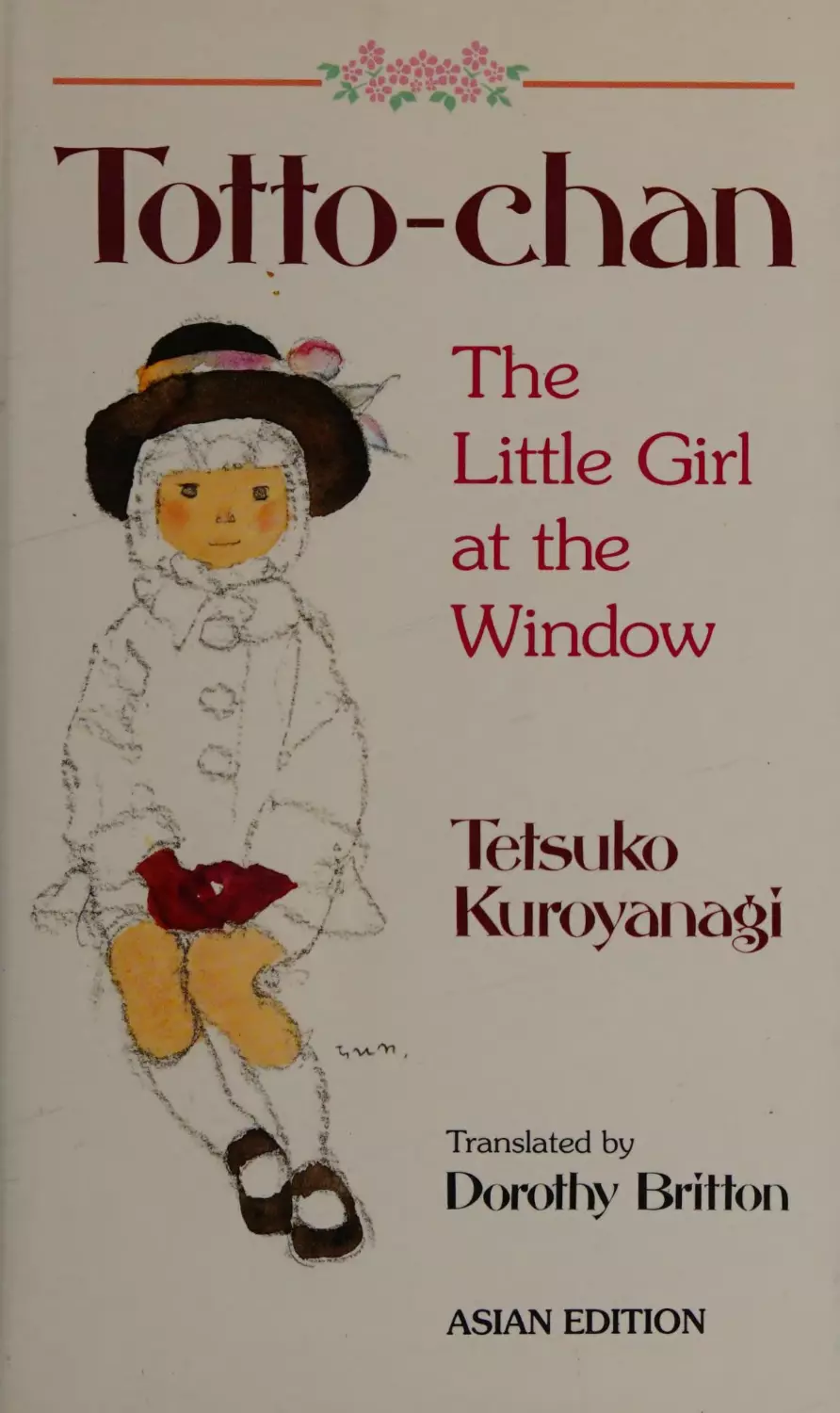
                    Totto-chan
The
Little Girl
at the
Window
letsuko
Ki i ix >yai lagi
»
Translated by
Dorothy Britton
ASIAN EDITION
This engaging series of childhood
recollections tells about an ideal
school in Tokyo during World War II
that combined learning with fun, freedom,
and love. This unusual school had old
railroad cars for classrooms, and it was run
by an extraordinary man—its founder and
headmaster, Sosaku Kobayashi—who was
a firm believer in freedom of expression
and activity.
In real life, the Totto-chan of the book has
become one of Japan’s most popular tele-
vision personalities—Tetsuko Kuroyanagi.
She attributes her success in life to this
wonderful school and its headmaster.
The charm of this account has won
the hearts of millions of people of all ages
and made this book a runaway bestseller
in Japan, with sales hitting the 4.5 million
mark in its first year.
lotto-chan
The Little Girl at the Window

Totto-chan
The Little Girl at the Window
letsuko Kuroyanagi
Translated by
Dorothy Britton
ASIAN EDITION
KODANSHA INTERNATIONAL
KINOKUNIYA COMPANY LTD.

ACKNOWLEDGMENT
The three poems on page 106 and the Issa poem on page 107 are
reprinted from The Autumn Wind by Lewis Mackenzie, 1957,
courtesy of John Murray (Publishers) Ltd.
Some of the illustrations first appeared as follows:
That on the title page was for Tbnari ni kita ко (Shiko Sha),
1976; those on pages 49, 80, 95 were covers of the journal Kodomo
no shiawase (Sodo Bunka), September 1970, July 1967, and
1968 and 1969; p. 9, journal Charm Salon 10 (Senshu Kai) April
1971; pp. 32, 60, 138 were posters for Higeta Shoyu Co.
1960-70; p. 114 was in Watashi ga chiisakatta toki ni, (Doshin
Sha), 1967; p. 144 was for Akaitori meisakushu (not used).
All the original drawings are exhibited at:
Iwasaki Chihiro Museum of Picture Books
7-2, Shimo-shakuji 4-chome, Nerima-ku, Tokyo 177-0042.
Illustrations: Chihiro Iwasaki
Sale of Asian edition is authorized only in Asia, and is strictly prohibited
in Japan, Australia, New Zealand, and other countries throughout the
world.
Published by Kodansha International Ltd., 17'14 Otowa 1-chome,
BunkyoTu, Tokyo 112'8652. Originally published in 1981, in Japanese,
under the title Madogiwa no TottO'chan by Kodansha Publishers Ltd.,
Tokyo. Copyright © 1981 by Tetsuko Kuroyanagi. English translation
copyright © 1982 by Kodansha International Ltd. All rights reserved.
Printed in Japan.
ISBN 4'7700'2594'7
First Asian edition, 1999
00 01 02 03 10987 6
To the memory
of
Sosaku Kobayashi
CONTENTS
The Railroad Station 9
The Little Girl at the Window 11
The New School 17
“I Like This School!” 18
The Headmaster 20
Lunchtime 23
Totto<han Starts School 24
The Classroom in the Train 27
Lessons at Tomoe 28
Sea Food and Land Food 31
“Chew It Well!” 35
School Walks 36
The School Song 40
“Put It All Back!”	43
TottO'chan’s Name	47
Radio Comedians 47
A Railroad Car Arrives 48
The Swimming Pool 53
The Report Card 56
Summer Vacation Begins 57
The Great Adventure 59
The Bravery Test 64
The Rehearsal Hall 68
A Trip to a Hot Spring 71
Eurythmics 75
“The Only Thing I Want!” 81
Their Worst Clothes 84
Takahashi 87
“Look before You Leap!” 89
“And Then... Uh...”	91
“We Were Only Playing!”	96
Sports Day 99
The Poet Issa 105
Very Mysterious 108
Talking with Your Hands 111
The Forty-seven Ronin 112
“MaSOW-chaan!” 115
Pigtails 117
“Thank You” 120
The Library Car 123
Tails 126
Her Second Year at Tomoe 129
Swan Lake 130
The Farming Teacher 133
Field Kitchen 136
“You’re Really a Good Girl” 141
His Bride 143
“Shabby Old School” 145
The Hair Ribbon 148
Visiting the Wounded 151
Health Bark 154
The English-speaking Child 160
Amateur Drama 163
Chalk 166
“Yasuaki-chan s Dead” 168
A Spy	171
Daddy's Violin 174
The Promise 177
Rocky Disappears 179
The Tea Party 183
Sayonara, Sayonara! 187
Postscript 189
Epilogue 202
Notes 209
The Railroad Station
They got off the Oimachi train at Jiyugaoka Station,
and Mother took Tottochan by the hand to lead
her through the ticket gate. She had hardly ever
been on a train before and was reluctant to give up
the precious ticket she was clutching.
“May I keep it?” Totto<han asked the ticket
collector.
“No, you can’t,” he replied, taking it from her.
She pointed to his box filled with tickets. “Are
those all yours?”
“No, they belong to the railroad station,” he
replied, as he snatched away tickets from people go-
ing out.
“Oh.” Totto<han gazed longingly into the box
and went on, “When I grow up I’m going to sell
railroad tickets!”
9
The ticket collector glanced at her for the first
time. “My little boy wants a job in the station, too,
so you can work together.”
Totto-chan stepped to one side and took a good
look at the ticket collector. He was plump and wore
glasses and seemed rather kind.
“Hmm.” She put her hands on her hips and
carefully considered the idea. “I wouldn’t mind at all
working with your son,” she said. “I’ll think it over.
But I’m rather busy just now as I’m on my way to a
new school.”
She ran to where Mother waited, shouting, “I’m
going to be a ticket seller!”
Mother wasn’t surprised, but she said, “I thought
you were going to be a spy.”
As Totto-chan began walking along holding Moth-
er’s hand, she remembered that until the day before
she had been quite sure she wanted to be a spy.
But what fun it would be to be in charge of a box full
of tickets!
“That’s it!” A splendid idea occurred to her. She
looked up at Mother and informed her of it at the
top of her voice, “Couldn’t I be a'ticket seller who’s
really a spy?”
Mother didn’t reply. Under her felt hat with its lit-
tle flowers, her lovely face was serious. The fact was
Mother was very worried. What if they wouldn’t
have Totto-chan at the new school? She looked at
Totto-chan skipping along the road chattering to
herself. Totto-chan didn’t know Mother was wor-
ried, so when their eyes met, she said gaily, “I’ve
changed my mind. I think I’ll join one of those little
bands of street musicians who go about advertising
new stores!”
10
There was a touch of despair in Mother’s voice as
she said, “Come on, we’ll be late. We mustn’t keep
the headmaster waiting. No more chatter. Look where
you’re going and walk properly.”
Ahead of them, in the distance, the gate of a small
school was gradually coming into view.
^_The Little Girl at the Window
The reason Mother was worried was because aL
though TottO'chan had only just started school, she
had already been expelled. Fancy being expelled from
the first grade!
It had happened only a week ago. Mother had
been sent for by Totto-chan’s homeroom teacher,
who came straight to the point. “Your daughter
disrupts my whole class. I must ask you to take her to
another school.” The pretty young teacher sighed.
“I’m really at the end of my tether.”
Mother was completely taken aback. What on
earth did Totto-chan do to disrupt the whole class,
she wondered?
Blinking nervously and touching her hair, cut in a
short pageboy style, the teacher started to explain.
“Well, to begin with, she opens and shuts her desk
hundreds of times. I’ve said that no one is to open or
shut their desk unless they have to take something
out or put something away. So your daughter is com
stantly taking something out and putting something
away—taking out or putting away her notebook, her
pencil box, her textbooks, and everything else in her
desk. For instance, say we are going to write the
alphabet, your daughter opens her desk, takes out
her notebook, and bangs the top down. Then she
11
opens her desk again, puts her head inside, gets out a
pencil, quickly shuts the desk, and writes an ‘A? If
she’s written it badly or made a mistake she opens
the desk again, gets out an eraser, shuts the desk,
erases the letter, then opens and shuts the desk again
to put away the eraser—all at top speed. When she’s
written the ‘A’ over again, she puts every single item
back into the desk, one by one. She puts away the
pencil, shuts the desk, then opens it again to put
away the notebook. Then, when she gets to the next
letter, she goes through it all again—first the note-
book, then the pencil, then the eraser—opening and
shutting her desk every single time. It makes my
head spin. And I can’t scold her because she opens
and shuts it each time for a reason.”
The teacher’s long eyelashes fluttered even more as
if she were reliving the scene in her mind.
It suddenly dawned on Mother why Totto-chan
opened and shut her desk so often. She remembered
how excited Totto-chan had been when she came
home from her first day at school. She had said,
“School’s wonderful! My desk at home has drawers
you pull out, but the one at schodl«has a top you lift
up. It’s like a box, and you vcan keep all sorts of
things inside. It’s super!”
Mother pictured her delightedly opening and shut-
ting the lid of this new desk. And Mother didn’t think
it was all that naughty either. Anyway, Totto-chan
would probably stop doing it as soon as the novelty
wore off. But all she said to the teacher was, “I’ll
speak to her about it.”
The teacher’s voice rose in pitch as she continued,
“I wouldn’t mind if that was all.”
Mother flinched as the teacher leaned forward.
12
“When she’s not making a clatter with her desk,
she’s standing up. All through class!”
“Standing up? Where?” asked Mother, surprised.
“At the window,” the teacher replied crossly.
“Why does she stand at the window?” Mother ask'
ed, puzzled.
“So she can invite the street musicians over!” she
almost shrieked.
The gist of the teacher’s story was that after an
hour of almost constantly banging her desk top,
Totto-chan would leave her desk and stand by the
window, looking out. Then, just as the teacher was
beginning to think that as long as she was quiet she
might just as well stay there, Totto<han would sud-
denly call out to a passing band of garishly dressed
street musicians. To Totto-chan’s delight and the
teacher’s tribulation, the classroom was on the
ground floor looking out on the street. There was
only a low hedge in between, so anyone in the
classroom could easily talk to people going by. When
Totto-chan called to them, the street musicians
would come right over to the window. Whereupon,
said the teacher, Totto-chan would announce the
fact to the whole room, “Here they are!” and all the
children would crowd by the window and call out to
the musicians.
“Play something,” Totto-chan would say, and the
little band, which usually passed the school quietly,
would put on a rousing performance for the pupils
with their clarinet, gongs, drums, and samisen, while
the poor teacher could do little but wait patiently for
the din to stop.
Finally, when the music finished, the musicians
would leave and the students would go back to their
13
seats. All except Totto-chan. When the teacher ask'
ed, “Why are you still at the window?” Totto-chan
replied, quite seriously, “Another band might come
by. And, anyway, it would be such a shame if the
others came back and we missed them.”
“You can see how disruptive all this is, can’t you?”
said the teacher emotionally. Mother was beginning
to sympathize with her when she began again in an
even shriller voice, “And then, besides ...”
“What else does she do?” asked Mother, with a
sinking feeling.
“What else?” exclaimed the teacher. “If I could
even count the things she does I wouldn’t be asking
you to take her away.”
The teacher composed herself a little, and looked
straight at Mother. “Yesterday, Totto-chan was stand-
ing at the window as usual, and I went on with the
lesson thinking she was just waiting for the street mu-
sicians, when she suddenly called out to some-
body, ‘What are you doing?’ From where I was I
couldn’t see who she was talking to, and I wondered
what was going on. Then she called out again, ‘What
are you doing?’ She wasn’t addressing anyone in the
road but somebody high up somewhere. I couldn’t
help being curious, and tried to hear the reply, but
there wasn’t any. In spite of that, your daughter kept
on calling out, ‘What are you doing?’ so often I
couldn’t teach, so I went over to the window to see
who your daughter was talking to. When I put my
head out of the window and looked up, I saw it was a
pair of swallows making a nest under the classroom
eaves. She was talking to the swallows! Now, I
understand children, and so I’m not saying that talk-
ing to swallows is nonsense. It is just that I feel it is
14
quite unnecessary to ask swallows what they are do-
ing in the middle of class.”
Before Mother could open her mouth to apologize,
the teacher went on, “Then there was the drawing
class episode. I asked the children to draw the Japa-
nese flag, and all the others drew it correctly but your
daughter started drawing the navy flag—you know,
the one with the rays. Nothing wrong with that, I
thought. But then she suddenly started to draw
a fringe all around it. A fringe! You know, like those
fringes on youth group banners. She’s probably seen
one somewhere. But before I realized what she was
doing, she had drawn a yellow fringe that went right
15
off the edge of the paper and onto her desk. You see,
her flag took up most of the paper, so there wasn’t
enough room for the fringe. She took her yellow
crayon and all around her flag she made hundreds of
strokes that extended beyond the paper, so that
when she lifted up the paper her desk was a mass of
dreadful yellow marks that wouldn’t come off no
matter how hard we rubbed. Fortunately, the lines
were only on three sides.”
Puzzled, Mother asked quickly, “What do you
mean, only three sides?”
Although she seemed to be getting tired, the
teacher was kind enough to explain. “She drew a
flagpole on the left, so the fringe was only on three
sides of the flag.”
Mother felt somewhat relieved. “I see, only on
three sides.”
Whereupon the teacher said very slowly, em-
phasizing each word, “But most of the flagpole went
off the paper, too, and is still on the desk as well.”
Then the teacher got up and said coldly, as a sort
of parting shot, “I’m not the only one who is upset.
The teacher in the classroom next*door has also had
trouble.”
V
Mother obviously had to do something about it. It
wasn’t fair to the other pupils. She’d have to find
another school, a school where they would under-
stand her little girl and teach her how to .get along
with other people.
The school they were on their way to was one
Mother had found after a good deal of searching.
Mother did not tell Totto-chan she had been ex-
pelled. She realized Totto-chan wouldn’t understand
what she had done wrong and she didn’t want her to
16
get any complexes, so she decided not to tell Totto-
chan until she was grown-up. All Mother said was,
“How would you like to go to a new school? I’ve
heard of a very nice one.”
“All right,” said Totto-chan, after thinking it over.
“But ...”
“What is it now?” thought Mother. “Does she
realize she’s been expelled?”
But a moment later Totto-chan was asking joyful-
ly, “Do you think the street musicians will come to
the new school?”
iOJTThe New School
When she saw the gate of the new school, Totto-
chan stopped. The gate of the school she used to go
to had fine concrete pillars with the name of the
school in large characters. But the gate of this new
school simply consisted of two rather short posts
that still had twigs and leaves on them.
“This gate’s growing,” said Totto-chan. “It’ll prob-
ably go on growing till it’s taller than the telephone
poles!”
The two “gateposts” were clearly trees with roots.
When she got closer, she had to put her head to one
side to read the name of the school because the wind
had blown the sign askew.
“To-mo-e Ga-ku-en.”
Totto-chan was about to ask Mother what
“Tomoe” meant, when she caught a glimpse of
something that made her think she must be dream-
ing. She squatted down and peered through the
shrubbery to get a better look, and she couldn’t
believe her eyes.
17
“Mother, is that really a train? There, in the
school grounds!”
For its classrooms, the school had made use of six
abandoned railroad cars. To TottO'chan it seemed
something you might dream about. A school in a
train!
The windows of the railroad cars sparkled in the
morning sunlight. But the eyes of the rosycheeked
little girl gazing at them through the shrubbery
sparkled even more.
Like This School!”
A moment later, Totto<han let out a whoop of joy
and started running toward the “train school,” calk
ing out to Mother over her shoulder, “Come on,
hurry, let’s get on this train that’s standing still.”
Startled, Mother began to run after her. Mother
had been on a basketball team once, so she was
faster than TottO'chan and caught hold of her dress
just as she reached a door.
“You can’t go in yet,” said Mother, holding her
back. “The cars are classrooms,* and you haven’t
even been accepted here yet. If you really want to get
on this train, you’ll have to be nice and polite to the
headmaster. We’re going to call on him now, and if
all goes well, you’ll be able to go to this school. Do
you understand?”
Totto<han was awfully disappointed not to get on
the “train” right away, but she decided she had bet'
ter do as Mother told her.
“All right,” she said. And then added, “I like this
school a lot.”
Mother felt like telling her it wasn’t a matter of
18
whether she liked the school but of whether the
headmaster liked her. But she just let go of Totto-
chan’s dress, took hold of her hand, and started
walking toward the headmaster’s office.
All the railroad cars were quiet, for the first classes
of the day had begun. Instead of a wall, the not very
spacious school grounds were surrounded by trees,
and there were flower beds full of red and yellow
flowers.
The headmaster’s office wasn’t in a railroad car,
but was on the right-hand side of a one-story
building that stood at the top of a semicircular flight
of about seven stone steps opposite the gate.
Totto-chan let go of Mother’s hand and raced up
the steps, then turned around abruptly, almost caus-
ing Mother to run into her.
“What’s the matter?” Mother asked, fearing Totto-
chan might have changed her mind about the
school.
Standing above her on the top step, Totto-chan
whispered to Mother in all seriousness, “The man
we’re going to see must be a stationmaster!”
Mother had plenty of patience as well as a great
sense of fun. She put her face close to Totto-chan’s
and whispered, “Why?”
Totto-chan whispered back, “You said he was the
headmaster, but if he owns all these trains, he must
be a stationmaster.”
Mother had to admit it was unusual for a school to
make use of old railroad cars, but there was no time
to explain. She simply said, “Why don’t you ask him
yourself? And, anyway, what about Daddy? He plays
the violin and owns several violins, but that doesn’t
make our house a violin shop, does it?”
19
“No, it doesn’t,” Totto-chan agreed, catching hold
of Mother’s hand.
^_The Headmaster
When Mother and Totto-chan went in, the man in
the office got up from his chair.
His hair was thin on top and he had a few teeth
missing, but his face was a healthy color. Although
he wasn’t very tall, he had solid shoulders and arms
and was neatly dressed in a rather shabby black
three-piece suit.
With a hasty bow, Totto-chan asked him spirited-
ly, “What are you, a schoolmaster or a station-
master?”
Mother was embarrassed, but before she had time
to explain, he laughed and replied, “I’m the head-
master of this school.”
Totto-chan was delighted. “Oh, I’m so glad,” she
said, “because I want to ask you a favor. I’d like to
come to your school.”
The headmaster offered her a chair and turned to
Mother. “You may go home nov/. I want to talk to
Totto-chan.”
Totto-chan had a moment’s uneasiness, but some-
how felt she would get along all right with this man.
“Well, then, I’ll leave her with you,” Mother said
bravely, and shut the door behind her as she went
out.
The headmaster drew over a chair and put it fac-
ing Totto-chan, and when they were both sitting
down close together, he said, “Now then, tell me all
about yourself. Tell me anything at all you want to
talk about.”
20
“Anything I like?” Totto-chan had expected him
to ask questions she would have to answer. When he
said she could talk about anything she wanted, she
was so happy she began straight away. It was all a bit
higgledy-piggledy, but she talked for all she was
worth. She told the headmaster how fast the train
went that they had come on; how she had asked the
ticket collector but he wouldn’t let her keep her
ticket; how pretty her homeroom teacher was at the
other school; about the swallows’ nest; about their
brown dog, Rocky, who could do all sorts of tricks;
how she used to go snip-snip with the scissors inside
her mouth at kindergarten and the teacher said she
mustn’t do that because she might cut her tongue
off, but she did it anyway; how she always blew her
nose because Mother scolded her if it was runny;
what a good swimmer Daddy was, and how he could
dive as well. She went on and on. The headmaster
would laugh, nod, and say, “And then?” And Totto-
chan was so happy she kept right on talking. But
finally she ran out of things to say. She sat with her
mouth closed trying hard to think of something.
“Haven’t you anything more you can tell me?”
asked the headmaster.
What a shame to stop now, Totto-chan thought. It
was such a wonderful chance. Wasn’t there anything
else she could talk about, she wondered, racking her
brains? Then she had an idea.
She could tell him about the dress she was wearing
that day. Mother made most of her dresses, but this
one came from a shop. Her clothes were always torn
when she came home in the late afternoon. Some of
the rips were quite bad. Mother never knew how
they got that way. Even her white cotton panties
21
were sometimes in shreds. She explained to the
headmaster that they got torn when she crossed
other people’s gardens by crawling under their fences,
and when she burrowed under the barbed wire
around vacant lots. So this morning, she said, when
she was getting dressed to come here, all the nice
dresses Mother had made were torn so she had to
wear one Mother had bought. It had small dark red
and gray checks and was made of jersey, and it
wasn’t bad, but Mother thought the red flowers em-
broidered on the collar were in bad taste. “Mother
doesn’t like the collar,” said Totto-chan, holding it
up for the headmaster to see.
After that, she could think of nothing more to say
no matter how hard she tried. It made her rather
sad. But just then the headmaster got up, placed his
large, warm hand on her head, and said, “Well, now
you’re a pupil of this school.”
Those were his very words. And at that moment
Totto-chan felt she had met someone she really liked
for the very first time in her life. You see, up till
then, no one had ever listened to her for so long.
And all that time the headmaster hadn’t yawned
once or looked bored, but seemed just as interested
in what she had to say as she was.
Totto-chan hadn’t learned how to tell time yet,
but it did seem like a rather long time. If she had
been able to, she would have been astonished, and
even more grateful to the headmaster. For, you see,
Mother and Totto-chan arrived at the school at
eight, and when she had finished talking and the
headmaster had told her she was a pupil of the
school, he looked at his pocket watch and said, “Ah,
it’s time for lunch.” So the headmaster must have
22
listened to Totto-chan for four solid hours!
Neither before nor since did any grown-up listen
to Totto-chan for as long as that. And, besides, it
would have amazed Mother and her homeroom
teacher to think that a seven-year-old child could
find enough to talk about for four hours nonstop.
Totto-chan had no idea then, of course, that she
had been expelled and that people were at their wit’s
end to know what to do. Having a naturally sunny
disposition and being a bit absent-minded gave her
an air of innocence. But deep down she felt she was
considered different from other children and slightly
strange. The headmaster, however, made her feel
safe and warm and happy. She wanted to stay with
him forever.
That’s how Totto-chan felt about Headmaster So-
saku Kobayashi that first day. And, luckily, the head-
master felt the same about her.
^^Lunchtime
The headmaster took Totto-chan to see where the
children had lunch. “We don’t have lunch in the
train,” he explained, “but in the Assembly Hall.”
The Assembly Hall was at the top of the stone steps
Totto-chan had come up earlier. When they got
there, they found the children noisily moving desks
and chairs about, arranging them in a circle. As they
stood in one corner and watched, Totto-chan tugged
at the headmaster’s jacket and asked, “Where are the
rest of the children?”
“This is all there are,” he replied.
“All there are?” Totto-chan couldn’t believe it.
23
There were as many children as this in just one grade
at the other school.
“You mean there are only about fifty children in
the whole school?”
“That’s all,” said the headmaster.
Everything about this school was different from
the other one, thought Totto<han.
When everyone was seated, the headmaster asked
the pupils if they had all brought something from the
ocean and something from the hills.
“Yes!” they chorused, opening their various lunch'
boxes.
“Let’s see what you’ve got,” said the headmaster,
strolling about in the circle of desks and looking into
each box while the children squealed with delight.
“How funny,” thought Totto<han. “1 wonder
what he means by ‘something from the ocean and
something from the hills.’ ” This school was dif'
ferent. It was fun. She never thought lunch at school
could be as much fun as this. The thought that
tomorrow she would be sitting at one of those desks,
showing the headmaster her lunch with “something
from the ocean and something frdtn the hills” made
Totto-chan so happy she wanted to jump for joy.
As he inspected the lunchboxes, the headmaster’s
shoulders were bathed in the soft noontime light.
^Totto-chan Starts School
After the headmaster had said, “Now you’re a pupil
of this school,” TottO'chan could hardly wait for the
next day to dawn. She had never looked forward to
a day so much. Mother usually had trouble getting
24
Totto-chan out of bed in the morning, but that day
she was up before anyone else, all dressed and waiting
with her schoolbag strapped to her back.
The most punctual member of the household
—Rocky, the German shepherd—viewed Totto-
chan’s unusual behavior with suspicion, but after a
good stretch, he positioned himself close to her, ex-
pecting something to happen.
Mother had a lot to do. She busily made up a box
lunch containing “something from the ocean and
something from the hills” while she gave Totto-chan
her breakfast. Mother also put Totto-chan’s train
pass in a plastic case and hung it around Totto-
chan’s neck on a cord so she wouldn’t lose it.
“Be a good girl,” said Daddy, his hair all tousled.
“Of course.” Totto-chan put on her shoes and
opened the front door, then turned around, bowed
politely, and said, “Goodbye, everybody.”
Tears welled up in Mother’s eyes as she watched
Totto-chan go out. It was hard to believe that this
vivacious little girl, setting off so obediently and hap-
pily, had just been expelled from school. She prayed
fervently that all would go well this time.
A moment later Mother was startled to see Totto-
chan remove the train pass and hang it around
Rocky’s neck instead. “Oh dear ...” thought Moth-
er, but she decided to say nothing but wait and see
what happened.
After Totto-chan put the cord with the pass
around Rocky’s neck, she squatted down and said to
him, “You see? This pass doesn’t fit you at all.”
The cord was much too long and the pass dragged
on the ground.
“Do you understand? This is my pass, not yours.
I
You won’t be able to get on the train. I’ll ask the
headmaster, though, and the man at the station,
and see if they’ll let you come to school, too.
Rocky listened attentively at first, ears pointed,
but after giving the pass a few licks, he yawned.
Totto-chan went on, “The classroom train doesn’t
move, so I don’t think you’ll need a ticket to get on
that one, but today you’ll just have to stay home and
wait for me.”
Rocky always used to walk with Totto-chan as far
as the gate of the other school and then come back
home. Naturally, he was expecting to do the same
today.
Totto-chan took the cord with the pass off Rocky’s
neck and carefully hung it around her own. She call-
ed out once more to Mother and Daddy, “Good-
bye!”
Then she ran off, without a backward glance, her
bag flapping against her back. Rocky bounded along
happily beside her.
The way to the station was almost the same as to
the old school, so Totto-chan passed dogs and cats
she knew, as well as children from her former class.
Should she show them her pass and impress them,
Totto-chan wondered? But she didn’t want to be
late, so she decided not to that day, and hurried on.
When Totto-chan turned right at the station in-
stead of left as usual, poor Rocky stopped and looked
around anxiously. Totto-chan was already at the
ticket gate, but she went back to Rocky, who stood,
looking mystified.
“I’m not going to the other school any more. I’m
going to a new one now.”
Totto-chan put her face against Rocky’s. His ears
26
were smelly, as usual, but to Totto-chan it was a nice
smell.
“Bye-bye,” she said and, showing the man her
pass, she started climbing up the steep station stairs.
Rocky whimpered softly and watched until Totto-
chan was out of sight.
Д_Т/ге Classroom in the Train
No one had arrived yet when Totto-chan got to the
door of the railroad car the headmaster had told her
would be her classroom. It was an old-fashioned car,
one that still had a door handle on the outside. You
took hold of the handle with both hands and slid
the door to the right. Totto-chan’s heart was beating
fast with excitement as she peeped inside.
“Ooh!”
Studying here would be like going on a perpetual
journey. The windows still had baggage racks above
them. The only difference was that there was a
blackboard at the front of the car, and the
lengthwise seats had been replaced by school desks
and chairs all facing forward. The hand straps had
gone, too, but everything else had been left just as it
was. Totto-chan went in and sat down at someone’s
desk. The wooden chairs resembled those at the
other school, but they were so much more comfort-
able she could sit on them all day. Totto-chan was so
happy and liked the school so much, she made a firm
decision to come to school every day and never take
any holidays.
Totto-chan looked out of the window. She knew
the train was stationary, but—was it because the
flowers and trees in the school grounds were swaying
27
slightly in the breeze?—it seemed to be moving.
“I’m so happy!” she finally said out loud. Then she
pressed her face against the window and made up a
song just as she always did whenever she was happy.
I’m so happy,
So happy am I!
Why am I happy?
Because . . .
Just at that moment someone got on. It was a girl.
She took her notebook and pencil box out of her
schoolbag and put them on her desk. Then she
stood on tiptoe and put the bag on the rack. She put
her shoe bag up there, too. Totto-chan stopped sing-
ing and quickly did the same. After that a boy got
on. He stood at the door and threw his bag on the
baggage rack as if he were playing basketball. It
bounced off and fell on the floor. “Bad shot!” said
the boy, taking aim again from the same place. This
time it stayed on. “Nice shot!” he shouted, followed
by “No, bad shot,” as he scrambled onto the desk
and opened his bag to get out his notebook and pen-
cil box. His failure to do this first*evidently made it
count as a miss.
Eventually there were nine pupils in the car. They
comprised the first grade at Tomoe Gakuen.
They would all be traveling together on the same
train.
^Lessons at Tomoe
Going to school in a railroad car seemed unusual
enough, but the seating arrangements turned out to
28
be unusual, too. At the other school each pupil was
assigned a specific desk. But here they were allowed
to sit anywhere they liked at any time.
After a lot of thought and a good look around,
Totto-chan decided to sit next to the girl who had
come after her that morning because the girl was
wearing a pinafore with a long-eared rabbit on it.
The most unusual thing of all about this school,
however, was the lessons themselves.
Schools normally schedule one subject, for exam-
ple, Japanese, the first period, when you just do
Japanese; then, say, arithmetic the second period,
when you just do arithmetic. But here it was quite
different. At the beginning of the first period, the
teacher made a list of all the problems and questions
in the subjects to be studied that day. Then she
would say, “Now, start with any of these you like.”
So whether you started on Japanese or arithmetic
or something else didn’t matter at all. Someone who
liked composition might be writing something, while
behind you someone who liked physics might be
boiling something in a flask over an alcohol burner,
so that a small explosion was liable to occur in any of
the classrooms.
This method of teaching enabled the teachers to
observe—as the children progressed to higher grades
—what they were interested in as well as their way of
thinking and their character. It was an ideal way for
teachers to really get to know their pupils.
As for the pupils, they loved being able to start
with their favorite subject, and the fact that they
had all day to cope with the subjects they disliked
meant they could usually manage them somehow.
So study was mostly independent, with pupils free to
go and consult the teacher whenever necessary. The
teacher would come to them, too, if they wanted,
and explain any problem until it was thoroughly
understood. Then pupils would be given further ex-
ercises to work at alone. It was study in the truest
sense of the word, and it meant there were no pupils
just sitting inattentively while the teacher talked and
explained.
The first grade pupils hadn’t quite reached the
stage of independent study, but even they were allow-
ed to start with any subject they wanted.
Some copied letters of the alphabet, some drew
pictures, some read books, and some even did calis-
thenics. The girl next to Totto-chan already knew all
her alphabet and was writing it into her notebook. It
was all so unfamiliar that Totto-chan was a bit ner-
vous and unsure what to do.
Just then the boy sitting behind her got up and
walked toward the blackboard with his notebook,
apparently to consult the teacher. She sat at a desk
beside the blackboard and was explaining some-
thing to another pupil. Totto-chan stopped looking
around the room and, with her cKin cupped in her
hands, fixed her eyes on his back as he walked. The
boy dragged his leg, and his whole body swayed dread-
fully. Totto-chan wondered at first if he was doing
it on purpose, but she soon realized the boy couldn’t
help it.
Totto-chan went on watching him as the boy
came back to his desk. Their eyes met. The boy
smiled. Totto-chan hurriedly smiled back. When he
sat down at the desk behind her—it took him longer
than other children to sit down—she turned around
and asked, “Why do you walk like that?”
30
He replied quietly, with a gentle voice that sound'
ed intelligent, “I had polio.”
“Polio?” Totto-chan repeated, never having heard
the word before.
“Yes, polio,” he whispered. “It’s not only my leg,
but my hand, too.” He held it out. Totto-chan look-
ed at his left hand. His long fingers were bent and
looked as if they were stuck together.
“Can’t they do anything about it?” she asked, con-
cerned. He didn’t reply, and Totto-chan became em-
barrassed, wishing she hadn’t asked. But the boy
said brightly, “My name’s Yasuaki Yamamoto. What’s
_ •>>>
yours?
She was so glad to hear him speak in such a cheer-
ful voice that she replied loudly, “I’m Totto-chan.”
That’s how Yasuaki Yamamoto and Totto-chan
became friends.
The sun made it quite hot inside the train. Some-
one opened a window. The fresh spring breeze blew
through the car and tossed the children’s hair about
with carefree abandon.
In this way Totto-chan’s first day at Tomoe began.
!^_Sea Food and Land Food
Now it was time for “something from the ocean and
something from the hills,” the lunch hour Totto-
chan had looked forward to so eagerly.
The headmaster had adopted the phrase to
describe a balanced meal—the kind of food he ex-
pected you to bring for lunch in addition to your
rice. Instead of the usual “Train your children to eat
everything,” and “Please see that they bring a
nutritiously balanced lunch,” this headmaster asked
31
parents to include in their children’s lunchboxes
“something from the ocean and something from the
hills.”
“Something from the ocean” meant sea food—
things such as fish and tsukuda-ni (tiny crustaceans
and the like boiled in soy sauce and sweet sakd),
while “something from the hills” meant food from
the land—like vegetables, beef, pork, and chicken.
Mother was very impressed by this and thought
that few headmasters were capable of expressing
such an important rule so simply. Oddly enough,
just having to choose from two categories made
preparing lunch seem simpler. And besides, the
32
headmaster pointed out that one did not have to
think too hard or be extravagant to fulfill the two re-
quirements. The land food could be just kinpira gobo
(spicy burdock) or an omelette, and the sea food
merely flakes of dried bonito. Or simpler still, you
could have nori (a kind of seaweed) for “ocean” and a
pickled plum for “hills.”
Just as the day before, when Totto-chan had watch-
ed so enviously, the headmaster came and looked in
all the lunchboxes.
“Have you something from the ocean and some-
thing from the hills?” he asked, checking each one. It
was so exciting to discover what each had brought
from the ocean and from the hills.
Sometimes a mother had been too busy and her
child had only something from the hills, or only
something from the ocean. But never mind. As the
headmaster made his round of inspection, his wife
followed him, wearing a cook’s white apron and
holding a pan in each hand. If the headmaster stop-
ped in front of a pupil saying, “Ocean,” she would
dole out a couple of boiled chikuwa (fish rolls) from
the “Ocean” saucepan, and if the headmaster said,
“Hills,” out would come some chunks of soy-sim-
mered potato from the “Hills” saucepan.
No one would have dreamed of saying, “I don’t
like fish rolls,” any more than thinking what a fine
lunch so-and-so has or what a miserable lunch poor
so-and-so always brings. The children’s only concern
was whether they had satisfied the two require-
ments—the ocean and the hills—and if so their joy
was complete and they were all in good spirits.
Beginning to understand what “something from
the ocean and something from the hills” was all
33
about, Totto-chan had doubts whether the lunch
her mother had so hastily prepared that morning
would be approved. But when she opened the
lunchbox, she found such a marvelous lunch inside,
it was all she could do to stop herself shouting, “Oh,
goody, goody!”
Totto-chan’s lunch contained bright yellow scram-
bled eggs, green peas, brown denbu, and pink flak-
ed cod roe. It was as colorful as a flower garden.
“How very pretty,” said the headmaster.
Totto-chan was thrilled. “Mother’s a very good
cook,” she said.
“She is, is she?” said the headmaster. Then he
pointed to the denbu. “All right. What’s this? Is it
from the ocean or the hills?”
Totto-chan looked at it, wondering which was
right. It was the color of earth, so maybe it was from
the hills. But she couldn’t be sure.
“I don’t know,” she said.
The headmaster then addressed the whole school,
“Where does denbu come from, the ocean or the
hills?”
After a pause, while they thought about it, some
shouted, “Hills,” and othersvshouted, “Ocean,” but
no one seemed to know for certain.
“All right. I’ll tell you,” said the headmaster. “Den-
bu is from the ocean.”
“Why?” asked a fat boy.
Standing in the middle of the circle of desks, the
headmaster explained, “Denbu is made by scraping
the flesh of cooked fish off the bones, lightly roasting
and crushing it into fine pieces, which are then dried
and flavored.”
“Oh!” said the children, impressed. Then someone
34
asked if they could see Totto-chan’s denbu.
“Certainly,” said the headmaster, and the whole
school trooped over to look at Totto-chan’s denbu.
There must have been children who knew what den-
bu was but whose interest had been aroused, as well
as those who wanted to see if Totto-chan’s denbu was
any different from the kind they had at home. So
many children sniffed at Totto-chan’s denbu that she
was afraid the bits might get blown away.
Totto-chan was a little nervous that first day at
lunch, but it was fun. It was fascinating wondering
what was sea food and what was land food, and she
learned that denbu was made of fish, and Mother
had remembered to include something from the
ocean and something from the hills, so all in all
everything had been all right, she thought con-
tentedly.
And the next thing that made Totto-chan happy
was that when she started to eat the lunch Mother
had made, it was delicious.
^‘Chew It Well!”
Normally one starts a meal by saying, ^Itadakimasu"
(I gratefully partake), but another thing that was dif-
ferent at Tomoe Gakuen was that first of all every-
body sang a song. The headmaster was a musician
and he had made up a special “Song to Sing before
Lunch.” Actually, he just made up the words and
set them to the tune of the well-known round “Row,
Row, Row Your Boat.” The words the headmaster
made up went like this:
Chew, chew, chew it well,
Everything you eat;
Chew it and chew it and chew it and chew it,
Your rice and fish and meat!
It wasn’t until they had finished singing this song
that the children all said li Itadakimasu.”
The words fitted the tune of “Row, Row, Row
Your Boat” so well that even years later many of the
pupils firmly believed it had always been a song you
sang before eating.
The headmaster may have made up the song
because he had lost some of his teeth, but he was
always telling the children to eat slowly and take
plenty of time over meals while enjoying pleasant
conversation, so it is more likely he made up this
song to remind them of that.
After they had sung the song at the tops of their
voices, the children all said ^Itadakimasu" and settled
down to “something from the ocean and something
from the hills.”
For a while the Assembly Hall was quiet.
.^School Walks
After lunch Totto<han played in the school grounds
with the others before returning to the classroom,
where the teacher was waiting for them.
“You all worked hard this morning,” she said, “so
what would you like to do this afternoon?”
Before Tottochan could even begin to think
about what she wanted to do, there was a unan-
imous shout.
“A walk!”
“All right,” said the teacher, and the children all
36
began rushing to the doors and dashing out. Totto-
chan used to go for walks with Daddy and Rocky,
but she had never heard of a school walk and was as-
tounded. She loved walks, however, so she could
hardly wait.
As she was to find out later, if they worked hard in
the morning and completed all the tasks the teacher
had listed on the blackboard, they were generally
allowed to go for a walk in the afternoon. It was the
same whether you were in the first grade or the sixth
grade.
Out of the gate they went—all nine first grade
pupils with their teacher in their midst—and began
walking along the edge of a stream. Both banks of
the stream were lined with large cherry trees that
had only recently been in full bloom. Fields of yellow
mustard flowers stretched as far as the eye could see.
The stream has long since disappeared, and apart-
ment buildings and stores now crowd the area. But
in those days Jiyugaoka was mostly fields.
“We go as far as Kuhonbutsu Temple,” said the
girl with the rabbit on her pinafore dress. Her name
was Sakko-chan.
“We saw a snake by the pond there last time,” said
Sakko-chan. “There’s an old well in the temple
grounds which they say a shooting star fell into
once.”
The children chatted away about anything they
liked as they walked along. The sky was blue and the
air was filled with the fluttering of butterflies.
After they had walked for about ten minutes, the
teacher stopped. She pointed to some yellow flowers,
and said, “Look at these mustard flowers. Do you
know why flowers bloom?”
37
She explained about pistils and stamens while the
children crouched by the road and examined the
flowers. The teacher told them how butterflies
helped flowers bloom. And, indeed, the butterflies
seemed very busy helping.
Then the teacher set off again, so the children
stopped inspecting the flowers and stood up. Some'
one said, “They don’t look like pistols, do they?”
Totto<han didn’t think so either, but like the
other children, she was sure that pistils and stamens
were very important.
After they had walked for about another ten
minutes, a thickly wooded park came into view. It
surrounded the temple called Kuhonbutsu. As they
entered the grounds the children scattered in various
directions.
“Want to see the shooting-star well?” asked Sakko-
chan, and naturally Totto-chan agreed and ran after
her.
The well looked as if it was made of stone and
came up to their chests. It had a wooden lid. They
lifted the lid and peered in. It was pitch dark, and
Totto-chan could see something like a lump of con-
crete or stone, but nothing whatsoever resembling
the twinkling star she had imagined. After staring
inside for a long time, she asked, “Have you seen the
star?”
Sakko-chan shook her head. “No, never.”
Totto-chan wondered why it didn’t shine. After
thinking about it for a while, she said, “Maybe it’s
asleep.”
Opening her big round eyes even wider, Sakko-
chan asked, “Do stars sleep?”
“I think they must sleep in the daytime and then
38
wake up at night and shine,” said Totto-chan quick-
ly because she wasn’t really sure.
Then the children gathered together and walked
around the temple grounds. They laughed at the
bare bellies of the two Deva Kings that stood on
either side of the gate, guarding the temple, and gaz-
ed with awe at the statue of Buddha in the semi-
darkness of the Main Hall. They placed their feet in
the great footprint in a stone said to have been
made by a Tengu—a long-nosed goblin. They strolled
around the pond, calling out “Hello!” to the people
in rowboats. And they played hopscotch to their
hearts’ content with the glossy black pebbles around
the graves. Everything was new to Totto-chan,
and she greeted each discovery with an excited shout.
“Time to go back!” said the teacher, as the sun
began to dip, and the children set off for the school
along the road between the mustard blossoms and
the cherry trees.
Little did the children realize then that these
walks—a time of freedom and play for them—were in
reality precious lessons in science, history, and
biology.
Totto-chan had already made friends with all the
children and felt she had known them all her life.
“Let’s go for a walk again tomorrow!” she shouted
to them all on the way back.
“Yes, let’s!” they shouted back, hopping and
skipping.
The butterflies were still going busily about their
business, and the song of birds filled the air. Totto-
chan’s heart was bursting with joy.
39
1
^_The School Song
Each day at Tomoe Gakuen was filled with surprises
for Totto-chan. So eager was she to go to school that
mornings never dawned soon enough. And when
she got home she couldn’t stop talking—telling
Rocky and Mother and Daddy all about what she
had done at school that day and what fun it had
been, and all the surprises. Mother would finally
have to say, “That’s enough, dear. Stop talking and
have your afternoon snack.”
Even when Totto-chan was quite accustomed to
the new school, she still had mountains of things to
talk about every day. And Mother rejoiced to think
that this was so.
One day, on her way to school in the train, Totto-
chan suddenly began wondering whether Tomoe
had a school song. Wanting to find out as soon as
possible, she could hardly wait to get there. Al-
though there were still two more stations to go, she
went and stood by the door, ready to jump out as
soon as the train pulled into Jiyugaoka. A lady get-
ting on at the station before saw the little girl at
the door and naturally thought she was getting off.
When the child remained motionless—poised like a
runner, all set and “on your marks”—the lady mut-
tered, “I wonder what’s the matter with her.”
When the train arrived at the station, Totto-chan
was off it in a flash. By the time the young conductor
was calling out, “Jiyugaoka! Jiyugaoka!”—one foot
smartly on the platform before the train had come to
a proper halt—Totto-chan had already disappeared
through the exit.
The moment she was inside the railroad-car class-
40
room, Totto-chan asked Taiji Yamanouchi, who was
already there, “Tai-chan, does this school have a
song?”
Tai-chan, who liked physics, replied after some
thought, “I don’t think it has.”
“Oh,” said Totto-chan, pensively. “Well, I think it
ought to. We had a lovely one at my other school.”
She began singing it at the top of her voice:
Tho’ shallow the waters of Senzoku Pond,
Deep is our learning of vistas beyond . . .
Totto-chan had only gone to the school a short
time, and the words were difficult, but she had no
trouble remembering the song. That part, at any
rate.
Tai-chan seemed impressed. By this time other
pupils had arrived, and they, too, seemed impressed
by the big words she used.
“Let’s get the headmaster to make up a school
song!” said Totto-chan.
“Yes, let’s!” agreed the others, and they all trooped
over to the headmaster’s office.
After listening to Totto-chan sing the song from
the other school and after considering the children’s
request, the headmaster said, “All right, I’ll have a
school song for you by tomorrow morning.”
“Promise you will!” chorused the children, and
they filed out to return to their classroom.
Next morning, there was a notice in each
classroom requiring everyone to assemble in the
school grounds. Totto-chan joined the others, all
agog. Bringing a blackboard out into the center of
the grounds, the headmaster said, “Now then, here’s
a song for Tomoe, your school.” He drew five
41


parallel lines on the blackboard and wrote out the
following notes:
To - mo-e
To - mo-e
To - mo - e
Then he raised both his arms like a conductor,
saying, “Now let’s try and sing it, all together!”
While the headmaster beat time and led the sing'
ing, the whole school, all fifty students, joined in:
To'inO'e, To-mo-e, To—mo—e!
“Is that all there is?” asked TottO'chan, after a brief
pause.
“Yes, that’s all,” said the headmaster, proudly.
“Something with fancy words would have been
nicer,” said Totto<han in a terribly disappointed
voice. “Something like ‘Tho’ shallow the waters of
Senzoku Pond.’ ”
“Don’t you like it?” asked the headmaster, flushed
but smiling. “I thought it was rather good.”
Nobody liked it. It was far too simple. They’d rath'
er have no song at all, it appeared, then anything
as simple as that.
The headmaster seemed rather sorry, but he wasn’t
angry, and proceeded to wipe it off the blackboard.
Totto<han felt that they had been rather rude,
but after all she had something a bit more impres'
sive in mind.
The truth was that nothing could have expressed
the headmaster’s love for the children and the
school more, but the children weren’t old enough to
42
realize that. They soon forgot about wanting a
school song, and the headmaster probably never
considered one necessary in the first place. So when
the tune had been rubbed off the blackboard, that
was the end of the matter, and Tomoe Gakuen
never did have a school song.
^Put It All Back!"
Totto-chan had never labored so hard in her life.
What a day that was when she dropped her favorite
purse down the toilet! It had-no money in it, but
Totto-chan loved the purse so much she even took it
to the toilet with her. It was a truly beautiful purse
made of red, yellow, and green checked taffeta. It
was square and flat, with a silver Scotch terrier
rather like a brooch over the triangular flap of the
fastening.
Now Totto-chan had a curious habit. Ever since
she was small, whenever she went to the toilet, she
made it a point to peer down the hole after she had
finished. Consequently, even before she started go-
ing to elementary school, she had already lost several
hats, including a straw one and a white lace one.
Toilets, in those days, had no flush systems, only a
sort of cesspool underneath, so the hats were usually
left floating there. Mother was always telling Totto-
chan not to peer down the hole after she had fin-
ished using the toilet.
That day, when Totto-chan went to the toilet
before school started, she forgot Mother s warning,
and before she knew it, she found herself peering
down the hole. She must have loosened her hold on
43

the purse at that moment, for it slipped out of her
hand and dropped down the hole with a splash.
Totto<han let out a cry as it disappeared into the
darkness below.
But Totto-chan refused to shed tears or give up the
purse as lost. She went to the janitor’s shed and got a
large, long-handled wooden ladle used for watering
the garden. The handle was almost twice as long as
she was, but that did not deter her in the least. She
went around with it to the back of the school and
tried to find the opening through which the cesspool
was emptied. She imagined it would be on the out'
side wall of the toilet, but after searching in vain she
finally noticed a round concrete manhole cover
about a yard away. Lifting it off with difficulty, she
discovered an opening that was undoubtedly the
one she was looking for. She put her head inside.
“Why, it’s as big as the pond at Kuhonbutsu!” she
exclaimed.
Then she began her task. She started ladling out
the contents of the cesspool. At first she tried the
area in which she had dropped'the purse. But the
tank was deep and dark and quite extensive, since it
served three separate toilets. Moreover, she was in
danger of falling in herself if she put her head in too
far, so she decided to just keep on ladling and hope
for the best, emptying her ladle onto the ground
around the hole.
She inspected each ladleful, of course, to see if it
contained the purse. She hadn’t thought it would
take her long to find, but there was no sign of the
purse. Where could it be? The bell rang for the
beginning of class.
What should she do, she wondered, but having
44
gone so far she decided to continue. She ladled with
renewed vigor.
There was quite a pile on the ground when the
headmaster happened to pass by.
“What are you doing?” he asked Totto-chan.
“I dropped my purse,” she replied, as she went on
ladling, not wanting to waste a moment.
“I see,” said the headmaster, and walked away, his
hands clasped behind his back as was his habit when
he went for a stroll.
Time went by and she still hadn’t found the purse.
The foul-smelling pile was getting higher and higher.
The headmaster came by again. “Have you found
it?” he inquired.
“No,” replied Totto-chan, from the center of the
pile, sweating profusely, her cheeks flushed.
The headmaster came closer and said in a friendly
tone, “You’ll put it all back when you’ve finished,
won’t you?” Then he went off again, as he had done
before.
“Yes,” Totto-chan replied cheerfully, as she went
on with her work. Suddenly a thought struck her.
She looked at the pile. “When I’ve finished I can put
all the solid stuff back, but what do 1 do about the
water?”
The liquid portion was disappearing fast into the
earth. Totto-chan stopped working and tried to
figure out how she could get that part back into the
tank, too, since she had promised the headmaster to
put it all back. She finally decided the thing to do
was to put in some of the wet earth.
The pile was a real mountain by now and the tank
was almost empty, but there was still no sign of the
purse. Maybe it had stuck to the rim of the tank or
45
to the bottom. But Totto-chan didn’t care. She was
satisfied she had done all she could. Totto-chan’s
satisfaction was undoubtedly due in part to the self-
respect the headmaster made her feel by not scolding
her and by trusting her. But that was too com-
plicated for Totto-chan to realize then.
Most adults, on discovering Totto-chan in such a
situation, would have reacted by exclaiming, “What
on earth are you doing!” or “Stop that, it’s danger-
ous!” or, alternatively, offering to help.
Imagine just saying, “You’ll put it all back when
you’ve finished, won’t you?” What a marvelous
headmaster, thought Mother when she heard the
story from Totto-chan.
After the incident, Totto-chan never peered down
the hole any more after using the toilet. And she felt
the headmaster was someone she could trust com-
pletely, and she liked him more than ever.
Totto-chan kept her promise and put everything
back into the tank. It was a terrible job getting it out,
but putting it back was much quicker. She put some
of the wet earth in, too. Then «he smoothed the
ground, put the cover back properly, and took the
ladle back to the janitor’s shed.
That night before she went to bed Totto-chan
thought about the beautiful purse she had dropped
into the darkness. She was sad about losing it, but
the day’s exertion had made her so tired it was not
long before she was fast asleep.
Meanwhile, at the scene of her toil, the damp
earth shimmered in the moonlight like some beauti-
ful thing.
And somewhere the purse rested quietly.
46
^TottO'chans Name
Totto-chan’s real name was Tetsuko. Before she was
born all Mother’s and Daddy’s friends and relatives
said they were sure the baby would be a boy. It was
their first child, and they believed it. So they decided
to name the baby Toru. When the baby turned out
to be a girl, they were a bit disappointed, but they
both liked the Chinese character for toru M (which
means to penetrate, to carry far, to be clear and reso-
nant, as a voice) so they made it into a girl’s name by
using its Chinese-derived pronunciation tetsu and
adding the suffix ко often used for girls’ names.
So everybody called her Tetsuko-chan (chan is the
familiar form of the san used after a person’s name).
But it didn’t sound quite like Tetsuko-chan to her.
Whenever anyone asked her what her name was, she
would answer, “Totto-chan.” She even thought that
chan was part of her name, too.
Daddy sometimes called her Totsky, as if she were
a boy. He’d say, “Totsky! Come and help me take
these bugs off the roses!” But except for Daddy and
Rocky everybody else called her Totto-chan, and
although she wrote her name as Tetsuko in her
notebooks at school, she still went on thinking of
herself as Totto-chan.
\^^Radio Comedians
Yesterday Totto-chan was very upset. Mother had
said, “You mustn’t listen to any more comedians on
the radio.”
When Totto-chan was a little girl, radios were
large and made of wood. They were very elegant.
47
Theirs was rectangular with a rounded top, and a big
speaker in front covered with pink silk and carved
arabesques. It had two control knobs.
Even before she started school, Totto-chan liked
to listen to rakugo comedians, pressing her ear
against the pink silk. She thought their jokes were
terribly funny. Mother had never objected to her
listening to them until yesterday.
Last night some of Daddy’s friends from the or-
chestra came to their house to practice string quar-
tets in the living room.
“Mr. Tsunesada Tachibana, who plays the cello,
has brought you some bananas,” said Mother.
Totto-chan was thrilled. She bowed politely to Mr.
Tachibana, and by way of thanks exclaimed to her
mother, “Hey, Ma, this is pretty goddam good!”
After that Totto-chan had to listen in secret when
Mother and Daddy were out. When the comedians
were good, she would laugh uproariously. If any
grown-ups had been watching, they might well have
wondered how such a small girl could understand
such difficult jokes. But there*s no doubt that
children have an innate sen$e of humor. No matter
how young they are, they always know when some-
thing’s really funny.
T. A Railroad Car Arrives
“There’s a new railroad car coming tonight,” said
Miyo-chan during the lunchtime break. Miyo-chan
was the headmaster’s third daughter and was in
Totto-chan’s class.
There were already six cars lined up together as
classrooms, but one more was coming. Miyo-chan
48
said it was going to be a library car. They were all
terribly excited.
“1 wonder what route it will take to get to the
school,” someone said.
It was a challenging topic. There was a momentary
hush.
“Maybe it will come along the Oimachi Line
tracks and then branch off this way at that level
crossing,” someone suggested.
t
49
“Then it would have to derail,” said someone else.
“Maybe they’ll just bring it on a cart,” said
another.
“There wouldn’t be a cart big enough to hold one
of those cars,” someone pointed out immediately.
“I suppose not ...”
Ideas petered out. The children realized a railroad
car certainly wouldn’t fit on a cart or even a truck.
“Rails!” said Totto-chan after much thought.
“You know, they’re probably going to lay some rails
right here to the school!”
“From where?” asked someone.
“Where? From wherever the train is now,” said
Totto-chan, beginning to think her idea wasn’t such
a good one, after all. She had no idea where the car
was coming from, and, anyway, they wouldn’t pull
down houses and things in order to lay tracks in a
straight line to the school.
After much fruitless discussion of one possibility
after another, the children finally decided not to go
home that afternoon but to wait and see the car ar-
rive. Miyo-chan was elected to go»and ask her father,
the headmaster, if they could all remain at school
until that night. It was some while before she came
back.
“The car is arriving terribly late tonight,” she said,
“after all the other trains have stopped running.
Anybody who really wants to see it will have to go
home first and ask permission. Then they can come
back if they like with their pajamas and a blanket
after they’ve had their dinner.”
“Wow!” The children were more excited than
ever.
“He said to bring our pajamas?”
50
“And blankets?”
That afternoon no one could concentrate on the
lessons. After school, the children in Totto-chan’s
class went straight home, all hoping they’d be lucky
enough to see each other again that night complete
with pajamas and blankets.
As soon as she reached home, Totto-chan said to
Mother, “A train’s coming. We don’t know how it’s
going to get there. Pajamas and a blanket. May I go?”
What mother could grasp the situation with that
kind of explanation? Totto-chan’s mother had no
idea what she meant. But judging by the serious look
on her daughter’s face, she guessed something
unusual was afoot.
Mother asked Totto-chan all sorts of questions.
She finally discovered what it was all about and
what exactly was going to happen. She thought
Totto-chan ought to see it, as she wouldn’t have
many such opportunities. She even thought she’d
like to see the car arrive herself.
Mother got out Totto-chan’s pajamas and a
blanket, and after dinner she took her to the school.
About ten children were there. They included some
of the older students who had heard of the event. A
couple of other mothers, too, had come with their
children. They looked as if they would like to stay,
but after entrusting their children to the head-
master’s care, they went home.
“I’ll wake you up when it comes,” the children
were assured by the headmaster as they lay down in
the Assembly Hall wrapped in their blankets.
The children thought they wouldn’t be able to
sleep for wondering how the train would get there.
But after so much excitement, they were tired and

51
soon became drowsy. Before they could say, “Be sure
and wake me up,” most of them fell fast asleep.
“It’s here! It’s here!”
Awakened by a babel of voices, Totto-chan jump-
ed up and ran through the school grounds and out
the gate. A great big railroad car was just visible in
the morning haze. It was like a dream—a train coming
along the road without tracks making no sound.
It had come on a large trailer pulled by a tractor
from the Oimachi Line depot. Totto-chan and the
others learned something they didn’t know before
—that there was something called a tractor that
could pull a trailer, which was much bigger than a
cart. They were impressed.
The car moved slowly along the deserted morning
road mounted on the trailer.
Soon there was a great commotion. There were no
giant cranes in those days, so to get the car off the
trailer and to its destination in the school grounds
was a tremendous operation. The men who brought
it had to lay several big logs under the car and
gradually roll it off the trailer onto the schoolyard.
“Watch carefully,” said the headmaster, “they’re
called rollers. Rolling power is being used to move
that big car.”
The children looked on earnestly.
“Heave-ho,. heave-ho,” chanted the workmen as
they toiled, and the sun itself seemed to be rising in
time to their rhythmic cries.
Like the other six already at the school, this car,
which had carried so many people, had its wheels
removed. Its traveling life was over. From now on it
would carry the sound of children’s laughter.
As the boys and girls stood there in the morning
52
sunshine in their pajamas, they were so happy they
couldn’t contain their joy and kept jumping up and
down, clasping the headmaster around the neck and
swinging from his arms.
Staggering under the onslaught, the headmaster
smiled happily. Seeing his joy, the children smiled,
too.
And none of them ever forgot how happy they
were.
The Swimming Pool
That was a red-letter day for Totto-chan. It was the
first time she had ever swum in a pool. And without
a stitch on!
It happened in the morning. The headmaster said
to them all, “It’s become quite hot all of a sudden, so
I think I’ll fill the pool.”
“Wow!” everybody cried, jumping up and down.
Totto-chan and the first grade children cried “Wow”
too, and jumped up and down with even greater ex-
citement than the older students. The pool at
Tomoe was not rectangular like most pools, as one
end was narrower than the other. It was shaped pret-
ty much like a boat. The lay of the land probably
had something to do with it. But nonetheless, the
pool was a large and splendid one. It was situated
between the classrooms and the Assembly Hall.
All during their lessons, Totto-chan and the
others kept stealing glances out of the windows at
the pool. When empty it had been littered with
fallen leaves just like the playground. But now that it
was clean and beginning to fill up, it started to look
like a real swimming pool.
53
l
Lunchtime finally arrived, and when the children
were all gathered around the pool, the headmaster
said, “We’ll do some exercises and then have a
swim.”
“Don’t I need a swimsuit to go swimming?”
thought Totto-chan. When she went to Kamakura
with Mother and Daddy, she took a swimsuit, a rub-
ber ring, and all sorts of things. She tried to
remember if the teacher had asked them to bring
swimsuits.
Then, just as if he had read her thoughts, the
headmaster said, “Don’t worry about swimsuits. Go
and look in the Assembly Hall.”
When Totto-chan and the other first graders got
to the Assembly Hall the bigger children were taking
off their clothes with shrieks of delight as if they were
going to have a bath. They ran out, one after the
other, stark naked, into the school grounds. Totto-
chan and her friends hurriedly followed them. In the
warm breeze it felt wonderful not to have any
clothes on. When they got to the top of the steps
outside the Assembly Hall they found the others
already doing warm-up exercises. Totto-chan and
her classmates ran down the steps in their bare feet.
The swimming instructor Was Miyo-chan’s elder
brother—the headmaster’s son and an expert in
gymnastics. He wasn’t a teacher at Tomoe but he
was on the swimming team of a university. His name
was the same as the school’s—Tomoe. Tomoe-san
wore swimming trunks.
After their exercises, the children let out screams
as cold water was poured over them, and then they
jumped into the pool. Totto-chan didn’t go in until
she had watched some of the others and satisfied
54
herself they could stand. It wasn’t hot, like a bath,
but it was lovely and big, and as far as you could
stretch your arms there was nothing but water.
Thin children, plump children, boys, girls—they
were all laughing and shouting and splashing in their
birthday suits.
What fun, thought Tottochan, and what a lovely
feeling! She was only sorry Rocky couldn’t come to
school. She was sure that if he knew he could go in
without a swimsuit he’d be in the pool, too.
You might wonder why the headmaster allowed
the children to swim naked. There were no rules
about it. If you brought your suit and wanted to
wear it, that was perfectly all right. On the other
hand, like today, when you suddenly decided to go
in and hadn’t a suit, that was perfectly all right, too.
And why did he let them swim in the nude? Because
he thought it wasn’t right for boys and girls to be
morbidly curious about the differences in their
bodies, and he thought it was unnatural for people
to take such pains to hide their bodies from each
other.
He wanted to teach the children that all bodies are
beautiful. Among the pupils at Tomoe were some
who had had polio, like Yasuakbchan, or were very
small, or otherwise handicapped, and he felt if they
bared their bodies and played together it would rid
them of feelings of shame and help to prevent them
developing an inferiority complex. As it turned out,
while the handicapped children were shy at first,
they soon began to enjoy themselves, and finally they
got over their shyness completely.
Some parents were worried about the idea and
provided their offspring with swimsuits which they
55
insisted should always be worn. Little did they know
how seldom the suits were used. Observing children
like Totto-chan—who right from the start decided
swimming naked was best—and those who said they
had forgotten to bring their suits and went in any-
way, most of them became convinced it was much
more fun swimming naked like the others, so all they
did was make sure they took wet swimsuits home!
Consequently, almost all the children at Tomoe
became as brown as berries all over, and there were
hardly any with white swimsuit marks.
^The Report Card
Looking neither right nor left, her bag flapping
against her back, Totto-chan ran all the way home
from the station. Anyone seeing her would have
thought something terrible had happened. She had
started running as soon as she was out of the school
gate.
Once home, she opened the front door and called
out, “I’m back!” and went to look for Rocky. He was
lying on the porch, cooling off, with his belly flat
against the floor. Totto-chan didn’t say a word. She
sat down in front of Rocky,'took her bag off her
back, and took out a report card. It was her very first
report card. She opened it so Rocky could clearly see
her marks.
“Look!” she said proudly. There were A’s and B’s
and other characters. Naturally, Totto-chan didn’t
know yet whether A was better than В or whether В
was better than A, so it would have been even
harder for Rocky to know. But Totto-chan wanted
to show her very first report card to Rocky before
56
anyone else, and she was sure Rocky would be
delighted.
When Rocky saw the paper in front of his face, he
sniffed it, then gazed up at Totto-chan.
“You’re impressed, aren’t you?” said Totto-chan.
“But it’s full of difficult words so you probably can’t
read all of it.”
Rocky tilted his head as if he was having another
good look at the card. Then he licked Totto-chan’s
hand.
“Good,” she said with satisfaction, getting up.
“Now I’ll go and show it to Mother.”
After Totto-chan had gone, Rocky got up and
found himself a cooler spot. Then he let himself
down again slowly, and closed his eyes. It wasn’t on-
ly Totto-chan who would have said that the way his
eyes were closed it really seemed as if he was thinking
about that report card.
^Summer Vacation Begins
“We are going camping tomorrow. Please come to
the school in the evening with blankets and pa-
jamas,” said the note from the headmaster that
Totto-chan took home and showed to Mother.
Summer vacation began the following day.
“What does camping mean?” asked Totto-chan.
Mother was wondering, too, but she replied,
“Doesn’t it mean you’re probably going to put up
tents somewhere outdoors and sleep in them? Sleep-
ing in a tent you can see the moon and the stars. I
wonder where they’ll set up the tents. There’s no
mention of fares so it’s probably somewhere near the
school.”
57
That night, after Totto-chan had gone to bed, she
couldn’t get to sleep for ages. The idea of going
camping sounded rather scary—a tremendous adven-
ture—and her heart beat very fast.
The following morning she started packing as soon
as she woke up. But that evening, as her blanket was
placed on top of the knapsack that held her pajamas
and she said goodbye and set off, she felt very small
and frightened.
When the children were gathered at the school,
the headmaster said, “Now then, all of you, come to
the Assembly Hall.” When they got there he went
up onto the small stage carrying something stiff and
starchy. It was a green tent.
“I’m going to show you how to pitch a tent,” he
said, spreading it out. “Please watch carefully.”
All alone, puffing and blowing, he pulled ropes
this way and set up poles that way, and before you
could say “Jack Robinson,” there stood a beautiful
tent!
“Come on, then,” he said. “Now you’re going to
set up tents all over the Assembly Hall and start
camping.”
Mother imagined, as anyone would have, that
they would put up the tents outdoors, but the head-
master had other ideas. In the Assembly Hall the
children would be all right even if it rained in the
night or got a bit cold.
With delighted shouts of “We’re camping, we’re
camping!” the children divided into groups, and,
with the help of the teachers, they finally managed
to set up the required number of tents. One tent
could sleep about three children. Totto-chan quickly
got into her pajamas, and soon children were happi-
58
ly crawling in and out of this tent and that one.
There was much visiting to and fro.
When everyone was in pajamas, the headmaster
sat down in the middle where they could all see
him and talked to them about his travels abroad.
Some of the children lay in their tents with just
their heads showing, while others sat up properly,
and some lay with their heads on older children’s
laps, all listening to his tales of foreign countries they
had never seen and sometimes never even heard of.
The headmaster’s stories were fascinating, and at
times they felt as if the children described in lands
across the sea were friends.
And so it happened that this simple event—sleep-
ing in tents in the Assembly Hall—became for the chil-
dren a happy and valuable experience they would
never forget. The headmaster certainly knew how
to make children happy.
When the headmaster finished speaking and the
light in the Assembly Hall had been turned out, all
the children went into their own tents. Laughter
could be heard from some; whispers from others;
while from a tent at the far end came the sound of a
scuffle. Gradually silence fell.
It was camping without any moon or stars, but the
children enjoyed it thoroughly. To them that little
Assembly Hall seemed like a real camping ground,
and memory wrapped that night in moonbeams and
starlight forever.
^The Great Adventure
Two days after they camped in the Assembly Hall,
the day of Totto-chan’s great adventure finally came
59
to pass. It was the day of her appointment with
Yasuaki-chan. And it was a secret that neither Moth-
er nor Daddy nor Yasuaki-chan’s parents knew. She
had invited Yasuaki-chan to her tree.
The students at Tomoe each had a tree in the
school grounds they considered their own climbing
tree. Totto-chan’s tree was at the edge of the grounds
near the fence beside the lane leading to Kuhonbu-
tsu. It was a large tree and slippery to climb, but if
you climbed it skillfully you could get to a fork about
six feet from the ground. The fork was as comfort-
able as a hammock. Totto-chan used to go there dur-
f
60
ing recess and after school and sit and look off into
the distance or up at the sky, or watch the people go-
ing by below.
The children considered “their” trees their own
private property, so if you wanted to climb someone
else’s tree you had to ask their permission very po-
litely, saying, “Excuse me, may I come in?”
Because Yasuaki-chan had had polio he had never
climbed a tree, and couldn’t claim one as his own.
That’s why Totto-chan decided to invite him to her
tree. They kept it a secret because they thought peo-
ple were sure to make a fuss if they knew.
When she left home, Totto-chan told her mother
she was going to visit Yasuaki-chan at his home in
Denenchofu. She was telling a lie, so she tried not to
look at Mother but kept her eyes on her shoelaces.
But Rocky followed her to the station, so when they
parted company, she told him the truth.
“I’m going to let Yasuaki-chan climb my tree!” she
said.
When Totto-chan reached the school, her train
pass flapping around her neck, she found Yasuaki-
chan waiting by the flower beds in the grounds that
were deserted now that it was summer vacation. He
was only a year older than Totto-chan, but he
always sounded much older when he spoke.
When Yasuaki-chan saw Totto-chan, he hurried
toward her, dragging his leg and holding his arms
out in front to steady himself. Totto-chan was thrill-
ed to think they were going to do something secret,
and she giggled. Yasuaki-chan giggled, too.
Totto-chan led Yasuaki-chan to her tree, and then,
just as she had thought it out the night before, she
ran to the janitor’s shed and got a ladder, which she
61
dragged over to the tree and leaned against the
trunk so that it reached the fork. She climbed up
quickly and, holding the top of the ladder, called
down, “All right, try climbing up!”
Yasuakbchan’s arms and legs were so weak it seem-
ed he could not even get on the first rung without
help. So Totto-chan hurried down the ladder back-
ward and tried pushing Yasuaki-chan up from be-
hind. But Totto-chan was so small and slender that
it was all she could do to hold onto Yasuaki-chan,
let alone keep the ladder steady. Yasuaki-chan took
his foot off the bottom rung and stood beside the
ladder, his head bowed. Totto-chan realized for the
first time that it was going to be more difficult than
she had thought. What should she do?
She wanted so badly to have Yasuaki-chan climb
her tree, and he had been looking forward to it so
much. She went around and faced him. He looked
so disconsolate that she puffed out her cheeks and
made a funny face to cheer him up.
“Wait! I’ve got an idea!”
She ran back to the janitor’s shed and pulled out
one thing after another to see 'if she could find
something that would help. She finally discovered a
stepladder. It would remain steady so she wouldn’t
have to hold it.
She dragged the stepladder over, amazed at her
own strength, and was delighted to find that it
almost reached the fork.
“Now, don’t be afraid,” she said in a big-sisterly
voice. “This isn’t going to wobble.”
Yasuaki-chan looked nervously at the stepladder.
Then he looked at Totto-chan, drenched in perspi-
ration. Yasuaki-chan was sweating profusely, too. He
62
looked up at the tree. Then, with determination, he
placed a foot on the first rung.
Neither of them was conscious of the time it took
Yasuaki-chan to reach the top of the stepladder. The
hot summer sun beat down, but they had no
thoughts for anything except getting Yasuaki-chan
to the top of the stepladder. Totto-chan got under-
neath him and lifted his feet up while steadying his
bottom with her head. Yasuaki-chan struggled with
all his might, and finally reached the top.
“Hooray!”
But from there it was hopeless. Totto-chan jumped
onto the fork, but no matter how she tried, she
couldn’t get Yasuaki-chan onto the tree from the
stepladder. Clutching the stepladder Yasuaki-chan
looked at Totto-chan. She suddenly felt like crying.
She had wanted so badly to invite Yasuaki-chan on-
to her tree and show him all sorts of things.
But she didn’t cry. She was afraid that if she did,
Yasuaki-chan might start crying, too.
Instead she took hold of his hand, with its fingers
all stuck together because of the polio. It was bigger
than hers and his fingers were longer. She held his
hand for a long time. Then she said, “Lie down and
I’ll try and pull you over.”
If any grown-ups had seen her standing on the fork
of the tree starting to pull Yasuaki-chan—who was
lying on his stomach on the stepladder—onto the
tree, they would have let out a scream. It must have
looked terribly precarious.
But Yasuaki-chan trusted Totto-chan completely.
And Totto-chan was risking her life for him. With
her tiny hands clutching his, she pulled with all her
might. From time to time a large cloud would mer-
63
cifully protect them from the blistering sun.
At long last, the two stood face to face on the tree.
Brushing her damp hair back, Totto-chan bowed
politely and said, “Welcome to my tree.”
Yasuaki-chan leaned against the trunk smiling
rather bashfully. He said, “May I come in?”
Yasuaki-chan was able to see vistas he had never
glimpsed before. “So this is what it’s like to climb a
tree,” he said happily.
They stayed on the tree for a long time and talked
about all sorts of things.
“My sister in America says they’ve got something
there called television,” said Yasuaki-chan with en-
thusiasm. “She says that when it comes to Japan
we’ll be able to sit at home and watch sumo wres-
ding. She says it’s like a box.”
Totto-chan didn’t understand yet how much it
would mean to Yasuaki-chan, who couldn’t go very
far afield, to be able to watch all sorts of things at
home.
She simply wondered how sumo wrestlers could
get inside a box in your own house. Sumo wrestlers
were so big! But it was fascinating all the same. In
those days nobody knew about television. Yasuaki-
chan was the first to tell Totto<han about it.
The cicadas were singing and the two children
were so happy. And for Yasuaki-chan it was the first
and last time he ever climbed a tree.
^_The Bravery Test
“What’s scary, smells bad, and tastes good?”
They liked this riddle so much that even though
64
they knew the answer, Totto-chan and her friends
never tired of saying to one another, “Ask me the
riddle about what’s scary and smells bad!”
The answer was, “A demon in the toilet eating a
bean-jam bun!”
The way the Tomoe Bravery Test ended would
have made a good riddle too. “What’s scary, itches,
and makes you laugh?”
The night they set up tents in the Assembly Hall
and went camping, the headmaster announced,
“We’re going to hold a Bravery Test one night at
Kuhonbutsu Temple. Hands up if you want to be a
ghost.”
About seven boys vied for the privilege. When the
children assembled at the school on the appointed
evening, the boys who were going to be ghosts
brought costumes they had made themselves and
went off to hide in the temple grounds.
“We’ll scare you to death!” they said as they left.
The remaining thirty or so children divided them-
selves into small groups of about five and set off for
Kuhonbutsu at staggered intervals. They were sup-
posed to walk right around the temple grounds and
the graveyard and then come back to the school.
The headmaster explained that although this was
a test to see how brave they were, it would be
perfectly all right if anybody wanted to come back
without finishing the course.
Totto-chan had brought a flashlight she had bor-
rowed from Mother.
“Don’t lose it,” Mother had said.
Some of the boys said they were going to catch the
ghosts and brought butterfly nets, while others
brought string saying they were going to tie them up.
I
It was dark by the time the headmaster had ex-
plained what they were to do, and groups had been
formed by playing “stone, paper, scissors.” Squealing
with excitement, the first group set off out of the
school gate. Finally it was time for Totto-chan’s
group to go.
The headmaster said no ghosts would appear
before they got to Kuhonbutsu Temple, but the
children weren’t too sure about that and proceeded
nervously until they reached the entrance to the
temple, from where they could see the guardian
Deva Kings. The temple grounds seemed pitch dark
in spite of the moon being out. It was pleasant and
spacious there by day, but now, not knowing when
they would encounter one of the ghosts, the children
were so terrified they could hardly bear it. “Eee!”
someone would scream as a tree rustled in the
breeze, or “Here’s a ghost!” as someone’s leg touched
something soft. In the end it seemed as if even the
friend whose hand one was holding might be a
ghost. Totto-chan made up her mind not to go all
the way to the graveyard. That’s where the ghosts
were bound to be waiting, and apyway she felt she
now knew all about bravery tests and could go back.
The others in her group made the same decision at
the same time—it was reassuring not to be the only
one—and they all ran back as fast as their legs could
carry them.
When they got to the school they found the groups
that had left before them already there. It seemed
that almost everybody had been too scared to go as
far as the graveyard.
Just then, a boy with a white cloth over his head
came through the gate crying, accompanied by a
66
teacher. He was one of the ghosts and had been
crouching in the graveyard the whole time, but
nobody had come and he got more and more scared
and finally went outside and was found crying in the
road by the patrolling teacher who brought him
back. While they were all trying to cheer the boy up,
a second ghost came back crying with another boy
who was also crying. The one who was the ghost had
also been hiding in the graveyard and when he
heard someone running toward it, he leaped out to
try and scare him and they collided head-on. Hurt,
and frightened to death, the two of them came rum
ning back together. It was so funny, and with the
great relief that came after being so scared, the
67
children laughed their heads off. The ghosts laughed
and cried at the same time. Soon one of Totto*
chan’s classmates, whose surname was Migita, arriv*
ed back. He was wearing a ghost’s hood made of
newspaper and he was furious because nobody had
come into the graveyard.
“I’ve been waiting there all this time,” he com-
plained, scratching the mosquito bites on his arms
and legs.
“A ghost’s been bitten by mosquitoes,” someone
said, and everyone began laughing again.
“Well, I’d better go and bring back the rest of the
ghosts,” said Mr. Maruyama, the fifth grade home'
room teacher, setting off. He rounded up ghosts
he found standing bewildered under street lights, and
ghosts who had been so frightened they had gone
home. He brought them all back to the school.
After that night Tomoe students weren’t frighten'
ed of ghosts any more. For, after all, even ghosts
themselves get frightened, don’t they?
t^The Rehearsal Hall
TottO'chan walked sedately. Rocky walked sedately,
too, looking up at Totto<han from time to time.
That could only mean one thing: they were on their
way to peek in at Daddy’s rehearsal hall. Normally,
Totto<han would be running as fast as she could, or
walking this way and that looking for something she
had dropped, or going across other people’s gardens,
one after the other, ducking under their fences.
Daddy’s rehearsal hall was about a five'minute
walk from their house. He was the concertmaster of
an orchestra, and being a concertmaster meant he
68
played the violin. Once when she was taken to a
concert, what had intrigued Tottochan was that
after the people had all finished clapping, the
perspiring conductor turned toward the audience,
got down from his podium, and shook hands with
Daddy who had been playing the violin. Then Dad'
dy stood up, and all the rest of the orchestra stood
up, too.
“Why did they shake hands?” Totto<han had
whispered.
“The conductor wants to thank the orchestra for
having played so well, so he shook hands with Dad'
dy as the representative of the orchestra as a way of
saying thank you,” explained Mother.
The reason Totto<han liked going to the rehearsal
hall was that, unlike school, where there were mostly
children, here they were all growmups, and they
played all sorts of instruments. Besides, the conduC'
tor, Mr. Rosenstock, spoke such funny Japanese.
Josef Rosenstock, Daddy had told her, was a very
famous conductor in Europe, but a man called Hitler
was starting to do terrible things there, so Mr.
Rosenstock had to escape and come all the way to
Japan in order to continue to make music. Daddy
said he greatly admired Mr. Rosenstock. Totto<han
didn’t understand the world situation, but just at
that time Hitler had started persecuting Jews. If it
hadn’t been for that, Rosenstock would never have
come to Japan, and the orchestra that composer
Kos<;ak Yamada had founded would probably never
have made such progress in the short time it did,
through the efforts of this conductor of international
standing. Rosenstock demanded of the orchestra the
same level of performance he would have expected
69
from a first-class orchestra in Europe. That’s why
Rosenstock always wept at the end of rehearsals.
“I try so hard and you don’t respond.”
Hideo Saito, the cellist, who used to conduct while
Rosenstock was resting, spoke the best German and
would reply for them all, “We are doing the best we
can. Our technique is still not good enough. 1 assure
you our failure is not deliberate.”
The intricacies of the situation escaped her, but
sometimes Mr. Rosenstock would get so red in the
face it seemed as if steam should be coming out of his
head, and he began shouting in German. At times
like that, Totto-chan would retire from her favorite
window where she had been watching—chin in
hands—and would crouch on the ground with
Rocky, hardly daring to breathe, and wait for the
music to begin again.
But normally Mr. Rosenstock was very nice and
his Japanese was quite amusing.
“Very good, Kuroyanagi-san,” he would say with a
funny accent when they had played well. Or,
“Wonderful!”
Totto-chan had never been inSide the rehearsal
hall. She liked to peek in at the window and listen to
the music. So when they stopped for a break and the
musicians came outside to have a smoke, Daddy
often found her there.
“Oh, there you are, Totsky!” he would say.
If Mr. Rosenstock spotted her he’d say, “Good
morning” or “Good day” in his funny accent, and
although she was big now, he would pick her up as
he did when she was little and put his cheek against
hers. It embarrassed her a bit, but she liked Mr.
Rosenstock. He wore glasses with thin silver rims
70
and had a large nose and was not very tall. But he
had a fine handsome face that you could immediate-
ly recognize as an artist’s.
Totto-chan liked the rehearsal hall. It was rather
Western in style, and a bit dilapidated.
The wind that blew from Senzoku Pond carried
the sound of the music far beyond the rehearsal hall.
Sometimes the call of the goldfish (kingyo) vendor
would blend with the music:
Trip to a Hot Spring
Summer vacation came to an end, and the day of
the trip to the hot spring resort finally arrived. It was
considered by the students to be Tomoe’s main
event. Not many things surprised Mother, but when
Totto-chan came home from school one day and
asked, “May I go on the hot spring trip with the
others?” she was flabbergasted. She had heard of old
people visiting hot springs in groups but not first
graders. But after she read the headmaster’s letter
carefully, she thought it was an excellent idea and
was filled with admiration for his plan. The trip was
to be a “Seaside School” at a place called Toi on the
Izu Peninsula in Shizuoka. There was a hot spring
right in the sea, where the children could both swim
and take hot baths. The trip would last three days
and two nights. The father of one of the Tomoe
students had a vacation home there, where all fifty
71
of the Tomoe students from first through sixth
grades could stay. Mother, of course, agreed.
The Tomoe students assembled at the school on
the appointed day before setting off.
“Now then,” said the headmaster when they were
all together. “We’re traveling by train and by ship,
and I don’t want any of you to get lost. Do you
understand? All right, off we go!”
That was the only instruction he gave, yet when
they got on the Toyoko train at Jiyugaoka, the chib
dren were amazingly well behaved. Nobody ran up
and down the cars, and the only talking was done
quietly among those sitting next to each other. The
Tomoe pupils had never once been told they should
get in line and walk properly and keep quiet on the
train and not drop litter on the floor when they ate
their food. Their daily school life had somehow in*
stilled into them that they mustn’t push people
smaller or weaker than themselves; that unruly
behavior was something to be ashamed of; that
whenever they came across litter they should pick it
up; and that they should try not to do anything that
annoyed or disturbed others. Strongest of all was
that Totto<han, who only a few months before had
been upsetting her whole school by talking to street
musicians out of the window in the middle of class,
stayed at her desk and did her lessons properly
from the very day she started at Tomoe. If any of
the teachers from the other school could have seen
her now, sitting properly with the others in the
train, they would have said, “It must be some-
one else!”
At Numazu they embarked on a ship that was just
like what they had all dreamed about. It wasn’t a big
72
ship, but they were all so excited that they inspected
every corner of the deck, feeling this or hanging from
that. When it finally sailed, the children waved to
the townsfolk on the pier. They hadn’t gone far
before it started to rain, however, and they had to go
inside. Soon the sea became very rough. Totto<han
began to feel ill, as did some others. But just then,
one of the older boys got up and stood amidships,
pretending to be a stabilizer. When the ship rolled he
would run to one side, saying “Oops!” Then he
would run the other way with another “Oops!” It
was so funny the children couldn’t help laughing
even though they felt so seasick, and they were still
laughing when the ship arrived at Toi. The curious
thing was that after they disembarked, the poor
“Oops” boy began to feel sick just when everyone
else had recovered and was feeling fine!
Toi Spa was in a quiet, beautiful village on the sea
surrounded by wooded hills. After a short rest the
teachers took the children down to the sea. It wasn’t
like the swimming pool at school so they wore their
swimsuits.
The hot spring in the sea was most unusual. It was
not enclosed so there was no line to set off the hot
spring from the rest of the sea. If you crouched down
where you were told was the hot spring, the hot water
came up to your neck and it felt lovely, just like being
in a hot bath. If you wanted to go into the sea from
the hot spring, all you had to do was move about
fifteen feet sideways, and the water gradually got
cooler. The further you went, the colder it got, and you
knew you were in the sea. So, after you had
been swimming about in the sea and began to feel
cold, all you had to do was to hurry back to the hot
73
spring and have a hot bath right up to your neck! It
was like being at home. And it looked so funny.
While the bathing-capped children were swimming
about normally in the regular sea, the ones in the
hot spring part were relaxing in a circle chatting just
as if they were in a bath. Anyone watching would
have thought, “Why even youngsters act just like
old people when they get in a hot spring bath.”
In those days the seashore was so deserted it was
like being on their own private beach, and the
children enjoyed this unusual hot spring sea-bathing
to the utmost. When they got back to the house in
the evening after staying in the water so long, their
fingers were a mass of wrinkles.
Each night, once they were tucked into their
quilts, the children took turns telling ghost stories.
Totto-chan and the other first graders got so
frightened they cried. But in spite of their tears, they
would ask, “And then what happened?”
Unlike camping inside the school and the Bravery
Test, the three-day stay at Toi Spa was a real-life ex-
perience. For example, they were sent in turns to
buy vegetables and fish for dinner, and when
strangers asked them what school they went to and
where they were from, they had to answer politely.
Some of the children nearly got lost in the woods.
Others swam so far they couldn’t get back and had
everyone worried. Others cut their feet on broken
glass on the beach. In each case everyone had to do
their best to help.
But mostly it was all fun. There was a forest full of
cicadas and a shop where you could buy popsicles.
And they met a man on the beach who was building
a big wooden boat all by himself. It was already boat-
74
shaped, and the first thing each morning they ran
down to the beach to see how much more he had
done. The man gave Totto-chan a very long and
curly wood shaving.
“How about a souvenir photograph?” asked the
headmaster on the day they were to leave. They had
never had a photograph taken of them all together
and the children were excited at the idea. But no
sooner was the teacher ready with her camera than
someone had gone to the toilet; then someone else
had his gym shoes on the wrong feet and had to
change them around. When the teacher finally said,
“Is everyone ready?” one or two of the children were
lying on the ground, having become tired of hold-
ing their poses so long. The whole process took a
very long time.
But that photograph, with the sea in the back-
ground and each child posing according to his or
her fancy, became a treasured possession of each of
them. One look at it and memories would flood back
—the boat trip, the hot spring, the ghost stories,
and the “Oops” boy. Totto-chan never forgot that first
happy summer vacation.
Those were the days when you could still find
crayfish in the pond near their house in Tokyo, and
the garbageman’s cart was pulled by a great big ox.
^JEurythmics
After summer vacation was over, the second se-
mester began, for in Japan the school year starts in
April. In addition to the children in her own class,
Totto-chan had made friends with all the older boys
and girls, thanks to the various gatherings during
summer vacation. And she grew to like Tomoe
Gakuen even more.
Besides the fact that classes at Tomoe were dif-
ferent from those at ordinary schools, a great deal
more time was devoted to music. There were all sorts
of music lessons, which included a daily period of
eurythmics—a special kind of rhythmic education
devised by a Swiss music teacher and composer,
Emile JaqueS'Dalcroze. His studies first became
known about 1904. His system was rapidly adopted
all over Europe and America and training and
research institutes sprang up everywhere. Here is the
story of how Dalcroze’s eurythmics came to be
adopted at Tomoe.
Before starting Tomoe Gakuen, the headmaster,
Sosaku Kobayashi, went to Europe to see how chib
dren were being educated abroad. He visited a great
many elementary schools and talked to educators.
In Paris, he met Dalcroze, a fine composer as well as
an educator.
Dalcroze had spent a long time wondering how
children could be taught to hear, and feel music in
their minds rather than just with their ears; how to
make them feel music as a thing of movement rather
than a dull, lifeless subject; how to awaken a child’s
sensitivity.
Eventually, after watching the way children jumped
and skipped and romped about, he hit on the idea
of creating rhythmic exercises, which he called
eurythmics.
Kobayashi attended the Dalcroze school in Paris
for over a year and learned this system thoroughly.
Many Japanese have been influenced by Dalcroze
—the composer Kos^ak Yamada; the originator of
76
modern dance in Japan, Baku Ishii; the Kabuki actor
Ichikawa Sadanji II; the modern drama pioneer Kaoru
Osannai; the dancer Michio Ito. All of these people
felt that Dalcroze’s teachings were fundamental to
many of the arts. But Sosaku Kobayashi was the
first to apply it to elementary education in Japan.
If you asked him what eurythmics was, he would
reply, “It’s a sport that refines the body’s mech-
anism; a sport that teaches the mind how to use
and control the body; a sport that enables the body
and mind to understand rhythm. Practicing euryth-
mics makes the personality rhythmical. And a
rhythmical personality is beautiful and strong,
conforming to and obeying the laws of nature.”
Totto-chan’s classes began with training the body
to understand rhythm. The headmaster would play
the piano on the small stage in the Assembly Hall
and the children, wherever they stood, would start
walking in time to the music. They could walk in
whatever manner they liked, except that it wasn’t
good to bump into others, so they tended to go in
the same circular direction. If they thought the
music was in two-beat time, they would wave their
arms up and down, like a conductor, as they walked.
As for their feet, they were not supposed to tramp
heavily, but that didn’t mean they were to walk with
toes pointed either, as in ballet. They were told to
walk completely relaxed, as if they were dragging
their toes. The most important thing was naturalness,
so they could walk in any way they felt was right. If
the rhythm changed to three-beat time, they waved
their arms accordingly and adjusted their pace to
the tempo, walking faster or slower as required.
They had to learn to raise and lower their arms to fit
77
rhythms up to six-beat time. Four-beat time was
simple enough:
“Down, around you, out to the sides, and up.”
But when it came to five beats it was:
“Down, around you, out in front, out to the sides,
and up.”
While for six beats, the arms went:
“Down, around you, out in front, around you
again, out to the sides, and up.”
So when the beat kept changing it was pretty
difficult.
What was even harder was when the headmaster
would call out:
“Even if I change my tempo on the piano don’t
you change until I tell you to!”
Suppose they were walking in two-beat time and
the music changed to three beats, the children had
to keep on walking in duple time while hearing the
triple rhythm. It was very hard, but the headmaster
said it was to cultivate the children’s powers of
concentration.
Finally he would shout, “You can change now!”
With relief, the children would immediately change
to the triple rhythm. But that was when they had to
be especially alert. In the time it took to mentally
abandon the two beats and get the message to their
muscles to adapt to three beats, the music might sud-
denly change to five-beat time! At first, their arms
and legs were all over the place and there would be
groans of “Teacher, wait! wait!” But with practice,
the movements became pleasant to do, and the
children even thought up variations and enjoyed
themselves.
Usually each child moved individually, but some-
78
times a pair would decide to act in unison, holding
hands when the rhythm was in two-beat time; or
they would try walking with their eyes closed. The
only thing that was taboo was conversation.
Sometimes, when there was a Parent'Teacher
Association meeting the mothers would peek in
through the window. It was lovely to watch—each
child moving arms and legs with ease, leaping about
joyfully, in perfect time to the music.
Thus, the purpose of eurythmics was first to train
both mind and body to be conscious of rhythm,
thereby achieving harmony between the spirit and
the flesh, and finally awakening the imagination and
promoting creativity.
The day she arrived at the school for the very first
time, Totto<han had looked at the name on the
gate and asked Mother, “What does Tomoe mean?”
The tomoe is an ancient comma-shaped symbol,
and for his school the headmaster had adopted the
traditional emblem consisting of two tomoe—one
black and one white—united to form a perfect circle.
This symbolized his aim for the children: body and
mind equally developed and in perfect harmony.
The headmaster had included eurythmics in his
school curriculum because he felt it was bound to
have good results and help the children’s personalia
ties to grow naturally, without being affected by too
much adult interference.
The headmaster deplored contemporary educa-
79
tion, with its emphasis on the written word, which
tended to atrophy a child’s sensual perception of
nature and intuitive receptiveness to the still small
voice of God, which is inspiration.
It was the poet Basho who wrote:
Listen! a frog
Jumping into the silence
Of an ancient pond!
Yet the phenomenon of a frog jumping into a
pond must have been seen by many others. Down
through the ages and in the whole world, Watt and

80
Newton cannot have been the only ones to notice
the steam from a boiling kettle or observe an apple
fall.
Having eyes, but not seeing beauty; having ears,
but not hearing music; having minds, but not
perceiving truth; having hearts that are never moved
and therefore never set on fire. These are the things
to fear, said the headmaster.
As for Totto-chan, as she leaped and ran about in
her bare feet, like Isadora Duncan, she was tremen-
dously happy and could hardly believe that this was
part of going to school!
^The Only Thing I Want!"
It was the first time Totto-chan had ever been to a
temple fair. In the middle of Senzoku Pond, near her
former school, was a small island with a shrine
dedicated to Benten, the goddess of beauty and music.
On the night of the annual fair, as she walked along
the dimly lit road with Mother and Daddy, the
night was suddenly ablaze with lights as they reached
the fair. Totto-chan poked her head inside each
of the little stalls. There were strange sounds every-
where—squeaks and sizzles and pops—and all sorts
of enticing aromas. Everything was new and strange.
There were toy pipes, which you “smoked” by in-
haling peppermint. They were decorated with pic-
tures of cats and dogs and Betty Boop. There were
lollipops and cotton candy. There were bamboo
guns—tubes through which you pushed pieces of a
certain kind of plant stem to make a loud pop.
A man by the side of the road was swallowing
swords and eating glass; and there was a man selling
81
a sort of powder you rubbed on the rim of a bowl to
make it resound. There were magic golden rings that
made money disappear, and pictures that developed
when exposed to sunlight, and paper flowers that
blossomed when dropped in a glass of water. As she
walked along, her eyes darting this way and that,
Totto-chan suddenly stopped.
“Oh, look!” she cried, seeing a box full of yellow
baby chicks all cheeping away.
“I want one!” she said, pulling Mother and Daddy
over. “Please buy me one! Please!”
The chicks all turned toward Totto-chan and rais-
ed their little heads to look at her, wiggling their tiny
bottoms and cheeping even louder.
“Aren’t they cute?” Totto-chan thought she had
never seen anything quite so appealing in all her life,
and she crouched down beside them.
“Please,” she begged, looking up at Mother and
Daddy. But to her amazement, her parents quickly
tried to drag her away.
“But you said you’d buy me something, and this is
the only thing I want!”
“No, dear,” said Mother quietly. “These poor
chicks are going to die very Soon.”
“Why?” asked Totto-chan, starting to cry.
Daddy drew her aside so the vendor couldn’t hear,
and explained, “They’re cute now, Totsky, but
they’re terribly weak, and they won’t live long.
You’ll only cry when it dies. That’s why we don’t want
you to have one.”
But Totto-chan had set her heart on having a
baby chick, and wouldn’t listen.
“I won’t let it die! I’ll look after it!”
Mother and Daddy kept trying to drag Totto-chan
1
82
away from the box, but she looked longingly at the
chicks, and the chicks looked longingly at her,
cheeping even louder still. Totto-chan had made up
her mind that the only thing she wanted was a
chick. She beseeched her parents, “Please, please buy
me one.”
Mother and Daddy were adamant.
“We don’t want you to have one because it will
only make you cry in the end.”
Totto-chan burst out crying and started walking
home with tears streaming down her cheeks. Once
they were back on the dark road, she said, sobbing
convulsively, “I’ve never wanted anything so much
in my whole life. I’ll never ask you to buy me
anything ever again. Please buy me one of those
chicks!”
Finally Mother and Daddy gave in.
It was like sunshine after rain. Totto-chan was all
smiles now as she walked home carrying a small box
containing two baby chicks.
The next day, Mother had the carpenter make a
special slatted box, fitted with an electric light bulb
to keep the chicks warm. Totto-chan watched the
chicks all day long. The little yellow chicks were very
cute. But, alas, on the fourth day one of them stop-
ped moving and on the fifth day the other did, too.
She stroked them and called to them, but they
didn’t give a single “cheep.” She waited and waited
but they never opened their eyes again. It was just as
Mother and Daddy had said. Crying to herself, she
dug a hole in the garden and buried the two little
birds. And she laid a tiny flower over the spot. The
box they had been in now seemed awfully big and
empty. Catching sight of a tiny yellow feather in the
83
corner of the box, she thought of the way the little
chicks had cheeped when they saw her at the fair,
and she clenched her teeth as she cried soundlessly.
She had never wanted anything so much in her
life and now it was gone so soon. It was her first ex-
perience of loss and separation.
CT heir Worst Clothes
The headmaster was always asking parents to send
their children to school at Tomoe in their worst
clothes. He wanted them to wear their worst clothes
so that it wouldn’t matter if they got muddy and
torn. He thought it a shame for children to worry
about being scolded if their clothes got dirty or to
hesitate joining in some game because their clothes
might get torn. There were elementary schools near
Tomoe where the girls were dressed in sailor-suit
uniforms and the boys wore high-collared jackets
with shorts. The Tomoe children came to school in
their ordinary clothes, and they had their teachers’
permission to play to their hearts’ content without
giving their clothes a thoug'ht. Trousers in those
days weren’t made of anything durable like today’s
jeans, so all the boys had patches on their trousers
and the girls wore skirts or dresses made of the
strongest material available.
Totto-chan’s favorite pastime was crawling under
the fences of other people’s gardens and vacant lots,
so it suited her very well not to have to think about
her clothes. There were a lot of barbed-wire fences in
those days, and some of them had wire right down
to ground level. In order to get under one like that
84
you had to burrow like a dog. No matter how careful
she was, Totto-chan would always manage to catch
her dress on the barbs and tear it. Once, when she
had on an old muslin dress that was really quite
threadbare, the whole thing got shredded from top
to bottom. Although it was old, she knew Mother
was very fond of that dress, so Totto-chan racked
her brains about what to say. She hadn’t the heart
to tell Mother she had torn it on barbed wire. She
thought it would be better to think up a lie that
would make it sound as if she couldn’t help tearing
it. She finally hit on the following story.
“As I was walking along the road,” she lied, on ar-
riving home, “a lot of children I didn’t know threw
knives at my back. That’s why my dress got torn like
this.” But as she spoke she wondered how to answer
further questions her mother might ask.
Thankfully, all her mother said was, “It must have
been awful!”
Totto-chan heaved a sigh of relief. Mother obvi-
ously realized that under those circumstances she
couldn’t help getting Mother’s favorite dress torn.
Naturally, Mother didn’t believe her story about
the knives. Knives thrown at her back would have
injured her as well as tearing her dress, and Totto-
chan didn’t seem at all frightened by the incident.
Mother realized at once it was a fabrication. How-
ever, it was unusual for Totto-chan to go to such
lengths to make up an excuse. She realized Totto-
chan must have felt badly about the dress and that
pleased her. But there was something Mother had
wanted to know for some time, and this seemed a
good opportunity to find out.
“I can see how your dresses can get torn by knives
85
and things like that,” said Mother, “but how do you
manage to tear your panties too, day after day?”
Mother could never understand how Totto-chan’s
lace-trimmed panties got torn every day around the
rear. She could see how panties could get muddy
and worn thin by going down slides or falling on
one’s bottom, but how did they get torn to shreds?
Totto-chan thought about it for a while, then said,
“You see, when you burrow under a fence you can’t
help catching your skirt as you go through, and your
panties when you back out, and you have to do an
‘Excuse me, may I come in?’ and a ‘Well, goodbye
then’ from one end of the fence to the other, so your
panties and things are bound to tear.”
Mother didn’t really understand, but it sounded
rather amusing.
“Is it fun?” she asked.
“Why don’t you try it?” said Totto-chan, astonish-
ed at the question. “It’s great fun and you’ll tear your
panties, too!”
The game that Totto-chan liked so much and
found so thrilling went like this. •
First you had to find a large vacant lot surrounded
by a barbed-wire fence. “Excuse me, may 1 come in?”
consisted of lifting up the spiked wire, digging a hole,
and crawling under. Once inside you lifted up a
neighboring bit of barbed wire and dug another
hole, this time backing out saying, “Well, goodbye
then.” It became quite clear to Mother how Totto-
chan’s skirt got drawn up as she backed out causing
her panties to catch on the barbed wire. The process
would be repeated over and over again—burrowing
under the wire with an “Excuse me, may I come in?”
and then backing out through a fresh hole with a
86
“Well, goodbye then,” tearing skirt and panties
every time. Totto-chan happily zigzagged back and
forth burrowing under the barbed-wire fence from
one end to the other. No wonder her panties got
torn.
To think that a game like that, which would only
tire a grown-up and not be amusing at all, could be
such fun to a child! Watching Totto-chan, with dirt
in her hair and fingernails and even in her ears,
Mother couldn’t help feeling a little envious. And
she couldn’t help admiring the headmaster. His sug-
gestion that the children wear clothes they could get
as dirty as they liked was just another example of
how well he understood them.
^Takahashi
One morning, when they were all running about the
school grounds, the headmaster said, “Here’s a new
friend for you. His last name is Takahashi. He’ll be
joining the first grade train.”
The children, including Totto-chan, looked at
Takahashi. He took off his hat and bowed, and said
shyly, “How do you do?”
Totto-chan and her classmates were still quite
small, being only in the first grade, but Takahashi,
although he was a boy, was much smaller still, with
short arms and legs. His hands, in which he held his
hat, were small, too. But he had broad shoulders. He
stood there looking forlorn.
“Let’s talk to him,” said Totto-chan to Miyo-chan
and Sakko-chan. They went over to Takahashi. As
they approached him he smiled affably, and they
87
smiled back. He had big round eyes and looked as if
he wanted to say something.
“Would you like to see the classroom in the train?”
Totto-chan offered.
“Mm!” replied Takahashi, putting his hat back on
his head.
Totto-chan was in a great hurry to show him the
classroom and bounded over to the train, calling to
him from the door, “Hurry up.”
Takahashi seemed to be walking fast but was still a
long way off.
“I’m coming,” he said as he toddled along trying to
run.
Totto-chan realized that while Takahashi didn’t
drag his leg like Yasuaki-chan, who had had polio,
he was taking the same amount of time to get to the
train. She quietly waited for him. Takahashi was
running as fast as he could and there was no need
to say, “Hurry,” for he was hurrying. His legs were
very short and he was bow-legged. The teachers
and grown-ups knew that he had stopped growing.
When he saw that Totto-chan was watching him, he
tried to hurry faster, swinging his arms, and when he
got to the door, he said, “You’do run fast.” Then he
said, “I’m from Osaka.”
“Osaka?” cried Totto-chan excitedly. Osaka was a
dream city she had never seen. Mother’s younger
brother—her uncle—was a university student, and
whenever he came to the house he used to take her
head in both his hands and lift her up as high as he
could, saying, “I’ll show you Osaka. Can you see
Osaka?”
It was just a game grown-ups used to play with
children, but Totto-chan believed him. It stretched
88
the skin of her face horribly and pulled her eyes out
of shape and hurt her ears, but she would frantically
look into the distance to try and see Osaka. But she
never could. She always believed, however, that one
day she would be able to see it, so whenever her urn
cle came, she would ask, “Show me Osaka.” So
Osaka had become the city of her dreams. And
Takahashi came from there!
“Tell me about Osaka,” she said to Takahashi.
“About Osaka?” he asked, smiling happily. His
voice was clear and mature. Just then the bell rang
for the first class.
“What a pity,” said Totto-chan. Takahashi went
in gaily, swinging the little body that was almost
hidden by his bag, and sat down in the front row.
Totto-chan hurriedly sat down next to him. She was
glad you could sit anywhere you liked. She didn’t
want to leave him. Thus, Takahashi became one of
her friends, too.
before You Leap!”
On the way home from school, just as she had
almost reached home, Totto-chan discovered some-
thing enticing by the side of the road. It was a huge
pile of sand. How extraordinary to find sand there,
so far from the sea! Was she dreaming? Totto-chan
was thrilled. After a preliminary little hop she ran at
great speed toward the pile of sand and leaped onto
its summit. But it wasn’t sand after all! Inside, it was
a heap of prepared gray wall plaster. She sank into it
with a “blop” and found herself covered in the gum-
my stuff right up to her chest, like a statue, complete
with schoolbag and shoe bag. The more she struggl-
89
4
ed to get out, the more her feet slid about. Her shoes
almost came off, and she had to be careful not to
become buried in it completely. So there was
nothing she could do but stay still, with her left arm
stuck in the gooey mixture holding onto her shoe
bag. One or two women whom she didn’t know
went by, and she said to them, “Excuse me . . .” in a
small voice, but they all thought she was playing and
smiled and went on their way.
As evening fell and it began to get dark, Mother
came looking for her and was astonished to find
Totto-chan’s head sticking out of the pile. She found
a pole and had Totto-chan hold one end of it while
she pulled her out. She had first tried to pull her out
by hand, but Mother’s foot started to get stuck in
the plaster.
Totto-chan was covered with gray plaster just like
a wall.
“I thought I told you once before,” said Mother,
“when you see something that looks intriguing, don’t
jump on it straight away. Look before you leap!”
The “once before” that Mother was referring to
happened during a lunch hour at school. Totto-chan
was strolling along the little path behind the
Assembly Hall when she saw “a newspaper lying in
the middle of the path. Thinking it would be fun to
see if she could jump onto the newspaper, she took a
few steps back, gave a little hop, and then, aiming
for the center of the newspaper, ran toward it with
tremendous speed and leaped onto it. But the
newspaper had been left there by the janitor as a
temporary covering for the cesspool opening men-
tioned before. He had gone away to do something
and had laid the newspaper over the hole to keep the
90
smell in because the concrete lid was off. Totto-chan
fell right through and into the cesspool with a great
big “plop.” It was really awful. But fortunately they
managed to make a clean little girl of Totto-chan
again. That was the time Mother was talking about.
“No, I won’t jump on anything again,” said Totto-
chan, quietly. Mother was relieved. But what Totto-
chan said next made Mother think her relief was a
bit premature.
“I won’t jump onto a newspaper or a pile of sand
ever again.”
Mother was quite sure Totto-chan might easily take
it into her head to jump onto something else.
The days were getting shorter and it was quite
dark by the time they reached home.
%^‘And Then ...Uh...”
Lunchtime at Tomoe had always been fun, but lately
a new interest had been added.
The headmaster still inspected the lunchboxes of
all fifty pupils to see if they had “something from the
ocean and something from the hills”—and his wife
with her two saucepans was ready to supply the miss-
ing elements from anyone’s lunch—after which they
would all sing “Chew, chew, chew it well, Ev-
erything you eat,” followed by, “I gratefully par-
take.” But from now on, after “I gratefully partake,”
someone had to give a little talk.
One day the headmaster said, “I think we all
ought to learn how to speak better. What do you
think? After this, while we are eating our lunch, let’s
have somebody different each day stand in the mid-
91
die of the circle and tell us about something. How
about that?”
Some children thought they weren’t very good at
speaking, but it would be fun to listen to others.
Some thought it would be super to tell people things
they knew. Totto-chan didn’t know what she would
talk about but was willing to give it a try. Most of the
children were in favor of the idea so they decided to
start the talks the next day.
Japanese children are usually taught at home not
to talk at mealtimes. But as a result of his experience
abroad, the headmaster used to encourage his pupils
to take plenty of time over their meals and enjoy
conversation.
Besides that, he thought it was essential for them
to learn how to get up in front of people and express
their ideas clearly and freely without being embar-
rassed, so he decided it was time to put this theory
into practice.
After the children had agreed to the idea, this is
what he told them. Totto-chan listened attentively.
“You needn’t worry about trying to be a good
speaker,” he said. “And you can talk about anything
you like. You can talk about things you’d like to do.
Anything. At any rate, let’s give it a try.”
The order of speakers was decided upon. And it
was also decided that whoever was going to speak
that day would eat lunch quickly, straight away after
the song was over.
The children soon discovered that unlike talking
to two or three friends during lunch hour, standing
up in the middle of the whole school needed a good
deal of courage and was quite difficult. Some chil-
dren were so shy at first that they just giggled. One
92
boy had gone to a lot of effort and prepared a talk
only to forget all of it the moment he stood up. He
repeated several times his fine-sounding title, “Why
Frogs Jump Sideways,” then started off with, “When
it rains . . .” but got no further. Finally he said,
“That’s all,” bowed, and went back to his seat.
Totto<han’s turn hadn’t come yet, but she decid-
ed that when it did she would tell her favorite story,
“The Prince and the Princess.” Everyone knew it,
and whenever she wanted to tell it during breaks,
the children would say, “We’re tired of that one.”
93
But all the same, she decided, that was the story she
was going to tell.
The new scheme was beginning to work rather
well when, one day, the child whose turn it was to
give a talk firmly refused.
“I have nothing to say,” the boy declared.
Totto<han was amazed to think that anyone could
possibly have nothing to say. But that boy just didn’t.
The headmaster went over to the boy’s desk with its
empty lunchbox.
“So you have nothing to say,” he said.
“Nothing.”
The boy wasn’t trying to be clever, or anything
like that. He honestly couldn’t think of anything to
talk about.
The headmaster threw back his head and laughed,
heedless of the gaps in his teeth.
“Let’s try and find you something to say.”
“Find me something?” The boy seemed startled.
The headmaster got the boy to stand in the center
of the ring while he sat down at the boy’s desk.
“Try and remember,” he said, “what you did this
morning after you got up and before you came to
school. What did you do first?”
“Well,” said the boy and then just scratched his
head.
“Fine,” said the headmaster, “You’ve said, ‘Well.’
You did have something to say. What did you do
after ‘well?’ ”
“Well, ... uh ... I got up,” he said, scratching his
head some more.
Totto<han and the others were amused, but
listened attentively. The boy went on, “Then,
uh . . .” He scratched his head again. The head'
94
master sat patiently watching the boy, with a smile
on his face and his hands clasped on the desk. Then
he said, “That’s splendid. That will do. You got up
this morning. You’ve made everyone understand
that. You don’t have to be amusing or make people
laugh to be a good speaker. The important thing is
that you said you hadn’t anything to talk about and
you did find something to say.”

95
But the boy didn’t sit down. He said in a very loud
voice, “And then . . . uh . . .”
All the children leaned forward. The boy took a
deep breath and went on, “And then . . . uh . . .
Mother . . . uh . . . she said, ‘Brush your teeth’ . . .
uh ... so I brushed my teeth.”
The headmaster clapped. Everyone else clapped,
too. Whereupon the boy, in an even louder voice
than before, went on again, “And then . . . uh . . .”
The children stopped clapping and listened with
bated breath, leaning forward even more.
Finally, the boy said, triumphantly, “And then
. . . uh . . . I came to school.”
One of the older boys leaned forward so far he lost
his balance and hit his face on his lunchbox. But
everyone was terribly pleased that the boy had
found something to talk about.
The headmaster clapped vigorously, and Totto-
chan and the others did, too. Even “And then . . .
uh . . . ,” who was still standing in their midst, clap-
ped. The Assembly Hall was filled with the sound
of clapping.
Even when he was a grown man фаг boy probably
never forgot the sound of that applause.
^We Were Only Playing!”
Totto<han had a terrible accident. It happened after
she got home from school, while she and Rocky were
playing “wolf’ in her room before dinner.
They had begun by playing a game where you roll'
ed toward each other from opposite sides of the
room, ending in a brief tussle when you bumped into
each other. They played this several times and then
96
decided to try something a little more compli-
cated—although it was T otto-chan, of course, who did
the deciding. The idea was that when they met
in the middle of the room after rolling toward
each other, the one who made the fiercer wolf face at
the other would be the winner. Rocky was a German
shepherd, so it wasn’t hard for him to look like a
wolf. All he had to do was point his ears, open his
mouth, and bare all his teeth. He could make his
eyes look pretty fierce, too. It was a little more dif-
ficult for Totto-chan. She would hold both hands up
on either side of her head to look like ears, open her
mouth and eyes as wide as she could, make growling
noises, and pretend to bite Rocky. At first, Rocky
played the game very well. But he was a puppy, and
after a while, he forgot it was just a game and sud-
denly bit Totto-chan in earnest.
Although still a puppy, Rocky was almost twice as
big as Totto-chan and had sharp, pointed teeth, so
before she realized what was happening her right ear
was dangling from her head and blood was stream-
ing down.
Hearing her screams, Mother came rushing from
the kitchen to find Totto-chan in the corner of the
room with Rocky, holding her right ear with both
hands. Her dress was splattered with blood. Daddy,
who had been practicing the violin in the living
room, came rushing in, too. Rocky seemed to realize
he had done something terrible. His tail hung be-
tween his legs and he looked pathetically at Totto-
chan.
The only thing Totto-chan could think of was
what would she do if Mother and Daddy got so
angry with Rocky they got rid of him or gave him
97
away? That would have been the saddest and most
dreadful thing as far as she was concerned. So she
crouched down beside Rocky, holding her right ear
and crying out repeatedly, “Don’t scold Rocky!
Don’t scold Rocky!”
Mother and Daddy were more interested in seeing
what had happened to her ear and tried to pull
her hands away. Totto-chan wouldn’t let go and
shouted, “It doesn’t hurt! Don’t be cross with Rocky!
Don’t be cross!” Totto-chan truly wasn’t conscious
of the pain at the time. All she could think of was
Rocky.
Blood kept trickling down, and Mother and Dad-
dy eventually realized that Rocky must have bitten
her. But they assured Totto-chan they wouldn’t be
cross with him, and the child finally removed her
hands. When she saw Totto-chan’s ear dangling,
Mother screamed. Daddy carried his little girl to the
doctor’s with Mother leading the way. Luckily,
because it was treated in time, the doctor was able to
fasten the ear back, just as it was before, to her
parents’ great relief. But the only thing Totto-chan
was concerned about, however, was whether
Mother and Daddy would keep their promise not to
scold Rocky.
Totto-chan went home all bandaged from the top
of her head to her chin, looking just like a white rab-
bit. In spite of his promise not to scold Rocky, Dad-
dy felt very inclined to admonish the dog in some
way. But Mother gave him a look with her eyes as
much as to say, “Please keep your promise,” and
Daddy reluctantly did so.
Totto-chan rushed into the house, anxious to let
Rocky know, as soon as possible, that everything
98
was all right, and nobody was cross any more. But
she couldn’t find Rocky anywhere. For the first time,
Totto-chan cried. She hadn’t cried at the doctor’s,
she had been so afraid that if she did, it would in-
crease her parents’ anger with the dog. But there was
no stopping her tears now. As she cried, she called,
“Rocky! Rocky! Where are you?”
After calling several more times, her tear-stained
face lifted into a smile as a familiar brown back
emerged slowly from behind the sofa. Going up to
Totto-chan, he gently licked the good ear that was
just visible among the bandages. Totto-chan put her
arms around Rocky’s neck and sniffed inside his
ears. Mother and Daddy used to say they were
smelly, but how she loved that dear familiar odor.
Rocky and Totto-chan were tired and very sleepy.
The end-of-summer moon looked down from
above the garden on the little bandaged girl and the
dog who never wanted to play “wolf’ again. The two
were even better friends now than they had been
before.
^Sports Day
Tomoe’s Sports Day was held every year on the
third of November. The headmaster had decided on
that day after a lot of research, in which he found
out that the third of November was the autumn day
on which it had rained the fewest times. Perhaps it
was due to his skill in collecting weather data, or
perhaps it was just that the sun and clouds heeded
his desire—that no rain should mar the Sports Day
so anticipated by the children, who had decorated
the school grounds the day before and made all sorts
99
of preparations. Whatever it was, it was almost un-
canny the way it never rained on that day.
As all kinds of things were done differently at
Tomoe, its Sports Day, too, was unique. The only
sports events that were the same as at other elemen-
tary schools were the Tug of War and the Three-
Legged Race. All the rest had been invented by the
headmaster. Requiring no special or elaborate equip-
ment, they made use of familiar everyday school
things.
For instance, there was the Carp Race. Large
tubular cloth streamers, shaped and painted like
carp—the kind that are flown from poles in May for
Boys’ Day Festival—were laid in the middle of the
school grounds. At the signal, the children had to
start running toward the carp streamers and crawl
through them from the mouth end to the tail end
and then run back to the starting point. There were
only three carp—one red and two blue—so three
children raced at a time. The race looked easy but
was quite difficult. It was dark inside, and the carp
were long, so you could easily lose your sense of direc-
tion. Some children, including'Jbtto-chan, kept
coming out of the mouth, only to realize their
mistake and hurriedly burrow inside again. It was
terribly funny to watch because the children crawl-
ing backward and forward inside made the carp
wriggle as if they were alive.
There was another event called Find-A-Mother
Race. At the signal the children had to run toward a
wooden ladder propped up on its side, crawl through
it between the rungs, take an envelope from a
basket, open it, and if the paper inside said, for in-
stance, “Sakko-chan’s mother,” they would have to
100
find her in the crowd of spectators, take her hand,
and return together to the finishing line. One had to
ease oneself through the ladder with catlike grace or
one’s bottom could get stuck. Besides that, a child
might know well enough who Sakko-chan’s mother
was, but if the paper read “Miss Oku’s sister,’’ or
“Mr. Tsue’s mother,” or Mrs. Kuninori’s son,” whom
one had never met, one had to go to the spectators’
section and call in a loud voice, “Miss Oku’s sister!”
It took courage. Children who were lucky and pick-
ed their own mothers would jump up and down
shouting, “Mother! Mother! Hurry!” The spectators,
too, had to be alert for this event. There was no tell-
ing when their names might be called, and they
would have to be ready to get up from the bench or
from the mat where they were sitting, excuse
themselves, and wend their way out as fast as they
could to where someone’s child was waiting, take his
or her hand, and go running off. So when a child ar-
rived and stopped in front of the grown-ups, even
the fathers held their breath, wondering who was go-
ing to be called. There was little time for idle chit-
chat or nibbling food. The grown-ups had to take
part in events almost as much as the children.
The headmaster and other teachers joined the
children in the two teams for the Tug of War, pull-
ing and shouting, “Heave-ho, heave-ho!” while han-
dicapped children, like Yasuaki-chan, who couldn’t
pull, had the task of keeping their eyes on the hand-
kerchief tied to the center of the rope to see who was
winning.
The final Relay Race involving the whole school
was also different at Tomoe. No one had to run very
far. All one had to do was run up and down the
101
semicircular flight of concrete steps leading to the
Assembly Hall. At first glance it looked absurdly
easy, but the steps were unusually shallow and close
together, and as no one was allowed to take more
than one step at a time, it was quite difficult if you
were tall or had large feet. The familiar steps, bound'
ed up each day at lunchtime, took on a fresh, fun
aspect on Sports Day, and the children hurried up
and down them shrieking gaily. To anyone watching
from afar, the scene would have looked like a
beautiful kaleidoscope. Counting the top one there
were eight steps in all.
The first Sports Day for Totto-chan and her class-
mates was a fine day just as the headmaster had hoped.
The decorations of paper chains and gold stars
made by the children the day before and the phono-
graph records of rousing marches made it seem like
a festival.
Totto-chan wore navy blue shorts and a white
blouse, although she would have preferred to wear
athletic bloomers. She longed to wear them. One
day after school the headmaster had been giving a
class in eurythmics to some kindergarten teachers,
and Totto-chan was very taken with the bloomers
some of the women were wearing. What she liked
about them was that when the women stamped their
feet on the ground, their lower thighs showing
beneath the bloomers rippled in such a lovely
grown-up way. She ran home and got out her shorts
and put them on and stamped on the floor. But her
thin, childish thighs didn’t ripple at all. After trying
several times, she came to the conclusion it was
because of what those ladies had been wearing. She
asked what they were and Mother explained they
102
were athletic bloomers. She told Mother she
definitely wanted to wear bloomers on Sports Day,
but they couldn’t find any in a small size. That was
why Totto-chan had to make do with shorts, which
didn’t produce any ripples, alas.
Something amazing happened on Sports Day.
Takahashi, who had the shortest arms and legs and
was the smallest in the school, came first in
everything. It was unbelievable. While the others
were still creeping about inside the carp, Takahashi
was through it in a flash, and while the others only
had their heads through the ladder, he was already
out of it and running several yards ahead. As for the
Relay Race up the Assembly Hall steps, while the
others were clumsily negotiating them a step at a
time, Takahashi—his short legs moving like pistons
—was up them in one spurt and down again like a
speeded-up movie.
“We’ve got to try and beat Takahashi,” they all
said.
Determined to beat him, the children did their ut-
most, but try as they might, Takahashi won every
time. Totto-chan tried hard, too, but she never
managed to beat Takahashi. They could outrun him
on the straight stretches, but lost to him over the dif-
ficult bits.
Takahashi went up to collect his prizes, looking
happy and as proud as Punch. He was first in
everything so he collected prize after prize. Everyone
watched enviously.
“I’ll beat Takahashi next year!” said each child to
himself. But every year it was Takahashi who turned
out to be the star athlete.
Now the prizes, too, were typical of the head-
103
master. First Prize might be a giant radish; Second
Prize, two burdock roots; Third Prize, a bundle of
spinach. Things like that. Until she was much older
Totto-chan thought all schools gave vegetables for
Sports Day prizes.
In those days, most schools gave notebooks, pen-
cils, and erasers for prizes. The Tomoe children
didn’t know that, but they weren’t happy about the
vegetables. Totto-chan, for instance, who got some
burdock roots and some onions, was embarrassed
about having to carry them on the train. Additional
prizes were given for various things, so at the end of
Sports Day all the children at Tomoe had some sort
of vegetable. Now, why should children be embar-
rassed about going home from school with vege-
tables? No one minded being sent to buy vegeta-
bles by his mother, but they apparently felt it would
look odd carrying vegetables home from school.
A fat boy who won a cabbage didn’t know what to
do with it.
“1 don’t want to be seen carrying this,” he said. “I
think I’ll throw it away.”
The headmaster must have hearcbabout their com-
plaints for he went over to the children with their
carrots and radishes and things.
“What’s the matter? Don’t you want them?” he
asked. Then he went on, “Get your mothers to cook
them for you for dinner tonight. They’re vegetables
you earned yourselves. You have provided food for
your families by your own efforts. How’s that? I’ll bet
it tastes good!”
Of course, he was right. It was the first time in her
life, for instance, that Totto-chan had ever provided
anything for dinner.
104
“I’ll get Mother to make spicy burdock!” she told
the headmaster. “I haven’t decided yet what to ask
her to make with the onions.”
Whereupon the others all began thinking up
menus, too, describing them to the headmaster.
“Good! So now you’ve got the idea,” he said, smil-
ing so happily his cheeks became quite flushed. He
was probably thinking how nice it would be if the
children and their families ate the vegetables while
talking over the Sports Day events.
No doubt he was thinking especially of Taka-
hashi—whose dinner table would be overflowing
with First Prizes—and hoping the boy would remember
his pride and happiness at winning those First Prizes
before developing an inferiority complex about his
size and the fact he would never grow. And maybe,
who knows, the headmaster had thought up those
singularly Tomoe-type events just so Takahashi
would come first in them.
The Poet Issa
The children liked to call the headmaster “Issa
Kobayashi.” They even made up affectionate verses
about him like the following:
Issa Kobayashi!
Issa’s our Old Man
With his bald head!
That was because the headmaster’s family name
was Kobayashi, the same as that of the famous
nineteenth-century poet Issa Kobayashi, whose
haiku he loved. He quoted Issa’s haiku so often, the
children felt as if Issa Kobayashi was just as much
105
their friend as Sosaku Kobayashi, their headmaster.
The headmaster loved Issa’s haiku because they
were so true and dealt with the ordinary things in
life. At a time when there must have been thousands
of haiku poets, Issa created a world of his own that
nobody was able to imitate. The headmaster ad-
mired his verses with their almost childlike simplic-
ity. So at every opportunity, he would teach his
pupils verses by Issa, which they would learn by
heart, such as:
Lean Frog,
Don’t you surrender!
Here’s Issa by you.
Fledgling Sparrows!
Make way, make way,
Way for the noble Horse!
Spare the Fly!
Wringing his hands, wringing his feet,
He implores your mercy!
The headmaster once improvised a melody for
one, and they all sang it. ♦
Sosaku Kobayashi
Come and play with me
Lit - tie or - phan
rows, for Moth-er
106
The headmaster often held haiku classes, although
they were not a formal part of the curriculum.
Totto-chan’s first effort at composing haiku de-
scribed her favorite comic-strip character Norakuro,
a stray black dog who had joined the army as a
private and gradually earned promotion in spite of
the ups and downs in his career. It ran in a popular
boy’s magazine.
Straydog Black sets off
For the Continent, now that
He has been demobilized.
The headmaster had said “Try making up an
honest, straightforward haiku about something that
is in your thoughts.”
You couldn’t call Totto-chan’s a proper haiku. But
it did show what sort of thing impressed her in those
days. Her haiku didn’t quite conform to the proper
5-7-5 syllable form. Hers was 5-7-7. But then, Issa’s
one about the fledgling sparrows in Japanese was
5-8-7, so Totto-chan thought it would be all right.
During their walks to Kuhonbutsu Temple, or
when it rained and they couldn’t play outdoors but
gathered in the Assembly Hall, Tomoe’s Issa Koba-
yashi would tell the children about haiku. He also
used haiku to illustrate his own thoughts about life
and nature.
Some of Issa’s haiku might have been written
especially for Tomoe.
The snow thaws—
And suddenly the whole village
Is full of children!
107
^Very Mysterious
Totto-chan found some money for the first time in
her life. It happened during the train ride going
home from school. She got on the Oimachi train at
Jiyugaoka. Before the train reached the next station,
Midorigaoka, there was a sharp curve, and the train
always leaned over with a great creaking. Totto-chan
would brace herself with her feet so she wouldn’t go
“Oops.” She always stood by the right-hand door at
the rear of the train, facing the way the train was go-
ing. She stood there because the platform at her own
station was on the right-hand side and that door was
nearest the exit.
That day, as the train leaned over, creaking as usu-
al as it went around the curve, Totto-chan noticed
something that looked like money lying near her
feet. She had picked up something once before that
she thought was money but it turned out to be a but-
ton, so she thought she had better have a good look
this time. When the train straightened out, she put
her head right down and looked at it carefully. It was
definitely money—a five-sen coin. She thought some-
body nearby must have dropped it and it had come
rolling toward her when the train leaned over. But
nobody was standing anywhere near Totto-chan.
What should she do, she wondered? Just then she
remembered someone saying that when you found
money, you should hand it to a policeman. But
there wasn’t a policeman on the train, was there?
Just then, the conductor’s compartment opened
and the conductor entered the car in which Totto-
chan was. Totto-chan herself didn’t know what
made her do it, but she put her right foot over the
108
five-sen piece. The conductor knew her and smiled.
But Totto-chan couldn’t smile back wholeheartedly
because she felt guilty about what was under her
right foot. All she could manage was a weak grin. At
that moment the train stopped at Ookayama, the
station before hers, and the doors on the left side
opened. An unusual number of people got on and
Totto-chan was pushed and jostled. Totto-chan had
no intention of moving her right foot and desperate-
ly stood her ground. While doing so, she thought
out her plan. When she got off the train she would
take the money and hand it to a policeman. Then
another thought occurred to her. If any grown-ups
saw her pick up the coin from under her foot, they
might think she was a thief! In those days you could
buy a small packet of caramels or a bar of chocolate
for five sen. So while it wouldn’t seem like much of a
sum to a grown-up, it was a large amount of money as
far as Totto-chan was concerned, and she became
quite worried about it.
“That’s it!” she said to herself. “I’ll say quietly,
‘Oh, I’ve dropped some money. I must pick it up.’
Then everyone’s bound to think it’s mine!”
But immediately another problem occurred to her,
“What if I say that and everyone looks at me and
someone says, ‘That’s mine!’ What will I do?”
After turning over lots of ideas in her mind, she
decided the best thing to do would be to crouch
down as the train neared her station, pretending to
tie her shoelace, and pick up the money secretly. It
worked. When she stepped onto the platform, damp
with perspiration and clutching the five-sen piece,
she felt exhausted. The police station was a long way
off and if she went and handed in the money she
109
would get home late and Mother would be worried.
She thought hard as she clumped down the stairs,
and this is what she decided to do.
“I’ll put it in a secret place, and then tomorrow I’ll
take it to school and ask everyone’s advice. I ought
to show it to them anyway, because nobody else has
ever found any money.”
She wondered where to hide the money. If she
took it home, Mother might ask about it, so it would
have to be hidden somewhere else.
She climbed into a thicket near the station.
Nobody could see her there, and no one was likely
to climb in, so it seemed pretty safe. She dug a tiny
hole with a stick, dropped the precious five-sen coin
into it, and covered it with earth. She found an odd'
ly shaped stone and put it on top as a marker. Then
she ran home at tremendous speed.
Most nights TottO'chan would stay up talking
about school until Mother announced, “Time to go
to bed.” But that night, she didn’t talk much and
went to bed early.
The following morning she awoke with the feeling
there was something terribly important she had to
do. Suddenly remembering her secret treasure, she
was very happy.
Leaving home earlier than usual, she raced Rocky
to the thicket and scrambled in.
“It’s here! It’s here!”
The stone marker was just as she had left it.
“I’ll show you something lovely,” she said to
Rocky, removing the stone and digging carefully.
But strangely enough, the five-sen coin had disap-
peared! She had never been so surprised. Did some-
one see her hide it, she wondered, or had the stone
110
moved? She dug all around, but the five-sen piece
was nowhere to be found. She was very disappointed
not to be able to show it to her friends at Tomoe,
but more than that she couldn’t get over the myste-
riousness of it.
Thereafter, every time she passed by she would
climb into the thicket and dig, but never again did
she see that five-sen piece.
“Perhaps a mole took it?” she would think. Or,
“Did 1 dream it?” Or, “Maybe God saw me hide it.”
But no matter how much she thought about it, it
was very strange, indeed. A very mysterious happen-
ing that she would never forget.
^Talking with Your Hands
One afternoon, near the ticket gate at Jiyugaoka Sta-
tion, two boys and one girl slightly older than Totto-
chan were standing together, looking as if they were
playing “stone, paper, scissors.” But she noticed they
were making a lot more signs with their fingers than
usual. What fun it looked! She went closer so she
could get a better view. They seemed to be holding a
conversation without making a sound. One would
make a lot of signs with his hands, then another who
was watching would immediately make a lot more
different signs. Then the third would do a few, and
they would all burst out laughing, without making
much sound. They seemed to be enjoying them-
selves. After watching them for some time, Totto-
chan came to the conclusion they were talking with
their hands.
“I wish I could talk with my hands, too,” she
thought enviously. She considered going over and
111
joining them, but she didn’t know how to ask them
with her hands. And besides, they weren’t Tomoe
students, so it might be rude, so she just went on
watching them until they left for the Toyoko train
platform.
“Someday I’m going to learn how to talk to people
with my hands,” she decided.
But Totto-chan didn’t know yet about deaf peo-
ple, or that those children went to the municipal
deaf and dumb school in Oimachi, the last stop of
the train she took to school each day.
Totto-chan just thought there was something
rather beautiful about the way those children watch-
ed each other’s fingers with shining eyes, and she
wanted to make friends with them someday.
^_The Forty-seven Ronin
While Mr. Kobayashi’s system of education was
unique, he had been influenced a great deal by ideas
from Europe and other foreign countries, as we can
see from Tomoe’s eurythmics, its mealtime customs,
its school walks, and the lunchtftne song that was
sung to the tune of “Row, Row, Row Your Boat.”
The headmaster’s right-hand man—at an ordinary
school he would be the vice-principal—Mr. Maru-
yama, was in many ways the exact opposite of Mr.
Kobayashi. Like his name, meaning “round hill,” his
head was completely round, without a single hair on
top, but with a fringe of white hair at the back at ear
level. He wore round glasses, and his cheeks were
bright red. He not only looked quite different from
Mr. Kobayashi, but he used to recite classical
Chinese-style poems in a solemn voice.
112
On the morning of December fourteenth, when
the children were all assembled at school, Mr.
Maruyama made the following announcement:
“This is the day, nearly two and a half centuries
ago, that the Forty-seven Ronin executed their
famous vendetta. So we are going to walk to the tem-
ple of Sengakuji and pay our respects at their graves.
Your parents have already been told.”
The headmaster did not oppose Mr. Maruyama s
plan. What Mr. Kobayashi thought of it the parents
didn’t know, but they knew if he didn’t oppose it, he
must have approved of it, and the prospect of
Tomoe children visiting the tombs of the Forty-
seven Ronin was indeed an intriguing one.
Before they left, Mr. Maruyama told the children
the story of the famous Forty-seven—how Lord
Asano’s brave and loyal men had plotted for almost
two years to avenge the honor of their dead master,
who had been so grievously wronged. Besides the
Forty-seven there was a courageous merchant called
Rihei Amanoya. It was he who supplied the
weapons, and when he was arrested by the officials
of the shogun he declared, “I, Rihei Amanoya, am a
man” and refused to confess or give away a single
secret. The children didn’t understand much of the
story, but they were excited about missing classes
and going for a walk to a place much further away
than Kuhonbutsu Temple—and a picnic lunch.
Taking their leave of the headmaster and the
other teachers all fifty students started off, led by
Mr. Maruyama. Here and there in the line children’s
voices could be heard declaiming, “I, Rihei Ama-
noya, am a man.” Girls declaimed it, too, causing
passersby to turn their heads and laugh. It was about
113
seven miles to Sengakuji, but motor vehicles were
scarce, the December sky was blue, and, to the
children strolling along firing a constant barrage of,
“I, Rihei Amanoya, am a man,” the way did not
seem long at all.
When they got to Sengakuji, Mr. Maruyama gave
each child a stick of incense and a few flowers. The
temple was smaller than Kuhonbutsu, but there
were lots of graves all in a row. The thought that this
place was sacred to the memory of the Forty-seven
Ronin made Totto-chan feel very solemn as she of-
fered the incense and the flowers, and she bowed
114
silently, imitating Mr. Maruyama. A hush fell upon
the children. It was unusual for Tomoe pupils to be
so quiet. The smoke from the incense sticks placed
before each tomb drifted up, drawing pictures in the
sky for a long, long time.
After that, the smell of incense always made the
children think of Mr. Maruyama and of Rihei
Amanoya. It also became for them the aroma of
silence.
The children may not have understood all about
the Forty-seven Ronin, but for Mr. Maruyama, who
spoke of these men with such fervor, the children felt
almost as much respect and affection as for Mr.
Kobayashi, although in a different way. Totto-chan
loved his little eyes that peered from behind the
thick lenses of his glasses, and his gentle voice that
didn’t seem to go with such a large body.
^‘MaSOW-chaan!"
On her way to and from the station, Totto-chan
used to pass a tenement where some Koreans lived.
Totto-chan, of course, didn’t know they were
Koreans. The only thing she knew about them was
that there was a woman there who wore her hair
parted down the middle and drawn back into a bun,
and who was rather plump and wore white rubber
shoes that were pointed in front like little boats. She
wore a dress with a long skirt and a ribbon tied in a
big bow on the front of her short blouse, and always
seemed to be looking for her son, calling out,
“MaSOW-chaan!” She was always calling his name.
And instead of pronouncing it “Ma-sa-o-chan,” as
people normally would, she stressed the second
115
syllable and drew out the “chan” in a high-pitched
voice that sounded sad to Totto-chan.
The tenement was right beside the Oimachi train
tracks on a small embankment. Totto-chan knew
who Masao-chan was. He was a little bigger than
she was and probably in second grade, although she
didn’t know which school he went to. He had un-
tidy hair and always had a dog with him. One day,
as Totto-chan was walking home past the embank-
ment, Masao-chan was standing on top of it with his
feet apart and his hands on his hips, in an arrogant
posture.
“Korean!” he shouted at Totto-chan.
His voice was scathing and full of hatred. Totto-
chan was scared. She had never done anything
mean to him, or even spoken to him for that matter,
so she was startled when he yelled at her from above
in such a spiteful way.
When she got home she told Mother about it.
“Masao-chan called me a Korean,” she said. Mother
put her hand to her mouth and Totto-chan saw her
eyes fill with tears. Totto-chan was perplexed, think-
ing it must be something very bad. Mother didn’t
stop to wipe away her tears, and the tip of her nose
was red. “Poor child!” she said. “People must call
him ‘Korean! Korean!’ so often that he thinks it’s a
nasty word. He probably doesn’t understand what it
means because he’s still young. He thinks it’s like
baka, which people say when they mean ‘you fool.’
Masao-chan has probably had ‘Korean’ said to him
so often he wanted to say something nasty to
somebody else, so he called you a Korean. Why are
people so cruel?”
Drying her eyes, Mother said to Totto-chan very
116
slowly, “You’re Japanese and Masao-chan comes
from a country called Korea. But he’s a child, just
like you. So, Totto-chan, dear, don’t ever think of
people as different. Don’t think, ‘That person’s a
Japanese, or this person’s a Korean.’ Be nice to
Masao-chan. It’s so sad that some people think other
people aren’t nice just because they’re Koreans.”
It was all rather difficult for Totto-chan to under-
stand, but what she did understand was that Masao-
chan was a little boy whom people spoke ill of for no
reason at all. That must be why his mother was
always searching for him so anxiously, she thought.
So next morning, as she passed the embankment
and heard his mother calling out, “MaSOW-chaan”
in her shrill voice, she wondered where he could be,
and made up her mind that even though she herself
wasn’t a Korean, if Masao-chan called her that
again, she would reply, “We’re all children! We’re all
the same,” and she’d try to make friends with him.
Masao-chan’s mother’s voice, with its combina-
tion of irritation and anxiety, had a special quality of
its own that seemed to linger in the air for a long
time, until it was drowned by the sound of a passing
train.
“MaSOW-chaan!”
Once you heard the sad, tearful sound of that
voice you could never forget it.
About that time, Totto-chan had two great ambi-
tions. One was to wear athletic bloomers, and the
other was to braid her hair. Watching older school-
117
girls with long braids in the train, she decided she
wanted to wear her hair that way, too. While the
rest of the little girls in her class wore their hair
short, with bangs, Totto-chan wore hers longer,
parted at the side and tied with a ribbon. Mother
liked it that way, and besides, Totto-chan wanted it
to grow so she could wear pigtails.
Finally, one day she got Mother to braid her hair
into two little pigtails. With the ends secured by rub-
ber bands and tied with slender ribbons, she felt like
an older student. When she looked at herself in the
mirror, she realized that, unlike the girls in the train,
her braids were thin and short and really looked like
pigs’ tails, but she ran to Rocky and held them up
proudly for him to see. Rocky blinked once or twice.
“I wish I could braid your hair, too,” she said.
When she got on the train she held her head as
still as she could for fear the braids might come un-
done. “How nice it would be,” she thought, “if some-
one noticed them on the train and said, ‘What
lovely braids!’ ” But nobody did. When she got to
school, however, Miyo-chan, Sakko-chan, and
Keiko Aoki, who were all in her class, exclaimed in
unison, “Oooh! Pigtails!” and she was awfully pleas-
ed and let the girls feel them.*
None of the boys seemed impressed. But all of a
sudden, after lunch, a boy from her class named Oe
said in a loud voice, “Wow! Totto-chan’s got a new
hairdo!”
Totto-chan was thrilled to think one of the boys
had noticed, and said proudly, “They’re pigtails.”
Whereupon he came over, took hold of them with
both hands, and said, “I’m tired. I think I’ll hang on-
to them for a while. Gee, they’re much nicer than
118
the hand straps on the train!” But that wasn’t the
end of her trouble.
Oe was twice as big as skinny little Totto-chan. In
fact, he was the biggest and fattest boy in the class.
So when he pulled on her pigtails she staggered and
fell smack on her bottom. To have them called hand
straps was hurtful enough, without being dragged to
the ground as well. But when Oe tried to pull her up
by her pigtails, with a “Heave-ho, heave-ho!” just
like at the Sports Day Tug of War, Totto-chan burst
into tears.
To Totto-chan, pigtails were the emblem of an
older girl. She had expected everyone to be very
polite to her because of them. Crying, she ran to the
headmaster’s office. When he heard her knocking on
the door, sobbing, he opened it, and bent down as
usual so their faces were level.
“What’s the matter?” he asked.
After checking to see if her pigtails were still prop-
erly braided, she said, “Oe pulled them, saying
‘Heave-ho, heave-ho.’ ”
The headmaster looked at her hair. In contrast to
her tearful face, her little pigtails looked as if they
were dancing gaily. He sat down and had Totto-
chan sit down, too, facing him. As usual, heedless of
his missing teeth, he grinned.
“Don’t cry,” he said. “Your hair looks lovely.”
“Do you like it?” she asked, rather shyly, raising
her tear-stained face.
“It’s terrific!” he said.
Totto-chan stopped crying, and got down from
her chair saying, “I won’t cry any more even if Oe
says ‘Heave-ho.’ ”
The headmaster nodded approval with a grin.
119
Tottochan smiled, too. Her smiling face suited her
pigtails. Bowing to the headmaster, she ran back and
began playing with the other children.
She had almost forgotten about having cried when
she saw Oe standing in front of her, scratching his
head.
“I’m sorry I pulled them,” he said in a loud, flat
voice. “I’ve been scolded by the headmaster. He said
you’ve got to be nice to girls. He said to be gentle
with girls and look after them.”
Totto<han was somewhat amazed. She had never
heard anyone before say you had to be nice to girls.
Boys were always the important ones. In the families
she knew where there were lots of children, it was
always the boys who were served first at meals and at
snack time, and when girls spoke, their mothers
would say, “Little girls should be seen and not
heard.”
In spite of all that, the headmaster had told Oe
that girls should be looked after. It seemed strange to
Totto<han. And then she thought how nice that
was. It was nice to be looked after.
As for Oe, it was a shock. Fancy being told to be
gentle and nice to girls! Moreover* it was the first
and last time at Tomoe that he was ever scolded by
the headmaster, and he never forgot that day.
^Thank You"
New Year’s vacation drew near. Unlike summer
vacation, the children didn’t gather at school at all
but spent the whole time with their families.
“I’m going to spend New Year’s with my grand'
father in Kyushu,” Migita kept telling everyone,
120
while Tai-chan, who liked doing science expert
ments, said, “I’m going with my older brother to visit
a physics laboratory.” He was looking forward to it.
“Well, I’ll be seeing you,” each said, telling one an-
other their plans as they parted company.
Totto-chan went skiing with Daddy and Mother.
Daddy’s friend Hideo Saito, the cellist and conduc-
tor in the same orchestra, had a beautiful house in
the Shiga Highlands. They used to stay with him
there every winter, and Totto-chan had started
learning how to ski from the time she was in
kindergarten.
You took a horse-drawn sleigh from the station to
the skiing area—a pure white snowscape, unbroken
by ski lifts or anything but the stumps of trees here
and there. For people who didn’t have a house like
Mr. Saito’s to go to, Mother said there was only one
Japanese-style inn and one Western-style hotel. But,
interestingly, lots of foreigners went there.
For Totto-chan, this year was different from the
year before. She was now a first grade pupil at
elementary school, and also she knew one bit of
English. Daddy had taught her how to say, “Thank
you.
Foreigners who passed Totto-chan standing on the
snow in her skis always used to say something. It was
probably, “Isn’t she sweet,” or something like that,
but Totto-chan didn’t understand. And until this
year she hadn’t been able to reply, but from now on
she tried bobbing her head and saying, “Thank
_ >>
you.
That made the foreigners smile even more and say
something to each other. Sometimes a lady would
bend down and put her cheek against Totto-chan’s
121
cheek, or a gentleman would hug her. Totto-chan
thought it was great fun to be able to make such
good friends with people just by saying, “Thank
you.”
One day a nice young man came over to Totto-
chan and gestured as much as to say, “Would you
like a ride on the front of my skis?” Daddy told her
she could.
“Thank you,” replied Totto-chan, and the man
had her sit down by his feet on his skis with her
knees drawn up. Then, keeping both his skis to-
gether, he skied with Totto-chan down the gentlest
and longest slope at Shiga Highlands. They went
like the wind, and as the air rushed past her
ears it made a whistling sound. Totto-chan hugged her
knees tightly taking care not to fall forward. It was
a bit scary, but tremendous fun. When they came
to a halt, the people who were watching clapped.
Getting up from the man’s skis, Totto-chan bowed
her head slightly to the onlookers, and said, “Thank
you.” They clapped all the more.
Much later on she learned that the man’s name
was Schneider, and that he was a world-famous
skier, who always used a pair of silver ski poles. But
that day, what she liked about him was that after
they had skied down the slope, and everybody had
clapped, he crouched down beside her and, taking
her hand, he looked at her as if she was some-
body important and said, “Thank you.” He didn’t
treat her like a child, but like a real grown-up lady.
When he bent down, Totto-chan knew in her heart,
instinctively, that he was a gentleman. And beyond
him, the snow-white landscape seemed to go on for-
ever.
122
CThe Library Car
When the children returned to school after the
winter vacation, they discovered something wonder-
ful and new, and greeted their discovery with shouts
of joy. Opposite the row of classroom cars stood the
new car, beside the flower bed by the Assembly Hall.
In their absence it had become a library! Ryo-chan,
the janitor, whom everyone respected and who
could do all sorts of things, had obviously been
working terribly hard. He had put up lots and lots of
shelves in the car, and they were filled with rows of
books of all kinds and colors. There were desks and
chairs, too, where you could sit and read.
“This is your library,” the headmaster said. “Any
of these books may be read by anyone. You needn’t
fear that some books are reserved for certain grades,
or anything like that. You can come in here any
time you like. If you want to borrow a book and take
it home, you may. When you’ve read it, be sure and
bring it back! And if you’ve got any books at home
you think the others would like to read, I’d be
delighted if you’d bring them here. At any rate,
please do as much reading as you can!”
“Let’s make the first class today a library class!”
cried the children, unanimously.
“Is that what you’d like to do?” said the head-
master, smiling happily to see them so excited. “All
right, then, why not?”
Whereupon, the whole student body of Tomoe
—all fifty children—piled into the library car. With
great excitement they picked out books they wanted
and tried to sit down, but only about half of them
could find seats and the rest had to stand. It looked
123
exactly like a crowded train, with people reading
books standing up. It was quite a funny sight.
The children were overjoyed. Totto-chan couldn’t
read too well yet, so she chose a book with a picture
in it that looked most entertaining. When everyone
had a book in hand and started turning the pages,
the car suddenly became quiet. But not for long. The
silence was soon broken by a jumble of voices. Some
were reading passages aloud, some were asking
others the meaning of characters they didn’t know,
and some wanted to swap books. Laughter filled the
train. One child had just started on a book called
Singing Pictures and was drawing a face while reading
out the accompanying jingle in a loud singsong:
A circle and a spot; a circle and a spot;
Criss-crosses for the nose; another round and dot.
Three hairs, three hairs, three hairs—and wow!
Quick as a wink, there’s a fat hausfrau.-
The face had to be encircled on the word “wow,”
and the three semicircles drawn as you sang “Quick
as a wink.” If you made all the right strokes, the
result was the face of a plump wonjan with an old-
fashioned Japanese hairdo.
At Tomoe, where the children were allowed to
124
work on their subjects in any order they pleased,
it would have been awkward if the children let
themselves be disturbed by what others were doing.
They were trained to concentrate no matter what
was going on around them. So nobody paid any at'
tention to the child singing aloud while drawing the
hausfrau. One or two had joined in, but all the
others were absorbed in their books.
TottO'chan’s book seemed to be a folk tale. It was
about a rich man’s daughter who couldn’t get a hus-
band because she was always breaking wind. Finally
her parents managed to find a husband for her, but
she was so excited on her wedding night that she let
out a much bigger one than ever before, and the
wind blew her bridegroom out of bed, spun him
around the bedroom seven and a half times, and
knocked him unconscious. The picture that had
looked so entertaining showed him flying through
the room. Afterward, that book was always in great
demand.
All the students of the school, packed into the
train like sardines, devouring the books so eagerly in
the morning sunlight that was pouring through the
windows, must have presented a sight that gladden-
ed the heart of the headmaster.
The children spent the whole of that day in the
library car.
After that, when they couldn’t be outdoors
because of rain, and at many other times, the library
became a favorite gathering place for them.
“I think I’d better have a bathroom built near the
library,” said the headmaster one day.
That was because the children would become so
absorbed in their books that they were always
125
holding out until the very last minute before making
a dash for the toilet beyond the Assembly Hall
with their bodies in strange contortions.
^Tails
One afternoon, when school was over and Totto-
chan was preparing to go home, Oe came running to
her and whispered, “The headmaster’s mad at
somebody.”
“Where?” asked Totto-chan.
She had never heard of the headmaster getting
angry and was amazed. Oe was obviously amazed,
too, the way he had come running in such a hurry to
tell her.
“They’re in the kitchen,” said Oe, his good'
natured eyes opened wide and his nostrils a little
dilated.
“Come on!”
Totto-chan took Oe’s hand and they both raced
toward the headmaster’s house. It adjoined the
Assembly Hall, and the kitchen ,was right by the
back entrance to the school grounds. The time
Totto-chan fell into the cesspool she was taken
through the kitchen to the bathroom to be scrubbed
clean. And it was in the headmaster’s kitchen that
“something from the ocean and something from the
hills” were made to be doled out at lunchtime.
As the two children tiptoed toward the kitchen,
they heard the angry voice of the headmaster
through the closed door.
“What made you say so thoughtlessly to Taka-
hashi that he had a tail?”
126
It was their homeroom teacher who was being
reprimanded.
“I didn’t mean it seriously,” they heard her reply.
“I just happened to notice him at that moment, and
he looked so cute.”
“But can’t you see the seriousness of what you
said? What can I do to make you understand the
care I take with regard to Takahashi?”
Totto-chan remembered what happened in class
that morning. The homeroom teacher had been tell-
ing them about human beings originally having tails.
The children had thought it great fun. Grown-ups
would have probably called her talk an introduction
to the theory of evolution. It appealed to the
children greatly. And when the teacher told them
everybody had the vestige of a tail called the coccyx,
each child started wondering where his was, and
soon the classroom was in an uproar. Finally the
teacher had said, jokingly, “Maybe somebody here
still has a tail! What about you, Takahashi?”
Takahashi had quickly stood up, shaking his head
emphatically, and said in deadly earnest, “I haven’t
got one.”
Totto-chan realized that was what the headmaster
was talking about. His voice had now become more
sad than angry.
“Did it occur to you to think how Takahashi
might feel if he was asked if he had a tail?”
The children couldn’t hear the teacher’s reply.
Totto-chan didn’t understand why the headmaster
was so angry about the tail. She would have loved
being asked by the headmaster if she had a tail.
Of course, she had nothing wrong with her, so she
wouldn’t have minded such a question. But Taka-
127
hashi had stopped growing, and he knew it. That was
why the headmaster had thought up events for
Sports Day in which Takahashi would do well. He
had them swim in the pool without swimsuits so
children like Takahashi would lose their self con-
sciousness. He did all he could to help children with
physical handicaps, like Takahashi and Yasuaki-
chan, lose any complexes they might have and the
feeling they were inferior to other children. It was
beyond the headmaster’s comprehension how anyone
could be so thoughtless as to ask Takahashi, just
because he looked cute, whether he had a tail.
The headmaster happened to be visiting that class,
standing in the back of the classroom, when she said
it.
Totto-chan could hear the homeroom teacher cry-
ing. “It was terribly wrong of me,” she sobbed.
“What can I do to apologize to Takahashi?”
The headmaster said nothing. Totto-chan couldn’t
see him through the glass door, but she wanted
so much to be with him. She didn’t know what
it was all about, but somehow she felt more than
ever that he was their friend. Oe rpust have felt that
way, too.
Totto-chan never forgot how the headmaster had
reprimanded their homeroom teacher in his kitchen
and not in the faculty room, where the other
teachers were. It showed he was an educator in the
very best sense of the word, although Totto-chan did
not realize that at the time. The sound of his voice
and his words remained in her heart forever.
It was almost spring, Totto-chan’s second spring at
Tomoe, and the beginning of a new school year.
128
^_Her Second Year at Tomoe
Tender green leaves were sprouting on all the trees
in the school grounds, and the flowers in the flower
beds were busy blossoming. Crocuses, daffodils, and
pansies popped out their heads in turn to say, “How
do you do?” to the pupils of Tomoe, and the tulips
lengthened their stalks as if stretching themselves.
Cherry buds trembled in the soft breeze, all set and
ready, waiting for the signal to burst into bloom.
The black popeyes, followed by the rest of the
goldfish that lived in the small square concrete foot'
rinsing basin by the swimming pool, shook them'
selves and started to swim about happily.
There was no need to say, “It’s spring,” for the
season when everything looks shining and fresh and
lively needed no announcement. Everyone knew it
was spring!
It was exactly a year since the morning Totto-chan
first arrived at Tomoe Gakuen with Mother. She
was so surprised to find a gate growing out of the
ground, and so excited to see classrooms in a train,
that she jumped up and down, and so certain that
Sosaku Kobayashi, the headmaster, was her friend.
Now Totto-chan and her classmates rejoiced in their
new status as second graders while in came the new
first grade children looking all around curiously just
as Totto-chan and her classmates had done.
It had been an eventful year for Totto-chan, and
she had eagerly looked forward to every single morn-
ing of it. She still liked street musicians, but she had
learned to like many, many more things around her.
The little girl who had been expelled for being a
nuisance had grown into a child worthy of Tomoe.
129
Some parents had misgivings about Tomoe’s
education. There were times when even Totto-
chan’s Mother and Daddy wondered if they had
done the right thing. Among parents who regarded
Mr. Kobayashi’s educational system dubiously and
judged it superficially, just by what they saw, were
some who became so alarmed about leaving their
children at his school that they arranged to transfer
them elsewhere. But the children themselves did not
want to leave Tomoe, and cried. Fortunately, no one
was leaving in Totto-chan’s class, but a boy one
grade above had tears streaming down his cheeks as
he vented his despair by pounding on the head-
master’s back with clenched fists, the scab from a
grazed knee flapping all the while. The headmaster’s
eyes were red from crying, too. The lad was finally
led away from the school by his mother and father.
As he went, he kept on turning around and waving,
time after time.
But there were not many sad occasions like that,
and Totto-chan was now a second grader, with the
expectation of more daily surprises and delight.
By this time Totto-chan’s schoplbag was well ac-
quainted with her back.
Lake
Totto-chan was taken to Hibiya Hall to see the ballet
Swan Lake. Daddy was playing the violin solo and a
very fine troupe was performing. It was the first time
she had ever been to a ballet. The queen of the
swans wore a tiny sparkling crown on her head and
leaped through the air effortlessly, like a real swan.
Or so it seemed to Totto-chan. The prince fell in
130
love with the swan queen and spurned all others.
Finally, the two of them danced together so tender
ly. The music, too, made a great impression on
Totto-chan, and after she got home she couldn’t
stop thinking about it. Next day, when she woke up,
she went straight down to the kitchen where Mother
was, without even brushing her hair, and announc-
ed, “I don’t want to be a spy any more, or a street
musician, or a ticket seller. I’m going to be a bal-
lerina and dance in Swan Lakel”
“Oh,” said Mother. She didn’t seem surprised.
It was the first time Totto-chan had ever seen a
ballet, but she had heard a great deal from the head-
master about Isadora Duncan, an American lady
who danced beautifully. Like Mr. Kobayashi,
Isadora Duncan had been influenced by Dalcroze. If
the headmaster she admired so much liked Isadora
Duncan, that was enough for Totto-chan, and
although she had never seen her dance, she felt as if
she knew her. So to be a dancer didn’t seem
anything out of the ordinary to Totto-chan.
It so happened that a friend of Mr. Kobayashi’s
who came and taught eurythmics at Tomoe had a
dance studio nearby. Mother arranged for Totto-
chan to take lessons at his studio after school.
Mother never told Totto-chan that she must do this
or must do that, but when Totto-chan wanted to do
something, she would agree, and, without asking all
sorts of questions, she would go ahead and make the
arrangements.
Totto-chan began taking lessons at the studio,
longing for the day when she would be able to dance
Swan Lake. But the teacher had his own special
method. Besides the eurythmics they did at Tomoe,
131
he would have the pupils amble about to piano or
phonograph music, repeating to themselves some
such phrase as “Shine upon the mountain!” from the
prayer “Cleanse my soul; Oh, shine upon the mourn
tain!” chanted by pilgrims as they climb Mount Fuji.
Suddenly the teacher would exclaim, “Pose!” and
the pupils would have to assume some pose they
devised themselves and stand still. The teacher
would pose, too, with some emotive cry like “Aach!”
and assume a “looking up to heaven” pose or
sometimes that of “a person in agony,” crouching
down and holding his head with both hands.
The image Totto-chan cherished in her mind,
however, was that of a swan wearing a sparkling
crown and a frilly white costume. It was not “Shine
upon the mountain!” or “Aach!”
One day Totto-chan plucked up courage and went
over to the teacher. Although he was a man, he had
curly hair and bangs. Totto-chan stretched her arms
out and fluttered them like the wings of a swan.
“Aren’t we ever going to do anything like this?”
she asked.
The teacher was a handsome man with large
round eyes and an aquiline nose.
“We don’t do that kind of dancing here,” he said.
After that Totto-chan stopped going to his studio.
True, she liked leaping about in bare feet, not
wearing ballet shoes, and striking poses she thought
up herself. But, after all, she did so want to wear one
of those tiny, glittering crowns!
“Swdn Lake is nice,” said the teacher, “but 1 wish 1
could get you to like just dancing according to your
fancy.”
It wasn’t until years later that Totto-chan found
132
out that his name was Baku Ishii and that he not on'
ly introduced free ballet to Japan but also gave the
name Jiyugaoka (“freedom hill”) to the area. In addi-
tion to all that—he was fifty at the time—this man
tried to teach Totto<han the joy of dancing freely.
T^The Farming Teacher
“This is your teacher today. He’s going to show
you all sorts of things.” With that the headmaster in-
troduced a new teacher. Totto-chan took a good
look at him. In the first place, he wasn’t dressed like
a teacher at all. He wore a short striped cotton work
jacket over his undershirt, and instead of a necktie,
he had a towel hanging around his neck. As for his
trousers, they were of indigo-dyed cotton with nar-
row legs, and were full of patches. Instead of shoes,
he wore workmen’s thick two-toed rubber-soled
socks, while on his head was a rather dilapidated
straw hat.
The children were all assembled by the pond at
Kuhonbutsu Temple.
As she stared at the teacher, Totto-chan thought
she had seen him before. “Where?” she wondered.
His kindly face was sunburnt and full of wrinkles.
Even the slender pipe dangling from a black cord
around his waist that served as a belt looked
familiar. She suddenly remembered!
“Aren’t you the farmer who works in the field by
the stream?” she asked him, delighted.
“That’s right,” said the “teacher,” with a toothy
smile, wrinkling up his face. “You pass my place
ev’ry time you go fer yer walks to Kuhonbutsu!
133
That’s my field. That one over there full o’ mustard
blossoms.”
“Wow! So you’re going to be our teacher today,”
cried the children excitedly.
“Naw!” said the man, waving his hand in front of
his face. “I ain’t no teacher! I’m just a farmer. Your
headmaster just asked me to do it, that’s all.”
“Oh yes, he is. He’s your farming teacher,” said
the headmaster, standing beside him. “He very kind'
ly agreed to teach you how to plant a field. It’s like
having a baker teach you how to make bread. Now
then,” he said to the farmer, “tell the children what
to do, and let’s get started.”
At an ordinary elementary school, anyone who
taught the children anything would probably have
to have teaching qualifications, but Mr. Kobayashi
didn’t worry about things like that. He thought it
important for children to learn by actually seeing
things done.
“Let’s begin then,” said the farming teacher.
The place where they were assembled was beside
the Kuhonbutsu pond and it was a particularly quiet
section—a pleasant place, where the pond was shad'
ed by trees. The headmaster had already had part of
a railroad car put there for storing the children’s
farming implements, such as spades and hoes. The
half-car had a peaceful look, neatly placed as it was
right in the middle of the plot they were going to
cultivate.
The farming teacher told the children to get
spades and hoes from the car and started them on
weeding. He told them all about weeds: how hardy
they were; how some grew faster than crops and hid
the sun from them; how weeds were good hiding
134
places for bad insects; and how weeds could be a
nuisance by taking all the nourishment from the soil.
He taught them one thing after another. And while
he talked, his hands never stopped pulling out
weeds. The children did the same. Then the teacher
showed them how to hoe; how to make furrows;
how to spread fertilizer; and everything else you had
to do to grow things in a field, explaining as he
demonstrated.
A little snake put its head out and very nearly bit
the hand of Ta-chan, one of the older boys, but the
farming teacher reassured him, “The snakes here
ain’t poisonous, and they won’t hurt you if you
don’t hurt them.”
Besides teaching the children how to plant a field,
the farming teacher told them interesting things
about insects, birds, and butterflies, about the
weather, and about all sorts of other things. His
strong gnarled hands seemed to attest that every'
thing he told the children, he had found out himself
through experience.
The children were dripping with perspiration
when they had finally finished planting the field
with the teacher’s help. Except for a few furrows that
were a bit uneven, it was an impeccable field,
whichever way you looked at it.
From that day onward, the children held that
farmer in high esteem, and whenever they saw him,
even at a distance, they would cry, “There’s our
farming teacher!” Whenever he had any fertilizer left
he would bring it over and spread it on the
children’s field, and their crops grew well. Every day
someone would visit the field and report to the head'
master and the other children on how it was doing.
135
The children learned to know the wonder and the
joy of seeing the seeds they had planted themselves
sprout. And whenever two or three of them were
gathered together, talk would turn to the progress of
their field.
Terrible things were beginning to happen in
various parts of the world. But as the children
discussed their tiny field, they were still enfolded in
the very heart of peace.
^Field Kitchen
One day, after school was over, Totto-chan went out
the gate without speaking to anyone or even saying
goodbye and hurried to Jiyugaoka Station, mutter-
ing to herself over and over, “Thunder canyon field
kitchen, thunder canyon field kitchen. . . ”
It was a difficult phrase for a little girl, but no
worse than the name of that man in the comic
rakugo tale whose name took so long to say he
drowned in the well before his rescuers knew who he
was. Totto-chan had to concentrate hard on the
phrase, however, and if anyone nearby had sudden-
ly started saying that famous long name that began,
“Jugemu-Jugemu,” she would have forgotten the
phrase straight away. Even if she said, “Here we go,”
as she jumped over a puddle, she would be bound to
get it muddled, so she could do nothing but keep on
repeating it to herself. Thankfully, nobody tried to
speak to her in the train and she tried not to
discover anything interesting, so she managed to
reach her station without even a single “What was
that?” But as she was leaving the station, a man she
recognized who worked there said, “Hello, back
136
already?” and she was on the point of replying but
stopped herself, knowing it would mix her up, so she
just waved to him and ran home.
The moment she reached the front door, she
shouted to Mother at the top of her voice, “Thunder
canyon field kitchen!” At first Mother wondered if it
was a judo yell or a rallying cry of the Forty-seven
Ronin. Then it clicked. Near Todoroki Station,
three stops beyond Jiyugaoka, there was a famous
beauty spot called Todoroki Keikoku, or Thunder
Canyon. It was one of the most celebrated places of
old Tokyo. It had a waterfall, a stream, and beautiful
woods. As for field kitchen—that must mean the
children were going to have a cookout there. What a
difficult phrase to teach children, she marveled. But
it proved how easily children learn once their in-
terest is aroused.
Grateful to be released at last from the difficult
phrase, Totto-chan gave Mother all the relevant
details, one after the other. The children were to
assemble at the school the following Friday morning.
The things they had to bring were a soup bowl, a
rice bowl, chopsticks, and one cup of uncooked rice.
The headmaster said it became two bowlfuls when
cooked, she remembered to add. They were going to
make pork soup, too, so she needed some pork and
vegetables. And they could bring something for an
afternoon snack if they wanted.
The next few days Totto-chan stuck close to
Mother in the kitchen and carefully observed how
she used a knife, how she held a pot, and how she
served the rice. It was nice watching her work in
the kitchen, but what Totto-chan liked most was
the way Mother would say, “Ooh, that’s hot!” and
137

quickly put her thumb and index finger to her ear-
lobe whenever she picked up something hot like a
lid.
“That’s because earlobes are cold,” Mother
explained.
Her gesture impressed Totto-chan as being very
grown-up and evidence of kitchen expertise. She
said to herself, “When we thunder-canyon-field-
kitchen, I’m going to do that, too!”
Friday finally arrived. When they had reached
Thunder Canyon after leaving the train, the head-
master surveyed the children gathered in the woods.
Their dear little faces glowed in the sunlight as it
filtered through the tall trees. With their knapsacks
I
I
I
138
bulging, the children waited to hear what the head-
master had to say, while beyond them the famous
waterfall fell in booming torrents, making a beautiful
rhythm.
“Now then,” said the headmaster, “first of all, let’s
divide into groups and make stoves with the bricks
the teachers have brought. Then some of you can
wash the rice in the stream and put it on to cook.
After that, we’ll start making the pork soup. Now
then, shall we get started?”
The children divided themselves into groups by
playing “stone, paper, scissors.” Since there were on-
ly about fifty of them, it wasn’t long before they had
six groups. Holes were dug and surrounded with
piled-up bricks. Then they laid thin iron bars across
to support the soup and rice pots. While that was go-
ing on, some gathered firewood in the forest, and
others went off to wash the rice in the stream. The
children themselves allotted their various tasks.
Totto-chan offered to cut up the vegetables and take
charge of the pork soup. A boy two years senior to
Totto-chan was also assigned to chopping vege-
tables, but he cut them into pieces that were either
too big or too small and made a mess of the job.
He labored manfully with the task, however, his
nose glistening with perspiration. Totto-chan follow-
ed Mother’s example and skillfully cut up the egg-
plants, potatoes, onions, burdock roots, and so
forth, that the children had brought, in just the
right bite-sized pieces. She even took it upon herself
to make some pickles by slicing eggplant and
cucumber very thin and rubbing the slices with salt.
She gave advice, too, to some of the older children
who were having trouble with their chores. Totto-
139
chan really felt as if she had already become a
mother! Everyone was impressed with her pickles.
“Oh, I just thought I’d try and see if I could make
some,” she declared modestly.
When it came to flavoring the pork broth,
everyone was asked for an opinion. From the various
groups came startled cries of, “Wow!” “Gee!” and a
great deal of laughter. The birds in the forest twit-
tered, too, joining in the general uproar. In the
meantime, tempting aromas rose from every pot.
Until then, hardly any of the children had ever
watched something cooking or had to regulate the
heat. They had merely eaten what was put before
them on the table. The joy of cooking something
themselves, with its attendant traumas—and seeing
the various changes the ingredients have to
undergo—was a whole new experience to them.
Eventually, the work at each group’s makeshift
stove was completed. The headmaster had the
children make a space on the grass where they could
all sit in a circle. One soup pot and one rice pot were
placed in front of each group. But Totto-chan refus-
ed to have her group’s soup pot taken away until she
had first performed the action she had set her heart
upon. Taking off the hot lid, she declared rather self-
consciously, “Ooh, that’s hot!” and put the fingers of
both hands to her earlobes. Only then did she say,
“You can take it now,” and the pot was duly carried
over to where the children were sitting, wondering
what on earth was going on. No one seemed at all
impressed. But Totto-chan was satisfied all the same.
Everyone’s attention was fixed on the bowls of rice
in front of them and the contents of the steaming
soup bowls. The children were hungry. But first and
140
foremost, it was a meal they had made themselves!
After the children had sung, “Chew, chew, chew
it well, Everything you eat,” and had said, “I
gratefully partake,” all became quiet in the woods.
There was no sound but that of the waterfall.
Y “You’re Really a Good Girl”
“You’re really a good girl, you know.”
That’s what the headmaster used to say every time
he saw Totto-chan. And every time he said it, Totto-
chan would smile, give a little skip, and say, “Yes, I
am a good girl.” And she believed it.
Totto-chan was, indeed, a good girl in many ways.
She was kind to everyone—particularly her physical-
ly handicapped friends. She would defend them,
and, if children from other schools said cruel things,
she would fight the tormentors, even if it ended with
her crying. She would do everything to care for any
injured animals she found. But at the same time her
teachers were continually astonished at the amount
of trouble she always got into as she tried to satisfy
her curiosity whenever she discovered anything
unusual.
She would do things like making her pigtails stick
out behind under each arm while marching to morn-
ing assembly. Once, when it was her turn to sweep
the classroom, she opened a trapdoor her sharp eyes
had noticed in the floor and put all the sweepings
down the hole. It had originally been for inspecting
the machinery when it was a real train. But she
couldn’t get the trapdoor closed again, and caused
everyone a lot of trouble. And then there was the
time someone told her how meat was hung up on
141
hooks, so she went and hung by one arm from the
highest exercise bar. She hung there for ages, and
when a teacher saw her and asked what she was do-
ing, she shouted, “I’m a piece of meat today!” and
just then lost her hold and fell down so hard it
knocked all the wind out of her lungs and she
couldn’t speak all day. Then, of course, there was
that time when she jumped into the cesspool.
She was always doing things like that and hurting
herself, but the headmaster never sent for Mother
and Daddy. It was the same with the other children.
Matters were always settled between the headmaster
and the child concerned. Just as he had listened to
Totto-chan for four hours the day she first arrived at
the school, he always listened to what a child had to
say about an incident caused. He even listened to
their excuses. And if the child had done something
really bad and eventually recognized it was wrong,
the headmaster would say, “Now apologize.”
In Totto-chan’s case, complaints and fears voiced
by children’s parents and other teachers undoubted-
ly reached the ears of the headmaster. That’s why,
whenever he had a chance, he wduld say to Totto-
chan, “You’re really a good girl, you know.” A
grown-up, hearing him say it, would have realized
the significance of the way he emphasized the word
“really.”
What the headmaster must have wanted to make
Totto-chan understand was something like this:
“Some people may think you’re not a good girl in
many respects, but your real character is not bad. It
has a great deal that is good about it, and I am well
aware of that.” Alas, it was many, many years before
Totto-chan realized what he really meant. Still, while
142
she may not have grasped his true meaning at the
time, the headmaster certainly instilled, deep in her,
a confidence in herself as “a good girl.” His words
echoed in her heart even when she was engaged in
some escapade. And many times she said to herself,
“Good heavens!” as she reflected on something
she had done.
Mr. Kobayashi kept on repeating, the entire time
she was at Tomoe, those important words that prob-
ably determined the course of her whole life:
“Totto-chan, you’re really a good girl, you know.”
^__His Bride
Totto-chan was very sad.
She was in third grade now and she liked Tai-chan
a lot. He was clever and good at physics. He studied
English, and it was he who taught her the English
word for fox.
“Totto-chan,” he had said, “do you know what
the English word for kitsune is? It’s ‘fox.’ ”
“Fox.”
Totto-chan had luxuriated in the sound of that
word all day long. After that, the first thing she
always did when she got to the classroom-in-the-
train was to sharpen all the pencils in Tai-chan’s
pencil box as beautifully as she could with her
penknife. She didn’t bother about her own, which
she just hacked at with her teeth.
In spite of all that, Tai-chan had spoken roughly to
her. It happened during lunch break. Totto-chan
was sauntering along behind the Assembly Hall in
the region of that notorious cesspool.
“Totto-chan!”
143
Tabchan’s voice sounded cross, and she stopped,
startled. Pausing for breath, Tai-chan said, “When I
grow up, I’m not going to marry you, no matter how
much you ask me to.” So saying, he walked off, his
eyes on the ground.
Totto-chan stood dazed, watching until he and his
large head disappeared from view. That head full of
brains that she admired so much. That head that
looked so much bigger than his body the children
used to call him “The Improper Fraction.”
Totto-chan put her hands in her pockets and
thought. She could not remember doing anything to
annoy him. In desperation she talked it over with
her classmate Miyo-chan. After listening to Totto-
chan, Miyo-chan said, maturely, “Why, of course!
It’s because you threw Tai-chan out of the ring today
at sumo wrestling. It’s not surprising he flew out of
144
the ring the way he did because his head’s so heavy.
But he’s still bound to be mad at you.”
Totto-chan regretted it with all her heart. Yes,
that was it. What on earth made her beat the boy
she liked so much she sharpened his pencils every
day? But it was too late. She could never be his bride
now.
“I’m going to go on sharpening his pencils all the
same,” Totto-chan decided. “After all, I love him.”
^Shabby Old School”
There was a jingle—a sort of singsong refrain—that
was popular among elementary school children.
They did it a lot at her previous school. As the
children went home after school, they would go out
the gate looking back over their shoulders at their
school and chant:
Akamatsu School’s a shabby old school;
Inside though, it’s a splendid school!
When children from some other school happened
to pass by, these pupils would point their fingers at
Akamatsu School and chant:
Akamatsu School’s a splendid school;
Inside though, it’s a shabby old school!
And they would end by making a rude noise.
Whether a school was shabby or splendid in the
first line depended on whether the building was old
or new. The important part of the chant was the sec-
ond line. The part that said what the school was like
inside. So it didn’t really matter if the first line said
your school was shabby on the outside. It was what
145
it was like inside that mattered. The jingle was
always chanted by at least five or six children
together.
One afternoon after school the Tomoe pupils were
playing as usual. They could do anything they liked
until the final bell, when they had to leave the
school grounds. The headmaster thought it was im-
portant for children to have time when they were
free to do whatever they liked, so this period after
classes were over was longer than at other elemen-
tary schools. That day some were playing ball, some
had made themselves all dirty playing on the iron
bars or in the sandbox, some were tending the flower
beds, some of the older girls were just sitting on the
steps chatting, and some were climbing trees. They
were all doing just what they wanted. Among them
were a few, like Tai-chan, who had stayed behind in
the classroom to continue a physics experiment and
were boiling flasks and doing experiments in test
tubes. There were children in the library reading,
and Amadera, who liked animals, was scrutinizing a
stray cat he had found, turning it on its back and ex-
amining inside its ears. They were all enjoying
themselves in their own ways.
Suddenly, a loud chant was heard outside the
school:
Tomoe School is a shabby old school;
Inside, too, it’s a shabby old school!
“That’s terrible,” thought Totto-chan. She hap-
pened to be right by the gate. Well, it wasn’t really a
gate, as it had leaves growing out of the posts. But at
any rate, she heard them very clearly. It was too
much. Imagine calling their school shabby both in-
146
side and out! She was indignant. The others were in-
dignant, too, and came running toward the gate.
“Shabby old school!” reiterated the boys from the
other school, as they ran off making rude noises.
Totto-chan was so infuriated she ran after the
boys. All by herself. But they were very fast, running
down a side street and disappearing as quick as a
wink. Totto-chan walked back to school discon-
solately. As she walked, she sang:
Tomoe School is a wonderful school;
A few steps along, she added:
Inside and out, it’s a wonderful school!
She liked it, and it made her feel better. So when she
got back, she pretended she was from another school
and shouted through the hedge in a loud voice, so
that everybody could hear:
Tomoe School is a wonderful school;
Inside and out, it’s a wonderful school!
The children playing in the grounds at first
couldn’t imagine who it was. When they realized it
was Totto-chan, they went out to the road and join-
ed in. Finally they all linked arms and marched
along the roads surrounding the school chanting
together. It was their hearts that were in unison even
more than their voices, although they didn’t realize
that then. The more they went around the school,
the more they entered into the spirit of it.
Tomoe School is a wonderful school;
Inside and out, it’s a wonderful school!
The children little knew, of course, what happi-
147

ness their chant was giving the headmaster, as he sat
listening in his office.
It must be the same for any educator, but for those
in particular who truly think about the children,
running a school must be a daily series of agonies. It
must have been even more so at a school like
Tomoe, where everything was so unusual. The school
could not escape criticism from people used to a more
conventional system of education.
In such circumstances, that song of the children
was the nicest gift they could possibly have given the
headmaster.
Tomoe School is a wonderful school;
Inside and out, it’s a wonderful school!
That day the final bell rang later than usual.
v The Hair Ribbon
One day at lunch break, after the children had
finished eating, Totto-chan was skipping across the
Assembly Hall when she met the headmaster. It is
perhaps odd to say she met the headmaster when he
had been with them all through lunch, but she met
him because- he was coming from the opposite
direction.
“Oh, there you are,” said the headmaster. “I’ve
been wanting to ask you something.”
“What is it?” asked Totto-chan, delighted to think
she could give the headmaster some information.
“Where did you get that ribbon?” he asked, look-
ing at the bow she had in her hair.
The expression on Totto-chan’s face when she
148
heard that couldn’t have been a happier one. She
had been wearing the bow since the day before. It
was something she had found herself. She went up
closer so the headmaster could see the ribbon better.
“It was on my aunt’s old school uniform,” she said
proudly. “I noticed it when she was putting it in a
drawer and she gave it to me. Auntie said I was very
observant.”
“I see,” said the headmaster, deep in thought.
Totto-chan was very proud of the ribbon. She told
him how she had gone to see her aunt and was lucky
to find her aunt airing some clothes. Among them
was the old-fashioned, long, purple pleated skirt she
had worn when she was a schoolgirl. As her aunt
was putting it away, Totto-chan noticed something
pretty on it.
“What’s that?”
At Totto-chan’s question, her aunt paused. The
something pretty turned out to be this ribbon that
was attached to the waistband at the back.
“It was supposed to make you look pretty from the
back,” said Auntie. “In those days everyone wanted
to put a piece of handmade lace there or a wide rib-
bon tied in a big bow.”
She noticed how longingly Totto-chan gazed at
the bow as she listened, stroking it and feeling it, and
said, “I’ll give it to you. I shan’t be wearing it again.”
She took some scissors and cut the thread at-
taching it to the skirt and gave it to Totto-chan.
That was how she got it. It really was a beautiful rib-
bon. It was wide and of very good silk, and had roses
and all sorts of designs woven into it. Wide and stiff
when it was tied, it made a bow as big as Totto-
chan’s head. Auntie said the fabric was imported.
149
While she was speaking, Totto-chan jiggled her
head occasionally so the headmaster could hear the
rustling sound the ribbon made. When he had heard
her story, the headmaster looked a little distressed.
“So that’s it,” he said. “Yesterday Miyo-chan said
she wanted a ribbon just like yours, so I went to all
the ribbon shops in Jiyugaoka, but they didn’t have
anything like it. So that’s it. It’s imported, is it?”
His face was more like that of a troubled father im-
portuned by his daughter than of a headmaster.
“Totto-chan, I’d be truly grateful if you’d stop
wearing that ribbon to school. You see, Miyo-chan
keeps pestering me about it. Would you mind very
much?”
Totto-chan thought it over, her arms folded. Then
she answered quickly, “All right. I won’t wear it here
any more.”
“Thank you,” said the headmaster.
Totto-chan was rather sorry, but the headmaster
was in trouble, so she had agreed. Another reason
was that the thought of a grown-up man—her belov-
ed headmaster—searching high and low in all the
ribbon shops, made her feel sorry*for him. That was
the way it was at Tomoe. Without realizing it, ev-
eryone got in the habit of understanding one
another’s problems and trying to help, irrespective of
age. It became the natural thing to do.
The following morning, when Mother went into
Totto-chan’s room to clean up after Totto-chan had
left for school, she found the ribbon tied around the
neck of Totto-chan’s favorite teddy bear. She
wondered why Totto-chan had suddenly given up
wearing the ribbon she had been so thrilled about.
Mother thought the gray teddy bear looked slightly
150
embarrassed about being dressed so gaily all of a
sudden.
'^Visiting the Wounded
For the first time in her life Totto-chan visited a
hospital for wounded soldiers. She went with about
thirty elementary school children from various
schools, children she didn’t know. It was part of a
scheme recently organized nationally for groups of
elementary school children. Each school would nor-
mally send two or three children, but small schools
like Tomoe only sent one, and the group would be in
the charge of a teacher from one of the schools.
Totto-chan was representing Tomoe.
The teacher in charge was a thin woman who
wore glasses. She led the children into a ward where
there were about fifteen soldiers in white pajamas,
some in bed and others walking about. Totto-chan
had worried about what wounded soldiers would
look like, but they all smiled and waved their hands
and seemed cheerful so she was relieved, although
some had bandages on their heads.
The teacher assembled the children in the middle
of the ward and addressed the soldiers.
“We’ve come to visit you,” she said, and the
children all bowed. The teacher went on, “Since to-
day is the fifth of May—Boy’s Day—we’re going to
sing ‘Carp Streamers.’ ”
She raised her arms, like a conductor, said to the
children, “Now, ready? Three, four,” and began to
beat time. The children didn’t know each other but
they all began singing wholeheartedly:
151
Over the sea of rooftops,
Over the sea of clouds . . .
Totto-chan didn’t know the song. They didn’t
teach that sort of song at Tomoe. She sat on the
edge of the bed of a man with a kind face who was
sitting up, and just listened to them singing, feeling
rather awkward. When that song was over, the
teacher announced very clearly, “Now we shall sing
‘The Doll Festival.’ ” They sang it beautifully. All ex-
cept Totto-chan.
Come let us light the lanterns,
Light them one by one . . .
There was nothing Totto-chan could do but re-
main silent.
When they had all finished singing, the men clap-
ped. The teacher smiled and said, “Now then, what
about ‘The Pony and the Mare’? All together. Three,
four,” and started beating time again.
Totto-chan didn’t know that one either. When
the children had finished singing it, the soldier in the
bed Totto-chan was sitting on patted her head and
said, “You didn’t sing.”	*
Totto-chan felt very apologetic. She had come to
visit the soldiers and she couldn’t even sing them a
single song. So she got up, and, standing a little away
from the bed, said bravely, “All right. Now 1’11 sing
one I know.”
Something was about to happen that wasn’t
according to plan.
“What are you going to sing?” asked the teacher.
But Totto-chan had already taken a deep breath and
was starting to sing, so she decided to wait.
152
Since she was representing Tomoe, Totto<han
thought she had better sing Tomoe’s best-known
song. After taking that deep breath, she began:
Chew, chew, chew it well,
Everything you eat . . .
Some of the children laughed. Others asked their
neighbors, “What’s the song? What’s the song?” The
teacher started to beat time, but not knowing quite
what to do, was left with arms in midair. Totto-chan
was embarrassed, but she sang for all she was worth:
Chew it and chew it and chew it and chew it,
Your rice and fish and meat!
When she finished singing, Totto-chan bowed.
When she raised her head, she was astonished to see
tears streaming down the face of the soldier. She
thought she must have done something bad. And
then the soldier, who looked a little older than Dad-
dy, patted her head again, and said, “Thank you!
Thank you!”
He went on patting her head, and he couldn’t stop
crying. Then the teacher said brightly, as if to try
and cheer him up, “Now I think it’s time to read out
the compositions we’ve written for the soldiers.”
The children took turns reading their composi-
tions aloud. Totto-chan looked at her soldier. His
nose and eyes were red, but he smiled. Totto-chan
smiled back. And she thought to herself, “I’m so glad
the soldier smiled!”
What had brought tears to that soldier’s eyes, only
the soldier knew. Maybe he had a little girl like
Totto-chan. Or maybe he was simply touched by the
sweet way she sang that song as best she could. Or
153
maybe because of his experience at the war front, he
knew how near they all were to starvation, and the
thought of this little girl singing “Chew it well” when
there might soon be nothing left to chew may have
filled him with sadness. The soldier may also have
realized what terrible events would soon engulf these
very children.
The children, reading their compositions, may not
have sensed it then, but the Pacific War was already
well underway.
^Health Bark
Showing her train pass on the cord around her neck
to the man at the gate—whom she now knew quite
well—Totto-chan walked out of the station at
Jiyugaoka.
Something very interesting was going on. A young
man was sitting cross-legged on a mat behind an
enormous pile of what looked like pieces of tree bark.
Five or six people stood around looking down at
him. Totto-chan decided to join them, since the
man was saying, “Now watch me*carefully, watch
me carefully.” When the man-saw Totto-chan stop,
he said, “The most important thing for you is health.
When you get up in the morning and want to know
whether you are well or not, this piece of bark will
tell you. Every morning all you have to do is chew a
bit of this bark. If it tastes bitter, it proves you are
not well. If it doesn’t taste bitter, you know you’re all
right. You’re not ill. This bark that tells you whether
you’re ill or not only costs twenty sen! Will that
gentleman over there care to try a piece?”
154
He handed the bark to a rather thin man, who
timidly bit it with his front teeth. The man tilted his
head slightly and considered it.
“It does seem ... a tiny bit . . . uh . . . bitter.”
The young man leaped up, exclaiming, “Sir, you
must be suffering from some disease. You’ll have to
be careful. But don’t worry, it’s not very serious yet.
You said it just seemed a little bitter. Now what
about the lady over there. Would you mind chewing
this, please?” A woman with a shopping basket took
a larger piece of bark and chewed it vigorously. She
announced cheerfully, “Why, that wasn’t bitter at
all!”
“Congratulations, madam,” said the man. “You
must be very healthy, indeed.” Then he said, raising
his voice, “Only twenty sen! Twenty sen! That’s all it
costs to find out every morning whether you are
healthy or not. A real bargain!”
Totto<han wanted to try a bite of the grayish
bark, too, but was too shy to ask. Instead, she asked,
“Will you still be here when school’s over?”
“Sure,” said the man, glancing at the young
schoolchild.
Totto<han ran off, her bag flapping against her
back. She didn’t want to be late since there was
something she had to do before school began. She
had to ask the children something the moment she
got to her classroom.
“Can anybody lend me twenty sen?”
But nobody had twenty sen. One of those long
packets of caramels only cost ten sen, so it wasn’t
very much money, really, but nobody had it.
“Shall I ask my parents?” asked Miyo-chan.
At times like these it was very convenient that
155
Miyo-chan happened to be the daughter of the head'
master. Miyo-chan’s house adjoined the Assembly
Hall, so it was just as if her mother lived at the
school.
“Daddy says he’ll lend it to you,” she told Totto-
chan at lunchtime, “but he wants to know what it’s
for.”
Totto-chan made her way to the office.
“So you want twenty sen,” he said, taking off his
glasses. “What do you want it for?”
“I want to buy a piece of bark that tells you
whether you’re sick or whether you’re well,” she
replied quickly. The headmaster’s curiosity was
aroused.
“Where are they selling them?”
“In front of the station,” she replied, in a great
hurry.
“All right,” said the headmaster. “Buy one if you
want. But let me have a bite, won’t you?”
He took a purse out of his jacket pocket and placed
twenty sen in Totto-chan’s palm.
“Oh, thank you so much!” said Totto-chan. “I’ll
get the money from Mother and pay you back. She
always gives me money for books. If I want to buy
anything else I have to ask first, but health bark is
something everybody needs so I’m sure she won’t
mind.”
When school was over, Totto-chan hurried to the
station, clutching her twenty sen. The man was still
there, extolling his product in a loud patter. When
he saw the twenty sen in Totto-chan’s hand, he
broke into a broad grin.
“Good girl! Your mother and father’ll be pleased.”
“So will Rocky,” said Totto-chan.
156
“Who’s Rocky?” asked the man, as he picked out a
piece of bark for Tottochan.
“He’s our dog. He’s a German shepherd.”
The man stopped and thought for a minute, then
said, “A dog . . . well, I suppose it’ll work with a dog,
too. After all, if it’s bitter he won’t like it and that’ll
mean he’s ill.”
The man picked out a piece of bark about one
inch wide and six inches long.
“Here you are. Bite some every morning and if it’s
bitter, you’re sick. If not, you’re as fit as a fiddle!”
Totto<han went home carefully carrying the
157
precious bark wrapped in newspaper. The first thing
she did when she got there was to take a small bite. It
was dry and rough, but not bitter. In fact, it didn’t
taste of anything at all.
“Hooray! I’m healthy!”
“Of course you are,” said Mother, smiling. “What
on earth’s the matter?”
Totto-chan explained. Mother tried biting a piece
of the bark, too.
“It’s not bitter.”
“Then you’re healthy, too, Mother!”
Then Totto-chan went over to Rocky and held the
bark to his mouth. First Rocky sniffed it. Then he
licked it.
“You’ve got to bite it,” said Totto-chan. “Then
you’ll know whether you’re sick or not.”
But Rocky made no attempt to bite it. He just
scratched the back of his ear with his paw. Totto-
chan held the tree bark closer to his mouth.
“Come on, bite it! It would be terrible if you
weren’t well.”
Rocky reluctantly bit a tiny piece off the edge.
Then he sniffed it again, but he didn’t look as if he
particularly disliked it. He just let out a big yawn.
“Hooray! Rocky’s healthy, too!”
Next morning, Mother gave Totto-chan twenty
sen. She went straight to the headmaster’s office and
thrust out the tree bark.
For a moment the headmaster looked at it as if to
say, “What’s this?” Then he saw the twenty sen
Totto-chan had brought him, clutched carefully in
her hand, and remembered.
“Bite it,” said Totto-chan. “If it’s bitter, it means
you’re ill.”
158
The headmaster bit some. Then he turned the
bark over and studied it carefully.
“Does it taste bitter?” asked Totto-chan, concern-
ed, looking at the headmaster’s face.
“It hasn’t any taste at all.”
As he returned the bark to Totto-chan, he said,
“I’m fine. Thank you.”
“Hooray! The headmaster’s healthy! I’m so glad.”
That day Totto-chan got everybody in the school
to bite a piece of bark. Not a single child found it bit-
ter, which meant they were all healthy. Totto-chan
was very glad.
The children all went and told the headmaster
they were healthy, and to each child the headmaster
replied, “That’s good.”
The headmaster must have known all along. He
was born and bred in the heart of the country in
Gumma Prefecture, beside a river from which you
could see Mount Haruna. He must have known that
the bark would not taste bitter, no matter who
chewed it.
But the headmaster thought it was nice for Totto-
chan to be so glad to find that everyone was healthy.
He was happy that Totto-chan had been brought up
to be the kind of person who would have been wor-
ried and concerned about anyone who might have
said the bark tasted bitter.
Totto-chan even tried pushing the tree bark into
the mouth of a stray dog walking near the school.
She almost got bitten, but that didn’t daunt her.
“You’ll know whether you’re sick or not,” she
shouted at the dog. “Come on, bite it! ’Cause if
you’re healthy, then that’s fine.”
She succeeded in getting that dog she didn’t know
159
to bite a piece. Skipping around the dog she cried,
“Hooray! You’re healthy, too!”
The dog bowed its head, as if thanking her, and
ran off.
Just as the headmaster guessed, the bark-seller
never showed up in Jiyugaoka again.
Every morning, before she left for school, Totto-
chan took the precious piece of bark from her
drawer—it now looked as if an energetic beaver had
been at it—and chewed some of it, calling out as she
left the house, “I’m healthy!”
And, thankfully, Totto-chan was in fact healthy.
Ж The English-speaking Child
A new pupil arrived at Tomoe. He was tall for an
elementary school boy, and broad. Totto-chan
thought he looked more like a seventh grader. His
clothes were different, too, more like grown-up ones.
That morning in the school grounds the head-
master introduced the new student.
“This is Miyazaki. He was born and brought up in
America, so he doesn’t speak Japanese very well.
That’s why he has come to Tomoe, where he will be
able to make friends more easily and take his time
over his studies. He’s one of you now. What grade
shall we put him in? What about fifth grade, with
Ta-chan and the others?”
“That’s fine,” said Ta-chan—who was good at
drawing—in a big-brotherly voice.
The headmaster smiled and went on, “I said he
wasn’t very good at Japanese, but he’s very good at
English. Get him to teach you some. He’s not used
to life in Japan, though, so you’ll help him, won’t
160
you? And ask him about life in America. He’ll be
able to tell you all sorts of interesting things. Well,
then, I’ll leave him with you.”
Miyazaki bowed to his classmates, who were all
much smaller than he was. And all the children, not
only the children in Ta-chan’s class, bowed back.
At lunchtime Miyazaki went over to the head-
master's house, and all the others followed him.
Then what did he do but start to walk into the
house with his shoes on! All the children shouted at
him, “You’ve got to take off your shoes!”
Miyazaki seemed startled. “Oh, excuse me,” he
said, taking them off.
The children began telling him what to do, all
talking at once.
“You have to take your shoes off for rooms with
tatami-matted floors and for the Assembly Hall. You
can keep them on in the classrooms and in the
library.”
“When you go to Kuhonbutsu Temple you can
keep them on in the courtyard but you have to take
them off in the temple.”
It was fun learning about the differences between
living in Japan and living abroad.
Next day Miyazaki brought a big English picture
book to school. They all clustered around him at
lunchtime to look at the book. They were amazed.
They had never seen such a beautiful picture book
before. The picture books they knew were only
printed in bright reds, greens, and yellows, but this
one had pale flesh-colored pinks. As for the blues,
they were lovely shades, mixed with white and
gray—colors that didn’t exist in crayons. There were
lots of colors besides the standard twentydour in a
161
box of crayons, colors that were not even in Ta-
chan’s special box of forty-eight. Everyone was im-
pressed. As for the pictures, the first one was of a dog
pulling a baby by its diaper. What impressed them
was that the baby didn’t look as if it was painted but
had soft pink skin just like a real baby. They had
never seen a picture book that was so big and
printed on such lovely, thick, shiny paper. In her
usual sociable way, Totto-chan got as close to
Miyazaki and the picture book as she could..
Miyazaki read the English text to them. The
English language sounded so smooth that they
listened enraptured. Then Miyazaki began to grap-
ple with Japanese.
Miyazaki certainly had brought something new
and different to the school.
“Akachan is baby,” he began.
They all repeated it after him. “Akachan is baby.”
“UtsuKUshi is beautiful,” Miyazaki said next,
stressing the “ku.”
“UtsukuSHlI is beautiful,” repeated the others.
Miyazaki then realized his Japanese pronunciation
had been wrong. “It’s utsukuSHll, is it? Right?”
Miyazaki and the other children soon became
good friends. Every day he brought various books to
Tomoe and read them to the others at lunchtime.
It was just as if Miyazaki was their English tutor.
At the same time Miyazaki’s Japanese quickly im-
proved. And he stopped making blunders like sitting
in the tokonoma, the alcove reserved for hanging-
scrolls and ornaments.
Totto-chan and her friends learned lots of things
about America. Japan and America were becoming
friends at Tomoe. But outside Tomoe, America had
162
become an enemy, and since English had become an
enemy language, it was dropped from the curriculum
of all the schools.
“Americans are devils,” the government announc-
ed. But at Tomoe the children kept chanting in
chorus, “Utsukushii is beautiful.” And the breezes
that blew across Tomoe were soft and warm, and the
children themselves were beautiful.
^Amateur Drama
“We’re going to put on a play!”
It was the first play in Tomoe’s history. The cus-
tom of someone giving a talk at lunchtime was still
going on, but imagine performing a play on the little
stage with the grand piano the headmaster always
played for eurythmics and inviting an audience.
None of the children had even seen a play, not even
Totto-chan. Apart from Swan Lake, she had never
once been to the theater. Nevertheless, they all
discussed what sort of program they should put on
for their end-of-year performance.
Totto-chan’s class decided to do Kanjincho (“The
Fund-Raising Charter”). This famous old Kabuki
play was not exactly what you would expect to see at
Tomoe, but it was in one of their textbooks and Mr.
Maruyama would coach them. They decided Aiko
Saisho would make a good Benkei, the strong man,
since she was big and tall, and Amadera, who could
look stern and had a loud voice, should play
Togashi, the commander. After talking it over, they
all came to the conclusion that Totto-chan should
be the noble Yoshitsune, who, in the play, is disguis-
163
ed as a porter. All the others would be strolling
monks.
Before they could begin rehearsing, the children
had to learn their lines. It was nice for Totto-chan
and the monks, for they had nothing to say. All that
the monks were required to do was stand silently
throughout, while Totto-chan, as Yoshitsune, had
to remain kneeling, with her face hidden by a large
straw hat. Benkei, in reality Yoshitsune’s servant,
beats and upbraids his master in a clever attempt to
get the party past the Ataka Checkpoint by posing
as a band of monks collecting funds to restore a tem-
ple. Aiko Saisho, playing Benkei, had a tremendous
part. Besides all the verbal thrust and parry with
Togashi, the checkpoint commander, there was the
exciting bit where Benkei has to pretend to read out
the Fund-Raising Charter when ordered by the com-
mander to do so. The scroll he “reads” from is blank,
and he brilliantly extemporizes an appeal for funds
in pompous ecclesiastical language: “Firstly, for the
purpose of the restoration of the temple known as
Todaiji . .
Aiko Saisho practiced her “Firstly” speech every
day.
The role of Togashi, too, had lots of dialogue, as
he tries to refute Benkei’s arguments, and Amadera
struggled to memorize it.
Finally rehearsal time came. Togashi and Benkei
faced each other, with the monks lined up behind
Benkei, and Totto-chan, as Yoshitsune, kneeling,
huddled over, in front. But Totto-chan didn’t
understand what it was all about. So when Benkei
had to knock Yoshitsune down with his staff and
strike him, Totto-chan reacted violently. She kicked
164
Aiko Saisho in the legs and scratched her. Aiko
cried and the monks giggled.
Yoshitsune was supposed to remain still, looking
cowed, no matter how much Benkei beat and hit
him. The idea is that while Togashi suspects the
truth, he is so impressed by Benkei’s ruse and the
pain it must cost him to ill-treat his noble master,
that he lets them through the checkpoint.
To have Yoshitsune resisting would ruin the
whole plot. Mr. Maruyama tried to explain this to
Totto-chan. But Totto-chan was adamant. She in-
sisted that if Aiko Saisho hit her she would hit back.
So they made no progress.
No matter how many times they tried the scene,
Totto-chan always put up a fight.
“I’m terribly sorry,” said Mr. Maruyama to Totto-
chan finally, “but I think we had better ask Tai-chan
to play the part of Yoshitsune.”
Totto-chan was relieved. She didn’t like being the
only one who got knocked about.
“Totto-chan, will you please be a monk?” asked
Mr. Maruyama. So Totto-chan stood with the other
monks, but right at the back.
Mr. Maruyama and the children thought every-
thing would be fine now, but they were wrong. He
shouldn’t have let Totto-chan have a monk’s long
staff. Totto-chan got bored with standing still so she
started poking the feet of the monk next to her with
the staff, and tickling the monk in front under his
armpits. She even pretended to conduct with it,
which was not only dangerous for those nearby but
also ruined the scene between Benkei and Togashi.
So eventually she was deprived of her role as a
monk, too.
165
Tai-chan as Yoshitsune, gritted his teeth manfully
as he was knocked over and beaten, and the au-
dience must surely have felt sorry for him. Rehears-
als progressed smoothly without Totto-chan.
Left by herself, Totto-chan went out into the
school grounds. She took off her shoes and started
to improvise a Totto-chan ballet. It was lovely danc-
ing according to her own fancy. Sometimes she was a
swan, sometimes the wind, sometimes a grotesque
person, sometimes a tree. All alone in the deserted
playground she danced and danced.
Deep in her heart, however, there was a tiny feel-
ing that she would like to be playing Yoshitsune. But
had they allowed her to, she would surely have hit
and scratched Aiko Saisho.
Thus it was that Totto-chan was not able to take
part in the first and last amateur drama at Tomoe.
^Chalk
Tomoe children never scrawled on other people’s
walls or on the road. That was because they had am-
ple opportunity for doing it at school.
During music periods in the Assembly Hall, the
headmaster would give each child a piece of white
chalk. They could lie or sit anywhere they liked on
the floor and wait, chalk in hand. When they were
all ready, the headmaster started playing the piano.
As he did so, they would write the rhythms, in
musical notation, on the floor. It was lovely writing
in chalk on the shiny light brown wood. There were
only about ten pupils in Totto-chan’s class, so when
they were spread around the large Assembly Hall,
they had plenty of floor on which to write their
166
notes as large as they wanted without encroaching
on anyone else’s space. They didn’t need lines for
their notation, since they just wrote down the
rhythm. At Tomoe musical notes had special names
the children devised themselves after talking it over
with the headmaster. Here they are:
was called a skip, because it was
a good rhythm to skip and jump to.
was called a flag, because it looked
like one.
was called a flag-flag.
was called a double-flag.
was called a black.
was called a white.
was called a white-with-a-mole, or a
white ’n’ dot.
о was called a circle.
This way they learned to know the notes well and it
was fun. It was a class they loved.
Writing on the floor with chalk was the head-
master’s idea. Paper wasn’t big enough and there
weren’t enough blackboards to go around. He
thought the Assembly Hall floor would make a nice
big blackboard on which the children could note the
rhythm with ease no matter how fast the music was,
and writing as large as they liked. Above all, they
could enjoy the music. And if there was time after-
ward, they could draw airplanes and dolls and
167
anything they wanted. Sometimes the children
would join up their drawings just for fun and the
whole floor would become one enormous picture.
At intervals during the music class, the headmaster
would come over and inspect each child’s rhythms.
He would comment, “That’s good,” or “It wasn’t a
flag-flag there, it was a skip.”
After he had approved or corrected their notation,
he played the music over again so they could check
what they had done and familiarize themselves with
the rhythms. No matter how busy he was, the head-
master never let anyone else take these classes for
him. And as far as the children were concerned, it
wouldn’t have been any fun at all without Mr.
Kobayashi.
Cleaning up after writing rhythms was quite a job.
First you had to wipe the floor with a blackboard
eraser, and then everyone joined forces to make the
floor spick and span again with mops and rags. It was
an enormous task.
In this way Tomoe children learned what trouble
cleaning off graffiti could be, so they never scribbled
anywhere except on the floor of t^e Assembly Hall.
Moreover, this class took place about twice a week,
so the children had their fill of scribbling.
The children at Tomoe became real experts on
chalk—which kind was best, how to hold it, how to
manipulate it for the best results, how not to break
it. Every one of them was a chalk connoisseur.
Yasuaki-chan’s Dead"
It was the first morning of school after the spring
vacation. Mr. Kobayashi stood in front of the
168
children assembled on the school grounds, his hands
in his pockets as usual. But he didn’t say anything
for some time. Then he took his hands out of his
pockets and looked at the children. He looked as if
he had been crying.
“Yasuaki-chan’s dead,” he said slowly. “We’re all
going to his funeral today.” Then he went on, “You
all liked Yasuaki-chan, I know. It’s a great shame. I
feel terribly sad.” He only got that far when his face
became bright red and tears welled up in his eyes.
The children were stunned and nobody said a word.
They were all thinking about Yasuaki-chan. Never
had such a sad quietness passed over the grounds of
Tomoe before.
“Imagine dying so soon,” thought Totto-chan. “I
haven’t even finished Uncle Tom’s Cabin that
Yasuaki-chan said I ought to read and lent me before
the vacation.”
She remembered how crooked his fingers had
looked when she and Yasuaki-chan said goodbye
before spring vacation and he handed her the book.
She recalled the first time she met him, when she
had asked, “Why do you walk like that?” and his soft
reply, “I had polio.” She thought of the sound of his
voice and his little smile. And that summer tree-
climbing adventure of just the two of them. She
remembered with nostalgia how heavy his body had
been, and the way he had trusted her implicitly even
though he was older and taller. It was Yasuaki-chan
who told her they had something in America called
television. Totto-chan loved Yasuaki-chan. They
had lunch together, spent their breaks together, and
walked to the station together after school. She
would miss him so much. Totto-chan realized that
169
death meant Yasuaki-chan would never come to
school any more. It was like those baby chicks. When
they died, no matter how she called to them they
never moved again.
Yasuaki-chan’s funeral took place at a church on
the opposite side of Denenchofu from where he
lived.
The children walked there in silence from
Jiyugaoka, in single file. Totto-chan didn’t look
around her as she usually did but kept her eyes on
the ground the whole time. She realized she now felt
differently from when the headmaster had told them
the sad news. Her first reaction was disbelief, and
then came sadness. But now all she wanted was to
see Yasuaki-chan alive just once more. She wanted
to talk to him so much she could hardly bear it.
The church was filled with white lilies. Yasuaki-
chan’s pretty mother and sister and relatives, all
dressed in black, were standing outside the church.
When they saw Totto-chan they cried even more,
their white handkerchiefs in their hands. It was the
first time Totto-chan had been to a funeral, and she
realized how sad it was. Nobody talked, and the
organ played soft hymn music. The sun was shining
and the church was full of light, but there was no
happiness in it anywhere. A man with a black arm-
band handed a single white flower to each of the
Tomoe children and explained that they were to
walk one after the other and place their flower in
Yasuaki-chan’s coffin.
Yasuaki-chan lay in the coffin with his eyes closed,
surrounded by flowers. Although he was dead, he
looked as kind and clever as ever. Totto-chan knelt
and placed her flower by his hand and gently touch-
170
ed it—the beloved hand she had held so often. His
hand was so much whiter than her grubby little
hand and his fingers so much longer, like a grown-
up’s.
“ ’Bye now,” she whispered to Yasuaki-chan.
“Maybe we’ll meet again somewhere when we’re
much older. And maybe your polio will be cured by
then.”
Then Totto-chan got up and looked at Yasuaki-
chan once more. “Oh yes, I forgot,” she said, “Uncle
Tom’s Cabin. I shan’t be able to return it to you now,
shall I? I’ll keep it for you, until we meet next time.”
As she started walking away, she was sure she
heard his voice behind her, “Totto-chan, we had a
lot of fun together, didn’t we? I’ll never forget you.
Never.”
When Totto-chan reached the entrance, she turn-
ed around. “I’ll never forget you either,” she said.
The spring sunshine shone softly just as it had on
the day she first met Yasuaki-chan in the classroom-
in-the-train. But unlike that day, her cheeks were
wet with tears.
The children at Tomoe were sad for a long time,
thinking about Yasuaki-chan, particularly so in the
morning, when it was time to start class. It took a
while for the children to get used to the fact that
Yasuaki was not just late, but wasn’t ever coming
again. Small classes might be nice, but at times like
this it made things much harder. Yasuaki-chan’s
absence was so conspicuous. The only saving grace
was the fact that seats were not assigned. If he had
171
had a regular desk, its being vacant would have been
awful.
Recently Totto-chan had begun to think about
what she would like to be when she grew up. When
she was younger she thought she wanted to be a
street musician or a ballerina, and the day she first
arrived at Tomoe she thought it would be nice to be
a ticket seller at a station. But now she thought she
would like to do some kind of work that was unusual
but a little more feminine. It might be rather nice to
be a nurse, she thought. But she suddenly remem-
bered that when she had visited the wounded
soldiers in the hospital she had noticed nurses doing
things like giving injections, and that might be
rather difficult. So what should she do? Suddenly she
was transported with joy.
“Why, of course! I’ve already decided what I am
going to be!”
She went over to Tai-chan, who had just lit his
alcohol burner.
“I’m thinking of becoming a spy,” she said
proudly.
Tai-chan turned away from th$ flame and looked
at Totto-chan’s face for some time. Then he gazed
out of the window for a while, as if he were thinking
it over, before turning to Totto-chan again to say in
his intelligent, resonant voice, slowly and simply, so
she would understand, “You have to be clever to be
a spy. Besides that, you’ve got to know a lot of
languages.”
Tai-chan paused a moment for breath. Then he
looked straight at her and said bluntly, “In the first
place, a lady spy has to be beautiful.”
Totto-chan slowly lowered her eyes from Tai-
172
chan’s gaze and hung her head. After a pause, Tab
chan said thoughtfully in a low voice, this time
without looking at Totto-chan, “And besides, I
don’t think a chatterbox could be a spy.”
Totto-chan was dumbfounded. Not because he
was against her being a spy. But because everything
Tai-chan said was true. They were all things she had
suspected. She realized then that in every respect she
lacked the talents a spy needed. She knew, of course,
that Tai-chan had not said those things out of spite.
There was nothing to do but give up the idea. It was
just as well she had talked it over with him.
173
“Goodness me,” she thought to herself, “Tai-
chan’s the same age as I am and yet he knows so
much more.”
Supposing Tai-chan told her he was thinking of
being a physicist. What on earth would she be able
to say in reply?
She might say, “Well, you’re good at lighting
alcohol burners with a match.” But that would
sound too childish.
“Well, you know that kitsune is ‘fox’ in English and
kutsu are ‘shoes,’ so I think you could be a physicist.”
No, that wasn’t good enough, either.
In any event, she was quite sure Tai-chan was
destined to do something brilliant. So she just said
sweetly to Tai-chan, who was watching the bubbles
form in his flask, “Thank you. I shan’t be a spy,
then. But I’m sure you will become somebody
important.”
Tai-chan mumbled something, scratched his head,
and buried himself in the book that lay open before
him.
If she couldn’t be a spy, then what could she be,
wondered Totto-chan, as she stoo#d beside Tai-chan
and stared at the flame on his burner.
^Daddy’s Violin
Before they knew it, the war with all its horrors was
beginning to make itself felt in the life of Totto-chan
and her family. Every day men and boys from the
neighborhood were sent off with waving flags and
shouts of “Banzai!” Foodstuffs rapidly disappeared
one after the other from the shops. It became harder
to comply with the Tomoe lunchtime rule of
174
“something from the ocean and something from the
hills.” Mother was making do with seaweed and
pickled plums, but soon even that became difficult to
get. Just about everything was rationed. There were
no sweets to be found, no matter how hard you
searched.
Totto-chan knew about a vending machine under
the stairs at Ookayama, the station before hers,
where you could get a packet of caramels if you put
money in the slot. There was a very appetizing pic-
ture on top of the machine. You could get a small
packet for five sen and a big one for ten. But the
machine had been empty for a long time now.
Nothing would come out no matter how much
money you put in or how hard you banged. Totto-
chan was more persistent than most.
“Maybe there’s still one packet in there some-
where,” she thought. “Maybe it’s caught inside.”
So every day she got off the train at the stop before
hers and tried putting five- and ten-sen coins into
the machine. But all she got back was her money. It
fell out with a clatter.
About that time, someone told Daddy what most
people would have thought welcome news. If he
went and played popular wartime music on his violin
at something called a munitions factory—where
they made weapons and other things used in war—he
would be given sugar and rice and other treats.
Since Daddy, who had recently been awarded a
prestigious musical decoration, was well known as a
violinist, the friend told him he would certainly be
given a lot of extra presents.
“What do you think?” Mother asked Daddy. “Are
you going to do it?”
175
Concerts were certainly becoming scarce. In the
first place, more and more musicians were being call'
ed up and the orchestra was short of players. Radio
broadcasts were almost entirely given over to pro-
grams connected with the war, so there was not
much work for Daddy and his colleagues. He ought
to have welcomed the opportunity to play anything.
Daddy thought for some time before replying. “I
don’t want to play that sort of thing on my violin.”
“I think you’re right,” said Mother. “I would
refuse. We’ll get food somehow.”
Daddy knew Totto-chan had barely enough to eat
and was vainly putting money in the caramel vend-
ing machine every day. He also knew that the gifts of
food he would receive for playing a few wartime
tunes would be very handy for his family. But Daddy
valued his music even more. Mother knew that, too,
and so she never urged him to do it. “Forgive me,
Totsky!” said Daddy, sadly.
Totto-chan was too young to know about art and
ideology and work. But she did know that Daddy
loved the violin so much he had been something
called “disowned,” and many (jf his family and
relatives did not speak to him any more. He had had
a hard time, but he had refused to give up the violin
all the same. So Totto-chan thought it quite right for
him not to play something he didn’t like. Totto-chan
skipped about around Daddy and said cheerfully, “I
don’t mind. Because I love your violin, too.”
But the next day Totto-chan again got off at
Ookayama and peered into the hole in the vending
machine. It was unlikely that anything would come
out, but she still kept hoping.
176
^The Promise
After lunch, when the children put away the chairs
and desks that had been arranged in a circle, the
Assembly Hall seemed quite spacious.
“Today, I’m going to be the first to climb on the
headmaster’s back,’’ decided Totto-chan.
That’s what she always wanted to do, but if she
hesitated for a moment, someone else would have
already climbed into his lap as he sat cross-legged in
the middle of the Assembly Hall, and at least two
others would be scrambling onto his back, clamoring
for his attention.
“Hey, stop it, stop it,’’ the headmaster would
remonstrate, red in the face with laughter, but once
they had occupied his back, the children were deter-
mined not to give up their position. So if you were
the least bit slow, you’d find the headmaster’s back
very crowded. But this time Totto-chan made up her
mind to be there first and was already waiting in the
middle of the Assembly Hall when the headmaster
arrived. As he approached, she shouted to him, “Sir,
I’ve got something to tell you.”
“What is it, then?” asked the headmaster de-
lightedly, as he sat down on the floor and started to
cross his legs.
Totto-chan wanted to tell him what she had decid-
ed after several days’ thought. When the headmaster
had crossed his legs, Totto-chan suddenly decided
against climbing on his back. What she had to say
would be more appropriate said face to face. So she
sat down very close to him, facing him, and tilted
her head a little with a smile that Mother had called
her “nice face” ever since she was small. It was her
177
“Sunday best” face. She felt confident when she
smiled like that, her mouth slightly open, and she
herself believed she was a good girl.
The headmaster looked at her expectantly. “What
is it?” he asked again, leaning forward.
Totto-chan said sweetly and slowly, in a big-
sisterly or motherly way, “I’d like to teach at this
school when I grow up. I really would.”
Totto-chan expected the headmaster to smile, but
instead, he asked in all seriousness, “Promise?”
He really seemed to want her to do it.
Totto-chan nodded her head vigorously and said,
“I promise,” determining in her heart to become a
teacher there without fail.
At that moment she was thinking about the morn-
ing when she first came to Tomoe as a first grader
and met the headmaster in his office. It seemed a
long time ago. He had listened patiently to her for
four hours. She thought of the warmth in his voice
when he had said to her, after she had finished talk-
ing, “Now you’re a pupil of this school.” She loved
Mr. Kobayashi even more than she had then. And
she was determined to work • for him and do
anything she could to help him.
When she had promised, he smiled delightedly—as
usual, showing no embarrassment about his missing
teeth. Totto-chan held out her little finger. The
headmaster did the same. His little finger looked
strong—you could put your faith in it. Totto-chan
and the headmaster then made a pledge in the time-
honored Japanese way by linking little fingers. The
headmaster was smiling. Totto-chan smiled, too, re-
assured. She was going to be a teacher at Tomoe!
What a wonderful thought.
178
“When Г m a teacher . . . she mused. And these
were the things that Totto-chan imagined: not too
much study; lots of Sports Days, field kitchens, cam-
ping, and walks!
The headmaster was delighted. It was hard to
imagine Totto-chan grown-up, but he was sure she
could be a Tomoe teacher. He thought the Tomoe
children would all make good teachers since they
were likely to remember what it was like being a
child.
There at Tomoe, the headmaster and one of his
pupils were making a solemn promise about
something that lay ten years or more in the future,
when everyone was saying it was only a matter of
time before American airplanes loaded with bombs
appeared in the skies over Japan.
'^Rocky Disappears
Lots of soldiers had died, food had become scarce,
everyone was living in fear—but summer came as
usual. And the sun shone on the nations that were
winning as well as on the nations that weren’t.
Totto-chan had just returned to Tokyo from her
uncle’s house in Kamakura.
There was no camping now at Tomoe and no
more lovely visits to hot spring resorts. It seemed as if
the children would never be able to enjoy a summer
vacation as happy as that one. Totto-chan always
spent the summer with her cousins at their house in
Kamakura, but this year it had been different. An
older boy, a relative who used to tell them scary
ghost stories, had been called up and had gone to
179
the war. So there were no more ghost stories. And
her uncle who used to tell them such interesting tales
about his life in America—they never knew whether
they were true or not—was at the front. His name
was Shuji Taguchi, and he was a top-ranking camera-
man.
After serving as bureau chief of Nihon News in
New York and as Far East representative of Amer-
ican Metro-News, he was better known as Shu
Taguchi. He was Daddy’s elder brother, though
Daddy had taken his mother’s family name in order
to perpetuate it. Otherwise Daddy’s surname would
have been Taguchi, too. Films Uncle Shuji had shot,
such as “The Battle of Rabaul,’’ were being shown at
movie theaters, but all he sent from the front were
his films, so Totto-chan’s aunt and cousins were wor-
ried about him. War photographers always showed
the troops in dangerous positions, so they had to be
ahead of the troops to show them advancing. That
was what Totto-chan’s grown-up relatives had been
saying.
Even the beach at Kamakura somehow seemed
forlorn that summer. Yat-chan'^yas funny, though,
in spite of it all. He was Uncle Shuji’s eldest son. Yat-
chan was about a year younger than Totto-chan.
The children all slept together under one large mos-
quito net, and before he went to sleep, Yat-chan
used to shout “Long Live the Emperor!’’ then fall
like a soldier who had been shot and pretend to be
dead. He would do it over and over again. The fun-
ny thing was that whenever he did this, he in-
variably walked in his sleep and fell off the porch,
causing a great fuss.
Totto-chan’s mother had stayed in Tokyo with
180
Daddy, who had work to do. Now that summer
vacation was over, Totto-chan had been brought
back to Tokyo by the sister of the boy who used to
tell ghost stories.
As usual on arriving at home, the first thing
Totto-chan did was look for Rocky. But he was
nowhere to be found. He wasn’t in the house and he
wasn’t in the garden. Nor was he in the greenhouse
where Daddy grew orchids. Totto-chan was worried,
since Rocky normally came out to meet her long
before she even reached the house. Totto-chan went
out of the house and down the road, calling his
name, but there was no sign of those beloved eyes,
ears, or tail. Totto-chan thought he might have gone
back while she was out looking for him, so she hur-
riedly ran home to see. But he wasn’t there.
“Where’s Rocky?” she asked Mother.
Mother must have known Totto-chan was run-
ning everywhere looking for Rocky, but she didn’t
say a word.
“Where’s Rocky?” Totto-chan asked again, pulling
Mother’s skirt.
Mother seemed to find it difficult to reply. “He
disappeared,” she said.
Totto-chan refused to believe it. How could he
have disappeared? “When?” she asked, looking
Mother in the face.
Mother seemed at a loss for words. “Just after you
left for Kamakura,” she began, sadly. Then she hur-
riedly continued, “We looked for him. We went every-
where. And we asked everybody. But we couldn’t
find him. I’ve been wondering how to tell you. I’m
terribly sorry.”
Then the truth dawned on Totto-chan. Rocky
181
must have died. “Mother doesn’t want me to be
sad,” she thought, “but Rocky’s dead.”
It was quite clear to Totto-chan. Up till now, no
matter how long Totto-chan was gone, Rocky never
went far from the house. He always knew she would
come back. “Rocky would never go off like that
without telling me,” she thought to herself. It was a
strong conviction.
But Totto-chan did not discuss it with Mother.
She knew how Mother must feel. “I wonder where
he went,” was all she said, keeping her eyes lowered.
It was all she could do to say that much, and then
she ran upstairs to her room. Without Rocky, the
house didn’t seem like their house at all. When she
got to her room, she tried hard not to cry and
thought about it once more. She wondered whether
she had done anything mean to Rocky—anything
that would make him want to leave.
“Never tease animals,” Mr. Kobayashi always told
the children at Tomoe. “It’s cruel to betray animals
when they trust you. Don’t make a dog beg and then
not give it anything. The dog won’t trust you any
more and might develop a bad nature.”
Totto-chan always obeyed these rules. She had
never deceived Rocky. She had done nothing wrong
that she could think of.
Just then Totto-chan noticed something clinging
to the leg of her teddy bear on the floor. She had
managed not to cry until then, but when she saw it
she burst into tears. It was a little tuft of Rocky’s
light brown hair. It must have come off when the
two of them had rolled about on the floor, playing,
the morning she left for Kamakura. With those few
little German shepherd hairs clutched in her hand,
she cried and cried. Her tears and her sobbing just
wouldn’t stop.
First Yasuaki-chan and now Rocky. Totto-chan
had lost another friend.
^_The Tea Party
Ryo-chan, the janitor at Tomoe, whom all the
children liked so much, was finally called up. He was
a grown-up, but they all called him by his childish
nickname. Ryo-chan was a sort of guardian angel
who always came to the rescue and helped when
anyone was in trouble. Ryo-chan could do anything.
He never said much, and only smiled, but he always
183
knew just what to do. When Totto-chan fell into the
cesspool, it was Ryo-chan who came to her rescue
straight away, and washed her off without so much
as a grumble.
“Let’s give Ryo-chan a rousing, send-off tea party”
said the headmaster.
“A tea party?”
Green tea is drunk many times during the day in
Japan, but it is not associated with entertaining—ex-
cept ceremonial powdered tea, a different beverage
altogether. A “tea party” would be something new at
Tomoe. But the children liked the idea. They loved
doing things they’d never done before. The children
didn’t know it, but the headmaster had invented a
new word, sawakai (tea party), instead of the usual
sobetsukai (farewell party), on purpose. A farewell
party sounded too sad, and the older children would
understand that it might really be farewell if Ryo-
chan got killed and didn’t come back. But nobody
had ever been to a tea party before, so they were all
excited.
After school, Mr. Kobayashi had the children ar-
range the desks in a circle in the Assembly Hall just
as at lunchtime. When they were all sitting in a cir-
cle, he gave each one a single thin strip of roasted
dried squid to have with their green tea. Even that
was a great luxury in those wartime days. Then he
sat down next to Ryo-chan and placed a glass before
him with a little sake in it. It was a ration obtainable
only for those leaving for the front.
“This is the first tea party at Tomoe,” said the
headmaster. “Let’s all have a good time. If there’s
anything you’d like to say to Ryo-chan, do so. You
can say things to each other, too, not just to Ryo-
184
chan. One by one, standing in the middle.”
It was not only the first time they had ever eaten
dried squid at Tomoe, but the first time Ryo-chan
had sat down with them, and the first time they had
seen Ryo-chan sipping закё.
One after the other the children stood up, facing
Ryo-chan, and spoke to him. The first children just
told him to take care of himself and not get sick.
Then Migita, who was in Totto-chan’s class, said,
“Next time I go home to the country I’ll bring you all
back some funeral dumplings.”
Everyone laughed. It was well over a year since
Migita first told them about the dumplings he had
once had at a funeral and how good they were.
Whenever the opportunity arose, he promised to
bring them some, but he never did it.
When the headmaster heard Migita mention
funeral dumplings, it gave him quite a start. Normal-
ly it would have been considered bad luck to men-
tion funeral dumplings at such a time. But Migita
said it so innocently, just wanting to share with his
friends something that tasted so good, that the head-
master laughed with the others. Ryo-chan laughed
heartily, too. After all, Migita had been telling him
for ages that he would bring him some.
Then Oe got up and promised Ryo-chan that he
was going to become the best horticulturist in Japan.
Oe was the son of the proprietor of an enormous
nursery garden in Todoroki. Keiko Aoki got up next
and said nothing. She just giggled shyly, as usual,
and bowed, and went back to her seat. Whereupon
Totto-chan rushed forward and said for her, “The
chickens at Keiko-chan’s can fly! I saw them the
other day!”
I
Then Amadera spoke. “If you find any injured cats
or dogs,” he said, “bring them to me and I’ll fix them
up.”
Takahashi was so small he crawled under his desk
to get to the center of the circle and was there as
quick as a wink. He said in a cheerful voice, “Thank
you Ryo-chan. Thank you for everything. For all
sorts of things.”
Aiko Saisho stood up next. She said, “Ryo-chan,
thank you for bandaging me up that time I fell
down. Ill never forget.” Aiko Saisho’s great-uncle
was the famous Admiral Togo of the Russo-Japanese
War, and Atsuko Saisho, another relative of hers,
was a celebrated poetess at Emperor Meiji’s court.
But Aiko never mentioned them.
Miyo-chan, the headmaster’s daughter, knew Ryo-
chan the best. Her eyes were full of tears. “Take care
of yourself, won’t you, Ryo-chan. Let’s write to each
other.”
Totto-chan had so many things she wanted to say
she didn’t know where to begin. So she just said,
“Even though you’re gone, Ryo-chan, well have a
tea party every day.”
The headmaster laughed, and so did Ryo-chan.
All the children laughed, loo, even Totto-chan
herself.
But Totto-chan’s words came true the very next
day. Whenever there was time the children would
form a group and play “tea party.” Instead of dried
squid, they would suck things like tree bark, and
they sipped glasses of water instead of tea, sometimes
pretending it was 5акё. Someone would say, “I’ll
bring you some funeral dumplings,” and they’d all
laugh. Then they’d talk and tell each other their
186
thoughts. Even though there wasn’t anything to eat,
the “tea parties” were fun.
The “tea party” was a wonderful farewell gift that
Ryo-chan left the children. And although none of
them had the faintest idea then, it was in fact the last
game they were to play at Tomoe before the children
parted and went their separate ways.
Ryo-chan went off on the Toyoko train. His de-
parture coincided with the arrival of the Amer-
ican airplanes. They finally appeared in the skies above
Tokyo and began dropping bombs every day.
^Sayonara, Sayonara!
Tomoe burned down. It happened at night. Miyo-
chan, her sister Misa-chan, and their mother—who
all lived in the house adjoining the school—fled to
the Tomoe farm by the pond at Kuhonbutsu Temple
and were safe.
Lots of incendiary bombs dropped by the B29
bombers fell on the railroad cars that served as
schoolrooms.
The school that had been the headmaster’s dream
was enveloped in flames. Instead of the sounds he
loved so much of children laughing and children
singing, the school was collapsing with a fearful
noise. The fire, impossible to quench, burned it down
to the ground. Fires blazed up all over Jiyugaoka.
In the midst of it all, the headmaster stood in the
road and watched Tomoe burn. He was dressed, as
usual, in his rather shabby black three-piece suit. He
stood with both hands in his jacket pockets.
“What kind of school shall we build next?” he ask-
ed his university-student son Tomoe, who stood
187
I
beside him. Tomoe listened to him dumbfounded.
Mr. Kobayashi’s love for children and his passion
for teaching were stronger than the flames now
enveloping the school. The headmaster was cheerful.
Totto<han was lying down in a crowded evacua*
tion train, squeezed in amongst adults. The train
was headed northeast. As she looked out of the win*
dow at the darkness outside, she thought of the
headmaster’s parting words, “We’ll meet again!” and
the words he used to say to her time and time again,
“You’re really a good girl, you know.” She didn’t
want to forget those words. Safe in the thought that
soon she would see Mr. Kobayashi again, she fell
asleep.
The train rumbled along in the darkness with its
load of anxious passengers.
188
POSTSCRIPT
To write about the school called Tomoe and Sosaku
Kobayashi, the man who founded and ran it, is one
of the things I have most wanted to do for a long
time.
I have invented none of the episodes. They are all
events that really happened and, thankfully, I have
been able to remember quite a few of them. Besides
wanting to write them down, I have been anxious to
make amends for a broken pledge. As I have describ-
ed in one of the chapters, as a child I made a solemn
promise to Mr. Kobayashi that I would teach at
Tomoe when I grew up. However, it was a promise I
was not able to fulfill. Instead I have tried to reveal,
to as many people as possible, what sort of man Mr.
Kobayashi was, his great love for children, and how
he set about educating them.
Mr. Kobayashi died in 1963. If he were alive today
there would be much more he could have told me.
Even as I write I realize how many episodes that just
seem happy childhood memories to me were, in
fact, activities carefully thought out by him to
achieve certain results. “So that’s what Mr. Kobaya-
shi must have had in mind,” I find myself thinking.
Or, “Fancy him even thinking about that.” With each
189
discovery I make, I am amazed—and deeply moved
and grateful.
In my own case, I find it impossible to assess how
much I have been sustained by the way he used to
keep saying to me, “You’re really a good girl, you
know.” Had I not entered Tomoe and had I never
met Mr. Kobayashi, I would probably have been
labeled “a bad girl,” becoming complex-ridden and
confused.
Tomoe was destroyed by fire in the Tokyo air raids
in 1945. Mr. Kobayashi had built the school with his
own money, so reestablishing it took time. After the
war, he started a kindergarten on the old site, while
helping to establish what is now the Child Educa-
tion Department of Kunitachi College of Music. He
also taught eurythmics there and assisted in the
establishment of Kunitachi Elementary School. He
died, at the age of sixty-nine, before he could set up
his ideal school once more.
Tomoe Gakuen was in southwest Tokyo, a three*
minute walk from Jiyugaoka Station on the Toyoko
Line. The site is now occupied by the Peacock super-
market and parking lot. I went there the other day
out of sheer nostalgia, although I knew nothing was
left of the school or its grounds. I drove slowly past
the parking lot, where the railroad-car classrooms
and playground used to be. The man in charge of
the parking lot saw my car and called out, “You
can’t come in, you can’t come in. We’re full!”
“I don’t want to park,” I felt like saying, “I’m just
evoking memories.” But he would not have under-
stood, so I went on. But a great sadness came over
me and tears rolled down my cheeks as I sped away.
I am sure all over the world there are fine edu-
190
cators—people with high ideals and a great love for
children—who dream of setting up ideal schools. And
I know how difficult it must be to realize this dream.
It took Mr. Kobayashi years and years of study
before starting Tomoe in 1937 and it burned down
in 1945, so its existence was very brief.
I like to believe that the period I was there was
when Mr. Kobayashi’s enthusiasm was at its height
and his schemes in full flower. But when I think how
many children could have come under his care had
there been no war, I am saddened at the waste.
I have tried to describe Mr. Kobayashi’s educa-
tional methods in this book. He believed all children
are born with an innate good nature, which can be
easily damaged by their environment and the wrong
adult influences. His aim was to uncover their “good
nature” and develop it, so that the children would
grow into people with individuality.
Mr. Kobayashi valued naturalness and wanted to
let children’s characters develop as naturally as possb
ble. He loved nature, too. His younger daughter,
Miyo<han, told me her father used to take her for
walks when she was small, saying, “Let’s go and look
for the rhythms in nature.”
He would lead her to a large tree and show her
how the leaves and branches swayed in the breeze;
he would point out the relationship between the
leaves, the branches, and the trunk; and how the
swaying of the leaves differed according to whether
the wind was strong or weak. They would stand still
and observe things like that, and if there was no
wind, they would wait patiently, with upturned
faces, for the slightest zephyr. They observed not om
ly the wind, but rivers, too. They used to go to the
191
nearby Tama River and watch the water flowing.
They never tired of doing things like that, she told
me.
Readers may wonder how the authorities in war-
time Japan allowed such an unconventional elemen-
tary school to exist, where studies were carried out in
such an atmosphere of freedom. Mr. Kobayashi
hated publicity, and even before the war did not
allow photographs of the school or any publicity
about its unconventionality. That may have been
one reason this small school of under fifty pupils
escaped notice and managed to continue. Another
was that Mr. Kobayashi was highly regarded at the
Ministry of Education as an educator of children.
Every November third—the day of those wonderful
Sports Days of fond memory—the pupils of Tomoe,
regardless of when they graduated, get together in a
room in Kuhonbutsu Temple for a happy reunion.
Although we are all in our forties now—many of us
are nearing fifty—and have grown children of our
own, we still call each other by our nicknames just
as in the old days. These reunions are one of the many
happy legacies Mr. Kobayashi lef| us.
It is true that I was expelled from my first elemen-
tary school. I do not remember much about that
school—my mother told me about the street musi-
cians and the desk. 1 found it hard to believe I had
been expelled. Could I really have been as naughty
as all that? However, five years ago I took part in a
morning television show in which I was introduced
to someone who had known me at that time. She
turned out to be the homeroom teacher of the
class next to mine. I was dumbfounded at what she
told me.
192
“You were in the room right next to mine,” she
said, “and when I had to go to the faculty room dur-
ing class, I usually found you standing in the cor-
ridor for some misdemeanor. As I went past, you
always stopped me and asked me why you’d been
made to stand out there, and what you had done
wrong. ‘Don’t you like street musicians?’ you asked
me once. I never knew how to deal with you, so
finally, even if I wanted to go to the faculty room I
would peep out first, and if you were in the corridor I
avoided going. Your homeroom teacher often talked
about you to me in the faculty room. ‘I wonder why
she’s like that,’ she would say. That’s why, in later
years, when you started appearing on television, I
recognized your name immediately. It was a long
time ago, but I remember you distinctly when you
were in first grade.”
Was I made to stand outside in the corridor? I
hadn’t remembered that and was surprised. It was
this youthful-looking, gray-haired teacher with a
kindly face, who had taken the trouble to come to
an early morning television show, who finally con-
vinced me that I really had been expelled.
And here I would like to express my heartfelt
gratitude to my mother for not having told me about
it until after my twentieth birthday.
“Do you know why you changed elementary
schools?” she asked me one day. When I said no, she
went on, quite nonchalantly, “It was because you were
expelled.”
She might have said at the time, “What’s going to
become of you? You’ve already been expelled from
one school. If they expel you from the next, where
will you go?”
193
If Mother had spoken to me like that, how wretch-
ed and nervous I would have felt as I entered the gate
of Tomoe Gakuen on my first day there. That gate
with roots and those railroad-car classrooms would
not have seemed nearly so delightful to me. How
lucky I was to have a mother like mine.
With the war on, only a few photographs were
taken at Tomoe. Among them the graduation pho-
tographs are the nicest. The graduating class usually
had its photograph taken on the steps in front of the
Assembly Hall, but when the graduates started lin-
ing up with shouts of, “Come on, get in the picture!”
other children would want to get in it, too, so it is
impossible now to tell which class was graduating.
We have animated discussions on the subject at our
reunions. Mr. Kobayashi never used to say anything
on these picture-taking occasions. Perhaps he
thought it was better to have a lively photograph of
everyone in the school than a formal graduation pic-
ture. Looking at them now, these pictures are very
representative of Tomoe.
There is much more I could have written about
Tomoe. But I shall be content if I have made people
realize how even a little girl like Totto-chan, given
the right kind of adult influence, can become a per-
son who is able to get along with others.
I am quite sure that if there were schools now like
Tomoe, there would be less of the violence we hear
so much of today and fewer school dropouts. At
Tomoe nobody wanted to go home when school was
over. And in the morning we could hardly wait to
get there. It was that kind of school.
Sosaku Kobayashi, the man who had the inspira-
tion and vision to set up this wonderful school, was
194
bom on June 18, 1893, in the country northwest of
Tokyo. Nature and music were his passions, and as a
child he would stand on the bank of the river near
his home, with Mount Haruna in the distance, and
pretend the gushing waters were an orchestra, which
he would “conduct.”
He was the youngest son of six children in a rather
poor farming family and had to work as an assistant
schoolteacher after an elementary education. To ob-
tain the necessary certificate to do it, however, was
quite a feat for a boy that age, and it showed excep-
tional talent. Soon he got a position at an elemen-
tary school in Tokyo, and he combined teaching
with music studies, which finally enabled him to
carry out his cherished ambition and enter the
Music Education Department of Japan’s foremost
conservatory of music—now the Tokyo University
of Fine Arts and Music. On graduation, he became
music instructor at Seikei Elementary School,
founded by Haruji Nakamura, a wonderful man
who believed a child’s elementary education was of
the utmost importance. He kept classes small and ad-
vocated a sufficiently free curriculum to bring out
the child’s individuality and promote self-respect.
Study was done in the mornings. Afternoons were
devoted to walks, plant collecting, sketching, sing-
ing, and listening to discourses by the headmaster.
Mr. Kobayashi was greatly influenced by his meth-
ods and later instituted a similar kind of curriculum
at Tomoe.
While teaching music there, Mr. Kobayashi wrote
a children’s operetta for the students to perform.
The operetta impressed the industrialist Baron Iwa-
saki, whose family founded the giant business enter-
195
prise Mitsubishi. Baron Iwasaki was a patron of the
arts—helping Kos<;ak Yamada, doyen of Japanese
composers, as well as giving financial support to the
school. The baron offered to send Mr. Kobayashi to
Europe to study educational methods.
Mr. Kobayashi spent two years in Europe, from
1922 to 1924, visiting schools and studying euryth-
mics with Emile Jaques-Dalcroze in Paris. On his re-
turn, he established Seijo Kindergarten with another
man. Mr. Kobayashi used to tell the kindergarten
teachers not to try and fit the children into precon-
ceived molds. “Leave them to nature,” he would say.
“Don’t cramp their ambitions. Their dreams are
bigger than yours.” There had never been a kinder-
garten like it in Japan.
In 1930, Mr. Kobayashi set off for Europe for a fur-
ther year of study with Dalcroze, traveling around
and making observations, and decided to start his
own school on returning to Japan.
Besides starting Tomoe Gakuen in 1937, he also
established the Japan Eurythmics Association. Most
people remember him as the man who intro-
duced eurythmics to Japan and for his work in con-
nection with Kunitachi College of Music after the
war. There are very few of us left who directly exper-
ienced his methods of teaching, and it is a tragedy
that he died before he was able to establish another
school like Tomoe. Even as it burned, he was already
envisaging a better school. “What kind of school
shall we build next?” he asked, in high spirits, un-
daunted by the commotion around him.
When I began writing this book, 1 was amazed to
find that the producer of “Tetsuko’s Room,” my dai-
ly television interview program—a producer 1 had
196
worked with for years—had been doing research on
Mr. Kobayashi for a decade. He had never met the
educator, but his interest was aroused by a woman
who once played the piano for children’s eurythmics
classes. “Children don’t walk like that, you know,”
Mr. Kobayashi had said, correcting her tempo, when
she first began. Here was a man who was so attuned
to children that he knew how they breathed and
how they moved. I am hoping Kazuhiko Sano, my
producer, will write his book soon to tell the world
a great deal more about this remarkable man.
Twenty years ago an enterprising young Kodansha
editor noticed an essay I had written about Tomoe
in a women’s magazine. He came to see me, armed
with a great many pads of paper, asking me to ex-
pand the material into a book. I guiltily used the
paper for something else, and the young man
became a director before his idea materialized. But it
was he, Katsuhisa Kato, who gave me the idea—and
the confidence—to do it. Not having written much
then, a whole book seemed daunting. In the end, I
was induced to write a chapter at a time as a series of
articles for Kodansha’s Young Woman magazine,
which I did from February 1979 to December 1980.
Every month I would visit the Chihiro Iwasaki
Museum of Picture Books in Shimo^shakuji, Nerima^
ku, Tokyo, to select an illustration. Chihiro Iwasaki
was a genius at depicting children, and I doubt if any
artist anywhere in the world could draw children in
as lively a way as she. She captured them in their
myriad moods and attitudes and could differentiate
between a baby of six months and one of nine. I can*
not tell you how happy I am to have been able to use
her drawings for my book. It is quite uncanny how
197
well they fit my narrative. She died in 1974, but peo-
pie constantly ask me whether I started writing my
book while she was still alive, which shows how true
to life her paintings are and the tremendous variety
of ways in which she depicted children.
Chihiro Iwasaki left nearly seven thousand pic-
tures, and I was privileged to see a great many of her
original paintings through the kindness of her son,
who is assistant curator of the museum, and his wife.
I extend my gratitude to the artist’s husband for per-
mission to reproduce her work. I am also grateful to
playwright Tadasu lizawa, curator of the museum, of
which I am now a trustee, who kept urging me to
start writing when I procrastinated.
Miyo-chan and all my Tomoe friends were natu-
rally a tremendous help. Heartfelt thanks, too, to my
editor of the Japanese edition, Keiko Iwamoto, who
kept saying, “We must make this a really splendid
book!”
I got the idea for the Japanese title from an expres-
sion popular a few years ago that referred to people
being “over by the window,” meaning they were on
the fringe or out in the cold. Although I used to
stand at the window out of choice, hoping to see the
street musicians, I truly felt “over by the window” at
that first school—alienated and very much out in the
cold. The title has these overtones, as well as one
more—the window of happiness that finally opened
for me at Tomoe.
Tomoe is no longer. But if it lives for a little while
in your imagination as you read this book, nothing
could give me greater joy.
198
Many things have happened during the year that
has elapsed between the publication of this book in
Japanese and its appearance in English. First of all,
the book became an unexpected best seller. Little
Totto-chan made Japanese publishing history by sell-
ing 4,500,000 copies in a single year.
Next, I was amazed to find it being read as an
educational textbook. I had hoped it would be in-
structive for schoolteachers and young mothers to
know that there was once a headmaster like Mr.
Kobayashi. But I never imagined the book would
have the impact it did. Perhaps it is an indication of
how deeply people throughout Japan are concerned
about the state of education today.
To children it is a storybook. The many replies
from readers polled indicate that in spite of all the
difficult words in it, children from the age of seven
are reading my book with the aid of a dictionary. I
can’t tell you how happy this makes me. A Japanese
literature scholar, aged one hundred and three,
wrote, “I enjoyed it immensely.” But far more
remarkable is the fact that young children are actual-
ly reading it looking up the difficult words when
comics and picture books are all the rage and
youngsters are said to be no longer interested in the
written word.
After the book appeared, I was deluged with re-
quests from film, television, theater, and film anima-
tion companies for permission to produce my story
in their various mediums. But since so many people
had read the book and already formed their own
mental images, I felt it would be difficult to improve
on their imagination no matter how brilliant the
director, so I turned them all down.
199
But I did agree to an orchestral interpretation
because music gives free rein to fantasy. I asked
Akihiro Komori—well known for his beautiful
music—to undertake the composition. The sym-
phonic tale Totto-chan: The Little Girl at the Window,
for which I did the narration, was a brilliant success,
filling the hall alternately with laughter and tears. A
record has been made of it.
The book has now also become official teaching
material. With the approval of the Ministry of
Education, the chapter “The Farming Teacher” will
be used in third grade Japanese language studies
starting next year, and the chapter “Shabby Old
School” in fourth grade ethics and manners classes.
Many teachers are already using the book in their
own way. In art classes, for instance, I hear teachers
are reading children one of the chapters and then
having them draw pictures of what impressed them
most.
I have been able to realize my long-cherished
dream of founding Japan’s first professional theater
of the deaf, thanks to royalties from the book—for
which I received the Non-Fiction Prize as well as
three other awards. For services to society, I recently
had the honor of being invited, together with many
distinguished guests, including Nobel Prizewinner
for Chemistry Ken’ichi Fukui, to the emperor’s
spring garden party, where I was privileged to have a
very pleasant conversation with His Majesty. And
last year, I received a commendation from the prime
minister to commemorate the International Year of
Disabled Persons. The book I wanted to write so
much brought all these happy events to pass.
Finally, I would like to express my heartfelt thanks
200
to Dorothy Britton for translating my book into
English. I am very fortunate to have found such a
splendid translator. The fact that she is both a mush
cian and a poet has enabled her to put my text into
English that has both rhythm and sensitivity and is
a delight to read.
Yes, one thing more. 1 would also like to thank
Broadway composer Harold Rome and his author
wife, Florence. I had only completed the first chapter
when they began urging me to publish my story in
English.
Tetsuko Kuroyanagi
Tokyo, 1982


EPILOGUE
What are they doing now, those friends of mine who
“traveled” together with me on the same classroom
“train?”
Akira Takahashi
Takahashi, who won all the prizes on Sports Day,
never grew any taller, but entered, with flying colors,
a high school famous in Japan for its rugby team. He
went on to Meiji University and a degree in elec-
tronic engineering.
He is now personnel manager of a large electronics
company near Lake Hamana in central Japan. He
is responsible for harmony in the «work force and he
listens to complaints and troubles and settles dis-
putes. Having suffered much himself, he can readily
understand other people’s problems, and his sunny
disposition and attractive personality must be a great
help, too. As a technical specialist, he also trains
the younger men in the use of the large machines
with integrated circuitry.
I went to Hamamatsu to see Takahashi and his
wife—a kindly woman who understands him perfect-
ly and has heard so much about Tomoe she says it is
almost as if she had gone there herself. She assured
202
me Takahashi has no complexes whatever about his
dwarfism. I am quite sure she is right. Complexes
would have made life very difficult for him at the
prestigious high school and university he attended,
and would hardly enable him to work as he does in a
personnel department.
Describing his first day at Tomoe, Takahashi said
he immediately felt at ease when he saw there were
others with physical handicaps. From that moment
he suffered no qualms and enjoyed each day so
much he never even once wanted to stay home. He
told me he was embarrassed at first about swimming
naked in the pool, but as he took off his clothes one
by one, so he shed his shyness and sense of shame bit
by bit. He even got so he did not mind standing up
in front of the others to make his lunchtime
speeches.
He told me how Mr. Kobayashi had encouraged
him to jump over vaulting-horses higher than he
was, always assuring him he could do it, although he
suspects now that Mr. Kobayashi probably helped
him over them—but not until the very last moment,
letting him think he had done it all by himself. Mr.
Kobayashi gave him confidence and enabled him to
know the indescribable joy of successful achieve-
ment. Whenever he tried to hide in the background,
the headmaster invariably brought him forward so
he had to develop a positive attitude to life willy-
nilly. He still remembers the elation he felt at win-
ning all those prizes. Bright-eyed and sensible as
ever, he reminisced happily about Tomoe.
A good home environment must have con-
tributed, too, to Takahashi’s developing into such a
fine person. Nevertheless, there is no doubt about

the fact that Mr. Kobayashi dealt with us all in a
very far-sighted way. Like his constantly saying to
me, “You’re really a good girl, you know,’’ the en-
couraging way he kept saying to Takahashi, “You
can do it!’’ was a decisive factor in shaping his life.
As I was leaving Hamamatsu, Takahashi told me
something I had completely forgotten. He said he
was often teased and bullied by children from other
schools on his way to Tomoe and would arrive there
crestfallen, whereupon I would quickly ask him what
children had done it and was out of the gate in a
flash. After a while I would come running back and
assure him it was all right now and wouldn’t happen
again.
“You made me so happy then,’’ he said when we
parted. I had forgotten. Thank you, Takahashi, for
remembering.
Miyo-chan (Miyo Капе ко)
Mr. Kobayashi’s third daughter, Miyo-chan, gradu-
ated from the Education Department of Kunitachi
College of Music and now teaches music at the ele-
mentary school attached to the college. Like her fa-
ther, she loves teaching young children. From the
time she was about three years old, Mr. Kobayashi
had observed Miyo-chan walking and moving her
body in time to music, as well as learning to talk, and
this helped him greatly in his teaching of children.
Sakko Matsuyama (now Mrs. Saito)
Sakko-chan, the girl with the large eyes who was
wearing a pinafore with a rabbit on it the day I
started at Tomoe, entered a school that was in those
days very difficult for girls to get into—now known
as Mita High School. She went on to the English
204
Department of Tokyo Woman’s Christian Universi-
ty, became an English instructor with the YWCA,
and is still there. She makes good use of her Tomoe
experience at their summer camps.
She married a man she met while climbing Mount
Hotaka in the Japan Alps. They named their son
Yasutaka—the last part commemorating the name of
the mountain on which they met.
Taiji Yamanouchi
Tai-chan, who said he wouldn’t marry me, became
one of Japan’s leading physicists. He lives in
America, an example of the “brain drain.” He
graduated in physics from the Science Department
of Tokyo University of Education. After his M.Sc.,
he went to America on a Fulbright exchange schol-
arship and got his doctorate five years later at the
University of Rochester. He remained there, doing
research in experimental high-energy physics. At
present he is at the Fermi National Accelerator
Laboratory in Illinois, the world’s largest, where he is
assistant director. It is a research laboratory com-
prising the cleverest people from fifty-three univer-
sities in America, and is a giant organization with 145
physicists and 1,400 technical staff, so you can see
what a genius Tai-chan is. The laboratory attracted
world attention five years ago when it succeeded in
producing a high-energy beam of 500 billion electron
volts.
Recently, Tai-chan, in collaboration with a pro-
fessor from Columbia University, discovered some-
thing called upsilon. I am sure Tai-chan will receive
the Nobel Prize one day.
Tai-chan married a talented girl who graduated
205
with honors in mathematics from the University of
Rochester. With such brains, Tai-chan would prob'
ably have gone far no matter what elementary
school he attended. But I think the Tomoe system of
letting children work on subjects in any order they
wanted probably helped to develop his talent. I can-
not remember him doing anything during class but
working with his alcohol burner and his flasks and
test tubes or reading terribly difficult-looking books
on science and physics.
Kunio Oe
Oe, the boy who pulled my braids, is now Japan’s
foremost authority on Far Eastern orchids, whose
bulbs can cost tens of thousands of dollars. His is a
very specialized field, and Oe is in great demand and
constantly travels all over Japan. It was with difficul-
ty that I managed to get hold of him by telephone in
between trips and have the following brief conversa-
tion:
“Where did you go to school after Tomoe?”
“I didn’t go anywhere.”
“You didn’t go anywhere else? Tomoe was your
only school?”
“That’s right.”
“Good heavens! Didn’t you even go to secondary
school?”
“Oh yes, I did spend a few months at Oita Secon-
dary School when I was evacuated to Kyushu.”
“But isn’t finishing secondary school compulso-
ry?”
“That’s right. But I didn’t.”
“My! How happy-go-lucky he is,” I thought. Before
the war, Oe’s father owned an enormous nursery
206
garden that encompassed most of the area called
Todoroki in southwest Tokyo, but it was all
destroyed in the bombing. Oe’s placid nature was
evident in the rest of our conversation as he changed
the subject.
“Do you know what’s the most fragrant flower? To
my mind it’s the Chinese spring orchid (Cymbidium
virescens). No perfume can match it.”
“Are they expensive?”
“Some are and some aren’t.”
“What do they look like?”
“Well, they’re not a bit showy. They’re rather sub'
dued. But that’s their charm.”
He hadn’t changed a bit since he was at Tomoe.
Listening to Oe’s relaxed voice I thought, “It doesn’t
bother him one bit, the fact that he never even
graduated from secondary school! He just does his
own thing and really believes in himself.” I couldn’t
help being impressed.
Kazuo Amadera
Amadera, who loved animals, wanted to be a vet
when he grew up and have a farm. Unfortunately,
his father died suddenly, and he had to drastically
alter the course of his life, leaving Nihon Univer-
sity’s School of Veterinary Medicine and Animal
Husbandry to take a job at Keio Hospital. At pre-
sent he is at the Central Hospital of the Self-Defense
Force in a responsible position connected with
clinical examination.
Aiko Saisho (now Mrs. Tanaka)
Aiko Saisho, whose great-uncle was Admiral Togo,
transferred to Tomoe from the elementary school at-
tached to Aoyama Gakuin. I used to think of her in
207
those days as a very sedate and proper young lady.
She probably seemed that way because she had lost
her father—a major in the Third Guards Regiment
—who was killed during the Manchurian Incident.
After graduating from Kamakura Girls’ High
School, Aiko married an architect. Now that both
her sons are grown and in business, she spends much
of her leisure writing poetry.
“So you’re carrying on the tradition of your
famous aunt who was a poetess laureate at Emperor
Meiji’s court!” I said.
“Oh, no!” she replied, with an embarrassed laugh.
“You’re as modest as you were at Tomoe,” I said,
“and as ladylike.” To which she ventured by way of
reply, “You know, my figure’s the same now as when
I played Benkei!”
Her voice made me think what a warm, happy
household hers must be.
Keiko Aoki (now Mrs. Kuwahara)
Keiko'chan, who had the chickens that could fly, is
now married to a teacher at Keio University’s
elementary school. She has a married daughter.
Yoichi Migita
Migita, the boy who kept promising to bring those
funeral dumplings, took a degree in horticulture, but
he had always liked drawing so he went back to cob
lege and graduated from Musashino College of Fine
Arts. Now he runs his own graphic design company.
Ryo<han
Ryo-chan, the janitor, who went off to war, came
home safe and sound. He never fails to attend the
Tomoe reunions every November third.
208
NOTES
p. 9
p. 10
p. 12
p. 13
p. 14
5 was reluctant ЮфбО £V'-^Z*o fc 6 clutching
L о Zp 9 <Нт ^'-э	13 snatched away tho/’c<<>7'*
15 longingly to It LT 9 К
5 plump A b L 7i 19 be in charge of	> Zc 6
21 occurred to	27 what if tz<b Lfdoif
9 tz о tz -5 9	29 chattering to herself n Tth <h 9
aV'ZfZ^L 33 go about advertising
1	a touch of despair	6 coming into view
ЙХ.Т < 6	10 expelled £-ft Lfb T 14 came
straight to the point ЖТЛЙА^ЖоЛс 15 disrupts
(^LT 17 tether	18 was taken aback LKo < t)
cf <£ 9<Z>LZc 18 on earth—f4<£fK	21 blinking
nervously ШГЙТ 9 (C t к LT 22 pageboy style
30 say^fo,	32 bangs down

6 put away Z)*tzTh16	6 all at top speed
$ T* 7 every single item—о —о £	11 goes
through it all again [sj с г ^ttz^ 9 jgi“	13 It
makes my head spin, y? £ v 'Z^T 6.	17 reliving the
scene	6	18 dawned on Mother jof5£AJC;b
fpoX^tz 26 pictured itgfg! LT7л28 all that
naughty -? Л/Zc H Ъ 6 V'	29 novelty L оL £
32 voice rose in pitch pi<di$l FZ^rnj < Zt tz 34 flinch-
ed th 6/LT L to/is
2	all through class	8 almost shrieked Hi|-^
t 9 Zf f1T'go tz	13 she might just as well stay there
-t >2 TZ‘t bZxV'T-6 9	15 garishly dressed
9 L Til 17 tribulation^^ 19 in between
[the classroom and the street] 22 whereupon
29 put on a rousing performance	£ L
31 could do little but Ф	/v LI L	Ac
32 din t L v' н
4 it would be such a shame tz^ tz <bffl 6 LZf V'
6 disruptive	8 sympathize with Htil't-S
10 with a sinking feeling	о T 15 com-
posed herself	17 went on with the
209
lesson	23 addressing {£.Я £ZHtТ V' 6
31 classroom eaves	L
3 apologize <b £ 6
р. 15
р. 16
p. 17
p. 18
p. 19
p. 20
p. 21
p. 22
p. 23
4 the drawing class episode [§l®<f)
navy flag
10 fringe
11 banner
4 made hundreds of strokes tz < £ k>	& t)* V' tz
7 marks7 wouldn’t come off if 9 IT
V4 8 rubbed C* L L £ "t" о 10 puzzled ffl о T L £
of 14 flagpole	21 a sort of parting shot
T-tf 9 Л*<?аЛлЧс. 25 obviously ВЯ Ъ tp\z	30 on
their way to (С|в]оТ1'5	34 what she had done wrong
i: kVtz<f)fr
1 get any complexes	15 pillars Й
16 in large characters	22 gateposts
23 put her head to one side M £ Zp Uf 6	25 askew
#4able 28 caught a glimpse of Ъ <o о i: Иtz 30 squat-
ted down L-K3 Zp<?a A 31 shrubbery Ж
3 for its classrooms	4 abandoned
tz 7 sparkled	V'fc 12 let out a
whoop of joy ЖСКОЖ&&>rftz 16 startled tfo < 9 Lt
18 caught hold of	20 holding her back h у
h£>JS’A/£L'2^*9}ocS;x'C	28 right away i"	£
2 let go of ^2 H Zf L tz 6 the not very spacious school
grounds &> £ 9 iZf < t£ V'f&lg 12 semicircular flight of
about seven stone steps 7	9
1 5 abruptly	15 almost causing^to run into . . .
T 21 in all seriousness
T 22 stationmaster	23 patience
8 solid L t) Ltz 9 neatly dressed
9 shabby	11 spiritedly тсЖХ <	14 was em-
barrassed ЛЛХ ofc 23 had a moment’s uneasiness
X о Ш fLZiz 31 anything at all you want
to talk about R'CtV'V'/pMSLfcV'C i:
5 higgledy-piggledy t? Ъ	Zf 5 for all she was
worth — tc/jjof 12 snip-snip з з df-
15 blew her nose &&t)'Astz 19 nod
21 ran out of things to say	< ffo tz
27 racking her brains £ Ы£о x 33 rips|ic6tF
1 in shreds	о T 4 barbed wire
10 embroidered	11 in bad taste
23 yawned
1 four solid hours £ 6 £ 6 4 &ЭД 8 were at their
210
р. 24
р. 25
р. 26
р. 27
р. 28
wit’s end to know what to do if? TX	ftZ)^
tz 9 a naturally sunny disposition fiiHo ВД 6
11 an air of innocence & ££ ft gt £	23 the
Assembly Hall	27 tugged at the headmaster’s
jacket
9 something from the ocean	10 something
from the hills |Jj(7) co 15 squealed with delight Ж (Л'О Я
& 4r — =$• — £> fffc 23 made Totto-chan so happy [that]
she wanted to jump for joy b 'У b AH± ? tl L < ft о X i: tK
9 ft < ft-? 7e 25 inspected the lunchboxes <h ?
3 with her schoolbag strapped to her back 7 у БHr /U L
i о T 5 viewed Totto-chan’s unusual behavior with
suspicion b у b	t i: M>?9 7? Ufleft
ififotz 6 after a good stretch 7c < (7) CF £ L X Zp <d
15 his hair all tousled t t>	19 tears
welled up	XT tz 21 vivacious ft 23 fer-
vently	27 decided to say nothing but waitH^W
XI' %> C <b 1C Lft 30 squatted down L iz
4 ears pointed Ж <h 1L XX 5 after giving the
pass a few licks	«t <b ^хйбХЛ»	5 yawned
14 took the cord with the pass off
Rocky’s neck	t к ° у % —
18 her bag flapping against her back -7 > К'Ь/1^$гЯ3ФТ-/''°
£itft	26 decided not to [show it] ILitftV'C.
<h iz L tz 31 looking mystified (t if h 9 ft Ж & L X
5 whimpered </u <14 with excitement
16 a perpetual journey17 baggage
racks &>Та	24 resembled < i > tz 27 made a firm
decision to -f 6®vv$?C?Ltz 31 stationary fftZpftn
12 stood on tiptoe о £ X iL tz 17 Bad shotifiTii
18 taking aim	20 scrambled onto the
desk	k. Z £ О о tz 22 his failure to do
this first ^.Wiz j £ < X'^tg tzZ k.
22 made it
count as a miss
ICft о tz
30 seating ar-
rangements jfcllfS
p. 29 4 after a lot of thought and a good look around < 0
#x_X,	9	< *9 Й£ЬЬХ2р1о 7 pinafore^ftb
[Й'ЖЭДг 10 schedule one subject 1	@ tz 11 tz%>
23 a small explosion was liable to occur
Zp^Otlft/po	25 enabled the teachers to observe
Ф li ~ tz =t < Й 6 £	X tz 26 as the children prog-
211
ressed to higher grades	30 as
for the pupils HT 32 cope with W. T -5
34 mostly independent
p. 30 1 whenever necessary -iZ'^Ax L {iV'O'C t> 5 in the
truest sense of the word	7 inattentively
(НЛ’НТ 13 calisthenics f4dt	23 with her chin
cupped in her hands	£oV't	25 swayed dread-
fully O.EX^tbAc 27 on purpose
p. 31 2 polio	8 stuck together < ooV'T
9 concerned (C Af о <	10 became embarrassed Що
28 a balanced meal
Ж 29 in addition to your rice c'UxOIIZHC
32 nutritiously
p. 32 5 crustaceans
p. 33 2 be extravagant	2 two requirements
(o t *), |1|O t O t O )	9 so enviously
18 made his round of inspection
22 dole out	26 no one
p. 34
p. 35
p. 36
p. 37
p. 38
p. 39
would have dreamed of saying . . . any more than thinking
32 in good spirits }64o <t 6 C
5 it was all she could do to	(i’V'fc'ofc
9 cod roe C 20 addressed the whole school 4.1^
30 scraping the flesh £ & L T
2 the whole school trooped over	T
8 sniffed at	< Л, < Л/йЧ'A:	11 it was
fascinating wondering i: #x_	Ac 15 all in
all	16 contentedly /йй.Ь'С 28 round
4 it wasn’t until they had finished singing this song that
16 at the tops of their voices
piЖ L T 17 settled down to (c £ 9 Ac.
28 a unanimous shout
3 was astounded t/o < 9 LAc 15 were lined with
large cherry trees	TV'Ac
26 a shooting star iftHli. 30 was filled with the flut-
tering of butterflies ^^й^Ас< £ А/T'V' Ac
1 pistils and stamens У > к > X 2 crouched by
the road M :b cUC L Ф A, Ac 8 pistols У > (pistils) О
UD	ij t Сотиб] 12 pitch
dark о Bh
4 the bare bellies of the two Deva Kings
212
р. 40
р. 41
р. 42
р. 43
LcOjoZfZ)* 12 played hopscotch to their hearts’ con-
tent	£ Tfifi 9 £Lfc
3 so eager was she to go to school that к X
tpo tz<X> X 4 mornings never dawned soon enough $)Z)’>
Z. <h ftZfZpo tz Ю afternoon snack joо
13 rejoiced to think E ZiT о ib LZpo tz 25 all set
and “on your marks”'t’o Zp 9 э —'f К XDtxo С 9 £ LT
28 in a flash E II 9	30 come to a proper halt
A, E1E £ 6
6 pensively	2-7 filed out to return to their
classroom —Щ L Zf T t> Etz 28 a notice requir-
ing everyone to assemble in the school grounds	Ж
£6EV'9Ib>f:	30 all agog ЙЙШТЬ< E>< LT
33 five parallel lines
8 after a brief pause L Zi "э T Zp L 15 flushed Ж
LT 21 proceeded to wipe it off £ о £ Е LT L £ о tz
23 had something a bit more impressive in mind L 9 L

13 taffeta У $, 9<К>ЯЬ 15 over the triangular
flap of the fastening (?) A* О	19 made it a
point to L L tz 23 flush systems
24 cesspool fc'Л, HHe 30 before she knew it£[Ho
ЛIh] hZ
p. 44 5 give up the purse as lost jo $ d E	Л 6
6 janitor ft) Д 7 ladle OLJ?>< 9 that did not
deter her in the least ^zZf C. i <’ <o V4T Ь у b tb*?
tz 13 after searching in vain Ш L T L ТсЛА: E
ioZi^E 24 in danger of falling in herself
t>T L £ ?	26 hope for the best g^iif^TZf
V'-C 34 having gone so far с C £ tz<T>tz^ E>
p. 45 1 with renewed vigor iTifiiJ X 9 LxM^ffiLT 8 his
hands clasped behind his back as was his habit V'O t> CO < -ft
T, £f£6iC#lA>T' 26 the liquid portion
28 figure out#x.o<
p. 46 3 was undoubtedly due in part to — fHUciiMC <£ 6 c iz Utz
Lt)^tz^>tz 28 exertion
p. 47 21 bugs ffe 27 was very upset 't*oZp9ifti< tb^tz
28 comedians on the radio у
p. 48 1 rectangular with a rounded top JlZ^Ah^Tj^
2 carved arabesques Jg^|^^co^^ljco^> -6	3 control
knobs 7. X "J
(X>^ t 9 T
^cOo£<7a 15 by way of thanks 9 Zp<h 9
16 Hey, Ma jol\ jo-ogf 19 uproarious-
213
р. 49
р. 50
р. 51
р. 52
р. 53
р. 54
р. 55
р. 56
р. 57
1у ^C^ft^X 23 an innate sense of humor
л — X T <Г> Ъ й* 6 '£?
8 branch off this way at that level crossing
ЪК5НгХ< &
1 derail	6 7 ideas petered out
tg'iX^tz	8 fit on a cart <oi$lc 7 £ <
19 after much fruitless discussion of one possibility after
another & X t ft и C 5	Т'гЙсЖоt*иШгаtn Ltz
24 it was some while before
29 they can come back if they like with their pajamas
and a blanket	fcttiUffa£
14 was afoot С Ь к С -5 tz о tz	16 what it was all
about Ио fcV't'A/ftWttlft^Zp	27 after entrusting
their children to the headmaster’s care c i:
1 became drowsy fa tp < ft о tz 4 a babel of voices
6 in the morning haze f>О Ф fc
17 great commotion	20 a tremendous opera-
tion \ftft* 27 heave-ho, heave-ho з г/ з , з
> з 28 in time to their rhythmic cries ОV'V'ZpH
RlCn’b’tt'C 31 had its wheels removed	*9
5 staggering under the onslaught	СКо/рЖ J;
^ib^ft^’^	12 without a stitch on £ 6	4) R t> Uft
V'T? 28 kept stealing glances out of the windows at
the pool	Lo'ott/i 29 littered
with fallen leaves
16 with shrieks of delight -Y —	— MtKftZp <o
18 stark naked i-о difc'Zp'C 30 swimming trunks ЖЙс
34 satisfied herself they could stand Ji- ft xL X Ъ
h SIM Lfc
2 as far as you could stretch your arms	Л/ft fc fMi'L
X t 5 in their birthday suits	£O^X
19 morbidly curious about ft ЖК $0 <9 7t Zp 6
21 take such pains to hide Ъbcf
27 rid them of feelings of shame bV'M^F^ft <
6	29 inferiority complex	34 offspring
tz
6 became convinced	ft о tz 19 once
home < ft *9	21 cooling off fthA/XV'T'c
24 report card
8 tilted his head ta&rZpUffc 30 there’s no mention
214
р. 58
р. 59
р. 60
р. 61
р. 62
р. 63
р. 64
р. 65
р. 66
р. 67
р. 68
of fares $Й Л О С £ НН t> SV'X &V'
2 for ages	13 something stiff and starchy HO <
=f'77'7LZst>O	17 puffing and blowing Л* — A—A ff
£й'с?ЙСй»Ь 18 before you could say “Jack Robinson” &>
о LV'5 Pells 34 happily crawling in and out of this
tent and that one #>-s>	> b C <>	> Ms3£ Llf fsffi
tz 9 A^Tt 9 LX
2 There was much visiting to and fro. h-э b z.o bXH®
t iJjiaoV'^frofc. 11 at times	23 the
sound of a scuffle Ду о Ж A o’V'Off 32 came to pass
Xt/S
8 the lane leading to Kuhonbutsu Aqqf/^ff < Ж
10 a fork about six feet from the ground ДЬ_Ьй* Ь 2 / — b
12 during recess fkA^foBs
5 private property	9 couldn’t claim one as
his own Й A & Ь Ъ Z к й*Х^ Й£й‘<> tz 12 make
a fuss AMcf’X'S 18 parted company SJiJiifc 21 her
train pass flapping around her neck	йО £ Ъ 9 is
^fbcSitX 24 deserted now	tV'&V'»
29 to steady himself	tz <k btz^>\Z
6 the first rung li L	11 let alone keep
the ladder steady H L Z'V' <t ?lsX 6C<kH<kX L X*£
-f 16 so badly <t X t> 19 disconsolate й’»-^й^9 LX
20 made a funny face &> t> L	Lfc 25 steplad-
der	30 in a big-sisterly voice	Л/О <£ 7 &^‘X
31 wobble <'<'<od 34 profusely I'oHV
9 with all his might £7j£^LX	30 terribly
precarious th <L <	34 mercifully 9 t)4zb'Z L IS
6 bashfully H-fZ^LX^lS 7 vistas he had never
glimpsed before ^ztit^X*^tzZ <h
13 with enthusiasm #VL4S	18 couldn’t go very far
afield	7 лж<	23 all the sameX
26 cicadas -itA
14 vied for the privilege	tz 20 the re-
maining thirty or so children 9 СОЗОВИ f f^/S
22 at staggered intervals 'V L oo У L X
3 squealing with excitement RW LX^r — — ВД<5&й><о
26 reassuring
11 collided head-on	L/t
15 standing bewildered under street lights	X-fc 6io
-5LXitoXV'-5 18 weren’t frightened of ghosts any
more ЙШй»£&СЬ< t^^tz 22 sedately io bo V'X,
215
р. 69
<	25 peek in at Daddy’s rehearsal hallj'o'Z^A,
(T>fckНаШ к</> Jz <	29 ducking under their fences
T/Rbt <'<>X
2 what had intrigued Totto-chan Ь у b Ъ< .o'5
x A 3 the perspiring conductor	9
5 podiumtalWc? 7 all the rest of the orchestra £> '<
£ JU Ш MЙ 13 the representative #
13 as a way of saying thank you &> 9 it b 9 iz V' 9 X
16 unlike school Kc X Z)’^ X 23 all the way{i£>(i'
6	27 started persecuting Jews n. У V К L li L fotz
27 if it hadn’t been for that XAXxXA	A*
/x/p^/db 32 through the efforts of	X
33 demanded of the orchestra the same level of t-Ax
b У Idle] C& L tz
p. 70 8 not deliberate Ъ -X X V' 6 X) Xii/X <	9 the in-
tricacies of the situation escaped her Ь у b Ф
L $ libZp tz	16 hardly daring to
breathe Ж^СЬ-?г ЛХ 29 spotted Ь у b t)4?5 A, £
p. 71 5 a bit dilapidated x. ЫъЛ'И XV' &	8 the goldfish
vendor 9	17 was flabbergasted l/o < 9 L-Ti.
21 was filled with admiration LV'it® tz <h И ?
t£^tz
p. 72 8 off we go $ fo, ffx 6	11 were amazingly well
behaved £ x	tz 15 get in line —yi](с/х 6
17 had instilled into them that V'9 X 2:	< L
АЛ> XV' tz	33 embarked on a ship
p. 73 1 inspected every corner of the deck R3£/х < L
/•-	4 the townsfolk on the piet
6 the sea became very rough #&/)*£X t>	8 amid-
ships Ш^^Л/ФХ 9 pretending to be a stabilizer If
<b -S^fx/xo tz'Z) t 9 X 15 disembarked ТВД L tz
p. 74 4 in the regular sea b^/ubbfcjfeX 9 deserted
/X < X -Ю ^ке being on their own private beach Й ЗУ tz
h	i 9 /x 11 enjoyed ... to the utmost
Ц jej fC	L/u A: 15 were tucked into their quilts
Ф1X t> <” 9 дА А/ tz	16 took turns telling ghost stories 1||Ц<&
(х&Н(}Ой£ £ LTx 32 popsicles т х x X v хт2'—
p. 75 4 wood shavingA,/x <-f 7 had a photograph
taken of them all together
tz 8 no sooner was the teacher ready with her
camera than	/ у	h T <"	25 crayfish 9
йЧх 26 the garbageman’s cart х'Л'-Ж^^Ж
216
р. 76
р. 77
р. 78
р. 79
р. 80
р. 81
3 besides the fact that classes at Tomoe were different
from those at ordinary schools F	h Ъ
7 <t V' 7 Z. <7)|i^4Z	7 eurythmics 9 F у 9
11 training and research institutes sprang up everywhere
Z);£>bZ.	< X^tz 25 how to awak-
en a child’s sensitivity ifcoj; 7 1Z L X	CK£
27 eventually £nfnj 27 the way children jumped and
skipped and romped about	htz 9 libfc 9	£
8 a sport that refines the body’s mechanism(ЖО
conforming to and obeying the laws of
nature	и bitX, -£tUzfl£7 19 in time to
the music er^lz ft bit X 21 bump into others О <h (Z^o
й‘6	25 were not supposed to tramp heavily F-> > F •>
> h	tz 26 with toes pointed-o £-fc
3 down, around you, out to the sides, and up Tiff, T
ЫТ,	_Elz 5 out in front ни lz Ж L X
18 in duple time 2 ft bX 18 the triple rhythm 3ft T
20 cultivate the children’s powers of concentration
23 with relief о LX 25 be espe-
cially alert <k <	6	25 in the time it took to ~
Ф 6	о T v' <5 7	30 groans 7 у pa
32 thought up variations
1 act in unison V'o L X icfjj <	4 taboo
V'Z <h 12 thereby achieving harmony between the
spirit and the flesh -f; 7
13 awakening the imagination and promoting creativity
$(ЙЯ WUdoX L,	18 an ancient
comma-shaped symbol	z 7 LA1 (о £ 9 E!5У.)
19 the traditional emblem consisting of two
tomoe	25 was bound to
have good results Znte «э V
27 without being affected by too much adult interference
9	29 deplored contemporary
education	L V4 ,® о XV'fc
2 atrophy a child’s sensual perception	t) £
3 intuitive receptiveness
5 not perceiving truth	15 temple fair
20 was ablaze with lights ЖЖХНЯ& < 4c TV'fc
21 poked her head inside each of the little stalls
IJj Ch <h о Ch о £ <7) ^'V' fc 23 squeaks t°—<k V'7 e?
217
р. 82
р. 83
23 sizzles ya/ui/a/viV'? в 23 pops i><hV'9 FT
24 enticing aromas Ж £th < U4oV' 25 inhaling pepper-
mint (±o28 lollipops and cotton candy
C 9 Sn<h Ъ/сНп
1 to make it resound <ИА/-£ 9	— > к. V' 9 eT tztzX -5 =t 9
IX 8 yellow baby chicks cheeping away t’s t’sB.IV'XV'
ditfenthctC 13 wiggling their tiny bottoms ft% &
t°? t*? JijZpLftZ^io 16 quite so appealing X A> ft U 4 3g
<oLV' 31 had set her heart on
5 beseeched her parents [SfjWUfciO A> Az 7 were ada-
mant (tо LX 9 Ау<b V'i^ftZp-otz 12 sobbing convulsive-
ly L< 9 & ff tn	17 gave in MltTi 22 slatted
box
p. 84 3 clenched her teeth Ш £ < V' L tz 20 without giv-
ing their clothes a thought H<A>C h ft h'MUi±"f U
22 anything durable ft <3"t* £> t> О 23 patches
24 the strongest material available Л-5 V't>(iA/3t
p. 85 1 burrow like a dog ^O<£ 9	4 quite thread-
barei~o t)^ 0 Wc^L tz 20 heaved a sigh of relief lio h
L X 8Й1 t& -C4o Ъ L tz	21 under those circumstances i
V'o	X 27 a fabrication о < 9 aS
28 go to such lengths to make up an excuse ? lib
£'b£'WV'gR£XL X 9
p. 86 4 around the rear 9 L^>o7j
p. 87 4 no wonder (»JO	tz 6 to think that til
t>O£f 12 clothes they could get as dirty as
they liked . (tf ft it -5 H. 28'Jooking forlorn -C'£fflV'Ж
31 affably <
p. 88 8 bounded over to the trairr jcMi < ЖФ-U tz
12 toddled along X ib X	20 bow-legged
О
p. 89 1 pulled her eyes out of shape fyf t^A/^S 9
2 frantically -JZ'^EUftoT 11 clear
and mature 9 LT^A-^i^V' 22 something entic-
ing ГЙ1ГЧ9 tn. <A> 26 after a preliminary little hop X
<h <t А/X It f£<AL £ oft X Zp	29 wall plaster Hi
30 with a “blop” xzK v <b ui tzX X 30 gummy stuff
h	L t o
p. 90 3 there was nothing she could do but stay still Co t IX
V'6IXZpfttz 5 gooey mixture iAx L AiKи
12 Totto-chan’s head sticking out of the pile Ь у Ь^Ь-^А/
218
р. 91
ШТ V' 6	20 looks intriguing gj^
-€ 9 lc х. 6	32 cesspool opening с. x.
34 to keep the smell in ИЛ'2)>Ж&И<£ 9
2 with a great big “plop” <h V'9	&!□ £fcTT
9 premature 9 ,® 7 OliM	12 take it into
her head to L«t9	25 I gratefully partake
V'	£ T 31 have somebody different each day stand
ШН W^fcArir^T t «Ь 9
p. 92 7 was willing to give it a try (s£&) ЖЛ/Т^о Х&
8 were in favor of the idea x.tz^$.tz
tz 11 as a result of his experience abroad
17 without being embarrassed (iTZ)1 Ld»
25 at any rate £>	< ic t, 30 unlike talking to two
or three friends 2,	tS’i’O £ т
p. 93 1 prepared a talk only to forget all of it it о Z>J < 4oBS
Ж L fcOL^gfiT L t о tz
p. 94 5 firmly refused	BSЪ<7) Lfc
7 anyone could possibly have nothing to say В 9 T t ZhW
& Vs <h V4 9	17 heedless of the gaps in
his teeth	TV4 6 C £	25 scratched
his head
p. 95 2 his hands clasped on the desk	L 9 h
MT 3 That will do. -f'HTTV'.
p. 96 3 leaned forward # BUfcO *9 Ж L tz. 7 clapped T &tz tz
V\/-'	10 with bated breath LT 12 trium-
phantly L <V'£hj'&'ik>\7Z	31 a brief tussle <t
о < c h 31 bumped into each other 9 tz
p. 97 1 something a little more complicated t> 9 <k L C A A tz Z.
2 did the deciding tsz < tz L tz 5 the fiercer
wolf face 9	9 bare all his teeth
ШТ- 13 make growling noises
T 21 was dangling from her head
f>^^oTV'7c 26 was splattered with blood	L
Л/TV'fc 30 pathetically L 9 1^	33 got so
angry with Rocky [that] they got rid of him n */ 4-OZ t
5r^^T ighHlt
p. 98 9 Don’t be cross with Rocky! о у %— <ofrV'T.
13 trickling down Vtztz^ Ъ 19 with Mother
leading the way	'ftT	21 to her
parents’ great relief	<k LfcC <h lift 29 ad-
monish the dog	30 as much as to say <t>9
ZpCDX 9 hZ
219
р. 99 5 there was no stopping her tears now t> ? iR £ iSM"£0 £
<k ab 6 C <h (i T & Л* <5 tz 10 emerged slowly <ф < 9 <h
25 after a lot of research V><6V*6Ж
p. 100 1 it was uncanny the way it never rained Ж й* o
tz Ol± 4'®бЙА<э 8 requiring no special or elaborate
equipment
11 large tubular cloth streamers<T>ЖCDL—Ш
CD (i4) (D Z L 22 lose your sense of direction	$5
^7	25 hurriedly burrow inside again V'-O'"Cl£ АсЧЧС
t> <' 0 At?	27 made the carp wriggle &Ф £(D tz 7 tzif tz
31 propped up on its side	L'Cit'C/N'f'C
32 rungs l± L
p. 101 3 with catlike grace SeaCOJ: 7	6 9 <h	4 one’s bot-
tom could get stuck 46 L 9 At> о 7bZn 6	22 idle chit-
chat or nibbling food ОЛ/t/9	L £ Lfc 9 ,
tz 9 i* Ъ Z L
p. 102 7 took on a fresh, fun aspect	ЙЙН t>cO(^^о tz
10 a beautiful kaleidoscope	24 was very
taken with 9 iz 9 C <b tz	28 rippled in
such a lovely grown-up way A C"<k Id 46 b	it
p. 10^ 15 clumsily negotiating them a step at a time——&T
9 43 9 tz 9 t6 22 try as they
might <b^fr(CZnA/{±'o T t 24 outrun him	9	<
тЬ-5 28 as proud as Punch t>	9
p. 104 1	giant radish TclR	2 burdock root
3 spinach li7tiA/^	29 provided food ... by your
own efforts	Ktitz/utz
p. 105 1 spicy burdock Л/t/ib ^"i;£ 7	11 no doubt о
15 before developing an inferiority complex
6 <£ 9 1±	17 who knows fc'tUC t b/pibixV'C i: tzA*
p. 106 8 at every opportunity	11 lean frog
Й 14- fledgling sparrows	7 &'£,	9
MitoiluO'lgO f-	18 wringing ^t*)nb^6
19 implores your mercy	20 improvised a
melody / п У -f — ^oittz
p. 107 5 joined the army as a private	\^tz h
tz^>tz 6 earned promotion tz 15 a proper
haiku •$» k, <h L tzf#'rJ	17 didn’t quite conform to(c/)»/x
*o"Iх L <H/xZno tz	25 to illustrate his own
thoughts about life and nature Й	Й 5>со#Л
&	9< &;t-5 fc Л1C.
220
108 7 with a great creaking dr—d: И 9 ег^ЬсХТ
8 brace herself with her feet ЖЯ1Х L о tp 9 fk Ъ
10 facing the way the train was going	5: A
V'T 14 leaned over jig и 20 straightened out tK^P
(C ft о
109 2 wholeheartedly <	8 was pushed and jostled
9 Lfc	9 desperately stood her
ground •f’ X £ fij Zn ft v4 X 9 (C-dZ'^Elcft <>xZbAJio 7i
17 while it wouldn’t seem like much of a sum
LT'c^XftV' J: 9	27 after turning over
lots of ideas in her mind -йОфТ‘^>НС
31 damp with perspiration ffXtKoLi 91£ft'^‘C
110 11 a thicket 22 with the feeling НхЮТ*
1119 a mole b> < Ь 18 stone, paper, scissors >>' у > X > zK >
20 so she could get a better view t 'з t =t 6 i 5 I-
26 burst out laughing и/-’Х	29 came to the con-
clusion
<t v' 9	L tz.
112 9 the municipal deaf and dumb school 11$
24 vice-principal МйД 28 with a fringe of white hair Й
®O^Z)^ol'''TV'X	31 recite classical Chinese-style
poems	-5
113 5 executed their famous vendetta W /<£ fit H 'ft tz
7 pay our respects at their graves	£ V' 9 i"
<5	12 the prosper of dr l' 9 Bti® 1 7 plotted ... to
avenge the honor of their dead master	<b
9 b B+® tsz ib <' 6 L tz 19 grievously wronged bfli: t> tz
'g.tSi'ltz 24 give away a single secret	t> ibi-
26 missing classes and going for a walk	"Снк^
29 taking their leave of the headmaster
and the other teachers	о (fT
32 declaiming 1ЛТй 9
114 3 firing a constant barrage of
7 a stick of incense
115 1 A hush fell upon the children. tz Ъ It L — h dr o tz o
4 drifted up ф <o h dr It tz 20 a tenement 1вЖ,
£ 9	23 wore her hair parted down the mid-
dle and drawn back into a bun	tszЯФT3bftX,
116 4 a small embankment 4;^	7 untidy hair t
t>	11 in an arrogant posture	9 fcfOf
14 was scathing and full of hatred	HI L
Ш "Ол	18 in such a spiteful way J: 9 ixHI
221
р-
р-
р-
Lifi£ 22 was perplexed ®< h^tz
117 10 spoke ill of for no reason at all ЯОЙЙ < Ж о
ofc 20 with its combination of irritation and anxiety
V'£'o fci^XX	23 was drowned by
the sound of a passing train	$h'C
31 braid her hair £ if 1сШй“
118 4 with bangs	9 Tiff (4*# у/^-ОШЖ£££Х:Х1''
%>}	9 with the ends secured by rubber bandsA££wrJ
18 for fear the braids might come undone
ША/Тг^й^’х/^xiCfc 9 (C	23 exclaimed in
unison —	i£foiftz 33 hang onto them ^Tiflti^
119 5 staggered and fell smack on her bottom XdidLT, £
<ht>i£^t>tj£oV'fc 7 without being dragged to the
ground as well xte®(£ С tlfc < X t> 9 “Heave-ho,
heave-ho!” Ж —28 raising her tear-
stained face =t	30 terrific Ж7г
34 nodded approval	X 9 IC j I'T'c
p. 120 17 Little girls should be seen and not heard,
oTV46'<^’C, 4o 9	19 in spite
of all that Э V' 9 C L о "C t>
p. 121 5 as they parted company	6 L	13 a
horse-drawn sleigh Ж 9	14a pure white snowscape
30 bobbing her head 1Д tu'V LTif X
p. 122 1 hug her Ь у Ь	10 with her
knees drawn up H-у Ь
15 made a whistling sound —	— L >/''9 # ^T'c'CT’c
20 the onlookers	ifТ’ЙТV'Ti J\tzt>	32 instinctively
p. 123 4 greeted their discovery with shouts of joy 4o 7i Z>4' О %
$:^>lf tlllfqo tz	8 the janitor
16 some books are reserved for certain grades	L
-5	20 any books at home you think the
others would like to read ffiO	L & 9 i 9
(С 6 Ж A L' Л> А Ж T t 25 unanimously jR X
p. 124 3 were overjoyed A^Xftz'? tz 5 looked most enter-
taining b X ®Й-£ 9 JixTii 8 a jumble of voices
t£^	11 swap books	13 reading out
the accompanying jingle in a loud singsong BisJ < It 9
X 9	X 18 quick as a wink^>oLV4
9 fsliC 22 with an old-fashioned Japanese hairdo
222

р. 125 4
were trained to concentrate ШФФ6 T 7	ftXV'fc
were absorbed in their books ф 1C > Ф 7i' о
breaking wind 3oftЬ £Ф&	17 knocked him un-
conscious & А п $ д,	£ о	19 was
always in great demand v' о t> О ° <i° 9 tz С ft* о tz
21 packed into the train like sardines	V'ftL
О7 МЖЖ^Ф^V'o fj!v'A 9 jAA/X	22 devouring the
books Ж £ t? 9 1я: t?
p. 126 1 holding out	3 holding
themselves in strange contortions	C ?
7 mad at X 12 the way he had come running
in such a hurry ФА/ftft^V'X^^X ^tzL Z	<h
15 his nostrils a little dilated &£r'T'LA><fb£-frX
23 to be scrubbed clean c" L C' L к ^ftv4ci5tV'$t^ft#)l£
p. 127 1 was being reprimanded Pfc^ftXV'ft 14 the theory
of evolution	14 appealed to the children T^ftt>
<7>-С?£Ф io X ft 16 the vestige of a tail called a coccyx
Ж Я* L »£tfft Ъ L о	X' 9
emphatically	X
21 shaking his head
27 did it occur to you
to
p. 128 4
<hV'7 c t
so children like Takahashi would lose their self-
consciousness	i 6	L < ®b^V' i 7
P-
10 beyond the headmaster’s comprehension
$?Tc*&V' ( C. )	27 the faculty room
129 8 all set and ready (ig(doV'X ^^F-^XV'/’c
9 burst into bloom —	10 black popeyes
24 in their new status as second graders
< 2ЖФ.^^°Х	28 an eventful year^^Lfc^T 4
P-
32 a nuisance
130 1 misgivings -b t L £
his despair by pounding
4 regarded . . . dubiously •••$;
superficially	13 vented
on the headmaster’s back
tn 1^Ф ^/i/iV'Xo	ffi L7i 14 the scab from
a grazed knee flapping ф 9 trV'T’ctb^tz	£
ФХ 23 was well acquainted with her back Я^Ф^Сфой1
9^СА/Л:	27 a very fine troupe b LW< iz —Й
31 effortlessly
p. 131 1 spurned all others /ЙО	ft
29 make the arrangements фйй^фб 32 longing for
the day ft 6 S
p. 132 1 amble about to piano or phonograph music ь’Т7-^>1хз
—	п'ЪФХф^' £ЬЪ 7 assume some pose they
223
devised themselves Ti/bT’i Й	L 7i x' 5; i: 6
11 a person in agony L+f L A> T V' 6 Л 13 the image
Totto-chan cherished in her mind h у Ь	V'
/-у	17 plucked up courage Я Ж L tz
24 an aquiline nose	32 according to your
fancy	LfcZ>';o X
p. 133 11 a short striped cotton work jacket £av\
14 of indigo-dyed cotton with narrow legs
17 a rather dilapidated
straw hat 4' L (£-5 (£Ъ tz 4c о tzt? Ъ hФЙ T 23 full of
wrinkles LbZr^ltX 29 with a toothy smile
о <	31 ev’ry = every	31 fer = for
p. 134 1 full o’ [ = of] mustard blossoms	i£V'9£V'XV'
6	5 Naw = No 6 I ain’t no teacher. = I’m not a
teacher. 16 teaching qualifications
26 farming implements	32 weeding ^tfLO
34 good hiding places X
p. 135 2 taking all the nourishment from the soil
t	t 6 furrows 7 fa 7 fertilizer ИЕЭД-
18	his strong gnarled hands йДзЬй, Л' L < tltz^ tz^-
19	attest	22 were dripping with perspira-
tion iT£t;£tzli£tztz Ъ LTV4tz 25 an impeccable fieldiLffit.
4СЙЗ 27 held that farmer in high esteem
p. 136 8 were still enfolded in the very heart of peace
V' <h С. 61C £	V'Zc 14 Thunder canyon^^^J
14 field kitchen	£ Л, 26 get it mud-
dled -I*4» C’	о X L £ 7	26 could do nothing but
keep on repeating it to herself пофт< 9	tz
p. 137 1 on the point of replying	7 1с4с о T 7 a rally-
ing cry IBI]О <h О8 Then it clicked,	frit)* IF
^tz. 16 once their interest is aroused Ио	<
1 9 * all the relevant details	LTiC £
LtzZiz 29 stuck close to Mother IF^ tz 9 &©£ Л/1С
< oov>/t
p. 138 1 quickly put her thumb and index finger to her earlobe
9 fa ^^-tz^zohttz 7 evidence of
kitchen expertise	LTV>6ЦЕЖ 13 as it
filtered through the tall trees	Ь	ШТ < &
14 with their knapsacks bulging у л у -у- у ic v' о (i°v' t>
p. 139 3 in booming torrents rf— =f— £ J; <	13 it
224
wasn’t long before T" <"(T	19 allotted their various tasks
V'6v><5Zf ftW^^ZfeLZT	20 take charge of
22 was assigned to chopping vegetables
9 ^X btvtz 24 made a mess of the job fl: Ф О ф 9 Ф Zp
Л t? Л Ъtztz 27 eggplants t&~f 29 in just the
right bite-sized pieces£> x j £IT.
30 took it upon herself to . . . —-f 6 C L £ Tfj| $%Jittz
. 140 5 flavoring the pork broth	10 tempting
aromas &>V4 L-f; 9 ZfST.3oV'	15 with its attendant
traumas £4S£-t“6 <h	L X hz
HT4 24 the action she had set her
34 first
16 ingredients
heart upon flij z? Zp «Ь
and foremost (nJ i 9

. 141 10 give a little skip t/X Д L 6 16 fight the tormen-
tors V' о Ф 9	20 as she tried to satisfy her curi-
osity	9 £ LT 26 a trapdoor &>lrfJ£tz
. 142 5 it knocked

all the wind out of her lungs Zp 9
13 the child concerned IT.fHl
C L/c -f-0t	20 complaints and fears voiced by chil-
dren’s parents and other teachers
fo Ж/’'V'L'fid 30 in many respects V' 6H-5Zf T'
143 2 instilled a confidence in herself as “a good girl”$i&‘CO<C'
соф(т	V'9	5 some escapade
<o 21 had luxuriated in the sound of
that word	o tz 30
along
144 1 sounded cross 4d C < V' 6 =t 9 Zf tz tz
was sauntering
6 stood
dazed < 9	< V'/i.	10 The Improper Fraction
13 in desperation i“о Zp 9-^14 IT Zfo "C
15 maturely фД-э	16 the ring
145 24 making a rude noise Ъ— V' <h V' 9 Я Lt
147 1 was indignant ф'э Z‘9 5ДК Zi	3 reiterated the
boys from the other school	9 iM LX Ф
-э tz 5 was so infuriated Т*о 9X L £ о At
22 linked arms l$£MA/Zf
148 5 a daily series of agonies	8 could
not escape criticism	8 used to a
more conventional system of education t> о <h
7jKZ£tLXV'6
149 1 couldn’t have been a happier one C O±/x < ф-ttZf X
о tz 7 very observant <k X В Ф <k V'	12 airing
some clothes	LT* 6	13 purple pleated skirt
225
t? $ £ feOitfaЖ 27 shan’t = shall not 34 the
fabric was imported fa О faftb {i Л й Az -э Az
p. 150 1 jiggled her head occasionally h if # Ж ° tz
4 looked a little distressed fa L, L fa 9 Ax В £ L Az
9 importuned by his daughter tz .fa tz Ь fatz
1 3 keeps pestering me about it О 9	i X^A £ fao
26 irrespective of age fafaizAx <
33 the ribbon she had been so thrilled about И b Aj-^Л/
Ao XVfaz У fa >
p. 1518 organized nationally £51671ZJffi-^^faAz	13 was
representing Tomoe b x^faiUofaftAzo Az	20 was
relieved tio^LAz 31 wholeheartedly
p. 152 6 feeling rather awkward fa x о £ jfoOfA'®V'T’
18 started beating time again £ Azft-F£ b C£>Az
2 3 felt very apologetic к X t> Ф LIR V' xl 1 £ о tz
28 something . . . that wasn’t according to plan
V'=t э t£Z_ <h
p. 153 32 as best she could t]V4 о li’v4
p. 154 6 engulf these very children Z tl ^>X) Tf£tz~b C. tr
10 well underway t, 9 £ о Zp 9 {± C X	18 what
looked like pieces of tree bark	t> О 27 if
it tastes bitter t>	tz Ь
p. 15511 vigorously £ X V4 v' 4o v' X	18 a real bargain
Фv' Ж V' Az	27 the moment she got to her classroom
< hi"<4x
p. 156 8 made her way to the office fttz 30 extoll-
ing his product in a loud patter	L X
p. 157 11 as fit as a fiddle	L X V^ 6	12 the precious
bark wrapped in newspaper hZ о о к, Az
p. 158 5 hooray = hurrah 17 made no attempt L i 9 b t LAc
ipotz 28 thrust out the tree bark £ £ ЬЖ L Az
p. 159 2 studied it carefully	Az
3 concerned Af о X 32 ’cause=because
p. 160 23 take his time over his studies фо <
28 in a big-brotherly voice & 5?. $ A,J: 9 АаЖХ
p. 1613 I’ll leave him with you ^Az^ic J; 9 Then
what did he do but start to walk into the house with his
shoes on! (5J<!z < o^faV'Az^	\oAzOAz.
26 clustered around him	£ fa У о tz
31 pale flesh-colored pinks 9 fa V' Й fe О t° >
p. 162 3 a dog pulling a baby by its diaper	A/Oiot?o
^fa^£>-^XV^6	9 sociable ЛАхоXV' 13 listened
226
enraptured 9	9	13 began to grapple
with Japanese В И ЫЗХЛА 27 tutor
34 had become an enemy	о TV'/i
p. 163 10 put on a play	17 apart from L
<	29 the commander	31 is disguised as a
porter	LTV'6
p. 164 1 strolling monks |1| ft 10 beats and upbraids his
master	LZ)»6	11 by posing as a band
of monks collecting funds to restore a temple
9 £ LX 13 tremendous T11 Lv'
14 besides all the verbal thrust and parry with Togashi
1 9ОИЙЧС 18 scroll gW
18 blank	19 extemporizes an appeal for funds
in pompous ecclesiastical language (Ipzz L
^6	27 struggled to memorize и
L X 9 H	1 9 A LAc 31 huddled overt?t>

p. 165 2 giggled <1~<
i • CotLTV'SC
was supposed to remain still
6 ruse ifB# 9 To
have Yoshitsune resisting would ruin the whole plot.
28 started poking oo^il	29
30 armpits b^OT 33 was deprived
adamant^®
tickling < -J- <' £
of her role as a
monk Ш ft О t»f>4o 6 £ tl tz
p. 166 1 gritted his teeth manfully Я <o L < Й < V' L 11^> tz
5 left by herself Й 9 t£tz & ti <k 6 started to im-
provise a Totto-chan ballet Ь у h	u— 9 li C
ifitz 17 amateur drama20 had ample op-
portunity for doing it at school-T 9	9 C i:	A 9
27 in musical notation L T
p. 167 1 without encroaching on anyone else’s space ЛО-М1Ш1ХЛ
& V' “C
p. 168 4 at intervals	5 inspect
10 familiarize themselves with the rhythms
16 quite a job Aft ♦	19 spick and span
22 cleaning off graffiti Ж В £ tiv A d
25 had their fill of scribbling	L Л tz
28 manipulate 9 S < Й? 29 connoisseur @
p. 169 11 were stunned Lfc 19 crooked £ T
27 with nostalgia ft о L <	28 trusted her implicitly
Ь у Ь
p. 170 9 in single file — ^ItZtgoX	13 her first reaction was
227
disbelief	11 L <oft&Zpo Ti
P-
P-
P-
24 hymn music
171 2 grubby hand ^TcfcV'T	30 made things much
harder	t"to ^V'tOliLTt	31	conspicuous @ T Я.x_
X L £ 9	31 saving grace ft <" £ У)
172 10 a little more feminine L 9 'V L	14 giving
injections £70	16 was transported with joy 9 fl L
< ft ofc. 26 in his intelligent, resonant voice эДсО1 $
Ъ o ftl < йбяТ’ 28 to be a spy лA t£& Ц
32 bluntly ia’Sft <
173 4 a chatterbox & L 9 t£ T 5 was dumbfounded tfo
< •!) LT □ t> UftZ^o fc 7 all things she had suspected
h у h	x v^fc L 117n *9	10 out of
spite ^.ife,W>T
p. 174 13 was destined to do something brilliant fnJZpTT £ 4? C L
£0	6	19 mumbled something fnJZpo^-^3
V'T'r 27 make itself felt in the life of Totto-chan and
her family Ь у h	t>$ L
32 comply with я’Ъ-Йгб
p. 175 2 was making do with TfsllC. д Ы±”СИ7c.	4 was ra-
tioned	7 a vending machine ЙШЖтс1$; •
10 a very appetizing picture
23 what most would have thought welcome 7c tl X L X -5 C
ОТ; 91£	26 munitions factory	29 a
prestigious musical decoration L V4 в^Ж
p. 176 1
12
18
23
scarce	2 being called up |8Ж$Н"С1'‘6
had barely enough to eat ЪТТ)1 L	tz
never urged him to do it ifOvft <Hi в bfrZno 7i
disowned
p. 177 4 seemed quite spacious *9 КV4 J: 9 iC,®bH7c
11 scrambling onto his back	X LU:<5
11 clamoring for his attention	9
^ffiLT 13 would remonstrate T 9 (C Bo 7i t
7c o/i 17 the least bit slow <fc о L T t> & < ft £>
27 after several days’ thought 2, 3B#iT'cfcnlR:
28 decided against climbing on his Ьаск^Д-^^оЯЧС Ji L
L LTic 30 would be more appropriate said
face to face	or'goT’cTj^XV'Tcd 9
31 tilted her head a little ЯД Ъ X о L (с Ж tr It tz.
p. 178 4 expectantly WHBTST 6 in a big-sisterly or
motherly way A,A/^T'cV'r 14 without fail
26 showing no embarrassment about CDcL
228
£ -5	D Ж ic it Т (с	30 made a pledge § v > & tz X tz
р. 179 15 loaded with bombs	30 scary ghost
stories
p. 180 4 was at the front	18 the troops in
dangerous positions E C 6ЖИ^ 22 somehow
seemed forlorn &Л/1 ft < $ (/L-t 7 КВЫгЛ:	26 mos-
Squito net	28 Long Live the Emperor
31 invariably	33 causing a great fuss
:££b£'lcft6
p. 181 6 was nowhere to be found Lv^ft^otz 9 or-
chid 13 there was no sign of О IE	t>ftZpo tz
28 seemed at a loss for words t'? I-э
^tz
p. 182 7 a strong conviction	11 keeping her eyes
lowered
p. 183 5 Never tease animals. fit	•
9 develop a bad nature tz	-6	27 was finally
called up <h 7 £ 7	ixtz 29 guardian angel
30 came to the rescue tzTit 1Ctz
p. 184 3 without so much as a grumble 'ЕЖСЬ L
5 a rousing, send-off tea-party tz.	4»	9 ffii~
16 on purpose Ъ сГ 25 roasted dried
squidTita'S 27 a great luxury	V'fc <
29 a ration obtainable only for those leaving for the
front
p. 185 11 funeral dumplings	l> 7
quite a start	< 9
Я^Ж 29 nursery garden
18 gave him
27 horticulturist
p. 186 10 bandaging 7 fcV'6
p. 187 8 his departure coincided with . . . Й ’?’Л, О Ж {E <h И
T £ tz 15 the house adjoining the school
18 incendiary bombs22 was
enveloped in flames	22 the sound he
loved so much of children laughing and children singing
LT'cT'^T'c	24 was collapsing
with a fearful noise LV'cf fctzXX < 1*tlfatbtz
25 impossible to quench L iE Л 6 О |i X
p. 188 1 dumbfounded L< 5 evacuation train

229


LITER A TURE/FICTION
Abe, Kobo
THE FACE OF ANOTHER
THE RUINED MAP
SECRET RENDEZVOUS
Agawa, Hiroyuki
CITADEL IN SPRING
THE RELUCTANT ADMIRAL
Ariyoshi, Sawako
THE DOCTOR'S WIFE
KABUKI DANCER
THE RIVER KI
Boehm, Deborah
A ZEN ROMANCE
Booth, Alan
Dazai, Osamu
LOOKING FOR THE LOST
THE ROADS TO SATA
BLUE BAMBOO
SELF PORTRAITS
Enchi, Fumiko
THE WAITING YEARS
Endo, Shusaku
THE SAMURAI
SILENCE
Hamill, Pete
Ibuse, Masuji
TOKYO SKETCHES
BLACK RAIN
CASTAWAYS
SALAMANDER
WAVES
Ikenami, Shotaro
THE MASTER ASSASSIN
BRIDGE OF DARKNESS
Ikezawa, Natsuki
STILL LIVES
Inoue, Yasushi
LOU-LAN
TUN-HUANG
Ishikawa, Yoshimi
Kaiko, Takeshi
Kawabata, Yasunari
STRAWBERRY ROAD
INTO A BLACK SUN
HOUSE OF THE SLEEPING BEAUTIES
THE LAKE
THE TALE OF THE BAMBOO CUTTER
Kita, Mor io
Kizaki, Satoko
Komatsu, Sakyo
Kuroyanagi, Tetsuko
Maruya, Saiichi
GHOSTS
THE PHOENIX TREE
THE SUNKEN TEMPLE
JAPAN SINKS
TOTTO-CHAN
A MATURE WOMAN
RAIN IN THE WIND
SINGULAR REBELLION
Matsumoto, Seicho
POINTS AND LINES
THE VOICE
Mishima, Yukio	ACTS OF WORSHIP
SUN AND STEEL
Miyazawa, Kenji	ONCE AND FOREVER
Miyabe, Miyuki	ALL SHE WAS WORTH
Murakami, Haruki	A WILD SHEEP CHASE
HARD-BOILED WONDERLAND
AND THE END OF THE WORLD
DANCE DANCE DANCE
Murakami, Ryu	69
ALMOST TRANSPARENT BLUE
COIN LOCKER BABIES
Nagai, Takashi	THE BELLS OF NAGASAKI
Nakagami, Kenji	SNAKELUST
Nats и me, Soseki	BOTCHAN
Oda, Makoto	H: A HIROSHIMA NOVEL
Oe, Kenzaburo	JAPAN, THE AMBIGUOUS, AND MYSELF
AN ECHO OF HEAVEN
THE SILENT CRY
THE CATCH
NIP THE BUDS SHOOT THE KIDS
A HEALING FAMILY
Sato, Masayoshi	SHOGUN'S GOLD
Setouchi, Harumi	THE END OF SUMMER
Shiga, Naoya	A DARK NIGHT'S PASSING
Shiina, Makoto	MY BOY
Shimada, Masahiko DREAM MESSENGER
Tanizaki, Jun'ichiro	A CAT, A MAN, AND TWO WOMEN
CHILDHOOD YEARS
Tasker, Peter	SILENT THUNDER
Tawada, Yoko	THE BRIDEGROOM WAS A DOG
Tsuji, Kun io	THE SIGNORE
Tsujii, Takashi	A SPRING LIKE ANY OTHER
Tsushima, Yuko	CHILD OF FORTUNE
Yamada, Amy	TRASH
Yamamoto, Michiko BETTY-SAN
Yamasaki, Toyoko	THE BARREN ZONE
 _ >
Yoshiyuki, Junnosuke	THE DARK ROOM
Yoshikawa, Eiji	FRAGMENTS OF A PAST
MUSASHI
TAIKO
ANTHOLOGIES
A HISTORY OF JAPANESE LITERATURE
VOLUME 1: THE FIRST THOUSAND YEARS
VOLUME 2: THE YEARS OF ISOLATION
VOLUME 3: THE MODERN YEARS
A HISTORY OF JAPANESE LITERATURE: SET
MONKEY BRAIN SUSHI
New Tastes in Japanese Fiction
THE SHOWA ANTHOLOGY
Modern Japanese Short Stories
THE MOTHER OF DREAMS AND OTHER STORIES
Portrayals of Women in Modern Japanese Action
CRITICISM

THREE MODERN NOVELISTS
Soseki, Tanizaki, Kawabata
WANDERING GHOST
The Odyssey of Lafcadio Hearn
A READER'S GUIDE TO JAPANESE LITERATURE
New Edition
HAIKU
THE NARROW ROAD TO OKU
A HAIKU JOURNEY
Basho's The Narrow Road to a Far Province
MATSUO BASHO
AUTUMN WIND
A Selection from the Poems of Issa
THE HAIKU HANDBOOK
How to Write, Share, and Teach Haiku
THE HAIKU SEASONS
Poetry of the Natural World
HAIKU WORLD
An International Poetry Almanac
LITERA TURE/FICTION
THE BRIDEGROOM WAS A DOG
Yoko Tawada
Exotic, playful, and fantastic tales by a talented woman writer that
blend the earthiness of fairy tales with the absurdity of real life.
Winner of the Akutagawa Prize.
"The emergence of a fresh talent."—Kenzaburo Oe
"Eerie...unique."—Nikkei Shimbun
Hardcover: 168 pages, 128 x182 mm, ISBN 4-7700-2307-3
THE PHOENIX TREE and Other Stories
Satoko Kizaki Translated by Carol A. Flath
This prize-winning collection of short stories examines the lives of
women in search of home and self, and the ambivalence of women
caught between tradition and a need to define themselves in the
modern world.
Hardcover: 242 pages, 148 x 210 mm, ISBN 0-87011-982-6
Paperback: 242 pages, 113 x 182 mm, ISBN 4-7700-1790-1
BETTY-SAN
Michiko Yamamoto Translated by Geraldine Harcourt
Four powerful, award-winning short stories; The wry, down-to-earth
voice of a woman struggling with homesickness, loneliness, and
racial suspicion in a foreign country.
"An impressive debut."—Publisher's Weekly
Paperback: 160 pages, 113 x 182 mm, ISBN 0-87011-736-X
CHILD OF FORTUNE
Yuko Tsushima Translated by Geraldine Harcourt
"An engrossing story, beautifully rendered, beautifully realized... The
Western reader will recognize a wasteland, will also recognize the
transformation of it into art."—St. Louis Post-Dispatch
Paperback: 176 pages, 110 x 182 mm, ISBN 4-7700-1524-0
TOTTO-CHAN The Little Girl at the Window
Tetsuko Kuroyanagi
Translated by Dorothy Britton Illustrated by Chihiro Iwasaki
Japan's all-time best seller about the unconventional early education
of a popular television personality.
Paperback: 232 pages, 110 x 182 mm, line drawings, ISBN 4-7700-2067-8
UTERA TURE/FICTION
SNAKELUST
Kenji Nakagami Translated by Andrew Rankin
Seven stories from one of Japan's most exciting and original postwar
writers that depict the brutalized lives of people from the ghetto and
the dark side of human nature—cruelty, prejudice, deformity, lust.
“A dark, mysterious lyricism in a world entangled with love and hate."
—Jun Eto
Hardcover: 144 pages, 140 x 210 mm, ISBN 4-7700-2354*5
STILL LIVES
Natsuki Ikezawa
A premier collection by Japan's "current master of short fiction,"
these captivating stories attain the highest level of imagination, yet
remain always anchored in a reassuring normality.
Hardcover: 232 pages, 152 x 226 mm, ISBN 4-7700-2185-2
MY BOY A Father's Memories
Makoto Shiina Translated by Frederik Schodt
One of Japan's most popular adventurers and writers recounts
delightful tales of freedom and love shared with his free-spirited,
escapade-prone son.
Hardcover: 168 pages, 140 x 210 mm, ISBN 4-7700-1693-X
DREAM MESSENGER
Masahiko Shimada Translated by Philip Gabriel
A wealthy woman hires a beauty-queen-turned-securities-analyst to
find her lost son—now a "professional friend" who visits people's
dreams.
Hardcover: 304 pages, 152 x 226 mm, ISBN 4-7700-1535-6
A SPRING LIKE ANY OTHER
Takashi Tsujii Translated by Beth Cary
Takashi Tsuji is the pseudonym for Seiji Tsutsumi, poet, novelist and
former head of one of Japan's largest retail empires. His beguiling
novel offers "a searing self-portrait and an intimate look at an affluent
Japanese family in disarray."—Translation Review
Hardcover: 272 pages, 140 x 210 mm, ISBN 4-7700-1550-X

LITERA TURE/FICTION

A CAT, A MAN, AND TWO WOMEN
Jun'ichiro Tanizaki Translated by Paul McCarthy
This wonderful collection is distinguished by its lightheartedness, and
comic realism.
"A masterpiece... Don't miss this piece of brilliant drollery." —
Washington Post Book World
Paperback: 180 pages, 110 x 182 mm, ISBN 4-7700-1605-0
CHILDHOOD YEARS A Memoir
Jun'ichiro Tanizaki Translated by Paul McCarthy
Set against the modernization of Japan and World War II, the
personal diary of Tanizaki's early years offers a moving and intense
look at one of Japan's foremost modern novelists.
Hardcover: 196 pages, 148 x 210 mm, ISBN 0-87011-863-3
Paperback: 196 pages, 110 x 182 mm, ISBN 4-7700-2322-7
BLUE BAMBOO Tales of Fantasy and Romance
Osamu Dazai Translated by Ralph F. McCarthy
Stories that combine fantasy and romance with Dazai's own
psychological concerns reveal the optimistic, humorous, and idealistic
side of a writer too often been typecast as dark, pessimistic, and self-
absorbed.
Hardcover: 184 pages, 140 x 210 mm, ISBN 4-7700-1738-3
SELF PORTRAITS
Osamu Dazai Translated by Ralph McCarthy
20 autobiographical stories describe with uncommon honesty and
self-deprecating humor the women, the suicide attempts, the
drinking, and the struggle against a staid literary establishment of
Japan's most engaging enfant terrible.
Hardcover: 232 pages, 148 x 210*mm, b/w photos, ISBN 0-87011-779-3,
THE DARK ROOM
Junnosuke Yoshiyuki Translated by John Bester
A middle-aged man revels in a free and easy life of casual sex, until
he finds himself hovering on the edge of commitment and love which
loom like a dark room.
"The translation is superb."—Oriental Economist
Paperback: 172 pages, 110 x 182 mm, ISBN 0-87011-361-5
LITERA TURE/FICTION
HOUSE OF THE SLEEPING BEAUTIES
and Other Stories
Yasunari Kawabata
Translated by Edward Seidensticker Introduction by Yukio Mishima
Three short stories center on a lonely protagonist and his peculiar
eroticism. An enticing exploration of the interplay of fantasy and
reality at work on a mind in solitude.
Paperback: 152 pages, 113 x 182 mm, ISBN 0-87011-426-3
THE LAKE
Yasunari Kawabata Translated by Reiko Tsukimura
The story of a man's obsession with an adolescent girl and his secret
pursuit of her innocence.
"Seizes the reader's imagination from the first page... Most readers
will follow Kawabata's extraordinary conceptions with astonishment
and delight."—Village Voice
Paperback: 168 pages, 113 x 182 mm, ISBN 0-87011-365-8
THE TALE OF THE BAMBOO CUTTER
Yasunari Kawabata
Translated by Donald Keene Illustrated by Masayuki Miyata
An elegant retelling of the classic early Heian-period (794-1185) prose
work about a supernatural being found by a bamboo cutter and
brought up as his daughter. A beautiful edition featuring kiri-e
illustrations by a renowned artist.
Paperback: 180 pages, 226 x 148 mm, Color kiri-e illustrations, ISBN 4-7700-2329-4
ACTS OF WORSHIP Seven Stories by Yukio Mishima
Yukio Mishima Translation and Introduction by John Bester
Seven key stories spanning Mishima's career emphasize his place as
a consummate writer and an irreplaceable part of world literature.
Paperback: 224 pages, 113 x 182 mm, ISBN 0-87011-824-2
SUN AND STEEL
Yukio Mishima Translated by John Bester
Part autobiography and part reflection, this fascinating document
describes the tortuous path Mishima took from introverted child to
acclaimed novelist and playwright, and self-proclaimed conscience of
postwar Japan.
Paperback: 108 pages, 110 x 182 mm, ISBN 0-87011-425-5
LITERA TURE/FICTION
THE DOCTOR'S WIFE
Sawako Ari у oshi
Translated by Wakako Hironaka & Ann Siller Kostant
A novel based on the life of the first doctor in the world to perform
surgery for breast cancer under a general anesthetic.
"An excellent story."—Choice
Paperback: 192 pages, 113 x 182 mm, ISBN 0-87011-465*4
KABUKI DANCER A Novel of the Beginnings of Kabuki
Sawako Ariyoshi Translated by James R. Brandon
Based on fact, this fictional story of the dancer who created kabuki
captures the miraculous moment in which an art form appears.
"A valuable addition to the works of Ariyoshi in English."—Asian
Theatre Journal
Hardcover: 288 pages, 152 x 226 mm, ISBN 4-7700-1783-9
THE RIVER KI
Sawako Ariyoshi Translated by Mildred Tahara
A river's current links the moods and fortunes of three women over
three generations.
"A vivid portrait of a family in a changing society."—Observer
Paperback: 248 pages, 110 x 182 mm, ISBN 0-87011-514-6
THE WAITING YEARS
Fumiko Enchi Translated by John Bester
A brilliant but unnerving portrait of women caught in a web of shifting
relationships within an upper-class family in the years following the
Meiji Restoration.
"A subtle dissection of the attitudes of Japanese women."—Pacific
Citizen
Paperback: 208 pages, 110 x 182 mm, ISBN 0-87011-424-7
THE END OF SUMMER
Harumi Setouchi Translated by Janine Beichman
This award-winning autobiographical novel tells of a woman in her
late thirties, who for eight years has been the mistress of a married
man, but is forced to reexamine her whole emotional life when an old
lover reappears.
Paperback: 152 pages, 110 x 182 mm, ISBN 4-7700-1746-4
LITERA TURE/FICTION
POINTS AND LINES
Seicho Matsumoto Translated by Makiko Yamamoto & Paul C. Blum
A wintry dawn, a rocky beach, and two corpses—a government
official and a beautiful woman. The police call it a typical "love
suicide," but Detective Torigai suspects murder.
Paperback: 160 pages, 113 x 182 mm, ISBN 0-87011*456-5
THE VOICE and Other Stories
Seicho Matsumoto Translated by Adam Kabat
Six of the best detective stories from Japan's foremost master of
mystery. The puzzle in these intriguing tales lies not so much in "who
dunnit" but rather in how it was done.
Hardcover: 180 pages, 148 x 210 mm, ISBN 0-87011-895-1
Paperback: 180 pages, 113 x 182 mm, ISBN 4-7700-1949-1
ALL SHE WAS WORTH
Miyuki Miyabe Translated by Alfred Birnbaum
A routine credit check turns up a past bankruptcy and puts a young
woman on the run. Inspector Honma pursues her, only to find she has
stolen another woman's identity, and maybe her life.
Hardcover: 264 pages, 152 x 226 mm, ISBN 4-7700-1922-X
H: A HIROSHIMA NOVEL Hiroshima
Makoto Oda Translated by D. H. Whittaker
A universe of people from different racial and ethnic backgrounds
struggle against the desecration of society and the environment
symbolized by the first atomic bomb.
Previously published as The Bomb.
Hardcover: 218 pages, 148 x 210 mm, ISBN 0-87011-981-8
Paperback: 218 pages, 113 x 182 mm, ISBN 4-7700-1947-5
THE BELLS OF NAGASAKI
Takashi Nagai Translated by William Johnston
The deeply moving account by a young doctor and professor of
radiology who, despite being a victim of the plutonium bomb himself,
tended to the sick and dying of Nagasaki.
Paperback: 118 pages, 110 x 182 mm, 13 b/w photos, ISBN 4-7700-1845-2
LITERA TORE/FICTION
ONCE AND FOREVER The Tales of Kenji Miyazawa
Kenji Miyazawa Translated by John Bester
Literary fables sharing an intense delight in the natural world,
cautionary tales to prose poems, from social satire to unmistakable
tragedy. For adults and children alike.
Hardcover: 304 pages, 152 x 226 mm, ISBN 4-7700-1780-4
Paperback: 288 pages, 113 x 182 mm, ISBN 4-7700-2184-4
BOTCHAN
Natsume Soseki Translated by Alan Turney
The hilarious tale of a young man's rebellion against the system.
"This rollicking rebel and the spice and pace of the narrative will
appeal to parent, teacher, and schoolchild alike."—Times Literary
Supplement
Paperback: 176 pages, 110 x 182 mm, ISBN 0-87011-367-4
LOU-LAN and Other Stories
Yasushi Inoue Translated by James Araki & Edward Seidensticker
Six stories in quest of the hidden treasures of Asia's past from
Japan's master of historical fiction.
Paperback: 164 pages, 110 x 182 mm, ISBN 0-87011-472-7
TUN-HUANG
Yasushi Inoue Translated by Jean Oda Moy
A romantic adventure and an intriguing explanation of one of the
great mysteries of western China—how the sabred scrolls of the Sung
dynasty were saved from the barbarian tribes of the Hsi-hsia.
Paperback: 216 pages, 110 x 182 mm, ISBN 0-87011-576-6
JAPAN SINKS
Sakyo Komatsu
The best-selling techno-thriller about a killer earthquake and an
unseen force in the Japan Trench that threatens to pull the economic
superpower under—literally.
"A gripping tale."—Christian Science Monitor
Paperback: 224 pages, 110 x 182 mm, ISBN 4-7700-2039-2
Tetsuko Kuroyanagi. daughter of the celebrated
violinist, was voted Japan’s most popular television
personality fourteen times. She studied to become an
opera singer but then became an actress instead,
winning a prestigious award for her work in radio and
television. She spent 1972 in New York studying
acting, and was critically acclaimed in Japan for her
leading role in works by Albee and Shaffer and in
Melchior Lengyel’s “Ninotchka." Her daily television
talk show, ' Tetsuko s Room,” is still going strong after
more than twenty years. Japan’s first such program, it
' was recently awarded television’s highest prize. This
and the other shows on which she regularly appears all
enjoy top viewer ratings.
Devoted to welfare and conservation, Kuroyanagi is
Asia’s first UNICEF Goodwill Ambassador and serves
on the board of the Worldwide Fund for Nature. The
Totto Foundation—financed with her book royalties—
provides professional training to deaf actors, with
whom Kuroyanagi often apppears. Kuroyanagi has
twice brought America’s National Theater of the Deaf
to Japan, acting with them in sign language.
She is the author of ten books.
Dorothy Britton, author, poet, and composer, was
bom in Japan and educated in the United States and
England. A pupil of Darius Milhaud, she is well known
for her popular Capitol Records album Japanese
Sketches, in which Tetsuko Kuroyanagi’s father is
violin soloist. Her distinguished translation of Basho’s
Narrow Road to a Far Province is a classic. She is
author of The Japanese Crane: Bird of Happiness
and co-author of National Parks of Japan. Her most
recent work is a translation of Princess Chichibu’s
autobiography, The Silver Drum.
• ^^0 h и -5 p fo (т7 > таю
Printed in Japan
A long-standing bestseller by Japan's
most popular TV personality, also well
known for her work as a UNICEF
Goodwill Ambassador.
“[Totto-chan] is a quiet indictment
of sterile education.”
—New York Times
“Sensitively written, delicately illustrated, poetically
translated, Totto-chan is, like a haiku, filled with
aesthetic and philosophical depth. ”
—Library Journal
"[Totto-chan] has reminded millions of Japanese
what children think education should be.”
—International Herald Tribune
"Totto-chan can be expected to attract
American educators, parents, and perhaps some
children who appreciate the international view
beyond their own first-floor windows.”
—Christian Science Monitor
.	.4	--pimrw —
 Kinokuniya
TOTTO-CHAN
( 0 6 6 ) -S 12/2000
llllllllllilll
9||7 8 4 7 7 0 ||0 2 5 9 4 4 ||
J19-02/New A r r i
EB-l 10700-0001
12.67
-7700-2594-7 C0095