/






Text
BIOCHEMISTRY
4TH EDITION
BIOCHEM ISTRY
DONALD VOET
University of Pennsylvania
JUDITH G. VOET
Swarthmore College
JOHN WILEY & SONS, INC.
VP & Publisher Kaye Pace
Associate Publisher & Editor Petra Recta
Sponsoring Editor Joan Kalkut
Editorial Assistant Yelena Zolotorevskaya/Patrick White
Marketing Manager Kristine Ruff
Production Manager Dorothy Sinclair
Production Editor Sandra Dumas
Senior Designer Madelyn Lesure
Senior Illustration Editor Anna Melhorn
Executive Media Editor Thomas Kulesa
Media Editor Marc Wedzecki
Photo Department Manager Hilary Newman
Photo Researcher Elyse Rieder
Production Management Services Ingrao Associates
Cover and part opening art: Illustrations, Irving Geis, Images from Irving Geis Collection/Howard Hughes
Medical Institute. Rights owned by HHMI. Not to be reproduced without permission.
This book was typeset in 10/12 Times Ten Roman at Aptara®, Inc. and printed and bound by
Courier/Kendallville. The cover was printed by Courier/Kendallville.
Founded in 1807, John Wiley & Sons, Inc. has been a valued source of knowledge and understanding for
more than 200 years, helping people around the world meet their needs and fulfill their aspirations. Our
company is built on a foundation of principles that include responsibility to the communities we serve and
where we live and work. In 2008, we launched a Corporate Citizenship Initiative, a global effort to address
the environmental, social, economic, and ethical challenges we face in our business. Among the issues we
are addressing are carbon impact, paper specifications and procurement, ethical conduct within our
business and among our vendors, and community and charitable support. For more information, please visit
our website: www.wiley.com/go/citizenship.
The paper in this book was manufactured by a mill whose forest management programs include sustained
yield -harvesting of its timberlands. Sustained yield harvesting principles ensure that the number of trees
cut each year does not exceed the amount of new growth.
This book is printed on acid-free paper.
⬁
Copyright © 2011, 2004, 1995, 1990 by Donald Voet, Judith G Voet. All rights reserved.
No part of this publication may be reproduced, stored in a retrieval system or transmitted in any form or by
any means, electronic, mechanical, photocopying recording, scanning or otherwise, except as permitted
under Sections 107 or 108 of the 1976 United States Copyright Act, without either the prior written
permission of the Publisher or authorization through payment of the appropriate per-copy fee to the
Copyright Clearance Center, 222 Rosewood Drive, Danvers, MA 01923, (978) 750-8400, fax (978) 646-8600.
Requests to the Publisher for permission should be addressed to the Permissions Department, John Wiley
& Sons, Inc., 111 River Street, Hoboken, NJ 07030-5774, (201) 748-6011, fax (201) 748-6008.
Evaluation copies are provided to qualified academics and professionals for review purposes only, for use
in their courses during the next academic year. These copies are licensed and may not be sold or transferred
to a third party. Upon completion of the review period, please return the evaluation copy to Wiley. Return
instructions and a free of charge return shipping label are available at www.wiley.com/go/returnlabel.
Outside of the United States, please contact your local representative.
ISBN 13
ISBN 13
978-0470-57095-1
978-0470-91745-9
Printed in the United States of America.
10 9 8 7 6 5 4 3 2 1
For our grandchildren: Maya, Leo, Cora, and Elisabeth
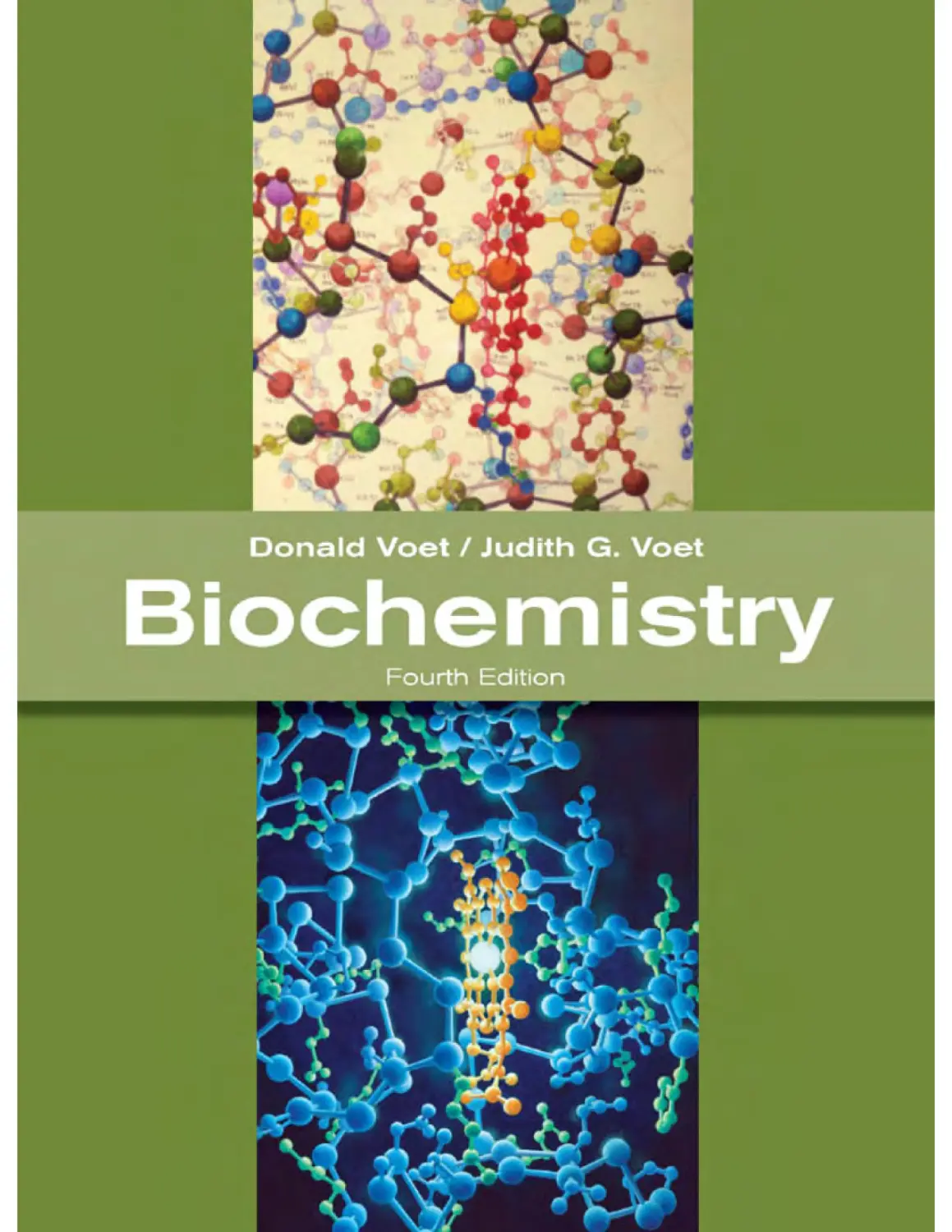
ABOUT THE COVER
The cover contains two paintings of horse heart cytochrome c.
The upper painting, which was drawn by Irving Geis in
collaboration with Richard Dickerson, was designed to
show the influence of amino acid side chains on the
protein’s three-dimensional folding pattern. The lower
painting, also made by Geis, is of cytochrome c illuminated
by its single iron atom in which its hydrophobic side chains
are drawn in green.These paintings were made in the 1970s,
vi
when only a handful of protein structures were known
(around 70,000 are now known) and the personal computers that we presently use to visualize them were many
years in the future. It reminds us that biochemistry is a
process that is driven by the creativity of the human mind.
Our visualization tools have developed from pen, ink, and
colored pencils to sophisticated computers and software.
Without creativity, however, these tools have little use.
PREFACE
Biochemistry is a field of enormous fascination and utility,
arising, no doubt, from our own self-interest. Human welfare, particularly its medical and nutritional aspects, has
been vastly improved by our rapidly growing understanding of biochemistry. Indeed, scarcely a day passes without
the report of a biomedical discovery that benefits a significant portion of humanity. Further advances in this rapidly
expanding field of knowledge will no doubt lead to even
more spectacular gains in our ability to understand nature
and to control our destinies. It is therefore essential that individuals embarking on a career in biomedical sciences be
well versed in biochemistry.
This textbook is a distillation of our experiences in
teaching undergraduate and graduate students at the University of Pennsylvania and Swarthmore College and is intended to provide such students with a thorough grounding
in biochemistry. We assume that students who use this textbook have had the equivalent of one year of college chemistry and sufficient organic chemistry so that they are familiar with basic principles and nomenclature. We also assume
that students have taken a one-year college course in general biology in which elementary biochemical concepts
were discussed. Students who lack these prerequisites are
advised to consult the appropriate introductory textbooks
in those subjects.
NEW TO THIS EDITION
Since the third edition of Biochemistry was published in
2004, the field of biochemistry has continued its phenomenal and rapidly accelerating growth. This remarkable
expansion of our knowledge, the work of many thousands
of talented and dedicated scientists, has been characterized
by numerous new paradigms, as well as an enormous enrichment of almost every aspect of the field. For example,
the number of known protein and nucleic acid structures as
determined by X-ray and NMR techniques has increased
by over 3-fold. Moreover, the quality and complexity of
these structures, which include numerous membrane proteins, has significantly improved, thereby providing enormous advances in our understanding of structural biochemistry. Bioinformatics, an only recently coined word,
has come to dominate the way that many aspects of biochemistry are conceived and practiced. Since the third edition of Biochemistry was published, the number of known
genome sequences has increased by over 10-fold and the
goal of personalized medicine to determine the genome sequence of each individual seems to be within reach. Likewise, the state of knowledge has exploded in such subdisciplines as eukaryotic and prokaryotic molecular biology,
metabolic control, protein folding, electron transport,
membrane transport, immunology, signal transduction, etc.
New and improved methodologies such as DNA microarrays, rapid DNA sequencing, RNAi, cryoelectron microscopy, mass spectrometry, single molecule techniques,
and robotic devices are now routinely used in the laboratory to answer questions that seemed entirely out of reach
a decade ago. Indeed, these advances have affected our
everyday lives in that they have changed the way that medicine is practiced, the way that we protect our own health,
and the way in which food is produced.
THEMES
In writing this textbook we have emphasized several
themes. First, biochemistry is a body of knowledge compiled by people through experimentation. In presenting
what is known, we therefore stress how we have come to
know it. The extra effort the student must make in following such a treatment, we believe, is handsomely repaid
since it engenders the critical attitudes required for success
in any scientific endeavor. Although science is widely portrayed as an impersonal subject, it is, in fact, a discipline
shaped through the often idiosyncratic efforts of individual
scientists. We therefore identify some of the major contributors to biochemistry (most of whom are still professionally active) and, in many cases, consider the approaches
they have taken to solve particular biochemical puzzles.
Students should realize, however, that most of the work
described could not have been done without the dedicated and often indispensable efforts of numerous coworkers.
The unity of life and its variation through evolution is a
second dominant theme running through the text. Certainly one of the most striking characteristics of life on
earth is its enormous variety and adaptability. Yet, biochemical research has amply demonstrated that all living
things are closely related at the molecular level. As a consequence, the molecular differences among the various
species have provided intriguing insights into how organisms have evolved from one another and have helped delineate the functionally significant portions of their molecular machinery.
A third major theme is that biological processes are organized into elaborate and interdependent control networks. Such systems permit organisms to maintain relatively constant internal environments, to respond rapidly
to external stimuli, and to grow and differentiate.
A fourth theme is that biochemistry has important medical consequences. We therefore frequently illustrate biochemical principles by examples of normal and abnormal
human physiology and discuss the mechanisms of action of
a variety drugs.
ORGANIZATION AND COVERAGE
As the information explosion in biochemistry has been occurring, teachers have been exploring more active learning
methods such as problem-based learning, discovery-based
learning, and cooperative learning. These new teaching and
vii
viii
Preface
learning techniques involve more interaction among students and teachers and, most importantly, require more inclass time. In writing the fourth edition of this textbook, we
have therefore been faced with the dual pressures of increased content and pedagogical innovation. We have responded to this challenge by presenting the subject matter
of biochemistry as thoroughly and accurately as we can so
as to provide students and instructors alike with this information as they explore various innovative learning strategies. In this way we deal with the widespread concern that
these novel methods of stimulating student learning tend
to significantly diminish course content. We have thus written a textbook that permits teachers to direct their students
to areas of content that can be explored outside of class as
well as providing material for in-class discussion.
We have reported many of the advances that have
occurred in the last seven years in the fourth edition of Biochemistry and have thereby substantially enriched nearly
all of its sections. Nevertheless, the basic organization of
the fourth edition remains the same as that of the third
edition.
The text is organized into five parts:
I. Introduction and Background: An introductory
chapter followed by chapters that review the properties of
aqueous solutions and the elements of thermodynamics.
II. Biomolecules: A description of the structures and
functions of proteins, nucleic acids, carbohydrates, and lipids.
III. Mechanisms of Enzyme Action: An introduction to the properties, reaction kinetics, and catalytic mechanisms of enzymes.
IV. Metabolism: A discussion of how living things synthesize and degrade carbohydrates, lipids, amino acids, and
nucleotides with emphasis on energy generation and consumption.
V. Expression and Transmission of Genetic Information: An expansion of the discussion of nucleic acid
structure that is given in Part II followed by an exposition
of both prokaryotic and eukaryotic molecular biology.
This organization permits us to cover the major areas of
biochemistry in a logical and coherent fashion.Yet, modern
biochemistry is a subject of such enormous scope that to
maintain a relatively even depth of coverage throughout
the text, we include more material than most one-year biochemistry courses will cover in detail. This depth of coverage, we feel, is one of the strengths of this book; it permits
the instructor to teach a course of his/her own design and
yet provide the student with a resource on biochemical
subjects not emphasized in the course.
The order in which the subject matter of the text is presented more or less parallels that of most biochemistry
courses. However, several aspects of the textbook’s organization deserve comment:
1. Chapter 5 (Nucleic Acids, Gene Expression, and
Recombinant DNA Technology) introduces molecular
biology early in the narrative in response to the central
role that recombinant DNA technology has come to play
in modern biochemistry. Likewise, the burgeoning field
of bioinformatics is discussed in a separate section of
Chapter 7.
2. We have split our presentation of thermodynamics
between two chapters. Basic thermodynamic principles—
enthalpy, entropy, free energy, and equilibrium—are discussed in Chapter 3 because these subjects are prerequisites for understanding structural biochemistry, enzyme
mechanisms, and kinetics. Metabolic aspects of thermodynamics—the thermodynamics of phosphate compounds
and oxidation–reduction reactions—are presented in
Chapter 16 since knowledge of these subjects is not
required until the chapters that follow.
3. Techniques of protein purification are described in a
separate chapter (Chapter 6) that precedes the discussions
of protein structure and function. We have chosen this order so that students will not feel that proteins are somehow “pulled out of a hat.” Nevertheless, Chapter 6 has
been written as a resource chapter to be consulted repeatedly as the need arises. Techniques of nucleic acid purification are also discussed in that chapter for the abovedescribed reasons.
4. Chapter 10 describes the properties of hemoglobin in
detail so as to illustrate concretely the preceding discussions of protein structure and function. This chapter introduces allosteric theory to explain the cooperative nature
of hemoglobin oxygen binding. The subsequent extension
of allosteric theory to enzymology in Chapter 13 is then a
straightforward matter.
5. Concepts of metabolic control are presented in the chapters on glycolysis (Chapter 17) and glycogen metabolism
(Chapter 18) through the consideration of flux generation,
allosteric regulation, substrate cycles, covalent enzyme
modification, cyclic cascades, and a discussion of metabolic
control analysis.We feel that these concepts are best understood when studied in metabolic context rather than as independent topics.
6. The rapid growth in our knowledge of biological signal
transduction necessitates that this important subject have
its own chapter, Chapter 19.
7. There is no separate chapter on coenzymes. These substances, we feel, are more logically studied in the context of
the enzymatic reactions in which they participate.
8. Glycolysis (Chapter 17), glycogen metabolism (Chapter
18), the citric acid cycle (Chapter 21), and electron transport and oxidative phosphorylation (Chapter 22) are detailed as models of general metabolic pathways with emphasis placed on many of the catalytic and control
mechanisms of the enzymes involved. The principles illustrated in these chapters are reiterated in somewhat less detail in the other chapters of Part IV.
Student and Instructor Resources
9. Consideration of membrane transport (Chapter 20) precedes that of mitochondrially based metabolic pathways
such as the citric acid cycle, electron transport, and oxidative phosphorylation. In this manner, the idea of the compartmentalization of biological processes can be easily assimilated. Chapter 20 also contains a discussion of
neurotransmission because it is intimately involved with
membrane transport.
10. Discussions of both the synthesis and the degradation
of lipids have been placed in a single chapter (Chapter 25),
as have the analogous discussions of amino acids (Chapter
26) and nucleotides (Chapter 28).
11. Energy metabolism is summarized and integrated in
terms of organ specialization in Chapter 27, following the descriptions of carbohydrate, lipid, and amino acid metabolism.
12. The principles of both prokaryotic and eukaryotic molecular biology are expanded from their introduction in
Chapter 5 in sequential chapters on DNA replication, repair and recombination (Chapter 30), transcription (Chapter 31), and translation (Chapter 32). Viruses (Chapter 33)
are then considered as paradigms of more complex cellular
functions, followed by discussions of eukaryotic gene expression (Chapter 34).
13. Chapter 35, the final chapter, is a series of minichapters
that describe the biochemistry of a variety of well-characterized human physiological processes: blood clotting, the
immune response, and muscle contraction.
14. Chapters 33, 34, and 35 are available on the Book Companion Site (www.wiley.com/college/voet) with the same
appearance and level of detail as the chapters in the
printed textbook.
ix
The old adage that you learn a subject best by teaching
it simply indicates that learning is an active rather than a
passive process. The problems we provide at the end of
each chapter are therefore designed to make students
think rather than to merely regurgitate poorly assimilated
and rapidly forgotten information. Few of the problems are
trivial and some of them (particularly those marked with
an asterisk) are quite difficult. Yet, successfully working
out such problems can be one of the most rewarding aspects of the learning process. Only by thinking long and
hard for themselves can students make a body of knowledge truly their own. The answers to the problems are
worked out in detail in the Solutions Manual for this text.
The manual can be an effective learning tool, however,
only if the student makes a serious effort to solve a problem before looking up its answer.
We have included lists of references at the end of every
chapter to provide students with starting points for independent biochemical explorations. The enormity of the
biochemical research literature prevents us from giving all
but a few of the most seminal research reports. Rather, we
list what we have found to be the most useful reviews and
monographs on the various subjects covered in each
chapter.
Finally, although we have made every effort to make
this text error free, we are under no illusions that we have
done so. Thus, we are particularly grateful to the many
readers of previous editions, students and faculty alike,
who have taken the trouble to write us with suggestions on
how to improve the textbook and to point out errors they
have found. We earnestly hope that the readers of the
fourth edition will continue this practice.
Donald Voet
Judith G. Voet
STUDENT AND INSTRUCTOR RESOURCES
The Book Companion Site for Biochemistry
(www.wiley.com/college/voet) provides online resources
for both students and instructors. These online resources
are designed to enhance student understanding of biochemistry. They are all keyed to figures or sections in the
text and called out in the text with a red mouse icon
.
Bioinformatics Exercises: A set of exercises cover the
contents and uses of databases related to nucleic acids, protein sequences, protein structures, enzyme inhibition, and
other topics. These exercises, written by Paul Craig,
Rochester Institute of Technology, Rochester, New York,
use real data sets, pose specific questions, and prompt students to obtain information from online databases and to
access the software tools for analyzing such data.
Guided Explorations: 30 self-contained presentations,
many with narration, employ extensive animated com-
puter graphics to enhance student understanding of key
topics.
Interactive Exercises: 58 molecular structures from the
text have been rendered in Jmol by Stephen Rouse. Jmol is
a browser-independent interface for manipulating structures in three dimensions, and structures are paired with
questions designed to facilitate comprehension of concepts. A Tutorial for using Jmol is also provided.
Kinemages: A set of 22 exercises comprising 55 threedimensional images of selected protein and nucleic acids
that can be manipulated by users as suggested by accompanying text.
Animated Figures: 67 figures from the text, illustrating
various concepts, techniques, and processes, are presented
as brief animations to facilitate learning.
x
Preface
Case Studies: A set of 33 case studies by Kathleen Cornely, Providence College, Providence, Rhode Island, use
problem-based learning to promote understanding of biochemical concepts. Each case presents data from the literature and asks questions that require students to apply principles to novel situations often involving topics from
multiple chapters in the textbook.
In addition, a printed Solutions Manual containing detailed
solutions for all of the textbook’s end-of-chapter problems
is available for purchase.
FOR INSTRUCTORS
• PowerPoint Slides of all the figures and tables in the
text are optimized with bold leader lines and large labels
for classroom projection. The figures and tables are also
available for importing individually as jpeg files from the
Wiley Image Gallery.
• Test Bank by Marilee Benore, University of Michigan–
Dearborn, Dearborn, Michigan, and Robert Kane, Baylor
University, Waco, Texas, has over 1000 questions containing
a variety of question types (multiple choice, matching, fill
in the blank, and short answer). Each question is rated by
difficulty.
• Classroom Response Questions (“clicker questions”) by Rachel Milner and Adrienne Wright, University
of Alberta, Edmonton, Alberta, Canada, are interactive
questions for classroom response systems, to facilitate
classroom participation and discussion. These questions
can also be used by instructors as prelecture questions that
help gauge students knowledge of overall concepts while
addressing common misconceptions.
ACKNOWLEDGMENTS
This textbook is the result of the dedicated effort of numerous individuals, many of whom deserve special mention:
Laura Ierardi cleverly combined text, figures, and tables in
designing each of this textbook’s pages. Suzanne Ingrao,
our Production Coordinator, skillfully managed the production of the textbook. Madelyn Lesure designed the
book’s typography and cover. Joan Kalkut, our Editor,
skillfully organized and managed the entire project. Hilary
Newman and Elyse Rieder acquired many of the photographs in the textbook and kept track of all of them. Connie Parks, our copy editor, put the final polish on the manuscript and eliminated large numbers of grammatical and
typographical errors. Special thanks to Alyson Rentrop,
our Associate Editor, who coordinated and managed an
exceptional supplements package, and to Tom Kulesa, Senior Media Editor, and Marc Wezdecki, Media Editor, who
substantially improved and developed the media resources. Much of the art in this fourth edition of Biochemistry is the creative legacy of the drawings made for its first
and second editions by John and Bette Woolsey and
Patrick Lane of J/B Woolsey Associates. The late Irving
Geis provided us with his extraordinary molecular art and
gave freely of his wise counsel.
The atomic coordinates of most of the proteins and nucleic acids that we have drawn for use in this textbook were
obtained from the Protein Data Bank (PDB), which is administered by the Research Collaboratory for Structural
Bioinformatics (RCSB). We created these drawings using
the molecular graphics programs PyMOL by Warren
DeLano; RIBBONS by Mike Carson; and GRASP by
Anthony Nicholls, Kim Sharp, and Barry Honig.
The interactive computer graphics diagrams that are
presented on the website that accompanies this textbook
are either Jmol images or Kinemages. Jmol is a free, open
source, interactive, Web browser applet for manipulating
molecules in three dimensions. It is based on the program
RasMol by Roger Sayle, which was generously made publicly available. Kinemages are displayed by the program
KiNG, which was written and generously provided by
David C. Richardson, who also wrote and provided the
program PREKIN, which we used to help generate the
Kinemages. KiNG (Kinemage, Next Generation) is an interactive system for three-dimensional vector graphics that
runs on Windows, Mac OS X, and Linux/Unix systems.
We wish especially to thank those colleagues who reviewed this textbook, in both its current and earlier editions, and provided us with their prudent advice:
Joseph Babitch, Texas Christian University
E.J. Berhman, Ohio State University
Karl D. Bishop, Bucknell University
Robert Blankenshop, Arizona State University
Charles L. Borders, Jr., The College of Wooster
Kenneth Brown, University of Texas at Arlington
Larry G. Butler, Purdue University
Carol Caparelli, Fox Chase Cancer Center
W. Scott Champney, East Tennessee State University
Paul F. Cook, The University of Oklahoma
Glenn Cunningham, University of Central Florida
Eugene Davidson, Georgetown University
Don Dennis, University of Delaware
Walter A. Deutsch, Louisiana State University
Kelsey R. Downum, Florida International University
William A. Eaton, National Institutes of Health
David Eisenberg, University of California at Los Angeles
Jeffrey Evans, University of Southern Mississippi
David Fahrney, Colorado State University
Acknowledgments
Paul Fitzpatrick, Texas A&M University
Scott Moore, Boston University
Robert Fletterick, University of California at San
Francisco
Harry F. Noller, University of California at Santa Cruz
Norbert C. Furumo, Eastern Illinois University
Gary L. Powell, Clemson University
Scott Gilbert, Swarthmore College
Alan R. Price, University of Michigan
Guido Guidotti, Harvard University
Paul Price, University of California at San Diego
James H. Hageman, New Mexico State University
Thomas I. Pynadath, Kent State University
Lowell Hager, University of Illinois at Urbana–Champaign
Frank M. Raushel, Texas A&M University
James H. Hammons, Swarthmore College
Ivan Rayment, University of Wisconsin
John Ohlsson, University of Colorado
Edward Harris, Texas A&M University
Frederick Rudolph, Rice University
Angela Hoffman, University of Portland
Raghupathy Sarma, State University of New York at
Stony Brook
Ralph A. Jacobson, California Polytechnic State
University
Paul R. Schimmel, The Scripps Research Institute
Eileen Jaffe, Fox Chase Cancer Center
Thomas Schleich, University of California at Santa Cruz
Jan G. Jaworski, Miami University
Allen Scism, Central Missouri State University
William P. Jencks, Brandeis University
Charles Shopsis, Adelphi University
Mary Ellen Jones, University of North Carolina
Marvin A. Smith, Brigham Young University
Jason D. Kahn, University of Maryland
Thomas Sneider, Colorado State University
Tokuji Kimura, Wayne State University
Jochanan Stenish, Western Michigan University
Barrie Kitto, University of Texas at Austin
Phyllis Strauss, Northeastern University
Daniel J. Kosman, State University of New York at
Buffalo
JoAnne Stubbe, Massachusetts Institute of Technology
Robert D. Kuchta, University of Colorado, Boulder
Thomas Laue, University of New Hampshire
Albert Light, Purdue University
Dennis Lohr, Arizona State University
Larry Louters, Calvin College
Robert D. Lynch, University of Lowell
Harold G. Martinson, University of California at
Los Angeles
Michael Mendenhall, University of Kentucky
Sabeeha Merchant, University of California at
Los Angeles
Christopher R. Meyer, California State University at
Fullerton
Ronald Montelaro, Louisiana State University
xi
William Sweeney, Hunter College
John Tooze, European Molecular Biology Organization
Mary Lynn Trawick, Baylor University
Francis Vella, University of Saskatchewan
Harold White, University of Delaware
William Widger, University of Houston
Ken Willeford, Mississippi State University
Lauren Williams, Georgia Institute of Technology
Jeffery T. Wong, University of Toronto
Beulah M. Woodfin, The University of New Mexico
James Zimmerman, Clemson University
D.V.
J.G.V.
BRIEF CONTENTS
Guide to Media Resources xvi
PA R T
1
2
3
PA R T
4
5
6
7
8
9
10
11
12
PA R T
13
14
15
PA R T
16
17
18
19
20
21
22
23
24
25
26
27
28
PA R T
29
30
31
32
33
34
35
xii
I
INTRODUCTION AND BACKGROUND
Life 3
Aqueous Solutions 40
Thermodynamic Principles: A Review
II
BIOMOLECULES
1
52
65
Amino Acids 67
Nucleic Acids, Gene Expression, and Recombinant DNA Technology
Techniques of Protein and Nucleic Acid Purifications 129
Covalent Structures of Proteins and Nucleic Acids 163
Three-Dimensional Structures of Proteins 221
Protein Folding, Dynamics, and Structural Evolution 278
Hemoglobin: Protein Function in Microcosm 323
Sugars and Polysaccharides 359
Lipids and Membranes 386
III
MECHANISMS OF ENZYME ACTION
Introduction to Enzymes 469
Rates of Enzymatic Reactions
Enzymatic Catalysis 506
IV
METABOLISM
467
482
557
Introduction to Metabolism 559
Glycolysis 593
Glycogen Metabolism 638
Signal Transduction 671
Transport through Membranes 744
Citric Acid Cycle 789
Electron Transport and Oxidative Phosphorylation 823
Other Pathways of Carbohydrate Metabolism 871
Photosynthesis 901
Lipid Metabolism 940
Amino Acid Metabolism 1019
Energy Metabolism: Integration and Organ Specialization
Nucleotide Metabolism 1107
V
82
1088
EXPRESSION AND TRANSMISSION OF GENETIC INFORMATION
Nucleic Acid Structures 1145
DNA Replication, Repair, and Recombination 1173
Transcription 1260
Translation 1338
Viruses: Paradigms for Cellular Function W-1
Eukaryotic Gene Expression W-53
Molecular Physiology
(Chapters 33–35 are available on our website, www.wiley.com/college/voet)
1143
CONTENTS
Guide to Media Resources xvi
PA R T
4. Electrophoresis 146
5. Ultracentrifugation 152
I
6. Nucleic Acid Fractionation
INTRODUCTION AND BACKGROUND 1
CHAPTER 1 Life
1.
2.
3.
4.
5.
6.
3
40
CHAPTER 8 Three-Dimensional
Structures of Proteins
45
1. Secondary Structure
CHAPTER 3 Thermodynamic Principles:
52
1. First Law of Thermodynamics: Energy Is
Conserved 52
2. Second Law of Thermodynamics: The Universe
Tends Toward Maximum Disorder 54
3. Free Energy: The Indicator of Spontaneity
4. Chemical Equilibria 58
APPENDIX: Concentration Dependence of
Free Energy 61
PA R T
221
221
2. Fibrous Proteins 232
3. Globular Proteins 241
4. Protein Stability 259
5. Quaternary Structure 266
APPENDIX: Viewing Stereo Pictures
271
CHAPTER 9 Protein Folding, Dynamics,
57
and Structural Evolution
278
1. Protein Folding: Theory and Experiment
2. Folding Accessory Proteins 290
3. Protein Structure Prediction and Design
278
302
4. Protein Dynamics 306
5. Conformational Diseases: Amyloids
and Prions 309
6. Structural Evolution 316
II
BIOMOLECULES 65
CHAPTER 4 Amino Acids
67
1. The Amino Acids of Proteins
2. Optical Activity 73
3. “Nonstandard” Amino Acids
164
4. Bioinformatics: An Introduction 194
5. Chemical Synthesis of Polypeptides 205
6. Chemical Synthesis of Oligonucleotides 209
40
2. Acids, Bases, and Buffers
163
1. Primary Structure Determination of Proteins
2. Nucleic Acid Sequencing 176
3. Chemical Evolution 185
CHAPTER 2 Aqueous Solutions
A Review
CHAPTER 7 Covalent Structures of
Proteins and Nucleic Acids
Prokaryotes 3
Eukaryotes 6
Biochemistry: A Prologue 14
Genetics: A Review 19
The Origin of Life 28
The Biochemical Literature 34
1. Properties of Water
156
CHAPTER 10 Hemoglobin: Protein
67
Function in Microcosm
78
1. Hemoglobin and Myoglobin Function
2. Structure and Mechanism 331
3. Abnormal Hemoglobins 341
CHAPTER 5 Nucleic Acids, Gene
Expression, and Recombinant DNA
Technology 82
1.
2.
3.
4.
Nucleotides and Nucleic Acids 82
DNA Is the Carrier of Genetic Information
Double Helical DNA 88
Gene Expression and Replication:
An Overview 95
5. Molecular Cloning 104
323
85
323
4. Allosteric Regulation 347
APPENDIX: Derivation of Symmetry Model
Equations 354
CHAPTER 11 Sugars and
Polysaccharides
359
1. Monosaccharides 359
2. Polysaccharides 365
3. Glycoproteins 373
CHAPTER 6 Techniques of Protein and
Nucleic Acid Purifications
1. Protein Isolation 129
2. Solubilities of Proteins 133
3. Chromatographic Separations
129
CHAPTER 12 Lipids and Membranes
1. Lipid Classification 386
2. Properties of Lipid Aggregates
386
393
135
xiii
xiv
Contents
3. Biological Membranes
CHAPTER 18 Glycogen Metabolism
399
4. Membrane Assembly and Protein Targeting
5. Lipoproteins
418
449
1. Glycogen Breakdown 638
2. Glycogen Synthesis 644
3. Control of Glycogen Metabolism
PA R T
4. Glycogen Storage Diseases
III
MECHANISMS OF ENZYME ACTION 467
CHAPTER 13 Introduction to Enzymes
1.
2.
3.
4.
5.
469
Historical Perspective 469
Substrate Specificity 470
Coenzymes 473
Regulation of Enzymatic Activity 474
A Primer of Enzyme Nomenclature 479
1.
2.
3.
4.
1.
2.
3.
4.
1.
2.
3.
4.
5.
482
2. Enzyme Kinetics 487
3. Inhibition 492
4. Effects of pH 496
5. Bisubstrate Reactions 497
APPENDIX: Derivations of Michaelis–Menten
Equation Variants
501
CHAPTER 15 Enzymatic Catalysis
CHAPTER 19 Signal Transduction
744
Thermodynamics of Transport 744
Kinetics and Mechanisms of Transport 745
ATP-Driven Active Transport 758
Ion Gradient–Driven Active Transport 768
Neurotransmission 771
CHAPTER 21 Citric Acid Cycle
1. Cycle Overview
506
Catalytic Mechanisms 506
Lysozyme 517
Serine Proteases 525
Drug Design 539
2.
3.
4.
5.
789
Oxidative Phosphorylation
823
823
2. Electron Transport 828
3. Oxidative Phosphorylation
4. Control of ATP Production
557
845
862
CHAPTER 16 Introduction to
CHAPTER 23 Other Pathways of
Metabolism
Carbohydrate Metabolism
559
1. Metabolic Pathways 559
2. Organic Reaction Mechanisms
562
CHAPTER 24 Photosynthesis
901
1. Chloroplasts 901
2. Light Reactions 903
3. Dark Reactions 926
593
1. The Glycolytic Pathway 593
2. The Reactions of Glycolysis 595
3. Fermentation: The Anaerobic Fate
of Pyruvate 614
4. Metabolic Regulation and Control 619
5. Metabolism of Hexoses Other than Glucose
871
1. Gluconeogenesis 871
2. The Glyoxylate Cycle 880
3. Biosynthesis of Oligosaccharides and
Glycoproteins 880
4. The Pentose Phosphate Pathway 892
3. Experimental Approaches to the Study
of Metabolism 569
4. Thermodynamics of Phosphate
Compounds 578
5. Oxidation–Reduction Reactions 583
6. Thermodynamics of Life 586
CHAPTER 17 Glycolysis
792
CHAPTER 22 Electron Transport and
IV
METABOLISM
789
Metabolic Sources of Acetyl-Coenzyme A
Enzymes of the Citric Acid Cycle 806
Regulation of the Citric Acid Cycle 815
The Amphibolic Nature of the Citric
Acid Cycle 817
1. The Mitochondrion
PA R T
671
Hormones 671
Heterotrimeric G Proteins 688
Tyrosine Kinase–Based Signaling 699
The Phosphoinositide Cascade 725
Membranes
482
1. Chemical Kinetics
647
666
CHAPTER 20 Transport through
CHAPTER 14 Rates of Enzymatic
Reactions
638
CHAPTER 25 Lipid Metabolism
630
1.
2.
3.
4.
940
Lipid Digestion, Absorption, and Transport
Fatty Acid Oxidation 945
Ketone Bodies 959
Fatty Acid Biosynthesis 961
940
Contents
5. Regulation of Fatty Acid Metabolism
6. Cholesterol Metabolism
3. Prokaryotic Replication
973
4. Eukaryotic Replication
975
xv
1190
1201
7. Eicosanoid Metabolism: Prostaglandins,
5. Repair of DNA
Prostacyclins, Thromboxanes, Leukotrienes,
and Lipoxins 993
8. Phospholipid and Glycolipid Metabolism 1004
6. Recombination and Mobile Genetic
Elements 1225
7. DNA Methylation and Trinucleotide
1213
Repeat Expansions
1246
CHAPTER 26 Amino Acid
Metabolism 1019
CHAPTER 31 Transcription
1. Amino Acid Deamination 1019
2. The Urea Cycle 1025
3. Metabolic Breakdown of Individual
Amino Acids 1029
4. Amino Acids as Biosynthetic Precursors
5. Amino Acid Biosynthesis 1064
6. Nitrogen Fixation 1078
1. The Role of RNA in Protein Synthesis 1260
2. RNA Polymerase 1265
3. Control of Transcription in Prokaryotes 1283
4. Post-Transcriptional Processing
1047
1301
1338
1. The Genetic Code 1338
2. Transfer RNA and Its Aminoacylation
CHAPTER 27 Energy Metabolism:
3.
4.
5.
6.
Integration and Organ
Specialization 1088
1. Major Pathways and Strategies of Energy
Metabolism: A Summary 1088
2. Organ Specialization 1090
1345
Ribosomes 1362
Control of Eukaryotic Translation 1398
Post-Translational Modification 1403
Protein Degradation 1408
*CHAPTER 33 Viruses: Paradigms for
3. Metabolic Homeostasis: Regulation of Appetite,
Energy Expenditure, and Body Weight 1095
4. Metabolic Adaptation 1101
CHAPTER 28 Nucleotide
Metabolism 1107
1. Synthesis of Purine Ribonucleotides 1107
2. Synthesis of Pyrimidine Ribonucleotides 1114
3. Formation of Deoxyribonucleotides 1119
4. Nucleotide Degradation 1130
5. Biosynthesis of Nucleotide Coenzymes
CHAPTER 32 Translation
1260
1136
Cellular Function W-1
1.
2.
3.
4.
Tobacco Mosaic Virus W-3
Icosahedral Viruses W-8
Bacteriophage W-20
Influenza Virus W-40
*CHAPTER 34 Eukaryotic Gene
Expression
1. Chromosome Structure
2. Genomic Organization
3. Control of Expression
4. Cell Differentiation
PA R T
*CHAPTER 35 Molecular Physiology
V
EXPRESSION AND TRANSMISSION
OF GENETIC INFORMATION 1143
CHAPTER 29 Nucleic Acid
I NDEX
Structures 1145
1. Double Helical Structures 1145
2. Forces Stabilizing Nucleic Acid Structures
3. Supercoiled DNA
1. Blood Clotting
2. Immunity
3. Motility: Muscles, Vesicle Transport,
Cilia, and Flagella
I-1
1151
1158
CHAPTER 30 DNA Replication, Repair,
and Recombination 1173
1. DNA Replication: An Overview 1173
2. Enzymes of Replication 1176
*Chapters 33, 34, and 35 are available on our book
companion website, www.wiley.com/college/voet.
GUIDE TO MEDIA RESOURCES
The book website (www.wiley.com/college/voet) offers the following resources to enhance student understanding of biochemistry. These are all keyed to figures or sections in the text. They are called out in the text with a red mouse icon or
margin note.
Chapter
Media Type
Title
Text Reference
Page
2 Acids, Bases,
Animated Figure
Acid-base titration curves of 1-L solutions of 1M
⫹
acetic acid, H2PO⫺
4 , and NH 4 by a strong base
Figure 2-11
47
Animated Figure
Titration curve of a 1-L solution of 1M H3PO4
Figure 2-13
49
Animated Figure
Titration curve of glycine
Figure 4-6
72
5 Nucleic Acids, Kinemage Exercise
2.1. B-DNA
Figure 5-11
89
Gene
Expression, and
Recombinant
DNA Technology
Interactive Exercise
1. B-DNA
Figure 5-11
89
Kinemage Exercise
2-2, 17-2. The Watson–Crick base pairs
Figure 5-12
89
Animated Figure
Demonstration of the semiconservative nature of
DNA replication in E. coli by density gradient
ultracentrifugation
Figure 5-13
91
Animated Figure
UV absorbance spectra of the nucleic acid bases
and DNA
Figure 5-15
92
Animated Figure
Example of a DNA melting curve
Figure 5-16
93
Guided Exploration
1: Overview of transcription and translation
Section 5-4
95
Guided Exploration
2: Regulation of gene expression by the lac
repressor system
Figure 5-25
97
Animated Figure
Construction of a recombinant DNA molecule
Figure 5-44
109
Animated Figure
Cloning of foreign DNA in phages
3: PCR and site-directed mutagenesis
Site-directed mutagenesis
Figure 5-47
111
Guided Exploration
Animated Figure
Section 5-5F
Figure 5-55
114
119
6 Techniques
Animated Figure
An enzyme-linked immunosorbent assay (ELISA)
Figure 6-1
132
of Protein and
Nucleic Acid
Purification
Animated Figure
Animated Figure
Ion exchange chromatography using stepwise elution
Gel filtration chromatography
Figure 6-6
Figure 6-9
136
139
7 Covalent
Guided Exploration
4: Protein sequence determination
Section 7-1
164
Structures of
Proteins and
Nucleic Acids
Animated Figure
Animated Figure
Figure 7-4
Figure 7-6
167
171
Section 7-2A
176
Guided Exploration
The Edman degradation
The amino acid sequence of a polypeptide chain is
determined by comparing the sequence of two
sets of mutually overlapping peptide fragments
5: DNA sequence determination by the chainterminator method
6: Bioinformatics
Section 7-4
194
Kinemage Exercise
3-1. The peptide group
Figure 8-1, 8-2,
8-4
221,
222,
223
Guided Exploration
7: Stable helices in proteins: the ␣ helix
Section 8-1B
225
Kinemage Exercise
3–2. The ␣ helix
Figure 8-11,
8-12
226,
227
and Buffers
4 Amino Acids
Guided Exploration
8 ThreeDimensional
Structures of
Proteins
xvi
Guide to Media Resources
Chapter
9 Protein Folding, Dynamics,
and Structural
Evolution
xvii
Media Type
Title
Text Reference
Page
Animated Figure
The right-handed ␣ helix
Figure 8-11
226
Guided Exploration
Guided Exploration
8: Hydrogen bonding in  sheets
9: Secondary structures in proteins
Section 8-1C
Section 8-1C
229
229
Kinemage Exercise
3-3.  Pleated sheets
Figure 8-16,
8-17, 8-18
229,
230,
231
Animated Figure
 Pleated sheets
Figure 8-16
229
Interactive Exercise
2. Triose phosphate isomerase
Figure 8-19
231
Kinemage Exercise
3-4. Beta bends (reverse turns)
Figure 8-22
233
Kinemage Exercise
4-1, 4-2. Coiled coils
4-3, 4-4. Collagen
Figure 8-26
235
Kinemage Exercise
Figure 8-29,
8-30
237
Kinemage Exercise
6-1. Deoxy myoglobin
Figure 8-39
245
Interactive Exercise
3. Human carbonic anhydrase
Figure 8-41
(also Figure
15-5)
246
(also
512)
Interactive Exercise
4. Horse heart cytochrome c
Figure 8-42
247
Kinemage Exercise
5-1. Cytochromes c
Figure 8-42
247
Kinemage Exercise
3-2. The ␣ helix
Figure 8-43
248
Kinemage Exercise
3-3.  pleated sheets
Figure 8-44
249
Interactive Exercise
5. Glyceraldehyde-3-phosphate dehydrogenase
Figure 8-45
249
Animated Figure
Some possible symmetries of proteins with
identical protomers
Figure 8-65
268
Animated Figure
Reactions catalyzed by protein disulfide
isomerase (PDI)
Figure 9-15
290
Guided Exploration
10: Protein Evolution
Section 8-6A
316
5-1. Cytochromes c
Figure 9-41
317
Kinemage Exercise
xviii
Guide to Media Resources
Chapter
Title
Text Reference
Page
Oxygen-dissociation curves of Mb and of Hb in
whole blood
Figure 10-3
326
Animated Figure
The effects of BPG and CO2, both separately and
combined, on hemoglobin’s O2-dissociation curve
compared with that of whole blood (red curve)
Figure 10-8
330
Kinemage Exercise
6-1. Deoxy myoglobin
Figure 10-11,
10-12
332,
333
Kinemage Exercise
6-2, 6-3. Hemoglobin and myoglobin
Figure 10-13
334
Kinemage Exercise
6-4. Hemoglobin structure
Figure 10-15,
10-16
336
Animated Figure
Triggering mechanism for the T S R transition
of Hb
Figure 10-16
336
Kinemage Exercise
6-5. Conformational changes at hemoglobin’s ␣1–2
interface
Figure 10-17
337
Kinemage Exercise
6-3. Binding of BPG to deoxyHb
Figure 10-21
341
Kinemage Exercise
7-1. D-Glucopyranose
Figure 11-5,
11-7
362,
363
Kinemage Exercise
7-2. Sucrose
Figure 11-13
367
Kinemage Exercise
7-3. Hyaluronic acid
Figure 11-21
371
Kinemage Exercise
7-4. Structure of a complex carbohydrate
Figure 11-32
379
Guided Exploration
11: Membrane structure and the fluid mosaic model
Figures 12-15,
12-16, 12-20
396,
397,
400
Kinemage Exercise
8-1.Bacteriorhodopsin
Figure 12-25
403
Kinemage Exercise
8-2. Photosynthetic reaction center
Figure 12-26
404
Kinemage Exercise
8-3. Porin
Figure 12-27
405
Animated Figure
The ribosomal synthesis, membrane insertion, and
initial glycosylation of an integral protein via the
secretory pathway
Figure 12-46
421
Animated Figure
Model for plasma triacyglycerol and cholesterol
transport in humans
Figure 12-86
452
Media Type
10 Hemoglobin: Animated Figure
Protein Function
in Microcosm
11 Sugars and
Polysaccharides
12 Lipids and
Membranes
Guide to Media Resources
xix
Chapter
Media Type
Title
Text Reference
Page
13 Introduction
to Enzymes
Animated Figure
The rate of the reaction catalyzed by ATCase as a
function of aspartate concentration
Figure 13-5
475
Kinemage Exercise
11-1. Structure of ATCase
Figure 13-7,
13-9
476,
478
Kinemage Exercise
11-2. Conformational changes in ATCase
Figure 13-9
478
Guided Exploration
12: Michaelis–Menten kinetics, Lineweaver-Burk
plots, and enzyme inhibition
Section 14-2
487
Animated Figure
Progress curves for the components of a simple
Michaelis–Menten reaction
Figure 14-7
488
Animated Figure
Plot of the initial velocity vo of a simple
Michaelis–Menten reaction versus the substrate
concentration [S]
Figure 14-8
489
Animated Figure
A double-reciprocal (Lineweaver–Burk) plot
Figure 14-9
490
Animated Figure
Lineweaver–Burk plot of the competitively inhibited
Michaelis–Menten enzyme described by Fig. 14-11
Figure 14-12
494
Animated Figure
Lineweaver–Burk plot of a simple Michaelis–Menten
enzyme in the presence of uncompetitive inhibitor
Figure 14-13
495
Animated Figure
Lineweaver–Burk plot of a simple Michaelis–Menten
enzyme in the presence of a mixed inhibitor
Figure 14-14
496
Interactive Exercise
3. Human carbonic anhydrase
Figure 15-5
512
Animated Figure
Reaction coordinate diagrams for a hypothetical
enzymatically catalyzed reaction involving a
single substrate (blue) and the corresponding
uncatalyzed reaction (red)
Figure 15-7
516
Interactive Exercise
6. HEW lysozyme in complex with (NAG)6
Figure 15-10
518
Kinemage Exercise
9. Lysozyme
Figure 15-10,
15-12, 15-14,
518,
519,
521
Animated Figure
Chair and half-chair conformations
Figure 15-11
519
Kinemage Exercise
10-1. Structural overview of a trypsin/inhibitor
complex
Figure 15-19
528
Guided Exploration
12: The catalytic mechanism of serine proteases
Section 15-3C
531
Kinemage Exercise
10-2. Evolutionary comparison of trypsin,
chymotrypsin, and subtilisin
Figure 15-22
531
14 Rates of
Enzymatic
Reactions
15 Enzymatic
Catalysis
xx
Guide to Media Resources
Chapter
17 Glycolysis
18 Glycogen
Metabolism
Media Type
Title
Text Reference
Page
Kinemage Exercise
10-3. A transition state analog bound to
chymotrypsin
Figure 15-25
534
Kinemage Exercise
10-4. Comparison of chymotrypsin with
chymotrypsinogen
Figure 15-28
538
Interactive Exercise
7. HIV-1 protease
Figure 15-38
548
Guided Exploration
14: Glycolysis overview
Section 17-2
595
Animated Figure
Degradation of glucose via the glycolytic pathway
Figure 17-3
596
Interactive Exercise
8. Conformational changes in yeast hexokinase
on binding glucose
Figure 17-5
598
Animated Figure
Enzymatic mechanism of Class I aldolase
Figure 17-9
602
Interactive Exercise
2. TIM in complex with its transition state analog
2-phosphoglycolate
Figure 17-11
605
Kinemage Exercise
12-1, 12-2. Triose phosphate isomerase
Figure 17-11
605
Animated Figure
Enzymatic mechanism of glyceraldehyde-3phosphate dehydrogenase
Figure 17-14
608
Interactive Exercise
9. Pyruvate decarboxylase in complex with its
TPP cofactor
Figure 17-28
617
Kinemage Exercise
13-1, 13-2. Phosphofructokinase
Figure 17-32
626
Animated Figure
PFK activity versus F6P concentration
Figure 17-33
627
Kinemage Exercise
14-1. Glycogen
Figure 18-2
640
Kinemage Exercise
14-2, 14-3. Conformational changes in glycogen
phosphorylase
Figure 18-11
649
Guided Exploration
16: Control of glycogen breakdown
Figure 18-14
652
Animated Figure
Schematic diagram of the major enzymatic
modification/demodification systems involved in
the control of glycogen metabolism in muscle
Figure 18-14
652
Interactive Exercise
10. Catalytic (C) subunit of mouse protein
kinase A (PKA)
Figure 18-15
654
Kinemage Exercise
15-1. Protein kinase A (PKA)
Figure 18-15
654
Kinemage Exercise
16-1. Structure of calmodulin
Figure 18-17,
18-18
656
Kinemage Exercise
16-2. Calmodulin complex with its target
polypeptide
Figure 18-19
657
Guide to Media Resources
xxi
Chapter
Media Type
Title
Text Reference
Page
19 Signal
Transduction
Interactive Exercise
11. Human growth hormone (hGH) in complex with
two molecules of its receptor’s extracellular
domain (hGHbp)
Figure 19-10
684
Guided Exploration
16: Mechanisms of hormone signaling involving the
adenylate cyclase system
Section 19-2A
688
Interactive Exercise
12. Heterotrimetric G protein
Figure 19-19
694
Guided Exploration
17. Mechanisms of hormone signaling involving the
receptor tyrosine kinase system
Section 19-3
699
Interactive Exercise
13. The insulin receptor
Figure 19-28
702
Animated Figure
The Ras-activated MAP kinase cascade
Figure 19-40
712
Animated Figure
Role of PIP2 in intracellular signaling
Figure 19-54
726
Animated Figure
Alternating conformation model for glucose
transport
Figure 20-10
751
Animated Figure
Regulation of glucose uptake in muscle and fat cells
Figure 20-11
751
Interactive Exercise
14. The KcsA K⫹ channel
Figure 20-13
754
20 Transport
through
Membranes
21 Citric Acid
Cycle
22 Electron
Transport and
Oxidative
Phosphorylation
Guided Exploration
18: Citric acid cycle overview
Section 21-1
789
Animated Figure
Regulation of the citric acid cycle
Figure 21-1
790
Interactive Exercise
15. Conformational changes in citrate synthase
Figure 21-18
806
Animated Figure
Reactions of the citric acid cycle
Figure 21-25
816
Animated Figure
Amphibolic functions of the citric acid cycle
Figure 21-26
818
Guided Exploration
19. Electron transport and oxidative phosphorylation
overview
Section 22-2B
829
Animated Figure
The mitochondrial electron-transport chain
Figure 22-14
834
Interactive Exercise
16. Ferrodoxin
Figure 22-16
835
Interactive Exercise
17. Complex III
Figure 22-23
840
Interactive Exercise
18. Bovine heart cytochrome c oxidase
Figure 22-24
842
Animated Figure
Coupling of electron transport (green arrow) and
ATP synthesis
Figure 22-29
846
Guided Exploration
20: The Q cycle
Section 22-3Be
847
Guided Exploration
21: F1F0–ATP synthase and the binding change
mechanism
Section 22-3C
852
xxii
Guide to Media Resources
Chapter
23 Other
Pathways of
Carbohydrate
Metabolism
24
Media Type
Title
Text Reference
Page
Interactive Exercise
19. F1–ATP synthase
Figure 22-38
854
Animated Figure
Energy-dependent binding change mechanism for
ATP synthesis by proton-translocating ATP
synthase
Figure 22-42
857
Animated Figure
Schematic diagram depicting the coordinated control Figure 22-49
of glycolysis and the citric acid cycle by ATP, ADP,
AMP, Pi, Ca2⫹, and the [NADH]/[NAD⫹] ratio (the
vertical arrows indicate increases in this ratio)
863
Animated Figure
Transport of PEP and oxaloacetate from the
mitochondrion to the cytosol
Figure 23-7
877
Animated Figure
Pathways of gluconeogenesis and glycolysis
Figure 23-8
878
Animated Figure
The Cori cycle
Figure 23-10
880
Animated Figure
Pathway of dolichol-PP-oligosaccharide synthesis
Figure 23-16
884
Animated Figure
Energy diagram indicating the electronic states of
chlorophyll and their most important modes of
interconversion
Figure 24-4
905
Interactive Exercise
20. Light-harvesting complex LH2
Figure 24-8
907
Interactive Exercise
21. Photosynthetic reaction center (RC)
from Rb. sphaeroides
Figure 24-11
910
Kinemage Exercise
8-2. Photosynthetic reaction center
Figure 24-11,
24-12
910,
911
Guided Exploration
22: Two-center photosynthesis (Z-scheme) overview
Section 24-2C
913
Interactive Exercise
22. Ferredoxin–NADP⫹ reductase
Figure 24-28
924
Animated Figure
The Calvin cycle
Figure 24-31
929
Animated Figure
Probable mechanism of the carboxylation reaction
catalyzed with RuBP carboxylase
Figure 24-34
931
Animated Figure
The -oxidation pathway of fatty acyl-CoA
Figure 25-12
947
Interactive Exercise
23. Medium-chain acyl-CoA dehydrogenase from
pig liver mitochondria in complex with
octanoyl-CoA
Figure 25-13
948
Interactive Exercise
24. Methylmalonyl-CoA mutase
Figure 25-22
955
Animated Figure
Comparison of fatty acid  oxidation and fatty acid
biosynthesis
Reaction cycle for the biosynthesis of fatty acids
Figure 25-29
962
Figure 25-32
964
Figure 25-60
986
Photosynthesis
25 Lipid
Metabolism
Animated Figure
Animated Figure
LDL receptor-mediated endocytosis in mammalian
cells
Guide to Media Resources
xxiii
Chapter
Media Type
Title
26 Amino Acid
Metabolism
Animated Figure
The mechanism of PLP-dependent enzyme-catalyzed Figure 26-2
transamination
1021
Animated Figure
The glucose–alanine cycle
Figure 26-3
1022
Animated Figure
The urea cycle
Figure 26-7
1027
Interactive Exercise
25. The bifunctional enzyme tryptophan synthase
from S. typhimurium
Figure 26-64
1078
Interactive Exercise
26. A.vinelandii nitrogenase
Figure 26-67
1080
Interactive Exercise
27. Human leptin
Figure 27-7
1098
Animated Figure
The metabolic pathway for the de novo biosynthesis
of IMP
Figure 28-2
1108
Animated Figure
Control network for the purine biosynthesis pathway
Figure 28-5
1113
Animated Figure
Metabolic pathway for the de novo synthesis of UMP Figure 28-7
1115
Animated Figure
Regulation of pyrimidine biosynthesis
Figure 28-11
1118
Interactive Exercise
28. Class I ribonucleotide reductase from E. coli
Figure 28-12
1120
Interactive Exercise
29. Human dihydrofolate reductase
Figure 28-22
1129
Interactive Exercise
30. Adenosine deaminase
Figure 28-24
1131
Guided Exploration
23: DNA structures
Section 29-1
1145
Kinemage Exercise
17-1, 17-4, 17-5, 17-6. Structures of A-, B-,
and Z-DNAs
Figure 29-1
1147
Interactive Exercise
31. A 10-bp RNA–DNA hybrid helix
Figure 29-4
1151
27 Energy
Text Reference
Page
Metabolism:
Integration and
Organ
Specialization
28 Nucleotide
Metabolism
29 Nucleic Acid
Structures
30 DNA
Replication,
Repair, and
Recombination
Kinemage Exercise
17-3 Nucleotide sugar conformations
Figure 29-8
1153
Guided Exploration
24. DNA supercoiling
Section 29-3
1158
Interactive Exercise
32. Yeast topoisomerase II
Figure 29-30
1168
Interactive Exercise
33. E. coli DNA polymerase I Klenow fragment in
complex with a dsDNA
Figure 30-8
1178
Guided Exploration
25: The replication of DNA in E. coli
Section 30-3C
1193
Interactive Exercise
34. X-ray structure of E. coli Tus protein in complex
with a 15-bp Ter-containing DNA
Figure 30-37
1199
Interactive Exercise
35. Human PCNA
Figure 30-42
1204
Interactive Exercise
36. HIV-1 reverse transcriptase
Figure 30-48
1209
Animated Figure
The Holliday model of homologous recombination
between homologous DNA duplexes
Figure 30-67
1226
xxiv
Guide to Media Resources
Chapter
Title
Text Reference
Page
2: Regulation of gene expression by the lac
repressor system
Section 31-1B
1264
Interactive Exercise
37. RNAP II elongation complex
Figure 31-22
1279
Interactive Exercise
38. CAP–cAMP–dsDNA complex
Figure 31-31
1287
Guided Exploration
30: Transcription factor–DNA interactions
Section 31-3Da
1288
Interactive Exercise
39. N-terminal domain of 434 phage repressor in
complex with a 20-bp dsDNA containing its
target sequence
Figure 31-32
1289
Kinemage Exercise
18-1. Repressor–DNA interactions
Figure 31-32
1289
Interactive Exercise
40. E. coli trp repressor–operator–tryptophan
complex
Figure 31-34
1290
Interactive Exercise
41. E. coli met repressor–SAM–operator complex
Figure 31-35
1291
Interactive Exercise
42. The group I intron from Tetrahymena thermophila Figure 31-55
1309
Interactive Exercise
43. Schistosoma mansoni hammerhead ribozyme
Figure 31-57
1311
Guided Exploration
26: The structure of tRNA
Section 32-2A,
B
1345,
1346
Kinemage Exercise
19-1, 19-2. Structure of yeast tRNAPhe
19-3. Tertiary base pairing interactions in yeast
tRNAPhe
Figure 32-11
1348
Figure 32-12
1349
Media Type
31 Transcription Guided Exploration
32 Translation
Kinemage Exercise
Guided Exploration
27: The structures of aminoacyl-tRNA synthetases
and their interactions with tRNAs
Section 32-2C
1349
Kinemage Exercise
20-1. Structure of E. coli GlnRS ⴢ tRNAGln ⴢ ATP
Figure 32-17
1353
Interactive Exercise
44. T. thermophilus ribosome
Figure 32-34
1369
Guided Exploration
28: Translational initiation
Section 32-3Cc
1375
Guided Exploration
29: Translational elongation
Section 32-3D
1379
Interactive Exercise
45. EF-Tu in its complexes with GDP and GMPPNP
Figure 32-48
1381
Interactive Exercise
46. Human ubiquitin
Figure 32-75
1409
Guide to Media Resources
xxv
Title
Text Reference
Page
Interactive Exercise
33 Viruses:
Paradigms for
Interactive Exercise
Cellular Functions
47. The repressor.
Figure 33-45
1463
48. The Cro protein dimer in its complex with its
target DNA
Figure 33-46
1463
34 Eukaryotic
Gene
Expression
Interactive Exercise
49. TATA-binding protein (TBP)
Figure 34-53
Interactive Exercise
50. Three-zinc finger segment of Zif268 in complex
with its target DNA
Figure 34-62
Interactive Exercise
51. Glucocorticoid receptor (GR) DNA-binding
domain in complex with its target DNA
Figure 34-62
Interactive Exercise
52. Yeast GAL4 DNA-binding domain in complex
with its target DNA
Figure 34-63
Kinemage Exercise
21-1. GCN4 leucine zipper motif
Figure 34-64
Interactive Exercise
53. The GCN4 bZIP region in complex with its
target DNA
Figure 34-65
Interactive Exercise
54. Max(22-113) dimer in complex with its
target DNA
Figure 34-66
Interactive Exercise
55. Engrailed protein homeodomain in complex with
its target DNA
Figure 34-104
Interactive Exercise
56. Human cyclin-dependent kinase 2 (Cdk2)
Figure 34-109
Interactive Exercise
57. DNA-binding domain of p53 in complex with its
target DNA
Figure 34-113
Interactive Exercise
58. A mouse antibody
(Chapter 35)
Chapter
35 Molecular
Physiology
Media Type
This page intentionally left blank
BIOCHEMISTRY
This page intentionally left blank
“Hot wire” DNA
illuminated by its
helix axis.
PA R T I
I NTR O D U CTI O N
AN D
BAC KG R O U N D
This page intentionally left blank
Life
CHAPTER
1 Prokaryotes
A. Form and Function
B. Prokaryotic Classification
2 Eukaryotes
A. Cellular Architecture
B. Phylogeny and Differentiation
1
are related to the biology of the corresponding organisms
or even communities of such organisms. This introductory
chapter therefore begins with a synopsis of the biological
realm. This is followed by an outline of biochemistry, a review of genetics, a discussion of the origin of life, and finally, an introduction to the biochemical literature.
3 Biochemistry: A Prologue
A. Biological Structures
B. Metabolic Processes
C. Expression and Transmission of Genetic Information
4 Genetics: A Review
A. Chromosomes
B. Mendelian Inheritance
C. Chromosomal Theory of Inheritance
D. Bacterial Genetics
E. Viral Genetics
5 The Origin of Life
A. The Unique Properties of Carbon
B. Chemical Evolution
C. The Rise of Living Systems
6 The Biochemical Literature
A. Conducting a Literature Search
B. Reading a Research Article
It is usually easy to decide whether or not something is
alive. This is because living things share many common attributes, such as the capacity to extract energy from nutrients to drive their various functions, the power to actively
respond to changes in their environment, and the ability to
grow, to differentiate, and—perhaps most telling of all—to
reproduce. Of course, a given organism may not have all of
these traits. For example, mules, which are obviously alive,
rarely reproduce. Conversely, inanimate matter may exhibit some lifelike properties. For instance, crystals may
grow larger when immersed in a supersaturated solution of
the crystalline material. Therefore, life, as are many other
complex phenomena, is perhaps impossible to define in a
precise fashion. Norman Horowitz, however, proposed a
useful set of criteria for living systems: Life possesses the
properties of replication, catalysis, and mutability. Much of
this text is concerned with the manner in which living organisms exhibit these properties.
Biochemistry is the study of life on the molecular level.
The significance of such studies is greatly enhanced if they
1 PROKARYOTES
It has long been recognized that life is based on morphological units known as cells. The formulation of this concept is generally attributed to an 1838 paper by Matthias
Schleiden and Theodor Schwann, but its origins may be
traced to the seventeenth century observations of early microscopists such as Robert Hooke. There are two major
classifications of cells: the eukaryotes (Greek: eu, good or
true ⫹ karyon, kernel or nut), which have a membraneenclosed nucleus encapsulating their DNA (deoxyribonucleic
acid); and the prokaryotes (Greek: pro, before), which lack
this organelle. Prokaryotes, which comprise the various
types of bacteria, have relatively simple structures and are
invariably unicellular (although they may form filaments
or colonies of independent cells). They are estimated to
represent about half of Earth’s biomass. Eukaryotes, which
may be multicellular as well as unicellular, are vastly more
complex than prokaryotes. (Viruses, which are much simpler entities than cells, are not classified as living because
they lack the metabolic apparatus to reproduce outside
their host cells. They are essentially large molecular aggregates.) This section is a discussion of prokaryotes. Eukaryotes are considered in the following section.
A. Form and Function
Prokaryotes are the most numerous and widespread organisms on Earth. This is because their varied and often
highly adaptable metabolisms suit them to an enormous
variety of habitats. Besides inhabiting our familiar temperate and aerobic environment, certain types of bacteria may
thrive in or even require conditions that are hostile to eukaryotes such as unusual chemical environments, high temperatures (as high as 130⬚C), and lack of oxygen. Moreover,
the rapid reproductive rate of prokaryotes (optimally ⬍20
min per cell division for many species) permits them to
take advantage of transiently favorable conditions, and
3
4
Chapter 1. Life
conversely, the ability of many bacteria to form resistant
spores allows them to survive adverse conditions.
Spirillum
a. Prokaryotes Have Relatively Simple Anatomies
Prokaryotes, which were first observed in 1683 by the inventor of the microscope, Antonie van Leeuwenhoek, have
sizes that are mostly in the range 1 to 10 m.They have one
of three basic shapes (Fig. 1-1): spheroidal (cocci), rodlike
(bacilli), and helically coiled (spirilla), but all have the
same general design (Fig. 1-2). They are bounded, as are all
cells, by an ⬃70-Å-thick cell membrane (plasma membrane), which consists of a lipid bilayer containing embedded proteins that control the passage of molecules in and
out of the cell and catalyze a variety of reactions. The cells
of most prokaryotic species are surrounded by a rigid, 30to 250-Å-thick polysaccharide cell wall that mainly functions to protect the cell from mechanical injury and to prevent it from bursting in media more osmotically dilute than
its contents. Some bacteria further encase themselves in a
gelatinous polysaccharide capsule that protects them from
the defenses of higher organisms. Although prokaryotes
lack the membranous subcellular organelles characteristic
of eukaryotes (Section 1-2), their plasma membranes may
be infolded to form multilayered structures known as
mesosomes. The mesosomes are thought to serve as the
site of DNA replication and other specialized enzymatic
reactions.
The prokaryotic cytoplasm (cell contents) is by no
means a homogeneous soup. Its single chromosome (DNA
molecule, several copies of which may be present in a rapidly growing cell) is condensed to form a body known as a
nucleoid. The cytoplasm also contains numerous species of
RNA (ribonucleic acid), a variety of soluble enzymes (proteins that catalyze specific reactions), and many thousands
of 250-Å-diameter particles known as ribosomes, which
are the sites of protein synthesis.
Figure 1-2 Schematic diagram of a prokaryotic cell.
A spirochete
Anabaena (a cyanobacterium)
Escherichia coli
Large Bacillus
Staphylococcus
Rickettsia
Three species of
Mycoplasma
10 µm
Figure 1-1 Scale drawings of some prokaryotic cells.
Many bacterial cells bear one or more whiplike appendages known as flagella, which are used for locomotion
(Section 35-3I). Certain bacteria also have filamentous
projections named pili, some types of which function as
conduits for DNA during sexual conjugation (a process in
which DNA is transferred from one cell to another;
prokaryotes usually reproduce by binary fission) or aid in
the attachment of the bacterium to a host organism’s cells.
The bacterium Escherichia coli (abbreviated E. coli
and named after its discoverer, Theodor Escherich) is the
Section 1-1. Prokaryotes
(a)
5
(b)
Figure 1-3 Electron micrographs of E. coli cells. (a) Stained to show internal structure.
(b) Stained to reveal flagella and pili. [a: CNRI/Photo Researchers; b: Courtesy of Howard Berg,
Harvard University.]
biologically most well-characterized organism as a result of
its intensive biochemical and genetic study over the past 70
years. Indeed, much of the subject matter of this text deals
with the biochemistry of E. coli. Cells of this normal inhabitant of the higher mammalian colon (Fig. 1-3) are typically
2-m-long rods that are 1 m in diameter and weigh ⬃2 ⫻
10⫺12 g. Its DNA, which has a molecular mass of 2.5 ⫻ 109
daltons (D),* encodes ⬃4300 proteins (of which only ⬃60
to 70% have been identified), although, typically, only
⬃2600 different proteins are present in a cell at any given
time. Altogether an E. coli cell contains 3 to 6 thousand different types of molecules, including proteins, nucleic acids,
polysaccharides, lipids, and various small molecules and
ions (Table 1-1).
Table 1-1
Molecular Composition of E. coli
Component
Percentage by Weight
H2O
70
Protein
15
Nucleic acids:
DNA
1
RNA
6
Polysaccharides and precursors
3
Lipids and precursors
2
Other small organic molecules
1
Inorganic ions
1
Source: Watson, J.D., Molecular Biology of the Gene (3rd ed.), p. 69,
Benjamin (1976).
b. Prokaryotes Employ a Wide Variety of Metabolic
Energy Sources
The nutritional requirements of the prokaryotes are
enormously varied. Autotrophs (Greek: autos, self ⫹
trophikos, to feed) can synthesize all their cellular constituents from simple molecules such as H2O, CO2, NH3, and
H2S. Of course they need an energy source to do so as well as
to power their other functions. Chemolithotrophs (Greek:
lithos, stone) obtain their energy through the oxidation of inorganic compounds such as NH3, H2S, or even Fe2⫹:
2 NH3 ⫹ 4 O2 ¡ 2 HNO3 ⫹ 2 H2O
H2S ⫹ 2 O2 ¡ H2SO4
4 FeCO3 ⫹ O2 ⫹ 6 H2O ¡ 4 Fe(OH) 3 ⫹ 4 CO2
Indeed, studies have revealed the existence of extensive al*The molecular mass of a particle may be expressed in units of daltons, which are defined as 1/12th the mass of a 12C atom [atomic mass
units (amu)]. Alternatively, this quantity may be expressed in terms of
molecular weight, a dimensionless quantity defined as the ratio of the
particle mass to 1/12th the mass of a 12C atom and symbolized Mr (for
relative molecular mass). In this text, we shall refer to the molecular
mass of a particle rather than to its molecular weight.
beit extremely slow-growing colonies of chemolithotrophs
that live as far as 5 kilometers underground and whose aggregate biomass appears to rival that of surface-dwelling
organisms.
Photoautotrophs are autotrophs that obtain energy via
photosynthesis (Chapter 24), a process in which light energy powers the transfer of electrons from inorganic
donors to CO2 yielding carbohydrates [(CH2O)n]. In the
most widespread form of photosynthesis, the electron
donor in the light-driven reaction sequence is H2O.
n CO2 ⫹ n H2O ¡ CH2On ⫹ n O2
This process is carried out by cyanobacteria (e.g., the green
slimy organisms that grow on the walls of aquariums;
cyanobacteria were formerly known as blue-green algae),
as well as by plants. This form of photosynthesis is thought
to have generated the O2 in Earth’s atmosphere. Some
species of cyanobacteria have the ability to convert N2
from the atmosphere to organic nitrogen compounds. This
nitrogen fixation capacity gives them the simplest nutritional
6
Chapter 1. Life
requirements of all organisms: With the exception of their
need for small amounts of minerals, they can literally live
on sunlight and air.
In a more primitive form of photosynthesis, substances
such as H2, H2S, thiosulfate, or organic compounds are the
electron donors in light-driven reactions such as
n CO2 ⫹ 2n H2S ¡ CH2On ⫹ n H2O ⫹ 2n S
The purple and the green photosynthetic bacteria that
carry out these processes occupy such oxygen-free habitats
as shallow muddy ponds in which H2S is generated by rotting organic matter.
Heterotrophs (Greek: hetero, other) obtain energy
through the oxidation of organic compounds and hence are
ultimately dependent on autotrophs for these substances.
Obligate aerobes (which include animals) must utilize O2,
whereas anaerobes employ oxidizing agents such as sulfate
(sulfate-reducing bacteria) or nitrate (denitrifying bacteria). Many organisms can partially metabolize various organic compounds in intramolecular oxidation–reduction
processes known as fermentation. Facultative anaerobes
such as E. coli can grow in either the presence or the absence of O2. Obligate anaerobes, in contrast, are poisoned
by the presence of O2. Their metabolisms are thought to resemble those of the earliest life-forms (which arose over
3.8 billion years ago when Earth’s atmosphere lacked O2;
Section 1-5B). At any rate, there are few organic compounds that cannot be metabolized by some prokaryotic
organism.
B. Prokaryotic Classification
The traditional methods of taxonomy (the science of biological classification), which are based largely on the
anatomical comparisons of both contemporary and fossil
organisms, are essentially inapplicable to prokaryotes. This
is because the relatively simple cell structures of prokaryotes, including those of ancient bacteria as revealed by
their microfossil remnants, provide little indication of their
phylogenetic relationships (phylogenesis: evolutionary development). Compounding this problem is the observation
that prokaryotes exhibit little correlation between form
and metabolic function. Moreover, the eukaryotic definition of a species as a population that can interbreed is
meaningless for the asexually reproducing prokaryotes.
Consequently, the conventional prokaryotic classification
schemes are rather arbitrary and lack the implied evolutionary relationships of the eukaryotic classification
scheme (Section 1-2B).
In the most widely used prokaryotic classification
scheme, the prokaryotae (also known as monera) have two
divisions: the cyanobacteria and the bacteria. The latter are
further subdivided into 19 parts based on their various distinguishing characteristics, most notably cell structure,
metabolic behavior, and staining properties.
A simpler classification scheme, which is based on cell
wall properties, distinguishes three major types of prokaryotes: the mycoplasmas, the gram-positive bacteria, and the
gram-negative bacteria. Mycoplasmas lack the rigid cell
wall of other prokaryotes. They are the smallest of all living
cells (as small as 0.12 m in diameter, Fig. 1-1) and possess
⬃20% of the DNA of an E. coli. Presumably this quantity of
genetic information approaches the minimum amount necessary to specify the essential metabolic machinery required for cellular life. Gram-positive and gram-negative
bacteria are distinguished according to whether or not they
take up gram stain (a procedure developed in 1884 by
Christian Gram in which heat-fixed cells are successively
treated with the dye crystal violet and iodine and then
destained with either ethanol or acetone). Gram-negative
bacteria possess a complex outer membrane that surrounds
their cell wall and excludes gram stain, whereas gram-positive
bacteria lack such a membrane (Section 11-3B).
The development, in recent decades, of techniques for
determining amino acid sequences in proteins (Section 7-1)
and base sequences in nucleic acids (Section 7-2A) has
provided abundant indications as to the genealogical relationships between organisms. Indeed, these techniques
make it possible to place these relationships on a quantitative basis, and thus to construct a phylogenetically based
classification system for prokaryotes.
By the analysis of ribosomal RNA sequences, Carl
Woese showed that a group of prokaryotes he named the
Archaea (also known as the archaebacteria) are as distantly
related to the other prokaryotes, the Bacteria (also called
the eubacteria), as both of these groups are to the Eukarya
(the eukaryotes). The Archaea initially appeared to constitute three different kinds of unusual organisms: the
methanogens, obligate anaerobes that produce methane
(marsh gas) by the reduction of CO2 with H2; the halobacteria, which can live only in concentrated brine solutions
(⬎2M NaCl); and certain thermoacidophiles, organisms
that inhabit acidic hot springs (⬃90⬚C and pH ⬍ 2). However, recent evidence indicates that ⬃40% of the microorganisms in the oceans are Archaea, and hence they may be
the most common form of life on Earth.
On the basis of a number of fundamental biochemical
traits that differ among the Archaea, the Bacteria, and the
Eukarya, but that are common within each group, Woese
proposed that these groups of organisms constitute the
three primary urkingdoms or domains of evolutionary descent (rather than the traditional division into prokaryotes
and eukaryotes). However, further sequence determinations have revealed that the Eukarya share sequence similarities with the Archaea that they do not share with the
Bacteria. Evidently, the Archaea and the Bacteria diverged
from some simple primordial life-form following which the
Eukarya diverged from the Archaea, as the phylogenetic
tree in Fig. 1-4 indicates.
2 EUKARYOTES
Eukaryotic cells are generally 10 to 100 m in diameter
and thus have a thousand to a million times the volume of
typical prokaryotes. It is not size, however, but a profusion
of membrane-enclosed organelles, each with a specialized
Section 1-2. Eukaryotes
Eukarya
Animals
Archaea
Fungi
Slime molds
Bacteria
Halophiles
Purple bacteria
Cyanobacteria
Plants
Ciliates
Flagellates
7
Figure 1-4 Phylogenetic tree. This “family
tree” indicates the evolutionary relationships
among the three domains of life. The root
of the tree represents the last common
ancestor of all life on Earth. [After Wheelis,
M.L., Kandler, O., and Woese, C.R., Proc.
Natl. Acad. Sci. 89, 2931 (1992).]
Gram-positives
Methanococcus
Thermoproteus
Microsporidiae
Flavobacteria
function, that best characterizes eukaryotic cells (Fig. 1-5).
In fact, eukaryotic structure and function are more complex
than those of prokaryotes at all levels of organization, from
the molecular level on up.
Eukaryotes and prokaryotes have developed according
to fundamentally different evolutionary strategies.
Prokaryotes have exploited the advantages of simplicity
and miniaturization: Their rapid growth rates permit them
to occupy ecological niches in which there may be drastic
fluctuations of the available nutrients. In contrast, the complexity of eukaryotes, which renders them larger and more
slowly growing than prokaryotes, gives them the competitive
Figure 1-5 Schematic diagram of an animal cell accompanied
by electron micrographs of its organelles. [Nucleus: Tektoff-RM,
CNRI/Photo Researchers; rough endoplasmic reticulum: Pietro
M. Motta & Tomonori Naguro/Photo Researchers, Inc. and Golgi
apparatus: Secchi-Lecaque/Roussel-UCLAF/CNRI/Photo
Researchers, Inc.; smooth endoplasmic reticulum: David M. Phillips/
Visuals Unlimited; mitochondrion: CNRI/Photo Researchers;
lysosome: Biophoto Associates/Photo Researchers.]
8
Chapter 1. Life
Figure 1-6 [Drawing by T.A. Bramley, in Carlile, M., Trends Biochem. Sci. 7, 128 (1982).
Copyright © Elsevier Biomedical Press, 1982. Used by permission.]
advantage in stable environments with limited resources
(Fig. 1-6). It is therefore erroneous to consider prokaryotes
as evolutionarily primitive with respect to eukaryotes. Both
types of organisms are well adapted to their respective
lifestyles.
The earliest known microfossils of eukaryotes date from
⬃1.4 billion years ago, some 2.4 billion years after life
arose. This observation supports the classical notion that
eukaryotes are descended from a highly developed
prokaryote, possibly a mycoplasma. The differences between eukaryotes and modern prokaryotes, however, are
so profound as to render this hypothesis improbable. Perhaps the early eukaryotes, which according to Woese’s evidence evolved from a primordial life-form, were relatively
unsuccessful and hence rare. Only after they had developed some of the complex organelles described in the following section did they become common enough to generate significant fossil remains.
A. Cellular Architecture
Eukaryotic cells, like prokaryotes, are bounded by a plasma
membrane. The large size of eukaryotic cells results in their
surface-to-volume ratios being much smaller than those of
prokaryotes (the surface area of an object increases as the
square of its radius, whereas volume does so as the cube).
This geometrical constraint, coupled with the fact that many
essential enzymes are membrane associated, partially rationalizes the large amounts of intracellular membranes in
eukaryotes (the plasma membrane typically constitutes
⬍10% of the membrane in a eukaryotic cell). Since all the
matter that enters or leaves a cell must somehow pass
through its plasma membrane, the surface areas of many
eukaryotic cells are increased by numerous projections
and/or invaginations (Fig. 1-7). Moreover, portions of the
plasma membrane often bud inward, in a process known as
endocytosis, so that the cell surrounds portions of the external medium. Thus eukaryotic cells can engulf and digest
food particles such as bacteria, whereas prokaryotes are
limited to the absorption of individual nutrient molecules.
The reverse of endocytosis, a process termed exocytosis, is a
common eukaryotic secretory mechanism.
a. The Nucleus Contains the Cell’s DNA
The nucleus, the eukaryotic cell’s most conspicuous organelle, is the repository of its genetic information. This information is encoded in the base sequences of DNA molecules that form the discrete number of chromosomes
characteristic of each species. The chromosomes consist of
chromatin, a complex of DNA and protein. The amount of
genetic information carried by eukaryotes is enormous; for
example, a human cell has over 700 times the DNA of E.
coli [in the terms commonly associated with computer
memories, the genome (genetic complement) in each human
Section 1-2. Eukaryotes
9
apparatus (named after Camillo Golgi, who first described
it in 1898), a stack of flattened membranous sacs in which
these products are further processed (Section 23-3B).
c. Mitochondria Are the Site of Oxidative
Metabolism
Figure 1-7 Scanning electron micrograph of a fibroblast.
[Courtesy of Guenther Albrecht-Buehler, Northwestern
University.]
cell specifies around 800 megabytes of information—about
200 times the information content of this text]. Within the
nucleus, the genetic information encoded by the DNA is
transcribed into molecules of RNA (Chapter 31), which, after extensive processing, are transported to the cytoplasm
(in eukaroytes, the cell contents exclusive of the nucleus),
where they direct the ribosomal synthesis of proteins
(Chapter 32). The nuclear envelope consists of a double
membrane that is perforated by numerous ⬃90-Å-wide
pores that regulate the flow of proteins and RNA between
the nucleus and the cytoplasm.
The nucleus of most eukaryotic cells contains at least
one dark-staining body known as the nucleolus, which is
the site of ribosomal assembly. It contains chromosomal
segments bearing multiple copies of genes specifying ribosomal RNA. These genes are transcribed in the nucleolus,
and the resulting RNA is combined with ribosomal proteins
that have been imported from their site of synthesis in the
cytosol (the cytoplasm exclusive of its membrane-bound organelles). The resulting immature ribosomes are then exported to the cytosol, where their assembly is completed.
Thus protein synthesis occurs almost entirely in the cytosol.
b. The Endoplasmic Reticulum and the Golgi
Apparatus Function to Modify Membrane-Bound
and Secretory Proteins
The most extensive membrane in the cell, which was discovered in 1945 by Keith Porter, forms a labyrinthine compartment named the endoplasmic reticulum. A large portion of this organelle, called the rough endoplasmic
reticulum, is studded with ribosomes that are engaged in
the synthesis of proteins that are either membrane-bound
or destined for secretion. The smooth endoplasmic reticulum, which is devoid of ribosomes, is the site of lipid synthesis. Many of the products synthesized in the endoplasmic reticulum are eventually transported to the Golgi
The mitochondria (Greek: mitos, thread ⫹ chondros,
granule) are the site of cellular respiration (aerobic metabolism) in almost all eukaryotes. These cytoplasmic organelles, which are large enough to have been discovered
by nineteenth century cytologists, vary in their size and
shape but are often ellipsoidal with dimensions of around
1.0 ⫻ 2.0 m—much like a bacterium. A eukaryotic cell
typically contains on the order of 2000 mitochondria, which
occupy roughly one-fifth of its total cell volume.
The mitochondrion, as the electron microscopic studies of
George Palade and Fritjof Sjöstrand first revealed, has two
membranes: a smooth outer membrane and a highly folded
inner membrane whose invaginations are termed cristae
(Latin: crests). Thus the mitochondrion contains two compartments, the intermembrane space and the internal matrix
space. The enzymes that catalyze the reactions of respiration
are components of either the gel-like matrix or the inner mitochondrial membrane. These enzymes couple the energyproducing oxidation of nutrients to the energy-requiring synthesis of adenosine triphosphate (ATP; Section 1-3B and
Chapter 22).Adenosine triphosphate, after export to the rest
of the cell, fuels its various energy-consuming processes.
Mitochondria are bacteria-like in more than size and
shape. Their matrix space contains mitochondrion-specific
DNA, RNA, and ribosomes that participate in the synthesis of several mitochondrial components. Moreover, they
reproduce by binary fission, and the respiratory processes
that they mediate bear a remarkable resemblance to those
of modern aerobic bacteria. These observations led to the
now widely accepted hypothesis championed by Lynn
Margulis that mitochondria evolved from originally freeliving gram-negative aerobic bacteria, which formed a symbiotic relationship with a primordial anaerobic eukaryote.
The eukaryote-supplied nutrients consumed by the bacteria were presumably repaid severalfold by the highly efficient oxidative metabolism that the bacteria conferred on
the eukaryote. This hypothesis is corroborated by the observation that the amoeba Pelomyxa palustris, one of the
few eukaryotes that lack mitochondria, permanently harbors aerobic bacteria in such a symbiotic relationship.
d. Lysosomes and Peroxisomes Are Containers
of Degradative Enzymes
Lysosomes, which were discovered in 1949 by Christian
de Duve, are organelles bounded by a single membrane
that are of variable size and morphology, although most
have diameters in the range 0.1 to 0.8 m. Lysosomes,
which are essentially membranous bags containing a large
variety of hydrolytic enzymes, function to digest materials
ingested by endocytosis and to recycle cellular components
(Section 32-6). Cytological investigations have revealed
that lysosomes form by budding from the Golgi apparatus.
10
Chapter 1. Life
Peroxisomes (also known as microbodies) are membrane-enclosed organelles, typically 0.5 m in diameter,
that contain oxidative enzymes.They are so named because
some peroxisomal reactions generate hydrogen peroxide
(H2O2), a reactive substance that is either utilized in the enzymatic oxidation of other substances or degraded through
a disproportionation reaction catalyzed by the enzyme
catalase:
2 H2O2 ¡ 2 H2O ⫹ O2
It is thought that peroxisomes function to protect sensitive
cell components from oxidative attack by H2O2. Certain
plants contain a specialized type of peroxisome, the glyoxysome, so named because it is the site of a series of reactions that are collectively termed the glyoxylate pathway
(Section 23-2).
e. The Cytoskeleton Organizes the Cytosol
The cytosol, far from being a homogeneous solution, is a
highly organized gel that can vary significantly in its composition throughout the cell. Much of its internal variability
arises from the action of the cytoskeleton, an extensive array of filaments that gives the cell its shape and the ability
to move and is responsible for the arrangement and internal motions of its organelles (Fig. 1-8).
The most conspicuous cytoskeletal components, the microtubules, are ⬃250-Å-diameter tubes that are composed
of the protein tubulin (Section 35-3G). They form the sup-
portive framework that guides the movements of organelles within a cell. For example, the mitotic spindle is an
assembly of microtubules and associated proteins that participates in the separation of replicated chromosomes during cell division. Microtubules are also major constituents
of cilia, the hairlike appendages extending from many cells,
whose whiplike motions move the surrounding fluid past
the cell or propel single cells through solution. Very long
cilia, such as sperm tails, are termed flagella (prokaryotic
flagella, which are composed of the protein flagellin, are
quite different from and unrelated to those of eukaryotes).
The microfilaments are ⬃90-Å-diameter fibers that
consist of the protein actin. Microfilaments, as do microtubules, have a mechanically supportive function. Furthermore, through their interactions with the protein myosin,
microfilaments form contractile assemblies that are responsible for many types of intracellular movements such
as cytoplasmic streaming and the formation of cellular protuberances or invaginations. More conspicuously, however,
actin and myosin are the major protein components of
muscle (Section 35-3A).
The third major cytoskeletal component, the intermediate filaments, are protein fibers that are 100 to 150 Å in diameter. Their prominence in parts of the cell that are subject to mechanical stress suggests that they have a
load-bearing function. For example, skin in higher animals
contains an extensive network of intermediate filaments
made of the protein keratin (Section 8-2A), which is largely
(a)
(b)
(c)
(d)
Figure 1-8 Immunofluorescence micrographs showing
cytoskeletal components. Cells were treated with antibodies
raised against (a) tubulin, (b) actin, (c) keratin, and (d) vimentin
(a protein constituent of a type of intermediate filament) and
then stained with fluorescently labeled antibodies that bound to
the foregoing antibodies. [a and d: K.G. Murti/Visuals Unlimited;
b: M. Schliwa/Visuals Unlimited; c: courtesy of Mary Osborn, Max
Planck Institute for Biophysical Chemistry, Göttingen, Germany.]
Section 1-2. Eukaryotes
responsible for the toughness of this protective outer covering. In contrast to the case with microtubules and microfilaments, the proteins forming intermediate filaments vary
greatly in size and composition, both among the different
cell types within a given organism and among the corresponding cell types in different organisms.
11
storage depots for nutrients, wastes, and specialized materials such as pigments. The relatively high concentration of
solutes inside a plant vacuole causes it to take up water osmotically, thereby raising its internal pressure. This effect,
combined with the cell walls’ resistance to bursting, is
largely responsible for the turgid rigidity of nonwoody
plants.
f. Plant Cells Are Enclosed by Rigid Cell Walls
Plant cells (Fig. 1-9) contain all of the previously
described organelles. They also have several additional
features, the most conspicuous of which is a rigid cell wall
that lies outside the plasma membrane. These cell walls,
whose major component is the fibrous polysaccharide
cellulose (Section 11-2C), account for the structural
strength of plants.
A vacuole is a membrane-enclosed space filled with
fluid. Although vacuoles occur in animal cells, they are
most prominent in plant cells, where they typically occupy
90% of the volume of a mature cell. Vacuoles function as
One of the definitive characteristics of plants is their
ability to carry out photosynthesis. The site of photosynthesis is an organelle known as the chloroplast, which,
although generally several times larger than a mitochondrion, resembles it in that both organelles have an inner
and an outer membrane. Furthermore, the chloroplast’s inner membrane space, the stroma, is similar to the mitochondrial matrix in that it contains many soluble enzymes.
However, the inner chloroplast membrane is not folded
Figure 1-9 Drawing of a plant cell accompanied by electron
micrographs of its organelles. [Plasmodesma: Courtesy of Hilton
Mollenhauer, USDA; nucleus: Courtesy of Myron Ledbetter,
Brookhaven National Laboratory; Golgi apparatus: Courtesy of
W. Gordon Whaley, University of Texas; chloroplast: Courtesy of
Lewis Shumway, College of Eastern Utah; amyloplast: Biophoto
Associates; endoplasmic reticulum: Biophoto Associates/Photo
Researchers.]
g. Chloroplasts Are the Site of Photosynthesis
in Plants
12
Chapter 1. Life
into cristae. Rather, the stroma encloses a third membrane
system that forms interconnected stacks of disklike sacs
called thylakoids, which contain the photosynthetic pigment chlorophyll. The thylakoid uses chlorophyll-trapped
light energy to generate ATP, which is used in the stroma to
drive biosynthetic reactions forming carbohydrates and
other products (Chapter 24).
Chloroplasts, as do mitochondria, contain their own
DNA, RNA, and ribosomes, and they reproduce by fission.
Apparently chloroplasts, much like mitochondria, evolved
from an ancient cyanobacterium that took up symbiotic
residence in an ancestral nonphotosynthetic eukaryote. In
fact, several modern nonphotosynthetic eukaryotes have
just such a symbiotic relationship with authentic cyanobacteria. Hence most modern eukaryotes are genetic “mongrels” in that they simultaneously have nuclear, mitochondrial, and in the case of plants, chloroplast lines of descent.
B. Phylogeny and Differentiation
One of the most remarkable characteristics of eukaryotes
is their enormous morphological diversity, on both the cellular and organismal levels. Compare, for example, the architectures of the various human cells drawn in Fig. 1-10.
Similarly, recall the great anatomical differences among,
say, an amoeba, an oak tree, and a human being.
Taxonometric schemes based on gross morphology as
well as on protein and nucleic acid sequences (Sections 7-1
and 7-2) indicate that eukaryotes may be classified into
three kingdoms: Fungi, Plantae (plants), and Animalia (animals). The relative structural simplicity of many unicellular
eukaryotes, however, makes their classification under this
scheme rather arbitrary. Consequently, these organisms are
usually assigned a fourth eukaryotic kingdom, the Protista.
(Note that biological classification schemes are for the convenience of biologists; nature is rarely neatly categorized.)
Figure 1-11 is a phylogenetic tree for eukaryotes.
Anatomical comparisons among living and fossil organisms indicate that the various kingdoms of multicellular organisms independently evolved from Protista (Fig. 1-11).
The programs of growth, differentiation, and development
followed by multicellular animals (the metazoa) in their
transformation from fertilized ova to adult organisms provide a remarkable indication of this evolutionary history.
For example, all vertebrates exhibit gill-like pouches in
their early embryonic stages, which presumably reflect
their common fish ancestry (Fig. 1-12). Indeed, these early
embryos are similar in size and anatomy even though their
respective adult forms are vastly different in these characteristics. Such observations led Ernst Haeckel to formulate
his famous (although overstated) dictum: Ontogeny recapitulates phylogeny (ontogeny: biological development).
Figure 1-10 Drawings of some human cells. (a) An osteocyte (bone cell), (b) a sperm,
(c) a pancreatic acinar cell (which secretes digestive enzymes), and (d) a neuron (nerve cell).
Section 1-2. Eukaryotes
Figure 1-11 Evolutionary tree indicating the lines of descent of cellular life on Earth.
13
14
Chapter 1. Life
Gill pouches
remarkable similarity in their biochemistry that provides a
unifying theme with which to study them. For example,
hereditary information is encoded and expressed in an almost identical manner in all cellular life. Moreover, the series of biochemical reactions, which are termed metabolic
pathways, as well as the structures of the enzymes that catalyze them are, for many basic processes, nearly identical
from organism to organism. This strongly suggests that all
known life-forms are descended from a single primordial
ancestor in which these biochemical features first developed.
Although biochemistry is a highly diverse field, it is
largely concerned with a limited number of interrelated issues. These are
1. What are the chemical and three-dimensional structures of biological molecules and assemblies, how do they
form these structures, and how do their properties vary
with them?
2. How do proteins work; that is, what are the molecular mechanisms of enzymatic catalysis, how do receptors
recognize and bind specific molecules, and what are the intramolecular and intermolecular mechanisms by which receptors transmit information concerning their binding
states?
3. How is genetic information expressed and how is it
transmitted to future cell generations?
4. How are biological molecules and assemblies synthesized?
Fish
Salamander
Chick
Human
Figure 1-12 Embryonic development of a fish, an amphibian
(salamander), a bird (chick), and a mammal (human). At early
stages they are similar in both size and anatomy (the top drawings
have around the same scale), although it is now known that their
similarites are not as great as these classic drawings indicate.
Later they diverge in both of these properties. [After Haeckel,
E., Anthropogenie oder Entwickelungsgeschichte des Menschen,
Engelmann (1874).]
5. What are the control mechanisms that coordinate the
myriad biochemical reactions that take place in cells and in
organisms?
6. How do cells and organisms grow, differentiate, and
reproduce?
These issues are previewed in this section and further illuminated in later chapters. However, as will become obvious
as you read further, in all cases, our knowledge, extensive as
it is, is dwarfed by our ignorance.
A. Biological Structures
The elucidation of the mechanism of cellular differentiation in eukaryotes is one of the major long-range goals of
modern biochemistry.
3 BIOCHEMISTRY: A PROLOGUE
Biochemistry, as the name implies, is the chemistry of life. It
therefore bridges the gap between chemistry, the study of
the structures and interactions of atoms and molecules, and
biology, the study of the structures and interactions of cells
and organisms. Since living things are composed of inanimate molecules, life, at its most basic level, is a biochemical
phenomenon.
Although living organisms, as we have seen, are enormously diverse in their macroscopic properties, there is a
Living things are enormously complex.As indicated in Section 1-1A, even the relatively simple E. coli cell contains
some 3 to 6 thousand different compounds, most of which
are unique to E. coli (Fig. 1-13). Higher organisms have a
correspondingly greater complexity. Homo sapiens (human beings), for example, may contain 100,000 different
types of molecules, although only a small fraction of them
have been characterized. One might therefore suppose that
to obtain a coherent biochemical understanding of any organism would be a hopelessly difficult task. This, however,
is not the case. Living things have an underlying regularity
that derives from their being constructed in a hierarchical
manner. Anatomical and cytological studies have shown
that multicellular organisms are organizations of organs,
which are made of tissues consisting of cells, composed of
Section 1-3. Biochemistry: A Prologue
Ribosome
E. coli
Proteins
mRNA
15
Lipopolysaccharide
tRNA
DNA
Phospholipid
Lipoprotein
Peptidoglycan
Flagellum
Figure 1-13 Simulated cross section of an E. coli cell magnified
around one millionfold. The right side of the drawing shows the
multilayered cell wall and membrane, decorated on its exterior
surface with lipopolysaccharides (Section 11-3Bc). A flagellum
(lower right) is driven by a motor anchored in the inner membrane
(Section 35-3I). The cytoplasm, which occupies the middle region
of the drawing, is predominantly filled with ribosomes engaged
in protein synthesis (Section 32-3). The left side of the drawing
contains a dense tangle of DNA in complex with specific proteins.
Only the largest macromolecules and molecular assemblies are
shown. In a living cell, the remaining space in the cytoplasm
would be crowded with smaller molecules and water (a water
molecule would be about the size of the period at the end of this
sentence). [After a drawing by David Goodsell, UCLA.]
subcellular organelles (e.g., Fig. 1-14). At this point in our
hierarchical descent, we enter the biochemical realm since
organelles consist of supramolecular assemblies, such as
membranes or fibers, that are organized clusters of macromolecules (polymeric molecules with molecular masses
from thousands of daltons on up).
As Table 1-1 indicates, E. coli, and living things in general, contain only a few different types of macromolecules:
proteins (Greek: proteios, of first importance; a term
coined in 1838 by Jacob Berzelius), nucleic acids, and polysaccharides (Greek: sakcharon, sugar). All of these substances have a modular construction; they consist of linked
monomeric units that occupy the lowest level of our structural hierarchy. Thus, as Fig. 1-15 indicates, proteins are
polymers of amino acids (Section 4-1B), nucleic acids are
polymers of nucleotides (Section 5-1), and polysaccharides
are polymers of sugars (Section 11-2). Lipids (Greek: lipos,
fat), the fourth major class of biological molecules, are too
small to be classified as macromolecules but also have a
modular construction (Section 12-1).
The task of the biochemist has been vastly simplified by
the finding that there are relatively few species of
monomeric units that occur in each class of biological
macromolecule. Proteins are all synthesized from the same
20 species of amino acids, nucleic acids are made from 8
types of nucleotides (4 each in DNA and RNA), and there
are ⬃8 commonly occurring types of sugars in polysaccharides. The great variation in properties observed among
macromolecules of each type largely arises from the enormous number of ways its monomeric units can be arranged
and, in many cases, derivatized.
One of the central questions in biochemistry is how biological structures are formed. As is explained in later chapters, the monomeric units of macromolecules are either
16
Chapter 1. Life
Figure 1-14 Example of the hierarchical organization of biological structures.
Section 1-3. Biochemistry: A Prologue
Amino acid residues
A protein
Alanine
Tyrosine
Leucine
17
Figure 1-15 Polymeric organization
of proteins, nucleic acids, and
polysaccharides.
Serine
Proline
Adenine
Cytosine
Nucleotides
A nucleic acid
Adenine
Guanine
Thymine
Sugar residues
Mannose
A polysaccharide
Glucose
Glucose
Galactose
Fructose
directly acquired by the cell as nutrients or enzymatically
synthesized from simpler substances. Macromolecules are
synthesized from their monomeric precursors in complex
enzymatically mediated processes.
Newly synthesized proteins spontaneously fold to assume their native conformations (Section 9-1A); that is,
they undergo self-assembly. Apparently their amino acid
sequences specify their three-dimensional structures. Likewise, the structures of other types of macromolecules are
specified by the sequences of their monomeric units. The
principle of self-assembly extends at least to the level of
supramolecular assemblies. However, the way in which
higher levels of biological structures are generated is
largely unknown.The elucidation of the mechanisms of cellular and organismal growth and differentiation is a major
area of biological research.
triphosphate (ATP). For instance, such energy-generating
processes as photosynthesis and the biological oxidation of
nutrients produce ATP from adenosine diphosphate
(ADP) and a phosphate ion.
NH2
N
N
O
2–
HPO4
+ HO
O
P
O
O
P
O–
N
N
O–
CH2 O
H
H
H
H
OH OH
Adenosine diphosphate (ADP)
B. Metabolic Processes
There is a bewildering array of chemical reactions that simultaneously occur in any living cell. Yet these reactions
follow a pattern that organizes them into the coherent
process we refer to as life. For instance, most biological reactions are members of a metabolic pathway; that is, they
function as one of a sequence of reactions that produce one
or more specific products. Moreover, one of the hallmarks
of life is that the rates of its reactions are so tightly regulated that there is rarely an unsatisfied need for a reactant
in a metabolic pathway or an unnecessary buildup of some
product.
Metabolism has been traditionally (although not necessarily logically) divided into two major categories:
1. Catabolism or degradation, in which nutrients and
cell constituents are broken down so as to salvage their
components and/or to generate energy.
2. Anabolism or biosynthesis, in which biomolecules
are synthesized from simpler components.
The energy required by anabolic processes is provided by
catabolic processes largely in the form of adenosine
NH2
N
N
O
–O
P
O–
O
O
P
O–
O
O
P
O–
N
N
O
+
CH2 O
H
H
H
H 2O
H
OH OH
Adenosine triphosphate (ATP)
Conversely, such energy-consuming processes as biosynthesis, the transport of molecules against a concentration
gradient, and muscle contraction are driven by the reverse
of this reaction, the hydrolysis of ATP:
ATP ⫹ H2O Δ ADP ⫹ HPO2⫺
4
Thus, anabolic and catabolic processes are coupled together
through the mediation of the universal biological energy
“currency,” ATP.
18
Chapter 1. Life
Deoxyribonucleic acid (DNA) is the cell’s master repository of genetic information. This macromolecule, as is diagrammed in Fig. 1-16, consists of two strands of linked nucleotides, each of which is composed of a deoxyribose
sugar residue, a phosphoryl group, and one of four bases:
adenine (A), thymine (T), guanine (G), or cytosine (C).
Genetic information is encoded in the sequence of these
bases. Each DNA base is hydrogen bonded to a base on the
opposite strand to form an entity known as a base pair.
However, A can only hydrogen bond with T, and G with C,
Sugar–phosphate
backbone
Complementary
base pairing
G
. .C
G . . .C
T. . .A
C. . . G
G.
A.
Sugar–phosphate
backbone
T
. .T
. .C
C. . . G
A. . .T
G.
T
T.
P
A
C
C.
C.
G
P
T.
P
C
G
Deoxyribose
P
Old
A
N H
O
HC
HC
O
C
O
O
H N
CH2
O
H
CH
CH
O
CH3
O
H 2C
O
O
A
N
N
N
H N
T
P
CH2
N
O
O–
O
CH2
HC
H
N
P
N
N
H
CH
HC
O
H N
N
O
G
N
CH2
O
HC
N
N
CH
CH2
O
O
CH2
P
O
New
New
. .A
A. . .T
T. . .A
T. . .A
New
. .G
G
T.
. .A
A. . .T
T. . .A
T. . .A
G
A. . .T
.
T . .A
.
T . .A
New
Old
H
O
P
–
C.
C. . .G
T
G
Figure 1-17 Schematic diagram of DNA replication. Each
strand of parental DNA (red) acts as a template for the synthesis
of a complementary daughter strand (green). Consequently, the
resulting double-stranded molecules are identical.
P
T
O
. .G
. .G
A. . .T
.A
.
.
T
.
.
.
T
A
P
C
Phosphate
P
–O
C
A
G
G
. .A
G
P
T
O
. .T Old
T. . .A
A. . .T
A.
Old
C. Expression and Transmission
of Genetic Information
HC
O
CH
O
H 2C
CH
O
Figure 1-16 Double-stranded DNA. The two polynucleotide
chains associate through complementary base pairing. A pairs
with T, and G pairs with C by forming specific hydrogen bonds.
O–
so that the two strands are complementary; that is, the sequence of one strand implies the sequence of the other.
The division of a cell must be accompanied by the
replication of its DNA. In this enzymatically mediated
process, each DNA strand acts as a template for the formation of its complementary strand (Fig. 1-17; Section 5-4C).
Consequently, every progeny cell contains a complete
DNA molecule (or set of DNA molecules), each of which
consists of one parental strand and one daughter strand.
Mutations arise when, through rare copying errors or
damage to a parental strand, one or more wrong bases are
incorporated into a daughter strand. Most mutations are
either innocuous or deleterious. Occasionally, however,
one results in a new characteristic that confers some sort
of selective advantage on its recipient. Individuals with
such mutations, according to the tenets of the Darwinian
theory of evolution, have an increased probability of
Section 1-4. Genetics: A Review
19
reproducing. New species arise through a progression of
such mutations.
The expression of genetic information is a two-stage
process. In the first stage, which is termed transcription, a
DNA strand serves as a template for the synthesis of a
complementary strand of ribonucleic acid (RNA; Section
31-2). This nucleic acid, which is generally single stranded,
differs chemically from DNA (Fig. 1-16) only in that it has
ribose sugar residues in place of DNA’s deoxyribose and
uracil (U) replacing DNA’s thymine base.
HO
CH2 O
H
H
OH
O
H
H
H
OH OH
Ribose
O
H
N
N
H
H
Uracil
In the second stage of genetic expression, which is
known as translation, ribosomes enzymatically link together amino acids to form proteins (Section 32-3). The order in which the amino acids are linked together is prescribed by the RNA’s sequence of bases. Consequently,
since proteins are self-assembling, the genetic information
encoded by DNA serves, through the intermediacy of
RNA, to specify protein structure and function. Just which
genes are expressed in a given cell under a particular set of
circumstances is controlled by complex regulatory systems
whose workings are understood only in outline.
4 GENETICS: A REVIEW
One has only to note the resemblance between parent and
child to realize that physical traits are inherited.Yet the mechanism of inheritance was unknown until the mid-twentieth
century. The theory of pangenesis, which originated with
the ancient Greeks, held that semen, which clearly has
something to do with procreation, consists of representative particles from all over the body (pangenes). This idea
was extended in the late eighteenth century by Jean Baptiste de Lamarck, who, in a theory known as Lamarckism,
hypothesized that an individual’s acquired characteristics,
such as large muscles resulting from exercise, would be
transmitted to his/her offspring. Pangenesis and at least
some aspects of Lamarckism were accepted by most nineteenth century biologists, including Charles Darwin.
The realization, in the mid-nineteenth century, that all
organisms are derived from single cells set the stage for the
development of modern biology. In his germ plasm theory,
August Weismann pointed out that sperm and ova, the
germ cells (whose primordia are set aside early in embryonic development), are directly descended from the germ
cells of the previous generation and that other cells of the
body, the somatic cells, although derived from germ cells,
do not give rise to them. He refuted the ideas of pangenesis and Lamarckism by demonstrating that the progeny of
many successive generations of mice whose tails had been
cut off had tails of normal length.
Figure 1-18 Chromosomes. A photomicrograph of a plant cell
(Scadoxus katherinae Bak.) during anaphase of mitosis showing
its chromosomes being pulled to opposite poles of the cell by the
mitotic spindle. The microtubules forming the mitotic spindle are
stained red and the chromosomes are blue. [Courtesy of Andrew
S. Bajer, University of Oregon.]
A. Chromosomes
In the 1860s, eukaryotic cell nuclei were observed to contain linear bodies that were named chromosomes (Greek:
chromos, color ⫹ soma, body) because they are strongly
stained by certain basic dyes (Fig. 1-18).There are normally
two copies of each chromosome (homologous pairs) present in every somatic cell. The number of unique chromosomes (N) in such a cell is known as its haploid number,
and the total number of chromosomes (2N) is its diploid
number. Different species differ in their haploid number of
chromosomes (Table 1-2).
Table 1-2 Number of Chromosomes (2N) in Some
Eukaryotes
Organism
Chromosomes
Human
46
Dog
78
Rat
42
Turkey
82
Frog
26
Fruit fly
Hermit crab
8
⬃254
Garden pea
14
Potato
48
Yeast
34
Green alga
⬃20
Source: Ayala, F.J. and Kiger, J.A., Jr., Modern Genetics (2nd ed.), p. 9,
Benjamin/Cummings (1984).
20
Chapter 1. Life
a. Somatic Cells Divide by Mitosis
The division of somatic cells, a process known as mitosis
(Fig. 1-19), is preceded by the duplication of each chromosome to form a cell with 4N chromosomes. During cell division, each chromosome attaches by its centromere to the
mitotic spindle such that the members of each duplicate
pair line up across the equatorial plane of the cell. The
members of each duplicate pair are then pulled to opposite
poles of the dividing cell by the action of the spindle to
yield diploid daughter cells that each have the same 2N
chromosomes as the parent cell.
b. Germ Cells Are Formed by Meiosis
The formation of germ cells, a process known as meiosis
(Fig. 1-20), requires two consecutive cell divisions. Before
the first meiotic division each chromosome replicates, but
the resulting sister chromatids remain attached at their
centromere. The homologous pairs of the doubled chromosomes then line up across the equatorial plane of the
cell in zipperlike fashion, which permits an exchange of the
corresponding sections of homologous chromosomes in a
process known as crossing-over. The spindle then moves
the members of each homologous pair to opposite poles of
the cell so that, after the first meiotic division, each daughter cell contains N doubled chromosomes. In the second
meiotic division, the sister chromatids separate to form
chromosomes and move to opposite poles of the dividing
cell to yield a total of four haploid cells that are known as
gametes. Fertilization consists of the fusion of a male gamete (sperm) with a female gamete (ovum) to yield a
diploid cell known as a zygote that has received N chromosomes from each of its parents.
B. Mendelian Inheritance
The basic laws of inheritance were reported in 1866 by
Gregor Mendel. They were elucidated by the analysis of a
series of genetic crosses between true-breeding strains
(producing progeny that have the same characteristics as
the parents) of garden peas, Pisum sativum, that differ in
certain well-defined traits such as seed shape (round vs
wrinkled), seed color (yellow vs green), or flower color
(purple vs white). Mendel found that in crossing parents
(P) that differ in a single trait, say seed shape, the progeny
(F1; first filial generation) all have the trait of only one of
the parents, in this case round seeds (Fig. 1-21). The trait
appearing in F1 is said to be dominant, whereas the alternative trait is called recessive. In F2, the progeny of F1, threequarters have the dominant trait and one-quarter have the
recessive trait. Those peas with the recessive trait breed
true; that is, self-crossing recessive F2’s results in progeny
(F3) that also have the recessive trait. The F2’s exhibiting
the dominant trait, however, fall into two categories: Onethird of them breed true, whereas the remainder have
progeny with the same 3:1 ratio of dominant to recessive
traits as do the members of F2.
Mendel accounted for his observations by hypothesizing that the various pairs of contrasting traits each result
from a factor (now called a gene) that has alternative forms
Figure 1-19 Mitosis, the usual form of cell division in eukaryotes.
Mitosis yields two daughter cells, each with the same chromosomal
complement as the parental cell.
Section 1-4. Genetics: A Review
21
P generation
×
Round
seeds
Wrinkled
seeds
F1 generation
(all round seeds)
×
F2 generation
+
3
4
Round seeds
+
1
4
Wrinkled seeds
Figure 1-21 Genetic crosses. Crossing a pea plant that has
round seeds with one that has wrinkled seeds yields F1 progeny
that all have round seeds. Crossing these F1 peas yields an F2
generation, of which three-quarters have round seeds and
one-quarter have wrinkled seeds.
Figure 1-20 Meiosis, which leads to the formation of gametes
(sex cells). Meiosis comprises two consecutive cell divisions to
yield four daughter cells, each with half of the chromosomal
complement of its parental cell.
(alleles). Every plant contains a pair of genes governing a
particular trait, one inherited from each of its parents. The
alleles for seed shape are symbolized R for round seeds
and r for wrinkled seeds (gene symbols are generally given
in italics). The pure-breeding plants with round and wrinkled seeds, respectively, have RR and rr genotypes (genetic
composition) and are both said to be homozygous in seed
shape. Plants with the Rr genotype are heterozygous in
seed shape and have the round seed phenotype (appearance or character) because R is dominant over r. The two
alleles do not blend or mix in any way in the plant and are
independently transmitted through gametes to progeny (Fig.
1-22).
Mendel also found that different traits are independently
inherited. For example, crossing peas that have round yellow seeds (RRYY) with peas that have wrinkled green
seeds (rryy) results in F1 progeny (RrYy) that have round
yellow seeds (yellow seeds are dominant over green seeds).
The F2 phenotypes appear in the ratio 9 round yellow : 3
round green : 3 wrinkled yellow : 1 wrinkled green. This result indicates that there is no tendency for the genes from
22
Chapter 1. Life
P generation
P generation
Round (RR)
Gametes
Round yellow
RR YY
Wrinkled (rr)
×
R
r
×
RY
Gametes
Wrinkled green
rr yy
ry
F1 generation
F1 generation
All round (Rr)
Round yellow
Rr Yy
1
2
乆 Gametes
1
2
R
么 Gametes
R
1
4
Gametes
1
2
r
F2 generation
1
2
RR
Rr
r
Rr
rr
1
4 RR
+
1
2 Rr
1
4 rr
1
4
=
=
3
4
1
4
1
4
1
4
Figure 1-22 Genotypes and phenotypes. In a genetic cross
between peas with round seeds and peas with wrinkled seeds, the
F1 generation has the round seed phenotype because the round
seed genotype is dominant over the wrinkled seed genotype. In
the F2 generation, three-fourths of the seeds are round and
one-fourth are wrinkled because the genes for these alleles are
independently transmitted by haploid gametes.
any parent to assort together (Fig. 1-23). It was later shown,
however, that only genes that occur on different chromosomes exhibit such independence.
The dominance of one trait over another is a common
but not universal phenomenon. For example, crossing a
pure-breeding red variety of the snapdragon Antirrhinum
with a pure-breeding white variety results in pink-colored
F1 progeny. The F2 progeny have red, pink, and white flowers in a 1:2:1 ratio because the flowers of homozygotes for
the red color (AA) contain more red pigment than do the
heterozygotes (Aa; Fig. 1-24). The red and white traits are
therefore said to be codominant. In the case of codominance, the phenotype reveals the genotype.
A given gene may have multiple alleles. A familiar example is the human ABO blood group system (Section 123E). A person may have type A, type B, type AB, or type O
blood depending on whether his/her red blood cells bear A
antigens, B antigens, both, or neither. The A and B antigens
are specified by the codominant IA and IB alleles, respectively, and the O phenotype is homozygous for the recessive i allele.
C. Chromosomal Theory of Inheritance
Mendel’s theory of inheritance was almost universally ignored by his contemporaries. This was partially because in
Rr YY
Rr Yy
1
4
Rr Yy
Rr yy
Ry
1
4
RR Yy
RR yy
F2 generation
rY
Rr YY
Rr Yy
rr Yy
Gametes
1
4
rr YY
RR Yy
round seeds
wrinkled seeds
RY
RR YY
rY
Ry
ry
1
4
RY
ry
Rr Yy
rr Yy
Rr yy
rr yy
1
16
2
16
1
16
1
16
+
(RR Yy) +
(RR yy) +
(rr YY) +
(RR YY)
2
16
4
16
2
16
2
16
1
16
(Rr YY) +
(Rr Yy) =
(Rr yy) =
(rr Yy)
(rr yy)
=
=
9
16
3
16
3
16
1
16
round yellow seeds
round green seeds
wrinkled yellow seeds
wrinkled green seeds
Figure 1-23 Independent assortment. The genes for round (R)
versus wrinkled (r) and yellow (Y) versus green (y) pea seeds
assort independently. The F2 progeny consist of nine genotypes
comprising the four possible phenotypes.
analyzing his data he used probability theory, an alien subject to most biologists of the time.The major reason his theory was ignored, however, is that it was ahead of its time:
Contemporary knowledge of anatomy and physiology provided no basis for its understanding. For instance, mitosis
and meiosis had yet to be discovered. Yet, after Mendel’s
work was rediscovered in 1900, it was shown that his principles explained inheritance in animals as well as in plants.
In 1903, as a result of the realization that chromosomes and
genes behave in a parallel fashion, Walter Sutton formulated the chromosomal theory of inheritance in which he
hypothesized that genes are parts of chromosomes.
The first trait to be assigned a chromosomal location
was that of sex. In most eukaryotes, the cells of females each
contain two copies of the X chromosome (XX), whereas
Section 1-4. Genetics: A Review
23
P generation
P generation
Red (AA)
×
A
Gametes
White (aa)
a
X
F1 generation
Gametes
X
X
Mother
Father
Ova
Sperm
All pink (Aa)
1
2
乆 Gametes
1
2
a
×
1
2
A
Y
1
2
AA
X
么 Gametes
A
X
X
Y
a
F2 generation
1
2
1
2
X
X
Progeny
Aa
Aa
1
2
X
1
4 AA
1
2 Aa
1
4 aa
=
=
=
1
4
1
2
1
4
red
pink
white
乆(XX)
Y
么(XY)
Figure 1-24 Codominance. In a cross between snapdragons
with red (AA) and white (aa) flowers, the F1 generation is pink
(Aa), which demonstrates that the two alleles, A and a, are
codominant. The F2 flowers are red, pink, and white in a 1:2:1 ratio.
么(XY)
1
2
male cells contain one copy of X and a morphologically distinct Y chromosome (XY; Fig. 1-25). Ova must therefore
contain a single X chromosome, and sperm contain either
an X or a Y chromosome (Fig. 1-25). Fertilization by an Xbearing sperm therefore results in a female zygote and fertilization by a Y-bearing sperm yields a male zygote. This
explains the observed 1:1 ratio of males to females in most
species. The X and Y chromosomes are referred to as sex
chromosomes; the others are known as autosomes.
1
2
乆(XX)
aa
乆(XX)
+
1
2
么(XY)
Figure 1-25 Independent segregation. The independent
segregation of the sex chromosomes, X and Y, results in a
1:1 ratio of males to females.
a. Fruit Flies Are Favorite Genetic Subjects
The pace of genetic research greatly accelerated after
Thomas Hunt Morgan began using the fruit fly Drosophila
melanogaster as an experimental subject. This small prolific
insect (Fig. 1-26), which is often seen hovering around ripe
fruit in summer and fall, is easily maintained in the laboratory, where it produces a new generation every 14 days.
With Drosophila, the results of genetic crosses can be determined some 25 times faster than they can with peas.
Drosophila is presently the genetically best characterized
higher organism.
The first known mutant strain of Drosophila had white
eyes rather than the red eyes of the wild type (occurring in
nature). Through genetic crosses of the white eye strain
Figure 1-26 The fruit fly Drosophila melanogaster. The male
(left) and the female (right) are shown in their relative sizes; they
are actually ⬃2 mm long and weigh ⬃1 mg.
24
Chapter 1. Life
with the wild type, Morgan showed that the distribution of
the white eye gene (wh) parallels that of the X chromosome. This indicates that the wh gene is located on the X
chromosome and that the Y chromosome does not contain
it. The wh gene is therefore said to be sex linked.
for the other. If the two traits are nonallelic, the progeny
will have the wild-type phenotype because each of the homologous chromosomes supplies the wild-type function
that the other lacks; that is, they complement each other.
For example, crossing a Drosophila that is homozygous for
b. Genetic Maps Can Be Constructed from
an Analysis of Crossover Rates
In succeeding years, the chromosomal locations of many
Drosophila genes were determined. Those genes that reside on the same chromosome do not assort independently.
However, any pair of such linked genes recombine (exchange relative positions with their allelic counterparts on
the homologous chromosome) with a characteristic frequency. The cytological basis of this phenomenon was
found to occur at the start of meiosis when the homologous
doubled chromosomes line up in parallel (metaphase I; Fig.
1-20). Homologous chromatids then exchange equivalent
sections by crossing-over (Fig. 1-27). The chromosomal location of the crossover point varies nearly randomly from
event to event. Consequently, the crossover frequency of a
pair of linked genes varies directly with their physical separation along the chromosome. Morgan and Alfred Sturtevant made use of this phenomenon to map (locate) the relative positions of genes on Drosophila’s four unique
chromosomes. Such studies have demonstrated that chromosomes are linear unbranched structures. We now know
that such genetic maps (Fig. 1-28) parallel the corresponding base sequences of the DNA within the chromosomes.
Centromere
Diploid cells
B
a
b
Duplication of each
chromosome to form
two chromatids
A
B
Chromatids
A
a
B
b
a
b
Pairing of homologous
chromatids followed by
the crossing-over of
a pair of chromatids
c. Nonallelic Genes Complement One Another
Whether or not two recessive traits that affect similar
functions are allelic (different forms of the same gene) can
be determined by a complementation test. In this test, a homozygote for one of the traits is crossed with a homozygote
A
A
B
A
b
a
B
a
b
First meiotic
division
A
B
A
b
a
b
a
B
Second
meiotic
division
A
B
a
b
A
b
a
B
4 Haploid cells
(a)
(b)
Figure 1-27 Crossing-over. (a) An electron micrograph,
together with an interpretive drawing, of two homologous pairs
of chromatids during meiosis in the grasshopper Chorthippus
parallelus. Nonsister chromatids (different colors) may
recombine at any of the points where they cross over. [Courtesy
of Bernard John, The Australian National University.] (b) A
diagram showing the recombination of pairs of allelic genes
(A, B) and (a, b) during crossover.
Section 1-4. Genetics: A Review
an eye color mutation known as purple (pr) with a homozygote for another eye color mutation known as brown (bw)
yields progeny with wild-type eye color, thereby demonstrating that these two genes are not allelic (Fig. 1-29a).
Wild type
Map
units
Gene
symbol
0
al
Long aristae
The question of how genes control the characteristics of
organisms took some time to be answered. Archibald Garrod was the first to suggest a specific connection between
genes and enzymes. Individuals with alkaptonuria produce
urine that darkens alarmingly on exposure to air, a consequence of the oxidation of the homogentisic acid they excrete (Section 16-3Ab). In 1902, Garrod showed that this
Dumpy wings
13
In contrast, in crossing a female Drosophila that is homozygous for the sex-linked white eye color allele (wh)
with a male carrying the sex-linked coffee eye color allele
(cf), the female progeny do not have wild-type eye color
(Fig. 1-29b). The wh and cf genes must therefore be allelic.
d. Genes Direct Protein Expression
Mutant
Aristaless
(short aristae)
Long wings
25
dp
(a) Nonallelic recessive traits
pr
Parents
bw
+
+
bw
pr +
bw
pr
×
Long legs
31
d
Dachs
(short legs)
pr
4 tarsi
5 tarsi
bw
+
Purple eye color
Progeny
Gray body
Brown eye color
pr
+
bw
pr +
bw
Black body
48.5
b
54.5
pr
Red eyes
Red (wild-type) eye color
Purple eyes
(b) Allelic recessive traits
Parents
Long wings
67
Vestigial
vg wings
wh
cf
X
X
×
wh
Y
X
Straight wings
75.5
Curved wings
c
Female
white eye color
Male
coffee eye color
wh
Progeny
X
cf
X
Arc bent
Straight wings
99.2
a
Red eyes
Brown eyes
104
bw
Figure 1-28 Portion of the genetic map of chromosome 2 of
Drosophila. The positions of the genes are given in map units.
Two genes separated by m map units recombine with a frequency
of m%.
Non-wild-type
eye color
Figure 1-29 The complementation test indicates whether two
recessive traits are allelic. Two examples in Drosophila are
shown. (a) Crossing a homozygote for purple eye color (pr) with
a homozygote for brown eye color (bw) yields progeny with
wild-type eye color. This indicates that pr and bw are nonallelic.
Here the superscript “⫹” indicates the wild-type allele. (b) In
crossing a female that is homozygous for the sex-linked white
eye color gene wh with a male bearing the sex-linked coffee eye
color gene cf, the female progeny do not have the wild-type eye
color. The wh and cf genes must therefore be allelic.
26
Chapter 1. Life
rather benign metabolic disorder (its only adverse effect is
arthritis in later life) results from a recessive trait that is inherited in a Mendelian fashion. He further demonstrated
that alkaptonurics are unable to metabolize the homogentisic acid fed to them and therefore concluded that they
lack an enzyme that metabolizes this substance. Garrod described alkaptonuria and several other inherited human
diseases he had studied as inborn errors of metabolism.
Beginning in 1940, George Beadle and Edward Tatum,
in a series of investigations that mark the beginning of biochemical genetics, showed that there is a one-to-one correspondence between a mutation and the lack of a specific enzyme. The wild-type mold Neurospora grows on a
“minimal medium” in which the only sources of carbon and
nitrogen are glucose and NH3. Certain mutant varieties of
Neurospora that were generated by means of irradiation
with X-rays, however, require an additional substance in
order to grow. Beadle and Tatum demonstrated, in several
cases, that the mutants lack a normally present enzyme that
participates in the biosynthesis of the required substance
(Section 16-3Ac). This resulted in their famous maxim one
gene–one enzyme. Today we know this principle to be only
partially true since many genes specify proteins that are
not enzymes and many proteins consist of several independently specified subunits (Section 8-5). A more accurate dictum might be one gene–one polypeptide. Yet even
that is not completely correct because RNAs with structural and functional roles are also genetically specified.
D. Bacterial Genetics
Bacteria offer several advantages for genetic study. Foremost of these is that under favorable conditions, many have
generation times of under 20 min. Consequently, the results
of a genetic experiment with bacteria can be ascertained in a
matter of hours rather than the weeks or years required for
an analogous study with higher organisms. The tremendous
number of bacteria that can be quickly grown (⬃1010 mL⫺1)
permits the observation of extremely rare biological events.
For example, an event that occurs with a frequency of 1 per
million can be readily detected in bacteria with only a few
minutes’ work. To do so in Drosophila would be an enormous and probably futile effort. Moreover, bacteria are
usually haploid, so their phenotype indicates their genotype. Nevertheless, the basic principles of genetics were
elucidated from the study of higher plants and animals.
This is because bacteria do not reproduce sexually in the
manner of higher organisms, so the basic technique of classical genetics, the genetic cross, is not normally applicable
to bacteria. In fact, before it was shown that DNA is the
carrier of hereditary information, it was not altogether
clear that bacteria had chromosomes.
The study of bacterial genetics effectively began in the
1940s when procedures were developed for isolating bacterial mutants. Since bacteria have few easily recognized
morphological features, their mutants are usually detected
(selected for) by their ability or inability to grow under certain conditions. For example, wild-type E. coli can grow on
Handle
Velvet
1. Master plate with
colonies grown on
complete medium
2. Velvet pressed to
master plate and
transferred to plate
with different medium
Mutant
colony missing
3. Colonies grow on
replica plate
4. Replica and master
plate are compared.
Mutant colony is missing
on replica plate
Figure 1-30 Replica plating. A technique for rapidly and
conveniently transferring colonies from a “master” culture plate
(Petri dish) to a different medium on another culture plate. Since
the colonies on the master plate and on the replicas should have
the same spatial distribution, it is easy to identify the desired
mutants.
a medium in which glucose is the only carbon source. Mutants that are unable to synthesize the amino acid leucine,
for instance, require the presence of leucine in their growth
media. Mutants that are resistant to an antibiotic, say ampicillin, can grow in the presence of that antibiotic, whereas
the wild type cannot. Mutants in which an essential protein
has become temperature sensitive grow at 30⬚C but not at
42⬚C, whereas the wild type grows at either temperature.
By using a suitable screening protocol, a bacterial colony
containing a particular mutation or combination of mutations can be selected. This is conveniently done by the
method of replica plating (Fig. 1-30).
E. Viral Genetics
Viruses are infectious particles consisting of a nucleic acid
molecule enclosed by a protective capsid (coat) that consists largely or entirely of protein. A virus specifically adsorbs to a susceptible cell into which it insinuates its nucleic acid. Over the course of the infection (Fig. 1-31), the
viral chromosome redirects the cell’s metabolism so as to
Section 1-4. Genetics: A Review
27
Virus particle
Adsorption to
host cell
Capsid
Viral
chromosome
Host cell
Host
chromosome
Injection of viral
chromosome into the
host cell
Host cell lysis releasing
mature virus particles
Encapsulation of
viral chromosomes
by protective coat
Replication of
viral chromosome
Figure 1-31 The life cycle of a virus.
produce new viruses. A viral infection usually culminates
in the lysis (breaking open) of the host cell, thereby releasing large numbers (tens to thousands) of mature virus particles that can each initiate a new round of infection.
Viruses, having no metabolism of their own, are the ultimate parasites. They are not living organisms since, in the
absence of their host, they are as biologically inert as any
other large molecule.
a. Viruses Are Subject to Complementation
and Recombination
The genetics of viruses can be studied in much the same
way as that of cellular organisms. Since viruses have no metabolism, however, their presence is usually detected by
their ability to kill their host. The presence of viable bacteriophages (viruses infecting bacteria, phages for short;
Greek: phagein, to eat) is conveniently indicated by
plaques (clear spots) on a “lawn” of bacteria on a culture
plate (Fig. 1-32). Plaques mark the spots where single
phage particles had multiplied with the resulting lysis of
the bacteria in the area. A mutant phage, which can produce progeny under certain permissive conditions, is detected by its inability to do so under other restrictive conditions in which the wild-type phage is viable. These
conditions usually involve differences in the strain of the
bacterial host employed or in the temperature.
Viruses are subject to complementation. Simultaneous
infection of a bacterium by two different mutant varieties
of a phage may yield progeny under conditions in which
neither variety by itself can reproduce. If this occurs, then
each mutant phage must have supplied a function that
could not be supplied by the other. Each such mutation is
Figure 1-32 Screening for viral mutants. A culture plate
covered with a lawn of bacteria on which bacteriophage have
formed plaques. [Jack Bostrack/Visuals Unlimited.]
said to belong to a different complementation group, a
term synonymous for gene.
Viral chromosomes are also subject to recombination.
This occurs when a single cell is simultaneously infected by
two mutant strains of a virus (Fig. 1-33). The dynamics of
viral recombination differ from those in eukaryotes or bacteria because the viral chromosome undergoes recombination throughout the several rounds of DNA replication
that occur during the viral life cycle. Recombinant viral
28
Chapter 1. Life
Ab
Infection of bacterial
host cell by two strains
of phages
aB
(b) trans Mutations
P
p
P
p
Q
q
q
Q
Host cell
Wild-type
phenotype
A
Recombination
of phage DNA
(a) cis Mutations
B
Mutant
phenotype
A
B
a
b
b
a
Recombinant
phages formed
Figure 1-34 The cis–trans test. Consider a chromosome that is
present in two copies in which two positions on the same gene, P
and Q, have defective (recessive) mutants, p and q, respectively.
(a) If the two mutations are cis (physically on the same
chromosome), one gene will be wild type, so the organism will
have a wild-type phenotype. (b) If the mutations are trans (on
physically different chromosomes), both genes will be defective
and the organism will have a mutant phenotype.
Lysis of cell
Figure 1-33 Viral recombination. Recombination of
bacteriophage chromosomes occurs on simultaneous infection
of a bacterial host by two phage strains carrying the genes Ab
and aB.
progeny therefore consist of many if not all of the possible
recombinant types.
b. The Recombinational Unit Is a Base Pair
The enormous rate at which bacteriophages reproduce
permits the detection of recombinational events that occur
with a frequency of as little as 1 in 108. In the 1950s, Seymour Benzer carried out high-resolution genetic studies
of the rII region of the bacteriophage T4 chromosome.
This ⬃4000-base pair (bp) region, which represents ⬃2%
of the T4 chromosome, consists of two adjacent complementation groups designated rIIA and rIIB. In a permissive host, E. coli B, a mutation that inactivates the product
of either gene causes the formation of plaques that are
easily identified because they are much larger than those
of the wild-type phage (the designation r stands for rapid
lysis). However, only the wild-type phage will lyse the restrictive host, E. coli K12(). The presence of plaques in
an E. coli K12() culture plate that had been simultaneously infected with two different rII mutants in the same
complementation group demonstrated that recombination can take place within a gene. This refuted a then
widely held model of the chromosome in which genes
were thought to be discrete entities, rather like beads on a
string, such that recombination could take place only between intact genes. The genetic mapping of mutations at
over 300 distinguishable sites in the rIIA and rIIB regions
indicated that genes, as are chromosomes, are linear unbranched structures.
Benzer also demonstrated that a complementation test
between two mutations in the same complementation
group yields progeny in the restrictive host when the two
mutations are in the cis configuration (on the same chromosome; Fig. 1-34a), but fails to do so when they are in the
trans configuration (on physically different chromosomes;
Fig. 1-34b). This is because only when both mutations physically occur in the same gene will the other gene be functionally intact. The term cistron was coined to mean a functional genetic unit defined according to this cis–trans test.
This word has since become synonymous with gene or
complementation group.
The recombination of pairs of rII mutants was observed
to occur at frequencies as low as 0.01% (although frequencies as low as 0.0001% could, in principle, have been detected). Since a recombination frequency in T4 of 1% corresponds to a 240-bp separation of mutation sites, the unit
of recombination can be no larger than 0.01 ⫻ 240 ⫽ 2.4
bp. For reasons having to do with the mechanism of recombination, this is an upper-limit estimate. On the basis of
high-resolution genetic mapping, it was therefore concluded that the unit of recombination is about the size of a
single base pair.
5 THE ORIGIN OF LIFE
People have always pondered the riddle of their existence.
Indeed, all known cultures, past and present, primitive and
sophisticated, have some sort of a creation myth that rationalizes how life arose. Only in the modern era, however,
has it been possible to consider the origin of life in terms of
a scientific framework, that is, in a manner subject to experimental verification. One of the first to do so was Charles
Section 1-5. The Origin of Life
Darwin, the originator of the theory of evolution. In 1871,
he wrote in a letter to a colleague:
It is often said that all the conditions for the first production of
a living organism are now present, which could ever have been
present. But if (and oh what a big if) we could conceive in
some warm little pond, with all sorts of ammonia and
phosphoric salts, light, heat, electricity, etc., present, that a
protein compound was chemically formed ready to undergo
still more complex changes, at the present day such matter
would be instantly devoured, or absorbed, which would not
have been the case before living creatures were formed.
Radioactive dating studies indicate that Earth formed
⬃4.6 billion years ago but, due to the impacts of numerous
large objects, its surface remained too hot to support life
for several hundred million years thereafter. The earliest
evidence of cellular life, microfossils of what appear to be
organisms resembling modern cyanobacteria (Fig. 1-35), is
⬃3.5 billion years old. However, the oldest known sedimentary rocks on Earth, which are ⬃3.8 billion years old,
have been subject to such extensive metamorphic forces
(500ºC and 5000 atm) that any microfossils they contained
would have been obliterated. Nevertheless, geochemical
analysis indicates (although not without dispute) that
these rocks contain carbonaceous inclusions that are likely
to be of biological origin and hence that life must have existed at the time these sedimentary rocks were laid down.
If so, life on Earth must have arisen within a window of as
little as a hundred million years that opened up ⬃4 billion
years ago.
Since the prebiotic era left no direct record, we cannot
hope to determine exactly how life arose. Through laboratory experimentation, however, we can at least demonstrate
what sorts of abiotic chemical reactions may have led to the
formation of a living system. Moreover, we are not entirely
without traces of prebiotic development. The underlying
biochemical and genetic unity of modern organisms suggests that life as we know it arose but once (if life arose
more than once, the other forms must have rapidly died
out, possibly because they were “eaten” by the present
form). Thus, by comparing the corresponding genetic messages of a wide variety of modern organisms it may be possible to derive reasonable models of the primordial messages from which they have descended.
It is generally accepted that the development of life occupied three stages (Fig. 1-36):
1. Chemical evolution, in which simple geologically occurring molecules reacted to form complex organic polymers.
2. The self-organization of collections of these polymers to form replicating entities. At some point in this
process, the transition from a lifeless collection of reacting
molecules to a living system occurred.
3. Biological evolution to ultimately form the complex
web of modern life.
In this section, we outline what has been surmised about
these processes. We precede this discussion by a consideration of why only carbon, of all the elements, is suitable as
the basis of the complex chemistry required for life.
A. The Unique Properties of Carbon
Living matter, as Table 1-3 indicates, consists of a relatively
small number of elements. C, H, O, N, P, and S, all of which
readily form covalent bonds, comprise 92% of the dry
weight of living things (most organisms are ⬃70% water).
The balance consists of elements that are mainly present as
ions and for the most part occur only in trace quantities
(they usually carry out their functions at the active sites of
enzymes). Note, however, that there is no known biological
requirement for 64 of the 90 naturally occurring elements
Table 1-3
Elemental Composition of the Human Body
Dry Weight
(%)a
Elements Present
in Trace Amounts
C
61.7
B
N
11.0
F
O
9.3
Si
H
5.7
V
Ca
5.0
Cr
P
3.3
Mn
K
1.3
Fe
S
1.0
Co
Cl
0.7
Ni
Na
0.7
Cu
Mg
0.3
Zn
Se
0
10 m
20
Element
Mo
Figure 1-35 Microfossil of what appears to be a
cyanobacterium. This fossil, shown with its interpretive drawing,
is from ⬃3.5-billion-year-old rock from western Australia.
[Courtesy of J. William Schopf, UCLA.]
29
Sn
I
a
Calculated from Frieden, E., Sci. Am. 227(1), 54–55 (1972).
30
Chapter 1. Life
Figure 1-36 The three stages in the evolution of life.
Section 1-5. The Origin of Life
1
2
Major elements
H
3
4
Li
Be
31
He
Trace elements
5
6
7
8
9
10
B
C
N
O
F
Ne
11
12
13
14
15
16
17
18
Na
Mg
Al
Si
P
S
Cl
Ar
19
20
21
22
23
24
25
26
27
28
29
30
31
32
33
34
35
36
K
Ca
Sc
Ti
V
Cr
Mn
Fe
Co
Ni
Cu
Zn
Ga
Ge
As
Se
Br
Kr
37
38
39
40
41
42
43
44
45
46
47
48
49
50
51
52
53
54
Rb
Sr
Y
Zr
Nb
Mo
Tc
Ru
Rh
Pd
Ag
Cd
In
Sn
Sb
Te
I
Xe
55
56
57–70
71
72
73
74
75
76
77
78
79
80
81
82
83
84
85
86
Cs
Ba
Lanthanides
Lu
Hf
Ta
W
Re
Os
Ir
Pt
Au
Hg
Tl
Pb
Bi
Po
At
Rn
87
88
89–102
103
104
105
106
107
108
109
110
111
112
Fr
Ra
Actinides
Lr
Rf
Db
Sg
Bh
Hs
Mt
Ds
Rt
Uub
Figure 1-37 Periodic table in which the 26 elements utilized by living systems are highlighted in blue.
(Fig. 1-37). Conversely, with the exceptions of oxygen and
calcium, the biologically most abundant elements are but
minor constituents of Earth’s crust (the most abundant
components of which are O, 47%; Si, 28%; Al, 7.9%; Fe,
4.5%; and Ca, 3.5%).
The predominance of carbon in living matter is no doubt
a result of its tremendous chemical versatility compared with
all the other elements. Carbon has the unique ability to form
a virtually infinite number of compounds as a result of its
capacity to make as many as four highly stable covalent
bonds (including single, double, and triple bonds) combined
with its ability to form covalently linked C¬C chains of unlimited extent. Thus, of the nearly 40 million chemical compounds
that are presently known, ⬃90% are organic (carboncontaining) substances. Let us examine the other elements
in the periodic table to ascertain why they lack these combined properties.
Only five elements, B, C, N, Si, and P, have the capacity
to make three or more bonds each and thus to form chains
of covalently linked atoms that can also have pendant side
chains. The other elements are either metals, which tend to
form ions rather than covalent bonds; noble gases, which
are essentially chemically inert; or atoms such as H or O
that can each make only one or two covalent bonds. However, although B, N, Si, and P can each participate in at least
three covalent bonds, they are, for reasons indicated below,
unsuitable as the basis of a complex chemistry.
Boron, having fewer valence electrons (3) than valence
orbitals (4), is electron deficient. This severely limits the
types and stabilities of compounds that B can form. Nitrogen has the opposite problem; its 5 valence electrons make
it electron rich. The repulsions between the lone pairs of
electrons on covalently bonded N atoms serve to greatly
reduce the bond energy of an N¬N bond (171 kJ ⭈ mol⫺1
vs 348 kJ ⭈ mol⫺1 for a C¬C single bond) relative to the unusually stable triple bond of the N2 molecule (946 kJ ⭈
mol⫺1). Even short chains of covalently bonded N atoms
therefore tend to decompose, usually violently, to N2. Silicon and carbon, being in the same column of the periodic
table, might be expected to have similar chemistries. Sili-
con’s large atomic radius, however, prevents two Si atoms
from approaching each other closely enough to gain much
orbital overlap. Consequently Si¬Si bonds are weak (177
kJ ⭈ mol⫺1) and the corresponding multiple bonds are
rarely stable. Si¬O bonds, in contrast, are so stable (369
kJ ⭈ mol⫺1) that chains of alternating Si and O atoms are essentially inert (silicate minerals, whose frameworks consist
of such bonds, form Earth’s crust). Science fiction writers
have speculated that silicones, which are oily or rubbery
organosilicon compounds with backbones of linked Si¬O
units, for example, methyl silicones,
CH3
Si
CH3
CH3
O
Si
CH3
CH3
O
Si
CH3
CH3
O
Si
O
CH3
could form the chemical basis of extraterrestrial life-forms.
Yet the very inertness of the Si¬O bond makes this seem
unlikely. Phosphorus, being below N in the periodic table,
forms even less stable chains of covalently bonded atoms.
The foregoing does not imply that heteronuclear bonds
are unstable. On the contrary, proteins contain C¬N¬C
linkages, carbohydrates have C¬O¬C linkages, and nucleic acids possess C¬O¬P¬O¬C linkages. However,
these heteronuclear linkages are less stable than are C¬C
bonds. Indeed, they usually form the sites of chemical cleavage in the degradation of macromolecules and, conversely,
are the bonds formed when monomer units are linked together to form macromolecules. In the same vein, homonuclear linkages other than C¬C bonds are so reactive that
they are, with the exception of S¬S bonds in proteins, extremely rare in biological systems.
B. Chemical Evolution
In the remainder of this section, we describe the most
widely favored scenario for the origin of life. Keep in mind,
however, that there are valid scientific objections to this scenario as well as to the several others that have been seriously
32
Chapter 1. Life
entertained, so that we are far from certain as to how life
arose.
The solar system is thought to have formed by the
gravitationally induced collapse of a large interstellar
cloud of dust and gas. The major portion of this cloud,
which was composed mostly of hydrogen and helium,
condensed to form the sun. The rising temperature and
pressure at the center of the protosun eventually ignited
the self-sustaining thermonuclear reaction that has since
served as the sun’s energy source. The planets, which
formed from smaller clumps of dust, were not massive
enough to support such a process. In fact the smaller planets, including Earth, consist of mostly heavier elements
because their masses are too small to gravitationally retain much H2 and He.
The primordial Earth’s atmosphere was quite different
from what it is today. It could not have contained signifi-
Tungsten electrodes
Electric
sparks
cant quantities of O2, a highly reactive substance. Rather, in
addition to the H2O, N2, and CO2 that it presently has, the
atmosphere probably contained smaller amounts of CO,
CH4, NH3, SO2, and possibly H2, all molecules that have
been spectroscopically detected in interstellar space. The
chemical properties of such a gas mixture make it a reducing atmosphere in contrast to Earth’s present atmosphere,
which is an oxidizing atmosphere.
In the 1920s, Alexander Oparin and J.B.S. Haldane independently suggested that ultraviolet (UV) radiation from
the sun [which is presently largely absorbed by an ozone
(O3) layer high in the atmosphere] or lightning discharges
caused the molecules of the primordial reducing atmosphere
to react to form simple organic compounds such as amino
acids, nucleic acid bases, and sugars. That this process is
possible was first experimentally demonstrated in 1953 by
Stanley Miller and Harold Urey, who, in the apparatus diagrammed in Fig. 1-38, simulated effects of lightning storms
in the primordial atmosphere by subjecting a refluxing
mixture of H2O, CH4, NH3, and H2 to an electric discharge
for about a week. (Although it now appears that Earth’s
primordial atmosphere did not have the strongly reducing
composition assumed by Miller and Urey, localized reducing environments may have existed, particularly near volcanic plumes.) The resulting solution contained significant
amounts of water-soluble organic compounds, the most
abundant of which are listed in Table 1-4, together with a
Gas
mixture
Table 1-4 Yields from Sparking a Mixture of CH4, NH3,
H2O, and H2
Compound
Condenser
a
Glycine
Stopcocks for
withdrawing
samples during run
Boiling
water
Figure 1-38 Apparatus for emulating the synthesis of organic
compounds on the prebiotic Earth. A mixture of gases thought
to resemble the primitive Earth’s reducing atmosphere is
subjected to an electric discharge, to simulate the effects of
lightning, while the water in the flask is refluxed so that the
newly formed compounds dissolve in the water and accumulate
in the flask. [After Miller, S.L. and Orgel, L.E., The Origins of
Life on Earth, p. 84, Prentice-Hall (1974).]
a
Yield (%)
2.1
Glycolic acid
1.9
Sarcosine
0.25
Alaninea
1.7
Lactic acid
1.6
N-Methylalanine
0.07
␣-Amino-n-butyric acid
0.34
␣-Aminoisobutyric acid
0.007
␣-Hydroxybutyric acid
0.34
-Alanine
0.76
Succinic acid
0.27
Aspartic acida
0.024
Glutamic acida
0.051
Iminodiacetic acid
0.37
Iminoaceticpropionic acid
0.13
Formic acid
4.0
Acetic acid
0.51
Propionic acid
0.66
Urea
0.034
N-Methylurea
0.051
Amino acid constituent of proteins.
Source: Miller, S.J. and Orgel, L.E., The Origins of Life on Earth, p. 85,
Prentice-Hall (1974).
Section 1-5. The Origin of Life
substantial quantity of insoluble tar (polymerized material). Several of the soluble compounds are amino acid
components of proteins, and many of the others, as we shall
see, are also of biochemical significance. Similar experiments in which the reaction conditions, the gas mixture,
and/or the energy source were varied have resulted in the
synthesis of many other amino acids.This, together with the
observation that carbonaceous meteorites contain many of
the same amino acids, strongly suggests that these substances were present in significant quantities on the primordial Earth. Indeed, it seems likely that large quantities
of organic molecules were delivered to the primordial
Earth by the meteorites and dust that so heavily bombarded it.
Nucleic acid bases can also be synthesized under supposed prebiotic conditions. In particular, adenine is formed
by the condensation of HCN, a plentiful component of the
prebiotic atmosphere, in a reaction catalyzed by NH3 [note
that the chemical formula of adenine is (HCN)5]. The other
bases have been synthesized in similar reactions involving
HCN and H2O. Sugars have been synthesized by the polymerization of formaldehyde (CH2O) in reactions catalyzed
by divalent cations, alumina, or clays. It is probably no accident that these compounds are the basic components of biological molecules. They were apparently the most common
organic substances in prebiotic times.
The above described prebiotic reactions probably occurred over a period of hundreds of millions of years. Ultimately, it has been estimated, the oceans attained the organic consistency of a thin bouillon soup. Of course there
must have been numerous places, such as tidal pools and
shallow lakes, where the prebiotic soup became much more
concentrated. In such environments its component organic
molecules could have condensed to form, for example,
polypeptides and polynucleotides (nucleic acids). Quite
possibly these reactions were catalyzed by the adsorption
of the reactants on minerals such as clays. If, however, life
were to have formed, the rates of synthesis of these complex polymers would have had to be greater than their
rates of hydrolysis. Therefore, the “pond” in which life
arose may have been cold rather than warm, possibly even
below 0⬚C (seawater freezes solidly only below ⫺21⬚C),
since hydrolysis reactions are greatly retarded at such low
temperatures.
C. The Rise of Living Systems
Living systems have the ability to replicate themselves. The
inherent complexity of such a process is such that no manmade device has even approached having this capacity.
Clearly there is but an infinitesimal probability that a collection of molecules can simply gather at random to form a
living entity (the likelihood of a living cell forming spontaneously from simple organic molecules has been said to be
comparable to that of a modern jet aircraft being assembled by a tornado passing through a junkyard). How then
did life arise? The answer, most probably, is that it was
guided according to the Darwinian principle of the survival
of the fittest as it applies at the molecular level.
33
a. Life Probably Arose Through the Development
of Self-Replicating RNA Molecules
The primordial self-replicating system is widely believed
to have been a collection of nucleic acid molecules because
such molecules, as we have seen in Section 1-3C, can direct
the synthesis of molecules complementary to themselves.
RNA, as does DNA, can direct the synthesis of a complementary strand. In fact, RNA serves as the hereditary material of many viruses (Chapter 33). The polymerization of
the progeny molecules would, at first, have been a simple
chemical process and hence could hardly be expected to be
accurate. The early progeny molecules would therefore
have been only approximately complementary to their parents. Nevertheless, repeated cycles of nucleic acid synthesis
would eventually exhaust the supply of free nucleotides so
that the synthesis rate of new nucleic acid molecules would
be ultimately limited by the hydrolytic degradation rate of
old ones. Suppose, in this process, a nucleic acid molecule
randomly arose that, through folding, was more resistant to
degradation than its cousins. The progeny of this molecule,
or at least its more faithful copies, could then propagate at
the expense of the nonresistant molecules; that is, the resistant molecules would have a Darwinian advantage over
their fellows. Theoretical studies suggest that such a system
of molecules would evolve so as to optimize its replication
efficiency under its inherent physical and chemical limitations.
In the next stage of the evolution of life, it is thought the
dominant nucleic acids evolved the capacity to influence
the efficiency and accuracy of their own replication. This
process occurs in living systems through the nucleic
acid–directed ribosomal synthesis of enzymes that catalyze
nucleic acid synthesis. How nucleic acid–directed protein
synthesis could have occurred before ribosomes arose is
unknown because nucleic acids are not known to interact
selectively with particular amino acids. This difficulty exemplifies the major problem in tracing the pathway of prebiotic evolution. Suppose some sort of rudimentary nucleic
acid–influenced system arose that increased the efficiency
of nucleic acid replication. This system must have eventually been replaced, presumably with almost no trace of its
existence, by the much more efficient ribosomal system.
Our hypothetical nucleic acid synthesis system is therefore
analogous to the scaffolding used in the construction of a
building. After the building has been erected the scaffolding is removed, leaving no physical evidence that it ever
was there. Most of the statements in this section must therefore be taken as educated guesses. Without our having witnessed the event, it seems unlikely that we shall ever be
certain of how life arose.
A plausible hypothesis for the evolution of self-replicating systems is that they initially consisted entirely of RNA, a
scenario known as the “RNA world.” This idea is based, in
part, on the observation that certain species of RNA exhibit enzymelike catalytic properties (Section 31-4A).
Moreover, since ribosomes are approximately two-thirds
RNA and only one-third protein, it is plausible that the primordial ribosomes were entirely RNA. A cooperative relationship between RNA and protein might have arisen
34
Chapter 1. Life
when these self-replicating protoribosomes evolved the
ability to influence the synthesis of proteins that increased
the efficiency and/or the accuracy of RNA synthesis. From
this point of view, RNA is the primary substance of life; the
participation of DNA and proteins were later refinements
that increased the Darwinian fitness of an already established self-replicating system.
The types of systems that we have so far described were
bounded only by the primordial “pond.” A self-replicating
system that developed a more efficient component would
therefore have to share its benefits with all the “inhabitants” of the “pond,” a situation that minimizes the improvement’s selective advantage. Only through compartmentalization, that is, the generation of cells, could
developing biological systems reap the benefits of any improvements that they might have acquired. Of course, cell
formation would also hold together and protect any selfreplicating system and therefore help it spread beyond its
“pond” of origin. Indeed, the importance of compartmentalization is such that it may have preceded the development of self-replicating systems. The erection of cell
boundaries is not without its price, however. Cells, as we
shall see in later chapters, must expend much of their metabolic effort in selectively transporting substances across
their cell membranes. How cell boundaries first arose, or
even what they were made from, is presently unknown.
However, one plausible theory holds that membranes first
arose as empty vesicles whose exteriors could serve as attachment sites for such entities as enzymes and chromosomes in ways that facilitated their function. Evolution
then flattened and folded these vesicles so that they enclosed their associated molecular assemblies, thereby
defining the primordial cells.
b. Competition for Energy Resources Led
to the Development of Metabolic Pathways,
Photosynthesis, and Respiration
At this stage in their development, the entities we have
been describing already fit Horowitz’s criteria for life (exhibiting replication, catalysis, and mutability). The polymerization reactions through which these primitive organisms
replicated were entirely dependent on the environment to
supply the necessary monomeric units and the energy-rich
compounds such as ATP or, more likely, just polyphosphates, that powered these reactions. As some of the essential components in the prebiotic soup became scarce, organisms developed the enzymatic systems that could
synthesize these substances from simpler but more abundant precursors. As a consequence, energy-producing
metabolic pathways arose. This latter development only
postponed an “energy crisis,” however, because these pathways consumed other preexisting energy-rich substances.
The increasing scarcity of all such substances ultimately
stimulated the development of photosynthesis to take advantage of a practically inexhaustible energy supply, the
sun. Yet this process, as we saw in Section 1-1Ab, consumes
reducing agents such as H2S. The eventual exhaustion of
these substances led to the refinement of the photosynthetic process so that it used the ubiquitous H2O as its re-
ducing agent, thereby yielding O2 as a by-product. The discovery, in ⬃3.5-billion-year-old rocks, of what appears to
be fossilized cyanobacteria-like microorganisms (Fig. 1-35)
suggests that oxygen-producing photosynthesis developed
very early in the history of life.
The development of oxygen-producing photosynthesis
led to yet another problem. The accumulation of the highly
reactive O2, which over the eons converted the reducing atmosphere of the prebiotic Earth to the modern oxidizing
atmosphere (21% O2), eventually interfered with the existing metabolic apparatus, which had evolved to operate under reducing conditions. The O2 accumulation therefore
stimulated the development of metabolic refinements that
protected organisms from oxidative damage. More importantly, it led to the evolution of a much more efficient form
of energy metabolism than had previously been possible,
respiration (oxidative metabolism), which used the newly
available O2 as an oxidizing agent. [The availability of atmospheric O2 is also responsible for the generation of the
stratospheric ozone (O3) layer that absorbs most of the biologically harmful ultraviolet radiation that strikes Earth.]
As previously outlined, the basic replicative and metabolic apparatus of modern organisms evolved quite early
in the history of life on Earth. Indeed, many modern
prokaryotes appear to resemble their very ancient ancestors. The rise of eukaryotes, as Section 1-2 indicates, occurred perhaps 2 billion years after prokaryotes had become firmly established. Multicellular organisms are a
relatively recent evolutionary innovation, having not appeared, according to the fossil record, until ⬃700 million
years ago.
6 THE BIOCHEMICAL LITERATURE
The biochemical literature contains the results of the work
of tens of thousands of scientists extending well over a century. Consequently a biochemistry textbook can report
only selected highlights of this vast amount of information.
Moreover, the tremendous rate at which biochemical
knowledge is presently being acquired, which is perhaps
greater than that of any other intellectual endeavor, guarantees that there will have been significant biochemical advances even in the year or so that it took to produce this
text from its final draft. A serious student of biochemistry
must therefore regularly read the biochemical literature to
flesh out the details of subjects covered in (or omitted
from) this text, as well as to keep abreast of new developments. This section provides a few suggestions on how to
do so.
A. Conducting a Literature Search
The primary literature of biochemistry, those publications
that report the results of biochemical research, is presently
being generated at a rate of tens of thousands of papers per
year appearing in over 200 periodicals. An individual can
therefore only read this voluminous literature in a highly
selective fashion. Indeed, most biochemists tend to “read”
Section 1-6. The Biochemical Literature
only those publications that are likely to contain reports
pertaining to their interests. By “read” it is meant that they
scan the tables of contents of these journals for the titles of
articles that seem of sufficient interest to warrant further
perusal.
It is difficult to learn about a new subject by beginning
with its primary literature. Instead, to obtain a general
overview of a particular biochemical subject it is best to first
peruse appropriate reviews and monographs. These usually
present a synopsis of recent (at the time of their writing) developments in the area, often from the authors’ particular
point of view. There are more or less two types of reviews:
those that are essentially a compilation of facts and those
that critically evaluate the data and attempt to place them
in some larger context. The latter type of review is of course
more valuable, particularly for a novice in the field. Most reviews are published in specialized books and journals, although many journals that publish research reports also occasionally print reviews. Table 1-5 provides a list of many of
the important biochemical review publications.
Monographs and reviews relevant to a subject of interest are usually easy to find through the use of a library catalog and the subject indexes of the major review publications (the chapter-end references of this text may also be
helpful in this respect). An important part of any review is
its reference list. It usually has previous reviews in the same
or allied fields as well as indicating the most significant research reports in the area. Note the authors of these articles and the journals in which they tend to publish. When
the most current reviews and research articles you have
found tend to refer to the same group of earlier articles,
you can be reasonably confident that your search for these
earlier articles is largely complete. Finally, to familiarize
yourself with the latest developments in the field, search
the recent primary literature for the work of its most active
research groups and visit the websites of these groups.
Academic libraries subscribe to Web-based reference
search services such as MedLine, SciFinder Scholar,
BIOSIS Previews, and Web of Science. MedLine can
also be accessed free of charge through the National
Center for Biotechnology Information (NCBI)
(http://www.ncbi.nlm.nih.gov/PubMed). Google Scholar
(http://scholar.google.com/) is a freely available search engine that indexes the scholarly literature across many disciplines. When used properly, these bibliographic search
services are highly efficient tools for locating specific information. Wikipedia (http://wikipedia.org/) is also a valuable
and easily available resource.
B. Reading a Research Article
Research reports more or less all have the same six-part format. They usually have a short abstract or summary located
before the main body of the paper. The paper then continues with an introduction, which often contains a short synopsis of the field, the motivation for the research reported,
and a preview of its conclusions. The next section contains a
description of the methods used to obtain the experimental
data. This is followed by a presentation of the results of the
Table 1-5
35
Some Biochemical Review Publications
Accounts of Chemical Research
Advances in Protein Chemistry and Structural Biology
Annual Review of Biochemistry
Annual Review of Biophysics
Annual Review of Cell and Developmental Biology
Annual Review of Genetics
Annual Review of Genomics and Human Genetics
Annual Review of Immunology
Annual Review of Medicine
Annual Review of Microbiology
Annual Review of Physiology
Annual Review of Plant Biology
Biochemical Journala
Biochemistry and Molecular Biology Educationa
Biochimica et Biophysica Actaa
BioEssays
Cella
Chemistry and Biology
Critical Reviews in Biochemistry and Molecular Biology
Current Biology
Current Opinion in Biotechnology
Current Opinion in Cell Biology
Current Opinion in Chemical Biology
Current Opinion in Genetics and Development
Current Opinion in Structural Biology
FASEB Journala
Journal of Biological Chemistrya
Methods in Enzymology
Molecular Cella
Naturea
Nature Reviews Molecular Cell Biology
Nature Structural & Molecular Biologya
Proceedings of the National Academy of Sciences USAa
Progress in Biophysics and Molecular Biology
Progress in Nucleic Acid Research and Molecular Biology
Protein Sciencea
Quarterly Reviews of Biophysics
Sciencea
Scientific American
Structurea
Trends in Biochemical Sciences
Trends in Cell Biology
Trends in Genetics
a
Periodicals that mainly publish research reports.
investigation and then by a discussion section wherein the
conclusions of the investigation are set forth and placed in
the context of other work in the field. Finally, there is a list
of references. Most articles are “full papers,” which may be
tens of pages long. However, many journals also contain
“communications” or “letters,” which are usually only a few
36
Chapter 1. Life
pages in length and are often published more quickly than
are full papers. Many papers have accompanying supplementary material that is available on the journal’s website.
It is by no means obvious how to read a scientific paper.
Perhaps the worst way to do so is to read it from beginning
to end as if it were some kind of a short story. In fact, most
practicing scientists only occasionally read a research article in its entirety. It simply takes too long and is rarely productive. Rather, they scan selected parts of a paper and
only dig deeper if it appears that to do so will be profitable.
The following paragraph describes a reasonably efficient
scheme for reading scientific papers. This should be an active process in which the reader is constantly evaluating
what is being read and relating it to his/her previous knowledge. Moreover, the reader should maintain a healthy
skepticism since there is a reasonable probability that any
paper, particularly in its interpretation of experimental
data and in its speculations, may be erroneous.
If the title of a paper indicates that it may be of interest,
then this should be confirmed by a reading of its abstract.
For many papers, even those containing useful informa-
tion, it is unnecessary to read further. If you choose to continue, it is probably best to do so by scanning the introduction so as to obtain an overview of the work reported. At
this point most experienced scientists scan the conclusions
section of the paper to gain a better understanding of what
was found. If further effort seems warranted, they scan the
results section to ascertain whether the experimental data
support the conclusions. The methods section (which in
many journals is largely relegated to the supplementary
materials) is usually not read in detail because it is often
written in a condensed form that is only fully interpretable
by an expert in the field. However, for such experts, the
methods section may be the most valuable part of the paper. At this point, what to read next, if anything, is largely
dictated by the remaining points of confusion. In many
cases this confusion can only be eliminated by reading
some of the references given in the paper. At any rate, unless you plan to repeat or extend some of the work described, it is rarely necessary to read an article in detail. To
do so in a critical manner, you will find, takes several hours
for a paper of even moderate size.
C HAPTE R S U M MARY
1 Prokaryotes Prokaryotes are single-celled organisms
that lack a membrane-enclosed nucleus. Most prokaryotes
have similar anatomies: a rigid cell wall surrounding a cell
membrane that encloses the cytoplasm. The cell’s single chromosome is condensed to form a nucleoid. Escherichia coli, the
biochemically most well-characterized organism, is a typical
prokaryote. Prokaryotes have quite varied nutritional requirements. The chemolithotrophs metabolize inorganic substances. Photolithotrophs, such as cyanobacteria, carry out
photosynthesis. Heterotrophs, which live by oxidizing organic
substances, are classified as aerobes if they use oxygen in this
process and as anaerobes if some other oxidizing agent serves
as their terminal electron acceptor. Traditional prokaryotic
classification schemes are rather arbitrary because of poor
correlation between bacterial form and metabolism. Sequence
comparisons of nucleic acids and proteins, however, have established that all life-forms can be classified into three domains of evolutionary descent: the Archaea (archaebacteria),
the Bacteria (eubacteria), and the Eukarya (eukaryotes).
2 Eukaryotes Eukaryotic cells, which are far more complex than those of prokaryotes, are characterized by having
numerous membrane-enclosed organelles. The most conspicuous of these is the nucleus, which contains the cell’s chromosomes, and the nucleolus, where ribosomes are assembled. The
endoplasmic reticulum is the site of synthesis of lipids and of
proteins that are destined for secretion. Further processing of
these products occurs in the Golgi apparatus. The mitochondria, wherein oxidative metabolism occurs, are thought to
have evolved from a symbiotic relationship between an aerobic bacterium and a primitive eukaryote. The chloroplast, the
site of photosynthesis in plants, similarly evolved from a
cyanobacterium. Other eukaryotic organelles include the lysosome, which functions as an intracellular digestive chamber,
and the peroxisome, which contains a variety of oxidative en-
zymes including some that generate H2O2. The eukaryotic cytoplasm is pervaded by a cytoskeleton whose components include microtubules, which consist of tubulin; microfilaments,
which are composed of actin; and intermediate filaments,
which are made of different proteins in different types of cells.
Eukaryotes have enormous morphological diversity on the
cellular as well as on the organismal level. They have been
classified into four kingdoms: Protista, Plantae, Fungi, and Animalia. The pattern of embryonic development in multicellular
organisms partially mirrors their evolutionary history.
3 Biochemistry: A Prologue Organisms have a hierarchical structure that extends down to the submolecular
level. They contain but three basic types of macromolecules:
proteins, nucleic acids, and polysaccharides, as well as lipids,
each of which are constructed from only a few different
species of monomeric units. Macromolecules and supramolecular assemblies form their native biological structures through
a process of self-assembly.The assembly mechanisms of higher
biological structures are largely unknown. Metabolic
processes are organized into a series of tightly regulated pathways. These are classified as catabolic or anabolic depending
on whether they participate in degradative or biosynthetic
processes. The common energy “currency” in all these
processes is ATP, whose synthesis is the product of many catabolic pathways and whose hydrolysis drives most anabolic
pathways. DNA, the cell’s hereditary molecule, encodes genetic information in its sequence of bases. The complementary
base sequences of its two strands permit them to act as templates for their own replication and for the synthesis of complementary strands of RNA. Ribosomes synthesize proteins
by linking amino acids together in the order specified by the
base sequences of RNAs.
4 Genetics: A Review Eukaryotic cells contain a characteristic number of homologous pairs of chromosomes. In mito-
References
sis each daughter cell receives a copy of each of these chromosomes, but in meiosis each resulting gamete receives only one
member of each homologous pair. Fertilization is the fusion of
two haploid gametes to form a diploid zygote. The Mendelian
laws of inheritance state that alternative forms of true-breeding
traits are specified by different alleles of the same gene. Alleles may be dominant, codominant, or recessive depending on
the phenotype of the heterozygote. Different genes assort independently unless they are on the same chromosome. The
linkage between genes on the same chromosome, however, is
never complete because of crossing-over among homologous
chromosomes during meiosis. The rate at which genes recombine varies with their physical separation because crossingover occurs essentially at random. This permits the construction of genetic maps. Whether two recessive traits are allelic
may be determined by the complementation test. The nature
of genes is largely defined by the dictum “one gene–one
polypeptide.” Mutant varieties of bacteriophages are detected
by their ability to kill their host under various restrictive conditions. The fine structure analysis of the rII region of the bacteriophage T4 chromosome has revealed that recombination
may take place within a gene, that genes are linear unbranched
structures, and that the unit of mutation is ⬃1 bp.
5 The Origin of Life Life is carbon based because only
carbon, among all the elements in the periodic table, has a suf-
37
ficiently complex chemistry together with the ability to form
virtually infinite stable chains of covalently bonded atoms. Reactions among the molecules in the reducing atmosphere of the
prebiotic Earth are thought to have formed the simple organic
precursors from which biological molecules developed. Eventually, in reactions that may have been catalyzed by minerals
such as clays, polypeptides and polynucleotides formed. These
evolved under the pressure of competition for the available
monomeric units. Ultimately, a nucleic acid, most probably
RNA, developed the capability of influencing its own replication by directing the synthesis of proteins that catalyze polynucleotide synthesis.This was followed by the development of cell
membranes so as to form living entities. Subsequently, metabolic processes evolved to synthesize necessary intermediates
from available precursors as well as the high-energy compounds required to power these reactions. Likewise, photosynthesis and respiration arose in response to environmental pressures brought about by the action of living organisms.
6 The Biochemical Literature The sheer size and rate of
increase of the biochemical literature requires that it be read
to attain a thorough understanding of any aspect of biochemistry. The review literature provides an entrée into a given
subspeciality. To remain current in any field, however, requires
a regular perusal of its primary literature. This should be read
in a critical and highly selective fashion.
REFERENCES
Prokaryotes and Eukaryotes
Becker, W.M., Kleinsmith, L.J., Hardin, J., and Bertoni, G.P., The
World of the Cell (7th ed.), Benjamin Cummings (2009). [A
highly readable cell biology text.]
Boone, D.R. and Castenholz, R.W. (Eds.), Bergey’s Manual of Systematic Bacteriology (2nd ed.), Vol. I; and Brenner, D.J., Kreig,
N.R., and Staley, J.T. (Eds.), Bergey’s Manual of Systematic
Bacteriology (2nd ed.), Vols. IIA, B, & C, Springer (2001 and
2005).
Campbell, N.A. and Reece, J.B., Biology (8th ed.) Benjamin Cummings (2008). [A comprehensive general biology text. There
are several others available with similar content.]
Frieden, E., The chemical elements of life, Sci. Am. 227(1), 52–60
(1972).
Goodsell, D.S., The Machinery of Life, Springer-Verlag (1998).
Jørgensen, B.B. and D’Hondt, S., A starving majority beneath the
sea floor, Science 314, 932–934 (2006). [Discusses the prokaryotes that live in the rocks deep below Earth’s surface.]
Madigan, M.T., Martinko, J.M., Dunlap, P.V., and Clark, D.P.,
Brock Biology of Microorganisms (12th ed.), Pearson Benjamin Cummings (2009).
Margulis, L. and Schwartz, K.V., Five Kingdoms. An Illustrated
Guide to the Phyla of Life on Earth (3rd ed.), Freeman (1998).
Pace, N.R., A molecular view of microbial diversity and the biosphere, Science 276, 734–740 (1997).
Whitman, W.B., Coleman, D.C., and Wiebe, W.J., Prokaryotes:
The unseen majority, Proc. Natl. Acad. Sci. 95, 6578–6583
(1998). [Estimates the number of prokaryotes on Earth
(4–6 ⫻ 1030 cells) and the aggregate mass of their cellular
carbon (3.5–5.5 ⫻ 1014 kg, which therefore comprises 66–100%
of the carbon in plants).]
Genetics
Benzer, S., The fine structure of the gene, Sci. Am. 206(1), 70–84
(1962).
Cairns, J., Stent, G.S., and Watson, J. (Eds.), Phage and the Origins
of Molecular Biology, The Centennial Edition, Cold Spring
Harbor Laboratory (2007). [A series of scientific memoirs by
many of the pioneers of molecular biology.]
Hartwell, L.H., Hood, L., Goldberg, M.L., Reynolds, A.E., Silver,
L.M., and Veres, R.C., Genetics. From Genes to Genomes
(3rd ed.), Chapters 1–5, McGraw-Hill (2008).
Snustad, D.P. and Simmons, M.J., Principles of Genetics (5th ed.),
Wiley (2009).
Origin of Life
Berstein, M.P., Sandford, S.A., and Allamandola, S.A., Life’s farflung raw materials, Sci. Am. 281(1), 42–49 (1999). [A discussion of the possibility that the complex organic molecules
which provided the starting materials for life were delivered to
the primordial Earth by meteorites and dust.]
Brack, A. (Ed.), The Molecular Origins of Life, Cambridge University Press (1998).
Doolittle, F.W., Phylogenetic classification and the universal tree,
Science 284, 2124–2128 (1999). [A discussion of how lateral
gene transfer among the various forms of life may have confounded the ability to elucidate the “universal tree of life” if, in
fact, such a tree is a reasonable model of the history of life.]
Dyson, F., Origins of Life, Cambridge University Press (1985). [A
fascinating philosophical discourse on theories of life’s origins
by a respected theoretical physicist.]
Fraústo da Silva, J.R. and Williams, R.J.P., The Biological Chemistry of the Elements, Oxford (1991).
38
Chapter 1. Life
Gesteland, R.F., Cech, T.R., and Atkins, J.F. (Eds.), The RNA
World (3rd ed.), Chapters 1–3, Cold Spring Harbor Laboratory
Press (2006).
Herdewijn, P. and Kisakürek, M.V. (Eds.), Origin of Life. Chemical
Approach, Wiley-VCH (2008).
Knoll, A.H., The early evolution of eukaryotes: A geological perspective, Science 256, 622–627 (1992).
Lahav, N., Biogenesis. Theories of Life’s Origins, Oxford University Press (1999).
Lazcano, A. and Miller, S.L., The origin and early evolution of life:
Prebiotic chemistry, the pre-RNA world, and time, Cell 85,
793–798 (1996); Bada, J.L. and Lazcano, A., Prebiotic soup—
Revisiting the Miller experiment, Science 300, 745–746 (2003);
and Johnson, A.P., Cleaves, H.J., Dworkin, J.P., Glavin, D.P.,
Lazcano, A., and Bada, J.L., The Miller volcanic spark discharge experiment, Science 322, 404 (2008).
Lifson, S., On the crucial stages in the origin of animate matter,
J. Mol. Evol. 44, 1–8 (1997).
Lurquin, P.F., The Origins of Life and the Universe, Columbia University Press (2003).
McNichol, J., Primordial soup, fool’s gold, and spontaneous generation, Biochem. Mol. Biol. Ed. 36, 255–261 (2008). [A brief introduction to the theory, history, and philosophy of the search
for the origin of life.]
Mojzsis, S.J., Arrhenius, G., McKeegan, K.D., Harrison, T.M., Nutman, A.P., and Friend, C.R.L., Evidence for life on Earth before 3,800 million years ago, Nature 384, 55–57 (1996).
Orgel, L.E., The origin of life—a review of facts and speculations,
Trends Biochem. Sci. 23, 491–495 (1998). [Reviews the most
widely accepted hypotheses on the origin of life and discusses
the evidence supporting them and their difficulties.]
Schopf, J.W., Fossil evidence of Archean life, Philos. Trans. R. Soc.
B 361, 869–885 (2006).
Shapiro, R., Origins. A Skeptic’s Guide to the Creation of Life on
Earth, Summit Books (1986). [An incisive and entertaining critique of the reigning theories of the origin of life.]
PROBLEMS
It is very difficult to learn something well without somehow participating in it. The chapter-end problems are therefore an important part of this book. They contain few problems of the regurgitation type. Rather they are designed to make you think and to
offer insights not discussed in the text. Their difficulties range
from those that require only a few moments’ reflection to those
that might take an hour or more of concentrated effort to work
out. The more difficult problems are indicated by a leading asterisk (*). The answers to the problems are worked out in detail in
the Solutions Manual to Accompany Biochemistry (4th ed.) by
Donald Voet and Judith G. Voet. You should, of course, make
every effort to work out a problem before consulting the Solutions Manual.
1. Under optimal conditions for growth, an E. coli cell will divide around every 20 min. If no cells died, how long would it take
a single E. coli cell, under optimal conditions in a 10-L culture
flask, to reach its maximum cell density of 1010 cells ⭈ mL⫺1 (a “saturated” culture)? Assuming that optimum conditions could be
maintained, how long would it take for the total volume of the
cells alone to reach 1 km3? (Assume an E. coli cell to be a cylinder
2 m long and 1 m in diameter.)
2. Without looking them up, draw schematic diagrams of a
bacterial cell and an animal cell. What are the functions of their
various organelles? How many lines of descent might a typical animal cell have?
3. Compare the surface-to-volume ratios of a typical E. coli
cell (its dimensions are given in Problem 1) and a spherical eukaryotic cell that is 20 m in diameter. How does this difference
affect the lifestyles of these two cell types? In order to improve
their ability to absorb nutrients, the brush border cells of the intestinal epithelium have velvetlike patches of microvilli facing into
the intestine. How does the surface-to-volume ratio of this eukaryotic cell change if 20% of its surface area is covered with
cylindrical microvilli that are 0.1 m in diameter, 1 m in length,
and occur on a square grid with 0.2-m center-to-center spacing?
4. Many proteins in E. coli are normally present at concentrations of two molecules per cell. What is the molar concentration of
such a protein? (The dimensions of E. coli are given in Problem 1.)
Conversely, how many glucose molecules does an E. coli cell contain if it has an internal glucose concentration of 1.0 mM?
5. The DNA of an E. coli chromosome measures 1.6 mm in
length, when extended, and 20 Å in diameter. What fraction of an
E. coli cell is occupied by its DNA? (The dimensions of E. coli are
given in Problem 1.) A human cell has some 700 times the DNA of
an E. coli cell and is typically spherical with a diameter of 20 m.
What fraction of such a human cell is occupied by its DNA?
*6. A new planet has been discovered that has approximately
the same orbit about the sun as Earth but is invisible from Earth
because it is always on the opposite side of the sun. Interplanetary
probes have already established that this planet has a significant
atmosphere. The National Aeronautics and Space Administration
is preparing to launch a new unmanned probe that will land on the
surface of the planet. Outline a simple experiment for this lander
that will test for the presence of life on the surface of this planet
(assume that the life-forms, if any, on the planet are likely to be
microorganisms and therefore unable to walk up to the lander’s
video cameras and say “Hello”).
7. It has been suggested that an all-out nuclear war would so
enshroud Earth with clouds of dust and smoke that the entire surface of the planet would be quite dark and therefore intensely
cold (well below 0ºC) for several years (the so-called nuclear winter). In that case, it is thought, eukaryotic life would die out and
bacteria would inherit Earth. Why?
8. One method that Mendel used to test his laws is known as a
testcross. In it, F1 hybrids are crossed with their recessive parent.
What is the expected distribution of progeny and what are their
phenotypes in a testcross involving peas with different-colored
seeds? What is it for snapdragons with different flower colors (use
the white parent in this testcross)?
9. The disputed paternity of a child can often be decided on
the basis of blood tests. The M, N, and MN blood groups (Section
12-3E) result from two alleles, LM and LN; the Rh⫹ blood group
arises from a dominant allele, R. Both sets of alleles occur on a different chromosome from each other and from the alleles responsible for the ABO blood groups. The following table gives the
Problems
blood types of three children, their mother, and the two possible
fathers. Indicate, where possible, each child’s paternity and justify
your answer.
Child 1
B
M
Rh⫺
⫹
Child 2
B
MN
Rh
Child 3
AB
MN
Rh⫹
Mother
B
M
Rh⫹
Male 1
B
MN
Rh⫹
Male 2
AB
N
Rh⫹
10. The most common form of color blindness, red–green
color blindness, afflicts almost only males. What are the genotypes
and phenotypes of the children and grandchildren of a red–green
color-blind man and a woman with no genetic history of color
blindness? Assume the children mate with individuals who also
have no history of color blindness.
39
11. Green and purple photosynthetic bacteria are thought to
resemble the first organisms that could carry out photosynthesis.
Speculate on the composition of Earth’s atmosphere when these
organisms first arose.
12. Explore your local biochemistry library (it may be disguised as a biology, chemistry, or medical library). Locate where
the current periodicals, the bound periodicals, and the books are
kept. Browse through the contents of a current major biochemistry journal, such as Biochemistry, Cell, or Proceedings of the National Academy of Sciences, and pick a title that interests you. Scan
the corresponding paper and note its organization. Likewise, peruse one of the articles in the latest volume of Annual Review of
Biochemistry.
13. Using MedLine, look up the publications over the past 5
years of your favorite biomedical scientist. This person might be a
recent Nobel prize winner or someone at your college/university.
Note that even if the person you choose has an unusual name, it is
likely that publications by other individuals with the same name
will be included in your initial list.
Aqueous
Solutions
CHAPTER
2
1 Properties of Water
A. Structure and Interactions
B. Water as a Solvent
C. Proton Mobility
the molecular and solvent properties of water. In the following section we review its chemical behavior, that is, the
nature of aqueous acids and bases.
2 Acids, Bases, and Buffers
A. Acid–Base Reactions
B. Buffers
C. Polyprotic Acids
Life, as we know it, occurs in aqueous solution. Indeed, terrestrial life apparently arose in some primordial sea (Section 1-5B) and, as the fossil record indicates, did not venture onto dry land until comparatively recent times. Yet
even those organisms that did develop the capacity to live
out of water still carry the ocean with them: The compositions of their intracellular and extracellular fluids are
remarkably similar to that of seawater. This is true even of
organisms that live in such unusual environments as saturated brine, acidic hot sulfur springs, and petroleum.
Water is so familiar, we generally consider it to be a
rather bland fluid of simple character. It is, however, a
chemically reactive liquid with such extraordinary physical
properties that, if chemists had discovered it in recent
times, it would undoubtedly have been classified as an exotic substance.
The properties of water are of profound biological significance. The structures of the molecules on which life is
based—proteins, nucleic acids, lipids, and complex carbohydrates—result directly from their interactions with their
aqueous environment. The combination of solvent properties responsible for the intramolecular and intermolecular
associations of these substances is peculiar to water; no other
solvent even resembles water in this respect. Although the
hypothesis that life could be based on organic polymers
other than proteins and nucleic acids seems plausible, it is
all but inconceivable that the complex structural organization and chemistry of living systems could exist in other
than an aqueous medium. Indeed, direct observations on
the surface of Mars, the only other planet in the solar system with temperatures compatible with life, indicate that it
is presently devoid of both water and life.
Biological structures and processes can only be understood in terms of the physical and chemical properties of
water. We therefore begin this chapter with a discussion of
40
1 PROPERTIES OF WATER
Water’s peculiar physical and solvent properties stem
largely from its extraordinary internal cohesiveness compared to that of almost any other liquid. In this section, we
explore the physical basis of this phenomenon.
A. Structure and Interactions
The H2O molecule has a bent geometry with an O¬H bond
distance of 0.958 Å and an H¬O¬H bond angle of 104.5°
(Fig. 2-1). The large electronegativity differenc between H
and O confers a 33% ionic character on the O¬H bond as
is indicated by water’s dipole moment of 1.85 debye units.
Water is clearly a highly polar molecule, a phenomenon
with enormous implications for living systems.
van der Waals
envelope
van der Waals
radius of O
= 1.4 Å
O —H covalent
bond distance
= 0.958 Å
van der Waals
radius of H
= 1.2 Å
O
H
104.5°
H
Figure 2-1 Structure of the water molecule. The outline
represents the van der Waals envelope of the molecule (where
the attractive components of the van der Waals interactions
balance the repulsive components). The skeletal model of the
molecule indicates its covalent bonds.
Section 2-1. Properties of Water
41
a. Water Molecules Associate Through
Hydrogen Bonds
The electrostatic attractions between the dipoles of two
water molecules tend to orient them such that the O¬H
bond on one water molecule points toward a lone-pair
electron cloud on the oxygen atom of the other water molecule. This results in a directional intermolecular association known as a hydrogen bond (Fig. 2-2), an interaction
that is crucial both to the properties of water itself and to
its role as a biochemical solvent. In general, a hydrogen
bond may be represented as D¬H p A , where D¬H is a
weakly acidic “donor group” such as N¬H or O¬H, and
A is a lone-pair-bearing and thus weakly basic “acceptor
atom” such as N or O. Hence, a hydrogen bond is better
represented as d⫺ D¬Hd⫹ p d⫺ A, where the charge separation in the D¬H bond arises from the greater electronegativity of D relative to H. The peculiar requirement of a
central hydrogen atom rather than some other atom in a
hydrogen bond stems from the hydrogen atom’s small size:
Only a hydrogen nucleus can approach the lone-pair electron cloud of an acceptor atom closely enough to permit an
electrostatic association of significant magnitude. Moreover, as X-ray scattering measurements have revealed, hydrogen bonds are partially (⬃10%) covalent in character.
Hydrogen bonds are structurally characterized by an
H p A distance that is at least 0.5 Å shorter than the calculated van der Waals distance (distance of closest approach
between two nonbonded atoms) between the atoms. In water, for example, the O p H hydrogen bond distance is ⬃1.8
Å versus 2.6 Å for the corresponding van der Waals distance. The energy of a hydrogen bond (⬃20 kJ ⴢ mol⫺1 in
H2O) is small compared to covalent bond energies (for instance, 460 kJ ⴢ mol⫺1 for an O¬H covalent bond). Nevertheless, most biological molecules have so many hydrogen
bonding groups that hydrogen bonding is of paramount
importance in determining their three-dimensional structures and their intermolecular associations. Hydrogen
bonding is further discussed in Section 8-4B.
b. The Physical Properties of Ice and Liquid
Water Largely Result from Intermolecular
Hydrogen Bonding
The structure of ice provides a striking example of the
cumulative strength of many hydrogen bonds. X-ray and
neutron diffraction studies have established that water
molecules in ice are arranged in an unusually open structure. Each water molecule is tetrahedrally surrounded by
four nearest neighbors to which it is hydrogen bonded
(Fig. 2-3). In two of these hydrogen bonds the central H2O
molecule is the “donor,” and in the other two it is the “acceptor.” As a consequence of its open structure, water is
one of the very few substances that expands on freezing (at
0°C, liquid water has a density of 1.00 g ⴢ mL⫺1, whereas ice
has a density of 0.92 g ⴢ mL⫺1).
The expansion of water on freezing has overwhelming
consequences for life on Earth. Suppose that water contracted on freezing, that is, became more dense rather than
less dense. Ice would then sink to the bottoms of lakes and
oceans rather than float.This ice would be insulated from the
H
H
H
H
Figure 2-2 Hydrogen bond between two water molecules. The
strength of this interaction is maximal when the O¬H covalent
bond points directly along a lone-pair electron cloud of the oxygen
atom to which it is hydrogen bonded.
Figure 2-3 Structure of ice. The tetrahedral arrangement of
the water molecules is a consequence of the roughly tetrahedral
disposition of each oxygen atom’s sp3-hybridized bonding and
lone-pair orbitals (Fig. 2-2). Oxygen and hydrogen atoms are
represented, respectively, by red and white spheres, and hydrogen
bonds are indicated by dashed lines. Note the open structure that
gives ice its low density relative to liquid water. [After Pauling,
L., The Nature of the Chemical Bond (3rd ed.), p. 465, Cornell
University Press (1960).]
sun so that oceans, with the exception of a thin surface layer
of liquid in warm weather, would be permanently frozen
solid (the water at great depths even in tropical oceans is
close to 4°C, its temperature of maximum density). The reflection of sunlight by these frozen oceans and their cooling
effect on the atmosphere would ensure that land temperatures would also be much colder than at present; that is, Earth
would have a permanent ice age. Furthermore, since life apparently evolved in the ocean, it seems unlikely that life could
have developed at all if ice contracted on freezing.
Although the melting of ice is indicative of the cooperative collapse of its hydrogen bonded structure, hydrogen
bonds between water molecules persist in the liquid state.
The heat of sublimation of ice at 0°C is 46.9 kJ ⴢ mol⫺1. Yet
42
Chapter 2. Aqueous Solutions
only ⬃6 kJ ⴢ mol⫺1 of this quantity can be attributed to the
kinetic energy of gaseous water molecules. The remaining
41 kJ ⴢ mol⫺1 must therefore represent the energy required
to disrupt the hydrogen bonding interactions holding an
ice crystal together. The heat of fusion of ice (6.0 kJ ⴢ
mol⫺1) is ⬃15% of the energy required to disrupt the ice
structure. Liquid water is therefore only ⬃15% less hydrogen bonded than ice at 0°C. Indeed, the boiling point of water is 264°C higher than that of methane (CH4), a substance
with nearly the same molecular mass as H2O but which is
incapable of hydrogen bonding (in the absence of intermolecular associations, substances with equal molecular
masses should have similar boiling points). This reflects
the extraordinary internal cohesiveness of liquid water resulting from its intermolecular hydrogen bonding.
c. Liquid Water Has a Rapidly Fluctuating Structure
X-ray and neutron scattering measurements of liquid
water reveal a complex structure. Near 0°C, water exhibits
an average nearest-neighbor O p O distance of 2.82 Å,
which is slightly greater than the corresponding 2.76-Å distance in ice despite the greater density of the liquid. The
X-ray data further indicate that each water molecule is surrounded by an average of about 4.4 nearest neighbors,
which strongly suggests that the short-range structure of
liquid water is predominantly tetrahedral in character. This
picture is corroborated by the additional intermolecular
distances in liquid water of around 4.5 and 7.0 Å, which are
near the expected second and third nearest-neighbor distances in an icelike tetrahedral structure. Liquid water,
however, also exhibits a 3.5-Å intermolecular distance,
which cannot be rationalized in terms of an icelike structure. These average distances, moreover, become less
sharply defined as the temperature increases into the physiologically significant range, thereby signaling the thermal
breakdown of the short-range water structure.
The structure of liquid water is not simply described. This
is because each water molecule reorients about once every
10⫺12 s, which makes the determination of water’s instantaneous structure an experimentally and theoretically difficult
problem (very few experimental techniques can make measurements over such short time spans). Indeed, only with the
advent of modern computational methods have theoreticians felt that they are beginning to have a reasonable understanding of liquid water at the molecular level.
For the most part, molecules in liquid water are each
hydrogen bonded to four nearest neighbors as they are in
ice. These hydrogen bonds are distorted, however, so that
the networks of linked molecules are irregular and varied,
with the number of hydrogen bonds formed by each water molecule ranging from 3 to 6. Thus, for example, 3- to
7-membered rings of hydrogen bonded molecules commonly occur in liquid water (Fig. 2-4), in contrast to the
cyclohexane-like 6-membered rings characteristic of ice
(Fig. 2-3). Moreover, these networks are continually breaking up and re-forming over time periods on the order of
2 ⫻ 10⫺11 s. Liquid water therefore consists of a rapidly fluctuating, space-filling network of hydrogen bonded H2O
molecules that, over short distances, resembles that of ice.
Figure 2-4 Theoretically predicted and spectroscopically
confirmed structures of the water trimer, tetramer, and pentamer.
Note that these rings are all essentially planar, with each water
molecule acting as both a hydrogen bonding donor and acceptor
and with the free hydrogens located above and below the planes
of the rings. [After Liu, K., Cruzan, J.D., and Saykelly, R.J.,
Science 271, 930 (1996).]
B. Water as a Solvent
Solubility depends on the ability of a solvent to interact
with a solute more strongly than solute particles interact
with each other. Water is said to be the “universal solvent.”
Although this statement cannot literally be true, water certainly dissolves more types of substances and in greater
amounts than any other solvent. In particular, the polar
character of water makes it an excellent solvent for polar
and ionic materials, which are therefore said to be hydrophilic (Greek: hydor, water ⫹ philos, loving). On the
other hand, nonpolar substances are virtually insoluble in
water (“oil and water don’t mix”) and are consequently described as being hydrophobic (Greek: phobos, fear). Nonpolar substances, however, are soluble in nonpolar solvents
such as CCl4 or hexane. This information is summarized by
another maxim, “like dissolves like.”
Why do salts dissolve in water? Salts, such as NaCl or
K2HPO4, are held together by ionic forces. The ions of a
salt, as do any electrical charges, interact according to
Coulomb’s law:
F⫽
kq1q2
Dr 2
[2.1]
where F is the force between two electrical charges, q1 and
q2, that are separated by the distance r, D is the dielectric
constant of the medium between them, and k is a proportionality constant (8.99 ⫻ 109 J ⴢ m ⴢ C⫺2).Thus, as the dielectric constant of a medium increases, the force between its
embedded charges decreases; that is, the dielectric constant
Section 2-1. Properties of Water
Dipole Moment
(debye)
110.0
3.37
Water
78.5
1.85
Dimethyl sulfoxide
48.9
3.96
Methanol
32.6
1.66
Ethanol
24.3
1.68
Formamide
Acetone
20.7
2.72
Ammonia
16.9
1.47
Chloroform
4.8
1.15
Diethyl ether
4.3
1.15
Benzene
2.3
0.00
Carbon tetrachloride
2.2
0.00
Hexane
1.9
0.00
Source: Brey, W.S., Physical Chemistry and Its Biological Applications,
p. 26, Academic Press (1978).
a. Amphiphiles Form Micelles and Bilayers
Most biological molecules have both polar (or ionically
charged) and nonpolar segments and are therefore simultaneously hydrophilic and hydrophobic. Such molecules, for
(a)
(b)
R
O
H
H
O
O
H
R
H... O
O
H
H
(d)
H
O
O
H
...
δ+
H
O
δ–
H δ+ H
H
H
+
δ–
O
H
δ–
O
δ+
H
δ– O
δ+
H
–
H
O
H
O δ–
H
Figure 2-5 Solvation of ions by oriented water molecules.
R
N
H
O
H
δ+
H
H
O
δ+
H
C
...
O
δ–
R
H
...
δ+
O. . .
δ–
O
H
R⬘
O
H
H
H
C
H
H
(c)
R
...
...
of a solvent is a measure of its ability to keep opposite
charges apart. In a vacuum, D is unity and in air, it is only
negligibly larger.The dielectric constants of several common
solvents, together with their permanent molecular dipole
moments, are listed in Table 2-1. Note that these quantities
tend to increase together, although not in a regular way.
The dielectric constant of water is among the highest of
any pure liquid, whereas those of nonpolar substances, such
as hydrocarbons, are relatively small. The force between
two ions separated by a given distance in nonpolar liquids
such as hexane or benzene is therefore 30 to 40 times
greater than that in water. Consequently, in nonpolar solvents (low D), ions of opposite charge attract each other
so strongly that they coalesce to form a salt, whereas the
much weaker forces between ions in water solution (high
D) permit significant quantities of the ions to remain separated.
An ion immersed in a polar solvent attracts the oppositely charged ends of the solvent dipoles, as is diagrammed
in Fig. 2-5 for water. The ion is thereby surrounded by several concentric shells of oriented solvent molecules. Such
ions are said to be solvated or, if water is the solvent, to be
hydrated. The electric field produced by the solvent dipoles
opposes that of the ion so that, in effect, the ionic charge is
...
Dielectric
Constant
Substance
spread over the volume of the solvated complex. This
arrangement greatly attenuates the coulombic forces between ions, which is why polar solvents have such high dielectric constants.
The orienting effect of ionic charges on dipolar molecules is opposed by thermal motions, which continually
tend to randomly reorient all molecules. The dipoles in a
solvated complex are therefore only partially oriented. The
reason why the dielectric constant of water is so much
greater than that of other liquids with comparable dipole
moments is that liquid water’s hydrogen bonded structure
permits it to form oriented structures that resist thermal
randomization, thereby more effectively distributing ionic
charges. Indeed, ice under high pressure has a measured
dielectric constant of 3 because its water molecules cannot
reorient in response to an external electric field.
The bond dipoles of uncharged polar molecules make
them soluble in aqueous solutions for the same reasons
that ionic substances are water soluble. The solubilities of
polar and ionic substances are enhanced if they carry functional groups, such as hydroxyl (¬OH), keto (¬C“O) ,
carboxyl (¬CO2H or ¬COOH), or amino (¬NH2)
groups, that can form hydrogen bonds with water, as is illustrated in Fig. 2-6. Indeed, water-soluble biomolecules
such as proteins, nucleic acids, and carbohydrates bristle
with just such groups. Nonpolar substances, in contrast,
lack both hydrogen bonding donor and acceptor groups.
...
Table 2-1 Dielectric Constants and Permanent Molecular
Dipole Moments of Some Common Solvents
43
H
H
O
H
H
Figure 2-6 Hydrogen bonding by functional groups. Hydrogen
bonds form between water and (a) hydroxyl groups, (b) keto
groups, (c) carboxyl groups, and (d) amino groups.
44
Chapter 2. Aqueous Solutions
O
CH3CH2CH2CH2CH2CH2CH2CH2CH2CH2CH2CH2CH2CH2CH2
C
O⫺
Palmitate (C15H31COO⫺)
CH3CH2CH2CH2CH2CH2CH2CH2
H
H
C
C
O
CH2CH2CH2CH2CH2CH2CH2
Oleate (C17H33COO⫺)
(a) Micelle
C
O⫺
Figure 2-7 Examples of fatty acid anions.
They consist of a polar carboxylate group
coupled to a long nonpolar hydrocarbon
chain.
(b) Bilayer
Polar “head”
group
Hydrocarbon
“tail”
H2O
example, fatty acid ions (soap ions; Fig. 2-7), are said to be
amphiphilic or, synonymously, amphipathic (Greek: amphi,
both ⫹ pathos, passion). How do amphiphiles interact with
an aqueous solvent? Water, of course, tends to hydrate the
hydrophilic portion of an amphiphile, but it also tends to
exclude its hydrophobic portion. Amphiphiles consequently tend to form water-dispersed structurally ordered
aggregates. Such aggregates may take the form of micelles,
which are globules of up to several thousand amphiphiles
arranged with their hydrophilic groups at the globule surface so that they can interact with the aqueous solvent
while the hydrophobic groups associate at the center so as
to exclude solvent (Fig. 2-8a). However, the model drawn
in Fig. 2-8a is an oversimplification because it is geometrically impossible for all the hydrophobic groups to occupy
the center of the micelle. Instead, the amphipilic molecules
pack in a more disorganized and rapidly fluctuating fashion that largely buries their hydrophobic groups and exposes their polar groups (Fig. 2-9). Alternatively, amphiphiles may arrange themselves to form bilayered sheets
or vesicles (Fig. 2-8b) in which the polar groups face the
aqueous phase.
The interactions stabilizing a micelle or bilayer are collectively described as hydrophobic forces or hydrophobic
interactions to indicate that they result from the tendency
of water to exclude hydrophobic groups. Hydrophobic interactions are relatively weak compared to hydrogen bonds
and lack directionality. Nevertheless, hydrophobic interactions are of pivotal biological importance because, as we
shall see in later chapters, they are largely responsible for
the structural integrity of biological macromolecules (Sections 8-4C and 29-2C), as well as that of supramolecular aggregates such as membranes. Note that hydrophobic interactions are peculiar to an aqueous environment. Other
polar solvents do not promote such associations.
Figure 2-8 Associations of amphipathic molecules in
aqueous solutions. The polar “head” groups are hydrated,
whereas the nonpolar “tails” aggregate so as to exclude
the aqueous solution. (a) A spheroidal aggregate of
amphipathic molecules known as a micelle. (b) An
extended planar aggregate of amphipathic molecules
called a bilayer. The bilayer may form a closed spheroidal
shell, known as a vesicle, that encloses a small amount of
aqueous solution.
C. Proton Mobility
When an electrical current is passed through an ionic solution, the ions migrate toward the electrode of opposite polarity at a rate proportional to the electrical field and inversely proportional to the frictional drag experienced by
the ion as it moves through the solution. This latter quantity, as Table 2-2 indicates, varies with the size of the ion.
Note, however, that the ionic mobilities of both H3O⫹ and
Figure 2-9 Model of a micelle. Twenty molecules of octyl
glucoside (an eight-carbon chain with a sugar head group) are
shown in space-filling form in this computer-generated model.
The molecules’ polar O atoms are red and the C atoms are gray.
H atoms have been omitted for clarity. Computer simulations
indicate that such micelles have an irregular, rapidly fluctuating
structure (unlike the symmetric aggregate pictured in Fig. 2-8a)
such that portions of the hydrophobic tails are exposed on the
micelle surface at any given instant. [Courtesy of Michael Garavito
and Shelagh Ferguson-Miller, Michigan State University.]
Section 2-2. Acids, Bases, and Buffers
Table 2.2 Ionic Mobilitiesa in H2O at 25°C
Mobility ⫻ 10⫺5 (cm2 ⴢ V⫺1 ⴢ s⫺1)
Ion
⫹
H 3O
362.4
Li⫹
40.1
⫹
Na
51.9
K⫹
76.1
NH ⫹
4
76.0
2⫹
55.0
Mg
2⫹
61.6
OH⫺
197.6
Ca
Cl⫺
Biological molecules, such as proteins and nucleic acids,
bear numerous functional groups, such as carboxyl and
amino groups, that can undergo acid–base reactions. Many
properties of these molecules therefore vary with the acidities of the solutions in which they are immersed. In this section we discuss the nature of acid–base reactions and how
acidities are controlled, both physiologically and in the
laboratory.
78.3
CH3COO
⫺
40.9
SO42⫺
to the direction of proton jumping. Proton jumping is also
responsible for the observation that acid–base reactions are
among the fastest reactions that take place in aqueous solutions, and as we shall see (Section 23-3B), is of importance
in biological proton-transfer reactions.
2 ACIDS, BASES, AND BUFFERS
76.3
Br⫺
45
79.8
a
Ionic mobility is the distance an ion moves in 1 s under the influence of
an electric field of 1 V ⭈ cm⫺1.
Source: Brey, W.S., Physical Chemistry and Its Biological Applications,
p. 172, Academic Press (1978).
OH⫺ are anomalously large compared to those of other
ions. For H3O⫹ (the hydronium ion, which is abbreviated
H⫹; a bare proton has no stable existence in aqueous solution), this high migration rate results from the ability of
protons to jump rapidly from one water molecule to another, as is diagrammed in Fig. 2-10. Although a given hydronium ion can physically migrate through solution in the
manner of, say, an Na⫹ ion, the rapidity of the proton-jump
mechanism makes the H3O⫹ ion’s effective ionic mobility
much greater than it otherwise would be (the mean lifetime of a given H3O⫹ ion is 10⫺12 s at 25°C). The anomalously high ionic mobility of the OH— ion is likewise accounted for by the proton-jump mechanism but, in this
case, the apparent direction of ionic migration is opposite
H
H
O+
Proton
jumps
...
H
H
O
H
H
...
H
H
. . .O
H
... O
H
O
...
H
O
H
H
O ... H
H
...
H
A. Acid–Base Reactions
Acids and bases, in a definition coined in the 1880s by Svante
Arrhenius, are, respectively, substances capable of donating
protons and hydroxide ions. This definition is rather limited,
because, for example, it does not account for the observation
that NH3, which lacks an OH⫺ group, exhibits basic properties. In a more general definition, which was formulated in
1923 by Johannes Brønsted and Thomas Lowry, an acid is a
substance that can donate protons (as in the Arrhenius definition) and a base is a substance that can accept protons. Under
this definition, in every acid–base reaction,
HA ⫹ H2O Δ H3O ⫹ ⫹ A ⫺
a Brønsted acid (here HA) reacts with a Brønsted base
(here H2O) to form the conjugate base of the acid (A⫺)
and the conjugate acid of the base (H3O⫹) (this reaction is
usually abbreviated HA 1
2 H⫹ ⫹ A⫺ with the participation of H2O implied). Accordingly, the acetate ion
(CH3COO⫺) is the conjugate base of acetic acid
(CH3COOH) and the ammonium ion (NH⫹4 ) is the conjugate acid of ammonia (NH3). (In a yet more general definition of acids and bases, Gilbert Lewis described a Lewis
acid as a substance that can accept an electron pair and a
Lewis base as a substance that can donate an electron pair.
This definition, which is applicable to both aqueous and
nonaqueous systems, is unnecessarily broad for describing
most biochemical phenomena.)
a. The Strength of an Acid Is Specified by
Its Dissociation Constant
The above acid dissociation reaction is characterized by
its equilibrium constant, which, for acid–base reactions, is
known as a dissociation constant,
O
H
Figure 2-10 Mechanism of hydronium ion migration in aqueous
solution via proton jumps. Proton jumps, which mostly occur
at random, take place rapidly compared with direct molecular
migration, thereby accounting for the observed high ionic
mobilities of hydronium and hydroxyl ions in aqueous solutions.
K⫽
[H3O ⫹ ] [A ⫺ ]
[HA] [H2O]
[2.2]
a quantity that is a measure of the relative proton affinities of the HA/A⫺ and H3O⫹/H2O conjugate acid–base
pairs. Here, as throughout the text, quantities in square
brackets symbolize the molar concentrations of the
46
Chapter 2. Aqueous Solutions
enclosed substances. Since in dilute aqueous solutions the
water concentration is essentially constant with [H2O] ⫽
1000 g ⴢ L⫺1/18.015 g ⴢ mol⫺1 ⫽ 55.5 M, this term is customarily combined with the dissociation constant, which then
takes the form
Ka ⫽ K [H2O] ⫽
[H ⫹ ] [A ⫺ ]
[HA]
[2.3]
For brevity, however, we shall henceforth omit the subscript “a.” The dissociation constants for acids useful in
preparing biochemical solutions are listed in Table 2-3.
Acids may be classified according to their relative
strengths, that is, according to their abilities to transfer a
proton to water. Acids with dissociation constants smaller
than that of H3O⫹ (which, by definition, is unity in aqueous
solutions) are only partially ionized in aqueous solutions
and are known are weak acids (K ⬍ 1). Conversely, strong
acids have dissociation constants larger than that of H3O⫹
so that they are almost completely ionized in aqueous solutions (K ⬎ 1). The acids listed in Table 2-3 are all weak
acids. However, many of the so-called mineral acids, such as
HClO4, HNO3, HCl, and H2SO4 (for its first ionization), are
strong acids. Since strong acids rapidly transfer all their
protons to H2O, the strongest acid that can stably exist in
aqueous solutions is H3O⫹. Likewise, there can be no
stronger base in aqueous solutions than OH⫺.
Table 2-3 Dissociation Constants and pK’s at 25°C of Some Acids in Common Laboratory
Use as Biochemical Buffers
K (M)
Acid
pK
Oxalic acid
⫺2
5.37 ⫻ 10
1.27 (pK1)
H3PO4
7.08 ⫻ 10⫺3
2.15 (pK1)
Citric acid
7.41 ⫻ 10⫺4
3.13 (pK1)
Formic acid
1.78 ⫻ 10⫺4
3.75
Succinic acid
⫺5
6.17 ⫻ 10
4.21 (pK1)
Oxalate⫺
5.37 ⫻ 10⫺5
4.27 (pK2)
Acetic acid
1.74 ⫻ 10⫺5
4.76
Citrate⫺
1.74 ⫻ 10⫺5
4.76 (pK2)
⫺6
3.98 ⫻ 10
5.40 (pK3)
Succinate⫺
2.29 ⫻ 10⫺6
5.64 (pK2)
2-(N-Morpholino)ethanesulfonic acid (MES)
8.13 ⫻ 10⫺7
6.09
Cacodylic acid
5.37 ⫻ 10⫺7
6.27
Citrate
2⫺
⫺7
H2CO3
4.47 ⫻ 10
6.35 (pK1)
N-(2-Acetamido)iminodiacetic acid (ADA)
2.69 ⫻ 10⫺7
6.57
Piperazine-N,N¿-bis(2-ethanesulfonic acid) (PIPES)
1.74 ⫻ 10⫺7
6.76
N-(2-Acetamido)-2-aminoethanesulfonic acid (ACES)
1.58 ⫻ 10⫺7
6.80
H2PO⫺4
⫺7
1.51 ⫻ 10
6.82 (pK2)
3-(N-Morpholino)propanesulfonic acid (MOPS)
7.08 ⫻ 10⫺8
7.15
N-2-Hydroxyethylpiperazine-N¿-2-ethanesulfonic
acid (HEPES)
3.39 ⫻ 10⫺8
7.47
N-2-Hydroxyethylpiperazine-N¿-3-propanesulfonic
acid (HEPPS)
1.10 ⫻ 10⫺8
7.96
N-[Tris(hydroxymethyl)methyl]glycine (Tricine)
8.91 ⫻ 10⫺9
8.05
Tris(hydroxymethyl)aminomethane (Tris)
8.32 ⫻ 10⫺9
8.08
Glycylglycine
⫺9
5.62 ⫻ 10
8.25
N,N-Bis(2-hydroxyethyl)glycine (Bicine)
5.50 ⫻ 10⫺9
8.26
Boric acid
5.75 ⫻ 10⫺10
9.24
NH4⫹
5.62 ⫻ 10⫺10
9.25
⫺10
Glycine
1.66 ⫻ 10
9.78
HCO3
4.68 ⫻ 10⫺11
10.33 (pK2)
Piperidine
7.58 ⫻ 10⫺12
11.12
HPO42⫺
4.17 ⫻ 10⫺13
12.38 (pK3)
Source: Mostly Dawson, R.M.C., Elliott, D.C., Elliott, W.H., and Jones, K.M., Data for Biochemical Research
(3rd ed.), pp. 424–425, Oxford Science Publications (1986); and Good, N.E., Winget, G.D., Winter, W., Connolly,
T.N., Izawa, S., and Singh, R.M.M., Biochemistry 5, 467 (1966).
Section 2-2. Acids, Bases, and Buffers
B. Buffers
Water, being an acid, has a dissociation constant:
K⫽
[H ⫹ ] [OH ⫺ ]
[H2O]
As above, the constant [H2O] ⫽ 55.5M can be incorporated
into the dissociation constant to yield the expression for
the ionization constant of water,
Kw ⫽ [H ⫹ ] [OH ⫺ ]
[2.4]
The value of Kw at 25°C is 10⫺14 M 2. Pure water must contain equimolar amounts of H⫹ and OH⫺ so that [H⫹] ⫽
[OH⫺] ⫽ (Kw)1/2 ⫽ 10⫺7 M. Since [H⫹] and [OH⫺] are reciprocally related by Eq. [2.4], if [H⫹] is greater than this
value, [OH⫺] must be correspondingly less and vice versa.
Solutions with [H⫹] ⫽ 10⫺7 M are said to be neutral, those
with [H⫹] ⬎ 10⫺7 M are said to be acidic, and those with
[H⫹] ⬍ 10⫺7 M are said to be basic. Most physiological solutions have hydrogen ion concentrations near neutrality.
For example, human blood is normally slightly basic, with
[H⫹] ⫽ 4.0 ⫻ 10⫺8 M.
The values of [H⫹] for most solutions are inconveniently
small and difficult to compare. A more practical quantity,
which was devised in 1909 by Søren Sørensen, is known as
the pH:
pH ⫽ ⫺log[H ⫹ ]
[2.5]
The pH of pure water is 7.0, whereas acidic solutions have
pH ⬍ 7.0 and basic solutions have pH ⬎ 7.0. For a 1M solution of a strong acid, pH ⫽ 0 and for a 1M solution of a
strong base, pH ⫽ 14. Note that if two solutions differ in pH
by one unit, they differ in [H⫹] by a factor of 10. The pH of
a solution may be accurately and easily determined
through electrochemical measurements with a device
known as a pH meter.
b. The pH of a Solution Is Determined by the
Relative Concentrations of Acids and Bases
[HA]
[A ⫺ ]
A 0.01-mL droplet of 1M HCl added to 1 L of pure water
changes the water’s pH from 7 to 5, which represents a 100fold increase in [H⫹]. Yet, since the properties of biological
substances vary significantly with small changes in pH, they
require environments in which the pH is insensitive to additions of acids or bases. To understand how this is possible,
let us consider the titration of a weak acid with a strong
base.
Figure 2-11 shows how the pH values of 1-L solutions of
1M acetic acid, H2PO⫺4 , and ammonium ion (NH⫹
4 ), vary
with the quantity of OH⫺ added. Titration curves such as
those in Fig. 2-11, as well as distribution curves such as those
Starting
point
Midpoint
(pH=pK )
b
End
point
14
[HA] > [A– ]
[HA] < [A– ]
13
12
11
+
10
+
NH 3
+H
NH 4
9
8
pH
–
H 2PO 4
7
6
2–
HPO 4
+
+H
–
OO
CH 3C
5
The relationship between the pH of a solution and the
concentrations of an acid and its conjugate base can be easily derived by rearranging Eq. [2.3]
[H ⫹ ] ⫽ K a
47
+
+H
H
OO
CH 3C
4
3
2
1
and substituting it into Eq. [2.5]
pH ⫽ ⫺log K ⫹ log a
[A ⫺ ]
[HA]
0
b
0
Defining pK ⫽ ⫺log K in analogy with Eq. [2.5], we obtain
the Henderson–Hasselbalch equation:
pH ⫽ pK ⫹ log a
[A ⫺ ]
[HA]
b
[2.6]
This equation indicates that the pK of an acid is numerically equal to the pH of the solution when the molar concentrations of the acid and its conjugate base are equal. Table
2-3 lists the pK values of several acids.
0.1
0.2
0.3
0.4 0.5 0.6 0.7
Equivalents OH–
0.8
0.9
1.0
Figure 2-11 Acid–base titration curves of 1-L solutions of 1M
acetic acid, H2POⴚ4, and NHⴙ4 by a strong base. At the starting
point of each titration, the acid form of the conjugate acid–base
pair overwhelmingly predominates. At the midpoint of the
titration, where pH ⫽ pK, the concentration of the acid is equal
to that of its conjugate base. Finally, at the end point of the
titration, where the equivalents of strong base added equal the
equivalents of acid at the starting point, the conjugate base is in
great excess over acid. The shaded bands indicate the pH ranges
over which the corresponding solution can function effectively as
a buffer.
See the Animated Figures.
48
Chapter 2. Aqueous Solutions
lents of HA initially present) is ⬎7 because of the reaction
of A⫺ with H2O to form HA ⫹ OH⫺; similarly, each initial
pH is ⬍7.
pK = 4.76
1.0
[CH3COO– ]
[CH3COOH]
3. The pH at the midpoint of each titration is numerically equal to the pK of its corresponding acid; here, according to the Henderson–Hasselbalch equation, [HA] ⫽ [A⫺].
Fraction of species present
0.8
4. The slope of each titration curve is much less near its
midpoint than it is near its wings. This indicates that when
[HA] ⬇ [A⫺], the pH of the solution is relatively insensitive
to the addition of strong base or strong acid. Such a solution,
which is known as an acid–base buffer, is resistant to pH
changes because small amounts of added H⫹ or OH⫺, respectively, react with the A⫺ or HA present without greatly
changing the value of log([A⫺]/[HA]).
0.6
0.4
0.2
a. Buffers Stabilize a Solution’s pH
0
0
2
4
6
8
10
12
14
pH
Figure 2-12 Distribution curves for acetic acid and acetate ion.
The fraction of species present is given as the ratio of the
concentration of CH3COOH or CH3COO⫺ to the total
concentrations of these two species. The customarily accepted
useful buffer range of pK ⫾ 1 is indicated by the shaded region.
in Fig. 2-12, may be calculated using the Henderson–Hasselbalch equation. Near the beginning of the titration, a significant fraction of the A⫺ present arises from the dissociation
of HA. Similarly, near the end point, much of the HA derives from the reaction of A⫺ with H2O.Throughout most of
the titration, however, the OH⫺ added reacts essentially
completely with the HA to form A⫺ so that
[A ⫺ ] ⫽
x
V
[2.7]
where x represents the equivalents of OH⫺ added and V is
the volume of the solution. Then, letting c0 represent the
equivalents of HA initially present,
[HA] ⫽
c0 ⫺ x
V
[2.8]
Incorporating these relationships into Eq. [2.6] yields
pH ⫽ pK ⫹ log a
x
b
c0 ⫺ x
[2.9]
which accurately describes a titration curve except near its
wings (these regions require more exact treatments that
take into account the ionizations of water).
Several details about the titration curves in Fig. 2-11
should be noted:
1. The curves have similar shapes but are shifted vertically along the pH axis.
2. The pH at the equivalence point of each titration
(where the equivalents of OH⫺ added equal the equiva-
The ability of a buffer to resist pH changes with added
acid or base is directly proportional to the total concentration of the conjugate acid–base pair, [HA] ⫹ [A⫺]. It is
maximal when pH ⫽ pK and decreases rapidly with a
change in pH from that point. A good rule of thumb is that
a weak acid is in its useful buffer range within 1 pH unit of
its pK (the shaded regions of Figs. 2-11 and 2-12). Above
this range, where the ratio [A⫺]/[HA] ⬎ 10, the pH of the
solution changes rapidly with added strong base. A buffer
is similarly impotent with addition of strong acid when its
pK exceeds the pH by more than a unit.
Biological fluids, both those found intracellularly and
extracellularly, are heavily buffered. For example, the pH
of the blood in healthy individuals is closely controlled at
pH 7.4. The phosphate and carbonate ions that are components of most biological fluids are important in this respect
because they have pK’s in this range (Table 2-3). Moreover, many biological molecules, such as proteins, nucleic
acids, and lipids, as well as numerous small organic molecules, bear multiple acid–base groups that are effective as
buffer components in the physiological pH range.
The concept that the properties of biological molecules
vary with the acidity of the solution in which they are dissolved was not fully appreciated before the beginning of
the twentieth century so that the acidities of biochemical
preparations made before that time were rarely controlled.
Consequently these early biochemical experiments yielded
poorly reproducible results. More recently, biochemical
preparations have been routinely buffered to simulate the
properties of naturally occurring biological fluids. Many of
the weak acids listed in Table 2-3 are commonly used as
buffers in biochemical preparations. In practice, the chosen
weak acid and one of its soluble salts are dissolved in the
(nearly equal) mole ratio necessary to provide the desired
pH and, with the aid of a pH meter, the resulting solution is
fine-tuned by titration with strong acid or base.
C. Polyprotic Acids
Substances that bear more than one acid–base group, such
as H3PO4 or H2CO3, as well as most biomolecules, are
known as polyprotic acids. The titration curves of such sub-
Section 2-2. Acids, Bases, and Buffers
First
equivalence
point
Starting
point
Second
equivalence
point
49
Third
equivalence
point
Midpoint three
[HPO42 – ] = [PO34– ]
14
12
10
Midpoint two
–
–
[H2 PO4 ] = [HPO24 ]
pH
8
6
Figure 2-13 Titration curve of a 1-L
solution of 1M H3PO4. The two
intermediate equivalence points occur at
the steepest parts of the curve. Note the
flatness of the curve near its starting points
and end points in comparison with the
curved ends of the titration curves in
Fig. 2-11. This indicates that H3PO4 (pK1 ⫽
2.15) is verging on being a strong acid and
PO3⫺
4 (pK3 ⫽ 12.38) is verging on being a
strong base.
See the Animated Figures.
Midpoint one
[H3PO4] = [H2PO4– ]
4
2
0
0
0.5
1.0
1.5
Equivalents OH–
2.0
2.5
stances, as is illustrated in Fig. 2-13 for H3PO4, are characterized by multiple pK’s, one for each ionization step. Exact
calculations of the concentrations of the various ionic
species present at a given pH is clearly a more complex
task than for a monoprotic acid.
The pK’s of two closely associated acid–base groups are
not independent. The ionic charge resulting from a proton
dissociation electrostatically inhibits further proton dissociation from the same molecule, thereby increasing the values of
the corresponding pK’s. This effect, according to Coulomb’s
law, decreases as the distance between the ionizing groups increases. For example, the pK’s of oxalic acid’s two adjacent
carboxyl groups differ by 3 pH units (Table 2-3), whereas
those of succinic acid, in which the carboxyl groups are separated by two methylene groups, differ by 1.4 units.
H
O
O
O
C
C
O
Oxalic acid
H
H
O
C
CH2CH2
C
a. Polyprotic Acids with Closely Spaced pK’s Have
Molecular Ionization Constants
If the pK’s of a polyprotic acid differ by less than ⬃2 pH
units, as is true in perhaps the majority of biomolecules, the
ionization constants measured by titration are not true group
ionization constants but, rather, reflect the average ionization
of the groups involved.The resulting ionization constants are
therefore known as molecular ionization constants.
Consider the acid–base equilibria shown in Fig. 2-14 in
which there are two nonequivalent protonation sites. Here,
the quantities KA, KB, KC, and KD, the ionization constants
for each group, are alternatively called microscopic ionization constants. The molecular ionization constant for the
removal of the first proton from HAH is
K1 ⫽
O
O
3.0
O
[H ⫹ ] ([AH ⫺ ] ⫹ [HA⫺ ])
[HAH]
⫽ KA ⫹ KB [2.10]
H
H⫹
Succinic acid
Likewise, successive ionizations from the same center, such
as in H3PO4 or H2CO3, have pK’s that differ by 4 to 5 pH
units. If the pK’s for successive ionizations of a polyprotic
acid differ by at least 3 pH units, it can be accurately assumed that, at a given pH, only the members of the conjugate acid–base pair characterized by the nearest pK are
present in significant concentrations. This, of course,
greatly simplifies the calculations for determining the concentrations of the various ionic species present.
AH⫺
KC
H⫹
KA
A2⫺
HAH
KB
H⫹
KD
HA⫺
H⫹
Figure 2-14 Ionization of an acid that has two nonequivalent
protonation sites.
50
Chapter 2. Aqueous Solutions
Similarly, the molecular ionization constant K2 for the removal of the second proton is
K2 ⫽
⫽
[H ⫹ ] [A2⫺ ]
[AH ⫺ ] ⫹ [HA ⫺ ]
⫽
1
(1>KC ) ⫹ (1>KD )
KCKD
KC ⫹ KD
[2.11]
If KA ⬎⬎ KB, then K1 ⬇ KA; that is, the first molecular ionization constant is equal to the microscopic ionization constant of the more acidic group. Likewise, if KD ⬎⬎ KC, then
K2 ⬇ KC, so that the second molecular ionization constant
is the microscopic ionization constant of the less acidic
group. If the ionization steps differ sufficiently in their
pK’s, the molecular ionization constants, as expected, become identical to the microscopic ionization constants.
C HAPTE R S U M MARY
1 Properties of Water Water is an extraordinary substance, the properties of which are of great biological importance. A water molecule can simultaneously participate in as
many as four hydrogen bonds: two as a donor and two as an
acceptor. These hydrogen bonds are responsible for the open,
low-density structure of ice. Much of this hydrogen bonded
structure exists in the liquid phase, as is evidenced by the high
boiling point of water compared to those of other substances
of similar molecular masses. Physical and theoretical evidence
indicates that liquid water maintains a rapidly fluctuating, hydrogen bonded molecular structure that, over short ranges, resembles that of ice. The unique solvent properties of water derive from its polarity as well as its hydrogen bonding
properties. In aqueous solutions, ionic and polar substances
are surrounded by multiple concentric hydration shells of oriented water dipoles that act to attenuate the electrostatic interactions between the charges in the solution. The thermal
randomization of the oriented water molecules is resisted by
their hydrogen bonding associations, thereby accounting for
the high dielectric constant of water. Nonpolar substances are
essentially insoluble in water. However, amphipathic substances aggregate in aqueous solutions to form micelles and
bilayers due to the combination of hydrophobic interactions
among the nonpolar portions of these molecules and the hydrophilic interactions of their polar groups with the aqueous
solvent. The H3O⫹ and OH⫺ ions have anomalously large
ionic mobilities in aqueous solutions because the migration of
these ions through solution occurs largely via proton jumping
from one H2O molecule to another.
2 Acids, Bases, and Buffers A Brønsted acid is a sub-
stance that can donate protons, whereas a Brønsted base can
accept protons. On losing a proton, a Brønsted acid becomes
its conjugate base. In an acid–base reaction, an acid donates its
proton to a base. Water can react as an acid to form hydroxide
ion, OH⫺, or as a base to form hydronium ion, H3O⫹. The
strength of an acid is indicated by the magnitude of its dissociation constant, K. Weak acids, which have a dissociation constant less than that of H3O⫹, are only partially dissociated in
aqueous solution. Water has the dissociation constant 10⫺14 at
25°C. A practical quantity for expressing the acidity of a solution is pH ⫽ ⫺log[H⫹]. The relationship between pH, pK, and
the concentrations of the members of its conjugate acid–base
pair is expressed by the Henderson–Hasselbalch equation. An
acid–base buffer is a mixture of a weak acid with its conjugate
base in a solution that has a pH near the pK of the acid.The ratio [A⫺]/[HA] in a buffer is not very sensitive to the addition
of strong acids or bases, so that the pH of a buffer is not greatly
affected by these substances. Buffers are operationally effective only in the pH range of pK ⫾ 1. Outside of this range, the
pH of the solution changes rapidly with the addition of strong
acid or base. Buffer capacity also depends on the total concentration of the conjugate acid–base pair. Biological fluids are
generally buffered near neutrality. Many acids are polyprotic.
However, unless the pK’s of their various ionizations differ by
less than 2 or 3 pH units, pH calculations can effectively treat
them as if they were a mixture of separate weak acids. For
polyprotic acids with pK’s that differ by less than this amount,
the observed molecular ionization constants are simply related to the microscopic ionization constants of the individual
dissociating groups.
REFERENCES
Cooke, R. and Kuntz, I.D., The properties of water in biological
systems, Annu. Rev. Biophys. Bioeng. 3, 95–126 (1974).
Dill, K.A., Truskett, T.M., Vlachy, V., and Hribar-Lee, B., Modeling
water, the hydrophobic effect, and ion solvation, Annu. Rev.
Biophys. Biomol. Struct. 34, 173–199 (2005).
Eisenberg, D. and Kauzman, W., The Structure and Properties of
Water, Oxford University Press (1969). [A comprehensive
monograph with a wealth of information.]
Finney, J.L., Water? What’s so special about it? Philos. Trans. R.
Soc. Lond. B Biol. Sci. 29, 1145–1163 (2004). [Includes discussions of the structure of water molecules, hydrogen bonding,
structures of ice and liquid water, and how these relate to biological function.]
Franks, F., Water, The Royal Society of Chemistry (1993).
Gestein, M. and Levitt, M., Simulating water and the molecules of
life, Sci. Am. 279(5), 100–105 (1998).
Martin, T.W. and Derewenda, Z.S., The name is bond—H bond,
Nature Struct. Biol. 6, 403–406 (1999). [Reviews the history and
nature of the hydrogen bond and describes the X-ray scattering experiments that demonstrated that hydrogen bonds have
a partially covalent character.]
Mohammed, O.F., Pines, D., Dreyer, J., Pines, E., and Nibbering,
E.T.J., Sequential proton transfer through water bridges in
acid–base reactions, Science 310, 83–86 (2005).
Stillinger, F.H., Water revisited, Science 209, 451–457 (1980). [An
outline of water structure on an elementary level.]
Tanford, C., The Hydrophobic Effect: Formation of Micelles and
Biological Membranes (2nd ed.), Chapters 5 and 6, Wiley–
Problems
Interscience (1980). [Discussion of the structure of water and
of micelles.]
Westhof, E., Water and Biological Macromolecules, CRC Press
(1993).
51
Zumdahl, S.S., Chemical Principles (5th ed.), Chapters 7 and 8,
Houghton Mifflin (2005). [Discusses acid–base chemistry.
Most other general chemistry textbooks contain similar information.]
PROBLEMS
1. Draw the hydrogen bonding pattern that water forms with
acetamide (CH3CONH2) and with pyridine (benzene with a CH
group replaced by N).
2. Explain why the dielectric constants of the following pairs
of liquids have the order given in Table 2-1: (a) carbon tetrachloride and chloroform; (b) ethanol and methanol; and (c) acetone
and formamide.
3. “Inverted” micelles are made by dispersing amphipathic
molecules in a nonpolar solvent, such as benzene, together with a
small amount of water (counterions are also provided if the head
groups are ionic). Draw the structure of an inverted micelle and
describe the forces that stabilize it.
*4. Amphipathic molecules in aqueous solutions tend to concentrate at surfaces such as liquid–solid or liquid–gas interfaces.
They are therefore said to be surface-active molecules or surfactants. Rationalize this behavior in terms of the properties of the
amphiphiles and indicate the effect that surface-active molecules
have on the surface tension of water (surface tension is a measure
of the internal cohesion of a liquid as manifested by the force necessary to increase its surface area). Explain why surfactants such
as soaps and detergents are effective in dispersing oily substances
and oily dirt in aqueous solutions. Why do aqueous solutions of
surfactants foam and why does the presence of oily substances reduce this foaming?
5. Indicate how hydrogen bonding forces and hydrophobic
forces vary with the dielectric constant of the medium.
6. Using the data in Table 2-2, indicate the times it would take
a K⫹ and an H⫹ ion to each move 1 cm in an electric field of
100 V ⭈ cm⫺1.
7. Explain why the mobility of H⫹ in ice is only about an order
of magnitude less than that in liquid water, whereas the mobility
of Na⫹ in solid NaCl is zero.
8. Calculate the pH of: (a) 0.1M HCl; (b) 0.1M NaOH; (c) 3 ⫻
10⫺5 M HNO3; (d) 5 ⫻ 10⫺10 M HClO4; and (e) 2 ⫻ 10⫺8 M KOH.
9. The volume of a typical bacterial cell is on the order of 1.0
m3. At pH 7, how many hydrogen ions are contained inside a
bacterial cell? A bacterial cell contains thousands of macromolecules, such as proteins and nucleic acids, that each bear multiple
ionizable groups. What does your result indicate about the common notion that ionizable groups are continuously bathed with
H⫹ and OH⫺ ions?
10. Using the data in Table 2-3, calculate the concentrations of
all molecular and ionic species and the pH in aqueous solutions
that have the following formal compositions: (a) 0.01M acetic
acid; (b) 0.25M ammonium chloride; (c) 0.05M acetic acid ⫹
0.10M sodium acetate; and (d) 0.20M boric acid [B(OH)3] ⫹
0.05M sodium borate [NaB(OH)4].
11. Acid–base indicators are weak acids that change color on
changing ionization states. When a small amount of an appropriately chosen indicator is added to a solution of an acid or base being titrated, the color change “indicates” the end point of the titration. Phenolphthalein is a commonly used acid–base indicator that,
in aqueous solutions, changes from colorless to red-violet in the pH
range between 8.2 and 10.0. Referring to Figs. 2-11 and 2-13, describe the effectiveness of phenolphthalein for accurately detecting the end point of a titration with strong base of: (a) acetic acid;
(b) NH4Cl; and (c) H3PO4 (at each of its three equivalence points).
*12. The formal composition of an aqueous solution is 0.12M
K2HPO4 ⫹ 0.08M KH2PO4. Using the data in Table 2-3, calculate
the concentrations of all ionic and molecular species in the solution and the pH of the solution.
13. Distilled water in equilibrium with air contains dissolved
carbon dioxide at a concentration of 1.0 ⫻ 10⫺5 M. Using the data
in Table 2-3, calculate the pH of such a solution.
14. Calculate the formal concentrations of acetic acid and
sodium acetate necessary to prepare a buffer solution of pH 5 that
is 0.20M in total acetate. The pK of acetic acid is given in Table 2-3.
15. In order to purify a certain protein, you require 0.1M
glycine buffer at pH 9.4. Unfortunately, your stockroom has run
out of glycine. However, you manage to find two 0.1M glycine
buffer solutions, one at pH 9.0 and the other at pH 10.0. What volumes of these two solutions must you mix in order to obtain 200 mL
of your required buffer?
16. An enzymatic reaction takes place in 10 mL of a solution
that has a total citrate concentration of 120 mM and an initial pH
of 7.00. During the reaction (which does not involve citrate), 0.2
milliequivalents of acid are produced. Using the data in Table 2-3,
calculate the final pH of the solution. What would the final pH of
the solution be in the absence of the citrate buffer assuming that
the other components of the solution have no significant buffering
capacity and that the solution is initially at pH 7?
*17. A solution’s buffer capacity  is defined as the ratio of an
incremental amount of base added, in equivalents, to the corresponding pH change.This is the reciprocal of the slope of the titration curve, Eq. [2.9]. Derive the equation for  and show that it is
maximal at pH ⫽ pK.
18. Using the data in Table 2-3, calculate the microscopic ionization constants for oxalic acid and for succinic acid. How do
these values compare with their corresponding molecular ionization constants?
Thermodynamic
Principles: A Review
CHAPTER
3
1 First Law of Thermodynamics: Energy Is Conserved
A. Energy
B. Enthalpy
2 Second Law of Thermodynamics: The Universe Tends
Toward Maximum Disorder
A. Spontaneity and Disorder
B. Entropy
C. Measurement of Entropy
3 Free Energy: The Indicator of Spontaneity
A. Gibbs Free Energy
B. Free Energy and Work
4 Chemical Equilibria
A. Equilibrium Constants
B. Standard Free Energy Changes
C. Coupled Reactions
Appendix: Concentration Dependence of Free Energy
You can’t win.
First law of thermodynamics
You can’t even break even.
Second law of thermodynamics
You can’t stay out of the game.
Third law of thermodynamics
Living things require a continuous throughput of energy.
For example, through photosynthesis, plants convert radiant energy from the sun, the primary energy source for life
on Earth, to the chemical energy of carbohydrates and
other organic substances.The plants, or the animals that eat
them, then metabolize these substances to power such
functions as the synthesis of biomolecules, the maintenance
of concentration gradients, and the movement of muscles.
These processes ultimately transform the energy to heat,
which is dissipated to the environment. A considerable
portion of the cellular biochemical apparatus must therefore be devoted to the acquisition and utilization of energy.
Thermodynamics (Greek: therme, heat ⫹ dynamis,
power) is a marvelously elegant description of the relationships among the various forms of energy and how energy
affects matter on the macroscopic as opposed to the molecular level; that is, it deals with amounts of matter large
enough for their average properties, such as temperature
52
and pressure, to be well defined. Indeed, the basic principles of thermodynamics were developed in the nineteenth
century before the atomic theory of matter had been generally accepted.
With a knowledge of thermodynamics we can determine
whether a physical process is possible. Thermodynamics is
therefore essential for understanding why macromolecules
fold to their native conformations, how metabolic pathways are designed, why molecules cross biological membranes, how muscles generate mechanical force, and so on.
The list is endless. Yet the reader should be cautioned that
thermodynamics does not indicate the rates at which possible processes actually occur. For instance, although thermodynamics tells us that glucose and oxygen react with the
release of copious amounts of energy, it does not indicate
that this mixture is indefinitely stable at room temperature
in the absence of the appropriate enzymes. The prediction
of reaction rates requires, as we shall see in Section 14-1C,
a mechanistic description of molecular processes. Yet thermodynamics is also an indispensable guide in formulating
such mechanistic models because such models must conform to thermodynamic principles.
Thermodynamics, as it applies to biochemistry, is most
frequently concerned with describing the conditions under
which processes occur spontaneously (by themselves). We
shall consequently review the elements of thermodynamics
that enable us to predict chemical and biochemical spontaneity: the first and second laws of thermodynamics, the
concept of free energy, and the nature of processes at equilibrium. Familiarity with these principles is indispensable
for understanding many of the succeeding discussions in
this text. We shall, however, postpone consideration of the
thermodynamic aspects of metabolism until Sections 16-4
through 16-6.
1 FIRST LAW OF THERMODYNAMICS:
ENERGY IS CONSERVED
In thermodynamics, a system is defined as that part of the
universe that is of interest, such as a reaction vessel or an
organism; the rest of the universe is known as the surroundings. A system is said to be open, closed, or isolated
according to whether or not it can exchange matter and energy with its surroundings, only energy, or neither matter
nor energy. Living organisms, which take up nutrients, re-
Section 3-1. First Law of Thermodynamics: Energy Is Conserved
lease waste products, and generate work and heat, are examples of open systems; if an organism were sealed inside
an uninsulated box, it would, together with the box, constitute a closed system, whereas if the box were perfectly insulated, the system would be isolated.
Table 3-1
53
Thermodynamic Units and Constants
Joule (J)
1 J ⫽ 1 kg ⴢ m2 ⴢ s⫺2
1 J ⫽ 1 C ⴢ V (coulomb volt)
1 J ⫽ 1 N ⴢ m (newton meter)
Calorie (cal)
1 cal heats 1 g of H2O from 14.5 to 15.5°C
A. Energy
1 cal ⫽ 4.184 J
The first law of thermodynamics is a mathematical statement of the law of conservation of energy: Energy can be
neither created nor destroyed.
¢U ⫽ Ufinal ⫺ Uinitial ⫽ q ⫹ w
[3.1]
Here U is energy, q represents the heat absorbed by the
system from the surroundings, and w is the work done on
the system by the surroundings. Heat is a reflection of random molecular motion, whereas work, which is defined as
force times the distance moved under its influence, is associated with organized motion. Force may assume many different forms, including the gravitational force exerted by
one mass on another, the expansional force exerted by a
gas, the tensional force exerted by a spring or muscle fiber,
the electrical force of one charge on another, or the dissipative forces of friction and viscosity. Processes in which the
system releases heat, which by convention are assigned a
negative q, are known as exothermic processes (Greek:
exo, out of); those in which the system gains heat (positive
q) are known as endothermic processes (Greek: endon,
within). Under this convention, work done by the system
against an external force is defined as a negative quantity.
The SI unit of energy, the joule (J), is steadily replacing
the calorie (cal) in modern scientific usage. The large calorie (Cal, with a capital C) is a unit favored by nutritionists.
The relationships among these quantities and other units,
as well as the values of constants that will be useful
throughout this chapter, are collected in Table 3-1.
a. State Functions Are Independent of the Path
a System Follows
Experiments have invariably demonstrated that the energy of a system depends only on its current properties or
state, not on how it reached that state. For example, the state
of a system composed of a particular gas sample is completely described by its pressure and temperature. The energy of this gas sample is a function only of these so-called
state functions (quantities that depend only on the state of
the system) and is therefore a state function itself. Consequently, there is no net change in energy (⌬U ⫽ 0) for any
process in which the system returns to its initial state (a
cyclic process).
Neither heat nor work is separately a state function because each is dependent on the path followed by a system
in changing from one state to another. For example, in the
process of changing from an initial to a final state, a gas
may do work by expanding against an external force, or do
no work by following a path in which it encounters no external resistance. If Eq. [3.1] is to be obeyed, heat must also
be path dependent. It is therefore meaningless to refer to
Large calorie (Cal)
1 Cal ⫽ 1 kcal
1 Cal ⫽ 4184 J
Avogadro’s number (N)
N ⫽ 6.0221 ⫻ 1023 molecules ⴢ mol⫺1
Coulomb (C)
1 C ⫽ 6.241 ⫻ 1018 electron charges
Faraday (f)
1 f ⫽ N electron charges
1 f ⫽ 96,485 C ⴢ mol⫺1 ⫽ 96,485 J ⴢ V⫺1 ⴢ mol⫺1
Kelvin temperature scale (K)
0 K ⫽ absolute zero
273.15 K ⫽ 0°C
Boltzmann constant (kB)
kB ⫽ 1.3807 ⫻ 10⫺23 J ⴢ K⫺1
Gas constant (R)
R ⫽ NkB
R ⫽ 1.9872 cal ⴢ K⫺1 ⴢ mol⫺1
R ⫽ 8.3145 J ⴢ K⫺1 ⴢ mol⫺1
R ⫽ 0.08206 L ⴢ atm ⴢ K⫺1 ⴢ mol⫺1
the heat or work content of a system (in the same way that
it is meaningless to refer to the number of one dollar bills
and ten dollar bills in a bank account containing $85.00).To
indicate this property, the heat or work produced during a
change of state is never referred to as ⌬q or ⌬w but rather
as just q or w.
B. Enthalpy
Any combination of only state functions must also be a state
function. One such combination, which is known as enthalpy (Greek: enthalpein, to warm in), is defined
H ⫽ U ⫹ PV
[3.2]
where V is the volume of the system and P is its pressure.
Enthalpy is a particularly convenient quantity with which
to describe biological systems because under constant pressure, a condition typical of most biochemical processes, the
enthalpy change between the initial and final states of a
process, ⌬H, is the easily measured heat that it generates or
absorbs. To show this, let us divide work into two categories: pressure–volume (P–V) work, which is work performed by expansion against an external pressure (⫺P ⌬V),
and all other work (w¿):
w ⫽ ⫺P ¢V ⫹ w¿
[3.3]
Then, by combining Eqs. [3.1], [3.2], and [3.3], we see that
¢H ⫽ ¢U ⫹ P ¢V ⫽ qP ⫹ w ⫹ P ¢V ⫽ qP ⫹ w¿ [3.4]
54
Chapter 3. Thermodynamic Principles: A Review
where qP is the heat transferred at constant pressure. Thus
if w¿ ⫽ 0, as is often true of chemical reactions, ⌬H ⫽ qP.
Moreover, the volume changes in most biochemical
processes are negligible, so that the differences between
their ⌬U and ⌬H values are usually insignificant.
We are now in a position to understand the utility of
state functions. For instance, suppose we wished to determine the enthalpy change resulting from the complete oxidation of 1 g of glucose to CO2 and H2O by muscle tissue.
To make such a measurement directly would present enormous experimental difficulties. For one thing, the enthalpy
changes resulting from the numerous metabolic reactions
not involving glucose oxidation that normally occur in living muscle tissue would greatly interfere with our enthalpy
measurement. Since enthalpy is a state function, however,
we can measure glucose’s enthalpy of combustion in any
apparatus of our choosing, say, a constant pressure
calorimeter rather than a muscle, and still obtain the same
value. This, of course, is true whether or not we know the
mechanism through which muscle converts glucose to CO2
and H2O as long as we can establish that these substances
actually are the final metabolic products. In general, the
change of enthalpy in any hypothetical reaction pathway
can be determined from the enthalpy change in any other reaction pathway between the same reactants and products.
We stated earlier in the chapter that thermodynamics
serves to indicate whether a particular process occurs spontaneously. Yet the first law of thermodynamics cannot, by itself, provide the basis for such an indication, as the following
example demonstrates. If two objects at different temperatures are brought into contact, we know that heat spontaneously flows from the hotter object to the colder one, never
vice versa. Yet either process is consistent with the first law
of thermodynamics since the aggregate energy of the two
objects is independent of their temperature distribution.
Consequently, we must seek a criterion of spontaneity other
than only conformity to the first law of thermodynamics.
kinetics (Chapter 14). Thus a spontaneous process might
proceed at only an infinitesimal rate.
A. Spontaneity and Disorder
The second law of thermodynamics states, in accordance
with all experience, that spontaneous processes occur in directions that increase the overall disorder of the universe,
that is, of the system and its surroundings. Disorder, in this
context, is defined as the number of equivalent ways, W, of
arranging the components of the universe. To illustrate this
point, let us consider an isolated system consisting of two
bulbs of equal volume containing a total of N identical
molecules of ideal gas (Fig. 3-1). When the stopcock connecting the bulbs is open, there is an equal probability that
a given molecule will occupy either bulb, so there are a total of 2N equally probable ways that the N molecules may
be distributed among the two bulbs. Since the gas molecules are indistinguishable from one another, there are
only (N ⫹ 1) different states of the system: those with 0, 1,
2, . . . , (N ⫺ 1), or N molecules in the left bulb. Probability
theory indicates that the number of (indistinguishable)
ways, WL, of placing L of the N molecules in the left bulb is
WL ⫽
N!
L!(N ⫺ L)!
The probability of such a state occurring is its fraction of
the total number of possible states: WL>2N.
For any value of N, the state that is most probable, that is,
the one with the highest value of WL, is the one with half of
the molecules in one bulb (L ⫽ N/2 for N even). As N becomes large, the probability that L is nearly equal to N/2 approaches unity: For instance, when N ⫽ 10 the probability
that L is within 20% of N/2 (that is, 4, 5, or 6) is 0.66, whereas
for N ⫽ 50 this probability (that L is in the range 20–30) is
0.88. For a chemically significant number of molecules, say
(a)
2 SECOND LAW OF
THERMODYNAMICS: THE UNIVERSE
TENDS TOWARD MAXIMUM DISORDER
When a swimmer falls into the water (a spontaneous
process), the energy of the coherent motion of his body is
converted to that of the chaotic thermal motion of the surrounding water molecules. The reverse process, the swimmer being ejected from still water by the sudden coherent
motion of the surrounding water molecules, has never been
witnessed even though such a phenomenon violates neither the first law of thermodynamics nor Newton’s laws of
motion. This is because spontaneous processes are characterized by the conversion of order (in this case the coherent
motion of the swimmer’s body) to chaos (here the random
thermal motion of the water molecules). The second law of
thermodynamics, which expresses this phenomenon, therefore provides a criterion for determining whether a process
is spontaneous. Note that thermodynamics says nothing
about the rate of a process; that is the purview of chemical
(b)
Figure 3-1 Two bulbs of equal volumes connected by a stopcock.
In (a), a gas occupies the left bulb, the right bulb is evacuated,
and the stopcock is closed. When the stopcock is opened (b),
the gas molecules diffuse back and forth between the bulbs
and eventually become distributed so that half of them occupy
each bulb.
Section 3-2. Second Law of Thermodynamics: The Universe Tends Toward Maximum Disorder
55
Figure 3-2 The improbability of even a small amount of order.
Consider a simple “universe” consisting of a square array of
9 positions that collectively contain 4 identical “molecules” (red
dots). If the 4 molecules are arranged in a square, we call the
arrangement a “crystal”; otherwise we call it a “gas.” The total
number of distinguishable arrangements of our 4 molecules in
9 positions is given by
W⫽
9ⴢ8ⴢ7ⴢ6
⫽ 126
4ⴢ3ⴢ2ⴢ1
Here, the numerator indicates that the first molecule may occupy
any of the universe’s 9 positions, the second molecule may occupy any of the 8 remaining unoccupied positions, and so on,
whereas the denominator corrects for the number of indistinguishable arrangements of the 4 identical molecules. Of the 126
arrangements this universe can have, only 4 are crystals (black
squares). Thus, even in this simple universe, there is a more than
30-fold greater probability that it will contain a disordered gas,
when arranged at random, than an ordered crystal. [Illustration,
Irving Geis. Image from the Irving Geis Collection, Howard
Hughes Medical Institute. Reprinted with permission.]
N ⫽ 1023, the probability that the number of molecules in
the left bulb differs from those in the right by as insignificant a ratio as 1 molecule in every 10 billion is 10⫺434, which,
for all intents and purposes, is zero. Therefore, the reason
the number of molecules in each bulb of the system in Fig.
3-1b is always observed to be equal is not because of any
law of motion; the energy of the system is the same for any
arrangement of the molecules. It is because the aggregate
probability of all other states is so utterly insignificant (Fig. 3-2).
By the same token, the reason that our swimmer is never
thrown out of the water or even noticeably disturbed by the
chance coherent motion of the surrounding water molecules is that the probability of such an event is nil.
B. Entropy
In chemical systems, W, the number of equivalent ways of arranging a system in a particular state, is usually inconveniently immense. For example, when the above twin-bulb
system contains N gas molecules, so WN/2 ⬇ 10N ln 2 so that for
22
N ⫽ 1023, W5⫻1022 ⬇ 107⫻10 . In order to be able to deal with
W more easily, we define, as did Ludwig Boltzmann in 1877,
a quantity known as entropy (Greek: en, in ⫹ trope, turning):
S ⫽ kB ln W
[3.5]
that increases with W but in a more manageable way. Here
kB is the Boltzmann constant (Table 3-1). For our twin-bulb
system, S ⫽ kBN ln 2, so the entropy of the system in its most
probable state is proportional to the number of gas molecules it contains. Note that entropy is a state function because it depends only on the parameters that describe a state.
The laws of random chance cause any system of reasonable size to spontaneously adopt its most probable arrangement, the one in which entropy is a maximum, simply because this state is so overwhelmingly probable. For example,
assume that all N molecules of our twin-bulb system are
initially placed in the left bulb (Fig. 3-1a; WN ⫽ 1 and S ⫽ 0
since there is only one way of doing this). After the stopcock is opened, the molecules will randomly diffuse in and
out of the right bulb until eventually they achieve their
most probable (maximum entropy) state, that with half of
the molecules in each bulb. The gas molecules will subsequently continue to diffuse back and forth between the
bulbs, but there will be no further macroscopic (net)
change in the system. The system is therefore said to have
reached equilibrium.
56
Chapter 3. Thermodynamic Principles: A Review
According to Eq. [3.5], the foregoing spontaneous expansion process causes the system’s entropy to increase. In
general, for any constant energy process (⌬U ⫽ 0), a spontaneous process is characterized by ⌬S ⬎ 0. Since the energy
of the universe is constant (energy can assume different
forms but can be neither created nor destroyed), any spontaneous process must cause the entropy of the universe to increase:
¢Ssystem ⫹ ¢Ssurroundings ⫽ ¢Suniverse ⬎ 0
[3.6]
Equation [3.6] is the usual expression for the second law of
thermodynamics. It is a statement of the general tendency
of all spontaneous processes to disorder the universe; that
is, the entropy of the universe tends toward a maximum.
The conclusions based on our twin-bulb apparatus may
be applied to explain, for instance, why blood transports O2
and CO2 between the lungs and the tissues. Solutes in solution behave analogously to gases in that they tend to maintain a uniform concentration throughout their occupied
volume because this is their most probable arrangement. In
the lungs, where the concentration of O2 is higher than that
in the venous blood passing through them, more O2 enters
the blood than leaves it. On the other hand, in the tissues,
where the O2 concentration is lower than that in the arterial blood, there is net diffusion of O2 from the blood to the
tissues. The reverse situation holds for CO2 transport since
the CO2 concentration is low in the lungs but high in the
tissues. Keep in mind, however, that thermodynamics says
nothing about the rates at which O2 and CO2 are transported to and from the tissues. The rates of these processes
depend on the physicochemical properties of the blood, the
lungs, and the cardiovascular system.
Equation [3.6] does not imply that a particular system
cannot increase its degree of order. As is explained in Section 3-3, however, a system can only be ordered at the expense of disordering its surroundings to an even greater extent by the application of energy to the system. For example,
living organisms, which are organized from the molecular
Ice
(–273 to 0°C)
Melting ice
(0°C)
level upward and are therefore particularly well ordered,
achieve this order at the expense of disordering the nutrients they consume. Thus, eating is as much a way of acquiring order as it is of gaining energy.
A state of a system may constitute a distribution of
more complicated quantities than those of gas molecules in
a bulb or simple solute molecules in a solvent. For example,
if our system consists of a protein molecule in aqueous solution, its various states differ, as we shall see, in the conformations of the protein’s amino acid residues and in
the distributions and orientations of its associated water
molecules. The second law of thermodynamics applies here
because a protein molecule in aqueous solution assumes its
native conformation largely in response to the tendency of
its surrounding water structure to be maximally disordered
(Section 8-4C).
C. Measurement of Entropy
In chemical and biological systems, it is impractical, if not
impossible, to determine the entropy of a system by counting the number of ways, W, it can assume its most probable
state. An equivalent and more practical definition of entropy was proposed in 1864 by Rudolf Clausius: For spontaneous processes
¢S ⱖ
冮
final
initial
dq
T
[3.7]
where T is the absolute temperature at which the change in
heat occurs. The proof of the equivalence of our two definitions of entropy, which requires an elementary knowledge
of statistical mechanics, can be found in many physical
chemistry textbooks. It is evident, however, that any system
becomes progressively disordered (its entropy increases)
as its temperature rises (e.g., Fig. 3-3). The equality in Eq.
[3.7] holds only for processes in which the system remains
in equilibrium throughout the change; these are known as
reversible processes.
Liquid water
(0 to 100°C)
Figure 3-3 Relationship of entropy and temperature. The structure of water, or any other
substance, becomes increasingly disordered, that is, its entropy increases, as its temperature rises.
Boiling water
(100°C)
Section 3-3. Free Energy: The Indicator of Spontaneity
For the constant temperature conditions typical of biological processes, Eq. [3.7] reduces to
¢S ⱖ
q
T
[3.8]
Thus the entropy change of a reversible process at constant
temperature can be determined straightforwardly from
measurements of the heat transferred and the temperature
at which this occurs. However, since a process at equilibrium can only change at an infinitesimal rate (equilibrium
processes are, by definition, unchanging), real processes
can approach, but can never quite attain, reversibility. Consequently, the universe’s entropy change in any real process
is always greater than its ideal (reversible) value. This means
that when a system departs from and then returns to its initial state via a real process, the entropy of the universe
must increase even though the entropy of the system (a
state function) does not change.
3 FREE ENERGY: THE INDICATOR
OF SPONTANEITY
The disordering of the universe by spontaneous processes
is an impractical criterion for spontaneity because it is
rarely possible to monitor the entropy of the entire universe. Yet the spontaneity of a process cannot be predicted
from a knowledge of the system’s entropy change alone.
This is because exothermic processes (⌬Hsystem ⬍ 0) may
be spontaneous even though they are characterized by
⌬Ssystem ⬍ 0. For example, 2 mol of H2 and 1 mol of O2, when
sparked, react in a decidedly exothermic reaction to form 2
mol of H2O. Yet two water molecules, each of whose three
atoms are constrained to stay together, are more ordered
than are the three diatomic molecules from which they
formed. Similarly, under appropriate conditions, many denatured (unfolded) proteins will spontaneously fold to assume their highly ordered native (normally folded) conformations (Section 9-1A). What we really want, therefore, is
a state function that predicts whether or not a given
process is spontaneous. In this section, we consider such a
function.
Table 3-2 Variation of Reaction Spontaneity (Sign of ⌬G)
with the Signs of ⌬H and ⌬S
⌬H
⌬S
⌬G ⫽ ⌬H ⫺ T ⌬S
⫺
⫹
The reaction is both enthalpically favored
(exothermic) and entropically favored.
It is spontaneous (exergonic) at all
temperatures.
⫺
⫺
The reaction is enthalpically favored but
entropically opposed. It is spontaneous
only at temperatures below T ⫽ ⌬H/⌬S.
⫹
⫹
The reaction is enthalpically opposed
(endothermic) but entropically favored.
It is spontaneous only at temperatures
above T ⫽ ⌬H/⌬S.
⫹
⫺
The reaction is both enthalpically and
entropically opposed. It is unspontaneous
(endergonic) at all temperatures.
Spontaneous processes, that is, those with negative ⌬G
values, are said to be exergonic (Greek: ergon, work); they
can be utilized to do work. Processes that are not spontaneous, those with positive ⌬G values, are termed endergonic; they must be driven by the input of free energy
(through mechanisms discussed in Section 3-4C). Processes
at equilibrium, those in which the forward and backward
reactions are exactly balanced, are characterized by ⌬G ⫽
0. Note that the value of ⌬G varies directly with temperature. This is why, for instance, the native structure of a protein, whose formation from its denatured form has both
⌬H ⬍ 0 and ⌬S ⬍ 0, predominates below the temperature
at which ⌬H ⫽ T ⌬S (the denaturation temperature),
whereas the denatured protein predominates above this
temperature. The variation of the spontaneity of a process
with the signs of ⌬H and ⌬S is summarized in Table 3-2.
B. Free Energy and Work
When a system at constant temperature and pressure does
non-P–V work, Eq. [3.10] must be expanded to
¢G ⫽ qP ⫺ T ¢S ⫹ w¿
A. Gibbs Free Energy
¢G ⱕ w¿
[3.9]
which was formulated by J. Willard Gibbs in 1878, is the
required indicator of spontaneity for constant temperature
and pressure processes. For systems that can only do pressure–volume work (w¿ ⫽ 0), combining Eqs. [3.4] and [3.9]
while holding T and P constant yields
¢G ⫽ ¢H ⫺ T ¢S ⫽ qP ⫺ T ¢S
[3.11]
or, because T ⌬S ⱖ qP (Eq. [3.8]),
The Gibbs free energy,
G ⫽ H ⫺ TS
57
[3.10]
But Eq. [3.8] indicates that T ⌬S ⱖ q for spontaneous
processes at constant T. Consequently, ⌬G ⱕ 0 is the criterion of spontaneity we seek for the constant T and P conditions that are typical of biochemical processes.
so that
¢G ⱖ ⫺w¿
[3.12]
Since P–V work is unimportant in biological systems, ⌬G
for a biological process represents its maximum recoverable
work. The ⌬G of a process is therefore indicative of the
maximum charge separation it can establish, the maximum
concentration gradient it can generate (Section 3-4A), the
maximum muscular activity it can produce, and so on. In
fact, for real processes, which can only approach reversibility, the inequality in Eq. [3.12] holds, so that the work put
58
Chapter 3. Thermodynamic Principles: A Review
into any system can never be fully recovered. This is indicative of the inherent dissipative character of nature. Indeed,
as we have seen, it is precisely this dissipative character
that provides the overall driving force for any change.
It is important to reiterate that a large negative value of
⌬G does not ensure a chemical reaction will proceed at a
measurable rate. This depends on the detailed mechanism
of the reaction, which is independent of ⌬G. For instance,
most biological molecules, including proteins, nucleic acids,
carbohydrates, and lipids, are thermodynamically unstable
to hydrolysis but, nevertheless, spontaneously hydrolyze at
biologically insignificant rates. Only with the introduction
of the proper enzymes will the hydrolysis of these molecules proceed at a reasonable pace. Yet a catalyst, which by
definition is unchanged by a reaction, cannot affect the ⌬G
of a reaction. Consequently, an enzyme can only accelerate
the attainment of thermodynamic equilibrium; it cannot, for
example, promote a reaction that has a positive ⌬G.
4 CHEMICAL EQUILIBRIA
The entropy (disorder) of a substance increases with its
volume. For example, as we have seen for our twin-bulb apparatus (Fig. 3-1), a collection of gas molecules, in occupying all of the volume available to it, maximizes its entropy.
Similarly, dissolved molecules become uniformly distributed throughout their solution volume. Entropy is therefore a function of concentration.
If entropy varies with concentration, so must free energy. Thus, as is shown in this section, the free energy
change of a chemical reaction depends on the concentrations of both its reactants and its products. This phenomenon is of great biochemical significance because enzymatic
reactions can proceed in either direction depending on the
relative concentrations of their reactants and products. Indeed, the directions of many enzymatically catalyzed reactions depend on the availability of their substrates (reactants) and on the metabolic demand for their products
(although most metabolic pathways operate unidirectionally; Section 16-6C).
A. Equilibrium Constants
The relationship between the concentration and the free
energy of a substance A, which is derived in the appendix
to this chapter, is approximately
of a reaction is the sum of the free energies of the products
less those of the reactants, the free energy change for this
reaction is
¢G ⫽ cGC ⫹ dGD ⫺ aGA ⫺ bGB
Substituting this relationship into Eq. [3.13] yields
¢G ⫽ ¢G° ⫹ RT ln a
[C] c [D] d
[A] a [B] b
b
¢G° ⫽ ⫺RT ln Keq
[3.16]
where Keq is the familiar equilibrium constant of the reaction:
Keq ⫽
[C] ceq [D] deq
[A] aeq [B] beq
⫽ e⫺¢G°>RT
Table 3-3
Variation of Keq with ⌬G° at 25°C
[3.13]
106
⫺34.3
where GA is known equivalently as the partial molar free
energy or the chemical potential of A (the bar indicates the
quantity per mole), G°A is the partial molar free energy of A
in its standard state (see Section 3-4B), R is the gas constant (Table 3-1), and [A] is the molar concentration of A.
Thus for the general reaction,
104
⫺22.8
102
⫺11.4
1
⫺5.7
100
0.0
since free energies are additive and the free energy change
[3.17]
and the subscript “eq” in the concentration terms indicates
their equilibrium values. (The equilibrium condition is usually clear from the context of the situation, so that equilibrium concentrations are often expressed without this subscript.) The equilibrium constant of a reaction may
therefore be calculated from standard free energy data and
vice versa. Table 3-3 indicates the numerical relationship
between ⌬G° and Keq. Note that a 10-fold variation of Keq
at 25°C corresponds to a 5.7 kJ ⴢ mol⫺1 change in ⌬G°,
which is less than half of the free energy of even a weak hydrogen bond.
Equations [3.15] through [3.17] indicate that when the
reactants in a process are in excess of their equilibrium
⌬G° (kJ ⴢ mol⫺1)
aA ⫹ bB Δ cC ⫹ dD
[3.15]
where ⌬G° is the free energy change of the reaction when
all of its reactants and products are in their standard states.
Thus the expression for the free energy change of a reaction consists of two parts: (1) a constant term whose value
depends only on the reaction taking place, and (2) a variable term that depends on the concentrations of the reactants and the products, the stoichiometry of the reaction,
and the temperature.
For a reaction at equilibrium, there is no net change because the free energy of the forward reaction exactly
balances that of the backward reaction. Consequently,
⌬G ⫽ 0, so that Eq. [3.15] becomes
Keq
GA ⫺ G°A ⫽ RT ln[A]
[3.14]
10
10⫺1
5.7
10⫺2
11.4
10⫺4
22.8
10⫺6
34.3
Section 3-4. Chemical Equilibria
concentrations, the net reaction will proceed in the forward
direction until the excess reactants have been converted to
products and equilibrium is attained. Conversely, when
products are in excess, the net reaction proceeds in the reverse direction so as to convert products to reactants until
the equilibrium concentration ratio is likewise achieved.
Thus, as Le Châtelier’s principle states, any deviation from
equilibrium stimulates a process that tends to restore the system to equilibrium. All isolated systems must therefore inevitably reach equilibrium. Living systems escape this thermodynamic cul-de-sac by being open systems (Section
16-6A).
The manner in which the equilibrium constant varies
with temperature is seen by substituting Eq. [3.10] into Eq.
[3.16] and rearranging:
¢S°
⫺¢H° 1
a b⫹
ln Keq ⫽
R
T
R
59
Table 3-4 Free Energies of Formation of Some
Compounds of Biochemical Interest
⫺¢G°f (kJ ⴢ mol⫺1 )
Compound
Acetaldehyde
139.7
Acetate
369.2
Acetyl-CoA
374.1a
cis-Aconitate3⫺
920.9
CO2(g)
394.4
CO2(aq)
386.2
HCO3⫺
587.1
Citrate3⫺
1166.6
Dihydroxyacetone2⫺
1293.2
Ethanol
181.5
Fructose
[3.18]
915.4
Fructose-6-phosphate2⫺
1758.3
Fructose-1,6-bisphosphate4⫺
2600.8
Fumarate2⫺
where H° and S° represent enthalpy and entropy in the
standard state. If ⌬H° and ⌬S° are independent of temperature, as they often are to a reasonable approximation, a
plot of ln Keq versus 1/T, known as a van’t Hoff plot, yields
a straight line of slope ⫺⌬H°/R and intercept ⌬S°/R. This
relationship permits the values of ⌬H° and ⌬S° to be determined from measurements of Keq at two (or more) different temperatures. Calorimetric data, which until recent
decades were quite difficult to measure for biochemical
processes, are therefore not required to obtain the values
of ⌬H° and ⌬S°. Consequently, most biochemical thermodynamic data have been obtained through the application
of Eq. [3.18]. However, the development of the scanning
microcalorimeter has made the direct measurement of
⌬H (qP) for biochemical processes a practical alternative.
Indeed, a discrepancy between the values of ⌬H° for a reaction as determined calorimetrically and from a van’t
Hoff plot suggests that the reaction occurs via one or more
intermediate states in addition to the initial and final states
implicit in the formulation of Eq. [3.18].
604.2
␣-D-Glucose
917.2
Glucose-6-phosphate2⫺
1760.3
Glyceraldehyde-3-phosphate2⫺
1285.6
H⫹
0.0
H2(g)
0.0
H2O(/)
237.2
Isocitrate3⫺
1160.0
␣-Ketoglutarate2⫺
798.0
Lactate⫺
516.6
2⫺
L-Malate
845.1
⫺
157.3
OH
Oxaloacetate2⫺
797.2
Phosphoenolpyruvate3⫺
1269.5
2-Phosphoglycerate3⫺
1285.6
3⫺
1515.7
3-Phosphoglycerate
Pyruvate⫺
474.5
Succinate2⫺
690.2
Succinyl-CoA
686.7a
For formation from free elements ⫹ free CoA (coenzyme A).
a
B. Standard Free Energy Changes
Since only free energy differences, ⌬G, can be measured,
not free energies themselves, it is necessary to refer these
differences to some standard state in order to compare the
free energies of different substances (likewise, we refer the
elevations of geographic locations to sea level, which is arbitrarily assigned the height of zero). By convention, the
free energy of all pure elements in their standard state of
25°C, 1 atm, and in their most stable form (e.g., O2 not O3),
is defined to be zero. The free energy of formation of any
nonelemental substance, ¢G°f, is then defined as the change
in free energy accompanying the formation of 1 mol of that
substance, in its standard state, from its component elements in their standard states. The standard free energy
change for any reaction can be calculated according to
¢G° ⫽ a ¢G°f (products) ⫺ a ¢G°f (reactants)
[3.19]
Source: Metzler, D.E., Biochemistry, The Chemical Reactions of Living
Cells (2nd ed.), pp. 290–291, Harcourt/Academic Press (2001).
Table 3-4 provides a list of standard free energies of formation, ¢G°f, for a selection of substances of biochemical significance.
a. Standard State Conventions in Biochemistry
The standard state convention commonly used in physical chemistry defines the standard state of a solute as that
with unit activity at 25°C and 1 atm (activity is concentration corrected for nonideal behavior, as is explained in the
appendix to this chapter; for the dilute solutions typical of
biochemical reactions in the laboratory, such corrections
are small, so activities can be replaced by concentrations).
Chapter 3. Thermodynamic Principles: A Review
However, because biochemical reactions usually occur in
dilute aqueous solutions near neutral pH, a somewhat different standard state convention for biological systems has
been adopted:
Water’s standard state is defined as that of the pure
liquid, so that the activity of pure water is taken to be unity
despite the fact that its concentration is 55.5M. In essence,
the [H2O] term is incorporated into the value of the equilibrium constant. This procedure simplifies the free energy
expressions for reactions in dilute aqueous solutions involving water as a reactant or product because the [H2O]
term can then be ignored.
Therefore
¢G°¿ ⫽ ¢G° ⫹ nRT ln[H2O]
[3.20]
where [H2O] ⫽ 55.5M (the concentration of water in aqueous solution), so that for a reaction at 25°C which yields 1
mol of H2O, ⌬G°¿ ⫽ ⌬G° ⫹ 9.96 kJ ⴢ mol⫺1.
3. For a reaction involving hydrogen ions, such as
A ⫹ B Δ C ⫹ HD
÷
60
K
⫺
D ⫹ H⫹
The hydrogen ion activity is defined as unity at the
physiologically relevant pH of 7 rather than at the physical
chemical standard state of pH 0, where many biological
substances are unstable.
where
The standard state of a substance that can undergo an
acid–base reaction is defined in terms of the total concentration of its naturally occurring ion mixture at pH 7. In
contrast, the physical chemistry convention refers to a pure
species whether or not it actually exists at pH 0. The advantage of the biochemistry convention is that the total concentration of a substance with multiple ionization states,
such as most biological molecules, is usually easier to measure than the concentration of one of its ionic species. Since
the ionic composition of an acid or base varies with pH,
however, the standard free energies calculated according
to the biochemistry convention are valid only at pH 7.
manipulations similar to those above lead to the relationship
Under the biochemistry convention, the standard free
energy changes of substances are customarily symbolized
by ⌬G°¿ in order to distinguish them from physical chemistry standard free energy changes, ⌬G° (note that the value
of ⌬G for any process, being experimentally measurable, is
independent of the chosen standard state; i.e., ⌬G ⫽ ⌬G¿).
Likewise, the biochemical equilibrium constant, which is
defined by using ⌬G°¿ in place of ⌬G° in Eq. [3.17], is represented by K¿eq.
The relationship between ⌬G°¿ and ⌬G° is often a simple one. There are three general situations:
1. If the reacting species include neither H2O nor H⫹,
the expressions for ⌬G°¿ and ⌬G° coincide.
2. For a reaction in dilute aqueous solution that yields
n H2O molecules:
A ⫹ B Δ C ⫹ D ⫹ n H2O
Eqs. [3.16] and [3.17] indicate that
¢G° ⫽ ⫺RT ln Keq ⫽ ⫺RT lna
[C] [D] [H2O] n
[A] [B]
b
Under the biochemistry convention, which defines the activity of pure water as unity,
¢G°¿ ⫽ ⫺RT ln K¿eq ⫽ ⫺RT lna
[C] [D]
[A] [B]
b
K⫽a
[H ⫹ ] [D ⫺ ]
[HD]
b
¢G°¿ ⫽ ¢G° ⫺ RT ln(1 ⫹ K> [H ⫹ ] 0 ) ⫹
RT ln[H ⫹ ] 0
[3.21]
where [H⫹]0 ⫽ 10⫺7 M, the only value of [H⫹] for which this
equation is valid. Of course, if more than one ionizable
species participates in the reaction and/or if any of them
are polyprotic, Eq. [3.21] is correspondingly more complicated.
C. Coupled Reactions
The additivity of free energy changes allows an endergonic
reaction to be driven by an exergonic reaction under the
proper conditions. This phenomenon is the thermodynamic
basis for the operation of metabolic pathways, since most
of these reaction sequences comprise endergonic as well as
exergonic reactions. Consider the following two-step reaction process:
(1)
A⫹B Δ C⫹D
¢G1
(2)
D⫹E Δ F⫹G
¢G2
If ⌬G1 ⱖ 0, Reaction (1) will not occur spontaneously.
However, if ⌬G2 is sufficiently exergonic so that ⌬G1 ⫹
⌬G2 ⬍ 0, then although the equilibrium concentration of D
in Reaction (1) will be relatively small, it will be larger than
that in Reaction (2). As Reaction (2) converts D to products, Reaction (1) will operate in the forward direction to
replenish the equilibrium concentration of D. The highly
exergonic Reaction (2) therefore drives the endergonic
Reaction (1), and the two reactions are said to be coupled
through their common intermediate, D. That these coupled
reactions proceed spontaneously (although not necessarily
at a finite rate) can also be seen by summing Reactions
(1) and (2) to yield the overall reaction
(1 ⫹ 2)
A⫹B⫹E Δ C⫹F⫹G
¢G3
Where ⌬G3 ⫽ ⌬G1 ⫹ ⌬G2 ⬍ 0. As long as the overall pathway (reaction sequence) is exergonic, it will operate in the
Appendix
forward direction. Thus, the free energy of ATP hydrolysis,
a highly exergonic process, is harnessed to drive many oth-
61
erwise endergonic biological processes to completion (Section 16-4C).
AP P E N D I X Concentration Dependence of Free Energy
To establish that the free energy of a substance is a function of its concentration, consider the free energy change
of an ideal gas during a reversible pressure change at constant temperature (w¿ ⫽ 0, since an ideal gas is incapable of
doing non-P–V work). Substituting Eqs. [3.1] and [3.2] into
Eq. [3.9] and differentiating the result yields
dG ⫽ dq ⫹ dw ⫹ P dV ⫹ V dP ⫺ T dS
[3.A1]
On substitution of the differentiated forms of Eqs. [3.3] and
[3.8] into this expression, it reduces to
dG ⫽ V dP
[3.A2]
The ideal gas equation is PV ⫽ nRT, where n is the number
of moles of gas. Therefore
dG ⫽ nRT
dP
⫽ nRT d ln P
P
[3.A3]
This gas phase result can be extended to the more biochemically relevant area of solution chemistry by application of Henry’s law for a solution containing the volatile
solute A in equilibrium with the gas phase:
PA ⫽ KAXA
[3.A4]
Here PA is the partial pressure of A when its mole fraction
in the solution is XA, and KA is the Henry’s law constant of
A in the solvent being used. It is generally more convenient, however, to express the concentrations of the relatively dilute solutions of chemical and biological systems in
terms of molarity rather than mole fractions. For a dilute
solution
XA ⬇
nA
nsolvent
⫽
[A]
[solvent]
[3.A5]
where the solvent concentration, [solvent], is approximately constant. Thus
PA ⬇ K¿A [A]
[3.A6]
where K¿A ⫽ KA> [solvent] . Substituting this expression
into Eq. [3.A3] yields
dGA ⫽ nART d(ln K¿A ⫹ ln[A]) ⫽ nART d ln[A] [3.A7]
Free energy, as are energy and enthalpy, is a relative
quantity that can only be defined with respect to some arbitrary standard state. The standard state is customarily
taken to be 25°C, 1 atm pressure, and, for the sake of mathematical simplicity, [A] ⫽ 1. The integration of Eq. [3.A7]
from the standard state, [A] ⫽ 1, to the final state, [A] ⫽
[A], results in
GA ⫺ G°A ⫽ nART ln[A]
[3.A8]
where G°A is the free energy of A in the standard state and
[A] really represents the concentration ratio [A]/1. Since
Henry’s law is valid for real solutions only in the limit of infinite dilution, however, the standard state is defined as the
entirely hypothetical state of 1M solute with the properties
that it has at infinite dilution.
The free energy terms in Eq. [3.A8] may be converted
from extensive quantities (those dependent on the amount
of material) to intensive quantities (those independent of
the amount of material) by dividing both sides of the equation by nA. This yields
GA ⫺ G°A ⫽ RT ln[A]
[3.A9]
Equation [3.A9] has the limitation that it refers to solutions that exactly follow Henry’s law, although real solutions only do so in the limit of infinite dilution if the solute
is, in fact, volatile.These difficulties can all be eliminated by
replacing [A] in Eq. [3.A9] by a quantity, aA, known as the
activity of A. This is defined
aA ⫽ ␥A [A]
[3.A10]
where ␥A is the activity coefficient of A. Equation [3.A9]
thereby takes the form
GA ⫺ G°A ⫽ RT ln aA
[3.A11]
in which all departures from ideal behavior, including the
provision that the system may perform non-P–V work, are
incorporated into the activity coefficient, which is an experimentally measurable quantity. Ideal behavior is only
approached at infinite dilution; that is, ␥A n 1 as [A] n 0.
The standard state in Eq. [3.A11] is redefined as that of
unit activity.
The concentrations of reactants and products in most
laboratory biochemical reactions are usually so low (on the
order of millimolar or less) that the activity coefficients of
these various species are nearly unity. Consequently, the
activities of most biochemical species under laboratory
conditions can be satisfactorily approximated by their molar concentrations:
GA ⫺ G°A ⫽ RT ln[A]
[3.13]
However, the activity coefficient of a particular species
varies with the total concentration of all other species present as well as with its own concentration. Thus, despite the
low concentrations of most biochemical species in the cell,
their extraordinarily high combined concentrations (e.g.,
see Fig. 1-13) make the activity coefficients of the individual species deviate significantly from unity. Unfortunately,
it is difficult to determine the values of these quantities in a
cellular compartment (where it is likewise difficult to determine the concentration of any given species).
62
Chapter 3. Thermodynamic Principles: A Review
C HAPTE R S U M MARY
1 First Law of Thermodynamics: Energy Is Conserved
The first law of thermodynamics,
¢U ⫽ q ⫹ w
[3.1]
where q is heat and w is work, is a statement of the law of conservation of energy. Energy is a state function because the energy of a system depends only on the state of the system. Enthalpy,
H ⫽ U ⫹ PV
[3.2]
where P is pressure and V is volume, is a closely related state
function that represents the heat at constant pressure under
conditions where only pressure–volume work is possible.
2 Second Law of Thermodynamics: The Universe Tends
Toward Maximum Disorder Entropy, which is also a state
function, is defined
S ⫽ kB ln W
[3.5]
where W, the disorder, is the number of equivalent ways the
system can be arranged under the conditions governing it and
kB is the Boltzmann constant. The second law of thermodynamics states that the universe tends toward maximum disorder and hence ⌬Suniverse ⬎ 0 for any real process.
3 Free Energy: The Indicator of Spontaneity The Gibbs
free energy of a system
G ⫽ H ⫺ TS
[3.9]
decreases in a spontaneous, constant pressure process. In a
process at equilibrium, the system suffers no net change, so
that ⌬G ⫽ 0. An ideal process, in which the system is always at
equilibrium, is said to be reversible. All real processes are irreversible since processes at equilibrium can only occur at an infinitesimal rate.
4 Chemical Equilibria For a chemical reaction
aA ⫹ bB Δ cC ⫹ dD
the change in the Gibbs free energy is expressed
¢G ⫽ ¢G° ⫹ RT lna
[C]c [D]d
[A]a [B]b
b
[3.15]
where ⌬G°, the standard free energy change, is the free energy
change at 25°C, 1 atm pressure, and unit activities of reactants
and products. The biochemical standard state, ⌬G°¿, is similarly defined but in dilute aqueous solution at pH 7 in which
the activities of water and H⫹ are both defined as unity. At
equilibrium
¢G°¿ ⫽ ⫺RT ln K¿eq ⫽ ⫺RT lna
[C]ceq [D]deq
[A]aeq [B]beq
b
where K¿eq is the equilibrium constant under the biochemical
convention. An endergonic reaction (⌬G ⬎ 0) may be driven
by an exergonic reaction (⌬G ⬍ 0) if they are coupled and if
the overall reaction is exergonic.
REFERENCES
Allen, J.P., Biophysical Chemistry Chapters 1–5, Wiley-Blackwell
(2008).
Atkins, P.W. and de Paula, J., Physical Chemistry for the Life Sciences, Chapters 1–5, Freeman (2006). [Most physical chemistry
texts treat thermodynamics in some detail.]
Edsall, J.T. and Gutfreund, H., Biothermodynamics, Wiley (1983).
Hammes, G.G., Physical Chemistry for the Biological Sciences,
Chapters 1 and 2, Wiley (2007).
Haynie, D.T., Biological Thermodynamics (2nd ed.), Cambridge
University Press (2008).
Tinoco, I., Jr., Sauer, K., Wang, J.C., and Puglisi, J.C., Physical
Chemistry. Principles and Applications in Biological Sciences
(4th ed.), Chapters 2–5, Prentice Hall (2002).
van Holde, K.E., Johnson, W.C., and Ho, P.S., Principles of Physical Biochemistry (2nd ed.), Chapter 2, Prentice Hall (2006).
[The equivalence of the Boltzmann and Clausius formulations
of the second law of thermodynamics is demonstrated in
Section 2.3.]
PROBLEMS
1. A common funeral litany is the Biblical verse: “Ashes to
ashes, dust to dust.” Why might a bereaved family of thermodynamicists be equally comforted by a recitation of the second law
of thermodynamics?
2. How many 4-m-high flights of stairs must an overweight
person weighing 75 kg climb to atone for the indiscretion of eating
a 500-Cal hamburger? Assume that there is a 20% efficiency in
converting nutritional energy to mechanical energy. The gravitational force of an object of mass m kg is F ⫽ mg, where the gravitational constant g is 9.8 m ⴢ s⫺2.
3. In terms of thermodynamic concepts, why is it more difficult to park a car in a small space than it is to drive it out from such
a space?
4. It has been said that an army of dedicated monkeys, typing
at random, would eventually produce all of Shakespeare’s works.
How long, on average, would it take 1 million monkeys, each typing on a 46-key keyboard (space included but no shift key) at the
rate of 1 keystroke per second, to type the phrase “to be or not to
be”? How long, on average, would it take one monkey to do so at
a computer if the computer would only accept the correct letter in
Problems
the phrase and then would shift to its next letter (i.e., the computer knew what it wanted)? What do these results indicate about
the probability of order randomly arising from disorder versus order arising through a process of evolution?
5. Show that the transfer of heat from an object of higher temperature to one of lower temperature, but not the reverse process,
obeys the second law of thermodynamics.
6. Carbon monoxide crystallizes with its CO molecules
arranged in parallel rows. Since CO is a very nearly ellipsoidal
molecule, in the absence of polarity effects, adjacent CO molecules could equally well line up in a head-to-tail or a head-to-head
fashion. In a crystal consisting of 1023 CO molecules, what is the
entropy of all the CO molecules being aligned head to tail?
63
For a certain solution of the protein ribonuclease A, in which the
total protein concentration is 2.0 ⫻ 10⫺3 M, the concentrations of
the denatured and native proteins at both 50 and 100°C are given
in the following table:
Temperature
(ºC)
[Ribonuclease A
(denatured)] (M)
[Ribonuclease A
(native)] (M)
50
5.1 ⫻ 10⫺6
2.0 ⫻ 10⫺3
100
⫺4
1.7 ⫻ 10⫺3
2.8 ⫻ 10
(a) Determine ⌬H° and ⌬S° for the folding reaction assuming that
these quantities are independent of temperature. (b) Calculate
⌬G° for ribonuclease A folding at 25°C. Is this process spontaneous under standard state conditions at this temperature?
(c) What is the denaturation temperature of ribonuclease A under
standard state conditions?
7. The U.S. Patent Office has received, and continues to receive, numerous applications for perpetual motion machines. Perpetual motion machines have been classified as those of the first
kind, which violate the first law of thermodynamics, and those of
the second kind, which violate the second law of thermodynamics.
The fallacy in a perpetual motion machine of the first kind is generally easy to detect. An example would be a motor-driven electrical generator that produces energy in excess of that input by the
motor. The fallacy in a perpetual motion machine of the second
type, however, is usually more subtle. Take, for example, a ship
that uses heat energy extracted from the sea by a heat pump to
boil water so as to power a steam engine that drives the ship as
well as the heat pump. Show, in general terms, that such a propulsion system would violate the second law of thermodynamics.
11. Calculate the equilibrium constants for the hydrolysis
of the following compounds at pH 7 and 25°C: (a) phosphoenolpyruvate (⌬G°¿ ⫽ ⫺61.9 kJ ⴢ mol⫺1); (b) pyrophosphate
(⌬G°¿ ⫽ ⫺33.5 kJ ⴢ mol⫺1); and (c) glucose-1-phosphate (⌬G°¿ ⫽
⫺20.9 kJ ⴢ mol⫺1).
8. Using the data in Table 3-4, calculate the values of ⌬G° at
25°C for the following metabolic reactions:
Glucose-1-phosphate(G1P) Δ glucose-6-phosphate(G6P)
*10. Using the data in Table 3-4, calculate ⌬G°f ¿ for the following compounds at 25°C: (a) H2O(/); (b) sucrose (sucrose ⫹
H2O Δ glucose ⫹ fructose: ¢Go ¿ ⫽ ⫺29.3 kJ ⴢ mol⫺1); and
(c) ethyl acetate (ethyl acetate ⫹ H2O Δ ethanol ⫹ acetate⫺ ⫹
H⫹: ¢Go ¿ ⫽ ⫺19.7 kJ ⴢ mol⫺1; the pK of acetic acid is 4.76).
12. ⌬G°¿ for the isomerization reaction
(a) C6H12O6 ⫹ 6 O2 Δ 6 CO2 (aq) ⫹ 6 H2O(/)
Glucose
is ⫺7.1 kJ ⴢ mol⫺1. Calculate the equilibrium ratio of [G1P] to
[G6P] at 25°C.
(b) C6H12O6 Δ 2 CH3CH2OH ⫹ 2 CO2 (aq)
Glucose
Ethanol
13. For the reaction A S B at 298 K, the change in enthalpy is
⫺7 kJ ⴢ mol⫺1 and the change in entropy is ⫺25 J ⴢ K⫺1 ⴢ mol⫺1. Is
the reaction spontaneous? If not, should the temperature be increased or decreased to make the reaction spontaneous?
(c) C6H12O6 Δ 2 CH3CHOHCOO ⫺ ⫹ 2H ⫹
Glucose
Lactate
[These reactions, respectively, constitute oxidative metabolism, alcoholic fermentation in yeast deprived of oxygen, and homolactic
fermentation in skeletal muscle requiring energy faster than oxidative metabolism can supply it (Section 17-3B).]
*9. The native and denatured forms of a protein are generally
in equilibrium as follows:
Protein (denatured) Δ protein (native)
14. Two biochemical reactions have the same Keq ⫽ 5 ⫻ 10⫺8
at temperature T1 ⫽ 298 K. However, reaction 1 has ⌬H° ⫽
⫺28 kJ ⴢ mol⫺1 and Reaction 2 has ⌬H° ⫽ ⫹28 kJ ⴢ mol⫺1. The two
reactions utilize the same reactants. Your lab partner has proposed
that you can get more of the reactants to proceed via Reaction 2
rather than Reaction 1 by lowering the temperature of the reaction. Will this strategy work? Why or why not? How much would
the temperature have to be raised or lowered to change the value
of K2/K1 from 1 to 10?
This page intentionally left blank
The digestive enzyme
bovine carboxypeptidase
A showing its central
 sheet.
PA R T
II
BIOMOLECULES
This page intentionally left blank
Amino Acids
CHAPTER
1 The Amino Acids of Proteins
A. General Properties
B. Peptide Bonds
C. Classification and Characteristics
D. Acid–Base Properties
E. A Few Words on Nomenclature
2 Optical Activity
4
also energy metabolites and, in animals, many of them are
essential nutrients (Chapter 26). In addition, as we shall
see, many amino acids and their derivatives are of biochemical importance in their own right (Section 4-3B).
1 THE AMINO ACIDS OF PROTEINS
A. An Operational Classification
B. The Fischer Convention
C. The Cahn–Ingold–Prelog System
D. Chirality and Biochemistry
3 “Nonstandard” Amino Acids
A. Amino Acid Derivatives in Proteins
B. Specialized Roles of Amino Acids
It is hardly surprising that much of the early biochemical
research was concerned with the study of proteins. Proteins
form the class of biological macromolecules that have the
most well-defined physicochemical properties, and consequently they were generally easier to isolate and characterize than nucleic acids, polysaccharides, or lipids. Furthermore, proteins, particularly in the form of enzymes, have
obvious biochemical functions. The central role that proteins play in biological processes has therefore been recognized since the earliest days of biochemistry. In contrast,
the task of nucleic acids in the transmission and expression
of genetic information was not realized until the late 1940s
and their catalytic function only began to come to light in
the 1980s, the role of lipids in biological membranes was
not appreciated until the 1960s, and the biological functions of polysaccharides are still somewhat mysterious.
In this chapter we study the structures and properties of
the monomeric units of proteins, the amino acids. It is from
these substances that proteins are synthesized through
processes that we discuss in Chapter 32. Amino acids are
The analyses of a vast number of proteins from almost
every conceivable source have shown that all proteins are
composed of the 20 “standard” amino acids listed in Table 4-1.
These substances are known as ␣-amino acids because,
with the exception of proline, they have a primary amino
group and a carboxylic acid group substituent on the same
carbon atom (Fig. 4-1; proline has a secondary amino
group).
A. General Properties
The pK values of the 20 “standard” ␣-amino acids of proteins are tabulated in Table 4-1. Here pK1 and pK2, respectively, refer to the ␣-carboxylic acid and ␣-amino
groups, and pKR refers to the side groups with acid–base
properties. Table 4-1 indicates that the pK values of the
␣-carboxylic acid groups lie in a small range around 2.2
so that above pH 3.5 these groups are almost entirely in
their carboxylate forms. The ␣-amino groups all have pK
values near 9.4 and are therefore almost entirely in their
ammonium ion forms below pH 8.0.This leads to an important structural point: In the physiological pH range, both the
carboxylic acid and the amino groups of a-amino acids are
completely ionized (Fig. 4-2). An amino acid can therefore
act as either an acid or a base. Substances with this property are said to be amphoteric and are referred to as ampholytes (amphoteric electrolytes). In Section 4-1D, we
shall delve a bit deeper into the acid–base properties of the
amino acids.
R
H2N
C␣ COOH
H
Figure 4-1 General structural formula for ␣-amino acids.
There are 20 different R groups in the commonly occurring
amino acids (Table 4-1).
R
+
H3N
C
COO⫺
H
Figure 4-2 Zwitterionic form of the ␣-amino acids that occurs
at physiological pH values.
67
68
Chapter 4. Amino Acids
Table 4-1 Covalent Structures and Abbreviations of the “Standard” Amino Acids of Proteins, Their Occurrence, and the pK
Values of Their Ionizable Groups
Name,
Three-Letter Symbol,
and One-Letter Symbol
Residue
Average
Mass
Occurrence
pK1
(D)b
in Proteins (%)c ␣-COOHd
Structural
Formulaa
pK2
␣-NH3⫹d
pKR
Side Chaind
Amino acids with nonpolar side chains
Glycine
Gly
G
Alanine
Ala
A
Valine
Val
V
Leucine
Leu
L
Isoleucine
Ile
I
Methionine
Met
M
Proline
Pro
P
Phenylalanine
Phe
F
Tryptophan
Trp
W
a
COO⫺
57.0
7.1
2.35
9.78
71.1
8.3
2.35
9.87
99.1
6.9
2.29
9.74
113.2
9.7
2.33
9.74
113.2
6.0
2.32
9.76
131.2
2.4
2.13
9.28
97.1
4.7
1.95
10.64
147.2
3.9
2.20
9.31
186.2
1.1
2.46
9.41
H C H
NH⫹
3
COO⫺
H C
CH3
NH⫹
3
COO⫺CH
H C
3
CH
CH3
NH⫹
3
COO⫺
H C
CH2
NH⫹
3
CH3
CH
CH3
COO⫺ CH3
C* CH2
H C
NH⫹
3
CH3
H
COO⫺
H C
CH2
CH2
S
CH3
NH⫹
3
H2
COO⫺ C3 CH2
4
C2
1 ⫹ 5
N CH2
H
H2
COO⫺
H C
CH2
NH⫹
3
COO⫺
H C
CH2
NH⫹
3
4
5
3
2
1
N
H
6
7
(continued)
e
The ionic forms shown are those predominating at pH 7.0 (except for that of histidine ), although residue mass is given for the neutral compound. The C␣
atoms, as well as those atoms marked with an asterisk, are chiral centers with configurations as indicated according to Fischer projection formulas. The
standard organic numbering system is provided for heterocycles.
b
The residue masses are given for the neutral residues. For molecular masses of the parent amino acids, add 18.0 D, the molecular mass of H2O, to the
residue masses. For side chain masses, subtract 56.0 D, the formula mass of a peptide group, from the residue masses.
c
The average amino acid composition in the complete SWISS-PROT database (http://www.expasy.ch/sprot/relnotes/relstat.html), Release 55.11.
d
From Dawson, R.M.C., Elliott, D.C., Elliott, W.H., and Jones, K.M., Data for Biochemical Research (3rd ed.), pp. 1–31, Oxford Science Publications (1986).
e
Both the neutral and protonated forms of histidine are present at pH 7.0 because its pKR is close to 7.0. The imidazole ring of histidine is numbered here
according to the biochemistry convention. In the IUPAC convention, N3 of the biochemistry convention is designated N1 and the numbering increases
clockwise around the ring.
f
The three- and one-letter symbols for asparagine or aspartic acid are Asx and B, whereas for glutamine or glutamic acid they are Glx and Z. The oneletter symbol for an undetermined or “nonstandard” amino acid is X.
Section 4-1. The Amino Acids of Proteins
Table 4-1
69
(Continued)
Name
Three-Letter Symbol,
and One-Letter Symbol
Residue
Average
Mass
Occurrence
pK1
(D)b
in Proteins (%)c ␣-COOHd
Structural
Formulaa
pK2
␣-dNH3⫹d
pKR
Side Chaind
Amino acids with uncharged polar side chains
COO⫺
Serine
Ser
H C
S
6.5
2.19
9.21
101.1
5.3
2.09
9.10
114.1
4.0
2.14
8.72
128.1
3.9
2.17
9.13
163.2
2.9
2.20
9.21
103.1
1.4
1.92
10.70
128.2
5.9
2.16
9.06
10.54 (ε-NH3⫹)
156.2
5.5
1.82
8.99
12.48 (guanidino)
137.1
2.3
1.80
9.33
6.04 (imidazole)
115.1
5.4
1.99
9.90
3.90 (-COOH)
129.1
6.8
2.10
9.47
4.07 (␥-COOH)
OH
NH3⫹
COO⫺ H
Threonine
Thr
C* CH3
H C
T
Asparagine
CH2
87.1
NH⫹
3
OH
COO⫺
f
Asn
H C
N
O
CH2
C
NH2
NH⫹
3
COO⫺
Glutaminef
Gln
H C
Q
O
CH2
CH2
C
NH2
NH⫹
3
COO⫺
Tyrosine
Tyr
H C
Y
CH2
10.46 (phenol)
OH
NH⫹
3
COO⫺
Cysteine
Cys
H C
C
CH2
8.37 (sulfhydryl)
SH
NH⫹3
Amino acids with charged polar side chains
COO⫺
Lysine
Lys
K
Arginine
Arg
R
Histidinee
His
H
Aspartic acidf
Asp
D
Glutamic acidf
Glu
E
H
C
CH2
CH2 NH⫹
3
CH2 CH2
NH⫹
3
COO⫺
H C
NH2
CH2
CH2
CH2 NH C
NH⫹
2
NH⫹
3
COO⫺
H C
CH2
4
5
1
NH⫹
3
N
H
COO⫺
O
H C
CH2
NH⫹
3
NH⫹
3
2
C
O⫺
COO⫺
H C
CH2
NH⫹
3
O
CH2
C
O⫺
70
Chapter 4. Amino Acids
Molecules that bear charged groups of opposite polarity
are known as zwitterions (German: zwitter, hybrid) or
dipolar ions. The zwitterionic character of the ␣-amino
acids has been established by several methods including
spectroscopic measurements and X-ray crystal structure
determinations (in the solid state the a-amino acids are
zwitterionic because the basic amine group abstracts a proton from the nearby acidic carboxylic acid group). Because
amino acids are zwitterions, their physical properties are
characteristic of ionic compounds. For instance, most
␣-amino acids have melting points near 300⬚C, whereas their
nonionic derivatives usually melt around 100⬚C. Furthermore, amino acids, like other ionic compounds, are more
soluble in polar solvents than in nonpolar solvents. Indeed,
most ␣-amino acids are very soluble in water but are
largely insoluble in most organic solvents.
B. Peptide Bonds
The ␣-amino acids polymerize, at least conceptually,
through the elimination of a water molecule as is indicated
in Fig. 4-3. The resulting CO¬NH linkage, which was independently characterized in 1902 by Emil Fischer and Franz
Hofmeister, is known as a peptide bond. Polymers composed of two, three, a few (3–10), and many amino acid
residues (alternatively called peptide units) are known, respectively, as dipeptides, tripeptides, oligopeptides, and
polypeptides. These substances, however, are often referred to simply as “peptides.” Proteins are molecules that
consist of one or more polypeptide chains. These polypeptides range in length from ⬃40 to ⬃34,000 amino acid
residues (although few have more than 1500 residues)
and, since the average mass of an amino acid residue is
⬃110 D, have molecular masses that range from ⬃40 to
over ⬃3700 kD.
Polypeptides are linear polymers; that is, each amino
acid residue is linked to its neighbors in a head-to-tail fashion rather than forming branched chains. This observation
reflects the underlying elegant simplicity of the way living
systems construct these macromolecules for, as we shall
see, the nucleic acids that encode the amino acid sequences
+
H3N
R1
C
H
O
+
C
H
H
+
N
R2
H
H
O–
C
O
C
O–
H2O
+
H3N
R1
O
C
C
H
R2
N
C
H
H
O
C
O–
Figure 4-3 Condensation of two ␣-amino acids to form a
dipeptide. The peptide bond is shown in red.
of polypeptides are also linear polymers. This permits the
direct correspondence between the monomer (nucleotide)
sequence of a nucleic acid and the monomer (amino acid)
sequence of the corresponding polypeptide without the
added complication of specifying the positions and sequences of any branching chains.
With 20 different choices available for each amino acid
residue in a polypeptide chain, it is easy to see that a huge
number of different protein molecules can exist. For example, for dipeptides, each of the 20 different choices for the
first amino acid residue can have 20 different choices for
the second amino acid residue, for a total of 202 ⫽ 400 distinct dipeptides. Similarly, for tripeptides, there are 20 possibilities for each of the 400 choices of dipeptides to yield a
total of 203 ⫽ 8000 different tripeptides. A relatively small
protein molecule consists of a single polypeptide chain of
100 residues. There are 20100 ⫽ 1.27 ⫻ 10130 possible unique
polypeptide chains of this length, a quantity vastly greater
than the estimated number of atoms in the universe (9 ⫻
1078). Clearly, nature can have made only a tiny fraction of
the possible different protein molecules. Nevertheless, the
various organisms on Earth collectively synthesize an enormous number of different protein molecules whose great
range of physicochemical characteristics stem largely from
the varied properties of the 20 “standard” amino acids.
C. Classification and Characteristics
The most common and perhaps the most useful way of
classifying the 20 “standard” amino acids is according to
the polarities of their side chains (R groups). This is because proteins fold to their native conformations largely in
response to the tendency to remove their hydrophobic side
chains from contact with water and to solvate their hydrophilic side chains (Chapters 8 and 9). According to this
classification scheme, there are three major types of amino
acids: (1) those with nonpolar R groups, (2) those with uncharged polar R groups, and (3) those with charged polar R
groups.
a. The Nonpolar Amino Acid Side Chains Have a
Variety of Shapes and Sizes
Nine amino acids are classified as having nonpolar side
chains. Glycine (which, when it was found to be a component of gelatin in 1820, was the first amino acid to be identified in protein hydrolyzates) has the smallest possible
side chain, an H atom. Alanine (Fig. 4-4), valine, leucine,
and isoleucine have aliphatic hydrocarbon side chains
ranging in size from a methyl group for alanine to isomeric
butyl groups for leucine and isoleucine. Methionine has a
thiol ether side chain that resembles an n-butyl group in
many of its physical properties (C and S have nearly equal
electronegativities and S is about the size of a methylene
group). Proline, a cyclic secondary amino acid, has conformational constraints imposed by the cyclic nature of its
pyrrolidine side chain, which is unique among the “standard” 20 amino acids. Phenylalanine, with its phenyl moiety (Fig. 4-4), and tryptophan, with its indole group, contain
Section 4-1. The Amino Acids of Proteins
Alanine
Glutamine
71
Phenylalanine
Figure 4-4 Structures of the ␣-amino acids alanine, glutamine,
and phenylalanine. The amino acids are shown as ball-and-stick
models embedded in their transparent space-filling models. The
atoms are colored according to type with C green, H white, N
blue, and O red.
aromatic side chains, which are characterized by bulk as
well as nonpolarity.
acid cystine because they were originally thought to form a
unique amino acid. However, the discovery that cystine
residues arise through the cross-linking of two cysteine
residues after polypeptide biosynthesis has occurred has
caused the name cystine to become less commonly used.
b. Uncharged Polar Side Chains Have Hydroxyl,
Amide, or Thiol Groups
Six amino acids are commonly classified as having uncharged polar side chains. Serine and threonine bear hydroxylic R groups of different sizes. Asparagine and glutamine (Fig. 4-4) have amide-bearing side chains of different
sizes. Tyrosine has a phenolic group, which, together with
the aromatic groups of phenylalanine and tryptophan, accounts for most of the UV absorbance and fluorescence exhibited by proteins (Section 9-1Cb). Cysteine has a thiol
group that is unique among the 20 amino acids in that it often forms a disulfide bond to another cysteine residue
through the oxidation of their thiol groups (Fig. 4-5). This
disulfide bond has great importance in protein structure: It
can join separate polypeptide chains or cross-link two cysteines in the same chain. Two disulfide-linked cysteines are
referred to in the older biochemical literature as the amino
C
H
O
C
NH
CH2
+
SH
HS
CH2
NH
[O]
Cysteine
residue
H
O
C
CH2
NH
H
C
O
Cysteine
residue
H 2O
C
C
NH
S
S
CH2
C
H
C
O
Figure 4-5 The reaction linking two cysteine residues by a
disulfide bond.
c. Charged Polar Side Chains May Be Positively or
Negatively Charged
Five amino acids have charged side chains. The basic
amino acids are positively charged at physiological pH values; they are lysine, which has a butylammonium side
chain, arginine, which bears a guanidino group, and histidine, which carries an imidazolium moiety. Of the 20
␣-amino acids, only histidine, with pKR ⫽ 6.0, ionizes within
the physiological pH range. At pH 6.0, its imidazole side
group is only 50% charged so that histidine is neutral at the
basic end of the physiological pH range. As a consequence,
histidine side chains often participate in the catalytic reactions of enzymes. The acidic amino acids, aspartic acid and
glutamic acid, are negatively charged above pH 3; in their
ionized state, they are often referred to as aspartate and
glutamate. Asparagine and glutamine are, respectively, the
amides of aspartic acid and glutamic acid.
The allocation of the 20 amino acids among the three
different groups is, of course, somewhat arbitrary. For example, glycine and alanine, the smallest of the amino acids,
and tryptophan, with its heterocyclic ring, might just as well
be classified as uncharged polar amino acids. Similarly, tyrosine and cysteine, with their ionizable side chains, might
also be thought of as charged polar amino acids, particularly at higher pH’s, whereas asparagine and glutamine are
nearly as polar as their corresponding carboxylates, aspartate and glutamate.
The 20 amino acids vary considerably in their physicochemical properties such as polarity, acidity, basicity, aromaticity, bulk, conformational flexibility, ability to cross-link,
ability to hydrogen bond, and chemical reactivity. These several characteristics, many of which are interrelated, are
largely responsible for proteins’ great range of properties.
72
Chapter 4. Amino Acids
D. Acid–Base Properties
Amino acids and proteins have conspicuous acid–base
properties. The ␣-amino acids have two or, for those with
ionizable side groups, three acid–base groups. The titration
curve of glycine, the simplest amino acid, is shown in Fig. 4-6.
At low pH values, both acid–base groups of glycine are
fully protonated so that it assumes the cationic form
⫹
H3NCH2COOH. In the course of the titration with a
strong base, such as NaOH, glycine loses two protons in the
stepwise fashion characteristic of a polyprotic acid.
The pK values of glycine’s two ionizable groups are sufficiently different so that the Henderson–Hasselbalch
equation:
[A ⫺ ]
[2.6]
pH ⫽ pK ⫹ log a
b
[HA]
closely approximates each leg of its titration curve. Consequently, the pK for each ionization step is that of the midpoint of its corresponding leg of the titration curve (Sections 2-2A & 2-2C): At pH 2.35 the concentrations of the
cationic form, ⫹H3NCH2COOH, and the zwitterionic form,
⫹
H3NCH2COO⫺, are equal; similarly, at pH 9.78 the concentrations of the zwitterionic form and the anionic form,
H2NCH2COO⫺, are equal. Note that amino acids never assume the neutral form in aqueous solution.
The pH at which a molecule carries no net electric
charge is known as its isoelectric point, pI. For the ␣-amino
acids, the application of the Henderson–Hasselbalch equation indicates that, to a high degree of precision,
pI ⫽
1
(pKi ⫹ pKj )
2
[4.1]
12
–
+
COO
CH 2
N
H3
10
pK2
+
– +H
OO
C
CH 2
H 2N
8
pI
pH
6
4
+
– +H
OO
+
C
CH 2
H 3N
pK1
2
where Ki and Kj are the dissociation constants of the two
ionizations involving the neutral species. For monoamino,
monocarboxylic acids such as glycine, Ki and Kj represent
K1 and K2. However, for aspartic and glutamic acids, Ki and
Kj are K1 and KR, whereas for arginine, histidine, and lysine, these quantities are KR and K2.
Acetic acid’s pK (4.76), which is typical of aliphatic
monocarboxylic acids, is ⬃2.4 pH units higher than the pK1
of its ␣-amino derivative glycine.This large difference in pK
values of the same functional group is caused, as is discussed in Section 2-2C, by the electrostatic influence of
glycine’s positively charged ammonium group; that is, its
¬NH3⫹ group helps repel the proton from its COOH group.
Conversely, glycine’s carboxylate group increases the basicity of its amino group (pK2 ⫽ 9.78) with respect to that of
glycine methyl ester (pK ⫽ 7.75). However, the ¬NH⫹3
groups of glycine and its esters are significantly more acidic
than are aliphatic amines (pK ⬇ 10.7) because of the electronwithdrawing character of the carboxyl group.
The electronic influence of one functional group on another is rapidly attenuated as the distance between the
groups increases. Hence, the pK values of the ␣-carboxylate groups of amino acids and the side chain carboxylates
of aspartic and glutamic acids form a series that is progressively closer in value to the pK of an aliphatic monocarboxylic acid. Likewise, the ionization constant of lysine’s
side chain amino group is indistinguishable from that of an
aliphatic amine.
a. Proteins Have Complex Titration Curves
The titration curves of the ␣-amino acids with ionizable
side chains, such as that of glutamic acid, exhibit the expected three pK values. However, the titration curves of
polypeptides and proteins, an example of which is shown in
Fig. 4-7, rarely provide any indication of individual pK values because of the large numbers of ionizable groups they
represent (typically 30% of a protein’s amino acid side
chains are ionizable; Table 4-1). Furthermore, the covalent
and three-dimensional structure of a protein may cause the
pK of each ionizable group to shift by as much as several
pH units from its value in the free ␣-amino acid as a result
of the electrostatic influence of nearby charged groups,
medium effects arising from the proximity of groups of low
dielectric constant, and the effects of hydrogen bonding associations. The titration curve of a protein is also a function
of the salt concentration, as is shown in Fig. 4-7, because the
salt ions act electrostatically to shield the side chain
charges from one another, thereby attenuating these
charge–charge interactions.
H
+
COO
CH 2
H 3N
0
0.5
1.0
1.5
H+ ions dissociated/molecule
E. A Few Words on Nomenclature
2.0
Figure 4-6 Titration curve of glycine. Other monoamino,
monocarboxylic acids ionize in a similar fashion. [After Meister,
A., Biochemistry of the Amino Acids (2nd ed.), Vol. 1, p. 30,
Academic Press (1965).]
See the Animated Figures
The three-letter abbreviations for the 20 amino acid
residues are given in Table 4-1. It is worthwhile memorizing
these symbols because they are widely used throughout the
biochemical literature, including this text. These abbreviations are, in most cases, taken from the first three letters of
the corresponding amino acid’s name; they are conversationally pronounced as read.
Section 4-2. Optical Activity
OH
12
COO–
Isoelectric
point
10
CH3
+
H3N
8
pH
C
C
H
O
H
CH2
N
C
C
H
O
Ala
6
H
CH2
N
C
C
H
O
Tyr
H
H
N
C
COO–
H
Asp
Gly
Figure 4-8 The tetrapeptide Ala-Tyr-Asp-Gly.
4
2
0
73
0
5
10
15
20
H+ ions dissociated/molecule
25
30
Figure 4-7 Titration curves of the enzyme ribonuclease A at
25ⴗC. The concentration of KCl is 0.01M for the blue curve, 0.03M
for the red curve, and 0.15M for the green curve. [After Tanford,
C. and Hauenstein, J.D., J. Am. Chem. Soc. 78, 5287 (1956).]
The symbol Glx means Glu or Gln and, similarly, Asx
means Asp or Asn. These ambiguous symbols stem from
laboratory experience: Asn and Gln are easily hydrolyzed
to aspartic acid and glutamic acid, respectively, under the
acidic or basic conditions that are usually used to excise
them from proteins.Therefore, without special precautions,
we cannot determine whether a detected Glu was originally Glu or Gln, and likewise for Asp and Asn.
The one-letter symbols for the amino acids are also
given in Table 4-1. This more compact code is often used
when comparing the amino acid sequences of several similar proteins and hence should also be memorized. Note
that the one-letter symbols are usually the first letter of the
amino acid residue’s name. However, for those sets of
residues that have the same first letter, this is only true of
the most abundant residue of the set.
Amino acid residues in polypeptides are named by
dropping the suffix -ine in the name of the amino acid and
replacing it by -yl. Polypeptide chains are described by
starting at the amino terminus (known as the N-terminus)
and sequentially naming each residue until the carboxyl
terminus (the C-terminus) is reached. The amino acid at
the C-terminus is given the name of its parent amino acid.
Thus the compound shown in Fig. 4-8 is alanyltyrosylaspartylglycine. Of course such names for polypeptide chains
of more than a few residues are extremely cumbersome.
The use of abbreviations for amino acid residues partially
relieves this problem. Thus the foregoing tetrapeptide is
Ala-Tyr-Asp-Gly using the three-letter abbreviations and
AYDG using the one-letter symbols. Note that these ab-
breviations are always written so that the N-terminus of
the polypeptide chain is to the left and the C-terminus is to
the right.
The various nonhydrogen atoms of the amino acid side
chains are often named in sequence with the Greek alphabet (␣, , ␥, ␦, ε, , , …) starting at the carbon atom adjacent to the peptide carbonyl group (the C␣ atom). Therefore, as Fig. 4-9 indicates, Glu has a ␥-carboxyl group and
Lys has a -amino group (alternatively known as an εamino group because the N atom is substituent to Cε). Unfortunately, this labeling system is ambiguous for several
amino acids. Consequently, standard numbering schemes
for organic molecules are also employed. These are indicated in Table 4-1 for the heterocyclic side chains.
2 OPTICAL ACTIVITY
The amino acids as isolated by the mild hydrolysis of proteins are, with the exception of glycine, all optically active;
that is, they rotate the plane of plane-polarized light (see
below).
Optically active molecules have an asymmetry such that
they are not superimposable on their mirror image in the
same way that a left hand is not superimposable on its mirror image, a right hand. This situation is characteristic of
substances that contain tetrahedral carbon atoms that
have four different substituents. The two such molecules
H
NH
O
Cα C
H
NH
Cα C
H 2Cβ
H 2Cβ
H 2Cγ
H 2Cγ
–
COO
O
H 2Cδ
H 2Cε
+
H 3 Nζ
Glu
Lys
Figure 4-9 Greek lettering scheme used to identify the atoms
in the glutamyl and lysyl R groups.
74
Chapter 4. Amino Acids
Cl
H
C
F
Br
whether they rotate the plane of plane-polarized light
clockwise or counterclockwise from the point of view of
the observer. This can be determined by an instrument
known as a polarimeter (Fig. 4-11). A quantitative measure
of the optical activity of the molecule is known as its specific rotation:
Cl
F
C
H
Br
Mirror plane
Figure 4-10 The two enantiomers of fluorochlorobromomethane. The four substituents are tetrahedrally arranged
about the central atom with the dotted lines indicating that a
substituent lies behind the plane of the paper, a triangular line
indicating that it lies above the plane of the paper, and a thin line
indicating that it lies in the plane of the paper. The mirror plane
relating the enantiomers is represented by a vertical dashed line.
[␣ ] 25
D ⫽
depicted in Fig. 4-10 are not superimposable since they are
mirror images. The central atoms in such atomic constellations are known as asymmetric centers or chiral centers
and are said to have the property of chirality (Greek: cheir,
hand). The C␣ atoms of all the amino acids, with the exception of glycine, are asymmetric centers. Glycine, which has
two H atoms substituent to its C␣ atom, is superimposable
on its mirror image and is therefore not optically active.
Molecules that are nonsuperimposable mirror images
are known as enantiomers of one another. Enantiomeric
molecules are physically and chemically indistinguishable
by most techniques. Only when probed asymmetrically, for
example, by plane-polarized light or by reactants that also
contain chiral centers, can they be distinguished and/or differentially manipulated.
There are three commonly used systems of nomenclature whereby a particular stereoisomer of an optically active molecule can be classified. These are explained in the
following sections.
A. An Operational Classification
Molecules are classified as dextrorotatory (Greek: dexter,
right) or levorotatory (Greek: laevus, left) depending on
observed rotation (degrees)
optical path
concentration
⫻
length (dm)
(g ⴢ cm⫺3 )
[4.2]
where the superscript 25 refers to the temperature at which
polarimeter measurements are customarily made (25⬚C)
and the subscript D indicates the monochromatic light that
is traditionally employed in polarimetry, the so-called Dline in the spectrum of sodium (589.3 nm). Dextrorotatory
and levorotatory molecules are assigned positive and negative values of [␣]D25. Dextrorotatory molecules are therefore designated by the prefix (⫹) and their levorotatory
enantiomers have the prefix (⫺). In an equivalent but archaic nomenclature, the lowercase letters d (dextro) and l
(levo) are used.
The sign and magnitude of a molecule’s specific rotation
depend on the structure of the molecule in a complicated
and poorly understood manner. It is not yet possible to predict reliably the magnitude or even the sign of a given molecule’s specific rotation. For example, proline, leucine, and
arginine, which are isolated from proteins, have specific rotations in pure aqueous solutions of ⫺86.2⬚, ⫺10.4⬚, and
⫹12.5⬚, respectively. Their enantiomers exhibit values of
[ ␣ ] 25
D of the same magnitude but of opposite signs. As
might be expected from the acid–base nature of the amino
acids, these quantities vary with the solution pH.
A problem with this operational classification system
for optical isomers is that it provides no presently interpretable indication of the absolute configuration (spatial
arrangement) of the chemical groups about a chiral center.
Furthermore, a molecule with more than one asymmetric
center may have an optical rotation that is not obviously
Analyzer
(can be rotated)
+
0°
–
+90°
Degree scale
(fixed)
–90°
180°
Polarimeter
tube
Fixed
polarizer
Light
source
Optically active
substance in solution
in the tube causes
the plane of the polarized
light to rotate
Plane of polarization
of the emerging light
is not the same as
that of the entering
polarized light
Figure 4-11 Schematic diagram of a polarimeter. This device is used to measure optical rotation.
Section 4-2. Optical Activity
related to the rotatory powers of the individual asymmetric
centers. For this reason, the following relative classification
scheme is more useful.
COO–
CHO
HO
C
+
H3N
H
C
L-Glyceraldehyde
In this system, the configuration of the groups about an
asymmetric center is related to that of glyceraldehyde, a
molecule with one asymmetric center. By a convention introduced by Fischer in 1891, the (⫹) and (⫺) stereoisomers
of glyceraldehyde are designated D-glyceraldehyde and
L-glyceraldehyde, respectively (note the use of small
uppercase letters). With the realization that there was only
a 50% chance that he was correct, Fischer assumed that
the configurations of these molecules were those shown in
Fig. 4-12. Fischer also proposed a convenient shorthand
notation for these molecules, known as Fischer projections, which are also given in Fig. 4-12. In the Fischer convention, horizontal bonds extend above the plane of the
paper and vertical bonds extend below the plane of the
paper as is explicitly indicated by the accompanying
geometrical formulas.
The configuration of groups about a chiral center can
be related to that of glyceraldehyde by chemically converting these groups to those of glyceraldehyde using reactions of known stereochemistry. For ␣-amino acids, the
arrangement of the amino, carboxyl, R, and H groups
about the C␣ atom is related to that of the hydroxyl, aldehyde, CH2OH, and H groups, respectively, of glyceraldehyde. In this way, L-glyceraldehyde and L-␣-amino acids
are said to have the same relative configurations (Fig. 4-13).
Through the use of this method, the configurations of the
Geometric formulas
CHO
CHO
HO
C
H
H
CH2OH
OH
C
CH2OH
Fischer projection
CHO
CHO
HO
C
H
H
CH2OH
C
H
R
CH2OH
B. The Fischer Convention
75
L-α-Amino
acid
Figure 4-13 Configurations of L-glyceraldehyde and
L-␣-amino acids.
␣-amino acids can be described without reference to their
specific rotations.
All a-amino acids derived from proteins have the L stereochemical configuration; that is, they all have the same relative configuration about their C␣ atoms. In 1949, it was
demonstrated by a then new technique in X-ray crystallography that Fischer’s arbitrary choice was correct: The designation of the relative configuration of chiral centers is the
same as their absolute configuration. The absolute configuration of L-␣-amino acid residues may be easily remembered through the use of the “CORN crib” mnemonic that
is diagrammed in Fig. 4-14.
a. Diastereomers Are Chemically and Physically
Distinguishable
A molecule may have multiple asymmetric centers. For
such molecules, the terms stereoisomers and optical isomers refer to molecules with different configurations about
at least one of their chiral centers, but that are otherwise
identical. The term enantiomer still refers to a molecule
that is the mirror image of the one under consideration,
that is, different in all its chiral centers. Since each asymmetric center in a chiral molecule can have two possible
configurations, a molecule with n chiral centers has 2n different possible stereoisomers and 2n⫺1 enantiomeric pairs.
Threonine and isoleucine each have two chiral centers and
hence 22 ⫽ 4 possible stereoisomers. The forms of threonine and isoleucine that are isolated from proteins, which
are by convention called the L forms, are indicated in Table
4-1. The mirror images of the L forms are the D forms. Their
other two optical isomers are said to be diastereomers (or
allo forms) of the enantiomeric D and L forms. The relative
OH
CH2OH
R
Mirror plane
L-Glyceraldehyde
D-Glyceraldehyde
Figure 4-12 Fischer convention configurations for naming the
enantiomers of glyceraldehyde. Glyceraldehyde enantiomers are
represented by geometric formulas (top) and their corresponding
Fischer projection formulas (bottom). Note that in Fischer
projections, all horizontal bonds point above the page and all
vertical bonds point below the page. The mirror planes relating the
enantiomers are represented by a vertical dashed line. (Fischer
projection formulas, as traditionally presented, omit the central
C symbolizing the chiral carbon atom. The Fischer projection
formulas in this text, however, will generally have a central C.)
Cα
H
CO
N
Figure 4-14 “CORN crib” mnemonic for the hand of L-amino
acids. Looking at the C␣ atom from its H atom substituent, its
other substituents should read CO¬R¬N in the clockwise
direction as shown. Here CO, R, and N, respectively, represent
the carbonyl group, side chain, and main chain nitrogen atom.
[After Richardson, J.S., Adv. Protein Chem. 34, 171 (1981).]
76
Chapter 4. Amino Acids
⫹
H3N
H
COO⫺
C
H
C
OH
COO⫺
H
C
⫹
NH3
HO
C
H
CH3
C. The Cahn–Ingold–Prelog System
Despite its usefulness, the Fischer scheme is awkward and
often ambiguous for molecules with more than one asymmetric center. For this reason, the following absolute
nomenclature scheme was formulated in 1956 by Robert
Cahn, Christopher Ingold, and Vladimir Prelog. In this system, the four groups surrounding a chiral center are ranked
according to a specific although arbitrary priority scheme:
Atoms of higher atomic number bonded to a chiral center
are ranked above those of lower atomic number. For example, the oxygen atom of an OH group takes precedence
over the carbon atom of a CH3 group that is bonded to the
same chiral C atom. If any of the first substituent atoms are
of the same element, the priority of these groups is established from the atomic numbers of the second, third, etc.,
atoms outward from the asymmetric center. Hence a
CH2OH group takes precedence over a CH3 group. There
are other rules (given in the references and in many organic chemistry textbooks) for assigning priority ratings to
substituents with multiple bonds or differing isotopes. The
order of priority of some common functional groups is
CH3
L -Threonine
D -Threonine
Mirror
plane
⫹
H3N
HO
COO⫺
COO⫺
C
H
H
C
⫹
NH3
C
H
H
C
OH
CH3
CH3
L - allo-Threonine
D -allo -Threonine
Figure 4-15 Fischer projections of threonine’s four stereoisomers.
The D and L forms are mirror images as are the D-allo and L-allo
forms. D- and L-threonine are each diastereomers of both D-alloand L-allo-threonine.
SH ⬎ OH ⬎ NH2 ⬎ COOH ⬎ CHO
⬎ CH2OH ⬎ C6H5 ⬎ CH3 ⬎ 2H ⬎ 1H
configurations of all four stereoisomers of threonine are
given in Fig. 4-15. Note the following points:
Note that each of the groups substituent to a chiral center
must have a different priority rating; otherwise the center
could not be asymmetric.
The prioritized groups are assigned the letters W, X, Y, Z
such that their order of priority rating is W ⬎ X ⬎ Y ⬎ Z.
To establish the configuration of the chiral center, it is
viewed from the asymmetric center toward the Z group
(lowest priority). If the order of the groups W S X S Y as
seen from this direction is clockwise, then the configuration
of the asymmetric center is designated (R) (Latin: rectus,
right). If the order of W S X S Y is counterclockwise, the
asymmetric center is designated (S) (Latin: sinister, left).
L-Glyceraldehyde is therefore designated (S)-glyceraldehyde
(Fig. 4-17) and, similarly, L-alanine is (S)-alanine (Fig. 4-18).
In fact, all the L-amino acids from proteins are (S)-amino
acids, with the exception of L-cysteine, which is (R)-cysteine.
A major advantage of this so-called Cahn–Ingold– Prelog
or (RS) system is that the chiralities of compounds with multiple asymmetric centers can be unambiguously described.
Thus, in the (RS) system, L-threonine is (2S,3R)-threonine,
whereas L-isoleucine is (2S,3S)-isoleucine (Fig. 4-19).
1. The D-allo and L-allo forms are mirror images of each
other, as are the D and L forms. Neither allo form is symmetrically related to either of the D or L forms.
2. In contrast to the case for enantiomeric pairs, diastereomers are physically and chemically distinguishable
from one another by ordinary means such as melting
points, spectra, and chemical reactivity; that is, they are really different compounds in the usual sense.
A special case of diastereoisomerism occurs when the
two asymmetric centers are chemically identical. Two of
the four Fischer projections of the sort shown in Fig. 4-15
then represent the same molecule. This is because the two
asymmetric centers in this molecule are mirror images of
each other. Such a molecule is superimposible on its mirror
image and is therefore optically inactive. This so-called
meso form is said to be internally compensated. The three
optical isomers of cystine are shown in Fig. 4-16, where it
can be seen that the D and L isomers are mirror images of
each other as before. Only L-cystine occurs in proteins.
⫹
H3N
COO⫺
C
⫹
H H3N
CH2
S
S
COO⫺
C
H
COO⫺
H
CH2
C
COO⫺
⫹
NH3 H
CH2
S
S
C
CH2
⫹
H3N
COO⫺
C
COO⫺
H
CH2
S
D -Cystine
C
S
CH2
meso-Cystine
Figure 4-16 The three stereoisomers of cystine. The D and L forms are related by mirror symmetry,
whereas the meso form has internal mirror symmetry and therefore lacks optical activity.
⫹
NH3
H
Mirror plane
Mirror plane
L -Cystine
⫹
NH3
Section 4-2. Optical Activity
CHO(X)
CHO
HO
C
CH2OH
L-Glyceraldehyde
(a)
OH
H (Z)
H
OH (W)
Ha
CH2OH (Y)
⫹
H3N
C
H
CH3
L -Alanine
⫺OOC
(b)
NH3 (W)
H3C (Y)
H
H
OH
NH3⫹
⫺OOC
(c)
H b ( pro-R)
OH
H3C
Hb
Ha
OH
H3C
Ha (pro-S)
(S)-Alanine
Figure 4-18 The structural formula of L-alanine. Its equivalent
(RS) system representation indicates that it is (S)-alanine.
H3C
Hb
Figure 4-20 Views of ethanol. (a) Note that Ha and Hb, although
chemically identical, are distinguishable: Rotating the molecule
by 180⬚ about the vertical axis so as to interchange these two
hydrogen atoms does not yield an indistinguishable view of the
molecule because the rotation also interchanges the chemically
different OH and CH3 groups. (b) Looking from C1 to Ha, the
pro-S hydrogen atom (the dotted circle). (c) Looking from C1 to
Hb, the pro-R hydrogen atom.
(X)
H(Z)
C
CH3
(S)-Glyceraldehyde
Figure 4-17 The structural formula of L-glyceraldehyde. Its
equivalent (RS) system representation indicates that it is
(S)-glyceraldehyde. In the latter drawing, the chiral C atom is
represented by the large circle, and the H atom, which is located
behind the plane of the paper, is represented by the smaller
concentric dashed circle.
COO⫺
77
H3C
CH2CH3
NH3⫹
⫺OOC
H
H
(2S,3R)-Threonine
(2S,3S)-Isoleucine
Figure 4-19 Newman projection diagrams of the stereoisomers
of threonine and isoleucine derived from proteins. Here the
C␣¬C bond is viewed end on. The nearer atom, C␣, is represented
by the confluence of the three bonds to its substituents, whereas
the more distant atom, C, is represented by a circle from which
its three substituents project.
a. Prochiral Centers Have Distinguishable
Substituents
Two chemically identical substituents to an otherwise chiral tetrahedral center are geometrically distinct; that is, the
center has no rotational symmetry so that it can be unambiguously assigned left and right sides. Consider, for example, the substituents to the C1 atom of ethanol (the CH2
group; Fig. 4-20a). If one of the H atoms were converted to
another group (not CH3 or OH), C1 would be a chiral center. The two H atoms are therefore said to be prochiral. If
we arbitrarily assign the H atoms the subscripts a and b
(Fig. 4-20), then Hb is said to be pro-R because in sighting
from C1 toward Ha (as if it were the Z group of a chiral
center), the order of priority of the other substituents de-
creases in a clockwise direction (Fig. 4-20b). Similarly, Ha is
said to be pro-S (Fig. 4-20c).
Planar objects with no rotational symmetry also have the
property of prochirality. For example, in many enzymatic
reactions, stereospecific addition to a trigonal carbon atom
occurs from a particular side of that carbon atom to yield a
chiral center (Section 13-2A). If a trigonal carbon is facing
the viewer such that the order of priority of its substituents
decreases in a clockwise manner (Fig. 4-21a), that face is
designated as the re face (after rectus). The opposite face is
designated as the si face (after sinister) since the priorities
of its substituents decrease in the counterclockwise direction (Fig. 4-21b). Comparison of Figs. 4-20b and 4-21a indicates that an H atom adding to the re side of acetaldehyde
atom C1 occupies the pro-R position of the resulting tetrahedral center. Conversely, a pro-S H atom is generated by
si side addition to this trigonal center (Figs. 4-20c and
4-21b).
Closely related compounds that have the same configurational representation under the Fischer DL convention
may have different representations under the (RS) system.
Consequently, we shall use the Fischer convention in most
cases. The (RS) system, however, is indispensable for describing prochirality and stereospecific reactions, so we
shall find it invaluable for describing enzymatic reactions.
(a)
(b)
H
C
C
H3C
O
H3C
O
H
Figure 4-21 Views of acetaldehyde. (a) Its re face and (b) its si
face.
78
Chapter 4. Amino Acids
H
D. Chirality and Biochemistry
The ordinary chemical synthesis of chiral molecules produces racemic mixtures of these molecules (equal amounts
of each member of an enantiomeric pair) because ordinary
chemical and physical processes have no stereochemical
bias. Consequently, there are equal probabilities for an
asymmetric center of either hand to be produced in any
such process. In order to obtain a product with net optical
activity, a chiral process must be employed. This usually
takes the form of using chiral reagents, although, at least in
principle, the use of any asymmetric influence such as light
that is plane polarized in one direction can produce a net
asymmetry in a reaction product.
One of the most striking characteristics of life is its production of optically active molecules. The biosynthesis of a
substance possessing asymmetric centers almost invariably
produces a pure stereoisomer. The fact that the amino acid
residues of proteins all have the L configuration is just one
example of this phenomenon. This observation has
prompted the suggestion that a simple diagnostic test for
the past or present existence of extraterrestrial life, be it on
moon rocks or in meteorites that have fallen to Earth,
would be the detection of net optical activity in these materials. Any such finding would suggest that the asymmetric
molecules thereby detected had been biosynthetically produced. Thus, even though ␣-amino acids have been extracted from carbonaceous meteorites, the observation
that they come in racemic mixtures suggests that they are
of chemical rather than biological origin.
One of the enigmas of the origin of life is why terrestrial
life is based on certain chiral molecules rather than their
enantiomers, that is, on L-amino acids, for example, rather
than D-amino acids.Arguments that physical effects such as
polarized light might have promoted significant net asymmetry in prebiotically synthesized molecules (Section
1-5B) have not been convincing. Perhaps L-amino
acid–based life-forms arose at random and simply “ate”
any D-amino acid–based life-forms.
The importance of stereochemistry in living systems is
also a concern of the pharmaceutical industry. Many drugs
are chemically synthesized as racemic mixtures, although
only one enantiomer has biological activity. In most cases,
the opposite enantiomer is biologically inert and is therefore packaged along with its active counterpart. This is
true, for example, of the widely used anti-inflammatory
agent ibuprofen, only one enantiomer of which is physiologically active (Fig. 4-22). Occasionally, the inactive enan-
H3C
H3C
H
CH
CH2
C
COOH
CH3
Ibuprofen
Figure 4-22 Ibuprofen. Only the enantiomer shown has
anti-inflammatory action. The chiral carbon is red.
O
N
O
O
H
C
N
O
Thalidomide
Figure 4-23 Thalidomide. This drug was widely used in Europe
as a mild sedative in the early 1960s. Its inactive enantiomer (not
shown), which was present in equal amounts in the formulations
used, causes severe birth defects in humans when taken during
the first trimester of pregnancy. Thalidomide was often prescribed
to alleviate the nausea (morning sickness) that is common during
this period.
tiomer of a useful drug produces harmful effects and must
therefore be eliminated from the racemic mixture. The
most striking example of this is the drug thalidomide (Fig.
4-23), a mild sedative whose “inactive” enantiomer causes
severe birth defects. Partly because of the unanticipated
problems caused by “inactive” drug enantiomers, chiral organic synthesis has become an active area of medicinal
chemistry.
3 “NONSTANDARD” AMINO ACIDS
The 20 common amino acids are by no means the only
amino acids that occur in biological systems. “Nonstandard” amino acid residues are often important constituents
of proteins and biologically active polypeptides. Many
amino acids, however, are not constituents of proteins. Together with their derivatives, they play a variety of biologically important roles.
A. Amino Acid Derivatives in Proteins
The “universal” genetic code, which is nearly identical in all
known life-forms (Section 5-4Bb), specifies only the 20
“standard” amino acids of Table 4-1. Nevertheless, many
other amino acids, a selection of which is given in Fig. 4-24,
are components of certain proteins. In all known cases but
two (Section 32-2De), however, these unusual amino acids
result from the specific modification of an amino acid
residue after the polypeptide chain has been synthesized.
Among the most prominent of these modified amino acid
residues are 4-hydroxyproline and 5-hydroxylysine. Both
of these amino acid residues are important structural constituents of the fibrous protein collagen, the most abundant
protein in mammals (Section 8-2B). Amino acids of proteins that form complexes with nucleic acids are often
modified. For example, the chromosomal proteins known
as histones may be specifically methylated, acetylated,
and/or phosphorylated at specific Lys, Arg, and Ser
residues (Section 34-3Baa). Several of these derivatized
Section 4-3. “Nonstandard” Amino Acids
⫹
NH⫹
3
N(CH3)3
ε
H OH
5
1
N
4
δ
γ
3
2
CH3
CH2
2
CH2
N1
CH2
4-Hydroxyproline
NH
NH
CO
CH
α
CH
ε-N,N,N-Trimethyllysine
5
CH2
CH2
3
CH
NH
CO
3-Methylhistidine
NH
O
PO23–
γ CH
CH2
CH2
NH
CH
COO–
β
NH
CO
O-Phosphoserine
CH
α
C
CH
2
H2N
CH3
NH
γ-Carboxyglutamate
⫹
C
ε CH2
NH
δ
CH2
CH2
γ
CH2
CH2
CH2
CH2
β
CO
CH
α
CO
1
5-Hydroxylysine
O
–OOC
OH
5
4
CH2
β
COO–
3
CH2
6
N
4
CH2
CH
79
CO
NH
ε-N-Acetyllysine
NH
CH
CH3
CO
ω-N-Methylarginine
S
CH3
CH2
CH2
O
CH3
C
NH
CH
N-Acetylserine
OH
CO
CH3
⫹
(CH3)3N
CH
CH2
O
CO
N,N,N-Trimethylalanine
HC
NH
CH
CO
N-Formylmethionine
Figure 4-24 Some uncommon amino acid residues that are
components of certain proteins. All of these residues are modified
from one of the 20 “standard” amino acids after polypeptide chain
biosynthesis. Those amino acid residues that are derivatized at
their N␣ position occur at the N-termini of proteins.
amino acid residues are presented in Fig. 4-24. N-Formylmethionine is initially the N-terminal residue of all
prokaryotic proteins, but is usually removed as part of the
protein maturation process (Section 32-3Ca). ␥-Carboxyglutamic acid is a constituent of several proteins involved
in blood clotting (Section 35-1Ba). Note that in most cases,
these modifications are important, if not essential, for the
function of the protein.
D-Amino acid residues are components of many of the
relatively short (⬍20 residues) bacterial polypeptides that
are enzymatically rather than ribosomally synthesized.
These polypeptides are perhaps most widely distributed as
constituents of bacterial cell walls (Section 11-3Ba), which
D-amino acids render less susceptible to attack by the peptidases (enzymes that hydrolyze peptide bonds) that many
organisms employ to digest bacterial cell walls. Likewise,
D-amino acids are components of many bacterially produced
peptide antibiotics including valinomycin, gramicidin A
(Section 20-2C), and actinomycin D (Section 31-2Cc).
D-Amino acid residues are also functionally essential components of several ribosomally synthesized polypeptides of
eukaryotic as well as prokaryotic origin. These D-amino
acid residues are posttranslationally formed, most probably through the enzymatically mediated inversion of the
preexisting L-amino acid residues.
B. Specialized Roles of Amino Acids
Besides their role in proteins, amino acids and their derivatives have many biologically important functions.A few examples of these substances are shown in Fig. 4-25. This alternative use of amino acids is an example of the biological
opportunism that we shall repeatedly encounter: Nature
tends to adapt materials and processes that are already present to new functions.
Amino acids and their derivatives often function as chemical messengers in the communications between cells. For
example, glycine, ␥-aminobutyric acid (GABA; a glutamate
Chapter 4. Amino Acids
80
–OOC
αCH2
+
H3N
CH2
β
CH2
N
H
CH2
γ
γ-Aminobutyric acid (GABA)
+
H3N
C
CH2
CH2
CH
+
H3N
CH
C
+
H3N
-Cyanoalanine
I
I
CH2
CH2
COO⫺
CH
CH
COO–
CH2
+
H3N
Citrulline
Ornithine
CH
O
C
CH3
+
S
CH2
CH
N+
COO–
Azaserine
N
N
O
COO–
COO–
CH
NH2
SH
Homocysteine
CH2
+
H3N
+
H3N
Thyroxine
N
COO–
CH2
CH2
CH2
+
H3N
CH2
Dopamine
CH2
CH2
O
HO
CH2
+
H3N
Histamine
NH ⫹
3
NH2
HO
CH2
O
HN
I
I
HO
N
N–
CH2
+
H 3N
CH
N
N
CH2 O
H
H
H
H
OH OH
COO⫺
S-Adenosylmethionine
Figure 4-25 Some biologically produced derivatives of “standard” amino acids and amino
acids that are not components of proteins.
decarboxylation product), and dopamine (a tyrosine derivative) are neurotransmitters (substances released by nerve
cells to alter the behavior of their neighbors; Section 20-5C);
histamine (the decarboxylation product of histidine) is a
potent local mediator of allergic reactions; and thyroxine
(a tyrosine derivative) is an iodine-containing thyroid hormone that generally stimulates vertebrate metabolism
(Section 19-1D).
Certain amino acids are important intermediates in various metabolic processes. Among them are citrulline and ornithine, intermediates in urea biosynthesis (Section 26-2B);
homocysteine, an intermediate in amino acid metabolism
(Section 26-3Ea); and S-adenosylmethionine, a biological
methylating reagent (Section 26-3Ea).
Nature’s diversity is remarkable. Over 700 different
amino acids have been found in various plants, fungi, and
bacteria, most of which are ␣-amino acids. For the most
part, their biological roles are obscure although the fact
that many are toxic suggests that they have a protective
function. Indeed, some of them, such as azaserine, are medically useful antibiotics. Many of these amino acids are simple derivatives of the 20 “standard” amino acids although
some of them, including azaserine and -cyanoalanine
(Fig. 4-25), have unusual structures.
C HAPTE R S U M MARY
1 The Amino Acids of Proteins Proteins are linear polymers that are synthesized from the same 20 “standard”
␣-amino acids through their condensation to form peptide
bonds. These amino acids all have a carboxyl group with a pK
near 2.2 and an amino substituent with a pK near 9.4 attached
to the same carbon atom, the C␣ atom. The ␣-amino acids are
zwitterionic compounds, ⫹H3N¬CHR¬COO⫺, in the physiological pH range. The various amino acids are usually classified according to the polarities of their side chains, R, which
are substituent to the C␣ atom. Glycine, alanine, valine, leucine,
isoleucine, methionine, proline (which is really a secondary
amino acid), phenylalanine, and tryptophan are nonpolar
amino acids; serine, threonine, asparagine, glutamine, tyrosine,
and cysteine are uncharged and polar; and lysine, arginine, histidine, aspartic acid, and glutamic acid are charged and polar.
The side chains of many of these amino acids bear acid–base
groups, and hence the properties of the proteins containing
them are pH dependent.
2 Optical Activity The C␣ atoms of all ␣-amino acids ex-
cept glycine each bear four different substituents and are
therefore chiral centers. According to the Fischer convention,
which relates the configuration of D- or L-glyceraldehyde to
that of the asymmetric center of interest, all the amino acids of
proteins have the L configuration; that is, they all have the
same absolute configuration about their C␣ atom. According
to the Cahn–Ingold–Prelog (RS) system of chirality nomenclature, they are, with the exception of cysteine, all (S)-amino
acids. The side chains of threonine and isoleucine also contain
chiral centers. A prochiral center has no rotational symmetry,
and hence its substituents, in the case of a central atom, or its
faces, in the case of a planar molecule, are distinguishable.
3 “Nonstandard” Amino Acids Amino acid residues
other than the 20 from which proteins are synthesized also
have important biological functions. These “nonstandard”
residues result from the specific chemical modifications of
amino acid residues in preexisting proteins. Amino acids and
their derivatives also have independent biological roles such
as neurotransmitters, metabolic intermediates, and poisons.
Problems
81
REFERENCES
History
Vickery, H.B. and Schmidt, C.L.A., The history of the discovery of
amino acids, Chem. Rev. 9, 169–318 (1931).
Vickery, H.B., The history of the discovery of the amino acids. A
review of amino acids discovered since 1931 as components of
native proteins, Adv. Protein Chem. 26, 81–171 (1972).
Properties of Amino Acids
Barrett, G.C. and Elmore, D.T., Amino Acids and Peptides, Chapters 1–4, Cambridge University Press (1998).
Cohn, E.J. and Edsall, J.T., Proteins, Amino Acids and Peptides as
Ions and Dipolar Ions, Academic Press (1943). [A classic work
in its field.]
Meister, A., Biochemistry of the Amino Acids (2nd ed.), Vol. 1,
Academic Press (1965). [A compendium of information on
amino acid properties.]
Optical Activity
Cahn, R.S., An introduction to the sequence rule, J. Chem. Ed. 41,
116–125 (1964). [A presentation of the Cahn–Ingold–Prelog
system of nomenclature.]
Huheey, J.E., A novel method for assigning R,S labels to enantiomers, J. Chem. Ed. 63, 598–600 (1986).
Lamzin, V.S., Dauter, Z., and Wilson, K.S., How nature deals with
stereoisomers, Curr. Opin. Struct. Biol. 5, 830–836 (1995). [Discusses proteins synthesized from D-amino acids.]
Mislow, K., Introduction to Stereochemistry, Benjamin (1966).
Solomons, T.W.G. and Fryhle, C.B., Organic Chemistry (9th ed.),
Chapter 5, Wiley (2008). [A discussion of chirality. Most other
organic chemistry textbooks contain similar material.]
“Nonstandard” Amino Acids
Fowden, L., Lea, P.J., and Bell, E.A., The non-protein amino acids
of plants, Adv. Enzymol. 50, 117–175 (1979).
Fowden, L., Lewis, D., and Tristram, H., Toxic amino acids: their
action as antimetabolites, Adv. Enzymol. 29, 89–163 (1968).
Kleinkauf, H. and Döhren, H., Nonribosomal polypeptide formation on multifunctional proteins, Trends Biochem. Sci. 8,
281–283 (1993).
Mor, A., Amiche, M., and Nicholas, P., Enter a new post-transcriptional modification: D-amino acids in gene-encoded peptides,
Trends Biochem. Sci. 17, 481–485 (1992).
PROBLEMS
1. Name the 20 standard amino acids without looking them
up. Give their three-letter and one-letter symbols. Identify the two
standard amino acids that are isomers and the two others that, although not isomeric, have essentially the same molecular mass for
the neutral molecules.
2. Draw the following oligopeptides in their predominant
ionic forms at pH 7: (a) Phe-Met-Arg, (b) tryptophanyllysylaspartic acid, and (c) Gln-Ile-His-Thr.
3. How many different pentapeptides are there that contain
one residue each of Gly, Asp, Tyr, Cys, and Leu?
4. Draw the structures of the following two oligopeptides with
their cysteine residues cross-linked by a disulfide bond: Val-Cys,
Ser-Cys-Pro.
*5. What are the concentrations of the various ionic species in
a 0.1M solution of lysine at pH 4, 7, and 10?
6. Derive Eq. [4.1] for a monoamino, monocarboxylic acid
(use the Henderson–Hasselbalch equation).
ionic charge between molecules of normal and sickle-cell hemoglobin.
9. Indicate whether the following familiar objects are chiral,
prochiral, or nonchiral.
(a) A glove
(g) A snowflake
(b) A tennis ball
(h) A spiral staircase
(c) A good pair of scissors (i) A flight of normal stairs
(d) A screw
(j) A paper clip
(e) This page
(k) A shoe
(f) A toilet paper roll
(l) A pair of glasses
10. Draw four equivalent Fischer projection formulas for
(see Figs. 4-12 and 4-13).
L-alanine
*11. (a) Draw the structural formula and the Fischer projection formula of (S)-3-methylhexane. (b) Draw all the stereoisomers of 2,3-dichlorobutane. Name them according to the (RS) system and indicate which of them has the meso form.
*7. The isoionic point of a compound is defined as the pH of a
pure water solution of the compound. What is the isoionic point of
a 0.1M solution of glycine?
12. Identify and name the prochiral centers or faces of the following molecules:
(a) Acetone
(d) Alanine
(b) Propene
(e) Lysine
(c) Glycine
(f) 3-Methylpyridine
8. Normal human hemoglobin has an isoelectric point of 6.87.
A mutant variety of hemoglobin, known as sickle-cell hemoglobin, has an isoelectric point of 7.09. The titration curve of
hemoglobin indicates that, in this pH range, 13 groups change
ionization states per unit change in pH. Calculate the difference in
13. Write out the dominant structural formula, at pH 12.0, of
the pentapeptide Thr-Tyr-His-Cys-Lys. Indicate the positions of its
chiral centers and its prochiral centers. Assume that the pK’s of its
ionizable groups are the same as those in the corresponding free
amino acid.
Nucleic Acids,
Gene Expression,
and Recombinant
DNA Technology
CHAPTER
5
1 Nucleotides and Nucleic Acids
A. Nucleotides, Nucleosides, and Bases
B. The Chemical Structures of DNA and RNA
2 DNA Is the Carrier of Genetic Information
A. Transforming Principle Is DNA
B. The Hereditary Molecule of Many Bacteriophages Is DNA
3 Double Helical DNA
A.
B.
C.
D.
The Watson–Crick Structure: B-DNA
DNA Is Semiconservatively Replicated
Denaturation and Renaturation
The Size of DNA
4 Gene Expression and Replication: An Overview
A. RNA Synthesis: Transcription
B. Protein Synthesis: Translation
C. DNA Replication
5 Molecular Cloning
A.
B.
C.
D.
Restriction Endonucleases
Cloning Vectors
Gene Manipulation
The Identification of Specific DNA Sequences:
Southern Blotting
E. Genomic Libraries
F. The Polymerase Chain Reaction
G. Production of Proteins
H. Transgenic Organisms and Gene Therapy
I. Social, Ethical, and Legal Considerations
1 NUCLEOTIDES AND NUCLEIC ACIDS
Nucleotides and their derivatives are biologically ubiquitous substances that participate in nearly all biochemical
processes:
1. They form the monomeric units of nucleic acids and
thereby play central roles in both the storage and the expression of genetic information.
2. Nucleoside triphosphates, most conspicuously ATP
(Section 1-3B), are the “energy-rich” end products of the
majority of energy-releasing pathways and the substances
whose utilization drives most energy-requiring processes.
3. Most metabolic pathways are regulated, at least in
part, by the levels of nucleotides such as ATP and ADP.
Moreover, certain nucleotides, as we shall see, function as
intracellular signals that regulate the activities of numerous metabolic processes.
4. Nucleotide derivatives, such as nicotinamide adenine
dinucleotide (Section 13-2A), flavin adenine dinucleotide
(Section 16-2C), and coenzyme A (Section 21-2), are required participants in many enzymatic reactions.
5. As components of the enzymelike nucleic acids
known as ribozymes, nucleotides have important catalytic
activities themselves.
A. Nucleotides, Nucleosides, and Bases
Knowledge of how genes are expressed and how they can
be manipulated is becoming increasingly important for understanding nearly every aspect of biochemistry. Consequently, although we do not undertake a detailed discussion of these processes until Part V of this textbook, we
outline their general principles in this chapter. We do so by
describing the chemical structures of nucleic acids, how we
have come to know that DNA is the carrier of genetic information, the structure of the major form of DNA, and the
general principles of how the information in genes directs
the synthesis of RNA and proteins (how genes are expressed) and how DNA is replicated. The chapter ends
with a discussion of how DNA is experimentally manipulated and expressed, processes that are collectively referred to as genetic engineering. These processes have revolutionized the practice of biochemistry.
82
Nucleotides are phosphate esters of a five-carbon sugar
(which is therefore known as a pentose; Section 11-1A)
in which a nitrogenous base is covalently linked to C1¿
of the sugar residue. In ribonucleotides (Fig. 5-1a), the
monomeric units of RNA, the pentose is D-ribose, whereas
in deoxyribonucleotides (or just deoxynucleotides; Fig. 5-1b),
(a)
–2
(b)
O3PO
5⬘
CH2 O
H
Base
4⬘H
H 1⬘
3⬘ 2⬘
OH
H
OH
Ribonucleotides
–2
O3PO
5⬘
CH2 O
H
Base
4⬘ H
H 1⬘
3⬘ 2⬘
H
OH H
Deoxyribonucleotides
Figure 5-1 Chemical structures of (a) ribonucleotides and
(b) deoxyribonucleotides.
Section 5-1. Nucleotides and Nucleic Acids
the monomeric units of DNA, the pentose is 2ⴕ-deoxyD-ribose (note that the “primed” numbers refer to the
atoms of the ribose residue; “unprimed” numbers refer to
atoms of the nitrogenous base). The phosphate group may
be bonded to C5¿ of the pentose to form a 5ⴕ-nucleotide
(Fig. 5-1) or to its C3¿ to form a 3ⴕ-nucleotide. If the phosphate group is absent, the compound is known as a nucleoside. A 5¿-nucleotide, for example, may therefore be referred to as a nucleoside-5ⴕ-phosphate. In all naturally
occurring nucleotides and nucleosides, the bond linking
the nitrogenous base to the pentose C1¿ atom (which is
called a glycosidic bond; Section 11-1Ca) extends from
the same side of the ribose ring as does the C4¿¬C5¿ bond
(the so-called  configuration; Section 11-1Ba) rather
than from the opposite side (the ␣ configuration). Note
that nucleotide phosphate groups are doubly ionized at
physiological pH’s; that is, nucleotides are moderately
strong acids.
The nitrogenous bases are planar, aromatic, heterocyclic
molecules which, for the most part, are derivatives of either
purine or pyrimidine.
N1
2
6
5
3
4
N
N
7
9
8
N3
2
N
5
1
Base
Formula
Base
(X ⫽ H)
NH2
N
N
N
Pyrimidine
The structures, names, and abbreviations of the common
bases, nucleosides, and nucleotides are given in Table 5-1.
The major purine components of nucleic acids are adenine
and guanine residues; the major pyrimidine residues are
those of cytosine, uracil (which occurs mainly in RNA),
and thymine (5-methyluracil, which occurs mainly in
DNA). The purines form glycosidic bonds to ribose via
Nucleoside
(X ⫽ ribosea)
Nucleotideb
(X ⫽ ribose phosphatea)
Adenine
Adenosine
Adenylic acid
Ade
Ado
Adenosine monophosphate
A
A
AMP
Guanine
Guanosine
Guanylic acid
Gua
Guo
Guanosine monophosphate
G
G
GMP
N
X
O
H
N
N
N
H 2N
N
X
NH2
N
Cytosine
Cytidine
Cytidylic acid
Cyt
Cyd
Cytidine monophosphate
C
C
CMP
Uracil
Uridine
Uridylic acid
Ura
Urd
Uridine monophosphate
U
U
UMP
Thymine
Deoxythymidine
Deoxythymidylic acid
Thy
dThd
Deoxythymidine monophosphate
T
dT
dTMP
N
O
X
O
H
N
N
O
X
O
H
O
CH3
N
N
dX
a
6
N
H
Purine
4
Names and Abbreviations of Nucleic Acid Bases, Nucleosides, and Nucleotides
Table 5-1
83
The presence of a 2¿-deoxyribose unit in place of ribose, as occurs in DNA, is implied by the prefixes “deoxy” or
“d.” For example, the deoxynucleoside of adenine is deoxyadenosine or dA. However, for thymine-containing
residues, which rarely occur in RNA, the prefix is redundant and may be dropped. The presence of a ribose unit
may be explicitly implied by the prefixes “ribo” or “r.” Thus the ribonucleotide of thymine is ribothymidine or rT.
b
The position of the phosphate group in a nucleotide may be explicitly specified as in, for example, 3¿-AMP
and 5¿-GMP.
Chapter 5. Nucleic Acids, Gene Expression, and Recombinant DNA Technology
84
a. DNA’s Base Composition Is Governed
by Chargaff’s Rules
their N9 atoms, whereas pyrimidines do so through their
N1 atoms (note that purines and pyrimidines have dissimilar atom numbering schemes).
DNA has equal numbers of adenine and thymine
residues (A ⫽ T) and equal numbers of guanine and cytosine residues (G ⫽ C). These relationships, known as Chargaff’s rules, were discovered in the late 1940s by Erwin
Chargaff, who first devised reliable quantitative methods
for the separation and analysis of DNA hydrolysates. Chargaff also found that the base composition of DNA from a
given organism is characteristic of that organism; that is, it
is independent of the tissue from which the DNA is taken
as well as the organism’s age, its nutritional state, or any
other environmental factor. The structural basis for Chargaff’s rules is that in double-stranded DNA, G is always hydrogen bonded (forms a base pair) with C, whereas A always forms a base pair with T (Fig. 1-16).
DNA’s base composition varies widely among different
organisms. It ranges from ⬃25% to 75% G ⫹ C in different
B. The Chemical Structures of DNA and RNA
The chemical structures of the nucleic acids were elucidated by the early 1950s largely through the efforts of
Phoebus Levene, followed by the work of Alexander Todd.
Nucleic acids are, with few exceptions, linear polymers of
nucleotides whose phosphate groups bridge the 3¿ and 5¿ positions of successive sugar residues (e.g., Fig. 5-2). The phosphates of these polynucleotides, the phosphodiester
groups, are acidic, so that, at physiological pH’s, nucleic
acids are polyanions. Polynucleotides have directionality,
that is, each has a 3ⴕ end (the end whose C3¿ atom is not
linked to a neighboring nucleotide) and a 5ⴕ end (the end
whose C5¿ atom is not linked to a neighboring nucleotide).
(a)
(b)
NH2
N1
2
5⬘
6
3
N
5
7
4
9
A
8
N
N
A
2⬘
4⬘
H
H
3⬘
2⬘
H
4
2
O
5⬘
P
O
O
5⬘
O
H
H
3⬘
H
1
P
5⬘
U (T)
6
2⬘
1⬘
NH2
H
OH
4
2
O
–
O
2⬘
3⬘
OH
2⬘
3⬘
p
OH
3⬘
p
p
HO
(CH3)
5
N3
3⬘
OH
G
5⬘
5⬘
5⬘
N
CH2 O
4⬘
C
O
OH
HN 3
–
O
2⬘
p
1⬘
H
OH
3⬘
HOCH2 O
5⬘ end
U
O
5⬘
CH2 O
O
O
4⬘
H
H
1
2⬘
1⬘
H
OH
O
HN 1
O
–
O
P
O
C
N
H
3⬘
5
6
2
H2N
O
6
3
N
5
7
4
9
8
N
N
5⬘
CH2 O
4⬘
H
H
H
2⬘
3⬘
1⬘
H
OH
2–
OPO
3
3⬘ end
G
Figure 5-2 Chemical structure of a nucleic acid.
(a) The tetranucleotide adenyl-3¿,5¿-uridyl-3¿,5¿-cytidyl3¿,5¿-guanylyl-3¿-phosphate. The sugar atom numbers are
primed to distinguish them from the atomic positions of
the bases. By convention, a polynucleotide sequence is
written with its 5¿ end at the left and its 3¿ end to the
right. Thus, reading left to right, the phosphodiester
bond links neighboring ribose residues in the 5¿ S 3¿
direction. The above sequence may be abbreviated
ApUpCpGp or just AUCGp (where a “p” to the left
and/or right of a nucleoside symbol indicates a 5¿ and/or
a 3¿ phosphate group, respectively; see Table 5-1 for
other symbol definitions). The corresponding
deoxytetranucleotide, in which the 2¿-OH groups are
each replaced by H atoms and the base uracil (U) is
replaced by thymine (5-methyluracil; T), is abbreviated
d(ApTpCpGp) or d(ATCGp). (b) A schematic
representation of AUCGp. Here a vertical line denotes
a ribose residue, its attached base is indicated by the
corresponding one-letter abbreviation, and a diagonal
line flanking an optional “p” represents a phosphodiester
bond. The atom numbering of the ribose residues, which
is indicated here, is usually omitted. The equivalent
representation of deoxypolynucleotides differs only by
the absence of the 2¿-OH groups and the replacement
of U by T.
Section 5-2. DNA is the Carrier of Genetic Information
species of bacteria. It is, however, more or less constant
among related species; for example, in mammals G ⫹ C
ranges from 39% to 46%.
RNA, which usually occurs as single-stranded molecules, has no apparent constraints on its base composition.
However, double-stranded RNA, which comprises the genetic material of certain viruses, also obeys Chargaff’s rules
(here A base pairs with U in the same way it does with T in
DNA; Fig. 1-16). Conversely, single-stranded DNA, which
occurs in certain viruses, does not obey Chargaff’s rules. On
entering its host organism, however, such DNA is replicated to form a double-stranded molecule, which then
obeys Chargaff’s rules.
2⬘
O
3⬘
O
CH3
N
N
N
N
dR
N 6-Methyl-dA
O
O
O
CH3
...
P
O
Bn
Bn + 1
O
O
P
O
NH2
N
OH
RNA
Some DNAs contain bases that are chemical derivatives
of the standard set. For example, dA and dC in the DNAs
of many organisms are partially replaced by N 6-methyl-dA
and 5-methyl-dC, respectively.
N
Bn + 1
H
–O
... 5⬘
b. Nucleic Acid Bases May Be Modified
H
OH–
..
Bn
85
OH
+
O–
...
O
...
HO
2ⴕ,3ⴕ-Cyclic nucleotide
H2O
H2O
N
dR
Bn
Bn
5-Methyl-dC
The altered bases are generated by the sequence-specific
enzymatic modification of normal DNA (Sections 5-5A and
30-7). The modified DNAs obey Chargaff’s rules if the derivatized bases are taken as equivalent to their parent bases.
Likewise, many bases in RNAs and, in particular, those in
transfer RNAs (tRNAs; Section 32-2Aa) are derivatized.
O
OH
...
2ⴕ-Nucleotide
c. RNA but Not DNA Is Susceptible to BaseCatalyzed Hydrolysis
RNA is highly susceptible to base-catalyzed hydrolysis
by the reaction mechanism diagrammed in Fig. 5-3 so as to
yield a mixture of 2¿ and 3¿ nucleotides. In contrast, DNA,
which lacks 2¿-OH groups, is resistant to base-catalyzed hydrolysis and is therefore much more chemically stable than
RNA.This is probably why DNA rather than RNA evolved
to be the cellular genetic archive.
2 DNA IS THE CARRIER OF
GENETIC INFORMATION
Nucleic acids were first isolated in 1869 by Friedrich
Miescher and so named because he found them in the nuclei
of leukocytes (pus cells) from discarded surgical bandages.
The presence of nucleic acids in other cells was demonstrated within a few years, but it was not until some 75 years
after their discovery that their biological function was elucidated. Indeed, in the 1930s and 1940s it was widely held,
in what was termed the tetranucleotide hypothesis, that
nucleic acids have a monotonously repeating sequence of
all four bases, so that they were not suspected of having a
2–
PO3
OH
or
O
2–
PO3
...
3ⴕ-Nucleotide
Figure 5-3 Mechanism of base-catalyzed RNA hydrolysis. The
base-induced deprotonation of the 2¿-OH group facilitates its
nucleophilic attack on the adjacent phosphorus atom, thereby
cleaving the RNA backbone. The resultant 2¿,3¿-cyclic phosphate
group subsequently hydrolyzes to either the 2¿ or the 3¿ phosphate.
genetic function. Rather, it was generally assumed that
genes were proteins since proteins were the only biochemical entities that, at that time, seemed capable of the required specificity. In this section, we outline the experiments that established DNA’s genetic role.
A. Transforming Principle Is DNA
The virulent (capable of causing disease) form of pneumococcus (Diplococcus pneumoniae), a bacterium that causes
pneumonia, is encapsulated by a gelatinous polysaccharide
coating that contains the binding sites (known as O-antigens;
Section 11-3Bc) through which it recognizes the cells it
infects. Mutant pneumococci that lack this coating, because
of a defect in an enzyme involved in its formation, are not
pathogenic (capable of causing disease). The virulent and
86
Chapter 5. Nucleic Acids, Gene Expression, and Recombinant DNA Technology
Figure 5-4 Pneumococci. The large glistening colonies are
virulent S-type pneumococci that resulted from the transformation
of nonpathogenic R-type pneumococci (smaller colonies) by
DNA from heat-killed S pneumococci. [From Avery, O.T.,
MacLeod, C.M., and McCarty, M., J. Exp. Med. 79, 153 (1944).
Copyright © 1944 by Rockefeller University Press.]
nonpathogenic pneumococci are known as the S and R
forms, respectively, because of the smooth and rough appearances of their colonies in culture (Fig. 5-4).
In 1928, Frederick Griffith made a startling discovery.
He injected mice with a mixture of live R and heat-killed S
pneumococci. This experiment resulted in the death of
most of the mice. More surprising yet was that the blood of
the dead mice contained live S pneumococci. The dead S
pneumococci initially injected into the mice had somehow
transformed the otherwise innocuous R pneumococci to
the virulent S form. Furthermore, the progeny of the transformed pneumococci were also S; the transformation was
permanent. Eventually, it was shown that the transformation could also be made in vitro (outside a living organism;
literally “in glass”) by mixing R cells with a cell-free extract
of S cells. The question remained: What is the nature of the
transforming principle?
In 1944, Oswald Avery, Colin MacLeod, and Maclyn
McCarty, after a 10-year investigation, reported that transforming principle is DNA. The conclusion was based on the
observations that the laboriously purified (few modern
fractionation techniques were then available) transforming
principle had all the physical and chemical properties of
DNA, contained no detectable protein, was unaffected by
enzymes that catalyze the hydrolysis of proteins and RNA,
and was totally inactivated by treatment with an enzyme
that catalyzes the hydrolysis of DNA. DNA must therefore
be the carrier of genetic information.
Avery’s discovery was another idea whose time had not
yet come. This seminal advance was initially greeted with
skepticism and then largely ignored. Indeed, even Avery did
not directly state that DNA is the hereditary material but
merely that it has “biological specificity.” His work, however, influenced several biochemists, including Erwin Chargaff, whose subsequent accurate determination of DNA
base ratios refuted the tetranucleotide hypothesis and
thereby indicated that DNA could be a complex molecule.
It was eventually demonstrated that eukaryotes are also
subject to transformation by DNA. Thus DNA, which cyto-
Figure 5-5 Transgenic mouse. The gigantic mouse (left) grew
from a fertilized ovum that had been microinjected with DNA
bearing the rat growth hormone gene. His normal-sized littermate (right) is shown for comparison. [Courtesy of Ralph Brinster, University of Pennsylvania.]
logical studies had shown resides in the chromosomes,
must also be the hereditary material of eukaryotes. In a
spectacular demonstration of eukaryotic transformation,
Ralph Brinster, in 1982, microinjected DNA bearing the
gene for rat growth hormone (a polypeptide) into the nuclei of fertilized mouse eggs (a technique discussed in Section 5-5H) and implanted these eggs into the uteri of foster
mothers. The resulting “supermice” (Fig. 5-5), which had
high levels of rat growth hormone in their serum, grew to
nearly twice the weight of their normal littermates. Such
genetically altered animals are said to be transgenic.
B. The Hereditary Molecule of Many
Bacteriophages Is DNA
Electron micrographs of bacteria infected with bacteriophages show empty-headed phage “ghosts” attached to the
bacterial surface (Fig. 5-6). This observation led Roger
Herriott to suggest that “the virus may act like a little hypodermic needle full of transforming principle,” which it in-
Figure 5-6 Bacteriophages attached to the surface of a
bacterium. This early electron micrograph shows an E. coli
cell to which bacteriophage T5 are adsorbed by their tails.
[Courtesy of Thomas F. Anderson, Fox Chase Cancer Center.]
Section 5-2. DNA is the Carrier of Genetic Information
Figure 5-7 Diagram of T2 bacteriophage injecting its DNA
into an E. coli cell.
jects into the bacterial host (Fig. 5-7). This proposal was
tested in 1952 by Alfred Hershey and Martha Chase as is
diagrammed in Fig. 5-8. Bacteriophage T2 was grown on E.
coli in a medium containing the radioactive isotopes 32P
and 35S. This labeled the phage capsid, which contains no P,
with 35S, and its DNA, which contains no S, with 32P. These
phages were added to an unlabeled culture of E. coli and,
after sufficient time was allowed for the phages to infect
the bacterial cells, the culture was agitated in a kitchen
blender so as to shear the phage ghosts from the bacterial
cells. This rough treatment neither injured the bacteria nor
altered the course of the phage infection. When the phage
ghosts were separated from the bacteria (by centrifugation;
Section 6-5), the ghosts were found to contain most of the
35
S, whereas the bacteria contained most of the 32P. Furthermore, 30% of the 32P appeared in the progeny phages but
only 1% of the 35S did so. Hershey and Chase therefore
concluded that only the phage DNA was essential for the
production of progeny. DNA therefore must be the hereditary material. In later years it was shown that, in a process
known as transfection, purified phage DNA can, by itself,
induce a normal phage infection of a properly treated bacterial host (transfection differs from transformation in that
the latter results from the recombination of the bacterial
chromosome with a fragment of homologous DNA).
In 1952, the state of knowledge of biochemistry was
such that Hershey’s discovery was much more readily accepted than Avery’s identification of the transforming principle had been some 8 years earlier. Within a few months,
the first speculations arose as to the nature of the genetic
Figure 5-8 The Hershey–Chase experiment. This experiment
demonstrated that only the nucleic acid component of bacteriophages enters the bacterial host during phage infection.
Phage particle with
35S-labeled shell
and 32P-labeled
DNA
87
35S
32P
Phage infects E.coli;
only labeled DNA
enters cell
35S
phage shells
32P labeled
DNA
Parental 32P-labeled
DNA replicates.
Replica DNA is unlabeled
Unlabeled
replica DNA
Phages assemble:
only parental DNA
is 32P-labeled.
Some progeny phages
are unlabeled.
No 35S shell label remains
Chapter 5. Nucleic Acids, Gene Expression, and Recombinant DNA Technology
88
code (the correspondence between the base sequence of
a gene and the amino acid sequence of a protein, Section
5-4Bb), and James Watson and Francis Crick were inspired
to investigate the structure of DNA. In 1955, it was shown
that the somatic cells of eukaryotes have twice the DNA of
the corresponding germ cells. When this observation was
proposed to be a further indicator of DNA’s genetic role,
there was little comment even though the same could be
said of any other chromosomal component.
3 DOUBLE HELICAL DNA
The determination of the structure of DNA by Watson and
Crick in 1953 is often said to mark the birth of modern molecular biology. The Watson–Crick structure of DNA is of
such importance because, in addition to providing the structure of what is arguably the central molecule of life, it suggested the molecular mechanism of heredity. Watson and
Crick’s accomplishment, which is ranked as one of science’s
major intellectual achievements, tied together the less than
universally accepted results of several diverse studies:
1. Chargaff’s rules. At the time, the relationships A ⫽ T
and G ⫽ C were quite obscure because their significance was
not apparent. In fact, even Chargaff did not emphasize them.
2. Correct tautomeric forms of the bases. X-ray, nuclear
magnetic resonance (NMR), and spectroscopic investigations
have firmly established that the nucleic acid bases are overwhelmingly in the keto tautomeric forms shown in Table 5-1.
In 1953, however, this was not generally appreciated. Indeed,
guanine and thymine were widely believed to be in their enol
forms (Fig. 5-9) because it was thought that the resonance stability of these aromatic molecules would thereby be maximized. Knowledge of the dominant tautomeric forms, which
(a)
H
O
H
CH3
N
O
N
O
N
Thymine
(keto or lactam form)
Thymine
(enol or lactim form)
H
H 2N
H
N
N
N
R
Guanine
(keto or lactam form)
H 2N
Fibers of DNA assume the so-called B conformation, as indicated by their X-ray diffraction patterns, when the counterion is an alkali metal such as Na⫹ and the relative humidity is ⬎92%. B-DNA is regarded as the native (biologically
functional) form of DNA because, for example, its X-ray pattern resembles that of the DNA in intact sperm heads.
O
N
N
H
N
A. The Watson–Crick Structure: B-DNA
H
R
O
This information only provided a few crude landmarks
that guided the elucidation of the DNA structure. It mostly
sprang from Watson and Crick’s imaginations through model
building studies. Once the Watson–Crick model had been
published, however, its basic simplicity combined with its obvious biological relevance led to its rapid acceptance. Later investigations have confirmed the essential correctness of the
Watson–Crick model, although its details have been modified.
CH3
R
(b)
3. Information that DNA is a helical molecule. This was
provided by an X-ray diffraction photograph of a DNA fiber
taken by Rosalind Franklin (Fig. 5-10; DNA, being a threadlike molecule, does not crystallize but, rather, can be drawn
out in fibers consisting of parallel bundles of molecules).
This photograph enabled Crick, an X-ray crystallographer
by training who had earlier derived the equations describing
diffraction by helical molecules, to deduce (a) that DNA is a
helical molecule and (b) that its planar aromatic bases form
a stack of parallel rings which is parallel to the fiber axis.
O
N
H
was prerequisite for the prediction of the correct hydrogen
bonding associations of the bases, was provided by Jerry
Donohue, an office mate of Watson and Crick and an expert
on the X-ray structures of small organic molecules.
H
N
N
R
Guanine
(enol or lactim form)
Figure 5-9 Some possible tautomeric conversions for bases.
(a) Thymine and (b) guanine residues. Cytosine and adenine
residues can undergo similar proton shifts.
Figure 5-10 X-ray diffraction photograph of a vertically
oriented Naⴙ DNA fiber in the B conformation taken by Rosalind
Franklin. This is the photograph that provided key information
for the elucidation of the Watson–Crick structure. The central
X-shaped pattern of spots is indicative of a helix, whereas the
heavy black arcs on the top and bottom of the diffraction pattern
correspond to a distance of 3.4 Å and indicate that the DNA
structure largely repeats every 3.4 Å along the fiber axis. [Courtesy
of Maurice Wilkins, King’s College, London.]
Section 5-3. Double Helical DNA
89
The Watson–Crick structure of B-DNA has the following major features:
known as complementary base pairing, that result in the
specific association of the two chains of the double helix.
1. It consists of two polynucleotide strands that wind
about a common axis with a right-handed twist to form an
⬃20-Å-diameter double helix (Fig. 5-11). The two strands
are antiparallel (run in opposite directions) and wrap
around each other such that they cannot be separated without unwinding the helix. The bases occupy the core of the
helix and the sugar–phosphate chains are coiled about its
periphery, thereby minimizing the repulsions between
charged phosphate groups.
3. The “ideal” B-DNA helix has 10 base pairs (bp) per
turn (a helical twist of 36° per bp) and, since the aromatic
bases have van der Waals thicknesses of 3.4 Å and are partially stacked on each other (base stacking, Fig. 5-11), the
helix has a pitch (rise per turn) of 34 Å.
2. The planes of the bases are nearly perpendicular to
the helix axis. Each base is hydrogen bonded to a base on
the opposite strand to form a planar base pair (Fig. 5-11). It
is these hydrogen bonding interactions, a phenomenon
The most remarkable feature of the Watson–Crick
structure is that it can accommodate only two types of
base pairs: Each adenine residue must pair with a
thymine residue and vice versa, and each guanine residue
must pair with a cytosine residue and vice versa. The
geometries of these A ⴢ T and G ⴢ C base pairs, the so-called
Watson–Crick base pairs, are shown in Fig. 5-12. It can be
seen that both of these base pairs are interchangeable in
that they can replace each other in the double helix without
altering the positions of the sugar–phosphate backbone’s
CH 3
Major groove
4
6
Minor
groove
8
A
6
5
9
51.5°
2
3
6
T
3
1
4
5
4
7
1
2
51.5°
10.85 Å
1′
1′
2
Minor groove
Major groove
6
Major
groove
4
4
7
8
G
9
6
5
4
51.5°
3
2
2
2
6
1
51.5°
10.85 Å
1′
Minor groove
C
3
1
5
2
1′
B-DNA
Figure 5-11 Three-dimensional structure of B-DNA. The
repeating helix in this ball-and-stick drawing is based on
the X-ray structure of the self-complementary dodecamer
d(CGCGAATTCGCG) determined by Richard Dickerson and
Horace Drew. The view is perpendicular to the helix axis. The
sugar–phosphate backbones (blue with blue-green ribbon
outlines) wind about the periphery of the molecule in opposite
directions. The bases (red), which occupy its core, form hydrogen
bonded base pairs. H atoms have been omitted for clarity.
[Illustration, Irving Geis. Image from the Irving Geis Collection,
Howard Hughes Medical Institute. Reprinted with permission.]
See Interactive Exercise 1 and Kinemage 2-1
Figure 5-12 Watson–Crick base pairs. The line joining the C1¿
atoms is the same length in both base pairs and makes equal angles with the glycosidic bonds to the bases. This gives DNA a series of pseudo-twofold symmetry axes (often referred to as dyad
axes) that pass through the center of each base pair (red line)
and are perpendicular to the helix axis. Note that A ⴢ T base pairs
associate via two hydrogen bonds, whereas C ⴢ G base pairs are
joined by three hydrogen bonds. [After Arnott, S., Dover, S.D.,
and Wonacott, A.J., Acta Cryst. B25, 2192 (1969).]
See
Kinemages 2-2 and 17-2
90
Chapter 5. Nucleic Acids, Gene Expression, and Recombinant DNA Technology
C1¿ atoms. Likewise, the double helix is undisturbed by
exchanging the partners of a Watson–Crick base pair, that
is, by changing a G ⴢ C to a C ⴢ G or an A ⴢ T to a T ⴢ A. In
contrast, any other combination of bases (e.g., A ⴢ G or
A ⴢ C) would significantly distort the double helix since
the formation of a non-Watson–Crick base pair would require considerable reorientation of the sugar–phosphate
chain.
B-DNA has two deep exterior grooves that wind between its sugar–phosphate chains as a consequence of the
helix axis passing through the approximate center of each
base pair. However, the grooves are of unequal size (Fig.
5-11) because (1) the top edge of each base pair, as drawn
in Fig. 5-12, is structurally distinct from the bottom edge;
and (2) the deoxyribose residues are asymmetric. The minor
groove exposes that edge of a base pair from which its C1¿
atoms extend (opening toward the bottom in Fig. 5-12),
whereas the major groove exposes the opposite edge of
each base pair (the top of Fig. 5-12).
Although B-DNA is, by far, the most prevalent form of
DNA in the cell, double helical DNAs and RNAs can assume several distinct structures. The structures of these
other double helical nucleic acids are discussed in Section
29-1B.
B. DNA Is Semiconservatively Replicated
The Watson–Crick structure can accommodate any sequence of bases on one polynucleotide strand if the opposite strand has the complementary base sequence. This immediately accounts for Chargaff’s rules. More importantly,
it suggests that hereditary information is encoded in the sequence of bases on either strand. Furthermore, each
polynucleotide strand can act as a template for the formation of its complementary strand through base pairing interactions (Fig. 1-17). The two strands of the parent molecule must therefore separate so that a complementary
daughter strand may be enzymatically synthesized on the
surface of each parent strand. This results in two molecules
of duplex (double-stranded) DNA, each consisting of one
polynucleotide strand from the parent molecule and a
newly synthesized complementary strand. Such a mode of
replication is termed semiconservative in contrast with
conservative replication, which, if it occurred, would result
in a newly synthesized duplex copy of the original DNA
molecule with the parent DNA molecule remaining intact.
The mechanism of DNA replication is the main subject of
Chapter 30.
The semiconservative nature of DNA replication was
elegantly demonstrated in 1958 by Matthew Meselson and
Franklin Stahl. The density of DNA was increased by labeling it with 15N, a heavy isotope of nitrogen (14N is the naturally abundant isotope). This was accomplished by growing
E. coli for 14 generations in a medium that contained
15
NH4Cl as the only nitrogen source. The labeled bacteria
were then abruptly transferred to an 14N-containing
medium, and the density of their DNA was monitored as a
function of bacterial growth by equilibrium density gradi-
ent ultracentrifugation (a technique for separating macromolecules according to their densities, which Meselson,
Stahl, and Jerome Vinograd had developed for the purpose
of distinguishing 15N-labeled DNA from unlabeled DNA;
Section 6-5Bb).
The results of the Meselson–Stahl experiment are displayed in Fig. 5-13. After one generation (doubling of the
cell population), all of the DNA had a density exactly
halfway between the densities of fully 15N-labeled DNA
and unlabeled DNA. This DNA must therefore contain
equal amounts of 14N and 15N, as is expected after one generation of semiconservative replication. Conservative
DNA replication, in contrast, would result in the preservation of the parental DNA, so that it maintained its original
density, and the generation of an equal amount of unlabeled DNA. After two generations, half of the DNA molecules were unlabeled and the remainder were 14N–15N hybrids. This is also in accord with the predictions of the
semiconservative replication model and in disagreement
with the conservative replication model. In succeeding
generations, the amount of unlabeled DNA increased relative to the amount of hybrid DNA, although the hybrid
never totally disappeared. This is again in harmony with
semiconservative replication but at odds with conservative
replication, which predicts that the fully labeled parental
DNA will always be present and that hybrid DNA never
forms.
C. Denaturation and Renaturation
When a solution of duplex DNA is heated above a characteristic temperature, its native structure collapses and its
two complementary strands separate and assume a flexible and rapidly fluctuating conformational state known as
a random coil (Fig. 5-14). This denaturation process is
accompanied by a qualitative change in the DNA’s physical properties. For instance, the characteristic high viscosity of native DNA solutions, which arises from the resistance to deformation of its rigid and rodlike duplex
molecules, drastically decreases when the duplex DNA
decomposes (denatures) to two relatively freely jointed
single strands.
a. DNA Denaturation Is a Cooperative Process
The most convenient way of monitoring the amount of
nucleic acid present is by its ultraviolet (UV) absorbance
spectrum. A solution containing a solute that absorbs light
does so according to the Beer–Lambert law,
I
A ⫽ ⫺log a b ⫽ εcl
I0
[5.1]
where A is the solute’s absorbance (alternatively, its optical
density), I0 is the incident intensity of light at a given wavelength l, I is its transmitted intensity at l, ε is the molar extinction coefficient of the solute at l, c is its molar concentration, and l is the length of the light path in centimeters.
The value of ε varies with l; a plot of ε versus l for the
Section 5-3. Double Helical DNA
Figure 5-13 Demonstration of the semiconservative nature of
DNA replication in E. coli by density gradient ultracentrifugation. The DNA was dissolved in an aqueous CsCl solution of
density 1.71 g ⴢ cm⫺3 and was subjected to an acceleration of
140,000 times that of gravity in an analytical ultracentrifuge (a
device in which the rapidly spinning sample can be optically
observed). This enormous acceleration induced the CsCl to
redistribute in the solution such that its concentration increased
with its radius in the ultracentrifuge. Consequently, the DNA
migrated within the resulting density gradient to its position of
buoyant density. The left panels are ultraviolet absorption
photographs of ultracentrifuge cells (DNA strongly absorbs
ultraviolet light) and are arranged such that regions of equal
density have the same horizontal positions. The middle panels
91
are microdensitometer traces of the corresponding photographs
in which the vertical displacement is proportional to the DNA
concentration. The buoyant density of DNA increases with its
15
N content. The bands farthest to the right (of greatest radius
and density) arise from DNA that is fully 15N labeled, whereas
unlabeled DNA, which is 0.014 g ⴢ cm⫺3 less dense, forms the
leftmost bands. The bands in the intermediate position result
from duplex DNA in which one strand is 15N-labeled and the
other strand is unlabeled. The accompanying interpretive
drawings (right) indicate the relative numbers of DNA strands
at each generation donated by the original parents (blue,
15
N labeled) and synthesized by succeeding generations (red,
unlabeled). [From Meselson, M. and Stahl, F.W., Proc. Natl. Acad.
Sci. 44, 671 (1958).]
See the Animated Figures
92
Chapter 5. Nucleic Acids, Gene Expression, and Recombinant DNA Technology
Native (double helix)
Denatured
(random coil)
Figure 5-14 Schematic representation of the strand separation
in duplex DNA resulting from its heat denaturation.
solute is called its absorbance spectrum. The absorbance
spectra of the five nucleic acid bases are shown in Fig. 5-15a.
The spectra of the corresponding nucleosides and nucleotides are closely similar above 190 nm because, in this
wavelength range, the molar extinction coefficients of ribose and phosphate groups are vanishingly small relative
to those of the aromatic bases. As expected, the spectrum
of native DNA (Fig. 5-15b) resembles that of its component bases in shape.
When DNA denatures, its UV absorbance increases by
⬃40% at all wavelengths (Fig. 5-15b). This phenomenon,
which is known as the hyperchromic effect (Greek: hyper,
above ⫹ chroma, color), results from the disruption of the
electronic interactions among nearby bases. DNA’s hyperchromic shift, as monitored at a particular wavelength
(usually 260 nm), occurs over a narrow temperature range
(Fig. 5-16). This indicates that the collapse of one part of
the duplex DNA’s structure destabilizes the remainder, a
phenomenon known as a cooperative process. The denaturation of DNA may be described as the melting of a one-
(a)
25
20
15
Adenine
10
(b)
5
20
1.0
15
Denatured (82°C)
Guanine
0.8
10
20
5
15
0
10
Cytosine
5
Relative absorbance
Molar extinction coefficient, ε × 10−3
0
0.6
0.4
0.2
Native (25°C)
0
10
Uracil
5
0
180
200
220
240
260
280
300
Wavelength (nm)
0
10
Thymine
5
0
180
200
220
240
260
Wavelength (nm)
280
300
Figure 5-15 UV absorbance spectra of the nucleic acid bases
and DNA. (a) Spectra of adenine, guanine, cytosine, thymine, and
uracil near pH 7. (b) Spectra of native and heat-denatured E. coli
DNA. Note that denaturation does not change the general shape
of the absorbance spectrum but increases its absorbance at all
wavelengths. [After Voet, D., Gratzer, W.B., Cox, R.A., and Doty,
P., Biopolymers 1, 193 (1963).]
See the Animated Figures
Section 5-3. Double Helical DNA
93
100
1.4
0.15M NaCl +
0.015M Na citrate
Transition breadth
1.3
G + C (mol %)
Relative absorbance at 260 nm
80
60
40
1.2
20
1.1
0
Tm
60
70
80
90
100
110
Tm (°C)
1.0
50
70
Temperature (°C)
90
Figure 5-16 Example of a DNA melting curve. The relative
absorbance is the ratio of the absorbance (customarily measured
at 260 nm) at the indicated temperature to that at 25ºC. The
melting temperature, Tm, is defined as the temperature at which
half of the maximum absorbance increase is attained.
See the
Animated Figures
Figure 5-17 Variation of the melting temperatures, Tm, of
DNA with its G ⴙ C content. The DNAs were dissolved in a
solution containing 0.15M NaCl and 0.015M sodium citrate.
[After Marmur, J. and Doty, P., J. Mol. Biol. 5, 113 (1962).]
completely renatures. Likewise, complementary strands
of RNA and DNA, in a process known as hybridization,
form RNA–DNA hybrid double helices that are only
slightly less stable than the corresponding DNA double
helices.
dimensional solid, so Fig. 5-16 is referred to as a melting
curve and the temperature at its midpoint is known as the
melting temperature, Tm.
The stability of the DNA double helix, and hence its
Tm, depends on several factors, including the nature of the
solvent, the identities and concentrations of the ions in solution, and the pH. For example, duplex DNA denatures
(its Tm decreases) under alkaline conditions that cause
some of the bases to ionize and thereby disrupt their base
pairing interactions. The Tm increases linearly with the
mole fraction of G ⴢ C base pairs (Fig. 5-17), which indicates that triply hydrogen bonded G ⴢ C base pairs are
more stable than doubly hydrogen bonded A ⴢ T base
pairs.
Intramolecular
aggregation
b. Denatured DNA Can Be Renatured
If a solution of denatured DNA is rapidly cooled to
well below its Tm, the resulting DNA will be only partially
base paired (Fig. 5-18) because its complementary strands
will not have had sufficient time to find each other before
the partially base paired structures become effectively
“frozen in.” If, however, the temperature is maintained
⬃25°C below the Tm, enough thermal energy is available
for short base paired regions to rearrange by melting and
reforming but not enough to melt out long complementary stretches. Under such annealing conditions, as Julius
Marmur discovered in 1960, denatured DNA eventually
Intermolecular
aggregation
Figure 5-18 Partially renatured DNA. A schematic representation showing the imperfectly base paired structures assumed by
DNA that has been heat denatured and then rapidly cooled to
well below its Tm. Note that both intramolecular and intermolecular aggregation may occur.
94
Chapter 5. Nucleic Acids, Gene Expression, and Recombinant DNA Technology
D. The Size of DNA
DNA molecules are generally enormous (Fig. 5-19). The
molecular mass of DNA has been determined by a variety
of techniques including ultracentrifugation (Section 6-5A)
and through length measurements by electron microscopy
[a base pair of Na⫹ B-DNA has an average molecular mass
of 660 D and a length (thickness) of 3.4 Å] and autoradiography (a technique in which the position of a radioactive
substance in a sample is recorded by the blackening of a
photographic emulsion that the sample is laid over or embedded in; Fig. 5-20).The number of base pairs and the contour lengths (the end-to-end lengths of the stretched-out
native molecules) of the DNAs from a selection of organisms of increasing complexity are listed in Table 5-2. Not
surprisingly, an organism’s haploid quantity (unique
amount) of DNA varies more or less with its complexity
(although there are notable exceptions to this generalization, such as the last entry in Table 5-2).
The visualization of DNAs from prokaryotes has
demonstrated that their entire genome (complement of genetic information) is contained on a single, often circular,
length of DNA. Similarly, Bruno Zimm demonstrated that
the largest chromosome of the fruit fly Drosophila
melanogaster contains a single molecule of DNA by comparing the molecular mass of this DNA with the cytologically measured length of DNA contained in the chromosome. Likewise, other eukaryotic chromosomes contain
only single molecules of DNA.
The highly elongated shape of duplex DNA (recall BDNA is only 20 Å in diameter), together with its stiffness,
make it extremely susceptible to mechanical damage outside
the cell’s protective environment (for instance, if the
Drosophila DNA of Fig. 5-20 were enlarged by a factor of
500,000, it would have the shape and some of the mechanical
properties of a 6-km-long strand of uncooked spaghetti). The
hydrodynamic shearing forces generated by such ordinary
Table 5-2
Figure 5-19 Electron micrograph of a T2 bacteriophage and
its DNA. The phage has been osmotically lysed (broken open) in
distilled water so that its DNA spilled out. Without special
treatment, duplex DNA, which is only 20 Å in diameter, is
difficult to visualize in the electron microscope. In the
Kleinschmidt procedure used here, DNA is fattened to ⬃200 Å
in diameter by coating it with a denatured basic protein.
[From Kleinschmidt, A.K., Lang, D., Jacherts, D., and Zahn,
R.K., Biochim. Biophys. Acta 61, 857 (1962).]
laboratory manipulations as stirring, shaking, and pipetting
break DNA into relatively small pieces so that the isolation
of an intact molecule of DNA requires extremely gentle
Sizes of Some DNA Molecules
Organism
Number of Base Pairs
(kb)a
Contour Length
(m)
Viruses
Polyoma, SV40
5.2
l Bacteriophage
48.6
1.7
17
T2, T4, T6 bacteriophage
166
55
Fowlpox
280
193
Bacteria
Mycoplasma hominis
Escherichia coli
760
260
4,600
1,600
Eukaryotes
Yeast (in 17 haploid chromosomes)
Drosophila (in 4 haploid chromosomes)
Human (in 23 haploid chromosomes)
Lungfish (in 19 haploid chromosomes)
a
12,000
4,100
180,000
61,000
3,000,000
1,000,000
102,000,000
35,000,000
kb ⫽ kilobase pair ⫽ 1000 base pairs (bp).
Source: Mainly Kornberg, A. and Baker, T.A., DNA Replication (2nd ed.), p. 20, Freeman (1992).
Section 5-4. Gene Expression and Replication: An Overview
95
Replication
DNA
Transcription
Figure 5-20 Autoradiograph of Drosophila melanogaster
DNA. Lysates of D. melanogaster cells that had been cultured
with 3H-labeled thymidine were spread on a glass slide and covered with a photographic emulsion that was developed after a
5-month exposure. The white curve, which resulted from the radioactive decay of the 3H, traces the path of the DNA in this
photographic positive. The DNA’s measured contour length is
1.2 cm. [From Kavenoff, R., Klotz, L.C., and Zimm, B.H., Cold
Spring Harbor Symp. Quant. Biol. 38, 4 (1973). Copyright © 1974
by Cold Spring Harbor Laboratory Press.]
handling. Before 1960, when this was first realized, the measured molecular masses of DNA were no higher than ⬃10 million D (⬃15 kb, where 1 kb ⫽ 1 kilobase pair ⫽ 1000 bp).
DNA fragments of uniform molecular mass and as small as a
few hundred base pairs may be generated by shear degrading
DNA in a controlled manner; for instance, by forcing the
DNA solution through a small orifice or by sonication (exposure to intense high-frequency sound waves).
4 GENE EXPRESSION AND
REPLICATION: AN OVERVIEW
See Guided Exploration 1: Overview of transcription and translation
How do genes function, that is, how do they direct the synthesis of RNA and proteins, and how are they replicated? The
answers to these questions form the multifaceted discipline
known as molecular biology. In 1958, Crick neatly encapsulated the broad outlines of this process in a flow scheme he
called the central dogma of molecular biology: DNA directs
its own replication and its transcription to yield RNA which,
in turn, directs its translation to form proteins (Fig. 5-21).
Here the term “transcription” indicates that in transferring
DNA
5⬘
3⬘
A– G –A– G –G – T – G – C – T
T– C –T – C – C – A – C – G – A
A–G–A–G–G–U–G–C–U
U– C –U C – C –A C – G –A
Arginine Glycine Alanine
translation
Polypeptide
–Arg–Gly–Ala–
Translation
Figure 5-21 The central dogma of molecular biology. Solid
arrows indicate the types of genetic information transfers that
occur in all cells. Special transfers are indicated by the dashed
arrows: RNA-directed RNA polymerase is expressed both by
certain RNA viruses and by some plants; RNA-directed DNA
polymerase (reverse transcriptase) is expressed by other RNA
viruses; and DNA directly specifying a protein is unknown but
does not seem beyond the realm of possibility. However, the
missing arrows are information transfers the central dogma postulates never occur: protein specifying either DNA, RNA, or protein. In other words, proteins can only be the recipients of genetic
information. [After Crick, F., Nature 227, 561 (1970).]
information from DNA to RNA, the “language” encoding
the information remains the same, that of base sequences,
whereas the term “translation” indicates that in transferring
information from RNA to proteins, the “language” changes
from that of base sequences to that of amino acid sequences
(Fig. 5-22). The machinery required to carry out the complex
tasks of gene expression and DNA replication in an organized manner and with high fidelity occupies a major portion
of every cell. In this section we summarize how gene expression and replication occur to provide the background for understanding the techniques of recombinant DNA technology
(Section 5-5). This subject matter is explored in considerably
greater detail in Chapters 29 to 34.
A. RNA Synthesis: Transcription
The enzyme that synthesizes RNA is named RNA polymerase. It catalyzes the DNA-directed coupling of the nucleoside triphosphates (NTPs) adenosine triphosphate
3⬘
5⬘
transcription
mRNA 5⬘
tRNAs
Protein
RNA
3⬘
Figure 5-22 Gene expression. One strand of DNA directs the
synthesis of RNA, a process known as transcription. The base sequence of the transcribed RNA is complementary to that of the
DNA strand. The RNAs known as messenger RNAs (mRNAs)
are translated when molecules of transfer RNA (tRNA) align
with the mRNA via complementary base pairing between segments of three consecutive nucleotides known as codons. Each
type of tRNA carries a specific amino acid. These amino acids
are covalently joined by the ribosome to form a polypeptide.
Thus, the sequence of bases in DNA specifies the sequence of
amino acids in a protein.
Chapter 5. Nucleic Acids, Gene Expression, and Recombinant DNA Technology
96
O
Template DNA
3′
... p
p
5′
p
p
B1′
B2′
B3′
B1
B2
B3
..
.
..
.
OH
... p
p
5′
–
O
..
.
OH
p ...
p
B4′
P
O
O
P
O–
O–
O–
Pyrophosphate ion
... p
RNA polymerase
B5′
p
B2′
B 3′
B1
B2
B3
..
.
OH
OH
+
... p
ppp
p
p
B1′
B4
OH
OH
p
..
.
B4′
..
.
p ...
p
B 5′
..
.
B4
OH
OH
OH
p
p
p
Figure 5-23 Action of
RNA polymerases.
These enzymes assemble
incoming ribonucleoside
triphosphates on templates
consisting of single-stranded
segments of DNA
such that the growing strand
is elongated in the
5¿ to 3¿ direction.
OH
OH
Newly synthesized RNA
3′
(ATP), cytidine triphosphate (CTP), guanosine triphosphate (GTP), and uridine triphosphate (UTP) in a reaction that releases pyrophosphate ion (P2O4⫺
7 ):
thesize only virus-specific RNAs. Eukaryotic cells contain
four or five different types of RNA polymerases that each
synthesize a different class of RNA.
RNAn residues ⫹ NTP ¡ RNAn⫹1 residues ⫹ P2O4⫺
7
RNA synthesis proceeds in a stepwise manner in the 5¿ S 3¿
direction, that is, the incoming nucleotide is appended to
the free 3¿¬OH group of the growing RNA chain (Fig.
5-23). RNA polymerase selects the nucleotide it incorporates into the nascent (growing) RNA chain through the
requirement that it form a Watson–Crick base pair with the
DNA strand that is being transcribed, the template strand
(only one of duplex DNA’s two strands is transcribed at a
time). This is possible because, as the RNA polymerase
moves along the duplex DNA it is transcribing, it separates
a short (⬃14 bp) segment of its two strands to form a socalled transcription bubble, thereby permitting this portion
of the template strand to transiently form a short
DNA–RNA hybrid helix with the newly synthesized RNA
(Fig. 5-24). Like duplex DNA, a DNA–RNA hybrid helix
consists of antiparallel strands, and hence the DNA’s template strand is read in its 3¿ S 5¿ direction.
All cells contain RNA polymerase. In bacteria, one
species of this enzyme synthesizes nearly all of the cell’s
RNA. Certain viruses generate RNA polymerases that syn-
5′
Nascent RNA
(5′
3′)
a. Transcriptional Initiation Is a Precisely
Controlled Process
The DNA template strand contains control sites consisting of specific base sequences that specify both the site at
which RNA polymerase initiates transcription (the site on
the DNA at which the RNA’s first two nucleotides are
joined) and the rate at which RNA polymerase initiates
transcription at this site. Specific proteins known in
prokaryotes as activators and repressors and in eukaryotes
as transcription factors bind to these control sites or to
other such proteins that do so and thereby stimulate or inhibit transcriptional initiation by RNA polymerase. For the
RNAs that encode proteins, which are named messenger
RNAs (mRNAs), these control sites precede the initiation
site (that is, they are “upstream” of the initiation site relative to the RNA polymerase’s direction of travel).
The rate at which a cell synthesizes a given protein, or
even whether the protein is synthesized at all, is mainly governed by the rate at which the synthesis of the corresponding
mRNA is initiated. The way that prokaryotes regulate the
rate at which many genes undergo transcriptional initiation
RNA
polymerase
3′
5′
5′
3′
Figure 5-24 Function of the transcription bubble. RNA
polymerase unwinds the DNA double helix by about a turn in
the region being transcribed, thereby permitting the DNA’s
template strand to form a short segment of DNA–RNA hybrid
double helix with the RNA’s newly synthesized 3¿ end. As the
DNA template
strand
(3′
5′)
Transcription
bubble
3′
RNA polymerase advances along the DNA template (here to the
right), the DNA unwinds ahead of the RNA’s growing 3¿ end and
rewinds behind it, thereby stripping the newly synthesized RNA
from the template strand.
Section 5-4. Gene Expression and Replication: An Overview
can be relatively simple. For example, the transcriptional
initiation of numerous prokaryotic genes requires only that
RNA polymerase bind to a control sequence, known as a
promoter, that precedes the transcriptional initiation site.
However, not all promoters are created equal: RNA polymerase initiates transcription more often at so-called efficient promoters than at those with even slightly different
sequences. Thus the rate at which a gene is transcribed is
governed by the sequence of its associated promoter.
A more complex way in which prokaryotes control the
rate of transcriptional initiation is exemplified by the E.
coli lac operon, a cluster of three consecutive genes (Z, Y,
and A) encoding proteins that the bacterium requires to
metabolize the sugar lactose (Section 11-2B). In the absence of lactose, a protein named the lac repressor specifically binds to a control site in the lac operon known as an
operator (Section 31-3B). This prevents RNA polymerase
from initiating the transcription of lac operon genes (Fig.
5-25a), thereby halting the synthesis of unneeded proteins.
However, when lactose is available, the bacterium meta-
(a) Absence of inducer
97
bolically modifies a small amount of it to form the related
sugar allolactose. This so-called inducer specifically binds
to the lac repressor, thereby causing it to dissociate from
the operator DNA so that RNA polymerase can initiate
the transcription of the lac operon genes (Fig. 5-25b).
In eukaryotes, the control sites regulating transcriptional initiation can be quite extensive and surprisingly distant from the transcriptional initiation site (by as much as
several tens of thousands of base pairs; Section 34-3).
Moreover, the eukaryotic transcriptional machinery that
binds to these sites and thereby induces RNA polymerase
to commence transcription can be enormously complex
(consisting of up to 50 or more proteins; Section 34-3).
b. Transcriptional Termination Is a Relatively
Simple Process
The site on the template strand at which RNA polymerase terminates transcription and releases the completed
RNA is governed by the base sequence in this region. However, the control of transcriptional termination is rarely involved in the regulation of gene expression. In keeping with
this, the cellular machinery that mediates transcriptional
termination is relatively simple compared with that involved in transcriptional initiation (Section 31-2D).
lac operon
P
O
Z
Y
A
Repressor binds to
operator, preventing
transcription of lac operon
Repressor
(b) Presence of inducer
P
RNA
polymerase
Inducer
O
Z
Y
A
lac mRNA
c. Eukaryotic RNA Undergoes Post-Transcriptional
Modifications
Most prokaryotic mRNA transcripts participate in
translation without further alteration. However, most primary transcripts in eukaryotes require extensive posttranscriptional modifications to become functional. For
mRNAs, these modifications include the addition of a 7methylguanosine-containing “cap” that is enzymatically
appended to the transcript’s 5¿ end and ⬃250-nucleotide
polyadenylic acid [poly(A)] “tail” that is enzymatically appended to its 3¿ end. However, the most striking modification that most eukaryotic transcripts undergo is a process
called gene splicing in which one or more often lengthy
RNA segments known as introns (for “intervening sequences”) are precisely excised from the RNA and the remaining exons (for “expressed sequences”) are rejoined in
their original order to form the mature mRNA (Fig. 5-26;
Section 31-4A). Different mRNAs can be generated from
Transcription of
lac structural genes
Intron
Exon
5′
Inducer–repressor
complex does not
bind to operator
I
Figure 5-25 Control of transcription of the E. coli lac operon.
(a) In the absence of an inducer such as allolactose, the lac
repressor binds to the operator (O), thereby preventing RNA
polymerase from transcribing the Z, Y, and A genes of the lac
operon. (b) On binding inducer, the lac repressor dissociates
from the operator, which permits RNA polymerase to bind to
the promoter (P) and transcribe the Z, Y, and A genes.
See
Guided Exploration 2: Regulation of gene expression by the lac repressor system
3′
I
1
+
II
2
+
II
3
Primary transcript
III
5′
Cap
1
2
III
4
Capping, polyadenylation,
and splicing
3′
Poly (A)
3
4
tail
mRNA
Figure 5-26 Post-transcriptional processing of eukaryotic
mRNAs. Most primary transcripts require further covalent
modification to become functional, including the addition of a
5¿ cap and a 3¿ poly(A) tail, and splicing to excise its introns
from between its exons.
98
Chapter 5. Nucleic Acids, Gene Expression, and Recombinant DNA Technology
NH+
3
the same gene through the selection of alternate transcriptional initiation sites and/or alternative splice sites, leading
to the production of somewhat different proteins, usually
in a tissue-specific manner (Section 34-3C).
R
C
H
C
O
Amino acid
residue
O
B. Protein Synthesis: Translation
5′ p
Polypeptides are synthesized under the direction of the corresponding mRNA by ribosomes, numerous cytosolic organelles that consist of about two-thirds RNA and onethird protein and have molecular masses of ⬃2500 kD in
prokaryotes and ⬃4200 kD in eukaryotes. Ribosomal
RNAs (rRNAs), of which there are several kinds, are transcribed from DNA templates, as are all other kinds of RNA.
3′
a. Transfer RNAs Deliver Amino Acids to
the Ribosome
mRNAs are essentially a series of consecutive 3-nucleotide segments known as codons, each of which specifies
a particular amino acid. However, codons do not bind
amino acids. Rather, on the ribosome, they specifically bind
molecules of transfer RNA (tRNA) that are each covalently
linked to the corresponding amino acid (Fig. 5-27). A tRNA
typically consists of ⬃76 nucleotides (which makes it comparable in mass and structural complexity to a mediumsized protein) and contains a trinucleotide sequence, its anticodon, which is complementary to the codon(s) specifying
its appended amino acid (see below). An amino acid is covalently linked to the 3¿ end of its corresponding tRNA to
form an aminoacyl-tRNA (a process called “charging”)
through the action of an enzyme that specifically recognizes
both the tRNA and the amino acid (see below). During
Z -Y- X
Anticodon
Figure 5-27 Transfer RNA (tRNA) drawn in its “cloverleaf”
form. Its covalently linked amino acid residue forms an aminoacyl-tRNA (top), and its anticodon (bottom), a trinucleotide
segment, base pairs with the complementary codon on mRNA
during translation.
translation, the mRNA is passed through the ribosome such
that each codon, in turn, binds its corresponding aminoacyltRNA (Fig. 5-28). As this occurs, the ribosome transfers the
amino acid residue on the tRNA to the C-terminal end of
Growing protein chain
4
3
2
NH3+
5
OH
6
1
NH3+
NH3+
8
Amino acid
residue
7
Transfer
RNA
5′
3′
Messenger RNA
Ribosome
direction of ribosome
movement on mRNA
Figure 5-28 Schematic diagram of translation. The ribosome
binds an mRNA and two tRNAs and facilitates their specific association through consecutive codon–anticodon interactions. The
ribosomal binding site closer to the 5¿ end of the mRNA binds a
peptidyl-tRNA (left, a tRNA to which the growing polypeptide
chain is covalently linked) and is therefore known as the P site,
whereas the ribosomal site closer to the 3¿ end of the mRNA
binds an aminoacyl-tRNA (right) and is hence called the A site.
The ribosome catalyzes the transfer of the polypeptide from the
peptidyl-tRNA to the aminoacyl-tRNA, thereby forming a new
peptidyl-tRNA whose polypeptide chain has increased in length
by one residue at its C-terminus. The discharged tRNA in the P
site is then ejected, and the peptidyl-tRNA, together with its
bound mRNA, is shifted from the A site to the P site, thereby
permitting the next codon to bind its corresponding aminoacyltRNA in the ribosomal A site.
Section 5-4. Gene Expression and Replication: An Overview
A site
P site
A site
...
P site
99
NH
...
Rn–1 CH
O
NH
NH
Rn–1 CH
O
Rn
O
C
:NH2
NH
Rn
O
CH
C
C
Rn+1 CH
C
O
O
tRNA n
tRNA n+1
Peptidyl–tRNA Aminoacyl–tRNA
C
NH
Rn+1 CH
O
CH
O
OH
tRNA n
C
O
tRNA n+1
Uncharged tRNA Peptidyl–tRNA
Figure 5-29 The ribosomal reaction forming a peptide bond.
The amino group of the aminoacyl-tRNA in the ribosomal A site
nucleophilically displaces the tRNA of the peptidyl-tRNA ester
in the ribosomal P site, thereby forming a new peptide bond and
transferring the growing polypeptide to the A site tRNA.
the growing polypeptide chain (Fig. 5-29). Hence, the
polypeptide grows from its N-terminus to its C-terminus.
corresponding anticodon do not necessarily interact via a
Watson–Crick base pair (Section 32-2D; keep in mind that
the codon and the anticodon associate in an antiparallel
fashion to form a short segment of an RNA double helix).
Thus, cells can have far fewer than the 61 tRNAs that
would be required for a 1:1 match with the 61 amino
acid–specifying codons, although, in fact, some eukaryotic
cells contain over 500 different tRNAs.
b. The Genetic Code
The correspondence between the sequence of bases in a
codon and the amino acid residue it specifies is known as
the genetic code (Table 5-3). Its near universality among all
forms of life is compelling evidence that life on Earth arose
from a common ancestor and makes it possible, for example, to express human genes in E. coli (Section 5-5Ga).
There are four possible bases (U, C, A, and G) that can occupy each of the three positions in a codon, and hence
there are 43 ⫽ 64 possible codons. Of these codons, 61 specify amino acids (of which there are only 20) and the remaining three, UAA, UAG, and UGA, are Stop codons
that instruct the ribosome to cease polypeptide synthesis
and release the resulting transcript. All but two amino
acids (Met and Trp) are specified by more than one codon
and three (Leu, Ser, and Arg) are specified by six codons.
Consequently, in a term borrowed from mathematics, the
genetic code is said to be degenerate (taking on several discrete values).
Note that the arrangement of the genetic code is nonrandom: Most codons that specify a given amino acid,
which are known as synonyms, occupy the same box in
Table 5-3, that is, they differ in sequence only in their third
(3¿) nucleotide. Moreover, most codons specifying nonpolar amino acid residues have a G in their first position
and/or a U in their second position (Table 5-3).
A tRNA may recognize as many as three synonymous
codons because the 5¿ base of a codon and the 3¿ base of a
c. tRNAs Acquire Amino Acids Through the Actions
of Aminoacyl-tRNA Synthetases
In synthesizing a polypeptide, a ribosome does not recognize the amino acid appended to a tRNA but only
whether its anticodon binds to the mRNA’s codon (the
anticodon and the amino acid on a charged tRNA are actually quite distant from one another, as Fig. 5-27 suggests). Thus, the charging of a tRNA with the proper amino
acid is as critical a step for accurate translation as is the
proper recognition of a codon by its corresponding anticodon. The enzymes that catalyze these additions are
known as aminoacyl-tRNA synthetases (aaRSs). Cells
typically contain 20 aaRSs, one for each amino acid, and
therefore a given aaRS will charge all the tRNAs that
bear codons specifying its corresponding amino acid.
Consequently, each aaRS must somehow differentiate its
cognate (corresponding) tRNAs from among the many
other types of structurally and physically quite similar
tRNAs that each cell contains. Although many aaRSs recognize the anticodons of their cognate tRNAs, not all of
them do so. Rather, they recognize other sites on their
cognate tRNAs.
100
Chapter 5. Nucleic Acids, Gene Expression, and Recombinant DNA Technology
Table 5-3
The “Standard” Genetic Code
H
⫹
a
H3N
C
C
R
First
Position
(5⬘ end)
O⫺
Third
Position
(3⬘ end)
Second Position
U
UUU
C
A
G
UAU
UCU
CH2
Phe
UCC
UCA
UUA
UGU
CH2
Tyr
UUC
U
O
UGC
UAC
CH2
Ser
SH
C
OH
UAA
OH
U
CH2
Cys
UGA
STOP
UGG
Trp
A
STOP
Leu
UCG
UUG
UAG
G
CH2
N
H
CUU
CCU
N
CUC
C
CH2
CH
Leu
CUA
H3C
CH3
CCC
H2C
H
O
C
C
CH2
CAC
His
CCA
HC
C
H
CGC
NH
CGA
CH2
Gln
Arg
C
CGG
O
ACU
A
H3C
Ile
AUC
CH
CH2
CH3
AUA
Metb
AUG
H3C
S
ACC
ACA
AAC
HO
CH3
GUU
GUC
⫹
Lys
CH2
AGG
CH2
CH2
GAC
GUA
GUG
CH
Val
H3C
CH3
GCA
Ala
GCG
Ser
Asp
C
GAA
GAG
CH2
OH
C
A
Arg
G
GGU
U
GGC
C
CH2
O
O
CH3
G
CH2
GAU
GCC
AGC
AGA
⫺
G
O
AAA
H 3N
GCU
C
NH2
U
H2N
AAG
CH2
CH2
Asn
CH
Thr
ACG
CH2
AGU
AAU
A
⫹
NH2
H2N
AUU
CH2
NH
CH2
C
C
CH2
⫹
CAA
CAG
U
CH2
NH
HC
Pro
CGU
CH2
CH2
CCG
CUG
CAU
GGA
CH2
CH2
Glu
⫺
C
O
GGG
Gly
H
A
G
O
a
Nonpolar residues are tan, basic residues are blue, acidic residues are red, and polar uncharged residues are purple.
AUG forms part of the initiation signal as well as coding for internal Met residues.
b
d. Translation Is Initiated at Specific AUG Codons
Ribosomes read mRNAs in their 5¿ to 3¿ direction (from
“upstream” to “downstream”). The initiating codon is
AUG, which specifies a Met residue. However, the tRNA
that recognizes this initiation codon differs from the tRNA
that delivers a polypeptide’s internal Met residues to the
ribosome, although both types of tRNA are charged by the
same methionyl-tRNA synthetase (MetRS).
If a polypeptide is to be synthesized with the correct
amino acid sequence, it is essential that the ribosome main-
Section 5-4. Gene Expression and Replication: An Overview
First reading frame start
101
Eukaryotic mRNAs therefore tend to have lifetimes on the
order of several days.
Second reading frame start
Third reading frame start
G U U C A
Val
G C
Gln
Phe
Pro
Ser
Ser
C U A A
Ala
. . .
Lys
Leu
. . .
G A
Arg
. . .
Stop
Third reading frame
Second reading frame
First reading frame
Figure 5-30 Nucleotide reading frames. An mRNA might be
read in any of three different reading frames, each of which
yields a different polypeptide.
tain the proper register between the mRNA and the incoming tRNAs, that is, that the ribosome maintain the correct
reading frame. As is illustrated in Fig. 5-30, a shift of even
one nucleotide along an mRNA will lead to the synthesis of
an entirely different polypeptide from the point of the shift
onward. Thus, the AUG codon that initiates polypeptide
synthesis also sets the polypeptide’s reading frame. Yet
AUG also specifies a polypeptide’s internal Met residues,
and an mRNA is likely to contain numerous AUGs in different reading frames. How then does the ribosome select the
initiation codon from among the many AUGs in an mRNA?
In prokaryotes, the answer is that each mRNA contains a sequence on the upstream (5¿) side of the initiating codon (a
region that does not encode polypeptide chain) through
which the ribosome identifies this codon. In eukaryotes, the
answer is simpler; the initiating codon is usually the first
AUG that is downstream of the mRNA’s 5¿ cap.
e. Prokaryotic mRNAs Have Short Lifetimes
In prokaryotes, transcription and translation both take
place in the same cellular compartment, the cytosol (Figs.
1-2 and 1-13). Consequently ribosomes often attach to the
5¿ end of an mRNA before its synthesis is complete and
commence synthesizing the corresponding polypeptide.
This is essential because, since the mRNAs in prokaryotes
have average lifetimes of only 1 to 3 minutes before being
hydrolytically degraded by enzymes known as nucleases,
the 5¿ end of an mRNA may be degraded before its 3¿ end
is synthesized. This rapid turnover of its mRNAs permits a
prokaryote to respond quickly to changes in its environment by synthesizing the proteins appropriate for its new
situation within minutes of the change (recall that prokaryotes are adapted to live in environments in which there are
rapid fluctuations in the available nutrients; Section 1-2).
Eukaryotic cells, in contrast, mostly lead a more sedentary existence. Their RNAs are transcribed and post-transcriptionally modified in the nucleus, whereas ribosomes
occupy the cytosol where translation takes place (Fig. 1-5).
Hence, mature mRNAs must be transported from the nucleus to the cytosol in order to participate in translation.
f. Proteins Are Subject to Post-Translational
Modifications and Degradation
Newly synthesized polypeptides often require posttranslational modifications to become functional. In many
proteins, the leading (N-terminal) Met residue that was
specified by its mRNA’s initiating codon is excised by a
specific protease (an enzyme that hydrolytically cleaves
peptide bonds). Proteins are then subject to numerous
other chemical modifications at specific residues, including
specific proteolytic cleavages, acylation, hydroxylation,
methylation, and phosphorylation (Section 4-3A). In addition, eukaryotic proteins, but not prokaryotic proteins, are
subject to glycosylation (the addition of polysaccharides)
at specific sites (Sections 11-3C and 23-3B). Indeed, glycoproteins (proteins that have been glycosylated) are the
most common type of eukaryotic protein and can consist of
up to 90% or more by mass of polysaccharide groups.
All cells have several mechanisms for degrading proteins to their component amino acids. This enables cells to
eliminate damaged or abnormal proteins, destroy proteins
that are no longer needed, and utilize proteins as nutrients.
The lifetime of a protein in a cell can be surprisingly short,
as little as a fraction of a minute, although many proteins in
eukaryotes have lifetimes of days or weeks. Thus cells are
dynamic entities that are constantly turning over most of
their components, in particular their RNA and proteins.
C. DNA Replication
The chemical reaction by which DNA is replicated (Fig.
5-31) is nearly identical to that synthesizing RNA (Fig. 5-23),
but with two major differences: (1) deoxynucleoside
triphosphates (dNTPs) rather than nucleoside triphosphates are the reactants and (2) the enzyme that catalyzes
the reaction is DNA polymerase rather than RNA polymerase. The properties of DNA polymerase result in a
third major difference between RNA and DNA synthesis:
Whereas RNA polymerase can link together two nucleotides on a DNA template, DNA polymerase can only
extend (in the 5¿ to 3¿ direction) an existing polynucleotide
that is base paired to the DNA’s template strand. Thus,
whereas RNA polymerase can initiate RNA synthesis de
novo (from the beginning), DNA polymerase requires an
oligonucleotide primer, which it lengthens.
a. Primers Are RNA
If DNA polymerase cannot synthesize DNA de novo,
where do primers come from? It turns out that they are not
DNA, as might be expected, but rather RNA. In E. coli, these
RNA primers are synthesized by both RNA polymerase (the
same enzyme that synthesizes all other RNAs) and by a special RNA polymerase known as primase. DNA polymerase
then extends this RNA primer, which is eventually excised
and replaced by DNA, as is explained below. This extra complexity in DNA synthesis increases the fidelity of DNA replication. Whereas a cell makes many copies of an RNA and
Chapter 5. Nucleic Acids, Gene Expression, and Recombinant DNA Technology
102
O
Template DNA
3′
... p
p
p
p
B2′
B3′
B1
B2
B3
..
.
..
.
B4′
p
5′
O
P
O
–
+
OH
p
p
p
B2′
B3′
B4′
B1
B2
B3
B4
..
.
..
.
p ...
p
B1′
..
.
... p
ppp
p
... p
B4
B 5′
..
.
OH
p
p
p
Replicated DNA
3′
stranded DNA templates such that the growing strand is elongated in the 5¿ to 3¿ direction.
hence can tolerate an occasional mistake in its synthesis, a
mistake (mutation) in the synthesis of DNA, the archive of
genetic information, may be passed on to all of the cell’s descendants. Since a Watson–Crick base pair is partially stabilized by its neighboring base pairs (a cooperative interaction), the first few base pairs that are formed in a newly
synthesized polynucleotide will initially be less stable than
the base pairs that are formed later. Consequently, these first
few bases are more likely to be erroneously incorporated due
to mispairing than those at the end of a longer chain. If a
primer were DNA, there would be no way to differentiate it
from other DNA so as to selectively replace it with more accurately synthesized DNA. Since the primer is RNA, however, it is readily identified and replaced.
(a)
Motion of
replication
fork
3′
3′
5′
Leading strand
3′
Lagging strand
5′
3′
–
DNA polymerase
B5′
Figure 5-31 Action of DNA polymerases. DNA polymerases
assemble incoming deoxynucleoside triphosphates on single-
5′
–
O
P
O
O
p ... Pyrophosphate ion
p
OH
... p
O
5′
B1′
..
.
–
Parental strands
5′
(b)
Leading
strand
b. DNA’s Two Strands Are Replicated in
Different Ways
A fourth major difference between RNA and DNA synthesis is that, whereas only one DNA strand at a time is
transcribed, in most cases both of its strands are simultaneously replicated. This takes place at a replication fork, the
junction where the two strands of the parental DNA are
pried apart and where the two daughter strands are synthesized (Fig. 1-17), each by a different molecule of DNA polymerase. One of these DNA polymerase molecules continuously copies the parental strand that extends in its 3¿ to 5¿
direction from the replication fork, thereby synthesizing the
resulting daughter strand, which is known as the leading
strand, in its 5¿ to 3¿ direction. However, since the second
Figure 5-32 Replication of duplex DNA in E. coli. (a) Since
the two DNA polymerase molecules at the replication fork are
linked together and DNA polymerase can only synthesize DNA
in its 5¿ to 3¿ direction, the leading strand can be synthesized continuously but the lagging strand must be synthesized discontinuously, that is, in segments. (b) This is because the lagging strand
template can only be copied if it loops around so as to feed through
the DNA polymerase in its 3¿ to 5¿ direction. Consequently, when
the DNA polymerase that is synthesizing the lagging strand encounters the previously synthesized lagging strand segment, it
releases the lagging strand template and rebinds to it farther upstream so as to extend the next RNA primer to be synthesized.
DNA
polymerases
Leading
strand
template
5′
5′
3′
Parental strands
Lagging
strand
template
RNA primer
3′
3′
Primase synthesizing
new RNA primer
Newly initiated lagging
strand segment
5′
Previously synthesized
lagging strand segment
Section 5-4. Gene Expression and Replication: An Overview
c. Lagging Strand Synthesis Requires
Several Enzymes
5′
3′ Exonuclease
hydrolysis site
5′
T
A
X
T
T
A
T
C
G
C
A
...
G
T
G
...
3′
G
C A
...
...
...
...
C
G
p
...
...
A
5′
C A
...
...
...
...
G
C
T
A
3′
Single-strand nick
Figure 5-33 The 5ⴕ S 3ⴕ exonuclease function of DNA
polymerase I. This enzymatic activity excises up to 10 nucleotides
from the 5¿ end of a single-strand nick. The nucleotide
immediately past the nick (X) may or may not be base paired.
DNA polymerase at the replication fork also synthesizes
DNA in the 5¿ to 3¿ direction and yet must travel with the
replication fork, how does it copy the parental strand that
extends from the replication fork in its 5¿ to 3¿ direction?
The answer is that it synthesizes the so-called lagging strand
discontinuously, that is, in pieces (Fig. 5-32a, opposite). It
does so by binding the looped-around lagging strand template so as to extend its newly synthesized RNA primer in
its 5¿ to 3¿ direction (Fig. 5-32b; in effect, reversing its direction of travel) until it encounters the previously synthesized
primer.The DNA polymerase then disengages from the lagging strand template and rebinds to it upstream of its previous position, where it then extends the next RNA primer to
be synthesized. Thus the lagging strand is synthesized discontinuously, whereas the leading strand is synthesized continuously. The synthesis of lagging strand primers in E. coli
is catalyzed by primase, which accompanies the replication
fork (Fig. 5-32b), whereas the synthesis of leading strand
primers, a much rarer event, occurs most efficiently when
both primase and RNA polymerase are present.
Template DNA
3′
5′
5′
103
Escherichia coli contains two species of DNA polymerase
that are essential for its survival. Of these, DNA polymerase
III (Pol III) is the DNA replicase, that is, it synthesizes the
leading strand and most of the lagging strand. DNA polymerase I (Pol I) has a different function, that of removing
the RNA primers and replacing them with DNA. Pol I can
do so because it has a second enzymatic activity besides that
of a DNA polymerase; it is also a 5ⴕ S 3ⴕ exonuclease (an
exonuclease hydrolytically removes one or more nucleotides from the end of a polynucleotide rather than cleaving it at an internal position). The 5¿ S 3¿ exonuclease function binds to single-strand nicks (places where successive
nucleotides are not covalently linked such as on the 5¿ side of
an RNA primer after the succeeding lagging strand segment
has been synthesized). It then excises a 1- to 10-nucleotide
segment of the nicked strand in the 5¿ to 3¿ (5¿ S 3¿) direction past the nick (Fig. 5-33). Pol I’s 5¿ S 3¿ exonuclease and
DNA polymerase activities work in concert, so as Pol I’s
5¿ S 3¿ exonuclease removes the primer, its DNA polymerase
activity replaces this RNA with DNA (Fig. 5-34).
The synthesis of the leading strand is completed by the
replacement of its single RNA primer with DNA. However, the completion of lagging strand synthesis requires
that the nicks between its multiple discontinuously synthesized segments be sealed. This is the job of an independent
enzyme named DNA ligase that covalently links adjacent
3¿-OH and 5¿-phosphate groups (Fig. 5-35).
d. Errors in DNA Sequences Are Subject
to Correction
In E. coli, RNA polymerase has an error rate of ⬃1
wrong base for every 104 nucleotides it transcribes. In contrast, newly replicated DNA contains only ⬃1 error per 108
to 1010 base pairs. We have already seen that the use of
RNA primers increases the fidelity of lagging strand synthesis. However, the main reason for the enormous fidelity
of DNA replication is that both Pol I and Pol III have
3ⴕ S 5ⴕ exonuclease activities. The 3¿ S 5¿ exonuclease
3′
Nick
RNA
primer
DNA
dNTPs
O
DNA polymerase I
pyrophosphate ion
OH
O
+
ATP
+
AMP
P
O–
–O
5′
3′
5′
+
DNA ligase
3′
Newly synthesized
DNA
O
Ribonucleotides
Figure 5-34 Replacement of RNA primers by DNA in lagging
strand synthesis. In E. coli, the RNA primer on the 5¿ end of a
newly synthesized DNA segment is excised through the action of
DNA polymerase I’s 5¿ S 3¿ exonuclease activity and is simultaneously replaced by DNA as catalyzed by the enzyme’s DNA
polymerase activity.
O
P
+
4–
P2O7
O
O–
Figure 5-35 Function of DNA ligase. DNA ligase seals singlestrand nicks in duplex DNA. It does so in a reaction that is powered by the hydrolysis of ATP or a similar compound.
Chapter 5. Nucleic Acids, Gene Expression, and Recombinant DNA Technology
104
Mismatched
bases
3′
A
A
G
C
T
C
T C G
...
...
...
...
C
T
G
C
A
...
...
...
T
C G
...
...
...
...
G
A
T
A
G
5′
T
C
G
T
p
5′
OH
3′
5′
Exonuclease
hydrolysis site
3′
Figure 5-36 The 3ⴕ S 5ⴕ exonuclease function of DNA polymerase I and DNA polymerase III. In E. coli, this enzymatic activity excises mispaired nucleotides from the 3¿ end of a growing
DNA strand.
the enormous progress in biochemistry and the dramatic rise
of the biotechnology industry since the late 1970s.
The main idea of molecular cloning is to insert a DNA
segment of interest into an autonomously replicating DNA
molecule, a so-called cloning vector or vehicle, so that the
DNA segment is replicated with the vector. Cloning such a
chimeric vector (chimera: a monster in Greek mythology
that has a lion’s head, a goat’s body, and a serpent’s tail) in
a suitable host organism such as E. coli or yeast results in
the production of large amounts of the inserted DNA segment. If a cloned gene is flanked by the properly positioned
control sequences for transcription and translation, the
host may also produce large quantities of the RNA and
protein specified by that gene. The techniques of genetic
engineering, whose understanding is prerequisite to understanding many of the experiments discussed in this textbook, are outlined in this section.
A. Restriction Endonucleases
degrades the newly synthesized 3¿ end of a daughter strand
one nucleotide at a time (Fig. 5-36), thereby annulling the
polymerase reaction. This enzymatic function is activated
by non-Watson–Crick base pairing and consequently acts
to edit out the occasional mistakes made by the polymerase function, thereby greatly increasing the fidelity of
replication. However, in addition to this proofreading function on both Pol I and Pol III, all cells contain batteries of
enzymes that detect and correct residual errors in replication as well as damage which DNA incurs through the action of such agents as UV radiation and mutagens (substances that damage DNA by chemically reacting with it)
as well as by spontaneous hydrolysis (Section 30-5). In E.
coli, Pol I also functions to replace the damaged DNA segments that these enzymes have excised.
5 MOLECULAR CLONING
A major problem in almost every area of biochemical research is obtaining sufficient quantities of the substance of
interest. For example, a 10-L culture of E. coli grown to its
maximum titer of ⬃1010 cells ⴢ mL⫺1 contains, at most, 7 mg
of DNA polymerase I, and many of its proteins are present
in far lesser amounts. Yet it is rare that even as much as half
of any protein originally present in an organism can be recovered in pure form (Chapter 6). Eukaryotic proteins may
be even more difficult to obtain because many eukaryotic
tissues, whether acquired from an intact organism or grown
in tissue culture, are available only in small quantities. As far
as the amount of DNA is concerned, our 10-L E. coli culture
would contain ⬃0.1 mg of any 1000-bp length of chromosomal DNA (a length sufficient to contain most prokaryotic
genes), but its purification in the presence of the rest of the
chromosomal DNA (which consists of 4.6 million bp) would
be an all but impossible task. These difficulties have been
largely eliminated through the development of molecular
cloning techniques (a clone is a collection of identical organisms that are derived from a single ancestor). These methods, which are also referred to as genetic engineering and recombinant DNA technology, deserve much of the credit for
In order to effectively carry out molecular cloning, it is necessary to be able to manipulate precisely sequence-defined
DNA fragments. This is done through the use of enzymes
known as restriction endonucleases.
Bacteriophages that propagate efficiently on one bacterial strain, such as E. coli K12, have a very low rate of infection (⬃0.001%) in a related bacterial strain such as E. coli
B. However, the few viral progeny of this latter infection
propagate efficiently in the new host but only poorly in the
original host. Evidently, the new host modifies these bacteriophages in some way. What is the molecular basis of this
host-specific modification? Werner Arber showed that it results from a restriction–modification system in the bacterial
host, which consists of a restriction endonuclease (alternatively, restriction enzyme; endonucleases are enzymes that
hydrolytically cleave polynucleotides at internal sites) and a
matched DNA methyltransferase. Restriction endonucleases recognize a specific base sequence of four to eight bases
in double-stranded DNA and cleave both strands of the duplex. DNA methyltransferases methylate a specific base (at
the amino group of an adenine or either the 5 position or
the amino group of a cytosine) in the same base sequence
recognized by the matched restriction enzyme.
A restriction enzyme does not cleave its corresponding
methylated DNA. A newly replicated strand of bacterial
DNA, which is protected from degradation by the methylated parent strand with which it forms a duplex, is
methylated before the next cycle of replication. A restriction–modification system therefore protects the bacterium
against invasion by foreign (usually viral) DNAs which,
once they have been cleaved by a restriction endonuclease,
are further degraded by bacterial exonucleases. Invading
DNAs are only rarely methylated before being attacked by
restriction enzymes. Yet if a viral DNA does become
methylated, it is able to reproduce in its new host. Its progeny, however, are no longer methylated in the way that permits them to propagate in the original host (which has different restriction–modification systems).
There are four types of restriction endonucleases, Types
I, II, III, and IV. Type I and Type III restriction enzymes
Section 5-5. Molecular Cloning
Table 5-4
Enzyme
105
Recognition and Cleavage Sites of Some Type II Restriction Enzymes
Recognition Sequencea
Microorganism
AluI
AGTC*T
Arthrobacter luteus
BamHI
GTGATC*C
Bacillus amyloliquefaciens H
BglI
GCCNNNNTNGCC
Bacillus globigii
BglII
ATGATCT
Bacillus globigii
EcoRI
GTAA*TTC
Escherichia coli RY13
EcoRII
TCC*(AT )GG
Escherichia coli R245
EcoRV
GA*TTATC
Escherichia coli J62 pLG74
HaeII
RGCGCTY
Haemophilus aegyptius
HaeIII
GGTC*C
Haemophilus aegyptius
HindIII
A*TAGCTT
Haemophilus influenzae Rd
HpaII
CTC*GG
Haemophilus parainfluenzae
MspI
C*TCGG
Moraxella species
PstI
CTGCA*TG
Providencia stuartii 164
PvuII
CAGTC*TG
Proteus vulgaris
Streptomyces albus G
SalI
GTTCGAC
TaqI
TTCGA*
Thermus aquaticus
XhoI
CTTCGAG
Xanthomonas holcicola
a
The recognition sequence is abbreviated so that only one strand, reading 5¿ to 3¿, is given. The cleavage site is
represented by an arrow (T) and the modified base, where it is known, is indicated by a following asterisk (A*
is N6-methyladenine and C* is 5-methylcytosine). R, Y, and N represent purine nucleotide, pyrimidine
nucleotide, and any nucleotide, respectively.
Source: REBASE. The restriction enzyme database (http://rebase.neb.com).
each carry both the endonuclease and the DNA methyltransferase activity on a single protein molecule. Type I restriction enzymes cleave the DNA at a possibly random
site located at least 1000 bp from the recognition sequence,
Type III enzymes do so 24 to 26 bp distant from the recognition sequence, and Type IV enzymes cleave methylated
DNA. Type II restriction enzymes, which were discovered
and characterized by Hamilton Smith and Daniel Nathans
in the late 1960s, are separate entities from their corresponding DNA methyltransferases. They cleave DNAs at specific sites within or near the recognition sequence, a property
that makes Type II restriction enzymes indispensable biochemical tools for DNA manipulation. In what follows, we
discuss only Type II restriction enzymes.
Nearly 4000 species of Type II restriction enzymes from
a variety of bacteria that have over 270 different sequence
specificities have been characterized. Several of the more
widely used species are listed in Table 5-4. A restriction endonuclease is named by the first letter of the genus of the
bacterium that produced it and the first two letters of its
species, followed by its serotype or strain designation, if
any, and a roman numeral if the bacterium expresses more
than one type of restriction enzyme. For example, EcoRI is
produced by E. coli strain RY13.
same backward and forward; two examples are “Madam,
I’m Adam” and “Sex at noon taxes”). Many restriction enzymes, such as EcoRI (Fig. 5-37a), catalyze cleavage of the
two DNA strands at positions that are symmetrically staggered about the center of the palindromic recognition sequence. This yields restriction fragments with complementary single-stranded ends that are from one to four
nucleotides in length. Restriction fragments with such cohesive or sticky ends can associate by complementary base
pairing with other restriction fragments generated by the
same restriction enzyme. Some restriction cuts, such as that
of EcoRV (Fig. 5-37b), pass through the twofold axis of the
(a)
EcoRI
5′
G A A T T
. . . . .
. . . . .
. . . . .
C T T A A
3′
C
.
.
.
G
Cleavage site
a. Most Restriction Endonucleases Recognize
Palindromic DNA Sequences
Most Type II restriction enzyme recognition sites possess exact twofold rotational symmetry, as is diagrammed
in Fig. 5-37. Such sequences are known as palindromes (a
palindrome is a word, verse, or sentence that reads the
(b)
EcoRV
3′
5′
5′
3′
G
.
.
.
C
A
.
.
.
T
T
.
.
.
A
A
.
.
.
T
T
.
.
.
A
C 3′
.
.
.
G 5′
Twofold symmetry axis
Figure 5-37 Restriction sites. The recognition sequences of the
restriction endonucleases (a) EcoRI and (b) EcoRV have
twofold (palindromic) symmetry (red symbol). The cleavage sites
are indicated (arrows). Note that EcoRI generates DNA
fragments with sticky ends, whereas EcoRV generates
blunt-ended fragments.
106
Chapter 5. Nucleic Acids, Gene Expression, and Recombinant DNA Technology
b. Restriction-Fragment Length Polymorphisms
Provide Markers for Characterizing Genes
palindrome to yield restriction fragments with fully base
paired blunt ends. Since a given base has a one-fourth
probability of occurring at any nucleotide position (assuming the DNA has equal proportions of all bases), a restriction enzyme with an n-base pair recognition site produces
restriction fragments that are, on average, 4n base pairs
long. Thus AluI (4-bp recognition sequence) and EcoRI
(6-bp recognition sequence) restriction fragments should
average 44 ⫽ 256 and 46 ⫽ 4096 bp in length, respectively.
The treatment of a DNA molecule with a restriction endonuclease produces a series of precisely defined fragments
that can be separated according to size by gel electrophoresis (Fig. 5-38). (In gel electrophoresis, charged molecules are
applied to one end of a thin slab of polyacrylamide or
agarose gel and are separated through the application of an
electric field. Under the conditions used to separate DNA
fragments, the molecules move according to size, with the
smallest fragments moving fastest. Gel electrophoresis is
further discussed in Section 6-4B.) Complementary single
strands can be separated either by melting the DNA and
subjecting it to gel electrophoresis, or by using density gradient ultracentrifugation in alkaline CsCl solution (recall
that DNA is denatured under alkaline conditions).
Individuality in humans and other species derives from
their genetic polymorphism; homologous human chromosomes differ in sequence, on average, every ⬃1250 bp.
These genetic differences create and eliminate restriction
sites (Fig. 5-39). Restriction enzyme digests of the corresponding segments from homologous chromosomes therefore contain fragments with different lengths; that is, these
DNAs have restriction-fragment length polymorphisms
(RFLPs; Fig. 5-40). Since, with the exception of identical
twins, each individual has a unique set of RFLPs (its haplotype), RFLPs can be used for purposes of identification.
B. Cloning Vectors
Plasmids, viruses, and artificial chromosomes are used as
cloning vectors in genetic engineering.
Figure 5-38 Agarose gel electrophoretogram of restriction
digests. The Agrobacterium radiobacter plasmid pAgK84 was
digested with (A) BamHI, (B) PstI, (C) BglII, (D) HaeIII, (E)
HincII, (F) SacI, (G) XbaI, and (H) HpaI. Lane I contains
phage DNA digested with HindIII as standards since these fragments have known sizes. The DNA fragments in the electrophoretogram are made visible by fluorescence against a black
background. [From Slota, J.E. and Farrand, S.F., Plasmid 8, 180
(1982). Copyright © 1982 by Academic Press.]
1
a. Plasmid-Based Cloning Vectors
Plasmids are circular DNA duplexes of 1 to 200 kb that
contain the requisite genetic machinery, such as a replication origin (a site at which DNA replication is initiated;
Section 30-3Ca), to permit their autonomous propagation
in a bacterial host or in yeast. Plasmids may be considered
molecular parasites but in many instances they benefit
Chromosome I
Chromosome II
DNA has
3 target sites
2
DNA has only
2 of the target sites
A
3
1
B
3
C
Cleave with
restriction enzyme
and electrophorese
C
A
B
Fragment C is
the size of
A + B combined
Figure 5-39 Restriction-fragment length
polymorphisms. A mutational change that
affects a restriction site in a DNA segment
alters the number and sizes of its restriction
fragments.
Section 5-5. Molecular Cloning
Pedigree and genotypes
P
CD
AA
BD
BB
F1
AC
BB
F2
AB
AB BC
BC BC AB
Alleles
A
B
C
D
Figure 5-40 Inheritance of RFLPs according to the rules of
Mendelian genetics. Four alleles of a particular gene, each characterized by different restriction markers, can occur in all possible pairwise combinations and segregate independently in each
generation (circles in the upper panel represent females and
squares represent males). In the P (parental) generation, two individuals have heterozygous haplotypes (CD and BD) and the
other two have homozygous haplotypes (AA and BB). Their
children, the F1 generation, have the haplotypes AC or BB. Consequently, every individual in the F2 generation (grandchildren)
inherited either an A or a C from their mother and a B from
their father. The lower panel shows a gel electrophoretogram of
these restriction fragments run in parallel lanes. [Courtesy of Ray
White, University of Utah Medical School.]
their host by providing functions, such as resistance to antibiotics, that the host lacks. Indeed, the widespread and
alarming appearance, since antibiotics came into use, of an-
AatII
EcoO109
SspI
0
XmnI
tibiotic-resistant pathogens is partially the result of the
rapid proliferation among these organisms of plasmids
containing genes that confer resistance to antibiotics.
Some types of plasmids, which are present in one or a
few copies per cell, replicate once per cell division as does
the bacterial chromosome; their replication is said to be under stringent control. Most plasmids used in molecular
cloning, however, are under relaxed control; they are normally present in 10 to as many as 700 copies per cell. Moreover, if protein synthesis in the bacterial host is inhibited,
for example, by the antibiotic chloramphenicol (Section 323Gb), thereby preventing cell division, these plasmids continue to replicate until 2 or 3 thousand copies have accumulated per cell (which represents about half of the cell’s total
DNA).The plasmids that have been constructed (by genetic
engineering techniques; Section 5-5C) for use in molecular
cloning are relatively small, replicate under relaxed control,
carry genes specifying resistance to one or more antibiotics,
and contain a number of conveniently located restriction
endonuclease sites into which the DNA to be cloned may
be inserted. Indeed, many plasmid vectors contain a strategically located short (⬍100 bp) segment of DNA known as
a polylinker that has been synthesized to contain a variety
of restriction sites that are not present elsewhere in the
plasmid.The E. coli plasmid designated pUC18 (Fig. 5-41) is
representative of the cloning vectors presently in use
(“pUC” stands for “plasmid-Universal Cloning”).
The expression of a chimeric plasmid in a bacterial host
was first demonstrated in 1973 by Herbert Boyer and Stanley Cohen.The host bacterium takes up a plasmid when the
two are mixed together in a process that is greatly enhanced by the presence of divalent cations such as Ca2⫹
NdeI, HgiEII
NarI
BglI
MstI
PvuI
PvuII
lacZ'
Polylinker
ampR
ScaI
lacI
PvuI
AvaII
2000
PvuII
pUC18
(2.69 kb)
MstI
Af lIII
AvaII
BglI
1000
HgiEII
107
Figure 5-41 The pUC18 cloning vector. A
restriction map of the plasmid pUC18 indicates
the positions of its ampR, lacZⴕ, and lacI genes.
The ampR gene confers resistance to the antibiotic ampicillin (a penicillin derivative; Section
11-3Bb); lacZ¿ is a modified form of the lacZ
gene, which encodes the enzyme -galactosidase (Section 11-2B); and lacI encodes the lac
repressor, a protein that controls the transcription of lacZ (Section 5-4Aa). The polylinker,
which encodes an 18-residue polypeptide
segment inserted near the N-terminus of
-galactosidase, incorporates 13 different
restriction sites that do not occur elsewhere
in the plasmid.
108
Chapter 5. Nucleic Acids, Gene Expression, and Recombinant DNA Technology
and brief heating to ⬃42°C (which increases cell membrane permeability to DNA; such cells are said to be transformation competent). Nevertheless, an absorbed plasmid
vector becomes permanently established in its bacterial
host (transformation) with an efficiency of only ⬃0.1%.
Plasmid vectors cannot be used to clone DNAs of more
than ⬃10 kb. This is because the time required for plasmid
replication increases with plasmid size. Hence intact plasmids with large, unessential (to them) inserts are lost
through the faster proliferation of plasmids that have eliminated these inserts by random deletions.
b. Virus-Based Cloning Vectors
Bacteriophage (Fig. 5-42) is an alternative cloning vehicle that can be used to clone DNAs of up to 16 kb. The central third of this virus’s 48.5-kb genome is not required for
phage infection (Section 33-3Aa) and can therefore be replaced by foreign DNAs of up to slightly greater size using
techniques discussed in Section 5-5C. The chimeric phage
DNA can then be introduced into the host cells by infecting
them with phages formed from the DNA by an in vitro packaging system (Section 33-3Bc). The use of phages as cloning
vectors has the additional advantage that the chimeric DNA
is produced in large amounts and in easily purified form.
l Phages can be used to clone even longer DNA inserts.
The viral apparatus that packages DNA into phage heads
requires only that the DNA have a specific 16-bp sequence
known as a cos site located at each end and that these ends
be 36 to 51 kb apart (Section 33-3Bc). Placing two cos sites
the proper distance apart on a plasmid vector yields, via an
in vitro packaging system, a so-called cosmid vector, which
can contain foreign DNA of up to ⬃49 kb. Cosmids have
no phage genes and hence, on introduction into a host cell
via phage infection, reproduce as plasmids.
The filamentous bacteriophage M13 (Fig. 5-43) is also a
useful cloning vector. It has a single-stranded circular DNA
that is contained in a protein tube composed of ⬃2700 helically arranged identical protein subunits. This number is
controlled, however, by the length of the phage DNA being
coated; insertion of foreign DNA in a nonessential region
of the M13 chromosome results in the production of longer
phage particles. Although M13 cloning vectors cannot stably maintain DNA inserts of ⬎1 kb, they are widely used in
the production of DNA for sequence analysis (Section 72Ba) because these phages directly produce the singlestranded DNA that the technique requires.
Baculoviruses are a large and diverse group of pathogenic
viruses that infect mainly insects (but not vertebrates, so that
they are safe for laboratory use) and hence can be grown in
cultures of insect cells. A segment of the double-stranded
DNA that forms the genome of some of these viruses is unnecessary for viral replication in tissue cultures of insect cells
and hence can be replaced by a foreign DNA of up to 15 kb.
c. YAC and BAC Vectors
DNA segments larger than those that can be carried by cosmids may be cloned in yeast artificial chromosomes (YACs)
and in bacterial artificial chromosomes (BACs). YACs are
linear DNA segments that contain all the molecular paraphernalia required for replication in yeast: a replication
Figure 5-42 Electron micrograph of bacteriophage . Bacteriophage reproduces in certain strains of E. coli. On binding
to a susceptible E. coli, the DNA contained in the “head” of the
phage particle is injected, through its “tail,” into the bacterial
cell, where it is replicated ⬃100 times and packaged to form
progeny phage (Section 33-3). [Courtesy of A.F. Howatson. From
Lewin, B., Gene Expression, Vol. 3, Fig. 5.23, Wiley (1977).]
Figure 5-43 Electron micrograph of the filamentous bacteriophage M13. Note that some filaments appear to be pointed at
one end (arrows). [Courtesy of Robley Williams, Stanford
University, and Harold Fisher, University of Rhode Island.]
Section 5-5. Molecular Cloning
109
Foreign DNA
Cloning
vector
+
restriction
endonuclease
Anneal foreign
DNA fragment
to cloning vector
and ligate
+
Chimeric
DNA
Figure 5-44 Construction of a recombinant DNA molecule. A
restriction fragment is inserted in a cloning vector’s corresponding restriction cut. The sticky ends of the vector and the foreign
DNA anneal and are subsequently covalently joined by DNA
ligase to yield a chimeric DNA.
See the Animated Figures
origin [known as an autonomously replicating sequence
(ARS)], a centromere (the chromosomal segment that attaches to the spindle during mitosis and meiosis), and telomeres (the ends of linear chromosomes that permit their replication; Section 30-4D). BACs, which replicate in E. coli, are
derived from circular plasmids that normally replicate long
regions of DNA and are maintained at a level of approximately one copy per cell (properties similar to those of actual chromosomes). These vectors contain the minimal sequences required for autonomous replication, copy-number
control, and proper partitioning of the plasmid during cell
division. YACs and BACs containing inserts of several hundred kilobase pairs have been successfully cloned.
ferase (terminal transferase). This mammalian enzyme adds
nucleotides to the 3¿-terminal OH group of a DNA chain; it is
the only known DNA polymerase that does not require a
template. Terminal transferase and dTTP, for example, can
build up poly(dT) tails of ⬃100 residues on the 3¿ ends of the
DNA segment to be cloned (Fig. 5-45). The cloning vector is
enzymatically cleaved at a specific site and the 3¿ ends of the
cleavage site are similarly extended with poly(dA) tails. The
complementary homopolymer tails are annealed, any gaps resulting from differences in their lengths filled in by DNA polymerase I, and the strands joined by DNA ligase.
A disadvantage of the above technique is that it eliminates the restriction sites that were used to generate the
foreign DNA insert and to cleave the vector. It may therefore be difficult to recover the insert from the cloned vector. This difficulty is circumvented by a technique in which
a chemically synthesized palindromic “linker” having a restriction site matching that of the cloning vector is appended to both ends of the foreign DNA (the chemical
C. Gene Manipulation
A DNA to be cloned is, in many cases, obtained as a sequence-defined fragment through the application of restriction endonucleases (for M13 vectors, the restriction enzymes’ requirement of duplex DNA necessitates
converting this phage DNA to its double-stranded form
through the use of DNA polymerase I). Recall that most
restriction endonucleases cleave duplex DNA at specific
palindromic sites so as to yield single-stranded ends that
are complementary to each other (cohesive or sticky ends;
Section 5-5Aa). Therefore, as Janet Mertz and Ron Davis
first demonstrated in 1972, a restriction fragment may be inserted into a cut made in a cloning vector by the same restriction enzyme (Fig. 5-44). The complementary (cohesive)
ends of the two DNAs specifically associate under annealing
conditions and are covalently joined (spliced) through the
action of DNA ligase (Fig. 5-35; the DNA ligase produced
by bacteriophage T4 must be used for blunt-ended restriction cuts such as those generated by AluI, EcoRV, and
HaeIII; Table 5-4). A great advantage of using a restriction
enzyme to construct a chimeric vector is that the DNA insert
can be precisely excised from the cloned vector by cleaving
it with the same restriction enzyme.
If the foreign DNA and cloning vector have no common
restriction sites at innocuous positions, they may still be
spliced, using a procedure pioneered by Dale Kaiser and Paul
Berg, through the use of terminal deoxynucleotidyl trans-
DNA to be cloned
Cloning vector
+
5'
3'
5'
3'
dATP
terminal
transferase
terminal dTTP
transferase
AAAAAA
5'
OH
+ OH
3'
3'
TTTTTT
5'
Anneal and ligate
5'
AAAAAA
3'
3'
TTTTTT
Recombinant DNA
5'
Figure 5-45 Splicing DNA using terminal transferase. Two
DNA fragments may be joined through the generation of
complementary homopolymer tails via the action of the enzyme
terminal transferase. The poly(dA) and poly(dT) tails shown
in this example may be replaced by poly(dC) and poly(dG) tails.
Chapter 5. Nucleic Acids, Gene Expression, and Recombinant DNA Technology
110
GAAT TC
Cloning
vector
Foreign DNA
to be cloned
CT TAAG
+
GAAT TC
Restriction
sites
Synthetic
adaptor
CT TAAG
T4 DNA ligase
EcoRI
GAAT TC
GAAT TC
CT TAAG
CT TAAG
EcoRI
G
AATTC
AATTC
G
G
CTTAA
G
CTTAA
Anneal and ligate
Recombinant
DNA
GA A T T C
GAAT TC
CTTAAG
CT TAAG
Figure 5-46 Construction of a recombinant DNA molecule
through the use of synthetic oligonucleotide adaptors. In this ex-
ample, the adaptor and the cloning vector have EcoRI restriction
sites (red arrows).
synthesis of oligonucleotides is discussed in Section 7-6A).
The linker is attached to the foreign DNA by blunt end ligation with T4 DNA ligase and then cleaved with the appropriate restriction enzyme to yield the correct cohesive ends
for ligation to the vector (Fig. 5-46).
Thus, when grown in the presence of 5-bromo-4-chloro-3indolyl--D-galactoside (commonly known as X-gal), a colorless substance which when hydrolyzed by -galactosidase yields a blue product,
HOCH 2
HO
a. Properly Transformed Cells Must Be Selected
Both transformation and the proper construction of
chimeric vectors occur with low efficiency. How can one select only those host organisms that have been transformed
by the properly constructed vector? In the case of plasmid
transformation, this is usually done through a double screen
using antibiotics and/or chromogenic (color-producing)
substrates. For example, the pUC18 plasmid contains the
lacZⴕ gene (Fig. 5-41; a modified form of the lac operon’s
Z gene; Fig. 5-25). The lacZ¿ gene encodes the enzyme
-galactosidase, which catalyzes the hydrolysis of the bond
from O1 of the sugar -D-galactose to a substituent.
HOCH 2
6
HO
4
H
5
H
OH
3
H
O
H
2
OH
O
1
H
R
H 2O
β -galactosidase
HOCH 2
HO
H
H
OH
H
H
H
H
+
H
OH
-D-Galactose
ROH
H
Br
O
N
H
H
OH
H 2O
HO
OH
O
5-Bromo-4-chloro-3-indolyl--D-galactoside (X-gal)
(colorless)
HOCH 2
O
H
OH
Cl
H
H
OH
H
β -galactosidase
Cl
O
H
HO
OH
Br
⫹
H
OH
-D-Galactose
N
H
5-Bromo-4-chloro-3-hydroxyindole
(blue)
Section 5-5. Molecular Cloning
Not required for
lytic infection
λ DNA
111
Infective λ phage
containing foreign
DNA fragment
48.5 kb
Cleave by restriction
enzyme and separate
the fragments
+
Anneal and
ligate
~36 kb
Remaining λ DNA contains genes
required for infection but is too
small to package
In vitro
packaging
Chimeric
DNA
~15-kb foreign
DNA fragment
Figure 5-47 Cloning of foreign DNA in phages. A nonessential portion of the phage genome can be replaced by a foreign
DNA and packaged to form an infectious phage particle only if
the foreign DNA is approximately the same size as the DNA
segment it replaced.
See the Animated Figures
E. coli transformed by an unmodified pUC18 plasmid form
blue colonies. However, E. coli transformed by a pUC18
plasmid containing a foreign DNA insert in its polylinker
region form colorless colonies because the insert interrupts
the protein-encoding sequence of the lacZ¿ gene and hence
they lack -galactosidase activity. Bacteria that have failed
to take up any plasmid, which would otherwise also form
colorless colonies in the presence of X-gal, are excluded by
adding the antibiotic ampicillin (Fig. 11-25) to the growth
medium. Bacteria that do not contain the plasmid are sensitive to ampicillin, whereas bacteria containing the plasmid will grow, because the plasmid’s intact ampR gene confers ampicillin resistance. Genes such as ampR are
therefore known as selectable markers.
Genetically engineered phage variants contain restriction sites that flank the dispensable central third of the
phage genome (Section 5-5Bb). This segment may therefore be replaced, as is described above, by a foreign DNA
insert (Fig. 5-47). DNA is only packaged in l phage heads
if its length is from 75 to 105% of the 48.5-kb wild-type l
genome. Consequently, l phage vectors that have failed to
acquire a foreign DNA insert are unable to propagate because they are too short to form infectious phage particles.
Cosmid vectors are subject to the same limitation. Moreover, cloned cosmids are harvested by repackaging them
into phage particles. Hence, any cosmids that have lost sufficient DNA through random deletion to make them
shorter than the above limit are not recovered. This is why
cosmids can support the proliferation of large DNA inserts,
whereas most other types of plasmids cannot.
as the Southern transfer technique or, more colloquially, as
Southern blotting (Fig. 5-48). This procedure takes advantage of the valuable property of nitrocellulose that it tenaciously binds single-stranded (but not duplex) DNA [nylon
and polyvinylidene fluoride (PVDF) membranes also have
this property]. Following the gel electrophoresis of doublestranded DNA, the gel is soaked in 0.5M NaOH solution,
which converts the DNA to its single-stranded form. The
gel is then overlaid by a sheet of nitrocellulose paper
which, in turn, is covered by a thick layer of paper towels,
and the entire assembly is compressed by a heavy plate.
The liquid in the gel is thereby forced (blotted) through the
nitrocellulose so that the single-stranded DNA binds to it
at the same position it had in the gel (the transfer to nitrocellulose can alternatively be accomplished by an electrophoretic process called electroblotting). After vacuum
drying the nitrocellulose at ⬃80°C, which permanently fixes
the DNA in place, the nitrocellulose sheet is moistened
with a minimal quantity of solution containing 32P-labeled
single-stranded DNA or RNA (the “probe”) that is complementary in sequence to the DNA of interest. The moistened sheet is held at a suitable renaturation temperature
for several hours to permit the probe to anneal to its target
sequence(s), washed to remove the unbound radioactive
probe, dried, and then autoradiographed by placing it for a
time (hours to days) over a sheet of X-ray film. The positions of the molecules that are complementary to the radioactive sequences are indicated by a blackening of the
developed film. Alternatively, a phosphorimager, essentially “electronic film” that detects radioactivity with tenfold greater sensitivity than X-ray film, can be used.
A DNA segment containing a particular base sequence
(e.g., an RFLP) may, in this manner, be detected and isolated. The radioactive probe used in this procedure can be
the corresponding mRNA if it is produced in sufficient
quantity to be isolated [e.g., reticulocytes (immature red
D. The Identification of Specific DNA Sequences:
Southern Blotting
DNA with a specific base sequence may be identified
through a procedure developed by Edwin Southern known
112
Chapter 5. Nucleic Acids, Gene Expression, and Recombinant DNA Technology
Weight
Paper towels
Voet/Voet
Biochemistry
Nitrocellulose
sheet
Wick
Buffer
solution
Gel electrophoretogram
containing the DNA
of interest
NaOH denature
and blot onto
nitrocellulose
sheet
Gel electrophoretogram
containing DNA
sequences of interest
Nitrocellulose
replica of the gel
electrophoretogram
Autoradiograph
DNA
complementary
to 32P-labeled
probe
Autoradiogram
Incubate the
nitrocellulose-bound
DNA with 32P-labeled
DNA or RNA of a
specific sequence
Figure 5-48 Detection of DNAs containing specific base sequences by the Southern transfer technique.
blood cells), which produce little protein besides hemoglobin (the red protein that transports O2 in the blood), are
rich in the mRNAs that specify hemoglobin]. Alternatively,
the gene specifying a protein of known amino acid sequence may be found by synthesizing a probe that is a mixture of all oligonucleotides, which, according to the genetic
code (Table 5-3), can specify a segment of the gene that has
low degeneracy (Fig. 5-49).
Southern blotting may be used for the diagnosis and prenatal detection of genetic diseases.These diseases often result
from a specific change in a single gene such as a base substitution, deletion, or insertion. The temperature at which
probe hybridization is carried out may be adjusted so that
only an oligonucleotide that is perfectly complementary to
a length of DNA will hybridize to it. Even a single base
mismatch, under appropriate conditions, will result in a
failure to hybridize. For example, the genetic disease sicklecell anemia arises from a single A S T base change in the
gene specifying the  subunit of hemoglobin, which causes
the amino acid substitution Glu 6 S Val (Section 7-3Aa).
A 19-residue oligonucleotide that is complementary to the
sickle-cell gene’s mutated segment hybridizes, at the
proper temperature, to DNA from homozygotes for the
sickle-cell gene but not to DNA from normal individuals.
An oligonucleotide that is complementary to the gene encoding the  subunit for normal hemoglobin yields opposite results. DNA from sickle-cell heterozygotes (who have
one hemoglobin  gene bearing the sickle-cell anemia mu-
Section 5-5. Molecular Cloning
Trp – Lys – Gln – Cys – Met
Peptide segment
P – UGG – AAA – CAA –UGU– AUG
32 – UGG – AAG – CAA –UGU– AUG
P
32P – UGG – AAA – CAG –UGU– AUG
32P – UGG – AAG – CAG –UGU– AUG
32P – UGG – AAA – CAA – UGC – AUG
32P – UGG – AAG – CAA – UGC – AUG
32 – UGG – AAA – CAG – UGC – AUG
P
32 – UGG – AAG – CAG – UGC – AUG
P
Mixture of all
oligonucleotides
that can encode
the peptide
32
Figure 5-49 A degenerate oligonucleotide probe. Such a
probe is a mixture of all oligonucleotides that can encode a
polypeptide segment of known sequence. In practice, such a segment is chosen to contain a high proportion of residues specified
by low-degeneracy codons. In the pentapeptide segment shown
here, Trp and Met are each specified by only one codon and Lys,
Gln, and Cys are each specified by two codons that differ in only
their third positions (blue and red; Table 5-3) for a total of 1 ⫻
2 ⫻ 2 ⫻ 2 ⫻ 1 ⫽ 8 oligonucleotides. The oligonucleotides are
32
P-labeled for use in Southern blotting.
tation and one that is normal) hybridizes to both probes
but in reduced amounts relative to the DNAs from homozygotes. The oligonucleotide probes may consequently
be used in the prenatal diagnosis of sickle-cell anemia.
(Note that the availability of fetal genetic testing has actually increased the number of births because many couples
who knew they had a high risk of conceiving a genetically
defective child previously chose not to have children.) The
use of DNA probes is also rapidly replacing the much
slower and less accurate culturing techniques for the identification of pathogenic bacteria.
In a variation of the Southern blotting procedure, specific DNAs may be detected by linking the probe to an enzyme that generates a colored or fluorescent deposit on the
blot when exposed to the proper reagents. Alternatively, a
probe that is covalently linked to a dye that fluoresces
when stimulated by a laser may be used. Such nonradioactive detection techniques are desirable in a clinical setting
because of the health hazards, disposal problems, and more
cumbersome nature of radiographic methods. Specific
RNA sequences may be detected through a different variation of the Southern transfer, punningly named a Northern transfer (Northern blot), in which the RNA is immobilized on nitrocellulose paper and detected through the use
of complementary RNA or DNA probes.
E. Genomic Libraries
In order to clone a particular DNA fragment, it must first
be obtained in relatively pure form. The magnitude of this
task may be appreciated when it is realized that, for example, a 1-kb fragment of human DNA represents only
0.000033% of the 3 billion-bp human genome. A DNA
fragment may be identified by Southern blotting of a restriction digest of the genomic DNA under investigation.
In practice, however, it is usually more difficult to identify
a particular gene from an organism and then clone it than
113
it is to clone the organism’s entire genome as DNA fragments and then identify the clone(s) containing the sequence(s) of interest. Such a set of cloned fragments is
known as a genomic library. A genomic library of a particular organism need only be made once since it can be perpetuated for use whenever a new probe becomes available.
Genomic libraries are generated according to a procedure known as shotgun cloning. The chromosomal DNA of
the organism of interest is isolated, cleaved to fragments of
clonable size, and inserted in a cloning vector by the methods described in Section 5-5B. The DNA is fragmented by
partial rather than exhaustive restriction digestion (permitting the restriction enzyme to act for only a short time) so
that the genomic library contains intact representatives of
all the organism’s genes, including those whose sequences
contain restriction sites. Shear fragmentation by rapid stirring of a DNA solution or by sonication is also used but requires further treatment of the fragments to insert them
into cloning vectors. Genomic libraries have been established for numerous organisms including yeast,
Drosophila, mice, and humans.
a. Many Clones Must Be Screened to Obtain a Gene
of Interest
The number of random cleavage fragments that must be
cloned to ensure a high probability that a given sequence is
represented at least once in the genomic library is calculated as follows: The probability P that a set of N clones
contains a fragment that constitutes a fraction f, in bp, of
the organism’s genome is
P ⫽ 1 ⫺ (1 ⫺ f) N
[5.2]
N ⫽ log(1 ⫺ P)>log(1 ⫺ f)
[5.3]
Consequently,
Thus, to have P ⫽ 0.99 with fragments averaging 10 kb in
length, for the 4639-kb E. coli chromosome (f ⫽ 0.00216),
N ⫽ 2134 clones, whereas for the 180,000-kb Drosophila
genome (f ⫽ 0.0000566), N ⫽ 83,000. The use of YAC- or
BAC-based genomic libraries therefore greatly reduces the
effort necessary to obtain a given gene segment from a
large genome.
Since a genomic library lacks an index, it must be
screened for the presence of a particular gene. This is done
by a process known as colony or in situ hybridization (Fig.
5-50; Latin: in situ, in position). The cloned yeast colonies,
bacterial colonies, or phage plaques to be tested are transferred, by replica plating (Fig. 1-30), from a master plate to
a nitrocellulose filter. The filter is treated with NaOH,
which lyses the cells or phages and denatures the DNA so
that it binds to the nitrocellulose (recall that singlestranded DNA is preferentially bound to nitrocellulose).
The filter is then dried to fix the DNA in place, treated under annealing conditions with a radioactive probe for the
gene of interest, washed, and autoradiographed. Only those
colonies or plaques containing the sought-after gene will
bind the probe and thereby blacken the film. The corresponding clones can then be retrieved from the master plate.
114
Chapter 5. Nucleic Acids, Gene Expression, and Recombinant DNA Technology
Treat with
alkali and
dry
Handle
Anneal labeled
probe, wash
and dry
Autoradiograph
and compare
with master
plate
Autoradiograph
film
Colonies
detected
by probe
Velvet
Colonies grown
on master plate
Velvet pressed to
master plate and
transferred to
nitrocellulose filter
DNA bound
to filter
Radioactive probe
hybridizes with its
complementary DNA
Blackening identifies
colonies containing
the desired DNA
Figure 5-50 Colony (in situ) hybridization. This technique identifies the clones containing a DNA of interest.
Using this technique, even an ⬃1 million clone human genomic library can be readily screened for the presence of
one particular DNA segment.
Many eukaryotic genes and gene clusters span enormous tracts of DNA (Section 34-2); some consist of ⬎1000
kb. With the use of plasmid-, phage-, or cosmid-based genomic libraries, such long DNAs can only be obtained as a
series of overlapping fragments (Fig. 5-51). Each gene frag-
DNA too large to sequence in one piece
Fragment and clone
Pick a clone and sequence
the insert
Subclone a small fragment and
use as a probe to identify an
overlapping clone
Sequence the insert
Overlapping
clones
etc.
etc.
Figure 5-51 Chromosome walking. A DNA segment too large
to sequence in one piece is fragmented and cloned. A clone is
picked and the DNA insert it contains is sequenced. A small
fragment of the insert near one end is subcloned (cloned from a
clone) and used as a probe to select a clone containing an
overlapping insert, which, in turn, is sequenced. The process is
repeated so as to “walk” down the chromosome. Chromosome
walking can, of course, extend in both directions.
ment that has been isolated is, in turn, used as a probe to
identify a successive but partially overlapping fragment of
that gene, a process called chromosome walking. The use of
YACs and BACs, however, greatly reduces the need for this
laborious and error-prone process.
F. The Polymerase Chain Reaction
See Guided Exploration 3: PCR and site-directed mutagenesis Although molecular cloning techniques are indispensable to
modern biochemical research, the use of the polymerase
chain reaction (PCR) offers a faster and more convenient
method of amplifying a specific DNA segment of up to 6 kb.
In this technique (Fig. 5-52), which was formulated in 1985
by Kary Mullis, a heat denatured (strand-separated) DNA
sample is incubated with DNA polymerase, dNTPs, and
two oligonucleotide primers whose sequences flank the
DNA segment of interest so that they direct the DNA
polymerase to synthesize new complementary strands.
Multiple cycles of this process, each doubling the amount
of DNA present, geometrically amplify the DNA starting
from as little as a single gene copy. In each cycle, the two
strands of the duplex DNA are separated by heat denaturation at 95ºC, the temperature is then lowered to permit
the primers to anneal to their complementary segments on
the DNA, and the DNA polymerase directs the synthesis of
the complementary strands (Section 5-4C). The use of a
heat-stable DNA polymerase, such as those from the thermophilic bacteria Thermus aquaticus (Taq DNA polymerase) or Pyroccocus furiosus (Pfu DNA polymerase),
both of which are stable at 95°C, eliminates the need to add
fresh enzyme after each heat denaturation step. Hence, in
the presence of sufficient quantities of primers and dNTPs,
the PCR is carried out simply by cyclically varying the temperature in an automatic device called a thermocycler.
Twenty cycles of PCR amplification theoretically increase the amount of the target sequence by 220 ⬇ 106-fold
with high specificity (in practice, the number of copies of
target sequence largely doubles with each PCR cycle until
Section 5-5. Molecular Cloning
5′
3′
Figure 5-52 The polymerase chain reaction (PCR). In each
cycle of the reaction, the strands of the duplex DNA are separated
by heat denaturation, the preparation is cooled such that
synthetic DNA primers anneal to a complementary segment
on each strand, and the primers are extended by DNA polymerase.
The process is then repeated for numerous cycles. The number
of “unit-length” strands doubles with every cycle after the
second cycle.
3′
5′
Original target duplex DNA
Separate strands by heating,
cool, and anneal primers
+
5′
5′
3′
+
5′
5′
3′
dNTPs
Cycle
1
Extend by DNA polymerase
5′
3′
+
3′
5′
Variable-length strands
5′
3′
5′
3′
Separate strands by heating,
cool, and anneal more primers
+
5′
3′
5′
+
5′
3′
5′
+
3′
5′
5′
5′
3′
Extend primers by
DNA polymerase
dNTPs
5′
3′
3′
5′
+
5′
3′
5′
3′
+
5′
3′
Unit-length strands
3′
+
5′
5′
3′
5′
3′
etc.
more primer–template complex accumulates than the
DNA polymerase can extend during a cycle, whereon the
rate of increase of target DNA becomes linear rather than
geometric; the actual yield is typically ⬃20% of the theoretical yield). Indeed, the method has been shown to amplify a target DNA present only once in a sample of 105
cells, thereby demonstrating that the method can be used
without prior DNA purification (although, as a consequence of this enormous amplification, particular care
must be taken that the DNA sample of interest is not contaminated by extraneous DNA that is similar in sequence
to that under investigation). The amplified DNA can be
characterized by a variety of techniques including RFLP
analysis, Southern blotting, and direct sequencing (Section
7-2A). PCR amplification is therefore a form of “cell-free
molecular cloning” that can accomplish in an automated in
vitro procedure requiring as little as 30 minutes what would
otherwise take days or weeks via the cloning techniques
discussed above.
a. PCR Has Many Uses
5′
+
115
Cycle
2
PCR amplification has become an indispensable tool in a
great variety of applications. Clinically, it is used for the
rapid diagnosis of infectious diseases and the detection of
rare pathological events such as mutations leading to cancer (Section 19-3Ba). Forensically, the DNA from a single
hair, sperm, or drop of blood can be used to identify the
donor. This is most commonly done through the analysis of
short tandem repeats (STRs), segments of DNA that contain repeating sequences of 2 to 7 bp such as (CA)n and
(ATGC)n and that are scattered throughout the genome
[e.g., the human genome contains ⬃100,000 (CA)n STRs].
The number of tandem repeats, n, in many STRs is genetically variable [n varies from 1 to 40 for particular (CA)n
STRs] and hence such repeats are markers of individuality
(much as are RFLPs). The DNA of a particular STR can be
PCR-amplified through the use of primers that are complementary to the unique (nonrepeating) sequences flanking the STR. The number of tandem repeats in that STR
from a particular individual can then be determined, either
by the measurement of its molecular mass through polyacrylamide gel electrophoresis (Section 6-6C) or by direct
sequencing (Section 7-2A). The determination of this number for several well-characterized STRs (those whose numbers of repeats have been determined in numerous individuals of multiple ethnicities), that is, the DNA’s haplotype,
can unambiguously identify the DNA’s donor.
STRs are also widely used to prove or disprove familial
relationships. For example, oral tradition suggests that
116
Chapter 5. Nucleic Acids, Gene Expression, and Recombinant DNA Technology
Thomas Jefferson, the third American president, fathered a
son, Eston Hemings (born in 1808), with his slave Sally
Hemings (Eston Hemings was said to bear a striking physical resemblance to Jefferson). Only the tips of the Y chromosome undergo recombination (with the X chromosome)
and the rest of it is passed unchanged from father to son
(except for occasional mutations). The finding that the
Y chromosomes of male-line descendants of both Eston
Hemings and Jefferson’s father’s brother (Jefferson had no
surviving legitimate sons) had identical STR-based haplotypes indicates that Thomas Jefferson was probably Eston
Hemings’ father (although this could also be true of any of
Jefferson’s contemporary male-line relatives).
RNA may also be amplified via PCR by first reversetranscribing it into a complementary strand of DNA
(cDNA) through the action of an enzyme named RNAdirected DNA polymerase (commonly known as reverse
transcriptase). This enzyme, which is produced by certain
RNA-containing viruses known as retroviruses (Section
30-4C), uses an RNA template but is otherwise similar in
the reaction it catalyzes to DNA polymerase I.
Variations on the theme of PCR have found numerous
applications. For instance, single-stranded DNA (which is
required for DNA sequencing; Section 7-2A) can be rapidly generated via asymmetric PCR, in which such a small
amount of one primer is used that it is exhausted after several PCR cycles. In subsequent cycles, only the strand extended from the other primer, which is present in excess, is
synthesized (note that PCR amplification becomes linear
rather than geometric after one primer is used up). In cases
that primers may anneal to more than one site in the target
DNA, nested primers can be used to ensure that only the
target sequence is amplified. In this technique, PCR amplification is normally carried out using one pair of primers.
The products of this amplification are then further amplified through the use of a second pair of primers that anneal
to the target DNA within its amplified region. It is highly
unlikely that both pairs of primers will incorrectly anneal
in a nested fashion to a nontarget DNA, and hence only the
target DNA will be amplified.
b. Neanderthals Are Not Ancestors
of Modern Humans
PCR is also largely responsible for the budding science
of molecular archeology. For example, PCR-based techniques have been used by Svante Pääbo to determine
whether or not Neanderthals form a different species from
modern human beings. Neanderthals (Homo neandertalensis; also called Neandertals) are extinct hominids that were
about 30% larger than are modern humans, apparently had
great muscular strength, and had low foreheads and protruding brows. According to the radiodated fossil record,
they became extinct ⬃28,000 years ago after having inhabited Europe and western Asia for over 300,000 years. During the latter part of this period they coexisted with our direct ancestors (who might well have been responsible for
their demise). Thus, an important anthropological issue is
whether Neanderthals constituted an ancient race of
Homo sapiens ancestral to modern humans or were a sep-
arate species. The morphological evidence has been cited
as supporting both possibilities. A convincing way to settle
this dispute would be by the comparison of the DNA sequences of modern humans with those of Neanderthals.
The DNA was extracted from a 0.4-g sample of a Neanderthal bone, and its mitochondrial DNA (mtDNA) was
amplified by PCR (mtDNA rather than nuclear DNA was
amplified because cells contain numerous mitochondria
and hence an mtDNA sequence is 100- to 1000-fold more
abundant than is any particular sequence of nuclear
DNA). The sequence of the Neanderthal mtDNA was
compared to those of 986 modern human lineages of a
wide variety of ethnicities and 16 common lineages of
chimpanzees (the closet living relatives of modern humans). A phylogenetic tree based on their sequence differences indicates that humans and chimpanzees diverged
(had their last common ancestor) about 4 million years
ago, humans and Neanderthals diverged around 660,000
years ago, and modern humans diverged from one another
about 150,000 years ago. These sequence comparisons indicate that Neanderthals did not contribute significant genetic information to modern humans during their many
thousand–year coexistence and hence that Homo neandertalensis and Homo sapiens are separate species. This conclusion was confirmed by similar analyses of eleven Neanderthal samples from diverse locations throughout Europe.
c. DNA Decays Quickly on the Geological Time Scale
There have been reports in the literature of DNAs that
were PCR-amplified from fossils that were several million
years old and from amber-entombed insects (amber is fossilized tree resin) that were as old as 135 million years (a
phenomenon that formed the “basis” for the novel and
movie Jurassic Park). Yet, over geological time spans, DNA
decomposes, mostly through hydrolysis of the sugar–phosphate backbone and oxidative damage to the bases. How
old can a fossil become before its DNA has decayed beyond recognition?
The amino acid residues in hydrated proteins racemize
at a rate similar to the rate at which DNA decomposes.
Since proteins in organisms are far more abundant than are
specific DNA sequences, the enantiomeric (D/L) ratios of
an amino acid residue can be determined directly (rather
than requiring some sort of amplification, as in the case of
DNA). The determination, in a variety of archeological
specimens whose age could be authenticated, of the enantiomeric ratio of Asp (the fastest racemizing amino acid
residue) revealed that DNA sequences can only be retrieved from samples in which the Asp D/L ratio is less than
0.08. These studies indicate that the survival of recognizable DNA sequences is limited to a few thousand years in
warm regions such as Egypt and to as much as 100,000
years in cold regions such as Siberia. It therefore appears
that the putatively very ancient DNAs, in reality, resulted
from the artifactual amplification of contaminating modern DNAs, particularly those from the human operators
carrying out the PCR amplifications. Indeed, the DNA in
the above Neanderthal fossil had decomposed to the point
that it appeared unlikely that its nuclear DNA could have
Section 5-5. Molecular Cloning
117
been successfully sequenced, which is why its mtDNA was
amplified instead [although with contemporary methods
of DNA sequencing (Section 7-2C) this has now become
possible].
Despite the foregoing, there is credible evidence that
certain bacterial spores can remain viable almost indefinitely. Bacterial spores, which several bacterial groups including bacilli form under adverse conditions, function to
permit the bacterium’s survival until conditions become favorable for growth. Bacterial spores have thick protective
protein coats, their cytoplasm is partially dehydrated and
mineralized, and their DNA is specifically stabilized by
specialized proteins (Section 29-1Ba). Thus, a bacillus was
cultured from a 25- to 40-million-year-old (Myr) amberentombed bee after the surface of the amber had been chemically sterilized. Similarly, a halophilic (salt-loving) bacillus
was cultured from a tiny (⬃9 L) brine-filled inclusion in a
surface-sterilized salt crystal from a 250-Myr salt deposit.
G. Production of Proteins
One of the most important uses of recombinant DNA technology is the production of large quantities of scarce and/or
novel proteins. This is a relatively straightforward procedure for bacterial proteins: A cloned structural gene (a
gene that encodes a protein) is inserted into an expression
vector, a plasmid or virus that contains the properly positioned transcriptional and translational control sequences
for the protein’s expression. With the use of a relaxed control plasmid and an efficient promoter, the production of a
protein of interest may reach 30% of the host bacterium’s
total cellular protein. Such genetically engineered organisms are called overproducers.
Bacterial cells often sequester such large amounts of
useless (to the bacterium) protein as insoluble and denatured inclusion bodies (Fig. 5-53). A protein extracted from
such inclusion bodies must therefore be renatured, usually
by dissolving it in a solution of urea or guanidinium ion
(substances that induce proteins to denature)
NH⫹
2
O
H2N
C
Urea
NH2
H2N
C
NH2
Guanidinium ion
and then slowly removing the denaturant via a membrane
through which the denaturant but not the protein can pass
[dialysis or ultrafiltration (Section 6-3Bc); protein denaturation and renaturation are discussed in Section 9-1A].
A strategy for avoiding the foregoing difficulty is to engineer the gene for the protein of interest so that is preceded with a bacterial signal sequence that directs the protein synthesizing machinery of gram-negative bacteria such
as E. coli to secrete the protein to their periplasmic space
(the compartment between their plasma membrane and
cell wall; signal sequences are discussed in Section 12-4Ba).
The signal sequence is then removed by a specific bacterial
protease. Secreted proteins, which are relatively few in
number, can be released into the medium by the osmotic
disruption (Section 6-1B) of the bacterial outer membrane
Figure 5-53 Electron micrograph of an inclusion body of the
protein prochymosin in an E. coli cell. [Courtesy of Teruhiko
Beppu, Nikon University, Japan.]
(Section 1-1B; the bacterial cell wall is porous), so their purification is greatly simplified relative to that of intracellular proteins.
Another problem encountered when producing a foreign protein is that the protein may be toxic to the host cell
(e.g., producing a protease may destroy the cell’s proteins),
thus killing the bacterial culture before sufficient amounts
of the protein can be generated. One way to circumvent
this problem is to place the gene encoding the toxic protein
under the control of an inducible promoter, for example,
the lac promoter in a plasmid that also includes the gene
for the lac repressor (Section 5-4Aa). Then, the binding of
the lac repressor to the lac promoter will prevent the expression of the foreign protein in the same way that it prevents the expression of the lac operon genes (Fig. 5-25a).
However, after the cells have grown to a high concentration, an inducer is added that releases the repressor from
the promoter and permits the expression of the foreign
protein (Fig. 5-25b). The cells are thereby killed but not before they have produced large amounts of the foreign protein. For the lac repressor, the inducer of choice is isopropylthiogalactoside (IPTG; Section 31-1Aa), a synthetic,
nonmetabolizable analog of the lac repressor’s natural inducer, allolactose.
A problem associated with inserting a DNA segment
into a vector, as is indicated in Fig. 5-44, is that any pair of
sticky ends that have been made by a given restriction enzyme can be ligated together. Consequently, the products
of a ligation reaction will include tandemly (one-after-theother) linked vectors, inserts, and their various combinations in both linear and circular arrangements. Moreover,
in the case of expression systems, 50% of the structural
genes that are inserted into circular expression vectors will
be installed backward with respect to the expression vector’s
118
Chapter 5. Nucleic Acids, Gene Expression, and Recombinant DNA Technology
transcriptional and translational control sequences and
hence will not be properly expressed. The efficiency of the
ligation process can be greatly enhanced through the use of
directional cloning (Fig. 5-54). In this process, two different
restriction enzymes are employed to generate two different types of sticky ends on both the insert and the vector. In
expression systems, these are arranged such that the structural gene can only be inserted into the expression vector
in the correct orientation for expression.
Cleavage site
for restriction
endonulease A
Cloning
vector
Foreign
DNA
+
Cleavage site
for restriction
endonulease B
restriction
endonuclease
A and B
Discard
fragments
+
Isolate foreign
DNA fragment,
anneal to
cloning vector,
ligate
Figure 5-54 Construction of a recombinant DNA molecule by
directional cloning. Two restriction enzymes, which yield different sticky ends, are used so that the foreign DNA fragment can
only be inserted into the cloning vector in one orientation.
a. Eukaryotic Proteins Can Be Produced in Bacteria
and in Eukaryotic Cells
The synthesis of a eukaryotic protein in a prokaryotic
host presents several problems not encountered with
prokaryotic proteins:
1. The eukaryotic control elements for RNA and protein synthesis are not recognized by bacterial hosts.
2. Bacteria lack the cellular machinery to excise the introns that are present in most eukaryotic transcripts, that is,
bacteria cannot carry out gene splicing (Section 5-4Ac).
3. Bacteria lack the enzyme systems to carry out the
specific post-translational processing that many eukaryotic
proteins require for biological activity (Section 32-5). Most
conspicuously, bacteria do not glycosylate proteins (although, in many cases, glycosylation does not seem to affect protein function).
4. Eukaryotic proteins may be preferentially degraded
by bacterial proteases (Section 32-6A).
The problem of nonrecognition of eukaryotic control elements can be eliminated by inserting the protein-encoding portion of a eukaryotic gene into a vector containing
correctly placed bacterial control elements. The need to excise introns can be circumvented by cloning the cDNA of
the protein’s mature mRNA. Alternatively, genes encoding
small proteins of known sequence can be chemically synthesized (Section 7-6A). Neither of these strategies is universally applicable, however, because few mRNAs are sufficiently abundant to be isolated and the genes encoding
many eukaryotic proteins are much larger than can
presently be reliably synthesized. Likewise, no general approach has been developed for the post-translational modification of eukaryotic proteins.
The preferential bacterial proteolysis of certain eukaryotic proteins may be prevented by inserting the eukaryotic
gene after a bacterial gene such that both have the same
reading frame. The resulting hybrid or fusion protein has an
N-terminal polypeptide of bacterial origin that, in some
cases, prevents bacterial proteases from recognizing the eukaryotic segment as being foreign. The purification of a fusion protein may be greatly facilitated by the specific binding
properties of its N-terminal portion via a process known as
affinity chromatography (Section 6-3C). Moreover, the formation of a fusion protein may render soluble its otherwise
insoluble C-terminal portion. The two polypeptide segments
can later be separated by treatment with a protease that
specifically cleaves a susceptible site that had been engineered into the boundary between the segments (see below).
The development of cloning vectors that propagate in
eukaryotic hosts, such as yeast or cultured animal cells, has
led to the elimination of many of the above problems (although post-translational processing, and in particular glycosylation, may vary among different eukaryotes). Baculovirus-based vectors, which replicate in cultured insect
cells, have been particularly successful in this regard. Moreover, shuttle vectors are available that can propagate in
both yeast and E. coli and thus transfer (shuttle) genes between these two types of cells.
Section 5-5. Molecular Cloning
119
Mismatched primer
c. Site-Directed and Cassette Mutagenesis Generate
Proteins with Specific Sequence Changes
Of equal importance to protein production is the ability
to tailor proteins to specific applications by altering their
amino acid sequences at specific sites. This is frequently
done via a method pioneered by Michael Smith known as
site-directed mutagenesis. In this technique, an oligonucleotide containing a short gene segment with the desired
altered base sequence corresponding to the new amino
acid sequence (and synthesized by techniques discussed in
Section 7-6Aa) is used as a primer in the DNA polymerase
I–smediated replication of the gene of interest. Such a
primer can be made to hybridize to the corresponding
wild-type sequence if there are only a few mismatched base
3′
C
GT
5′
CA TGT
…
…
…
…
…
…
…
…
…
T CG AGT C
…
…
…
AGCTTCAGAGGTACA
5′
3′
DNA
polymerase
C
dATP + dCTP +
dGTP + dTTP
GT
T CG AGT C
5′
CA TGT
…
…
…
…
…
3′
…
…
…
…
The ability to synthesize a given protein in large quantities has had an enormous medical, agricultural, and industrial impact. Those that are in routine clinical use include
human insulin (a polypeptide hormone that regulates fuel
metabolism and whose administration is required for survival by certain types of diabetics; Section 27-3B), human
growth hormone [somatotropin, which induces the proliferation of muscle, bone, and cartilage and is used to stimulate growth in children of abnormally short stature (Section 19-1J); before the advent of recombinant DNA
techniques, somatotropin was only available in small quantities from the pituitaries of cadavers], erythropoietin (a
protein growth factor secreted by the kidney that stimulates the production of red blood cells and is used in the
treatment of anemia arising from kidney disease), several
types of colony-stimulating factors (which stimulate the
production and activation of white blood cells and are used
clinically to counter the white cell–killing effects of
chemotherapy and to facilitate bone marrow transplantation), and tissue-type plasminogen activator (t-PA, which
is used to promote the dissolution of the blood clots responsible for heart attacks and stroke; Section 35-1F). Synthetic vaccines consisting of harmless but immunogenic
components of pathogens, for example, hepatitis B vaccine,
are eliminating the risks attendant in using killed or attenuated viruses or bacteria in vaccines as well as making possible new strategies of vaccine development. The use of recombinant blood clotting factors in treating individuals
with the inherited disease hemophilia (in which these factors are defective; Section 35-1Da) has replaced the need
to extract these scarce proteins from large quantities of human blood and has thereby eliminated the high risk that
hemophiliacs previously faced of contracting such bloodborne diseases as hepatitis and AIDS. Bovine somatotropin (bST) has long been known to stimulate milk production in dairy cows by ⬃15%. Its use has been made
cost-effective, however, by the advent of recombinant
DNA technology since bST could previously only be obtained in small quantities from cow pituitaries. Recombinant porcine somatotropin (pST), which is administered to
growing pigs, induces ⬃15% greater growth on ⬃20% less
feed while producing leaner meat.
…
…
…
b. Recombinant Protein Production Has Important
Practical Consequences
AGCTTCAGAGGTACA
5′
3′
Altered gene
Figure 5-55 Site-directed mutagenesis. A chemically synthesized oligonucleotide incorporating the desired base changes is
hybridized to the DNA encoding the gene to be altered (green
strand). The mismatched primer is then extended by DNA polymerase I, thereby generating the mutated gene (blue strand). The
mutated gene can subsequently be inserted into a suitable host
organism so as to yield the mutant DNA, or its corresponding
RNA, in quantity, produce a specifically altered protein, and/or
generate a mutant organism.
See the Animated Figures
pairs, and its extension, by DNA polymerase I, yields the
desired altered gene (Fig. 5-55). The altered gene can then
be inserted in a suitable organism via techniques discussed
in Section 5-5C and grown (cloned) in quantity. Similarly,
PCR may be used as a vehicle for site-directed mutagenesis simply by using a mutagenized primer in amplifying a
gene of interest so that the resulting DNA contains the altered sequence.
Using site-directed mutagenesis, the development of a
variant form of the bacterial protease subtilisin (Section
15-3Bb) in which Met 222 has been changed to Ala (Met
222 S Ala or M222A) has permitted its use in laundry detergent that contains bleach (which largely inactivates
wild-type subtilisin by oxidizing Met 222). Monoclonal antibodies (a single species of antibody produced by a clone
of an antibody-producing cell; Sections 6-1Da and 35-2Bd)
can be targeted against specific proteins and hence are
used as antitumor agents. However, since monoclonal antibodies, as usually made, are mouse proteins, they are ineffective as therapeutic agents in humans because humans
mount an immune response against mouse proteins. This
difficulty has been rectified by “humanizing” monoclonal
antibodies by replacing their mouse-specific sequences
with those of humans (which the human immune system ignores) through site-directed mutagenesis. Thus the monoclonal antibody known as trastuzumab (trade name Herceptin), which binds specifically to the growth factor
receptor HER2 that is overexpressed in ⬃25% of breast
120
Chapter 5. Nucleic Acids, Gene Expression, and Recombinant DNA Technology
cancers, blocks HER2’s growth-signaling activity, thereby
causing the tumor to stop growing or even regress.
In an alternative mutagenesis technique called cassette
mutagenesis, complementary oligonucleotides containing
the mutation(s) of interest are chemically synthesized
(Section 7-6Aa) and annealed to create a duplex “cassette.” The cassette is then ligated into the target gene,
which must therefore contain an appropriately placed
unique restriction site (which can be introduced through
site-directed mutagenesis; the cassette must, of course,
have the corresponding sticky ends) or, if the cassette is to
replace an existing segment of the target gene, two possibly
different restriction sites flanking the replaceable segment.
Cassette mutagenesis is particularly useful for the insertion
of short peptide sequences into a protein of interest (e.g.,
for the introduction of a proteolytic target site for the
cleavage of a fusion protein), when a specific region of the
protein is to be subjected to extensive and/or repeated mutagenesis, and for the generation of proteins containing all
possible sequences in a short segment (by synthesizing a
mixture of cassettes containing all possible variants of the
corresponding codons; Section 7-6C).
We will see numerous instances throughout this textbook of protein function being mutagenically character-
ized through the replacement of a specific residue(s) or a
polypeptide segment suspected of having an important
mechanistic or structural role. Indeed, mutagenesis has become an indispensable tool in the practice of enzymology.
d. Reporter Genes Can Be Used to Monitor
Transcriptional Activity
The rate at which a structural gene is expressed depends
on its upstream control sequences. Consequently, the rate
of expression of a gene can be monitored by replacing its
protein-encoding portion with or fusing it in frame to a
gene expressing a protein whose presence can be easily determined. An already familiar example of such a reporter
gene is the lacZ gene in the presence of X-gal (Section 5-5Ca)
because its level of expression is readily quantitated by the
intensity of the blue color that is generated. Although numerous reporter genes have been developed, that which
has gained the greatest use encodes green fluorescent protein (GFP). GFP, a product of the bioluminescent jellyfish
Aequorea victoria, fluoresces with a peak wavelength of
508 nm (green light) when irradiated by UV or blue light
(optimally 400 nm). This nontoxic protein, whose use was
pioneered by Osamu Shimomura and Martin Chalfie, is intrinsically fluorescent; its light-emitting group is the product of the spontaneous cyclization and oxidation by O2 of
three consecutive residues, Ser-Tyr-Gly, to yield a conjugated system of double bonds that gives the protein its fluorescent properties.
OH
OH
CH2 O
CH2 O
NH
CH
Ser
C
NH
CH
Tyr
C
O
NH
CH2
Gly
C
OH
CH
Figure 5-56 Use of green fluorescent protein (GFP) as a
reporter gene. The gene for GFP was placed under the control
of the Drosophila per gene promoter and transformed into
Drosophila. The per gene encodes a so-called clock protein that
is involved in controlling the fruit fly’s circadian (daily) rhythm.
The intensity of the green fluorescence of the isolated fly head
seen here, which also occurs in other body parts, follows a daily
oscillation that can be reset by light. These observations indicate
that individual cells in Drosophila have photoreceptors and suggest that each of these cells possesses an independent clock.
Evidently the head, which was previously thought to be the
fly’s master oscillator, does not coordinate all of its rhythms.
[Courtesy of Steve A. Kay, The Scripps Research Institute,
La Jolla, California.]
OH
CH2 N
C
C
O
O
N CH2 C
NH CH C
Fluorophore of green fluorescent protein
Hence GFP requires no substrate or small molecule cofactor to fluoresce as do other highly fluorescent proteins. Its
presence can therefore be monitored through the use of
UV light or a fluorometer, and its cellular location can be
determined through fluorescence microscopy (Fig. 5-56).
Consequently, when the GFP gene is placed under control of
the gene expressing a particular protein (GFP’s fluorescence
Section 5-5. Molecular Cloning
Figure 5-57 Fluorescence of solutions of GFP and ten of its
variants. Note that each of these proteins fluoresces with a
different color. [Courtesy of Roger Tsien, University of
California at San Diego.]
is unaffected by the formation of a fusion protein), the protein’s expressional activity can be readily determined. In
fact, a number of GFP variants with distinct sets of excitation and emission wavelengths were developed by Roger
Tsien through genetic engineering (Fig. 5-57) and hence
the expressional activities of several different genes can be
monitored simultaneously. Moreover, the development of
pH-sensitive GFP variants permits the monitoring of the
pH in subcellular compartments.
H. Transgenic Organisms and Gene Therapy
For many purposes it is preferable to tailor an intact organism rather than just a protein—true genetic engineering.
Multicellular organisms expressing a foreign (from another
organism) gene are said to be transgenic and their transplanted foreign genes are often referred to as transgenes.
For the change to be permanent, that is, heritable, a transgene must be stably integrated into the organism’s germ
cells. For mice, in techniques pioneered by Mario Capecchi,
Martin Evans, and Oliver Smithies, this is accomplished by
microinjecting (transfecting) DNA encoding the desired
altered characteristics into a pronucleus of a fertilized
ovum (Fig. 5-58; a fertilized ovum contains two pronuclei,
Figure 5-58 Microinjection of DNA into the pronucleus of
a fertilized mouse ovum. The ovum is being held in place by
gentle suction from the pipette on the left. [Science Vu/Visuals
Unlimited.]
121
one from the sperm and the other from the ovum, which
eventually fuse to form the nucleus of the one-celled embryo) and implanting it into the uterus of a foster mother.
The DNA integrates at a random position in the genome of
the pronucleus through a poorly understood mechanism.
Alternatively, an embryonic stem cell (an undifferentiated
embryonic cell that can give rise, in utero, to an entire organism) may be transfected with an altered gene, which occasionally replaces its normal counterpart via recombination. A normal gene may, in this manner, be “knocked out”
(permanently inactivated) by transfection with a defective
version of the gene. With either method, mating heterozygotes for the altered gene yields progeny that are homozygotes for the altered gene. The use of transgenic mice, and
in particular knockout mice, has greatly enhanced our understanding of vertebrate gene expression (Section 34-3).
a. Transgenic Organisms Have Many Uses
Procedures are being developed to generate transgenic
farm animals such as cows, goats, pigs, and sheep. Animals
may thus be induced to grow larger on lesser amounts of
feed and/or to be resistant to particular diseases, although
this will require a greater understanding of the genes involved than is presently available. An intriguing application of transgenic farm animals is for them to secrete pharmaceutically useful proteins, such as human growth
hormone and blood clotting factors, into their milk. Such a
transgenic cow, it is expected, will yield several grams of a
foreign protein per liter of milk (tens of kilograms per
year), which can thereby be produced far more economically than it can by bacteria. A small herd of such “pharm
animals” could satisfy the world’s need for a particular
medicinally useful protein.
The transplantation between humans of organs such as
hearts, lungs, livers, and kidneys (a process known as allotransplantation; Greek: allos, other) has saved tens of thousands of lives since the late 1960s. However, the demand for
transplantable organs has so outstripped the supply that as
little as 5% of the organs needed in the United States become available. This organ shortage could be entirely eliminated if organs from human-sized animals such as pigs
could be transplanted into humans (a process known as
xenotransplantation; Greek: xenos, strange or foreign).
However, the xenotransplantation of a pig organ into a human results in the destruction of that organ in as little as a
six minutes through a series of complement system–mediated reactions that are triggered by the foreign antigens
lining the blood vessels of the xenograft (the complement
system constitutes the body’s first line of immunological
defenses; Section 35-2F). This hyperacute rejection occurs
because the porcine tissue lacks the human proteins that
inhibit the human complement system. However, when the
organs from pigs that were made transgenic in these human inhibitory proteins were transplanted into baboons,
the hyperacute rejection of these organs did not occur.
Thus, although not all the problems of xenotransplantation
have been eliminated (baboons with transplanted pig
hearts have survived as long as six months), it now seems
likely that genetic engineering techniques will eventually
122
Chapter 5. Nucleic Acids, Gene Expression, and Recombinant DNA Technology
make xenotransplantation a practical alternative to allotransplantation.
Transgenic plants are becoming increasingly available,
promising a significant extension of the “green revolution”
that has changed the face of agriculture throughout the
world since the 1950s. For example, during sporulation, various strains of the soil microbe Bacillus thuringiensis (Bt)
express proteins that specifically bind to the intestinal cells
of certain insects in a manner that lyses these cells, thereby
killing the insect through starvation and infection. These
so-called ␦-endotoxins (also known as crystal proteins because Bt spores contain them in microcrystalline form) are
innocuous to vertebrates and, hence, Bt spores have been
used to control such pests as the gypsy moth. Unfortunately, Bt decays after a short time. However, the gene for
a ␦-endotoxin has been cloned into corn, where, for example, it confers protection against the European corn borer
(a commercially significant pest that, for much of its life cycle, lives inside the corn plant, where it is largely inaccessible to chemical insecticides). The use of such Bt corn, which
is now widely planted in the United States, has greatly reduced the need for chemical insecticides. ␦-Endotoxin
genes have likewise been successfully cloned into a variety
of agriculturally significant plants including potatoes, soybeans, and cotton.
Among the properties of crop plants that have been generated through genetic engineering are increased herbicide
resistance (which permits the more selective use of herbicides to control weeds); resistance to viruses, bacteria, and
fungi; control of ripening (to permit a crop to be brought to
market at the optimum time); altered plant architecture
such as height (which can improve crop productivity); increased tolerance to environmental stresses such as cold,
heat, drought and salinity; and modified or additional vitamins, starch, proteins, and oils (for improved nutritional
properties and the production of sustainable supplies of raw
materials). For example, a strain of rice has been developed
that contains the foreign genes encoding the enzymes that
synthesize -carotene (Section 24-2Ad), an orange pigment
that is a precursor of vitamin A. This genetically modified
rice, which is named golden rice (Fig. 5-59), could help alleviate vitamin A deficiency, which afflicts ⬃400 million people and causes an estimated 1.5 million deaths and 400,000
cases of irreversible blindness per year, mainly in children.
Unfortunately, the irrational fear of genetically modified
organisms fostered by certain environmental and antiglobalization organizations has led to a thicket of regulations on transgenic crops that, as yet, has prevented golden
rice from being made available to farmers in the poor
countries where vitamin A deficiency is widespread.
b. Gene Therapy Has Enormous Medical Potential
Gene therapy, the transfer of new genetic material to
the cells of an individual resulting in therapeutic benefit to
that individual, has been under clinical investigation since
1990, when W. French Anderson and Michael Blaese employed this technology with two children (Section 28-4A)
in an effort to alleviate their severe combined immunodeficiency disease (SCID; any of several genetic diseases that
Figure 5-59 Golden rice. The rice grains on the left are the wild
type. The grains on the right have been engineered to synthesize
-carotene, which gives them their yellow color. [Courtesy of
Golden Rice Humanitarian Board, http://www.goldenrice.org.]
so impair the immune system that a victim must be kept in
a sterile environment in order to survive). Around 4000 genetic diseases are presently known and are therefore potential targets of gene therapy.
Hundreds of gene-transfer protocols are currently under development for use in gene therapy. Ideally, these
would deliver the gene(s) of interest to only their target
cells such that the gene is permanently installed in these
cells in a way that it undergoes sustained expression at the
proper level and without causing any adverse side effects.
Both nonviral and viral vectors are under development.
Nonviral vectors deliver naked DNA to target cells, for example, by direct injection and via liposomes (membrane
enveloped vesicles that are designed to be taken up by specific cells; Section 12-2B). A large variety of viral vectors
are under investigation including those whose genetic material is DNA and those in which it is RNA.These viral vectors have been engineered so as to replace the genes encoding essential viral proteins with therapeutic genes.
Hence, cells that have been “infected” by these “viruses”
contain the therapeutic genes in their chromosomes but
they lack the genetic information to replicate the virus.
There are three categories of gene therapy:
1. In the ex vivo (out of the body) approach, cells are removed from the body, incubated with a vector, and then returned to the body. This procedure is usually done with
bone marrow cells, which are blood cell precursors.
2. In the in situ approach, the vector is applied directly
to affected tissues. Such methods are being developed, for
example, to treat tumors by injecting into the tumor a vector bearing the gene for a toxin or a gene that would make
the tumor susceptible to a chemotherapeutic agent or to attack by the immune system; and to treat cystic fibrosis, by
inhaling an aerosol containing a vector encoding the normal protein. (Cystic fibrosis, one of the most common genetic diseases, is caused by a defect in a protein involved in
the secretion of chloride ion in the lungs and other tissues.
This causes the secretion of abnormally thick mucus, which
Section 5-5. Molecular Cloning
results in recurrent and often damaging lung infections
leading to early death.)
3. In the in vivo (in the body) approach, the vector
would be injected directly into the bloodstream. There are,
as yet, no clinical examples of this approach, although vectors to do so must ultimately be developed if gene therapy
is to fulfill its promise.
In the first well-documented clinical success of gene therapy, Alain Fischer reported that several infants appear to
have been cured, via the ex vivo treatment of their bone marrow cells, of a form of SCID called SCID-X1 (which is caused
by a mutation in the gene encoding the ␥c cytokine receptor,
a receptor for certain protein growth factors, whose proper
function is essential for the differentiation, growth, and
survival of the white blood cells known as T cells; Section
35-2A). However, because the viral vector containing the ␥c
cytokine receptor gene integrates into the genome at random, the location of the transgene may affect the expression
of other genes, triggering cancer (Section 34-4Ca). In fact,
two children have developed leukemia (a white blood cell
cancer) as a result of gene therapy for SCID-X1.
Recently, several patients with the rare inherited blinding disease Leber’s congenital amaurosis 2 (LCA2; which
results in degeneration of the retina) have shown improved
vision without significant adverse side effects, after the subretinal injection of a viral vector bearing a normal copy of
the defective gene responsible for LCA2. This gene, named
RPE65, encodes an enzyme that helps convert vitamin A
to retinal (Section 12-3Ab), the light-sensing pigment of
the eye. Evidently, steady progress is being made in our understanding of the requirements for the construction and
administration of effective gene therapy vectors. It therefore seems likely that, over the next few decades, gene therapy will revolutionize the practice of medicine.
I. Social, Ethical, and Legal Considerations
In the early 1970s, when strategies for genetic engineering
were first being discussed, it was realized that little was
known about the safety of the proposed experiments. Certainly it would be foolhardy to attempt experiments such as
introducing the gene for diphtheria toxin (Section 32-3Ge)
into E. coli so as to convert this human symbiont into a
deadly pathogen. But what biological hazards would result,
for example, from cloning tumor virus genes in E. coli (a
useful technique for analyzing these viruses)? Consequently, in 1975, molecular biologists declared a voluntary
moratorium on molecular cloning experiments until these
risks could be assessed. There ensued a spirited debate, at
first among molecular biologists and later in the public
arena, between two camps: those who thought that the
enormous potential benefits of recombinant DNA research warranted its continuation once adequate safety
precautions had been instituted, and those who felt that its
potential dangers were so great that it should not be pursued under any circumstances.
The former viewpoint eventually prevailed with the
promulgation, in 1976, of a set of U.S. government regula-
123
tions for recombinant DNA research. Experiments that are
obviously dangerous were forbidden. In other experiments,
the escape of laboratory organisms was to be prevented by
both physical and biological containment. By biological
containment it is meant that vectors will only be cloned in
host organisms with biological defects that prevent their
survival outside the laboratory. For example, x1776, the
first approved “safe” strain of E. coli, has among its several
defects the requirement for diaminopimelic acid, an intermediate in lysine biosynthesis (Section 26-5Ba), which is
neither present in human intestines nor commonly available in the environment.
As experience with recombinant DNA research accumulated, it became evident that the foregoing reservations
were largely groundless. No genetically altered organism yet
reported has caused an unexpected health hazard. Indeed,
recombinant DNA techniques have, in many cases, eliminated the health hazards of studying dangerous pathogens
such as the virus causing acquired immune deficiency syndrome (AIDS). Consequently, since 1979, the regulations
governing recombinant DNA research have been gradually relaxed.
There are other social, ethical, and legal considerations
that will have to be faced as new genetic engineering techniques become available (Fig. 5-60). Recombinant erythropoietin is now routinely prescribed to treat the effects of
certain types of kidney disease. However, should athletes
be permitted to use this protein, as many reportedly have,
to increase the number of red cells in their blood and hence
its oxygen-carrying capacity (a dangerous procedure if uncontrolled since the increased number of cells in the blood
can put a great strain on the heart)? Few would dispute the
use of gene therapy, if it can be developed, to cure such
devastating genetic defects as sickle-cell anemia (a painful
and debilitating condition caused by deformed red blood
cells that often results in early death; Section 10-3B) and
Tay-Sachs disease (which is caused by the absence of the
lysosomal enzyme hexosaminidase A and results in progressive neuronal dysfunction that is invariably fatal by
around age 3; Section 25-8Ce). If, however, it becomes possible to alter complex (i.e., multigene) traits such as athletic
ability or intelligence, which changes would be considered
desirable, under what circumstances would they be made,
and who would decide whether to make them? Should
gene therapy be used on individuals with inherited diseases
only to correct defects in their somatic cells or should it
also be used to alter genes in their germ cells, which could
then be transmitted to succeeding generations? Animals
such as sheep, cows, dogs, and mice have already been
cloned. Should humans with particularly desirable traits, either naturally occurring or generated through genetic engineering, be cloned? When it becomes easy to determine an
individual’s genetic makeup, should this information be
used, for example, in evaluating applications for educational and employment opportunities, or in assessing a person’s eligibility for health insurance (which has recently
been made illegal in the United States)? These conundrums have led to the advent of a branch of philosophy
named bioethics designed to deal with them.
124
Chapter 5. Nucleic Acids, Gene Expression, and Recombinant DNA Technology
Figure 5-60 [Drawing by T.A. Bramley, in Andersen, K.,
Shanmugam, K.T., Lim, S.T., Csonka, L.N., Tait, R., Hennecke, H.,
Scott, D.B., Hom, S.S.M., Haury, J.F., Valentine, A., and Valentine,
R.C., Trends Biochem. Sci. 5, 35 (1980). Copyright © Elsevier
Biomedical Press, 1980. Used by permission.]
C HAPTE R S U M MARY
1 Nucleotides and Nucleic Acids A nucleotide consists
of either a ribose or a 2¿-deoxyribose residue whose C1¿ atom
forms a glycosidic bond with a nitrogenous base and whose 3¿
or 5¿ position is esterified to a phosphate group. Nucleosides
lack the phosphate groups of nucleotides. The nitrogenous
bases in the great majority of nucleotides are the purines adenine and guanine and the pyrimidines cytosine and either
thymine in DNA or uracil in RNA. Nucleic acids are linear
polymers of nucleotides containing either ribose residues in
RNA or deoxyribose residues in DNA and whose 3¿ and 5¿ positions are linked by phosphate groups. In double helical
DNAs and RNAs, the base compositions obey Chargaff’s
rules:A ⫽ T(U) and G ⫽ C. RNA, but not DNA, is susceptible
to base-catalyzed hydrolysis.
2 DNA Is the Carrier of Genetic Information Extracts of
virulent S-type pneumococci transform nonpathogenic R-type
pneumococci to the S form. The transforming principle is
DNA. Similarly, radioactive labeling has demonstrated that
the genetically active substance of bacteriophage T2 is its
DNA.The viral capsid serves only to protect its enclosed DNA
and to inject it into the bacterial host. This establishes that
DNA is the hereditary molecule.
3 Double Helical DNA B-DNA consists of a righthanded double helix of antiparallel sugar–phosphate chains
with ⬃10 bp per turn of 34 Å and with its bases nearly perpendicular to the helix axis. Bases on opposite strands hydrogen
bond in a geometrically complementary manner to form A ⴢ T
and G ⴢ C Watson–Crick base pairs. DNA replicates in a semiconservative manner, as has been demonstrated by the Meselson–Stahl experiment. When heated past its melting temperature, Tm, DNA denatures and undergoes strand separation.
This process may be monitored by the hyperchromism of the
DNA’s UV spectrum. Denatured DNA can be renatured by
maintaining it at ⬃25°C below its Tm. DNA occurs in nature as
molecules of enormous lengths which, because they are also
quite stiff, are easily mechanically cleaved by laboratory manipulations.
4 Gene Expression and Replication: An Overview Genes
are expressed according to the central dogma of molecular biology: DNA directs its own replication and its transcription to
yield RNA, which, in turn, directs its translation to form proteins. RNA is synthesized from ribonucleoside triphosphates
on DNA templates by RNA polymerase, a process in which
the DNA template strand is read in its 3¿ to 5¿ direction and the
References
RNA is synthesized in its 5¿ to 3¿ direction. The rate at which a
particular gene is transcribed is governed by control sites,
which, for mRNAs, are located upstream of the transcriptional
initiation site and can be quite extensive, particularly in eukaryotes. Eukaryotic mRNAs often require substantial posttranscriptional modifications, including gene splicing (the excision of introns and the rejoining of their flanking exons), to
become functional.
mRNAs direct the ribosomal synthesis of polypeptides. In
this process, ribosomes facilitate the binding of the mRNA’s
codons to the anticodons of tRNAs bearing their cognate
amino acids, and the ribosomes then catalyze the formation of
peptide bonds between successive amino acids. The correspondence between codons and the amino acid carried by the
tRNAs that bind to them is called the genetic code. Enzymes
known as aminoacyl-tRNA synthetases covalently link their
corresponding tRNAs to their cognate amino acids. The selection of the correct initiation site on the mRNA also sets the
reading frame for the polypeptide being synthesized. Newly
synthesized proteins often require post-translational modifications to be functional, including specific proteolytic cleavages and, in eukaryotes only, glycosylation. The lifetime of a
protein in a cell varies from fractions of a minute to days or
weeks.
DNA is synthesized from deoxynucleoside triphosphates
by DNA polymerase, an enzyme that can only extend existing
polynucleotides bound to the template DNA and hence requires a primer. In cells, primers are RNA, which are synthesized on DNA templates by an RNA polymerase. The replication of both strands of duplex DNA takes place at a
replication fork. In E. coli, duplex DNA replication is carried
out by two molecules of DNA polymerase III, one of which
synthesizes the leading strand and the other of which synthesizes the lagging strand. The leading strand is synthesized continuously. However, since all DNA polymerases can only extend DNA in its 5¿ to 3¿ direction, the lagging strand template
must loop around to be read in its 3¿ to 5¿ direction, which requires that the lagging strand be synthesized discontinuously.
The RNA primers for the lagging strand are synthesized by
primase, and once a lagging strand segment has been synthesized, its primer is replaced through the combined actions of
DNA polymerase I’s 5¿ S 3¿ exonuclease and DNA polymerase activities. The single-strand nicks between successive
125
lagging strand segments are then sealed by DNA ligase. Both
DNA polymerase I and DNA polymerase III also have 3¿ S 5¿
exonuclease activities that function to proofread the newly
synthesized DNA for mispairing errors and excise the mispaired nucleotides.
5 Molecular Cloning Molecular cloning techniques have
revolutionized the practice of biochemistry. Defined DNA
fragments are generated through the use of Type II restriction
endonucleases (restriction enzymes), which cleave DNA at
specific and usually palindromic sequences of four to six bases.
Restriction-fragment length polymorphisms (RFLPs) provide
markers for identifying chromosomal differences and hence
are useful in identity tests and in establishing familial relationships.A DNA fragment may be produced in large quantities by
inserting it, using recombinant DNA techniques, into a suitable
cloning vector. These may be genetically engineered plasmids,
viruses, cosmids, yeast artificial chromosomes (YACs), or bacterial artificial chromosomes (BACs). The DNA to be cloned is
usually obtained as a restriction fragment so that it can be
specifically ligated into a corresponding restriction cut in the
cloning vector. Gene splicing may also occur through the generation of complementary homopolymer tails on the DNA
fragment and the cloning vector or through the use of synthetic
palindromic linkers containing restriction sequences.The introduction of a recombinant cloning vector into a suitable host organism permits the foreign DNA segment to be produced in
nearly unlimited quantities.Those cells that have been properly
transformed by a vector can be chosen through the use of selectable markers and chromogenic substrates. Specific base sequences may be detected in DNA by Southern blotting and in
RNA by the similar Northern blotting. A particular gene may
be isolated through the screening of a genomic library of the
organism producing the gene. The polymerase chain reaction
(PCR) is a particularly fast and convenient method of identifying and obtaining specific sequences of DNA. Genetic engineering techniques may be used to produce otherwise scarce or
specifically altered proteins in large quantities and to monitor
gene expression through the use of reporter genes such as
green fluorescent protein. They are also used to produce transgenic plants and animals and in gene therapy.The development
of recombinant DNA techniques has generated numerous social, ethical, and legal issues whose resolution will govern how
biotechnology is used.
REFERENCES
Useful Websites
REBASE. The restriction enzyme database. http://rebase.neb.com
The Role of DNA
Avery, O.T., MacLeod, C.M., and McCarty, M., Studies on the
chemical nature of the substance inducing transformation of
pneumococcal types, J. Exp. Med. 79, 137–158 (1944). [The
milestone report identifying transforming principle as DNA.]
Hershey, A.D. and Chase, M., Independent functions of viral proteins and nucleic acid in growth of bacteriophage, J. Gen. Physiol. 36, 39–56 (1952).
McCarty, M., The Transforming Principle, Norton (1985). [A
chronicle of the discovery that genes are DNA.]
Palmiter, R.D., Brinster, R.L., Hammer, R.E., Trumbauer, M.E.,
Rosenfeld, M.G., Birmberg, N.C., and Evans, R.M., Dramatic
growth of mice that develop from eggs microinjected with
metallothionein–growth hormone fusion genes, Nature 300,
611–615 (1982).
Stent, G.S., Prematurity and uniqueness in scientific discovery, Sci.
Am. 227(6), 84–93 (1972). [A fascinating philosophical discourse on what it means for discoveries such as Avery’s to
be “ahead of their time” and on the nature of creativity in
science.]
Structure and Properties of B-DNA
Bloomfield, V.A., Crothers, D.M., and Tinoco, I., Jr., Nucleic Acids.
Structures, Properties, and Functions, University Science Books
(2000).
Crick, F., What Mad Pursuit, Basic Books (1988). [A scientific autobiography.]
126
Chapter 5. Nucleic Acids, Gene Expression, and Recombinant DNA Technology
Judson, H.F., The Eighth Day of Creation, Part I, Simon & Schuster (1979). [A fascinating narrative on the discovery of the
DNA double helix.]
Manchester, K.L., Historical opinion: Erwin Chargaff and his
‘rules’ for the base composition of DNA: why did he fail to see
the possibility of complementarity? Trends Biochem. Sci. 33,
65–70 (2008).
Meselson, M. and Stahl, F.W., The replication of DNA in Escherichia coli, Proc. Natl. Acad. Sci. 44, 671–682 (1958). [The
classic paper establishing the semiconservative nature of DNA
replication.]
Saenger, W., Principles of Nucleic Acid Structure, Springer-Verlag
(1984).
Sayre, A., Rosalind Franklin and DNA, Norton (1975) [A biography which argues that Rosalind Franklin, who died in 1958, deserves far more credit than is usually accorded her for the discovery of the structure of DNA.]; and Piper, A., Light on a
dark lady, Trends Biochem. Sci. 23, 151–154 (1998). [A biographical memoir on Rosalind Franklin.]
Schlenk, F., Early nucleic acid chemistry, Trends Biochem. Sci. 13,
67–68 (1988).
Voet, D. and Rich, A., The crystal structures of purines, pyrimidines and their intermolecular structures, Prog. Nucleic Acid
Res. Mol. Biol. 10, 183–265 (1970).
Watson, J.D., The Double Helix.A Personal Account of the Discovery of the Structure of DNA, Simon & Schuster (1968). [A
provocative autobiographical narrative.]
Watson, J.D. and Crick, F.H.C., Molecular structure of nucleic
acids, Nature 171, 737–738 (1953); and Genetical implications
of the structure of deoxyribonucleic acid, Nature 171, 964–967
(1953). [The seminal papers that are widely held to mark the
origin of modern molecular biology.]
Wing, R., Drew, H., Takano, T., Broka, C., Tanaka, S., Itakura, K.,
and Dickerson, R.E., Crystal structure analysis of a complete
turn of B-DNA, Nature 287, 755–758 (1980). [The first X-ray
crystal structure of a segment of B-DNA, which largely confirmed the less reliable fiber diffraction-based structure of BDNA proposed by Watson and Crick.]
Zimm, B.H., One chromosome: one DNA molecule, Trends
Biochem. Sci. 24, 121–123 (1999). [A scientific reminiscence on
how it was established that chromosomes each contain only
one piece of DNA.]
Molecular Cloning
Bainbridge, J.W.B., et al., Effect of gene therapy on visual function
in Leber’s congenital amaurosis; and Maguire, A.M., et al.,
Safety and efficacy of gene transfer for Leber’s congenital
amaurosis, New Eng. J. Med. 358, 2231–2239; and 2240–2248
(2008).
Brown, T.A., Gene Cloning and DNA Analysis, An Introduction
(5th ed.), Blackwell Publishing (2006).
Cavazzana-Calvo, M., et al., Gene therapy of human severe combined immunodeficiency (SCID)-X1 disease, Science 288,
669–672 (2000).
Clark, D.P. and Pazdernik, N.J., Biotechnology. Applying the
Genetic Revolution, Academic Press (2009).
Cooper, A. and Wayne, R., New uses for old DNA, Curr. Opin.
Biotech. 9, 49–53 (1998). [Reviews the successes and pitfalls of
studying ancient DNAs.]
Cooper, D.K.C., Gollackner, B., and Sachs, D.H., Will the pig solve
the transplantation backlog? Annu. Rev. Med. 53, 133–147
(2002).
Dale, J.W. and von Schantz, M., From Genes to Genomes. Concepts
and Application of DNA Technology (2nd ed.), Wiley (2007).
Foster, E.A., Jobling, M.A., Taylor, P.G., Donnelly, P., de Knijff, P.,
Mieremet, R., Zerjal, T., and Tyler-Smith, C., Jefferson fathered
slave’s last child, Nature 396, 27–28 (1998).
Gilbert, S.F., Tyler, A.L., and Zackin, E.J., Bioethics and the New
Embryology: Springboards for Debate, Sinauer (2005). [A balanced discussion of many of the most contentious bioethical issues of our time.]
Green, R.E., et al., Analysis of one million base pairs of Neanderthal DNA, Nature 444, 330–336 (2006); Noonan, J.P., et al.,
Sequencing and analysis of Neanderthal genomic DNA, Science 314, 1113–1118 (2006); and Green, R.E., et al.,A complete
Neandertal mitochondrial genome sequence determined by
high-throughput sequencing, Cell 134, 416–426 (2008).
Krings, M., Stone, A., Schmitz, R.W., Krainitzki, H., Stoneking, M.,
and Pääbo, S., Neandertal DNA sequences and the origin of
modern humans; and Lindahl, T., Facts and artifacts of ancient
DNA, Cell 90, 19–30; and 1–3 (1997); and Ovchinnikov, I.V.,
Götherström, A., Romanova, G.P., Kharitonov, V.M., Lidén, K.,
and Goodwin, W., Molecular analysis of Neanderthal DNA
from the northern Caucasus, Nature 404, 490–493 (2000).
Lodge, J., Lund, P., and Minchlin, S. Gene Cloning: Principles and
Applications, Taylor and Francis (2007).
Mullis, K.B., The unusual origin of the polymerase chain reaction.
Sci. Am. 262(4): 56–65 (1990).
Nicholl, D.S.T., An Introduction to Genetic Engineering (2nd ed.),
Cambridge University Press (2003).
Primrose, S.B. and Twyman, R.M., Principles of Gene Manipulation and Genomics (7th ed.), Blackwell Publishing (2006).
Sambrook, J. and Russel, D.W., Molecular Cloning (3rd ed.), Cold
Spring Harbor Laboratory (2001). [A three-volume collection
of laboratory protocols with accompanying background explanations.]
Tsien, R.Y., The green fluorescent protein, Annu. Rev. Biochem.
67, 509–544 (1998).
Verma, I.M. and Weitzman, M.D., Gene therapy: Twenty-first century medicine, Annu. Rev. Biochem. 74, 711–738 (2005).
Vreeland, R.H., Rosenzweig, W.D., and Powers, D.W., Isolation of
a 250 million-year-old halotolerant bacterium from a primary
salt crystal, Nature 407, 897–900 (2000).
Watson, J.D., Meyers, R.M., Caudy, A.A., and Witkowski, J.A., Recombinant DNA. Genes and Genomes—A Short Course (3rd
ed.), Freeman (2007). [An exposition of the methods, findings,
and results of recombinant DNA technology and research.]
B I O I N F O R MATI C S E X E R C I S E S
Bioinformatics Exercises are available at www.wiley.com/college/voet.
Chapter 5
Electrophoresis
1. One-Dimensional Electrophoresis. Perform an SDS–PAGE electrophoresis simulation with known and unknown proteins.
2. Two-Dimensional Electrophoresis. Explore the predicted and observed electrophoretic parameters (pI, molecular mass, and fragmentation pattern) for a known protein.
Problems
127
PROBLEMS
1. The base sequence of one of the strands of a 20-bp duplex
DNA is
5¿-GTCCGTTCGACGGTACATC-3¿
What is the base sequence of its complementary strand?
2. Non-Watson–Crick base pairs are of biological importance.
For example: (a) Hypoxanthine (6-oxopurine) is often one of the
bases of the anticodon of tRNA. With what base on mRNA is hypoxanthine likely to pair? Draw the structure of this base pair. (b)
The third position of the codon–anticodon interaction between
tRNA and mRNA is often a G ⴢ U base pair. Draw a plausible
structure for such a base pair. (c) Many species of tRNA contain a
hydrogen bonded U ⴢ A ⴢ U assembly. Draw two plausible structures for this assembly in which each U forms at least two hydrogen bonds with the A. (d) Mutations may arise during DNA replication when mispairing occurs as a result of the transient
formation of a rare tautomeric form of a base. Draw the structure
of a base pair with proper Watson–Crick geometry that contains a
tautomeric form of adenine.What base sequence change would be
caused by such mispairing?
3. (a) What is the molecular mass and contour length of a segment of B-DNA that specifies a 40-kD protein? (b) How many
helical turns does this DNA have and what is its axial ratio (length
to width ratio)?
*4. The antiparallel orientation of complementary strands in
duplex DNA was elegantly demonstrated in 1960 by Arthur Kornberg by nearest-neighbor analysis. In this technique, DNA is synthesized by DNA polymerase I from one deoxynucleoside
triphosphate whose ␣-phosphate group is radioactively labeled
with 32P and three unlabeled deoxynucleoside triphosphates. The
resulting product is treated with an enzyme, DNase I, that catalyzes the hydrolysis of the phosphodiester bonds on the 3¿ sides
of all deoxynucleotides.
ppp*A + pppC + pppG + pppT
PPi
DNA polymerase
...pCpTp*ApCpCp*ApGp*Ap*ApTp...
H 2O
DNase I
... + Cp + Tp* + Ap + Cp + Cp* + Ap + Gp* + Ap* + Ap + Tp + ...
In this example, the relative frequencies of occurrence of ApA,
CpA, GpA, and TpA in the DNA can be determined by measuring the relative amounts of Ap*, Cp*, Gp*, and Tp*, respectively,
in the product (where p* represents a 32P-labeled phosphate
group). The relative frequencies with which the other 12 dinucleotides occur may likewise be determined by labeling, in turn,
the other 3 nucleoside triphosphates in the above reactions. There
are equivalencies between the amounts of certain pairs of dinucleotides. However, the identities of these equivalencies depend
on whether the DNA consists of parallel or antiparallel strands.
What are these equivalences in both cases?
5. What would be the effect of the following treatments on the
melting curve of B-DNA dissolved in 0.5M NaCl solution? Explain. (a) Decreasing the NaCl concentration. (b) Squirting the
DNA solution, at high pressure, through a narrow orifice.
(c) Bringing the solution to 0.1M adenine. (d) Heating the solution to 25ºC above the DNA’s melting point and then rapidly cooling it to 35ºC below the DNA’s melting point.
6. What is the mechanism of alkaline denaturation of duplex
DNA? [Hint: Some of the bases are relatively acidic.]
7. The following duplex DNA is transcribed from right to left
as is printed here.
5¿-TC TGACTAT TCAGCTC TC TGGCACATAGCA-3¿
3¿-AGAC TGATAAGTCGAGAGAC C GTGTATCGT -5¿
(a) Identify the template strand. (b) What is the amino acid sequence of the polypeptide that this DNA sequence encodes? Assume that translation starts at the first initiation codon. (c) Why
doesn’t the UGA sequence in the mRNA transcript cause transcription to terminate?
8. After undergoing splicing, a mature mRNA has the following sequence, where the vertical line indicates the position of the
splice junction (the nucleotides from between which an intron had
been removed).
5¿-CUAGAUGGUAG|
GUACGGUUAUGGGAUAACUCUG-3¿
(a) What is the sequence of the polypeptide specified by this
mRNA? Assume that translation starts at the first initiation
codon. (b) What would the polypeptide sequence be if the splicing
system had erroneously deleted the GU on the 3¿ side of the splice
junction? (c) What would the polypeptide sequence be if the splicing system had erroneously failed to excise a G at the splice junction? (d) Is there any relationship between the polypeptides specified in b and c and, if so, why?
9. Explain why the charging of a tRNA with the correct amino
acid is equally as important for accurate translation as is the correct recognition of a codon by its corresponding aminoacyltRNA.
10. Describe how to select recombinant clones if a foreign
DNA is inserted into the polylinker site of pUC18 and then introduced into E. coli cells.
11. Describe the possible outcome of a PCR experiment in
which (a) one of the primers is inadvertently omitted from the reaction mixture; (b) one of the primers is complementary to several
sites in the starting DNA sample; (c) there is a single-stranded
break in the target DNA sequence, which is present in only one
copy in the starting sample; (d) there is a double-stranded break in
the target DNA sequence, which is present in only one copy in the
starting sample.
12. In DNA replication, the leading strand and lagging strand
are so named because any particular portion of the lagging strand
is always synthesized after the corresponding portion of the leading strand has been synthesized. Explain why this must be the
case.
13. SV40 DNA is a circular molecule of 5243 bp that is 40%
G ⫹ C. In the absence of sequence information, how many restriction cuts would TaqI, EcoRII, PstI, and HaeII be expected to
make, on average, in SV40 DNA?
14. Which of the restriction endonucleases listed in Table 5-4
produce blunt ends? Which sets of them are isoschizomers (enzymes
128
Chapter 5. Nucleic Acids, Gene Expression, and Recombinant DNA Technology
that have the same recognition sequence but do not necessarily
cleave at the same sites; Greek: isos, equal ⫹ schizein, to cut);
which of them are isocaudamers (enzymes that produce identical
sticky ends; Latin: cauda, tail)?
17. How many yeast DNA fragments of average length 5 kb
must be cloned in order to be 90%, 99%, and 99.9% certain that a
genomic library contains a particular segment? The yeast genome
consists of 12,100 kb.
15. The plasmid pBR322 contains the ampR and tetR genes,
which respectively confer resistance to the antibiotics ampicillin
and tetracycline (Section 32-3Gd). The tetR gene contains a cleavage site for the restriction enzyme SalI, the only such site in the
entire plasmid. Describe how one can select for E. coli that had
been transformed by pBR322 that contains a foreign DNA insert
in its SalI site.
18. Many of the routine operations in genetic engineering are
carried out using commercially available “kits.” Genbux Inc., a
prospective manufacturer of such kits, has asked your advice on
the feasibility of supplying a kit of intact phage cloning vectors
with the nonessential central section of their DNA already removed. Presumably a “gene jockey” could then grow the required
amount of phage, isolate its DNA, and restriction cleave it without
having to go to the effort of separating out the central section.
What advice would you give the company?
16. A blood stain from a crime scene and blood samples from
four suspects were analyzed by PCR using fluorescent primers
associated with three STR loci (positions): D3S1358, vWA, and
FGA. The resulting electrophoretograms are shown below. The
numbers beneath each peak identify the allele (green box) and
the height of the peak in relative fluorescence units (red box).
(a) Since everyone has two copies of each chromosome and
therefore two copies of each gene, what accounts for the appearance of only one allele at some loci? (b) Which suspect, if any, is a
possible source of the blood? (c) Could the suspect be identified
using just one of the three STR loci? (d) What can you conclude
about the amount of DNA obtained from Suspect 1 compared to
Suspect 4?
19. Indicate the sequences of the two 10-residue primers that
could be used to amplify the central 40-nucleotide region of the
following 50-nucleotide single-stranded DNA by PCR.
5¿-AGCTGGACCACTGATCATTGACTGCTAGCGTCA
GTCCTAGTAGACTGACG-3¿
20. A protein segment of sequence -Phe-Cys-Gly-Val-LeuHis-Lys-Met-Glu-Thr- is encoded by the following DNA segment:
5¿-TTCTGCGGAGTCCTACACAAGATGGAGACA-3¿
Design an 18-base oligonucleotide that could be used to change the
protein’s Leu-His segment to Ile-Pro via site-directed mutagenesis.
[From Thompson, W.C., Ford, S., Doom, T., Raymer,
M., and Krane, D.E., The Champion 27, 16–25 (2003).]
Techniques of Protein
and Nucleic Acid
Purification
CHAPTER
1 Protein Isolation
A. Selection of a Protein Source
B. Methods of Solubilization
C. Stabilization of Proteins
D. Assay of Proteins
E. General Strategy of Protein Purification
2 Solubilities of Proteins
A. Effects of Salt Concentrations
B. Effects of Organic Solvents
C. Effects of pH
D. Crystallization
3 Chromatographic Separations
A. Ion Exchange Chromatography
B. Gel Filtration Chromatography
C. Affinity Chromatography
D. Other Chromatographic Techniques
4 Electrophoresis
A. Paper Electrophoresis
B. Gel Electrophoresis
C. SDS–PAGE
D. Isoelectric Focusing
E. Capillary Electrophoresis
6
hardly surprising that our understanding of biochemical
processes has by and large paralleled our ability to purify
biological materials.
This chapter presents an overview of the most commonly used techniques for the isolation, the purification,
and, to some extent, the characterization of proteins and
nucleic acids, as well as other types of biological molecules.
These methods are the basic tools of biochemistry whose
operation dominates the day-to-day efforts of the practicing biochemist. Furthermore, many of these techniques are
routinely used in clinical applications. Indeed, a basic comprehension of the methods described here is necessary for
an appreciation of the significance and the limitations of
much of the information presented in this text. This chapter
should therefore be taken as reference material to be consulted repeatedly as the need arises while reading other
chapters. Many of the techniques used for protein and nucleic acid fractionation are similar. Consequently, we shall
first focus on how proteins are purified and only then concentrate on how these techniques are used in nucleic acid
fractionation.
5 Ultracentrifugation
A. Sedimentation
B. Preparative Ultracentrifugation
6 Nucleic Acid Fractionation
A. Solution Methods
B. Chromatography
C. Electrophoresis
D. Ultracentrifugation
A major portion of most biochemical investigations involves the purification of the materials under consideration because these substances must be relatively free of
contaminants if they are to be properly characterized. This
can be a formidable task because a typical cell contains
thousands of different substances, many of which closely
resemble other cellular constituents in their physical and
chemical properties. Furthermore, the material of interest
may be unstable and exist in vanishingly small amounts.
Typically, a substance that comprises ⬍0.1% of a tissue’s
dry weight must be brought to ⬃98% purity. Purification
problems of this magnitude would be considered unreasonably difficult by most synthetic chemists. It is therefore
1 PROTEIN ISOLATION
Proteins constitute a major fraction of the mass of all organisms. A particular protein, such as hemoglobin in red
blood cells, may be the dominant substance present in a tissue. Alternatively, a protein such as the lac repressor of
E. coli (Section 31-3B) may normally have a population of
only a few molecules per cell. Similar techniques are used
for the isolation and purification of both proteins,
although, in general, the lower the initial concentration
of a substance, the more effort is required to isolate it in
pure form.
In this section we discuss the care and handling of proteins and outline the general strategy for their purification.
For many proteins, the isolation and purification procedure
is an exacting task requiring days of effort to obtain only a
few milligrams or less of the desired product. However, as
we shall see, modern analytical techniques have achieved
such a high degree of sensitivity that this small amount of
material is often sufficient to characterize a protein extensively. You should note that the techniques described in
this chapter are applicable to the separations of most types
of biological molecules.
129
130
Chapter 6. Techniques of Protein and Nucleic Acid Purification
A. Selection of a Protein Source
Proteins with identical functions generally occur in a variety of organisms. For example, most of the enzymes that
mediate basic metabolic processes or that are involved in
the expression and transmission of genetic information are
common to all cellular life. Of course, there is usually considerable variation in the properties of a particular protein
from various sources. In fact, different variants of a given
protein may occur in different tissues from the same organism or even in different compartments in the same cell.
Therefore, if flexibility of choice is possible, the isolation of
a protein may be greatly simplified by a judicious choice of
the protein source. This choice should be based on such criteria as the ease of obtaining sufficient quantities of the tissue from which the protein is to be isolated, the amount of
the chosen protein in that tissue, and any properties peculiar to the specific protein chosen that would aid in its stabilization and isolation. Tissues from domesticated animals
such as chickens, cows, pigs, or rats are often chosen. Alternative sources might be easily obtainable microorganisms
such as E. coli or baker’s yeast (Saccharomyces cerevisiae).
We shall see, however, that proteins from a vast variety of
organisms have been studied.
Molecular cloning methods (Section 5-5) have rapidly
become equally if not more important protein production
techniques. Almost any protein-encoding gene can be isolated from its parent organism, specifically altered (genetically engineered) if desired, and expressed at high levels
(overproduced) in a conveniently grown organism such as
E. coli or yeast, where it may constitute up to 30% of the
overproducer’s total cell protein. This high level of protein
production generally renders the cloned protein far easier
to isolate than it would be from its parent organism (in
which it may normally occur in vanishingly small amounts).
B. Methods of Solubilization
The first step in the isolation of a protein, or any other biological molecule, is to get it into solution. In some cases,
such as with blood serum proteins, nature has already done
so. However, a protein must usually be liberated from the
cells that contain it. The method of choice for this procedure depends on the mechanical characteristics of the
source tissue as well as on the location of the required protein in the cell.
If the protein of interest is located in the cytosol of the
cell, its liberation requires only the breaking open (lysis) of
the cell. In the simplest and gentlest method of doing so,
which is known as osmotic lysis, the cells are suspended in
a hypotonic solution; that is, a solution in which the total
molar concentration of solutes is less than that inside the
cell in its normal physiological state. Under the influence of
osmotic forces, water diffuses into the more concentrated
intracellular solution, thereby causing the cells to swell and
burst. This method works well with animal cells, but with
cells that have a cell wall, such as bacteria or plant cells, it is
usually ineffective. The use of an enzyme, such as lysozyme,
which chemically degrades bacterial cell walls (Section 15-2),
is sometimes effective with such cells. Detergents or organic solvents such as acetone or toluene are also useful in
lysing cells, but care must be exercised in their use as they
may denature the protein of interest (Section 8-4E).
Many cells require some sort of mechanical disruption
process to break them open. This may include several cycles of freezing and thawing, grinding with sand, alumina,
or glass beads, or the use of a high-speed blender (similar
to the familiar kitchen appliance), a homogenizer (an implement for crushing tissue between a closely fitting piston
and sleeve that may be manually or mechanically driven), a
French press (a device that shears open cells by squirting
them at high pressure through a small orifice), or a sonicator (which breaks open cells through ultrasonic vibrations). Once the cells have been broken open, the crude
lysate may be filtered or centrifuged to remove the particulate cell debris, thereby leaving the protein of interest in
the supernatant solution.
If the required protein is a component of subcellular assemblies such as membranes or mitochondria, a considerable purification of the protein can be effected by first separating the subcellular assembly from the rest of the
cellular material. This is usually accomplished by differential centrifugation, a process in which the cell lysate is centrifuged at a speed that removes only the cell components
denser than the desired organelle followed by centrifugation at a speed that spins down the component of interest.
The required protein is then usually separated from the purified subcellular component by extraction with concentrated salt solutions or, in the case of proteins tightly bound
to membranes, with the use of detergent solutions or organic solvents, such as butanol, that solubilize lipids.
C. Stabilization of Proteins
Once a protein has been removed from its natural environment, it becomes exposed to many agents that can irreversibly damage it. These influences must be carefully controlled at all stages of a purification process or the yield of the
desired protein may be greatly reduced or even eliminated.
The structural integrity of many proteins is sensitive to
pH as a consequence of their numerous acid–base groups.
To prevent damage to biological materials due to variations in pH, they are routinely dissolved in buffer solutions
effective in the pH range over which the material is stable.
Proteins are easily denatured by high temperatures. Although the thermal stabilities of proteins vary widely, many
of them slowly denature above 25°C. Therefore, the purification of proteins is normally carried out at temperatures
near 0°C. However, there are numerous proteins that require lower temperatures, some even lower than –100°C,
for stability. Conversely, some cold-labile proteins become
unstable below characteristic temperatures.
The thermal stability characteristics of a protein can
sometimes be used to advantage in its purification. A heatstable protein in a crude mixture can be greatly purified by
briefly heating the mixture so as to denature and precipitate most of the contaminating proteins without affecting
the desired protein.
Section 6-1. Protein Isolation
Cells contain proteases (enzymes that catalyze the hydrolytic cleavage of peptide bonds) and other degradative
enzymes that, on cell lysis, are liberated into solution along
with the protein of interest. Care must be taken that the
protein is not damaged by these enzymes. Degradative enzymes may often be rendered inactive at pH’s and temperatures that are not harmful to the protein of interest. Alternatively, these enzymes can often be specifically inhibited
by chemical agents without affecting the desired protein.
Of course, as the purification of a protein progresses, more
and more of these degradative enzymes are eliminated.
Some proteins are more resistant than others to proteolytic degradation. The purification of a protein that is particularly resistant to proteases may be effected by maintaining conditions in a crude protein mixture under which
the proteolytic enzymes present are active. This so-called
autolysis technique simplifies the purification of the resistant protein because it is generally far easier to remove selectively the degradation products of contaminating proteins than it is the intact proteins.
Many proteins are denatured by contact with the
air–water interface, and, at low concentrations, a significant
fraction of the protein present may be lost by adsorption to
surfaces. Hence, a protein solution should be handled so as
to minimize frothing and should be kept relatively concentrated. There are, of course, other factors to which a protein
may be sensitive, including the oxidation of cysteine
residues to form disulfide bonds; heavy metal contaminants, which may irreversibly bind to the protein; and the
salt concentration and polarity of the solution, which must
be kept within the stability range of the protein. Finally,
many microorganisms consider proteins to be delicious, so
protein solutions should be stored under conditions that
inhibit the growth of microorganisms [e.g., in a refrigerator
and/or with small amounts of a toxic substance that does
not react with proteins, such as sodium azide (NaN3)].
D. Assay of Proteins
To purify any substance, some means must be found for
quantitatively detecting its presence. A particular protein
rarely comprises more than a few percent by weight of its
tissue of origin and is usually present in much smaller
amounts. Yet much of the material from which it is being
extricated closely resembles the protein of interest. Accordingly, an assay must be specific for the protein being
purified and highly sensitive to its presence. Furthermore,
the assay must be convenient to use because it may be done
repeatedly, often at every stage of the purification process.
Among the most straightforward of protein assays are
those for enzymes that catalyze reactions with readily detectable products. Perhaps such a product has a characteristic spectroscopic absorption or fluorescence that can be
monitored. Alternatively, the enzymatic reaction may consume or generate acid so that the enzyme can be assayed
by acid–base titrations. If an enzymatic reaction product is
not easily quantitated, its presence may still be revealed by
further chemical treatment to yield a more readily observable product. Often, this takes the form of a coupled enzy-
131
matic reaction, in which the product of the enzyme being
assayed is converted, by an added enzyme, to an observable substance.
Proteins that are not enzymes may be assayed through
their ability to bind specific substances or through observation of their biological effects. For example, receptor proteins are often assayed by incubating them with a radioactive molecule that they specifically bind, passing the
mixture through a protein-retaining filter, and then measuring the amount of radioactivity bound to the filter. The
presence of a hormone may be revealed by its effect on
some standard tissue sample or on a whole organism. The
latter type of assays are usually rather lengthy procedures
because the response elicited by the assay may take days to
develop. In addition, their reproducibility is often less than
satisfactory because of the complex behavior of living systems. Such assays are therefore used only when no alternative procedure is available.
a. Immunochemical Techniques Can Readily Detect
Small Quantities of Specific Proteins
Immunochemical procedures provide protein assay
techniques of high sensitivity and discrimination. These
methods employ antibodies, proteins that are produced by
an animal’s immune system in response to the introduction
of a foreign protein and that specifically bind to the foreign
protein (antibodies and the immune system are discussed
in Section 35-2).
Antibodies extracted from the blood serum of an animal
that has been immunized against a particular protein are the
products of many different antibody-producing cells. They
therefore form a heterogeneous mixture of molecules, which
vary in their exact specificities and binding affinities for their
target protein.Antibody-producing cells normally die after a
few cell divisions, so one of them cannot be cloned to produce a single species of antibody in useful quantities. Such
monoclonal antibodies may be obtained, however, by fusing
a cell producing the desired antibody with a cell of an immune system cancer known as a myeloma (Section 35-2Bd).
The resulting hybridoma cell has an unlimited capacity to divide and, when raised in cell culture, produces large quantities of the monoclonal antibody.
A protein can be directly detected, or even isolated,
through its precipitation by its corresponding antibodies.
Alternatively, in a so-called radioimmunoassay, a protein
can be indirectly detected by determining the degree with
which it competes with a radioactively labeled standard for
binding to the antibody (Section 19-1Aa). In an enzymelinked immunosorbent assay (ELISA; Fig. 6-1):
1. An antibody against the protein of interest is immobilized on an inert solid such as polystyrene.
2. The solution being assayed for the protein is applied
to the antibody-coated surface under conditions in which
the antibody binds the protein. The unbound protein is
then washed away.
3. The resulting protein–antibody complex is further
reacted with a second protein-specific antibody to which
an easily assayed enzyme has been covalently linked.
132
Chapter 6. Techniques of Protein and Nucleic Acid Purification
1 Immobilize first
antibody on solid
support
First
antibody
Solid support
2 Incubate with
protein-containing
sample
Protein
3 Add a second antibody
that is covalently linked
to an assayable enzyme
4 Wash and assay
the enzyme
Substrate
Detectable
product
Substrate
Enzyme
Detectable
product
Second
antibody
Figure 6-1 An enzyme-linked immunosorbent assay (ELISA).
See the Animated Figures
4. After washing away any unbound antibody-linked
enzyme, the enzyme in the immobilized antibody–protein–
antibody–enzyme complex is assayed, thereby indicating
the amount of the protein present.
Both radioimmunoassays and ELISAs are widely used to
detect small amounts of specific proteins and other biological substances in both laboratory and clinical applications.
For example, a commonly available pregnancy test, which
is reliably positive within a few days post conception, uses
an ELISA to detect the placental hormone chorionic gonadotropin (Section 19-1I) in the mother’s urine.
In the first half of the twentieth century, the protein purification methods available were extremely crude by today’s standards. Protein purification was an arduous task
that was as much an art as a science. Usually, the development of a satisfactory purification procedure for a given
protein was a matter of years of labor ultimately involving
huge quantities of starting material. Nevertheless, by 1940,
⬃20 enzymes had been obtained in pure form.
Since then, tens of thousands of proteins have been purified and characterized to varying extents. Modern techniques of separation have such a high degree of discrimination that one can now obtain, in quantity, a series of
proteins with such similar properties that only a few years
ago their mixture was thought to be a pure substance. Nevertheless, the development of an efficient procedure for the
purification of a given protein may still be an intellectually
challenging and time-consuming task.
Proteins are purified by fractionation procedures. In a series of independent steps, the various physicochemical
properties of the protein of interest are utilized to separate
it progressively from other substances. The idea here is not
necessarily to minimize the loss of the desired protein, but
to eliminate selectively the other components of the mixture so that only the required substance remains.
It may not be philosophically possible to prove that a
substance is pure. However, the operational criterion for
establishing purity takes the form of the method of exhaustion: the demonstration, by all available methods, that the
sample of interest consists of only one component. Therefore, as new separation techniques are devised, standards
of purity may have to be revised. Experience has shown
that when a sample of material previously thought to be a
pure substance is subjected to a new separation technique, it occasionally proves to be a mixture of several
components.
The characteristics of proteins and other biomolecules
that are utilized in the various separation procedures are
solubility, ionic charge, polarity, molecular size, and binding
specificity for other biological molecules. Some of the procedures we shall discuss and the protein characteristics
they depend on are as follows:
Characteristic
Solubility
1. Salting in
2. Salting out
Ionic Charge
1. Ion exchange chromatography
2. Electrophoresis
3. Isoelectric focusing
Polarity
1.
2.
3.
4.
Adsorption chromatography
Paper chromatography
Reverse-phase chromatography
Hydrophobic interaction
chromatography
Molecular Size
1.
2.
3.
4.
Dialysis and ultrafiltration
Gel electrophoresis
Gel filtration chromatography
Ultracentrifugation
Binding Specificity
1. Affinity chromatography
E. General Strategy of Protein Purification
The fact that proteins are well-defined substances was not
widely accepted until after 1926, when James Sumner first
crystallized an enzyme, jack bean urease. Before that, it
was thought that the high molecular masses of proteins resulted from a colloidal aggregation of rather ill-defined
and mysterious substances of lower molecular mass. Once
it was realized that it was possible, in principle, to purify
proteins, work to do so began in earnest.
Procedure
Section 6-2. Solubilities of Proteins
In the remainder of this chapter, we discuss these separation procedures.
133
Different proteins vary greatly in their solubilities under a
given set of conditions: Certain proteins precipitate from solution under conditions in which others remain quite soluble.
This effect is routinely used as a basis for protein purification.
2 SOLUBILITIES OF PROTEINS
A protein’s multiple acid–base groups make its solubility
properties dependent on the concentrations of dissolved
salts, the polarity of the solvent, the pH, and the temperature.
Pseudoglobulin
The solubility of a protein in aqueous solution is a sensitive
function of the concentrations of dissolved salts (Figs. 6-2
through 6-4). The salt concentration in Figs. 6-2 and 6-3 is
expressed in terms of the ionic strength, I, which is defined
Myoglobin
0.50
Log of solubility (g • mL –1)
A. Effects of Salt Concentrations
Serum
albumin C
0
–0.50
Fibrinogen
–1.00
Hemoglobin
0
2
4
6
Ionic strength
8
10
Figure 6-2 Solubilities of several proteins in ammonium
sulfate solutions. [After Cohn, E.J. and Edsall, J.T., Proteins,
Amino Acids and Peptides, p. 602, Academic Press (1943).]
1.4
I⫽
1
ciZ2i
2a
[6.1]
where ci is the molar concentration of the ith ionic species
and Zi is its ionic charge. The use of this parameter to account for the effects of ionic charges results from theoretical considerations of ionic solutions. However, as Fig. 6-3
indicates, a protein’s solubility at a given ionic strength
varies with the types of ions in solution. The order of effectiveness of these various ions in influencing protein solubility is quite similar for different proteins and is apparently
mainly due to the ions’ size and hydration.
The solubility of a protein at low ionic strength generally
increases with the salt concentration (left side of Fig. 6-3 and
the different curves of Fig. 6-4). The explanation of this
salting in phenomenon is that as the salt concentration of
the protein solution increases, the additional counterions
more effectively shield the protein molecules’ multiple
ionic charges and thereby increase the protein’s solubility.
3.2
NaCl
1.2
2.8
1.0
KCl
MgSO4
0.6
0.4
(NH4)2SO4
0.2
0
⫺0.2
2.4
Solubility (mg nitrogen • mL–1)
log(S/S')
0.8
K2SO4
0.02M
2.0
0.010M
1.6
1.2
0.8
0.005M
0.001M
0
1.0
2.0
Ionic strength
3.0
4.0
Figure 6-3 Solubility of carboxy-hemoglobin at its isoelectric
point as a function of ionic strength and ion type. Here S and S’
are, respectively, the solubilities of the protein in the salt solution
and in pure water. The logarithm of their ratios is plotted so that
the solubility curves can be placed on a common scale. [After
Green, A.A., J. Biol. Chem. 95, 47 (1932).]
0.4
0
4.8
5.0
5.2
5.4
5.6
5.8
pH
Figure 6-4 Solubility of -lactoglobulin as a function of pH at
several NaCl concentrations. [After Fox, S. and Foster, J.S.,
Introduction to Protein Chemistry, p. 242, Wiley (1975).]
134
Chapter 6. Techniques of Protein and Nucleic Acid Purification
At high ionic strengths, the solubilities of proteins, as
well as those of most other substances, decrease. This effect,
known as salting out, is primarily a result of the competition
between the added salt ions and the other dissolved solutes
for molecules of solvation. At high salt concentrations, so
many of the added ions are solvated that the amount of bulk
solvent available becomes insufficient to dissolve other
solutes. In thermodynamic terms, the solvent’s activity (effective concentration; Appendix to Chapter 3) is decreased.
Hence, solute–solute interactions become stronger than
solute–solvent interactions and the solute precipitates.
Salting out is the basis of one of the most commonly
used protein purification procedures. Figure 6-2 shows that
the solubilities of different proteins vary widely as a function of salt concentration. For example, at an ionic
strength of 3, fibrinogen is much less soluble than the
other proteins in Fig. 6-2. By adjusting the salt concentration in a solution containing a mixture of proteins to just below the precipitation point of the protein to be purified,
many unwanted proteins can be eliminated from the solution. Then, after the precipitate is removed by filtration or
centrifugation, the salt concentration of the remaining solution is increased so as to precipitate the desired protein. In
this manner, a significant purification and concentration of
large quantities of protein can be conveniently effected.
Consequently, salting out is often the initial step in protein
purification procedures. Ammonium sulfate is the most
commonly used reagent for salting out proteins because
its high solubility (3.9M in water at 0°C) permits the
achievement of solutions with high ionic strengths (up to
23.4 in water at 0°C).
⫺
⫹
2⫹
2⫹
Certain ions, notably I⫺, ClO⫺
4 , SCN , Li , Mg , Ca ,
2⫹
and Ba , increase the solubilities of proteins rather than
salting them out. These ions also tend to denature proteins
(Section 8-4E). Conversely, ions that decrease the solubilities of proteins stabilize their native structures, so that proteins which have been salted out are not denatured.
Table 6-1
Isoelectric Points of Several Common Proteins
Protein
Isoelectric pH
Pepsin
⬍1.0
Ovalbumin (hen)
4.6
Serum albumin (human)
4.9
Tropomyosin
5.1
Insulin (bovine)
5.4
Fibrinogen (human)
5.8
␥-Globulin (human)
6.6
Collagen
6.6
Myoglobin (horse)
7.0
Hemoglobin (human)
7.1
Ribonuclease A (bovine)
B. Effects of Organic Solvents
Water-miscible organic solvents, such as acetone and
ethanol, are generally good protein precipitants because
their low dielectric constants reduce the solvating power
of their aqueous solutions for dissolved ions such as proteins. The different solubilities of proteins in these mixed
solvents form the basis of a useful fractionation technique. This procedure is normally used near 0°C or less
because, at higher temperatures, organic solvents tend to
denature proteins. The lowering of the dielectric constant
by organic solvents also magnifies the differences in the
salting out behavior of proteins, so that these two techniques can be effectively combined. Some water-miscible
organic solvents, however, such as dimethyl sulfoxide
(DMSO) or N,N-dimethylformamide (DMF), are rather
good protein solvents because of their relatively high dielectric constants.
C. Effects of pH
Proteins generally bear numerous ionizable groups that
have a variety of pK’s. At a pH characteristic for each protein, the positive charges on the molecule exactly balance
its negative charges. At this pH, the protein’s isoelectric
point, pI (Section 4-1D), the protein molecule carries no
net charge and is therefore immobile in an electric field.
Figure 6-4 indicates that the solubility of the protein
-lactoglobulin is a minimum near its pI of 5.2 in dilute
NaCl solutions and increases more or less symmetrically
about the pI with changes in pH. This solubility behavior,
which is shared by most proteins, is easily explained.
Physicochemical considerations suggest that the solubility
properties of uncharged molecules are insensitive to the
salt concentration. To a first approximation, therefore, a
protein at its isoelectric point should not be subject to salting in. Conversely, as the pH is varied from a protein’s pI,
that is, as the protein’s net charge increases, it should be
increasingly subject to salting in because the electrostatic
interactions between neighboring molecules that promote
aggregation and precipitation should likewise increase.
Hence, in solutions of moderate salt concentrations, the solubility of a protein as a function of pH is expected to be at a
minimum at the protein’s pI and to increase about this point
with respect to pH.
Proteins vary in their amino acid compositions and
therefore, as Table 6-1 indicates, in their pI’s. This phenomenon is the basis of a protein purification procedure known
as isoelectric precipitation in which the pH of a protein
mixture is adjusted to the pI of the protein to be isolated so
as to selectively minimize its solubility. In practice, this
technique is combined with salting out so that the protein
being purified is usually salted out near its pI.
7.8
Cytochrome c (horse)
10.6
Histone (bovine)
10.8
Lysozyme (hen)
11.0
Salmine (salmon)
12.1
D. Crystallization
Once a protein has been brought to a reasonable state of
purity, it may be possible to crystallize it. This is usually
Section 6-3. Chromatographic Separations
(a)
(b)
(c)
(d)
(e)
(f)
Figure 6-5 Protein crystals. (a) Azurin from Pseudomonas
aeruginosa, (b) flavodoxin from Desulfovibrio vulgaris,
(c) rubredoxin from Clostridium pasteurianum, (d) azidomet
myohemerythrin from the marine worm Siphonosoma funafuti,
(e) lamprey hemoglobin, and ( f ) bacteriochlorophyll a protein
from Prosthecochloris aestuarii. These proteins are colored
because of their associated chromophores (light-absorbing groups);
proteins are colorless in the absence of such bound groups. [Parts
a–c courtesy of Larry Sieker, University of Washington; Parts d
and e courtesy of Wayne Hendrickson, Columbia University; and
Part f courtesy of John Olsen, Brookhaven National Laboratories,
and Brian Matthews, University of Oregon.]
done by bringing the protein solution just past its saturation point with the types of precipitating agents discussed
above. On standing for a time (as little as a few minutes, as
much as several months), often while the concentration of
the precipitating agent is being slowly increased, the protein may precipitate from the solution in crystalline form.
It may be necessary to attempt the crystallization under
different solution conditions and with various precipitating agents before crystals are obtained. The crystals may
range in size from microscopic to 1 mm or more across.
Crystals of the latter size, which generally require great
care to grow, may be suitable for X-ray crystallographic
analysis (Section 8-3A). Several such crystals are shown
in Fig. 6-5.
135
to be fractionated is dissolved in a liquid or gaseous fluid
known as the mobile phase. The resultant solution is percolated through a column consisting of a porous solid matrix
known as the stationary phase, which in certain types of
chromatography may be associated with a bound liquid.
The interactions of the individual solutes with the stationary phase act to retard their progress through the matrix in
a manner that varies with the properties of each solute. If
the mixture being fractionated starts its journey through
the column in a narrow band, the different retarding forces
on each component that cause them to migrate at different
rates will eventually cause the mixture to separate into
bands of pure substances.
The power of chromatography derives from the continuous nature of the separation processes. A single purification step (or “theoretical plate” as it is often termed in
analogy with distillation processes) may have very little
tendency to separate a mixture into its components. However, since this process is applied in a continuous fashion so
that it is, in effect, repeated hundreds or even hundreds of
thousands of times, the segregation of the mixture into its
components ultimately occurs. The separated components
can then be collected into separate fractions for analysis
and/or further fractionation.
The various chromatographic methods are classified according to their mobile and stationary phases. For example,
in gas–liquid chromatography the mobile and stationary
phases are gaseous and liquid, respectively, whereas in
liquid–liquid chromatography they are immiscible liquids,
one of which is bound to an inert solid support. Chromatographic methods may be further classified according to the
nature of the dominant interaction between the stationary
phase and the substances being separated. For example, if
the retarding force is ionic in character, the separation
technique is referred to as ion exchange chromatography,
whereas if it is a result of the adsorption of the solutes onto
a solid stationary phase, it is known as adsorption chromatography.
As has been previously mentioned, a cell contains huge
numbers of different components, many of which closely
resemble one another in their various properties. Therefore, the isolation procedures for most biological substances incorporate a number of independent chromatographic steps in order to purify the substance of interest
according to several criteria. In this section, the most
commonly used of these chromatographic procedures are
described.
3 CHROMATOGRAPHIC SEPARATIONS
In 1903, the Russian botanist Mikhail Tswett described the
separation of plant leaf pigments in solution through the
use of solid adsorbents. He named this process chromatography (Greek: chroma, color ⫹ graphein, to write), presumably because of the colored bands that formed in the
adsorbents as the components of the pigment mixtures
separated from one another (and possibly because Tswett
means “color” in Russian).
Modern separation methods rely heavily on chromatographic procedures. In all of them, a mixture of substances
A. Ion Exchange Chromatography
In the process of ion exchange, ions that are electrostatically
bound to an insoluble and chemically inert matrix are reversibly replaced by ions in solution.
R⫹A⫺ ⫹ B⫺ Δ R⫹B⫺ ⫹ A⫺
Here, R⫹A– is an anion exchanger in the A– form and B–
represents anions in solution. Cation exchangers similarly
bear negatively charged groups that reversibly bind
Chapter 6. Techniques of Protein and Nucleic Acid Purification
(a)
(b)
(c)
Low-salt
elution
buffer
(d)
High-salt
elution
buffer
Sample mixture
Protein concentration
136
Low salt
High salt
Chromatography
column
Fraction number or volume of effluent
Fractions sequentially collected
Figure 6-6 Ion exchange chromatography using stepwise
elution. Here the tan region of the column represents the ion
exchanger and the colored bands represent the various proteins.
(a) The protein mixture is bound to the topmost portion of the
ion exchanger in the chromatography column. (b) As the elution
progresses, the various proteins separate into discrete bands as a
consequence of their different affinities for the ion exchanger
under the prevailing solution conditions. Here the first band of
protein (red) has passed through the column and is being isolated
as a separate fraction, whereas the other, less mobile, bands
remain near the top of the column. (c) The salt concentration in
the elution buffer is increased to increase the mobility of and
thus elute the remaining bands. (d) The elution diagram of the
protein mixture from the column.
See the Animated Figures
cations. Polyanions and polycations therefore bind to anion
and cation exchangers, respectively. However, proteins and
other polyelectrolytes (polyionic polymers) that bear both
positive and negative charges can bind to both cation and
anion exchangers depending on their net charge. The affinity with which a particular polyelectrolyte binds to a given
ion exchanger depends on the identities and concentrations
of the other ions in solution because of the competition
among these various ions for the binding sites on the ion exchanger. The binding affinities of polyelectrolytes bearing
acid–base groups are also highly pH dependent because of
the variation of their net charges with pH. These principles
are used to great advantage in isolating biological molecules by ion exchange chromatography (Fig. 6-6), as described below.
In purifying a given protein (or some other polyelectrolyte), the pH and the salt concentration of the buffer solution in which the protein is dissolved are chosen so that
the desired protein is strongly bound to the selected ion ex-
changer. A small volume of the impure protein solution is
applied to the top of a column in which the ion exchanger
has been packed, and the column is washed with this buffer
solution.
Various proteins bind to the ion exchanger with different affinities. As the column is washed with the buffer, a
process known as elution, those proteins with relatively low
affinities for the ion exchanger move through the column
faster than the proteins that bind to the ion exchanger with
higher affinities.This occurs because the progress of a given
protein through the column is retarded relative to that of
the solvent due to interactions between the protein molecules and the ion exchanger.
The greater the binding affinity of a protein for the ion
exchanger, the more it will be retarded. Thus, proteins
that bind tightly to the ion exchanger can be eluted by
changing the elution buffer to one with a higher salt concentration (and/or a different pH), a process called stepwise elution.
Section 6-3. Chromatographic Separations
With the use of a fraction collector, purification of a substance can be effected by selecting only those fractions of
the column effluent that contain it. Chromatographically
separated materials may be detected in a variety of ways.
The contents of the column effluent may be directly monitored through column-mounted detectors according to its
UV absorbance at a specific wavelength [often 280 nm
for proteins (because the aromatic side chains of Phe, Trp,
and Tyr have strong absorbances at this wavelength; Section 9-1Cb) and 260 nm for nucleic acids (their absorption
maximum; Fig. 5-15b)], its fluorescence, its radioactivity, its
refractive index, its pH, or its electrical conductivity. These
properties may also be measured for the individual column
fractions after the chromatographic run has been completed. In addition, biomolecules may be detected through
their enzymatic and biological activities, as is discussed in
Section 6-1D.
O
HO
OH
b. Several Types of Ion Exchangers Are Available
Ion exchangers consist of charged groups covalently attached to a support matrix. The chemical nature of the
charged groups determines the types of ions that bind to
the ion exchanger and the strength with which they bind.
The chemical and mechanical properties of the support
matrix govern the flow characteristics, ion accessibility, and
stability of the ion exchanger.
Several classes of materials, colloquially referred to as
resins, are in general use as support matrices for ion exchangers in protein purification, including cellulose (Fig. 6-8),
polystyrene, agarose gels, and cross-linked dextran gels
(Section 6-3Bb). Table 6-2 contains descriptions of some
commercially available ion exchangers in common use.
Cellulosic ion exchangers are among the materials most
commonly employed to separate biological molecules. The
cellulose, which is derived from wood or cotton, is lightly
derivatized with ionic groups to form the ion exchanger.
The most often used cellulosic anion exchanger is diethylaminoethyl (DEAE)-cellulose, whereas carboxymethyl
OH
HO
O
DEAE: R ⫽
CM: R ⫽
on
Figure 6-7 Device for generating a linear concentration
gradient. Two connected open chambers, which have identical
cross-sectional areas, are initially filled with equal volumes of
solutions of different concentrations. As the solution of
concentration c1 drains out of the mixing chamber, it is partially
replaced by a solution of concentration c2 from the reservoir
chamber. The concentration of the solution in the mixing chamber
varies linearly from its initial concentration, c1, to the final
concentration, c2, as is expressed by Eq. [6.2].
[6.2]
O
Solution of
concentration
c1
To
column
where c1 is the solution’s initial concentration in the mixing
chamber, c2 is its concentration in the reservoir chamber,
and f is the remaining fraction of the combined volumes of
the solutions initially present in both reservoirs. Linear gradients of increasing salt concentration are probably more
commonly used than all other means of column elution.
However, gradients of different shapes can be generated
by using two or more chambers of different cross-sectional
areas or programmed mixing devices.
OH
Solution of
concentration
c2
off
The purification process can be further improved by
washing the protein-loaded column using the method of
gradient elution. Here the salt concentration and/or pH is
continuously varied as the column is eluted so as to release
sequentially the various proteins that are bound to the ion
exchanger. This procedure generally leads to a better separation of proteins than does elution of the column by a single solution or stepwise elution.
Many different types of elution gradients have been successfully employed in purifying biological molecules. The
most widely used of these is the linear gradient, in which
the concentration of the eluant solution varies linearly with
the volume of solution passed. A simple device for generating such a gradient is illustrated in Fig. 6-7. Here the solute
concentration, c, in the solution being withdrawn from the
mixing chamber, is expressed by
CH2
Mixing
chamber
Magnetic stirrer
a. Gradient Elution Improves Chromatographic
Separations
c ⫽ c2 ⫺ (c2 ⫺ c1 )f
Reservoir
chamber
137
O
R
CH2
O
HO
CH2
O
CH2
CH2
CH2 NH(CH2CH3)2
COO⫺
Figure 6-8 Molecular formulas of cellulose-based ion exchangers.
⫹
OH
O
OH
O
138
Chapter 6. Techniques of Protein and Nucleic Acid Purification
Table 6-2
Some Biochemically Useful Ion Exchangers
a
a
Name
Type
Ionizable Group
Remarks
DEAE-cellulose
Weakly basic
Diethylaminoethyl
¬CH2CH2N(C2H5 ) 2
Used to separate acidic
and neutral proteins
CM-cellulose
Weakly acidic
Carboxymethyl
¬CH2COOH
Used to separate basic and
neutral proteins
P-cellulose
Strongly and weakly
acidic
Phosphate
¬OPO3H2
Dibasic; binds basic proteins
strongly
Bio-Rex 70
Weakly acidic,
polystyrene-based
Carboxylic acid
¬COOH
Used to separate basic
proteins and amines
DEAE-Sephadex
Weakly basic crosslinked dextran gel
Diethylaminoethyl
¬CH2CH2N(C2H5 ) 2
Combined chromatography
and gel filtration of acidic
and neutral proteins
SP-Sepharose
Strongly acidic crosslinked agarose gel
Methyl sulfonate
¬CH2SO3H
Combined chromatography
and gel filtration of basic
proteins
Sephadex and Sepharose are products of GE Healthcare; Bio-Rex resins are products of BioRad Laboratories.
(CM)-cellulose is the most popular cellulosic cation exchanger (Fig. 6-8).
Gel-type ion exchangers can have the same sorts of
charged groups as do cellulosic ion exchangers. The advantage of gel-type ion exchangers is that they combine the
separation properties of gel filtration (Section 6-3B) with
those of ion exchange. Because of their high degree of substitution of charged groups, which results from their porous
structures, these gels have a higher loading capacity than
do cellulosic ion exchangers.
One disadvantage of cellulosic and gel-type matrices is
that they are easily compressed (usually by the high pressures resulting from attempts to increase the eluant flow
rate), thereby greatly reducing eluant flow. This problem
has been alleviated by the fabrication of noncompressible
matrices such as derivatized silica
O
O
OH
O
Si
O
O
Si
Si
O
O
OH
O
Si
O
O
Si
Si
O
OH
Si
O
O
Si
Silica
or coated glass beads. Such materials allow very high flow
rates and pressures, even when they are very finely powdered, and hence permit more effective chromatographic
separations (see HPLC in Section 6-3Dh).
B. Gel Filtration Chromatography
In gel filtration chromatography, which is also called size
exclusion and molecular sieve chromatography, molecules
are separated according to their size and shape. The stationary phase in this technique consists of beads of a hydrated,
spongelike material containing pores that span a relatively
narrow size range of molecular dimensions. If an aqueous
solution containing molecules of various sizes is passed
through a column containing such “molecular sieves,” the
molecules that are too large to pass through the pores are
excluded from the solvent volume inside the gel beads.
These larger molecules therefore traverse the column
more rapidly, that is, in a smaller eluant volume, than the
molecules that pass through the pores (Fig. 6-9).
The molecular mass of the smallest molecule unable to
penetrate the pores of a given gel is said to be the gel’s exclusion limit. This quantity is to some extent a function of
molecular shape because elongated molecules, as a consequence of their higher radius of hydration, are less likely to
penetrate a given gel pore than spherical molecules of the
same molecular volume.
The behavior of a molecule on a particular gel column
can be quantitatively characterized. If Vx is the volume occupied by the gel beads and V0, the void volume, is the volume of the solvent space surrounding the beads, then Vt,
the total bed volume of the column, is simply their sum:
Vt ⫽ Vx ⫹ V0
[6.3]
V0 is typically ⬃35% of Vt.
The elution volume of a given solute, Ve, is the volume
of solvent required to elute the solute from the column after it has first contacted the gel. The void volume of a column is easily measured as the elution volume of a solute
whose molecular mass is larger than the exclusion limit of
the gel. The behavior of a particular solute on a given gel is
therefore characterized by the ratio Ve/V0, the relative elution volume, a quantity that is independent of the size of
the particular column used.
Molecules with molecular masses ranging below the exclusion limit of a gel will elute from the gel in the order of
their molecular masses, with the largest eluting first. This is
because the pore sizes in any gel vary over a limited range,
so that larger molecules have less of the gel’s interior volume available to them than do smaller molecules. This effect is the basis of gel filtration chromatography.
Section 6-3. Chromatographic Separations
(a)
(b)
(c)
(d)
139
(e)
Gel
bead
Amount of solute
Solvent
Gel
matrix
Gel
beads
Figure 6-9 Gel filtration chromatography. (a) A gel bead,
whose periphery is represented by a dashed line, consists of a gel
matrix (wavy solid lines) that encloses an internal solvent space.
Smaller molecules (red dots) can freely enter the internal solvent
space of the gel bead from the external solvent space. However,
larger molecules (blue dots) are too large to penetrate the gel
pores. (b) The sample solution begins to enter the gel column (in
which the gel beads are now represented by brown spheres).
a. Gel Filtration Chromatography Can Be Used
to Estimate Molecular Masses
There is a linear relationship between the relative elution
volume of a substance and the logarithm of its molecular
mass over a considerable molecular mass range (Fig. 6-10).
If a plot such as Fig. 6-10 is made for a particular gel filtration column using macromolecules of known molecular
masses, the molecular mass of an unknown substance can be
estimated from its position on the plot. The precision of this
technique is limited by the accuracy of the underlying assumption that the known and unknown macromolecules
have identical shapes. Nevertheless, gel filtration chromatography is often used to estimate molecular masses because it can be applied to quite impure samples (providing
that the molecule of interest can be identified) and because
it can be rapidly carried out using simple equipment.
b. Most Gels Are Made from Dextran, Agarose,
or Polyacrylamide
The most commonly used materials for making chromatographic gels are dextran (a high molecular mass polymer of
Small
molecules
Volume of effluent
Large
molecules
(c) The smaller molecules can penetrate the gel and consequently
migrate through the column more slowly than the larger molecules
that are excluded from the gel. (d) The larger molecules emerge
from the column to be collected separately from the smaller
molecules, which require additional solvent for elution from the
column. (e) The elution diagram of the chromatogram indicating
the complete separation of the two components, with the larger
component eluting first.
See the Animated Figures
glucose produced by the bacterium Leuconostoc mesenteroides), agarose (a linear polymer of alternating D-galactose and 3,6-anhydro-L-galactose from red algae), and polyacrylamide (Section 6-4B).The properties of several gels that
are commonly employed in separating biological molecules
are listed in Table 6-3. The porosity of dextran-based gels,
sold under the trade name Sephadex, is controlled by the molecular mass of the dextran used and the introduction of glyceryl ether units that cross-link the hydroxyl groups of the
polyglucose chains. The several classes of Sephadex that
are available have exclusion limits between 0.7 and 600 kD.
The pore size in polyacrylamide gels is similarly controlled
by the extent of cross-linking of neighboring polyacrylamide
molecules (Section 6-4B). They are commercially available
under the trade name of Bio-Gel P and have exclusion limits
between 0.2 and 400 kD. Very large molecules and supramolecular assemblies can be separated using agarose gels, sold
under the trade names Sepharose and Bio-Gel A, which have
exclusion limits ranging up to 150,000 kD.
Gel filtration is often used to “desalt” a protein solution.
For example, an ammonium sulfate–precipitated protein
140
Chapter 6. Techniques of Protein and Nucleic Acid Purification
Sucrose
Glucagon
3.0
Cytochrome c
Myoglobin
2.5
Chymotrypsinogen
Ve / V0
Ovalbumin
Ovomucoid
Malate dehydrogenase
Bovine serum albumin
E. coli phosphatase
Transferrin
Glyceraldehyde-3-phosphate dehydrogenase
Lactoperoxidase
Lactate dehydrogenase
Fetuin
Aldolase
Serum albumin dimer
Yeast alcohol dehydrogenase
Fumarase
Ceruloplasmin
Catalase
γ−Globulins
Apoferritin
R–Phycoerythrin
β-Galactosidase
α−Conarachin
Ferritin
2.0
1.5
Fibrinogen
Urease
α−Crystallin
1.0
10
100
Molecular mass (kD)
Figure 6-10 Molecular mass determination by gel filtration
chromatography. The graph shows the relative elution volume
versus the logarithm of molecular mass for a variety of proteins
on a cross-linked dextran column (Sephadex G-200) at pH 7.5.
Table 6-3
1000
Orange bars represent glycoproteins (proteins with attached
carbohydrate groups). [After Andrews, P., Biochem. J. 96, 597
(1965).]
Some Commonly Used Gel Filtration Materials
a
Blue dextran
Name
Type
Fractionation Range (kD)
Sephadex G-10
Dextran
0.05–0.7
Sephadex G-25
Dextran
1–5
Sephadex G-50
Dextran
1–30
Sephadex G-100
Dextran
4–150
Sephadex G-200
Dextran
5–600
Sephacryl S-100
Dextran, cross-linked
1–100
Sephacryl S-200
Dextran, cross-linked
5–250
Sephacryl S-300
Dextran, cross-linked
4–150
Sephacryl S-400
Dextran, cross-linked
20–8000
Bio-Gel P-2
Polyacrylamide
0.1–1.8
Bio-Gel P-6
Polyacrylamide
1–6
Bio-Gel P-10
Polyacrylamide
1.5–20
2.5–40
Bio-Gel P-30
Polyacrylamide
Bio-Gel P-100
Polyacrylamide
Sepharose 6B
Agarose
10–4,000
Sepharose 4B
Agarose
60–20,000
Sepharose 2B
Agarose
70–40,000
5–100
a
Sephadex, Sephacryl, and Sepharose are products of GE Healthcare; Bio-Gel gels are products of BioRad
Laboratories.
Section 6-3. Chromatographic Separations
can be easily freed of ammonium sulfate by dissolving the
protein precipitate in a minimum volume of suitable buffer
and applying this solution to a column of gel with an exclusion limit less than the molecular mass of the protein. On
elution of the column with buffer, the protein will precede
the ammonium sulfate through the column.
Dextran and agarose gels can be derivatized with
ionizable groups such as DEAE and CM to form ion
exchange gels (Section 6-3Ab). Substances that are chromatographed on these gels are therefore subject to separation according to their ionic charges as well as their sizes
and shapes.
c. Dialysis Is a Form of Molecular Filtration
Dialysis is a process that separates molecules according
to size through the use of semipermeable membranes containing pores of less than macromolecular dimensions.
These pores allow small molecules, such as those of solvents, salts, and small metabolites, to diffuse across the
membrane but block the passage of larger molecules. Cellophane (cellulose acetate) is the most commonly used
dialysis material, although several other substances such as
cellulose and collodion are similarly employed. These are
available in a wide variety of molecular weight cutoff values (the size of the smallest particle that cannot penetrate
the membrane) that range from 0.1 to 500 kD.
Dialysis (which is not considered to be a form of chromatography) is used to change the solvent in which macromolecules are dissolved. A macromolecular solution is
sealed inside a dialysis bag (usually made by knotting dialysis membrane tubing at both ends), which is immersed in a
relatively large volume of the new solvent (Fig. 6-11a). After
several hours of stirring, the solutions will have equilibrated,
but with the macromolecules remaining inside the dialysis
bag (Fig. 6-11b). The process can be repeated several times
to replace one solvent system completely by another.
(a)
At start of
dialysis
(b)
At equilibrium
Dialysis
membrane
141
Dialysis has been largely supplanted by a related technique known as ultrafiltration in which a macromolecular
solution is forced, under pressure or by centrifugation,
through a semipermeable membranous disk, which can be
made from a variety of materials including cellulose acetate, nylon, and polyvinylidene fluoride (PVDF). Solvent
and small solutes pass through the membrane, leaving
behind a more concentrated macromolecular solution. Ultrafiltration can thus be used to desalt a macromolecular
solution. Since ultrafiltration membranes with different
pore sizes are available, ultrafiltration can also be used to
separate different-sized macromolecules.
Solvent may also be removed from a sample solution
through lyophilization (freeze-drying), a process in which
the solution is frozen and the solvent sublimed away under
vacuum. Lyophilization is usually used to prepare biological materials for long-term storage or transport.
C. Affinity Chromatography
A striking characteristic of many proteins is their ability to
bind specific molecules tightly but noncovalently. This
property can be used to purify such proteins by affinity
chromatography (Fig. 6-12). In this technique, a molecule,
Solid resin
matrix
Specific binding
of molecule to
matrix ligand
Matrix-anchored
ligand
Macromolecules
with differing
ligand-binding
sites
Solvent
Concentrated
solution
Figure 6-11 Use of dialysis to separate small and large
molecules. (a) Only small molecules can diffuse through the
pores in the bag, which is shown here as a tube knotted at both
ends. (b) At equilibrium, the concentrations of small molecules
are nearly the same inside and outside the bag, whereas the
macromolecules remain in the bag.
Figure 6-12 Affinity chromatography. A ligand (yellow) is
covalently anchored to a porous matrix. The sample mixture
(whose ligand-binding sites are represented by the cutout squares,
semicircles, and triangles) is passed through the column. Only
certain molecules (represented by orange circles) specifically bind
to the ligand; the others are washed through the column.
142
Chapter 6. Techniques of Protein and Nucleic Acid Purification
known as a ligand (in analogy with the ligands of coordination compounds), which specifically binds to the protein of
interest, is covalently attached to an inert and porous matrix. When an impure protein solution is passed through this
chromatographic material, the desired protein binds to the
immobilized ligand, whereas other substances are washed
through the column with the buffer. The desired protein can
then be recovered in highly purified form by changing the
elution conditions such that the protein is released from the
chromatographic matrix. The great advantage of affinity
chromatography is its ability to exploit the desired protein’s unique biochemical properties rather than the small
differences in physicochemical properties between proteins that other chromatographic methods must utilize.
The chromatographic matrix in affinity chromatography
must be chemically inert, have high porosity, and have large
numbers of functional groups capable of forming covalent
linkages to ligands. Of the few materials available that meet
these criteria, agarose, which has numerous free hydroxyl
groups, is by far the most widely used. If the ligand has a primary amino group that is not essential for its binding to the
protein of interest, the ligand can be covalently linked to
the agarose in a two-step process (Fig. 6-13):
HO CH2
OH
O
OH
O
O
⫹ N
C
Br
Cyanogen
bromide
Agarose
1 OH⫺
NH
HO
CH2
O
C Br
O
OH
O
O
“Activated” agarose
2
RNH2 ⫹ H2O
O
HO
CH2
O
C NHR
O
OH
O
⫹ NH3 ⫹ HBr
O
Figure 6-13 Covalent linking of ligand to agarose. The
formation of cyanogen bromide–activated agarose (top) and its
reaction with a primary amine to form a covalently attached
ligand for affinity chromatography (bottom).
1. Agarose is reacted with cyanogen bromide to form
an “activated” but stable intermediate (which is commercially available).
2. Ligand reacts with the activated agarose to form covalently bound product.
Many proteins are unable to bind their cyanogen bromide–coupled ligands due to steric interference with the
agarose matrix. This problem is alleviated by attaching the
ligand to the agarose by a flexible “spacer” group. This is
conveniently done through the use of commercially available activated resins. One such resin is “epoxy-activated”
agarose, in which a spacer group (containing, e.g., a chain of
12 atoms) links the resin to a reactive epoxy group. The
epoxy group can react with many of the nucleophilic
groups on ligands, thereby permitting the ligand of choice
to be covalently linked to the agarose via a tether of defined length (Fig. 6-14).
The ligand used in the affinity chromatography isolation of a particular protein must have an affinity for the
protein high enough to immobilize it on the agarose gel
but not so high as to prevent its subsequent release. If the
ligand is a substrate for an enzyme being isolated, the
chromatography conditions must be such that the enzyme
does not function catalytically or the ligand will be destroyed.
After a protein has been bound to an affinity chromatography column and washed free of impurities, it must
be released from the column. One method of doing so is to
elute the column with a solution of a compound that has
higher affinity for the protein-binding site than the bound
ligand. Another is to alter the solution conditions such that
the protein–ligand complex is no longer stable, for example, by changes in pH, ionic strength, and/or temperature.
However, care must be taken that the solution conditions
are not so inhospitable to the protein being isolated that it
is irreversibly damaged. An example of protein purification by affinity chromatography is shown in Fig. 6-15.
Affinity chromatography has been used to isolate such
substances as enzymes, antibodies, transport proteins, hormone receptors, membranes, and even whole cells. For instance, the protein hormone insulin (Section 7-1) has been
covalently attached to agarose and used to isolate insulin
receptor (Section 19-3Ac), a cell-surface protein whose
other properties were previously unknown and which is
present in tissues in only very small amounts. Genetic engineering techniques (Section 5-5G) have permitted the
affinity purification of proteins for which there is no useful
ligand by forming a fusion protein with (linking them to) a
protein for which a useful ligand is available. For example,
fusion proteins whose N-terminal portions consist of the
enzyme glutathione-S-transferase (GST; Section 25-7Cb)
tightly bind the tripeptide glutathione (Section 21-2Ba)
and hence are readily purified by affinity chromatography
on glutathione–agarose.
The separation power of affinity chromatography for a
specific protein is often far greater than that of other chromatographic techniques. Indeed, the replacement of many
chromatographic steps in a tried-and-true protein isolation
Section 6-3. Chromatographic Separations
H 2N
CH 2
Agarose
Sp
Sp
ac
ac
er
er
ar
ar
m
m
Sp
a
ce
r
ar
m
Figure 6-14 Derivatization of epoxyactivated agarose. Various types of
nucleophilic groups can be covalently
attached to epoxy-activated agarose via
reaction with its epoxide groups.
OH
O
C
R
C
R
Agarose
HOOC
CH 2
O
HS
CH 2
R
O
C
CH 2
OC
R
CH 2
S
R
CH 2
O
R
OH
R
C
Sp
ac
er
ar
m
C
HN
OH
O
C
CH 2
143
C
OH
O
HO
CH 2
R
C
R = Ligand
protocol by a single affinity chromatographic step often results in purer protein in higher yield.
a. Immunoaffinity Chromatography Employs the
Binding Specificity of Monoclonal Antibodies
A melding of immunochemistry with affinity chromatography has generated a powerful method for purifying biological molecules. Cross-linking monoclonal antibodies (Section 6-1Da) to a suitable column material yields
a substance that will bind only the protein against which
the antibody has been raised. Such immunoaffinity chromatography can achieve a 10,000-fold purification in a
single step. Disadvantages of immunoaffinity chroma-
tography include the technical difficulty of producing monoclonal antibodies and the harsh conditions that are often
required to elute the bound protein.
D. Other Chromatographic Techniques
A number of other chromatographic techniques are of biochemical value. These are briefly discussed below.
a. Adsorption Chromatography Separates
Nonpolar Substances
In adsorption chromatography (the original chromatographic method), molecules are physically adsorbed on the
(b)
(a)
O
3
–
Absorbance
O
P
O
CH2
–
O
2
Nuclease activity
Absorbance at 280 nm
H
Nuclease
activity
Acetic acid
pH 3.1
1
0
0
10
20
Effluent (mL)
50
60
H2N
O
O
Thymine
H
H
O
H
P
O
H
–
O
Figure 6-15 (a) The purification of staphylococcal nuclease (a
DNA-hydrolyzing enzyme) by affinity chromatography. The
compound shown in Part b, whose bisphosphothymidine moiety
specifically binds to the enzyme, was covalently linked to
cyanogen bromide–activated agarose. The column was equilibrated
with 0.05M borate buffer, pH 8.0, containing 0.01M CaCl2, and
approximately 40 mg of partially purified material was applied to
the column. After 50 mL of buffer had been passed through the
column to wash away the unbound material, 0.1M acetic acid was
added to elute the enzyme. All of the original enzymatic activity,
comprising 8.2 mg of pure nuclease, was recovered. [After
Cuatrecasas, P., Wilchek, M., and Anfinsen, C.B., Proc. Natl. Acad.
Sci. 61, 636 (1968).]
144
Chapter 6. Techniques of Protein and Nucleic Acid Purification
surface of an insoluble substance such as alumina (Al2O3),
charcoal, diatomaceous earth (also called kieselguhr, the
siliceous fossils of unicellular organisms known as diatoms), finely powdered sucrose, or silica gel (silicic acid),
through van der Waals and hydrogen bonding associations.
The molecules are then eluted from the column by a pure
solvent such as chloroform, hexane, or ethyl ether or by a
mixture of such solvents. The separation process is based
on the partition of the various substances between the polar column material and the nonpolar solvent. This procedure is most often used to separate nonpolar molecules
rather than proteins.
b. Hydroxyapatite Chromatography
Separates Proteins
Proteins are adsorbed by gels of crystalline hydroxyapatite, an insoluble form of calcium phosphate with empirical formula Ca5(PO4)3OH. The separation of the proteins
occurs on gradient elution of the column with phosphate
buffer (the presence of other anions is unimportant). The
physicochemical basis of this fractionation procedure is not
fully understood but apparently involves the adsorption of
anions to the Ca2⫹ sites and cations to the PO3⫺
4 sites of the
hydroxyapatite crystalline lattice.
c. Paper Chromatography Separates Small
Polar Molecules
Paper chromatography, developed in 1941 by Archer
Martin and Richard Synge, played an indispensable role in
biochemical analysis due to its ability to efficiently separate small molecules such as amino acids, oligopeptides, nucleotides, and oligonucleotides and its requirement for
only the simplest of equipment. Although paper chromatography has been supplanted by the more modern
techniques discussed in this chapter, we briefly describe it
here because of its historical importance and because
many of its principles and ancillary techniques are directly
applicable to the more modern techniques.
In paper chromatography (Fig. 6-16), a few drops of solution containing a mixture of the components to be separated are applied (spotted) ⬃2 cm above one end of a strip
of filter paper. After drying, that end of the paper is dipped
into a solvent mixture consisting of aqueous and organic
components; for example, water/butanol/acetic acid in a
4:5:1 ratio, 77% aqueous ethanol, or 6:7:7 water/t-amyl alcohol/pyridine. The paper should also be in contact with
the equilibrium vapors of the solvent. The solvent soaks
into the paper by capillary action because of the fibrous nature of the paper. The aqueous component of the solvent
binds to the cellulose of the paper and thereby forms a stationary gel-like phase with it. The organic component of
the solvent continues migrating, thus forming the mobile
phase.
The rates of migration of the various substances being
separated are governed by their relative solubilities in the
polar stationary phase and the nonpolar mobile phase. In a
single step of the separation process, a given solute is distributed between the mobile and stationary phases accord-
Ascending paper
chromatography
Glass
jar
Clip
Support
rod
Paper
Sample
Solvent
front
Solvent for
development
Figure 6-16 Experimental arrangement for paper
chromatography.
ing to its partition coefficient, an equilibrium constant defined as
Kp ⫽
concentration in stationary phase
concentration in mobile phase
[6.4]
The molecules are therefore separated according to their polarities, with nonpolar molecules moving faster than polar
ones.
After the solvent front has migrated an appropriate distance, the chromatogram is removed from the solvent and
dried. The separated materials, if not colored, may be detected by such means as their radioactivity, their fluorescence or ability to quench the normal fluorescence of paper under UV light, or by spraying the chromatogram with
a solution of a substance that forms a colored product on
reaction with the substance(s) under investigation.
The migration rate of a substance may be expressed according to the ratio
Rf ⫽
distance traveled by substance
distance traveled by solvent front
[6.5]
For a given solvent system and paper type, each substance
has a characteristic Rf value.
A complex mixture that is incompletely separated in a
single paper chromatogram can often be fully resolved by
two-dimensional paper chromatography (Fig. 6-17). In this
technique, a chromatogram is made as previously described except that the sample is spotted onto one corner
of a sheet of filter paper and the chromatogram is run parallel to an edge of the paper. After the chromatography has
been completed and the paper dried, the chromatogram is
Section 6-3. Chromatographic Separations
Direction of flow
of first solvent
Separation
if only second
solvent is used
Origin
Direction
of flow
of second
solvent
Separation
if both solvents
are used
sequentially
Separation
if only
first solvent
is used
Figure 6-17 Two-dimensional paper chromatography.
rotated 90° and is chromatographed parallel to the second
edge using another solvent system. Since each compound
migrates at a characteristic rate in a given solvent system,
the second chromatographic step should greatly enhance
the separation of the mixture into its components.
d. Thin Layer Chromatography Is Used to Separate
Organic Molecules
In thin layer chromatography (TLC), a thin (⬃0.25 mm)
coating of a solid material spread on a glass or plastic plate
is utilized in a manner similar to that of the paper in paper
chromatography. In the case of TLC, however, the chromatographic material can be a variety of substances such as
ion exchangers, gel filtration agents, and physical adsorbents. According to the choice of solvent for the mobile
phase, the separation may be based on adsorption, partition, gel filtration, ion exchange processes, or some combination of these. The advantages of thin layer chromatography in convenience, rapidity, and high resolution have led
to its routine use in the analysis of organic molecules.
e. Reverse-Phase Chromatography Separates
Nonpolar Substances Including Denatured Proteins
Reverse-phase chromatography (RPC) is a form of liquid–liquid partition chromatography in which the polar
character of the phases is reversed relative to that of paper
chromatography: The stationary phase typically consists of
a nonpolar liquid immobilized on silica substituted with nalkyl chains such as C8 and C18, and the mobile phase is a
more polar liquid. Reverse-phase chromatography was
first developed to separate mixtures of nonpolar substances such as lipids but has also been found to be effective in separating polar substances such as oligonucleotides
and proteins, provided that they have exposed nonpolar
areas. Although nonpolar side chains tend to inhabit the
water-free interiors of native proteins (Section 8-3Bb),
145
denaturation results in the exposure of these side chains to
the solvent. Even when the protein is still in the native
state, a significant fraction of these hydrophobic groups
are at least partially exposed to the solvent at the protein
surface. Consequently, under suitable conditions, proteins
hydrophobically interact with the nonpolar groups on an
immobilized matrix. The hydrophobic interactions in RPC
are strong, so the eluting mobile phase must be highly nonpolar (containing high concentrations of organic solvents
such as acetonitrile) to dislodge adsorbed substances from
the stationary phase. RPC therefore usually denatures
proteins.
f. Hydrophobic Interaction Chromatography
Separates Native Proteins on the Basis
of Surface Hydrophobicity
Hydrophobic interactions form the basis not only of
RPC but of hydrophobic interaction chromatography
(HIC). However, whereas the stationary phase in RPC is
strongly hydrophobic in character, often resulting in protein denaturation, in HIC it is a hydrophilic substance, such
as an agarose gel, that is only lightly substituted with hydrophobic groups, usually octyl or phenyl residues. The resulting hydrophobic interactions in HIC are therefore relatively weak, so proteins maintain their native structures.
The eluants in HIC, whose gradients must progressively reduce these weak hydrophobic interactions, are aqueous
buffers with, for example, decreasing salt concentrations
(hydrophobic interactions are strengthened by increased
ionic strength; Section 6-2A), increasing concentrations of
detergents, or increasing pH. Thus, HIC separates native
proteins according to their degree of surface hydrophobicity, a criterion that differs from those on which other types
of chromatography are based.
g. Metal Chelation Affinity Chromatography
Separates Proteins with Metal-Chelating Groups
In metal chelation affinity chromatography, a divalent
metal ion such as Mn2⫹, Zn2⫹, or Ni2⫹ is attached to a chromatographic matrix such as agarose beads covalently
linked to metal-chelating groups under conditions that
proteins bearing metal-chelating groups (e.g., multiple His
or Cys side chains) are retained. Recombinant DNA techniques (Section 5-5G) can be used to append a segment of
six consecutive His residues, known as a His Tag, to the Nor C-terminus of the polypeptide to be isolated. This creates a metal ion-binding site that allows the recombinant
protein to be purified by metal chelation affinity chromatography. After the protein has been eluted, usually by
altering the pH, the His-Tag can be removed by the action
of a specific protease whose recognition sequence cleaves
the (His)6 sequence from the rest of the protein.
h. HPLC Has Permitted Greatly
Improved Separations
In high-performance liquid chromatography (HPLC), a
separation may be based on adsorption, ion exchange, size
exclusion, HIC, or RPC as previously described. The sepa-
146
Chapter 6. Techniques of Protein and Nucleic Acid Purification
rations are greatly improved, however, through the use of
high-resolution columns, and the column retention times
are much reduced. The narrow and relatively long columns
are packed with a noncompressible matrix of fine (1–10
m in diameter) silica beads, whose available hydroxyl
groups can be derivatized with many of the commonly used
functional groups of ion exchange chromatography, RPC,
HIC, or affinity chromatography. Alternatively, glass or
plastic beads may be coated with a thin layer of the stationary phase. The mobile phase is one of the solvent systems
previously discussed, including gradient elutions with binary or even ternary mixtures. In the case of HPLC, however, the mobile phase is forced through the tightly packed
column at pressures of up to 15,000 psi (pounds per square
inch), leading to greatly reduced analysis times. The elutants are detected as they leave the column according to
their UV absorption, refractive index, or fluorescence.
The advantages of HPLC are
1. Its high resolution, which permits the routine purification of mixtures that have defied separation by other
techniques.
2. Its speed, which permits separations to be accomplished in as little as a few minutes.
3. Its high sensitivity, which, in favorable cases, permits
the quantitative estimation of less than picomole quantities
of materials.
4. Its capacity for automation.
Thus, few biochemistry laboratories now function without
access to at least one HPLC system. HPLC is also often utilized in the clinical analyses of body fluids because it can
rapidly, routinely, and automatically yield reliable quantitative estimates of nanogram quantities of biological materials such as vitamins, steroids, lipids, and drug metabolites.
4 ELECTROPHORESIS
Electrophoresis, the migration of ions in an electric field, is
widely used for the analytical separation of biological molecules. The laws of electrostatics state that the electrical
force, Felectric, on an ion with charge q in an electric field of
strength E is expressed by
Felectric ⫽ qE
[6.6]
The resulting electrophoretic migration of the ion through
the solution is opposed by a frictional force
Ffriction ⫽ vf
[6.7]
where v is the rate of migration (velocity) of the ion and f
is its frictional coefficient. The frictional coefficient is a
measure of the drag that the solution exerts on the moving
ion and is dependent on the size, shape, and state of solvation of the ion as well as on the viscosity of the solution (Section 6-5A). In a constant electric field, the forces on the ion
balance each other:
qE ⫽ vf
[6.8]
so that each ion moves with a constant characteristic velocity. An ion’s electrophoretic mobility, , is defined
⫽
q
v
⫽
E
f
[6.9]
The electrophoretic (ionic) mobilities of several common
small ions in H2O at 25°C are listed in Table 2-2.
Equation [6.9] really applies only to ions at infinite dilution in a nonconducting solvent. In aqueous solutions, polyelectrolytes such as proteins are surrounded by a cloud of
counterions, which impose an additional electric field of
such magnitude that Eq. [6.9] is, at best, a poor approximation of reality. Unfortunately, the complexities of ionic solutions have, so far, precluded the development of a theory
that can accurately predict the mobilities of polyelectrolytes. Equation [6.9], however, correctly indicates that
molecules at their isoelectric points, pI, have zero electrophoretic mobility. Furthermore, for proteins and other
polyelectrolytes that have acid–base properties, the ionic
charge, and hence the electrophoretic mobility, is a function of pH.
The use of electrophoresis to separate proteins was first
reported in 1937 by the Swedish biochemist Arne Tiselius.
The technique he introduced, moving boundary electrophoresis, was one of the few powerful analytical techniques available in the early years of protein chemistry.
However, since this method takes place entirely in solution, preventing the convective mixing of the migrating
proteins necessitates a cumbersome apparatus that requires very large samples. Moving boundary electro-phoresis has therefore been supplanted by zone electrophoresis,
a technique in which the sample is constrained to move in
a solid support such as filter paper, cellulose acetate, or,
most commonly, a gel. This largely eliminates the convective mixing of the sample that limits the resolution achievable by moving boundary electrophoresis. Moreover, in
zone electrophoresis, the various sample components migrate as discrete bands (zones) and hence only small quantities of materials are required.
A. Paper Electrophoresis
In paper electrophoresis, the sample is applied to a point
on a strip of filter paper or cellulose acetate moistened
with buffer solution. The ends of the strip are immersed in
separate reservoirs of buffer in which the electrodes are
placed (Fig. 6-18). On application of a direct current (often
of ⬃20 V ⴢ cm–1), the ions of the sample migrate toward the
electrodes of opposite polarity at characteristic rates to
eventually form discrete bands. An ion’s migration rate is
influenced, to some extent, by its interaction with the support matrix but is largely a function of its charge. On completion of the electrophoretogram (which usually takes
several hours), the strip is dried and the sample components are located using the same detection methods employed in paper chromatography (Section 6-3D).
Paper electrophoresis and paper chromatography are superficially similar. However, paper electrophoresis separates
Section 6-4. Electrophoresis
ions largely on the basis of their ionic charges, whereas paper chromatography separates molecules on the basis of
their polarities. The two methods can be combined in a two(a)
+
147
dimensional technique called fingerprinting in which a
sample is first treated as in two-dimensional paper chromatography (Section 6-3D) but is subjected to electrophoresis in place of the second chromatographic step.
Molecules are thereby separated according to both their
charge and their polarity.
Paper
–
B. Gel Electrophoresis
Buffer
Paper strip
(b)
+
–
Negative
ions
Point of
sample
application
Positive
ions
Figure 6-18 Paper electrophoresis. (a) A diagram of the apparatus
used. The sample is applied to a point on the buffer-moistened
paper. The ends of the paper are dipped into reservoirs of buffer
in which the electrodes are immersed, and an electric field is
applied. (b) The completed paper electrophoretogram. Note that
positive ions (cations) have migrated toward the cathode and
negative ions (anions) have migrated toward the anode. Uncharged
molecules remain at the point of sample application.
Gel electrophoresis, which is among the most powerful and
yet conveniently used methods of macromolecular separation, has supplanted paper electrophoresis. The gels in
common use, polyacrylamide and agarose, have pores of
molecular dimensions whose sizes can be specified. The
molecular separations are therefore based on gel filtration
as well as the electrophoretic mobilities of the molecules being separated. The gels in gel electrophoresis, however, retard large molecules relative to smaller ones, the reverse of
what occurs in gel filtration chromatography, because there
is no solvent space in gel electrophoresis analogous to that
between the gel beads in gel filtration chromatography
(electrophoretic gels are often directly cast in the electrophoresis device, although precast gels are also widely
used). Since the molecules in a sample cannot leave the gel,
the electrophoretic movement of larger molecules is impeded relative to that of smaller molecules.
In polyacrylamide gel electrophoresis (PAGE), gels are
made by the free radical–induced polymerization of acrylamide and N,Nⴕ-methylenebisacrylamide in the buffer of
choice (Fig. 6-19). The gel is usually cast as a thin rectangular slab in which several samples can be simultaneously
O
C
NH2
CH2
⫹
CH
CH2
O
CH
C
O
NH
CH2
NH
C
CH
CH2
N,Nⴕ-Methylenebisacrylamide
Acrylamide
⫺
SO4
O
C
CH2
O
CH
CH2
CH2
CH2
O
C
C
CH
NH2
CH2
CH
O
NH
CH2
C
CH
C NH
CH2
O
CH
NH2
O
CH2
O
C
CH
CH
C
NH2
CH2
CH
C
CH2
CH
CH
C NH
CH2
O
O
O
C NH
CH2
NH2
NH2
CH2
C NH2 O
C NH
CH
CH
CH2
NH
O
Figure 6-19 Polymerization of acrylamide and
N,Nⴕ-methylenebisacrylamide to form a cross-linked
polyacrylamide gel. The polymerization is induced by free radicals
resulting from the chemical decomposition of ammonium
⫺
persulfate (S2O2⫺
8 S 2SO4 ⴢ) or the photodecomposition of
riboflavin in the presence of traces of O2. In either case,
N, N, Nⴕ, Nⴕ-tetramethylethylenediamine (TEMED), a free
radical stabilizer, is usually added to the gel mixture. The physical
properties of the gel and its pore size are controlled by the
proportion of polyacrylamide in the gel and its degree of
cross-linking. The most commonly used polyacrylamide
concentrations are in the range 3–15%, with the amount of
N, N¿-methylenebisacrylamide usually fixed at 5% of the
total acrylamide present.
148
Chapter 6. Techniques of Protein and Nucleic Acid Purification
Cathode
Sample
wells
Sample
–
Buffer
Plastic
frame
Gel
+
Anode
Buffer
Figure 6-20 Apparatus for slab gel electrophoresis. Samples,
applied in slots that have been cast in the top of the gel, are
electrophoresed in parallel lanes.
analyzed in parallel lanes (Fig. 6-20), a good way of comparing similar samples. The buffer, which is the same in
both reservoirs and the gel, has a pH (usually ⬃9 for proteins) such that the macromolecules have net negative
charges and hence migrate to the anode in the lower reservoir. Each sample, which can contain as little as 10 g of
macromolecular material, is dissolved in a minimal
amount of a relatively dense glycerol or sucrose solution
to prevent it from mixing with the buffer in the upper
reservoir and is applied in preformed slots at the top of the
gel (Fig. 6-20). Alternatively, the sample may be contained
in a short length of “sample gel,” whose pores are too large
to impede macromolecular migration. A direct current of
⬃300 V is passed through the gel for a time sufficient to
separate the macromolecular components into a series of
discrete bands (30–90 min), the gel is removed from its
holder, and the bands are visualized by an appropriate
method (see below). Using this technique, a protein mixture of 0.1 to 0.2 mg can be resolved into as many as 20 discrete bands.
a. Disc Electrophoresis Has Improved Resolution
The narrowness of the bands in the foregoing method,
and therefore the resolution of the separations, is limited
by the length of the sample column as it enters the gel. The
bands are greatly sharpened by an ingenious technique
known as discontinuous pH or disc electrophoresis, which
requires a two-gel system and several different buffers
(Fig. 6-21). The “running gel,” in which the separation takes
place, is prepared as described previously and then overlayered by a short (1 cm), large-pored “stacking” or “spacer
gel.” The buffer in the lower reservoir and in the running
gel is as described before, while that in the sample solution
(or gel) and in the stacking gel has a pH about two units
less than that of the lower reservoir.The pH of the buffer in
the upper reservoir, which must contain a weak acid (usu-
ally glycine, pK2 ⫽ 9.78), is adjusted to a pH near that of the
lower reservoir.
When the current is switched on, the buffer ions from
the upper reservoir migrate into the stacking gel as the
stacking gel buffer ions migrate ahead of them. As this occurs, the upper reservoir buffer ions encounter a pH that is
much lower than their pK. They therefore assume their uncharged (or, in the case of glycine, zwitterionic) form and
become electrophoretically immobile. This causes a deficiency of charge carriers, that is, a high electrical resistance
R, in this region which, because of the requirement of a
constant current, I, throughout the electrical circuit, results,
according to Ohm’s law (E ⫽ IR), in a highly localized increase in the electric field, E. In response to this increased
field, the macromolecular anions migrate rapidly until they
reach the region containing the stacking gel buffer ions,
where they slow down because at that point there is no ion
deficiency. This effect causes the macromolecular ions to approach the running gel as stacks of very narrow (⬃0.01 mm
thick) bands or disks that are ordered according to their mobilities and lie between the migrating ions of the upper
reservoir and those of the stacking gel. As the macromolecular ions enter the running gel, they slow down as a result of gel filtration effects.This permits the upper reservoir
buffer ions to overtake the macromolecular bands and, because of the running gel’s higher pH, assume their fully
charged form as they too enter the gel. The charge carrier
deficiency therefore disappears and from this point on the
electrophoretic separation proceeds normally. However,
the compactness of the macromolecular bands entering the
running gel greatly increases the resolution of the macromolecular separations (e.g., Fig. 6-22).
b. Agarose Gels Are Used to Separate Large
Molecules Electrophoretically
The very large pores needed for the PAGE of large molecular mass compounds (⬎200 kD) requires gels with such
low polyacrylamide concentrations (⬍2.5%) that they are
too soft to be usable. This difficulty is circumvented by using agarose (Fig. 6-13). For example, a 0.8% agarose gel is
Sample
wells
–
Cathode
Buffer
Stacking
gel
Plastic
frame
Running
gel
Anode
+
Buffer
Figure 6-21 Diagram of a disc electrophoresis apparatus.
Section 6-4. Electrophoresis
149
which is the most widely used dye for this purpose, is applied by soaking the gel in an acidic, alcoholic solution containing the dye. This fixes the protein in the gel by denaturing it and complexes the dye to the protein. Excess dye is
removed by extensively washing the gel with an acidic solution or by electrophoretic destaining. Protein bands containing as little as 0.1 g can thereby be detected. Gel
bands containing less than this amount of protein may be
visualized with silver stain, which is ⬃50 times more sensitive but more difficult to apply. The recently developed
SYPRO dyes, which strongly fluoresce under UV light
when bound to protein, are equally sensitive as silver stain
but easier to apply. Fluorescamine, a widely used protein
stain, is a nonfluorescent molecule that reacts with primary
amines, such as lysine residues, to yield an addition product
that is highly UV-fluorescent.
Figure 6-22 Disc electrophoresis of human serum in a 0.5 ⫻
4.0–cm polyacrylamide gel column. The proteins were visualized
by staining them with amido black. [From B. J. Davis, Annals of
the New York Academy of Science 121, 404 (1964), Fig. 8.]
O
R
N
O
O
O
⫹ RNH2
OH
COOH
O
used for the electrophoretic separation of nucleic acids
with molecular masses of up to 50,000 kD.
c. Gel Bands May Be Detected by Staining,
Radioactive Counting, or Immunoblotting
Bands resulting from a gel electrophoretic separation
can be located by a variety of techniques. Proteins are often
visualized by staining. Coomassie brilliant blue,
⫺O S
3
H5C2
SO3⫺
CH2
CH2
N
N⫹
C2H5
R
R
R250: R ⫽ H
G250: R ⫽ CH3
NH
OC2H5
Coomassie brilliant blue
Fluorescamine
(nonfluorescent)
Fluorescamine adduct
(highly fluorescent)
Proteins, as well as other substances, can be detected
through the UV absorption of a gel along its length. If the
sample is radioactive, the gel may be dried under vacuum
to form a cellophane-like material or, alternatively, covered
with plastic wrap, and then clamped over a sheet of X-ray
film. After a time (from a few minutes to many weeks
depending on the radiation intensity) the film is developed,
and the resulting autoradiograph shows the positions of
the radioactive components by a blackening of the film [alternatively, a phosphorimager (Section 5-5D) can be used
to reveal the locations of the radioactive components
within even a few seconds]. A gel may also be sectioned
widthwise into many slices and the level of radioactivity in
each slice determined using a scintillation counter. The latter method yields quantitatively more accurate results than
autoradiography. Sample materials can also be eluted from
gel slices for identification and/or further treatment.
If an antibody to the protein of interest is available, it is
possible to specifically detect this protein on a gel in the
presence of many other proteins by an immunoblot (also
known as a Western blot). This procedure is a variation of
Southern blotting (Section 5-5D) that uses a technique
similar to ELISA (Section 6-1Da) to detect the protein(s)
of interest (Fig. 6-23):
1. A completed gel electrophoretogram is blotted onto
a sheet of nitrocellulose (much like in Fig. 5-48), which
strongly and nonspecifically binds proteins [nylon or
polyvinylidene fluoride (PVDF) membranes may also be
used].
150
Chapter 6. Techniques of Protein and Nucleic Acid Purification
1. Perform gel electrophoresis
on a sample containing the
protein of interest
Blot the proteins from the gel
onto nitrocellulose
Weight
2. Block the unoccupied
binding sites on the
nitrocellulose with
casein
3. Incubate with rabbit
antibody to the protein
of interest
Nitrocellulose
replica of gel
electrophoretogram
4. Wash and incubate 5.
with an enzyme-linked
goat anti-rabbit
antibody
Binding of
primary
antibody
Assay the
linked enzyme
with a colorimetric reaction
Binding of enzymelinked secondary
antibody
Voet/Voet
Immunoblot
Biochemistry
Paper towels
Nitrocellulose
sheet
Wick
Buffer
solution
Gel electrophoretogram
containing the protein
of interest
Figure 6-23 Detection of proteins by immunoblotting.
2. The excess adsorption sites on the nitrocellulose are
blocked with a nonspecific protein such as casein (milk
protein; nonfat milk itself is often used) to prevent the nonspecific adsorption of the antibodies (which are also proteins) used in Steps 3 and 4.
3. The blot is treated with antibody to the protein of interest (the primary antibody). This is usually a rabbit antibody.
4. After washing away the unbound primary antibody,
the blot is incubated with a goat antibody, directed against
all rabbit antibodies, to which an easily assayed enzyme has
been covalently linked (the secondary antibody).
5. After washing away the unbound secondary antibody, the enzyme in the bound secondary antibody is assayed with a color-producing reaction, causing colored
bands to appear on the nitrocellulose where the protein of
interest is bound.
Alternatively, the primary antibody used in Step 3 may be
labeled with the radioactive isotope 125I, the unbound antibody washed away, and the position of the bound protein
on the blot revealed by autoradiography.
charge that the SDS imparts masks the protein’s intrinsic
charge so that SDS-treated proteins tend to have identical
charge-to-mass ratios and similar shapes. Consequently, the
electrophoresis of proteins in an SDS-containing polyacrylamide gel separates them in order of their molecular masses
because of gel filtration effects. Figure 6-24 provides an example of the resolving power and the reproducibility of
SDS–PAGE.
The molecular masses of “normal” proteins are routinely determined to an accuracy of 5 to 10% through
SDS–PAGE. The relative mobilities of proteins on such
gels vary linearly with the logarithm of their molecular
masses (Fig. 6-25). In practice, a protein’s molecular mass is
determined by electrophoresing it together with several
“marker” proteins of known molecular masses which
bracket that of the protein of interest.
Many proteins consist of more than one polypeptide
chain (Section 8-5A). SDS treatment disrupts the noncovalent interactions between these subunits. Therefore,
SDS–PAGE yields the molecular masses of the protein’s
subunits rather than that of the intact protein unless the
subunits are disulfide linked. However, mercaptoethanol is
usually added to SDS–PAGE gels so as to reductively
cleave these disulfide bonds (Section 7-1B).
C. SDS–PAGE
Soaps and detergents are amphipathic molecules (Section
2-1Ba) that are strong protein denaturing agents for reasons explained in Section 8-4E. Sodium dodecyl sulfate
(SDS),
[CH3 ⫺ (CH2 ) 10 ⫺ CH2 ⫺ O ⫺ SO3⫺ ]Na ⫹
Sodium dodecyl sulfate (SDS)
a detergent that is often used in biochemical preparations,
binds quite tenaciously to proteins, causing them to assume
a rodlike shape. Most proteins bind SDS in the same ratio,
1.4 g of SDS per gram of protein (about one SDS molecule
for every two amino acid residues). The large negative
D. Isoelectric Focusing
A protein has charged groups of both polarities and therefore has an isoelectric point, pI, the pH at which it is immobile in an electric field (Section 4-1D). If a mixture of proteins is electrophoresed through a solution having a stable
pH gradient in which the pH smoothly increases from anode
to cathode, each protein will migrate to the position in the
pH gradient corresponding to its isoelectric point. If a protein molecule diffuses away from this position, its net
charge will change as it moves into a region of different
pH, and the resulting electrophoretic forces will move it
back to its isoelectric position. Each species of protein is
Section 6-4. Electrophoresis
151
90
80
70
–
60
Molecular mass (kD)
50
40
30
20
10
0.2
+
Figure 6-24 SDS–PAGE. The SDS–polyacrylamide disc
electrophoretogram shows separation of proteins from the
supernatant (left) and membrane fractions (right) of various
strains of the bacterium Salmonella typhimurium. Samples of
200 g of protein each were run in parallel lanes on a 35-cm-long,
0.8-mm-thick slab gel containing 10% polyacrylamide. The lane
marked MW contains molecular weight standards. [Courtesy of
Giovanna F. Ames, University of California at Berkeley.]
thereby “focused” into a narrow band about its isoelectric
point that may be as thin as 0.01 pH unit. Hence, this
process is called isoelectric focusing (IEF).
A pH gradient produced by mixing two different buffers
together in continuously varying ratios is unstable in an
electric field because the buffer ions migrate to the electrode of opposite polarity. Rather, the pH gradient in IEF
is formed by a mixture of low molecular mass (600–900 D)
oligomers bearing aliphatic amino and carboxylic acid
groups (Fig. 6-26) that have a range of isoelectric points.
Under the influence of an electric field in solution, these
ampholytes (amphoteric electrolytes) will each migrate to
their isoelectric points. Consequently, the most acidic ampholytes gather at the anode and the progressively more
basic ones position themselves ever closer to the cathode.
The pH gradient, which is maintained by the ⬃1000 V electric field, arises from the buffering action of these ampholytes. The convection of the pH gradient is prevented
by carrying out IEF in a lightly cross-linked polyacrylamide gel in the form of a rod or slab. IEF gels often con-
0.4
0.6
0.8
Relative mobility
1.0
Figure 6-25 Logarithmic relationship between the molecular
mass of a protein and its relative electrophoretic mobility in
SDS–PAGE. This relationship is plotted for 37 polypeptides
ranging from 11 to 70 kD. [After Weber, K. and Osborn, M., J.
Biol. Chem. 244, 4406 (1969).]
tain ⬃6M urea, a powerful protein denaturing agent that,
unlike SDS, is uncharged and hence cannot directly affect
the charge of a protein.
An alternative form of IEF utilizes gels containing immobilized pH gradients. These are made from acrylamide
derivatives that are covalently linked to ampholytes.
Through the use of a gradient maker (e.g., Fig. 6-7), a gel
containing an immobilized pH gradient is polymerized
from a continuously varying mixture of acrylamide derivatives with different pK’s so that the gel’s pH varies
smoothly from one end to the other.
The fact that IEF separates proteins into sharp bands
makes it a useful analytical and preparative tool. In fact,
many protein preparations once thought to be homogeneous have been resolved into several components by IEF.
IEF can be combined with electrophoresis in an extremely
powerful two-dimensional separation technique named
CH2
N
(CH2)n
(CH2)n
N
CH2
R
NR2
n ⫽ 2 or 3
R ⫽ H or (CH2)n
COOH
Figure 6-26 General formula of the ampholytes used in
isoelectric focusing.
152
Chapter 6. Techniques of Protein and Nucleic Acid Purification
Figure 6-27 Two-dimensional (2D) gel electrophoresis. This
autoradiogram shows the separation of E. coli proteins by 2D gel
electrophoresis (isoelectric focusing horizontally and
SDS–PAGE vertically). A 10-g sample of proteins from E. coli
that had been labeled with 14C-amino acids was subjected to
isoelectric focusing in a 2.5 ⫻ 130–mm tube of a urea-containing
polyacrylamide gel. The gel was then extruded from its tube,
placed in contact with one edge of an SDS–polyacrylamide slab
gel, and subjected to electrophoresis. Over 1000 spots were
counted on the original autoradiogram, which resulted from an
825-h exposure. [Courtesy of Patrick O’Farrell, University of
California at San Francisco.]
two-dimensional (2D) gel electrophoresis; Fig. 6-27). Up
to 5000 proteins can be observed on a single two-dimensional electrophoretogram. Hence two-dimensional gel
electrophoresis is a valuable tool for proteomics (the
study of the proteome, which, in analogy with the term
“genome,” is defined as the aggregate of all the proteins
expressed by a cell or organism, but with emphasis on
their quantitation, localization, modifications, interactions,
and activities, as well as their identification). Individual
protein bands in a stained gel can be cut out from the gel
(with a scalpel or by a robot guided by a digitized image of
the gel acquired by an optical scanner or a digital camera),
destained, and the protein eluted from the gel fragment
for identification and/or characterization, often by mass
spectrometry (Section 7-1J). Variant proteins can be found
by comparing the positions and intensities of the bands in
2D gels of similar preparations. This can be done with the
aid of a computer after acquiring digitized images of the
stained gels. Numerous reference 2D gels are publicly
available for this purpose in the Web-accessible databases
listed at http://www.expasy.org/swiss-2dpage?de. These
databases contain images of 2D gels of a variety of organisms and tissues and identify many of their component
proteins.
E. Capillary Electrophoresis
Although gel electrophoresis in its various forms is a common and highly effective method for separating charged
molecules, it typically requires an hour or more for a run
and is difficult to quantitate and automate. These disadvantages are largely overcome through the use of capillary
electrophoresis (CE), a technique in which electrophoresis
is carried out in very thin (10 to 100 m inner diameter)
capillary tubes made of silica, glass, or plastic. Such narrow
capillaries rapidly dissipate heat and hence permit the use
of high electric fields (typically 100 to 300 V ⴢ cm–1, about
10 times that of most other electrophoretic techniques),
which reduces separation times to a few minutes. These
rapid separations, in turn, minimize band broadening
caused by diffusion, thereby yielding extremely sharp
separations. Capillaries can be filled with buffer (as in
moving boundary electrophoresis, but here the capillary’s
narrow bore all but eliminates convective mixing),
SDS–polyacrylamide gel (separation according to molecular mass; Section 6-4C), or ampholytes (isoelectric focusing; Section 6-4D). These CE techniques have extremely
high resolution and can be automated in much the same
way as is HPLC, that is, with automatic sample loading and
on-line sample detection. Since CE can only separate small
amounts of material, it is largely limited to use as an analytical technique.
5 ULTRACENTRIFUGATION
If a container of sand and water is shaken and then allowed
to stand quietly, the sand will rapidly sediment to the bottom of the container due to the influence of Earth’s gravity
(an acceleration g equal to 9.81 m . s–2). Yet macromolecules in solution, which experience the same gravitational
field, do not exhibit any perceptible sedimentation because
their random thermal (Brownian) motion keeps them uniformly distributed throughout the solution. Only when they
are subjected to enormous accelerations will the sedimentation behavior of macromolecules begin to resemble that of
sand grains.
The ultracentrifuge was developed around 1923 by the
Swedish biochemist The Svedberg. Using this instrument,
Svedberg first demonstrated that proteins are macromolecules with homogeneous compositions and that many proteins are composed of subunits.Within a few decades, ultracentrifugation became an indispensable tool for the
fractionation of proteins, nucleic acids, and subcellular particles. Modern ultracentrifuges can attain rotational speeds
as high as 150,000 rpm (revolutions per minute) so as to
generate centrifugal fields in excess of 1 million ⫻ g. In this
section we outline the theory and practice of ultracentrifugation.
A. Sedimentation
The rate at which a particle sediments in the ultracentrifuge is related to its mass. The force, Fsedimentation, acting to
sediment a particle of mass m that is located a distance r
from a point about which it is revolving with angular velocity (in radians ⴢ s–1) is the centrifugal force (m2r) on the
Section 6-5. Ultracentrifugation
particle less the buoyant force (VP2r) exerted by the solution:
Fsedimentation ⫽ m2r ⫺ VP2r
[6.10]
Here VP is the particle volume and is the density of the
solution. However, the motion of the particle through the
solution, as we have seen in our study of electrophoresis, is
opposed by the frictional force:
Ffriction ⫽ vf
[6.7]
where v ⫽ dr/dt is the rate of migration of the sedimenting
particle and f is its frictional coefficient. The particle’s frictional coefficient can be determined from measurements
of its rate of diffusion.
Under the influence of gravitational (centrifugal) force,
the particle accelerates until the forces on it exactly balance:
m r ⫺ VP r ⫽ vf
2
2
M ⫽ mN
[6.12]
where N is Avogadro’s number (6.022 ⫻ 1023). Thus, a particle’s volume, VP, may be expressed in terms of its molar
mass:
VP ⫽ Vm ⫽
VM
N
[6.13]
where V, the particle’s partial specific volume, is the volume change when 1 g (dry weight) of particles is dissolved
Table 6-4
in an infinite volume of the solute. For most proteins dissolved in pure water at 20°C, V is near 0.73 cm3 ⴢ g–1 (Table
6-4). Indeed, for proteins of known amino acid composition, V is closely approximated by the sum of the partial
specific volumes of its component amino acid residues,
thereby indicating that the atoms in proteins are closely
packed (Section 8-3Bc).
a. A Particle May Be Characterized by Its
Sedimentation Rate
Substituting Eqs. [6.12] and [6.13] into Eq. [6.11] yields
vf ⫽
M(1 ⫺ V)2r
N
[6.14]
Now define the sedimentation coefficient, s, as
s⫽
[6.11]
The mass of 1 mol of particles, M, is
153
v
r
2
⫽
M(1 ⫺ V)
1 d ln r
b⫽
a
2
dt
Nf
[6.15]
The sedimentation coefficient, a quantity that is analogous to the electrophoretic mobility (Eq. [6.9]) in that it
is a velocity per unit force, is usually expressed in units of
10–13 s, which are known as svedbergs (S). For the sake of
uniformity, the sedimentation coefficient is customarily
corrected to the value that would be obtained at 20°C in
a solvent with the density and viscosity of pure water.
This is symbolized s20,w. Table 6-4 and Fig. 6-28 indicate
the values of s20,w in svedbergs for a variety of biological
materials.
Equation [6.15] indicates that a particle’s mass, m ⫽
M/N, can be determined from the measurement of its sedimentation coefficient, s, and the solution density, , if its
Physical Constants of Some Proteins
Protein
Lipase (milk)
Ribonuclease A (bovine pancreas)
Molecular
Mass (kD)
Partial Specific
Volume, V20,w
(cm3 ⴢ g–1)
Sedimentation
Coefficient,
s20,w (S)
Frictional
Ratio, f/f0
6.7
0.714
1.14
1.190
12.6
0.707
2.00
1.066
Cytochrome c (bovine heart)
13.4
0.728
1.71
1.190
Myoglobin (horse heart)
16.9
0.741
2.04
1.105
␣-Chymotrypsin (bovine pancreas)
21.6
0.736
2.40
1.130
Crotoxin (rattlesnake)
29.9
0.704
3.14
1.221
Concanavalin B (jack bean)
42.5
0.730
3.50
1.247
Diphtheria toxin
70.4
0.736
4.60
1.296
Cytochrome oxidase (P. aeruginosa)
89.8
0.730
5.80
1.240
Lactate dehydrogenase H (chicken)
150
0.740
7.31
1.330
Catalase (horse liver)
222
0.715
11.20
1.246
Fibrinogen (human)
340
0.725
7.63
2.336
Hemocyanin (squid)
612
0.724
19.50
1.358
Glutamate dehydrogenase (bovine liver)
1015
0.750
26.60
1.250
Turnip yellow mosaic virus protein
3013
0.740
48.80
1.470
Source: Smith, M.H., in Sober, H.A. (Ed.), Handbook of Biochemistry and Molecular Biology (2nd ed.), p. C-10, CRC Press (1970).
154
Chapter 6. Techniques of Protein and Nucleic Acid Purification
Svedbergs
0
1
Cytochrome c
2
3
Collagen
4
Albumin
Yeast tRNA
5
Luteinizing hormone
6
Soluble proteins
Immunoglobulin G
7
8
Aldolase
9
Catalase
α 2-Macroglobulin
Ribosomal subunits
20
40
60
Ribosomes
80
100
Polysomes
Nucleic acids
10
200
400
600
E. coli tRNA
Calf liver DNA
Vesicular stomatitis virus RNA
Bacteriophage T5 DNA
Bacteriophage T2 & T4 DNAs
Broad bean mottle
Polio
Tobacco mosaic
Equine encephalitis
Viruses
Rous sarcoma
800
Microsomes
Subcellular
particles
1000
Feline leukemia
Bacteriophage T2
2000
4000
6000
8000
Plasma
membranes
10,000
20,000
Mitochondria
40,000
60,000
80,000
100,000
Figure 6-28 Sedimentation coefficients in svedbergs (S) for some biological materials.
[After a diagram supplied by Beckman Coulter, Inc.]
frictional coefficient, f, and its partial specific volume, V,
are known. Indeed, before about 1970, most macromolecular mass determinations were made using the analytical ultracentrifuge, a device in which the sedimentation rates of
molecules under centrifugation can be optically measured
(the masses of macromolecules are too high to be accurately
determined by such classic physical techniques as melting
point depression or osmotic pressure measurements).
Although the advent of much simpler molecular mass determination methods, such as gel filtration chromatography
(Section 6-3Ba) and SDS–PAGE (Section 6-4C), had caused
analytical ultracentrifugation to largely fade from use, recently developed instrumentation has led to a resurgence
in the use of analytical ultracentrifugational measurements. They are particularly useful in characterizing systems of associating macromolecules.
Section 6-5. Ultracentrifugation
155
b. The Frictional Ratio Is Indicative of Molecular
Solvation and Shape
For an unsolvated spherical particle of radius rp the frictional coefficient is determined according to the Stokes
equation:
f ⫽ 6rp
[6.16]
where is the viscosity of the solution. Solvation increases
the frictional coefficient of a particle by increasing its effective or hydrodynamic volume. Furthermore, f is minimal
when the particle is a sphere.This is because a nonspherical
particle has a larger surface area than a sphere of equal volume and therefore must, on the average, present a greater
surface area toward the direction of movement than a
sphere.
The frictional coefficient, f, of a particle of known mass
and partial specific volume can be ultracentrifugationally
determined using Eq. [6.15]. The effective or Stokes radius
of a particle in solution can be calculated by solving Eq.
[6.16] for rp, given the experimentally determined values of
f and . Conversely, the minimal frictional coefficient of a
particle, f0, can be calculated from the mass and the partial
specific volume of the particle by assuming it to be spherical (VP ⫽ 43r3p ) and unsolvated:
3MV 1>3
f0 ⫽ 6 a
b
4N
[6.17]
If the frictional ratio, f/f0, of a particle is much greater than
unity, it must be concluded that the particle is highly solvated and/or significantly elongated. The frictional ratios
of a selection of proteins are presented in Table 6-4. The
globular proteins, which are known from structural studies
to be relatively compact and spheroidal (Section 8-3B),
have frictional ratios ranging up to ⬃1.5. Fibrous molecules such as DNA and the blood clotting protein fibrinogen (Section 35-1Aa) have larger frictional ratios. On denaturation, the frictional coefficients of globular proteins
increase by as much as twofold because denatured proteins assume flexible and fluctuating random coil conformations in which all parts of the molecule are in contact
with solvent (Section 8-1D).
B. Preparative Ultracentrifugation
Preparative ultracentrifuges, which as their name implies
are designed for sample preparation, differ from analytical
ultracentrifuges in that they lack sample observation facilities. Preparative rotors contain cylindrical sample tubes
whose axes may be parallel, at an angle, or perpendicular to
the rotor’s axis of rotation, depending on the particular application (Fig. 6-29).
In the derivation of Eq. [6.15], it was assumed that sedimentation occurred through a homogeneous medium. Sedimentation may be carried out in a solution of an inert substance, however, such as sucrose or CsCl, in which the
concentration, and therefore the density, of the solution increases from the top to the bottom of the centrifuge tube.
Figure 6-29 A selection of preparative ultracentrifuge rotors.
The sample tubes of the swinging bucket rotors (rear) are hinged
so that they swing from the vertical to the horizontal position as
the rotor starts spinning, whereas the sample tubes of the other
rotors have a fixed angle relative to the rotation axis. [Courtesy
of Beckman Coulter, Inc.]
The use of such density gradients greatly enhances the resolving power of the ultracentrifuge. Two applications of
density gradients are widely employed: (1) zonal ultracentrifugation and (2) equilibrium density gradient ultracentrifugation.
a. Zonal Ultracentrifugation Separates Particles
According to Their Sedimentation Coefficients
In zonal ultracentrifugation, a macromolecular solution is carefully layered on top of a density gradient prepared by use of a device resembling that diagrammed in
Fig. 6-7. The purpose of the density gradient is to allow
smooth passage of the various macromolecular zones by
damping out convective mixing of the solution. Sucrose,
which forms a syrupy and biochemically benign solution,
is commonly used to form a density gradient for zonal ultracentrifugation. The density gradient is normally rather
shallow because the maximum density of the solution
must be less than that of the least dense macromolecule
of interest. Nevertheless, consideration of Eq. [6.15] indicates that the sedimentation rate of a macromolecule is a
more sensitive function of molecular mass than density.
Consequently, zonal ultracentrifugation separates similarly shaped macromolecules largely on the basis of their
molecular masses.
During centrifugation, each species of macromolecule
moves through the gradient at a rate largely determined by
its sedimentation coefficient and therefore travels as a
zone that can be separated from other such zones as is diagrammed in Fig. 6-30. After centrifugation, fractionation is
commonly effected by puncturing the bottom of the celluloid centrifuge tube with a needle, allowing its contents to
drip out, and collecting the individual zones for subsequent
analysis.
156
Chapter 6. Techniques of Protein and Nucleic Acid Purification
Sample
Slow-sedimenting
component
centrifugation
Stabilizing
sucrose
gradient
Fast-sedimenting
component
Figure 6-30 Zonal ultracentrifugation. The sample is layered
onto a sucrose gradient (left). During centrifugation (middle),
each particle sediments at a rate that depends largely on its mass.
b. Equilibrium Density Gradient Ultracentrifugation
Separates Particles According to Their Densities
In equilibrium density gradient ultracentrifugation [alternatively, isopycnic ultracentrifugation (Greek: isos,
equal ⫹ pyknos, dense)], the sample is dissolved in a relatively concentrated solution of a dense, fast-diffusing (and
therefore low molecular mass) substance, such as CsCl or
Cs2SO4, and is spun at high speed until the solution
achieves equilibrium. The high centrifugal field causes the
low molecular mass solute to form a steep density gradient
(Fig. 6-31) in which the sample components band at posi-
1.78
1.74
Density (g • mL)
fractionation
After the end of the run, the centrifugation tube is punctured
and the separated particles (zones) are collected (right).
tions where their densities are equal to that of the solution;
that is, where (1 ⫺ V) in Eq. [6.15] is zero (Fig. 6-32).
These bands are collected as separate fractions when the
sample tube is drained as described above. The salt concentration in the fractions and hence the solution density is
easily determined with an Abbé refractometer, an optical
instrument that measures the refractive index of a solution.
The equilibrium density gradient technique is often the
method of choice for separating mixtures whose components have a range of densities. These substances include
nucleic acids, viruses, and certain subcellular organelles
such as ribosomes. However, isopycnic ultracentrifugation
is rather ineffective for the fractionation of protein mixtures because most proteins have similar densities (high
salt concentrations also salt out or possibly denature proteins). Density gradient ultracentrifugation in an analytical
ultracentrifuge was used to show that DNA is semiconservatively replicated (Section 5-3B).
6 NUCLEIC ACID FRACTIONATION
1.70
1.66
1.62
6.0
6.2
6.4 6.6 6.8
Radius (cm)
7.0
7.2
Figure 6-31 Equilibrium density distribution of a CsCl
solution in an ultracentrifuge spinning at 39,460 rpm. The initial
density of the solution was 1.7 g ⴢ mL–1. [After Ifft, J.B., Voet,
D.H., and Vinograd, J., J. Phys. Chem. 65, 1138 (1961).]
In the preceding parts of this chapter we considered the
most commonly used procedures for isolating and, to some
extent, characterizing proteins. Most of these methods, often with some modification, are also regularly used to fractionate nucleic acids according to size, composition, and sequence. There are also many techniques that are applicable
only to nucleic acids. In this section we outline some of the
most useful of the procedures employed in the separation
of nucleic acids.
A. Solution Methods
Nucleic acids in cells are invariably associated with proteins. Once cells have been broken open (Section 6-1B),
Section 6-6. Nucleic Acid Fractionation
1. Uniform mixture
of sample and
gradient-forming
substance
2. Centrifugation
157
3. Gradient is
formed and
samples band at
their isopycnic
positions
Figure 6-32 Isopycnic ultracentrifugation. The centrifugation
starts with a uniform mixture of a macromolecular sample
dissolved in a solution of a dense, fast-diffusing solute such as
CsCl (left). At equilibrium in a centrifugal field, the solute forms
a density gradient in which the macromolecules migrate to their
positions of buoyant density (right).
their nucleic acids must be deproteinized. This can be accomplished by shaking (very gently if high molecular mass
DNA is being isolated; Section 5-3D) the aqueous solution
containing the protein–nucleic acid complex with a 25:24:1
mixture of phenol, chloroform, and isoamyl alcohol. The
protein is thereby denatured and extracted into the waterimmiscible organic phase, which is separated from the nucleic acid–containing aqueous phase by centrifugation
(when a large amount of protein is present, it forms a white
precipitate between the organic and aqueous phases). Alternatively (or in addition), protein can be dissociated from
the nucleic acids by such denaturing agents as detergents,
guanidinium chloride, or high salt concentrations, and/or it
can be enzymatically degraded by proteases. In all cases,
the nucleic acids, a mixture of RNA and DNA, can then be
isolated by precipitation with ethanol. The RNA can be recovered from such a precipitate by treating it with pancreatic DNase to eliminate the DNA. Conversely, the DNA
can be freed of RNA by treatment with RNase. Alternatively, RNA and DNA may be separated by ultracentrifugation (Section 6-6D).
In all these and subsequent manipulations, the nucleic
acids must be protected from degradation by nucleases
that occur both in the experimental materials and on human hands. Nucleases may be inhibited by the presence of
chelating agents such as ethylenediaminetetraacetic acid
(EDTA),
which sequester the divalent metal ions that nucleases require for activity. In cases where no nuclease activity can be
tolerated, all glassware must be autoclaved to heat denature the nucleases and the experimenter should wear plastic gloves. Nevertheless, nucleic acids are generally easier
to handle than proteins because their lack, in most cases, of
a complex tertiary structure makes them relatively tolerant
of extreme conditions.
HOOC
H2C
N
HOOC
H2C
CH2
CH2
CH2
COOH
CH2
COOH
N
Ethylenediaminetetraacetic acid (EDTA)
B. Chromatography
Many of the chromatographic techniques that are used to
separate proteins (Section 6-3) are also applicable to nucleic acids. Oligonucleotides can be readily separated
HPLC, particularly that using reverse-phase chromatography. Larger nucleic acids are often separated by procedures
that include ion exchange chromatography and gel filtration chromatography.
a. Hydroxyapatite Can Be Used to Isolate and
Fractionate DNA
Hydroxyapatite (a form of calcium phosphate; Section
6-3Db) is particularly useful in the chromatographic purification and fractionation of DNA. Double-stranded DNA
binds to hydroxyapatite more tightly than do most other
molecules. Consequently, DNA can be rapidly isolated by
passing a cell lysate through a hydroxyapatite column,
washing the column with a phosphate buffer of concentration low enough to release only the RNA and proteins, and
then eluting the DNA with a more concentrated phosphate
solution. In addition, single-stranded DNA elutes from hydroxyapatite at a lower phosphate concentration than does
double-stranded DNA.
158
Chapter 6. Techniques of Protein and Nucleic Acid Purification
b. Messenger RNAs Can Be Isolated
by Affinity Chromatography
Affinity chromatography (Section 6-3C) is useful in isolating specific nucleic acids. For example, most eukaryotic
messenger RNAs (mRNAs) have a poly(A) sequence at
their 3¿ ends (Section 5-4Ac). They can be isolated on an
agarose or cellulose matrix to which poly(U) has been covalently attached. The poly(A) sequences specifically bind
to the complementary poly(U) in high salt and at low temperatures and can later be released by altering these conditions. Moreover, if the (partial) sequence of an mRNA is
known (e.g., as inferred from the corresponding protein’s
amino acid sequence), the complementary DNA strand may
be synthesized (via methods discussed in Section 7-6Aa)
and used to isolate that particular mRNA.
C. Electrophoresis
Nucleic acids of a given type may be separated by polyacrylamide gel electrophoresis (Sections 6-4B and 6-4C)
because their electrophoretic mobilities in such gels vary
inversely with their molecular masses. However, DNAs of
more than a few thousand base pairs are too large to penetrate even a weakly cross-linked polyacrylamide gel. This
difficulty is partially overcome through the use of agarose
gels. By using gels with an appropriately low agarose content, relatively large DNAs in various size ranges may be
fractionated. In this manner, plasmids, for example, may be
separated from the larger chromosomal DNA of bacteria.
a. Duplex DNA Is Detected by Selectively Staining It
with Intercalation Agents
The various DNA bands in a gel must be detected if
they are to be isolated. Double-stranded DNA is readily
stained by planar aromatic cations such as ethidium ion
and acridine orange.
NH2
H2N
Single-stranded DNA and RNA also stimulate the fluorescence of ethidium ion but to a lesser extent than does duplex DNA. Disadvantages of using these dyes are that they
are mutagens and therefore must be handled and disposed
of with caution and that exposure to UV light damages
DNA (Section 30-5Aa). SYBR Safe, an equally sensitive
nonmutagenic dye that fluoresces when it is bound to double-stranded DNA and excited by blue light, avoids these
difficulties.
b. Very Large DNAs Are Separated by Pulsed-Field
Gel Electrophoresis
+
N
C2H5
Ethidium
(CH3)2N
Figure 6-33 Agarose gel electrophoretogram of double helical
DNA. After electrophoresis, the gel was soaked in a solution of
ethidium bromide, washed, and photographed under UV light.
The fluorescence of the ethidium cation is strongly enhanced
by binding to DNA, so each fluorescent band marks a
different sized DNA fragment. [Klaus Guldbrandsen/Photo
Researchers, Inc.]
+
N
H
N(CH3)2
Acridine orange
These dyes bind to duplex DNA by intercalation (slipping in between the stacked base pairs), where they exhibit
a fluorescence under UV light that is far more intense than
that of the free dye. As little as 50 ng of DNA may be detected in a gel by staining it with ethidium bromide (Fig. 6-33).
The sizes of the DNAs that can be separated by conventional gel electrophoresis are limited to ⬃100,000 bp even
when gels containing as little as 0.1% agarose (which
makes an extremely fragile gel) are used. However, the development of pulsed-field gel electrophoresis (PFGE) by
Charles Cantor and Cassandra Smith extended this limit to
DNAs with up to 10 million bp (6.6 million kD). The electrophoresis apparatus used in PFGE has two or more pairs
of electrodes arrayed around the periphery of an agarose
slab gel. The different electrode pairs are sequentially
pulsed for times varying from 0.1 to 1000 s depending on
the sizes of the DNAs being separated. Gel electrophoresis
of DNA requires that these elongated molecules worm
their way through the gel’s labyrinthine channels more or
less in the direction from the cathode to the anode. If the
direction of the electric field abruptly changes, these DNAs
must reorient their long axes along the new direction of the
field before they can continue their passage through the
gel. The time required to reorient very long gel-embedded
Chapter Summary
159
DNA molecules evidently increases with their size. Consequently, a judicious choice of electrode distribution and
pulse lengths causes shorter DNAs to migrate through the
gel faster than longer DNAs, thereby effecting their separation (Fig. 6-34).
D. Ultracentrifugation
Equilibrium density gradient ultracentrifugation (Section
6-5Bb) in CsCl constitutes one of the most commonly used
DNA separation procedures. The buoyant density, , of
double-stranded Cs⫹ DNA depends on its base composition:
⫽ 1.660 ⫹ 0.098XG⫹C
[6.18]
where XG⫹C is the mole fraction of G ⫹ C. Hence a CsCl
density gradient fractionates DNA according to its base composition. For example, eukaryotic DNAs often contain minor
fractions that band separately from the major species. Some
of these satellite bands consist of mitochondrial and chloroplast DNAs. Another important class of satellite DNA is
composed of repetitive sequences that are short segments of
DNA tandemly repeated hundreds, thousands, and in some
cases millions of times in a genome (Section 34-2B). Likewise, plasmids may be separated from bacterial chromosomal
DNA by equilibrium density gradient ultracentrifugation.
Single-stranded DNA is ⬃0.015 g ⴢ cm–3 denser than the
corresponding double-stranded DNA so that the two may
be separated by equilibrium density gradient ultracentrifugation. RNA is too dense to band in CsCl but does so in
Cs2SO4 solutions. RNA–DNA hybrids will band in CsCl
but at a higher density than the corresponding duplex
DNA.
RNA may be fractionated by zonal ultracentrifugation
through a sucrose gradient (Section 6-5Ba). RNAs are separated by this technique largely on the basis of their size. In
fact, ribosomal RNA, which constitutes the major portion
Figure 6-34 Pulsed-field gel electrophoresis (PFGE) of a set of
yeast chromosomes. The yeast chromosomes, which were run as
identical samples in the 13 inner lanes, have sizes 260, 290, 370,
460, 580/600, 700, 780, 820, and 850 kb. The two outer lanes, which
provide molecular mass standards, contained twenty successively
larger multimers of a ⬃43.5-kb bacteriophage DNA (top to
bottom) to an observed limit of ⬃850 kb. [Electrophoretogram by
Margit Burmeister, University of Michigan, in Wilson, K. and
Walker, J., Principles and Techniques of Biochemistry and Molecular
Biology (6th ed.), p. 477, Cambridge University Press (2005).]
of cellular RNA, is classified according to its sedimentation
rate; for example, the RNA of the E. coli small ribosomal
subunit is known as 16S RNA (Section 32-3A).
C HAPTE R S U M MARY
1 Protein Isolation Macromolecules in cells are solubilized by disrupting the cells by various chemical or mechanical
means such as detergents or blenders. Partial purification by
differential centrifugation is used after cell lysis to remove cell
debris or to isolate a desired subcellular component.When out
of the protective environment of the cell, proteins and other
macromolecules must be treated so as to prevent their destruction by such influences as extremes of pH and temperature, enzymatic and chemical degradation, and rough mechanical handling. The state of purity of a substance being isolated
must be monitored throughout the purification procedure by a
specific assay.
2 Solubilities of Proteins Proteins are conveniently purified on a large scale by a fractional precipitation process
called salting out, in which protein solubilities are varied by
changing the salt concentration or pH.
3 Chromatographic Separations Ion exchange chromatography employs support materials such as cellulose or
cross-linked dextran gels. Separations are based on differential
electrostatic interactions between charged groups on the ion
exchange materials and those on the substances being separated. Molecules may be located through their UV absorbance,
fluorescence, radioactivity, or enzymatic activity. In gel filtration chromatography, molecules are separated according to
their size and shape through the use of cross-linked dextran,
polyacrylamide, or agarose beads that have pores of molecular
dimensions. A calibrated gel filtration column can be used to
estimate the molecular masses of macromolecules. Affinity
chromatography separates biomolecules according to their
unique biochemical abilities to bind other molecules specifically. High-performance liquid chromatography (HPLC) utilizes any of the foregoing separation techniques but uses highresolution chromatographic materials, high solvent pressures,
and automatic solvent mixing and monitoring systems so as to
obtain much greater degrees of separation than are achieved
with the more conventional chromatographic procedures.
160
Chapter 6. Techniques of Protein and Nucleic Acid Purification
Adsorption chromatography, thin layer chromatography (TLC),
reverse-phase chromatography (RPC), hydrophobic interaction chromatography (HIC), and metal chelate affinity chromatography also have valuable biochemical applications.
4 Electrophoresis In electrophoresis, charged molecules
are separated according to their rates of migration in an electric
field on a solid support such as paper, cellulose acetate, crosslinked polyacrylamide, or agarose. Gel electrophoresis employs
a cross-linked polyacrylamide or agarose gel support, so that
molecules are separated according to size by gel filtration as
well as according to charge.The separated molecules may be visualized by means of stains, autoradiography, or immunoblotting. The anionic detergent sodium dodecyl sulfate (SDS) denatures proteins and uniformly coats them so as to give most
proteins a similar charge density and shape. SDS–PAGE may be
used to estimate macromolecular masses. In isoelectric focusing
(IEF), macromolecules are immersed in a stable pH gradient
and subjected to an electric field that causes them to migrate to
their isoelectric positions. In capillary electrophoresis, the use of
thin capillary tubes and high electric fields permits rapid and
highly resolved separations of small amounts of material.
5 Ultracentrifugation In ultracentrifugation, molecules
are separated by subjecting them to gravitational fields large
enough to counteract diffusional forces. Molecules may be
separated and their molecular masses estimated from their
rates of sedimentation through a solvent or a preformed gradient of an inert low molecular mass material such as sucrose.
Alternately, molecules may be separated according to their
buoyant densities in a solution with a density gradient of a
dense, fast-diffusing substance such as CsCl. The deviation of
a molecule’s frictional ratio from unity is indicative of its degrees of solvation and elongation.
6 Nucleic Acid Fractionation Nucleic acids can be fractionated by many of the techniques that are used to separate
proteins. Hydroxyapatite chromatography separates singlestranded DNA from double-stranded DNA. Polyacrylamide or
agarose gel electrophoresis separates DNA largely on the basis
of size. Very large DNAs can be separated by pulsed-field gel
electrophoresis (PFGE) on agarose gels. DNAs may be fractionated according to their base composition by CsCl density gradient ultracentrifugation. Different species of RNA can be separated by zonal ultracentrifugation through a sucrose gradient.
REFERENCES
General
Ahmed, H., Principles and Reactions of Protein Extraction, Purification, and Characterization, CRC Press (2005).
Bonner, P.L.R., Protein Purification, Taylor & Francis (2007).
Boyer, R.F., Biochemistry Laboratory: Modern Theory and Techniques, Benjamin-Cummings (2006).
Burgess, R.R. and Deutscher, M.P. (Eds.), Guide to Protein Purification (2nd ed.), Methods Enzymol. 463, (2009).
Harding, S.E. and Chowdhry, B.Z. (Eds.)., Protein Ligand Interactions: Structure and Spectroscopy. A Practical Approach,
Oxford University Press (2001). [Contains descriptions of a
variety of physical techniques for studying proteins and their
interactions with other molecules.]
Meyers, R.A., Proteins. From Analytics to Structural Genomics,
Vol. 2, Chapters 20–24, Wiley–VCH (2007).
Ninfa, A.J., Ballou, D.P., and Benore, M., Fundamental Laboratory
Approaches for Biochemistry and Biotechnology (2nd ed.),
Wiley (2010).
Pingoud, A., Urbanke, C., Hoggett, J., and Jeltsch, A., Biochemical
Methods. A Concise Guide for Students and Researchers,
Wiley–VCH (2002).
Roe, S. (Ed.), Protein Purification Techniques. A Practical Approach (2nd ed.); and Protein Purification Applications. A
Practical Approach (2nd ed.), Oxford University Press (2001).
Tinoco, I., Sauer, K., Wang, J.C., and Puglisi, J.C., Physical Chemistry. Principles and Applications in Biological Sciences (4th ed.),
Chapter 6, Prentice-Hall (2002).
Simpson, R.J., Adams, P.D., and Golemis, E.A. (Eds.), Basic Methods in Protein Purification and Analysis. A Laboratory Manual, Cold Spring Harbor Laboratory Press (2009).
Structural Genomics Consortium, et al., Protein production and
purification, Nature Methods 5, 135–146 (2008). [Discusses
methods for most efficiently producing and purifying recombinant proteins.]
Walker, J.M. (Ed.), The Protein Protocols Handbook (2nd ed.),
Humana Press (2002).
Wilson, K. and Walker, J.M. (Eds.), Principles and Techniques of
Biochemistry and Molecular Biology (6th ed.), Chapters 10
and 11, Cambridge University Press (2005).
Solubility and Crystallization
Arakawa, T. and Timasheff, S.N., Theory of protein solubility,
Methods Enzymol. 114, 49–77 (1985).
Ducruix, A. and Giegé, R. (Eds.), Crystallization of Nucleic Acids
and Proteins. A Practical Approach, (2nd ed.), Oxford University Press (1999).
McPherson, A., Crystallization of Biological Macromolecules,
Cold Spring Harbor Laboratory Press (1999).
Chromatography
Dean, P.D.G., Johnson, W.S., and Middle, F.A. (Eds.), Affinity
Chromatography. A Practical Approach, IRL Press (1985).
Fischer, L., Gel filtration chromatography (2nd ed.), in Work, T.S.
and Burdon, R.H. (Eds.), Laboratory Techniques in Biochemistry and Molecular Biology, Vol. 1, Part II, North-Holland
Biomedical Press (1980).
Meyer,V.R., Practical High-Performance Liquid Chromatography
(2nd ed.), Wiley (1994).
Oliver, R.W.A. (Ed.), HPLC of Macromolecules. A Practical
Approach (2nd ed.), IRL Press (1998).
Rossomando, E.F., HPLC in Enzymatic Analysis (2nd ed.), Wiley
(1998).
Weston, A. and Brown, P.R., HPLC and CE. Principles and Practice, Academic Press (1997).
Electrophoresis
Altria, K.D., Capillary Electrophoresis Guidebook, Humana Press
(1996).
Baker, D.R., Capillary Electrophoresis, Wiley (1995).
Burmeister, M. and Ulanovsky, L., Pulsed-Field Gel Electrophoresis, Humana Press (1992).
Gersten, D.M., Gel Electrophoresis: Proteins, Wiley (1996).
Griffin, T.J. and Aebersold, R., Advances in proteome analysis
by mass spectrometry, J. Biol. Chem. 276, 45497–45500
(2001).
Hames, B.D. (Ed.), Gel Electrophoresis of Proteins. A Practical
Approach (3rd ed.), IRL Press (1998).
Jones, P., Gel Electrophoresis: Essential Techniques, Wiley (1999).
Problems
Karger, B.L., Chu, Y.-H., and Foret, F., Capillary electrophoresis of
proteins and nucleic acids, Annu. Rev. Biophys. Biomol. Struct.
24, 579–610 (1995).
Monaco, A.P. (Ed.), Pulsed Field Gel Electrophoresis. A Practical
Approach, IRL Press (1995).
Righetti, P.G., Immobilized pH gradients: Theory and methodology, in Burdon, R.H. and van Knippenberg, P.H. (Eds.), Laboratory Techniques in Biochemistry and Molecular Biology, Vol.
20, Elsevier (1990). [Discusses isoelectric focusing.]
Wehr, T., Rodríeguez-Diaz, R., and Zhu, M., Capillary Electrophoresis of Proteins, Marcel Dekker (1999).
Ultracentrifugation
Graham, J., Biological Centrifugation, Bios Scientific Publishers
(2001).
Harding, S.E., Rowe, A.J., and Horton, J.C. (Eds.), Analytical Ultracentrifugation in Biochemistry and Polymer Science, Royal
Society of Chemistry (1992).
161
Hesley, P., Defining the structure and stability of macromolecular
assemblages in solution: The re-emergence of analytical ultracentrifugation as a practical tool, Structure 4, 367–373 (1996).
Laue, T., Biophysical studies by ultracentrifugation, Curr. Opin.
Struct. Biol. 11, 579–583 (2001); and Laue, T.M. and Stafford,
W.F., III, Modern applications of analytical ultracentrifugation, Annu. Rev. Biophys. Biomol. Struct. 28, 75–100 (1999).
Mächtle, W. and Börger, L., Analytical Ultracentrifugation,
Springer-Verlag (2006).
Schachman, H.K., Ultracentrifugation in Biochemistry, Academic
Press (1959). [A classic treatise on ultracentrifugation.]
Schuster,T.M. and Toedt, J.M., New revolutions in the evolution of
analytical ultracentrifugation, Curr. Opin. Struct. Biol. 6,
650–658 (1996).
Stafford, W.F., III, Sedimentation velocity spins a new weave for
an old fabric, Curr. Opin. Biotech. 8, 14–24 (1997).
PROBLEMS
1. What are the ionic strengths of 1.0M solutions of NaCl,
(NH4)2SO4, and K3PO4? In which of these solutions would a protein be expected to be most soluble; least soluble?
2. An isotonic saline solution (one that has the same salt concentration as blood) is 0.9% NaCl. What is its ionic strength?
3. In what order will the following amino acids be eluted from
a column of P-cellulose ion exchange resin by a buffer at pH 6:
arginine, aspartic acid, histidine, and leucine?
4. In what order will the following proteins be eluted from a
CM-cellulose ion exchange column by an increasing salt gradient
at pH 7: fibrinogen, hemoglobin, lysozyme, pepsin, and ribonuclease A (see Table 6-1)?
5. What is the order of elution of the following proteins from
a Sephadex G-50 column: catalase, ␣-chymotrypsin, concanavalin
B, lipase, and myoglobin (see Table 6-4)?
6. Estimate the molecular mass of an unknown protein that
elutes from a Sephadex G-50 column between cytochrome c and
ribonuclease A (see Table 6-4).
7. A gel chromatography column of Bio-Gel P-30 with a bed
volume of 100 mL is poured. The elution volume of the protein
hexokinase (96 kD) on this column is 34 mL. That of an unknown
protein is 50 mL. What are the void volume of the column, the volume occupied by the gel, and the relative elution volume of the
unknown protein?
8. What chromatographic method would be suitable for
separating the following pairs of substances? (a) Ala-Phe-Lys,
Ala-Ala-Lys; (b) lysozyme, ribonuclease A (see Table 6-1); and
(c) hemoglobin, myoglobin (see Table 6-1).
9. What is the order of the Rf values of the following amino
acids in their paper chromatography with a water/butanol/acetic
acid solvent system in which the pH of the aqueous phase is 4.5:
alanine, aspartic acid, lysine, glutamic acid, phenylalanine, and
valine?
10. What fractionation procedure could be used to purify Protein 1 from a mixture of three proteins whose amino acid compositions are as follows?
1. 25% Ala, 20% Gly, 20% Ser, 10% Ile, 10% Val, 5% Asn,
5% Gln, 5% Pro
2. 30% Gln, 25% Glu, 20% Lys, 15% Ser, 10% Cys
3. 25% Asn, 20% Gly, 20% Asp, 20% Ser, 10% Lys, 5% Tyr
All three proteins are similar in size and pI, and there is no antibody available for Protein 1.
*11. Purification tables are often used to keep track of the
yield and purification of a protein. The specific activity is the ratio
of the amount of the protein of interest, here myoglobin (Mb), obtained at given step (in mol or enzyme units) divided by the
amount (mg) of total protein. The yield is the ratio of the amount
of the protein of interest obtained at a given purification step (in
mol or enzyme units) divided by the original amount present in
the crude extract, often converted to percent yield by multiplying
by 100. The fold purification is the ratio of the specific activity of
the purified protein to that of the crude extract.
(a) For the purification table below, calculate the specific activity, % yield, and fold purification for the empty cells.
(b) Which step, DEAE or affinity chromatography, causes the
greatest loss of Mb?
(c) Which step causes the greater purification of Mb?
(d) If you could use only one purification step, which technique would be best?
Purification Table (for Problem 11)
Purification Step
1. Crude extract
2. DEAE-cellulose chromatography
3. Affinity chromatography
mol
Mb
Specific Activity
(mol protein/mg total protein)
% Yield
1550
0.75
100
1
550
0.35
mg Total
Protein
5.0
0.28
Fold
Purification
162
Chapter 6. Techniques of Protein and Nucleic Acid Purification
12. The neurotransmitter ␥-aminobutyric acid is thought to
bind to specific receptor proteins in nerve tissue. Design a procedure for the partial purification of such a receptor protein.
18. Calculate the centrifugal acceleration, in gravities (g’s), on
a particle located 6.5 cm from the axis of rotation of an ultracentrifuge rotating at 60,000 rpm (1 g ⫽ 9.81 m ⴢ s–2).
13. A mixture of amino acids consisting of arginine, cysteine,
glutamic acid, histidine, leucine, and serine is applied to a strip of
paper and subjected to electrophoresis using a buffer at pH 7.5.
What are the directions of migration of these amino acids and
what are their relative mobilities?
19. In a dilute buffer solution at 20°C, rabbit muscle aldolase
has a frictional coefficient of 8.74 ⫻ 10–8 g ⴢ s–1, a sedimentation coefficient of 7.35 S, and a partial specific volume of 0.742 cm3 ⴢ g–1.
Calculate the molecular mass of aldolase assuming the density of
the solution to be 0.998 g ⴢ cm–3.
*14. Sketch the appearance of a fingerprint of the following
tripeptides: Asn-Arg-Lys, Asn-Leu-Phe, Asn-His-Phe, Asp-LeuPhe, and Val-Leu-Phe. Assume the paper chromatographic step is
carried out using a water/butanol/acetic acid solvent system (pH 4.5)
and the electrophoretic step takes place in a buffer at pH 6.5.
*20. The sedimentation coefficient of a protein was measured
by observing its sedimentation at 20°C in an ultracentrifuge spinning at 35,000 rpm.
15. What is the molecular mass of a protein that has a relative
electrophoretic mobility of 0.5 in an SDS–polyacrylamide gel such
as that of Fig. 6-25?
16. Explain why the molecular mass of fibrinogen is significantly overestimated when measured using a calibrated gel filtration column (Fig. 6-10) but can be determined with reasonable
accuracy from its electrophoretic mobility on an SDS–polyacrylamide gel (see Table 6-4).
17. (a) What would be the relative arrangement of the following proteins after they had been subjected to isoelectric focusing:
insulin, cytochrome c, histone, myoglobin, and ribonuclease A?
(b) Sketch the appearance of a two-dimensional gel electrophoretogram of cytochrome c, myoglobin, and ribonuclease A (see
Tables 6-1 and 6-4).
Time, t
(min)
Distance of Boundary from
Center of Rotation, r (cm)
4
5.944
6
5.966
8
5.987
10
6.009
12
6.032
The density of the solution is 1.030 g ⴢ cm , the partial specific volume of the protein is 0.725 cm3 ⴢ g–1, and its frictional coefficient is
3.72 ⫻ 10–8 g ⴢ s–1. Calculate the protein’s sedimentation coefficient, in svedbergs, and its molecular mass.
–3
AG T T C T AG AG C G GC C GCC AC CG CGGTGGNAG C T C C AGC T T T T G T T CCC T T T A
0
110
120
130
140
150
Covalent Structures
of Proteins and
Nucleic Acids
CC T G T G T G A A AT T G T T A T C C G CT C A C A A T T CC A C A C A A C A T A C G A G C C
200
210
220
230
240
CHAPTER
1 Primary Structure Determination of Proteins
A. End Group Analysis: How Many Different Types of Subunits?
B. Cleavage of the Disulfide Bonds
C. Separation, Purification, and Characterization of the
Polypeptide Chains
D. Specific Peptide Cleavage Reactions
E. Separation and Purification of the Peptide Fragments
F. Sequence Determination
G. Ordering the Peptide Fragments
H. Assignment of Disulfide Bond Positions
I. Peptide Characterization and Sequencing by Mass
Spectrometry
J. Peptide Mapping
2 Nucleic Acid Sequencing
A.
B.
C.
D.
The Sanger Method
Genome Sequencing
Next Generation DNA Sequencing Technologies
Nucleic Acid Sequencing versus Amino Acid Sequencing
3 Chemical Evolution
A. Sickle-Cell Anemia: The Influence of Natural Selection
B. Species Variations in Homologous Proteins: The Effects of
Neutral Drift
C. Evolution through Gene Duplication
4 Bioinformatics: An Introduction
A. Sequence Databases
B. Sequence Alignment
C. Construction of Phylogenetic Trees
5 Chemical Synthesis of Polypeptides
A. Synthetic Procedures
B. Problems and Prospects
6 Chemical Synthesis of Oligonucleotides
A. Synthetic Procedures
B. DNA Microarrays
C. SELEX
Proteins are at the center of the action in biological
processes. They function as enzymes, which catalyze the
complex set of chemical reactions that are collectively referred to as life. Proteins serve as regulators of these reactions, both directly as components of enzymes and indirectly in the form of chemical messengers, known as
hormones, as well as the receptors for those hormones.
They act to transport and store biologically important
substances such as metal ions, O2, glucose, lipids, and
7
many other molecules. In the form of muscle fibers and
other contractile assemblies, proteins generate the coordinated mechanical motion of numerous biological
processes, such as the separation of chromosomes during
cell division and the movement of your eyes as you read
this page. Proteins, such as rhodopsin in the retina of your
eye, acquire sensory information that is processed
through the actions of nerve cell proteins. The proteins of
the immune system, such as the immunoglobulins, form
an essential biological defense system in higher animals.
Proteins are major active elements in, as well as products
of, the expression of genetic information. However, proteins also have important passive roles, such as that of collagen, which provides bones, tendons, and ligaments with
their characteristic tensile strength. Clearly, there is considerable validity to the old cliché that proteins are the
“building blocks” of life.
The function of DNA as the genetic archive and the association of RNA with protein synthesis have been known
since the mid-twentieth century. However, it was not until
the 1970s that it became clear that RNA can form structures whose complexities rival those of proteins, and it was
not until the mid-1980s that it was shown that RNA has
biologically important catalytic functions.
Protein and nucleic acid function can best be understood in terms of their structures, that is, the three-dimensional relationships between their component atoms. The
structural descriptions of proteins and nucleic acids, as
well as those of other polymeric materials, have been traditionally described in terms of four levels of organization
(Fig. 7-1):
1. Primary structure (1° structure), which for a protein
is the amino acid sequence of its polypeptide chain(s) and
for a nucleic acid is its base sequence.
2. Secondary (2°) structure, which is the local spatial
arrangement of a polypeptide’s or a nucleic acid’s backbone atoms without regard to the conformations of their
side chains or bases.
3. Tertiary (3°) structure, which refers to the threedimensional structure of an entire polypeptide or polynucleotide chain. The distinction between secondary and tertiary structures is, of necessity, somewhat vague; in practice,
the term “secondary structure” alludes to easily characterized structural entities such as helices.
163
164
Chapter 7. Covalent Structures of Proteins and Nucleic Acids
(a)
– Lys – Ala – His – Gly – Lys – Lys – Val – Leu – Gly - Ala –
Primary structure (amino acid sequence in a polypeptide chain)
(b)
(c)
(d) β 2
β1
α2
α1
β
Tertiary structure:
one complete protein chain
(β chain of hemoglobin)
Secondary
structure
(helix)
Quaternary structure:
the four separate chains
of hemoglobin assembled
into an oligomeric protein
Figure 7-1 The structural hierarchy in proteins. (a) Primary structure, (b) secondary structure,
(c) tertiary structure, and (d) quaternary structure. [Illustration, Irving Geis. Image from the
Irving Geis Collection, Howard Hughes Medical Institute. Reprinted with permission.]
4. Most proteins are composed of two or more polypeptide chains, loosely referred to as subunits, which associate
through noncovalent interactions and, in some cases, disulfide bonds. A protein’s quaternary (4°) structure refers to
the spatial arrangement of its subunits. A nucleic acid’s
quaternary structure is similarly defined.
In this chapter, we discuss the 1° structures of proteins
and nucleic acids: how they are elucidated and their biological and evolutionary significance. We also survey the
field of bioinformatics as well as methods of chemically
synthesizing polypeptide and oligonucleotide chains. The
2°, 3°, and 4° structures of proteins and nucleic acids, as we
shall see, are a consequence of their 1° structures. For proteins, these topics are treated in Chapters 8 and 9, whereas
for nucleic acids, they are discussed mainly in Chapters 29,
31, and 32.
1 PRIMARY STRUCTURE
DETERMINATION OF PROTEINS
See Guided Exploration 4: Protein sequence determination The
first determination of the complete amino acid sequence of
a protein, that of the bovine polypeptide hormone insulin
by Frederick Sanger in 1953, was of enormous biochemical
significance in that it definitively established that proteins
have unique covalent structures. Since that time, the amino
acid sequences of tens of thousands of proteins have been
elucidated. This extensive information has been of central
importance in the formulation of modern concepts of biochemistry for several reasons:
1. The knowledge of a protein’s amino acid sequence is
essential for an understanding of its molecular mechanism
of action as well as being prerequisite for the elucidation
of its three-dimensional structure by both X-ray crystallography and nuclear magnetic resonance (NMR) spectroscopy (Section 8-3A).
2. Sequence comparisons among analogous proteins
from the same individual, from members of the same
species, and from members of related species have yielded
important insights into how proteins function and have indicated the evolutionary relationships among the proteins and
the organisms that produce them.These analyses, as we shall
see in Section 7-3, complement and extend corresponding
taxonometric studies based on anatomical comparisons.
3. Amino acid sequence analyses have important clinical applications because many inherited diseases are
caused by mutations leading to an amino acid change in a
protein. Recognition of this fact has led to the development of valuable diagnostic tests for many such diseases
and, in many cases, to symptom-relieving therapy.
The elucidation of the 51-residue primary structure of
insulin (Fig. 7-2) was the labor of many scientists over a
Section 7-1. Primary Structure Determination of Proteins
S
A chain
Gly
Ile
Phe
Val
S
Val Glu Gln Cys Cys
5
S
B chain
Ala
Ser
Val
10
Cys Ser
Leu
Tyr
Gln
15
Leu Glu
Gln
His Leu
5
Cys
Asn
Tyr Cys
Asn
21
S
S
Asn
165
S
Gly
Ser His Leu
10
Val
Glu
Ala Leu
15
Tyr Leu
Val Cys Gly
20
Glu
Arg
Gly
Phe
Phe Tyr
25
Thr
Pro
Lys
Ala
30
Figure 7-2 Primary structure of bovine insulin. Note the intrachain and interchain disulfide
bond linkages.
period of a decade that altogether utilized ⬃100 g of protein. Procedures for primary structure determination have
since been so refined and automated that proteins of similar size can be sequenced by an experienced technician in a
few days using only a few micrograms of protein. The sequencing of the 1021-residue enzyme -galactosidase in
1978 signaled that the sequence analysis of almost any protein could be reasonably attempted. Despite these technical advances, the basic procedure for primary structure determination using the techniques of protein chemistry is
that developed by Sanger. The procedure consists of three
conceptual parts, each of which requires several laboratory
steps:
1. Prepare the protein for sequencing:
a. Determine the number of chemically different
polypeptide chains (subunits) in the protein.
b. Cleave the protein’s disulfide bonds.
c. Separate and purify the unique subunits.
2. Sequence the polypeptide chains:
a. Fragment the individual subunits at specific points
to yield peptides small enough to be sequenced directly.
b. Separate and purify the fragments.
c. Determine the amino acid sequence of each peptide fragment.
d. Repeat Step 2a with a fragmentation process of
different specificity so that the subunit is cleaved
at peptide bonds different from before. Separate
these peptide fragments as in Step 2b and determine their amino acid sequences as in Step 2c.
3. Organize the completed structure:
a. Span the cleavage points between one set of peptide fragments by the other. By comparison, the
sequences of these sets of polypeptides can be
arranged in the order that they occur in the subunit, thereby establishing its amino acid sequence.
b. Elucidate the positions of the disulfide bonds, if
any, between and within the subunits.
We discuss these various steps in the following sections.
A. End Group Analysis: How Many Different Types
of Subunits?
Each polypeptide chain (if it is not chemically blocked or
circular) has an N-terminal residue and a C-terminal
residue. By identifying these end groups, we can establish
the number of chemically distinct polypeptides in a protein.
For example, insulin has equal amounts of the N-terminal
residues Phe and Gly, which indicates that it has equal
numbers of two nonidentical polypeptide chains.
a. N-Terminus Identification
There are several effective methods by which a polypeptide’s N-terminal residue may be identified. 1-Dimethylaminonaphthalene-5-sulfonyl chloride (dansyl chloride)
reacts with primary amines (including the ε-amino group of
Lys) to yield dansylated polypeptides (Fig. 7-3). Acid hydrolysis liberates the N-terminal residue as a dansylamino
acid, which exhibits such intense yellow fluorescence that it
can be chromatographically identified from as little as 100
picomoles of material [1 picomole (pmol) 1012 mol].
In the most useful method of N-terminal residue identification, the Edman degradation (named after its inventor,
Pehr Edman), phenylisothiocyanate (PITC, Edman’s
reagent) reacts with the N-terminal amino groups of proteins under mildly alkaline conditions to form their
phenylthiocarbamyl (PTC) adduct (Fig. 7-4). This product
is treated with an anhydrous strong acid such as trifluoroacetic acid, which cleaves the N-terminal residue as its
thiazolinone derivative but does not hydrolyze other peptide bonds. The Edman degradation therefore releases the
N-terminal amino acid residue but leaves intact the rest of
the polypeptide chain. The thiazolinone-amino acid is selectively extracted into an organic solvent and is converted to
the more stable phenylthiohydantoin (PTH) derivative by
treatment with aqueous acid. This PTH-amino acid is most
commonly identified by comparing its retention time on
HPLC with those of known PTH-amino acids.
The most important difference between the Edman
degradation and other methods of N-terminal residue
identification is that we can determine the amino acid sequence of a polypeptide chain from the N-terminus inward
by subjecting the polypeptide to repeated cycles of the Edman degradation and, after every cycle, identifying the newly
liberated PTH-amino acid. This technique has been automated, resulting in great savings of time and materials
(Section 7-1F).
b. C-Terminus Identification
There is no reliable chemical procedure comparable to
the Edman degradation for the sequential end group analysis from the C-terminus of a polypeptide. This can be done
enzymatically, however, using exopeptidases (enzymes that
166
Chapter 7. Covalent Structures of Proteins and Nucleic Acids
N(CH3)2
+
O
S
H2N
R1
O
CH
C
NH
R2
O
CH
C
NH
R3
O
CH
C
...
O
Cl
1-Dimethylaminonaphthalene5-sulfonyl chloride (dansyl chloride)
Polypeptide
OH–
HCl
N(CH3)2
SO2 R1
CH
NH
O
C
NH
R2
O
CH
C
NH
R3
O
CH
C
...
Dansyl polypeptide
H2O
H+
N(CH3)2
SO2 R1
CH
NH
O
C
OH
+
+
H3N
R2
CH
COOH
+
+
H3N
R3
CH
COOH
+
...
Free amino acids
Dansylamino acid
(fluorescent)
Figure 7-3 The reaction of dansyl chloride in end group analysis.
cleave a terminal residue from a polypeptide). One class of
exopeptidases, the carboxypeptidases, catalyzes the hydrolysis of the C-terminal residues of polypeptides:
...
NH
Rn–2
O
CH
C
NH
Rn–1
O
CH
C
H2O
...
NH
Rn
NH
CH
COO–
carboxypeptidase
Rn–2
O
CH
C
Rn–1
NH
CH
COO–
+
+
H3N
Rn
CH
COO–
Carboxypeptidases, like all enzymes, are highly specific (selective) for the chemical identities of the substances whose
reactions they catalyze (Section 13-2). The side chain specificities of the various carboxypeptidases in common use
are listed in Table 7-1. The second type of exopeptidase
listed in Table 7-1, the aminopeptidases, sequentially
cleave amino acids from the N-terminus of a polypeptide
and have been similarly used to determine N-terminal sequences.
Why can’t carboxypeptidases be used to determine
amino acid sequences? If a carboxypeptidase cleaved all
C-terminal residues at the same rate, irrespective of their
identities, then by following the course of appearance of the
various free amino acids in the reaction mixture (Fig. 7-5a),
the sequence of several amino acids at the C-terminus
could be determined. If, however, the second amino acid
residue, for example, were cleaved at a much faster rate
than the first, both amino acids would appear to be released simultaneously (Fig. 7-5b). Carboxypeptidases, in
fact, exhibit selectivity toward side chains, so their use, either singly or in mixtures, rarely reveals the order of more
than the first few C-terminal residues of a polypeptide.
C-Terminal residues with a preceding Pro residue are
not subject to cleavage by carboxypeptidases A and B
(Table 7-1). Chemical methods are therefore usually employed to identify their C-terminal residue. In the most reliable such chemical method, hydrazinolysis, a polypeptide
is treated with anhydrous hydrazine at 90°C for 20 to 100 h
Section 7-1. Primary Structure Determination of Proteins
N
C
+
S
..
H2N
R1
O
CH
C
NH
R2
O
CH
C
NH
R3
O
CH
C
167
...
Polypeptide
Phenylisothiocyanate
(PITC)
OH–
NH
C
..
NH
R1
O
CH
C
S
NH
R2
O
CH
C
NH
R3
O
CH
C
...
PTC polypeptide
anhydrous
F3CCOOH
R1
O
C
HC
N
S
C
N
H
Thiazolinone derivative
H+
R1
+
+
H3N
R2
O
CH
C
NH
R3
O
CH
C
...
Original polypeptide less
its N-terminal residue
Figure 7-4 The Edman degradation. Note that the reaction occurs in three separate
stages that each require quite different conditions. Amino acid residues can therefore be
sequentially removed from the N-terminus of a polypeptide in a controlled stepwise
fashion.
See the Animated Figures
O
C
HC
HN
(a) Starting peptide: –Ser–Leu–Tyr
N
1.0
C
Tyr
S
PTH-amino acid
Molar equivalents of amino acid released
Leu
Ser
0
(b) Starting peptide: –Leu–Tyr–Ser
1.0
Ser
Tyr
Leu
Figure 7-5 Hypothetical rate of the carboxypeptidase-catalyzed
release of amino acids from peptides having the indicated
C-terminal sequences. (a) All bonds cleaved at the same rate.
(b) Ser removed slowly, Tyr cleaved rapidly, and Leu cleaved at
an intermediate rate.
0
Time
Chapter 7. Covalent Structures of Proteins and Nucleic Acids
168
Table 7-1 Specificities of Various Exopeptidases
Enzyme
a
Specificitya
Source
Carboxypeptidase A
Bovine pancreas
Rn Arg, Lys, Pro; Rn1 Pro
Carboxypeptidase B
Bovine pancreas
Rn Arg, Lys, Rn1 Pro
Carboxypeptidase C
Citrus leaves
All free C-terminal residues; pH optimum 3.5
All free C-terminal residues, but slowly with Rn Gly
Carboxypeptidase Y
Yeast
Leucine aminopeptidase
Porcine kidney
R1 Pro
Aminopeptidase M
Porcine kidney
All free N-terminal residues
R1 the N-terminal residue; Rn the C-terminal residue.
in the presence of a mildly acidic ion exchange resin (which
acts as a catalyst):
H3N
R1
O
CH
C
Rn1 O
...
NH
CH
Rn
C
NH
CH
COO
Polypeptide
NH2
NH2
Hydrazine
2. To prevent the native protein conformation, which is
stabilized by disulfide bonds, from obstructing the action of
the proteolytic (protein-cleaving) agents used in primary
structure determinations (Section 7-1D).
Disulfide bond locations are established in the final step of
the sequence analysis (Section 7-1H).
Disulfide bonds are most often cleaved reductively by
treatment with sulfhydryl-containing compounds such as
2-mercaptoethanol:
...
acidic ion exchange
resin catalyst
O
NH
CH
C
...
CH2
S
H3N
R1
O
CH
C
NH
NH2
... H3N
Aminoacyl
hydrazides
Rn1 O
CH
+
S
C
NH
...
NH
CH2
O
CH
C
2 HSCH2CH2OH
...
Cystine
2-Mercaptoethanol
NH2
H3N
Rn
CH
COO
Free amino acid
...
O
NH
CH
C
...
CH2
All the peptide bonds are thereby cleaved, yielding the
aminoacyl hydrazides of all the amino acid residues except
that of the C-terminal residue, which is released as the free
amino acid and therefore can be identified chromatographically. Unfortunately, hydrazinolysis is subject to a
great many side reactions that have largely limited its application to carboxypeptidase-resistant polypeptides.
SH
+
+
SH
...
NH
CH2
O
CH
C
SCH2CH2OH
SCH2CH2OH
...
Cysteine
B. Cleavage of the Disulfide Bonds
The next step in the sequence analysis is to cleave the disulfide bonds between Cys residues.This is done for two reasons:
1. To permit the separation of polypeptide chains (if
they are disulfide linked).
In order to expose all disulfide groups to the reducing
agent, the reaction is usually carried out under conditions
that denature the protein. The resulting free sulfhydryl
groups are alkylated, usually by treatment with iodoacetic
acid, to prevent the reformation of disulfide bonds through
Section 7-1. Primary Structure Determination of Proteins
oxidation by O2. S-Alkyl derivatives are stable in air and
under the conditions used for the subsequent cleavage of
peptide bonds.
Cys
CH2
SH
+
Cysteine
ICH2COO–
Iodoacetate
Cys
CH2
S
CH2COO–
+
169
10% by the more traditional laboratory techniques of gel
filtration chromatography and SDS–PAGE (Sections 6-3Ba
and 6-4C). In recent years, however, mass spectrometry
(Section 7-1I) has provided a faster and far more accurate
means to determine the molecular masses of macromolecules. Mass spectrometry can determine the molecular
masses of picomolar amounts of 100 kD polypeptides
with accuracies of ⬃0.01%.
HI
D. Specific Peptide Cleavage Reactions
S-Carboxymethylcysteine
C. Separation, Purification, and Characterization of
the Polypeptide Chains
A protein’s nonidentical polypeptides must be separated
and purified in preparation for their amino acid sequence
determination. Subunit dissociation, as well as denaturation, occurs under acidic or basic conditions, at low salt
concentrations, at elevated temperatures, or through the
use of denaturing agents such as urea, guanidinium ion
(Section 5-5G), or detergents such as sodium dodecyl sulfate (SDS; Section 6-4C). The dissociated subunits can then
be separated by methods described in Chapter 6 that capitalize on small differences in polypeptide size and polarity.
Ion exchange and gel filtration chromatography, usually by
HPLC (Section 6-3Dg), are most often used.
It is, of course, desirable to know the number of residues
in the polypeptide to be sequenced, which can be estimated
from its molecular mass (⬃110 D/residue). Molecular mass
can be measured with an accuracy of no better than 5 to
Polypeptides that are longer than 40 to 100 residues cannot
be directly sequenced (Section 7-1F). Polypeptides of greater
length must therefore be cleaved, either enzymatically or
chemically, to fragments small enough to be sequenced (the
polypeptides produced by E. coli and humans have broad
distributions of lengths that average ⬃320 and ⬃470
residues, respectively). In either case, the cleavage process
must be complete and highly specific so that the aggregate
sequence of a subunit’s peptide fragments, when correctly
ordered, is that of the intact subunit.
a. Trypsin Specifically Cleaves Peptide Bonds after
Positively Charged Residues
Endopeptidases (enzymes that catalyze the hydrolysis
of internal peptide bonds), like exopeptidases, have side
chain requirements for the residues flanking the scissile
(to be cleaved) peptide bond. The side chain specificities
of the endopeptidases most commonly used to fragment
polypeptides are listed in Table 7-2. The digestive enzyme
trypsin has the greatest specificity and is therefore the
Table 7-2 Specificities of Various Endopeptidases
Enzyme
Source
Specificity
Rn1 O
NH
CH
C
NH
Comments
Rn
O
CH
C
Scissile
peptide bond
Trypsin
Bovine pancreas
Rn–1 positively charged
residues: Arg, Lys; Rn Pro
Highly specific
Chymotrypsin
Bovine pancreas
Rn–1 bulky hydrophobic residues:
Phe, Trp, Tyr; Rn Pro
Cleaves more slowly for
Rn–1 Asn, His, Met, Leu
Elastase
Bovine pancreas
Rn–1 small neutral residues:
Ala, Gly, Ser, Val; Rn Pro
Thermolysin
Bacillus thermoproteolyticus
Rn Ile, Met, Phe, Trp, Tyr, Val;
Rn–1 Pro
Occasionally cleaves at Rn Ala,
Asp, His, Thr; heat stable
Pepsin
Bovine gastric mucosa
Rn Leu, Phe, Trp, Tyr;
Rn–1 Pro
Also others; quite nonspecific;
pH optimum 2
Endopeptidase Arg-C
Mouse submaxillary gland
Rn–1 Arg
May cleave at Rn–1 Lys
Endopeptidase Asp-N
Pseudomonas fragi
Rn Asp
May cleave at Rn Glu
Endopeptidase Glu-C
Staphylococcus aureus
Rn–1 Glu
May cleave at Rn–1 Gly
Endopeptidase Lys-C
Lysobacter enzymogenes
Rn–1 Lys
May cleave at Rn–1 Asn
170
Chapter 7. Covalent Structures of Proteins and Nucleic Acids
most valuable member of the arsenal of peptidases used
to fragment polypeptides. It cleaves peptide bonds on the
C-side (toward the carboxyl terminus) of the positively
charged residues Arg and Lys if the next residue is not
Pro:
NH3
CH2
on the C-side of Met residues to form a peptidyl homoserine lactone:
...
Lys
(or Arg)
NH
S
C
CH2
CH2
Br
CH
C
CH2
Cyanogen
O bromide
: NH
CH2
...
NH
CH2
O
CH
C
NH
R
O
CH
C
CH
C
R
O
...
Br
...
CH3
Any amino acid
residue but Pro
H2O
N
S
C
N
CH2
CH2
trypsin
...
NH
CH
C
NH3
O
: NH
CH2
CH2
CH
C
R
O
...
CH2
...
NH
CH2
O
CH
C
_
O
+
+ H3 N
R
O
CH
C
...
CH3
S
CH2
The other endopeptidases listed in Table 7-2 exhibit
broader side chain specificities than trypsin and often yield
a series of peptide fragments with overlapping sequences.
However, through limited proteolysis, that is, by adjusting
reaction conditions and limiting reaction times, these less
specific endopeptidases can yield useful peptide fragments.
This is because the complex native structure of a protein
(subunit) buries many otherwise enzymatically susceptible
peptide bonds beneath the surface of the protein molecule.
With proper conditions and reaction times, only those peptide bonds in the native protein that are initially accessible
to the peptidase will be hydrolyzed. Limited proteolysis is
often employed to generate peptide fragments of useful
size from subunits that have too many or too few Arg and
Lys residues to do so with trypsin (although if too many are
present, limited proteolysis with trypsin may also yield useful fragments).
...
NH
Methyl
N thiocyanate
C
C
H
CH2
O
C
N
CH
C
R
O
CH
C
R
O
...
H2O
Peptidyl
homoserine
lactone
CH2
...
NH
C
H
CH2
O
C
O
Aminoacyl
peptide
H3N
...
b. Cyanogen Bromide Specifically Cleaves Peptide
Bonds after Met Residues
Several chemical reagents promote peptide bond cleavage at specific residues. The most useful of these, cyanogen
bromide (CNBr), causes specific and quantitative cleavage
The reaction is performed in an acidic solvent (0.1M HCl
or 70% formic acid) that denatures most proteins so that
cleavage normally occurs at all Met residues.
Section 7-1. Primary Structure Determination of Proteins
171
sequencers, the peptide sample is adsorbed onto a
polyvinylidene fluoride (PVDF) membrane or dried onto
glass fiber paper which is impregnated with polybrene (a
polymeric quaternary ammonium salt). In either case, the
peptide is immobilized but is readily accessible to Edman
reagents. Accurately measured quantities of reagents, either in solution or as vapors in a stream of argon (which
minimizes peptide loss), are then delivered to the reaction
cell at programmed intervals.The thiazolinone-amino acids
are automatically removed, converted to the corresponding PTH-amino acids (Fig. 7-4), and identified via HPLC.
Such instruments are capable of processing up to one
residue per hour.
A peptide’s 40 to 60 N-terminal residues can usually be
identified (100 or more with the most advanced systems) before the cumulative effects of incomplete reactions, side reactions, and peptide loss make further amino acid identification unreliable. As little as 0.1 pmol of a PTH-amino acid
can be reliably identified by the UV detector–equipped reverse-phase HPLC systems used in advanced sequencers.
Consequently, a peptide’s N-terminal 5 to 25 residues can,
respectively, be determined with as little as 1 to 10 pmol of
the peptide—invisibly small amounts.
A peptide fragment generated by a specific cleavage
process may still be too large to sequence. In that case, after its purification, it can be subjected to a second round of
fragmentation using a different cleavage process.
E. Separation and Purification of the
Peptide Fragments
Once again we must employ separation techniques, this
time to isolate the peptide fragments of specific cleavage
operations for subsequent sequence determinations. The
nonpolar residues of peptide fragments are not excluded
from the aqueous environment as they are in native proteins (Chapter 8). Consequently, many peptide fragments
aggregate, precipitate, and/or strongly adsorb to chromatographic materials, which can result in unacceptable peptide
losses. Until around 1980, the trial-and-error development
of methods that could satisfactorily separate a mixture of
peptide fragments constituted the major technical challenge of a protein sequence determination, as well as its
most time-consuming step. Such methods involved the use
of denaturants, such as urea and SDS, to solubilize the peptide fragments, and the selection of chromatographic materials and conditions that would reduce their adsorptive
losses. The advent of reverse-phase chromatography by
HPLC (Section 6-3Dh), however, has largely reduced the
separation of peptide fragments to a routine procedure.
G. Ordering the Peptide Fragments
With the peptide fragments individually sequenced, what
remains is to elucidate the order in which they are connected in the original polypeptide. We do so by comparing
the amino acid sequences of one set of peptide fragments
with those of a second set whose specific cleavage sites overlap those of the first set (Fig. 7-6). The overlapping peptide
segments must be of sufficient length to identify each
cleavage site uniquely, but as there are 20 possibilities for
each amino acid residue, an overlap of only a few residues
is usually enough.
F. Sequence Determination
Once the manageably sized peptide fragments that were
formed through specific cleavage reactions have been isolated, their amino acid sequences can be determined. This
is done through repeated cycles of the Edman degradation
(Section 7-1Aa). An automated device for doing so was
first developed by Edman and Geoffrey Begg. In modern
CNBr
fragments
CNBr
Phe
Trp
Trypsin
fragments
Met
Gly
CNBr
Ala
Lys
Leu
Pro
Met
Asp
Gly
trypsin
Figure 7-6 The amino acid sequence of a polypeptide chain is
determined by comparing the sequences of two sets of mutually
overlapping peptide fragments. In this example, the two sets of
peptide fragments are generated by cleaving the polypeptide
after all its Arg and Lys residues with trypsin and, in a separate
reaction, after all its Met residues by treatment with cyanogen
bromide. The order of the first two tryptic peptides is established,
Arg
Cys
Ala
Gln
trypsin
for example, by the observation that the Gly-Ala-Lys-Leu-Pro-Met
cyanogen bromide peptide has its N- and C-terminal sequences
in common with the C- and N-termini, respectively, of the two
tryptic peptides. In this manner the order of the peptide fragments
in their parent polypeptide chain is established.
See the
Animated Figures
172
Chapter 7. Covalent Structures of Proteins and Nucleic Acids
H. Assignment of Disulfide Bond Positions
charge). Yet, until about 1985, macromolecules such as proteins and nucleic acids could not be analyzed by MS. This
was because the method by which mass spectrometers produced gas phase ions destroyed macromolecules: vaporization by heating followed by ionization via bombardment
with electrons. However, the development of two techniques has eliminated this roadblock:
The final step in an amino acid sequence analysis is to determine the positions (if any) of the disulfide bonds. This
is done by cleaving a sample of the native protein under
conditions that leave its disulfide bonds intact. The resulting peptide fragments are then separated by reversephase HPLC. The disulfide-linked peptide fragments are
easily identified because, for each such linkage, two of
the original peptide fragments will be replaced by a
larger one. The disulfide-linked fragments are then subjected to Edman degradation. Although such a fragment
yields two PTH-amino acids in each step of this process
(at least initially), their locations within the predetermined amino acid sequence of the protein are readily
surmised, thereby establishing the positions of the disulfide bonds.
1. Electrospray ionization (ESI; Fig. 7-7a), a technique
pioneered by John Fenn in which a solution of a macromolecule such as a peptide is sprayed from a narrow capillary
tube maintained at high voltage (⬃4000 V), forming fine,
highly charged droplets from which the solvent rapidly
evaporates. This yields a series of gas phase macromolecular ions that typically have ionic charges in the range 0.5
to 2 per kilodalton. For polypeptides, the ionic charges
result from the protonation of basic side chains such as Lys
and Arg [(M nH)n ions].
I. Peptide Characterization and Sequencing
by Mass Spectrometry
2. Matrix-assisted laser desorption/ionization (MALDI;
Fig. 7-7b), in which the macromolecule is embedded in a
crystalline matrix of a low molecular mass organic molecule (usually prepared by drying a droplet of solution containing the macromolecule and a large excess of the
organic molecule) and irradiated with intense short
Mass spectrometry (MS) has emerged as an important
technique for characterizing and sequencing polypeptides.
MS accurately measures the mass-to-charge (m/z) ratio for
ions in the gas phase (where m is the ion’s mass and z is its
(a) Electrospray ionization (ESI)
5+
N2
6+
Mass analyzer
+
Capillary
+ ++
++ +
Sample
solution
+ +
+ +
+
+
+
Detector
+
4+
m/z
ESI mass spectrum
4000V
Atmospheric
pressure
Low
vacuum
High vacuum
(b) Matrix-assisted laser desorption/ionization (MALDI)
Sample
in
matrix
Laser
pulse
1+
2+
Mass analyzer
+
+
Detector
+
m/z
MALDI mass spectrum
High vacuum
30,000 V
Figure 7-7 Generation of the gas phase ions required for the
mass spectrometric analysis of proteins. (a) By electrospray
ionization (ESI) and (b) by matrix-assisted laser
desorption/ionization (MALDI). In ESI, a stream of dry N2 or
some other gas is used to promote the evaporation of the solvent
from the droplets. [After Fitzgerald, M.C. and Siuzdak, G., Chem.
Biol. 3, 708 (1996).]
Section 7-1. Primary Structure Determination of Proteins
+19
893.3
100
+20
848.7
80
Relative abundance
173
+17
998.4
+16
1060.5
+14
1211.8
60
+12
1414.0
40
+21
808.3
+11
1542.3
+23
738.1
20
+10
1696.3
+25
678.6
600
800
1000
1200
1400
1600
+9
1884.7
1800
2000
m/z
Figure 7-8 The ESI-MS spectrum of the 16,951-D horse heart
protein apomyoglobin. The measured m/z ratios and the inferred
charges for most of the peaks are indicated. Note the bell-shaped
distribution of the peaks, which is typical of ESI-MS spectra. The
peaks all have shoulders because the polypeptide’s component
elements contain small admixtures of heavier isotopes (e.g.,
naturally abundant carbon consists of 98.9% 12C and 1.1% 13C
and naturally abundant sulfur consists of 0.8% 33S, 4.2% 34S, and
95.0% 35S). [After Yates, J.R., Methods Enzymol. 271, 353
(1996).]
(nanosecond) pulses of laser light at a wavelength absorbed by the matrix material but not the macromolecule.
The energy absorbed by the matrix ejects the intact
macromolecules from its surface into the gas phase, usually with a charge of 1 but, with larger molecules, occasionally with charges of 2, 3, etc. For polypeptides, gentisic acid (2,5-dihydroxybenzoic acid) is one of the few
substances found to have satisfactory properties as a matrix. Through the use of MALDI, polypeptides of 400 kD
have been characterized.
and
In both of these techniques, the gas phase macromolecular ions are directed into the mass spectrometer, which
measures their m/z values with an accuracy of 0.01%.
Consequently, if an ion’s z value can be determined, its molecular mass can be determined with far greater accuracy
than by any other method. For example, Fig. 7-8 shows the
ESI-based mass spectrum (ESI-MS) of the 16,951-D protein myoglobin. Note that successive peaks in this spectrum differ by a single ionic charge with the rightmost peak
corresponding to an (M 9H)9 ion. Consequently, for the
mass spectrum of a macromolecule of molecular mass M
containing two adjacent peaks with m/z values of p1 and p2
arising from ions with charges of z1 and z1 1,
p1
M z1
z1
[7.1]
p2
M z1 1
z1 1
[7.2]
These two linear equations can therefore be readily solved
for their two unknowns, M and z1.
Since most mass spectrometers are limited to detecting
ions with m/z values less than several thousand, the use of
ESI-MS has the advantage that the high ionic charges of
the ions it produces has permitted the analysis of compounds with molecular masses 100 kD. Another advantage of ESI-MS is that it can be configured to operate in a
continuous flow mode with the effluent of an HPLC or
CE system. ESI-MS is used in this way, for example, to
characterize the tryptic digest of a protein by determining
the molecular masses of its component peptides (Section
7-1J).
a. Peptide Sequencing by Mass Spectrometry
Short polypeptides (25 residues) can be directly sequenced though the use of a tandem mass spectrometer
(MS/MS; two mass spectrometers coupled in series; Fig. 7-9).
The first mass spectrometer functions to select the peptide
ion of interest from other peptide ions as well as any contaminants that may be present.The selected peptide ion (P3
in Fig. 7-9b) is then passed into a collision cell, where it
174
Chapter 7. Covalent Structures of Proteins and Nucleic Acids
(a)
Electrospray ionization tandem mass spectrometer
Electrospray
ionization
source
MS-1
Collision cell
MS-2
Detector
(b)
MS-1
P1
P2
P3
P4
P5
Ion
source
He
MS-2
Collision
cell
F1 F2 F3 F4 F5
Detector
Figure 7-9 The use of a tandem mass spectrometer (MS/MS)
in amino acid sequencing. (a) An MS/MS consists of an ion
source (here shown as an ESI system), a first mass spectrometer
(MS-1), a collision cell, a second mass spectrometer (MS-2), and
a detector. (b) The ion source generates gas phase peptide ions,
P1, P2, etc., from a digest of the protein being analyzed. These
peptides are separated by MS-1 according to their m/z values
and one of them, here P3, is directed into the collision cell, where
it collides with helium atoms. This treatment induces the
breakdown of the polypeptide ion to yield the fragments F1, F2,
etc., which are directed into MS-2, where their m/z values are
determined. [Part a after Yates, J.R., Methods Enzymol. 271, 358
(1996); Part b after Biemann, K. and Scoble, H.A., Science 237,
992 (1987).]
collides with chemically inert atoms such as helium. The
energy thereby imparted to a peptide ion causes it to fragment predominantly at only one of its several peptide
bonds, yielding one or two charged fragments (Fig. 7-10).
The molecular masses of the charged fragments are then
determined by the second mass spectrometer.
By comparing the molecular masses of successively
larger members of a family of fragments, the molecular
masses and therefore the identities of the corresponding
amino acid residues can be determined.The sequence of an
entire polypeptide can thus be elucidated (although MS
cannot distinguish the isomeric residues Ile and Leu because they have exactly the same mass and cannot always
reliably distinguish Gln and Lys residues because their molecular masses differ by only 0.036 D). Computerization of
this comparison process has reduced the time required to
sequence a (short) polypeptide to only a few minutes as
compared to the 30 to 50 min required per cycle of Edman
degradation. The reliability of this process has been increased through the computerized matching of a measured
mass spectrum with those of peptides of known sequence
as maintained in databases.
The sequences of several polypeptides in a mixture can
be determined, even in the presence of contaminants, by
sequentially selecting the corresponding polypeptide ions
in the first mass spectrometer of the tandem instrument.
Hence, in separating and purifying the polypeptide fragments of a protein digest in preparation for their sequencing, less effort need be expended for MS/MS-based as compared to Edman techniques. MS/MS can also be used to
sequence peptides with chemically blocked N-termini (a
common eukaryotic post-translational modification that
prevents Edman degradation) and to characterize other
post-translational modifications such as phosphorylations
(Section 4-3A) and glycosylations (Section 11-3C). Finally,
MS/MS can be used to locate disulfide bonds by chemically
or enzymatically fragmenting both the disulfide-cleaved
protein and the intact protein. From the disappearance of
peaks from the mass spectrum of the latter relative to that
of the former and the appearance of new peaks, the positions of the disulfide bonds in the protein can be deduced.
Thus, MS/MS has become an indispensable tool for the
characterization of polypeptides.
J. Peptide Mapping
Once the primary structure of a protein has been elucidated, that of a nearly identical protein, such as one arising
from a closely related species, a mutation, or a chemical
modification, can be more easily determined. This was
originally done through the combined paper chromatography
and paper electrophoresis (Section 6-4A) of partial protein
digests, a technique synonymously known as fingerprinting
or peptide mapping. The peptide fragments incorporating
the amino acid variations migrate to different positions on
their fingerprint (peptide map) than do the corresponding
peptides of the original protein (Fig. 7-11).The variant peptides could then be eluted and sequenced, thereby identifying the changes in the protein without the need to
sequence it in its entirety.
In more recent times, peptide mapping has come to
mean any method that fragments a protein in a repro-
Section 7-1. Primary Structure Determination of Proteins
(a)
130
Glu
187
286
515
629
758
887 944
1092
1239
Gly Val Asn Asp Asn Glu Glu Gly Phe
1442
(b)
400
1385 1286 1172
1057
943
813
684 627
1326
Phe
480
Ser
333
Figure 7-10 The tandem mass
spectrum of the doubly charged ion of
the 14-residue human [Glu1]
fibrinopeptide B (m/z ⫽ 786). (a) The
peptide’s sequence. The upper and
lower rows of numbers are the
molecular masses of the charged
N-terminal and C-terminal fragments,
respectively, that are formed by the
cleavage indicated by their connecting
diagonal line. (b) The mass spectrum
of the fragmented peptide with the
m/z values of the most abundant
fragments indicated above the
corresponding peaks. The energy of
the collisions in the collision cell has
been adjusted so that each peptide
ion fragments an average of only
once. Note that the predominant
fragments under these conditions
have z 1 and contain the intact
peptide’s C-terminus. [After Yates,
J.R., Methods Enzymol. 271, 354
(1996).]
1397
Ala Arg
246
175
784.8
100
Relative abundance
80
684.2
60
813.0
1054.5
245.7
332.9
479.1
40
1171.2 1286.0
942.7
642.6
20
627.8
173.7
200
1325.1
1396.8
400
600
800
1000
m/z
ducible manner and then separates the resulting peptides
to yield a pattern that can be used to distinguish differences between related proteins. Thus, peptide mapping can
be carried out by two-dimensional gel electrophoresis or
by such high resolution one-dimensional techniques as
(a)
Figure 7-11 Peptide mapping. A comparison of the fingerprints
of trypsin-digested (a) hemoglobin A (HbA) and (b) hemoglobin
S (HbS) shows two peptides that differ in these two forms of
hemoglobin (boxes). These peptides constitute the eight
N-terminal residues of the subunit of hemoglobin. Their amino
acid sequences are
1200
175
1400
HPLC, SDS–PAGE, IEF, or CE (Sections 6-3 and 6-4).
With any of these methods, variant peptides can be isolated
and sequenced to establish the sequence differences between the related proteins.
(b)
Hemoglobin A Val—His—Leu—Thr—Pro—Glu—Glu—Lys
Hemoglobin S Val—His—Leu—Thr—Pro—Val —Glu—Lys
1
2
3
4
5
6
7
8
[Courtesy of Corrado Baglioni, State University of New York at
Albany.]
176
Chapter 7. Covalent Structures of Proteins and Nucleic Acids
2 NUCLEIC ACID SEQUENCING
The basic strategy of nucleic acid sequencing is identical to
that of protein sequencing (Section 7-1). It involves
1. The specific degradation and fractionation of the
polynucleotide of interest to fragments small enough to be
fully sequenced.
2. The sequencing of the individual fragments.
3. The ordering of the fragments by repeating the preceding steps using a degradation procedure that yields a set
of polynucleotide fragments that overlap the cleavage
points in the first such set.
Before about 1975, however, nucleic acid sequencing techniques lagged far behind those of protein sequencing,
largely because there were no available endonucleases that
were specific for sequences greater than a nucleotide.
Rather, RNAs were cleaved into relatively short fragments
by partial digestion with enzymes such as ribonuclease T1
(from Aspergillus oryzae), which cleaves RNA after guanine residues, or pancreatic ribonuclease A, which does so
after pyrimidine residues. Moreover, there is no reliable
polynucleotide reaction analogous to the Edman degradation for proteins (Section 7-1A). Consequently, the polynucleotide fragments were sequenced by their partial digestion with either of two exonucleases: snake venom
phosphodiesterase, which removes residues from the 3¿
end of polynucleotides (Fig. 7-12), or spleen phosphodiesterase, which does so from the 5¿ end. The resulting
oligonucleotide fragments were identified from their chromatographic and electrophoretic mobilities. Sequencing
RNA in this manner is a lengthy and painstaking
procedure.
The first biologically significant nucleic acid to be sequenced was that of yeast alanine tRNA (Section 32-2A).
The sequencing of this 76-nucleotide molecule by Robert
Holley, a labor of 7 years, was completed in 1965, some 12
years after Frederick Sanger had determined the amino
acid sequence of insulin. This was followed, at an accelerating pace, by the sequencing of numerous species of tRNAs
and the 5S ribosomal RNAs (Section 32-3A) from several
organisms. The art of RNA sequencing by these techniques
reached its zenith in 1976 with the sequencing, by Walter
Fiers, of the entire 3569-nucleotide genome of the bacteriophage MS2. In contrast, DNA sequencing was in a far more
primitive state because of the lack of available DNA endonucleases with any sequence specificity.
After 1975, dramatic progress was made in nucleic acid
sequencing technology. Three advances made this possible:
1. The discovery of restriction endonucleases to enable
the cleavage of DNA at specific sequences (Section 5-5A).
2. The development of molecular cloning techniques to
permit the acquisition of almost any identifiable DNA segment in the amounts required for sequencing (Section 5-5).
3. The development of DNA sequencing techniques.
These procedures are largely responsible for the enormous
advances in our understanding of molecular biology that
GC A C UUGA
snake venom
phosphodiesterase
GC A C UUGA
GC A C UUG
GC A C UU
GCACU
GCAC
GCA
G C + Mononucleotides
Figure 7-12 Sequence determination of an oligonucleotide by
partial digestion with snake venom phosphodiesterase. This
enzyme sequentially cleaves the nucleotides from the 3¿ end of a
polynucleotide that has a free 3¿-OH group. Partial digestion of
an oligonucleotide with snake venom phosphodiesterase yields a
mixture of fragments of all lengths, as indicated, that may be
chromatographically separated. Comparison of the base
compositions of pairs of fragments that differ in length by one
nucleotide establishes the identity of the 3¿-terminal nucleotide
of the larger fragment. In this way the base sequence of the
oligonucleotide may be elucidated.
have been made over the past three decades and which we
discuss in succeeding chapters. DNA sequencing techniques are the subject of this section.
The pace of nucleic acid sequencing has become so
rapid that directly determining a protein’s amino acid sequence is far more time-consuming than determining the
base sequence of its corresponding gene (although amino
acid and base sequences provide complementary information; Section 7-2D). There has been such a flood of DNA
sequence data—over 300 billion nucleotides in over 200
million sequences as of 2010, and doubling every ⬃18
months—that only computers can keep track of them. The
first complete genome sequence to be determined, that of
the gram-negative bacterium Haemophilus influenzae, was
reported in 1995 by J. Craig Venter. By 2010, the genome
sequences of over 1000 prokaryotes had been reported
(with many more being determined) as well as sequences
of over 120 eukaryotes (with many more in progress), including those of humans and many other vertebrates, insects, worms, plants, and fungi (Table 7-3).
A. The Sanger Method
See Guided Exploration 5: DNA sequence determination by the
chain-terminator method After
1975, several methods were developed for the rapid sequencing of long stretches of DNA.
Here we discuss the Sanger method, formulated by Frederick Sanger (the same individual who pioneered the amino
acid sequencing of proteins), which is mainly responsible
for the vast number of DNA sequences that have been elucidated.
The Sanger method (alternatively called the chainterminator method and the dideoxy method) utilizes the E.
coli enzyme DNA polymerase I (Section 5-4Cc) to synthesize complementary copies of the single-stranded DNA
Section 7-2. Nucleic Acid Sequencing
177
Table 7-3 Some Sequenced Genomes
Haploid Genome
Size (kb)
Organism
Number of
Chromosomes
Carsonella ruddii (insect endosymbiont; smallest known cellular genome)
160
Mycoplasma genitalium (human parasite)
580
1
Rickettsia prowazekii (bacterium; cause of typhus; putative mitochondial relative)
1,112
1
Haemophilus influenzae (bacterium; human pathogen)
1,830
1
Archaeoglobus fulgidus (hyperthermophilic, sulfate-reducing archaeon)
2,178
1
Synechocystis sp. (cyanobacterium)
3,573
1
Mycobacterium tuberculosis (cause of tuberculosis)
4,412
1
Escherichia coli (bacterium, human symbiont)
4,639
1
1
Saccharomyces cerevisiae (baker’s or budding yeast)
12,070
16
Plasmodium falciparum (protozoan; cause of malaria)
23,000
14
97,000
6
180,000
4
Caenorhabditis elegans (nematode worm)
Drosophila melanogaster (fruit fly)
Arabidopsis thaliana (flowering plant)
119,200
5
Oryza sativa (rice)
389,000
12
Danio rerio (zebra fish)
1,700,000
25
Gallus gallus (chicken)
1,200,000
40
Ornithorhynchus anatinus (platypus)
1,840,000
31
Mus musculus (mouse)
2,500,000
20
Canis familiaris (dog)
2,400,000
40
Pan troglodytes (chimpanzee)
3,100,000
24
Homo sapiens (human)
3,038,000
23
Source: http://www.ncbi.nlm.nih.gov/sites/entrez?db=genome.
being sequenced. As we have previously seen, under the
direction of the strand being replicated (the template
strand), DNA polymerase I assembles the four deoxynucleoside triphosphates (dNTPs), dATP, dCTP, dGTP, and
dTTP, into a complementary polynucleotide chain that it
elongates in the 5¿ to 3¿ direction (Fig. 5-31). To initiate
DNA synthesis, DNA polymerase requires a primer in a stable base paired complex with the template DNA. If the
DNA being sequenced is a restriction fragment, as it usually
is, it begins and ends with a restriction site. The primer can
therefore be a short DNA segment containing this restriction site annealed to the strand being replicated. The template DNAs are obtained in sufficient quantity to sequence
by cloning them in M13-based vectors (Section 5-5Bb) or
by PCR (Section 5-5F), both of which yield the required
single-stranded DNAs.
DNA polymerase I’s 5¿ S 3¿ exonuclease activity (Fig.
5-33) is catalyzed by a separate active site from those
which mediate its polymerase and 3¿ S 5¿ exonuclease
(Fig. 5-36) functions. This is demonstrated by the observation that on proteolytic cleavage of the enzyme into two
fragments, the larger C-terminal fragment, which is known
as the Klenow fragment, possesses the full polymerase and
3¿ S 5¿ exonuclease activities of the intact enzyme,
whereas the smaller N-terminal fragment has its 5¿ S 3¿
exonuclease activity. Only the Klenow fragment is used in
DNA sequencing to ensure that all replicated chains have
the same 5¿ terminus.
a. The Synthesis of Labeled DNA by DNA
Polymerase Is Terminated after Specific Bases
In the Sanger method (Fig. 7-13), the DNA to be sequenced
is incubated with the Klenow fragment of DNA polymerase I,
a suitable primer, and the four deoxynucleoside triphosphates
(dNTPs). Either at least one dNTP (usually dATP) or the
primer is ␣-32P-labeled. In addition, a small amount of the
2ⴕ,3ⴕ-dideoxynucleoside triphosphate (ddNTP)
P
P
P
Base
OCH2 O
H
H
H
H
H
H
2 ,3 -Dideoxynucleoside
triphosphate
of one of the bases is added to the reaction mixture. When
the dideoxy analog is incorporated in the growing polynucleotide in place of the corresponding normal nucleotide,
chain growth is terminated because of the absence of a
3¿-OH group. By using only a small amount of the ddNTP,
a series of truncated chains is generated, each of which is terminated by the dideoxy analog at one of the positions occupied by the corresponding base. Each of the four ddNTPs is
reacted in a separate vessel.
The four reaction mixtures are simultaneously electrophoresed in parallel lanes on a sequencing gel. This is a
178
Chapter 7. Covalent Structures of Proteins and Nucleic Acids
CCGGTAGCAACT
GG 3′
3′
5′
Template:
Primer:
dATP + ddATP
dCTP
dGTP
dTTP
dATP
dCTP + ddCTP
dGTP
dTTP
GGCCA
GGCCATCGTTGA
dATP
dCTP
dGTP + ddGTP
dTTP
GGC
GGCC
GGCCATC
A
5′
GGCCAT
GGCCATCGT
GGCCATCGTT
GGCCATCG
GGCCATCGTTG
C
G
dATP
dCTP
dGTP
dTTP + ddTTP
Figure 7-13 Flow diagram of the
Sanger (chain-terminator or dideoxy)
method of DNA sequencing. The
symbol ddATP represents
dideoxyadenosine triphosphate, etc.
The sequence that is determined by
reading the gel from bottom to top
(from the smallest to the largest
fragment) is complementary to the
sequence of the template DNA.
T
A 3′
G
T
T
G
C
T
A
C
C 5′
Sequence complementar y
to template DNA
AGC T
long, thin (as little as 0.1 mm by up to 100 cm) polyacrylamide slab. It contains ⬃7M urea and is run at ⬃70°C so as
to eliminate all hydrogen bonding associations. These conditions ensure that the DNA fragments separate only according to their size. The sequence of the DNA that is complementary to the template DNA can then be directly read
off an autoradiogram of the sequencing gel, from bottom to
top, as is indicated in Fig. 7-14. Indeed, computerized devices are available to aid in doing so. However, a single gel
is incapable of resolving much more than 300 to 400 consecutive fragments. This limitation is circumvented by generating two sets of gels, one run for a longer time and perhaps at a higher voltage than the other, to obtain the
sequence of up to 800-bp DNA fragments.
Improved gels can be obtained through the use of
dNTPs whose ␣-phosphate groups are radioactively labeled with 35S rather than 32P.
O
⫺
O
35
S
O
P
O
⫺
O
P
O
⫺
O
O
P
CH2
⫺
O
H
O
Base
H
H
OH
H
H
␣-Thio-[35S]dNTP
This is because the  particles emitted by 35S nuclei have
AGC T
80
140
A
G
C G
T T
T C
T C
G
A T
T
T T
A
G
G G
A
C
A CA T AG
T
T GA T
A
T
T
C AG
90 C T
G
C
T
GA
G
A
CT
A
T
A
T
A
T
C
A
A
C
T
A
A
A
T
G
G
T
T
T
A
T
C
C
A AT
A T
G
A
T AG
A
T T
A
T
G
A GA
T
T
T
A
C
G
C
C
A
C
G
A
T
G
A
T
G
G
T
C
G
C
C
T
C
T
T
A
T
C
T
A
T
C
A
A
A
C
A
T
G
A
T
C
C
T
C
G
A
T
T
T
C
A
T
G
C
T
Figure 7-14 Autoradiograph of a sequencing gel. DNA
fragments were produced by the Sanger method of DNA
sequencing. A second loading of the gel (right) was made 90 min
after the initial loading (left). The deduced sequence of 140
nucleotides is written alongside. [From Hindley, J., DNA
sequencing, in Work, T.S. and Burdon, R.H. (Eds.), Laboratory
Techniques in Biochemistry and Molecular Biology, Vol. 10, p. 82,
Elsevier (1983). Used by permission.]
Section 7-2. Nucleic Acid Sequencing
less energy and hence shorter path lengths than those of
32
P, thereby yielding sharper gel bands. More readily interpretable gels may also be obtained by replacement of the
Klenow fragment with DNA polymerases either from bacteriophage T7 (T7 DNA polymerase, which is less sensitive
(a)
Template:
Primer:
CCGGTAGCAACT
GG 3′
3′
5′
DNA
polymerase
5′
dATP + dCTP + dGTP + dTTP +
ddATP
+ ddCTP
+
ddGTP
+ ddTTP
GGCCATCGTTGA
GGCCATCGTTG
GGCCATCGTT
GGCCATCGT
GGCCATCG
GGCCATC
GGCCAT
GGCCA
GGCC
GGC
DNA
migration
Laser
179
to the presence of ddNTPs than is Klenow fragment and
hence yields gel bands of more even intensities) or from
thermophilic bacteria such as Thermus aquaticus (Taq
polymerase; Section 5-5F) that are stable above 90°C and
hence can be used at the temperatures required to denature particularly stable segments of DNA.
b. RNA May Be Sequenced through Its Transcription
to cDNA
RNA can be readily sequenced by only a slight modification of the above DNA sequencing procedures. The
RNA to be sequenced is transcribed into a complementary
strand of DNA (cDNA) through the action of reverse transcriptase (Section 5-5Fa). The resulting cDNA may then be
sequenced normally.
c. The Sanger Method Has Been Automated
Dye-labeled
DNA segments
Dye-labeled DNA segments are
subjected to electrophoresis
in a capillary gel
Detector
In order to sequence large tracts of DNA such as entire
chromosomes, the Sanger method has been greatly accelerated through automation. This required that the abovedescribed radiolabeling techniques, which are not readily
automated, be replaced by fluorescence labeling techniques
(with the added benefit of eliminating the health hazards
and storage problems of using radiolabeled nucleotides).
In the most widely used such technique, each of the four
ddNTPs used to terminate chain extension is covalently
linked to a differently fluorescing dye, the chain-extension
reactions are carried out in a single vessel containing all
four of these labeled ddNTPs, and the resulting fragment
mixture is subjected to sequencing gel electrophoresis in a
single lane (Fig. 7-15a). As each fragment exits the gel, its
terminal base is identified according to its characteristic
fluorescence spectrum by a laser-activated fluorescence
detection system (Fig. 7-15b).
(b)
AG T T C T AG AG C G GC C GCC AC CG CGGTGGNAG C T C C AGC T T T T G T T CCC T T T A GT G A GGG TT AA T T T C G A G C T T G G CGT A A T C A T G G T C A T AG C T G T T T C
0
110
120
130
140
150
160
170
180
190
CC T G T G T G A A AT T G T T A T C C G CT C A C A A T T CC A C A C A A C A T A C G A G C C G G A A G C A T A A A G T G T A A A G C C T G G G G T G C C T A A T G A G T G A G C T
200
210
220
230
240
250
260
270
280
2
Figure 7-15 Automated DNA sequencing using the Sanger
method. (a) The primer that is base paired to the template strand
being sequenced is extended in the presence of four differently
fluorescently labeled dideoxynucleoside triphosphates
(ddNTPs). The resulting mixture of dye-labeled DNA strands of
all lengths is subject to gel electrophoresis in a capillary tube,
thereby separating them according to size with smaller
polynucleotides migrating faster than larger ones. As each
polynucleotide passes the detector, it’s 3¿-terminal nucleotide is
identified according to the spectrum of its laser-stimulated
fluorescence. (b) A portion of the output of an automated DNA
sequencing system. Each of the four differently colored curves
indicates the fluorescence intensity of a particular dye that is
linked to a specific ddNTP in terminating the primer extension
reaction (green, blue, black, and red for ddATP, ddCTP, ddGTP,
and ddTTP, respectively; the letters above the bands identify the
bases and the numbers indicate their positions in the DNA
segment being sequenced). [Courtesy of Mark Adams, The
Institute for Genomic Research, Gaithersburg, Maryland.]
180
Chapter 7. Covalent Structures of Proteins and Nucleic Acids
The fluorescence detectors used in these devices, which
have error rates of ⬃1%, are computer-controlled and
hence data acquisition is automated. In the most advanced
such systems, the sequencing gel is contained in an array of
up to 96 capillary tubes rather than in a slab-shaped apparatus, sample preparation and loading are performed by
robotic systems, and electrophoresis and data analysis are
fully automated. Such systems can simultaneously sequence
96 DNA samples averaging ⬃650 bases each with a turnaround time of ⬃1 h and hence can identify up to 1.6 million bases per day—all with only ⬃15 min of human attention (vs the ⬃25,000 bases per year that a skilled operator
can identify using the above-described manual methods).
Nevertheless, one such system would require ⬃10 years of
uninterrupted operation to sequence the 3 billion-bp human genome with only two sets of overlapping fragments.
However, to ensure the complete coverage of a large tract
of DNA (Section 5-5Ea) and to reduce its error rate to
0.01%, at least 10 sets of overlapping segments must be
sequenced (Section 7-2B). Hence, the major sequencing
centers, where most genome sequencing is carried out,
each have over 100 such sequencing systems in factory-like
settings.
B. Genome Sequencing
The major technical challenge in sequencing a genome is
not the DNA sequencing itself but, rather, assembling the
tens of thousands to tens of millions of sequenced segments (depending on the size of the genome) into contiguous blocks (called contigs) and assigning them to their
proper positions in the genome. One way that contigs
might be ordered is through chromosome walking (Section
5-5Ea). However, to do so for a eukaryotic genome would
be prohibitively time-consuming and expensive (e.g., to
“walk” the 125 million-bp length of an average length human chromosome using ⬃10-kb inserts from a plasmid library would require a minimum of 1.25
108/10,000
12,500 labor-intensive “steps”).
a. Map-Based Genome Sequencing
A more efficient technique of genome sequencing, the
map-based sequencing strategy (Fig. 7-16a), was developed
in the late 1980s. In this approach, low resolution physical
maps of each chromosome are prepared by identifying
shared landmarks on overlapping ⬃250-kb inserts that are
cloned in yeast artificial chromosomes (YACs). These land-
Genome or chromosome
(a)
(b)
Map-based
Chromosome (250 Mb)
Chromosome (250 Mb)
YAC library
BAC library
Low resolution
map
YAC
Array 300,000
BACs
Sequence both ends
Fingerprint each BAC
1000 kb
Cosmid library
High resolution
map
Cosmid
WGSA
Select seed BAC
150 kb
M13 or plasmid library
40 kb
M13 or plasmid library
Plasmid
(5–10 kb)
or M13
(1 kb)
Sequence 800 clones
and assemble
Random or
shotgun
Choose minimum cosmid overlap
Sequence cosmids in both directions
Sequence 3000 clones
and assemble
Find 30 overlapping
BACs from STCs
Fingerprint comparisons
Sequence BACs with minimal
overlap at each end and repeat
BACs
Cosmids
Cosmid walking
Figure 7-16 Genome sequencing strategies. (a) The map-based
strategy uses three sets of progressively smaller cloned inserts
and assembles the sequenced inserts through cosmid walking and
the use of landmarks such as STSs and ESTs (see text). (b) The
BAC walking
STCs
WGSA strategy uses only two levels of cloning and employs
sophisticated computer algorithms as well as STCs to assemble
the sequenced inserts into finished chromosomes. [After Venter,
J.C., Smith, H.O., and Hood, L., Science 381, 365 (1996).]
Section 7-2. Nucleic Acid Sequencing
marks often take the form of 200- to 300-bp segments known
as sequence-tagged sites (STSs), whose exact sequence occurs nowhere else in the genome. Hence, two clones that
contain the same STS must overlap. The STS-containing inserts are then randomly fragmented (usually by sonication;
Section 5-3D) into ⬃40-kb segments that are subcloned into
cosmid vectors so that a high resolution map can be constructed by identifying their landmark overlaps. The cosmid
inserts are then randomly fragmented into overlapping 5- to
10-kb or 1-kb segments for insertion into plasmid or M13
vectors (shotgun cloning; Section 5-5E). These inserts (⬃800
M13 clones per cosmid) are then sequenced (⬃400 bp per
clone) and the resulting so-called reads are assembled computationally into contigs to yield the sequence of their parent cosmid insert (with a redundancy of 400 bp per clone
800 clones per cosmid/40,000 bp per cosmid 8). Finally, the
cosmid inserts are assembled, through cosmid walking (the
computational analog of chromosome walking; Fig. 5-51),
using their landmark overlaps (with landmarks ideally
spaced at intervals of 100 kb or less), to yield the sequences
of the YAC inserts which are then assembled, using their
STSs, to yield the chromosome’s sequence.
The genomes of most complex eukaryotes contain numerous tracts of repetitive sequences, that is, segments of
DNA that are tandemly repeated hundreds, thousands, and
in some cases millions of times (Section 34-2B). Lengthy
tracts of repetitive sequences easily confound the foregoing assembly process, leading to gaps in the sequence.
Moreover, such repetitive sequences greatly exacerbate
the difficulty of finding properly spaced STSs. To partially
circumvent the latter difficulty, STS-like sequences of
cDNAs, known as expressed sequence tags (ESTs), are
used in place of STSs. Since the mRNAs from which
cDNAs are reverse transcribed encode proteins, they are
unlikely to contain repetitive sequences.
b. The Whole Genome Shotgun Assembly Strategy
Although the initial goal of the human genome project
of identifying STSs and ESTs every ⬃100 kb in the human
genome was achieved, advances in computational and
cloning technology permitted a more straightforward sequencing procedure that eliminates the need for both the
low resolution (YAC) and high resolution (cosmid) mapping steps. In this so-called whole genome shotgun assembly (WGSA) strategy, which was formulated by Venter,
Hamilton Smith, and Leroy Hood, a genome is randomly
fragmented, a large number of cloned fragments are sequenced, and the genome is assembled by identifying overlaps between pairs of fragments. Statistical considerations
indicate that, using this strategy, the probability that a
given base is not sequenced is ideally ec, where c is the redundancy of coverage [c LN/G, where L is the average
length of the reads in nucleotides (nt), N is the number of
reads, and G is the length of the genome in nt], the aggregate length of the gaps between contigs is Gec, and the average gap size is G/N. Moreover, without a long-range
physical and/or genetic map of the genome being sequenced, the order of the contigs and their relative orientations would be unknown.
181
For bacterial genomes, the WGSA strategy is carried
out straightforwardly by sequencing tens of thousands of
fragments and assembling them (a task that required the
development of computer algorithms capable of assembling contigs from very large numbers of reads). Then, in a
task known as finishing, the gaps between contigs are filled
in by several techniques including synthesizing PCR
primers complementary to the ends of the contigs and using them to isolate the missing segments (chromosome
walking; bacterial genomes have few if any repetitive sequences).
For eukaryotic genomes, their much greater sizes require that the WGSA strategy be carried out in stages as
follows (Fig. 7-16b). A bacterial artificial chromosome
(BAC) library of ⬃150-kb inserts is generated (for the human genome, an ⬃15-fold redundancy, which would still
leave ⬃900 bases unsequenced, would require ⬃300,000
such clones; BACs are used because they are subject to
fewer technical difficulties than are YACs). The insert in
each of these BAC clones is identified by sequencing
⬃500 bp in from each end to yield segments known as sequence-tagged connectors (STCs or BAC-ends; which for
the above 300,000 clones would collectively comprise
⬃300,000 kb, that is, 10% of the entire human genome).
One BAC insert is then fragmented and shotgun cloned
into plasmid or M13 vectors (so as to yield ⬃3000 overlapping clones), and the fragments are sequenced and assembled into contigs. The sequence of this “seed” BAC is then
compared with the database of STCs to identify the ⬃30
overlapping BAC clones. The two with minimal overlap at
either end are then selected, sequenced, and the operation
repeated until the entire chromosome is sequenced (BAC
walking), which for the human genome required 27 million
sequencing reads. This process is also confounded by repetitive sequences.
The WGSA strategy is readily automated through robotics and hence is faster and less expensive than the mapbased strategy. Indeed, most known genome sequences
have been determined using the WGSA strategy, many in a
matter of a few months, and its advent reduced the time to
sequence the human genome by several years. Nevertheless, it appears that for eukaryotic genomes, most of the
residual errors in a WGSA-based genome sequence
[mainly the failure to recognize long (15 kb) segments
that have nearly (97%) identical sequences] can be eliminated by finishing it through the use of some of the techniques of the map-based strategy.
c. The Human Genome Has Been Sequenced
The “rough draft” of the human genome was reported
in 2001 by two independent groups: the publicly funded
International Human Genome Sequencing Consortium
(IHGSC; a collaboration involving 20 sequencing centers in
six countries), led by Francis Collins, Eric Lander, and John
Sulston, which used the map-based strategy; and a privately
funded group, mainly from Celera Genomics, led by Venter,
which used the WGSA strategy. The IHGSC-determined
genome sequence was a conglomerate from numerous
anonymous individuals, whereas that from Celera Genomics
182
Chapter 7. Covalent Structures of Proteins and Nucleic Acids
was derived from five individuals but mainly from Venter.
These draft sequences lacked ⬃10% of the gene-rich chromosomal regions known as euchromatin (Section 34-1)
and much of the largely if not entirely unexpressed chromosomal regions known as constitutive heterochromatin
(Section 34-1; which consists of highly repetitive sequences
that are mainly associated with the chromosomal centromeres; Section 34-3A). Moreover, both draft assemblies
had sequencing error rates of ⬃1% and contained
⬃160,000 gaps so that the order and orientations of many
contigs within local regions had not been established. But
even this imperfect data greatly accelerated the pace of genetic research such that, for example, the genes for hundreds of inherited diseases were identified and cloned far
more rapidly than had previously been possible.
In 2004, the IHGSC reported the finished sequence of
the human genome. It covered ⬃99% of the euchromatic
genome (2.851 billion nt of the entire 3.038-billion nt
genome) with an error rate of 0.001% and had only 281
gaps, all of which were in regions of repetitive sequence. In
2007, Venter reported the finished sequence of his own
diploid genome (that of all 46 chromosomes; previously reported genome sequences were those of haploid genomes,
that is, of one member of each homologous chromosomal
pair). These stunning achievements, the culmination of
over a decade of intense effort by hundreds of scientists, is
revolutionizing the way both biochemistry and medicine
are viewed and practiced. A few of the major observations
that have been made are as follows:
1. About 45% of the human genome consists of repeating sequences of various lengths.
2. Only ⬃28% of the genome is transcribed to RNA.
3. Only 1.2% of the genome (⬃4% of the transcribed
RNA) encodes protein.
4. The human genome appears to contain only ⬃23,000
protein-encoding genes [also known as open reading
frames (ORFs)] rather than the 50,000 to 140,000 ORFs
that had previously been predicted based mainly on extrapolations (and the ⬃30,000 ORFs predicted from the
rough draft). This compares with the ⬃6600 ORFs in yeast,
⬃14,000 in Drosophila, ⬃19,000 in C. elegans, and ⬃25,500
in Arabadopsis. Note that these numbers will almost certainly change as our presently imperfect ability to recognize ORFs improves.
5. Only a small fraction of human protein families is
unique to vertebrates; most occur in other if not all lifeforms.
6. Two randomly selected human genomes differ, on average, by only 1 nucleotide per 1000; that is, any two people
are likely to be ⬃99.9% genetically identical.
The obviously greater complexity of humans (vertebrates) relative to “lower” (nonvertebrate) forms of life is
unlikely to be due to the not much larger numbers of ORFs
that vertebrates encode. Rather, it appears that vertebrate
proteins themselves are more complex than those of nonver-
tebrates; that is, vertebrate proteins tend to have more domains (modules) than invertebrate proteins and these modules are more often selectively expressed through alternative gene splicing (Section 5-4Ac). Thus, many vertebrate
genes encode several different although similar proteins.
Moreover, mounting evidence indicates that vertebrate
genomes encode large numbers of short RNA segments that
participate in controlling gene expression (Section 31-4At).
The genomes of eukaryotes, including that of Homo
sapiens, can be explored at http://www.ncbi.nlm.nih.gov/
projects/mapview/.
C. Next Generation DNA Sequencing Technologies
One of the goals of the human genome project is to sequence an individual’s genome at an affordable price
(US$1000 is the figure that is often quoted). This would permit the comparison of many thousands of human genome
sequences and hence the correlation of specific sequences
with susceptibility to particular diseases. This, in turn, would
usher in an age of personalized medicine when the treatment of active disease and the prevention of anticipated disease would be tailored to an individual’s genetic makeup.
Like most aspects of science, genome sequencing is
technology-driven. Thus the IHGSC-determined sequence
cost ⬃US$300 million and took over a decade to complete.
In contrast, using “next generation” sequencing technology
(see below), the diploid genome of James Watson (of
Watson–Crick fame) was sequenced in 2 months at a cost
of US$1 million—the third human genome to be sequenced. As even newer technologies are developed, the
price and time to sequence a human genome is expected to
drop even more precipitously.
All of the several available next generation sequencing
technologies eliminate the time-consuming cloning steps
used by the Sanger sequencing-based methods (Fig. 7-16).
They do so by amplifying single isolated molecules of DNA
and then sequencing them in a massively parallel way.
a. The 454 Sequencing System
The Watson genome was sequenced using a system developed by 454 Life Sciences that employs the following
methodology (Fig. 7-17). The genomic DNA is randomly
sheared to small (300–500 bp) fragments and ligated to
adaptors, which in turn are specifically bound by ⬃30- min-diameter “DNA capture” beads under dilution conditions such that, at most, one DNA fragment is bound to
each bead. The beads are suspended in a PCR mixture containing dNTPs, primers complementary to the adaptors,
and Taq DNA polymerase. The suspension is emulsified
with oil such that each aqueous droplet contains only one
bead, that is, each bead is contained in its own microreactor, thus preventing the introduction of competing or contaminating sequences. The PCR (Section 5-5F) is carried
out by thermocycling until ⬃10 million identical DNA
fragments are bound to each DNA capture bead. The
emulsion is broken by the addition of isopropanol, the
DNA is denatured, and the resulting single-stranded DNA-
Section 7-2. Nucleic Acid Sequencing
(a)
(b)
(c)
183
(d)
Figure 7-17 Sample preparation for the 454 sequencing
system. (a) Genomic DNA is isolated, fragmented, linked to
adaptors, and denatured to yield single strands. (b) The single
strands are bound to DNA capture beads under dilution
conditions in which, at most, one single strand binds per bead,
the beads are captured in a PCR-reaction-mixture-in-oil emulsion,
and PCR amplification of the DNA occurs within each
bead-containing droplet. (c) The emulsion is broken by the
addition of isopropanol, the now double-stranded DNA is
denatured, and the resulting beads carrying single-stranded DNA
clones are deposited in the wells of a fiber-optic slide. (d) Smaller
beads linked to the enzymes ATP sulfurylase and luciferase are
deposited into each well. [Courtesy of Jonathan Rothberg, 454
Life Sciences Corporation, Branford, Connecticut.]
bearing beads are deposited into 75-picoliter wells (1 picoliter 1012 L) on a fiber-optic slide with one bead per
well. The slide contains ⬃1.6 million wells.
The DNA on each of the beads is sequenced using a series of coupled enzymatic reactions that are collectively
known as pyrosequencing (Fig. 7-18):
3. In a reaction catalyzed by the firefly enzyme
luciferase, the ATP reacts with luciferin and O2 to yield
oxyluciferin and a flash of visible light (a phenomenon
named chemiluminescence). The well from which the light
flash emanated together with its intensity is recorded by an
imaging system, thus identifying those wells in which the
foregoing nucleotide was added to the primer strand. The
intensity of the light is proportional to the number of nucleotides reacted so that when two or more consecutive nucleotides of the same type are added to the primer strand,
their number is determined.
1. A solution containing only one of the four dNTPs is
flowed over the bead-containing slide. If that dNTP is complementary to the first unpaired base on a template strand,
DNA polymerase catalyzes its addition to the primer
strand and releases pyrophosphate ion (Fig. 5-31).
2. In a reaction catalyzed by the enzyme ATP sulfurylase, the pyrophosphate ion reacts with adenosine-5ⴕ-phosphosulfate to yield ATP.
DNAn residues
+ dNTP
4. In preparation for the next reaction cycle, any unreacted dNTPs and ATP are hydrolyzed to mononucleotides
(NMPs) and phosphate ion by a wash containing the enzyme apyrase.
DNA polymerase
1
DNAn + 1 residues
+
P2O4–
7
Pyrophosphate
O
P2O4–
7
+
Adenosine
OSO32–
P
ATP sulfurylase
2
ATP
+ SO42–
O–
Adenosine-5 -phosphosulfate
HO
ATP
S
S
+
+ O2
N
N
COOH
luciferase
3
HO
light
S
S
N
N
+
Luciferin
Oxyluciferin
+ CO2 + AMP + P2O4–
7
(d)NTP
Figure 7-18
The reactions of pyrosequencing.
+ 2 H2O
apyrase
4
(d)NMP
+ 2 PO43–
O
184
Chapter 7. Covalent Structures of Proteins and Nucleic Acids
This series of reactions is automatically iterated by sequentially using all four dNTPs and then repeating the entire
process. In this way, the sequence of ⬃400,000 DNA fragments (reads) can be simultaneously determined to a
length of 400 nt, each with an accuracy of ⬃99%, in one
4-h run (and hence the 454 system is over 300-fold faster
than state-of-the-art Sanger-based sequencing systems).
The 106 million reads of the Watson genome were assembled by mapping them to the IHGSC-determined human genome sequence (using programs similar to those
described in Section 7-4Bg), thus bypassing the computationally difficult process of assembling the genome based
on overlaps as well as eliminating the need for finishing. In
fact, the relatively short read lengths of the 454 system
(maximally ⬃400 nt vs ⬃800 nt for Sanger sequencing)
makes it difficult to shotgun assemble a eukaryotic genome
de novo (anew) so that Sanger sequencing is still useful.
However, the ⬃4 million reads of the Watson genome with
no or poor alignment to the IHGSC sequence were placed
according to their overlaps [which identified 3.3 million
single-base differences, which are known as single nucleotide polymorphisms (SNPs; pronounced “snips”), relative to the IHGSC sequence and the gain or loss of numerous chromosomal segments ranging in length up to
1.5 million bp].
The read lengths of the 454 system are sufficient to
assemble bacterial genomes de novo, although a 15-fold
redundancy is necessary to do so accurately versus a 6- to
8-fold redundancy for Sanger sequencing. Nevertheless,
with the use of a 454 system, the sequence of a typical bacterial genome can be determined in less than a week at a
cost of several thousand U.S. dollars.
b. Other DNA Sequencing Technologies
Several other next generation DNA sequencing platforms, each using a different although massively parallel
sequencing technology, are available. For example, the
SOLiD system from Applied Biosystems can simultaneously sequence ⬃180 million DNA fragments with read
lengths of up to 50 nt each for a total of up to ⬃9 billion nt
in a single run, whereas the Genome Analyzer from Illumina (originally Solexa) can simultaneously sequence ⬃50
million DNA fragments with read lengths of up to 50 nt
each for a total of up to 2.5 billion nt in a single run. The
short read of both these systems makes them unsuitable for
use in de novo genome sequencing. Nevertheless, by mid2010, several hundred human genome sequences had been
determined using the Illumina system and identifying the
sequence changes in its reads relative to previously determined human genome sequences (a process called resequencing). Moreover, there are many applications for
which systems generating short reads are well suited, such
as selectively resequencing portions of the genomes of numerous individuals in order to discover disease-related
SNPs, identifying the genetic changes in cancerous tumors,
and screening for mutations among related populations of
bacteria.
The so-called third generation sequencing technologies
that are now on the horizon promise even faster and less
expensive DNA sequencing. These directly sequence single
DNA molecules rather than first amplifying them by
cloning or PCR as do all presently available sequencing
technologies. For example, a system under development by
Pacific Biosciences permanently attaches a single molecule
of DNA polymerase to the bottom of a cylindrical well that
is only ⬃50 nm in diameter. The DNA polymerase molecule synthesizes the complementary strand of the template
strand that is being sequenced using dNTPs whose -phosphate groups are covalently linked to a fluorescent dye,
with a differently fluorescing dye for each of the four bases.
The volume of the wells is so small (2 1020 L) that freely
diffusing dye-linked dNTP molecules in solution rarely enter a well and then for only a few microseconds before diffusing away. In contrast, a DNA polymerase that is incorporating a dNTP into a growing DNA chain holds it for
tens of milliseconds before releasing the now dye-linked
pyrophosphate ion into the solution and commencing another round of synthesis. During this time the laser-excited
fluorescent dNTP emits light that is detected by a sophisticated optical system that only observes the light emanating
from the bottom of the well, thus identifying the dNTP that
is being incorporated. This system has been shown to produce reads of tens of thousands of nucleotides in each of
thousands of wells. Even farther in the future are systems
that pass single molecules of DNA through tiny holes
(nanopores) and identify their bases by measuring the subtle electrical changes as each base passes through the
nanopore.
D. Nucleic Acid Sequencing versus Amino
Acid Sequencing
The amino acid sequences of proteins are specified by the
base sequences of nucleic acids (Section 5-4Bb). Consequently, with a knowledge of the genetic code (Table 5-3)
and the nature of transcriptional and translational initiation sequences (Sections 31-3 and 32-3C), a protein’s primary structure can be inferred from that of a corresponding nucleic acid. Techniques for sequencing nucleic acids
initially lagged far behind those for proteins, but by
the late 1970s, DNA sequencing methods had advanced
to the point that it became far easier to sequence a
DNA segment than the protein it specified. Although the
great majority of known protein primary structures have
been inferred from DNA sequences, direct protein sequencing remains an important biochemical tool for several reasons:
1. Disulfide bonds can be located only by protein sequencing.
2. Many proteins are modified after their biosynthesis
by the excision of certain residues and by the specific derivatization of others (Section 32-5). The identities of these
modifications, which are often essential for the protein’s
biological function, can be determined only by directly
sequencing the protein.
3. One of the most effective ways of identifying the
gene that encodes a protein of interest is to determine the
Section 7-3. Chemical Evolution
185
amino acid sequence of at least a portion of the protein, infer the base sequence of the DNA segment that encodes
this polypeptide segment, chemically synthesize this
DNA, and use it to identify and isolate the gene(s) containing its base sequence through Southern blotting or
PCR (Sections 5-5D and 5-5F). This process is known as
reverse genetics because, in prokaryotes, genetics has been
traditionally used to characterize proteins rather than
vice versa. Of course, for organisms whose genomes have
been sequenced, this process can be carried out in silico
(by computer).
4. The “standard” genetic code is not universal: Those
of mitochondria and certain protozoa are slightly different (Section 32-1Db). In addition, in certain species
of protozoa, the RNA transcripts are “edited”; that is,
their sequences are altered before they are translated
(Sections 31-4Ar and 31-4As). These genetic code anomalies were discovered by comparing the amino acid sequences of proteins and the base sequences of their corresponding genes. If there are other genetic code
anomalies, they will no doubt be discovered in a like
manner.
(a)
3 CHEMICAL EVOLUTION
Individuals, as well as whole species, are characterized by
their genomes. An organism’s genome specifies the amino
acid sequences of all members of its proteome (all of the
proteins encoded by its genome) together with their quantity and schedule of appearance in each cell. An organism’s
proteomic composition is therefore the direct consequence
of its genomic composition.
In this section, we concentrate on the evolutionary aspects of amino acid sequences, the study of the chemical
evolution of proteins. Evolutionary changes, which stem
from random mutational events, often alter a protein’s
primary structure. A mutational change in a protein, if it is
to be propagated, must somehow increase, or at least not
decrease, the probability that its owner will survive to reproduce. Many mutations are deleterious and often lethal
in their effects and therefore rapidly die out. On rare
occasions, however, a mutation arises that, as we shall see
below, improves the fitness of its host in its natural environment.
A. Sickle-Cell Anemia: The Influence
of Natural Selection
Hemoglobin, the red blood pigment, is a protein whose
major function is to transport oxygen throughout the body.
A molecule of hemoglobin is an ␣22 tetramer; that is, it
consists of two identical ␣ chains and two identical  chains
(Fig. 7-1d). Hemoglobin is contained in the erythrocytes
(red blood cells; Greek: erythros, red ⫹ kytos, a hollow vessel) of which it forms ⬃33% by weight in normal individuals, a concentration that is nearly the same as it has in the
crystalline state. In every cycle of their voyage through the
circulatory system, the erythrocytes, which are normally
(b)
Figure 7-19 Scanning electron micrographs of human
erythrocytes. (a) Normal human erythrocytes revealing their
biconcave disklike shape. [David M. Phillips/Visuals Unlimited.]
(b) Sickled erythrocytes from an individual with sickle-cell
anemia. [Bill Longcore/Photo Researchers, Inc.]
flexible biconcave disks (Fig. 7-19a), must squeeze through
capillary blood vessels smaller in diameter than they are.
In individuals with the inherited disease sickle-cell anemia, many erythrocytes assume an irregular crescentlike
shape under conditions of low oxygen concentration typical of the capillaries (Fig. 7-19b). This “sickling” increases
the erythrocytes’ rigidity, which hinders their free passage
through the capillaries. The sickled cells therefore impede
the flow of blood in the capillaries such that, in a sickle-cell
“crisis,” the blood flow in some areas may be completely
blocked, thereby giving rise to extensive tissue damage and
excruciating pain. Moreover, individuals with sickle-cell
anemia suffer from severe hemolytic anemia (a condition
characterized by red cell destruction) because the increased mechanical fragility of their erythrocytes halves
the normal 120-day lifetime of these cells. The debilitating
effects of this disease are such that, before the latter half of
the twentieth century, individuals with sickle-cell anemia
rarely survived to maturity (although modern treatments
by no means constitute a cure).
a. Sickle-Cell Anemia Is a Molecular Disease
In 1945, Linus Pauling correctly hypothesized that
sickle-cell anemia, which he termed a molecular disease, is
a result of the presence of a mutant hemoglobin. Pauling and
Chapter 7. Covalent Structures of Proteins and Nucleic Acids
186
Table 7-4 Amino Acid Sequences of Cytochromes c from 38 Species
–5
–1 1
5
10
15
20
25
30
35
40
a G D I E K G K K I F V Q K C S Q C H T V E K G G K H K T G P N L H G L F G R K T G Q A
Insects
Chicken, turkey
Pigeon
Pekin duck
Snapping turtle
Rattlesnake
Bullfrog
Tuna
Dogfish
Samia cynthia (a moth)
Tobacco hornworm moth
Screwworm fly
Drosophila (fruit fly)
Fungi
a G D V E K G K K I F I M K C S Q C H T V E K G G K H K T G P N L H G L F G R K T G Q A
Baker’s yeast
Candida krusei (a yeast)
Neurospora crassa (a mold)
Higher plants
Other
vertebrates
Mammals
–9
Human, chimpanzee
Rhesus monkey
Horse
Donkey
Cow, pig, sheep
Dog
Rabbit
California gray whale
Great gray kangaroo
Wheat germ
Buckwheat seed
Sunflower seed
Mung bean
Cauliflower
Pumpkin
Sesame seed
Castor bean
Cottonseed
Abutilon seed
Number of different amino acids
a G D V E K G K K I F I M K C S Q C H T V E K G G K H K T G P N L H G L F G R K T G Q A
a G D V E K G K K I F V Q K C A Q C H T V E K G G K H K T G P N L H G L F G R K T G Q A
a G D V E K G K K I F V Q K C A Q C H T V E K G G K H K T G P N L H G L F G R K T G Q A
a G D V E K G K K I F V Q K C A Q C H T V E K G G K H K T G P N L H G L F G R K T G Q A
a G D V E K G K K I F V Q K C A Q C H T V E K G G K H K T G P N L H G L F G R K T G Q A
a G D V E K G K K I F V Q K C A Q C H T V E K G G K H K T G P N L H G L F G R K T G Q A
a G D V E K G K K I F V Q K C A Q C H T V E K G G K H K T G P N L H G L F G R K T G Q A
a G D V E K G K K I F V Q K C A Q C H T V E K G G K H K T G P N I N G I F G R K T G Q A
a G D I E K G K K I F V Q K C S Q C H T V E K G G K H K T G P N L H G L F G R K T G Q A
a G D V E K G K K I F V Q K C S Q C H T V E K G G K H K T G P N L H G L F G R K T G Q A
a G D V E K G K K I F V Q K C A Q C H T V E K G G K H K T G P N L N G L I G R K T G Q A
a G D V E K G K K I F T M K C S Q C H T V E K G G K H K T G P N L H G L F G R K T G Q A
a G D V E K G K K I F V Q K C A Q C H T C E K G G K H K V G P N L Y G L I G R K T G Q A
a G D V A K G K K T F V Q K C A Q C H T V E N G G K H K V G P N L WG L F G R K T G Q A
a G D V E K G K K V F V Q K C A Q C H T V E N G G K H K T G P N L S G L F G R K T G Q A
h
h
h
h
G
G
G
G
V
V
V
V
P
p
P
P
A
A
A
A
G
G
G
G
N
N
D
D
A
A
V
V
E
D
E
E
N
N
K
K
G
G
G
G
K
K
K
K
K
K
K
K
I
I
I
L
F
F
F
F
V
V
V
V
Q
Q
Q
Q
R
R
R
R
C
C
C
C
A
A
A
A
Q
Q
Q
Q
C
C
C
C
H
H
H
H
T
T
T
T
V
V
V
V
E
E
E
E
A
A
A
A
G
G
G
G
G
G
G
G
K
K
K
K
H
H
H
H
K
K
K
K
V
V
V
V
G
G
G
G
P
P
P
P
N
N
N
N
L
L
L
L
H
H
H
H
G
G
G
G
F
F
L
L
Y
F
F
I
G
G
G
G
R
R
R
R
K
K
K
K
T
T
T
T
G
G
G
G
Q
Q
Q
Q
A
A
A
A
h T E F K A G S A K K G A T L F K T R C L Q C H T V E K G G P H K V G P N L H G I F G R H S G Q A
h P A P F E Q G S A K K G A T L F K T R C A Q C H T I E A G G P H K V G P N L H G I F S R H S G Q A
h G F S A G D S K K G A N L F K T R C A Q C H T L E E G G G N K I G P A L H G L F G R K T G S V
a
a
a
a
a
a
a
a
a
a
A
A
A
A
A
A
A
A
A
A
S
T
S
S
S
S
S
S
S
S
F
F
F
F
F
F
F
F
F
F
S
S
A
B
B
B
B
B
Z
Z
E
E
E
E
E
E
E
E
E
E
A
A
A
A
A
A
A
A
A
A
P
P
P
P
P
P
P
P
P
P
P
P
P
P
P
P
P
P
P
P
G
G
G
G
G
G
G
G
G
G
N
N
D
B
B
B
B
B
B
B
P
I
P
S
S
S
V
V
A
A
D
K
T
K
K
K
K
K
K
K
A
S
T
S
A
A
S
A
A
A
G
G
G
G
G
G
G
G
G
G
A
E
A
E
E
E
E
E
E
E
K
K
K
K
K
K
K
K
K
K
I
I
I
I
I
I
I
I
I
I
F
F
F
F
F
F
F
F
F
F
K
K
K
K
K
K
K
K
K
K
T
T
T
T
T
T
T
T
T
T
K
K
K
K
K
K
K
K
K
K
C
C
C
C
C
C
C
C
C
C
A
A
A
A
A
A
A
A
A
A
Q
Q
Q
Q
Q
Q
Q
Q
Q
Q
C
C
C
C
C
C
C
C
C
C
H
H
H
H
H
H
H
H
H
H
T
T
T
T
T
T
T
T
T
T
V
V
V
V
V
V
V
V
V
V
D
E
E
D
D
D
D
E
D
E
A
K
K
K
K
K
K
K
K
K
G
G
G
G
G
G
G
G
G
G
A
A
A
A
A
A
A
A
A
A
G
G
G
G
G
G
G
G
G
G
H
H
H
H
H
H
H
H
H
H
K
K
K
K
K
K
K
K
K
K
Q
Q
Q
Q
Q
Q
Q
Q
Q
Q
G
G
G
G
G
G
G
G
G
G
P
P
P
P
P
P
P
P
P
P
N
N
N
N
N
N
N
N
N
N
L
L
L
L
L
L
L
L
L
L
H
N
N
N
N
N
N
N
N
N
G
G
G
G
G
G
G
G
G
G
L
L
L
L
L
L
L
L
L
L
F
F
F
F
F
F
F
F
F
F
G
G
G
G
G
G
G
G
G
G
R
R
R
R
R
R
R
R
R
R
Q
Q
Q
Q
Q
Q
Q
Q
Q
Q
S
S
S
S
S
S
S
S
S
S
G
G
G
G
G
G
G
G
G
G
T
T
T
T
T
T
T
T
T
T
T
T
T
T
T
T
T
T
T
T
1 3 5 5 5 1 3 3 4 1 4 3 2 1 3 1 1 1 1 4 2 4 1 2 3 2 1 4 1 1 2 1 5 1 3 3 2 1 3 2 1 3 3
(continued)
a
The amino acid side chains have been shaded according to their polarity characteristics so that an invariant or conservatively substituted residue is
identified by a vertical band of a single color. The letter a at the beginning of the chain indicates that the N-terminal amino group is acetylated; an h
indicates that the acetyl group is absent.
Source: Dickerson, R.E., Sci. Am. 226(4), 58–72 (1972), with corrections from Dickerson, R.E. and Timkovich, R., in Boyer, P.D. (Ed.), The Enzymes (3rd
ed.), Vol. 11, pp. 421–422, Academic Press (1975). [Illustration, Irving Geis. Image from the Irving Geis Collection, Howard Hughes Medical Institute.
Reprinted with permission.]
his co-workers subsequently demonstrated, through electrophoretic studies, that normal human hemoglobin (HbA)
has an anionic charge that is around two units more negative than that of sickle-cell hemoglobin (HbS; Fig. 7-20).
In 1956, Vernon Ingram developed the technique of fingerprinting peptides (Section 7-1J) in order to pinpoint the
difference between HbA and HbS. Ingram’s fingerprints of
tryptic digests of HbA and HbS revealed that their ␣ subunits are identical but that their  subunits differ by a variation in one tryptic peptide (Fig. 7-11). Sequencing studies
eventually indicated that this difference arises from the replacement of the Glu 6 of HbA (the Glu in the sixth position of each  chain) with Val in HbS (Glu 6 S Val), thus
accounting for the charge difference observed by Pauling.
This was the first time an inherited disease was shown to
arise from a specific amino acid change in a protein. This
Figure 7-20 The electrophoretic pattern of hemoglobins from
normal individuals and from those with the sickle-cell trait and
sickle-cell anemia. [From Montgomery, R., Dryer, R.L., Conway,
T.W., and Spector, A.A., Biochemistry, A Case Oriented
Approach (4th ed.), p. 87. Copyright © 1983 C.V. Mosby
Company, Inc.]
Section 7-3. Chemical Evolution
187
(Continued)
Table 7-4
45
50
55
60
65
70
75
80
85
90
95
100
104
P G Y S Y T A A N K N K G I I WG E D T L M E Y L E N P K K Y I P G T K M I F V G I K K K E E R A D L I A Y L K K A T N E
P G Y S Y T A A N K N K G I T WG E D T L M E Y L E N P K K Y I P G T K M I F V G I K K K E E R A D L I A Y L K K A T N E
P G F T Y T D A N K N K G I T W K E E T L M E Y L E N P K K Y I P G T K M I F A G I K K K T E R E D L I A Y L K K A T N E
P G F S Y T D A N K N K G I T W K E E T L M E Y L E N P K K Y I P G T K M I F A G I K K K T E R E D L I A Y L K K A T N E
P G F S Y T D A N K N K G I T WG E E T L M E Y L E N P K K Y I P G T K M I F A G I K K K G E R E D L I A Y L K K A T N E
P G F S Y T D A N K N K G I T WG E E T L M E Y L E N P K K Y I P G T K M I F A G I K K T G E R A D L I A Y L K K A T K E
V G F S Y T D A N K N K G I T WG E D T L M E Y L E N P K K Y I P G T K M I F A G I K K K D E R A D L I A Y L K K A T N E
V G F S Y T D A N K N K G I T WG E E T L M E Y L E N P K K Y I P G T K M I F A G I K K K G E R A D L I A Y L K K A T N E
P G F T Y T D A N K N K G I I WG E D T L M E Y L E N P K K Y I P G T K M I F A G I K K K G E R A D L I A Y L K K A T N E
E G F S Y T D A N K N K G I T WG E D T L M E Y L E N P K K Y I P G T K M I F A G I K K K S E R V D L I A Y L K D A T S K
E G F S Y T D A N K N K G I T WG E D T L M E Y L E N P K K Y I P G T K M I F A G I K K K A E R A D L I A Y L K Q A T A K
E G F S Y T D A N K N K G I T WG E D T L M E Y L E N P K K Y I P G T K M I F A G I K K K S E R A D L I A Y L K D A T A K
E G F S Y T E A N K N K G I T WG E E T L M E Y L E N P K K Y I P G T K M I F A G I K K K A E R A D L I A Y L K D A T S K
V G Y S Y T A A N K N K G I I WG D D T L M E Y L E N P K K Y I P G T K M V F T G L S K K K E R T N L I A Y L K E K T A A
A G F S Y T D A N K N K G I T WG E D T L M E Y L E N P K K Y I P G T K M I F A G I K K K G E R Q D L I A Y L K S A C S K
E G Y S Y T D A N K S K G I V WN N D T L M E Y L E N P K K Y I P G T K M I F A G I K K K G E R Q D L V A Y L K S A T S Q G F S Y T D A N K S K G I T WQ Q E T L R I Y L E N P K K Y I P G T K M I F A G L K K K S E R Q D L I A Y L K K T A A S
P
P
A
A
G
G
G
G
F
F
F
F
S
S
A
A
Y
Y
Y
Y
S
S
T
T
N
N
N
N
A
A
A
A
N
N
N
N
K
K
K
K
A
A
A
A
K
K
K
K
G
G
G
G
I
I
I
I
T
T
T
T
W
W
W
W
G
Q
Q
Q
D
D
D
D
D
D
D
D
T
T
T
T
L
L
L
L
F
F
F
F
E
E
E
E
Y
Y
Y
Y
L
L
L
L
E
E
E
E
N
N
N
N
P
P
P
P
K
K
K
K
K
K
K
K
Y
Y
Y
Y
I
I
I
I
P
P
P
P
G
G
G
G
T
T
T
T
K
K
K
K
M
M
M
M
V
V
I
I
F
F
F
F
A
A
A
A
G
G
G
G
L
L
L
L
K
K
K
K
K
K
K
K
A
A
P
P
N
N
N
N
E
E
E
E
R
R
R
R
A
A
G
G
D
D
D
D
L
L
L
L
I
I
I
I
A
A
A
A
Y
Y
Y
Y
L
L
L
L
K
K
K
K
E
Q
S
S
S
A
A
A
T
T
T
T
K
K
K
K
-
Q G Y S Y T D A N I K K N V L WD E N NM S E Y L T N P X K Y I P G T K M A F G G L K K E K D R N D L I T Y L K K A C E Q G Y S Y T D A N K R A G V E W A E P T M S D Y L E N P X K Y I P G T K M A F G G L K K A K D R N D L V T Y M L E A S K D G Y A Y T D A N K Q K G I T WD E N T L F E Y L E N P X K Y I P G T K M A F G G L K K D K D R N D I I T F M K E A T A A
A
A
A
A
P
P
A
A
P
G
G
G
G
G
G
G
G
G
G
Y
Y
Y
Y
Y
Y
Y
Y
Y
Y
S
S
S
S
S
S
S
S
S
S
Y
Y
Y
Y
Y
Y
Y
Y
Y
Y
S
S
S
S
S
S
S
S
S
S
A
A
A
T
A
A
A
A
A
A
A
A
A
A
A
A
A
A
A
A
N
N
N
N
N
N
N
N
N
N
K
K
K
K
K
K
K
K
K
K
N
N
N
N
N
N
N
N
N
N
K
K
M
M
K
R
M
M
M
M
A
A
A
A
A
A
A
A
A
A
V
V
V
V
V
V
V
V
V
V
E
T
I
I
E
I
I
Q
Q
N
W
W
W
W
W
W
W
W
W
W
E
G
E
E
E
E
G
G
G
G
E
E
E
E
E
E
E
E
E
E
N
D
N
K
K
K
N
N
N
N
T
T
T
T
T
T
T
T
T
T
L
L
L
L
L
L
L
L
L
L
Y
Y
Y
Y
Y
Y
Y
Y
Y
Y
D
E
D
D
D
D
D
A
D
D
Y
Y
Y
Y
Y
Y
Y
Y
Y
Y
L
L
L
L
L
L
L
L
L
L
L
L
E
E
E
E
E
E
E
E
N
N
N
N
N
N
N
N
N
N
P
P
P
P
P
P
P
P
P
P
X
X
X
X
X
X
X
X
X
X
K
K
K
K
K
K
K
K
K
K
Y
Y
Y
Y
Y
Y
Y
Y
Y
Y
I
I
I
I
I
I
I
I
I
I
P
P
P
P
P
P
P
P
P
P
G
G
G
G
G
G
G
G
G
G
T
T
T
T
T
T
T
T
T
T
K
K
K
K
K
K
K
K
K
K
M
M
M
M
M
M
M
M
M
M
V
V
V
V
V
V
V
V
V
V
F
F
F
F
F
F
F
F
F
F
P
P
P
P
P
P
P
P
P
P
G
G
G
G
G
G
G
G
G
G
L
L
L
L
L
L
L
L
L
L
X
X
X
X
X
X
X
X
X
X
K
K
K
K
K
K
K
K
K
K
P
P
P
P
P
P
P
P
P
P
Q
Q
Q
Q
Q
Q
Q
Q
Q
Q
D
E
E
D
D
D
E
D
D
D
R
R
R
R
R
R
R
R
R
R
A
A
A
A
A
A
A
A
A
A
D
D
D
D
D
D
D
D
D
D
L
L
L
L
L
L
L
L
L
L
I
I
I
I
I
I
I
I
I
I
A
A
A
A
A
A
A
A
A
A
Y
Y
Y
Y
Y
Y
Y
Y
Y
Y
L
L
L
L
L
L
L
L
L
L
K
K
K
K
K
K
K
K
K
K
K
D
T
E
E
E
E
E
E
E
A
S
S
S
A
A
A
A
S
S
T
T
T
T
T
T
T
T
T
T
S
E
A
A
A
A
A
A
A
A
S
-
6 1 2 3 1 2 5 1 1 2 6 4 3 2 7 1 7 4 5 2 2 5 4 1 1 3 1 1 1 1 1 1 1 1 1 1 1 3 1 5 1 2 2 1 6 9 2 1 7 2 2 2 2 2 2 2 6 4 4 5 4
Hydrophilic, acidic:
D Asp
E Glu
Hydrophilic, basic:
H His
K Lys
Polar, uncharged:
Hydrophobic:
R Arg
X TrimethylLys
B Asn or Asp
G Gly
N Asn
Q Gln
S Ser
T Thr
W Trp
A Ala
F Phe
I Ile
L Leu
M Met
P Pro
V Val
C Cys
mutation causes deoxygenated HbS to aggregate into filaments of sufficient size and stiffness to deform erythrocytes—a remarkable example of the influence of primary
structure on quaternary structure. The structure of these
filaments is further discussed in Section 10-3B.
b. The Sickle-Cell Trait Confers Resistance
to Malaria
Sickle-cell anemia is inherited according to the laws of
Mendelian genetics (Section 1-4B). The hemoglobin of individuals who are homozygous for sickle-cell anemia is
almost entirely HbS. In contrast, individuals heterozygous
for sickle-cell anemia have hemoglobin that is ⬃40% HbS
Y Tyr
Z Gln or Glu
(Fig. 7-20). Such persons, who are said to have the sicklecell trait, lead a normal life even though their erythrocytes
have a shorter lifetime than those of normal individuals.
The sickle-cell trait and disease occur mainly in persons
of equatorial African descent. The regions of equatorial
Africa where malaria is a major cause of death (contributing to childhood mortality rates as high as 50%), as Fig. 7-21
indicates, coincide closely with those areas where the
sickle-cell gene is prevalent (possessed by as much as 40%
of the population in some places). This observation led Anthony Allison to the discovery that individuals heterozygous for HbS are resistant to malaria, that is, they are less
likely to die of a malarial infection.
188
Chapter 7. Covalent Structures of Proteins and Nucleic Acids
example of a single mutation’s adaptive consequences in the
ongoing biological competition among organisms for the
same resources.
B. Species Variations in Homologous Proteins: The
Effects of Neutral Drift
Malaria
Sickle-cell gene
Overlap area
Figure 7-21 A map indicating the regions of the world where
malaria caused by P. falciparum was prevalent before 1930,
together with the distribution of the sickle-cell gene.
Malaria is one of the most lethal infectious diseases that
presently afflict humanity: Of the 2.5 billion people living
within malaria-endemic areas, 100 million are clinically ill
with the disease at any given time and at least 1 million,
mostly very young children, die from it each year. In Africa,
malaria is caused by the mosquito-borne protozoan Plasmodium falciparum, which resides within an erythrocyte
during much of its 48-h life cycle. Plasmodia increase the
acidity of the erythrocytes they infect by ⬃0.4 pH units and
cause them to adhere to a specific protein lining capillary
walls by protein knobs that develop on the erythrocyte surfaces (the spleen would otherwise remove the infected erythrocytes from the circulation, thereby killing the parasites). Death often results when so many erythrocytes are
lodged in a vital organ (such as the brain in cerebral
malaria) that its blood flow is significantly impeded.
How does the sickle-cell trait confer malarial resistance? Normally, ⬃2% of the erythrocytes of individuals
with the sickle-cell trait are observed to sickle under the
low oxygen concentration conditions found in the capillaries. However, the lowered pH of infected erythrocytes increases their proportion of sickling in the capillaries to
⬃40%. Thus, during the early stages of a malarial infection, parasite-enhanced sickling probably causes the preferential removal of infected erythrocytes from the circulation. In the later stages of infection, when the parasitized
erythrocytes are attached to the capillary walls, the sickling induced by this low oxygen environment may mechanically and/or metabolically disrupt the parasite. Consequently, bearers of the sickle-cell trait in a malarial
region have an adaptive advantage: The fractional population of heterozygotes (sickle-cell trait carriers) in such areas increases until their reproductive advantage becomes
balanced by the inviability of the correspondingly increasing proportion of homozygotes (those with sickle-cell disease). Thus sickle-cell anemia provides a classic Darwinian
The primary structures of a given protein from related
species closely resemble one another. If one assumes, according to evolutionary theory, that related species have
evolved from a common ancestor, then it follows that each
of their proteins must have likewise evolved from the corresponding protein in that ancestor.
A protein that is well adapted to its function, that is, one
that is not subject to significant physiological improvement,
nevertheless continues evolving. The random nature of mutational processes will, in time, change such a protein in
ways that do not significantly affect its function, a process
called neutral drift (deleterious mutations are, of course,
rapidly rejected through natural selection). Comparisons
of the primary structures of homologous proteins (evolutionarily related proteins) therefore indicate which of the
proteins’ residues are essential to its function, which are of
lesser significance, and which have little specific function. If,
for example, we find the same side chain at a particular position in the amino acid sequence of a series of related proteins, we can reasonably conclude that the chemical and/or
structural properties of that so-called invariant residue
uniquely suit it to some essential function of the protein.
Other amino acid positions may have less stringent side
chain requirements so that only residues with similar characteristics (e.g., those with acidic properties: Asp and Glu)
are required; such positions are said to be conservatively
substituted. On the other hand, many different amino acid
residues may be tolerated at a particular amino acid position, which indicates that the functional requirements of
that position are rather nonspecific. Such a position is
called hypervariable.
a. Cytochrome c Is a Well-Adapted Protein
To illustrate these points, let us consider the primary
structure of a nearly universal eukaryotic protein, cytochrome c. Cytochrome c has a single polypeptide chain
that, in vertebrates, consists of 103 or 104 residues, but in
other phyla has up to 8 additional residues at its N-terminus.
It occurs in the mitochondrion as part of the electrontransport chain, a complex metabolic system that functions
in the terminal oxidation of nutrients to produce adenosine
triphosphate (ATP) (Section 22-2).The role of cytochrome c
is to transfer electrons from a large enzyme complex known
as cytochrome c reductase to one called cytochrome c
oxidase.
It appears that the electron-transport chain took its
present form between 1.5 and 2 billion years ago as organisms evolved the ability to respire (Section 1-5Cb). Since
that time, the components of this multienzyme system have
changed very little, as is evidenced by the observation that
the cytochrome c from any eukaryotic organism, say a
Section 7-3. Chemical Evolution
b. Protein Sequence Comparisons Yield
Taxonometric Insights
Emanuel Margoliash, Emil Smith, and others elucidated
the amino acid sequences of the cytochromes c from over
100 widely diverse eukaryotic species ranging in complexity from yeast to humans. The sequences from 38 of these
organisms are arranged in Table 7-4 (page 186) so as to
maximize the similarities between vertically aligned
residues (methods of sequence alignment are discussed in
Section 7-4B). The various residues in the table have been
colored according to their physical properties in order to illuminate the conservative character of the amino acid substitutions. Inspection of Table 7-4 indicates that cytochrome c is an evolutionarily conservative protein. A
total of 38 of its 105 residues (23 in all that have been sequenced) are invariant and most of the remaining residues
are conservatively substituted (see the bottom row of Table
7-4). In contrast, there are 8 positions that each accommodate six or more different residues and, accordingly, are described as being hypervariable.
The clear biochemical role of certain residues makes it
easy to surmise why they are invariant. For instance, His 18
and Met 80 form ligands to the redox-active Fe atom of cytochrome c; the substitution of any other residues in these
positions inactivates the protein. However, the biochemical
significance of most of the invariant and conservatively
substituted residues of cytochrome c can only be profitably
assessed in terms of the protein’s three-dimensional structure and is therefore deferred until Section 9-6A. In what
follows, we consider what insights can be gleaned solely
from the comparisons of the amino acid sequences of related proteins. The conclusions we draw are surprisingly far
reaching.
The easiest way to compare the evolutionary differences between two homologous proteins is simply to count
the amino acid differences between them (more realistically, we should infer the minimum number of DNA base
changes to convert one protein to the other but, because of
the infrequency with which mutations are accepted, counting amino acid differences yields similar information).
Table 7-5 is a tabulation of the amino acid sequence differences among 22 of the cytochromes c listed in Table 7-4. It
has been boxed off to emphasize the relationships among
groups of similar species. The order of these differences
largely parallels that expected from classical taxonomy.
Thus primate cytochromes c more nearly resemble those of
other mammals than they do, for example, those of insects
(8–12 differences for mammals vs 26–31 for insects). Similarly, the cytochromes c of fungi differ as much from those
of mammals (45–51 differences) as they do from those of
insects (41–47) or higher plants (47–54).
Table 7-5 Amino Acid Difference Matrix for 26 Species of
Cytochrome ca
Average
differences
Man, chimpanzee
Rhesus monkey
Horse
Donkey
Pig, cow, sheep
Dog
Gray whale
Rabbit
Kangaroo
Chicken, turkey
Penguin
Pekin duck
Rattlesnake
Snapping turtle
Bullfrog
Tuna fish
Screwworm fly
Silkworm moth
Wheat
Neurospora crassa
Baker’s yeast
Candida krusei
10.0
0
1 0
12 11 0
5.1
11 10 1 0
10 9 3 2 0
11 10 6 5 3 0
10 9 5 4 2 3 0
9.9
9 8 6 5 4 5 2 0
10 11 7 8 6 7 6 6 0
14.3
13 12 11 10 9 10 9 8 12 0
12.6
13 12 12 11 10 10 9 8 10 2 0
11 10 10 9 8 8 7 6 10 3 3 0
14 15 22 21 20 21 19 18 21 19 20 17 0
18.5
15 14 11 10 9 9 8 9 11 8 8 7 22 0
25.9
18 17 14 13 11 12 11 11 13 11 12 11 24 10 0
21 21 19 18 17 18 17 17 18 17 18 17 26 18 15 0
47.0
27 26 22 22 22 21 22 21 24 23 24 22 29 24 22 24 0
31 30 29 28 27 25 27 26 28 28 27 27 31 28 29 32 14 0
43 43 46 45 45 44 44 44 47 46 46 46 46 46 48 49 45 45 0
48 47 46 46 46 46 46 46 49 47 48 46 47 49 49 48 41 47 54 0
45 45 46 45 45 45 45 45 46 46 45 46 47 49 47 47 45 47 47 41 0
51 51 51 50 50 49 50 50 51 51 50 51 51 53 51 48 47 47 50 42 27 0
Man, chimpanzee
Rhesus monkey
Horse
Donkey
Pig, cow, sheep
Dog
Gray whale
Rabbit
Kangaroo
Chicken, turkey
Penguin
Pekin duck
Rattlesnake
Snapping turtle
Bullfrog
Tuna fish
Screwworm fly
Silkworm moth
Wheat
Neurospora crassa
Baker’s yeast
Candida krusei
pigeon, will react in vitro with the cytochrome oxidase from
any other eukaryote, for instance, wheat. Indeed, hybrid cytochromes c consisting of covalently linked fragments from
such distantly related species as horse and yeast (prepared
via techniques of genetic engineering) exhibit biological
activity.
189
a
Each table entry indicates the number of amino acid differences
between the cytochromes c of the species noted to the left of and below
that entry.
[Table copyrighted © by Irving Geis.]
Through the analysis of data such as those in Table 7-5,
a phylogenetic tree (Section 1-1B) can be constructed that
indicates the ancestral relationships among the organisms
which produced the proteins (the methods used to construct phylogenetic trees are discussed in Section 7-4C).
That for cytochrome c is sketched in Fig. 7-22. Similar trees
have been derived for other proteins. Each branch point of
a tree indicates the probable existence of a common ancestor for all the organisms above it. The relative evolutionary
distances between neighboring branch points are expressed as the number of amino acid differences per 100
residues of the protein (percentage of accepted point mutations, or PAM units). This furnishes a quantitative measure
of the degree of relatedness of the various species that
macroscopic taxonomy cannot provide. Note that the evolutionary distances of modern cytochromes c from the lowest branch point on their tree are all approximately equal.
Evidently, the cytochromes c of the so-called lower forms
of life have evolved to the same extent as those of the
higher forms.
c. Proteins Evolve at Characteristic Rates
The evolutionary distances between various species
can be plotted against the time when, according to radiodated fossil records, the species diverged. For cytochrome
190
Chapter 7. Covalent Structures of Proteins and Nucleic Acids
Birds
Penguin Chicken, turkey
Mammals
Fungi
Pekin duck
Rhesus
Human,
Chimpanzee monkey
D. klockeri
Pigeon
Horse
14.5
C. krusei
Insects
12.5
6
Plants
Bonito
2
6
Reptiles
Tuna
Carp
Silkworm
moth Drosophila
Hornworm
Screwworm
moth
3
fly
2
Baker’s yeast
Snapping
turtle
Cow, pig, 3 Rabbit 6 Kangaroo 2.5
3
sheep
4
2.5
Dog
2
Amphibians
2.5 3
Bullfrog
6.5
12
4
Mung bean
Fish
Dogfish
5
2
Sesame
2
Castor
Lamprey
2
11
2
Wheat
5
7.5
6
13
4
N. crassa
11
6
Sunflower
7.5
7.5
25
4
12
25
15
12
Figure 7-22 Phylogenetic tree of cytochrome c. The tree was
generated by the computer-aided analysis of difference data such
as that in Table 7-5 (Section 7-4C). Each branch point indicates
the existence of an organism deduced to be ancestral to the
species connected above it. The numbers beside each branch
indicate the inferred differences, in PAM units, between the
cytochromes c of its flanking branch points or species. [After
Dayhoff, M.O., Park, C.M., and McLaughlin, P.J., in Dayhoff,
M.O. (Ed.), Atlas of Protein Sequence and Structure, p. 8,
National Biomedical Research Foundation (1972).]
c, this plot is essentially linear, thereby indicating that cytochrome c has accumulated mutations at a constant rate
over the geological time scale (Fig. 7-23). This is also true
for the other three proteins whose rates of evolution are
plotted in Fig. 7-23. Each has its characteristic rate of
change, known as a unit evolutionary period, which is defined as the time required for the amino acid sequence of
a protein to change by 1% after two species have diverged. For cytochrome c, the unit evolutionary period is
20.0 million years. Compare this with the much less variant histone H4 (600 million years) and the more variant
hemoglobin (5.8 million years) and fibrinopeptides
(1.1 million years).
The foregoing information does not imply that the rates
of mutation of the DNAs specifying these proteins differ,
but rather that the rate that mutations are accepted into a
protein depends on the extent that amino acid changes affect
its function. Cytochrome c, for example, is a rather small
protein that, in carrying out its biological function, must interact with large protein complexes over much of its surface area. Any mutational change to cytochrome c will,
most likely, affect these interactions unless, of course, the
complexes simultaneously mutate to accommodate the
change, a very unlikely occurrence. This accounts for the
evolutionary stability of cytochrome c. Histone H4 is a protein that binds to DNA in eukaryotic chromosomes (Section 34-1A). Its central role in packaging the genetic
archives evidently makes it extremely intolerant of any
mutational changes. Indeed, histone H4 is so well adapted
to its function that the histones H4 from peas and cows,
191
Plants vs animals
Vertebrates vs
insects
Carp vs lamprey
Birds vs reptiles
Radiation of
mammals
120
Reptiles vs mammals
140
Fish vs reptiles
Section 7-3. Chemical Evolution
Number of amino acid changes/100 sites
100
Fibrinopeptides
(1.1 million years)
80
Hemoglobin
(5.8 million years)
60
40
Cytochrome c
(20 million years)
20
Histone H4
(600 million years)
0
1000
1200
1400
Huronian
Algonkian
Cambrian
600
800
Millions of years since divergence
Ordovician
Devonian
Silurian
Carboniferous
400
Permian
Triassic
Jurassic
Cretaceous
200
Tertiary
0
Figure 7-23 Rates of evolution of four unrelated proteins. The
graph was constructed by plotting the average differences, in
PAM units, of the amino acid sequences on two sides of a branch
point of a phylogenetic tree (corrected to allow for more than
one mutation at a given site) versus the time, according to the
fossil record, since the corresponding species diverged from their
common ancestor. The error bars indicate the experimental scatter
of the sequence data. Each protein’s rate of evolution, which is
inversely proportional to the slope of its line, is indicated beside
the line as its unit evolutionary period. [Illustration, Irving Geis.
Image from the Irving Geis Collection, Howard Hughes Medical
Institute. Reprinted with permission.]
species that diverged ⬃1.2 billion years ago, differ by only
two conservative changes in their 102 amino acids. Hemoglobin, like cytochrome c, is an intricate molecular machine
(Section 10-2). It functions as a free floating molecule, however, so that its surface groups are usually more tolerant of
change than are those of cytochrome c (although not in the
case of HbS; Section 10-3B). This accounts for hemoglobin’s greater rate of evolution. The fibrinopeptides are
polypeptides of ⬃20 residues that are proteolytically
cleaved from the vertebrate protein fibrinogen when it is
converted to fibrin in the blood clotting process (Section
35-1A). Once they have been excised, the fibrinopeptides
are discarded, so there is relatively little selective pressure
on them to maintain their amino acid sequence and thus
their rate of variation is high. If it is assumed that the fibrinopeptides are evolving at random, then the foregoing
unit evolutionary periods indicate that in hemoglobin only
1.1/5.8 ⫽ 1/5 of the random amino acid changes are acceptable, that is, innocuous, whereas this quantity is 1/18 for
cytochrome c and 1/550 for histone H4.
192
Chapter 7. Covalent Structures of Proteins and Nucleic Acids
d. Mutational Rates Are Constant in Time
Amino acid substitutions in a protein mostly result
from single base changes in the gene specifying the protein
(Section 5-4B). If such point mutations mainly occur as a
consequence of errors in the DNA replication process,
then the rate at which a given protein accumulates mutations would be constant with respect to numbers of cell
generations. If, however, the mutational process results
from the random chemical degradation of DNA, then the
mutation rate would be constant with absolute time. To
choose between these alternative hypotheses, let us compare the rate of cytochrome c divergence in insects with
that in mammals.
Insects have shorter generation times than mammals.
Therefore, if DNA replication were the major source of
mutational error, then from the time the insect and mammalian lines diverged, insects would have evolved further
from plants than have mammals. However, a simple phylogenetic tree (Fig. 7-24) indicates that the average number
of amino acid differences between the cytochromes c of insects and plants (45.2) is essentially the same as that between mammals and plants (45.0). We must therefore conclude that cytochrome c accumulates mutations at a
uniform rate with respect to time rather than number of
cell generations. This, in turn, implies that point mutations
in DNA accumulate at a constant rate with time, that is,
through random chemical change, rather than resulting
mainly from errors in the replication process.
e. Sequence Comparisons Indicate when the Major
Kingdoms of Life Diverged
Estimates of when two species diverged, that is, when
they last had a common ancestor, are based largely on the
radiodated fossil record. However, the macrofossil record
only extends back ⬃600 million years (after multicellular
organisms arose) and phylogenetic comparisons of microfossils (fossils of single-celled organisms) based on their
morphology are unreliable. Thus, previous estimates of
when the major groupings of organisms (animals, plants,
fungi, protozoa, eubacteria, and archaea; Figs. 1-4 and 1-11)
diverged from one another (e.g., the right side of Fig. 7-23)
are only approximations based mainly on considerations of
shared characteristics.
The burgeoning databases of amino acid sequences
(Section 7-4A) permitted Russell Doolittle to compare the
sequences of a large variety of enzymes that each have homologous representatives in many of the above major
groupings (531 sequences in 57 different enzymes). This
analysis is consistent with the existence of a molecular
clock that can provide reliable estimates of when these
groupings diverged. This molecular clock, which is based
on the supposition that homologous sequences diverge at a
uniform rate, was calibrated using sequences from vertebrates for which there is a reasonably reliable fossil record.
This analysis indicates that animals, plants, and fungi last
had a common ancestor ⬃1 billion years ago, with plants
having diverged from animals slightly before fungi; that the
major protozoan lineages separated from those of other
eukarya ⬃1.2 billion years ago; that eukarya last shared a
Mammals
Plants
45.0
Insects
25.5
45.2
Figure 7-24 Phylogenetic tree for cytochrome c. The tree
shows the average number of amino acid differences between
cytochromes c from mammals, insects, and plants. Mammals and
insects have diverged equally far from plants since their common
branch point. [Adapted from Dickerson, R.E. and Timkovitch,
R., in Boyer, P.D. (Ed.), The Enzymes (3rd ed.), Vol. 11, p. 447,
Academic Press (1975).]
common ancestor with archaea ⬃1.8 billion years ago and
with bacteria slightly more than 2 billion years ago; and
that gram-positive and gram-negative bacteria diverged
⬃1.4 billion years ago.
f. Protein Evolution May Not Be the Basis
of Organismal Evolution
Despite the close agreement between phylogenetic
trees derived from sequence similarities and classic taxonometric analyses, it appears that protein sequence evolution is not the only or even the most important basis of organismal evolution. The genome sequences of humans and
our closest relative, the chimpanzee, are nearly 99% identical with their corresponding proteins having, on average,
only two amino acid differences and with ⬃29% of these
proteins identical (including cytochrome c). This is the
level of homology observed among sibling species of fruit
flies and mammals. Yet the anatomical and behavioral differences between human and chimpanzee are so great that
these species have been classified in separate families. This
suggests that the rapid divergence of human and chimpanzee stems from relatively few mutational changes in the
segments of DNA that control gene expression, that is, how
much of each protein will be made, where, and when. Such
mutations do not necessarily change protein sequences but
can result in major organismal alterations.
C. Evolution through Gene Duplication
Most proteins have extensive sequence similarities with
other proteins from the same organism. Such proteins
arose through gene duplication, a result of an aberrant genetic recombination event in which a single chromosome
acquired both copies of the primordial gene in question
(the mechanism of genetic recombination is discussed in
Section 7-3. Chemical Evolution
Section 30-6A). Gene duplication is a particularly efficient
mode of evolution because one of the duplicated genes can
evolve a new functionality through natural selection while
its counterpart continues to direct the synthesis of the presumably essential ancestral protein.
The globin family of proteins, which includes hemoglobin and myoglobin, provides an excellent example of evolution through gene duplication. Hemoglobin transports
oxygen from the lungs (or gills or skin) to the tissues. Myoglobin, which occurs in muscles, facilitates rapid oxygen
diffusion through these tissues and also functions as an
oxygen storage protein. The sequences of hemoglobin’s ␣
and  subunits (recall that hemoglobin is an ␣22 tetramer)
and myoglobin (a monomer) are quite similar.
The globin family’s phylogenetic tree indicates that its
members, in humans, arose through the following chain of
events (Fig. 7-25):
1. The primordial globin probably functioned simply as
an oxygen-storage protein. Indeed, the globins in certain
modern invertebrates still have this function. For example,
treating a Planorbis snail with CO (the binding of which
prevents globins from binding O2; Section 10-1A) does not
affect its behavior in well-aerated water, but if the oxygen
concentration is reduced, a poisoned Planorbis becomes
even more sluggish than a normal one.
2. Duplication of a primordial globin gene, ⬃1.1 billion
years ago, permitted the resulting two genes to evolve sepβ Hemoglobin family
Human
Rhesus
monkey Human
Human
α Hemoglobin family
Rhesus
monkey
Human
β
6
ε
Rhesus
monkey
Cow
δ
Human
γ
Primates
β
6
Cow
"γ"
5
Cow
Myoglobins
Primates
Platypus
γ
Platypus
4
β
Human
Cow
Mammals
Chicken
Human
Whale
Primates
Mammals
Chicken
Land
vertebrates Carp
ζ
Carp
α
5
193
Platypus
Mammals
Land
vertebrates
Shark
Chicken
Land
vertebrates
Shark
3
Shark
Lamprey
Lamprey
2
1
Primordial
globin
Figure 7-25 Phylogenetic tree of the globin family. The circled branch points represent gene
duplications and unmarked branch points are species divergences. [After Dickerson, R.E. and
Geis, I., Hemoglobin, p. 82, Benjamin/Cummings (1983).]
194
Chapter 7. Covalent Structures of Proteins and Nucleic Acids
arately so that, largely by a series of point mutations, a
monomeric hemoglobin arose that had the lower oxygenbinding affinity required for it to transfer oxygen to the developing myoglobin. Such a monomeric hemoglobin can
still be found in the blood of the lamprey, a primitive vertebrate that, according to the fossil record, has maintained its
eel-like morphology for over 425 million years.
organism have arisen through gene duplications. This suggests that the appearance of a protein with a novel sequence and function is an extremely rare event in biology—
one that may not have occurred since early in the history
of life.
3. Hemoglobin’s tetrameric character is a structural
feature that greatly increases its ability to transport oxygen
efficiently (Section 10-2C). This provided the adaptive advantage that gave rise to the evolution of the chain from
a duplicated chain.
4 BIOINFORMATICS:
AN INTRODUCTION
4. In fetal mammals, oxygen is obtained from the maternal circulation. Fetal hemoglobin, an 2 2 tetramer in
which the ␥ chain is a gene-duplicated chain variant,
evolved to have an oxygen-binding affinity between that of
normal adult hemoglobin and myoglobin.
5. Human embryos, in their first 8 weeks post conception, make a 2ε2 hemoglobin in which the and chains
are, respectively, gene-duplicated and variants.
6. In primates, the chain has undergone a relatively
recent duplication to form a ␦ chain. The 22 hemoglobin,
which occurs as a minor hemoglobin component in normal
adults (⬃1%), has no known unique function. Perhaps it
may eventually evolve one (although the human genome
contains the relics of globin genes that are no longer expressed; Section 34-2Fa).
Homologous proteins in the same organism and the
genes that encode them are said to be paralogous (Greek:
para, alongside), whereas homologous proteins/genes in
different organisms that arose through species divergence
(e.g., the various cytochomes c) are said to be orthologous
(Greek: ortho, straight). Hence, the - and -globins and
myoglobin are paralogs, whereas the -globins from different species are orthologs.
Our discussion of the globin family indicates that protein evolution through gene duplication leads to proteins
of similar structural and functional properties. Another
well-documented example of this phenomenon has resulted in the formation of a family of endopeptidases,
which include trypsin, chymotrypsin, and elastase. These
paralogous digestive enzymes, which are all secreted by the
pancreas into the small intestine, are quite similar in their
properties, differing mainly in their side chain specificities
(Table 7-2). We examine how these functional variations
are structurally rationalized in Section 15-3B. Individually,
these three enzymes are limited in their abilities to degrade
a protein, but in concert, they form a potent digestive
system.
As we have stated previously and will explore in detail
in Section 9-1, the three-dimensional structure of a protein, and hence its function, is dictated by its amino acid
sequence. Most proteins that have been sequenced are
more or less similar to several other known proteins. In
fact, many proteins are mosaics of sequence motifs that
occur in a variety of other proteins. It therefore seems
likely that most of the myriads of proteins in any given
See Guided Exploration 6: Bioinformatics The enormous profusion of sequence and structural data that have been generated over the last decades has led to the creation of a new
field of inquiry, bioinformatics, which is loosely defined as
being at the intersection of biotechnology and computer
science. It is the computational tools that the practitioners
of bioinformatics have produced that have permitted the
“mining” of this treasure trove of biological data, thereby
yielding surprisingly far-reaching biomolecular insights.
As we have seen in the previous section, the alignment
of the sequences of homologous proteins yields valuable
clues as to which of the proteins’ residues are essential for
function and is indicative of the evolutionary relationships
among these proteins. Since proteins are encoded by nucleic acids, the alignment of homologous DNA or RNA sequences provides similar information. Moreover, DNA sequence alignment is an essential task for assembling
chromosomal sequences (contigs) from large numbers of
sequenced segments (Section 7-2B).
If the sequences of two proteins or nucleic acids are
closely similar, one can usually line them up by eye. In fact,
this is the way that the cytochrome c sequences in Table 7-4
were aligned. But how can one correctly align sequences
that are so distantly related that their sequence similarities
are no longer readily apparent? In this section we discuss
the computational techniques through which this is done,
preceded by a short introduction to publicly accessible sequence databases. In doing so, we shall concentrate on
techniques of peptide alignment. We end with a short discussion of how phylogenetic trees are generated. Those aspects of bioinformatics concerned with the analysis of
structures are postponed until Chapters 9 and 10.
A. Sequence Databases
Since it became possible to elucidate protein and nucleic
acid sequences, they have been determined at an ever increasing rate. Although, at first, these sequences were
printed in research journals, their enormous numbers and
lengths (particularly for genome sequences) now make it
impractical to do so. Moreover, it is far more useful to have
sequences in computer-accessible form. Hence, researchers
now directly deposit sequences, via the Web, into various
publicly accessible databases, many of which share data on
a daily basis.The Web addresses [uniform resource locators
(URLs)] for the major protein and DNA sequence databases are listed in Table 7-6. The URLs for a variety of specialized sequence databases (e.g., those of specific organisms or organelles) can be found at the Life Science
Section 7-4. Bioinformatics: An Introduction
Table 7-6 Websites of the Major Protein and DNA
Sequence Data Banks
Data Banks Containing Protein Sequences
Swiss-Prot Protein Knowlegebase:
http://www.expasy.org/sprot/
Protein Information Resource (PIR):
http://pir.georgetown.edu/
Protein Research Foundation (PRF):
http://www.prf.or.jp/
Data Banks Containing Gene and Genome Sequences
GenBank:
http://www.ncbi.nlm.nih.gov/Genbank/
EMBL Nucleotide Sequence Database:
http://www.ebi.ac.uk/embl/
DNA Data Bank of Japan (DDBJ):
http://www.ddbj.nig.ac.jp/
GenomeNet:
http://www.genome.jp/
Genomes OnLine Database (GOLD):
http://genomesonline.org/
195
references. The entry ends with the length of the peptide
in residues, its molecular weight, and finally its sequence
using the one-letter code (Table 4-1). Other sequence
databases are similarly constructed.
B. Sequence Alignment
One can quantitate the sequence similarity of two polypeptides or two DNAs by determining their number of aligned
residues that are identical. For example, human and dog cytochromes c, which differ in 11 of their 104 residues (Table
7-5) are [(104 11)/104] 100 89% identical, whereas
human and baker’s yeast cytochromes c are [(104
45)/104]
100 57% identical. Table 7-4 indicates that
baker’s yeast cytochrome c has 5 residues at its N-terminus
that human cytochrome c lacks but lacks the human protein’s C-terminal residue. When determining percent identity, the length of the shorter peptide/DNA is, by convention, used in the denominator. One can likewise calculate
the percent similarity between two peptides, once it is decided which amino acid residues are to be considered similar (e.g., Asp and Glu).
a. The Homology of Distantly Related Proteins May
Be Difficult to Recognize
Directory (http://www.expasy.ch/links.html). That website
also contains links to numerous other biochemically useful
databases as well a great variety of computer tools for biomolecular analyses, bibliographic references, tutorials, and
many other websites of biomedical interest. (Note that
websites evolve far faster than organisms: Even well-established websites change addresses or even disappear with
little warning and useful new websites appear on an almost
daily basis.)
As an example of a sequence database, let us describe
(in cursory detail) the annotated protein sequence database named Swiss-Prot. A sequence record in Swiss-Prot
begins with the proteins’ ID code of the form X_Y where
X is an up-to-four-character mnemonic indicating the
protein’s name (e.g., CYC for cytochrome c and HBA for
hemoglobin
chain) and Y is an up-to-five-character
identification code indicating the protein’s biological
source that usually consists of the first three letters of the
genus and the first two letters of the species [e.g.,
CANFA for Canis familiaris (dog)]. However, for the
most commonly encountered organisms, Y is instead a
self-explanatory code (e.g., BOVIN or ECOLI). This is
followed by an accession number such as P04567, which
is assigned by the database to ensure a stable way of
identifying an entry from release to release, even if it becomes necessary to change its ID code. The entry continues with the date the entry was entered into Swiss-Prot
and when it was last modified and annotated, a list of
pertinent references (which are linked to MedLine), a
description of the protein, and its links to other databases. A Feature Table describes regions or sites of interest in the protein such as disulfide bonds, post-translational modifications, elements of local secondary
structure, binding sites, and conflicts between different
Let us examine how proteins evolve by considering a
simple model. Assume that we have a 100-residue protein
in which all point mutations have an equal probability of
being accepted and occur at a constant rate. Thus at an
evolutionary distance of one PAM unit (Section 7-3Bb),
the original and evolved proteins are 99% identical. At an
evolutionary distance of two PAM units, they are (0.99)2
100 98% identical, whereas at 50 PAM units they are
(0.99)50 100 61% identical. Note that the latter quantity is not 50%, as one might naively expect. This is because mutation is a stochastic (probablistic or random)
process: At every stage of evolution, each residue has an
equal chance of mutating. Hence some residues may change
twice or more before others change even once. Consequently, a plot of percent identity versus evolutionary distance (Fig. 7-26a) is an exponential curve that approaches
but never equals zero. Even at quite large evolutionary distances, original and evolved proteins still have significant
sequence identities.
Real proteins evolve in a more complex manner than
our simple model predicts. This is in part because certain
amino acid residues are more likely to form accepted mutations than others and in part because the distribution of
amino acids in proteins is not uniform (e.g., 9.7% of the
residues in proteins, on average, are Leu but only 1.1% are
Trp; Table 4-1). Consequently real proteins evolve even
more slowly than in our simple model (Fig. 7-26b).
At what point in the evolutionary process does homology become unrecognizable? If identical length polypeptides of random sequences were of uniform amino acid
composition, that is, if they consisted of 5% of each of the
20 amino acids, then they would exhibit, on average, 5%
identity. However, since mutations occur at random, there
is considerable variation in such numbers. Thus, statistical
196
Chapter 7. Covalent Structures of Proteins and Nucleic Acids
would have a perfect match over their aligned portions if
we allowed unlimited gapping:
% Identity with original peptide
(a)
100
S QMC I L F KAQMNYGH
80
– –M– – – F – – – – – Y – – A C R L PMGAHYWL
60
40
20
0
0
40
80 120 160 200 240 280 320 360 400
Evolutionary Distance in PAM Units
% Identity with original peptide
(b)
100
80
60
40
Twilight Zone
20
0
0
40
80 120 160 200 240 280 320 360 400
Evolutionary distance in PAM units
Figure 7-26 Rate of sequence change in evolving proteins. (a)
For a protein that is evolving at random and that initially consists
of 5% of each of the 20 “standard” amino acid residues. (b) For a
protein of average amino acid composition evolving as is observed
in nature, that is, with certain residue changes more likely to be
accepted than others and with occasional insertions and deletions.
[Part b after Doolittle, R.F., Methods Enzymol. 183, 103 (1990).]
considerations reveal that there is a 95% probability that
such 100-residue peptides are between 0 and 10% identical. But, as we have seen for cytochrome c, homologous
peptides may have different lengths because one may have
more or fewer residues at its N- or C-termini. If we therefore permit our random 100-residue peptides to shift in
their alignment by up to 5 residues, the average expected
identity for the best alignment increases to 8%, with 95%
of such comparisons falling between 4% and 12%. Consequently, one in 20 of such comparisons will be out of this
range (12% or 4%) and one in 40 will exhibit 12%
sequence identity.
But this is not the whole story because mutational
events may result in the insertion or deletion of one or
more residues within a chain. Thus, one chain may have
gaps relative to another. Yet, if we permit an unlimited
number of gaps, we can always get a perfect match between
any two chains. For example, two 15-residue peptides that
have only one match (using the one-letter code; Table 4-1)
S QMC I L F KAQMNYGH
MF Y A C R L PMGAHYWL
Thus we cannot allow unlimited gapping to maximize a
match between two peptides, but neither can we forbid all
gapping because insertions and deletions (collectively
called indels) really do occur. Consequently, for each allowed gap, we must impose some sort of penalty in our
alignment algorithm that strikes a balance between finding
the best alignment between distantly related peptides and
rejecting improper alignments. But if we do so (using methods discussed below), unrelated proteins will exhibit sequence identities in the range 15% to 25%. Yet distantly related proteins may have similar levels of sequence identity.
This is the origin of the twilight zone in Fig. 7-26b. It requires the sophisticated alignment algorithms we discuss
below to differentiate homologous proteins in the twilight
zone from those that are unrelated.
b. Sequence Alignment Using Dot Matrices
How does one perform a sequence alignment between
two polypeptides (a pairwise alignment)? The simplest
way is to construct a dot matrix (alternatively, a dot plot
or diagonal plot): Lay the sequence of one polypeptide
horizontally and that of the other vertically and place a
dot in the resulting matrix wherever the residues are
identical. A dot plot of a peptide against itself results in a
square matrix with a row of dots along the diagonal and
a scattering of dots at points where there are chance
identities. If the peptides are closely similar, there are
only a few absences along the diagonal (e.g., Fig. 7-27a),
whereas distantly related peptides have a large number
of absences along the diagonal and a shift in its position
wherever one peptide has a gap relative to the other
(e.g., Fig. 7-27b).
Once an alignment has been established, it should be
scored in some way to determine if it has any relationship
to reality. A simple but effective way to calculate an alignment score (AS) is to add 10 for every identity but those of
Cys, which count 20 (because Cys residues often have indispensable functions), and then subtract 25 for every gap.
Furthermore, we can calculate the normalized alignment
score (NAS) by dividing the AS by the number of residues
in the shortest of the two polypeptides and multiplying by
100. Thus, for the alignment of the human hemoglobin
chain (141 residues) and human myoglobin (153 residues;
Fig. 7-28), AS 37
10 1
20 1
25 365 and
NAS (365/141) 100 259. Statistical analysis (Fig. 7-29)
indicates that this NAS is indicative of homology. Note that
a perfect match would result in NAS 1000 in the absence
of Cys residues or gaps. An acceptable NAS decreases with
peptide length because a high proportion of matches is
more likely to occur between short peptides than between
long ones (e.g., 2 matches in 10 residues is more likely to
occur at random than 20 matches in 100 residues, although
both have NAS 200).
Section 7-4. Bioinformatics: An Introduction
(b) Rhodospirillum rubrum cytochrome c2
Human cytochrome c
(a) Tuna fish cytochrome c
197
Figure 7-27 Sequence alignment with dot matrices. Dot plots
show alignments of (a) human cytochrome c (104 residues) vs
tuna fish cytochrome c (103 residues) and (b) human cytochrome
c vs Rhodospirillum rubrum cytochrome c2 (a bacterial c-type
cytochrome consisting of 112 residues). The N-termini of these
peptides are at the top and left of the diagrams. The two proteins
in Part a have 82 identities, whereas those in Part b have 40
c. Alignments Should Be Weighted According to the
Likelihood of Residue Substitutions
The foregoing techniques can easily (although tediously) be carried out by hand, particularly when there is
an obvious alignment. But what if we have numerous
polypeptides with which we want to align a new sequence
(and, typically, one checks newly determined sequences
against all other known sequences). Moreover, alignments
in the twilight zone are difficult to discern. We must therefore turn to computerized statistical analyses so as to be
identities. The diagonal in Part b is more clearly seen if the
diagram is viewed edgewise from its lower right corner. Note that
there are two horizontal displacements of this diagonal, one near
its center and other toward the C-terminus. This is indicative of
inserts in the Rhodospirillum protein relative to the human
protein. [After Gibbs, A.J. and McIntyre, G.A., Eur. J. Biochem.
16, 2 (1970).]
able to distinguish distant evolutionary relationships from
chance similarities with maximum sensitivity.
A dot matrix can be cast in a more easily mathematized
form by replacing each dot (match) with a 1 and each nonmatch with a 0. Then a self-dot matrix would become a
square diagonal matrix (having all 1’s along its diagonal)
with a few off-diagonal 1’s, and two closely related peptides
would have several diagonal positions with 0’s. But this is a
particularly rigid system: It does not differentiate between
conservative substitutions and those that are likely to be
Mb G L S D G E W Q L V L N V W G K V E A D I P G H G Q E V L I R L F K G H P E T L 40
Hb
V L S P A D K T N V K A A W G K V G A H A G E Y G A E A L E R M F L S F P T T K 40
Mb E K F D K F K H L K S E D E M K A S E D L K K H G A T V L T A L G G I L K K K G 80
Hb
T Y F P H F – – – – – – D L S H G S A Q V K G H G K K V A D A L T N A V A H V D 74
Mb H H E A E I K P L A Q S H A T K H K I P V K Y L E F I S E C I I Q V L Q S K H P
Hb
DM P N A L S A L S D L H A H K L R V D P V N F K L L S H C L L V T L A A H L P
Mb G D F G A D A Q G A M N K A L E L F R K D M A S N Y K E L G F Q G
Hb
A E F T P A V H A S L D K F L A S V S T V L T S K Y R 141
AS 365
NAS 259
Figure 7-28 Optimal alignments of human myoglobin (Mb,
153 residues) and the human hemoglobin ␣ chain (Hb␣, 141
residues). Identical residues are shaded in blue and gaps are
120
114
153
% ID 27.0
indicated by dashes. [After Doolittle, R.F., Of URFs and ORFs,
University Science Books (1986).]
198
Chapter 7. Covalent Structures of Proteins and Nucleic Acids
d. PAM Substitution Matrices Are Based on
Observed Rates of Protein Evolution
600
n
i
rta
Ce
400
al
gin
ar
Mb vs Hbα
le
ab
ob
pr
0
le
ab
ob
Pr
M
200
Im
Normalized alignment score (NAS)
erties that suit the different residues to the many functions
they have in a large variety of proteins.
100
200
300
Peptide length (residues)
Figure 7-29 Guide to the significance of normalized alignment
scores (NAS) in the comparison of peptide sequences. Note how
the significance of an NAS varies with peptide length. The
position of the Mb vs Hb alignment (Fig. 7-28) is indicated.
[After Doolittle, R.F., Methods Enzymol. 183, 102 (1990).]
hypervariable. Yet it is clear that certain substitutions are
more readily accepted than others. What are these favored
substitutions, how can we obtain a quantitative measure of
them, and how can we use this information to increase the
confidence with which we can align distantly related peptides?
One way we might assign a weight (a quantity that increases with the probability of occurrence) to a residue
change is according to the genetic code (Table 5-3). Thus
residue changes that require only a single base change [e.g.,
Leu (CUX) S Pro (CCX)] are likely to occur more often
and hence would be assigned a greater weight than a
residue change that requires two base changes [e.g., Leu
(CUX) S Thr (ACX)], which likewise would be assigned a
greater weight than a residue change that requires three
base changes [e.g., His (CAU
C ) S Trp (UGG) ]. Of course,
no change (the most probable event) would be assigned
the greatest weight of all. However, such a scheme only
weights the probability of a mutation occurring, not that of
a mutation being accepted, which depends on its Darwinian fitness. In fact, over half of the possible single-base
residue changes are between physically dissimilar residues,
which are therefore less likely to be accepted.
A more realistic weighting scheme would be to assign
some sort of relative probability to two residues being exchanged according to their physical similarity. Thus it
would seem that a Lys S Arg mutation is more likely to be
accepted than, say, a Lys S Phe mutation. However, it is by
no means obvious how to formulate such a weighting
scheme based on theoretical considerations because it is
unclear how to evaluate the various different sorts of prop-
An experimentally based method of determining the
rates of acceptance of the various residue exchanges is to
weight them according to the frequencies with which they
are observed to occur. Margaret Dayhoff did so by comparing the sequences of a number of closely related proteins
(85% identical; similar enough so that we can be confident that their alignments are correct and that there are insignificant numbers of multiple residue changes at a single
site) and determining the relative frequency of the 20
19/2 190 different possible residue changes (we divide by
two to account for the fact that changes in either direction,
A S B or B S A, are equally likely). From these data one
can prepare a symmetric square matrix, 20 elements on a
side, whose elements, Mij, indicate the probability that, in a
related sequence, amino acid i will replace amino acid j after some specified evolutionary interval—usually one
PAM unit. Using this PAM-1 matrix, one can generate a
mutation probability matrix for other evolutionary distances, say N PAM units, by multiplying the matrix by itself
N times ([M]N), thereby generating a PAM-N matrix. Then
an element of the relatedness odds matrix, R, is
Rij Mij>fi qij>fifj
[7.3]
where Mij is now an element of the PAM-N matrix, fi is the
probability that the amino acid i will occur in the second
sequence by chance, and qij is the observed frequency with
which residues of types i and j replace each other in a set
of aligned polypeptides. Thus, Rij is the probability that
amino acid i will replace amino acid j (or vice versa) per
occurrence of i per occurrence of j. When two polypeptides are compared with each other, residue by residue, the
Rij’s for each position are multiplied to obtain the relatedness odds for the entire polypeptide. For example, when
the hexapeptide A-B-C-D-E-F evolves to the hexapeptide
P-Q-R-S-T-U,
Relatedness odds RAP RBQ RCR
RET RFU
RDS
[7.4]
A more convenient way of making this calculation is to
take the logarithm of each Rij, thereby yielding the log odds
substitution matrix. Then we add the resulting matrix elements rather than multiplying them to obtain the log odds.
Thus for our hexapeptide pair:
log odds log RAP log RBQ log RCR
log RDS log RET log RFU
[7.5]
It is a peptide pair’s log odds that we wish to maximize in obtaining their best alignment, that is, we will use log odds values as our alignment scores.
Table 7-7 is the PAM-250 log odds substitution matrix
with all of its elements multiplied by 10 for readability
(which only adds a scale factor). Each diagonal element in
Section 7-4. Bioinformatics: An Introduction
Table 7-7 The PAM-250 Log Odds Substitution Matrix
C Cys 12
S Ser 0 2
T Thr 2 1 3
P Pro 3 1 0 6
A Ala 2 1 1 1 2
G Gly 3 1 0 1 1 5
N Asn 4 1 0 1 0 0 2
D Asp 5 0 0 1 0 1 2 4
E Glu 5 0 0 1 0 0 1 3 4
Q Gln 5 1 1 0 0 1 1 2 2 4
H His 3 1 1 0 1 2 2 1 1 3 6
R Arg 4 0 1 0 2 3 0 1 1 1 2 6
K Lys 5 0 0 11 2 1 0 0 1 0 3 5
M Met 5 2 1 21 3 2 3 2 1 2 0 0 6
I Ile 2 1 0 21 3 2 2 2 2 2 2 2 2 5
L Leu 6 3 2 32 4 3 4 3 2 2 3 3 4 2 6
V Val 2 1 0 1 0 1 2 2 2 2 2 2 2 2 4 2 4
F Phe 4 3 3 54 5 4 6 5 5 2 4 5 0 1 2 1 9
Y Tyr 0 3 3 53 5 2 4 4 4 0 4 4 2 1 1 2 7 10
W Trp 8 2 5 66 7 4 7 7 5 3 2 3 4 5 2 6 0 0 17
C S T P A G N D E Q H R K M I L V F Y W
Cys Ser Thr Pro Ala Gly Asn Asp Glu Gln His Arg Lys Met Ile Leu Val Phe Tyr Trp
Source: Dayhoff, M.O. (Ed.), Atlas of Protein Sequence and Structure, Vol.
5, Supplement 3, p. 352, National Biomedical Research Foundation
(1978).
the matrix indicates the mutability of the corresponding
amino acid, whereas the off-diagonal elements indicate
their exchange probabilities. A neutral (random) score is 0,
whereas an amino acid pair with a score of –3 exchanges
with only 103/10 0.50 of the frequency expected at random. This substitution matrix has been arranged such that
the amino acid residues most likely to replace each other in
related proteins (the pairs that have the highest log Rij values) are grouped together. Note that this grouping is more
or less what is expected from their physical properties.
Identities (no replacement) tend to have the highest values in Table 7-7. Trp and Cys (diagonal values 17 and 12)
are the residues least likely to be replaced, whereas Ser,
Ala, and Asn (all 2) are the most readily mutated. The
residue pair least likely to exchange is Cys and Trp (8),
whereas the pair most likely to exchange is Tyr and Phe (7),
although these latter residues are among the least likely to
exchange with other residues (mostly negative entries).
Similarly, charged and polar residues are unlikely to exchange with nonpolar residues (entries nearly always negative).
The confidence that one can align sequences known to
be distantly related has been investigated as a function of
PAM values (N). The PAM-250 log odds substitution matrix tends to yield the best alignments, that is, the highest
alignment scores relative to those derived using substitution matrices based on larger or smaller PAM values. Note
that Fig. 7-26b indicates that at 250 PAMs, 80% of the
residues in the original polypeptide have been replaced.
e. Sequence Alignment Using the
Needleman–Wunsch Algorithm
The use of a log odds substitution matrix to find an
alignment is straightforward (although tedious). When
comparing two sequences, rather than just making a matrix
199
with 1’s at all matching positions, one enters the appropriate value in the log odds substitution matrix at every position. Such a matrix represents all possible pair combinations of the two sequences. In Fig. 7-30a, we use the
PAM-250 log odds matrix with a 10-residue peptide horizontal and an 11-residue peptide vertical. Thus, the alignment of these two peptides must have at least one gap or
overhang, assuming a significant alignment can be found
at all.
An algorithm for finding the best alignment between
two polypeptides (that with the highest log odds value) was
formulated by Saul Needleman and Christian Wunsch.
One starts at the lower right corner (C-termini) of the
matrix, position (M, N) (where in Fig. 7-30a, M 11 and
N 10), and adds its value (here 2) to the value at position
(M 1, N 1) [here 12, so that the value at position (M 1,
N 1), that is, (10, 9), becomes 14 in the transformed
matrix]. Continuing this process in an iterative manner, add
to the value of the element at position (i, j) the maximum
value of the elements (p, j 1), where p i 1, i 2, …,
M, and those of (i 1, q), where q j 1, j 2, …, N. Figure 7-30b shows this process at an intermediate stage with
the original value of the (6, 5) position in a small box and
the transformed values of the positions (p, 6), where p 7,
8, …, 11, together with positions (7, q), where q 6, 7, …,
10, in the L-shaped box. The maximum value of the matrix
elements in this L-shaped box is 19 and hence this is the
value to add to the value (0) at position (6, 5) to yield the
value 19 in the transformed matrix. This process is iterated,
from the lower right toward the upper left of the matrix,
until all its elements have been so treated, yielding the fully
transformed matrix shown in Fig. 7-30c. The Needleman–Wunsch algorithm thereby yields the log odds values
for all possible alignments of the two sequences.
The best alignment (that with the highest log odds
value) is found by tracing the ridgeline of the transformed
matrix (Fig. 7-30c) from its maximum value at or near the
upper left (N-terminus) to that at or near the lower right
(C-terminus). This is because the alignment of a particular
residue pair is independent of the alignment of any other
residue pair, and hence the best score up to any point in an
alignment is the best score through the previous step plus
the incremental score of the new step. This additive scoring
scheme is based on the assumption that mutations at different sites are independently accepted, which appears to be
an adequate characterization of protein evolution even
though specific interactions between residues are known to
have critical structural and functional roles in proteins.
The line connecting the aligned residue pairs (those circled in Fig. 7-29c) must always extend down and to the
right. This is because a move up or to the left, or even
straight down or straight to the right, would imply that a
residue in one peptide aligned with more than one residue
in the other peptide.Any allowed deviation from a move of
(1, 1) implies the presence of a gap. The best alignment
of the two polypeptides, that connected by the lines in Fig.
7-30c, is indicated in Fig. 7-30d. Note that this alignment is
ambiguous; the alignment of S in the 10-mer with either T
200
Chapter 7. Covalent Structures of Proteins and Nucleic Acids
(c) Transformed matrix
(a) Comparison matrix
V
V
E
D
Q
K
4 2 2 2 2
L
S
K
C
N
2 1 2 2 2
V
E
D
Q
K
L
S
K
V
41
33
31
29
24
22
18
12
C
N
0 2
E 2
4
3
2
0 3
0
0 5
1
E
31
37
35
33
26
17
19
14 3
1
N 2
1
2
1
1 3
1
1 4
2
N
29
32
33
32
27
17
20
15 2
2
K 2
0
0
1
5 3
0
5 5
1
K
24
26
26
27
31
17
19
19 3
1
6 3 3 6 3
L
25
20
18
21
17
26
16
11 4 3
L
2 3 4 2 3
T
0
0
0 1
0 2
1
0 2
0
T
23
23
23
22
19
18
20
14
0
0
R 2 1 1
1
3 3
0
3 4
0
R
18
19
19
21
23
17
19
17 2
0
P 1 1 1
0 1 3
1
0 3
0
P
18
18
18
19
18
16
20
14 1
0
K 2
1
0
5 5
0
K
12
14
14
15
19
11
14
19 3
0
12 4
C
0
0
5 3
C 2 5 5 5 5 6
0 5
D 2
0
3
4
2
0 4
0 5
2
V
E
D
Q
K
4 2 2 2 2
L
S
K
C
N
2 1 2 2 2
E 2
4
3
2
0 3
0
0 5
1
N 2
1
2
1
1 3
1
1 4
2
K 2
0
0
1
5 3
0
5 5
1
L
2 3 4 2
3
T
0
0 2
0
0 1
1
0 2
0
1 3
17
19
17 2
0
P 1 1 1
0 1
16
20
14 1
0
K 2
1
11
14
19 3
0
0
5
C 2 5 5 5 5 4
2 3
D 2
0
3
4
2
3
4
2
0 4
0
14 4
0 5
2
VEDQKLS – – KCN
VEN – KLTRPKCD
or
VEDQKL – – S KCN
VEN – KLTRPKCD
6 3 3 6 3
R 2 1 1
0
D 2
2 3
(d) Alignment
(b) Transforming the matrix by the
Needleman–Wunsch alignment scheme
V
2 1 3 3 3 4
0 4
14 4
0 5
2
Figure 7-30 Use of the Needleman–Wunsch alignment
algorithm in the alignment of a 10-residue peptide (horizontal)
with an 11-residue peptide (vertical). (a) The comparison matrix,
whose elements are the corresponding entries in the PAM-250
log odds substitution matrix (Table 7-7). (b) The
Needleman–Wunsch transformation after several steps starting
from the lower right. The numbers in red have already been
transformed. The Needleman–Wunsch score of the T–K
alignment (small box) is the sum of its PAM-250 value (0) plus
the maximum of the quantities in the L-shaped box (19). The text
explains the mechanics of the transformation process. (c) The
completed Needleman–Wunsch matrix. The best alignment
follows the ridgeline of the matrix as is described in the text. The
aligned residues are those whose corresponding elements are
circled. Note the ambiguity in this alignment. (d) The resulting
two equivalent peptide alignments, with the aligned identical
residues colored green.
or P in the 11-mer yields the same log odds value, and
hence we have insufficient information to choose between
them. The overall alignment score is the maximum value of
the transformed matrix, here 41, which occurs at the upper
left of the alignment (Fig. 7-30c).
The Needleman–Wunsch algorithm optimizes the
global alignment of two peptides, that is, it maximizes the
alignment score over the whole of the two sequences (and
does so even if it has no biological significance). However,
since many proteins are modularly constructed from sequence motifs that occur in a variety of other proteins, a
better approach would be to optimize the local alignment
of two peptides, that is, maximize the alignment score only
over their homologous regions. A variant of the Needleman–Wunsch algorithm, formulated by Temple Smith and
Michael Waterman, was widely used to do so. This
Section 7-4. Bioinformatics: An Introduction
Smith–Waterman algorithm exploits the property of the
substitution matrix-based scoring system that the cumulative score for an alignment path decreases in regions in
which the sequences are poorly matched. Where the cumulative score drops to zero, the Smith–Waterman algorithm
terminates the extension of an alignment path. Two peptides may have several such local alignments.
f. Gap Penalties
If there are gaps in the alignment, one should now subtract the gap penalty from the overall alignment score to
obtain the final alignment score. Since a single mutational
event can insert or delete more than one residue, a long gap
should be penalized only slightly more than a short gap.
Consequently, gap penalties have the form a bk, where a
is the penalty for opening the gap, k is the length of the gap
in residues, and b is the penalty for extending the gap by
one residue. Current statistical theory provides little guidance for optimizing a and b, but empirical studies suggest
that a 8 and b 2 are appropriate values for use with
the PAM-250 matrix. Thus the final alignment score
for both alignments in Fig. 7-29d (which have both a
1-residue gap and a 2-residue gap) is 41 (8 2 1)
(8 2 2) 19.
g. Pairwise Alignments Using BLAST
The Needleman–Wunsch algorithm and later the
Smith–Waterman algorithm (in their computerized forms)
were widely used in the 1970s and 1980s to find relationships
between proteins. However, the need to compare every
newly determined sequence with the huge and rapidly growing number of sequences in publicly available databases requires that this process be greatly accelerated. Modern computers can do so using sequence alignment programs that
employ sophisticated heuristic algorithms (algorithms that
make educated “guesses”) but at the risk of obtaining suboptimal results (in the case of sequence alignments, the heuristic algorithms are based on knowledge of how sequences
evolve). Consequently, in what follows, we shall describe how
these programs are used rather than how they work.
The PAM-250 substitution matrix is based on an extrapolation: Its calculation assumes that the rate of mutation
over one PAM unit of evolutionary distance is the same as
that over 250 PAM units. This may not be the case. After
all, homologous proteins that are separated by large evolutionary distances may diverge in their function and hence
their rates of evolution may change (recall that different
proteins have different rates of evolution; Fig. 7-23). To account for this possibility, and because of the huge amount
of sequence data that had become available since the PAM
matrices were calculated in the mid-1970s, a log odds substitution matrix based on ⬃2000 blocks of aligned sequences
that lacked gaps taken from ⬃500 groups of related proteins
was calculated. The substitution matrix that gives the most
sensitive performance for ungapped alignments is called
BLOSUM62 [blosum (pronounced “blossom”) for block
substitution matrix; the 62 indicates that all blocks
of aligned polypeptides in which there is 62% identity
are weighted as a single sequence in order to reduce con-
201
tributions from closely related sequences], whereas
BLOSUM45 appears to perform better for alignments with
gaps. Sequence alignments based on the BLOSUM62 or
BLOSUM45 matrices are more sensitive than are those
based on the PAM-250 matrix.
BLAST (for basic local alignment search tool) is the
most widely used, publicly available software package for
making pairwise sequence alignments—both for polypeptides and for polynucleotides. This program uses a heuristic
approach that approximates the Smith–Waterman algorithm so as to obtain the optimum mix of sensitivity (the
ability to identify distantly related sequences) and selectivity (the avoidance of unrelated sequences with spuriously
high alignment scores). It pairwise aligns up to a userselected number of subject sequences (default 100) in the
chosen database(s) that are the most similar to the query sequence. BLAST, which was originated by Stephen Altschul,
is publicly available, free of charge, for interactive use over
the Web (http://www.ncbi.nlm.nih.gov/BLAST/ Blast.cgi)
on a server at the National Center for Biotechnology Information (NCBI). Let us discuss the BLAST system in its
comparison of proteins (protein blast or blastp).
Protein databases presently contain ⬃900,000 nonredundant peptide sequences. BLAST therefore minimizes the
time it spends on a sequence region whose similarity with
the query sequence has little chance of exceeding some minimal alignment score. Pairwise alignments (e.g., Fig. 7-31a),
which by default are found using BLOSUM62 (substitution
matrices and gap penalties can be optionally selected under
“Algorithm parameters”), are listed in order of decreasing
statistical significance and are presented in a manner that indicates the positions of both the identical residues and similar residues in the query and subject sequences. The number
of identical residues, positives (those residue pairs whose exchange has a positive value in the substitution matrix used),
and gaps over the length of the alignment are indicated.
BLAST assesses the statistical significance of an alignment
in terms of its “E value” (E for Expect), which is the number
of alignments with at least the same score that would have
been expected to occur in the database by chance. For example, an alignment with an E value of 5 is statistically insignificant, whereas one with an E value of 0.01 is significant, and
one with an E value of 1 1020 offers extremely high confidence that the query and subject sequences are homologous. BLAST also reports a “bit score” for each alignment,
which is a type of normalized alignment score.
h. Multiple Sequence Alignments with CLUSTAL
BLAST makes only pairwise alignments. To simultaneously align more than two sequences, that is, to obtain a multiple sequence alignment such as Table 7-4, a different program must used. Perhaps the most widely used such program,
ClustalW2, is publicly available for interactive use over the
Web at http://www.ebi.ac.uk/Tools/clustalw2/. The input for
the program is a file containing all the sequences (either peptides or DNA) to be aligned.As with BLAST, the user can select the substitution matrix and the gap penalty parameters
that ClustalW2 uses. ClustalW2 begins by finding all possible
pairwise alignments of the input sequences. This permits the
202
Chapter 7. Covalent Structures of Proteins and Nucleic Acids
(a) BLAST pairwise alignment
>sp P38524 HIP2_ECTVA HIGH POTENTIAL IRON-SULFUR PROTEIN, ISOZYME 2 (HIPIP 2)
Length 71
Score 44.3 bits (103), Expect 1e-04 Method: Compositional matrix adjust.
Identities 27/70 (38%), Positives 35/70 (50%), Gaps 4/70 (5%)
Query: 1 E P R AEDGHAHDYVNE AADA S G – – HP R YQEGQL CENC A FWGE AVQDGWGR C THPD F DE V L VKAEGWC S V Y
E ED A
DA S
HP YEGQ C NC A
WG C
F
L V A GWC
Sbjct: 2 E R L S EDDP A AQA L E Y RHDA S S VQHP A Y EEGQT C LNC L L Y T DA S AQDWGP C S – – V F P GK L V S ANGWC T AW
68
69
(b) Clustal W2 Multiple Sequence Alignment
Figure 7-31 Examples of peptide sequence alignments. (a) A
BLAST pairwise alignment. The aligned proteins are high
potential iron–sulfur proteins (HiPIPs), small bacterial proteins
whose sequences are archived in the SWISS-PROT database.
The amino acid residues are indicated by their one-letter codes
(Table 4-1) and gaps are indicated by dashes. The query sequence
is HiPIP Isozyme 1 from Halorhodospira halophila
(HIP1_HALHA, SWISS-PROT accession number P04168;
isozymes are catalytically and structurally similar but genetically
distinct enzymes from the same organism) and the subject
sequence is HiPIP Isozyme 2 from Ectothiorhodospira vacuolata
(HPI2_ECTVA, SWISS-PROT accession number P38524). The
first two lines (green) identify the subject sequence and indicates
its length in residues. This is followed by an assortment of
alignment statistics (black). The query and subject sequences are
then shown vertically aligned (blue) with the line between them
(black) indicating residues that are identical (by their one-letter
codes) and similar [by a plus ()]. The output of BLAST consists
of a series of such pairwise alignments. (b) A ClustalW2 multiple
sequence alignment of five HiPIP sequences: the two foregoing
sequences, their corresponding Isozymes 1 and 2 (P38941 and
P04169), and HiPIP from Rhodocyclus gelatinosus (P00265).
Confidently aligned residues are shaded according to residue
type. The bar graph below the alignment is indicative of the
alignment quality based on the BLOSUM62 score of the
observed substitutions. Note that the alignment of the residues
numbered 9 through 29 of P04168 (the query sequence in Part a)
with P38524 differs from that in Part a.
program to determine the relationships of the input sequences with one another based on their similarity scores
and hence generate a crude phylogenetic tree called a dendrogram. Then, starting with the highest scoring pairwise
alignment, it sequentially carries out realignments on the basis of the remaining sequences, which it adds in order of their
decreasing relationships with the previously added sequences, while opening up gaps as necessary. The output of
ClustalW2 is the aligned sequences (e.g., Fig. 7-31b).
Since multiple sequence alignment programs are easily
confounded by such anomalies as sequences that are not
homologous or that contain homologous segments in different orders, multiple sequence alignments should be
carefully inspected to determine if they are sensible and, if
necessary, corrected and trimmed by hand. Indeed, in Fig.
7-31a, the alignment of the first 21 residues of the query sequence (P04168) with the subject sequence (P38524) differs from that in Fig. 7-30b.
wise alignments, peptide A may appear to be similar to peptide B and peptide B to be similar to peptide C but peptides
A and C may not appear to be similar. However, a multiple
sequence alignment of peptides A, B, and C will reveal the
similarities between peptides A and C. This idea has been
extended through the construction of profiles (also called
position-specific score matrices) that take into account the
fact that some residues in a given protein are structurally
and/or functionally more important than others and therefore are less subject to evolutionary change. Hence, at each
residue position in a multiple sequence alignment, highly
conserved residues are assigned a large positive score,
weakly conserved positions are assigned a score near zero,
and unconserved residues are assigned a large negative
score. Many profile-generating algorithms are based on statistical models called hidden Markov models (HMMs). The
use of such conservation patterns has been successful in
finding sequences that are so distantly related to a query sequence (so far into the twilight zone) that BLAST would
not consider them to have significant sequence similarity.
The program PSI-BLAST (for Position-Specific Iterated BLAST), which is also available for use at
http://www.ncbi.nlm.nih.gov/blast/Blast.cgi, uses the results of a BLAST search with a query sequence to generate
i. The Use of Profiles Extends the Sensitivities of
Sequence Alignments
Multiple sequence alignments can be used to improve
the sensitivity of similarity searches, that is, to detect weak
but significant sequence similarities. For example, in pair-
Section 7-4. Bioinformatics: An Introduction
a profile and then employs the profile to search for new
alignments. This is an iterative process in which the profile
generated after each alignment search is used to make a
new alignment search, etc., until no further significant
alignments are found. For instance, for the query sequence
used in Fig. 7-31a (HIP1_HALHA; SWISS-PROT accession number P04168), BLAST finds only five sequences
(called hits) that have E values less than 0.001 in the
SWISS-PROT database (which includes a self-alignment).
In contrast, PSI-BLAST finds 16 such hits after three iterations (and no additional hits in the fourth iteration, whereupon the search is said to have converged). Thus the use of
profile analysis makes possible the detection of subtle but
significant sequence relationships that, as we shall see in
succeeding chapters, lead to considerable evolutionary and
functional insights.
j. Structural Genes Should Be Aligned
as Polypeptides
In many cases, only the base sequence of the DNA encoding a protein is known. Indeed, most of the known protein sequences have been inferred from DNA sequences.
Although BLAST and ClustalW2 are both capable of
aligning nucleic acid sequences (and are routinely used to
do so), one should compare the inferred amino acid sequences of structural genes rather than just their base sequences. This is because amino acid sequence comparisons
can routinely identify sequences that shared a common ancestor over 1 billion years ago (e.g., those of cytochrome c
and histone H4; Fig. 7-23), whereas it is rare to detect homologies in noncoding DNA sequences that diverged
200 million years (Myr) ago and in coding sequences that
diverged 600 Myr ago. The reasons for this are threefold:
1. DNA has only four different bases, whereas peptides
consist of 20 different amino acid residues. Consequently, it
is much easier to find spurious alignments with DNA, at
least for short segments, than with peptides (a dot plot of
two unrelated DNAs has, on average, 25% of its spaces
filled vs 5% for unrelated polypeptides).
2. DNA evolves much more quickly than proteins. In
the coding regions of structural genes, 24% of single base
changes encode the same amino acid. There are few evolutionary constraints to maintain the sequence identity of
these bases or of the gene’s noncoding regions (e.g., those
containing introns). Consequently, the evolutionary constraints on proteins are more stringent than those on DNA.
3. Direct DNA sequence alignments do not use amino
acid substitution matrices such as PAM-250 and BLOSUM62 and, hence, are not constrained by the evolutionary information implicit in these matrices (although there
are analogous 4 4 matrices for base substitutions).
If the base sequence of a structural gene is known, its
putative control regions, particularly its start and stop
codons, can usually be identified. This, in turn, reveals
which of two complementary DNA strands is the so-called
sense strand (which has the same sequence as the mRNA
transcribed from the DNA) and indicates its correct read-
203
ing frame. Even if it is unclear that a DNA segment that is
flanked by what appear to be start and stop codons actually
encodes a protein, one can compare the amino acid sequences from all six possible reading frames (three each
from the DNA’s two complementary strands). In fact,
BLAST does so automatically when aligning peptide sequences based on DNA sequences.
C. Construction of Phylogenetic Trees
Phylogenetic trees were first made by Linnaeus, the eighteenth century biologist who originated the system of taxonomy (biological classification) still in use today. These
trees (e.g., Fig. 1-4) were originally based on morphological
characteristics, whose measurements were largely subjective. It was not until the advent of sequence analysis, however, that the generation of phylogenetic trees was put on a
firm quantitative basis (e.g., Fig. 7-22). In the following
paragraphs we discuss the characteristics of phylogenetic
trees and outline how they are generated.
Figure 7-32a is a phylogenetic tree diagramming the
evolutionary relationships between four homologous
genes, A, B, C, and D. The tree consists of four leaves or external nodes, each representing one of these genes, and two
branch points or internal nodes, which represent ancestral
genes, with the length of each branch indicating the degree
of difference between the two nodes they connect. All
branch points are binary, that is, one gene is considered to
(a)
C
Branches
A
Leaves
Branch
points
B
D
A
(b)
C
D
C
D
B
D
A
C
B
B
A
1
2
3
C
B
B
A
C
D
4
D
A
5
Figure 7-32 Phylogenetic trees. (a) An unrooted tree with four
leaves (A, B, C, and D) and two branch points. (b) The five
rooted trees that can be generated from the unrooted tree in
Part a. The roots are drawn and numbered in red.
204
Chapter 7. Covalent Structures of Proteins and Nucleic Acids
give rise to only two descendents at a time so that branches
can only bifurcate (although branch points may turn out to
be so close together that their order cannot be determined;
e.g., the root of Fig. 7-22). Note that this is an unrooted tree,
that is, it indicates the relationships between the four genes
but provides no information as to the evolutionary events
through which they arose. The five different evolutionary
pathways that are possible for our unrooted tree are diagrammed in Fig. 7-32b as different rooted trees, where the
node at which the root joins the tree represents the four
genes’ last common ancestor. With knowledge of only the
A, B, C, and D genes, phylogenetic analysis cannot distinguish between these rooted trees. In order to find a tree’s
root, it is necessary to obtain the sequence of an outgroup,
a homologous gene that is less closely related to the genes
in the tree than they are to each other.This permits the root
of the tree to be identified and hence the pathway through
which the genes evolved to be elucidated.
The number of different bifurcating trees with the same n
leaves increases extremely rapidly with n (e.g., for n 10, it is
over 2 million). Unfortunately, there is no exact method for
generating an optimal phylogenetic tree. Indeed, there is no
general agreement on what constitutes an optimal tree. Consequently, numerous methods have been formulated for constructing phylogenetic trees based on sequence alignments.
In one class of methods for constructing phylogenetic
trees, the sequence data are converted into a distance matrix, which is a table showing the evolutionary distances between all pairs of genes in the data set (e.g.,Table 7-5). Evolutionary distances are the number of sequence differences
between two genes (ideally corrected for the possibility of
multiple mutations at a given site). These quantities are
used to calculate the lengths of the branches in a tree under
the assumption that they are additive, that is, the distance
between any pair of leaves is the sum of the lengths of the
branches connecting them.
Perhaps the conceptually simplest (if it can be called
that) way of generating a phylogenetic tree is the neighborjoining (N-J) method, in which it is initially assumed that
there is only one internal node, Y, and hence that all N
leaves radiate from it in a starlike pattern (Fig. 7-33a). The
branch lengths in the star are then calculated according to
such relationships as dAB dAY dBY (where dAB is the total length of the branches connecting leaves A and B, etc.),
dAC dAY dCY, and dBC dBY dCY, so that, for instance,
dAY 12 (dAB dAC dBC). A pair of leaves is then transferred from the star to a new internal node, X, that is
connected to the center of the star by a new branch, XY
(Fig. 7-33b), and the sum of all the branch lengths, SAB, in
this revised tree is calculated:
H
C
G
Y
F
D
E
(a)
G
B
H
X
C
Y
D
A
E
F
(b)
Figure 7-33 Manipulations employed in the neighbor-joining
method for the construction of a phylogenetic tree. (a) The
starting configuration. (b) The transfer of leaves A and B to a
new branch point that is connected to the central star (red).
(that is, the sum of all the off-diagonal elements in the
unique half of the distance matrix),
N
RA a dAi
[7.8]
i1
(that is, the sum of the elements in the Ath row of the distance matrix), and
N
RB a dBi
[7.9]
i1
The two leaves are then returned to their initial positions,
replaced by a second pair of leaves, and the total branch
length again calculated. The process is repeated until all
possible N(N 1)/2 pairs of leaves have been so treated.
The pair yielding the smallest value of Sij (the shortest total
branch length) in this process, which will be nearest neighbors in the final tree, are combined into a single unit of
their average length, yielding a star with one less branch. If
leaves A and B are chosen as neighbors, then the lengths of
the branches connecting them are estimated to be
N
SAB dAX dBX dXY a dkY
dAX
kAB
[2Q RA RB ]
dAB
2
2(N 2)
B
A
RA RB
dAB
2
2(N 2)
dBX dAB dAX
[7.6]
[7.10]
[7.11]
and
where
N
i1
Q a a dij
i1 j1
[7.7]
dXY
(N 1)(Ri Rj ) 2Q (N2 3N 2)dAB
2(N 2) (N 3)
[7.12]
Section 7-5. Chemical Synthesis of Polypeptides
0.147
sp|P04169|HIP2_HALHA
0.197
0.133
0.310
0.018
sp|P04168|HIP1_HALHA
205
5 CHEMICAL SYNTHESIS
OF POLYPEPTIDES
In this section we describe methods for the chemical synthesis of polypeptides from amino acids. The ability to
manufacture polypeptides not available in nature has considerable biomedical potential:
sp|P00265|HPI_RHOGE
0.176
sp|P38941|HIP1_ECTVA
1. To investigate the properties of polypeptides by systematically varying their side chains.
sp|P38524|HIP2_ECTVA
2. To obtain polypeptides with unique properties, particularly those with nonstandard side chains or with isotopic labels incorporated in specific residues (neither of
which is easily accomplished using biological methods).
0.153
0.176
Figure 7-34 An unrooted phylogenetic tree of the five HiPIP
sequences that are aligned in Fig. 7-31b. The tree was generated
by Clustal using the neighbor-joining method. The numbers
indicate the relative lengths of the associated branches.
Assuming that SAB has the lowest value of all the Sij,
a new distance matrix is calculated whose elements,
d¿ij, are the same as the dij with the exception that
d¿AB,i d¿i,AB (dAi dBi )>2, where d¿AB,i is the distance between the averaged leaves A and B and leaf i. The
entire process is then iterated so as to find all pairs of nearestneighbor sequences, thereby generating a phylogenetic
tree. Figure 7-34 is an unrooted phylogenetic tree that
Clustal generated from the multiple sequence alignment
shown in Fig. 7-31b using the N-J method.
The N-J method is representative of distance-based
tree-building procedures.There are two other types of treebuilding criteria that are in widespread use:
1. Maximum parsimony (MP), which is based on the
principle of Occam’s razor: The best explanation of the
data is the simplest. Thus, MP-based methods assume (perhaps inaccurately) that evolution occurs via the fewest possible genetic changes and hence that the best phylogenetic
tree requires the smallest number of sequence changes to
account for a multiple sequence alignment.
2. Maximum likelihood (ML), which finds the tree and
branch lengths that have the highest probability of yielding
the observed multiple sequence alignment. This, in turn, requires an evolutionary model that indicates the probability
of occurrence for each type of residue change (e.g., the
PAM substitution matrices).
Since the number of possible trees increases very rapidly with the number of leaves, the construction of a phylogenetic tree is a computer-intensive task for even relatively
small sets of aligned sequences (e.g., N 20, although distance-based methods require far fewer computations than
do MP- or ML-based methods). And, because of the ambiguities inherent in all known tree-building procedures, statistical tests have been developed to check the validity of
any particular tree.
3. To manufacture pharmacologically active polypeptides that are biologically scarce or nonexistent.
One of the most promising applications of polypeptide
synthesis is the production of synthetic vaccines. Vaccines,
which have consisted of viruses that have been “killed” (inactivated) or attenuated (“live” but mutated so as not to
cause disease in humans), stimulate the immune system to
synthesize antibodies specifically directed against these
viruses, thereby conferring immunity to them (the immune
response is discussed in Section 35-2A). The use of such
vaccines, however, is not without risk; attenuated viruses,
for example, may mutate to a virulent form and “killed”
virus vaccines have, on several occasions, caused disease
because they contained “live” viruses. Moreover, it is difficult to culture many viruses and therefore to obtain sufficient material for vaccine production. Such problems
would be eliminated by preparing vaccines from synthetic
polypeptides that have the amino acid sequences of viral
epitopes (antigenic determinants; molecular groupings that
stimulate the immune system to manufacture antibodies
against them). Indeed, several such synthetic vaccines are
already in general use.
The first polypeptides to be chemically synthesized
were composed of only one type of amino acid and are
therefore known as homopolypeptides. Such compounds
as polyglycine, polyserine, and polylysine are easily synthesized according to classic methods of polymer chemistry.
They have served as valuable model compounds in studying the physicochemical properties of polypeptides, such as
conformational behavior and interactions with the aqueous environment.
The first chemical synthesis of a biologically active
polypeptide was that of the nonapeptide (9-amino acid
residue) hormone oxytocin by Vincent du Vigneaud in
1953:
S
Cys
Tyr
Ile
S
Gln
Asn
Cys
1
Pro
Leu
Gly
9
Oxytocin
Improvements in polypeptide synthesis methodology since
then have led to the synthesis of numerous biologically active polypeptides and several proteins.
206
Chapter 7. Covalent Structures of Proteins and Nucleic Acids
A. Synthetic Procedures
Polypeptides are chemically synthesized by covalently
linking (coupling) amino acids, one at a time, to the terminus of a growing polypeptide chain. Imagine that a
polypeptide is being synthesized from its C-terminus toward its N-terminus; that is, the growing chain ends with a
free amino group.Then each amino acid being added to the
chain must already have its own -amino group chemically
protected (blocked) or it would react with other like molecules as well as with the N-terminal amino group of the
chain. Once the new amino acid is coupled, its now Nterminal amino group must be deprotected (deblocked) so
that the next peptide bond can be formed. Every cycle of
amino acid addition therefore requires a coupling step and a
deblocking step. Furthermore, reactive side chains must be
blocked to prevent their participation in the coupling reactions, and then deblocked in the final step of the synthesis.
The reactions that were originally developed for synthesizing polypeptides such as oxytocin take place entirely in
solution.The losses that are incurred on isolation and purifi-
X
Y
Y
(CH3)3C
O
C
Cl H2N
M1
O
CH
C
O
-Amino acid
HCl
S1
S1
M1
M1
R
O
(CH3)3C
X
O
C
NH
CH
O
C
O
S1
Y
Main chain
deblocking
R
O
t-Butyloxycarbonyl
chloride
Resin
S1
Coupling to
support
cation of the reaction product in each of the many steps,
however, contribute significantly to the low yields of final
polypeptide.This difficulty was ingeniously circumvented in
1962 by Bruce Merrifield, through his development of solid
phase peptide synthesis (SPPS). In SPPS, a growing
polypeptide chain is covalently anchored, usually by its Cterminus, to an insoluble solid support such as beads of polystyrene resin, and the appropriately blocked amino acids and
reagents are added in the proper sequence (Fig. 7-35). This
permits the quantitative recovery and purification of intermediate products by simply filtering and washing the beads.
When polypeptide chains are synthesized by amino acid
addition to their N-terminus (the opposite direction to that
in protein biosynthesis; Section 5-4Ba), the -amino group
of each sequentially added amino acid must be chemically
protected during the coupling reaction. The tert-butyloxycarbonyl (Boc) group is frequently used for this purpose,
M1
Boc-amino acid
Resin
Y
S1
M1
Resin
One cycle
S2
Amino acid
coupling
(peptide bond
formation)
Y
Y
M2
S2
S1
M2
M1
Resin
...
Y
n–1 Cycles
Sn
Y
S2
S1
Mn
...
M2
M1
Mn
...
M2
M1
Cleavage and nS + Y
side chain
deblocking
Resin
+
Resin
Figure 7-35 Flow diagram for polypeptide synthesis
by the solid phase method. The symbol Mi represents the
ith amino acid residue to be added to the polypeptide, Si
is its side chain protecting group, and Y represents the
main chain protecting group. The specific reactions are
discussed in the text. [After Erikson, B.W. and Merrifield,
R.B., in Neurath, H. and Hill, R.L. (Eds.), The Proteins
(3rd ed.), Vol. 2, p. 259, Academic Press (1979).]
Section 7-5. Chemical Synthesis of Polypeptides
as is the 9-fluorenylmethoxycarbonyl (Fmoc) group:
b. Coupling the Amino Acids
The reaction coupling two amino acids through a
peptide bond is endergonic and therefore must be
activated to obtain significant yields. Carbodiimides
(R¬N“C“N¬R¿) such as dicyclohexylcarbodiimide
(DCCD) are commonly used coupling agents:
O
CH2
207
C
O
9-Fluorenylmethoxycarbonyl
(Fmoc) group
Both groups undergo analogous reactions, although, in
what follows, we shall only discuss the Boc group.
R2
O
(CH3)3C
O
C
NH
CH
C
The first step in SPPS is the coupling of the C-terminal
amino acid to a solid support. The most commonly used
support is a cross-linked polystyrene resin with pendant
chloromethyl groups. Resin coupling occurs through the
following reaction:
R
O
(CH3)3C
C
NH
C
Boc-amino acid
Dicyclohexylcarbodiimide
(DCCD)
OH
Inert
support
Boc-amino acid
Resin
O
(CH3)3C
O
C
NH
R2
O
CH
C
N
O
Et3N
O
(CH3)3C
O
C
NH
C
N
ClCH2
O
CH
OH
a. Anchoring the Chain to the Inert Support
O
N
O
R
O
CH
C
C
NH
O-Acylurea intermediate
O
CH2
H2N
R1
O
CH
C
and the resulting -amino acid–derivatized resin is filtered
and washed. The amino group is then deblocked by treatment with an anhydrous acid such as trifluoroacetic acid,
which leaves intact the alkylbenzyl ester bond to the support resin:
(CH3)3C
O
C
NH
R
O
CH
C
CH2
Et3NHCl
Resin
O
O
O
CH2
Boc-amino acid
Resin
Resin-bound
amino acid
O
(CH3)3C
O
C
R2 O
N
H
C
H
R1 O
C
N
H
C
H
C
O
CH2
Dipeptidyl-resin
Resin
Resin
CF3COOH in CH2Cl2
O
O
(CH3)2C
CH2 C NH2
Isobutylene
R
O
CH
C
NH
O
C
NH
CH2
N,N'-Dicyclohexylurea
O
Resin
The O-acylurea intermediate that results from the reaction
of DCCD with the carboxyl group of a Boc-protected amino acid readily reacts with the resin-bound -amino
208
Chapter 7. Covalent Structures of Proteins and Nucleic Acids
acid to form the desired peptide bond in high yield. By subsequently alternating the deblocking and coupling reactions, a polypeptide with the desired amino acid sequence
can be synthesized. The repetitive nature of these operations
allows the SPPS method to be easily automated.
During the course of peptide synthesis, many of the side
chains also require protection to prevent their reaction
with the coupling agent. Although there are many different
blocking groups, the benzyl group is the most widely used
(Fig. 7-36).
O
NH
O
C
NH
CH
S
O
Ri O
(CH3)3COC
N C C
H H
...
N
H
R2 O
R1 O
C C N
H
H
C CO
H
(CH3)3C
O
C
NH
C
Resin
H 3N
Ri
O
C
H
C
...
R2 O
N
H
C
H
C
R1
N
H
C
H
O
C
NH
CH
O
FCH2
OH
(CH 3) 3C
The Boc group linked to the polypeptide’s N-terminus as
well as the benzyl groups protecting its side chains are also
removed by this treatment.
B. Problems and Prospects
The steps just outlined seem simple enough, but they are
not as straightforward as we have implied. A major difficulty with the entire procedure is its low cumulative yield.
Let us examine the reasons for this. To synthesize a
polypeptide chain with n peptide bonds requires at least 2n
reaction steps—one for coupling and one for deblocking
each residue. If a protein-sized polypeptide is to be synthesized in reasonable yield, then each reaction step must be
essentially quantitative; anything less greatly reduces the
yield of final product. For example, in the synthesis of a
101-residue polypeptide chain, in which each reaction step
occurs with an admirable 98% yield through 200 reaction
steps, the overall yield is only 0.98200 100 2%. Therefore, although oligopeptides can be routinely made, the
synthesis of large polypeptides requires almost fanatical attention to chemical detail.
An ancillary problem is that the newly liberated synthetic polypeptide must be purified. This may be a difficult
COOH
O
C
CH2
CH2
O
Resin
CH2
(CH2)2
O
C
O
Boc-Glu, γ -Benzyl ester
O
COOH
O
(CH 3) 3C
liquid HF
CH
Boc, S-benzyl-Cys
CH2
O
CH2 C
CH2
CH2
O
O
(CH3)2C
COOH
Boc, N ε-benzyloxycarbonyl-Lys
c. Releasing the Polypeptide from the Resin
The final step in SPPS is the cleavage of the polypeptide
from the solid support. The benzyl ester link from the
polypeptide’s C-terminus to the support resin may be
cleaved by treatment with liquid HF:
CH2
(CH2)4
O
(CH3)3C
O
C
NH
CH
COOH
Boc, O-benzyl-Ser
Figure 7-36 A selection of amino acids with benzyl-protected
side chains and a Boc-protected ␣-amino group. These substances
can be used directly in the coupling reactions forming peptide
bonds.
task because a significant level of incomplete reactions
and/or side reactions at every stage of SPPS will result in
almost a continuum of closely related products for large
polypeptides. The use of reverse-phase HPLC techniques
(Section 6-3Dh), however, greatly facilitates this purification process, and the quality of both intermediate and final
products can be readily assessed through mass spectrometric techniques (Section 7-1I).
Using automated SPPS, Merrifield synthesized the nonapeptide hormone bradykinin in 85% yield:
Arg¬Pro¬Pro¬Gly¬Phe¬Ser¬Pro¬Phe¬Arg
Bradykinin
However, it was only in 1988, through steady progress in
improving reaction yields (to 99.5% on average) and
eliminating side reactions, that it became possible to synthesize ⬃100-residue polypeptides of reasonable quality.
Thus, Stephen Kent synthesized the 99-residue HIV-1
protease [an enzyme that is essential for the maturation of
Section 7-6. Chemical Synthesis of Oligonucleotides
O
H3N
Peptide-1
C
209
O
SR
H 3N
CH
C
Peptide-2
COO
CH2
S
SR H
O
H3N
Peptide-1
O
:NH2
C
CH
S
H3N
Peptide-1
C
Peptide-2
COO
Peptide-2
COO
CH2
O
C
O
NH
CH
C
CH2
SH
Figure 7-37 The native chemical ligation reaction. Peptide-1
has a C-terminal thioester group (R is an alkyl group) and
Peptide-2 has a N-terminal Cys residue. The reaction, which
occurs in aqueous solution at pH 7, is initiated by the nucleophilic
attack of Peptide-2’s Cys thiol group on Peptide-1’s thioester
group to yield, in a thiol exchange reaction, a new thioester
group. This intermediate (as is indicated by the square brackets),
undergoes a rapid intramolecular nucleophilic attack to yield a
native peptide bond at the ligation site. [After Dawson, P.E.,
Muir, T.W., Clark-Lewis, I., and Kent, S.B.H., Science 266, 777
(1994).]
human immunodeficiency virus-1 (HIV-1, an AIDS virus;
Section 15-4C)] in such high yield and purity that, after
being renatured (folded to its native conformation; Section 9-1A), it exhibited full biological activity. Indeed, this
synthetic protein was crystallized and its X-ray structure
was shown to be identical to that of biologically synthesized HIV-1 protease. Kent also synthesized HIV-1 protease from D-amino acids and experimentally verified, for
the first time, that such a protein has the opposite chirality
of its biologically produced counterpart. Moreover, this
D-amino acid protease catalyzes the cleavage of its target
polypeptide made from D-amino acids but not that made
from L-amino acids as does naturally occurring HIV-1
protease.
Despite the foregoing, the accumulation of resin-bound
side products limits the sizes of the polypeptides that can routinely be synthesized by SPPS to ⬃60 residues. Kent has partially circumvented this limitation through the development
of the so-called native chemical ligation reaction, which links
together two polypeptides in a peptide bond to routinely
yield polypeptides as large as ⬃120 residues (Fig. 7-37).
Moreover, several peptide segments can be consecutively
linked by native chemical ligation, so that the chemical synthesis of polypeptides consisting of several hundred
residues can be anticipated. In fact, using this technique,
Kent synthesized the 203-residue “covalent dimer” of HIV-1
protease (Section 15-4C) from four synthetic peptides—
the largest linear polypeptide yet synthesized—and
showed that it was fully enzymatically active.
6 CHEMICAL SYNTHESIS
OF OLIGONUCLEOTIDES
Molecular cloning techniques (Section 5-5) have permitted the genetic manipulation of organisms in order to investigate their cellular machinery, change their characteristics, and produce scarce or specifically altered
proteins in large quantities. The ability to chemically synthesize DNA oligonucleotides of specified base sequences
is an indispensable part of this powerful technology. Thus,
as we have seen, specific oligonucleotides are required as
probes in Southern blotting (Section 5-5D) and in situ
hybridization (Section 5-5Ea), as primers in PCR (Section 5-5F), and to carry out site-directed mutagenesis
(Section 5-5Gc).
A. Synthetic Procedures
The basic strategy of oligonucleotide synthesis is analogous to that of polypeptide synthesis (Section 7-5A): A
suitably protected nucleotide is coupled to the growing end
of the oligonucleotide chain, the protecting group is removed, and the process is repeated until the desired
oligonucleotide has been synthesized. The first practical
technique for DNA synthesis, the phosphodiester method,
which was developed by H. Gobind Khorana in the 1960s,
is a laborious process in which all reactions are carried
out in solution and the products must be isolated at each
stage of the multistep synthesis. Khorana, nevertheless,
210
Chapter 7. Covalent Structures of Proteins and Nucleic Acids
DMTr
O
O
B2
O
O
R
P
O
O
OCH3
B1
O
O
H+
1. Detritylation
H
O
S
DMTr
O
O
P
C
+
DMTr
B2
Dimethoxytrityl
O
R
: CH3O
O
O
C
R: N
B1
CH2
CH2
β-Cyanoethyl
O
O
S
DMTr
2. Coupling
N
HN(C3H7)2
O
R
O
B3
N(C3H7)2
O
CH3C
P
O
P
B3
O
R
O
O
N N
Tetrazole
O
DMTr
O
H
N
O
O
O
O
CCH3
O
CH3C
O
Acetic
anhydride
B2
3. Capping of
unreacted 5' end
O
R
P
O
O
B1
DMTr
O
P
O
O
B1
O
S
Capped failure sequence
(no further extension)
O
I2 / H2O
O
O
O
O
4. Oxidation
B2
O
R
O
O
S
B3
O
R
O
P
O
O
B2
O
O
R
O
P
O
O
B1
O
O
S
Figure 7-38 Reaction cycle in the phosphoramidite method of
oligonucleotide synthesis. Here B1, B2, and B3 represent
protected bases, and S represents an inert solid phase support
such as controlled-pore glass.
Section 7-6. Chemical Synthesis of Oligonucleotides
used this method, in combination with enzymatic techniques, to synthesize a 126-nucleotide tRNA gene, a project
that required several years of intense effort by numerous
skilled chemists.
a. The Phosphoramidite Method
By the early 1980s, these difficult and time-consuming
processes had been supplanted by much faster solid phase
methodologies that permitted oligonucleotide synthesis to
be automated. The presently most widely used chemistry,
which was formulated by Robert Letsinger and further developed by Marvin Caruthers, is known as the phosphoramidite method. This series of nonaqueous reactions adds
a single nucleotide to a growing oligonucleotide chain as
follows (Fig. 7-38):
1. The dimethoxytrityl (DMTr) protecting group at
the 5¿ end of the growing oligonucleotide chain (which
is anchored via a linking group at its 3¿ end to a solid
support, S) is removed by treatment with an acid such as
trichloroacetic acid (Cl3CCOOH).
2. The newly liberated 5¿ end of the oligonucleotide is
coupled to the 3¿-phosphoramidite derivative of the next
deoxynucleoside to be added to the chain. The coupling
agent in this reaction is tetrazole, which protonates the incoming nucleotide’s diisopropylamine moiety so that it becomes a good leaving group. Modified nucleosides (e.g.,
containing a fluorescent label) can be incorporated into
the growing oligonucleotide at this stage. Likewise, a mixture of oligonucleotides containing different bases at this
position can be synthesized by adding the corresponding
mixture of nucleosides.
211
stages by utilizing their overlapping ends. Sequencing the
final product confirmed that it had the correct sequence.
B. DNA Microarrays
The sequencing of the human genome (Section 7-2B) is really only the means to a highly complex end. The questions
of real biochemical significance are these: What are the
functions of its ⬃23,000 genes? In which cells, under what
circumstances, and to what extent are each of them expressed? How do their gene products interact to yield a
functional organism? And what are the medical consequences of variant genes? The traditional method of addressing such questions, the one-gene-at-a-time approach,
is simply incapable of acquiring the vast amounts of data
necessary to answer these questions. What is required are
methods that can globally analyze biological processes, that
is, techniques that can simultaneously monitor all the components of a biological system.
A technology that is capable of making such global assessments involves the use of DNA microarrays (also
called DNA chips; Fig. 7-39). These are arrays of different
3. Any unreacted 5¿ end (the coupling reaction has a
yield of over 99%) is capped by acetylation so as to block
its extension in subsequent coupling reactions. This prevents the extension of erroneous oligonucleotides (failure
sequences).
4. The phosphite triester group resulting from the coupling step is oxidized with to the more stable phosphotriester, thereby yielding a chain that has been lengthened by
one nucleotide.
This reaction sequence, in commercially available automated synthesizers, can be repeated up to ⬃250 times with
cycle times of 20 to 30 min. Once an oligonucleotide of desired sequence has been synthesized, it is treated with
concentrated NH4OH to release it from its support
and remove its various blocking groups, including those
protecting the exocyclic amines on the bases. The product
can then be separated from the failure sequences and protecting groups by reverse-phase HPLC and/or gel electrophoresis.
The largest DNA molecule yet synthesized is the entire
582,970-bp genome of Mycoplasma genitalium (among the
smallest bacterial genomes). Initially, overlapping 5- to 7kb “cassettes” were constructed by sequentially ligating
chemically synthesized double-stranded oligonucleotides
of ⬃50 bp. The resulting 101 cassettes were then joined in
Figure 7-39 DNA microarrays. This ⬃6000-gene microarray
contains most of the genes from baker’s yeast, one per spot. The
microarray had been hybridized to the cDNAs derived from
mRNAs extracted from yeast. The cDNAs derived from cells
that were grown in glucose were labeled with a red-fluorescing
dye, whereas the cDNAs derived from cells grown in the absence
of glucose were labeled with a green-fluorescing dye. Thus the
red and green spots, respectively, reveal those genes that are
transcriptionally activated by the presence or absence of glucose,
whereas the yellow spots (red plus green) indicate genes whose
expression is unaffected by the level of glucose. [Courtesy of
Patrick Brown, Stanford University School of Medicine.]
212
Chapter 7. Covalent Structures of Proteins and Nucleic Acids
Light
Mask 1
Photosensitive
protecting groups
O
O
O
O
O
O
Growing
oligonucleotides
1. deprotection
O
H
O
O
O
H
O
O
Glass substrate
2. chemical
coupling
T
Mask 2
O
O
T
O
T
O
O
O
T
O
T
O
C
G
A
T
G
G
C
A
T
G
A
G
T
G
T
G
T
C
3.
G
4.
O
G
T
G
T
O
repeat
Figure 7-40 The photolithographic synthesis of a DNA
microarray. In Step 1 of the process, oligonucleotides that are
anchored to a glass or silicon surface, and each having a
photosensitive protecting group (filled red square) at their 5¿ ends,
are exposed to light through a mask that only permits the
illumination of the oligonucleotides destined to be coupled, for
example, to a T residue. The light deprotects these oligonucleotides
so that only they react with the activated T nucleotide that is
incubated with the chip in Step 2. The entire process is repeated
in Steps 3 and 4 with a different mask for G residues, and in
subsequent reaction cycles for A and C residues, thereby extending
all of the oligonucleotides by one residue. This quadruple cycle is
then repeated for as many nucleotides as are to be added to form
the final set of oligonucleotides. Each “feature” (position) on the
microarray contains at least 1 million identical oligonucleotides.
[After Pease, A.C., Solas, D., Sullivan, E.J., Cronin, M.T., Holmes,
C.P., and Fodor, S.P.A., Proc. Natl. Acad. Sci. 91, 5023 (1994).]
DNA molecules anchored to the surface of a glass, silicon,
or nylon wafer in an ⬃1-cm-wide square grid. In one of several methodologies that are presently used to manufacture
DNA microarrays, large numbers (up to ⬃1 million) of different oligonucleotides are simultaneously synthesized via
a combination of photolithography (the process used to
fabricate electronic chips) and solid phase DNA synthesis.
In this process (Fig. 7-40), which was developed by Stephen
Fodor, the nucleotides from which the oligonucleotides are
synthesized each have a photochemically removable protective group at their 5¿ end that has the same function as
the DMTr group in conventional solid phase DNA synthesis (Fig. 7-38). At a given stage in the synthetic procedure,
oligonucleotides that, for example, require a T at their next
position are deprotected by shining light on them through
a mask that blocks the light from hitting those grid posi-
tions that require a different base at this next position (in
an alternative methodology called maskless array synthesis, an array of individually programmable micromirrors directs light to the desired locations). The chip is then incubated with a solution of activated thymidine nucleotide,
which couples only to the deprotected oligonucleotides.
After washing away the unreacted thymidine nucleotide,
the process is repeated with different masks (light patterns
for maskless array synthesis) for each of the remaining
three bases. By repeating these four steps N times, an array
of all 4N possible N-residue sequences can be synthesized
simultaneously in 4N coupling cycles, where N 30 (up to
100 for maskless array synthesis). A DNA microarray is
shown in Fig. 7-41.
In one application of DNA microrrays, L-residue
oligonucleotides (the probes) are arranged in an array of L
Section 7-6. Chemical Synthesis of Oligonucleotides
Figure 7-41 A DNA microarray assembly. This so-called
GeneChip protects its enclosed DNA microarray and provides a
convenient hybridization chamber. To interrogate it requires a
specialized fluorescence measurement device. [Courtesy of
Affymetrix, Inc., Santa Clara, California.]
columns by 4 rows for a total of 4L sequences. The probe in
the array’s Mth column has the “standard” sequence with
the exception of the probe’s Mth position, where it has a
different base, A, C, G, or T, in each row. Thus, one of the
four probe DNAs in every column will have the standard
sequence, whereas the other three will differ from the standard DNA by only one base change. The probe array is
then hybridized with the complementary DNA or RNA,
whose variation relative to the standard DNA is to be determined, and the unhybridized DNA or RNA is washed
away. This “target” DNA or RNA is fluorescently labeled
so that, when interrogated by a laser, the positions on the
probe array to which it binds are revealed by fluorescent
spots. Since hybridization conditions can be adjusted so
that a single base mismatch will significantly reduce the
level of binding, a target DNA or RNA that varies from the
complement of the standard DNA by a single base change
at its Mth position, say C to A, would be readily detected by
an increased fluorescence at the row corresponding to A in
the Mth column relative to that at other positions [a target
DNA or RNA that was exactly complementary to the standard DNA would exhibit high fluorescence in each of its
columns at the base position (row) corresponding to the
standard sequence]. The intensity of the fluorescence at
every position in the array, and hence the sequence variation from the standard DNA, is rapidly determined with a
computerized fluorescence scanning device. In this manner, single nucleotide polymorphisms (SNPs) can be automatically detected. It is becoming increasingly apparent
that genetic variations, and in particular SNPs, are largely
responsible for an individual’s susceptibility to many diseases as well as to adverse reactions to drugs (side effects;
Section 15-4B).
213
In an alternative DNA microarray methodology, different DNAs are robotically spotted (deposited) to precise locations on a coated glass surface. These DNAs most often
consist of PCR-amplified inserts from cDNA clones or expressed sequence tags (ESTs), which are usually robotically synthesized. The DNAs are spotted in nanoliter-sized
droplets that rapidly evaporate leaving the DNA attached
to the glass substrate. Up to 30,000 DNAs representing all
of the genes in an organism can be spotted onto a single
glass “chip.” Such DNA microarrays, many of which are
commercially available, are used to monitor the level of expression of the genes in a tissue of interest by the degree of
hybridization of its fluorescently labeled mRNA or cDNA
population. They can therefore be used to determine the
pattern of gene expression (the expression profile) in different tissues of the same organism (e.g., Fig. 7-42) and how
specific diseases and drugs (or drug candidates) affect gene
expression. Thus, DNA microarrays are the major tool for
the study of a cell’s transcriptome (which, in analogy with
the word “genome,” is the entire collection of RNAs that
the cell transcribes). Moreover, DNA microarrays are used
to specifically identify infectious agents by detecting
unique segments of their DNA. Consequently, DNA microarrays hold enormous promise for understanding the
interplay of genes during cell growth and changes in the
environment, for the characterization and diagnosis of
both infectious and noninfectious diseases (e.g., cancers),
for identifying genetic risk factors and designing specific
treatments, and as tools in drug development.
C. SELEX
Although nucleic acids such as DNA and mRNA are
widely thought of as being passive molecular “tapes”
whose structures have only incidental significance, it is now
abundantly clear that certain nucleic acids, for example,
tRNAs and ribosomal RNAs (Sections 32-2B and 32-3A),
have functions that require that these molecules maintain
well-defined three-dimensional structures. This has led to
the development of a process called SELEX (for Systematic Evolution of Ligands by EXponential enrichment) for
generating single-stranded oligonucleotides that specifically bind target molecules with high affinity and specificity.
SELEX, a technique pioneered by Larry Gold, starts
with a library of polynucleotides that have fixed known sequences at their 5¿ and 3¿ ends and a central region of randomized sequences. Such sequences are synthesized via
solid phase methods by adding a mixture of all four nucleoside triphosphates rather than a single nucleoside triphosphate at the positions to be randomized. For a variable region that is 30 nucleotides long, this will yield a mixture of
430 ⬇ 1018 different oligonucleotides. The next step in the
SELEX process is to select those sequences in the mixture
that selectively bind to a target molecule, X. Those oligonucleotides that bind to X with higher than average affinity
can be separated from the other oligonucleotides in the
mixture by a variety of techniques including affinity
214
Chapter 7. Covalent Structures of Proteins and Nucleic Acids
Cyclin
Cyclin
Cyclin
Cyclin
Cyclin
Cyclin
Cyclin
Cyclin
Cyclin
Cyclin
Cyclin
A
B
C
D1
D2
D3
E
F
G
H
I
200
n )
sio its
es n
pr y u
Ex trar
i
rb
(a
Brain
Retina
Skin
Aorta
Heart
Uterus
Skeletal muscle
Prostate
Pituitary gland
Adrenal gland
Mammary gland
Thyroid
Pancreas
Spleen
Lymph node
Trachea
Lung
Bone marrow
Thymus
Adipose
Kidney
Stomach
Small intestine
Liver
Testis
0
Placenta
100
Figure 7-42 Variation in the expression of genes that encode
proteins known as cyclins (Section 34-4D) in human tissues. The
levels of hybridization of the various cyclin mRNAs produced in
each tissue were measured through the use of DNA microarrays.
[After Gerhold, D., Rushmore, T., and Caskey, C.T., Trends
Biochem. Sci. 24, 172 (1999).]
chromatography (Section 6-3C) with X linked to a suitable
matrix and the precipitation of X–oligonucleotide complexes by anti-X antibodies. The oligonucleotides are then
separated from X and amplified by cloning or PCR. This
selection and amplification process is then repeated for
several cycles (usually 10–15), thereby yielding oligonucleotides that tenaciously bind X. Several such enrichment
cycles are necessary because those few oligonucleotides in
a library with the highest affinity for X must compete for
binding X with the far more abundant weak binders.
The results of SELEX are remarkable. Its oligonucleotide products, which are known as aptamers, bind to
their target molecule, X, with dissociation constants that
are typically around 109 M if X is a protein and between
103 M and 106 M if X is a small molecule (for the reaction
AB1
2 A ⴢ B, the dissociation constant, KD [A][B]/
[A ⴢ B]). Moreover, aptamers bind to their target molecules with great specificity. Thus, aptamers selected for
their affinity toward a particular member of a protein family do not bind other members of that family. Aptamers
bind a wide variety of target molecules including simple
ions, small molecules, proteins, organelles, and even whole
cells. These various properties give aptamers great promise
both as diagnostic tools and as therapeutic agents.
C HAPTE R S U M MARY
1 Primary Structure Determination of Proteins The initial step in the amino acid sequence determination of a protein
is to ascertain its content of chemically different polypeptides
by end group analysis. The protein’s disulfide bonds are then
chemically cleaved, the different polypeptides are separated
and purified, and their amino acid compositions are determined. Next, the purified polypeptides are specifically
cleaved, by enzymatic or chemical means, to smaller peptides
that are separated, purified, and then sequenced by (automated) Edman degradation. Repetition of this process, using a
cleavage method of different specificity, generates overlapping peptides whose amino acid sequences, when compared to
those of the first group of peptide fragments, indicate their order in the parent polypeptide. The primary structure determi-
Chapter Summary
nation is completed by establishing the positions of the disulfide bonds, which requires the degradation of the protein with
its disulfide bonds intact. Mass spectrometry using electrospray ionization (ESI) or matrix-assisted laser desorption/
ionization (MALDI) to vaporize and ionize peptides can be
used to determine their molecular masses. By using these techniques in a tandem mass spectrometer equipped with a collision cell, the sequences of short peptides can be rapidly determined. Once the primary structure of a protein is known, its
minor variants, which may arise from mutations or chemical
modifications, can be readily identified by peptide mapping.
2 Nucleic Acid Sequencing Nucleic acids may be sequenced by the same basic strategy used to sequence proteins. In the Sanger method, the DNA fragment to be sequenced is replicated by a DNA polymerase in the presence
of all four deoxynucleoside triphosphates, one of which is 32
P-labeled, and a small amount of the dideoxy analog of one
of the deoxynucleoside triphosphates. This results in a series
of 32P-labeled chains that are terminated after the various
positions occupied by the corresponding base. The electrophoresis of the four differently terminated DNA samples
in parallel lanes of a sequencing gel resolves fragments that
differ in size by one nucleotide. An autoradiograph of the sequencing gel containing the four sets of fragments reveals
the base sequence of the complementary DNA. RNA may be
sequenced by determining the sequence of its corresponding
cDNA. Automated methods, which use fluorescently labeled
DNA fragments, have greatly accelerated DNA sequence determinations. They have been used to sequence very large
tracts of DNA such as the chromosomes of the human
genome.
In the conventional strategy for genome sequencing, the
genome is mapped by sequencing large numbers of landmark
sequences such as sequence-tagged sites (STSs) and expressed
sequence tags (ESTs). Landmark-containing YAC clones are
then fragmented, the fragments subcloned and sequenced, and
the sequences are computationally assembled into contigs,
which are further assembled into chromosomes based on the
landmark sequences. Advances in cloning and computational
techniques permitted genome sequencing via a shotgun strategy. For bacterial genomes this is carried out straightforwardly. For eukaryotic genomes, large segments are cloned in
bacterial artificial chromosomes (BACs), whose ends are sequenced to yield sequence-tagged connectors (STCs). The
BAC inserts are fragmented, shotgun cloned, and the clones
sequenced and assembled into contigs. The STCs are used to
further assemble the sequenced BAC inserts into chromosomes via BAC walking. Next generation DNA sequencing
technologies, such as those employing pyrosequencing, have
enormously accelerated the rate that DNA is being sequenced
relative to Sanger-based techniques. Even faster single molecule sequencing techniques are under development.
3 Chemical Evolution Sickle-cell anemia is a molecular
disease of individuals who are homozygous for a gene specifying an altered chain of hemoglobin. Fingerprinting and sequencing studies have identified this alteration as arising from
a point mutation that changed Glu 6 to Val. In the heterozygous state, the sickle-cell trait confers resistance to malaria
without causing deleterious effects. This accounts for its high
incidence in populations living in malarial regions. The cytochromes c from many eukaryotic species contain many
215
amino acid residues that are invariant or conservatively substituted. Hence, this protein is well adapted to its function. The
amino acid differences between the various cytochromes c
have permitted the generation of their phylogenetic tree,
which closely parallels that determined by classical taxonometry.
The number of sequence differences between homologous
proteins from related species plotted against the time when,
according to the fossil record, these species diverged from a
common ancestor reveals that point mutations are accepted
into proteins at a constant rate. Proteins whose functions are
relatively intolerant to sequence changes evolve more slowly
than those that are more tolerant to such changes. Phylogenetic analysis of the globin family—myoglobin and the and
chains of hemoglobin—reveals that these proteins arose
through gene duplication. In this process, the original function
of the protein is maintained, while the duplicated copy evolves
a new function. Many, if not most, proteins have evolved
through gene duplication.
4 Bioinformatics: An Introduction The sequences of nucleic acids and proteins are archived in large and rapidly growing databases that are publicly available over the World Wide
Web. The alignment of homologous sequences provides insights into their function and evolution. The alignment of distantly related sequences requires statistically and computationally sophisticated algorithms such as BLAST and
ClustalW2. The construction of an optimal phylogenetic tree
based on aligned sequences is a computationally intensive
process for which there is no known exact solution.
5 Chemical Synthesis of Polypeptides The strategy of
polypeptide chemical synthesis involves coupling amino acids,
one at a time, to the N-terminus of a growing polypeptide
chain. The -amino group of each amino acid must be chemically protected during the coupling reaction and then unblocked before the next coupling step. Reactive side chains
must also be chemically protected but then unblocked at the
conclusion of the synthesis. The difficulties in recovering the
intermediate product of each of the many steps of such a synthesis has been eliminated by the development of solid phase
synthesis techniques. These methods have led to the synthesis
of numerous biologically active polypeptides and are capable
of synthesizing small proteins in useful amounts.The use of the
native chemical ligation technique significantly increases the
sizes of the polypeptides that can be chemically synthesized.
6 Chemical Synthesis of Oligonucleotides Oligonucleotides are indispensable to recombinant DNA technology.
They are used to identify normal and mutated genes and to alter specific genes through site-directed mutagenesis. Oligonucleotides of defined sequence are efficiently synthesized by
the phosphoramidite method, a cyclic, nonaqueous, solid
phase process that has been automated. DNA chips, which can
be manufactured through photolithographically based DNA
synthesis or by the robotic deposition of DNA on a glass substrate, are finding increasing numbers of applications. These
include the detection of single nucleotide polymorphisms,
monitoring patterns of gene expression, and identifying infectious agents. SELEX is a technique for selecting and amplifying those members of a large polynucleotide library that
specifically bind to a target molecule. The resulting aptamers,
which have remarkably high affinity and specificity for their
target molecules, may be useful diagnostic and therapeutic
agents.
216
Chapter 7. Covalent Structures of Proteins and Nucleic Acids
REFERENCES
Protein Sequencing
Burlingame, A.L. (Ed.), Biological Mass Spectrometry, Methods
Enzymol. 402 (2005).
Domon, B. and Aebersold, R., Mass spectrometry and protein
analysis, Science 312, 212–217 (2006).
Findlay, J.B.C. and Geisow, M.J. (Eds.), Protein Sequencing. A
Practical Approach, IRL Press (1989).
James, P. (Ed.), Proteome Research: Mass Spectrometry, SpringerVerlag (2001).
Mann, M., Hendrickson, R.C., and Pandey,A.,Analysis of proteins
and proteomes by mass spectrometry, Annu. Rev. Biochem. 70,
437–473 (2001).
Rappsilber, J. and Mann, M., What does it mean to identify a protein in proteomics? Trends Biochem. Sci. 27, 74–78 (2002).
Sanger, F., Sequences, sequences, and sequences, Annu. Rev.
Biochem. 57, 1–28 (1988). [A scientific autobiography that provides a glimpse of the early difficulties in sequencing proteins.]
Simpson, R.J. and Reid, G.E., Sequence analysis of gel-resolved
proteins, in Hames, B.D. (Ed.), Gel Electrophoresis of Proteins.
A Practical Approach (3rd ed.) pp. 237–267, Oxford University
Press (1998).
Wilson, K. and Walker, J.M. (Eds.), Principles and Techniques of
Biochemistry and Molecular Biology, 6th ed., Chapter 9, Cambridge University Press (2005). [Discusses mass spectroscopic
techniques.]
Wilm, M., Mass spectrometric analysis of proteins, Adv. Prot.
Chem. 54, 1–30 (2000).
Nucleic Acid Sequencing
Brown, T.A., Genomes (3rd ed.), Chapters 3 and 4, Garland Science (2007).
Graham, C.A. and Hill, A.J.M. (Eds.), DNA Sequencing Protocols
(2nd ed.), Humana Press (2001).
Primrose, S.B. and Twyman, R.M., Principles of Gene Manipulations
and Genomics (7th ed.), Chapter 7, Blackwell Publishing (2006).
Turner, S., Real-time DNA sequencing from single polymerase
molecules, Science 323, 133–138 (2009). [A proof-of-concept
report for the Pacific Biosciences method of DNA sequencing.]
Watson, J.D., Myers, R.M., Caudy,A.A., and Witkowski, J.A., Recombinant DNA. Genes and Genomes—A Short Course (3rd ed.),
Chapters 10 and 11, Cold Spring Harbor Laboratory Press (2007).
Venter, J.C., Smith, H.O., and Hood, L., A new strategy for
genome sequencing, Science 381, 364–366 (1996). [Describes
the shotgun strategy for genome sequencing.]
Sequence of The Human Genome
Gregory, S.G., The DNA sequence and the biological annotation
of human chromosome 1, Nature 441, 315–321 (2006). [References to the finished sequences of the other 23 human chromosomes are given on pp. 306–307 of the preceding reference by
Watson, J.D., et al.]
International Human Genome Sequencing Consortium, Initial sequencing and analysis of the human genome, Nature 409,
860–921 (2001); and Venter, J.C., et al., The sequence of the human genome, Science 291, 1304–1351 (2001). [Draft sequences
of the human genome.]
International Human Genome Sequencing Consortium, Finishing
the euchromatic sequence of the human genome, Nature 431,
931–945 (2004).
Levy, S., et al.,The diploid sequence of an individual human, PLoS
Biol. 5(10): e254–e286 (2007). [J. Craig Venter’s diploid
genome sequence.]
Next Generation Sequencing Technologies
Bentley, D.R., et al., Accurate whole human genome sequencing
using reversible terminator chemistry; Wang, J., et al., The
diploid genome sequence of an Asian individual; and Ley, T.J.,
et al., DNA sequencing of a cytogenetically normal acute
myeloid leukaemia genome, Nature 456, 53–59; 60–65; and
66–72 (2008). [Describes the sequencing of three human
genomes using the Illumina system.]
Margulies, M., et al., Genome sequencing in microfabricated highdensity picolitre reactors, Nature 437, 376–380 (2005). [Describes the 454 sequencing system.]
MacLean, D., Jones, J.D.G., and Studholme, D.J., Application of
‘next-generation’ sequencing technologies to microbial genetics, Nature. Rev. Microbiol. 7, 287–296 (2009).
Mitchelson, K.R. (Ed.), New High Throughput Technologies for
DNA Sequencing and Genomics, Elsevier (2007).
von Bubnoff, A., Next-generation sequencing: The race is on, Cell
132, 721–723 (2008).
Wheeler, D.A., et al., The complete genome of an individual by
massively parallel DNA sequencing, Nature 452, 872–881
(2008). [James Watson’s diploid DNA sequence.]
Chemical Evolution
Allison, A.C., The discovery of resistance to malaria of sickle-cell
heterozygotes, Biochem. Mol. Biol. Educ. 30, 279–287 (2002).
Benton, M.J. and Ayala, F.J., Dating the tree of life, Science 300,
1698–1700 (2003).
Dickerson, R.E., The structure and history of an ancient protein,
Sci. Am. 226(4), 58–72 (1972). [Discusses the evolution of
cytochrome c.]
Dickerson, R.E. and Geis, I. Hemoglobin, Chapter 3,
Benjamin/Cummings (1983). [A detailed discussion of globin
evolution.]
Dickerson, R.E. and Timkovich, R., Cytochromes c, in Boyer, P.D.
(Ed.), The Enzymes (3rd ed.), Vol. 11, pp. 397–547, Academic
Press (1975). [Contains a detailed analysis of cytochrome c
sequence studies.]
Doolittle, R.F., Feng, D.F., Tsang, S., Cho, G., and Little, E., Determining divergence times of the major kingdoms of living organisms with a protein clock, Science 271, 470–477 (1996).
Ingram, V.M., A case of sickle-cell anaemia: A commentary,
Biochim. Biophys. Acta 1000, 147–150 (1989). [A scientific
memoir on the development of fingerprinting to characterize
sickle-cell hemoglobin.]
Moore, G.R. and Pettigrew, G.W., Cytochromes c. Evolutionary,
Structural and Physicochemical Aspects, Springer-Verlag
(1990).
Nagel, R.L. and Roth, E.F., Jr., Malaria and red cell genetic defects, Blood 74, 1213–1221 (1989). [An informative review of
the various genetic “defects,” including sickle-cell anemia, that
inhibit malaria and how they might do so.]
Strasser, B.J., Sickle cell anemia, a molecular disease, Science 286,
1488–1490 (1999). [A historical account of Pauling’s work on
sickle-cell anemia.]
Bioinformatics
Altschul, S.F. and Koonin, E.V., Iterated profile searches with PSIBLAST—a tool for discovery in protein data bases, Trends
Biochem. Sci. 23, 444–447 (1998).
Baxevanis, A.D. and Ouellette, B.F.F. (Eds.), Bioinformatics. A
Practical Guide to the Analysis of Genes and Proteins (3rd ed.),
Wiley-Interscience (2005).
Bioinformatics Exercises
Bork, P. (Ed.), Analysis of Amino Acid Sequences, Adv. Prot.
Chem. 54 (2000). [Contains informative articles on sequence
alignment and phylogenetic tree generation.]
Database Issue, Nucleic Acids Res. 38 (Database Issue) (2010).
[Annually updated descriptions of numerous databases of biomolecular interest. The database issue has always been published in January.]
Doolittle, R.F. (Ed.), Molecular Evolution: Computer Analysis of
Proteins and Nucleic Acids; and Computing Methods for
Macromolecular Sequence Analysis, Methods Enzymol. 183
(1990); and 266 (1996).
Doolittle, R.F., Of URFs and ORFs.A Primer of How to Analyze Derived Amino Acid Sequences, University Science Books (1986).
Edgar, R.C. and Batzoglou, S., Multiple sequence alignment, Curr.
Opin. Struct. Biol. 16, 368–373 (2006).
Gibson, G. and Muse, S.V., A Primer of Genomic Science, Sinauer
Associates (2002).
Henikoff, S., Scores for sequence searches and alignments, Curr.
Opin. Struct. Biol. 6, 353–360 (1996). [Describes BLOSUM
matrices.]
Jeanmougin, F. and Thompson, J.D., Multiple sequence alignment
with Clustal X, Trends Biochem. Sci. 23, 403–405 (1998).
Jones, D.T. and Swindells, M.B., Getting the most from PSIBLAST, Trends Biochem. Sci. 27, 161–164 (2002).
Lesk, A.M., Introduction to Bioinformatics, (3rd ed.), Oxford University Press (2008).
Mann, M. and Pandey, A., Use of mass spectrometry–derived data
to annotate nucleotide and protein sequence databases, Trends
Biochem. Sci. 26, 54–61 (2001).
Mount, D.W., Bioinformatics: Sequence and Genome Analysis
(2nd ed.), Cold Spring Harbor Laboratory Press (2004).
Needleman, S.B. and Wunsch, C.D., A general method applicable
to the search for similarities in the amino acid sequence of two
proteins, J. Mol. Biol. 48, 443–453 (1970). [The formulation of
the Needleman–Wunsch algorithm.]
Pagel, M., Inferring the historical patterns of biological evolution,
Nature 401, 877–884 (1999). [A review.]
Pei, J., Multiple sequence alignment, Curr. Opin. Struct. Biol. 18,
382–386 (2008).
Xiong, J., Essential Bioinformatics, Chapters 1–6, Cambridge University Press (2006).
Zvelebil, M. and Baum, J.O., Understanding Bioinformatics, Chapters 3–8, Garland Science (2008).
Polypeptide Synthesis
Atherton, E. and Sheppard, R.C., Solid Phase Peptide Synthesis. A
Practical Approach, IRL Press (1989).
Barrett, G.C. and Elmore, D.T., Amino Acids and Peptides, Chapter 7, Cambridge University Press (1998).
Bodanszky, M., Principles of Peptide Synthesis, Springer-Verlag
(1993).
217
Dawson, P.E. and Kent, S.B.H., Synthesis of native proteins by
chemical ligation, Annu. Rev. Biochem. 69, 923960 (2000).
Fields, G.B. (Ed.), Solid-Phase Peptide Synthesis, Methods. Enzymol. 289 (1997).
Kent, S.B.H., Alewood, D., Alewood, P., Baca, M., Jones, A., and
Schnölzer, M., Total chemical synthesis of proteins: Evolution
of solid phase synthetic methods illustrated by total chemical
synthesis of the HIV-1 protease, in Epton, R. (Ed.), Innovation
& Perspectives in Solid Phase Synthesis, SPPC Ltd. (1992); and
Milton, R.C. deL., Milton, S.C.F., and Kent, S.B.H., Total chemical synthesis of a D-enzyme: The enantiomers of HIV-1 protease show demonstration of reciprocal chiral substrate specificity, Science 256, 14451448 (1992).
Merrifield, B., Solid phase synthesis, Science 232, 342–347 (1986).
Nilsson, B.L., Soellner, M.B., and Raines, R.T., Chemical synthesis
of proteins, Annu. Rev. Biophys. Biomol. Struct. 34, 91–118
(2005).
Torbeev, V.Yu. and Kent, S.B.H., Convergent chemical synthesis
and crystal structure of a 203 amino acid “covalent dimer”
HIV-1 protease enzyme molecule, Angew. Chem. Int. Ed. 46,
1667–1670 (2007).
Wilken, J. and Kent, S.B.H., Chemical protein synthesis, Curr.
Opin. Biotech. 9, 412–426 (1998).
Chemical Synthesis of Oligonucleotides
Brewster, J.L., Beason, K.B., Eckdahl, T.T., and Evans, I.M., The
microarray revolution, Biochem. Mol. Biol. Educ. 32, 217–227
(2004).
Caruthers, M.H., Beaton, G., Wu, J.V., and Wiesler, W., Chemical
synthesis of deoxynucleotides and deoxynucleotide analogs,
Methods Enzymol. 211, 3–20 (1992); and Caruthers, M.H.,
Chemical synthesis of DNA and DNA analogues, Acc. Chem.
Res. 24, 278–284 (1991).
Gibson, D.G., et al., Complete chemical synthesis, assembly, and
cloning of a Mycoplasma genitalium genome, Science 319,
1215–1220 (2008).
Gold, L., The SELEX process: A surprising source of therapeutic
and diagnostic compounds, Harvey Lectures 91, 47–57 (1997).
Hermann, T. and Patel, D.J., Adaptive recognition by nucleic acid
aptamers, Science 287, 820–825 (2000). [A review.]
Schena, M., Microarray Analysis, Wiley-Liss (2003).
Staughton,, R.B., Applications of DNA microarrays in biology,
Annu. Rev. Biochem. 74, 53–82 (2005).
Watson, J.D., Meyers, R.M., Caudy, A.A., and Witkowski, J.A.,
Recombinant DNA. Genes and Genomes—A Short Course
(3rd ed.), Chapter 13, Freeman (2007).
Wilson, D.S. and Szostak, J.W., In vitro selection of functional nucleic acids, Annu. Rev. Biochem. 68, 611–647 (1999). [Discusses
SELEX].
Young, R., Biomedical discovery with DNA arrays, Cell 102, 9–15
(2000).
B I O I N F O R MATI C S E X E R C I S E S
Bioinformatics Exercises are available at www.wiley.com/college/voet
Chapter 7
Databases for the Storage and “Mining” of Genome Sequences and to Compare and Identify Related Protein Sequences
1. Finding Databases. Locate databases for genome sequences and explore the meaning of terms related to them.
2. The Institute for Genomic Research. Explore a prokaryotic genome and find listings for eukaryotic genomes.
3. Analyzing a DNA Sequence. Given a DNA sequence, identify its open reading frame and translate it into a protein sequence.
4. Sequence Homology. Perform a BLAST search for homologs of a protein sequence.
218
Chapter 7. Covalent Structures of Proteins and Nucleic Acids
5. Plasmids and Cloning. Predict the sizes of the fragments produced by the action of various restriction enzymes on plasmids.
6. Obtaining Protein Sequences from BLAST. Using a known protein sequence, find and retrieve the sequences of related proteins
from other organisms.
7. Multiple Sequence Alignment. Examine the various sequences for similarities, and view their relatedness as a tree diagram.
8. Phylogenetic Trees. Create a tree based on cytochrome c.
9. Proteomics. Gain a broader understanding of proteomics.
10. Microarrays. Learn how microarrays are made and used.
PROBLEMS
Note: Amino acid compositions of polypeptides with unknown sequences are written in parentheses with commas separating
amino acid abbreviations such as in (Gly, Tyr, Val). Known amino
acid sequences are written with residue names in order and separated by hyphens; for example, Tyr-Val-Gly.
1. State the cleavage pattern of the following polypeptides by
the indicated agents.
a.
b.
c.
d.
e.
Ser-Ala-Phe-Lys-Pro by chymotrypsin
Thr-Cys-Gly-Met-Asn by NCBr
Leu-Arg-Gly-Asp by carboxypeptidase A
Gly-Phe-Trp-Asp-Phe-Arg by endopeptidase Asp-N
Val-Trp-Lys-Pro-Arg-Glu by trypsin
2. A protein is subjected to end group analysis by dansyl chloride. The liberated dansylamino acids are found to be present with
a molar ratio of two parts Ser to one part Ala. What conclusions
can be drawn about the nature of the protein?
3. A protein is subjected to degradation by carboxypeptidase
B. Within a short time, Arg and Lys are liberated, following which
no further change is observed. What does this information indicate concerning the primary structure of the protein?
4. Before the advent of the Edman degradation, the primary
structures of proteins were elucidated through the use of partial
acid hydrolysis. The resulting oligopeptides were separated and
their amino acid compositions were determined. Consider a
polypeptide with amino acid composition (Ala2, Asp, Cys, Leu,
Lys, Phe, Pro, Ser2, Trp2). Treatment with carboxypeptidase A released only Leu. Oligopeptides with the following compositions
were obtained by partial acid hydrolysis:
(Ala, Lys)
(Ala, Lys, Trp)
(Ala, Pro)
(Ala, Pro, Ser)
(Ser2, Trp)
(Ala, Ser2)
(Ala, Trp)
(Asp, Lys, Phe)
(Asp, Phe)
(Cys, Leu)
(Cys, Leu, Pro)
(Phe, Ser, Trp)
(Ser, Trp)
Determine the amino acid sequence of the polypeptide.
*5. A polypeptide is subjected to the following degradative
techniques resulting in polypeptide fragments with the indicated
amino acid sequences. What is the amino acid sequence of the entire polypeptide?
I. Cyanogen bromide treatment:
1. Asp-Ile-Lys-Gln-Met
2. Lys
3. Lys-Phe-Ala-Met
4. Tyr-Arg-Gly-Met
II. Trypsin hydrolysis:
5. Gln-Met-Lys
6. Gly-Met-Asp-Ile-Lys
7. Phe-Ala-Met-Lys
8. Tyr-Arg
6. Treatment of a polypeptide by 2-mercaptoethanol yields
two polypeptides that have the following amino acid sequences:
1. Ala-Phe-Cys-Met-Tyr-Cys-Leu-Trp-Cys-Asn
2. Val-Cys-Trp-Val-Ile-Phe-Gly-Cys-Lys
Chymotrypsin-catalyzed hydrolysis of the intact polypeptide
yields polypeptide fragments with the following amino acid compositions:
3.
4.
5.
6.
7.
(Ala, Phe)
(Asn, Cys2, Met, Tyr)
(Cys, Gly, Lys)
(Cys2, Leu, Trp2, Val)
(Ile, Phe, Val)
Indicate the positions of the disulfide bonds in the original
polypeptide.
7. A polypeptide was subjected to the following treatments
with the indicated results. What is its primary structure?
I. Acid hydrolysis:
1. (Ala, Arg, Cys, Glx, Gly, Lys, Leu, Met, Phe, Thr)
II. Aminopeptidase M:
2. No fragments
III. Carboxypeptidase A ⫹ carboxypeptidase B:
3. No fragments
IV. Trypsin followed by Edman degradation of the separated
products:
4. Cys-Gly-Leu-Phe-Arg
5. Thr-Ala-Met-Glu-Lys
*8. While on an expedition to the Amazon jungle, you isolate
a polypeptide you suspect of being the growth hormone of a
newly discovered species of giant spider. Unfortunately, your
portable sequencer was so roughly treated by the airport baggage
handlers that it refuses to provide the sequence of more than four
consecutive amino acid residues. Nevertheless, you persevere and
obtain the following data:
I. Hydrazinolysis:
1. (Val)
II. Dansyl chloride treatment followed by acid hydrolysis:
2. (Dansyl-Pro)
III. Trypsin followed by Edman degradation of the separated
fragments:
3.
4.
5.
6.
Gly-Lys
Phe-Ile-Val
Pro-Gly-Ala-Arg
Ser-Arg
Provide as much information as you can concerning the amino
acid sequence of the polypeptide.
Problems
9. In taking the electrospray ionization mass spectrum of an
unknown protein, you find that four successive peaks have m/z
values of 953.9, 894.4, 841.8, and 795.1. What is the molecular mass
of the protein and what are the ionic charges of the ions responsible for the four peaks?
10. Figure 7-43 pictures an autoradiograph of the sequencing
gel of a DNA that was treated according to the Sanger method of
DNA sequencing. What is the sequence of the template strand
corresponding to bases 50 to 100? If there are any positions on the
gel where a band seems to be absent, leave a question mark in the
sequence for the indeterminate base.
11. Using Table 7-5, compare the relatedness of fungi to
higher plants and to animals. Fungi are sometimes said to be nongreen plants. In light of your analysis, is this a reasonable classification?
12. Below is a list of the first 10 residues of the B helix in myoglobin from different organisms.
Position
Human
Chicken
Alligator
Turtle
Tuna
Carp
1
D
D
K
D
D
D
2
I
I
L
L
Y
F
3
P
A
P
S
T
E
4
G
G
E
A
T
G
5
H
H
H
H
M
T
6
G
G
G
G
G
G
7
Q
H
H
Q
G
G
8
E
E
E
E
L
E
9
V
V
V
V
V
V
10
L
L
I
I
L
L
Based on this information, which positions (a) appear unable to
tolerate substitutions, (b) can tolerate conservative substitution,
and (c) are highly variable?
219
13. The inherited hemoglobin disease -thalassemia is common to people from around the Mediterranean Sea and areas of
Asia where malaria is prevalent (Fig. 7-21). The disease is characterized by a reduction in the amount of synthesis of the chain of
hemoglobin. Heterozygotes for the -thalassemia gene, who are
said to have thalassemia minor, are only mildly affected with adverse symptoms. Homozygotes for this gene, however, suffer from
Cooley’s anemia or thalassemia major; they are so severely afflicted that they do not survive their childhood. About 1% of the
children born in the malarial regions around the Mediterranean
Sea have Cooley’s anemia. Why do you suppose the -thalassemia
gene is so prevalent in this area? Justify your answer.
14. Leguminous plants synthesize a monomeric oxygenbinding globin known as leghemoglobin. (Section 26-6). From
your knowledge of biology, sketch the evolutionary tree of the
globins (Fig. 7-25) with leghemoglobin included in its most likely
position.
15. Since point mutations mostly arise through random chemical change, it would seem that the rate at which mutations appear
in a gene expressing a protein should vary with the size of the gene
(number of amino acid residues the gene expresses). Yet, even
though the rates at which proteins evolve vary quite widely, these
rates seem to be independent of protein size. Explain.
16. Sketch the self-dot matrices of the following: (a) A 100residue peptide with nearly identical segments spanning its
residues 20 to 40 and 60 to 80. (b) A 100-nucleotide DNA that is
palindromic.
*17. (a) Using the PAM-250 log odds substitution matrix and
the Needleman–Wunsch algorithm, find the best alignment of the
two peptides PQRSTV and PDLRSCSV. (b) What is its alignment
score using a gap penalty of –8 for opening a gap and –2 for every
“residue” in the gap? (c) What is its normalized alignment score
(NAS) using the scoring system of 10 for each identity, 20 for each
identity involving Cys, and –25 for every gap? (d) Is this NAS indicative of a homology? Explain.
18. You have been given an unknown protein to identify. You
digest it with trypsin and, by using Edman degradation, find that
one of the resulting peptide fragments has the sequence
GIIWGEDTLMEYLENPK. Using BLAST, find the most probable identity (or identities) of the unknown protein. [To carry out a
search on the BLAST server, go to http://www.ncbi.nlm.nih.gov/
BLAST/Blast.cgi and, under “Basic BLAST,” click on “protein
blast” (which is BLAST for comparing an amino acid query sequence against a protein sequence database). In the window that
comes up, enter the above sequence (without spaces or punctuation) into the “Enter Query Sequence” box, from the “Database”
pulldown menu select “Non-redundant protein sequences (nr),”
under “Program Selection” select the “blastp (protein-protein
BLAST)” button, and click on the “BLAST” button at the bottom
of the window.]
*19. A desiccated dodo bird in a reasonable state of preservation has been found in a cave on Mauritius Island. You have been
given a tissue sample in order to perform biochemical analyses
and have managed to sequence its cytochrome c. The amino acid
difference matrix for a number of birds including the dodo is
shown here.
Figure 7-43 [Courtesy of Barton Slatko, New England Biolabs
Inc., Beverly, Massachusetts.]
Chicken, turkey
Penguin
Pigeon
Pekin duck
Dodo
0
2
4
3
4
0
4
3
4
0
3
2
0
3
0
220
Chapter 7. Covalent Structures of Proteins and Nucleic Acids
(a) Determine the phylogenetic tree for these species using
the neighbor-joining method. (b) To which of the other birds does
the dodo appear most closely related? (c) What additional information do you require to find the root of this tree? Without making further computations, indicate the most likely possibilities.
20. In a tragic accident, the desiccated dodo discussed in Problem 19 has been eaten by a deranged cat. The sequence of the
dodo cytochrome c that you had determined before the accident
led you to suspect that this cytochrome c has some unique biochemical properties. To test this hypothesis, you are forced to synthesize dodo cytochrome c by chemical means. As with other
known avian cytochromes c, that of the dodo consists of 104
amino acid residues. In planning a solid phase synthesis, you expect a 99.7% yield for each coupling step and a 99.3% yield for
each deblocking step. The cleavage of the completed polypeptide
from the resin and the side chain deblocking step should yield an
80% recovery of product. (a) What percentage of the original
resin-bound C-terminal amino acid can you expect to form unmodified dodo cytochrome c if you synthesize the entire polypeptide in a single run? (b) You have found that dodo cytochrome c
has a Cys residue at its position 50. What would be your overall
yield if you used the native chemical ligation reaction (assume it
has a 75% yield) to synthesize dodo cytochrome c? Compare this
yield with that from Part a and discuss the implications of this
comparison for synthesizing long polypeptides.
21. You have manufactured a DNA chip consisting of 4 rows
and 10 columns in which the Mth column contains DNAs of the
sequence 5¿-GACCTGACGT-3¿ but with a different base in the
Mth position for each of the 4 rows (from top to bottom, G, A, T,
and C). Draw the appearance of the chip after it is hybridized to
fluorescently labeled RNA of sequence (a) 5¿-ACGUCAGGUC3¿ and (b) 5¿-ACGUCUGGUC-3¿.
Three-Dimensional
Structures of Proteins
8
CHAPTER
1 Secondary Structure
A. The Peptide Group
B. Helical Structures
C. Beta Structures
D. Nonrepetitive Structures
2 Fibrous Proteins
A. ␣ Keratin—A Helix of Helices
B. Collagen—A Triple Helical Cable
3 Globular Proteins
A. Interpretation of Protein X-Ray and NMR Structures
B. Tertiary Structure
C. Structural Bioinformatics
4 Protein Stability
A. Electrostatic Forces
B. Hydrogen Bonding Forces
C. Hydrophobic Forces
D. Disulfide Bonds
E. Protein Denaturation
F. Explaining the Stability of Thermostable Proteins
5 Quaternary Structure
A. Subunit Interactions
B. Symmetry in Proteins
C. Determination of Subunit Composition
Appendix: Viewing Stereo Pictures
of proteins. Detailed consideration of the dynamic behavior of proteins and how they fold to their native structures
is deferred until Chapter 9.
1 SECONDARY STRUCTURE
A polymer’s secondary structure (2° structure) is defined
as the local conformation of its backbone. For proteins, this
has come to mean the specification of regular polypeptide
backbone folding patterns: helices, pleated sheets, and
turns. However, before we begin our discussion of these basic structural motifs, let us consider the geometrical properties of the peptide group because its understanding is
prerequisite to that of any structure containing it.
A. The Peptide Group
In the 1930s and 1940s, Linus Pauling and Robert Corey
determined the X-ray structures of several amino acids
and dipeptides in an effort to elucidate the structural
constraints on the conformations of a polypeptide chain.
These studies indicated that the peptide group has a rigid,
planar structure (Fig. 8-1), which, Pauling pointed out, is a
O
R
H
1.24
The properties of a protein are largely determined by its
three-dimensional structure. One might naively suppose
that since proteins are all composed of the same 20 types
of amino acid residues, they would be more or less alike
in their properties. Indeed, denatured (unfolded) proteins have rather similar characteristics, a kind of homogeneous “average” of their randomly dangling side
chains. However, the three-dimensional structure of a
native (physiologically folded) protein is specified by its
primary structure, so that it has a unique set of characteristics.
In this chapter, we shall discuss the structural features of
proteins, the forces that hold them together, and their hierarchical organization to form complex structures. This will
form the basis for understanding the structure–function relationships necessary to comprehend the biochemical roles
123.5°
Peptide bond
120.5°
C
1.3
116°
Cα
Cα
122°
1
1.5
6
3
N
1.0
R
111°
118.5°
119.5°
H
1.4
H
Amide
plane
Figure 8-1 The trans-peptide group. The standard dimensions
(in angstroms, Å, and degrees, °) of this planar group were
derived by averaging the corresponding quantities in the X-ray
crystal structures of amino acids and peptides. [After Marsh,
R.E. and Donohue, J., Adv. Protein Chem. 22, 249 (1967).]
See Kinemage Exercise 3-1
221
Chapter 8. Three-Dimensional Structures of Proteins
consequence of resonance interactions that give the peptide
bond an ⬃40% double-bond character:
O⫺
C
C
R
H
R
Amide
plane
Cα
N
H
H
3
N
Cα
1.5
⫹
7
O
H
1.4
222
118°
119°
a. Polypeptide Backbone Conformations May Be
Described by Their Torsion Angles
The above considerations are important because they
indicate that the backbone of a protein is a linked sequence of rigid planar peptide groups (Fig. 8-3). We can
therefore specify a polypeptide’s backbone conformation by the torsion angles (rotation angles or dihedral angles) about the C␣¬N bond () and the C␣¬C bond ()
C
N
1.2
4
123° 121°
O
Peptide
bond
Figure 8-2 The cis-peptide group.
113°
1.0
This explanation is supported by the observations that a
peptide’s C¬N bond is 0.13 Å shorter than its N¬C␣
single bond and that its C “ O bond is 0.02 Å longer than
that of aldehydes and ketones. The peptide bond’s resonance energy has its maximum value, ⬃85 kJ ⴢ mol⫺1,
when the peptide group is planar because its -bonding
overlap is maximized in this conformation. This overlap,
and thus the resonance energy, falls to zero as the peptide
bond is twisted to 90° out of planarity, thereby accounting for the planar peptide group’s rigidity. (The positive
charge on the above resonance structure should be taken
as a formal charge; quantum mechanical calculations indicate that the peptide N atom, in fact, has a partial negative charge arising from the polarization of the C¬N
bond.)
Peptide groups, with few exceptions, assume the trans
conformation: that in which successive Ca atoms are on opposite sides of the peptide bond joining them (Fig. 8-1).
This is partly a result of steric interference, which causes
the cis conformation (Fig. 8-2) to be ⬃8 kJ ⴢ mol⫺1 less
stable than the trans conformation (this energy difference
is somewhat less in peptide bonds followed by a Pro
residue and, in fact, ⬃10% of the Pro residues in proteins
follow a cis peptide bond, whereas cis peptides are otherwise extremely rare).
126°
1.32
H
See Kinemage Exercise 3-1
of each of its amino acid residues. These angles, and ,
are both defined as 180° when the polypeptide chain is in
its planar, fully extended (all-trans) conformation and increase for a clockwise rotation when viewed from C␣
(Fig. 8-4).
There are several steric constraints on the torsion angles, and , of a polypeptide backbone that limit its conformational range. The electronic structure of a single ()
bond, such as a C¬C bond, is cylindrically symmetrical
about its bond axis, so that we might expect such a bond to
exhibit free rotation. If this were the case, then in ethane,
for example, all torsion angles about the C¬C bond would
be equally likely. Yet certain conformations in ethane are
favored due to quantum mechanical effects arising from
the interactions of its molecular orbitals. The staggered
conformation (Fig. 8-5a; torsion angle ⫽ 180°) is ethane’s
most stable arrangement, whereas the eclipsed conformation (Fig. 8-5b; torsion angle ⫽ 0°) is least stable. The energy difference between the staggered and eclipsed conformations in ethane is ⬃12 kJ ⴢ mol⫺1, a quantity that
represents an energy barrier to free rotation about the
C¬C single bond. Substituents other than hydrogen
exhibit greater steric interference; that is, they increase
the size of this energy barrier due to their greater bulk.
Main chain
Side chain
Figure 8-3 A polypeptide chain in its fully extended conformation showing the planarity of
each of its peptide groups. [Illustration, Irving Geis. Image from the Irving Geis Collection,
Howard Hughes Medical Institute. Reprinted with permission.]
Section 8-1. Secondary Structure
223
HH
H
H
H
H
H
H
H
H
H
H
(a) Staggered
(b)
Eclipsed
Figure 8-5 Conformations of ethane. Newman projections
indicating the (a) staggered conformation and (b) eclipsed
conformation of ethane.
Indeed, with large substituents, some conformations may
be sterically forbidden.
b. Allowed Conformations of Polypeptides Are
Indicated by the Ramachandran Diagram
Figure 8-4 The torsional degrees of freedom in a peptide unit.
The only reasonably free movements are rotations about the
C␣¬N bond () and the C␣¬C bond (). The torsion angles are
both 180° in the conformation shown and increase, as is indicated,
in a clockwise manner when viewed from C␣. [Illustration, Irving
Geis. Image from the Irving Geis Collection, Howard Hughes
Medical Institute. Reprinted with permission.]
See Kinemage
Exercise 3-1
The sterically allowed values of and can be determined by calculating the distances between the atoms of a
tripeptide at all values of and for the central peptide
unit. Sterically forbidden conformations, such as that
shown in Fig. 8-6, are those in which any nonbonding interatomic distance is less than its corresponding van der Waals
distance. Such information is summarized in a conformation map or Ramachandran diagram (Fig. 8-7), which was
invented by G.N. Ramachandran.
Figure 8-7 indicates that 77% of the Ramachandran diagram (most combinations of and ) is conformationally
inaccessible to a polypeptide chain. The particular regions
of the Ramachandran diagram that represent allowed conformations depend on the van der Waals radii chosen to
calculate it. But with any realistic set of values, such as that
in Table 8-1, only three small regions of the conformational
map are physically accessible to a polypeptide chain. Nevertheless, as we shall see, all of the common types of regular
secondary structures found in proteins fall within allowed
regions of the Ramachandran diagram. Indeed, the
Figure 8-6 Steric interference between adjacent residues. The
collision between a carbonyl oxygen and the following amide
hydrogen prevents the conformation ⫽ ⫺60°, ⫽ 30°.
[Illustration, Irving Geis. Image from the Irving Geis Collection,
Howard Hughes Medical Institute. Reprinted with permission.]
See Kinemage Exercise 3-1.
Chapter 8. Three-Dimensional Structures of Proteins
224
180
180
II
C
90
90
2
ψ (deg)
ψ (deg)
αL
0
0
3
α
π
–90
–90
–180
–180
–90
0
φ (deg)
90
180
Figure 8-7 The Ramachandran diagram. It shows the sterically
allowed and angles for poly-L-alanine and was calculated
using the van der Waals distances in Table 8-1. Regions of
“normally allowed” and angles are shaded in blue, whereas
green-shaded regions correspond to conformations having “outer
limit” van der Waals distances. The conformation angles, and ,
of several secondary structures are indicated below:
(deg)
(deg)
⫺57
⫺47
Parallel  pleated sheet (cc)
⫺119
113
Antiparallel  pleated sheet (cT)
⫺139
135
Right-handed 310 helix (3)
⫺49
⫺26
Right-handed helix ()
⫺57
⫺70
2.27 ribbon (2)
⫺78
59
Left-handed polyglycine II and
polyproline II helices (II)
⫺79
150
Collagen (C)
⫺51
153
57
47
Secondary Structure
Right-handed ␣ helix (␣)
Left-handed ␣ helix (␣L)
[After Flory, P.J., Statistical Mechanics of Chain Molecules, p. 253,
Interscience (1969); and IUPAC-IUB Commission on Biochemical
Nomenclature, Biochemistry 9, 3475 (1970).]
observed conformational angles of most non-Gly residues
in proteins whose X-ray structures have been determined
lie in these allowed regions (Fig. 8-8).
Most points that fall in forbidden regions of Fig. 8-8 lie
between its two fully allowed areas near ⫽ 0. However,
these “forbidden” conformations, which arise from the collision of successive amide groups, are allowed if twists of
only a few degrees about the peptide bond are permitted.
This is not unreasonable since the peptide bond offers little
resistance to small deformations from planarity.
–180
–180
–90
0
φ (deg)
90
180
Figure 8-8 Distribution of conformation angles in proteins.
The conformation angle distribution of all residues but Gly in
207 high-resolution (ⱕ1.2 Å) X-ray structures comprising 25,327
residues is superimposed on the Ramachandran diagram
(resolution is discussed in Section 8-3Aa). [Courtesy of Scott
Hollingsworth and Andrew Karplus, Oregon State University,
Corvallis, Oregon.]
Table 8-1 van der Waals Distances for Interatomic Contacts
Contact Type
HpH
Normally Allowed (Å)
Outer Limit (Å)
2.0
1.9
HpO
HpN
2.4
2.2
2.4
2.2
HpC
OpO
2.4
2.2
2.7
2.6
OpN
OpC
2.7
2.6
2.8
2.7
NpN
NpC
2.7
2.6
2.9
2.8
CpC
C p CH2
CH2 p CH2
3.0
2.9
3.2
3.0
3.2
3.0
Source: Ramachandran, G.N. and Sasisekharan, V., Adv. Protein Chem. 23,
326 (1968).
Gly, the only residue without a C atom, is much less
sterically hindered than the other amino acid residues. This
is clearly apparent in comparing the Ramachandran diagram for Gly in a polypeptide chain (Fig. 8-9) with that of
other residues (Fig. 8-7). In fact, Gly often occupies positions where a polypeptide backbone makes a sharp turn
Section 8-1. Secondary Structure
180
ψ (deg)
90
0
–90
–180
–180
–90
0
φ (deg)
90
180
225
which, with any other residue, would be subject to steric interference.
Figure 8-7 was calculated for three consecutive Ala
residues. Similar plots for larger residues that are unbranched at C, such as Phe, are nearly identical. In Ramachandran diagrams of residues that are branched at
C, such as Thr, the allowed regions are somewhat smaller
than for Ala. The cyclic side chain of Pro limits its to the
range ⫺60° ⫾ 25°, making it, not surprisingly, the most
conformationally restricted amino acid residue. The conformations of residues in chains longer than tripeptides
are even more restricted than the Ramachandran diagram
indicates because a polypeptide chain with all its and
angles allowed nevertheless cannot assume a conformation in which it passes through itself. We shall see, however, that despite the great restrictions that peptide bond
planarity and side chain bulk place on the conformations
of a polypeptide chain, different unique primary structures have correspondingly unique three-dimensional
structures.
Figure 8-9 The Ramachandran diagram of Gly residues in a
polypeptide chain. “Normally allowed” regions are shaded in
blue, whereas green-shaded regions correspond to “outer limit”
van der Waals distances. Gly residues have far greater
conformational freedom than do other (bulkier) amino acid
residues, as the comparison of this figure with Fig. 8-7 indicates.
[After Ramachandran, G.N. and Sasisekharan, V., Adv. Protein
Chem. 23, 332 (1968).]
B. Helical Structures
Figure 8-10 Examples of helices. These provide definitions of
the helical pitch, p, the number of repeating units per turn, n, and
the helical rise per repeating unit, d ⫽ p/n. Right- and left-handed
helices are defined, respectively, as having positive and negative
values of n. For n ⫽ 2, the helix degenerates to a nonchiral ribbon.
For p ⫽ 0, the helix degenerates to a closed ring. [Illustration,
Irving Geis. Image from the Irving Geis Collection, Howard
Hughes Medical Institute. Reprinted with permission.]
See Guided Exploration 7: Stable helices in proteins: The ␣ helix
Helices are the most striking elements of protein 2° structure. If a polypeptide chain is twisted by the same amount
about each of its C␣ atoms, it assumes a helical conformation. As an alternative to specifying its and angles, a helix may be characterized by the number, n, of peptide units
per helical turn and by its pitch, p, the distance the helix
rises along its axis per turn. Several examples of helices are
diagrammed in Fig. 8-10. Note that a helix has chirality; that
226
Chapter 8. Three-Dimensional Structures of Proteins
is, it may be either right handed or left handed (a righthanded helix turns in the direction that the fingers of a
right hand curl when its thumb points along the helix axis
in the direction that the helix rises). In proteins, moreover,
n need not be an integer and, in fact, rarely is.
A polypeptide helix must, of course, have conformation
angles that fall within the allowed regions of the Ramachandran diagram. As we have seen, this greatly limits
the possibilities. Furthermore, if a particular conformation
is to have more than a transient existence, it must be more
than just allowed, it must be stabilized. The “glue” that
holds polypeptide helices and other 2° structures together
is, in part, hydrogen bonds.
a. The ␣ Helix
Only one helical polypeptide conformation has simultaneously allowed conformation angles and a favorable hydrogen bonding pattern: the ␣ helix (Fig. 8-11), a particularly rigid arrangement of the polypeptide chain. Its
discovery through model building, by Pauling in 1951,
ranks as one of the landmarks of structural biochemistry.
For a polypeptide made from L-␣-amino acid residues,
the ␣ helix is right handed with torsion angles ⫽ ⫺57°
and ⫽ ⫺47°, n ⫽ 3.6 residues per turn, and a pitch of 5.4 Å.
(An ␣ helix of D-␣-amino acid residues is the mirror image
of that made from L-amino acid residues: It is left handed
with conformation angles ⫽ ⫹57°, ⫽ ⫹47°, and n ⫽ ⫺3.6
but with the same value of p.)
Figure 8-11 indicates that the hydrogen bonds of an ␣
helix are arranged such that the peptide N¬H bond of the
nth residue points along the helix toward the peptide
C “ O group of the (n ⫺ 4)th residue. This results in a
strong hydrogen bond that has the nearly optimum N p O
distance of 2.8 Å. In addition, the core of the ␣ helix is
tightly packed; that is, its atoms are in van der Waals contact across the helix, thereby maximizing their association
energies (Section 8-4Ab). The R groups, whose positions,
as we saw, are not fully dealt with by the Ramachandran diagram, all project backward (downward in Fig. 8-11) and
outward from the helix so as to avoid steric interference
with the polypeptide backbone and with each other. Such
an arrangement can also be seen in Fig. 8-12. Indeed, a major reason why the left-handed ␣ helix has never been observed (its helical parameters are but mildly forbidden; Fig.
8-7) is that its side chains contact its polypeptide backbone
too closely. Note, however, that 1 to 2% of the individual
non-Gly residues in proteins assume this conformation
(Fig. 8-8).
The ␣ helix is a common secondary structural element
of both fibrous and globular proteins. In globular proteins,
␣ helices have an average span of ⬃12 residues, which corresponds to over three helical turns and a length of 18 Å.
However, ␣ helices with over 140 residues are known.
b. Other Polypeptide Helices
Figure 8-13 indicates how hydrogen bonded polypeptide helices may be constructed. The first two, the 2.27 ribbon and the 310 helix, are described by the notation, nm,
Figure 8-11 The right-handed ␣ helix. Hydrogen bonds between
the N¬H groups and the C “ O groups that are four residues
back along the polypeptide chain are indicated by dashed lines.
[Illustration, Irving Geis. Image from the Irving Geis Collection,
Howard Hughes Medical Institute. Reprinted with permission.]
See Kinemage Exercise 3-2 and the Animated Figures
where n, as before, is the number of residues per helical
turn and m is the number of atoms, including H, in the ring
that is closed by the hydrogen bond. With this notation, an
␣ helix is a 3.613 helix.
Section 8-1. Secondary Structure
227
Figure 8-12 Stereo, space-filling representation of an ␣ helical
segment of sperm whale myoglobin (its E helix) as determined
by X-ray crystal structure analysis. Backbone atoms are colored
according to type (C green, N blue, O red, and H white) and the
side chain atoms are gold. Instructions for viewing stereo
diagrams are given in the appendix to this chapter. [Based on an
X-ray structure by Ilme Schlichting, Max Planck Institut für
Molekulare Physiologie, Dortmund, Germany. PDBid 1A6M (for
the definition of “PDBid,” see Section 8-3Ca).]
See Kinemage
Figure 8-13 The hydrogen bonding pattern of several
polypeptide helices. In the cases shown, the polypeptide chain is
helically wound such that the N¬H group on residue n forms a
hydrogen bond with the C“O groups on residues n ⫺ 2, n ⫺ 3, n
⫺ 4, or n ⫺ 5. [Illustration, Irving Geis. Image from the Irving
Geis Collection, Howard Hughes Medical Institute. Reprinted
with permission.]
Exercise 3-2
228
Chapter 8. Three-Dimensional Structures of Proteins
(a)
(b)
(c)
Figure 8-14 Comparison of the two polypeptide helices that
occasionally occur in proteins with the commonly occurring ␣
helix. (a) The 310 helix, which has 3.0 peptide units per turn and a
pitch of 6.0 Å, making it thinner and more elongated than the ␣
helix. (b) The ␣ helix, which has 3.6 peptide units per turn and a
pitch of 5.4 Å (also see Fig. 8-11). (c) The helix, which has 4.4
peptide units per turn and a pitch of 5.2 Å, making it wider and
shorter than the ␣ helix. The peptide planes are indicated.
[Illustration, Irving Geis. Image from the Irving Geis Collection,
Howard Hughes Medical Institute. Reprinted with permission.]
The right-handed 310 helix (Fig. 8-14a), which has a pitch
of 6.0 Å, is thinner and rises more steeply than does the ␣
helix (Fig. 8-14b). Its torsion angles place it in a mildly forbidden zone of the Ramachandran diagram that is rather
near the position of the ␣ helix (Fig. 8-7), and its R groups
experience some steric interference. This explains why the
310 helix is only occasionally observed in proteins, and then
mostly in short segments that are frequently distorted from
the ideal 310 conformation (the longest known 310 helix in a
protein has 15 residues). The 310 helix most often occurs as
a single-turn transition between one end of an ␣ helix and
the adjoining portion of a polypeptide chain.
The helix (4.416 helix), which also has a mildly forbidden conformation (Fig. 8-7), has only rarely been observed
and then only as segments of longer helices. This is probably because its comparatively wide and flat conformation
(Fig. 8-14c) results in an axial hole that is too small to admit
water molecules but too wide to allow van der Waals associations across the helix axis; this greatly reduces its stability relative to more closely packed conformations. The 2.27
ribbon, which, as Fig. 8-7 indicates, has strongly forbidden
conformation angles, has never been observed.
Certain synthetic homopolypeptides assume conformations that are models for helices in particular proteins.
Polyproline is unable to assume any common secondary
structure due to the conformational constraints imposed
by its cyclic pyrrolidine side chains. Furthermore, the lack
of a hydrogen substituent on its backbone nitrogen precludes any polyproline conformation from being knit together by hydrogen bonding. Nevertheless, under the
proper conditions, polyproline precipitates from solution
as a left-handed helix of all-trans peptides that has 3.0
residues per helical turn and a pitch of 9.4 Å (Fig. 8-15).
This rather extended conformation, which is known as the
polyproline II helix, permits the Pro side chains to avoid
each other. Curiously, polyglycine, the least conformationally constrained polypeptide, precipitates from solution as
a helix whose parameters are essentially identical to those
of polyproline, the most conformationally constrained
polypeptide (although the polyglycine helix may be either
Section 8-1. Secondary Structure
229
right or left handed because Gly is nonchiral). The structures
of the polyglycine and polyproline helices are of biological
significance because they form the basic structural motif of
collagen, a structural protein that contains a remarkably
high proportion of both Gly and Pro (Section 8-2B). In addition, the polyproline II helical conformation is commonly
assumed by polypeptide segments of up to 12 residues,
even though it lacks intrahelical hydrogen bonds.
postulated the existence of a different polypeptide secondary structure, the  pleated sheet. As with the ␣ helix, the 
pleated sheet’s conformation has repeating and angles
that fall in the allowed region of the Ramachandran diagram (Fig. 8-7) and utilizes the full hydrogen bonding capacity of the polypeptide backbone. In  pleated sheets,
however, hydrogen bonding occurs between neighboring
polypeptide chains rather than within one as in ␣ helices.
 Pleated sheets come in two varieties:
C. Beta Structures
1. The antiparallel  pleated sheet, in which neighboring hydrogen bonded polypeptide chains run in opposite
directions (Fig. 8-16a).
See Guided Exploration 8: Hydrogren bonding in  sheets and
In 1951, the
year that they proposed the ␣ helix, Pauling and Corey also
Guided Exploration 9: Secondary structures in proteins
2. The parallel  pleated sheet, in which the hydrogen
bonded chains extend in the same direction (Fig. 8-16b).
The conformations in which these  structures are optimally hydrogen bonded vary somewhat from that of a fully
extended polypeptide ( ⫽ ⫽ ⫾180°), as indicated in
(a)
Antiparallel
C
N
N
(b)
Parallel
C
Figure 8-15 The polyproline II
helix. Polyglycine forms a nearly
identical helix (polyglycine II).
[Illustration, Irving Geis. Image from
the Irving Geis Collection, Howard
Hughes Medical Institute. Reprinted
with permission.]
C
C
N
N
Figure 8-16  Pleated sheets. Hydrogen bonds are indicated by dashed lines and
side chains are omitted for clarity. (a) The antiparallel  pleated sheet. (b) The parallel 
pleated sheet. [Illustration, Irving Geis. Image from the Irving Geis Collection, Howard
Hughes Medical Institute. Reprinted with permission.]
See Kinemage Exercise 3-3 and
the Animated Figures
230
Chapter 8. Three-Dimensional Structures of Proteins
o
7.0 A
Figure 8-17 A two-stranded  antiparallel pleated sheet
drawn to emphasize its pleated appearance. Dashed lines
indicate hydrogen bonds. Note that the R groups (purple balls)
on each polypeptide chain alternately extend to opposite sides of
the sheet and that they are in register on adjacent chains.
[Illustration, Irving Geis. Image from the Irving Geis Collection,
Howard Hughes Medical Institute. Reprinted with permission.]
See Kinemage Exercise 3-3
Fig. 8-7. They therefore have a rippled or pleated edge-on
appearance (Fig. 8-17), which accounts for the appellation
“pleated sheet.” In this conformation, successive side chains
of a polypeptide chain extend to opposite sides of the
pleated sheet with a two-residue repeat distance of 7.0 Å.
 Sheets are common structural motifs in proteins. In
globular proteins, they consist of from 2 to as many as 22
polypeptide strands, the average being 6 strands, which
have an aggregate width of ⬃25 Å. The polypeptide chains
in a  sheet are known to be up to 15 residues long, with
the average being 6 residues that have a length of ⬃21 Å.
A 7-stranded antiparallel  sheet, for example, occurs in
the jack bean protein concanavalin A (Fig. 8-18).
Parallel  sheets of less than five strands are rare.
This observation suggests that parallel  sheets are less
stable than antiparallel  sheets, possibly because the hydrogen bonds of parallel sheets are distorted in comparison to those of the antiparallel sheets (Fig. 8-16). Mixed
parallel–antiparallel  sheets are common but, nevertheless, only ⬃20% of the strands in  sheets have parallel
bonding on one side and antiparallel bonding on the other
(vs an expected 50% for the random mixing of strand
directions).
The  pleated sheets in globular proteins invariably exhibit a pronounced right-handed twist when viewed along
their polypeptide strands (e.g., Fig. 8-19). Such twisted 
sheets are important architectural features of globular proteins since  sheets often form their central cores (Fig. 8-19).
Conformational energy calculations indicate that a 
sheet’s right-handed twist is a consequence of nonbonded
interactions between the chiral L-amino acid residues in
the sheet’s extended polypeptide chains. These interactions
tend to give the polypeptide chains a slight right-handed
helical twist (Fig. 8-19) which distorts and hence weakens
the  sheet’s interchain hydrogen bonds. A particular
 sheet’s geometry is thus the result of a compromise between optimizing the conformational energies of its
polypeptide chains and preserving its hydrogen bonds.
The topology (connectivity) of the polypeptide strands
in a  sheet can be quite complex; the connecting links of
these assemblies often consist of long runs of polypeptide
chain which frequently contain helices (e.g., Fig. 8-19). The
link connecting two consecutive antiparallel strands is
topologically equivalent to a simple hairpin turn (Fig. 8-20a).
However, tandem parallel strands must be linked by a
crossover connection that is out of the plane of the  sheet.
Such crossover connections almost always have a righthanded helical sense (Fig. 8-20b), which is thought to better
fit the  sheets’ inherent right-handed twist (Fig. 8-21).
D. Nonrepetitive Structures
Globular proteins consist of, on average, ⬃31% ␣ helix and
⬃28%  sheet. The protein’s remaining polypeptide segments are said to have a coil or loop conformation. That is
not to say that these nonrepetitive secondary structures are
any less ordered than are helices or  sheets; they are simply
irregular and hence more difficult to describe. You should
therefore not confuse the term coil conformation with the
Section 8-1. Secondary Structure
Figure 8-18 Stereo, space-filling
representation of the 7-stranded
antiparallel  pleated sheet in jack bean
concanavalin A as determined by X-ray
crystal structure analysis. The  strands
are approximately horizontal with their
backbone atoms colored according to
type (C green, N blue, O red, and
H white) and their side chains
represented by magenta spheres.
Instructions for viewing stereo drawings
are given in the appendix to this chapter.
[Based on an X-ray structure by Gerald
Edelman, The Rockefeller University.
PDBid 2CNA.]
See Kinemage
Exercise 3-3.
(a)
Figure 8-19 Polypeptide chain folding in proteins illustrating
the right-handed twist of  sheets. In these ribbon drawings, the
␣ helices shown as cyan helices, the strands of  sheets are
represented by green arrows pointing toward the C-terminus,
and the remaining portions of the backbone are drawn as orange
worms. Side chains are not shown. (a) Bovine carboxypeptidase
A, a 307-residue protein, contains an 8-stranded mixed  sheet
that forms a saddle-shaped curved surface with a right-handed
twist. (b) Chicken muscle triose phosphate isomerase, a
247-residue enzyme, contains an 8-stranded parallel  sheet that
forms a cylindrical structure known as a  barrel, here viewed
from the top. Note that the crossover connections between
successive strands of the  barrel, which each consist
predominantly of an ␣ helix, are outside the  barrel and have a
right-handed helical sense. (c) Side view of triose phosphate
isomerase. Its N-terminus (N) and C-terminus (C) are indicated.
[Part a based on an X-ray structure by William Lipscomb,
Harvard University. PDBid 3CPA. Parts b and c based on
an X-ray structure by David Phillips, Oxford University, U.K.
PDBid 1TIM.]
See Interactive Exercise 2
(b)
(c)
231
232
Chapter 8. Three-Dimensional Structures of Proteins
(a)
(b)
(c)
Figure 8-20 Connections between adjacent polypeptide
strands in  pleated sheets. (a) The hairpin connection between
antiparallel strands is topologically in the plane of the sheet. (b)
A right-handed crossover connection between successive strands
of a parallel  sheet. Nearly all such crossover connections in
proteins have this chirality (see, e.g., Fig. 8-19b). (c) A left-handed
crossover connection between parallel  sheet strands.
Connections with this chirality are rare. [After Richardson, J.S.,
Adv. Protein Chem. 34, 290, 295 (1981).]
term random coil, which refers to the totally disordered and
rapidly fluctuating set of conformations assumed by denatured proteins and other polymers in solution.
Globular proteins consist largely of approximately
straight runs of secondary structure joined by stretches of
polypeptide that abruptly change direction. Such reverse
turns or  bends (so named because they often connect
successive strands of antiparallel  sheets) almost always
occur at protein surfaces; indeed, they partially define
these surfaces. Most reverse turns involve four successive
amino acid residues more or less arranged in one of two
ways, Type I and Type II, that differ by a 180° flip of the
peptide unit linking residues 2 and 3 (Fig. 8-22). Both types
of  bends contain a hydrogen bond, although deviations
from these ideal conformations often disrupt this hydrogen
bond. Type I  bends may be considered to be distorted
sections of 310 helix. In Type II  bends, the oxygen atom of
residue 2 crowds the C atom of residue 3, which is therefore usually Gly. Residue 2 of either type of  bend is often
Pro since it can facilely assume the required conformation.
Many proteins have regions that are truly disordered.
Extended, charged surface groups such as Lys side chains
or the N- or C-termini of polypeptide chains are good examples: They often wave around in solution because there
are few forces to hold them in place (Section 8-4). Often
entire peptide chain segments are disordered. Such segments may have functional roles, such as the binding of a
specific molecule, so they may be disordered in one state of
the protein (molecule absent) and ordered in another
(molecule bound). This is one mechanism whereby a protein can interact flexibly with another molecule in the performance of its biological function.
Figure 8-21 Origin of a right-handed crossover connection. A
possible folding scheme illustrates how right-handed polypeptide
chain twisting favors the formation of right-handed crossover
connections between successive strands of a parallel  sheet.
2 FIBROUS PROTEINS
Fibrous proteins are highly elongated molecules whose secondary structures are their dominant structural motifs.
Many fibrous proteins, such as those of skin, tendon, and
bone, function as structural materials that have a protective,
connective, or supportive role in living organisms. Others,
such as muscle and ciliary proteins, have motive functions.
In this section, we shall discuss structure–function relationships in two common and well-characterized fibrous proteins: keratin and collagen (muscle and ciliary proteins are
considered in Section 35-3). The structural simplicity of
these proteins relative to those of globular proteins (Section 8-3) makes them particularly amenable to understanding how their structures suit them to their biological roles.
Fibrous molecules rarely crystallize and hence are usually not subject to structural determination by single-crystal
X-ray structure analysis (Section 8-3A). Rather than crystallizing, they associate as fibers in which their long molecular axes are more or less parallel to the fiber axis but in
which they lack specific orientation in other directions. The
X-ray diffraction pattern of such a fiber, Fig. 8-23, for
Section 8-2. Fibrous Proteins
(a) Type I β bend
(b) Type II β bend
C
C
ψ3
C
4
3
4
ψ3
C
3
φ3
φ3
ψ2
C
233
2
ψ2
φ2
C
C
1
Figure 8-22 Reverse turns in polypeptide chains. (a) A Type I
 bend, which has the following torsion angles:
2 ⫽ ⫺60° Ⲑ 2 ⫽ ⫺30°
3 ⫽ ⫺90° Ⲑ 3 ⫽ 0°
2
φ2
C
1
(b) A Type II  bend, which has the following torsion angles:
2 ⫽ ⫺60° Ⲑ 2 ⫽ 120°
3 ⫽ ⫺90° Ⲑ 3 ⫽ 0°
Variations from these ideal conformation angles by as much as
30° are common. Hydrogen bonds are represented by dashed
lines. [Illustration, Irving Geis. Image from the Irving Geis
Collection, Howard Hughes Medical Institute. Reprinted
with permission.]
See Kinemage Exercise 3-4
example, contains little information, far less than would be
obtained if the fibrous protein could be made to crystallize.
Consequently, the structures of fibrous proteins are not
known in great detail. Nevertheless, the original X-ray
studies of proteins were carried out in the early 1930s by
William Astbury on such easily available protein fibers as
wool and tendon. Since the first X-ray crystal structure of a
protein was not determined until the late 1950s, these fiber
studies constituted the first tentative steps in the elucidation of the structural principles governing proteins and
formed much of the experimental basis for Pauling’s formulation of the ␣ helix and  pleated sheet.
A. ␣ Keratin—A Helix of Helices
Figure 8-23 X-ray diffraction photograph of a fiber of Bombyx
mori silk. The photograph was obtained by shining a collimated
beam of monochromatic X-rays through the silk fiber and
recording the diffracted X-rays on a sheet of photographic film
placed behind the fiber. The photograph has only a few spots and
thus contains little structural information. [From March, R.E.,
Corey, R.B., and Pauling, L., Biochim. Biophys. Acta 16, 5 (1955).]
Keratin is a mechanically durable and chemically unreactive protein that occurs in all higher vertebrates. It is the
principal component of their horny outer epidermal layer,
comprising up to 85% of the cellular protein, and its related
appendages such as hair, horns, nails, and feathers. Keratins
have been classified as either ␣ keratins, which occur in
mammals, or  keratins, which occur in birds and reptiles.
Mammals have over 50 keratin genes, which are expressed
in a tissue-specific manner and whose products are classified as belonging to families of relatively acidic (Type I) and
234
Chapter 8. Three-Dimensional Structures of Proteins
relatively basic (Type II) polypeptides. Keratin filaments,
which form the intermediate filaments of skin cells (Section
1-2Ae), must contain at least one member of each type.
Electron microscopic studies indicate that hair, which is
composed mainly of ␣ keratin, consists of a hierarchy of
structures (Figs. 8-24 and 8-25). A typical hair is ⬃20 m in
diameter and is constructed from dead cells, each of which
contains packed macrofibrils (⬃2000 Å in diameter) that
are oriented parallel to the hair fiber (Fig. 8-24). The
macrofibrils are constructed from microfibrils (⬃80 Å
wide) that are cemented together by an amorphous protein
matrix of high sulfur content.
Moving to the molecular level, the X-ray diffraction pattern of ␣ keratin resembles that expected for an ␣ helix
(hence the name ␣ keratin). Yet ␣ keratin exhibits a 5.1-Å
spacing rather than the 5.4-Å distance corresponding to
the pitch of the ␣ helix. This observation, together with a
variety of physical and chemical evidence, suggests that
␣ keratin polypeptides form closely associated pairs of ␣ helices in which each pair is composed of a Type I and a Type
II keratin chain twisted in parallel into a left-handed coil
(Fig. 8-25a).The normal 5.4-Å repeat distance of each ␣ helix in the pair is thereby tilted with respect to the axis of
this assembly, yielding the observed 5.1-Å spacing. This assembly is said to have a coiled coil structure because each
␣ helix axis itself follows a helical path.
The conformation of ␣ keratin’s coiled coil is a consequence
of its primary structure: The central ⬃310-residue segment of
each polypeptide chain has a heptad (7-residue) pseudorepeat, a-b-c-d-e-f-g, with nonpolar residues predominating at
positions a and d. Since an ␣ helix has 3.6 residues per turn, ␣
keratin’s a and d residues line up on one side of the ␣ helix to
form a hydrophobic strip that promotes its lengthwise associ-
ation with a similar strip on another such ␣ helix (Fig. 8-26;
hydrophobic residues, as we shall see in Section 8-4C, have a
strong tendency to associate). Indeed, the slight discrepancy
between the 3.6 residues per turn of a normal ␣ helix and the
⬃3.5-residue repeat of ␣ keratin’s hydrophobic strip is responsible for the coiled coil’s coil. The resulting 18° inclination of the ␣ helices relative to one another permits the helical ridges formed by the side chains on one helix to fit into
the grooves between these ridges on the other helix, thereby
greatly increasing their favorable interactions. Coiled coils, as
we shall see, are common components of globular proteins as
well as of other fibrous proteins.
The higher order substructure of ␣ keratin is poorly
understood. The N- and C-terminal portions of each polypeptide probably have a flexible conformation and facilitate the assembly of the coiled coils into ⬃30-Å-wide
protofilaments. These are thought to consist of two staggered antiparallel rows of head-to-tail aligned coiled coils
(Fig. 8-25b). Two such protofilaments are thought to comprise an ⬃50-Å-wide protofibril, four of which, in turn, coil
around each other to form a microfibril (Fig. 8-25c).
␣ Keratin is rich in Cys residues, which form disulfide
bonds that cross-link adjacent polypeptide chains. This accounts for ␣ keratin’s insolubility and resistance to stretching, two of its most important biological properties. The ␣
keratins are classified as “hard” or “soft” according to
whether they have a high or low sulfur content. Hard keratins, such as those of hair, horn, and nail, are less pliable
(a) Dimer
Coiled
coil rod
(c) Microfibril
~450 A
Protofibril
C-terminal
tails
Figure 8-24 The macroscopic organization of hair. [Illustration,
Irving Geis. Image from the Irving Geis Collection, Howard
Hughes Medical Institute. Reprinted with permission.]
(b) Protofilament
N-terminal
heads
Figure 8-25 The structure of ␣ keratin. (a) The central ⬃310
residues of one polypeptide chain each of Types I and II ␣
keratins associate in a dimeric coiled coil. The conformations of
the polypeptides’ globular N- and C-terminal domains are
unknown. (b) Protofilaments are formed from two staggered and
antiparallel rows of associated head-to-tail coiled coils. (c) The
protofilaments dimerize to form a protofibril, four of which form
a microfibril. The structures of these latter assemblies are poorly
characterized but are thought to form helical arrays.
Section 8-2. Fibrous Proteins
(a)
g
e′
c
b′
d
a′
f
f′
a
d′
b
e
g′
c′
(b)
235
which has a high concentration of mercaptans in its digestive
tract, can do so to the chagrin of owners of woolen clothing.
The springiness of hair and wool fibers is a consequence
of the coiled coil’s tendency to untwist when stretched and
to recover its original conformation when the external
force is relaxed. After some of its disulfide bonds have
been cleaved, however, an ␣ keratin fiber can be stretched
to over twice its original length by the application of moist
heat. In this process, as X-ray analysis indicates, the ␣ helical structure extends with concomitant rearrangement of
its hydrogen bonds to form a  pleated sheet.  Keratin,
such as that of feathers, exhibits a similar X-ray pattern in
its native state (hence the name  sheet).
a. Keratin Defects Result in a Loss of Skin Integrity
The inherited skin diseases epidermolysis bullosa simplex
(EBS) and epidermolytic hyperkeratosis (EHK) are characterized by skin blistering arising from the rupture of epidermal basal cells (Fig. 1-14d) and suprabasal cells, respectively,
as caused by mechanical stresses that normally would be
harmless. Symptomatic variations in these conditions range
from severely incapacitating, particularly in early childhood,
to barely noticeable. In families afflicted with EBS, sequence
abnormalities may be present in either keratin 14 or keratin
5, the dominant Types I and II keratins in basal skin cells.
EHK is similarly caused by defects in keratins 1 or 10, the
dominant Types I and II keratins in suprabasal cells (which
arise through the differentiation of basal cells, a process in
which the synthesis of keratins 14 and 5 is switched off and
that of keratins 1 and 10 is turned on). These defects evidently interfere with normal filament formation, thereby
demonstrating the function of the keratin cytoskeleton in
maintaining the mechanical integrity of the skin.
Figure 8-26 The two-stranded coiled coil. (a) View down the
coil axis showing the interactions between the nonpolar edges of
the ␣ helices. The ␣ helices have the pseudorepeating heptameric
sequence a-b-c-d-e-f-g in which residues a and d are predominantly
nonpolar. [After McLachlan, A.D. and Stewart, M., J. Mol. Biol.
98, 295 (1975).] (b) Side view of the polypeptide backbones
drawn in stick form (left) and of the entire polypeptides drawn in
space-filling form (right). The atoms are colored according to
type with C green in one chain and cyan in the other, N blue, O
red, and S yellow. The 81-residue chains are parallel with their
N-terminal ends above. Note that in the space-filling model the
side chains contact each other. This coiled coil is a portion of the
muscle protein tropomyosin (Section 35-3Ac). [Based on an
X-ray structure by Carolyn Cohen, Brandeis University. PDBid
1IC2.]
See Kinemage Exercises 4-1 and 4-2
B. Collagen—A Triple Helical Cable
Collagen (Greek: kolla, glue) occurs in all multicellular animals and is the most abundant protein of vertebrates, comprising ⬃30% of their protein mass. It is an extracellular protein that is organized into insoluble fibers of great tensile
strength. This suits collagen to its role as the major stressbearing component of connective tissues such as bone, teeth,
cartilage, tendon, ligament, and the fibrous matrices of skin
and blood vessels. Collagen occurs in virtually every tissue.
Vertebrates have 46 genetically distinct polypeptide
chains comprising 28 distinct collagen types that occur in
different tissues of the same individual. The most prominent of these are listed in Table 8-2. A single molecule of
Table 8-2
than soft keratins, such as those of skin and callus, because
the disulfide bonds resist any forces tending to deform them.
The disulfide bonds can be reductively cleaved with mercaptans (Section 7-1B). Hair so treated can be curled and set in
a “permanent wave” by application of an oxidizing agent
which reestablishes the disulfide bonds in the new “curled”
conformation. Although the insolubility of ␣ keratin prevents most animals from digesting it, the clothes moth larva,
The Most Abundant Types of Collagen
Type
Chain
Composition
I
[␣1(I)]2␣2(I)
Skin, bone, tendon,
blood vessels, cornea
II
[␣1(II)]3
Cartilage, intervertebral disk
III
[␣1(III)]3
Blood vessels, fetal skin
Distribution
Source: Eyre, D.R., Science 207, 1316 (1980).
236
Chapter 8. Three-Dimensional Structures of Proteins
Type I collagen is composed of three polypeptide chains
with an aggregate molecular mass of ⬃285 kD. It has a rodlike shape with a length of ⬃3000 Å and a width of ⬃14 Å.
Collagen has a distinctive amino acid composition:
Nearly one-third of its residues are Gly; another 15 to 30%
of them are Pro and 4-hydroxyprolyl (Hyp) residues:
N
1
H2C
O
O
C
C
C
H
3
CH2
2
5
4
N
H2C
4-Hydroxyprolyl residue
(Hyp)
H
3
4
C
H2
H
H
2
5
C
HO
C
1
C
OH
3-Hydroxyprolyl residue
O
NH
CH
C
2
1
CH2
3
CH2
4
H
C
OH
5
CH2
6
+
NH3
5-Hydroxylysyl residue (Hyl)
3-Hydroxyprolyl and 5-hydroxylysyl (Hyl) residues also occur in collagen but in smaller amounts. Radioactive labeling
experiments have established that these nonstandard hydroxylated amino acids are not incorporated into collagen
during polypeptide synthesis: If 14C-labeled 4-hydroxyproline is administered to a rat, the collagen synthesized is not
radioactive, whereas radioactive collagen is produced if the
rat is fed 14C-labeled proline. The hydroxylated residues appear after the collagen polypeptides are synthesized, when
certain Pro residues are converted to Hyp in a reaction catalyzed by the enzyme prolyl hydroxylase.
Hyp confers stability on collagen, possibly through intramolecular hydrogen bonds that involve bridging water
molecules. If, for example, collagen is synthesized under
conditions that inactivate prolyl hydroxylase, it loses its native conformation (denatures) at 24°C, whereas normal
collagen denatures at 39°C (heat-denatured collagen is
known as gelatin). Prolyl hydroxylase requires ascorbic
acid (vitamin C)
O
HO
O
H OH
C CH2OH
H
OH
Ascorbic acid (vitamin C)
to maintain its enzymatic activity. In the vitamin C deficiency disease scurvy, the collagen synthesized cannot form
fibers properly. This results in the skin lesions, blood vessel
fragility, and poor wound healing that are symptomatic of
this ultimately fatal vitamin deficiency disease.
a. Collagen Has a Triple Helical Structure
The amino acid sequence of bovine collagen ␣1(I), which
is similar to that of other collagens, consists of monotonously repeating triplets of sequence Gly-X-Y over a continuous 1011-residue stretch of its 1042-residue polypeptide
chain (Fig. 8-27). Here X is often Pro (⬃28%) and Y is often Hyp (⬃38%). The restriction of Hyp to the Y position
stems from the specificity of prolyl hydroxylase. Hyl is similarly restricted to the Y position.
The high Gly, Pro, and Hyp content of collagen suggests
that its polypeptide backbone conformation resembles
those of the polyglycine II and polyproline II helices (Fig.
8-15). X-ray fiber diffraction and model building studies by
Alexander Rich and Francis Crick and by Ramachandran
led them to independently propose, in 1955, that collagen’s
three polypeptide chains, which individually resemble
polyproline II helices, are parallel and wind around each
other with a gentle, right-handed, ropelike twist to form a
triple helical structure (Fig. 8-28). It was not until 1994,
however, that Helen Berman and Barbara Brodsky confirmed this model through their X-ray crystal structure determination of the collagenlike polypeptide (Pro-HypGly)10 in which the fifth Gly is replaced by Ala (Fig. 8-29a).
In this structure, every third residue of each polypeptide
chain passes through the center of the triple helix, which is
so crowded that only a Gly side chain can fit there (Fig. 8-29b).
This crowding explains the absolute requirement for a Gly
at every third position of a collagen polypeptide chain (Fig.
8-27). It also requires that the three polypeptide chains be
staggered so that the Gly, X, and Y residues from the three
chains occur at similar levels (Fig. 8-30).The staggered peptide groups are oriented such that the N¬H of each Gly
makes a strong hydrogen bond with the carbonyl oxygen of
958
Gly
Pro
Arg
Gly
Pro
Hyp
Gly
Ser
Ala
Ser
Hyp
Gly
Lys
Asp
Gly
Leu
Asn
Leu
Hyp
Gly
Pro
Ile
Gly
Hyp* Hyp
Pro
Arg
Gly
Arg
Thr
Gly
Asp
Ala
Pro
Ala
Gly
Pro
Hyp
Gly
Pro
Hyp
Pro
Hyp
Gly
Pro
Hyp
Gly
Pro
Pro
967
Gly
976
Gly
985
Gly
994
Gly
1003
Gly
Figure 8-27 The amino acid sequence at the C-terminal end of
the triple helical region of the bovine ␣1(I) collagen chain. Note
the repeating triplets Gly-X-Y, where X is often Pro and Y is
often Hyp. Here Gly is shaded in purple, Pro in tan, and Hyp and
Hyp* (3-hydroxyPro) in brown. [From Bornstein, P. and Traub,
W., in Neurath, H. and Hill, R.L. (Eds.), The Proteins (3rd ed.),
Vol. 4, p. 483, Academic Press (1979).]
Section 8-2. Fibrous Proteins
(a)
Figure 8-28 The triple helix of
collagen. This diagram indicates
how the left-handed polypeptide
helices are twisted together to form
a right-handed superhelical structure.
Ropes and cables are similarly
constructed from hierarchies of
fiber bundles that are alternately
twisted in opposite directions. An
individual collagen polypeptide
helix has 3.3 residues per turn and a
pitch of 10.0 Å (in contrast to
polyproline II’s 3.0 residues per
turn and pitch of 9.4 Å; Fig. 8-15).
The collagen triple helix has 10
Gly-X-Y units per turn and a pitch
of 86.1 Å. [Illustration, Irving
Geis. Image from the Irving Geis
Collection, Howard Hughes
Medical Institute. Reprinted
with permission.]
237
(b)
Figure 8-29 Structure of a collagen model peptide. In this X-ray structure of (Pro-Hyp-Gly)10,
the fifth Gly of each peptide has been replaced by Ala. (a) A stick model of the central portion of
the triple helix oriented with its N-termini at the bottom. The C atoms of the three chains are
colored orange, magenta, and gray. The N and O atoms on all chains are blue and red. Note how
the replacement of Gly with the bulkier Ala (C atoms green) distorts the triple helix. (b) This
view from the N-terminus down the helix axis shows the interchain hydrogen bonding associations.
Three consecutive residues from each chain are shown in stick form (C atoms green). Hydrogen
bonds are represented by dashed lines from Gly N atoms to Pro O atoms in adjacent chains. Dots
represent the van der Waals surfaces of the backbone atoms of the central residue in each chain.
Note the close packing of the atoms along the triple helix axis. The substitution of a centrally
located Gly C␣ atom (CH2 group) by any other residue would distort the triple helix. [Based on
an X-ray structure by Helen Berman, Rutgers University, and Barbara Brodsky, UMDNJ—
Robert Wood Johnson Medical School. PDBid 1CAG.]
See Kinemage Exercises 4-3 and 4-4
N
N
N
N
Gly
Gly
Gly
Gly
Gly
Gly
Gly
Gly
Gly
Figure 8-30 A schematic diagram showing the interchain
hydrogen bonding (dashed lines) in the Gly-containing regions of
the triple helix. This is a cylindrical projection with Chain 1
repeated on the right for clarity. Note that the three chains are
each vertically staggered by one residue so that a Gly, a Pro, and a
Hyp from the three different chains occur on the same level. [After
Bella, J., Eaton, M., Brodsky, B., and Berman, H.M., Science 266, 78
(1994).]
See Kinemage Exercises 4-3 and 4-4
Gly
Gly
Gly
Gly
C
Chain 1
C
Chain 2
C
Chain 3
C
Chain 1
238
Chapter 8. Three-Dimensional Structures of Proteins
an X (Pro) residue on a neighboring chain. The bulky and
relatively inflexible Pro and Hyp residues confer rigidity
on the entire assembly.
Collagen’s well-packed, rigid, triple helical structure is responsible for its characteristic tensile strength. As with the
twisted fibers of a rope, the extended and twisted polypeptide chains of collagen convert a longitudinal tensional
force to a more easily supported lateral compressional
force on the almost incompressible triple helix. This occurs
because the oppositely twisted directions of collagen’s
polypeptide chains and triple helix (Fig. 8-28) prevent the
twists from being pulled out under tension (note that successive levels of fiber bundles in ropes and cables are likewise oppositely twisted). The successive helical hierarchies
in other fibrous proteins exhibit similar alternations of
twist directions, for example, keratin (Section 8-2A) and
muscle (Section 35-3Aa).
portions of the banded structures correspond to the 400-Å
“holes” on the surface of the fibril between head-to-tail
aligned collagen molecules. Structural and energetic considerations suggest that the conformations of individual
collagen molecules, much like those of individual ␣ helices
and  sheets, are but marginally stable (Section 8-4). The
driving force for the assembly of collagen molecules into a
fibril is apparently provided by the added hydrophobic interactions within the fibrils in a manner analogous to the
packing of secondary structural elements to form a globular protein (Section 8-3B).
Collagen contains covalently attached carbohydrates in
amounts that range from ⬃0.4 to 12% by weight, depending on the collagen’s tissue of origin. The carbohydrates,
which consist mostly of glucose, galactose, and their disaccharides, are covalently attached to collagen at its Hyl
residues by specific enzymes:
b. Collagen Is Organized into Fibrils
Types I, II, III, V, and XI collagens form distinctive
banded fibrils (Fig. 8-31) that are mostly, if not entirely,
composed of several different types of collagens. These fibrils have a periodicity of ⬃670 Å and a diameter of 100 to
2000 Å depending on the types of collagen they contain
and their tissue of origin (the other collagen types form different sorts of aggregates such as networks; we will not discuss them further). X-ray fiber diffraction studies reveal
that the molecules in fibrils of Type I collagen are packed in
a hexagonal array. Computerized model building studies
further indicate that these collagen molecules are precisely
staggered parallel to the fibril axis (Fig. 8-32). The darker
⫹
NH3
CH2OH
HO
Galactose
H
H
OH
H
H
CH2OH
H
HO
O
H
OH
H
H
OH
CH2
O
H
O
C
H
CH2
H
CH2 O
N
C
H
H
Hydroxylysine
residue
C
O
Glucose
Although the function of carbohydrates in collagen is unknown, the observation that they are located in the “hole”
regions of the collagen fibrils suggests that they are involved in directing fibril assembly.
c. Collagen Fibrils Are Covalently Cross-Linked
Figure 8-31 Electron micrograph of collagen fibrils from skin.
[Courtesy of Jerome Gross, Massachusetts General Hospital.]
Collagen’s insolubility in solvents that disrupt hydrogen
bonding and ionic interactions is explained by the observation that it is both intramolecularly and intermolecularly
covalently cross-linked. The cross-links cannot be disulfide
bonds, as in keratin, because collagen is almost devoid of
Cys residues. Rather, they are derived from Lys and His
side chains in reactions such as those in Fig. 8-33. Lysyl oxidase, a Cu-containing enzyme that converts Lys residues
to those of the aldehyde allysine, is the only enzyme implicated in this cross-linking process. Up to four side chains
can be covalently bonded to each other. The cross-links do
not form at random but, instead, tend to occur near the Nand C-termini of the collagen molecules.
The importance of cross-linking to the normal functioning of collagen is demonstrated by the disease lathyrism,
Section 8-2. Fibrous Proteins
239
Collagen molecule
Packing of molecules
Lys
Lys
lysyl oxidase
C
CH
Hole zone
0.6D
lysyl oxidase
O
O
O
CH
(CH2)3
C
HC
CH
(CH2)3
NH
NH
Overlap zone
0.4D
O
Allysine
C
Allysine
O
C
(CH2)2
CH
(CH2)3
CH
C
CH
CH
NH
O
NH
O
Allysine aldol
Figure 8-32 Banded appearance of collagen fibrils. The
banded appearance in the electron microscope arises from the
schematically represented staggered arrangement of collagen
molecules (top) that results in a periodically indented surface. D,
the distance between cross striations, is ⬃670 Å, so the length of
a 3000-Å-long collagen molecule is 4.4D. [Courtesy of Karl A.
Piez, Collagen Corporation.]
His
O
NH
CH
C
(CH2)2
O
CH
CH
N
NH
N
(CH2)3
NH
CH
C
O
Aldol-His
N ‚ C¬CH2¬CH2¬NH⫹3
-Aminopropionitrile
5-Hydroxy-Lys (Hyl)
O
inactivates lysyl oxidase by covalently binding to its active
site. This results in markedly reduced cross-linking in the
collagen of lathrytic animals.
NH
C
CH
Figure 8-33 A biosynthetic pathway for cross-linking Lys, Hyl,
and His side chains in collagen. The first step in the reaction is
the lysyl oxidase–catalyzed oxidative deamination of Lys to form
the aldehyde allysine. Two such aldehydes then undergo an aldol
condensation to form allysine aldol. This product can react with
His to form aldol histidine, which in turn, can react with
Hyl to form a Schiff base (an imine bond), thereby cross-linking
four side chains.
O
CH
CH2
CH
which occurs in humans and other animals as a result of the
regular ingestion of seeds from the sweet pea Lathyrus
odoratus.The symptoms of this condition are serious abnormalities of the bones, joints, and large blood vessels, which
are caused by an increased fragility of the collagen fibers.
The causative agent of lathyrism, -aminopropionitrile,
C
NH
C
(CH2)2
O
(CH2)2
CH
CH
CH2
N
CH
OH
C
CH
CH
CH2CH
N
(CH2)3
NH
CH
C
O
Histidinodehydrohydroxymerodesmosine
N
NH
240
Chapter 8. Three-Dimensional Structures of Proteins
Table 8-3 The Arrangement of Collagen Fibrils in
Various Tissues
Tissue
Arrangement
Tendon
Parallel bundles
Skin
Sheets of fibrils layered at many angles
Cartilage
No distinct arrangement
Cornea
Planar sheets stacked crossways so
as to minimize light scattering
N
N
N
Gly
Gly
Ala
H2O
The degree of cross-linking of the collagen from a particular tissue increases with the age of the animal. This is
why meat from older animals is tougher than that from
younger animals. In fact, individual molecules of collagen
(called tropocollagen) can only be extracted from the tissues of very young animals. Collagen cross-linking is not
the central cause of aging, however, as is demonstrated by
the observation that lathyrogenic agents do not slow the
aging process.
The collagen fibrils in various tissues are organized in
ways that largely reflect the functions of the tissues (Table
8-3). Thus tendons (the “cables” connecting muscles to
bones), skin (a tear-resistant outer fabric), and cartilage
(which has a load-bearing function) must support stress in
predominantly one, two, and three dimensions, respectively, and their component collagen fibrils are arrayed accordingly. How collagen fibrils are laid down in these
arrangements is unknown. However, some of the factors
guiding collagen molecule assembly are discussed in Sections 32-5Aa and 32-5Ba.
N
Gly
Ala
Gly
H2O
H2O
Ala
H2O
Ala
Gly
Gly
Gly
C
Chain 1
C
Gly
Gly
Chain 2
C
Chain 3
C
Chain 1
Figure 8-34 Distorted structure in abnormal collagen. This
schematic diagram shows hydrogen bonding interactions in the
Ala-containing portions of the X-ray structure of (Pro-Hyp-Gly)10
in which the fifth Gly is replaced by Ala. This cylindrical
projection is in the style of Fig. 8-30. Note how the Ala side
chains (large green balls) distort the triple helix so as to disrupt
the normally occurring Gly NH p Pro O hydrogen bonds and
replace them with water-bridged hydrogen bonds. [After Bella, J.,
Eaton, M., Brodsky, B., and Berman, H.M., Science 266, 78
(1994).]
d. Collagen Defects Are Responsible for a Variety of
Human Diseases
Numerous heritable disorders of collagen are known.
Mutations of Type I collagen, which constitutes the major
structural protein in most human tissues, usually result in
osteogenesis imperfecta (brittle bone disease). The severity of this disease varies with the nature and position of the
mutation: Even a single amino acid change can have lethal
consequences. Mutations may affect the structure of the
collagen molecule or how it forms fibrils. For example, the
substitution of Ala for the central Gly in each polypeptide
chain of the structure shown in Fig. 8-29a, which reduces
the denaturation temperature of this model compound
from 62°C to 29°C, locally distorts the collagen triple helix.
The need to accommodate the three additional methyl
groups in the tightly packed interior of the triple helix pries
apart the polypeptide chains in the region of the substitutions so as to rupture the hydrogen bonds that would otherwise link the main chain N¬H group of each Ala (normally Gly) to the carbonyl oxygen of the adjacent Pro in a
neighboring chain (Fig. 8-34). Rather, these hydrogen
bonding groups are bridged by water molecules that insinuate themselves into the distorted part of the structure.
Similar distortions almost certainly occur in the Gly S X
mutated collagens responsible for such diseases as osteoge-
nesis imperfecta. Such mutations tend to be dominant because they affect either the folding of the triple helix or fibril formation even when normal chains are also members
of the triple helix. All known amino acid changes within
Type I collagen’s triple helical region result in abnormalities, indicating that the structural integrity of this region is
essential for proper collagen function.
Many collagen disorders are characterized by deficiencies in the amount of a particular collagen type synthesized or by abnormal activities of collagen-processing
enzymes such as lysyl hydroxylase or lysyl oxidase. One
group of at least 10 different collagen deficiency diseases,
the Ehlers–Danlos syndromes, are all characterized by
hyperextensibility of the joints (really the ligaments holding them together) and skin. This is because these tissues
also contain large amounts of elastin, a protein with rubberlike elastic properties. Consequently, the loss of the
rigidity normally conferred by collagen coupled with the
presence of elastin results in the hyperextensibility of the
affected tissues. Several degenerative diseases exhibit collagen abnormalities in certain tissues, including cartilage in
osteoarthritis and the fibrous atherosclerotic plaques in
human arteries.
Section 8-3. Globular Proteins
3 GLOBULAR PROTEINS
Globular proteins comprise a highly diverse group of substances that, in their native states, exist as compact spheroidal molecules. Enzymes are globular proteins, as are
transport and receptor proteins. In this section we consider
the tertiary structures of globular proteins. However, since
most of our detailed structural knowledge of proteins, and
thus to a large extent their function, has resulted from Xray crystal structure determinations of globular proteins
and, more recently, from their nuclear magnetic resonance
(NMR) structure determinations, we begin this section
with a discussion of the capabilities and limitations of these
powerful techniques.
A. Interpretation of Protein X-Ray
and NMR Structures
X-ray crystallography is a technique that directly images
molecules. X-rays must be used to do so because, according to optical principles, the uncertainty in locating an object is approximately equal to the wavelength of the radiation used to observe it (covalent bond distances and the
wavelengths of the X-rays used in structural studies are
both ⬃1.5 Å; individual molecules cannot be seen in a
light microscope because visible light has a minimum
241
wavelength of 4000 Å). There is, however, no such thing as
an X-ray microscope because there are no X-ray lenses.
Rather, a crystal of the molecule to be imaged is exposed
to a collimated beam of X-rays and the consequent diffraction pattern is recorded by a radiation detector or,
now infrequently, on photographic film (Fig. 8-35). The
X-rays used in structural studies are produced by laboratory
X-ray generators or, increasingly often, by synchrotrons, a
type of particle accelerator that produces X-rays of far
greater intensity. The intensities of the diffraction maxima
(darkness of the spots on a film) are then used to construct
mathematically the three-dimensional image of the crystal
structure through methods that are beyond the scope of
this text. In what follows, we discuss some of the special
problems associated with interpreting the X-ray crystal
structures of proteins.
X-rays interact almost exclusively with the electrons in
matter, not the far more massive nuclei. An X-ray structure
is therefore an image of the electron density of the object
under study. Such electron density maps may be presented
as a series of parallel sections through the object. On each
section, the electron density is represented by contours
(Fig. 8-36a) in the same way that altitude is represented by
the contours on a topographic map. A stack of such sections, drawn on transparencies, yields a three-dimensional
electron density map (Fig. 8-36b). Modern structural analysis, however, is carried out with the aid of computers that
graphically display electron density maps that are contoured in three dimensions (Fig. 8-36c).
a. Most Protein Crystal Structures Exhibit Less than
Atomic Resolution
Figure 8-35 X-ray diffraction photograph of a single crystal of
sperm whale myoglobin. The intensity of each diffraction
maximum (the darkness of each spot) is a function of the
myoglobin crystal’s electron density. The photograph contains
only a small fraction of the total diffraction information available
from a myoglobin crystal. [Courtesy of John Kendrew, Cambridge
University, U.K.]
The molecules in protein crystals, as in other crystalline substances, are arranged in regularly repeating
three-dimensional lattices. Protein crystals, however, differ from those of most small organic and inorganic molecules in being highly hydrated; they are typically 40 to
60% water by volume. The aqueous solvent of crystallization is necessary for the structural integrity of the protein
crystals, as J.D. Bernal and Dorothy Crowfoot Hodgkin
first noted in 1934 when they carried out the original
X-ray studies of protein crystals. This is because water is
required for the structural integrity of native proteins
themselves (Section 8-4).
The large solvent content of protein crystals gives them
a soft, jellylike consistency, so that their molecules often
lack the rigid order characteristic of crystals of small molecules such as NaCl or glycine. The molecules in a protein
crystal are typically disordered by more than an angstrom,
so that the corresponding electron density map lacks information concerning structural details of smaller size. The
crystal is therefore said to have a resolution limit of that
size. Protein crystals typically have resolution limits in the
range 1.5 to 3.0 Å, although some are better ordered (have
higher resolution, that is, a lesser resolution limit) and
many are less ordered (have lower resolution).
Since an electron density map of a protein must be interpreted in terms of its atomic positions, the accuracy and
242
(a)
Chapter 8. Three-Dimensional Structures of Proteins
(b)
Figure 8-36 Electron density maps of proteins. (a) A section
through the 2.0-Å-resolution electron density map of sperm whale
myoglobin, which contains the heme group (red). The large peak
at the center of the map represents the electron-dense Fe atom.
[After Kendrew, J.C., Dickerson, R.E., Strandberg, B.E., Hart,
R.G., Davies, D.R., Phillips, D.C., and Shore, V.C., Nature 185, 434
(1960).] (b) A portion of the 2.4-Å-resolution electron density
map of myoglobin constructed from a stack of contoured
transparencies. Dots have been placed at the positions deduced for
the nonhydrogen atoms. The heme group is seen edge-on together
with its two associated His residues and a water molecule, W. An ␣
helix, the so-called E helix (Fig. 8-12), extends across the bottom of
the map. Another ␣ helix, the C helix, extends into the plane of the
paper on the upper right. Note the hole along its axis. [Courtesy
of John Kendrew, Cambridge University, U.K.] (c) A thin section
through the 1.5-Å-resolution electron density map of E. coli
6-hydroxymethyl-7,8-dihydropterin pyrophosphokinase (which
catalyzes the first reaction in the biosynthesis of folic acid; Section
26-4D) contoured in three dimensions. Only a single contour level
(cyan) is shown, together with an atomic model of the corresponding
polypeptide segments colored according to atom type (C yellow, O
red, and N blue, with a water molecule represented by a red
sphere). [Courtesy of Xinhua Ji, NCI–Frederick Cancer Research
and Development Center, Frederick, Maryland.]
even the feasibility of a crystal structure analysis depends
on the crystal’s resolution limit. Indeed, the ability to obtain crystals of sufficiently high resolution is a major limiting factor in determining the X-ray crystal structure of a
protein or other macromolecule. Figure 8-37 indicates how
the quality (degree of focus) of an electron density map
varies with its resolution limit. At 6-Å resolution, the presence of a molecule the size of diketopiperazine is difficult
to discern. At 2.0-Å resolution, its individual atoms cannot
yet be distinguished, although its molecular shape has be-
(c)
come reasonably evident. At 1.5-Å resolution, which
roughly corresponds to a bond distance, individual atoms
become partially resolved. At 1.1-Å resolution, atoms are
clearly visible.
Most protein crystal structures are too poorly resolved
for their electron density maps to reveal clearly the positions of individual atoms (e.g., Fig. 8-36). Nevertheless, the
distinctive shape of the polypeptide backbone usually permits it to be traced, which, in turn, allows the positions and
orientations of its side chains to be deduced (e.g., Fig. 8-37c).
Section 8-3. Globular Proteins
(a) 6.0-Å resolution
(b)
CH2
(c)
1.5-Å resolution
(d)
1.1-Å resolution
O
C
HN
NH
C
O
2.0-Å resolution
243
H2C
Figure 8-37 Sections through the electron density map of diketopiperazine calculated at the
indicated resolution levels. Hydrogen atoms are not apparent in this map because of their low
electron density. [After Hodgkin, D.C., Nature 188, 445 (1960).]
Yet side chains of comparable size and shape, such as those
of Leu, Ile, and Thr, cannot always be differentiated with a
reasonable degree of confidence (hydrogen atoms, having
but one electron, are only visible in the few macromolecular
X-ray structures with resolution limits less than ⬃1.2 Å), so
that a protein structure cannot be elucidated from its electron density map alone. Rather, the primary structure of
the protein must be known, thereby permitting the sequence of amino acid residues to be fitted to its electron
density map. Mathematical refinement can then reduce the
uncertainty in the crystal structure’s atomic positions to as
little as 0.1 Å (in contrast, positional errors in the most
accurately determined small molecule X-ray structures are
as little as 0.001 Å).
b. Most Crystalline Proteins Maintain Their
Native Conformations
What is the relationship between the structure of a protein in a crystal and that in solution, where globular proteins normally function? Several lines of evidence indicate
that crystalline proteins assume very nearly the same structures that they have in solution:
1. A protein molecule in a crystal is essentially in solution because it is bathed by the solvent of crystallization
over all of its surface except for the few, generally small
patches that contact neighboring protein molecules. In fact,
the 40 to 60% water content of typical protein crystals is
similar to that of many cells (e.g., see Fig. 1-13).
2. A protein may crystallize in one of several forms or
“habits,” depending on crystallization conditions, that differ in how the protein molecules are arranged in space
relative to each other. In the numerous cases in which
different crystal forms of the same protein have been
independently analyzed, the molecules have virtually identical conformations. Similarly, in the several cases in which
both the X-ray crystal structure and the solution NMR
structure of the same protein have been determined, the
two structures are, for the most part, identical to within experimental error (see below). Evidently, crystal packing
forces do not greatly perturb the structures of protein molecules.
3. The most compelling evidence that crystalline proteins have biologically relevant structures, however, is the
observation that many enzymes are catalytically active in
the crystalline state. The catalytic activity of an enzyme is
very sensitive to the relative orientations of the groups involved in binding and catalysis (Chapter 15). Active crystalline enzymes must therefore have conformations that
closely resemble their solution conformations.
c. Protein Structure Determination by NMR
The determination of the three-dimensional structures
of small globular proteins in aqueous solution has become
possible, since the mid 1980s, through the development of
two-dimensional (2D) NMR spectroscopy (and, more recently, of 3D and 4D techniques), in large part by Kurt
Wüthrich. Such NMR measurements, whose description is
beyond the scope of this text, yield the interatomic distances between specific protons that are ⬍5 Å apart in a
protein of known sequence. The interproton distances may
be either through space, as determined by nuclear Overhauser effect spectroscopy (NOESY, Fig. 8-38a), or
through bonds, as determined by correlated spectroscopy
(COSY). These distances, together with known geometric
constraints such as covalent bond distances and angles,
group planarity, chirality, and van der Waals radii, are used
to compute the protein’s three-dimensional structure.
However, since interproton distance measurements are imprecise, they are insufficient to imply a unique structure.
Rather, they are consistent with an ensemble of closely related structures. Consequently, an NMR structure of a protein (or any other macromolecule with a well-defined
structure) is often presented as a representative sample of
structures that are consistent with the constraints (e.g., Figure 8-38b). The “tightness” of a bundle of such structures is
244
Chapter 8. Three-Dimensional Structures of Proteins
(a)
(b)
indicative both of the accuracy with which the structure is
known, which in the most favorable cases is roughly comparable to that of an X-ray crystal structure with a resolution of 2 to 2.5 Å, and of the conformational fluctuations
that the protein undergoes (Section 9-4). Although present
NMR methods are limited to determining the structures of
macromolecules with molecular masses no greater than
⬃100 kD, advances in NMR technology suggest that this
limit may increase to ⬃1000 kD or more.
In most of the several cases in which both the NMR
and X-ray crystal structures of a particular protein have
been determined, the two structures are in good agreement. There are, however, a few instances in which there
are real differences between the corresponding X-ray
and NMR structures. These, for the most part, involve
surface residues that, in the crystal, participate in inter-
Figure 8-38 The 2D proton NMR structures of proteins. (a) A
NOESY spectrum of a protein presented as a contour plot with
two frequency axes, 1 and 2. The conventional 1D-NMR
spectrum of the protein, which occurs along the diagonal of the
plot (1 ⫽ 2), is too crowded with peaks to be directly
interpretable (even a small protein has hundreds of protons).
The off-diagonal peaks, the so-called cross peaks, each arise from
the interaction of two protons that are ⬍5 Å apart in space and
whose 1D-NMR peaks are located where the horizontal and
vertical lines through the cross peak intersect the diagonal [a
nuclear Overhauser effect (NOE)]. For example, the line to the
left of the spectrum represents the extended polypeptide chain
with its N- and C-terminal ends identified by the letters N and C
and with the positions of four protons, a to d, represented by
small circles. The dashed arrows indicate the diagonal NMR
peaks to which these protons give rise. Cross peaks, such as i, j,
and k, which are each located at the intersections of the
horizontal and vertical lines through two diagonal peaks, are
indicative of an NOE between the corresponding two protons,
indicating that they are ⬍5 Å apart. These distance relationships
are schematically indicated by the three looped structures drawn
below the spectrum. Note that the assignment of a distance
relationship between two protons in a polypeptide requires that
the NMR peaks to which they give rise and their positions in the
polypeptide be known, which requires that the polypeptide’s
amino acid sequence has been previously determined. [After
Wüthrich, K., Science 243, 45 (1989).] (b) The NMR structure of
a 64-residue polypeptide comprising the Src protein SH3 domain
(Section 19-3C). The drawing represents 20 superimposed
structures that are consistent with the 2D- and 3D-NMR spectra
of the protein (each calculated from a different, randomly
generated starting structure). The polypeptide backbone, as
represented by its connected C␣ atoms, is white and its Phe, Tyr,
and Trp side chains are yellow, red, and blue, respectively. It can
be seen that the polypeptide backbone folds into two
three-stranded antiparallel  sheets that form a sandwich.
[Courtesy of Stuart Schreiber, Harvard University.]
molecular contacts and are thereby perturbed from their
solution conformations. NMR methods, besides providing mutual cross-checks with X-ray techniques, can determine the structures of proteins and other macromolecules that fail to crystallize. Moreover, since NMR can
probe motions over time scales spanning 10 orders of
magnitude, it can be used to study protein folding and dynamics (Chapter 9).
d. Protein Molecular Structures Are Most Effectively
Illustrated in Simplified Form
The several hundred nonhydrogen atoms of even a small
protein makes understanding a protein’s detailed structure a considerable effort. This complexity makes building a skeletal or ball-and-stick model of a protein such a
time-consuming task that such models are rarely available. Moreover, a drawing of a protein showing all its nonhydrogen atoms (e.g., Fig. 8-39a) is too complicated to be
of much use. In order to be intelligible, drawings of proteins must be selectively simplified. One way of doing so
is to represent the polypeptide backbone only by its C␣
atoms (its C␣ backbone) and to display only a few key
side chains (e.g, Fig. 8-39b). A further level of abstraction
Section 8-3. Globular Proteins
may be obtained by representing the protein in a cartoon
form that emphasizes its secondary structure (e.g., Figs.
8-39c and 8-19). Computer-generated drawings of spacefilling models, such as Figs. 8-12 and 8-18, may also be em-
245
ployed to illustrate certain features of protein structures.
However, the most instructive way to examine a macromolecular structure is through the use of interactive computer graphics programs. The use of such programs is discussed in Section 8-3Cc.
B. Tertiary Structure
The tertiary structure (3° structure) of a protein is its threedimensional arrangement; that is, the folding of its 2° structural elements, together with the spatial dispositions of its
side chains. The first protein X-ray structure, that of sperm
(a)
Figure 8-39 Representations of the X-ray structure of sperm
whale myoglobin. (a) The protein and its bound heme are drawn
in stick form, with protein C atoms green, heme C atoms red, N
atoms blue, and O atoms red. The Fe and its bound water
molecule are shown as orange and gray spheres and hydrogen
bonds are gray. In this one-of-a-kind painting of the first known
protein structure, the artist has employed “creative distortions”
to emphasize the protein’s structural features, particularly its ␣
helices. (b) A diagram in which the protein is represented by its
computer-generated C␣ backbone, with its C␣ atoms, shown as
balls, consecutively numbered from the N-terminus. The
153-residue polypeptide chain is folded into eight ␣ helices
(highlighted here by hand-drawn envelopes), designated A
through H, that are connected by short polypeptide links. The
protein’s bound heme group (purple, with its Fe atom represented
by a red sphere), in complex with a water molecule (orange
sphere), is shown together with its two closely associated His side
chains (blue). One of the heme group’s propionic acid side chains
has been displaced for clarity. Hydrogen atoms are not visible in
the X-ray structure. (c) A computer-generated cartoon drawing
in an orientation similar to that of Part b, emphasizing the protein’s
secondary structure. Here helices are green and the intervening
coil regions are yellow. The heme group with its bound O2
molecule and its two associated His side chains are shown in
ball-and-stick form with C magenta, N blue, O red, and Fe orange.
[Parts a and b are based on an X-ray structure by John Kendrew,
MRC Laboratory of Molecular Biology, Cambridge, U.K. PDBid
1MBN. [Illustration, Irving Geis. Image from the Irving Geis
Collection, Howard Hughes Medical Institute. Reprinted with
permission.] Part c is based on an X-ray structure by Simon
Phillips, University of Leeds, Leeds, U.K. PDBid 1MBO.]
See
Kinemage Exercise 6-1
(b)
(c)
246
Chapter 8. Three-Dimensional Structures of Proteins
whale myoglobin, was elucidated in the late 1950s by John
Kendrew and co-workers. Its polypeptide chain follows
such a tortuous, wormlike path (Fig. 8-39) that these investigators were moved to indicate their disappointment at its
lack of regularity. In the intervening years, ⬃70,000 protein
structures have been reported. Each of them is a unique,
highly complicated entity. Nevertheless, their tertiary structures have several outstanding features in common, as we
shall see below.
a. Globular Proteins May Contain Both ␣ Helices
and  Sheets
The major types of secondary structural elements, ␣ helices and  pleated sheets, commonly occur in globular proteins but in varying proportions and combinations. Some
proteins, such as myoglobin, consist only of ␣ helices
spanned by short connecting links that have coil conformations (Fig. 8-39). Others, such as concanavalin A, have a
large proportion of  sheets but are devoid of ␣ helices
(Fig. 8-40). Most proteins, however, have significant amounts
of both types of secondary structure (on average, ⬃31%
␣ helix and ⬃28%  sheet, with nearly all of their inner cores
so arranged). Human carbonic anhydrase (Fig. 8-41) as well
as carboxypeptidase A and triose phosphate isomerase
(Fig. 8-19) are examples of such proteins.
Figure 8-40 X-ray structure of the jack bean protein
concanavalin A. This protein largely consists of antiparallel 
pleated sheets, here represented by flat arrows pointing toward
the polypeptide chain’s C-terminus. The polypeptide chain is
colored in rainbow order from its N-terminus (blue) to its
C-terminus (red). The spheres represent protein-bound Mn2⫹
(magenta) and Ca2⫹ (cyan) ions. The front sheet is shown in a
space-filling representation in Fig. 8-18 but viewed from the
opposite side as seen here. [Based on an X-ray structure by
George Reeke, Jr., Joseph Becker, and Gerald Edelman, The
Rockefeller University. PDBid 2CNA.]
b. Side Chain Location Varies with Polarity
The primary structures of globular proteins generally
lack the repeating or pseudorepeating sequences that are responsible for the regular conformations of fibrous proteins.
The amino acid side chains in globular proteins are, nevertheless, spatially distributed according to their polarities:
1. The nonpolar residues Val, Leu, Ile, Met, and Phe
largely occur in the interior of a protein, out of contact with
the aqueous solvent. The hydrophobic interactions that
promote this distribution, which are largely responsible for
the three-dimensional structures of native proteins, are further discussed in Section 8-4C.
2. The charged polar residues Arg, His, Lys,Asp, and Glu
are largely located on the surface of a protein in contact with
the aqueous solvent. This is because the immersion of an
ion in the virtually anhydrous interior of a protein results
in the uncompensated loss of much of its hydration energy.
In the instances that these groups occur in the interior of a
protein, they often have a specific chemical function such
as promoting catalysis or participating in metal ion binding (e.g., the metal ion–liganding His residues in Figs. 8-39
and 8-41).
3. The uncharged polar groups Ser, Thr, Asn, Gln, Tyr,
and Trp are usually on the protein surface but frequently
Figure 8-41 X-ray structure of human carbonic anhydrase.
The polypeptide backbone is drawn in ribbon form colored in
rainbow order from its N-terminus (blue) to its C-terminus (red).
The purple sphere in the center represents a Zn2⫹ ion that is
coordinated by three His side chains in stick form colored with C
yellow and N blue. Note that the C-terminus is tucked through
the plane of a surrounding loop of polypeptide chain, so that
carbonic anhydrase is one of the rare native proteins in which a
polypeptide chain forms a knot. [Based on an X-ray structure by
T. Alwyn Jones, Uppsala University, Uppsala, Sweden. PDBid
2CAB.]
See Interactive Exercise 3
Section 8-3. Globular Proteins
247
(a)
(b)
Figure 8-42 X-ray structure of horse heart cytochrome c. The
protein (blue) is illuminated by the Fe atom of its heme group
(orange). In Part a, the hydrophobic side chains are red, and in
Part b, the hydrophilic side chains are green. [Based on an X-ray
structure by Richard Dickerson, UCLA; [Illustration, Irving
Geis. Image from the Irving Geis Collection, Howard Hughes
Medical Institute. Reprinted with permission.]
See Kinemage
occur in the interior of the molecule. In the latter case,
these residues are almost always hydrogen bonded to other
groups in the protein. In fact, nearly all buried hydrogen
bond donors form hydrogen bonds with buried acceptor
groups; in a sense, the formation of a hydrogen bond “neutralizes” the polarity of a hydrogen bonding group.
Such a side chain distribution is clearly apparent in Fig. 8-42,
which displays the X-ray structure of cytochrome c. This
arrangement is also seen in Fig. 8-43, which shows the surface and interior exposures of the amino acid side chains of
myoglobin’s H helix, and in Fig. 8-44, which shows one of
the antiparallel  pleated sheets of concanavalin A.
c. Globular Protein Cores Are Efficiently Arranged
with Their Side Chains in Relaxed Conformations
Globular proteins are quite compact; there is very little
space inside them, so that water is largely excluded from
their interiors. The micellelike arrangement of their side
chains (polar groups outside, nonpolar groups inside) has
led to their description as “oil drops with polar coats.” This
generalization, although picturesque, lacks precision. The
Exercise 5 and Interactive Exercise 4
packing density (ratio of the volume enclosed by the van
der Waals envelopes of the atoms in a region to the total
volume of the region) of the internal regions of globular
proteins averages ⬃0.75, which is in the same range as that
of molecular crystals of small organic molecules. In comparison, equal-sized close-packed spheres have a packing
density of 0.74, whereas organic liquids (oil drops) have
packing densities that are mostly between 0.60 and 0.70.
The interior of a protein is therefore more like a molecular
crystal than an oil drop; that is, it is efficiently packed.
The bonds of protein side chains, including those occupying protein cores, almost invariably have low-energy
staggered torsion angles (Fig. 8-5a). Evidently, interior side
chains adopt relaxed conformations despite their profusion
of intramolecular interactions (Section 8-4).
d. Large Polypeptides Form Domains
Polypeptide chains that consist of more than ⬃200
residues usually fold into two or more globular clusters
known as domains, which often give these proteins a bi- or
multilobal appearance. Most domains consist of 100 to 200
amino acid residues and have an average diameter of ⬃25 Å.
248
Chapter 8. Three-Dimensional Structures of Proteins
(a)
(b)
Asp
130
Leu
7
4
H1
14
4H
H7
13
Ala
Ala
141 H18
134
H11
12
7
H4
Ala
15
8H
13
Met
131 H8
17
142 H1
9 Ile
13
5H
12
Leu
H
Lys 140
6
Residues
exposed
to surface
(c)
Ala
132 H9
H1
3
H20
143
13
6
Glu
H5
8
12
H16
139
9H
Gly
Phe
21
Lys 133 H1
0
12
Ala
Asn
Residues
facing
protein
interior
Gln
Arg
Figure 8-43 The H helix of sperm whale myoglobin. (a) A helical wheel representation
in which side chain positions about the ␣ helix are projected down the helix axis onto
a plane. Here each residue is identified both according to its sequence in the
polypeptide chain and according to its order in the H helix. The residues lining the
side of the helix facing the protein’s interior regions are all nonpolar (orange). The
other residues, except Leu 137, which contacts the protein segment linking helices E
and F (Fig. 8-39b), are exposed to the solvent and are all more or less polar (purple).
(b) A stick model, viewed as in Part a, in which the polypeptide backbone is gray,
nonpolar side chains are orange, and polar side chains are purple. (c) A space-filling
model, viewed from the bottom of Part b such that the helix axis is vertical and
colored as in Part b. [Parts b and c based on an X-ray structure by Ilme Schlichting,
Max Planck Institut für Molekulare Physiologie, Dortmund, Germany. PDBid 1A6M.]
See Kinemage Exercise 3-2 for another example
two or more layers of secondary structural elements. The
reason for this is clear:At least two such layers are required
to seal off a domain’s hydrophobic core from the aqueous
environment.
Domains often have a specific function, such as the
binding of a small molecule. In Fig. 8-45, for example, the
dinucleotide nicotinamide adenine dinucleotide (NAD⫹)
O
C
O
Each subunit of the enzyme glyceraldehyde-3-phosphate
dehydrogenase, for example, has two distinct domains
(Fig. 8-45). A polypeptide chain wanders back and forth
within a domain, but neighboring domains are usually connected by one, or less commonly two, polypeptide segments. Domains are therefore structurally independent units
that each have the characteristics of a small globular protein.
Indeed, limited proteolysis of a multidomain protein often
liberates its domains without greatly altering their structures or enzymatic activities. Nevertheless, the domain
structure of a protein is not always obvious since its domains may make such extensive contacts with each other
that the protein appears to be a single globular entity.
An inspection of the various protein structures diagrammed in this chapter reveals that domains consist of
CH2
H
O
O
P
O
⫺
⫹
N
O
H
H
OH
O
OH
O
P
NH2
H
Ribose
Adenine
⫺
O
Nicotinamide adenine dinucleotide (NADⴙ)
binds to the first domain of the enzyme glyceraldehyde-3phosphate dehydrogenase. Small molecule binding sites in
multidomain proteins often occur in the clefts between domains; that is, the small molecules are bound by groups
from two domains. This arrangement arises, in part, from
Section 8-3. Globular Proteins
Figure 8-44 A space-filling model of an antiparallel  sheet
from concanavalin A. The  sheet is shown in side view with the
interior of the protein (the surface of a second antiparallel 
sheet; Fig. 8-40) to the right and the exterior to the left. The main
chain is gray, nonpolar side chains are orange, and polar side
chains are purple.
See Kinemage Exercise 3-3
Figure 8-45 One subunit of the enzyme glyceraldehyde-3phosphate dehydrogenase from Bacillus stearothermophilus.
The polypeptide folds into two distinct domains. The N-terminal
domain (light blue, residues 1–146) binds NAD⫹ (drawn in stick
form with C green, N blue, O red, and P magenta) near the
C-terminal ends of its parallel  strands, and the C-terminal
domain (orange, residues 148–333) binds glyceraldehyde-3phosphate (not shown). [After Biesecker, G., Harris, J.I., Thierry,
J.C., Walker, J.E., and Wonacott, A., Nature 266, 331 (1977).]
See Interactive Exercise 5
the need for a flexible interaction between the protein and
the small molecule that the relatively pliant covalent connection between the domains can provide.
e. Supersecondary Structures Are the Building
Blocks of Proteins
Certain groupings of secondary structural elements,
named supersecondary structures or motifs, occur in many
unrelated globular proteins:
1. The most common form of supersecondary structure
is the ␣ motif (Fig. 8-46a), in which the usually righthanded crossover connection between two consecutive
parallel strands of a  sheet consists of an ␣ helix.
2. Another common supersecondary structure, the 
hairpin motif (Fig. 8-46b), consists of an antiparallel  sheet
formed by sequential segments of polypeptide chain that
are connected by relatively tight reverse turns.
(a)
(b)
2
(c)
3
fold
3. In an ␣␣ motif (Fig. 8-46c), two successive antiparallel
␣ helices pack against each other with their axes inclined so
Figure 8-46 Schematic diagrams of supersecondary structures.
(a) A ␣ motif, (b) a  hairpin motif, (c) an ␣␣ motif, and (d) a
Greek key motif, showing how it is constructed from a folded-over
 hairpin.
249
3
(d)
1
4
N
C
2
1
4
N
C
Greek key
250
Chapter 8. Three-Dimensional Structures of Proteins
as to permit their contacting side chains to interdigitate efficiently. Such energetically favorable associations stabilize
the coiled coil conformation of ␣ keratin (Section 8-2A).
4. In the Greek key motif (Fig. 8-46d; named after an
ornamental design commonly used in ancient Greece; see
inset), a  hairpin is folded over to form a four-stranded antiparallel  sheet. Of the 10 possible ways of connecting the
strands of a four-stranded antiparallel  sheet, the two that
form Greek key motifs are, by far, the most common in
proteins of known structure.
(a)
N
C
Figure 8-47 X-ray structures of 4-helix bundle proteins. (a) E.
coli cytochrome b562 and (b) human growth hormone. The proteins
are represented by their peptide backbones drawn in ribbon
form colored in rainbow order from N-terminus (red) to
C-terminus (blue). Cytochrome b562’s bound heme group is
shown in ball-and-stick form with C magenta, N blue, O red, and
Fe orange. The inset below each ribbon diagram is a topological
diagram indicating the connectivity of the ␣ helices in each
4-helix bundle. Cytochrome b562 (106 residues) has up-down-up-
Groups of motifs combine in overlapping and nonoverlapping ways to form the tertiary structure of a domain, which
is called a fold.
The number of possible different folds would, of
course, seem to be unlimited. However, comparisons of
the now large number of known protein structures have
revealed that few protein folds are unique; that is, most
proteins of known structure have folds that also occur in
unrelated proteins. Indeed, theoretical considerations suggest there are less than 8000 naturally occurring folds. Of
(b)
N
C
down topology, whereas human growth hormone (191 residues)
has up-up-down-down topology. Note that the N- and C-terminal
helices of human growth hormone are longer than its other two
helices, so that, at one end, these longer helices associate as an
␣␣ motif. [Based on X-ray structures by (a) F. Scott Matthews,
Washington University School of Medicine, and (b) Alexander
Wlodawer, National Cancer Institute, Frederick, Maryland.
PDBids (a) 256B and (b) 1HGU.]
Section 8-3. Globular Proteins
these, ⬃1200 have already been observed, with around
half of the proteins of known structure belonging to only
20 fold groups.
Although there are numerous ways in which domain
structures might be categorized (see, e.g., Section 8-3C),
perhaps the simplest way to do so is to classify them as
␣ domains (containing secondary structural elements that
are exclusively ␣ helices),  domains (containing only
 sheets), and ␣/ domains (containing both ␣ helices and
 sheets). The ␣/ domain category may be further divided
into two main groups: ␣/ barrels and open  sheets. In the
following paragraphs we describe some of the most common folds in each of these domain categories.
f. ␣ Domains
We are already familiar with a fold that contains only
␣ helices: the globin fold, which contains 8 helices in two
layers and occurs in myoglobin (Fig. 8-39) and in both the
␣ and  chains of hemoglobin (Section 10-2B). In another
common all-␣ fold, two ␣␣ motifs combine to form a 4-helix
bundle such as occurs in cytochrome b562 (Fig. 8-47a, opposite). The helices in this fold are inclined such that their
contacting side chains intermesh and are therefore out of
contact with the surrounding aqueous solution. They are
consequently largely hydrophobic. The 4-helix bundle is a
relatively common fold that occurs in a variety of proteins.
However, not all of them have the up-down-up-down
topology (connectivity) of cytochrome b562. For example,
human growth hormone is a 4-helix bundle with up-updown-down topology (Fig. 8-47b). The successive parallel
helices in this fold are, of necessity, joined by longer loops
than those joining successive antiparallel helices.
Different types of ␣ domains occur in transmembrane
proteins. We study these proteins in Section 12-3A.
g.  Domains
 Domains contain from 4 to ⬎10 predominantly antiparallel  strands that are arranged into two sheets that
pack against each other to form a  sandwich. For example,
the immunoglobulin fold (Fig. 8-48), which forms the basic
domain structure of most immune system proteins (Section
35-2Be), consists of a 4-stranded antiparallel  sheet in
face-to-face contact with a 3-stranded antiparallel  sheet.
Note that the strands in the two sheets are not parallel to
one another, a characteristic of stacked  sheets. The side
chains between the two stacked  sheets are out of contact
with the aqueous medium and thereby form the domain’s
hydrophobic core. Since successive residues in a  strand
alternately extend to opposite sides of the  sheet (Fig.
8-17), these residues are alternately hydrophobic and hydrophilic.
The inherent curvature of  sheets (Section 8-1C) often
causes sheets of more than 6 strands to roll up into  barrels.
Indeed,  sandwiches may be considered to be flattened
 barrels. Several different  barrel topologies have been
observed, most commonly:
1. The up-and-down  barrel, which consists of 8 successive antiparallel  strands that are arranged like the
staves of a barrel. An example of an up-and-down  barrel
C
N
Figure 8-48 The immunoglobulin fold. The X-ray structure of
the N-terminal domain of the human immunoglobulin fragment
Fab New shows its immunoglobulin fold. The peptide backbone
of this 103-residue domain is drawn in ribbon form colored in
rainbow order from N-terminus (red) to C-terminus (blue) with
its  strands represented by flat arrows pointing toward the
251
C-terminus. The inset is the topological diagram of the
immunoglobulin fold showing the connectivity of its stacked
4-stranded and 3-stranded antiparallel  sheets. [Based on an
X-ray structure by Roberto Poljak, Johns Hopkins School of
Medicine. PDBid 7FAB.]
252
Chapter 8. Three-Dimensional Structures of Proteins
C
N
Figure 8-49 Retinol binding protein. Its X-ray structure shows
its up-and-down  barrel (residues 1⫺142 of this 182-residue
protein). Its peptide backbone is drawn in ribbon form colored in
rainbow order from N-terminus (red) to C-terminus (blue). Note
that each  strand is linked via a short loop to its clockwise-adjacent
occurs in retinol binding protein (Fig 8-49), which functions
to transport the nonpolar visual pigment precursor retinol
(vitamin A) in the bloodstream:
H3C
CH3
CH3
CH3
CH2OH
CH3
Retinol
2. A fold consisting of two Greek key motifs, which
thereby constitutes an alternative way of connecting the
strands of an 8-stranded antiparallel  barrel. Figure 8-50
indicates how two Greek key motifs in the C-terminal domain of the eye lens protein ␥-B crystallin are arranged to
form a  barrel.
3. The jelly roll or Swiss roll barrel (which is named for
its topological resemblance to these rolled up pastries), in
which a 4-segment  hairpin is rolled up into an 8-stranded
antiparallel  barrel of yet different topology, as is diagrammed in Fig. 8-51a. The X-ray structure of the enzyme
peptide-N4-(N-acetyl--D-glucosaminyl)asparagine amidase F contains a domain consisting of a jelly roll barrel
(Fig. 8-51b).
strand as seen from the top. The protein’s bound retinol molecule
is represented by a gray ball-and-stick model. The inset is the
protein’s topological diagram. [Based on an X-ray structure by T.
Alwyn Jones, Uppsala University, Uppsala, Sweden. PDBid
1RBP.]
h. ␣ / Barrels
In ␣/ domains, a central parallel or mixed  sheet is
flanked by ␣ helices. The ␣/ barrel, which is diagrammed
in Fig. 8-19b, is a remarkably regular structure that consists
of 8 tandem ␣ units (essentially 8 overlapping ␣ motifs) wound in a right-handed helical sense to form an inner
8-stranded parallel  barrel concentric with an outer barrel
of 8 ␣ helices. Each  strand is approximately antiparallel
to the succeeding ␣ helix and all are inclined at around the
same angle to the barrel axis. Figure 8-52 shows the X-ray
structure of chicken triose phosphate isomerase (TIM), determined by David Phillips, which consists of an ␣/ barrel.
This is the first known structure of an ␣/ barrel, which is
therefore also called a TIM barrel.
The side chains that point inward from the ␣ helices interdigitate with the side chains that point outward from the
 strands. A large fraction (⬃40%) of these side chains are
those of the branched aliphatic residues Ile, Leu, and Val.
The side chains that point inward from the  strands tend
to be bulky and hence fill the core of the  barrel (contrary
to the impression that Figs. 8-19b and 8-52 might provide,
␣/ barrels, with one known exception, do not have hollow
cores). Those side chains that fill the ends of the barrel are
in contact with solvent and hence tend to be polar, whereas
those in its center are out of contact with solvent and are
therefore nonpolar. Thus, ␣/ barrels have four layers of
polypeptide backbone interleaved by regions of hydrophobic
Section 8-3. Globular Proteins
253
7
6
5
4
8
1
2
3
C
N
(a)
(b)
Figure 8-50 X-ray structure of the C-terminal domain of
bovine ␥-B crystallin. (a) A topological diagram showing how its
two Greek key motifs are arranged in a  barrel. One Greek key
motif (red) is formed by  strands 1 to 4 and the other (blue) is
formed by  strands 5 to 8. [After Branden, C. and Tooze, J.,
Introduction to Protein Structure (2nd ed.), p. 75, Garland (1999).]
(b) The 83-residue peptide backbone displayed in ribbon form.
Here the members of an antiparallel pair of  strands in a Greek
key motif are colored alike with the N-terminal Greek key colored
red (strands 1 & 4) and orange (2 & 3) and the C-terminal Greek
key colored blue (5 & 8) and cyan (6 & 7). The N-terminal
domain of this two-domain protein is nearly superimposable on
its C-terminal domain. [Based on an X-ray structure by Tom
Blundell, Birkbeck College, London, U.K. PDBid 4GCR.]
5
6
5
4
3
8
fold
6
3
1
2
7
(a)
7
2
8
1
C
N
C
N
8
1
2
7
4
4
5
6
3
4
Figure 8-51 X-ray structure of the enzyme peptide-N (N-acetyl--D-glucosaminyl)asparagine amidase F from
Flavobacterium meningosepticum. (a) A diagram indicating how
an 8-stranded  barrel is formed by rolling up a 4-segment 
hairpin. A topological diagram of the jelly roll barrel is also shown.
[After Branden, C. and Tooze, J., Introduction to Protein Structure
(2nd ed.), pp. 77–78, Garland (1999).] (b) A ribbon diagram of the
domain formed by residues 1 to 140 of this 314-residue enzyme.
Here the two  strands in each segment of the  hairpin are
(b)
colored alike, with strands 1 & 8 (the N- and C-terminal strands)
red, strands 2 & 7 orange, strands 3 & 6 cyan, and strands 4 & 5
blue. [Based on an X-ray structure by Patrick Van Roey, New York
State Department of Health, Albany, New York. PDBid 1PNG.]
254
Chapter 8. Three-Dimensional Structures of Proteins
occasions). Convincing evidence supporting either view
has not been forthcoming, so that the nature of the evolutionary relationships among the ␣/ barrel enzymes remains an open question.
i. Open  Sheets
N
1
2
3
4
5
6
7
8
C
Figure 8-52 X-ray structure of the 247-residue enzyme triose
phosphate isomerase (TIM) from chicken muscle. The protein is
viewed approximately along the axis of its ␣/ barrel. The
peptide backbone is shown as a ribbon diagram with its successive
␣ units colored, from N- to C-terminus, in rainbow order, red to
blue. The inset is its topological diagram (with ␣ helices
represented by rectangles). Two other views of this protein are
drawn in Figures 8-19b and 8-19c [Based on an X-ray structure
by David Phillips, Oxford University, U.K. PDBid 1TIM.]
side chains. In contrast, both ␣ domains and  domains
consist of two layers of polypeptide backbone sandwiching
a hydrophobic core.
Around 10% of known enzyme structures contain an
␣/ barrel, making it the most common fold assumed by
enzymes. Moreover, nearly all known ␣/ barrel proteins
are enzymes. Intriguingly, the active sites of ␣/ barrel enzymes are almost all located in funnel-shaped pockets
formed by the loops that link the C-termini of the  strands
to the succeeding ␣ helices and hence surround the mouth
of the  barrel, an arrangement that has no obvious structural rationale. Thus, despite the observation that few ␣/
barrel proteins exhibit significant sequence homology, it
has been postulated that all of them descended from a
common ancestor and are therefore (distantly) related by
divergent evolution. On the other hand, it has been argued
that the ␣/ barrel is structurally so well suited for its enzymatic roles that it independently arose several times and
hence that ␣/ enzymes are related by convergent evolution (i.e., nature has discovered the same fold on several
We have previously encountered examples of an open 
sheet in the structures of carboxypeptidase A (Fig. 8-19a)
and the N-terminal domain of glyceraldehyde-3-phosphate
dehydrogenase (Fig. 8-45). Their topological diagrams are
drawn in Fig. 8-53. The X-ray structures and topological diagrams of two other such proteins, those of the enzymes
lactate dehydrogenase (N-terminal domain) and adenylate
kinase, are shown in Fig. 8-54. Such folds consist of a central parallel or mixed  sheet flanked on both sides by ␣ helices that form the right-handed crossover connections between successive parallel  strands (Fig. 8-20b).The strands
of such a  sheet do not follow their order in the peptide
sequence. Rather, the  sheet has a long crossover that reverses the direction of the succeeding section of sheet and
turns it upside down, thereby putting its helical crossovers
on the opposite side of the sheet from those of the preceding section (Fig. 8-55). Such assemblies are therefore also
known as doubly wound sheets (in contrast to singly
wound ␣/ barrels, whose helices are all on the same side of
their  sheets). Doubly wound sheets consist of three layers of polypeptide backbone interspersed by regions of hydrophobic side chains (in contrast to four such layers for
␣/ barrels and two for ␣ domains and  domains). Note
that both types of domains containing parallel  sheets are
hydrophobic on both sides of the sheet, whereas antiparallel sheets are hydrophobic on only one side. This additional
stabilization of parallel  sheets probably compensates for
the reduced strength of their nonlinear hydrogen bonds
relative to the linear hydrogen bonds of antiparallel 
sheets (Fig. 8-16).
(a)
C
8
7
N
5
3
4
6
1
2
C
(b)
3
2
1
4
5
6
N
Figure 8-53 Topological diagrams of (a) carboxypeptidase A
and (b) the N-terminal domain of glyceraldehyde-3-phosphate
dehydrogenase. The X-ray structures of these proteins are
diagrammed in Figs. 8-19a and 8-45. The thin black vertical
arrows mark the proteins’ topological switch points.
Section 8-3. Globular Proteins
255
C
3
2
1
4
5
6
C
(a)
N
Figure 8-54 X-ray structures of open  sheet–containing
enzymes. (a) Dogfish lactate dehydrogenase, N-terminal domain
(residues 20–163 of this 330-residue protein), and (b) porcine
adenylate kinase (195 residues). The peptide backbones are
shown as ribbon diagrams with successive ␣ units colored, from
N- to C-terminus, in rainbow order, red to blue. In Part b,
structural elements that are not components of the open  sheet
are gray. The insets are topological diagrams of these proteins,
with the thin black vertical arrows marking their topological
There are few geometric constraints on the number of
strands in open  sheets; they have been observed to contain from 4 to 10  strands, with 6  strands being the most
common. Since the position where the chain reverses its
winding direction, the so-called topological switch point,
can occur between any consecutive ␣ helix and  strand,
doubly wound sheets can have many different folds. Moreover, some  strands may run in an antiparallel direction to
yield mixed sheets (e.g., carboxypeptidase A; Figs. 8-19a
and 8-53a), and in several instances, there is more than one
topological switch point (e.g., adenylate kinase; Fig. 8-54b).
The open  sheet is the most common domain structure
that occurs in globular proteins. Moreover, nearly all such
Figure 8-55 Doubly wound sheets. (a) A schematic diagram of
a doubly wound sheet indicating how the long crossover (green)
between its N- and C-terminal segments (red and blue) reverses
the direction of the sheet’s C-terminal segment and places its ␣
helical crossover connections on the opposite side of the sheet.
(b) The corresponding topological diagram, with the thin black
vertical arrow marking the topological switch point. [After
Branden, C. and Tooze, J., Introduction to Protein Structure
(2nd ed.), p. 49, Garland (1999).]
2
3
1
4
5
N
(b)
switch points. [Based on X-ray structures by (a) Michael
Rossmann, Purdue University, and (b) Georg Schulz, Institut für
Organische Chemie und Biochemie, Freiburg, Germany. PDBids
(a) 6LDH and (b) 3ADK.]
(a)
C
α3,4
α1,2
β4
α2,3
β3
β1 N
β2
α3,4
(b)
α1,2
C
α2,3
N
β4
β3
β1
β2
256
Chapter 8. Three-Dimensional Structures of Proteins
proteins are enzymes, many of which bind mono- or dinucleotides. In fact, the fold exemplified by lactate dehydrogenase (LDH; Fig. 8-54a) is known as the dinucleotidebinding fold or Rossmann fold (after Michael Rossmann,
who first pointed out its significance). This is because
mononucleotide units are commonly bound by ␣␣
units, of which LDH (which binds the dinucleotide NAD⫹)
has two. In some proteins, the second ␣ helix in a ␣␣
unit is replaced by a length of nonhelical polypeptide. This
occurs, for example, between the 5 and 6 strands of
glyceraldehyde-3-phosphate dehydrogenase (Figs. 8-45
and 8-53b), which also binds NAD⫹.
At the topological switch point of an open  sheet, the
loops emerging from the C-terminal ends of the flanking 
strands go to opposite sides of the sheet and thereby form
a crevice between them. In nearly all of the ⬎100 known
structures of open  sheet–containing enzymes, as CarlIvar Brändén first pointed out, this crevice forms at least
part of the enzyme’s active site.Thus the active sites of both
␣/ barrels and the open  sheet enzymes are formed by
loops emanating from the C-terminal ends of the  strands.
In contrast, the active sites of enzymes that have other
types of domain structures exhibit no apparent regularities
in the positions of their active sites.
C. Structural Bioinformatics
In Section 7-4, we discussed the rapidly developing field of
inquiry known as bioinformatics as it applies to the sequences of proteins and nucleic acids, that is, how sequence
alignments are determined and how phylogenetic trees are
generated. An equally important aspect of bioinformatics,
Table 8-4
which we discuss below, is how macromolecular structures
are displayed and compared.
a. The Protein Data Bank
The atomic coordinates of most known macromolecular
structures are archived in the Protein Data Bank (PDB).
Indeed, most scientific journals that publish macromolecular structures require that authors deposit their structure’s
coordinates in the PDB. The PDB contains the atomic coordinates of ⬃70,000 macromolecular structures (proteins,
nucleic acids, and carbohydrates as determined by X-ray
and other diffraction-based techniques, NMR, and electron
microscopy) and is growing exponentially at a rate that is
presently ⬃7500 structures per year. The PDB’s Website
(URL), from which these coordinates are publicly available, is listed in Table 8-4.
Each independently determined structure in the PDB is
assigned a unique four-character identifier (its PDBid) in
which the first character must be a digit (1–9) and no distinction is made between uppercase and lowercase letters (e.g.,
1 MBO is the PDBid of the myoglobin structure illustrated
in Fig. 8-39c, although PDBids do not necessarily have a relationship to the corresponding macromolecule’s name). A
coordinate file begins with information that identifies/describes the macromolecule, the date the coordinate file was
deposited, its source (the organism from which it was obtained), the author(s) who determined the structure, and key
journal references. The file continues with a synopsis of how
the structure was determined together with indicators of its
accuracy and information that could be helpful in its interpretation, such as a description of its symmetry and which
residues, if any, were not observed. The sequences of the
Structural Bioinformatics Websites (URLs)
Structural Databases
Protein Data Bank (PDB): http://www.rcsb.org/
Nucleic Acid Database: http://ndbserver.rutgers.edu/
Molecular Modeling Database (MMDB): http://www.ncbi.nlm.nih.gov/Structure/MMDB/mmdb.shtml
Most Representative NMR Structure in an Ensemble: http://www.ebi.ac.uk/msd-srv/olderado
PISA (Protein Interfaces, Surfaces and Assemblies): http://www.ebi.ac.uk/msd-srv/prot_int/pistart.html
Proteopedia: http://www.proteopedia.org
Molecular Graphics Programs/Plug-ins
Cn3D: http://www.ncbi.nlm.nih.gov/Structure/CN3D/cn3d.shtml
FirstGlance: http://molvis.sdsc.edu/fgij/
Jmol: http://jmol.sourceforge.net/
KiNG: http://kinemage.biochem.duke.edu/software/king.php
Swiss-Pdb Viewer: http://spdv.vital-it.ch
Structural Classification Algorithms
CATH (class, architecture, topology, and homologous superfamily): http://www.cathdb.info/index.html
CE (combinatorial extension of optimal pathway): http://cl.sdsc.edu/
Pfam (protein families): http://pfam.sanger.ac.uk/ or http://pfam.janelia.org/
SCOP (structural classification of proteins): http://scop.mrc-lmb.cam.ac.uk/scop/
VAST (vector alignment search tool): http://www.ncbi.nlm.nih.gov/Structure/VAST/
Section 8-3. Globular Proteins
structure’s various chains are then listed together with the
descriptions and formulas of its so-called HET (for heterogen) groups, which are molecular entities that are not among
the “standard” amino acid or nucleotide residues (e.g., organic molecules such as the heme group, nonstandard
residues such as Hyp, metal ions, and bound water molecules). The positions of the structure’s secondary structural
elements and its disulfide bonds are then provided.
The bulk of a PDB file consists of a series of ATOM (for
“standard” residues) and HETATM (for heterogens)
records (lines), each of which provides the coordinates for
one atom in the structure. An ATOM or HETATM record
identifies its corresponding atom according to its serial
number (usually just its sequence in the list), atom name
(e.g., C and O for an amino acid residue’s carbonyl C and O
atoms, CA and CB for C␣ and C atoms, N1 for atom N1 of
a nucleic acid base, C4* for atom C4¿ of a ribose or deoxyribose residue), residue name [e.g., PHE, G (for a guanosine
residue), HEM (for a heme group), MG (for an Mg2⫹ ion),
and HOH (for a water molecule)], chain identifier (e.g., A,
B, C, etc., for structures consisting of more than one chain,
whether or not the chains are chemically identical), and the
residue sequence number in the chain. The record then
continues with the atom’s Cartesian (orthogonal) coordinates (X, Y, Z), in angstroms relative to an arbitrary origin,
the atom’s occupancy (which is the fraction of sites that actually contain the atom in question, a quantity that is usually 1.00 but, for groups that have multiple conformations
or for molecules/ions that are only partially bound to a protein, may be a positive number less than 1.00), and its
isotropic temperature factor (a quantity that is indicative
of the atom’s thermal motion, with larger numbers denoting a greater degree of motion). The ATOM records are
listed in the order of the residues in a chain. For NMRbased structures, the PDB file contains a full set of ATOM
and HETATM records for each member of the ensemble
of structures that were calculated in solving the structure
(Section 8-3A; the most representative member of such a
coordinate set can be obtained from http://www.ebi.ac.uk/
msd-srv/olderado). PDB files usually end with CONECT
(connectivity) records, which denote the nonstandard
connectivities between ATOMs such as disulfide bonds
and hydrogen bonds as well as connectivities between
HETATMs.
A particular PDB file may be located according to its
PDBid or, if this is unknown, by searching with a variety of
criteria including a protein’s name, its source, the author(s),
keywords, and/or the experimental technique used to determine the structure. Selecting a particular macromolecule in the PDB initially displays a Structure Summary
page with options for interactively viewing the structure,
for viewing or downloading the coordinate file, and for
classifying or analyzing the structure in terms of its geometric properties and sequence (see below).
b. The Nucleic Acid Database
The Nucleic Acid Database (NDB) archives the atomic
coordinates of structures that contain nucleic acids. Its coordinate files have substantially the same format as do
257
those of the PDB, where this information is also kept. However, the NDB’s organization and search algorithms are
specialized for dealing with nucleic acids. This is useful, in
part, because many nucleic acids of known structure are
identified only by their sequences rather than by names, as
are proteins (e.g., myoglobin), and consequently could easily be overlooked in a search of the PDB.
c. Viewing Macromolecular Structures in
Three Dimensions
The most informative way to examine a macromolecular structure is through the use of molecular graphics programs that permit the user to interactively rotate a macromolecule and thereby perceive its three-dimensional
structure. This impression may be further enhanced by simultaneously viewing the macromolecule in stereo. Most
molecular graphics programs use PDB files as input. The
programs described here can be downloaded from the Internet addresses listed in Table 8-4, some of which also provide instructions for the program’s use.
Jmol, which functions as both a Web browser–based applet or as a standalone program, allows the user to display
user-selected macromolecules in a variety of colors and
formats (e.g., ball and stick, backbone, wireframe, spacefilling, and cartoon). The Interactive Exercises on the Website that accompanies this textbook (http://wiley.com/
college/voet/) all use Jmol (this site also contains a Jmol tutorial). FirstGlance uses Jmol to display macromolecules
via a user-friendly interface. KiNG, which also has Web
browser–based and standalone versions, displays the socalled Kinemages on this textbook’s accompanying Website. KiNG provides a generally more author-directed user
environment than does Jmol. Macromolecules can be displayed directly from their corresponding PDB page using
Jmol, KiNG, and several other viewers. The Swiss-Pdb
Viewer (also called DeepView), in addition to displaying
molecular structures, provides tools for basic model building, homology modeling, energy minimization, and multiple sequence alignment. One advantage of the Swiss-PDB
Viewer is that it allows users to easily superimpose two or
more models. Proteopedia is a 3D interactive encyclopedia
of proteins and other macromolecules that resembles
Wikipedia in that it is user edited. It uses mainly Jmol as a
viewer.
d. Structural Classification and Comparison
Most proteins are structurally related to other proteins.
Indeed, as we shall see in Section 9-6, evolution tends to
conserve the structures of proteins rather than their sequences. The computational tools described below facilitate the classification and comparison of protein structures.
They can be accessed directly via their websites (Table 8-4)
and, in some cases, accessed directly from the PDB. Studies
using these programs yield functional insights, reveal distant evolutionary relationships that are not apparent from
sequence comparisons (Section 7-4B), generate libraries of
unique folds for structure prediction, and provide indications as to why certain types of structures are preferred
over others.
258
Chapter 8. Three-Dimensional Structures of Proteins
1. CATH (for Class, Architecture, Topology, and Homologous superfamily), as its name suggests, categorizes proteins in a four-level structural hierarchy. (1) “Class,” the
highest level, places the selected protein in one of four categories of gross secondary structure: Mainly ␣, Mainly , ␣/
(having both ␣ helices and  sheets), and Few Secondary
Structures. (2) “Architecture” is the description of the gross
arrangement of secondary structure independent of topology. (3) “Topology” is indicative of both the overall shape
and connectivity of the protein’s secondary structures. (4)
“Homologous superfamily” is those proteins of known
structure that are homologous to (share a common ancestor
with) the selected protein. For 1 MBO (sperm whale myoglobin), the CATH classification is Class (C): Mainly alpha;
Architecture (A): Orthogonal bundle; Topology (T): Globin-like; and Homologous superfamily (H): Globin. CATH
permits the user to navigate up and down the various hierarchies and thereby structurally compare them.
2. CE (for Combinatorial Extension of the optimal
path) finds all proteins in the PDB that can be structurally
aligned with the query structure to within user-specified
geometric criteria. The amino acid sequences of these proteins are also aligned on the basis of this structural alignment rather than sequence alignment (Section 7-4B). The
structurally aligned proteins can be simultaneously displayed by a Java applet called Compare3D that displays
both the aligned C␣ backbones and the structurally aligned
sequences. CE can likewise align and display two userselected structures. The atomic coordinates of the aligned
structures can also be downloaded in PDB format for use
with other programs such as display by Jmol and KiNG.
3. Pfam (for Protein families) is a database of nearly
11,000 multiple sequence alignments of protein domains
(called Pfam families). Using Pfam, one can analyze a protein for Pfam matches (74% of proteins have at least one
match in Pfam), view Pfam family annotations and alignments, determine the domain organization of a protein
based on its sequence or its structure, find groups of related
Pfam families (called clans), examine the phylogenetic tree
of a Pfam family, and view the occurrence of a protein’s domains across different species.
4. SCOP (Structural Classification Of Proteins) classifies protein structures based mainly on manually generated
topological considerations according to a 6-level hierarchy:
Class [All-␣, All-, ␣/ (having ␣ helices and  strands that
are largely interspersed), ␣ ⫹  (having ␣ helices and 
strands that are largely segregated), and Multi-domain
(having domains of different classes)], Fold (groups that
have similar arrangements of secondary structural elements), Superfamily (indicative of distant evolutionary
relationships based on structural criteria and functional
features), Family (indicative of near evolutionary relationships based on sequence as well as on structure), Protein,
and Species. For 1 MBO these are Class: All-␣; Fold:
Globin-like; Superfamily: Globin-like; Family: Globins;
Protein: Myoglobin; and Species: Sperm whale (Physeter
catodon). SCOP permits the user to navigate through its
treelike hierarchical organization and lists the known
members of any particular branch. Thus, with 1MBO,
SCOP displays a list of the 174 structures in the PDB that
contain sperm whale myoglobin (a protein that has received far more structural study than most).
5. VAST (Vector Alignment Search Tool), a component
of the National Center for Biotechnology Information
(NCBI) Entrez system, reports a precomputed list of proteins of known structure that structurally resemble the
query protein. The VAST system uses the Molecular Modeling Database (MMDB), an NCBI-generated database
that is derived from PDB coordinates but in which molecules are represented by connectivity graphs rather than
sets of atomic coordinates.VAST displays the superposition
of the query protein in its structural alignment with a userselected list of the related proteins using Cn3D [a molecular graphics program that displays MMDB files and that is
publicly available for a variety of computer platforms
(Table 8-4)]. VAST also reports the structure-based sequence alignment of these proteins.
In addition, several “Structure Analysis” tools can be invoked from a PDB Structure Summary page. The “Sequence Details” page provides the sequence of each chain
in the structure and, for polypeptides, indicates the secondary structure of each of its residues.
e. The Structural Genomics Project
As we shall see in Section 9-3B, proteins with similar sequences are likely to have similar three-dimensional structures.Yet, of the ⬃7 million polypeptides of known sequence,
only ⬍40,000 have known structures comprising ⬃1200 of
the estimated 8000 different protein folds. Consequently,
⬃40% of the open reading frames (ORFs; DNA sequences
that appear to encode proteins) in known genomes specify
proteins whose structures and functions are unknown. The
need to better characterize such proteins has led to the structural genomics project, a loosely organized international consortium of structure determination centers dedicated to elucidating the structures of representative proteins from every
protein family and hence making the structures of most proteins readily obtainable from their gene sequences.
Traditionally, the determination of protein structures by
X-ray and NMR techniques has been carried out through
hypothesis-driven research, that is, the proteins are being
studied to solve specific biochemical problems, and hence
these proteins tend to be functionally well characterized. In
contrast, structural genomics endeavors to determine the
structures of large numbers of uncharacterized proteins
(except for their sequences) and has a long-range goal of
determining the structures of all members of selected proteomes (the collections of all proteins encoded by the
corresponding genomes). To effectively do so required that
the rate of protein structure determination be greatly accelerated. Hence the first phase of the structural genomics
project concentrated on developing high-throughput (i.e.,
robotic) methods of expressing, purifying, crystallizing, and
structurally elucidating the proteins to be studied. This has
been followed, since 2005, by a production phase in which
large numbers of protein structures have been determined.
Section 8-4. Protein Stability
Indeed, ⬃14% of the structures in the PDB are products of
the structural genomics project (a percentage that is increasing) with many of these proteins having novel folds.
Unfortunately, the knowledge of a protein’s structure does
not necessarily reveal its function. Hence even though the
cost of determining a protein’s X-ray structure by the
structural genomics project appears to be significantly less
than that by hypothesis-driven research (although the latter are adopting high-throughput methods), it is still a matter of debate as to whether the structural genomics project
is a cost-effective way of obtaining biochemically useful information relative to hypothesis-driven research.
4 PROTEIN STABILITY
Incredible as it may seem, thermodynamic measurements
indicate that native proteins are only marginally stable entities under physiological conditions. The free energy required to denature them is ⬃0.4 kJ ⴢ mol⫺1 of amino acid
residues, so that 100-residue proteins are typically stable by
only around 40 kJ ⴢ mol⫺1. In contrast, the energy required
to break a typical hydrogen bond is ⬃20 kJ ⴢ mol⫺1. The
various noncovalent influences to which proteins are subject—electrostatic interactions (both attractive and repulsive), hydrogen bonding (both intramolecular and to water), and hydrophobic forces—each have energetic
magnitudes that may total thousands of kilojoules per
mole over an entire protein molecule. Consequently, a protein structure arises from a delicate balance among powerful
countervailing forces. In this section we discuss the nature
of these forces and end by considering protein denaturation, that is, how these forces can be disrupted.
259
D. However, proteins are by no means spherical and their
internal D values vary with position. Moreover, a protein in
solution associates with mobile ions such as Na⫹ and Cl⫺,
which modulate the protein’s electrostatic potential. Consequently, calculating the electrostatic potential of a protein requires mathematically sophisticated and computationally intensive algorithms that are beyond the scope of
this text. These methods are widely used to calculate the
surface electrostatic potentials of proteins using a program
called GRASP (for Graphical Representation and Analysis of Surface Properties) written by Anthony Nicholls,
Kim Sharp, and Barry Honig. Figure 8-56 shows a GRASP
diagram of human growth hormone in which the protein’s
surface is colored according to its electrostatic potential.
Such diagrams are useful for assessing how a protein might
associate with charged molecules such as other proteins,
nucleic acids, and substrates. Similar computations are used
to predict the pK’s of protein surface groups, which can
have significant application in the elucidation of an enzyme’s mechanism of action (Section 15-1).
a. Ionic Interactions Are Strong but Do Not Greatly
Stabilize Proteins
The association of two ionic protein groups of opposite
charge is known as an ion pair or salt bridge. According to
Eq. [8.1], the energy of a typical ion pair, say the carboxyl
A. Electrostatic Forces
Molecules are collections of electrically charged particles
and hence, to a reasonable degree of approximation, their
interactions are determined by the laws of classical electrostatics (more exact calculations require the application of
quantum mechanics). The energy of association, U, of two
electric charges, q1 and q2, that are separated by the distance r is found by integrating the expression for
Coulomb’s law, Eq. [2.1], to determine the work necessary
to separate these charges by an infinite distance:
U⫽
kq1q2
Dr
[8.1]
Here k ⫽ 9.0 ⫻ 109 J ⴢ m ⴢ C⫺2 and D is the dielectric constant of the medium in which the charges are immersed
(recall that D ⫽ 1 for a vacuum and, for the most part, increases with the polarity of the medium; Table 2-1). The dielectric constant of a molecule-sized region is difficult to
estimate. For the interior of a protein, it is usually taken to
be in the range 3 to 5 in analogy with the measured dielectric constants of substances that have similar polarities,
such as benzene and diethyl ether.
Coulomb’s law is only valid for point or spherically symmetric charges that are immersed in a medium of constant
Figure 8-56 A GRASP diagram of human growth hormone.
The diagram shows the protein’s surface colored according to its
electrostatic potential, with its most negative areas dark red, its
most positive areas dark blue, and its neutral areas white. The
protein’s orientation is the same as that in Fig. 8-47b. [Based on
an X-ray structure by Alexander Wlodawer, National Cancer
Institute, Frederick, Maryland. PDBid 1HGU.]
260
Chapter 8. Three-Dimensional Structures of Proteins
+
–
Lys 77
Glu 18
–
Asp 60
+
Arg 45
Figure 8-57 Examples of ion pairs in myoglobin. In each case, oppositely charged
side chain groups from residues far apart in sequence closely approach each other
through the formation of ion pairs.
group of Glu and the ammonium group of Lys, whose
charge centers are separated by 4.0 Å in a medium of
dielectric constant 4, is –86 kJ ⴢ mol⫺1 (one electronic charge
⫽ 16.0 ⫻ 10⫺19 C). However, free ions in aqueous solution
are highly solvated, and the formation of a salt bridge has
the entropic penalty of localizing the salt bridge’s charged
side chains. Consequently, the free energy of solvation of
two separated ions is about equal to the free energy of formation of their unsolvated ion pair. Ion pairs therefore contribute little stability toward a protein’s native structure. This
accounts for the observations that although ⬃75% of
charged residues occur in ion pairs (e.g., Fig. 8-57), very few
ion pairs are buried (unsolvated), and ion pairs that are exposed to the aqueous solvent tend to be but poorly conserved among homologous proteins.
b. Dipole–Dipole Interactions Are Weak but
Significantly Stabilize Protein Structures
The noncovalent associations between electrically neutral molecules, collectively known as van der Waals forces,
arise from electrostatic interactions among permanent
and/or induced dipoles. These forces are responsible for
numerous interactions of varying strengths between nonbonded neighboring atoms. (The hydrogen bond, a special
class of dipolar interaction, is considered separately in Section 8-4B.)
Interactions among permanent dipoles are important
structural determinants in proteins because many of
their groups, such as the carbonyl and amide groups of
the peptide backbone, have permanent dipole moments.
These interactions are generally much weaker than the
charge–charge interactions of ion pairs. Two carbonyl
groups, for example, each with dipoles of 4.2 ⫻ 10⫺30 C ⴢ m
(1.3 debye units) that are oriented in an optimal head-totail arrangement (Fig. 8-58a) and separated by 5 Å in a
medium of dielectric constant 4, have a calculated attrac-
tive energy of only ⫺9.3 kJ ⴢ mol⫺1. Furthermore, these energies vary with r⫺3, so they rapidly attenuate with distance.
In ␣ helices, however, the negative ends of the dipolar
amide and carbonyl groups of the polypeptide backbone
all point in the same direction (Fig. 8-11), so that their interactions and bond dipoles are additive (these groups, of
course, also form hydrogen bonds, but here we are concerned with their residual electric fields). The ␣ helix
therefore has a significant dipole moment that is positive
toward the N-terminus and negative toward the C-terminus.
Consequently, in the low dielectric constant core of a protein, dipole–dipole interactions significantly influence protein folding.
A permanent dipole also induces a dipole moment on a
neighboring group so as to form an attractive interaction
(Fig. 8-58b). Such dipole–induced dipole interactions are
generally much weaker than are dipole–dipole interactions.
Although nonpolar molecules are nearly electrically
neutral, at any instant they have a small dipole moment resulting from the rapid fluctuating motions of their electrons. This transient dipole moment polarizes the electrons
in a neighboring group, thereby giving rise to a dipole moment (Fig. 8-58c) such that, near their van der Waals contact distances, the groups are attracted to one another (a
quantum mechanical effect that cannot be explained in
terms of only classical physics). These so-called London
dispersion forces are extremely weak. The 8.2-kJ ⴢ mol⫺1
heat of vaporization of CH4, for example, indicates that the
attractive interaction of a nonbonded H p H contact
between neighboring CH4 molecules is roughly ⫺0.3
kJ ⴢ mol⫺1 (in the liquid, a CH4 molecule touches its 12
nearest neighbors with ⬃2 H p H contacts each).
London forces are only significant for contacting groups
because their association energy is proportional to r⫺6.
Nevertheless, the great numbers of interatomic contacts in
the closely packed interiors of proteins make London forces
Section 8-4. Protein Stability
(a) Interactions between permanent dipoles
+
–
δ+
+
δ–
–
δ+
C O
δ–
C O
(b) Dipole–induced dipole interactions
+
–
δ+
+
δ–
–
H3C
C O
δ+
δ–
(c) London dispersion forces
+
–
+
CH3
δ+
δ–
–
H3C
δ+
δ–
Figure 8-58 Dipole–dipole interactions. The strength of each
dipole is represented by the thickness of the accompanying
arrow. (a) Interactions between permanent dipoles. These
interactions, here represented by carbonyl groups lined up head
to tail, may be attractive, as shown, or repulsive, depending on
the relative orientations of the dipoles. (b) Dipole–induced
dipole interactions. A permanent dipole (here shown as a
carbonyl group) induces a dipole in a nearby group (here
represented by a methyl group) by electrostatically distorting its
electron distribution (shading). This always results in an attractive
interaction. (c) London dispersion forces. The instantaneous
charge imbalance (shading) resulting from the motions of the
electrons in a molecule (left) induces a dipole in a nearby group
(right); that is, the motions of the electrons in neighboring groups
are correlated. This always results in an attractive interaction.
a major influence in determining their conformations. London forces also provide much of the binding energy in the
sterically complementary interactions between proteins
and the molecules that they specifically bind.
B. Hydrogen Bonding Forces
Hydrogen bonds (D¬H p A) , as we discussed in Section
2-1Aa, are predominantly electrostatic interactions (but
with ⬃10% covalent character) between a weakly acidic
donor group (D¬H) and an acceptor (A) that bears a lone
pair of electrons. In biological systems, D and A can both
be the highly electronegative N and O atoms and occasion-
261
ally S atoms. In addition, a relatively acidic C¬H group
(e.g., a C␣¬H group) can act as a weak hydrogen bond
donor, and the polarizable electron system of an aromatic ring (e.g., that of Trp) can act as a weak acceptor.
Hydrogen bonds have association energies that are normally in the range ⫺12 to ⫺40 kJ ⴢ mol⫺1 (but only around
⫺8 to ⫺16 kJ ⴢ mol⫺1 for C¬H p A and D¬H p hydrogen bonds and ⫺2 to ⫺4 kJ ⴢ mol⫺1 for C¬H p hydrogen
bonds), values which are between those for covalent bonds
and van der Waals forces. Hydrogen bonds (H bonds) are
much more directional than are van der Waals forces but
less so than are covalent bonds. The D p A distance is normally in the range 2.7 to 3.1 Å, although since H atoms are
unseen in all but the very highest resolution macromolecular X-ray structures, a possible D¬H p A interaction
(where D and A are either N or O) is assumed to be a H
bond if its D p A distance is significantly less than the 3.7
Å sum of a D¬H bond length (⬃1.0 Å) and the van der
Waals contact distance between H and A (⬃2.7 Å). Keep in
mind, however, that there is no rigid cutoff distance beyond
which H bonds cease to exist because the energy of an H
bond, which is mainly electrostatic in character, varies inversely with the distance between the negative and positive
centers (Eq. [8.1]).
H bonds tend to be linear, with the D¬H bond pointing
along the acceptor’s lone pair orbital (or, in D¬H p
hydrogen bonds, roughly perpendicular to the aromatic
ring and pointing at its center with the distance from the D
atom to the center of the aromatic ring normally in the
range 3.2–3.8 Å). Large deviations from this ideal geometry are not unusual, however. For example, in the H bonds
of both ␣ helices (Fig. 8-11) and antiparallel  pleated
sheets (Fig. 8-16a), the N¬H bonds point approximately
along the C “ O bonds rather than along an O lone pair
orbital, and in parallel  pleated sheets (Fig. 8-16b), the H
bonds depart significantly from linearity. Indeed, many of
the H bonds in proteins are members of networks in which
each donor is H bonded to two acceptors (a bifurcated hydrogen bond) and each acceptor is H bonded to two donors.
For example, although the H bonds in ideal ␣ helices form
between the N¬H group at residue n and the C “ O group
at residue n ⫺ 4 (n S n ⫺ 4 H bonds; Fig. 8-11), many of the
N¬H groups in real ␣ helices associate via bifurcated H
bonds with two adjacent C “ O groups to form both
n S n ⫺ 4 and n S n ⫺ 3 H bonds.
a. Hydrogen Bonds Only Weakly Stabilize Proteins
A protein’s internal H bonding groups are arranged
such that most possible H bonds are formed (Section 8-3B).
Clearly, H bonding has a major influence on the structures
of proteins. However, an unfolded protein makes most of
its H bonds with the water molecules of the aqueous solvent (water, it will be recalled, is a strong H bonding donor
and acceptor). The free energy of stabilization that internal
H bonds confer on a native protein is therefore equal to the
difference in the free energy of H bonding between the
native protein and the unfolded protein. Consequently, it
might be expected that H bonds do not stabilize (and perhaps even slightly destabilize) the structure of a native
262
Chapter 8. Three-Dimensional Structures of Proteins
protein relative to its unfolded state. However, since H bonding interactions are largely electrostatic in nature, they are
likely to be stronger in the low polarity interior of a protein
than they are in the high polarity aqueous medium. Moreover, there may be an entropic effect that destabilizes the
H bonds between water and an unfolded polypeptide relative to intraprotein H bonds: The water molecules that are
H bonded to a polypeptide are likely to be more positionally and orientationally constrained (ordered) than those
that are H bonded to only other water molecules, thus favoring the formation of intraprotein H bonds. These effects
may very well account for the observation that the mutagenic removal of an H bond from a protein generally reduces the protein’s stability by ⫺2 to 8 kJ ⴢ mol⫺1.
Despite their low stability, a protein’s hydrogen bonds
provide a structural basis for its native folding pattern: If a
protein folded in a way that prevented some of its internal
H bonds from forming, their free energy would be lost and
such conformations would be less stable than those that are
fully H bonded. In fact, the formation of ␣ helices and
 sheets efficiently satisfies the polypeptide backbone’s
H bonding requirements. This argument also applies to the
van der Waals forces discussed in the previous section.
b. Most Hydrogen Bonds in Proteins Are Local
How can as complex a molecule as a protein fold so as to
make nearly all of its potential H bonds? The answer to this
question was revealed by a survey of the H bonds in high
resolution protein X-ray structures by Ken Dill and George
Rose: Most of the H bonds in a protein are local, that is, they
involve donors and acceptors that are close together in sequence and hence can readily find their H bonding mates.
1. On average, 68% of the H bonds in proteins are between backbone atoms. Of these, ⬃1/3 form n S n ⫺ 4 H
bonds (as in ideal ␣ helices), ⬃1/3 form n S n ⫺ 3 H bonds
(as in reverse turns and ideal 310 helices), and ⬃1/3 are between paired strands in  sheets. In fact, only ⬃5% of the
H bonds between backbone atoms are not wholly within a
helix, sheet, or turn.
2. Hydrogen bonds between side chains and backbones
are clustered at helix-capping positions. In an ␣ helix, the
first four N¬H groups and the last four C “ O groups cannot form H bonds within the helix (which accounts for half
the potential H bonds involving backbone atoms in an ␣ helix of 12 residues, the average length of ␣ helices). These potential H bonds are often made with nearby side chains. In
particular, ⬃1/2 of the N-terminal N¬H groups of ␣ helices
form H bonds with polar side chains that are 1 to 3 residues
distant, and ⬃1/3 of their C-terminal C “ O groups form H
bonds with polar side chains that are 2 to 5 residues distant.
3. Over half the H bonds between side chains are between charged residues (i.e., they form salt bridges) and
are therefore located on protein surfaces between and
within surface loops (e.g., Fig. 8-57). However, ⬃85% of the
remaining side chain–side chain H bonds are between side
chains that are 1 to 5 residues apart. Hence with the exception of those in salt bridges, side chain–side chain H bonds
also tend to be local.
C. Hydrophobic Forces
The hydrophobic effect is the name given to those influences
that cause nonpolar substances to minimize their contacts
with water and amphipathic molecules, such as soaps and detergents, to form micelles in aqueous solutions (Section 21Ba). Since native proteins form a sort of intramolecular
micelle in which their nonpolar side chains are largely out of
contact with the aqueous solvent, hydrophobic interactions
must be an important determinant of protein structures.
The hydrophobic effect derives from the special properties of water as a solvent, only one of which is its high dielectric constant. In fact, other polar solvents, such as dimethyl
sulfoxide (DMSO) and N,N-dimethylformamide (DMF),
tend to denature proteins. The thermodynamic data of
Table 8-5 provide considerable insight as to the origin of the
hydrophobic effect because the transfer of a hydrocarbon
from water to a nonpolar solvent resembles the transfer of
a nonpolar side chain from the exterior of a protein in aqueous solution to its interior. The isothermal Gibbs free energy changes (⌬G ⫽ ⌬H ⫺ T ⌬S) for the transfer of a hydrocarbon from an aqueous solution to a nonpolar solvent is
negative in all cases, which indicates, as we know to be the
case, that such transfers are spontaneous processes (oil and
water don’t mix). What is perhaps unexpected is that these
transfer processes are endothermic (positive ⌬H) for
aliphatic compounds and athermic (⌬H ⫽ 0) for aromatic compounds; that is, it is enthalpically more or equally
favorable for nonpolar molecules to dissolve in water than in
nonpolar media. In contrast, the entropy component of the
unitary free energy change, ⫺T ⌬Su (see footnote a to Table
8-5), is large and negative in all cases. Evidently, the transfer
of a hydrocarbon from an aqueous medium to a nonpolar
medium is entropically driven. The same is true of the transfer of a nonpolar protein group from an aqueous environment to the protein’s nonpolar interior.
What is the physical mechanism whereby nonpolar entities are excluded from aqueous solutions? Recall that entropy is a measure of the order of a system; it decreases
with increasing order (Section 3-2). Thus the decrease in
entropy when a nonpolar molecule or side chain is solvated
by water (the reverse of the foregoing process) must be
due to an ordering process. This is an experimental observation, not a theoretical conclusion. The magnitudes of the
entropy changes are too large to be attributed only to
changes in the conformations of the hydrocarbons; rather,
as Henry Frank and Marjorie Evans pointed out in 1945,
these entropy changes mainly arise from some sort of ordering of the water structure.
Liquid water has a highly ordered and extensively H
bonded structure (Section 2-1A). The insinuation of a nonpolar group into this structure disrupts it: A nonpolar group
can neither accept nor donate H bonds, so the water molecules at the surface of the cavity occupied by the nonpolar
group cannot H bond to other molecules in their usual fashion. In order to recover the lost H bonding energy, these
surface waters must orient themselves so as to form an H
bonded network enclosing the cavity (Fig. 8-59). This orientation constitutes an ordering of the water structure, since
the number of ways that water molecules can form H bonds
Section 8-4. Protein Stability
Table 8-5
263
Thermodynamic Changes for Transferring Hydrocarbons from Water to Nonpolar Solvents at 25°Ca
⌬H (kJ ⴢ mol⫺1)
⫺T ⌬Su (kJ ⴢ mol⫺1)
⌬ Gu (kJ ⴢ mol⫺1)
CH4 in H2O Δ CH4 in C6H6
11.7
⫺22.6
⫺10.9
CH4 in H2O Δ CH4 in CCl4
⫺12.1
Process
10.5
⫺22.6
C2H6 in H2O Δ C2H6 in benzene
9.2
⫺25.1
⫺15.9
C2H4 in H2O Δ C2H4 in benzene
6.7
⫺18.8
⫺12.1
0.8
⫺8.8
⫺8.0
C2H2 in H2O Δ C2H2 in benzene
Benzene in H2O Δ liquid benzene
0.0
⫺17.2
⫺17.2
Toluene in H2O Δ liquid tolueneb
0.0
⫺20.0
⫺20.0
b
⌬Gu, the unitary Gibbs free energy change, is the Gibbs free energy change, ⌬G, corrected for its concentration dependence so that it reflects only the
inherent properties of the substance in question and its interaction with solvent. This relationship, according to Equation [3.13], is
a
¢Gu ⫽ ¢G ⫺ nRT ln
[Af ]
[Ai ]
where [Ai] and [Af] are the initial and final concentrations of the substance under consideration, respectively, and n is the number of moles of that
substance. Since the second term in this equation is a purely entropic term (concentrating a substance increases its order), ⌬Su, the unitary entropy
change, is expressed
[Af ]
¢Su ⫽ ¢S ⫹ nR ln
[Ai ]
b
Data measured at 18°C.
Source: Kauzmann, W., Adv. Protein Chem. 14, 39 (1959).
about the surface of a nonpolar group is less than the number of ways that they can H bond in bulk water.
Unfortunately, the complexity of liquid water’s basic
structure (Section 2-1Ac) has not yet allowed a detailed
structural description of this ordering process. One model
that has been proposed is that water forms quasicrystalline H bonded cages about the nonpolar groups similar to those of clathrates (Fig. 8-60). The magnitudes of the
entropy changes that result when nonpolar substances are
dissolved in water, however, indicate that the resulting water
structures can only be slightly more ordered than bulk water.
They also must be quite different from that of ordinary ice,
Nonpolar
solute
Figure 8-59 The orientational preference of water molecules
next to a nonpolar solute. In order to maximize their H bonding
energy, these water molecules tend to straddle the inert solute
such that, for relatively small solutes, two or three of their
tetrahedral directions are tangential to its surface. This permits
them to form H bonds (black) with neighboring water molecules
lining the nonpolar surface. However, for larger (flatter) nonpolar
solutes, the adjacent water molecules are each geometrically
limited to participating in no more than three H bonds. In either
case, the ordering of water molecules extends several layers of
water molecules beyond the first hydration shell of the nonpolar
solute. [Illustration, Irving Geis. Image from the Irving Geis
Collection, Howard Hughes Medical Institute. Reprinted with
permission.]
Figure 8-60 Structure of the clathrate (n-C4H9)3SⴙFⴚ ⭈ 23H2O.
Clathrates are crystalline complexes of nonpolar compounds
with water (usually formed at low temperatures and high pressures)
in which the nonpolar molecules are enclosed, as shown, by a
polyhedral cage of tetrahedrally H bonded water molecules
(here represented by only their oxygen atoms). The H bonding
interactions of one such water molecule (arrow) are shown in
detail. [Illustration, Irving Geis. Image from the Irving Geis
Collection, Howard Hughes Medical Institute. Reprinted with
permission.]
264
Chapter 8. Three-Dimensional Structures of Proteins
Hydropathic index
40
Hydrophobic
20
0
–20
Hydrophilic
–40
0
20
40
60
80
100
120
140
Residue number
160
180
200
220
240
Figure 8-61 Hydropathic index plot for bovine
chymotrypsinogen. The sum of the hydropathies of nine
consecutive residues (see Table 8-6) are plotted versus the residue
sequence number. A large positive hydropathic index is indicative
of a hydrophobic region of the polypeptide chain, whereas a
large negative value is indicative of a hydrophilic region. The
bars above the midpoint line denote the protein’s interior
regions, as determined by X-ray crystallography, and the bars
below the midpoint line indicate the protein’s exterior regions.
[After Kyte, J. and Doolittle, R.F., J. Mol. Biol. 157, 111 (1982).]
because, for instance, the solvation of nonpolar groups by
water causes a large decrease in water volume (e.g., the
transfer of CH4 from hexane to water shrinks the water solution by 22.7 mL ⴢ mol⫺1 of CH4), whereas the freezing of
water results in a 1.6-mL ⴢ mol⫺1 expansion.
The unfavorable free energy of hydration of a nonpolar
substance caused by its ordering of the surrounding water
molecules has the net result that the nonpolar substance is
excluded from the aqueous phase. This is because the surface area of a cavity containing an aggregate of nonpolar
molecules is less than the sum of the surface areas of the
cavities that each of these molecules would individually occupy. The aggregation of the nonpolar groups thereby minimizes the surface area of the cavity and therefore the entropy loss of the entire system. In a sense, the nonpolar
groups are squeezed out of the aqueous phase by the hydrophobic interactions. Thermodynamic measurements indicate that the free energy change of removing a ¬CH2¬
group from an aqueous solution is about ⫺3 kJ ⴢ mol⫺1. Although this is a relatively small amount of free energy, in
molecular assemblies involving large numbers of nonpolar
contacts, hydrophobic interactions are a potent force.
Walter Kauzmann pointed out in 1958 that hydrophobic
forces are a major influence in causing proteins to fold into
their native conformations. Figure 8-61 indicates that the
amino acid side chain hydropathies (indexes of combined
hydrophobic and hydrophilic tendencies; Table 8-6) are, in
fact, good predictors of which portions of a polypeptide
chain are inside a protein, out of contact with the aqueous
solvent, and which portions are outside, in contact with the
aqueous solvent. In proteins, the effects of hydrophobic
forces are often termed hydrophobic bonding, presumably
to indicate the specific nature of protein folding under the
influence of the hydrophobic effect. You should keep in
mind, however, that hydrophobic bonding does not generate the directionally specific interactions usually associated
with the term “bond.”
D. Disulfide Bonds
Since disulfide bonds form as a protein folds to its native
conformation (Section 9-1A), they function to stabilize its
three-dimensional structure. The relatively reducing chemical character of the cytoplasm, however, greatly diminishes
the stability of intracellular disulfide bonds. In fact, almost
all proteins with disulfide bonds are secreted to more oxidized extracellular destinations, where their disulfide bonds
Table 8-6
Side Chain
Hydropathy Scale for Amino Acid Side Chains
Hydropathy
Ile
4.5
Val
4.2
Leu
3.8
Phe
2.8
Cys
2.5
Met
1.9
Ala
1.8
Gly
⫺0.4
Thr
⫺0.7
Ser
⫺0.8
Trp
⫺0.9
Tyr
⫺1.3
Pro
⫺1.6
His
⫺3.2
Glu
⫺3.5
Gln
⫺3.5
Asp
⫺3.5
Asn
⫺3.5
Lys
⫺3.9
Arg
⫺4.5
Source: Kyte, J. and Doolitle, R.F., J. Mol. Biol. 157, 110 (1982).
Section 8-4. Protein Stability
are effective in stabilizing protein structures [secreted proteins fold to their native conformations—and hence form
their disulfide bonds—in the endoplasmic reticulum (Section 12-4Ba), which, unlike other cellular compartments,
has an oxidizing environment]. Apparently, the relative
“hostility” of extracellular environments toward proteins
(e.g., uncontrolled temperatures and pH’s) requires the additional structural stability conferred by disulfide bonds.
E. Protein Denaturation
The low conformational stabilities of native proteins make
them easily susceptible to denaturation by altering the balance of the weak nonbonding forces that maintain the native conformation. When a protein in solution is heated, its
conformationally sensitive properties, such as optical rotation (Section 4-2A), viscosity, and UV absorption, change
abruptly over a narrow temperature range (e.g., Fig. 8-62).
Such a nearly discontinuous change indicates that the native
protein structure unfolds in a cooperative manner: Any partial unfolding of the structure destabilizes the remaining
structure, which must simultaneously collapse to the random
coil. The temperature at the midpoint of this process is
known as the protein’s melting temperature, Tm, in analogy
265
with the melting of a solid. Most proteins have Tm values
well below 100°C. Recall that nucleic acids likewise have
characteristic Tm’s (Section 5-3Ca).
In addition to high temperatures, proteins are denatured by a variety of other conditions and substances:
1. pH variations alter the ionization states of amino
acid side chains (Table 4-1), which changes protein charge
distributions and H bonding requirements.
2. Detergents, some of which significantly perturb protein structures at concentrations as low as 10⫺6 M, hydrophobically associate with the nonpolar residues of a
protein, thereby interfering with the hydrophobic interactions responsible for the protein’s native structure.
3. High concentrations of water-soluble organic substances, such as aliphatic alcohols, interfere with the hydrophobic forces stabilizing protein structures through
their own hydrophobic interactions with water. Organic
substances with several hydroxyl groups, such as ethylene
glycol or sucrose,
CH2OH
H
H2C
CH2
HO
OH
1.00
HO
Ethylene glycol
CH2OH
O
O
H
H
OH
H
H
OH
O
Sucrose
H
HO
H
OH
CH2OH
H
however, are relatively poor denaturants because their H
bonding ability renders them less disruptive of water structure.
The influence of salts is more variable. Figure 8-63
shows the effects of a number of salts on the Tm of bovine
Fractional change
0.75
Intrinsic viscosity
Specific rotation at 365 n
Molar absorbance at 287
Repeat of after cooling
for ~16 hours
80
0.50
KH2PO4
(pH6.6) (NH ) SO
4 2
4
70
KCl
NaCl
Tm (°C)
60
0.25
NaBr
50
LiBr
40
0
0
10
20
30
40
Tm
T (°C)
50
60
Figure 8-62 Protein denaturation. The heat-induced
denaturation of bovine pancreatic ribonuclease A (RNase A) in an
HCl–KCl solvent at pH 2.1 and 0.019 ionic strength was monitored
by several conformationally sensitive techniques.The curve is drawn
only through the points ⌬.The melting temperature, Tm, is defined
as the temperature at the midpoint of the transition. Compare the
shape of this melting curve with that of duplex DNA (Fig. 5-16).
[After Ginsburg,A. and Carroll,W.R., Biochemistry 4, 2169 (1965).]
LiCl
CaCl2
KSCN
30
0
1
2
3
Concentration (M)
4
5
Figure 8-63 Melting temperature of RNase A as a function of
the concentrations of various salts. All solutions also contained
0.15M KCl and 0.013M sodium cacodylate buffer, pH 7. [After
von Hippel, P.J. and Wong, K.Y., J. Biol. Chem. 10, 3913 (1965).]
266
Chapter 8. Three-Dimensional Structures of Proteins
pancreatic ribonuclease A (RNase A). Some salts, such as
(NH4)2SO4 and KH2PO4, stabilize the native protein structure (raise its Tm); others, such as KCl and NaCl, have little
effect; and yet others, such as KSCN and LiBr, destabilize
it. The order of effectiveness of the various ions in stabilizing a protein, which is largely independent of the identity
of the protein, parallels their capacity to salt out proteins
(Section 6-2A). This order is known as the Hofmeister
series:
Anions:
Cations:
⫺
⫺
⫺
SO2⫺
4 ⬎ H2PO4 ⬎ CH3COO ⬎ Cl
⫺
⫺
⫺
⬎ Br ⬎ I ⬎ ClO4 ⬎ SCN⫺
NH⫹4 , Cs⫹, K⫹, Na⫹ 7 Li⫹ 7 Mg2⫹
⬎ Ca2⫹ ⬎ Ba2⫹
The ions in the Hofmeister series that tend to denature
⫺
⫹
2⫹
2⫹
2⫹
proteins, I⫺, ClO⫺
4 , SCN , Li , Mg , Ca , and Ba , are
said to be chaotropic. This list should also include the
guanidinium ion (Gu⫹) and the nonionic urea, which, in
concentrations in the range 5 to 10 M, are the most commonly used protein denaturants. The effect of the various
ions on proteins is largely cumulative: GuSCN is a much
more potent denaturant than the often used GuCl, whereas
Gu2SO4 stabilizes protein structures.
Chaotropic agents increase the solubility of nonpolar
substances in water. Consequently, their effectiveness as
denaturing agents stems from their ability to disrupt hydrophobic interactions, although the manner in which they
do so is not well understood. Conversely, those substances
listed that stabilize proteins strengthen hydrophobic forces,
thus increasing the tendency of water to expel proteins.
This accounts for the correlation between the abilities of an
ion to stabilize proteins and to salt them out.
F. Explaining the Stability of Thermostable Proteins
Certain species of bacteria known as hyperthermophiles
grow at temperatures near 100°C (they live in such places
as hot springs and submarine hydrothermal vents, with the
most extreme, an Fe(III)-reducing archaeon, growing at
121°C and remaining viable as high as 130°C).These organisms have many of the same metabolic pathways as do
mesophiles (organisms that grow at “normal” temperatures). Yet, most mesophilic proteins denature at the temperatures at which hyperthermophiles thrive. What is the
structural basis for the thermostability of hyperthermophilic proteins?
The difference in the thermal stabilities of the corresponding (hyper)thermophilic and mesophilic proteins
does not exceed ⬃100 kJ ⴢ mol⫺1, the equivalent of a few
noncovalent interactions. This is probably why comparisons of the X-ray structures of hyperthermophilic enzymes with their mesophilic counterparts have failed to reveal any striking differences between them. These proteins
exhibit some variations in secondary structure but no more
so than is often the case for homologous proteins from distantly related mesophiles. However, several of these thermostable enzymes have a superabundance of salt bridges
on their surfaces, many of which are arranged in extensive
networks. Indeed, one such network from Pyrococcus furiosus glutamate dehydrogenase consists of 18 side chains.
The idea that salt bridges can stabilize a protein structure appears to contradict the conclusion of Section 8-4Aa
that ion pairs are, at best, marginally stable. The key to this
apparent paradox is that the salt bridges in thermostable
proteins form networks. Thus, the gain in charge–charge
free energy on associating a third charged group with an
ion pair is comparable to that between the members of this
ion pair, whereas the free energy lost on desolvating and
immobilizing the third side chain is only about half that lost
in bringing together the first two side chains. The same, of
course, is true for the addition of a fourth, fifth, etc., side
chain to a salt bridge network.
Not all thermostable proteins have such a high incidence of salt bridges. Structural comparisons suggest that
these proteins are stabilized by a combination of small effects, the most important of which are an increased size in
the protein’s hydrophobic core, an increased size in the interface between its domains and/or subunits, and a more
tightly packed core as evidenced by a reduced surface-tovolume ratio.
The fact that the proteins of hyperthermophiles and
mesophiles are homologous and carry out much the same
functions indicates that mesophilic proteins are by no
means maximally stable. This, in turn, strongly suggests that
the marginal stability of most proteins under physiological
conditions (averaging ⬃0.4 kJ/mol of amino acid residues)
is an essential property that has arisen through evolutionary
design. Perhaps this marginal stability helps confer the
structural flexibility that many proteins require to carry
out their physiological functions (Section 9-4). Other possibilities are that it may facilitate the elimination of otherwise stable non-native conformations (Section 9-2C), it
may promote the unfolding of proteins so as to permit their
insertion into or transport through membranes (Section
12-4E), and/or it may expedite their programmed degradation (Section 32-6).
5 QUATERNARY STRUCTURE
Proteins, because of their multiple polar and nonpolar
groups, stick to almost anything; anything, that is, but other
proteins. This is because the forces of evolution have
arranged the surface groups of proteins so as to prevent
their association under physiological conditions. If this
were not the case, their resulting nonspecific aggregation
would render proteins functionally useless (recall, e.g., the
consequences of sickle-cell anemia; Section 7-3A). In his
pioneering ultracentrifugational studies on proteins, however, The Svedberg discovered that some proteins are
composed of more than one polypeptide chain. Subsequent
studies established that this is, in fact, true of most proteins,
including nearly all those with molecular masses ⬎100 kD.
Furthermore, these polypeptide subunits associate in a
geometrically specific manner. The spatial arrangement of
these subunits is known as a protein’s quaternary structure
(4° structure).
Section 8-5. Quaternary Structure
There are several reasons why multisubunit proteins are
so common. In large assemblies of proteins, such as collagen fibrils, the advantages of subunit construction over the
synthesis of one huge polypeptide chain are analogous to
those of using prefabricated components in constructing a
building: Defects can be repaired by simply replacing the
flawed subunit rather than the entire protein, the site of
subunit manufacture can be different from the site of assembly into the final product, and the only genetic information necessary to specify the entire edifice is that specifying its few different self-assembling subunits. In the case
of enzymes, increasing a protein’s size tends to better fix
the three-dimensional positions of the groups forming the
enzyme’s active site. Increasing the size of an enzyme
through the association of identical subunits is more efficient, in this regard, than increasing the length of its
polypeptide chain since each subunit has an active site.
Additionally, in some multimeric enzymes, the active site occurs at the interface between subunits where it is comprised of groups from two or more subunits. More importantly, however, the subunit construction of many enzymes
provides the structural basis for the regulation of their activities. Mechanisms for this indispensable function are discussed in Sections 10-4 and 13-4.
In this section we discuss how the subunits of multisubunit proteins associate, what sorts of symmetries they have,
and how their stoichiometries may be determined.
267
otherwise be exposed to solvent. The resulting contact regions superficially resemble the interiors of single subunit
proteins: They contain closely packed nonpolar side
chains, hydrogen bonds, and in some cases, interchain disulfide bonds. However, protein–protein interfaces differ
from subunit interiors in several respects:
1. They tend to have hydrophobicities between those of
protein interiors and exteriors. In particular, the subunit interfaces of proteins that dissociate in vivo have lesser hydrophobicities than do permanent interfaces.
2. An average of ⬃77% of intersubunit hydrogen
bonds are between side chains. In contrast, an average of
⬃68% of the hydrogen bonds within subunits are between
backbone atoms. This is mainly because secondary structural elements are not continued across subunit boundaries
(with the occasional exception of  sheets; see below).
3. Around 56% of protein–protein interfaces contain
salt bridges. Th\ese contribute to the specificity as well as to
the stability of subunit associations.
In addition, there are negligibly few hydrogen bonds and
salt bridges at the edges of the contact regions. Not surprisingly, the residues at protein–protein interfaces are evolutionarily well conserved compared to other surface
residues.
B. Symmetry in Proteins
A. Subunit Interactions
A multisubunit protein may consist of identical or nonidentical polypeptide chains. Recall that hemoglobin, for
example, has the subunit composition ␣22. We shall refer
to proteins with identical subunits as oligomers and to
these identical subunits as protomers. A protomer may
therefore consist of one polypeptide chain or several unlike
polypeptide chains. In this sense, hemoglobin is a dimer
(oligomer of two protomers) of ␣ protomers (Fig. 8-64).
The association of two subunits typically buries 1000 to
2000 Å2 of surface area (minimally ⬃600 Å2) that would
Figure 8-64 The quaternary structure of hemoglobin. The ␣1,
␣2, 1, and 2 subunits in this stereo, space-filling drawing are
colored yellow, green, blue, and cyan, respectively. Heme groups
are red. The protein is viewed along its molecular 2-fold rotation
axis, which relates the ␣11 protomer to the ␣22 protomer.
In the vast majority of oligomeric proteins, the protomers
are symmetrically arranged; that is, the protomers occupy
geometrically equivalent positions in the oligomer. This
implies that each protomer has exhausted its capacity to bind
to other protomers; otherwise, higher oligomers would
form. As a result of this limited binding capacity, protomers
pack about a single point to form a closed shell, a phenomenon known as point symmetry. Proteins cannot have inversion or mirror symmetry, however, because such symmetry operations convert chiral L-residues to D-residues.
Thus, proteins can only have rotational symmetry.
Instructions for viewing stereo drawings are given in the
appendix to this chapter. [Based on an X-ray structure by Max
Perutz, MRC Laboratory of Molecular Biology, Cambridge, U.K.
PDBid 2DHB.]
268
Chapter 8. Three-Dimensional Structures of Proteins
Various types of rotational symmetry occur in proteins,
as X-ray crystal structure determinations have shown:
1. Cyclic symmetry
In the simplest type of rotational symmetry, cyclic symmetry, subunits are related (brought to coincidence) by a
single axis of rotation (Fig. 8-65a). Objects with 2-, 3-, . . .,
or n-fold rotational axes are said to have C2, C3, . . ., or Cn
symmetry, respectively. An oligomer with Cn symmetry
consists of n protomers that are related by (360/n)° rotations. C2 symmetry is the most common symmetry in proteins; higher cyclic symmetries are relatively rare.
A common mode of association between protomers
related by a twofold rotation axis is the continuation of a
 sheet across subunit boundaries. In such cases, the 2-fold
axis is perpendicular to the  sheet so that two symmetry
equivalent  strands hydrogen bond in an antiparallel fashion. In this manner, the sandwich of two 4-stranded  sheets
in a protomer of transthyretin (also known as prealbumin)
is extended across a 2-fold axis to form a sandwich of two
8-stranded  sheets (Fig. 8-66). Hemoglobin’s two ␣ protomers are also related by C2 symmetry (Fig. 8-64).
2. Dihedral symmetry
Dihedral symmetry (Dn), a more complicated type of
rotational symmetry, is generated when an n-fold rotation
axis and a 2-fold rotation axis intersect at right angles
(Fig. 8-65b). An oligomer with (Dn) symmetry consists of
C2
C3
(a) Cyclic symmetries
2n protomers. D2 symmetry is, by far, the most common
type of dihedral symmetry in proteins.
Hemoglobin’s ␣ and  subunits have such similar
structures that, in the hemoglobin ␣22 tetramer, they are
related by pseudo-2-fold rotational axes that are perpendicular to the tetramer’s exact 2-fold axis (lie in the plane
of Fig. 8-64; Section 10-2B). Hence the tetramer is said to
be pseudosymmetric and have pseudo-D2 symmetry. The
X-ray structure of glutamine synthetase reveals that this
enzyme consists of 12 identical subunits that are related
by D6 symmetry (Fig. 8-67).
Under the proper conditions, many oligomers with Dn
symmetry dissociate into two oligomers, each with Cn symmetry (and which are related by the 2-fold rotation axes in
the Dn oligomer). These, in turn, dissociate to their component protomers under more stringent denaturing conditions.
3. Other rotational symmetries
The only other types of rotationally symmetric objects
are those that have the rotational symmetries of a tetrahedron (T ), a cube or octahedron (O), or a dodecahedron or
icosahedron (I ), and hence have 12, 24, and 60 equivalent
positions, respectively (Fig. 8-65c). Certain multienzyme
complexes are based on octahedral symmetry (Section
21-2A), whereas others have icosahedral symmetry (Section 21-2Aa). The protein coats of the so-called spherical
viruses also have icosahedral symmetry (Section 33-2A).
C5
D2
(b) Dihedral symmetries
(c)
T
Tetrahedral
symmetry
D4
O
Octahedral (cubic)
symmetry
D3
I
Icosahedral
symmetry
Figure 8-65 Some possible symmetries of
proteins with identical protomers. The lenticular
shape, the triangle, the square, and the pentagon at
the ends of the dashed lines indicate, respectively,
the unique 2-fold, 3-fold, 4-fold, and 5-fold
rotational axes of the objects shown. (a)
Assemblies with the cyclic symmetries C2, C3, and
C5. (b) Assemblies with the dihedral symmetries
D2, D4, and D3. In these objects, a 2-fold axis is
perpendicular to the vertical 2-, 4-, and 3-fold axes.
(c) Assemblies with T, O, and I symmetry. Note
that the tetrahedron has some but not all of the
symmetry elements of the cube, and that the cube
and the octahedron have the same symmetry.
[Illustration, Irving Geis. Image from the Irving
Geis Collection, Howard Hughes Medical Institute. Reprinted with permission.]
See the
Animated Figures
Section 8-5. Quaternary Structure
269
(a)
(b)
Figure 8-66 A dimer of transthyretin as viewed down its
2-fold axis (black lenticular symbol). Each protomer, which is
colored in rainbow order from its N-terminus (blue) to its
C-terminus (red), consists of a  barrel (really a  sandwich)
containing two Greek keys (Fig. 8-50a). Note how both of its 
sheets are continued in an antiparallel fashion in the symmetryrelated protomer to form a sandwich of two 8-stranded  sheets.
Two of these dimers associate back to back in the native protein
to form a tetramer with D2 symmetry. [Based on an X-ray
structure by Colin Blake, Oxford University, U.K. PDBid 2PAB.]
a. Helical Symmetry
Some protein oligomers have helical symmetry (Fig. 8-68).
The chemically identical subunits in a helix are not strictly
equivalent because, for instance, those at the ends of the
helix have a different environment than those in the middle. Nevertheless, the surroundings of all subunits in a long
helix, except those near its ends, are sufficiently similar that
the subunits are said to be quasi-equivalent. The subunits
of many structural proteins, for example, those of actin
(Section 35-3Ad) and tubulin (Section 35-3Gc), assemble
into fibers with helical symmetry.
Subunit
Helix segment
Helix
Figure 8-67 X-ray structure of glutamine synthetase from
Salmonella typhimurium. The enzyme consists of 12 identical
subunits, here drawn in worm form, arranged with D6 symmetry.
(a) View down the 6-fold axis of symmetry showing only the six
subunits of the upper ring in alternating blue and green. The
subunits of the lower ring are roughly directly below those of the
upper ring. The protein, including its side chains (not shown), has
a diameter of 143 Å. The six active sites shown are marked by
pairs of bound Mn2⫹ ions (magenta spheres). Also drawn in one
active site are ADP (cyan) and the inhibitor phosphinothricin
(red). (b) Side view along one of the protein’s 2-fold axes
showing only its eight nearest subunits. The molecule extends 103
Å along the 6-fold axis, which is vertical in this view. [Based on
an X-ray structure by David Eisenberg, UCLA. PDBid 1FPY.]
Figure 8-68 A helical structure composed of a single kind of
subunit.
270
Chapter 8. Three-Dimensional Structures of Proteins
b. Obtaining the Atomic Coordinates of a
Biologically Functional Quaternary Structure
probable biologically functional molecule based on several
criteria, including maximizing the solvent-accessible surface area that is buried on forming the oligomer. The
coordinates of the most probable quaternary structures
of macromolecules whose structures have been determined by X-ray crystallography are publicly available at
http://www.ebi.ac.uk/msd-srv/prot_int/pistart.html. The biological unit may also be viewed directly from the corresponding PDB Structure Summary page, although note
that the two algorithms do not always agree.
Crystals consist of three-dimensional lattices of identical unit cells (the smallest portion of a crystal lattice that is
repeated by translation) that usually have internal symmetry. The crystal’s asymmetric unit is the unique portion of
the unit cell from which the entire unit cell can be generated through the operation of its symmetry elements. In a
crystal of a symmetrical protein, if one or more of protein’s
symmetry axes are coincident with unit cell’s symmetry
axes, the asymmetric unit would contain a subset of the
protein’s protomers (often only one), which would be related to the other such subsets by crystallographic symmetry. Alternatively, the asymmetric units in crystals of many
oligomeric proteins contain one or more entire proteins, in
which case their protomers are said to be related by noncrystallographic symmetry.
A Protein Data Bank (PDB) coordinate file for an Xray crystal structure contains the atomic coordinates of the
protomers occupying an asymmetric unit. The entire crystal structure can then be generated through the application
of its crystallographic symmetry. Thus, a symmetric protein’s PDB coordinate file might contain the coordinates of
only one of its several symmetry-related protomers. Moreover, in some cases, the intermolecular contacts in a crystal
may sufficiently resemble the contacts between the protomers in an oligomer so that its quaternary structure may
be ambiguous.
To alleviate these difficulties, computerized procedures
have been devised to generate the coordinates of the most
C. Determination of Subunit Composition
In the absence of an X-ray or NMR structure, the number
of different types of subunits in an oligomeric protein may
be determined by end group analysis (Section 7-1A). In
principle, the subunit composition of a protein may be determined by comparing its molecular mass with those of its
component subunits. In practice, however, experimental
difficulties, such as the partial dissociation of a supposedly
intact protein and uncertainties in molecular mass determinations, often provide erroneous results.
a. Cross-Linking Agents Stabilize Oligomers
A method for 4° structure analysis, which is especially
useful for oligomeric proteins that decompose easily, employs cross-linking agents such as dimethylsuberimidate or
glutaraldehyde (Fig. 8-69). If carried out at sufficiently low
protein concentrations to eliminate intermolecular reactions, cross-linking reactions will covalently join only the
NH
NH
2
Subunit
(CH2)4
NH2 ⫹ H3C
Lys
O
C
(CH2)6
C
O
CH3
Dimethylsuberimidate
2CH3OH
Subunit
(CH2)4
NH
NH⫹
2
NH⫹
2
C
C
(CH2)6
O
2
Subunit
(CH2)4
NH2 ⫹ HC
Lys
NH
(CH2)4
Subunit
(CH2)4
Subunit
O
(CH2)3
CH
Glutaraldehyde
2H2O
Subunit
(CH2)4
N
CH
(CH2)3
CH
N
Figure 8-69 Cross-linking agents. Dimethylsuberimidate and glutaraldehyde are bifunctional
reagents that react to covalently cross-link two Lys residues.
Appendix
subunits in a molecule that are no farther apart than the
length of the cross-link (assuming, of course, that the
proper amino acid residues are present). The molecular
mass of a cross-linked protein therefore places a lower
271
limit on its number of subunits. Such studies can also provide some indication of the distance between subunits, particularly if a series of cross-linking agents with different
lengths is employed.
AP P E N D I X Viewing Stereo Pictures
Although we live in a three-dimensional world, the images
that we see have been projected onto the two-dimensional
plane of our retinas. Depth perception therefore involves
binocular vision: The slightly different views perceived by
each eye are synthesized by the brain into a single threedimensional impression.
Two-dimensional pictures of complex three-dimensional
objects are difficult to interpret because most of the information concerning the third dimension is suppressed.This information can be recovered by presenting each eye with the image only it would see if the three-dimensional object were
actually being viewed.A stereo pair therefore consists of two
images, one for each eye. Corresponding points of stereo
pairs are generally separated by ⬃6 cm, the average distance
between human eyes. Stereo drawings are usually computer
generated because of the required precision of the geometric
relationship between the members of a stereo pair.
In viewing a stereo picture, one must overcome the visual habits of a lifetime because each eye must see its corresponding view independently. Viewers are commercially
available to aid in this endeavor. However, with some
training and practice, equivalent results can be obtained
without their use.
To train yourself to view stereo pictures, you should become aware that each eye sees a separate image. Hold your
finger up about a foot (30 cm) before your eyes while fixing
your gaze on some object beyond it. You may realize that
you are seeing two images of your finger. If, after some concentration, you are still aware of only one image, try blinking your eyes alternately to ascertain which of your eyes is
seeing the image you perceive. Perhaps alternately covering and uncovering this dominant eye while staring past
your finger will help you become aware of the independent
workings of your eyes.
The principle involved in seeing a stereo picture is to visually fuse the left member of the stereo pair seen by the
left eye with the right member seen by the right eye. To do
this, sit comfortably at a desk, center your eyes about a
foot over a stereo drawing such as Fig. 8-70 and stare
through it at a point about a foot (30 cm) below the drawing. Try to visually fuse the central members of the four
out-of-focus images you see. When you have succeeded,
your visual system will “lock onto” it and this fused central
image will appear three-dimensional. Ignore the outer images. You may have to slightly turn the book, which should
be held perfectly flat, or your head in order to bring the
two images to the same level. It may help to place the
book near the edge of a desk, center your finger about a
foot below the drawing, and fixate on your finger while
concentrating on the stereo pair. Another trick is to hold
your flattened hand or an index card between your eyes so
that the left eye sees only the left half of the stereo pair
and the right eye sees only the right half and then fuse the
two images you see.
The final step in viewing a stereo picture is to focus on
the image while maintaining fusion. This may not be easy
because our ingrained tendency is to focus on the point at
which our gaze converges. It may help to move your head
closer to or farther from the picture. Most people (including the authors) require a fair amount of practice to become proficient at seeing stereo without a viewer. However, the three-dimensional information provided by
stereo pictures, not to mention their aesthetic appeal,
makes it worth the effort. In any case, the few stereo figures
used in this textbook have been selected for their visual
clarity without the use of stereo; stereo will simply enhance
their impression of depth.
Figure 8-70 Stereo drawing of a
tetrahedron inscribed in a cube. When
properly viewed, the apex of the
tetrahedron should appear to be pointing
toward the viewer.
272
Chapter 8. Three-Dimensional Structures of Proteins
C HAPTE R S U M MARY
1 Secondary Structure The peptide group is constrained
by resonance effects to a planar, trans conformation. Steric interactions further limit the conformations of the polypeptide
backbone by restricting the torsion angles, and , of each
peptide group to three small regions of the Ramachandran diagram. The ␣ helix, whose conformation angles fall within the
allowed regions of the Ramachandram diagram, is held together by hydrogen bonds. The 310 helix, which is more tightly
coiled than the ␣ helix, lies in a mildly forbidden region of the
Ramachandran diagram. Its infrequent occurrences are most
often as single-turn terminations of ␣ helices. In the parallel
and antiparallel  pleated sheets, two or more almost fully extended polypeptide chains associate such that neighboring
chains are hydrogen bonded. These  sheets have a righthanded curl when viewed along their polypeptide chains. The
polypeptide chain often reverses its direction through a  bend.
Other arrangements of the polypeptide chain, which are collectively known as coil conformations, are more difficult to
describe but are no less ordered than are ␣ or  structures.
2 Fibrous Proteins The mechanical properties of fibrous
proteins can often be correlated with their structures. Keratin,
the principal component of hair, horn, and nails, forms
protofibrils that consist of two pairs of ␣ helices in which the
members of each pair are twisted together into a left-handed
coil. The pliability of keratin decreases as the content of disulfide cross-links between the protofibrils increases. Collagen is
the major protein component of connective tissue. Its every
third residue is Gly, and many of the others are Pro and Hyp.
This permits collagen to form a ropelike triple helical structure that has great tensile strength. Collagen molecules aggregate in a staggered array to form fibrils that are covalently
cross-linked by groups derived from their His and Lys side
chains. Mutations in collagen or the inactivation of the enzymes that process it usually cause a loss in the structural integrity of the affected tissues.
3 Globular Proteins The accuracies of protein X-ray
structure determinations are limited by crystalline disorder to
resolutions that are mostly in the range 1.5 to 3.0 Å. This requires that a protein’s structure be determined by fitting its
primary structure to its electron density map. Several lines of
evidence indicate that protein crystal structures are nearly
identical to their solution structures. The structures of small
proteins may also be determined in solution by 2D- or multidimensional-NMR techniques which, for the most part, yield
results similar to those of X-ray crystal structures.
A globular protein’s 3° structure is the arrangement of its
various elements of 2° structure together with the spatial dispositions of its side chains. Its amino acid residues tend to
segregate according to residue polarity. Nonpolar residues
preferentially occupy the interior of a protein out of contact
with the aqueous solvent, whereas charged polar residues are
located on its surface. Uncharged polar residues may occur at
either location but, if they are internal, they form hydrogen
bonds with other protein groups. The interior of a protein molecule resembles a crystal of an organic molecule in its packing
efficiency. Larger proteins often fold into two or more domains that may have functionally and structurally independent properties. Certain groupings of secondary structural elements, known as motifs or supersecondary structures,
repeatedly occur as components of globular proteins. They
combine in numerous ways to form a fold, that is, the tertiary
structure of a domain. Among the common folds in globular
proteins are the globin fold, 4-helix bundles, various  barrels
(up-and-down, Greek key, and jelly roll), the ␣/ barrel, and
the various open  sheets. The atomic coordinates of the
⬃70,000 proteins and nucleic acids whose structures have
been determined are archived in the Protein Data Bank
(PDB). These macromolecules may be visually examined
through the use of a variety of molecular graphics programs
and may be analyzed by programs that compare and classify
their structures in various ways.
4 Protein Stability Proteins have marginally stable native structures that form as a result of a fine balance among
the various noncovalent forces to which they are subject: ionic
and dipolar interactions, hydrogen bonding, and hydrophobic
forces. Ionic interactions are relatively weak in aqueous solutions due to the solvating effects of water. The various interactions among permanent and induced dipoles, which are collectively referred to as van der Waals forces, are even weaker and
are effective only at short range. Nevertheless, because of their
large numbers, they cumulatively have an important influence
on protein structures. Hydrogen bonding forces are far more
directional than are other noncovalent forces. They add little
stability to a protein structure, however, because the H bonds
that native proteins form internally are only marginally
stronger than those that unfolded proteins form with water.
Yet, because most H bonds are local, a protein can only fold
stably in ways such that almost all of its possible internal H
bonds are formed. Hence H bonding is important in specifying
the native structure of a protein. Hydrophobic forces arise
from the unfavorable ordering of water structure that results
from the hydration of nonpolar groups. By folding such that its
nonpolar groups are out of contact with the aqueous solvent, a
protein minimizes these unfavorable interactions.The fact that
most protein denaturants interfere with the hydrophobic effect demonstrates the importance of hydrophobic forces in
stabilizing native protein structures. Disulfide bonds often stabilize the native structures of extracellular proteins. The proteins from (hyper)thermophilic organisms have higher Tm’s
than their mesophilic counterparts. Several hyperthermophilic
proteins are stabilized by extensive surface networks of salt
bridges.
5 Quaternary Structure Many proteins consist of noncovalently linked aggregates of subunits in which the subunits
may or may not be identical. Most oligomeric proteins are rotationally symmetric. The protomers in many fibrous proteins
are related by helical symmetry. The quaternary structures of
proteins are best elucidated using X-ray or NMR techniques.
In their absence, cross-linking studies can indicate the subunit
composition of an oligomeric protein.
References
273
REFERENCES
General
Branden, C. and Tooze, J., Introduction to Protein Structure (2nd ed.),
Garland (1999).
Cox, M.M. and Phillips, G.N., Jr. (Eds.), Handbook of Proteins.
Structure Function and Methods, Vol. 1, Wiley (2007). [Contains an extensive collection of informative articles on protein
structure.]
Dickerson, R.E. and Geis, I., The Structure and Action of Proteins,
Benjamin/Cummings (1969). [A classic and marvelously illustrated exposition of the fundamentals of protein structure.]
Finkelstein, A.V. and Ptitsyn, O.B., Protein Physics. A Course of
Lectures, Academic Press (2002).
Kyte, J., Structure in Protein Chemistry (2nd ed.), Garland (2007).
Lesk, A.M., Introduction to Protein Architecture, Oxford University Press (2004).
Petsko, G.A. and Ringe, D., Protein Structure and Function, New
Science Press (2004).
Tanford, C. and Reynolds, J., Nature’s Robots, Oxford University
Press (2001). [A history of proteins.]
Secondary Structure
Hollingsworth, S.A., Berkholz, D.S., and Karplus, A., On the occurrence of linear groups in proteins, Protein Science 18,
1321–1325 (2009). [Shows that linear groups (groups of sequential residues with closely similar values of and ) largely
occupy three regions of the Ramachandran diagram.]
Milner-White, E.J., The partial charge of the nitrogen atom in peptide bonds, Protein Sci. 6, 2477–2482 (1997). [Discusses the origin of the peptide N atom’s partial negative charge.]
Toniolo, C. and Benedetti, E., The polypeptide 310-helix, Trends
Biochem. Sci. 16, 350–353 (1991).
Fibrous Proteins
Brodsky, B. and Persikov, A.V., Molecular structure of the collagen triple helix, Adv. Prot. Chem. 70, 301–339 (2005).
Byers, P.H., Disorders of collagen synthesis and structure, Chapter
205 in Valle, D. (Ed.), The Online Metabolic & Molecular Bases
of Inherited Disease, http://www.ommbid.com/.
Herrmann, H. and Aebi, U., Intermediate filaments: Molecular
structure, assembly mechanism, and integration into functionally distinct intracellular scaffolds, Annu. Rev. Biochem. 73,
749–789 (2004).
Myllyharju, J. and Kivirikko, K.I., Collagens, modifying enzymes
and their mutations in humans, flies and worms, Trends Genet.
20, 33–43 (2004).
Orgel, J.P.R.O., Miller,A., Irving,T.C., Fischetti, R.F., Hammersley,
A.P., and Wess, T.J., The in situ supermolecular structure of
type I collagen, Structure 9, 1061–1069 (2001).
Parry, D.A.D., Microdissection of the sequence and structure of
intermediate filament chains, Adv. Prot. Chem. 70, 113–142
(2005).
Shoulders, M.D. and Raines, R.T., Collagen structure and stability,
Annu. Rev. Biochem. 78, 929–958 (2009).
Wess, T.J., Collagen fibril form and function, Adv. Prot. Chem. 70,
341–374 (2005).
Macromolecular Structure Determination
Blow, D., Outline of Crystallography for Biologists, Oxford University Press (2002).
Brünger, A.T., X-Ray crystallography and NMR reveal comple-
mentary views of structure and dynamics, Nature Struct. Biol.
4, 862–865 (1997).
Doublié, S. (Ed.), Macromolecular Crystallography Protocols,
Vols. 1 and 2, Humana Press (2007).
Drenth, J., Principles of Protein X-Ray Crystallography (3rd ed.),
Springer (2007).
Ferentz, A.E. and Wagner, G., NMR spectroscopy: A multifaceted
approach to macromolecular structure, Q. Rev. Biophys. 33,
29–65 (2000).
Fernández, C. and Wider, G., TROSY in NMR studies of the structure and function of large biological macromolecules, Curr.
Opin. Struct. Biol. 13, 570–580 (2003).
Joachimiak, A. (Ed.), Structural Genomics, Parts A–C, Adv. Prot.
Chem. Struct. Biol. 75–77 (2008, 2009, 2010).
Lattman, E.E. and Loll, P.J., Protein Crystallography. A Concise
Guide, Johns Hopkins University Press (2008).
McPherson, A., Introduction to Macromolecular Crystallography,
Wiley-Liss (2003).
Messerschmidt,A., X-Ray Crystallography of Biomacromolecules.
A Practical Guide, Wiley-VCH (2007).
Reik, R., Pervushkin, K., and Wüthrich, K., TROSY and
CRINEPT: NMR with large molecular and supramolecular
structures in solution, Trends Biochem. Sci. 25, 462–468 (2000).
Rhodes, G., Crystallography Made Crystal Clear: A Guide for
Users of Macromolecular Models (3rd ed.), Academic Press
(2006).
Rule, G.S., and Hitchens, T.K., Fundamentals of Protein NMR
Spectroscopy, Springer (2006).
Rupp, B., Biomolecular Crystallography: Principles, Practice, and
Applications to Structural Biology, Garland Science (2010).
Structure 15, 1342–1356 (2007); 15, 1517–1529 (2007); and 16, 1–18
(2008). [A series of Opinion articles on the pros and cons of the
structural genomics project and, in particular, on the NIHsponsored Protein Structure Initiative (PSI).]
Sundström, M., Norin, M., and Edwards, A., Structural Genomics
and High Throughput Structural Biology, Taylor & Francis
(2006).
Terwilliger, T.C., Stuart, D., and Yokoyama, S., Lessons from structural genomics, Annu. Rev. Biophys. 38, 371–383 (2009).
Tugarinov, V., Hwang, P.M., and Kay, L.E., Nuclear magnetic resonance spectroscopy of high-molecular weight proteins, Annu.
Rev. Biochem. 73, 107–146 (2004).
Tzakos, A.G., Grace, C.R.R., Lukavsky, P.J., and Reik, R., NMR
techniques for very large proteins and RNAs in solution,
Annu. Rev. Biophys. 35, 319–341 (2006).
Wüthrich, K., NMR—This other method for protein and nucleic
structure determination, Acta Cryst. D51, 249 – 270 (1995); and
Protein structure determination in solution by nuclear magnetic resonance spectroscopy, Science 243, 45–50 (1989).
Globular Proteins
Chothia, C. and Finkelstein, A.V., The classification and origins of
protein folding patterns, Annu. Rev. Biochem. 59, 1007–1039
(1990).
Edwards, A., Large-scale structural biology of the human proteome, Annu. Rev. Biochem. 78, 541–568 (2009). [Discusses the
impact of structural genomics on determining the structures of
human proteins.]
Farber, G.K., An ␣/-barrel full of evolutionary trouble, Curr.
Opin. Struct. Biol. 3, 409–412 (1993); and Farber, G.K. and
274
Chapter 8. Three-Dimensional Structures of Proteins
Petsko, G.A., The evolution of ␣/ barrel enzymes, Trends
Biochem. Sci. 15, 228–234 (1990).
Garratt, R.C. and Orengo, C.A., The Protein Chart, Wiley-VCH
(2008). [A beautifully illustrated chart of protein structures
that shows their diversity and complexity.]
Goodsell, D.S., Visual methods from atoms to cells, Structure 13,
347–364 (2005).
Gruber, M. and Lupas, A.N., Historical review: Another 50th
anniversary—new periodicities in coiled coils, Trends
Biochem. Sci. 28, 679–685 (2003).
Gu, J. and Bourne, P. (Eds.), Structural Bioinformatics (2nd ed.)
Wiley-Blackwell (2009).
Janin, J., Bahadur, R.P., and Chakrabarti, P., Protein–protein interaction and quaternary structure, Q. Rev. Biophys. 41, 133–180
(2008).
Orengo, C.A. and Thornton, J.M., Protein families and their
evolution—a structural perspective, Annu. Rev. Biochem. 74,
867–900 (2005).
Richards, F.M., Areas, volumes, packing, and protein structure,
Annu. Rev. Biophys. Bioeng. 6, 151–176 (1977).
Richardson, J.S.,The anatomy and taxonomy of protein structures,
Adv. Protein Chem. 34, 168–339 (1981). [A detailed discussion
of the structural principles governing globular proteins accompanied by an extensive collection of their cartoon representations.]
Richardson, J.S. and Richardson, D.C., Principles and patterns of
protein conformation, in Fasman, G.D. (Ed.), Prediction of
Protein Structure and the Principles of Protein Conformation,
pp. 1–98, Plenum Press (1989). [A comprehensive account of
protein conformations based on X-ray structures.]
Protein Stability
Baldwin, R.L., and Baker, D. (Eds.), Peptide Solvation and
H-Bonds, Adv. Protein. Chem. 72 (2006).
Bolen, D.W. and Rose, G.D., Structure and energetics of the
hydrogen-bonded backbone in protein folding, Annu. Rev.
Biochem. 77, 339–362 (2008).
Burley, S.K. and Petsko, G.A., Weakly polar interactions in proteins, Adv. Protein Chem. 39, 125–189 (1988).
Chandler, D., Interfaces and the driving force of hydrophobic
assembly, Nature 437, 640–647 (2005).
Derewenda, Z.S., Lee, L., and Derewenda, U., The occurrence of
C ¬ H p O hydrogen bonds in proteins, J. Mol. Biol. 252,
248–262 (1995).
Fersht, A., Structure and Mechanism in Protein Science, Chapter
11, Freeman (1999).
Fersht, A.R. and Serrano, L., Principles of protein stability derived
from protein engineering experiments, Curr. Opin. Struct. Biol.
3, 75–83 (1993). [Discusses how the roles of specific side chains
in proteins can be quantitatively determined by mutationally
changing them and calorimetrically measuring the stabilities of
the resulting proteins.]
Goldman, A., How to make my blood boil, Structure 3, 1277–1279
(1995). [Discusses the stabilities of hyperthermophilic proteins.]
Hendsch, Z. and Tidor, B., Do salt bridges stabilize proteins? A
continuum electrostatic analysis, Protein. Sci. 3, 211–226
(1994).
Honig, B. and Nichols, A., Classical electrostatics in biology and
chemistry, Science 268, 1144–1149 (1995).
Jaenicke, R. and Böhm, G., The stability of proteins in extreme environments, Curr. Opin. Struct. Biol. 8, 738–748 (1998).
Jeffrey, G.A. and Saenger, W., Hydrogen Bonding in Biological
Structures, Springer-Verlag (1991).
Jones, S. and Thornton, J.M., Principles of protein–protein interactions, Proc. Natl. Acad. Sci. 93, 13–20 (1996).
Karshikoff, A. and Ladenstein, R., Ion pairs and the thermotolerance of proteins from hyperthermophiles: A ‘traffic rule’ for
hot roads, Trends Biochem. Sci. 26, 550–556 (2001).
Kauzmann, W., Some factors in the interpretation of protein denaturation, Adv. Protein Chem. 14, 1–63 (1958). [A classic review that first pointed out the importance of hydrophobic
bonding in stabilizing proteins.]
Martin, T.W. and Derewenda, Z.S., The name is bond¬H bond,
Nature Struct. Biol. 6, 403–406 (1999). [Reviews the history of
the concept of hydrogen bonding and discusses X-ray scattering experiments that demonstrated that hydrogen bonds have
⬃10% covalent character.]
Matthews, B.W., Studies on protein stability with T4 lysozyme,
Adv. Protein Chem. 46, 249–278 (1995). [A distillation of the
results of stability studies on a large number of mutant varieties of lysozyme from bacteriophage T4, many of which have
also been structurally determined by X-ray analysis.]
Mattos, C., Protein–water interactions in a dynamic world, Trends
Biochem. Sci. 27, 203–208 (2002).
Ramachandran, G.N. and Sasisekharan, V., Conformation of
polypeptides and proteins, Adv. Protein Chem. 23, 283–437
(1968). [A classic paper.]
Rees, D.C. and Adams, M.W.W., Hyperthermophiles: Taking the
heat and loving it, Structure 3, 251–254 (1995).
Richards, F.M., Folded and unfolded proteins: An introduction, in
Creighton, T.E. (Ed.), Protein Folding, pp. 1–58, Freeman
(1992).
Schellman, J.A., The thermodynamic stability of proteins, Annu.
Rev. Biophys. Biophys. Chem. 16, 115–137 (1987).
Steiner, T. and Koellner, G., Hydrogen bonds with -acceptors in
proteins: Frequencies and role in stabilizing local 3D structures, J. Mol. Biol. 305, 535–557 (2001).
Stickle, D.F., Presta, L.G., Dill, K.A., and Rose, G.D., Hydrogen
bonding in globular proteins, J. Mol. Biol. 226, 1143–1159
(1992).
Tanford, C., How protein chemists learned about the hydrophobic
factor, Protein Science 6, 1358–1366 (1997). [A historical narrative.]
Weiss, M.S., Brandl, M., Sühnel, J., Pal, D., and Hilgenfeld, R.,
More hydrogen bonds for the (structural) biologist, Trends
Biochem. Sci. 26, 521–523 (2001). [Discusses C ¬ H p O and
C ¬ H p hydrogen bonds.]
Yang, A.-S. and Honig, B., Electrostatic effects on protein stability,
Curr. Opin. Struct. Biol. 2, 40–45 (1992).
Quaternary Structure
Eisenstein, E. and Schachman, H.K., Determining the roles of
subunits in protein function, in Creighton, T.E. (Ed.), Protein
Function.A Practical Approach, pp. 135–176, IRL Press (1989).
Goodsell, D.S. and Olson, J., Structural symmetry and protein
function, Annu. Rev. Biophys. Biomol. Struct. 29, 105–153
(2000).
Sheinerman, F.B., Norel, R., and Honig, B., Electrostatic aspects of
protein–protein interactions, Curr. Opin. Struct. Biol. 10,
153–159 (2000).
Problems
275
B I O I N F O R MATI C S E X E R C I S E S
Bioinformatics Exercises are available at www.wiley.com/college/voet
Chapter 8
Visualization of Three-Dimensional Protein Structures Using Jmol and Pymol
1. Obtaining Structural Information. Compare different secondary structure predictions for a given protein sequence, then inspect its
X-ray crystallographic structure.
2. Exploring the Protein Data Bank. Learn how to locate and download specific protein structure files, sequences, and images. Explore
additional educational resources and links to additional structural biology resources. Examine a protein structure file and use Jmol
and Pymol to visualize the protein and highlight selected features.
3. Protein Families. Identify homologous proteins in other structural databases.
PROBLEMS
1. What is the length of an ␣ helical section of a polypeptide
chain of 20 residues? What is its length when it is fully extended
(all trans)?
*2. From an examination of Fig. 8-7, it is apparent that the
polypeptide conformation angle is more constrained than is .
By referring to Fig. 8-4, or better yet, by examining a molecular
model, indicate the sources of the steric interference that limit the
allowed values of when ⫽ 180°.
3. For a polypeptide chain made of ␥-amino acids, state the
nomenclature of the helix analogous to the 310 helix of ␣-amino
acids. Assume the helix has a pitch of 9.9 Å and a rise per residue
of 3.2 Å.
*4. Table 8-7 (page 276) gives the torsion angles, and , of
hen egg white lysozyme for residues 24–73 of this 129-residue protein. (a) What is the secondary structure of residues 26–35? (b)
What is the secondary structure of residues 42–53? (c) What is the
probable identity of residue 54? (d) What is the secondary structure of residues 56–68? (e) What is the secondary structure of
residues 69–71? (f) What additional information besides the torsion angles, and , of each of its residues is required to define
the three-dimensional structure of a protein?
5. Hair splits most easily along its fiber axis, whereas fingernails tend to split across the finger rather than along it. What are
the directions of the keratin fibrils in hair and in fingernails? Explain your reasoning.
6. What is the growth rate, in turns per second, of the ␣ helices
in a hair that is growing 15 cm ⴢ year⫺1?
7. Can polyproline form a collagenlike triple helix? Explain.
8. As Mother Nature’s chief engineer, you have been asked to
design a five-turn ␣ helix that is destined to have half its circumference immersed in the interior of a protein. Indicate the helical
wheel projection of your prototype ␣ helix and its amino acid sequence (see Fig. 8-43a).
9. -Aminopropionitrile is effective in reducing excessive scar
tissue formation after an injury (although its use is contraindicated by side effects). What is the mechanism of action of this
lathyrogen?
*10. Using your network browser, visit the Protein Data Bank
(PDB) at http://www.rcsb.org/ (for this exercise, you should use
some other browser besides Safari because it is not fully compatible with CE). To explore the structure of ␥-B crystallin, click the
“Enter a PDB id or keyword” button, enter “4GCR” in the field to
its right, and click the “Site Search” button. On the left of the
“Structure Summary” window that comes up, click on “PDB File”
under “Display Files” and inspect the file that appears. (a) How
many residues does this protein have and how many water
molecules have been found to be associated with it in this crystal
structure? (b) Draw skeletal diagrams of an Arg, a Glu, and a Tyr
residue and label their atoms using the nomenclature employed in
the PDB file. (c) What are the atomic coordinates of the S atom of
Cys 32? What is the identity of atom 1556, which is labeled
“OXT”? (d) Return to the Structure Summary page and, under
“Display Options” on the right, examine the structure of the protein using the viewer of your choice. Can you see that the protein
is composed of two well-separated and apparently similar domains? (e) To structurally classify this protein, return to the Structure Summary page and state the different ways that SCOP and
CATH (near the bottom of the page) classify this protein. (f) To
structurally compare the protein’s two domains, point your
browser to CE (http://cl.sdsc.edu/) and, in the subsequent window,
click on “Two Chains.” In the window that comes up, for both
Chain 1 and Chain 2, click on the “PDB:” button, enter “4GCR” in
the box to its right, and check the “Use Fragment From:” box.
Then for Chain 1 enter the range 1 to 83 and for Chain 2 enter the
range 84 to 174. Then click on the “Calculate Alignment” button
(at the top). The window that appears shows the aligned sequences of the two peptides based on their structure. What is the
percent identity of the two peptides (upper right)? Describe the
gaps, if any, in the alignment. Now click on the “Press to Start
Compare3D” button. The window that comes up shows the superimposed C␣ backbones of the two peptide segments in blue and
magenta. Rotate this model by clicking on it and dragging your
mouse. Describe what you see. What is the “RMSD (A)” (root
mean square deviation in Å) of the superimposed backbone segments? What is the significance of the short white segment of
chain? What are the two gray segments? Click on specific residues
in the sequences below to highlight their positions in the aligned
structures.
*11. Using a molecular graphics viewer, inspect the structures of the following proteins as indicated by their PDBids.
Draw the corresponding topological diagrams and name the
fold, if it is a standard one, for each domain in the protein. (a)
1 RCP, (b) 1 RCB, (c) 1 TNF, (d) 2 CMD, (e) 1 RHD, and (f) 2 TAA.
[Note: Although all of these proteins consist of only one type of
subunit, some of the PDB files contain the coordinates for more
276
Chapter 8. Three-Dimensional Structures of Proteins
Table 8-7
Torsion Angles (, ) for Residues 24 to 73 of Hen Egg White Lysozyme
Residue Number
Amino Acid
(deg)
(deg)
24
25
26
27
28
29
30
31
32
33
34
35
36
37
38
39
40
41
42
43
44
45
46
47
48
49
50
51
52
53
54
55
56
57
58
59
60
61
62
63
64
65
66
67
68
69
70
71
72
73
Ser
Leu
Gly
Asn
Trp
Val
Cys
Ala
Ala
Lys
Phe
Glu
Ser
Asn
Phe
Asn
Thr
Glu
Ala
Thr
Asn
Arg
Asn
Thr
Asp
Gly
Ser
Thr
Asp
Tyr
xxx
Ile
Leu
Gln
Ile
Asn
Ser
Arg
Trp
Trp
Cys
Asn
Asp
Gly
Arg
Thr
Pro
Gly
Ser
Arg
⫺60
⫺49
⫺67
⫺58
⫺66
⫺82
⫺69
⫺61
⫺72
⫺66
⫺67
⫺81
⫺126
68
79
⫺100
⫺70
–84
–30
–142
⫺154
⫺91
⫺110
⫺66
⫺96
95
⫺18
⫺131
⫺115
⫺126
67
⫺42
⫺107
35
⫺72
⫺76
⫺93
⫺83
⫺133
⫺91
⫺151
⫺85
133
73
⫺135
⫺122
⫺39
⫺61
⫺45
⫺124
147
⫺32
⫺34
⫺49
⫺32
⫺36
⫺44
⫺44
⫺29
⫺65
⫺23
⫺51
⫺8
27
6
109
– 18
– 36
142
150
121
136
174
⫺20
36
⫺75
138
157
130
146
⫺179
⫺37
14
54
133
153
⫺3
⫺19
⫺37
⫺32
143
140
8
⫺8
17
83
⫺43
⫺11
122
146
Source: Imoto, T., Johnson, L.N., North, A.C.T., Phillips, D.C., and Rupley, J.A., in Boyer, P.D. (Ed.), The
Enzymes (3rd ed.), Vol. 7, pp. 693–695, Academic Press (1972).
Problems
than one chain. Your task will be simplified if you display only
one of these chains (their structures are essentially identical). If
you use the stand-alone version of Jmol as your viewer (a Jmol tutorial is on the “Student Companion Site” at http://www.wiley.com/
college/voet/), this is easily done by typing, for example, “restrict
*a” into the Console window to restrict the display to the A
chain. For proteins consisting of more than one domain, inspect
each domain individually using the same technique (for example, after typing “restrict *a”, typing “restrict 1-20” will display
only residues 1–20 of the A chain). A polypeptide chain is most
easily followed if it is displayed in Backbone, Cartoons, Ribbons,
Strands, or Trace form and assigned Group colors by opening the
Console and entering the command “color group all” (which
colors the chain, from N- to C-terminus, in rainbow order, blue
to red).]
12. It is often stated that proteins are quite large compared to
the molecules they bind. However, what constitutes a large molecule depends on your point of view. Calculate the ratio of the volume of a hemoglobin molecule (65 kD) to that of the four O2 molecules it binds. Also calculate the ratio of the volume of a typical
office (4 ⫻ 4 ⫻ 3 m) to that of a typical office worker (70 kg) that
occupies it. Assume that the molecular volumes of hemoglobin
and O2 are in equal proportion to their molecular masses and that
the office worker has a density of 1.0 g ⴢ cm⫺3. Compare these ratios. Is this the answer you expected?
13. Why are London dispersion forces always attractive?
14. Membrane-bound proteins are generally closely associated with the nonpolar groups of lipid molecules (Section 12-3A).
Explain how detergents affect the structural integrity of membrane-bound proteins in comparison to their effects on normal
globular proteins.
15. The coat protein of tomato bushy stunt virus consists of
180 chemically identical subunits, each of which is composed of
⬃386 amino acid residues. The probability that a wrong amino
acid residue will be biosynthetically incorporated in a polypeptide
chain is 1 part in 3000 per residue. Calculate the average number
of coat protein subunits that would have to be synthesized in order to produce a perfect viral coat. What would this number be if
the viral coat were a single polypeptide chain with the same number of residues that it actually has?
16. State the rotational symmetries of each of the following
objects: (a) a starfish, (b) a square pyramid, (c) a rectangular box,
and (d) a trigonal bipyramid.
*17. Through the use of your favorite molecular graphics
viewer, state the rotational symmetries of the proteins with the
following PDBids: (a) 1 TIM, (b) 1 TNF, (c) 6 PFK, and (d) 1 AIY.
[Note: When using Jmol, individual polypeptide chains are most
easily differentiated by displaying the protein in Backbone, Cartoons, Ribbons, Strands, or Trace form and assigning them Chain
277
colors (e.g., Color ⬎ Structure ⬎ Cartoon ⬎ By Scheme ⬎ Chain),
which makes each polypeptide chain a different color).]
18. Myoglobin and the subunits of hemoglobin are polypeptides of similar size and structure. Compare the expected ratio of
nonpolar to polar amino acid residues in myoglobin and in hemoglobin.
19. Sickle-cell hemoglobin (HbS) differs from normal human
adult hemoglobin (HbA) by a single mutational change, Glu
6 S Val, which causes the HbS molecules to aggregate under
proper conditions (Section 7-3A). Under certain conditions, the
HbS filaments that form at body temperature disaggregate when
the temperature is lowered to 0°C. Explain.
20. Indicate experimental evidence that is inconsistent with
the hypothesis that urea and guanidinium ion act to denature proteins by competing for their internal hydrogen bonds.
21. Proteins in solution are often denatured if the solution is
shaken violently enough to cause foaming. Indicate the mechanism of this process. (Hint: The nonpolar groups of detergents extend into the air at air–water interfaces.)
22. An oligomeric protein in a dilute buffer at pH 7 dissociates to its component subunits when exposed to the following
agents. Which of these observations would not support the contention that the quaternary structure of the protein is stabilized
exclusively by hydrophobic interactions? Explain. (a) 6M guanidinium chloride, (b) 20% ethanol, (c) 2M NaCl, (d) temperatures
below 0°C, (e) 2-mercaptoethanol, (f) pH 3, and (g) 0.01M SDS.
*23. The SDS–polyacrylamide gel electrophoresis of a protein
yields two bands corresponding to molecular masses of 10 and 17
kD. After cross-linking this protein with dimethylsuberimidate
under sufficient dilution to eliminate intermolecular cross-linking,
SDS–polyacrylamide gel electrophoresis of the product yields 12
bands with molecular masses 10, 17, 20, 27, 30, 37, 40, 47, 54, 57, 64,
and 74 kD. Assuming that dimethylsuberimidate can cross-link
only contacting subunits, diagram the quaternary structure of the
protein.
*24. Mammals possess two genetically distinct but closely related forms of lactate dehydrogenase (LDH), the M type (which
predominates in skeletal muscle) and the H type (which predominates in heart tissue). Before the X-ray structure of LDH was
known, the oligomeric state of LDH was determined by dissociating M type and H type LDH to their component subunits and then
reconstituting the mixture. This treatment yielded five electrophoretically distinct isozymes (catalytically and structurally
similar but genetically distinct enzymes from the same organism),
M4, M3H, M2H2, MH3, and H4, thereby demonstrating that LDH is
a tetramer. What are the relative amounts of each isozyme formed
when equimolar amounts of M4 and H4 are so hybridized?
Protein Folding,
Dynamics, and
Structural Evolution
CHAPTER
9
1 Protein Folding: Theory and Experiment
A. Protein Renaturation
B. Determinants of Protein Folding
C. Folding Pathways
2 Folding Accessory Proteins
A. Protein Disulfide Isomerase
B. Peptidyl Prolyl Cis–Trans Isomerase
C. Molecular Chaperones: The GroEL/ES System
3 Protein Structure Prediction and Design
A. Secondary Structure Prediction
B. Tertiary Structure Prediction
C. Protein Design
4 Protein Dynamics
5 Conformational Diseases: Amyloids and Prions
A. Amyloid Diseases
B. Alzheimer’s Disease
C. Prion Diseases
6 Structural Evolution
A. Structures of Cytochromes c
B. Gene Duplication
In the preceding chapters, we saw how proteins are constructed from their component parts. This puts us in a similar position to a mechanic who has learned to take apart
and put together an automobile engine without any inkling
of how the engine works. What we need in order to understand the workings of a protein is knowledge of the types of
internal motions it can and must undergo in order to carry
out its biological function as well as how it achieves its native structure. Put in terms of our deprived auto mechanic,
we wish to understand the operations of the “gears” and
“levers” with which proteins carry out their function. This
is a problem of enormous complexity whose solution we
are only beginning to understand. We shall see in later
chapters, for example, that even though the catalytic mechanisms of many enzymes of known structure have been
studied in great detail, it cannot be said that we fully understand any of these mechanisms. This is because our comprehension of the ways in which a protein’s component
groups interact is far from complete. As far as proteins are
concerned, we have not greatly surpassed our hypothetical
mechanic’s level of understanding.
278
In this third of four chapters on protein structure, we
consider the temporal behavior of proteins. Specifically, we
first take up the problem of how random coil polypeptides
fold to their native structures and how this process is facilitated by other proteins. This is followed by a consideration
of the progress that has been made in predicting protein
structures based on their sequences and in understanding
their dynamic properties, that is, the nature and functional
significance of their internal motions. Next we consider the
diseases caused by proteins taking up alternate conformations.We end by extending the discussions we began in Section 7-3 on protein evolution but do so in terms of the
three-dimensional structures of proteins.
1 PROTEIN FOLDING: THEORY
AND EXPERIMENT
Solving the so-called protein folding problem, that is, determining how and why proteins fold to their native states,
is considered to be one of the grand challenges of biochemistry. Early notions of protein folding postulated the existence of “templates” that somehow caused proteins to assume their native conformations. Such an explanation begs
the question of how proteins fold because, even if it were
true, one would still have to explain how the template
achieved its conformation. In fact, proteins spontaneously
fold into their native conformations under physiological
conditions. This implies that a protein’s primary structure
dictates its three-dimensional structure. In general, under the
proper conditions, biological structures are self-assembling
so that they have no need of external templates to guide
their formation.
A. Protein Renaturation
Although evidence had been accumulating since the 1930s
that proteins could be reversibly denatured, it was not until 1957 that the elegant experiments of Christian Anfinsen
on bovine pancreatic RNase A put protein renaturation
on a quantitative basis. RNase A, a 124-residue singlechain protein, is completely unfolded and its four disulfide
bonds reductively cleaved in an 8M urea solution containing 2-mercaptoethanol (Fig. 9-2). Yet dialyzing away the
urea and exposing the resulting solution to O2 at pH 8
Section 9-1. Protein Folding: Theory and Experiment
279
Figure 9-1 [Drawing by T.A. Bramley, in Robson, B., Trends Biochem. Sci. 1, 50 (1976).
Copyright © Elsevier Biomedical Press, 1976. Used by permission.]
1
RNase A
native molecule
S
40
S
S
110
S
72
S
95
26
84 S
S
S
yields a protein that is virtually 100% enzymatically active
and physically indistinguishable from native RNase A. The
protein must therefore have spontaneously renatured. Any
reservations that this occurs only because RNase A is really not totally denatured by 8M urea have been satisfied
by the chemical synthesis of enzymatically active RNase A
(Section 7-5).
The renaturation of RNase A demands that its four
disulfide bonds reform. The probability of one of the eight
Cys residues from RNase A randomly reforming a disulfide bond with its proper (native) mate among the other
seven Cys residues is 17; that of one of the remaining six Cys
residues then randomly reforming its proper disulfide
bond is 15; etc. The overall probability of RNase A reforming its four native disulfide links at random is
65
58
1
Reduction with
HOCH2CH2SH
(denaturing
conditions)
124
SH
26
Oxidation with
O2 at pH 8
(renaturing
conditions)
SH
40
84
58
65 SH SH
72
SH 95
HS
110
1
1
1
1
1
⫻ ⫻ ⫻ ⫽
7
5
3
1
105
SH
SH
Reduced
denatured
molecule
Figure 9-2 Reductive denaturation and oxidative renaturation
of RNase A. [Illustration, Irving Geis. Image from the Irving
Geis Collection, Howard Hughes Medical Institute. Reprinted
with permission.]
Clearly, the disulfide bonds from RNase A do not randomly reform under renaturing conditions.
If the RNase A is reoxidized in 8M urea so that its disulfide bonds reform while the polypeptide chain is a random
coil, then after removal of the urea, the RNase A is, as expected, only ⬃1% enzymatically active. This “scrambled”
RNase A can be made fully active by exposing it to a trace
of 2-mercaptoethanol, which, over about a 10-h period,
280
Chapter 9. Protein Folding, Dynamics, and Structural Evolution
1
RSH
H+ 1
S
S
RS–
S–
S
2
S
2
RS
4
RS
S–
S
S
1
RSH
1
H+
4
+
4
S
S
4
3
S
3
S
3
3
S
S
S
S
2
RS–
2
Figure 9-3 Plausible mechanism for the thiol- or enzyme-catalyzed disulfide interchange reaction
in a protein. The purple ribbon represents the polypeptide backbone of the protein. The attacking
thiol group must be in its ionized thiolate form.
catalyzes disulfide bond interchange reactions until the native structure is achieved (Fig. 9-3). The native state of
RNase A under physiological conditions is therefore, most
probably, its thermodynamically most stable conformation
(if the protein has a conformation that is more stable than
the native state, conversion to it must involve such a large
activation barrier so as to make it kinetically inaccessible;
rate processes are discussed in Section 14-1C).
The time for renaturation of “scrambled” RNase A is reduced to ⬃2 min through the use of an enzyme, protein
disulfide isomerase (PDI), that catalyzes disulfide interchange reactions. (In fact, the supposition that in vivo folding to the native state requires no more than a few minutes
prompted the search that led to this enzyme’s discovery.)
PDI itself contains two active site Cys residues, which must
be in the ¬SH form for the isomerase to be active. The enzyme evidently catalyzes the random cleavage and reformation of a protein’s disulfide bonds (Fig. 9-3), thereby interchanging them as the protein progressively attains
thermodynamically more favorable conformations. PDI is
further discussed in Section 9-2A.
sets of observations suggest that the C chain does not direct the folding of the A and B chains but, rather, simply
holds them together while they form their native disulfide
bonds: (1) Under proper renaturing conditions, native
1
Val
Asn
Gln
His
Leu
1 63
Cys
Ile
Gly
10
Gly
Arg Lys
Val
S
Ser
Gln
Glu
His
S
Leu
Cys
Cys
60
Pro
Proteolytic
cleavage
Gln
Pro
Thr
C Chain
Gly
Glu
S
Val
Leu
Glu
Ser
10
Ala
Ala
Ile
S
Leu
Leu
Cys
Ala
Tyr
Ser
Leu
a. Post-Translationally Modified Proteins May Not
Readily Renature
Gln
A Chain
Leu
Many “scrambled” proteins are renatured through the action of PDI and are unaffected by it in their native state (their
PDI-cleaved disulfide bonds rapidly reform because these
native proteins are in their most stable local conformations).
In post-translationally modified proteins, however, the disulfide bonds may serve to hold the protein in its otherwise unstable native state. For instance, the 51-residue polypeptide
hormone insulin, which consists of two polypeptide chains
joined by two disulfide bonds (Fig. 7-2), is inactivated by PDI.
This observation led to the discovery that insulin is derived
from a single-chain, 84-residue precursor named proinsulin
(Fig. 9-4). Only after its disulfide bonds have formed is
proinsulin converted to the two-chained active hormone
by the specific proteolytic excision of an internal 33residue segment known as its C chain. Nevertheless, two
NH3+
Phe
Leu
Val
Tyr
Gly
Cys
Gln
20
Gly
Leu
S
Glu
Leu
Glu
Arg
Gly
Asn
S
Gly
Gly
Tyr
Cys
Phe
B Chain
50
Gly
20
Phe
Gly
Asn
COO–
Leu
Glu
Tyr
Thr
Pro
Lys
Val
Proteolytic
cleavage
40
Gly
Ala
30
Ala
Ala
Arg
Arg
Glu
Pro
Ala Gln Asn
Gin
Figure 9-4 Primary structure of porcine proinsulin. Its C chain
(brown) is proteolytically excised from between its A and B
chains to form the mature hormone. [After Chance, R.E., Ellis,
R.M., and Brommer, W.W., Science 161, 165 (1968).]
Section 9-1. Protein Folding: Theory and Experiment
insulin is obtained from scrambled insulin in 25 to 30%
yield, which increases to 75% when the A and B chains are
chemically cross-linked; and (2) sequence comparisons of
proinsulins from a variety of species indicate that mutations are accepted into the C chain at a rate which is eight
times that for the A and B chains.
B. Determinants of Protein Folding
In Section 8-4, we discussed the various interactions that stabilize native protein structures. In this section we extend the
discussion by considering how these interactions are organized in native proteins. Keep in mind that only a small fraction of the myriads of possible polypeptide sequences are
likely to have unique stable conformations. Evolution has, of
course, selected such sequences for use in biological systems.
a. Helices and Sheets May Predominate in Proteins
Simply because They Fill Space Efficiently
Why do proteins contain such a high proportion
(⬃60%, on average) of ␣ helices and  pleated sheets? Hydrophobic interactions, although the dominant influence
responsible for the compact nonpolar cores of proteins,
lack the specificity to restrict polypeptides to particular
conformations. Similarly, the observation that polypeptide
segments in the coil conformation are no less hydrogen
bonded than helices and sheets suggests that the conformations available to polypeptides are not greatly limited by
their hydrogen bonding requirements. Rather, as Ken Dill
has shown, it appears that helices and sheets form largely
as a consequence of steric constraints in compact polymers.
Exhaustive simulations of the conformations which simple
flexible chains (such as a string of pearls) can assume indicate that the proportion of helices and sheets increases
dramatically with a chain’s level of compaction (number of
intrachain contacts); that is, helices and sheets are particularly compact entities. Thus, most ways to compact a chain
involve the formation of helices and sheets. In native proteins, such elements of secondary structure are fine tuned
to form ␣ helices and  sheets by short-range forces such as
hydrogen bonding, ion pairing, and van der Waals interactions. It is probably these less dominant but more specific
forces that “select” the unique native structure of a protein
from among its relatively small number of hydrophobically
generated compact conformations (recall that most hydrogen bonds in proteins link residues that are close together
in sequence; Section 8-4Bb).
b. Protein Folding Is Directed Mainly
by Internal Residues
Numerous protein modification studies have been
aimed at determining the role of various classes of amino
acid residues in protein folding. In one particularly revealing
study, the free primary amino groups of RNase A (Lys
residues and the N-terminus) were derivatized with 8-residue
chains of poly-DL-alanine. Intriguingly, these large, watersoluble poly-Ala chains could be simultaneously coupled
to RNase’s 11 free amino groups without significantly altering the protein’s native conformation or its ability to
281
refold. Since these free amino groups are all located on the
exterior of RNase A, this observation suggests that it is
largely a protein’s internal residues that direct its folding to
the native conformation. Similar conclusions have been
reached from studies of protein structure and evolution
(Section 9-6): Mutations that change surface residues are
accepted more frequently and are less likely to affect protein conformations than are changes of internal residues. It
is therefore not surprising that the perturbation of protein
folding by limited concentrations of denaturing agents indicates that protein folding is driven by hydrophobic forces.
c. Protein Structures Are Hierarchically Organized
Large protein subunits consist of domains, that is, of
contiguous, compact, and physically separable segments of
the polypeptide chain. Furthermore, as George Rose
showed, domains consist of subdomains, which in turn consist of sub-subdomains, etc. Conceptually, this means that if
a polypeptide segment of any length in a native protein is
viewed as a tangle of string, a single plane can be found that
divides the string into only two segments rather than many
smaller segments (such as would happen if a ball of yarn
were cut in this way).This is readily demonstrated by coloring the first n/2 residues of an n-residue domain red and the
second n/2 residues blue. If this process is iterated, as is
shown in Fig. 9-5 for high potential iron–sulfur protein
(HiPIP), it is clear that at every stage of the process, the red
Figure 9-5 Hierarchical organization of globular proteins.
Here the X-ray structure of high potential iron–sulfur protein
(HiPIP) is represented by its C␣ atoms shown as spheres. In the
top drawing, the first n/2 residues of this n-residue protein
(where n ⫽ 71) are colored red and the remaining n/2 residues
are colored blue. In the second row, the process is iterated such
that, on the right, for example, the first and last halves of the
second half of the protein are red and blue, with the remainder
of the chain gray. In the third row, the process is again iterated.
Note that at each stage of this hierarchy, the red and blue regions
do not intermingle. [Courtesy of George Rose, Johns Hopkins
University, and Robert Baldwin, Stanford University School of
Medicine.]
282
Chapter 9. Protein Folding, Dynamics, and Structural Evolution
and blue regions do not interpenetrate. Evidently, protein
structures are organized hierarchically, that is, polypeptide
chains form locally compact structures that associate with
similar adjacent (in sequence) structures to form larger
compact structures, etc. This structural organization is, of
course, consistent with the observation that hydrogen
bonding interactions in proteins are mostly local (Section
8-4Bb). It also has important implications for how polypeptides fold to form native proteins (Section 9-1C).
d. Protein Structures Are Highly Adaptable
Globular proteins have packing densities comparable to
those of organic crystals (Section 8-3Bc) because the side
chains in a protein’s interior fit together with exquisite
complementarity. To ascertain whether this phenomenon is
an important determinant of protein structure, Eaton
Lattman and Rose analyzed 67 globular proteins of known
structure for the existence of preferred interactions between side chains. They found none, thereby indicating
that, at least in globular proteins, the native fold determines
the packing but packing does not determine the native fold.
This view is corroborated by the widespread occurrence of
protein families whose members assume the same fold
even though they may be so distantly related as to have no
recognizable sequence similarity (e.g., the ␣/ barrel proteins; Section 8-3Bh).
The foregoing study indicates that there are a large number of ways in which a protein’s internal residues can pack
together efficiently. This was perhaps most clearly shown by
Brian Matthews in an extensive series of studies on
T4 lysozyme (a product of bacteriophage T4) in which the
X-ray structures of over 300 mutant varieties of this 164residue monomeric enzyme were compared. Replacements
of one or a few residues in T4 lysozyme’s hydrophobic core
were accommodated mainly by local shifts in the protein
backbone rather than by any global structural changes. In
many cases, T4 lysozyme could accommodate the insertion
of up to four residues without a major structural change or
even a loss of enzymatic activity. Moreover, assays of the
enzymatic activities of 2015 single-residue substitutions in
T4 lysozyme indicated that only 173 of these mutants had
significantly decreased enzymatic activity. Clearly protein
structures are highly resilient.
e. Secondary Structure Can Be Context-Dependent
The structure of a native protein is determined by its
amino acid sequence, but to what extent is the conformation of a given polypeptide segment influenced by the surrounding protein? The NMR structure of protein GB1 (the
B1 domain of streptococcal protein G, which helps the bacterium evade the host’s immunological defenses by binding
to the antibody protein immunoglobulin G) reveals that
this 56-residue domain, which lacks disulfide bonds, consists of a long ␣ helix lying across a 4-stranded mixed 
sheet (Fig. 9-6). In mutagenesis experiments by Peter Kim,
the 11-residue “chameleon” sequence AWTVEKAFKTF
was made to replace either residues 23 to 33 of GB1’s ␣ helix (AATAEKFVFQY in GB1; a 7-residue change) to yield
Chm-␣, or residues 42 to 52 of its C-terminal  hairpin
Figure 9-6 NMR structure of protein GB1. Residues 23 to 33
are green and residues 42 to 53 are cyan. The 11-residue
chameleon sequence AWTVEKAFKTF can occupy either of
these positions without significantly altering the native protein’s
backbone conformation. [NMR structure by Angela Gronenborn
and Marius Clore, National Institutes of Health, Bethesda,
Maryland. PDBid 1GB1.]
(EWTYDDATKTF in GB1; a 5-residue change) to yield
Chm-. Both Chm-␣ and Chm- display reversible thermal
unfolding typical of compact single-domain globular proteins, and their 2D NMR spectra indicate that each
assumes a structure similar to that of native GB1. Yet
NMR measurements also demonstrate that the isolated
chameleon peptide (Ac-AWTVEKAFKTF-NH2, where
Ac is acetyl) is unfolded in solution, which indicates that
this sequence has no strong preference for either an ␣ helix
or a  sheet conformation. This suggests that the information specifying ␣ helix or  sheet secondary structures can
be nonlocal; that is, context-dependent effects may be important in protein folding (but see Section 9-1Ci).
f. Changing the Fold of a Protein
Proteins that share as little as ⬃20% sequence identity
may be structurally similar. To what degree must a protein’s sequence be changed in order to convert its fold to
that of another protein? This question was answered, at
least for the protein GB1, by the finding that changing 50%
of its 56 residues converted its fold to that of Rop protein
(Rop for repressor of primer; a transcriptional regulator).
Rop is a homodimer whose 63-residue subunits each form
an ␣␣ motif (Fig. 8-46c) that dimerizes with its 2-fold axis
perpendicular to the helix axes to form a 4-helix bundle
Section 9-1. Protein Folding: Theory and Experiment
283
and NMR measurements reveal that Janus assumes a stable
Rop-like conformation. These studies indicate that not all
residues have equally important roles in specifying a particular fold. Indeed, the Janus sequence is more closely related to that of GB1 (50% identity) than to that of Rop
(41% identity), even though Janus structurally resembles
Rop but not GB1.
g. Many Proteins Are Natively Unfolded
Figure 9-7 X-ray structure of Rop protein, a homodimer of ␣␣
motifs that associate to form a 4-helix bundle. On a change of
50% of its residues, protein GB1, whose structure is shown in Fig.
9-6, assumes the structure of Rop protein. One of the subunits of
the structure shown here is colored according to the sequence of
the GB1-derived polypeptide with purple residues identical in
both native proteins, magenta residues unchanged from native
GB1, cyan residues identical to those in native Rop, and green
residues different from those in either native protein. The
N-terminus of this subunit is at the lower right. [Based on an
X-ray structure by Demetrius Tsernoglou, Università di Roma,
Rome, Italy. PDBid 1ROP.]
(Fig. 9-7). Fifty percent of the residues of GB1 were
changed based largely on a secondary structure prediction
algorithm (Section 9-3Ad), energy minimization, and visual
modeling to yield a new polypeptide named Janus (after the
two-faced Roman god of new beginnings) that is 41% identical to Rop. In this manner, GB1 residues with high helixforming propensities were retained, whereas in regions
required to be ␣ helical, a number of residues with high
 sheet–forming propensities were replaced (helix- and
sheet–forming propensities are discussed in Section 9-3Aa);
hydrophobic residues were incorporated at the appropriate a
and d positions of a heptad repeat (Fig. 8-26) to form the core
of Rop’s 4-helix bundle; and residue changes were made to
mimic Rop’s distribution of surface charges. Fluorescence
In recent years it has become evident that many entire
native proteins and long protein segments (⬎30 residues)
are fully unfolded. Such intrinsically disordered proteins
lack specific tertiary structures and are therefore composed
of ensembles of conformations. They are characterized by
low sequence complexity, a low proportion of the bulky hydrophobic amino acids that form the cores of globular proteins (Val, Leu, Ile, Met, Phe, Trp, and Tyr), and a high proportion of certain polar and charged amino acids (Gln, Ser,
Pro, Glu, Lys, Gly, and Ala). Structure prediction techniques
based on amino acid sequences (Section 9-3) indicate that
an organism’s proportion of natively disordered proteins increases with its complexity with ⬃2% of archeal proteins,
⬃4% of eubacterial proteins, and ⬃33% of eukaryotic proteins predicted to contain long disordered regions.
Most natively disordered proteins specifically bind to
some other molecule such as a protein, a nucleic acid, or a
membrane component, and in doing so fold into stable secondary or tertiary structures. For example, the phosphorylated kinase-inducible domain (pKID) of the transcription
factor cyclic AMP response element-binding protein (CREB)
is disordered when free in solution, but folds to an ordered
conformation when it binds to the KID-binding domain of
CREB-binding protein (CBP, Fig. 9-8). Apparently, the increased flexibility of natively disordered proteins enables
them to perform a relatively unhindered conformational
Figure 9-8 The binding of the pKID domain of rat CREB to
the KID-binding domain of mouse CBP. The pKID, whose
backbone is drawn in worm form (pink), is unstructured when
free in solution (left) but forms two perpendicular helices when
bound to the KID-binding domain (right). The image on the right
shows the NMR structure of the pKID–KID-binding domain
complex with the side chains of pKID phosphoSer 133 and Leu
141 drawn in ball-and-stick form with C green, O red, and P
yellow and with the KID-binding domain (gray) represented by
its solvent-accessible surface. [Courtesy of Peter Wright, Scripps
Research Institute, La Jolla, California. PDBid 1KDX.]
284
Chapter 9. Protein Folding, Dynamics, and Structural Evolution
search when binding to their target molecules. It has also
been suggested that a structured globular protein would
have to be two to three times larger than a disordered protein to provide the same size intermolecular interface and
hence the use of disordered proteins provides genetic
economy and reduces intracellular crowding. Disordered
regions may also aid in the transport of proteins across
membranes (Section 12-4Ea) and facilitate selective protein degradation (Section 32-6B).
The functions of natively disordered proteins are quite
varied. Their most common function appears to be binding
to specific DNA sequences to facilitate such processes as
replication, transcription, repair, and transposition (Chapter 30). However, they have also been implicated in a variety of other functions including intracellular signal transduction (Chapter 19), forming phosphorylation sites in
proteins whose activities are regulated by phosphorylation
(Section 18-3C), and in aiding other proteins and RNAs to
fold to their native conformations (Section 9-2C).
C. Folding Pathways
How does a protein fold to its native conformation? We, of
course, cannot hope to answer this question in detail until
we better understand why native protein structures are stable. Moreover, as one might guess, the folding process itself
is one of enormous complexity. Nevertheless, as we shall
see below, the broad outlines of how proteins fold to their
native conformations are beginning to come into focus.
The simplest folding mechanism one might envision is
that a protein randomly explores all of the conformations
available to it until it eventually “stumbles” onto its native
conformation. A back-of-the-envelope calculation first
made by Cyrus Levinthal, however, convincingly demonstrates that this cannot possibly be the case: Assume that
the 2n backbone torsional angles, and , of an n-residue
protein each have three stable conformations.This yields 32n
⬇ 10n possible conformations for the protein, which is a
gross underestimate, if only because the side chains are ignored. If a protein can explore new conformations at the
rate at which single bonds can reorient, it can find ⬃1013
conformations per second, which is, no doubt, an overestimate. We can then calculate the time t, in seconds, required
for a protein to explore all the conformations available to it:
t⫽
10n
1013 s ⫺1
a. Rapid Measurements Are Required to Monitor
Protein Folding
Folding studies on several small single-domain proteins,
including RNase A, cytochrome c, and apomyoglobin
(myoglobin that lacks its heme group), indicate that these
proteins fold to a significant degree within one millisecond
or less of being brought to native conditions. Hence, if the
earliest phases of the folding process are to be observed,
denatured proteins must be brought to native conditions in
significantly less time. This is most often done using a rapid
mixing device such as a stopped-flow apparatus (Fig. 9-9) in
which a protein solution at a pH that denatures the protein
or containing guanidinium chloride or urea at a concentration that does so is rapidly changed in pH or diluted to initiate folding. Most such instruments have “dead times” (the
interval between the times when mixing is initiated and
meaningful measurements can first be made) of ⬃0.5 ms.
However, recently developed ultrarapid mixing devices
have dead times of at little as 40 s.
An alternative technique involves the refolding of cold
denatured proteins. [For proteins whose folding has both
⌬H and ⌬S positive, a decrease in temperature is destabilizing (Table 3-2). Since ⌬ G ⫽ ⌬H ⫺ T ⌬S, these proteins
are unstable, that is denature, when T ⬍ ⌬H/⌬ S. For many
of these proteins, solution conditions can be found for
which this temperature is ⬎0°C.] The refolding of the colddenatured protein is initiated by a so-called temperaturejump in which the solution is heated with an infrared laser
pulse by 10 to 30°C in ⬍100 ns.
With either of the above methods, the folding protein
must be monitored by a technique that can report rapid
structural changes in a protein. The three such techniques
that have been most extensively used are (1) circular
dichroism (CD) spectroscopy, (2) pulsed HD exchange followed by 2D-NMR spectroscopy or mass spectrometry,
and (3) fluorescence resonance energy transfer (FRET).
We discuss these methods below.
b. The Circular Dichroism Spectrum of a Protein Is
Indicative of Its Conformation
Polypeptides absorb strongly in the ultraviolet (UV) region of the spectrum ( ⫽ 100 to 400 nm) largely because their
aromatic side chains (those of Phe, Trp, and Tyr) have particularly large molar extinction coefficients (Section 5-3Ca)
[9.1]
For a small protein of n ⫽ 100 residues, t ⫽ 1087 s, which is
immensely more than the apparent age of the universe
(⬃13.7 billion years ⫽ 4.3 ⫻ 1017 s).
It would obviously take even the smallest protein an absurdly long time fold to its native conformation by randomly exploring all its possible conformations, an inference known as the Levinthal paradox. Yet several proteins
fold to their native conformations in microseconds. Therefore, as Levinthal suggested, proteins must fold by some
sort of ordered pathway or set of pathways in which the approach to the native state is accompanied by sharply increasing conformational stability (decreasing free energy).
Light Source
Stopping
syringe
Solution 1
Stop
switch
Mixer
Solution 2
Detector
Computer
Trigger
Figure 9-9 A stopped-flow device. The reaction is initiated by
simultaneously and rapidly discharging the contents of both
syringes through the mixer. On hitting the stop switch, the
stopping syringe triggers the computer to commence optically
monitoring the reaction (via its UV/visible, fluorescence, or CD
spectrum).
Section 9-1. Protein Folding: Theory and Experiment
285
40,000
20
20,000
10,000
15
5,000
Trp
10
2,000
ε
1,000
Δε
Tyr
5
rc
500
0
200
β
100
–5
Phe
50
–10
α
20
10
200
220
240
260
λ (nm)
280
300
320
Figure 9-10 UV absorbance spectra of the three aromatic
amino acids, phenylalanine, tryptophan, and tyrosine. Note that
the molar absorbance, ε, is displayed on a log scale. [After
Wetlaufer, D.B., Adv. Prot. Chem. 7, 310 (1962).]
in this spectral region (ranging into the tens of thousands;
Fig. 9-10). However, polypeptides do not absorb visible
light ( ⫽ 400 to 800 nm), so that they are colorless.
For chiral molecules such as proteins, ε has different values for left and right circularly polarized light, εL and εR.
The variation with of the difference in these quantities,
⌬ε ⫽ εL ⫺ εR, constitutes the circular dichroism (CD) spectrum of the solute of interest (for nonchiral molecules εL ⫽ eR
and hence they have no CD spectrum). In proteins, ␣ helices,  sheets, and random coils exhibit characteristic CD
spectra (Fig. 9-11). Hence the CD spectrum of a polypeptide provides a rough estimate of its secondary structure.
c. Pulsed H/D Exchange Provides Structural Details
on How Proteins Fold
Pulsed H/D exchange, a method devised by Walter Englander and Robert Baldwin, is the only known technique
that can follow the time course of individual residues in a
folding protein. Weakly acidic protons (1H), such as those
of amine and hydroxyl groups (X¬H) , exchange with
those of water, a process known as hydrogen exchange that
can be demonstrated with the use of deuterated water
[D2O; deuterium (D or 2H) is a stable isotope of 1H]:
X¬H ⫹ D2 O Δ X¬D ⫹ HOD
Since 1H has an NMR spectrum in a different frequency
range from that of D, the exchange of 1H for D can be readily followed by NMR spectroscopy. Under physiological
conditions, small organic molecules, such as amino acids
and dipeptides, completely exchange their weakly acidic
protons for D in times ranging from milliseconds to seconds.
–15
190
210
230
250
λ (nm)
Figure 9-11 Circular dichroism (CD) spectra of polypeptides.
Polypeptides in the ␣ helix,  sheet, and random coil (rc)
conformations were determined from the CD spectra of proteins
of known X-ray structures. By comparing these spectra with the
absorption spectra in Fig. 9-10, it can be seen that ⌬ε ⫽ εL ⫺ εR is
a small difference of two large numbers. [After Saxena, V.P. and
Wetlaufer, D.B., Proc. Natl. Acad. Sci. 66, 971 (1971).]
Proteins bear numerous exchangeable protons, particularly
those of its backbone amide groups. However, protons that
are engaged in hydrogen bonding do not exchange with
solvent and, moreover, groups in the interior of a native
protein are not in contact with solvent.
Through the use of 2D-NMR (Section 8-3Ac), pulsed
H/D exchange can be used to follow the time course of protein folding. The protein of interest, usually with its native
disulfide bonds intact, is denatured by guanidinium chloride or urea in D2O solution such that all of the protein’s
peptide nitrogen atoms become deuterated (N¬D) . Folding is then initiated in a stopped-flow apparatus by diluting
the denaturant solution with 1H2O while the pH is simultaneously lowered so as to arrest hydrogen exchange (near
neutrality, hydrogen exchange reactions are catalyzed by
OH⫺ and, therefore, their rates are highly pH dependent).
After a preset folding time, tf, the pH is rapidly increased
(using a third independently triggered syringe; the socalled labeling pulse) to initiate hydrogen exchange. Peptide nitrogen atoms whose D atoms have not formed hydrogen bonds by time tf exchange with 1H, whereas those
that are hydrogen bonded at tf, and hence unavailable for
hydrogen exchange, remain deuterated. After a short time
(10 to 40 ms), the labeling pulse is terminated by rapidly
lowering the pH (with a fourth syringe). Folding is then allowed to go to completion and the H/D ratio at each exchangeable site is determined by 2D-NMR (the peaks in the
2D proton NMR spectrum must have been previously assigned). By repeating the analysis for several values of tf, the
286
Chapter 9. Protein Folding, Dynamics, and Structural Evolution
time course of hydrogen bond formation at each residue can
be determined.
Pulsed H/D exchange–NMR studies do not directly indicate the structures of the folding intermediates. However, if the native structure of the protein under investigation is known (as it almost always is for proteins whose
folding is being investigated) and if it is assumed that the
protein folds without forming secondary structures not
present in the native protein, then the 2D-NMR spectra reveal the time course of the formation of the elements of the
native structure together with how fast they are excluded
from the bulk solvent.
The time course of protein folding may also be followed
by combining pulsed H/D exchange with mass spectrometry. In this method, a partially deuterated protein is fragmented by pepsin (a protease that functions under the
acidic conditions necessary to prevent further hydrogen
exchange; Table 7-2), the resulting fragments separated by
HPLC, and their degree of deuteration determined by
mass spectrometry. This method does not yield the residuelevel structural information that NMR provides. However,
unlike NMR, it can determine if a sample contains subpopulations of protein fragments with different degrees of
deuteration and hence that have followed different folding
pathways.
d. Fluorescence Resonance Energy Transfer
Monitors Distances
Fluorescence is the phenomenon whereby an electronically excited molecule or group decays to its ground state by
emitting a photon. The initial excited state rapidly decays, via
nonradiative processes (e.g., heating; Section 24-2Aa), to an
excited state of lower energy before the photon is emitted.
Hence the molecule or group’s emission spectrum has a
longer wavelength than its absorption spectrum (Fig. 9-12).
Acceptor
Donor
Intensity
Absorbance Emission Absorbance Emission
Wavelength
Figure 9-12 Schematic diagram of the absorption and
emission spectra of a donor and an acceptor in fluorescence
resonance energy transfer (FRET). Note that the absorption
spectrum occurs at shorter wavelengths than the corresponding
emission spectrum and that the donor’s emission spectrum must
overlap the acceptor’s absorption spectrum (cyan) for FRET to
occur.
When two fluorescent molecules or groups, a donor (D)
and an acceptor (A), are within 100 Å of each other and D
is electronically excited (say, by a laser with a wavelength
within its absorption spectrum), some of the excitation energy will be transferred from D to A,
D* ⫹ A S D ⫹ A*
where the asterisk indicates an electronically excited state.
A will then fluoresce with its characteristic emission spectrum (Fig. 9-12), whose intensity can be measured. This
phenomenon is known as fluorescence resonance energy
transfer (FRET). Its efficiency E, the fraction of the energy
transferred to the acceptor per donor excitation event, is
given by
E⫽
1
1 ⫹ (r>R0 ) 6
[9.2]
where r is the distance between D and A, and R0, their
Förster distance (named after Theodor Förster, who formulated the theory for the mechanism of long-range
nonradiative energy transfer), is the value of r at which
the FRET efficiency is 50%. R0 varies with the degree of
overlap between the donor’s emission spectrum and the
acceptor’s absorption spectrum (Fig. 9-12) as well as with
the relative orientation of the donor and acceptor.
Hence, the intensity of the acceptor’s fluoresence is indicative of the distance between D and A as well as their
relative orientation.
In proteins, D and A can be the side chains of Trp or Tyr
residues. The number and placement of these residues in
the protein of interest can be manipulated by site-directed
mutagenesis (Section 5-5Gc). Alternatively, fluorescent
groups may be covalently linked to reactive side chains
such as Cys, which can also be placed via site-directed mutagenasis. FRET measurements can then be used to track
how the distances between specific residues vary with time
in a folding protein.
e. The Earliest Protein Folding Events Are Initiated
by a Hydrophobic Collapse
Stopped-flow–CD measurements indicate that for many,
if not all, small single-domain proteins, much of the secondary structure that is present in native proteins forms
within a few milliseconds of when folding is initiated. This
is called the burst phase because subsequent folding
events occur over much longer time intervals. Pulsed H/D
exchange measurements of these small proteins show that
some protection against hydrogen exchange in some secondary structural elements develops by ⬃5 ms after folding initiation.
Since globular proteins contain a compact hydrophobic
core, it seems likely that the driving force in protein folding
is a so-called hydrophobic collapse, in which the protein’s
hydrophobic groups coalesce so as to expel most of their
surrounding water molecules. The polypeptide’s radius of
gyration is thereby dramatically reduced (from ⬃30 to ⬃15
Å for a 100-residue polypeptide), a phenomenon that is
Section 9-1. Protein Folding: Theory and Experiment
generally characteristic of polymers on being transferred
from a good to a poor solvent.
This hydrophobic collapse mechanism is consistent with
the observation that the hydrophobic dye 8-anilino-1naphthalenesulfonate (ANS)
287
rigid native core packing and hydrogen bonding, while expelling the remaining water molecules from its hydrophobic core. For small single-domain proteins, this takes place
over a time interval of several seconds or less.
h. Landscape Theory of Protein Folding
SO2⫺
3
NH2
8-Anilino-1-naphthalene
sulfonate (ANS)
binds to folding proteins. ANS undergoes a significant enhancement of its fluorescence when it occupies a nonpolar
environment, an enhancement that is observed within the
burst phase when ANS is present in a solution of a folding
protein. Since ANS is expected to preferentially bind to hydrophobic groups, this indicates that the hydrophobic core
of a protein rapidly forms once folding has been initiated.
The initial collapsed state of a folding protein is known
as a molten globule. Such a species has a radius of gyration
that is only 5 to 15% greater than that of the native protein
and has significant amounts of the native secondary structure and overall fold. However, a molten globule’s side
chains are extensively disordered, its structure fluctuates
far more than that of the native protein, and it has only
marginal thermodynamic stability. Nevertheless, to continue folding toward its native state, the polypeptide chain
need not undergo large rearrangements in the crowded
core of the partially folded protein.
f. Nativelike Tertiary Structure Appears During
Intermediate Folding Events
After the burst phase, small proteins exhibit increased
ANS binding, further changes in their CD spectrum, and
enhanced protection against H/D exchange. These intermediate folding events typically occur over a time interval
of 5 to 1000 ms. This is the stage at which the protein’s secondary structure becomes stabilized and its tertiary structure begins to form. These nativelike elements are thought
to take the form of subdomains that are not yet properly
docked to each other. Side chains are probably still mobile,
so that, at this stage of folding, the protein can be described
as an ensemble of closely related and rapidly interconverting structures.
g. Final Folding Events Often Require
Several Seconds
In the final stage of folding, a protein achieves its native
structure. To do so, the polypeptide must undergo a series of
complex motions that permit the attainment of the relatively
The classic view of protein folding was that proteins fold
through a series of well-defined intermediates. The folding
of a random coil polypeptide was thought to begin with the
random formation of short stretches of 2° structure, such as
␣ helices and  turns, that acted as nuclei (scaffolding) for
the stabilization of additional ordered regions of the protein. Nuclei with the proper nativelike structure then grew
by the diffusion, random collision, and adhesion of two or
more such nuclei. The stabilities of these ordered regions
were thought to increase with size, so, after having randomly reached a certain threshold size, they spontaneously
grew in a cooperative fashion until they formed a nativelike domain. Finally, through a series of relatively small
conformational adjustments, the domain rearranged to the
more compact 3° structure of the native conformation.
The advent of experimental methods that could observe
early events in protein folding led to a somewhat different
view of how proteins fold. In this so-called landscape theory,
which was formulated in large part by Peter Wolynes, Baldwin, and Dill, folding is envisioned to occur on an energy
surface or landscape that represents the conformational
energy states available to a polypeptide under the prevailing conditions.The horizontal coordinates of a point on this
surface represent a particular conformation of the
polypeptide, that is, the values of and for each of its
amino acid residues and the torsion angles for each of its
side chains (but here projected onto two dimensions from
its multidimensional space). The vertical coordinate of a
point on the energy surface represents the polypeptide’s
internal free energy in this conformation. The abovedescribed measurements indicate that the energy surface
of a folding polypeptide is funnel-shaped, with the native
state represented by the bottom of the funnel, the global
(overall) free energy minimum (Fig. 9-13a). The width of
the funnel at any particular height (free energy) above the
native state is indicative of the number of conformational
states with that free energy, that is, the entropy of the
polypeptide.
Polypeptides fold via a series of conformational adjustments that reduce their free energy and entropy until the native state is reached. Since a collection of unfolded polypeptides all have different conformations (have different
positions on the folding funnel), they cannot follow precisely the same pathway in folding to the native state. If the
polypeptide actually folded to its native state via a random
conformational search, as Levinthal conjectured, its energy
surface would resemble a flat disk with a single small hole,
much like the surface of a golf course (Fig. 9-13b). Thus, it
would take an enormously long time for a polypeptide (a
golf ball) to achieve the native state (to fall in the hole) via
a random conformational search (by rolling about aimlessly on the surface of the golf course).
288
Chapter 9. Protein Folding, Dynamics, and Structural Evolution
(b)
(a)
(c)
(d)
Figure 9-13 Folding funnels. (a) An idealized funnel
landscape. As the chain forms increasing numbers of intrachain
contacts, its internal free energy (its height above the native
state, N) decreases together with its conformational freedom (the
width of the funnel). Polypeptides with differing conformations
(black dots) follow different pathways (black lines) in achieving
the native fold. (b) The Levinthal “golf course” landscape in
which the chain must search for the native fold (the hole)
randomly, that is, on a level energy surface. (c) The classic folding
landscape in which the chain must search at random on a level
energy surface until it encounters the canyon that leads it to the
native state. (d) A rugged energy surface containing local minima
in which a folding polypeptide can become transiently trapped.
The folding funnels of real proteins are thought to have such
topographies. [Courtesy of Ken Dill, University of California at
San Francisco.]
The energy surface of a protein that follows the classic
view of protein folding would have a deep radial groove in
its disklike surface that slopes toward the hole representing the native state (Fig. 9-13c). The extent of the conformational search to randomly find this groove would be
much reduced relative to the Levinthal model, so that such
a polypeptide would readily fold to its native state. However, the conformational search for the pathway (groove)
leading to the native state would still take time, so that the
polypeptide would require perhaps several seconds to start
down the folding pathway.
The observation that many polypeptides acquire significant nativelike structure within fractions of a millisecond after folding commences indicates that their energy
surfaces are, in fact, funnel-shaped; that is, they tend to
slope toward the native conformation at all points. Thus,
the various pathways followed by initially unfolded
polypeptides in folding to their native state are analogous to the various trajectories that could be taken by
skiers initially distributed around the top of a bowlshaped valley to reach the valley’s lowest point. Apparently, there is no single pathway or closely related set of
Section 9-1. Protein Folding: Theory and Experiment
289
pathways that a polypeptide must follow in folding to its
native conformation.
The foregoing does not imply that the surface of the
folding funnel is necessarily smooth, as is drawn in Fig. 9-13a.
Indeed, landscape theory suggests that this energy surface
has a relatively rugged topography, that is, has many local
energy minima and maxima (Fig. 9-13d). Consequently, in
following any particular folding pathway, a polypeptide is
likely to become trapped in a local minimum until it randomly acquires sufficient thermal energy to surmount this
kinetic barrier and continue the folding process. Thus, in
landscape theory, the local energy maxima (transition
states; Section 14-1C) that govern the rate of folding are
not specific structures as the classic theory of protein folding suggests but, rather, are ensembles of structures.
i. Protein Folding Is Hierarchical
The observation that protein structures are hierarchically organized (Section 9-1B) suggests that they also fold
in a hierarchic manner. By this it is meant that folding begins with the formation of marginally stable nativelike microstructures known as foldons (e.g., Fig. 9-14) that are local
in sequence and that these foldons diffuse and collide with
nearby (in sequence) foldons to yield intermediates of increasing complexity and stability that sequentially grow to
form the native protein. In contrast, in nonhierarchical folding, a protein’s tertiary structure would not only stabilize its
local structures but also determine them. Landscape theory
is consistent with hierarchical folding, whereas the classic
theory of protein folding is more in accord with nonhierarchical folding. Moreover, since a polypeptide in vivo begins
folding as it is being synthesized, that is, as it is extruded
from the ribosome, it would seem that it would most readily
achieve its native state if it folded in a hierarchical manner.
Several lines of evidence indicate that proteins, in fact,
fold in a hierarchical manner.
1. H/D exchange studies have established the existence
of foldons in numerous proteins. Indeed, it appears that
foldons rather than individual amino acid residues carry
out the unit steps in protein folding pathways.
2. Many peptide fragments excised from proteins either
form or exhibit a tendency to form foldons in the absence
of long-range (3°) interactions. Moreover, when proteins
such as cytochrome c and apomyoglobin are brought to a
pH sufficiently low to destabilize their native structures,
their foldons persist.
3. The boundaries of helices in native proteins are fixed
by their flanking sequences (Section 9-3) rather than by 3°
interactions.
4. The folding rates of proteins increase, on average,
with the degree to which their native contacts are local.
Thus fast folders tend to have a high proportion of helices
and tight turns, whereas slow folders tend to have a high
proportion of  sheets.
In Section 9-1B we saw that in protein GB1 (Fig. 9-6),
the 11-residue “chameleon” sequence assumed either an ␣
helix or a  hairpin, depending on its position in the protein.
Figure 9-14 Ribbon diagram of cytochrome c. Its several foldon
units are shown in different colors. Its heme group and several of its
functionally important side chains are drawn in ball-and-stick form
with C black, N blue, O red, S yellow, and Fe a large red sphere.
[Courtesy of Walter Englander, University of Pennsylvania.]
Thus, its conformation appears to be determined by its context rather than by local interactions. However, computer
simulations suggest that the conformation of the chameleon sequence is actually determined by local interactions
beyond its boundaries.
The folds of native proteins, as we have seen, are highly
resistant to sequence changes. Evidently, the sequence information specifying a particular fold is both distributed
throughout the polypeptide chain and highly overdetermined. It is these characteristics that appear to be responsible for hierarchical folding.
j. Primary Structures Determine Protein Folding
Pathways as Well as Structures
The above discussions suggest that protein primary structures evolved to specify efficient folding pathways as well as
stable native conformations. Evidence corroborating this hypothesis has been obtained by Jonathan King in his study of
the renaturation of the tail spike protein of bacteriophage
P22. The tail spike protein is a trimer of identical 76-kD
polypeptides, whose Tm ⫽ 88°C. However, certain mutant
varieties of the protein fail to renature at 39°C. Nevertheless,
at 30°C, these mutant proteins fold to structures whose properties, including their Tm’s, are indistinguishable from that of
the wild-type tail spike protein.The amino acid changes causing these temperature-sensitive folding mutations apparently
act to destabilize intermediate states in the folding process but
do not affect the native protein’s stability. This observation
suggests that a protein’s amino acid sequence dictates its native
structure by specifying how it folds to its native conformation.
290
Chapter 9. Protein Folding, Dynamics, and Structural Evolution
This hypothesis is supported by the observation that, in native
proteins, a greater number of polar residues than would be
randomly expected occupy helix-capping positions (Section
8-4Bb) even though they do not make helix-capping hydrogen bonds. This suggests that they do so as the helix forms so
as to facilitate the protein’s proper folding.
that is, with a large fraction of the polypeptide chains assuming quasi-stable non-native conformations and/or
forming nonspecific aggregates. In vivo, however, polypeptides efficiently fold to their native conformations as
they are being synthesized, a process that normally requires a few minutes or less. This is because all cells contain three types of accessory proteins that function to assist polypeptides in folding to their native conformations
and in assembling to their 4° structures: protein disulfide
isomerases, peptidyl prolyl cis–trans isomerases, and molecular chaperones. We discuss these essential proteins in
this section.
2 FOLDING ACCESSORY PROTEINS
Most unfolded proteins renature in vitro over periods ranging from minutes to days and, quite often, with low efficiency,
(a)
SH
SH
PDI
1
Reduced
PDI
SH
PDI
S S
1
2
HS
PDI
HS
..
S
2
S
SH
S
1
..SH
PDI
..
S
4
4
S
SH
4
S S
4
3
S
3
S
S
3
2
S
Mixed disulfide
Figure 9-15 Reactions catalyzed by protein disulfide
isomerase (PDI). (a) Reduced PDI catalyzes the rearrangement
of the non-native disulfide bonds in a substrate protein (purple
ribbon) via disulfide interchange to yield the native disulfide
bonds (horizontal reactions). If a disulfide bond between PDI
and the substrate protein is resistant to disulfide interchange, it is
reduced by PDI’s second SH group to yield reduced substrate
protein and oxidized PDI (vertical reaction and dashed curved
arrow). (b) The oxidized PDI-dependent synthesis of disulfide
bonds in proteins. The reaction occurs with the intermediate
formation of a mixed disulfide between PDI and the protein. The
reduced PDI reaction product reacts with cellular oxidizing
agents to regenerate oxidized PDI.
See the Animated Figures
S
PDI
Oxidized
PDI
S
PDI
S
HS
1
SH
4
3
S
S
2
S
SH
PDI
S
SH
SH
SH
Reduced protein
S
S
Mixed disulfide
Reduced
PDI
SH
PDI
..
2
Native S–S bonds
(b)
Oxidized
PDI
1
S
3
Non-native S–S bonds
S
..
SH
S
S
Oxidized (native) protein
Section 9-2. Folding Accessory Proteins
A. Protein Disulfide Isomerase
Protein disulfide isomerase (PDI), which we encountered
in Section 9-1A, is an ⬃510-residue eukaryotic enzyme that
inhabits the lumen of the endoplasmic reticulum, where
disulfide-containing proteins fold and are post-translationally
processed (Section 12-4B). In its reduced form, PDI catalyzes
disulfide interchange reactions, thereby facilitating the shuffling of the disulfide bonds in proteins (Fig. 9-15a, horizontal
reactions) until they achieve their native pairings, which are
resistant to further rearrangement. Moreover, PDI must facilitate the correct folding of those proteins that denature in
the absence of their native disulfide bonds. Intriguingly, PDI
is also the  subunit of the ␣22 heterotetramer prolyl hydroxylase, the enzyme that hydroxylates the Pro residues of
collagen (Section 8-2B). The significance of this latter finding is unknown.
Sequence comparisons indicate that PDI contains four
⬃100-residue domains that are arranged, from N- to Cterminus, as a–b–b¿–a¿, in which domains a and a¿ are homologs that are 30% identical in sequence. They are also
homologous to the ubiquitous disulfide-containing redox
protein thioredoxin (Section 28-3Ae), and hence belong to
the thioredoxin superfamily. Prokaryotes have enzymes
with functions similar to those of PDI that also assume the
thioredoxin fold.
PDI’s a and a¿ domains each contain the active site sequence motif Cys-Gly-His-Cys, in which the first Cys
residue, in its ¬SH form, participates in the disulfide interchange reaction diagrammed in Fig. 9-15a (the catalytic
motif of the thioredoxin superfamily is Cys-X-X-Cys,
where X is any amino acid residue). If the second Cys
residue is mutated, PDI’s isomerization activity drops to
Figure 9-16 X-ray structure of yeast protein disulfide
isomerase (PDI). The protein is represented by its transparent
molecular surface with its polypeptide chain in ribbon form with
its a, b, b¿, and a¿ domains colored magenta, cyan, yellow, and red,
respectively. The 16-residue loop, x, linking the b¿ and a¿ domains
is blue and the C-terminal extension, c, is green. The side chains
of the N-terminal active site Cys residues of the a and a¿ domains
are drawn in space-filling form with C green and S yellow. [Based
on an X-ray structure by William Lennarz and Hermann
Schindelin, State University of New York, Stony Brook, New
York. PDBid 2B5E.]
291
⬍1% of the wild type and it accumulates in disulfidelinkage to substrate proteins. This suggests that this second
Cys residue functions, in its ¬SH form, to release PDI
from the otherwise stable disulfide bonds that its first Cys
residue occasionally forms with substrate proteins, thereby
yielding reduced substrate proteins and PDI with a disulfide bond linking its two active site Cys residues (Fig. 9-15a,
vertical reaction).
The X-ray structure of yeast PDI, determined by
William Lennarz and Hermann Schindelin, reveals that it
adopts a twisted U-shape in which the N-terminal active
site Cys S atoms of the a and a¿ domains face each other
across the top of the U at a distance of 28 Å (Fig. 9-16). As
expected, a and a¿ have folds that are similar to each other
(Fig. 9-17, top) and to those of other members of the thioredoxin superfamily. Surprisingly, although b and b¿ exhibit
no significant sequence similarity with a and a¿ or with each
other, they also adopt the thioredoxin fold (Fig. 9-17, bottom). Nevertheless, both b and b¿ lack Cys residues and
hence cannot participate directly in the catalytic reaction.
The b and b¿ domains share an extensive interface (burying
⬃700 Å2) and hence appear to be rigidly linked together,
whereas the a–b and a¿–b¿ interfaces are negligibly small
(burying ⬃200 Å2). This suggests that the a and a¿ domains
are flexibly linked to a rigid base formed by the b and b¿
domains, thereby enabling PDI to accommodate a diverse
set of substrates of up to ⬃100 residues within the U.
The inner face of the U has a continuous hydrophobic
surface that also surrounds the a and a¿ active sites. This surface appears to be essential for the binding of PDI to its substrate proteins, which tend to be partially or fully unfolded
Figure 9-17 Structural comparison of the a, b, bⴕ, and aⴕ
domains of yeast PDI. The domains are shown in similar
orientations and drawn in ribbon form colored in rainbow order
from their N-terminus (blue) to their C-terminus (red). The side
chains of the N-terminal active site Cys residues of the a and a¿
domains are drawn in space-filling form with C green and S yellow.
[Based on an X-ray structure by William Lennarz and Hermann
Schindelin, State University of New York, Stony Brook, New York.
PDBid 2B5E.]
Chapter 9. Protein Folding, Dynamics, and Structural Evolution
292
and hence have exposed hydrophobic groups. Moreover,
as we shall see in Section 9-2C, PDI’s hydrophobic surface
facilitates the proper folding of its unfolded substrate
proteins. Efficient catalysis of disulfide bond rearrangement requires that reduced PDI be intact, thus suggesting
that PDI’s two active sites act in concert. The isomerase
reaction is driven by the release of conformational strain
in the unfolded substrate protein as it folds to its native
conformation.
Disulfide bonds in native proteins are usually buried
and frequently occur in hydrophobic environments. Indeed, it is probably the burial of the correctly paired Cys
residues in a native protein that terminates the action of
PDI. However, the N-terminal S atoms in the both the a
and a¿ active sites of PDI are exposed on the protein surface. Although their disulfide bonds almost always stabilize
proteins (Section 8-4D) and are usually unreactive, oxidized a and a¿ are less stable than their reduced forms and
therefore have highly reactive, that is, strongly oxidizing,
disulfide bonds.This permits oxidized PDI to directly introduce disulfide bonds into newly synthesized and hence reduced polypeptides via a disulfide interchange mechanism
(Fig. 9-15b). For this latter process to continue, reduced
PDI must be reoxidized (its disulfide bond reformed) by
cellular oxidizing agents.
B. Peptidyl Prolyl Cis–Trans Isomerase
Although polypeptides are probably biosynthesized with
almost all of their X–Pro peptide bonds (where X is any
amino acid residue) in the trans conformation, ⬃10% of
these bonds assume the cis conformation in globular proteins because, as we have seen in Section 8-1A, the energy
difference between their cis and trans conformations is relatively small. Peptidyl prolyl cis–trans isomerases (PPIs;
alternatively known as rotamases) catalyze the otherwise
slow interconversion of X–Pro peptide bonds between
their cis and trans conformations, thereby accelerating the
folding of Pro-containing polypeptides. Two structurally
unrelated families of PPIs, collectively named the immunophilins, have been characterized: the cyclophilins (so
named because they are inhibited by the immunosuppressive drug cyclosporin A,
CH3
N
O
H3C
9
CH3
10
H3C
N
O
H3C
O
H3C
CH3 CH3
CH3 CH3
H
O HO
7
CH3
H3C
N H3C
N
O
H
3
O
H
O
5
6
H3C
CH3
4
N
N
O
N
O
H3C
CH3
H3C
HO
CH3O
O
O
HO
CH2CH
CH2
O
N
O
O
HO
O
OCH3
OCH3
FK506
is a fungally produced macrocyclic lactone that is also an
immunosuppressive drug; medicinal chemists tend to identify the often huge numbers of related drug candidates they
deal with by serial numbers rather than by trivial names).
The X-ray structure of human cyclophilin in complex
with succinyl-Ala-Ala-Pro-Phe-p-nitroanilide reveals that
this model substrate binds to the enzyme with its Ala–Pro
peptide bond in the cis conformation and that it could not
do so if it had the trans conformation.This suggests that the
enzyme predominantly catalyzes the trans to cis isomerization of peptidyl-prolyl amide bonds. In addition, the Arg
55 S Ala mutation in cyclophilin reduces its enzymatic activity 100-fold. This, together with the observation that Arg
55 is positioned so that it could hydrogen bond to the N
atom of the Ala–Pro peptide bond (although it does not do
so in the crystal structure) suggests that the formation of a
hydrogen bond from Arg 55 to this N atom facilitates the
cis–trans isomerization by deconjugating and hence weakening the peptidyl-prolyl amide bond.
a. Cyclosporin A and FK506 Are Clinically Important
Immunosuppressive Agents
CH3
2
CH3 N
H
O
N
1
H3C
H3C
CH3
8
N
11
N
O
ily for which the 12-kD FK506 binding protein (FKBP12)
is prototypic (FK506
CH3
Cyclosporin A
a fungally produced 11-residue cyclic peptide) and the fam-
Cyclosporin A and FK506 are highly effective agents for
the treatment of autoimmune disorders and for preventing
organ-transplant rejection. Indeed, until the advent of cyclosporin A in the early 1980s, the long-term survival of a
transplanted organ (and its recipient) was a rare occurrence. The more recently discovered FK506 is an even
more potent immunosuppressant. The immunosuppressive
properties of both cyclosporin A and FK506 stem from the
abilities of their respective complexes with cyclophilin and
FKBP12 to prevent the expression of genes involved in the
activation of T lymphocytes (the immune system cells responsible for cellular immunity; the immune response is
discussed in Section 35-2) by interfering with these cells’
Section 9-2. Folding Accessory Proteins
intracellular signaling pathways. Enigmatically, there is no
obvious relationship between the immunophilins’ immunosuppressive properties and rotamase activities: Both
cyclosporin A and FK506 are effective immunosuppressants at concentrations far below those of the cyclophilin
and FKBP12 in cells; and mutational changes that destroy
cyclophilin’s rotamase activity do not eliminate its ability
to bind cyclosporin A or the ability of the resulting complex to interfere with T lymphocyte signaling. This conundrum is explained in Section 19-3Ff.
C. Molecular Chaperones: The GroEL/ES System
Newly synthesized and hence unfolded proteins contain
numerous solvent-exposed hydrophobic groups. Moreover, proteins in vivo fold in the presence of extremely
high concentrations of other macromolecules (⬃300 g/L,
which occupy ⬃25% of the available volume). Consequently, unfolded proteins in vivo, particularly larger proteins (those ⬎15 kD), have a great tendency to form both
intramolecular and intermolecular aggregates. Molecular
chaperones, which are also known as heat shock proteins
(so named because their rates of synthesis increase at elevated temperatures), are proteins that function to prevent
or reverse such improper associations, particularly in multidomain and multisubunit proteins. They do so by binding
to an unfolded or aggregated polypeptide’s solvent-exposed
hydrophobic surfaces and subsequently releasing them,
often repeatedly, in a manner that facilitates their proper
folding and/or 4° assembly. Most molecular chaperones
are ATPases (enzymes that catalyze ATP hydrolysis),
which bind to unfolded polypeptides and apply the free
energy of ATP hydrolysis to effect their release in a favorable manner. Thus it appears, as John Ellis has pointed out,
that molecular chaperones function analogously to their
human counterparts: They inhibit inappropriate interactions between potentially complementary surfaces and
disrupt unsuitable liasons so as to facilitate more favorable
associations.
The molecular chaperones comprise several unrelated
classes of proteins that have somewhat different functions
including:
1. The heat shock proteins 70 (Hsp70), which are ⬃70kD monomeric proteins that are highly conserved in both
prokaryotes and eukaryotes (in which different species occur in the cytosol, the endoplasmic reticulum, mitochondria, and chloroplasts; the E. coli Hsp70 is called DnaK because it was discovered through the isolation of mutants
that do not support the growth of bacteriophage and
hence was initially thought to participate in DNA replication). They function in an ATP-driven process to reverse
the denaturation and aggregation of proteins (processes
that are accelerated at elevated temperatures), to facilitate
the proper folding of newly synthesized polypeptides as
they emerge from the ribosome, to unfold proteins in
preparation for their transport through membranes (Section 12-4Ea), and to subsequently help them refold. Hsp70
works in association with the cochaperone protein Hsp40
293
(DnaJ in E. coli) to bind and release small hydrophobic regions of misfolded proteins.
2. Trigger factor, which is a ribosome-associated prokaryotic protein. It prevents the intra- and intermolecular
aggregation of newly synthesized polypeptides as they
emerge from the ribosome by shielding their hydrophobic
segments. Unlike most other chaperones, trigger factor
does not bind ATP. Trigger factor and the Hsp70/40 system
appear to have redundant functions: E. coli can tolerate the
loss of either one but the loss of both is lethal above 30°C
and is accompanied by the massive aggregation of newly
synthesized proteins. Trigger factor and Hsp70/40 are the
first chaperones that newly synthesized polypeptides encounter. Subsequently, many of the resulting partially
folded proteins are handed off to other chaperones, such as
those listed below, to complete the folding process. Eukaryotes lack a homolog of trigger factor but contain other
small chaperones that may have similar functions.
3. The chaperonins, which are heat shock proteins that
form large, multisubunit, cagelike assemblies that are universal components of prokaryotes and eukaryotes. They
bind improperly folded globular proteins via their exposed
hydrophobic surfaces and then, in an ATP-driven process,
induce the protein to fold while enveloping it in an internal
cavity, thereby protecting the folding protein from nonspecific aggregation with other unfolded proteins (see below).
There are two classes of chaperonins: the Group I chaperonins, which occur in eubacteria, mitochondria, and chloroplasts, and the Group II chaperonins, which occur in archaea and eukaryotes.
4. The Hsp90 proteins, which are homodimeric, ATPdependent, eukaryotic proteins of ⬃730-residue subunits
that mainly facilitate the late stage folding of proteins involved in signaling, including steroid hormone receptors
(Section 34-3Bn) and receptor tyrosine kinases (Section
19-3A). Like other chaperones, they do so by binding to exposed hydrophobic surfaces of their substrate proteins so
as to prevent nonspecific aggregation. Unlike other chaperones, however, Hsp90 proteins have a regulatory role in
that they induce conformational changes in nativelike substrate proteins that result in their activation or stabilization. They do so through their interactions with a large variety of cochaperones. Hsp90 proteins are among the most
abundant proteins in eukaryotes, constituting 1 to 2% of
their soluble proteins under normal conditions and 4 to 6%
under stressful conditions that destabilize proteins such as
high temperatures.
5. The nucleoplasmins, which are decameric, acidic, nuclear proteins whose presence is required for the proper in
vivo assembly of nucleosomes (particles in which eukaryotic DNA is packaged) from their component DNA and
histones (Section 34-1B).
In the following paragraphs we concentrate on the structure and function of the chaperonins, as these are the best
characterized molecular chaperones. This discussion also
constitutes our introduction to the dynamic functions of
proteins, that is, to proteins as molecular machines.
294
Chapter 9. Protein Folding, Dynamics, and Structural Evolution
a. The GroEL/ES System Forms a Large Cavity in
Which Substrate Protein Folds
Group I chaperonins consist of two families of proteins
that work in concert: (1) the Hsp60 proteins (GroEL in E.
coli and Cpn60 in chloroplasts), which, as electron microscopic images first revealed, consist of 14 identical ⬃60-kD
subunits arranged in two apposed rings of 7 subunits each
(Fig. 9-18); and (2) the Hsp10 proteins (GroES in E. coli
and Cpn10 in chloroplasts), which form single heptameric
rings of identical ⬃10-kD proteins. These proteins, which
are essential to the survival of E. coli under all conditions
tested, facilitate the folding of improperly folded proteins
to their native conformations (their discovery in E. coli as
being necessary for the growth of certain bacteriophages is
why they have the designation “Gro”).
The X-ray structure of GroEL (Fig. 9-19), determined
by Arthur Horwich and Paul Sigler, shows, as expected,
that GroEL’s 14 identical 547-residue subunits associate to
form a porous thick-walled hollow cylinder that consists of
two 7-fold symmetric rings of subunits stacked back to
back with 2-fold symmetry to yield a complex with D7 symmetry (Section 8-5B). Each GroEL subunit consists of
three domains: a large equatorial domain (residues 1–135
and 410–547) that forms the waist of the protein and holds
its subunits together through both intra- and inter-ring interactions, a loosely structured apical domain (residues
191–376) that forms the open ends of the GroEL cylinder,
and a small intermediate domain (residues 136–190 and
377–409) that connects the equatorial and apical domains.
The X-ray structure suggests that GroEL encloses an ⬃45Å-diameter central channel that runs the length of the
complex.We shall see below that this channel, in part, forms
the chambers in which partially folded proteins fold to their
native states. However, both electron microscopy–based
images and neutron scattering studies indicate that the
channel is obstructed in its equatorial region, so that proteins cannot pass between two GroEL rings. The obstruction is apparently caused by each subunit’s N-terminal
5 residues and C-terminal 22 residues, which are not seen
in the X-ray structure and hence are almost certainly disordered.
The X-ray structure of GroEL with ATP␥S bound to
each subunit (ATP␥S is a poorly hydrolyzable analog of
ATP in which S replaces one of the O atoms substituent
to P␥)
S
–O
P
O–
O
O
P
O–
A
O
O
P
O
CH2 O
O–
H
H
H
OH
OH
H
ATPγS
Figure 9-18 Electron micrograph–derived 3D image of the
Hsp60 chaperonin from the photosynthetic bacterium
Rhodobacter sphaeroides. Hsp60 consists of 14 identical ⬃60-kD
subunits arranged to form two apposed rings of 7 subunits, each
surrounding a central cavity. The image of Hsp60, which is
viewed with its 7-fold axis tipped toward the viewer, indicates
that each subunit consists of two major domains, one in contact
with the opposing heptameric ring, and the other at the end of
the cylindrical protein molecule. The spherical density occupying
the protein’s central cavity is thought to represent a bound
polypeptide. The cavity provides a protected microenvironment
in which a polypeptide can fold. [Courtesy of Helen Saibil and
Steve Wood, Birkbeck College, London, U.K.]
indicates that ATP binds to a pocket in the equatorial domain that opens onto the central channel. The residues
forming this pocket are highly conserved among chaperonins. The only significant differences between the structures of the GroEL–ATP␥S complex and that of GroEL
alone are modest movements of the residues in the vicinity
of the ATP pocket.
The X-ray structure of GroES (Fig. 9-20), determined
by Lila Gierasch and Johann Deisenhofer, shows that this
protein’s 7 identical 97-residue subunits form a domelike
structure with C7 symmetry. Each GroES subunit consists
of an irregular antiparallel  barrel from which two  hairpins project. One of these  hairpins (residues 47–55) extends from the top of the  barrel toward the protein’s 7fold axis, where it interacts with the other such  hairpins
to form the roof of the dome. The second  hairpin
(residues 16–33) extends from the opposite side of the 
barrel outward from the bottom outer rim of the dome.
This so-called mobile loop is seen in only one of GroES’s 7
subunits; it is apparently disordered in the other subunits in
agreement with the results of NMR studies of uncomplexed GroES in solution. The inner surface of the GroES
dome is lined with hydrophilic residues.
Both electron microscopic and neutron scattering studies reveal that partially unfolded proteins bind in the
mouth of the GroEL barrel in a manner reminiscent of a
cork in a champagne bottle (Fig. 9-18). Mutations that
impair polypeptide binding to GroEL all map to a poorly
Section 9-2. Folding Accessory Proteins
295
(a)
(b)
Figure 9-19 X-ray structure of GroEL. (a) Side view
perpendicular to the 7-fold axis in which the seven identical
subunits of the lower ring are gold and those of the upper ring
are silver, with the exception of the two subunits nearest the
viewer, whose equatorial, intermediate, and apical domains are
colored blue, green, and red on the right subunit and cyan, yellow,
and magenta on the left subunit. The two rings of the complex
are held together through side chain interactions that are not
seen in this drawing. (b) Top view along the 7-fold axis in which
only the upper ring is shown for the sake of clarity. Note the
large central channel that appears to run the length of the
protein. [Based on an X-ray structure by Axel Brünger, Arthur
Horwich, and Paul Sigler, Yale University. PDBid 1OEL.]
Figure 9-20 X-ray structure of GroES as viewed along its
7-fold axis. The mobile loop of only one of the protein’s 7
identical subunits (left) is visible in the structure. The polypeptide
segments that flank the mobile loop are yellow. [Courtesy of
Johann Deisenhofer, University of Texas Southwest Medical
Center, Dallas.]
resolved (and presumably flexible) segment at the top of
the apical domain that, in the structure of GroEL alone,
faces the central channel. In fact, changing any of nine
highly conserved hydrophobic residues in this region to a
hydrophilic residue abolishes polypeptide binding. It
therefore seems likely that these residues provide the
binding site(s) for non-native polypeptides. Interestingly,
mutations of these same residues also abolish the binding
of GroES.
The X-ray structure of the GroEL–(ADP)7–GroES
complex (Fig. 9-21), also determined by Horwich and
Sigler, provides considerable insight into how this chaperonin carries out its function. In this complex, a GroES heptamer and the 7 ADPs are bound to the same GroEL ring
(the so-called cis ring; the opposing GroEL ring is known
as the trans ring) such that the GroES cap closes over the
GroEL cis ring barrel like a lid on a pot, thereby forming a
bullet-shaped complex with C7 symmetry. The trans ring
subunits have conformations that closely resemble those in
the structure of GroEL alone. In contrast, the apical and intermediate domains of the cis ring have undergone large en
bloc movements relative to their positions in GroEL alone
(Fig. 9-22).This widens and elongates the cis cavity in a way
that more than doubles its volume (from 85,000 to 175,000
Å3; Fig. 9-21c), thereby permitting it to enclose a partially
folded substrate protein of up to ⬃70 kD. These en bloc
movements are concerted, that is, they occur simultaneously
296
Chapter 9. Protein Folding, Dynamics, and Structural Evolution
(a)
(b)
(c)
Figure 9-21 X-ray structure of the GroEL–(ADP)7–GroES
complex. (a) A space-filling drawing as viewed perpendicularly
to the complex’s 7-fold axis with the GroES ring orange, the cis
ring of GroEL green, and the trans ring of GroEL red with one
subunit in each ring shaded more brightly. The dimensions of the
complex are indicated. Note the different conformations of the
two GroEL rings. The ADPs, whose binding sites are in the base
of each cis ring GroEL subunit, are not seen because they are
surrounded by protein. (b) As in Part a but viewed along the
7-fold axis. (c) As in Part a but with the two GroEL subunits
closest to the viewer in both the cis and the trans rings removed
to expose the interior of the complex. The level of fog increases
with the distance from the viewer. Note the much larger size of
the cavity formed by the cis ring and GroES in comparison to
that of the trans ring. [Based on an X-ray structure by Paul
Sigler, Yale University. PDBid 1AON.]
(b)
(a)
(c)
60
90
A
A
I
I
25
E
E
Figure 9-22 Domain movements in GroEL. (a) Ribbon diagram of a
single subunit of GroEL in the X-ray structure of GroEL alone. Its
equatorial, intermediate, and apical subunits are colored blue, green, and
red. The inset shows a space-filling drawing of GroEL with the colored
subunit oriented identically. Circles and arrows indicate the pivot points for
domain movements. (b) A GroEL subunit in the X-ray structure of
GroEL –(ADP)7–GroES displayed as in Part a. The ADP, which is bound in
a pocket at the top of the equatorial domain, is shown in space-filling form
in pink. (c) Schematic diagram indicating the conformational changes in
GroEL when it binds GroES. Its equatorial (E), intermediate (I), and apical
(A) domains are colored as in Part a and GroES is yellow. The arrows indicate
the extent of the domain movements in the cis ring of GroEL. [Parts a and b
courtesy of Arthur Horwich, Yale University; Part c after Richardson, A.,
Landry, S.J., and Georgopoulos, C., Trends Biochem. Sci. 23, 138 (1998).]
Section 9-2. Folding Accessory Proteins
Figure 9-23 Apical domain of GroEL in complex with a tightbinding 12-residue polypeptide (SWMTTPWGFLHP). To
generate this drawing, the C␣ atoms of the apical domain in the
X-ray structure of the complex were superimposed on those of
the apical domains in the X-ray structure of GroEL alone (Fig.
9-19). Each apical subunit is represented by a ribbon diagram in
which the two helices involved in binding the polypeptide (helices
H and I in Fig. 9-22a) are red and the remainder of the subunit is
green. The polypeptides are shown in space-filling form in red.
[Courtesy of Lingling Chen, Yale University. PDBid 1DKD.]
(a)
Figure 9-24 Movements of the polypeptide-binding helices of
GroEL. (a) A space-filling drawing of GroEL in the structure of
GroEL alone and (b) in the structure of GroEL–(ADP)7–GroES.
The GroEL cis and trans rings are pale cyan and pale yellow and
the cis ring’s H and I helices (Figs. 9-22a,b), which form most of
the hydrophobic binding sites for improperly folded proteins, are
drawn in cartoon form and colored green and red, respectively. On
297
in all seven subunits of a GroEL ring, most probably because if one GroEL subunit did not undergo these conformational shifts, it would mechanically block its adjacent
subunits from doing so.
In forming the GroEL–(ADP)7–GroES complex, the
ADP becomes completely enclosed by protein through the
collapse of the intermediate domain onto the equatorial
domain (Fig. 9-22b). This movement activates GroEL’s
ATPase function by shifting the side chain of its catalytically
essential Asp 398, which extends from the L helix of the
equatorial domain, into its catalytically active position near
the ADP’s  phosphate group. Electron microscopy studies
at 10-Å resolution by Horwich and Helen Saibil reveal that
similar movements occur when ATP binds to GroEL.
The hydrophobic groups lining the inner surface of the
trans ring’s apical domain, which extend from its and H and
I helices and an underlying loop (Fig. 9-22), presumably
bind to the improperly exposed hydrophobic groups of substrate proteins. Indeed, an X-ray structure of the apical domain of GroEL in complex with a 12-residue peptide that
binds strongly to GroEL reveals that this peptide binds to
these exposed hydrophobic groups (Fig. 9-23). However, in
the cis ring of the GroEL–(ADP)7–GroES complex, these
hydrophobic groups participate either in binding GroES via
its flexible loops or in stabilizing the newly formed interface
between the rotated and elevated apical domains. Consequently, these hydrophobic groups are no longer exposed on
the inner surface of the cis cavity (Fig. 9-24), thereby depriving a substrate protein of its binding sites.
(b)
the addition of GroES and ATP to GroEL, neighboring binding
sites separate by 8 Å and non-neighboring sites separate by up to
20 Å. A substrate protein initially bound to two of these sites will
likely be forcibly stretched and hence partially unfolded before
being released as the binding sites become occluded. [After drawings by George Lorimer, University of Maryland; and Walter Englander, University of Pennsylvania. PDBids 1OEL and 1AON.]
298
Chapter 9. Protein Folding, Dynamics, and Structural Evolution
b. GroEL/ES Undergoes Coordinated
Conformational Changes That Are Paced by ATP
Binding and Hydrolysis
The binding of ATP and GroES to the cis ring of GroEL
strongly inhibits their binding to the trans ring. The X-ray
structure of the GroEL–(ADP)7–GroES complex suggests
that this occurs through concerted small conformational
shifts in the GroEL equatorial domains that apparently prevent the trans ring from assuming the conformation of the
cis ring. However, once the cis ring has hydrolyzed its bound
ATP (which it is committed to do once its nucleotide binding sites close off and its ATPase active sites form), the trans
ring can bind ATP and the resulting conformational shifts
release GroES from the cis ring.This explains why a mutant
form of GroEL that has only a single ring (and hence is
known as SR1) can bind substrate protein and GroES but
does not release them after it hydrolyzes its bound ATP. The
proper functioning of GroEL requires two rings, even
though their central cavities are unconnected.
A mutant form of GroEL, D398A (in which Asp 398 has
been changed to Ala), binds but cannot hydrolyze ATP. In
the presence of ATP, D398A GroEL binds GroES together
with substrate protein. However, it does not release GroES
or the protein when the trans ring is exposed to ATP, as is
the case when the cis ring can hydrolyze ATP. Evidently,
ATP’s g-phosphate group provides strong contacts that stabilize the GroEL–GroES interaction. When the ATP in the
cis ring is hydrolyzed, the resulting phosphate group is released and these interactions are lost.
c. ATP Hydrolysis in the Cis Ring Must Occur
before Substrate Protein and GroES Can Bind
to the Trans Ring
The foregoing indicates that events in the cis and trans
rings of the GroEL–GroES complex are coordinated
through concerted conformational changes in one ring that
influence the conformation of the opposing ring.What is the
sequence of events in the trans ring relative to those in the
cis ring, that is, at what stage of the folding cycle in the cis
ring do substrate protein and GroES bind to the trans ring?
Horwich answered this question using fluorescence labeling techniques. D398A GroEL that had been mixed with
ADP and GroES so as to form a stable complex [D398A
GroEL–(ADP)7–GroES] was then mixed with a substrate
protein to which a fluorescent group had been covalently
linked. When this mixture was subjected to gel filtration
chromatography (Section 6-3B), the label migrated with
the GroEL, thereby indicating that the substrate protein
had bound to the complex’s trans ring. However, when
the initial complex was instead made with ATP (recall
that D398A GroEL cannot hydrolyze ATP), the substrate protein did not associate with the GroEL. In similar experiments, fluorescently labeled GroES associated
with preformed D398A GroEL–(ADP)7–GroES in the
presence of ATP but not with preformed D398A
GroEL–(ATP)7–GroES. Evidently, the cis ring of the
GroEL–GroES complex must hydrolyze its bound ATP
before the trans ring can bind either substrate protein or
GroES ⫹ ATP.
d. The GroEL/ES System Functions
as a Two-Stroke Engine
Taken together, all of the preceding observations indicate how the GroEL/ES system functions (Fig. 9-25):
1. A GroEL ring that is binding 7 ATP and an improperly folded substrate protein via the hydrophobic patches
on its apical domains (Fig. 9-25, upper left) binds GroES.
This induces a conformational change in the now cis
GroEL ring, thereby releasing the substrate protein into
the resulting enlarged and closed cavity, where the substrate protein commences folding. The cavity, which is now
lined only with hydrophilic groups, provides the substrate
protein with an isolated microenvironment that prevents it
from nonspecifically aggregating with other unfolded proteins (a so-called Anfinsen cage).
2. Within ⬃10 s (the time the substrate protein has to
fold), the cis ring catalyzes the hydrolysis of its 7 bound
ATPs to ADP ⫹ Pi (where Pi is the symbol for inorganic
phosphate) and the Pi is released. The absence of ATP’s ␥phosphate group weakens the interactions that bind
GroES to GroEL.
3. A second molecule of substrate protein binds to the
trans ring followed by 7 ATP.
4. The binding of substrate protein and ATP to the
trans ring induces the cis ring to release its bound GroES, 7
ADP, and the now possibly natively folded substrate protein. This leaves only ATP and substrate protein bound to
the previous trans ring of GroEL, which becomes the cis
ring on binding GroES when the complex again cycles
through Step 1.
Substrate protein that has not achieved its native state or is
not committed to do so is readily recaptured by GroEL.
Substrate protein that has achieved its native fold lacks exposed hydrophobic groups and hence cannot bind to
GroEL. It is the irreversible hydrolysis of ATP that drives
the folding cycle in only the direction indicated in Fig. 9-25.
e. GroEL Unfolds Its Substrate Proteins before
Facilitating Their Refolding
How does the foregoing cycle promote the proper folding of an improperly folded protein? Two models, not mutually exclusive, have received the most consideration:
1. The Anfinsen cage model, in which the GroEL/ES
complex provides the substrate protein with a protected microenvironment in which it can fold to its native conformation without interference by nonspecific aggregation with
other misfolded proteins. Moreover, the confinement of the
substrate protein to the relatively small volume of the cis
ring cavity eliminates nonproductive folding pathways involving extended conformations, and the hydrophilic character of the cavity walls promotes productive folding pathways by favoring the burial of hydrophobic residues. In
terms of landscape theory (Section 9-1Ch), this would
smooth the walls of the folding funnel (Fig. 9-13d) and thus
facilitate the folding of the substrate protein toward its
global free energy minimum, that is, its native state.
Section 9-2. Folding Accessory Proteins
A
A
I
ATP
299
ATP
I
cis ring
GroES
ATP
ATP
1
trans ring
Turn 180°
+
7 ADP
+
4
2
7 Pi
Native protein
A
A
I
ADP
ADP
ATP
ATP
I
ADP
3
ADP
7 ATP
Improperly
folded
protein
Figure 9-25 Reaction cycle of the GroEL/ES chaperonin system in protein folding. See the text
for an explanation.
2. The iterative annealing model, in which the ATPdriven unfolding of a misfolded and conformationally
trapped substrate protein followed by its release permits it
to resume folding to its native state. This would occur
through the binding of a misfolded protein to the hydrophobic patches on two or more of the GroEL cis rings’s
seven apical domains, followed by the stretching and ultimate release of the protein as GroEL changes conformation on binding ATP and GroES [recall that these patches
are further apart in the GroEL–(ADP)7–GroES complex
than they are in GroEL alone; Fig. 9-24]. In terms of landscape theory, this stretching would expel the substrate protein (raise its free energy) from a local energy minimum in
which it had become trapped and thereby permit it to continue, but not necessarily complete, its conformational
journey down the folding funnel toward its native state.
Fluorescence resonance energy transfer (FRET; Section
9-1Cd) measurements by Hays Rye indicate that the forced
unfolding of substrate protein by GroEL enhances its rate of
folding. Ribulose-1,5-bisphosphate carboxylase oxygenase
(RuBisCO; Sections 24-3Ac and 24-3C) from Rhodospiril-
lum rubrum, which requires GroEL/ES to fold to its native
state, was covalently labeled on its N- and C-terminal domains by acceptor and donor fluorescent probes, respectively (which does not affect RuBisCO’s stability or its
GroEL-mediated folding rate). FRET measurements indicated that on binding to the trans ring of a
GroEL–(ADP)7–GroES complex, the fluorescently labeled
RuBisCO’s end-to-end distance increases slightly. However,
on the subsequent addition of ATP, this distance greatly increases within 0.2 s and then decreases to less than its original value over a ⬃5 s period. This indicates that the initial
binding of ATP to GroEL significantly unfolds its bound
substrate protein, which then folds to a more compact state
within the now cis cavity of GroEL/ES. Further measurements indicate that the fraction of unfolded RuBisCO that
folds to its native state increases with the extent of its unfolding previous to being released into the cis cavity.
As diagrammed in Fig. 9-25, the GroEL/ES system releases its substrate protein after each reaction cycle,
whether or not the protein is properly folded. In contrast,
SR1, the single-ring mutant form of GroEL, in its complex
with GroES, cannot release its bound substrate protein.
300
Chapter 9. Protein Folding, Dynamics, and Structural Evolution
Nevertheless, the trapped substrate protein refolds nearly
quantitatively to its native state over a period of several
minutes, about the same rate as it does so in the cycling system. Evidently, the efficiency with which a substrate protein folds to its native state varies with the length of time
that it spends in the cis cavity (Anfinsen cage). Then why
hasn’t a GroEL/ES system evolved that allows an unfolded
protein to complete its folding before it is released? The
answer may be that the release of the substrate protein
from the cis cavity with each turn of the GroEL/ES cycle is
a protective mechanism that prevents irretrievably damaged proteins from permanently clogging GroEL. In a cycling system, a substrate protein spends only a fraction of
the time in a cis cavity. Thus, since forced unfolding increases folding efficiency, it is a major contributor to
the GroEL/ES system’s multilayered protein folding
mechanism. Moreover, forced unfolding explains how the
GroEL/ES system is able to facilitate the folding of several
proteins that are too large to completely fit inside the
GroEL cavity.
A variety of experiments indicate that substrate proteins
bound to the open ring of GroEL alone are largely unstructured. For example, NMR measurements indicate that the
21-kD enzyme dihydrofolate reductase (DHFR; Section
28-3Bd) bound to GroEL or SR1 has no stable structure,
and hydrogen exchange measurements (Section 9-1Cc) on
several substrate proteins bound to GroEL indicate that
they exhibit little or no secondary structure. Moreover,
FRET measurements on the 41-kD maltose binding protein
bound to the trans ring of the GroEL–GroES complex reveal that it undergoes a rapid conformational expansion on
ATP addition (as does RuBisCO), and NMR measurements indicate that DHFR inside the SR1–GroES cavity
follows the same folding trajectory as does DHFR free in
solution. Thus GroEL/ES-mediated folding appears to be
an all-or-none process rather than an iterative one in which
the substrate protein progressively acquires more nativelike structure with each round of folding. This suggests that
each time a substrate protein binds to the trans ring of
GroEL–GroES, it is raised to the top of its folding funnel in
an ATP-driven process from which it commences folding
via a different trajectory.
Typically, only ⬃5% of substrate proteins fold to their
native state in each reaction cycle. Thus, to fold half the
substrate protein present would require log(1 ⫺ 0.5)/
log(1 ⫺ 0.05) ⬇ 14 reaction cycles and hence 7 ⫻ 14 ⫽ 98
ATPs. This may seem like a profligate use of ATP, but it is
only a fraction of the 1200 ATPs expended in ribosomally
synthesizing a 300-residue protein from its component
amino acids (4 ATPs per residue; Sections 32-2C and
32-3D), not to mention the far greater number of ATPs
required to synthesize these amino acids (Section 26-5).
f. GroEL/ES Is Required for the Folding of ⬃85
E. coli Proteins in vivo
The GroEL/ES system only interacts in vivo with a subset of E. coli proteins. Ulrich Hartl identified these proteins
by modifying GroES to have a C-terminal His6 segment
(a His-Tag) and isolating the resulting GroEL–GroES–
substrate protein complexes from E. coli lysates by metal
chelation affinity chromatography (Section 6-3Dg). These
complexes were separated by SDS–PAGE (Section 6-4C)
and the substrate proteins identified by mass spectrometry
(Section 7-1I).
Approximately 250 of E. coli’s ⬃2400 cytosolic proteins
were found to be associated with GroEL/ES. Of these,
⬃165 proteins either show little tendency to aggregate during folding or can utilize other chaperone proteins such as
trigger factor or DnaK/J to fold to their native states. However, the remaining ⬃85 proteins have an absolute dependence on the GroEL/ES system for folding, that is, they invariably aggregate in the absence of GroEL/ES. Thirteen
of these proteins are indispensible for E. coli viability,
thereby explaining why GroEL/ES is also essential for E.
coli viability. About 75% to 80% of the GroEL/ES binding
sites are occupied by the ⬃85 GroEL/ES-dependent proteins, even though they have only low to intermediate
abundance in the E. coli cytosol.
What are the characteristics of proteins that are obligate
substrates of GroEL/ES? Analysis, using the SCOP database (Section 8-3Cd), of those proteins of known structure
or with homologs of known structure revealed that many of
them contain ␣/ domains (Section 8-3Bh). In particular,
⬃35% by mass of all GroEL/ES substrate proteins contain
␣/ barrels (also called TIM barrels; Section 8-3Bh), even
though they comprise only ⬃6% of the cytosol’s total protein mass. These proteins, whose molecular masses range
from 23 to 54 kD, are stabilized by numerous long range (in
sequence) interactions and hence would be expected to
have particularly rugged folding funnels with many local
free energy minima that could trap the unaided protein.
What are the substrate protein sequence motifs that
bind to GroEL? During the GroEL/ES cycle, the GroES
mobile loops (sequence GGIVLTGSA) displace these motifs (Section 9-2Ca), thus suggesting that they have similar
sequences. Moreover, to be stretched by GroEL, a substrate protein must have at least two such motifs separated
by at least 10 residues. By searching GroEL’s ⬃250 substrate proteins for motifs with these characteristics, George
Lorimer and Devarajan Thirumalai found that they have
the consensus sequence P_HHH_P_H, where P, H, and _
respectively represent polar, hydrophobic, and any
residues and where the core sequence is P_HHH. This is
corroborated by the observation that in natively folded
substrate proteins of known structure, nearly all of these
sequence motifs are buried (⬍50% of their surface area is
solvent-accessible), although since they occur in helices,
sheets, and loops, they apparently have little other structural preferences.
The obligate GroEL/ES substrate proteins belong to fold
classes that tend to have a greater number of superfamilies
than do other E. coli proteins. This suggests that GroEL/ES
may have facilitated the evolutionary diversification of certain protein folds, perhaps by “buffering” mutations that
would otherwise cause severe aggregation. Indeed, the
GroEL/ES system likely played an essential role in the evolution of the ␣/ barrel into the most versatile structural
platform for enzymatic functions (Section 8-3Bh).
Section 9-2. Folding Accessory Proteins
g. Group II Chaperonins Have Built-In Lids
Group II chaperonins structurally and functionally resemble Group I chaperonins but consist of back-to-back
rings of 8 or 9 subunits and have no corresponding cochaperones such as GroES. Archaeal Group II chaperonins,
which are called thermosomes, consist of 1 to 3 different
types of subunits. Eukaryotic Group II chaperonins, which
are named TRiC (for TCP-1 ring complex; TCP for T-complex polypeptide) or alternatively CCT (for chaperonincontaining TCP-1), have dual octameric rings, each consisting of eight genetically distinct but homologous subunits
arranged in a specific order. Like GroEL/ES, each of the
TRiC subunits couple the hydrolysis of ATP to the folding
of substrate proteins. Around 10% of eukaryotic cytosolic
proteins transiently interact with TRiC, many of which
have an absolute requirement for TRiC-aided folding.
These include a variety of essential structural and regulatory proteins including the muscle proteins actin and
myosin (Section 35-3A), the major microtubule components tubulins ␣ and  (Section 35-3G), and proteins that
participate in signal transduction (Chapter 19) and cell cycle
301
regulation (Section 34-4D). The only characteristic that
these proteins appear to have in common is that they form
homo- or hetero-oligomeric complexes.
Cryo-electron microscopic (cryo-EM) studies of bovine
testes TRiC by Wah Chiu and Judith Frydman (Fig. 9-26)
revealed that, unlike GroEL, its overall shape is closer to
spherical than cylindrical. [In cryo-EM, the sample is
cooled to near liquid N2 temperatures (⫺196°C) so rapidly
(in a few milliseconds) that the water in the sample does
not have time to crystallize but, rather, assumes a vitreous
(glasslike) state. Consequently, the sample remains hydrated and hence retains its native shape to a greater extent than in conventional electron microscopy (in which
the sample is vacuum dried).] Like GroEL, TriC’s subunits
each consist of equatorial, intermediate, and apical domains. However, the tip of each TRiC apical domain has a
helical extension that GroEL lacks. TRiC has two conformational states: an open state (Fig. 9-26a) in which each
helical extension is oriented more or less tangentially to
the inner portion of the ring, and a closed state (Fig. 9-26b)
in which each helical extension has swung to a more radial
Figure 9-26 Structure of bovine testes
TRiC. (a) Its open state and (b) its closed
state. Surface diagrams of the cryo-EMbased structures at ⬃16 Å resolution
(transparent gray) are shown as viewed
along the protein’s 8-fold axis (left) and as
viewed from the side with the 8-fold axis
tipped toward the viewer (right). The X-ray
structure of a homologous archaeal
chaperonin was modeled into the upper
ring of the cryo-EM-based image with each
subunit represented by a differently colored
ribbon diagram. [Courtesy of Judith
Frydman, Stanford University.]
(a)
Top view
Side view
Open TRiC model versus EM open state
(b)
Top view
Side view
Closed TRiC model versus EM closed state
302
Chapter 9. Protein Folding, Dynamics, and Structural Evolution
orientation so as to form an iris-like lid that closes off the
TRiC cavity in a manner similar to the way that GroES
closes off the GroEL cavity. A lidless mutant of TRiC still
hydrolyzes ATP and binds unfolded actin with wild-type
affinity but is unable to induce its folding.This suggests that
the TRiC lid has a GroES-like function in coupling ATP
hydrolysis to the productive folding of substrate protein.
Interestingly, the putative substrate binding sites in TRiC
are not all hydrophobic as some of its subunits are lined
with polar residues. Perhaps each different substrate protein interacts with a specific combination of binding sites
on the apical domains in the open state of TRiC.
h. The Concept of Self-Assembly Must Take
Accessory Proteins into Account
Many proteins can fold/assemble to their native conformations in the absence of accessory proteins, albeit often
with low efficiency. Moreover, accessory proteins are not
components of the native proteins whose folding/assembly
they facilitate. Hence, accessory proteins must mediate the
proper folding/assembly of a polypeptide to a conformation/complex governed solely by the polypeptide’s amino
acid sequence. Nevertheless, the concept that proteins are
self-assembling entities must be modified to incorporate
the effects of accessory proteins.
section to predict a polypeptide’s tertiary structure will, of
necessity, also predict its secondary structure.
a. The Chou–Fasman Method
Empirical methods have had reasonable success in secondary structure prediction. Clearly, certain amino acid sequences limit the conformations available to a polypeptide
chain in an easily understood manner. For example, a Pro
residue cannot fit into the interior portions of a regular ␣ helix or  sheet because its pyrrolidine ring would fill the space
normally occupied by part of an abutting segment of chain
and because it lacks the backbone N¬H group with which
to contribute a hydrogen bond. Likewise, steric interactions
between several consecutive amino acid residues with side
chains branched at C (e.g., Ile and Thr) will destabilize an ␣
helix. Furthermore, there are more subtle effects that may
not be apparent without a detailed analysis of known protein structures. Here we shall discuss simple empirical methods for predicting the positions of ␣ helices,  sheets, and reverse turns in proteins of known sequence.
The empirical structure prediction scheme developed
by Peter Chou and Gerald Fasman can be readily applied
by hand and is reasonably reliable. Its use requires two definitions. The frequency, f␣ , with which a given residue occurs in an ␣ helix in a set of protein structures is defined as
f␣ ⫽
3 PROTEIN STRUCTURE PREDICTION
AND DESIGN
Since the primary structure of a protein specifies its threedimensional structure, it should be possible, at least in principle, to predict the native structure of a protein from a
knowledge of only its amino acid sequence. This might be
done using theoretical methods based on physicochemical
principles, or by empirical methods in which predictive
schemes are distilled from the analyses of known protein
structures. Theoretical methods, which usually attempt to
determine the minimum energy conformation of a protein,
are mathematically quite sophisticated and require extensive computations. The enormous difficulty in making such
calculations sufficiently accurate and yet computationally
tractable has, so far, limited their success. Nevertheless, an
understanding of how and why proteins fold to their native
structures must ultimately be based on such theoretical
methods. In this section we outline various methods that
have been used to predict the secondary and tertiary structures of proteins and end with a discussion of a related
technique, that of designing proteins that will have a particular structure.
A. Secondary Structure Prediction
The most reliable way to determine the secondary structure taken up by a polypeptide is to map its amino acid sequence onto that of a homolog of known structure. If, however, no such structure is available, the above-mentioned
predictive methods must be employed. Here we discuss the
use of empirical methods for secondary structure prediction. The theoretical methods discussed in the following
n␣
n
[9.3]
Table 9-1 Propensities and Classifications of Amino Acid
Residues for ␣ Helical and  Sheet Conformations
P␣
Helix
Classification
P
Sheet
Classification
Ala
1.42
H␣
0.83
i
Arg
0.98
i␣
0.93
i
Asn
0.67
b␣
0.89
i
Asp
1.01
I␣
0.54
B
Cys
0.70
i␣
1.19
h
Gln
1.11
h␣
1.10
h
Glu
1.51
H␣
0.37
B
Gly
0.57
B␣
0.75
b
His
1.00
I␣
0.87
h
Residue
Ile
1.08
h␣
1.60
H
Leu
1.21
H␣
1.30
h
Lys
1.16
h␣
0.74
b
Met
1.45
H␣
1.05
h
Phe
1.13
h␣
1.38
h
Pro
0.57
B␣
0.55
B
Ser
0.77
i␣
0.75
b
Thr
0.83
i␣
1.19
h
Trp
1.08
h␣
1.37
h
Tyr
0.69
b␣
1.47
H
Val
1.06
h␣
1.70
H
Source: Chou, P.Y. and Fasman, G.D., Annu. Rev. Biochem. 47, 258 (1978).
Section 9-3. Protein Structure Prediction and Design
where n␣ is the number of amino acid residues of the
given type that occur in ␣ helices and n is the total number of residues of this type in the set. The propensity of a
particular amino acid residue to occur in an ␣ helix is defined as
P␣ ⫽
f␣
1. A cluster of four helix-forming residues (H␣ or h␣,
with I␣ counting as one-half h␣) out of six contiguous
residues will nucleate a helix. The helix segment propagates in both directions until the average value of P␣ for a
tetrapeptide segment falls below 1.00. A Pro residue, however, can occur only at the N-terminus of an ␣ helix.
2. A cluster of three  sheet formers (H or h) out of
five contiguous residues nucleates a sheet. The sheet is
propagated in both directions until the average value of P
for a tetrapeptide segment falls below 1.00.
[9.4]
H f␣I
where H f␣I is the average value of f␣ for all 20 residues.
Accordingly, a value of P␣ ⬎ 1 indicates that a residue occurs with greater than average frequency in an ␣ helix. The
propensity, P, of a residue to occur in a  sheet is similarly
defined.
Table 9-1 contains a list of ␣ and  propensities based on
the analysis of 29 X-ray structures. In accordance with its
value of a given propensity, a residue is classified as a
strong former (H), former (h), weak former (I), indifferent
former (i), breaker (b), or strong breaker (B) of that secondary structure. Using these data, Chou and Fasman formulated the following empirical rules (the Chou–Fasman
method) to predict the secondary structures of proteins:
3. For regions containing both ␣- and -forming sequences, the overlapping region is predicted to be helical if
its average value of P␣ is greater than its average value of
P; otherwise a sheet conformation is assumed.
These easily applied empirical rules predict the ␣ helix and
 sheet strand positions in a protein with an average reliability of ⬃50% and, in the most favorable cases, ⬃80%
(Fig. 9-27; note, however, that because proteins consist, on
average, of ⬃31% ␣ helix and ⬃28%  sheet, random
predictions of these secondary structures would average
⬃30% correct).
1.08
1.09
1.17
1.11
1.26
Hydropathy
Sequence
1.45
Hα
1.9
Met
1.51
Hα
–3.5
Glu
1.51 1.16 1.21
Hα hα Hα
–3.5 –3.9 3.8
Glu Lys Leu
0.96
1.06
1.16
hα
–3.9
Lys
1.16
hα
–3.9
Lys
1.08
0.77 1.16 1.08 1.08
iα
hα hα hα
–0.8 –3.9 4.5 4.5
Ser Lys Ile Ile
Observed Helix
Observed
Predicted Helix
Predicted
Pβ
0.82
1.04
1.41
Pα
0.69
1.02
1.35
α Helices
1.13
hα
2.8
Phe
1.06
hα
4.2
Val
1.06
hα
4.2
Val
0.57
Bα
–0.4
Gly
0.57 0.57 0.57 0.77 0.57 1.16 0.57 0.83 1.11
Bα Bα Bα iα
Bα
hα Bα iα
hα
–0.4 –1.6 –0.4 –0.8 –0.4 –3.9 –0.4 –0.7 –3.5
Gly Pro Gly Ser Gly Lys Gly Thr Gln
Observed Sheet
Observed Turn
Predicted Sheet
Predicted Turn
bβ bβ bβ Hβ Hβ Hβ Hβ Hβ bβ
bβ Bβ bβ
bβ
bβ
bβ bβ
Bβ Bβ bβ
hβ
hβ
hβ bβ
hβ
1.05 0.37 0.37 0.74 1.30 0.74 0.74 0.75 0.74 1.60 1.60 1.38 1.70 1.70 0.75 0.75 0.55 0.75 0.75 0.75 0.74 0.75 1.19 1.10
0.96
β Sheets
303
1.38
1.17
1.22
1.33
0.94
1.57
1.60
Figure 9-27 Secondary structure prediction. The prediction of
␣ helices and  sheets was made by the Chou–Fasman method
and the prediction of reverse turns by the method of Rose for the
N-terminal 24 residues of adenylate kinase. The helix and sheet
propensities and classifications are taken from Table 9-1. The
solid lines indicate all hexapeptide sequences that can nucleate
an ␣ helix (top) and all pentapeptide sequences that can nucleate
a  sheet (bottom), as is explained in the text. The average helix
and sheet propensities for each tetrapeptide segment in the helix
and sheet regions are given above the corresponding dashed
lines. Twelve of the 15 residues are observed to have their
predicted secondary structures (middle), so that the prediction
accuracy, in this case, is 80%. Reverse turns are predicted to
occur in sequences in which the hydropathy (Table 8-6) is a
minimum and which do not occur in regions predicted to be
helical. The region that matches this criterion is observed to have
a reverse turn. [After Schultz, G.E. and Schirmer, R.H., Principles
of Protein Structure, p. 121, Springer-Verlag (1979).]
304
Chapter 9. Protein Folding, Dynamics, and Structural Evolution
b. Reverse Turns Are Characterized by a Minimum
in Hydrophobicity Along a Polypeptide Chain
The positions of reverse turns can also be predicted by
the Chou–Fasman method. However, since a reverse turn
usually consists of four consecutive residues, each with a
different conformation (Section 8-1D), their prediction algorithm is necessarily more cumbersome than those for
sheets and helices.
Rose has proposed a simpler empirical method for predicting the positions of reverse turns. Reverse turns nearly
always occur on the surface of a protein and, in part, define
that surface. Since the core of a protein consists of hydrophobic groups and its surface is relatively hydrophilic,
reverse turns occur at positions along a polypeptide chain
where the hydropathy (Table 8-6) is a minimum. Using
these criteria for partitioning a polypeptide chain, we can
deduce the positions of most reverse turns by inspection
(Fig. 9-27). Since this method often predicts reverse turns
to occur in helical regions (helices are all turns), it should
be applied only to regions that are not predicted to be
helical.
c. Physical Basis of ␣ Helix Propensity
Why do amino acid residues have such different
propensities for forming ␣ helices? This question has been
answered, in part, by Matthews through the structural and
thermodynamic analysis of T4 lysozyme (Section 9-1Bd) in
which Ser 44, a solvent-exposed residue in the middle of a
12-residue (3.3-turn) ␣ helix, was mutagenically replaced,
in turn, by all 19 other amino acids. The X-ray structures of
13 of these variant proteins revealed that, with the exception of Pro, the substitutions caused no significant distortion to the ␣ helix backbone and, hence, that differences in
␣ helix propensities are unlikely to arise from strain. However, for 17 of the amino acids (all but Pro, Gly, and Ala),
the stability of the ␣ helix increases with the amount of side
chain hydrophobic surface that is buried (brought out of
contact with the solvent) when residue 44 is transferred
from a fully extended state to an ␣ helix. The low ␣ helix
propensity of Pro is due to the strain generated by its presence in an ␣ helix, and that of Gly arises from the entropic
cost associated with restricting this most conformationally
flexible of residues to an ␣ helical conformation (compare
Figs. 8-7 and 8-9) and its lack of hydrophobic stabilization.
The high ␣ helix propensity of Ala, however, is caused by
its lack of a ␥ substituent (possessed by all residues but Gly
and Ala) and hence the absence of the entropic cost associated with conformationally restricting such a group within
an ␣ helix together with its small amount of hydrophobic
stabilization.
d. Computer-Based Secondary Structure
Prediction Algorithms
A number of sophisticated computer-based secondary
structure prediction algorithms have been developed. Most
of them, like the Chou–Fasman method, employ sets of parameters whose values are determined by the analysis of
(learning from) a set of nonhomologous proteins with
known structures, in some cases coupled with energy mini-
mization techniques. These algorithms are typically ⬃60%
accurate in predicting which of three conformational
states, helix, sheet, or coil, a given residue in a protein
adopts. However, a significant increase in accuracy has
been gained (to over 80%) by employing evolutionary information through the use of multiple sequence alignments. This is because knowledge of the distribution of
residue identities at and around each position in a series of
homologous and presumably structurally similar proteins
provides a better indication of the protein’s structural tendencies than does a single sequence.
Several secondary structure prediction algorithms are
freely available over the Web. Among them is Jpred3
(http://www.compbio.dundee.ac.uk/www-jpred/), which classifies residue conformations as being either helical (H),
extended/ sheet (E), or coil (⫺) with 81.5% reliability. It
requires as input either the sequence of a single polypeptide or a multiple sequence alignment. However, if Jpred3
is supplied with only a single sequence, it will first use PSIBLAST (Section 7-4Bi) to construct a multiple sequence
alignment.
Although we have seen that secondary structure is
mainly dictated by local sequences, we have also seen that
tertiary structure can influence secondary structure (Section 9-1Be). The inability of sophisticated secondary structure prediction schemes to surpass ⬃80% reliability is
therefore partially explained by their failure to take tertiary interactions into account.
B. Tertiary Structure Prediction
The sequence databases (Section 7-4A) contain the sequences
of ⬃7 million polypeptides, and the rapid rate at which entire
genomes are being sequenced (Section 7-2C) promises that
many more such sequences will soon be known. Yet, only a
small fraction of the ⬃70,000 protein structures in the PDB
(Section 8-3B) are unique because many of them are of the
same protein binding different small molecules, mutant forms
of the same protein, or closely related proteins. Moreover,
around 40% of the open reading frames (ORFs; nucleic acid
sequences that appear to encode proteins) in known genome
sequences specify proteins whose function is unknown. Consequently, formulating a method to reliably predict the native
structure of a polypeptide from only its sequence is a major
goal of biochemistry. In the following paragraphs we discuss
the progress that has been made in achieving this goal.
There are currently several major approaches to tertiary
structure prediction. The simplest and most reliable approach, comparative or homology modeling, aligns the sequence of interest with the sequences of one or more homologous proteins of known structure, compensating for
amino acid substitutions as well as insertions and deletions
(indels) through modeling and energy minimization calculations. For proteins with as little as 30% sequence identity,
this method can yield a root-mean-square deviation (rmsd)
between the predicted and observed positions of corresponding C␣ atoms of the “unknown” protein (once its
structure has been determined) of as little as ⬃2.0 Å. However, the accuracy of this method decreases precipitously
Section 9-3. Protein Structure Prediction and Design
(the rmsd’s rapidly increase) as the degree of sequence
identity drops below 30%. Conversely, for polypeptides
that are ⬎60% identical, a homology model may have
rmsd’s of ⬃1 Å (the accuracy of the atomic positions in an
⬃2.5-Å-resolution X-ray structure).
There are numerous instances of proteins that are structurally similar even though their sequences have diverged
to such an extent that they have no apparent similarity.
Fold recognition or threading is a computational technique
that attempts to determine the unknown fold of a protein
by ascertaining whether its sequence is compatible with
any of the members of a library of known protein structures. It does so by placing the “unknown” protein’s
residues along the backbone of a known protein structure,
determining the stability of the side chains of the unknown
protein in that arrangement, and then sliding (threading)
the sequence of the unknown protein along that of the
known protein by one residue and repeating the calculation, etc., while allowing for the possibility of indels. If the
“correct” fold can be found (and there is no guarantee that
the fold of the unknown protein will resemble that of any
member of the library), the resulting model can be improved via homology modeling. This method has yielded
encouraging results, although it cannot yet be considered
to be reliable. Of course, as sequence alignment algorithms
(Section 7-4B) improve in their ability to recognize distant
homologs, sequences that previously would have been candidates for fold recognition can instead be directly treated
by comparative modeling.
Since the native structure of a protein depends only on
its amino acid sequence, it should be possible, in principle,
to predict the structure of a protein based only on its
physicochemical properties (e.g., solvent interactions,
atomic volume, charge, hydrogen bonding properties, van
der Waals interactions, and bond torsion angle potentials
for all of its atoms). A major problem faced by such de
novo (Latin: from the beginning; synonymously ab initio)
methods is that polypeptide chains have astronomical
numbers of non-native low-energy conformations, so that it
requires extensive and highly detailed calculations to determine a polypeptide’s lowest energy conformation.
To assess the effectiveness of the numerous de novo algorithms that have been formulated, as well as other structure prediction schemes, a Critical Assessment of Structure
Prediction (CASP) has been held every 2 years starting in
1994. CASP participants are provided with the sequences
of proteins whose structures will soon be determined by
X-ray crystallography or NMR spectroscopy and submit
their predicted structures of these proteins for comparison
with the subsequently experimentally determined structures.
Over the years, de novo methods have steadily improved
from being little better than random guesses to predicting
the folding topologies of ⬍200-residue proteins with a success rate of ⬃20% and occasionally with near-atomic accuracy. Rosetta, the most consistently successful de novo algorithm in the past few CASPs, which was formulated by
David Baker, is enormously computer-intensive. To satisfy
its computational needs, Baker has organized a distributed
computer network known as Rosetta@home that uses the
(a)
305
(b)
Figure 9-28 Examples of successful modeling predictions by
Rosetta. Each panel shows the superposition of a predicted
model (gray) with the corresponding experimentally determined
X-ray structure colored in rainbow order from its N-terminus
(blue) to its C-terminus (red) with core side chains drawn as
sticks. (a) A protein of unknown function from Thermus
thermophilus HB8 (PDBid 1WHZ). The backbones are aligned
with an accuracy of 1.6 Å over 70 residues. (b) Protein BH3980
(10176605) from Bacillus halodurans (PDBid 2HH6). The
backbones are aligned with an accuracy of 1.4 Å over 90
residues. [Courtesy of Gautam Dantas, Washington University
School of Medicine.]
otherwise idle time of nearly 100,000 volunteered computers so that an average of ⬃500,000 CPU-hours can be devoted to predicting the structure of each domain. Examples
of successful protein structure predictions by Rosetta are
shown in Fig. 9-28.
C. Protein Design
Although we have not yet fully solved the protein folding
problem, considerable progress has been made in solving
the inverse problem: generating polypeptide sequences to
assume specific three-dimensional structures, that is, protein design. This is probably because a polypeptide can be
“overengineered” to take up a desired conformation. Consequently, protein design has provided insights into protein
folding and stability, and it promises to yield useful proteins that are “made to order.” Protein design begins with a
target structure such as a 4-helix bundle and attempts to
find an amino acid sequence that will form this structure.
The designed polypeptide is then synthesized and its structure elucidated.
Successful design requires not only that the desired fold
be stable but that other folds be significantly less stable (by
⬃15–40 kJ ⭈ mol⫺1). Otherwise a sequence that has been
found to be the most stable in the desired conformation
may actually be more stable in other conformations. Before such negative design concepts were implemented, efforts to design proteins typically yielded an ensemble of
molten globulelike states rather than the desired folds.
Most successful protein design projects have redesigned
naturally occurring proteins so as to enhance their stability
or provide them with new functionalities. Because of the
306
Chapter 9. Protein Folding, Dynamics, and Structural Evolution
strict steric constraints in the cores of globular proteins,
this has largely yielded proteins whose internal side chain
packings resemble those of the original proteins. Consequently, designing a protein with a novel fold should be a
more rigorous test of protein design methods. Indeed, it is
unlikely that a polypeptide of arbitrary sequence will have
a stable native structure.
Baker designed a topologically novel, 93-residue, ␣/
protein he named Top7 as follows. A rough two-dimensional model of the target protein was created and structural constraints that defined its topology (e.g., hydrogen
bonds and reverse turns) were identified. Rosetta was then
used to generate 172 three-dimensional, backbone-only
models with the required topology by assembling 3- and 9residue fragments with the required secondary structures
from the Protein Data Bank (PDB). Side chains were initially placed by considering all sets of energetically allowed
torsion angles (which are known as rotamers) for each type
of side chain but Cys at the 71 core positions and for only
polar residues at the remaining 22 surface positions and using Rosetta to identify the lowest energy structures. These
models were then structurally optimized through 15 cycles
of using Rosetta to calculate the lowest energy backbone
conformation for a fixed amino acid sequence followed by
sequence redesign as previously described, ultimately
yielding Top7. Although the structural differences between
Top7 and its initial model were small (their backbones
have an rmsd of 1.1 Å), they had dramatic changes in sequence (with only 31% of the residues in Top7 being identical to those in its initial model).
A gene for Top7 with a C-terminal His tag was synthesized (Section 7-6A) and expressed and the protein was purified by metal chelation affinity chromatography (Section
6-3Dg) followed by anion exchange chromatography (Section 6-3A). Top7 is highly soluble in aqueous solution and
is monomeric as indicated by gel filtration chromatography
(Section 6-3B). It is remarkably stable: Its circular dichroism (CD; Section 9-1Ca) spectrum at 98°C closely resembles that at 25°C. The X-ray structure of Top7 is all but
identical, within experimental error, to the structure of the
designed model: Their rmsd over all backbone atoms is
1.17 Å and many of their core side chains are effectively superimposable (Fig. 9-29). Evidently, protein folds that have
not been observed in nature are not only physically possible but can be highly stable.
Baker also used the principles of protein design to generate enzymes that catalyze nonbiological reactions. He did
so by grafting designed constellations of side chains onto
the surfaces of naturally occurring proteins so as to form
the desired active sites. As we shall see in Chapter 15, the
catalytic activities of enzymes are extraordinarily sensitive
to the positions of their catalytic groups.
4 PROTEIN DYNAMICS
The fact that X-ray studies yield time-averaged “snapshots”
of proteins may leave the false impression that proteins have
fixed and rigid structures. In fact, as is becoming increasing
Figure 9-29 Superposition of the designed model of Top7
(blue) with its X-ray structure (red). Core side chains are drawn
as sticks. [Courtesy of Gautam Dantas, Washington University
School of Medicine. PDBid 1QYS.]
clear, proteins are flexible and rapidly fluctuating molecules
whose structural mobilities have considerable functional significance. For example, X-ray studies indicate that the heme
groups of myoglobin and hemoglobin are so surrounded by
protein that there is no clear path for O2 to approach or escape from its binding pocket. Yet we know that myoglobin
and hemoglobin readily bind and release O2. These proteins
must therefore undergo conformational fluctuations, breathing motions, that permit O2 reasonably free access to their
heme groups (Fig. 9-30). The three-dimensional structures of
myoglobin and hemoglobin undoubtedly evolved the flexibility to facilitate the diffusion of O2 to its binding pocket.
Figure 9-30 Conformational fluctuations in myoglobin. An
artist’s conception of the “breathing” motions in myoglobin that
permit the escape of its bound O2 molecule (double red spheres).
The dotted lines trace a trajectory an O2 molecule might take in
worming its way through the rapidly fluctuating protein before
finally escaping. O2 binding presumably resembles the reverse of
this process. [Illustration, Irving Geis. Image from the Irving
Geis Collection, Howard Hughes Medical Institute. Reprinted
with permission.]
Section 9-4. Protein Dynamics
The intramolecular motions of proteins have been classified into three broad categories according to their coherence:
1. Atomic fluctuations, such as the vibrations of individual bonds, which have time periods ranging from 10⫺15
to 10⫺11 s and spatial displacements between 0.01 and 1 Å.
2. Collective motions, in which groups of covalently
linked atoms, which vary in size from amino acid side
chains to entire domains, move as units with time periods
ranging from 10⫺12 to 10⫺3 s and spatial displacements between 0.01 and ⬎5 Å. Such motions may occur frequently
or infrequently compared with their characteristic time period.
3. Triggered conformational changes, in which groups
of atoms varying in size from individual side chains to complete subunits move in response to specific stimuli such as
the binding of a small molecule, for example, the binding of
ATP to GroEL (Section 9-2Ca). Triggered conformational
changes occur over time spans ranging from 10⫺9 to 103 s
and result in atomic displacements between 0.5 and ⬎10 Å.
In this section, we discuss how these various motions are
characterized and their structural and functional significance. We shall mainly be concerned with atomic fluctuations and collective motions; triggered conformational
changes are considered in later chapters in connection with
specific proteins.
307
a. Proteins Have Mobile Structures
X-ray crystallographic analysis is a powerful technique
for the analysis of motion in proteins; it reveals not only the
average positions of the atoms in a crystal, but also their
mean-square displacements from those positions. X-ray
analysis indicates, for example, that myoglobin has a rigid
core surrounding its heme group and that the regions
toward the periphery of the molecule have a more mobile
character. Similarly, the apical domain of GroEL and
the mobile loop of GroES are both highly flexible in the
individual proteins, but when they interact in the
GroEL–GroES–(ADP)7 complex, they become significantly more rigid (Fig. 9-31; Section 9-2Ca). Indeed, as we
have seen (Section 9-1Bg), portions of the binding sites of
many proteins rigidify on binding their target molecules.
Molecular dynamics simulations, a theoretical technique pioneered by Martin Karplus, has revealed the nature of the atomic motions in proteins. In this technique,
the atoms of a protein of known structure and its surrounding solvent are initially assigned random motions with velocities that are collectively characteristic of a chosen temperature. Then, after a time step of ⬃1 femtosecond (1 fs ⫽
10⫺15 s) the aggregate effects of the various interatomic
(a)
(b)
Figure 9-31 The mobility of the GroEL subunit. (a) In the
X-ray structure of GroEL alone and (b) in the X-ray structure of
GroEL–GroES–(ADP)7. The polypeptide backbone is colored in
rainbow order according to its degree of thermal motion, with
blue being the least mobile (cool) and red being the most mobile
(hot). The subunits are oriented as in Fig. 9-22a,b. Note that the
outer end of the apical domain, which functions to bind both
substrate protein and the mobile loop of GroES (Section 9-2Ca),
is more mobile in GroEL alone (red and red-orange) than it is in
GroEL–GroES–(ADP)7 (orange and yellow). [Based on X-ray
structures by Axel Brünger, Arthur Horwich, and Paul Sigler,
Yale University. PDBids (a) 1OEL and (b) 1AON.]
308
Chapter 9. Protein Folding, Dynamics, and Structural Evolution
forces in the system (those due to departures from ideal covalent bond lengths, angles, and torsion angles as well as
noncovalent interactions) on the velocities of each of its
atoms are calculated according to Newton’s equations of
motion. Since all the atoms in the system will have moved
after this time step (by a distance that is only a small fraction of a bond length), the interatomic forces (their potential field) on each atom will likewise have changed (although by only a small amount). Then, using this altered
potential field together with the new positions and velocities of the atoms, the calculation is repeated for an additional time step. This computationally intensive process has
been iterated for up to ⬃1 s for ⬃100-residue proteins (a
time that is increasing with the available computational
power), thereby yielding a record of the positions and velocities of all the atoms in the system over this time period.
Molecular dynamics simulations (e.g., Fig. 9-32) have revealed that a protein’s native structure really consists of a
large collection of conformational substates that have essentially equal stabilities. These substates, which each have
slightly different atomic arrangements, randomly interconvert at rates that increase with temperature. Consequently,
the interior of a protein typically has a fluidlike character
for structural displacements of up to ⬃2 Å, that is, over excursions that are somewhat larger than a bond length.
Gregory Petsko and Dagmar Ringe have demonstrated
the functional significance of the internal motions in proteins.
Both experimental and theoretical evidence indicates that
below ⬃220 K (⫺53°C), collective motions in proteins are arrested, leaving atomic fluctuations as the dominant intramolecular motions. For example, X-ray studies have shown that,
at 228 K, the enzyme RNase A, in its crystalline form, readily
binds an unreactive substrate analog (protein crystals generally contain large solvent-filled channels through which small
molecules rapidly diffuse; at low temperatures, the water is
prevented from freezing by the addition of an antifreeze such
as methanol).Yet, when the same experiment is performed at
212 K, the substrate analog does not bind to the enzyme, even
after 6 days of exposure. Likewise, at 228 K, substrate-free
solvent washes bound substrate analog out of the crystal
within minutes but, if the temperature is first lowered to 212 K,
the substrate analog remains bound to the crystalline enzyme
for at least 2 days. Evidently, RNase A assumes a glasslike
state below 220 K that is too rigid to bind or release substrate.
In terms of landscape theory, this is interpreted as the protein
being trapped in a single energy well.
b. Protein Core Mobility Is Revealed by Aromatic
Ring Flipping
The rate at which an internal Phe or Tyr ring in a protein
undergoes 180° “flips” about its C¬C␥ bonds is indicative
of the surrounding protein’s rigidity. This is because, in the
close packed interior of a protein, these bulky asymmetric
groups can move only when the surrounding groups move
aside transiently (although note that these rings have the
shape of flattened ellipsoids rather than thin disks).
NMR spectroscopy can determine the mobilities of protein groups over a wide range of time scales. Consequently,
the rate at which a particular aromatic ring in a protein flips
is best inferred from an analysis of its NMR spectrum (infrequent motions such as ring flipping are not detected by
X-ray crystallography since this technique only reveals the
average structure of a protein). NMR measurements indicate that the ring flipping rate varies from over 106 s⫺1 to
one of immobility (⬍1 s⫺1) depending on both the protein
and the location of the aromatic ring within the protein. For
example, bovine pancreatic trypsin inhibitor (BPTI) is a 58residue monomeric protein that has eight Phe and Tyr
residues. At 4°C, four of these Phe and Tyr rings flip at rates
⬎5 ⫻ 104 s⫺1, whereas the remaining four rings flip at rates
Figure 9-32 The internal
motions of myoglobin as
determined by a molecular
dynamics simulation. Several
“snapshots” of the molecule
calculated at intervals of
5 ⫻ 10⫺12 s are superimposed.
(a) The C␣ backbone and the
heme group. The backbone is
shown in blue, the heme in
yellow, and the His residue
liganding the Fe in orange.
(b) An ␣ helix. The backbone
is shown in blue, the side
chains in green, and the helix
hydrogen bonds as dashed
orange lines. Note that the
helices tend to move in a
coherent fashion so as to
retain their shape. [Courtesy
of Martin Karplus, Harvard
University.]
(a)
(b)
Section 9-5. Conformational Diseases: Amyloid and Prions
ranging between 30 and ⬍1 s⫺1. These ring-flipping rates
sharply increase with temperature, as expected.
c. Infrequent Motions Can Be Detected through
Hydrogen Exchange
Conformational changes occurring over time spans of
more than several seconds can be chemically characterized
through hydrogen exchange studies (Sections 9-1Cc).
These show that the exchangeable protons of native proteins exchange at rates that vary from milliseconds to many
years (Fig. 9-33). Protein interiors, as we have seen (Section
8-3B), are largely excluded from contact with their surrounding aqueous solvent, and, moreover, protons cannot
exchange with solvent while they are engaged in hydrogen
bonding. The observation that the internal protons of proteins do, in fact, exchange with solvent must therefore be a
consequence of transient local unfolding or “breathing”
that physically and chemically exposes these exchangeable
protons to the solvent. Hence, the rate at which a particular
proton undergoes hydrogen exchange is a reflection of the
conformational mobility of its surroundings. This hypothesis
80
Exchangeable H+/heme Fe
Deoxyhemoglobin
02
60
is corroborated by the observation that the hydrogen exchange rates of proteins decrease as their denaturation
temperatures increase and that these exchange rates are
sensitive to the proteins’ conformational states (Fig. 9-33).
5 CONFORMATIONAL DISEASES:
AMYLOID AND PRIONS
Most proteins in the body maintain their native conformations or, if they become partially denatured, are either renatured through the auspices of molecular chaperones (Section 9-2C) or are proteolytically degraded (Section 32-6).
However, ⬃35 different, often fatal, human diseases are associated with the extracellular deposition of normally soluble proteins in certain tissues in the form of insoluble aggregates known as amyloid (starchlike; a misnomer because it
was originally thought that this material resembled starch).
These include Alzheimer’s disease and Parkinson’s disease,
neurodegenerative diseases that mainly strike the elderly;
the transmissible spongiform encephalopathies (TSEs), a
family of infectious neurodegenerative diseases that are
propagated in a most unusual way; and the amyloidoses, a
series of diseases caused by the deposition of an often mutant protein in organs such as the heart, liver, or kidney. The
deposition of amyloid interferes with normal cellular function, resulting in cell death and eventual organ failure.
Although the various types of amyloidogenic proteins
are unrelated and their native structures have widely different folds, their amyloid forms have remarkably similar
core structures: Each consists of an array of ⬃10-nm-diameter amyloid fibrils (Fig. 9-34) in which, as infrared, NMR,
and X-ray diffraction methods indicate, certain segments
Oxyhemoglobin
40
20
309
0
1
2
3
4
5
Time (h)
Figure 9-33 The hydrogen–tritium “exchange-out” curve for
hemoglobin that has been pre-equilibrated with tritiated water.
The vertical axis expresses the ratio of exchangeable protons to
heme Fe atoms. Exchange-out was initiated by replacing the
protein’s tritiated water solvent with untritiated water through
rapid gel filtration (Section 6-3B). As the exchange-out
proceeded, additional gel filtration separations were performed
and the amount of tritium remaining bound to the protein was
measured. At the arrow, O2 was added to exchanging
deoxyhemoglobin (hemoglobin lacking bound O2). The changing
slopes of these curves indicate that the hydrogen exchange rates
of the ⬃80 exchangeable protons of each hemoglobin subunit
vary by factors of many decades and that O2 binding increases
the exchange rates for ⬃10 of these protons (the structural
changes that O2 binding induces in hemoglobin are discussed in
Section 10-2). [After Englander, S.W. and Mauel, C., J. Biol.
Chem. 247, 2389 (1972).]
Figure 9-34 An electron micrograph of amyloid fibrils of the
protein PrP 27–30 (Section 9-5Ce). They are visually
indistinguishable from amyloid fibrils formed by other proteins.
The black dots are colloidal gold beads that are coupled to
anti-PrP antibodies that are adhering to the PrP 27–30. [Courtesy
of Stanley Prusiner, University of California at San Francisco
Medical Center.]
310
Chapter 9. Protein Folding, Dynamics, and Structural Evolution
of the proteins form extended  sheets whose planes extend parallel to the fibril axis so that their  strands are
perpendicular to the fibril axis (see below). Thus, these proteins each have two radically different stable conformations,
their native forms and their amyloid forms.
We begin this section with a discussion of the amyloidoses as exemplified by islet amyloid polypeptide (IAPP;
also called amylin) and certain mutants forms of lysozyme.
We then consider Alzheimer’s disease and finally the TSEs
and their bizarre mode of propagation.
structure of NNFGAIL is similar but contains a pronounced bend in its backbone, such that the interface between the two  sheets is formed between main chains (Fig.
9-35b). Such structures, which are known as cross- spines,
are assumed by a variety of other amyloid-forming peptides, although many of them contain antiparallel rather
than parallel  sheets.
Figures 9-35c–e exhibit a model of the IAPP amyloid
fibril based on the forgoing X-ray structures. Its is a 4-sheet,
A. Amyloid Diseases
Many amyloidogenic proteins are mutant forms of normally occurring proteins. These include lysozyme (an enzyme that hydrolyzes bacterial cell walls; Section 15-2) in
the disease lysozyme amyloidosis, transthyretin [Fig. 8-66; a
blood plasma protein that functions as a carrier for the
water-insoluble thyroid hormone thyroxin (Section 19-1D)
as well as retinol through its association with retinol binding protein (Section 8-3Bg)] in familial amyloidotic
polyneuropathy, and fibrinogen (the precursor of fibrin,
which forms blood clots; Section 35-1A) in fibrinogen amyloidosis. Most such diseases do not present (become symptomatic) until the third to seventh decades of life and typically progress over 5 to 15 years ending in death.
a. IAPP Forms a Cross- Spine Structure
IAPP is a 37-residue peptide that is associated with type
2 diabetes mellitus (also called non-insulin dependent and
maturity-onset diabetes mellitus; Section 27-4B), an often
fatal disease that afflicts ⬃100 million mainly older people
worldwide. IAPP is expressed and secreted by the pancreatic  islet cells, which also synthesize the polypeptide hormone insulin (Fig. 7-2; whose lack is responsible for type I
or juvenile-onset diabetes mellitis). Although the role of
IAPP in the development of type 2 diabetes is unclear, the
pancreases of 95% of individuals with type 2 diabetes contain amyloid deposits of IAPP with the extent of this deposition increasing with the severity of the disease. Interestingly, mouse IAPP, which differs from human IAPP in 6 of
its 37 residues, does not form amyloid and mice do not develop type 2 diabetes, although transgenic mice that express human IAPP sometimes do so.
Attempts to crystallize IAPP, either in its native conformation or its amyloid form, have been unsuccesful.
However, through the use of structure prediction techniques (Section 9-3B), Baker and David Eisenberg identified two of its segments that have high fibril-forming potential: NNFGAIL and SSTNVG, which comprise IAPP’s
residues 21 to 27 and 28 to 33 (5 of the 6 residue differences
between human and mouse IAPP occur in the segment
23–29). Both of these peptides form amyloidlike fibrils as
well as very thin needle-shaped crystals.
The X-ray structure of SSTNVG, determined by Eisenberg, reveals that this hexapeptide forms an extended parallel  sheet with two such sheets facing each other such
that their protruding side chains interdigtate so tightly that
they completely exclude water (Fig. 9-35a). The X-ray
Figure 9-35 The IAPP amyloid fibril. (a) The X-ray structure
of SSTNVG drawn in ball-and-stick form as viewed along the
planes of the  sheets that they form. Atoms are colored
according to type with C on one chain white and the other
magenta, N blue, O red, and water molecules represented by
yellow spheres. (b) The X-ray structure of NNFGAIL viewed
and colored as in Part a. (c) Model of the fibril as viewed along
its axis (black dot). Atoms are colored according to type with the
C atoms of the SSTNVG segment green, those of the NNFGAIL
segment light blue, those of the N-terminal 20 residues and the
C-terminal 4 residues light red or white, N blue, O red, and S
atoms, which form disulfide bonds, yellow. (d) Schematic view
along the fibril axis in which the SSTNVG segments are green,
the NNFGAIL segments are light blue, and the modeled
residues are white. (e) View perpendicular to the fibril axis
represented as in Part d. The helix has a gentle left-handed twist
of 3.4 Å per layer so that it makes a quarter turn every 125 Å.
[Courtesy of David Eisenberg, UCLA. PDBids 3DG1 for
SSTNVG and 3DGJ for NNFGAIL.]
Section 9-5. Conformational Diseases: Amyloid and Prions
left-handed helix which has a pitch (rise per turn) of 500 Å.
The SSTNVG segment’s cross- spine is centered on the
fibril axis. It is extended by NNFGAIL segments that
also form hairpin turns. IAPP’s final 4 residues were
modeled to complete the inner  strands and its initial 20
residues were modeled to to form the outer strands. The
calculated X-ray diffraction pattern of this assembly
closely resembles the observed diffraction pattern of
IAPP fibrils.
Other amyloid-forming proteins have segments that
form similar cross- spines. However, the structures of the
loops connecting the  strands must vary with the identity
of the protein.
311
67
56
b. Amyloidogenic Lysozyme Variants Have
Conformationally Flexible Native Structures
There are two known amyloidogenic variants of the
130-residue human lysozyme, I56T and D67H. These form
amyloid fibrils that are deposited in the viscera (internal
organs), usually resulting in death by the fifth decade. The
amyloid fibrils consist exclusively of the variant lysozymes,
thereby explaining why these mutations are dominant.
Structural studies on these variant proteins have shed light
on how they form amyloid fibrils.
The X-ray structures of both mutant lysozymes resemble that of the wild-type enzyme. However, the replacement of Asp 67 by His interrupts a network of hydrogen
bonds that stabilizes the domain containing the structure’s
only  sheet (its so-called  domain), resulting in the movements of the  sheet and an adjoining loop away from each
other by displacements of up to 11 Å (Fig. 9-36). Although
the replacement of Ile 56 by Thr causes only subtle changes
in the protein structure, it insinuates a hydrophilic residue
in a critical hydrophobic interface that links the protein’s
two domains.
The melting temperatures (Tm’s) of both variants are at
least 10°C less than those of the wild-type enzyme, and
both variants eventually lose all enzymatic activity when
incubated at physiological temperature and pH (37°C and
7.4), conditions under which wild-type lysozyme remains
fully active. The variants also aggregate on heating in vitro,
and a variety of physical measurements indicate that, in doing so, they form amyloidlike fibrils. In hydrogen exchange
experiments (Section 9-1Cc), wild-type lysozyme strongly
protects 55 protons from exchange with D2O under conditions (37°C and pH 5) in which these protons are essentially unprotected in the amyloidogenic variants, thereby
confirming that the native protein’s tertiary structure is
greatly loosened in the two mutant forms. This suggests
that the partially folded, aggregation-prone forms are in
dynamic equilibrium with the native conformation, even
under conditions in which the native state is thermodynamically stable [keep in mind that the ratio of unfolded
(U) to native (N) protein molecules in the reaction N 1
2U
°¿
is governed by Eq. [3.17]: [U]/[N] ⫽ e ⫺ ¢G >RT, where ¢G°¿
is the standard free energy of unfolding, so that as ¢G°¿ decreases, the proportion of U increases]. It has therefore
been proposed that lysozyme fibrillogenesis is initiated by
the association of the  domains of two partially unfolded
Figure 9-36 Superpositions of wild-type human lysozyme and
its D67H mutant. Wild-type lysozyme is gray and its D76H
mutant is color-ramped in rainbow order from blue at its
N-terminus to red and back to blue at its C-terminus. The white
arrows indicate the conformational shifts of residues 45 to 54 and
67 to 75 in the D67H mutant relative to those in the wild-type
protein. The four disulfide bonds present in both the wild-type
and mutant protein are shown in yellow. The positions of
residues 56 and 67 are indicated. [Courtesy of Margaret Sunde,
University of Oxford, UK and Colin Blake, University of
Oxford, UK.]
lysozyme variants to form a more extensive  sheet. This
would provide a template or nucleus for the recruitment of
additional polypeptide chains to form the growing fibril in
a process that may involve the conformational conversion
of ␣ helices to  strands. Such an autocatalytic refolding
process may be a general mechanism for amyloid fibrillogenesis. However, the several decades that many hereditary amyloid diseases require to become symptomatic suggest that the spontaneous generation of an amyloid
nucleus is a rare event, that is, has a high free energy of activation (activation barriers and their relationship to reaction rates are discussed in Section 14-1C).
B. Alzheimer’s Disease
Alzheimer’s disease (AD), a neurodegenerative condition
that afflicts ⬃20 milion mainly elderly people worldwide
(⬃10% of those over the age of 65 and ⬃50% of those over
85), causes devastating mental deterioration and eventual
death. It is characterized by brain tissue containing abundant amyloid plaques (deposits) surrounded by dead and
dying neurons. In addition, many neuronal cell bodies contain abnormal ⬃20-nm-diameter fibers known as neurofibrillary tangles. The amyloid plaques consist mainly of amyloid fibrils of a 40- to 42-residue peptide named amyloid-
312
Chapter 9. Protein Folding, Dynamics, and Structural Evolution
peptide (A) [the neurofibrillary tangles, which we shall
not further discuss, consist of a hyperphosphorylated form
of a protein named tau that is normally associated with microtubules (Section 1-2Ae)].
The sequence of the gene encoding A, which was identified via reverse genetics (Section 7-2D) based on the sequence of A, reveals that A is a segment of a 770-residue
transmembrane protein named A precursor protein (PP;
transmembrane proteins are discussed in Section 12-3A).
PP has a receptorlike sequence (Section 19-2B) although
its normal function is unknown.A is excised from PP in a
multistep process through the actions of two membrane-anchored proteolytic enzymes dubbed - and ␥-secretases.
It had been hotly debated whether A causes AD or is
merely a product of its neurodegenerative processes. This
argument was largely put to rest by the observation that
microinjecting 200 pg of fibrillar but not soluble A (the
approximate quantity in a single A plaque) into the cerebral cortexes of aged but not young rhesus monkeys causes
marked neuronal loss and other microscopic changes characteristic of AD as far as 1.5 mm from the injection site. Evidently, the neurotoxic agents in AD are the A-containing
amyloid fibrils before their deposition in amyloid plaques.
The age-dependence of AD suggests that -amyloid
deposition is an ongoing process, at least in the later
decades of life. Indeed, there are several rare variants of
the PP gene with mutations in their A regions that result
in the onset of AD as early as the fourth decade of life.
These mutatations have been shown to affect the proteolytic processing of PP in a way that increases the rate of
A production. A similar phenomenon is seen in Down’s
syndrome, a condition characterized by mental retardation
and a distinctive physical appearance caused by the trisomy (3 copies per cell) of chromosome 21 rather than the
normal two copies. Individuals with Down’s syndrome invariably develop AD by their fortieth year. This is because
the gene encoding PP is located on chromosome 21, and
hence individuals with Down’s syndrome produce PP and
presumably A at an accelerated rate.
A second gene that has been implicated in the premature onset of AD encodes the cholesterol transport protein
apolipoprotein E (apoE; Section 12-5Bd). The apoE gene
has several normally occurring variants (alleles) in the
population, one of which, apoE4, is a major risk factor for
both the development of AD and its earlier onset. Moreover, AD victims with apoE4 have significantly higher densities of -amyloid plaques in their brain tissue than AD
victims with other apoE variants. These observations motivated experiments showing that ApoE4 induces enhanced
aggregation of synthetic A in vitro. This suggests that
ApoE4 facilitates A aggregation in vivo (although another possibility is that ApoE4 inhibits the clearance of A
from the extracellular spaces).
There is, at present, no known treatment that arrests
the progress of AD. However, the foregoing suggests several strategies for therapeutic intervention, including decreasing the rate of production of A through the administration of substances that inhibit the action of - or
␥-secretase and through the administration of agents that
would interfere with the formation of -amyloid fibrils
from soluble A.
C. Prion Diseases
Certain infectious diseases that affect the mammalian central nervous system were originally classified as being
caused by “slow viruses” because they take months, years,
or even decades to develop. Among them are scrapie, a
neurological disorder of sheep and goats, so named for the
tendency of infected sheep to scrape off their wool [they
rub against fences in an effort to stay upright due to ataxia
(loss of muscle coordination)]; bovine spongiform encephalopathy (BSE or mad cow disease), which similarly
afflicts cattle; and kuru, a degenerative brain disease that
occurred among the Fore people of Papua New Guinea
(kuru means trembling) and that was transmitted by ritual
cannibalism. There is also a sporadic (apparently spontaneously arising) human disease with similar symptoms,
Creutzfeldt–Jakob disease (CJD), a rare, progressive, cerebellar disorder, which resembles and may be identical to
kuru. These diseases, all of which are ultimately fatal, have
similar symptoms, which suggests that they are closely related. Since, in all of these diseases, neurons develop large
vacuoles that gives brain tissue a spongelike microscopic
appearance, they are collectively known as transmissible
spongiform encephalopathies (TSEs). None of the TSEs
exhibit any sign of an inflammatory process or fever, which
indicates that the immune system, which is not impaired by
the disease, is not activated by it.
The classic technique for isolating the agent causing an
infectious disease involves the fractionation of diseased tissue as monitored by assays for the disease. The long incubation time for scrapie, the most extensively studied “slow
virus” disease, enormously hampered initial efforts to characterize its disease agent. Indeed, in the early work on
scrapie in the 1930s, an entire herd of sheep and several
years of observation were necessary to evaluate the results
of a single fractionation. Assays for scrapie were greatly accelerated, however, by the discovery that Syrian hamsters,
after intracerebral inoculation of the scrapie agent, develop the disease in a time, minimally 60 days, that decreases as the dose given is increased. Using a hamster assay, Stanley Prusiner purified the scrapie agent to a high
degree and was instrumental in characterizing it.
a. Scrapie Is Caused by Prion Protein
The scrapie agent apparently is a single species of protein. This astonishing conclusion was established by the observations that the scrapie agent is inactivated by substances that modify proteins, such as proteases, detergents,
phenol, urea, and reagents that react with specific amino
acid side chains, whereas it is unaffected by agents that alter nucleic acids, such as nucleases, UV irradiation, and
substances that specifically react with nucleic acids. For
example, scrapie agent is inactivated by treatment with
diethylpyrocarbonate, which carboxyethylates the His
residues of proteins (Fig. 9-37a), but is unaltered by the
cytosine-specific reagent hydroxylamine (Fig. 9-37b). In
Section 9-5. Conformational Diseases: Amyloid and Prions
(a)
CH2
O
O
O
C
C
O
O
His
C
O
CH3 CH3
Diethylpyrocarbonate
CH3
Ethylcarboxamido-His
H
H
N
H
N
O
N
NH2OH
Hydroxylamine
N
N
N
O
Cytosine
(c)
CH2
O
N
N
Ethylcarboxamido-His
⫹
NH2OH
Hydroxylamine
CH2
O
CH3CH2OC
H
O
NH3
CH3CH2OC
O
CH2
CO2⫹CH3CH2OH
NHOH
⫹
N
protease-resistant protein that cross-reacts with antibodies
raised against scrapie PrP.
b. PrP Is a Widely Expressed Product of a Normal
Cellular Gene That Has No Known Function
N
CH2 CH2
(b)
N
313
NH
His
Figure 9-37 Evidence that the scrapie agent is a protein.
(a) Scrapie agent is inactivated by treatment with
diethylpyrocarbonate, which specifically reacts with His side
chains. (b) Scrapie agent is unaffected by treatment by
hydroxylamine, which reacts with cytosine residues. (c) However,
hydroxylamine rescues diethylpyrocarbonate-inactivated scrapie
reagent, presumably by the reaction shown.
fact, the infectivity of diethylpyrocarbonate-inactivated
scrapie agent is restored by treatment with hydroxylamine,
presumably by the reaction shown in Fig. 9-37c.
The novel properties of scrapie agent, which distinguish
it from viruses and plasmids, have resulted in its being
termed a prion (for proteinaceous infectious particle that
lacks nucleic acid). The scrapie protein, which is named
PrP (for Prion Protein), consists of 280 mostly hydrophobic residues. This hydrophobicity, as we shall see below,
causes partially proteolyzed PrP to aggregate as clusters of
rodlike particles. There is a close resemblance between
these clusters and the amyloid fibrils that are seen on electron microscopic examination of prion-infected brain tissue
(Fig. 9-34). In fact, brain tissue from CJD victims contains
The bizarre composition of prions immediately raises
the question: How are they synthesized? Three possibilities
have been suggested:
1. Despite all evidence to the contrary, prions contain a
nucleic acid genome that is somehow shielded from detection; that is, prions are conventional viruses. The enormous
and still growing body of information concerning the
nature of prions, however, makes this notion increasingly
untenable.
2. Prions might somehow specify their own amino acid
sequence by “reverse translation” to yield a nucleic acid that
is normally translated by the cellular system. Such a process,
of course, would directly contravene the “central dogma” of
molecular biology (Section 5-4), which states that genetic information flows unidirectionally from nucleic acids to proteins. Alternatively, prions might directly catalyze their own
synthesis. Such protein-directed protein synthesis is likewise
unknown (although many small bacterial polypeptides are
enzymatically rather than ribosomally synthesized).
3. Susceptible cells carry a gene that codes for the corresponding PrP. Infection of such cells by prions activates
this gene and/or alters its protein product in some autocatalytic way.
The latter hypothesis seems to be the most plausible mechanism of prion replication. Indeed, the use of oligonucleotide probes complementary to the PrP gene (which is
named Prn-p for prion protein), as inferred from the
amino acid sequence of PrP’s N-terminus (Section 7-2D),
established that the brains of both scrapie-infected and
normal mice contain Prn-p. The most surprising discovery,
however, is that Prn-p is transcribed at similar levels in both
normal and scrapie-infected brain tissue. Moreover, the use
of the above probes has revealed that Prn-p genes occur in
all vertebrates so far tested, including humans, as well as in
invertebrates such as Drosophila. This evolutionary conservation suggests that PrP, a membrane-anchored protein
(via glycosylphosphatidylinositol groups; Section 12-3Bc)
that occurs mainly on neuron surfaces, has an important
function. Thus it came as a further surprise that knockout
mice (Section 5-5H) in which both Prn-p genes have been
disrupted appear to be normal and that mating two such
Prn-p0/0 mice gives rise to normal Prn-p0/0 progeny (although there is some evidence that Prn-p0/0 mice develop
neurological abnormalities late in life). Nevertheless, evidence is accumulating that PrP is normally a cell-surface
signal receptor, although the identity of its corresponding
signal and its consequences are as yet unknown.
c. Scrapie Disease Requires the Expression of the
Corresponding PrPC Protein
Prn-p0/0 mice remain completely free of scrapie symptoms after inoculation with a dose of mouse scrapie PrP
314
Chapter 9. Protein Folding, Dynamics, and Structural Evolution
(PrPSc; Sc for scrapie) that causes wild-type (Prn-p⫹/⫹)
mice to die of scrapie within 6 months after inoculation.
Evidently, PrPSc induces the conversion of normal PrP
(PrPC; C for cellular) to PrPSc. This unorthodox notion, the
so-called prion hypothesis, is supported by the observation
that when wild-type mice are inoculated with PrPSc that has
been continuously passaged (incubated) in hamsters, the
incubation time for developing disease symptoms is, at
first, 500 days but then, in all further passages in mice, diminishes to 140 days. Conversely, when PrPSc that has been
passaged in mice is inoculated into hamsters, the incubation time is first 400 days but subsequently shortens to 75
days. This suggests that the conversion of host PrPC (whose
sequence in mice differs from that in hamsters) to PrPSc by
a foreign PrPSc is a rare event; once it has occurred, however, the newly formed host PrPSc catalyzes the conversion
much more efficiently. Indeed, after inoculation with hamster PrPSc, transgenic mice expressing hamster PrP have incubation times that are reduced to between 48 and 250
days, depending on the transgenic line.
The foregoing experiments provide indirect support for
the prion hypothesis. However, direct support has recently
been provided by the demonstration that PrPSc induces the
conversion of PrPC to PrPSc in a cell-free system.
e. PrPSc Is a Stable Conformational Variant of PrPC
Three dominantly inherited neurodegenerative disorders in humans have been traced to mutations in the Prn-p
gene. These are familial CJD, Gerstmann–SträusslerScheinker syndrome (GSS), and fatal familial insomnia
(FFI). All of them are extremely rare. In fact, FFI has been
found in only five families. The mutant PrPScs causing these
diseases are nevertheless infectious.
The NMR structure of residues 23 to 230 of the 280residue human PrPC, determined by Kurt Wüthrich, consists
of a flexibly disordered (and hence unobserved) 98-residue
N-terminal “tail” and a 110-residue C-terminal globular
domain containing three ␣ helices and a short 2-stranded
antiparallel  sheet (Fig. 9-38a). As expected, this structure
closely resembles those of the homologous mouse and
hamster PrPCs.
How does PrPSc differ from PrPC? The direct sequencing of PrPSc indicates that its amino acid sequence is identical to that deduced from the Prn-p gene sequence, thereby
eliminating any post-transcriptional sequence variation as
a possible cause for the pathogenic properties of PrPSc.
Furthermore, mass spectrometric studies on PrPSc designed
to reveal previously uncharacterized post-translational
modifications indicated that, in fact, PrPSc and PrPC are
chemically identical. Thus, although the possibility that
only a small fraction of PrPSc is chemically modified has
not been eliminated, it seems more likely that PrPSc and
PrPC differ in their secondary and/or tertiary structures.
Unfortunately, the insolubility of PrPSc (see below) has
precluded its structural determination. However, CD
measurements show that, in fact, the conformations of
PrPSc and PrPC are quite different: PrPC has a high (⬃40%)
␣ helix content but little (⬃3%)  sheet content (in good
agreement with the NMR structure of its globular domain), whereas PrPSc has a lesser (⬃30%) ␣ helix content
but a high (⬃45%)  sheet content. In a plausible model of
PrPSc (Fig. 9-38b), its N-terminal region has refolded to
form a so-called  helix in which the polypeptide strand
forms a left-handed helix containing three parallel
 sheets. Only the two C-terminal helices of PrPC, which are
(a)
(b)
Figure 9-38 Prion protein conformations. (a) The NMR
structure of human prion protein (PrPC). The protein is drawn in
ribbon form colored according to its secondary structure with
helices red,  sheets green, and other segments orange. Its
disulfide bond is shown in stick form in yellow. Its N-terminal
“tail” (residues 23–121) is flexibly disordered (the protein’s
N-terminal 23 residues had been post-translationally excised).
(b) A plausible model for the structure of PrPSc represented as in
Part a. [Courtesy of Fred Cohen, University of California at San
Francisco. Part a based on an NMR structure by Kurt Wüthrich,
Eidgenössische Technische Hochschule, Zurich, Switzerland.
PDBid 1QLX.]
d. Mutant Prn-p Genes Give Rise to Prion Diseases
Section 9-5. Conformational Diseases: Amyloid and Prions
joined by a disulfide bond, maintain their original conformation. The high  sheet content of PrPSc would, presumably, facilitate the aggregation of PrPSc as amyloid fibrils.
Evidently, the PrPC S PrPSc conformational change is autocatalytic; that is, PrPSc induces PrPC to convert to PrPSc. In
fact, PrPSc in a cell-free system has been shown to catalyze
the conversion of PrPC from an uninfected source to PrPSc.
In cells, PrPSc is deposited in cytosolic vesicles rather
than being anchored to the cell-surface membrane as is
PrPC. Both PrPC and PrPSc are subject to eventual proteolytic degradation in the cell (Section 32-6). However,
although PrPC is completely degraded, PrPSc only loses its
N-terminal 67 residues to form a 27- to 30-kD proteaseresistant core, known as PrP 27–30, which still exhibits a
high  sheet content. PrP 27–30 then aggregates to form the
amyloid plaques that appear to be directly responsible for
the neuronal degeneration characteristic of prion diseases.
According to the prion hypothesis, sporadically occurring prion diseases such as CJD (which strikes one person
per million per year) arise from the spontaneous although
infrequent conversion of sufficient quantities of PrPC to
PrPSc to support the autocatalytic conformational isomerization reaction. This model is corroborated by the
observation that transgenic mice that overexpress wildtype Prn-p invariably develop scrapie late in life. The prion
hypothesis similarly explains inherited prion diseases such
as FFI as arising from a lower free energy barrier and
hence higher rate for the conversion of the mutant PrPC to
PrPSc relative to that of normal PrPC.
f. Prions Have Different Strains
Prions from different sources, when passaged in mice or
hamsters, reproducibly exhibit characteristic incubation
times, neurological symptoms, and neuropathologies. Evidently, there are different strains of prions, each of whose
corresponding PrPScs must have a different stable conformation and induce PrPC to take up this conformation. The
existence of different prion strains (as many as 30 for
scrapie in sheep and at least 4 for CJD in humans) was
cited as evidence against the prion hypothesis. However,
there is now ample physical evidence that the PrPScs in different prion strains have different structures.
BSE or mad cow disease was first reported in the U.K.
in late 1985. It soon became an epidemic that, in total, infected ⬃2 million cattle in the U.K. BSE is surmised to
have arisen as a consequence of feeding cattle meat-andbone meal made from scrapie-infected sheep (and eventually from BSE-infected cattle). BSE, which has an ⬃5-year
incubation period, was unknown before 1985, most likely
because the process for manufacturing meat-and-bone
meal was changed in the late 1970s from a way that fully inactivates scrapie prions to one that fails to do so. In 1988,
the U.K. banned the feeding of ruminants with ruminantderived protein (other than milk), so that, following its
peak in 1993, the BSE epidemic rapidly abated (a process
accelerated by the slaughter of large numbers of cattle at
risk of having BSE). However, since humans consumed
meat from BSE-infected cattle for over a decade, the question remained, had BSE been transmitted to humans? It
315
should be noted that scrapie-infected sheep have long been
consumed worldwide and yet the incidence of CJD in
mainly meat-eating countries such as the U.K. (in which
sheep are particularly abundant) is no greater than that in
largely vegetarian countries such as India. Nevertheless, in
1994, several cases of CJD in teenagers and young adults
were reported in the U.K., although heretofore CJD before
the age of 40 was extremely rare (its average age of onset is
⬃64). Individuals with this new variant CJD (vCJD or
nvCJD), of which there have been ⬃200 cases yet reported, almost entirely in the U.K., have neurological
symptoms and neuropathology that are atypical for sporadic CJD. Moreover, when transmitted to mice expressing
bovine PrPC, vCJD has an incubation time, neurological
symptoms, and neuropathology indistinguishable from that
caused by BSE. It therefore seems highly likely that vCJD
is caused by a prion strain that humans acquired by eating
meat products from BSE-infected cattle.
g. Prions Occur in Yeast
Although prions were originally defined to be
scrapielike infectious pathogens, it is now evident that this
definition must be broadened to include all proteins with
stable conformational variants that catalyze their own formation from “wild-type” protein. For example, Saccharomyces cerevisiae (baker’s yeast) can harbor a genetic element designated [URE3] that, in sexual reproduction with
cells that lack [URE3], is inherited by all progeny rather
than according to the rules of Mendelian genetics (Section
1-4B). Yet [URE3] is a chromosomal gene rather than a
plasmid-based or mitochondrial gene (which would account for its non-Mendelian inheritance).
[URE3] is identical to the chromosomal gene URE2,
which specifies a protein, Ure2, that in the presence of
yeast’s preferred nitrogen sources (ammonia or glutamine)
represses the expression of the proteins required to metabolize yeast’s less preferred nitrogen sources (e.g., proline).
Yeast that have the [URE3] phenotype (trait) lack this regulation of nitrogen metabolism (nitrogen metabolism is
discussed in Chapter 26). However, [URE3] yeast can be
“cured” of this condition by treatment with 5 mM guanidinium chloride; that is, they and their progeny then exhibit
normal regulation of nitrogen metabolism. Nevertheless,
about one yeast cell per million spontaneously reverts to
the [URE3] phenotype. This is because Ure2 has a “wildtype” conformational state, which regulates nitrogen metabolism, and a [URE3] form, which catalyzes its own formation from “wild-type” Ure2 to yield amyloid fibers that
do not influence nitrogen metabolism. Thus, Ure2 is a type
of prion.
The yeast genetic element [PSI] encodes a protein,
Sup35, with similar prionlike properties that participates in
transcriptional termination (Section 32-3E). Indeed, the introduction of Sup35 in its [PSI] conformation into the cytoplasm of yeast containing “wild-type” Sup35 induced the
formation of the [PSI] phenotype, an experiment that constituted the first direct evidence supporting the prion hypothesis. Moreover, Sup35 can adopt several different fiber
conformations in vitro, which when introduced into [psi⫺]
316
Chapter 9. Protein Folding, Dynamics, and Structural Evolution
CH3
cells, produce clearly distinguishable strain variants. Several other fungal proteins that can form prions have also
been characterized.
Met
S
CH3
HC
H3C
S
Cys
X
6 STRUCTURAL EVOLUTION
Proteins, as we discussed in Section 7-3, evolve through point
mutations and gene duplications. Over eons, through
processes of natural selection and/or neutral drift, homologous proteins thereby diverge in character and develop new
functions. How these primary structure changes affect function, of course, depends on the protein’s three-dimensional
structure. In this section, we explore the effects of evolutionary change on protein structures.
N
H3C
N
⫺
OOC
CH2
CH2
Fe
N
CH2
The c-type cytochromes are small globular proteins that contain a covalently
bound heme group (iron–protoporphyrin IX; Fig. 9-39).
The X-ray structures of the cytochromes c from horse (Fig.
8-42), tuna, bonito, rice, and yeast are closely similar and
thus permit the structural significance of cytochrome c’s
amino acid sequences (Section 7-3B) to be assessed. The
internal residues of cytochrome c, particularly those lining
its heme pocket, tend to be invariant or conservatively substituted, whereas surface positions have greater variability.
This observation is, in part, an indication of the more exacting packing requirements of a protein’s internal regions
compared to those of its surface (Section 8-3Bc).
Certain invariant or highly conserved residues (Table
7-4) have specific structural and/or functional roles in cytochrome c:
1. The invariant Cys 14, Cys 17, His 18, and Met
80 residues form covalent bonds with the heme group
(Fig. 9-39).
2. The nine invariant or highly conserved Gly residues
occupy close-fitting positions in which larger side chains
would significantly alter the protein’s three-dimensional
structure.
3. The highly conserved Lys residues 8, 13, 25, 27, 72, 73,
79, 86, and 87 are distributed in a ring around the exposed
edge of the otherwise buried heme group. There is considerable evidence that this unusual constellation of positive
charges specifically associates with complementary sets of
negative charges on the physiological reaction partners of
cytochrome c, cytochrome c reductase, and cytochrome c
oxidase.
a. Prokaryotic c-Type Cytochromes Are Structurally
Related to Cytochrome c
Although cytochrome c occurs only in eukaryotes, similar proteins known as c-type cytochromes are common in
prokaryotes, where they function to transfer electrons at
analogous positions in a variety of respiratory and photosynthetic electron-transport chains. Unlike the eukaryotic
proteins, however, the prokaryotic c-type cytochromes
H
C
Cys
S
CH3
His
CH3
CH2
COO
See Guided Exploration 10: Protein evolution
Y
N
⫺
A. Structures of Cytochromes c
N
CH3
N
H
Figure 9-39 Molecular formula of iron–protoporphyrin IX
(heme). In c-type cytochromes, the heme is covalently bound to
the protein (red ) by two thioether bonds linking what were the
heme vinyl groups to two Cys residues that occur in the sequence
Cys-X-Y-Cys-His (residues 14–18 in Table 7-4). Here X and Y
symbolize any amino acid residues. A fifth and sixth ligand to the
Fe atom, both normal to the heme plane, are formed by a side
chain nitrogen of His 18 and the sulfur of Met 80. The iron atom,
which is thereby octahedrally liganded, can stably assume either
the Fe(II) or the Fe(III) oxidation state. Heme also occurs in
myoglobin and hemoglobin but without the thioether bonds or
the Met ligand.
exhibit considerable sequence variability among species.
For example, the numerous bacterial c-type cytochromes
whose primary structures are known have from 82 to 134
amino acid residues, whereas eukaryotic cytochromes c
have a narrower range, from 103 to 112 residues. The
primary structures of several representative c-type cytochromes have few obvious similarities (Fig. 9-40). Yet
their X-ray structures closely resemble each other, particularly in their backbone conformations and side chain packing in the regions surrounding the heme group (Fig. 9-41).
Furthermore, most of them have aromatic rings in analogous positions and orientations relative to their heme
groups as well as similar distributions of positively charged
Lys residues about the perimeters of their heme crevices.
The major structural differences among these c-type cytochromes stem from various loops of polypeptide chain
that are located on their surfaces.
Before the advent of sophisticated sequence alignment
algorithms such as BLAST (Section 7-4Bg), the correct
alignments of analogous c-type cytochrome residues (thin
lines in Fig. 9-40) could not have been made on the basis of
only their primary structures: These proteins have diverged so far that their three-dimensional structures were
essential guides for this task. Three-dimensional structures
are evidently more indicative of the similarities among
these distantly related proteins than are primary structures.
It is the essential structural and functional elements of proteins, rather than their amino acid residues, that are conserved during evolutionary change.
Section 9-6. Structural Evolution
317
(a)—Cytochrome c550 (Paracoccus denitrificans)
1
Heme 20
30
40
50
70
a
k e F
e g v ae
a
e n
negda G k nkCkaCHmiqapdgtdikggktgPnlyGwgrkiaseegFkYg i l e k npdlWt
l
e
(b)—Cytochrome c2 (Rhodospirillum rubum)
1
Heme 20
30
40
50
100
120
112
90
60
a
s
s y k a
d e
v i
a
k t
v s
n l v k
a F k g
eg
i
a G k kkClaCHtFdqggankvgPnlfGvfentaahkdnYaYse t m k ltWtea a
dPk v e
dpkakskMtFkltkd e n AY L lk
e
e
d
g
a Y
l
(c)—Cytochrome c (tuna mitochondria)
1
Heme
20
30
40
50
60
70
103
80
a
g kG F v
i
d l L k
k k
k g
d
d t
d a k t q kCaqCHtvenggkhkvgPnlwGlfgrktgqaegYsYt n skgivWnn i Y enP Y gtkMiFagikk e
s s
v
v
k
r q A Y a t
m e
a
i p
(d)—Cytochrome c555 (Chlorobium limicola)
1
Heme 20
30
40
60
70
86
y a G Y d
a q a v v g
mn a n
a
v v s gykgtkgmMpakggnpkltd v n A M q s K
d a k
sCamCHktgmmgaPkvGdkaaWaphiakg
t
a
m
g
i k
Y
a
Figure 9-40 Primary structures of some representative c-type
cytochromes. (a) Cytochrome c550 (the subscript indicates the
protein’s peak absorption wavelength in visible light, in nm)
from Paracoccus denitrificans, a respiring bacterium that can use
nitrate as an oxidant. (b) Cytochrome c2 (the subscript has only
historical significance) from Rhodospirillum rubrum, a purple
photosynthetic bacterium. (c) Cytochrome c from tuna
130 134
p k m
q a AF b b
e Y
k
v tdP L
t
kgaktkMtFkmgkn d v L q
pbagzgzaagagsbsz
i
y k d d
v
a
T –
V –
W–
Y –
Z –
Thr
Val
Trp
Tyr
Glx
N
P
Q
R
S
–
–
–
–
–
Asn
Pro
Gln
Arg
Ser
Code:
A – Ala
B – Asx
C – Cys
D – Asp
E – Glu
F – Phe
G – Gly
H – His
I – Ile
K – Lys
L – Leu
M – Met
mitochondria. (d ) Cytochrome c555 from Chlorobium limicola, a
green photosynthetic bacterium that utilizes H2S as a hydrogen
source. Thin lines connect structurally significant or otherwise
invariant residues (uppercase). Helical regions are indicated to
facilitate structural comparisons with Fig. 9-41. [After Salemme,
F.R., Annu. Rev. Biochem. 46, 307 (1977).]
B. Gene Duplication
Gene duplication may promote the evolution of new functions through structural evolution (Section 7-3C). In over
half of the multidomain proteins of known structure, two or
more of the domains are structurally quite similar. Consider, for example, the four domains of yeast protein disulfide isomerase (PDI; Fig. 9-17). It seems highly unlikely that
these complex but topologically similar domains could have
independently evolved their present structures—a process
known as convergent evolution. Almost certainly, they
arose through duplications of the gene specifying an ancestral domain accompanied by the fusion of the resulting four
genes to yield a single gene specifying a polypeptide that
folds into four similar domains.The differences between the
four domains are therefore due to their divergent evolution.
Structurally similar domains often occur in proteins
whose other domains bear no resemblance to one another.
Figure 9-41 Three-dimensional structures of the c-type
cytochromes whose primary structures are displayed in Fig. 9-40.
The polypeptide backbones (blue) are shown in analogous
orientations such that their heme groups (red ) are viewed edge on.
The Cys, Met, and His side chains that covalently link the heme to
the protein are also shown. (a) Cytochrome c550 from P. denitrificans.
(b) Cytochrome c2 from Rs. rubrum. (c) Tuna cytochrome c.
(d ) Cytochrome c555 from C. limicola. [Illustration, Irving Geis.
Image from the Irving Geis Collection, Howard Hughes Medical
Institute. Reprinted with permission.]
See Kinemage Exercise 5-1
318
Chapter 9. Protein Folding, Dynamics, and Structural Evolution
The redox enzymes known as dehydrogenases, for example, each consist of two domains: a domain that binds
redox-active dinucleotides such as NAD⫹ and which is
structurally similar in all the dehydrogenases, and a dissimilar substrate-binding domain that determines the specificity and mode of action of each enzyme. Indeed, in some
dehydrogenases, such as glyceraldehyde-3-phosphate dehydrogenase (Fig. 8-45), the dinucleotide-binding domain
occurs at the N-terminal end of the polypeptide chain,
whereas in others it occurs at the C-terminal end. Each of
these dehydrogenases must have arisen by the fusion of the
gene specifying an ancestral dinucleotide-binding domain
with a gene encoding a proto-substrate-binding domain.
This must have happened very early in evolutionary history, perhaps in the precellular stage (Section 1-5Ca), because there are no significant sequence similarities among
these dinucleotide-binding domains. Evidently, a domain is
as much a unit of evolution as it is a unit of structure. By genetically combining these structural modules in various
ways, nature can develop new functions far more rapidly
than it can do so by the evolution of completely new structures through point mutations.
C HAPTE R S U M MARY
1 Protein Folding: Theory and Experiment Under renaturing conditions, many proteins fold to their native structures
in a matter of seconds. Helices and sheets, which together constitute ⬃60% of the average protein, are so common because
they efficiently fill space. Proteins are hierarchically organized, that is, they consist of domains, which consist of subdomains, etc. They are highly tolerant of sequence changes, to
which they adapt by local rather than global structural alterations. Some proteins are natively unfolded, although they assume stable structures when binding to their target molecules.
The rapidity with which proteins renature indicates that
they fold in an ordered manner rather than via a random
search of all their possible conformations. Thus the study of
protein folding requires rapid mixing and observational techniques such as stopped-flow devices, circular dichroism (CD),
pulsed H/D exchange followed by NMR, and fluorescence resonance energy transfer (FRET). The folding of small singledomain proteins is initiated by a hydrophobic collapse to yield
a molten globule, which appears within ⬃5 ms. This is followed
by the stabilization of secondary structure and then the formation of tertiary structure to yield the native protein in a matter
of several seconds. Folding is thought to follow landscape theory, which postulates that a polypeptide folds via a folding funnel and hence can take any of a great variety of pathways to
reach its native state. This is consistent with the finding that
proteins fold in a hierarchical manner. The sequence of a protein appears to specify its folding pathway as well as its native
structure.
2 Folding Accessory Proteins Even though it is clear that
a protein’s primary structure dictates its three-dimensional
structure, many proteins require the assistance of accessory
proteins such as protein disulfide isomerase (PDI), peptidyl
prolyl cis–trans isomerases, and molecular chaperones to
fold/assemble to their native structures. PDI consists of four
thioredoxinlike domains, two of which contain exposed Cys
residues that form disulfide bonds, either internally or with another protein in a disulfide interchange reaction. Two families
of peptidyl prolyl cis–trans isomerases have been characterized, the cyclophilins, which bind cyclosporin A, and FK506
binding protein, which binds FK506.
The chaperonins, such as GroEL and GroES, stimulate the
proper folding of certain misfolded proteins through a cyclic sequence of concerted conformational changes that is driven by the
binding and hydrolysis of ATP. GroES is a cap-shaped heptamer
and GroEL is a 14-mer arranged in two apposed heptameric
rings that form two unconnected end-to-end hollow barrels. Together, GroEL and GroES form a bullet-shaped complex that
contains a closed cavity (an Anfinsen cage) in which misfolded
proteins can fold without interference by aggregation with other
misfolded proteins. In doing so, GroEL/ES partially unfolds a
misfolded and conformationally trapped protein of up to ⬃70 kD
and releases it so as to enable it to travel down its folding funnel
via a new route. Such proteins undergo an average of 14 cycles of
binding and release before achieving their native folds. Many of
the ⬃85 E. coli proteins that stringently require the GroEL/ES
system for proper folding contain ␣/ domains, whose structural
complexity is largely responsible for their misfolding. Eukaryotic
Group II chaperonins have built in lids that appear to function
analogously to GroES.
3 Protein Structure Prediction and Design The prediction of protein secondary structures from only amino acid
sequences has been reasonably successful using empirical
techniques such as the Chou–Fasman method. However,
sophisticated computational techniques yield more reliable
predictions. Comparative (homology) modeling can provide
accurate tertiary structures for polypeptides with ⬎30% identity to a protein of known structure. Fold recognition (threading) techniques have only been marginally successful for determining the structures of proteins that have no apparent
homology with proteins of known structure. (Modern) de
novo structure determination methods yield correct folding
topologies with a success rate of ⬃20% and occasionally reasonably accurate atomic models. The reverse process, computationally based protein design, has been more successful, in
part, because one can “overengineer” a protein to take up a
desired conformation.
4 Protein Dynamics Proteins are flexible and fluctuating
molecules whose group motions have characteristic periods
ranging from 10⫺15 to over 103 s. X-ray analysis, which reveals
the average atomic mobilities in a protein, indicates that proteins tend to be more mobile at their peripheries than in their
interiors. Molecular dynamics simulations indicate that native
protein structures each consist of a large number of closely related and rapidly interconverting conformational substates of
nearly equal stabilities. Without this flexibility, enzymes would
be nonfunctional. The rates of aromatic ring flipping, as revealed by NMR measurements, indicate that internal group
mobilities within proteins vary both with the protein and with
References
the position within the protein. The exchange of a protein’s internal protons with solvent requires its transient local unfolding. Hydrogen exchange studies therefore demonstrate that
proteins have a great variety of infrequently occurring internal
motions.
5 Conformational Diseases: Amyloids and Prions A
number of often fatal human diseases are associated with the
deposition of amyloid in the brain and other organs. Although
the various amyloidogenic proteins are unrelated in both sequence and native structure, all form similar amyloid fibrils
that consist mainly of  sheets whose planes extend along the
fibril axis. The two known human lysozyme variants that have
amyloidogenic properties are conformationally much looser
than wild-type lysozyme. In Alzheimer’s disease, a neurodegenerative disease of mainly the elderly, the proteolysis of Aprecursor protein (PP) in brain tissue yields the 40- to
42-residue amyloid- protein (A), which forms the amyloid
fibrils that kill neurons.
Humans and other mammals are subject to infectious neurodegenerative diseases such as scrapie, which are caused by prions. Prions appear to consist of only a single species of protein
named PrP. PrP exists in two forms: the normal cellular form,
PrPC, a conserved membrane-anchored cell-surface protein on
neurons; and PrPSc, which although chemically identical to PrPC,
has a different conformation. PrPSc autocatalytically converts
PrPC to PrPSc thereby accounting for the infectious properties of
319
PrPSc and the observation that Prn-p0/0 mice are resistant to
scrapie. PrPSc is proteolytically degraded in the cell to form a
protease-resistant core, PrP 27–30, that aggregates to form the
neurotoxic amyloid fibrils thought to be responsible for the
symptoms of prion diseases. A given species of PrP may take up
several different self-propagating fibrous conformations to yield
different prion strains. Fungi, such as yeast, also have proteins
with prionlike properties.
6 Structural Evolution The X-ray structures of eukaryotic
cytochromes c demonstrate that internal residues and those
having specific structural and functional roles tend to be conserved during evolution. Prokaryotic c-type cytochromes from a
variety of organisms structurally resemble each other and those
of eukaryotes even though they have little sequence similarity.
This indicates that the three-dimensional structures of proteins
rather than their amino acid sequences are conserved during
evolutionary change.The structural similarities between the domains in many multidomain proteins indicate that these proteins
arose through the duplication of the genes specifying the ancestral domains followed by their fusion. For example, the structural
resemblance between the dinucleotide-binding domains of dehydrogenases suggests that these proteins arose by duplication
of a primordial dinucleotide-binding domain followed by its
fusion with a gene specifying a proto-substrate-binding domain.
In this manner, proteins with new functions can evolve much
faster than by a series of point mutations.
REFERENCES
Protein Folding
Anfinsen, C.B., Principles that govern the folding of protein chains,
Science 181, 223–230 (1973). [A Nobel laureate explains how
he got his prize.]
Aurora, R. and Rose, G.D., Helix capping, Protein Sci. 7, 21–38
(1998). [Summarizes the evidence that helix capping interactions stabilize helices.]
Baldwin, R.L., Pulsed H/D-exchange studies of folding intermediates, Curr. Opin. Struct. Biol. 3, 84–91 (1993).
Baldwin, R.L., Protein folding from 1961 to 1982, Nature Struct.
Biol. 6, 814–817 (1999). [An intellectual history.]
Baldwin, R.L. and Rose, G.D., Is protein folding hierarchic? I.
Local structure and peptide folding; and II. Folding intermediates and transition states, Trends Biochem. Sci. 24, 26–33; and
77–83 (1999).
Behe, M., Lattman, E.E., and Rose, G.D., The protein folding
problem: The native fold determines the packing but does
packing determine the native fold? Proc. Natl. Acad. Sci. 88,
4195–4199 (1991).
Betts, S. and King, J., There’s a right way and a wrong way: in vivo
and in vitro folding, misfolding and subunit assembly of the
P22 tailspike, Structure 7, R131–R139 (1999).
Buchner, J. and Kiefhaber, T., Protein Folding Handbook, WileyVCH (2005). [An authoritative 5-volume work on most aspects of protein folding.]
Dalal, S., Balasubramanian, S., and Regan, L., Protein alchemy:
Changing -sheet into ␣-helix, Nature Struct. Biol. 4, 548–552
(1997). [Reports the sequence changes in protein GB1 that
cause it to assume the fold of Rop protein.]
Dill, K.A. and Chan, H.S., From Levinthal to pathways to funnels,
Nature Struct. Biol. 4, 10–19 (1997). [Reviews the landscape
theory of protein folding.]
Dill, K.A., Ozkan, S.B., Shell, M.S., and Weikl, T.R., The protein
folding problem, Annu. Rev. Biophys. 37, 289–316 (2008).
Dunker, A.K., Silman, I., Uversky, V.N., and Sussman, J.L., Function and structure of inherently disordered proteins, Curr.
Opin. Struct. Biol. 18, 756–764 (2008).
Dyson, H.J. and Wright, P.E., Intrinsically unstructured proteins
and their functions, Nature. Rev. Mol. Cell. Biol. 6, 197–208
(2005).
Englander, S.W., Protein folding intermediates and pathways
studied by hydrogen exchange, Annu. Rev. Biophys. Biomol.
Struct. 29, 213–238 (2000).
Englander, W.S., Mayne, L., and Krishna, M.M.G., Protein folding
and misfolding: mechanism and principles, Q. Rev. Biophys. 40,
287–326 (2007).
Fersht, A., Structure and Mechanism in Protein Science, Chapters
17–19, Freeman (1999).
Fink, A.L, Natively unfolded proteins, Curr. Opin. Struct. Biol. 15,
35–41 (2005).
Fitzkee, N.C., Fleming, P.J., Gong, H., Panasik, N., Jr., Street, T.O.,
and Rose, G.D., Are proteins made from a limited parts list?
Trends Biochem. Sci. 30, 73–80 (2005).
Gillespie, B. and Plaxco, K.W., Using protein folding rates to test
protein folding theories, Annu. Rev. Biochem. 73, 837–859
(2004).
Kubelka, J., Hofrichter, J., and Eaton, W.A., The protein folding
‘speed limit,’ Curr. Opin. Struct. Biol. 14, 76–88 (2004).
Matthews, B.W., Studies on protein stability with T4 lysozyme,
Adv. Prot. Chem. 46, 249–278 (1995).
Meyers, R.A., Proteins. From Analytics to Structural Genomics,
Vol. 1, Chapters 1, 2, and 4, Wiley-VCH (2007). [Discusses
X-ray crystallography, NMR spectroscopy, and circular dichroism of proteins.]
320
Chapter 9. Protein Folding, Dynamics, and Structural Evolution
Minor, D.L., Jr. and Kim, P.S., Context-dependent secondary
structure formation of a designed protein sequence, Nature
380, 730–734 (1996). [Describes the position-dependent conformation of the chameleon sequence in protein GB1.]
Oliveberg, A. and Wolynes, P.G., The experimental survey of
protein-folding energy landscapes, Q. Rev. Biophys. 36,
245–288 (2006).
Onuchic, J.N. and Wolynes, P.G., Theory of protein folding, Curr.
Opin. Struct. Biol. 14, 70–75 (2004).
Pain, R.H. (Ed.), Mechanisms of Protein Folding (2nd ed.), Oxford
University Press (2000).
Piston, D.W. and Kremers, G.-J., Fluorescent protein FRET: the
good, the bad and the ugly, Trends Biochem. Sci. 32, 407–414
(2007).
Roder, H. and Shastry, M.C.R., Methods for exploring early
events in protein folding, Curr. Opin. Struct. Biol. 9, 620–626
(1999).
Udgaonkar, J.B., Multiple routes and structural heterogeneity in
protein folding, Annu. Rev. Biophys. 37, 489–510 (2008).
Wang, C.C. and Tsou, C.L., The insulin A and B chains contain sufficient structural information to form the native molecule,
Trends Biochem. Sci. 16, 279–281 (1991).
Folding Accessory Proteins
Booth, C.R., Meyer, A.S., Cong, Y., Topf, M., Sali, A., Ludtke, S.J.,
Chiu, W., and Frydman, J., Mechanism of lid closure in the eukaryotic chaperonin TRiC/CCT, Nature Struct. Biol. 15,
746–753 (2008).
Chen, L. and Sigler, P.B., The crystal structure of a GroEL/peptide
complex: Plasticity as a basis for substrate diversity, Cell 99,
757–768 (1999).
Clark, P.L., Protein folding in the cell: reshaping the folding funnel, Trends Biochem. Sci. 29, 527–534 (2004).
Ellis, R.J., Macromolecular crowding: Obvious but underappreciated. Trends Biochem. Sci. 26, 597–604 (2001).
Ellis, R.J., Molecular chaperones: assisting assembly in addition to
folding, Trends Biochem. Sci. 31, 395–401 (2006).
Frydman, J., Folding of newly translated proteins in vivo: The role
of molecular chaperones, Annu. Rev. Biochem. 70, 603–649
(2001).
Gruber, C.W., Cemazar, M., Heras, B., Martin, J.L., and Craik, D.J.,
Protein disulfide isomerase: the structure of oxidative folding,
Trends Biochem. Sci. 31, 455–464 (2006).
Hartl, F.U., and Hayer-Hartl, M., Molecular chaperones in the cytosol: From nascent chain to unfolded protein, Science 295,
1852–1858 (2002).
Horst, R., Bertelson, E.B., Fiaux, J., Wider, G., Horwich, A.L., and
Wüthrich, K., Direct NMR observation of a substrate protein
bound to the chaperonin GroEL, Proc. Natl. Acad. Sci. 102,
12748–12753 (2005); and Horst, R., Fenton, W.A., Englander,
S.W., Wüthrich, K., and Horwich, A.L., Folding trajectories of
human dihydrofolate reductase inside the GroEL–GroES
chaperonin cavity and free in solution, Proc. Natl. Acad. Sci.
104, 20788–20792 (2007).
Horwich, A.R. (Ed.), Protein Folding in the Cell, Adv. Prot. Chem.
59 (2002). [Contains authoritative articles on a variety of folding accessory proteins.]
Horwich, A.R., Farr, G.W., and Fenton, W.A., GroEL–GroESmediated protein folding, Chem. Rev. 106, 1917–1930 (2006);
and Horwich, A.R., Fenton, W.A., Chapman, E., and Farr,
G.W., Two families of chaperonin: Physiology and mechanism,
Annu. Rev. Cell Dev. Biol. 23, 115–145 (2007).
Kerner, M.J., et al., Proteome-wide analysis of chaperone-dependent
protein folding in Eschericia coli, Cell 122, 209–220 (2005).
Lin, Z. and Rye, H.S., GroEL-mediated protein folding: Making
the impossible, possible, Crit. Rev. Biochem. Mol. Biol. 41,
211–239 (2006).
Mamathambika, B.S., and Bardwell, J.C., Disulfide-linked protein
folding pathways, Annu. Rev. Cell Dev. Biol. 24, 211–235
(2008).
Morano, K.A., New tricks for an old dog. The evolving world of
Hsp70, Ann. N.Y. Acad. Sci. 1113, 1–14 (2007).
Ransom, N.A., Farr, G.W., Roseman, A.M., Gowen, B., Fenton,
W.A., Horwich, A.L., and Saibil, H.R., ATP-bound states of
GroEL captured by cryo-electron microscopy, Cell 107,
869–879 (2001).
Saibil, H.R., Chaperone machines in action, Curr. Opin. Struct.
Biol. 18, 35–42 (2008).
Schiene, C. and Fischer, G., Enzymes that catalyse the restructuring of proteins, Curr. Opin. Struct. Biol. 10, 40–45 (2000). [Discussess protein disulfide isomerases and peptidyl prolyl
cis–trans isomerases.]
Schreiber, S.L., Chemistry and biology of immunophilins and their
immunosuppressive ligands, Science 251, 238–287 (1991).
Sharma, S., Chakraborty, K., Müller, B.K., Astola, N., Tang, Y.-C.,
Lamb, D.C., Hayer-Hartl, M., and Hartl, F.U., Monitoring protein conformation along the pathway of chaperon-assisted
folding, Cell 133, 142–153 (2008).
Shtilerman, M., Lorimer, G.H., and Englander, S.W., Chaperonin
function: Folding by forced unfolding, Science 284, 822–825
(1999).
Spiess, C., Meyer,A.S., Reissmann, S., and Frydman, J., Mechanism
of the eukaryotic chaperonin: protein folding in the chamber
of secrets, Trends Cell Biol. 14, 598–604 (2004).
Stan, G., Brooks, B.R., Lorimer, G.H., and Thirumalai, D.,
Residues in substrate proteins that interact with GroEL in the
capture process are buried in the native state, Proc. Natl. Acad.
Sci. 103, 4433–4438 (2006).
Thirumalai, D. and Lorimer, G.H., Chaperone-mediated protein
folding, Annu. Rev. Biophys. Biomol. Struct. 30, 245–269 (2001).
Tian, G., Xiang, S., Noiva, R., Lennarz, W.J., and Schindelin, H.,
The crystal structure of yeast protein disulfide isomerase suggests cooperativity between its active sites, Cell 124, 61–73
(2006).
Wandinger, S.K., Richter, K., and Buchner, J., The Hsp90 chaperone machinery, J. Biol. Chem. 283, 18473–18477 (2008); and
Pearl, L.H. and Prodromou, C., Structure and mechanism of
the Hsp90 molecular chaperone machinery, Annu. Rev.
Biochem. 75, 271–294 (2006).
Xu, Z., Horwich, A.L., and Sigler, P.B., The crystal structure of the
asymmetric GroEL–GroES–(ADP)7 chaperonin complex, Nature 388, 741–750 (1997).
Zhao, Y. and Ke, H., Crystal structure implies that cyclophilin predominantly catalyzes the trans to cis isomerization, Biochemistry 35, 7356–7361 (1996).
Protein Structure Prediction and Design
Baxevanis, A.D. and Ouellette, B.F.F. (Eds.), Bioinformatics. A
Practical Guide to the Analysis of Genes and Proteins (3rd ed.),
Chapters 8 and 9, Wiley-Interscience (2005).
Blaber, M., Zhang, X., and Matthews, B.W., Structural basis of
amino acid ␣ helix propensity, Science 260, 1637–1640 (1993).
Bujnicki, J.M. (Ed.), Prediction of Protein Structures, Functions,
and Interactions, Wiley (2009).
Chou, P.Y. and Fasman, G.D., Empirical predictions of protein
structure, Annu. Rev. Biochem. 47, 251–276 (1978). [Exposition
of a particularly simple method of protein secondary structure
prediction.]
References
Cuff, J.A. and Barton, G.J., Evaluation and improvement of multiple sequence methods for protein secondary structure prediction, Proteins 34, 508–519 (1999). [The principles behind
Jpred3.]
Das, R. and Baker, D., Macromolecular modeling with Rosetta,
Annu. Rev. Biochem. 77, 363–382 (2008).
DeGrado W.F., Summa, S.M., Pavone, V., Nastri, F., and Lombardi,
A., De novo design and structural characterization of proteins
and metalloproteins, Annu. Rev. Biochem. 68, 779–819 (1999).
Kuhlman, B., Dantas, G., Ireton, G.C., Varani, G., Stoddard, B.L.,
and Baker, D., Design of a novel protein fold with atomiclevel accuracy, Science 302, 1364–1368 (2003). [The design
of Top7.]
Lesk, A.M., Introduction to Bioinformatics (3rd ed.), pp. 333–358,
Oxford University Press (2008).
Mirny, L. and Shakhnovitch, E., Protein folding theory: From lattice to all-atom models, Annu. Rev. Biophys. Biomol. Struct. 30,
361–396 (2001).
Moult, J., Fidelis, K., Kryshtofovych, A., Rost, B., and Tramontano, A., Critical assessment of methods of protein structure
prediction—Round VIII, Proteins 77 (Issue S9), 1–4 (2009).
[The summary article of the issue of Proteins: Structure, Function, and Bioinformatics that reports the results of CASP8.]
Rose, G.D., Prediction of chain turns in globular proteins on a hydrophobic basis, Nature 272, 586–590 (1978).
Tramontano, A., Protein Structure Prediction. Concepts and Applications, Wiley-VCH (2006).
Zaki, M.J. and Bystroff, C. (Eds.), Protein Structure Prediction
(2nd ed.), Humana Press (2008).
Protein Dynamics
Henzler-Wildman, K. and Kern, D., Dynamic personalities of proteins, Nature 450, 964–972 (2007).
Karplus, M. and McCammon, A., Molecular dynamics simulations
of biomolecules, Nature Struct. Biol. 9, 646–651 (2002).
Palmer, A.G., III, Probing molecular motion by NMR, Curr. Opin.
Struct. Biol. 7, 732–737 (1997).
Protein dynamics, Science 324, 197–215 (2009). [A special section
containing four articles.]
Rasmussen, B.F., Stock, A.M., Ringe, D., and Petsko, G.A., Crystalline ribonuclease A loses function below the dynamical
transition at 220 K, Nature 357, 423–424 (1992).
Ringe, D. and Petsko, G.A., Mapping protein dynamics by X-ray
diffraction, Prog. Biophys. Mol. Biol. 45, 197–235 (1985).
Scheraga, H.A., Khalili, M., and Liwo, A., Protein-folding dynamics: Overview of molecular simulation techniques, Annu. Rev.
Phys. Chem. 58, 57–83 (2007).
Conformational Diseases
Booth, D.R., et al., Instability, unfolding and aggregation of human lysozyme variants underlying amyloid fibrillogenesis, Nature 385, 787–73 (1997); and Funahashi, J., Takano, K., Ogasahara, K., Yamagata, Y., and Yutani, K., The structure, stability,
and folding process of amyloidogenic mutant lysozyme,
J. Biochem. 120, 1216–1223 (1996).
Büeler, H., Aguzzi, A., Sailer, A., Greiner, R.A., Autenreid, P.,
Aguet, M., and Weissmann, C., Mice devoid of PrP are resistant
to scrapie, Cell 73, 1339–1347 (1993); and Büeler, H., Fischer,
M., Lang, Y., Bluethmann, H., Lipp, H.-P., DeArmond, S.J.,
Prusiner, S.B., Aguet, M., and Weissmann, C., Normal development and behaviour of mice lacking the neuronal cell-surface
PrP protein, Nature 356, 577–582 (1992).
Buxbaum, J.N. and Tagoe, C.E., The genetics of amyloidoses,
Annu. Rev. Med. 51, 543–569 (2000).
321
Caughey, B., Baron, G.S., Chesebro, B., and Jeffrey, M., Getting a
grip on prions: oligomers, amyloids, and pathological membrane interactions, Annu. Rev. Biochem. 78, 177–204 (2009).
Chien, P., Weissman, J.S., and DePace, J.H., Emerging principles of
conformation-based inheritance, Annu. Rev. Biochem. 73,
617–656 (2004).
Chiti, F. and Dobson, C.M., Protein misfolding, functional amyloid,
and human disease, Annu. Rev. Biochem. 75, 333–366 (2006).
Collinge, J. and Clarke, A.R., A general model of prion strains and
their pathogenicity, Science 318, 930–936 (2007).
Deleault, N.R., Harris, B.T., Rees, J.R., and Supattapone, S., Formation of native prions from minimal components in vitro,
Proc. Natl. Acad. Sci. 104, 9741–9746 (2007).
Geula, C., Wu, C.-K., Saroff, D., Lorenzo, A., Yuan, M., and
Yankner, B.A., Aging renders the brain vulnerable to amyloid
-protein neurotoxicity, Nature Med. 4, 827–831 (1998).
Goedert, M. and Spillantini, M.G., A century of Alzheimer’s disease, Science 314, 777–781 (2006).
Gregersen, N., Bross, P., Vang, S., and Christiensen, J.H., Protein
misfolding and human disease, Annu. Rev. Genomics Hum.
Genet. 7, 103–124 (2006).
Hardy, J. and Selkoe, D.J., The amyloid hypothesis of Alzheimer’s
disease: Progress and problems on the road to therapeutics,
Science 297, 353–356 (2002).
Jackson, G.S. and Clarke, A.R., Mammalian prion proteins, Curr.
Opin. Struct. Biol. 10, 69–74 (2000).
Kajava,A., Squire, J.M., and Parry, D.A.D. (Eds.), Fibrous Proteins:
Amyloids, Prions and Beta Proteins, Adv. Prot. Chem. 73
(2006). [The last four chapters are on various aspects of amyloids and prions.]
Moore, R.A., Taubner, L.M., and Priola, S.A., Prion misfolding
and disease, Curr. Opin. Struct. Biol. 19, 14–22 (2009).
Pan, K.M., Baldwin, M., Nguyen, J., Gasset, M., Serban, A., Groth,
D., Mehlhorn, I., Huang, Z., Fletterick, R.J., Cohen, F.E., and
Prusiner, S.B., Conversion of ␣-helices into -sheet features in
the formation of the scrapie prion proteins, Proc. Natl. Acad.
Sci. 90, 10962–10966 (1993).
Prusiner, S.B. (Ed.), Prion Biology and Diseases (2nd ed.), Cold
Spring Harbor Laboratory Press (2004); and Prion diseases, in
Valle, D. (Ed.), The Online Metabolic & Molecular Bases of Inherited Disease, http://www.ommbid.com/, Chap. 224.
Rochet, J.C. and Lansbury, P.T., Jr., Amyloid fibrillogenesis: Themes
and variations, Curr. Opin. Struct. Biol. 10, 60–68 (2000).
Sawaya, M.R., et al., Atomic structures of amyloid cross- spines
reveal varied steric zippers, Nature 447, 453–457 (2007); and
Nelson, R., Sawaya, M.R., Balbirnie, M., Madsen, A.Ø., Riekel,
C., Grothe, R., and Eisenberg, D., Structure of the cross- spine
of amyloid-like fibrils, Nature 435, 773–778 (2005).
Selkoe, D.J., Cell biology of protein misfolding: the examples of
Alzheimer’s and Parkinson’s diseases, Nature Cell Biol. 6,
1054–1061 (2004).
Soto, C., Estrada, L., and Castilla, J., Amyloids, prions and the inherent infectious nature of misfolded proteins, Trends
Biochem. Sci. 31, 150–155 (2006).
Sparrer, H.E., Santoso, A., Szoka, F.C., Jr., and Weissman, J.S., Evidence for the prion hypothesis: Induction of the yeast [PSI⫹]
factor by in vitro-converted Sup35 protein, Science 289,
595–599 (2000).
Tuite, M.F., Yeast prions and their prion-forming domain, Cell 100,
289–292 (2000).
Weissmann, C., The state of the prion, Nature Rev. Microbiol. 2,
861–862 (2004).
Wiltzius, J.J.W., Sievers, S.A., Sawaya, M.R., Cascio, D., Popov, D.,
Riekel, C., and Eisenberg, D., Atomic structure of the cross-
322
Chapter 9. Protein Folding, Dynamics, and Structural Evolution
spine of islet amyloid polypeptide (amylin), Prot. Sci. 17,
1467–1474 (2008).
Zahn, R., Liu, A., Lührs, T., Riek, R., von Schroetter, C., Garcia,
F.L., Billeter, M., Calzolai, L., Wider, G., and Wüthrich, K.,
NMR solution structure of the human prion protein, Proc.
Natl. Acad. Sci. 97, 145–150 (2000); and Liu, H., Farr-Jones, S.,
Ulyanov, N.B., Llinas, M., Marqusee, S., Groth, D., Cohen, F.E.,
Prusiner, S.B., and James, T.L., Solution structure of Syrian
hamster prion protein rPrP(90–231), Biochemistry 38,
5362–5377 (1999).
Structural Evolution
Bajaj, M. and Blundell, T., Evolution and the tertiary structure of
proteins, Annu. Rev. Biophys. Bioeng. 13, 453–492 (1983).
Dickerson, R.E., Timkovitch, R., and Almassy, R.J., The cytochrome fold and the evolution of bacterial energy metabolism, J. Mol. Biol. 100, 473–491 (1976).
Eventhoff, W. and Rossmann, M., The structures of dehydrogenases, Trends Biochem. Sci. 1, 227–230 (1976).
Lesk, A.M., NAD-binding domains of dehydrogenases, Curr.
Opin. Struct. Biol. 5, 775–783 (1995).
Moore, A.D., Björklund, Å.K., Ekman, D., Bornberg-Baur, E., and
Elofsson, A., Arrangements in the modular evolution of proteins, Trends Biochem. Sci. 33, 444–451 (2008).
Scott, R.A. and Mauk, A.G. (Eds.), Cytochrome c. A Multidisciplinary Approach, University Science Books (1996).
PROBLEMS
1. How long will it take the polypeptide backbone of a
6-residue folding nucleus to explore all its possible conformations?
Repeat the calculation for 10-, 15-, and 20-residue folding nuclei.
Why, in the classic view of protein folding, are folding nuclei
thought to be no larger than 15 residues?
*2. Consider a protein with 10 Cys residues. On air oxidation,
what fraction of the denatured and reduced protein will randomly
reform the native set of disulfide bonds if: (a) The native protein
has five disulfide bonds? (b) The native protein has three disulfide
bonds?
3. Why are  sheets more commonly found in the hydrophobic interiors of proteins than on their surfaces?
4. Under physiological conditions, polylysine assumes a random coil conformation. Under what conditions might it form an ␣
helix?
5. Explain how landscape theory is consistent with the observation that many small proteins appear to fold to their native conformations without detectable intermediates, that is, via two-state
mechanisms.
6. Explain why Pro residues can occupy the N-terminal turn
of an ␣ helix.
7. Explain why  sheets are less likely to form than ␣ helices
during the earliest stages of protein folding.
8. Molten globules are thought to be predominantly stabilized
by hydrophobic forces. Why aren’t hydrogen bonding forces implicated in doing so?
*9. The GroEL/ES cycle diagrammed in Fig. 9-25 only circulates in the clockwise direction. Explain the basis for this irreversibility in terms of the sequence of structural and binding
changes in the GroEL/ES system.
*10. Predict the secondary structure of the C peptide of proinsulin (Fig. 9-4) using the methods of Chou–Fasman and Rose.
11. As Mother Nature’s chief engineer, now certified as a
master helix builder, you are asked to repeat Problem 8-8 with the
stipulation that the ␣ helix really be helical. Use Table 9-1.
*12. Predict the secondary structure of the N-terminal domain of yeast protein disulfide isomerase using Jpred3
(http://www.compbio.dundee.ac.uk/www-jpred/). How does this
prediction compare with the observed structure of this domain
(PDBid 2B5E; the a domain in Fig. 9-17)? [To enter the sequence
of this domain into Jpred3, first point your browser at the PDB
(http://www.rcsb.org/pdb), enter the PDBid 2B5E, click on the
“Sequence Details” tab at the top of the resulting page, and determine the sequence range of the N-terminal domain. Then click on
the UniProt reference (P17967), scroll down to the sequence, copy
the relevant portion to the Jpred3 input box, edit out everything
but the sequence, and click on the “Make Prediction” button. On
the page that comes up indicating that sequence matches were
found in the PDB, click on the “continue” button. When the Results page appears (you may have to wait some time for it), click
on “View Simple” to see the Jpred3 prediction. The observed secondary structure of the N-terminal domain is diagrammed on the
foregoing “Sequence Details” page.]
13. Indicate the probable effects of the following mutational
changes on the structure of a protein. Explain your reasoning.
(a) Changing a Leu to a Phe, (b) changing a Lys to a Glu,
(c) changing a Val to a Thr, (d) changing a Gly to an Ala, and
(e) changing a Met to a Pro.
14. Explain why Trp rings are usually completely immobile in
proteins that have rapidly flipping Phe and Tyr rings.
15. Explain why Prn-p0/0 mice are resistant to scrapie. What
might be the susceptibility of heterozygous Prn-p⫹/0 mice to
scrapie?
*16. Discuss the merits of the hypothesis that the dinucleotidebinding domains of the dehydrogenases arose by convergent
evolution.
Hemoglobin:
Protein Function
in Microcosm
C HAPTE R
1 Hemoglobin and Myoglobin Function
A.
B.
C.
D.
Heme
Oxygen Binding
Carbon Dioxide Transport and the Bohr Effect
Effect of BPG on O2 Binding
2 Structure and Mechanism
A. Structure of Myoglobin
B. Structure of Hemoglobin
C. Mechanism of Oxygen-Binding Cooperativity
D. Testing the Perutz Mechanism
E. Origin of the Bohr Effect
F. Structural Basis of BPG Binding
G. Role of the Distal Histidine Residue
3 Abnormal Hemoglobins
A. Molecular Pathology of Hemoglobin
B. Molecular Basis of Sickle-Cell Anemia
4 Allosteric Regulation
A.
B.
C.
D.
The Adair Equation
The Symmetry Model
The Sequential Model
Hemoglobin Cooperativity
Appendix: Derivation of Symmetry Model Equations
10
also been successful in explaining the control of enzyme activity. The first protein X-ray structures to be elucidated
were those of hemoglobin and myoglobin (Greek: myos,
muscle). This central role in the development of protein
chemistry together with its enzymelike O2-binding properties have caused hemoglobin to be dubbed an “honorary
enzyme.”
Hemoglobin is not just a simple oxygen tank. Rather, it
is a sophisticated oxygen delivery system that provides the
proper amount of oxygen to the tissues under a wide variety of circumstances. In this chapter, we discuss hemoglobin’s properties, structure, and mechanism of action, both
to understand the workings of this physiologically essential
molecule and to illustrate the principles of protein structure that we have developed in the preceding chapters. We
also consider the properties of abnormal hemoglobins and
their relationship to human disease. Finally, we discuss theories of cooperative interactions among proteins, both to
better understand the properties of hemoglobin and to set
the stage for our later consideration of how enzyme action
is regulated.
A. Homotropic Interactions–Equation [10.22]
B. Heterotropic Interactions–Equation [10.23]
1 HEMOGLOBIN AND
MYOGLOBIN FUNCTION
The existence of hemoglobin (Greek: haimato, blood), the
red blood pigment, is evident to every child who scrapes a
knee. Its brilliant red color, widespread occurrence, and
ease of isolation have made it an object of inquiry since ancient times. Indeed, the early history of protein chemistry is
essentially that of hemoglobin. The observation of crystalline hemoglobin was first reported by Friedrich Hünefeld in 1840, and by 1909 Edward Reichert and Amos
Brown had published a photographic atlas of hemoglobin
crystals from several hundred species. In contrast, it was
not until 1926 that crystals of an enzyme, those of jack bean
urease, were first reported. Hemoglobin was one of the
first proteins to have its molecular mass accurately determined, the first protein to be characterized by ultracentrifugation, the first to be associated with a specific physiological function (that of oxygen transport), and, in
sickle-cell anemia, the first in which a point mutation was
demonstrated to cause a single amino acid change (Section
7-3Aa). Theories formulated to account for the cooperative binding of oxygen to hemoglobin (Section 10-4) have
Hemoglobin (Hb), as we have seen in Chapters 7 and 8, is
a 65-kD heterotetramer, ␣22 (alternatively, a dimer of ␣
protomers). The ␣ and  subunits are structurally and evolutionarily related to each other and to myoglobin (Mb),
the 18-kD monomeric oxygen-binding protein of skeletal
and heart muscle (Section 7-3C).
Hemoglobin transports oxygen from the lungs, gills, or
skin of an animal to its capillaries for use in respiration.
Very small organisms do not require such a protein because their respiratory needs are satisfied by the simple
passive diffusion of O2 through their bodies. However, since
the transport rate of a diffusing substance varies inversely
with the square of the distance it must diffuse, the O2 diffusion rate through tissue thicker than ⬃1 mm is too slow to
support life. The evolution of organisms as large and complex as annelids (e.g., earthworms) therefore required the
development of circulatory systems that actively transport
O2 and nutrients to the tissues. The blood of such organisms
must contain an oxygen transporter such as Hb because the
solubility of O2 in blood plasma (the fluid component of
323
324
Chapter 10. Hemoglobin: Protein Function in Microcosm
blood) is too low (⬃10⫺4 M under physiological conditions) to carry sufficient amounts of O2 for metabolic
needs. In contrast, whole blood, which normally contains
⬃150 g of Hb ⴢ L⫺1, can carry O2 at concentrations as high
as 0.01M, about the same as in air.
Although Mb was originally assumed to store oxygen,
it is now clear that this function is significant only in
aquatic mammals such as seals and whales, which have
Mb concentrations in their muscles 10- to 30-fold greater
than those in terrestrial mammals. It would seem more
likely that Mb’s major physiological role in terrestrial
mammals is to facilitate oxygen transport in rapidly
respiring muscle. The rate at which O2 can diffuse from
the capillaries to the tissues, and thus the level of respiration, is limited by oxygen’s low solubility in aqueous solution. Mb increases the effective solubility of O2 in muscle,
the most rapidly respiring tissue under conditions of high
exertion. Hence, in rapidly respiring muscle, Mb functions
as a kind of molecular bucket brigade to facilitate O2 diffusion. It therefore came as a surprise when knockout
mice for the gene encoding Mb exhibited no obvious abnormalities (except for the pale color of their muscles)
and exhibited normal exercise capacity and response to
low oxygen levels. However, further investigations revealed that these knockout mice had compensatory adaptations including increases in their hematocrit (the fraction of blood volume occupied by red blood cells;
normally ⬃45%) and the capillary density in their muscles. Moreover, many of the mutant embryos died in utero
due to cardiovascular defects. Additional physiological
functions for Mb have recently been recognized: the
detoxification of the highly reactive biological signaling
molecule nitric oxide (NO) through its conversion to nitrate
ion (NO⫺3 ) under normal conditions and its synthesis from
nitrite ion (NO⫺2 ) under hypoxic (having an inadequate
supply of O2) conditions (see below).
In this section, we begin our discussions of hemoglobin
by considering its chemical and physical properties and
how they relate to its physiological function. Hemoglobin
structure and the mechanisms by which it carries out these
physiological functions are discussed in Section 10-2.
A. Heme
Myoglobin and each of the four subunits of hemoglobin
noncovalently bind a single heme group (Fig. 10-1; spelled
“haem” in British English). This is the same group that occurs in the cytochromes (Section 9-6A) and in certain redox enzymes such as catalase. Heme is responsible for the
characteristic red color of blood and is the site at which
each globin monomer binds one molecule of O2 (globins
are the heme-free proteins of Hb and Mb). The heterocyclic ring system of heme is a porphyrin derivative; it consists of four pyrrole rings (labeled A–D in Fig. 10-1) linked
by methene bridges. The porphyrin in heme, with its particular arrangement of four methyl, two propionate, and two
vinyl substituents, is known as protoporphyrin IX. Heme,
then, is protoporphyrn IX with a centrally bound iron
atom. In Hb and Mb, the iron atom normally remains in the
O
O
H2C
CH
CH3
A
B
CH
D
C
CH3
CH2
CH2
CH2
H3C
N
N
Fe(II)
N
H3C
–OOC
CH2
N
CH2
COO–
N
HN
CH2
N
H
C
H
O
C
Figure 10-1 The heme group. Fe(II)–heme
(ferroprotoporphyrin IX) is shown liganded to His and O2 as it is
in oxygenated myoglobin and oxygenated hemoglobin. Note that
the heme is a conjugated system so that, although two of its
Fe¬N bonds are coordinate covalent bonds (bonds in which the
bonding electron pair is formally contributed by only one of the
atoms forming the bond), all of the Fe¬N bonds are equivalent.
The pyrrole ring lettering scheme is shown.
Fe(II) (ferrous) oxidation state whether or not the heme is
oxygenated (binds O2).
The Fe atom in deoxygenated Hb and Mb is 5-coordinated
by a square pyramid of N atoms: four from the porphyrin
and one from a His side chain of the protein. On oxygenation, the O2 binds to the Fe(II) on the opposite side of the
porphyrin ring from the His ligand, so that the Fe(II) is
octahedrally coordinated; that is, the ligands occupy the six
corners of an octahedron centered on the Fe atom (Fig.
10-1). Oxygenation changes the electronic state of the
Fe(II)–heme, as is indicated by the color change of blood
from the dark purplish hue characteristic of venous blood to
the brilliant scarlet color of arterial blood and blood from a
cut finger (Fig. 10-2).
Certain small molecules, such as CO, NO, CN⫺, and H2S,
coordinate to the sixth liganding position of the Fe(II) in
Hb and Mb with much greater affinity than does O2. This,
together with their similar binding to the hemes of cytochromes, accounts for the highly toxic properties of these
substances.
The Fe(II) of Hb and Mb can be oxidized to Fe(III) to
form methemoglobin (metHb) and metmyoglobin (metMb).
MetHb and metMb do not bind O2; their Fe(III) is already
octahedrally coordinated with an H2O molecule in the
sixth liganding position.The brown color of dried blood and
old meat is that of metHb and metMb. Erythrocytes contain
the enzyme methemoglobin reductase, which converts the
Section 10-1. Hemoglobin and Myoglobin Function
Relative absorbance
15
Oxyhemoglobin
10
5
325
to the hearts of normal mice immediately before their
blood supply was cut off for 30 minutes provided a significant protective effect against tissue damage, but afforded
no such protection to the hearts of Mb-knockout mice.
b. Other Globins and Oxygen-Transport Proteins
Deoxyhemoglobin
480 500 520 540 560 580 600 620
Wavelength (nm)
640 660
Figure 10-2 The visible absorption spectra of oxygenated and
deoxygenated hemoglobins.
small amount of metHb that spontaneously forms back to
the Fe(II) form.
a. Myoglobin Both Detoxifies and Synthesizes
Nitric Oxide
NO, which is synthesized in many tissues, functions as a
locally active signaling molecule, most notably to induce
vasodilation (Section 19-1L). Once NO has delivered its message, it is important that it be rapidly eliminated to prevent
its interference with subsequent NO signals (or lack of
them). Moreover, NO is a highly reactive and hence toxic
substance. In muscle, under normal O2 concentrations, NO
is detoxified through its reaction with oxygenated myoglobin (oxyMb) to yield nitrate ion and metmyoglobin:
NO ⫹ MbO2 S NO3⫺ ⫹ metMb
Since the metMb is subsequently reduced to Mb through
the action of an intracellular metmyoglobin reductase,
myoglobin functions as an enzyme in this process. Oxygenated hemoglobin (oxyHb) likewise detoxifies the NO
that is present in blood.
Paradoxically, the tissue damage caused by ischemia (inadequate blood flow, such as in a heart attack or stroke) is
often exacerbated when blood flow to the deprived tissues
is reestablished. This so-called reperfusion injury is caused,
in part, by the highly destructive reactive oxygen species
(ROS), such as the superoxide ion (O2⫺
ⴢ ) and the hydroxyl
radical (ⴢOH), initially produced by hypoxic mitochondria
when the blood supply is restored. Nitrite ion is normally
present in blood and tissues at low (micromolar) concentrations. Under hypoxic conditions, deoxyMb catalyzes the
formation of NO from nitrite ion:
NO2⫺ ⫹ H ⫹ ⫹ Mb S NO ⫹ OH ⫺ ⫹ metMb
NO suppresses the ROS-producing mitochondrial electrontransport chain (Chapter 22) and thereby protects against
reperfusion injury. Indeed, the administration of nitrite ion
Hb and Mb belong to the globin superfamily, whose
members occur widely in all three kingdoms of life, where
most participate in a variety of enzymatic and O2-sensing
functions. Evidently, Hb’s O2-transport function is a relatively recent evolutionary adaptation.
Invertebrate hemoglobins vary in quaternary structure
from dimers to as many as 180 subunits. The larger of these,
which are known as erythrocruorins (Latin: cruor, blood),
are extracellular proteins rather than being packaged
within cells; their large sizes (up to 3.5 million kD) permit
them to be retained within their circulatory systems. The
related chlorocruorins (Greek, chloros, pale green), which
occur in the blood of certain annelids, contain a porphyrin
that differs from protoporphyrin IX by the replacement of
its A-ring vinyl group with a formyl group. Consequently,
chlorocruorins are green when deoxygenated and light red
when oxygenated.
Antarctic icefish, the only adult vertebrates that lack
hemoglobin—their blood is colorless—are viable because
of their reduced need for O2 at low temperatures combined
with the relatively high aqueous solubility of O2 at the
⫺1.9°C temperature of their environment (recall that the
solubilities of gases increase with decreasing temperature).
Many invertebrates lack Hb but instead produce one of
two alternative types of O2-transport proteins:
1. Hemocyanins, which occur in many species of
mollusks and arthropods, form a family of large, multimeric, extracellular proteins that differ in their primary
through quaternary structures. However, they have highly
similar O2-binding sites that each contain two Cu ions.
Hemocyanins are blue in complex with O2 and colorless
otherwise.
2. Hemerythrins, which are intracellular proteins, occur
in only a few species of marine worms. Their O2-binding
sites contain two non-heme Fe ions. Hemerythrins are
violet-pink in complex with O2 and colorless otherwise.
Vertebrates also express two recently discovered globins: neuroglobin, which is present mainly in brain, retina,
and endocrine tissues, and cytoglobin, which occurs in
most tissues. Neuroglobin protects neurons (nerve cells)
from damage under conditions of hypoxia, most likely by
preventing reperfusion injury in much the same way as
does myoglobin in muscle. Cytoglobin may have similar
functions.
B. Oxygen Binding
The binding of O2 to myoglobin is described by a simple
equilibrium reaction
Mb ⫹ O2 Δ MbO2
326
Chapter 10. Hemoglobin: Protein Function in Microcosm
with dissociation constant
K⫽
[Mb] [O2 ]
[10.1]
[MbO2 ]
(biochemists usually express equilibria in terms of dissociation constants, the reciprocals of the more chemically traditional association constants). The O2 dissociation of Mb
may be characterized by its fractional saturation, YO2, defined as the fraction of O2 binding sites occupied by O2.
YO2 ⫽
[MbO2 ]
[Mb] ⫹ [MbO2 ]
⫽
[O2 ]
K ⫹ [O2 ]
[10.2]
Since O2 is a gas, its concentration is conveniently expressed by its partial pressure, pO2 (also called the oxygen
tension). Equation [10.2] may therefore be expressed:
YO2 ⫽
pO2
K ⫹ pO2
[10.3]
Now define p50 as the value of pO2 when YO2 ⫽ 0.50, that is,
when half of myoglobin’s O2-binding sites are occupied.
Substituting this value into Eq. [10.3] and solving for K
yields K ⫽ p50. Hence our expression for the fractional saturation of Mb finally becomes
YO2 ⫽
pO2
p50 ⫹ pO2
[10.4]
a. Hemoglobin Cooperatively Binds O2
Myoglobin’s O2-dissociation curve (Fig. 10-3) closely
follows the hyperbolic curve described by Eq. [10.4]; its
p50 is 2.8 torr (1 torr ⫽ 1 mm Hg at 0°C ⫽ 0.133 kPa; 760
torr ⫽ 1 atm). Mb therefore gives up little of its bound O2
1.00
Myoglobin
0.80
over the normal physiological range of pO2 in blood (100
torr in arterial blood and 30 torr in venous blood); for example, YO2 ⫽ 0.97 at pO2 ⫽ 100 torr and 0.91 at 30 torr. In
contrast, hemoglobin’s O2-dissociation curve (Fig. 10-3),
which has a sigmoidal shape (S shape) that Eq. [10.4] does
not describe, indicates that the amount of O2 bound by Hb
changes significantly over the normal physiological range
of pO2 in blood. For example, YO2 ⫽ 0.95 at 100 torr and
0.55 at 30 torr in whole blood for a difference in YO2 of 0.40.
Mb therefore binds O2 under conditions in which Hb releases it. Thus, the two proteins form a sophisticated O2
transport system that delivers O2 from lung to muscle
(where pO2 may be ⬍20 torr). Hemoglobin’s sigmoidal
O2-dissociation curve is of great physiological importance;
it permits the blood to deliver much more O2 to the tissues
than it could if Hb had a hyperbolic O2-dissociation curve
with the same p50 (26 torr; dashed curve in Fig. 10-3). Such a
hyperbolic curve has YO2 ⫽ 0.79 at 100 torr and 0.54 at 30
torr for a difference in YO2 of only 0.25.
A sigmoidal dissociation curve is diagnostic of a cooperative interaction between a protein’s small molecule binding sites; that is, the binding of one small molecule affects
the binding of others. In this case, the binding of O2 increases the affinity of Hb for binding additional O2. The
structural mechanism of hemoglobin cooperativity is discussed in Section 10-2C.
b. The Hill Equation Phenomenologically Describes
Hemoglobin’s O2-Binding Curve
The earliest attempt to analyze hemoglobin’s sigmoidal
O2-dissociation curve was formulated by Archibald Hill in
1910. We shall follow his analysis in general form because
it is useful for characterizing the cooperative behavior of
oligomeric enzymes as well as that of hemoglobin.
Consider a protein E consisting of n subunits that can
each bind a molecule S, which, in analogy with the substituents of metal ion complexes, is known as a ligand. Assume that the ligand binds with infinite cooperativity,
E ⫹ nS Δ ESn
that is, the protein either has all or none of its ligandbinding sites occupied, so that there are no observable intermediates ES1, ES2, etc. The dissociation constant for this
reaction is
[E] [S] n
[10.5]
K⫽
[ESn ]
Hemoglobin
in whole blood
0.60
YO2
0.40
and, as before, its fractional saturation is expressed:
0.20
Venous pressure
0.0
0
Arterial pressure
YS ⫽
n [ESn ]
n( [E] ⫹ [ESn ] )
[10.6]
Combining Eqs. [10.5] and [10.6] yields
20
40
60
pO2 (torr)
80
100
120
Figure 10-3 Oxygen-dissociation curves of Mb and of Hb in
whole blood. The normal sea level values of human arterial and
venous pO2 values are indicated. The dashed line is a hyperbolic
O2-dissociation curve with the same p50 as Hb (26 torr).
See
the Animated Figures
YS ⫽
[E] [S] n>K
[E] (1 ⫹ [S] n>K)
which on algebraic rearrangement and cancellation of
terms becomes the Hill equation:
YS ⫽
[S] n
K ⫹ [S] n
[10.7]
Section 10-1. Hemoglobin and Myoglobin Function
which, in a manner analogous to Eq. [10.4], describes the
degree of saturation of a multisubunit protein as a function
of ligand concentration.
Infinite ligand-binding cooperativity (n equal to the
number of protein subunits), as assumed in deriving the
Hill equation, is a physical impossibility. Nevertheless, n
may be taken to be a noninteger parameter related to the
degree of cooperativity among interacting ligand-binding
sites rather than the number of subunits per protein. The
Hill equation then becomes a useful empirical curve-fitting
relationship rather than an indicator of a particular model
of ligand binding. The quantity n, the Hill constant, increases with the degree of cooperativity of a reaction and
thereby provides a convenient, although simplistic, characterization of a ligand-binding reaction. If n ⫽ 1, Eq. [10.7]
describes a hyperbola, as do Eqs. [10.3] and [10.4] for Mb,
and the ligand-binding reaction is said to be noncooperative. A reaction with n ⬎ 1 is described as positively cooperative: Ligand binding increases the affinity of E for further ligand binding (cooperativity is infinite in the limit
that n is equal to the number of ligand-binding sites in E).
Conversely, if n ⬍ 1, the reaction is termed negatively cooperative: Ligand binding reduces the affinity of E for subsequent ligand binding.
c. Hill Equation Parameters May Be
Graphically Evaluated
The Hill constant, n, and the dissociation constant, K,
that best describe a saturation curve can be graphically determined by rearranging Eq. [10.7] as follows:
[S]
YS
⫽
1 ⫺ YS
1⫺
and then taking the log of both sides to yield a linear
equation:
YS
[10.8]
log a
b ⫽ n log[S] ⫺ log K
1 ⫺ YS
The linear plot of log[YS/(1 ⫺ YS)] versus log[S], the Hill
plot, has a slope of n and an intercept on the log[S] axis of
(log K)/n (recall that the linear equation y ⫽ mx ⫹ b describes a line with a slope of m and an x intercept of ⫺b/m).
For Hb, if we substitute pO2 for [S] as was done for Mb,
the Hill equation becomes:
YO2 ⫽
[S] n
K ⫹ (pO2 ) n
[10.9]
0.50 ⫽
(p50 ) n
K ⫹ (p50 ) n
so that
K ⫽ (p50 ) n
[10.10]
Substituting this result back into Eq. [10.9] yields
YO2 ⫽
(pO2 ) n
(p50 ) n ⫹ (pO2 ) n
[10.11]
(Note: Equation [10.4] is a special case of Eq. [10.11] with
n ⫽ 1). Equation [10.8] for the Hill plot of Hb therefore
takes the form
log a
YO2
1 ⫺ YO2
b ⫽ n log pO2 ⫺ n log p50
[10.12]
so that this plot has a slope of n and an intercept on the log
pO2 axis of log p50.
Figure 10-4 shows the Hill plots for Mb and Hb. For Mb
it is linear with a slope of 1, as expected. Although Hb does
[S] n
K
⫽
(pO2 ) n
As in Eq. [10.4], let us define p50 as the value of pO2 at
YO2 ⫽ 0.50. Then, substituting this value into Eq. [10.9],
n
K ⫹ [S] n
327
K ⫹ [S] n
0.99
pt
pe
ra
sy
m
10
0.9
Up
p50 of
the last
oxygen
bound
ot
e
100
Hemoglobin
slope ~
~ 3.0
1
Myoglobin
slope = 1
p50 of
the first
oxygen
bound
0.1
Lo
we
r
0.1
0.5 YO 2
pO2
pt
ot
e
2
1 – YO2
as
ym
YO
0.01
0.01
0.1
1
10
pO2 (torr)
100
0.01
1000
Figure 10-4 Hill plots for Mb and
purified (“stripped”) Hb. Note that this is
a log–log plot. Hence the horizontal axis,
log[YO2>(1 ⫺ YO2 )] ⫽ 0, occurs where
YO2>(1 ⫺ YO2 ) ⫽ 1 (and pO2 ⫽ p50 ).
328
Chapter 10. Hemoglobin: Protein Function in Microcosm
not bind O2 in a single step as is assumed in deriving the
Hill equation, its Hill plot is essentially linear for values of
YO2 between 0.1 and 0.9. Its maximum slope, which occurs
near pO2 ⫽ p50 [ (YO2 ⫽ 0.5; YO2> (1 ⫺ YO2 ) ⫽ 1], is normally taken to be the Hill constant. For normal human Hb,
the Hill constant is between 2.8 and 3.0; that is, hemoglobin
oxygen binding is highly, but not infinitely, cooperative.
Many abnormal hemoglobins exhibit smaller Hill constants (Section 10-3A), indicating that they have a less than
normal degree of cooperativity. At YO2 values near 0, when
few Hb molecules have bound even one O2 molecule, the
Hill plot of Hb assumes a slope of 1 (Fig. 10-4, lower
asymptote) because the Hb subunits independently compete for O2 as do molecules of Mb. At YO2 values near 1,
when at least three of each of hemoglobin’s four O2-binding
sites are occupied, the Hill plot also assumes a slope of 1
(Fig. 10-4, upper asymptote) because the few remaining unoccupied sites are on different molecules and therefore
bind O2 independently.
Extrapolating the lower asymptote in Fig. 10-4 to the
horizontal axis indicates, according to Eq. [10.11], that
p50 ⫽ 30 torr for binding the first O2 to Hb. Likewise, extrapolating the upper asymptote yields p50 ⫽ 0.3 torr for
binding hemoglobin’s fourth O2. Thus the fourth O2 to bind
to Hb does so with 100-fold greater affinity than the first.
This difference, as we shall see in Section 10-2C, is entirely
due to the influence of the globin on the O2 affinity of heme.
It corresponds to a free energy difference of 11.4 kJ ⴢ mol⫺1
between binding the first and binding the last O2 to Hb
(Section 3-4A).
More sophisticated mathematical models than the Hill
equation have been developed for analyzing the cooperative binding of ligands to proteins. We examine some of
them in Section 10-4.
H3C
C
O
O
Globin not only modulates the O2-binding affinity of
heme, but makes reversible O2 binding possible. Fe(II)–heme
by itself is incapable of binding O2 reversibly. Rather, in the
presence of O2 it autooxidizes irreversibly to the Fe(III)
form through the intermediate formation of a complex
consisting of an O2 bridging the Fe atoms of two hemes.
This reaction can be inhibited by derivatizing the heme
with bulky groups that sterically prevent the close faceto-face approach of two hemes. Such picket-fence
Fe(II)–porphyrin complexes (Fig. 10-5), which James Collman first synthesized, bind O2 reversibly. The back side of
this porphyrin is unhindered and is complexed with a substituted imidazole in a manner similar to that in Mb and
Hb. In fact, the O2 affinity of the picket-fence complex is
similar to that of Mb. Thus, the globins of Mb and Hb function to prevent the autooxidation of oxyheme by surrounding it, rather like a hamburger bun surrounds a hamburger,
so that only its propionate side chains are exposed to the
aqueous solvent (Section 10-2B).
C. Carbon Dioxide Transport and the Bohr Effect
In addition to being an O2 carrier, Hb plays an important
role in the transport of CO2 by the blood. When Hb (but
not Mb) binds O2 at physiological pH’s, it undergoes a
conformational change (Section 10-2Ba) that makes it a
slightly stronger acid. It therefore releases protons on
binding O2:
Hb(O2 ) n ⫹ O2 Δ Hb(O2 ) n⫹1 ⫹ xH ⫹
where n ⫽ 0, 1, 2, or 3 and x ⬇ 0.6 under physiological conditions. Conversely, increasing the pH, that is, removing protons, stimulates Hb to bind O2 (Fig. 10-6). This phenomenon,
whose molecular basis is discussed in Section 10-2E, is
known as the Bohr effect after Christian Bohr (the father
CH3
CH3
C
H3C
CH3
CH3
C
d. Globin Prevents Oxyheme from Autooxidizing
C
1.0
O
O
HN
0.8
NH
pH 7.2
H3C
N
CH3
H3C
C
CH3
C
O
N
N
Fe
CH3
CH
C
C
O
0.6
pH 7.4
YO2
pH 7.6
0.4
NH
N
0.2
NH
0
0
N
CH3
N
Figure 10-5 A picket-fence Fe(II)–porphyrin complex with
bound O2. [After Collman, J.P., Brauman, J.I., Rose, E., and
Suslick, K.S., Proc. Natl. Acad. Sci. 75, 1053 (1978).]
20
40
60
80
pO2 (torr)
100
120
140
Figure 10-6 Effect of pH on the O2-dissociation curve of Hb:
the Bohr effect. The vertical dashed line indicates the pO2 in
actively respiring muscle tissue. [After Benesch, R.E. and
Benesch, R., Adv. Prot. Chem. 28, 212 (1974).]
See the
Animated Figures
Section 10-1. Hemoglobin and Myoglobin Function
of the pioneering atomic physicist Niels Bohr), who first
reported it in 1904.
a. The Bohr Effect Facilitates O2 Transport
The ⬃0.8 molecules of CO2 formed per molecule of O2
consumed by respiration diffuse from the tissues to the
capillaries largely as dissolved CO2 as a result of the slowness of the reaction forming bicarbonate:
329
erythrocyte membrane (Section 12-3D), so that once
formed, it equilibrates with the surrounding plasma. The
need for charge neutrality on both sides of the membrane,
however, requires that Cl⫺, which also freely permeates the
membrane, replace the HCO⫺3 that leaves the erythrocyte
(the erythrocyte membrane is impermeable to cations).
Consequently, [Cl⫺] in the erythrocyte is greater in the venous blood than it is in the arterial blood. Cl⫺ is therefore
also a modulator of hemoglobin’s O2 affinity.
CO2 ⫹ H2O Δ H ⫹ ⫹ HCO3⫺
This reaction, however, is catalyzed in the erythrocyte by
carbonic anhydrase (Fig. 8-41). Accordingly, most of the
CO2 in the blood is carried in the form of bicarbonate (in
the absence of carbonic anhydrase, the hydration of CO2
would equilibrate 100-fold more slowly, so bubbles of the
only slightly soluble CO2 would form in the blood and
tissues).
In the capillaries, where pO2 is low, the H⫹ generated by
bicarbonate formation is taken up by Hb, which is thereby
induced to unload its bound O2. This H⫹ uptake, moreover,
facilitates CO2 transport by stimulating bicarbonate formation. Conversely, in the lungs, where pO2 is high, O2 binding
by Hb releases the Bohr protons, which drive off the CO2.
These reactions are closely matched, so they cause very little change in blood pH.
The Bohr effect provides a mechanism whereby additional O2 can be supplied to highly active muscles. Such
muscles generate acid (Section 17-3A) so fast that they
lower the pH of the blood passing through them from 7.4
to 7.2. At pH 7.2, Hb releases ⬃10% more O2 at the ⬍20
torr pO2 in these muscles than it does at pH 7.4 (Fig. 10-6).
b. CO2 and Cl⫺ Modulate Hemoglobin’s O2 Affinity
CO2 modulates O2 binding directly and by combining reversibly with the N-terminal amino groups of blood proteins
to form carbamates:
D. Effect of BPG on O2 Binding
Purified (stripped) hemoglobin has a much greater O2
affinity than does hemoglobin in whole blood (Fig. 10-7).
This observation led Joseph Barcroft, in 1921, to speculate
that blood contains some other substance that complexes
with Hb so as to reduce its O2 affinity. In 1967, Reinhold
and Ruth Benesch demonstrated that this substance is
D-2,3-bisphosphoglycerate (BPG)
O
O
C
2⫺
H
C
OPO3
H
C
OPO3
2⫺
H
D-2,3-Bisphosphoglycerate
(BPG)
[previously known as 2,3-diphosphoglycerate (DPG)].
BPG binds tightly to deoxyHb in a 1:1 mole ratio (K ⫽
1.5 ⫻ 10⫺5 M) but only weakly to oxyHb. The presence
of BPG therefore decreases hemoglobin’s oxygen affinity
by keeping it in the deoxy conformation; for example, the
p50 of stripped hemoglobin is increased from 12 to 22 torr
by 4.7 mM BPG, its normal concentration in erythrocytes
R¬NH2 ⫹ CO2 Δ R¬NH¬ COO ⫺ ⫹ H ⫹
The conformation of deoxygenated Hb (deoxyHb), as we
shall see in Section 10-2Ba, is significantly different from
that of oxygenated Hb (oxyHb). Consequently, deoxyHb
binds more CO2 as carbamate than does oxyHb. CO2 like
H⫹, is therefore a modulator of hemoglobin’s O2 affinity: A
high CO2 concentration, as occurs in the capillaries, stimulates Hb to release its bound O2. Note the complexity of
this Hb⫺O2⫺CO2⫺H⫹ equilibrium: The protons released
by carbamate formation are, in part, taken up through
the Bohr effect, thereby increasing the amount of O2 that
Hb would otherwise release. Although the difference in
CO2 binding between the oxy and deoxy states of hemoglobin accounts for only ⬃5% of the total blood CO2, it is nevertheless responsible for around half of the CO2 transported by blood. This is because only ⬃10% of the total
blood CO2 turns over in each circulatory cycle.
Cl⫺ is also bound more tightly to deoxyHb than to
oxyHb (Section 10-2E). Accordingly, hemoglobin’s O2
affinity also varies with [Cl⫺]. HCO⫺3 freely permeates the
–
1.0
0.8
Stripped
hemoglobin
0.6
YO2
Whole
blood
0.4
0.2
0
–1
0
1
2
log pO2 (torr)
Figure 10-7 Comparison of the O2-dissociation curves of
“stripped” Hb and whole blood in 0.01M NaCl at pH 7.0. [After
Benesch, R.E. and Benesch, R., Adv. Prot. Chem. 28, 217 (1974).]
330
Chapter 10. Hemoglobin: Protein Function in Microcosm
(similar to that of Hb). Organic polyphosphates, such as
inositol hexaphosphate (IHP)
2⫺
OPO3
H
2⫺
H
H
⫺2
H
H
⫺2
OPO3
O3PO
O3PO
H
2⫺
OPO3
2⫺
OPO3
Inositol hexaphosphate (IHP)
and ATP, also have this effect on Hb. In fact, in birds, IHP
functionally replaces BPG and ATP does so in fish and in
most amphibians. The ⬃2 mM ATP normally present in
mammalian erythrocytes is prevented from binding to Hb
by its complexation with Mg2⫹.
BPG has an indispensable physiological function: In arterial blood, where pO2 is ⬃100 torr, Hb is ⬃95% saturated
with O2, but in venous blood, where pO2 is ⬃30 torr, it is only
⬃55% saturated (Fig. 10-3). Consequently, in passing
through the capillaries, Hb unloads ⬃40% of its O2. In the
absence of BPG, little of this O2 is released since hemoglobin’s O2 affinity is increased, thus shifting the O2-dissociation
curve significantly toward lower pO2 (Fig. 10-8, left).
CO2 and BPG independently modulate hemoglobin’s
O2 affinity. Figure 10-8 indicates that stripped Hb can be
made to have the same oxygen-dissociation curve as the
Hb in whole blood by adding CO2 and BPG in the concentrations found in erythrocytes (the pH and [Cl⫺] are also
the same). Hence, the presence of these four substances in
whole blood—BPG, CO2, H⫹, and Cl⫺—accounts for the
O2-binding properties of Hb.
a. Increased BPG Levels Are Partially Responsible
for High-Altitude Adaptation
High-altitude adaptation is a complex physiological
process that involves an increase in the amount of hemoglobin per erythrocyte and in the number of erythrocytes.
It normally requires several weeks to complete. Yet, as is
clear to anyone who has quickly climbed to high altitude,
even a 1-day stay there results in a noticeable degree of
adaptation. This effect results from a rapid increase in the
erythrocyte BPG concentration (Fig. 10-9; BPG, which
cannot pass through the erythrocyte membrane, is synthesized in the erythrocyte; Section 17-2Hb). The consequent
decrease in O2-binding affinity, as indicated by its elevated
1.0
Stripped Hb
0.8
0.6
Hb + BPG + CO2
Hb + BPG
Hb + CO2
Whole blood
Sea
level
0.4
4530 m above
sea level
34
160
33
p 50 (torr)
0.2
0
10
20
30
40
pO2 (torr)
50
60
70
Figure 10-8 The effects of BPG and CO2, both separately and
combined, on hemoglobin’s O2-dissociation curve compared with
that of whole blood (red curve). In the Hb solutions, which were
0.1M KCl and pH 7.22, pCO2 ⫽ 40 torr and the BPG concentration
was 1.2 times that of Hb. The blood had pCO2 ⫽ 40 torr and a
plasma pH of 7.40, which corresponds to a pH of 7.22 inside the
erythrocyte. [After Kilmartin, J.V. and Rossi-Bernardi, L.,
Physiol. Rev. 53, 884 (1973).]
See the Animated Figures
140
BPG concentration
32
0
Sea
level
120
31
100
30
80
p50
29
60
28
40
27
20
26
–1
0
1
2
3 4
5
Time (days)
6/0 1
2
3
BPG concentration
(μ g phosphorus . mL–1 blood)
YO2
0
Figure 10-9 The effect of high-altitude exposure on the p50
and the BPG concentration of blood in sea level–adapted
individuals. The region on the right marked “Sea level” indicates
the effects of exposure to sea level on high altitude–adapted
individuals. [After Lenfant, C., Torrance, J.D., English, E., Finch,
C.A., Reynafarje, C., Ramos, J., and Faura, J., J. Clin. Invest. 47,
2653 (1968).]
Section 10-2. Structure and Mechanism
p50, increases the amount of O2 that hemoglobin unloads
in the capillaries (Fig. 10-10). Similar increases in BPG
concentration occur in individuals suffering from disorders that limit the oxygenation of the blood (hypoxia),
such as various anemias and cardiopulmonary insufficiency.
b. Fetal Hemoglobin Has a Low BPG Affinity
The effects of BPG also help supply the fetus with
oxygen. A fetus obtains its O2 from the maternal circulation
via the placenta. This process is facilitated because fetal hemoglobin (HbF) has a higher O2 affinity than does maternal hemoglobin (HbA; recall that HbF has the subunit
composition ␣2␥2, in which the ␥ subunit is a variant of
HbA’s  subunit; Section 7-3C). BPG occurs in about the
same concentrations in adult and fetal erythrocytes but
binds more tightly to deoxyHbA than to deoxyHbF; this accounts for HbF’s greater O2 affinity. In the next section we
shall develop the structural rationale for the effect of BPG
and for the other aspects of O2 binding.
Venous
pO2
Arterial
pO2 at
sea level
Arterial
pO2 at
4500 m
1.0
0.38
0.8
0.3
0.37
0.6
YO
2
0.4
p50= 31 torr (high BPG)
p50 = 26 torr (normal BPG)
0.2
0
20
40
60
pO2 (torr)
80
100
Figure 10-10 The O2-dissociation curves of blood adapted to
sea level (black curve) and to high altitude (red curve). Between
the sea level arterial and venous pO2 values of 100 and 30 torr,
respectively, Hb normally unloads 38% of the O2 it can maximally
carry. However, when the arterial pO2 drops to 55 torr, as it does
at an altitude of 4500 m, this difference is reduced to 30% in
nonadapted blood. High-altitude adaptation increases the BPG
concentration in erythrocytes, which shifts the O2-dissociation
curve of Hb to the right. The amount of O2 that Hb delivers to
the tissues is thereby restored to 37% of its maximum load.
331
2 STRUCTURE AND MECHANISM
The determination of the first protein X-ray structures,
those of sperm whale myoglobin by John Kendrew in 1959
and of human deoxyhemoglobin and horse methemoglobin by Max Perutz shortly thereafter, ushered in a revolution in biochemical thinking that has reshaped our understanding of the chemistry of life. Before the advent of
protein crystallography, macromolecular structures, if they
were considered at all, were thought of as having a rather
hazy existence of uncertain biological significance. However, as the elucidation of macromolecular structures has
continued at an ever quickening pace, it has become clear
that life is based on the interactions of complex, structurally
well-defined macromolecules.
The story of hemoglobin’s structural determination is a
tale of enormous optimism and tenacity. Perutz began this
study in 1937 at Cambridge University as a graduate student
of J. D. Bernal (who, with Dorothy Crowfoot Hodgkin, had
taken the first X-ray diffraction photographs of hydrated
protein crystals in 1934). In 1937, the X-ray crystal structure
determination of even the smallest molecule required many
months of hand computation, and the largest structure yet
determined was that of the dye phthalocyanin, which has 40
nonhydrogen atoms. Since hemoglobin has ⬃4500 nonhydrogen atoms, it must have seemed to Perutz’s colleagues
that he was pursuing an impossible goal. Nevertheless, the
laboratory director, Lawrence Bragg (who in 1912, with his
father William Bragg, had determined the first X-ray structure, that of NaCl), realized the tremendous biological significance of determining a protein structure and supported
the project.
It was not until 1953 that Perutz finally hit on the method
that would permit him to solve the X-ray structure of hemoglobin, that of isomorphous replacement. Kendrew, a colleague of Perutz, used this technique to solve the X-ray
structure of sperm whale myoglobin, first at low resolution
in 1957, and then at high resolution in 1959. Hemoglobin’s
greater complexity delayed its low-resolution structural
determination until 1959, and it was not until 1968, over 30
years after he had begun the project, that Perutz and his associates obtained the high-resolution X-ray structure of
horse methemoglobin. Those of human and horse deoxyhemoglobins followed shortly thereafter. Since then, the Xray structures of hemoglobins from numerous different
species, from mutational variants, and with different bound
ligands have been elucidated. This, together with many often ingenious physicochemical investigations, has made hemoglobin the most intensively studied, and perhaps the
best understood, of proteins.
In this section, we examine the molecular structures of
myoglobin and hemoglobin and consider the structural basis of hemoglobin’s oxygen-binding cooperativity, the Bohr
effect, and BPG binding.
A. Structure of Myoglobin
Myoglobin consists of eight helices (labeled A–H) that are
linked by short polypeptide segments to form an ellipsoidal
Chapter 10. Hemoglobin: Protein Function in Microcosm
332
The Amino Acid Sequences of the ␣ and  Chains of Human Hemoglobin and of Human Myoglobina,b
Table 10-1
Helix Boundaries A1
A16 B1
1
5
10
15
B16
C1
20
25
30
35
C7
40
D1
45
D7
E1
50
Hb ␣.................. V – L S P A D K T N V K A A WGKV G A HAG E Y GAE A LE R M F L S F P T T K T Y F PHF – D L SH–––––G
1
5
10
15
20
25
30
Hb .................. V HL T P E E K S A V T A L WGKV – – NVD E V GGE A LGR
1
5
10
15
20
25
30
35
40
45
50
55
60
65
70
L LV V Y PWT Q R F F E S F G D L S T PDAVM G NPK V KA HG K K V L GA F S
35
40
45
50
55
Mb .................... G – L S D G EWQ L V L N V WGKV E A D I P G H GQE V L I R L F K GHP E T L E K F DK F K H L K S EDE MKA
molecule of approximate dimensions 44 ⫻ 44 ⫻ 25 Å (Fig.
10-11; see also Fig. 8-39). The helices range in length from 7
to 26 residues and incorporate 121 of myoglobin’s 153
residues (Table 10-1). They are largely ␣ helical but with
some distortions from this geometry such as a tightening of
the final turns of helices A, C, E, and G to form segments of
310 helix.
In a helix numbering convention peculiar to globins,
residues are designated according to their position in a helix or interhelical segment. For example, residue B5 is the
fifth residue from the N-terminus of the B helix and
residue FG3 is the third residue from the N-terminus in
the nonhelical segment connecting helices F and G. The
48
45
44
96
95
C
97
91
67
88 89
100
150
90
151
149
87
152
145
148
HC
142
143
144
153
H
72
85
105
83
F⬘
138
141
140
137
82
135
81
80
EF
69
70
24
74 73
20
19
AB
17
114
G
115
15
14
11
A
10
7
6
4
2
3
13
12
123
8 124
60
65
70
S E D L KK H G A T V L T A LG
nonhelical N- and C-terminal segments are designated NA
and HC, respectively. The usual convention of sequentially
numbering all amino acid residues from the N-terminal
residue of the polypeptide is also used, and often both conventions are used together. For example, Glu EF7(83) of
human Mb is the 83rd residue from its N-terminus and the
7th residue in the nonhelical segment connecting its E and
F helices.
The heme is tightly wedged in a hydrophobic pocket
formed mainly by helices E and F but which includes
contacts with helices B, C, G, and H as well as the CD and
FG segments. The fifth ligand of the heme Fe(II) is His
F8, the proximal (near) histidine. In oxyMb, the Fe(II) is
positioned 0.22 Å out of the heme plane on the side of
the proximal His and is coordinated by O2 with the bent
geometry shown in Fig. 10-12. His E7, the distal (distant)
histidine, hydrogen bonds to the O2. In deoxyMb, the
sixth liganding position of the Fe(II) is unoccupied because the distal His is too far away from the Fe(II) to coordinate with it. Furthermore, the Fe(II) has moved to a
point 0.55 Å out of the heme plane. Other structural
changes in Mb on changing oxygenation states consist of
small motions of various chain segments and slight readjustments of side chain conformations. By and large, however, the structures of oxy- and deoxyMb are nearly superimposable.
16
B. Structure of Hemoglobin
119
77
76
78
130
NA
23
21
18
79
133
1
B
75
108
109
22
66
31
71
107
86
84
139
56
62
E
68
32
36
F
101
146
6155 63
64
34
93
94
D
51
40
39
92
98
58 59 57
60
49
46 50
CD
43
41
42
FG
47
55
60
65
S AQV KG HG K K V A DA L T
120
122
121
GH
126
5
Figure 10-11 Structure of sperm whale myoglobin. Its 153 C␣
positions are numbered from the N-terminus and its eight helices
are sequentially labeled A through H. The last half of the EF
corner is now regarded as a turn of helix and is therefore
designated the F¿ helix. The heme group is shown in red. Also see
Fig. 8-39. [Illustration, Irving Geis. Image from the Irving Geis
Collection, Howard Hughes Medical Institute. Reprinted with
permission.] Based on an X-ray structure by John Kendrew,
MRC Laboratory of Molecular Biology, Cambridge, U.K. PDBid
1MBN.]
See Kinemage Exercise 6-1
The hemoglobin tetramer is a spheroidal molecule of dimensions 64 ⫻ 55 ⫻ 50 Å. Its two ␣ protomers are symmetrically related by a twofold rotation (Fig. 10-13; see also
Fig. 8-64). The tertiary structures of the ␣ and  subunits are
remarkably similar, both to each other and to that of Mb
(Figs. 10-11 and 10-13), even though only 18% of the corresponding residues are identical among these three
polypeptides (Table 10-1) and there is no D helix in hemoglobin’s ␣ subunit. Indeed, the a and b subunits in the
tetramer are related by pseudo- (inexact) 2-fold rotations so
that the subunits occupy the vertices of a tetrahedron
(pseudo-D2 symmetry; Section 8-5B).
The polypeptide chains of Hb are arranged such that
there are extensive interactions between unlike subunits. The
␣1–1 interface (and its ␣2–2 symmetry equivalent) involves 35 residues, whereas the ␣1–2 (and ␣2–1) interface
involves 19 residues. These associations are predominantly
Section 10-2. Structure and Mechanism
E19
F1
F9
G1
G19
H1
H19
H21
70
75
80
85
90
95
100
105
110
115
120
125
130
135
140
L T S KY R
75
80
85
90
95
100
105
110
115
120
125
130
135
140
333
H26
Hb ␣...N A V A H V D D M P N AL S A L S D L H A HK L R V D P V N FK L L S H C L L V T L A A H L P A E F T P A V H A S L D K F L A S V S T V
145
Hb ...D G L A H L D N L K G TF A T L S E L H C D K L H V D P E N FR L L G NV L V CV L A H H FG K E F T P P V Q A A YQ K V V A G V A N A L A H K Y H
75
80
85
90
95
100
105
110
115
120
125
130
135
140
145
150
N Y K E L G FQ G
Mb.......G I L K K K G H H E A E I K P L A Q S H A T K H K I P V K Y L E F I S E C I I Q V L Q S K H P G D F G A D A Q GAMNK A L E L F R K D M A S
a
The residues have been aligned in structurally analogous positions. The blue boxes shade the residues that are identical in both Hb chains, the purple
boxes shade the residues that are identical in both Hb chains and in Mb, and the dark purple boxes shade residues that are invariant in all vertebrate Hb
and Mb chains (Thr C4, Phe CD1, Leu F4, His F8, and Tyr HC2).
b
The first and last residues in helices A–H are indicated, whereas the residues between helices constitute the intervening “segments.” The refined Hb
structure reveals that much of what is designated the EF segment is really helical in both chains: It encompasses residues EF4–F2 and is designated the
F¿ helix.
Source: Dickerson, R.E. and Geis, I., Hemoglobin, pp. 68–69, Benjamin/Cummings (1983).
hydrophobic in character, although numerous hydrogen
bonds and several ion pairs are also involved (Section
10-2C). In contrast, contacts between like subunits,
␣1–␣2 and 1–2, are few and largely polar in character.
This is because like subunits face each other across an
⬃20-Å-diameter solvent-filled channel that parallels
the 50-Å length of the exact 2-fold axis (Figs. 8-64
and 10-13).
O2
a. Oxy- and Deoxyhemoglobins Have Different
Quaternary Structures
His E7
Val E11
Phe CD1
O2
Fe
His F8
Figure 10-12 The heme complex in oxyMb. In the upper
drawing, atoms are represented as spheres of van der Waals radii.
The lower drawing shows the corresponding skeletal model with
a dashed line representing the hydrogen bond between the distal
His and the bound O2. [After Phillips, S.E.V., J. Mol. Biol. 142,
544 (1980). PDBid 1MBO.]
See Kinemage Exercise 6-1
Oxygenation causes such extensive quaternary structural changes to Hb that oxy- and deoxyHb have different
crystalline forms; indeed, crystals of deoxyHb shatter on
exposure to O2. The crystal structures of hemoglobin’s oxy
and deoxy forms therefore had to be determined independently. The quaternary structural change preserves hemoglobin’s exact 2-fold symmetry and takes place entirely
across its a1–b2 (and a2–b1) interface. The ␣1–1 (and ␣2–2)
contact is unchanged, presumably as a result of its more extensive close associations. This contact provides a convenient frame of reference from which the oxy and deoxy conformations may be compared. Viewed in this way,
oxygenation rotates the ␣11 dimer ⬃15° with respect to
the ␣22 dimer (Fig. 10-14), so that some atoms at the ␣1–2
interface shift by as much as 6 Å relative to each other
(compare Figs. 10-13a and 10-13b).
The quaternary conformation of deoxyHb is named the
T state (T for “tense”). That of oxyHb, which is essentially
independent of the ligand used to induce it (e.g., O2, met,
CO, CN⫺, and NO hemoglobins all have the same quaternary structure), is called the R state (R for “relaxed”). Similarly, the tertiary conformational states for the deoxy and
liganded subunits are designated as the t and r states,
respectively.The structural differences between the quaternary and tertiary conformations are described in the following subsection in terms of hemoglobin’s O2-binding
mechanism.
334
Chapter 10. Hemoglobin: Protein Function in Microcosm
(a)
Figure 10-13 The X-ray structures of (a) deoxyHb and
(b) oxyHb as viewed down their exact 2-fold axes. The C␣ atoms,
numbered from each N-terminus, and the heme groups are
shown. The Hb tetramer contains a solvent-filled central channel
paralleling its 2-fold axis, whose flanking  chains draw closer
together on oxygenation (compare the lengths of the doubleheaded arrows). In the deoxy state, His FG4(97) (small singleheaded arrow) fits between Thr C6(41)␣ and Pro CD2(44)␣
(lower right and upper left). The relative movements of the two
␣ protomers on oxygenation (large gray arrows in Part b) shift
His FG4(97) to a new position between Thr C3(38)␣ and Thr
C6(41)␣. See Fig. 8-64 for a similarly viewed space-filling model
of deoxyHb. [Illustration, Irving Geis. Image from the Irving
Geis Collection, Howard Hughes Medical Institute. Reprinted
with permission.] Based on X-ray structures by Max Perutz,
MRC Laboratory of Molecular Biology, Cambridge, U.K.
PDBids (a) 2DHB and (b) 2MHB.]
See Kinemage Exercises
6-2 and 6-3
C. Mechanism of Oxygen-Binding Cooperativity
The positive cooperativity of O2 binding to Hb arises from
the effect of the ligand-binding state of one heme on the
ligand-binding affinity of another. Yet the distances of 25 to
37 Å between the hemes in an Hb molecule are too large
for these heme–heme interactions to be electronic in character. Rather, they are mechanically transmitted by the protein. The elucidation of how this occurs has motivated much
of the structural research on Hb for the past four decades.
X-ray crystal structure analysis has provided “snapshots”
of the R and T states of Hb in various states of ligation but
does not indicate how the protein changes states. It is difficult
to determine the sequence of events that result in such transformations because to do so requires an understanding of
the inner workings of proteins that is presently lacking. It is
as if you were asked to explain the mechanism of a complicated mechanical clock from its out-of-focus photographs
when you had only a hazy notion of how gears, levers, and
springs might function. Nevertheless, largely on the basis of
the X-ray structures of Hb, Perutz formulated the following
mechanism of Hb oxygenation, the Perutz mechanism.
Section 10-2. Structure and Mechanism
335
(b)
Figure 10-13
(continued)
(a)
1
2
C3(38)␣1
C6(41)␣1
FG4(97)2
CD2(44)␣1
C3(38)␣2
C6(41)␣2
FG4(97)1
CD2(44)␣2
␣2
␣1
(b)

(b)
DeoxyHb
2
C3(38)␣1
FG4(97)2
C6(41)␣1
CD2(44)␣1
␣1
OxyHb
15⬚
1 C3(38)␣2
FG4(97)1
C6(41)␣2
CD2(44)␣2
15⬚
␣2
OxyHb
15⬚
1 C3(38)␣2
Figure 10-14 The major structural differences between the
quaternary conformations of (a) deoxyHb and (b) oxyHb. On
oxygenation, the ␣11 (shaded) and ␣22 (outline) dimers move,
as indicated on the right, as rigid units such that there is an ⬃15°
off-center rotation of one protomer relative to the other that
preserves the molecule’s exact 2-fold symmetry. Note how the
position of His FG4 (pentagons) changes with respect to Thr
C3␣, Thr C6␣, and Pro CD2␣ (yellow dots) at the ␣1–2 and
␣2–1 interfaces. The view is from the right side relative to that in
Fig. 10-13. [Illustration, Irving Geis. Image from the Irving
Geis Collection, Howard Hughes Medical Institute. Reprinted
with permission.]
336
Chapter 10. Hemoglobin: Protein Function in Microcosm
Figure 10-15 The heme group and its
environment in the unliganded ␣ chain
of human Hb. Only selected side chains
are shown and the heme D propionate
group is omitted for clarity. The F helix
runs along the left side of the
drawing. The close contact
between the proximal His
and the heme group that
inhibits oxygenation
of t-state hemes is
indicated by a
dashed red line.
[After Gelin, B.R.,
Lee, A.W.N., and Karplus, M.,
J. Mol. Biol. 171, 542 (1983).
PDBid 2HHB.]
See
Leu F4 (83)
Leu H19
(136)
Close
contact
Leu F7
(86)
Lys E10
His
F8 (87)
A
(61)
Val E11
(62)
B
Leu FG3
(91)
Kinemage Exercise 6-4
D
Val FG5 (93)
C
His E7
(58)
Leu G8
(101)
Phe CD4
(46)
Tyr C7 (42)
a. The Movement of Fe(II) Into the Heme Plane
Triggers the T S R Conformational Shift
In the t state, the Fe(II) is situated ⬃0.6 Å out of the
heme plane on the side of the proximal His because of a
pyramidal doming of the porphyrin skeleton and because
the Fe¬Nporphyrin bonds are too long to allow the Fe to lie
in the porphyrin plane (Figs. 10-15 and 10-16). The change
in the heme’s electronic state on binding O2, however,
causes the doming to subside and the Fe¬Nporphyrin bonds
to contract by ⬃0.1 Å. Consequently, on changing from the
t to the r state, the Fe(II) moves to the center of the heme
plane (Fig. 10-16) where O2 can coordinate it without steric
interference from the porphyrin. The Fe’s movement drags
the proximal His along with it, which tilts the attached
F helix and translates it ⬃1 Å across the heme plane
(Fig. 10-16). This lateral translation occurs because, in the
t state, the imidazole ring of the proximal His is oriented
such that its direct movement of ⬃0.6 Å toward the heme
plane would cause it to collide with the heme (Figs. 10-15
and 10-16); however, the F helix shift reorients the imidazole ring, thereby permitting the Fe(II) to move into the
heme plane. In addition, in the t state of the  but not the ␣
subunits, Val E11 partially occludes the O2-binding pocket
so that it must be moved aside before O2 binding can occur.
b. The ␣1–2 and ␣2–1 Contacts Have Two
Stable Positions
As we saw above, the difference between hemoglobin’s
R and T conformations occurs mainly in the ␣1–2 (and the
Helix F
Leu F7
Val FG5
Leu F4
Leu FG3
His F8
°
0.6 A
Heme
Porphyrin
Fe2+
Porphyrin
O2
Figure 10-16 Triggering mechanism for the T S R transition
in Hb. In the T form (blue), the Fe is ⬃0.6 Å above the mean
plane of the domed porphyrin ring. On assuming the R form
(red), the Fe moves into the plane of the now undomed
porphyrin, where it can readily bind O2, and, in doing so, pulls
the proximal His F8 and its attached F helix with it. The Fe¬O2
bond is thereby strengthened because of the relaxation of the
steric interference between the O2 and the heme.
See
Kinemage Exercise 6-4 and the Animated Figures
Section 10-2. Structure and Mechanism
β2
_
Asn G4 (102)
Asp G1 (94)
α1
α1
–
–
Thr C3 38
β2
337
Thr C3 38
oxygenation
His FG4 97
Asp G1 (99)
_
His FG4 97
Thr C6 41
Thr C6 41
Pro CD2 44
Pro CD2 44
Tyr C7
(42)
(a) T State (deoxy)
(b) R State (oxy)
Figure 10-17 The ␣1C–2FG interface of Hb in (a) the T state
and (b) the R state. The upper drawings show the C helix in
ribbon form (purple) and its contacting portion of the FG region
in ball-and-stick form colored according to atom type (C green,
N blue, and O red). The dots outline the contacting van der
Waals surfaces and are also colored according to atom type. The
lower drawings are the corresponding schematic diagrams of the
␣1C–2FG contact. On a T S R transformation, this contact
snaps from one position to the other with no stable intermediate
(note how, in both conformations, the knobs formed by the side
chains of His 97 and Asp 99 fit between the grooves on the C
helix formed by the side chains of Thr 38␣, Thr 41␣, and Pro
44␣). The subunits are joined by different hydrogen bonds in the
two quarternary states. Figures 10-13 and 10-14 provide
additional structural views of these interactions. [Based on X-ray
structures by Giulio Fermi, Max Perutz, and Boaz Shaanan,
MRC Laboratory of Molecular Biology, Cambridge, U.K.
PDBids (a) 2HHB and (b) 1HHO.]
See Kinemage Exercise 6-5
symmetrically related ␣2–1) interface, which consists of
the C helix and FG segment of ␣1, respectively, contacting
the FG segment and C helix of 2. The quaternary change
results in a 6-Å relative shift at the ␣1C–2FG interface
(Fig. 10-14). In the T state, His FG4(97) is in contact with
Thr C6(41)␣ (Figs. 10-13a and 10-17a), whereas in the R
state it is in contact with Thr C3(38)␣, one turn back along
the C helix (Figs. 10-13b and 10-17b). In both conformations, the “knobs” on one subunit mesh nicely with the
“grooves” on the other (Fig. 10-17).An intermediate position,
Chapter 10. Hemoglobin: Protein Function in Microcosm
however, would be severely strained because it would
bring His FG4(97) and Thr C6(41)␣ too close together
(knobs on knobs). Hence these contacts, which are joined by
different but equivalent sets of hydrogen bonds in the two
states (Fig. 10-17), act as a binary switch that permits only
two stable positions of the subunits relative to each other. In
contrast, the quaternary change causes only a 1-Å shift at
the ␣1FG–2C contact, so its side chains maintain the same
associations throughout the change. These side chains
therefore act as flexible joints or hinges about which the a1
and b2 subunits pivot during the quaternary change.
c. The T State Is Stabilized by a Network of Salt
Bridges That Must Break to Form the R State
The R state is stabilized by ligand binding. But in the
absence of ligand, why is the T state more stable than the
R state? In the electron density maps of R-state Hb, the Cterminal residues of each subunit (Arg 141␣ and His 146)
appear as a blur, which suggests that these residues are free
to wave about in solution. Maps of the T form, however, show
these residues firmly anchored in place via several intersubunit and intrasubunit salt bridges, which evidently help stabilize the T state (Fig. 10-18). The structural changes accompanying the T S R transition tear away these salt bridges in a
process driven by the Fe¬O2 bonds’ energy of formation.
d. Hemoglobin’s O2-Binding Cooperativity Derives
from the T S R Conformational Shift
The hemoglobin molecule resembles a finely tooled
mechanism that has very little slop. The binding of O2 requires a series of tightly coordinated movements:
1. The Fe(II) of any subunit cannot move into its
heme plane without the reorientation of its proximal His
α2
+
127
N-terminal
H
Val 34
_
α2
α1
Lys
40
C-terminal
+
+
Val 93
O
Tyr 140
Lys
+
141 Arg
Asp 126
Consequently, no one subunit or dimer can greatly
change its conformation independently of the others. Indeed, the two stable positions of the a1C–b2FG contact limit
the Hb molecule to only two quaternary forms, R and T.
We are now in a position to structurally rationalize hemoglobin’s O2-binding cooperativity. Any deoxyHb subunit
binding O2 is constrained to remain in the t state by the T
conformation of the tetramer. However, the t state has reduced O2 affinity, most probably because its Fe¬O2 bond is
stretched beyond its normal length by the steric repulsions between the heme and the O2 and in the b subunits, by the need
to move Val E11 out of the O2-binding site. As more O2 is
bound to the Hb tetramer, this strain, which derives from the
Fe¬O2 bond energy, accumulates in the liganded subunits
until it is of sufficient strength to snap the molecule into the
R conformation. All the subunits are thereby converted to the
r state whether or not they are liganded. Unliganded subunits
in the r state have an increased O2 affinity because they are already in the O2-binding conformation. This accounts for the
high O2 affinity of nearly saturated Hb.
+
_
O
4. The inflexibility of the ␣1–1 and ␣2–2 interfaces requires that this shift simultaneously occur at both the ␣1–2
and the ␣2–1 interfaces.
Val
Cl
C
3. The F helix translation is only possible in concert
with the quaternary shift that steps the ␣1C–2FG contact
one turn along the ␣1C helix.
(b) β Chains
α2
1
β2
2. The proximal His is so tightly packed by its surrounding groups that it cannot reorient unless this movement is
accompanied by the previously described translation of the
F helix across the heme plane.
H
O
C
α1
α1
Figure 10-18 Networks of salt bridges and hydrogen bonds in
deoxyHb. These bonds, which involve the last two residues of (a)
the ␣ chains and (b) the  chains, are all ruptured in the T S R
transition. The two groups that participate in the Bohr effect by
C-terminal
Val 98
146 His
O
_
(a) α Chains
so as to prevent this residue from bumping into the porphyrin ring.
_
338
Asp 94
β2
H
O
C
β2
Tyr 145
β2
becoming partially deprotonated in the R state are indicated by
white plus signs. [Illustration, Irving Geis. Image from the Irving
Geis Collection, Howard Hughes Medical Institute. Reprinted
with permission.]
Section 10-2. Structure and Mechanism
e. Hemoglobin’s Sigmoidal O2-Binding Curve Is a
Composite of Its Hyperbolic R- and T-State Curves
The relative stabilities of the T and R states, as indicated
by their free energies, vary with fractional saturation
(Fig. 10-19a). In the absence of ligand, the T state is more
stable than the R state, and vice versa when all ligandbinding sites are occupied. The formation of Fe¬O2 bonds
causes the free energy of both the T and the R states to decrease (become more stable) with oxygenation, although
the rate of this decrease is smaller for the T state as a result
of the strain that liganding imposes on t-state subunits. The
R1
2 T transformation is, of course, an equilibrium process,
so that Hb molecules, at intermediate levels of fractional
saturation (1, 2, or 3 bound O2 molecules), continually interconvert between the R and the T states.
The O2-binding curve of Hb can be understood as a composite of those of its R and T states (Fig. 10-19b). For pure
states, such as R or T, these curves are hyperbolic because ligand binding at one protomer is unaffected by the state of
other protomers in the absence of a quaternary structural
change.At low pO2’s, Hb follows the low-affinity T-state curve
and at high pO2’s, it follows the high-affinity R-state curve.At
intermediate pO2’s, Hb exhibits an O2 affinity that changes
from T-like to R-like as pO2 increases. The switchover results
in the sigmoidal shape of hemoglobin’s O2-binding curve.
D. Testing the Perutz Mechanism
The Perutz mechanism is a description of the dynamic behavior of Hb that is largely based on the static structures
of its R and T end states. Accordingly, without the direct
demonstration that Hb actually follows the postulated
(a)
R0
339
pathway in changing conformational states, the Perutz
mechanism must be taken as being at least partially conjectural. Unfortunately, the physical methods that can follow dynamic changes in proteins are, as yet, incapable of
providing detailed descriptions of these changes. Nevertheless, certain aspects of the Perutz mechanism are supported by static measurements, as is described below and
in Section 10-3.
a. C-Terminal Salt Bridges Are Required
to Maintain the T State
The proposed function of the C-terminal salt bridges in
stabilizing the T state has been corroborated by chemically
modifying human Hb. Removal of the C-terminal Arg 141␣
(by treating isolated ␣ chains with carboxypeptidase B followed by reconstitution) drastically reduces the cooperativity of O2 binding (Hill constant of 1.7, reduced from its normal value of 2.8). Cooperativity is abolished by the further
removal of the other C-terminal residue, His 146 (Hill constant of ⬃1.0). Apparently, in the absence of its C-terminal
salt bridges, the T form of Hb is unstable. Indeed, human
deoxy-Hb, with its C-terminal residues removed, crystallizes in a form very similar to that of normal human oxyHb.
b. Fe¬O2 Bond Tension Has Been
Spectroscopically Demonstrated
If movement of the Fe into the heme plane on oxygenation is mechanically coupled via the proximal His to the
T S R transformation, then conversely, forcing oxyHb into
the T form must exert a tension on the Fe, through the proximal His, that tends to pull the Fe out of the heme plane. Perutz demonstrated the existence of this tension as follows.
(b)
1.0
R State
T0
Free
energy,
G
T State
R State
YO2 0.5
T4
Hb
R4
0
T State
1
YO2
Figure 10-19 Free energy and saturation curves for O2 binding
to hemoglobin. (a) The variation of the free energies of
hemoglobin’s T and R states with their fractional saturation, YO2.
In the absence of O2 the T state is more stable, and when
saturated with O2 the R state is more stable. The free energy of
both states is reduced with increasing oxygenation as a
consequence of O2 liganding. The Fe(II)¬O2 bonding is more
pO2
exergonic in the R state than it is in the T state, however, so that
the relative stabilities of these two states reverse order at
intermediate levels of oxygenation. (b) The sigmoid O2-binding
curve of Hb (purple) is a composite of its hyperbolic R-state
(red) and T-state (blue) binding curves: It is more T-like at lower
pO2 values and more R-like at higher pO2 values.
340
Chapter 10. Hemoglobin: Protein Function in Microcosm
IHP’s six phosphate groups cause it to bind to deoxyHb with
much greater affinity than does BPG (the structural basis of
BPG binding to Hb is discussed in Section 10-2F); the presence of IHP therefore tends to force Hb into the T state.
Conversely, nitric oxide (NO) binds to Hb far more strongly
than does O2 and thereby tends to force Hb into the R state.
Spectroscopic analysis indicates the consequences of simultaneously binding both NO and IHP to Hb:
1. The NO, as expected, pulls the Fe into the plane of
the heme.
2. The IHP forces the Hb molecule into the T state,
which through the “gears and levers” coupling the 4° and 3°
conformational changes, pulls the proximal His in the
opposite direction, away from the Fe.
The bond between the proximal His and the Fe lacks the
strength to withstand these two opposing “irresistible”
forces; it simply breaks. The spectroscopic observation of
this phenomenon therefore confirms the existence of the
heme–protein tension predicted by the Perutz mechanism.
c. Detaching the Proximal His from the F Helix
Eliminates Most Cooperativity
In a further experimental investigation of the origin of
cooperativity in hemoglobin, Chien Ho mutagenically
changed the proximal His residue to Gly on only the ␣ subunits, on only the  subunits, and on both the ␣ and  subunits. The missing imidazole ring of the proximal His was
then replaced by imidazole (which a variety of evidence indicates ligands the heme Fe as does the proximal His). This,
in effect, detaches the proximal His from the protein,
thereby cutting the covalent bond that, according to the Perutz model, links the ligand-induced movement of the Fe
into the heme plane to the accompanying movement of helix F. In all three cases, this proximal detachment, in agreement with the Perutz model, significantly increases hemoglobin’s ligand-binding affinity, reduces its cooperativity, and
prevents its T S R quaternary switch. However, these mutant hemoglobins exhibit a small amount of residual cooperativity, suggesting that the heme groups also communicate
via pathways that do not require covalent coupling between
the F helix and the proximal His. These pathways may involve movements of protein groups in contact with the heme
(see Figs. 10-12 and 10-15) in response to the subsidence of
heme doming on ligand binding. They may also involve
movements of the distal His residues of the ␣ and  subunits,
and/or the movement of Val E11 of the  subunits, all of
whose side chains must move aside when ligand binds to Hb.
E. Origin of the Bohr Effect
The Bohr effect, hemoglobin’s release of H⫹ on binding O2,
is also observed when Hb binds other ligands. It arises from
pK changes of several groups caused by changes in their
local environments that accompany hemoglobin’s T S R
transition. The groups involved include the N-terminal
amino groups of the ␣ subunits and the C-terminal His of
the  subunits. These have been identified through chemi-
H+
O
R
NH
.. 2 +
Terminal
amino
group
C
N–
Cyanate
O
R
NH
C
NH2
Carbamoylated
terminal amino
group
Figure 10-20 Reaction of cyanate with the unprotonated
(nucleophilic) forms of primary amino groups. At physiological
pH’s, N-terminal amino groups, which have pK’s near 8.0, readily
react with cyanate. Lys ε-amino groups (pK ⬇ 10.8), however, are
fully protonated under these conditions and are therefore
unreactive.
cal and structural studies, and their quantitative contributions to the Bohr effect have been estimated.
Reaction of the ␣ subunits of Hb with cyanate results in
the specific carbamoylation of the N-terminal amino
groups (Fig. 10-20). When such carbamoylated ␣ subunits
are mixed with normal  subunits, the resulting reconstituted Hb lacks 20 to 30% of the normal Bohr effect. The
reason for this is seen on comparing the X-ray structure
of deoxyHb with that of carbamoylated deoxyHb. In
deoxyHb, a Cl⫺ ion binds between the N-terminal amino
group of Val 1␣2 and the guanidino group of Arg 141␣1 (the
C-terminal residue; Fig. 10-18a). This Cl⫺ is absent in carbamoylated deoxyHb. It is also absent in normal R-state
Hb because its C-terminal residues are not held in place by
salt bridges (which partially accounts for the preferential
binding of Cl⫺ to deoxyHb; Section 10-1C). N-Terminal
amino groups of polypeptides normally have pK’s near 8.0.
On deoxyHb ␣ subunits, however, the N-terminal amino
group is electrostatically influenced by its closely associated Cl⫺ to increase its positive charge by binding protons
more tightly, that is, to increase its pK. Since at the pH of
blood (7.4) N-terminal amino groups are normally only
partially charged, this pK shift causes them to bind significantly more protons in the T state than in the R state.
The Hb  chain also contributes to the Bohr effect. Removal of its C-terminal residue, His 146, reduces the Bohr
effect by 40%. In normal deoxyHb, the imidazole ring of
His 146 associates with the carboxylate of Asp 94 on the
same subunit (Fig. 10-18b) to form a salt bridge that is absent in the R state. Proton NMR measurements indicate
that formation of this salt bridge increases the pK of the
imidazole group from 7.1 to 8.0. This effect more than accounts for His 146’s share of the Bohr effect.
We have not yet accounted for about 30 to 40% of the
Bohr effect. It is largely due to small contributions from the
numerous surface-exposed His residues whose environments are altered on hemoglobin’s T S R transition [since
His is the only residue with an intrinsic pK (6.04) in the
physiological range, small changes in its pK will significantly alter the number of protons it binds]. Indeed, NMR
measurements by Ho indicate that the T S R transition induces small shifts in the pK’s of these various His residues,
although, interestingly, some of these shifts are in the direction that diminishes the magnitude of the Bohr effect.
Section 10-3. Abnormal Hemoglobins
341
F. Structural Basis of BPG Binding
BPG decreases the oxygen-binding affinity of Hb by preferentially binding to its deoxy state (Section 10-1D). The
binding of the physiologically quadruply charged BPG to
deoxyHb is weakened by high salt concentrations, which
suggests that this association is ionic in character. This explanation is corroborated by the X-ray structure of a BPG–
deoxyHb complex, which indicates that BPG binds in the
central cavity of deoxyHb on its 2-fold axis (Fig. 10-21). The
anionic groups of BPG are within hydrogen bonding and
salt bridging distances of the cationic Lys EF6(82), His
H21(143), His NA2(2), and N-terminal amino groups of
both  subunits (Fig. 10-21). The T S R transformation
brings the two  H helices together, which narrows the central cavity (compare Figs. 10-13a and 10-13b) and expels the
BPG. It also widens the distance between the  N-terminal
amino groups from 16 to 20 Å, which prevents their simultaneous hydrogen bonding with BPG’s phosphate groups.
BPG therefore stabilizes the T conformation of Hb by crosslinking its  subunits. This shifts the T 3
4 R equilibrium toward the T state, which lowers hemoglobin’s O2 affinity.
The structure of the BPG–deoxyHb complex also indicates why fetal hemoglobin (HbF) has a reduced affinity
for BPG relative to HbA (Section 10-1D). The cationic His
H21(143) of HbA is changed to an uncharged Ser residue
in HbF’s -like ␥ subunit, thereby eliminating a pair of
ionic interactions stabilizing the BPG–deoxyHb complex
(Fig. 10-21).
The excess positive charge lining Hb’s central cavity is
also partially responsible for the allosteric effect of Cl⫺
ions in stabilizing the T state relative to the R state (the remainder being due to the participation of Cl⫺ in the T-state
salt bridge networks; Fig. 10-18a). The central cavity is
larger in the T state than in the R state (Fig. 10-13), so that
more Cl⫺ ions occupy this channel in the T state than in the
R state. The additional Cl⫺ ions, through electrostatic
shielding, reduce the mutual repulsions of the positive
charges, thereby stabilizing the T state.
G. Role of the Distal Histidine Residue
O2 binding paradoxically protects the heme iron from autooxidation: The rate of Mb oxidation decreases as the
partial pressure of O2 increases. This is because heme iron
oxidation is catalyzed by protons that are reduced by the
heme iron and that in turn reduce O2 in the solvent to suⴢ ). Bound O2 evidently shields the Fe
peroxide ion (O2⫺
from the attacking protons.
The mutagenic replacement of the distal His residue in
Mb by any other residue reduces Mb’s oxygen affinity and
increases its rate of autooxidation. Asp, a proton source, at
this position increases the rate of Mb autooxidation by 350fold, the largest increase of all residue replacements,
whereas Phe, Met, and Arg provide only 50-fold accelerations, the smallest observed increases.The imidazole ring of
the distal His, which has a pK of 5.5 and is therefore neutral
at neutral pH and whose unprotonated Nε atom faces the
heme pocket (Fig. 10-12), acts as a proton trap, thereby
Figure 10-21 Binding of BPG to deoxyHb. The view is down
the molecule’s exact twofold axis (the same view as in Fig. 10-13a).
BPG (red), with its five anionic groups, binds in the central cavity
of deoxyHb, where it is surrounded by a ring of eight cationic
side chains (blue) extending from the two  subunits. In the R
state, the central cavity is too narrow to admit BPG (Fig. 10-13b).
The arrangement of salt bridges and hydrogen bonds between
the ␣1 and 2 subunits that partially stabilizes the T state (Fig.
10-18b) is indicated at the lower right. [Illustration, Irving Geis.
Image from the Irving Geis Collection, Howard Hughes Medical
Institute. Reprinted with permission.]
See Kinemage
Exercise 6-3
protecting the Fe from protons. Thus, to quote Perutz,
“Evolution is a brilliant chemist.”
3 ABNORMAL HEMOGLOBINS
Mutant hemoglobins provided the original opportunity to
study structure–function relationships in proteins because
Hb is a readily isolated protein of known structure that has
a large number of well-characterized naturally occurring
variants. The examination of individuals with physiological
disabilities, together with the routine electrophoretic
screening of human blood samples, has led to the discovery
of over 1000 variant hemoglobins, ⬎90% of which result
from single amino acid substitutions in a globin polypeptide
342
Chapter 10. Hemoglobin: Protein Function in Microcosm
chain (a compendium of variant human hemoglobins is located at http://globin.cse.psu.edu/). In this section, we consider the nature of these hemoglobinopathies. Hemoglobin
diseases characterized by defective globin synthesis, the
thalassemias, are the subject of Section 34-2G. It should be
noted that ⬃300,000 individuals with serious hemoglobin
disorders are born every year and that ⬃5% of the world’s
population are carriers of an inherited variant hemoglobin.
served Gly B6(24), which is located on the B helix where
it crosses the E helix with insufficient clearance for side
chains larger than an H atom (Fig. 10-13). The ␣1–1 contact, which does not significantly dissociate under physiological conditions, may do so on structural alteration. This
occurs in Hb Philly, in which Tyr C1(35), which participates in the hydrogen bonded network that helps knit together the ␣1–1 interface, is replaced by Phe.
3. Changes stabilizing methemoglobin
A. Molecular Pathology of Hemoglobin
The physiological effect of an amino acid substitution on
Hb can, in most cases, be understood in terms of its molecular location:
1. Changes in surface residues
Changes of surface residues are usually innocuous because
most of these residues have no specific functional role
[although sickle-cell Hb (HbS) is a glaring exception to this
generalization; Section 10-3Ba]. For example, HbE [Glu
B8(26) S Lys], the most common human Hb mutant after HbS (possessed by up to 10% of the population in parts
of Southeast Asia), has no clinical manifestations in either
heterozygotes or homozygotes. About half of the known
Hb mutations are of this type and have been discovered
only accidentally or through surveys of large populations.
2. Changes in internally located residues
Changing an internal residue often destabilizes the Hb
molecule. The degradation products of these hemoglobins,
particularly those of heme, form granular precipitates
(known as Heinz bodies) that hydrophobically adhere to
the erythrocyte cell membrane. The membrane’s permeability is thereby increased, causing premature cell lysis.
Carriers of unstable hemoglobins therefore suffer from
hemolytic anemia of varying degrees of severity.
The structure of Hb is so delicately balanced that small
structural changes may render it nonfunctional. This can occur through the weakening of the heme–globin association
or as a consequence of other conformational changes. For instance, the heme group is easily dislodged from its closely fitting hydrophobic binding pocket. This occurs in Hb Hammersmith (Hb variants are often named after the locality of
their discovery), in which Phe CD1(42), an invariant
residue that wedges the heme into its pocket (see Fig. 10-12),
is replaced by Ser. The resulting gap permits water to enter
the heme pocket, which causes the hydrophobic heme to
drop out easily (Phe CD1 and the proximal His F8 are the
only invariant residues among all known hemoglobins). Similarly, in Hb Bristol, the substitution of Asp for Val E11(67),
which partially occludes the O2 pocket, places a polar group
in contact with the heme. This weakens the binding of the
heme to the protein, probably by facilitating the access of
water to the subunit’s otherwise hydrophobic interior.
Hb may also be destabilized by the disruption of elements of its 2°, 3°, and/or 4° structures.The instability of Hb
Bibba results from the substitution of a helix-breaking Pro
for Leu H19(136)␣. Likewise, the instability of Hb Savannah is caused by the substitution of Val for the highly con-
Changes at the O2-binding site that stabilize the heme in the
Fe(III) oxidation state eliminate the binding of O2 to the defective subunits. Such methemoglobins are designated
HbM and individuals carrying them are said to have
methemoglobinemia. These individuals usually have bluish
skin, a condition known as cyanosis, which results from the
presence of deoxyHb in their arterial blood.
All known methemoglobins arise from substitutions that
provide the Fe atom with an anionic oxygen atom ligand. In
Hb Boston, the substitution of Tyr for His E7(58)␣ (the distal His, which protects the heme from oxidation; Section 102G) results in the formation of a 5-coordinate Fe(III) complex, with the phenolate ion of the mutant Tyr E7 displacing
the imidazole ring of His F8(87) as the apical ligand (Fig. 1022a). In Hb Milwaukee, the ␥-carboxyl group of the Glu
that replaces Val E11(67) forms an ion pair with a 5-coordinate Fe(III) complex (Fig. 10-22b). Both the phenolate
and glutamate ions in these methemoglobins so stabilize the
Fe(III) oxidation state that methemoglobin reductase is ineffective in converting them to the Fe(II) form.
Individuals with HbM are alarmingly cyanotic and have
blood that is chocolate brown, even when their normal subunits are oxygenated. In northern Japan, this condition is
named “black mouth” and has been known for centuries; it is
caused by the presence of HbM Iwate [His F8(87)␣ S Tyr].
Methemoglobins have Hill constants of ⬃1.2. This indicates
a reduced cooperativity in comparison with HbA even
though HbM, which can bind only two oxygen molecules,
can have a maximum Hill constant of 2 (the unmutated ␣ or
 chains remain functional). Surprisingly, heterozygotes with
HbM, which have an average of one nonfunctional ␣ or 
subunit per Hb molecule, have no apparent physical disabilities. Evidently, the amount of O2 released in their capillaries
is within normal limits. Homozygotes of HbM, however, are
unknown; this condition is, no doubt, lethal.
4. Changes at the ␣1–2 contact
Changes at the ␣1–2 contact often interfere with hemoglobin’s quaternary structural changes. Most such hemoglobins
have an increased O2 affinity so that they release less than
normal amounts of O2 in the tissues. Individuals with such
defects compensate for it by increasing their hematocrit
(concentration of erythrocytes in their blood). This condition, which is named polycythemia, often gives them a
ruddy complexion. Some amino acid substitutions at the
␣1–2 interface instead result in a reduced O2 affinity. Individuals carrying such hemoglobins are cyanotic.
Amino acid substitutions at the ␣1–2 contact may change
the relative stabilities of hemoglobin’s R and T forms,
Section 10-3. Abnormal Hemoglobins
(a)
343
(b)
Hb
Boston
Hb
Milwaukee
G Helix
G Helix
Val E11
Heme
Heme
HbA
Hb Boston
His F8
CH3
Glu E11
His F8
–O
Tyr E7 –O
Fe3+
Fe3+
His E7
His E7
F Helix
E Helix
O
E Helix
F Helix
α Subunit
β Subunit
Figure 10-22 Mutations stabilizing the Fe(III) oxidation state
of heme. (a) Alterations in the heme pocket of the ␣ subunit on
changing from deoxyHbA to Hb Boston [His E7(58)␣ S Tyr].
The phenolate ion of the mutant Tyr becomes the fifth ligand of
the Fe atom, thereby displacing the proximal His [F8(87)a].
[After Pulsinelli, P.D., Perutz, M.F., and Nagel, R.L., Proc. Natl.
Acad. Sci. 70, 3870 (1973).] (b) The structure of the heme pocket
of the  subunit in Hb Milwaukee [Val E11(67) S Glu]. Here
the mutant Glu residue’s carboxyl group forms an ion pair with
the heme iron atom so as to stabilize its Fe(III) state. [From
Perutz, M.F., Pulsinelli, P.D., and Ranney, H.M., Nature New Biol.
237, 259 (1972).]
thereby altering its O2 affinity. For example, the replacement
of Asp G1(99) by His in Hb Yakima eliminates the hydrogen bond at the ␣1–2 contact that stabilizes the T form of Hb
(Fig. 10-17a). The interloping imidazole ring also acts as a
wedge that pushes the subunits apart and displaces them toward the R state.This change shifts the T S R equilibrium almost entirely to the R state, which results in Hb Yakima having an increased O2 affinity (p50 ⫽ 12 torr under physiological
conditions vs 26 torr for HbA) and a total lack of cooperativity (Hill constant ⫽ 1.0). In contrast, the replacement of Asn
G4(102) by Thr in Hb Kansas eliminates the hydrogen bond
in the ␣1–2 contact that stabilizes the R state (Fig. 10-17b), so
that this Hb variant remains in the T state on binding O2. Hb
Kansas therefore has a low O2 affinity (p50 ⫽ 70 torr) and a
low cooperativity (Hill constant ⫽ 1.3).
caused by the irregularly shaped and inflexible erythrocytes characteristic of the disease (Fig. 7-19b).
a. HbS Fibers Are Stabilized by Intermolecular
Contacts Involving Val 6 and Other Residues
The sickling of HbS-containing erythrocytes results from
the aggregation (polymerization) of deoxyHbS into rigid
fibers that extend throughout the length of the cell (Fig. 10-23).
B. Molecular Basis of Sickle-Cell Anemia
Most harmful Hb variants occur in only a few individuals,
in many of whom the mutation apparently originated.
However, ⬃10% of American blacks and as many as 25%
of African blacks are heterozygotes for sickle-cell hemoglobin (HbS). HbS arises, as we have seen (Section 7-3Aa),
from the substitution of a hydrophobic Val residue for the
hydrophilic surface residue Glu A3(6) (Fig. 10-13). The
prevalence of HbS results from the protection it affords
heterozygotes against malaria. However, homozygotes for
HbS, of which there are ⬃ 50,000 in the United States, are
severely afflicted by hemolytic anemia together with painful,
debilitating, and sometimes fatal blood flow blockages
Figure 10-23 Electron micrograph of deoxyHbS fibers spilling
out of a ruptured erythrocyte. [Courtesy of Robert Josephs,
University of Chicago.]
344
Chapter 10. Hemoglobin: Protein Function in Microcosm
(b)
Figure 10-24 The 220-Å-diameter fibers of deoxyHbS. (a) An
electron micrograph of a negatively stained fiber. The
accompanying cutaway interpretive drawing indicates the
relationship between the inner and outer strands; each sphere
represents an individual HbS molecule. The fiber has a layer
repeat distance of 64 Å and a moderate twist such that it repeats
every 350 Å along the fiber axis. [Courtesy of Stuart Edelstein,
University of Geneva.] (b) A model, viewed in cross section, of
the HbS fiber based on the crystal structure of HbS and threedimensional reconstructions of electron micrographs of HbS
fibers. The residues in the 14 HbS molecules are represented by
spheres centered on their C␣ positions. The residues making
inter-double strand, intra-double strand lateral, and intra-double
strand axial contacts are colored red, green, and blue, respectively,
with lighter and darker toned residues making intermolecular
contacts of ⬍8 Å and ⬍5 Å, respectively. The ␣ and  chain
residues outside the contact regions are colored white. [Courtesy
of Stanley Watowich, Leon Gross, and Robert Josephs,
University of Chicago.]
Electron microscopy indicates that these fibers are
⬃220-Å-diameter elliptical rods consisting of 14 hexagonally packed and helically twisting strands of deoxyHbS
molecules that associate in parallel pairs (Figs. 10-24 and
10-25a).
The structural relationship among the HbS molecules in
the pairs of parallel HbS strands has been established by
the X-ray structure analysis of deoxyHbS crystals. When
this crystal structure was first determined, it was unclear
whether the intermolecular contacts in the crystal resembled those in the fiber. However, the subsequent observation that HbS fibers slowly convert to these crystals with
little change in their overall X-ray diffraction pattern indicates that the fibers structurally resemble the crystals. The
crystal structure of deoxyHbS consists of double filaments
of HbS molecules whose several different intermolecular
contacts are diagrammed in Fig. 10-25b. Only one of the
two Val 6’s per Hb molecule contacts a neighboring molecule. In this contact, the mutant Val side chain occupies a
hydrophobic surface pocket on the  subunit of an adja-
cent molecule whose Val 6 does not make an intermolecular contact (Fig. 10-25c). This pocket is absent in oxyHb.
Other contacts involve residues that also occur in HbA, including Asp 73 and Glu 23␣ (Fig. 10-25b). The observation that deoxyHbA does not aggregate into fibers, however, even at very high concentrations, indicates that the
contact involving Val 6b is essential for fiber formation. This
conclusion is corroborated by the observation that a genetically engineed human Hb in which Glu 6 is replaced by
Ile (which differs from Val by an additional CH2 group and
is therefore even more hydrophobic) has half the solubility
of HbS in 1.8M phosphate.
The importance of the other intermolecular contacts to
the structural integrity of HbS fibers has been demonstrated by studying the effects of other mutant hemoglobins on HbS gelation (polymerization). For example, the
doubly mutated Hb Harlem (Glu 6 S Val ⫹ Asp
73 S Asn) requires a higher concentration to gel than does
HbS (Glu 6 S Val); similarly, mixtures of HbS and Hb
Korle-Bu (Asp 73 S Asn) gel less readily than equivalent
Section 10-3. Abnormal Hemoglobins
345
(b)
(a)
α1
β1
α2
β2
β1
α1
β2
α2
His
116
63 Å
α1
α2
β1
β2 Thr 4
Phe
85
α1
α2
(c)
Phe
85
Pro 114
( C=0)
Leu
β1 88
β2
Glu
121
Asp 73
β1
α1
β2
α2
Val 6
Glu His Glu
121 20 23
Gly Glu
16 22
( C=0)
Val 6
β1
α1
β2
α2
Leu
88
Figure 10-25 Structure of the deoxyHbS fiber. (a) The
arrangement of the deoxyHbS molecules in the fiber. The yellow
dots represent the side chains of Glu 62. [Illustration, Irving
Geis/Geis Archives Trust. Copyright Howard Hughes Medical
Institute. Reproduced with permission.] (b) A schematic diagram
indicating the intermolecular contacts in the crystal structure of
deoxyHbS. The white-lettered residues are implicated in forming
these contacts. Note that the only intermolecular association in
which the mutant residue Val 6 participates involves subunit 2;
mixtures of HbS and HbA. These observations suggest that
Asp 73 occupies an important intermolecular contact site
in HbS fibers (Fig. 10-25b). Likewise, the observation that
hybrid tetramers consisting of ␣ subunits from Hb Memphis
(Glu 23␣ S Gln) and  subunits from HbS gel less readily
than does HbS indicates that Glu 23␣ also participates in
the polymerization of HbS fibers (Fig. 10-25b). The other
white-lettered residues in Fig. 10-25b have been similarly
implicated in sickling interactions.
Val 6 of subunit 1 is free. [After Wishner, B.C., Ward, K.B.,
Lattman, E.E., and Love, W.E., J. Mol. Biol. 98, 192 (1975).]
(c) The mutant Val 62 fits neatly into a hydrophobic pocket
formed mainly by Phe 85 and Leu 88 of an adjacent 1 subunit.
This pocket, which is located between helices E and F at the
periphery of the heme pocket, is absent in oxyHb and is too
hydrophobic to contain the normally occurring Glu 6 side chain.
[Illustration, Irving Geis. Image from the Irving Geis Collection,
Howard Hughes Medical Institute. Reprinted with permission.]
b. The Initiation of HbS Gelation Is
a Complex Process
The gelation of HbS, both in solution and within the red
cell, follows an unusual time course. A solution of HbS can
be brought to conditions under which it will gel by lowering the pO2, raising the HbS concentration, and/or raising
the temperature. On achieving gelation conditions, there is a
reproducible delay that varies according to conditions from
milliseconds to days: During this time, no HbS fibers can be
346
Chapter 10. Hemoglobin: Protein Function in Microcosm
(b)
(a)
10
Calorimetric
1
Optical
1/td (min-1)
Fractional change
1.0
0.5
td
0.1
Slope≈30
0.01
0
100
200
300
Time (min)
0.001
1.30
1.35
1.40
log ct
Figure 10-26 Time course of deoxyHbS gelation. (a) The
extent of gelation as monitored calorimetrically (yellow) and
optically (purple). Gelation of the 0.233 g ⴢ mL⫺1 deoxyHbS
solution was initiated by rapidly increasing the temperature from
0ºC, where HbS is soluble, to 20ºC; td is the delay time. (b) A
log–log plot showing the concentration dependence of 1/td for
the gelation of deoxyHbS at 30ºC. The slope of this line is ⬃30.
[After Hofrichter, J., Ross, P.D., and Eaton, W.A., Proc. Natl.
Acad. Sci. 71, 4865, 4867 (1974).]
detected. Only after the delay do fibers first appear, and
gelation is then completed in about half the delay time
(Fig. 10-26a).
William Eaton and James Hofrichter discovered that the
delay time, td, has a concentration dependence described by
The foregoing kinetic hypothesis suggests why sicklecell anemia is characterized by episodic “crises” caused by
blood flow blockages. HbS fibers dissolve essentially instantaneously on oxygenation, so that none are present in
arterial blood. Erythrocytes take from 0.5 to 2 s to pass
through the capillaries, where deoxygenation renders HbS
insoluble. If the delay time, td, for sickling is greater than
this transit time, no blood flow blockage occurs (although
sickling that occurs in the veins damages the erythrocyte
membrane). However, Eq. [10.13] indicates that small increases in HbS concentration, ct, and/or small decreases in
HbS solubility, cs, caused by conditions known to trigger
sickle-cell crises, such as dehydration, O2 deprivation, and
fever, result in significant decreases of td. Once a blockage
occurs, the resulting lack of O2 and slowdown of blood flow
in the area compound the situation.
The kinetic hypothesis of sickling has profound clinical
implications for the treatment of sickle-cell anemia. Heterozygotes of HbS, whose blood usually contains ⬃60%
HbA and 40% HbS, rarely show any symptoms of sickling.
The td for the gelation of their Hb is ⬃106-fold greater than
that of homozygotes.Accordingly, a treatment of sickle-cell
anemia that increases td by this amount, which corresponds
to decreasing the ratio ct/cs by a factor of ⬃1.6, would relieve the symptoms of this disease. This has suggested three
different therapeutic strategies (besides gene therapy; Section 5-5Hb) to increase td, and thus inhibit HbS gelation:
ct n
1
⫽ka b
td
cs
[10.13]
where ct is the total deoxyHbS concentration prior to gelation, cs is the solubility of deoxyHbS measured after gelation is complete, and k and n are constants. Graphical
analysis of the data indicates that k ⬇ 10⫺7 s⫺1 and that n is
between 30 and 50 (Fig. 10-26b). This is a remarkable result: No other known solution process even approaches a
30th power concentration dependence.
A two-stage process accounts for Eq. [10.13]:
1. At first, HbS molecules sequentially aggregate to
form a nucleus consisting of m HbS molecules (Fig. 10-27a):
HbS Δ (HbS) 2 Δ (HbS) 3 Δ p
Δ (HbS) m ¡ Growth
Prenuclear aggregates are unstable and easily decompose,
but once a nucleus has formed it assumes a stable structure
that rapidly elongates to form an HbS fiber.
2. Once a fiber has formed, it can nucleate the growth
of other fibers (Fig. 10-27b). These newly formed fibers, in
turn, nucleate the growth of yet other fibers, etc., so that
this latter process is autocatalytic.
The initial homogeneous nucleation process (taking place
in solution) accounts for the very high concentration dependence in Eq. [10.13], whereas the secondary heterogeneous nucleation process (taking place on a surface—that
of a fiber in this case) is responsible for the rapid onset of
gelation (Fig. 10-26a).
1. The disruption of intermolecular interactions, thus increasing cs. Of particular interest are compounds that have
been designed with the aid of the X-ray structure of HbS to
bind stereospecifically to its intermolecular contact regions.
However, a large amount of any such compound would be
necessary to bind to the ⬃400 g of hemoglobin in the human
body. Consequently, no antisickling drug yet tested has had a
sufficiently high ratio of efficacy to toxicity to merit clinical use.
Section 10-4. Allosteric Regulation
347
(a) Homogeneous nucleation
(b) Heterogeneous nucleation
Growth of
thermodynamically
unstable aggregates
Critical
nucleus
Increasing
stability and
rapid growth
Figure 10-27 Double nucleation mechanism for deoxyHbS
gelation. (a) The initial aggregation of HbS molecules (spheres)
occurs very slowly because this process is thermodynamically
unfavorable and hence the intermediates tend to decompose
rather than grow. However, once an aggregate reaches a certain
size, the critical nucleus, its further growth becomes
thermodynamically favorable, leading to rapid fiber formation.
(b) Each fiber, in turn, can nucleate the growth of other fibers,
leading to the explosive appearance of polymer. [After Ferrone,
F.A., Hofrichter, J., and Eaton, W.A., J. Mol. Biol. 183, 614 (1985).]
2. The use of agents that increase hemoglobin’s O2 affinity, thus decreasing ct. For example, the administration of
cyanate carbamoylates the N-terminal amino groups of Hb
(Fig. 10-20). This treatment eliminates some of the salt
bridges that stabilize the T state (Section 10-2E) and thereby
increases the O2 affinity of Hb.Although cyanate is an effective in vitro antisickling agent, its clinical use has been discontinued because of toxic side effects, cataract formation
and peripheral nervous system damage, that probably result
from the carbamoylation of proteins other than Hb.
contain ⬃20% HbF and the remainder HbS. In most
adults, the fraction of F cells is ⬃30%. However, in those
treated with hydroxyurea, this fraction increases to ⬃50%.
Although the mechanism by which hydroxyurea stimulates
the production of F cells is unknown, the mechanism by
which increased levels of F cells prevent sickling seems
clear. F cells contain three species of hemoglobin: HbS
(␣2S2), HbF (␣2␥2), and their hybrid (␣2S␥), where S subunits are the sickle-cell variants of the normal  subunits.
Since neither HbF nor the ␣2S␥ hybrid Hb can form
sickle-cell fibers, they act to dilute the HbS in a cell. This, in
turn, increases the time it takes the F cells to sickle by a factor of ⬃1000, so that F cells do not significantly sickle in the
period (10–20 s) it takes them pass from the tissues to the
lungs, where they are oxygenated. Thus, the greater the proportion of F cells in the blood, the smaller the proportion of
S cells that can sickle.
3. Lowering the HbS concentration (ct) in erythrocytes.
Agents that alter erythrocyte membrane permeability so as
to permit the influx of water have promise in this regard.
The first, and as yet the only, effective treatment for
sickle-cell anemia is a variation of the latter strategy
through the administration of hydroxyurea.
O
H2N
C
NH
OH
Hydroxyurea
Adults with sickle-cell anemia have two types of red blood
cells: S cells, which contain only HbS; and F cells, which
4 ALLOSTERIC REGULATION
One of the outstanding characteristics of life is the high degree of control exercised in almost all of its processes.
Through a great variety of regulatory mechanisms, the
348
Chapter 10. Hemoglobin: Protein Function in Microcosm
exploration of which constitutes a significant portion of
this textbook, an organism is able to respond to changes in
its environment, maintain intra- and intercellular communications, and execute an orderly program of growth and
development. Regulation is exerted at every organizational level in living systems, from the control of rates of
reactions on the molecular level, through the control of expression of genetic information on the cellular level, to the
control of behavior on the organismal level. It is therefore
not surprising that many, if not most, diseases are caused by
aberrations in biological control processes.
Our exploration of the structure and function of hemoglobin continues with a theoretical discussion of the regulation of ligand binding to proteins through allosteric interactions (Greek: allos, other ⫹ stereos, solid or space). These
cooperative interactions occur when the binding of one ligand at a specific site is influenced by the binding of another
ligand, known as an effector or modulator, at a different
(allosteric) site on the protein. If the ligands are identical,
this is known as a homotropic effect, whereas if they are
different, it is described as a heterotropic effect. These
effects are termed positive or negative depending on
whether the effector increases or decreases the protein’s
ligand-binding affinity.
Hemoglobin, as we have seen, exhibits both homotropic
and heterotropic effects. The binding of O2 to Hb results in
a positive homotropic effect since it increases hemoglobin’s O2 affinity. In contrast, BPG, CO2, H⫹, and Cl⫺ are
negative heterotropic effectors of O2 binding to Hb because they decrease its affinity for O2 (negative) and are
chemically different from O2 (heterotropic). The O2 affinity of Hb, as we have seen, depends on its quaternary structure. In general, allosteric effects result from interactions
among subunits of oligomeric proteins.
Even though hemoglobin catalyzes no chemical reaction, it binds ligands in the same manner as do enzymes.
Since an enzyme cannot catalyze a reaction until after it
has bound its substrate(s) [the molecule(s) undergoing reaction], the enzyme’s catalytic rate varies with its substratebinding affinity. Consequently, the cooperative binding of
O2 to Hb is taken as a model for the allosteric regulation of
enzyme activity. Indeed, in this section, we shall consider
several models of allosteric regulation that, for the most
part, were formulated to explain the O2-binding properties
of Hb. Following this, we shall compare these models with
the realities of Hb behavior.
A. The Adair Equation
The derivation of the Hill equation (Section 10-1B) is predicated on the assumption of all-or-none O2 binding.The observation of partially oxygenated Hb molecules, however,
led Gilbert Adair, in 1924, to propose that the binding of
ligands to proteins occurs sequentially with dissociation
constants that are not necessarily equal. The expression for
the saturation function under this model is straightforwardly derived.
For a protein such as Hb with four ligand-binding sites,
the reaction sequence is
E⫹S
ES ⫹ S
ES2 ⫹ S
ES3 ⫹ S
Δ
Δ
Δ
Δ
ES
ES2
ES3
ES4
k1 ⫽ 4K1
k2 ⫽ 32 K2
k3 ⫽ 23 K3
k4 ⫽ 14 K4
where the Ki are the macroscopic or apparent dissociation
constants for binding the ith ligand to the protein,
Ki ⫽
[ESi⫺1 ] [S]
[ESi ]
[10.14]
and the ki are the microscopic or intrinsic dissociation constants, that is, the individual dissociation constants for the
ligand-binding sites. The intrinsic dissociation constants are
equal to the apparent dissociation constants multiplied by
statistical factors, 4, 32, 23, and 14, that account for the number
of ligand-binding sites on the protein molecule. The statistical factor 4 derives from the fact that a tetrameric protein
E bears four sites that can bind ligand to form ES (that is,
the concentration of ligand-binding sites is 4[E]) but only
one site from which ES can dissociate ligand to form E
(that is, the concentration of bound ligand is 1[E]); the statistical factor 32 is a result of there being three remaining
sites on ES that can bind ligand to form ES2 and two sites
from which ES2 can dissociate ligand to form ES; etc. In
general, for a protein with n equivalent binding sites:
ki ⫽
(n ⫺ i ⫹ 1)[ESi⫺1 ] [S]
i[ESi ]
⫽a
n⫺i⫹1
bKi
i
[10.15]
since (n ⫺ i ⫹ 1)[ESi⫺1] is the concentration of free ligandbinding sites in ESi⫺1 and i[ESi] is the concentration of
bound ligand on ESi.Therefore, solving sequentially for the
concentration of each protein–ligand species in a tetrameric
protein, we obtain:
[ES] ⫽ [E] [S]>K ⫽ 4[E] [S]>k1
[ES2] ⫽ [ES] [S]>K2 ⫽ 32 [ES] [S]>k2 ⫽ 6[E] [S] 2>k1k2
[ES3 ] ⫽ [ES2 ] [S]>K3 ⫽ 23 [ES2 ] [S]>k3 ⫽ 4 [E] [S] 3>k1k2k3
[ES4 ] ⫽ [ES3 ] [S]>K4 ⫽ 14 [ES3 ] [S]>k4 ⫽ [E] [S] 4>k1k2k3k4
The fractional saturation of ligand binding, the fraction of
occupied ligand-binding sites divided by the total concentration of ligand-binding sites, is expressed
YS ⫽
[ES] ⫹ 2[ES2 ] ⫹ 3[ES3 ] ⫹ 4[ES4 ]
4( [E ] ⫹ [ES] ⫹ [ES2 ] ⫹ [ES3 ] ⫹ [ES4 ] )
[10.16]
so that, substituting in the above relationships and canceling terms, we obtain
YS ⫽
[S]
3[S] 2
3[S] 3
[S] 4
⫹
⫹
⫹
k1
k1k2
k1k2k3
k1k2k3k4
4[S]
6[S] 2
4[S] 3
[S] 4
1⫹
⫹
⫹
⫹
k1
k1k2
k1k2k3
k1k2k3k4
[10.17]
This is the Adair equation for four ligand-binding sites.
Equations describing ligand binding to proteins with different numbers of binding sites are similarly derived.
If the microscopic dissociation constants of the Adair
equation are not equal, the fractional saturation curve will
Section 10-4. Allosteric Regulation
Table 10-2
Adair Constants for Hemoglobin A at pH 7.40
Solution
k1 (torr) k2 (torr) k3 (torr) k4 (torr)
Stripped
8.8
6.1
0.85
0.25
0.1M NaCl
41.
13.
12.
0.14
2 mM BPG
74.
112.
23.
0.24
0.1M NaCl ⫹ 2 mM BPG
97.
43.
119.
0.09
Source: Tyuma, I., Imai, K., and Shimizu, K., Biochemistry 12, 1493,
1495 (1973).
describe cooperative ligand binding. Decreasing and increasing values of these constants lead to positive and negative cooperativity, respectively. Of course, the values of
the microscopic dissociation constants may also alternate
so that, for example, k1 ⬍ k2 ⬎ k3 ⬍ k4.
In our discussion of the O2-dissociation curve of Hb
(Section 10-1B), we have seen how its values of k1 and k4
may be obtained by extrapolating the lower and upper
asymptotes of the Hill plot to the log pO2 axis. The remaining microscopic dissociation constants can be evaluated by
fitting Eq. [10.17] to the Hill plot. The values of these Adair
constants for Hb are given in Table 10-2. Note that k4 is relatively insensitive to the presence of BPG. Hb therefore
binds and releases its last O2 almost independently of the
BPG concentration.
Although the Adair equation is the most general relationship describing ligand binding to a protein and is
widely used to do so, it provides no physical insight as to
why the various microscopic dissociation constants differ
from each other. Yet, if the protein consists, as so many do,
of identical subunits that are symmetrically related, it is desirable to understand how ligand binding at one site influences the ligand-binding affinity at a seemingly identical
site. This need led to the development of models for ligand
binding that rationalize how the binding sites of oligomeric
proteins can exhibit different affinities. Two of these models are described in the following sections.
349
4. The molecular symmetry of the protein is conserved
during conformational change. Protomers must therefore
change conformation in a concerted manner, which implies
that the conformation of each protomer is constrained by
its association with the other protomers; in other words,
there are no oligomers that simultaneously contain Rand T-state protomers.
For a ligand S and an allosteric protein consisting of n
protomers, these rules imply the following equilibria for
conformational conversion and ligand-binding reactions
(for the sake of brevity, Ti ⬅ TSi and Ri ⬅ RSi).
T0 Δ R0
T0 ⫹ S Δ T1
R0 ⫹ S Δ R1
R1 ⫹ S Δ R2 [10.18]
T1 ⫹ S Δ T2
o
o
Tn⫺1 ⫹ S Δ Tn
Rn⫺1 ⫹ S Δ Rn
This is illustrated in Fig. 10-28 for a tetramer.
T-state
subunits
R-state
subunits
S
S
S
S
S
S
S
S
S
S
B. The Symmetry Model
Perhaps the most elegant model for describing cooperative
ligand binding to a protein is the symmetry model of
allosterism, which was formulated in 1965 by Jacques
Monod, Jeffries Wyman, and Jean-Pierre Changeux. This
model, alternatively termed the MWC model, is defined by
the following rules:
1. An allosteric protein is an oligomer of protomers
that are symmetrically related (for hemoglobin, we shall
assume, for the sake of algebraic simplicity, that all four
subunits are functionally identical).
2. Each protomer can exist in (at least) two conformational states, designated T and R; these states are in equilibrium whether or not ligand is bound to the oligomer.
3. The ligand can bind to a protomer in either conformation. Only the conformational change alters the affinity
of a protomer for the ligand.
S
S
S
S
S
S
S
S
S
S
S
S
S
S
S
S
S
S
Figure 10-28 The species and reactions permitted under the
symmetry model of allosterism. Squares and circles represent
T- and R-state protomers, respectively.
350
Chapter 10. Hemoglobin: Protein Function in Microcosm
The equilibrium constant L for the conformational interconversion of the oligomeric protein in the absence of
ligand is expressed
L⫽
[T0 ]
ligand, and the relative stabilities of the T and R states. In
contrast, the Hill equation (Section 10-1B) has but two parameters, K and n, whereas the number of parameters in
the Adair equation is equal to the number of ligandbinding sites on the protein.
[10.19]
[R0 ]
a. Homotropic Interactions
The microscopic dissociation constant for the R state, kR,
which according to Rule 3 is independent of the number of
ligands bound to R, is expressed according to Eq. [10.15]:
n ⫺ i ⫹ 1 [Ri⫺1 ] [S]
kR ⫽ a
b
i
[Ri ]
(i ⫽ 1, 2, 3, p , n)
Let us examine the nature of the symmetry model by plotting Eq. [10.22] for a tetramer (n ⫽ 4) as a function of ␣ for
different values of the parameters L and c (Fig. 10-29).Three
major points are evident from an inspection of these plots:
[10.20]
1. The degree of upward curvature exhibited by the initial sections of these sigmoid curves is indicative of their
level of cooperativity.
The microscopic dissociation constant for ligand binding to
the T state, kT, is similarly expressed. The fractional saturation, Ys, for ligand binding is
2. When only the R state binds ligand (c ⫽ 0), the ligandbinding cooperativity increases as the oligomer’s conformational preference for the non–ligand-binding T state increases (L increases; Fig. 10-29a). For high L values, if a
single ligand is to bind, it must “force” the protein into its less
preferred R state. The requirement that all protomers change
their conformational states in a concerted manner causes the
remaining three ligand-binding sites to become available.
The binding of the first ligand therefore promotes the binding of subsequent ligands, which is the essence of a positive
homotropic effect. Note that cooperativity and ligand-binding affinity are different quantities; in fact, for c ⫽ 0, curves
indicative of high ligand-binding affinity (those with low L)
exhibit low cooperativity and vice versa.
YS ⫽
([R1 ] ⫹ 2[R2 ] ⫹ p ⫹ n [Rn ]) ⫹ ([T1 ] ⫹ 2[T2 ] ⫹ p ⫹ n [Tn ])
n5([R0 ] ⫹ [R1 ] ⫹ p ⫹ [Rn ]) ⫹ ([T0 ] ⫹ [T1 ] ⫹ p [Tn ])6
[10.21]
We shall make two definitions:
␣ ⫽ [S]>kR
c ⫽ kR>kT
␣ may be considered a normalized ligand concentration. c is
the ratio of the ligand-binding dissociation constants; c increases with the ligand-binding affinity of the T state relative to that of the R state. Then, combining the foregoing
relationships as is shown in Section A of the Appendix to
this chapter, we obtain the equation describing the symmetry model of allosterism for homotropic interactions:
YS ⫽
␣(1 ⫹ ␣) n⫺1 ⫹ Lc␣(1 ⫹ c␣) n⫺1
(1 ⫹ ␣) n ⫹ L(1 ⫹ c␣) n
3. When the T state is highly preferred (L is large), ligand-binding cooperativity increases with the R state’s ligand-binding affinity relative to that of the T state (decreasing c; Fig. 10-29b). At low ligand concentrations (low ␣)
the amount of ligand bound (YS) increases with the ligand-binding affinity of the T state (increasing c) since the
protein is largely in the T state.As ␣ increases, however, the
amount of ligand bound to the intrinsically less stable R
state eventually surpasses that of the T state, thereby
resulting in a cooperative effect. This is because the free
[10.22]
Note that this equation depends on three parameters, ␣, c,
and L, which are, respectively, the normalized ligand concentration, the relative affinities of the T and R states for
1
(a)
c = 0.00
(b)
L=
10
,0
00
100
0
L=
YS 0.5
L=
10
L=
100
c = 0.04
c = 0.10
L=1
Figure 10-29 Symmetry model
saturation function curves for
tetramers according to Eq.
[10.22]. Here L ⫽ [T0]/[R0],
c ⫽ kR/kT, and ␣ ⫽ [S]/kR.
(a) Their variation with L when
c ⫽ 0. (b) Their variation with c
when L ⫽ 1000. [After Monod,
J., Wyman, J., and Changeux, J.P.,
J. Mol. Biol. 12, 92 (1965).]
c =0
n=4
0
0
2
5
α
10
L = 1000
n =4
0
2
5
10
α
15
20
Section 10-4. Allosteric Regulation
351
energy of ligand binding stabilizes the R state with respect to
the T state.
b. Heterotropic Interactions
The symmetry model of allosterism is also capable of
accounting for heterotropic effects. This comes about by
assuming that each protomer has specific and independent
binding sites for the three types of ligands: a substrate, S,
that for simplicity let us assume binds only to the R state
(c ⫽ 0); an activator, A, that also binds only to the R state;
and an inhibitor, I, that binds only to the T state (Fig. 10-30).
Then, through the derivation in Section B of the Appendix
to this chapter, we obtain a more general equation for the
symmetry model that describes heterotropic interactions
as well as homotropic interactions:
YS ⫽
␣(1 ⫹ ␣) n⫺1
(1 ⫹ ␣) ⫹
n
L(1 ⫹ ) n
[10.23]
(1 ⫹ ␥) n
where ␣ ⫽ [S]/kR as before and, analogously,  ⫽ [I]/kI
and ␥ ⫽ [A]/kA.
Note that this equation differs from Eq. [10.22] for c ⫽ 0
only in that the second term in the denominator is modulated by terms related to the amounts of activator and inhibitor bound to the oligomer.
Figure 10-31 indicates the consequences of effector
binding to a tetramer that follows this model:
1. Activator binding (␥ ⬎ 0) increases the concentration of the substrate-binding R state (the second term in
the denominator of Eq. [10.23] decreases) because it is the
only state capable of binding activator. The presence of activator therefore increases the protein’s substrate-binding
affinity (a positive heterotropic effect), although it decreases the protein’s degree of substrate-binding cooperativity (compare Curves 1 and 2 in Fig. 10-31). (Note: There
is nothing in the derivation of Eq. [10.23] that differentiates
the roles of substrate and activator; consequently, the substrate and the activator each bind to the protein with a
positive homotropic effect as well as being positive heterotropic effectors of each other.)
2. The presence of inhibitor ( ⬎ 0), which only binds to
the T state, reduces the binding affinity for substrate (a negative heterotropic effect) by increasing the concentration
of the T state (the second term in the denominator of Eq.
[10.23] increases). Therefore, since substrate must “work
harder” to convert the oligomer to the substrate-binding R
state, inhibitor increases the cooperativity of substrate
binding (compare Curves 2 and 3 of Fig. 10-31), as well as
that for activator binding.
The model derived here is a rather simple one. In a more
realistic but algebraically much more complicated symmetry model, all types of ligands would bind to both conformational states of the oligomer. Nevertheless, this model
demonstrates that both homotropic and heterotropic effects
can be explained solely by the requirement that the molecular symmetry of the oligomer be conserved rather than by
the existence of any direct interactions between ligands. In
Section 10-4D, we compare the theoretical predictions of
Figure 10-30 Heterotropic interactions in the symmetry model
of allosterism. Heterotropic effects arise when substrates and
activators bind exclusively (or at least preferentially) to the R
state (right), and inhibitors bind exclusively (or at least
preferentially) to the T state (left). The binding of substrate
and/or activator to the oligomer therefore facilitates the further
binding of substrate and activator. Conversely, the binding of
inhibitor prevents (or at least inhibits) the oligomer from binding
substrate or activator.
the symmetry model with our experimentally based model
of hemoglobin oxygen binding.
C. The Sequential Model
The symmetry model provides a reasonable rationalization
for the ligand-binding properties of many proteins. There
are, however, several valid objections to it. Foremost of
these is that it is difficult to believe that oligomeric symmetry
is invariably preserved in all proteins so that there are never
any hybrid conformations such as Rn⫺2T2. Furthermore,
1.0
1
γ = 100
β= 0
2
γ=0
β= 0
YS 0.5
3
γ=0
β = 2.5
L = 1000
n= 4
0
0
1.0
α
2.0
Figure 10-31 The effects of allosteric activator (␥ ⫽ [A]/kA)
and inhibitor ( ⫽ [I]/kI) on the shape of the fractional
saturation curve for substrate (␣ ⫽ [S]/kR) according to Eq.
[10.23] for tetramers. [After Monod, J., Wyman, J., and
Changeux, J.-P., J. Mol. Biol. 12, 94 (1965).]
352
Chapter 10. Hemoglobin: Protein Function in Microcosm
there are well-established instances of negative homotropic
effects (e.g., in the GroEL–GroES complex, the binding of
ATP to the cis ring of GroEL prevents ATP from binding
to the trans ring; Section 9-2Cd), although the symmetry
model, which permits only positive homotropic effects, is
unable to account for them.
The symmetry model implicitly assumes Emil Fischer’s
“lock-and-key” model of ligand binding in which ligandbinding sites of proteins are rigid and complementary in
shape to their ligand (Fig. 10-32, left). A more sophisticated
extension of the lock-and-key model, known as the
induced-fit hypothesis, postulates that a flexible interaction
between ligand and protein induces a conformational
change in the protein, which results in its increased ligandbinding affinity (Fig. 10-32, right). The observation, through
X-ray crystal structure analysis, that such conformational
changes occur in numerous proteins has established the validity of the induced-fit hypothesis.
Daniel Koshland, George Némethy, and David Filmer
adapted the induced-fit hypothesis to explain allosteric effects. In the resulting sequential model (alternatively, the
induced-fit or KNF model), ligand binding induces a conformational change in a subunit; cooperative interactions arise
through the influence that these conformational changes
have on neighboring subunits (Fig. 10-33). If, for example,
they increase the neighbor’s ligand-binding affinity, then
ligand binding is positively cooperative. The strengths of these
interactions depend on the degree of mechanical coupling
Lock and key
Induced fit
Ligand
+
+
Protein
between subunits. In the limit of very strong coupling, conformational changes become concerted, so that the
oligomer maintains its symmetry (the symmetry model).
With looser coupling, however, conformational changes
occur sequentially as more and more ligand is bound
(Fig. 10-34). Thus, the essence of the sequential model is that
a protein’s ligand-binding affinity varies with its number of
bound ligands, whereas in the symmetry model this affinity
depends only on the protein’s quaternary state.
The degree of coupling between oligomer subunits depends on how these subunits are arranged, that is, on the
protein’s symmetry. Consequently, in the sequential model,
the fractional saturation has a different algebraic form for
each oligomeric symmetry. The form of the Adair equation
(Eq. [10.17] for a tetramer) similarly depends on the number of subunits in the protein. In fact, the sequential model
of allosterism may be considered an extension of the Adair
model that provides a physical rationalization for the values of its microscopic dissociation constants, ki.
D. Hemoglobin Cooperativity
Hemoglobin’s fractional saturation curve is closely approximated by both the symmetry model and the sequential
model (Fig. 10-35). Clearly such curves cannot by themselves be used to differentiate between these two models,
if, in fact, either is correct. It is of interest, however, to compare these models with the mechanistic model of Hb we
developed in Section 10-2C.
Hb, of course, is not composed of identical subunits, as the
symmetry model demands. At least to a first approximation,
however, the functional differences of Hb’s closely related ␣
and  subunits may be ignored (although their structural differences are essential to the molecular mechanism of Hb cooperativity). To this approximation, Hb largely follows the
symmetry model, although it also exhibits some features of
the sequential model. The quaternary T S R conformation
change is concerted as the symmetry model requires.Yet ligand binding to the T state does cause small tertiary structural changes as the sequential model predicts.This phenomenon is evident in the X-ray structure of crystals of human
Hb whose ␣ subunits are fully oxygenated and whose  subunits are unliganded. This particular crystal form constrains
Substrate
Protein–Ligand
complex
Figure 10-32 Models of ligand binding. In the lock-and-key
mechanism of ligand binding (left), proteins are postulated to
have preformed ligand-binding sites that are complementary in
shape to their ligand. Under the induced-fit mechanism, a protein
does not have this complementary binding site in the absence of
ligand (right). Rather, the ligand induces a conformational
change at the binding site that results in the complementary
interaction.
T
T
R'
T'
R
R
Figure 10-33 The sequential model of allosterism. Substrate
binding to the low-affinity T state induces conformational
changes in unliganded subunits that give them ligand-binding
affinities between those of the low-affinity T state and the
high-affinity R state.
Section 10-4. Allosteric Regulation
S
S
S
S
S
S
S
S
S
S
S
S
S
S
353
Figure 10-34 Sequential binding of ligand in the sequential
model of allosterism. Ligand binding progressively induces
conformational changes in the subunits, with the greatest changes
occurring in those subunits that have bound ligand. The coupling
between subunits is not necessarily of sufficient strength to
maintain the symmetry of the oligomer as it is in the symmetry
model.
the partially liganded Hb to remain in the T state. Nevertheless, its ␣ subunit Fe’s are 0.15 Å closer to the still domed
porphyrins than they are in deoxyHb (25% of the total distance moved in the T S R transition). Such tertiary structural changes are undoubtedly responsible for the buildup of
strain that eventually triggers the T S R transition.
A more telling but more difficult question to answer is
does ligand-binding cooperativity in Hb arise solely from
the T S R transition, in agreement with the symmetry
model, or do the T and R states themselves exhibit at least
some degree of cooperativity, in accord with the sequential
model? Put another way, does the ligand-binding affinity of
Hb subunits depend only on Hb’s quaternary state (symmetry model) or does this affinity vary with the number of ligands bound to Hb (sequential model)? Although this matter
has been under experimental scrutiny and a subject of spirited debate for over four decades, it is still not fully resolved.
For example, the determination, by Andrea Mozzarelli and
Eaton, of the Hill plot of the above-described single crystals
of T-state Hb via sophisticated optical spectroscopic techniques is indicative of noncooperative ligand binding, in accord with the symmetry model. Likewise, time-resolved
spectroscopic measurements covering the picosecond to
microsecond time scales after ligand binding was initiated
indicate that the conformational changes that Hb initially
undergoes on binding ligand are consistent with the symmetry model. However, detailed thermodynamic analysis, by
Gary Ackers, of the interactions associated with the formation
of each of Hb’s 10 different ligation microstates (Fig. 10-36)
indicates that the Hb tetramer undergoes a T S R transition
1.00
0
β1 α 2
11.7
11.7
16.7
28.5
O2
O2
0.4
28.9
Symmetry
model
α 1 β2
11.7
O2
11.7
16.3
9.2
20.9
16.3
O2
28.0
O2
8.0
0.9
0.75
O2
0.25
0
–1
0
1
2
3
4
log pO2
Figure 10-35 The sequential and the symmetry models of
allosterism can provide equally good fits to the measured
O2-dissociation curve of Hb. [After Koshland, D.E., Jr., Némethy,
G., and Filmer, D., Biochemistry 5, 382 (1966).]
27.6
0.9
28.9
O2 O2
15.9
O2
O2
1.3
O2 O2
O2
–2.5
26.4
YO2 0.50
O2 O2
8.0
–2.5
Sequential
(induced-fit)
model
O2
9.2
O2 O2
O2 O2
Figure 10-36 Free energy penalties for binding O2 to various
ligation states of Hb tetramers relative to O2-binding to
noncooperative Hb ␣ dimers. Only the ten unique liganding
states are diagrammed (an additional six states are related to
those shown by Hb’s 2-fold symmetry). Penalties (in kJ ⴢ mol⫺1)
for individual binding steps are shown beside the arrows.
Cumulative free energy penalties are shown to the left of each
Hb tetramer state. Ligation states that predominantly assume the
T state are blue and those that predominantly assume the R state
are red. The preferred pathways, those in which the free energy
penalty of ligand binding progressively decreases with each
successively bound ligand (those with all solid arrows), pass
through the T state in which O2 is bound to both sites on one ␣
dimer before its conversion to the R state. Note that the T S R
transition predominantly occurs via pathways in which at least
one subunit in each ␣ protomer is liganded. [Based on data
from Ackers, G.K., Adv. Prot. Chem. 51, 193 (1998).]
Chapter 10. Hemoglobin: Protein Function in Microcosm
354
only when at least one liganding site on each of its ␣ protomers is occupied.This heretofore unrecognized symmetry is
inconsistent with the symmetry model. Moreover, as Takashi
Yonetani has shown, heterotropic effectors such as BPG can
decrease Hb’s oxygen affinity without changing its quaternary
state. Evidently, cooperativity arises both from concerted quaternary switching (as called for by the symmetry model) and
from sequential modulation of ligand binding within each
quaternary state through ligand-induced alterations in tertiary structure (in accord with the sequential model).
AP P E N D I X Derivations of Symmetry Model Equations
A. Homotropic Interactions—Equation [10.22]
B. Heterotropic Interactions—Equation [10.23]
The fractional saturation YS for ligand binding is
expressed:
For an oligomer that binds activator A and substrate S to
only its R state, and inhibitor I to only its T state, the fractional saturation for substrate, YS, the fraction of substratebinding sites occupied by substrate, is expressed:
YS ⫽
([R1] ⫹ 2[R2] ⫹ p ⫹ n[Rn]) ⫹ ([T1] ⫹ 2[T2] ⫹ p ⫹ n[Tn ])
n5([R0] ⫹ [R1] ⫹ p ⫹ [Rn]) ⫹ ([T0] ⫹ [T1] ⫹ p ⫹ [Tn])6
n
a a i[ Ri, j ]
[10.21]
Defining ␣ ⫽ [S]/kR and c ⫽ kR/kT, and using Eq. [10.20] to
substitute [Rn⫺1] for [Rn], [Rn⫺2] for [Rn⫺1] etc., the terms
enclosed by the first set of parentheses in the numerator of
Eq. [10.21] are reduced to
2n(n ⫺ 1)␣2
n n!␣n
⫹p⫹
f
2
n!
n(n ⫺ 1)!␣n⫺1
2(n ⫺ 1)␣
f
⫹p⫹
⫽ [R0 ]␣n e 1 ⫹
2
n(n ⫺ 1)!
⫽ [R0 ]␣n(1 ⫹ ␣) n⫺1
[R0 ] e n␣ ⫹
Likewise, the terms in the second set of parentheses of the
numerator and the denominator of Eq. [10.21] assume the
respective forms
[T0 ] ([S]>kT )n(1 ⫹ [S]>kT ) n⫺1 ⫽ L [R0 ] c␣n(1 ⫹ c␣) n⫺1
n
n
n
n a a a [Ri, j ] ⫹ a [Tk ] b
i⫽0 j⫽0
k⫽0
Here the subscripts i, j, and k indicate the respective
numbers of S, A, and I molecules that are bound to one
oligomer; that is, Ri, j ⬅ RSiAj and Tk ⬅ TIk. Then defining
␣ ⫽ [S]/kR and following the foregoing derivation of
Eq. [10.22]:
n
YS ⫽
a a [R0, j]b ␣n(1 ⫹ ␣) n⫺1
j⫽0
n
n
j⫽0
k⫽0
n ea a [R0, j]b(1 ⫹ ␣) n ⫹ a [Tk] f
⫽
␣(1 ⫹ ␣) n⫺1
(1 ⫹ ␣) n ⫹ L¿
where
n
n
k⫽0
j⫽0
L¿ ⫽ a [Tk ]> a [R0, j ]
In analogy with the definition of ␣, we define  ⫽ [I]/kI and
␥ ⫽ [A]/kA, and again follow the derivation of Eq. [10.22]
to obtain
n
and
n
a [Tk ] ⫽ [T0 ] (1 ⫹ )
k⫽0
[T0 ] (1 ⫹ [S]>kT ) n ⫽ L [R0 ] (1 ⫹ c␣) n
and
Accordingly,
YS ⫽
i⫽1 j⫽0
YS ⫽
and similarly, the terms in the first set of parentheses of the
denominator of Eq. [10.21] become
n!␣n
[R0 ] e 1 ⫹ n␣ ⫹ p ⫹
f ⫽ [R0 ] (1 ⫹ ␣) n
n!
n
n
n
a [R0, j ] ⫽ [R0, 0 ] (1 ⫹ ␥)
[R0 ]␣n(1 ⫹ ␣) n⫺1 ⫹ L [R0 ] c␣n(1 ⫹ c␣) n⫺1
n5 [R0 ] (1 ⫹ ␣) n ⫹ L [R0 ] (1 ⫹ c␣) n 6
j⫽0
so that
which, on cancellation of terms, yields the equation
describing the symmetry model for homotropic interactions:
YS ⫽
␣(1 ⫹ ␣)
n⫺1
⫹ Lc␣(1 ⫹ c␣)
(1 ⫹ ␣) n ⫹ L(1 ⫹ c␣) n
n⫺1
[10.22]
L¿ ⫽
L(1 ⫹ ) n
(1 ⫹ ␥) n
The symmetry model equation extended to include heterotropic effects is therefore expressed
YS ⫽
␣(1 ⫹ ␣) n⫺1
(1 ⫹ ␣) n ⫹
L(1 ⫹ ) n
(1 ⫹ ␥) n
[10.23]
References
355
C HAPTE R S U M MARY
1 Hemoglobin Function The heme group in myoglobin
and in each subunit of hemoglobin reversibly binds O2. In deoxyHb, the Fe(II) is five-coordinated to the four pyrrole nitrogen atoms of the protoporphyrin IX and to the protein’s proximal His. On oxygenation, O2 becomes the sixth ligand of
Fe(II). Mb has a hyperbolic fractional saturation curve (Hill
constant, n ⫽ 1). However, that of Hb is sigmoidal (n ⬇ 2.8) as
a consequence of its cooperative O2 binding: Hb binds its
fourth O2 with 100-fold greater affinity than its first O2. The
variation of O2 affinity with pH, the Bohr effect, causes Hb to
release O2 in the tissues in response to the binding of protons
liberated by the hydration of CO2 to HCO⫺3 . Hb facilitates the
transport of CO2, both directly, by binding CO2 as N-terminal
carbamate, and indirectly, by increasing the concentration of
HCO⫺3 through the Bohr effect. The presence of BPG in erythrocytes, which only binds to deoxyHb, further modulates the
O2 affinity of Hb. Short-term high-altitude adaptation results
from an increase of BPG concentration in the erythrocytes,
which increases the amount of O2 delivered to the tissues by
decreasing hemoglobin’s O2 affinity.
2 Structure and Mechanism The ␣ and  subunits of Hb
consist mostly of seven or eight consecutive helices arranged to
form a hydrophobic pocket that almost completely envelops
the heme. Oxygen binding moves the Fe(II) from a position
⬃0.6 Å out of the heme plane on the side of the proximal His
to the center of the heme, thereby relieving the steric interference that would otherwise occur between the bound O2 and
the porphyrin. The Fe(II) pulls the attached proximal His after
it in a motion that can only occur if its imidazole ring reorients
so as to avoid collision with the heme. In the T S R conformational transition, the symmetry equivalent ␣1C–2FG and
␣2C–1FG contacts simultaneously shift between two stable
positions. Intermediate positions are sterically prevented, so
that these contacts act as a two-position conformational switch.
The Perutz mechanism of O2 binding proposes that the low
O2 affinity of the T state arises from strain that prevents the
Fe(II) from moving into the heme plane to form a strong
Fe¬O2 bond. This strain is relieved by the concerted 4º shift
of the Hb molecule to the high O2 affinity R state. The quaternary shift is opposed by a network of salt bridges in the T state
that involve the C-terminal carboxyl groups and that are ruptured in the R state. The stability of the R state relative to the T
state increases with the degree of oxygenation as a result of the
strain of binding O2 in the T state. The existence of this strain
has been demonstrated through the breakage of the
Fe(II)–proximal His bond on hemoglobin’s simultaneous binding of IHP, a tight-binding BPG analog that forces Hb into the
T state, and NO, a strong ligand that forces Hb into the R state.
Conversely, mutagenically detaching the proximal His from
the protein eliminates most of hemoglobin’s cooperativity.
The Bohr effect results from increases in the pK’s of the ␣
N-terminal amino group and His 146 on forming the T-state
salt bridges. Surface-exposed His residues also participate in the
Bohr effect. BPG binding occurs in the central cavity of T-state
Hb through several salt bridges. The distal His residue protects
deoxyHb from autooxidation by taking up the protons that
would otherwise catalyze the oxidation of the heme Fe.
3 Abnormal Hemoglobins Over 1000 mutant varieties of
Hb are known. About half of them are innocuous because they
result in surface residue changes. However, alterations of internal residues often disrupt the structure of Hb, which causes hemolytic anemia. Changes at the O2-binding site that stabilize the
Fe(III) state eliminate O2 binding to these subunits, which results in cyanosis. Mutations affecting subunit interfaces may stabilize either the R state or the T state, which, respectively, increase and decrease hemoglobin’s O2 affinity. Sickle-cell
anemia is caused by the homozygous Hb mutant Glu 6 S Val,
which promotes the gelation of the resulting deoxyHbS to form
rigid 14-strand fibers that deform erythrocytes. Under gelation
conditions, fiber growth occurs via a two-stage nucleation mechanism, resulting in a delay time that varies with the 30th to 50th
power of the initial HbS concentration. Agents that increase
this delay time to longer than the transit times of erythrocytes
through the capillaries should therefore prevent sickle-cell
crises and thus relieve the symptoms of sickle-cell anemia.
4 Allosteric Regulation The Adair equation rationalizes
the O2-binding cooperativity of Hb by assigning a separate
dissociation constant to each O2 bound. Positive cooperativity
results if these constants decrease sequentially. However, the
Adair equation offers no physical insight as to why this occurs.
The symmetry model proposes that symmetrical oligomers
can exist in one of two conformational states, R and T, that differ in ligand-binding affinity. Ligand binding to the highaffinity state forces the oligomer to assume this conformation,
which facilitates the binding of additional ligand. This homotropic model is extended to heterotropic effects by postulating that activator and substrate can bind only to the R state
and inhibitor can bind only to the T state. The binding of activator forces the oligomer into the R state, which facilitates the
binding of substrate and additional activator. The binding of
inhibitor, however, forces the oligomer into the T state, which
prevents substrate and activator binding. The sequential
model postulates that an induced fit between ligand and substrate confers conformational strain on the protein that alters
its affinity for binding other ligands without requiring the
oligomer to maintain its symmetry. The Perutz mechanism for
O2 binding to Hb is structurally largely consistent with the
symmetry model but exhibits some elements of the sequential
model. However, Hb’s ligand-binding cooperativity is in full
accord with the symmetry model.
REFERENCES
General
Bunn, F.H. and Forget, B.G., Hemoglobin: Molecular, Genetic and
Clinical Aspects, Saunders (1986). [A valuable compendium on
normal and abnormal hemoglobins.]
Dickerson, R.E. and Geis, I., Hemoglobin, Benjamin/Cummings
(1983). [A beautifully written and lavishly illustrated treatise
on the structure, function, and evolution of hemoglobin.]
356
Chapter 10. Hemoglobin: Protein Function in Microcosm
Ferry, G., Max Perutz and the Secret of Life, Cold Spring Harbor
Laboratory Press (2007). [A definitive biography.]
Hendgen-Cotta, U.B., et al., Nitrite reductase activity of myoglobin regulates respiration and cellular viability in myocardial
ischemia–reperfusion injury, Proc. Natl. Acad. Sci. 105,
10256–10261 (2008).
Judson, H.F., The Eighth Day of Creation (expanded edition),
Chapters 9 and 10, Cold Spring Harbor Laboratory Press
(1996). [Includes a fascinating historical account of how our
present perception of hemoglobin structure and function came
about.]
Lukin, J.A. and Ho, C., The structure–function relationship of hemoglobin in solution at atomic resolution, Chem. Rev. 104,
1219–1230 (2004).
Royer, W.E., Jr., Zhu, H., Gorr, T.A., Flores, J.F., and Knapp, J.E.,
Allosteric hemoglobin assembly: diversity and similarity, J.
Biol. Chem. 280, 27477–27480 (2005). [Reviews the different
types of hemoglobins.]
Vinogradov, S.N. and Moens, L., Diversity of globin function: enzymatic, transport, storage, and sensing, J. Biol. Chem. 283,
8773–8777 (2008). [Discusses globin-mediated reactions with
NO as well as neuroglobin and cytoglobin.]
Structures of Myoglobin, Hemoglobin, and
Model Compounds
Brunori, M., Nitric oxide moves myoglobin to center stage, Trends
Biochem. Sci. 26, 209–210 (2001).
Fermi, G., Perutz, M.F., Shaanan, B., and Fourme, R., The crystal
structure of human deoxyhaemoglobin at 1.74 Å, J. Mol. Biol.
175, 159–174 (1984).
Jameson, G.B., Molinaro, F.S., Ibers, J.A., Collman, J.P., Brauman,
J.I., Rose, E., and Suslick, K.S., Models for the active site of
oxygen-binding hemoproteins. Dioxygen binding properties
and the structures of (2-methylimidazole)-meso-tetra(␣,␣,␣,␣o-pivalamidophenyl)porphinato iron(II)-ethanol and its dioxygen adduct, J. Am. Chem. Soc. 102, 3224–3237 (1980). [The
picket-fence complex.]
Liddington, R., Derewenda, Z., Dodson, G., and Harris, D., Structure of the liganded T state of haemoglobin identifies the origin of cooperative oxygen binding, Nature 331, 725–728 (1988).
Ordway, G.A. and Garry, D.J., Myoglobin: an essential hemoprotein in striated muscle, J. Exp. Biol. 207, 341–3446 (2004).
Phillips, S.E.V., Structure and refinement of oxymyoglobin at 1.6
Å resolution, J. Mol. Biol. 142, 531–554 (1980).
Shaanan, B., Structure of human oxyhaemoglobin at 2.1 Å resolution, J. Mol. Biol. 171, 31–59 (1983).
Takano, T., Structure of myoglobin refined at 2.0 Å resolution,
J. Mol. Biol. 110, 537–568, 569–584 (1977).
Mechanism of Hemoglobin Oxygen Binding
Baldwin, J. and Chothia, C., Haemoglobin: The structural changes
related to ligand binding and its allosteric mechanism, J. Mol.
Biol. 129, 175–220 (1979). [The exposition of a detailed mechanism of O2 binding to Hb based on the structures of oxyHb
and deoxyHb.]
Barrick, D., Ho, N.T., Simplaceanu, V., Dahlquist, F.W., and Ho, C.,
A test of the role of the proximal histidines in the Perutz
model for cooperativity in haemoglobin, Nature Struct. Biol. 4,
78–83 (1997). [Describes the experiments in which the proximal His is detached from the F helix.]
Gelin, B.R., Lee, A.W.-N., and Karplus, M., Haemoglobin tertiary
structural change on ligand binding, J. Mol. Biol. 171, 489–559
(1983). [A theoretical study of the dynamics of O2 binding to Hb.]
Perutz, M.F., Stereochemistry of cooperative effects in haemoglo-
bin, Nature 228, 726–734 (1970). [The landmark paper in which
the Perutz mechanism was first proposed. Although many of
its details have since been modified, the basic model remains
intact.]
Perutz, M.F., Regulation of oxygen affinity of hemoglobin, Annu.
Rev. Biochem. 48, 327–386 (1979). [An examination of the
Perutz mechanism in light of structural and spectroscopic data.]
Perutz, M.F., Mechanisms of cooperativity and allosteric regulation in proteins, Q. Rev. Biophys. 22, 139–236 (1989). [Contains
a detailed structural description of allosterism in hemoglobin.]
Perutz, M.F., Wilkinson, A.J., Paoli, M., and Dodson, G.G., The
stereochemical mechanism of the cooperative effects in hemoglobin revisited, Annu. Rev. Biophys. Biomol. Struct. 27, 1–34
(1998).
Bohr Effect and BPG Binding
Arnone, A., X-ray studies of the interaction of CO2 with human
deoxyhaemoglobin, Nature 247, 143–145 (1974).
Benesch, R.E. and Benesch, R., The mechanism of interaction of
red cell organic phosphates with hemoglobin, Adv. Prot. Chem.
28, 211–237 (1974).
Kilmartin, J.V. and Rossi-Bernardi, L., Interactions of hemoglobin
with hydrogen ion, carbon dioxide and organic phosphates,
Physiol. Rev. 53, 836–890 (1973).
Lenfant, C., Torrance, J., English, E., Finch, C.A., Reynafarje, C.,
Ramos, J., and Faura, J., Effect of altitude on oxygen binding by
hemoglobin and on organic phosphate levels, J. Clin. Invest. 47,
2652–2656 (1968).
Perutz, M.F., Kilmartin, J.V., Nishikura, K., Fogg, J.H., and Butler,
P.J.G., Identification of residues contributing to the Bohr effect
of human haemoglobin, J. Mol. Biol. 138, 649–670 (1980).
Richard, V., Dodson, G.G., and Mauguen, Y., Human deoxyhaemoglobin-2,3-diphosphoglycerate complex low-salt structure at 2.5 Å resolution, J. Mol. Biol. 233, 270–274 (1993).
Sun, D.P., Zou, M., Ho, N.T., and Ho, C., Contribution of surface
histidyl residues in the ␣-chain of the Bohr effect of human
normal adult hemoglobin: Roles of global electrostatic effects,
Biochemistry 36, 6663–6673 (1997).
Abnormal Hemoglobins
Baudin-Chich, V., Pagnier, J., Marden, M., Bohn, B., Lacaze, N.,
Kister, J., Schaad, O., Edelstein, S.J., and Poyart, C., Enhanced
polymerization of recombinant human deoxyhemoglobin 6
Glu S Ile, Proc. Natl. Acad. Sci. 87, 1845–1849 (1990).
Bunn, F.H., Pathogenesis and treatment of sickle cell disease, New
Engl. J. Med. 337, 762–769 (1997).
Bunn, F.H., Human hemoglobins: sickle hemoglobin and other
mutants, in Stamatoyannopoulos, G., Majerus, P.W., Perlmutter, R.M., and Varmus, H. (Eds.), The Molecular Basis of Blood
Diseases (3rd ed.), Chapter 7, Elsevier (2001).
Eaton,W.A. and Hofrichter, J., Sickle cell hemoglobin polymerization, Adv. Prot. Chem. 40, 63–279 (1990). [An exhaustive review of HbS polymerization.]
Eaton, W.A. and Hofrichter, J., The biophysics of sickle cell hydroxyurea therapy, Science 268, 1142–1143 (1995).
Harrington, D.J., Adachi, K., and Royer, W.E., Jr., The high resolution crystal structure of deoxyhemoglobin S, J. Mol. Biol. 272,
398–407 (1997).
Nagel, R.L., Haemoglobinopathies due to structural mutations, in
Provan, D. and Gribben, J. (Eds.), Molecular Haematology, pp.
121–133, Blackwell Science (2000).
Perutz, M., Protein Structure. New Approaches to Disease and
Therapy, Chapter 6, Freeman (1992).
Perutz, M.F. and Lehmann, H., Molecular pathology of human
Problems
haemoglobin, Nature 219, 902–909 (1968). [A ground-breaking
study correlating the clinical symptoms and inferred structural
alterations of numerous mutant hemoglobins.]
Steinberg, M.H., Management of sickle cell disease, New Engl.
J. Med. 340, 1021–1030 (1999).
Strasser, B.J., Sickle-cell anemia, a molecular disease, Science 286,
1488–1490 (1999). [A short history of Pauling’s characterization of sickle-cell anemia.]
Watowich, S.J., Gross, L.J., and Josephs, R., Intermolecular contacts within sickle hemoglobin fibers, J. Mol. Biol. 209, 821–828
(1989).
Weatherall, D.J., Clegg, J.B., Higgs, D.R., and Wood, W.G., The hemoglobinopathies, in Valle, D. (Ed.), The Online Metabolic &
Molecular Bases of Inherited Disease http://ommbid.com/. [A
detailed review of abnormal hemoglobins.]
Allosteric Regulation
Ackers, G.A. and Holt, J.M., Asymmetric cooperativity in a symmetric tetramer: human hemoglobin, J. Biol. Chem. 281,
357
11441–11443 (2006); and Ackers, G.A., Deciphering the molecular code of hemoglobin allostery, Adv. Prot. Chem. 51,
185–253 (1998).
Eaton, W.A., Henry, E.R., Hofrichter, J., Bettati, S., Viappiani, C.,
and Mozzarelli, A., Evolution of allosteric models for hemoglobin, IUBMB Life 59, 586–589 (2007). [A critical review.]
Fersht, A., Structure and Mechanism in Protein Science, Chapter
10, Freeman (1999).
Koshland, D.E., Jr., Némethy, G., and Filmer, D., Comparison of
experimental binding data and theoretical models in proteins
containing subunits, Biochemistry 5, 365–385 (1966). [The
formulation of the sequential model of allosteric regulation.]
Monod, J., Wyman, J., and Changeux, J.P., On the nature of allosteric transitions: A plausible model, J. Mol. Biol. 12, 88–118
(1965). [The exposition of the symmetry model of allosteric
regulation.]
Yonetani, T. and Laberge, M., Protein dynamics explain the allosteric behaviours of hemoglobin, Biochim. Biophys. Acta
1784, 1146–1158 (2008).
PROBLEMS
1. The urge to breathe in humans results from a high blood
CO2 content; there are no direct physiological sensors of blood
pO2. Skindivers often hyperventilate (breathe rapidly and deeply
for several minutes) just before making a protracted dive in the belief that they will thereby increase the O2 content of their blood.
This belief results from the fact that hyperventilation represses the
breathing urge by expelling significant quantities of CO2 from the
blood. In light of what you know about the properties of hemoglobin, is hyperventilation a useful procedure? Is it safe? Explain.
2. Explain why the Hill constant, n, can never be larger than
the number of ligand-binding sites on the protein.
*3. In the Bohr effect, protonation of the N-terminal amino
groups of hemoglobin’s ␣ chains is responsible for ⬃30% of the
0.6 mol of H⫹ that combine with Hb on the release of 1 mol of O2
at pH 7.4. Assuming that this group has pK ⫽ 7.0 in oxyHb, what
is its pK in deoxyHb?
4. As one of the favorites to win the La Paz, Bolivia, marathon,
you have trained there for the several weeks it requires to become
adapted to its 3700-m altitude. A manufacturer of running equipment who sponsors an opponent has invited you for the weekend
to a prerace party at a beach house near Lima, Peru, with the assurance that you will be flown back to La Paz at least a day before
the race. Is this a token of his respect for you or an underhanded
attempt to handicap you in the race? Explain (see Fig. 10-9).
5. In active muscles, the pO2 may be 10 torr at the cell surface
and 1 torr at the mitochondia (the organelles where oxidative metabolism occurs). How might myoglobin (p50 ⫽ 2.8 torr) facilitate
the diffusion of O2 through these cells? Active muscles consume
O2 much faster than do other tissues. Could myoglobin also be an
effective O2-transport protein in other tissues? Explain.
6. Erythrocytes that have been stored for over a week in standard acid–citrate–dextrose medium become depleted in BPG.
Discuss the merits of using fresh versus week-old blood in blood
transfusions.
7. The following fractional saturation data have been measured for a certain blood sample:
pO2
YO2
pO2
YO2
20
0.14
60
0.59
30
0.26
70
0.66
40
0.39
80
0.72
50
0.50
90
0.76
What are the Hill constant and the p50 of this blood sample? Are
they normal?
8. An anemic individual, whose blood has only half the normal
Hb content, may appear to be in good health.Yet a normal individual is incapacitated by exposure to sufficient carbon monoxide to
occupy half of his/her heme sites ( pCO of 1 torr for ⬃1 h; CO
binds to Hb with 200-fold greater affinity than does O2). Explain.
*9. The X-ray structure of Hb Rainier (Tyr 145 S Cys) indicates that the mutant Cys residue forms a disulfide bond with Cys
93 of the same subunit. This holds the  subunit’s C-terminal
residue in a quite different orientation than it assumes in HbA.
How would the following quantities for Hb Rainier compare with
those of HbA? Explain. (a) The oxygen affinity, (b) the Bohr effect, (c) the Hill constant, and (d) the BPG affinity.
10. The crocodile, which can remain under water without
breathing for up to 1 h, drowns its air-breathing prey and then
dines at its leisure. An adaptation that aids the crocodile in doing
so is that it can utilize virtually 100% of the O2 in its blood,
whereas humans, for example, can extract only ⬃65% of the O2 in
their blood. Crocodile Hb does not bind BPG. However, crocodile
deoxyHb preferentially binds HCO3⫺ . How does this help the
crocodile obtain its dinner?
11. The gelation time of an equimolar mixture of HbA and HbS
is less than that of a solution of only HbS in the same concentration
358
Chapter 10. Hemoglobin: Protein Function in Microcosm
that it has in the mixture. What does this observation imply about
the participation of HbA in the gelation of HbS?
12. The severely anemic condition of homozygotes for HbS
results in an elevated BPG content in their erythrocytes. Discuss
whether or not this is a beneficial effect.
13. As organizer of an expedition that plans to climb several
very high mountains, it is your responsibility to choose its members. Each of the applicants for one of the positions on the team is
a heterozygote for one of the following variant hemoglobins:
(1) HbS, (2) Hb Hyde Park [His F8(92) S Tyr], (3) Hb
Riverdale–Bronx [Gly B6(24) S Arg], (4) Hb Memphis [Glu
B4(23)␣ S Gln], and (5) Hb Cowtown [His HC3(146) S Leu].
Assuming that all of these candidates are equal in ability at low altitudes, which one would you choose for the position? Explain
your reasoning.
14. Show that the Adair equation for a tetramer reduces to
the Hill equation for k1 ⬇ k2 ⬇ k3 W k4 and to a hyperbolic relationship for k1 ⫽ k2 ⫽ k3 ⫽ k4.
15. Derive the equilibrium constant for the reaction R2 3
4 T2
for a symmetry model n-mer in terms of the parameters L, c,
and ␣.
*16. Derive the equation for the fraction of protein molecules
in the R state, R, for the homotropic symmetry model in terms of
the parameters n, L, c, and ␣. Plot this function versus ␣ for n ⫽ 4,
L ⫽ 1000, and c ⫽ 0 and discuss its physical significance.
17. In the symmetry model of allosterism, why must an inhibitor (which causes a negative heterotropic effect with the substrate) undergo a positive homotropic effect?
18. At low concentrations, the hemoglobin tetramer reversibly dissociates into two ␣11 dimers. What is the Hill constant
for O2 binding to these dimers? Explain.
19. Describe the nature of the allosteric changes (homotropic
or heterotropic, positive or negative) that take place in the
GroEL/ES system during the various stages of its catalytic cycle
(Fig. 9-25).
Sugars and
Polysaccharides
CHAPTER
1 Monosaccharides
A. Classification
B. Configurations and Conformations
C. Sugar Derivatives
2 Polysaccharides
A. Carbohydrate Analysis
B. Disaccharides
C. Structural Polysaccharides: Cellulose and Chitin
D. Storage Polysaccharides: Starch and Glycogen
E. Glycosaminoglycans
3 Glycoproteins
A. Proteoglycans
B. Bacterial Cell Walls
C. Glycoprotein Structure and Function
D. Glycomics
Carbohydrates or saccharides (Greek: sakcharon, sugar)
are essential components of all living organisms and are, in
fact, the most abundant class of biological molecules. The
name carbohydrate, which literally means “carbon hydrate,” stems from their chemical composition, which is
roughly (C ⴢ H2O)n, where n ⱖ 3. The basic units of carbohydrates are known as monosaccharides. Many of these
compounds are synthesized from simpler substances in a
process named gluconeogenesis (Section 23-1). Others
(and ultimately nearly all biological molecules) are the
products of photosynthesis (Section 24-3), the light-powered
combination of CO2 and H2O through which plants and
certain bacteria form “carbon hydrates.” The metabolic
breakdown of monosaccharides (Chapters 17 and 21)
provides much of the energy used to power biological
processes. Monosaccharides are also principal components
of nucleic acids (Section 5-1A), as well as important elements of complex lipids (Section 12-1D).
Oligosaccharides consist of a few covalently linked
monosaccharide units. They are often associated with proteins (glycoproteins) and lipids (glycolipids) in which they
have both structural and regulatory functions (glycoproteins and glycolipids are collectively called glycoconjugates). Polysaccharides consist of many covalently linked
monosaccharide units and have molecular masses ranging
well into the millions of daltons. They have indispensable
structural functions in all types of organisms but are most
conspicuous in plants because cellulose, their principal
structural material, comprises up to 80% of their dry
11
weight. Polysaccharides such as starch in plants and glycogen in animals serve as important nutritional reservoirs.
The elucidation of the structures and functions of carbohydrates has lagged well behind those of proteins and nucleic acids. This can be attributed to several factors. Carbohydrate compounds are often heterogeneous, both in size
and in composition, which greatly complicates their physical and chemical characterization. They are not subject to
the types of genetic analysis that have been invaluable in
the study of proteins and nucleic acids because saccharide
sequences are not genetically specified but are built up
through the sequential actions of specific enzymes (Section
23-3B). Furthermore, it has been difficult to establish assays for the biological activities of polysaccharides because
of their largely passive roles. Nevertheless, it is abundantly
clear that carbohydrates are essential elements in many, if
not most, biological processes.
In this chapter, we explore the structures, chemistry,
and, to a limited extent, the functions of carbohydrates,
alone and in association with proteins. Glycolipid structures are considered in Section 12-1D. The biosynthesis of
complex carbohydrates is discussed in Section 23-3.
1 MONOSACCHARIDES
Monosaccharides or simple sugars are aldehyde or ketone
derivatives of straight-chain polyhydroxy alcohols containing at least three carbon atoms. Such substances, for example, D-glucose and D-ribulose, cannot be hydrolyzed to
form simpler saccharides.
O
1
H
C
H
HO
H
H
2
3
4
5
6
C
C
C
C
1
CH2OH
OH
2
H
OH
OH
CH2OH
D-Glucose
H
H
3
4
5
C
O
C
OH
C
OH
CH2OH
D-Ribulose
In this section, the structures of the monosaccharides and
some of their biologically important derivatives are discussed.
359
Chapter 11. Sugars and Polysaccharides
360
A. Classification
Fischer elucidated these configurations for the aldohexoses in
1896.According to the Fischer convention (Section 4-2B), D
sugars have the same absolute configuration at the asymmetric center farthest removed from their carbonyl group as does
D-glyceraldehyde. The L sugars, in accordance with this convention, are mirror images of their D counterparts, as is
shown below in Fischer projection for glucose.
Monosaccharides are classified according to the chemical
nature of their carbonyl group and the number of their C
atoms. If the carbonyl group is an aldehyde, as in glucose,
the sugar is an aldose. If the carbonyl group is a ketone, as
in ribulose, the sugar is a ketose. The smallest monosaccharides, those with three carbon atoms, are trioses. Those
with four, five, six, seven, etc., C atoms are, respectively, tetroses, pentoses, hexoses, heptoses, etc. These terms may be
combined so that, for example, glucose is an aldohexose,
whereas ribulose is a ketopentose.
Examination of D-glucose’s molecular formula indicates
that all but two of its six C atoms¬C1 and C6¬are chiral
centers, so that D-glucose is one of 24 ⫽ 16 stereoisomers
that comprise all possible aldohexoses. In general, n-carbon
aldoses have 2n⫺2 stereoisomers. The stereochemistry and
names of the D-aldoses are presented in Fig. 11-1. Emil
O
H
O
C
H
C
H
C
OH
HO
C
H
HO
C
H
H
C
OH
H
C
OH
HO
C
H
H
C
OH
HO
C
H
CH2OH
CH2OH
D-Glucose
L-Glucose
CHO
HCOH
Aldotriose
CH2OH
D-Glyceraldehyde
CHO
CHO
HOCH
HCOH
CH2OH
CH2OH
D-Erythrose
D-Threose
CHO
HCOH
HCOH
HCOH
HCOH
HCOH
CHO
HCOH
CHO
HOCH
HCOH
HOCH
CHO
CHO
HCOH
HOCH
HCOH
HCOH
HCOH
HCOH
HCOH
HCOH
HCOH
HCOH
HCOH
HCOH
CH2OH
D-Xylose
HOCH
HCOH
D-Allose
CH2OH
CH2OH
(Ara)
CH2OH
CH2OH
D-Altrose
D-Glucose
D-Mannose
CH2OH
(Glc)
(Man)
HOCH
HCOH
HOCH
HCOH
HCOH
CH2OH
D-Gulose
Figure 11-1 The stereochemical relationships, shown in
Fischer projection, among the D-aldoses with three to six carbon
atoms. The arrows indicate stereochemical relationships (not
biosynthetic reactions). The configuration about C2 (red)
(Xyl)
CHO
HOCH
Aldopentoses
HCOH
HCOH
D-Arabinose
CHO
HOCH
HOCH
CH2OH
(Rib)
HOCH
HCOH
HOCH
CH2OH
CHO
CHO
CHO
D-Ribose
Aldotetroses
HCOH
HCOH
CH2OH
D-Idose
D-Lyxose
CHO
HCOH
(Lyx)
CHO
HOCH
HOCH
HOCH
HOCH
HOCH
HCOH
CH2OH
D-Galactose
Aldohexoses
HCOH
CH2OH
D-Talose
(Gal)
distinguishes the members of each pair. The L- counterparts of
these 15 sugars are their mirror images. The biologically most
common aldoses are boxed.
Section 11-1. Monosaccharides
Sugars that differ only by the configuration about one C
atom are known as epimers of one another. Thus D-glucose
and D-mannose are epimers with respect to C2, whereas
D-glucose and D-galactose are epimers with respect to C4
(Fig. 11-1). However, D-mannose and D-galactose are not
epimers of each other because they differ in configuration
about two of their C atoms.
D-Glucose is the only aldose that commonly occurs in nature as a monosaccharide. However, it and several other
monosaccharides including D-glyceraldehyde, D-ribose,
D-mannose, and D-galactose are important components of
larger biological molecules. L Sugars are biologically much
less abundant than D sugars.
The position of their carbonyl group gives ketoses one
less asymmetric center than their isomeric aldoses (e.g.,
compare D-fructose and D-glucose). n-Carbon ketoses
therefore have 2n⫺3 stereoisomers. Those with their ketone
CH2OH
C
361
function at C2 are the most common form (Fig. 11-2). Note
that some of these ketoses are named by the insertion of
-ul- before the suffix -ose in the name of the corresponding
aldose; thus D-xylulose is the ketose corresponding to the
aldose D-xylose. Dihydroxyacetone, D-fructose, D-ribulose,
and D-xylulose are the biologically most prominent
ketoses.
B. Configurations and Conformations
Alcohols react with the carbonyl groups of aldehydes and
ketones to form hemiacetals and hemiketals, respectively
(Fig. 11-3). The hydroxyl and either the aldehyde or the ketone functions of monosaccharides can likewise react intramolecularly to form cyclic hemiacetals and hemiketals
(Fig. 11-4). The configurations of the substituents to each
carbon atom of these sugar rings are conveniently represented by their Haworth projection formulas.
A sugar with a six-membered ring is known as a pyranose in analogy with pyran, the simplest compound containing such a ring. Similarly, sugars with five-membered
rings are designated furanoses in analogy with furan.
O
O
CH2OH
O
Dihydroxyacetone
Pyran
CH2OH
C
The cyclic forms of glucose and fructose with six- and fivemembered rings are therefore known as glucopyranose
and fructofuranose, respectively.
O
HCOH
a. Cyclic Sugars Have Two Anomeric Forms
CH2OH
The Greek letters preceding the names in Fig. 11-4 still
need to be explained. The cyclization of a monosaccharide
renders the former carbonyl carbon asymmetric. The resulting pair of diastereomers are known as anomers and
the hemiacetal or hemiketal carbon is referred to as the
anomeric carbon. In the ␣ anomer, the OH substituent to
the anomeric carbon is on the opposite side of the sugar
ring from the CH2OH group at the chiral center that
D-Erythrulose
CH2OH
CH2OH
C
C
O
HCOH
HCOH
CH2OH
CH2OH
D-Ribulose
D-Xylulose
CH2OH
CH2OH
C
C
HCOH
O
HOCH
HCOH
O
Furan
O
HOCH
HCOH
HCOH
HCOH
HCOH
CH2OH
CH2OH
C
C
O
HCOH
HOCH
HCOH
(a)
O
H
R
OH
R
+ R⬘ C
Alcohol
H
C
R⬘
O
HOCH
O
Aldehyde
OH
Hemiacetal
HOCH
HCOH
CH2OH
CH2OH
CH2OH
CH2OH
D-Psicose
D-Fructose
D-Sorbose
D-Tagatose
Figure 11-2 The stereochemical relationships among the
D-ketoses with three to six carbon atoms. The configuration
about C3 (red) distinguishes the members of each pair. The
biologically most common ketoses are boxed.
(b)
R⬙
R
OH
+ R⬘ C
R⬙
O
C
O
Alcohol
R
Ketone
R⬘
OH
Hemiketal
Figure 11-3 The reactions of alcohols with (a) aldehydes to
form hemiacetals and (b) ketones to form hemiketals.
Chapter 11. Sugars and Polysaccharides
362
(a)
H
H
HO
H
H
1C
2
3
4
5
O
6
C
OH
C
H
C
OH
C
OH
6
CH2OH
CH2OH
5
H C OH H
H
4
C
C
OH H 1
O
HO C
C
3
2
6
H
CH2OH
1
2
4
HO
H
H
3
4
5
6
O
C
H
C
OH
C
OH
CH2OH
3
OH
OH
1
H
H
2
H
OH
β-D-Glucopyranose
(Haworth projection)
CH2OH
C
O
H
OH
HO
D-Glucose
(linear form)
(b)
5
H
6
1
6
HOH2C OH
5
C
HOH2C
CH2OH
C
H HO 2
H C
4
C
O
5
O
H
3
H
OH
2
OH
4
3
1
OH H CH2OH
OH H
β-D-Fructofuranose
(Haworth projection)
D-Fructose
(linear form)
Figure 11-4 Cyclization reactions for hexoses. (a) D-Glucose
in its linear form reacting to yield the cyclic hemiacetal -Dglucopyranose and (b) D-fructose in its linear form reacting to
yield the hemiketal -D-fructofuranose. The cyclic sugars are
shown both as Haworth projections and in stick form embedded
in their semitransparent space-filling models with C green,
H white, and O red.
designates the D or L configuration (C5 in hexoses). The
other anomer is known as the  form (Fig. 11-5).
The two anomers of D-glucose, as any pair of diastereomers, have different physical and chemical properties.
For example, the values of the specific optical rotation,
[␣]20
D, for ␣-D-glucose and -D-glucose are, respectively,
⫹112.2° and ⫹18.7°. When either of these pure substances
is dissolved in water, however, the specific optical rotation
of the solution slowly changes until it reaches an equilibrium value of [ ␣] 20
D ⫽ ⫹52.7°. This phenomenon is known
as mutarotation; in glucose, it results from the formation
of an equilibrium mixture consisting of 63.6% of the 
anomer and 36.4% of the ␣ anomer (the optical rotations
of separate molecules in solution are independent of each
other so that the optical rotation of a solution is the
weighted average of the optical rotations of its components). The interconversion between these anomers occurs via the linear form of glucose (Fig. 11-5). Yet, since
the linear forms of these monosaccharides are normally
present in only minute amounts, these carbohydrates are
H
O
1C
6CH
H
4
HO
2OH
5
H
OH
3
H
α-D-Glucopyranose
O H
H
2
1
OH
H
2
C
OH
HO
3
C
H
H
4
C
OH
4
H
5
OH
HO
C
6
OH
H
CH2OH
D-Glucose
(linear form)
Figure 11-5 The anomeric monosaccharides ␣-Dglucopyranose and -D-glucopyranose, drawn as both Haworth
projections and ball-and-stick models. These pyranose sugars
6CH
2OH
5
H
OH
3
H
O OH
H
2
1
H
OH
β-D-Glucopyranose
interconvert through the linear form of D-glucose and differ only
by the configurations about their anomeric carbon atoms, C1.
See Kinemage Exercise 7-1
Section 11-1. Monosaccharides
(a)
Steric
crowding
Symmetry
axis a
(b)
a
e
e
e
a
a
e
H
HO
e
a
O
H
HO
e
a
Boat
H CH2OH
OH
H
H
OH
H
H
OH
H
Figure 11-6 Conformations of the cyclohexane ring. (a) In the
boat conformation, substituents at the “bow” and “stern” (red)
are sterically crowded, whereas those along its sides (green) are
eclipsed. (b) In the chair conformation, the substituents that
extend parallel to the ring’s threefold rotation axis are designated
axial [a] and those that extend roughly outward from this
symmetry axis are designated equatorial [e]. The equatorial
substituents about the ring are staggered so that they alternately
extend above and below the mean plane of the ring.
b. Sugars Are Conformationally Variable
Hexoses and pentoses may each assume pyranose or furanose forms. The equilibrium composition of a particular
monosaccharide depends somewhat on conditions but
mostly on the identity of the monosaccharide. For instance,
NMR measurements indicate that whereas glucose almost
exclusively assumes its pyranose form in aqueous solutions,
fructose is 67% pyranose and 33% furanose, and ribose is
75% pyranose and 25% furanose (although in polysaccharides, glucose, fructose, and ribose residues are exclusively
in their respective pyranose, furanose, and furanose forms).
Although, in principle, hexoses and larger sugars can form
rings of seven or more atoms, such rings are rarely observed
because of the greater stabilities of the five- and sixmembered rings that these sugars can also form. The internal strain of three- and four-membered sugar rings makes
them unstable with respect to linear forms.
The use of Haworth formulas may lead to the erroneous
impression that furanose and pyranose rings are planar.This
cannot be the case, however, because all of the atoms in
these rings are tetrahedrally (sp3) hybridized. The pyranose
ring, like the cyclohexane ring, may assume a boat or a chair
conformation (Fig. 11-6).The relative stabilities of these various conformations depend on the stereochemical interactions between the substituents on the ring. The boat con-
HO
O
a. Polysaccharides Are Held Together
by Glycosidic Bonds
The chemistry of monosaccharides is largely that of their
hydroxy and carbonyl groups. For example, in an acidcatalyzed reaction, the anomeric hydroxyl of a sugar reversibly condenses with alcohols to form ␣- and -glycosides
(Greek: glykys, sweet) (Fig. 11-8). The bond connecting the
anomeric carbon to the acetal oxygen is termed a glycosidic
H
H
OH
α-D-Glucose
CH2OH
H
+
OH
CH3OH
H+
H
HO
H
C. Sugar Derivatives
Glycosidic
bonds
H
OH
H
OH
former crowds the substituents on its “bow” and “stern” and
eclipses those along its sides, so that in cyclohexane it is ⬃25
kJ ⴢ mol⫺1 less stable than the chair conformer.The ring substituents on the chair conformer (Fig. 11-6b) fall into two
geometrical classes: the rather close-fitting axial groups that
extend parallel to the ring’s threefold rotational axis and the
staggered, and therefore minimally encumbered, equatorial
groups. Since the axial and equatorial groups on a cyclohexane ring are conformationally interconvertible, a given
ring has two alternative chair forms (Fig. 11-7); the one that
predominates usually has the lesser crowding among its axial substituents. The conformational situation of a group directly affects its chemical reactivity. For example, equatorial
OH groups on pyranoses esterify more readily than do axial
OH groups. Note that -D-glucose is the only D-aldohexose
that can simultaneously have all five non-H substituents in
the equatorial position (left side of Fig. 11-7). Perhaps this is
why glucose is the most abundant naturally occurring monosaccharide. The conformational properties of furanose rings
are discussed in Section 29-2Ab in relation to their effects on
the conformations of nucleic acids.
accurately described as cyclic polyhydroxy hemiacetals or
hemiketals.
H
O
Figure 11-7 The two alternative chair conformations of
-D-glucopyranose. In the conformation on the left, which
predominates, the relatively bulky OH and CH2OH substituents
all occupy equatorial positions, whereas in that on the right
(drawn in ball-and-stick form in Fig. 11-5, right) they occupy the
more crowded axial positions.
See Kinemage Exercise 7-1
Chair
CH2OH
OH
CH2OH
OH
363
O
H
OH
H
H
OH
CH2OH
H
H
+
OCH3
Methyl-α-D-glucoside
HO
O
H
OH
H
H
OH
OCH3
H
Methyl-β-D-glucoside
Figure 11-8 The acid-catalyzed condensation of ␣-D-glucose with methanol to form an
anomeric pair of methyl-D-glucosides.
+ H2O
364
Chapter 11. Sugars and Polysaccharides
bond. Polysaccharides are held together by glycosidic
bonds between neighboring monosaccharide units. The
glycosidic bond is therefore the carbohydrate analog of
the peptide bond in proteins. The bond in a nucleoside
linking its ribose residue to its base is also a glycosidic
bond (Section 5-1A).
The hydrolysis of glycosidic bonds is catalyzed by enzymes known as glycosidases that differ in specificity according to the identity and anomeric configuration of the
glycoside but are often rather insensitive to the identity of
the alcohol residue. Under basic or neutral conditions and
in the absence of glycosidases, however, the glycosidic
bond is stable, so glycosides do not undergo mutarotation
as do monosaccharides. The methylation of the nonanomeric OH groups of monosaccharides requires more
drastic conditions than is required for the formation of
methyl glycosides, such as treatment with dimethyl sulfate.
b. Oxidation–Reduction Reactions
Because the cyclic and linear forms of aldoses and ketoses interconvert so readily, these sugars undergo reactions typical of aldehydes and ketones. Mild oxidation of
an aldose, either chemically or enzymatically, results in the
conversion of its aldehyde group to a carboxylic acid function, thereby yielding an aldonic acid such as gluconic acid.
Aldonic acids are named by appending the suffix -onic acid
to the root name of the parent aldose.
1
COOH
H
2
C
OH
HO
3
C
H
H
4
C
OH
H
5
C
OH
6
CH2OH
D-Gluconic
acid
Saccharides bearing anomeric carbon atoms that have not
formed glycosides are termed reducing sugars because of
the facility with which the aldehyde group reduces mild oxidizing agents. A classic test for the presence of a reducing
sugar is the reduction of Ag⫹ in an ammonia solution
6
H
CH2OH
H
4 ␥
OH
5
␦
H
OH

3
H
O
H
␣
H
C
1
O
2
OH
D-Glucono-␦-lactone
4 
HO
5
␣
OH
OH
␥
3
O
6
C
1
CHO O
␦
2
H
H
D-Glucurono-␦-lactone
Figure 11-9 D-Glucono-␦-lactone and D-glucurono-␦-lactone
are, respectively, the lactones of D-gluconic acid and D-glucuronic
acid. The ␦ indicates that the O atom closing the lactone ring is
also substituent to C␦.
(Tollens’ reagent) to yield a metallic silver mirror lining on
the inside of the reaction vessel.
The specific oxidation of the primary alcohol group of
aldoses yields uronic acids, which are named by appending
-uronic acid to the root name of the parent aldose.
D-Glucuronic acid, D-galacturonic acid, and D-mannuronic
acid are important components of many polysaccharides.
O
H
HO
H
H
H
1
2
C
C
3
C
4
5
6
O
C
C
OH
H
H
HO
OH
HO
OH
H
1
2
acid
C
C
4
5
O
C
3
6
COOH
D-Glucuronic
H
C
C
OH
HO
H
HO
H
H
OH
H
1
2
acid
C
C
H
C
H
3
4
5
6
COOH
D-Galacturonic
H
C
OH
C
OH
COOH
D-Mannuronic
Uronic acids can assume the pyranose, furanose, and linear
forms.
Both aldonic and uronic acids have a strong tendency to
internally esterify so as to form five- and six-membered
lactones (Fig. 11-9). Ascorbic acid (vitamin C, Fig. 11-10) is
a ␥-lactone that is synthesized by plants and almost all animals except primates and guinea pigs. Its prolonged deficiency in the diet of humans results in the disease known as
scurvy, which is caused by the impairment of collagen formation (Section 8-2B). Scurvy generally results from a lack
of fresh food. This is because, under physiological conditions, ascorbic acid is reversibly oxidized to dehydroascorbic acid, which, in turn, is irreversibly hydrolyzed to the
vitamin-inactive diketogulonic acid (Fig. 11-10).
Aldoses and ketoses may be reduced under mild conditions, for example, by treatment with NaBH4 to yield
acyclic polyhydroxy alcohols known as alditols, which are
named by appending the suffix -itol to the root name of the
parent aldose. Ribitol is a component of flavin coenzymes
(Section 16-2C), and glycerol and the cyclic polyhydroxy
alcohol myo-inositol are important lipid components
O
C
HO
C
HO
C
H
C
HO
C
–2H
O
H
CH2OH
L-Ascorbic
acid
O
C
O
C
O
C
H
C
HO
C
COOH
O
H2O
H
CH2OH
L-Dehydroascorbic
acid
O
C
O
C
H
C
OH
HO
C
H
CH2OH
L-Diketogulonic
acid
Figure 11-10 The reversible oxidation of L-ascorbic acid to
L-dehydroascorbic acid. This is followed by the physiologically
irreversible hydrolysis of its lactone ring to form L-diketogulonic
acid.
acid
Section 11-2. Polysaccharides
(Section 12-1). Xylitol is a sweetener that is used in “sugarless” gum and candies.
CH2OH
nent of DNA’s sugar–phosphate backbone (Section 5-1A).
L-Rhamnose and L-fucose are widely occurring polysaccharide components.
CH2OH
H
C
OH
H
C
OH
H
C
OH
HO
C
H
H
C
OH
H
C
OH
CH2OH
H
Ribitol
Xylitol
HO
H
H
OH
H
H
CH2OH
H
C
H
OH
OH
HO
CH2OH
H
OH
H
H
c. Other Biologically Important Sugar Derivatives
Monosaccharide units in which an OH group is replaced
by H are known as deoxy sugars. The biologically most important of these is -D-2-deoxyribose, the sugar compo-
COOH
C
O
CH2
CH3
O
H
C
OH
C
NH
C
H
HO
C
H
H
C
OH
H
C
OH
Pyruvic
acid
residue
CH3
C
O
N-Acetylmannosamine
H
α-L-Fucose
(6-deoxy-L-galactose)
O
H
HO
H
HO
OH
H
H
OH
O
H
OH
H
NH2
H
α-D-Glucosamine
(2-amino-2-deoxyα-D-glucopyranose)
H
NH2
α-D-Galactosamine
(2-amino-2-deoxyα-D-galactopyranose)
O
H
O
OH
H
H
CH3
NH
C
O
C
COOH
H
CH3
D-Lactic
acid residue
N-Acetylmuramic acid (NAM)
COOH
OH
OH
H
OH
H
H
H
H
OH
OH
HO
H
R
H
OH
CH2OH
H
N-Acetylneuraminic acid
(linear form)
H
N
H
H
OH
CH2OH
CH2OH
O
H
CH2OH
myo-Inositol
Glycerol
O
CH3
H
HO
OH
In amino sugars, one or more OH groups are replaced
by an often acetylated amino group. D-Glucosamine and
D-galactosamine are components of numerous biologically
important polysaccharides.
OH
H
H
O
α-L-Rhamnose
(6-deoxy-L-mannose)
OH
H
OH
CH3
H
H
β-D-2-Deoxyribose
HO
H
H
OH
CH2OH
O
CH2OH
365
H
H
C
OH
R=H
C
OH
CH2OH
N-Acetylneuraminic acid
(pyranose form)
Figure 11-11 N-Acetylneuraminic acid in its linear and pyranose
forms. Note that its pyranose ring incorporates the pyruvic acid
residue (blue) and part of the mannose moiety.
The amino sugar derivative N-acetylmuramic acid, which
consists of N-acetyl-D-glucosamine in an ether linkage
with D-lactic acid, is a prominent component of bacterial
cell walls (Section 11-3Ba). N-Acetylneuraminic acid,
which is derived from N-acetylmannosamine and pyruvic
acid (Fig. 11-11), is an important constituent of glycoproteins (Section 11-3C) and glycolipids (Section 12-1D).
N-Acetylneuraminic acid and its derivatives are often
referred to as sialic acids.
2 POLYSACCHARIDES
Polysaccharides, which are also known as glycans, consist of monosaccharides linked together by glycosidic
bonds. They are classified as homopolysaccharides or heteropolysaccharides if they consist of one type or more than
one type of monosaccharide residue. Homopolysaccharides may be further classified according to the identity of
366
Chapter 11. Sugars and Polysaccharides
their monomeric unit. For example, glucans are polymers
of glucose, whereas galactans are polymers of galactose.Although monosaccharide sequences of heteropolysaccharides can, in principle, be as varied as those of proteins, they
are usually composed of only a few types of monosaccharides that alternate in a repetitive sequence.
Polysaccharides, in contrast to proteins and nucleic acids,
form branched as well as linear polymers. This is because
glycosidic linkages can be made to any of the hydroxyls of
a monosaccharide. Fortunately for structural biochemists,
many polysaccharides are linear and those that branch
tend to do so in only a few well-defined ways.
In this section, we discuss the structures of the simplest
polysaccharides, the disaccharides, and then consider the
structures and properties of the most abundant classes of
polysaccharides. We begin by outlining how polysaccharide
structures are elucidated.
A. Carbohydrate Analysis
The purification of carbohydrates can, by and large, be effected by chromatographic and electrophoretic procedures
similar to those used in protein purification (Sections 6-3
and 6-4), although thin layer chromatography (TLC; Section 6-3Dd) is also widely used. Affinity chromatography
(Section 6-3C), using immobilized proteins known as
lectins (Latin: legere, to pick or choose), is a particularly
powerful technique in this regard. Lectins are sugar-binding
proteins that were discovered in plants but are now known
to occur in all organisms, where they participate in a wide
variety of signaling, cell–cell recognition, and adhesion
processes, as well as in targeting newly synthethesized proteins to specific cellular locations (Section 12-4Cg). Lectins
recognize one or more specific monosaccharides with particular linkages to other sugars in oligosaccharides, usually
with exquisite specificity. Their protein–carbohydrate
interactions typically include multiple hydrogen bonds,
which often include bridging water molecules, and the
packing of hydrophobic sugar faces against aromatic side
chains (Fig. 11-12). Among the best characterized lectins
are jack bean concanavalin A (Fig. 8-40), which specifically binds ␣-D-glucose and ␣-D-mannose residues, and
wheat germ agglutinin (so named because it causes cells
to agglutinate or clump together), which specifically binds
-N-acetylmuramic acid and ␣-N-acetylneuraminic acid.
Characterization of an oligosaccharide requires that the
identities, anomers, linkages, and order of its component
monosaccharides be elucidated. The linkages of the monosaccharides may be determined by methylation analysis
(also called permethylation analysis), a technique pioneered by Norman Haworth in the 1930s. Methyl ethers not
at the anomeric C atom are resistant to acid hydrolysis but
glycosidic bonds are not. Consequently, if an oligosaccharide is exhaustively methylated and then hydrolyzed, the free
OH groups on the resulting methylated monosaccharides
mark the former positions of the glycosidic bonds. Methylated monosaccharides are often identified by gas–liquid
chromatography (GLC; a technique in which the stationary phase is an inert solid, such as diatomaceous earth,
Figure 11-12 Carbohydrate binding by a lectin in the
X-ray structure of human galectin-2 in complex with the
disaccharide lactose. This lectin primarily binds -D-galactose
residues. The structure is drawn in stick form with the C and O
atoms of lactose’s galactose (Gal) and glucose (Glc) residues
green and red, and the galectin-2 amino acid side chains violet.
Hydrogen bonds between the protein side chains and the sugar
residues are represented by dashed yellow lines. [Courtesy of
Hakon Leffler, Lund University, Sweden. PDBid 1HLC.]
impregnated with a low-volatility liquid, such as silicone oil,
and the mobile phase is an inert gas, such as He, into which
the sample has been flash evaporated) combined with mass
spectrometry (GLC/MS). HPLC techniques may similarly
be used. Other mass spectrometric techniques for analyzing nonvolatile substances are discussed in Section 7-1I.
Although all aldoses and ketoses with the same number of
C atoms are isomers (Figs. 11-1 and 11-2) and hence have
identical molecular masses, they have characteristic fragmentation patterns.
The sequence and anomeric configurations of the
monosaccharides in an oligosaccharide can be determined
through the use of specific exoglycosidases. These enzymes
specifically hydrolyze their corresponding monosaccharides from the nonreducing ends of oligosaccharides (the
ends lacking a free anomeric carbon atom) in a manner
analogous to the actions of exopeptidases on proteins (Section 7-1Ab). For example, -galactosidase excises the terminal  anomers of galactose, whereas ␣-mannosidase
does so with the ␣ anomers of mannose. Some of these
exoglycosidases also exhibit specificity for the aglycone, the
sugar chains to which the monosaccharide to be excised
(the glycone) is linked. Through the use of mass spectrometry, the sequence of a polysaccharide may be deduced
from the mass decrements generated by exoglycosidases.
The use of endoglycosidases (hydrolases that cleave glycosidic bonds between nonterminal sugar residues) of varying specificities can also supply useful sequence information. The proton and 13C NMR spectra of oligosaccharides
can provide the complete sequence of an oligosaccharide if
sufficient material is available. Moreover, two-dimensional
Section 11-2. Polysaccharides
6
NMR techniques (Section 8-3Ac) can reveal oligosaccharide structures (e.g., see Section 11-2Eb).
B. Disaccharides
We begin our studies of polysaccharides by considering disaccharides (Fig. 11-13). Sucrose, the most abundant disaccharide, occurs throughout the plant kingdom and is familiar to us as common table sugar. Its structure (Fig. 11-13)
was established by methylation analysis as described above
and was later confirmed by its X-ray structure. To name a
polysaccharide systematically, one must specify its component monosaccharides, their ring types, their anomeric
forms, and how they are linked together. Sucrose is therefore O-␣-D-glucopyranosyl-(1 S 2)--D-fructofuranoside,
where the symbol (1 S 2) indicates that the glycosidic bond
links C1 of the glucose residue to C2 of the fructose residue.
Note that since these two positions are the anomeric carbon
atoms of their respective monosaccharides, sucrose is not a
reducing sugar (as the suffix -ide implies).
The hydrolysis of sucrose to D-glucose and D-fructose is
accompanied by a change in optical rotation from dextro to
levo. Consequently, hydrolyzed sucrose is sometimes called
invert sugar and the enzyme that catalyzes this process,
-D-fructofuranosidase, is archaically named invertase.
Lactose [O--D-galactopyranosyl-(1 S 4)-D-glucopyranose] or milk sugar (Fig. 11-13) occurs naturally only in
milk, where its concentration ranges from 0 to 7% depending on the species. The free anomeric carbon of its glucose
residue makes lactose a reducing sugar.
Infants normally express the intestinal enzyme -Dgalactosidase or lactase that catalyzes the hydrolysis of lactose to its component monosaccharides for absorption into
the bloodstream. Many adults, however, including most
Africans and almost all Asians, have a low level of this enzyme (as do most adult mammals, since they normally do
not encounter milk). Consequently, much of the lactose in
any milk they drink moves through their digestive tract to
the colon, where its bacterial fermentation produces large
quantities of CO2, H2, and irritating organic acids. This results in an embarrassing and often painful digestive upset
termed lactose intolerance. Perhaps this is why Chinese
cuisine, which is noted for the wide variety of foodstuffs it
employs, is devoid of milk products. However, adult members of populations with a tradition of herding cattle,
mainly northern Europeans and certain African groups,
continue expressing the lactase gene and hence can drink
milk without a problem. Modern food technology has
come to the aid of milk lovers who develop lactose intolerance: Milk products in which the lactose has been hydrolyzed enzymatically and lactase-containing pills are
now widely available.
There are several common glucosyl–glucose disaccharides.These include maltose [O-␣-D-glucopyranosyl-(1 S 4)D-glucopyranose], an enzymatic hydrolysis product of
starch; isomaltose, its ␣(1 S 6) isomer; and cellobiose, its
(1 S 4) isomer, the repeating disaccharide of cellulose.
Only a few tri- or higher oligosaccharides occur in significant
natural abundance. Not surprisingly, they all occur in plants.
CH2OH
5
H
H
OH
4
HO
367
O
2 (β)
O
2
H
H
5
HO
3
CH2OH
6
4
H
OH
OH
H
O
HOCH2
1(α)
H
3
1
H
Fructose
Glucose
Sucrose
6
6
CH2OH
5
HO
H
OH
4
H
CH2OH
O
O
H
OH
4
H
2
H
O
1(β)
H
3
5
H
H
3
2
H
OH
Galactose
OH
1(β)
H
OH
Glucose
Lactose
6
6
5
5
CH2OH
H
O
H
OH
4
HO
CH2OH
H
4
1(α)
H
3
H
O
2
O
1(β)
H
2
H
Glucose
OH
H
3
OH
H
H
OH
OH
Glucose
Maltose
6
6
5
5
CH2OH
H
O
H
OH
4
HO
CH2
H
1(α)
H
3
O H
4
HO
2
OH
H
H
OH
H
1(α)
H
3
OH
2
H
Glucose
O
OH
Glucose
Isomaltose
6
6
CH2OH
H
4
HO
5
H
OH
3
CH2OH
O
H
2
H
H
1(β)
O
4
H
OH
5
H
OH
3
H
Glucose
O
H
2
OH
1(β)
H
OH
Glucose
Cellobiose
Figure 11-13
Several common disaccharides.
See
Kinemage Exercise 7-2
C. Structural Polysaccharides: Cellulose and Chitin
Plants have rigid cell walls (Fig. 1-9) that, in order to maintain their shapes, must be able to withstand osmotic pressure
differences between the extracellular and intracellular
spaces of up to 20 atm. In large plants, such as trees, the cell
368
Chapter 11. Sugars and Polysaccharides
CH2OH
H
CH2OH
O
H
OH
H
H
OH
H
O
H
Glucose
O
H
OH
H
H
OH
Glucose
O
H
n
Cellulose
Figure 11-15 The primary structure of cellulose. Here n may
be several thousand.
Figure 11-14 Electron micrograph of the cellulose fibers in
the cell wall of the alga Chaetomorpha melagonium. Note that
the cell wall consists of layers of parallel fibers. [Biophoto
Associates/Photo Researchers.]
walls also have a load-bearing function. Cellulose, the primary structural component of plant cell walls (Fig. 11-14),
accounts for over half of the carbon in the biosphere: ⬃1015
kg of cellulose are estimated to be synthesized and degraded
annually. Although cellulose is predominantly of vegetable
Figure 11-16 Proposed structural model of cellulose.
Cellulose fibers consist of ⬃40 parallel glucan chains
arranged in an extended fashion. Each of the
(1 S 4)-linked glucose units in a chain is turned
180° with respect to its preceding residue and is
held in this position by intrachain hydrogen bonds
(dashed lines). The glucan chains line up laterally
to form sheets, and these sheets stack vertically
such that they are staggered by half the length
of a glucose unit. The entire assembly is
stabilized by intermolecular hydrogen bonds
between glucose units of neighboring chains.
Hydrogen atoms not participating in
hydrogen bonds have been omitted
for clarity. [Illustration, Irving Geis.
Image from the Irving Geis Collection,
Howard Hughes Medical Institute.
Reprinted with permission.]
origin, it also occurs in the stiff outer mantles of marine invertebrates known as tunicates (urochordates; Fig. 1-11).
The primary structure of cellulose was determined
through methylation analysis. Cellulose is a linear polymer of
up to 15,000 D-glucose residues (a glucan) linked by (1 S 4)
glycosidic bonds (Fig. 11-15). As is generally true of large
polysaccharides, it has no defined size since, in contrast to
proteins and nucleic acids, there is no genetically determined template that directs its synthesis.
X-ray studies of cellulose fibers led Anatole Sarko to
tentatively propose the model diagrammed in Fig. 11-16.
This highly cohesive, hydrogen bonded structure gives cellulose fibers exceptional strength and makes them water
insoluble despite their hydrophilicity.
Section 11-2. Polysaccharides
In plant cell walls, the cellulose fibers are embedded in
and cross-linked by a matrix of several polysaccharides
that are composed of glucose as well as other monosaccharides. In wood, this cementing matrix also contains a large
proportion of lignin, a plasticlike phenolic polymer. One
has only to watch a tall tree in a high wind to realize the
enormous strength of plant cell walls. In engineering terms,
they are “composite materials,” as is concrete reinforced by
steel rods. Composite materials can withstand large
stresses because the matrix evenly distributes the stresses
among the reinforcing elements.
Although vertebrates themselves do not possess an enzyme capable of hydrolyzing the (1 S 4) linkages of cellulose, the digestive tracts of herbivores contain symbiotic
microorganisms that secrete a series of enzymes, collectively known as cellulase, that do so.The same is true of termites. Nevertheless, the degradation of cellulose is a slow
process because its tightly packed and hydrogen bonded
glucan chains are not easily accessible to cellulase and do
not separate readily even after many of their glycosidic
bonds have been hydrolyzed. The digestion of fibrous
plants such as grass by herbivores is therefore a more complex and time-consuming process than is the digestion of
meat by carnivores (cows, e.g., have multichambered stomachs and must chew their cud). Similarly, the decay of dead
plants by fungi, bacteria, and other organisms, and the consumption of wooden houses by termites, often takes years.
Chitin is the principal structural component of the exoskeletons of invertebrates such as crustaceans, insects, and
spiders and is also a major cell wall constituent of most
fungi and many algae. It is estimated that ⬃1014 kg of chitin
are produced annually, most of it in the oceans, and therefore that it is almost as abundant as is cellulose. Chitin is a
homopolymer of (1 S 4)-linked N-acetyl-D-glucosamine
residue (Fig. 11-17). It differs chemically from cellulose
only in that each C2-OH group is replaced by an acetamido
function. X-ray analysis indicates that chitin and cellulose
have similar structures.
CH2OH
H
369
CH2OH
O
H
H
OH
H
H
NHCCH3
O
H
O
H
OH
H
H
NHCCH3
O
O
H
O
N-Acetylglucosamine
N-Acetylglucosamine
n
Chitin
Figure 11-17 The primary structure of chitin. Chitin is a
(1 S 4)-linked homopolymer of N-acetyl-D-glucosamine.
CH2OH
H
O
H
OH
H
H
OH
CH2OH
H
H
O
H
H
OH
Glucose
Glucose
(a)
O
H
OH
H
O
n
␣-Amylose
D. Storage Polysaccharides: Starch and Glycogen
a. Starch Is a Food Reserve in Plants and a Major
Nutrient for Animals
Starch is a mixture of glucans that plants synthesize as
their principal food reserve. It is deposited in the cytoplasm of plant cells as insoluble granules composed of ␣amylose and amylopectin. ␣-Amylose is a linear polymer
of several thousand glucose residues linked by ␣(1 S 4)
bonds (Fig. 11-18a). Note that although ␣-amylose is an
isomer of cellulose, it has very different structural properties. This is because cellulose’s -glycosidic linkages cause
each successive glucose residue to flip 180° with respect to
the preceding residue, so that the polymer assumes an easily packed, fully extended conformation (Fig. 11-16). In
contrast, ␣-amylose’s ␣-glycosidic bonds cause it to adopt
an irregularly aggregating helically coiled conformation
(Fig. 11-18b).
Amylopectin consists mainly of ␣(1 S 4)-linked glucose
residues but is a branched molecule with ␣(1 S 6) branch
(b)
Figure 11-18 ␣-Amylose. (a) The D-glucose residues of
␣-amylose are linked by ␣(1 S 4) bonds (red). Here n is several
thousand. (b) This regularly repeating polymer forms a lefthanded helix with ⬃6 glucose residues per turn. Note the great
differences in structure and properties that result from changing
␣-amylose’s ␣(1 S 4) linkages to the (1 S 4) linkages of
cellulose (Fig. 11-16). [Illustration, Irving Geis. Image from the
Irving Geis Collection, Howard Hughes Medical Institute.
Reprinted with permission.]
370
Chapter 11. Sugars and Polysaccharides
CH2OH
(a)
Branch
H
…
O
H
O
OH
H
H
OH
CH2OH
Main H
chain
…
O
H
O
OH
H
H
OH
CH2OH
H
H
O
OH
H
H
OH
CH2OH
H
H
O
H
H
O
H
O
O
6) branch point
CH2OH
CH2
H
H
H
OH
OH
H
H
H
OH
Amylopectin
Figure 11-19 Amylopectin. (a) Its primary structure near one
of its ␣(1 S 6) branch points (red). (b) Its bushlike structure with
glucose residues at branch points indicated in red. The actual
distance between branch points averages 24 to 30 glucose
residues. Glycogen has a similar structure but is branched every
8 to 14 residues.
α(1
O
O
H
OH
H
H
O
H
O
OH
H
H
OH
H
O
…
(b)
points every 24 to 30 glucose residues on average (Fig. 11-19).
Amylopectin molecules contain up to 106 glucose residues,
which makes them among the largest molecules occurring
in nature. The storage of glucose as starch greatly reduces
the large intracellular osmotic pressures that would result
from its storage in monomeric form because osmotic pressure is proportional to the number of solute molecules in a
given volume.
b. Starch Digestion Occurs in Stages
The digestion of starch, the main carbohydrate source
in the human diet, begins in the mouth. Saliva contains
␣-amylase, which randomly hydrolyzes all the ␣(1 S 4)
glucosidic bonds of starch except its outermost bonds and
those next to branches. By the time thoroughly chewed
food reaches the stomach, where the acidity inactivates
␣-amylase, the average chain length of starch has been
reduced from several thousand to fewer than eight glucose
units. Starch digestion continues in the small intestine
under the influence of pancreatic ␣-amylase, which is similar to the salivary enzyme. This enzyme degrades starch to
a mixture of the disaccharide maltose, the trisaccharide
maltotriose, which contains three ␣(1 S 4)-linked glucose
residues, and oligosaccharides known as dextrins that
contain the ␣(1 S 6) branches. These oligosaccharides
are hydrolyzed to their component monosaccharides by
specific enzymes contained in the brush border membranes of the intestinal mucosa: an ␣-glucosidase, which
removes one glucose residue at a time from oligosaccharides, an ␣-dextrinase or debranching enzyme, which hydrolyzes ␣(1 S 6) and ␣(1 S 4) bonds, a sucrase, and, at
least in infants, a lactase. The resulting monosaccharides
are absorbed by the intestine and transported to the
bloodstream (Section 20-4A).
c. Glycogen Is “Animal Starch”
Glycogen, the storage polysaccharide of animals, is present in all cells but is most prevalent in skeletal muscle and
liver, where it occurs as cytoplasmic granules (Fig. 11-20).
The primary structure of glycogen resembles that of amylopectin, but glycogen is more highly branched, with
branch points occurring every 8 to 14 glucose residues.
Glycogen’s degree of polymerization is nevertheless similar to that of amylopectin. In the cell, glycogen is degraded
for metabolic use by glycogen phosphorylase, which phosphorolytically cleaves glycogen’s ␣(1 S 4) bonds sequentially inward from its nonreducing ends to yield glucose-1phosphate. Glycogen’s highly branched structure, which
has many nonreducing ends, permits the rapid mobilization
of glucose in times of metabolic need. The ␣(1 S 6)
branches of glycogen are cleaved by a debranching enzyme. These enzymes play an important role in glucose metabolism and are discussed further in Section 18-1.
E. Glycosaminoglycans
The extracellular spaces, particularly those of connective
tissues such as cartilage, tendon, skin, and blood vessel
walls, consist of collagen and elastin fibers (Section 8-2B)
Section 11-2. Polysaccharides
371
embedded in a gel-like matrix known as ground substance.
Ground substance is composed largely of glycosaminoglycans (GAGs; alternatively, mucopolysaccharides), unbranched polysaccharides of alternating uronic acid and
hexosamine residues. Solutions of GAGs have a slimy, mucuslike consistency that results from their high viscosity
and elasticity. In the following paragraphs, we discuss the
structural origin of these important mechanical properties.
a. Hyaluronic Acid
Figure 11-20 Photomicrograph showing the glycogen granules
(pink) in the cytoplasm of a liver cell. The greenish objects are
mitochondria and the yellow object is a fat globule. Note that the
glycogen granules tend to aggregate. The glycogen content of
liver may reach as high as 10% of its net weight. [CNRI/Science
Photo Library/Photo Researchers, Inc.]
COO–
H
4
Hyaluronic acid (also called hyaluronan) is an important
GAG component of ground substance, synovial fluid (the
fluid that lubricates the joints), and the vitreous humor of
the eye. It also occurs in the capsules surrounding certain,
usually pathogenic, bacteria. Hyaluronic acid molecules are
composed of 250 to 25,000 (1 S 4)-linked disaccharide
units that consist of D-glucuronic acid and N-acetyl-Dglucosamine linked by a (1 S 3) bond (Fig. 11-21). The
anionic character of its glucuronic acid residues causes
hyaluronic acid to bind cations such as K⫹, Na⫹, and Ca2⫹
tightly. X-ray fiber analysis indicates that Ca2⫹ hyaluronate
CH2OH
O
H
H
OH
H
H
OH
1
H
β
H
3
HO
O
D-Glucuronate
H
O
H
CH2OH
H
H
β
O
1
4
H
O
COO–
OH
H
H
NHCOCH3
4
–O SO
3
O
H
H
OH
1
4
β
H
H
H
3
O
H
HO
β
4
H
NHCOCH3
O
HO
H
H
OH
1
D-Glucuronate
β
4
H
H
O
H
3
H
H
H
β
O
4
H
OH
H
β
O
1
H
NHCOCH3
N-Acetyl-D-galactosamine6-sulfate
Chondroitin-6-sulfate
O
β
H
OH
H
H
NHCOCH3
O
1
H
N-Acetyl-D-glucosamine6-sulfate
Keratan sulfate
CH2OSO–
3
H
O
NHCOCH3
D-Galactose
CH2OSO–
3
H
OH
O
H
CH2OSO–
3
H
3
H
H
N-Acetyl-D-galactosamine4-sulfate
Chondroitin-4-sulfate
H
H
H
β
1
6
O
H
O
1
D-Glucuronate
COO–
O
CH2OH
O
H
3
H
H
O
N-Acetyl-D-galactosamine4-sulfate
Dermatan sulfate
CH2OH
H
OH
4
α
OH
Hyaluronate
H
1
H
L-Iduronate
N-Acetyl-D-glucosamine
COO–
–O SO
3
4
O
COO–
OH
H
2
H
H
1
α
O
H
OSO–
3
L-Iduronate-2-sulfate
4
H
OH
H
O
H
2
H
1
α
O
NHOSO–
3
N-Sulfo-D-glucosamine6-sulfate
Heparin
Figure 11-21 The disaccharide repeating units of the common glycosaminoglycans. The anionic groups
are drawn in red and the N-acetylamido groups are drawn in blue.
See Kinemage Exercise 7-3
372
Chapter 11. Sugars and Polysaccharides
has N-acetyl-D-galactosamine-4-sulfate residues in place of
hyaluronate’s N-acetyl-D-glucosamine residues.
2. Chondroitin-6-sulfate is instead sulfated at the C6
position of its N-acetyl-D-galactosamine residues. The two
chondroitin sulfates occur separately or in mixtures depending on the tissue.
Figure 11-22 X-ray fiber structure of Ca2⫹ hyaluronate. Three
consecutive disaccharide units of the hyaluronate fiber are drawn
in stick form with atoms colored according to type with
glucuronate C green, N-acetyl-D-glucosamine C cyan, H white,
N blue, and O red. Ca2⫹ ions are represented by blue spheres.
The hyaluronate polyanion forms an extended, left-handed,
single-stranded helix with a pitch of 28.3 Å and ⬃3 disaccharide
units per turn that is stabilized by intramolecular hydrogen
bonds (dashed lines). The positions of the H atoms are inferred
and hence the H atoms of the OH groups are not shown. [Based
on a fiber X-ray structure by Struther Arnott, Purdue University.
PDBid 4HYA.]
forms an extended, left-handed, single-stranded helix with
⬃3 disaccharide units per turn (Fig. 11-22).
Hyaluronate’s structural features suit it to its biological
function. Its high molecular mass and numerous mutually
repelling anionic groups make hyaluronate an extended,
rigid, and highly hydrated molecule which, in solution,
occupies a volume ⬃1000 times that in its dry state.
Hyaluronate solutions therefore have a viscosity that is
shear dependent (an object under shear stress has equal
and opposite forces applied across its opposite faces). At
low shear rates, the hyaluronate molecules form tangled
masses that greatly impede flow; that is, the solution is
quite viscous. As the shear rate increases, the stiff rodlike
hyaluronate molecules tend to line up with the flow and
thus offer less resistance to it. This viscoelastic behavior
makes hyaluronate solutions excellent biological shock absorbers and lubricants.
Hyaluronic acid and other GAGs (see below) are degraded by hyaluronidase, which hydrolyzes their (1 S 4)
linkages. Hyaluronidase occurs in a variety of animal tissues, in bacteria (where it presumably expedites their invasion of animal tissue), and in snake and insect toxins.
3. Dermatan sulfate (Greek: derma, skin), which is so
named because of its prevalence in skin, differs from chondroitin-4-sulfate only by an inversion of configuration
about C5 of the -D-glucuronate residues to form ␣-Liduronate. This results from the enzymatic epimerization of
these residues after the formation of chondroitin. The
epimerization is usually incomplete, so dermatan sulfate
also contains glucuronate residues.
4. Keratan sulfate (Greek: keras, horn; not to be confused with the protein keratin) consists mainly of alternating
(1 S 4)-linked D-galactose and N-acetyl-D-glucosamine-6sulfate residues (and hence lacks uronic acid residues). It is
a component of cartilage, bone, cornea, as well as hair,
nails, and horn. Keratan sulfate is the most heterogeneous of the major GAGs in that its sulfate content is
variable and it contains small amounts of fucose, mannose, N-acetylglucosamine, and sialic acid.
5. Heparin is a variably sulfated GAG that consists predominantly of alternating ␣(1 S 4)-linked residues of Liduronate-2-sulfate and N-sulfo-D-glucosamine-6-sulfate.
It has an average of 2.5 sulfate residues per disaccharide
unit, which makes it the most negatively charged polyelectrolyte in mammalian tissues (Fig. 11-23). Heparin, in contrast to the above GAGs, is not a constituent of connective
tissue, but occurs almost exclusively in the intracellular
granules of the mast cells that line arterial walls, especially
in the liver, lungs, and skin. It inhibits the clotting of blood,
and its release, through injury, is thought to prevent runaway clot formation (Section 35-1Ea). Heparin is therefore
in wide clinical use to inhibit blood clotting, for example, in
b. Other Glycosaminoglycans
Other GAG components of ground substance consist of
50 to 1000 sulfated disaccharide units which occur in proportions that are both tissue and species dependent. The
most prevalent structures of these generally heterogeneous
substances are (Fig. 11-21)
1. Chondroitin-4-sulfate (Greek: chondros, cartilage), a
major component of cartilage and other connective tissue,
Figure 11-23 NMR structure of heparin. Three consecutive
disaccharide units of this helical polymer are shown in stick
form. Atoms are colored according to type with glucosamine
C green, iduronate C cyan, H white, N blue, O red, and S yellow.
The helical repeat unit is two disaccharides with a pitch of 17.5
Å. Note the high density of anionic sulfate groups. [Based on an
NMR structure by Barbara Mulloy and Mark Forster, National
Institute for Biological Standards and Control, Herts, U.K.
PDBid 1HPN.]
Section 11-3. Glycoproteins
postsurgical patients. Heparan sulfate, a ubiquitous cellsurface component as well as an extracellular substance in
blood vessel walls and brain, resembles heparin but has a
far more variable composition with fewer N- and O-sulfate
groups and more N-acetyl groups.
373
In this section we consider the structures and properties
of glycoproteins. In particular, we shall study the glycoproteins of connective tissues, those of bacterial cell walls, and
several soluble glycoproteins. We end by discussing the
general principles of glycoprotein structure and function.
A. Proteoglycans
3 GLYCOPROTEINS
Until about 1960, carbohydrates were thought to be
rather dull compounds that were probably some sort of
inert filler. Protein chemists therefore considered them to
be a nuisance that complicated protein “purification.” In
fact, most eukaryotic proteins are glycoproteins, that is,
they are covalently associated with carbohydrates. Glycoproteins vary in carbohydrate content from ⬍1% to
⬎90% by weight. They occur in all forms of life and have
functions that span the entire spectrum of protein activities, including those of enzymes, transport proteins, receptors, hormones, and structural proteins. Their carbohydrate moieties, as we shall see, have several important
biological roles, but in many cases their functions remain
enigmatic.
The polypeptide chains of glycoproteins, like those of
all proteins, are synthesized under genetic control. Their
carbohydrate chains, in contrast, are enzymatically generated and covalently linked to the polypeptide without the
rigid guidance of nucleic acid templates. The processing
enzymes are generally not available in sufficient quantities to ensure the synthesis of uniform products. Glycoproteins therefore have variable carbohydrate compositions, a phenomenon known as microheterogeneity, that
compounds the difficulties in their purification and characterization.
Table 11-1
Proteins and glycosaminoglycans in ground substance, in
basal laminae [basement membranes; the thin matlike extracellular matrix separating epithelial cells (the cells lining
body cavities and free surfaces) from underlying cells], and
in cell-surface membranes aggregate covalently and noncovalently to form a diverse group of macromolecules
known as proteoglycans. Proteoglycans consist of a core
protein to which at least one glycosaminoglycan chain, most
often keratan sulfate and/or chondroitin sulfate, is covalently linked. Numerous types of core proteins have been
characterized (Table 11-1). Proteoglycans appear to have
multiple roles, most notably as organizers of tissue morphology via their interactions with molecules such as collagen; as selective filters that regulate the traffic of molecules
according to their size and/or charge; and as regulators of
the activities of other proteins, particularly those involved
in signaling (see below).
Electron micrographs such as Fig. 11-24a together with
reconstitution experiments indicate that proteoglycans can
form huge complexes. For example, aggrecan, the main proteoglycan component of cartilage, has a bottlebrush-like molecular architecture (Fig. 11-24b), whose proteoglycan subunit “bristles” are noncovalently attached to a filamentous
hyaluronic acid “backbone” at intervals of 200 to 300 Å.
Aggrecan has three domains. Its N-terminal domain forms
a globular region of 60 to 70 kD that binds noncovalently
Properties of Some Proteoglycans
Proteoglycan
Approximate Core Protein
Molecular Mass (kD)
Glycosaminoglycan
Type (Number)a
Proteoglycans interacting with
hyaluronic acid
Aggrecan
220
CS (⬃100), KS (⬃30)
Versican
265–370
CS/DS (10–30)
Neurocan
136
CS (3–7)
Perlecan
400–467
HS/CS (3)
Agrin
250
HS (3)
Bamacan
138
CS (3)
Decorin
40
DS/CS (1)
Fibromodulin
42
KS (2–3)
Osteoglycin
35
KS (2–3)
Proteoglycans of the basal laminae
Small leucine-rich proteoglycans
a
Abbreviations: CS, chondroitin sulfate; DS, dermatan sulfate; HS, heparan sulfate; KS, keratan sulfate.
Source: Iozzo, R.V., Annu. Rev. Biochem. 67, 611, 626, and 624 (1998).
374
Chapter 11. Sugars and Polysaccharides
(b)
Link protein
Hyaluronic acid
(a)
Core
Protein
N-linked oligosaccharides
O-linked oligosaccharides
Asn
Ser
N
O
GalNAc
GlcNAc
GlcNAc
Man
GlcNAc
Man
GlcNAc
Gal
Man
Gal
NeuNAc
GlcNAc
NeuNAc
Gal
Gal
NeuNAc
NeuNAc
Ser
O
GalNAc
Keratan
sulfate
Asn
Gal
GalNAc
GlcNAc
GluA
Man
N
NeuNAc
O
Ser
Xyl
Asparagine
Galactose
N-Acetylgalactosamine
N-Acetylglucosamine
Glucuronate
Mannose
Nitrogen atom
Sialic acid
Oxygen atom
Serine
Xylose
Carboxyl group
Sulfate group
Gal
Gal
NeuNAc
NeuNAc
O
Gal
O
GlcNAc
O
Gal
O
Ser Gly
O
Xyl
Chondroitin
sulfate
Lectinlike
module
COO–
Gal
Gal
O
GluA
O
GlcNAc
O
GluA
O
GlcNAc
O
Section 11-3. Glycoproteins
Figure 11-24 (Opposite) Proteoglycans. (a) An electron
micrograph showing a central strand of hyaluronic acid, which
runs down the field of view, supporting numerous projections,
each of which consists of a core protein to which many bushy
polysaccharide protrusions are linked. [From Caplan, A.I., Sci.
Am. 251(4); 87 (1984). Copyright © 1984 Scientific American,
Inc. Used by permission.] (b) The bottlebrush model of the
proteoglycan aggrecan. The core proteins, one of which is shown
extending down through the middle of the diagram, project from
the central hyaluronic acid strand. The core is noncovalently
anchored to the hyaluronic acid via its globular N-terminal end
in an association that is stabilized by link protein. The core has
three saccharide-binding regions: (1) the inner region
predominantly binds oligosaccharides via the side chain N atoms
of Asn residues; (2) the central region binds oligosaccharides,
many of which bear keratan sulfate chains, via the side chain
O atoms of Ser and Thr residues; and (3) the outer region mainly
binds chondroitin sulfate chains that are linked to the core
protein via a galactose–galactose–xylose trisaccharide that is
bonded to side chain O atoms of Ser residues in the sequence
Ser-Gly. The C-terminal end of the aggrecan core protein consists
of a lectinlike sequence.
to hyaluronic acid. This attachment is stabilized by the
40- to 60-kD link protein, which is similar in sequence to
aggrecan’s N-terminal domain. Aggrecan’s highly extended central domain is covalently linked to a series of
polysaccharides, which comprise nearly 90% of this glycoprotein’s mass. They divide the central domain into three
regions:
1. An N-terminal region, which overlaps the globular
hyaluronic acid–binding domain, binds a relatively few carbohydrate chains. These tend to be oligosaccharides that
are covalently bonded to the protein via the amide N atoms
of specific Asn residues (Section 11-3Ca).
2. A region rich in oligosaccharides, many of which
serve as anchor points for keratan sulfate chains. These
oligosaccharides are covalently bonded to side chain O
atoms of Ser and Thr residues.
3. A C-terminal region rich in chondroitin sulfate
chains, which are covalently linked to the side chain O
atoms of Ser residues in Ser-Gly dipeptides via galactose–
galactose–xylose trisaccharides.
Aggrecan’s C-terminal domain contains a lectinlike module, which binds certain monosaccharide units. Thus, aggrecan probably functions to bind together various constituents of the cell surface and the extracellular matrix
(see below).
Altogether, a central strand of hyaluronic acid, which
varies in length from 4000 to 40,000 Å, noncovalently binds
up to 100 associated aggrecan chains, each of which covalently binds ⬃30 keratan sulfate chains of up to 250 disaccharide units each and ⬃100 chondroitin sulfate chains of
up to 1000 disaccharide units each. This accounts for the
enormous molecular masses of the aggrecans, which range
up to 220,000 kD, and for their high degree of polydispersity (range of molecular masses). Note, however, that many
375
proteoglycans do not bind to hyaluronic acid (Table 11-1)
and hence function as monomers.
a. Cartilage’s Mechanical Properties Are Explained
by Its Molecular Structure
Cartilage consists largely of a meshwork of collagen fibrils that is filled in by proteoglycans whose chondroitin sulfate and core protein components specifically interact with
the collagen. The tensile strength of cartilage and other
connective tissues is, as we have seen (Section 8-2Ba), a
consequence of their collagen content. Cartilage’s characteristic resilience, however, results from its high proteoglycan content. The extended brushlike structure of proteoglycans, together with the polyanionic character of keratan
sulfate and chondroitin sulfate, cause this complex to be
highly hydrated. The application of pressure on cartilage
squeezes water away from these charged regions until
charge–charge repulsions prevent further compression.
When the pressure is released, the water returns. Indeed,
the cartilage in the joints, which lack blood vessels, is nourished by this flow of liquid brought about by body movements. This explains why long periods of inactivity cause
joint cartilage to become thin and fragile.
b. Proteoglycans Modulate the Effects of Protein
Growth Factors
Proteoglycans have been implicated in a great variety
of cellular processes. For example, fibroblast growth factor
(FGF; growth factors are proteins that function to induce
their specific target cells to grow and/or differentiate; Section 19-3Aa) binds to heparin or to the heparan sulfate
chains of proteoglycans and is only bound to its cell-surface
receptor in complex with these glycosaminoglycans. Since
the binding of FGF to heparin or heparan sulfate protects
FGF from degradation, the release of this growth factor
from the extracellular matrix by the proteolysis of proteoglycan core proteins or by the partial degradation of heparan sulfate probably provides an important source of
active FGF–glycosaminoglycan complexes. Several other
growth factors interact similarly with proteoglycans.
Apparently, the abundant and ubiquitous distribution of
proteoglycans limits the action of these growth factors
on their target cells to short distances from the cells secreting the growth factors, a phenomenon that probably
greatly influences the formation and maintenance of tissue architecture.
B. Bacterial Cell Walls
Bacteria are surrounded by rigid cell walls (Fig. 1-13) that
give them their characteristic shapes (Fig. 1-1) and permit
them to live in hypotonic (less than intracellular salt concentration) environments that would otherwise cause them
to swell osmotically until their plasma (cell) membranes
lysed (burst). Bacterial cell walls are of considerable medical significance because they are responsible for bacterial
virulence (disease-evoking power). In fact, the symptoms
of many bacterial diseases can be elicited in animals merely
by the injection of bacterial cell walls. Furthermore, the
376
Chapter 11. Sugars and Polysaccharides
(a) Gram-positive bacteria
(b) Gram-negative bacteria
Outer membrane
Peptidoglycan
(cell wall)
Peptidoglycan
(cell wall)
Plasma
membrane
Periplasmic
space
Cytoplasm
Plasma
membrane
Cytoplasm
Figure 11-25 Schematic diagram comparing the cell envelopes of (a) gram-positive bacteria
and (b) gram-negative bacteria.
characteristic antigens (immunological markers; Section
35-2) of bacteria are components of their cell walls and
capsules, so that injection of preparations of these substances into an animal often invokes its immunity against
these bacteria. Consequently, several vaccines that are
based on purified bacterial polysaccharides have recently
become available, including those against Streptococcus
pneumoniae, a major cause of pneumonia, and Neisseria
meningitidis, a major cause of meningitis.
Bacteria are classified as gram-positive or gram-negative
depending on whether or not they take up gram stain
(Section 1-1B). Gram-positive bacteria (Fig. 11-25a) have
a thick (⬃250 Å) cell wall surrounding their plasma
membrane, whereas gram-negative bacteria (Fig. 11-25b)
have a thin (⬃30 Å) cell wall covered by a complex outer
membrane.
a. Bacterial Cell Walls Have a
Peptidoglycan Framework
The cell walls of both gram-positive and gram-negative
bacteria consist of covalently linked polysaccharide and
polypeptide chains that form a framework that completely
encases the cell. This substance, whose molecular structure
was elucidated in large part by Jack Strominger, is known
as a peptidoglycan or murein (Latin: murus, wall). Its
polysaccharide component consists of linear chains of alternating (1 S 4)-linked N-acetylglucosamine (NAG)
and N-acetylmuramic acid (NAM). The NAM’s lactic acid
residue forms an amide bond with a D-amino acid–containing tetrapeptide to form the peptidoglycan repeating unit
(Fig. 11-26). Neighboring parallel peptidoglycan chains
are covalently cross-linked through their tetrapeptide
side chains. In the gram-positive bacterium Staphylococcus aureus, whose tetrapeptide has the sequence L-Ala-Disoglutamyl-L-Lys-D-Ala, this cross-link consists of a pentaglycine chain that extends from the terminal carboxyl
group of one tetrapeptide to the ε-amino group of the Lys
in a neighboring tetrapeptide.
Atomic force microscopy (AFM; an imaging technique
that reports the variation in the force between a probe that
is several nanometers in diameter and a surface of interest
as the probe is scanned over the surface; its resolution is as
little as several Ångstroms) was used by Simon Foster to
image the cell wall of the gram-negative bacterium Bacillus
subtilis leading to the following model (Fig. 11-27). Several
glycan chains are cross-linked much as described above to
form a peptidoglycan “rope,” which due to its natural twist,
forms an ⬃50-nm-diameter helical cable of up to 50 m in
length that coils around the long axis of the bacterium to
form its cell wall. This structure is presumably stabilized by
the formation of covalent cross-links between neighboring
segments of the coil.The cell walls of gram-negative bacteria
appear to be only one layer thick, whereas as those of
gram-positive bacteria are postulated to consist of several
such layers. How the peptidoglycan imposes cell shape is
unknown.
The D-amino acids of peptidoglycans render them resistant to proteases. However, lysozyme, an enzyme which is
present in tears, mucus, and other vertebrate body secretions, as well as in egg whites, catalyzes the hydrolysis of the
(1 S 4) glycosidic linkage between NAM and NAG.
Consequently, treatment of gram-positive bacteria with
lysozyme degrades their cell walls, which results in their lysis (gram-negative bacteria are resistant to lysozyme
degradation). Lysozyme was discovered in 1922 by the
British bacteriologist Alexander Fleming after he noticed
that a bacterial culture had dissolved where mucus from a
sneeze had landed. It was Fleming’s hope that lysozyme
would be a universal antibiotic but, unfortunately, it is clinically ineffective against pathogenic bacteria. The structure
and mechanism of lysozyme are examined in detail in Section 15-2.
b. Penicillin Kills Bacteria by Inhibiting
Cell Wall Biosynthesis
In 1928, Fleming noticed that the chance contamination
of a bacterial culture plate with the mold Penicillium
notatum lysed nearby bacteria (a clear demonstration of
Pasteur’s maxim that chance favors a prepared mind). This
was caused by the presence of penicillin (Fig. 11-28), an
antibiotic secreted by the mold. Yet the difficulties of
isolating and characterizing penicillin, owing to its instability, led to the passage of over 15 years before penicillin was
available for routine clinical use. Penicillin specifically
binds to and inactivates enzymes that function to cross-link
the peptidoglycan strands of bacterial cell walls. Since cell
Section 11-3. Glycoproteins
(a)
N-Acetylmuramic acid
N-Acetylglucosamine
CH2OH
H
(b)
377
(b)
CH2OH
O
H
H
OH
H
H
NHCOCH3
O
N -Acetylmuramic acid
O
H
H
H
H
O
N -A
H
N -Acetylglucosamine
NHCOCH3
O
H3C
CH
C
O
NH
L-Ala
CH3
CH
C
O
Peptide
chain
NH
COO–
CH
Isoglutamate
CH2
Pentaglycine
bridge
CH2
C
O
NH
L-Lys
CH
C
(CH2)4
NH+
3
O
NH
D-Ala
CH
CH3
COO–
wall expansion also requires the action of enzymes that degrade cell walls, exposure of growing bacteria to penicillin
results in their lysis; that is, penicillin disrupts the normal
balance between cell wall biosynthesis and degradation.
Figure 11-26 Chemical structure of peptidoglycan. (a) The
repeating unit of peptidoglycan is an NAG–NAM disaccharide
whose lactyl side chain forms an amide bond with a tetrapeptide.
The tetrapeptide of S. aureus is shown. The isoglutamate is so
designated because it forms an amide link via its ␥-carboxyl
group. In some species, its ␣-carboxylate group is replaced by an
amide group to form D-isoglutamine and/or the L-Lys residue
may have a carboxyl group appended to its Cε to form
diaminopimelic acid. (b) The S. aureus bacterial cell wall
peptidoglycan. In other gram-positive bacteria, the Gly5
connecting bridges shown here may contain different amino acid
residues such as Ala or Ser. In gram-negative bacteria, the
peptide chains are directly linked via peptide bonds.
However, since no human enzyme binds penicillin, it is of
low human toxicity, a therapeutic necessity.
Penicillin-treated bacteria that are kept in a hypertonic
medium remain intact, even though they have no cell wall.
R
C
HN
O
HC
H
C
C
N
S
CH3
C
CH
O
CH3
COO–
Penicillin
Figure 11-27 Model of the B. subtilis cell wall. The cell wall
consists of a right-handed helical cable composed of several
peptidoglycan strands that wraps about the bacterium’s plasma
membrane. The cell is ⬃3 m long. [Courtesy of Simon Foster,
University of Sheffield, U.K.]
Figure 11-28 Structure of penicillin. Penicillin contains a
thiazolidine ring (red) fused to a -lactam ring (blue). A variable
R group is bonded to the -lactam ring via a peptide linkage. In
benzyl penicillin (penicillin G), one of several naturally occurring
derivatives that are clinically effective, R is the benzyl group
(¬CH2). In ampicillin, a semisynthetic derivative, R is the
aminobenzyl group [¬CH(NH2)].
378
Chapter 11. Sugars and Polysaccharides
R
C
HN
Figure 11-29 Enzymatic inactivation of
penicillin. Penicillinase inactivates penicillin by
catalyzing the hydrolysis of its -lactam ring to
form penicillinoic acid.
R
O
HC
H
C
C
N
HC
H
C
C
N
CH3
S
C
CH
CH
O
C
⫺
O
O
C
CH
CH3
COO
⫺
Penicillinoic acid
O
O
CH2OH
H
HO
O
P
O
⫺
O
H
H
OH
H
O
CH
H
NHCOCH3
CH2
CH2
O
(NAG)
CH3
O
P
O
⫺
O
COO–
Sulbactam
⫹
NH3
c. Bacterial Cell Walls Are Studded with
Antigenic Groups
The surfaces of gram-positive bacteria are covered by
teichoic acids (Greek: teichos, city walls), which account for
up to 50% of the dry weight of their cell walls. Teichoic
acids are polymers of glycerol or ribitol linked by phosphodiester bridges (Fig. 11-30). The hydroxyl groups of this
sugar–phosphate chain are substituted by D-Ala residues
and saccharides such as glucose or NAG. Teichoic acids are
anchored to the peptidoglycans via phosphodiester bonds
to the C6-OH groups of their NAG residues. They often
terminate in lipopolysaccharides (lipids that contain polysaccharides; Section 12-1).
The outer membranes of gram-negative bacteria (Fig.
11-25b) are composed of complex lipopolysaccharides,
proteins, and phospholipids that are organized in a complicated manner. The periplasmic space, an aqueous compartment that lies between the plasma membrane and the
peptidoglycan cell wall, contains proteins that transport
sugars and other nutrients. The outer membrane functions
as a barrier to exclude harmful substances (such as gram
stain). This accounts for the observation that gram-negative
bacteria are less affected by lysozyme and penicillin, as well
as by other antibiotics, than are gram-positive bacteria.
⫺
N
H
CH3
S
The outer surfaces of gram-negative bacteria are coated
with complex and often unusual polysaccharides known as
O-antigens that uniquely mark each bacterial strain (Fig.
11-31). The observation that mutant strains of pathogenic
bacteria lacking O-antigens are nonpathogenic suggests
CH3
C
H
C
HC
Penicillin
O
S
CH3
⫹ H2O
O
HN
penicillinase
COO
O
Such bacteria, which are called protoplasts or spheroplasts,
are spherical and extremely fragile because they are encased
by only their plasma membranes. Protoplasts immediately
lyse on transfer to a normal medium.
Most bacteria that are resistant to penicillin secrete a
-lactamase (also known as penicillinase), which inactivates
penicillin by hydrolytically cleaving the amide bond of its
-lactam ring (Fig. 11-29). However, the observation that
penicillinase activity varies with the nature of penicillin’s R
group has prompted the semisynthesis of penicillins, such
as ampicillin (Fig. 11-28), which are clinically effective
against penicillin-resistant strains of bacteria. In addition,
penicillins are often administered in combination with
-lactamase inhibitors such as sulbactam.
O
C
H
O
C
C
HO
O
O
CH
CH3
CH2
D-Ala
O
O
CH2OH
H
CH2
P
⫺
O
O
H
H
OH
H
O
CH
H
NHCOCH3
CH2
CH2
O
(NAG)
O
P
⫺
O
O
⫹
NH3
H
O
C
C
CH2
O
CH
CH3
CH2
D-Ala
O
O
P
⫺
O
O
Figure 11-30 Structure of teichoic acid. A segment of a
teichoic acid molecule with a glycerol phosphate backbone that
bears alternating residues of D-Ala and NAG.
Section 11-3. Glycoproteins
CH2OH
HO
HO
H
C
H
OH
H
CH2OH
H
H
O
H
COO
⫺
OH
H
HO
H
(a)
OH
O
OH
O
H
H
OH
Abequose
(Abe)
H
OH
H
H
HO
OH
H
O
O
NH
C
H
OH
H
H
NHCOCH3
H
(NAG)
CH3
H
H
CH2OH
NH
CH2
CH
C
Asn
O
X
Ser or Thr
L-Glycero-D-mannoheptose
CH3
H
H
OH
H
2-Keto-3-deoxyoctanoate
(KDO)
HO
C
379
H
HO
H
H
H
O
OH
(b) Man ␣ (1
6)
Man ␣ (1
3)
H
Man  (1
4) NAG  (1
4) NAG
OH
H
Tyvelose
Figure 11-31 Some of the unusual monosaccharides that occur
in the O-antigens of gram-negative bacteria. These sugars rarely
occur in other organisms.
(c)
Type
Human
immunoglobulin M (IgM),
Bovine rhodopsin
that O-antigens participate in the recognition of host cells.
O-Antigens, as their name implies, are also the means by
which a host’s immunological defense system recognizes
invading bacteria as foreign (Section 35-2A). As part of the
ongoing biological warfare between pathogen and host,
O-antigens are subject to rapid mutational alteration so as
to generate new bacterial strains that the host does not initially recognize (the mutations are in the genes specifying
the enzymes that synthesize the O-antigens).
Chicken ovalbumin,
Sindbis virus
Human and rabbit
transferrin,
Rat liver plasma
membrane
Vesicular
stomatitis
virus
C. Glycoprotein Structure and Function
a. Glycoprotein Carbohydrate Chains Are
Highly Diverse
Human immunoglobulin
G (IgG)
Almost all the secreted and membrane-associated proteins of eukaryotic cells are glycosylated. Indeed, protein
glycosylation is more abundant than all other types of posttranslational modifications combined. Oligosaccharides
form two types of direct attachments to these proteins:
N-linked and O-linked. Sequence analyses of glycoproteins have led to the following generalizations about these
attachments.
1. In the vast majority of N-glycosidic (N-linked) attachments, an NAG is -linked to the amide nitrogen of an Asn
in the sequence Asn-X-Ser or Asn-X-Thr, where X is any
amino acid residue except Pro and only rarely Asp, Glu,
Leu, or Trp (Fig. 11-32a). The oligosaccharides in these
linkages usually have a distinctive core (innermost sequence; Fig. 11-32b) whose peripheral mannose residues
are linked to either mannose or NAG residues. These latter
residues may, in turn, be linked to yet other sugar residues,
Occurrence
Bovine immunoglobulin
G (IgG)
= NAG,
= Mannose,
= Galactose,
= N-Acetylneuraminic acid,
= Fucose
Figure 11-32 N-Linked oligosaccharides. (a) All N-glycosidic
protein attachments occur through a -N-acetylglucosamino–Asn
bond in which the Asn occurs in the sequence Asn-X-Ser/Thr
(red) where X is any amino acid. (b) N-Linked oligosaccharides
usually have the branched (mannose)3(NAG)2 core shown. (c)
Some examples of N-linked oligosaccharides. [After Sharon, N.
and Lis, H., Chem. Eng. News 59(13), 28 (1981).]
See
Kinemage Exercise 7-4
380
Chapter 11. Sugars and Polysaccharides
CH2OH
(a)
HO
H
O
H
OH
H
H
OH
R = H or CH3
CH2OH
HO
O
H
H
H
H
O
H
H
O
R
C
CH
CH
NHCOCH3
O
NH
β-Galactosyl-(1n 3)-α-N-acetylgalactosaminyl-Ser/ Thr
R = H or CH3
CH2OH
(b)
H
HO
O
H
OH HO
H
H
H
O
R
C
CH
CH
O
NH
α-Mannosyl-Ser/Thr
Figure 11-33 Some common O-glycosidic attachments of
oligosaccharides to glycoproteins (red).
so that an enormous diversity of N-linked oligosaccharides
is possible (e.g., there are ⬃1012 possible hexasaccharides,
although only a small fraction of them are actually synthesized). Several N-linked oligosaccharides are shown in
Fig. 11-32c.
2. The most common O-glycosidic (O-linked) attachment involves the disaccharide core -galactosyl-(1 S 3)-␣N-acetylgalactosamine ␣-linked to the OH group of either
Ser or Thr (Fig. 11-33a). Less commonly, glucose, galactose,
mannose, and xylose form ␣-O-glycosides with Ser or Thr
(Fig. 11-33b). All other hydroxyl-bearing amino acid side
chains occasionally form O-glycosidic bonds: those with Tyr
(e.g., in the protein glycogenin; Section 18-2B), 5-hydroxyLys (Hyl; e.g., in collagen; Section 8-2Bb), and 4-hydroxyPro (Hyp). However, there seem to be few, if any, additional
generalizations that can be made about O-glycosidically
linked oligosaccharides. They vary in size from a single
galactose residue in collagen to chains of up to 1000 disaccharide units in proteoglycans.
N-Linked glycans are around 5-fold more common than Olinked glycans with only ⬃10% of glycoproteins having
both types of attachments.
Oligosaccharides tend to attach to proteins at sequences
that form  bends. Taken with their hydrophilic character,
this observation suggests that oligosaccharides extend from
the surfaces of proteins rather than participate in their internal
structures. Indeed, the relatively few glycoprotein X-ray
structures that have yet been reported, for example, those of
immunoglobulin G (Section 35-2Ba) and the influenza virus
hemagglutinin (Section 33-4Bb), are consistent with this hypothesis. This accounts for the observation that the protein
structures of most glycoproteins are unaffected by the removal of their associated oligosaccharides. Both experimental and theoretical studies indicate that oligosaccharides have
Figure 11-34 Model of oligosaccharide dynamics in
bovine pancreatic ribonuclease B (RNase B). The allowed
conformations of the (mannose)5(NAG)2 oligosaccharide
(yellow) that is linked to a single site on the protein (purple) are
shown in superimposed snapshots. [Courtesy of Raymond Dwek,
Oxford University, U.K.]
mobile and rapidly fluctuating conformations (Fig. 11-34;
which accounts for the difficulty in crystallizing them). Thus,
representations in which oligosaccharides are shown as
having fixed three-dimensional structures do not tell the
whole story.
b. Glycoprotein Carbohydrates Have a
Variety of Functions
Cells tend to synthesize a large repertoire of a given Nlinked glycoprotein, in which each variant species (glycoform) differs somewhat in the sequences, locations, and numbers of its covalently attached oligosaccharides. For example,
one of the simplest glycoproteins, bovine pancreatic ribonuclease B (RNase B), differs from the well-characterized and
carbohydrate-free enzyme RNase A (Section 9-1A) only
by the attachment of a single N-glycosidically linked
oligosaccharide chain. The oligosaccharide has the core sequence diagrammed in Fig. 11-35 with considerable microheterogeneity in the position of a sixth mannose residue.
The oligosaccharide does not affect the native enzyme’s
Mannose
NAG
Figure 11-35 The microheterogeneous N-linked
oligosaccharide of RNase B has the (mannose)5(NAG)2 core
shown. A sixth mannose residue occurs at various positions on
this core.
Section 11-3. Glycoproteins
conformation, substrate specificity, or catalytic properties.
However, RNase A folds to its native state more slowly
than does RNase B and tends to aggregate. This suggests
that the oligosaccharide functions similarly to a molecular
chaperone (Section 9-2C), most likely by shielding a hydrophobic patch on the protein surface.
Human granulocyte–macrophage colony-stimulating
factor (GM-CSF), a 127-residue protein growth factor that
promotes the development, activation, and survival of the
white blood cells known as granulocytes and macrophages,
is variably glycosylated at two N-linked sites and five Olinked sites. Through the generation of mutant varieties of
GM-CSF that lack one or both of the N-glycosylation sites,
it was found that the lifetime of GM-CSF in the bloodstream increases with its level of glycosylation. However,
GM-CSF that is produced by E. coli and hence is unglycosylated (bacteria rarely glycosylate the proteins they
synthesize) has a 20-fold higher specific biological activity
than does the naturally occurring glycoprotein.
As the foregoing examples suggest, no generalization
can be made about the effects of glycosylation on protein
properties; they must be experimentally determined on a
case-by-case basis. Nevertheless, it is becoming increasingly
evident that glycosylation can affect protein properties in
many ways, including protein folding, oligomerization,
physical stability, specific bioactivity, rate of clearance from
the bloodstream, and protease resistance. Thus, the speciesspecific and tissue-specific distribution of glycoforms that
each cell synthesizes endows it with a characteristic spectrum
of biological properties.
c. O-Linked Glycoproteins Often Have
Protective Functions
O-Linked polysaccharides tend not to be uniformly distributed along polypeptide chains. Rather, they are clustered into heavily glycosylated (65–85% carbohydrate by
weight) segments in which glycosylated Ser and Thr
residues comprise 25 to 40% of the sequence. The carbohydrates’ hydrophilic and steric interactions cause these
heavily glycosylated regions, which are also rich in Pro and
other helix-breaking residues, to assume extended conformations. For example, mucins, the protein components of
mucus, are O-linked glycoproteins that can be exceedingly
large (up to ⬃107 D) and whose carbohydrate chains are
often sulfated and hence mutually repelling. Mucins, which
may be membrane-bound or secreted, therefore consist of
stiff chains that are devoid of secondary structure and
which occupy time-averaged volumes approximating those
of small bacteria. Consequently, mucins, at their physiological concentrations, form intertangled networks that comprise the viscoelastic gels that protect and lubricate the mucous membranes that produced them.
Eukaryotic cells, as we shall see in Section 12-3E, have a
thick and fuzzy coating of glycoproteins and glycolipids
named the glycocalyx that prevents the close approach of
macromolecules and other cells. How, then, can cells interact? Many cell-surface proteins, such as the receptors for
various macromolecules, have relatively short and presum-
381
ably stiff O-glycosylated regions that link these glycoproteins’ membrane-bound domains to their functional domains. This arrangement is thought to extend the functional
domains in a lollipop-like manner above the cell’s densely
packed glycocalyx, thereby permitting the functional domain to interact with extracellular macromolecules that
cannot penetrate the glycocalyx.
d. Oligosaccharide Markers Mediate a Variety
of Intercellular Interactions
Glycoproteins are important constituents of plasma
membranes (Section 12-3). The location of their carbohydrate moieties can be determined by electron microscopy.
The glycoproteins are labeled with lectins that have been
conjugated (covalently cross-linked) to ferritin, an irontransporting protein that is readily visible in the electron
microscope because of its electron-dense iron hydroxide
core. Such experiments, with lectins of different specificities and with a variety of cell types, have demonstrated that
the carbohydrate groups of membrane-bound glycoproteins
are, for the most part, located on the external surfaces of cell
membranes. Thus, the viability of cultured cells from multicellular organisms that have any of a large number of glycosylation mutations and the infrequent viability of whole
organisms that bear such mutations indicate that oligosaccharides are important for intercellular communications
but not for intracellular housekeeping functions.
A further indication that oligosaccharides function as
biological markers is the observation that the carbohydrate
content of a glycoprotein often governs its metabolic fate.
For example, the excision of sialic acid residues from certain radioactively labeled blood plasma glycoproteins by
treatment with sialidase greatly increases the rate at which
these glycoproteins are removed from the circulation. The
glycoproteins are taken up and degraded by the liver in a
process that depends on the recognition by liver cell receptors of sugar residues such as galactose and mannose,
which are exposed by the sialic acid excision. A diverse series of receptors, each specific for a particular type of sugar
residue, participates in removing any particular glycoprotein from the blood. A variety of glycoforms for a given
glycoprotein therefore probably ensures that it has a range
of lifetimes in the blood. Similar “ticketing” mechanisms
probably govern the compartmentation and degradation of
glycoproteins within cells.
The observation that cancerous cells are more susceptible to agglutination by lectins than are normal cells led to
the discovery that there are significant differences between
the cell-surface carbohydrate distributions of cancerous
and noncancerous cells (Fig. 11-36). Normal cells stop
growing when they touch each other, a phenomenon
known as contact inhibition. Cancer cells, however, are under no such control and therefore form malignant tumors
(Section 19-3B).
Carbohydrates are important mediators of cell–cell
recognition and have been implicated in related processes
such as fertilization, cellular differentiation, the aggregation of cells to form organs, and the infection of cells by
382
Chapter 11. Sugars and Polysaccharides
(a)
(b)
Figure 11-36 The surfaces of (a) a normal mouse cell and
(b) a cancerous cell as seen in the electron microscope. Both
cells were incubated with the ferritin-labeled lectin concanavalin
A. The lectin is evenly dispersed on the normal cell but is
aggregated into clusters on the cancerous cell. [Courtesy of
Garth Nicolson, The Institute for Molecular Medicine,
Huntington Beach, California.]
bacteria and viruses. For example, bacteria initiate infections by attaching to host cells (Fig. 11-37) via bacterial
proteins known as adhesins, which each specifically bind
certain host cell molecules (the adhesins’ receptors). In
gram-negative bacteria such as E. coli, adhesins are often
minor components of the heteropolymeric rodlike or-
ganelles called pili (Fig. 1-3b). The so-called P pili that
mediate the attachment of the E. coli strain that causes
urinary tract infections in humans do so via an adhesin
named PapG protein. This protein specifically binds to the
␣- D -galactopyranosyl-(1 S 4)-- D -galactopyranose
groups that are present on the surfaces of urinary tract
epithelial cells. Electron microscopy studies revealed that
the PapG adhesin is located at the end of the P pili’s flexible tip, thereby providing this adhesin with considerable
steric freedom in binding to its digalactoside receptor.
In the never-ending evolutionary struggle between
pathogens and their hosts, mucins have evolved to contain
the target oligosaccharides of certain pathogens. These act
as decoys that divert these pathogens from their target
cells. This, of course, puts selective pressure on the
pathogen to evolve a receptor that binds to a different cellsurface oligosaccharide.
D. Glycomics
Glycomics, the field of study that structurally and functionally characterizes all the carbohydrates in a given cell type,
complements genomics (for DNA) and proteomics (for
proteins). It is clear that the glycome varies with the species,
cell type, developmental stage, and even environmental
conditions. However, glycomics is far less developed than
genomics or proteomics. There are several reasons for this:
Figure 11-37 Scanning electron micrograph of tissue from the
inside of a human cheek. The white cylindrical objects are E. coli.
The bacteria adhere to mannose residues that are incorporated
in the plasma membrane of cheek cells. This is the first step of a
bacterial infection. [Courtesy of Fredric Silverblatt and Craig
Kuehn, Veterans Administration Hospital, Sepulveda,
California.]
1. The branched structures of oligosaccharides greatly
increases their complexity and hence the difficulty in determining their sequences relative to those of polynucleotides and polypeptides, which are invariably linear.
2. The microheterogeneity of oligosaccharides, which
often has biological significance (Section 11-3Cb), complicates their characterization relative to polynucleotides and
polypeptides, which each have unique primary structures.
Chapter Summary
3. Because the biosynthesis of carbohydrates is not under direct genetic control, there is no method for amplifying them such as the polymerase chain reaction (PCR; Section 5-5F) for nucleic acids and expression systems for
proteins (Section 5-5G). Thus, until recently, the only way
of obtaining sufficient quantities of a particular polysaccharide was to isolate it from natural sources.
4. Methods for synthesizing specific oligosaccharides
have lagged far behind methods for synthesizing polynucleotides and polypeptides (Sections 7-5 and 7-6).This is due
to the branching of oligosaccharides, their large number of
functional groups that must be differentially protected during elongation reactions, and the chiral nature of glycosidic
bonds. However, in recent years, Peter Seeberger has developed automated, solid-phase methods for synthesizing small
oligosaccharides, although these methods are, as yet, incapable of synthesizing all desired oligosaccharides, are timeconsuming, and still require considerable expertise.
5. The complexity of an organism’s glycome greatly exceeds that of its proteome due to the diversity the gly-
383
come’s constituent carbohydrates and the number of ways
they can interact with one another and with proteins.
A recent advance that has greatly accelerated glycomic
research is the development of carbohydrate microarrays
to identify the carbohydrates that specifically bind to a particular protein, RNA, or even whole cells. In this methodology, which is analogous to the use of DNA microarrays
(Section 7-6B), up to several thousand different oligosaccharides are covalently or physically immobilized at specific sites on a solid surface such as a glass slide. A fluorescently labeled protein, RNA, or cell type is then incubated
with the microarray, which is subsequently rinsed, and the
oligosaccharides to which the protein/RNA/cell binds are
identified by the fluorescence at their corresponding positions. In addition to their use in basic research, carbohydrate
microarrays have been employed in such diverse applications
as the identification of pathogens, the diagnosis of human diseases that are characterized by the presence of certain
oligosaccharides, and the development of carbohydratebased drugs and vaccines.
C HAPTE R S U M MARY
Carbohydrates are polyhydroxy aldehydes or ketones of approximate composition (C ⴢ H2O)n that are important components of biological systems.
1 Monosaccharides The various monosaccharides, such
as ribose, fructose, glucose, and mannose, differ in their number of carbon atoms, the positions of their carbonyl groups,
and their diastereomeric configurations. These sugars exist almost entirely as cyclic hemiacetals and hemiketals, which, for
five- and six-membered rings, are respectively known as furanoses and pyranoses. The two anomeric forms of these cyclic
sugars may interconvert by mutarotation. Pyranose sugars
have nonplanar rings with boat and chair conformations similar to those of substituted cyclohexanes. Polysaccharides are
held together by glycosidic bonds between neighboring monosaccharide units. Glycosidic bonds do not undergo mutarotation. Monosaccharides can be oxidized to aldonic and glycuronic acids or reduced to alditols. An OH group is replaced
by H in deoxy sugars and by an amino group in amino sugars.
2 Polysaccharides Carbohydrates can be purified by
electrophoretic and chromatographic procedures. Affinity
chromatography using lectins has been particularly useful in
this regard. The sequences and linkages of polysaccharides
may be determined by methylation analysis and by the use of
specific exoglycosidases. Similar information may be obtained
through NMR spectroscopy and/or mass spectrometric techniques. Cellulose, the structural polysaccharide of plant cell
walls, is a linear polymer of (1 S 4)-linked D-glucose
residues. It forms a fibrous hydrogen bonded structure of exceptional strength that in plant cells is embedded in an amorphous matrix. Starch, the food storage polysaccharide of
plants, consists of a mixture of the linear ␣(1 S 4)-linked glucan ␣-amylose and the ␣(1 S 6)-branched and ␣(1 S 4)linked glucan amylopectin. Glycogen, the animal storage
polysaccharide, resembles amylopectin but is more highly
branched. Digestion of starch and glycogen is initiated by
␣-amylase and is completed by specific membrane-bound
intestinal enzymes.
3 Glycoproteins Proteoglycans of ground substance are
mostly high molecular mass aggregates, many of which structurally resemble a bottlebrush. Their proteoglycan subunits
consist of a core protein to which glycosaminoglycans, usually
chondroitin sulfate and keratan sulfate, are covalently linked.
The rigid framework of a bacterial cell wall consists of chains
of alternating (1 S 4)-linked NAG and NAM that are crosslinked by short polypeptides to form a helical peptidoglycan
cable that wraps around the bacterium. Lysozyme cleaves the
glycosidic linkages between NAM and NAG of peptidoglycan.
Penicillin specifically inactivates enzymes involved in the
cross-linking of peptidoglycans. Both of these substances cause
the lysis of susceptible bacteria. Gram-positive bacteria have
teichoic acids that are linked covalently to their peptidoglycans. Gram-negative bacteria have outer membranes that bear
complex and unusual polysaccharides known as O-antigens.
These participate in the recognition of host cells and are important in the immunological recognition of bacteria by the
host. Oligosaccharides attach to eukaryotic proteins in only a
few ways. In N-glycosidic attachments, an NAG is invariably
bound to the amide nitrogen of Asn in the sequence Asn-XSer(Thr). O-Glycosidic attachments are made to Ser or Thr in
most proteins and to 5-hydroxylysine in collagen.
Oligosaccharides are located on the surfaces of glycoproteins. Glycoproteins have functions that span the entire range of
protein activities, although the roles of their carbohydrate moieties are only poorly understood. For example, ribonuclease B
differs from the functionally indistinguishable and carbohydrate-free ribonuclease A only by the attachment of a single
oligosaccharide of somewhat variable sequence which increases
the protein’s rate of folding, whereas the biological properties
of granulocyte–macrophage colony-stimulating factor are significantly affected by its multiple oligosaccharide chains. The
384
Chapter 11. Sugars and Polysaccharides
viscoelastic and hence protective properties of mucus largely
result from the numerous negatively charged oligosaccharide
groups of its component mucins. The carbohydrate moieties of
glycoproteins in plasma membranes are invariably located on
the external surfaces of the membranes.A glycoprotein’s carbohydrate moieties may direct its metabolic fate by governing its
uptake by certain cells or cell compartments. Glycoproteins are
also important mediators of cell–cell recognition and, in many
cases, are the receptors for bacterial attachment, via adhesins, in
the initial stages of infection. Glycomics, the carbohydrate analog of genomics and proteomics, seeks to characterize all the
carbohydrates in a particular cell type.
REFERENCES
General
Garg, H.G., Cowman, M.K., and Hales, C.A. (Eds.), Carbohydrate
Chemistry, Biology and Medical Applications, Elsevier (2008).
Lindhorst, T.K., Essentials of Carbohydrate Chemistry and Biochemistry (3rd ed.), Wiley-VCH (2007).
Solomons, T.W.G. and Fryhle, C., Organic Chemistry (9th ed.),
Chapter 22, Wiley (2008). [A general discussion of carbohydrate nomenclature and chemistry. Other comprehensive organic chemistry textbooks have similar material.]
Taylor, M.E. and Drickamer, K., Introduction to Glycobiology
(2nd ed.), Oxford University Press (2006).
Varki, A., Cummings, R.D., Esko, J.D., Freeze, H.H., Stanley, S.,
Bertozzi, C.R., Hart, G.W., and Etzler, M.E. (Eds.), Essentials
of Glycobiology (2nd ed.), Cold Spring Harbor Laboratory
Press (2009).
Oligosaccharides and Polysaccharides
Bayer, E.A., Chanzy, H., Lamed, R., and Shoham, Y., Cellulose,
cellulases, and cellulosomes, Curr. Opin. Struct. Biol. 8, 548
(1998).
Check, E., How Africa learned to love the cow, Nature 444,
994–996 (2006). [Discusses the evolution of lactose tolerance
in African cattle-herding populations.]
Haslam, S.M., North, S.J., and Dell, A., Mass spectrometric analysis of N- and O-glycosylation of tissues, Curr. Opin. Struct. Biol.
16, 584–591 (2006).
Seeberger, P.H. and Werz, D.B., Synthesis and medical applications of oligosaccharides, Nature 446, 1046–1055 (2007).
Sharon, N. and Lis, H., History of lectins: from hemagglutinins to
biological recognition molecules, Glycobiology 14, 53R–62R
(2004). [An historical account of lectin research and applications.]
Weis,W.I. and Drickamer, K., Structural basis of lectin–carbohydrate
recognition, Annu. Rev. Biochem. 65, 441–473 (1996).
Glycoproteins
Bernfield, M., Götte, M., Park, P.W., Reizes, O., Fitzgerald, M.L.,
Linecum, J., and Zako, M., Functions of cell surface heparan
sulfate proteoglycans, Annu. Rev. Biochem. 68, 729–777 (1999).
Bishop, J.R., Schuksz, M., and Esko, J.D., Heparan sulphate proteoglycans fine-tune mammalian physiology, Nature 446,
1030–1037 (2007). [Reviews the multiple roles of heparan sulfate proteoglycans.]
Bülow, H.E. and Hobert, O., The molecular diversity of glycosaminoglycans shapes animal development, Annu. Rev. Cell
Dev. Biol. 22, 375–407 (2006).
Bush, C.A., Martin-Pastor, M., and Imberty, A., Structure and conformation of complex carbohydrates of glycoproteins, glyco-
lipids, and bacterial polysaccharides, Annu. Rev. Biophys. Biomol. Struct. 28, 269–293 (1999).
Chain, E., Fleming’s contribution to the discovery of penicillin,
Trends Biochem. Sci. 4, 143–146 (1979). [An historical account
by one of the biochemists who characterized penicillin.]
Drickamer, K. and Taylor, M.E., Evolving views of protein glycosylation, Trends Biochem. Sci. 23, 321–324 (1998).
Esko, J.D. and Lindahl, U., Molecular diversity of heparan sulfate,
J. Clin. Invest. 108, 169–173 (2001).
Fukuda, M. (Ed.), Glycobiology; Glycomics; and Functional
Genomics, Methods Enzymol. 415–417 (2006).
Handel, T.M., Johnson, Z., Crown, S.E., Lau, E.K., Sweeney,
M., and Proudfoot, A.E., Regulation of protein function by
glycosaminoglycans¬as exemplified by chemokines, Annu.
Rev. Biochem. 74, 385–410 (2005).
Hayhurst, E.J., Kailas, L., Hobbs, J.K., and Foster, S.J., Cell wall
peptidoglycan architecture in Bacillus subtilis, Proc. Natl.
Acad. Sci. 105, 14603–14608 (2008).
Iozzo, R.V., Matrix proteoglycans: From molecular design to cellular function, Annu. Rev. Biochem. 67, 609–652 (1998); and The
biology of the small leucine-rich proteoglycans, J. Biol. Chem.
274, 18843–18846 (1999).
Mitra, N., Sinha, S., Ramya, T.N.C., and Surolia, A., N-linked
oligosaccharides as outfitters for glycoprotein folding, form
and function, Trends Biochem. Sci. 31, 156–163 and 251 (2006).
[Summarizes the ways in which oligosaccharides can influence
glycoprotein structure.]
Ohtsubo, K. and Marth, J.D., Glycosylation in cellular mechanisms
of health and disease, Cell 126, 855–867 (2006).
Perez-Vilar, J. and Hill, R.L., The structure and assembly of secreted mucins, J. Biol. Chem. 274, 31751–31754 (1999).
Rudd, P.M. and Dwek, R.A., Rapid, sensitive sequencing of
oligosaccharides from glycoproteins, Curr. Opin. Biotechnol. 8,
488–497 (1997).
Sasisekharan, R., Raman, R., and Prabhakar, V., Glycomics approach to structure–function relationships of glycosaminoglycans, Annu. Rev. Biomed. Eng. 8, 181–231 (2006).
Spiro, R.G., Protein glycosylation: nature, distribution, enzymatic
formation, and disease implications of glycopeptide bonds,
Glycobiology 12, 43R–56R (2002). [Catalogs the various ways
in which saccharides are linked to proteins, and describes the
enzymes involved in glycoprotein synthesis.]
Varki, A., Nothing in glycobiology makes sense except in the light
of evolution, Cell 126, 841–845 (2006).
Wormald, M.R. and Dwek, R.A., Glycoproteins: Glycan presentation and protein-fold stability, Structure 7, R155–R160 (1999).
Problems
385
PROBLEMS
1. The trisaccharide drawn below is named raffinose. What is
its systematic name? Is it a reducing sugar?
CH2
CH2OH
O
OH
H
H
OH
H
H
OH
H
O
H
HO
OH
O
H
OH
H
H
OH
CH2
H
O
H
O
H
HO
CH2
OH
H
OH
Raffinose
2. The systematic name of melezitose is O-␣-D-glucopyranosyl(1 S 3)-O--D-fructofuranosyl-(2 S 1)-␣-D-glucopyranoside.
Draw its molecular formula. Is it a reducing sugar?
3. Name the linear form of D-glucose using the (RS) chirality
nomenclature system. [See Section 4-2C. Hint: The branch toward
C1 has higher priority than the branch toward C6.]
*4. Draw the ␣-furanose form of D-talose and the -pyranose
form of L-sorbose.
5. The NaBH4 reduction product of D-glucose may be named
or D-glucitol. Explain.
L-sorbitol
6. How many different disaccharides of D-glucopyranose are
possible? How many trisaccharides?
7. A molecule of amylopectin consists of 1000 glucose residues
and is branched every 25 residues. How many reducing ends does
it have?
8. Most paper is made by removing the lignin from wood pulp
and forming the resulting mass of largely unoriented cellulose
fibers into a sheet. Untreated paper loses most of its strength
when wet with water but maintains its strength when wet with oil.
Explain.
*9. Write a chemical mechanism for the acid-catalyzed mutarotation of glucose.
10. The values of the specific rotation, [␣ ] 20
D , for the ␣ and 
anomers of D-galactose are 150.7° and 52.8°, respectively. A mixture that is 20% ␣-D-galactose and 80% -D-galactose is dissolved
in water at 20° C. What is its initial specific rotation? After several
hours, the specific rotation of this mixture reached an equilibrium
value of 80.2°. What is its anomeric composition?
11. Name the epimers of D-gulose.
12. Exhaustive methylation of a trisaccharide followed by
acid hydrolysis yields equimolar quantities of 2,3,4,6-tetra-Omethyl-D-galactose, 2,3,4-tri-O-methyl-D-mannose, and 2,4,6tri-O-methyl-D-glucose. Treatment of the trisaccharide with galactosidase yields D-galactose and a disaccharide. Treatment
of this disaccharide with ␣-mannosidase yields D-mannose and
D-glucose. Draw the structure of the trisaccharide and state its
systematic name.
13. The enzyme -amylase cleaves successive maltose units
from the nonreducing end of ␣(1 S 4) glucans. It will not cleave at
glucose residues that have an ␣(1 S 6) bond. The end products of
the exhaustive digestion of amylopectin by -amylase are known
as limit dextrins. Draw a schematic diagram of an amylopectin
molecule and indicate what part(s) of it constitutes limit dextrins.
14. One demonstration of P.T. Barnum’s maxim that there’s a
sucker born every minute is that new “reducing aids” regularly appear on the market.An eat-all-you-want nostrum, which was touted
as a “starch blocker” [and which the Food and Drug Administration
(FDA) eventually banned], contained an ␣-amylase-inhibiting
protein extracted from beans. If this substance had really worked as
advertised, which it did not, what unpleasant side effects would
have resulted from its ingestion with a starch-containing meal?
Discuss why this substance, which inhibits ␣-amylase in vitro, would
not do so in the intestines after oral ingestion.
*15. Treatment of a 6.0-g sample of glycogen with Tollens’
reagent followed by exhaustive methylation and then hydrolysis
yields 3.1 mmol of 2,3-di-O-methylglucose and 0.0031 mmol of
1,2,3-tri-O-methylgluconic acid as well as other products. (a) What
fraction of glucose residues occur at (1 S 6) branch points, and
what is the average number of glucose residues per branch? (b)
What are the other products of the methylation–hydrolysis treatment and in what amounts are they formed? (c) What is the average molecular mass of the glycogen?
16. The lysis of a culture of E. coli yields a solution with mucuslike viscosity. Adding DNase to the solution greatly reduces
this viscosity. What is the physical basis of the viscosity?
17. Instilling methyl-␣-D-mannoside into the bladder of a
mouse prevents the colonization of its urinary tract by E. coli.
What is the reason for this effect?
Lipids and
Membranes
CHAPTE R
12
1 Lipid Classification
A. Fatty Acids
B. Triacylglycerols
C. Glycerophospholipids
D. Sphingolipids
E. Cholesterol
2 Properties of Lipid Aggregates
A. Micelles and Bilayers
B. Liposomes
C. Bilayer Dynamics
3 Biological Membranes
A. Membrane Proteins
B. Lipid-Linked Proteins
C. Fluid Mosaic Model of Membrane Structure
D. The Erythrocyte Membrane
E. Blood Groups
F. Gap Junctions
G. Channel-Forming Proteins
4 Membrane Assembly and Protein Targeting
A. Lipid Distributions in Membranes
B. The Secretory Pathway
C. Vesicle Formation
D. Vesicle Fusion
E. Protein Targeting to Mitochondria
5 Lipoproteins
A. Lipoprotein Structure
B. Lipoprotein Function
C. Lipoprotein Dysfunction in Atherosclerosis and
Alzheimer’s Disease
Membranes function to organize biological processes by
compartmentalizing them. Indeed, the cell, the basic unit of
life, is essentially defined by its enveloping plasma membrane. Moreover, in eukaryotes, many subcellular organelles,
such as nuclei, mitochondria, chloroplasts, the endoplasmic
reticulum, and the Golgi apparatus (Fig. 1-5), are likewise
membrane bounded.
Biological membranes are organized assemblies of
lipids and proteins with small amounts of carbohydrate. Yet
they are not impermeable barriers to the passage of materials. Rather, they regulate the composition of the intracellular
medium by controlling the flow of nutrients, waste products,
ions, etc., into and out of the cell. They do this through
membrane-embedded “pumps” and “gates” that transport
specific substances against an electrochemical gradient or
permit their passage with such a gradient (Chapter 20).
386
Many fundamental biochemical processes occur on or in a
membranous scaffolding. For example, electron transport
and oxidative phosphorylation (Chapter 22), processes that
oxidize nutrients with the concomitant generation of ATP,
are mediated by an organized battery of enzymes that are
components of the inner mitochondrial membrane. Likewise, photosynthesis, in which light energy powers the chemical combination of H2O and CO2 to form carbohydrates
(Chapter 24), occurs in the inner membranes of chloroplasts.
The processing of information, such as sensory stimuli or intercellular communications, is generally a membrane-based
phenomenon. Thus nerve impulses are mediated by nerve
cell membranes (Section 20-5) and the presence of certain
substances such as hormones and nutrients is detected by
specific membrane-bound receptors (Chapter 19).
In this chapter, we examine the compositions, structures,
and formation of biological membranes and related substances. Specific membrane-based biochemical processes,
such as those mentioned above, are dealt with in later
chapters.
1 LIPID CLASSIFICATION
Lipids (Greek: lipos, fat) are substances of biological origin
that are soluble in organic solvents such as chloroform and
methanol but are only sparingly soluble, if at all, in water.
Hence, they are easily separated from other biological materials by extraction into organic solvents and may be further fractionated by such techniques as adsorption chromatography, thin layer chromatography, and reverse-phase
chromatography (Section 6-3D). Fats, oils, certain vitamins
and hormones, and most nonprotein membrane components are lipids. In this section, we discuss the structures
and physical properties of the major classes of lipids.
A. Fatty Acids
Fatty acids are carboxylic acids with long-chain hydrocarbon side groups (Fig. 12-1). They are rarely free in nature
but, rather, occur in esterified form as the major components
of the various lipids described in this chapter.The more common biological fatty acids are listed in Table 12-1. In higher
plants and animals, the predominant fatty acid residues are
those of the C16 and C18 species palmitic, oleic, linoleic, and
stearic acids. Fatty acids with ⬍14 or ⬎20 carbon atoms are
uncommon. Most fatty acids have an even number of carbon
Section 12-1. Lipid Classification
O
OH
O
1C
OH
O
1C
CH2
CH2
CH2
CH2
H
CH2
9C
CH2
CH2
9C
C
CH2
12C
C
CH2
CH2
CH2
CH2
CH2
H
H
H
H
H
CH2
9C
C
CH2
12C
C
CH2
15C
H
C
CH2
18CH3
Linoleic acid α-Linolenic acid
Figure 12-1 Structural formulas of some C18 fatty acids. The
double bonds all have the cis configuration.
Table 12-1
a
Symbol
atoms because they are usually biosynthesized by the concatenation of C2 units (Section 25-4C). Over half of the fatty acid
residues of plant and animal lipids are unsaturated (contain
double bonds) and are often polyunsaturated (contain two
or more double bonds). Bacterial fatty acids are rarely
polyunsaturated but are commonly branched, hydroxylated,
or contain cyclopropane rings. Unusual fatty acids also occur
as components of the oils and waxes (esters of fatty acids
and long-chain alcohols) produced by certain plants.
a. The Physical Properties of Fatty Acids Vary with
Their Degree of Unsaturation
CH2
18CH3
18CH3
Oleic acid
CH2
CH2
CH2
CH2
Stearic acid
H
CH2
CH2
18CH3
H
H
CH2
CH2
CH2
H
CH2
CH2
CH2
CH2
C
CH2
CH2
CH2
CH2
H
CH2
CH2
CH2
CH2
CH2
CH2
CH2
CH2
1C
CH2
CH2
CH2
OH
CH2
CH2
CH2
O
1C
CH2
CH2
CH2
OH
387
Table 12-1 indicates that the first double bond of an
unsaturated fatty acid commonly occurs between its C9
and C10 atoms counting from the carboxyl C atom (a ⌬9or 9-double bond). In polyunsaturated fatty acids, the
double bonds tend to occur at every third carbon atom
toward the methyl terminus of the molecule (such as
¬CH“CH¬CH2¬CH“CH¬). Double bonds in polyunsaturated fatty acids are almost never conjugated (as in
¬CH“CH¬CH“CH¬). Triple bonds rarely occur in
fatty acids or any other compound of biological origin. Two
important classes of polyunsaturated fatty acids are denoted
n – 3 (or – 3) and n – 6 (or – 6) fatty acids. This nomenclature identifies the last double-bonded carbon atom as
counted from the methyl terminal () end of the chain.
Saturated fatty acids are highly flexible molecules that can
assume a wide range of conformations because there is relatively free rotation about each of their C¬C bonds. Nevertheless, their fully extended conformation is that of minimum
energy because this conformation has the least amount of
The Common Biological Fatty Acids
Common Name
Systematic Name
Structure
mp (°C)
Saturated fatty acids
12:0
Lauric acid
Dodecanoic acid
CH3(CH2)10COOH
44.2
14:0
Myristic acid
Tetradecanoic acid
CH3(CH2)12COOH
52
16:0
Palmitic acid
Hexadecanoic acid
CH3(CH2)14COOH
63.1
18:0
Stearic acid
Octadecanoic acid
CH3(CH2)16COOH
69.6
20:0
Arachidic acid
Eicosanoic acid
CH3(CH2)18COOH
75.4
22:0
Behenic acid
Docosanoic acid
CH3(CH2)20COOH
81
24:0
Lignoceric acid
Tetracosanoic acid
CH3(CH2)22COOH
84.2
Unsaturated fatty acids (all double bonds are cis)
16:1n–7
Palmitoleic acid
9-Hexadecenoic acid
CH3(CH2)5CH“CH(CH2)7COOH
18:1n–9
Oleic acid
9-Octadecenoic acid
CH3(CH2)7CH“CH(CH2)7COOH
18:2n–6
Linoleic acid
9,12-Octadecadienoic acid
CH3(CH2)4(CH“CHCH2)2(CH2)6COOH
18:3n–3
␣-Linolenic acid
9,12,15-Octadecatrienoic acid
CH3CH2(CH“CHCH2)3(CH2)6COOH
⫺0.5
13.4
⫺9
⫺17
18:3n–6
␥-Linolenic acid
6,9,12-Octadecatrienoic acid
CH3(CH2)4(CH“CHCH2)3(CH2)3COOH
20:4n–4
Arachidonic acid
5,8,11,14-Eicosatetraenoic acid
CH3(CH2)4(CH“CHCH2)4(CH2)2COOH
⫺49.5
20:5n–3
EPA
5,8,11,14,17-Eicosapentaenoic acid
CH3CH2(CH“CHCH2)5(CH2)2COOH
⫺54
22:6n–3
DHA
4,7,10,13,16,19-Docosahexenoic acid
CH3CH2(CH“CHCH)6CH2COOH
24:1n–9
Nervonic acid
15-Tetracosenoic acid
CH3(CH2)7CH“CH(CH2)13COOH
39
Number of carbon atoms: number of double bonds. For unsaturated fatty acids, n is the number of carbon atoms, n ⫺ x is the double-bonded carbon
atom, and x is the number of that carbon atom counting from the methyl terminal () end of the chain.
a
Source: Dawson, R.M.C., Elliott, D.C., Elliott, W.H., and Jones, K.M., Data for Biochemical Research (3rd ed.), Chapter 8, Clarendon Press (1986).
388
Chapter 12. Lipids and Membranes
steric interference between neighboring methylene groups.
The melting points (mp) of saturated fatty acids, like those of
most substances, increase with molecular mass (Table 12-1).
Fatty acid double bonds almost always have the cis configuration (Fig. 12-1). This puts a rigid 30° bend in the hydrocarbon chain of unsaturated fatty acids that interferes
with their efficient packing to fill space. The consequent reduced van der Waals interactions cause fatty acid melting
points to decrease with their degree of unsaturation (Table
12-1). Lipid fluidity likewise increases with the degree of
unsaturation of their component fatty acid residues. This
phenomenon, as we shall see in Section 12-2Cb, has important consequences for membrane properties.
B. Triacylglycerols
The fats and oils that occur in plants and animals consist
largely of mixtures of triacylglycerols (also referred to as
triglycerides or neutral fats). These nonpolar, water-insoluble
substances are fatty acid triesters of glycerol:
O
1
1
2
CH2
CH
3 CH
2
OH
OH
OH
Glycerol
CH2
O
C
O
R1
CH
O
C
O
R2
3 CH
O
C
R3
2
2
Triacylglycerol
Triacylglycerols function as energy reservoirs in animals
and are therefore their most abundant class of lipids even
though they are not components of biological membranes.
Triacylglycerols differ according to the identity and
placement of their three fatty acid residues. The so-called
simple triacylglycerols contain one type of fatty acid residue
and are named accordingly. For example, tristearoylglycerol
or tristearin contains three stearic acid residues, whereas trioleoylglycerol or triolein has three oleic acid residues. The
more common mixed triacylglycerols contain two or three
different types of fatty acid residues and are named according to their placement on the glycerol moiety.
1
CH2
O
C1
2
CH
O
O C1
3
CH2
O
O C1
CH2
CH2
CH2
CH2
CH2
CH2
CH2
CH2
CH2
CH2
CH2
CH2
CH2
CH2
CH2
CH2
CH2
CH2
CH2
CH2
CH2
CH
CH
CH2
CH
CH
CH2
CH2
CH2
CH2
CH2
CH
CH2
CH2
CH
CH2
CH2
CH2
CH2
CH2
CH2
CH2
16CH3
CH2
CH2
CH2
CH2
18CH3
18CH3
9
9
12
O
1-Palmitoleoyl-2-linoleoyl3-stearoylglycerol
Fats and oils (which differ only in that fats are solid and
oils are liquid at room temperature) are complex mixtures
of simple and mixed triacylglycerols whose fatty acid compositions vary with the organism that produced them. Plant
oils are usually richer in unsaturated fatty acid residues than
are animal fats, as the lower melting points of oils imply.
a. Triacylglycerols Are Efficient Energy Reserves
Figure 12-2 Scanning electron micrograph of adipocytes.
Each contains a fat globule that occupies nearly the entire cell.
[Fred E. Hossler/Visuals Unlimited.]
Fats are a highly efficient form in which to store metabolic
energy. This is because fats are less oxidized than are carbohydrates or proteins and hence yield significantly more energy on oxidation. Furthermore, fats, being nonpolar substances, are stored in anhydrous form, whereas glycogen, for
example, binds about twice its weight of water under physiological conditions. Fats therefore provide about six times the
metabolic energy of an equal weight of hydrated glycogen.
In animals, adipocytes (fat cells; Fig. 12-2) are specialized
for the synthesis and storage of triacylglycerols. Whereas
Section 12-1. Lipid Classification
other types of cells have only a few small droplets of fat dispersed in their cytosol, adipocytes may be almost entirely
filled with fat globules. Adipose tissue is most abundant in a
subcutaneous layer and in the abdominal cavity. The fat content of normal humans (21% for men, 26% for women) enables them to survive starvation for 2 to 3 months. In contrast,
the body’s glycogen supply, which functions as a short-term
energy store, can provide for the body’s metabolic needs for
less than a day.The subcutaneous fat layer also provides thermal insulation, which is particularly important for warmblooded aquatic animals, such as whales, seals, geese, and
penguins, which are routinely exposed to low temperatures.
(a)
HO
CH2
2
C
OH
H
3 CH
2
O
O
P
OH
OH
sn-Glycerol-3-phosphate
(b)
O
CH2
O
R2
C. Glycerophospholipids
C
O
C
CH2
Glycerophospholipids (or phosphoglycerides) are the major lipid components of biological membranes. They consist
of sn-glycerol-3-phosphate (Fig. 12-3a) esterified at its C1
and C2 positions to fatty acids and at its phosphoryl group
to a group, X, to form the class of substances diagrammed
in Fig. 12-3b. Glycerophospholipids are therefore amphiphilic molecules with nonpolar aliphatic “tails” and polar phosphoryl-X “heads.” The simplest glycerophospholipids, in which X ⫽ H, are phosphatidic acids; they are
present only in small amounts in biological membranes. In
the glycerophospholipids that commonly occur in biological
membranes, the head groups are derived from polar alcohols (Table 12-2). Saturated C16 and C18 fatty acids usually
Table 12-2
1
389
O
H
C
R1
O
O
P
O
X
O⫺
Glycerophospholipid
Figure 12-3 Molecular formula of glycerophospholipids.
(a) The compound shown in Fischer projection (Section 4-2B)
can be equivalently referred to as L-glycerol-3-phosphate or
D-glycerol-1-phosphate. However, using stereospecific numbering (sn), which assigns the 1-position to the group occupying the
pro-S position of a prochiral center (see Section 4-2Ca for a
discussion of prochirality), the compound is unambiguously
named sn-glycerol-3-phosphate. (b) The general formula of the
glycerophospholipids. R1 and R2 are long-chain hydrocarbon tails
of fatty acids and X is derived from a polar alcohol (Table 12-2).
The Common Classes of Glycerophospholipids
O
CH2
O
R2
CH2
C
R1
O
CH
O
C
O
O
P
X
O
O⫺
Name of X¬OH
Formula of ¬X
Name of Phospholipid
Water
¬H
Phosphatidic acid
Ethanolamine
¬CH2CH2NH ⫹
3
Phosphatidylethanolamine
Choline
¬CH2CH2N(CH3)⫹
3
Phosphatidylcholine (lecithin)
Serine
⫺
¬CH2CH(NH⫹
3 )COO
Phosphatidylserine
H
HO
myo-Inositol
H
H
HO
OH
H
H
Glycerol
OH
Phosphatidylinositol
H
OH
¬CH2CH(OH)CH2OH
Phosphatidylglycerol
O
Phosphatidylglycerol
CH2CH(OH)CH2
O
P
O
⫺
O
O
R3
C
CH2
CH
O
CH2
Diphosphatidylglycerol (cardiolipin)
O
O
C
R4
390
Chapter 12. Lipids and Membranes
CH3
(a)
N
H3C
+
(b)
CH3
CH2
CH2
O
–O
O
P
O
3
H
2
CH2
1
C
O
C
CH2
O
O
(CH2)7
C
H
C
H
C
O
(CH2)16
CH3
(CH2)7
CH3
1-Stearoyl-2-oleoyl-3-phosphatidylcholine
occur at the C1 position of glycerophospholipids, and the
C2 position is often occupied by an unsaturated C16 to C20
fatty acid. Glycerophospholipids are, of course, also named
according to the identities of these fatty acid residues (Fig.
12-4). Some glycerophospholipids have common names.
For example, phosphatidylcholines are known as lecithins;
diphosphatidylglycerols, the “double” glycerol phospholipids, are known as cardiolipins (because they were first
isolated from heart muscle).
Plasmalogens
O
P
CH
O
O
CH
C
CH
R2
D. Sphingolipids
Sphingolipids, which are also major membrane components, are derivatives of the C18 amino alcohols sphingosine, dihydrosphingosine (Fig. 12-5), and their C16, C17, C19,
and C20 homologs. Their N-acyl fatty acid derivatives,
ceramides,
H2C
O⫺
O
CH2
an ester linkage. Ethanolamine, choline, and serine form
the most common plasmalogen head groups.
OH H
X
O
Figure 12-4 The glycerophospholipid 1-stearoyl-2-oleoyl-3phosphatidylcholine. (a) Molecular formula in Fischer
projection. (b) Energy-minimized space-filling model with C
green, H white, N blue, O red, and P orange. Note how the
unsaturated oleyl chain (left) is bent compared to the saturated
stearoyl chain. [Based on coordinates provided by Richard
Venable and Richard Pastor, NIH, Bethesda, Maryland.]
CH2
OH
C
C
NH
CH
O C
Fatty acid
R
residue
H
HC
(CH2)12
CH3
O
R1
A ceramide
occur only in small amounts in plant and animal tissues but
form the parent compounds of more abundant sphingolipids:
A plasmalogen
are glycerophospholipids in which the C1 substituent to
the glycerol moiety is bonded to it via an ␣,-unsaturated
ether linkage in the cis configuration rather than through
1. Sphingomyelins, the most common sphingolipids, are
ceramides bearing either a phosphocholine (Fig. 12-6) or a
phosphoethanolamine moiety, so that they can also be classified as sphingophospholipids. Although sphingomyelins
Section 12-1. Lipid Classification
OH H
H2C
2. Cerebrosides, the simplest sphingoglycolipids (alternatively glycosphingolipids), are ceramides with head
groups that consist of a single sugar residue. Galactocerebrosides, which are most prevalent in the neuronal cell
membranes of the brain, have a -D-galactose head group.
OH
C
C
H3N+
H
CH
HC
(CH2)12
CH2OH
CH3
HO
Sphingosine
OH H
H2C
C
H3N+
H
OH
C
H
O
H
OH
H
H
OH
H
-D-Galactose
residue
CH2
O
H
OH
CH2
H2C
C
C
NH
CH
(CH2)12
O
CH3
Fatty acid
residue
Figure 12-5 Molecular formulas of sphingosine and
dihydrosphingosine. The chiral centers at C2 and C3 of
sphingosine and dihydrosphingosine have the configurations
shown in Fischer projection. The double bond in sphingosine has
the trans configuration.
differ chemically from phosphatidylcholine and phosphatidylethanolamine, their conformations and charge distributions are quite similar. The membranous myelin sheath
that surrounds and electrically insulates many nerve cell
axons (Section 20-5Bc) is particularly rich in sphingomyelin.
CH3
N
H
HC
(CH2)12
CH3
Sphingosine
A galactocerebroside
Glucocerebrosides, which instead have a -D-glucose
residue, occur in the membranes of other tissues. Cerebrosides, in contrast to phospholipids, lack phosphate groups
and hence are most frequently nonionic compounds. The
galactose residues of some galactocerebrosides, however,
are sulfated at their C3 positions to form ionic compounds
known as sulfatides. More complex sphingoglycolipids
have unbranched oligosaccharide head groups of up to
four sugar residues.
(b)
CH3
⫹
C
R
Dihydrosphingosine
(a)
391
CH3
CH2
Phosphocholine
head group
CH2
O
O
Palmitate
residue
P
O⫺
O
H
OH
CH2
C
C
NH
CH
O
C
H
HC
(CH2)14 (CH2)12
CH3
A sphingomyelin
CH3
Figure 12-6 A sphingomyelin. (a) Molecular formula in
Fischer projection. (b) Energy-minimized space-filling model
with C green, H white, N blue, O red, and P orange. Note its
conformational resemblance to glycerophospholipids (Fig. 12-4).
[Based on coordinates provided by Richard Venable and
Richard Pastor, NIH, Bethesda, Maryland.]
392
Chapter 12. Lipids and Membranes
G M1
(b)
G M2
G M3
D-Galactose
N-AcetylD-galactosamine
D-Galactose
CH2OH
CH2OH
O
O
CH2OH
HO
H
H
O
OH
H
H
OH
HO
H
H
H
H
O
NH
H
O
CH3
C
H
N
H
O
H
H
O
H
C
CH3
H
H
CH2OH
H
H
O
O
O
CHOH
CHOH
CH2OH
H
H
COO–
H
N-Acetylneuraminidate
(sialic acid)
(a)
O
H
O
OH
H
OH
D-Glucose
CH2
O
OH
H
H
OH
H
H
OH
C
C
NH
CH
C
(CH2)16
CH3
Stearic
acid
H
HC
(CH2)12
CH3
Sphingosine
Figure 12-7 Ganglioside GM1. (a) Structural formula with its
sphingosine residue in Fischer projection. (b) Energy-minimized
space-filling model with C green, H white, N blue, O red, and P
orange. Gangliosides GM2 and GM3 differ from GM1 only by the
sequential absences of the terminal D-galactose and N-acetyl-Dgalactosamine residues. Other gangliosides have different
oligosaccharide head groups. [Based on coordinates provided by
Richard Venable and Richard Pastor, NIH, Bethesda, Maryland.]
3. Gangliosides form the most complex group of sphingoglycolipids. They are ceramide oligosaccharides that include among their sugar groups at least one sialic acid
residue (N-acetylneuraminic acid and its derivatives; Section 11-1Cc). The structures of gangliosides GM1, GM2, and
GM3, three of the hundreds that are known, are shown in
Fig. 12-7. Gangliosides are primarily components of cellsurface membranes and constitute a significant fraction
(6%) of brain lipids. Other tissues also contain gangliosides
but in lesser amounts.
Gangliosides have considerable physiological and medical significance. Their complex carbohydrate head groups,
which extend beyond the surfaces of cell membranes, act as
specific receptors for certain pituitary glycoprotein hor-
mones that regulate a number of important physiological
functions (Section 19-1). Gangliosides are also receptors
for bacterial protein toxins such as cholera toxin (Section
19-2Cd). There is considerable evidence that gangliosides
are specific determinants of cell–cell recognition, so they
probably have an important role in the growth and differentiation of tissues as well as in carcinogenesis (cancer generation). Disorders of ganglioside breakdown are responsible for several hereditary sphingolipid storage diseases,
such as Tay-Sachs disease, which are characterized by an invariably fatal neurological deterioration (Section 25-8Ce).
C
A
D
B
Cyclopentanoperhydrophenanthrene
Figure 12-8 Cyclopentanoperhydrophenanthrene, the parent
compound of steroids. It consists of four fused saturated rings.
The standard ring labeling system is indicated.
E. Cholesterol
Steroids, which are mostly of eukaryotic origin, are derivatives of cyclopentanoperhydrophenanthrene (Fig. 12-8).
The much maligned cholesterol (Fig. 12-9), the most abundant steroid in animals, is further classified as a sterol because of its C3-OH group and its branched aliphatic side
chain of 8 to 10 carbon atoms at C17.
Cholesterol is a major component of animal plasma
membranes, where it is typically present at 30 to 40 mol %,
and occurs in lesser amounts in the membranes of their subcellular organelles. Its polar OH group gives it a weak amphiphilic character, whereas its fused ring system provides
it with greater rigidity than other membrane lipids. Cholesterol is therefore an important determinant of membrane
Section 12-2. Properties of Lipid Aggregates
(a)
393
(b)
21
26
CH3
20
18
CH3
11
19
CH3
2
3
HO
1
A
4
10
5
9
H
B
6
12
13
C
H
14
8
CH
17
D
CH3
22
CH2
23
CH2
24
CH2
25
CH
27
16
CH3
15
H
7
Cholesterol
Figure 12-9 Cholesterol. (a) Structural formula with the
standard numbering system. (b) Energy-minimized space-filling
model with C green, H white, O red, and P orange. Cholesterol’s
rigid ring system makes it far less conformationally flexible than are
membrane lipids: Its cyclohexane rings can adopt either the boat or
the chair conformations (Fig. 11-6) but the chair conformation is
highly preferred. [Based on coordinates provided by Richard
Venable and Richard Pastor, NIH, Bethesda, Maryland.]
CH2
properties. It is also abundant in blood plasma lipoproteins
(Section 12-5), where ⬃70% of it is esterified to long-chain
fatty acids to form cholesteryl esters.
CH3
CH3
CH3
H3C
CH3
H3C
CH3
CH3
H
H
CH3
CH3
H
H
HO
H
H
-Sitosterol
CH3
O
C
CH3
H3C
O
(CH2)16
CH3
CH3
Cholesteryl stearate
CH2
CH3
CH3
H
H
H
HO
Stigmasterol
CH3
CH3
Cholesterol is the metabolic precursor of steroid hormones, substances that regulate a great variety of physiological functions including sexual development and carbohydrate metabolism (Section 19-1G). The much-debated
role of cholesterol in heart disease is examined in Section
12-5C. Cholesterol metabolism and the biosynthesis of
steroid hormones are discussed in Section 25-6.
Plants contain little cholesterol. Rather, the most common sterol components of their membranes are stigmasterol and -sitosterol
H3C
CH3
H
H
HO
Ergosterol
which differ from cholesterol only in their aliphatic side
chains. Yeast and fungi have yet other membrane sterols
such as ergosterol, which has a C7 to C8 double bond.
Prokaryotes, with the exception of mycoplasmas (Section
1-1B), contain little, if any, sterol.
CH3
CH3
CH3
2 PROPERTIES OF LIPID AGGREGATES
The first recorded experiments on the physical properties
of lipids were made in 1774 by the American statesman and
scientist Benjamin Franklin. In investigating the wellknown (at least among sailors) action of oil in calming
waves, Franklin wrote:
At length being at Clapham [in London] where there is, on the
common, a large pond, which I observed to be one day very
394
Chapter 12. Lipids and Membranes
Air
A. Micelles and Bilayers
Water
Figure 12-10 An oil monolayer at the air–water interface. The
hydrophobic tails of the lipids avoid association with water by
extending into the air.
rough with the wind, I fetched out a cruet of oil [probably olive
oil] and dropt a little of it in the water. I saw it spread itself with
surprising swiftness upon the surface. . . . I then went to the
windward side, where [the waves] began to form; and there the
oil, though not more than a teaspoonful, produced an instant
calm over a space several yards square, which spread
amazingly, and extended itself gradually till it reached the lee
side, making all that quarter of the pond, perhaps half an acre,
as smooth as a looking glass.
This is sufficient information to permit the calculation of
the oil layer’s thickness (although there is no indication
that Franklin made this calculation, we can; see Problem 4).
We now know that oil forms a monomolecular layer on the
surface of water in which the polar heads of the amphiphilic oil molecules are immersed in the water and their
hydrophobic tails extend into the air (Fig. 12-10).
The calming effect of oil on rough water is a consequence of a large reduction in the water’s surface tension.
An oily surface film has the weak intermolecular cohesion
characteristic of hydrocarbons rather than the strong intermolecular attractions of water responsible for its normally
large surface tension. Oil, nevertheless, calms only smaller
waves; it does not, as Franklin later observed, affect the
larger swells.
In this section, we discuss how lipids aggregate to form
micelles and bilayers. We shall also be concerned with the
physical properties of lipids in bilayers because these aggregates form the structural basis for biological membranes.
(a)
van der Waals
envelope
(b)
(c)
In aqueous solutions, amphiphilic molecules, such as soaps
and detergents, form micelles (globular aggregates whose
hydrocarbon groups are out of contact with water; Section
2-1Ba). This molecular arrangement eliminates unfavorable contacts between water and the hydrophobic tails of
the amphiphiles and yet permits the solvation of the polar
head groups. Micelle formation is a cooperative process:
An assembly of just a few amphiphiles cannot shield its
tails from contact with water. Consequently, dilute aqueous
solutions of amphiphiles do not form micelles until their
concentration surpasses a certain critical micelle concentration (cmc). Above the cmc, almost all the added amphiphile aggregates to form micelles. The value of the cmc
depends on the identity of the amphiphile and the solution
conditions. For amphiphiles with relatively small single
tails, such as dodecyl sulfate ion, CH3(CH2)11OSO⫺3, the
cmc is ⬃1 mM. Those of biological lipids, most of which
have two large hydrophobic tails, are generally ⬍10⫺6 M.
a. Single-Tailed Lipids Tend to Form Micelles
The approximate size and shape of a micelle can be predicted from geometrical considerations. Single-tailed amphiphiles, such as soap anions, form spheroidal or ellipsoidal
micelles because of their conical shapes (their hydrated head
groups are wider than their tails; Fig. 12-11a,b). The number
of molecules in such micelles depends on the amphiphile,
but for many substances, it is on the order of several hundred. For a given amphiphile, these numbers span a narrow
range: Less would expose the hydrophobic core of the micelle to water, whereas more would give the micelle an energetically unfavorable hollow center (Fig. 12-11c). Of course, a
large micelle could flatten out to eliminate this hollow center, but the resulting decrease of curvature at the flattened
surfaces would also generate empty spaces (Fig. 12-11d).
b. Glycerophospholipids and Sphingolipids Tend
to Form Bilayers
The two hydrocarbon tails of glycerophospholipids and
sphingolipids give these amphiphiles a more or less cylindrical
(d)
Water
Figure 12-11 Aggregates of single-tailed lipids. The conical
van der Waals envelope of single-tailed lipids (a) permits them
to pack efficiently in forming a spheroidal micelle (b). The
diameters of these micelles and hence their lipid population
largely depend on the length of the tails. Spheroidal micelles
composed of many more lipid molecules than the optimal
number would have an unfavorable water-filled center (blue)
(c). Such micelles could flatten out to collapse the hollow center,
but as such ellipsoidal micelles become elongated they also
develop water-filled spaces (d).
Section 12-2. Properties of Lipid Aggregates
(a)
(b)
Figure 12-12 Bilayer formation by phospholipids. The
cylindrical van der Waals envelope of phospholipids (a) causes
them to form extended disklike micelles (b) that are better
described as lipid bilayers.
shape (Fig. 12-12a). The steric requirements of packing
such molecules together yields large disklike micelles (Fig.
12-12b) that are really extended bimolecular leaflets. The
existence of such lipid bilayers was first proposed in 1925
by Evert Gorter and François Grendel, on the basis of their
observation that lipids extracted from erythrocytes covered twice the area when spread as a monolayer at the
air–water interface (Fig. 12-10) than in the erythrocyte
plasma membrane (the erythrocyte’s only membrane).
Lipid bilayers typically have thicknesses of ⬃60 Å, as
measured by electron microscopy and X-ray diffraction
techniques. Since their two head group layers are each
expected to be ⬃15 Å thick, their ⬃15-Å-long hydrocarbon tails must be nearly fully extended. We shall see below
that lipid bilayers form the structural basis of biological
membranes.
395
B. Liposomes
A suspension of phospholipids in water forms multilamellar vesicles that have an onionlike arrangement of lipid bilayers (Fig. 12-13a). On sonication (agitation by ultrasonic
vibrations), these structures rearrange to form liposomes—
closed, self-sealing, solvent-filled vesicles that are bounded
by only a single bilayer (Fig. 12-13b). They usually have diameters of several hundred Ångstroms and, in a given
preparation, are rather uniform in size. Liposomes with diameters of ⬃1000 Å can be made by injecting an ethanolic
solution of phospholipid into water or by dissolving phospholipid in a detergent solution and then dialyzing out the
detergent. Once formed, liposomes are quite stable and, in
fact, may be separated from the solution in which they reside by dialysis, gel filtration chromatography, or centrifugation. Liposomes with differing internal and external environments can therefore be readily prepared. Biological
membranes consist of lipid bilayers with which proteins are
associated (Section 12-3A). Liposomes composed of synthetic lipids and/or lipids extracted from biological sources
(e.g., lecithin from egg yolks) have therefore been extensively studied as models for biological membranes.
a. Lipid Bilayers Are Impermeable to
Most Polar Substances
Since biological membranes form cell and organelle
boundaries, it is important to determine their ability to partition two aqueous compartments. The permeability of a
lipid bilayer to a given substance may be determined by
forming liposomes in a solution containing the substance
of interest, changing the external aqueous solution, and
then measuring the rate at which the substance appears in
the new external solution. It has been found in this way
that lipid bilayers are extraordinarily impermeable to ionic
and polar substances and that the permeabilities of such substances increase with their solubilities in nonpolar solvents.
This suggests that to penetrate a lipid bilayer, a solute molecule must shed its hydration shell and become solvated by
(a)
(b)
Figure 12-13 Lipid bilayers. (a) An electron micrograph of a
multilamellar phospholipid vesicle in which each layer is a lipid
bilayer. [Courtesy of Alec D. Bangham, Institute of Animal
Physiology, Cambridge, U.K.] (b) An electron micrograph of a
liposome. Its wall, as the accompanying diagram indicates,
consists of a bilayer. [Courtesy of Walter Stoeckenius, University
of California at San Francisco.]
396
Chapter 12. Lipids and Membranes
(for gene therapy), to particular tissues. Liposomes are absorbed by many cells through fusion with their plasma membranes. If methods can be developed for targeting liposomes
to specific cell populations, then the desired substances could
be directed toward particular tissues through liposome microencapsulation. Indeed, a number of liposome-delivered
anticancer agents and antibiotics are already in use.
(a) Transverse diffusion (flip-flop)
very slow
C. Bilayer Dynamics
(b) Lateral diffusion
a. Lipid Bilayers Are Two-Dimensional Fluids
rapid
Figure 12-14 Phospholipid diffusion in a lipid bilayer.
(a) Transverse diffusion (flip-flop) is defined as the transfer of a
phospholipid molecule from one bilayer leaflet to the other.
(b) Lateral diffusion is defined as the pairwise exchange of
neighboring phospholipid molecules in the same bilayer leaflet.
the bilayer’s hydrocarbon core. Such a process is highly
unfavorable for polar molecules, so that even the ⬃30-Å
thickness of a lipid bilayer’s hydrocarbon core forms an
effective barrier for polar substances. However, measurements using tritiated water indicate that lipid bilayers are
appreciably permeable to water. Despite the polarity of
water, its small molecular size makes it significantly soluble
in the hydrocarbon core of lipid bilayers and therefore able
to permeate them.
The stability of liposomes and their impermeability to
many substances make them promising vehicles for the delivery of therapeutic agents, such as drugs, enzymes, and genes
(a)
(b)
The transfer of a lipid molecule across a bilayer (Fig.
12-14a), a process termed transverse diffusion or a flipflop, is an extremely rare event. This is because a flip-flop
requires the polar head group of the lipid to pass through
the hydrocarbon core of the bilayer. The flip-flop rates of
phospholipids, as measured by several techniques, are characterized by half-times that are minimally several days.
In contrast to their low flip-flop rates, lipids are highly mobile in the plane of the bilayer (lateral diffusion, Fig. 12-14b).
The X-ray diffraction patterns of bilayers at physiological
temperatures have a diffuse band, centered at a spacing of
4.6 Å, whose width is a measure of the distribution of lateral spacings between the hydrocarbon chains in the bilayer plane. This band, which resembles one in the X-ray
diffraction patterns of liquid paraffins, is indicative that the
bilayer is a two-dimensional fluid in which the hydrocarbon
chains undergo rapid fluxional (continuously changing)
motions involving rotations about their C¬C bonds.
The lateral diffusion rate of lipid molecules can be
quantitatively determined from the rate of fluorescence recovery after photobleaching (FRAP; Fig. 12-15). A fluorescent group (fluorophore) is specifically attached to a bilayer
component, and an intense laser pulse focused on a very
small area (⬃3 m2) is used to destroy (bleach) the fluorophore there. The rate at which the bleached area recovers
its fluorescence, as monitored by fluorescence microscopy,
(c)
Bleach
Laser bleaching
of fluorescent
marker
recovery
Fluorescence
intensity
co
Re
ve
ry
Time
Figure 12-15 The fluorescence recovery after photobleaching
(FRAP) technique. (a) An intense laser light pulse bleaches the
fluorescent markers (green) from a small region of an immobilized
cell that has a fluorescence-labeled membrane component.
(b) The fluorescence of the bleached area, as monitored by
fluorescence microscopy, recovers as the bleached molecules
laterally diffuse out of it and intact fluorescence-labeled
molecules diffuse into it. (c) The fluorescence recovery rate
depends on the diffusion rate of the labeled molecule.
See
Guided Exploration 11: Membrane structure and the fluid mosaic model
Section 12-2. Properties of Lipid Aggregates
Figure 12-16 Model (snapshot) of a lipid bilayer at an instant
in time. The conformations of dipalmitoylphosphatidylcholine
molecules in a bilayer surrounded by water were modeled by
computer. Atom colors are chain and glycerol C gray except
terminal methyl C yellow, ester O red, phosphate P and O green,
and choline C and N magenta. Water molecules are represented
by translucent blue spheres (those near the bilayer appear dark
because they overlap head group atoms). [Courtesy of Richard
Pastor and Richard Venable, NIH, Bethesda, Maryland.]
See
Guided Exploration 11: Membrane structure and the fluid mosaic model
indicates the rate at which unbleached and bleached fluorescence-labeled molecules laterally diffuse into and out of
the bleached area, respectively. Such observations indicate,
as do magnetic resonance measurements, that lipids in bilayers have lateral mobilities similar to those of the molecules in a light machine oil. Lipids in bilayers can therefore
diffuse the 1-m length of a bacterial cell in ⬃1 s. Methods
for tracking the motions of single molecules in membranes
have also been developed that link the molecule of interest
to a small latex bead, colloidal gold particle, or fluorescent
group, and then observe the movement of the label using
high speed video techniques.
Molecular dynamics simulations (Section 9-4a) of lipid
bilayers (Fig. 12-16) indicate that their lipid tails are highly
(a) Above transition temperature
Figure 12-17 Order–disorder transition in a lipid bilayer.
(a) Above the transition temperature, both the lipid molecules as
a whole and their nonpolar tails are highly mobile in the plane of
the bilayer. Such a state of matter, which is ordered in some
397
conformationally mobile due to rotations about their C¬C
bonds. However, the viscosity of these tails sharply increases closer to the lipid head groups because their lateral
mobilities are more constrained by interactions with the
more rigid head groups. Note that the methyl ends of the
tails from opposite leaflets of the bilayer are frequently interdigitated rather than forming entirely separate layers, as
Fig. 12-14 might be taken to suggest. This is particularly
true in biological membranes because their various lipid
molecules have tails of different lengths and/or are kinked
due to the presence of double bonds. Molecular dynamics
simulations also indicate that a lipid bilayer is flanked by
several layers of ordered water molecules. Moreover, as
Fig. 12-16 indicates, water molecules commonly penetrate
well below the level of the head groups and glycerol
residues. Hence, a lipid bilayer typically consists of an ⬃30Å-thick hydrocarbon core bounded on both sides by ⬃15Å-thick interface regions containing rapidly fluctuating conglomerations of head groups, water, glycerol, carbonyl, and
methylene groups.
b. Bilayer Fluidity Varies with Temperature
As a lipid bilayer cools below a characteristic transition
temperature, it undergoes a sort of phase change, termed an
order–disorder transition, in which it becomes a gel-like
solid (Fig. 12-17); that is, it loses its fluidity. Below the transition temperature, the diffuse 4.6-Å X-ray diffraction band
characteristic of the lateral spacing between hydrocarbon
chains in a liquid-crystalline bilayer is replaced by a sharp
4.2-Å band similar to that exhibited by crystalline paraffins. This indicates that the hydrocarbon chains in a bilayer
become fully extended and packed in a hexagonal array as
in crystalline paraffins.
The transition temperature of a bilayer increases with the
chain length and the degree of saturation of its component
fatty acid residues for the same reasons that the melting temperatures of fatty acids increase with these quantities. The
transition temperatures of most biological membranes are
(b) Below transition temperature
directions but not in others, is called a liquid crystal. (b) Below
the transition temperature, the lipid molecules form a much more
orderly array to yield a gel-like solid. [After Robertson, R.N., The
Lively Membranes, pp. 69–70, Cambridge University Press (1983).]
398
Chapter 12. Lipids and Membranes
Table 12-3
Lipid Compositions of Some Biological Membranesa
Human
Erythrocyte
Lipid
Phosphatidic acid
Human Myelin
1.5
Beef Heart
Mitochondria
0.5
E. coli
0
0
Phosphatidylcholine
19
10
39
0
Phosphatidylethanolamine
18
20
27
65
18
Phosphatidylglycerol
0
0
0
Phosphatidylinositol
1
1
7
0
Phosphatidylserine
8.5
8.5
0.5
0
Cardiolipin
0
0
22.5
12
0
0
Sphingomyelin
17.5
Glycolipids
10
26
8.5
0
0
Cholesterol
25
26
3
0
a
The values given are weight percent of total lipid.
Source: Tanford, C., The Hydrophobic Effect, p. 109, Wiley (1980).
in the range 10 to 40°C. Cholesterol, which by itself does not
form a bilayer, decreases membrane fluidity near the membrane surface because cholesterol’s rigid steroid ring system
interferes with the motions of the fatty acid tails causing them
to become more ordered. However, because cholesterol does
not extend into the membrane as far as most lipids, it also
acts as a spacer that facilitates the increased mobility of the
fatty acid tails near their methyl ends. Cholesterol also
broadens the temperature range of the order–disorder transition and in high concentrations totally abolishes it.This behavior occurs because cholesterol inhibits the crystallization
(cooperative aggregation into ordered arrays) of fatty acid
tails by fitting in between them. Thus cholesterol functions
as a kind of membrane plasticizer.
The fluidity of biological membranes is one of their important physiological attributes since it permits their embedded proteins to interact (Section 12-3C). The transition
temperatures of mammalian membranes are well below
body temperatures and hence these membranes all have a
Table 12-4
fluidlike character. Bacteria and poikilothermic (coldblooded) animals such as fish modify (through lipid biosynthesis and degradation) the fatty acid compositions of their
membrane lipids with the ambient temperature so as to
maintain membrane fluidity. For example, the membrane
viscosity of E. coli at its growth temperature remains constant as the growth temperature is varied from 15 to 43°C.
c. Gaseous Anesthetics Alter Neuronal
Membrane Structures
Gaseous anesthetics, such as diethyl ether, cyclopropane,
isoflurane (CF3¬CHCl¬O¬CHF2), and the noble gas
Xe, act by interfering with the transmission of nerve impulses in the central nervous system. Since the body excretes these general anesthetics unchanged, it appears that
they do not act by chemical means. Rather, experimental
evidence, such as the linear correlation of their anesthetic
effectiveness with their lipid solubilities, suggests that these
nonpolar substances alter the structures of membranes by
Compositions of Some Biological Membranes
Membrane
Protein (%)
Lipid (%)
Carbohydrate Protein to
(%)
Lipid Ratio
Plasma membranes:
Mouse liver cells
46
54
2–4
0.85
Human erythrocyte
49
43
8
1.1
Amoeba
52
42
4
1.3
Rat liver nuclear membrane
59
35
2.0
1.6
Mitochondrial outer membrane
52
48
(2–4)a
1.1
Mitochondrial inner membrane
76
24
(1–2)a
3.2
Myelin
18
79
Gram-positive bacteria
75
25
Halobacterium purple membrane
75
25
a
Deduced from the analyses.
Source: Guidotti, G., Annu. Rev. Biochem. 41, 732 (1972).
3
(10)
0.23
a
3.0
3.0
Section 12-3. Biological Membranes
399
A. Membrane Proteins
Membrane proteins are operationally classified according
to how tightly they are associated with membranes:
1. Integral or intrinsic proteins are tightly bound to
membranes by hydrophobic forces (Fig. 12-18) and can
only be separated from them by treatment with agents that
disrupt membranes. These include organic solvents, detergents (e.g., those in Fig. 12-19), and chaotropic agents (ions
that disrupt water structure; Section 8-4E). Integral proteins
CH3
(CH2)11
⫺
OSO3
Na
⫹
Sodium dodecyl sulfate (SDS)
Figure 12-18 X-ray structure of the integral membrane protein
aquaporin-0 (AQP0) in association with lipids. The protein is
represented by its surface diagram, which is colored according to
charge (red negative, blue positive, and white uncharged). Tightly
bound molecules of dimyristoylphosphatidylcholine are drawn in
space-filling form with C green, O red, and P orange. Note how
the lipid tails closely conform to the nonpolar surface of the
protein, thereby solvating it. The arrangement of the two rows of
lipid molecules, with phosphorus–phosphorus distances of ⬃35
Å, matches the dimensions of a lipid bilayer. [Based on an
electron crystallographic structure by Stephen Harrison and
Thomas Walz, Harvard Medical School. PDBid 2B6O.]
CH3
HO
Y
CH3
CH3
HO
X
⫺
⫹
X = H, Y = COO Na Sodium deoxycholate
⫺
⫹
X = OH, Y = COO Na Sodium cholate
⫹
⫺
X = OH, Y = CO NH (CH2)3 N (CH3)2 (CH2)3 SO3
CHAPS
CH3
dissolving in their hydrocarbon cores. Nerve impulse transmission, which is a membrane-based phenomenon (Section
20-5), is disrupted by these structural changes to which
neuronal membranes seem particularly sensitive.
CH3
(CH2)n
CH2
⫹
N
CH3
⫺
Br
CH3
n = 10 Dodecyltriethylammonium bromide (DTAB)
3 BIOLOGICAL MEMBRANES
Biological membranes are composed of proteins associated
with a lipid bilayer matrix. Their lipid fractions consist of
complex mixtures that vary according to the membrane
source (Table 12-3) and, to some extent, with the diet and
environment of the organism that produced the membrane. Membrane proteins carry out the dynamic processes
associated with membranes, and therefore specific proteins
occur only in particular membranes. Protein-to-lipid ratios
in membranes vary considerably with membrane function,
as is indicated by Table 12-4, although most membranes are
at least one-half protein. The myelin membrane, which
functions passively as an insulator around certain nerve
fibers (Section 20-5Bc), is a prominent exception to this
generalization in that it contains only 18% protein.
In this section, we discuss the properties of membrane
proteins and their behavior in biological membranes. Following this, we examine specific aspects of biological membranes, namely, the erythrocyte cytoskeleton, the nature of
blood groups, gap junctions, and channel-forming proteins.
We consider how membranes are assembled and how their
component proteins are directed to them in Section 12-4.
n = 15 Cetyltrimethylammonium bromide (CTAB)
CH3
(CH2)11
(O
CH2
CH)n
OH
Polyoxyethylenelauryl ether
n = 4 Brij 30
n = 25 Brij 35
CH3
CH3
CH3
C
C
CH2
CH3
(O
CH2
CH2)n
OH
CH3
Polyoxyethylene-p-isooctylphenyl ether
n = 5 Triton X-20
n = 10 Triton X-100
Figure 12-19 A selection of the detergents used in
biochemical manipulations. Note that they may be anionic,
cationic, zwitterionic, or uncharged. Ionic detergents are strongly
amphiphilic and therefore tend to denature proteins, whereas
neutral detergents are unlikely to do so.
400
Chapter 12. Lipids and Membranes
tend to aggregate and precipitate in aqueous solutions
unless they are solubilized by detergents or water-miscible
organic solvents such as butanol or glycerol. Some integral
proteins bind lipids so tenaciously that they can be freed
from them only under denaturing conditions. Solubilized
integral proteins can be purified by many of the protein
fractionation methods discussed in Chapter 6.
2. Peripheral or extrinsic proteins are dissociated from
membranes by relatively mild procedures that leave the
membrane intact, such as exposure to high ionic strength
salt solutions (e.g., 1M NaCl), metal chelating agents, or pH
changes. Peripheral proteins, for example, cytochrome c,
are stable in aqueous solution and do not bind lipid. They
associate with a membrane by binding at its surface to its
lipid head groups and/or its integral proteins through electrostatic and hydrogen bonding interactions. Membranefree peripheral proteins behave as water-soluble globular
proteins and can be purified as such (Chapter 6).
In this subsection we concentrate on integral proteins.
a. Integral Proteins Are Asymmetrically
Oriented Amphiphiles
All biological membranes contain integral proteins,
which typically comprise ⬃25% of the proteins encoded
by a genome. Their locations on a membrane may be determined through surface labeling, a technique employing agents that react with proteins but cannot penetrate
membranes. For example, an integral protein on the outer
Glycolipid
surface of an intact cell membrane binds antibodies
elicited against it, but a protein on the membrane’s inner
surface can do so only if the membrane has been ruptured.
Membrane-impermeable protein-specific reagents that are
fluorescent or radioactively labeled may be similarly employed. Using such surface-labeling reagents, it has been
shown that some integral proteins are exposed only to a specific surface of a membrane, whereas others, known as
transmembrane proteins, span the membrane. However, no
protein is known to be completely buried in a membrane;
that is, all have some exposure to the aqueous environment. Such studies have also established that biological
membranes are asymmetric in that a particular membrane
protein is invariably located on only one particular face of a
membrane or, in the case of a transmembrane protein, oriented in only one direction with respect to the membrane
(Fig. 12-20).
Integral proteins are amphiphilic; the protein segments
immersed in a membrane’s nonpolar interior have predominantly hydrophobic surface residues, whereas those portions that extend into the aqueous environment are by and
large sheathed with polar residues. For example, proteolytic
digestion and chemical modification studies indicate that
the erythrocyte transmembrane protein glycophorin A
(Fig. 12-21) has three domains: (1) a 72-residue externally
located N-terminal domain that bears 16 carbohydrate
chains; (2) a 19-residue sequence, consisting almost entirely
of hydrophobic residues, that spans the erythrocyte cell
membrane; and (3) a 40-residue cytoplasmic C-terminal
Oligosaccharide
Integral protein
Hydrophobic
α helix
Integral
protein
Lipidlinked
protein
Peripheral
protein
Phospholipid
Figure 12-20 Diagram of a plasma membrane. Integral
proteins (orange) are embedded in a bilayer composed of
phospholipids (blue spheres with two wiggly tails) and cholesterol
(yellow). The carbohydrate components of glycoproteins (yellow
beaded chains) and glycolipids (green beaded chains) occur only
Cholesterol
on the external face of the membrane. Most biological
membranes have a higher prortion of protein than is drawn
here.
See Guided Exploration 11: Membrane structure and the
fluid mosaic model
Section 12-3. Biological Membranes
Outside
+
H3 N
Bilayer
Inside
Leu Ile Lys Lys Ser
Pro
100
Arg
Ser
Arg
Lys Val Asp
Ile Leu Pro
Leu Ser Thr Thr Glu
Ser
Gly Val
Ala
Met
Lys
His
Ser Val Ser Ser Ser Thr Thr Thr
10
Ser
Tyr
20
Ile Ser Ser Gln Thr Asn Asp
30
Asp
Thr
His
Ile
Met
Glu 60
His
Leu
Ala
Gly
Phe
Thr
Gly
Ile
Val
Thr
Tyr
Ser
Glu
Arg
His Lys
Thr
Arg
Ala
Glu His Ala Arg Pro Thr Ala
40
Val
Pro
Ile Ser Val Arg Thr Val Tyr
Phe Gly
80
Val
Ile
Gln Leu
Ala
Val
Glu
Glu
Ser
Glu
70
Pro
Ile
Glu
Gly
Glu
Pro
401
Gly
Ser Tyr
Ile
Pro 110
Ser
Pro Asp
Leu 90
Leu
Ser
Leu
Ile
Thr
Thr Asp Val
Pro
Glu Val Ser
120
Ile
Glu
Asn
Pro Glu Thr Ser Asp Gln
COO–
130
50
Gal –β (1
=
2,3
NeuNAc – α
3) – GalNAc – α – Ser/Thr
2,6
NeuNAc –α
the membrane’s cytoplasmic face, is rich in anionic (pink) and
cationic (blue) amino acid residues. There are two common
genetic variants of glycophorin A: glycophorin AM has Ser and
Gly at positions 1 and 5, respectively, whereas they are Leu and
Glu in glycophorin AN. [Abbreviations: Gal ⫽ galactose, GalNAc
⫽ N-acetylgalactosamine, NeuNAc ⫽ N-acetylneuraminic acid
(sialic acid)]. [After Marchesi, V.T., Semin. Hematol. 16, 8 (1979).]
domain that has a high proportion of charged and polar
residues. The transmembrane domain, as is common in
many integral proteins, forms an ␣ helix, thereby satisfying
the hydrogen bonding requirements of its polypeptide
backbone. Indeed, the existence of glycophorin A’s single
transmembrane helix is predicted by computing the free
energy change in transferring ␣ helically folded polypeptide segments from the nonpolar interior of a membrane to
water (Fig. 12-22). Similar computations on other integral
proteins have also identified their transmembrane helices.
In many integral proteins, the hydrophobic segment(s)
anchors the active region of the protein to the membrane.
For instance, trypsin cleaves the membrane-bound enzyme
cytochrome b5 into a polar, enzymatically active ⬃85residue N-terminal fragment and an ⬃50-residue C-terminal fragment that remains embedded in the membrane
Figure 12-22 A plot, for glycophorin A, of the calculated free
energy change in transferring 20-residue-long ␣ helical segments
from the interior of a membrane to water versus the position of
the segment’s first residue. Peaks higher than ⫹85 kJ ⴢ mol⫺1 are
indicative of a transmembrane helix. [After Engleman, D.M.,
Steitz, T.A., and Goldman, A., Annu. Rev. Biophys. Biophys.
Chem. 15, 343 (1986).]
Free energy of transfer to water (kJ . mol–1)
Figure 12-21 The amino acid sequence and membrane
location of human erythrocyte glycophorin A. The protein,
which is ⬃60% carbohydrate by weight, bears 15 O-linked
oligosaccharides (green diamonds) and one that is N-linked (dark
green hexagon). The predominant sequence of the O-linked
oligosaccharides is given below. The protein’s transmembrane
portion (brown and purple) consists of 19 sequential predominantly
hydrophobic residues. Its C-terminal portion, which is located on
Position of
predicted
transmembrane
helix
+200
+100
85 kJ . mol–1 cutoff
0
–100
–200
0
20
40
60
80
100
120
First amino acid in 20-residue segment
402
Chapter 12. Lipids and Membranes
is maintained at http://blanco.biomol.uci.edu/Membrane_
Proteins_xtal.html. In the remainder of this subsection, we
discuss the structures of four integral proteins: bacteriorhodopsin, the bacterial photosynthetic reaction center,
porins, and fatty acid amide hydrolase.
b. Bacteriorhodopsin Contains a Bundle of Seven
Hydrophobic Helical Rods
One of the structurally most studied integral proteins is
bacteriorhodopsin (BR) from the halophilic (salt loving)
bacterium Halobacterium salinarium that inhabits such
salty places as the Dead Sea (it grows best in 4.3M NaCl
and is nonviable below 2.0M NaCl; seawater contains 0.6M
NaCl). Under low O2 conditions, its cell membrane develops ⬃0.5-m-wide patches of purple membrane whose
only protein component is BR. This 247-residue protein is
a light-driven proton pump; it generates a proton concentration gradient across the membrane that powers the synthesis of ATP (by a mechanism discussed in Section 22-3Bh).
Bacteriorhodopsin’s light-absorbing element, retinal, is
covalently bound to its Lys 216 (Fig. 12-24). This chromophore (light-absorbing group), which is responsible for
the membrane’s purple color, is also the light-sensitive element in vision.
The purple membrane, which is 75% protein and 25%
lipid, has an unusual structure compared to most other
membranes (Section 12-3C): Its BR molecules are
arranged in a highly ordered two-dimensional array (a
two-dimensional crystal). This permitted Richard Henderson and Nigel Unwin, through electron crystallography (a
technique they devised, resembling X-ray crystallography,
in which the electron beam of an electron microscope is
used to elicit diffraction from two-dimensional crystals), to
determine the structure of BR to near-atomic resolution
(3.0 Å). The more recently determined 1.9-Å-resolution
X-ray structure of BR, based on single crystals of BR dissolved in lipidic cubic phases (mixtures of lipids and water
that form a highly convoluted but continuous bilayer that is
interpenetrated by aqueous channels), closely resembles
that determined by electron crystallography.
Bacteriorhodopsin forms a homotrimer. Each of its subunits consists mainly of a bundle of seven ⬃25-residue
␣ helical rods that each span the lipid bilayer in directions
almost perpendicular to the bilayer plane (Fig. 12-25). BR
is therefore said to be polytopic (multispanning; Greek:
topos, place). The ⬃20-Å spaces between the protein
molecules in the purple membrane are occupied by this
bilayer (Fig. 12-25b). Adjacent ␣ helices, which are largely
Figure 12-23 Liver cytochrome b5 in association with a
membrane. The protein’s enzymatically active N-terminal
domain (purple), whose X-ray structure has been determined, is
anchored in the membrane by a hydrophobic and presumably ␣
helical C-terminal segment (brown) that begins and ends with
hydrophilic segments (purple). The amino acid sequence of the
horse enzyme indicates that this hydrophobic anchor consists of
a 13-residue segment ending 9 residues from the polypeptide’s
C-terminus (below). [Ribbon diagram of the N-terminal domain
after a drawing by Jane Richardson, Duke University. Amino
acid sequence from Ozols, J. and Gerard, C., J. Biol. Chem. 253,
8549 (1977).]
(Fig. 12-23). The asymmetric orientation of integral proteins
in the membrane is maintained by their infinitesimal flipflop rates (even slower than those of lipids), which result
from the greater sizes of the membrane protein “head
groups” in comparison to those of lipids. The origin of this
asymmetry is discussed in Section 12-4.
Relatively few integral proteins have yet been crystallized—and then usually in the presence of detergents,
which are but poor substitutes for lipid bilayers. Thus, despite their biological abundance, only ⬃0.8% of the proteins of known structure are integral proteins (⬎80% of
which are bacterial proteins). A database of these proteins
H3C
CH3
CH3
CH3
H
C
CH3
+
N
H
NH
(CH2)4
Lys 216
Retinal residue
CH
C
O
Figure 12-24 Molecular formula of retinal. Retinal, the
prosthetic group of bacteriorhodopsin, forms a Schiff base
with Lys 216 of the protein. A similar linkage occurs in
rhodopsin, the photoreceptor of the eye (Section 19-2B).
Section 12-3. Biological Membranes
(a)
403
(b)
Figure 12-25 Structure of bacteriorhodopsin. (a) The protein
is shown in ribbon form as viewed from within the membrane
plane and colored in rainbow order from its N-terminus (blue) to
its C-terminus (red). Its covalently bound retinal is drawn in stick
form (magenta). [Based on an X-ray structure by Nikolaus
Grigorieff and Richard Henderson, MRC Laboratory of
Molecular Biology, Cambridge, U.K. PDBid 2BRD.] (b) The
X-ray structure of a bacteriorhodopsin trimer with portions of its
surrounding trimers as viewed from the extracellular side of the
membrane. The protein molecules are shown in ribbon form
(gray) and their associated lipid tails are shown in ball-and-stick
form in different colors with symmetry-related lipid tails the
same color (the lipid head groups are disordered and hence not
seen). Only the lipids in the extracellular leaflet are shown; those
in the cytoplasmic leaflet have a similar distribution. Note how
the seven antiparallel ␣ helices in each BR monomer are
cyclically arranged in two layers of four and three helices with
helices adjacent in sequence also adjacent in space (the N to C
direction circulates clockwise in this view). [Courtesy of Eva
Pebay-Peyroula, Université Joseph Fourier, Grenoble, France.
PDBid 1AP9.]
See Kinemage Exercise 8-1
hydrophobic in character, are connected in a head-to-tail
fashion by short polypeptide loops. This arrangement
places the protein’s charged residues near the surfaces of
the membrane in contact with the aqueous solvent. The
internal charged residues line the center of the helix
bundle of each monomer so as to form a hydrophilic
channel that facilitates the passage of protons. Other
membrane pumps and channels (Chapter 20) have similar
structures.
we shall see that the transmembrane portions of most TM
proteins consist of bundles of one to ⬎20 helices, most of
which are closely perpendicular to the membrane although some may be obliquely oriented and/or not fully
traverse the membrane.
c. The Photosynthetic Reaction Center Contains
Eleven Transmembrane Helices
The primary photochemical process of photosynthesis
in purple photosynthetic bacteria is mediated by the socalled photosynthetic reaction center (PRC; Section 24-2B),
a transmembrane (TM) protein consisting of at least
three nonidentical ⬃300-residue subunits that collectively
bind four chlorophyll molecules, four other chromophores,
and a nonheme Fe(II) ion. The 1187-residue photosynthetic reaction center of Rhodopseudomonas (Rps.)
viridis, whose X-ray structure was determined in 1984 by
Hartmut Michel, Johann Deisenhofer, and Robert Huber,
was the first TM protein to be described in atomic detail
(Fig. 12-26). The polytopic protein’s TM portion consists
of 11 ␣ helices that form a 45-Å-long flattened cylinder
with the expected hydrophobic surface. In later chapters
d. Porins Are Channel-Forming Proteins That
Contain Transmembrane  Barrels
The outer membranes of gram-negative bacteria (Section 11-3B) protect them from hostile environments but
must nevertheless be permeable to small polar solutes such
as nutrients and waste products. These outer membranes
consequently contain embedded channel-forming proteins
called porins, which are usually trimers of identical 30- to
50-kD subunits that permit the passage of solutes of less
than ⬃600 D. Porins also occur in eukaryotes in the outer
membranes of mitochondria and chloroplasts (thereby
providing a further indication that these organelles are descended from bacteria; Section 1-2A).
The X-ray structures of several different porins have
been elucidated, among them the Rhodobacter (Rb.) capsulatus porin, determined by Georg Schulz, and the E. coli
OmpF and PhoE porins, determined by Johan Jansonius.
The 340- and 330-residue OmpF and PhoE porins share
63% sequence identity but have little sequence similarity
with the 301-residue Rb. capsulatus porin. Nevertheless, all
404
Chapter 12. Lipids and Membranes
(a)
Figure 12-26 X-ray structure of the photosynthetic reaction
center of Rps. viridis. (a) The H, M, and L subunits, which are
respectively shown as pink, blue, and orange ribbons, collectively
have 11 transmembrane helices. The four-heme c-type
cytochrome (green), which does not occur in all species of
photosynthetic bacteria, is bound to the external face of the
complex. The prosthetic groups are drawn in stick form with C
yellow, N blue, and O red with a bound Fe(II) ion represented by
a red sphere. The position that the transmembrane protein is
three porins have closely similar structures. Each monomer
of these homotrimeric proteins predominantly consists of a
16-stranded antiparallel  barrel which forms a solventaccessible pore along the barrel axis that has a length of
⬃55 Å and a minimum diameter of ⬃7 Å (Fig. 12-27; although note that  barrel membrane proteins with 8, 10, 12,
14, 18, 19, 22, and 24 strands are also known). In the OmpF
and PhoE porins, the N- and C-termini associate via a salt
bridge in the 16th  strand, thereby forming a pseudocyclic
structure (Fig. 12-27a). Note that a  barrel fully satisfies
the polypeptide backbone’s hydrogen bonding potential,
as does an ␣ helix. As expected, the side chains at the protein’s membrane-exposed surface are nonpolar, thereby
forming an ⬃25-Å-high hydrophobic band encircling the
trimer (Fig. 12-27c). In contrast, the side chains at the solvent-exposed surface of the protein, including those lining
the walls of the aqueous channel, are polar. Possible mechanisms for solute selectivity by these porins are discussed
in Section 20-2D.
(b)
thought to occupy in the lipid bilayer is indicated schematically.
(b) A surface diagram, viewed as in Part a, in which hydrophobic
residues are tan and polar residues are purple. Note how few
polar groups are externally exposed in the portion of the protein
that is immersed in the nonpolar region of the lipid bilayer.
[Based on an X-ray structure by Johann Deisenhofer, Robert
Huber, and Hartmut Michel, Max-Planck-Institut für Biochemie,
Martinsreid, Germany. PDBid 1PRC.]
See Kinemage
Exercise 8-2
e. Fatty Acid Amide Hydrolase Binds to Only
One Bilayer Leaflet
Not all integral proteins are TM proteins. For example,
the enzyme fatty acid amide hydrolase (FAAH) is an integral protein that binds to the cytoplasmic leaflet of the
plasma membrane. It is therefore said to be monotopic as is
cytochrome b5 (Fig. 12-23). FAAH’s X-ray structure, determined by Raymond Stevens and Benjamin Cravatt, reveals
that each 537-residue subunit of this homodimer consists
of an 11-stranded mixed  sheet surrounded by 28 ␣ helices
of various lengths (Fig. 12-28). Its membrane-binding segment consists of a helix–turn–helix motif, whose surface
faces outward from the body of the protein to form a hydrophobic plateau. Its component nonpolar residues, many
of which are aromatic, are interspersed with several basic
residues, which presumably interact electrostatically with
the membrane’s phospholipid head groups. The structure
of this hydrophobic motif resembles that observed in the
X-ray structures of two other monotopic integral proteins,
Section 12-3. Biological Membranes
(a)
(c)
405
(b)
Figure 12-27 X-ray crystal structure of the E. coli OmpF
porin. (a) A ribbon diagram of the monomer colored in rainbow
order from its N-terminus (blue) to its C-terminus (red). Each
strand of this 16-stranded antiparallel  barrel is inclined by
⬃45º to the barrel axis. Its C-terminal strand is continued by the
N-terminal segment (bottom right), thereby forming a pseudocontinuous strand. All porins of known structure have similar
structural properties. (b) Ribbon diagram of the trimer embedded
in its semitransparent surface and viewed along its threefold axis
of symmetry from the cell’s exterior showing the pore through
each subunit. Each subunit is differently colored. Adjacent
 strands in adjoining subunits extend essentially perpendicularly
to each other. (c) A space-filling model of the trimer viewed
perpendicular to its 3-fold axis. N atoms are blue, O atoms are
red, and C atoms are green, except those of Trp and Tyr side
chains, which are white. These latter groups delimit an ⬃25-Å-high
hydrophobic band (scale at right) that is immersed in the nonpolar
portion of the bacterial outer membrane (with the cell’s exterior
at the tops of Parts a and c). Compare the hydrophobic band in
this figure with that in Fig. 12-26b. [Based on an X-ray structure
by Johan Jansonius, University of Basel, Switzerland. PDBid
1OPF.]
See Kinemage Exercise 8-3
Figure 12-28 X-ray structure of rat liver fatty acid amide
hydrolase indicating its proposed disposition in the cytoplasmic
leaflet of the plasma membrane. This homodimeric enzyme is
viewed along the plane of the membrane with its 2-fold axis of
symmetry vertical. It is drawn in ribbon form with each subunit
colored in rainbow order from its N-terminus (blue) to its
C-terminus (red) except for its putative membrane-binding
motif, which is dark green. The enzyme’s bound inhibitor, methyl
arachidonyl fluorophosphonate, is drawn in space-filling form
with C green, O red, and P orange. The membrane model was
generated by a molecular dynamics simulation of a
palmitoyloleoylphosphatidylethanolamine bilayer. [Based on an
X-ray structure by Raymond Stevens and Benjamn Cravatt,
Scripps Research Institute, La Jolla, California. PDBid 1MT5.]
406
Chapter 12. Lipids and Membranes
prostaglandin H synthase (Section 25-7B) and squalenehopene cyclase (Section 25-6Ad). Nevertheless, these enzymes have no apparent sequence or structural homology,
which suggests that they have independently evolved similar modes of membrane integration.
geranylgeranyl residues, (2) fatty acyl groups such as myristoyl and palmitoyl residues, and (3) glycoinositol phospholipids (GPIs). In this subsection, we discuss the properties
of these lipid-linked proteins.
a. Prenylated Proteins
f. Integral Proteins Have Common
Structural Features
Hydrophobic forces, as we have seen in Section 8-4, are
the dominant interactions stabilizing the three-dimensional
structures of water-soluble globular proteins. However,
since the membrane-exposed regions of integral proteins
are immersed in nonpolar environments, what stabilizes
their structures? Analysis of a variety of integral proteins
indicates that their membrane-exposed regions have a
hydrophobic organization opposite to that of water-soluble
proteins: Their membrane-exposed residues are more
hydrophobic, on average, than their interior residues, even
though these interior residues have average hydrophobicities and packing densities comparable to those of watersoluble proteins. Evidently, the structures of integral and
water-soluble proteins are both stabilized by the exclusion
of their interior residues from the surrounding solvent,
although in the case of integral proteins, the solvent is the
lipid bilayer. In addition, the low polarity and anhydrous
environments of transmembrane proteins are likely to
strengthen their hydrogen bonds relative to those of soluble proteins.
In the foregoing TM proteins, those portions of the
transmembrane secondary structural elements (helices in
BR and the PRC, and  strands in the porins) that contact
the bilayer’s hydrocarbon core consist mainly of the hydrophobic residues Ala, Ile, Leu, Val, and Phe. The flanking
residues, which penetrate the bilayer’s interface region, are
enriched with Trp, and Tyr. Hence, TM proteins’ hydrophobic transmembrane bands are bordered by rings of Trp and
Tyr side chains (e.g., Fig. 12-27c) that delineate the water–
bilayer interface. Note that these side chains are oriented
such that their polar portions (N and O atoms) extend into
the polar regions of the membrane, a phenomenon named
snorkeling. Lys and Arg side chains near the interface tend
to be similarly oriented. In contrast, Phe, Leu, and Ile side
chains tend to point toward the membrane core, a phenomenon dubbed antisnorkeling.
In each of the foregoing TM proteins, the secondary
structural elements that are adjacent in sequence are also
adjacent in structure and hence tend to be antiparallel.This
relatively simple up–down topology results from the constraints associated with the insertion of a folding polypeptide chain into the lipid bilayer (Section 12-4Be).
B. Lipid-Linked Proteins
Lipids and proteins associate covalently to form lipidlinked proteins, whose lipid portions anchor their attached
proteins to membranes and mediate protein–protein interactions. Proteins form covalent attachments with three
classes of lipids: (1) isoprenoid groups such as farnesyl and
A variety of proteins have covalently attached isoprenoid groups, mainly the C15 farnesyl and C20 geranylgeranyl residues (isoprene, a C5 hydrocarbon, is the chemical
unit from which many lipids, including cholesterol and
other steroids, are constructed; Section 25-6A).
CH3
H2C
C
CH
CH2
Isoprene
HC
CH3
CH3
CH3
CH3
Farnesyl residue
HC
CH3
CH3
CH3
CH3
CH3
Geranylgeranyl residue
The most common isoprenylation (or just prenylation) site
in proteins is the C-terminal tetrapeptide CaaX, where C is
Cys, “a” is often an aliphatic amino acid residue, and X is
any amino acid. However, the identity of X is a major
prenylation determinant: Proteins are farnesylated when X
is Gln, Met, or Ser and geranylgeranylated when X is Leu.
In both cases, the prenyl group is enzymatically linked to
the Cys sulfur atom via a thioether linkage.The aaX tripeptide is then proteolytically excised and the newly exposed
terminal carboxyl group is esterified with a methyl group
(Fig. 12-29).
Two other types of prenylation sites have also been
characterized: (1) the C-terminal sequence CXC, in which
both Cys residues are geranylgeranylated and the terminal
carboxyl group is methyl esterified; and (2) the C-terminal
sequence CC in which one or both Cys residues are geranylgeranylated but the carboxyl group is not methylated.
Proteins that are so prenylated are almost exclusively
members of the Rab family of small GTP-binding proteins
that participate in intracellular membrane trafficking (Section 12-4Db).
What functions are served by protein prenylation?
Many prenylated proteins are associated with intracellular
membranes, and mutating their Cys prenylation sites
blocks their membrane localization. Evidently, the hydrophobic prenyl group can act to anchor its attached protein to a membrane. However, this can only be part of the
story since proteins with the same prenyl groups may be localized to different intracellular membranes. Moreover,
fusing the CaaX motif from a normally prenylated protein
to the C-terminus of a normally unprenylated protein
yields a hybrid protein that is correctly prenylated and
carboxyl methylated but which remains cytosolic. These
Section 12-3. Biological Membranes
407
(a)
S
CH 2
Protein
CH
N
C
H
O
O
CH 3
S–Farnesyl cysteine methyl ester
(b)
S
CH 2
Protein
CH
N
C
H
O
O
CH 3
S–Geranylgeranyl cysteine methyl ester
Figure 12-29 Prenylated proteins. (a) A farnesylated protein
and (b) a geranylgeranylated protein. In both cases, the protein is
synthesized with the C-terminal sequence CaaX, where C is Cys,
“a” is often an aliphatic amino acid, and X is any amino acid.
After the prenyl group is appended to the protein in thioether
linkage with the Cys residue, the aaX tripeptide is hydrolytically
cleaved away and the new carboxyl terminus is methyl esterified.
When X is Ala, Met, or Ser, the protein is farnesylated and when
X is Leu, it is geranylgeranylated.
observations suggest that prenylated proteins may interact
with specific membrane-bound receptor proteins and
hence that prenylation also facilitates protein–protein interactions. This idea is corroborated by the observation that,
in certain proteins involved in intracellular signaling [for
example, Ras (Section 19-3Cf) and the so-called G proteins
(Section 19-2)], prenylation and carboxyl methylation enhance the intersubunit associations that mediate signal
transmission.
Fatty acyl groups are thought to function as membrane anchors for proteins, much as do prenyl groups. However, the
requirement of many proteins for specific fatty acyl residues
suggests that these groups also participate in targeting their
attached proteins to specific cellular locations. Indeed,
palmitoylated proteins occur almost exclusively on the cytoplasmic face of the plasma membrane, whereas myristoylated proteins are found in a number of subcellular compartments including the cytosol, endoplasmic reticulum, Golgi
apparatus, plasma membrane, and nucleus. Many fatty acylated proteins participate in intracellular signaling processes
through protein–protein interactions in a manner similar to
prenylated proteins. Since the membrane affinities and biological activities of many proteins are enhanced by palmitoylation, the reversibility of palmitoylation appears to be
involved in controlling intracellular signaling processes.
b. Fatty Acylated Proteins
Two fatty acids are known to be covalently linked to eukaryotic proteins:
1. Myristic acid, a biologically rare saturated C14 fatty
acid (Table 12-1), which is appended to a protein in amide
linkage to the ␣-amino group of an N-terminal Gly residue.
Myristoylation almost always occurs cotranslationally (as
the protein is being synthesized), and this attachment is
stable, that is, the myristoyl group has a half-life similar to
that of the protein to which it is appended.
2. Palmitic acid, a biologically common saturated C16
fatty acid, which is joined to a protein in thioester linkage
to a specific Cys residue. In some cases, the palmitoylated
protein is also prenylated. For example, Ras must be farnesylated and carboxyl methylated as described above before
it is palmitoylated at a Cys residue that precedes the protein’s C-terminus by several residues. Palmitoylation occurs post-translationally in the cytosol and is reversible.
c. GPI-Linked Proteins
Glycosylphosphatidylinositol (GPI) groups function to
anchor a wide variety of proteins to the exterior surface of
the eukaryotic plasma membrane. There is no obvious relationship among the numerous proteins that have GPI anchors, which include enzymes, receptors, immune system
proteins, and recognition antigens. Evidently, GPI groups
simply provide an alternative to transmembrane polypeptide domains in binding proteins to the plasma membrane.
The core structure of GPI anchors consists of phosphatidylinositol (Table 12-2) glycosidically linked to a linear tetrasaccharide composed of three mannose residues
Chapter 12. Lipids and Membranes
408
Figure 12-30 Core structure of the GPI anchors of proteins.
R1 and R2 represent fatty acid residues whose identities vary
with the protein. The tetrasaccharide may have a variety of
attached sugar residues whose identities also vary with the
protein.
O
Protein
C
NH
CH2
CH2
Phosphoethanolamine
O
–O
P
O
Core tetrasaccharide
O
6
Man
α1,2
and one glucosaminyl residue (Fig. 12-30). The mannose at
the nonreducing end of this assembly forms a phosphoester bond with a phosphoethanolamine residue, which in
turn, is amide-linked to the protein’s C-terminal carboxyl
group. The core tetrasaccharide is generally substituted
with a variety of sugar residues that vary with the identity
of the protein. There is likewise considerable diversity in
the fatty acid residues. The synthesis of GPI anchors is discussed in Section 23-3Bk.
GPI-anchored proteins occur on the exterior surface
of the plasma membrane for the same reason as do the
carbohydrate residues of glycoproteins (which we discuss
in Section 12-4Ca). Proteins destined to be GPI-anchored
are synthesized with membrane-spanning C-terminal sequences of 20 to 30 hydrophobic residues (as described in
Section 12-4Ba) that are removed during GPI addition.
This is corroborated by the observation that GPI-anchored
proteins are released from the plasma membrane by treatment with phosphatidylinositol-specific phospholipases
(Section 19-4B), thereby demonstrating that the mature
polypeptides are not embedded in the lipid bilayer.
C. Fluid Mosaic Model of Membrane Structure
See Guided Exploration 11: Membrane structure and the fluid mosaic
The demonstrated fluidity of artificial lipid bilayers
suggests that biological membranes have similar properties.
This seminal idea was proposed in 1972 by S. Jonathan
Singer and Garth Nicolson in their unifying theory of
membrane structure known as the fluid mosaic model. The
theory postulates that integral proteins resemble “icebergs” floating in a two-dimensional lipid “sea” (Fig. 12-20)
and that these proteins freely diffuse laterally in the lipid
matrix unless their movements are restricted by associations with other cell components.
model
a. The Fluid Mosaic Model Has Been
Verified Experimentally
The validity of the fluid mosaic model has been established in several ways. Perhaps the most vivid is an experiment by Michael Edidin (Fig. 12-31). Cultured mouse cells
were fused with human cells by treatment with Sendai
virus to yield a hybrid cell known as a heterokaryon. The
mouse cells were labeled with mouse protein–specific
Man
α1,6
Man
HO
H
α1,4
O
GlcNH2
α1,6
H
O
OH
H
H
H
OH
OH
H
O
O
P
O
H2C
O
C
O
R1
HC
O
C
R2
CH2
O–
Phosphatidylinositol
antibodies to which a green-fluorescing dye had been covalently linked (immunofluorescence). The proteins on the
human cells were similarly labeled with a red-fluorescing
marker. On cell fusion, the mouse and human proteins, as
seen under the fluorescence microscope, were segregated
on the two halves of the heterokaryon. After 40 min at
37°C, however, these proteins had thoroughly intermingled. The addition of substances that inhibit metabolism or
protein synthesis did not slow this process, but lowering the
temperature below 15°C did. These observations indicate
that the mixing process is independent of both metabolic
energy and the insertion into the membrane of newly synthesized proteins. Rather, it is a result of the diffusion of
existing proteins throughout the fluid membrane, a process
that slows as the temperature is lowered.
Fluorescence photobleaching recovery measurements
(Fig. 12-15) indicate that membrane proteins vary in their
lateral diffusion rates. Some 30 to 90% of these proteins
are freely mobile; they diffuse at rates only an order of
magnitude or so slower than those of the much smaller
lipids, so that they typically take from 10 to 60 min to diffuse the 20-m length of a eukaryotic cell. Other proteins
diffuse more slowly, and some, because of submembrane
attachments, are essentially immobile.
The distribution of proteins in membranes may be visualized through electron microscopy using the freeze-fracture
and freeze-etch techniques. In the freeze-fracture procedure, which was devised by Daniel Branton, a membrane
specimen is rapidly frozen to near liquid nitrogen temperatures (⫺196°C). This immobilizes the sample and thereby
minimizes its disturbance by subsequent manipulations.
The specimen is then fractured with a cold microtome
knife, which often splits the bilayer into monolayers (Fig.
12-32). Since the exposed membrane itself would be
Section 12-3. Biological Membranes
409
Figure 12-32 The freeze-fracture technique. A membrane
that has been split by freeze-fracture, as is schematically
diagrammed, exposes the interior of the lipid bilayer and its
embedded proteins.
Fracture face
Figure 12-31 Sendai virus–induced fusion of a mouse cell with
a human cell and the subsequent intermingling of their cell-surface
components as visualized by immunofluorescence. Human and
mouse antigens are labeled with red and green fluorescent
markers, respectively. (a) The membrane-encapsulated Sendai
virus specifically binds to cell-surface receptors on both types of
cells and subsequently fuses to their cell membranes. (b) This
results in the formation of a cytoplasmic bridge between the cells
that expands so as to form a heterokaryon. (c) After 40 min, the red
and green markers are fully intermingled. The photomicrographs
were taken through filters that allowed only red or green light to
reach the camera; that in Part b is a double exposure and those in
Part c are of the same cell. [Immunofluorescence photomicrographs
courtesy of Michael Edidin, Johns Hopkins University.]
destroyed by an electron beam, its metallic replica is made
by coating the membrane with a thin layer of carbon, shadowing it (covering it by evaporative deposition under high
vacuum) with platinum, and removing the organic matter
by treatment with acid. Such a metallic replica can be examined by electron microscopy. In the freeze-etch procedure, the external surface of the membrane adjacent to the
Ice
Etching
Inner
surface
Outer
surface
Figure 12-33 The freeze-etch procedure. The ice that encases
a freeze-fractured membrane (top) is partially sublimed away so
as to expose the outer membrane surface (bottom) for electron
microscopy.
cleaved area revealed by freeze fracture may also be visualized by first subliming (etching) away, at ⫺100°C, some of
the ice in which it is encased (Fig. 12-33).
410
Chapter 12. Lipids and Membranes
Freeze-etch electron micrographs of most biological membranes show an inner fracture face that is studded with embedded 50- to 85-Å-diameter globular particles (Fig. 12-34)
that appear to be distributed randomly. These particles
correspond to membrane proteins, as is demonstrated by
their disappearance when the membrane is treated with
proteases before its freeze fracture. This is further corroborated by the observation that the myelin membrane, which
has a low protein content, as well as liposomes composed
of only lipids, have smooth inner fracture faces. Outer
membrane surfaces also have a relatively smooth appearance (Fig. 12-34) because integral proteins tend not to protrude very far beyond them. The distributions of individual
external proteins may be visualized by staining procedures,
such as the use of ferritin-labeled antibodies, to yield electron micrographs similar in appearance to Fig. 11-36.
b. Membrane Lipids and Proteins Are
Unevenly Distributed
The distribution of lipids between the different sides of biological membranes has been established through the use
of phospholipid-hydrolyzing enzymes known as phospholipases. Phospholipases cannot pass through membranes, so
that only phospholipids on the external surfaces of intact
cells are susceptible to their action. Such studies indicate
that the lipids in biological membranes, like the proteins, are
asymmetrically distributed between the leaflets of a bilayer
(e.g., Fig. 12-35). Carbohydrates, as we have seen (Section
11-3Cd), are located almost exclusively on the external surfaces of plasma membranes.
Lipids and proteins in plasma membranes may also be
laterally organized. Thus, the plasma membranes of most
cells have two or more distinct domains that have different
functions. For example, the plasma membranes of epithelial cells (the cells lining body cavities and free surfaces)
have an apical domain, which faces the lumen of the cavity
and often has a specialized function (e.g., the absorption of
nutrients in intestinal brush border cells; Section 20-4A),
and a basolateral domain, which covers the remainder of
the cell. These two domains, which do not intermix, have
different compositions of both lipids and proteins.
A variety of measurements indicate that the hundreds of
different lipids and proteins within a given plasma membrane domain are not uniformly mixed but instead often seg-
Inner leaflet
Figure 12-34 Freeze-etch electron micrograph of a human
erythrocyte plasma membrane. The exposed interior face of the
membrane is studded with numerous globular particles that are
integral proteins (see Fig. 12-32). The outer surface of the membrane appears smoother than the inner surface because proteins
do not project very far beyond the outer membrane surface.
[Courtesy of Vincent Marchesi, Yale University.]
regate to form microdomains that contain only certain types
of lipids and proteins. This may occur for several reasons:
1. Certain integral proteins associate to form aggregates or patches in the membrane (e.g., BR), which in turn
may preferentially associate with specific lipids. Alternatively, some integral proteins are localized by attachments
to elements of the cytoskeleton (which underlies the
plasma membrane; Section 1-2A) or are trapped within the
spaces enclosed by the resulting “fences.”
2. Integral proteins may specifically interact with particular lipids. For example, mismatches between the length
of an integral protein’s hydrophobic TM band and the average thickness of a lipid bilayer may result in the selective
accumulation of certain phospholipids around the protein
in an annulus of 10 to 20 layers.
3. Divalent metal ions, notably Ca2⫹, selectively ligate
negatively charged head groups such as those of phosphatidylserine, thereby causing these phospholipids to aggregate in the membrane. Such metal ion–induced phase
separations are known to regulate the activities of certain
membrane-bound enzymes.
Outer leaflet
Total
phospholipid
Sphingomyelin
Phosphatidylcholine
Phosphatidylethanolamine
Phosphatidylserine
50
40
30
20
10
0
10
Percentage of total
20
30
40
50
Figure 12-35 Asymmetric distribution of
phospholipids in the human erythrocyte
membrane. The phospholipid content is
expressed as mole percent. [After Rothman,
J.E. and Lenard, J., Science 194, 1744
(1977).]
Section 12-3. Biological Membranes
4. Glycosphingolipids (which occur only in the outer
leaflet of the plasma membrane) and cholesterol pack together to form mobile rafts and ⬃75-nm-diameter flaskshaped indentations named caveolae (Latin for small caves)
with which specific proteins preferentially associate. Glycosphingolipids, by themselves, do not form bilayers because their large head groups prevent the requisite close
packing of their predominantly saturated hydrophobic tails.
Conversely, cholesterol by itself does not form a bilayer due
to its small head group. It therefore appears that the glycosphingolipids in these microdomains associate laterally
via weak interactions between their carbohydrate head
groups with the voids between their tails filled in by cholesterol. The sphingolipid–cholesterol rafts and caveolae are
not solublized at 4°C by uncharged detergents such as Triton X-100 (Fig. 12-19). The low density of the resulting detergent-resistant membranes (DRMs) allows their isolation
by sucrose density gradient ultracentrifugation (Section 65Ba), thereby permitting their associated proteins to be
identified. Many of the proteins that participate in transmembrane signaling processes (Chapter 19), including GPIlinked proteins, preferentially associate with DRMs. Caveolae, which appear to be rafts with which one or more
homologous proteins named caveolins are associated, are
likewise enriched with proteins that participate in signaling.
It should be noted that all of these aggregates are highly
dynamic structures that rapidly exchange both proteins
and lipids with their surrounding membrane as a consequence of the weak and transient interactions between
membrane components and their interactions with the underlying cytoskeleton. In fact, single molecule tracking
techniques (Section 12-2Ca) have demonstrated that lipid
molecules in biological membranes undergo a series of
short random motions over short time periods (⬃10 ms) interspersed by large hops (Fig. 12-36), a process called hop
diffusion. Evidently, biological membranes are partitioned
rather than continuous two-dimensional fluids.
Figure 12-36 Hop diffusion of individual colloidal
gold–tagged dioleoylphosphatidylethanolamine molecules in a
plasma membrane. The position of each particle was determined
at 25-s intervals (a video frame rate of 40,500 frames ⴢ s⫺1) over
a period of 62 ms (2500 steps). Colored lines connect successive
positions of the particle, with differently colored segments
representing the various plausible regions in the plasma
membrane to which the particle appears to have been transiently
confined (in the order purple, blue, green, orange, and red).
[Courtesy of Akihiro Kasumi, Nagoya University, Japan.]
411
D. The Erythrocyte Membrane
The erythrocyte membrane’s relative simplicity, availability,
and ease of isolation have made it the most extensively studied and best understood biological membrane. It is therefore
a model for the more complex membranes of other cell
types. A mature mammalian erythrocyte is devoid of organelles and carries out few metabolic processes; it is essentially a membranous bag of hemoglobin. Erythrocyte membranes can therefore be obtained by osmotic lysis, which
causes the cell contents to leak out. The resultant membranous particles are known as erythrocyte ghosts because, on
return to physiological conditions, they reseal to form colorless particles that retain their original shape. Indeed, by
transferring sealed ghosts to another medium, their contents
can be made to differ from the external solution.
a. Erythrocyte Membranes Contain a
Variety of Proteins
The erythrocyte membrane has a more or less typical
plasma membrane composition of about half protein, somewhat less lipid, and the remainder carbohydrate (Table 12-4).
Its proteins may be separated by SDS–polyacrylamide
gel electrophoresis (Section 6-4C) after first solubilizing
the membrane in a 1% SDS solution. The resulting electrophoretogram for a human erythrocyte membrane exhibits seven major and many minor bands when stained with
Coomassie brilliant blue (Fig. 12-37). If the electrophoretogram is instead treated with periodic acid–Schiff’s reagent
(PAS), which stains carbohydrates, four so-called PAS
bands become evident. The polypeptides corresponding to
bands 1, 2, 4.1, 4.2, 5, and 6 are readily extracted from the
Figure 12-37 SDS–PAGE electrophoretogram of human
erythrocyte membrane proteins as stained by Coomassie brilliant
blue. The bands designated 4.1 and 4.2 are not separated with the
1% SDS concentration used. The minor bands are not labeled for
the sake of clarity. The positions of the four sialoglycoproteins
that would be revealed by PAS staining are indicated. [Courtesy
of Vincent Marchesi, Yale University.]
412
Chapter 12. Lipids and Membranes
membrane by changes in ionic strength or pH and hence are
peripheral proteins. These proteins are located on the inner
side of the membrane, as is indicated by the observation that
they are not altered by the incubation of intact erythrocytes
or sealed ghosts with proteolytic enzymes or membraneimpermeable protein labeling reagents. These proteins are
altered, however, if “leaky” ghosts are so treated.
In contrast, bands 3, 7, and all four PAS bands correspond
to integral proteins; they can be released from the membrane only by extraction with detergents or organic solvents.
Of these, band 3 and PAS bands 1 and 2 correspond to TM
proteins, as indicated by their different labeling patterns
when intact cells are treated with membrane-impermeable
protein-labeling reagents and when these reagents are introduced inside sealed ghosts.The PAS band 1 is a dimer of glycophorin A, which is formed through an SDS-resistant association between the TM helices of the polypeptide chains
(Fig. 12-21); this dimer is the protein’s native form. The PAS
band 2 protein is the monomeric form of glycophorin A.
The transport of CO2 in blood (Section 10-1C) requires
that the erythrocyte membrane be permeable to HCO⫺
3 and
Cl⫺ (the maintenance of electroneutrality requires that for
⫺
every HCO⫺
3 that enters a cell, a Cl or some other anion
must leave the cell; Section 10-1Cb). The rapid transport of
these and other anions across the erythrocyte membrane is
mediated by a specific anion channel of which there are ⬃1
million/cell (comprising ⬎30% of the membrane protein).
Band 3 protein (929 residues and 5–8% carbohydrate)
specifically reacts with anionic protein-labeling reagents that
block the anion channel, thereby indicating that the anion
channel is composed of band 3 protein. Furthermore, crosslinking studies with bifunctional reagents (Section 8-5Ca)
demonstrate that the anion channel is at least a dimer. Hemoglobin and the glycolytic (glucose metabolizing) enzymes
aldolase, phosphofructokinase (PFK), and the band 6 protein glyceraldehyde-3-phosphate dehydrogenase (GAPDH;
Section 17-2F) all specifically and reversibly bind to band 3
protein on the cytoplasmic side of the membrane. The functional significance of this observation is unknown.
b. The Erythrocyte’s Cytoskeleton Is Responsible
for Its Shape and Flexibility
A normal erythrocyte’s biconcave disklike shape (Fig.
7-19a) assures the rapid diffusion of O2 to its hemoglobin
molecules by placing them no farther than 1 m from the
cell surface. However, the rim and the dimple regions of an
erythrocyte do not occupy fixed positions on the cell membrane. This can be demonstrated by anchoring an erythrocyte to a microscope slide by a small portion of its surface
and inducing the cell to move laterally with a gentle flow of
isotonic buffer.A point originally on the rim of the erythrocyte will move across the dimple to the rim on the opposite
side of the cell from where it began. Evidently, the membrane rolls across the cell while maintaining its shape,
much like the tread of a tractor. This remarkable mechanical property of the erythrocyte membrane results from the
presence of a submembranous network of proteins that
function as a membrane “skeleton”—the cell’s cytoskeleton. Indeed, this property is partially duplicated by a
mechanical model consisting of a geodesic sphere (a spheroidal cage) that is freely jointed at the intersections of its
struts but constrained from collapsing much beyond a flat
surface. When placed inside an evacuated plastic bag, this
cage also assumes a biconcave disklike shape.
The fluidity and flexibility imparted to an erythrocyte by
its cytoskeleton has important physiological consequences.
A slurry of solid particles of a size and concentration equal
to that of red cells in blood has the flow characteristics approximating that of sand. Consequently, in order for blood
to flow at all, much less for its erythrocytes to squeeze
through capillary blood vessels smaller in diameter than
they are, erythrocyte membranes, together with their cytoskeletons, must be fluidlike and easily deformable.
The protein spectrin, so called because it was discovered in erythrocyte ghosts, accounts for ⬃75% of the erythrocyte cytoskeleton. It is composed of two similar
polypeptide chains, band 1 (␣ subunit; 2418 residues) and
band 2 ( subunit; 2137 residues), which sequence analysis
indicates each consist of repeating 106-residue segments
that are predicted to fold into triple-stranded ␣ helical
coiled coils (Fig. 12-38a,b). Electron microscopy indicates
that these large polypeptides are loosely intertwined to
form a flexible wormlike ␣ dimer that is ⬃1000 Å long
(Fig. 12-38c). Two such heterodimers further associate in a
Figure 12-38 (Opposite) The human erythrocyte cytoskeleton.
(a) Structure of an ␣ dimer of spectrin. Both of these
antiparallel polypeptides contain multiple 106-residue repeats,
which are thought to form flexibly connected triple helical
bundles. Two of these heterodimers join, head to head, to form an
(␣)2 heterotetramer. [After Speicher, D.W. and Marchesi, V.,
Nature 311, 177 (1984).] (b) X-ray structure of two consecutive
repeats of chicken brain ␣-spectrin. Each of these 106-residue
repeats consists of a down–up–down triple helical bundle in which
the C-terminal helix of first repeat (R16; red) is continuous, via a
5-residue helical linker (green), with the N-terminal helix of the
second repeat (R17; blue). The helices within each triple helical
bundle wrap around each other in a gentle left-handed supercoil
that is hydrophobically stabilized by the presence of nonpolar
residues at the a and d positions of heptad repeats on all three of
its component ␣ helices (Fig. 8-26). Despite the expected rigidity
of ␣ helices, there is considerable evidence that spectrin is a
flexible wormlike molecule. [Courtesy of Alfonso Mondragón,
Northwestern University. PDBid 1CUN.] (c) Electron
micrograph of an erythrocyte cytoskeleton that has been
stretched to an area 9 to 10 times greater than that of the native
membrane. Stretching makes it possible to obtain clear images of
the cytoskeleton, which in its native state is so densely packed
and irregularly flexed that it is difficult to pick out individual
molecules and to ascertain how they are interconnected. Note
the predominantly hexagonal network composed of spectrin
tetramers cross-linked by junctions containing actin and band 4.1
protein. [Courtesy of Daniel Branton, Harvard University.]
(d) Model of the erythrocyte cytoskeleton. The so-called
junctional complex, which is magnified in this drawing, contains
actin, tropomyosin (which, in muscle, also associates with actin;
Section 35-3Ac), and band 4.1 protein, as well as adducin,
dematin, and tropomodulin (not shown). [After Goodman, S.R.,
Krebs, K.E., Whitfield, C.F., Riederer, B.M., and Zagen, I.S., CRC
Crit. Rev. Biochem. 23, 196 (1988).]
Section 12-3. Biological Membranes
(a)
α chain
C
N
C
N
β chain
(b)
(c)
(d)
413
414
Chapter 12. Lipids and Membranes
Figure 12-39 X-ray structure of human ankyrin repeats 13 to
24. The polypeptide is shown in ribbon form colored in rainbow
order from its N-terminus (blue, repeat 13) to its C-terminus
(red, repeat 24). [Based on an X-ray structure by Peter Michaely,
University of Texas Southwestern Medical Center, Dallas, Texas.
PDBid 1N11.]
head-to-head manner to form an (␣)2 heterotetramer.
These tetramers, of which there are ⬃100,000/cell, are
cross-linked at both ends by attachments to bands 4.1 and
5 to form a dense and irregular protein meshwork that underlies the erythrocyte plasma membrane (Fig. 12-38c,d).
Band 5, a globular protein that forms filamentous
oligomers, has been identified as actin, a common cytoskeletal element in other cells (Section 1-2Ae) and a
major component of muscle (Section 35-3Ac). Spectrin
also associates with band 2.1, an 1880-residue monomer
known as ankyrin, which, in turn, binds to band 3, the anion channel protein. This attachment anchors the cytoskeleton to the membrane. Indeed, on solubilization of
spectrin and actin by low ionic strength solutions, the erythrocyte ghosts’ biconcave shape is lost and their integral
proteins, which normally occupy fixed positions in the
membrane plane, become laterally mobile.
Ankyrin’s N-terminal 798-residue segment consists almost entirely of 24 tandem ⬃33-residue repeats known
as ankyrin repeats (Fig. 12-39), which also occur in a variety of other proteins. Each ankyrin repeat consists of two
short (8- or 9-residue) antiparallel ␣ helices followed by
a long loop. These structures are arranged in a righthanded superhelical stack. The entire assembly forms an
elongated concave surface that is postulated to bind various integral proteins as well as spectrin. Immunochemical studies have revealed spectrinlike, ankyrinlike, and
band 4.1–like proteins in the cytoskeletons of a variety of
tissues.
synthesis of spectrin, the production of an abnormal spectrin that binds band 4.1 protein with reduced affinity, or the
absence of band 4.1 protein.
Hereditary elliptocytosis (having elongated or elliptical
red cells; also known as hereditary ovalcytosis), a condition
that is common in certain areas of Southeast Asia and
Melanesia, confers resistance to malaria in heterozygotes
(but apparently is lethal in homozygotes). This condition
arises from defects in the erythrocyte anion channel. A
common such defect consists of a 9-residue deletion that
inactivates this TM protein. The consequent reduced capacity of red cells to import phosphate or sulfate ions may
inhibit the intraerythrocytotic growth of rapidly developing malarial parasites.
The camel, the renowned “ship of the desert,” provides
a striking example of adaptation involving the erythrocyte
membrane. This remarkable animal is still active after a
loss of water constituting 30% of its body weight and, when
thus dehydrated, can drink sufficient water in a few minutes to become fully rehydrated. The rapid uptake of such
a large amount of water by the blood, which must deliver it
to the cells, would lyse the erythrocytes of most animals.
Yet camel erythrocytes, which have the shape of flattened
ellipsoids rather than biconcave disks, are resistant to osmotic lysis. Camel spectrin binds to its membrane with particular tenacity, but on spectrin removal, which requires a
strong denaturing agent such as guanidinium chloride,
camel erythrocytes assume a spherical shape.
E. Blood Groups
The outer surfaces of erythrocytes and other eukaryotic
cells are covered with complex carbohydrates that are
components of plasma membrane glycoproteins and glycolipids. They form a thick, fuzzy cell coating, the glycocalyx (Fig. 12-40), which contains numerous identity markers
that function in various recognition processes. Human erythrocytes have 30 genetically distinct blood group systems
comprised of ⬎600 known blood group determinants, although many of these determinants are rare or occur only
in certain ethnic groups. Of these systems, only two—the
ABO blood group system (discovered in 1900 by Karl
c. Hereditary Spherocytosis and Elliptocytosis Arise
from Defects in the Erythrocyte Cytoskeleton
Individuals with hereditary spherocytosis have spheroidal erythrocytes that are relatively fragile and inflexible.
These individuals suffer from hemolytic anemia because
the spleen, a labyrinthine organ with narrow passages that
normally filters out aged erythrocytes (which lose flexibility toward the end of their ⬃120-day lifetime), prematurely
removes spherocytotic erythrocytes. The hemolytic anemia
may be alleviated by the spleen’s surgical removal. However, the primary defects in spherocytotic cells are reduced
Figure 12-40 The erythrocyte glycocalyx as revealed by electron
microscopy using special staining techniques. It is up to 1400 Å
thick and composed of closely packed, 12- to 25-Å-diameter
oligosaccharide filaments linked to plasma membrane–
associated proteins and lipids. [Courtesy of Harrison Latta, UCLA.]
Section 12-3. Biological Membranes
Table 12-5 Structures of the A, B, and H Antigenic
Determinants in Erythrocytes
H
a. ABO Blood Group Substances Are Carbohydrates
Gal(1 S 4)GlcNAc p
1,2
L-Fuc␣
A
GalNAc␣(1 S 3)Gal(1 S 4)GlcNAc p
¡
The ABO system consists of three blood group substances, the A, B, and H antigens, which are components of
erythrocyte surface sphingoglycolipids. [Antigens are characteristic constellations of chemical groups on macromolecules that elicit the production of specific antibodies when
introduced into an animal (Section 35-2Aa). Each antibody molecule can specifically bind to at least two of its
corresponding antigen molecules, thereby cross-linking
them.] Individuals with type A cells have A antigens on
their cell surfaces and carry anti-B antibodies in their
serum; those with type B cells, which bear B antigens, carry
anti-A antibodies; those with type AB cells, which bear
both A and B antigens, carry neither anti-A nor anti-B antibodies; and type O individuals, whose cells bear neither
antigen, carry both anti-A and anti-B antibodies. Consequently, the transfusion of type A blood into a type B individual, for example, causes an anti-A antibody–A antigen
reaction, which agglutinates (clumps together) the transfused erythrocytes, resulting in an often fatal blockage of
blood vessels.The H antigen is discussed below.Anti-A and
anti-B antibodies, which are not present at birth, appear to
arise through an immune response to A-like and B-like
antigens in food and/or to the colonization of the infant gut
by bacteria that produce such antigens [the immune system
normally suppresses the production of antibodies directed
against the body’s own antigens (Section 35-2Ac) so, for
example, a type A individual does not produce anti-A antibodies].
The ABO blood group substances are not confined to
erythrocytes but also occur in the plasma membranes of
many tissues as glycolipids of considerable diversity. In
fact, in the ⬃80% of the population known as secretors,
these antigens are secreted as O-linked components of glycoproteins into various body fluids, including saliva, milk,
seminal fluid, gastric juice, and urine. These diverse molecules, which are 85% carbohydrate by weight and have molecular masses ranging up to thousands of kilodaltons, consist of multiple oligosaccharides attached to a polypeptide
chain.
The A, B, and H antigens differ only in the sugar residues
at their nonreducing ends (Table 12-5). The H antigen occurs in type O individuals; it is also the precursor oligosaccharide of A and B antigens. Type A individuals have a 303residue glycosyltransferase that specifically adds an
N-acetylgalactosamine residue to the terminal position of
the H antigen, whereas in type B individuals, this enzyme,
which differs by four amino acid residues from that of type
A individuals, instead adds a galactose residue. In type O
individuals, the enzyme is inactive because its synthesis terminates after its 115th residue.
Do the different blood groups confer any biological advantages or disadvantages? Epidemiological studies indicate
Antigen
¡
Type
1,2
L-Fuc␣
B
Gal␣(1 S 3)Gal(1 S 4)GlcNAc p
¡
Landsteiner) and the rhesus (Rh) blood group system—
have major clinical importance. The various blood groups
are identified by means of suitable antibodies or by specific
plant lectins.
415
1,2
L-Fuc␣
Abbreviations: Gal ⫽ galactose, GalNAc ⫽ N-acetylgalactosamine,
GlcNAc ⫽ N-acetylglucosamine, L-Fuc ⫽ L-fucose.
that type A and B individuals are less susceptible to
cholera infections than are type O individuals, with the relatively rare type AB individuals being highly resistant to
this deadly disease. Apparently, type A and B oligosaccharides block a receptor for the bacterium causing cholera,
Vibrio cholera (Section 19-2Cd). In addition, type O individuals, particularly nonsecretors, have a higher incidence
of peptic (stomach) ulcers. However, type A individuals
have a higher incidence of stomach cancer, heart disease,
and pernicious anemia (Section 25-2Ee).
F. Gap Junctions
Most cells in multicellular organisms are in metabolic and
electrical as well as physical contact with neighboring cells.
This contact is brought about by tubular particles, named
gap junctions, that join discrete regions of neighboring
plasma membranes much like hollow rivets (Fig. 12-41). Indeed, these intercellular channels are so widespread that
many whole organs are continuous from within. Thus gap
junctions are important intercellular communication channels. For example, the synchronized contraction of heart
muscle is brought about by flows of ions through gap junctions (heart muscle is not innervated as is skeletal muscle).
Likewise, gap junctions serve as conduits for some of the
substances that mediate embryonic development; blocking
gap junctions with antibodies that bind to them causes developmental abnormalities in species as diverse as hydras,
frogs, and mice. Gap junctions also function to nourish cells
that are distant from the blood supply, such as bone and
lens cells. Thus, it is not surprising that, in humans, defects
in gap junctions are associated with certain neurodegenerative diseases, cataracts, deafness, several skin diseases, and
developmental anomalies.
Gap junctions consist of a single sort of protein subunit
known as a connexin. A single gap junction consists of
two apposed hexagonal rings of connexins, called connexons, one from each of the adjoining plasma membranes
416
Chapter 12. Lipids and Membranes
Figure 12-41 Model of a gap junction. Gap junctions between
adjacent cells consist of two apposed plasma membrane–
embedded hexagonal studs that bridge the gap between the cells.
Gap junctions hold cells a fixed distance apart—the gap. Small
molecules and ions, but not macromolecules, can pass between
cells via the gap junction’s central channel.
(Fig. 12-41). Cells are normally connected by clusters of
hundreds to thousands of connexons. A given animal expresses numerous genetically distinct connexins, with humans, for example, expressing 21 different connexins
ranging in molecular mass from 25 to 50 kD. Many types
of cells simultaneously express several different species
of connexins, and in cells that do so, there is considerable
evidence that at least some connexons may be formed
from two or more species of connexins. Moreover, the gap
junctions joining two cells may consist of two different
types of connexons. These various types of gap junctions
presumably differ in their selectivities for the substances
they transmit.
Mammalian gap junction channels are minimally 16 to
20 Å in diameter, which Werner Loewenstein established
by microinjecting single cells with fluorescent molecules of
various sizes and observing with a fluorescence microscope
whether the fluorescent probe passed into neighboring
cells. The molecules and ions that can pass freely between
neighboring cells are limited in molecular mass to a maximum of ⬃1000 D; macromolecules such as proteins and
nucleic acids cannot leave a cell via this route.
The diameter of a gap junction channel varies with Ca2⫹
concentration: The channels are fully open when the Ca2⫹
level is ⬍10⫺7 M and narrow as the Ca2⫹ concentration increases until, above 5 ⫻ 10⫺5 M, they close. This shutter system is thought to protect communities of interconnected
cells from the otherwise catastrophic damage that would
result from the death of even one of their members. Cells
generally maintain very low cytosolic Ca2⫹ concentrations
(⬍10⫺7 M) by actively pumping Ca2⫹ out of the cell as well
as into their mitochondria and endoplasmic reticulum
(Section 20-3B; Ca2⫹ is an important intracellular messenger whose cytosolic concentration is precisely regulated).
Ca2⫹ floods back into leaky or metabolically depressed
cells, thereby inducing closure of their gap junctions and
sealing them off from their neighbors.
a. Connexins Contain Transmembrane
Four-Helix Bundles
The X-ray structure of the gap junction formed by the
226-residue human connexin 26 (Cx26), determined by
Tomitake Tsukihara, reveals a 12-mer with D6 symmetry, a
height of 155 Å, and a maximal diameter of 92 Å that encloses a central channel (Fig. 12-42a). The extracellular
portion of each connexon extends 23 Å from the extracellular surface and interdigitates with the opposite connexon
by 6 Å to span an intercellular gap of 40 Å. Each Cx26 subunit forms an up–down–up–down four-helix bundle in
which both the N- and C-termini occupy the cytosol. The
central channel has a diameter of ⬃40 Å at its cytosolic entrance that funnels down to 14 Å near the extracellular surface of the membrane and then widens to 25 Å in the extracellular space (Fig. 12-42b). The positively charged funnel
entrance would attract negatively charged molecules.
However, the region of maximal channel constriction is
negatively charged, which should also affect the channel’s
charge selectivity.
G. Channel-Forming Proteins
A number of bacterial toxins are synthesized as watersoluble monomers that, on interacting with their target
membrane via a specific receptor protein, spontaneously
insert into the membrane as a TM pore. This process, which
for many such channel-forming toxins (CFTs) requires
their oligomerization, causes the leakage of small ions and
molecules from the target cell, thereby killing it through
loss of osmotic balance. The formation of only one CFTbased pore is often sufficient to kill a cell.
Section 12-3. Biological Membranes
417
(a)
(b)
Figure 12-42 X-ray structure of the connexin 26 gap junction.
(a) View perpendicular to the protein’s 6-fold axis (parallel to
the planes of the membranes) in which the protein is drawn in
ribbon form embedded in its semitransparent molecular surface.
Each connexin of the upper connexon has a different color,
whereas one connexin in the lower connexon is colored in
rainbow order from its N-terminus (blue) to its C-terminus (red)
with the remaining connexins purple. The extent of the
transmembrane region was deduced from the distribution of
hydrophobic and aromatic residues (Section 12-3Af).
(b) Cutaway drawing through the surface diagram of the gap
junction channel. The channel surface is colored according to its
electrostatic potential with red positive, blue negative, and white
neutral. [Part a based on an X-ray structure by, and Part b
courtesy of Tomitake Tsukihara, University of Osaka, Japan.
PDBid 2ZW3.]
One of the best characterized CFTs is ␣-hemolysin,
which the human pathogen Staphylococcus aureus secretes
as a water-soluble 293-residue monomer and which spontaneously inserts into the membranes of erythrocytes and
several other types of cells in the form of heptameric pores.
Even though the ␣-hemolysin monomer is water-soluble
and lacks clearly hydrophobic segments, the heptamer acts
as a typical TM protein in that it is not released from the
membrane by treatment with high salt, low pH, or
chaotropic agents but, instead, requires treatment with detergents for this to occur.
The X-ray structure of detergent-solublized ␣-hemolysin,
determined by Eric Gouaux, reveals a striking mushroomshaped heptameric complex that is 100 Å in height and
100 Å in diameter (Fig. 12-43a,b). A 14- to 46-Å-diameter
solvent-filled channel, which runs along the protein’s 7-fold
axis, forms a TM pore. The stem of the mushroom, the
protein’s TM segment, consists of a 52-Å-high and 26-Ådiameter, porinlike, 14-stranded, antiparallel  barrel composed of seven 2-stranded antiparallel  sheets, one from
each subunit (Fig. 12-43b). The remainder of each subunit
consists of a  sandwich domain and a rim domain, which
together form a 70-Å-long ellipsoid (Fig. 12-43c). Seven of
these ellipsoids are distributed in a ring, thereby forming
the mushroom’s cap and rim. The rim domain projects
toward and probably interacts with the membrane’s phospholipid head groups via the basic and aromatic residues
that extend from the crevice between the top of the stem
and rim.
A variety of experimental evidence indicates that the
spontaneous formation of the heptameric TM pore occurs
via several discrete steps: (1) the binding of the aqueous
monomer to the membrane surface, probably through the
interaction of the protein’s polypeptide loops with the surface groups of the lipid bilayer; (2) the formation of the
heptamer on the surface of the membrane; and (3) the insertion of the 14-stranded  barrel through the membrane
to form the TM pore. The structural details of this process
are as yet unknown, although it seems clear that there is little change in the monomers’ secondary structure on their
assembly to form the heptameric TM pore. The reason why
monomers do not form heptamers in aqueous solution is
418
Chapter 12. Lipids and Membranes
(a)
(b)
Figure 12-43 X-ray structure of ␣-hemolysin. Views (a) along
and (b) perpendicular to the heptameric transmembrane pore’s
7-fold axis. Each subunit is drawn with a different color. (c) The
monomer unit with its three domains drawn in different colors.
[Courtesy of Eric Gouaux, Columbia University. PDBid 7AHL.]
probably due to differences between the strengths of the
intrasubunit interactions in the monomer in aqueous solution and the intersubunit interactions in the heptamer in
the membrane.
Not all CFTs form pores using  barrels. Rather, a variety of CFTs, notably several E. coli proteins known as colicins, form pores that are lined with ␣ helices. Most such
pores consist of monomers.
4 MEMBRANE ASSEMBLY AND
PROTEIN TARGETING
As cells grow and divide, they synthesize new membranes.
How are such asymmetric membranes generated? One
way in which this might occur is through self-assembly. Indeed, when the detergent used to disperse a biological
membrane is removed, liposomes form in which functional
integral proteins are embedded. In most cases, however,
these model membranes are symmetrical, both in their
lipid distribution between the inner and outer leaflets of
the bilayer and in the orientations of their embedded proteins. An alternative hypothesis of membrane assembly is
that it occurs on the scaffolding of preexisting membranes;
that is, membranes are generated by the expansion of old
ones rather than by the creation of new ones. In this section
we shall see that this is, in fact, how biological membranes
are generated. In doing so, we shall consider how proteins
(c)
are inserted into and passed through membranes as well as
how portions of membranes in the form of vesicles pinch
off from one membrane and fuse with another, thereby
transporting proteins and lipids between these membranes.
These highly complex processes are indicative of the intricacies of biological processes in general.
Section 12-4. Membrane Assembly and Protein Targeting
NO2
O 2N
SO–
3
A. Lipid Distributions in Membranes
The enzymes involved in the biosynthesis of membrane
lipids are mostly integral proteins (Section 25-8). Their substrates and products are themselves membrane components,
so that membrane lipids are fabricated on site. Eugene
Kennedy and James Rothman demonstrated this to be the
case in bacteria through the use of selective labeling. They
gave growing bacteria a 1-min pulse of 32PO3⫺
4 so as to label
radioactively the phosphoryl groups of only the newly
synthesized phospholipids. Trinitrobenzenesulfonic acid
(TNBS), a membrane-impermeable reagent that combines
with phosphatidylethanolamine (PE; Fig. 12-44), was then
immediately added to the cell suspension. Analysis of the
resulting doubly labeled membrane showed that none of
the TNBS-labeled PE was radioactively labeled. This observation indicates that newly made PE is synthesized on
the cytoplasmic face of the membrane (Fig. 12-45, top right).
NO2
Trinitrobenzenesulfonic acid (TNBS)
+
O
O
R2
C
CH2
O
O
R1
O
CH
CH2
C
O
P
O
CH2
CH2
NH2
O–
Phosphatidylethanolamine (PE)
a. Membrane Proteins Catalyze
Phospholipid Flip-Flops
H2SO3
NO2
O
O
R2
C
CH2
O
O
R1
O2N
O
CH
CH2
C
O
P
419
O
CH2
CH2
NO2
NH
O–
If an interval of only 3 min is allowed to elapse between
the 32PO3⫺
4 pulse and the TNBS addition, about half of the
32
P-labeled PE is also TNBS labeled (Fig. 12-45, bottom).
This observation indicates that the flip-flop rate of PE in the
bacterial membrane is ⬃100,000-fold greater than it is in bilayers consisting of only phospholipids (where, it will be recalled, the flip-flop rates have half-times of many days).
How do phospholipids synthesized on one side of the
membrane reach its other side so quickly? Phospholipid
flip-flops appear to be facilitated in two ways:
Figure 12-44 Reaction of TNBS with PE.
Incubation
with radioactive
phosphate
Figure 12-45 Location of lipid synthesis in a
bacterial membrane. Newly synthesized PE was
labeled by a 1-min pulse of 32PO3⫺
4 (orange head
groups), and the PE on the cell surface was
independently labeled by treatment with the
membrane-impermeable reagent TNBS. When
TNBS labeling (red dots) occurred immediately
after the 32P pulse, none of the 32P-labeled PE
was also TNBS labeled (top right), thereby
indicating that the PE is synthesized on the
cytoplasmic face of the membrane. If, however,
there was even a few minutes’ delay between the
two labeling procedures, much of the TNBS-labeled
PE in the external face of the membrane was also
32
P labeled (bottom).
Immediate
incubation
with TNBS
3 min
Incubation
with TNBS
420
Chapter 12. Lipids and Membranes
1. Membranes contain proteins known as flippases that
catalyze the flip-flops of specific phospholipids. These proteins tend to equilibrate the distribution of their corresponding phospholipids across a bilayer; that is, the net
transport of a phospholipid is from the side of the bilayer
with the higher concentration of the phospholipid to the
opposite side. Such a process, as we shall see in Section 20-2,
is a form of facilitated diffusion.
2. Membranes contain proteins known as phospholipid
translocases that transport specific phospholipids across a
bilayer in a process that is driven by ATP hydrolysis. These
proteins can transport certain phospholipids from the side
of a bilayer that has the lower concentration of the phospholipids being translocated to the opposite side, thereby
establishing a nonequilibrium distribution of the phospholipids. Such a process, as we shall see in Section 20-2, is a
form of active transport.
The observed distribution of phospholipids across membranes (e.g., Fig. 12-35) therefore appears to arise from the
membrane orientations of the enzymes that synthesize
phospholipids combined with the countervailing tendencies of ATP-dependent phospholipid translocases to generate asymmetric phospholipid distributions and those of
flippases to randomize these distributions.
b. A Membrane’s Characteristic Lipid Composition
Can Arise in Several Ways
In eukaryotic cells, lipids are synthesized on the cytoplasmic face of the endoplasmic reticulum, from where they are
transported to other membranes. Perhaps the most important mechanism of lipid transport is the budding off of
membranous vesicles from the ER and their subsequent fusion with other membranes (Sections 12-4C and 12-4D).
However, this mechanism does not explain the different
lipid compositions of the various membranes in a cell.
Lipids may also be transported between membranes by the
phospholipid exchange proteins present in many cells.
These proteins spontaneously transfer specific phospholipids, one molecule at a time, between two membranes separated by an aqueous medium.A membrane’s characteristic
lipid composition may also arise through on-site remodeling and/or selective degradation of its component lipids
through the action of specific enzymes (Section 25-8A).
B. The Secretory Pathway
Membrane proteins, as are all proteins, are ribosomally
synthesized under the direction of messenger RNA templates such that each polypeptide grows from its N-terminus
to its C-terminus by the stepwise addition of amino acid
residues (Section 5-4B). Cytologists have long noted two
classes of eukaryotic ribosomes, those free in the cytosol
and those bound to the endoplasmic reticulum (ER) so
as to form the rough endoplasmic reticulum (RER, so
called because of the knobby appearance its bound
ribosomes give it; Fig. 1-5). Both classes of ribosomes
are nevertheless structurally identical; they differ only in
the nature of the polypeptide they are synthesizing. Free
ribosomes synthesize mostly soluble and mitochondrial
proteins, whereas membrane-bound ribosomes manufacture TM proteins and proteins destined for secretion, operation within the ER, or incorporation into lysosomes (membranous organelles containing a battery of hydrolytic
enzymes that function to degrade and recycle cell components; Section 1-2Ad). These latter proteins initially appear
in the RER.
a. The Secretory Pathway Accounts for the Targeting
of Many Secreted and Membrane Proteins
How are RER-destined proteins differentiated from
other proteins? And how do these large, relatively polar
molecules pass through the RER membrane? These
processes occur via the secretory pathway, which was first
described by Günter Blobel, César Milstein, and David
Sabatini around 1975. Since ⬃25% of the different species
of proteins synthesized by all types of cells are integral proteins and many others are secreted, ⬃40% of the various
types of proteins that a cell synthesizes must be processed via
the secretory pathway or some other protein targeting pathway (e.g., that which directs proteins to the mitochondrion;
Section 12-4E). In this subsection, we first present an
overview of the secretory pathway and then discuss its various aspects in detail. The secretory pathway is outlined in
Fig. 12-46:
1. All secreted, ER-resident, and lysosomal proteins, as
well as many TM proteins, are synthesized with leading (Nterminal) 13- to 36-residue signal peptides. These signal
peptides consist of a 6- to 15-residue hydrophobic core
flanked by several relatively hydrophilic residues that usually include one or more basic residues near the N-terminus
(Fig. 12-47). Signal peptides otherwise have little sequence
similarity. However, a variety of evidence indicates they
form ␣ helices in nonpolar environments.
2. When the signal peptide first protrudes beyond the
ribosomal surface (when the polypeptide is at least ⬃40
residues long), the signal recognition particle (SRP), a 325-kD
complex of six different polypeptides and a 300-nucleotide
RNA molecule, binds to both the signal peptide and the
ribosome accompanied by replacement of the SRP’s bound
GDP by GTP. The SRP’s resulting conformational change
causes the ribosome to arrest further polypeptide growth,
thereby preventing the RER-destined protein from being
released into the cytosol as well as averting premature
protein folding that would preclude the protein from entering the ER (see below).
3. The SRP–ribosome complex diffuses to the RER
surface, where it is bound by the SRP receptor (SR) in
complex with the translocon, a protein pore in the ER
membrane through which the growing polypeptide will be
extruded. In forming the SR–translocon complex, the SR’s
bound GDP is replaced by GTP.
4. The SRP and SR stimulate each other to hydrolyze
their bound GTP to GDP (which is energetically equivalent to ATP hydrolysis), resulting in conformational
changes that cause them to dissociate from each other and
Section 12-4. Membrane Assembly and Protein Targeting
421
3
NH
+
Lumen
Rough
endoplasmic
reticulum
Signal
sequence
removed
Carbohydrate
Translocon
SRP receptor
GD
P
SRP
GDP
NH+
3
Signal
sequence
NH+
3
+
NH 3
+
NH 3
NH+
3
COO–
GTP
GTP
GTP
GTP
GDP
3′
Ribosome
Messenger
RNA
7 Ribosome
dissociates
GDP
5′
5 Signal
6 Protein extrudes, folds,
2 Polypeptide
sequence
and is anchored to
synthesis
excised
3 SRP docks to
membrane
1 Polypeptide
inhibited
the SRP receptor
synthesis
4 SRP and SRP receptor
to form the ribosomeinitiated
dissociate and polypeptide
translocon complex.
synthesis resumes
Figure 12-46 The ribosomal synthesis, membrane insertion,
and initial glycosylation of an integral protein via the secretory
pathway. (1) Protein synthesis is initiated at the N-terminus of
the polypeptide, which consists of a 13- to 36-residue signal
sequence. (2) A signal recognition particle (SRP) binds to the
ribosome and the signal sequence emerging from it, thereby
arresting polypeptide synthesis. (3) The SRP is bound by the
transmembrane SRP receptor (SR) in complex with the
translocon, thereby bringing together the ribosome and the
translocon. (4) The SRP and SR hydrolyze their bound GTPs,
causing them to dissociate from the ribosome–translocon
complex. The ribosome then resumes the synthesis of the
polypeptide, which passes through the translocon into the lumen
of the ER. (5) Shortly after the entrance of the signal sequence
into the lumen of the endoplasmic reticulum, it is proteolytically
excised. (6) As the growing polypeptide chain passes into the
lumen, it commences folding into its native conformation, a
process that is facilitated by its interaction with the chaperone
protein BiP (not shown). Simultaneously, enzymes initiate the
polypeptide’s specific glycosylation. Once the protein has folded,
it cannot be pulled out of the membrane. At points determined by
its sequence, the polypeptide becomes anchored in the membrane
(proteins destined for secretion pass completely into the ER
lumen). (7) Once polypeptide synthesis is completed, the
ribosome dissociates into its two subunits.
See the Animated
from the ribosome–translocon complex. This permits the
bound ribosome to resume polypeptide synthesis such that
the growing polypeptide’s N-terminus passes through the
translocon into the lumen of the ER. Most ribosomal
processes, as we shall see in Section 32-3, are driven by
GTP hydrolysis.
Figures
Signal
peptidase
cleavage
site
Bovine growth hormone
MM A A GP R T S L L L A F A L L C L P W T Q V V G
A F P
Bovine proalbumin
M K W V T F I S L L L L F S S A Y S
R G V
M A L WM R L L P L L A L L A L W G P D P A A A
F V N
Human interferon γ
M K Y T S Y I L A F Q L C I Y L G S L G
C Y C
Human α-fibrinogen
M F S M R I V C L V L S V V G T A W T
A D S
Human IgG heavy chain
M E F G L S W L F L V A I L K G V Q C
E V Q
M K F V L L L S L I G F C W A
Q Y D
Human proinsulin
Rat amylase
Murine α-fetoprotein
M K W I T P A S L I L L L L H F A A S K
A L H
M R S L L I L V L C F L P L A A L G
K V F
M A T K I L A L L A L L A L L V S A T N A
F I I
Chicken lysozyme
Zea mays rein protein 22.1
Figure 12-47 N-Terminal sequences of some eukaryotic
secretory preproteins. The hydrophobic cores (brown) of most
signal peptides are preceded by basic residues (blue). [After
Watson, M.E.E., Nucleic Acids Res. 12, 5147–5156 (1984).]
422
Chapter 12. Lipids and Membranes
5. Shortly after the signal peptide enters the ER lumen,
it is specifically cleaved from the growing polypeptide by a
membrane-bound signal peptidase (polypeptide chains
with their signal peptide still attached are known as preproteins; signal peptides are alternatively called presequences).
6. The nascent (growing) polypeptide starts to fold to
its native conformation, a process that is facilitated by its
interaction with an ER-resident chaperone protein Hsp70
(Section 9-2C). Enzymes in the ER lumen then initiate
post-translational modification of the polypeptide, such as
the specific attachments of “core” carbohydrates to form
glycoproteins (Section 23-3B); the formation of disulfide
bonds as facilitated by protein disulfide isomerase (Section
9-2A), an ER-resident protein; and the attachment of GPI
anchors (Section 23-3Bk).
7. When polypeptide synthesis is completed, the protein is released from both the ribosome and the translocon,
and the ribosome dissociates from the RER. Secretory,
ER-resident, and lysosomal proteins pass completely
through the RER membrane into the lumen. TM proteins,
in contrast, contain one or more hydrophobic ⬃22-residue
TM sequences that remain embedded in the membrane.
The secretory pathway also occurs in prokaryotes for the
insertion of certain proteins into the cell membrane
(whose exterior is equivalent to the ER lumen). Indeed, all
forms of life yet tested have homologous SRPs and SRs.
However, in bacteria, the binding of the SRP to the ribosome does not arrest translation.
b. The Cryo-Electron Microscopy Structure of the
SRP in Complex with a Translating Ribosome
Reveals How the SRP Binds Signal Peptide and
Arrests Translation
Mammalian SRPs consist of six polypeptides known as
SRP9, SRP14, SRP19, SRP54, SRP68, and SRP72 (where
the numbers are their molecular masses in kilodaltons) and
an ⬃300-nucleotide (nt) 7S RNA [Fig. 12-48; RNAs are often classified according to their sedimentation rate in Svedberg units (S), which increases with their molecular mass
(Section 6-5Aa)]. Many prokaryotic SRPs are much simpler; that in E. coli consists of a single polypeptide named
Ffh that is homologous to SRP54 (Ffh for Fifty-four homolog) and a 4.5S RNA (114 nt) that, in part, is predicted to
have a secondary structure similar to that portion of the 7S
RNA to which SRP54 binds. Indeed, replacing SRP54 with
Ffh or vice versa yields functional SRPs, at least in vitro,
thereby suggesting that the Ffh–4.5S RNA complex is a
structurally minimized version of the eukaryotic SRP.
The 12-Å resolution cryo-electron microscopy (cryoEM)–based structure of canine SRP in complex with a
wheat germ ribosome containing a nascent (growing)
polypeptide chain was determined by Joachim Frank and
Roland Beckmann. The structure reveals that the so-called
S domain of the ⬃270-Å-long SRP binds at the base of the
large (60S) ribosomal subunit next to the exit of the tunnel
through which newly synthesized polypeptide emerges,
whereas the Alu domain bends around the large subunit to
contact the ribosome at the interface between its large and
small (40S) subunits (Fig. 12-49).
Figure 12-48 Sequence and secondary structure of canine 7S
RNA. Its various double helical segments (denoted H1 through
H8) and loops (denoted L1 and L1.2), are drawn in red and
yellow with Watson–Crick base pairs represented by connecting
lines and non-Watson–Crick base pairs indicated by dots. The
positions at which the various SRP proteins bind to the 7S RNA
are indicated in cyan, blue, and gray. [Courtesy of Roland
Beckmann, Humboldt University of Berlin, Germany.]
The ribosome–SRP structure was modeled by fitting the
much higher resolution X-ray structures of the yeast ribosome (Section 32-3Af) and various SRP fragments to the
cryo-EM–derived electron density (Figs. 12-49d and 12-50).
The model indicates that the 7S RNA consists mainly of a
long double helical rod that is bent at two positions named
hinge 1 and hinge 2 (RNA, as does DNA, can form a basepaired double helix, although its conformation is distinctly
different from that of B-DNA; Section 29-1Bc). The signal
sequence exiting the ribosome, which was modeled as an ␣
helix, binds to SRP54, which contacts the ribosome near the
mouth of its peptide exit tunnel.
SRP54 consists of three domains: the N-terminal N domain; the central G domain, which contains the SRP’s
GTPase function and together with the N domain mediates
the SRP’s interaction with the SRP receptor; and the Cterminal M domain, which is rich in methionine (25 of its
209 residues in humans). The N domain forms a bundle of
four antiparallel ␣ helices that closely associates with the
G domain, which consists of an open  sheet (Section 8-3Bi)
that structurally resembles those of other GTPases. The
M domain contains a deep groove that binds the helical
signal sequence. The groove is lined almost entirely with
hydrophobic residues including many of SRP54’s Met
residues (the Met side chain has physical properties similar
to that of an n-butyl group). Its flexible unbranched Met
side chain “bristles” presumably provide the groove with
the plasticity to bind a variety of different signal sequences
so long as they are hydrophobic and form an ␣ helix.
Ribosomes, as we shall see in Section 32-3Dk, employ
protein elongation factors to deliver aminoacyl-tRNAs
and to motivate the sequence of reactions that appends an
amino acid residue to the growing polypeptide chain. The
eukaryotic SRP’s Alu domain, which is required for translational arrest, contacts the ribosome’s intersubunit region
at the same positions to which the ribosomal elongation
factors bind. This suggests that the Alu domain arrests
translation by binding to the ribosome with sufficient affinity to block the binding of the ribosome’s required elongation factors. This is corroborated by the observation that
Section 12-4. Membrane Assembly and Protein Targeting
(a)
(c)
(b)
(d)
Figure 12-49 Cryo-EM structure of a translating wheat germ
ribosome in complex with canine SRP at 12 Å resolution.
(a) Surface diagram showing the small (40S) ribosomal subunit
in yellow, the large (60S) ribosomal subunit in blue, the SRP in
red, and the tRNA occupying the ribosomal P-site (to which the
growing polypeptide chain is covalently linked; Fig. 5-28) in
green. C1 to C6 indicate the six positions at which the SRP
bacterial SRP’s, which do not arrest translation on binding
to a ribosome, lack Alu domains.
c. Secretory Pathway Initiation Is Driven
by GTP Hydrolysis
In eukaryotes, the SRP receptor is a heterodimer of subunits named SR␣ and SR. SR is a 271-residue integral
protein that has an N-terminal TM segment, whereas SR␣
is a 638-residue peripheral protein that is apparently
membrane-bound through the association of its N-terminal
segment with SR. Both SR␣ and SR are GTPases.
In E. coli, the SR consists of a single 497-residue subunit
named FtsY, whose C-terminal portion is homologous to
that of SR␣, although their N-terminal portions have no
Figure 12-50 Molecular model of the SRP. The transparent
cryo-EM–based electron density is shown in white and the ribbon diagrams of the X-ray structures of SRP proteins and RNA
fragments that have been docked into it are colored as is indicated in Fig. 12-48. The signal sequence, modeled as an ␣ helix, is
green. Note that no atomic resolution structure of the SRP68/72
heterodimer is available. [Courtesy of Roland Beckmann,
Humboldt University of Berlin, Germany. PDBid 2G05.]
(c)
423
(d)
contacts the ribosome and h1 and h2 indicate the 7S RNA’s
hinge positions. St and SB stand for stalk and stalk base. (b) As in
Part a but rotated 70° about the vertical axis. (c) As in Part a but
rotated 90° about the horizontal axis. (d) As in Part b but with
transparent surfaces showing the molecular models of the
ribosome and SRP. [Courtesy of Roland Beckmann, Humboldt
University of Berlin, Germany.]
sequence similarity. Curiously, the X-ray structure of the Cterminal portion of FtsY closely resembles that of the N and
G domains of SRP54, with which it shares ⬃34% identity.
The targeting of the SRP–ribosome complex to the ER
membrane is mediated by the GTPase functions of SRP54,
SR␣, and SR. In numerous biological systems, mainly
those mediating translation (Section 32-3), vesicle transport (Sections 12-4C and 12-4D), and signal transduction
(Section 19-2), GTPases function as molecular switches that
endow the system with unidirectionality and specificity.
These so-called G proteins have at least two stable conformations: GDP-bound and GTP-bound. Interconversion
between these states only occurs in a unidirectional cycle
due to the irreversibility of GTP hydrolysis. In most cases,
a G protein must interact with other proteins in order to
change conformational states. Thus, GTP hydrolysis often
requires stimulation by a specific GTPase activating protein (GAP), and the exchange of bound GDP for GTP may
require the assistance of a specific guanine nucleotide exchange factor (GEF; Section 19-2Ca). The need for these
particular factors confers specificity on the system.
The GEF for the SRP is the complex of the newly
emerged signal sequence with the M domain of SRP54,
which induces the adjoining G domain to exchange its
bound GDP for GTP (Fig. 12-46, Stage 2).The formation of
the resulting SRP ⴢ GTP complex results in a conformational change that locks the SRP to the ribosome, which, in
turn, induces translational arrest. The GEF for the SR appears to be an empty translocon, which thereby associates
with the resulting SR ⴢ GTP complex to which the SRP ⴢ
GTP–ribosome complex then binds (Fig. 12-46, Stage 3).
Evidently, the SRP and SR, both in their GTP forms, act as
“molecular matchmakers” to bring together an empty
translocon with a ribosome synthesizing a signal sequence–
bearing polypeptide. The SRP and the SR then reciprocally
stimulate each other’s GTPase functions (act as mutual
GAPs; neither protein alone has significant GTPase activity) followed by their dissociation, yielding free SRP ⴢ GDP
and SR ⴢ GDP complexes ready to participate in a new
424
Chapter 12. Lipids and Membranes
Figure 12-51 Cryo-EM structure of the eukaryotic
SR–SRP–ribosome complex at 8 Å resolution. The complex is
oriented and colored as in Fig. 12-49b with the SR colored green.
[Courtesy of Roland Beckmann, Humboldt University of Berlin,
Germany. ]
round of the secretory pathway (Fig. 12-46, Stage 4). The
release of the SRP and SR permits the now transloconassociated ribosome to recommence translation, thereby
extruding the polypeptide it is synthesizing into or through
the ER membrane as described below.
In the structure of the SRP–ribosome complex (Fig.
12-49), the S domain of the SRP blocks the binding of
the translocon at the mouth of the peptide exit tunnel.
However, the cryo-EM–based structure of the SR–SRP–
ribosome complex (but lacking SR’s TM segment), determined by Irmgard Sinning and Beckmann, reveals that the
SR contacts both the large ribosomal subunit and the S domain of the SRP (Fig. 12-51) in a way that pushes the SRP S
domain in the SRP–ribosome complex away from the peptide exit site. This allows the translocon access to its ribosomal binding site and presumably positions it such that the M
domain–bound signal sequence can readily be transferred
to it. The position of the eukaryotic SRP’s Alu domain on
the ribosome is unaffected by the binding of the SR.
d. The Translocon Forms a Transmembrane Pore
How are preproteins transported across or inserted into
the RER membrane? In 1975, Blobel postulated that these
processes are mediated by a TM channel. However, it was
not until 1991 that he was able to show that these channels
actually exist through electrophysiological measurements
indicating that the RER membrane contains ion-conducting
channels. These increase in number when the ribosomebearing side of the RER is treated with puromycin (an antibiotic that causes the ribosome to prematurely release
the growing polypeptide; Section 32-3Df), thereby suggesting that the channels are usually plugged by the presence
of the polypeptides. By linking fluorescent dyes whose fluorescence is sensitive to the polarity of their environment
to a nascent polypeptide, Arthur Johnson demonstrated
that these channels, now called translocons, enclose aqueous pores that completely span the ER membrane.
The various ER transmembrane proteins that comprise
the translocon were identified through the use of photoactivatable groups that were attached to signal sequences
and mature regions of preproteins. On exposure to light of
the proper wavelength, the photoactivatable groups react
with nearby proteins to form covalent cross-links, thereby
permitting the identification of these proteins. The central
component of the translocon, named Sec61 (Sec for secretion) in eukaryotes and the SecY complex in prokaryotes,
is a heterotrimeric protein. Its ␣ and ␥ subunits, but not its
 subunit, are essential for channel function and are conserved across all kingdoms of life (these subunits are respectively named Sec61␣, Sec61, and Sec61␥ in eukaryotes and SecY, SecE, and SecG in bacteria).
The X-ray structure of the SecY complex from the
archaeon Methanococcus jannaschii, determined by Stephen
Harrison and Tom Rapoport, reveals that its ␣, , and ␥ subunits, respectively, have 10, 1, and 1 TM ␣ helices (Fig. 1252a,b). The ␣ subunit’s TM helices are wrapped around an
hourglass-shaped channel whose minimum diameter is ⬃3
Å (Fig. 12-52c). The channel is blocked at its extracellular
end by a short, relatively hydrophilic helix (blue unnumbered helix in Fig. 12-52a,b and yellow helix in Fig. 12-52c).A
variety of evidence indicates that this helix functions as a plug
to prevent small molecules and ions from leaking across the
membrane in the absence of a translocating polypeptide and
that an incoming signal peptide pushes this helix aside. The ␥
subunit extends diagonally across the back of the ␣ subunit
so as to buttress it. The  subunit makes relatively tenuous
contacts with the ␣ subunit, which likely explains why the 
subunit is dispensable for translocon function.
A cryo-EM–based structure of a mammalian ribosome–
Sec61 complex (Fig. 12-53a), determined by Rapoport and
Christopher Akey at 11 Å resolution, reveals that a single
Sec61 channel is positioned over the ribosome’s peptide
exit tunnel with Sec61’s 6/7 and 8/9 loops extending into
the peptide exit tunnel (Fig. 12-53b). Indeed, mutating the
positively charged residues of the 6/7 and 8/9 loops, which
presumably bind to negatively charged ribosomal RNA,
abolishes ribosome binding.
How wide is the SecY complex’s protein-conducting
channel (PCC) when it is translocating a polypeptide? At
minimum, it would have to be ⬃7 Å across (the diameter of
an extended anhydrous polypeptide), although if a TM sequence assumed its helical conformation while still in the
PCC, the PCC would have to be at least ⬃12 Å wide. Such
widening could be accomplished by movements of the helices from which the pore ring side chains emanate. The
maximum dimensions of the PCC, as estimated from a consideration of the SecY structure (Fig. 12-52), are 15 ⫻ 20 Å.
Such movements are supported by molecular dynamics
calculations (Section 9-4a). Despite the large pore size of
an active translocon, the ER membrane’s permeability barrier is largely maintained. Evidently, the pore ring fits
around the translocating polypeptide chain like a gasket,
thereby preventing the passage of small molecules and ions
during polypeptide translocation.
Section 12-4. Membrane Assembly and Protein Targeting
(a)
(c)
(b)
Figure 12-52 X-ray structure of the M. jannaschii SecY
complex. (a) X-ray structure of the complex, with shading
indicating the positions of membrane phospholipid head groups
(violet) and hydrocarbon tails (pink). The ␣ subunit of SecY
(436 residues) is colored in rainbow order and its helices are
numbered from its N-terminus (dark blue) to its C-terminus
(red), the  subunit (74 residues) is magenta, and the ␥ subunit
(53 residues) is purple. (b) View of SecY from the cytosol. The
(a)
Figure 12-53 Cryo-EM structure of a canine
ribosome–Sec61–TRAP complex at 11 Å resolution. (a) A
surface diagram viewed parallel to the ER membrane. The
ribosome’s small (S) and large (L) subunits are yellow and blue,
a tRNA occupying the ribosome’s exit site (Section 32-3Bd) is
red, and the Sec61–TRAP complex is magenta. LD is TRAP’s
lumenal domain. (b) A thin slab showing the interface between
the ribosome and Sec61. The modeled structures of the ribosome
425
translocon’s putative lateral gate is on the left between helices
2 and 7. (c) Cross-section of the protein-conducting channel as
viewed from the bottom of Part b. The helix that plugs the
channel is yellow and the six hydrophobic side chains that form
the narrowest part of the channel, the so-called pore ring, are
green. [Courtesy of Stephen Harrison and Tom Rapoport,
Harvard Medical School. PDBid 1RH5.]
(b)
and Sec61, shown as ribbons, are embedded in their transparent
surface diagrams, which are colored as in Part a. Note how loops
6/7 and 8/9 of Sec61 are inserted into the ribosome’s peptide exit
tunnel (T), where they interact with RNA helices H7 and H50.
L26e is a protein subunit. [Courtesy of Tom Rappoport, Harvard
Medical School; and Christopher Akey, Boston University
School of Medicine. PDBid 3DKN.]
426
Chapter 12. Lipids and Membranes
Monotopic (alternatively, single-pass) TM proteins fall
into one of three classes:
Figure 12-54 The stages of polypeptide translocation of a
secretory protein. The red line represents the hydrophobic
portion of the signal sequence. The process begins with the
insertion of the nascent peptide as a loop into the PCC (left).
The signal sequence then binds as an ⬃2-turn helix between the
SecY/Sec61 ␣ subunit’s helices 2 and 7, which helps displace
the plug helix (middle). Finally, the signal sequence is excised by
the signal protease (not shown) and the nascent peptide enters
the ER through the PCC (right). [Courtesy of Tom Rapoport,
Harvard Medical School.]
The translocation of a secretory protein begins with its insertion as a loop into the PCC (Fig. 12-54, left). This was established by using a mutant protein whose signal sequence is
not excised by the signal protease and showing, through proteolysis experiments, that the protein’s N- and C-termini
both remained on the ER membrane’s cytoplasmic side.
Subsequently, as was shown by photo-cross-linking experiments, the signal sequence forms an ⬃2-turn helix that inserts between TM helices 2 and 7 of Sec61␣ (Fig. 12-54, middle). The separation of helices 2 and 7 (the lateral gate; Fig.
12-52b) helps displace the plug helix, which following signal
sequence excision, allows the nascent polypeptide pass
through the PCC into the ER (Fig. 12-54, right).
Additional components of the mammalian translocon
are named translocating chain-associated membrane protein (TRAM, ⬃375 residues; predicted to have 8 TM helices with both its N- and C-termini in the cytosol) and
translocon-associated membrane protein (TRAP; an
⬃800-residue heterotetramer with its ␣, , and ␦ subunits
each having one TM helix and its ␥ subunit having four TM
helices). Through the use of Sec61-containing liposomes
that either did or did not also contain TRAM, Rapoport
demonstrated that TRAM is required for the translocation
and membrane integration of most but not all preproteins
into the liposome. Whether or not a given preprotein requires TRAM for translocation depends on its signal
sequence, although no particular characteristic of this sequence appears to be critical for TRAM dependence.
TRAP, which is seen in Fig. 12-53a, functions similarly to
increase the translocational efficiency of proteins with certain signal sequences.
e. The Translocon Laterally Inserts Transmembrane
Helices Into the ER Membrane
In addition to forming a conduit for soluble proteins to
enter the ER, the translocon must insert an integral protein’s
TM segments into the ER membrane. The translocon, in concert with the ribosome, recognizes these TM segments and
installs them into the lipid bilayer via a lateral gate between
helices 2 and 7 in the SecY/Sec61 ␣ subunit (Fig. 12-55).
1. Type I proteins have cleavable N-terminal signal sequences. They are inserted into the membrane much like
secretory proteins (Fig. 12-54) but have an ⬃22-residue hydrophobic stop-transfer anchor sequence that the translocon laterally inserts into the membrane as a helix. Hence a
type I protein has its N-terminus in the ER.
2. Type II proteins lack a cleavable N-terminal signal
sequence. However, they have an ⬃22-residue hydrophobic signal-anchor sequence, not necessarily near the protein’s N-terminus, that is recognized by the SRP. The SRP
then passes the nascent polypeptide to the translocon,
which laterally inserts the signal-anchor sequence into the
membrane oriented such that the protein’s N-terminus is in
the cytoplasm. This requires the polypeptide to loop
around inside the translocon before being inserted into the
membrane (Fig. 12-56, lower portion). The C-terminal segment of a type II protein is presumably extruded into the
gap between the ribosome and the translocon (Fig. 12-53a)
before being passed through the translocon.
3. Type III proteins, like type II proteins, lack a cleavable N-terminal signal sequence and have a signal-anchor
sequence that is not necessarily near the protein’s N-terminus.
However, the orientation of these signal-anchor sequences
in the membrane is opposite to that of type II proteins.
Hence the way that type III proteins are inserted into the
membrane resembles that of type I proteins (Fig. 12-56,
upper portion). They differ, however, in that the transfer of
a type III protein’s N-terminal segment across the membrane
cannot be initiated until after its signal-anchor sequence has
been synthesized.
For polytopic (alternatively, multipass or type IV) TM
proteins, looping must occur each time an additional helix is
to be installed in the membrane. Evidently, the PCC of the
γ
α
β
Figure 12-55 Model for the insertion of a TM helix into a
membrane. The translocon (blue) is viewed as in Fig. 12-52b. A
polypeptide chain (yellow) is shown bound in the translocon’s
pore during its translocation through the membrane, and a TM
helix (red) is shown passing through the translocon’s lateral gate
and being released into the membrane (arrow). [Based on a
drawing by Dobberstein, B. and Sinning, I., Science 303, 320
(2004).]
Section 12-4. Membrane Assembly and Protein Targeting
Figure 12-56 The generation of types II and III proteins.
Here, the red line represents a signal-anchor sequence. The
N-terminus of a type III protein must pass through the translocon
before its succeeding TM helix is laterally installed in the
membrane (top.). However, for a type II protein, whose
N-terminus is retained in the cytoplasm (bottom), the
subsequently synthesized polypeptide (represented by the loop
between the ribosome and the translocon) must pass through the
PCC. For polytopic TM proteins, these two processes alternate.
[Based on a drawing by Tom Rapoport, Harvard Medical
School.]
active translocon has sufficient room for successive TM segments to reverse their direction prior to being inserted into
the ER membrane. Helices may be inserted into the membrane either singly or in pairs, depending on their hydrophobicity and their ability to form stable helix–helix interactions.
What controls the orientations of the helices in a TM
protein, that is, its topogenesis? Most TM proteins, as
Gunnar von Heijne pointed out, adopt an orientation such
that their cytoplasmically exposed ends, those that are not
translocated across the membrane, are more positively
charged (have more Arg and Lys residues) than their lumenally exposed ends—the positive-inside rule. This appears
mainly due to the charge distribution within the translocon, which is oriented with its more positive face on the cytoplasmic side of the membrane (in accordance with the
positive-inside rule). In fact, mutating certain charged
residues of Sec61␣ so as to reverse their charge (e.g.,
changing an Arg to Glu), inverts the orientation of the TM
helices it installs in the membrane. Another important influence on the orientation of a TM helix is its hydrophobicity gradient: The more hydrophobic end of a TM helix is
preferentially translocated across the membrane.
Despite the foregoing, one might reasonably expect that
the membrane orientation of the N-terminal TM helix of a
polytopic TM protein dictates the orientations of the succeeding TM helices (many, if not all, of which have yet to be
synthesized at the time the N-terminal helix is inserted into
the membrane). However, the deletion or insertion of a
TM helix from/into a polypeptide does not necessarily
change the membrane orientations of the succeeding TM
helices: When two successive TM helices have the same
preferred orientation, one of them may be forced out of the
membrane. Moreover, the topological organization of TM
proteins is influenced by the membrane lipid composition.
427
This suggests that the translocon’s lateral gate frequently
opens and closes so as to allow its transiting peptide to
sample the outside lipid environment and only inserts a
peptide segment into the lipid bilayer if it is thermodynamically favorable to do so; that is, helix insertion may be considered as a partitioning between the aqueous environment in the translocon and that of the membrane.
Polytopic TM proteins can fold to their native conformations only after all their TM helices have been inserted
into the membrane.This process is guided by packing interactions between helices as well as specific interactions with
membrane lipids. Thus, although a TM protein’s sequence
determines its topology, it does so for a specific membrane
lipid environment. Evidently, the lipid composition of a
membrane and the topologies of its embedded TM proteins have coevolved.
f. Protein Folding in the ER Is Monitored by
Molecular Chaperones
The ER, as does the cytosol, contains a battery of molecular chaperones that assist in protein folding and act as
agents of quality control. The best characterized of these is
the Hsp70 homolog (Section 9-2C) BiP (for binding protein). BiP associates with many secretory and TM proteins
although, if folding proceeds normally, these interactions
are weak and short-lived. However, proteins that are improperly folded, incorrectly glycosylated, or improperly assembled form stable complexes with BiP that are often exported, via a poorly understood process involving the
translocon called retrotranslocation, to the cytosol where
they are proteolytically degraded (Section 32-6).The entire
process is named ERAD (for ER-associated degradation).
Two other notable ER-resident chaperones are calreticulin
and calnexin, homologous proteins that participate in facilitating and monitoring the folding and assembly of glycoproteins (Section 23-3Bf). The ER also contains protein
disulfide isomerases (PDIs; Section 9-2A) and peptidyl
prolyl cis–trans isomerases (PPIs; Section 9-2B).
Abnormalities of protein folding and assembly are important mechanisms of disease (e.g., Section 9-5). For instance, cystic fibrosis is the most common life-threatening
recessive genetic disease in the Caucasian population (affecting one in ⬃2000 individuals). It occurs in homozygotes
for a defective cystic fibrosis transmembrane regulator
(CFTR) protein, a 1480-residue glycoprotein with 12 TM
helices that functions as a Cl⫺ transporter in the plasma
membrane of epithelial cells. Individuals with cystic fibrosis
produce highly viscous mucus that, in its most damaging effects, blocks the small airways in the lungs. This leads to persistent infections, which cause severe progressive lung degeneration that is usually fatal by around age 30. Although
cystic fibrosis is caused by any of more than 1000 known mutations in the CFTR gene, 70% of the cases arise from the
deletion of Phe 508 (⌬F508), which is located in a cytoplasmic
domain of the CFTR protein (which is initially inserted into
the ER membrane). Although this mutant domain in ⌬F508
folds to nearly its native conformation (⌬F508 retains almost
full biological activity), it does so much more slowly than in
the wild-type protein. This results in its retrotranslocation
428
Chapter 12. Lipids and Membranes
and degradation by an, in this case, overly zealous proteolytic surveillance system (Section 32-6B).
g. Some Proteins Are Post-Translationally
Transported through Membranes
The secretory proteins we discussed pass through the
membrane as they are being synthesized by the ribosome,
that is, their membrane translocation occurs cotranslationally. However, some secretory proteins are translocated only
after they have been fully synthesized in the cytoplasm,
that is, post-translationally. Nevertheless, both co- and posttranslational translocation is mediated by the translocon.
Yet, the translocon is a passive pore, that is, it does not provide the free energy that drives translocation. In cotranslational translocation, it is the ribosomally mediated extension
of the polypeptide that pushes it through the translocon.
In eukaryotes, post-translationally translocated secretory proteins have signal sequences that are only moderately hydrophobic; they are not recognized by the SRP but
still bind to Sec61. These proteins are bound by cytoplasmic chaperones, which keep them in a loosely folded or unfolded state that permits them to pass through the translocon. Their translocation is driven by a so-called Brownian
ratchet mechanism that is mediated by the partnering of
Sec61 with the tetrameric TM complex Sec62/Sec63 and
the lumenal Hsp70-like chaperone BiP (Fig. 12-57). The
polypeptide in the translocon randomly slides back and
forth via Brownian motion. However, in the ER, the socalled J-domain (a homolog of the E. coli cochaperone
DnaJ; Section 9-2C) on the lumenal surface of Sec63 induces
BiP to hydrolyze its bound ATP to ADP. The resulting
BiP–ADP complex then binds the polypeptide emerging
from the translocon, which prevents it from sliding back toward the cytoplasm. When the peptide again slides forward,
another BiP–ADP complex binds to it, etc., until the entire
polypeptide has entered the ER. BiP eventually exchanges
its ADP for ATP, which causes it to release the polypeptide,
which then folds to its native conformation.
In bacteria, the motor that drives post-translational
translocation is SecA, which binds to the cytoplasmic face
of the SecY complex and pushes the polypeptide through
the translocon via repeated cycles of ATP hydrolysis. SecA
is aided in doing so by the cytosolic chaperone SecB, which
prevents the polypeptide from folding in the cytoplasm.
C. Vesicle Formation
Shortly after their polypeptide synthesis is completed, the
partially processed transmembrane, secretory, and lysosomal proteins appear in the Golgi apparatus (Fig. 1-5), a 0.5to 1.0-m-diameter organelle consisting of a stack of 3 to 6
or more (depending on the species) flattened and functionally distinct membranous sacs known as cisternae, where
further post-translational processing, mainly glycosylation,
occurs (Section 23-3Bg). The Golgi stack (Fig. 12-58) has
two distinct faces, each comprised of a network of interconnected membranous tubules: the cis Golgi network (CGN),
which is opposite the ER and is the port through which
proteins enter the Golgi apparatus; and the trans Golgi
network (TGN), through which processed proteins exit to
their final destinations. The intervening Golgi stack contains at least three different types of sacs, the cis, medial,
and trans cisternae, each of which contains different sets of
glycoprotein processing enzymes.
Proteins transit from one end of the Golgi stack to the
other while being modified in a stepwise manner, a process
that is described in Section 23-3Bg. These proteins are
transported via two mechanisms:
1. They are conveyed between successive Golgi compartments in the cis to trans direction as cargo within membranous vesicles that bud off of one compartment and fuse
with a successive compartment, a process known as forward or anterograde transport.
2. They are carried as passengers in Golgi compartments that transit the Golgi stack, that is, the cis cisternae
eventually become trans cisternae, a process called cisternal progression or maturation. This process is mediated
through the backward or retrograde transport of Golgiresident proteins from one compartment to the preceeding
one via membranous vesicles.
Figure 12-57 Scheme for post-translational translocation in
eukaryotes. As the translocating polypeptide enters the ER
through Sec61, the BiP–ATP complex binds to Sec63, whose
J-domain induces BiP to hydrolyze its bound ATP to ADP. The
resulting BiP–ADP complex binds to the emerging peptide so as
to prevent its backsliding. As additional peptide segments
emerge from Sec61, the process repeats until the entire protein
has entered the ER. BiP eventually exchanges its bound ADP for
ATP causing it to release the peptide, which then folds to its
native conformation. [Courtesy of Tom Rapoport, Harvard
Medical School.]
The cisternal progression mechanism has been clearly
shown to occur but the significance of the anterograde
transport mechanism is as yet unclear. In any case, on
reaching the trans Golgi network, the now mature proteins
are sorted and sent to their final cellular destinations.
a. Membrane, Secretory, and Lysosomal Proteins
Are Transported in Coated Vesicles
The vehicles in which proteins are transported between the RER, the Golgi apparatus, and their final destinations, as well as between the different compartments
of the Golgi apparatus, are known as coated vesicles (Fig.
12-59). This is because these 60- to 150-nm-diameter
Section 12-4. Membrane Assembly and Protein Targeting
Nucleus
Lumen
Cytoplasm
Rough
ER
Cis
Golgi
network
Golgi
apparatus
cis face
Cis
cisternae
Medial
cisternae
Trans
Golgi
network
Trans
cisternae
Secretory
vesicle
Trans
face
Lysosomes
Secretion
Plasma
membrane
(a)
Figure 12-59 Electron micrographs of coated vesicles.
(a) Clathrin-coated vesicles. Note their polyhedral character.
[Courtesy of Barbara Pearse, Medical Research Council,
Cambridge, U.K.] (b) COPI-coated vesicles. (c) COPII-coated
vesicles. The insets in Parts b and c show the respective vesicles
at higher magnification. [Courtesy of Lelio Orci, University of
Geneva, Switzerland.]
(b)
(c)
429
Figure 12-58 Post-translational processing
of proteins. Proteins destined for secretion,
insertion into the plasma membrane, or
transport to lysosomes are synthesized by
RER-associated ribosomes (blue dots; top).
As they are synthesized, the proteins (red
dots) are either translocated into the lumen
of the ER or inserted into its membrane.
After initial processing in the ER, the
proteins are encapsulated in vesicles that
bud off from the ER membrane and
subsequently fuse with the cis Golgi
network. The proteins are progressively
processed in the cis, medial, and trans
cisternae of the Golgi. Finally, in the trans
Golgi network (bottom), the completed
glycoproteins are sorted for delivery to their
final destinations, the plasma membrane,
secretory vesicles, or lysosomes, to which
they are transported by yet other vesicles.
430
Chapter 12. Lipids and Membranes
membranous sacs are initially encased on their outer (cytosolic) faces by specific proteins that act as flexible scaffolding in promoting vesicle formation. A vesicle buds off
from its membrane of origin and later fuses to its target
membrane. This process preserves the orientation of the
transmembrane protein (Fig. 12-60), so that the lumens of
the ER and the Golgi cisternae are topologically equivalent
to the outside of the cell. This explains why the carbohydrate moieties of TM glycoproteins and the GPI anchors of
GPI-linked proteins occur only on the external surfaces of
plasma membranes.
The three best characterized types of coated vesicles are
distinguished by their protein coats:
1. Clathrin (Fig. 12-59a), a protein that forms a polyhedral framework around vesicles that transport TM, GPIlinked, and secreted proteins from the Golgi to the plasma
membrane. The clathrin cages, which were first characterized by Barbara Pearse, can be dissociated to flexible
three-legged proteins known as triskelions (Fig. 12-61) that
consist of three so-called heavy chains (HC, 1675 residues)
that each bind one of two homologous light chains, LCa or
LCb (⬃240 residues), at random.
2. COPI protein (Fig. 12-59b; COP for coat protein),
which forms what appears to be a fuzzy rather than a polyhedral coating about vesicles that carry out both the anterograde and retrograde transport of proteins between
successive Golgi compartments. In addition, COPI-coated
vesicles return escaped ER-resident proteins from the
Golgi to the ER (see below). COPI consists of seven different subunits (␣, 160 kD; , 110 kD; ¿, 102 kD; ␥, 98 kD; ␦,
61 kD; ε, 31 kD; and , 20 kD). The soluble complex comprising the COPI protomer is named coatomer.
3. COPII protein (Fig. 12-59c), which transports proteins from the ER to the Golgi. The COPII vesicle components are then recycled by COPI-coated vesicles for participation in another round of vesicle formation (the COPI
vesicle components entering the ER are presumably recycled by COPII-coated vesicles). The COPII coat consists of
the GTPase Sar1, the heterodimer Sec23/24 in which Sec23
is a Sar1-specific GAP and Sec24 functions in cargo selection,
Figure 12-60 The fusion of a vesicle with the plasma
membrane preserves the orientation of the integral proteins
embedded in the vesicle bilayer. The inside of the vesicle and the
exterior of the cell are topologically equivalent because the same
side of the protein is always immersed in the cytosol. Note that
any soluble proteins contained within the vesicle would be
secreted. In fact, proteins destined for secretion are packaged in
membranous secretory vesicles that subsequently fuse with the
plasma membrane as shown.
Figure 12-61 Electron micrograph of triskelions. The variable
orientations of their legs are indicative of their flexibility.
[Courtesy of Daniel Branton, Harvard University.]
Section 12-4. Membrane Assembly and Protein Targeting
and the heterodimer Sec13/31, which forms polyhedral
cages (see below).
All of the above coated vesicles also carry receptors, which
bind the proteins being transported, as well as fusion proteins, which mediate the fusion of these vesicles with their
target membranes. We discuss these processes below and in
Section 12-4D.
b. Clathrin Cages Are Formed by Overlapping
Heavy Chains
Clathrin-coated vesicles (CCVs) are structurally and
functionally better characterized than those coated with
COPI or COPII. Clathrin forms polyhedral cages in which,
as a cryo-EM study by Harrison, Tomas Kirchhausen, and
Thomas Walz has shown most clearly (Fig. 12-62a), each
vertex is the center (hub) of a triskelion, and its edges,
431
which are ⬃225 Å long, are each formed by the interdigitated legs of four triskelions—two antiparallel proximal
segments and two distal segments (Fig. 12-62b). Such polyhedra (Fig. 12-62c), which have 12 pentagonal faces and a
variable number of hexagonal faces (for geometric reasons
explained in Section 33-2A), are the most parsimonious
way of enclosing spheroidal objects in polyhedral cages.The
volume enclosed by a clathrin polyhedron, of course, increases with its number of hexagonal faces (a “minicoat” is
too small to contain a transport vesicle).
The triskelion’s ⬃475-Å-long legs are each formed by
the 1675-residue heavy chains (HCs), which trimerize via
their C-terminal domains (Fig. 12-62b). In addition to projecting outward from its hub (vertex), each leg curls toward
the center of the particle such that three ankles meet and
interact ⬃75 Å below a hub that is two vertices away from
each of their hubs.
(b)
(a)
(c)
Figure 12-62 Anatomy of clathrin-coated vesicles. (a) A
cryo-EM–based image of a light chain–free clathrin cage from
bovine brain at 7.9 Å resolution. The particle shown, a so-called
hexagonal barrel, which has D6 symmetry, consists of 36
triskelions. Three of its interdigitated but symmetry unrelated
triskelions are are drawn in red, yellow, and green. (b) A
cryo-EM–based image of a triskelion labeled with the names of
its various segments. The N-terminus of each heavy chain
occupies the terminal domain and its C-terminus is located in the
vertex joining the three heavy chains to form the triskelion.
(c) Diagrams of the three polyhedral stuctures that are formed
when triskelions assemble into clathrin cages in vitro. The minicoat
has tetrahedral (T) symmetry, the hexagonal barrel has D6 symmetry, and the soccer ball has icosahedral (I) symmetry (symmetry
is discussed in Section 8-5B). These polyhedra consist of 28, 36,
and 60 triskelions, respectively. The arrangement of one triskelion
within the hexagonal barrel is indicated in blue. In vivo, clathrin
forms membrane-enclosing polyhedral cages with a large range
of different sizes (number of hexagons). The hexagonal barrel
seen in Part a is only ⬃700 Å in diameter, whereas clathrin-coated
membranous vesicles are typically ⬃1200 Å in diameter or
larger. [Courtesy of Stephen Harrison, Tomas Kirchhausen, and
Thomas Walz, Harvard Medical School.]
432
Chapter 12. Lipids and Membranes
(a)
(b)
(c)
Figure 12-63 Structure of the clathrin heavy chain. (a) The
X-ray structure of the N-terminal domain and part of the linker
of rat HC. The N-terminal domain forms a seven-bladed 
propeller (yellow) that is seen here in side view, and the linker
(red) forms an ␣ solenoid. (b) The  propeller as viewed from the
top along its pseudo-7-fold axis. [Parts a and b courtesy of Tomas
Kirchhausen, Harvard Medical School. PDBid 1BPO.] (c) The
X-ray structure of bovine clathrin HC residues 1210 to 1516 as
viewed with its N-terminus on the left. The helices are alternately
colored yellow and green with the exception of the three
N-terminal helices, which are colored gray to indicate that they
are poorly resolved. The orange, green, and blue bars denote the
regions of CHCR5, CHCR6, and CHCR7, respectively. [Courtesy of
Peter Hwang, University of California at San Francisco. PDBid
1B89.] (d) A backbone model of a triskelion (residues 1–1597)
generated by docking the foregoing X-ray structures together with
homology models of the remaining CHCRs into the
cryo-EM–determined electron density of a heavy chain (Fig.
12-62a). [Courtesy of Stephen Harrison, Tomas Kirchhausen, and
Thomas Walz, Harvard Medical School. PDBid 1XI4.]
(d)
Section 12-4. Membrane Assembly and Protein Targeting
433
Although the X-ray structure of an entire HC has not
been determined, those of its N-terminal portion and a part
of its proximal segment have been elucidated:
1. The N-terminal segment (residues 1–494; Fig. 1263a,b), whose structure was determined by Harrison and
Kirchhausen, consists of two domains: (i) an N-terminal
seven-bladed  propeller in which each structurally similar propeller blade is formed by a four-stranded antiparallel  sheet (Fig. 12-63b; the terminal domain) named the
WD40 sequence motif because it often contains the dipeptide WD and is ⬃40 residues long; and (ii) a C-terminal
linker that consists of 10 ␣ helices of variable lengths
(2–4 turns) connected by short loops and arranged in
an irregular right-handed helix (a helix of helices, that
is, a superhelix) named an ␣ solenoid (alternatively, an
␣-zigzag).
2. The proximal segment (residues 1210–1516; Fig.
12-63c), whose structure was determined by Peter Hwang
and Robert Fletterick, consists of 24 linked ␣ helices that
are arranged similarly but more regularly than the above ␣
solenoid to form a rod-shaped right-handed superhelix.
The rigidity of this motif is attributed to its continuous hydrophobic core together with the efficient interdigitation
of its side chains where its crossing antiparallel ␣ helices
come into contact (Section 8-3B).
Sequence and structural alignments indicate that HC
residues 537 to 1566 consist of seven homologous ⬃145residue clathrin heavy chain repeats (CHCRs) that are
arranged in tandem and which each contain 10 helices
(the proximal segment consists of all of CHRC6 together
with the C- and N-terminal portions of CHRC5 and
CHRC7; Fig. 12-63c). This has permitted the generation of
a backbone model of a triskelion by docking the foregoing X-ray structures and homology models of the CHCRs
whose structures have not been experimentally determined in the cryo-EM–determined electron density (Fig.
12-63d; homology modeling is discussed in Section 9-3B).
Each HC leg consists of an extended superhelix of linked
␣ helices. Nevertheless, triskelion legs exhibit considerable flexibility (Fig. 12-61), a functional necessity for the
formation of different sized vesicles as well as for the
budding of a vesicle from a membrane surface, which is
accompanied by a change in its curvature. The HC appears to flex mainly along its knee and ankle segments
(Fig. 12-62b).
The proximal segment bears extensive hydrophobic surface patches that follow the grooves between adjacent helices. Apparently, the lengthwise association of two proximal segments in a clathrin cage (Fig. 12-62a) is stabilized by
the burial of these hydrophobic patches through the complementary packing of the helices of one proximal leg in
the grooves on another.
Light chains (LCs) are not required for clathrin cage assembly. Indeed, LCs inhibit heavy chain polymerization in
vitro, which suggests that they have a regulatory role in
preventing inappropriate clathrin cage assembly in the
Figure 12-64 Arrangement of light chains on a clathrin cage.
The differences between the cryo-EM–determined electron
densities of a hexagonal barrel with and without light chains are
shown in yellow with the light chain–free electron density shown
in blue. [Courtesy of Stephen Harrison, Tomas Kirchhausen, and
Thomas Walz, Harvard Medical School.]
cytosol. Comparison of the cryo-EM structures of intact
and LC-free hexagonal barrels reveals that the central portion of an LC consists of a 71-residue helix that binds to a
surface formed by the interhelical loops along the HC
proximal segment with the C-terminus of the LC closest to
the triskelion hub (Fig. 12-64). The segments of the 60%
identical LCa and LCb that differ in sequence are largely
confined to their N- and C-terminal regions, which do not
participate in HC binding and hence are likely to contain
sites for the attachment of cytosolic factors that regulate
vesicle uncoating.
c. Clathrin-Coated Vesicles Also
Participate in Endocytosis
CCVs, as we have seen, transport TM and secretory
proteins from the trans Golgi network (TGN) to the
plasma membrane (Fig. 12-58). In addition, through a
process known as endocytosis (discussed in Section 125Bc), they act to engulf specific proteins from the extracellular medium by the invagination of a portion of the
plasma membrane and to transport them to intracellular
destinations.
434
Chapter 12. Lipids and Membranes
Triskelions
Clathrin cage
GTP
GDP
ARF1
ARNO
GT
AP
GTP
GDP
GTP
P
P
GT
Membrane
cargo protein
Cytosol
Membrane
Golgi
Membrane
receptor protein
Soluble cargo
proteins
2. Assembly
1. Priming
Figure 12-65 Formation of clathrin-coated vesicles.
(1) The ARNO-stimulated exchange of ARF1’s bound GDP for
GTP frees ARF1 ⴢ GDP’s protein-bound N-terminal myristoyl
group for insertion into the membrane. (2) Membrane-bound
ARF1 ⴢ GTP recruits adapter proteins (APs). These, in turn, bind
triskelions, thereby promoting the formation of a clathrin coat,
which causes the vesicle to bud out from the membrane. In
addition, APs bind the transmembrane receptors of cargo
proteins as well as transmembrane cargo proteins. (3) The vesicle
is released from the membrane through the action of the GTPase
dynamin. (4) Shortly after the vesicle is released from the
membrane, the clathrin coat and the APs dissociate from the
vesicle.
Dynamin
d. The Formation of CCVs Is a Complex Process
The formation of CCVs involves four stages (Fig. 12-65):
(1) priming, (2) assembly, (3) release, and (4) uncoating.We
outline these processes below.
1. Priming: The Activation of ARF1. Vesicle formation
begins with the binding to the membrane of the myristoylated small (181-residue) GTPase named ARF1 (ARF for
ADP-ribosylation factor, because it was first described as a
cofactor in the cholera toxin–catalyzed ADP-ribosylation of
the GTPases known as heterotrimeric G proteins; Section
19-2). ARFs, which are members of the Ras superfamily
(Ras is a small GTPase that participates in intracellular signaling; Section 19-3C), are water-soluble cytosolic proteins
when binding GDP, but when binding GTP they associate
with membranes through the insertion of their N-terminal
myristoyl groups into the bilayer (Section 12-3Bb).The comparison of X-ray structures of ARF1 ⴢ GDP and ARF1 ⴢ
GTP, determined by Dagmar Ringe and by Jonathan Goldberg, indicate that this occurs because the N-terminal helix
of ARF1 ⴢ GDP together with its appended myristoyl group
are bound in a shallow groove in the protein (Fig. 12-66a)
that is absent in ARF1 ⴢ GTP (Fig. 12-66b).
The guanine nucleotide exchange factor (GEF) for
ARF1, which in humans is called ARNO (for ARF nucleotide-binding site opener; 399 residues), contains an
GTP
Dynamin
GDP
3. Release
Hsc70
4. Uncoating
Section 12-4. Membrane Assembly and Protein Targeting
435
(b)
(a)
Figure 12-66 X-ray structures of (a) ARF1 ⭈ GDP and (b)
ARF1 ⭈ GMPPNP. (GMPPNP is a nonhydrolyzable GTP analog
in which the O atom linking GTP’s - and ␥-phosphorus atoms is
replaced by an NH group.) The bound nucleotides are drawn in
stick form in white with their phosphorus atoms magenta and
their bound Mg2⫹ ions shown as lavender spheres. In ARF1 ⴢ
GDP, the protein’s N-terminal helix (red) together with its
covalently linked myristoyl group (not present in the X-ray
structures) are bound in a shallow hydrophobic groove on the
surface of the protein formed in part by the residues of loop 3.
However, the replacement of GDP by GMPPNP (and presumably
GTP) induces a conformational change in residues 37 to 53
(yellow) that displaces strand 2 by two residues along strand 3,
a shift of 7 Å. The resulting movement of loop 3 eliminates the
binding site for the N-terminus, thereby making the myristoyl
group available for membrane insertion (residues 1–17 of the
GMPPNP complex are disordered). [Courtesy of Jonathan
Goldberg, Memorial Sloan-Kettering Cancer Center, New York.
The X-ray structure of ARF1 ⴢ GDP was determined by Dagmar
Ringe, Brandeis University. PDBid 1HUR.]
⬃200-residue domain similar to the highly conserved yeast
protein Sec7. When ARNO or its isolated Sec7 domain is
incubated with myristoylated ARF1 ⴢ GDP, it fails to catalyze nucleotide exchange unless lipid micelles are also
present, thereby suggesting that ARNO is activated only
when localized to a membrane surface. Indeed, ARNO
contains a pleckstrin homology (PH) domain, an ⬃100residue module occurring in numerous proteins (Section
19-3Ce) that binds the minor membrane phospholipid
phosphatidylinositol-4,5-bisphosphate (PIP2),
which is also a precursor of compounds that participate in
intracellular signaling (Section 19-4A).
OR1
OR2
CH2
CH
CH2
O
O
P
O
O–
HO
H
H
H HO
OH H
H
OPO23–
H
OPO23–
Phosphatidylinositol-4,5-bisphosphate (PIP2)
2. Assembly: Adaptor Proteins Link Cargo Proteins to
the Clathrin Coat. Membrane-bound ARF1 ⴢ GTP acts to
recruit adapter proteins (APs) to the membrane surface.
APs bind clathrin HC together with TM proteins that are
either receptors that selectively bind soluble cargo proteins
inside the budding vesicle or are cargo proteins themselves.
APs comprise the central cores of CCVs and, in fact, are
the scaffolding on which clathrin cages form. The APs bind
clathrin via its N-terminal  propeller domain (Fig. 12-63a),
which forms the knobs that project inward from clathrin
cages (Fig. 12-62a). The grooves between the propeller
blades on the top face of the  propeller (Fig. 12-63b) probably form the AP binding sites.
AP1 is the most common AP contained in the coated
vesicles originating from the TGN, whereas the homologous AP2 predominates in endocytotic vesicles. Both APs
are heterotetramers: AP1 consists of the subunits ␥, 1
(⬃110 kD each), 1 (⬃50 kD), and 1 (⬃17 kD), whereas
the corresponding subunits of the better characterized AP2
are named ␣, 2, 2, and 2 (Fig. 12-67). Electron microscopy and X-ray studies indicate that the large subunits
each consist of a trunk and an appendage domain joined by
436
Chapter 12. Lipids and Membranes
DPF/W
motifs
Appendage
Hinge
β2
α
σ2
Trunk
μ2
YXXφ endocytic
motifs
Figure 12-67 Schematic diagram of the AP2 heterotetramer.
AP1 has a similar structure. [After Pearse, B.M., Smith, C.J., and
Owen, D.J., Curr. Opin. Struct. Biol. 10, 223 (2000).]
a flexible and proteolytically sensitive hinge region (Fig.
12-67). The AP2 hinge region of 2 binds to the clathrin 
propeller, whereas the cytoplasmic domains of target proteins bind most commonly to 2 via YXX sequences
(where is a bulky hydrophobic residue), but in some
cases to its ␣ and 2 subunits via [D/E]XXXL[L/I] sequences, which are known as dileucine motifs. This explains
why the proteolytic excision of AP2’s appendage domain
prevents the assembly of clathrin coats, although the remaining AP2 trunk can still bind to membranes that contain
proteins bearing a YXX internalization signal. In addition, both AP1 and AP2 bind PIP2 and mutating their PIP2binding sites prevents them from localizing to their target
membranes.
Mammals have two additional heterotetrameric APs,
AP3 and AP4, both of which function in the TGN. Moreover, database searches for AP homologs have identified a
family of monomeric clathrin adapters named GGAs (for
Golgi-localized ␥-ear-containing ARF-binding proteins),
whose C-terminal domain is homologous to the appendage
or “ear” domain of AP1’s ␥ subunit (and AP2’s ␣ subunit;
Fig. 12-67).These various adapter proteins participate in the
transport of their target proteins between different pairs of
membanes so that CCVs are multifunctional entities.
3. Release: Vesicle Scission Is Mediated by Dynamin.
The budding of a CCV from its parent membrane appears
to be mechanically driven by the formation of the clathrin
cage. However, the actual scission of the coated bud from
its parent membrane to form a coated vesicle requires the
participation of dynamin, an ⬃870-residue GTPase. Dynamin contains a PIP2-binding PH domain, which recruits
dynamin to the membrane. On binding GTP, dynamin
forms a helical oligomer that wraps about the base of the
budding vesicle so as to squeeze this region down to a thin
tube (Fig. 12-68). The oligomerization together with the
presence of PIP2 stimulates dynamin to hydrolyze its
bound GTP (dynamin also contains a GAP domain), causing the helical oligomer to lengthen its pitch. However, the
Figure 12-68 Electron micrograph of a budding coated
vesicle. The vesicle was incubated with the nonhydrolyzable GTP
analog GTP␥S (in which a terminal O atom on the ␥-phosphorus
of GTP is replaced by S) and then treated with gold-tagged
anti-dynamin antibodies (black dots). Note that the dynamin
surrounds a long narrow tube at the base of the budding vesicle
that has not pinched off from the membrane. [Courtesy of Pietro
De Camilli, Yale University School of Medicine.]
way in which this process releases the vesicle from the
membrane is not well understood.
4. Uncoating: The Recycling of Clathrin and Adapter
Proteins. Shortly after the formation of a CCV, the clathrin
is released as triskelions, thereby recycling them for participation in the formation of additional coated vesicles. This
process is mediated by the ATPase Hsc70 (Hsc for heat
shock cognate), an ⬃650-residue homolog of the chaperone Hsp70 (Section 9-2C) present in all eukaryotic cells,
which on ATP hydroysis forms a complex with clathrin.
Hsc70 is recruited to the appropriate sites on the clathrin
lattice by the ⬃910-residue cochaperone auxilin, which
binds to specific sites on the clathrin heavy chains. Auxilin
contains a J-domain that induces Hsc70 to hydrolyze its
bound ATP to ADP, thereby causing Hsc70 to bind to and
dismantle the clathrin lattice. The cryo-EM structure of the
clathrin “hexagonal barrel” in complex with Hsc70 and a Jdomain-containing fragment of auxilin at 28 Å resolution,
determined by Alasdair Steven, indicates that Hsc70 is located within diffuse rings inside the clathrin cage’s pentagonal and hexagonal rings (Fig. 12-69). This suggests that
triskelions are pried out of the clathrin lattice by the concerted action of up to six Hsc70 molecules. This may occur
by a simple clockwise rotation of a triskelion as viewed in
Fig. 12-62a. On the subsequent exchange of its bound ADP
for ATP, the Hsc70 releases its bound triskelions.
Following clathrin release from newly formed vesicles,
the APs are also released. This process may be initiated by
the hydrolysis of ARF1’s bound GTP to GDP, which would
release ARF1 from the membrane and, presumably, from
binding an AP. In any case, the coating and uncoating of
vesicles by clathrin must be closely regulated processes
since both occur simultaneously.
Section 12-4. Membrane Assembly and Protein Targeting
437
1. Priming: COPI-coated vesicles are primed identically to CCVs: ARF1 is recruited to the membrane by the
ARNO-promoted exchange of its bound GDP for GTP
(Fig. 12-65, Step 1). COPII-coated vesicle assembly is similarly primed but by different proteins: Sar1 (for secretionassociated and Ras-related protein-1) is the small ARF
family GTPase that carries out this process, and the exchange of its GDP for GTP is mediated by the transmembrane GEF Sec12.
2. Assembly: ARF1 ⴢ GTP stoichiometrically recruits
intact coatomers to form COPI-coated vesicles. Most of the
seven COPI coatomer subunits have homologs in the
clathrin system and function accordingly: The -, ␥-, ␦-, and
-COPs correspond to the 2, ␣, 2, and 2 subunits of
AP2, respectively (Fig. 12-67), and the ␣- and ε-COPs correspond to the clathrin heavy and light chains. In COPII
coat formation, Sar1 ⴢ GTP recruits the TM complex
Sec23/24, which in turn recruits cargo proteins and
Sec13/31, which forms the budding vesicle’s polyhedral
outer shell (see below).
Figure 12-69 Cryo-EM–based image of a clathrin hexagonal
barrel in complex with Hsc70 and a J-domain-containing
fragment of auxilin at 28 Å resolution. The clathrin cage is gold
and electron density attributable to the Hsc70 is blue. The white
arrow indicates the position at which the Hsc70 most closely
approaches the clathrin lattice. [Courtesy of Alasdair Steven, NIH,
Bethesda, Maryland.]
A variety of regulatory and accessory proteins of
largely unknown function have also been implicated in
CCV formation. Moreover, many of the proteins described above are each present in several isoforms. Hence
it is clear that our understanding of this process is far from
complete.
3. Release: Both COPI- and COPII-coated vesicles
spontaneously bud off from their parent membranes; these
processes appear to have no requirement for an analog of
dynamin as does CCV release.
4. Uncoating: As is the case for CCVs, COPI- and
COPII-coated vesicles uncoat shortly after being released
from their parent membranes. These processes appear to
be initiated by the hydrolysis of the GTPs bound to ARF1
and Sar1, which thereby weaken the attachment of COPI
and COPII to their respective vesicles.The GTPase activating protein (GAP) for COPI vesicles, a 415-residue protein
named ARF GAP, appears to be a component of the COPI
coat. In COPII vesicles, Sec23 is the GAP for Sar1.
f. The Components of COPII and Clathrin Cages Are
Structurally Similar but Functionally Different
COPI- and COPII-coated vesicles are both assembled
in processes, elucidated in large part by Randy Schekman,
that resemble CCV assembly:
Cryo-EM studies of the COPII component Sec13/31 by
Bridget Carragher and William Balch reveal that, in vitro,
this heterodimer forms a 600-Å-diameter cuboctahedral
cage (Fig. 12-70). A cuboctahedron has O symmetry (the
symmetry of a cube; Section 8-5B) and has 24 edges of
equal length; 12 vertices, each of which is formed by the
Figure 12-70 Cryo-EM structure of the human Sec13/31
COPII cage at 30 Å resolution. The views are along the
cuboctahedral cage’s 2-fold axis (left), it 3-fold axis (middle), and
its 4-fold axis (right). The surfaces of the cage elements are
colored according to their distance from the center of the cage
with blue nearest and yellow farthest. The scale bar is 500 Å long.
[Courtesy of Bridget Carragher and William Balch, The Scripps
Research Institute, La Jolla, California.]
e. The Assembly of COPI- and COPII-Coated Vesicles
Resembles That of Clathrin-Coated Vesicles
438
Chapter 12. Lipids and Membranes
interection of four edges (in contrast to clathrin cages
whose vertices are each formed by the insection of three
edges; Fig. 12-62c); and 14 faces, of which 8 are equilateral
triangles and 6 are squares. In vivo, COPII vesicles are often
larger than 600 Å in diameter. However, several larger
polyhedra are known whose vertices are each formed by
the intersection of four equal-length edges.
Although the full-length Sec13/31 complex has not been
crystallized, its limited proteolysis led to two X-ray structures determined by Jonathan Goldberg:
1. That of the 297-residue Sec13 in complex with
residues 1 to 411 of the 1297-residue Sec31 (Fig. 12-71a).
Sec13 forms six blades of a  propeller and the Sec31 fragment forms a seven-bladed  propeller with its C-terminal
segment contributing a seventh blade to the Sec13  propeller. Each blade of these propellers consists of a WD40
repeat as do the blades of the clathrin  propeller.
2. That of the Sec13/31 edge element (Fig. 12-71b),
which is a 2-fold symmetric heterotetramer that contains
the full length Sec13 in complex with residues 370–763 of
Sec31. As in the previous structure, Sec13 forms six blades
of a  propeller with a seventh blade contributed by the
here N-terminal segment of the Sec31 fragment. The remainder of the Sec31 fragment consists of an ␣ solenoid
with its N-terminal end folded back over itself and its Cterminal end overlapping the C-terminal end of another
Sec31 fragment to form an interlocked dimer. Thus, the
central portion of the complex consists of a double layer of
␣ solenoids.
Since the same segment of Sec31 passes through Sec13 in
both complexes and their Sec13 subunits are superimposable, this strongly suggests that the Sec13/31 complex contains the assembly unit shown in Fig. 12-71c. This assembly
unit has been docked into the cryo-EM–determined struc-
(a)
(b)
(c)
Figure 12-71 X-ray structures of portions of the Sec13/31
complex from yeast. (a) The Sec13/31 vertex element, which
consists of Sec13 (orange) in complex with residues 1 to 411 of
Sec31 (green). The complex forms two seven-bladed  propellers
with one blade of the mainly Sec13  propeller contributed by
the C-terminal portion of the Sec31 fragment. (b) The Sec13/31
edge element, which is a heterotetramer composed of two
molecules each of Sec13 (red and orange) and residues 370 to
763 of Sec31 (light and dark green). The complex is viewed along
its 2-fold axis and oriented as in Part a. Here Sec13 forms 
propellers as in Part a and the Sec31 fragment forms a 215-Å-long
double layered ␣ solenoid. (c) Molecular model of the Sec13/31
assembly unit drawn as a surface diagram that is colored and
oriented as in Parts a and b. [Courtesy of Jonathan Goldberg,
Memorial Sloan-Kettering Cancer Center, New York, New York.
PDBids 2PM6 and 2PM9.]
Section 12-4. Membrane Assembly and Protein Targeting
439
has has 48 binding sites for this complex, it would appear
that the Sar1–Sec23/24 complex forms a 50-Å-thick layer
beneath the surface of the COPII cage. Indeed, cryo-EM
studies on COPII vesicles assembled from purified
Sec13/31 and Sec23/24 complexes reveal that the Sec23/24
complexes form a cage that is concentric to and inside the
Sec13/31 cage.
g. Proteins Are Directed to the Lysosome by
Carbohydrate Recognition Markers
Figure 12-72 Molecular model of the COPII cage viewed
approximately along its 3-fold axis. Its 48 Sec13/31 subunits are
drawn in worm form colored as in Fig. 12-71. Four Sec31 
propellers associate to form each vertex of the cuboctahedral
cage with the remaining portions of the heterotetrameric
Sec13/31 assembly units forming its edges. The inner diameter of
the cage is ⬃520 Å. [Courtesy of Jonathan Goldberg, Memorial
Sloan-Kettering Cancer Center, New York, New York.]
ture of the Sec13/31 cage (Fig. 12-70) to yield the model for
the COPII cage drawn in Fig. 12-72.
It is instructive to consider the similarities and differences between COPII and clathrin cages. Both consist of
seven-bladed  propellers and ␣ solenoids. In COPII cages,
all such motifs participate in forming its edges with four
Sec31  propellers associating to form each of its vertices.
In contrast, clathrin cages are constructed entirely from
their ␣ solenoidal segments with three such segments associating to form each of its vertices and with their  propeller
motifs located in the interior of the cage, where they interact with adapter proteins. Moreover, the ⬃40-Å-diameter
edges of COPII cages each consist of a double layer of
␣ solenoids, whereas the ⬃120-Å-diameter edges of clathrin
cages each consist of the interdigitated ␣ solenoidal segments from four triskelions. Evidently, evolution has
molded the similar components of these cages to different
functions. Sequence analysis of COPI coat proteins have
identified ␣ solenoid and  propeller motifs, which suggests
that the clathrin-, COPI-, and COPII-coated vesicles arose
from the same proto-coatamer.
The C-terminal segment of Sec31, which is not present
in the forgoing X-ray structures, contains an apparently
unstructured Pro-rich segment (residues 770–1110 are
20% Pro) that has been implicated in binding the
Sar1–Sec23/24 complex (which initiates vesicle budding
by binding to the cytoplasmic regions of cargo TM proteins). Based on the X-ray structure of the Sar1–Sec23/24
complex and the fact that a cuboctahedral Sec13/31 cage
How are proteins in the ER selected for transport to the
Golgi apparatus and from there to their respective membranous destinations? A clue as to the nature of this
process is provided by the human hereditary defect known
as I-cell disease (alternatively, mucolipidosis II), which in
homozygotes is characterized by severe progressive psychomotor retardation, skeletal deformities, and death by
age 10. The lysosomes in the connective tissue of I-cell disease victims contain large inclusions (after which the disease is named) of glycosaminoglycans and glycolipids as a
result of the absence of several lysosomal hydrolases.These
enzymes are synthesized on the RER with their correct
amino acid sequences but, rather than being dispatched to
the lysosomes, are secreted into the extracellular medium.
This misdirection results from the absence of a mannose-6phosphate recognition marker on the carbohydrate moieties of these hydrolases because an enzyme required for
mannose phosphorylation fails to recognize the lysosomal
proteins. The mannose-6-phosphate residues are normally
bound by a receptor in the coated vesicles that transport
lysosomal hydrolases from the Golgi apparatus to the lysosomes (Section 23-3Bj). Other glycoproteins are directed
to their intracellular destinations by similar carbohydrate
markers.
h. ER-Resident Proteins Have the C-Terminal
Sequence KDEL
Most soluble ER-resident proteins in mammals have
the C-terminal sequences KDEL (HDEL in yeast),
KKXX, or KXKXXX (where X represents any amino acid
residue), whose alteration results in the secretion of the
resulting protein. By what means are these proteins selectively retained in the ER? Since many ER-resident proteins freely diffuse within the ER, it seems unlikely that
they are immobilized by membrane-bound receptors
within the ER. Rather, it has been shown that ER-resident
proteins, as do secretory and lysosomal proteins, readily
leave the ER via COPII-coated vesicles but that ER-resident
proteins are promptly retrieved from the Golgi and returned
to the ER in COPI-coated vesicles. Indeed, coatomer binds
the Lys residues in the C-terminal KKXX motif of transmembrane proteins, which presumably permits it to gather
these proteins into COPI-coated vesicles. Furthermore,
genetically appending KDEL to the lysosomal protease
cathepsin D causes it to accumulate in the ER, but it nevertheless acquires an N-acetylglucosaminyl-1-phosphate
group, a modification that is made in an early Golgi compartment. Presumably, a membrane-bound receptor in a
post-ER compartment binds the KDEL signal and the
440
Chapter 12. Lipids and Membranes
resulting complex is returned to the ER in a COPI-coated
vesicle. KDEL receptors have, in fact, been identified in
yeast and humans. However, the observation that former
KDEL proteins whose KDEL sequences have been deleted
are, nevertheless, secreted relatively slowly suggests that
there are mechanisms for retaining these proteins in the
ER by actively withholding them from the bulk flow of
proteins through the secretory pathway.
(a)
D. Vesicle Fusion
Vesicles that travel only short distances (⬍1 m) between
their parent and target membranes (e.g., between neighboring Golgi cisternae) do so via simple diffusion, a
process that typically takes from one to several minutes.
However, vesicles that have longer distances to commute
(e.g., from the TGN to the plasma membrane) are actively
transported along cytoskeletal microtubules (Section 1-2A)
by the motor proteins dynein and kinesin, which unidirectionally crawl along microtubule “tracks” in an ATP-driven
process (Section 35-3H).
(b)
Synaptic
vesicles
Presynaptic
membrane
a. Vesicle Fusion Is Most Easily Studied in Yeast
and in Synapses
On arriving at its target membrane, a vesicle fuses with
it, thereby releasing its contents on the opposite side of the
target membrane (Fig. 12-60). How do vesicles fuse and
why do they fuse only with their target membranes and not
other membranes? Progress in answering these questions
has been made mainly by using two experimental approaches, the genetic dissection of this process in yeast and
its biochemical analysis in synapses, the junctions between
neurons (nerve cells) and between neurons and muscles
(Fig. 12-73).
When a nerve impulse in the presynaptic cell reaches a
synapse, it triggers the fusion of neurotransmitter-containing
synaptic vesicles with the presynaptic membrane (a specialized section of the neuron’s plasma membrane),
thereby releasing the neurotransmitter (a small molecule)
into the ⬃200-Å-wide synaptic cleft (the process whereby
membranous vesicles fuse with the plasma membrane to
release their contents outside the cell is called exocytosis).
The neurotransmitter rapidly diffuses across the synaptic
cleft to the postsynaptic membrane, where it binds to specific receptors that then trigger the continuation of the
nerve impulse in the postsynaptic cell (Section 20-5C). The
homogenization of nerve tissue causes its presynaptic endings to pinch off and reseal to form synaptosomes, which
can be readily isolated by density gradient ultracentrifugation for subsequent study.
Neurotransmitter
molecules
Synaptic cleft
Postsynaptic membrane
Figure 12-73 Transmission of nerve impulses across a synaptic
cleft. (a) Electron micrograph of a frog neuromuscular junction
in which the synaptic vesicles are undergoing exocytosis (arrows)
with the presynaptic membrane (top). [Courtesy of John Heuser,
Washington University School of Medicine, St. Louis, Missouri.]
(b) The neurotransmitter, which is thereby discharged into the
synaptic cleft, rapidly (in ⬍0.1 ms) diffuses to the postsynaptic
membrane, where it binds to transmembrane receptors,
triggering a new nerve impulse.
Studies of the mechanism of vesicle fusion were pioneered by Rothman, who demonstrated that the fusion
process is blocked by low concentrations of the cysteinealkylating agent N-ethylmaleimide (NEM),
CH3
O
CH2
N
NH
⫹ HS
CH2
CH
C
O
N-Ethylmaleimide (NEM)
Cys
b. Vesicle Fusion Requires the Coordinated Actions
of Many Proteins
Biological membranes do not spontaneously fuse. Indeed, being negatively charged, they strongly repel one another at short distances. These repulsive forces must be
overcome if biological membranes are to fuse. As we shall
see below, we are just beginning to understand how this
complicated process occurs.
CH3
CH2
O
O
N
NH
S
CH2
CH
C
O
O
Section 12-4. Membrane Assembly and Protein Targeting
indicating the presence of an NEM-sensitive fusion (NSF)
protein. NSF is a cytosolic ATPase that does not bind to
membranes unless a soluble NSF attachment protein
(SNAP) is also present. SNAPs bind to membranes in the
absence of NSF, demonstrating that SNAPs bind before
NSF. SNAPs bind to alkali-extracted membranes, which indicates that SNAP receptors (SNAREs) are integral or
lipid-linked proteins.
Three classes of proteins appear to participate in all
vesicle fusion reactions:
1. Rab proteins, which are small (20–29 kD) GTPases
of the Ras superfamily that play a central role in directing
vesicle transport. Cells express numerous Rab isoforms, 11
in yeast and 63 in humans, each localized to a specific membrane compartment. Rab proteins have two tandem Cys
residues at their C-termini, both of which are geranylgeranylated (Section 12-3Ba). A soluble protein named GDP
dissociation inhibitor (GDI) binds to Rab ⴢ GDP so as to
mask its geranylgeranyl groups and thus maintain it in the
cytoplasm. However, when Rab ⴢ GDP interacts with a
cognate Rab-GEF on the surface of its target vesicle, the
geranylgeranyl groups on the resulting Rab ⴢ GTP are unmasked and insert into the vesicle membrane—much like
the anchoring of ARF1 ⴢ GTP to the Golgi membrane (Fig.
12-65). Rab ⴢ GTP then binds to rodlike proteins emanating from the vesicle’s target membrane known as tethering
factors to form a relatively loose association between the
two membranes. After vesicle fusion, Rab hydrolyzes its
bound GTP to GDP in a process induced by a specific RabGAP and the resulting Rab ⴢ GDP is extracted from the
membrane by GDI, thereby recycling the system. Rab proteins are also implicated in initiating the actual membrane
fusion step (see below) as well as in the vesicle interactions
with the cytoskeleton that function in transporting vesicles
to their proper destinations.
2. SNAREs, which form cognate combinations of membrane-associated proteins known as R-SNAREs and QSNAREs (because they contain conserved Arg and Gln
residues in their cytoplasmic domains; they were originally
named v-SNAREs and t-SNAREs, respectively, because
they are mainly associated with the vesicle and target membranes).The best characterized SNAREs are those functioning at neuronal synapses: Synaptobrevin (alteratively,
VAMP for vesicle associated membrane protein) is an RSNARE, whereas syntaxin and SNAP-25 (for synaptosome
associated protein of 25 kD) are Q-SNAREs. R-SNAREs
and Q-SNAREs associate to firmly anchor the vesicle to its
previously loosely tethered target membrane, a process called
“docking.” The docked complexes, which are described below, are eventually disassembled by NSF in association with
a SNAP protein. (Note that SNAP-25 is not a SNAP protein;
by curious coincidence, the two independently characterized
proteins were assigned the same acronym before it was realized that they are functionally associated.)
3. The SM proteins (so called because they are named
Sec1 in yeast and Munc18 in mammals), which in synapses
bind to syntaxin so as to prevent synaptobrevin and SNAP-
441
25 from binding to it. Mutational studies indicate that these
65- to 70-kD hydrophilic proteins are essential for vesicle
fusion.
c. SNAREs Form a Stable Four-Helix Bundle
The R-SNARE synaptobrevin and the Q-SNAREs syntaxin and SNAP-25 form a highly stable complex; boiling
SDS solution is required to dissociate it. Synaptobrevin and
syntaxin each have a C-terminal TM helix, and SNAP-25 is
anchored to the membrane via palmitoyl groups that are
linked to Cys residues in its central region. The X-ray structure of the associating portions of this complex (Fig. 12-74a),
determined by Reinhard Jahn and Axel Brünger, reveals it
to be a bundle of four parallel ⬃65-residue ␣ helices with
two of the helices formed by the N- and C-terminal segments of SNAP-25. Since synaptobrevin is anchored in the
vesicle membrane and syntaxin and SNAP-25 are anchored in the target membrane, this so-called core complex
firmly ties together the two membranes (Fig. 12-74b).
(a)
(b)
Figure 12-74 X-ray structure of the syntaxin–synaptobrevin–
SNAP-25 core complex. (a) Ribbon diagram showing the
syntaxin helix (Sx) in red, the synaptobrevin helix (Sb) in blue,
and the N- and C-terminal helices of SNAP-25 (Sn1 and Sn2) in
green. (b) Model of the synaptic fusion complex linking two
membranes (gray). The helices of the core complex are colored
as in Part a. The transmembrane C-terminal extensions of
syntaxin and synaptobrevin are modeled as helices (light green).
The loop connecting the N- and C-terminal helices of SNAP-25
is speculatively represented as an unstructured loop (brown).
Recall that this loop is anchored to the membrane via Cys-linked
palmitoyl groups (not shown). The cleavage sites for the various
clostridial neurotoxins are indicated by the arrows. [Courtesy of
Axel Brünger, Yale University. PDBid 1SFC.]
442
Chapter 12. Lipids and Membranes
The four helices of the core complex wrap around each
other with a gentle left-handed twist. For the most part, the sequence of each helix has the expected 7-residue repeat, (a-bc-d-e-f-g)n, with residues a and d hydrophobic (Section 8-2A;
note that this property is characteristic of 4- and 3-helix bundles as well as of coiled coils). However, the central layer of
side chains along the length of the 4-helix bundle consists of
an Arg residue from synaptobrevin that is hydrogen bonded
to three Gln side chains, one from syntaxin and one from each
of the SNAP-25 helices. These highly conserved polar
residues are sealed off from the aqueous environment such
that their interactions are enhanced by the low dielectric constant of their environment. It therefore appears that these interactions serve to bring the four helices into proper register.
Since cells contain large numbers of different RSNAREs and Q-SNAREs (25 in yeast and 36 in humans), it
would seem likely that their interactions are at least partially responsible for the specificity that vesicles exhibit in
fusing with their target membranes. Indeed, Rothman has
shown this to be the case by determining, in vitro, the rate of
fusion of liposomes bearing different SNAREs. In testing
all the R-SNAREs in the yeast genome against Q-SNAREs
known to be localized to the yeast Golgi, vacuole, and
plasma membranes, he found that liposome fusion only occurs when the combinations of R- and Q-SNAREs correspond to those mediating membrane flow in vivo. Nevertheless, it seems likely that the in vivo specificity of vesicle
fusion is augmented by other mechanisms such as the localization of cognate R- and Q-SNAREs to particular regions
in the cell and by the actions of regulatory proteins including, as is indicated above and discussed below, Rab proteins.
d. Tetanus and Botulinus Toxins Specifically
Cleave SNAREs
The frequently fatal infectious diseases tetanus (which
arises from wound contamination) and botulism (a type of
food poisoning) are caused by certain anaerobic bacteria of
the genus Clostridium. These bacteria produce extremely
potent protein neurotoxins that inhibit the release of neurotransmitters into synapses. In fact, botulinal toxins are the
most powerful known toxins; they are ⬃10 millionfold more
toxic than cyanide (10⫺10 g ⴢ kg⫺1 will kill a mouse).
There are seven serologically distinct types of botulinal
neurotoxins, designated BoNT/A through BoNT/G, and
one type of tetanus neurotoxin, TeTx. Each of these homologous proteins is synthesized as a single ⬃150-kD
polypeptide chain that is cleaved by host proteases to yield
an ⬃50-kD L chain that remains disulfide-linked to the
⬃100-kD H chain (Fig. 12-75). The H chains bind to specific types of neurons (via gangliosides and protein receptors), where they facilitate the uptake of the L chain by endocytosis. The L chains are proteases, and each cleaves its
target SNARE at a specific site (Fig. 12-74b). This prevents
the formation of the core complex and thereby halts the
exocytosis of synaptic vesicles. The H chain of TeTx specifically binds to inhibitory neurons (which function to moderate excitory nerve impulses) and is thereby responsible
for the spastic paralysis characteristic of tetanus. The H
chains of the BoNTs instead bind to motor neurons (which
S
S
N
C
Proteolytic activation
S
S
N
C
L chain
H chain
Figure 12-75 Model of clostridial neurotoxins and their
activation by host proteases. The disulfide bond linking the L
and H segments is cleaved after the neurotoxin is taken up by its
target neuron.
innervate muscles) and thus cause the flaccid paralysis
characteristic of botulism.
The administration of carefully controlled quantities of
botulinal toxin (trade name Botox) is medically useful in
relieving the symptoms of certain types of chronic muscle
spasms. Moreover, this toxin is used cosmetically: Its injection into the skin relaxes the small muscles causing wrinkles and hence these wrinkles disappear for ⬃3 months.
e. Bilayer Fusion Is Mechanically Induced
The association of Q-SNAREs on a vesicle with an RSNARE on its target membrane brings the two bilayers into
close proximity, yielding a so-called trans-SNARE complex.
But what induces the fusion of the juxtaposed bilayers? The
answer, which is diagrammed in Fig. 12-76, is that the mechanical forces arising from the formation of a ring of several (estimated to be 5–10) trans-SNARE complexes pulls together
apposing bilayers. This expels the contacting lipids between
them so as to join their outer leaflets, a process known as
hemifusion. Indeed, the pressure (force/area) within the ring
of trans-SNARE complexes is estimated to be 100 to 1000
atm. In the resulting transient structure, no aqueous contact
between the two membrane systems has yet been established.
However, as the fusion process proceeds (the trans-SNAREs
continue zipping up), the two inner leaflets of the now partially joined membranes come together to form a new bilayer,
whose component lipids are subsequently similarly expelled
to yield a fusion pore. The fusion pore then rapidly expands,
thereby fully joining the two membranes as well as their contents. Thus, vesicle fusion is driven by the protein folding
forming the trans-SNARE complexes.
As we discussed above, liposomes containing the corresponding Q- and R-SNAREs spontaneously fuse. However, this in vitro process takes 30 to 40 minutes whereas,
for example, the in vivo fusion of a synaptic vesicle with the
presynaptic membrane takes ⬍0.3 ms (Section 20-5C).This
suggests that other proteins such as Rab proteins and/or
their effectors (proteins with which they interact) participate in mediating the bilayer fusion process.
f. The Structure of the nSec1–Syntaxin Complex
Suggests a Function for Rab Protein
The neuronal SM protein, which is named nSec1, binds
to syntaxin with high affinity to form a complex that is
mutually exclusive with the formation of the syntaxin–
Section 12-4. Membrane Assembly and Protein Targeting
1 Zipping: As the vesicle
approaches its target
membrane, the SNAREs begin
zipping together (docking) from
their N-termini, which draws
the two membranes toward
each other to form
trans-SNARE complexes.
443
2 Hemifusion: As docking
proceeds, the increased
curvature and lateral
tension induce the
approaching bilayer
leaflets to fuse, thereby
exposing the bilayer
interior.
3 The two bilayer leaflets that were
originally farthest apart are brought
together to form a new bilayer.
5 The fusion pore expands as the
now fused membrane relaxes
yielding cis-SNARE complexes.
4 Fusion pore formation: The continuing
SNARE-induced lateral tension causes
membrane breakdown, resulting in the
formation of a fusion pore.
Figure 12-76 Model for SNARE-mediated vesicle fusion.
Here the R-SNARE and the Q-SNAREs are schematically
represented by red and blue worms. [After a drawing by Chen,
Y.A. and Scheller, R.H., Nature Rev. Mol. Cell Biol. 2, 98 (2001).]
synaptobrevin–SNAP-25 complex. The X-ray structure of
nSec1 in complex with the cytoplasmic domain of syntaxin
(Fig. 12-77), determined by William Weis, reveals that this
portion of the 288-residue syntaxin forms an N-terminal
up–down–up–down four-helix bundle. Syntaxin’s C-terminal helix (but lacking its TM portion) adopts a bent and
somewhat irregular conformation, which differs from that
in the core complex displayed in Fig. 12-74. In contrast, the
(a)
(b)
Figure 12-77 X-ray structure of the complex between nSec1
and syntaxin. (a) Ribbon diagram of syntaxin with its N-terminal
3-helix bundle (Habc) red and the cytoplasmic portion, its
C-terminal helix (H3; the segment that forms a component of the
core complex), purple. (b) Ribbon diagram of nSec1 with its
(c)
three domains differently colored. (c) The nSec1–syntaxin
complex colored as in Parts a and b and viewed such that the
nSec1 is rotated by 90º about the vertical axis relative to Part b.
[Courtesy of William Weis, Stanford University School of
Medicine. PDBid 1DN1.]
444
Chapter 12. Lipids and Membranes
remaining N-terminal 3-helix bundle is closely superimposable on the NMR structure of this segment alone. The 594residue nSec1 is an arch-shaped molecule that binds syntaxin, and in particular its C-terminal helix, in the cleft of
the arch (Fig. 12-77c).
The formation of the syntaxin–synaptobrevin–SNAP-25
complex that mediates vesicle fusion requires that the
nSec1–syntaxin complex dissociate and that syntaxin’s Nterminal 3-helix bundle release the C-terminal helix. Mutational studies indicate that a Rab protein and/or its effectors mediate this process. It has therefore been proposed
that the binding of Rab and/or its effectors to the
nSec1–syntaxin complex causes nSec1 to change conformation, which in turn induces syntaxin’s N-terminal 3-helix
bundle to release the C-terminal helix, thereby permitting
the SNARE complex to form. Thus Rab controls the availability of syntaxin.
g. NSF Mediates Core Complex Disassembly
The SNARE complex in the fused membranes, the socalled cis-SNARE complex, must eventually be dissociated in order for its component proteins to participate in a
new round of vesicle fusion. This process is mediated by
NSF, an ATP-dependent cytosolic protein that binds to
SNAREs (SNAP receptors) through the intermediacy of
adaptor proteins called SNAPs (soluble NSF attachment
proteins). Although it was initially proposed that the NSFmediated disassembly of the cis-SNARE complex somehow directly drove membrane fusion, it is now clear that
NSF functions to recycle SNAREs after their participation
in membrane fusion, that is, NSF functions as an ATPdriven molecular chaperone. However, since trans-SNARE
complexes form spontaneously, membrane fusion is indirectly driven by NSF-mediated ATP hydrolysis.
NSF is a hexamer of identical 752-residue subunits. Sequence analysis and limited proteolysis studies indicate
that each subunit consists of three domains:
1. An N-terminal so-called N domain (residues 1–205),
which mediates NSF’s interactions with SNAPs and
SNAREs.
2. A D1 domain (206–487), which binds ATP and catalyzes its hydrolysis in a process that drives the disassembly
of the cis-SNARE complex.
3. A C-terminal D2 domain (488–752), which is homologous to D1. D2 binds ATP with a much higher affinity
than does D1 but hydrolyzes it very slowly, if at all.
D2 ⴢ ATP mediates the hexamerization of NSF, which is required for NSF activity.
The X-ray structure of the D2 domain of NSF was independently determined by Weis and by Jahn and Brünger. Its
wedge-shaped subunits associate to form a 116-Å-diameter
and 40-Å-high disk-shaped hexamer that has an ⬃18-Ådiameter central pore (Fig. 12-78).The ATP is bound near the
interface between two subunits, where it presumably helps
stabilize their association.
Figure 12-78 X-ray structure of the NSF D2 hexamer as
viewed from its N-terminal end along its 6-fold axis. Each
subunit is differently colored. The bound ATPs are drawn in
ball-and-stick form. [Courtesy of Axel Brünger, Yale University.
PDBid 1NSF.]
Electron micrographs by Jahn and John Heuser of intact
NSF in the presence of ATP have the appearance of an
⬃120-Å-diameter hexagonal ring with a 30- to 50-Å central
opening when seen in top view (Fig. 12-79a) and of a 120-Å
by 150-Å rectangle when seen in side view (Fig. 12-79b).
The length of the rectangle is about twice the height of the
D2 disk, which suggests that D1 forms a D2-like hexagonal
disk that stacks on D2. In the presence of ADP, NSF has an
identical appearance, which suggests that D1 rapidly hydrolyzes its bound ATP to form ADP. However, in the presence of the nonhydrolyzable ATP analog ATP␥S (in which
a terminal O atom on the ␥-phosphorus atom of ATP is replaced by S), NSF displays six globular feet that are tightly
packed around the somewhat smaller hexagonal ring (Fig.
12-79c). Since the hexagonal rings but not the globules are
seen when D1–D2 constructs are imaged in the presence of
ATP␥S, the globules must be the N domains. Evidently, the
N domains are held tightly around the central disk of
stacked D1 and D2 hexamers when D1 binds ADP but are
released when D1 binds ATP.
The mechanism whereby NSF disassembles the cisSNARE complex is largely unknown. The rod-shaped
SNARE core complex (Fig. 12-74a), which is 20 to 25 Å in
diameter, is too wide to fit inside the 18-Å-diameter central
pore of the D2 hexamer (and presumably the similarly
shaped D1 hexamer) without significant structural
changes. It is therefore unlikely that the core complex
binds inside NSF’s central cavity in a manner similar to the
way that the GroEL–GroES chaperonin system binds its
substrate proteins (Section 9-2Ca). Moreover, electron micrographs indicate that the complex of SNAP and the
Section 12-4. Membrane Assembly and Protein Targeting
445
here and in Section 12-4B resemble those that mediate the
import of proteins into chloroplasts (in which proteins
must cross up to three membranes; Section 1-2Ag) and
peroxisomes (Section 1-2Ad).
a. Proteins Must Be Unfolded for
Import Into Mitochondria
Figure 12-79 Quick-freeze/deep-etch electron micrographs of
NSF hexamers. (a) Top and (b) side views in the presence of
ATP. (c) Top view in the presence of ATP␥S. [Courtesy of John
Heuser, Washington University School of Medicine, St. Louis,
Missouri.]
three SNARE proteins binds to one end of NSF in the
presence of ATP␥S (but not at all in the presence of ADP).
Since NSF oligomers containing mixtures of active and inactive D1 domains are unable to disassemble SNARE
complexes, it appears that the NSF subunits function in a
cooperative manner.
E. Protein Targeting to Mitochondria
Although mitochondria contain functioning genetic and
protein synthesizing systems, their genomes encode only a
handful of inner membrane proteins (13 in humans; 8 in
yeast). The vast majority of mitochondrial proteins
(⬃99%), which comprise 10 to 20% of intracellular proteins, are encoded by nuclear genes and are synthesized by
cytosolic ribosomes. They must therefore traverse one or
both mitochondrial membranes (Section 1-2Ac) to reach
their final destinations. In this subsection, we discuss how
proteins are imported into mitochondria and are directed
to their correct destinations [outer membrane, inner membrane, intermembrane space, or matrix (the space enclosed
by the inner membrane)]. Our rapidly developing knowledge of this process was elucidated in large part through investigations in yeast and in the pink bread mold Neurospora crassa by Walter Neupert, Nikolaus Pfanner,
Trevor Lithgow, and Gottfried Schatz. However, there is
considerable evidence that this process is well conserved
among all eukaryotes. The transport systems we describe
Most nuclear-encoded mitochondrial proteins are fully
synthesized by cytosolic ribosomes before they are imported
into mitochondria; that is, they are post-translationally
imported. One might expect, therefore, that mitochondrial
proteins, many of which are integral proteins, would at least
partially fold and/or nonspecifically aggregate in the cytosol before encountering the mitochondrial import system. Yet a variety of evidence indicates that only unfolded
proteins can pass through mitochondrial membranes. For
example, dihydrofolate reductase (DHFR), a normally cytosolic enzyme, is imported into yeast mitochondria when
it is preceded by the targeting sequence (see below) of a cytosolically synthesized mitochondrial protein. However,
the importation of this chimeric protein is arrested by the
presence of methotrexate, an analog of DHFR’s normal
substrate dihydrofolate (Section 28-3Be), which binds to
DHFR with such high affinity that it stabilizes the protein’s
native conformation.
The import competence of mitochondrially destined
proteins is maintained in the cytosol by a variety of ATPdependent molecular chaperones. These include members
of the Hsp70 family (Section 9-2C) and, in mammals, a protein named mitochondrial import stimulation factor
(MSF). Consequently, the genetically engineered shutdown of Hsp70 production in yeast causes the cells to cytosolically accumulate proteins that would otherwise be
imported into the mitochondria. Moreover, the rate of the
Hsp70-facilitated mitochondrial import of a protein is enhanced by its prior denaturation by urea. Evidently,
Hsp70 functions in this process as an ATP-driven “protein
unfoldase.”
b. Translocation of Proteins Across the Outer
Mitochondrial Membrane
Most cytosolically synthesized matrix proteins have
cleavable N-terminal signal sequences that do not interact
with the SRP. These presequences consist of 10 to 80
residues that form amphipathic helices with one face positively charged. However, many mitochondrial proteins, including most metabolite carrier proteins of the inner membrane (see below), have poorly characterized internal
targeting sequences.
The protein subunits that participate in importing proteins across the outer mitochondrial membrane are called
TOM proteins (for translocase of the outer mitochondrial
membrane) and are named Tomxx, where xx is the molecular mass of the subunit in kilodaltons. Likewise, many of
the proteins involved in translocating proteins across the
inner mitochondrial membrane are called TIM proteins
(for translocase of the inner mitochondrial membrane) and
are named Timxx.
446
Chapter 12. Lipids and Membranes
Protein with
presequence
+++
N
Protein with internal
targeting signals
20
C
22
Cytosol
7
Outer
membrane
6
70
Sam
37
5
TOM
complex
Sam
35
Sam
50
40
Mdm
10
Sam
complex
Tim9-Tim10
complex
Intermembrane
space
inner membrane
protein
β-barrel
protein
54
50
21
Inner
membrane
17
Pam
16 18 17
+
TIM23
complex
23
9
12 9
ΔΨ
Oxa1
TIM22
complex
Metabolic carrier protein
PAM
ATP
18
22
–
Tim44
Matrix
10
TM protein
mtHsp70
Mge1
MPP
Matrix
protein
+
++
Figure 12-80 Schematic diagram of the mitochondrial protein
import machinery in yeast. See the text for a description. The
subunit compositions of these complexes in mitochondria from
other organisms are similar. [After Bolender, N., Sickmann, A.,
Wagner, R., Meisinger, C., and Pfanner, N., EMBO Rep. 9, 42–49
(2008).]
The TOM complex, the machinery that imports all mitochondrial proteins through the outer mitochondrial membrane, does so as follows (Fig. 12-80, top left—green):
the TOM core complex. The deletion of any one of these
small subunits has only minor effects but the deletion of all
three is lethal. They appear to stabilize the TOM complex
but their individual functions are largely unknown. Electron micrographs of the Neurospora TOM core complex
(Fig. 12-82) reveal an ⬃70-Å-high (⬃20 Å larger than the
thickness of the lipid bilayer) and ⬃120-Å-wide particle
containing two ⬃21-Å-diameter pores that presumably are
the protein-conducting channels. This agrees with permeability experiments using cations of various sizes, which indicate that the Tom40 pore is ⬃22 Å in diameter.
1. The signal sequences of unfolded preproteins associate with the cytoplasmic domains of mitochondrial receptor
proteins: N-terminal signal sequences interact mainly with
Tom20 in complex with Tom22, whereas internal signal sequences interact mainly with Tom70. The NMR structure of
a portion of Tom20’s cytosolic domain in complex with an
11-residue segment of a presequence peptide (Fig. 12-81),
determined by Toshiya Endo and Daisuke Kohda, reveals
that the Tom20 domain consists mainly of five helices. Its
two N-terminal helices form a nonpolar surface groove in
which the helical presequence binds, mainly via hydrophobic interactions rather than ionic interactions. Evidently,
Tom20 recognizes the presequence’s amphipathic helix but
not its positive charges.These positive charges, which are required for mitochondrial import, interact with Tom22.
2. Tom20 and Tom70 deliver preproteins to the general
import pore (GIP), so called because all nuclear-encoded
mitochondrial proteins must pass through it. The GIP is
formed by Tom40, a polytopic TM protein, which CD measurements indicate consists mainly of  sheets and hence has
a TM  barrel structure that presumably resembles that of
bacterial porins (Fig. 12-27). Electrophysiological measurements demonstrate that Tom40 contains a cation-selective
hydrophilic channel through which precursor proteins are
transported. Tom40 is closely associated with three small
single pass TM subunits, Tom5, Tom6, and Tom7, to form
3. The forces driving the translocation of polypeptides
through the TOM complex remain largely enigmatic.A proposed mechanism, the acid chain hypothesis, is that the positively charged presequence is sequentially transferred between acidic (negatively charged) patches to which it binds
with successively higher affinities. Such patches are present
on the cytoplasmic faces of Tom20, Tom22, and Tom5, as
well as on the intermembrane faces of Tom40 and Tom22.
At this stage, the import pathway for mitochondrial proteins splits several ways. We discuss these various pathways
below.
c. Translocation of Proteins Into the Matrix
Polypeptides with N-terminal signal sequences, which
include the precursors of all matrix-destined proteins, most
inner membrane proteins, and many proteins that occupy
the intermembrane space (IMS), are translocated across
the inner mitochondrial membrane by the TIM23 complex
Section 12-4. Membrane Assembly and Protein Targeting
447
Figure 12-82 Electron microscopy–based image of the TOM
core complex particles from Neurospora. The particles, which are
shown in top view (left) and side view (right), contain two
openings that presumably represent the mitochondrial outer
membrane’s protein-conducting channels. [Courtesy of Stephan
Nussberger and Walter Neupert, Universität München, Germany.]
Figure 12-81 NMR structure of the cytoplasmic domain of rat
Tom20 in complex with the C-terminal 11-residue segment
(GPRLSRLLSYA) of the 22-residue presequence of the rat mitochondrial enzyme aldehyde dehydrogenase. The diagram is a
superposition of the 20 final structures in the NMR analysis (Section 8-3A) in which the residues used to make the superposition
are blue (Tom20) and red (presequence) and the remaining
residues are gray (Tom20) and orange (presequence). [Courtesy
of Toshiya Endo, Nagoya University, Nagoya, Japan, and Daisuke
Kohda, Biomolecular Engineering Research Institute, Osaka,
Japan. PDBid 1OM2.]
(Fig. 12-80, bottom left—yellow). This complex contains a
protein channel formed by Tim23, which is closely associated with Tim17. The peripheral protein Tim50 binds the
polypeptide emerging from the Tom40 channel and passes
it to Tim23. Electron microscopy studies indicate that the
TOM and TIM23 complexes are in apposition at sites
where the inner and outer mitochondrial membranes approach each other most closely. Indeed, Tim21 transiently
associates with Tom22 across this contact site by displacing
the emerging signal sequence.
In the presence of methotrexate, the above DHFR
chimera becomes stuck in the membrane with the spacer
that linked the enzyme to its N-terminal presequence simultaneously spanning the TOM and TIM23 complexes.
The N-terminal end of the spacer is presumably trapped in
the matrix through its association with mtHsp70 (see below). Consequently, if the spacer is so short that it cannot
span both membranes (less than ⬃40 residues), no stable
translocation intermediate is formed. Thus, it appears that
presequences make their way between the TOM and
TIM23 complexes without the aid of chaperones.
The translocation of a protein across the inner mitochondrial membrane requires energy in the form of both
ATP and an electrostatic potential across the inner mitochondrial membrane. This so-called membrane potential
(Section 20-1), ⌬⌿, which is metabolically generated (Section 22-3Ba), apparently functions to electrophoretically
transport the positively charged N-terminal signal sequence into the matrix (the matrix is negatively charged
with respect to the cytosol).
The ATP is utilized by matrix Hsp70 (mtHsp70; alternatively, mHsp70), the central component of the presequence
translocase-associated motor (PAM; Fig. 12-80, bottom
left—orange). This molecular chaperone binds to Tim44 on
the inner face of the inner mitochondrial membrane, where
it is thought to mechanically pull the protein through the
Tim23 pore via a Brownian ratchet mechanism (Section
12-4Bg). Pam 18 (alternatively, Tim14), which associates
with Tim44, has a J-domain that presumably recruits
mtHsp70 and induces it to hydrolyze its bound ATP to
ADP, thus activating it to bind the incoming polypeptide.
Pam16 (alternatively Tim16), which binds Tim14, is thought
to act as a negative regulator of Tim14 by physically blocking its access to mtHsp70. Pam17 is required for the assembly of the Pam18–Pam16 module. The matrix protein Mge1
stimulates mtHsp70 to exchange its bound ADP for ATP,
thus permitting it to participate in another cycle of the
Brownian ratchet.
Once a preprotein, or at least its N-terminal segment,
has entered the matrix, its N-terminal signal sequence is
excised by matrix processing peptidase (MPP), an essential protein. The imported protein then folds/assembles to
its native state, a process that is facilitated by a battery of
ATP-dependent chaperone proteins including mtHsp70
(only about 10% of which is associated with Tim44) and
Hsp60/Hsp10 (homologs of the GroEL/ES system; Section 9-2C).
Some of the polypeptides that are translocated by the
TIM23 complex have a stop-transfer anchor sequence. The
TIM23 complex laterally inserts the resulting TM helix into
the inner mitochondrial membrane (Fig. 12-80, bottom, far
left) such that its N-terminal portion occupies the matrix,
where MPP excises its N-terminal signal sequence.
448
Chapter 12. Lipids and Membranes
d. Insertion of Metabolite Carrier Proteins Into
the Inner Mitochondrial Membrane
The mitochondrial inner membrane is impermeable to
nearly all polar substances and hence contains numerous (35
in yeast) metabolite carrier proteins to permit the acquisition of reactants and the delivery of products. The most
abundant members of this family are the ATP–ADP
translocator (which exchanges the ATP synthesized in the
matrix for the ADP product of cytosolic ATP hydrolysis;
Section 20-4C) and the phosphate carrier (which returns the
phosphate product of cytosolic ATP hydrolysis to the matrix; Section 22-1Ba).All metabolite carrier proteins have six
TM helices with both their N- and C-termini in the IMS.
Most members of the metabolite carrier family lack Nterminal signal sequences and are therefore translocated
through the TOM complex via interactions with its Tom70
receptor. Curiously, however, the Tom20–Tom22 complex
is the receptor for most other outer membrane proteins
that have internal signal sequences. Metabolite carrier
proteins are escorted across the IMS by a hexameric
complex of the homologous proteins Tim9 and Tim10,
(Tim9)3(Tim10)3, which is thought to shield the hydrophobic domains of the metabolite carrier proteins (Fig. 12-80,
middle—blue). Metabolite carrier proteins in a preparation
of mitochondria depleted of Tim9 and Tim10 are not inserted into the GIP, as indicated by their failure to reach a
protease-resistant state. This suggests that it is the binding
of the Tim9–Tim10 complex to an unfolded metabolite carrier protein that drives its translocation across the outer
mitochondrial membrane.
The Tim9–Tim10 complex delivers the metabolite carrier protein to the peripheral protein Tim12 (a homolog of
Tim9 and Tim10), which is associated with the integral
proteins Tim22 (which is homologous to Tim 23), Tim54,
and Tim18 to form the TIM22 complex (Fig. 12-80, bottom
middle—gold). Tim22 then mediates the lateral insertion of
the metabolite carrier protein into the inner mitochondrial
membrane, where it assembles to form homodimers. This
process occurs via an unknown but membrane potential–
dependent mechanism. The functions of Tim54 and Tim18
are unknown.
e. Soluble Proteins Occupying the Intermembrane
Space Are Imported via Three Mechanisms
Despite the fact that its width is around that of a membrane bilayer, the IMS contains a large collection of essential proteins. The precursors of some of these proteins are
imported, as described above, such that they become
anchored to the IMS by a single TM helix that has its Nterminal end in the matrix (Fig. 12-80, bottom, far left). Such
a protein is then cleaved by an inner membrane protease on
the C-terminal side of its TM helix, thereby releasing it into
the IMS, where it folds to its native conformation. Since
the mature protein lacks a signal sequence, it is no longer
subject to importation into the matrix and hence remains in
the IMS. Coproporphyrinogen oxidase, which participates
in heme biosynthesis (Section 26-4Ae), is such a protein.
Many small proteins that lack N-terminal signal sequences are imported, via the TOM complex, into the IMS.
There they assume their native fold, thus trapping them in
the IMS—the so-called folding-trap mechanism. Such proteins have conserved patterns of Cys and/or His residues
that enable them to bind metal ion–containing cofactors in
the IMS or to form disulfide bonds, both of which stabilize
their native structures. [Note that the latter proteins are
among the few intracellular proteins that have disulfide
bonds (Section 8-4D). Evidently, the IMS has an oxidative
environment.] For example, apocytochrome c (cytochrome
c without its covalently attached heme group; Fig. 9-39)
folds when the IMS-resident enzyme cytochrome c heme
lyase (CCHL) catalyzes the attachment of its heme group,
whereas Tim9, Tim10, and Tim12 each contain twin CX3C
motifs that form disulfide bonds.
A third class of IMS-resident proteins remain in the
IMS through their association with the inner membrane,
that is, they are peripheral proteins. CCHL is a member of
this class of proteins.
f. Many Polytopic Inner Membrane Proteins Are First
Imported to the Matrix
Many cytosolically synthesized polytopic proteins destined for insertion into the mitochondrion’s inner membrane are first imported into the matrix as described above
and then inserted into the inner membrane, an indirect
routing that reflects the mitochondrion’s bacterial origin
[the primordial mitochondrion, being a gram-negative bacterium, synthesized all of its proteins in its cytoplasm (the
primordial matrix) so that membrane-bound or intermembrane proteins had to be exported to these destinations].
These proteins, for the most part, are synthesized with bipartite N-terminal targeting sequences whose inner (more
C-terminal) segments, once exposed by the removal of the
above-described N-terminal presequence, direct the proteins to the inner membrane. The insertion of several such
proteins into the inner mitochondrial membrane is mediated by the TM protein Oxa1, which also occupies the inner mitochondrial membrane (Fig. 12-80, bottom right,
pink). Oxa1, which binds mitochondrial ribosomes on its
matrix side, also inserts mitochondrially synthesized proteins into the inner mitochondrial membrane. As might be
expected, Oxa1 is related to a protein that inserts proteins
into the inner membrane of gram-negative bacteria.
g. Insertion of  Barrel Proteins Into the Outer
Mitochondrial Membrane
The outer membranes of mitochondria and chloroplasts
contain proteins, such as porins (Section 12-3Ad) and
Tom40, that have TM  barrels. These are the only places in
eukaryotic cells that TM  barrels occur, which also reflects
the bacterial origins of these organelles (Sections 1-2Ac
and 1-2Ag).
 barrel proteins are imported into the IMS by the TOM
complex. There they are bound by the Tim9–Tim10 complex, which escorts them to the SAM complex (for sorting
and assembly machinery; alternatively TOB complex for
topogenesis of mitochondrial outer membrane  barrel),
which in turn inserts them into the outer mitochondrial
membrane (Fig. 12-80, top right—purple).The SAM complex
Section 12-5. Lipoproteins
Table 12-6
449
Characteristics of the Major Classes of Lipoproteins in Human Plasma
Chylomicrons
⫺3
VLDL
IDL
LDL
HDL
1.063–1.210
⬍0.95
⬍1.006
1.006–1.019
1.019–1.063
750–12,000
300–800
250–350
180–250
50–120
Particle mass (kD)
400,000
10,000–80,000
5000–10,000
2300
175–360
% Proteina
1.5–2.5
5–10
15–20
20–25
40–55
7–9
15–20
22
15–20
20–35
Density (g ⴢ cm )
Particle diameter (Å)
% Phospholipidsa
% Free cholesterola
1–3
5–10
8
7–10
3–4
% Triacylglycerolsb
84–89
50–65
22
7–10
3–5
3–5
10–15
30
35–40
12
A-I, A-II, B-48, C-I,
C-II, C-III, E
B-100, C-I, C-II,
C-III, E
B-100, C-I, C-II,
C-III, E
B-100
A-I, A-II, C-I,
C-II, C-III, D, E
% Cholesteryl esters
b
Major
apolipoproteins
a
Surface components.
Core lipids.
b
is formed by the TM  barrel–containing protein Sam50
(alternatively, Tob55 or Tom55) in association with Sam37
(Mas37/Tom37), Sam35 (Tob35/Tom38), and Mdm10
(mitochondrial distribution and morphology 10).  barrel
proteins are inserted into the outer membrane from its
inner side, which presumably is also an evolutionary consequence of the mitochondrion’s bacterial origin. Nevertheless,
the TOM and SAM complexes are functionally coupled as
indicated by the observation that when  barrel proteins
are imported into mitochondria lacking Sam50, they accumulate in the TOM complex rather than in the IMS. Sam50
is homologous to the bacterial outer membrane protein
Omp85, which participates in inserting  barrel proteins
into the bacterial outer membrane.
5 LIPOPROTEINS
2–4. Very low density lipoproteins (VLDL), intermediate density lipoproteins (IDL), and low density lipoproteins
(LDL), a group of related particles that transport endogenous (internally produced) triacylglycerols and cholesterol
from the liver to the tissues (the liver synthesizes triacylglycerols from excess carbohydrates; Section 25-4).
5. High density lipoproteins (HDL), which transport
endogenous cholesterol from the tissues to the liver.
Lipoprotein particles undergo continuous metabolic
processing, so that they have variable properties and compositions (Table 12-6). Each contains just enough protein,
phospholipid, and cholesterol to form an ⬃20-Å-thick
monolayer of these substances on the particle surface
(Fig. 12-83). Lipoprotein densities increase with decreasing
particle diameter because the density of their outer coating
is greater than that of their inner core.
Lipids and proteins associate noncovalently to form
lipoproteins, which function in the blood plasma as transport vehicles for triacylglycerols and cholesterol. In this section, we discuss the structure, function, and dysfunction of
lipoproteins, and how eukaryotic cells take up lipoproteins
and other specific proteins from their external medium
through receptor-mediated endocytosis.
A. Lipoprotein Structure
Lipids, such as phospholipids, triacylglycerols, and cholesterol, are but sparingly soluble in aqueous solution. Hence,
they are transported by the circulation as components of
lipoproteins, globular micellelike particles that consist of a
nonpolar core of triacylglycerols and cholesteryl esters surrounded by an amphiphilic coating of protein, phospholipid, and cholesterol. Lipoproteins have been classified
into five broad categories on the basis of their functional
and physical properties (Table 12-6):
1. Chylomicrons, which transport exogenous (externally supplied; in this case, dietary) triacylglycerols and
cholesterol from the intestines to the tissues.
Figure 12-83 LDL, the major cholesterol carrier of the
bloodstream. This spheroidal particle consists of some 1500
cholesteryl ester molecules surrounded by an amphiphilic coat of
800 phospholipid molecules, 500 cholesterol molecules, and a
single 4536-residue molecule of apolipoprotein B-100.
450
Chapter 12. Lipids and Membranes
Table 12-7
Properties of the Major Species of Human Apolipoproteins
Apolipoprotein
A-I
Number of
Residues
243
Molecular Massa
(kD)
Function
29
Activates LCATb
Inhibits LCAT, activates hepatic lipase
A-II
77
17
B-48
2152
241
Cholesterol clearance
B-100
4536
513
Cholesterol clearance
C-I
56
6.6
Activates LCAT?
C-II
79
8.9
Activates LPLc
C-III
79
8.8
Inhibits LPL, activates LCAT?
D
169
19
Unknown
E
299
34
Cholesterol clearance
a
All apolipoproteins are monomers but apoA-II, which is a disulfide-linked dimer.
b
LCAT ⫽ lecithin–cholesterol acyltransferase.
c
LPL ⫽ lipoprotein lipase.
a. Apolipoproteins Have Amphipathic Helices That
Coat Lipoprotein Surfaces
The protein components of lipoproteins are known as
apolipoproteins or just apoproteins. At least nine
apolipoproteins are distributed in significant amounts in
the different human lipoproteins (Tables 12-6 and 12-7).
Most of them are water-soluble and associate rather
weakly with lipoproteins. Hence, they readily transfer between lipoprotein particles via the aqueous phase. CD
measurements indicate that apolipoproteins have a high
helix content, which increases when they are incorporated in
lipoproteins. Apparently, the helices are stabilized by a
lipid environment, presumably because helices fully satisfy
the polypeptide backbone’s hydrogen bonding potential in
a lipoprotein’s water-free interior.
oppositely charged residues on the polar face of the helix
and with the first few methylene groups of their fatty acid
residues in hydrophobic association with the nonpolar face
of the helix.
A variety of criteria indicate that apoA-I undergoes significant secondary structural changes on binding lipid.
However, apo ⌬(1–43)A-I, a truncation mutant that lacks
residues 1 to 43 of the 243-residue human apoA-I, has a
a
Al 8
15
Arg
151
His
162
His
155
M
14 et
8
Nonpolar
Leu
163
Ala
154
Ala
152
Thr
161
Va
l
15
6
Polar
p
As 0
15
Apolipoprotein A-I (apoA-I) is HDL’s major apoprotein. Sequence analysis indicates that apoA-I consists
mainly of repeated amphipathic ␣ helices of 11 or 22
residues that provide the protein’s lipid-binding regions.
These putative ␣ helices, as well as similar helices that occur
in most other apolipoproteins, have their hydrophobic and
hydrophilic residues on opposite sides of the helical cylinders (Fig. 12-84). Furthermore, the polar helix face has a
zwitterionic character in that its negatively charged
residues project from the center of this face, whereas its
positively charged residues are located at its edges. Indeed,
a synthetic 22-residue polypeptide of high helix-forming
propensity, which was designed by E. Thomas Kaiser to
have this polarity distribution but to otherwise have minimal similarity to the repeating apoA-I sequences, behaves
much like apoA-I in binding to egg lecithin liposomes.
Evidently, the structural role of apoA-I, and probably most
other apolipoproteins, is fulfilled by its helical segments
rather than by any organized tertiary structure. This suggests that lipoprotein ␣ helices float on phospholipid surfaces, much like logs on water. The phospholipids are presumably arrayed with their charged groups bound to
u
Le 9
15
b. The X-ray Structure of ApoA-I Mimics That in HDL
As
15 p
7
g
Ar
Ala
164
Arg
153
Arg
160
9
14
Figure 12-84 A helical wheel projection of the amphipathic ␣
helix constituting residues 148 to 164 of apolipoprotein A-I. (In
a helical wheel representation, the side chain positions are
projected down the helix axis onto a plane.) Note the segregation
of nonpolar, acidic, and basic residues to different sides of the
helix. Other apolipoprotein helices have similar polarity
distributions. [After Kaiser, E.T., in Oxender, D.L. and Fox, C.F.
(Eds.), Protein Engineering, p. 194, Liss (1987).]
Section 12-5. Lipoproteins
451
(a)
(b)
Figure 12-85 X-ray structure of human apo ⌬(1–43)A-I. The
four monomers of the D2-symmetric tetramer it forms are drawn
in different colors. (a) View along the 2-fold axis relating the
cyan and yellow subunits and the green and magenta subunits.
(b) View from the top of Part a along the 2-fold axis relating the
cyan and magenta subunits and the green and yellow subunits.
The third pairings, cyan with green and magenta with yellow,
which interact along most of their lengths, probably maintain
their identities in HDL particles, whereas the other pairings,
whose interactions are less extensive, are unlikely to do so.
[Based on an X-ray structure by David Borhani, Southern
Research Institute, Birmingham, Alabama, and Christie
Brouillette, University of Alabama Medical Center, Birmingham.
PDBid 1AV1.]
conformation that closely resembles that of lipid-bound
apoA-I, whether or not lipid is present. Lipid-free apo
⌬(1–43)A-I is therefore likely to provide a valid structural
model for lipid-bound apoA-I.
The X-ray structure of apo ⌬(1–43)A-I (Fig. 12-85) was
determined by David Borhani and Christie Brouillette. It
revealed that, over most of its length, each polypeptide
chain forms a pseudocontinuous amphipathic ␣ helix that
is punctuated by kinks at Pro residues that are spaced
mainly at intervals of 22 residues to form 10 helical segments arranged in the shape of a twisted horseshoe. Two
such monomers (e.g., the cyan and magenta monomers in
Fig. 12-85) associate in an antiparallel fashion along most
of their lengths to form a dimer that has the shape of a
twisted elliptical ring. Two such dimers, in turn, associate
via their hydrophobic surfaces to form an elliptical
tetramer with D2 symmetry that has outer dimensions of
135 ⫻ 90 Å and an inner hole of 95 ⫻ 50 Å. The surface of
this tetrameric ring, which consists of up–down–up–down
4-helix bundles over about three-fourths of its circumference, is hydrophilic with a uniform electrostatic potential,
whereas the interior of each 4-helix bundle contains mainly
Val and Leu side chains. Since, in this conformation, these
hydrophobic residues are unavailable for binding to lipid, it
is postulated that they associate in the lipid-free crystal so
as to shelter the lipid-binding face of apo ⌬(1–43)A-I
dimers from contact with water (which fills the spaces in
the crystal).
The sizes and shapes of the apo ⌬(1–43)A-I dimer and
tetramer seem ideal for wrapping around the 50- to 120-Ådiameter HDL particles. Since HDL particles often contain
two or four apoA-I monomers, it is proposed that when
pairs of apoA-I monomers bind to HDL, they do so as the
above-described antiparallel dimer. Its exposed nonpolar
side chains could then hydrophobically interact with the
HDL particle’s buried nonpolar groups. Two such dimers
could associate on the surface of an HDL particle to form
a tetramer, although, most probably, in a different manner
than is seen in the structure of apo ⌬(1–43)A-I.
B. Lipoprotein Function
The various lipoproteins have different physiological functions, as we discuss below.
a. Chylomicrons Are Delipidated in the Capillaries
of Peripheral Tissues
Chylomicrons, which are assembled by the intestinal
mucosa, function to keep exogenous triacylglycerols and
cholesterol suspended in aqueous solution. These lipoproteins are released into the intestinal lymph (known as
chyle), which is transported through the lymphatic vessels
before draining into the large body veins via the thoracic
duct. After a fatty meal, the otherwise clear chyle takes on
a milky appearance.
Chylomicrons adhere to binding sites on the inner surface (endothelium) of the capillaries in skeletal muscle and
adipose tissue. There, within minutes after entering the
bloodstream, the chylomicron’s component triacylglycerols are hydrolyzed through the action of lipoprotein lipase (LPL), an extracellular enzyme that is activated by
apoC-II. The tissues then take up the liberated monoacylglycerol and fatty acid hydrolysis products. The chylomicrons shrink as their triacylglycerols are progressively hydrolyzed until they are reduced to cholesterol-enriched
chylomicron remnants. The chylomicron remnants reenter
the circulation by dissociating from the capillary endothelium and are subsequently taken up by the liver, as is
452
Chapter 12. Lipids and Membranes
Exogenous pathway
Dietary fat
Endogenous pathway
LDL
Bile acids and
cholesterol
ApoB-100
Endogenous
cholesterol
Liver
Intestine
LDL receptors
LDL receptors
Extrahepatic tissue
Dietary
cholesterol
Remnant
receptor
Chylomicrons
Remnants
ApoE
C-II
B-48
VLDL
ApoE
B-48
IDL
ApoE
C-II
B-100
HDL
ApoE
B-100
ApoA-I
A-II
Plasma LCAT
(lecithin–cholesterol
acyltransferase)
Capillaries
Capillaries
lipoprotein lipase
Free fatty acids
Adipose tissue, muscle
lipoprotein lipase
Free fatty acids
Adipose tissue, muscle
Figure 12-86 Model for plasma triacylglycerol and cholesterol
transport in humans. [After Brown, M.S. and Goldstein, J.L., in
Brunwald, E., Isselbacher, K.J., Petersdorf, R.G., Wilson, J.D.,
Martin, J.B., and Fauci, A.S. (Eds.), Harrison’s Principles of
Internal Medicine (11th ed.), p. 1652, McGraw-Hill (1987).]
explained below. Chylomicrons therefore function to deliver
dietary triacylglycerols to muscle and adipose tissue and
dietary cholesterol to the liver (Fig. 12-86, left).
to the other, less hydrophobic plasma apolipoproteins,
apoB-100 is neither water-soluble nor transferred between
lipoprotein particles. Each LDL particle contains but one
molecule of apoB-100, which immunoelectron microscopy
indicates has an extended form that covers at least half of
the particle surface (Fig. 12-83). Chylomicrons, however,
contain apoB-48, a 2152-residue protein that is identical in
sequence to the N-terminal 48% of apoB-100. Indeed, both
proteins are encoded by the same gene. The remarkable
mechanism by which this gene expresses different length
proteins in liver and intestines is discussed in Section 31-4Ar.
b. VLDL Are Degraded Much Like Chylomicrons
VLDL, which are synthesized in the liver as lipid transport
vehicles, are also degraded by lipoprotein lipase (Fig. 12-86,
right). The VLDL remnants appear in the circulation, first as
IDL and then as LDL. In the transformation of VLDL to
LDL, all their proteins but apoB-100 are removed and much
of their cholesterol is esterified by the HDL-associated enzyme lecithin–cholesterol acyltransferase (LCAT), as is
discussed below. This enzyme transfers a fatty acid residue
from atom C2 of lecithin to cholesterol with the concomitant formation of lysolecithin (Fig. 12-87).
ApoB-100, a 4536-residue monomeric glycoprotein (and
thus one of the largest monomeric proteins known), has a
hydrophobicity approaching that of integral proteins and
contains relatively few amphipathic helices. Hence, in contrast
See the Animated Figures
c. Cells Take Up Cholesterol through ReceptorMediated Endocytosis of LDL
Cholesterol, as we have seen, is an essential component
of animal cell membranes.The cholesterol may be externally
supplied or, if this source is insufficient, internally synthesized (Section 25-6A). Michael Brown and Joseph Goldstein
have demonstrated that cells obtain exogenous cholesterol
Section 12-5. Lipoproteins
+
(CH3)3N
CH2
CH2
O
O
P
O–
H3C
CH3
O
CH2
CH
O
O
C
O C
R1
+
CH2
CH3
CH2
CH2
O
O
P
Cholesterol
O–
H3C
CH3
O
CH2
CH
O
OH
C
O
R1
H
HO
R2
Phosphatidylcholine
(lecithin)
+
(CH3)3N
CH3
CH3
H
H
O
453
CH2
CH3
H
O
R2
C
CH3
CH3
H
H
O
Lysolecithin
Cholesteryl ester
Figure 12-87 Reaction catalyzed by lecithin–cholesterol acyltransferase (LCAT). The transferred
acyl group is most often a linoleic acid residue.
mainly through the endocytosis (engulfment) of LDL in
complex with LDL receptor (LDLR), a cell-surface transmembrane glycoprotein that specifically binds apoB-100.
LDLR also binds chylomicron remnants via their apoE
components.
LDLR is an 839-residue glycoprotein that has a 767residue N-terminal ligand-binding ectodomain (extracellular domain; Greek: ectos, outside), a 22-residue TM segment that presumably forms an ␣ helix, and a 50-residue
C-terminal cytoplasmic domain. The X-ray structure of
LDLR’s ectodomain, determined by Brown, Goldstein,
and Deisenhofer at pH 5.3 (for reasons explained below),
confirms the results of sequence studies indicating that
this protein consists of, from N- to C-terminus, seven
tandemly repeated ⬃40-residue Cys-rich modules, two
⬃40-residue EGF-like domains (EGF is the acronym for
epidermal growth factor, a hormonally active polypeptide
that stimulates cell proliferation; Section 19-3), a sixbladed  propeller domain, and an EGF-like domain (Fig.
12-88). The Cys-rich modules, designated R2 to R7 (R1 is
disordered and hence unseen), are arranged in an ⬃140Å-long arc that loops around to the EGF-like domains
Figure 12-88 X-ray structure of the extracellular domain of
the human LDL receptor at 3.7 Å resolution. The protein is
drawn in ribbon form with each of its observed modules given a
different color. Its eight bound Ca2⫹ ions are represented by cyan
spheres, and two N-linked carbohydrates (a tetrasaccharide and a
pentasaccharide) are shown in stick form with C green, N blue,
and O red. Disulfide linkages are drawn in yellow. The Cys-rich
modules are labeled R2 through R7 and the EGF-like domains
are labeled EGF-A through EGF-C. The absence of the R1
module and the fragmented appearance of the R2 and R3
modules are due to the disorder of the missing segments. [After
an X-ray structure by Michael Brown, Joseph Goldstein, and
Johann Deisenhofer, University of Texas Southwest Medical
Center, Dallas, Texas. PDBid 1N7D.]
454
Chapter 12. Lipids and Membranes
and the  propeller. Each Cys-rich module binds a Ca2⫹
ion and consists of two loops connected by three disulfide
bonds. Note that they are devoid of regular secondary
structure (helices and sheets). The EGF-like domains
likewise each bind a Ca2⫹ ion (except for EGF-C), have
three disulfide bonds, and lack regular secondary structure. Modules R4 and R5, which are critical for ligand
binding, bind to one face of the  propeller via extensive
and conserved side chain interactions. The Cys-rich modules each have a somewhat different conformation, which
suggests that they are pliable. Moreover, modules R2, R3,
R6, and R7, and presumably R1, which are also implicated in LDL binding, appear to be unconstrained by interactions with the rest of the protein. This presumably
explains why LDLR can bind lipoproteins of varying sizes
and compositions.
LDLRs cluster into coated pits, which serve to gather
the cell-surface receptors that are destined for endocytosis
while excluding other cell-surface proteins. The coated pits,
which have a clathrin backing (Fig. 12-89), invaginate into
the plasma membrane to form clathrin-coated vesicles
(Fig. 12-90; Section 12-4C) that subsequently fuse with lysosomes. Such receptor-mediated endocytosis (Fig. 12-91) is a
general mechanism whereby cells take up large molecules,
each through a corresponding specific receptor. Indeed, the
liver takes up chylomicron remnants in this manner
through the mediation of a separate remnant receptor that
specifically binds apoE.
At neutral pH, LDLR binds LDL via its Cys-rich modules, most importantly R4 and R5. However, in the acidic
environment of the endosome, LDLR releases its bound
LDL (Fig. 12-91). The X-ray structure of LDLR at pH 5.3
(Fig. 12-88), the pH of the endosome, suggests that this occurs via LDL’s displacement from modules R4 and R5 by
LDLR’s  barrel domain. This model is bolstered by the
observation that, at pH 5.3, the interface between modules
R4 and R5 and the  barrel domain contains several conserved His-containing salt bridges that presumably form
only when these His residues are protonated. Moreover,
an LDLR construct in which the EGF-like domains and
the  propeller domain have been deleted readily binds
LDL but does not release it at acidic pH. Thus it is likely
that at neutral pH, LDLR assumes an open and flexible
conformation in which the R4 and R5 modules do not associate with the  barrel domain but, instead, are available
to bind LDL.
(a)
(b)
Figure 12-90 Electron micrographs showing the endocytosis of
LDL by cultured human fibroblasts. LDL was conjugated to
ferritin so that it appears as dark dots. (a) LDL bound to a coated
pit on the cell surface. (b) The coated pit invaginates and begins
to pinch off from the cell membrane to form a coated vesicle
enclosing the bound LDL. [From Anderson, R.G.W., Brown, M.S.,
and Goldstein, J.L., Cell 10, 356 (1977). Copyright © 1977 by Cell
Press.]
Figure 12-89 Freeze-etch electron micrograph of coated pits
on the inner surface of a cultured fibroblast’s plasma membrane.
Compare this figure with that of clathrin-coated vesicles
(Fig. 12-59a). [Courtesy of John Heuser, Washington University
School of Medicine, St. Louis, Missouri.]
Section 12-5. Lipoproteins
455
Plasma membrane
3
2
LDL particle:
4
Phospholipid
layer
Cholesteryl
esters
ApoB -100
protein
Clathrin
Clathrin
triskelions
Coated
pit
1
Uncoated
vesicle
(pH ~ 7.0)
Coated
vesicle
Lysosome
5
9
Endosome
(pH ~ 5.0)
LDL
receptor
8
10
Degradation
of LDL to:
amino acids
cholesterol
fatty acids
Separation of
LDL from
receptor
Secondary
lysosome
Recycling of
receptors to
plasma membrane
6
7
Figure 12-91 Sequence of events in the receptor-mediated
endocytosis of LDL. LDL specifically binds to LDL receptors
(LDLRs) on clathrin-coated pits (1). These bud into the cell (2)
to form coated vesicles (3), whose clathrin coats depolymerize as
triskelions, resulting in the formation of uncoated vesicles (4).
These vesicles then fuse with vesicles called endosomes (5),
which have an internal pH of ⬃5.0. The acidity induces LDL to
dissociate from LDLR. LDL accumulates in the vesicular
portion of the endosome, whereas LDLR concentrates in the
membrane of an attached tubular structure, which then separates
from the endosome (6) and subsequently recycles LDLR to the
plasma membrane (7). The vesicular portion of the endosome (8)
fuses with a lysosome (9), yielding a secondary lysosome (10),
wherein the apoB-100 component of LDL is degraded to its
component amino acids and the cholesteryl esters are hydrolyzed
to yield cholesterol and fatty acids. An LDLR molecule cycles in
and out of the cell every 10 to 20 minutes during its ⬃20-hour
lifetime.
In the lysosome, as demonstrated by radioactive labeling studies, LDL’s apoB-100 is rapidly degraded to its component amino acids (Fig. 12-91). The cholesteryl esters are
hydrolyzed by a lysosomal lipase to yield cholesterol,
which is subsequently incorporated into the cell membranes. Any excess intracellular cholesterol is reesterified
for storage within the cell through the action of acylCoA:cholesterol acyltransferase (ACAT).
The overaccumulation of cellular cholesteryl esters is
prevented by two feedback mechanisms:
of the cell every 10 to 20 min, it is slowly degraded by the
cell such that its half-life is ⬃20 h).
1. High intracellular levels of cholesterol suppress the
synthesis of LDLR, thus decreasing the rate of LDL accumulation by endocytosis (although LDLR cycles in and out
2. Excess intracellular cholesterol inhibits the biosynthesis of cholesterol (Section 25-6Bb).
d. ApoE’s Receptor Binding Domain Contains
a Four-Helix Bundle
ApoE is a 299-residue monomeric protein that consists
of two independently folded domains: an N-terminal domain that binds strongly to LDLR but only weakly to lipid
and a C-terminal domain that binds to the lipoprotein surface but lacks affinity for LDLR. Proteolysis of apoE yields
fragments corresponding to apoE’s N-terminal domain
456
Chapter 12. Lipids and Membranes
helix, although the two proteins otherwise have no apparent sequence similarity. In VLDL, the receptor-binding domain of apoB-100 is unavailable for receptor binding but is
exposed on transformation of the VLDL to LDL.
e. HDL Transports Cholesterol from
the Tissues to the Liver
Figure 12-92 Ribbon diagram of the receptor-binding domain
of human apolipoprotein E. The polypeptide chain is colored in
rainbow order from its N-terminus (blue) to its C-terminus (red).
Residues 61, 112, and 158 are colored orange, magenta, and gray,
respectively. [Based on an X-ray structure by David Agard,
University of California at San Francisco. PDBid 1LPE.]
(residues 1–191) and C-terminal domain (residues 216–299).
Sequence analysis suggests that the C-terminal domain is
largely composed of helices. The X-ray structure of the Nterminal domain (Fig. 12-92), determined by David Agard,
reveals that it consists mainly of five ␣ helices, four of which
form an elongated (65 Å) up–down–up–down four-helix
bundle.The helices of the four-helix bundle, as expected, are
strongly amphipathic, with their hydrophobic residues sequestered inside the protein, out of contact with solvent,
whereas their hydrophilic residues are solvent-exposed.The
structure appears to be further stabilized by numerous salt
bridges on the protein’s highly charged surface.
The C-terminal helix of the apoE N-terminal fragment
contains nine closely spaced basic residues that are not involved in salt bridges, thereby producing a large positively
charged patch on the protein surface. ApoE variants in
which one of these basic residues is replaced by a neutral or
acidic residue all display reduced affinity for LDLR,
thereby suggesting that the patch forms apoE’s binding site
for LDLR. Hence this C-terminal helix has been dubbed
apoE’s receptor-binding helix.
LDLR binds apoB-100 and apoE with comparable
affinities. ApoB-100 (but not apoB-48) contains a conserved segment that is similar to apoE’s receptor-binding
HDL has essentially the opposite function of LDL: It removes cholesterol from the tissues. HDL is assembled in the
plasma from components obtained largely through the
degradation of other lipoproteins. Circulating HDL acquires its cholesterol by extracting it from cell-surface membranes and converts it to cholesteryl esters through the action of LCAT, an enzyme that is activated by apoA-I. HDL
therefore functions as a cholesterol scavenger.
The liver is the only organ capable of disposing of significant quantities of cholesterol (by its conversion to bile
acids; Section 25-6C). This occurs through the mediation of
both LDLR and a specific HDL receptor named SR-BI
(for scavenger receptor class B type I). About half of the
VLDL, after its degradation to IDL and LDL, is taken up
by the liver via LDLR-mediated endocytosis (Fig. 12-86,
right). However, hepatocytes (liver cells) take up cholesteryl esters from HDL by an entirely different mechanism:
Rather than being engulfed and degraded, the SR-BI–bound
HDL selectively transfers its component cholesteryl esters
to the cell. The lipid-depleted HDL then dissociates from
the cell and reenters the circulation.
C. Lipoprotein Dysfunction in Atherosclerosis and
Alzheimer’s Disease
Atherosclerosis, the most common form of arteriosclerosis
(hardening of the arteries), is characterized by the presence of atheromas (Greek: athera, mush), arterial thickenings that, on sectioning, exude a pasty yellow deposit of almost pure cholesteryl esters (Fig. 12-93).
Atherosclerosis is a progressive disease that begins as intracellular lipid deposits in the smooth muscle cells of the inner arterial wall. These lesions eventually become fibrous,
calcified plaques that narrow and even block the arteries. The
resultant roughening of the arterial wall promotes the formation of blood clots, which may also occlude the artery. A
blood flow stoppage, known as an infarction, causes the
death of the deprived tissues. Although atheromas can occur in many different arteries, they are most common in the
coronary arteries, the arteries supplying the heart. This results in myocardial infarctions or “heart attacks,” the most
common cause of death in Western industrialized countries.
a. Deficient LDL Receptors Result in Atherosclerosis
The development of atherosclerosis is strongly correlated
with the level of plasma cholesterol. This is particularly evident in individuals with familial hypercholesterolemia (FH).
Homozygotes with this inherited disorder have such high
levels of the cholesterol-rich LDL (which is often referred to
as “bad cholesterol”) in their plasma that their plasma cholesterol levels are three- to fivefold greater than the average
level of ⬃175 mg ⴢ 100 mL⫺1. This situation results in the
Section 12-5. Lipoproteins
457
b. Scavenger Receptors Take Up Oxidized LDL
Figure 12-93 An atherosclerotic plaque in a coronary artery.
The vessel wall is dramatically thickened as a result of lipid
accumulation and activation of inflammatory processes. [© Eye
of Science/Photo Researchers.]
deposition of cholesterol in their skin and tendons as yellow
nodules known as xanthomas. However, far greater damage
is caused by the rapid formation of atheromas that, in homozygotes, cause death from myocardial infarction as early
as the age of 5. Heterozygotes, which comprise ⬃1 person in
500, are less severely afflicted; they develop symptoms of
coronary artery disease after the age of 30.
Cells taken from FH homozygotes completely lack functional LDLR, whereas those taken from heterozygotes have
about half of the normal complement. Homozygotes and, to
a lesser extent, heterozygotes are therefore unable to utilize
the cholesterol in LDL. Rather, their cells must synthesize
most of the cholesterol for their needs. The high level of
plasma LDL in these individuals results from two related
causes:
1. Its decreased rate of degradation because of the lack
of LDLR.
2. Its increased rate of synthesis from IDL due to the
failure of LDLR to take up IDL.
Over 1000 mutations of LDLR that cause FH have been
discovered. These mutants have been grouped into five
classes depending on the nature of the defect in LDLR functioning they cause (Fig. 12-91): (1) failure to produce detectable amounts of protein; (2) partial or complete failure
to be transported to the plasma membrane; (3) impaired ligand binding; (4) failure to localize to clathrin-coated pits and
in internalization; and (5) defects in ligand release and recycling. Class 4 mutants are caused by changes in LDLR’s socalled sorting sequence, NPXR, in its cytoplasmic domain,
which binds to AP2 in clathrin-coated pits.
The long-term ingestion of a high-fat/high-cholesterol diet
has an effect similar to although less severe than FH. A high
intracellular level of cholesterol supresses the synthesis of
LDLR (Section 25-6Bb), thereby reducing the amount of
LDL that a cell takes up from the circulation. Excessive dietary cholesterol, delivered to the tissues via chylomicrons,
therefore contributes to high plasma LDL levels.
Atherosclerotic plaques in individuals with FH contain
macrophages (a type of white blood cell that ingests and, if
possible, destroys a variety of foreign and endogenous substances) that contain so much cholesterol that they are
known as foam cells. How do macrophages take up cholesterol? Macrophages from both normal individuals and
those with FH have few LDLRs and therefore take up little native LDL. However, they avidly take up, by endocytosis, LDL that has been chemically modified by the acetylation of its Lys residues (which eliminates this side chain’s
positive charge, thereby increasing LDL’s negative
charge). The macrophage cell-surface receptors that bind
acetylated LDL are known as scavenger receptors because
they also bind certain other polyanionic molecules.
Scavenger receptors avidly take up oxidized LDL. The
unsaturated fatty acids of LDL are highly susceptible to
chemical oxidation but, in the blood, are protected from oxidation by antioxidants. However, these antioxidants are
thought to become depleted when LDL is trapped for an
extended time within the artery walls (where it is thought to
gain access by an injury to the arterial lining through which
plasma leaks into the arterial wall). As a consequence, oxygen radicals convert LDL’s unsaturated fatty acids to aldehydes and oxides that react with its Lys residues, thereby
mimicking acetylation.The ingested LDL is degraded as described above and its cholesterol converted to cholesteryl
esters, which accumulate as insoluble residues.
The physiological significance of this scenario has been
demonstrated by the observations that antibodies against
aldehyde-conjugated Lys residues stain atherosclerotic
plaques, that LDL from atherosclerotic plaques binds to
scavenger receptors and produces foam cells in vitro, and that
antioxidants inhibit atherosclerosis in rabbits that have an
animal counterpart of FH. It should be noted that tobacco
smoke oxidizes LDL, which may explain why smoking leads
to an increased incidence of atherosclerosis. High plasma levels of LDL, of course, also accelerate LDL uptake.
If this model of atheroma formation is correct, then the
optimal level of plasma LDL is the lowest concentration
that can adequately supply cholesterol to the cells. Such a
level, which is thought to be ⬃25 mg of cholesterol ⴢ 100
mL⫺1, occurs in various mammalian species that are not
naturally susceptible to atherosclerosis as well as in newborn humans. Yet the plasma LDL level in adult Western
men averages ⬃7-fold higher than this supposed optimal
level. The reasons for such a high plasma cholesterol level
are poorly understood (but see below), although it is clear
that it is affected by diet and by environmental stress. Medical strategies for reducing the level of plasma cholesterol
are considered in Section 25-6Bd.
c. Atherosclerosis Is a Multifactorial Disease
Epidemiological studies indicate that high plasma levels
of HDL (which is often referred to as “good cholesterol”)
are strongly correlated with a low incidence of cardiovascular disease. Women have HDL levels higher than men and
also less heart disease. Many of the factors that decrease
the incidence of heart disease also tend to increase HDL
458
Chapter 12. Lipids and Membranes
levels. These include strenuous exercise, weight loss, certain
drugs such as alcohol, and female sex hormones known as
estrogens (Section 19-1Gb). Conversely, cigarette smoking
is inversely related to HDL concentration. Curiously, in
communities that have a very low incidence of coronary artery disease, both the mean HDL and LDL concentrations
are low. The reasons for these various effects are unknown.
There is also a strong inverse correlation in humans between the risk for atherosclerosis and the plasma level of
apoA-I, HDL’s major protein component, which is required for its assembly. To investigate whether apoA-I has
a direct antiatherogenic effect, mice of a strain that develops diet-induced fatty streak lesions in their large blood
vessels were genetically modified to express high plasma
levels of human apoA-I (fatty streak lesions are the precursors of atherosclerotic plaques, which these mice have too
short a lifetime to develop). These transgenic mice are significantly protected from developing fatty streak lesions.
Yet transgenic mice that overexpress mouse apoA-II, another major HDL protein, develop more and larger fatty
streak lesions then their nontransgenic counterparts. Since
the plasma HDL–cholesterol levels in the latter transgenic
mice are significantly elevated, it appears that both the
composition and the level of plasma HDL are important
atherosclerotic mediators. Similarly, transgenic mice that
express high levels of human apoE or human LDLR resist
the elevation in plasma LDL levels that would otherwise
be brought on by a cholesterol-rich diet, whereas mice in
which the gene encoding apoE has been knocked out rapidly develop atherosclerotic lesions.
Cholesteryl ester transfer protein (CETP) is a plasma
protein that exchanges neutral lipids (e.g., cholesteryl esters and triacylglycerols) among lipoproteins and hence
functions analogously to phospholipid exchange proteins
(Section 12-4Ab). Since VLDL and LDL are triacylglycerol-rich whereas HDL are cholesteryl ester–rich (Table
12-6), CETP mediates the net transport of cholesteryl esters from HDL to VLDL and LDL (and of triacylglycerols
in the opposite direction). Consequently, animals that express CETP have higher cholesterol levels in their VLDL
and LDL and lower cholesterol levels in their HDL than
animals that do not express CETP. Mice of a strain that
normally have little or no CETP activity were made transgenic for CETP and fed an atherogenic (high-fat, highcholesterol) diet. These transgenic mice developed atherosclerotic lesions far more rapidly than their similarly fed
nontransgenic counterparts. Since the two types of mice
had similar total plasma cholesterol levels, these results
suggest that the progression of atherosclerotic lesions is
more a function of how cholesterol is partitioned between
lipoproteins than it is of the total plasma cholesterol level.
Increased risk of atherosclerosis in humans is also associated with elevated plasma levels of lipoprotein Lp(a), a
variant of LDL in which apoB-100 is tightly associated with
the 4259-residue plasma protein apo(a). Rodents and most
other nonprimate mammals lack the gene for apo(a). However, mice transgenic for human apo(a) rapidly develop
fatty streak lesions when given a high-fat diet (approximating human diets in industrialized Western countries).
Apo(a) mainly consists of repeated segments that are
homologous to plasminogen, a plasma protein that, when
activated, functions to proteolytically dismantle blood clots
(Section 35-1Fa). The normal function of apo(a) in humans
is unknown, although it has been hypothesized that it participates in healing blood vessel wounds.
d. Tangier Disease Eliminates HDL Synthesis
Most cells do not consume cholesterol by converting it
to steroid hormones or bile acids, for example, but all cells
require cholesterol to maintain membrane fluidity. Cholesterol in excess of this requirement can be esterified by the
action of ACAT and stored as cholesteryl esters in intracellular deposits. Cholesterol can also be eliminated from cells
by a mechanism illuminated through studies of individuals
with Tangier disease. In this recessive inherited disorder,
almost no HDL is produced, because cells have a defective
transport protein, known as ATP-cassette binding protein
A1 (ABCA1). In normal individuals, ABCA1 functions as
a flippase (Section 12-4Aa) that transfers cholesterol, cholesteryl esters, and other lipids from the inner to the outer
leaflet of the plasma membrane, from where they are captured by apolA-I to form HDL. Cells lacking ABCA1 cannot dispose of their excess cholesterol and therefore accumulate cholesteryl esters in their cytoplasm. Macrophages
thus engorged with lipids contribute to the development of
atherosclerosis and consequently individuals with Tangier
disease exhibit symptoms similar to those with FH.
e. ApoE4 Is Implicated in Both Cardiovascular
Disease and Alzheimer’s Disease
There are three common allelic variants of apoE in humans: apoE2 (occurring in 15% of the population), which
has Cys at positions 112 and 158; apoE3 (78% occurrence),
in which these residues are Cys and Arg, respectively (Fig.
12-92 shows the structure of apoE3 with residues 112 and
158 magenta and white); and apoE4 (7% occurrence), in
which these residues are both Arg. These differences have
medical significance: ApoE3 has a preference for binding
to HDL, whereas apoE4 has a preference for binding to
VLDL, which is probably why apoE4 is associated with elevated plasma concentrations of LDL and thus an increased risk of cardiovascular disease. Evidently, changes
in apoE’s N-terminal domain can affect the function of its
C-terminal lipoprotein-binding domain.
ApoE4, as we have seen in Section 9-5B, is also associated with a greatly (16-fold) increased incidence of
Alzheimer’s disease (AD). This observation is perhaps less
surprising when it is realized that apoE is expressed by certain nerve cells and is present in the cerebrospinal fluid,
where it functions in mediating cholesterol transport, much
as it does in blood plasma (cholesterol is abundant in nerve
cell plasma membranes, which mediate neurotransmission;
Section 20-5B).
Brain tissue from AD victims reveals numerous extracellular amyloid plaques, which consist of fibrillar deposits
of amyloid  (A) peptide that arises through proteolysis
of the normally occurring amyloid precursor protein (Section 9-5B). Amyloid plaques appear to be AD’s pathogenic
Chapter Summary
agent. Immunochemical staining indicates that apoE is associated with amyloid plaques. In vitro experiments
demonstrate that both apoE3 and apoE4 form SDS-stable
complexes with A peptide that, after long incubation
times, aggregate and precipitate from solution as a matrix
of fibrils that closely resemble those in amyloid plaques.
ApoE4 forms this complex more readily than apoE3 and
yields a denser, more extensive matrix.
Comparison of the X-ray structures of apoE4 and
apoE3 reveals that there are only minor differences in their
backbone conformations, which are restricted to the immediate vicinity of their site of difference (residue 112: Cys in
ApoE3 and Arg in ApoE4). The only two side chains in
apoE4 that undergo changes in conformation relative to
those in apoE3 are Glu 109, which swings around in apoE4
to form a salt bridge with Arg 112, and Arg 61 (orange in
Fig. 12-92), which contacts Cys 112 in apoE3 but swings
away to accommodate the new salt bridge in apoE4. Thus,
both Glu 109 and Arg 61 are candidates for mediating the
functional differences between apoE3 and apoE4. However, the mutagenic substitution of Ala for Glu 109 in
apoE3 does not significantly alter its preference for binding to HDL over VLDL. In contrast, the substitution of Thr
for Arg 61 in apoE4 gives this protein an apoE3-like preference for HDL over VLDL. Evidently, the position of Arg
61 is critical in determining the HDL/VLDL preference of
apoE. This hypothesis is supported by the observation that
residue 61 is invariably Thr in the 10 apoEs of known sequences from other species. None of these species exhibits
the complete pathology of AD, although it remains to be
459
demonstrated that Arg 61 actually contributes to the differential binding of apoE3 and apoE4 to A peptide.
f. ApoE2 Has a Low Affinity for LDL Receptor
ApoE2 binds to LDLR with only 0.1% of the affinity of
apoE3 or apoE4. Thus the presence of apoE2 is the underlying cause of familial type III hyperlipoproteinemia, which
is characterized by elevated plasma cholesterol and triglyceride levels and hence accelerated coronary artery disease.
The defective binding of apoE2 to LDLR is caused by the
substitution of Cys for Arg 158, a position (gray in Fig. 12-92)
that lies outside the previously identified receptor-binding
region, residues 136 to 150 (located in the bottom half of the
C-terminal helix in Fig. 12-92). In apoE3,Asp 154 forms a salt
bridge with Arg 158 (which is situated one turn farther along
the ␣ helix). In apoE2, since Arg 158 is replaced with Cys, this
salt bridge cannot form. Rather, as the X-ray structure of
apoE2 reveals, Asp 154 forms a salt bridge with Arg 150
(which is situated one turn earlier on the ␣ helix), thereby altering the side chain conformation of this LDLR-binding
residue. In fact, the disruption of this abnormal salt bridge by
the mutagenic replacement of Asp 154 in ApoE2 with Ala restores LDLR binding affinity to a nearly normal level.
Individuals with type III hyperlipoproteinemia are particularly responsive to a low-fat, low-calorie diet and to a
reduction in body weight. It is therefore postulated that the
altered lipid composition of lipoproteins under such a regimen causes significant amounts of apoE2 to assume a
receptor-active conformation, leading to normal or nearnormal rates of lipoprotein clearance from the circulation.
C HAPTE R S U M MARY
1 Lipid Classification Fatty acids are long-chain carboxylic acids that may have one or more double bonds that are
usually cis. Their anions are amphiphilic molecules that form
micelles in water. Fatty acids rarely occur free in nature but
rather are components of lipids. The most abundant class of
lipids, the triacylglycerols or neutral fats, are nonpolar molecules that constitute the major nutritional store of animals.
The lipids that occur in membranes are the phospholipids, the
sphingolipids, and, in eukaryotes, cholesterol or similar sterols.
Sphingolipids such as cerebrosides and gangliosides have
complex carbohydrate head groups that act as specific recognition markers in various biological processes.
2 Properties of Lipid Aggregates The molecular shapes
of membrane lipids cause them to aggregate in aqueous solution as bilayers. These form closed vesicles known as liposomes that are useful model membranes and drug delivery
systems. Bilayers are essentially impermeable to polar molecules, except for water. Likewise, the flip-flop of a lipid in a bilayer is an extremely rare event. In contrast, bilayers above
their transition temperatures behave as two-dimensional fluids in which the individual lipid molecules freely diffuse in the
bilayer plane. Cholesterol decreases membrane fluidity and
broadens the temperature range of its order–disorder transition by interfering with the orderly packing of the lipids’ fatty
acid side chains.
3 Biological Membranes Biological membranes contain
a high proportion of proteins. Integral proteins, for example,
bacteriorhodopsin, the photosynthetic reaction center, porins,
and fatty acid amide hydrolase, have nonpolar surface regions
that hydrophobically associate with the bilayer core. Peripheral proteins, for example, cytochrome c, bind to integral proteins on the membrane surface or to phospholipid head
groups via polar interactions. Specific integral proteins are invariably associated with a particular side of the membrane or,
if they are transmembrane proteins, have only one orientation.
Lipid-linked proteins contain covalently attached isoprenoid,
fatty acyl, and/or glycosylphosphatidylinositol (GPI) groups
that serve to anchor these proteins to membranes and to mediate protein–protein interactions. According to the fluid mosaic model of membrane structure, integral proteins resemble
icebergs floating on a two-dimensional lipid sea. These proteins, as observed by the freeze-fracture and freeze-etch techniques, are randomly distributed in the membrane. Certain
lipids and/or proteins may form specific aggregates on one
leaflet of a membrane.
The erythrocyte cytoskeleton is responsible for the shape,
flexibility, and fluidity of the red cell. Spectrin, the major constituent of the cytoskeleton, is a wormlike (␣)2 heterotetramer that is cross-linked by actin oligomers and band 4.1
protein. The resulting protein meshwork is anchored to the
460
Chapter 12. Lipids and Membranes
membrane by the association of spectrin with ankyrin, which,
in turn, binds to band 3 protein, a transmembrane protein that
forms an anion channel.
The erythrocyte surface bears the various blood group antigens. The antigens of the ABO system differ in the sugar at a
nonreducing end. The ABO blood group substances occur in
the plasma membranes of many cells and in the secretions of
many individuals.
Gap junctions are hexagonal transmembrane protein tubes
that link adjoining cells. The gap junction’s central channel,
which closes at high intracellular levels of Ca2⫹, allows small
molecules and ions but not macromolecules to pass between
cells. The connexin subunits of a gap junction’s two face-toface hexameric connexons each contain four transmembrane
helices.
Bacterial channel-forming toxins such as ␣-hemolysin form
oligomers on the outer surface of a target cell’s plasma membrane. These insert themselves into the membrane to form
pores through which small molecules and ions leak, thereby
killing the cell.
4 Membrane Assembly and Protein Targeting New
membranes are generated by the expansion of old ones. Lipids
are synthesized by membrane-bound enzymes and are deposited on one side of the membrane. They migrate to the
other side by flip-flops that are catalyzed by membrane-bound
flippases and phospholipid translocases. In eukaryotes, lipids
are transported between different membranes by lipid vesicles
or by phospholipid-exchange proteins.
In the secretory pathway, transmembrane proteins and
proteins destined for secretion are ribosomally synthesized
with an N-terminal signal sequence. A signal peptide is bound
by an RNA-containing signal recognition particle (SRP),
which then arrests polypeptide synthesis. The SRP–ribosome
complex binds to the SRP receptor (SR) in complex with the
translocon on the endoplasmic reticulum (ER) membrane
and, on GTP hydrolysis by both the SRP and SR, resumes
polypeptide synthesis. As a protein destined for secretion
passes through the translocon into the ER lumen, its signal
peptide is removed by an ER-resident signal peptidase, its
folding is facilitated through interactions with ER-resident
chaperone proteins such as BiP, and its post-translational processing, mainly signal peptide excision and glycosylation, is initiated. Integral proteins, whose transmembrane (TM) segments each contain signal-anchor sequences, also enter the
translocon, which laterally installs these TM segments into the
ER membrane. The orientation of TM helices in membranes
usually obeys the positive-inside rule. Some proteins are
wholly synthesized in the cytoplasm before being translocated
into the ER.
Proteins are transferred between the ER, the Golgi apparatus (where further post-translational processing takes
place), and their final destinations via membranous vesicles
that are coated with clathrin, COPI, or COPII. Clathrincoated vesicles also participate in endocytosis. Polyhedral
clathrin cages are formed by triskelions, which are trimers of
heavy chains, each of which binds a light chain. Clathrincoated vesicle formation is primed by the action of ARNO, a
guanine nucleotide exchange factor (GEF) that induces the
small GTPase ARF1 to exchange its bound GDP for GTP
and then insert its myristoyl group into the membrane.
ARF1 ⴢ GTP then recruits adapter proteins such as AP1 and
AP2, which simultaneously bind clathrin heavy chains and TM
proteins that are cargo proteins or are receptors for soluble
cargo proteins inside the vesicle. The formation of the clathrin
cage drives vesicle budding, but its actual release from its parent membrane requires the action of the GTPase dynamin.
Shortly after its release, the vesicle uncoats in a process mediated by the chaperone protein Hsc70. COPI- and COPIIcoated vesicles undergo similar processes, although they do
not require a dynamin-like protein to bud off from their parent membranes. The Sec13/31 components of COPII-coated
vesicles form cuboctahedral cages. The receptors in coated
vesicles bind their target cargo proteins through specific signals such as the mannose-6-phosphate group that directs proteins to the lysosome or the C-terminal KDEL sequence that
retrieves normally ER-resident proteins from the Golgi to
the ER.
The fusion of a vesicle with its target membrane is initiated
when a Rab protein, a small GTPase, induces the loose tethering of the two membranes. The vesicle is then more firmly anchored (docked) to the membrane through interactions between cognate R-SNAREs on the vesicle and Q-SNAREs on
the target membrane. In neurons, synaptic vesicles dock with
the presynaptic membrane through the association of the RSNARE synaptobrevin (VAMP) with the Q-SNAREs syntaxin and SNAP-25 to form a 4-helix bundle. These neuronal
SNAREs are specifically cleaved by tetanus and botulinal
neurotoxins. The bilayer fusion step probably occurs as a result of the mechanical stresses generated by the formation of
the several SNARE complexes at the fusion site. The neuronal
SM protein nSec1 binds to syntaxin with high affinity so as to
prevent the formation of the SNARE complex. A Rab protein
and/or its effectors apparently induce nSec1 to release syntaxin and thereby permit the formation of the SNARE complex. After vesicle fusion, the SNARE complex must be dissociated in order to be recycled.This occurs through the auspices
of the ATP-driven molecular chaperone NSF, which binds to
the SNARE complex through the intermediacy of a SNAP
protein.
Nuclear-encoded mitochondrial proteins are synthesized
by cytosolic ribosomes and enter the mitochondrion posttranslationally. A protein can only pass through a membrane
in its unfolded form and hence must first be unfolded by ATPdriven molecular chaperones such as Hsp70 and MSF. A
matrix-directed protein is passed through the mitochondrial
outer membrane via the TOM complex, which recognizes the
protein’s amphipathic and positively charged N-terminal signal sequence. The N-terminal presequence then crosses the intermembrane space to encounter the TIM23 complex, which
translocates it through the inner membrane into the matrix.
This latter process is driven both by the mitochondrial membrane potential, which electrophoretically draws the positively
charged presequence into the matrix, and by the ATP-driven
chaperone mtHsp70, which binds to Tim44 in the matrix and
pulls the unfolded protein into the matrix via a Brownian
ratchet mechanism. MPP then excises the N-terminal signal
sequence from the protein, which subsequently folds to its native state as facilitated by a battery of resident chaperones including mtHsp70 and Hsp60/Hsp10. Metabolite carrier proteins, which lack N-terminal presequences but have internal
targeting sequences, also enter the intermembrane space via
the TOM complex. However, they are then escorted by the
References
Tim9–Tim10 complex to the TIM22 complex, which laterally
inserts them into the inner mitochondrial membrane. Many
TM proteins that occupy the inner mitochondrial membrane
are inserted there from the matrix by the Oxa1 protein, an indirect pathway that is a relic of the mitochondrion’s descent
from a gram-negative bacterium. Likewise, proteins that form
 barrels are translocated by the TOM complex into the intermembrane space, from which they are inserted into the outer
membrane by the SAM complex.
5 Lipoproteins Lipids are transported in the circulation
by plasma lipoproteins. These are essentially droplets of triacylglycerols and cholesteryl esters coated with a monolayer
of phospholipids, cholesterol, and apolipoproteins. The amphiphilic apolipoprotein helices float on the lipoprotein surface in hydrophobic contact with its lipid interior. Chylomicrons and VLDL function to respectively transport
triacylglycerols and cholesterol from the intestines and the
liver to the tissues. HDL transports mainly cholesterol from
461
the tissues to the liver, the only organ capable of disposing of
significant quantities of cholesterol. The triacylglycerols of
chylomicrons and VLDL are degraded by lipoprotein lipase
that lines the capillaries. LDL, the cholesterol-containing
degradation product of VLDL, binds to cell-surface LDL receptors (LDLRs) and is taken into cells by receptor-mediated
endocytosis. The presence of excess intracellular cholesterol
inhibits the synthesis of both LDLR and cholesterol. A major
cause of atherosclerosis is an excess of plasma LDL, a phenomenon that is particularly evident in individuals with familial hypercholesterolemia, who lack functional LDLRs. The
excess LDL becomes oxidized and is taken up by the
macrophages that inhabit atherosclerotic plaques via their
scavenger receptors. Atherosclerosis, a multifactorial disease,
is also correlated with a low concentration of HDL, which
functions as a cholesterol scavenger. The apoE2 and apoE4
variants of apoE are implicated in cardiovascular disease,
whereas apoE4 is also implicated in Alzheimer’s disease.
REFERENCES
General
Edidin, M., Lipids on the frontier: a century of cell-membrane
bilayers, Nature Rev. Mol. Cell Biol. 4, 414–418 (2003). [A short
account of the history of the study of membranes.]
Luckey, M., Membrane Structural Biology, Cambridge University
Press (2008).
Mellman, I. and Warren, G., The road taken: Past and future foundations of membrane traffic, Cell 100, 99–112 (2000). [An intellectual history and review of membrane trafficking.]
Tanford, C., The Hydrophobic Effect: Formation of Micelles and
Biological Membranes (2nd ed.), Wiley–Interscience (1980).
[An exposition of the thermodynamic properties of micelles
and membranes.]
Vance, D.E. and Vance J.E. (Eds.), Biochemistry of Lipids,
Lipoproteins, and Membranes (5th ed.), Elsevier (2008).
Lipids and Bilayers
Giles, C.H., Franklin’s teaspoon of oil, Chem. Ind., 1616–1624
(1969). [A historical account of Benjamin Franklin’s investigations into the effect of oil on waves.]
Gurr, M.I., Harwood, J.L., and Frayn, K.N., Lipid Biochemistry:An
Introduction (5th ed.), Blackwell Science (2002).
Lasic, D.D., Novel applications of liposomes, Trends Biotech. 16,
307–321 (1998). [Reviews the uses of liposomes as delivery vehicles for drugs, vaccines, gene therapy agents, and cosmetic
products.]
Lasic, D.D. and Papahadjopoulos, D. (Eds.), Medical Applications
of Liposomes, Elsevier (1998).
Lopez, P.H.H. and Schnaar, R.L., Gangliosides in cell recognition
and membrane protein regulation, Curr. Opin. Struct. Biol. 19,
549–557 (2009).
Nagle, J.F. and Tristram-Nagle, S., Lipid bilayer structure, Curr.
Opin. Struct. Biol. 10, 474–480 (2000). [Explains why it is
difficult to quantitatively describe the structure of the lipid
bilayer.]
Munro, S., Lipid rafts: elusive or illusive, Cell 115, 377–388 (2003).
Scott, L.H., Modeling the lipid component of membranes, Curr.
Opin. Struct. Biol. 12, 495–502 (2002).
van Meer, G., Voelker, D.R., and Feigenson, G.W., Membrane
lipids: where they are and how they behave, Nature Rev. Mol.
Cell Biol. 9, 112–124 (2008).
Membrane Proteins
Bracey, M.H., Hanson, M.A., Masuda, K.R., Stevens, R.C., and
Cravatt, B.F., Structural adaptations in a membrane enzyme
that terminates endocannabinoid signaling, Science 298,
1793–1796 (2002). [The X-ray structure of fatty acid amide
hydrolase.]
Deisenhofer, J. and Michel, H., High-resolution structures of photosynthetic reaction centers, Annu. Rev. Biophys. Biophys.
Chem. 20, 247–266 (1991); and Deisenhofer, J., Epp, O., Miki,
K., Huber, R., and Michel, H., Structure of the protein subunits
in the photosynthetic reaction centre of Rhodopseudomonas
viridis at 3 Å resolution, Nature 318, 618–624 (1985).
Elofsson, A. and von Heijne, G., Membrane protein structure: prediction versus reality, Annu. Rev. Biochem. 76, 125–140 (2007).
Engelman, D.M., Membranes are more mosaic than fluid, Nature
438, 578–580 (2005). [A brief review updating the classic model
with more proteins and variable bilayer thickness.]
Ford, R.C. and Holzenburg, A., Electron crystallography of biomolecules: mysterious membranes and missing cones, Trends
Biochem. Sci. 33, 38–43 (2008).
Fujiyoshi, Y. and Unwin, N., Electron crystallography of proteins
in membranes, Curr. Opin. Struct. Biol. 18, 587–592 (2008).
Grigorieff, N., Ceska, T.A., Downing, K.H., Baldwin, J.M., and
Henderson, R., Electron-crystallographic refinement of the
structure of bacteriorhodopsin, J. Mol. Biol. 259, 393–421
(1996); and Belrhali, H., Nollert, P., Royant, A., Menzel, C.,
Rosenbusch, J.P., Landau, E.M., and Pebay-Peyroula, E., Protein, lipid and water organization in bacteriorhodopsin crystal:
A molecular view of the purple membrane at 1.9 Å resolution,
Structure 7, 909–917 (1999).
Grum, V.L., Li, D., MacDonald, R.I., and Mondragón, A., Structures of two repeats of spectrin suggest models of flexibility,
Cell 98, 523–535 (1999).
Haupts, U., Tittor, J., and Oesterhelt, D., Closing in on bacteriorhodopsin: Progress in understanding the molecule, Annu.
Rev. Biophys. Biomol. Struct. 28, 67–99 (1999).
462
Chapter 12. Lipids and Membranes
Killian, J.A. and von Heijne, G., How proteins adapt to a membrane–water interface, Trends Biochem. Sci. 25, 429–434 (2000).
Lacapère, J.-J., Pebay-Peyroula, E., Neumann, J.M., and
Etchebest, C., Determining membrane protein structures: still
a challenge! Trends Biochem. Sci. 32, 259–270 (2007).
Liang, J., Adamian, L., and Jackups, R., Jr., The membrane–water
interface region of membrane proteins: structural bias and the
anti-snorkeling effect, Trends Biochem. Sci. 30, 355–359 (2005).
MacKenzie, K.R., Folding and stability of ␣-helical integral membrane proteins, Chem. Rev. 106, 1931–1977 (2006).
Palsdottir, H. and Hunte, C., Lipids in membrane protein structures, Biochim. Biophys. Acta 1666, 2–18 (2004).
Pebay-Peyroula, E., Rummel, G., Rosenbusch, J.P., and Landau,
E.M., X-ray structure of bacteriorhodopsin at 2.5 angstroms
from microcrystals grown in lipidic cubic phases, Science 277,
1676–1681 (1997); and Gouaux, E., It’s not just a phase: Crystallization and X-ray structure of bacteriorhodopsin in lipidic
cubic phases, Structure 6, 5–10 (1998).
Popot, J.-L. and Engelman, D.M., Helical membrane protein folding, stability, and evolution, Annu. Rev. Biochem. 69, 881–922
(2000).
Raunser, S. and Walz, T., Electron crystallography as a technique
to study structure on membrane proteins in a lipidic environment, Annu. Rev. Biophys. 38, 89–105 (2009).
Rees, D.C., De Antonio, L., and Eisenberg, D., Hydrophobic organization of membrane proteins, Science 245, 510–512 (1989).
Schulz, G.E., -Barrel membrane proteins, Curr. Opin. Struct.
Biol. 10, 443–447 (2000).
Sharom, F.J., and Lehto, M.T., Glycosylphosphatidylinositolanchored proteins: structure, function, and cleavage by
phosphatidylinositol-specific phospholipase C, Biochem. Cell
Biol. 80, 535–549 (2002). [Includes a discussion of the GPI anchor and its importance for protein localization and function.]
Subramanium, S., The structure of bacteriorhodopsin: An emerging consensus, Curr. Opin. Struct. Biol. 9, 462–468 (1999).
[Compares the six structures of bacteriorhodopsin that have
been independently determined by electron or X-ray crystallography and finds them to be remarkably similar.]
Weiss, M.S. and Schulz, G.E., Structure of porin refined at 1.8 Å
resolution, J. Mol. Biol. 227, 493–509 (1992).
White, S.H. and Wimley, W.C., Membrane protein folding and stability: Physical principles, Annu. Rev. Biophys. Biomol. Struct.
28, 319–365 (1999).
Wimley, W.C., The versatile -barrel membrane protein, Curr.
Opin. Struct. Biol. 13, 404–411 (2003). [Reviews the basic principles of construction for transmembrane  barrels.]
Lipid-Linked Proteins
Clarke, S., Protein isoprenylation and methylation at carboxylterminal cysteine residues, Annu. Rev. Biochem. 61, 355–386
(1992).
Cross, G.A.M., Glycolipid anchoring of plasma membrane proteins, Annu. Rev. Cell Biol. 6, 1–39 (1990).
Englund, P.T., The structure and biosynthesis of glycosyl phosphatidylinositol protein anchors, Annu. Rev. Biochem. 62,
65–100 (1993).
Linder, M.E. and Deschenes, R.J., Palmitoylation: policing protein
stability and traffic, Nature Rev. Mol. Cell Biol. 8, 74–84 (2007).
Marshall, C.J., Protein prenylation: A mediator of protein–protein
interactions, Science 259, 1865–1866 (1993).
Schafer, W.R. and Rine, J., Protein prenylation: Genes, enzymes,
targets, and functions, Annu. Rev. Genet. 30, 209–237 (1992).
Schlesinger, M.J. (Ed.), Lipid Modification of Proteins, CRC Press
(1993).
Tartakoff, A.M. and Singh, N., How to make a glycoinositol phospholipid anchor, Trends Biochem. Sci. 17, 470–473 (1992).
Zhang, F.L. and Casey, P.J., Protein prenylation: Molecular mechanisms and functional consequences, Annu. Rev. Biochem. 65,
241–269 (1996).
Membrane Structure
Brown, D.A. and London, E., Structure and function of sphingolipid- and cholesterol-rich membrane rafts, J. Biol. Chem.
275, 17221–17224 (2000); and Function of lipid rafts in biological membranes, Annu. Rev. Cell Dev. Biol. 14, 111–136 (1998).
Edidin, M., Lipid rafts: From model membranes to cells, Annu.
Rev. Biophys. Biomol. Struct. 32, 257–283 (2003).
Engleman, D.M., Membranes are more mosaic than fluid, Nature
438, 578–580 (2005).
Fielding, C.J. (Ed.), Lipid Rafts and Caveolae, Wiley-VCH (2006).
Frye, C.D. and Edidin, M., The rapid intermixing of cell surface
antigens after formation of mouse–human heterokaryons,
J. Cell Sci. 7, 319–335 (1970). [The classic demonstration of
membrane fluidity.]
Galbiati, F., Razani, B., and Lisanti, M.P., Emerging themes in rafts
and caveolae, Cell 106, 403–411 (2001).
Kusumi, A., Nakada, C., Ritchie, K., Murase, K., Suzuki, K., Murakoshi, H., Kasai, R.S., Kondo, J., and Fujiwara, T., Paradigm
shift of the plasma membrane concept from the two-dimensional
continuum fluid to the partitioned fluid: High-speed singlemolecule tracking of membrane molecules, Annu. Rev. Biophys.
Biomol. Struct. 34, 351–378 (2005).
Marguet, D., Lenne, P.-F., Rigneault, H., and He, H.-T., Dynamics
in the plasma membrane: how to combine fluidity and order,
EMBO J. 25, 3446–3457 (2006).
Singer, S.J. and Nicolson, G.L., The fluid mosaic model of the
structure of cell membranes, Science 175, 720–731 (1972). [A
landmark paper on membrane structure.]
The Erythrocyte Membrane
Agre, P. and Parker, J.C. (Eds.), Red Blood Cell Membranes, Marcel Dekker (1989).
Bennett, V., Ankyrins, J. Biol. Chem. 267, 8703–8706 (1992).
Davies, K.E. and Lux, S.E., Hereditary disorders of the red cell
membrane, Trends Genet. 5, 222–227 (1989).
Elgsaeter, A., Stokke, B.T., Mikkelsen, A., and Branton, D., The
molecular basis of erythrocyte shape, Science 234, 1217–1223
(1986).
Gallagher, P.G. and Benz, E.J., Jr., The erythrocyte membrane and
cytoskeleton: Structure, function, and disorders, in Stamatoyannopoulos, G., Majerus, P.W., Perlmutter, R.M., and Varmus,
H. (Eds.), The Molecular Basis of Blood Diseases (3rd ed.),
Chapter 8, Elsevier (2001).
Gilligan, D.M. and Bennett, V., The junctional complex of the
membrane skeleton, Semin. Hematol. 30, 74–83 (1993).
Grum, V.L., Li, D., MacDonald, R.I., and Mondragón, A., Structures of two repeats of spectrin suggest models of flexibility,
Cell 98, 523–535 (1999); and Kusnoki, H., MacDonald, R.I., and
Mondragón, A., Structural insights into the stability and flexibility of unusual erythroid repeats, Structure 12, 645–656 (2004).
Jennings, M.L., Structure and function of the red blood cell anion
transport protein, Annu. Rev. Biophys. Biophys. Chem. 18,
397–430 (1989).
Liu, S.-C. and Derick, L.H., Molecular anatomy of the red blood
cell membrane skeleton: Structure–function relationships,
Semin. Hematol. 29, 231–243 (1992).
Luna, E.J. and Hitt, A.L., Cytoskeleton–plasma membrane interactions, Science 258, 955–964 (1992).
References
Michaely, P., Tomchick, D.R., Machius, M., and Anderson, R.G.W.,
Crystal structure of a 12 ANK repeat stack from human
ankyrinR, EMBO J. 21, 6387–6396 (2002).
Reithmeier, R.A.F., The erythrocyte anion transporter (band 3),
Curr. Opin. Struct. Biol. 3, 513–515 (1993).
Schofield, A.E., Reardon, R.M., and Tanner, M.J.A., Defective anion transport activity of the abnormal band 3 in hereditary
ovalocytotic red blood cells, Nature 355, 836–838 (1992).
Sedgwick, S.G. and Smerdon, S.J., The ankyrin repeat: a diversity
of interactions on a common framework, Trends Biochem. Sci.
24, 311–319 (1999).
Viel, A. and Branton, D., Spectrin: On the path from structure to
function, Curr. Opin. Cell Biol. 8, 49–55 (1996).
Yawata, Y., Cell Membrane. The Red Blood Cell As a Model,
Wiley-VCH (2003).
Blood Groups
Vitala, J. and Järnefelt, J., The red cell surface revisited, Trends
Biochem. Sci. 10, 392–395 (1985).
Watkins, H.M., Biochemistry and genetics of the ABO, Lewis and
P group systems, Adv. Human Genet. 10, 1–136 (1980).
Yamamoto, F., Clausen, H., White, T., Marken, J., and Hakomori,
S., Molecular genetic basis of the histo-blood group ABO system, Nature 345, 229–233 (1990).
Gap Junctions
Goodenough, D.A., Goliger, J.A., and Paul, D.L., Connexins, connexons, and intercellular communication, Annu. Rev. Biochem.
65, 475–502 (1996).
Maeda, S., Nakagawa, S., Suga, M., Yamashita, E., Oshima, A., Fujiyoshi, Y., and Tsikihara, T., Structure of the connexin 26 gap
junction channel at 3.5 Å resolution, Nature 458, 597–602 (2009).
Sosinsky, G.E. and Nicholson, B.J., Structural organization of gap
junction channels, Biochim. Biophys. Acta 1171, 99–125 (2005).
[A detailed review.]
Wei, C.-J., Xu, X., and Lo, C.W., Connexins and cell signaling in development and disease, Annu. Rev. Cell Dev. Biol. 20, 811–838
(2004).
Yeager, M. and Harris, A.L., Gap junction channel structure in the
early 21st century: facts and fantasies, Curr. Opin. Cell Biol. 19,
521–528 (2007).
Channel-Forming Proteins
Gouaux, J.E., Channel-forming toxins: Tales of transformation,
Curr. Opin. Struct. Biol. 7, 566–573 (1997).
Song, L., Hobaugh, M.R., Shustak, C., Chesley, S., Bayley, H., and
Gouaux, J.E., Structure of staphylococcal ␣-hemolysin, a heptameric transmembrane pore, Science 274, 1859–1866 (1996).
Lipid Asymmetry in Membranes
Devaux, P.E., Protein involvement in transmembrane lipid asymmetry, Annu. Rev. Biophys. Biomol. Struct. 21, 417–439 (1992).
Op den Kamp, J.A.F., Lipid asymmetry in membranes, Annu. Rev.
Biochem. 48, 47–71 (1979).
Wirtz, K.W.A., Phospholipid transfer proteins, Annu. Rev.
Biochem. 60, 73–99 (1991).
Secretory Pathway
Alberts, B., Johnson, A., Lewis, J., Raff, M. Roberts, K., and Walter,
P., The Molecular Biology of the Cell (5th ed.), Chapter. 12,
Garland Science (2008).
Alder, N.N. and Johnson, A.E., Cotranslational protein biogenesis
at the endoplasmic reticulum, J. Biol. Chem. 279, 22787–22790
(2004).
463
Bowie, J.U., Solving the membrane protein folding problem,
Nature 438, 581–589 (2005).
Cross, B.C.S., Sinning, I., Luirink, J., and High, S., Delivering proteins for export from the cytosol, Nature Rev. Mol. Cell Biol.
10, 255–264 (2009).
Doudna, J.A. and Batey, R.T., Structural insights into the signal
recognition particle, Annu. Rev. Biochem. 73, 539–557 (2004).
Dowhan, W. and Bogdanov, M., Lipid-dependent membrane protein topogenesis, Annu. Rev. Biochem. 78, 515–540 (2009).
Driessen, A.J.M. and Nouwen, N., Protein translocation across the
bacterial cytoplasmic membrane, Annu. Rev. Biochem. 77,
643–667 (2008).
Fewell, S.W., Travers, K.J., Weissman, J.S., and Brodsky, J.L., The
action of molecular chaperones in the early secretory pathway,
Annu. Rev. Genet. 35, 149–191 (2001).
Halic, M., Becker, T., Pool, M.R., Spahn, C.M.T., Grassucci, R.A.,
Frank, J., and Beckmann, R., Structure of the signal recognition particle interacting with the elongation-arrested ribosome, Nature 427, 808–814 (2004).
Halic, M. and Beckmann, R., The signal recognition particle and
its interaction during protein targeting, Curr. Opin. Struct. Biol.
15, 116–125 (2005).
Halic, M., Gartmann, M., Schlenker, O., Mielke,T., Pool, M.R., Sinning, I., and Beckmann, R. Signal recognition particle receptor
exposes the ribosomal translocon binding site, Science 312,
745–747 (2006).
Hegde, R.S. and Bernstein, H.D., The surprising complexity of signal sequences, Trends Biochem. Sci. 31, 563–571 (2006).
Kornfield, S. and Sly, W.S., I-cell disease and pseudo-Hurler
polydystrophy disorders of liposomal enzyme phosphorylation
and localization, Chapter 138 in Valle, D. (Ed.), The Online Metabolic & Molecular Bases of Inherited Disease, http://ommbid.com/.
Lippincott-Schwartz, J., Roberts, R.H., and Hirschberg, K., Secretory protein trafficking and organelle dynamics in living cells,
Annu. Rev. Cell Dev. Biol. 16, 557–589 (2000).
Lodish, H., Berk, A., Kaiser, K.A., Krieger, M., Scott, M.P.,
Bretscher, A., Ploegh, H., and Matsudaira, P., Molecular Cell
Biology (6th ed.), Chapter 13, Freeman (2008).
Ménétret, J.-F., Hegde, R.S., Aguiar, M., Gygi, S.P., Park, E.,
Rapoport, T.A., and Akey, C.W., Single copies of Sec61 and
TRAP associate with a nontranslating mammalian ribosome,
Structure 16, 1126–1137 (2008). [A cryo-EM study.]
Osborne, A.R., Rapaport, T.A., and van den Berg, B., Protein
translocation by the Sec61/SecY channel, Annu. Rev. Cell Dev.
Biol. 21, 529–550 (2005).
Rapoport, T., Protein translocation across the eukaryotic endoplasmic reticulum and bacterial plasma membranes, Nature
450, 663–669 (2007).
Schaffitzel, C., Oswald, M., Berger, I., Ishikawa, T., Abrahams, J.P.,
Koerten, H.K., Koning, R.I., and Ban, N., Structure of the
E. coli signal recognition particle bound to a translating
ribosome, Nature 444, 503–505 (2006).
van den Berg, B., Clemons, W.M., Jr., Collinson, I., Modis, Y., Hartmann, E., Harrison, S.C., and Rapaport, T.A., X-ray structure
of a protein-conducting channel, Nature 427, 36–44 (2004).
[The X-ray structure of SecY.]
von Heijne, G., Membrane-protein topology, Nature Rev. Mol. Cell
Biol. 7, 909–917 (2006).
Wickner, W. and Schekman, R., Protein translocation across biological membranes, Science 310, 1452–1456 (2005).
Coated Vesicles
Brodsky, F.M., Chen, C.-Y., Knuehl, C., Towler, M.C., and Wakeham, D.E., Biological basket weaving: Formation and function
464
Chapter 12. Lipids and Membranes
of clathrin-coated vesicles, Annu. Rev. Cell Dev. Biol. 17,
515–568 (2001).
Collins, B.M., McCoy, A.J., Kent, H.M., Evans, P.R., and Owen,
D.J., Molecular architecture and functional model of the endocytotic AP2 complex, Cell 109, 523–535 (2002).
Donaldson, J.G. and Lippincott-Schwartz, J., Sorting and signaling
at the Golgi complex, Cell 101, 693–696 (2000).
D’Souza-Schorey, C. and Chavrier, P., ARF proteins: roles in
membrane traffic and beyond. Nature Rev. Mol. Cell Biol. 7,
347–358 (2006).
Edeling, M.A., Smith, C., and Owen, D., Life of a clathrin coat: insights from clathrin and AP structures, Nature Rev. Mol. Cell
Biol. 7, 32–44 (2006).
Evans, P.R. and Owen, D.J., Endocytosis and vesicle trafficking,
Curr. Opin. Struct. Biol. 12, 814–821 (2002).
Fath, S., Mancius, J.D., Bi, X., and Goldberg, J., Structure and organization of coat proteins in the COPII cage, Cell 129,
1325–1336 (2007).
Fotin, A., Cheng, Y., Grigorieff, N., Harrison, S.C., Kirchhausen, T.,
and Walz, T., Molecular model for a complete clathrin lattice
from electron cryomicroscopy; and Structure of an auxilinbound clathrin coat and its implications for the mechanism of
uncoating, Nature 432, 573–579 and 649–643 (2004).
Gürkan, C., Stagg, S.M., LaPointe, and Balch, W.E., The COPII
cage: unifying principles of vesicle coat assembly, Nature Rev.
Mol. Cell Biol. 7, 727–738 (2006); and Stagg, S.M., LaPointe,
and Balch, W.E., Structural design of cage and coat scaffolds
that direct membrane traffic, Curr. Opin. Struct. Biol. 17,
221–228 (2007).
Heymann, J.B., Iwasaki, K., Yim, Y.-I., Chang, N., Belnap, D.M.,
Greene, L.E., Eisenberg, E., and Steven, A.C., Visualization of
the binding of Hsc70 ATPase to clathrin baskets, J. Biol. Chem.
280, 7156–7161 (2005).
Hinshaw, J.E., Dynamin and its role in membrane fusion, Annu.
Rev. Cell Dev. Biol. 16, 483–519 (2000).
Kirchhausen, T., Clathrin, Annu. Rev. Biochem. 69, 699–727 (2000).
Lodish, H., Berk, A., Kaiser, K.A., Krieger, M., Scott, M.P.,
Bretscher, A., Ploegh, H., and Matsudaira, P., Molecular Cell
Biology (6th ed.), Chapter 14, Freeman (2008).
McNiven, M.A., Cao, H., Pitts, K.R., and Yoon, Y., The dynamin
family of mechanoenzymes: Pinching in new places, Trends
Biochem. Sci. 25, 115–120 (2000).
McNiven, M.A., and Thompson, H.M., Vesicle formation at the
plasma membrane and trans-Golgi network: the same but different, Science 313, 1591–1594 (2006).
Neufield, E.F., Lysosomal storage diseases, Annu. Rev. Biochem.
60, 257–280 (1991).
Owen, D.J., Collins, B.M., and Evans, P.R., Adaptors for clathrin
coats: structure and function, Annu. Rev. Cell Dev. Biol. 20,
151–191 (2004).
Pelham, H.R.B., Maturation of Golgi cisterna directly observed,
Trends Biochem. Sci. 31, 601–604 (2006).
Pfeffer, S.R., Unsolved mysteries in membrane traffic, Anuu. Rev.
Biochem. 76, 629–645 (2007).
Robinson, M.S., Adaptable adaptors for coated vesicles, Trends
Cell Biol. 14, 167–174 (2004).
Roth, M.G., Snapshots of ARF1: Implications for mechanisms of
activation and inactivation, Cell 97, 149–152 (1999).
Stagg, S.M., Gürkan, C., Fowler, D.M., LaPointe, P., Foss, T.R., Potter, C.S., Carragher, B., and Balch, W.E., Structure of the
Sec13/31 COPII coat cage, Nature 439, 234–238 (2006); and
Stagg, S.M., LaPointe, P., Razvi,A., Gürkan, C., Foss,T.R., Potter,
C.S., Carragher, B., and Balch, W.E., Structural bases for cargo
regulation of COPII coat assembly, Cell 134, 474–484 (2008).
ter Haar, E., Musacchio, A., Harrison, S.C., and Kirchhausen, T.,
Atomic structure of clathrin: A  propeller terminal domain
joins an ␣ zigzag linker, Cell 95, 563–573 (1998).
Traub, L.M., Ticket to ride: selecting cargo for clathrin-regulated
internalization, Nature Rev. Mol. Cell Biol. 10, 583–596 (2009).
Ybe, J.A., Brodsky, F.M., Hofmann, K., Lin, K., Liu, S.-H., Chen,
L., Earnest, T.N., Fletterick, R.J., and Hwang, P.K., Clathrin
self-assembly is mediated by a tandemly repeated superhelix,
Nature 399, 371–375 (1999). [The X-ray structure of the
clathrin heavy chain proximal leg segment.]
Vesicle Fusion
Alberts, B., Johnson, A., Lewis, J., Raff, M., Roberts, K., and Walter, P., The Molecular Biology of the Cell (5th ed.), Chapter 13,
Garland Science (2008).
Bonifacino, J.S. and Glick, B.S., The mechanisms of vesicle budding and fusion, Cell 116, 153–166 (2004). [A historical review.]
Brunger,A.T.,Weninger, K., Bowen, M., and Chu, S., Single-molecule
studies of the neuronal SNARE fusion machinery, Annu. Rev.
Biochem. 78, 903–928 (2009); and Brünger, A.T., Structure and
functions of SNARE and SNARE-interacting proteins, Q. Rev.
Biophys. 38, 1–47 (2006).
Chernomordik, L.V. and Kozlov, M.M., Membrane hemifusion:
crossing a chasm in two leaps, Cell 123, 375–382 (2005).
Doherty, G.J. and McMahon, H.T., Mechanisms of endocytosis,
Annu. Rev. Biochem. 78, 857–902 (2009).
Grosshans, B.L., Ortiz, D., and Novick, P., Rabs and their effectors:
Achieving specificity in membrane traffic, Proc. Natl. Acad.
Sci. 103, 11821–11827 (2006).
Hanson, P.I., Roth, R., Morisaki, H., Jahn, R., and Heuser, J.E.,
Structure and conformational changes in NSF and its membrane receptor complexes visualized by quick freeze/deep etch
electron microscopy, Cell 90, 523–535 (1997).
Jahn, R. and Scheller, R.H., SNARES—engines for membrane fusion, Nature Rev. Mol. Cell Biol. 7, 631–643 (2006).
Martens, S., and McMahon, H.T., Mechanism of membrane fusion:
disparate players and common principles, Nature Rev. Mol.
Cell Biol. 9, 543–556 (2008).
May, A.P., Whiteheart, S.W., and Weis, W.I., Unraveling the mechanism of the vesicle transport ATPase NSF, the N-ethylmalemidesensitive factor, J. Biol. Chem. 276, 21991–21994 (2001).
Mayer, A., Membrane fusion in eukaryotic cells, Annu. Rev. Cell
Dev. Biol. 18, 289–314 (2002).
McNew, J.A., Parlati, F., Fukuda, R., Johnston, R.J., Paz, K.,
Paumet, F., Söllner, T.H., and Rothman, J.E., Compartmental
specificity of cellular membrane fusion encoded in SNARE
proteins, Nature 407, 153–159 (2000).
Misura, K.M.S., Scheller, R.H., and Weis, W.I., Three-dimensional
structure of the neuronal-Sec1–syntaxin 1a complex, Nature
404, 355–362 (2000).
Montecucco, C., Schiavo, G., and Pantano, S., SNARE complexes
and neuroexocytosis: how many, how close? Trends Biochem.
Sci. 30, 368–372 (2005).
Niemann, H., Blasi, J., and Jahn, R., Clostridial neurotoxins: New
tools for dissecting exocytosis, Trends Cell Biol. 4, 179–185
(1994).
Stenmark, H., Rab GTPases as coordinators of vesicle traffic, Nature Rev. Mol. Cell Biol. 10, 513–525 (2009).
Sutton, R.B., Fasshauer, D., Jahn, R., and Brünger, A.T., Crystal
structure of a SNARE complex involved in synaptic exocytosis
at 2.4 Å resolution, Nature 395, 347–353 (1998).
Ungermann, C. and Langosch, D., Function of SNAREs in intracellular membrane fusion and lipid bilyaer mixing, J. Cell Sci.
118, 3819–3828 (2005).
Problems
Yu, R.C., Hanson, P.I., Jahn, R., and Brünger,A.T., Structure of the
ATP-dependent oligomerization domain of N-ethylmaleimide
sensitive factor complexed with ATP, Nature Struct. Biol. 5,
803–810 (1998); and Lenzen, C.U., Steinmann, D., Whiteheart,
S.W., and Weis, W.I., Crystal structure of the hexamerization
domain of N-ethylmaleimide-sensitive fusion protein, Cell 94,
525– 536 (1998).
Zerial, M. and McBride, H., Rab proteins as membrane organizers, Nature Rev. Mol. Cell Biol. 2, 107–119 (2001).
Mitochondrial and Nuclear Protein Targeting
Abe, Y., Shodai, T., Muto, T., Mihara, K., Torii, H., Nishikawa, S.,
Endo, T., and Kohda, D., Structural basis of presequence recognition by the mitochondrial protein import receptor Tom20,
Cell 100, 551–560 (2000). [An NMR structure.]
Ahting, U., Thun, C., Hegerl, R., Typke, D., Nargang, F.E., Neupert,
W., and Nussberger, S., The TOM core complex: The general
protein import pore of the outer membrane of mitochondria,
J. Cell Biol. 147, 959–968 (1999). [An electron microscopy
study of the TOM core complex.]
Bolender, N., Sickmann, A., Wagner, R., Meisinger, C., and Pfanner, N., Multiple pathways for sorting mitochondrial precursor
proteins, EMBO Rep. 9, 42–49 (2008).
de Marcos-Lousa, C., Sideris, D.P., and Tokatlidis, K., Translocation of mitochondrial inner-membrane proteins: conformation
matters, Trends Biochem. Sci. 31, 259–267 (2006).
Dolezal, P., Likic, V., Tachezy, J., and Lithgow, T., Evolution of the
molecular machines for protein import into mitochondria,
Science 313, 314–318 (2006).
Neupert, W. and Herrmann, J.M., Translocation of proteins into
mitochondria, Annu. Rev. Biochem. 76, 723–749 (2007).
Lipoproteins
Beglova, N. and Blacklow, S.C., The LDL receptor: how acid pulls
the trigger, Trends Biochem. Sci. 30, 309–316 (2005).
Berglund, L. and Ramakrishnan, R., Lipoprotein(a). An elusive
cardiovascular risk factor, Arterioscler. Thromb. Vasc. Biol. 24,
2219–2226 (2004).
Borhani, D.W., Rogers, D.P., Engler, J.A., and Brouillette, C.G.,
Crystal structure of truncated human apolipoprotein A-I sug-
465
gests a lipid-bound conformation, Proc. Natl. Acad. Sci. 94,
12291–12296 (1997).
Brown, M.S. and Goldstein, J.L., A receptor-mediated pathway for
cholesterol homeostasis, Science 232, 34–47 (1986). [A Nobel
prize address.]
Brown, M.S. and Goldstein, J.L., Koch’s postulates for cholesterol,
Cell 71, 187–188 (1992).
Gent, J. and Braakman, I., Low-density lipoprotein receptor structure and folding, Cell Mol. Life Sci. 61, 2461–2470 (2004).
Krieger, M., Charting the fate of the “good cholesterol”: Identification and characterization of the high-density lipoprotein receptor SR-BI, Annu. Rev. Biochem. 68, 523–558 (1999).
Lawn, R.M., Wade, D.P., Hammer, R.E., Chiesa, G., Verstuyft, J.G.,
and Rubin, E.M., Atherogenesis in transgenic mice expressing
human apolipoprotein(a), Nature 360, 670–672 (1992).
Marotti, K.R., Castle, C.K., Boyle, T.P., Lin, A.H., Murray, R.W.,
and Melchior, G.W., Severe atherosclerosis in transgenic mice
expressing simian cholesteryl ester transfer protein, Nature
364, 73–75 (1993).
Parthasarathy, S., Steinberg, D., and Witzum, J.L., The role of oxidized low-density lipoproteins in the pathogenesis of atherosclerosis, Annu. Rev. Med. 43, 219–225 (1992).
Rudenko, G., Henry, L., Henderson, K., Ichtchenko, K., Brown,
M.S., Goldstein, J.L., and Deisenhofer, J., Structure of the LDL
receptor extracellular domain at endosomal pH, Science 298,
2353–2358 (2002); and Rudenko, G. and Deisenhofer, J., The
low-density lipoprotein receptor: ligands, debates, and lore,
Curr. Opin. Struct. Biol. 13, 683–689 (2003).
Valle, D. (Ed.), Part 12, Lipids, The Online Metabolic & Molecular
Bases of Inherited Disease, http://www.ommbid.com/.
Steinberg, D., Low density lipoprotein oxidation and its pathobiological significance, J. Biol. Chem. 272, 20963–20966 (1997).
Weisgraber, K.H. and Mahley, R.W., Human apolipoprotein E:
The Alzheimer’s disease connection, FASEB J. 10, 1485–1493
(1996).
Zhong, N. and Weisgraber, K. H., Understanding the association of
apolipoprotein E4 with Alzheimer disease: clues from its structure, J. Biol. Chem. 284, 6027–6031 (2009).
PROBLEMS
1. Explain the difference in melting points between trans-oleic
acid (44.5°C) and cis-oleic acid (13.4°C).
sition, whereas their hydrophobic tails extend into the air. Explain
the physical basis of this phenomenon.
2. Why do animals that live in cold climates generally have
more polyunsaturated fatty acid residues in their fats than do animals that live in warm climates?
8. Describe the action of detergents in extracting integral proteins from membranes. How do they keep these proteins from
precipitating? Why do mild detergents such as Triton X-100 bind
only to proteins that form lipid complexes?
*3. How many different isomers of phosphatidylserine, triacylglycerol, and cardiolipin can be made from four types of fatty acids?
4. Estimate the thickness of the surface layer formed by Benjamin Franklin’s teaspoon of oil on Clapham pond (1 teaspoon ⫽
5 mL and 1 acre ⫽ 4047 m2).
5. “Hard water” contains a relatively high concentration of
Ca2⫹. Explain why soap is ineffective for washing in hard water.
6. Explain why pure hydrocarbons do not form monolayers
on water.
7. Soap bubbles are inside-out bilayers; that is, the polar head
groups of the amphiphiles, together with some water, are in appo-
*9. Is the transmembrane portion of glycophorin A (Fig. 12-21)
␣ helical (use the Chou and Fasman rules; Section 9-3Aa)?
10. The symmetries of oligomeric integral proteins are constrained by the requirement that their subunits must all have the
same orientation with respect to the plane of the membrane.What
symmetries can these proteins have? Explain. (Protein symmetry
is discussed in Section 8-5B.)
11. (a) How many residues must an ␣ helix contain in order to
span the 30-Å-thick hydrocarbon core of a lipid bilayer? (b) How
many residues in a  sheet are required to span this bilayer core if
it is inclined by 30° with respect to the normal to the membrane
466
Chapter 12. Lipids and Membranes
plane? (c) Why do most transmembrane ␣ helices and  strands
have more than these minimum numbers?
12. Explain why antibodies against type A blood group antigens
are inhibited by N-acetylgalactosamine, whereas anti-B antibodies
are inhibited by galactose.
13. (a) Individuals with a certain one of the ABO blood types
are said to be “universal donors,” whereas those with another type
are said to be “universal recipients.” What are these blood types?
Explain. (b) Antibodies are contained in blood plasma, which is
blood with its red and white cells removed. Indicate the various
compatiblities of blood plasma from an indiviual with one ABO
blood type with an individual with a different ABO blood type. (c)
Considering the answers to Parts a and b, why is it possible that
there can be a universal donor and a universal recipient for a
transfusion of whole blood?
14. Anti-H antibodies are not normally found in human
blood. They may, however, be elicited in animals by the injection
of human blood. How would such antibodies be expected to react
with tissues from individuals with type A, type B, and type O
blood groups?
15. Thermus aquaticus is a thermophilic bacterium that grows
between the temperatures of 50 and 80°C. Although the signal
peptide binding groove of its Ffh M domain is lined with hydrophobic groups, only three of them are Met side chains. In contrast, the binding grooves of mesophilic organisms (those that live
at normal temperatures) are lined with numerous Met side chains
(11 in E. coli). In addition, one wall of the binding groove is disordered in the X-ray structure of the E. coli M domain but ordered
in that of T. aquaticus (both proteins were crystallized at room
temperature). Suggest a reason for these evolutionary adaptations
in T. aquaticus.
16. Influenza virus neuraminidase (Section 33-4Bd) is a type
II protein in which three Arg residues are located just before the
N-terminal end of its signal-anchor sequence.What is the likely effect of mutating all of these Arg residues to Glu?
*17. In a genetically distinct form of familial hypercholesterolemia, LDL binds to the cell surface but fails to be internalized
by endocytosis. Electron microscopy reveals that each mutant cell
has its normal complement of coated pits but that ferritin-conjugated
LDL does not bind to them. Rather, the bound LDL is uniformly
distributed about the noncoated regions of the cell surfaces.Apparently the binding properties of the mutant LDL receptors are normal but they are in the wrong place. What do these data suggest
about how LDL receptor is assembled into coated pits?
18. Table 12-6 indicates that the densities of lipoproteins increase as their particle diameters decrease. Explain.
19. Certain types of animal viruses form by budding out from
a cell surface much like coated pits bud into the cytoplasm during
endocytosis to form coated vesicles. In both cases, the membranous vesicles form on a polyhedral protein scaffolding. Sketch the
budding of an animal virus and indicate the location of its membrane relative to its protein shell.
20. Why aren’t chylomicrons taken up by LDL receptors?
21. Wolman’s disease is a rapidly fatal homozygous defect
characterized by a severe deficiency in cholesteryl ester hydrolase, the enzyme that catalyzes the hydrolysis of intracellularly located cholesteryl esters. Describe the microscopic appearance of
the cells of victims of Wolman’s disease.
Bovine pancreatic
ribonuclease S in
complex with a
nonhydrolyzable
substrate analog, the
dinucleotide
phosphonate UpcA.
P A R T III
M ECHAN ISM S OF
E N ZYM E ACTI O N
This page intentionally left blank
Introduction to
Enzymes
CHAPTE R
1 Historical Perspective
2 Substrate Specificity
A. Stereospecificity
B. Geometric Specificity
3 Coenzymes
4 Control of Enzymatic Activity
5 A Primer of Enzyme Nomenclature
The enormous variety of biochemical reactions that comprise life are nearly all mediated by a series of remarkable
biological catalysts known as enzymes. Although enzymes
are subject to the same laws of nature that govern the behavior of other substances, they differ from ordinary chemical catalysts in several important respects:
1. Higher reaction rates: The rates of enzymatically
catalyzed reactions are typically factors of 106 to 1012 greater
than those of the corresponding uncatalyzed reactions and
are at least several orders of magnitude greater than those of
the corresponding chemically catalyzed reactions.
2. Milder reaction conditions: Enzymatically catalyzed
reactions occur under relatively mild conditions: temperatures below 100°C, atmospheric pressure, and nearly neutral pH’s. In contrast, efficient chemical catalysis often
requires elevated temperatures and pressures as well as extremes of pH.
3. Greater reaction specificity: Enzymes have a vastly
greater degree of specificity with respect to the identities of
both their substrates (reactants) and their products than do
chemical catalysts; that is, enzymatic reactions rarely have
side products. For example, in the enzymatic synthesis of
proteins on ribosomes (Section 32-3), polypeptides consisting of well over 1000 amino acid residues are made all but
error free. Yet, in the chemical synthesis of polypeptides,
side reactions and incomplete reactions presently limit the
lengths of polypeptides that can be accurately produced in
reasonable yields to ⬃200 residues (Section 7-5B).
4. Capacity for control: The catalytic activities of many
enzymes vary in response to the concentrations of substances other than their substrates and products.The mechanisms of these control processes include allosteric control,
covalent modification of enzymes, and variation of the
amounts of enzymes synthesized.
13
Consideration of these remarkable catalytic properties of
enzymes leads to one of the central questions of biochemistry: How do enzymes work? We address this issue in this
part of the text.
In this chapter, following a historical review, we commence our study of enzymes with a discussion of two clear instances of enzyme action: one that illustrates how enzyme
specificity is manifested, and a second that exemplifies the
control of enzyme activity.These are by no means exhaustive
treatments but are intended to highlight these all-important
aspects of enzyme mechanism.We shall encounter numerous
other examples of these phenomena in our study of metabolism (Chapters 16–28).These two expositions are interspersed
with a consideration of the roles of enzymatic cofactors. The
chapter ends with a short synopsis of enzyme nomenclature.
In Chapter 14 we take up the formalism of enzyme kinetics
because the study of the rates of enzymatically catalyzed
reactions provides indispensable mechanistic information.
Finally, Chapter 15 is a general discussion of the catalytic
mechanisms employed by enzymes, followed by an examination of the mechanisms of several specific enzymes.
1 HISTORICAL PERSPECTIVE
The early history of enzymology, the study of enzymes, is
largely that of biochemistry itself; these disciplines evolved
together from nineteenth century investigations of fermentation and digestion. Research on fermentation is widely
considered to have begun in 1810 with Joseph Gay-Lussac’s
determination that ethanol and CO2 are the principal products of sugar decomposition by yeast. In 1835, Jacob
Berzelius, in the first general theory of chemical catalysis,
pointed out that an extract of malt known as diastase (now
known to contain the enzyme ␣-amylase; Section 11-2Db)
catalyzes the hydrolysis of starch more efficiently than
does sulfuric acid. Yet, despite the ability of mineral acids
to mimic the effect of diastase, it was the inability to reproduce most other biochemical reactions in the laboratory
that led Louis Pasteur, in the mid-nineteenth century, to
propose that the processes of fermentation could only occur in living cells. Thus, as was common in his era, Pasteur
assumed that living systems were endowed with a “vital
force” that permitted them to evade the laws of nature governing inanimate matter. Others, however, notably Justus
von Liebig, argued that biological processes are caused by
469
470
Chapter 13. Introduction to Enzymes
the action of chemical substances that were then known as
“ferments.” Indeed, the name “enzyme” (Greek: en, in ⫹
zyme, yeast) was coined in 1878 by Wilhelm Friedrich
Kühne in an effort to emphasize that there is something in
yeast, as opposed to the yeast itself, that catalyzes the reactions of fermentation. Nevertheless, it was not until 1897
that Eduard Buchner obtained a cell-free yeast extract that
could carry out the synthesis of ethanol from glucose (alcoholic fermentation; Section 17-3B).
Emil Fischer’s discovery, in 1894, that glycolytic enzymes
can distinguish between stereoisomeric sugars led to the
formulation of his lock-and-key hypothesis: The specificity
of an enzyme (the lock) for its substrate (the key) arises from
their geometrically complementary shapes. Yet the chemical
composition of enzymes was not firmly established until
well into the twentieth century. In 1926, James Sumner, who
crystallized the first enzyme, jack bean urease, which catalyzes the hydrolysis of urea to NH3 and CO2, demonstrated
that these crystals consist of protein. Since Sumner’s preparations were somewhat impure, however, the protein nature
of enzymes was not generally accepted until the mid-1930s,
when John Northrop and Moses Kunitz showed that there is
a direct correlation between the enzymatic activities of
crystalline pepsin, trypsin, and chymotrypsin and the
amounts of protein present. Enzymological experience
since then has amply demonstrated that enzymes are proteins (although it has more recently been shown that RNA
can also have catalytic properties; Section 31-4Ae).
Although the subject of enzymology has a long history,
most of our understanding of the nature and functions of
enzymes is a product of the last 60 years. Only with the advent of modern techniques for separation and analysis
(Chapter 6) has the isolation and characterization of an enzyme become less than a monumental task. It was not until
1963 that the first amino acid sequence of an enzyme, that
of bovine pancreatic ribonuclease A (Section 15-1Ab), was
reported in its entirety, and not until 1965 that the first
X-ray structure of an enzyme, that of hen egg white
lysozyme (Section 15-2A), was elucidated. In the years
since then, tens of thousands of enzymes have been purified and characterized to at least some extent, and the pace
of this endeavor is rapidly accelerating.
2 SUBSTRATE SPECIFICITY
The noncovalent forces through which substrates and other
molecules bind to enzymes are similar in character to the forces
that dictate the conformations of the proteins themselves (Section 8-4): Both involve van der Waals, electrostatic, hydrogen
bonding, and hydrophobic interactions. In general, a substrate-binding site consists of an indentation or cleft on the
surface of an enzyme molecule that is complementary in
shape to the substrate (geometric complementarity). Moreover, the amino acid residues that form the binding site are
arranged to interact specifically with the substrate in an attractive manner (electronic complementarity; Fig. 13-1).
Molecules that differ in shape or functional group distribution from the substrate cannot productively bind to the
Substrate
h
O
_
N
H
h
h
h
O
_
N
H
O
HO
h
+
h
h
Enzyme
Figure 13-1 An enzyme–substrate complex illustrating both
the geometric and the physical complementarity between
enzymes and substrates. Hydrophobic groups are represented by
an h in a brown circle, and dashed lines represent hydrogen bonds.
enzyme; that is, they cannot form enzyme–substrate complexes that lead to the formation of products. The substratebinding site may, in accordance with the lock-and-key hypothesis, exist in the absence of bound substrate or it may, as
suggested by the induced-fit hypothesis (Section 10-4C),
form about the substrate as it binds to the enzyme. X-ray
studies indicate that the substrate-binding sites of most enzymes are largely preformed but that most of them exhibit at
least some degree of induced fit on binding substrate.
A. Stereospecificity
Enzymes are highly specific both in binding chiral substrates
and in catalyzing their reactions. This stereospecificity arises
because enzymes, by virtue of their inherent chirality (proteins consist of only L-amino acids), form asymmetric active
sites. For example, trypsin readily hydrolyzes polypeptides
composed of L-amino acids but not those consisting of Damino acids. Likewise, the enzymes involved with glucose
metabolism (Section 17-2) are specific for D-glucose residues.
Enzymes are absolutely stereospecific in the reactions
they catalyze. This was strikingly demonstrated for the case
of yeast alcohol dehydrogenase (YADH) by Frank Westheimer and Birgit Vennesland.Alcohol dehydrogenase catalyzes the interconversion of ethanol and acetaldehyde
according to the reaction
O
CH3CH2OH
Ethanol
+
NAD+
YADH
CH3CH
+ NADH + H+
Acetaldehyde
Section 13-2. Substrate Specificity
Oxidized form
Reduced form
H
5
3
6
D-Ribose
H
H
P
P
2
–
OH
N
N
H
H
Adenosine
O
CH2
H
HO
O
C
NH2
+ H+
N
N
O
H
+ 2 [H•]
H
N
O
NH2
NH2
–
O
O
O
C
H
R
H
HO
O
1
+
N
O
CH2
O
X=H _
X = PO32
O
4
Nicotinamide
471
Figure 13-2 The structures and reaction of nicotinamide
adenine dinucleotide (NADⴙ) and nicotinamide adenine
dinucleotide phosphate (NADPⴙ). Their reduced forms are
NADH and NADPH. These substances, which are collectively
referred to as the nicotinamide coenzymes or pyridine
nucleotides (nicotinamide is a pyridine derivative), function, as is
indicated in later chapters, as intracellular carriers of reducing
equivalents (electrons). Note that only the nicotinamide ring is
changed in the reaction. Reduction formally involves the transfer
of two hydrogen atoms (Hⴢ), although the actual reduction may
occur via a different mechanism.
H
OX
Nicotinamide adenine dinucleotide (NAD+)
Nicotinamide adenine dinucleotide phosphate (NADP+)
The structures of NAD⫹ and NADH are presented in Fig.
13-2. Ethanol, it will be recalled, is a prochiral molecule
(see Section 4-2Ca for a discussion of prochirality):
Note that the nicotinamide ring of NAD⫹ is also prochiral.
2. On isolating this NADD and using it in the reverse
reaction to reduce normal acetaldehyde, the deuterium is
OH
Hpro-S
C
Hpro-R
CH3
Hpro-R
Ethanol’s two methylene H atoms may be distinguished
if the molecule is held in some sort of asymmetric jig (Fig.
13-3). The substrate-binding sites of enzymes are, of course,
just such jigs because they immobilize the reacting groups of
the substrate on the enzyme surface.
Westheimer and Vennesland elucidated the stereospecific nature of the YADH reaction through the following
series of experiments:
C
OH
Hpro-S
CH3
1. If the YADH reaction is carried out with deuterated
ethanol, the product NADH is deuterated:
O
CH3CD2OH
YADH
+
H
O
C
CH3CD
+
D
H
O
C
NH2
+
N
N
R
R
+
NAD
NADD
Enzyme
NH2
+
+
H
Figure 13-3 Prochiral differentiation. The specific attachment
of a prochiral center to an enzyme binding site permits the
enzyme to differentiate between prochiral groups. Note: If it
were possible, the binding of the prochiral molecule’s mirror
image to the same three sites from the underside of the binding
site as pictured here would still result in Hpro-R pointing toward a
different position.
472
Chapter 13. Introduction to Enzymes
quantitatively transferred from the NADD to the acetaldehyde to form the product ethanol:
CH3CH
+
D
In our exploration of metabolism, we shall encounter
numerous species of NADH-dependent dehydrogenases
that function to reduce (or oxidize) a great variety of substrates. These various dehydrogenases are more or less
equally distributed between those transferring the pro-R
(re-side) and the pro-S (si-side) hydrogens at C4 of NADH
(also known as A-side and B-side transfers).
OH
O
+
H
YADH
+
H
CH3
O
C
D
C
H
+
NAD+
NH2
a. Stereospecificity in the NADH-Dependent
Dehydrogenases May Have Functional Significance
H
N
R
R
3. If the enantiomer of the foregoing CH3CHDOH is
made as follows:
OH
O
CH3CD
+
NADH
+
YADH
H+
D
C
H
NAD+
+
none of the deuterium is transferred from the product
ethanol to NAD⫹ in the reverse reaction.
4. If, however, this ethanol is converted to its tosylate
and then inverted by SN2 hydrolysis to yield the enantiomeric ethanol,
p -Toluenesulfonyl
chloride
(tosyl chloride)
O
S
CH3
HCl
O
OH
O
+
D
OH
C
CH3
O
CH3
_
O
O
Cl
D
S
C
S
O
OH
+
H
OH
CH3
H
5
4
2
3
H
C
H
O
NH2
CH3
CH3
+
N
1
6
–
H
re-side
addition
H
D
C
H
CH3
the deuterium is again quantitatively transferred to NAD⫹
in the YADH reaction.
The foregoing observations, in addition to showing that
there is direct hydrogen transfer in the YADH reaction
(Experiments 1 and 2), indicate that the enzyme distinguishes between the pro-S and pro-R hydrogens of ethanol
as well as the si and re faces of the nicotinamide ring of
NAD⫹ (Experiments 2–4). It was later demonstrated, by
stereospecific syntheses, that YADH transfers the pro-R
hydrogen of ethanol to the re face of the nicotinamide ring
of NAD⫹ as is drawn in the preceding diagrams.
The stereospecificity of YADH is by no means unusual.
As we consider biochemical reactions we shall find that
nearly all enzymes that participate in chiral reactions are absolutely stereospecific.
–
H
si-side
addition
H
6
R
5
H
4
N
1
2
3
H
C
Hpro-R
Hpro-S
O
NH2
Yet, despite the fact that si- and re-side hydrogen transfers to or from the nicotinamide ring yield chemically identical products, a particular specificity of transfer is rigidly
maintained within classes of dehydrogenases catalyzing
similar reactions in different organisms. Indeed, dehydrogenases that catalyze reactions whose equilibrium constants
with their natural substrates in the direction of reduction
are ⬍10⫺12 M almost always transfer the nicotinamide’s
pro-R hydrogen, whereas those with equilibrium constants
⬎10⫺10 M generally transfer the pro-S hydrogen. Why has
evolution so assiduously maintained this stereospecificity?
Is it simply the result of a historical accident or does it serve
some physiological function?
The NADH hydrogen transferred in a given enzymatic
reaction is almost certainly that on the side of the nicotinamide ring facing the substrate. It was therefore widely
assumed that the stereospecificity in any given class of dehydrogenases simply arose through a random choice made
early in evolutionary history. Once made, this choice became “locked in,” because flipping a nicotinamide ring
about its glycosidic bond in NADH would result, it was
presumed, in its carboxamide group obstructing catalytically essential residues on the enzyme.
In an effort to shed light on this matter, Steven Benner
mutated YADH in a manner that the X-ray structure of the
closely similar enzyme horse liver alcohol dehydrogenase
(LADH) suggests permits the si face of nicotinamide to
bind to the enzyme without interfering with catalysis. The
resulting mutant enzyme (Leu 182 S Ala) makes one
stereochemical “mistake” every 850,000 turnovers versus
one mistake every 7 billion turnovers for wild-type (unmutated) YADH. This 8000-fold decrease in stereospecificity
indicates that at least some of the side chains responsible
for YADH’s stereospecificity are not essential for catalysis
and hence strengthens the argument that stereospecificity
in the dehydrogenases has functional significance.
B. Geometric Specificity
The stereospecificity of enzymes is not particularly surprising in light of the complementarity of an enzymatic binding
site for its substrate. A substrate of the wrong chirality will
Section 13-3. Coenzymes
not fit into an enzymatic binding site for much the same reasons that you cannot fit your right hand into your left glove.
In addition to their stereospecificity, however, most enzymes
are quite selective about the identities of the chemical groups
on their substrates. Indeed, such geometric specificity is a
more stringent requirement than is stereospecificity. After
all, your left glove will more or less fit left hands that have
somewhat different sizes and shapes than your own.
Enzymes vary considerably in their degree of geometric
specificity. A few enzymes are absolutely specific for only
one compound. Most enzymes, however, catalyze the reactions of a small range of related compounds. For example,
YADH catalyzes the oxidation of small primary and secondary alcohols to their corresponding aldehydes or ketones but none so efficiently as that of ethanol. Even
methanol and isopropanol, which differ from ethanol only
by the deletion or addition of a CH2 group, are oxidized by
YADH at rates that are, respectively, 25-fold and 2.5-fold
slower than that for ethanol. Similarly, NADP⫹, which differs from NAD⫹ only by the addition of a phosphoryl
group at the 2¿ position of its adenosine ribose group (Fig.
13-2), does not bind to YADH. On the other hand, there
are many enzymes that bind NADP⫹ but not NAD⫹.
Some enzymes, particularly digestive enzymes, are so permissive in their ranges of acceptable substrates that their
geometric specificities are more accurately described as
preferences. Carboxypeptidase A, for example, catalyzes the
hydrolysis of C-terminal peptide bonds to all residues except
Arg, Lys, and Pro if the preceding residue is not Pro (Table
7-1). However, the rate of this enzymatic reaction varies with
the identities of the residues in the vicinity of the C-terminus
of the polypeptide (see Fig. 7-5). Some enzymes are not even
very specific in the type of reaction they catalyze. Thus chymotrypsin, in addition to its ability to mediate peptide bond
hydrolysis, also catalyzes ester bond hydrolysis.
O
RC
chymotrypsin
NHR⬘ + H2O
O
RC
O–
+
+ H3NR⬘
473
bonds, and take part in charge–charge interactions (Section 15-1). They are, however, less suitable for catalyzing
oxidation–reduction reactions and many types of grouptransfer processes. Although enzymes catalyze such reactions, they mainly do so in association with small molecule
cofactors, which essentially act as the enzymes’ “chemical
teeth.”
Cofactors may be metal ions, such as the Zn2⫹ required
for the catalytic activity of carboxypeptidase A, or organic
molecules known as coenzymes, such as the NAD⫹ in
YADH (Section 13-2A). Some cofactors, for instance
NAD⫹, are but transiently associated with a given enzyme
molecule, so that, in effect, they function as cosubstrates.
Other cofactors, known as prosthetic groups, are essentially permanently associated with their protein, often by
covalent bonds. For example, the heme prosthetic group of
hemoglobin is tightly bound to its protein through extensive hydrophobic and hydrogen bonding interactions together with a covalent bond between the heme Fe2⫹ ion
and His F8 (Sections 10-1A and 10-2B).
Coenzymes are chemically changed by the enzymatic
reactions in which they participate. Thus, in order to complete the catalytic cycle, the coenzyme must be returned to
its original state. For prosthetic groups, this can occur only
in a separate phase of the enzymatic reaction sequence. For
transiently bound coenzymes, such as NAD⫹, however, the
regeneration reaction may be catalyzed by a different enzyme.
A catalytically active enzyme–cofactor complex is
called a holoenzyme (Greek: holos, whole). The enzymatically inactive protein resulting from the removal of a
holoenzyme’s cofactor is referred to as an apoenzyme
(Greek: apo, away); that is,
Apoenzyme (inactive) ⫹ cofactor Δ
holoenzyme (active)
Table 13-1 lists the most common coenzymes together
with the types of reactions in which they participate.We shall
Peptide
Table 13-1
The Common Coenzymes
Coenzyme
Reaction Mediated
Biotin
Carboxylation
23-1A
Cobalamin (B12)
coenzymes
Alkylation
25-2E
Coenzyme A
Acyl transfer
21-2A
Flavin
coenzymes
Oxidation–
reduction
16-2C
Lipoic acid
Acyl transfer
21-2A
Nicotinamide
coenzymes
Oxidation–
reduction
13-2A
Pyridoxal
phosphate
Amino group
transfer
26-1A
3 COENZYMES
Tetrahydrofolate
26-4D
Enzymes catalyze a wide variety of chemical reactions.
Their functional groups can facilely participate in acid–
base reactions, form certain types of transient covalent
One-carbon group
transfer
Thiamine
pyrophosphate
Aldehyde transfer
17-3B
O
RC
OR⬘
+ H2O
chymotrypsin
Ester
H
O
RC
O–
+ HOR⬘
+
Moreover, the acyl group acceptor in the chymotrypsin
reaction need not be water; amino acids, alcohols, or ammonia can also act in this capacity. You should realize, however, that such permissiveness is much more the exception
than the rule. Indeed, most intracellular enzymes function
in vivo (in the cell) to catalyze a particular reaction on a
specific substrate.
Section Discussed
474
Chapter 13. Introduction to Enzymes
O
C
O
C
NH2
N
OH
N
Nicotinamide
(niacinamide)
Nicotinic acid
(niacin)
Figure 13-4 Structures of nicotinamide and nicotinic acid.
These vitamins form the redox-active components of the nicotinamide coenzymes NAD⫹ and NADP⫹ (compare with Fig. 13-2).
describe the structures of these substances and their reaction mechanisms in the appropriate sections of the textbook.
a. Many Vitamins Are Coenzyme Precursors
Many organisms are unable to synthesize certain portions of essential cofactors and therefore these substances
must be present in the organism’s diet; thus they are vitamins. In fact, many coenzymes were discovered as growth
factors for microorganisms or substances that cure nutritional deficiency diseases in humans and animals. For example, the NAD⫹ component nicotinamide (alternatively
known as niacinamide) or its carboxylic acid analog nicotinic acid (niacin; Fig. 13-4), relieves the dietary deficiency
disease in humans known as pellagra. Pellagra, which is
characterized by diarrhea, dermatitis, and dementia, was
endemic in the rural southern United States in the early
twentieth century. Most animals, including humans, can
synthesize nicotinamide from the amino acid tryptophan
(Section 28-5A). The corn-rich diet that was prevalent in
the rural South, however, contained little available nicotinamide or tryptophan from which to synthesize it. [Corn
actually contains significant quantities of nicotinamide but
in a form that requires treatment with base before it can
be intestinally absorbed. The Mexican Indians, who are
thought to have domesticated the corn plant, customarily
soak corn meal in lime water—dilute Ca(OH)2 solution—
before using it to make their staple food, tortillas.]
Table 13-2
a
Vitamins That Are Coenzyme Precursors
Vitamin
Coenzyme
Human
Deficiency Disease
Biotin
Biocytin
a
Cobalamin (B12)
Cobalamin (B12)
coenzymes
Pernicious anemia
Folic acid
Tetrahydrofolate
Megaloblastic anemia
Nicotinamide
Nicotinamide
coenzymes
Pellagra
Pantothenate
Coenzyme A
a
Pyridoxine (B6)
Pyridoxal
phosphate
a
Riboflavin (B2)
Flavin coenzymes
a
Thiamine (B1)
Thiamine
pyrophosphate
Beriberi
No specific name; deficiency in humans is rare or unobserved.
The vitamins in the human diet that are coenzyme precursors are all water-soluble vitamins (Table 13-2). In contrast, the lipid-soluble vitamins, such as vitamins A and D,
are not components of coenzymes, although they are also
required in trace amounts in the diets of many higher animals. The distant ancestors of humans probably had the
ability to synthesize the various vitamins, as do many modern plants and microorganisms. Yet, since vitamins are normally available in the diets of higher animals, which all eat
other organisms, or are synthesized by the bacteria that
normally inhabit their digestive systems, it is believed that
the then superfluous cellular machinery to synthesize them
was lost through evolution.
4 CONTROL OF ENZYMATIC ACTIVITY
An organism must be able to control the catalytic activities
of its component enzymes so that it can coordinate its numerous metabolic processes, respond to changes in its environment, and grow and differentiate, all in an orderly manner. There are two ways that this may occur:
1. Control of enzyme availability: The amount of a
given enzyme in a cell depends on both its rate of synthesis
and its rate of degradation. Each of these rates is directly
controlled by the cell. For example, E. coli grown in the absence of the disaccharide lactose (Fig. 11-13) lack the enzymes to metabolize this sugar. Within minutes of their exposure to lactose, however, these bacteria commence
synthesizing the enzymes required to utilize this nutrient
(Section 31-1Aa). Similarly, the various tissues of a higher
organism contain different sets of enzymes, although most
of its cells contain identical genetic information. How cells
achieve this control of enzyme synthesis is a major subject
of Part V of this textbook. The degradation of proteins is
discussed in Section 32-6.
2. Control of enzyme activity: An enzyme’s catalytic activity may be directly controlled through conformational or
structural alterations. The rate of an enzymatically catalyzed reaction is directly proportional to the concentration of its enzyme–substrate complex, which, in turn, varies
with the enzyme and substrate concentrations and with the
enzyme’s substrate-binding affinity (Section 14-2A). The
catalytic activity of an enzyme can therefore be controlled
through the variation of its substrate-binding affinity. Recall that Sections 10-1 and 10-4 detail how hemoglobin’s
oxygen affinity is allosterically controlled by the binding of
ligands such as O2, CO2, H⫹, and BPG. These homotropic
and heterotropic effects (ligand binding that, respectively,
alters the binding affinity of the same or different ligands)
result in cooperative (sigmoidal) O2-binding curves such as
those of Figs. 10-6 and 10-8. An enzyme’s substrate-binding
affinity may likewise vary with the binding of small molecule effectors, thereby changing the enzyme’s catalytic activity. In this section we consider the allosteric control of enzymatic activity by examining one particular example:
aspartate transcarbamoylase (ATCase) from E. coli. (The
activities of many enzymes are similarly controlled through
Section 13-4. Control of Enzymatic Activity
Relative reaction rate
ATP
No allosteric
effectors
CTP
0
10
20
30
40
[Aspartate] (mM)
Figure 13-5 The rate of the reaction catalyzed by ATCase as a
function of aspartate concentration. The rates were measured in
the absence of allosteric effectors, in the presence of 0.4 mM
CTP (inhibition), and in the presence of 2.0 mM ATP
(activation). [After Kantrowitz, E.R., Pastra-Landis, S.C., and
Lipscomb, W.N., Trends Biochem. Sci. 5, 125 (1980).]
See the
Animated Figures
their reversible covalent modification, usually by the phosphorylation of a Ser residue. We study this form of enzymatic control in Section 18-3.)
a. The Feedback Inhibition of ATCase Controls
Pyrimidine Biosynthesis
Aspartate transcarbamoylase catalyzes the formation of
N-carbamoylaspartate from carbamoyl phosphate and aspartate:
O
NH2
C
O
+
OPO23–
Carbamoyl phosphate
C
+
H3N
–
O
C
H
heterotropically inhibited by cytidine triphosphate (CTP),
a pyrimidine nucleotide, and is heterotropically activated
by adenosine triphosphate (ATP), a purine nucleotide.
CTP therefore decreases the enzyme’s catalytic rate,
whereas ATP increases it (Fig. 13-5).
CTP, a product of the pyrimidine biosynthesis pathway
(Fig. 13-6), is a nucleic acid precursor (Section 5-4). Consequently, when rapid nucleic acid biosynthesis has depleted
a cell’s CTP pool, this effector dissociates from ATCase
through mass action, thereby deinhibiting the enzyme and
increasing the rate of CTP synthesis. Conversely, if the rate
of CTP synthesis outstrips its rate of uptake, the resulting
excess CTP inhibits ATCase, which, in turn, reduces the
rate of CTP synthesis. This is an example of feedback inhibition, a common mode of metabolic control in which the
concentration of a biosynthetic pathway product controls
the activity of an enzyme near the beginning of that pathway.
The metabolic significance of the ATP activation of
ATCase is that it tends to coordinate the rates of synthesis of
purine and pyrimidine nucleotides for nucleic acid biosynthesis. For instance, if the ATP and CTP concentrations are
out of balance with ATP in excess, ATCase is activated to
synthesize pyrimidines until balance is achieved. (Note:
The ATP concentration in cells is normally greater than the
CTP concentration because ATP is in greater demand.
Hence the ATP concentration required to activate ATCase
is higher than the CTP concentration required to inhibit it
by an equal amount.) Conversely, if CTP is in excess, the resulting CTP inhibition of ATCase permits purine biosynthesis to attain this balance.
Carbamoyl phosphate
ATCase
+
CH2
O
C
–
COO
II
N
N
H
H
II
B
B
II
T
T
II
O
O
N
N
Aspartate
O–
NH2
CH2
C
C
H
N
H
+
N-Carbamoyl aspartate
Aspartate
aspartate
transcarbamoylase
O
475
H2PO–
4
Arthur Pardee demonstrated that this reaction is the first
step unique to the biosynthesis of pyrimidines (Section 282A), major components of nucleic acids.
The allosteric behavior of E. coli ATCase was investigated by John Gerhart and Howard Schachman, who
demonstrated that this enzyme exhibits positive homotropic cooperative binding of both its substrates, namely,
aspartate and carbamoyl phosphate. Moreover, ATCase is
NH2
N
COO–
N-Carbamoylaspartate
6 enzymatic
reaction steps
O
–O
P
O–
O
O
O
P
O–
O
P
O–
O
O
CH2
H
H
HO
N
O
H
H
OH
Cytidine triphosphate (CTP)
Figure 13-6 Schematic representation of the pyrimidine
biosynthesis pathway. CTP, the end product of the pathway,
inhibits ATCase, which catalyzes the pathway’s first step.
476
Chapter 13. Introduction to Enzymes
b. Allosteric Changes Alter ATCase’s
Substrate-Binding Sites
E. coli ATCase (309 kD) has the subunit composition
c6r6, where c and r represent its catalytic and regulatory
subunits (311 and 153 residues). The X-ray structure of
ATCase (Fig. 13-7), determined by William Lipscomb, reveals
that the catalytic subunits are arranged as two sets of
trimers (c3) in complex with three sets of regulatory dimers
(r2) to form a molecule with the rotational symmetry of a
trigonal prism (D3 symmetry; Section 8-5B). Each regulatory dimer joins two catalytic subunits in different c3
trimers.
Dissociated catalytic trimers retain their catalytic activity, exhibit a noncooperative (hyperbolic) substrate saturation curve, have a maximum catalytic rate higher than that
of intact enzyme, and are unaffected by the presence of
either ATP or CTP. The isolated regulatory dimers bind
these allosteric effectors but are devoid of enzymatic activity.
Evidently, the regulatory subunits allosterically reduce the
activity of the catalytic subunits in the intact enzyme.
As allosteric theory predicts (Section 10-4), the activator ATP preferentially binds to ATCase’s active (R or high
substrate affinity) state, whereas the inhibitor CTP preferentially binds to the enzyme’s inactive (T or low substrate
affinity) state. Similarly, the unreactive bisubstrate analog
N-(phosphonacetyl)-L-aspartate (PALA)
O
C
O
PO32–
CH2
H2N
C
OOC
CH2
CH
PO32–
+
NH
–
O
NH3
–
COO
N-(Phosphonacetyl)L-aspartate (PALA)
–
OOC
CH2
CH
–
COO
Carbamoyl phosphate
+
Aspartate
(a)
binds tightly to R-state but not to T-state ATCase (the use
of unreactive substrate analogs is common in the study of
enzyme mechanisms because they form stable complexes
Figure 13-7 X-ray structure of ATCase from E. coli. The
T-state enzyme in complex with CTP is viewed (a) along the
protein’s molecular 3-fold axis of symmetry and (b) along a
molecular 2-fold axis of symmetry perpendicular to the view in
Part a. The polypeptide chains are drawn in worm form
embedded in their transparent molecular surface. The regulatory
dimers (yellow) join the upper catalytic trimer (red) to the lower
catalytic trimer (blue). CTP is drawn in space-filling form colored
according to atom type (C green, O red, N blue, and P orange).
(c) The R-state enzyme in complex with PALA viewed as in Part
b. PALA is drawn in space-filling form. Note how the rotation of
the regulatory dimers in the T S R transition causes the catalytic
trimers to move apart along the 3-fold axis. [Based on X-ray
structures by William Lipscomb, Harvard University. PDBids
5AT1 and 8ATC.]
See Kinemage Exercise 11-1
(a)
(b)
(c)
Section 13-4. Control of Enzymatic Activity
477
Figure 13-8 Comparison of the polypeptide backbones of the
ATCase catalytic subunit in the T state (orange) and the R state
(blue). The subunit consists of two domains, with the one on the
left containing the carbamoyl phosphate binding site and that on
the right forming the aspartic acid binding site. The T S R
transition brings the two domains together such that their two
bound substrates can react to form product. [Illustration, Irving
Geis. Image from the Irving Geis Collection, Howard Hughes
Medical Institute. Reprinted with permission.] X-ray structures
by William Lipscomb, Harvard University.]
that are amenable to structural study rather than rapidly
reacting to form products as do true substrates).
The X-ray structures of the T-state ATCase–CTP complex and the R-state ATCase–PALA complex reveal that
the T S R transition maintains the protein’s D3 symmetry.
The comparison of these two structures (Fig. 13-7) indicates that in the T S R transition, the enzyme’s catalytic
trimers separate along the molecular 3-fold axis by ⬃11 Å
and reorient about this axis relative to each other by 12°
such that these trimers assume a more nearly eclipsed configuration than is seen in Fig. 13-7a. In addition, the regulatory dimers rotate clockwise by 15° about their 2-fold axes
and separate by ⬃4 Å along the 3-fold axis. Such large quaternary shifts are reminiscent of those in hemoglobin (Section 10-2B).
ATCase’s substrates, carbamoyl phosphate and aspartate, each bind to a separate domain of the catalytic subunit
(Fig. 13-8). The binding of PALA to the enzyme, which presumably mimics the binding of both substrates, induces active site closure in a manner that would bring them together
so as to promote their reaction. The resulting atomic shifts,
up to 8 Å for some residues (Fig. 13-8), trigger ATCase’s
T S R quaternary shift. Indeed, ATCases’s tertiary and
quaternary shifts are so tightly coupled through extensive
intersubunit contacts (see below) that they cannot occur independently (Fig. 13-9). The binding of substrate to one catalytic subunit therefore increases the substrate-binding
affinity and catalytic activity of the other catalytic subunits
and hence accounts for the enzyme’s positively cooperative substrate binding, much as occurs in hemoglobin (Section 10-2C). Thus, low levels of PALA actually activate
ATCase by promoting its T S R transition: ATCase has
such high affinity for this unreactive bisubstrate analog that
the binding of one molecule of PALA converts all six of its
catalytic subunits to the R state. Evidently, ATCase closely
follows the symmetry model of allosterism (Section 10-4B).
c. The Structural Basis of Allosterism in ATCase
What are the interactions that stabilize the T and R
states of ATCase and why must their interconversion be
concerted? The region of the protein that undergoes the
most profound conformational rearrangement with the
T S R transition is a flexible loop composed of residues
230 to 250 in the catalytic (c) subunit, the so-called 240s
loop [the symmetry-related red and blue loops that lie side
by side in the T state (center of Fig. 13-7b) but are vertically
apposed in the R state (center of Fig. 13-7c)]. In the T state,
each 240s loop forms two intersubunit hydrogen bonds
Chapter 13. Introduction to Enzymes
478
(a)
T state
(b)
(c)
R state
Catalytic monomer
Carbamoyl
phosphatebinding
domain
Aspartatebinding
domain
CP
CP
Asp
Asp
Asp
CP
Asp
CP
Catalytic monomer
Figure 13-9 Schematic diagram indicating the tertiary and
quaternary conformational changes in two vertically interacting
catalytic ATCase subunits. (a) In the absence of bound substrate
the protein is held in the T state because the motions that bring
together the two domains of each subunit (dashed arrows) are
prevented by steric interference (purple bar) between the
contacting aspartic acid binding domains. (b) The binding of
carbamoyl phosphate (CP) followed by aspartic acid (Asp) to
11-1 and 11-2
with the vertically opposite c subunit (Fig. 13-7b), together
with an intrasubunit hydrogen bond. Domain closure as a
consequence of substrate binding (Figs. 13-8 and 13-9) ruptures these hydrogen bonds and replaces them, in the
R state, with new intrachain hydrogen bonds. The consequent reorientation of the 240s loop is thought to be
largely responsible for the quaternary shift to the R state
(see below). Since the Glu 239 carboxyl group is the acceptor in all of the above T-state interchain and R-state intrachain hydrogen bonds, this hypothesis is corroborated by
the observation that the mutation of Glu 239 to Gln converts ATCase to an enzyme that is devoid of both homotropic and heterotropic effects and that has a quaternary
structure midway between those of the R and T states.
What is the structural basis for heterotropic effects in
ATCase? Both the inhibitor CTP and the activator ATP
bind to the same site on the outer edge of the regulatory (r)
subunit, about 60 Å away from the nearest catalytic site.
CTP binds preferentially to the T state, increasing its stabil-
ity, while ATP binds preferentially to the R state, increasing
its stability. The binding of these effectors to their less favored states also has structural consequences. When CTP
binds to R-state ATCase, it reorients several residues at the
nucleotide binding site, which induces a contraction in the
length of the regulatory dimer (r2). This distortion, through
the interactions of residues at the r–c interface, causes the
catalytic trimers (c3) to come together by 0.5 Å (become
more T-like, that is, less active, which presumably destabilizes the R state). This, in turn, reorients key residues in the
enzyme’s active sites, thereby decreasing the enzyme’s catalytic activity. ATP has essentially opposite effects when
binding to the T-state enzyme: It causes the catalytic
trimers to move apart by 0.4 Å (become more R-like, that
is, more active, which presumably destabilizes the T state),
thereby reorienting key residues in the enzyme’s active
sites so as to increase the enzyme’s catalytic activity. The
binding of CTP to T-state ATCase does not further compress the catalytic trimers but, nevertheless, perturbs active
their respective binding sites causes the subunits to move apart
and rotate with respect to each other so as to permit the T S R
transition. (c) In the R state, the two domains of each subunit
come together so as to promote the reaction of their bound
substrates to form products. [Illustration, Irving Geis. Image
from the Irving Geis Collection, Howard Hughes Medical
Institute. Reprinted with permission.]
See Kinemage Exercises
Section 13-5. A Primer of Enzyme Nomenclature
site residues in a way that further stabilizes the T state. Although the X-ray structure of ATP complexed to R-state
ATCase has not yet been reported, it is expected that ATP
binding perturbs the R state in a manner analogous but opposite to the binding of CTP to T-state ATCase.
d. Allosteric Transitions in Other Enzymes Resemble
Those of Hemoglobin and ATCase
Allosteric enzymes are widely distributed in nature and
tend to occupy key regulatory positions in metabolic pathways. Three such enzymes, in addition to hemoglobin and
ATCase, have had their X-ray structures determined in
both their R and T states: phosphofructokinase (Sections
17-2C and 17-4F), fructose-1,6-bisphosphatase (Section 231Ah), and glycogen phosphorylase (Section 18-1A). In all
five proteins, quaternary changes, through which binding
and catalytic effects are communicated among active sites,
are concerted and preserve the symmetry of the protein.
This is because each of these proteins has two sets of alternative contacts, which are stabilized largely by hydrogen
bonds that mostly involve side chains of opposite charge. In
all five proteins, the quaternary shifts are primarily rotations of subunits relative to one another with only small
translations. Secondary structures are largely preserved in
T S R transitions, which is probably important for mechanically transmitting heterotropic effects over the tens of
Ångstroms necessary in these proteins.The ubiquity of these
structural features among allosteric proteins of known
structures suggests that the control mechanisms of other
allosteric enzymes, by and large, follow this model.
5 A PRIMER OF ENZYME
NOMENCLATURE
Enzymes, as we have seen throughout the text so far, are
commonly named by appending the suffix -ase to the name
of the enzyme’s substrate or to a phrase describing the enzyme’s catalytic action. Thus urease catalyzes the hydrolysis of urea and alcohol dehydrogenase catalyzes the oxidation of alcohols to their corresponding aldehydes. Since
there were at first no systematic rules for naming enzymes,
this practice occasionally resulted in two different names
being used for the same enzyme or, conversely, in the same
name being used for two different enzymes. Moreover,
many enzymes, such as catalase, which mediates the dismutation of H2O2 to H2O and O2, were given names that provide no clue as to their function; even such atrocities as
“old yellow enzyme” had crept into use. In an effort to
eliminate this confusion and to provide rules for rationally
naming the rapidly growing number of newly discovered
479
Table 13-3 Enzyme Classification According to
Reaction Type
Classification
Type of Reaction Catalyzed
1. Oxidoreductases
Oxidation–reduction reactions
2. Transferases
Transfer of functional groups
3. Hydrolases
Hydrolysis reactions
4. Lyases
Group elimination to
form double bonds
5. Isomerases
Isomerization
6. Ligases
Bond formation coupled
with ATP hydrolysis
enzymes, a scheme for the systematic functional classification and nomenclature of enzymes was adopted by the International Union of Biochemistry and Molecular Biology
(IUBMB).
Enzymes are classified and named according to the
nature of the chemical reactions they catalyze. There are
six major classes of reactions that enzymes catalyze (Table
13-3), as well as subclasses and sub-subclasses within these
classes. Each enzyme is assigned two names and a fournumber classification. Its accepted or recommended name
is convenient for everyday use and is often an enzyme’s
previously used name. Its systematic name is used when
ambiguity must be minimized; it is the name of its substrate(s) followed by a word ending in -ase specifying the
type of reaction the enzyme catalyzes according to its major group classification. For example, the Enzyme Nomenclature Database (available from http://www.brendaenzymes.info/ and from http://www.chem.qmul.ac.uk/iubmb/
enzyme/) indicates that the enzyme whose alternative
name is lysozyme (Section 11-3Ba) has the systematic
name peptidoglycan N-acetylmuramoylhydrolase and the
Classification Number EC 3.2.1.17. Here “EC” stands for
Enzyme Commission, the first number (3) indicates the enzyme’s major class (hydrolases; Table 13-3), the second
number (2) denotes its subclass (glycosylases), the third
number (1) designates its sub-subclass (enzymes hydrolyzing O- and S-glycosyl compounds), and the fourth number
(17) is the enzyme’s arbitrarily assigned serial number in its
sub-subclass. As another example, the enzyme with the recommended name alcohol dehydrogenase has the systematic name alcohol:NAD⫹ oxidoreductase and the classification number EC 1.1.1.1. In this text, as in general
biochemical terminology, we shall most often use the
recomended names of enzymes but when ambiguity must be
minimized, we shall refer to an enzyme’s systematic name.
480
Chapter 13. Introduction to Enzymes
C HAPTE R S U M MARY
2 Substrate Specificity Enzymes specifically bind their
substrates through geometrically and physically complementary interactions. This permits enzymes to be absolutely stereospecific, both in binding substrates and in catalyzing reactions. Enzymes vary in the more stringent requirement of
geometric specificity. Some are highly specific for the identity
of their substrates, whereas others can bind a wide range of
substrates and catalyze a variety of related types of reactions.
3 Coenzymes Enzymatic reactions involving oxidation–
reduction reactions and many types of group-transfer processes
are mediated by coenzymes. Many vitamins are coenzyme
precursors.
4 Control of Enzyme Activity Enzymatic activity may be
regulated by the allosteric alteration of substrate-binding affinity. For example, the rate of the reaction catalyzed by E. coli
ATCase is subject to positive homotropic control by substrates,
heterotropic inhibition by CTP, and heterotropic activation by
ATP. ATCase has the subunit composition c6r6. Its isolated catalytic trimers are catalytically active but not subject to allosteric
control. The regulatory dimers bind ATP and CTP. Substrate
binding induces a tertiary conformational shift in the catalytic
subunits, which increases the subunit’s substrate-binding affinity and catalytic efficiency. This tertiary shift is strongly coupled
to ATCase’s large quaternary T S R conformational shift,
thereby accounting for the enzyme’s allosteric properties. Other
allosteric enzymes appear to operate in a similar manner.
5 A Primer of Enzyme Nomenclature Enzymes are classified according to their recommended name, their systematic
name, and their EC classification number, which is indicative
of the type of reaction catalyzed by the enzyme.
REFERENCES
History
Friedmann, H.C. (Ed.), Enzymes, Hutchinson Ross (1981). [A
compendium of classic enzymological papers published between 1761 and 1974; with commentary.]
Fruton, J.S., Molecules and Life, pp. 22–86, Wiley (1972).
Schlenk, F., Early research on fermentation—a story of missed opportunities, Trends Biochem. Sci. 10, 252–254 (1985).
Substrate Specificity
Creighton, D.J. and Murthy, N.S.R.K., Stereochemistry of enzymecatalyzed reactions at carbon, in Sigman, D.S. and Boyer, P.D.
(Eds.), The Enzymes (3rd ed.), Vol. 19, pp. 323–421, Academic
Press (1990). [Section II discusses the stereochemistry of reactions catalyzed by nicotinamide-dependent dehydrogenases.]
Fersht, A., Structure and Mechanism in Protein Science, Freeman
(1999).
Lamzin, V.S., Sauter, Z., and Wilson, K.S., How nature deals with
stereoisomers, Curr. Opin. Struct. Biol. 5, 830–836 (1995).
Mesecar, A.D. and Koshland, D.E., Jr., A new model for protein
stereospecificity, Nature 403, 614–615 (2000).
Ringe, D., What makes a binding site a binding site? Curr. Opin.
Struct. Biol. 5, 825–829 (1995).
Weinhold, E.G., Glasfeld, A., Ellington, A.D., and Benner, S.A.,
Structural determinants of stereospecificity in yeast alcohol
dehydrogenase, Proc. Natl. Acad. Sci. 88, 8420–8424 (1991).
Control of Enzyme Activity
Allewell, N.M., Escherichia coli aspartate transcarbamoylase:
Structure, energetics, and catalytic and regulatory mechanisms,
Annu. Rev. Biophys. Biophys. Chem. 18, 71–92 (1989).
Evans, P.R., Structural aspects of allostery, Curr. Opin. Struct. Biol. 1,
773–779 (1991).
Gouaux, J.E., Stevens, R.C., Ke, H., and Lipscomb, W.N., Crystal
structure of the Glu-289 S Gln mutant of aspartate
carbamoyl-transferase at 3.1-Å resolution: An intermediate
quaternary structure, Proc. Natl. Acad. Sci. 86, 8212–8216
(1989).
Jin, L., Stec, B., Lipscomb, W.N., and Kantrowitz, E.R., Insights
into the mechanisms of catalysis and heterotropic regulation of
Escherichia coli aspartate transcarbamoylase based upon a
structure of the enzyme complexed with the bisubstrate
analogue N-phosphonacetyl-L-aspartate at 2.1 Å, Proteins 37,
729–742 (1999).
Kantrowitz, E.R. and Lipscomb, W.N., Escherichia coli aspartate
transcarbamylase: The molecular basis for a concerted allosteric transition, Trends Biochem. Sci. 15, 53–59 (1990).
Koshland, D.E., Jr., The key–lock theory and the induced fit theory, Angew. Chem. Int. Ed. Engl. 33, 2375–2378 (1994).
Macol, C.P., Tsuruta, H., Stec, B., and Kantrowitz, E.R., Direct
structural evidence for a concerted allosteric transition in Escherichia coli aspartate transcarbamoylase, Nature Struct. Biol. 8,
423–426 (2001).
Schachman, H.K., Can a simple model account for the allosteric
transition of aspartate transcarbamoylase? J. Biol. Chem. 263,
18583–18586 (1988).
Stevens, R.C. and Lipscomb, W.N., A molecular mechanism for
pyrimidine and purine nucleotide control of aspartate transcarbamoylase, Proc. Natl. Acad. Sci. 89, 5281–5285 (1992).
Zhang, Y. and Kantrowitz, E.R., Probing the regulatory site of Escherichia coli aspartate transcarbamoylase by site specific mutagenesis, Biochemistry 31, 792–798 (1992).
Enzyme Nomenclature
Tipton, K.F., The naming of parts, Trends Biochem. Sci. 18,
113–115 (1993). [A discussion of the advantages of a consistent
naming scheme for enzymes and the difficulties of formulating
one.]
Problems
481
PROBLEMS
1. Indicate the products of the YADH reaction with normal
acetaldehyde and NADH in D2O solution.
_
H
2. Indicate the product(s) of the YADH-catalyzed oxidation
of the chiral methanol derivative (R)-TDHCOH (where T is the
symbol for tritium).
–OOC
H
C
C
H
+ H2O
COO–
Fumarate
fumarase
HO
C
H
H
C
H
COO
CH3
C
H3C
(b)
+
NH 3
_
COO
C
O
H
C
+
NH 3
3. The enzyme fumarase catalyzes the hydration of the double
bond of fumarate:
COO–
_
COO
(a)
H
+ H+
C
O
+ O
C
O
CH3
CH3
COO–
L-Malate
(c)
Predict the action of fumarase on maleate, the cis isomer of fumarate. Explain.
_
COO
C
O
+ NADH + H+
CH3
4. Write a balanced equation for the chymotrypsin-catalyzed
reaction between an ester and an amino acid.
_
5. Hominy grits, a regional delicacy of the southern United
States, is made from corn that has been soaked in a weak lye
(NaOH) solution. What is the function of this unusual treatment?
COO
HO
6. Which of the curves in Fig. 13-5 exhibits the greatest cooperativity? Explain.
7. What are the advantages of having the final product of a
multistep metabolic pathway inhibit the enzyme that catalyzes the
first step?
8. What are the systematic names and classification numbers
for the enzymes whose recommended names are hexokinase, dihydroorotase, and catalase?
9. Which type of enzyme (Table 13-3) catalyzes the following
reactions?
H
C
+ NAD+
CH3
_
COO
(d)
H
C
O
(CH2)2
C
_
+ ATP + NH+4
O
NH+
3
_
COO
H
C
(CH2)2
NH+
3
O
+ ADP + Pi
C
NH2
Rates of Enzymatic
Reactions
CHAPTE R
14
1 Chemical Kinetics
A. Elementary Reactions
B. Rates of Reactions
C. Transition State Theory
2 Enzyme Kinetics
A. The Michaelis–Menten Equation
B. Analysis of Kinetic Data
C. Reversible Reactions
3 Inhibition
A. Competitive Inhibition
B. Uncompetitive Inhibition
C. Mixed Inhibition
4 Effects of pH
5 Bisubstrate Reactions
A. Terminology
B. Rate Equations
C. Differentiating Bisubstrate Mechanisms
D. Isotope Exchange
Appendix: Derivations of Michaelis–Menten
Equation Variants
A. The Michaelis–Menten Equation for Reversible Reactions—
Equation [14.30]
B. The Michaelis–Menten Equation for Uncompetitive
Inhibition—Equation [14.41]
C. The Michaelis–Menten Equation for Mixed Inhibition—
Equation [14.45]
D. The Michaelis–Menten Equation for Ionizable Enzymes—
Equation [14.47]
Kinetics is the study of the rates at which chemical reactions
occur. A major purpose of such a study is to gain an understanding of a reaction mechanism, that is, a detailed
description of the various steps in a reaction process and
the sequence with which they occur. Thermodynamics, as
we saw in Chapter 3, tells us whether a given process can
occur spontaneously but provides little indication as to the
nature or even the existence of its component steps. In contrast, the rate of a reaction and how this rate changes in
response to different conditions is intimately related to the
path followed by the reaction and is therefore indicative of
its reaction mechanism.
In this chapter, we take up the study of enzyme kinetics,
a subject that is of enormous practical importance in biochemistry because:
482
1. It is through kinetic studies that the binding affinities
of substrates and inhibitors to an enzyme can be determined and that the maximum catalytic rate of an enzyme
can be established.
2. By observing how the rate of an enzymatic reaction
varies with the reaction conditions and combining this information with that obtained from chemical and structural
studies of the enzyme, the enzyme’s catalytic mechanism
may be elucidated.
3. Most enzymes, as we shall see in later chapters, function as members of metabolic pathways. The study of the
kinetics of an enzymatic reaction leads to an understanding
of that enzyme’s role in an overall metabolic process.
4. Under the proper conditions, the rate of an enzymatically catalyzed reaction is proportional to the amount of
the enzyme present, and therefore most enzyme assays
(measurements of the amount of enzyme present) are
based on kinetic studies of the enzyme. Measurements of
enzymatically catalyzed reaction rates are therefore among
the most commonly employed procedures in biochemical
and clinical analyses.
We begin our consideration of enzyme kinetics by reviewing chemical kinetics because enzyme kinetics is based
on this formalism. Following that, we derive the basic equations of enzyme kinetics, describe the effects of inhibitors
on enzymes, and consider how the rates of enzymatic reactions vary with pH. We end by outlining the kinetics of
complex enzymatic reactions.
Kinetics is, by and large, a mathematical subject. Although the derivations of kinetic equations are occasionally rather detailed, the level of mathematical skills it requires should not challenge anyone who has studied
elementary calculus. Nevertheless, to prevent mathematical detail from obscuring the underlying enzymological
principles, the derivations of all but the most important kinetic equations have been collected in the appendix to this
chapter. Those who wish to cultivate a deeper understanding of enzyme kinetics are urged to consult this appendix.
1 CHEMICAL KINETICS
Enzyme kinetics is a branch of chemical kinetics and, as
such, shares much of the same formalism. In this section we
Section 14-1. Chemical Kinetics
shall therefore review the principles of chemical kinetics so
that, in later sections, we can apply them to enzymatically
catalyzed reactions.
483
where v is the instantaneous rate or velocity of the reaction. For the first-order reaction A S P:
v⫽⫺
d [A]
⫽ k [A]
dt
[14.3a]
A. Elementary Reactions
For second-order reactions such as 2A S P:
A reaction of overall stoichiometry
A ¡ P
v⫽⫺
may actually occur through a sequence of elementary reactions (simple molecular processes) such as
A ¡ I1 ¡ I2 ¡ P
Here A represents reactants, P products, and I1 and I2 symbolize intermediates in the reaction. The characterization
of the elementary reactions comprising an overall reaction
process constitutes its mechanistic description.
a. Rate Equations
At constant temperature, elementary reaction rates
vary with reactant concentration in a simple manner. Consider the general elementary reaction:
aA ⫹ bB ⫹ p ⫹ zZ ¡ P
The rate of this process is proportional to the frequency with
which the reacting molecules simultaneously come together,
that is, to the products of the concentrations of the reactants.
This is expressed by the following rate equation
Rate ⫽ k[A] a [B] b p [Z] z
d [A]
⫽ k [A] 2
dt
whereas for A ⫹ B S P, a second-order reaction that is
first order in [A] and first order in [B],
v⫽⫺
d [A]
d [B]
⫽⫺
⫽ k [A] [B]
dt
dt
[14.3c]
The rate constants of first- and second-order reactions
must have different units. In terms of units, v in Eq. [14.3a]
is expressed as M ⴢ s⫺1 ⫽ kM. Therefore, k must have
units of reciprocal seconds (s⫺1) in order for Eq. [14.3a] to
balance. Similarly, for second-order reactions, M ⴢ s⫺1 ⫽ kM 2,
so that k has the units M⫺1 s⫺1.
The order of a specific reaction can be determined by
measuring the reactant or product concentrations as a
function of time and comparing the fit of these data
to equations describing this behavior for reactions of
various orders. To do this we must first derive these
equations.
a. First-Order Rate Equation
[14.1]
where k is a proportionality constant known as a rate constant. The order of a reaction is defined as (a ⫹ b ⫹ p ⫹ z),
the sum of the exponents in the rate equation. For an
elementary reaction, the order corresponds to the molecularity of the reaction, the number of molecules that must
simultaneously collide in the elementary reaction. Thus the
elementary reaction A S P is an example of a first-order or
unimolecular reaction, whereas the elementary reactions
2A S P and A ⫹ B S P are examples of second-order or
bimolecular reactions. Unimolecular and bimolecular reactions are common. Termolecular reactions are unusual and
fourth- and higher order elementary reactions are unknown.
This is because the simultaneous collision of three molecules is a rare event; that of four or more molecules essentially never occurs.
The equation for [A] as a function of time for a firstorder reaction, A S P, is obtained by rearranging Eq.
[14.3a]
d [A]
[A]
⬅ d ln [A] ⫽ ⫺k dt
and integrating it from [A]o, the initial concentration of A,
to [A], the concentration of A at time t:
冮
t
[A]
d ln[A] ⫽ ⫺k
[A]o
冮 dt
0
This results in
ln[A] ⫽ ln[A] o ⫺ kt
B. Rates of Reactions
We can experimentally determine the order of a reaction
by measuring [A] or [P] as a function of time; that is,
d [A]
d [P]
v⫽⫺
⫽
dt
dt
[14.3b]
[14.2]
[14.4a]
or, by taking the antilogs of both sides,
[A] ⫽ [A] o e⫺kt
[14.4b]
Equation [14.4a] is a linear equation in terms of the
Chapter 14. Rates of Enzymatic Reactions
484
ln a
ln[A]o
[A] o>2
[A] o
b ⫽ ⫺kt1>2
Thus
0.693
ln 2
[14.5]
⫽
k
k
In order to appreciate the course of a first-order reaction, let us consider the decomposition of 32P, a radioactive
isotope that is widely used in biochemical research. It has a
half-life of 14 days. Thus, after 2 weeks, one-half of the 32P
initially present in a given sample will have decomposed;
after another 2 weeks, one-half of the remainder, or threequarters of the original sample, will have decomposed; etc.
The long-term storage of waste 32P therefore presents little
problem, since after 1 year (26 half-lives), only 1 part in
226 ⫽ 67 million of the original sample will remain. How
much will remain after 2 years? In contrast, 14C, another
commonly employed radioactive tracer, has a half-life of
5715 years. Only a small fraction of a given quantity of 14C
will decompose over the course of a human lifetime.
t1>2 ⫽
Slope = – k
ln[A]
0
Time
Figure 14-1 Plot of ln[A] versus time for a first-order reaction. This illustrates the graphical determination of the rate
constant k using Eq. [14.4a].
b. Second-Order Rate Equation for One Reactant
variables ln[A] and t as is diagrammed in Fig. 14-1. Therefore, if a reaction is first order, a plot of ln[A] versus t will
yield a straight line whose slope is ⫺k, the negative of the
first-order rate constant, and whose intercept on the ln[A]
axis is ln[A]o.
Substances that are inherently unstable, such as radioactive nuclei, decompose through first-order reactions (firstorder processes are not just confined to chemical reactions).
One of the hallmarks of a first-order reaction is that the
time for half of the reactant initially present to decompose,
its half-time or half-life, t1/2, is a constant and hence independent of the initial concentration of the reactant. This
is easily demonstrated by substituting the relationship
[A] ⫽ [A]o/2 when t ⫽ t1/2 into Eq. [14.4a] and rearranging:
1.0
[A]
0.5
[A]o
Second order
First order
0
t1/2
Time
Figure 14-2 Comparison of the progress curves for first- and
second-order reactions that have the same value of t1/2. [After
Tinoco, I., Jr., Sauer, K., and Wang, J.C., Physical Chemistry. Principles and Applications in Biological Sciences (2nd ed.), p. 291,
Prentice-Hall (1985).]
In a second-order reaction with one type of reactant,
2A S P, the variation of [A] with time is quite different
from that in a first-order reaction. Rearranging Eq. [14.3b]
and integrating it over the same limits used for the firstorder reaction yields
冮
[A]
[A]o
⫺
d [A]
[A] 2
冮
t
⫽ k dt
0
so that
1
1
⫽
⫹ kt
[A]
[A] o
[14.6]
Equation [14.6] is a linear equation in terms of the variables 1/[A] and t. Consequently, Eqs. [14.4a] and [14.6] may
be used to distinguish a first-order from a second-order reaction by plotting ln[A] versus t and 1/[A] versus t and observing which, if any, of these plots is a straight line.
Figure 14-2 compares the different shapes of the
progress curves describing the disappearance of A in firstand second-order reactions having the same half-times.
Note that before the first half-time, the second-order
progress curve descends more steeply than the first-order
curve, but after this time the first-order progress curve is
the more rapidly decreasing of the two. The half-time for a
second-order reaction is expressed t1>2 ⫽ 1>(k[Ao ] ) and
therefore, in contrast to a first-order reaction, is dependent
on the initial reactant concentration.
C. Transition State Theory
The goal of kinetic theory is to describe reaction rates in
terms of the physical properties of the reacting molecules.
A theoretical framework for doing so, which explicitly considers the structures of the reacting molecules and how
they collide, was developed in the 1930s, principally by
Henry Eyring. This view of reaction processes, known as
transition state theory or absolute rate theory, is the foundation of much of modern kinetics and has provided an
Section 14-1. Chemical Kinetics
(a)
(b)
0
RAB
0
d
c
c
d
a
b
RBC
RBC
RAB
485
Figure 14-3 Potential energy of
the colinear H ⴙ H2 system as a
function of its internuclear distances,
RAB and RBC. The reaction is
represented as (a) a perspective
drawing and (b) the corresponding
contour diagram. The points a and d
are approaching potential energy
minima, b is approaching a
maximum, and c is a saddle point.
[After Frost, A.A. and Pearson, R.G.,
Kinetics and Mechanism (2nd ed.),
p. 80, Wiley (1961).]
a
b
extraordinarily productive framework for understanding
how enzymes catalyze reactions.
a. The Transition State
Consider a bimolecular elementary reaction involving
three atoms A, B, and C:
A¬B ⫹ C ¡ A ⫹ B¬C
Clearly atom C must approach the diatomic molecule
A¬B so that, at some point in the reaction, a high-energy
(unstable) complex represented as A p B p C exists in
which the A¬B covalent bond is in the process of breaking
while the B¬C bond is in the process of forming.
Let us consider the simplest example of this reaction:
that of a hydrogen atom with diatomic hydrogen (H2) to
yield a new H2 molecule and a different hydrogen atom:
HA¬HB ⫹ HC ¡ HA ⫹ HB¬HC
The potential energy of this triatomic system as a function
of the relative positions of its component atoms is plotted
in Fig. 14-3. Its shape is of two long and deep valleys parallel to the coordinate axes with sheer walls rising toward the
axes and less steep ones rising toward a plateau where both
coordinates are large (the region of point b). The two val-
leys are joined by a pass or saddle near the origin of the diagram (point c). The minimum energy configuration is that
of an H2 molecule and an isolated atom, that is, with one
coordinate large and the other at the H2 covalent bond distance [near points a (the reactants) and d (the products)].
During a collision, the reactants generally approach one
another with little deviation from the minimum energy reaction pathway (line a—c—d) because other trajectories
would require much greater energy. As the atom and molecule come together, they increasingly repel one another
(have increasing potential energy) and therefore usually
fly apart. If, however, the system has sufficient kinetic energy
to continue its coalescence, it will cause the covalent bond of
the H2 molecule to weaken until ultimately, if the system
reaches the saddle point (point c), there is an equal probability that either the reaction will occur or that the system will
decompose back to its reactants. Therefore, at this saddle
point, the system is said to be at its transition state and
hence to be an activated complex. Moreover, since the
concentration of the activated complex is small, the decomposition of the activated complex is postulated to be the ratedetermining process of this reaction.
The minimum free energy pathway of a reaction is
known as its reaction coordinate. Figure 14-4a, which is
(a)
(b)
X
HA – – – HB – – – HC
c
ΔG
G
G
a
d
HA–– HB + HC
A+B
ΔGreaction
HA + HB–– HC
P+Q
Reaction coordinate
Figure 14-4 Transition state diagrams. (a) For the H ⫹ H2
reaction. This is a section taken along the a—c—d line in
Reaction coordinate
Fig. 14-3. (b) For a spontaneous reaction, that is, one in which the
free energy decreases.
486
Chapter 14. Rates of Enzymatic Reactions
called a transition state diagram or a reaction coordinate
diagram, shows the free energy of the H ⫹ H2 system along
the reaction coordinate (line a—c—d in Fig. 14-3). It can be
seen that the transition state is the point of highest free energy on the reaction coordinate. If the atoms in the triatomic system are of different types, as is diagrammed in
Fig. 14-4b, the transition state diagram is no longer symmetrical because there is a free energy difference between
reactants and products.
In order to continue, we must now evaluate k¿, the rate
constant for passage of the activated complex over the
maximum in the transition state diagram (sometimes referred to as the activation barrier or the kinetic barrier of
the reaction). This transition state model permits us to do
so (although the following derivation is by no means rigorous). The activated complex is held together by a bond that
is associated with the reaction coordinate and that is assumed to be so weak that it flies apart during its first vibrational excursion. Therefore, k¿ is expressed
b. Thermodynamics of the Transition State
The realization that the attainment of the transition
state is the central requirement in any reaction process led
to a detailed understanding of reaction mechanisms. For
example, consider a bimolecular reaction that proceeds
along the following pathway:
K‡
k¿
A ⫹ B Δ X‡ ¡ P ⫹ Q
where X‡ represents the activated complex. Therefore,
considering the preceding discussion,
d [P]
⫽ k[A] [B] ⫽ k¿ [X‡ ]
dt
[14.7]
where k is the ordinary rate constant of the elementary reaction and k¿ is the rate constant for the decomposition of
X‡ to products.
In contrast to stable molecules, such as A and P, which
occur at energy minima, the activated complex occurs at an
energy maximum and is therefore only metastable (like a
ball balanced on a pin). Transition state theory nevertheless assumes that X‡ is in rapid equilibrium with the reactants; that is,
K‡ ⫽
‡
X
[A] [B]
[14.8]
where K ‡ is an equilibrium constant. This central assumption of transition state theory permits the powerful formalism
of thermodynamics to be applied to the theory of reaction
rates.
If K‡ is an equilibrium constant it can be expressed as
⫺RT ln K ‡ ⫽ ¢G ‡
[14.9]
where ⌬G ‡ is the Gibbs free energy of the activated complex less that of the reactants (Fig. 14-4b), T is the absolute
temperature, and R (⫽ 8.3145 J ⴢ K⫺1 mol⫺1) is the gas constant (this relationship between equilibrium constants and
free energy is derived in Section 3-4A). Then combining
Eqs. [14.7] through [14.9] yields
d [P]
‡
⫽ k¿ e⫺¢G >RT [A] [B]
dt
[14.10]
This equation indicates that the rate of a reaction depends
not only on the concentrations of its reactants but also decreases exponentially with ⌬G ‡. Thus, the larger the difference between the free energy of the transition state and that
of the reactants, that is, the less stable the transition state, the
slower the reaction proceeds.
k¿ ⫽ kn
[14.11]
where n is the vibrational frequency of the bond that
breaks as the activated complex decomposes to products
and k, the transmission coefficient, is the probability that
the breakdown of the activated complex, X ‡, will be in the
direction of product formation rather than back to reactants. For most spontaneous reactions in solution, k is between 0.5 and 1.0; for the colinear H ⫹ H2 reaction, we saw
that it is 0.5.
We have nearly finished our job of evaluating k¿. All
that remains is to determine the value of v. Planck’s law
states that
⫽ e>h
[14.12]
where, in this case, e is the average energy of the vibration
that leads to the decomposition of X ‡, and h (⫽ 6.6261 ⫻
10⫺34 J ⴢ s) is Planck’s constant. Statistical mechanics
tells us that at temperature T, the classical energy of an
oscillator is
e ⫽ kBT
⫺23
[14.13]
⫺1
where kB (⫽ 1.3807 ⫻ 10 J ⴢ K ) is a constant of nature
known as the Boltzmann constant and kBT is essentially
the available thermal energy. Combining Eqs. [14.11]
through [14.13]
k¿ ⫽
kkBT
h
[14.14]
Then assuming, as is done for most reactions, that k ⫽ 1
(k can rarely be calculated with any confidence), the combination of Eqs. [14.7] and [14.10] with [14.14] yields the expression for the rate constant k of our elementary reaction:
k⫽
kBT ⫺¢G ‡>RT
e
h
[14.15]
This equation indicates that the rate of reaction decreases as
its free energy of activation, ⌬G ‡, increases. Conversely, as
the temperature rises, so that there is increased thermal energy available to drive the reacting complex over the activation barrier, the reaction speeds up. (Of course, enzymes,
being proteins, are subject to thermal denaturation, so that
the rate of an enzymatically catalyzed reaction falls precipitously with increasing temperature once the enzyme’s denaturation temperature has been surpassed.) Keep in
mind, however, that transition state theory is an ideal
model; real systems behave in a more complicated, although qualitatively similar, manner.
Section 14-2. Enzyme Kinetics
A
I=
=
X
ΔΔGcat
(the reduction
in ΔG by the
catalyst)
Uncatalyzed
k1 > k2
A
G
G
k1 < k2
P
k1
k2
I
A+B
P+Q
P+Q
P
Reaction coordinate
Figure 14-5 Transition state diagram for the two-step overall
reaction A S I S P. For k1 ⬍ k2 (green curve), the first step is
rate determining, whereas if k1 ⬎ k2 (red curve), the second step
is rate determining.
c. Multistep Reactions Have Rate-Determining Steps
Since chemical reactions commonly consist of several
elementary reaction steps, let us consider how transition
state theory treats such reactions. For a multistep reaction
such as
k1
Catalyzed
A+B
I
A
487
k2
A ¡ I ¡ P
where I is an intermediate of the reaction, there is an activated complex for each elementary reaction step; the shape
of the transition state diagram for such a reaction reflects
the relative rates of the elementary reactions involved. For
this reaction, if the first reaction step is slower than the second reaction step (k1 ⬍ k2), then the activation barrier of
the first step must be higher than that of the second step,
and conversely if the second reaction step is the slower
(Fig. 14-5). Since the rate of formation of product P can
only be as fast as the slowest elementary reaction, if one reaction step of an overall reaction is much slower than the
other, the slow step acts as a “bottleneck” and is therefore
said to be the rate-determining step of the reaction.
d. Catalysis Reduces ⌬G‡
Biochemistry is, of course, mainly concerned with
enzyme-catalyzed reactions. Catalysts act by lowering the
activation barrier for the reaction being catalyzed (Fig. 14-6).
If a catalyst lowers the activation barrier of a reaction by
‡
then, according to Eq. [14.15], the rate of the reac¢ ¢Gcat
‡
tion is enhanced by the factor e¢¢G cat>RT. Thus, a 10-fold
‡
rate enhancement requires that ¢ ¢G cat
⫽ 5.71 kJ ⴢ mol⫺1,
less than half the energy of a typical hydrogen bond; a
‡
millionfold rate acceleration occurs when ¢ ¢Gcat
⫽
34.25 kJ ⴢ mol⫺1, a small fraction of the energy of most
covalent bonds. The rate enhancement is therefore a sensi‡
tive function of ¢ ¢G cat
.
Note that the kinetic barrier is lowered by the same
amount for both the forward and the reverse reactions
Reaction coordinate
Figure 14-6 The effect of a catalyst on the transition state dia‡
gram of a reaction. Here ¢¢G ‡ ⫽ ¢G ‡uncat ⫺ ¢Gcat
.
(Fig. 14-6). Consequently, a catalyst equally accelerates the
forward and the reverse reactions so that the equilibrium
constant for the reaction remains unchanged. The chemical
mechanisms through which enzymes lower the activation
barriers of reactions are the subject of Section 15-1. There
we shall see that the most potent such mechanism often involves the enzymatic binding of the transition state of the
catalyzed reaction in preference to the substrate.
2 ENZYME KINETICS
See Guided Exploration 12: Michaelis–Menten kinetics, Lineweaver–
The chemical reactions of life
are mediated by enzymes.These remarkable catalysts, as we
saw in Chapter 13, are individually highly specific for particular reactions. Yet collectively they are extremely versatile
in that the many thousand enzymes now known carry out
such diverse reactions as hydrolysis, polymerization, functional group transfer, oxidation–reduction, dehydration,
and isomerization, to mention only the most common
classes of enzymatically mediated reactions. Enzymes are
not passive surfaces on which reactions take place but,
rather, are complex molecular machines that operate
through a great diversity of mechanisms. For instance, some
enzymes act on only a single substrate molecule; others act
on two or more different substrate molecules whose order
of binding may or may not be obligatory. Some enzymes
form covalently bound intermediate complexes with their
substrates; others do not.
Kinetic measurements of enzymatically catalyzed reactions are among the most powerful techniques for elucidating the catalytic mechanisms of enzymes. The remainder of
this chapter is therefore largely concerned with the development of the kinetic tools that are most useful in the determination of enzymatic mechanisms. We begin, in this
section, with a presentation of the basic theory of enzyme
kinetics.
Burk plots, and enzyme inhibition
488
Chapter 14. Rates of Enzymatic Reactions
A. The Michaelis–Menten Equation
Sucrose ⫹ H2O ¡ glucose ⫹ fructose
Brown demonstrated that when the sucrose concentration
is much higher than that of the enzyme, the reaction rate
becomes independent of the sucrose concentration; that is,
the rate is zero order with respect to sucrose. He therefore
proposed that the overall reaction is composed of two elementary reactions in which the substrate forms a complex
with the enzyme that subsequently decomposes to products and enzyme:
k1
[P]
[E] T = [E] + [ES]
d[ES]
_____
≈0
dt
Here E, S, ES, and P symbolize the enzyme, substrate,
enzyme–substrate complex, and products, respectively (for
enzymes composed of multiple identical subunits, E refers
to active sites rather than enzyme molecules).According to
this model, when the substrate concentration becomes high
enough to entirely convert the enzyme to the ES form, the
second step of the reaction becomes rate limiting and the
overall reaction rate becomes insensitive to further increases
in substrate concentration.
The general expression for the velocity (rate) of this reaction is
d [P]
⫽ k2 [ES]
dt
[14.16]
The overall rate of production of ES is the difference between the rates of the elementary reactions leading to its
appearance and those resulting in its disappearance:
d [ES]
⫽ k1 [E][S] ⫺ k⫺1 [ES] ⫺ k2 [ES]
dt
[14.17]
This equation cannot be explicitly integrated, however,
without simplifying assumptions. Two possibilities are
1. Assumption of equilibrium: In 1913, Leonor
Michaelis and Maud Menten, building on earlier work by
Victor Henri, assumed that k–1 ⬎⬎ k2, so that the first step
of the reaction achieves equilibrium.
[E][S]
k⫺1
⫽
k1
[ES]
[ES]
[E] T
k⫺1
KS ⫽
[S]
k2
E ⫹ S Δ ES ¡ P ⫹ E
v⫽
[S0]
Concentration
The study of enzyme kinetics began in 1902 when Adrian
Brown reported an investigation of the rate of hydrolysis
of sucrose as catalyzed by the yeast enzyme invertase (now
known as -fructofuranosidase):
[14.18]
Here KS is the dissociation constant of the first step in the
enzymatic reaction. With this assumption, Eq. [14.17] can
be integrated. Although this assumption is not often correct, in recognition of the importance of this pioneering
work, the noncovalently bound enzyme–substrate complex
ES is known as the Michaelis complex.
2. Assumption of steady state: Figure 14-7 illustrates
the progress curves of the various participants in the preceding reaction model under the physiologically common
[E]
Time
Figure 14-7 Progress curves for the components of a simple
Michaelis–Menten reaction. Note that with the exception of the
transient phase of the reaction, which occurs before the shaded
block, the slopes of the progress curves for [E] and [ES] are
essentially zero so long as [S] ⬎⬎ [E]T (within the shaded block).
[After Segel, I.H., Enzyme Kinetics, p. 27, Wiley (1975).]
See
the Animated Figures
condition that substrate is in great excess over enzyme.
With the exception of the initial stage of the reaction, the
so-called transient phase, which is usually over within milliseconds of mixing the enzyme and substrate, [ES] remains
approximately constant until the substrate is nearly exhausted. Hence, the rate of synthesis of ES must equal its
rate of consumption over most of the course of the reaction; that is, [ES] maintains a steady state. One can therefore assume with a reasonable degree of accuracy that [ES]
is constant; that is,
d [ES]
⫽0
dt
[14.19]
This so-called steady-state assumption was first proposed
in 1925 by George E. Briggs and John B.S. Haldane.
In order to be of use, kinetic expressions for overall reactions must be formulated in terms of experimentally
measurable quantities. The quantities [ES] and [E] are not,
in general, directly measurable but the total enzyme concentration
[E] T ⫽ [E] ⫹ [ES]
[14.20]
is usually readily determined. The rate equation for our
enzymatic reaction is then derived as follows. Combining
Eq. [14.17] with the steady-state assumption, Eq. [14.19],
and the conservation condition, Eq. [14.20], yields
k1 ( [E] T ⫺ [ES] ) [S] ⫽ (k⫺1 ⫹ k2 ) [ES]
Section 14-2. Enzyme Kinetics
489
which on rearrangement becomes
Vmax
[ES] (k⫺1 ⫹ k2 ⫹ k1 [S] ) ⫽ k1 [E] T [S]
Dividing both sides by k1 and solving for [ES],
[ES] ⫽
vo
[E] T [E]
KM ⫹ [S]
where KM, which is known as the Michaelis constant, is
defined
k⫺1 ⫹ k2
[14.21]
KM ⫽
k1
The meaning of this important constant is discussed below.
The initial velocity of the reaction from Eq. [14.16] can
then be expressed in terms of the experimentally measurable quantities [E]T and [S]:
vo ⫽ a
d [P]
k2 [E] T [S]
⫽ k2 [ES] ⫽
b
[14.22]
dt t⫽ts
KM ⫹ [S]
where ts is the time when the steady state is first achieved
(usually milliseconds after t ⫽ 0). The use of the initial velocity (operationally taken as the velocity measured before
more than ⬃10% of the substrate has been converted to
product) rather than just the velocity minimizes such complicating factors as the effects of reversible reactions, inhibition of the enzyme by product, and progressive inactivation
of the enzyme.
The maximal velocity of a reaction, Vmax, occurs at high
substrate concentrations when the enzyme is saturated,
that is, when it is entirely in the ES form:
Vmax ⫽ k2 [E] T
[14.23]
Therefore, combining Eqs. [14.22] and [14.23], we obtain
vo ⫽
Vmax [S]
KM ⫹ [S]
[14.24]
This expression, the Michaelis–Menten equation, is the basic equation of enzyme kinetics. It describes a rectangular
hyperbola such as is plotted in Fig. 14-8 (although this curve
is rotated by 45° and translated to the origin with respect
to the examples of hyperbolas seen in most elementary
Table 14-1
Vmax
2
0
0
KM
3KM
[S]
4KM
5KM
Figure 14-8 Plot of the initial velocity vo of a simple
Michaelis–Menten reaction versus the substrate concentration
[S]. Points are plotted in 0.5-KM intervals of substrate
concentration between 0.5 KM and 5 KM.
See the Animated
Figures
algebra texts). The saturation function for oxygen binding
to myoglobin, Eq. [10.4], has the same functional form.
a. Significance of the Michaelis Constant
The Michaelis constant, KM, has a simple operational
definition. At the substrate concentration where [S] ⫽ KM,
Eq. [14.24] yields vo ⫽ Vmax/2 so that KM is the substrate
concentration at which the reaction velocity is half-maximal.
Therefore, if an enzyme has a small value of KM, it achieves
maximal catalytic efficiency at low substrate concentrations.
The magnitude of KM varies widely with the identity of
the enzyme and the nature of the substrate (Table 14-1). It
is also a function of temperature and pH (see Section 14-4).
The Michaelis constant (Eq. [14.21]) can be expressed as
KM ⫽
k⫺1
k2
k2
⫹
⫽ KS ⫹
k1
k1
k1
[14.25]
Since KS is the dissociation constant of the Michaelis complex, as KS decreases, the enzyme’s affinity for substrate
Values of KM, kcat, and kcat/KM for Some Enzymes and Substrates
Enzyme
Substrate
KM (M)
⫺5
Acetylcholinesterase
Acetylcholine
9.5 ⫻ 10
Carbonic anhydrase
CO2
1.2 ⫻ 10⫺2
Catalase
Chymotrypsin
1.5 ⫻ 108
8.3 ⫻ 107
2.6 ⫻ 10
4.0 ⫻ 10
5
1.5 ⫻ 107
2.5 ⫻ 10
⫺2
1.0 ⫻ 10
7
4.0 ⫻ 108
N-Acetylglycine ethyl ester
4.4 ⫻ 10
⫺1
5.1 ⫻ 10
⫺2
1.2 ⫻ 10⫺1
N-Acetylvaline ethyl ester
8.8 ⫻ 10⫺2
H2O2
Fumarate
Malate
Superoxide dismutase
1.4 ⫻ 10
kcat/KM (M⫺1 ⴢ s⫺1)
4
1.0 ⫻ 106
N-Acetyltyrosine ethyl ester
Fumarase
kcat (s⫺1)
⫺2
HCO3⫺
Urease
2KM
ⴢ)
Superoxide ion (O2 ⫺
Urea
1.7 ⫻ 10⫺1
1.9
⫺4
1.9 ⫻ 10
2
2.9 ⫻ 105
⫺6
8.0 ⫻ 10
2
1.6 ⫻ 108
⫺5
2.5 ⫻ 10
9.0 ⫻ 10
2
3.6 ⫻ 107
3.6 ⫻ 10⫺4
1.0 ⫻ 106
2.8 ⫻ 109
1.0 ⫻ 10
4.0 ⫻ 105
6.6 ⫻ 10
5.0 ⫻ 10
⫺2
2.5 ⫻ 10
4
490
Chapter 14. Rates of Enzymatic Reactions
increases. KM is therefore also a measure of the affinity of
the enzyme for its substrate providing k2/k1 is small compared with KS, that is, k2 ⬍ k–1.
B. Analysis of Kinetic Data
There are several methods for determining the values of
the parameters of the Michaelis–Menten equation. At very
high values of [S], the initial velocity vo asymptotically approaches Vmax. In practice, however, it is very difficult to assess Vmax accurately from direct plots of vo versus [S] such
as Fig. 14-8. Even at such high substrate concentrations as
[S] ⫽ 10 KM, Eq. [14.24] indicates that vo is only 91% of
Vmax, so that the extrapolated value of the asymptote will
almost certainly be underestimated.
A better method for determining the values of Vmax and
KM, which was formulated by Hans Lineweaver and Dean
Burk, uses the reciprocal of Eq. [14.24]:
KM
1
1
1
⫹
⫽a
b
vo
Vmax [S]
Vmax
[14.26]
This is a linear equation in 1/vo and 1/[S]. If these quantities
are plotted, in the so-called Lineweaver–Burk or doublereciprocal plot, the slope of the line is KM/Vmax, the 1/vo intercept is 1/Vmax, and the extrapolated 1/[S] intercept is
–1/KM (Fig. 14-9). A disadvantage of this plot is that most
experimental measurements involve relatively high [S] and
are therefore crowded onto the left side of the graph. Furthermore, for small values of [S], small errors in vo lead to
large errors in 1/vo and hence to large errors in KM and
Vmax.
Several other types of plots, each with its advantages
and disadvantages, have been formulated for the determination of Vmax and KM from kinetic data.With the advent of
conveniently available computers, however, kinetic data
are commonly analyzed by mathematically sophisticated
statistical treatments. Nevertheless, Lineweaver–Burk plots
are valuable for the visual presentation of kinetic data as
well as being useful in the analysis of kinetic data from enzymes requiring more than one substrate (Section 14-5C).
a. kcat/KM Is a Measure of Catalytic Efficiency
An enzyme’s kinetic parameters provide a measure of
its catalytic efficiency. We may define the catalytic constant
of an enzyme as
kcat ⫽
Vmax
[E] T
[14.27]
This quantity is also known as the turnover number of an
enzyme because it is the number of reaction processes
(turnovers) that each active site catalyzes per unit time.
The turnover numbers for a selection of enzymes are given
in Table 14-1. Note that these quantities vary by over eight
orders of magnitude depending on the identity of the enzyme as well as that of its substrate. Equation [14.23] indicates that for the Michaelis–Menten model, kcat ⫽ k2. For
enzymes with more complicated mechanisms, kcat may be a
function of several rate constants.
When [S] ⬍⬍ KM, very little ES is formed. Consequently, [E] ⬇ [E]T, so that Eq. [14.22] reduces to a secondorder rate equation:
vo ⬇ a
k2
kcat
b[E] T [S] ⬇ a
b[E] [S]
KM
KM
[14.28]
kcat/KM is the apparent second-order rate constant of the
enzymatic reaction; the rate of the reaction varies directly
with how often enzyme and substrate encounter one another in solution. The quantity kcat/KM is therefore a measure of an enzyme’s catalytic efficiency.
b. Some Enzymes Have Attained
Catalytic Perfection
Is there an upper limit on enzymatic catalytic efficiency? From Eq. [14.21] we find
1/vo
Slope = KM/Vmax
[S] = 0.5 KM
1/Vmax
[S] = 5 KM
–1/KM
0
1/[S]
Figure 14-9 A double-reciprocal (Lineweaver–Burk) plot.
Error bars are ⫾0.05 Vmax. The indicated points are the same as
those in Fig. 14-8. Note the large effect of small errors at small
[S] (large 1/[S]) and the crowding together of points at large [S].
See the Animated Figures
kcat
k2
k1k2
⫽
⫽
KM
KM
k ⫺1 ⫹ k2
[14.29]
This ratio is maximal when k2 ⬎⬎ k–1, that is, when the formation of product from the Michaelis complex, ES, is fast
compared to its decomposition back to substrate and enzyme. Then kcat/KM ⫽ k1, the second-order rate constant for
the formation of ES. The term k1, of course, can be no
greater than the frequency with which enzyme and substrate molecules collide with each other in solution. This
diffusion-controlled limit is in the range of 108 to 109 M⫺1 ⴢ
s⫺1. Thus, enzymes with such values of kcat/KM must catalyze a reaction almost every time they encounter a substrate molecule. Table 14-1 indicates that several enzymes,
namely, catalase, superoxide dismutase, fumarase, acetylcholinesterase, and possibly carbonic anhydrase, have
achieved this state of virtual catalytic perfection.
Section 14-2. Enzyme Kinetics
491
a. The One-Intermediate Model
Modification of the Michaelis–Menten model to incorporate a back reaction yields the following reaction
scheme:
k1
k2
k⫺1
k⫺2
E ⫹ S Δ ES Δ P ⫹ E
(Here ES might just as well be called EP because this
model does not specify the nature of the intermediate complex.) The equation describing the kinetic behavior of this
model, which is derived in Appendix A of this chapter, is
expressed
f
V max
[S]
v⫽
S
KM
1⫹
r
[P]
V max
⫺
[S]
K SM
⫹
P
KM
[P]
[14.30]
KPM
where
Figure 14-10 Cross section through the active site of human
superoxide dismutase (SOD). The enzyme binds both a Cu2⫹ and
a Zn2⫹ ion (orange and cyan spheres). SOD’s molecular surface is
represented by a dot surface that is colored according to its
electrostatic charge, with red most negative, yellow negative,
green neutral, cyan positive, and blue most positive. The
electrostatic field vectors are represented by similarly colored
arrows. Note how this electrostatic field would draw the
negatively charged superoxide ion into its binding site, which is
located between the Cu2⫹ ion and Arg 143. [Courtesy of Elizabeth
Getzoff, The Scripps Research Institute, La Jolla, California.]
f
V max
⫽ k2 [E] T
K SM ⫽
V rmax ⫽ k⫺1 [E] T
k⫺1 ⫹ k2
k1
KPM ⫽
k⫺1 ⫹ k2
k⫺2
and
[E] T ⫽ [E] ⫹ [ES]
This is essentially a Michaelis–Menten equation that works
backwards as well as forwards. Indeed, at [P] ⫽ 0, that is,
when v ⫽ vo, this equation becomes the Michaelis–Menten
equation.
b. The Haldane Relationship
Since the active site of an enzyme generally occupies
only a small fraction of its total surface area, how can any
enzyme catalyze a reaction every time it encounters a substrate molecule? In the case of superoxide dismutase
(SOD), it appears that the arrangement of charged groups
on the enzyme’s surface serves to electrostatically guide
the charged substrate to the enzyme’s active site (Fig. 14-10).
[SOD, which is present in nearly all cells, functions to
inactivate the highly reactive and therefore destructive
superoxide radical O2 ⫺
ⴢ by catalyzing the reaction
2 O2 ⫺
ⴢ ⫹ 2H ⫹ S H2O2 ⫹ O2; Section 22-4Ch]. Other
enzymes, including acetylcholinesterase (Section 20-5C),
have similar mechanisms to funnel polar substrates to their
active sites.
C. Reversible Reactions
The Michaelis–Menten model implicitly assumes that enzymatic reverse reactions may be neglected. Yet many enzymatic reactions are highly reversible (have a small free
energy of reaction) and therefore have products that back
react to form substrates at a significant rate. In this section
we therefore relax the Michaelis–Menten restriction of no
back reaction and, by doing so, discover some interesting
and important kinetic principles.
At equilibrium (which occurs after the reaction has run
its course), v ⫽ 0, so Eq. [14.30], which holds at equilibrium
as well as at steady state, can be solved to yield
Keq ⫽
[P] eq
[S] eq
⫽
V fmax KPM
r
V max
K SM
[14.31]
where [P]eq and [S]eq are the concentrations of P and S at
equilibrium. This so-called Haldane relationship demonstrates that the kinetic parameters of a reversible enzymatically catalyzed reaction are not independent of one another.
Rather, they are related by the equilibrium constant for the
overall reaction, which, of course, is independent of the presence of the enzyme.
c. Kinetic Data Cannot Unambiguously Establish a
Reaction Mechanism
An enzyme that forms a reversible complex with its substrate should likewise form one with its product; that is, it
should have a mechanism such as
k1
k2
k3
k⫺1
k⫺2
k⫺3
E ⫹ S Δ ES Δ EP Δ P ⫹ E
The equation describing the kinetic behavior of this twointermediate model, whose derivation is analogous to that
described in Appendix A for the one-intermediate model,
492
Chapter 14. Rates of Enzymatic Reactions
has a form identical to that of Eq. [14.30]. However, its paf
r
S
rameters V max
, V max
, KM
, and K PM are defined in terms of the
six kinetic constants of the two-intermediate model rather
than the four of the one-intermediate model. In fact, the
steady-state rate equations for reversible reactions with
three or more intermediates also have this same form but
with yet different definitions of the four parameters.
f
r
The values of V max
, V max
, KSM, and KPM in Eq. [14.30] can
be determined by suitable manipulations of the initial substrate and product concentrations under steady-state conditions. This, however, will not yield the values of the rate
constants for our two-intermediate model because there
are six such constants and only four equations describing
their relationships. Moreover, steady-state kinetic measurements are incapable of distinguishing the number of intermediates in a reversible enzymatic reaction because the
form of Eq. [14.30] does not change with the number of
intermediates.
The functional identities of the equations describing
these reaction schemes may be understood in terms of an
analogy between our n-intermediate reversible reaction
model and a “black box” containing a system of water
pipes with one inlet and one drain:
"Black box"
In
Out
however, kinetic data are not compatible with a given mechanism, then the mechanism must be rejected. Therefore, although kinetics cannot be used to establish a mechanism
unambiguously without confirming data, such as the physical demonstration of an intermediate’s existence, the
steady-state kinetic analysis of a reaction is of great value
because it can be used to eliminate proposed mechanisms.
3 INHIBITION
Many substances alter the activity of an enzyme by combining with it in a way that influences the binding of substrate and/or its turnover number. Substances that reduce
an enzyme’s activity in this way are known as inhibitors.
Many inhibitors are substances that structurally resemble their enzyme’s substrate but either do not react or react
very slowly compared to substrate. Such inhibitors are
commonly used to probe the chemical and conformational
nature of a substrate-binding site as part of an effort to elucidate the enzyme’s catalytic mechanism. In addition, many
enzyme inhibitors are effective chemotherapeutic agents,
since an “unnatural” substrate analog can block the action
of a specific enzyme. For example, methotrexate (also
called amethopterin) chemically resembles dihydrofolate.
Methotrexate binds tightly to the enzyme dihydrofolate reductase, thereby preventing it from carrying out its normal
function, the reduction of dihydrofolate to tetrahydrofolate, an essential cofactor in the biosynthesis of the DNA
precursor dTMP (Section 28-3Bd):
O
C
At steady state, that is, after the pipes have filled with water, one can measure the relationship between input pressure and output flow. However, such measurements yield
no information concerning the detailed construction of the
plumbing connecting the inlet to the drain. This would require additional observations such as opening the black
box and tracing the pipes. Likewise, steady-state kinetic
measurements can provide a phenomenological description
of enzymatic behavior, but the nature of the intermediates
remains indeterminate. Rather, these intermediates must be
detected and characterized by independent means such as by
spectroscopic analysis.
The foregoing discussion brings to light a central principle of kinetic analysis: The steady-state kinetic analysis of a
reaction cannot unambiguously establish its mechanism.
This is because no matter how simple, elegant, or rational a
mechanism one postulates that fully accounts for kinetic
data, there are an infinite number of alternative mechanisms, perhaps complicated, awkward, and seemingly irrational, that can account for these kinetic data equally well.
Usually it is the simpler and more elegant mechanism that
turns out to be correct, but this is not always the case. If,
NHCHCH2CH2COO–
COO–
O
N
HN
H 2N
N
N
CH2
H
H
NH
Dihydrofolate
H
dihydrofolate reductase
O
C
NHCHCH2CH2COO
COO–
O
N
HN
H2N
H
N
N
H
CH2
H
H
H
NH
Tetrahydrofolate
–
Section 14-3. Inhibition
O
NHCHCH2CH2COO–
C
COO–
the substrate’s carboxylate groups, presumably through the
influence of two appropriately placed positively charged
residues.
The general model for competitive inhibition is given by
the following reaction scheme:
NH2
N
CH2
k1
k2
P⫹E
E ⫹ S Δ ES ¡
NH
CH3
H2N
N
N
KI
Methotrexate
dihydrofolate reductase
Rapidly dividing cells, such as cancer cells, which are actively engaged in DNA synthesis, are far more susceptible
to methotrexate than are slower growing cells such as those
of most normal mammalian tissues. Hence, methotrexate,
when administered in proper dosage, kills cancer cells without fatally poisoning the host.
There are various mechanisms through which enzyme
inhibitors can act. In this section, we discuss several of the
simplest such mechanisms and their effects on the kinetic
behavior of enzymes that follow the Michaelis–Menten
model.
A substance that competes directly with a normal substrate
for an enzymatic binding site is known as a competitive inhibitor. Such an inhibitor usually resembles the substrate
to the extent that it specifically binds to the active site but
differs from it so as to be unreactive. Thus methotrexate is
a competitive inhibitor of dihydrofolate reductase. Similarly, succinate dehydrogenase, a citric acid cycle enzyme
that functions to convert succinate to fumarate (Section
21-3F), is competitively inhibited by malonate, which structurally resembles succinate but cannot be dehydrogenated:
–
OOC
succinate dehydrogenase
C
H
COO–
Fumarate
Succinate
COO
H
C
CH2
COO–
succinate dehydrogenase
[E][I]
[14.32]
[EI]
and EI, the enzyme–inhibitor complex, is catalytically inactive. A competitive inhibitor therefore acts by reducing the
concentration of free enzyme available for substrate binding.
Our goal, as before, is to express vo in terms of measurable quantities, in this case [E]T, [S], and [I]. We begin, as in
the derivation of the Michaelis–Menten equation, with the
expression for the conservation condition, which must now
take into account the existence of EI.
NO REACTION
COO–
Malonate
The effectiveness of malonate in competitively inhibiting
succinate dehydrogenase strongly suggests that the enzyme’s substrate-binding site is designed to bind both of
[14.33]
The enzyme concentration can be expressed in terms of
[ES] by rearranging Eq. [14.17] under the steady-state
condition:
[E] ⫽
KM [ES]
[S]
[14.34]
That of the enzyme–inhibitor complex is found by rearranging Eq. [14.32] and substituting Eq. [14.34] into it:
[EI] ⫽
KM [ES] [I]
[E] [I]
⫽
KI
[S]KI
[14.35]
Substituting the latter two results into Eq. [14.33] yields
[E] T ⫽ [ES] e
KM
I
a1 ⫹
b ⫹ 1f
K1
[S]
which can be solved for [ES] by rearranging it to
[ES] ⫽
–
CH2
KI ⫽
[E] T ⫽ [E] ⫹ [EI] ⫹ [ES]
A. Competitive Inhibition
CH2
EI ⫹ S ¡ NO REACTION
Here it is assumed that I, the inhibitor, binds reversibly to
the enzyme and is in rapid equilibrium with it so that
NO REACTION
COO–
k⫺1
⫹
I
Δ
N
493
[E] T [S]
KM a1 ⫹
[I]
b ⫹ [S]
KI
so that, according to Eq. [14.22], the initial velocity is
expressed
vo ⫽ k2 [ES] ⫽
k2 [E] T [S]
KM a1 ⫹
[I]
b ⫹ [S]
KI
[14.36]
494
Chapter 14. Rates of Enzymatic Reactions
Then defining
a ⫽ a1 ⫹
[I]
b
KI
[14.37]
and Vmax ⫽ k2[E]T as in Eq. [14.23],
vo ⫽
Vmax [S]
By determining the values of ␣ at different inhibitor concentrations, the value of KI can be found from Eq. [14.37].
In this way, competitive inhibitors can be used to probe
the structural nature of an active site. For example, to ascertain the importance of the various segments of an ATP
molecule
NH2
[14.38]
aKM ⫹ [S]
This is the Michaelis–Menten equation with KM modulated
by ␣, a function of the inhibitor concentration (which, according to Eq. [14.37], must always be ⱖ1). The value of [S]
at vo ⫽ Vmax/2 is therefore ␣KM.
Figure 14-11 shows the hyperbolic plot of Eq. [14.38] for
various values of ␣. Note that as [S] S ⬁, vo S Vmax for any
value of ␣. The larger the value of ␣, however, the greater
[S] must be to approach Vmax. Thus, the inhibitor does not
affect the turnover number of the enzyme. Rather, the
presence of I has the effect of making [S] appear more dilute than it actually is, or alternatively, making KM appear
larger than it really is. Conversely, increasing [S] shifts the
substrate-binding equilibrium toward ES. Hence, there is
true competition between I and S for the enzyme’s
substrate-binding site; their binding is mutually exclusive.
Recasting Eq. [14.38] in the double-reciprocal form
yields
␣KM 1
1
1
⫹
⫽a
b
vo
Vmax [S]
Vmax
[14.39]
A plot of this equation is linear and has a slope of
␣KM/Vmax, a 1/[S] intercept of –1/␣KM, and a 1/vo intercept
of 1/Vmax (Fig. 14-12). The double-reciprocal plots for a
competitive inhibitor at various concentrations of I intersect
at 1/Vmax on the 1/vo axis; this is diagnostic for competitive
inhibition as compared with other types of inhibition (Sections 14-3B and 14-3C).
O
–O
P
O
O
P
O–
O–
O
P
for binding to the active site of an ATP-requiring enzyme,
one might determine the KI, say, for ADP, AMP (adenosine
monophosphate), ribose, triphosphate ion, etc. Since many
of these ATP components are catalytically inactive, inhibition studies are the most convenient means of monitoring
their binding to the enzyme.
If the inhibitor binds irreversibly to the enzyme, the
inhibitor is classified as an inactivator, as is any agent
that somehow inactivates the enzyme. Inactivators truly
reduce the effective level of [E]T at all values of [S].
Reagents that modify specific amino acid residues can
act in this manner.
4KM
5KM
Figure 14-11 Competitive inhibition. Plot of the initial
velocity vo of a simple Michaelis–Menten reaction versus the
substrate concentration [S] in the presence of different
concentrations of a competitive inhibitor.
a=4
a=2
a = 1 (no inhibitor)
Slope = a KM/Vmax
1/Vmax
3KM
[S]
H
OH
ATP
Vmax
2
2KM
H
ADP
a=4
KM
H
AMP
a=2
0
H
Ribose
Increasing
[I]
a=1+
O
CH2
O
O–
HO
Vmax
vo
N
N
O
1/vo
Increasing
[I]
a = 1 (no inhibitor)
N
N
Triphosphate
[I]
KI
a=1+
–1/a KM
[I]
KI
0
1/[S]
Figure 14-12 Lineweaver–Burk plot of the competitively
inhibited Michaelis–Menten enzyme described by Fig. 14-11.
Note that all lines intersect on the 1/vo axis at 1/Vmax.
See
the Animated Figures
Section 14-3. Inhibition
B. Uncompetitive Inhibition
1/vo
Increasing
[I]
In uncompetitive inhibition, the inhibitor binds directly to
the enzyme–substrate complex but not to the free enzyme:
k1
k2
P⫹E
E ⫹ S Δ ES ¡
k⫺1
a′ = 2
a ′/Vmax
a ′ = 1.5
a ′= 1 (no inhibitor)
⫹
I
Slope = KM/Vmax
Δ
K¿I
a′ = 1 +
ESI ¡ NO REACTION
The inhibitor-binding step, which has the dissociation
constant
[ESI]
[14.40]
Vmax [S]
KM ⫹ ␣¿ [S]
If both the enzyme and the enzyme–substrate complex
bind inhibitor, the following model results:
k1
k2
P⫹E
E ⫹ S Δ ES ¡
k⫺1
[14.42]
Inspection of this equation indicates that at high values of
[S], vo asymptotically approaches Vmax/␣¿, so that, in contrast to competitive inhibition, the effects of uncompetitive
inhibition on Vmax are not reversed by increasing the substrate concentration. However, at low substrate concentrations, that is, when [S] ⬍⬍ KM, the effect of an uncompetitive inhibitor becomes negligible, again the opposite
behavior of a competitive inhibitor.
When cast in the double-reciprocal form, Eq. [14.41] becomes
KM 1
1
␣¿
⫹
⫽a
b
vo
Vmax [S]
Vmax
exception of small inhibitors such as protons (see Section
14-4) or metal ions. As we discuss in Section 14-5C, however, uncompetitive inhibition is important for multisubstrate enzymes.
C. Mixed Inhibition
[14.41]
where
[I]
␣¿ ⫽ 1 ⫹
K¿I
Figure 14-13 Lineweaver–Burk plot of a simple
Michaelis–Menten enzyme in the presence of uncompetitive
inhibitor. Note that all lines have identical slopes of KM/Vmax.
See the Animated Figures
is assumed to be at equilibrium. The binding of the uncompetitive inhibitor, which need not resemble the substrate, is
envisioned to cause structural distortion of the active site,
thereby rendering the enzyme catalytically inactive. (If the
inhibitor binds to enzyme alone, it does so without affecting its affinity for substrate.)
The Michaelis–Menten equation for uncompetitive inhibition, which is derived in Appendix B of this chapter, is
vo ⫽
1/[S]
[14.43]
The Lineweaver–Burk plot for uncompetitive inhibition is
linear with slope KM/Vmax, as in the uninhibited reaction,
and with 1/vo and 1/[S] intercepts of ␣¿/Vmax and ⫺␣¿/KM,
respectively. A series of Lineweaver–Burk plots at various
uncompetitive inhibitor concentrations consists of a family
of parallel lines (Fig. 14-13). This is diagnostic for uncompetitive inhibition.
Uncompetitive inhibition requires that the inhibitor
affect the catalytic function of the enzyme but not its
substrate binding. For single-substrate enzymes it is
difficult to conceive of how this could happen with the
⫹
I
KI
⫹
I
K¿I
EI
Δ
[ES] [I]
[I]
K I′
0
–a ′/KM
Δ
K¿I ⫽
495
ESI ¡ NO REACTION
Both of the inhibitor-binding steps are assumed to be at
equilibrium but with different dissociation constants:
KI ⫽
[E] [I]
[EI]
and
K¿I ⫽
[ES] [I]
[ESI]
[14.44]
This phenomenon is alternatively known as mixed inhibition or noncompetitive inhibition. Presumably a mixed inhibitor binds to enzyme sites that participate in both substrate binding and catalysis.
The Michaelis–Menten equation for mixed inhibition,
which is derived in Appendix C of this chapter, is
vo ⫽
Vmax [S]
aKM ⫹ a¿ [S]
[14.45]
where ␣ and ␣¿ are defined in Eqs. [14.37] and [14.42], respectively. It can be seen from Eq. [14.45] that the name
“mixed inhibition” arises from the fact that the denominator has the factor ␣ multiplying KM as in competitive inhibition (Eq. [14.38]) and the factor ␣¿ multiplying [S] as in
uncompetitive inhibition (Eq. [14.41]). Mixed inhibitors
Chapter 14. Rates of Enzymatic Reactions
app
enzymes. The quantities KM
and V app
max are the “apparent”
values of KM and Vmax that would actually be observed in
the presence of inhibitor for the Michaelis–Menten equation describing the inhibited enzymes.
1/vo
a = 2.0
a ′ = 1.5
a = 1.5
a ′ = 1.25
Increasing
[I]
4 EFFECTS OF pH
a = a′ = 1
(no inhibitor)
a – a′
1 – a ′ , __________
_________
(a – 1) KM (a – 1)Vmax
Slope = a KM/Vmax
a ′/Vmax
a=1+
0
KI
a′ = 1 +
[I]
K I′
1/[S]
Figure 14-14 Lineweaver–Burk plot of a simple
Michaelis–Menten enzyme in the presence of a mixed inhibitor.
Note that the lines all intersect to the left of the 1/vo axis. The
coordinates of this intersection point are given in brackets. When
KI ⫽ K¿I, a ⫽ a¿ and the lines intersect on the 1/[S] axis at –1/KM.
See the Animated Figures
a. pH Dependence of Simple
Michaelis–Menten Enzymes
The initial rates for many enzymatic reactions exhibit
bell-shaped curves as a function of pH (e.g., Fig. 14-15).
These curves reflect the ionizations of certain amino acid
residues that must be in a specific ionization state for enzyme activity.The following model can account for such pH
effects.
H⫹
ES⫺
KES2
H⫹
k1
[14.46]
The plot of this equation consists of lines that have slope
␣KM/Vmax with a 1/vo intercept of ␣¿/Vmax and a 1/[S] intercept of – ␣¿/␣KM (Fig. 14-14). Algebraic manipulation of
Eq. [14.46] for different values of [I] reveals that this equation describes a family of lines that intersect to the left of
the 1/vo axis (Fig. 14-14). For the special case in which
KI ⫽ K¿I (␣ ⫽ ␣¿), the intersection is, in addition, on the
1/[S] axis, a situation which, in an ambiguity of nomenclature, is sometimes described as noncompetitive inhibition.
Table 14-2 provides a summary of the preceding results
concerning the inhibition of simple Michaelis–Menten
k2
EH ⫹ S Δ ESH ¡ P ⫹ EH
k⫺1
KE1
Δ
aKM 1
1
a¿
⫹
⫽a
b
vo
Vmax [S]
Vmax
H⫹
EH⫹2
KES1
H⫹
ESH⫹2
In this expansion of the simple one substrate–no back reaction mechanism, it is assumed that only EH and ESH are
catalytically active.
The Michaelis–Menten equation for this model, which is
derived in Appendix D, is
vo ⫽
V¿max [S]
K¿M ⫹ [S]
Effects of Inhibitors on the Parameters of the Michaelis–Menten Equationa
Table 14-2
Type of Inhibition
V app
max
Kapp
M
None
Vmax
KM
Competitive
Vmax
␣KM
Uncompetitive
Vmax/␣¿
KM/␣¿
Mixed
Vmax/␣¿
␣KM/␣¿
a⫽1⫹
a
KE2
Δ
E⫺
are therefore effective at both high and low substrate concentrations.
The Lineweaver–Burk equation for mixed inhibition is
Δ
a′
– _____
a KM
[I]
Enzymes, being proteins, have properties that are quite
pH sensitive. Most proteins, in fact, are active only within
a narrow pH range, typically 5 to 9. This is a result of the
effects of pH on a combination of factors: (1) the binding of
substrate to enzyme, (2) the catalytic activity of the enzyme, (3) the ionization of substrate, and (4) the variation
of protein structure (usually significant only at extremes
of pH).
Δ
496
[I]
KI
and a¿ ⫽ 1 ⫹
[I]
K¿I
.
[14.47]
Section 14-5. Bisubstrate Reactions
497
(a)
′
log V max
vo
(b)
′
V max
log _____
′
KM
0
5
6
7
8
9
pKES1
pH
pKE1
pKE2
pKES2
pH
Figure 14-15 Effect of pH on the initial rate of the reaction
catalyzed by the enzyme fumarase. [After Tanford, C., Physical
Chemistry of Macromolecules, p. 647, Wiley (1961).]
Here the apparent Michaelis–Menten parameters are
defined
V¿max ⫽ Vmax>f2
and
K¿M ⫽ KM (f1>f2 )
where
f1 ⫽
[H ⫹ ]
KE2
⫹1⫹
KE1
[H ⫹ ]
f2 ⫽
[H ⫹ ]
KES2
⫹1⫹
KES1
[H ⫹ ]
and Vmax and KM refer to the active forms of the enzyme,
EH and ESH. Note that at any given pH, Eq. [14.47] behaves as a simple Michaelis–Menten equation, but because
of the pH dependence of ƒ1 and ƒ2, vo varies with pH in a
bell-shaped manner (e.g., Fig. 14-15).
b. Evaluation of Ionization Constants
The ionization constants of enzymes that obey Eq.
[14.47] can be evaluated by the analysis of the curves of log
V¿max versus pH, which provides values of KES1 and KES2
(Fig. 14-16a), and of log(V¿max /K¿M) versus pH, which yields
KE1 and KE2 (Fig. 14-16b). This, of course, entails the determination of the enzyme’s Michaelis–Menten parameters at
each of a series of different pH’s.
The measured pK’s often provide valuable clues as to
the identities of the amino acid residues essential for enzymatic activity. For example, a measured pK of ⬃4 suggests
that an Asp or Glu residue is essential to the enzyme. Similarly, pK’s of ⬃6 or ⬃10 suggest the participation of a His
or a Lys residue, respectively. However, a given acid–base
group may vary by as much as several pH units from its
expected value as a consequence of the electrostatic influence of nearby charged groups, as well as of the prox-
Figure 14-16 The pH dependence of (a) log V¿max and (b) log
(V⬘max /K⬘M). The light blue lines indicate how the values of the
molecular ionization constants can be determined by graphical
extrapolation.
imity of regions of low polarity. For example, the carboxylate group of a Glu residue forming a salt bridge
with a Lys residue is stabilized by the nearby positive
charge and therefore has a lower pK than it would otherwise have; that is, it is more difficult to protonate. Conversely, a carboxylate group immersed in a region of low
polarity is less acidic than normal because it attracts protons more strongly than if it were in a region of higher
polarity. The identification of a kinetically characterized
pK with a particular amino acid residue must therefore
be verified by other types of measurements such as the
use of group-specific reagents to inactivate a putative essential residue.
5 BISUBSTRATE REACTIONS
We have heretofore been concerned with reactions involving enzymes that require only a single substrate. Yet enzymatic reactions involving two substrates and yielding two
products
E
A⫹B Δ P⫹Q
account for ⬃60% of known biochemical reactions.Almost
all of these so-called bisubstrate reactions are either transferase reactions in which the enzyme catalyzes the transfer
of a specific functional group, X, from one of the substrates
to the other:
P
X
+
B
E
P
+
B
X
or oxidation–reduction reactions in which reducing equivalents are transferred between the two substrates. For example, the hydrolysis of a peptide bond by trypsin (Section
7-1Da) is the transfer of the peptide carbonyl group from
Chapter 14. Rates of Enzymatic Reactions
498
(a)
O
R1
C
NH
R2
+ H2O
trypsin
O
R1
C
O–
+
+ H3N
R2
Polypeptide
(b)
CH3
H
C
OH
+
H
NAD+
alcohol
dehydrogenase
O
CH3
CH
+
NADH
H+
Figure 14-17 Some bisubstrate reactions. (a) In the peptide
hydrolysis reaction catalyzed by trypsin, the peptide carbonyl
group, with its pendent polypeptide chain, is transferred from the
peptide nitrogen atom to a water molecule. (b) In the alcohol
dehydrogenase reaction, a hydride ion is formally transferred
from ethanol to NAD⫹.
the peptide nitrogen atom to water (Fig. 14-17a). Similarly,
in the alcohol dehydrogenase reaction (Section 13-2A), a
hydride ion is formally transferred from ethanol to NAD⫹
(Fig. 14-17b). Although such bisubstrate reactions could, in
principle, occur through a vast variety of mechanisms, only
a few types are commonly observed.
A. Terminology
We shall follow the nomenclature system introduced by
W.W. Cleland for representing enzymatic reactions:
1. Substrates are designated by the letters A, B, C, and
D in the order that they add to the enzyme.
2. Products are designated P, Q, R, and S in the order
that they leave the enzyme.
3. Stable enzyme forms are designated E, F, and G with
E being the free enzyme, if such distinctions can be made.
A stable enzyme form is defined as one that by itself is incapable of converting to another stable enzyme form (see
below).
4. The numbers of reactants and products in a given reaction are specified, in order, by the terms Uni (one), Bi
(two), Ter (three), and Quad (four). A reaction requiring
one substrate and yielding three products is designated a
Uni Ter reaction. In this section, we shall be concerned
with reactions that require two substrates and yield two
products, that is, Bi Bi reactions. Keep in mind, however,
that there are numerous examples of even more complex
reactions.
a. Types of Bi Bi Reactions
Enzyme-catalyzed group-transfer reactions fall under
two major mechanistic classifications:
1. Sequential Reactions: Reactions in which all substrates must combine with the enzyme before a reaction can
occur and products can be released are known as Sequential reactions. In such reactions, the group being trans-
ferred, X, is directly passed from A (⫽ P¬X) to B, yielding
P and Q (⫽ B¬X). Hence, such reactions are also called
single-displacement reactions.
Sequential reactions can be subclassified into those with
a compulsory order of substrate addition to the enzyme,
which are said to have an Ordered mechanism, and those
with no preference for the order of substrate addition,
which are described as having a Random mechanism. In the
Ordered mechanism, the binding of the first substrate is apparently required for the enzyme to form the binding site
for the second substrate, whereas for the Random mechanism, both binding sites are present on the free enzyme.
Let us describe enzymatic reactions using Cleland’s
shorthand notation. The enzyme is represented by a horizontal line and successive additions of substrates and release of products are denoted by vertical arrows. Enzyme
forms are placed under the line and rate constants, if given,
are to the left of the arrow or on top of the line for forward
reactions. An Ordered Bi Bi reaction is represented:
A
k1
B
k _1
E
k2
P
k _2
EA
k4
k3
EAB
k_3
Q
k_4
EPQ
k5
EQ
k_5
E
where A and B are said to be the leading and following
substrates, respectively. Here, only minimal details are
given concerning the interconversions of intermediate enzyme forms because, as we have seen for reversible singlesubstrate enzymes, steady-state kinetic measurements
provide no information concerning the number of intermediates in a given reaction step. Many NAD⫹- and
NADP⫹-requiring dehydrogenases follow an Ordered Bi
Bi mechanism in which the coenzyme is the leading
reactant.
A Random Bi Bi reaction is diagrammed:
A
P
B
EA
Q
EQ
E
E
EAB–EPQ
EB
B
EP
A
Q
P
Some dehydrogenases and kinases operate through
Random Bi Bi mechanisms.
2. Ping Pong Reactions: Mechanisms in which one or
more products are released before all substrates have been
added are known as Ping Pong reactions. The Ping Pong
Bi Bi reaction is represented by
A
E
P
EA–FP
B
F
Q
FB–EQ
E
Section 14-5. Bisubstrate Reactions
In it, a functional group X of the first substrate A (⫽ P¬X)
is displaced from the substrate by the enzyme E to yield the
first product P and a stable enzyme form F (⫽ E¬X) in
which X is tightly (often covalently) bound to the enzyme
(Ping). In the second stage of the reaction, X is displaced
from the enzyme by the second substrate B to yield the second product Q (⫽ B¬X), thereby regenerating the original form of the enzyme, E (Pong). Such reactions are therefore also known as double-displacement reactions. Note
that in Ping Pong Bi Bi reactions, the substrates A and B do
not encounter one another on the surface of the enzyme.
Many enzymes, including chymotrypsin (Section 15-3),
transaminases (Section 26-1A), and some flavoenzymes,
react with Ping Pong mechanisms.
B. Rate Equations
Steady-state kinetic measurements can be used to distinguish among the foregoing bisubstrate mechanisms. In order to do so, one must first derive their rate equations. This
can be done in much the same manner as for singlesubstrate enzymes, that is, solving a set of simultaneous linear equations consisting of an equation expressing the
steady-state condition for each kinetically distinct enzyme
complex plus one equation representing the conservation
condition for the enzyme. This, of course, is a more complex
undertaking for bisubstrate enzymes than it is for singlesubstrate enzymes.
The rate equations for the above described bisubstrate
mechanisms in the absence of products are given below in
double-reciprocal form.
a. Ordered Bi Bi
B
KBM
KA
KA
1
1
M
S KM
⫹
⫹
⫽
⫹
vo Vmax Vmax [A] Vmax [B]
Vmax [A] [B]
[14.48]
b. Rapid Equilibrium Random Bi Bi
The rate equation for the general Random Bi Bi reaction
is quite complicated. However, in the special case that both
substrates are in rapid and independent equilibrium with
the enzyme, that is, when the EAB–EPQ interconversion is
rate determining, the initial rate equation reduces to the
(a)
following relatively simple form. This mechanism is known
as the Rapid Equilibrium Random Bi Bi mechanism:
B
B
KA
KBM
KA
1
1
S KM
S KM
[14.49]
⫹
⫹
⫽
⫹
vo Vmax Vmax KBS [A] Vmax [B] Vmax [A] [B]
c. Ping Pong Bi Bi
KBM
KA
1
1
M
⫹
⫹
⫽
vo
Vmax
Vmax [A]
Vmax [B]
The kinetic parameters in the equations describing
bisubstrate reactions have meanings similar to those for
single-substrate reactions. Vmax is the maximal velocity of
the enzyme obtained when both A and B are present at satB
urating concentrations, KA
M and KM are the respective concentrations of A and B necessary to achieve 12Vmax in the
presence of a saturating concentration of the other, and KA
S
and KBS are the respective dissociation constants of A and B
from the enzyme, E.
C. Differentiating Bisubstrate Mechanisms
One can discriminate between Ping Pong and Sequential
mechanisms from their contrasting properties in linear
plots such as those of the Lineweaver–Burk type.
a. Diagnostic Plot for Ping Pong Bi Bi Reactions
A plot of 1/vo versus 1/[A] at constant [B] for Eq. [14.50]
A
yields a straight line of slope KM
/Vmax and an intercept on
the 1/vo axis equal to the last two terms in Eq. [14.50]. Since
the slope is independent of [B], such plots for different values of [B] yield a family of parallel lines (Fig. 14-18). A plot
of 1/vo versus 1/[B] for different values of [A] likewise
yields a family of parallel lines. Such parallel lines are diagnostic for a Ping Pong mechanism.
b. Diagnostic Plot for Sequential Bi Bi Reactions
The equations representing the Ordered Bi Bi mechanism (Eq. [14.48]) and the Rapid Equilibrium Random Bi
1/vo
Increasing
constant [A]
B
Slope = KM /Vmax
B
Intercept =
0
A
KM
1
+
Vmax
Vmax[B]
1/[A]
Figure 14-18 Double-reciprocal plots for an enzymatic
reaction with a Ping Pong Bi Bi mechanism. (a) Plots of 1/vo
[14.50]
d. Physical Significance of the Bisubstrate
Kinetic Parameters
(b)
Increasing
constant [B]
A
Slope = KM /Vmax
1/vo
499
Intercept =
0
KM
1
+
Vmax
Vmax[A]
1/[B]
versus 1/[A] at various constant concentrations of B. (b) Plots of
1/vo versus 1/[B] at various constant concentrations of A.
500
Chapter 14. Rates of Enzymatic Reactions
(a)
(b)
Increasing
constant [B]
Increasing
constant [A]
1/vo
1/vo
B
Slope =
A +
KM
KSA KM
B
K SA KM
B
KM +
[B]
Slope =
Vmax
A
B
Intercept =
A
–1/KM
0
[A]
Vmax
1 + KM /[B]
–
Vmax
KM
B
KM
A
Intercept =
A
KS
1/[A]
0
1 + KM /[A]
Vmax
1/[B]
Figure 14-19 Double-reciprocal plots of an enzymatic reaction
with a Sequential Bi Bi mechanism. (a) Plots of 1/vo versus 1/[A]
at various constant concentrations of B. (b) Plots of 1/vo versus
1/[B] at various constant concentrations of A. The corresponding
plots for Rapid Equilibrium Random Bi Bi reactions have
identical appearances; their lines all intersect to the left of the
1/vo axis.
Bi mechanism (Eq. [14.49]) have identical functional dependence on [A] and [B].
Equation [14.48] can be rearranged to
an Ordered Bi Bi reaction, Q (⫽ B¬X, the second product
to be released) directly competes with A (⫽ P¬X, the
leading substrate) for binding to E and hence is a competitive inhibitor of A when [B] is fixed (the presence of X in
Q ⫽ B¬X interferes with the binding of A ⫽ P¬X). However, since B combines with EA, not E, Q is a mixed inhibitor of B when [A] is fixed (Q interferes with both the
binding of B to enzyme and with the catalysis of the reaction). Similarly, P, which combines only with EQ, is a mixed
inhibitor of A when [B] is held constant and of B when [A]
is held constant. In contrast, in a Rapid Equilibrium Bi Bi
reaction, since both products as well as both substrates can
combine directly with E, both P and Q are competitive inhibitors of A when [B] is constant and of B when [A] is
constant. These product inhibition patterns are summarized in Table 14-3.
B
KA
KA
KBM
1
1
1
M
S KM
⫹
b
b
⫽
a1 ⫹ A
a1 ⫹
vo Vmax
[B]
KM [B] [A] Vmax
[14.51]
Thus plotting 1/vo versus 1/[A] for constant [B] yields a linear plot with a slope equal to the coefficient of 1/[A] and an
intercept on the 1/vo axis equal to the second term of Eq.
[14.51] (Fig. 14-19a). Alternatively, Eq. [14.48] can be rearranged to
KBM
KA
KA
1
1
1
S
M
b
⫹
b
⫽
a1 ⫹
a1 ⫹
vo
Vmax
Vmax
[A] [B]
[A]
[14.52]
which yields a linear plot of 1/vo versus 1/[B] for constant
[A] with a slope equal to the coefficient of 1/[B] and an intercept on the 1/vo axis equal to the second term of Eq.
[14.52] (Fig. 14-19b). The characteristic feature of these
plots, which is indicative of a Sequential mechanism, is that
the lines intersect to the left of the 1/vo axis.
c. Differentiating Random and Ordered
Sequential Mechanisms
The Ordered Bi Bi mechanism may be experimentally
distinguished from the Random Bi Bi mechanism through
product inhibition studies. If only one product of the reaction, P or Q, is added to the reaction mixture, the reverse
reaction still cannot occur. Nevertheless, by binding to the
enzyme, this product will inhibit the forward reaction. For
Table 14-3
D. Isotope Exchange
Mechanistic conclusions based on kinetic analyses alone
are fraught with uncertainties and are easily confounded
by inaccurate experimental data. A particular mechanism
for an enzyme is therefore greatly corroborated if the
mechanism can be shown to conform to experimental criteria other than kinetic analysis.
Sequential (single-displacement) and Ping Pong (doubledisplacement) bisubstrate mechanisms may be differentiated
through the use of isotope exchange studies. Doubledisplacement reactions are capable of exchanging an isotope from the first product P back to the first substrate A in
Patterns of Product Inhibition for Sequential Bisubstrate Mechanisms
Mechanism
Product Inhibitor
[A] Variable
[B] Variable
Ordered Bi Bi
P
Mixed
Mixed
Q
Competitive
Mixed
P
Competitive
Competitive
Q
Competitive
Competitive
Rapid Equilibrium Random Bi Bi
Appendix
the absence of the second substrate. Consider an overall
Ping Pong reaction catalyzed by the bisubstrate enzyme E
P
X
+
B
E
P
+
B
Forward reaction
Reverse reaction
If the enzyme is incubated with sucrose and isotopically labeled fructose in the absence of phosphate, it is observed
that the label passes into the sucrose:
X
Glucose
in which, as usual, A ⫽ P¬X, Q ⫽ B¬X, and X is the
group that is transferred from one substrate to the other in
the course of the reaction. Only the first step of the reaction can take place in the absence of B. If a small amount of
isotopically labeled P, denoted P*, is added to this reaction
mixture then, in the reverse reaction, P*¬X will form:
E ⫹ P—X ¡ E—X ⫹ P
E — X ⫹ P* ¡ E ⫹ P* — X
Addition of P* cannot result in an exchange reaction
because no covalent bonds are broken in the formation of
E ⴢ P¬X; that is, there is no P released from the enzyme to
exchange with P*. The demonstration of isotopic exchange
for a bisubstrate enzyme is therefore convincing evidence
favoring a Ping Pong mechanism.
E
Glucose
Glucose-1-phosphate +
phosphate*
E
Glucose-1-phosphate* + phosphate
These observations indicate that a tight glucosyl–enzyme
complex is formed with the release of fructose, thereby establishing that the sucrose phosphorylase reaction occurs
via a Ping Pong mechanism. This finding has been conclusively corroborated by the isolation and characterization of
the glucosyl–enzyme complex.
The enzyme maltose phosphorylase catalyzes a similar
overall reaction:
Glucose
glucose + phosphate
Maltose
The enzymes sucrose phosphorylase and maltose phosphorylase provide two clear-cut examples of how enzymatically catalyzed isotopic exchange reactions are used to differentiate kinetic mechanisms. Sucrose phosphorylase
catalyzes the overall reaction
E
Glucose-1-phosphate + glucose
In contrast to sucrose phosphorylase, however, it does not
catalyze isotopic exchange between glucose-1-phosphate
and [32P]phosphate or between maltose and [14C]glucose.
Likewise, a glucosyl–enzyme complex has not been detected. This evidence is consistent with maltose phosphorylase having a sequential mechanism.
fructose + phosphate
Sucrose
E
Glucose-1-phosphate +
fructose* + fructose
For the reverse reaction, if the enzyme is incubated with
glucose-1-phosphate and 32P-labeled phosphate, this label
exchanges into the glucose-1-phosphate:
a. Isotope Exchange in Sucrose Phosphorylase and
Maltose Phosphorylase
Glucose
fructose + fructose*
Sucrose
that is, isotopic exchange will occur.
In contrast, let us consider the first step of a Sequential
reaction. Here a noncovalent enzyme–substrate complex
forms:
E ⫹ P¬X Δ E ⴢ P¬X
501
fructose
AP P E N D I X Derivations of Michaelis–Menten Equation Variants
A. The Michaelis–Menten Equation for Reversible
Reactions—Equation [14.30]
The conservation condition for the reversible reaction with
one intermediate (Section 14-2Ca) is
[E] T ⫽ [E] ⫹ [ES]
[14.A1]
The steady-state condition (as well as the equilibrium condition) is
d [ES]
⫽ k1 [E][S] ⫹ k⫺2 [E][P] ⫺ (k⫺1 ⫹ k2 ) [ES] ⫽ 0
dt
[14.A2]
so that
[E] ⫽ a
k⫺1 ⫹ k2
b [ES]
k1 [S] ⫹ k⫺2 [P]
[14.A3]
Substituting this result into Eq. [14.A1] yields
[E] T ⫽ a
k⫺1 ⫹ k2
⫹ 1b [ES]
k1 [S] ⫹ k⫺2 [P]
[14.A4]
The velocity of the reaction is expressed
v⫽⫺
d [S]
⫽ k1 [E] [S] ⫺ k⫺1 [ES]
dt
[14.A5]
502
Chapter 14. Rates of Enzymatic Reactions
which can be combined with Eq. [14.A3] to give
v⫽a
k1 [S] (k⫺1 ⫹ k2 )
k1 [S] ⫹ k⫺2 [P]
⫺ k⫺1 b [ES]
which on rearrangement yields the Michaelis–Menten
equation for uncompetitive inhibition:
[14.A6]
vo ⫽
which, in turn, is combined with Eq. [14.A4] to yield
v⫽a
k1k2 [S] ⫺ k⫺1k⫺2 [P]
k⫺1 ⫹ k2 ⫹ k1 [S] ⫹ k⫺2 [P]
b [E] T [14.A7]
Dividing the numerator and denominator of this equation
by (k–1 ⫹ k2) results in
k 2a
k1
k⫺2
b [S] ⫺ k⫺1a
b [P]
k⫺1 ⫹ k2
k⫺1 ⫹ k2
≤ [E] T [14.A8]
v⫽ ±
k1
k⫺2
1⫹ a
b [S] ⫹ a
b [P]
k⫺1 ⫹ k2
k⫺1 ⫹ k2
Then, if we define the following parameters analogously
with the constants of the Michaelis–Menten equation (Eqs.
[14.23] and [14.21]),
f
Vmax
⫽ k2 [E] T
K SM ⫽
V rmax ⫽ k⫺1 [E] T
k⫺1 ⫹ k2
k1
KPM ⫽
v⫽
KSM
1⫹
⫺
[S]
KSM
⫹
C. The Michaelis–Menten Equation for Mixed
Inhibition—Equation [14.45]
In mixed inhibition (Section 14-3C), the inhibitor-binding
steps have different dissociation constants:
KI ⫽
[E] [I]
K¿I ⫽
and
[EI]
[ES] [I]
[ESI]
[14.A14]
(Here, for the sake of mathematical simplicity, we are making the thermodynamically unsupportable assumption that
EI does not react with S to form ESI. Inclusion of this reaction requires a more complex derivation than that given
here but leads to results that are substantially the same.)
The conservation condition for this reaction scheme is
[14.A15]
so that substituting in Eqs. [14.A14]
r
[P]
V max
KPM
[P]
[14.41]
KM ⫹ a¿ [S]
[E] T ⫽ [E] ⫹ [EI] ⫹ [ES] ⫹ [ESI]
k⫺1 ⫹ k2
k⫺2
we obtain the Michaelis–Menten equation for a reversible
one-intermediate reaction:
f
[S]
V max
Vmax [S]
[14.30]
[E] T ⫽ [E]a1 ⫹
[I]
[I]
b ⫹ [ES]a1 ⫹
b
KI
K¿I
[14.A16]
Defining ␣ and ␣¿ as in Eqs. [14.37] and [14.A12], respectively, Eq. [14.A16] becomes
[E] T ⫽ [E]a ⫹ [ES]a¿
KPM
[14.A17]
Then substituting in Eq. [14.34]
B. Michaelis–Menten Equation for Uncompetitive
Inhibition—Equation [14.41]
For uncompetitive inhibition (Section 14-3B), the inhibitor
binds to the Michaelis complex with dissociation constant
K¿I ⫽
[ES] [I]
[ESI]
[E] T ⫽ [ES]a
aKM
⫹ a¿b
[S]
[14.A18]
Defining vo and Vmax as in Eqs. [14.22] and [14.23] results in
the Michaelis–Menten equation for mixed inhibition:
[14.A9]
vo ⫽
Vmax [S]
aKM ⫹ a¿ [S]
[14.45]
The conservation condition is
[E] T ⫽ [E] ⫹ [ES] ⫹ [ESI]
[14.A10]
Substituting in Eqs. [14.34] and [14.A9] yields
[I]
KM
⫹1⫹
[E] T ⫽ [ES]a
b
K¿I
[S]
[14.A11]
Defining ␣¿ analogously to Eq. [14.37] as
a¿ ⫽ 1 ⫹
[I]
K¿I
vo ⫽ k2 [ES] ⫽
KM
⫹ a¿
[S]
In the model presented in Section 14-4a to account for the
effect of pH on enzymes, the dissociation constants for
the ionizations are
KE2 ⫽
[14.A12]
and vo and Vmax as in Eqs. [14.22] and [14.23], respectively,
Vmax
D. The Michaelis–Menten Equation for Ionizable
Enzymes—Equation [14.47]
[14.A13]
KE1 ⫽
[H ⫹ ] [E ⫺ ]
[EH]
⫹
[H ] [ EH ]
[EH⫹2 ]
KES2 ⫽
KES1 ⫽
[H ⫹ ] [ES ⫺ ]
[ESH]
[H ⫹ ] [ESH]
[14.A19]
[ESH⫹2 ]
Protonation and deprotonation are among the fastest
known reactions, so that, with the exception of the few
enzymes with extremely high turnover numbers, it can be
reasonably assumed that all acid–base reactions are at
Chapter Summary
equilibrium. The conservation condition is
[E] T ⫽ [EH] T ⫹ [ESH] T
Therefore, from Eq. [14.A21],
[14.A20]
[EH] T ⫽
KM [ ESH ]f1
[S]
where [E]T is the total enzyme present in any form,
[H ⫹ ]
KE2
b
⫽ [EH]a
⫹1⫹
KE1
[H ⫹ ]
⫽ [EH]f1
[14.A21]
[E] T ⫽ [ESH] a
vo ⫽ k2 [ESH] ⫽
[ESH] T ⫽ [ESH⫹2 ] ⫹ [ ESH] ⫹ [ES ⫺ ]
[H ⫹ ]
KES2
b
⫹1⫹
KES1
[H ⫹ ]
[14.A22]
(k⫺1 ⫹ k2 ) [ESH]
k1 [S]
⫹ f2 b
[14.A26]
(k2>f2 ) [E] T [S]
k2 [E] T
⫽
KMf1
KM (f1>f2 ) ⫹ [S]
b ⫹ f2
a
[S]
[14.A27]
K¿M ⫽ KM (f1>f2 )
[14.A28]
V¿max ⫽ Vmax >f2
[14.A29]
and
[14.A23]
and solving for [EH]
[EH] ⫽
[S]
Then defining the “apparent” values of KM and Vmax ⫽
k2[E]T at a given pH:
Then making the steady-state assumption
d[ESH]
⫽ k1 [EH][S] ⫺ (k⫺1 ⫹ k2 )[ESH] ⫽ 0
dt
KMf1
As in the simple Michaelis–Menten derivation, the initial
rate is
and
⫽ [ESH]f2
[14.A25]
which, together with Eqs. [14.A20] and [14.A22], yields
[EH] T ⫽ [EH⫹2 ] ⫹ [EH] ⫹ [E ⫺ ]
⫽ [ESH]a
503
the Michaelis–Menten equation modified to account for
pH effects is
⫽
KM [ESH]
[S]
[14.A24]
vo ⫽
V¿max [S]
K¿M ⫹ [S]
[14.47]
C HAPTE R S U M MARY
1 Chemical Kinetics Complicated reaction processes
occur through a series of elementary reaction steps defined as
having a molecularity equal to the number of molecules that
simultaneously collide to form products. The order of a reaction can be determined from the characteristic functional form
of its progress curve.Transition state theory postulates that the
rate of a reaction depends on the free energy of formation of
its activated complex. This complex, which occurs at the free
energy maximum of the reaction coordinate, is poised between reactants and products and is therefore also known as
the transition state. Transition state theory explains that catalysis results from the reduction of the free energy difference
between the reactants and the transition state.
2 Enzyme Kinetics In the simplest enzymatic mechanism, the enzyme and substrate reversibly combine to form an
enzyme–substrate complex known as the Michaelis complex,
which may irreversibly decompose to form product and the regenerated enzyme. The rate of product formation is expressed
by the Michaelis–Menten equation, which is derived under the
assumption that the concentration of the Michaelis complex is
constant, that is, at a steady state.The Michaelis–Menten equation, which has the functional form of a rectangular hyperbola,
has two parameters: Vmax, the maximal rate of the reaction,
which occurs when the substrate concentration is saturating,
and KM, the Michaelis constant, which has the value of the
substrate concentration at the half-maximal reaction rate.
These parameters may be graphically determined using the
Lineweaver–Burk plot. Physically more realistic models of
enzyme mechanisms than the Michaelis–Menten model assume the enzymatic reaction to be reversible and to have one
or more intermediates. The functional form of the equations
describing the reaction rates for these models is independent
of their number of intermediates, so that the models cannot be
differentiated using only steady-state kinetic measurements.
3 Inhibition Enzymes may be inhibited by competitive
inhibitors, which compete with the substrate for the enzymatic
binding site. The effect of a competitive inhibitor may be reversed by increasing the substrate concentration. An uncompetitive inhibitor inactivates a Michaelis complex on binding
to it. The maximal rate of an uncompetitively inhibited enzyme is a function of inhibitor concentration, and therefore
the effect of an uncompetitive inhibitor cannot be reversed by
increasing substrate concentration. In mixed inhibition, the inhibitor binds to both the enzyme and the enzyme–substrate
complex to form a complex that is catalytically inactive. The
rate equation describing this situation has characteristics of
both competitive and uncompetitive reactions.
4 Effects of pH The rate of an enzymatic reaction is a
function of hydrogen ion concentration. At any pH, the rate
of a simple enzymatic reaction can be described by the
Michaelis–Menten equation. However, its parameters Vmax
and KM vary with pH. By the evaluation of kinetic rate curves
504
Chapter 14. Rates of Enzymatic Reactions
as a function of pH, the pK’s of an enzyme’s ionizable binding
and catalytic groups can be determined, which may help identify these groups.
5 Bisubstrate Reactions The majority of enzymatic reactions are bisubstrate reactions in which two substrates react to
form two products. Bisubstrate reactions may have Ordered or
Random Sequential mechanisms or Ping Pong Bi Bi mechanisms, among others. The initial rate equations for any of these
mechanisms involve five parameters, which are analogous to
either Michaelis–Menten equation parameters or equilibrium
constants. The various bisubstrate mechanisms may be experimentally differentiated according to the forms of their doublereciprocal plots and from the nature of their product inhibition
patterns. Isotope exchange reactions provide an additional,
nonkinetic method of differentiating bisubstrate mechanisms.
REFERENCES
Chemical Kinetics
Atkins, P.W. and de Paula, J., Physical Chemistry for the Life Sciences, Chapters 6–8, Freeman (2006). [Most physical chemistry
textbooks have similar coverage.]
Hammes, G.G., Principles of Chemical Kinetics, Academic Press
(1978).
Laidler, K.J., Chemical Kinetics (3rd ed.), Harper & Row (1987).
Enzyme Kinetics
Biswanger, H., Enzyme Kinetics: Principles and Methods (2nd ed.),
Wiley–VCH (2008).
Cleland, W.W., Steady state kinetics, in Boyer, P.D. (Ed.), The Enzymes (3rd ed.), Vol. 2, pp. 1–65, Academic Press (1970); and
Steady-state kinetics, in Sigman, D.S. and Boyer, P.D. (Eds.), The
Enzymes (3rd ed.), Vol. 19, pp. 99–158, Academic Press (1990).
Cleland, W.W., Determining the mechanism of enzyme-catalyzed
reactions by kinetic studies, Adv. Enzymol. 45, 273 (1977).
Cornish-Bowden, A., Fundamentals of Enzyme Kinetics (Revised
ed.), Portland Press (1995). [A lucid and detailed account of
enzyme kinetics.]
Copeland, R.A., Enzymes, VCH (1996).
Dixon, M. and Webb, E.C., Enzymes (3rd ed.), Chapter IV,
Academic Press (1979). [An almost exhaustive treatment of
enzyme kinetics.]
Fersht, A., Structure and Mechanism in Protein Science, Chapters
3–7, Freeman (1999).
Gutfreund, H., Kinetics for the Life Sciences: Receptors, Transmitters, and Catalysts, Cambridge University Press (1995).
Knowles, J.R., The intrinsic pKa-values of functional groups in enzymes: Improper deductions from the pH-dependence of
steady state parameters, CRC Crit. Rev. Biochem. 4, 165
(1976).
Marangoni, A.G., Enzyme Kinetics. A Modern Approach, Wiley
(2002).
Piszkiewicz, D., Kinetics of Chemical and Enzyme Catalyzed Reactions, Oxford University Press (1977). [A highly readable discussion of enzyme kinetics.]
Purich, D.L. (Ed.), Contemporary Enzyme Kinetics and Mechanism (2nd ed.), Academic Press (1996) [A collection of articles
on advanced topics.]
Schulz, A.R., Enzyme Kinetics, Cambridge (1994).
Segel, I.H., Enzyme Kinetics, Wiley–Interscience (1993). [A
detailed and understandable treatise providing full explanations of many aspects of enzyme kinetics.]
Tinoco, I., Jr., Sauer, K., Wang, J.C., and Puglisi, J.D., Physical
Chemistry. Principles and Applications for Biological Sciences
(4th ed.), Chapters 7 and 8, Prentice-Hall (2002).
PROBLEMS
1. The hydrolysis of sucrose:
Sucrose ⫹ H2O ¡ glucose ⫹ frutose
takes the following time course.
Time (min)
[Sucrose] (M)
0
0.5011
30
0.4511
60
0.4038
90
0.3626
130
0.3148
180
0.2674
Determine the first-order rate constant and the half-life of the reaction. Why does this bimolecular reaction follow a first-order
rate law? How long will it take to hydrolyze 99% of the sucrose
initially present? How long will it take if the amount of sucrose
initially present is twice that given in the table?
2. By what factor will a reaction at 25°C be accelerated if a catalyst reduces the free energy of its activated complex by 1 kJ ⴢ
mol⫺1; by 10 kJ ⴢ mol⫺1?
3. For a Michaelis–Menten reaction, k1 ⫽ 5 ⫻ 107 M⫺1 ⴢ s⫺1,
k–1 ⫽ 2 ⫻ 104 s⫺1, and k2 ⫽ 4 ⫻ 102 s⫺1. Calculate KS and KM for
this reaction. Does substrate binding achieve equilibrium or the
steady state?
*4. The following table indicates the rates at which a substrate
reacts as catalyzed by an enzyme that follows the Michaelis–Menten
mechanism: (1) in the absence of inhibitor; (2) and (3) in the
presence of 10 mM concentration, respectively, of either of two
inhibitors. Assume [E]T is the same for all reactions.
[S]
(mM)
(1) vo
(M ⴢ s⫺1)
(2) vo
(M ⴢ s⫺1)
(3) vo
(M ⴢ s⫺1)
1
2
2.5
1.17
0.77
4.0
2.10
1.25
5
6.3
4.00
2.00
10
7.6
5.7
2.50
20
9.0
7.2
2.86
(a) Determine KM and Vmax for the enzyme. For each inhibitor determine the type of inhibition and KI and/or K¿I. What additional
information would be required to calculate the turnover number
Problems
of the enzyme? (b) For [S] ⫽ 5 mM, what fraction of the enzyme
molecules have a bound substrate in the absence of inhibitor, in
the presence of 10 mM inhibitor of type (2), and in the presence of
10 mM inhibitor of type (3)?
*5. Ethanol in the body is oxidized to acetaldehyde
(CH3CHO) by liver alcohol dehydrogenase (LADH). Other alcohols are also oxidized by LADH. For example, methanol, which is
mildly intoxicating, is oxidized by LADH to the quite toxic product formaldehyde (CH2O). The toxic effects of ingesting methanol
(a component of many commercial solvents) can be reduced by
administering ethanol. The ethanol acts as a competitive inhibitor
of the methanol by displacing it from LADH. This provides sufficient time for the methanol to be harmlessly excreted by the kidneys. If an individual has ingested 100 mL of methanol (a lethal
dose), how much 100 proof whiskey (50% ethanol by volume)
must he imbibe to reduce the activity of his LADH toward
methanol to 5% of its original value? The adult human body contains ⬃40 L of aqueous fluids throughout which ingested alcohols
are rapidly and uniformly mixed. The densities of ethanol and
methanol are both 0.79 g ⴢ cm⫺3. Assume the KM values of LADH
for ethanol and methanol to be 1.0 ⫻ 10⫺3 M and 1.0 ⫻ 10⫺2 M, respectively, and that KI ⫽ KM for ethanol.
6. The KM of a Michaelis–Menten enzyme for a substrate is
1.0 ⫻ 10⫺4 M. At a substrate concentration of 0.2M, vO ⫽ 43 M ⴢ
min⫺1 for a certain enzyme concentration. However, with a
substrate concentration of 0.02M, vo has the same value. (a) Using
numerical calculations, show that this observation is accurate.
(b) What is the best range of [S] for measuring KM?
7. Why are uncompetitive and mixed inhibitors generally considered to be more effective in vivo than competitive inhibitors?
8. Explain why an exact fit to a kinetic model of the experimental parameters describing a reaction does not prove that the
reaction follows the model.
9. An enzyme that follows the model for pH effects presented
in Section 14-4a has pKES1 ⫽ 4 and pKES2 ⫽ 8. What is the pH at
which V¿max is a maximum for this enzyme? What fraction of Vmax
does V¿max achieve at this pH?
10. Derive the initial rate equation for a Rapid Equilibrium
Random Bi Bi reaction. Assume the equilibrium constants KAS and
505
KBS for binding A and B to the enzyme are independent of whether
the other substrate is bound (an assumption that constrains KBM ⫽ KBS
in Eq. [14.49]).
*11. Consider the following variation of a Ping Pong Bi Bi
mechanism.
A
P
A
KS
E
B
k2
EA
Q
B
KS
F
k4
FB
E
Assume that the substrate-binding reactions are in rapid equilibrium,
KA
S ⫽
[E] [A]
[EA]
and
KBS ⫽
[F] [B]
[FB]
that both [A] ⬎⬎ [E]T and [B] ⬎⬎ [E]T, that neither product release reaction is reversible, and that the steady-state approximation is valid. (a) Derive an expression for vo in terms of KAS, KBS, k2,
and k4. (b) Indicate the form of the double-reciprocal plots for
1/vo versus 1/[A] for various values of [B]. (c) Indicate the form of
the double-reciprocal plots for 1/vo versus 1/[B] for various values
of [A].
12. Creatine kinase catalyzes the reaction
MgADP ⫺ ⫹ phosphocreatine Δ MgATP2⫺ ⫹ creatine
which functions to regenerate ATP in muscle. Rabbit muscle
creatine kinase exhibits the following kinetic behavior. In the
absence of both products, plots of 1/vo versus 1/[MgADP⫺] at
different fixed concentrations of phosphocreatine yield lines
that intersect to the left of the 1/vo axis. Similarly, plots of 1/vo
versus 1/[phosphocreatine] in the absence of product at different fixed concentrations of MgADP⫺ yield lines that intersect
to the left of the 1/vo axis. In the absence of one of the reaction
products, MgATP2⫺ or creatine, plots of 1/vo versus 1/[MgADP⫺]
at different concentrations of the other product intersect on the
1/vo axis. The same is true of the plots of 1/vo versus 1/[phosphocreatine]. Indicate a kinetic mechanism that is consistent with
this information.
Enzymatic
Catalysis
CHAPTE R
15
1 Catalytic Mechanisms
A. Acid–Base Catalysis
B. Covalent Catalysis
C. Metal Ion Catalysis
D. Electrostatic Catalysis
E. Catalysis through Proximity and Orientation Effects
F. Catalysis by Preferential Transition State Binding
2 Lysozyme
A. Enzyme Structure
B. Catalytic Mechanism
C. Testing the Catalytic Mechanism
3 Serine Proteases
A.
B.
C.
D.
E.
Kinetics and Catalytic Groups
X-Ray Structures
Catalytic Mechanism
Testing the Catalytic Mechanism
Zymogens
4 Drug Design
A. Techniques of Drug Discovery
B. Introduction to Pharmacology
C. HIV Protease and Its Inhibitors
Enzymes, as we have seen, cause rate enhancements that
are orders of magnitude greater than those of the best
chemical catalysts. Yet they operate under mild conditions
and are highly specific as to the identities of both their substrates and their products. These catalytic properties are so
remarkable that many nineteenth century scientists concluded that enzymes have characteristics that are not
shared by substances of nonliving origin. To this day, there
are few enzymes for which we understand in more than
cursory detail how they achieve their enormous rate accelerations. Nevertheless, it is now abundantly clear that the
catalytic mechanisms employed by enzymes are identical
to those used by chemical catalysts. Enzymes are simply
better designed.
In this chapter we consider the nature of enzymatic
catalysis. We begin by discussing the underlying principles
of chemical catalysis as elucidated through the study of organic reaction mechanisms. We then embark on a detailed
examination of the catalytic mechanisms of several of the
best characterized enzymes: lysozyme and the serine proteases. Their study should lead to an appreciation of the intricacies of these remarkably efficient catalysts as well as of
the experimental methods used to elucidate their proper506
ties. We end with a discussion of how drugs are discovered
and tested, a process that depends heavily on the principles
of enzymology since many drug targets are enzymes. In doing so, we consider how therapeutically effective inhibitors
of HIV-1 protease were discovered.
1 CATALYTIC MECHANISMS
Catalysis is a process that increases the rate at which a reaction approaches equilibrium. Since, as we discussed in Section 14-1Cb, the rate of a reaction is a function of its free
energy of activation (G‡), a catalyst acts by lowering the
height of this kinetic barrier; that is, a catalyst stabilizes the
transition state with respect to the uncatalyzed reaction.
There is, in most cases, nothing unique about enzymatic
mechanisms of catalysis in comparison to nonenzymatic
mechanisms. What apparently make enzymes such powerful
catalysts are two related properties: their specificity of substrate binding combined with their optimal arrangement of
catalytic groups. An enzyme’s arrangement of binding and
catalytic groups is, of course, the product of eons of evolution: Nature has had ample opportunity to fine-tune the
performances of most enzymes.
The types of catalytic mechanisms that enzymes employ
have been classified as:
1. Acid–base catalysis.
2. Covalent catalysis.
3. Metal ion catalysis.
4. Electrostatic catalysis.
5. Proximity and orientation effects.
6. Preferential binding of the transition state complex.
In this section, we examine these various phenomena. In
doing so we shall frequently refer to the organic model
compounds that have been used to characterize these catalytic mechanisms.
A. Acid–Base Catalysis
General acid catalysis is a process in which partial proton
transfer from a Brønsted acid (a species that can donate
protons; Section 2-2A) lowers the free energy of a reaction’s
transition state. For example, an uncatalyzed keto–enol
tautomerization reaction occurs quite slowly as a result of
Section 15-1. Catalytic Mechanisms
Keto
Transition state
R
C
R
O
O
H
O
H
CH2
H
R
O
+
H
R
C
A
O
δ–
H
δ+
δ–
C
A
δ–
CH2
CH 2
H
H δ+
R
R
C
C
δ+
R
(c)
O
δ–
CH 2
H
C
R
δ–
C
CH2
(b)
Enol
O
B
..
B
A
+
OH –
R
Oδ
H
+
H2O
CH2
H+
–
δ–
CH 2
H
A–
H
C
CH2
+
C
H+
O
H
CH2
+
δ+
δ+
H
H+
+
B
B
+
..
(a)
507
Figure 15-1 Mechanisms of keto–enol tautomerization. (a) Uncatalyzed, (b) general acid
catalyzed, and (c) general base catalyzed.
the high energy of its carbanionlike transition state (Fig.
15-1a). Proton donation to the oxygen atom (Fig. 15-1b),
however, reduces the carbanion character of the transition
state, thereby catalyzing the reaction. A reaction may also
be stimulated by general base catalysis if its rate is increased by partial proton abstraction by a Brønsted base (a
species that can combine with a proton; Fig. 15-1c). Some reactions may be simultaneously subject to both processes: a
concerted general acid–base catalyzed reaction.
a. Mutarotation Is Catalyzed by Acids and by Bases
The mutarotation of glucose provides an instructive example of acid–base catalysis. Recall that a glucose molecule
can assume either of two anomeric cyclic forms through the
intermediacy of its linear form (Section 11-1B):
H
HO
CH2OH
O
H
OH H
H
H
OH
HO
H
OH
␣-D-Glucose
[␣]20
D = 112.2⬚
CH2OH
O
H
OH H
H
OH
-D-Glucose
[␣]20
D = 18.7⬚
H
HO
CH2OH
OH
H
CH
OH H
OH
H
In aqueous solvents, the initial rate of mutarotation of ␣-Dglucose, as monitored by polarimetry (Section 4-2A), is observed to follow the relationship:
v⫽⫺
d [ ␣-D-glucose]
⫽ kobs [␣-D-glucose]
dt
where kobs is the reaction’s apparent first-order rate constant. The mutarotation rate increases with the concentrations of general acids and general bases; they are thought
to catalyze mutarotation according to the mechanism:
H
O
C
H
A
O
H
O
H
O
H
H
␣-D-Glucose
-D-Glucose
O
CH
H
OH
Linear form
A
C
B–
H A–
O
[15.1]
O
H
Linear form
B
B–
508
Chapter 15. Enzymatic Catalysis
This model is consistent with the observation that in aprotic solvents such as benzene, 2,3,4,6-O-tetramethyl-␣-Dglucose (a less polar benzene-soluble analog)
H
H3CO
CH2OCH3
O H
H
OCH3 H
OH
hydrolyze RNA to its component nucleotides.The isolation
of 2ⴕ,3ⴕ-cyclic nucleotides from RNase A digests of RNA
indicates that the enzyme mediates the following reaction
sequence:
O
–O
P
H
OCH3
2,3,4,6-O-Tetramethyl-␣-D-glucose
5
O
CH2
O
4
H
H
does not undergo mutarotation. Yet, the reaction is catalyzed by the addition of phenol, a weak benzene-soluble
acid, together with pyridine, a weak benzene-soluble base,
according to the rate equation:
O
Base
2
3
–O
H
OH
O
RNA
1
H
P
O
CH2
O
v k [phenol] [pyridine] [tetramethyl--D-glucose]
[15.2]
H
Moreover, in the presence of ␣-pyridone, whose acid and
base groups can rapidly interconvert between two tautomeric forms and are situated so that they can simultaneously catalyze mutarotation,
–O
O
Base
H
H
O
OH
P
H
O
O
␣-Pyridone
O
N
N
O
H
O
O
H
H
H
O
O
O
C
–O
P
O
CH2
O
Base
H
H
H
O
C
H
O
–O
H
Glucose
H
O
+
P
O
CH2
H
2ⴕ,3ⴕ-Cyclic nucleotide
the reaction follows the rate law
v k¿ [ -pyridone] [tetramethyl--D-glucose]
HO
–O
[15.3]
where k¿ 7000M k. This increased rate constant indicates that -pyridone does, in fact, catalyze mutarotation in
a concerted fashion since 1M -pyridone has the same catalytic effect as impossibly high concentrations of phenol
and pyridine (e.g., 70M phenol and 100M pyridine).
Many types of biochemically significant reactions are
susceptible to acid and/or base catalysis. These include the
hydrolysis of peptides and esters, the reactions of phosphate
groups, tautomerizations, and additions to carbonyl groups.
The side chains of the amino acid residues Asp, Glu, His,
Cys, Tyr, and Lys have pK’s in or near the physiological pH
range (Table 4-1), which we shall see permits them to act in
the enzymatic capacity of general acid and/or base catalysts
in analogy with known organic mechanisms. Indeed, the
ability of enzymes to arrange several catalytic groups about
their substrates makes concerted acid–base catalysis a common enzymatic mechanism.
b. The RNase A Reaction Incorporates General
Acid–Base Catalysis
Bovine pancreatic ribonuclease A (RNase A) provides
an illuminating example of enzymatically mediated general
acid–base catalysis. This digestive enzyme functions to
H2O
O
Base
H
H
O
OH
P
H
O
O
H+
O
–O
P
O
CH2
O
H
–O
O
Base
H
H
O
OH
P
H
O
O–
The RNase A reaction exhibits a pH rate profile that
peaks near pH 6 (Fig. 15-2). Analysis of this curve (Section
14-4b), together with chemical derivatization and X-ray
studies, indicates that RNase A has two essential His
residues, His 12 and His 119, which act in a concerted manner as general acid and base catalysts (the structure of
RNase A is sketched in Fig. 9-2). Evidently, the RNase A
reaction is a two-step process (Fig. 15-3):
1. His 12, acting as a general base, abstracts a proton from
an RNA 2¿-OH group, thereby promoting its nucleophilic
Section 15-1. Catalytic Mechanisms
Figure 15-2 The pH dependence of Vⴕmax/KⴕM in the RNase
A–catalyzed hydrolysis of cytidine-2ⴕ,3ⴕ-cyclic phosphate.
V¿max/K¿M is given in units of M1 ⴢ s1. Analysis of this curve
(Section 14-4b) suggests the catalytic participation of groups with
pK’s of 5.4 and 6.4. [After del Rosario, E.J. and Hammes, G.G.,
Biochemistry 8, 1887 (1969).]
509
5
log
Vmax
3
KM
pKE2
pKE1
1
4
5
6
7
8
...
...
pH
P
O
O
CH2 O
4
H
H
–O
P
O
H
His 119
H
2
3
O
N
+
N
H
–O
Base
H
O
O
CH2 O
O
1
H
O
OH
O
H
Base
H
H
O
O H
–O
Base
H
P
H
H2O
His 12
CH2 O
–O
NH
N
H
H
P
O
1
HO
CH2 O
H
–O
H
O
OH
P
N+
NH
O
H
H
Base
H
H
P
O
O
...
–O
O
RNA
5
S
O
2′,3′-Cyclic nucleotide
N
H
N
H
O
...
O
...
2
O
–O
P
O
O
CH2 O
H
–O
H
O
O
P
O
O
H
H
N+
Figure 15-3 The bovine pancreatic RNase A–catalyzed
hydrolysis of RNA is a two-step process with the intermediate
formation of a 2ⴕ,3ⴕ-cyclic nucleotide.
Base
H
N
H
H
H SN
NH
9
Chapter 15. Enzymatic Catalysis
510
attack on the adjacent phosphorus atom while His 119, acting as a general acid, promotes bond scission by protonating the leaving group.
2. The 2¿,3¿-cyclic intermediate is hydrolyzed through
what is essentially the reverse of the first step in which water
replaces the leaving group. Thus His 12 acts as a general
acid and His 119 as a general base to yield the hydrolyzed
RNA and the enzyme in its original state.
B. Covalent Catalysis
Covalent catalysis involves rate acceleration through the
transient formation of a catalyst–substrate covalent bond.
The decarboxylation of acetoacetate, as chemically catalyzed by primary amines, is an example of such a process
(Fig. 15-4). In the first stage of this reaction, the amine nucleophilically attacks the carbonyl group of acetoacetate to
form a Schiff base (imine bond).
H
H
+
N
C
O
N
C
H
+
N C
OH
H
H
B
+
OH
–
Schiff
base
A
The protonated nitrogen atom of the covalent intermediate
then acts as an electron sink (Fig. 15-4, bottom) so as to reduce the otherwise high-energy enolate character of the transition state. The formation and decomposition of the Schiff
base occur quite rapidly, so that these steps are not rate determining in this reaction sequence.
a. Covalent Catalysis Has Both Nucelophilic and
Electrophilic Stages
As the preceding example indicates, covalent catalysis
may be conceptually decomposed into three stages:
O
C
CH2
C
CH3
O–
Acetoacetate
3. The elimination of the catalyst, a reaction that is essentially the reverse of stage 1.
Reaction mechanisms are somewhat arbitrarily classified
as occurring with either nucleophilic catalysis or electrophilic catalysis depending on which of these effects provides the greater driving force for the reaction, that is,
which catalyzes its rate-determining step. The primary
amine–catalyzed decarboxylation of acetoacetate is clearly
an electrophilically catalyzed reaction since its nucleophilic
phase, Schiff base formation, is not its rate-determining
step. In other covalently catalyzed reactions, however, the
nucleophilic phase may be rate determining.
The nucleophilicity of a substance is closely related to
its basicity. Indeed, the mechanism of nucleophilic catalysis
resembles that of general base catalysis except that, instead
of abstracting a proton from the substrate, the catalyst nucleophilically attacks it so as to form a covalent bond. Consequently, if covalent bond formation is the rate-determining
step of a covalently catalyzed reaction, the reaction rate
tends to increase with the covalent catalyst’s basicity (pK).
An important aspect of covalent catalysis is that the
more stable the covalent bond formed, the less facilely it
will decompose in the final steps of a reaction. A good covalent catalyst must therefore combine the seemingly contradictory properties of high nucleophilicity and the ability
to form a good leaving group, that is, to easily reverse the
bond formation step. Groups with high polarizabilities
(highly mobile electrons), such as imidazole and thiol functions, have these properties and hence make good covalent
catalysts.
+
CH2
O
CH3
C
CH3
Acetone
Enolate
RNH2
OH
RNH2
OH
R
H
N
CH3
C
2. The withdrawal of electrons from the reaction center
by the now electrophilic catalyst.
H
–O
C
CO2
O
CH2
C
–
O
Schiff base
(imine)
R
..
CH3
CO2
O
1. The nucleophilic reaction between the catalyst and
the substrate to form a covalent bond.
H
N
CH3
C
CH2
H+
R
H
N
CH3
C
CH3
Figure 15-4 The decarboxylation of
acetoacetate. The uncatalyzed reaction
mechanism is shown at the top and the
reaction mechanism as catalyzed by
primary amines is shown at the bottom.
Section 15-1. Catalytic Mechanisms
b. Certain Amino Acid Side Chains and Coenzymes
Can Serve as Covalent Catalysts
Enzymes commonly employ covalent catalytic mechanisms as is indicated by the large variety of covalently
linked enzyme–substrate reaction intermediates that have
been isolated. For example, the enzymatic decarboxylation
of acetoacetate proceeds, much as described above,
through Schiff base formation with an enzyme Lys
residue’s ε-amino group. The covalent intermediate, in this
case, has been isolated through NaBH4 reduction of its
imine bond to an amine, thereby irreversibly inhibiting the
enzyme. Other enzyme functional groups that participate
in covalent catalysis include the imidazole moiety of His,
the thiol group of Cys, the carboxyl function of Asp, and
the hydroxyl group of Ser. In addition, several coenzymes,
most notably thiamine pyrophosphate (Section 17-3Ba)
and pyridoxal phosphate (Section 26-1Aa), function in association with their apoenzymes mainly as covalent catalysts.
The decarboxylation of dimethyloxaloacetate, as catalyzed by metal ions such as Cu2 and Ni2 , is a nonenzymatic example of catalysis by a metal ion:
Mn+
–O
O CH3
C
C
C
O
1. Metalloenzymes contain tightly bound metal ions,
most commonly transition metal ions such as Fe2 , Fe3 ,
Cu2 , Zn2 , Mn2 , or Co3 .
2. Metal-activated enzymes loosely bind metal ions
from solution, usually the alkali and alkaline earth metal
ions Na , K , Mg2 , or Ca2 .
Metal ions participate in the catalytic process in three major ways:
1. By binding to substrates so as to orient them properly for reaction.
2. By mediating oxidation–reduction reactions through
reversible changes in the metal ion’s oxidation state.
3. By electrostatically stabilizing or shielding negative
charges.
In this section we shall be mainly concerned with the third
aspect of metal ion catalysis. The other forms of enzymemediated metal ion catalysis are considered in later chapters
in conjunction with discussions of specific enzyme mechanisms.
a. Metal Ions Promote Catalysis through
Charge Stabilization
In many metal ion–catalyzed reactions, the metal ion
acts in much the same way as a proton to neutralize negative charge, that is, it acts as a Lewis acid. Yet metal ions are
often much more effective catalysts than protons because
metal ions can be present in high concentrations at neutral
pH’s and can have charges greater than 1. Metal ions have
therefore been dubbed “superacids.”
O
C
O–
CH3
Dimethyloxaloacetate
CO2
Mn+
O– CH3
–O
C
C
C
O
CH3
H+
C. Metal Ion Catalysis
Nearly one-third of all known enzymes require the presence
of metal ions for catalytic activity. There are two classes of
metal ion–requiring enzymes that are distinguished by the
strengths of their ion–protein interactions:
511
–O
O
C
O
C
CH3
CH
+
Mn+
CH3
Here the metal ion (Mn ), which is chelated by the dimethyloxaloacetate, electrostatically stabilizes the developing enolate ion of the transition state. This mechanism is
supported by the observation that acetoacetate, which
cannot form such a chelate, is not subject to metal ion–
catalyzed decarboxylation. Most enzymes that decarboxylate oxaloacetate require a metal ion for activity.
b. Metal Ions Promote Nucleophilic Catalysis via
Water Ionization
A metal ion’s charge makes its bound water molecules
more acidic than free H2O and therefore a source of OH
ions even below neutral pH’s. For example, the water
molecule of (NH3)5Co3 (H2O) ionizes according to the
reaction:
(NH3 ) 5Co3 (H2O) Δ (NH3 ) 5Co3 (OH )
H
with a pK of 6.6, which is ⬃9 pH units below the pK of free
H2O. The resulting metal ion–bound hydroxyl group is a potent nucleophile.
An instructive example of this phenomenon occurs in the
catalytic mechanism of carbonic anhydrase (Section 10-1C),
a widely occurring enzyme that catalyzes the reaction:
CO2
H2O Δ HCO
3
H
Carbonic anhydrase contains an essential Zn2 ion that lies
at the bottom of an ⬃15-Å-deep active site cleft (Fig. 8-41),
where it is tetrahedrally coordinated by three evolutionarily invariant His side chains and an O atom of either an
512
Chapter 15. Enzymatic Catalysis
HCO⫺3 ion (Fig. 15-5a) or a water molecule (Fig. 15-5b).The
enzyme has the following catalytic mechanism:
1. We begin with a water molecule bound to the protein
in the Zn2⫹ ion’s fourth liganding position (Fig. 15-5b). This
Zn2⫹-polarized H2O ionizes in a process facilitated through
general base catalysis by His 64 in its “in” conformation.
Although His 64 is too far away from the Zn2⫹-bound water to directly abstract its proton, these entities are linked
by two intervening water molecules to form a hydrogen
bonded network that is thought to act as a proton shuttle.
H
H
H
N
N
H
O
H
O
H
O
H
Zn2+
Im
Im
Im
(a)
His 64
H
H
H
N
H
N
+
O
H
H
H
O–
Im
Zn2+
O
Im
Im
His 64
Im = imidazole
2. The resulting Zn2⫹-bound OH⫺ ion nucleophilically
attacks the nearby enzymatically bound CO2, thereby converting it to HCO⫺3 .
Im
O
Zn2+ O–
Im
Im
+ C
O
H
(b)
Figure 15-5 X-ray structures of human carbonic anhydrase.
(a) Its active site in complex with bicarbonate ion. The
polypeptide is shown in ribbon form (gold) with its side chains
shown in stick form colored according to atom type (C green,
N blue, and O red). The protein-bound Zn2⫹ ion (cyan sphere) is
tetrahedrally liganded (gray bonds) by three invariant His side
chains and the HCO⫺3 ion, which is shown in ball-and-stick form.
The HCO⫺3 ion also interacts with the protein via van der Waals
contacts (dot surface colored according to atom type) and a
hydrogen bonded network (dashed gray lines) involving Thr 199
and Glu 106. [Based on an X-ray structure by K.K. Kannan,
Bhabha Atomic Research Center, Bombay, India. PDBid 1HCB.]
(b) The active site showing the proton shuttle through which His
64, acting as a general base, abstracts a proton from the
Zn2⫹-bound H2O to form an OH⫺ ion. The polypeptide
backbone is shown in ribbon form (cyan), and its side chains and
several bound solvent molecules are shown in ball-and-stick
form with C black, N blue, and O red. The proton shuttle consists
of two water molecules that form a hydrogen bonded network
(dotted white lines) that bridges the Zn2⫹-bound OH⫺ ion and
His 64 in its “in” conformation. On protonation, His 64 swings to
the “out” conformation. [Courtesy of David Christianson,
University of Pennsylvania.]
See Interactive Exercise 3
Im
Im
Zn
2+
Im
O
O
C
H
O–
H2 O
Im
Im
Zn2+ O–
Im
H
+
H+
O
+
H
O
C
O–
Im = imidazole
In doing so, the Zn2⫹-bound OH⫺ group donates a hydrogen bond to Thr 199, which in turn donates a hydrogen
bond to Glu 106 (Fig. 15-5a). These interactions orient the
OH⫺ group with the optimal geometry (see below) for nucleophilic attack on the substrate CO2.
3. The catalytic site is regenerated by the exchange of
the Zn2⫹-bound HCO⫺3 reaction product for H2O together
Section 15-1. Catalytic Mechanisms
with the deprotonation of His 64. In the latter process, His
64 swings to its “out” conformation (Fig. 15-5b), which may
facilitate proton transfer to the bulk solvent.
bimolecular reaction of imidazole with p-nitrophenylacetate,
O
Another important enzymatic function of metal ions
is charge shielding. For example, the actual substrates of
kinases (phosphoryl-transfer enzymes utilizing ATP) are
Mg2 –ATP complexes such as
Adenine
Ribose
O
P
O
O
P
O
P
NO2
(p-NO2Ac)
NH
Imidazole
O–
O
O
p-Nitrophenylacetate
N
O
Mg2+
O–
C
CH3
c. Metal Ions Promote Reactions through
Charge Shielding
O–
513
O–
k1
O
O
rather than just ATP. Here, the Mg2 ion’s role, in addition
to its orienting effect, is to shield electrostatically the negative charges of the phosphate groups. Otherwise, these
charges would tend to repel the electron pairs of attacking
nucleophiles, especially those with anionic character.
CH3
+
C
N
+
_
O
NO2
p-Nitrophenolate
(p-NO2Oⴚ)
NH
N-Acetylimidazolium
D. Electrostatic Catalysis
The binding of substrate generally excludes water from an
enzyme’s active site. The local dielectric constant of the active site therefore resembles that in an organic solvent,
where electrostatic interactions are much stronger than
they are in aqueous solutions (Section 8-4A). The charge
distribution in a medium of low dielectric constant can
greatly influence chemical reactivity. Thus, as we have seen,
the pK’s of amino acid side chains in proteins may vary by
several units from their nominal values (Table 4-1) because
of the proximity of charged groups.
Although experimental evidence and theoretical analyses on the subject are still sparse, there are mounting indications that the charge distributions about the active sites of
enzymes are arranged so as to stabilize the transition states
of the catalyzed reactions. Such a mode of rate enhancement, which resembles the form of metal ion catalysis discussed above, is termed electrostatic catalysis. Moreover, in
several enzymes, these charge distributions apparently serve
to guide polar substrates toward their binding sites so that
the rates of these enzymatic reactions are greater than their
apparent diffusion-controlled limits (Section 14-2Bb).
E. Catalysis through Proximity and
Orientation Effects
Although enzymes employ catalytic mechanisms that resemble those of organic model reactions, they are far more
catalytically efficient than these models. Such efficiency
must arise from the specific physical conditions at enzyme
catalytic sites that promote the corresponding chemical reactions. The most obvious effects are proximity and orientation: Reactants must come together with the proper spatial relationship for a reaction to occur. For example, in the
the progress of the reaction is conveniently monitored by
the appearance of the intensely yellow p-nitrophenolate ion:
d [ p-NO2 O ]
k1 [imidazole] [p-NO2 Ac]
dt
[15.4]
k¿1 [p-NO2 Ac]
where phenyl. Here k¿1, the pseudo-first-order rate constant, is 0.0018 s1 when [imidazole] 1M. However, for
the intramolecular reaction
O
C
O
O
NO2
N
NH
k2
C
+ –O
N+
NO2
NH
the first-order rate constant k2 0.043 s1; that is, k2 24
k¿1. Thus, when the 1M imidazole catalyst is covalently attached to the reactant, it is 24-fold more effective than
when it is free in solution; that is, the imidazole group in the
intramolecular reaction behaves as if its concentration is
24M. This rate enhancement has contributions from both
proximity and orientation.
a. Proximity Alone Contributes Relatively
Little to Catalysis
Let us make a rough calculation as to how the rate of a
reaction is affected purely by the proximity of its reacting
groups. Following Daniel Koshland’s treatment, we shall
make several reasonable assumptions:
1. Reactant species, that is, functional groups, are about
the size of water molecules.
2. Each reactant species in solution has 12 nearestneighbor molecules, as do packed spheres of identical size.
514
Chapter 15. Enzymatic Catalysis
k2 4.6k1, which is a rather small rate enhancement. Factors that will increase this value other than proximity alone
clearly must be considered.
3. Chemical reactions occur only between reactants
that are in contact.
4. The reactant concentration in solution is low enough
so that the probability of any reactant species being in simultaneous contact with more than one other reactant
molecule is negligible.
b. Properly Orienting Reactants and Arresting Their
Relative Motions Can Result in Large Catalytic
Rate Enhancements
Then the reaction:
A
The foregoing theory is, of course, quite simple. For example, it does not take into account the relative orientations of the reacting molecules. Yet molecules are not
equally reactive in all directions as Koshland’s simple theory assumes. Rather, they react most readily only if they
have the proper relative orientation. For example, in an SN2
(bimolecular nucleophilic substitution) reaction, the incoming nucleophile optimally attacks its target C atom
along the direction opposite to that of the bond to the leaving group (Fig. 15-6). The approaches of reacting atoms
along a trajectory that deviates by as little as 10° from this
optimum direction can reduce the reaction rate by as much
as a factor of ⬃100. In a related phenomenon, a molecule
may be maximally reactive only when it assumes a conformation that aligns its various orbitals in a way that minimizes
the electronic energy of its transition state, an effect termed
stereoelectronic assistance or stereoelectronic control.
Another effect that we have neglected in our treatment
of proximity is that of motions of the reacting groups with
respect to one another. Yet, in the transition state complex,
the reacting groups have little relative motion. In fact, as
Thomas Bruice demonstrated, the rates of intramolecular
reactions are greatly increased by arresting a molecule’s internal motions in a way that increases the mole fraction of
the reacting groups that are in a conformation which can
k1
B ¡ A¬B
obeys the second-order rate equation
v
d [A¬B ]
k1 [A] [B] k2 [A, B] pairs [15.5]
dt
where [A, B]pairs is the concentration of contacting molecules of A and B. The value of this quantity is
[A, B] pairs
12[ A] [ B ]
55.5M
[15.6]
since there are 12 ways that A can be in contact with B, and
[A]/55.5M is the fraction of sites occupied by A in water solution ([H2O] 55.5M in dilute aqueous solutions) and
hence the probability that a molecule of B will be next to
one of A. Combining Eqs. [15.5] and [15.6] yields
v k1a
55.5
b [A, B] pairs 4.6k1 [A, B] pairs
12
[15.7]
Thus, in the absence of other effects, this model predicts
that for the intramolecular reaction,
A
k2
B
A
B
C
R
δ–
X
X
R
X–
R′′
C
R′′
R
C
R′
R′
R′′
R′
–
Y–
Yδ
sp2–p hybridization at carbon
Figure 15-6 The geometry of an SN2 reaction. The attacking
nucleophile, Y, must approach the tetrahedrally coordinated
and hence sp3-hybridized C atom along the direction opposite
that of its bond to the leaving group, X, a process called backside
attack. In the transition state of the reaction, the C atom
becomes trigonal bipyramidally coordinated and hence sp2–p
hybridized, with the p orbital (blue) forming partial bonds to X
and Y. The three sp2 orbitals form bonds to the C atom’s three
Y
other substituents (R, R¿, and R–), which have shifted their
positions into the plane perpendicular to the X¬C¬Y axis
(curved arrows). Any deviation from this optimal geometry
would increase the free energy of the transition state, G ‡, and
hence reduce the rate of the reaction (Eq. [14.15]). The transition
state then decomposes to products in which the R, R¿, and R–
have inverted their positions about the C atom, which has
rehybridized to sp3, and X has been released.
Section 15-1. Catalytic Mechanisms
enter the transition state (Table 15-1). Similarly, when an
enzyme brings two molecules together in a bimolecular reaction, as William Jencks pointed out, not only does it increase their proximity, but it freezes out their relative
translational and rotational motions (decreases their entropy), thereby enhancing their reactivity. Theoretical studies by Bruice indicate that much of this rate enhancement
can arise from the enzymatic binding of substrates in a conformation that readily enters the transition state.
Enzymes, as we shall see in Sections 16-2 and 16-3, bind
substrates in a manner that both aligns and immobilizes
them so as to optimize their reactivities. The free energy required to do so is derived from the specific binding free energy of substrate to enzyme.
Table 15-1 Relative Rates of Anhydride Formation for
Esters Possessing Different Degrees of
Motional Freedom in the Reaction:
O
R1
R2
C
+
C
H
Steric
strain
Relative Rate Constant
CH3COOBr
+
1.0
_
CH3COO
COOBr
⬃1 ⫻ 103
_
COO
COOBr
⬃2.3 ⫻ 105
_
COO
O
COOBr
⬃8 ⫻ 107
_
COO
a
Curved arrows indicate rotational degrees of freedom.
Source: Bruice, T.C. and Lightstone, F.C., Acc. Chem. Res. 32, 127 (1999).
either spontaneously or through enzymatic catalysis:
kN
S ¡ P
kE
ES ¡ EP
The relationships between the various states of these two
reaction pathways are indicated in the following scheme:
K N‡
+ H2O
C
R
O
E ⫹ S Δ S‡ ⫹ E ¡ P ⫹ E
O
R
Br
C
Reactantsa
C
COOH
R2
+ _O
O
is 315 times faster when R is CH3 rather than when it is H
because of the greater steric repulsions between the CH3
groups and the reacting groups. Similarly, ring opening reactions are considerably more facile for strained rings such
as cyclopropane than for unstrained rings such as cyclohexane. In either process, the strained reactant more closely
resembles the transition state of the reaction than does the
corresponding unstrained reactant. Thus, as was first suggested by Linus Pauling and further amplified by Richard
Wolfenden and Gustav Lienhard, interactions that preferentially bind the transition state increase its concentration
and therefore proportionally increase the reaction rate.
Let us quantitate this statement by considering the kinetic consequences of preferentially binding the transition
state of an enzymatically catalyzed reaction involving a single substrate. The substrate S may react to form product P
KR
Δ
H
C
O
Δ
R
CH2OH
O
R1
_
Δ
R
O
Br
O
O
F. Catalysis by Preferential Transition State Binding
The rate enhancements effected by enzymes are often
greater than can be reasonably accounted for by the catalytic mechanisms so far discussed. However, we have not
yet considered one of the most important mechanisms of
enzymatic catalysis: the binding of the transition state to an
enzyme with greater affinity than the corresponding substrates or products. When taken together with the previously described catalytic mechanisms, preferential transition state binding rationalizes the observed rates of
enzymatic reactions.
The original concept of transition state binding proposed that enzymes mechanically strained their substrates
toward the transition state geometry through binding sites
into which undistorted substrates did not properly fit. This
so-called rack mechanism (in analogy with the medieval
torture device) was based on the extensive evidence for the
role of strain in promoting organic reactions. For example,
the rate of the reaction,
515
KT
‡
KE
ES Δ ES‡
¡
EP
where
KR ⫽
KN‡ ⫽
[ES]
[E] [S]
[E] [S‡ ]
[E] [S]
KT ⫽
KE‡ ⫽
[ES‡ ]
[E] [S‡ ]
[ES‡ ]
[ES]
are all association constants. Consequently,
[S] [ES‡ ]
KT
K ‡E
⫽ ‡
⫽ ‡
KR
[S ] [ES]
KN
[15.8]
According to transition state theory, Eqs. [14.7] and [14.14],
the rate of the uncatalyzed reaction can be expressed
vN ⫽ kN [S] ⫽ a
kkBT
kkBT ‡
b[S‡ ] ⫽ a
bK N [S]
h
h
[15.9]
516
Chapter 15. Enzymatic Catalysis
Similarly, the rate of the enzymatically catalyzed reaction is
vE ⫽ kE [ES] ⫽ a
kkBT
kkBT ‡
b[ES‡ ] ⫽ a
bK E [ES] [15.10]
h
h
Therefore, combining Eqs. [15.8] to [15.10],
kE
K ‡E
KT
⫽ ‡ ⫽
kN
KR
KN
[15.11]
This equation indicates that the more tightly an enzyme
binds its reaction’s transition state (KT) relative to the substrate (KR), the greater the rate of the catalyzed reaction (kE)
relative to that of the uncatalyzed reaction (kN); that is, catalysis results from the preferential binding and therefore the
stabilization of the transition state (S‡) relative to that of the
substrate (S) (Fig. 15-7).
According to Eq. [14.15], the ratio of the rates of the catalyzed versus the uncatalyzed reaction is expressed
kE
⫽ exp [ (¢GN‡ ⫺ ¢GE‡ )>RT]
kN
a. Transition State Analogs Are Potent
Competitive Inhibitors
If an enzyme preferentially binds its transition state, then
it can be expected that transition state analogs, stable molecules that resemble S ‡ or one of its components, are potent
competitive inhibitors of the enzyme. For example, the reaction catalyzed by proline racemase from Clostridium sticklandii is thought to occur via a planar transition state:
_
COO
N
H
H
H
+
N
+
H
C
_
COO
H
D-Proline
L-Proline
N
C
_
COO
_
H
[15.12]
A rate enhancement factor of 106 therefore requires that an
enzyme bind its transition state complex with 106-fold
higher affinity than its substrate, which corresponds to a
34.2 kJ ⴢ mol⫺1 stabilization at 25°C. This is roughly the free
energy of two hydrogen bonds. Consequently, the enzymatic
binding of a transition state (ES‡) by two hydrogen bonds
that cannot form in the Michaelis complex (ES) should result
in a rate enhancement of ⬃106 based on this effect alone.
It is commonly observed that the specificity of an enzyme is manifested by its turnover number (kcat) rather
than by its substrate-binding affinity. In other words, an enzyme binds poor substrates, which have a low reaction rate,
as well as or even better than good ones, which have a high
reaction rate. Such enzymes apparently use a good substrate’s intrinsic binding energy to stabilize the corresponding transition state; that is, a good substrate does not necessarily bind to its enzyme with high affinity, but does so on
activation to the transition state.
H
C
Planar transition
state
Proline racemase is competitively inhibited by the planar
analogs of proline, pyrrole-2-carboxylate and ⌬-1-pyrroline2-carboxylate,
N
COO–
+
N
COO–
H
H
⌬-1-Pyrroline-2-carboxylate
Pyrrole-2-carboxylate
both of which bind to the enzyme with 160-fold greater
affinity than does proline. These compounds are therefore thought to be analogs of the transition state in the
proline racemase reaction. In contrast, tetrahydrofuran2-carboxylate,
COO–
O
E+S
H
Tetrahydrofuran-2-carboxylate
ΔGN
ES
G
ΔGE
E+S
ES
E+P
EP
Reaction coordinate
Figure 15-7 Reaction coordinate diagrams for a hypothetical
enzymatically catalyzed reaction involving a single substrate
(blue) and the corresponding uncatalyzed reaction (red).
See the Animated Figures
which more closely resembles the tetrahedral structure of
proline, is not nearly as good an inhibitor as these compounds. A 160-fold increase in binding affinity corresponds, according to Eq. [15.12], to a 12.6 kJ ⴢ mol⫺1 increase in the free energy of binding. This quantity
presumably reflects the additional binding affinity that
proline racemase has for proline’s planar transition state
over that of the undistorted molecule.
Hundreds of transition state analogs for various enzymatic reactions have been reported. Some are naturally occurring antibiotics. Others were designed to investigate the
mechanisms of particular enzymes and/or to act as specific
enzymatic inhibitors for therapeutic or agricultural use. Indeed, as we discuss in Section 15-4C, the theory that enzymes bind transition states with higher affinity than substrates has led to a rational basis for drug design based on
the understanding of specific enzyme reaction mechanisms.
Section 15-2. Lysozyme
...
H
4
3
H
2
NH
H
1
H
C
O
NAG
O
1
CH3
CH2OH
O
H
H
H
NH
O
–
CH3CHCOO
Lysozyme
cleavage
CH2OH
O
H
H
OH
H
O
H
C
H
O
H
NH
H
CH3
C
O
O
H
NH
H
CH3
C
O
O
NAM
CH2OH
O
H
H
CH3
O
CH3CHCOO–
NAG
...
O
6CH2OH
O
5
H
H
OH
517
NAM
Figure 15-8 The alternating NAG–NAM polysaccharide component of bacterial cell walls.
The position of the lysozyme cleavage site is shown.
2 LYSOZYME
In the following two sections, we shall investigate the catalytic mechanisms of several well-characterized enzymes.
In doing so, we shall see how enzymes apply the catalytic
principles described in Section 15-1. You should note that
the great catalytic efficiency of enzymes arises from their simultaneous use of several of these catalytic mechanisms.
Lysozyme is an enzyme that destroys bacterial cell walls.
It does so, as we saw in Section 11-3Ba, by hydrolyzing the
(1 S 4) glycosidic linkages from N-acetylmuramic acid
(NAM) to N-acetylglucosamine (NAG) in the alternating
NAM–NAG polysaccharide component of cell wall peptidoglycans (Fig. 15-8). It likewise hydrolyzes (1 S 4)-linked
poly(NAG) (chitin), a cell wall component of most fungi.
Lysozyme occurs widely in the cells and secretions of vertebrates, where it may function as a bactericidal agent.
However, the observation that few pathogenic bacteria are
susceptible to lysozyme alone has prompted the suggestion
that this enzyme mainly helps dispose of bacteria after they
have been killed by other means.
Hen egg white (HEW) lysozyme is the most widely
studied species of lysozyme and is one of the mechanistically best understood enzymes. It is a rather small (14.7 kD)
and readily available protein (an egg contains ⬃5 g of it),
whose single polypeptide chain consists of 129 amino acid
residues and is internally cross-linked by four disulfide
bonds (Fig. 15-9). HEW lysozyme catalyzes the hydrolysis
of its substrate at a rate that is ⬃108-fold greater than that
of the uncatalyzed reaction.
to the enzyme for the several hours that are usually required to measure a protein crystal’s X-ray diffraction intensities (although techniques for measuring X-ray intensities in less than 1 s have been developed). The large
solvent-filled channels that occupy much of the volume of
most protein crystals (Section 8-3Aa) often permit the formation of enzyme–inhibitor complexes by the diffusion of
inhibitor molecules into crystals of the native protein.
The X-ray structure of HEW lysozyme, which was elucidated by David Phillips in 1965, was the second structure of
a protein and the first of an enzyme to be determined at
His
Arg Gly Tyr Ser
Asp Asn Tyr
Leu
Gly
20
Asn
Leu
Gly
Arg
Ala Gln Val Asp
Trp
Lys
120
Ile
Met
Ala
Ala
10
Leu
Gly
Cys
S
Glu
Arg
H3N+
Lys Val
Ala
Leu
S
A. Enzyme Structure
The elucidation of an enzyme’s mechanism of action requires a knowledge of the structure of its enzyme–substrate
complex. This is because, even if the active site residues
have been identified through chemical, physical, and genetic means, their three-dimensional arrangements relative
to the substrate as well as to each other must be known for
an understanding of how the enzyme works. However, an
enzyme binds its good substrates only transiently before it
catalyzes a reaction and releases the products. Consequently, most of our knowledge of enzyme–substrate complexes derives from X-ray studies of enzymes in complex
with inhibitors or poor substrates that remain stably bound
Asn
Lys
Lys
Arg Ser
Ile
Gly
Leu
Leu
Cys
Ser
90
Ala Thr Ile
Thr 40
Thr
Arg
S
Asn
Asn
Gly
Asn
Ala
Ser
Asn
70
Ser
Val
Ser
Pro
Ser
Asp
S
S
Gln
Ala
Thr
Asn
Asn
Cys 80
Ile
Ala
Phe
110
Pro
Val
Ala
Glu
Trp
Cys
Gly
Ala
Phe
Asp
Ser 100
Asn
Asn
Met
Gly
Asp
Val Ala
Trp
Cys 30
Lys
Arg
Arg
Gly
Phe
S
Arg
COO–
S
Cys
1
S
Cys
129
Leu
Trp
Val
Gly
Lys
Arg
Ala
Thr
Asp
Arg
Cys
Asn
Trp
Thr
Trp
Asp
Arg
Gly
Ser 60
50 Ser
Asn
Thr
Ile
Gln
Leu Ile Gly
Asp
Tyr
Figure 15-9 Primary structure of HEW lysozyme. The amino
acid residues that line the substrate-binding pocket are shown in
dark purple.
518
Chapter 15. Enzymatic Catalysis
high resolution. The protein molecule is roughly ellipsoidal
in shape with dimensions 30 ⫻ 30 ⫻ 45 Å (Fig. 15-10). Its
most striking feature is a prominent cleft, the substratebinding site, that traverses one face of the molecule. The
polypeptide chain contains five helical segments as well as
a three-stranded antiparallel  sheet that comprises much
of one wall of the binding cleft. As expected, most of the
nonpolar side chains are in the interior of the molecule, out
of contact with the aqueous solvent.
a. The Nature of the Binding Site
NAG oligosaccharides of less than five residues are but
very slowly hydrolyzed by HEW lysozyme (Table 15-2), although these substrate analogs bind to the enzyme’s active
site and are thus its competitive inhibitors. The X-ray structure of the (NAG)3–lysozyme complex reveals that (NAG)3
is bound at substrate subsites A, B, and C in Fig. 15-10. This
inhibitor associates with the enzyme through strong hydrogen
Figure 15-10 X-ray structure of HEW lysozyme in complex
with (NAG)6. The protein is represented by its transparent
molecular surface with its polypeptide chain in ribbon form
colored in rainbow order from its N-terminus (blue) to its
C-terminus (red). The (NAG)6, which is drawn in stick form with
its sugar residues designated A, at its nonreducing end, through
F, at its reducing end, binds in a deep cleft in the enzyme surface.
Rings A, B, and C (colored according to atom type with C green,
N blue, and O red) are observed in the X-ray structure of the
bonding interactions, some of which involve the acetamido
groups of residues A and C, as well as through close-fitting
hydrophobic contacts. In an example of induced-fit ligand
binding (Section 10-4C), there is a slight (⬃1 Å) closure of
lysozyme’s binding cleft on binding (NAG)3.
b. Lysozyme’s Catalytic Site Was Identified through
Model Building
(NAG)3 takes several weeks to hydrolyze under the influence of lysozyme. It was therefore assumed that the
complex revealed by X-ray analysis is unproductive; that is,
the enzyme’s catalytic site occurs at neither the A¬B nor
the B¬C glycosidic bonds. [Presumably, the rare occasions
when (NAG)3 is hydrolyzed occur when it binds productively at the catalytic site.]
In order to locate lysozyme’s catalytic site, Phillips used
model building to investigate how a larger substrate could bind
to the enzyme. Lysozyme’s active site cleft is long enough to
complex of (NAG)3 with lysozyme; the positions of rings D, E,
and F (C cyan, N blue, O red) were inferred by model building.
The side chains of lysozyme’s active site residues, Glu 35 and Asp
52, which are drawn in space-filling form (C yellow, O red),
catalyze the hydrolysis of the glycosidic bond between rings D
and E. [Based on an X-ray structure by David Phillips, Oxford
University. PDBid 1HEW.]
See Interactive Exercise 6 and
Kinemage Exercise 9.
Section 15-2. Lysozyme
OH
Table 15-2 Rates of HEW Lysozyme-Catalyzed Hydrolysis
of Selected Oligosaccharide Substrate Analogs
kcat (s⫺1)
Compound
(NAG)2
2.5 ⫻ 10
8.3 ⫻ 10⫺6
(NAG)4
⫺5
6.6 ⫻ 10
(NAG)5
0.033
(NAG)6
0.25
(NAG–NAM)3
0.5
O
A
C
H3C
N
R
CH2
H3C
Trp
62
O
O
O
N
O
Asn
59 N
H
R
D ring in
half-chair
conformation
O
D
C
O
O
O
Glu 35
CH2OH O
O
E
NAG
C
O
N
H3C
H
O
O
H
CH2
F
C
C
Asn
37
H2N
NAM
O
O
N
H
H 2N
+
H2N
Phe
34
O
O
O
H
Figure 15-11 Chair and half-chair conformations. Hexose
rings normally assume the chair conformation. It is postulated,
however, that binding by lysozyme distorts the D-ring into the
half-chair conformation such that atoms C1, C2, C5, and O5 are
coplanar.
See the Animated Figures
H
Gln
57
C
H
C
C
O
C
NH2
NAM H O
O
O
– C
H
O
C1
Val
109
Asp 52
O
Lysozyme cuts
N
H3C
H3C
Half-chair conformation
N
CH2O
O
C
C3
Ala
107
C
CH3
H
O
C2
N
O
H
C
O
O
R
O5
H
Trp
63
NAG
C
H
Glu
C
35
C5
H
O
H
O
Chair conformation
O
CH2
N
Asn
44
C1
NAM
N
C
Gln
57
C2
B
H
O5
C4
Asp 101
H
O
O
NH2
C3
C
O
O
accommodate (NAG)6, which the enzyme rapidly hydrolyzes
(Table 15-2). However, the fourth NAG residue (the D-ring in
Fig. 15-10) appeared unable to bind to the enzyme because its
C6 and O6 atoms too closely contact Glu 35, Trp 108, and the
acetamido group of the C-ring. This steric interference could
be relieved by distorting the glucose ring from its normal chair
conformation to that of a half-chair (Fig. 15-11). This distortion,
which renders atoms C1, C2, C5, and O5 of residue D coplanar,
moves the ¬C6H2OH group from its normal equatorial position to an axial position where it makes no close contacts and can
hydrogen bond to the backbone carbonyl group of Gln 57 and
the amido group of Val 109 (Fig. 15-12). Continuing the model
building, Phillips found that the E- and F-rings apparently bind
to the enzyme without distortion and with a number of favorable hydrogen bonding and van der Waals contacts.
We are almost in a position to identify lysozyme’s catalytic site. In the enzyme’s natural substrate, every second
C5
NAG
–O
O
H
Source: Imoto, T., Johnson, L.N., North, A.C.T., Phillips, D.C., and Rupley,
J.A., in Boyer, P.D. (Ed.), The Enzymes (3rd ed.), Vol. 7, p. 842, Academic
Press (1972).
C4
CH2OH
HO
⫺8
(NAG)3
519
NH
Arg
114
Figure 15-12 Interactions of lysozyme with its substrate. The
view is into the binding cleft with the heavier edges of the rings
facing the outside of the enzyme and the lighter ones against the
bottom of the cleft. [Illustration, Irving Geis. Image from the Irving
Geis Collection, Howard Hughes Medical Institute. Reprinted with
permission.] Based on an X-ray structure by David Phillips, Oxford
University, U.K. PDBid 4LYZ.]
See Kinemage Exercise 9
520
Chapter 15. Enzymatic Catalysis
residue is an NAM. Model building, however, indicated
that its lactyl side chain cannot be accommodated in the
binding subsites of either residues C or E. Hence, the NAM
residues must bind to the enzyme in subsites B, D, and F.
NAG NAM
A
B
NAG NAM
C
D
end )
(reducing
NAG NAM
E
F
The observation that lysozyme hydrolyzes (1 S 4) linkages
from NAM to NAG indicates that bond cleavage occurs
either between rings B and C or rings D and E. Since (NAG)3
is stably bound to but not cleaved by the enzyme while spanning subsites B and C, the probable cleavage site is between
rings D and E.This conclusion is supported by John Rupley’s
observation that lysozyme nearly quantitatively hydrolyzes
(NAG)6 between the second and third residues from its reducing terminus (the end with a free C1¬OH), just as is expected if the enzyme has six saccharide-binding subsites and
cleaves its bound substrate between rings D and E.
The bond that lysozyme cleaves was identified by carrying out the lysozyme-catalyzed hydrolysis of (NAG)3 in
H218O. The resulting product had 18O bonded to the C1
atom of its newly liberated reducing terminus, thereby
demonstrating that bond cleavage occurs between C1 and
the bridge oxygen O1:
H
O
D
C1
H
O1
C
4
NAc
D
E
H
C
OR
O
+
+
R
H
H
R
C
+
O
R
H
Acetal
R
R OH
R
H
R
O+
C
O
+
R
H
C
R
Resonance-stabilized
carbocation (oxonium ion)
H2O
+
H
OR
H
C
OH
R
Hemiacetal
Figure 15-13 Mechanism of the nonenzymatic acid-catalyzed
hydrolysis of an acetal to a hemiacetal. The reaction involves the
protonation of one of the acetal’s oxygen atoms followed by
cleavage of its C¬O bond to form an alcohol (R–OH) and a
resonance-stabilized carbocation (oxonium ion). The addition of
water to the oxonium ion forms the hemiacetal and regenerates
the H catalyst. Note that the oxonium ion’s C, O, H, R, and R¿
atoms all lie in the same plane.
H
18
H
H
OH
18
lysozyme
OH
H
H2 O
O
CH2OH
OR
C
H
NAc
+
C
CH2OH
H
OH
E
HO
H
Thus, lysozyme catalyzes the hydrolysis of the C1¬O1
bond of a bound substrate’s D residue. Moreover, this reaction occurs with retention of configuration, so that the Dring product remains the anomer.
B. Catalytic Mechanism
It remains to identify lysozyme’s catalytic groups. The reaction catalyzed by lysozyme, the hydrolysis of a glycoside, is
the conversion of an acetal to a hemiacetal. Nonenzymatic
acetal hydrolysis is an acid-catalyzed reaction that involves
the protonation of a reactant oxygen atom followed by
cleavage of its C¬O bond (Fig. 15-13). This results in the
formation of a resonance-stabilized carbocation that is
called an oxonium ion. To attain maximum orbital overlap,
and thus resonance stabilization, the oxonium ion’s R and
R¿ groups must be coplanar with its C, O, and H atoms
(stereoelectronic assistance). The oxonium ion then adds
water to yield the hemiacetal and regenerate the acid catalyst. In searching for catalytic groups on an enzyme that
mediates acetal hydrolysis, we should therefore seek a
potential acid catalyst and possibly a group that could further stabilize an oxonium ion intermediate.
a. Glu 35 and Asp 52 Are Lysozyme’s
Catalytic Residues
The only functional groups in the immediate vicinity of
lysozyme’s reaction center that have the required catalytic
properties are the side chains of Glu 35 and Asp 52,
residues that are invariant in the family of lysozymes of
which HEW lysozyme is the prototype. These side chains,
which are disposed to either side of the (1 S 4) glycosidic
linkage to be cleaved (Fig. 15-10), have markedly different
environments. Asp 52 is surrounded by several conserved
polar residues with which it forms a complex hydrogen
bonded network. Asp 52 is therefore predicted to have a
normal pK; that is, it should be unprotonated and hence
negatively charged throughout the 3 to 8 pH range in which
lysozyme is catalytically active. In contrast, the carboxyl
group of Glu 35 is nestled in a predominantly nonpolar
pocket, where, as we discussed in Section 15-1D, it is likely to
remain protonated at unusually high pH’s for carboxyl
groups. Indeed, neutron diffraction studies, which provide
similar information to X-ray diffraction studies but also
reveal the positions of hydrogen atoms, indicate that Glu
35 is protonated at physiological pH. The closest approaches in the X-ray structures between the carboxyl O
atoms of both Asp 52 and Glu 35 and the C1¬O1 bond of
NAG D-ring are ⬃3 Å, which makes them the prime candidates for electrostatic and acid catalysts, respectively.
Section 15-2. Lysozyme
b. The Lysozyme Catalytic Mechanism Proceeds
via a Covalent Intermediate
as we shall see, further investigations have required that
important changes be made to the original version of this
mechanism. The presently accepted mechanism occurs as
follows (Fig. 15-14):
Lysozyme’s catalytic mechanism was largely formulated
by Phillips based on the foregoing information. However,
CH2
HOCH2
H
D
H
C
O
H
H
H
O
H
H
O
–
C
E
H
O
R
CH2 Glu35
O
HOCH2
OR⬘ H
CH2
Substrate
polysaccharide
CH2 Glu35
O
C
O
Binding
OH
H
H
R
H
–
O
H
E
H
2
HO
HOCH2
O
OH
H
H
R
CH2
H
General
base
catalysis
H
5
H
–
O
H
OR⬘ H
O
+
C
H
R
Oxonium ion
(transition state)
OR⬘ H
H
R
CH2 Glu35
HOCH2
O
H
H
–
O
H
H
–
C
O
+
OR⬘ H
O
O
H
CH2
CH2 Glu35
HOCH2
O
C
CH2 Asp52
HOCH2
C
O
1
O
CH2 Asp52
General
acid
catalysis
521
C
HOCH2
H
H
R
O
H
H
CH2 Asp52
R
CH2
O
H
OR⬘ H
O
C
H
O
H
C
O
O
CH2 Asp52
CH2 Glu35
C
–
3
O
O
Covalent
catalysis
HOCH2
H
O
H
OR⬘ H
H
H
O
R
4
O
Water binding
H2O
CH2 Asp52
Covalent
intermediate
Figure 15-14 The lysozyme reaction mechanism. Glu 35 acts
as an acid catalyst, and Asp 52 acts as a covalent catalyst. Only
the substrate D- and E-rings are shown. R represents the
N-acetyl group at C2, and R¿ represents the CH3CHCOO group
at C3. The resonance-stabilized oxonium ion transition state
requires that C1, C2, C5, and O5 be coplanar (orange shading)
creating a half-chair conformation. Step 5 includes the
participation of an oxonium ion transition state that is not
shown.
See Kinemage Exercise 9
OH
H
522
Chapter 15. Enzymatic Catalysis
1. Lysozyme attaches to a bacterial cell wall by binding
to a hexasaccharide unit. In the process, the D-ring is distorted toward the half-chair conformation in response to
the unfavorable contacts that its ¬C6H2OH group would
otherwise make with the protein.
2. Glu 35 transfers its proton to the O1 atom linking the
D- and E-rings, the only polar group in its vicinity, thereby
cleaving the C1¬O1 bond (general acid catalysis).This step
converts the D-ring to a planar resonance-stabilized oxonium ion transition state, whose formation is facilitated by
the strain distorting it to the half-chair conformation (catalysis by the preferential binding of the transition state). The
positively charged oxonium ion is stabilized by the presence
of the nearby negatively charged Asp 52 carboxylate group
(electrostatic catalysis). The E-ring product is released.
3. The Asp 52 carboxylate group nucleophilically attacks the now electron-poor C1 of the D ring to form a covalent glycosyl–enzyme intermediate (covalent catalysis).
4. Water replaces the E-ring product in the active site.
5. Hydrolysis of the covalent bond with the assistance
of Glu 35 (general base catalysis), which involves another
oxonium ion transition state, regenerates the active site
groups. The enzyme then releases the D-ring product, completing the catalytic cycle.
The double-displacement mechanism diagrammed in
Fig. 15-14 (in which the Asp 52 carboxylate group displaces
O1 from C1 of the D-ring and is, in turn, displaced by water)
allows the incoming water molecule to attach to the same
face of the D-ring as the E-ring it replaces. Consequently,
the configuration of the D-ring is retained. A single-displacement reaction, in which water directly displaces O1,
would invert the configuration at C1 of the D-ring between
the substrate and product, a result that is not observed.
C. Testing the Catalytic Mechanism
The forgoing mechanism is the product of over 40 years of
enzymatic research. It differs in important ways from the
mechanism Phillips originally proposed based on his structural studies of lysozyme and a knowledge of the mechanism of nonenzymatic acetal hydrolysis. In the remainder
of this section, we discuss the highlights of these enzymatic
studies to illustrate how scientific models evolve.
a. Confirming the Identities of Lysozyme’s
Catalytic Residues
The identities of lysozyme’s catalytically important
groups have been experimentally verified through sitedirected mutagenesis (Section 5-5Gc) and the use of
group-specific reagents:
Glu 35. The mutagenesis of Glu 35 to Gln yields a protein with
no detectable catalytic activity ( 0.1% of wild type), although
it has only a ⬃1.5-fold decrease in substrate affinity. Glu 35
must therefore be essential for lysozyme’s catalytic activity.
Asp 52. The mutagenesis of Asp 52 to Asn, which has a polarity comparable to that of Asp but lacks its negative
charge, yields an enzyme with no more than 5% of wildtype lysozyme’s catalytic activity even though this mutation
causes an ⬃2-fold increase in the enzyme’s affinity for substrate. Asp 52 is therefore important for enzymatic activity.
Noninvolvement of Other Amino Acid Residues. Lysozyme’s
other carboxyl groups besides Glu 35 and Asp 52 do not
participate in the catalytic process, as was demonstrated by
reacting lysozyme with carboxyl-specific reagents in the
presence of substrate. This treatment yields an almost fully
active enzyme in which all carboxyl groups but Glu 35 and
Asp 52 are derivatized. Other group-specific reagents that
modify, for instance, His, Lys, Met, or Tyr residues but induce no major protein structure disruptions, cause little
change in lysozyme’s catalytic efficiency.
b. Role of Strain
Many of the mechanistic investigations of lysozyme
have had the elusive goal of establishing the catalytic role
of strain. Not all of these studies, as we shall see, supported
the Phillips mechanism, thereby stimulating a series of investigations that eventually settled this issue.
Measurements of the binding equilibria of various
oligosaccharides to lysozyme indicate that all saccharide
residues except that binding to the D subsite contribute energetically toward the binding of substrate to lysozyme; binding NAM in the D subsite requires a free energy input of
12.1 kJ ⴢ mol1 (Table 15-3). The Phillips mechanism explains this observation as being indicative of the energy
penalty of straining the D-ring from its preferred chair conformation toward the half-chair form.
As we discussed in Section 15-1Fa, an enzyme that catalyzes a reaction by the preferential binding of its transition state has a greater binding affinity for an inhibitor that
has the transition state geometry (a transition state analog)
than it does for its substrate. The -lactone analog of
(NAG)4 (Fig. 15-15) is presumably a transition state analog
of lysozyme since this compound’s lactone ring has the halfchair conformation that geometrically resembles the proposed oxonium ion transition state of the substrate’s D-ring.
X-ray studies indicate, in accordance with prediction, that
this inhibitor binds to lysozyme’s A¬B¬C¬D subsites
such that the lactone ring occupies the D subsite in a halfchairlike conformation.
Table 15-3 Binding Free Energies of HEW
Lysozyme Subsites
Binding
Free Energy
(kJ ⴢ mol1)
Site
Bound
Saccharide
A
NAG
7.5
B
NAM
12.3
C
NAG
23.8
D
NAM
ⴙ12.1
E
NAG
7.1
F
NAM
7.1
Source: Chipman, D.M. and Sharon, N., Science 165, 459 (1969).
Section 15-2. Lysozyme
O
CH2OH
O
H
OH
...
H
O
H
H
O
NHCOCH3
H
(NAG)3
␦-Lactone analog
of (NAG)4
CH2OH
O
H
+
C
H
OR
H
H
NHCOCH3
CH3
R=
CH
_
COO
Lysozyme transition state
Figure 15-15 Transition state analog inhibition of lysozyme.
The -lactone analog of (NAG)4 (left) resembles the transition
state of the lysozyme reaction (right). Note that atoms C1, C2,
C5, and O5 in each structure are coplanar (as indicated by
orange shading), consistent with the half-chair conformation
of the hexose ring.
Despite the foregoing, the role of substrate distortion in
lysozyme catalysis had been questioned. Theoretical studies
by Michael Levitt and Arieh Warshel on substrate binding by
lysozyme suggested that the protein is too flexible to mechanically distort the D-ring of a bound substrate. Rather,
these calculations implied that transition state stabilization
occurs through the displacement by substrate of several
tightly bound water molecules from the D subsite.The resulting desolvation of the Asp 52 carboxylate group would significantly enhance its capacity to electrostatically stabilize the
transition state oxonium ion. This study therefore concluded
that “electrostatic strain” rather than steric strain is the more
important factor in stabilizing lysozyme’s transition state.
In an effort to obtain further experimental information
bearing on the Phillips strain mechanism, Nathan Sharon
and David Chipman determined the D subsite–binding
affinities of several saccharides by comparing the
lysozyme-binding affinities of various substrate analogs.
The NAG lactone inhibitor binds to the D subsite with 9.2
kJ ⴢ mol1 greater affinity than does NAG. This quantity
corresponds, according to Eq. [14.15], to no more than an
⬃40-fold rate enhancement of the lysozyme reaction as a
result of strain (recall that the difference in binding energy
between a transition state analog and a substrate is indicative of the enzyme’s rate enhancement arising from the
preferential binding of the transition state complex). Such
an enhancement is hardly a major portion of lysozyme’s
⬃108-fold rate enhancement (accounting for only ⬃20% of
‡
the reaction’s ¢ ¢G cat
; Section 14-1Cd). Moreover, an Nacetylxylosamine (XylNAc) residue,
H
H
O
O
OH
H
OH
H
H
NHCOCH3
H
N -Acetylxylosamine residue
523
which lacks the sterically hindered ¬C6H2OH group of
NAM and NAG, has only marginally greater binding affinity for the D subsite (3.8 kJ ⴢ mol1) than does NAG
(2.5 kJ ⴢ mol1). Yet recall that the Phillips mechanism
postulates that it is the unfavorable contacts made by this
¬C6H2OH group that promotes D-ring distortion. Nevertheless, lysozyme does not hydrolyze saccharides with
XylNAc in the D subsite.
The apparent inconsistencies among the foregoing experimental observations were largely rationalized by Michael
James’ highly accurate (1.5-Å resolution) X-ray crystal
structure determination of lysozyme in complex with
NAM–NAG–NAM. This trisaccharide binds, as expected,
to the B, C, and D subsites of lysozyme. The NAM in the
D subsite, in agreement with the Phillips mechanism, is distorted to the half-chair conformation with its ¬C6H2OH
group in a nearly axial position due to steric clashes that
would otherwise occur with the acetamido group of the
C subsite NAG (although, contrary to the original Phillips
mechanism, Glu 35 and Trp 108 are too far away from the
¬C6H2OH group to contribute to this distortion). This
strained conformation is stabilized by a strong hydrogen
bond between the D-ring O6 and the backbone NH of Val
109 (Fig. 15-12; transition state stabilization). Indeed, the
mutation of Val 109 to Pro, which lacks the NH group to
make such a hydrogen bond, inactivates the enzyme.
Lysozyme’s lack of hydrolytic activity when XylNAc occupies its D subsite is likewise explained by the absence of
this hydrogen bond and the consequent lesser stability of
the XylNAc ring’s half-chair transition state.
The unexpectedly small free energy differences in binding NAG, NAG lactone, and XylNAc to the D subsite are
explained by the observation that undistorted NAG and
XylNAc can be modeled into the D subsite as it occurs in
the X-ray structure of the lysozyme ⴢ NAM–NAG–NAM
complex. NAM’s bulky lactyl side chain prevents it from
binding to the D subsite in this manner.
c. Evidence for a Covalent Intermediate
The original Phillips mechanism proposed that the
lysozyme reaction proceeds via the direct attack of a water
molecule on C1 of the half-chair-distorted D-ring so as to
directly displace the E-ring (a single-displacement reaction) and therefore did not involve the intermediate formation of a covalent bond (much like the mechanism diagrammed in Fig. 15-14 but skipping Step 3). This was based
on Phillip’s observation that the distance between C1 of
the D-ring and a carboxyl O of Asp 52 (which participates
in a network of hydrogen bonds that appear to hold this
side chain in place) are too long to form a covalent bond
(minimally 2.3 Å in the NAM–NAG–NAM complex without significantly disrupting the protein structure vs ⬃1.4 Å
for a C¬O single bond). The fact that the lysozyme reaction proceeds with retention of configuration was attributed to the shielding of the reaction intermediate by the
enzyme, thereby preventing a water molecule from approaching the bond being cleaved from its back side as normally occurs in a single-displacement reaction. This aspect
of the original Phillips mechanism was widely accepted for
524
Chapter 15. Enzymatic Catalysis
over 35 years because no enzyme–substrate covalent bond
had been detected in any of the numerous experimental
studies of hen egg white (HEW) lysozyme.
Despite the foregoing, all other -glycosidases of known
structure that cleave glycosidic linkages with net retention
of configuration at the anomeric carbon (as does HEW
lysozyme) have been shown to do so via a covalent glycosyl–
enzyme intermediate. The active sites of these so-called
retaining -glycosidases structurally resemble that of
HEW lysozyme. Moreover, there is no direct evidence indicative of the existence of a long-lived oxonium ion at the
active site of any retaining -glycosidase, including HEW
lysozyme (the lifetime of a glucosyl oxonium ion in water is
⬃1012 s, a time only slightly larger than that of a bond vibration). Consequently, there had been a growing suspicion
that the HEW lysozyme reaction also proceeds via a covalent intermediate, one between the D-ring’s anomeric carbon (C1) and the side chain carboxyl group of Asp 52 to
form an ester linkage (as generated by Step 3 in Fig. 15-14).
This intermediate presumably reacts with H2O in what is
essentially the reverse of the reaction leading to its formation, thereby yielding the reaction’s second product (Steps
4 and 5 of Fig. 15-14). In this double-displacement mechanism, the oxonium ion is proposed to be the transition state
on the way to forming the covalent intermediate, rather
than being an intermediate itself as it was in the original
Phillips mechanism.
If, in fact, HEW lysozyme follows the mechanism in Fig.
15-14, the reason that its covalent intermediate had not
been observed is that its rate of breakdown must be much
faster than its rate of formation. Hence, if this intermediate is to be experimentally observed, its rate of formation
must be made significantly greater than its rate of breakdown. To do so, Stephen Withers capitalized on three phenomena. First, if, as postulated, the reaction goes through
an oxonium ion transition state, all steps involving its formation should be slowed by the electron withdrawing effects of substituting F (the most electronegative element)
at C2 of the D-ring. Second, mutating Glu 35 to Gln
(E35Q) removes the general acid–base that catalyzes the
reaction, further slowing all steps involving the oxonium
ion transition state. Third, substituting an additional F
atom at C1 of the D-ring accelerates the formation of the
intermediate because this F is a good leaving group. Making all three of these changes should increase the rate of
formation of the proposed covalent intermediate relative
to its breakdown and hence should result in its accumulation. Withers therefore incubated E35Q HEW lysozyme
with NAG- (1 S 4)-2-deoxy-2-fluoro- -D-glucopyranosyl
fluoride (NAG2FGlcF):
H
HO
CH2OH
O
H
OH H
H
H
O
H
NHCOCH3
CH2OH
O
H
OH H
H
F
H
F
NAG2FGlcF
Electrospray ionization mass spectrometry (ESI-MS; Sec-
tion 7-1I) of this reaction mixture revealed a sharp peak at
14,683 D, consistent with the formation of the proposed covalent intermediate, but no significant peak at or near the
14,314-D molecular mass of the mutant enzyme alone.
The X-ray structure of this covalent complex unambiguously reveals the expected ⬃1.4-Å-long covalent
bond between C1 of the D-ring NAG and a side chain
carboxyl O of Asp 52 (Fig. 15-16). This D-ring NAG
adopts an undistorted chair conformation, thus indicating that it is a reaction intermediate rather than an approximation of the transition state. The superposition of
this covalent complex with that of the above described
complex of NAM–NAG–NAM with wild-type HEW
lysozyme reveals how this covalent bond forms (Fig. 15-16).
The shortening of the 3.2-Å distance between the D-ring
NAG C1 and the Asp 52 O in the NAM–NAG–NAM
Figure 15-16 The HEW lysozyme covalent intermediate. The
substrate C- and D-rings and Asp 52 are shown in the superposition
of the X-ray structures of the covalent complex formed by
reacting E35Q lysozyme with NAG2FGlcF (C green, N blue, O
red, and F magenta) and the noncovalent complex of wild-type
lysozyme with NAM–NAG–NAM (C yellow, N blue, and O red).
Note that the covalent bond between Asp 52 and C1 of the
D-ring forms when the D-ring in the noncovalent complex relaxes
from its distorted half-chair conformation to an undistorted chair
conformation and that the side chain of Asp 52 undergoes an
⬃45° rotation about its C¬C bond. [Based on X-ray structures
by David Vocadlo and Stephen Withers, University of British
Columbia, Vancouver, Canada; and Michael James, University of
Alberta, Edmonton, Canada. PDBids 1H6M and 9LYZ.]
Section 15-3. Serine Proteases
complex to ⬃1.4 Å in the covalent complex is almost entirely a consequence of the relaxation of the D-ring from
the half-chair to the chair conformation combined with an
⬃45°rotation of the Asp 52 side chain about its C¬C
bond; the positions of the D-ring O4 and O6 atoms are essentially unchanged. Hence, over 35 years after its formulation, it was shown that the Phillips mechanism must be altered to take into account the transient formation of this
covalent glycosyl–enzyme ester intermediate (covalent
catalysis). Keep in mind, however, that in order to form
this covalent linkage, the D-ring must pass through an oxonium-like transition state, which requires it to transiently
assume the half-chair conformation.
catalyze the hydrolysis of peptide (amide) bonds but with
different specificities for the side chains flanking the scissile
(to be cleaved) peptide bond (recall that chymotrypsin is
specific for a bulky hydrophobic residue preceding the scissile peptide bond, trypsin is specific for a positively charged
residue, and elastase is specific for a small neutral residue;
Table 7-2). Together, they form a potent digestive team.
a. Ester Hydrolysis as a Kinetic Model
That chymotrypsin can act as an esterase as well as a
protease is not particularly surprising because the chemical
mechanisms of ester and amide hydrolysis are almost identical. The study of chymotrypsin’s esterase activity has led
to important insights concerning this enzyme’s catalytic
mechanism. Kinetic measurements by Brian Hartley of the
chymotrypsin-catalyzed hydrolysis of p-nitrophenylacetate
3 SERINE PROTEASES
O
Our next example of enzymatic mechanisms is a diverse
group of proteolytic enzymes known as the serine proteases (Table 15-4). These enzymes are so named because
they have a common catalytic mechanism characterized by
the possession of a peculiarly reactive Ser residue that is
essential for their enzymatic activity. The serine proteases
are the most thoroughly understood family of enzymes as a
result of their extensive examination over a nearly 60-year
period by kinetic, chemical, physical, and genetic techniques. In this section, we mainly study the best characterized serine proteases, chymotrypsin, trypsin, and elastase.
We also consider how these three enzymes, which are synthesized in inactive forms, are physiologically activated.
A. Kinetics and Catalytic Groups
Chymotrypsin, trypsin, and elastase are digestive enzymes
that are synthesized by the pancreatic acinar cells (Fig. 1-10c)
and secreted, via the pancreatic duct, into the duodenum
(the small intestine’s upper loop). All of these enzymes
Table 15-4
525
CH3
C
NO2
O
p-Nitrophenylacetate
H2O
chymotrypsin
2H+
O
CH3
C
O–
+
Acetate
–O
NO2
p-Nitrophenolate
indicated that the reaction occurs in two phases (Fig. 15-17):
1. The “burst phase,” in which the highly colored pnitrophenolate ion is rapidly formed in amounts stoichiometric with the quantity of active enzyme present.
2. The “steady-state phase,” in which p-nitrophenolate
is generated at a reduced but constant rate that is independent of substrate concentration.
A Selection of Serine Proteases
Enzyme
Source
Function
Trypsin
Pancreas
Digestion of proteins
Chymotrypsin
Pancreas
Digestion of proteins
Elastase
Pancreas
Digestion of proteins
Thrombin
Vertebrate serum
Blood clotting
Plasmin
Vertebrate serum
Dissolution of blood clots
Kallikrein
Blood and tissues
Control of blood flow
Complement C1
Serum
Cell lysis in the immune response
Acrosomal protease
Sperm acrosome
Penetration of ovum
Lysosomal protease
Animal cells
Cell protein turnover
Cocoonase
Moth larvae
Dissolution of cocoon after metamorphosis
-Lytic protease
Lysobacter enzymogenes
Possibly digestion
Proteases A and B
Streptomyces griseus
Possibly digestion
Subtilisin
Bacillus subtilis
Possibly digestion
Source: Stroud, R.M., Sci. Am. 231(1), 86 (1974).
526
Chapter 15. Enzymatic Catalysis
4
[p-Nitrophenolate] (mM)
Burst
phase
Steady state
phase
L–1
g⋅m
0.8 m
3
2
0.4 mg ⋅ mL
–1
1
0
2
4
Figure 15-17 Time course of p-nitrophenylacetate hydrolysis
as catalyzed by two different concentrations of chymotrypsin.
The enzyme rapidly binds substrate and releases the first
product, p-nitrophenolate ion, but the second product, acetate
ion, is released more slowly. Consequently, the rate of
p-nitrophenolate generation begins rapidly (burst phase) but
These observations have been interpreted in terms of a twostage reaction sequence in which the enzyme (1) rapidly reacts with the p-nitrophenylacetate to release p-nitrophenolate
ion forming a covalent acyl–enzyme intermediate that (2) is
slowly hydrolyzed to release acetate:
O
CH3
C
O
NO2
p-Nitrophenylacetate
8
10
12
slows as acyl–enzyme complex accumulates until the rate of
p-nitrophenolate generation approaches that of acetate release
(steady state). The extrapolation of the steady state curve to zero
time (dashed lines) indicates the initial concentration of active
enzyme. [After Hartley, B.S. and Kilby, B.A., Biochem. J. 56, 294
(1954).]
b. Identification of the Catalytic Residues
Chymotrypsin’s catalytically important groups were
identified by chemical labeling studies. These are described
below.
Ser 195. A diagnostic test for the presence of the active Ser
of serine proteases is its reaction with diisopropylphosphofluoridate (DIPF):
+ Enzyme
CH(CH3)2
O
Chymotrypsin
(Active Ser)
–O
fast
6
Time (min)
NO2
CH2OH
+ F
P
O
CH(CH3)2
p-Nitrophenolate
O
CH3
C
O
Diisopropylphosphofluoridate (DIPF)
Enzyme
Acyl–enzyme intermediate
CH(CH3)2
H2O
slow
O
H+
(Active Ser)
O
CH3
C
O–
+
Enzyme
Acetate
Chymotrypsin evidently follows a Ping Pong Bi Bi mechanism (Section 14-5A). Chymotrypsin-catalyzed amide hydrolysis has been shown to follow a reaction pathway similar
to that of ester hydrolysis but with the first step of the reaction, enzyme acylation, being rate determining rather than
the deacylation step.
CH2
O
P
O
+
HF
O
CH(CH3)2
DIP–Enzyme
which irreversibly inactivates the enzyme. Other Ser
residues, including those on the same protein, do not react
with DIPF. DIPF reacts only with Ser 195 of chymotrypsin,
thereby demonstrating that this residue is the enzyme’s active Ser.
Section 15-3. Serine Proteases
The use of DIPF as an enzyme inactivating agent came
about through the discovery that organophosphorus compounds such as DIPF are potent nerve poisons. The neurotoxicity of DIPF arises from its ability to inactivate
acetylcholinesterase, a serine esterase that catalyzes the
hydrolysis of acetylcholine:
+
(CH3)3N
O
CH2
CH2
O
C
+
CH3
H2O
Chymotrypsin
CH2
Chymotrypsin
H
Cl
N
N
O
His 57
HCl
CH2
CH2
+
C
R
CH2
C
TPCK
Figure 15-18 Reaction of TPCK with chymotrypsin to
alkylate His 57.
O
CH2
CH2
+
OH
C
CH3
–O
Choline
Acetylcholine is a neurotransmitter: It transmits nerve impulses across the synapses (junctions) between certain
types of nerve cells (Sections 12-4Da and 20-5Cb). The inactivation of acetylcholinesterase prevents the otherwise
rapid hydrolysis of the acetylcholine released by a nerve
impulse and thereby interferes with the regular sequence
of nerve impulses. DIPF is of such great toxicity to humans
that it has been used militarily as a nerve gas. Related compounds, such as parathion and malathion,
O
O 2N
O
CH2CH3
P
S
O
CH2CH3
Parathion
O
CH3
CH2
O
O
CH2
O
C
C
CH
S
CH2
O
CH3
P
S
O
CH3
Malathion
His 57. A second catalytically important residue was discovered through affinity labeling. In this technique, a substrate analog bearing a reactive group specifically binds at
the enzyme’s active site, where it reacts to form a stable covalent bond with a nearby susceptible group (these reactive substrate analogs have therefore been described as the
“Trojan horses” of biochemistry). The affinity labeled
groups can subsequently be identified by peptide mapping
(Section 7-1J). Chymotrypsin specifically binds tosyl-Lphenylalanine chloromethyl ketone (TPCK),
O
S
O
CH2 O
NH
because of its resemblance to a Phe residue (one of chymotrypsin’s preferred residues;Table 7-2).Active site–bound
TPCK’s chloromethyl ketone group is a strong alkylating
agent; it reacts with His 57 (Fig. 15-18), thereby inactivating the enzyme. The TPCK reaction is inhibited by phenylpropionate,
CH2
CH2
COO–
-Phenylpropionate
a competitive inhibitor of chymotrypsin that presumably
competes with TPCK for its enzymatic binding site. Moreover, the TPCK reaction does not occur in 8M urea, a denaturing reagent, or with DIP–chymotrypsin, in which the active site is blocked.These observations establish that His 57
is an essential active site residue of chymotrypsin.
B. X-Ray Structures
are useful insecticides because they are far more toxic to
insects than to mammals.
CH3
O
R
acetylcholinesterase
CH3
N
N
O
Acetylcholine
+
(CH3)3N
527
CH
C
CH2Cl
Bovine chymotrypsin, bovine trypsin, and porcine elastase
are strikingly homologous: The primary structures of these
⬃240-residue monomeric enzymes are ⬃40% identical and
their internal sequences are even more alike (in comparison, the and chains of human hemoglobin have a 44%
sequence identity). Furthermore, all of these enzymes have
an active Ser and a catalytically essential His as well as similar kinetic mechanisms. It therefore came as no surprise
when their X-ray structures all proved to be closely related.
To most conveniently compare the structures of these
three digestive enzymes, they have been assigned the same
amino acid residue numbering scheme. Bovine chymotrypsin is synthesized as an inactive 245-residue precursor named chymotrypsinogen that is proteolytically converted to chymotrypsin (Section 15-3Ea). In what follows,
the numbering of the amino acid residues in chymotrypsin,
trypsin, and elastase will be that of the corresponding
residues in bovine chymotrypsinogen.
The X-ray structure of bovine chymotrypsin was elucidated in 1967 by David Blow. This was followed by the
528
Chapter 15. Enzymatic Catalysis
Figure 15-19 X-ray structure of bovine trypsin in covalent
complex with its inhibitor leupeptin. The protein, viewed looking
into its upper barrel, is represented by its transparent
molecular surface with its polypeptide chain in ribbon form
colored in rainbow order from its N-terminus (blue) to its
C-terminus (red), but with loop L1 (residues 185–188)
blue-green, loop L2 (residues 221–225) violet, and Tyr 172 and
Gly 216 purple. The side chains of the catalytic triad (Ser 195, His
57, and Asp 102) and Asp 189 are drawn in ball-and-stick form
colored according to atom type (C green, N blue, O red) with
hydrogen bonds represented by dashed black lines. Leupeptin
(acetyl-Leu-Leu-Arg in which the terminal carboxyl group is
replaced by ¬CHO) is drawn in stick form (C cyan, N blue, O
red) with its Arg side chain occupying the enzyme’s specificity
pocket (magenta mesh). [Based on an X-ray structure by Daniel
Koshland, Jr., University of California at Berkeley. PDBid
2AGI.]
See Kinemage Exercise 10-1
Section 15-3. Serine Proteases
529
Figure 15-20 The active site residues of trypsin. Residues are
drawn in ball-and-stick form with C green, N blue, and O red and
viewed similarly to Fig. 15-19. The catalytic triad consists of Ser
195, His 57, and Asp 102. [Based on an X-ray structure by Daniel
Koshland, Jr., University of California at Berkeley. PDBid
2AGI.]
determination of the structures of bovine trypsin (Fig. 15-19)
by Robert Stroud and Richard Dickerson, and porcine
elastase by David Shotton and Herman Watson. Each of
these proteins is folded into two structurally similar domains, each of which have extensive regions of antiparallel
 sheets arranged in a 6-stranded  barrel, but contain little helix. The catalytically essential His 57 and Ser 195 are
located in a cleft between the  barrels, as is the invariant (in
all serine proteases) Asp 102, which is buried in a solventinaccessible pocket. These three residues form a hydrogen
bonded constellation referred to as the catalytic triad (Figs.
15-19 and 15-20).
tributes the carbonyl group of the scissile peptide fits
snugly into a slitlike hydrophobic pocket, the specificity
pocket, that is located near the catalytic groups (Fig. 15-19).
a. The Structural Basis of Substrate Specificity Can
Be Quite Complex
Scissile bond
Phe
Gly
216
The X-ray structures of the above three enzymes
suggest the basis for their differing substrate specificities
(Fig. 15-21):
Ser 189
Chymotrypsin
Lys
1. In chymotrypsin, the bulky aromatic side chain of the
preferred Phe, Trp, or Tyr residue (Table 7-2) that con-
Gly
226
Scissile bond
Figure 15-21 Specificity pockets of three serine proteases. The
side chains of key residues that determine the size and nature of
the specificity pocket are shown along with a representative
substrate for each enzyme. Chymotrypsin prefers to cleave
peptide bonds following large hydrophobic side chains; trypsin
prefers Lys or Arg; and elastase prefers Ala, Gly, or Val. [After a
drawing in Branden, C. and Tooze, J., Introduction to Protein
Structure (2nd ed.), Garland Publishing, p. 213 (1999).]
Scissile bond
Gly
226
Thr 216
Elastase
–
Asp 189
Trypsin
Ala
Val 226
+
Gly
216
530
Chapter 15. Enzymatic Catalysis
2. In trypsin, the residue corresponding to chymotrypsin Ser 189, which lies at the back of the specificity
pocket, is the anionic residue Asp (Fig. 15-19). The cationic
side chains of trypsin’s preferred residues, Arg or Lys, can
therefore form ion pairs with this Asp residue. The rest of
chymotrypsin’s specificity pocket is preserved in trypsin so
that it can accommodate the bulky side chains of Arg and
Lys.
3. Elastase is so named because it rapidly hydrolyzes
the otherwise nearly indigestible Ala, Gly, and Val-rich
protein elastin (a connective tissue protein with rubberlike elastic properties). Elastase’s specificity pocket is
largely occluded by the side chains of a Val and a Thr
residue that replace two Gly’s lining this pocket in both
chymotrypsin and trypsin. Consequently elastase, whose
specificity pocket is better described as a depression,
specifically cleaves peptide bonds after small neutral
residues, particularly Ala. In contrast, chymotrypsin and
trypsin hydrolyze such peptide bonds extremely slowly because these small substrates cannot be sufficiently immobilized on the enzyme surface for efficient catalysis to
occur (Section 15-1E).
Thus, for example, trypsin catalyzes the hydrolysis of peptidyl amide substrates with an Arg or Lys residue preceding
the scissile bond with an efficiency, as measured by kcat/KM
(Section 14-2Ba), that is 106-fold greater than that for the
corresponding Phe-containing substrates. Conversely, chymotrypsin catalyzes the hydrolysis of substrates after Phe,
Trp, and Tyr residues 104-fold more efficiently than after
the corresponding Lys-containing substrates.
Despite the foregoing, the mutagenic change in trypsin
of Asp 189 S Ser (D189S) by William Rutter did not
switch its specificity to that of chymotrypsin but instead
yielded a poor, nonspecific protease. Moreover, even replacing the other three residues in trypsin’s specificity
pocket that differ from those in chymotrypsin, with those
of chymotrypsin, fails to yield a significantly improved enzyme. However, trypsin is converted to a reasonably active
chymotrypsin-like enzyme when, in addition to the foregoing changes (collectively designated S1), both of its two
surface loops that connect the walls of the specificity
pocket (Fig. 15-19), L1 (residues 185–188) and L2 (residues
221–225), are replaced by those of chymotrypsin (termed
Tr S Ch[S1 L1 L2]). Although this mutant enzyme
still has a low substrate-binding affinity, KS, the additional
mutation Y172W in a third surface loop yields an enzyme
(Tr S Ch[S1 L1 L2 Y172W]) that has 15% of chymotrypsin’s catalytic efficiency. Curiously, these loops,
whose sequences are largely conserved in each enzyme,
are not structural components of either the specificity
pocket or the extended substrate binding site in chymotrypsin or in trypsin (Fig. 15-19).
Careful comparisons, by Charles Craik and Robert Fletterick, of the X-ray structures of chymotrypsin and trypsin
with those of the closely similar Tr S Ch[S1 L1 L2]
and Tr S Ch[S1 L1 L2 Y172W] in complex with a
Phe-containing chloromethyl ketone inhibitor reveal the
structural basis of substrate specificity in trypsin and chymotrypsin. Efficient catalysis in the serine proteases requires that the enzyme’s active site be structurally intact
and that the substrate’s scissile bond be properly positioned relative to the catalytic triad and other components
of the active site (see below). The above mutagenic
changes do not affect the structure of the catalytic triad or
those portions of the active site that bind the substrate’s
leaving group (that segment on the C-terminal side of the
scissile bond). However, the main chain conformation of
the conserved Gly 216 (which forms two hydrogen bonds
to the backbone of the third residue before the substrate’s
scissile bond in an antiparallel
pleated sheet–like
arrangement) differs in trypsin and chymotrypsin and
adopts a chymotrypsin-like structure in both hybrid proteins. Evidently, if Gly 216 adopts a trypsin-like conformation, the scissile bond in Phe-containing substrates is misoriented for efficient catalysis. Thus, despite the fact that
Gly 216 is conserved in trypsin and chymotrypsin, the differing structures of loop L2 in the two enzymes maintain it
in distinct conformations.
Loop L1, which interacts with L2 in both trypsin and
chymotrypsin, is largely disordered in the X-ray structure
of Tr S Ch[S1 L1 L2]. Modeling a trypsin-like L1 into
Tr S Ch[S1 L1 L2] results in severe steric clashes
with the chymotrypsin-like L2. Thus, the requirement of a
chymotrypsin-like L1 for the efficient catalysis by
Tr S Ch[S1 L1 L2] appears to arise from the need to
permit L2 to adopt a chymotrypsin-like conformation.
The side chain of Tyr 172 extends toward the base of
the specificity pocket. The improvement in substrate
binding affinity of Tr S Ch[S1 L1 L2 Y172W]
over Tr S Ch[S1 L1 L2] arises from structural rearrangements in this region of the enzyme caused by the
increased bulk and different hydrogen bonding requirements of Trp versus Tyr. These changes appear to improve
both the structural stability of residues forming the specificity pocket and their specificity for chymotrypsin-like
substrates. These results therefore highlight an important
caveat for genetic engineers: Enzymes are so exquisitely tailored to their functions that they often respond to mutagenic
tinkering in unexpected ways.
b. Evolutionary Relationships Among
Serine Proteases
We have seen that sequence and structural homologies
among proteins reveal their evolutionary relationships
(Sections 7-3 and 9-6). The great similarities among chymotrypsin, trypsin, and elastase indicate that these proteins
evolved through gene duplications of an ancestral serine
protease followed by the divergent evolution of the resulting
enzymes (Section 7-3C).
Several serine proteases from various sources provide
further insights into the evolutionary relationships among
the serine proteases. Streptomyces griseus protease A
(SGPA) is a bacterial serine protease of chymotryptic
specificity that exhibits extensive structural similarity, although only ⬃20% sequence identity, with the pancreatic
Section 15-3. Serine Proteases
531
serine proteases. The primordial trypsin gene evidently
arose before the divergence of prokaryotes and eukaryotes.
There are three known serine proteases whose primary
and tertiary structures bear no discernible relationship to
each other or to chymotrypsin but which, nevertheless,
contain catalytic triads at their active sites whose structures
closely resemble that of chymotrypsin:
proteases, has active site Ser and His residues whose relative positions are similar to those in other serine proteases
but lacks an active site Asp residue; it appears to have a
catalytic dyad.)
1. Subtilisin, an endopeptidase that was originally isolated from Bacillus subtilis.
proteases
2. Wheat germ serine carboxypeptidase II, an exopeptidase whose structure is surprisingly similar to that of carboxypeptidase A (Fig. 8-19a) even though the latter protease has an entirely different catalytic mechanism from
that of the serine proteases (see Problem 3).
3. E. coli ClpP, which functions in the degradation of
cellular proteins (Section 32-6B).
Since the orders of the corresponding active site residues
in the amino acid sequences of the four types of serine
proteases are quite different (Fig. 15-22), it seems highly
improbable that they could have evolved from a common
ancestor serine protease. These proteins apparently constitute a remarkable example of convergent evolution: Nature
seems to have independently discovered the same catalytic
mechanism at least four times. (In addition, human cytomegalovirus protease, an essential protein for virus
replication that bears no resemblance to the above
Subtilisin
NH+3
C. Catalytic Mechanism
See Guided Exploration 12: The catalytic mechanism of serine
The extensive active site homologies among the
various serine proteases indicate that they all have the
same catalytic mechanism. On the basis of considerable
chemical and structural data gathered in many laboratories, the following catalytic mechanism has been formulated for the serine proteases, here given in terms of chymotrypsin (Fig. 15-23):
1. After chymotrypsin has bound substrate to form
the Michaelis complex, Ser 195, in the reaction’s rate-determining step, nucleophilically attacks the scissile peptide’s
carbonyl group to form a complex known as the tetrahedral intermediate (covalent catalysis). X-ray studies indicate that Ser 195 is ideally positioned to carry out this nucleophilic attack (proximity and orientation effects). The
imidazole ring of His 57 takes up the liberated proton,
thereby forming an imidazolium ion (general base catalysis). This process is aided by the polarizing effect of the
unsolvated carboxylate ion of Asp 102, which is hydrogen
bonded to His 57 (electrostatic catalysis; see Section 153Dd). Indeed, the mutagenic replacement of trypsin’s Asp
ClpP
Serine
Chymotrypsin carboxypeptidase II protease
NH+3
NH+3
NH+3
Asp 32
His 64
His 57
Ser
146
Asp
102
Ser 125
Leu 126
Gly 127
Ser
97
Asp
338
Ser 195
Ser 221
Ser 214
Trp 215
Gly 216
COO–
COO–
Figure 15-22 Relative positions of the active site residues in
subtilisin, chymotrypsin, serine carboxypeptidase II, and ClpP
protease. The peptide backbones of Ser 214, Trp 215, and Gly 216
in chymotrypsin, and their counterparts in subtilisin, participate
His
397
COO–
His
122
Asp
171
COO–
in substrate-binding interactions. [After Robertus, J.D., Alden,
R.A., Birktoft, J.J., Kraut, J., Powers, J.C., and Wilcox, P.E.,
Biochemistry 11, 2449 (1972).]
See Kinemage Exercise 10-2
Chapter 15. Enzymatic Catalysis
532
His
57
Asp
102
H2C
CH2
....
H
Ser
195
N1
O
3
..
H
O
R⬘
Substrate
polypeptide
H
3
N+
1
O
2
His
57
Asp
102
H2C
Ser
195
N1
3
H2O
O
H
R
H
Ser
195
N1
O
3
2
New N-terminus of
cleaved polypeptide
chain
R⬘NH2
R⬘
R
C
H
O
H
O
H
N
C
O
CH2
N
CH2
N
CH2
.O
...
C –
....
....
O
O–
Tetrahedral intermediate
CH2
H
C
H
His
57
O
H2C
C –
R
N
Enzyme–substrate
complex
.
...
O
R⬘
C
H
CH2
H
Nucleophilic
attack
R
N
Asp
102
Ser
195
N1
O
CH2
N
CH2
.O
C –
...
H2C
....
.O
C –
...
His
57
Asp
102
O
Acyl – enzyme intermediate
3
O
CH2
H
H2C
Ser
195
N
CH2
C –
O
4
N+
.O
...
....
....
.O
H2C
...
C –
His
57
Asp
102
His
57
Asp
102
CH2
H
Ser
195
N
CH2
N
H
O
H
R
O
C
H
O–
Tetrahedral intermediate
O
+
New C-terminus
of cleaved polypeptide
chain
O
H
R
C
O
Active enzyme
Figure 15-23 Catalytic mechanism of the serine proteases. The
reaction involves (1) the nucleophilic attack of the active site Ser
on the carbonyl carbon atom of the scissile peptide bond to form
the tetrahedral intermediate; (2) the decomposition of the
tetrahedral intermediate to the acyl–enzyme intermediate
through general acid catalysis by the active site Asp-polarized
His, followed by loss of the amine product and its replacement by
a water molecule; (3) the reversal of Step 2 to form a second
tetrahedral intermediate; and (4) the reversal of Step 1 to yield
the reaction’s carboxyl product and the active enzyme.
102 by Asn leaves the enzyme’s KM substantially unchanged at neutral pH but reduces its kcat to ⬃0.05% of
its wild-type value. Neutron diffraction studies have
demonstrated that Asp 102 remains a carboxylate ion rather
than abstracting a proton from the imidazolium ion to form
an uncharged carboxylic acid group. The tetrahedral
Section 15-3. Serine Proteases
533
intermediate has a well-defined, although transient, existence. We shall see that much of chymotrypsin’s catalytic
power derives from its preferential binding of the transition state leading to this intermediate (transition state binding catalysis).
2. The tetrahedral intermediate decomposes to the
acyl–enzyme intermediate under the driving force of proton donation from N3 of His 57 (general acid catalysis).
The amine leaving group (R¿NH2, the new N-terminal portion of the cleaved polypeptide chain) is released from the
enzyme and replaced by water from the solvent.
3 & 4. The acyl–enzyme intermediate (which, in the absence of enzyme, would be a stable compound) is rapidly
deacylated by what is essentially the reverse of the previous steps followed by the release of the resulting carboxylate product (the new C-terminal portion of the cleaved
polypeptide chain), thereby regenerating the active enzyme. In this process, water is the attacking nucleophile
and Ser 195 is the leaving group.
(a)
Ser 195
O
a. The Tetrahedral Intermediate Is Mimicked in a
Complex of Trypsin with Trypsin Inhibitor
Convincing structural evidence for the existence of the
tetrahedral intermediate was provided by Robert Huber in
an X-ray study of the complex between the 58-residue protein bovine pancreatic trypsin inhibitor (BPTI) and
trypsin. BPTI binds to and inactivates trypsin, thereby preventing any trypsin that is prematurely activated in the
pancreas from digesting that organ (Section 15-3E). BPTI
binds to the active site region of trypsin across a tightly
packed interface that is cross-linked by a complex network
of hydrogen bonds. This complex’s 1013 M1 association
constant, among the largest of any known protein–protein
interaction, emphasizes BPTI’s physiological importance.
The portion of BPTI in contact with the trypsin active
site resembles bound substrate. The side chain of BPTI Lys
15I (here “I” differentiates BPTI residues from trypsin
residues) occupies the trypsin specificity pocket (Fig. 15-24a)
and the peptide bond between Lys 15I and Ala 16I is positioned as if it were the scissile peptide bond (Fig. 15-24b).
What is most remarkable about this structure is that its active site complex assumes a conformation well along the reaction coordinate toward the tetrahedral intermediate: The
side chain oxygen of trypsin Ser 195, the active Ser, is in
closer-than-van der Waals contact (2.6 Å) with the pyramidally distorted carbonyl carbon of BPTI’s “scissile” peptide.
Despite this close contact, the proteolytic reaction cannot
proceed past this point along the reaction coordinate because of the rigidity of the active site complex and because
it is so tightly sealed that the leaving group cannot leave
and water cannot enter the reaction site.
Ala 16I
O
D. Testing the Catalytic Mechanism
The formulation of the foregoing model for catalysis by
serine proteases has prompted numerous investigations of
its validity. In this section we discuss several of the most revealing of these studies.
H
C␣
C
C␣
(b)
N
H
Lys 15I
Figure 15-24 Trypsin–BPTI complex. (a) The X-ray structure
shown as a cutaway surface drawing indicating how trypsin (red)
binds BPTI (green). The green protrusion extending into the red
cavity near the center of the figure represents the Lys 15I side
chain occupying trypsin’s specificity pocket. Note the close
complementary fit of these two proteins. [Courtesy of Michael
Connolly, New York University.] (b) Trypsin Ser 195, the active
Ser, is in closer-than-van der Waals contact with the carbonyl
carbon of BPTI’s scissile peptide, which is pyramidally distorted
toward Ser 195. The normal proteolytic reaction is apparently
arrested somewhere along the reaction coordinate between the
Michaelis complex and the tetrahedral intermediate.
Protease inhibitors are common in nature, where they
have protective and regulatory functions. For example, certain plants release protease inhibitors in response to insect
bites, thereby causing the offending insect to starve by inactivating its digestive enzymes. Protease inhibitors constitute ⬃10% of the nearly 200 proteins of blood serum. For
instance, ␣1-proteinase inhibitor, which is secreted by the
liver, inhibits leukocyte elastase (leukocytes are a type of
white blood cell; the action of leukocyte elastase is thought
to be part of the inflammatory process). Pathological variants of 1-proteinase inhibitor with reduced activity are associated with pulmonary emphysema, a degenerative disease of the lungs resulting from the hydrolysis of its elastic
fibers. Smokers also suffer from reduced activity of their
1-proteinase inhibitor because of the oxidation of its active site Met residue. Full activity of this inhibitor is not regained until several hours after smoking.
534
Chapter 15. Enzymatic Catalysis
b. Serine Proteases Preferentially Bind the
Transition State
Detailed comparisons of the X-ray structures of several
serine protease–inhibitor complexes have revealed a
further structural basis for catalysis in these enzymes
(Fig. 15-25):
1. The conformational distortion that occurs with the
formation of the tetrahedral intermediate causes the carbonyl oxygen of the scissile peptide to move deeper into
the active site so as to occupy a previously unoccupied position, the oxyanion hole.
2. There it forms two hydrogen bonds with the enzyme
that cannot form when the carbonyl group is in its normal
trigonal conformation. These two enzymatic hydrogen
bond donors were first noted by Joseph Kraut to occupy
corresponding positions in chymotrypsin and subtilisin. He
proposed the existence of the oxyanion hole based on the
premise that convergent evolution had made the active
sites of these unrelated enzymes functionally identical.
3. The tetrahedral distortion, moreover, permits the formation of an otherwise unsatisfied hydrogen bond between
the enzyme and the backbone NH group of the residue preceding the scissile peptide. Consequently, the enzyme binds
the tetrahedral intermediate in preference to either the
Michaelis complex or the acyl–enzyme intermediate.
It is this phenomenon that is responsible for much of the
catalytic efficiency of serine proteases (see below). In fact,
the reason that DIPF is such an effective inhibitor of serine
proteases is because its tetrahedral phosphate group
makes this compound a transition state analog of the
enzyme.
c. The Tetrahedral Intermediate and the Water
Molecule Attacking the Acyl–Enzyme Intermediate
Have Been Directly Observed
Most enzymatic reactions turn over far too rapidly for
their intermediate states to be studied by X-ray or NMR
techniques. Consequently, much of our structural knowledge of these intermediate states derives from the study of
enzyme–inhibitor complexes or complexes of substrates
with inactivated enzymes. Yet the structural relevance of
these complexes is subject to doubt precisely because they
are catalytically unproductive.
In an effort to rectify this situation for serine proteases, Janos Hajdu and Christopher Schofield searched
for peptide–protease complexes that are stable at a pH at
which the protease is inactive but that could be rendered
active by changing the pH. To do so, they screened libraries
of peptides for their ability to bind to porcine pancreatic
elastase at pH 3.5 (at which His 57 is protonated and hence
unable to act as a general base) through the use of ESI-MS
(Section 7-1I). They thereby discovered that YPFVEPI, a
heptapeptide segment of the human milk protein -casein
that is named BCM7, forms a complex with elastase, whose
mass is consistent with the formation of an ester linkage
between BCM7 and the enzyme. In the presence of 18OH2
at pH 7.5 (where elastase is active), the 18O label was incorporated into both BCM7 and the elastase–BCM7 complex,
thereby demonstrating that the reaction of BCM7 with
elastase is reversible at this pH. Fragmentation studies by
fast atom bombardment–tandem mass spectrometry
(FAB–MS/MS; Section 7-1I) further revealed that BCM7
that had been incubated with elastase in the presence of
18
OH2 at pH 7.5 incorporated the 18O label into only its
C-terminal Ile residue.
(b)
(a)
Oxyanion hole
Ser 195
Ser 195
His 57
N
H
O
Cα
Cβ
O
H
C
HN
N
Gly 193
O
NH ...–O C
Asp
102
R′
NH
...
O
.
R
NH
His 57
N
H
... O–
R
N
H
O
C
C
Gly 193
Gly 193
Figure 15-25 Transition state stabilization in the serine
proteases. (a) In the Michaelis complex, the trigonal carbonyl
carbon of the scissile peptide is conformationally constrained
from binding in the oxyanion hole (upper left). (b) In the
tetrahedral intermediate, the now charged carbonyl oxygen of
the scissile peptide (the oxyanion) has entered the oxyanion
hole, thereby hydrogen bonding to the backbone NH groups of
O
C
...
Gly 193
....
N
H
Cα
Cβ
O
–O C
HN ... H N + N..H..
Asp
102
R′
Gly 193 and Ser 195. The consequent conformational distortion
permits the NH group of the residue preceding the scissile
peptide bond to form an otherwise unsatisfied hydrogen bond to
Gly 193. Serine proteases therefore preferentially bind the
tetrahedral intermediate. [After Robertus, J.D., Kraut, J., Alden,
R.A., and Birktoft, J.J., Biochemistry 11, 4302 (1972).]
See
Kinemage Exercise 10-3
Section 15-3. Serine Proteases
535
The catalytic reaction was initiated in crystals of the
BCM7–elastase complex by transferring them to a buffer at
pH 9.After soaking in this buffer for 1 min, the crystals were
rapidly frozen in liquid N2 (196°C), thereby arresting the
enzymatic reaction (recall that the catalytically essential
collective motions of proteins cease at such low temperatures; Section 9-4a). The X-ray structure of such a frozen
crystal (Fig. 15-26b) revealed that the above acyl–enzyme
intermediate had converted to the tetrahedral intermediate, whose oxyanion, as expected, remained hydrogen
bonded to the N atoms of Ser 195 and Gly 193. Comparison
of this crystal structure with that of the acyl–enzyme intermediate reveals that the enzyme’s active site residues do
not significantly change their positions in the conversion
from the acyl–enzyme intermediate to the tetrahedral intermediate. However, the peptide substrate must do so out of
steric necessity when the trigonal planar acyl group converts to the tetrahedral oxyanion (compare Figs. 15-26a and
15-26b). In response, several enzyme residues that contact
the peptide but which are distant from the active site also
shift their positions (not shown in Fig. 15-26).
The X-ray structure of the BCM7–elastase complex at
pH 5 (Fig. 15-26a) revealed that BCM7’s C-terminal carboxyl group, in fact, forms an ester linkage with elastase’s
Ser 195 side chain hydroxyl group to form the expected
acyl–enzyme intermediate. Moreover, this X-ray structure
reveals the presence of a bound water molecule that appears
poised to nucleophilically attack the ester linkage (the
distance from this water molecule to BCM7’s C-terminal
C atom is 3.1 Å and the line between them is nearly perpendicular to the plane of the acyl group). His 57, which is
hydrogen bonded to this water molecule, is properly positioned to abstract one of its protons, thereby activating it
for the nucleophilic attack (general base catalysis).The carbonyl O atom of the acyl group occupies the enzyme’s
oxyanion hole such that it is hydrogen bonded to the main
chain N atoms of both Ser 195 and Gly 193. This is in agreement with spectroscopic measurements indicating that the
acyl–enzyme intermediate’s carbonyl group is, in fact,
hydrogen bonded to the oxyanion hole. It was initially
assumed that the oxyanion hole acts only to stabilize the
tetrahedral oxyanion transition state that resides near
the tetrahedral intermediate on the catalytic reaction coordinate. However, it now appears that the oxyanion hole
also functions to polarize the carbonyl group of the
acyl–enzyme intermediate toward an oxyanion (electrostatic catalysis).
The earlier literature postulated that the Asp 102polarized His 57 side chain directly abstracts a proton
(a)
(b)
Figure 15-26 X-ray structures of porcine pancreatic elastase in
complex with the heptapeptide BCM7 (YPFVEPI). The residues
of elastase are specified by the three-letter code and those of
BCM7 are specified by the one-letter code. (a) The complex at
pH 5. The enzyme’s active site residues and the heptapeptide
(whose N-terminal three residues are disordered) are shown in
ball-and-stick form with elastase C green, BCM7 C cyan, N blue,
O red, S yellow, and the bond between the Ser 195 O atom and
the C-terminal C atom of BCM7 lavender. The enzyme-bound
water molecule, which appears poised to nucleophilically attack
the acyl–enzyme’s carbonyl C atom, is represented by an orange
sphere. The dashed gray lines represent the catalytically
important hydrogen bonds and the dotted gray line indicates the
trajectory that the bound water molecule presumably follows in
nucleophilically attacking the acyl group’s carbonyl C atom.
(b) The complex after being brought to pH 9 for 1 min and then
rapidly frozen in liquid nitrogen. The various groups in the
structure are represented and colored as in Part a. Note that the
water molecule in Part a has become a hydroxyl substituent
(orange) to the carbonyl C atom, thereby yielding the tetrahedral
intermediate. [Based on X-ray structures by Christopher
Schofield and Janos Hajdu, University of Oxford, U.K. PDBids
(a) 1HAX and (b) 1HAZ.]
d. The Role of the Catalytic Triad: Low-Barrier
Hydrogen Bonds
536
Chapter 15. Enzymatic Catalysis
from Ser 195, thereby converting its weakly nucleophilic
¬CH2OH group to a highly nucleophilic alkoxide ion,
¬CH2O:
His
57
Asp
102
H2C
CH2
O
C –
H
O
Ser
195
N
CH2
N
H
His
57
Asp
102
H2C
O
CH2
O
C
O
H
Ser
195
N
N
H
–
O
CH2
"Charge relay system"
In the process, the anionic charge of Asp 102 was thought
to be transferred, via a tautomeric shift of His 57, to Ser
195. The catalytic triad was therefore originally named the
charge relay system. It is now realized, however, that such a
mechanism is implausible because an alkoxide ion (pK
15) has far greater proton affinity than does His 57 (pK ⬇
7, as measured by NMR techniques). How, then, can Asp
102 nucleophilically activate Ser 195?
A possible solution to this conundrum has been
pointed out by W.W. Cleland and Maurice Kreevoy and,
independently, by John Gerlt and Paul Gassman. Proton
transfers between hydrogen bonded groups (D¬H p A)
only occur at physiologically reasonable rates when the
pK of the proton donor is no more than 2 or 3 pH units
greater than that of the protonated form of the proton
acceptor (the height of the kinetic barrier, G ‡, for the
protonation of an acceptor by a more basic donor increases with the difference between the pK’s of the
donor and acceptor). However, when the pK’s of the hydrogen bonding donor (D) and acceptor (A) groups are
nearly equal, the distinction between them breaks down:
The hydrogen atom becomes more or less equally shared
between them (D p H p A) . Such low-barrier hydrogen
bonds (LBHBs) are unusually short and strong (they are
also known as short, strong hydrogen bonds): They have,
as studies of model compounds in the gas phase indicate,
association free energies as high as 40 to 80
kJ ⴢ mol1 versus the 12 to 30 kJ ⴢ mol1 for normal
hydrogen bonds (the energy of the normally covalent
D¬H bond is subsumed into the low-barrier hydrogen
bonding system) and a D p A length of 2.55 Å for
O¬H p O and 2.65 Å for N¬H p O versus 2.8 to 3.1 Å
for normal hydrogen bonds.
LBHBs are unlikely to exist in dilute aqueous solution
because water molecules, which are excellent hydrogen
bonding donors and acceptors, effectively compete with
D¬H and A for hydrogen bonding sites. However, LBHBs may exist in nonaqueous solution and in the active
sites of enzymes that exclude bulk solvent water. If so, an
effective enzymatic “strategy” would be to convert a
weak hydrogen bond in the Michaelis complex to a
strong hydrogen bond in the transition state, thereby facilitating proton transfer while applying the difference in
the free energy between the normal and low-barrier hydrogen bonds to preferentially binding the transition
state. In fact, as Perry Frey has shown, the NMR spectrum of the proton linking His 57 to Asp 102 in chymotrypsin (which exhibits a particularly large downfield
chemical shift indicative of deshielding) is consistent
with the formation of an LBHB in the transition state
(Fig. 15-25b; the pK’s of protonated His 57 and Asp 102
are nearly equal in the anhydrous environment of the active site complex). This presumably promotes proton
transfer from Ser 195 to His 57 as in the charge relay
mechanism. Moreover, an ultrahigh (0.78 Å) resolution
X-ray structure of Bacillus lentus subtilisin by Richard
Bott reveals that the hydrogen bond between His 64 and
Asp 32 of its catalytic triad has an unusually short N p O
distance of 2.62 0.01 Å and that its H atom is nearly
centered between the N and O atoms (note that this
highly accurate protein X-ray structure is one of the very
few in which H atoms are observed and in which short
D p A distances are confidently measured).
Although several studies, such as the foregoing, have revealed the existence of unusually short hydrogen bonds in
enzyme active sites, it is far more difficult to demonstrate
experimentally that they are unusually strong, as LBHBs
are predicted to be. In fact, several studies of the strengths
of unusually short hydrogen bonds in organic model
compounds in nonaqueous solutions suggest that these
hydrogen bonds are not unusually strong. Consequently, a
lively debate has ensued as to the catalytic significance of
LBHBs. Yet if enzymes do not form LBHBs, it remains to
be explained how, in numerous widely accepted enzymatic
mechanisms that we shall encounter, the conjugate base of
an acidic group can abstract a proton from a far more basic
group.
e. Much of a Serine Protease’s Catalytic Activity
Arises from Preferential Transition State Binding
Despite the foregoing, blocking the action of the
catalytic triad through the specific methylation of His 57
by treating chymotrypsin with methyl-p-nitrobenzene
sulfonate
Section 15-3. Serine Proteases
His
57
CH2
O
H
N1
+
3
O2N
N
S
O
CH3
O
Methyl-p-nitrobenzene
sulfonate
His
57
CH2
H
N1
3
N+
+
O2N
SO3–
CH3
yields an enzyme that is a reasonably good catalyst: It enhances the rate of proteolysis by as much as a factor of 2
106 over the uncatalyzed reaction, whereas the native enzyme has a rate enhancement factor of ⬃1010. Similarly, the
mutation of Ser 195, His 57, or even all three residues of the
catalytic triad yields enzymes that enhance proteolysis
rates by ⬃5 104-fold over that of the uncatalyzed reaction. Evidently, the catalytic triad provides a nucleophile
and is an alternate source and sink of protons (general
acid–base catalysis). However, a large portion of chymotrypsin’s rate enhancement must be attributed to its preferential binding of the catalyzed reaction’s transition state.
f. Enzymes Have Free Energy Landscapes That
Facilitate Catalysis
How does an enzyme-catalyzed reaction reach its transition state? Recall that, under physiological conditions,
proteins are highly dynamic entities with structural fluctuations having periods ranging from ⬃1015 s for bond
vibrations to 1 s or more for triggered conformational
changes (Section 9-4). The turnover times for enzymatic
reactions, 1/kcat, are mostly in the range 1 s to 1 s (Table
14-1), but yet the lifetime of a transition state is only
around that of a bond vibration (Section 14-1Cb). Thus,
even for a reaction with a turnover time as little as 1 s,
every atom in the enzyme–substrate complex undergoes
approximately 106/1015 10 9 vibrational excursions between turnovers. Apparently, the transition state is an
arrangement of substrate and catalytic groups that occurs
extremely rarely through the fluctuations of its component
atoms.
Proteins, as we have seen, are designed by evolution to
fold to their native states via a series of conformational
adjustments that follow funnel-shaped free energy landscapes (Section 9-1Ch). A variety of structural, mutational, and theoretical studies indicate that enzyme–sub-
537
strate complexes are similarly evolutionarily designed to
structurally rearrange themselves through a progression of
conformational changes that lead to the formation of the
transition state. This explains, for example, why the mutation of a residue far from the active site of an enzyme that
does not appear to have a structurally important role, may
nevertheless significantly reduce the rate of the reaction
that the enzyme catalyzes. Such a mutation perturbs extended hydrogen bonding networks and long range electrostatic interactions in a way that alters the entire enzyme’s spectrum of thermal motions. This changes the
enzyme’s free energy landscape so as to reduce the probability that it will achieve the transition state in a given
time period.
E. Zymogens
Most proteolytic enzymes are biosynthesized as somewhat
larger inactive precursors known as zymogens (enzyme
precursors, in general, are known as proenzymes). In the
case of digestive enzymes, the reason for this is clear: If
these enzymes were synthesized in their active forms, they
would digest the tissues that synthesized them. Indeed,
acute pancreatitis, a painful and sometimes fatal condition
that can be precipitated by pancreatic trauma, is characterized by the premature activation of the digestive enzymes
synthesized by this gland.
a. Serine Proteases Are Autocatalytically Activated
Trypsin, chymotrypsin, and elastase are activated according to the following pathways:
Trypsin. The activation of trypsinogen, the zymogen of
trypsin, occurs as a two-stage process when trypsinogen enters the duodenum from the pancreas. Enteropeptidase, a
single-pass transmembrane serine protease that is located
in the duodenal mucosa, specifically hydrolyzes trypsinogen’s Lys 15¬Ile 16 peptide bond, thereby excising its Nterminal hexapeptide (Fig. 15-27). This yields the active enzyme, which has Ile 16 at its N-terminus. Since this
+
H3N
10
Val
(Asp)4
15
Lys
16
Ile
Val
...
Trypsinogen
enteropeptidase or
trypsin
+
H3N
Val
(Asp)4
Lys
+
Ile
Val
...
Trypsin
Figure 15-27 Activation of trypsinogen to form trypsin.
Proteolytic excision of the N-terminal hexapeptide is catalyzed
by either enteropeptidase or trypsin. The chymotrypsinogen
residue numbering is used here; that is, Val 10 is actually
trypsinogen’s N-terminus and Ile 16 is trypsin’s N-terminus.
538
Chapter 15. Enzymatic Catalysis
Chymotrypsinogen
(inactive)
1
122
Cys
S
Cys
S
136
201
S
Cys
S
245
Cys
trypsin
Arg
π-Chymotrypsin
(active)
1
15
S
Ile
16
122
136
201
S
245
S
S
chymotrypsin
Ser Arg
14
Tyr
Leu
α-Chymotrypsin
(active)
1
+
147
148
Ala
Ile
13
16
S
15
Thr Asn
122
136
146
149
S
201
245
S
S
Figure 15-28 Activation of chymotrypsinogen by proteolytic cleavage. Both - and -chymotrypsin
are enzymatically active.
See Kinemage Exercise 10-4
activating cleavage occurs at a trypsin-sensitive site (recall
that trypsin cleaves after Arg and Lys residues), the small
amount of trypsin produced by enteropeptidase also catalyzes trypsinogen activation, generating more trypsin, etc.;
that is, trypsinogen activation is autocatalytic.
Chymotrypsin. Chymotrypsinogen is activated by the specific tryptic cleavage of its Arg 15¬Ile 16 peptide bond to
form -chymotrypsin (Fig. 15-28). -Chymotrypsin subsequently undergoes autolysis (self-digestion) to specifically
excise two dipeptides, Ser 14–Arg 15 and Thr 147–Asn 148,
thereby yielding the equally active enzyme ␣-chymotrypsin
(heretofore and hereafter referred to as chymotrypsin).
The biochemical significance of this latter process, if any, is
unknown.
Elastase. Proelastase, the zymogen of elastase, is activated
similarly to trypsinogen by a single tryptic cleavage that excises a short N-terminal polypeptide.
b. Biochemical “Strategies” That Prevent Premature
Zymogen Activation
Trypsin activates pancreatic procarboxypeptidases A
and B and prophospholipase A2 (the action of phospholipase A2 is outlined in Section 25-1) as well as the pancreatic
serine proteases. Premature trypsin activation can consequently trigger a series of events that lead to pancreatic
self-digestion. Nature has therefore evolved an elaborate
defense against such inappropriate trypsin activation. We
have already seen (Section 15-3Da) that pancreatic trypsin
inhibitor binds essentially irreversibly to any trypsin
formed in the pancreas so as to inactivate it. Furthermore,
the trypsin-catalyzed activation of trypsinogen (Fig. 15-27)
occurs quite slowly, presumably because the unusually
large negative charge of its highly evolutionarily conserved
N-terminal hexapeptide repels the Asp at the back of
trypsin’s specificity pocket (Fig. 15-21). Finally, pancreatic
zymogens are stored in intracellular vesicles called zymogen granules whose membranous walls are thought to be
resistant to enzymatic degradation.
c. Zymogens Have Distorted Active Sites
Since the zymogens of trypsin, chymotrypsin, and elastase
have all their catalytic residues, why aren’t they enzymatically active? Comparisons of the X-ray structures of
trypsinogen with that of trypsin and of chymotrypsinogen
with that of chymotrypsin show that on activation, the newly
liberated N-terminal Ile 16 residue moves from the surface of
the protein to an internal position, where its free cationic
amino group forms an ion pair with the invariant anionic Asp
194 (Fig. 15-20). Aside from this change, however, the structures of these zymogens closely resemble those of their corresponding active enzymes. Surprisingly, this resemblance includes their catalytic triads, an observation which led to the
discovery that these zymogens are actually catalytically active, albeit at a very low level. Careful comparisons of the corresponding enzyme and zymogen structures revealed the
reason for this low activity: The zymogens’ specificity pockets
and oxyanion holes are improperly formed such that, for example, the amide NH of chymotrypsinogen’s Gly 193 points in
the wrong direction to form a hydrogen bond with the tetrahedral intermediate (see Fig. 15-25). Hence, the zymogens’ very
low enzymatic activity arises from their reduced ability to
bind substrate productively and to stabilize the tetrahedral
intermediate. These observations provide further structural
evidence favoring the role of preferred transition state binding in the catalytic mechanism of serine proteases.
Section 15-4. Drug Design
4 DRUG DESIGN
The improvements in medical care over the past several
decades are, in large measure, attributable to the development of a huge variety of drugs, which have eliminated or
greatly relieved numerous human ailments. Such medications include antibiotics (which have enormously reduced
the impact of infectious diseases), anti-inflammatory
agents (which reduce the effects of inflammatory diseases
such as arthritis), analgesics and anesthetics (which make
modern surgical techniques possible), agents that reduce
the incidence and severity of cardiovascular disease and
stroke, antidepressants, antipsychotics, agents that inhibit
stomach acid secretion (which prevent stomach ulcers and
heartburn), agents to combat allergies and asthma, immunosuppressants (which make organ transplants possible), agents used for cancer chemotherapy, and a great variety of other substances.
Early human cultures almost certainly recognized both
the beneficial and toxic effects of indigenous plant and animal products and used many of them as “medications.”
Unfortunately, most of these substances were useless or
even harmful. Although there were sporadic attempts over
the 2500 years preceding the modern era to formulate rational systems of drug discovery, they had little success because they were based mainly on unfounded theories and
superstition (e.g., the doctrine of signatures stated that if a
plant resembles a particular body part, it must be designed
by nature to influence that body part) rather than observation and experiment. Consequently, at the beginning of the
20th century, only three known drugs, apart from folk medicines, were effective in treating specific diseases: (1) Digitalis, a heart stimulant extracted from the foxglove plant
(Section 20-3Af), was used to treat various heart conditions; (2) quinine (Section 26-4Ak), obtained from the bark
and roots of the Cinchona tree, was used to treat malaria;
and (3) mercury was used to treat syphilis (a cure that was
often worse than the disease). It was not until several
decades later that the rise of the scientific method coupled
to the rapidly increasing knowledge of physiology, biochemistry, and chemistry led to effective methods of drug
discovery. In fact, the vast majority of drugs in use today
were discovered and developed in the past four decades.
In this section we discuss the elements of drug discovery
and pharmacology (Greek: pharmacon, drug; the science of
drugs, including their composition, uses, and effects).The section ends with a consideration of one of the major successes
of modern drug discovery methods, HIV protease inhibitors.
A. Techniques of Drug Discovery
Most drugs act by modifying the function of a particular receptor in the body or in an invading pathogen. In most
cases, the receptor is a protein to which the drug specifically
binds. It may be an enzyme, a transmembrane channel that
transports a specific substance into or out of a cell (Chapter
20), and/or a protein that participates in an inter- or intracellular signaling pathway (Chapter 19). In all of these
cases, a substance that in binding to a receptor modulates its
539
function is known as an agonist, whereas a substance that
binds to a receptor without affecting its function but blocks
the binding of agonists is called an antagonist. The biochemical and physiological effects of a drug and its mechanism of action are referred to as its pharmacodynamics.
a. Drug Discovery Is a Complex Procedure
How are new drugs discovered? Nearly all drugs that
have been in use for over 15 years were discovered by
screening large numbers of synthetic compounds and natural products for the desired effect. Drug candidates that are
natural products are usually discovered by the fractionation
of the organisms in which they occur, which are often plants
used in folk remedies of the conditions of interest. Humans
having the condition whose treatment is being sought cannot be used as “guinea pigs” in this initial screening process,
and even guinea pigs or other laboratory animals such as
mice or dogs (if they can be made to be suitable models of
the condition under consideration) are too expensive to use
on the many thousands of compounds that are usually
tested. Thus, in vitro screens are initially used, such as the
degree of binding of a drug candidate to an enzyme that is
implicated in a disease of interest, toxicity toward the target
bacteria in the search for a new antibiotic, or effects on a
line of cultured mammalian cells. However, as the number
of drug candidates is winnowed down, more sensitive
screens such as testing in animals are employed.
A drug candidate that exhibits a desired effect is called a
lead compound (or, colloquially, a lead; pronounced leed).A
good lead compound binds to its target receptor with a dissociation constant, KD 1 M. Such a high affinity is necessary to minimize a drug’s less specific binding to other
macromolecules in the body and to ensure that only low
doses of the drug need be taken. For enzyme inhibitors, the
dissociation constant is the inhibitor’s KI or K¿I (Section 14-3).
Other common measures of the effect of a drug are the
IC50, the inhibitor concentration at which an enzyme exhibits 50% of its maximal activity; the ED50, the effective
dose of a drug required to produce a therapeutic effect in
50% of a test sample; the TD50, the mean toxic dose required
to produce a particular toxic effect in animals; and the LD50,
the mean lethal dose required to kill 50% of a test sample.
For an inhibitor of an enzyme that follows
Michaelis–Menten kinetics, the IC50 is determined by measuring the ratio vI/vo for several values of [I] at constant [S],
where vI is the initial velocity of the enzyme when the inhibitor concentration is [I]. By dividing Eq. [14.24] by Eq.
[14.38] with ␣ defined according to Eq. [14.37], we see that
KM
vI
vo
KMa
[S]
[S]
KM
KM a1
[S]
[15.13]
[I]
b
[S]
KI
When vI/vo 0.5 (50% inhibition),
[I] [IC50 ] KI a1
[S]
b
KM
[15.14]
Consequently, if the measurements of vI/vo are made with
[S]
KM, then [IC50] KI.
540
Chapter 15. Enzymatic Catalysis
The ratio TD50/ED50 is defined as a drug’s therapeutic
index, the ratio of the dose of the drug that produces toxicity to that which produces the desired effect. It is, of
course, preferable that a drug have a high therapeutic index, but this is not always possible.
b. Cathepsin K Is a Drug Target for Osteoporosis
The development of genomic sequencing techniques
(Section 7-2B) and hence the characterization of tens of
thousands of previously unknown genes is providing an
enormous number of potential drug targets. For example,
osteoporosis (Greek: osteon, bone poros, porous), a condition that afflicts mostly postmenopausal women, is characterized by the progressive loss of bone mass leading to a
greatly increased frequency of bone fracture, most often of
the hip, spine, and wrist. Bones consist of a protein matrix
that is 90% type I collagen (Section 8-2B), in which
spindle- or plate-shaped crystals of hydroxyapatite,
Ca5(PO4)3OH, are embedded. Bones are by no means
static structures. They undergo continuous remodeling
through the countervailing action of two types of bone
cells: osteoblasts (Greek: blast, germ cell), which synthesize
bone’s protein matrix in which its mineral component is
laid down; and osteoclasts (Greek: clast, broken), which
solubilize mineralized bone matrix through the secretion
of proteolytic enzymes into an extracellular bone resorption pit, which is maintained at pH 4.5. The acidic solution
dissolves the bone’s mineral component, thereby exposing
its protein matrix to proteolytic degradation. Osteoporosis
arises when bone resorption outstrips bone formation.
In the search for a drug target for osteoporosis, a cDNA
library (Sections 5-5E and 5-5Fa) was prepared from an
osteoclastoma (a cancer derived from osteoclasts; normally
osteoclasts are very rare cells). Around 4% of these cDNAs
encode a heretofore unknown protease, which was named
cathepsin K (cathepsins are proteases that occur in the lysosome). Further studies, both at the cDNA and protein levels,
indicated that cathepsin K is only expressed at high levels in
osteoclasts. Microscopic examination of osteoclasts that had
been stained with antibodies directed against cathepsin K
revealed that this enzyme is localized at the contact site between osteoclasts and the bone resorption pit. Subsequently,
it was shown that mutations in the gene encoding cathepsin
K are the cause of pycnodysostosis, a rare hereditary disease
which is characterized by hardened and fragile bones, short
stature, skull deformities, and osteoclasts that demineralize
bone normally but do not degrade its protein matrix. Evidently, cathepsin K functions to degrade the protein matrix
of bone and hence is an attractive drug target for the treatment of osteoporosis. Indeed, several cathepsin K inhibitors
are in clinical trials (Section 15-4Bb).
c. SARs and QSARs Are Useful Tools for
Drug Discovery
A lead compound is used as a point of departure to design
more efficacious compounds. Experience has shown that
even minor modifications to a drug candidate can result in
major changes in its pharmacological properties. Thus, one
might place methyl, chloro, hydroxyl, or benzyl groups at
various places on a lead compound in an effort to improve
its pharmacodynamics. For most drugs in use today, 5 to 10
thousand related compounds were typically synthesized in
generating the medicinally useful drug. These were not random procedures but were guided by experience as medicinal chemists tested various derivatives of a lead compound:
For those compounds that had improved efficacy, derivatives were made and tested; etc. This process has been systematized through the use of structure–activity relationships (SARs): the determination, via synthesis and
screening, of which groups on a lead compound are important for its drug function and which are not. For example, if
a phenyl group on a lead compound interacts hydrophobically with a flat region of its receptor, then hydrogenating
the phenyl ring to form a nonplanar cyclohexane ring will
yield a compound with reduced affinity for the receptor.
A logical extension of the SAR concept is to quantify it,
that is, to determine a quantitative structure–activity relationship (QSAR). This idea is based on the premise that
there is a relatively simple mathematical relationship between the biological activity of a drug and its physicochemical properties. For instance, if the hydrophobicity of a drug
is important for its biological activity, then changing the
substituents on the drug so as to alter its hydrophobicity
will affect its activity. A measure of the substance’s hydrophobicity is its partition coefficient, P, between the two
immiscible solvents, octanol and water, at equilibrium:
P
concentration of drug in octanol
concentration of drug in water
[15.15]
Biological activity may be expressed as 1/C, where C is the
drug concentration required to achieve a specified level of
biological function (e.g., IC50). Then a plot of log 1/C versus
log P (the use of logarithms keeps the plot on a manageable scale) for a series of derivatives of the lead compound
having a relatively small range of log P values often indicates a linear relationship (Fig. 15-29a), which can therefore be expressed:
1
log a b k1 log P
C
k2
[15.16]
Here k1 and k2 are constants, whose optimum values in this
QSAR can be determined by computerized curve-fitting
methods. For compounds with a larger range of log P values, it is likely that a plot of log 1/C versus log P will have a
maximum value (Fig. 15-29b) and hence be better described by a quadratic equation:
1
log a b k1 (log P) 2
C
k2 log P
k3
[15.17]
Of course, the biological activities of few substances depend only on their hydrophobicities. A QSAR can therefore simultaneously take into account several physicochemical properties of substituents such as their pK values,
van der Waals radii, hydrogen bonding energy, and conformation. The values of the constants for each of the terms in
a QSAR is indicative of the contribution of that term to the
drug’s activity. The use of QSARs to optimize the biological activity of a lead compound has proven to be a valuable
tool in drug discovery.
Section 15-4. Drug Design
541
proposed derivative, quantum mechanical calculations that
determine its charge distribution and hence how it would
interact electrostatically with the receptor, and docking
simulations in which an inhibitor candidate is computationally modeled into the binding site on the receptor to assess potential interactions. Structure-based drug design is
an iterative process: The structure of the receptor in complex with a compound with improved properties is determined in an effort to further improve its properties.
(a)
1
log __
C
e. Combinatorial Chemistry, Fragment-Based Lead
Discovery, and High-Throughput Screening
log P
(b)
1
log __
C
log P
Figure 15-29 Hypothetical QSAR plots of log(1/C) versus log
P for a series of related compounds. (a) A plot that is best
described by a linear equation. (b) A plot that is best described
by a quadratic equation.
d. Structure-Based Drug Design
Since the mid 1980s, dramatic advances in the speed and
precision with which a macromolecular structure can be
determined by X-ray crystallography and NMR (Section 83A) have enabled structure-based drug design, a process
that greatly reduces the number of compounds that need
be synthesized in a drug discovery program. As its name
implies, structure-based drug design (also called rational
drug design) uses the structure of a receptor in complex
with a drug candidate to guide the development of more
efficacious compounds. Such a structure will reveal, for example, the positions of the hydrogen bonding donors and
acceptors in a receptor binding site as well as cavities in the
binding site into which substituents might be placed on a
drug candidate to increase its binding affinity for the receptor. These direct visualization techniques are usually supplemented with molecular modeling tools such as the computation of the minimum energy conformation of a
R2
R2
R2CHO
N
R1
O
O
O
O
R3NH2
N
R1
R1
O
As structure-based methods were developed, it appeared that they would become the dominant mode of drug
discovery. However, the advent of combinatorial chemistry
techniques to rapidly and inexpensively synthesize large
numbers of related compounds combined with the development of robotic high-throughput screening techniques has
caused the drug discovery “pendulum” to again swing toward the “make-many-compounds-and-see-what-they-do”
approach. A familiar example of combinatorial chemistry is
the parallel synthesis of the large number of different
oligonucleotides on a DNA microarray (Section 7-6B). If a
lead compound can similarly be synthesized in a stepwise
manner from several smaller modules, then the substituents
on each of these modules can be varied in parallel to produce a library of related compounds (e.g., Fig. 15-30).
A variety of synthetic techniques have been developed
that permit the combinatorial synthesis of thousands of related compounds in a single procedure.Thus, whereas investigations into the importance of a hydrophobic group at a particular position in a lead compound might previously have
prompted the individual syntheses of only the ethyl, propyl,
and benzyl derivatives of the compound, the use of combinatorial synthesis would permit the generation of perhaps 100
different groups at that position. This would far more effectively map out the potential range of the substituent and possibly identify an unexpectedly active analog. Interestingly,
QSAR and computational techniques have been combined in
the development of “virtual combinatorial chemistry,” a procedure in which libraries of compounds are computationally
“synthesized” and “analyzed” to predict their efficacy, thereby
again reducing the number of compounds that must actually
be synthesized in order to generate an effective drug.
The relatively recently developed approach to drug discovery known as fragment-based lead discovery (FBLD)
has shown encouraging signs of success. In this method,
rather than screening large numbers of potential lead compounds for substances that bind with high affinity to a drug
target, only a relatively small number of simple compounds
are screened for their ability to bind to the drug target with
low affinity. Substances that do so, which likely bind to only
a small portion of the drug target’s surface area, are then
N
H
H
N
O
R3
Figure 15-30 The combinatorial synthesis of
arylidene diamides. If ten different variants of each
R group are used in the synthesis, then 1000
different derivatives will be synthesized.
542
Chapter 15. Enzymatic Catalysis
“grown” by adding chemical groups and/or linking several
such fragments together. Thus, FBLD discovers a lead
compound one piece at a time rather than all at once.
B. Introduction to Pharmacology
The in vitro development of an effective drug candidate is
only the first step in the drug development process. Besides
causing the desired response in its isolated target receptor, a
useful drug must be delivered in sufficiently high concentration to this receptor where it resides in the human body without causing unacceptable side effects.
a. Pharmacokinetics Is a Multifaceted Phenomenon
The most convenient form of drug administration is
orally (by mouth). In order to reach its target receptor, a
drug administered in this way must surmount a series of formidable barriers: (1) It must be chemically stable in the
highly acidic (pH 1) environment of the stomach and must
not be degraded by the digestive enzymes in the gastrointestinal tract; (2) it must be absorbed from the gastrointestinal tract into the bloodstream, that is, it must pass through
several cell membranes; (3) it must not bind too tightly to
other substances in the body (e.g., lipophilic substances
tend to be absorbed by certain plasma proteins and by fat
tissue; anions may be bound by plasma proteins, mainly albumin; and cations may be bound by nucleic acids); (4) it
must survive derivatization by the battery of enzymes,
mainly in the liver, that function to detoxify xenobiotics
(foreign compounds), as discussed below (note that the intestinal blood flow drains directly into the liver via the portal vein, so that the liver processes all orally ingested substances before they reach the rest of the body); (5) it must
avoid rapid excretion by the kidneys; (6) it must pass from
the capillaries to its target tissue; (7) if it is targeted to the
brain, it must cross the blood–brain barrier, which blocks
the passage of most polar substances; and (8) if it is targeted
to an intracellular receptor, it must pass through the plasma
membrane and, possibly, other intracellular membranes.
The ways in which a drug interacts with these various barriers is known as its pharmacokinetics. Thus, the bioavailability of a drug (the extent to which it reaches its site of action,
which is usually taken to be the systemic circulation) depends on both the dose given and its pharmacokinetics. Of
course, barriers (1) and (2) can be circumvented by injecting the drug [e.g., some forms of penicillin (Fig. 11-28) must
be injected because their functionally essential -lactam
rings are highly susceptible to acid hydrolysis], but this
mode of drug delivery is undesirable for long-term use.
Since the pharmacokinetics of a drug candidate is as important to its efficacy as is its pharmacodynamics, both
must be optimized in producing a medicinally useful drug.
The following empirically based rules, formulated by
Christopher Lipinski and known as Lipinski’s “rule of
five,” state that an orally administered compound is likely
to exhibit poor absorption or permeation if:
1. Its molecular mass is greater than 500 D.
2. It has more than 5 hydrogen bond donors (expressed
as the sum of its OH and NH groups).
3. It has more than 10 hydrogen bond acceptors (expressed as the sum of its N and O atoms).
4. Its value of log P is greater than 5.
Drug candidates that disobey Rule 1 are likely to have low
solubilities and to only pass through cell membranes with
difficulty; those that disobey Rules 2 and/or 3 are likely to be
too polar to pass through cell membranes; and those that disobey Rule 4 are likely to be poorly soluble in aqueous solution and hence unable to gain access to membrane surfaces.
Thus, the most effective drugs are usually a compromise; they
are neither too lipophilic nor too hydrophilic. In addition,
their pK values are usually in the range 6 to 8 so that they
can readily assume both their ionized and unionized forms
at physiological pH’s. This permits them to cross cell membranes in their unionized form and to bind to their receptor
in their ionized form. However, since the concentration of a
drug at its receptor depends, as we saw, on many different
factors, the pharmacokinetics of a drug candidate may be
greatly affected by even small chemical changes. QSARs
and other computational tools have been developed to predict these effects but they are, as yet, rather crude.
b. Toxicity and Adverse Reactions Eliminate Most
Drug Candidates
The final criteria that a drug candidate must meet are that
its use be safe and efficacious in humans. Tests for these
properties are initially carried out in animals, but since humans and animals often react quite differently to a particular drug, the drug must ultimately be tested in humans
through clinical trials. In the United States, clinical trials are
monitored by the Food and Drug Administration (FDA)
and have three increasingly detailed (and expensive) phases:
Phase I. This phase is primarily designed to test the safety
of a drug candidate but is also used to determine its dosage
range and the optimal dosage method (e.g., orally vs injection) and frequency. It is usually carried out on a small
number (20–100) of normal, healthy volunteers, but in the
case of a drug candidate known to be highly toxic (e.g., a
cancer chemotherapeutic agent), it is carried out on volunteer patients with the target disease.
Phase II. This phase mainly tests the efficacy of the drug
against the target disease in 100 to 500 volunteer patients
but also refines the dosage range and checks for side effects.
The effects of the drug candidate are usually assessed via
single blind tests, procedures in which the patient is unaware of whether he/she has received the drug or a control
substance. Usually the control substance is a placebo (an inert substance with the same physical appearance, taste, etc.,
as the drug being tested) but, in the case of a life-threatening disease, it is an ethical necessity that the control substance be the best available treatment against the disease.
Phase III. This phase monitors adverse reactions from longterm use as well as confirming efficacy in 1000 to 5000 patients. It pits the drug candidate against control substances
through the statistical analysis of carefully designed double
blind tests, procedures in which neither the patients nor the
clinical investigators evaluating the patients’ responses to
the drug know whether a given patient has received the
Section 15-4. Drug Design
drug or a control substance. This is done to minimize bias in
the subjective judgments the investigators must make.
Currently, only about 5 drug candidates in 5000 that enter preclinical trials reach clinical trials. Of these, only one,
on average, is ultimately approved for clinical use, with
⬃40% of drug candidates passing Phase I trials and ⬃50%
of those passing Phase II trials (most drug candidates that
enter Phase III trials are successful). In recent years, the
preclinical portion of a drug discovery process has averaged ⬃3 years to complete, whereas successful clinical trials have usually required an additional 7 to 10 years. These
successive stages of the drug discovery process are increasingly expensive, so that to successfully bring a drug to market costs, on average, around $300 million.
The most time-consuming and expensive aspect of a
drug development program is identifying a drug candidate’s rare adverse reactions. Nevertheless, it is not an uncommon experience for a drug to be brought to market
only to be withdrawn some months or years later when it is
found to have caused unanticipated life-threatening side
effects in as few as 1 in 10,000 individuals (the search for
new applications of an approved drug and its postmarketing surveillance are known as its Phase IV clinical trials).
For example, in 1997, the FDA withdrew its approval of the
drug fenfluramine (fen),
CH3
CH2
CH
NH
CH2
CH3
CH3
CH2
CF3
Fenfluramine
C
NH2
543
among individuals as well as differences in their disease
states, other drugs they are taking, age, sex, and environmental factors. The cytochromes P450, which function in large
part to detoxify xenobiotics and participate in the metabolic clearance of the majority of drugs in use, provide instructive examples of these phenomena.
The cytochromes P450 constitute a superfamily of hemecontaining enzymes that occur in nearly all living organisms,
from bacteria to mammals [their name arises from the characteristic 450-nm peak in their absorption spectra when reacted in their Fe(II) state with CO]. The human genome encodes 57 isozymes (catalytically and structurally similar but
genetically distinct enzymes from the same organism; also
called isoforms) of cytochromes P450, about one-third of
which occur only in the liver (P450 isozymes are named by
the letters “CYP” followed by a number designating its family, an uppercase letter designating its subfamily, and often
another number; e.g., CYP2D6). These monooxygenases
(Fig. 15-31), which in animals are embedded in the endoplasmic reticulum membrane, catalyze reactions of the sort
RH
O2
2H
2e Δ ROH
H2O
The electrons (e) are supplied by NADPH, which passes
them to cytochrome P450’s heme prosthetic group via the
intermediacy of the enzyme NADPH–P450 reductase.
Here RH represents a wide variety of usually lipophilic
compounds for which the different cytochromes P450 are
specific. They include polycyclic aromatic hydrocarbons
[PAHs, frequently carcinogenic (cancer-causing) compounds that are present in tobacco smoke, broiled meats,
and other pyrolysis products], polycyclic biphenyls (PCBs,
CH3
Phentermine
which it had approved in 1973 for use as an appetite suppressant in short-term (a few weeks) weight loss programs.
Fenfluramine had become widely prescribed, often for extended periods, together with another appetite suppressant,
phentermine (phen; approved in 1959), a combination
known as fen-phen (although the FDA had not approved of
the use of the two drugs in combination, once it approves a
drug for any purpose, a physician may prescribe it for any
other purpose, a practice known as off-label use). The withdrawal of fenfluramine was prompted by over 100 reports
of heart valve damage in individuals (mostly women) who
had taken fen-phen for an average of 12 months (phentermine was not withdrawn because the evidence indicated
that fenfluramine was the responsible agent). This rare side
effect had not been observed in the clinical trials of fenfluramine, in part because, being an extremely unusual type of
drug reaction, it had not been screened for.
More recently (2004), the widely prescribed analgesic
Vioxx was withdrawn from use due to its previously undetected cardiac side effects, although the closely related
analgesic Celebrex remains available (Section 25-7Bb).
c. The Cytochromes P450 Metabolize Most Drugs
Why is it that a drug that is well tolerated by the majority of patients can pose such a danger to others? Differences in reactions to drugs arise from genetic differences
Figure 15-31 X-ray structure of the human cytochrome P450
CYP2C9 in complex with the blood clotting inhibitor warfarin. A
cutaway diagram of the enzyme’s active site region drawn with
its surface purple and with its polypeptide backbone in ribbon
form colored in rainbow order from N-terminus (blue) to
C-terminus (red). The heme (seen edgewise), the Cys side chain
that axially ligands the heme Fe atom, and the warfarin
(coumadin; Fig. 35-12) are shown in ball-and-stick form with C
gray, N blue, O red, S yellow, and Fe orange. [Courtesy of Astex
Therapeutics, Limited. PDBid 1OG5.]
544
Chapter 15. Enzymatic Catalysis
phenomenon that was first noted when certain antibiotics
caused oral contraceptives to lose their efficacy. Moreover, if
drug B is metabolized to a toxic product, its increased rate of
reaction may result in an adverse reaction. Environmental
pollutants such as PAHs or PCBs are also known to induce
the expression of specific cytochrome P450 isozymes and
thereby alter the rates at which certain drugs are metabolized. Finally, some of these same effects may occur in patients with liver disease, as well as arising from age-based,
gender-based, and individual differences in liver physiology.
Although the cytochromes P450 presumably evolved to
detoxify and/or help eliminate harmful substances, in several cases they have been shown to participate in converting
relatively innocuous compounds to toxic agents. For example, acetaminophen (Fig. 15-32), a widely used analgesic and
antipyretic (fever reducer), is quite safe when taken in therapeutic doses (1.2 g/day for an adult) but in large doses
(10 g) is highly toxic. This is because, in therapeutic
amounts, 95% of the acetaminophen present is enzymatically glucuronidated or sulfated at its ¬OH group to the
corresponding conjugates, which are readily excreted. The
remaining 5% is converted, through the action of a cytochrome P450 (CYP2E1), to acetimidoquinone (Fig. 15-32),
which is then conjugated with glutathione, a tripeptide with
an unusual -amide bond that participates in a wide variety
of metabolic processes (Section 26-4C). However, when
acetaminophen is taken in large amounts, the glucuronida-
which were widely used in electrical insulators and as plasticizers and are also carcinogenic), steroids (in whose syntheses cytochromes P450 participate; Sections 25-6A and
25-6C), and many different types of drugs. The xenobiotics
are thereby converted to a more water-soluble form, which
aids in their excretion by the kidneys. Moreover, the newly
generated hydroxyl groups are often enzymatically conjugated (covalently linked) to polar substances such as glucuronic acid (Section 11-1Cb), glycine, sulfate, and acetate,
which further enhances aqueous solubility. The many types
of cytochromes P450 in animals, which have different substrate specificities (although these specificities tend to be
broad and hence often overlap), are thought to have arisen
in response to the numerous toxins which plants produce,
presumably to discourage animals from eating them (other
P450s function to catalyze specific biosynthetic reactions).
Drug–drug interactions are often mediated by cytochromes P450. For example, if drug A is metabolized by or
otherwise inhibits a cytochrome P450 isozyme that metabolizes drug B, then coadministering drugs A and B will cause
the bioavailability of drug B to increase above the value it
would have had if it alone had been administered. This phenomenon is of particular concern if drug B has a low therapeutic index. Conversely, if, as is often the case, drug A induces the increased expression of the cytochrome P450
isozyme that metabolizes it and drug B, then co-administering drugs A and B may reduce drug B’s bioavailability, a
O
H
N
C
O
HO
CH3
C
N
O
CH3
cytochrome P450
O2
N
C
CH3
spontaneous
H2O
H2O
O
OH
OH
Acetaminophen
(N-acetyl-p-aminophenol)
Acetimidoquinone
SH
+
H 3N
COO–
CH
CH2 O
O
CH2
CH2
C
NH
CH
C
NH
CH2
COO–
CH2
COO–
Glutathione
(␥-L-Glutamyl-L-cysteinyl-glycine)
O
H
N
C
CH3
S
+
H 3N
COO–
CH
CH2
O
CH2
C
OH
NH
CH2 O
CH
C
NH
Acetaminophen–glutathione conjugate
Figure 15-32 The metabolic reactions
of acetaminophen that convert it to its
conjugate with glutathione.
Section 15-4. Drug Design
tion and sulfation pathways become saturated and hence
the cytochrome P450-mediated pathway becomes increasingly important. If hepatic (liver) glutathione is depleted
faster than it can be replaced, acetimidoquinone, a reactive
compound, instead conjugates with the sulfhydryl groups of
cellular proteins, resulting in often fatal hepatotoxicity.
Many of the cytochromes P450 in humans are unusually
polymorphic, that is, there are several common alleles
(variants) of the genes encoding these enzymes. Alleles
that cause diminished, enhanced, and qualitatively altered
rates of drug metabolism have been characterized for
many of the cytochromes P450. The distributions of these
various alleles differ markedly among ethnic groups and
hence probably arose to permit each group to cope with
the toxins in its particular diet.
Polymorphism in a given cytochrome P450 results in differences between individuals in the rates at which they metabolize certain drugs. For instance, in cases that a cytochrome P450 variant has absent or diminished activity,
otherwise standard doses of a drug that the enzyme normally metabolizes may cause the bioavailability of the drug
to reach toxic levels. Conversely, if a particular P450 enzyme has enhanced activity (usually because the gene encoding it has been duplicated one or more times), higher
than normal doses of a drug that the enzyme metabolizes
would have to be administered to obtain the required therapeutic effect. However, if the drug is metabolized to a
toxic product, this may result in an adverse reaction. Several known P450 variants have altered substrate specificities and hence produce unusual metabolites, which also
may cause harmful side effects.
Experience has amply demonstrated that there is no
such thing as a drug that is entirely free of adverse reactions.
However, as the enzymes and their variants that participate in drug metabolism are characterized and rapid and
545
inexpensive genotyping methods are developed, it may become possible to tailor drug treatment to an individual’s
genetic makeup rather than to the population as a whole.
This rapidly developing area of study is known as pharmacogenomics (or, more colloquially, as “personalized genomics” or “personalized medicine”).
C. HIV Protease and Its Inhibitors
Acquired immunodeficiency syndrome (AIDS), the only
major epidemic attributable to a previously unknown
pathogen to appear in the 20th century (it was first described in 1981), is caused by human immunodeficiency
virus type 1 (HIV-1; the closely related HIV-2, which we
shall not explicitly discuss here, also causes AIDS and has a
similar response to drugs). HIV-1, which was discovered in
1983 by Françoise Barré-Sinoussi, Luc Montagnier, and
Robert Gallo, is a retrovirus, a family of viruses that were
independently characterized in 1970 by David Baltimore
and Howard Temin. The retroviral genome is a singlestranded RNA that reproduces inside its host cell by transcribing the RNA to double-stranded DNA in a process
mediated by the virally encoded enzyme reverse transcriptase (Section 30-4C). The DNA is then inserted into the
host cell’s chromosomal DNA by a viral enzyme named integrase and is passively replicated along with the cell’s
DNA. However, under activating conditions (which for
HIV-1 often is an infection by another pathogen), the retroviral DNA is transcribed, the proteins it encodes are expressed and inserted in or anchored to the host cell plasma
membrane, and new virions (virus particles) are produced
by the budding out of a viral protein–laden segment of
plasma membrane so as to enclose viral RNA (Fig. 15-33).
HIV-1 is targeted to and specifically replicates within
helper T cells, essential components of the immune system
Figure 15-33 The assembly, budding, and maturation of HIV-1. SU is the surface glycoprotein gp120 and
TM is the transmembrane protein gp41. [After Turner, B.G. and Summers, M.F., J. Mol. Biol. 285, 4 (1999).]
546
Chapter 15. Enzymatic Catalysis
(Section 35-2Aa). Unlike most types of retroviruses, HIV-1
eventually kills the cells producing it. Although the helper T
cells within which HIV-1 are actively replicating are often destroyed by the immune system, those within which the HIV1 is latent (its DNA is not being transcribed) are not detected
by the immune system and hence provide a reservoir of HIV1 (other types of cells also harbor HIV-1). Consequently, over
a several year period after the initial infection (during most
of which the host exhibits no obvious symptoms), the host’s
immune system is steadily depleted until it has deteriorated
to the point that the host regularly falls victim to and is eventually killed by opportunistic pathogens that individuals with
normally functioning immune systems can readily withstand.
It is this latter stage of an HIV infection that is called AIDS.
In the absence of effective therapy,AIDS is almost invariably
fatal. Through the year 2008, nearly 30 million people had
died of AIDS and an estimated 35 million others, largely in
sub-Saharan Africa, were HIV-positive, numbers that are increasing at the rate of ⬃3 million per year. As a consequence
of this global catastrophe, HIV has been characterized and
effective countermeasures against it have been devised faster
than for any other pathogen in history.
a. Reverse Transcriptase Inhibitors
Are Only Partially Effective
The first drug to be approved by the FDA (in 1987) to fight
AIDS was 3ⴕ-azido-3ⴕ-deoxythymidine (AZT; zidovudine),
HOCH2
_
N
⫺
H
+
N
T
O
H
H
N
H
H
3ⴕ-Azido-3ⴕ-deoxythymidine
(AZT; zidovudine)
which had first been synthesized in 1964 as a possible anticancer agent (it was ineffective). AZT is a nucleoside analog that, on enzymatic conversion to its triphosphate in the
cell (the plasma membrane is impermeable to nucleoside
triphosphates), inhibits HIV-1 reverse transcriptase, as do
the several other drugs (Section 30-4Ca) that the FDA had
approved to treat AIDS prior to 1996. Unfortunately, these
agents only slow the progression of an HIV infection but
do not stop it. This is in part because they are toxic, mainly
to the bone marrow cells that are blood cell precursors, and
hence cannot be taken in large doses. More important,
however, is that reverse transcriptase, unlike most other
DNA polymerases (Section 30-2A), cannot correct its mistakes and hence frequently generates mutations (about
one per 104 bp and, since the viral genome consists of ⬃104
bp, each viral genome bears, on average, one new mutation). Consequently, under the selective pressure of an antiHIV drug such as AZT, the drug’s target receptor rapidly
evolves to a drug-resistant form.
b. HIV-1 Polyproteins Are Cleaved by HIV-1 Protease
HIV-1, as do other retroviruses, synthesizes its proteins in
the form of polyproteins, which each consist of several
tandemly linked proteins (Fig. 15-34). HIV-1 encodes two
polyproteins, gag (55 kD) and gag–pol (160 kD), which are
both anchored to the plasma membrane via N-terminal
myristoylation (Section 12-3Bb).These polyproteins are then
cleaved to their component proteins through the action of
HIV-1 protease, but only after this enzyme has excised itself
from gag–pol. This process occurs only after the virion has
budded off from the host cell and results in a large structural
reorganization of the virion (Fig. 15-33).The virion is thereby
converted from its noninfectious immature form to its pathogenic mature form. If HIV-1 protease is inactivated, either
mutagenically or by an inhibitor, the virion remains noninfectious. Hence HIV-1 protease is an opportune drug target.
c. Aspartic Proteases and Their Catalytic Mechanism
(a)
I
MA
II III
CA
p1
HIV-1 protease is a member of the aspartic protease family (also known as acid proteases), so called because these enzymes all contain catalytically essential Asp residues that
IV
NC
p6
gag
I
MA
II III
CA
p1
V
TF
VI
VII
PR
RT
VIII
RN
IN
gag–pol
Figure 15-34 HIV-1 polyproteins. (a) The organization of the
HIV-1 gag and gag–pol polyproteins. The symbols used are MA,
matrix protein; CA, capsid protein; NC, nucleocapsid protein; TF,
transmembrane protein; PR, protease; RT, reverse transcriptase;
RN, ribonuclease; and IN, integrase. (b) The sequences flanking
the HIV-1 protease cleavage sites (red bonds) indicated in Part a.
(b)
Cleavage
site
I
II
III
IV
V
VI
VII
VIII
Sequence
... Ser -Gln-Asn- Tyr — Pro - Ile - Val - Gln ...
... Ala -Arg- Val -Leu — Ala -Glu- Ala -Met ...
... Ala - Thr - Ile -Met — Met-Gln-Arg- Gly ...
... Pro - Gly -Asn- Phe — Leu-Gln- Ser -Arg ...
... Ser -Phe-Asn- Phe — Pro -Gln- Ile - Thr ...
... Thr -Leu-Asn- Phe — Pro - Ile - Ser - Pro ...
... Ala -Glu- Thr - Phe — Tyr - Val -Asp- Gly ...
... Arg- Lys - Ile -Leu — Phe -Leu-Asp- Gly ...
Section 15-4. Drug Design
1
Asp-Arg-Val-Tyr-Ile-His-Pro-Phe-His-Leu-Val-Ile-His13
Angiotensinogen
H2O
1
renin
Asp-Arg-Val-Tyr-Ile-His-Pro-Phe-His-Leu10
+ Val-Ile-His
Angiotensin I
H2O
1
angiotensin converting enzyme (ACE)
Asp-Arg-Val-Tyr-Ile-His-Pro-Phe8
+ His-Leu
Angiotensin II
Figure 15-35 Renin participation in blood pressure regulation.
Renin proteolytically cleaves the 13-residue polypeptide
angiotensinogen to the 10-residue polypeptide angiotensin I.
This latter peptide is then cleaved by angiotensin converting
enzyme (ACE) to the 8-residue polypeptide angiotensin II,
which, on binding to its receptor, induces vasoconstriction and
retention of Na and water by the kidneys, resulting in increased
blood pressure. Consequently several inhibitors of renin and of
ACE have been developed for the control of hypertension (high
blood pressure).
occur in the signature sequence Asp–Thr/Ser–Gly. Humans
have several known aspartic proteases including pepsin, a
digestive enzyme secreted by the stomach (its specificity is
indicated in Table 7-2) that functions at pH 1 and which was
the first enzyme to be recognized (named in 1836 by
Theodor Schwann); chymosin (formerly rennin), a stomach
enzyme, occurring mainly in infants, that specifically cleaves
a Phe–Met peptide bond in the milk protein -casein,
thereby causing milk to curdle, making it easier to digest
547
(calf stomach chymosin has been used for millennia to make
cheese); cathepsins D and E, lysosomal proteases that function to degrade cellular proteins; renin, which participates
in the regulation of blood pressure and electrolyte balance
(Fig. 15-35); and -secretase (also known as memapsin 2), a
transmembrane protein common in brain that participates
in cleaving A precursor protein to yield amyloid- protein
(A ), which is implicated in Alzheimer’s disease (Section 95B). In addition, many fungi secrete aspartic proteases, presumably to aid them in invading the tissues they colonize.
Eukaryotic aspartic proteases are ⬃330-residue monomeric proteins. The X-ray structure of pepsin (Fig. 15-36a),
which closely resembles those of other eukaryotic aspartic
proteases, reveals that this croissant-shaped protein consists of two homologous domains that are related by approximate 2-fold symmetry (although only about 25
residues in the core sheets of each domain are closely related by this symmetry). Each domain contains a catalytically essential Asp in an analogous position. The X-ray
structures of enzyme–inhibitor complexes of various aspartate proteases indicate that substrates bind in a prominent
cleft between the two domains that could accommodate an
⬃8-residue polypeptide segment in an extended
sheet–like conformation. The active site Asp residues are
located at the base of this cleft (Fig. 15-36a).
What is the catalytic mechanism of eukaryotic aspartic
proteases? Proteolytic enzymes, in general, have three essential catalytic components:
1. A nucleophile to attack the carbonyl C atom of the
scissile peptide to form a tetrahedral intermediate (Ser 195
serves this function in trypsin; Fig. 15-23).
2. An electrophile to stabilize the negative charge that
develops on the carbonyl O atom of the tetrahedral intermediate (the H bonding donors lining the oxyanion hole,
Gly 193 and Ser 195, do so in trypsin; Fig. 15-25).
(a)
(b)
Figure 15-36 X-ray structure of porcine pepsin. (a) Ribbon
diagram in which the N-terminal domain (residues 1–172) is
gold, the C-terminal domain (residues 173–326) is cyan, the side
chains of the active site Asp residues are shown in ball-and-stick
form with C green and O red, and the water molecule that is
bound by these Asp side chains is represented by a red sphere.
The protein is viewed with the pseudo-2-fold axis relating core
portions of the two domains tipped from vertical toward the
viewer. (b) Enlarged view of the active site Asp residues and
their bound water molecule indicating the lengths (in Å) of
possible hydrogen bonds (thin gray bonds). The X-ray structures
of other aspartic proteases exhibit similar interatomic distances.
[Based on an X-ray structure by Anita Sielecki and Michael
James, University of Alberta, Edmonton, Canada. PDBid 4PEP.]
Chapter 15. Enzymatic Catalysis
548
3. A proton donor so as to make the amide N atom of
the scissile peptide a good leaving group (the imidazolium
group of His 57 in trypsin; Fig. 15-23).
Pepsin’s pH rate profile (Section 14-4) suggests that it
has two ionizable essential residues, one with pK ⬇ 1.1 and
the other with pK ⬇ 4.7, which are almost certainly the carboxyl groups of its essential Asp residues. At the pH of the
stomach, the Asp residue with pK 4.7 is protonated and
that with pK 1.1 is partially ionized. This suggests that the
ionized carboxyl group acts as a nucleophile to form the
putative tetrahedral intermediate. However, no covalent
intermediate between an aspartic protease and its substrate has ever been detected.
The two active site Asp residues in eukaryotic aspartic
proteases are in close proximity and both appear to form
hydrogen bonds to a bridging water molecule that is present in several X-ray structures of eukaryotic aspartic proteases (Fig. 15-36b). This, together with a variety of enzymological and kinetic data, led Thomas Meek to propose
the following catalytic mechanism for aspartic proteases
(Fig. 15-37):
H
R
C
N
O
C
Asp
O
2. The N atom of the scissile peptide is protonated by
the first Asp (general acid catalysis) resulting, through
charge rearrangement and proton transfer to the second
Asp (general base catalysis), in amide bond scission.
Aspartic proteases are inhibited by compounds with tetrahedral carbon atoms at a position mimicking a scissile peptide bond (see below). This strongly suggests that these
H
R⬘
R
O
1
H
O
O
–O
H
– C
O
C
Asp
N
C
O
H
1. An active site Asp carboxylate group, acting as a general base, activates the bound water molecule, the so-called
lytic water, to nucleophilically attack the scissile peptide’s
carbonyl C as an OH⫺ ion. Proton donation (general acid
catalysis) by the second, previously uncharged active site
Asp stabilizes the oxyanion that would otherwise form in
the resulting tetrahedral intermediate.
H
R⬘
H
O
H
O
O
C
Asp
Michaelis complex
(a)
O
Asp
Tetrahedral intermediate
2
R
C
O
+
O
H
R⬘
H
N
H
H
(b)
O
O
C
C
–O
O
Asp
Asp
Products
Figure 15-37 Catalytic mechanism of aspartic proteases. (1)
The nucleophilic attack of the enzyme-activated water molecule
(red) on the carbonyl carbon atom of the scissile peptide bond
(green) to form the tetrahedral intermediate. This reaction step is
promoted by general base catalysis by the Asp on the right and
general acid catalysis by the Asp on the left (blue). (2) The
decomposition of the tetrahedral intermediate to form products
via general acid catalysis by the Asp on the right and general
base catalysis by the Asp on the left.
Figure 15-38 X-ray structure of HIV-1 protease.
(a) Uncomplexed and (b) in complex with its inhibitor
saquinavir (structural formula in Fig. 15-41). In each structure,
the homodimeric protein is viewed with its 2-fold axis of
symmetry vertical and is shown as a ribbon diagram with one
subunit gold and the other cyan. The side chains of the active site
Asp residues, Asp 25 and Asp 25¿, as well as the saquinavir in
Part b, are shown in ball-and-stick form with C green, N blue,
and O red. Note how the  hairpin “flaps” at the top of the
uncomplexed enzyme have folded down over the inhibitor in the
saquinavir complex. Compare these structures with that of the
similarly viewed pepsin in Fig. 15-36a. [Part a based on an X-ray
structure by Tom Blundell, Birkbeck College, London, U.K., and
Part b based on an X-ray structure by Robert Crowther,
Hoffmann-LaRoche Ltd., Nutley, New Jersey. PDBids (a) 3PHV
and (b) 1HXB.]
See Interactive Exercise 7
Section 15-4. Drug Design
549
NMR structures have been reported of HIV-1 protease, its
mutants, and the proteases of other retroviruses, both
alone and in their complexes with a great variety of inhibitors. Hence, HIV-1 protease is perhaps the most exhaustively structurally studied protein.
Comparison of the X-ray structure of HIV-1 protease
alone (Fig. 15-38a) with that of its complexes with
polypeptide-like inhibitors (e.g., Fig. 15-38b) reveals that,
on binding an inhibitor, the hairpin “flaps” covering the
“top” of the substrate-binding cleft swing down by as much
as 7 Å to enclose the inhibitor. Such an inhibitor binds to
the 2-fold symmetric enzyme in a 2-fold pseudosymmetric
extended conformation such that the inhibitor interacts
with the enzyme much like a strand in a sheet (Fig. 15-39).
On the “floor” of the binding cleft, each signature sequence
(Asp 25–Thr 26–Gly 27) is located in a loop that is stabilized by a network of hydrogen bonds similar to that observed in eukaryotic aspartic proteases. The inhibitor interacts with the enzyme via a hydrogen bond to the active site
residue Asp 25. However, contrary to the case for eukaryotic aspartic proteases (Fig. 15-36b), no X-ray structure
of an HIV-1 protease contains a water molecule within
enzymes preferentially bind their transition states (transition state stabilization), thereby enhancing catalysis.
d. HIV-1 Protease Inhibitors Are Effective
Anti-AIDS Agents
HIV-1 protease differs from eukaryotic aspartic proteases in that it is a homodimer of 99-residue subunits. Nevertheless, its X-ray structure (Fig. 15-38a), determined independently in 1989 by Alexander Wlodawer, by Manuel
Navia and Paula Fitzgerald, and by Tom Blundell, closely
resembles those of eukaryotic aspartic proteases. Thus,
HIV-1 protease has the enzymatically unusual property that
its single active site is formed by two identical symmetrically arranged subunits. Quite possibly HIV-1 protease resembles the putative primordial aspartic protease that,
through gene duplication, evolved to form the eukaryotic
enzymes (although HIV-1 protease is well suited to the limited amount of genetic information that a virus can carry).
Once the structure of HIV-1 protease became available,
intensive efforts were mounted in numerous laboratories
to find therapeutically effective inhibitors of this enzyme.
In this process, nearly 300 X-ray structures and several
Flap side
S2⬘
S4⬘
P2⬘
P4⬘
N
H
Gly 48⬘
Ile 50⬘
N
H
C
O
C
N
H
S3
P1
P3
Ile 50
N
H
O
H
O
S1
Gly 48
C
H
O
O
O
H
N
C
C
N
H
H
N
C
O
O
C
N
H
H
N
Asp 29⬘
O
Asp 29⬘
O
H
N
C
O
C
N
H
H
N
C
O
O
O⫺
Gly 48
N
H
O
O
C
Gly 27⬘
⫺O HO
H
N
OC
Gly 27
Asp 25⬘
Asp 29
O⫺
O
Asp 25
P3⬘
P1⬘
P2
P4
S3⬘
S1⬘
S2
S4
Figure 15-39 Arrangement of hydrogen bonds between HIV-1
protease and a modeled substrate. In the nomenclature used
here, polypeptide residues in one subunit are assigned primed
numbers to differentiate them from the residues of the other
subunit; substrate residues on the N-terminal side of the scissile
peptide bond are designated P1, P2, P3, … , counting toward the
N-terminus; substrate residues on its C-terminal side are
designated P¿1, P¿2, P¿3, …, counting toward the C-terminus; and the
symbols S1, S2, S3, …, and S¿1, S¿2, S¿3, …, designate the enzyme’s
corresponding residue-binding subsites. The scissile peptide bond
is marked by arrows. [After Wlodawer, A. and Vondrasek, J.,
Annu. Rev. Biophys. Biomol. Struct. 27, 257 (1998).]
550
Chapter 15. Enzymatic Catalysis
hydrogen bonding distance of Asp 25 or Asp 25¿. On the
flap side of the binding cleft, the inhibitor interacts with
Gly 48 and Gly 48¿ and with a water molecule that is not
the attacking nucleophile but which mediates the contacts
between the flaps and the inhibitor backbone.
Although HIV-1 protease specifically cleaves the gag
and gag–pol polyproteins at a total of 8 sites (Fig. 15-34b),
these sites appear to have little in common except that
their immediately flanking residues are nonpolar and
mostly bulky. Indeed, binding studies indicate that HIV-1
protease’s specificity arises from the cumulative effects of
the interactions between the enzyme and the amino acids
in positions P4 through P¿4. However, three of the peptides
cleaved by HIV-1 have either the sequence Phe-Pro or TyrPro, which are sequences that human aspartic proteases do
not cleave. Hence, HIV-1 protease inhibitors containing
groups that resemble either of these dipeptides would be
unlikely to inhibit essential human aspartic proteases.
An effective HIV-1 protease inhibitor should resemble a
substrate with its scissile peptide replaced by a group that the
H
N
CH
O
R⬘
C
CH
N
H
R
enzyme cannot cleave. Such a group should, preferably, enhance the enzyme’s affinity for the inhibitor. Mimics of the
tetrahedral intermediate (Fig. 15-37), that is, transition state
analogs, are likely to do so. Consequently, a variety of such
groups (Fig. 15-40) have been investigated in efforts to synthesize therapeutically effective inhibitors of HIV-1 protease.
Although HIV-1 protease has high in vitro affinity for
its polypeptide-based inhibitors, these substances have
poor oral bioavailability (they are degraded by digestive
N
N
N
N
•H2SO4
O
O
N
OH
Ph H
OH
H
Indinavir (CrixivanTM)
O
HO
C
S
O
N
N
•CH3SO3H
H
OH
H
O
NHtBu
H
Peptide bond
Nelfinavir (ViraceptTM)
R⬘
H
N
CH
CH2
R
CH
N
H
C
S
O
OH
H
N
CH
CH
O
CH
H
N
O
N
S
R⬘
CH
CH
NH2
C
H
OH
O H
•CH3SO3H
H
Saquinavir (InviraseTM)
O
OH
N
N
O
NHtBu
O
O
N
N
OH
R
N
C
Hydroxyethylene
CH
CH3
H
Ph
O
CH
H
Ritonavir (NorvirTM)
R
H
N
N
R⬘
CH2
O
N
O
Reduced amide
Ph
OH
H
N
Dihydroxyethylene
H
N
OH
CH
R
CH
CH2
H
N
O
CH
H
O
C
R⬘
Hydroxyethylamine
Figure 15-40 Comparison of a normal peptide bond (top) to a
selection of groups (red) that are isosteres (stereochemical
analogs) of the tetrahedral intermediate in reactions catalyzed by
aspartic proteases.
O
N
O
NH2
OH
N
O
S
O
Ph
Amprenavir (AgeneraseTM)
Figure 15-41 Some HIV-1 protease inhibitors that are in
clinical use. Note that in addition to its generic (chemical) name,
each drug has a proprietary trade name, here in parentheses,
under which it is marketed.
Chapter Summary
proteases) and pharmacokinetics (they do not readily pass
through cell membranes.). Consequently, therapeutically
effective HIV-1 protease inhibitors must be peptidomimetics (peptide mimics), substances that sterically and perhaps
physically, but not chemically, resemble polypeptides. The
use of peptidomimetics also permits conformational constraints to be imposed on a drug candidate that would not
be present in the corresponding polypeptide.
The FDA has approved ten HIV-1 protease inhibitors
(Fig. 15-41), the first of which, saquinavir, was sanctioned in
late 1995. These peptidomimetics have IC50’s against HIV
in culture ranging from 2 to 60 nM but have little or no activity against human aspartic proteases (KI’s 10 M).
They are the first drugs to clearly prolong the lives of AIDS
victims. Their development, in each case, was a complex iterative process that required the design, synthesis, and
evaluation of numerous related compounds. In several
cases, these investigations capitalized on the wealth of experience gained in developing peptidomimetic inhibitors
of the aspartic protease renin and in the resulting stockpiles of these compounds.
All the FDA-approved HIV-1 protease inhibitors initially cause a rapid and profound decline in a patient’s
plasma HIV load, which is often paralleled by immune system recovery. However, as we saw with reverse transcriptase inhibitors, mutant forms of the protease that are resistant to the inhibitor being used arise, usually within 4 to 12
weeks. Moreover, such a mutant protease is likely to be resistant to other HIV-1 protease inhibitors, because all of the
HIV-1 protease inhibitors are targeted to the same binding
site. This has led to the use of combination therapies in
which an HIV-1 protease inhibitor is administered together
with one, or more often, two inhibitors of other viral
processes (inhibitors of reverse transcriptase, integrase, and
viral entry into host cells). This is because any virus that
gains resistance to one drug in a regimen will be suppressed
551
by the other drug(s) in that regimen. In addition, the HIV-1
protease inhibitor ritonavir has been shown to be a potent
inhibitor of the cytochrome P450 isoforms (CYP3A4,5,7)
that metabolize other protease inhibitors and hence is usually prescribed in low dosage as an adjunct to another protease inhibitor to improve the latter’s pharmacokinetics.
The plasma virus levels in many patients who were placed
on combination therapy rapidly became undetectable and
have remained so for several years. This, however, does not
constitute a cure: If drug therapy is interrupted, the virus will
reappear in the plasma because certain tissues in the body
harbor latent viruses that are unaffected by and/or inaccessible to drug therapy. Thus, the presently available anti-HIV
medications must be taken for a lifetime.
Current anti-HIV therapies are by no means ideal. To
maximize their oral bioavailability, some of the different
drugs must be taken well before or after a meal but others
must be taken with a meal. To minimize the probability of
resistant forms of HIV arising, the bioavailability of each
drug must be maintained at a certain minimum level and
hence each drug must be taken on a rigid schedule. Moreover, these drugs have significant side effects, mainly
fatigue, nausea, diarrhea, tingling and numbness with ritonavir, and kidney stones with indinavir. Consequently, numerous AIDS patients fail to take their medications properly, which greatly increases the likelihood that they will
develop resistance to these drugs and infect others with
drug-resistant viruses. Finally, HIV-1 protease inhibitors,
being complex molecules, are difficult to synthesize and
therefore are relatively expensive, so that in the developing
countries in which AIDS is most prevalent, governments
and most individuals cannot afford to purchase these
drugs, even if they were to be supplied at cost. It is therefore important that anti-HIV therapies be developed that
are easy for patients to comply with, are inexpensive, and
ideally, will totally eliminate an HIV infection.
C HAPTE R S U M MARY
1 Catalytic Mechanisms Most enzymatic mechanisms of
catalysis have ample precedent in organic catalytic reactions.
Acid- and base-catalyzed reactions occur, respectively, through
the donation or abstraction of a proton to or from a reactant
so as to stabilize the reaction’s transition state complex.
Enzymes often employ ionizable amino acid side chains as
general acid–base catalysts. Covalent catalysis involves nucleophilic attack of the catalyst on the substrate to transiently
form a covalent bond followed by the electrophilic stabilization of a developing negative charge in the reaction’s transition state. Various protein side chains as well as certain coenzymes can act as covalent catalysts. Metal ions, which are
common enzymatic components, catalyze reactions by stabilizing developing negative charges in a manner resembling
general acid catalysis. Metal ion–bound water molecules are
potent sources of OH ions at neutral pH’s. Metal ions also facilitate enzymatic reactions through the charge shielding of
bound substrates. The arrangement of charged groups about
an enzymatic active site of low dielectric constant in a manner
that stabilizes the transition state complex results in the electrostatic catalysis of the enzymatic reaction. Enzymes catalyze
reactions by bringing their substrates into close proximity in
reactive orientations. The enzymatic binding of the substrates
in a bimolecular reaction arrests their relative motions resulting in a rate enhancement. The preferential enzymatic binding
of the transition state of a catalyzed reaction over the substrate is an important rate enhancement mechanism. Transition state analogs are potent competitive inhibitors because
they bind to the enzyme more tightly than does the corresponding substrate.
2 Lysozyme Lysozyme catalyzes the hydrolysis of
(1 S 4)-linked poly(NAG–NAM), the bacterial cell wall
polysaccharide, as well as that of poly(NAG). Lysozyme
binds a hexasaccharide so as to distort its D-ring toward the
552
Chapter 15. Enzymatic Catalysis
half-chair conformation of the planar oxonium ion transition
state. This is followed by cleavage of the C1¬O1 bond between the D- and E-rings as promoted by proton donation
from Glu 35. The resulting oxonium ion transition state is
electrostatically stabilized by the nearby carboxyl group of
Asp 52, which then forms a covalent bond with C1. The E-ring
leaving group is subsequently replaced by water, which in
what is essentially a reversal of the previous reaction sequence, attacks C1 yielding the reaction’s second product and
regenerating the enzyme. The roles of Glu 35 and Asp 52 in
lysozyme catalysis have been verified through mutagenesis
studies. Structural and binding studies indicate that strain is of
major catalytic importance in the lysozyme mechanism. Mass
spectrometry and X-ray studies have shown that the lysozyme
reaction proceeds via a covalent glycosyl–enzyme intermediate involving Asp 52 rather than by the noncovalently bound
oxonium ion intermediate postulated by the original Phillips
mechanism.
3 Serine Proteases Serine proteases constitute a widespread class of proteolytic enzymes that are characterized by
the possession of a reactive Ser residue. The pancreatically
synthesized digestive enzymes trypsin, chymotrypsin, and
elastase are sequentially and structurally related but have
different side chain specificities for their substrates. All have
the same catalytic triad, Asp 102, His 57, and Ser 195, at their
active sites. The differing side chain specificities of trypsin
and chymotrypsin depend in a complex way on the structures
of the loops that connect the walls of the specificity pocket,
as well as on the charge of the side chain at the base of the
specificity pocket. Subtilisin, serine carboxypeptidase II, and
ClpP are unrelated serine proteases that have essentially the
same active site geometry as do the pancreatic enzymes.
Catalysis in serine proteases is initiated by the nucleophilic attack of the active Ser on the carbonyl carbon atom
of the scissile peptide to form the tetrahedral intermediate, a
process that may be facilitated by the formation of a lowbarrier hydrogen bond between Asp 102 and His 57. The
tetrahedral intermediate, which is stabilized by its preferential binding to the enzyme’s active site, then decomposes to
the acyl–enzyme intermediate under the impetus of proton
donation from the Asp 102-polarized His 57. After the replacement of the leaving group by solvent H2O, the catalytic
process is reversed to yield the second product and the regenerated enzyme. The active Ser is not unusually reactive
but is ideally situated to nucleophilically attack the activated
scissile peptide. The X-ray structure of the trypsin–BPTI
complex indicates the existence of the tetrahedral intermediate, whereas X-ray structures of a complex of elastase with
the heptapeptide BCM7 have visualized both the acyl–enzyme
intermediate and the tetrahedral intermediate. Enzyme–substrate complexes have free energy landscapes that facilitate
the formation of the transition state.
The pancreatic serine proteases are synthesized as zymogens to prevent pancreatic self-digestion. Trypsinogen is activated by a single proteolytic cleavage by enteropeptidase. The
resulting trypsin similarly activates trypsinogen as well as chymotrypsinogen, proelastase, and other pancreatic digestive enzymes. Trypsinogen’s catalytic triad is structurally intact. The
zymogen’s low catalytic activity arises from a distortion of its
specificity pocket and oxyanion hole, so that it is unable to
productively bind substrate or preferentially bind the catalytic
reaction’s transition state.
4 Drug Design Drugs act by binding to and thereby modifying the functions of receptors. Many promising drug candidates, which are known as lead compounds, have been found
by methods in which a large number of compounds are tested
for drug efficacy in an assay that is a suitable surrogate of the
disease/condition under consideration. Lead compounds are
then chemically manipulated in the search for compounds
with improved drug efficacy. Structure–activity relationships
(SARs) and quantitative structure–activity relationships
(QSARs) are useful tools in this endeavor. Structure-based
drug design uses the X-ray and NMR structures of drug candidates in complex with their target proteins, together with a variety of molecular modeling tools, to guide the search for improved drug candidates. However, the advent of combinatorial
chemistry, fragment-based lead discovery, and high-throughput
screening procedures has extended the “make-many-compoundsand-see-what-they-do” approaches to drug discovery.
In order to reach their target receptors, drugs must have
favorable pharmacokinetics, that is, they must readily traverse
numerous physical barriers in the body, avoid chemical transformation by enzymes, and not be excreted too rapidly. Most
useful drugs are neither too lipophilic nor too hydrophilic so
that they can both gain access to the necessary membranes
and pass through them. Drug toxicity, dosage, efficacy, and the
nature of rare adverse reactions are determined through extensive and carefully designed clinical trials. Most drugs are
metabolically cleared through oxidative hydroxylation by one
of the numerous cytochrome P450 isozymes. This permits the
hydroxylated drugs to be enzymatically conjugated to polar
groups such as glucuronic acid and glycine, which increases
their rates of excretion by the kidneys. Drug–drug interactions
are frequently mediated by cytochromes P450. Polymorphisms
among cytochromes P450 are often responsible for the variations among individuals in their response to a given drug, including adverse reactions.
The formulation of HIV-1 protease inhibitors to control
HIV infections is one of the major triumphs of modern drug
discovery methods. HIV are retroviruses that attack specific
immune system cells and thereby degrade the immune system
over a period of several years to the point that it is no longer
able defend against opportunistic infections. HIV-1 protease
functions to cleave the polyproteins in immature HIV-1 virions that have budded out from a host cell, thus generating the
mature, infectious form. HIV-1 protease is an aspartic protease that, as do eukaryotic aspartic proteases such as pepsin,
uses its two active site Asp residues to activate its bound lytic
water molecule as the nucleophile that attacks and thereby
cleaves specific peptide bonds in the substrate polyprotein.
All of the FDA-approved peptidomimetic inhibitors of HIV-1
protease cause a rapid and profound decrease in plasma HIV
levels, although they do not entirely eliminate the virus. They
are used in combination with inhibitors of other viral
processes to minimize the ability of the rapidly mutating HIV
to evolve drug-resistant forms.
References
553
REFERENCES
General
Fersht, A., Structure and Mechanism in Protein Science, Freeman
(1999).
Frey, P.A. and Hegeman, A.D., Enzymatic Reaction Mechanisms,
Oxford (2007). [A compendium of enzymatic reactions.]
Jencks, W.P., Catalysis in Chemistry and Enzymology, Dover
(1987). [A classic and, in many ways, still current work.]
Catalytic Mechanisms
Bruice, T.C., Some pertinent aspects of mechanism as determined
with small molecules, Annu. Rev. Biochem. 45, 331–373 (1976).
Bruice, T.C. and Benkovic, S.J., Chemical basis for enzyme catalysis, Biochemistry 39, 6267–6274 (2000); and Bruice, T.C. and
Lightstone, F.C., Ground state and transition state contributions to the rates of intramolecular and enzymatic reactions,
Acc. Chem. Res. 32, 127–136 (1999).
Christianson, D.W. and Cox, J.D., Catalysis by metal-activated hydroxide in zinc and manganese metalloenzymes, Annu. Rev.
Biochem. 68, 33–57 (1999). [Discusses the enzymatic mechanism of carbonic anhydrase.]
Garcia-Viloca, M., Gao, J., Karplus, M., and Truhlar, D.G., How enzymes work: Analysis by modern rate theory and computer
simulations, Science 303, 186–195 (2004).
Hackney, D.D., Binding energy and catalysis, in Sigman, D.S. and
Boyer, P.D. (Eds.), The Enzymes (3rd ed.), Vol. 19, pp. 1–36,
Academic Press (1990).
Jencks, W.P., Binding energy, specificity, and enzymatic catalysis:
The Circe effect, Adv. Enzymol. 43, 219–410 (1975).
Kraut, J., Carroll, K.S., and Herschlag, D., Challenges in enzyme
mechanism and energetics, Annu. Rev. Biochem. 72, 517–571
(2003).
Lolis, E. and Petsko, G.A., Transition-state analogues in protein
crystallography: Probes of the structural source of enzyme
catalysis, Annu. Rev. Biochem. 59, 597–630 (1990).
Schramm, V.L., Enzymatic transition states and transition state
analog analogues, Curr. Opin. Struct. Biol. 15, 604–613 (2005).
Wolfenden, R., Analogue approaches to the structure of the transition state in enzyme reactions, Acc. Chem. Res. 5, 10–18
(1972).
Lysozyme
Blake, C.C.F., Johnson, L.N., Mair, G.A., North, A.C.T., Phillips,
D.C., and Sarma, V.R., Crystallographic studies of the activity
of hen egg-white lysozyme, Proc. R. Soc. London Ser. B 167,
378–388 (1967).
Chipman, D.M. and Sharon, N., Mechanism of lysozyme action,
Science 165, 454–465 (1969).
Ford, L.O., Johnson, L.N., Machin, P.A., Phillips, D.C., and Tijan,
R., Crystal structure of a lysozyme–tetrasaccharide lactone
complex, J. Mol. Biol. 88, 349–371 (1974).
Imoto, T., Johnson, L.N., North, A.C.T., Phillips, D.C., and Rupley,
J.A., Vertebrate lysozymes, in Boyer, P.D. (Ed.), The Enzymes
(3rd ed.), Vol. 7, pp. 665–868, Academic Press (1972). [An exhaustive review.]
Johnson, L.N., Cheetham, J., McLaughlin, P.J., Acharya, K.R.,
Barford, D., and Phillips, D.C., Protein–oligosaccharide interactions: Lysozyme, phosphorylase, amylases, Curr. Top. Microbiol. Immunol. 139, 81–134 (1988).
Jollès, P. (Ed.), Lysozymes: Model Enzymes in Biochemistry and
Biology, Birkhaüser Verlag (1996).
Kirby, A.J., The lysozyme mechanism sorted—after 50 years, Nature Struct. Biol. 8, 737–739 (2001). [Briefly summarizes the
theoretical and experimental evidence for a covalent intermediate in the lysozyme mechanism.]
Mooser, G., Glycosidases and glycosyltransferases, in Sigman, D.S.
(Ed.), The Enzymes (3rd ed.), Vol. 20, pp. 187–233, Academic
Press (1992). [Section II discusses lysozyme.]
Phillips, D.C., The three-dimensional structure of an enzyme molecule, Sci. Am. 215(5), 75–80 (1966).
Schindler, M., Assaf, Y., Sharon, N., and Chipman, D.M., Mechanism of lysozyme catalysis: Role of ground-state strain in subsite D in hen egg-white and human lysozymes, Biochemistry
16, 423–431 (1977).
Secemski, I.I., Lehrer, S.S., and Lienhard, G.E., A transition state
analogue for lysozyme, J. Biol. Chem. 247, 4740–4748 (1972).
[Binding studies on the lactone derivative of (NAG)4.]
Strynadka, N.C.J. and James, M.N.G., Lysozyme revisited: Crystallographic evidence for distortion of an N-acetylmuramic acid
residue bound in site D, J. Mol. Biol. 220, 401–424 (1991).
Vocadlo, D.J., Davies, G.J., Laine, R., and Withers, S.G., Catalysis
by hen egg-white lysozyme proceeds via a covalent intermediate, Nature 412, 835–838 (2001).
Warshel, A. and Levitt, M., Theoretical studies of enzymatic reactions; dielectric, electrostatic and steric stabilization of the carbonium ion in the reaction of lysozyme, J. Mol. Biol. 103,
227–249 (1976). [Theoretical indications that lysozyme catalysis occurs through electrostatic rather than steric strain.]
Serine Proteases
Blow, D.M., The tortuous story of Asp…His…Ser: Structural
analysis of chymotrypsin, Trends Biochem. Sci. 22, 405–408
(1998). [A personal memoir of the structural determination of
-chymotrypsin in the years 1967 through 1969.]
Cleland, W.W., Frey, P.A., and Gerlt, J.A., The low barrier hydrogen bond in enzymatic catalysis, J. Biol. Chem. 273,
25529–25532 (1998).
Corey, D.R. and Craik, C.S., An investigation into the minimum
requirements for peptide hydrolysis by mutation of the catalytic triad of trypsin, J. Am. Chem. Soc. 114, 1784–1790 (1992).
Ding, X., Rasmussen, B.F., Petsko, G.A., and Ringe, D., Direct
structural observation of an acyl-enzyme intermediate in the
hydrolysis of an ester substrate by elastase, Biochemistry 33,
9285–9293 (1994).
Dodson, G. and Wlodawer, A., Catalytic triads and their relatives,
Trends Biochem. Sci. 23, 347–352 (1998).
Frey, P.A., Whitt, S.A., and Tobin, J.B., A low-barrier hydrogen
bond in the catalytic triad of serine proteases, Science 264,
1927–1930 (1994).
Hammes-Schiffer, S. and Benkovic, S.J., Relating protein motion
to catalysis, Annu. Rev. Biochem. 75, 519–541 (2006); and
Benkovic, S.J., Hammes, G.G., and Hammes-Schiffer, S.,
Free-energy landscape of enzyme catalysis, Biochemistry 47,
3317–3321 (2008).
Hedstrom, L., Serine protease mechanism and specificity, Chem.
Rev. 102, 4501–4523 (2002). [A detailed review.]
Henzler-Wildman, K.A., et al., Intrinsic motions along an enzymatic reaction pathway, Nature 450, 838–844 (2007).
James, M.N.G., Sielecki, A.R., Brayer, G.D., Delbaere, L.T.J., and
Bauer, C.A., Structure of product and inhibitor complexes of
Streptomyces griseus protease A at 1.8 Å resolution, J. Mol.
Biol. 144, 45–88 (1980).
Kuhn, P., Knapp, M., Soltis, S.M., Ganshaw, G., Thoene, M., and
Bott, R., The 0.78 Å structure of a serine protease: Bacillus
lentus subtilisin, Biochemistry 37, 13446–13452 (1998).
554
Chapter 15. Enzymatic Catalysis
Liao, D.-I. and Remington, S.J., Structure of wheat serine carboxypeptidase II at 3.5-Å resolution, J. Biol. Chem. 265,
6528–6531 (1990).
Neurath, H., Evolution of proteolytic enzymes, Science 224,
350–357 (1984).
Perona, J.J. and Craik, C.S., Evolutionary divergence of substrate
specificity within the chymotrypsin-like serine protease fold, J.
Biol. Chem. 272, 29987–29990 (1997); and Structural basis of
substrate specificity in the serine proteases, Protein Sci. 4,
337–360 (1995).
Perrin, C.L. and Nielson, J.B., “Strong” hydrogen bonds in chemistry and biology, Annu. Rev. Phys. Chem. 48, 511–544 (1997).
[A detailed review which concludes that the evidence for the
importance of LBHBs in enzymatic reactions is inconclusive.]
Phillips, M.A. and Fletterick, R.J., Proteases, Curr. Opin. Struct.
Biol. 2, 713–720 (1992).
Radisky, E.S., Lee, J.M., Lu, C.-J. K., and Koshland, D.E., Jr., Insights into the serine protease mechanism from atomic resolution structures of trypsin reaction intermediates, Proc. Natl.
Acad. Sci. 103, 6835–6840 (2006). [Reveals the subtle motions
of the catalytic Ser and His residues, the substrate, and the hydrolytic water molecule that favor catalysis during the acylation reaction.]
Roberts, R.M., Mathialagan, N., Duffy, J.Y., and Smith, G.W., Regulation and regulatory role of proteinase inhibitors, Crit. Rev.
Euk. Gene Express. 5, 385–435 (1995).
Shan, S., Loh, S., and Herschlag, D., The energetics of hydrogen
bonds in model systems: Implications for enzymatic catalysis,
Science 272, 97–101 (1996).
Stroud, R.M., Kossiakoff, A.A., and Chambers, J.L., Mechanism of
zymogen activation, Annu. Rev. Biophys. Bioeng. 6, 177–193
(1977).
Wang, J., Hartling, J.A., and Flanagan, J.M., The structure of ClpP
at 2.3 Å resolution suggests a model for ATP-dependent proteolysis, Cell 91, 447–456 (1997).
Wilmouth, R.C., Edman, K., Neutze, R., Wright, P.A., Clifton, I.J.,
Schneider, T.R., Schofield, C.J., and Hajdu, J., X-Ray snapshots
of serine protease catalysis reveals a tetrahedral intermediate,
Nature Struct. Biol. 8, 689–694 (2001); and Wilmouth, R.C.,
Clifton, I.J., Robinson, C.V., Roach, P.L.,Aplin, R.T.,Westwood,
N.J., Hajdu, J., and Schofield, C.J., Structure of a specific acyl-enzyme complex formed between -casomorphin-7 and porcine
pancreatic elastase, Nature Struct. Biol. 4, 456–461 (1997).
Drug Discovery
Ahluwalia, V.K. and Chopra, M., Medicinal Chemistry, CRC Press
(2008).
Bannwarth, W. and Hinzen, B. (Eds.), Combinatorial Chemistry.
From Theory to Applications (2nd ed.), Wiley–VCH (2006).
Brunton, L., Lazo, J., and Parker, K. (Eds.), Goodman & Gilman’s
The Pharmacologic Basis of Therapeutics (11th ed.), McGrawHill (2006).
Corey, E.J., Czakó, B., and Kürti, L., Molecules and Medicine,
Wiley (2007). [Discusses the discovery, application, and mode
of action of numerous drug molecules.]
Corson,T.W. and Crews, C.M., Molecular understanding and modern application of traditional medicines: triumphs and trials,
Cell 130, 769–774 (2007).
Debouck, C. and Metcalf, B., The impact of genomics on drug discovery, Annu. Rev. Pharmacol. Toxicol. 40, 193–208 (2000).
Furge, L.L. and Guengerich, F.P., Cytochrome P450 enzymes in
drug metabolism and chemical toxicology, Biochem. Mol. Biol.
Educ. 34, 66–74 (2006).
Ingelman-Sundberg, M., Oscarson, M., and McLellan, R.A., Polymorphic human cytochrome P450 enzymes: An opportunity
for individualized drug treatment, Trends Pharmacol. Sci. 20,
342–349 (1999).
Jorgenson,W.L.,The many roles of computation in drug discovery,
Science 303, 1813–1818 (2004).
Katzung, B.G. (Ed.), Basic & Clinical Pharmacology (10th ed.),
McGraw-Hill (2007).
Lipinski, C. and Hopkins, A., Navigating chemical space for biology and medicine, Nature 432, 855–861 (2004). [Discusses
strategies of discovering new drugs.]
MacCoss, M. and Baillie, T.A., Organic chemistry in drug discovery, Science 303, 1810–1813 (2004).
Ohlstein, E.H., Ruffolo, R.R., Jr., and Elliott, J.D., Drug discovery
in the next millennium, Annu. Rev. Pharmacol. Toxicol. 40,
177–191 (2000).
Patrick, G.L, An Introduction to Medicinal Chemistry (3rd ed.),
Oxford University Press (2005).
Smith, D.A. and van der Waterbeemd, H., Pharmacokinetics and
metabolism in early drug design, Curr. Opin. Chem. Biol. 3,
373–378 (1999).
Terrett, N.O., Combinatorial Chemistry, Oxford University Press
(1998).
White, R.E., High-throughput screening in drug metabolism and
pharmacokinetic support of drug discovery, Annu. Rev. Pharmacol. Toxicol. 40, 133–157 (2000).
Williams, P.A., Cosme, J., Ward, A., Angove, H.C., Matak, D., and
Jhoti, H., Crystal structure of human cytochrome P450 2C9
with bound warfarin, Nature 424, 464–468 (2003).
Wong, L.-L., Cytochrome P450 monooxygenases, Curr. Opin.
Chem. Biol. 2, 263–268 (1998).
Zartler, E.R. and Shapiro, M.J., Fragment-Based Drug Discovery.
A Practical Approach, Wiley (2008).
HIV-1 Protease and Other Aspartic Proteases
Davies, D.R., The structure and function of the aspartic proteases,
Annu. Rev. Biophys. Biophys. Chem. 19, 189–215 (1990).
Erickson, J.W. and Burt, S.K., Structural mechanisms of HIV
drug resistance, Annu. Rev. Pharmacol. Toxicol. 36, 545–571
(1996).
Flexner, C., Dual protease inhibitor therapy in HIV-infected patients: Pharmacological rationale and clinical benefits, Annu.
Rev. Pharmacol. Toxicol. 40, 649–674 (2000).
Kling, J., Blocking HIV’s “scissors,” Modern Drug Discovery 3(2),
37–45 (2000).
Meek, T.D., Catalytic mechanisms of the aspartic proteases, in
Sinnott, M. (Ed.), Comprehensive Biological Catalysis, Vol. 1,
pp. 327–344, Academic Press (1998).
Richman, D.D., HIV chemotherapy, Nature 410, 995–1001 (2001).
Tomesselli,A.G.,Thaisrivongs, S., and Heinrikson, R.L., Discovery
and design of HIV protease inhibitors as drugs for treatment
of AIDS, Adv. Antiviral Drug Design 2, 173–228 (1996).
Turner, B.G. and Summers, M.F., Structural biology of HIV, J. Mol.
Biol. 285, 1–32 (1999). [A review.]
Wilk, T. and Fuller, S.D., Towards the structure of human immunodeficiency virus: Divide and conquer? Curr. Opin. Struct.
Biol. 9, 231–243 (1999).
Wlodawer, A., Rational approach to AIDS drug design through
structural biology, Annu. Rev. Med. 53, 595–614 (2001); and
Wlodawer, A. and Vondrasek, J., Inhibitors of HIV-1 protease:
A major success of structure-assisted drug design, Annu. Rev.
Biophys. Biomol. Struct. 27, 249–284 (1998).
Problems
555
B I O I N F O R MATI C S E X E R C I S E S
Bioinformatics Exercises are available at www.wiley.com/college/voet.
Chapter 12
Enzyme Inhibitors and Rational Drug Design.
1. Dihydrofolate Reductase. Examine the structure of an enzyme with an inhibitor bound to it.
2. HIV Protease. Compare the structures of complexes containing HIV protease and an inhibitor.
3. Pharmacogenomics and Single Nucleotide Polymorphisms. Use online databases to find information on cytochrome P450 polymorphisms.
PROBLEMS
1. Explain why ␥-pyridone is not nearly as effective a catalyst
for glucose mutarotation as is ␣-pyridone.What about -pyridone?
2. RNA is rapidly hydrolyzed in alkaline solution to yield a
mixture of nucleotides whose phosphate groups are bonded to either the 2¿ or the 3¿ positions of the ribose residues. DNA, which
lacks RNA’s 2¿ OH groups, is resistant to alkaline degradation.
Explain.
CO2–
CHR
O
Glu 270
C
NH R⬘
O–
C
H
3. Carboxypeptidase A, a Zn2⫹-containing enzyme, hydrolyzes
the C-terminal peptide bonds of polypeptides (Fig 8-19a). In the
enzyme–substrate complex, the Zn2⫹ ion is coordinated to three
enzyme side chains, the carbonyl oxygen of the scissile peptide
bond, and a water molecule. A plausible model for the enzyme’s
reaction mechanism that is consistent with X-ray and enzymological data is diagrammed in Fig. 15-42. What are the roles of the
Zn2⫹ ion and Glu 270 in this mechanism?
O
Zn2+
H
Michaelis complex
attack of
water
4. In the following lactonization reaction,
O
OH
C
R
R
CH2
⫺
C
COO
R
R
R
CO2–
O
C
O
Glu 270
CHR
C
NH R⬘
O–
CH2
C
H
R
O
H
the relative reaction rate when R ⫽ CH3 is 3.4 ⫻ 1011 times that
when R ⫽ H. Explain.
*5. Derive the analog of Eq. [15.11] for an enzyme that catalyzes the reaction:
scissle bond
scission
Assume the enzyme must bind A before it can bind B:
CO2–
E ⫹ A ⫹ B Δ EA ⫹ B Δ EAB S EP
7. Suggest a transition state analog for proline racemase that
differs from those discussed in the text. Justify your suggestion.
8. Wolfenden has stated that it is meaningless to distinguish
between the “binding sites” and the “catalytic sites” of enzymes.
Explain.
9. Explain why oxalate (⫺OOCCOO⫺) is an inhibitor of oxaloacetate decarboxylase.
10. In light of the information given in this chapter, why are
enzymes such large molecules? Why are active sites almost always
O–
Zn2+
Tetrahedral intermediate
A ⫹ BSP
6. Explain, in thermodynamic terms, why an “enzyme” that
stabilizes its Michaelis complex as much as its transition state does
not catalyze a reaction.
O
CHR
N
O
Glu 270
C
H
H
+
O–
R⬘
C
O
O
H
Zn2+
Enzyme-product complex
Figure 15-42 Mechanism of carboxypeptidase A.
556
Chapter 15. Enzymatic Catalysis
located in clefts or depressions in enzymes rather than on protrusions?
11. Predict the effects on lysozyme catalysis of changing Phe
34, Ser 36, and Trp 108 to Arg, assuming that this change does not
significantly alter the structure of the protein.
*12. The incubation of (NAG)4 with lysozyme results in the
slow formation of (NAG)6 and (NAG)2. Propose a mechanism for
this reaction. What aspect of the lysozyme mechanism is supported by this reaction?
13. How would the lysozyme binding affinity of the following
(1 S 4)-linked tetrasaccharide compare with that of NAG–
NAM–NAG–NAM? Explain.
H
NAG
NAM
O
NAG
CH2OH
O
H
H
H
H
16. Benzamidine (KI 1.8 105 M) and leupeptin (KI
1.8 107 M; Fig. 15-19)
O
O
Leu
NH
CH
CH
(CH2)3
NH
H 2N
C
NH2+
Benzamidine
H2N
C
OH
CH2
CH2
B
OH
2–Phenylethyl boronic acid
is an inhibitor of subtilisin and chymotrypsin. Indicate the structure of these enzyme–inhibitor complexes.
19. Explain why mutating all three residues of trypsin’s catalytic triad has essentially no greater effect on the enzyme’s catalytic rate enhancement than mutating only Ser 195.
NHCOCH3
15. The comparison of the active site geometries of chymotrypsin and subtilisin under the assumption that their similarities have catalytic significance has led to greater mechanistic understanding of both these enzymes. Discuss the validity of this
strategy.
Leu
17. Trigonal boronic acid derivatives have a high tendency to
form tetrahedral adducts. 2-Phenylethyl boronic acid
18. Tofu (bean curd), a high-protein soybean product that is
widely consumed in China and Japan, is prepared in such a way as
to remove the trypsin inhibitor present in soybeans. Explain the
reason(s) for this treatment.
14. A major difficulty in investigating the properties of the
pancreatic serine proteases is that these enzymes, being proteins
themselves, are self-digesting. This problem is less severe, however, for solutions of chymotrypsin than it is for solutions of
trypsin or elastase. Explain.
CH3C
are both specific competitive inhibitors of trypsin. Explain their
mechanisms of inhibition. Design leupeptin analogs that inhibit
chymotrypsin and elastase.
+
NH2
Leupeptin
20. Explain why chymotrypsin is not self-activating as is trypsin.
21. Does Lipinski’s “rule of five” predict that a hexapeptide
would be a therapeutically effective drug? Explain.
22. The preferred antidote for acetaminophen overdose is Nacetylcysteine. Explain why the administration of this substance,
which must occur within 8 to 16 hours of the overdose, is an effective treatment.
23. Why would the activation of HIV-1 protease before the
virus buds from its host cell be disadvantageous to the virus?
Explain.
Schematic diagram of the major
pathways of energy metabolism.
P A R T IV
M ETAB O L I S M
This page intentionally left blank
Introduction to
Metabolism
CHAPTE R
1 Metabolic Pathways
2 Organic Reaction Mechanisms
A. Chemical Logic
B. Group-Transfer Reactions
C. Oxidations and Reductions
D. Eliminations, Isomerizations, and Rearrangements
E. Reactions That Make and Break Carbon–Carbon Bonds
3 Experimental Approaches to the Study of Metabolism
A. Metabolic Inhibitors, Growth Studies,
and Biochemical Genetics
B. Isotopes in Biochemistry
C. Isolated Organs, Cells, and Subcellular Organelles
D. Systems Biology
4 Thermodynamics of Phosphate Compounds
A. Phosphoryl-Transfer Reactions
B. Rationalizing the “Energy” in “High-Energy” Compounds
C. The Role of ATP
5 Oxidation–Reduction Reactions
A. The Nernst Equation
B. Measurements of Redox Potentials
C. Concentration Cells
6 Thermodynamics of Life
A. Living Systems Cannot Be at Equilibrium
B. Nonequilibrium Thermodynamics and the Steady State
C. Thermodynamics of Metabolic Control
Living organisms are not at equilibrium. Rather, they require
a continuous influx of free energy to maintain order in a universe bent on maximizing disorder. Metabolism is the overall process through which living systems acquire and utilize
the free energy they need to carry out their various functions. They do so by coupling the exergonic reactions of nutrient oxidation to the endergonic processes required to maintain the living state such as the performance of mechanical
work, the active transport of molecules against concentration gradients, and the biosynthesis of complex molecules.
How do living things acquire this necessary free energy?
And what is the nature of the energy coupling process?
Phototrophs (plants and certain bacteria; Section 1-1A)
acquire free energy from the sun through photosynthesis, a
process in which light energy powers the endergonic reaction of CO2 and H2O to form carbohydrates and O2
(Chapter 24). Chemotrophs obtain their free energy by oxidizing organic compounds (carbohydrates, lipids, proteins)
16
obtained from other organisms, ultimately phototrophs.
This free energy is most often coupled to endergonic reactions through the intermediate synthesis of “high-energy”
phosphate compounds such as adenosine triphosphate
(ATP; Section 16-4). In addition to being completely oxidized, nutrients are broken down in a series of metabolic
reactions to common intermediates that are used as precursors in the synthesis of other biological molecules.
A remarkable property of living systems is that, despite
the complexity of their internal processes, they maintain a
steady state. This is strikingly demonstrated by the observation that, over a 40-year time span, a normal human adult
consumes literally tons of nutrients and imbibes over 20,000 L
of water, but does so without significant weight change. This
steady state is maintained by a sophisticated set of metabolic
regulatory systems. In this introductory chapter to metabolism, we outline the general characteristics of metabolic
pathways, study the main types of chemical reactions that
comprise these pathways, and consider the experimental
techniques that have been most useful in their elucidation.
We then discuss the free energy changes associated with reactions of phosphate compounds and oxidation–reduction
reactions. Finally we consider the thermodynamic nature
of biological processes, that is, what properties of life are
responsible for its self-sustaining character.
1 METABOLIC PATHWAYS
Metabolic pathways are series of consecutive enzymatic reactions that produce specific products. Their reactants, intermediates, and products are referred to as metabolites. Since
an organism utilizes many metabolites, it has many metabolic pathways. Figure 16-1 shows a metabolic map for a
typical cell with many of its interconnected pathways. Each
reaction on the map is catalyzed by a distinct enzyme, of
which there are ⬃4000 known. At first glance, this network
seems hopelessly complex. Yet, by focusing on its major
areas in the following chapters, for example, the main
pathways of glucose oxidation (the shaded areas of Fig.
16-1), we shall become familiar with its most important avenues and their interrelationships. Maps of metabolic pathways in a more readable form can be found on the Web
at http://www.expasy.org/cgi-bin/search-biochem-index,
http://www.iubmb-nicholson.org/, and http://www.genome.
ad.jp/kegg/metabolism.html.
559
560
Chapter 16. Introduction to Metabolism
Figure 16-1 Map of the major metabolic pathways in a typical cell. The main pathways of
glucose metabolism are shaded. [Designed by Donald Nicholson. Published by BDH Ltd., Poole
2, Dorset, England.]
Section 16-1. Metabolic Pathways
The reaction pathways that comprise metabolism are
often divided into two categories:
from the first to the second must differ from the pathway
from the second back to the first:
1. Catabolism, or degradation, in which nutrients and
cell constituents are broken down exergonically to salvage
their components and/or to generate free energy.
2. Anabolism, or biosynthesis, in which biomolecules
are synthesized from simpler components.
The free energy released by catabolic processes is conserved through the synthesis of ATP from ADP and phosphate or through the reduction of the coenzyme NADP to
NADPH (Fig. 13-2). ATP and NADPH are the major free
energy sources for anabolic pathways (Fig. 16-2).
A striking characteristic of degradative metabolism is that
it converts large numbers of diverse substances (carbohydrates, lipids, and proteins) to common intermediates. These
intermediates are then further metabolized in a central oxidative pathway that terminates in a few end products. Figure
16-3 outlines the breakdown of various foodstuffs, first to
their monomeric units, and then to the common intermediate, acetyl-coenzyme A (acetyl-CoA) (Fig. 21-2).
Biosynthesis carries out the opposite process. Relatively
few metabolites, mainly pyruvate, acetyl-CoA, and the citric
acid cycle intermediates, serve as starting materials for a host
of varied biosynthetic products. In the next several chapters
we discuss many degradative and biosynthetic pathways in
detail. For now, let us consider some general characteristics
of these processes.
Five principal characteristics of metabolic pathways
stem from their function of generating products for use by
the cell:
1. Metabolic pathways are irreversible. A highly exergonic reaction (having a large negative free energy change)
is irreversible; that is, it goes to completion. If such a reaction
is part of a multistep pathway, it confers directionality on the
pathway; that is, it makes the entire pathway irreversible.
A
1
Y
2
X
This is because if metabolite 1 is converted to metabolite 2
by an exergonic process, the conversion of metabolite 2 to
metabolite 1 requires that free energy be supplied in order
to bring this otherwise endergonic process “back up the
hill.” Consequently, the two pathways must differ in at least
Proteins
Carbohydrates
Lipids
Amino acids
Glucose
Fatty acids & Glycerol
ADP
NAD+
Glycolysis
CO2
Acetyl-CoA
NH3
Citric
Acid
Cycle
NAD+
FAD
NADH
FADH2
CO2
NAD+
FAD
Oxidative
phosphorylation
NADH
FADH2
ADP
ADP + HPO 2–
4
NADP +
O2
Biosynthesis
Degradation
ATP
NADH
Pyruvate
2. Catabolic and anabolic pathways must differ. If two
metabolites are metabolically interconvertible, the pathway
Complex metabolites
561
ATP
NADPH
Simple products
Figure 16-2 ATP and NADPH are the sources of free energy
for biosynthetic reactions. They are generated through the
degradation of complex metabolites.
ATP
H2O
Figure 16-3 Overview of catabolism. Complex metabolites
such as carbohydrates, proteins, and lipids are degraded first to
their monomeric units, chiefly glucose, amino acids, fatty acids,
and glycerol, and then to the common intermediate,
acetyl-coenzyme A (acetyl-CoA). The acetyl group is then
oxidized to CO2 via the citric acid cycle with the concomitant
reduction of NAD and FAD. Reoxidation of these latter
coenzymes by O2 via the electron-transport chain and oxidative
phosphorylation yields H2O and ATP.
562
Chapter 16. Introduction to Metabolism
one of their reaction steps. The existence of independent interconversion routes, as we shall see, is an important property
of metabolic pathways because it allows independent control
of the two processes. If metabolite 2 is required by the cell, it
is necessary to “turn off” the pathway from 2 to 1 while
“turning on” the pathway from 1 to 2. Such independent
control would be impossible without different pathways.
3. Every metabolic pathway has a first committed step.
Although metabolic pathways are irreversible, most of
their component reactions function close to equilibrium.
Early in each pathway, however, there is an irreversible
(exergonic) reaction that “commits” the intermediate it
produces to continue down the pathway.
4. All metabolic pathways are regulated. Metabolic
pathways are regulated by laws of supply and demand. In
order to exert control on the flux of metabolites through a
metabolic pathway, it is necessary to regulate its rate-limiting
step. The first committed step, being irreversible, functions
too slowly to permit its substrates and products to equilibrate (if the reaction were at equilibrium, it would not be
irreversible). Since most of the other reactions in a pathway function close to equilibrium, the first committed step
is often one of its rate-limiting steps. Most metabolic pathways are therefore controlled by regulating the enzymes
that catalyze their first committed step(s). This is an efficient way to exert control because it prevents the unnecessary synthesis of metabolites further along the pathway
when they are not required. Specific aspects of such flux
control are discussed in Section 17-4C.
5. Metabolic pathways in eukaryotic cells occur in specific cellular locations. The compartmentation of the eukaryotic cell allows different metabolic pathways to operate
in different locations, as is listed in Table 16-1 (these organelles are described in Section 1-2A). For example, ATP
is mainly generated in the mitochondrion but much of it is
utilized in the cytoplasm. The synthesis of metabolites in
specific membrane-bounded subcellular compartments
makes their transport between these compartments a vital
component of eukaryotic metabolism. Biological membranes are selectively permeable to metabolites because of
Table 16-1
the presence in membranes of specific transport proteins.
The transport protein that facilitates the passage of ATP
through the mitochondrial membrane is discussed in
Section 20-4C, along with the characteristics of membrane
transport processes in general. The synthesis and utilization
of acetyl-CoA are also compartmentalized. This metabolic
intermediate is utilized in the cytosolic synthesis of fatty
acids but is synthesized in mitochondria. Yet there is no
transport protein for acetyl-CoA in the mitochondrial
membrane. How cells solve this fundamental problem is
discussed in Section 25-4D. In multicellular organisms, compartmentation is carried a step further to the level of tissues
and organs. The mammalian liver, for example, is largely responsible for the synthesis of glucose from noncarbohydrate precursors (gluconeogenesis; Section 23-1) so as to
maintain a relatively constant level of glucose in the circulation, whereas adipose tissue is specialized for the storage
and mobilization of triacylglycerols. The metabolic interdependence of the various organs is the subject of Chapter 27.
2 ORGANIC REACTION MECHANISMS
Almost all of the reactions that occur in metabolic pathways are enzymatically catalyzed organic reactions. Section
15-1 details the various mechanisms enzymes have at their
disposal for catalyzing reactions: acid–base catalysis, covalent catalysis, metal ion catalysis, electrostatic catalysis,
proximity and orientation effects, and transition state binding. Few enzymes alter the chemical mechanisms of these
reactions, so much can be learned about enzymatic mechanisms from the study of nonenzymatic model reactions. We
therefore begin our study of metabolic reactions by outlining the types of reactions we shall encounter and the mechanisms by which they have been observed to proceed in
nonenzymatic systems.
Christopher Walsh has classified biochemical reactions
into four categories: (1) group-transfer reactions; (2) oxidations and reductions; (3) eliminations, isomerizations, and rearrangements; and (4) reactions that make or break carbon–
carbon bonds. Much is known about the mechanisms of
Metabolic Functions of Eukaryotic Organelles
Organelle
Function
Mitochondrion
Citric acid cycle, electron transport and oxidative
phosphorylation, fatty acid oxidation, amino acid breakdown
Cytosol
Glycolysis, pentose phosphate pathway, fatty acid
biosynthesis, many reactions of gluconeogenesis
Lysosomes
Enzymatic digestion of cell components and ingested matter
Nucleus
DNA replication and transcription, RNA processing
Golgi apparatus
Post-translational processing of membrane and secretory
proteins; formation of plasma membrane and secretory vesicles
Rough endoplasmic reticulum
Synthesis of membrane-bound and secretory proteins
Smooth endoplasmic reticulum
Lipid and steroid biosynthesis
Peroxisomes (glyoxisomes in plants)
Oxidative reactions catalyzed by amino acid oxidases and
catalase; glyoxylate cycle reactions in plants
Section 16-2. Organic Reaction Mechanisms
563
Homolytic:
these reactions and about the enzymes that catalyze them.
The discussions in the next several chapters focus on these
mechanisms as they apply to specific metabolic interconversions. In this section we outline the four reaction categories and discuss how our knowledge of their reaction
mechanisms derives from the study of model organic reactions.We begin by briefly reviewing the chemical logic used
in analyzing these reactions.
homolytic
H
C
C H
cleavage
Radicals
Heterolytic:
(i)
C
C
H
Carbanion
H
Proton
A. Chemical Logic
A covalent bond consists of an electron pair shared between
two atoms. In breaking such a bond, the electron pair can either remain with one of the atoms (heterolytic bond cleavage) or separate such that one electron accompanies each of
the atoms (homolytic bond cleavage) (Fig. 16-4). Homolytic
bond cleavage, which usually produces unstable radicals, occurs mostly in oxidation–reduction reactions. Heterolytic
C¬H bond cleavage involves either carbanion and proton
(H) formation or carbocation (carbonium ion) and hydride
ion (H) formation. Since hydride ions are highly reactive
species and carbon atoms are slightly more electronegative
than hydrogen atoms, bond cleavage in which the electron
pair remains with the carbon atom is the predominant mode
of C¬H bond breaking in biochemical systems. Hydride ion
abstraction occurs only if the hydride is transferred directly
to an acceptor such as NAD or NADP.
Compounds participating in reactions involving heterolytic bond cleavage and bond formation are categorized
into two broad classes: electron rich and electron deficient.
Electron-rich compounds, which are called nucleophiles
(nucleus lovers), are negatively charged or contain unshared electron pairs that easily form covalent bonds with
electron-deficient centers. Biologically important nucleophilic groups include amino, hydroxyl, imidazole, and
sulfhydryl functions (Fig. 16-5a). The nucleophilic forms of
these groups are also their basic forms. Indeed, nucleophilicity and basicity are closely related properties (Sec-
(ii)
H
RSH
Q
O
RS
QS
O
H
RNH
O 2
NH
Hydride
ion
tion 15-1Ba):A compound acts as a base when it forms a covalent bond with H, whereas it acts as a nucleophile when
it forms a covalent bond with an electron-deficient center
other than H, usually an electron-deficient carbon atom:
Basic reaction
of an amine R
H
NH2
R
H
N
H
H
Nucleophilic
reaction of an
R
amine
R
NH2
C
O
R
R
H
R
N
C
OH
R
Electron-deficient compounds are called electrophiles
(electron lovers). They may be positively charged, contain
an unfilled valence electron shell, or contain an electronegative atom. The most common electrophiles in biochemical
H
H
H
M
Hydroxyl group
Sulfhydryl group
n
Protons
Metal ions
R
C
O
Carbonyl carbon atom
C
NH
Cationic imine (Schiff base)
R
Amino group
R
R
HN
H
Figure 16-4 Modes of C¬H bond breaking. Homolytic cleavage yields radicals, whereas heterolytic cleavage yields either (i)
a carbanion and a proton or (ii) a carbocation and a hydride ion.
ROH
Q
O
(b) Electrophiles
Nucleophilic
form
RO
QS
O
RNH 3
C
H
Carbocation
(a) Nucleophiles
C
HN
NS
Imidazole group
R
R
Figure 16-5 Biologically important nucleophilic and
electrophilic groups. (a) Nucleophiles are the conjugate bases
of weak acids such as the hydroxyl, sulfhydryl, amino, and
imidazole groups. (b) Electrophiles contain an electron-deficient
atom (red).
Chapter 16. Introduction to Metabolism
564
systems are H, metal ions, the carbon atoms of carbonyl
groups, and cationic imines (Fig. 16-5b).
Reactions are best understood if the electron pair rearrangements involved in going from reactants to products
can be traced. In illustrating these rearrangements we shall
use the curved arrow convention in which the movement of
an electron pair is symbolized by a curved arrow emanating
from the electron pair and pointing to the electrondeficient center attracting the electron pair. For example,
imine formation, a biochemically important reaction
between an amine and an aldehyde or ketone, is represented:
R
R
R
NH2 +
O
C
R
Aldehyde
or
ketone
Amine
N
O
R
O
C
B. Group-Transfer Reactions
The group transfers that occur in biochemical systems involve the transfer of an electrophilic group from one nucleophile to another:
OH
H R
Carbinolamine
intermediate
Y
H+
Nucleophile
+
C
(b)
(a)
O
C
XY
R
C
O
X
R
A
X
Y
AX
Electrophile–
nucleophile
They could equally well be called nucleophilic substitution
reactions. The most commonly transferred groups in biochemical reactions are acyl groups, phosphoryl groups, and
glycosyl groups (Fig. 16-6):
H2O
R
H
Imine
O
R
+
N
R
R
In the first reaction step, the amine’s unshared electron
pair adds to the electron-deficient carbonyl carbon atom
while one electron pair from its C“O double bond transfers to the oxygen atom. In the second step, the unshared
electron pair on the nitrogen atom adds to the electrondeficient carbon atom with the elimination of water. At all
times, the rules of chemical reason prevail: For example,
there are never five bonds to a carbon atom or two bonds
to a hydrogen atom.
Y
YX
C
X
O
O
O
O
O
X
P
P
Y
O
Y
O
O
P
O
X
Y
Trigonal
bipyramid
intermediate
Tetrahedral
intermediate
(c)
double
displacement
(SN1)
O
O
X
O
X
Y
single
displacement (SN2)
O
Resonance-stabilized
carbocation (oxonium ion)
Y
O
Y
X
Y
Figure 16-6 Types of metabolic group-transfer reactions.
(a) Acyl group transfer involves addition of a nucleophile (Y) to
the electrophilic carbon atom of an acyl compound to form a
tetrahedral intermediate. The original acyl carrier (X) is then
expelled to form a new acyl compound. (b) Phosphoryl group
transfer involves the in-line (with the leaving group) addition of
a nucleophile (Y) to the electrophilic phosphorus atom of a
tetrahedral phosphoryl group. This yields a trigonal bipyramidal
intermediate whose apical positions are occupied by the leaving
group (X) and the attacking group (Y). Elimination of the leaving
group to complete the transfer reaction results in the phosphoryl
group’s inversion of configuration. (c) Glycosyl group transfer
involves the substitution of one nucleophilic group for another at
C1 of a sugar ring. This reaction usually occurs via a double
displacement mechanism in which the elimination of the original
glycosyl carrier (X) is accompanied by the intermediate formation
of a resonance-stabilized carbocation (oxonuim ion) followed by
the addition of the adding nucleophile (Y). The reaction also
may occur via a single displacement mechanism in which Y directly
displaces X with inversion of configuration.
Section 16-2. Organic Reaction Mechanisms
565
1. Acyl group transfer from one nucleophile to another
almost invariably involves the addition of a nucleophile to
the acyl carbonyl carbon atom so as to form a tetrahedral
intermediate (Fig. 16-6a). Peptide bond hydrolysis, as catalyzed, for example, by chymotrypsin (Section 15-3C), is a
familiar example of such a reaction.
resonance-stabilized carbocation at C1 (an oxonium ion).
The lysozyme-catalyzed hydrolysis of bacterial cell wall
polysaccharides (Section 15-2Bb) is such a reaction.
2. Phosphoryl group transfer proceeds via the in-line
addition of a nucleophile to a phosphoryl phosphorus atom
to yield a trigonal bipyramidal intermediate whose apexes
are occupied by the adding and leaving groups (Fig. 16-6b).
The overall reaction results in the tetrahedral phosphoryl
group’s inversion of configuration. Indeed, chiral phosphoryl compounds have been shown to undergo just such an
inversion. For example, Jeremy Knowles has synthesized
ATP made chiral at its -phosphoryl group by isotopic substitution and demonstrated that this group is inverted on its
transfer to glucose in the reaction catalyzed by hexokinase
(Fig. 16-7).
Oxidation–reduction (redox) reactions involve the loss or
gain of electrons. The thermodynamics of these reactions
is discussed in Section 16-5. Many of the redox reactions
that occur in metabolic pathways involve C¬H bond
cleavage with the ultimate loss of two bonding electrons
by the carbon atom. These electrons are transferred to an
electron acceptor such as NAD (Fig. 13-2). Whether
these reactions involve homolytic or heterolytic bond
cleavage has not always been rigorously established. In
most instances heterolytic cleavage is assumed when radical species are not observed. It is useful, however, to visualize redox C¬H bond cleavage reactions as hydride
transfers as diagrammed below for the oxidation of an
alcohol by NAD:
3. Glycosyl group transfer involves the substitution of
one nucleophilic group for another at C1 of a sugar ring
(Fig. 16-6c). This is the central carbon atom of an acetal.
Chemical models of acetal reactions generally proceed
via acid-catalyzed cleavage of the first bond to form a
C. Oxidations and Reductions
B
H
O
C
H
O
H
ADP
Pγ
17
O16
OH
O
H
O
17
18
O
P
ADP
18
O
O
Trigonal
bipyramid
intermediate
18O
H
R
B
H
O
C
H
O
C
R
NH2
N
R
General
acid
Ketone
NADH
16
O
P
H2C
HO
NADⴙ
Alcohol
O
Glucose
H
General
base
ATP
16
O
NH2
H
N
OH
Glucose
17
R
CH2OH
O
H
OH
H
HO
C
H
H
R
H
O
H
R
O
O
H
OH
H
H
OH
H
ADP
OH
Glucose-6-phosphate
Figure 16-7 The phosphoryl-transfer reaction catalyzed by
hexokinase. During its transfer to the 6-OH group of glucose, the
-phosphoryl group of ATP made chiral by isotopic substitution
undergoes inversion of configuration via a trigonal bipyramidal
intermediate.
For aerobic organisms, the terminal acceptor for the
electron pairs removed from metabolites by their oxidation is molecular oxygen (O2). Recall that this molecule is a
ground state diradical species whose unpaired electrons
have parallel spins. The rules of electron pairing (the Pauli
exclusion principle) therefore dictate that O2 can only accept unpaired electrons; that is, electrons must be transferred to O2 one at a time (in contrast to redox processes
in which electrons are transferred in pairs). Electrons that
are removed from metabolites as pairs must therefore be
passed to O2 via the electron-transport chain one at a
time. This is accomplished through the use of conjugated
coenzymes that have stable radical oxidation states and
can therefore undergo both 1e and 2e redox reactions.
One such coenzyme is flavin adenine dinucleotide (FAD;
566
Chapter 16. Introduction to Metabolism
NH2
N
N
O
CH2
D-Ribitol
HO
C
H
HO
C
H
HO
C
H
Riboflavin
O
P
O
O
N
N
O
P
O
O
Adenosine
CH2 O
H
H
HO
H
OH
CH2
H3C
8a
8
7a
7
H3C
9
6
9a
N
N
10 10a
5a
5
2
4
3N
4a
N
O
1
7, 8-Dimethylisoalloxazine
H
O
Flavin adenine dinucleotide (FAD)
(oxidized or quinone form)
H
R
H3C
N
H3C
N
H
N
O
N
H
H
R
H
H3C
N
N
H 3C
N
O
H
O
N
H
O
FADH2 (reduced or hydroquinone form)
Figure 16-8 The molecular formula and reactions of the
coenzyme flavin adenine dinucleotide (FAD). The term “flavin”
is synonymous with the isoalloxazine system. The D-ribitol
residue is derived from the alcohol of the sugar D-ribose. The
FAD may be half-reduced to the stable radical FADH or fully
reduced to FADH2 (boxes). Consequently, different
FAD-containing enzymes cycle between different oxidation
states of FAD. FAD is usually tightly bound to its enzymes, so
that this coenzyme is normally a prosthetic group rather than a
Fig. 16-8). Flavins (substances that contain the isoalloxazine ring) can undergo two sequential one-electron transfers or a simultaneous two-electron transfer that bypasses
the semiquinone state.
D. Eliminations, Isomerizations, and
Rearrangements
a. Elimination Reactions Form Carbon–Carbon
Double Bonds
Elimination reactions result in the formation of a double bond between two previously single-bonded saturated
centers. The substances eliminated may be H2O, NH3, an
alcohol (ROH), or a primary amine (RNH2). The dehydration of an alcohol, for example, is an elimination reaction:
cosubstrate as is, for example, NAD. Consequently, although
humans and other higher animals are unable to synthesize the
isoalloxazine component of flavins and hence must obtain it in
their diets [for example, in the form of riboflavin (vitamin B2)],
riboflavin deficiency is quite rare in humans. The symptoms of
riboflavin deficiency, which are associated with general
malnutrition or bizarre diets, include an inflamed tongue, lesions
in the corners of the mouth, and dermatitis.
R
H
H
C
C
H
OH
H
R
R
C
H
C
H2O
R
Bond breaking and bond making in this reaction may proceed via one of three mechanisms (Fig. 16-9a): (1) concerted; (2) stepwise with the C¬O bond breaking first to
form a carbocation; or (3) stepwise with the C¬H bond
breaking first to form a carbanion.
Enzymes catalyze dehydration reactions by either of
two simple mechanisms: (1) protonation of the OH group
by an acidic group (acid catalysis) or (2) abstraction of the
proton by a basic group (base catalysis). Moreover, in a stepwise reaction, the charged intermediate may be stabilized
Section 16-2. Organic Reaction Mechanisms
(a)
H
Concerted
H H
R
C
C
H
OH
R
C
R
H
C
H
C
C
H
OH
R
R
C
C
H
C
C
H
OH
H
H
C
C
H
OH
H
H
C
C
H
OH
R
R
H
H
C
C
H
OH
H
C
R
H
H
B
BH
C
C
R
C
H
R
O
H
O
H
R
C
O
C
O
H
H
C
O
C
BH
R
cis-Enediolate intermediates
Ketose
H
O
C
R
R
OH
O
H
H
C
R
C
H
R
Aldose
R
H
OH
OH
H
Stepwise via a carbanion
H H
R
H
H
R
Stepwise via a carbocation
H H
H
R
B
O
C
567
Figure 16-10 Mechanism of aldose–ketose isomerization. The
reaction occurs with acid–base catalysis and proceeds via
cis-enediolate intermediates.
(b)
R
R
H
R
C
R
H OH
trans (anti)
H
R
H
H
C
R
H OH
C
R
C
cis (syn)
R
Figure 16-9 Possible elimination reaction mechanisms using
dehydration as an example. Reactions may be (a) either
concerted, stepwise via a carbocation intermediate, or stepwise
via a carbanion intermediate; and may occur with (b) either trans
(anti) or cis (syn) stereochemistry.
only chiral center so as to invert that chiral center (e.g., the
racemization of proline by proline racemase; Section 15-1Fa).
Such an isomerization is called an epimerization in a molecule with more than one chiral center.
c. Rearrangements Produce Altered
Carbon Skeletons
Rearrangement reactions break and reform C¬C bonds
so as to rearrange a molecule’s carbon skeleton. There are
few such metabolic reactions. One is the conversion of
L-methylmalonyl-CoA to succinyl-CoA by methylmalonylCoA mutase, an enzyme whose prosthetic group is a
vitamin B12 derivative:
H
H
by an oppositely charged active site group (electrostatic
catalysis). The glycolytic enzyme enolase (Section 17-2I) and
the citric acid cycle enzyme fumarase (Section 21-3G)
catalyze such dehydration reactions.
Elimination reactions may take one of two possible
stereochemical courses (Fig. 16-9b): (1) trans (anti) eliminations, the most prevalent biochemical mechanism, and
(2) cis (syn) eliminations, which are biochemically less
common.
b. Biochemical Isomerizations Involve Intramolecular
Hydrogen Atom Shifts
Biochemical isomerization reactions involve the intramolecular shift of a hydrogen atom so as to change the
location of a double bond. In such a process, a proton is removed from one carbon atom and added to another. The
metabolically most prevalent isomerization reaction is the
aldose–ketose interconversion, a base-catalyzed reaction
that occurs via enediolate anion intermediates (Fig. 16-10).
The glycolytic enzyme phosphoglucose isomerase catalyzes such a reaction (Section 17-2B).
Racemization is an isomerization reaction in which a hydrogen atom shifts its stereochemical position at a molecule’s
COO
C
C
H
H
C
S
H
methylmalonylCoA mutase
CoA
CoA
O
COO
H
C
C
S
C
H
H
O
L-Methylmalonyl-CoA
Succinyl-CoA
Carbon skeleton rearrangement
C C C
C C C
C
C
This reaction is involved in the oxidation of fatty acids with
an odd number of carbon atoms (Section 25-2Ec) and several amino acids (Section 26-3Ec).
E. Reactions That Make and Break
Carbon–Carbon Bonds
Reactions that make and break carbon–carbon bonds form
the basis of both degradative and biosynthetic metabolism.
The breakdown of glucose to CO2 involves five such cleavages, whereas its synthesis involves the reverse process.
Such reactions, considered from the synthetic direction, involve addition of a nucleophilic carbanion to an electrophilic carbon atom. The most common electrophilic
568
Chapter 16. Introduction to Metabolism
drogenase, Section 21-3C; and fatty acid synthase, Section
25-4C). In nonenzymatic systems, both the aldol condensation and Claisen ester condensation involve the basecatalyzed generation of a carbanion to a carbonyl group
(Fig. 16-11a,b). The carbonyl group is electron withdrawing and thereby provides resonance stabilization by forming an enolate (Fig. 16-12a). The enolate may be further
stabilized by neutralizing its negative charge. Enzymes do
so through hydrogen bonding or protonation (Fig. 16-12b),
conversion of the carbonyl group to a protonated Schiff
base (covalent catalysis; Fig. 16-12c), or by its coordination
carbon atoms in such reactions are the sp2-hybridized carbonyl carbon atoms of aldehydes, ketones, esters, and CO2:
C
C
O
C
C
OH
Stabilized carbanions must be generated to add to these
electrophilic centers. Three examples are the aldol condensation (catalyzed, e.g., by aldolase; Section 17-2D),
Claisen ester condensation (citrate synthase; Section 21-3A),
and the decarboxylation of -keto acids (isocitrate dehy-
(a)
H
Aldol condensation
R
R
R
C
B R
C
R
O
H
B
O
C
H
C
R
R
H O
Second ketone
(electrophilic center)
H
B R
R
Ketone
C
O
C
H
C
O
C
H
C
C
R
H
O
H
H R
R
H
(b)
C
C
Resonancestabilized
carbanion
(enolate)
Claisen ester condensation
B H
H
O
C
C
H
O
C
C
SCoA
H
SCoA
B
Addition to
electrophilic
center [as
in (a)]
H
H
Acetyl-CoA
H
O
C
C
SCoA
H
Resonance-stabilized
enolate
(c)
Decarboxylation of a -keto acid
O
O
R
C
R
O
CH2
C
O
C
CH2
CO2
O
R
-Keto acid
C
Addition to
electrophilic
center [as
in (a)]
CH2
Resonancestabilized
enolate
Figure 16-11 Examples of C—C bond formation and cleavage
reactions. (a) Aldol condensation, (b) Claisen ester
condensation, and (c) decarboxylation of a -keto acid. All three
types of reactions involve generation of a resonance-stabilized
carbanion followed by addition of this carbanion to an
electrophilic center.
Section 16-3. Experimental Approaches to the Study of Metabolism
(a)
O
C
CH
Carbanion
(b)
H
O
C
B
NH
C
CH
CH
Schiff base
carbanion (imine)
(d)
C
CH
Enolate
H
H B
B
O
O
C
CH
C
Schiff base
(enamine)
O
Carbanion
CH
CH
O
CH
C
NH
Zn2
or
Hydrogen-bonded
enolate or enol
Zn2
C
complex network of regulatory processes renders metabolic pathways remarkably sensitive to the needs of the organism; the output of a pathway is generally only as great
as required.
Hydrogen-bonded
carbonyl
(c)
O
C
569
As you might well imagine, the elucidation of a metabolic pathway on all of these levels is a complex process, involving contributions from a variety of disciplines. Most of
the techniques used to do so involve somehow perturbing
the system and observing the perturbation’s effect on
growth or on the production of metabolic intermediates.
One such technique is the use of metabolic inhibitors that
block metabolic pathways at specific enzymatic steps.
Another is the study of genetic abnormalities that interrupt
specific metabolic pathways. Techniques have also been developed for the dissection of organisms into their component organs, tissues, cells, and subcellular organelles, and for
the purification and identification of metabolites as well as
the enzymes that catalyze their interconversions. The use of
isotopic tracers to follow the paths of specific atoms and
molecules through the metabolic maze has become routine.
Techniques utilizing NMR technology are able to trace
metabolites noninvasively as they react in vivo. This section
outlines the use of these various techniques.
CH
Zn2ⴙ–stabilized
enolate
Figure 16-12 Stabilization of carbanions. (a) Carbanions
adjacent to carbonyl groups are stabilized by the formation of
enolates. (b) Carbanions adjacent to carbonyl groups hydrogen
bonded to general acids are stabilized electrostatically or by
charge neutralization. (c) Carbanions adjacent to protonated
imines (Schiff bases) are stabilized by the formation of enamines.
(d) Metal ions stabilize carbanions adjacent to carbonyl groups
by the electrostatic stabilization of the enolate.
to a metal ion (metal ion catalysis; Fig. 16-12d). The decarboxylation of a -keto acid does not require base catalysis
for the generation of the resonance-stabilized carbanion;
the highly exergonic formation of CO2 provides its driving
force (Fig. 16-11c).
3 EXPERIMENTAL APPROACHES
TO THE STUDY OF METABOLISM
A metabolic pathway can be understood at several levels:
1. In terms of the sequence of reactions by which a specific nutrient is converted to end products, and the energetics of these conversions.
2. In terms of the mechanisms by which each intermediate is converted to its successor. Such an analysis requires
the isolation and characterization of the specific enzymes
that catalyze each reaction.
3. In terms of the control mechanisms that regulate the
flow of metabolites through the pathway. An exquisitely
A. Metabolic Inhibitors, Growth Studies, and
Biochemical Genetics
a. Pathway Intermediates Accumulate in the
Presence of Metabolic Inhibitors
The first metabolic pathway to be completely traced was
the conversion of glucose to ethanol in yeast by a process
known as glycolysis (Section 17-1A). In the course of these
studies, certain substances, called metabolic inhibitors, were
found to block the pathway at specific points, thereby causing preceding intermediates to build up. For instance,
iodoacetate causes yeast extracts to accumulate fructose1,6-bisphosphate, whereas fluoride causes the buildup of
two phosphate esters, 3-phosphoglycerate and 2-phosphoglycerate. The isolation and characterization of these intermediates was vital to the elucidation of the glycolytic pathway: Chemical intuition combined with this information led
to the prediction of the pathway’s intervening steps. Each
of the proposed reactions was eventually shown to occur
in vitro as catalyzed by a purified enzyme.
b. Genetic Defects Also Cause Metabolic
Intermediates to Accumulate
Archibald Garrod’s realization, in the early 1900s, that
human genetic diseases are the consequence of deficiencies in specific enzymes (Section 1-4Cd) also contributed to
the elucidation of metabolic pathways. For example, on the
ingestion of either phenylalanine or tyrosine, individuals with
the largely harmless inherited condition known as alcaptonuria, but not normal subjects, excrete homogentisic acid
in their urine (Section 26-3Hd). This is because the liver of
alcaptonurics lacks an enzyme that catalyzes the breakdown
of homogentisic acid. Another genetic disease, phenylketonuria (Section 26-3Hd), results in the accumulation of
570
Chapter 16. Introduction to Metabolism
phenylpyruvate in the urine (and which, if untreated, causes
severe mental retardation in infants). Ingested phenylalanine and phenylpyruvate appear as phenylpyruvate in the
urine of affected subjects, whereas tyrosine is metabolized
normally. The effects of these two abnormalities suggested
the pathway for phenylalanine metabolism diagrammed in
Fig. 16-13. However, the supposition that phenylpyruvate
but not tyrosine occurs on the normal pathway of phenylalanine metabolism because phenylpyruvate accumulates
in the urine of phenylketonurics has proved incorrect. This
indicates the pitfalls of relying solely on metabolic blocks
and the consequent buildup of intermediates as indicators
of a metabolic pathway. In this case, phenylpyruvate formation was later shown to arise from a normally minor
pathway that becomes significant only when the phenylalanine concentration is abnormally high, as it is in
phenylketonurics.
C
COO–
NH+
3
Phenylalanine
Originally unknown;
defective in
phenylketonuria
H
CH2
HO
C
Early metabolic studies led to the astounding discovery
that the basic metabolic pathways in most organisms are essentially identical. This metabolic uniformity has greatly facilitated the study of metabolic reactions. A mutation that
inactivates or deletes an enzyme in a pathway of interest can
be readily generated in rapidly reproducing microorganisms
through the use of mutagens (chemical agents that induce
genetic changes; Section 32-1A), X-rays, or genetic engineering techniques (Section 5-5). Desired mutants are identified
by their requirement of the pathway’s end product for
growth. For example, George Beadle and Edward Tatum
proposed a pathway of arginine biosynthesis in the mold
Neurospora crassa based on their analysis of three argininerequiring auxotrophic mutants (mutants requiring a specific
nutrient for growth), which were isolated after X-irradiation
(Fig. 16-14). This landmark study also conclusively demonstrated that enzymes are specified by genes (Section 1-4Cd).
d. Genetic Manipulations of Higher Organisms
Provide Metabolic Insights
H
CH2
c. Metabolic Blocks Can Be Generated by
Genetic Manipulation
COO–
secondary
pathway
NH+
3
Tyrosine
Transgenic organisms (Section 5-5H) constitute valuable resources for the study of metabolism. They can be
used to both create metabolic blocks and to express genes in
tissues where they are not normally present. For example,
creatine kinase catalyzes the formation of phosphocreatine
(Section 16-4Cd), a substance that functions to generate
ATP rapidly when it is in short supply. This enzyme is normally present in many tissues, including brain and muscle,
but not in liver. The introduction of the gene encoding creatine kinase into the liver of a mouse causes the liver to
synthesize phosphocreatine when the mouse is fed creatine, as demonstrated by localized in vivo NMR techniques
(Fig. 16-15; NMR is discussed below). The presence of
O
CH2
HO
C
O
COO–
p-Hydroxyphenylpyruvate
HO
CH2
nonexistent:
originally
thought to
exist and be
defective in
phenylketonurics
CH2
C
COO–
Phenylpyruvate
COO–
OH
Homogentisate
Defective in
alcaptonuria
H2O + CO2
Figure 16-13 Pathway for phenylalanine degradation.
It was originally hypothesized that phenylpyruvate was a
pathway intermediate based on the observation that
phenylketonurics excrete ingested phenylalanine
and phenylpyruvate as phenylpyruvate. Further studies, however,
demonstrated that phenylpyruvate is not a homogentisate
precursor; rather, phenylpyruvate production is significant only
when the phenylalanine concentration is abnormally high.
Instead, tyrosine is the normal product of phenylalanine
degradation.
Section 16-3. Experimental Approaches to the Study of Metabolism
C
C
O
NH2
NH
NH
CH2
CH2
CH2
NH3
C
CH2
mutant 2
CH2
H
NH2
NH3
CH2
mutant 1
NH2
H
C
CH2
mutant 3
CH2
NH3
COO
COO
Ornithine
Citrulline
571
CH2
H
C
NH
COO
Arginine
Figure 16-14 Pathway of arginine biosynthesis indicating the
positions of genetic blocks. All of these mutants grow in the
presence of arginine, but mutant 1 also grows in the presence of
the (nonstandard) -amino acids citrulline or ornithine and
mutant 2 grows in the presence of citrulline. This is because in
mutant 1, an enzyme leading to the production of ornithine is
absent but enzymes farther along the pathway are normal. In
mutant 2, the enzyme catalyzing citrulline production is
defective, whereas in mutant 3 an enzyme involved in the
conversion of citrulline to arginine is lacking.
phosphocreatine in a transgenic mouse liver protects the
animal against the sharp drop in [ATP] ordinarily caused
by fructose overload (Section 17-5Aa). This genetic manip-
ulation technique is being used to study mechanisms of
metabolic control in vivo.
Metabolic pathways are regulated both by controlling the
activities of regulatory enzymes (Sections 17-4 and 18-3) and
by controlling their concentrations at the level of gene expression (Sections 31-3, 32-4, and 34-3). The important question of how hormones and diet control metabolic processes
at the level of gene expression is being addressed through
the use of transgenic animals. Reporter genes (genes whose
products are easily detected; Section 5-5Gd) are placed under the influence of promoters (genetic elements that regulate transcriptional initiation; Section 5-4Aa) that control
the expression of specific regulatory enzymes, and the resulting composite gene is expressed in animals. The transgenic animals can then be treated with specific hormones
and/or diets and the production of the reporter gene product measured. For instance, in an investigation by Richard
Hanson, the promoter for the enzyme phosphoenolpyruvate carboxykinase (PEPCK) was attached to the structural
gene encoding growth hormone (GH). PEPCK, an important regulatory enzyme in gluconeogenesis (the synthesis of
glucose from noncarbohydrate precursors; Section 23-1), is
normally present in liver and kidneys but not in blood. GH,
however, is secreted into the blood and its presence there
can be readily quantitated by an ELISA (Section 6-1Da).
Mice transgenic for PEPCK/GH were fed either a highcarbohydrate/low-protein diet or a high-protein/low-carbohydrate diet, which are known to decrease and increase
PEPCK activity, respectively. GH in high concentrations was
detected only in the serum of PEPCK/GH mice on a highprotein diet, thereby indicating that the GH was synthesized
under the same dietary control as that of the PEPCK expressed by the normal gene. Thus, the activity of PEPCK in
PEPCK/GH mice can be continuously monitored, albeit indirectly, through serum GH assays (the direct measurement
of PEPCK in mouse liver or kidney requires the sacrifice of
the animal and hence can be done only once). Such use of reporter genes has proved to be of great value in the study of
the genetic control of metabolism.
(a)
Control liver
α
γ
ATP
Pi
β
PME
(b)
Creatine kinase
positive liver
15
10
5
PCr
0
–5
–10
–15
–20
PPM
Figure 16-15 The expression of creatine kinase in transgenic
mouse liver as demonstrated by localized in vivo 31P NMR.
(a) The spectrum of a normal mouse liver after the mouse had
been fed a diet supplemented with 2% creatine. The peaks
corresponding to inorganic phosphate (Pi), the , , and
phosphoryl groups of ATP, and phosphomonoesters (PME) are
labeled. (b) The spectrum of the liver of a mouse transgenic for
creatine kinase that had been fed a diet supplemented with 2%
creatine. The phosphocreatine peak is labeled PCr. [After
Koretsky, A.P., Brosnan, M.J., Chen, L., Chen, J., and Van Dyke,
T.A., Proc. Natl. Acad. Sci. 87, 3114 (1990)].
572
Chapter 16. Introduction to Metabolism
Modern techniques also make it possible to insert a mutation that inactivates or deletes an enzyme or control protein in
a pathway of interest in higher organisms such as mice (knockout mice; Section 5-5H). Knockout mice have proved useful
for studying metabolic control mechanisms. For example,
PEPCK activity is thought to be controlled exclusively by increasing or decreasing its availability. Diet affects its production, as we have seen. However, this demand-based control is
superimposed on the developmental regulation of PEPCK
production.The enzyme is not produced at all in early embryos
and only appears near birth, when gluconeogenesis is required
to supply the glucose that had been previously available in
utero. One of the proteins thought to be responsible for the developmental regulation of PEPCK production is CCAAT/enhancer-binding protein ␣ (C/EBP␣), a transcription factor
(Section 5-4Aa; transcriptional regulation in eukaryotes is discussed in Section 34-3B). Newborn mice homozygous for
the targeted deletion of the c/ebp gene (c/ebp knockout
mice) do not produce C/EBP and therefore do not produce
PEPCK. Consequently, their livers cannot synthesize the
glucose necessary to maintain adequate blood glucose levels
once they are disconnected from the maternal circulation.
Indeed, these mice become so hypoglycemic that they die
within 8 hours of birth. Clearly C/EBP has an important
role in the developmental regulation of PEPCK.
B. Isotopes in Biochemistry
The specific labeling of metabolites such that their interconversions can be traced is an indispensable technique for
elucidating metabolic pathways. Franz Knoop formulated
this technique in 1904 to study fatty acid oxidation. He fed
dogs fatty acids chemically labeled with phenyl groups
and isolated the phenyl-substituted end products from
their urine. From the differences in these products when
the phenyl-substituted starting material contained odd and
even numbers of carbon atoms he deduced that fatty acids
are degraded in C2 units (Section 25-2).
a. Isotopes Specifically Label Molecules without
Altering Their Chemical Properties
Chemical labeling has the disadvantage that the chemical properties of labeled metabolites differ from those of
normal metabolites. This problem is eliminated by labeling
molecules of interest with isotopes (atoms with the same
number of protons but a different number of neutrons in
their nuclei). Recall that the chemical properties of an
element are a consequence of its electron configuration
which, in turn, is determined by its atomic number, not its
atomic mass. The metabolic fate of a specific atom in a
metabolite can therefore be elucidated by isotopically
labeling that position and following its progress through the
metabolic pathway of interest. The advent of isotopic labeling and tracing techniques in the 1940s therefore revolutionized the study of metabolism. (Isotope effects, which
are changes in reaction rates arising from the mass differences between isotopes, are in most instances negligible.
Where they are significant, most noticeably between hydrogen and its isotopes deuterium and tritium, they have been
used to gain insight into enzymatic reaction mechanisms.)
b. NMR Can Be Used to Study Metabolism
in Whole Animals
Nuclear magnetic resonance (NMR) detects specific
isotopes due to their characteristic nuclear spins. Among
the isotopes that NMR can detect are 1H, 13C, and 31P. Since
the NMR spectrum of a particular nucleus varies with its
immediate environment, it is possible to identify the peaks
corresponding to specific atoms even in relatively complex
mixtures.
The development of magnets large enough to accommodate animals and humans, and to localize spectra to
specific organs, has made it possible to study metabolic
pathways noninvasively by NMR techniques. Thus, 31P
NMR can be used to study energy metabolism in muscle by
monitoring the levels of ATP, ADP, inorganic phosphate,
and phosphocreatine (Figure 16-15). Indeed, a 31P NMR
system has been patented to measure the muscular metabolic efficiency and maximum power of race horses while
they are walking or running on a motor-driven treadmill in
order to identify promising animals and to evaluate the
efficacy of their training and nutritional programs.
Isotopically labeling specific atoms of metabolites with
13
C (which is only 1.10% naturally abundant) permits the
metabolic progress of the labeled atoms to be followed by 13C
NMR. Figure 16-16 shows in vivo 13C NMR spectra of a rat
liver before and after an injection of D-[1-13C]glucose.The 13C
can be seen entering the liver and then being converted to
glycogen (the storage form of glucose; Chapter 18). 1H NMR
techniques are being used to determine the in vivo levels of a
variety of metabolites in tissues such as brain and muscle.
c. The Detection of Radioactive Isotopes
All elements have isotopes. For example, the atomic
mass of naturally occurring Cl is 35.45 D because, at least
on Earth, it is a mixture of 55% 35Cl and 45% 36Cl (other
isotopes of Cl are present in only trace amounts). Stable
isotopes are generally identified and quantitated by mass
spectrometry or NMR techniques. Many isotopes, however, are unstable; they undergo radioactive decay, a
process that involves the emission from the radioactive
nuclei of subatomic particles such as helium nuclei (␣ particles), electrons ( particles), and/or photons (␥ radiation).
Radioactive nuclei emit radiation with characteristic energies. For example, 3H, 14C, and 32P all emit particles but
with respective energies of 0.018, 0.155, and 1.71 MeV. The
radiation from 32P is therefore highly penetrating, whereas
that from 3H and 14C is not. (3H and 14C, as all radioactive
isotopes, must, nevertheless, be handled with great caution
because they can cause genetic damage on ingestion.)
Radiation can be detected by a variety of techniques.
Those most commonly used in biochemical investigations
are proportional counting (known in its simplest form as
Geiger counting), liquid scintillation counting, and autoradiography. Proportional counters electronically detect the
ionizations in a gas caused by the passage of radiation.
Moreover, they can also discriminate between particles of
different energies and thus simultaneously determine the
amounts of two or more different isotopes present.
Although proportional counters are quite simple to use,
the radiation from two of the most widely used isotopes in
Section 16-3. Experimental Approaches to the Study of Metabolism
CH2
Glucose and
glycogen
(a)
C2–C5
C
C6
C
Figure 16-16 The conversion of
[1-13C]glucose to glycogen as observed by
localized in vivo 13C NMR. (a) The natural
abundance 13C NMR spectrum of the liver
of a live rat. Note the resonance
corresponding to C1 of glycogen. (b) The
13
C NMR spectrum of the liver of the same
rat ⬃5 min after it was intravenously
injected with 100 mg of [1-13C]glucose (90%
enriched). The resonances of the C1 atom
of both the and anomers of glucose are
clearly distinguishable from each other and
from the resonance of the C1 atom of
glycogen. (c) The 13C NMR spectrum of the
liver of the same rat ⬃30 min after the
[1-13C]glucose injection. The C1 resonances
of both the and glucose anomers are
much reduced while the C1 resonance of
glycogen has increased. [After Reo, N.V.,
Siegfried, B.A., and Acherman, J.J.H., J.
Biol. Chem. 259, 13665 (1984)].
Choline
N(CH3)3
C1 Glycogen
RCOOR′
C1–β
C1–α
(b)
Glucose
(c)
180
120
60
ppm
biochemical analysis, 3H and 14C, have insufficient penetrating power to enter a proportional counter’s detection
chamber with reasonable efficiency. This limitation is circumvented through liquid scintillation counting. In this
Table 16-2 Some Trace Isotopes of Biochemical
Importance
Stable Isotopes
Nucleus
2
Natural Abundance (%)
H
0.012
13
1.07
15
0.36
18
0.20
C
N
O
Radioactive Isotopes
Nucleus
Radiation Type
Half-Life
3
12.31 years
H
14
C
5715 years
22
,
2.60 years
32
14.28 days
35
87.2 days
45
162.7 days
60
Na
P
S
Ca
,
5.271 years
125
59.4 days
131
,
8.02 days
Co
I
I
Source: Holden, N.E., in Lide, D.R. (Ed.), Handbook of Chemistry and
Physics (90th ed.), pp. 11–57 to 266, CRC Press (2009–2010).
573
0
technique, a radioactive sample is dissolved or suspended
in a solution containing fluorescent substances that emit a
pulse of light when struck by radiation. The light is detected electronically so that the number of light pulses can
be counted. The emitting nucleus can also be identified
because the intensity of a light pulse is proportional to the
radiation energy (the number of fluorescent molecules
excited by a radioactive particle is proportional to the
particle’s energy).
In autoradiography, radiation is detected by its blackening of photographic film. The radioactive sample is laid on,
or in some cases mixed with, the photographic emulsion and,
after sufficient exposure time (from minutes to months),
the film is developed. Autoradiography is widely used to
locate radioactive substances in polyacrylamide gels (e.g.,
Fig. 6-27). Position-sensitive radiation counters (electronic
film) are similarly employed.
d. Radioactive Isotopes Have Characteristic
Half-Lives
Radioactive decay is a random process whose rate for a
given isotope depends only on the number of radioactive
atoms present. It is therefore a simple first-order process
whose half-life, t1/2, is a function only of the rate constant, k,
for the decay process (Section 14-1Ba):
t1>2
ln 2
k
0.693
k
[14.5]
Because k is different for each radioactive isotope, each
has a characteristic half-life. The properties of some isotopes in common biochemical use are listed in Table 16-2.
Chapter 16. Introduction to Metabolism
574
15
COO
H2C
COO
CH2
NH3
15
NH4
CH
15
OOCCH2CH2CH
COO
OOC
CH2
H2C
N
CH2
NH3
H
C
15
C
H2
CH3
Fe
N
Glutamate
H 2C
CH3
CH2
Glycine
H3C
N
CH2
N
COO
HC
CH2
CH
NH
CH3
CH
Proline
CH2
H3C
Heme
CHCH2CH
H3C
15
COO
NH3
Leucine
Figure 16-17 The metabolic origin of the nitrogen atoms in heme. Only [15N]glycine, of many
15
N-labeled metabolites, is an 15N-labeled heme precursor.
e. Isotopes Are Indispensable for Establishing the
Metabolic Origins of Complex Metabolites and
Precursor–Product Relationships
The metabolic origins of complex molecules such as
heme, cholesterol, and phospholipids may be determined
by administering isotopically labeled starting materials to
animals and isolating the resulting products. One of the
early advances in metabolic understanding resulting from
the use of isotopic tracers was the demonstration, by David
Shemin and David Rittenberg in 1945, that the nitrogen
atoms of heme are derived from glycine rather than from
ammonia, glutamic acid, proline, or leucine (Section 26-4Aa).
They showed this by feeding rats these 15N-labeled nutrients, isolating the heme in their blood, and analyzing it for
15
N content. Only when the rats were fed [15N]glycine did
the heme contain 15N (Fig. 16-17). This technique was also
used to demonstrate that all of cholesterol’s carbon atoms
are derived from acetyl-CoA (Section 25-6A).
Isotopic tracers are also useful in establishing the order
of appearance of metabolic intermediates, their so-called
precursor–product relationships. An example of such an
analysis concerns the biosynthesis of the complex phospholipids called plasmalogens and alkylacylglycerophospholipids (Section 25-8Ab). Alkylacylglycerophospholipids
are ethers, whereas the closely related plasmalogens are
vinyl ethers.Their similar structures brings up the interesting
question of their biosynthetic relationship: Which is the
precursor and which is the product? Two possible modes of
synthesis can be envisioned (Fig. 16-18):
I. The starting material is converted to the vinyl ether
(plasmalogen), which is then reduced to yield the ether
(alkylacylglycerophospholipid). Accordingly, the vinyl
ether would be the precursor and the ether the product.
Starting materials
Scheme I
CH2
R
O
CH
Scheme II
CH
R
Vinyl ether
CH2
O
CH2
R
R
O
CH2
Ether
CH2
R
oxidation
reduction
CH2
CH2
Ether
R
CH2
R
O
CH
CH
R
Vinyl ether
Figure 16-18 Two possible pathways for the biosynthesis of
ether– and vinyl ether–containing phospholipids. (I) The vinyl
ether is the precursor and the ether is the product. (II) The ether
is the precursor and the vinyl ether is the product.
Section 16-3. Experimental Approaches to the Study of Metabolism
575
II. The ether is formed first and then oxidized to yield
the vinyl ether. The ether would then be the precursor and
the vinyl ether the product.
3. After [B*] begins to decrease, d[B*]>dt 0, so [A*]
[B*]; that is, after the radioactivity of a product has peaked,
it should remain greater than that of its precursor.
Precursor–product relationships can be most easily
sorted out through the use of radioactive tracers. A pulse of
the labeled starting material is administered to an organism and the specific radioactivities of the resulting metabolic products are followed with time (Fig. 16-19):
Such a determination of the precursor–product relationship between alkylacylglycerophospholipid and plasmalogen, using 14C-labeled starting materials, indicated
that the ether is the precursor and the vinyl ether is the
product (Fig. 16-18, Scheme II).
Starting material* ¡ A* ¡ B* ¡ later products*
(here the * represents the radioactive label). Metabolic
pathways, as we shall see in Section 16-6Ba, normally operate in a steady state; that is, the throughput of metabolites
in each of its reaction steps is equal. Moreover, the rates of
most metabolic reactions are first order for a given substrate. Making these assumptions, we note that the rate of
change of B’s radioactivity, [B*], is equal to the rate of passage of label from A* to B* less the rate of passage of label
from B* to the pathway’s next product:
d[B*]
dt
k[A*] k [B*]
k( [A*] [B*] )
[16.1]
where k is the pseudo-first-order rate constant for both the
conversion of A to B and the conversion of B to its product, and t is time. Inspection of this equation indicates the
criteria that must be met to establish that A is the precursor of B (Fig. 16-19):
1. Before the radioactivity of the product [B*] is maximal, d[B*]>dt 0, so [A*] [B*]; that is, while the radioactivity of a product is rising, it should be less than that of its
precursor.
2. When [B*] is maximal, d[B*]>dt 0, so [A*] [B*];
that is, when the radioactivity of a product is at its peak, it
should be equal to that of its precursor. This result also implies that the radioactivity of a product peaks after that of its
precursor.
Specific radioactivity
[A*]
[B*]
1
2
3
Time after addition of labeled starting material
Figure 16-19 The flow of a pulse of radioactivity from precursor
to product. At point 1, product radioactivity (B*, purple) is
increasing and is less than that of its precursor (A*, orange); at
point 2, product radioactivity is maximal and is equal to that of
its precursor; and at point 3, product radioactivity is decreasing
and is greater than that of its precursor.
C. Isolated Organs, Cells, and Subcellular Organelles
In addition to understanding the chemistry and catalytic
events that occur at each step of a metabolic pathway, it is
important to learn where a given pathway occurs within an
organism. Early workers studied metabolism in whole animals. For example, the role of the pancreas in diabetes was
established by Frederick Banting and Charles Best in 1921
by surgically removing that organ from dogs and observing
that these animals then developed the disease.
The metabolic products produced by a particular organ
can be studied by organ perfusion or in tissue slices. In organ perfusion, a specific organ is surgically removed from
an animal and the organ’s arteries and veins are connected
to an artificial circulatory system. The composition of the
material entering the organ can thereby be controlled and
its metabolic products monitored. Metabolic processes can
be similarly studied in slices of tissue thin enough to be
nourished by free diffusion in an appropriate nutrient solution. Otto Warburg pioneered the tissue slice technique in
the early twentieth century through his studies of respiration,
in which he used a manometer to measure the changes in
gas volume above tissue slices as a consequence of their O2
consumption.
A given organ or tissue generally contains several cell
types. Cell sorters are devices that can separate cells according to type once they have been treated with the enzymes trypsin and collagenase to destroy the intercellular
matrix that binds them into a tissue. This technique allows
further localization of metabolic function. A single cell
type may also be grown in tissue culture for study. Although culturing cells often results in their loss of differentiated function, techniques have been developed for maintaining several cell types that still express their original
characteristics.
As discussed in Section 16-1, metabolic pathways in eukaryotes are compartmentalized in various subcellular organelles (Table 16-1). For example, oxidative phosphorylation occurs in the mitochondrion, whereas glycolysis and
fatty acid biosynthesis occur in the cytosol. Such observations are made by breaking cells open and fractionating
their components by differential centrifugation (Section
6-1B), possibly followed by zonal ultracentrifugation through
a sucrose density gradient or by equilibrium density gradient ultracentrifugation in a CsCl density gradient, which, respectively, separate particles according to their size and
density (Section 6-5B). The cell fractions are then analyzed
for biochemical function.
576
Chapter 16. Introduction to Metabolism
D. Systems Biology
wide range of nutrients. This is consistent with the complicated lifestyle of V. cholerae, which can live on its own, in
association with zooplankton, or in the human gastrointestinal tract (where it causes cholera; Section 19-2Cd).
However, a simple catalog of an organism’s genes does not
reveal how these genes function. Thus, some genes are
expressed continuously at high levels, whereas others are
expressed rarely, for example, only when the organism
encounters a particular metabolite.
Creating an accurate picture of gene expression is the
goal of transcriptomics, the study of a cell’s transcriptome
(its entire complement of mRNAs). Identifying and quantifying all the transcripts from a single cell type reveals
which genes are active. Cells transcribe thousands of genes
at once so this study requires the use of DNA microarray
technology (Section 7-6B). For example, Fig. 7-39 shows a
DNA microarray that indicates the differences in gene expression between yeast grown in the presence and absence
of glucose.
Differences in the expression of particular genes have
been correlated with many developmental processes or
growth patterns. For example, DNA microarrays have been
used to profile the patterns of gene expression in tumor
cells because different types of tumors express different
types and amounts of proteins (Section 34-3B). This information is useful in choosing how best to treat a cancer.
Metabolism has traditionally been studied by hypothesisbased research: isolating individual enzymes and metabolites and assembling them into metabolic pathways as
guided by experimentally testable hypotheses. This is a reductionist approach: the explanation of the workings of a
system in terms of its component parts. A different, socalled integrative approach, systems biology, has recently
emerged with the advent of complete genome sequences,
the development of rapid and sensitive techniques for analyzing large numbers of gene transcripts, proteins, and
metabolites all at once, and the development of new computational and mathematical tools. Systems biology is
discovery-based: collecting and integrating enormous
amounts of data in searchable databases so that the properties and dynamics of entire biological networks can be
analyzed. As a result, our understanding of the path from
genotype to phenotype has expanded. In addition to the
central dogma of molecular biology (Section 5-4), that a
single gene composed of DNA is transcribed to mRNA,
which is translated to a single protein that influences
metabolism, we are increasingly taking into account the
genome, transcriptome, proteome, and metabolome (the
complete set of a cell’s metabolites) and their interrelationships (Fig. 16-20). The term bibliome (Greek: biblion,
book) has even been coined to denote the systematic
incorporation of pre-existing information about reaction
mechanisms and metabolic pathways. In the following
paragraphs we discuss some of these emerging technologies and new fields of study.
b. Proteomics
The correlation between the amount of a particular
mRNA and the amount of its protein product is imperfect.
This is because the various mRNAs and their corresponding proteins are synthesized and degraded at different
rates. Furthermore, many proteins are post-translationally
modified, sometimes in several different ways (e.g., by
phosphorylation or glycosylation). Consequently, the number of unique proteins in a cell exceeds the number of
unique mRNAs.
A more reliable way than transcriptomics to assess gene
expression is to examine a cell’s proteome, the complete
set of proteins that the cell synthesizes. This proteomics
a. Transcriptomics
The overall metabolic capabilities of an organism are
encoded by its genome (its entire complement of genes). In
principle, it should be possible to reconstruct a cell’s metabolic activities from its genomic sequence. However, at
present, this can be done only in a general sense. For example, the 4.0-Mb genome of Vibrio cholerae, the bacterium
that causes cholera, contains a large repertoire of genes encoding transport proteins and enzymes for catabolizing a
Genome
Genotype
DNA
Transcriptome
mRNA
Proteome
Enzyme
Substrates Metabolome
Phenotype
Figure 16-20 The relationship between genotype and
phenotype. The path from genetic information (genotype) to
metabolic function (phenotype) has several steps. Portions of the
genome are transcribed to produce the transcriptome, which
Metabolites
directs the synthesis of the proteome, whose various activities are
responsible for synthesizing and degrading the components of
the metabolome.
Section 16-3. Experimental Approaches to the Study of Metabolism
577
contains either 8 hydrogen (light) or 8 deuterium (heavy)
atoms, and biotin, a coenzyme (Section 23-1Ab) that is
used as a biotechnology tool because of its extremely tight
binding to the protein avidin (K
1015 M; Fig. 16-21a).
Avidin is immobilized on a chromatographic resin so that
the ICAT-labeled peptides can be isolated by biotin/avidin
affinity chromatography (Section 6-3C).
The ICAT procedure is illustrated in Fig. 16-21b. Two
protein mixtures representing two different growth conditions are treated with light (d0) or heavy (d8) versions of
the ICAT reagent. The labeled protein mixtures are combined and digested with trypsin to form Cys-containing labeled peptides, which are then isolated by biotin/avidin
affinity chromatography. Individual peptides are separated
by liquid chromatography and detected by mass spectrometry (LC/MS). The ratio of the intensities of the light and
heavy peptide signals indicates the relative peptide abundance in the two samples. Tandem mass spectrometry
approach requires that the proteins first be separated, usually
by two-dimensional (2D) gel electrophoresis (Section 6-4D).
Individual proteins are then identified by using tandem
mass spectrometry to obtain amino acid sequence information (Section 7-1Ia) and correlating it with protein
sequence databases. All the proteins that are contained in
a cell or tissue under a given set of conditions can thereby
be catalogued.
One can compare all the proteins synthesized by a cell
under two different sets of conditions by using different
isotopically labeled reagents that are either contained in
the growth medium (e.g., deuterated amino acids) or that
are reacted with the cell extract. One technique for labeling cellular proteins uses isotope-coded affinity tags
(ICATs), which are analogous to the differently fluorescing dyes that are used to label cDNAs.
An ICAT contains three functional elements: an
iodoacetyl group to react with Cys residues, a linker that
O
(a)
HN
NH
X
NH
S
O
Biotin
X
X
X
O
X
O
I
O
NH
X
X
X
Reactive group
Linker
Percentage intensity
Quantify by MS
(b)
R(d0)-biotin
Cys
A
1
2
3
Digest and affinity
purify labeled peptides
Analyze by
LC/MS and
MS/MS
4
R(d8)-biotin
Two cell states:
Reduce and label cysteines
with ICAT reagent
1405.0
100
0
Figure 16-21 The isotope-coded affinity tag (ICAT) method
for quantitative proteome analysis. (a) An example of an ICAT
reagent that contains an iodoacetyl reactive group, a linker, and a
biotin residue. X denotes the position of hydrogen (d0) or
deuterium (d8). (b) The ICAT strategy for differential labeling of
proteins expressed by cells under two different sets of conditions.
(1) Proteins from states A and B are respectively treated with
the light (d0) and heavy (d8) forms of the ICAT reagent. (2) The
labeled protein mixtures are combined. (3) The labeled proteins
are digested with trypsin to form Cys-containing labeled
peptides. These peptides are then purified by biotin/avidin
1426.0
5 Identify by MS/MS
Percentage intensity
1
1417
Mass (m/z)
Cys
B
1409
100
200
400
600
Mass (m/z)
800
affinity chromatography. The purified peptides are analyzed by
mass spectrometry in two ways: (4) Liquid chromatography
followed by mass spectrometry (LC/MS) is used to quantitate
the peptides. The ratio of the signal intensities from the
corresponding light and heavy peptides indicates the relative
peptide abundance in the two mixtures. (5) Tandem mass
spectrometry (MS/MS) is used to determine the amino acid
sequence of each peptide and to thereby identify the protein
from which it is derived by comparing the peptide’s sequence to
those in a database of all known proteins.
578
Chapter 16. Introduction to Metabolism
(MS/MS) is then used to sequence each peptide and determine its identity. This method was used to identify many of
the yeast proteins whose mRNA concentrations increased
or decreased when glucose was absent from the growth
medium (Fig. 7-39). A hope for the future is that samples
from diseased and normal subjects can be compared in this
manner to find previously undetected disease markers that
would allow early diagnosis of various diseases.
A. Phosphoryl-Transfer Reactions
Phosphoryl-transfer reactions,
2
R1¬O¬PO2
3 R2¬OH Δ R1¬OH R2¬O¬PO3
are of enormous metabolic significance. Some of the most
important reactions of this type involve the synthesis and
hydrolysis of ATP:
ATP H2O Δ ADP Pi
c. Metabolomics
In order to describe a cell’s functional state (its phenotype) we need, in addition to the cell’s genome, transcriptome, and proteome, a quantitative description of all of the
metabolites it contains under a given set of conditions, its
metabolome. However, a cell or tissue contains thousands
of metabolites with greatly varying properties, so that identifying and quantifying all these substances is a daunting
task, requiring many different analytical tools. Consequently, this huge undertaking is often subdivided. For example, lipidomics is the subdiscipline of metabolomics
aimed at identifying and characterizing all lipids in a cell under a particular set of conditions, including how these lipids
influence membrane structure, cell signaling, gene expression, cell–cell interactions, etc., whereas glycomics similarly
identifies and characterizes all the carbohydrates in a cell.
A recently constructed model of the human
metabolome—based on 1496 protein-encoding genes, 2004
proteins, 2766 metabolites, and 3311 metabolic and transport reactions—has been used to simulate 288 known metabolic functions in a variety of cell and tissue types. This in
silico (computerized) model is expected to provide a framework for future advances in human systems biology.
4 THERMODYNAMICS OF
PHOSPHATE COMPOUNDS
The endergonic processes that maintain the living state are
driven by the exergonic reactions of nutrient oxidation. This
coupling is most often mediated through the syntheses of a
few types of “high-energy” intermediates whose exergonic
consumption drives endergonic processes. These intermediates therefore form a sort of universal free energy “currency”
through which free energy–producing reactions “pay for” the
free energy–consuming processes in biological systems.
Adenosine triphosphate (ATP; Fig. 16-22), which occurs
in all known life-forms, is the “high-energy” intermediate
that constitutes the most common cellular energy currency.
Its central role in energy metabolism was first recognized in
1941 by Fritz Lipmann and Herman Kalckar. ATP consists
of an adenosine moiety to which three phosphoryl groups
(¬PO2
3 ) are sequentially linked via a phosphoester bond
followed by two phosphoanhydride bonds. Adenosine
diphosphate (ADP) and 5ⴕ-adenosine monophosphate
(AMP) are similarly constituted but with only two and
one phosphoryl units, respectively.
In this section we consider the nature of phosphoryl-transfer reactions, discuss why some of them are so exergonic, and
outline how the cell consumes and regenerates ATP.
ATP H2O Δ AMP PPi
where Pi and PPi, respectively, represent orthophosphate
4
(PO3
4 ) and pyrophosphate (P2O7 ) in any of their ionization states. These highly exergonic reactions are coupled to
numerous endergonic biochemical processes so as to drive
them to completion. Conversely, ATP is regenerated by coupling its formation to a more highly exergonic metabolic
process (the thermodynamics of coupled reactions is discussed in Section 3-4C).
To illustrate these concepts, let us consider two examples of phosphoryl-transfer reactions. The initial step in the
metabolism of glucose is its conversion to glucose-6-phosphate (Section 17-2A). Yet the direct reaction of glucose
and Pi is thermodynamically unfavorable (Fig. 16-23a). In
biological systems, however, this reaction is coupled to the
exergonic hydrolysis of ATP, so the overall reaction is thermodynamically favorable. ATP can be similarly regenerated by coupling its synthesis from ADP and Pi to the
even more exergonic hydrolysis of phosphoenolpyruvate
(Fig. 16-23b; Section 17-2J).
The bioenergetic utility of phosphoryl-transfer reactions
stems from their kinetic stability to hydrolysis combined
with their capacity to transmit relatively large amounts of
free energy. The G°¿ values of hydrolysis of several phosphorylated compounds of biochemical importance are tabulated in Table 16-3. The negatives of these values are often
referred to as phosphate group-transfer potentials; they
Phosphoester NH2
bond
N
Phosphoanhydride
bonds
N
O–
O–
O–
–O
P
γ
O
O
P
β
O
O
Pα
O
N
N
CH2 O
O
H
H
HO
H
H
OH
Adenosine
AMP
ADP
ATP
Figure 16-22 The structure of ATP indicating its relationship
to ADP, AMP, and adenosine. The phosphoryl groups, starting with
that on AMP, are referred to as the , , and phosphates. Note the
difference between phosphoester and phosphoanhydride bonds.
Section 16-4. Thermodynamics of Phosphate Compounds
ΔG° (kJ • mol–1)
(a)
Endergonic
half-reaction 1
Pi
Exergonic
half-reaction 2
ATP
+ H2O
ADP
+
Overall
coupled reaction
ATP
+ glucose
ADP
+ glucose-6-P
+ glucose
glucose-6-P
+ H2O
+13.8
–30.5
Pi
–16.7
ΔG° (kJ • mol–1)
(b)
Exergonic
half-reaction 1
579
COO–
CH2
O
+ H2O
C
CH3
C
COO–
+
Pi
– 61.9
OPO32–
Phosphoenolpyruvate
Endergonic
half-reaction 2
Overall
coupled reaction
ADP
+
Pyruvate
Pi
ATP
COO–
CH2
+30.5
O
+ ADP
C
+ H2O
CH3
C
COO–
+ ATP
–31.4
OPO32–
Figure 16-23 Some overall coupled reactions involving ATP.
(a) The phosphorylation of glucose to form glucose-6phosphate and ADP. (b) The phosphorylation of ADP by
phosphoenolpyruvate to form ATP and pyruvate. Each reaction
has been conceptually decomposed into a direct phosphorylation
step (half-reaction 1) and a step in which ATP is hydrolyzed
(half-reaction 2). Both half-reactions proceed in the direction in
which the overall reaction is exergonic ( G 0).
are a measure of the tendency of phosphorylated compounds to transfer their phosphoryl groups to water. Note
that ATP has an intermediate phosphate group-transfer
potential. Under standard conditions, the compounds
above ATP in Table 16-3 can spontaneously transfer a
phosphoryl group to ADP to form ATP, which can, in turn,
spontaneously transfer a phosphoryl group to the hydrolysis products (ROH form) of the compounds below it.
Table 16-3 Standard Free Energies of Phosphate Hydrolysis
of Some Compounds of Biological Interest
Compound
G°¿ (kJ ⴢ mol1)
Phosphoenolpyruvate
61.9
1,3-Bisphosphoglycerate
49.4
ATP (S AMP ⴙ PPi)
ⴚ45.6
Acetyl phosphate
43.1
Phosphocreatine
43.1
ATP (S ADP ⴙ Pi)
ⴚ30.5
Glucose-1-phosphate
20.9
PPi
19.2
Fructose-6-phosphate
13.8
Glucose-6-phosphate
13.8
Glycerol-3-phosphate
9.2
Source: Mostly from Jencks, W.P., in Fasman, G.D. (Ed.), Handbook of
Biochemistry and Molecular Biology (3rd ed.), Physical and Chemical
Data, Vol. I, pp. 296–304, CRC Press (1976).
a. ⌬G of ATP Hydrolysis Varies with pH, Divalent
Metal Ion Concentration, and Ionic Strength
The G of a reaction varies with the total concentrations of its reactants and products and thus with their ionic
states (Eq. [3.15]). The G’s of hydrolysis of phosphorylated compounds are therefore highly dependent on pH,
divalent metal ion concentration (divalent metal ions such
as Mg2 have high phosphate-binding affinities), and ionic
strength. Reasonable estimates of the intracellular values
of these quantities as well as of [ATP], [ADP], and [Pi]
(which are generally on the order of millimolar) indicate
that ATP hydrolysis under physiological conditions has
G ⬇ 50 kJ ⴢ mol1 rather than the 30.5 kJ ⴢ mol1 of its
G°¿. Nevertheless, for the sake of consistency in comparing reactions, we shall usually refer to the latter value.
The above situation for ATP is not unique. It is important to keep in mind that within a given cell, the concentrations of most substances vary both with location and time.
Indeed, the concentrations of many ions, coenzymes, and
metabolites commonly vary by several orders of magnitude
across membranous organelle boundaries. Unfortunately, it
is usually quite difficult to obtain an accurate measurement
of the concentration of any particular chemical species in a
specific cellular compartment. The G’s for most in vivo
reactions are therefore little more than estimates.
580
Chapter 16. Introduction to Metabolism
B. Rationalizing the “Energy”
in “High-Energy” Compounds
suggest that this factor provides the dominant thermodynamic driving force for the hydrolysis of phosphoanhydrides.
Bonds whose hydrolysis proceeds with large negative values
of G°¿ (customarily more negative than 25 kJ ⴢ mol1)
are often referred to as “high-energy” bonds or “energyrich” bonds and are frequently symbolized by the squiggle
(⬃).Thus ATP may be represented as AR¬P⬃P⬃P, where
A, R, and P symbolize adenyl, ribosyl, and phosphoryl
groups, respectively. Yet, the phosphoester bond joining the
adenosyl group of ATP to its -phosphoryl group appears
to be not greatly different in electronic character from the
so-called “high-energy” bonds bridging its and phosphoryl groups. In fact, none of these bonds have any unusual properties, so the term “high-energy” bond is somewhat of a misnomer. (In any case, it should not be confused
with the term “bond energy,” which is defined as the energy
required to break, not hydrolyze, a covalent bond.) Why
then, should the phosphoryl-transfer reactions of ATP be so
exergonic? The answer comes from the comparison of the
stabilities of the reactants and products of these reactions.
Several different factors appear to be responsible for
the “high-energy” character of phosphoanhydride bonds
such as those in ATP (Fig. 16-24):
A further property of ATP that suits it to its role as an
energy intermediate stems from the relative kinetic stability of phosphoanhydride bonds to hydrolysis. Most types of
anhydrides are rapidly hydrolyzed in aqueous solution.
Phosphoanhydride bonds, however, have unusually large
free energies of activation. Consequently, ATP is reasonably stable under physiological conditions but is readily
hydrolyzed in enzymatically mediated reactions.
1. The resonance stabilization of a phosphoanhydride
bond is less than that of its hydrolysis products. This is
because a phosphoanhydride’s two strongly electronwithdrawing phosphoryl groups must compete for the lone
pair of electrons of its bridging oxygen atom, whereas this
competition is absent in the hydrolysis products. In other
words, the electronic requirements of the phosphoryl
groups are less satisfied in a phosphoanhydride than in its
hydrolysis products.
2. Of perhaps greater importance is the destabilizing
effect of the electrostatic repulsions between the charged
groups of a phosphoanhydride in comparison to that of its
hydrolysis products. In the physiological pH range, ATP
has three to four negative charges whose mutual electrostatic repulsions are partially relieved by ATP hydrolysis.
3. Another destabilizing influence, which is difficult to assess, is the smaller solvation energy of a phosphoanhydride in
comparison to that of its hydrolysis products. Some estimates
or
O
O
P
O
O
P
O
O
H2O
O
O
P
O
O
O
HH
O
The compounds in Table 16-3 with phosphate grouptransfer potentials significantly greater than that of ATP
have additional destabilizing influences:
1. Acyl phosphates. The hydrolysis of acyl phosphates
(mixed phosphoric–carboxylic anhydrides), such as acetyl
phosphate and 1,3-bisphosphoglycerate,
O
CH3 C OPO2
3
Acetyl phosphate
OH
O
2
O3POCH2 CH C OPO2
3
1,3-Bisphosphoglycerate
is driven by the same competing resonance and differential
solvation influences that function in the hydrolysis of phosphoanhydrides. Apparently these effects are more pronounced for acyl phosphates than for phosphoanhydrides.
2. Enol phosphates. The high phosphate group-transfer
potential of an enol phosphate, such as phosphoenolpyruvate (Fig. 16-23b), derives from its enol hydrolysis product
being less stable than its keto tautomer. Consider the hydrolysis reaction of an enol phosphate as occurring in two
steps (Fig. 16-25). The hydrolysis step is subject to the
driving forces discussed above. It is therefore the highly
exergonic enol–keto conversion that provides phosphoenolpyruvate with the added thermodynamic impetus to
phosphorylate ADP to form ATP.
3. Phosphoguanidines. The high phosphate group-transfer potentials of phosphoguanidines, such as phosphocreatine and phosphoarginine, largely result from the competing resonances in their guanidino group, which are even
more pronounced than they are in the phosphate group of
phosphoanhydrides (Fig. 16-26). Consequently, phosphocreatine can phosphorylate ADP (see Section 16-4Cd).
O
or
a. Other “High-Energy” Compounds
P
O
Compounds such as glucose-6-phosphate or glycerol-3phosphate,
CH2OPO23–
O
Figure 16-24 Resonance and electrostatic stabilization in a
phosphoanhydride and its hydrolysis products. The competing
resonances (curved arrows from the central O) and
charge–charge repulsions (zigzag line) between the phosphoryl
groups of a phosphoanhydride decrease its stability relative to its
hydrolysis products.
H
O
H
OH
H
H
OH
HO
H
OH
α-D-Glucose-6-phosphate
CH2OH
HO
C
H
CH2OPO23–
L-Glycerol-3-phosphate
Section 16-4. Thermodynamics of Phosphate Compounds
COO–
COO–
O⬃PO23
–
C
Hydrolysis
581
+ H2O
C
C
O
H
+ HPO24–
ΔG° = –16 kJ • mol–1
C
H
H
H
H
Phosphoenolpyruvate
COO–
COO–
C
Tautomerization
O
H
H
C
H
C
O
C
H
ΔG° = –46 kJ • mol–1
H
H
Pyruvate
(enol form)
Pyruvate
(keto form)
COO–
COO–
O⬃PO23
–
C
Overall reaction
+ H2O
H
C
H
C
O
C
H
+ HPO24–
ΔG° = –61.9 kJ • mol–1
H
H
Figure 16-25 Hydrolysis of phosphoenolpyruvate. The reaction is broken down into two steps,
hydrolysis and tautomerization.
which are below ATP in Table 16-3, have no significantly
different resonance stabilization or charge separation in
comparison with their hydrolysis products. Their free energies of hydrolysis are therefore much less than those of the
preceding “high-energy” compounds.
C. The Role of ATP
In general, the highly exergonic phosphoryl-transfer
reactions of nutrient degradation are coupled to the formation of ATP from ADP and Pi through the auspices of
various enzymes known as kinases, enzymes that catalyze
the transfer of phosphoryl groups between ATP and other
molecules. Consider the two reactions in Fig. 16-23b. If
carried out independently, these reactions would not influence each other. In the cell, however, the enzyme pyruvate
As Table 16-3 indicates, in the thermodynamic hierarchy of
phosphoryl-transfer agents, ATP occupies the middle rank.
This enables ATP to serve as an energy conduit between
“high-energy” phosphate donors and “low-energy” phosphate acceptors (Fig. 16-27). Let us examine the general
biochemical scheme of how this occurs.
or
or
O
C
NH
O
P
N
X
O–
O–
R
R = CH2
CO–2 ; X = CH3
Phosphocreatine
1,3-Bisphosphoglycerate
–50
ΔG°′ of hydrolysis (kJ • mol–1)
+
H2N
CH2 CH2 CH CO–2 ; X = H
Phosphoarginine
Figure 16-26 Competing resonances in phosphoguanidines.
~P
~P
Phosphocreatine
~P
–40
–30
–20
“High-energy”
phosphate
compounds
ATP
P
P
–10
“Low-energy”
phosphate
compounds
Glucose-6-phosphate
Glycerol-3-phosphate
NH+3
R = CH2
Phosphoenolpyruvate
–60
0
Figure 16-27 The flow of phosphoryl groups from
“high-energy” phosphate donors, via the ATP–ADP
system, to “low-energy” phosphate acceptors.
582
Chapter 16. Introduction to Metabolism
2
O3P
O
CH2
H
CH2
O
HO
O3P
ATP
HO
H
2
OH
OH
O
CH2
phosphofructokinase
–1
G = –14.2 kJ •mol
H
Fructose-6-phosphate
H
CH2
O
2
PO3
HO
H
HO
O
ADP
OH
H
Fructose-1,6-bisphosphate
Figure 16-28 The phosphorylation of fructose-6-phosphate by ATP to form fructose-1,6-bisphosphate and ADP.
kinase couples the two reactions by catalyzing the transfer of the phosphoryl group of phosphoenolpyruvate directly to ADP to result in an overall exergonic reaction
(Section 17-2J).
a. Consumption of ATP
In its role as the universal energy currency of living systems, ATP is consumed in a variety of ways:
1. Early stages of nutrient breakdown. The exergonic
hydrolysis of ATP to ADP may be enzymatically coupled
to an endergonic phosphorylation reaction to form “lowenergy” phosphate compounds. We have seen one example
of this in the hexokinase-catalyzed formation of glucose6-phosphate (Fig. 16-23a). Another example is the phosphofructokinase-catalyzed phosphorylation of fructose-6phosphate to form fructose-1,6-bisphosphate (Fig. 16-28).
Both of these reactions occur in the first stage of glycolysis
(Section 17-2).
2. Interconversion of nucleoside triphosphates. Many
biosynthetic processes, such as the synthesis of proteins
and nucleic acids, require nucleoside triphosphates other
than ATP. These include the ribonucleoside triphosphates
CTP, GTP, and UTP, which, together with ATP, are utilized,
for example, in the biosynthesis of RNA (Section 31-2) and
the deoxyribonucleoside triphosphate DNA precursors
dATP, dCTP, dGTP, and dTTP (Section 5-4C). All these
nucleoside triphosphates (NTPs) are synthesized from
ATP and the corresponding nucleoside diphosphate
(NDP) in reactions catalyzed by the nonspecific enzyme
nucleoside diphosphate kinase:
ATP NDP Δ ADP NTP
The G°¿ values for these reactions are nearly zero, as
might be expected from the structural similarities among
the NTPs. These reactions are driven by the depletion
of the NTPs through their exergonic hydrolysis in the biosynthetic reactions in which they participate (Section 3-4C).
3. Physiological processes. The hydrolysis of ATP to
ADP and Pi energizes many essential endergonic physiological processes such as chaperone-assisted protein folding (Section 9-2C), muscle contraction (Section 35-3B),
and the transport of molecules and ions against concentration gradients (Section 20-3). In general, these processes
result from conformational changes in proteins (enzymes)
that occur in response to their binding of ATP. This is followed by the exergonic hydrolysis of ATP and release of
ADP and Pi, thereby causing these processes to be unidirectional (irreversible).
4. Additional phosphoanhydride cleavage in highly
endergonic reactions. Although many reactions involving
ATP yield ADP and Pi (orthophosphate cleavage), others
yield AMP and PPi (pyrophosphate cleavage). In these latter cases, the PPi is rapidly hydrolyzed to 2Pi by inorganic
pyrophosphatase ( G°¿ 19.2 kJ ⴢ mol1) so that the
pyrophosphate cleavage of ATP ultimately results in the
hydrolysis of two “high-energy” phosphoanhydride bonds.
The attachment of amino acids to tRNA molecules for protein synthesis is an example of this phenomenon (Fig. 16-29
and Section 32-2C). The two steps of the reaction involving
the amino acid are readily reversible because the free energies of hydrolysis of the bonds formed are comparable to
that of ATP hydrolysis. The overall reaction is driven to
completion by the hydrolysis of PPi, which is essentially irreversible. Nucleic acid biosynthesis from the appropriate
NTPs also releases PPi (Sections 30-1A and 31-2). The free
energy changes of these vital reactions are around zero, so
the subsequent hydrolysis of PPi is essential to drive the
synthesis of nucleic acids.
b. Formation of ATP
To complete its intermediary metabolic function, ATP
must be replenished. This is accomplished through three
types of processes:
1. Substrate-level phosphorylation. ATP may be
formed, as is indicated in Fig. 16-23b, from phosphoenolpyruvate by direct transfer of a phosphoryl group from
a “high-energy” compound to ADP. Such reactions, which
are referred to as substrate-level phosphorylations, most
commonly occur in the early stages of carbohydrate metabolism (Section 17-2).
2. Oxidative phosphorylation and photophosphorylation. Both oxidative metabolism and photosynthesis act to
generate a proton (H) concentration gradient across a
membrane (Sections 22-3 and 24-2D). Discharge of this
gradient is enzymatically coupled to the formation of ATP
from ADP and Pi (the reverse of ATP hydrolysis). In oxidative metabolism, this process is called oxidative phosphorylation, whereas in photosynthesis it is termed photophosphorylation. Most of the ATP produced by respiring and
photosynthesizing organisms is generated in this manner.
3. Adenylate kinase reaction. The AMP resulting from
pyrophosphate cleavage reactions of ATP is converted to
Section 16-5. Oxidation–Reduction Reactions
583
tRNA AMP
H
R
C
O
+
C
+
NH3
O–
Amino acid
AMP ⬃ P ⬃ P
R
H
O
C
C ⬃AMP
+
NH3
P ⬃P
inorganic
pyrophosphatase
PPi
O
C
C
tRNA
NH3+
Aminoacyl–adenylate
ATP
R
H
Aminoacyl–tRNA
2Pi
H2O
Figure 16-29 Pyrophosphate cleavage in the synthesis of an
aminoacyl–tRNA. Here the squiggle (⬃) represents a “highenergy” bond. In the first reaction step, the amino acid is
adenylylated by ATP. In the second step, a tRNA molecule
displaces the AMP moiety to form an aminoacyl–tRNA. The
exergonic hydrolysis of pyrophosphate ( G°¿ 19.2
kJ ⴢ mol1) drives the reaction forward.
ADP in a reaction catalyzed by the enzyme adenylate
kinase (Section 17-4Fe):
ADP) are such that it operates close to equilibrium ( G ⬇ 0).
Accordingly, when the cell is in a resting state, so that
[ATP] is relatively high, the reaction proceeds with net
synthesis of phosphocreatine, whereas at times of high
metabolic activity, when [ATP] is low, the equilibrium shifts
so as to yield net synthesis of ATP. Phosphocreatine thereby
acts as an ATP “buffer” in cells that contain creatine kinase.
A resting vertebrate skeletal muscle normally has sufficient phosphocreatine to supply its free energy needs for
several minutes (but for only a few seconds at maximum
exertion). In the muscles of some invertebrates, such as
lobsters, phosphoarginine performs the same function.
These phosphoguanidines are collectively named phosphagens.
AMP ATP Δ 2ADP
The ADP is subsequently converted to ATP through
substrate-level phosphorylation, oxidative phosphorylation,
or photophosphorylation.
c. Rate of ATP Turnover
The cellular role of ATP is that of a free energy transmitter rather than a free energy reservoir. The amount of ATP
in a cell is typically only enough to supply its free energy
needs for a minute or two. Hence, ATP is continually being
hydrolyzed and regenerated. Indeed, 32P-labeling experiments indicate that the metabolic half-life of an ATP molecule varies from seconds to minutes depending on the cell
type and its metabolic activity. For instance, brain cells
have only a few seconds’ supply of ATP (which, in part, accounts for the rapid deterioration of brain tissue by oxygen
deprivation). An average person at rest consumes and regenerates ATP at a rate of ⬃3 mol (1.5 kg) ⴢ h1 and as much
as an order of magnitude faster during strenuous activity.
d. Phosphocreatine Provides a “High-Energy”
Reservoir for ATP Formation
Muscle and nerve cells, which have a high ATP turnover
(a maximally exerting muscle has only a fraction of a
second’s ATP supply), have a free energy reservoir that
functions to regenerate ATP rapidly. In vertebrates, phosphocreatine (Fig. 16-26) functions in this capacity. It is
synthesized by the reversible phosphorylation of creatine
by ATP as catalyzed by creatine kinase:
ATP creatine Δ phosphocreatine ADP
¢G°¿
12.6 kJ ⴢ mol1
Note that this reaction is endergonic under standard conditions. However, the intracellular concentrations of its reactants and products (typically 4 mM ATP and 0.013 mM
5 OXIDATION–REDUCTION REACTIONS
Oxidation–reduction reactions, processes involving the
transfer of electrons, are of immense biochemical significance; living things derive most of their free energy from
them. In photosynthesis (Chapter 24), CO2 is reduced
(gains electrons) and H2O is oxidized (loses electrons) to
yield carbohydrates and O2 in an otherwise endergonic
process that is powered by light energy. In aerobic metabolism, which is carried out by all eukaryotes and many
prokaryotes, the overall photosynthetic reaction is essentially reversed so as to harvest the free energy of oxidation
of carbohydrates and other organic compounds in the form
of ATP (Chapter 22). Anaerobic metabolism generates
ATP, although in lower yields, through intramolecular
oxidation–reductions of various organic molecules, for
example, glycolysis (Chapter 17). In certain anaerobic
bacteria,ATP is generated through the use of non-O2 oxidizing agents such as sulfate or nitrate. In this section we outline the thermodynamics of oxidation–reduction reactions
in order to understand the quantitative aspects of these
crucial biological processes.
584
Chapter 16. Introduction to Metabolism
A. The Nernst Equation
Oxidation–reduction reactions (also known as redox or oxidoreduction reactions) resemble other types of chemical
reactions in that they involve group transfer. For instance,
hydrolysis transfers a functional group to water. In oxidation–
reduction reactions, the “groups” transferred are electrons,
which are passed from an electron donor (reductant or reducing agent) to an electron acceptor (oxidant or oxidizing
agent). For example, in the reaction
Fe3 Cu Δ Fe2 Cu2
where w¿, the non-pressure–volume work, is, in this case,
wel, the electrical work required to transfer the n moles of
electrons through the electric potential difference ¢e.This,
according to the laws of electrostatics, is
wel
whose sum is the above whole reaction. These half-reactions
occur during oxidative metabolism in the vital mitochondrial electron transfer mediated by cytochrome c oxidase
(Section 22-2C5). Note that for electrons to be transferred,
both half-reactions must occur simultaneously. In fact,
the electrons are the two half-reactions’ common intermediate.
a. Electrochemical Cells
A half-reaction consists of an electron donor and its
conjugate electron acceptor; in the oxidation half-reaction
shown above, Cu is the electron donor and Cu2 is its conjugate electron acceptor.Together these constitute a conjugate redox pair analogous to the conjugate acid–base pair
(HA and A) of a Brønsted acid (Section 2-2A).An important difference between redox pairs and acid–base pairs,
however, is that the two half-reactions of a redox reaction,
each consisting of a conjugate redox pair, may be physically
separated so as to form an electrochemical cell (Fig. 16-30).
In such a device, each half-reaction takes place in its separate half-cell, and electrons are passed between half-cells
as an electric current in the wire connecting their two electrodes. A salt bridge is necessary to complete the electrical
circuit by providing a conduit for ions to migrate in the
maintenance of electrical neutrality.
The free energy of an oxidation–reduction reaction is
particularly easy to determine through a simple measurement of the voltage difference between its two half-cells.
Consider the general redox reaction:
nf ¢e
[16.5]
Combining Eqs. [16.2] and [16.5], and making the analogous substitution for G°, yields the Nernst equation:
¢e
Fe3 e Δ Fe2 (reduction)
Cu Δ Cu2 e (oxidation)
[16.4]
where f, the faraday, is the electrical charge of 1 mol of
electrons (1 f 96,485 C ⴢ mol1 96,485 J ⴢ V1 ⴢ mol1,
where C and V are the symbols for coulomb and volt).
Thus, substituting Eq. [16.4] into Eq. [16.3],
¢G
Cu, the reductant, is oxidized to Cu2 while Fe3, the oxidant, is reduced to Fe2.
Redox reactions may be divided into two half-reactions
or redox couples, such as
nf ¢e
¢e°
[Ared ] [Bn
RT
ox ]
b
ln a n
nf
[Aox ] [Bred ]
[16.6]
which was originally formulated in 1881 by Walther Nernst.
Here ¢ e, the electromotive force (emf) or redox potential,
may be described as the “electron pressure” that the electrochemical cell exerts. The quantity ¢ e°, the redox potential when all components are in their standard states, is
called the standard redox potential. If these standard states
refer to biochemical standard states (Section 3-4Ba), then
¢ e° is replaced by ¢ e°¿. Note that a positive ¢ e in
Eq. [16.5] results in a negative G; in other words, a positive ¢ e is indicative of a spontaneous reaction, one that can
do work.
B. Measurements of Redox Potentials
The free energy change of a redox reaction may be determined, as Eq. [16.5] indicates, by simply measuring its redox
potential with a voltmeter (Fig. 16-30). Consequently,
voltage measurements are commonly employed to characterize the sequence of reactions comprising a metabolic
Voltmeter
Pt
Pt
Salt
bridge
n
An
ox Bred Δ Ared Box
in which n electrons per mole of reactants are transferred
from reductant (Bred) to oxidant (An
ox ). The free energy of
this reaction is expressed, according to Eq. [3.15], as
¢G
¢G° RT ln a
[Ared ] [Bn
ox ]
[An
ox ]
[Bred ]
b
[16.2]
Equation [3.12] indicates that, under reversible conditions,
¢G
w¿
wel
[16.3]
e– + Fe3+
Fe2+
Cu+
Cu2+ + e–
Figure 16-30 Example of an electrochemical cell. The half-cell
undergoing oxidation (here Cu S Cu2 e) passes the
liberated electrons through the wire to the half-cell undergoing
reduction (here e Fe3 S Fe2). Electroneutrality in the two
half-cells is maintained by the transfer of ions through the
electrolyte-containing salt bridge.
Section 16-5. Oxidation–Reduction Reactions
585
electron-transport pathway (such as mediates, e.g., oxidative metabolism; Chapter 22).
Any redox reaction can be divided into its component
half-reactions:
Reduction potentials, like free energies, must be defined
with respect to some arbitrary standard. By convention,
standard reduction potentials are defined with respect to
the standard hydrogen half-reaction
⫺
An⫹
Δ Ared
ox ⫹ ne
n⫹
⫺
Box ⫹ ne Δ Bred
2H ⫹ ⫹ 2e ⫺ Δ H2 (g)
where, by convention, both half-reactions are written as reductions. These half-reactions can be assigned reduction
potentials, eA and eB, in accordance with the Nernst equation:
eA ⫽ eA
°⫺
[Ared ]
RT
ln a n⫹ b
nf
[Aox ]
[16.7a]
eB ⫽ eB° ⫺
[Bred ]
RT
ln a n⫹ b
nf
[Box ]
[16.7b]
For the redox reaction of any two half-reactions:
¢e° ⫽ e°(e ⫺ acceptor) ⫺ e°(e ⫺ donor)
[16.8]
Thus, when the reaction proceeds with A as the electron
acceptor and B as the electron donor, ¢e° ⫽ e°A ⫺ e°B and
similarly for ¢e.
in which H⫹ at pH 0, 25°C, and 1 atm is in equilibrium with
H2(g) that is in contact with a Pt electrode. This half-cell is
arbitrarily assigned a standard reduction potential of e° ⫽ 0 V
(1 V ⫽ 1 J ⴢ C⫺1). For the biochemical convention, we likewise define the standard (pH ⫽ 0) hydrogen half-reaction
as having e¿ ⫽ 0 so that the hydrogen half-cell at the biochemical standard state (pH ⫽ 7) has e°¿ ⫽ ⫺0.421 V
(Table 16-4). When ¢e is positive, ⌬G is negative (Eq.
[16.5]), indicating a spontaneous process. In combining
two half-reactions under standard conditions, the direction of spontaneity therefore involves the reduction of the
redox couple with the more positive standard reduction
potential. In other words, the more positive the standard reduction potential, the greater the tendency for the redox
couple’s oxidized form to accept electrons and thus become
reduced.
Table 16-4 Standard Reduction Potentials of Some Biochemically Important
Half-Reactions
e°¿ (V)
Half-Reaction
1
⫹
⫺
Δ H2O
2 O2 ⫹ 2H ⫹ 2e
⫺
⫹
⫺
NO3 ⫹ 2H ⫹ 2e Δ NO⫺2 ⫹ H2O
Cytochrome a3 (Fe3⫹ ) ⫹ e ⫺ Δ cytochrome
O2 (g) ⫹ 2H ⫹ ⫹ 2e ⫺ Δ H2O2
3⫹
⫺
)⫹e
Cytochrome a(Fe
Cytochrome c(Fe
3⫹
)⫹e
0.815
0.42
a3 (Fe2⫹ )
0.295
Δ cytochrome a(Fe2⫹ )
⫺
0.385
2⫹
Δ cytochrome c(Fe
)
0.29
0.235
Cytochrome c1 (Fe3⫹ ) ⫹ e ⫺ Δ cytochrome c1 (Fe2⫹ )
0.22
Cytochrome b(Fe3⫹ ) ⫹ e ⫺ Δ cytochrome b(Fe2⫹ ) (mitochondrial)
0.077
Ubiquinone ⫹ 2H ⫹ ⫹ 2e ⫺ Δ ubiquinol
0.045
⫺
⫹
Fumarate ⫹ 2H ⫹ 2e
⫺
Δ succinate
⫺
0.031
FAD ⫹ 2H ⫹ ⫹ 2e ⫺ Δ FADH2 (in flavoproteins)
⫺0.040
Oxaloacetate ⫺ ⫹ 2H ⫹ ⫹ 2e ⫺ Δ malate ⫺
⫺0.166
Pyruvate ⫺ ⫹ 2H ⫹ ⫹ 2e ⫺ Δ lactate ⫺
⫺0.185
⫹
Acetaldehyde ⫹ 2H ⫹ 2e
⫺
Δ ethanol
⫺0.197
FAD ⫹ 2H ⫹ ⫹ 2e ⫺ Δ FADH2 (free coenzyme)
⫺0.219
S ⫹ 2H ⫹ ⫹ 2e ⫺ Δ H2S
⫺0.23
Lipoic acid ⫹ 2H ⫹ ⫹ 2e ⫺ Δ dihydrolipoic acid
⫺0.29
⫹
⫹
NAD ⫹ H ⫹ 2e
⫺
Δ NADH
⫺0.315
NADP ⫹ ⫹ H ⫹ ⫹ 2e ⫺ Δ NADPH
⫺0.320
Cystine ⫹ 2H ⫹ ⫹ 2e ⫺ Δ 2 cysteine
⫺0.340
Acetoacetate ⫺ ⫹ 2H ⫹ ⫹ 2e ⫺ Δ -hydroxybutyrate ⫺
⫺0.346
⫹
H ⫹e
⫺
Δ
1
2 H2
⫺
⫹
SO2⫺
4 ⫹ 2H ⫹ 2e
⫺0.421
Δ SO2⫺
3 ⫹ H2O
Acetate ⫺ ⫹ 3H ⫹ ⫹ 2e ⫺ Δ acetaldehyde ⫹ H2O
⫺0.454
⫺0.581
Source: Mostly from Loach, P.A., in Fasman, G.D. (Ed.), Handbook of Biochemistry and Molecular Biology
(3rd ed.), Physical and Chemical Data, Vol. I, pp. 123–130, CRC Press (1976).
586
Chapter 16. Introduction to Metabolism
a. Biochemical Half-Reactions Are
Physiologically Significant
The biochemical standard reduction potentials (e°¿) of
some biochemically important half-reactions are listed in
Table 16-4. The oxidized form of a redox couple with a
large positive standard reduction potential has a high affinity for electrons and is a strong electron acceptor (oxidizing
agent), whereas its conjugate reductant is a weak electron
donor (reducing agent). For example, O2 is the strongest
oxidizing agent in Table 16-4, whereas H2O, which tightly
holds its electrons, is the table’s weakest reducing agent.
The converse is true of half-reactions with large negative
standard reduction potentials. Since electrons spontaneously flow from low to high reduction potentials, they
are transferred, under standard conditions, from the reduced products in any half-reaction in Table 16-4 to the oxidized reactants of any half-reaction above it (although this
may not occur at a measurable rate in the absence of a suitable enzyme). Thus, in biological systems, the approximate
lower limit for a standard reduction potential is 0.421 V
because reductants with a lesser value of e°¿ would reduce
protons to H2. However, reducing centers in proteins that
are protected from water may have lower potentials. Note
that the Fe3 ions of the various cytochromes tabulated in
Table 16-4 have significantly different redox potentials.
This indicates that the protein components of redox
enzymes play active roles in electron-transfer reactions by
modulating the redox potentials of their bound redox-active
centers.
Electron-transfer reactions are of great biological
importance. For example, in the mitochondrial electrontransport chain (Section 22-2), the primary source of ATP
in eukaryotes, electrons are passed from NADH (Fig. 13-2)
along a series of electron acceptors of increasing reduction
potential (many of which are listed in Table 16-4) to O2.
ATP is generated from ADP and Pi by coupling its synthesis to this free energy cascade. NADH thereby functions as
an energy-rich electron-transfer coenzyme. In fact, the oxidation of one NADH to NAD supplies sufficient free energy to generate 2.5 ATPs (Section 22-2Bb). The NAD/
NADH redox couple functions as the electron acceptor in
many exergonic metabolite oxidations. In serving as the
electron donor in ATP synthesis, it fulfills its cyclic role as a
free energy conduit in a manner analogous to ATP. The
metabolic roles of redox coenzymes are further discussed
in succeeding chapters.
C. Concentration Cells
A concentration gradient has a lower entropy (greater order) than the corresponding uniformly mixed solution and
therefore requires the input of free energy for its formation.
Consequently, discharge of a concentration gradient is an
exergonic process that may be harnessed to drive an endergonic reaction. For example, discharge of a proton concentration gradient (generated by the reactions of the electrontransport chain) across the inner mitochondrial
membrane drives the enzymatic synthesis of ATP from
ADP and Pi (Section 22-3). Likewise, nerve impulses,
which require electrical energy, are transmitted through
the discharge of [Na] and [K] gradients that nerve cells
generate across their cell membranes (Section 20-5B).
Quantitation of the free energy contained in a concentration gradient is accomplished by use of the concepts of
electrochemical cells.
The reduction potential and free energy of a half-cell
vary with the concentrations of its reactants. An electrochemical cell may therefore be constructed from two
half-cells that contain the same chemical species but at
different concentrations. The overall reaction for such an
electrochemical cell may be represented
An
ox (half-cell 1) Ared (half-cell 2) Δ
An
ox (half-cell 2) Ared (half-cell 1)
and, according to the Nernst equation, since ¢e°
the same reaction occurs in both cells,
¢e
[16.9]
0 when
[An
RT
ox (half-cell 2) ][Ared (half-cell 1) ]
b
ln a n
nf
[Aox (half-cell 1) ] [Ared (half-cell 2) ]
Such concentration cells are capable of generating electrical work until they reach equilibrium. This occurs when the
concentration ratios in the half-cells become equal (Keq 1).
The reaction constitutes a sort of mixing of the two halfcells; the free energy generated is a reflection of the entropy of this mixing. The thermodynamics of concentration
gradients as they apply to membrane transport is discussed
in Section 20-1.
6 THERMODYNAMICS OF LIFE
One of the last refuges of vitalism, the doctrine that biological processes are not bound by the physical laws that govern inanimate objects, was the belief that living things can
somehow evade the laws of thermodynamics.This view was
partially refuted by elaborate calorimetric measurements
on living animals that are entirely consistent with the
energy conservation predictions of the first law of thermodynamics. However, the experimental verification of the
second law of thermodynamics in living systems is more
difficult. It has not been possible to measure the entropy of
living matter because the heat, qp, of a reaction at a constant T and P is only equal to T S if the reaction is carried
out reversibly (Eq. [3.8]). Obviously, the dismantling of a
living organism to its component molecules for such a
measurement would invariably result in its irreversible
death. Consequently, the present experimentally verified
state of knowledge is that the entropy of living matter is
less than that of the products to which it decays.
In this section we consider the special aspects of the
thermodynamics of living systems. Knowledge of these
matters, which is by no means complete, has enhanced our
understanding of how metabolic pathways are regulated,
how cells respond to stimuli, and how organisms grow and
change with time.
Section 16-6. Thermodynamics of Life
A. Living Systems Cannot Be at Equilibrium
Classical or equilibrium thermodynamics (Chapter 3)
applies largely to reversible processes in closed systems.
The fate of any isolated system, as we discussed in Section
3-4A, is that it must inevitably reach equilibrium. For example, if its reactants are in excess, the forward reaction
will proceed faster than the reverse reaction until equilibrium is attained ( G 0). In contrast, open systems may
remain in a nonequilibrium state as long as they are able to
acquire free energy from their surroundings in the form of
reactants, heat, or work. While classical thermodynamics
provides invaluable information concerning open systems
by indicating whether a given process can occur spontaneously, further thermodynamic analysis of open systems
requires the application of the more recently elucidated
principles of nonequilibrium or irreversible thermodynamics.
In contrast to classical thermodynamics, this theory explicitly takes time into account.
Living organisms are open systems and therefore can
never be at equilibrium. As indicated above, they continuously ingest high-enthalpy, low-entropy nutrients, which
they convert to low-enthalpy, high-entropy waste products.
The free energy resulting from this process is used to do
work and to produce the high degree of organization characteristic of life. If this process is interrupted, the organism
ultimately reaches equilibrium, which for living things is
synonymous with death. For example, one theory of aging
holds that senescence results from the random but inevitable accumulation in cells of genetic defects that interfere with and ultimately disrupt the proper functioning of
living processes. [The theory does not, however, explain
how single-celled organisms or the germ cells of multicellular organisms (sperm and ova), which are in effect immortal, are able to escape this so-called error catastrophe.]
Living systems must maintain a nonequilibrium state
for several reasons:
1. Only a nonequilibrium process can perform useful
work.
2. The intricate regulatory functions characteristic of
life require a nonequilibrium state because a process at
equilibrium cannot be controlled (similarly, a ship that is
dead in the water will not respond to its rudder).
3. The complex cellular and molecular systems that
conduct biological processes can be maintained only in the
nonequilibrium state. Living systems are inherently unstable because they are degraded by the very biochemical reactions to which they give rise. Their regeneration, which
must occur almost simultaneously with their degradation,
requires the continuous influx of free energy. For example,
the ATP-generating consumption of glucose (Section 17-2),
as has been previously mentioned, occurs with the initial
consumption of ATP through its reactions with glucose to
form glucose-6-phosphate and with fructose-6-phosphate
to form fructose-1,6-bisphosphate. Consequently, if metabolism is suspended long enough to exhaust the available
ATP supply, glucose metabolism cannot be resumed. Life
therefore differs in a fundamental way from a complex
587
machine such as a computer. Both require a throughput of
free energy to be active. However, the function of the machine is based on a static structure, so that the machine can
be repeatedly switched on and off. Life, in contrast, is based
on a self-destructing but self-renewing process, which once
interrupted, cannot be reinitiated.
B. Nonequilibrium Thermodynamics and
the Steady State
In a nonequilibrium process, something (such as matter,
electrical charge, or heat) must flow, that is, change its spatial distribution. In classical mechanics, the acceleration of
mass occurs in response to force. Similarly, flow in a thermodynamic system occurs in response to a thermodynamic
force (driving force), which results from the system’s
nonequilibrium state. For example, the flow of matter in
diffusion is motivated by the thermodynamic force of a concentration gradient; the migration of electrical charge (electric current) occurs in response to a gradient in an electric
field (a voltage difference); the transport of heat results
from a temperature gradient; and a chemical reaction
results from a difference in chemical potential. Such flows
are said to be conjugate to their thermodynamic force.
A thermodynamic force may also promote a nonconjugate flow under the proper conditions. For example, a gradient in the concentration of matter can give rise to an electric current (a concentration cell), heat (such as occurs on
mixing H2O and HCl), or a chemical reaction (the mitochondrial production of ATP through the dissipation of a
proton gradient). Similarly, a gradient in electrical potential can motivate a flow of matter (electrophoresis), heat
(resistive heating), or a chemical reaction (the charging of
a battery). When a thermodynamic force stimulates a nonconjugate flow, the process is called energy transduction.
a. Living Things Maintain the Steady State
Living systems are, for the most part, characterized by
being in a steady state. By this it is meant that all flows in the
system are constant, so that the system does not change with
time. Some environmental steady-state processes are
schematically illustrated in Fig. 16-31. Ilya Prigogine, a
pioneer in the development of irreversible thermodynamics,
has shown that a steady-state system produces the maximum
amount of useful work for a given energy expenditure under
the prevailing conditions. The steady state of an open system
is therefore its state of maximum thermodynamic efficiency.
Furthermore, in analogy with Le Châtelier’s principle (Section 3-4A), slight perturbations from the steady state give
rise to changes in flows that counteract these perturbations
so as to return the system to the steady state. The steady state
of an open system is therefore analogous to the equilibrium
state of an isolated system; both are stable states.
In the following chapters we shall see that many biological
regulatory mechanisms function to maintain a steady state.
For example, the flow of reaction intermediates through a
metabolic pathway is often inhibited by an excess of final product and stimulated by an excess of starting material through
the allosteric regulation of its key enzymes (Section 13-4).
588
Chapter 16. Introduction to Metabolism
(b)
Radiant energy
from the sun
(a)
Radiant energy
from the sun
Heat loss
Rain
Heat loss
Photosynthesis
Water
vapor
Sea
River flowing
under steady
state conditions
(gravity)
CO2
+
H2O
Breakdown of
carbohydrates
Figure 16-31 Two examples of open systems in a steady state.
(a) A constant flow of water in the river occurs under the
influence of the force of gravity. The water level in the reservoir
is maintained by rain, the major source of which is the
evaporation of seawater. Hence the entire cycle is ultimately
powered by the sun. (b) The steady state of the biosphere is
similarly maintained by the sun. Plants harness the sun’s radiant
energy to synthesize carbohydrates from CO2 and H2O. The
eventual metabolism of the carbohydrates by the plants or by the
animals that eat them results in the release of their stored free
energy and the return of the CO2 and H2O to the environment to
complete the cycle.
Living things have apparently evolved so as to take maximum
thermodynamic advantage of their environments.
that are also possible. As an example, let us consider the reactions of ATP, glucose, and water. Two thermodynamically
favorable reactions that ATP can undergo are phosphoryl
transfer to form ADP and glucose-6-phosphate, and hydrolysis to form ADP and Pi (Fig. 16-23a).The free energy profiles
of these reactions are diagrammed in Fig. 16-32.ATP hydrolysis is thermodynamically favored over the phosphoryl
transfer to glucose. However, their relative rates are determined by their free energies of activation to their transition
C. Thermodynamics of Metabolic Control
a. Enzymes Selectively Catalyze Required Reactions
Biological reactions are highly specific; only reactions that
lie on metabolic pathways take place at significant rates despite the many other thermodynamically favorable reactions
=
(ATP•Glucose)uncatalyzed + H2O
=
ΔG3
=
(ATP•Glucose)enzymatic + H2O
=
ΔG1
=
ΔG2
G
ATP + H2O
+ glucose
ΔG2, ΔG3
(ATP•Glucose)enzymatic
ΔG1
ADP + H2O + glucose-6-P
(ADP•Glucose-6-P)enzymatic
ADP + Pi + glucose
Reaction coordinate
Figure 16-32 Reaction coordinate diagrams. These are (1) the
reaction of ATP and water (purple curve), and the reaction of
ATP and glucose (2) in the presence (orange curve) and (3) in
the absence (yellow curve) of an appropriate enzyme. Although
the hydrolysis of ATP is a more exergonic reaction than the
phosphorylation of glucose ( G1 is more negative than G2), the
latter reaction is predominant in the presence of a suitable
enzyme because it is kinetically favored ( ¢G ‡2
¢G ‡1 ) .
Chapter Summary
states ( G ‡ values; Section 14-1Cb) and the relative concentrations of glucose and water.The larger G ‡, the slower the
reaction. In the absence of enzymes, G ‡ for the phosphoryltransfer reaction is greater than that for hydrolysis, so the
hydrolysis reaction predominates (although neither reaction
occurs at a biologically significant rate).
The free energy barriers of both of the nonenzymatic reactions are far higher than that of the enzyme-catalyzed
phosphoryl transfer to glucose. Hence enzymatic formation of glucose-6-phosphate is kinetically favored over the
nonenzymatic hydrolysis of ATP. It is the role of an enzyme,
in this case hexokinase, to selectively reduce the free energy
of activation of a chemically coupled reaction so that it approaches equilibrium faster than the more thermodynamically favored uncoupled reaction.
b. Many Enzymatic Reactions Are Near Equilibrium
Although metabolism as a whole is a nonequilibrium
process, many of its component reactions function close to
equilibrium. The reaction of ATP and creatine to form
phosphocreatine (Section 16-4Cd) is an example of such a
reaction. The ratio [creatine]/[phosphocreatine] depends
on [ATP] because creatine kinase, the enzyme catalyzing
this reaction, has sufficient activity to equilibrate the reaction rapidly. The net rate of such an equilibrium reaction is
effectively controlled by varying the concentrations of its
reactants and/or products.
c. Pathway Throughput Is Regulated by Controlling
Enzymes Operating Far from Equilibrium
Other biological reactions function far from equilibrium.
For example, the phosphofructokinase reaction (Fig. 16-28)
589
has an equilibrium constant of K¿eq 300 but under physiological conditions in rat heart muscle has the mass action ratio
[fructose-1,6-bisphosphate][ADP]/[fructose-6-phosphate][ATP] 0.03, which corresponds to G
25.7
kJ ⴢ mol1 (Eq. [3.15]). This situation arises from a buildup
of reactants because there is insufficient phosphofructokinase activity to equilibrate the reaction. Changes in substrate concentrations therefore have relatively little effect
on the rate of the phosphofructokinase reaction; the enzyme is close to saturation. Only changes in the activity of
the enzyme, through allosteric interactions, for example, can
significantly alter this rate.An enzyme such as phosphofructokinase is therefore analogous to a dam on a river. Substrate flux (rate of flow) is controlled by varying its activity
(allosterically or by other means), much as a dam controls
the flow of a river below the dam by varying the opening of
its floodgates (when the water levels on the two sides of the
dam are different, that is, when they are not at equilibrium).
Understanding of how reactant flux in a metabolic pathway is controlled requires knowledge of which reactions
are functioning near equilibrium and which are far from it.
Most enzymes in a metabolic pathway operate near equilibrium and therefore have net rates that are sensitive only
to their substrate concentrations. However, as we shall see
in the following chapters (particularly in Section 17-4), certain enzymes, which are strategically located in a metabolic
pathway, operate far from equilibrium. These enzymes,
which are targets for metabolic regulation by allosteric interactions and other mechanisms, are responsible for the maintenance of a stable steady-state flux of metabolites through
the pathway. This situation, as we have seen, maximizes the
pathway’s thermodynamic efficiency.
C HAPTE R S U M MARY
1 Metabolic Pathways Metabolic pathways are series of
consecutive enzymatically catalyzed reactions that produce
specific products for use by an organism. The free energy released by degradation (catabolism) is, through the intermediacy of ATP and NADPH, used to drive the endergonic
processes of biosynthesis (anabolism). Carbohydrates, lipids,
and proteins are all converted to the common intermediate
acetyl-CoA, whose acetyl group is then converted to CO2 and
H2O through the action of the citric acid cycle and oxidative
phosphorylation.A relatively few metabolites serve as starting
materials for a host of biosynthetic products. Metabolic pathways have five principal characteristics: (1) Metabolic pathways are irreversible; (2) if two metabolites are interconvertible,
the synthetic route from the first to the second must differ
from the route from the second to the first; (3) every metabolic pathway has an exergonic first committed step; (4) all
metabolic pathways are regulated, usually at the first committed step; and (5) metabolic pathways in eukaryotes occur in
specific subcellular compartments.
2 Organic Reaction Mechanisms Almost all metabolic
reactions fall into four categories: (1) group-transfer reactions;
(2) oxidation–reduction reactions; (3) eliminations, isomerizations, and rearrangements; and (4) reactions that make or break
carbon–carbon bonds. Most of these reactions involve heterolytic bond cleavage or formation occurring through the addition of nucleophiles to electrophilic carbon atoms. Group-transfer reactions therefore involve transfer of an electrophilic group
from one nucleophile to another. The main electrophilic groups
transferred are acyl groups, phosphoryl groups, and glycosyl
groups. The most common nucleophiles are amino, hydroxyl, imidazole, and sulfhydryl groups. Electrophiles participating in
metabolic reactions are protons, metal ions, carbonyl carbon
atoms, and cationic imines. Oxidation–reduction reactions
involve loss or gain of electrons. Oxidation at carbon usually
involves C¬H bond cleavage, with the ultimate loss by C of
the two bonding electrons through their transfer to an electron acceptor such as NAD. The terminal electron acceptor
in aerobes is O2. Elimination reactions are those in which a
C“C double bond is created from two saturated carbon centers with the loss of H2O, NH3, ROH, or RNH2. Dehydration
reactions are the most common eliminations. Isomerizations
involve shifts of double bonds within molecules. Rearrangements are biochemically uncommon reactions in which intramolecular C¬C bonds are broken and reformed to produce
new carbon skeletons. Reactions that make and break C¬C
bonds form the basis of both degradative and biosynthetic
590
Chapter 16. Introduction to Metabolism
metabolism. In the synthetic direction, these reactions involve
addition of a nucleophilic carbanion to an electrophilic carbon
atom. The most common electrophilic carbon atom is the carbonyl carbon, whereas carbanions are usually generated by removal of a proton from a carbon atom adjacent to a carbonyl
group or by decarboxylation of a -keto acid.
3 Experimental Approaches to the Study of Metabolism
Experimental approaches employed in elucidating metabolic
pathways include the use of metabolic inhibitors, growth studies, and biochemical genetics. Metabolic inhibitors block pathways at specific enzymatic steps. Identification of the resulting
intermediates indicates the course of the pathway. Mutations,
which occur naturally in genetic diseases or can be induced by
mutagens, X-rays, or genetic engineering, may also result in the
absence or inactivity of an enzyme. Modern genetic techniques
make it possible to express foreign genes in higher organisms
(transgenic animals) or inactivate (knock out) a gene and study
the effects of these changes on metabolism. When isotopic labels are incorporated into metabolites and allowed to enter a
metabolic system, their paths may be traced from the distribution of label in the intermediates. NMR is a noninvasive technique that may be used to detect and study metabolites in vivo.
Studies on isolated organs, tissue slices, cells, and subcellular organelles have contributed enormously to our knowledge of the
localization of metabolic pathways. Systems biology endeavors
to quantitatively describe the properties and dynamics of biological networks as a whole through the integration of genomic,
transcriptomic, proteomic, and metabolomic information.
4 Thermodynamics of Phosphate Compounds Free energy is supplied to endergonic metabolic processes by the ATP
produced via exergonic metabolic processes. ATP’s 30.5 kJ ⴢ
mol1 G°¿ of hydrolysis is intermediate between those of
“high-energy” metabolites such as phosphoenolpyruvate and
“low-energy” metabolites such as glucose-6-phosphate. The
“high-energy” phosphoryl groups are enzymatically transferred to ADP, and the resulting ATP, in a separate reaction,
phosphorylates “low-energy” compounds. ATP may also un-
dergo pyrophosphate cleavage to yield PPi, whose subsequent
hydrolysis adds further thermodynamic impetus to the reaction.
ATP is present in too short a supply to act as an energy reservoir. This function, in vertebrate nerve and muscle cells, is carried out by phosphocreatine, which under low-ATP conditions
readily transfers its phosphoryl group to ADP to form ATP.
5 Oxidation–Reduction Reactions The half-reactions of
redox reactions may be physically separated to form two electrochemical half-cells. The redox potential for the reduction of
A by B,
n
An
ox Bred Δ Ared Box
in which n electrons are transferred, is given by the Nernst
equation
¢e
¢e°
[Ared ] [Bn
RT
ox ]
b
lna n
nf
[Aox ] [Bred ]
The redox potential of such a reaction is related to the reduction potentials of its component half-reactions, eA and eB, by
¢e
eA eB
An
ox
If eA eB, then
has a greater electron affinity than does
Bn
ox . The reduction potential scale is defined by arbitrarily setting the reduction potential of the standard hydrogen half-cell
to zero. Redox reactions are of great metabolic importance.
For example, the oxidation of NADH yields 2.5 ATPs through
the mediation of the electron-transport chain.
6 Thermodynamics of Life Living organisms are open systems and therefore cannot be at equilibrium. They must continuously dissipate free energy in order to carry out their various
functions and preserve their highly ordered structures. The
study of nonequilibrium thermodynamics has indicated that the
steady state, which living processes maintain, is the state of maximum efficiency under the constraints governing open systems.
Control mechanisms that regulate biological processes preserve
the steady state by regulating the activities of enzymes that are
strategically located in metabolic pathways.
REFERENCES
Metabolic Studies
Aebersold, R., Quantitative proteome analysis: Methods and applications, J. Infect. Dis. 182 (supplement 2), S315–S320 (2003).
Beadle, G.W., Biochemical genetics, Chem. Rev. 37, 15–96 (1945).
[A classic review summarizing the “one gene–one enzyme”
hypothesis.]
Campbell A.M. and Heyer L.J., Discovering Genomics, Proteomics and Bioinformatics (2nd ed.), Pearson Benjamin Cummings, New York (2007). [An interactive introduction to these
subjects.]
Cerdan, S. and Seelig, J., NMR studies of metabolism, Annu. Rev.
Biophys. Biophys. Chem. 19, 43–67 (1990).
Choi, S. (Ed.), Introduction to Systems Biology, Humana Press
(2007).
Cooper, T.G., The Tools of Biochemistry, Chapter 3, WileyInterscience (1977). [A presentation of radiochemical techniques.]
Duarte, N.C., Becker, S.A., Jamshidi, N., Thiele, I., Mo, M.L., Vo,
T.D., Srivas, R., and Palsson, B. Ø., Global reconstruction of the
human metabolic network based on genomic and bibliomic
data, Proc. Natl. Acad. Sci. 104, 1777–1782 (2007).
Freifelder, D., Biophysical Chemistry (2nd ed.), Chapters 5 and 6,
Freeman (1982). [A discussion of the principles of radioactive
counting and autoradiography.]
Go,V.L.W., Nguyen, C.T.H., Harris, D.M., and Lee, W.-N.P., Nutrientgene interaction: Metabolic genotype-phenotype relationship,
J. Nutr. 135, 2016s–3020s (2005).
Hevesy, G., Historical sketch of the biological application of tracer
elements, Cold Spring Harbor Symp. Quant. Biol. 13, 129–150
(1948).
Jeffrey, F.M.H., Rajagopal, A., Malloy, C.R., and Sherry, A.D.,
13
C-NMR:A simple yet comprehensive method for analysis of intermediary metabolism, Trends Biochem. Sci. 16, 5–10 (1991).
Michal, G. (Ed.), Biochemical Pathways. An Atlas of Biochemistry
and Molecular Biology, Wiley (1999). [An encyclopedic compendium of metabolic pathways.]
Shemin, D. and Rittenberg, D., The biological utilization of glycine
for the synthesis of the protoporphyrin of hemoglobin, J. Biol
Chem. 166, 621–625 (1946).
Shulman, R.G. and Rothman, D.L., 13C NMR of intermediary metabolism: Implications for systematic physiology, Annu. Rev.
Physiol. 63, 15–48 (2001).
Problems
Smolin, L.A. and Grosvenor, M.B, Nutrition: Science and Applications, Wiley (2008). [A good text for those interested in pursuing nutritional aspects of metabolism].
Suckling, K.E. and Suckling, C.J., Biological Chemistry, Cambridge University Press (1980). [Presents the organic chemistry
of biochemical reactions.]
Walsh, C., Enzymatic Reaction Mechanisms, Chapter 1, Freeman
(1979). [A discussion of the types of biochemical reactions.]
Wang, N.-D., Finegold, M.J., Bradley, A., Ou, C.N., Abdelsayed,
S.V., Wilde, M.D., Taylor, L.R., Wilson, D.R., and Darlington,
G.J., Impaired energy homeostasis in C/EBP knockout mice,
Science 269, 1108–1112 (1995).
Weckwerth, W. (Ed.), Metabolomics. Methods and Protocols,
Humana Press (2007).
Westheimer, F.H., Why nature chose phosphates, Science 235,
1173–1178 (1987).
Xia, Y., Yu, H., Jansen, R., Seringhaus, M., Baxter, S., Greenbaum,
D., Zhao, H., and Gerstein, M.,Analyzing cellular biochemistry
in terms of molecular networks, Annu. Rev. Biochem. 73,
1051–1087 (2004).
Zhu, H., Bilgin, M., and Snyder, M., Proteomics, Annu. Rev.
Biochem. 72, 783–812 (2003).
591
Bioenergetics
Alberty, R.A., Standard Gibbs free energy, enthalpy and entropy
changes as a function of pH and pMg for reactions involving
adenosine phosphates, J. Biol. Chem. 244, 3290–3302 (1969).
Alberty, R.A., Calculating apparent equilibrium constants of
enzyme-catalyzed reactions at pH 7, Biochem. Ed. 28, 12–17
(2000).
Caplan, S.R., Nonequilibrium thermodynamics and its application
to bioenergetics, Curr. Top. Bioenerg. 4, 1–79 (1971).
Crabtree, B. and Taylor, D.J., Thermodynamics and metabolism, in
Jones, M.N. (Ed.), Biochemical Thermodynamics, pp. 333–378,
Elsevier (1979).
Dickerson, R.E., Molecular Thermodynamics, Chapter 7,
Benjamin (1969). [An interesting chapter on the thermodynamics of life.]
Henley, H.J.M., An introduction to nonequilibrium thermodynamics, J. Chem. Ed. 41, 647–655 (1964).
Katchelsky, A. and Curran, P.F., Nonequilibrium Thermodynamics
in Biophysics, Harvard University Press (1965).
Morowitz, H.J., Foundations of Bioenergetics, Academic Press
(1978).
PROBLEMS
1. Glycolysis (glucose breakdown) has the overall stoichiometry:
Glucose 2ADP 2Pi 2NAD ¡
2 pyruvate 2ATP 2NADH 4H 2H2O
whereas that of gluconeogenesis (glucose synthesis) is
2 pyruvate 6ATP 2NADH 4H 6H2O ¡
glucose 6ADP 6Pi 2NAD
What is the overall stoichiometry of the glycolytic breakdown of
1 mol of glucose followed by its gluconeogenic synthesis? Explain
why it is necessary that the pathways of these two processes be independently controlled and why they must differ by at least one
reaction.
2. It has been postulated that a trigonal bipyramidal pentacovalent phosphorus intermediate can undergo a vibrational deformation process known as pseudorotation in which its apical
ligands exchange with two of its equatorial ligands via a tetragonal
pyramidal transition state:
X
O1
O3
O2
O1
P
Y
O3
O3
X
O2
P
Y
Trigonal bipyramid
[O2 and O3 apical]
X
O1
P
O2
Trigonal bipyramid
[X and Y apical]
X
O3
O1
P
Y
Tetragonal pyramidal
transition state
Y
O2
In a nucleophilic substitution reaction, would two cycles of
pseudorotation, so as to place the leaving group (X) in an apical
position and the attacking group (Y) in an equatorial position,
lead to retention or inversion of configuration on the departure of
the leaving group?
3. One Curie (Ci) of radioactivity is defined as 3.70 1010 disintegrations per second, the number that occurs in 1 g of pure
226
Ra. A sample of 14CO2 has a specific radioactivity of 5 Ci ⴢ
mol1. What percentage of its C atoms are 14C?
4. In the hydrolysis of ATP to ADP and Pi, the equilibrium
concentration of ATP is too small to be measured accurately. A
better way of determining K¿eq, and hence G°¿ of this reaction, is
to break it up into two steps whose values of G°¿ can be accurately determined. This has been done using the following pair of
reactions (the first being catalyzed by glutamine synthetase):
(1) ATP glutamate NH4 Δ ADP Pi glutamine H
¢G°¿
1
16.3 kJ ⴢ mol1
(2) Glutamate NH4 Δ glutamine H2O H
¢G°¿
2
14.2 kJ ⴢ mol1
What is the G°¿ of ATP hydrolysis according to these data?
*5. Consider the reaction catalyzed by hexokinase:
ATP glucose Δ ADP glucose-6-phosphate
A mixture containing 40 mM ATP and 20 mM glucose was incubated with hexokinase at pH 7 and 25°C. Calculate the equilibrium
concentrations of the reactants and products (see Table 16-3).
6. In aerobic metabolism, glucose is completely oxidized in
the reaction
Glucose 6 O2 Δ 6CO2 6H2O
with the coupled generation of 32 ATP molecules from 32 ADP
and 32 Pi. Assuming the G for the hydrolysis of ATP to ADP and
592
Chapter 16. Introduction to Metabolism
Pi under intracellular conditions is ⫺50 kJ ⴢ mol⫺1 and that for the
combustion of glucose is ⫺2823.2 kJ ⴢ mol⫺1, what is the efficiency
of the glucose oxidation reaction in terms of the free energy sequestered in the form of ATP?
when the initial concentrations of acetoacetate⫺ and NADH are
0.01 and 0.005M, respectively, and -hydroxybutyrate⫺ and NAD⫹
are initially absent. Assume the reaction takes place at 25°C and
pH 7.
7. Typical intracellular concentrations of ATP, ADP, and Pi in
muscles are 5.0, 0.5, and 1.0 mM, respectively. At 25°C and pH 7:
(a) What is the free energy of hydrolysis of ATP at these concentrations? (b) Calculate the equilibrium concentration ratio of
phosphocreatine to creatine in the creatine kinase reaction:
11. In anaerobic bacteria, the final metabolic electron acceptor is some molecule other than O2. A major requirement for any
redox pair utilized as a metabolic free energy source is that it provides sufficient free energy to generate ATP from ADP and Pi. Indicate which of the following redox pairs are sufficiently exergonic to enable a properly equipped bacterium to utilize them as
a major energy source. Assume that redox reactions forming ATP
require two electrons and that ¢e ⫽ ¢e°¿ .
Creatine ⫹ ATP Δ phosphocreatine ⫹ ADP
if ATP and ADP have the above concentrations. (c) What concentration ratio of ATP to ADP would be required under the foregoing conditions to yield an equilibrium concentration ratio of phosphocreatine to creatine of 1? Assuming the concentration of Pi
remained 1.0 mM, what would the free energy of hydrolysis of
ATP be under these latter conditions?
*8. Assuming the intracellular concentrations of ATP, ADP,
and Pi, are those given in Problem 7: (a) Calculate the concentration of AMP at pH 7 and 25°C under the condition that the
adenylate kinase reaction:
2ADP Δ ATP ⫹ AMP
(a) Ethanol ⫹ NO⫺3
(b) Fumarate⫺ ⫹ SO2⫺
3
(c) H2 ⫹ S
(d) Acetaldehyde ⫹ acetaldehyde
12. Calculate ⌬G°¿ for the following pairs of half-reactions at
pH 7 and 25°C. Write a balanced equation for the overall reaction
and indicate the direction in which it occurs spontaneously under
standard conditions.
(a) (H ⫹> 12H2 ) and ( 12 O2 ⫹ 2H ⫹>H2O)
(b) (Pyruvate⫺ ⫹ 2H⫹/lactate⫺) and (NAD⫹ ⫹ H⫹/NADH)
*13. The chemiosmotic hypothesis (Section 22-3A) postulates
that ATP is generated in the two-electron reaction:
is at equilibrium. (b) Calculate the equilibrium concentration of
AMP when the free energy of hydrolysis of ATP to ADP and Pi is
⫺55 kJ ⴢ mol⫺1. Assume [Pi] and ([ATP] ⫹ [ADP]) remain
constant.
ADP ⫹ Pi ⫹ 2H ⫹ (low pH) Δ
ATP ⫹ H2O ⫹ 2H ⫹ (high pH)
9. Using the data in Table 16-4, list the following substances in
order of their decreasing oxidizing power: (a) fumarate⫺, (b) cystine, (c) O2, (d) NADP⫹, (e) cytochrome c (Fe3⫹), and (f) lipoic
acid.
which is driven by a metabolically generated pH gradient in the
mitochondria. What is the magnitude of the pH gradient required
for net synthesis of ATP at 25°C and pH 7, if the steady-state
concentrations of ATP, ADP, and Pi are 0.01, 10, and 10 mM,
respectively?
10. Calculate the equilibrium concentrations of reactants and
products for the reaction:
Acetoacetate ⫺ ⫹ NADH ⫹ H ⫹ Δ
-hydroxybutyrate ⫺ ⫹ NAD ⫹
14. Gastric juice is 0.15M HCl. The blood plasma, which is the
source of this H⫹ and Cl⫺, is 0.10M in Cl⫺ and has a pH of 7.4. Calculate the free energy necessary to produce the HCl in 0.1 L of
gastric juice at 37°C.
Glycolysis
CHAPTER
1 The Glycolytic Pathway
A. Historical Perspective
B. Pathway Overview
17
In our study of glycolysis, and indeed of all of metabolism, we shall attempt to understand the pathway on four
levels:
2 The Reactions of Glycolysis
A. Hexokinase: First ATP Utilization
B. Phosphoglucose Isomerase
C. Phosphofructokinase: Second ATP Utilization
D. Aldolase
E. Triose Phosphate Isomerase
F. Glyceraldehyde-3-Phosphate Dehydrogenase: First “HighEnergy” Intermediate Formation
G. Phosphoglycerate Kinase: First ATP Generation
H. Phosphoglycerate Mutase
I. Enolase: Second “High-Energy” Intermediate Formation
J. Pyruvate Kinase: Second ATP Generation
3 Fermentation: The Anaerobic Fate of Pyruvate
A. Homolactic Fermentation
B. Alcoholic Fermentation
C. Energetics of Fermentation
1. The chemical interconversion steps, that is, the sequence of reactions by which glucose is converted to the
pathway’s end products.
2. The mechanism of the enzymatic conversion of each
pathway intermediate to its successor.
3. The energetics of the conversions.
4. The mechanisms controlling the flux (rate of flow) of
metabolites through the pathway.
The flux of metabolites through a pathway is remarkably
sensitive to the needs of the organism for the products of
the pathway. Through an exquisitely complex network of
control mechanisms, flux through a pathway is only as
great as required.
4 Metabolic Regulation and Control
A. Homeostasis and Metabolic Control
B. Metabolic Flux
C. Metabolic Control Analysis
D. Supply–Demand Analysis
E. Mechanisms of Flux Control
F. Regulation of Glycolysis in Muscle
5 Metabolism of Hexoses Other than Glucose
A. Fructose
B. Galactose
C. Mannose
At this point we commence our discussions of specific
metabolic pathways by considering glycolysis (Greek:
glykos, sweet; lysis, loosening), the pathway by which glucose is converted via fructose-1,6-bisphosphate to pyruvate
with the generation of 2 mol of ATP per mole of glucose.
This sequence of 10 enzymatic reactions, which is probably
the most completely understood biochemical pathway,
plays a key role in energy metabolism by providing a significant portion of the energy utilized by most organisms and
by preparing glucose, as well as other carbohydrates, for
oxidative degradation.
1 THE GLYCOLYTIC PATHWAY
An overview of glucose metabolism is diagrammed in Fig.
17-1. Under aerobic conditions, the pyruvate formed by glycolysis is further oxidized by the citric acid cycle (Chapter 21)
and oxidative phosphorylation (Chapter 22) to CO2 and
water. Under anaerobic conditions, however, the pyruvate is
instead converted to a reduced end product, which is lactate
in muscle (homolactic fermentation; a fermentation is an
anaerobic biological reaction process) and ethanol CO2
in yeast (alcoholic fermentation).
A. Historical Perspective
The fermentation of glucose to ethanol and CO2 by yeast
(Fig. 17-2) has been a useful process since before the dawn
of recorded history. Winemaking and bread baking both
exploit this process. Yet the scientific investigation of the
mechanism of glycolysis began only in the latter half of the
nineteenth century.
In the years 1854 to 1864, Louis Pasteur established
that fermentation is caused by microorganisms. It was not
until 1897, however, that Eduard Buchner demonstrated
that cell-free yeast extracts can also carry out this process.
593
594
Chapter 17. Glycolysis
Glycolysis
Glucose
2ADP
+ 2Pi
2NAD+
Fructose-1,6bisphosphate
2ATP
2NADH
2Pyruvate
Anaerobic
homolactic
fermentation
2NADH
2NAD+
2Lactate
Aerobic oxidation
Citric Acid
Cycle
2NADH
6O2
Oxidative
phosphorylation
+
Anaerobic
alcoholic
fermentation
2NADH
2NAD+
Figure 17-2 Electron micrograph of yeast cells. [Biophoto
Associates/Photo Researchers, Inc.]
2NAD
6CO2
+ 6H2O
2CO2 + 2Ethanol
Figure 17-1 Glycolysis. Glycolysis converts glucose to pyruvate
while generating two ATPs. Under anaerobic conditions, alcoholic
fermentation of pyruvate occurs in yeast, whereas homolactic
fermentation occurs in muscle. Under aerobic conditions,
pyruvate is oxidized to H2O and CO2 via the citric acid cycle
(Chapter 21) and oxidative phosphorylation (Chapter 22).
This discovery refuted the then widely held belief that fermentation, and every other biological process, was mediated by some “vital force” inherent in living matter, and
thereby brought glycolysis within the province of chemistry. This was a major step in the development of biochemistry as a science. Although, in principle, the use of
cell-free extracts enabled a systematic “dissection” of the
reactions involved in the pathway, the complete elucidation of the glycolytic pathway was still a long-range project because analytical techniques for the isolation and
identification of intermediates and enzymes had to be developed concurrently.
In the years 1905 to 1910, Arthur Harden and William
Young made two important discoveries:
1. Inorganic phosphate is required for fermentation
and is incorporated into fructose-1,6-bisphosphate, an intermediate in the process.
2. A cell-free yeast extract can be separated, by dialysis, into two fractions that are both required for fermentation: A nondialyzable heat-labile fraction they named zymase; and a dialyzable, heat-stable fraction they called
cozymase. It was shown later by others that zymase is a
mixture of enzymes and that cozymase is a mixture of cofactors: coenzymes such as NAD⫹, ATP, and ADP, as well
as metal ions.
In their efforts to identify pathway intermediates, the
early investigators of glycolysis developed a general technique of metabolic investigation that is in use today:
Reagents are found that inhibit the production of pathway
products, thereby causing the buildup of metabolites that
can then be identified as pathway intermediates. Over years
of investigation that attempted to identify glycolytic intermediates, various reagents were found that inhibit the production of ethanol from glucose in yeast extracts. The use
of different inhibitors results in the accumulation of different intermediates. For example, the addition of iodoacetate
to fermenting yeast extracts causes the buildup of fructose1,6-bisphosphate, whereas addition of fluoride ion induces
the accumulation of 3-phosphoglycerate and 2-phosphoglycerate:
O
C1
O–
O
C1
O–
H
C2
OH
H
C2
OPO23–
H
C3
OPO23–
H
C3
OH
H
3-Phosphoglycerate
H
2-Phosphoglycerate
Section 17-1. The Glycolytic Pathway
The mechanisms by which these inhibitors act are discussed in Sections 17-2Da and 17-2I, respectively.
One remarkable finding of these studies was that the
same intermediates and enzyme activities could be isolated
not only from yeast, but from a great variety of other organisms. With few exceptions (see Problem 11 in this chapter), living things all metabolize glucose by identical pathways. In spite of their enormous diversity, they share a
common biochemistry.
By 1940, the efforts of many investigators had come to
fruition with the elucidation of the complete pathway of
glycolysis. The work of three of these individuals, Gustav
Embden, Otto Meyerhof, and Jacob Parnas, has been commemorated in that glycolysis is alternatively known as the
Embden–Meyerhof–Parnas pathway. Other major contributors to the elucidation of this pathway were Carl and
Gerty Cori, Carl Neuberg, Robert Robison, and Otto
Warburg.
B. Pathway Overview
Before beginning our detailed discussion of the enzymes
of glycolysis, let us first take a moment to survey the
overall pathway as it fits in with animal metabolism as a
whole. Glucose usually arises in the blood as a result of
the breakdown of higher polysaccharides (Sections 112B, 11-2Db, and 18-1) or from its synthesis from noncarbohydrate sources (gluconeogenesis; Section 23-1). The
fate of nonglucose hexoses is discussed in Section 17-5.
Glucose enters most cells by specific carriers that transport it from the exterior of the cell into the cytosol (Section 20-2E). The enzymes of glycolysis are located in the
cytosol, where they are only loosely associated, if at all,
with cell structures such as membranes. However, there is
considerable circumstantial evidence that successive enzymes in the glycolytic pathway loosely associate, presumably to facilitate the efficient transfer of intermediates between enzymes. Such associations of functionally
related enzymes have been referred to as metabolons.
Nevertheless, no actual complexes of glycolytic enzymes
have yet been isolated.
Glycolysis converts glucose to two C3 units (pyruvate) of
lower free energy in a process that harnesses the released
free energy to synthesize ATP from ADP and Pi. This
process requires a pathway of chemically coupled phosphoryltransfer reactions (Sections 16-4 and 16-6). Thus the chemical strategy of glycolysis is
1. Add phosphoryl groups to the glucose.
2. Chemically convert phosphorylated intermediates
into compounds with high phosphate group-transfer
potentials.
3. Chemically couple the subsequent hydrolysis of reactive substances to ATP synthesis.
The 10 enzyme-catalyzed reactions of glycolysis are diagrammed in Fig. 17-3. Note that ATP is used early in the
pathway to synthesize phosphoryl compounds (Reactions
595
1 and 3) but is later resynthesized (Reactions 7 and 10).
Glycolysis may therefore be considered to occur in two
stages:
Stage I (Reactions 1–5): A preparatory stage in which
the hexose glucose is phosphorylated and cleaved to yield
two molecules of the triose glyceraldehyde-3-phosphate.
This process utilizes two ATPs in a kind of energy investment.
Stage II (Reactions 6–10): The two molecules of glyceraldehyde-3-phosphate are converted to pyruvate, with concomitant generation of four ATPs. Glycolysis therefore has
a net profit of two ATPs per glucose: Stage I consumes two
ATPs; Stage II produces four ATPs.
The overall reaction is
Glucose ⫹ 2NAD⫹ ⫹ 2ADP ⫹ 2Pi ¡
2NADH ⫹ 2 pyruvate ⫹ 2ATP ⫹ 2H2O ⫹ 4H⫹
a. The Oxidizing Power of NADⴙ Must Be Recycled
NAD⫹ is the primary oxidizing agent of glycolysis. The
NADH produced by this process (Fig. 17-3, Reaction 6)
must be continually reoxidized to keep the pathway supplied with NAD⫹. There are three common ways that this
occurs (Fig. 17-1, bottom):
1. Under anaerobic conditions in muscle, NAD⫹ is regenerated when NADH reduces pyruvate to lactate (homolactic fermentation; Section 17-3A).
2. Under anaerobic conditions in yeast, pyruvate is decarboxylated to yield CO2 and acetaldehyde and the latter
is reduced by NADH to yield NAD⫹ and ethanol (alcoholic fermentation; Section 17-3B).
3. Under aerobic conditions, the mitochondrial oxidation of each NADH to NAD⫹ yields 2.5 ATPs (Section
22-2A).
Thus, in aerobic glycolysis, NADH may be thought of as a
“high-energy” compound, whereas in anaerobic glycolysis
its free energy of oxidation is dissipated as heat.
2 THE REACTIONS OF GLYCOLYSIS
See Guided Exploration 14: Glycolysis overview In this section
we examine the reactions of glycolysis more closely, describing the properties of the individual enzymes and their
mechanisms. In Section 17-3 we consider the anaerobic fate
of pyruvate. Finally, in Section 17-4 we consider the thermodynamics of the entire process and address the problem
of how the flux of metabolites through the pathway is controlled. As we study the individual glycolytic enzymes we
shall encounter many organic reaction mechanisms (Section 16-2). Indeed, the study of organic reaction mechanisms has been invaluable in understanding the mechanisms by which enzymes catalyze reactions.
CH2
HO
6
5
H
Glucose
Glucose
ATP
ATP
HO
Mg2+
1
3
hexokinase (HK)
–2O P
3
O
6
5
H
Glucose-6-phosphate (G6P)
4
F6P
O
3
phosphofructokinase
(PFK)
ADP
H
CH2
H
H
4
GAP
DHAP
GAP
2NAD+
+
2Pi
1,3-BPG
1,3-BPG
2ADP
3PG
3PG
+
GAP
–2O P
3
DHAP
CH2
3(6)
triose phosphate isomerase (TIM)
glyceraldehyde-3NAD+
phosphate
6
dehydrogenase
NADH
(GAPDH)
+ H+
1,3-Bisphosphoglycerate (1,3-BPG)
ADP
phosphoglycerate
7
kinase (PGK)
ATP
Mg2+
3-Phosphoglycerate (3PG)
phosphoglycerate
mutase
(PGM)
8
GAP
H
1(4)
2PG
O
9
PEP
Phosphoenolpyruvate (PEP)
ADP
2ADP
10
ATP
Pyr
Pyr
enolase
Mg2+
F6P
H
CH2
1
2
FBP
OH
H
CH2
+
3(1)
OH
C
2
1(3)
O
CH2
C
2
H
1
O
O
CH2
C
O
O–
3PG
C
H
O
–2O P
3
O
O–
CH2
C
2PG
C
H
O
–2O P
3
O
O–
CH2
C
C
PEP
O
Mg2+, K+
pyruvate kinase (PK)
O–
O
Pyruvate
PO23–
1,3-BPG
C
OH
–2O P
3
DHAP
GAP
+
DHAP
H
H
3
PO23–
O
O
OH
–2O P
3
PO23–
O
3
2-Phosphoglycerate (2PG)
H2O
PEP
H
C
HO
2PG
2
OH
2(5)
5
Pi +
O
OH
OH
HO
HO
aldolase
4
1
O
6
5
CH2
3
HO
O
OH
HO
4
–2O P
3
G6P
1
H
O
H
5
H
OH
CH2
Fructose-1,6-bisphosphate (FBP)
FBP
O
2
6
Fructose-6-phosphate (F6P)
ATP
Mg2+
ATP
CH2
H
–2O P
3
OH
OH
3
phosphoglucose
isomerase
(PGI)
2
Glucose
1
2
H
OH
HO
H
H
H
ADP
G6P
O
H
OH
4
CH3
C
Pyruvate
C
O
Figure 17-3 Degradation of glucose via the glycolytic pathway.
Glycolysis may be considered to occur in two stages. Stage I
(Reactions 1–5): Glucose is phosphorylated and cleaved to form
two molecules of the triose glyceraldehyde-3-phosphate. This
requires the expenditure of two ATPs in an “energy investment”
596
(Reactions 1 and 3). Stage II (Reactions 6–10): The two
molecules of glyceraldehyde-3-phosphate are converted to
pyruvate with the concomitant generation of four ATPs
(Reactions 7 and 10).
See the Animated Figures
Section 17-2. The Reactions of Glycolysis
Note that the X-ray structure of each of the 10 glycolytic
enzymes has been reported.All of these enzymes are either
homodimers or homotetramers with D2 symmetry (Section
8-5B), whose subunits consist mainly of / domains (Section 8-3Bi).
Mg2+
.–. . . . . –
O–
Adenosine
O
P
O
O
O
O
P
O
O
P
H
O
O
–
O H
O
HO
H
HO
CH2OH
O
H
OH
H
H
H
OH
Glucose
hexokinase
2+
Mg
H
HO
H
H
OH
O
H
H
OH
OH
Glucose
ATP
Figure 17-4 The nucleophilic attack of the C6¬OH group of
glucose on the ␥ phosphate of an Mg2–ATP complex. The
position of the Mg2 ion is shown as an example; its actual
position(s) has not been conclusively established. In any case, the
Mg2 functions to shield the negatively charged groups of ATP
and thereby facilitates the nucleophilic attack.
+ ATP
OH
CH2OPO23–
O H
H
OH
H
OH
CH2
H
A. Hexokinase: First ATP Utilization
Reaction 1 of glycolysis is the transfer of a phosphoryl
group from ATP to glucose to form glucose-6-phosphate
(G6P) in a reaction catalyzed by hexokinase (HK):
597
+ ADP + H+
OH
Glucose-6-phosphate
(G6P)
A kinase is an enzyme that transfers phosphoryl groups between ATP and a metabolite (Section 16-4C). The metabolite that serves as the phosphoryl group acceptor for a specific kinase is identified in the prefix of the kinase name.
HK is a relatively nonspecific enzyme contained in all cells
that catalyzes the phosphorylation of hexoses such as Dglucose, D-mannose, and D-fructose. Liver cells also contain
glucokinase, which catalyzes the same reaction but which is
primarily involved in the maintenance of blood glucose
levels (Section 18-3Fa). The second substrate for HK, as
with other kinases, is an Mg2–ATP complex. In fact, uncomplexed ATP is a potent competitive inhibitor of HK. In
what follows, we shall rarely refer to this Mg2 requirement, but keep in mind that it is essential for kinase enzymatic activity (other divalent metal ions such as Mn2
often satisfy the metal ion requirements of kinases in vitro,
but Mg2 is the normal physiological species).
a. Kinetics and Mechanism of the
Hexokinase Reaction
Hexokinase has a Random Bi Bi mechanism in which
the enzyme forms a ternary complex with glucose and
Mg2–ATP before the reaction occurs. The Mg2, by complexing with the phosphate oxygen atoms, is thought to
shield their negative charges, making the phosphorus atom
more accessible for the nucleophilic attack of the C6¬OH
group of glucose (Fig. 17-4).
An important mechanistic question is why does HK catalyze the transfer of a phosphoryl group from ATP to glucose to yield G6P, but not to water to yield ADP Pi (ATP
hydrolysis)? Water is certainly small enough to fit into the
phosphoryl acceptor group’s enzymatic binding site. Furthermore, phosphoryl transfer from ATP to water is more
exergonic than it is to glucose (Table 16-3), particularly
since [H2O] 55.5M and [glucose] 5 to 10 mM in vivo.
Yet HK catalyzes phosphoryl transfer to glucose 40,000
times faster than it does to water.
The answer was provided by Thomas Steitz via X-ray
structural studies of yeast HK. Comparison of the X-ray
structures of HK and the glucose–HK complex indicates
that glucose induces a large conformational change in HK
(Fig. 17-5). The two lobes that form its active site cleft
swing together by up to 11.5 Å so as to engulf the glucose
in a manner that suggests the closing of jaws. This movement places the ATP in close proximity to the ¬C6H2OH
group of glucose and excludes water from the active site
(catalysis by proximity effects; Section 15-1E). If the catalytic and reacting groups were in the proper position for
reaction while the enzyme was in the open position (Fig.
17-5a), ATP hydrolysis would almost certainly be the dominant reaction. This conclusion is confirmed by the observation that xylose, which differs from glucose only by the
lack of the ¬C6H2OH group,
H
5
H
4
HO
H
OH
3
H
O
H
2
H
1
OH
OH
-D-Xylose
greatly enhances the rate of ATP hydrolysis by HK (presumably xylose induces the activating conformational
change while water occupies the binding site of the missing
598
Chapter 17. Glycolysis
(a)
that all kinases have similar mechanisms for maintaining
specificity.
B. Phosphoglucose Isomerase
Reaction 2 of glycolysis is the conversion of G6P to
fructose-6-phosphate (F6P) by phosphoglucose isomerase
(PGI; also called glucose-6-phosphate isomerase). This is
the isomerization of an aldose to a ketose:
6
–2
O3POCH2
H
4
HO
5
O
H
OH
H
1
H
3
OH
2
H
OH
Glucose-6-phosphate (G6P)
phosphoglucose
isomerase (PGI)
(b)
6
–2
O3POCH2
5
H
1
O
H HO
4
HO
3
CH2OH
2
OH
H
Fructose-6-phosphate (F6P)
Figure 17-5 Conformational changes in yeast hexokinase on
binding glucose. The enzyme is represented by its transparent
molecular surface with its embedded ribbon diagram colored
with its large domain purple and its small domain yellow. (a)
Free hexokinase. (b) Hexokinase in complex with glucose drawn
in space-filling form with C green and O red. Note the prominent
bilobal appearance of the free enzyme. In the enzyme–substrate
complex these lobes have swung together by a 17° rotation to
engulf the substrate. [Based on an X-ray structure by Igor
Polikarpov, Instituto de Física em São Carlos, Brazil. PDBids
1IG8 and 3B8A.]
See Interactive Exercise 8
hydroxymethyl group). Clearly, this substrate-induced conformational change in HK is responsible for the enzyme’s
specificity. In addition, the active site polarity is reduced by
exclusion of water, thereby expediting the nucleophilic reaction process. Other kinases have the same deeply clefted
structure as HK (e.g., Section 17-2G) and undergo conformational changes on binding their substrates. This suggests
Since G6P and F6P both exist predominantly in their cyclic
forms (Fig. 11-4 shows these structures for the unphosphorylated sugars), the reaction requires ring opening, followed by isomerization, and subsequent ring closure. The
determination of the enzyme’s pH dependence led to a hypothesis for amino acid side chain participation in the catalytic mechanism. The catalytic rate exhibits a bell-shaped
pH dependence curve with characteristic pK’s of 6.7 and
9.3, which suggests the catalytic participation of both a His
and a Lys (Section 14-4). Indeed, comparison of the amino
acid sequences of PGI from several different organisms reveals that both a His and Lys are conserved. However, a
Glu residue is also conserved, and as we have seen for
lysozyme (Section 15-2Ba), Glu can have an unusually high
pK under certain conditions. In fact, the X-ray structure of
PGI reveals that Glu 216 and His 388 form a hydrogen
bonded catalytic dyad (resembling the interaction of the
Asp and His residues in the catalytic triad of serine proteases; Fig. 15-20), which facilitates the action of His 388 as
an acid–base catalyst.
A proposed reaction mechanism for the PGI reaction involves general acid–base catalysis by the enzyme (Fig. 17-6):
Step 1 Substrate binding.
Step 2 An acid, presumably the Lys ε-amino group, catalyzes ring opening.
Step 3 A base, presumably the imidazole portion of the
His–Glu dyad, abstracts the acidic proton from C2 to form
Section 17-2. The Reactions of Glycolysis
B+
6
–2O POCH
3
2
H
4
HO
5
H
OH
2
H
O
H
O
2
H
H
1
H*
3
H+
OH
H
ring
opening
HO
>
B
Figure 17-6 Reaction mechanism of
phosphoglucose isomerase. The active
site catalytic residues (BH and B¿) are
thought to be Lys and a His–Glu dyad,
respectively.
B
>
H
–2O POCH
3
2
O
H
H
OH
H* C
H
O
O
3
>
B
H
B
>
H
Glucose-6-phosphate (G6P)
–2O POCH
3
2
O
H
G6P
1
F6P
H
OH
HO
C
O
H
H
–2O POCH O
3
2
H
H
OH
C
HO
H
H
OH
H*
OH
>
B
5
H+
ring
closure
B
>
H
–2O POCH
3
2
H
HO
O
H
OH
H
H
O–
exchange of
H+ with
medium
H*
H
B+
599
B+
cis-Enediolate
intermediate
4
H
H*
O
OH
>
B
Fructose-6-phosphate (F6P)
H
a cis-enediolate intermediate (this proton is acidic because
it is to a carbonyl group).
Step 4 The proton is replaced on C1 in an overall proton transfer. Protons abstracted by bases are labile and exchange rapidly with solvent protons. Nevertheless, Irwin
Rose confirmed this step by demonstrating that [2-3H]G6P
is occasionally converted to [1-3H]F6P by intramolecular
proton transfer before the 3H has had a chance to exchange
with the medium.
C
O
H
HO
H
H
C
OH
C
H
C
OH
C
OH
2
3
4
5
O
H
1
1
H
C
OH
HO
H
H
CH2OH
H
C
OH
C
OH
4
5
CH2OH
cis-Enediolate
intermediate
Step 5 Ring closure to form the product, which is subsequently released to yield free enzyme, thereby completing
the catalytic cycle.
PGI, like most enzymes, catalyzes reactions with nearly
absolute stereospecificity. To appreciate this, let us compare
the proposed enzymatic reaction mechanism with that in
the nonenzymatic base-catalyzed isomerization of glucose,
fructose, and mannose (Fig. 17-7). Glucose and mannose
are epimers of one another because they differ only with
C
6
6
Glucose
OH
3
OH
H
H
C
OH
C
O
C
H
C
OH
C
OH
1
2
HO
H
H
3
4
5
CH2OH
Figure 17-7 Base-catalyzed isomerization of glucose, mannose, and fructose. In the
absence of enzyme, this reaction is nonstereospecific.
O
1
C
2
C
6
Fructose
HO
OH
HO
H
H
C
H
C
H
C
OH
C
OH
2
3
4
5
CH2OH
6
Mannose
600
Chapter 17. Glycolysis
PFK plays a central role in the control of glycolysis because it catalyzes one of the pathway’s rate-determining reactions. In many organisms the activity of PFK is enhanced
allosterically by several substances, including AMP, and inhibited allosterically by several other substances, including
ATP and citrate. The control of PFK is exquisitely complex; the mechanism by which it regulates the glycolytic
pathway is examined in Section 17-4F.
respect to their configuration at one chiral center, C2 (Section 11-1A). In the enediolate intermediate, as well as in
the linear form of fructose, C2 lacks chirality. Therefore, in
nonenzymatic systems, base-catalyzed isomerization of
glucose also results in racemization of C2 with the production of mannose. In the presence of PGI, however, 1H
NMR measurements indicate that the rate of the isomerization reaction is several orders of magnitude greater than
that of the epimerization reaction. Evidently, PGI shields
the face of the enediolate to which H⫹ must be added to
form mannose-6-phosphate.
D. Aldolase
Aldolase catalyzes Reaction 4 of glycolysis, the cleavage of
FBP to form the two trioses glyceraldehyde-3-phosphate
(GAP) and dihydroxyacetone phosphate (DHAP):
C. Phosphofructokinase: Second ATP Utilization
In Reaction 3 of glycolysis, phosphofructokinase (PFK)
phosphorylates F6P to yield fructose-1,6-bisphosphate
[FBP or F1,6P; previously known as fructose-1,6diphosphate (FDP)]:
6
–2
O3POCH2
5
1
O
H
4
CH2OPO23–
+ ATP
C
H
HO
HO
C
H
C
H
C
Fructose-6-phosphate
(F6P)
6
O3POCH2
5
H
4
HO
3
+ ADP +
2
OH
H
C
O
CH2
H
C
R⬘
OH
H
OH
H
R
HOH
C
1
R
O
CH 2
H
C
R⬘
2
C1
C
O
2
OH
CH2OPO23–
3
Glyceraldehyde3-phosphate
(GAP)
This reaction is an aldol cleavage (retro aldol condensation) whose nonenzymatic base-catalyzed mechanism is
shown in Fig. 17-8. Note that aldol cleavage between C3
and C4 of FBP requires a carbonyl at C2 and a hydroxyl at
C4. Hence, the “logic” of Reaction 2 in the glycolytic pathway, the isomerization of G6P to F6P, is clear. Aldol cleavage of G6P would have resulted in products of unequal carbon chain length, while aldol cleavage of FBP results in two
This reaction is similar to the hexokinase reaction (Reaction 1 in Fig. 17-3; Section 17-2A). PFK catalyzes the nucleophilic attack by the C1¬OH group of F6P on the electrophilic ␥-phosphorus atom of the Mg2⫹–ATP complex.
OH–
5
+
OH
H+
Fructose-1,6-bisphosphate
(FBP)
R
4
1
aldolase
Fructose1,6-bisphosphate
(FBP)
CH2OPO23–
H HO
3
H
O
2
CH2
HO
O
6
1
O
2
CH2OPO23–
phosphofructokinase (PFK)
Mg2+
–2
C
1
OH
3
3
CH2OPO23–
CH2OH
2
H HO
Dihydroxyacetone
phosphate (DHAP)
C
–
O–
R
O
CH2
CH2
Enolate
+
H
C
C
O–
O
R⬘
Product 1
Figure 17-8 Mechanism for base-catalyzed aldol cleavage. Aldol condensation occurs by the
reverse mechanism.
OH–
H2O
3
R
C
O
CH3
Product 2
Section 17-2. The Reactions of Glycolysis
interconvertible C3 compounds that can therefore enter a
common degradative pathway. The enolate intermediate in
the aldol cleavage reaction is stabilized by resonance, as
shown, as a result of the electron-withdrawing character of
the carbonyl oxygen atom.
Note that at this point in the pathway the atom numbering system changes. Atoms 1, 2, and 3 of glucose become
atoms 3, 2, and 1 of DHAP, thus reversing order. Atoms 4,
5, and 6 become atoms 1, 2, and 3 of GAP (Fig. 17-3).
a. There Are Two Mechanistic Classes of Aldolases
Aldol cleavage is catalyzed by stabilizing its enolate intermediate through increased electron delocalization.
There are two types of aldolases that are classified according to the chemistry they employ to stabilize the enolate. In
Class I aldolases, which occur in animals and plants, the reaction occurs as follows (Fig. 17-9):
Step 1 Substrate binding.
Step 2 Reaction of the FBP carbonyl group with the
e-amino group of the active site Lys 229 to form an
iminium cation, that is, a protonated Schiff base.
Step 3 C3¬O4 bond cleavage resulting in enamine formation and the release of GAP. The iminium ion, as we saw
in Section 16-2E, is a better electron-withdrawing group
than is the oxygen atom of the precursor carbonyl group.
Thus, catalysis occurs because the enamine intermediate
(Fig. 17-9, Step 3) is more stable than the corresponding
enolate intermediate of the base-catalyzed aldol cleavage
reaction (Fig. 17-8, Step 2).
Step 4 Protonation of the enamine to an iminium cation.
Step 5 Hydrolysis of this iminium cation to release
DHAP, with regeneration of the free enzyme.
Proof for the formation of the Schiff base in Step 2 was
provided by “trapping” 14C-labeled DHAP on the enzyme
by reacting it with NaBH4, which reduces imines to
amines:
CH2OPO2
3
14
C
(CH2)4
NH
Enzyme
CH2OH
NaBH4
reduction
Pi
H
C
NH
CH2OH
Cys and His residues were initially thought to act as the
acid and base catalysts that facilitate the proton transfers in
the aldolase reaction because the appropriate groupspecific reagents inactivate the enzyme by reacting with
these residues. For example, the reaction of a specific Cys
residue of aldolase with iodoacetic acid inactivates the enzyme and results in the buildup of the FBP observed in the
early glycolysis inhibition studies (Section 17-1A). However, site-directed mutagenesis to Ala of the Cys residue
thought to be involved in the catalytic activity results in no
loss of enzymatic function. Modification of this Cys residue
apparently prevents the conformational changes required
for productive substrate binding.
An early X-ray structure of aldolase suggested that a
Tyr side chain was positioned to act as the active site
acid–base catalyst and that the His was instead necessary
for the maintenance of the Tyr’s catalytically active orientation. A re-examination of the X-ray data caused yet another modification of the mechanism. The Tyr originally
seen at the active site has changed position in this new
analysis, so that it is out of reach of the active site. Asp 33
and Lys 229 now appear to be acting as acid–base catalysts.
These residues are evolutionarily conserved and their mutagenesis eliminates enzyme activity. This is an excellent
example of the caution that must be exercised in the interpretation of chemical modification and structural data, and
the power of site-directed mutagenesis in the study of enzyme mechanisms (although see Section 15-3Ba).
Class II aldolases, which occur in fungi, algae, and some
bacteria, do not form a Schiff base with the substrate.
Rather, a divalent cation, usually Zn2 or Fe2, polarizes
the carbonyl oxygen of the substrate to stabilize the enolate intermediate of the reaction (Fig. 16-12d):
CH2OPO23–
CH2OPO23–
C
HO
C–
O ... Zn
2+
H
C
Enzyme
HO
C
O–... Zn
2+
Enzyme
H
Are the two classes of aldolases related? Although both
classes exhibit the Uni Bi kinetics implicit in their mechanisms, they exhibit only ⬃15% sequence identity, which
places them in the lower end of the twilight zone for establishing homology (Section 7-4Ba). Nevertheless, their X-ray
structures reveal that they have the same fold, the /
barrel. The evolution of this particularly common fold is
discussed in Section 8-3Bh.
hydrolysis
b. Why Two Classes of Aldolase?
COO
CH2OH
14
601
(CH2)4
CH
NH
3
N 6--Glyceryl lysine
The radioactive product was hydrolyzed and identified as
N 6--glyceryl lysine.
Since glycolysis presumably arose very early in evolutionary history, the existence of two classes of aldolase is
unexpected. It had originally been postulated that, since
Class I aldolases occur in higher organisms, Class II aldolases must be the more primitive enzyme form, that is,
less metabolically capable than are the Class I enzymes.
However, the discovery that some organisms simultaneously express both classes of aldolase suggests that both
enzyme classes are evolutionarily ancient and equally
602
Chapter 17. Glycolysis
CH2OPO23–
C
(CH2)4
NH2
O
Lys 229
CH2OH
–
O
Dihydroxyacetone
phosphate
(product 2)
C
O
CH2
Asp 33
Fructose-1,6-bisphosphate
1
5
H2O
Schiff base
hydrolysis
Free enzyme
substrate
binding
CH2OPO23–
+
C NH (CH2)4
HO
C
CH2OPO23–
C
O
HO
C
H
H
C
O
H
C
OH
Hpro– R
Hpro– S
–
O
C
O
Enzyme –product
protonated Schiff base
protonated Schiff
base formation
...
C
C
O
CH2
NH
..
CH2OPO23–
+
C NH (CH2)4
(CH2)4
HR
aldol cleavage
H
O
C
2
H2O
CH2OPO23–
HO
(CH2)4
Enzyme –substrate
complex
tautomerization
+
protonation
C
H. . . –
O
CH2OPO23–
CH2
4
..
H2N
O
CH2
3
H
H
C
C
O
HO
C
H
H
C
O
H
C
OH
H. . . –
O
CH2OPO23–
C
O
CH2
OH
CH2OPO23–
Enamine
intermediate
Glyceraldehyde3-phosphate
(product 1)
Figure 17-9 Enzymatic mechanism of Class I aldolase. The
reaction involves (1) substrate binding; (2) Schiff base formation
between the enzyme’s active site Lys residue and FBP; (3) aldol
cleavage to form an enamine intermediate of the enzyme and
Enzyme–substrate
protonated Schiff base
DHAP with release of GAP (shown with its re face up);
(4) tautomerization and protonation to the iminium form of the
Schiff base; and (5) hydrolysis of the Schiff base with release of
DHAP.
See the Animated Figures.
Section 17-2. The Reactions of Glycolysis
adept at carrying out their metabolic functions. Thus, the
expression of both classes of aldolase in some organisms
probably represents an ancient metabolic redundancy that
evolution has eliminated in most contemporary organisms.
Whatever the reason for the occurrence of two classes of
aldolase, the fact that Class II aldolases do not occur in
mammals makes them an attractive target in the development of antibacterial drugs.
TPI; Figs. 8-19b and 8-52) catalyzes this process in Reaction 5 of glycolysis, the final reaction of Stage I:
H
H
H
H
C
2
1
OH
2
CH 2OPO32–
3
3
CH2OPO2
3
CH2OPO2
3
C
O
C
O
HO
C
H
H
C
OH
H
C
OH
H
C
OH
H
C
OH
H
C
OH
CH2OPO2
3
D-Fructose
1,6-bisphosphate
C
O
1
c. Aldolase Is Stereospecific
The aldolase reaction provides another example of the
extraordinary stereospecificity of enzymes. In the nonenzymatic aldol condensation to form hexose-1,6-bisphosphate
from DHAP and GAP, there are four possible products depending on whether the pro-R or pro-S hydrogen at C3 of
DHAP is removed and whether the resulting carbanion
attacks GAP on its re or its si face:
CH2OPO2
3
D-Psicose
1,6-bisphosphate
CH2OPO2
3
CH2OPO2
3
C
O
C
O
HO
C
H
H
C
OH
HO
C
H
HO
C
H
H
C
OH
H
C
OH
CH2OPO2
3
CH2OPO2
3
D-Tagatose
D-Sorbose
1,6-bisphosphate
1,6-bisphosphate
In the enzymatic aldol condensation (Fig. 17-9 in reverse),
carbanion formation from the enzyme–DHAP iminium ion
(Fig. 17-9, Step 4 in reverse) occurs with removal of only the
pro-S hydrogen. Attack of this carbanion occurs only on
the si face of the enzyme-bound GAP carbonyl group, so
that only FBP is formed (Fig. 17-9, Step 3 in reverse).
E. Triose Phosphate Isomerase
Only one of the products of the aldol cleavage reaction,
GAP, continues along the glycolytic pathway (Fig. 17-3).
However, DHAP and GAP are ketose–aldose isomers just
as are F6P and G6P. Interconversion of GAP and DHAP
therefore probably occurs via an enediol or enediolate intermediate in analogy with the phosphoglucose isomerase
reaction (Fig. 17-6). Triose phosphate isomerase (TIM or
603
Glyceraldehyde3-phosphate
(an aldose)
C
OH
C
O
CH 2OPO32–
Dihydroxyacetone
phosphate
(a ketose)
OH
H
C
C
OH
CH 2OPO32–
Enediol
intermediate
Support for this reaction scheme comes from the use of
the transition state analogs phosphoglycohydroxamate and
2-phosphoglycolate, stable compounds whose geometric
structures resemble that of the proposed enediol or enediolate intermediate:
OH
N
C
O–
O
CH 2OPO32–
C
O–
CH 2OPO32–
2-Phosphoglycolate
Phosphoglycohydroxamate
OH
H
C
C
O–
CH 2OPO32–
Proposed enediolate
intermediate
Since enzymes catalyze reactions by binding the transition
state complex more tightly than the substrate (Section
15-1F), phosphoglycohydroxamate and 2-phosphoglycolate
should bind more tightly to TIM than does substrate. In
fact, phosphoglycohydroxamate and 2-phosphoglycolate
bind 155- and 100-fold more tightly to TIM than do either
GAP or DHAP.
a. Glu 165 Functions as a General Base
The pH dependence of the TIM reaction is a bellshaped curve with pK’s of 6.5 and 9.5. The similarity of
these pK’s to the corresponding quantities of the phosphoglucose isomerase reaction suggests the participation of
both an acid and a base in the TIM reaction as well. However, pH studies alone, as we have seen, are difficult to
604
Chapter 17. Glycolysis
interpret in terms of specific amino acid residues since the
active site environment may alter the pK of an acidic or basic group.
Affinity labeling reagents have been employed in an effort to identify the base at the active site of TIM. Both bromohydroxyacetone phosphate and glycidol phosphate
CH2Br
C
H2C
O
H
O
C
CH2OPO2
3
CH2OPO2
3
Bromohydroxyacetone
phosphate
Glycidol phosphate
inactivate TIM by forming esters of Glu 165, whose carboxylate group, X-ray studies indicate, is ideally situated to
abstract the C2 proton from the substrate (general base
catalysis). In fact, the mutagenic replacement of Glu 165 by
Asp, which X-ray studies show withdraws the carboxylate
group only ⬃1 Å farther away from the substrate than its
position in the wild-type enzyme, reduces TIM’s catalytic
power ⬃1000-fold. Note that Glu 165’s pK is drastically altered from the 4.1 value of the free amino acid to the observed 6.5 value. This provides yet another striking example of the effect of environment on the properties of amino
acid side chains.
b. The TIM Reaction Probably Occurs via Concerted
General Acid–Base Catalysis Involving Low-Barrier
Hydrogen Bonds
The X-ray structure of yeast TIM in complex with
phosphoglycohydroxamate indicates that His 95 is hydrogen bonded to and hence is properly positioned to protonate the carbonyl oxygen atom of GAP (general acid
catalysis):
H
O
Glu 165
H
H
O
O
O
N
Asn 10
H H
H
N
H
N
N
O
O
P
H
O
O 2 O
H
H
c. A Flexible Loop Both Preferentially Binds
and Protects the Enediol Intermediate
His 95
O
H
H
N
Lys 12
Ser 96
N
that, when protonated, has a very acidic pK of 0? Likewise, how can the Glu 165 carboxylate group (pK 6.5) abstract the C2 proton from GAP (pK ⬃17)? A plausible answer is that these proton shifts are facilitated by the
formation of low-barrier hydrogen bonds (LBHBs). These
unusually strong associations (40 to 80 kJ ⴢ mol1 vs
12 to 30 kJ ⴢ mol1 for normal hydrogen bonds), as we
have seen in the case of the serine protease catalytic triad
(Section 15-3Dd), form when the pK’s of the hydrogen
bonding donor and acceptor groups are nearly equal. They
can be important contributors to rate enhancement if they
form only in the transition state of an enzymatically catalyzed reaction.
In converting GAP to the enediol (or enediolate) intermediate (Fig. 17-10, left), the pK of the protonated form of
its carbonyl oxygen, which becomes a hydroxyl group, increases to ⬃14, which closely matches that of neutral His
95. The resulting LBHB between this hydroxyl group and
His 95 permits the neutral imidazole side chain to protonate the oxygen atom. Likewise, as the carbonyl oxygen is
protonated, the pK of the C2¬H proton decreases to ⬃7,
close to the pK of the Glu 165 carboxylate. It therefore appears that the reaction occurs via simultaneous proton abstraction by Glu 165 and protonation by His 95 (concerted
general acid–base catalysis). The LBHBs postulated to
form in the transition state, but not in the Michaelis complex, between Glu 165 and C2¬H and between His 95 and
the carbonyl oxygen atom are thought to provide some of
the transition state stabilization necessary to catalyze the
reaction. The positively charged side chain of Lys 12, which
is probably responsible for the 9.5 pK observed in TIM’s
pH rate profile, is thought to electrostatically stabilize the
negatively charged transition state. The conversion of the
enediol(ate) intermediate to DHAP is likewise facilitated
by the formation of transition state LBHBs (Fig. 17-10,
right). In fact, in the high resolution (1.2 Å) X-ray structure
of TIM in complex with DHAP, determined by Ann
McDermott and Liang Tong, the hydrogen bond between
His 95 and O2 of DHAP has an unusually short distance of
2.6 Å. In addition, a carboxylate oxygen atom of Glu 165
forms extraordinarily close contacts of ⬃3.0 Å with both
C1 and C2 of DHAP.
O
Glu 97
O
H
However, NMR studies indicate that His 95 is in its neutral
imidazole form rather than its protonated imidazolium
form. How can an imidazole N3¬H group, which has a
highly basic pK of ⬃14, protonate a carbonyl oxygen atom
The comparison of the X-ray structure of the TIM ⴢ
phosphoglycohydroxamate complex with that of TIM
alone reveals that a 10-residue loop, which is closed over
the active site in the enzyme–substrate complex, is flipped
up in the unoccupied active site like a hinged lid, a movement that involves main chain shifts of 7 Å (Fig. 17-11).A
four-residue segment of this loop makes a hydrogen bond
with the phosphate group of the substrate. Mutagenic excision of these four residues neither significantly distorts the
protein nor greatly impairs substrate binding. The catalytic
power of the mutant enzyme is, nevertheless, reduced 105fold and it only weakly binds phosphoglycohydroxamate.
Evidently, the closed loop preferentially stabilizes the enzymatic reaction’s enediol-like transition state.
Section 17-2. The Reactions of Glycolysis
His
95
O
Glu
165
H
C⫺
O
H
1C
C
2
O
O
H
N
H
N
Glu
165
H
C⫺
O
Glu
165
C⫺
O
H
C
C
O
O
H
H
C
O
H
H
N
N
CH2OPO2⫺
3
DHAP•TIM Michaelis complex
N
His
95
H
His
95
O
Glu
165
N
H
C⫺
O
2⫺
3CH2OPO3
Transition state
C
O
H
C
O
H
N
N
CH2OPO2⫺
3
Transition state
O
Glu
165
O
3
GAP•TIM Michaelis complex
H
C
1
2
2⫺
3CH2OPO3
O
His
95
H
O
605
H
C
O
H
C
C
O
O
H
H
His
195
⫺
N
N
CH2OPO2⫺
3
Enediol (or enendiolate) intermediate
Figure 17-10 Proposed enzymatic mechanism of the TIM
reaction. The reaction proceeds via the concerted abstraction of
the C2¬H proton of GAP by the carboxylate group of Glu 165
and the protonation of the GAP carbonyl oxygen atom by the
imidazole group of His 95. The pK’s of the corresponding donor
and acceptor groups participating in each proton transfer process
become nearly equal in the transition state and hence are
Figure 17-11 Ribbon diagram of yeast TIM in complex with its
transition state analog 2-phosphoglycolate. A single 248-residue
subunit of this homodimeric enzyme is viewed roughly along the
axis of its ␣/ barrel. The enzyme’s flexible loop, residues 168
through 177, is cyan and the side chains of Lys 12, His 95, and
Glu 165 are purple, magenta, and red, respectively. The
2-phosphoglycolate is shown in space-filling form colored
according to atom type (C green, O red, P yellow). [Based on an
X-ray structure by Gregory Petsko, Brandeis University. PDBid
2YPI.]
See Interactive Exercise 2 and Kinemage Exercises
12-1 and 12-2
proposed to form low-barrier hydrogen bonds (red dashed lines),
which act to stabilize the transition state. The resulting enediol
(or possibly the electrostatically stabilized enediolate) intermediate then reacts in a similar fashion with the carboxyl group of
Glu 165 protonating C1, while the deprotonated N3 atom of His
95 abstracts the proton on the 2-hydroxyl group to yield DHAP.
606
Chapter 17. Glycolysis
Figure 17-12 The spontaneous
decomposition of the enediol
intermediate in the TIM reaction to
form methylglyoxal through the
elimination of a phosphate group. (a)
This reaction can occur only when the
C¬O bond to the phosphate group lies
in a plane that is nearly perpendicular
to that of the enediol so as to permit
the formation of a double bond in the
intermediate enol product. (b) When
the C¬O bond to the phosphate group
lies in a plane that is nearly parallel to
that of the enediol, the p orbitals on the
resulting intermediate product would
be perpendicular to each other and
hence lack the overlap necessary to
form a bond, that is, a double bond.
The resulting unsatisfied bonding
capacity greatly increases the energy of
the reaction intermediate and hence
makes the reaction highly unfavorable.
(a)
O
H
H
C
C
H
C
H
C
C O bond to phosphate
in plane perpendicular
to plane of molecule
OPO32⫺
H
O
H
H
C
C
H
C
H
OH
H
H
O
H 3C
Methyl
glyoxal
C
C
C O bond to phosphate
in plane of molecule
C
O
H
OPO32⫺
The closed loop conformation in the TIM reaction provides a striking example of the stereoelectronic control that
enzymes can exert on a reaction (Section 15-1Eb). In solution, the enediol intermediate readily breaks down with the
elimination of the phosphate at C3 to form the toxic compound methylglyoxal (Fig. 17-12a). On the enzyme’s surface,
however, this reaction is prevented because the phosphate
group is held by the flexible loop in the plane of the enediol,
a position that disfavors phosphate elimination. In order for
this elimination to occur, the C¬O bond to the phosphate
group must lie, as shown in Fig. 17-12a, in the plane perpendicular to that of the enediol. This is because, if the phosphate group were to be eliminated while this C¬O bond
was in the plane of the enediol as diagrammed in Fig. 1712b, the CH2 group of the resulting enol product would be
twisted 90° out of the plane of the rest of the molecule. Such
a conformation is energetically prohibitive because it prevents the formation of the enol’s double bond by eliminating the overlap between its component p orbitals. In the
mutant enzyme lacking the flexible loop, the enediol is able
to escape: ⬃85% of the enediol intermediate is released
into solution, where it rapidly decomposes to methylglyoxal
and Pi.Thus, flexible loop closure also ensures that substrate
is efficiently transformed to product.
On the basis of the foregoing X-ray structures, it had
been widely assumed that the binding of substrate to TIM is
ligand-gated, that is, it induces loop closure. Yet, if this were
the case, the reversibility of the TIM reaction and the chemical resemblance of its reactant and product (GAP and
DHAP) make it difficult to rationalize how product could
be released. However, NMR measurements by John
Williams and McDermott reveal that, in fact, loop motion
still occurs when TIM is binding either glycerol-3-phosphate
(a substrate analog) or 2-phosphoglycolate (a transition
state analog) and is sufficiently fast (on a time scale of 100
s) to account for the catalytic reaction rate (a turnover
Parallel p orbitals
maximally
overlapped to
form a π bond
Enol
Pi
C
OH
C
Enediol
intermediate
(b)
H
C
OH
H
O
O
Pi
H
C
OH
Perpendicular p orbitals
have no overlap; a π
bond cannot be formed
time of 230 s). This is a clear example of how complementary information supplied by X-ray and NMR methods has
yielded important insights into an enzymatic mechanism
that neither technique alone could have provided.
d. TIM Is a Perfect Enzyme
TIM, as Jeremy Knowles demonstrated, has achieved
catalytic perfection in that the rate of bimolecular reaction
between enzyme and substrate is diffusion controlled; that
is, product formation occurs as rapidly as enzyme and substrate can collide in solution, so that any increase in TIM’s
catalytic efficiency would not increase the reaction rate
(Section 14-2Bb). Because of the high interconversion efficiency of GAP and DHAP, these two metabolites are
maintained in equilibrium: K ⫽ [GAP]/[DHAP] ⫽ 4.73 ⫻
10⫺2; that is, [DHAP] ⬎⬎ [GAP] at equilibrium. However,
as GAP is utilized in the succeeding reaction of the glycolytic pathway, more DHAP is converted to GAP, so that
these compounds maintain their equilibrium ratio. One
common pathway therefore accounts for the metabolism
of both products of the aldolase reaction.
Let us now take stock of where we are in our travels
down the glycolytic pathway. At this stage, the glucose,
which has been transformed into two GAPs, has completed the preparatory stage of glycolysis. This process has
required the expenditure of two ATPs. However, this investment has resulted in the conversion of one glucose to
two C3 units, each of which has a phosphoryl group that,
with a little chemical artistry, can be converted to a “highenergy” compound (Section 16-4Ba) whose free energy of
hydrolysis can be coupled to ATP synthesis. This energy
investment is doubly repaid in the final stage of glycolysis in
which the two phosphorylated C3 units are transformed to
two pyruvates with the coupled synthesis of four ATPs per
glucose.
Section 17-2. The Reactions of Glycolysis
F. Glyceraldehyde-3-Phosphate Dehydrogenase:
First “High-Energy” Intermediate Formation
This is the first instance of the chemical artistry alluded
to above. In this reaction, aldehyde oxidation, an exergonic reaction, drives the synthesis of the acyl phosphate
1,3-bisphosphoglycerate (1,3-BPG; previously called
1,3-diphosphoglycerate). Recall that acyl phosphates are
compounds with high phosphate group-transfer potential
(Section 16-4Ba).
Reaction 6 of glycolysis involves the oxidation and phosphorylation of GAP by NAD⫹ and Pi as catalyzed by
glyceraldehyde-3-phosphate dehydrogenase (GAPDH;
Figs. 8-45 and 8-53b):
O
H
C
a. Mechanistic Studies
1
H
+
OH
2C
NAD+
+
Several key enzymological experiments have contributed to the elucidation of the GAPDH reaction mechanism (Fig. 17-13):
Pi
CH2OPO23–
3
1. GAPDH is inactivated by alkylation with stoichiometric amounts of iodoacetate. The presence of carboxymethylcysteine in the hydrolysate of the resulting
alkylated enzyme (Fig. 17-13a) suggests that GAPDH has
an active site Cys sulfhydryl group.
Glyceraldehyde3-phosphate (GAP)
glyceraldehyde-3-phosphate
dehydrogenase (GAPDH)
O
+
OH
C
2
3
2. GAPDH quantitatively transfers 3H from C1 of
GAP to NAD⫹ (Fig. 17-13b), thereby establishing that this
reaction occurs via direct hydride transfer.
OPO23–
1C
H
607
+
NADH
H+
3. GAPDH catalyzes exchange of 32P between [32P]Pi
and the product analog acetyl phosphate (Fig. 17-13c).
Such isotope exchange reactions are indicative of an
acyl–enzyme intermediate (Section 14-5D).
CH2OPO23–
1,3-Bisphosphoglycerate
(1,3-BPG)
(a)
HI
CH2
Enzyme
SH
ICH2COO–
+
Active site
Cys
GAPDH
NH+
3
CH2
Enzyme
CH2COO–
S
protein
hydrolysis
CH2
CH
S
CH2COO–
COO–
Other
+ amino
acids
Carboxymethylcysteine
Iodoacetate
(b)
O
H
3
C
O
H
+
OH
C
NAD+
+
GAPDH
Pi
H
CH2OPO23–
O–
O
P
O–
O–
+
OH
NAD3H
1,3-Bisphosphoglycerate
(1,3-BPG)
(c)
HO
C
OPO23–
CH2OPO23–
[1-3H]GAP
32
C
+ O
C
O
CH3
P
O
GAPDH
O–
O
HO
O–
P
O–
O–
+
O
C
O
CH3
32
P
O
O–
Acetyl phosphate
Figure 17-13 Some reactions employed in elucidating the
enzymatic mechanism of GAPDH. (a) The reaction of
iodoacetate with an active site Cys residue. (b) Quantitative
tritium transfer from substrate to NAD⫹. (c) The enzymecatalyzed exchange of 32P from phosphate to acetyl phosphate.
608
Chapter 17. Glycolysis
...
NAD+
H
S
C
H
O–
Thiohemiacetal
intermediate
R
+
B
3
...
...
Figure 17-14 Enzymatic mechanism of glyceraldehyde3-phosphate dehydrogenase. (1) GAP binds to the enzyme;
(2) the active site sulfhydryl group forms a thiohemiacetal
with the substrate; (3) NAD oxidizes the thiohemiacetal
to a thioester; (4) the newly formed NADH is replaced
on the enzyme by NAD; and (5) Pi attacks the
thioester, forming the acyl phosphate
product, 1,3-BPG, and
2
regenerating the
active enzyme.
See the
NAD+
Animated Figures
S
H
H
..
NADH
O
O
C
C
S
Enzyme–substrate
R
complex
H
B
1
+
B
NADH
NAD+ Pi
4
GAP
...
...
NAD+
NAD+
O
O
S
Acyl thioester
intermediate
R
C
S
5
H
..
H
B
O
C
–O
P
OH
O–
R
+
B
OPO23–
R
David Trentham has proposed a mechanism for GAPDH
based on this information and the results of kinetic studies
(Fig. 17-14):
Step 1 GAP binds to the enzyme.
Step 2 The essential sulfhydryl group, acting as a nucleophile, attacks the aldehyde to form a thiohemiacetal.
Step 3 The thiohemiacetal undergoes oxidation to an
acyl thioester by direct transfer of a hydride to NAD. This
intermediate, which has been isolated, has a high grouptransfer potential. The energy of aldehyde oxidation has not
been dissipated but has been conserved through the synthesis of the thioester and the reduction of NAD to NADH.
Step 4 Another molecule of NAD replaces NADH.
Step 5 The thioester intermediate undergoes nucleophilic attack by Pi to regenerate free enzyme and form
1,3-BPG. This “high-energy” mixed anhydride generates
ATP from ADP in the next reaction of glycolysis.
G. Phosphoglycerate Kinase: First ATP Generation
Reaction 7 of the glycolytic pathway results in the first formation of ATP together with 3-phosphoglycerate (3PG) in
a reaction catalyzed by phosphoglycerate kinase (PGK):
O
H
C
1
C
2
OPO23–
OH
+
ADP
CH2OPO23–
3
1,3-Bisphosphoglycerate
(1,3-BPG)
Mg2+
phosphoglycerate
kinase (PGK)
–O
O
H
C
1
C
2
OH
+
ATP
CH2OPO23–
3
3-Phosphoglycerate
(3PG)
(Note: The name “kinase” is given to any enzyme that transfers a phosphoryl group between ATP and a metabolite.
Nothing is implied as to the exergonic direction of transfer.)
Section 17-2. The Reactions of Glycolysis
609
(a)
(b)
Figure 17-15 X-ray structures of phosphoglycerate kinase
(PGK). (a) The yeast enzyme in complex with 3PG and
Mg2⫹–ATP. (b) The T. maritima enzyme in complex with 3PG
and Mg2⫹–AMPPNP. In both structures, the enzyme is
represented by its transparent molecular surface with its
embedded ribbon diagram colored with its N-terminal domain
yellow and its C-terminal domain purple. The Mg2⫹–ATP,
Mg2⫹–AMPPNP, and 3PG are drawn in space-filling form
colored according to atom type (ATP and AMPPNP C green,
3PG C cyan, N blue, O red, P orange, and Mg2⫹ pale green). Note
the similar overall appearance of PGK and hexokinase (Fig.
17-5), although these proteins unrelated. [Based on X-ray
structures by Herman Watson, University of Bristol, U.K.; and
Günter Auerbach and Robert Huber, Max-Planck-Institut für
Biochemie, Martinsreid, Germany. PDBids 3PGK and 1VPE.]
The X-ray structure of yeast PGK in complex with
Mg2⫹–ATP and 3PG, its enzyme–product complex, was determined by Herman Watson (Fig. 17-15a). Note its conspicuously bilobal appearance and the close approach between the ATP’s ␥-phosphate group and one of the 3PG’s
carboxylate oxygen atoms. The 3PG and the Mg–ATP are
respectively bound to PGK’s N- and C-terminal domains.
The X-ray structure of PGK from the thermophile Thermotoga maritima in complex with 3PG and the nonhydrolyzable ATP analog AMPPNP (ATP with the O atom
bridging its  and ␥ phosphate groups replaced by an NH
group) reveals that its two domains have swung together
relative to those in the 50% identical yeast PGK (Fig. 1715b). This forms the catalytic site and permits the substrates to react in a water-free environment, much as occurs with hexokinase (Section 17-2Aa).
Figure 17-16 indicates a reaction mechanism for PGK
that is consistent with its observed sequential kinetics. The
terminal phosphoryl oxygen of ADP nucleophilically attacks the C1 phosphorus atom of 1,3-BPG to form the reaction product.
The energetics of the overall GAPDH–PGK reaction
pair are
O⫺
O
H
C
C
O
P
OH
Mg2⫹
O
O⫺
O⫺
⫹
⫺
O
CH2OPO32⫺
H
C
C
O
Adenosine
O
2ⴙ
Mg –ADP
O⫺
⫹
CH2OPO32⫺
3-Phosphoglycerate
Figure 17-16
P
Mg2⫹
O⫺
OH
O
O
1,3-Bisphosphoglycerate
O
P
O⫺
⫺
O
P
O
O
O⫺
O
P
O
O
P
O
O
⫺
Mg2ⴙ–ATP
Mechanism of the PGK reaction.
Adenosine
GAP ⫹ Pi ⫹ NAD ⫹ ¡ 1,3-BPG ⫹ NADH
¢G°¿ ⫽ ⫹6.7 kJ ⴢ mol⫺1
1,3-BPG ⫹ ADP ¡ 3PG ⫹ ATP
¢G°¿ ⫽ ⫺18.8 kJ ⴢ mol⫺1
GAP ⫹ Pi ⫹ NAD⫹ ⫹ ADP ¡ 3PG ⫹ NADH ⫹ ATP
¢G°¿ ⫽ ⫺12.1 kJ ⴢ mol⫺1
Chapter 17. Glycolysis
610
Although the GAPDH reaction is endergonic, the
strongly exergonic nature of the transfer of a phosphoryl
group from 1,3-BPG to ADP makes the overall synthesis
of NADH and ATP from GAP, Pi, NAD⫹, and ADP
favorable.
H. Phosphoglycerate Mutase
In Reaction 8 of glycolysis, 3PG is converted to 2-phosphoglycerate (2PG) by phosphoglycerate mutase (PGM):
O
C1
O–
H
C2
OH
H
C3
OPO23–
H
3-Phosphoglycerate
(3PG)
O
phosphoglycerate
mutase (PGM)
C1
O–
H
C2
OPO23–
H
C3
OH
a. Reaction Mechanism of PGM
At first sight, the reaction catalyzed by PGM appears to
be a simple intramolecular phosphoryl transfer. This is not
the case, however. The active enzyme has a phosphoryl
group at its active site, which it transfers to the substrate to
form a bisphospho intermediate. This intermediate then
rephosphorylates the enzyme to form the product and regenerate the active phosphoenzyme. The following experimental data permitted the elucidation of PGM’s enzymatic
mechanism:
1. Catalytic amounts of 2,3-bisphosphoglycerate (2,3BPG; previously known as 2,3-diphosphoglycerate)
O
H
C1
O⫺
H
C2 OPO2⫺
3
H
C3 OPO2⫺
3
2-Phosphoglycerate
(2PG)
H
2,3-Bisphosphoglycerate
(2,3-BPG)
A mutase catalyzes the transfer of a functional group from
one position to another on a molecule. This reaction is a
necessary preparation for the next reaction in glycolysis,
which generates a “high-energy” phosphoryl compound for
use in ATP synthesis.
are required for enzymatic activity; that is, 2,3-BPG acts as
a reaction primer.
2. Incubation of the enzyme with catalytic amounts of
P-labeled 2,3-BPG yields a 32P-labeled enzyme. Zelda
Rose demonstrated that this was a result of the phosphorylation of a His residue:
32
Enzyme
N
CH2
N
PO23–
Phospho-His residue
3. The enzyme’s X-ray structure shows His at the active
site (Fig. 17-17). In the active enzyme, His 8 is phosphorylated.
These data are consistent with a mechanism in which
the active enzyme contains a phospho-His residue at the
active site (Fig. 17-18):
Step 1 3PG binds to the phosphoenzyme in which His 8
is phosphorylated.
Figure 17-17 The active site region of yeast phosphoglycerate
mutase (dephospho form). The substrate, 3PG, which is drawn in
ball-and-stick form with C green, O red, and P orange, binds to
an ionic pocket whose side chains are drawn in stick form with C
green, N blue, and O red. His 8 is phosphorylated in the active
enzyme. [Based on an X-ray structure by Jennifer Littlechild,
University of Exeter, U.K. PDBid 1QHF.]
Step 2 This phosphoryl group is transferred to the substrate, resulting in an intermediate 2,3-BPG ⴢ enzyme
complex.
Steps 3 and 4 The complex decomposes to form the
product 2PG with regeneration of the phosphoenzyme.
The phosphoryl group on 3PG therefore ends up on the C2
of the next 3PG to undergo reaction.
Section 17-2. The Reactions of Glycolysis
611
O
2PG
Phosphoenzyme
H
H
C
C
C
O–
OPO2–
3
OH
P
His
1
O
O
–O
P
3PG
O–
4
O
–O
His
H
O–
H
C
C
C
O–
OH
OPO2–
3
O
–O
P
His
O–
H
H
2PG•Phosphoenzyme
complex
3PG•Phosphoenzyme
complex
3
O
2,3-BPG•Enzyme
complex
H
H
C
O–
C
OPO2–
3
C
OPO2–
3
2
His
H
5
Dephosphoenzyme
(inactive)
2,3-BPG
His
Figure 17-18 Proposed reaction mechanism for
phosphoglycerate mutase. The active form of the enzyme
contains a phospho-His residue at the active site. (1) Formation
of an enzyme–substrate complex; (2) transfer of the enzymebound phosphoryl group to the substrate; (3) rephosphorylation
of the enzyme by the other phosphoryl group of the substrate;
and (4) release of product regenerating the active
phosphoenzyme. (5) Occasionally, 2,3-BPG dissociates from the
enzyme, leaving it in an inactive, dephospho form that must be
rephosphorylated by the reverse reaction.
Occasionally, 2,3-BPG dissociates from the enzyme (Fig.
17-18; Step 5), leaving it in an inactive form. Trace amounts
of 2,3-BPG must therefore always be available to regenerate the active phosphoenzyme by the reverse reaction.
much higher (⬃5 mM) than the trace amounts required for
its use as a primer of PGM. Erythrocytes synthesize and
degrade 2,3-BPG by a detour from the glycolytic pathway,
diagrammed in Fig. 17-19. Bisphosphoglycerate mutase
catalyzes the transfer of a phosphoryl group from C1 to C2
of 1,3-BPG. The resulting 2,3-BPG is hydrolyzed to 3PG by
2,3-bisphosphoglycerate phosphatase. The rate of glycolysis affects the oxygen affinity of hemoglobin through the
mediation of 2,3-BPG. Consequently, inherited defects of
b. Glycolysis Influences Oxygen Transport
2,3-BPG specifically binds to deoxyhemoglobin and
thereby alters the oxygen affinity of hemoglobin (Section
10-1D). The concentration of 2,3-BPG in erythrocytes is
Chapter 17. Glycolysis
612
Figure 17-19 The pathway for the synthesis
and degradation of 2,3-BPG in erythrocytes is a
detour from the glycolytic pathway.
Glyceraldehyde 3-phosphate
GAPDH
O
bisphosphoglycerate
mutase
1,3-Bisphosphoglycerate
H
Pi
PGK
2,3-bisphosphoglycerate
phosphatase
3-Phosphoglycerate
PGM
O
C
OPO32
C
CH2OPO32
2,3-Bisphosphoglycerate
(2,3-BPG)
2-Phosphoglycerate
100
90
Hexokinase
deficient
80
Oxygen saturation (%)
glycolysis in erythrocytes alter the capacity of the blood to
transport oxygen (Fig. 17-20). For example, the concentration of glycolytic intermediates in hexokinase-deficient
erythrocytes is less than normal because hexokinase catalyzes the first reaction of glycolysis. This results in a diminished 2,3-BPG concentration and therefore in increased
hemoglobin oxygen affinity. Conversely, pyruvate kinase
deficiency decreases hemoglobin oxygen affinity through
the increase of 2,3-BPG resulting from the blockade of the
last reaction in glycolysis. Thus, although erythrocytes,
which lack nuclei and other organelles, have but a minimal
metabolism, this metabolism is physiologically significant.
70
60
Normal
erythrocytes
50
40
30
I. Enolase: Second “High-Energy”
Intermediate Formation
Pyruvate kinase
deficient
20
In Reaction 9 of glycolysis, 2PG is dehydrated to phosphoenolpyruvate (PEP) in a reaction catalyzed by enolase:
10
0
O–
O
C1
OPO23–
H
C2
H
C3 OH
H
2-Phosphoglycerate
(2PG)
0
O–
O
C
enolase
C
H
OPO23–
+
H 2O
C
H
10
20
30
40
pO2 (torr)
50
60
Figure 17-20 The oxygen-saturation curves of hemoglobin in
normal erythrocytes (red curve) and in those from patients with
hexokinase deficiency (green) and with pyruvate kinase
deficiency (purple). [After Delivoria-Papadopoulos, M., Oski,
F.A., and Gottlieb, A.J., Science 165, 601 (1969).]
Phosphoenolpyruvate
(PEP)
The enzyme forms a complex with a divalent cation such as
Mg2 before the substrate is bound. A second divalent
metal ion then binds to the enzyme.As is mentioned in Section 17-1A, fluoride ion inhibits glycolysis, resulting in the
accumulation of 2PG and 3PG. It does so by strongly inhibiting enolase in the presence of Pi. F and Pi form a
tightly bound complex with the Mg2 at the enzyme’s active site, blocking substrate binding and thereby inactivating the enzyme. Enolase’s substrate, 2PG, therefore builds
up and, as it does so, is equilibrated with 3PG by PGM.
a. Catalytic Mechanism of Enolase
The dehydration (elimination of H2O) catalyzed by enolase might occur in one of three ways (Fig. 16-9a): (1) The
¬OH group at C3 can leave first, generating a carbocation
at C3; (2) the C2 proton can leave first, generating a carbanion at C2; or (3) the reaction can be concerted. Isotope
exchange studies by Paul Boyer demonstrated that the C2
proton of 2PG exchanges with solvent 12 times faster than
the rate of PEP formation. However, the C3 oxygen exchanges with solvent at a rate roughly equivalent with the
overall reaction rate.This suggests the following mechanism
(Fig. 17-21):
Step 1 Rapid carbanion formation at C2 facilitated by a
general base on the enzyme. The abstracted proton can
readily exchange with the solvent, accounting for its observed rapid exchange rate.
Step 2 Rate-limiting elimination of the ¬OH group at
C3. This is consistent with the slow rate of exchange of this
hydroxyl group with solvent.
Section 17-2. The Reactions of Glycolysis
Mg
NH⫹
3
Lys 396 O
N
H2
Lys 345
2⫹
H
O⫺
O
C
H
Figure 17-21 Proposed reaction mechanism of enolase. (1)
Rapid formation of a carbanion by removal of a proton at C2 by
Lys 345 acting as a general base; this proton can rapidly exchange
with the solvent. (2) Slow elimination of H2O to form phosphoenolpyruvate with general acid catalysis by Glu 211; the C3 oxygen of the substrate can exchange with solvent only as rapidly as
this step occurs.
Mg 2⫹
O⫺
C
P
613
O
⫺
OH O
C
H
O
O
H
C
Glu 211
2-Phosphoglycerate (2 PG)
fast
1
Mg 2⫹
NH⫹
3
⫺O
⫹
N H
H2
O⫺
C
O
C
H
Mg 2⫹
Mg 2⫹
NH⫹
3
H2O
O⫺
P
O
rapid
exchange
OH O⫺
C
H
O
H
C
HOH
N
H2
O
C
O⫺
H
C
O
H
C
OH
H
O
Mg 2⫹
O⫺
P
O
H
O
O
C
Delocalized carbanion intermediate
2
slow
Mg 2⫹
NH⫹
3
⫹
N H
H2
O
C
Mg 2⫹
O⫺
C
and the Glu 211 side chain functioning as a general acid.
Lys 396 and the two Mg2⫹ ions are thought to stabilize the
increased negative charge that develops on the carboxylate
ion in the delocalized carbanion intermediate.
O
O⫺
P
O
J. Pyruvate Kinase: Second ATP Generation
O⫺
CH2
⫹H
O⫺
C
O
H
O
In Reaction 10 of glycolysis, its final reaction, pyruvate kinase (PK) couples the free energy of PEP hydrolysis to the
synthesis of ATP to form pyruvate:
O
Phosphoenolpyruvate (PEP)
C
O–
OPO23–
C
+
CH2
The enolase reaction (Fig. 17-21) is of mechanistic interest because it involves the abstraction of the decidedly
nonacidic proton at C2 (pK ⬎ 30), followed by the elimination of an OH⫺ ion, which is a poor leaving group. The Xray structure of yeast enolase in complex with two Mg2⫹
ions and an equilibrium mixture of 2PG and PEP (enolase’s substrate and product), determined by George Reed
and Ivan Rayment, reveals that enolase binds 2PG in an intricate complex that involves both Mg2⫹ ions. Mutagenic
and enzymological studies indicate that the reaction involves the Lys 345 side chain functioning as a general base
Phosphoenolpyruvate
(PEP)
pyruvate
kinase (PK)
O
C
O–
C
O
CH3
Pyruvate
+
ATP
ADP
+
+
H
614
Chapter 17. Glycolysis
–
O
Mg2+
–
O
O
C
K+
O
C
P
O
Mg2+
O
+
O
–
O
CH2
P
O
O
Phosphoenolpyruvate (PEP)
P
Mg2+
ATP
–
O
–
–
O
–
1
O
O
C
Adenosine
K+
H+
–
O
C
O
–
O
C
2
CH2
O
Enolpyruvate
ADP
ΔG°´ ⫽ ⫹14.6 kJ•mol⫺1
O
C
CH3
Pyruvate
ΔG°´ ⫽ ⫺46 kJ•mol⫺1
Overall ΔG°´ ⫽ ⫺31.4 kJ•mol⫺1
Figure 17-22 Mechanism of the reaction catalyzed by pyruvate
kinase. (1) Nucleophilic attack of an ADP -phosphoryl oxygen
atom on the phosphorus atom of PEP to form ATP and
a. Catalytic Mechanism of PK
The PK reaction, which requires the participation of
both monovalent (K⫹) and divalent (Mg2⫹) cations, occurs
as follows (Fig. 17-22):
enolpyruvate; and (2) tautomerization of enolpyruvate to
pyruvate.
NADH by pyruvate to yield NAD⫹ and lactate. This reaction is often classified as Reaction 11 of glycolysis:
O
Step 1 A -phosphoryl oxygen of ADP nucleophilically
attacks the PEP phosphorus atom, thereby displacing
enolpyruvate and forming ATP. This reaction conserves
the free energy of PEP hydrolysis.
Step 2 Enolpyruvate converts to pyruvate.This enol–keto
tautomerization is sufficiently exergonic to drive the coupled
endergonic synthesis of ATP (Section 16-4Ba).
We can now see the “logic” of the enolase reaction. The
standard free energy of hydrolysis of 2PG (⌬G°¿) is only
⫺17.6 kJ ⴢ mol⫺1, which is insufficient to drive ATP synthesis (⌬G°¿ ⫽ 30.5 kJ ⴢ mol⫺1 for ATP synthesis from ADP
and Pi). The dehydration of 2PG results in the formation of
a “high-energy” compound capable of such synthesis [the
standard free energy of hydrolysis of PEP is ⫺61.9
kJ ⴢ mol⫺1 (Fig. 16-25)]. In other words, PEP is a “highenergy” compound, 2PG is not.
C
1
O–
C
O
2
HS O
HR
+
5
6
CH3
4
1
C
3
NH2
+ H+
2
N
3
R
Pyruvate
NADH
lactate
dehydrogenase (LDH)
O
HO
C
1
O–
C
2
H
O
C
H
CH3
3
+
NH2
+
N
R
3 FERMENTATION: THE ANAEROBIC
FATE OF PYRUVATE
⫹
For glycolysis to continue, NAD , which cells have in limited quantities, must be recycled after its reduction to
NADH by GAPDH (Fig. 17-3; Reaction 6). In the presence
of oxygen, the reducing equivalents of NADH are passed
into the mitochondria for reoxidation (Chapter 22). Under
anaerobic conditions, on the other hand, the NAD⫹ is replenished by the reduction of pyruvate in an extension of
the glycolytic pathway. Two processes for the anaerobic replenishment of NAD⫹ are homolactic and alcoholic fermentation, which occur in muscle and yeast, respectively.
A. Homolactic Fermentation
In muscle, particularly during vigorous activity when the
demand for ATP is high and oxygen has been depleted, lactate dehydrogenase (LDH) catalyzes the oxidation of
L-Lactate
NAD+
LDH, as do other NAD⫹-requiring enzymes, catalyzes its
reaction with absolute stereospecificity: The pro-R (A-side)
hydrogen at C4 of NADH is stereospecifically transferred
to the re face of pyruvate at C2 to form L- (or S-) lactate.
This regenerates NAD⫹ for participation in the GAPDH
reaction. The hydride transfer to pyruvate is from the same
face of the nicotinamide ring as that to acetaldehyde in the
alcohol dehydrogenase reaction (Section 13-2A) but from
the opposite (si) face of the nicotinamide ring as that to
GAP in the GAPDH reaction (Section 17-2F).
Mammals have two different types of LDH subunits, the
M type and the H type, which together form five tetrameric
isozymes: M4, M3H, M2H2, MH3, and H4. Although these
hybrid forms occur in most tissues, the H-type subunit predominates in aerobic tissues such as heart muscle, while the
M-type subunit predominates in tissues that are subject to
anaerobic conditions such as skeletal muscle and liver. H4
Section 17-3. Fermentation: The Anaerobic Fate of Pyruvate
.
NH
N.
H2N
C
O
H
C
NADH
H2N
C
–
+
C
Arg 109
.
NH2
O. . .H
O Pyruvate
+
N
CH2
His 195
NH
...
...
O
H 2N
C
+
..
CH3
H
..
R
615
NH2
Arg 171
NH
H+
NAD+
CH3
H
Figure 17-23 The active site region of porcine H4 LDH in
complex with S-lac-NADⴙ, a covalent adduct of lactate and
NADⴙ. The adduct is shown in ball-and-stick form with C green,
N blue, O red, and P yellow, except for the covalent bond
between the methylene substituent to lactate atom C3 and
nicotinamide atom C5, which is light green. The three LDH side
chains that form hydrogen bonds (white lines) with the pyruvate
residue are shown in stick form with C magenta and N blue.
[Based on an X-ray structure by Michael Rossmann, Purdue
University. PDBid 5LDH.]
LDH has a low KM for pyruvate and is allosterically inhibited by high levels of this metabolite, whereas the M4
isozyme has a higher KM for pyruvate and is not inhibited
by it. The other isozymes have intermediate properties that
vary with the ratio of their two types of subunits. It has
therefore been proposed, although not without disagreement, that H-type LDH is better adapted to function in the
oxidation of lactate to pyruvate, whereas M-type LDH is
more suited to catalyze the reverse reaction.
The X-ray structure of porcine H4 LDH in complex with
S-lac-NAD⫹ (a bisubstrate analog in which atom C3 of lactate is covalently linked to nicotinamide atom C5 of NAD⫹
via a CH2 group) was determined by Michael Rossmann
(Fig. 17-23; he also determined the X-ray structure of dogfish M4 LDH shown in Fig. 8-54a). Lactate atom O2, its hydroxyl oxygen, is hydrogen bonded to the side chains of
both Arg 109 and His 195, whereas the lactate carboxyl
group at C1 is doubly hydrogen bonded to the side chain of
Arg 171. On the basis of this structure and extensive enzymological evidence, Rossmann proposed the following
mechanism for pyruvate reduction by LDH (Fig. 17-24):
The pro-R hydride is transferred from C4 of NADH’s
nicotinamide ring to C2 of pyruvate with the concomitant
transfer of a proton from the imidazolium moiety of His 195
O
C
C
OH
O–
L-Lactate
Figure 17-24 Reaction mechanism of lactate dehydrogenase.
The reaction involves direct hydride transfer from NADH to
pyruvate’s carbonyl carbon atom accompanied by proton
donation from the imidazolium group of His 195 to the pyruvate
carbonyl oxygen atom. The latter process is facilitated by the
positive charge on the nearby side chain of Arg 109.
to pyruvate O2, thereby yielding NAD⫹ and lactate. The
proton transfer is facilitated by repulsive interactions with
the closely associated positively charged side chain of Arg
109. These interactions also serve to properly orient the
pyruvate, as does the salt bridge that the pyruvate carboxyl
group forms with the side chain of Arg 171.
The overall process of anaerobic glycolysis in muscle
can be represented:
Glucose ⫹ 2ADP ⫹ 2Pi ¡
2 lactate ⫹ 2ATP ⫹ 2H2O ⫹ 2H ⫹
Much of the lactate, the end product of anaerobic glycolysis,
is exported from the muscle cell via the blood to the liver,
where it is reconverted to glucose (Section 23-1C).
Contrary to the widely held belief, it is not lactate
buildup in the muscle per se that causes muscle fatigue and
soreness but the accumulation of glycolytically generated
acid (muscles can maintain their workload in the presence
of high lactate concentrations if the pH is kept constant;
but see Section 27-2B). Indeed, it is well known among
hunters that the meat of an animal that has run to exhaustion before being killed has a sour taste. This is a result of
lactic acid buildup in the muscles.
616
Chapter 17. Glycolysis
B. Alcoholic Fermentation
This transition state may be stabilized by delocalization of
the developing negative charge into a suitable “electron
sink.” The amino acid residues of proteins function poorly
in this capacity but TPP does so easily.
The “business” end of TPP is the thiazolium ring (Fig.
17-26). Its C2¬H group is relatively acidic because of the
adjacent positively charged quaternary nitrogen atom,
which electrostatically stabilizes the carbanion formed on
dissociation of the proton. This dipolar carbanion (or ylid)
is the active form of the coenzyme. The mechanism of PDC
catalysis is as follows (Fig. 17-27):
Under anaerobic conditions in yeast, NAD is regenerated
in a manner that has been of importance to mankind for
thousands of years: the conversion of pyruvate to ethanol
and CO2. Ethanol is, of course, the active ingredient of wine
and spirits; CO2 so produced leavens bread. From the point
of view of the yeast, however, alcoholic fermentation has a
practical benefit that homolactic fermentation cannot supply: Yeast employ ethanol as a kind of antibiotic to eliminate competing organisms. This is because yeast can grow
in ethanol concentrations 12% (2.5M), whereas few
other organisms can survive in 5% ethanol (recall that
ethanol is a widely used antiseptic).
Step 1 Nucleophilic attack by the ylid form of TPP on
the carbonyl carbon of pyruvate to form a covalent adduct.
Step 2 Departure of CO2 to generate a resonancestabilized carbanion adduct in which the thiazolium ring of
the coenzyme acts as an electron sink.
a. TPP Is an Essential Cofactor of Pyruvate
Decarboxylase
Yeast produces ethanol and CO2 via two consecutive reactions (Fig. 17-25). The first reaction is the decarboxylation of pyruvate to form acetaldehyde and CO2 as catalyzed by pyruvate decarboxylase (PDC; an enzyme not
present in animals). PDC contains the coenzyme thiamine
pyrophosphate [TPP; Fig. 17-26; also called thiamin
diphosphate (ThDP)], which it binds tightly but noncovalently. The coenzyme is employed because decarboxylation
of an -keto acid such as pyruvate requires the buildup of
negative charge on the carbonyl carbon atom in the transition state, an unstable situation:
O
–O
C
O
C
O
C
+
–C
Step 3 Protonation of the carbanion.
Step 4 Elimination of the TPP ylid to form acetaldehyde and regenerate the active enzyme.
This mechanism has been corroborated by the isolation of
the hydroxyethylthiamine pyrophosphate intermediate
(Fig. 17-27).
The X-ray structure of PDC in complex with TPP (Fig.
17-28), which was determined by William Furey and Martin
Sax, has suggested a role for TPP’s aminopyrimidine ring in
the formation of the active ylid. Ylid formation requires a
base to remove the C2 proton. Yet PDC has no basic side
chain that is properly positioned to do so. The amino group
of the enzyme-bound TPP’s aminopyrimidine ring is suitably positioned to accept this proton; however, its pK is too
low to do so efficiently and one of its protons sterically
O
O
R
R
O
CH3
C
CO2
O
O
1
C
O–
CH3
pyruvate
decarboxylase
Pyruvate
C
H
NAD+
NADH
2
alcohol
dehydrogenase
OH
CH3
Ethanol
Figure 17-25 The two reactions of alcoholic fermentation. (1) Decarboxylation of pyruvate to
form acetaldehyde is followed by (2) reduction of the acetaldehyde to ethanol by NADH.
O
CH3
N 1
2
6
3
5
CH2
4
H3C
NH2
N
Aminopyrimidine
ring
2
C
5
1
S
CH2
H
H
Acetaldehyde
+ 4
N3
C
CH2
O
P
O
O
O–
acidic
proton
H
Thiazolium
ring
Figure 17-26 Thiamine pyrophosphate. The thiazolium ring constitutes its catalytically active
functional group.
P
O–
O–
Section 17-3. Fermentation: The Anaerobic Fate of Pyruvate
R
O
O–
C
O
C
–
Pyruvate
R
+
N
CH3
S
R⬘
C
CH3
H+
TPP (ylid form)
CH3
S
R⬘
TPP
H+
H+
+
C
+
N
C
H
O
H
617
1
CH3
4
Acetaldehyde
O
H
H
C
CH3
R
+
N
O
CH3
HO
C
S
R⬘
CO2
Hydroxyethylthiamine
pyrophosphate
C
O–
C
CH3
R
+
N
CH3
S
R⬘
C
2
3
H+
R
HO
–C
H3C
+
N
R
CH3
HO
C
C
S
R⬘
H3C
C
N
..
CH3
S
R⬘
Resonance-stabilized carbanion
Figure 17-27 Reaction mechanism of pyruvate decarboxylase.
(1) Nucleophilic attack by the ylid form of TPP on the carbonyl
carbon of pyruvate; (2) departure of CO2 to generate a
Figure 17-28 A portion of the X-ray structure of pyruvate
decarboxylase from Saccharomyces uvarum (brewer’s yeast) in
complex with its TPP cofactor. The enzyme’s identical
563-residue subunits form a tightly associated dimer, two of
which associate loosely to form a tetramer. The TPP and the side
chain of Glu 51 are shown in stick form with C green, N blue, O
red, S yellow, and P gold. The TPP binds in a cavity situated
between the dimer’s two subunits (cyan and magenta), where it
hydrogen bonds to Glu 51. [Based on an X-ray structure by
William Furey and Martin Sax, Veterans Administration Medical
Center and University of Pittsburgh, Pittsburgh, Pennsylvania.
PDBid 1PYD.]
See Interactive Exercise 9
resonance-stabilized carbanion; (3) protonation of the carbanion;
and (4) elimination of the TPP ylid and release of product.
clashes with the C2 proton. It is therefore proposed that
the aminopyrimidine is converted to its imino tautomeric
form on the enzyme’s surface in a reaction involving proton donation by Glu 51 (Fig. 17-29). The imine, in turn, accepts a proton from C2, thereby forming the ylid, with tautomerization back to the amino form. The participation of
N1¿ and the 4¿-amino group of the aminopyrimidine is supported by experiments showing that TPP analogs missing
either of these functionalities are catalytically inactive.
H/D exchange experiments followed by 1H NMR analysis
of the exchange products indicate that when TPP is bound
to PDC in complex with the substrate analog pyruvamide
(CH3¬CO¬CO¬NH2), its rate of exchange to form the
active species (ylid) is much greater (⬎6 ⫻ 102 s⫺1) than
the enzyme’s catalytic rate (kcat ⫽ 10 s⫺1). Moreover, the
mutation of PDC’s Glu 51 to Gln reduces the rate of H/D
exchange to 1.7 s⫺1, thereby supporting Glu 51’s postulated
function of donating a proton to N1¿ of TPP’s aminopyridine ring.
b. Beriberi Is a Thiamine Deficiency Disease
The ability of TPP’s thiazolium ring to add to carbonyl
groups and act as an “electron sink” makes it the coenzyme
most utilized in ␣-keto acid decarboxylations. TPP is also
618
Chapter 17. Glycolysis
Glu 51
C O
O
H
N 1⬘ 6⬘ 5⬘
2⬘
H3C
3⬘
CH3
H2
C
⫹4
N3
4⬘
N
N
CH2
CH2
5
2 1
S
H
H
O
O
P
O
O
O⫺
O⫺
P
O⫺
Steric clash
H
H⫹
c. Reduction of Acetaldehyde
and Regeneration of NADⴙ
Glu 51
C O
⫺
O
H
N 1⬘ 6⬘ 5⬘
2⬘
H3C
3⬘
CH3
H2
C
N⫹
3
4⬘
N
4
5
CH2
2 1
N
S
H
O
CH2
O
P
O
O
O⫺
P
O⫺
O⫺
H
Imine
Predominant form
fast
Glu 51
C O
O
H
H3C
N 1⬘ 6⬘ 5⬘
2⬘
grains to remove their coarse but thiamine-containing outer
layers (the previously used milling procedures were less efficient and hence left sufficient thiamine on the grains). Parboiling rice before milling, a process common in India,
causes the rice kernels to absorb nutrients from their outer
layers, thereby decreasing the incidence of beriberi. Once
thiamine deficiency was recognized as the cause of beriberi,
enrichment procedures were instituted so that today it has
ceased to be a problem except in areas undergoing famine.
However, beriberi occasionally develops in chronic alcoholics due to their penchant for drinking but not eating.
3⬘
N
4⬘
CH3
H2
C
N⫹
3
N H
4
5
2 1
⫺
O
CH2
S
CH2
O
P
O⫺
O
O
P
O⫺
O⫺
The acetaldehyde formed by the decarboxylation of
pyruvate is reduced to ethanol by NADH in a reaction catalyzed by alcohol dehydrogenase (ADH). Each subunit of
the tetrameric yeast ADH (YADH) binds one NADH and
one Zn2⫹ ion. The Zn2⫹ ion functions to polarize the carbonyl group of acetaldehyde (Fig. 17-30), so as to stabilize
the developing negative charge in the transition state of the
reaction (the role of metal ions in enzymes is discussed in
Section 15-1C). This facilitates the transfer of NADH’s
pro-R hydrogen (the same atom that LDH transfers) to
acetaldehyde’s re face, forming ethanol with the transferred
hydrogen in the pro-R position (Section 13-2A).
Both homolactic and alcoholic fermentation have the
same function: the anaerobic regeneration of NAD⫹ for
continued glycolysis. Their main difference is in their metabolic products.
Mammalian liver ADH (LADH) functions to metabolize the alcohols anaerobically produced by intestinal flora
as well as those from external sources (the direction of the
ADH reaction varies with the relative concentrations of
H
Ylid
Figure 17-29 The formation of the active ylid form of TPP in
the pyruvate decarboxylase reaction. This reaction requires the
participation of TPP’s aminopyrimidine ring together with
general acid catalysis by Glu 51. The predominant form of the
cofactor on the enzyme is the imine, but the rate of formation of
the active ylid is fast relative to the enzyme’s catalytic rate.
R
N ..
H
H2N
C
O
H
H
C
CH3
NADH
...
O
Acetaldehyde
involved in decarboxylation reactions that we shall encounter
in other metabolic pathways. Consequently, thiamine (vitamin B1), which is neither synthesized nor stored in significant amounts by the tissues of most vertebrates, is required
in their diets. Its deficiency in humans results in an ultimately
fatal condition known as beriberi (Sinhalese for weakness)
that is characterized by neurological disturbances causing
pain, paralysis and atrophy (wasting) of the limbs, and/or
cardiac failure resulting in edema (the accumulation of fluid
in tissues and body cavities). Beriberi was particularly prevalent in the late nineteenth and early twentieth centuries in
the rice-consuming areas of Asia after the introduction of
steam-powered milling machines that polished the rice
Zn
S-Cys
... N-His
2+
S-Cys
H+
NAD+
H
H
C
H3C
OH
Ethanol
Figure 17-30 The reaction mechanism of alcohol
dehydrogenase involves direct hydride transfer of the pro-R
hydrogen of NADH to the re face of acetaldehyde.
Section 17-4. Metabolic Regulation and Control
ethanol and acetaldehyde). Each subunit of this dimeric
enzyme binds one NAD⫹ and two Zn2⫹ ions, although only
one of these ions participates directly in catalysis. There is
significant amino acid sequence similarity between YADH
and LADH, so it is quite likely that both enzymes have the
same general mechanism.
C. Energetics of Fermentation
Thermodynamics permits us to dissect the process of fermentation into its component parts and to account for the
free energy changes that occur. This enables us to calculate
the efficiency with which the free energy of degradation of
glucose is utilized in the synthesis of ATP. The overall reaction of homolactic fermentation is
Glucose ¡ 2 lactate ⫹ 2H⫹
¢G°¿ ⫽ ⫺196 kJ ⴢ mol⫺1 of glucose
(⌬G°¿ is calculated from the data in Table 3-4 using Eqs.
[3.19] and [3.21] adapted for 2H⫹ ions.) For alcoholic fermentation, the overall reaction is
Glucose ¡ 2CO2 ⫹ 2 ethanol
¢G°¿ ⫽ ⫺235 kJ ⴢ mol⫺1 of glucose
Each of these reactions is coupled to the net formation of
two ATPs, which requires ⌬G°¿ ⫽ ⫹61 kJ ⴢ mol⫺1 of glucose
consumed (Table 16-3). Dividing the ⌬G°¿ of ATP formation by that of lactate formation indicates that homolactic
fermentation is 31% “efficient”; that is, 31% of the free energy released by this process under standard biochemical
conditions is sequestered in the form of ATP. The rest is
dissipated as heat, thereby making the process irreversible.
Likewise, alcoholic fermentation is 26% efficient under
biochemical standard state conditions. Actually, under
physiological conditions, where the concentrations of reactants and products differ from those of the standard state,
these reactions have free energy efficiencies of ⬎50%.
a. Glycolysis Is Used for Rapid ATP Production
Anaerobic fermentation utilizes glucose in a profligate
manner compared to oxidative phosphorylation: Fermentation results in the production of 2 ATPs per glucose, whereas
oxidative phosphorylation yields 32 ATPs per glucose
(Chapter 22). This accounts for Pasteur’s observation that
yeast consumes far more sugar when growing anaerobically
than when growing aerobically (the Pasteur effect; Section
22-4C). However, the rate of ATP production by anaerobic
glycolysis can be up to 100 times faster than that of oxidative
phosphorylation. Consequently, when tissues such as muscle
are rapidly consuming ATP, they regenerate it almost entirely
by anaerobic glycolysis. (Homolactic fermentation does not
really “waste” glucose since the lactate so produced is aerobically reconverted to glucose by the liver; Section 23-1C).
Skeletal muscles consist of both slow-twitch (Type I) and
fast-twitch (Type II) fibers. Fast-twitch fibers, so called because they predominate in muscles capable of short bursts
of rapid activity, are nearly devoid of mitochondria, so that
they must obtain nearly all of their ATP through anaerobic
619
glycolysis, for which they have a particularly large capacity.
Muscles designed to contract slowly and steadily, in contrast,
are enriched in slow-twitch fibers that are rich in mitochondria and obtain most of their ATP through oxidative phosphorylation. (Fast- and slow-twitch fibers were originally
known as white and red fibers, respectively, because otherwise pale colored muscle tissue, when enriched with mitochondria, takes on the red color characteristic of their hemecontaining cytochromes. However, fiber color has been
shown to be an imperfect indicator of muscle physiology.)
In a familiar example, the flight muscles of migratory
birds such as ducks and geese, which need a continuous energy supply, are rich in slow-twitch fibers and therefore
such birds have dark breast meat. In contrast, the flight
muscles of less ambitious fliers, such as chickens and
turkeys, which are used only for short bursts (often to escape danger), consist mainly of fast-twitch fibers that form
white meat. In humans, the muscles of sprinters are relatively rich in fast-twitch fibers, whereas distance runners
have a greater proportion of slow-twitch fibers (although
their muscles have the same color). World class distance
runners have a remarkably high capacity to generate ATP
aerobically. This was demonstrated by the noninvasive 31P
NMR monitoring of the ATP, Pi, phosphocreatine, and pH
levels in their exercising but untrained forearm muscles.
These observations suggest that the muscles of these athletes are better endowed genetically for endurance exercise than those of “normal” individuals.
4 METABOLIC REGULATION
AND CONTROL
Living organisms, as we saw in Section 16-6, are thermodynamically open systems that tend to maintain a steady state
rather than reaching equilibrium (death for living things).
Thus the flux (rate of flow) of intermediates through a metabolic pathway is constant; that is, the rates of synthesis and
breakdown of each pathway intermediate maintain it at a
constant concentration. Such a state, it will be recalled, is
one of maximum thermodynamic efficiency (Section 16-6Ba).
Regulation of the steady state (homeostasis) must be maintained in the face of changes in flux through the pathway in
response to changes in demand.
The terms metabolic control and metabolic regulation
are often used interchangeably. However, for our purposes
we shall give them different definitions: Metabolic regulation is the process by which the steady-state flow of
metabolites through a pathway is maintained, whereas
metabolic control is the influence exerted on the enzymes
of a pathway in response to an external signal in order to
alter the flux of metabolites.
A. Homeostasis and Metabolic Control
There are two reasons why metabolic flow must be controlled:
I. To provide products at the rate they are needed, that
is, to balance supply with demand.
620
Chapter 17. Glycolysis
II. To maintain the steady-state concentrations of the
intermediates in a pathway within a narrow range (homeostasis).
Organisms maintain homeostasis for several reasons:
1. In an open system, such as metabolism, the steady
state is the state of maximum thermodynamic efficiency
(Section 16-6Ba).
2. Many intermediates participate in more than one
pathway, so that changing their concentrations may disturb
a delicate balance.
3. The rate at which a pathway can respond to a control
signal slows if large changes in intermediate concentrations
are involved.
4. Large changes in intermediate concentrations may
have deleterious effects on cellular osmotic properties.
The concentrations of intermediates and the level of
metabolic flux at which a pathway is maintained vary with
the needs of the organism through a highly responsive
system of precise controls. Such pathways are analogous
to rivers that have been dammed to provide a means of
generating electricity. Although water is continually flowing in and out of the lake formed by the dam, a relatively
constant water level is maintained. The rate of water outflow from the lake is precisely controlled at the dam and
is varied in response to the need for electrical power. In
this section, we examine the mechanisms by which metabolic pathways in general, and the glycolytic pathway in
particular, are controlled in response to biological energy
needs.
B. Metabolic Flux
Since a metabolic pathway is a series of enzyme-catalyzed
reactions, it is easiest to describe the flux of metabolites
through the pathway by considering its reaction steps individually. The flux of metabolites, J, through each reaction
step is the rate of the forward reaction, vf, less that of the
reverse reaction, vr:
J vf vr
[17.1]
At equilibrium, by definition, there is no flux (J 0), although vf and vr may be quite large. At the other extreme,
in reactions that are far from equilibrium, vf
vr, so that
the flux is essentially equal to the rate of the forward reaction, J ⬇ vf. The flux throughout a steady-state pathway is
constant and is set (generated) by the pathway’s ratedetermining step (or steps). Consequently, control of flux
through a metabolic pathway requires: (1) that the flux
through this flux-generating step vary in response to the organism’s metabolic requirements and (2) that this change in
flux be communicated throughout the pathway to maintain
a steady state.
The classic description of metabolic control and regulation is that every metabolic pathway has a rate-limiting
step and is regulated by controlling the rate of this pivotal
enzyme. These so-called regulatory enzymes are almost invariably allosteric enzymes subject to feedback inhibition
(Section 13-4) and are often also controlled by covalent
modification (which we discuss in Section 18-3).
Several questions arise. Are these regulatory enzymes
really rate limiting for the pathway? Is there really only
one step in the pathway that is rate limiting, or might there
be a number of enzymes contributing to the regulation of
the pathway? Does controlling these enzymes really control the flux of metabolites through the pathway or is the
function of feedback inhibition really to maintain a steady
state? These are complicated questions with complicated
answers.
C. Metabolic Control Analysis
While it has been common practice to assume that every
metabolic pathway has a rate-limiting step, experiments
suggest that the situation becomes more complex when
these pathways are combined in a living organism. Hence,
it is important to develop methods to quantitatively analyze metabolic systems in order to establish mechanisms of
control and regulation. Metabolic control analysis, developed by Henrik Kacser and Jim Burns and independently
by Reinhart Heinrich and Tom Rapoport, provides a
framework for considering these problems. It is a way of
quantitatively describing the behavior of metabolic systems in response to various perturbations.
a. The Flux Control Coefficient Measures the
Sensitivity of the Flux to the Change
in Enzyme Concentration
Metabolic control analysis makes no a priori assumption that only one step is rate limiting. Instead, it defines a
flux control coefficient, CJ (where J is an index, not an exponent), to measure the sensitivity of flux to a change in
enzyme concentration. The flux control coefficient is defined as the fractional change in flux, J, with respect to the
fractional change in enzyme concentration, [E]:
CJ
0J>J
0 [E]>[E]
¢J>J
0 ln J
⬇
0 ln[E]
¢ [E]>[E]
[17.2]
(recall that 0x/x 0 ln x).
The flux control coefficient is the analog of the kinetic order of a reaction. If a reaction is first order in substrate concentration, [S], then doubling [S] doubles the rate of the reaction, whereas if the reaction is zero order in [S] (e.g., in a
saturated enzymatic reaction), then the reaction rate is insensitive to the value of [S]. Similarly, if the flux control coefficient of an enzyme is 1, then doubling the concentration of
the enzyme, [E], doubles the flux through the pathway and if
it is zero, the flux is insensitive to the value of [E]. Of course,
the flux control coefficient may have some intermediate
value between 0 and 1. For example, if a 10% increase in the
enzyme concentration increases the flux by only 7.5%, the
flux control coefficient would be 0.075/0.10 0.75.
The flux through a metabolic system is generally controlled by more than one enzyme. Consequently, the flux
Section 17-4. Metabolic Regulation and Control
lac
promoter
synthCitra
ase te
ge
n
direction of
transcription
e
control coefficient for each of the participating enzymes is
the fraction of the total control on the pathway exerted by
that enzyme.Thus, the sum of all the flux control coefficients
involved in controlling a pathway must equal 1. This is the
additivity theorem of metabolic control. It indicates that
the flux control coefficient of a particular enzyme in a system depends, in part, on the flux control coefficients of the
other enzymes in the system, that is, an enzyme’s flux control coefficient is a property of the system as a whole. Indeed, flux control in a metabolic system is shared among all
the enzymes in the system, although most of their flux control coefficients are likely to be small.
621
IPTG
ampR
lac
repressor
expression
b. Recombinant DNA Technology Has Been Used to
Measure Flux Control Coefficients
The flux control coefficient is a variable that has been
experimentally determined in vivo for many enzymes
that had previously been assumed to catalyze the ratedetermining steps for their pathways. For example, the citric acid cycle enzyme citrate synthase (Sections 21-1A and
21-3A) catalyzes an irreversible reaction (G°¿ 31.5
kJ ⴢ mol1) and has therefore long been assumed to be one
of the enzymes regulating the flow through the citric acid
cycle (Section 21-4). Daniel Koshland determined how the
activity of citrate synthase affected the flux through the citric acid cycle via genetic engineering techniques that permitted him to control the concentration of this enzyme in
vivo. He constructed a plasmid (Fig. 17-31) that contained
the gene for citrate synthase under the control of (directly
downstream from) a modified lac promoter, together with
the lacI gene, which encodes the lac repressor (in the absence of inducer, the lac repressor binds to the lac promoter and thereby prevents the transcription by RNA
polymerase of the genes it controls; Section 5-4Aa), and
the ampR gene, which confers resistance to the antibiotic
ampicillin. This plasmid was introduced into a mutant E. coli
that lacked a gene for citrate synthase and was ampicillinsensitive. These E. coli were grown in the presence of ampicillin (which killed any cells that had not taken up the plasmid) and of varying amounts of isopropylthiogalactoside
(IPTG), a nonmetabolizable inducer of the lac operon
(Section 31-1Aa).
Using this system, the citrate synthase concentration
was measured as a function of [IPTG] and the growth rate
of the E. coli was determined as a function of [IPTG] when
glucose and/or acetate were the sole carbon sources. When
acetate was the sole carbon source, the E. coli obtained
most of their metabolic energy via the citric acid cycle and
their growth varied proportionately with [citrate synthase].
The flux control coefficient of the enzyme in this case approached its maximum value of 1, that is, the flux through
the citric acid cycle was almost entirely controlled by the
activity of citrate synthase. However, when glucose was
also available, the E. coli grew rapidly, even when [citrate
synthase] was low, and were unaffected by changes in its
value. Here, the flux control coefficient was near zero, indicating that the flux through the citric acid cycle was reduced to the point that even low concentrations of citrate
synthase were in catalytic excess (evidently, when glucose
lacI
Figure 17-31 Schematic diagram of the plasmid constructed to
control the amount of citrate synthase produced by E. coli. The
lacI gene encodes the lac repressor, which binds to the lac
promoter. This prevents the transcription of its immediately
downstream gene, which encodes citrate synthase. On binding
IPTG, the lac repressor releases the lac promoter, thereby
permitting the expression of citrate synthase. Consequently, the
concentration of the nonmetabolizable IPTG controls the level
of expression of citrate synthase. The ampR gene encodes a
protein that provides resistance to the antibiotic ampicillin.
Hence, in the presence of ampicillin, only those otherwise
ampicillin-sensitive E. coli that have taken up the plasmid will
survive.
is present, the citric acid cycle has a secondary role in energy production and biosynthesis in E. coli).
c. The Rates of Enzymatic Reactions Respond to
Changes in Flux
Let us consider how a constant flux is maintained
throughout a metabolic pathway by analyzing the response
of an enzyme-catalyzed reaction to a change in the flux of
the reaction preceding it. In the following steady-state
pathway:
J
vf
J
S¬
¬¬¬¡ A Δ
B ¡ P
rate-determining
v
step(s)
r
the flux, J, through the reaction A 3
4 B, which must be
identical to the flux through the rate-determining step(s), is
expressed by Eq. [17.1] (J ⫽ vf ⫺ vr). If the flux of the ratedetermining step increases by the amount J, the increase
must be communicated to the next reaction step in the
pathway by an increase in vf (vf) in order to re-establish
the steady state. Qualitatively, we can see that this occurs
because an increase in J causes an increase in [A], which in
turn causes an increase in vf. The amount of increase in [A]
([A]) that causes vf to increase the appropriate amount
(vf) is determined as follows:
¢J ¢vf
[17.3]
622
Chapter 17. Glycolysis
Dividing Eq. [17.3] by J, multiplying the right side by vf /vf,
and substituting in Eq. [17.1] yields
¢vf vf
¢vf
vf
¢J
⫽
⫽
J
vf J
vf (vf ⫺ vr )
[17.4]
which relates ⌬J/J, the fractional change in flux through the
rate-determining step(s), to ⌬vf /vf, the fractional change in
vf, the forward rate of the next reaction in the pathway.
In Section 14-2A, we discussed the relationship between
substrate concentration and the rate of an enzymatic reaction as expressed by the Michaelis–Menten equation:
vf ⫽
f
[A]
V max
KM ⫹ [A]
vf ⫽
KM
f
¢ [A]
V max
KM
[17.5]
[17.6]
Hence,
¢vf
vf
⫽
¢ [A]
[A]
[17.7]
that is, the fractional change in forward reaction rate is
equal to the fractional change in substrate concentration.
Then, by substituting Eq. [17.7] into Eq. [17.4], we find that
vf
¢ [A]
¢J
⫽
J
[A] (vf ⫺ vr )
The ratio vf Ⲑ(vf ⫺ vr ), which measures the sensitivity of
an enzymatic reaction rate to the change in substrate concentration, is called, in metabolic control analysis, the elasticity coefficient, e. It is the fractional change in the net rate
of an enzyme reaction, v, with respect to the fractional
change in the substrate concentration, [A]:
e⫽
and
¢vf ⫽
d. The Elasticity Coefficient Measures the
Sensitivity of an Enzymatic Reaction to the Change
in Substrate Concentration
[14.24]
In the simplest and physiologically most common situation,
[A] ⬍⬍ KM, so that
f
[A]
V max
rium. A series of sequential reactions that are all near equilibrium therefore have the same flux and maintain concentrations of intermediates in a steady state (homeostasis).
0v>v
0 [A]> [A]
⫽
vf
0 ln v
⬇
vf ⫺ vr
0 ln[A]
[17.9]
(When studying an individual enzymatic reaction, so that
the fractional change in the net rate through the reaction,
⌬v/v, corresponds to the fractional change in the flux, ⌬J/J,
and [A] ⬍⬍ KM, this equation is simply a rearrangement of
Eq. [17.8].) The value of the elasticity coefficient depends
on the kinetic characteristics of the enzyme and how close
to equilibrium the enzyme is functioning. As mentioned
above, if an enzyme is functioning far from equilibrium
(vf ⬎⬎ vr), changing the substrate concentration will have
a small effect on the net rate of the enzyme reaction (e will
be close to 1). However, if the enzyme is functioning very
close to equilibrium so that both the forward and reverse
reaction rates are much faster than the overall net rate, e
approaches infinity and it takes only a tiny change in substrate concentration to adjust to a new flux. Such large elasticity coefficients are therefore associated with maintaining
homeostasis.
[17.8]
This equation relates the fractional change in flux through
a metabolic pathway’s rate-determining step(s) to the fractional change in substrate concentration necessary to communicate that change to the following reaction steps. The
quantity vf /(vf ⫺ vr) is a measure of the sensitivity of a reaction’s fractional change in flux to its fractional change in
substrate concentration. This quantity is also a measure of
the reversibility of the reaction, that is, how close it is to
equilibrium:
1. In an irreversible reaction, vr approaches 0 (relative
to vf ) and therefore vf Ⲑ(vf ⫺ vr ) approaches 1. The reaction therefore requires a nearly equal fractional increase in
its substrate concentration in order to respond to a fractional increase in flux.
2. As a reaction approaches equilibrium, vr approaches
vf and hence vf Ⲑ(vf ⫺ vr ) approaches infinity. The reaction’s response to a fractional increase in flux therefore requires a much smaller fractional increase in its substrate
concentration.
Consequently, the ability of a reaction to communicate a
change in flux increases as the reaction approaches equilib-
D. Supply–Demand Analysis
Early studies on control of metabolic pathways focused on
individual pathways, ignoring their overall physiological
functions. Control was always assumed to reside within the
pathway. However, often when enzymes thought to be
“rate controlling” in an individual pathway were overproduced in living organisms using genetic engineering techniques, increases in enzyme concentrations of as much as
10-fold had no effect on the flux through the specific pathway studied. The flux control coefficients of the overproduced enzymes were near zero in the in vivo system; they
were already present in metabolic excess. The flux must
somehow have been controlled from outside of the pathway. This is because, as we now realize, it is impossible to
separate a pathway from the process(es) that utilizes the
product(s) of that pathway (i.e., the living organisms must
have reduced the activities of these enzymes in keeping
with their metabolic requirements, that is, they maintained
homeostasis).
Degradation pathways are inextricably linked to the
biosynthetic pathways that utilize their products (Fig. 16-2).
This is a supply–demand process and both supply and
Section 17-4. Metabolic Regulation and Control
demand are involved in the two metabolic control challenges: flux control and homeostasis. Jan-Hendrik Hofmeyr
and Athel Cornish-Bowden have used metabolic control
analysis to explore such a system, lumping all of the reactions of the supply pathway(s) together into one block and
all of the reactions of the demand pathway(s) into a second
block.
Supply
X
Demand
Here X is the intermediate that is produced by the supply
block for use by the demand block. For the supply block, X
is a product and a feedback inhibitor, so that as the concentration of X increases, the rate of flow through the supply
block decreases. For the demand block, X is a substrate, so
that as the concentration of X increases, the rate of flow
through the demand block increases until it becomes saturated. When the flux through the supply block is equal to
the flux through the demand block, the concentration of X
is in a steady state, the point at which its rate of production
is equal to its rate of utilization. This rate defines the actual
flux through the supply–demand system and the steadystate concentration of X.
a. The Steady-State Concentration of Intermediates
Responds to Changes in Supply and/or Demand
The response of the steady-state concentration of the
intermediate, X, to any small change in the rate of the supply or demand block depends entirely on the elasticity coefficients of the two blocks at the steady state. Imagine that
the activity of the demand block increases. This would result in a decrease of [X] and a concomitant increase in the
flux through the supply block as feedback inhibition is decreased. The shift would continue until the rates through
the supply and demand blocks equalize, shifting the system
to a new steady state with a lower [X] and higher overall
flux. Alternatively, if the activity of the supply block increases, producing a higher value of [X], the demand block
would respond by increasing its rate to re-establish a new
steady state at this higher [X]. The higher the elasticity coefficient of the responding block, the smaller the change that
[X] must make in order to re-establish a steady state.
The question remains, where is the control? Is it in the
supply block or in the demand block? The answer is that it
is in the block for which the elasticity coefficient is lowest.
Since it is the change in [X] that causes the readjustment of
the steady state and the change in flux, the block for which
the largest change in [X] is produced for a given change in
rate is the controlling block. The change in flux for a given
change in the rate in a particular block is its flux control coefficient, so the control lies in the block that has the highest
flux control coefficient and the lowest elasticity coefficient.
For example, if the supply block has a very high elasticity
coefficient and the demand block has a very low elasticity
coefficient, increased demand need cause very little decrease in [X] to result in a change in supply rate to reach a
623
new steady state. However, because of the low elasticity coefficient of the demand block, there will have to be a much
larger increase in [X] due to an increase in supply to cause
the rate of the demand block to increase enough to reach a
new steady state. Consequently, increasing the activity of
the demand block would have a much larger effect on the
flux than increasing the activity of the supply block. Thus,
for this case, the flux is much more sensitive to changes in
demand than to changes in supply, that is, the flux control
coefficient of the demand block is much greater than that
of the supply block.
There is a reciprocal relationship between the flux control coefficient and the elasticity coefficient. The larger the
flux control coefficient, the lower the elasticity coefficient,
and vice versa. The ratio of the elasticity coefficients of the
supply and demand blocks determines the distribution of
flux control between supply and demand. When the ratio of
the supply elasticity coefficient to the demand elasticity coefficient is greater than 1, as in our example, flux control lies in
the demand portion of the pathway, and vice versa.
b. The Elasticity Coefficient Describes the
Regulation of Steady-State Intermediate
Concentrations
In addition to controlling flux through the supply–
demand system, the steady-state concentrations of the intermediates are also regulated. We have seen that the
larger the elasticity coefficient of a given block, the smaller
the change in [X] that is needed to re-establish a steady
state and change the flux. Keeping the change in [X] as
small as possible while changing the flux and maintaining a
steady state is very important. The larger the elasticity coefficient, the more sensitive the regulation of homeostasis.
Flux control requires a high flux control coefficient,
which requires a low elasticity coefficient. Regulation of
homeostasis requires a high elasticity coefficient, which requires a low flux control coefficient. A large difference in
the elasticity coefficients of the supply and demand blocks
therefore leads to the exclusive control of flux by one or
the other of the blocks. The functions of flux and concentration control are mutually exclusive. If the demand block
controls the flux, the function of the supply block is to regulate homeostasis.
c. Feedback Inhibition Is Required for
Homeostasis, Not Flux Control
When the demand block is exerting flux control, an increase in demand results in a decrease in the concentration
of X, thereby decreasing feedback inhibition of the supply
block. Feedback inhibition might therefore appear to be an
essential part of the control process. In fact, this is not the
case. Feedback inhibition is not part of the control system
but part of the homeostasis system. It determines the range
of [X] at which there is a steady state. In the absence of
feedback inhibition, the supply block will be insensitive to
[X] for most of that concentration range but will become
sensitive to [X] near equilibrium, where the demand block
could then control the flux. However, this would require
624
Chapter 17. Glycolysis
such high concentrations of X and the other metabolites in
the supply pathway as to be osmotically dangerous. Feedback inhibition maintains homeostasis at physiologically
reasonable metabolite concentrations.
E. Mechanisms of Flux Control
a. Flux through a Pathway Is Controlled at Its
Rate-Determining Step(s)
The metabolic flux through an entire pathway is determined by controlling its rate-determining step(s), which by
definition is much slower than the following reaction
step(s). The product(s) of the rate-determining step(s) is
therefore removed before it can equilibrate with the reactant, so that the rate-determining step(s) functions far from
equilibrium and has a large negative free energy change. In
an analogous manner, the flow of a river can only be controlled at a dam, which creates a difference in water levels
between its upstream and downstream sides; this is a situation that also has a large negative free energy change, in
this case resulting from the hydrostatic pressure head. Yet,
as we have just seen, the elasticity coefficient, e, of a nonequilibrium reaction (vf
vr) is close to 1; that is, its substrate concentration must double (in the absence of other
controlling effects) in order to double the reaction flux rate
(Eq. [17.8]). However, some pathway fluxes vary by factors
that are much greater than can be explained by changes in
substrate concentrations. For example, glycolytic fluxes are
known to vary by factors of 100 or more, whereas variations of substrate concentrations over such a large range
are unknown. Consequently, although changes in substrate
concentration can communicate a change in flux at the
rate-determining step(s) to the other (near equilibrium;
vf ⬇ vr) reaction steps of the pathway, there must be other
mechanisms that control the flux of the rate-determining
step(s).
The flux through a rate-determining step(s) of a pathway may be altered by several mechanisms:
1. Allosteric control: Many enzymes are allosterically
controlled (Section 13-4) by effectors that are often substrates, products, or coenzymes in the pathway but not necessarily of the enzyme in question (feedback regulation).
One such enzyme is PFK, an important glycolytic regulatory enzyme (Section 17-4Fb).
2. Covalent modification (enzymatic interconversion):
Many enzymes that regulate pathway fluxes have specific
sites that may be enzymatically phosphorylated and dephosphorylated at specific Ser, Thr, and/or Tyr residues or
covalently modified in some other way. Such enzymatic
modification processes, which are themselves subject to
control, greatly alter the activities of the modified enzymes.
This flux control mechanism is discussed in Section 18-3.
3. Substrate cycles: If vf and vr in Eq. [17.8] represent
the rates of two opposing nonequilibrium reactions that
are catalyzed by different enzymes, vf and vr may be independently varied. The flux through such a substrate cycle,
as we shall see in the next section, is more sensitive to
the concentrations of allosteric effectors than is the flux
through a single unopposed nonequilibrium reaction.
4. Genetic control: Enzyme concentrations, and hence
enzyme activities, may be altered by protein synthesis in response to metabolic needs. Genetic control of enzyme concentrations is a major concern of Part V of this textbook.
Mechanisms 1 to 3 can respond rapidly (within seconds or
minutes) to external stimuli and are therefore classified as
“short-term” control mechanisms. Mechanism 4 responds
more slowly to changing conditions (within hours or days
in higher organisms) and is therefore referred to as a “longterm” control mechanism.
F. Regulation of Glycolysis in Muscle
Elucidation of the flux regulation mechanisms of a given
pathway involves the determination of the pathway’s regulatory enzymes involved in the rate-determining steps together with the identification of the modulators of these
enzymes and their mechanism(s) of modulation. A hypothesis may then be formulated that can be tested in vivo. A
common procedure for establishing regulatory mechanisms involves three steps.
1. Identification of the rate-determining step(s) of the
pathway. One way to do so is to measure the in vivo G’s
of all the reactions in the pathway to determine how close
to equilibrium they function. Those that operate far from
equilibrium are potential control points; the enzymes catalyzing them may be regulated by one or more of the
mechanisms listed above. Another way of establishing the
rate-determining step(s) of a pathway is to measure the effect of a known inhibitor on a specific reaction step and on
the flux through the pathway as a whole. The ratio of the
fractional change in the activity of the inhibited enzyme to
the fractional change in the total flux (the flux control coefficient) will vary between 0 and 1. The closer the ratio is
to 1, the more involved that enzyme is in the regulation of
the total flux through the pathway.
2. In vitro identification of allosteric modifiers of the
enzymes catalyzing the rate-determining reactions. The
mechanisms by which these compounds act are determined
from their effects on the enzyme’s kinetics. From this information, a model of the allosteric mechanisms for regulating
the pathway may be formulated.
3. Measurement of the in vivo levels of the proposed
regulators under various conditions to establish whether
these concentration changes are consistent with the proposed regulation mechanism.
a. Free Energy Changes in the Reactions
of Glycolysis
Let us examine the thermodynamics of glycolysis with
an eye toward understanding its regulatory mechanisms.
This must be done separately for each type of tissue in
question because glycolysis is regulated in different tissues
Section 17-4. Metabolic Regulation and Control
Table 17-1
Reaction
Enzyme
⌬G°¿ (kJ ⴢ mol⫺1)
⌬G (kJ ⴢ mol⫺1)
HK
⫺20.9
2
PGI
⫹2.2
⫺1.4
3
PFK
⫺17.2
⫺25.9
4
Aldolase
⫹22.8
⫺5.9
5
TIM
GAPDH ⫹ PGK
⫺27.2
⫹7.9
⬃0
⫺16.7
⫺1.1
8
PGM
⫹4.7
⫺0.6
9
Enolase
⫺3.2
⫺2.4
⫺23.0
⫺13.9
10
a
⌬G°ⴕ and ⌬G of the Reactions of Glycolysis in Heart Musclea
1
6⫹7
625
PK
Calculated from data in Newsholme, E.A. and Start, C., Regulation in Metabolism, p. 97, Wiley (1973).
in different ways. We shall confine ourselves to muscle tissue. First we establish the pathway’s possible regulation
points through the identification of its nonequilibrium reactions. Table 17-1 lists the standard free energy change
(⌬G°¿) and the actual physiological free energy change
(⌬G) associated with each reaction in the pathway. It is important to realize that the free energy changes associated
with the reactions under standard conditions may differ
dramatically from those in effect under physiological conditions. For example, the ⌬G°¿ for aldolase is ⫹22.8
kJ ⴢ mol⫺1, whereas under physiological conditions in heart
muscle it is close to zero, indicating that the in vivo activity
of aldolase is sufficient to equilibrate its substrates and
products. The same is true of the GAPDH ⫹ PGK reaction
series. Nevertheless, in a steady-state pathway, all the reactions must have ⌬G ⬍ 0. This is because if ⌬G ⬎ 0 for any
reaction, its flux would be in the reverse direction.
In the glycolytic pathway, only three reactions, those catalyzed by hexokinase (HK), phosphofructokinase (PFK),
and pyruvate kinase (PK), function with large negative free
energy changes in heart muscle under physiological conditions (Table 17-1). These nonequilibrium reactions of glycolysis are the candidates for the flux-control points. The
other glycolytic reactions function near equilibrium:
Their forward and reverse rates are much faster than the
actual flux through the pathway (although their forward
rates must be at least slightly greater than their reverse
rates). Consequently, these near-equilibrium reactions are
very sensitive to changes in the concentration of pathway
intermediates (they have high elasticity coefficients) and
Table 17-2
a
thereby rapidly communicate any changes in flux generated at the rate-determining step(s) throughout the rest
of the pathway, ensuring the maintenance of a steady
state (homeostasis).
b. Phosphofructokinase Is a Major Target for
Regulating the Flux of Glycolysis in Muscle
In vitro kinetic studies of HK, PFK, and PK indicate that
each is controlled by a variety of compounds, some of
which are listed in Table 17-2. Yet, when the G6P source for
glycolysis is glycogen, rather than glucose, as is often the
case in skeletal muscle (Section 18-1), the hexokinase
reaction is not required. PFK, an elaborately controlled enzyme functioning far from equilibrium, evidently is the major target for regulating glycolysis in muscle under most
conditions.
PFK (Fig. 17-32a) is a tetrameric enzyme with two conformational states, R and T, that are in equilibrium. ATP is
both a substrate and an allosteric inhibitor of PFK. Each
subunit has two binding sites for ATP, a substrate site and
an inhibitor site. The substrate site binds ATP equally well
in either conformation, but the inhibitor site binds ATP almost exclusively in the T state. The other substrate of PFK,
F6P, preferentially binds to the R state. Consequently, at
high concentrations, ATP acts as a heterotropic allosteric
inhibitor of PFK by binding to the T state, thereby shifting
the T 3
4 R equilibrium in favor of the T state and thus decreasing PFK’s affinity for F6P (this is similar to the action
of 2,3-BPG in decreasing the affinity of hemoglobin for O2;
Section 10-2F). In graphical terms, at high concentrations of
Some Effectors of the Nonequilibrium Enzymes of Glycolysis
Activatorsa
Enzyme
Inhibitors
HK
G6P
PFK
ATP, citrate, PEP
ADP, AMP, cAMP, FBP, F2,6P, F6P, NH⫹4 , Pi
PK (muscle)
ATP
AMP, PEP, FBP
—
The activators for PFK are better described as deinhibitors of ATP because they reverse the effect of
inhibitory concentrations of ATP.
626
Chapter 17. Glycolysis
Figure 17-32 X-ray structure of PFK. (a) Two subunits of the
tetrameric enzyme are shown in ribbon form (the other two
subunits, which have been omitted for clarity, are related to those
shown by a 2-fold rotation about a vertical axis). Each subunit
binds its products, FBP (near the center of each subunit) and
Mg2–ADP (lower right and upper left), together with its
activator Mg2–ADP (upper right and lower left, in the rear), all
in space-filling form with atoms colored according to type (ADP
C green, FBP C cyan, N blue, O red, P orange, and Mg purple).
Note the close proximity of the product ADP’s -phosphate
group to the phosphoryl group at FBP’s 1-position, the group
that PFK transfers from ATP to F6P. [Based on an X-ray
structure by Phillip Evans, Cambridge University, U.K. PDBid
1PFK.] (b) A superposition of those segments of the T-state
(blue) and R-state (red) enzymes that undergo a large
conformational rearrangement on the T S R allosteric transition
(indicated by the arrows). Residues of the R-state structure are
marked by a prime. Also shown are bound ligands: the
nonphysiological inhibitor 2-phosphoglycolate (PGC; a PEP
analog) for the T state, and the cooperative substrate F6P and
the activator ADP for the R state. [After Schirmer, T. and Evans,
P.R., Nature 343, 142 (1990). PDBids 4PFK and 6PFK.]
See
(a)
Kinemage Exercises 13-1 and 13-2
(b)
67
155′
155
60
ADP′
71
Glu 161
150
F6P′
–
–
+
159
Glu 161′
– Arg 162
PGC
Arg 162′
54
+
216
165′
211
204
ATP, the hyperbolic (noncooperative) curve of PFK activity
versus [F6P] is converted to the sigmoidal (cooperative)
curve characteristic of allosteric enzymes (Fig. 17-33; cooperative and noncooperative processes are discussed in
Section 10-1Ba). For example, when [F6P] 0.5 mM (the
dashed line in Fig. 17-33), the enzyme is nearly maximally
active, but in the presence of 1 mM ATP, the activity
drops to 15% of its original level (a nearly 7-fold decrease).
Section 17-4. Metabolic Regulation and Control
Phosphofructokinase activity
No inhibitors (low [ATP])
1 mM ATP
+ 0.1 mM AMP
1 mM ATP
0
1.0
2.0
[Fructose-6-phosphate] mM
Figure 17-33 PFK activity versus F6P concentration. The
various conditions are: blue, no inhibitors (low, noninhibitory
[ATP]); green, 1 mM ATP (inhibitory); and red, 1 mM ATP ⫹ 0.1
mM AMP. [After data from Mansour, T.E. and Ahlfors, C.E., J.
Biol. Chem. 243, 2523–2533 (1968).]
See the Animated
Figures.
[Actually, the most potent allosteric effector of PFK is
fructose-2,6-bisphosphate (F2,6P). We discuss the role of
F2,6P in regulating PFK activity when we study the mechanism by which the liver maintains blood glucose concentrations (Section 18-3Fc).]
c. Structural Basis for PFK’s Allosteric
Change in F6P Affinity
The X-ray structures of PFK from several organisms
have been determined for both the R and the T states by
Phillip Evans. The R state of PFK is homotropically stabilized by the binding of its substrate fructose-6-phosphate
(F6P). In the R state of Bacillus stearothermophilus PFK,
the side chain of Arg 162 forms a salt bridge with the phosphoryl group of an F6P bound in an active site of another
subunit (Fig. 17-32b). However, Arg 162 is located at the
end of a helical turn that unwinds on transition to the T
state. The positively charged side chain of Arg 162 thereby
swings away and is replaced by the negatively charged side
chain of Glu 161. As a consequence, the doubly negative
phosphoryl group of F6P has a greatly diminished affinity
for the T-state enzyme. The unwinding of this helical turn,
which is obligatory for the R S T transition, is prevented
by the binding of the activator ADP to its effector site on
PFK in the R state, and facilitated by the binding of ATP to
this effector site in the T state. Evidently, the same conformational shift is responsible for both the homotropic and
the heterotropic allosteric effects in PFK.
d. AMP Overcomes the ATP Inhibition of PFK
Direct allosteric control of PFK by ATP may superficially appear to be the means by which glycolytic flux is
regulated. After all, when [ATP] is high as a result of low
metabolic demand, PFK is inhibited and flux through the
pathway is low; conversely, when [ATP] is low, flux through
627
the pathway is high and ATP is synthesized to replenish the
pool. Consideration of the physiological variation in ATP
concentration, however, indicates that the situation must
be more complex. The metabolic flux through glycolysis
may vary by 100-fold or more, depending on the metabolic
demand for ATP. However, measurements of [ATP] in vivo
at various levels of metabolic activity indicate that [ATP]
varies ⬍10% between rest and vigorous exertion. Yet there
is no known allosteric mechanism that can account for a
100-fold change in flux of a nonequilibrium reaction with
only 10% change in effector concentration. Thus, some
other mechanism, or mechanisms, must be responsible for
controlling glycolytic flux.
The inhibition of PFK by ATP is relieved by AMP. This
results from AMP’s preferential binding to the R state of
PFK. If a PFK solution containing 1 mM ATP and 0.5 mM
F6P is brought to 0.1 mM in AMP, the activity of PFK rises
from 10 to 50% of its maximal activity, a 5-fold increase
(Fig. 17-33).
[ATP] decreases by only 10% in going from a resting
state to one of vigorous activity because it is buffered by
the action of two enzymes: creatine kinase (Section 16-4Cd)
and, of particular importance to this discussion, adenylate
kinase (AK; also known as myokinase). Adenylate kinase
catalyzes the reaction
2ADP Δ ATP ⫹ AMP K ⫽
[ATP] [AMP]
[ADP] 2
⫽ 0.44
which rapidly equilibrates the ADP resulting from ATP hydrolysis in muscle contraction with ATP and AMP.
In muscle, [ATP] is ⬃50 times [AMP] and ⬃10 times
[ADP], so that, as a result of the adenylate kinase reaction, a
10% decrease in [ATP] will cause over a 4-fold increase in
[AMP] (see Problem 12 in this chapter). Consequently, a
metabolic signal consisting of a decrease in [ATP] too
small to relieve PFK inhibition is amplified significantly by
the adenylate kinase reaction, which increases [AMP] by
an amount sufficient to produce a much larger increase in
PFK activity.
e. Adenylate Kinase’s Internal Motions
Act as an Energetic Counterweight to
Balance Substrate Binding
Adenylate kinase, like other kinases, must be specific to
prevent undesirable phosphoryl-transfer reactions such as
hydrolysis. However, once the reaction has occurred, the
tightly bound products must be rapidly released to maintain the enzyme’s catalytic efficiency. With kinases such as
hexokinase and phosphoglycerate kinase, this process is accomplished by the closing of “jaws” on the bound substrates that open when product is formed (Figs. 17-5 and
17-15), a process that is presumably driven by the exergonic free energy change of the reaction the enzyme catalyzes. However, since the AK reaction is energetically
neutral (it replaces one phosphodiester bond with another),AK specificity is accomplished by a somewhat different means. Comparison of the X-ray structures, determined
628
Chapter 17. Glycolysis
(b)
(a)
Figure 17-34 Conformational changes in E. coli adenylate
kinase (AK) on binding substrate. (a) The unliganded enzyme.
(b) The enzyme with the bound substrate analog Ap5A. The
Ap5A is drawn in stick form colored according to atom type
(C green, N blue, O red, and P yellow). The protein’s cyan and
blue domains undergo extensive conformational changes on
ligand binding, whereas the remainder of the protein (magenta),
whose orientation is the same in Parts a and b, largely maintains
its conformation. Compare these structures to that of porcine
AK (Fig. 8-54b). [Based on X-ray structures by Georg Schulz,
Institut für Organische Chemie und Biochemie, Freiburg,
Germany. PDBids (a) 4AKE and (b) 1AKE.]
by Georg Schulz, of unliganded AK with AK in complex
with the inhibitory bisubstrate analog Ap5A (two ADPs
connected by a fifth phosphate) indicates that two ⬃30residue domains of AK close over the Ap5A, thereby
tightly binding it and excluding water (Fig. 17-34). This
comparison also suggests how AK avoids falling into the
energy well of tight-binding substrates and products. On
binding substrate, a portion of the protein remote from the
active site increases its chain mobility and thereby “absorbs” some of the free energy of substrate binding (recall
that an X-ray structure determination reveals atomic mobilities as well as positions; Section 9-4). This region “resolidifies” on product release.This mechanism, Schulz has hypothesized, acts as an “energetic counterweight” that
permits facile product release and hence maintains a high
reaction rate.
increase in glycolytic flux. Small changes in effector concentration (and therefore vf) can only cause relatively large
changes in the flux through a reaction (vf ⫺ vr) if the reaction is functioning close to equilibrium. The reason for this
high sensitivity is that for such reactions, the term vf / (vf ⫺
vr) in Eq. [17.8] (the elasticity coefficient) is large, that is,
the reverse reaction contributes significantly to the value of
the net flux. This is not the case for the PFK reaction.
Such equilibrium-like conditions may be imposed on a
nonequilibrium reaction if a second enzyme catalyzes the
regeneration of substrate from product in a thermodynamically favorable manner. Then vr is no longer negligible compared to vf. This situation requires that the forward process
(formation of FBP from F6P) and reverse process (breakdown of FBP to F6P) be accomplished by different reactions since the laws of thermodynamics would otherwise be
violated. In the following paragraphs, we discuss the nature
of such substrate cycles.
Under physiological conditions, the reaction catalyzed
by PFK:
f. Substrate Cycling Can Increase Flux Sensitivity
Even though a mechanism exists for amplifying the effect of a small change in [ATP] by producing a larger
change in [AMP], a 4-fold increase in [AMP] would allosterically increase the activity of PFK by only ⬃10-fold,
an amount insufficient to account for the observed 100-fold
Fructose-6-phosphate ⫹ ATP ¡
fructose-1,6-bisphosphate ⫹ ADP
Section 17-4. Metabolic Regulation and Control
is highly exergonic (G 25.9 kJ ⴢ mol1, Table 17-1).
Consequently, the back reaction has a negligible rate compared to the forward reaction. Fructose-1,6-bisphosphatase
(FBPase), however, which is present in many mammalian
tissues (and which is an essential enzyme in gluconeogenesis; Section 23-1), catalyzes the exergonic hydrolysis of FBP
(G 8.6 kJ ⴢ mol1):
Fructose-1,6-bisphosphate H2O ¡
fructose-6-phosphate Pi
Note that the combined reactions catalyzed by PFK and
FBPase result in net ATP hydrolysis:
ATP H2O Δ ADP Pi
Such a set of opposing reactions is known as a substrate cycle because it cycles a substrate to an intermediate and
back again. When this set of reactions was discovered, it
was referred to as a futile cycle since its net result seemed
to be the useless consumption of ATP. In fact, when it was
found that the PFK activators AMP and F2,6P allosterically inhibit FBPase, it was suggested that only one of these
enzymes was functional in a cell under any given set of conditions. It was subsequently demonstrated, however, that
both enzymes often function simultaneously at significant
rates.
g. Substrate Cycling Can Account for
Glycolytic Flux Variation
Eric Newsholme proposed that substrate cycles are not
at all “futile” but, rather, have a regulatory function. The
in vivo activities of enzymes and concentrations of
metabolites are extremely difficult to measure, so that
their values are rarely known accurately. However, let us
make the physiologically reasonable assumption that a 4fold increase in [AMP], resulting from the adenylate kinase reaction, causes PFK activity (vf) to increase from 10
to 90% of its maximum and FBPase activity (vr) to decrease from 90 to 10% of its maximum. The maximum activity of muscle PFK is known from in vitro studies to be
⬃10-fold greater than that of muscle FBPase. Hence, if
we assign full activity of PFK to be 100 arbitrary units,
then full activity of FBPase is 10 such units. The flux
through the PFK reaction in glycolysis under conditions
of low [AMP] is
Jlow vf (low) vr (low) 10 9 1
where vf is catalyzed by PFK and vr by FBPase. The flux
under conditions of high [AMP] is
Jhigh vf (high) vr (high) 90 1 89
Substrate cycling could therefore amplify the effect of
changes in [AMP] on the net rate of phosphorylation of
F6P. Without the substrate cycle, a 4-fold increase in
[AMP] increases the net flux by about 9-fold, whereas with
the cycle the same increase in [AMP] causes a Jhigh/Jlow
629
89/1 ⬇ 90-fold increase in net flux. Consequently, under the
above assumptions, a 10% change in [ATP] could stimulate
a 90-fold change in flux through the glycolytic pathway by a
combination of the adenylate kinase reaction and substrate cycles.
h. Physiological Impact of Substrate Cycling
Substrate cycling, if it has a regulatory function, does
not increase the maximum flux through a pathway. On the
contrary, it functions to decrease its minimum flux. In a
sense, the substrate is put into a “holding pattern.” In the
case described above, the cycling of substrate is the energetic “price” that a muscle must pay to be able to change
rapidly from a resting state, in which substrate cycling is
maximal, to one of sustained high activity. However, the
rate of substrate cycling may itself be under hormonal or
nervous control so as to increase the sensitivity of the
metabolic system under conditions when high activity
(fight or flight) is anticipated (we address the involvement
of hormones in metabolic regulation in Sections 18-3E
and 18-3F).
In some tissues, substrate cycles function to produce
heat. For example, many insects require a thoracic temperature of 30°C to be able to fly. Yet bumblebees are capable
of flight at ambient temperatures as low as 10°C. Bumblebee flight muscle FBPase has a maximal activity similar to
that of its PFK (10-fold greater than our example for mammalian muscle); furthermore, unlike all other known muscle FBPases, it is not inhibited by AMP. This permits the
FBPase and PFK of bumblebee flight muscle to be highly
active simultaneously so as to generate heat. Since the
maximal rate of FBP cycling possible in bumblebee flight
muscle generates only 10 to 15% of the required heat, however, other mechanisms of thermogenesis must also be operative. Nevertheless, FBP cycling is probably significant
because, unlike bumblebees, honeybees, which have no
FBPase activity in their flight muscles, cannot fly when the
temperature is low.
i. Substrate Cycling, Thermogenesis, and Obesity
Many animals, including adult humans, generate some
of their body heat, particularly when it is cold, through
substrate cycling in muscle and liver, one mechanism of a
process known as nonshivering thermogenesis (the muscle
contractions of shivering or any other movement also produce heat; another mechanism of nonshivering thermogenesis is described in Section 22-3Da). Substrate cycling is
stimulated by thyroid hormones (which stimulate metabolism in most tissues; Section 19-1D), as is indicated, for example, by the observation that rats lacking a functioning
thyroid gland do not survive at 5°C. Chronically obese individuals tend to have lower than normal metabolic rates,
which is probably due, in part, to a reduced rate of nonshivering thermogenesis. Such individuals therefore tend
to be cold sensitive. Indeed, whereas normal individuals
increase their rate of thyroid hormone activation on exposure to cold, genetically obese animals and obese humans
fail to do so.
630
Chapter 17. Glycolysis
j. The Overexpression of PFK Does Not Increase
the Rate of Glycolysis
PFK has long been thought to be the controlling enzyme of glycolysis. It was therefore expected that increasing the level of expression of PFK in yeast cells via genetic
engineering techniques would increase the rate of glycolysis independent of the demand for glycolytic products. It
has been amply demonstrated, however, that this is not the
case.Although PFK is a major regulatory enzyme of glycolysis, its catalytic activity in vivo is controlled by the concentrations of the effectors that reflect the needs of the demand blocks that utilize its products.
Metabolic control analysis, in addition to helping us recognize that control can be shared by several enzymes in a
pathway, has also alerted us to the difference between control and regulation. Although PFK has a major role in regulating the flux through glycolysis, it is controlled, in vivo, by
factors outside the pathway. An increase in the in vivo concentration of PFK will therefore not increase the flux
through the pathway because these controlling factors adjust the catalytic activity of PFK only to meet the needs of
the cell.
5 METABOLISM OF HEXOSES
OTHER THAN GLUCOSE
While glucose is the primary end product of the digestion
of starch and glycogen (Section 11-2D), three other hexoses are also prominent digestion products: Fructose, obtained from fruits and from the hydrolysis of sucrose (table
sugar); galactose, obtained from the hydrolysis of lactose
(milk sugar); and mannose, obtained from the digestion of
polysaccharides and glycoproteins. After digestion, these
monosaccharides enter the bloodstream, which carries
them to various tissues. The metabolism of fructose, galactose, and mannose proceeds by their conversion to glycolytic
intermediates, from which point they are broken down in a
manner identical to glucose.
A. Fructose
Fructose is a major fuel source in diets that contain large
amounts of sucrose (a disaccharide of fructose and glucose;
Fig. 11-13). There are two pathways for the metabolism of
fructose; one occurs in muscle and the other occurs in liver.
This dichotomy results from the different enzymes present
in these various tissues.
Fructose metabolism in muscle differs little from that of
glucose. Hexokinase (Section 17-2A), which converts glucose to G6P on entry into muscle cells, also phosphorylates
fructose, yielding F6P (Fig. 17-35, left). The entry of fructose
into glycolysis therefore involves only one reaction step.
Liver contains little hexokinase; rather, it contains glucokinase, which phosphorylates only glucose (Section 17-2A).
Fructose metabolism in liver must therefore differ from
that in muscle. In fact, liver converts fructose to glycolytic
intermediates through a pathway that involves seven enzymes (Fig. 17-35, right):
1. Fructokinase catalyzes the phosphorylation of fructose by ATP at C1 to form fructose-1-phosphate. Neither
hexokinase nor phosphofructokinase can phosphorylate
fructose-1-phosphate at C6 to form the glycolytic intermediate fructose-1,6-bisphosphate.
2. Class I aldolase (Section 17-2Da) has several isoenzyme forms. Muscle contains Type A aldolase, which is specific for fructose-1,6-bisphosphate. Liver, however, contains
Type B aldolase, which also utilizes fructose-1-phosphate
as a substrate (Type B aldolase is also called fructose-1phosphate aldolase). In liver, fructose-1-phosphate therefore undergoes an aldol cleavage (Section 17-2D):
Fructose-1-phosphate Δ
dihydroxyacetone phosphate glyceraldehyde
3. Direct phosphorylation of glyceraldehyde by ATP
through the action of glyceraldehyde kinase forms the glycolytic intermediate glyceraldehyde-3-phosphate.
4–7. Alternatively, glyceraldehyde is converted to the
glycolytic intermediate dihydroxyacetone phosphate by reduction to glycerol by NADH as catalyzed by alcohol dehydrogenase (Reaction 4), phosphorylation to glycerol-3phosphate by ATP through the action of glycerol kinase
(Reaction 5), and reoxidation by NAD to dihydroxyacetone phosphate as mediated by glycerol phosphate dehydrogenase (Reaction 6). The DHAP is then converted to
GAP by triose phosphate isomerase (Reaction 7).
As this complex series of reactions suggests, the liver has
an enormous repertory of enzymes. This is because the
liver is involved in the breakdown of a great variety of
metabolites. Efficiency in metabolic processing dictates
that many of these substances be converted to glycolytic intermediates. The liver, in fact, contains many of the enzymes necessary to do so.
a. Excessive Fructose Depletes Liver Pi
At one time, fructose was thought to have advantages
over glucose for intravenous feeding. The liver, however,
encounters metabolic problems when the blood concentration of this sugar is too high (higher than can be attained by
simply eating fructose-containing foods). When the fructose concentration is high, fructose-1-phosphate may be
produced faster than Type B aldolase can cleave it. Intravenous feeding of large amounts of fructose may therefore
result in high enough fructose-1-phosphate accumulation
to severely deplete the liver’s store of Pi. Under these conditions, [ATP] drops, thereby activating glycolysis and lactate production. The lactate concentration in the blood and
the consequent low pH under such conditions can reach
life-threatening levels.
Fructose intolerance, a genetic disease in which ingestion of fructose causes the same fructose-1-phosphate accumulation as with its intravenous feeding, results from a
deficiency of Type B aldolase. This condition appears to be
Section 17-5. Metabolism of Hexoses Other Than Glucose
Liver
CH2OPO23–
CH2OH
HOCH2
O
H
H
HO
ATP
ADP
1
HOCH2
O
fructokinase
OH
HO
H
Fructose
CH2OPO23–
H
H
HO
OH
ATP
CH2OH
ADP
O
H
HO
C
H
H
C
OH
H
C
OH
Fructose-1-phosphate
(open chain)
ADP
H
HO
fructose-1-phosphate
aldolase
hexokinase
–2O POCH
3
2
O
CH2OH
HO
H
Fructose-1phosphate
Muscle
C
OH
H
C
O
H
C
OH
CH2OPO23–
HO
H
Fructose-6phosphate
Glyceraldehyde-3phosphate
631
ATP
2
H
C
O
H
C
OH
H
4
CH2OH
C
ATP
CH2OPO23–
Dihydroxyacetone
phosphate
CH2OH
6
NADH
5
ADP
glycerol phosphate
dehydrogenase
O
OH
Glycerol
glycerol
kinase
7
triose
phosphate
isomerase
C
CH2OH
alcohol
3
dehydrogenase
CH2OH
glyceraldehyde Glyceraldehyde
kinase
+
Glycolysis
CH2OH
NADH NAD+
NAD+
H
C
OH
CH2OPO23–
Glycerol-3-phosphate
Figure 17-35 Metabolism of fructose. In muscle (left), the
conversion of fructose to the glycolytic intermediate F6P involves
only one enzyme, hexokinase. In liver (right), seven enzymes
participate in the conversion of fructose to glycolytic
intermediates: (1) fructokinase, (2) fructose-1-phosphate
aldolase, (3) glyceraldehyde kinase, (4) alcohol dehydrogenase,
(5) glycerol kinase, (6) glycerol phosphate dehydrogenase, and
(7) triose phosphate isomerase.
self-limiting: Individuals with fructose intolerance rapidly
develop a strong distaste for anything sweet.
The enzymes of glycolysis are specific; they do not recognize
the galactose configuration. An epimerization reaction must
therefore be carried out before galactose enters the glycolytic pathway. This reaction takes place after the conversion of galactose to its uridine diphosphate derivative. The
role of UDP–sugars and other nucleotidyl–sugars is discussed in more detail in Sections 18-2 and 23-3. The entire
pathway converting galactose to a glycolytic intermediate,
which was elucidated by Luis Leloir and is therefore known
as the Leloir pathway, involves four reactions (Fig. 17-36):
B. Galactose
Galactose comprises half of the milk sugar lactose and is
thus a major fuel constituent of dairy products. Galactose
and glucose are epimers that differ only in their configuration about C4:
H
HO
CH2OH
O
H
OH
H
H
OH
α-D-Glucose
H
OH
HO
H
CH2OH
O
H
OH
H
H
H
1. Galactose is phosphorylated at C1 by ATP in a reaction catalyzed by galactokinase.
OH
2. Galactose-1-phosphate uridylyltransferase transfers
UDP–glucose’s uridylyl group to galactose-1-phosphate to
yield glucose-1-phosphate (G1P) and UDP–galactose by the
reversible cleavage of UDP–glucose’s pyrophosphoryl bond.
OH
α-D-Galactose
632
Chapter 17. Glycolysis
HO
CH2OH
O
H
OH
H
H
H
ATP
H
ADP
1
OH
CH2OH
O
H
OH
H
HO
galactokinase
H
OH
H
Galactose
H
H
2–
OPO 3
HO
H
OH
2
HO
O
P
O
O
O–
OH
P
O
Uridine
O–
UDP–galactose- 3
4-epimerase
NAD+
CH2OH
O
H
H
H
O
galactose-1-phosphate
uridylyl transferase
CH2OH
H
OH
H
UDP–glucose
Galactose-1-phosphate
H
CH2OH
O
H
OH
H
HO
2–
OPO 3
H
OH
H
OH
H
Glucose-1-phosphate (G1P)
O
H
H
O
O
OH
P
O–
O
O
P
O
Uridine
O–
UDP–galactose
phosphoglucomutase
4
2–
CH2OPO 3
H
O
H
OH
HO
H
Glycolysis
H
H
OH
OH
Glucose-6-phosphate
(G6P)
Figure 17-36 Metabolism of galactose. Four enzymes
participate in the conversion of galactose to the glycolytic
intermediate G6P: (1) galactokinase, (2) galactose-1-phosphate
3. UDP–galactose-4-epimerase converts UDP–galactose
to UDP–glucose. This enzyme has an associated NAD,
which suggests that the reaction involves the sequential
oxidation and reduction of the hexose C4 atom:
HO
H
CH2OH
O
H
OH
H
H
H
O
H
UDP
HO
OH
CH2OH
O
H
OH
H
H
UDP–Galactose
H
O
UDP
OH
UDP–Glucose
NAD+
NAD+
NADH
O
CH2OH
O
H
OH
H
H
NADH
H
O
uridylyltransferase, (3) UDP–galactose-4-epimerase, and
(4) phosphoglucomutase.
a. Galactosemia
Galactosemia is a genetic disease characterized by the
inability to convert galactose to glucose. Its symptoms include failure to thrive, mental retardation, and in some instances death from liver damage. Most cases of galactosemia involve a mutation in the enzyme catalyzing
Reaction 2 of the interconversion, galactose-1-phosphate
uridylyltransferase. This reaction is a double displacement
in which an enzyme His side chain first nucleophilically attacks the -phosphoryl group of UDP–glucose, displacing
G1P and forming a uridylyl–His intermediate:
UDP–glucose E–His166 Δ
glucose-1-phosphate E–His-UMP
Galactose-1-phosphate then displaces the uridylyl group
from the enzyme’s His to form UDP–galactose:
Galactose-1-phosphate E–His-UMP Δ
UDP–glactose E–His
UDP
OH
4. G1P is converted to the glycolytic intermediate G6P
by the action of phosphoglucomutase (Section 18-1B).
A Gln residue forms hydrogen bonds to the uridylyl group’s
phosphoryl oxygens to stabilize the intermediate uridylyl–His. Mutation of this Gln to Arg inactivates the enzyme.
Formation of UDP–galactose from galactose-1-phosphate
Chapter Summary
H
HO
CH2OH
O
H
OH HO
H
ADP
ATP
1
hexokinase
OH
H
H
Mannose
H
HO
CH2OPO23–
O H
H
OH HO
OH
H
H
Mannose-6-phosphate
–2
2
phosphomannose
isomerase
CH2OH
O3POCH2 O
H
633
H HO
OH
HO H
Fructose-6-phosphate (F6P)
Figure 17-37 Metabolism of mannose. Two enzymes are required to convert mannose to the
glycolytic intermediate F6P: (1) hexokinase and (2) phosphomannose isomerase.
is thus prevented, leading to a buildup of toxic metabolic
by-products. For example, the increased galactose concentration in the blood results in a higher galactose concentration in the lens of the eye where this sugar is reduced to
galactitol.
CH2OH
H
C
OH
HO
C
H
HO
C
H
H
C
OH
CH2OH
Galactitol
The presence of this sugar alcohol in the lens eventually
causes cataract formation (clouding of the lens).
Galactosemia is treated by a galactose-free diet. Except
for the mental retardation, this reverses all symptoms of
the disease. The galactosyl units that are essential for the
synthesis of glycoproteins (Section 11-3C) and glycolipids
(Section 12-1D) may be synthesized from glucose by a reversal of the epimerase reaction. These syntheses therefore
do not require dietary galactose.
C. Mannose
Mannose, a common component of glycoproteins (Section
11-3C), and glucose are C2 epimers:
H
HO
CH2OH
O
H
OH
H
H
OH
α-D-Glucose
H
OH
H
HO
CH2OH
O
H
OH HO
H
H
OH
H
α-D-Mannose
Mannose enters the glycolytic pathway after its conversion
to F6P via a two-reaction pathway (Fig. 17-37):
1. Hexokinase (Section 17-2A) converts mannose to
mannose-6-phosphate.
2. Phosphomannose isomerase then converts this aldose to the ketose F6P. The mechanism of the phosphomannose isomerase reaction resembles that catalyzed by
phosphoglucose isomerase (Section 17-2B); it involves an
enediolate intermediate.
C HAPTE R S U M MARY
1 The Glycolytic Pathway Glycolysis is the metabolic
pathway by which most life-forms degrade glucose to two molecules of pyruvate with the concomitant net generation of two
ATPs. The overall reaction:
Glucose ⫹ 2NAD⫹ ⫹ 2ADP ⫹ 2Pi ¡
2NADH ⫹ 2pyruvate ⫹ 2ATP ⫹ 2H2O ⫹ 4H⫹
occurs in 10 enzymatically catalyzed reactions.
2 The Reactions of Glycolysis In the preparatory stage
of glycolysis, which encompasses its first five reactions, glucose
reacts with two ATPs, in an “energy investment,” to form
fructose-1,6-bisphosphate, which is subsequently converted to
two molecules of glyceraldehyde-3-phosphate. In the second
stage of glycolysis, the “payoff” stage, which comprises its last
five reactions, glyceraldehyde-3-phosphate reacts with NAD⫹
and Pi to form the “high-energy” compound 1,3-bisphosphoglycerate. This compound reacts in the last four reactions of
the pathway with two ADPs to form pyruvate and two ATPs
per molecule. The mechanisms of the 10 glycolytic enzymes
have been elucidated through chemical and kinetic measurements combined with X-ray structural studies. The glycolytic
enzymes exhibit stereospecificity in the reactions that they catalyze. In at least two kinases, phosphoryl transfer from substrate
to water is prevented by substrate-induced conformational
changes that form the active site and exclude water from it.
3 Fermentation: The Anaerobic Fate of Pyruvate The
NAD⫹ consumed in the formation of 1,3-BPG must be regenerated if glycolysis is to continue. In the presence of O2, NAD⫹ is
regenerated by oxidative phosphorylation in the mitochondria.
Under anaerobic conditions in muscle, pyruvate is reduced by
NADH, yielding lactate and NAD⫹ in a reaction catalyzed by
lactate dehydrogenase. In many muscles, particularly during
strenuous activity, the process of homolactic fermentation is a
major free energy source. In anaerobic yeast, NAD⫹ is regenerated by alcoholic fermentation in two reactions. First pyruvate is
634
Chapter 17. Glycolysis
decarboxylated to acetaldehyde by pyruvate decarboxylase, an
enzyme that requires thiamine pyrophosphate as a cofactor.
The acetaldehyde is then reduced by NADH to form ethanol
and NAD in a reaction catalyzed by alcohol dehydrogenase.
4 Metabolic Regulation and Control Metabolic regulation is the process by which the steady-state flow of metabolites
through a pathway is maintained. Metabolic control is the force
exerted on the enzymes of the pathway in response to an external signal in order to increase or decrease the flow while maintaining the steady state to the extent possible. Homeostasis is
the regulation of the steady state. Metabolic flow must be controlled to balance supply with demand and also to maintain
homeostasis. It is possible for more than one enzyme to be ratelimiting in a metabolic pathway. Metabolic control analysis provides a framework for the study of metabolic systems in vivo
that share control among more than one enzyme, and it quantitatively describes flux control and homeostasis. The flux control
coefficient measures the sensitivity of the flux to a change in enzyme concentration.The elasticity coefficient measures the sensitivity of an enzymatic rate to the change in substrate concentration. Both supply and demand are involved in flux control
and homeostasis. The response of the steady-state concentration of intermediates to changes in the supply or demand blocks
depends entirely on the elasticity coefficients of the two blocks
at the steady state. When the supply elasticity coefficient is
greater than the demand elasticity coefficient, flux control lies
in the demand portion of the pathway, and vice versa. Homeostasis control depends on large elasticity coefficients, whereas
flux control requires a low elasticity coefficient and a high flux
control coefficient. If the demand block controls the flux, the
function of the supply block is to control homeostasis. Feedback
inhibition determines the range of concentration of intermediates at which there is a steady state. It maintains homeostasis at
physiologically reasonable metabolite concentrations, sometimes far from their equilibrium values.
The flux through a reaction that is close to equilibrium is
very sensitive to changes in substrate concentration. Hence,
the steady-state flux through a metabolic pathway can only be
regulated by a nonequilibrium reaction. Nonequilibrium reactions are controlled by allosteric interactions, substrate cycles,
covalent modification, and genetic (long-term) control mechanisms. In muscle glycolysis, phosphofructokinase (PFK) catalyzes one of the flux-generating steps. Although PFK is inhibited by high concentrations of one of its substrates, ATP, the
10% variation of [ATP] over the range of metabolic activity
has insufficient influence on PFK activity to account for the
observed 100-fold range in glycolytic flux. [AMP] has a 4-fold
variation in response to the 10% variation of [ATP] through
the action of adenylate kinase. Although AMP relieves the
ATP inhibition of PFK, its concentration variation is also insufficient to account for the observed glycolytic flux range.
However, the product of the PFK reaction, fructose-1,6bisphosphate, is hydrolyzed to F6P by FBPase, which is inhibited by AMP. The substrate cycle catalyzed by these two enzymes confers, at least in principle, the necessary sensitivity of
the glycolytic flux to variations in [AMP]. Substrate cycling is
an important source of nonshivering thermogenesis.
5 Metabolism of Hexoses Other than Glucose Digestion of carbohydrates yields glucose as the primary product.
Other prominent products are fructose, galactose, and mannose. These monosaccharides are metabolized through their
conversion to glycolytic intermediates.
REFERENCES
General
Cornish-Bowden, A. (Ed.), New Beer in an Old Bottle: Eduard
Buchner and the Growth of Biochemical Knowledge, Universitat de València (1997). [The 1897 paper by Eduard Buchner reporting the discovery of cell-free fermentation (in the original
German as well as its English and Spanish translations) together with a series of essays discussing the historical context of
this discovery and the modern study of multienzyme systems.]
Fersht, A., Structure and Mechanism in Protein Science, Freeman
(1999).
Frey, P.A. and Hegeman, A.D., Enzymatic Reaction Mechanisms,
Oxford University Press (2007).
Fruton, J.S., Molecules and Life: Historical Essays on the Interplay
of Chemistry and Biology, Wiley–Interscience (1974). [Includes a detailed historical account of the elucidation of fermentation.]
Kim, J. and Dang, C.V., Multifaceted roles of glycolytic enzymes,
Trends Biochem. Sci. 30, 142–150 (2005). [Discusses the various nonglycolytic functions, mainly regulatory, that glycolytic
enzymes have acquired.]
Saier, M.H., Jr., Enzymes in Metabolic Pathways, Chapter 5,
Harper & Row (1987).
Enzymes of Glycolysis
The Enzymes of Glycolysis: Structure, Activity and Evolution,
Philos. Trans. R. Soc. London Ser. B 293, 1–214 (1981). [A
collection of authoritative discussions on the enzymes of glycolysis.]
Allen, S.C. and Muirhead, H., Refined three-dimensional structure of cat-muscle (M1) pyruvate kinase at a resolution of
2.6 Å, Acta Cryst. D52, 499–504 (1996).
Bennett, W.S., Jr. and Steitz, T.A., Glucose-induced conformational change in yeast hexokinase, Proc. Natl. Acad. Sci. 75,
4848–4852 (1978).
Bernstein, B.E., Michels, P.A.M., and Hol, W.G.J., Synergistic effects of substrate-induced conformational changes in phosphoglycerate activation, Nature 385, 275–278 (1997).
Biesecker, G., Harris, J.I., Thierry, J.C., Walker, J.E., and Wonacott,
A.J., Sequence and structure of D-glyceraldehyde-3-phosphate
dehydrogenase from Bacillus stearothermophilus, Nature 266,
328–333 (1977).
Cleland, W.W. and Kreevoy, M.M., Low-barrier hydrogen bonds
and enzymic catalysis, Science 264, 1887–1890 (1994); and
Gerlt, J.A. and Gassman, P.G., Understanding the rates of certain enzyme-catalyzed reactions: Proton abstraction from carbon acids, acyl-transfer reactions, and displacement of phosphodiesters, Biochemistry 32, 11943–11952 (1993).
Dalby, A., Dauter, Z., and Littlechild, J.A., Crystal structure of human muscle aldolase complexed with fructose 1,6-bisphosphate: Mechanistic implications, Protein Sci. 8, 291–297 (1999).
Davenport, R.C., Bash, P.A., Seaton, B.A., Karplus, M., Petsko,
G.A., and Ringe, D., Structure of the triosephosphate isomerase–
References
phosphoglycohydroxamate complex: An analogue of the intermediate on the reaction pathway, Biochemistry 30, 5821–5826
(1991); and Lolis, E. and Petsko, G.A., Crystallographic analysis of the complex between triosephosphate isomerase and
2-phosphoglycolate at 2.5 Å resolution: Implications for catalysis, Biochemistry 29, 6619–6625 (1990).
Evans, P.R. and Hudson, P.J., Structure and control of phosphofructokinase from Bacillus stearothermophilus, Nature 279,
500–504 (1979).
Gefflaut,T., Blonski, C., Perie, J., and Willson, M., Class I aldolases:
Substrate specificity, mechanism, inhibitors and structural
aspects, Prog. Biophys. Mol. Biol. 63, 301–340 (1995).
Hall, D.R., Leonard, G.A., Reed, C.D., Watt, C.I., Berry, A., and
Hunter, W.N., The crystal structure of Escherichia coli class II
fructose-1,6-bisphosphate aldolase in complex with phosphoglycohydroxamate reveals details of mechanism and specificity, J. Mol. Biol. 287, 383–394 (1999).
Harlos, K., Vas, M., and Blake, C.C.F., Crystal structure of the binary complex of pig muscle phosphoglycerate kinase and its
substrate 3-phospho-D-glycerate, Proteins 12, 133–144 (1992).
Jedrzejas, M.J., Structure, function, and evolution of phosphoglycerate mutase: Comparison with fructose-2,6-bisphosphatase,
acid phosphatase, and alkaline phosphatase, Prog. Biophys.
Mol. Biol. 73, 263–287 (2000).
Jeffrey, C.J., Bahnson, B.J., Chien, W., Ringe, D., and Petsko, G.A.,
Crystal structure of rabbit phosphoglucose isomerase, a glycolytic
enzyme that moonlights as neuroleukin, autocrine motility factor,
and differentiation mediator, Biochemistry 39, 955–964 (2000).
Jogl, G., Rozovsky, S., McDermott, A.E., and Tong, L., Optimal
alignment for enzymatic proton transfer: Structure of the
Michaelis complex of triosphosphate isomerase at 1.2-Å resolution, Proc. Natl. Acad. Sci. 100, 50–55 (2003).
Joseph, D., Petsko, G.A., and Karplus, M., Anatomy of a conformational change: Hinged “lid” motion of the triosephosphate
isomerase loop, Science 249, 1425–1428 (1990).
Knowles, J.R., Enzyme catalysis: Not different, just better, Nature
350, 121–124 (1991). [A lucid discussion of TIM’s catalytic
mechanism.]
Kuby, S.A. (Ed.), A Study of Enzymes,Vol. II, CRC Press (1991).
[Chapters 17, 18, 19, and 20 discuss the mechanisms of adenylate kinase, PFK, PGI and TIM, and aldolase, respectively.
Chapter 4 discusses thiamine-dependent reaction mechanisms.]
Kuser, P., Cupri, F., Bleicher, L., and Polikarpov, I., Crystal structure of yeast hexokinase PI in complex with glucose: A classical “induced fit” example revised, Proteins 72, 731–740 (2008).
Marsh, J.J. and Lebherz, H.G., Fructose-bisphosphate aldolases:An
evolutionary history, Trends Biochem. Sci. 17, 110–113 (1992).
Maurer, P.J. and Nowak, T., Fluoride inhibition of yeast enolase. 1.
Formation of ligand complexes, Biochemistry 20, 6894–6900
(1981); and Nowak, T. and Maurer, P.J., Fluoride inhibition of
yeast enolase. 2. Structural and kinetic properties of ligand
complexes determined by nuclear relaxation rate studies, Biochemistry 20, 6901–6911 (1981).
Morris,A.J. and Tolan, D.R., Lysine-146 of rabbit muscle aldolase is
essential for cleavage and condensation of the C3-C4 bond of
fructose 1,6-bis(phosphate), Biochemistry 33, 12291–12297
(1994); and Site-directed mutagenesis identifies aspartate 33 as
a previously unidentified critical residue in the catalytic mechanism of rabbit aldolase A, J. Biol. Chem. 268, 1095–1100 (1993).
Muirhead, H. and Watson, H. Glycolytic enzymes: From hexose to
pyruvate, Curr. Opin. Struct. Biol. 2, 870–876 (1992).
Reed, G.H., Poyner, R.R., Larsen, T.M., Wedekind, J.E., and
Rayment, I., Structural and mechanistic studies on enolase,
Curr. Opin. Struct. Biol. 6, 736–743 (1996).
635
Seeholzer, S.H., Phosphoglucose isomerase: A ketol isomerase
with aldol C2-epimerase activity, Proc. Natl. Acad. Sci. 90,
1237–1241 (1993).
Williams, J.C. and McDermott,A.E., Dynamics of the flexible loop
of triosephosphate isomerase: The loop motion is not ligandgated, Biochemistry 34, 8309–8319 (1995).
Enzymes of Anaerobic Fermentation
Boyer, P.D. (Ed.), The Enzymes (3rd ed.), Vol. 11, Academic Press
(1975). [Contains authoritative reviews on alcohol dehydrogenase, lactate dehydrogenase, and the evolutionary and structural relationships among the dehydrogenases.]
Dyda, F., Furey, W., Swaminathan, S., Sax, M., Farrenkopf, B., and
Jordan, F., Catalytic centers in the thiamin diphosphate dependent enzyme pyruvate decarboxylase at 2.4-Å resolution,
Biochemistry 32, 6165–6170 (1993).
Golbik, R., Neef, H., Hubner, G., Konig, S., Seliger, B., Meshalkina,
L., Kochetov, G.A., and Schellenberger, A., Function of the
aminopyridine part in thiamine pyrophosphate enzymes,
Bioinorg. Chem. 19, 10–17 (1991).
Park, J.H., Brown, R.L., Park, C.R., Cohn, M., and Chance, B., Energy metabolism in the untrained muscle of elite runners as
observed by 31P magnetic resonance spectroscopy: Evidence
suggesting a genetic endowment for endurance exercise. Proc.
Natl. Acad. Sci. 85, 8780–8785 (1988).
Control of Metabolic Flux
Crabtree, B. and Newsholme, E.A., A systematic approach to describing and analyzing metabolic control systems, Trends
Biochem. Sci. 12, 4–12 (1987).
Fell, D.A., Metabolic control analysis:A survey of its theoretical and
experimental development, Biochem. J. 286, 313–330 (1992).
Fell, D., Understanding the Control of Metabolism, Portland Press
(1997).
Hofmeyr, J.-H.S. and Cornish-Bowden, A., Regulating the cellular
economy of supply and demand, FEBS Lett. 476, 47–51 (2000).
Kacser, H. and Burns, J.A. (with additional comments by Kacser,
H. and Fell, D.A.), The control of flux, Biochem. Soc. Trans. 23,
341–366 (1995).
Kacser, H. and Porteous, J.W., Control of metabolism: What do we
have to measure? Trends Biochem. Sci. 12, 5–14 (1987).
Lardy, H. and Schrago, E., Biochemical aspects of obesity, Annu.
Rev. Biochem. 59, 689–710 (1990).
Newsholme, E.A., Challiss, R.A.J., and Crabtree, B., Substrate cycles: their role in improving sensitivity in metabolic control,
Trends Biochem. Sci. 9, 277–280 (1984).
Perutz, M.F., Mechanism of cooperativity and allosteric regulation
in proteins, Q. Rev. Biophys. 22, 139–236 (1989). [Section 6 discusses PFK.]
Schaaf, I., Heinisch, J., and Zimmermann, K., Overproduction of
glycolytic enzymes in yeast, Yeast 5, 285–290 (1989).
Schirmer, T. and Evans, P.R., Structural basis of the allosteric
behaviour of phosphofructokinase, Nature 343, 140–145 (1990).
Walsh, K. and Koshland, D.E., Jr., Characterization of ratecontrolling steps in vivo by use of an adjustable expression
vector, Proc. Natl. Acad. Sci. 82, 3577–3581 (1985).
Metabolism of Hexoses Other Than Glucose
Frey, P.A., The Leloir pathway: A mechanistic imperative for three
enzymes to change the stereochemical configuration of a single carbon in galactose, FASEB J. 10, 461–470 (1996).
Valle, D. (Ed.), The Metabolic & Molecular Bases of Inherited Disease, http://www.ommid.com. [Chapters 70 and 72 discuss
fructose and galactose metabolism and their genetic disorders.]
636
Chapter 17. Glycolysis
PROBLEMS
1. Write out the reactions of the glycolytic pathway from glucose to lactate using structural formulas for all intermediates.
Learn the names of these intermediates and the enzymes that catalyze the reactions.
2. ⌬G°¿ for the aldolase reaction is ⫹22.8 kJ ⴢ mol⫺1. In the cell,
at 37°C, the mass action ratio [DHAP]/[GAP] ⫽ 5.5. Calculate the
equilibrium ratio of [FBP]/[GAP] when [GAP] is (a) 2 ⫻ 10⫺5 M
and (b) 10⫺3 M.
3. The pH dependence of the rate of the triose phosphate isomerase (TIM) reaction has characteristic pK’s of 6.5 and 9.5. His 95,
a catalytically essential residue, has been shown to have a pK of 4.5.
Why doesn’t the pH rate curve indicate the existence of this pK?
4. Arsenate (AsO3⫺
4 ) , a structural analog of phosphate, can
act as a substrate for any reaction in which phosphate is a substrate. Arsenate esters, unlike phosphate esters, are kinetically as
well as thermodynamically unstable and hydrolyze almost instantaneously. Write a balanced overall equation for conversion of
glucose to pyruvate in the presence of ATP, ADP, NAD⫹, and either (a) phosphate or (b) arsenate. (c) Why is arsenate a poison?
5. When glucose is degraded anaerobically via glycolysis there is
no overall oxidation or reduction of the substrate. The fermentation
reaction is therefore said to be “balanced.”The free energy required
for ATP formation is nevertheless obtained from favorable electrontransfer reactions. Which metabolic intermediate is the electron
donor and which is the electron acceptor when glucose is degraded
by a balanced glycolytic fermentation: (a) in muscle and (b) in yeast?
6. In which carbon atoms of pyruvate would radioactivity be
found if glucose metabolized by the glycolytic pathway were labeled with 14C at: (a) C1 and (b) C4? (Note: Assume that triose
phosphate isomerase is able to equilibrate dihydroxyacetone
phosphate and glyceraldehyde-3-phosphate.)
*7. The following reaction is catalyzed by an enzyme very similar to Class I aldolases:
CH2OH
C
C
H
H
C
OH
H
C
OH
8. The half-reactions involved in the LDH reaction and their
standard reduction potentials are
Pyruvate ⫹ 2H⫹ ⫹ 2e ⫺ ¡ lactate
⫹
H
⫹
C
C
OH
H
C
OH
CH2OPO2⫺
3
Erythrose-4phosphate
transaldolase
¡ NADH ⫹ H
e°¿ ⫽ ⫺0.185 V
⫹
e°¿ ⫽ ⫺0.315 V
[lactate]/[pyruvate] ⫽ 1;
[NAD⫹]/[NADH] ⫽ 1
[lactate]/[pyruvate] ⫽ 160; [NAD⫹]/[NADH] ⫽ 160
[lactate]/[pyruvate] ⫽ 1000; [NAD⫹]/[NADH] ⫽ 1000
Under what conditions will the reaction spontaneously
favor NADH oxidation?
(e) In order for the free energy change of the glyceraldehyde3-phosphate dehydrogenase reaction to favor glycolysis,
the [NAD⫹]/[NADH] ratio must be maintained close to
103. Under anaerobic conditions in mammalian muscle,
lactate dehydrogenase performs this function. How high
can the [lactate]/[pyruvate] ratio become in muscle cells
before the LDH-catalyzed reaction ceases to be favorable
in the direction of NAD⫹ production while maintaining
the foregoing [NAD⫹]/[NADH] ratio constant?
(a)
(b)
(c)
(d)
9. Although it is not the primary flux-control point for glycolysis, pyruvate kinase is subject to allosteric regulation. (a) What is
the metabolic importance of regulating flux through the pyruvate
kinase reaction? (b) What is the advantage of activating pyruvate
kinase with fructose-1,6-bisphosphate?
*10. Based on the involvement of thiamine pyrophosphate
(TPP) in the pyruvate decarboxylase reaction, which of the following reactions, if any, might be expected to utilize TPP as a
cofactor?
O
O
C
CH2
C
⫺
O
O
C
CO2 ⫹ H3C
O
C
C
O⫺
O
(b)
O
CH2OPO2⫺
3
Fructose-6phosphate
⫺
Calculate ⌬G for the reaction at the biochemical standard state
under the following conditions:
O
H
⫹
NAD ⫹ 2H ⫹ 2e
(a)
O
HO
Write a plausible mechanism for this reaction using curved arrows
to indicate the electron flow.
2
C
C
O⫺
O
CH3
O⫺
O
CO2 ⫹ HO
C
O⫺
C
CH3
C
O
CH3
CH2OH
H
H
C
C
O
OH
CH2OPO2⫺
3
Glyceraldehyde-3phosphate
⫹
C
O
HO
C
H
H
C
OH
H
C
OH
H
C
OH
CH2OPO2⫺
3
Sedoheptulose-7phosphate
Write hypothetical mechanisms for each reaction showing where
TPP is involved or why it is unnecessary.
11. The glycolytic pathway for glucose breakdown is almost
universal. Some bacteria, however, utilize an alternate route
called the Entner–Doudoroff pathway (Fig. 17-38). Like the glycolytic pathway in yeast, the final product is ethanol. (a) Write balanced equations for the conversion of glucose to ethanol and CO2
via the Entner–Doudoroff pathway and the yeast alcoholic fermentation. (b) Infer from your stoichiometries why the glycolytic
pathway rather than the Entner–Doudoroff pathway is almost
universal.
Problems
H
C
O
1
H
C
OH
HO
C
H
H
H
C
O
C
OH
H
ATP ADP
Mg2
H
HO
C
H
C
OH
glucokinase
H
C
OH
C
OH
H
C
OH
CHOH
O
NAD
H2O NADH
H
C
OH
HO
C
H
H
C
OH
H
C
OH
glucose-6phosphate
dehydrogenase
CH2O P
Glucose
C
CH2O P
Glucose-6phosphate
(G6P)
P
O
2
3
H2O
6-phosphogluconate
dehydrase
(analogous
to enolase)
6-Phosphogluconate
O
C
O
C
O
H
C
H
H
C
OH
H
C
OH
CH2O P
2-Keto-3-deoxy6-phosphogluconate
(KDPG)
PO2
3
KDPGaldolase
4
O
NAD
637
C
C
NADH
O
O
CH3
CO2
CH3CH2OH
same reactions as
in glycolysis and
alcoholic fermentation
Pyruvate
H
Ethanol
2ATP H2O
2ADP Pi
H
C
C
O
OH
CH2O P
Figure 17-38
Entner–Doudoroff pathway for glucose breakdown.
*12. The hydrolysis of ATP to ADP in the cell results in a concomitant change in [AMP] as mediated by adenylate kinase. (a)
Assuming that [ATP]
[AMP] and that the total adenine nucleotide concentration in the cell, AT [AMP] [ADP] [ATP],
Glyceraldehyde-3phosphate (GAP)
is constant, derive an expression for [AMP] in terms of [ATP] and
AT. (b) Assuming an initial [ATP]/[ADP] of 10 and AT 5 mM,
calculate the ratio of the final to initial values of [AMP] on a 10%
decrease of [ATP].
Glycogen Metabolism
CHAPTE R
18
1 Glycogen Breakdown
A.
B.
C.
D.
Glycogen Phosphorylase
Phosphoglucomutase
Glycogen Debranching Enzyme
Thermodynamics of Glycogen Metabolism: The Need for
Separate Pathways of Synthesis and Breakdown
2 Glycogen Synthesis
A. UDP–Glucose Pyrophosphorylase
B. Glycogen Synthase
C. Glycogen Branching Enzyme
3 Control of Glycogen Metabolism
A. Direct Allosteric Control of Glycogen Phosphorylase and
Glycogen Synthase
B. Covalent Modification of Enzymes by Cyclic Cascades:
Effector “Signal” Amplification
C. Glycogen Phosphorylase Bicyclic Cascade
D. Glycogen Synthase Bicyclic Cascade
E. Integration of Glycogen Metabolism Control Mechanisms
F. Maintenance of Blood Glucose Levels
G. Response to Stress
4 Glycogen Storage Diseases
Everything should be made as simple as possible, but not
simpler.
Albert Einstein
Glucose, a major metabolic fuel source, is degraded via glycolysis to produce ATP (Chapter 17). Higher organisms
protect themselves from potential fuel shortage by polymerizing excess glucose for storage as high molecular mass
glucans (glucose polysaccharides) that may be readily mobilized in times of metabolic need. In plants, this glucose
storage substance is starch, a mixture of the (1 S 4)-linked
glucan -amylose (Fig. 11-18) and amylopectin, which differs from -amylose by the presence of (1 S 6) branches
every 24 to 30 residues (Fig. 11-19). In animals, the storage
glucan is glycogen (Fig. 18-1), which differs from amylopectin only in that its branches occur every 8 to 14
residues. Glycogen occurs in 100- to 400-Å-diameter cytoplasmic granules (Figs. 11-20 and 18-1c), which contain up
to 120,000 glucose units. They are especially prominent in
the cells that make the greatest use of glycogen, muscle
(maximally 1–2% glycogen by weight) and liver cells (maximally 10% glycogen by weight, an ⬃12-h energy supply
for the body). Glycogen granules also contain the enzymes
638
that catalyze glycogen synthesis and degradation as well as
some of the enzymes that regulate these processes.
As we shall see in this chapter, glycogen’s glucose units
are mobilized by their sequential removal from the glucan
chains’ nonreducing ends (ends lacking a C1¬OH group).
Glycogen’s highly branched structure is therefore physiologically significant: It permits glycogen’s rapid degradation
through the simultaneous release of the glucose units at the
end of every branch.
Why does the body go to such metabolic effort to use
glycogen for energy storage when fat, which is far more
abundant in the body, seemingly serves the same purpose?
The answer is threefold:
1. Muscles cannot mobilize fat as rapidly as they can
glycogen.
2. The fatty acid residues of fat cannot be metabolized
anaerobically (Section 25-2).
3. Animals cannot convert fatty acids to glucose (Section 23-1), so fat metabolism alone cannot adequately
maintain essential blood glucose levels (Section 18-3F).
As with all metabolic processes, there are several levels on
which glycogen metabolism may be understood. We shall examine this process in order to understand the pathway’s thermodynamics and the reaction mechanisms of its individual
steps but will emphasize the mechanisms by which glycogen
synthesis and breakdown rates are controlled. We began our
consideration of metabolic control mechanisms in Section
17-4 with a discussion of the role of allosteric interactions and
substrate cycles in the regulation of glycolysis. Glycogen metabolism’s more complex control systems provide us with examples of several additional control processes: covalent modification of enzymes and enzyme cascades. In addition, we
shall consider glycogen metabolism as a model for the role of
hormones in the overall regulatory process.We end the chapter by discussing the consequences of genetic defects in various enzymes of glycogen metabolism.
1 GLYCOGEN BREAKDOWN
Liver and muscle are the two major storage tissues for
glycogen. In muscle, the need for ATP results in the conversion of glycogen to glucose-6-phosphate (G6P) for entry
into glycolysis. In liver, low blood glucose concentration
triggers glycogen breakdown to G6P, which in this case is
Section 18-1. Glycogen Breakdown
639
(a)
CH2OH
H
HO
O
H
OH
H
H
OH
CH2OH
H
H
O
O
H
OH
H
H
OH
CH2OH
H
H
O
O
H
OH
H
H
OH
H
α(1
6) linkage
Reducing
end
O
CH2OH
Nonreducing
ends
H
HO
CH2OH
O
H
H
OH
H
H
OH
H
O
O
H
OH
H
H
OH
CH2
H
H
O
CH2OH
O
H
H
OH
H
H
OH
H
O
H
OH
H
H
OH
CH2OH
H
H
O
O
H
OH
H
H
OH
H
OH
α(1
4)
linkage
Branch
point
(b)
O
hydrolyzed to glucose and released into the bloodstream to
reverse this situation.
Glycogen breakdown requires the actions of three
enzymes:
Nonreducing
end
1. Glycogen phosphorylase (or simply phosphorylase)
catalyzes glycogen phosphorolysis (bond cleavage by the
substitution of a phosphate group) to yield glucose-1phosphate (G1P).
Branch
point
Reducing
end
Glycogen Pi
(n residues)
Δ
glycogen G1P
(n 1 residues)
This enzyme will only release a glucose unit that is at least
five units from a branch point.
(c)
2. Glycogen debranching enzyme removes glycogen’s
branches, thereby permitting the glycogen phosphorylase reaction to go to completion. It also hydrolyzes (1 S 6)-linked
glucosyl units to yield glucose. Consequently, ⬃92% of glycogen’s glucose residues are converted to G1P. The remaining
⬃8%, those at the branch points, are converted to glucose.
3. Phosphoglucomutase converts G1P to G6P, which, as
we have seen (Section 17-2A), is also formed in the first step
of glycolysis through the action of either hexokinase or glucokinase. G6P can either continue along the glycolytic pathway (as in muscle) or be hydrolyzed to glucose (as in liver).
In this section, we discuss the structures and mechanisms of
action of these three enzymes.
A. Glycogen Phosphorylase
Figure 18-1 Structure of glycogen. (a) Molecular formula. In
the actual molecule the chains are much longer than shown.
(b) Schematic diagram illustrating its branched structure. Branch
points in the actual molecule are separated by 8 to 14 glucosyl
units. Note that the molecule, no matter how big, has but one
reducing end. (c) Electron micrograph of a glycogen granule
from rat skeletal muscle. Each granule () consists of several
spherical glycogen molecules () and its associated proteins.
[From Calder, P.C., Int. J. Biochem. 23, 1339 (1991). Copyright
Elsevier Science. Used with permission.]
Glycogen phosphorylase is a dimer of identical 842-residue
(97-kD) subunits that catalyzes the controlling step in glycogen breakdown. It is regulated both by allosteric interactions
and by covalent modification. The enzyme-catalyzed modification/demodification process yields two forms of phosphorylase: phosphorylase a, which has a phosphoryl group esterified to Ser 14 in each of its subunits, and phosphorylase b,
which lacks these phosphoryl groups. Phosphorylase’s allosteric inhibitors,ATP, G6P, and glucose, and its allosteric activator, AMP (to name only the enzyme’s most prominent
640
Chapter 18. Glycogen Metabolism
effectors), interact differently with the phospho- and dephosphoenzymes, resulting in an extremely sensitive control
process. We study this control process in Section 18-3C.
a. Structural Domains and Binding Sites
The high-resolution X-ray structures of phosphorylase a
and phosphorylase b were determined by Robert Fletterick
and Louise Johnson, respectively.The structure of phosphorylase b, despite its lack of a Ser-linked phosphate, is very
similar to that of phosphorylase a (Fig. 18-2). Both structures have two domains, an N-terminal domain (residues
1–484; among the largest known domains), and a C-terminal domain (residues 485–842). The N-terminal domain is
further divided into an interface subdomain (residues
1–315), which includes the covalent modification site (Ser
14), the allosteric effector site, and all the intersubunit contacts in the dimer; and a glycogen-binding subdomain
(residues 316–484), which contains the “glycogen storage
site” (see below).The catalytic site is located at the center of
the subunit where these two subdomains come together
with the C-terminal domain. In Section 18-3 we discuss the
allosteric behavior of glycogen phosphorylase and the conformational differences between phosphorylases a and b.
Glycogen forms a left-handed helix with 6.5 glucose
residues per turn, similar to ␣-amylose (Fig. 11-18b). An
⬃30-Å-long crevice on the surface of the phosphorylase
monomer that has the same radius of curvature as glycogen
connects the glycogen storage site, which binds glycogen, to
the active site, which phosphorylizes it. Since this crevice
can accommodate four or five sugar residues in a chain but
is too narrow to admit branched oligosaccharides, it provides a clear physical rationale for the inability of phosphorylase to cleave glycosyl residues closer than five units from
a branch point. Presumably the glycogen storage site increases the catalytic efficiency of phosphorylase by permitting it to phosphorylize many glucose residues on the same
glycogen particle without having to dissociate and reassociate completely between catalytic cycles.
b. Pyridoxal Phosphate Is an Essential Cofactor
for Phosphorylase
Phosphorylase contains pyridoxal-5¿¿-phosphate (PLP)
H
O–
–O
P
O
C
O
OH
H2C
O
+
N
CH3
H
Pyridoxal-5ⴕ-phosphate (PLP)
Phosphorylase
(CH2)4
Figure 18-2 X-ray structure of rabbit muscle glycogen
phosphorylase a. The homodimeric enzyme is drawn in ribbon
form and viewed along its 2-fold axis. Each subunit consists of an
N-terminal domain, which is subdivided into an interface
subdomain (residues 1–315) and a glycogen-binding subdomain
(residues 316–484), and a C-terminal domain (residues 485–842).
The enzyme’s several ligands are drawn in stick form colored
according to type with N blue, O red, P orange, and C atoms as
indicated. The active site is marked by a bound glucose molecule
(C yellow). Pyridoxal phosphate (PLP) is covalently linked to the
side chain of Lys 678 in the C-terminal domain (C magenta). In
addition, the enzyme binds its allosteric effector AMP (C cyan)
and maltoheptaose (C green), an ␣(1 S 4)-linked glucose
heptamer, which is bound in the enzyme’s glycogen storage site.
Ser 14-P, the phosphoryl group on Ser 14, is drawn in space-filling
form. [X-ray structure coordinates courtesy of Stephen Sprang,
University of Texas Southwest Medical Center.]
See
Kinemage Exercise 14-1
N
O–
O
P
CH
O
–
O
Lys 679
OH
H2C
+
N
CH3
H
PLP covalently bound to
phosphorylase via a
Schiff base to Lys 679
and requires it for activity. This vitamin B6 derivative is covalently linked to phosphorylase via a Schiff base to Lys
679. PLP is similarly linked to a variety of enzymes involved in amino acid metabolism, where it is an essential
cofactor in transamination reactions (Section 26-1Aa). The
Section 18-1. Glycogen Breakdown
Figure 18-3 The reaction mechanism of glycogen
phosphorylase. Here PL is an enzyme-bound pyridoxal group
and BH is a positively charged amino acid side chain, probably
that of Lys 568, necessary for the maintenance of PLP electrical
neutrality. (1) Formation of an E ⴢ Pi ⴢ glycogen ternary complex.
(2) Formation of a shielded oxonium ion intermediate from the
-linked terminal glucosyl residue involving acid catalysis by Pi
as facilitated by proton transfer from PLP. The oxonium ion has
the half-chair conformation. (3) Reaction of Pi with the oxonium
ion with overall retention of configuration about C1 to form
-D-glucose-1-phosphate. The glycogen, which has one less
residue than before, cycles back to Step 1.
H
O
O
P
O
PL
–O
O
P
O–
O
H
O–
+ Glycogen
BH+
E
1
Nonreducing end
α(1
CH2OH
HO
HO
Glycogen
(n glucosyl units)
CH2OH
O
O
HO
H
O–
4) linkage
O
OH
OH
O
O
P
O
CH2OH
O
HO
O–
OH O
HO
O
PL
O–
3
BH+
2
Half-chair oxonium ion
intermediate
CH2OH +
O
HO
OH
O–
–O
P
O
O
H
P
PL
HO
O
Glycogen
(n – 1 glucosyl units)
OH
O
CH2OH
O
HO
OH O
OH
O
O
P
O–
O–
c. Kinetics and Reaction Mechanism
…
O–
O
O
HO
CH2OH
O
an intriguing example of nature’s opportunism in using the
same cofactor to perform different chemistries.
Extensive studies on phosphorylase using PLP analogs
in which various parts of this molecule are missing or modified indicate that only its phosphate group participates in
the catalytic process. Indeed, the X-ray structures of phosphorylase reveal that only PLP’s phosphate group is near
this enzyme’s active site. This phosphoryl group most probably functions as an acid–base catalyst.
E
HO
CH2OH
HO
O
P
α linkage
to phosphate
…
H
O
641
O–
BH+
E
mechanism of PLP participation in the phosphorylase reaction must differ from that in these other enzymes because, for example, reduction of the Schiff base with
NaBH4 (¬HC “ N ¬ S ¬H2C¬NH¬) has no effect on
the activity of phosphorylase, whereas it inactivates the
PLP-requiring enzymes of amino acid metabolism. This is
The phosphorylase reaction results in the cleavage of
the C1¬O1 bond from a nonreducing terminal glucosyl
unit of glycogen, yielding G1P. This reaction proceeds with
retention of configuration, which suggests that the phosphorolysis occurs via a double displacement mechanism
(two sequential nucleophilic substitutions, each occurring
with inversion of configuration; Fig. 16-6c) involving a
covalent glucosyl–enzyme intermediate. Yet, phosphorylase exhibits Rapid Equilibrium Random Bi Bi kinetics
(Section 14-5), not Ping Pong kinetics, as would be
expected for a double displacement mechanism. Furthermore, all attempts to establish the existence of the putative
covalent intermediate have been unsuccessful.
An alternative mechanism (Fig. 18-3), which is compatible with the available kinetic, chemical, and structural
data, commences with the formation of a ternary enzyme ⴢ
Pi ⴢ glycogen complex, followed by the generation of an
intermediate shielded oxonium ion similar to the transition state in the lysozyme reaction (which also involves
642
Chapter 18. Glycogen Metabolism
glycosidic bond cleavage in a polysaccharide; Section 15-2B).
Bond cleavage, with its consequent oxonium ion formation,
is assisted by protonation of the glycosidic oxygen by the Pi
substrate (acid catalysis). Phosphorylase has no protein
nucleophilic or carboxylate groups in the vicinity of the
scissile glycosidic bond and hence would be unable to
form a covalent intermediate as does lysozyme. However,
since the PLP phosphoryl group is within hydrogen bonding distance of the Pi, it appears that bond cleavage is facilitated by the simultaneous protonation of the reacting Pi by
the PLP phosphoryl group in a kind of proton relay.The resulting oxonium ion (Fig. 18-3) is stabilized through its formation of an ion pair with the anionic Pi (electrostatic
catalysis), which subsequently collapses to yield product,
G1P, in a reaction step that is facilitated by the abstraction
of a proton from Pi by the PLP phosphoryl group (base
catalysis).
Support for the oxonium ion mechanism comes from
the observation that 1,5-gluconolactone
HO
CH2OH
O
O
HO
C. Glycogen Debranching Enzyme
OH
1,5-Gluconolactone
is a potent inhibitor of phosphorylase. 1,5-Gluconolactone
has the same half-chair conformation as the proposed oxonium ion, suggesting that it is a transition state analog that
mimics the oxonium ion at the active site of phosphorylase
(Section 15-1F).
B. Phosphoglucomutase
Phosphorylase converts the glucosyl units of glycogen to
G1P, which, in turn, is converted by phosphoglucomutase
to G6P either for entry into glycolysis in muscle or hydrol-
Enzyme
Ser
O
CH2
O
ysis to glucose in liver. The X-ray structure of rabbit muscle phosphoglucomutase indicates that the active site of
this 561-residue monomeric enzyme is largely buried at
the bottom of a particularly deep crevice in the protein.
The phosphoglucomutase reaction is similar to that catalyzed by phosphoglycerate mutase (Section 17-2Ha). A
phosphoryl group is transferred from the active phosphoenzyme to G6P, forming glucose 1,6-bisphosphate
(G1,6P), which then rephosphorylates the enzyme to yield
G1P (Fig. 18-4). An important difference between this enzyme and phosphoglycerate mutase is that the phosphoryl
group in phosphoglucomutase is covalently bound to a Ser
hydroxyl group rather than to a His imidazole nitrogen.
G1,6P occasionally dissociates from phosphoglucomutase, resulting in the inactivation of this enzyme. The presence of small amounts of G1,6P is therefore necessary to
keep phosphoglucomutase fully active. This intermediate is
provided by phosphoglucokinase, which catalyzes the
phosphorylation of the C6¬OH group of G1P by ATP.
P
Glycogen debranching enzyme, an ⬃1540-residue monomer,
acts as an (1 S 4) transglycosylase (glycosyl transferase) by
transferring an (1 S 4)-linked trisaccharide unit from a
“limit branch” of glycogen to the nonreducing end of another
branch (Fig. 18-5). This reaction forms a new (1 S 4) linkage with three more units available for phosphorylasecatalyzed phosphorolysis. The (1 S 6) bond linking the
remaining glycosyl residue in the branch to the main chain
is hydrolyzed (not phosphorylized) by the same debranching
enzyme to yield glucose and debranched glycogen. Thus
debranching enzyme has different active sites for the transferase reaction and the (1 S 6)-glucosidase reaction. The
presence of two independent catalytic activities on the
same enzyme no doubt improves the efficiency of the debranching process.
Enzyme
Enzyme
Ser
Ser
O–
CH 2OH
O
CH2
O
–
O
–2O POCH
3
2
H
HO
H
OH
H
O
H
OH
Glucose-6phosphate
(G6P)
O
H
OH
1
–2O POCH
3
2
H
HO
H
OH
H
O
H
OH
Glucose-1,6bisphosphate
(G1,6P)
Figure 18-4 The mechanism of action of phosphoglucomutase.
(1) The OH group at C1 of G6P attacks the phosphoenzyme to
form a dephosphoenzyme–G1,6P intermediate. (2) The Ser¬OH
H
2–
OPO3
2
HOCH 2
H
HO
H
OH
H
–
O
P
–
O
H
H
–
OPO23
OH
Glucose-1phosphate
(G1P)
group on the dephosphoenzyme attacks the phosphoryl group
at C6 to regenerate the phosphoenzyme with the formation of
G1P.
Section 18-1. Glycogen Breakdown
643
Limit branch
O
O
HO
O
O
O
O
O
O
O
O
O
O
HO
.. .
O
O
O
O
O
O
O
O
Outer glycogen chains
(after phosphorylase action)
glycogen debranching
enzyme
HO
O
O
O
O
O
O
O
O
O
O
O
O
O
Available for
hydrolysis
O
O
O
O
O
...
O
O
HO
Available for
further phosphorolysis
Figure 18-5 Reactions catalyzed by debranching enzyme. The
enzyme transfers the terminal three (1 S 4)-linked glucose
residues from a “limit branch” of glycogen to the nonreducing
end of another branch. The (1 S 6) bond of the residue
remaining at the branch point is hydrolyzed by further action of
debranching enzyme to yield free glucose. The newly elongated
branch is subject to degradation by glycogen phosphorylase.
The maximal rate of the glycogen phosphorylase reaction is much greater than that of the glycogen debranching
reaction. Consequently, the outermost branches of glycogen, which comprise nearly half of its residues, are
degraded in muscle in a few seconds under conditions of
high metabolic demand. Glycogen degradation beyond this
point requires debranching and hence occurs more slowly.
This, in part, accounts for the fact that a muscle can sustain
its maximum exertion for only a few seconds.
logical conditions is therefore thermodynamically unfavorable without free energy input. Consequently, glycogen biosynthesis and breakdown must occur by separate
pathways. Thus we encounter a recurrent metabolic strategy: Biosynthetic and degradative pathways of metabolism
are almost always different (Section 16-1). There are two
important reasons for this. The first, as we have seen, is
that both pathways may be required under similar in vivo
metabolite concentrations. This situation is thermodynamically impossible if one pathway is just the reverse of
the other. The second reason is equally important: Reactions catalyzed by different enzymes can be independently regulated, which permits very fine flux control. We
have seen this principle in operation in the glycolytic conversion of fructose-6-phosphate (F6P) to fructose-1,6bisphosphate (F1,6P) by phosphofructokinase (PFK;
Section 17-4F). The reverse process in that case (hydrolysis of F1,6P) is catalyzed by fructose bisphosphatase
(FBPase). Independent control of those two enzymes
provides precise regulation of glycolytic flux.
Glycogen metabolism, like glycolysis, is exquisitely regulated by the independent control of its synthetic and
D. Thermodynamics of Glycogen Metabolism:
The Need for Separate Pathways of Synthesis
and Breakdown
The G°¿ (G under standard biochemical conditions) for
the phosphorylase reaction is 3.1 kJ ⴢ mol1, so, as Eq.
[3.15] indicates, this reaction is at equilibrium (G 0) at
25°C when [Pi]冫[G1P] 3.5. In the cell, however, this
concentration ratio varies between 30 and 100, which
places G in the range 5 to 8 kJ ⴢ mol1; that is, under
physiological conditions, glycogen breakdown is exergonic. The synthesis of glycogen from G1P under physio-
644
Chapter 18. Glycogen Metabolism
degradative pathways. In the next section we examine the
pathway of glycogen synthesis and, in Section 18-3, we explore the regulatory process.
2 GLYCOGEN SYNTHESIS
Although the thermodynamic arguments presented in Section 18-1D demonstrate that glycogen synthesis and breakdown must occur by separate pathways, it was not thermodynamic arguments that led to the general acceptance of
this idea. Rather, it was the elucidation of the cause of
McArdle’s disease, a rare inherited glycogen storage disease that results in painful muscle cramps on strenuous
exertion (Section 18-4). The muscle tissue from individuals
with McArdle’s disease exhibits no glycogen phosphorylase activity and is therefore incapable of glycogen breakdown. Their muscles, nevertheless, contain moderately high
quantities of normal glycogen. Clearly, there must be separate pathways for glycogen synthesis and breakdown.
O
HN
O
–O
P
O
O
P
–
O
HO
CH2OH
–
O
P
O
–
O
OH2C
H
H
HO
O
O
OH
O
G1P
P
N
H
H
OH
UTP
O
HO
O
O
O
PPi
inorganic
pyrophosphatase
H 2O
HO
CH2OH
2 Pi
O
H
HO
O
H
OH
H
H
OH
H
HN
CH2 OH
H
O
O
P
O–
O
O
O
P
O–
O
N
H
CH2 O
H
H
HO
H
H
OH
Uridine diphosphate glucose
(UDPG)
UDPG’s “high-energy” status permits it to spontaneously
donate glucosyl units to the growing glycogen chain.
The enzymes catalyzing the three steps involved in the
glycogen synthesis pathway are UDP–glucose pyrophosphorylase, glycogen synthase, and glycogen branching
enzyme. In this section, we examine the reactions catalyzed
by these enzymes. Discussion of how these enzymes are
controlled is reserved for Section 18-3.
UDP–glucose pyrophosphorylase catalyzes the reaction of
UTP and G1P (Fig. 18-6). In this reaction, the phosphoryl
oxygen of G1P attacks the phosphorus atom of UTP to
form UDPG and release PPi. The G°¿ of this phosphoanhydride exchange is, as expected, nearly zero. However,
the PPi formed is hydrolyzed in an exergonic reaction by
the omnipresent enzyme inorganic pyrophosphatase. The
overall reaction for the formation of UDPG is therefore
also exergonic:
HN
O
O
HO
O
A. UDP–Glucose Pyrophosphorylase
–
O–
Since the direct conversion of G1P to glycogen and Pi is
thermodynamically unfavorable (positive G) under all
physiological Pi concentrations, glycogen biosynthesis requires an additional exergonic step. This is accomplished,
as Luis Leloir discovered in 1957, by combining G1P with
uridine triphosphate (UTP) to form uridine diphosphate
glucose (UDP–glucose or UDPG):
OH
O
P
O–
O
O
P
O
OH2C
–
¢G°¿ (kJ ⴢ mol 1 )
O
O
H
H
HO
N
H
H
OH
G1P UTP Δ UDPG PPi
⬃0
H2O PPi Δ 2Pi
19.2
Overall: G1P UTP Δ UDPG 2Pi
19.2
UDP–glucose
Figure 18-6 Reaction catalyzed by UDP–glucose
pyrophosphorylase. The reaction is a phosphoanhydride
exchange in which the phosphoryl oxygen of G1P attacks the
phosphorus atom of UTP to form UDPG and release PPi. The
PPi is rapidly hydrolyzed by inorganic pyrophosphatase.
The cleavage of a nucleoside triphosphate to form PPi is a
common biosynthetic strategy. The free energy of PPi hydrolysis can then be utilized together with the free energy of
nucleoside triphosphate hydrolysis to drive an otherwise
endergonic reaction to completion (Section 16-4Ca).
Section 18-2. Glycogen Synthesis
B. Glycogen Synthase
hydrolysis. This reaction occurs via a Ping Pong mechanism
in which an active site His residue is transiently phosphorylated at its N position much as occurs in the phosphoglycerate mutase reaction of glycolysis (Section 17-2Ha).
Mammals express two ⬃70% identical isoforms of
glycogen synthase, one mainly in muscle, and the other in
liver, much as is the case with glycogen phosphorylase.
Plants and bacteria express starch/glycogen synthases but
these employ ADP–glucose as glucose donors rather than
UDP–glucose and exhibit very little sequence similarity to
animal glycogen synthases.
In the next step of glycogen synthesis, the glycogen synthase reaction, the glucosyl unit of UDPG is transferred to
the C4¬OH group on one of glycogen’s nonreducing ends
to form an (1 S 4)-glycosidic bond (Fig. 18-7). The glycogen synthase reaction, like those of glycogen phosphorylase and lysozyme, is thought to involve a glucosyl oxonium
ion intermediate or transition state since it is also inhibited
by 1,5-gluconolactone, an analog that mimics the oxonium
ion’s half-chair geometry.
The G°¿ for the glycogen synthase reaction is –13.4
kJ ⴢ mol1, making the overall reaction spontaneous under
the same conditions that glycogen breakdown by glycogen
phosphorylase is also spontaneous. The rates of both reactions may then be independently controlled. There is, however, an energetic price for doing so. In this case, for each
molecule of G1P that is converted to glycogen and then regenerated, one molecule of UTP is hydrolyzed to UDP and
Pi. The cyclic synthesis and breakdown of glycogen is therefore not a perpetual motion “machine” but, rather, is an “engine” that is powered by UTP hydrolysis. The UTP is
replenished through a phosphate-transfer reaction mediated by nucleoside diphosphate kinase (Section 28-1Ba):
a. Glycogenin Initiates Glycogen Synthesis
Glycogen synthase cannot simply link together two glucose residues; it can only extend an already existing
(1 S 4)-linked glucan chain. How, then, is glycogen synthesis initiated? The answer is that the first step in glycogen
synthesis is the self-catalyzed attachment of a glucose
residue to the Tyr 194 OH group of a 332-residue homodimeric protein named glycogenin. Glycogenin, which was
discovered by William Whelan, further extends the glucan
chain by up to ⬃9 additional UDP–glucose-supplied
residues, forming a “primer” for the initiation of glycogen
synthesis. Only at this point does glycogen synthase commence glycogen synthesis, which it initiates on the
“primer” while tightly complexed to glycogenin. However,
these proteins dissociate after the growing glycogen
UDP ATP Δ UTP ADP
so that UTP hydrolysis is energetically equivalent to ATP
O
HO
CH2OH
HN
O
O
HO
OH
O
Oxonium
ion intermediate
HO
CH2OH
+
O
HO
HO
OH
CH2OH
HO
P
O
O
O–
O
HO
CH2OH
P
O
OH2C
–
OH
O
O
O
CH2OH
HO
H
H
HO
CH2OH
O
HO
OH
O
O
N
H
UDP–glucose
H
OH
UDP
O
HO
Glycogen (n residues)
OH
O
H+
O
OH
645
O
CH2OH
CH2OH
O
HO
OH
O
...
O
...
O
HO
OH
O
CH2OH
O
Glycogen (n + 1 residues)
HO
Figure 18-7 Reaction catalyzed by glycogen synthase. The reaction involves a glucosyl
oxonium ion intermediate.
OH
646
Chapter 18. Glycogen Metabolism
Figure 18-8 X-ray structure of rabbit muscle glycogenin. The
upper subunit of this homodimeric enzyme is colored in rainbow
order from its N-terminus (blue) to its C-terminus (red) and the
lower subunit is pale green. UDPG is drawn in ball-and-stick
form with C green, N blue, O red, and P orange. The side chains
of Tyr 194, to which the glucose residue at glycogen’s reducing
end is linked, and Asp 159 and Asp 162, are drawn in stick form
with C cyan and O red. Mn2 ions, which are thought to
electrostatically stabilize the leaving group, UDP, are represented
by lavender spheres. Residues 262 to 332, which are implicated in
binding glycogen synthase, are not visible in the X-ray structure
and hence disordered. [Based on an X-ray structure by Thomas
Hurley and Peter Roach, Indiana University School of Medicine.
PDBid 1LL2.]
its catalytic cycle, although the nature of these changes is
unknown. Indeed, it is unclear whether a given subunit
transfers glucosyl groups to itself or to the opposite subunit.
C. Glycogen Branching Enzyme
granule has reached some minimum size. Analysis of glycogen granules for glycogenin and glycogen synthase shows
that they are present in a 1:1 ratio. Evidently, each glycogen
molecule (Fig. 18-1c) is associated with one molecule each
of glycogenin and glycogen synthase.
The X-ray structure of rabbit muscle glycogenin in complex with UDPG (Fig. 18-8), determined by Thomas Hurley
and Peter Roach, reveals that the enzyme’s N-terminal portion consists of a Rossmann-like fold (Section 8-3Bi) that is
common to the nucleotide-binding domains of most
glycosyltransferases.The OH group of its Tyr 194 is 21 and 16
Å distant from C1 of the UDPG’s glucosyl group on the
same and on the opposite subunit. Moreover, the glucosyltransferase reaction occurs with retention of configuration
about the glucosyl C1 atom. This suggests that the glucosyl
group is first transferred to an intermediate nucleophile and
then transferred to Tyr 194 or to a glucose group that is
linked to Tyr 194 (a double displacement reaction). Sitedirected mutagenesis has identified Asp 162 as the probable
nucleophile, whereas Asp 159 appears to have a role in
binding and activating the acceptor molecule. Evidently,
glycogenin undergoes large conformational changes during
Glycogen synthase catalyzes only (1 S 4)-linkage formation to yield -amylose. Branching to form glycogen is
accomplished by an ⬃700-residue monomeric enzyme,
amylo-(1,4 S 1,6)-transglycosylase (glycogen branching
enzyme), which is distinct from glycogen debranching enzyme. Branches are created by the transfer of terminal
chain segments consisting of ⬃7 glucosyl residues to the
C6¬OH groups of glucose residues on the same or another glycogen chain (Fig. 18-9). Each transferred segment
must come from a chain of at least 11 residues, and the new
branch point must be at least 4 residues away from other
branch points.
Debranching (Section 18-1C) involves breaking and
reforming (1 S 4)-glycosidic bonds and only the hydrolysis of (1 S 6)-glycosidic bonds; branching, on the other
hand, involves breaking (1 S 4)-glycosidic bonds and
reforming (1 S 6) linkages. The need to hydrolyze
glycogen’s (1 S 6)-glycosidic bonds rather than to convert
them to (1 S 4) linkages is explained by the energetics of
these reactions. The free energy of hydrolysis of an
(1 S 4)-glycosidic bond is 15.5 kJ ⴢ mol1, whereas that
of an (1 S 6)-glycosidic bond is only 7.1 kJ ⴢ mol1. Consequently, the hydrolysis of an (1 S 4)-glycosidic bond
drives the synthesis of an (1 S 6)-glycosidic bond, but the
reverse reaction is endergonic.
a. Glycogen Particles Are Fabricated to Optimize
Glucose Mobilization
The biological function of glycogen is to maximize the
density of stored glucose units consistent with the need to
rapidly mobilize it under conditions of high metabolic
demand. To do so, three related parameters must be optimized: the number of tiers of branches in a glycogen molecule, the number of branches per tier, and the average
chain length per tier. For a glycogen molecule with a fixed
Section 18-3. Control of Glycogen Metabolism
O
O
13
HO
O
12
O
647
O
11
O
10
O
O
9
O
8
O
O
7
O
O
O
6
O
O
5
O
4
O
α(1
4)-terminal
chains of glycogen
O
O
3
O
O
2
O
O
O
1
O
O
HO
O
O
O
O
O
O
O
O
O
O
O
O
O
O
O
O
O
O
O
O
O
O
O
O
O
glycogen branching enzyme
O
O
13
HO
O
O
O
5
O
O
12
O
6
HO
O
O
4
O
O
11
10
O
O
O
O
9
O
8
3
O
O
O
7
2
O
O
O
1
O
O
O
HO
O
O
O
O
O
O
O
O
O
O
O
O
O
O
O
O
O
O
O
O
O
O
O
O
O
O
Figure 18-9 The branching of glycogen. Branches are formed by transferring a 7-residue
terminal segment from an ␣(1 S 4)-linked glucan chain to the C6¬OH group of a glucose
residue on the same or another chain.
number of residues, the number of outer branches from
which glucose can be mobilized before debranching is
required decreases as the average chain length increases
(recall that debranching is a slower process than phosphorolysis). However, molecules with longer chains have a
greater number of glucose residues that can be phosphorylized between branch points. Since the density of outermost branches is sterically limited, the maximum size of a
glycogen molecule decreases as the average number of
branches per tier increases. Mature glycogen particles from
a variety of animals have ⬃12 tiers of branches, with ⬃2
branches per tier and branch lengths averaging ⬃13
residues. Mathematical analysis suggests that these values
are close to optimal for mobilizing the greatest amount of
glucose in the shortest possible time.
3 CONTROL OF GLYCOGEN
METABOLISM
We have just seen that both glycogen synthesis and breakdown are exergonic under the same physiological conditions. If both pathways operate simultaneously, however,
all that is achieved is wasteful hydrolysis of UTP. This
situation is similar to that of the phosphofructokinase–
fructose bisphosphatase substrate cycle (Section 17-4Ff).
Glycogen phosphorylase and glycogen synthase therefore
must be under stringent control such that glycogen is either synthesized or utilized according to cellular needs.
The astonishing mechanism of this control is our next
topic of discussion. It involves not only allosteric control
and substrate cycles but enzyme-catalyzed covalent modification of both glycogen synthase and glycogen phosphorylase. The covalent modification reactions are themselves
ultimately under hormonal control through an enzymatic
cascade.
A. Direct Allosteric Control of Glycogen
Phosphorylase and Glycogen Synthase
As we saw in Section 17-4B, the net flux of reactants, J,
through a step in a metabolic pathway is the difference between the forward and reverse reaction velocities, vf and vr.
The fractional variation in the flux through any step in a pathway with a change in substrate concentration approaches
infinity as that reaction step approaches equilibrium (vf ⬇ vr;
Eq. [17.4]). The flux through a near-equilibrium reaction
648
Chapter 18. Glycogen Metabolism
2ATP
2ADP
phosphorylase
kinase
T form
(inactive)
phosphoprotein
phosphatase
2Pi
ATP
and/or
G6P
P
AMP
P
2H2O
Glucose
P
R form
(active)
P
Phosphorylase b
Phosphorylase a
Figure 18-10 The control of glycogen phosphorylase activity.
The enzyme may assume the enzymatically inactive T
conformation (above) or the catalytically active R form (below).
The conformation of phosphorylase b is allosterically controlled
by effectors such as AMP, ATP, and G6P and is mostly in the T
state under physiological conditions. In contrast, the modified
form of the enzyme, phosphorylase a, is largely unresponsive to
these effectors and is mostly in the R state unless there is a high
level of glucose. Under usual physiological conditions, the
enzymatic activity of glycogen phosphorylase is essentially
determined by its rates of modification and demodification. Note
that only the T form enzyme is subject to phosphorylation and
dephosphorylation, so effector binding influences the rates of
these modification/demodification events.
is therefore all but uncontrollable. As we have seen for the
case of PFK and FBPase, however, precise flux control of a
pathway is possible when an enzyme functioning far from
equilibrium is opposed by a separately controlled enzyme.
Then, vf and vr vary independently. In fact, under these circumstances, even the flux direction is controllable if vr can be
made larger than vf . Exactly this situation occurs in glycogen metabolism through the opposition of the glycogen
phosphorylase and glycogen synthase reactions. The rates
of both of these reactions are under allosteric control by
effectors that include ATP, G6P, and AMP. In muscle, glycogen phosphorylase is activated by AMP and inhibited by
ATP and G6P (Fig. 18-10, left). Glycogen synthase, on the
other hand, is activated by G6P. When there is high demand
for ATP (low [ATP], low [G6P], and high [AMP]), glycogen
phosphorylase is stimulated and glycogen synthase is inhibited, so flux through this pathway favors glycogen breakdown. When [ATP] and [G6P] are high, the reverse is true
and glycogen synthesis is favored.
The structural differences between the active (R) and
inactive (T) conformations of glycogen phosphorylase
(Figs. 18-11a and 18-11b) can be understood in terms of
the symmetry model of allosterism (Section 10-4B). The
T-state enzyme has a buried active site and hence a low
affinity for its substrates, whereas the R-state enzyme has
an accessible catalytic site and a high-affinity phosphate
binding site.
AMP promotes phosphorylase’s T (inactive) S R (active) conformational shift by binding to the R state of the
enzyme at its allosteric effector site (Fig. 18-10, left). In doing so, AMP’s adenine, ribose, and phosphate groups bind
to separate segments of the polypeptide chain so as to link
the active site, the subunit interface, and the N-terminal region (Fig. 18-11c), the latter having undergone a large conformational shift (36 Å for Ser 14) from its position in the
T-state enzyme (Figs. 18-11a and 18-11b).AMP binding also
causes glycogen phosphorylase’s tower helices (Figs. 18-2
and 18-11) to tilt and pull apart so as to achieve a more favorable packing. These tertiary movements trigger a concerted T S R transition, which largely consists of an ⬃10°
relative rotation of the two subunits about an axis at the
subunit interface that is perpendicular to the dimer’s 2-fold
axis of symmetry. The enzyme’s 2-fold symmetry is thereby
preserved in accordance with the symmetry model of allosterism (Section 10-4B). The movement of the tower helices also displaces and disorders a loop (the 280s loop,
residues 282–286), which covers the T-state active site so as
to prevent substrate access. It also causes the Arg 569 side
chain, which is located in the active site near the PLP phosphoryl group and the Pi-binding site, to rotate in a way that
increases the enzyme’s binding affinity for its anionic Pi
substrate (Figs. 18-11a and 18-11b).
Curiously, ATP also binds to the allosteric effector site,
but in the T state, so that it inhibits rather than promotes
Section 18-3. Control of Glycogen Metabolism
(a)
(b)
Figure 18-11 Conformational changes in glycogen
phosphorylase. Ribbon diagrams of one subunit of the dimeric
enzyme glycogen phosphorylase b (a) in the T state in the
absence of allosteric effectors and (b) in the R state with bound
AMP. The view is of the lower (orange) subunit in Fig. 18-2
rotated by ⬃45° about a horizontal axis. The tower helix is blue;
the N-terminal helix is cyan; the N-terminal residues that change
conformation on AMP binding are red; and residues 281 to 288,
the 280s loop, which in the R state are mostly disordered and
hence not seen, are green. Of the groups that are shown in
space-filling representation, the side chain of Ser 14, the
phosphorylation site, and AMP, which binds only to the R state
enzyme, have C green, N blue, O red, and P orange; the side
chain of Arg 569, which reorients in the T S R transition so as to
interact with the substrate phosphate, has C cyan and N blue; and
sulfate ions bound near Ser 14 and at the active site of the R
state enzyme, which mimic the sterically similar phosphate ions,
have O red and S orange. The PLP at the active site is drawn in
stick form with C magenta, N blue, O red, and P orange. [Based
on X-ray structures by Louise Johnson, Oxford University, U.K.
PDBids 8GPB and 7GPB.] (c) The portion of the glycogen
phosphorylase a dimer in the vicinity of the dimer interface
showing the position of the Ser 14 phosphate group, the AMP
bound in the allosteric effector site, and the active site–bound
glucose molecule. The view is along the molecular 2-fold axis and
hence is similar to that in Fig. 18-2. Residues 5 to 80 and 265 to
310 are, respectively, cyan and blue in one subunit and pink and
magenta in the other. The AMP and glucose are shown in
space-filling representation with C green, N dark blue, O red,
and P orange. The Ser 14 phosphate group is also shown in
space-filling representation with O dark red and P yellow. [X-ray
structure coordinates courtesy of Stephen Sprang, University of
Texas Southwest Medical Center.]
See Kinemage Exercises
(c)
649
14-2 and 14-3
the T S R conformational shift.This is because, as structural
analysis indicates, the and phosphate groups of ATP
bind to the enzyme such that its ribose and phosphate
groups are displaced relative to those of AMP, thus destabilizing the R state. The inhibitory action of ATP on phosphorylase is therefore simply understood: It competes with
650
Chapter 18. Glycogen Metabolism
AMP for binding to phosphorylase and, in doing so, prevents the relative motions of the three polypeptide segments required for phosphorylase activation.
The above allosteric interactions are superimposed on
an even more sophisticated control system involving covalent modifications (phosphorylation/dephosphorylation) of
glycogen phosphorylase and glycogen synthase.These modifications alter the structures of the enzymes so as to change
their responses to allosteric regulators. We shall therefore
discuss the general concept of covalent modification and
how it increases the sensitivity of a metabolic system to effector concentration changes.We subsequently consider the
functions of such modifications in glycogen metabolism.
Only then will we be in a position to take up the detailed
consideration of allosteric control in glycogen metabolism.
B. Covalent Modification of Enzymes by Cyclic
Cascades: Effector “Signal” Amplification
Glycogen synthase and glycogen phosphorylase can each be
enzymatically interconverted between two forms with different kinetic and allosteric properties through a complex
series of reactions known as a cyclic cascade. The interconversion of these different enzyme forms involves distinct,
enzyme-catalyzed covalent modification and demodification reactions.
Compared with other regulatory enzymes, enzymatically interconvertible enzyme systems:
1. Can respond to a greater number of allosteric stimuli.
2. Exhibit greater flexibility in their control patterns.
3. Possess enormous amplification potential in their responses to variations in effector concentrations.
Less
active F e1
K1
F • e1
More
active
ADP
ATP
This is because the enzymes that modify and demodify a target enzyme are themselves under allosteric control. It is
therefore possible for a small change in concentration of an
allosteric effector of a modifying enzyme to cause a large
change in the concentration of an active, modified target enzyme. Such a cyclic cascade is diagrammed in Fig. 18-12.
a. Description of a General Cyclic Cascade
Figure 18-12a shows a general scheme for a cyclic cascade
where, by convention, the more active target enzyme form
has the subscript a and the less active form has the subscript
b. Here, modification, in this case, phosphorylation, activates
the enzyme. Note that the modifying enzymes, F and R, are
active only when they have bound their respective allosteric
effectors e1 and e2. The kinetic mechanisms for the interconversion of the unmodified and modified forms of the target
enzyme, Eb and Ea, are indicated in Fig. 18-12b.
In the steady state, the fraction of E in the active form,
[Ea]冫[E]T (where [E]T [Ea] [Eb] is the total enzyme concentration), determines the rate of the reaction catalyzed by
E. This fraction is a function of the total concentrations of
the modifying enzymes, [F]T and [R]T, the concentrations of
their allosteric effectors, e1 and e2, the dissociation constants
of these effectors, K1 and K2, and the substrate dissociation
constants, Kf and Kr, of the target enzymes, as well as the
rate constants, kf and kr, for the interconversions themselves
(Fig. 18-12). This relationship is obviously quite complex.
Nevertheless, it can be shown that, in a cyclic cascade, a relatively small change in the concentration of e1, the allosteric
effector of the modifying enzyme F, can result in a much
larger change in [Ea]冫[E]T, the fraction of E in the active
form. In other words, the cascade functions to amplify the
sensitivity of the system to an allosteric effector.
We have so far considered the covalent modification of
only one enzyme, a monocyclic cascade. Imagine a bicyclic
cascade involving the covalent modification of one of the
modifying enzymes (F), as well as the metabolic target enzyme (E) (Fig. 18-13). As you might expect, the amplification potential of a “signal,” e1, as well as the control flexibility of such a system, is enormous.
P
Less
active Eb
Less
active R e2
(a)
Ea
H2O
Pi
K2
More
active
R • e2
More
active
Figure 18-12 A monocyclic enzyme cascade. (a) General
scheme, where F and R are, respectively, the modifying and
demodifying enzymes. These are allosterically converted from
their inactive to their active conformations on binding their
respective effectors, e1 and e2. The target enzyme, E, is more
ATP F • e1 Eb
P
R • e2 Ea
Kr
Kf
Eb • ATP • F • e1
P
Ea
•
R • e2
kr
R
• e2
kf
P
F • e1 Ea ADP
Eb Pi
(b)
active in the modified form (Ea) and less active in the unmodified
form (Eb). Dashed arrows symbolize catalysis of the indicated
reactions. (b) Chemical equations for the interconversion of the
target enzyme’s unmodified and modified forms Eb and Ea.
Section 18-3. Control of Glycogen Metabolism
The activities of both glycogen phosphorylase and glycogen synthase are controlled by bicyclic cascades. Let us now
examine the enzymatic interconversions involved in these bicyclic cascades. We shall specifically focus on the covalent
modifications of glycogen phosphorylase and glycogen synthase, the structural effects of these covalent modifications,
and how these structural changes affect the interactions of
their allosteric effectors.We shall then consider the cyclic cascades as a whole, studying the various modification enzymes
involved and their “ultimate” allosteric effectors. Finally, we
shall see how the various cyclic cascades of glycogen metabolism function in different physiological situations.
posed on this allosteric control is control by enzymatic interconversion through a bicyclic cascade involving the actions of three enzymes (Figs. 18-13 and 18-14, left):
1. Phosphorylase kinase, which specifically phosphorylates Ser 14 of glycogen phosphorylase b (Fig. 18-13,
enzyme F2).
2. Protein kinase A, which phosphorylates and thereby
activates phosphorylase kinase (Fig. 18-13, enzyme F1).
3. Phosphoprotein phosphatase-1, which dephosphorylates and thereby deactivates both glycogen phosphorylase a
and phosphorylase kinase (Fig. 18-13, enzymes R1 and R2).
In an interconvertible enzyme system, the “modified” form
of the enzyme bears the prefix m and the “original” (unmodified) form bears the prefix o, whereas the enzyme’s most active and least active forms are identified by the suffixes a and
b, respectively. In this case, o-phosphorylase b (unmodified,
least active) is the form under allosteric control by AMP,
ATP, and G6P (Fig. 18-10, left). Phosphorylation to yield mphosphorylase a (modified, most active) all but removes the
effects of these allosteric modulators. In terms of the symmetry model of allosterism (Section 10-4B), the phosphorylation of Ser 14 shifts the enzyme’s T (inactive) 3
4 R (active)
equilibrium in favor of the R state (Fig. 18-10, right). Indeed,
phosphorylase a’s Ser 14-phosphoryl group is analogous to
an allosteric activator: It forms ion pairs with two Arg side
chains on the opposite subunit, thereby knitting the subunits
together in much the same way as does AMP when it binds
tightly to a site between the subunits (Fig. 18-11b).
C. Glycogen Phosphorylase Bicyclic Cascade
In 1938, Carl and Gerty Cori found that glycogen phosphorylase exists in two forms, the b form that requires AMP for
activity, and the a form that is active without AMP. It nevertheless took 20 years for the development of the protein
chemistry techniques through which Edwin Krebs and
Edmond Fischer demonstrated, in 1959, that phosphorylases a and b correspond to forms of the protein in which a
specific residue, Ser 14, is enzymatically phosphorylated or
dephosphorylated, respectively.
a. Glycogen Phosphorylase: The Cascade’s
Target Enzyme
The activity of glycogen phosphorylase is allosterically
controlled, as we saw, through AMP activation and ATP,
G6P, and glucose inhibition (Section 18-3A). Superim-
e1 F1
651
K1
F1 • e1
ADP
ATP
P
F2b
F2a
ADP
ATP
H2O
Pi
e2 R1
K2
P
R1 • e2
Eb
Ea
H2O
Pi
e3
Figure 18-13 A bicyclic enzyme cascade. See the legend of
Fig. 18-12 for symbol definitions. In a bicyclic cascade, one of
the modifying enzymes (F2) is also subject to covalent
R2
K3
R2 • e3
modification. It is active in the modified state (F2a) and inactive
in the unmodified state (F2b).
652
Chapter 18. Glycogen Metabolism
P
R2C2
Protein kinase
A (PKA)
(inactive)
P
4cAMP
2
C
Protein kinase
A (PKA)
(active)
ATP
(α β γ δ)4
o-Phosphorylase
kinase b
P P
ADP
Pi
PHOSPHORYLATION
SYSTEM
+ R2(cAMP)4
(α β γ δ)4
m-Phosphorylase
kinase a
H2O
ATP
Other
kinases
P
ADP
o-Glycogen
phosphorylase b
m-Glycogen
phosphorylase a
Pi
ATP
o-Glycogen
synthase a
H2O
P
ADP
m-Glycogen
synthase b
Pi
H2O
P
m-Phosphoprotein Phosphoprotein
phosphatase
phosphatase-1
inhibitor-1 a
(inactive)
ATP
Phosphoprotein
phosphatase-1
(active)
P
ADP
o-Phosphoprotein
phosphatase
inhibitor-1 b
m-Phosphoprotein
phosphatase
inhibitor-1 a
Pi
H2O
DEPHOSPHORYLATION
SYSTEM
Figure 18-14 Schematic diagram of the major enzymatic
modification/demodification systems involved in the control of
glycogen metabolism in muscle. Modification (phosphorylation)
systems are shaded in yellow, demodification (dephosphorylation)
systems are shaded in lavender, active enzymes/inhibitors are
shaded in green, and inactive enzymes/inhibitors are shaded in
orange. Dashed yellow and purple arrows indicate facilitation of
a modification and demodification reaction. Note that glycogen
phosphorylase activity is controlled by a bicyclic enzyme cascade
(left) and glycogen synthase activity is controlled by both a
bicyclic and a monocyclic enzyme cascade (right). By convention,
the modified form of the enzyme bears the prefix m and the
“original” (unmodified) form bears the prefix o. The most active
and least active forms of the enzymes are identified by the
suffixes a and b, respectively. Further control of phosphoprotein
phosphatase-1 covalent modification is diagrammed in Fig. 18-22.
In the resting cell, the concentrations of ATP and G6P
are high enough to inhibit phosphorylase b. The level of
phosphorylase activity is therefore largely determined by the
fraction of the enzyme present as phosphorylase a. The
steady-state fraction of phosphorylated enzyme (Ea) depends on the relative activities of phosphorylase kinase
(F2), protein kinase A (F1), and phosphoprotein phos-
phatase-1 (R1 and R2). This interrelationship is remarkably
elaborate for glycogen phosphorylase. Let us consider the
actions of these enzymes.
See Guided Exploration 15: Control of Glycogen Breakdown, and
the Animated Figures
b. Protein Kinase A: A Crucial Regulatory Link
Phosphorylase kinase, which converts phosphorylase b
to phosphorylase a, is itself subject to covalent modification
Section 18-3. Control of Glycogen Metabolism
(Fig. 18-14). For phosphorylase kinase to be fully active,
Ca 2 must be present (see below) and the protein must be
phosphorylated.
In both the glycogen phosphorylase and glycogen synthase cascades, the primary intracellular signal, e1, is
adenosine-3ⴕ,5ⴕ-cyclic monophosphate (3ⴕ,5ⴕ-cyclic
AMP or cAMP). The cAMP concentration in a cell is a
function of the ratio of its rate of synthesis from ATP by
adenylate cyclase (AC; also called adenylyl cyclase)
and its rate of breakdown to AMP by a enzymes known
as cAMP-phosphodiesterases (cAMP-PDEs; Section
19-2E):
NH2
N
N
O
–O
P
O
O
O
P
O–
H
O
P
O–
O
H
N
N
H2C
O–
H
O
H
H
ATP
adenylate cyclase
PPi
NH2
N
N
H
H
H2
C
O
–O
N
N
O
H
O H
P
H
H
OH
O
3ⴕ,5ⴕ-Cyclic AMP
(cAMP)
H2O
phosphodiesterase
NH2
N
N
H
O
–O
P
O
H
N
N
H2C
O–
H
O
H
HO
AMP
H
H
OH
H
OH
HO
653
AC is, in turn, activated by certain hormones (Sections
18-3Ea and 19-2D).
cAMP is absolutely required for the activity of protein
kinase A [PKA; also called cAMP-dependent protein
kinase (cAPK)], an enzyme that phosphorylates specific
Ser and/or Thr residues of numerous cellular proteins,
including phosphorylase kinase and glycogen synthase.
These proteins all contain PKA’s consensus recognition
sequence, Arg-Arg-X-Ser/Thr-Y, where Ser/Thr is the
phosphorylation site, X is any small residue, and Y is a large
hydrophobic residue. In the absence of cAMP, PKA is an
inactive heterotetramer consisting of two regulatory (R)
and two catalytic (C) subunits, R2C2. The cAMP binds to
the regulatory subunits so as to cause the dissociation of
active catalytic monomers (Fig. 18-14; top). The intracellular concentration of cAMP therefore determines the fraction
of PKA in its active form and thus the rate at which it phosphorylates its substrates. In fact, in all known eukaryotic
cases, the physiological effects of cAMP are exerted
through the activation of specific protein kinases.
The X-ray structure of the 350-residue C subunit of
mouse PKA in complex with Mg2–ATP and a 20-residue
inhibitor peptide was determined by Susan Taylor and
Janusz Sowadski (Fig. 18-15), and that of a similar complex
of the porcine heart enzyme was determined by Robert
Huber. The C subunit, as are other kinases of known structure (e.g., Figs. 17-5 and 17-15), is bilobal. It has an Nterminal domain that consists of a 5-stranded sheet and
an helix, and a larger C-terminal domain that is mainly
helical. A deep cleft between the lobes is occupied by the
Mg2–ATP and the segment of the inhibitor peptide that
includes the above 5-residue consensus sequence. This cleft
therefore contains PKA’s catalytic site, with the small domain contributing the nucleotide-binding site and the large
subunit supplying the substrate-binding and catalytic
residues.
The C subunit of PKA must be phosphorylated at Thr
197 for activity. Thr 197 is part of the so-called activation
loop (comprising residues 184–208), which is located at the
“mouth” of the cleft between PKA’s N- and C-terminal domains. The phosphoryl group at Thr 197 knits together the
various components of PKA into its active conformation
via extensive interactions with the protein. Most notably,
the phosphoryl group interacts with Arg 165, a conserved
residue that is adjacent to Asp 166, the catalytic base that
activates the substrate protein’s target Ser/Thr hydroxyl
group for phosphorylation, thereby properly orienting
PKA’s active site residues.
Protein kinases play key roles in the signaling pathways
by which many hormones, growth factors, neurotransmitters, and toxins affect the functions of their target cells
(Chapter 19), as well as in controlling metabolic pathways.
Indeed, 518 human proteins constituting ⬃2.3% of human
genes are predicted to be protein kinases, which accounts
for the observation that ⬃30% of the proteins in mammallian cells are phosphorylated. The 1000 different protein kinases that have been sequenced share a conserved
catalytic core corresponding to residues 40 to 280 of PKA’s
654
Chapter 18. Glycogen Metabolism
Figure 18-15 X-ray structure of the catalytic (C) subunit of
mouse protein kinase A (PKA). The protein is in complex with
ATP and a 20-residue peptide segment of a naturally occurring
protein kinase inhibitor. The N-terminal domain is pink and its
C-terminal domain is cyan with its activation loop blue. The
polypeptide inhibitor is orange and its pseudo–target sequence,
Arg-Arg-Asn-Ala-Ile, is purple, with the Ala replacing the Ser to
be phosphorylated green (note that the enzyme’s true target
sequence is Arg-Arg-X-Ser/Thr-Y, where X is a small residue, Y
is a large hydrophobic residue, and Ser/Thr, which is replaced by
Ala in the polypeptide inhibitor, is the residue that the enzyme
phosphorylates). The ATP and the phosphoryl group of
phosphoThr 197 are shown in space-filling form and the side
chains of the catalytically essential Arg 165, Asp 166, and Thr 197
are shown in stick form, all colored according to atom type
(C green, N blue, O red, and P orange). Note that the inhibitor’s
pseudo–target sequence is in close proximity to the ATP’s ␥
phosphate group, the group that the enzyme transfers. [Based on
an X-ray structure by Susan Taylor and Janusz Sowadski,
University of California at San Diego. PDBid 1ATP.]
See
Interactive Exercise 10 and Kinemage Exercise 15-1
C subunit. In addition to phosphorylating other proteins,
many protein kinases are themselves phosphoproteins
whose activities are controlled by phosphorylation, often at
their activation loops. However, since PKA is normally
fully phosphorylated at Thr 197 and resistant to dephosphorylation, it is unclear whether its activity is regulated in
vivo by phosphorylation/dephosphorylation.
c. PKA’s R Subunit Competitively Inhibits
Its C Subunit
The R subunit of PKA has a well-defined domain structure that was first characterized by limited proteolysis. It
consists of, from N- to C-terminus, a dimerization domain,
an autoinhibitor segment, and two tandem homologous
cAMP-binding domains, A and B. In the R2C2 complex, the
autoinhibitor segment, which resembles the C subunit’s
substrate peptide, binds in the C subunit’s active site (as
does the inhibitory peptide in Fig. 18-15) so as to block substrate binding. Thus, the R subunit is a competitive
inhibitor of PKA’s substrate proteins.
Each R subunit cooperatively binds two cAMPs. When
the B domain lacks bound cAMP, it masks the A domain so
as to prevent it from binding cAMP. However, the binding
of cAMP to the B domain triggers a conformational
change that permits the A domain to bind cAMP, which, in
turn, releases the C subunits from the complex (see below).
Taylor determined the X-ray structure of the R subunit
lacking its N-terminal 91 residues and in complex with two
cAMPs (Fig. 18-16a). This truncated protein is unable to
dimerize but, in the absence of cAMP, forms a tight inactive
complex with the C subunit, and on binding cAMP releases
active C subunits as do intact R2 dimers. As previously predicted by sequence alignments, the A and B domains are
structurally similar to each other and to the prokaryotic
cAMP-binding transcriptional regulator named catabolite
gene activator protein (CAP; Section 31-3Cb). The autoinhibitory segment, which in the free R subunit is extremely
sensitive to proteolysis, has its first 21 residues disordered
in the X-ray structure.
The X-ray structure of the truncated R subunit in complex with the C subunit binding AMPPNP (Fig. 18-16b),
also determined by Taylor, reveals that the R subunit has
undergone a massive conformational reorganization relative to its cAMP-binding structure. The most striking such
change is that the 25-residue, bent 2-helix segment linking
domains A and B (purple in Fig. 18-16a) has coalesced to
form a single straight helix such that the  sandwich in the
R subunit’s B domain has rotated by ⬃180° relative to
that in the A domain and separated from it. As a consequence of this ⬃60-Å screwlike shift of the B domain, the
elongated globular structure of the cAMP complex
changes to a dumbbell-like shape in which the interface
between the A and B domains in the cAMP complex is replaced by extensive interactions with the large domain of
the C subunit. In addition, the helical regions of the A and
B domains undergo extensive conformational changes
that eliminate their cAMP binding sites by separating
their phosphate-binding pockets from their adenine-binding pockets. All of this positions the R subunit’s autoinhibitor segment in the C subunit’s active site cleft, thereby
inactivating it.
Section 18-3. Control of Glycogen Metabolism
655
(a)
(b)
Figure 18-16 X-ray structures of the regulatory (R) subunit of
bovine protein kinase A (PKA). (a) The R subunit lacking its
N-terminal 91 residues (which form its dimerization domain) in
complex with cAMP. The N-terminal region, which includes its
autoinhibitor segment, is red, domain A is green, domain B is
orange, and the 2-helix segment linking domains A and B is
purple. The cAMPs, which are drawn in space-filling form
colored according to atom type (C cyan, N blue, O red, and P
orange), each bind at the opening of an 8-stranded  sandwich
with their phosphate group abutting the N-terminal end of a
short helical segment. (b) The truncated R subunit in complex
with the C subunit that is binding AMPPNP. The R subunit is
colored as in Part a and the C subunit is colored as in Fig. 18-15.
The C subunit is rotated 180° about the vertical axis relative to
Fig. 18-15 and the  sandwich of domain A is oriented similarly
to that in Part a. Note the dramatic conformational differences
between the R subunit in Parts a and b, which in large part is
caused by the coalescence and straightening of the two helices
linking domains A and B in the cAMP complex. Also note that
the now ordered N-terminal portion of the R subunit’s
autoinhibitor segment occupies the C subunit’s active site cleft.
[Based on X-ray structures by Susan Taylor, University of
California at San Diego. PDBids 1RGS and 2QCS.]
d. Phosphorylase Kinase: Coordination of Enzyme
Activation with [Ca2ⴙ]
Phosphorylase kinase (PhK) is activated by Ca2⫹ concentrations as low as 10⫺7 M as well as by covalent modification. This 1300-kD enzyme consists of four nonidentical
subunits that form the active oligomer (␣␥␦)4. The isolated ␥ subunit is capable of full catalytic activity (ability to
convert phosphorylase b to phosphorylase a), whereas the
␣, , and ␦ subunits are inhibitors of the catalytic reaction.
The ␦ subunit, which is known as calmodulin (CaM),
confers Ca2⫹ sensitivity on the complex. When Ca2⫹ binds
to calmodulin’s four Ca2⫹-binding sites, this ubiquitous
eukaryotic regulatory protein undergoes an extensive
conformational change (see below) that activates phosphorylase kinase. Glycogen phosphorylase therefore becomes
phosphorylated and the rate of glycogen breakdown
increases. The physiological significance of this Ca2⫹ activation process is that nerve impulses trigger muscle contraction through the release of Ca2⫹ from intracellular
reservoirs (Section 35-3C). This transient increase in cytosolic [Ca2⫹] induces both muscle contraction and the increase
in glycogen breakdown that supplies glycolysis, which in
turn, generates the ATP required for muscle contraction.
e. Calmodulin: A Ca2ⴙ-Activated Switch
Calmodulin is a ubiquitous eukaryotic Ca2⫹-binding
protein that participates in numerous cellular regulatory
processes. In some of these, CaM functions as a monomeric
protein, whereas in others (e.g., PhK) it is a subunit of a
larger protein. The X-ray structure of this highly conserved
656
Chapter 18. Glycogen Metabolism
Figure 18-17 X-ray structure of rat testis calmodulin. This
monomeric 148-residue protein, which is colored in rainbow
order from N-terminus (blue) to C-terminus (red), contains two
remarkably similar globular domains separated by a seven-turn
helix. The two Ca2 ions bound to each domain are represented
by cyan spheres. The side chains liganding the Ca2 ions are
drawn in stick form colored according to atom type (C green, N
blue, and O red). [Based on an X-ray structure by Charles Bugg,
University of Alabama at Birmingham. PDBid 3CLN.]
See
synthetic amphiphilic helices composed of only Leu, Lys,
and Trp residues, are bound by Ca2–CaM as tightly as the
target proteins themselves.
Despite uncomplexed CaM’s extended appearance in
its X-ray structure (Fig. 18-17), a variety of studies indicate
that both of its globular domains can simultaneously bind
to a single target helix. Evidently, CaM’s central helix
serves as a flexible linker rather than as a rigid spacer, a
property that probably further increases the range of target sequences to which CaM can bind. This idea is confirmed by the NMR structure (Fig. 18-19) of (Ca2)4–CaM
in complex with its 26-residue CaM-binding target
polypeptide of skeletal muscle myosin light chain kinase
(MLCK; a homolog of the PKA C subunit, which phosphorylates and thereby activates the light chains of the muscle
protein myosin; Section 35-3Da), which was determined by
Marius Clore, Angela Gronenborn, and Ad Bax. Indeed,
the extended conformation of CaM’s central helix in Fig.
18-17 is probably an artifact arising from crystal packing
forces, considering that this helix’s central two turns contact no other portion of the protein and hence are maximally solvent-exposed (almost all other known helices
are at least partially buried in a protein). Moreover, a
polypeptide with the sequence of this helix assumes a random coil conformation in aqueous solution. Nevertheless,
the flexible linker is essential to the function of CaM: In the
presence of Ca2, CaM’s individual domains (obtained by
E helix
Kinemage Exercise 16-1
148-residue protein, determined by Charles Bugg, has a curious dumbbell-like shape in which CaM’s two globular domains are connected by a seven-turn helix (Fig. 18-17).
CaM has two high-affinity Ca2-binding sites on each of its
globular domains, both of which are formed by nearly superimposable helix–loop–helix motifs known as EF hands
(Fig. 18-18) that also occur in numerous other Ca2-sensing
proteins of known structure. The Ca2 ion in each of these
sites is octahedrally coordinated by oxygen atoms from the
backbone and side chains of the loop as well as from a
protein-associated water molecule.
The binding of Ca2 to either domain of CaM induces a
conformational change in that domain, which exposes an
otherwise buried Met-rich hydrophobic patch. This patch,
in turn, binds with high affinity to the CaM-binding domain
of the phosphorylase kinase subunit, as well as to the
CaM-binding domains of numerous other Ca2-regulated
proteins (many of which interact with CaM that is free in
solution), and in doing so modulates the activities of these
proteins. These CaM-binding domains have little mutual
sequence similarity but are all basic amphiphilic helices.
In fact, ⬃20-residue segments of these helices, as well as
Ca2+
F helix
EF hand
Figure 18-18 EF hand. The Ca2-binding sites in many
proteins that function to sense the level of Ca2 are formed by
helix–loop–helix motifs named EF hands. [After Kretsinger,
R.H., Annu. Rev. Biochem. 45, 241 (1976).]
See Kinemage
Exercise 16-1
Section 18-3. Control of Glycogen Metabolism
(a)
Figure 18-19 NMR structure of (Ca2ⴙ)4–CaM from
Drosophila melanogaster in complex with its 26-residue target
polypeptide from rabbit skeletal muscle myosin light chain
kinase (MLCK). The N terminal domain of CaM is blue, its
C-terminal domain is red, the target polypeptide is green, and the
Ca2 ions are represented by cyan spheres. (a) A view of the
complex in which the N-terminus of the target polypeptide is on
the right, and (b) the perpendicular view as seen from the right
side of Part a. In both views, the pseudo-2-fold axis relating the
N- and C-terminal domains of CaM is approximately vertical.
Note how the middle segment of the long central helix in
uncomplexed CaM (Fig. 18-17) has unwound and bent (bottom
tryptic cleavage), when in high concentration, are able to
bind their target proteins but fail to even marginally activate them unless present in several hundred-fold excess.
How does Ca2–CaM activate its target protein kinases? MLCK contains a C-terminal segment whose sequence resembles that of MLCK’s target polypeptide on
the light chain of myosin but lacks a phosphorylation site.
A model of MLCK, based on the X-ray structure of the
30% identical C subunit of PKA, strongly suggests that this
autoinhibitor peptide inactivates MLCK by binding in its
active site. Indeed, the excision of MLCK’s autoinhibitor
peptide by limited proteolysis permanently activates this
enzyme. MLCK’s CaM-binding segment overlaps this autoinhibitor peptide. Evidently, the binding of Ca2–CaM to
this peptide segment extracts the autoinhibitor from MLCK’s
active site, thereby activating this enzyme (Fig. 18-20).
Ca2–CaM’s other target proteins, including the phosphorylase kinase subunit, are presumably activated in the
657
(b)
loop in Part b) such that CaM forms a globular protein that
largely encloses the helical target polypeptide within a
hydrophobic tunnel in a manner resembling two hands holding a
rope (the target polypeptide assumes the random coil
conformation in solution). However, the conformations of CaM’s
two globular domains are essentially unchanged by the
complexation. Evidently, CaM’s bound Ca2 ions serve to
organize and stabilize the target binding conformations of its
globular domains. [Based on an NMR structure by Marius Clore,
Angela Gronenborn, and Ad Bax, National Institutes of Health.
PDBid 2BBM.]
See Kinemage Exercise 16-2
CaM-binding
protein kinase
Catalytic domain (inactive)
CaM binding
site
regulatory domain
Figure 18-20 Schematic diagram of the Ca2–CaM-dependent activation of protein kinases.
Autoinhibited kinases have an N- or C-terminal “pseudosubstrate” sequence (red ) that binds at
or near the enzyme’s active site (brown) so as to inhibit its function. This autoinhibitory segment
is in close proximity with or overlaps a Ca2–CaM-binding sequence. Consequently, Ca2–CaM
(green) binds to this sequence so as to extract it from the enzyme’s active site, thereby activating
the enzyme to phosphorylate other proteins (purple). [After Crivici, A. and Ikura, M., Annu. Rev.
Biophys. Biomol. Struct. 24, 88 (1995).]
Ca2+ – CaM
(active)
Active site
Substrate
protein
Cellular response
658
Chapter 18. Glycogen Metabolism
same way. The X-ray structures of two homologous protein
kinases support this so-called intrasteric mechanism, those
of calmodulin-dependent protein kinase I (CaMKI) and
twitchin kinase. Although the details of binding of the autoinhibitory sequence differ for each of these protein kinases, the general mode of autoinhibition and activation by
Ca2⫹–CaM is the same.
PKA’s R subunit, as we have seen, contains a similar autoinhibitory sequence adjacent to its two tandem cAMPbinding domains. In this case, however, the autoinhibitory
peptide is allosterically ejected from the C subunit’s active
site by the binding of cAMP to the R subunit (which lacks
a Ca2⫹–CaM binding site).
f. Phosphorylase Kinase’s ␥ Subunit Is Controlled
by Multiple Autoinhibitors
Phosphorylase kinase’s 386-residue ␥ subunit consists of
an N-terminal kinase domain, which is 36% identical in
sequence to the C subunit of PKA, and a C-terminal regulatory domain, which contains a CaM-binding peptide and an
overlapping autoinhibitor segment. Evidently, Ca2⫹–CaM
relieves this inhibition, as is diagrammed in Fig. 18-20. This
explains why the N-terminal 298-residue segment of the
PhK ␥ subunit, termed PhK␥t (t for truncated), displays
catalytic activity comparable to that of fully activated PhK
but is unaffected by Ca2⫹ or phosphorylation signals.
The X-ray structure of PhK␥t in complex with ATP and
a heptapeptide related to the natural substrate was determined by Johnson (Fig. 18-21). It reveals, as expected, that
PhK␥t structurally resembles PKA (Fig. 18-15) as well as
other protein kinases of known structure including CaMKI
and twitchin kinase. Comparisons of these various structures shed light on how the catalytic activity of PhK is
regulated. Numerous protein kinases, including PKA, are
activated by the phosphorylation of Ser, Thr, and/or
Tyr residues in their activation loops, which, as we saw in
Fig. 18-15, interacts with a conserved Arg residue that
thereby correctly positions the adjacent catalytically important Asp residue. However, the PhK ␥ subunit is not
subject to phosphorylation. Rather, its activation loop
residue that might otherwise be phosphorylated is Glu 182,
whose negative charge mimics the presence of a phosphate
group by interacting with Arg 148 so as to correctly position Asp 149 (Fig. 18-21). Thus, the PhK catalytic site maintains an active conformation but, in the absence of Ca2⫹, is
inactivated by the binding of its C-terminal autoinhibitor
segment.
Sites on both the ␣ and  subunits of PhK are subject to
phosphorylation by PKA (Fig. 18-14). This activates PhK at
much lower Ca2⫹ concentrations than otherwise, and full
enzyme activity is obtained in the presence of Ca2⫹ only
when both these subunits are phosphorylated. The  subunit does, in fact, have an autoinhibitor sequence, suggesting that phosphorylation changes its conformation so as to
make it unavailable for inhibiting the ␥ subunit’s active
site. This would explain the synergistic effect of phosphorylation and Ca2⫹ on the activity of PhK: Ca2⫹–CaM sequesters the ␥ subunit’s autoinhibitory segment, whereas
phosphorylation of the  subunit removes yet another au-
Figure 18-21 X-ray structure of rabbit muscle PhK␥t in
complex with ATP and a heptapeptide (RQMSFRL). This
heptapeptide is related in sequence to the enzyme’s natural
substrate (KQISVRG). The protein is shown in the “standard”
protein kinase orientation with its N terminal domain pink, its
C-terminal domain cyan, and its activation loop blue. The
heptapeptide is orange, with its residue to be phosphorylated
(Ser) green. The ATP is shown in space-filling form and the side
chains of the catalytically essential Arg 148, Asp 149, and Glu 182
are shown in stick form, all colored according to atom type
(C green, N blue, O red, and P orange). Note the structural similarities and differences between this protein and the homologous
C subunit of PKA (Fig. 18-15). [After an X-ray structure by
Louise Johnson, Oxford University, Oxford, U.K. PDBid 2PHK.]
toinhibitor. The way in which the phosphorylation of the ␣
subunit modulates the activity of PhK is, as yet, unknown.
g. Phosphoprotein Phosphatase-1
The steady-state phosphorylation levels of most enzymes involved in cyclic cascades are maintained by the
opposition of kinase-catalyzed phosphorylations and the
hydrolytic dephosphorylations catalyzed by phosphoprotein phosphatases. The phosphatase involved in the cyclic
cascades controlling glycogen metabolism is phosphoprotein
phosphatase-1. This enzyme, as is indicated in Fig. 18-14,
hydrolyzes the phosphoryl groups from m-glycogen phosphorylase a, both the ␣ and  subunits of phosphorylase
kinase, and two other proteins involved in glycogen metabolism, as discussed below.
The catalytic subunit of phosphoprotein phosphatase-1
(PP1), which is designated PP1c, hydrolyzes phosphoryl
groups on Ser/Thr residues via a single step mechanism.
Section 18-3. Control of Glycogen Metabolism
The X-ray structure of PP1c indicates that it contains a binuclear metal ion center (both metals are Mn2 in the recombinant enzyme) which, it is proposed, activates a water
molecule (promotes its ionization to OH, Section 15-1Cb)
for nucleophilic attack on the phosphoryl group.
PP1c binds to glycogen through the intermediacy of
regulatory proteins in both muscle and liver. In muscle,
PP1c is only active when it is bound to glycogen through
this glycogen-binding GM subunit. The activity of PP1c
and its affinity for the GM subunit are regulated by phosphorylation of the GM subunit at two separate sites (Fig.
18-22). Phosphorylation of site 1 by insulin-stimulated
protein kinase activates phosphoprotein phosphatase-1,
whereas phosphorylation of site 2 by PKA (which can
also phosphorylate site 1) causes the enzyme to be
released into the cytoplasm, where it cannot dephosphorylate the glycogen-bound enzymes of glycogen
metabolism.
In the cytosol, PP1c is also inhibited by its binding
to the protein phosphoprotein phosphatase inhibitor 1
(inhibitor-1). This latter protein provides yet another example of control by enzymatic interconversion: It too is
modified by PKA and demodified by PP1c (Fig. 18-14,
bottom), although, in this case, a Thr, not a Ser, is phosphorylated/dephosphorylated. The protein is a functional inhibitor only when it is phosphorylated. The concentration
of cAMP therefore controls the fraction of an enzyme in its
phosphorylated form, not only by increasing the rate at
which it is phosphorylated, but also by decreasing the rate at
which it is dephosphorylated. In the case of glycogen phosphorylase, an increase in [cAMP] results not only in an
Insulin
659
increase in this enzyme’s rate of activation, but also in a decrease in its rate of deactivation.
The activity of phosphoprotein phosphatase-1 in liver is
also controlled by its binding to glycogen through the intermediacy of a glycogen-binding subunit, here named GL.
When bound to GL, PP1c is activated toward dephosphorylation of the glycogen-bound enzymes of glycogen metabolism. However, GL is not subject to control via phosphorylation as is GM in the muscle. Rather, the binding of
m-phosphorylase a to GL strongly inhibits the activity of
PP1c by an allosteric mechanism.
Among the major conformational changes that glycogen
phosphorylase undergoes in converting from the T to the R
state is the movement of the Ser 14-phosphoryl group from
the surface of the T-state (inactive) enzyme to a position
buried a few angstroms beneath the protein’s surface at the
dimer interface in the R-state (active) enzyme (Figs. 18-11b).
Both the R and T forms of phosphorylase a strongly bind the
GL ⴢ PP1c complex, but only in the T-state enzyme is the Ser
14-phosphoryl group accessible for hydrolysis by PP1c. Consequently, under the conditions that phosphorylase a converts to the T state (Section 18-3G), PP1c hydrolyzes its now
exposed Ser 14-phosphoryl group.This converts m-phosphorylase a to o-phosphorylase b, which has only a low affinity
for binding the GL ⴢ PP1c complex and hence does not inhibit PP1c. One effect of phosphorylase a demodification,
therefore, is to relieve the inhibition of PP1c and thus allow
it to excise the phosphoryl groups of other susceptible phosphoproteins. Since phosphorylase a has a high affinity for
the GL ⴢ PP1c complex and is in ⬃10-fold greater concentration, relief of PP1c inhibition only occurs when more than
Insulin-stimulated
protein kinase
ADP
P1
ATP
Glycogen GM subunit PP1c
(more active)
Decreased phosphorylation
leading to increased
glycogen synthesis
Epinephrine
Glycogen GM subunit PP1c
(less active)
Protein kinase A
(PKA)
P1
Glycogen GM subunit
ATP
ADP
Figure 18-22 The antagonistic effects of insulin and
epinephrine on glycogen metabolism in muscle. This occurs
through their effects on the phosphoprotein phosphatase-1
P2
+ PP1c
(inactive)
Increased phosphorylation
leading to increased
glycogen breakdown
catalytic subunit, PP1c, via its glycogen-bound GM subunit. Green
discs and dashed arrows indicate activation.
660
Chapter 18. Glycogen Metabolism
⬃90% of the glycogen phosphorylase is in the o-phosphorylase b form. Glycogen synthase is among the proteins that
are dephosphorylated by the GL ⴢ PP1c complex when it is
no longer inhibited by phosphorylase. However, in contrast
to phosphorylase, dephosphorylation activates glycogen
synthase. This enzyme is involved in its own bicyclic cascade
whose properties we shall now examine.
D. Glycogen Synthase Bicyclic Cascade
Like glycogen phosphorylase, glycogen synthase exists in
two enzymatically interconvertible forms:
1. The modified (m; phosphorylated) form that is inactive under physiological conditions (the b form).
2. The original (o; dephosphorylated) form that is
active (the a form).
m-Glycogen synthase b is under allosteric control; it is
strongly inhibited by physiological concentrations of ATP,
ADP, and Pi and hence the modified enzyme is almost
totally inactive in vivo. The activity of the unmodified enzyme is essentially independent of these effectors, so a
cell’s glycogen synthase activity varies with the fraction of
the enzyme in its unmodified form.
The mechanistic details of the interconversion of modified and unmodified forms of glycogen synthase are particularly complex and are therefore not as well understood as
those of glycogen phosphorylase. It has been clearly established that the fraction of unmodified glycogen synthase is,
in part, controlled by a bicyclic cascade involving phosphorylase kinase (PhK) and phosphoprotein phosphatase-1,
enzymes that are also involved in the glycogen phosphorylase bicyclic cascade (Fig. 18-14, right). This demodification
process is facilitated by G6P, whose binding to m-glycogen
synthase b induces it to undergo a conformational change
that exposes its phosphoryl groups to the surface of the
protein, thereby making them available for dephosphorylation by phosphoprotein phosphatase-1.
Glycogen synthase is phosphorylated at several sites.
Several protein kinases are known to at least partially deactivate human muscle glycogen synthase by phosphorylating this homotetramer at 1 or more of 9 Ser residues in
the N- and C-terminal segments on its 737-residue subunits. These enzymes include PhK, PKA (so glycogen synthase deactivation may also be considered to occur via a
monocyclic cascade), CaMKI (which is activated by the
presence of Ca2⫹), protein kinase C (PKC; which responds
to the extracellular presence of certain hormones via a
mechanism described in Sections 18-3G and 19-4Cb),
AMP-dependent protein kinase (AMPK; which responds
to ATP availability and hence acts as a fuel gauge; Sections
25-5a and 27-1), glycogen synthase kinase-3 [GSK3; which
is inhibited by insulin (Sections 18-3Ea and 18-3F), whose
presence therefore results in the dephosphorylation and
hence activation of glycogen synthase], and casein kinases
1 and 2 (which participate in a variety of cellular control
processes). Why glycogen synthase deactivation is so elaborately controlled compared to its activation or the activa-
tion/deactivation of glycogen phosphorylase is unclear, although, whatever the reasons, it closely monitors the organism’s metabolic state.
E. Integration of Glycogen Metabolism
Control Mechanisms
Whether there is net synthesis or degradation of glycogen
and at what rate depends on the relative balance of the active forms of glycogen synthase and glycogen phosphorylase. This, in turn, largely depends on the rates of the phosphorylation and dephosphorylation reactions of the two
bicyclic cascades. These cascades, one controlling the rate of
glycogen breakdown and the other controlling the rate of
glycogen synthesis, are intimately related. They are linked
by protein kinase A and phosphorylase kinase, which,
through phosphorylation, activate glycogen phosphorylase
as they inactivate glycogen synthase (Fig. 18-14). The cascades are also linked by phosphoprotein phosphatase-1,
which in liver is inhibited by phosphorylase a and therefore
is unable to activate (dephosphorylate) glycogen synthase
unless it first inactivates (also by dephosphorylation) phosphorylase a.
a. Hormones Are Important Regulators
of Glycogen Metabolism
Glycogen metabolism is largely regulated by the peptide hormone insulin (Fig. 7-2) acting in opposition to
glucagon, another peptide hormone,
⫹
H3N - His - Ser - Glu- Gly - Thr - Phe - Thr - Ser - Asp- Tyr 10
Ser - Lys - Tyr - Leu - Asp- Ser - Arg - Arg - Ala - Gln20
Asp- Phe - Val - Gln - Trp - Leu - Met - Asn - Thr - COO⫺ 29
Glucagon
together with the adrenal hormones epinephrine (adrenaline) and norepinephrine (noradrenaline):
OH
OH
HO
H
C
CH2
+NH
2
X
X = CH3 Epinephrine
X=H
Norepinephrine
Hormonal stimulation of cells at their plasma membranes occurs through the mediation of transmembrane
proteins called receptors. Different cell types have different
complements of receptors and thus respond to different sets
of hormones. For example, both muscle and liver cells have
abundant insulin and adrenergic receptors (receptors responsive to epinephrine and norepinephrine), whereas
glucagon receptors are more prevalent in liver than in skelatal muscle.
Section 18-3. Control of Glycogen Metabolism
b. Second Messengers Mediate Glucagon- and
Epinephrine-Stimulated Glycogen Breakdown
The response to glucagon and epinephrine involves the
release inside the cell of molecules known as second messengers, that is, intracellular mediators of the externally received
hormonal message. Different receptors act to release different second messengers. Indeed, cAMP was identified by
Earl Sutherland as the first known instance of a second
messenger through his demonstration that glucagon and
epinephrine act at cell surfaces to stimulate adenylyl cyclase (AC) to increase [cAMP] [the mechanism of AC activation, as well as a discussion of other second messengers,
including Ca2⫹, inositol-1,4,5-trisphosphate (IP3), and
diacylglycerol (DAG), is elaborated in Sections 19-2D and
19-4A]. Following this discovery, it was realized that
cAMP, which is present in all forms of life, is an essential
control element in many biological processes.
When hormonal stimulation by glucagon or epinephrine increases the intracellular cAMP concentration, the
protein kinase A activity increases, increasing the rates of
phosphorylation of many proteins and decreasing their
dephosphorylation rates as well. A decrease in dephosphorylation rates, as previously noted, increases the phosphorylation level of phosphoprotein phosphatase inhibitor-1, which in turn inhibits phosphoprotein
phosphatase-1. An increase in the concentration of phosphorylase a also contributes to the inhibition of phosphoprotein phosphatase-1.
Because of the amplifying properties of the cyclic cascades, a small change in [cAMP] results in a large change in
the fraction of enzymes in their phosphorylated forms.
When a large fraction of the glycogen metabolism enzymes
are present in their phosphorylated forms, the metabolic
flux is in the direction of glycogen breakdown, since glycogen phosphorylase is active and glycogen synthase is inactive. When [cAMP] decreases, phosphorylation rates decrease, dephosphorylation rates increase, and the fraction
of enzymes in their dephospho forms increases. The resultant activation of glycogen synthase and the inhibition of
glycogen phosphorylase cause a change in the flux direction toward net glycogen synthesis.
F. Maintenance of Blood Glucose Levels
An important function of the liver is to maintain the blood
concentration of glucose, the brain’s primary fuel source, at
⬃5 mM. When blood [glucose] decreases beneath this level,
usually during exercise or well after meals have been digested, the liver releases glucose into the bloodstream. The
process is mediated by the hormone glucagon as follows:
1. Glucose inhibits the pancreatic ␣ cells from secreting
glucagon into the bloodstream. When the blood glucose
concentration falls, this inhibition is released causing the ␣
cells to secrete glucagon.
2. Glucagon receptors on liver cell surfaces respond to
the presence of glucagon by activating adenylate cyclase,
thereby increasing the [cAMP] inside these cells.
661
3. The [cAMP] increase, as described above, triggers an
increase in the rate of glycogen breakdown, leading to increased intracellular [G6P].
4. G6P, in contrast to glucose, cannot pass through the
cell membrane. However, in liver, which does not employ
glucose as a major energy source, the enzyme glucose-6phosphatase (G6Pase) hydrolyzes G6P:
G6P ⫹ H2O ¡ glucose ⫹ Pi
The resulting glucose enters the bloodstream, thereby increasing the blood glucose concentration. Muscle and brain
cells, however, lack G6Pase so that they retain their G6P.
G6P hydrolysis requires intracellular G6P transport.
G6P is produced in the cytosol, whereas G6Pase is a TM
protein that resides in the endoplasmic reticulum (ER)
membrane with its active site in the ER lumen. G6P must
therefore be imported into the ER by a G6P translocase
before it can be hydrolyzed. The resulting glucose and Pi
are then returned to the cytosol via specific transport proteins (Section 18-3G).A defect in any of the components of
this G6P hydrolysis system results in type I glycogen storage disease (Section 18-4).
How does this delicately balanced system respond to
an increase in blood [glucose]? When blood sugar is high,
normally immediately after meals have been digested,
glucagon levels decrease and insulin is released from
the pancreatic  cells. The rate of glucose transport
across many cell membranes increases in response to insulin (through the insulin-dependent glucose transporter
GLUT4; Section 20-2E), [cAMP] decreases, and glycogen
metabolism therefore shifts from glycogen breakdown to
glycogen synthesis. The mechanism of insulin action is
quite complex and is not fully understood (Sections 19-3
and 19-4F), but one of its target enzymes appears to be
phosphoprotein phosphatase-1.
In muscle, insulin and epinephrine have antagonistic effects on glycogen metabolism. Epinephrine promotes
glycogenolysis by activating the cAMP-dependent phosphorylation cascade, which stimulates glycogen breakdown
while inhibiting glycogen synthesis. Insulin, as we saw in
Section 18-3Cg, activates insulin-stimulated protein kinase
to phosphorylate site 1 on the glycogen-binding GM subunit of phosphoprotein phosphatase-1 so as to activate this
protein to dephosphorylate the enzymes of glycogen metabolism (Fig. 18-22). The storage of glucose as glycogen is
thereby stimulated through the inhibition of glycogen
breakdown and the stimulation of glycogen synthesis.
In liver, it appears that glucose and glucose-6-phosphate
themselves may be the messengers to which the glycogen
metabolism system responds. Glucose inhibits phosphorylase a by binding only to the active site of the enzyme’s inactive T state, but in a manner different from that of substrate.
The presence of glucose therefore shifts phosphorylase a’s
T3
4 R equilibrium toward the T state (Fig. 18-10, right).
This conformational shift, as we saw in Section 18-3Cg, exposes the Ser 14-phosphoryl group to phosphoprotein
phosphatase-1, resulting in the demodification of phosphorylase a. An increase in glucose concentration therefore
Chapter 18. Glycogen Metabolism
Enzyme activity
662
Phosphorylase a
Glycogen
synthase
0
2
4
6
8
Time after glucose infusion (min)
Figure 18-23 The enzymatic activities of phosphorylase a and
glycogen synthase in mouse liver in response to an infusion of
glucose. Phosphorylase a is rapidly inactivated and, somewhat
later, glycogen synthase is activated. [After Stalmans, W., De
Wulf, H., Hue, L., and Hers, H.-G., Eur. J. Biochem. 41, 129
(1974).]
promotes inactivation of glycogen phosphorylase a
through the enzyme’s conversion to phosphorylase b
(Fig. 18-23; i.e., phosphorylase a acts as a glucose receptor).
The concomitant release of phosphoprotein phosphatase-1
inhibition (recall that it specifically binds to and is thereby
inactivated by phosphorylase a), moreover, results in the
activation (dephosphorylation) of m-glycogen synthase b.
In addition, glucose is converted to G6P by glucokinase (see
below), which facilitates the dephosphorylation and activation of m-glycogen synthase b to o-glycogen synthase a.
Above a glucose concentration of 7 mM, these processes
reverse the flux of glycogen metabolism from breakdown to
synthesis. The liver can thereby store the excess glucose as
glycogen.
cells, unlike most cells, contain ample quantities of the
insulin-independent glucose transporter GLUT2 (Section
20-2Eb) and are therefore freely permeable to glucose;
their glucose transport rate is unresponsive to insulin].
Thus at low blood [glucose], the liver does not compete
with other tissues for the available glucose supply, whereas
at high blood [glucose], when the glucose needs of these tissues are met, glucose in the liver is converted to G6P. The
excess glucose in the liver induces the inactivation of glycogen phosphorylase and the release of phosphoprotein
phosphatase-1, whereas the resulting G6P allosterically
facilitates the activation of glycogen synthase via dephosphorylation. The net result is that the liver converts the
excess glucose to glycogen. (Note that GK is a monomeric
enzyme, so that its sigmoidal rate increase with [glucose]
is a puzzling observation in light of the various allosteric
models indicating that monomeric enzymes are incapable of cooperative behavior. Since GK does not exhibit
Michaelis–Menten kinetics, the glucose concentration
when this enzyme has half its maximal activity is known as
its K0.5 in analogy with the operational definition of KM.)
GK is subject to metabolic controls. Emile Van Schaftingen isolated glucokinase regulatory protein (GKRP; a
625-residue monomer) from rat liver, which, in the presence of the glycolytic intermediate fructose-6-phosphate
(F6P), is a competitive inhibitor of glucokinase. Fructose-1phosphate (F1P), an intermediate in liver fructose metabolism (Section 17-5A), overcomes this inhibition. Since
fructose is normally available only from dietary sources
(e.g., sucrose), fructose may be the signal that triggers the
uptake of dietary glucose by the liver.
1.0
Hexokinase
0.8
0.6
a. Glucokinase Forms G6P at a Rate Proportional
to the Glucose Concentration
The liver’s function in “buffering” the blood [glucose] is
made possible because this organ contains a variant of hexokinase (the first glycolytic enzyme; Section 17-2A) known
as glucokinase (GK; also called hexokinase D and
hexokinase IV). The hexokinase in most cells obeys
Michaelis–Menten kinetics, has a high glucose affinity
(KM 0.1 mM; the value of [glucose] at which the enzyme
achieves half-maximal velocity; Section 14-2A), and is inhibited by its reaction product, G6P. GK, in contrast, has a
much lower glucose affinity (reaching half of its maximal
velocity at ⬃5 mM) and displays sigmoidal kinetics with a
Hill constant (Section 10-1Bb) of 1.5, so its activity increases rapidly with the blood [glucose] over the normal
physiological range (Fig. 18-24; see Problem 7 of this chapter). GK, moreover, is not inhibited by physiological concentrations of G6P. Consequently, the higher the blood [glucose], the faster the liver converts glucose to G6P [liver
vo
Vmax
Glucokinase
0.4
0.2
0.0
0
5
10
15
[Glucose] (mM)
Figure 18-24 Comparison of the relative enzymatic activities
of hexokinase and glucokinase over the physiological blood
glucose range. The affinity of glucokinase for glucose
(K0.5 5 mM ) is much lower than that of hexokinase
(KM 0.1 mM) and exhibits sigmoidal rather than hyperbolic
variation with [glucose]. [The glucokinase curve was generated
using the Hill equation (Eq. [10.7]) with K 10 mM and
n 1.5 as determined by Cardenas, M.L., Rabajille, E., and
Niemeyer, H., Eur. J. Biochem. 145, 163–171 (1984).]
Section 18-3. Control of Glycogen Metabolism
b. Glucokinase Regulates Glucose Homeostasis via
an Intracellular Localization Mechanism
Intracellular localization plays an important role in GK
inhibition by GKRP. GK translocates freely between the
nucleus and cytoplasm. However, GKRP is located exclusively in the nucleus. When the glucose concentration is
low, GK remains bound to GKRP in the nucleus, where it is
unavailable to phosphorylate glucose. At increased concentrations of glucose and/or F1P, GK dissociates from
GKRP and translocates to the cytoplasm, where it phosphorylates glucose to G6P, starting it on its way toward
glycogen synthesis. The antagonism of GK and GKRP provides a major mechanism for controlling glucose phosphorylation and glycogen metabolism in the liver. Their flux
control coefficients (Section 17-4Ca) in liver cells are close
to ⫹1 for GK and ⫺1 for GKRP (a negative flux control
coefficient is indicative of inhibition). This countervailing
relationship provides a sensitive mechanism for maintaining glucose homeostasis.
Phosphoglucomutase, which has a high enough activity
to equilibrate its substrate and product and therefore functions in either direction, transforms G6P to G1P, which is
then converted to glycogen. Some of the G6P is also reconverted to glucose by the action of glucose-6-phosphatase in
what amounts to a “futile” cycle. This is apparently the energetic price of effective glucose “buffering” of the blood.
c. Fructose-2,6-Bisphosphate Activates Glycolysis
-D-Fructose-2,6-bisphosphate (F2,6P)
–2
O3P
O
OH2C
H
O
2–
PO3
H HO
HO
H
CH2OH
-D-Fructose-2,6-bisphosphate
(F2,6P)
is also an important factor in the liver’s maintenance of
blood [glucose]. F2,6P, which is not a glycolytic metabolite,
is an extremely potent allosteric activator of animal phosphofructokinase (PFK) and an inhibitor of fructose bisphosphatase (FBPase). F2,6P, which was independently discov-
ATP
–2
O3P
O
H2C
O
ered in 1980 by Simon Pilkis, by Emile Van Schaftingen and
Henri-Géry Hers, and by Kosaku Uyeda, therefore stimulates glycolytic flux (the F6P–FBP substrate cycle is discussed in Section 17-4Ff).
The concentration of F2,6P in the cell depends on the balance between its rates of synthesis and degradation by phosphofructokinase-2 (PFK-2; also called 6PF-2-K) and fructose bisphosphatase-2 (FBPase-2; also called F-2,6-Pase),
respectively (Fig. 18-25). These enzyme activities are located
on different domains of a single ⬃100-kD homodimeric
protein named PFK-2/FBPase-2. The X-ray structure of the
H256A mutant of rat testis PFK-2/FBPase-2 in complex
with F6P, Pi, succinate, and the nonhydrolyzable ATP analog adenosine-5ⴕ-(,␥-imido)triphosphate (AMPPNP)
O
–O
P
O
NH
O–
O
P
O
O–
P
O–
A
CH 2 O
H
H
H
H
OH OH
Adenosine-5ⴕ-(,␥-imido)triphosphate
(AMPPNP)
was determined by Uyeda and Charles Hasemann (Fig. 1826). It indicates, in agreement with a variety of studies,
that the PFK-2 activity resides on each subunit’s 246-residue
N-terminal domain, whereas the FBPase-2 activity resides
on each subunit’s 213-residue C-terminal domain. The
succinate, which binds in the vicinity of AMPPNP’s ␥ phosphate group, presumably occupies the F6P binding pocket in
the PFK-2 active site, whereas the F6P and Pi mark the F2,6P
binding site in the FBPase-2 active site. The FBPase-2 domain is structurally related to the glycolytic enzyme phosphoglycerate mutase (PGM; Section 17-2H) and shares a
common catalytic mechanism involving a covalent phosphoHis intermediate (His 256 in FBPase-2). The PFK-2 domain
is structurally related to adenylate kinase (Section 17-4Fe)
but not, as had been speculated, to PFK (also called PFK-1
to distinguish this glycolytic enzyme from PFK-2).
The enzyme activities of PFK-2/FBPase-2 are subject to
allosteric regulation by a variety of metabolic intermediates
liver PFK-2
ADP
(dephosphoenzyme)
–2
OH
H HO
CH2OH
H
HO
H
O3P
O
H2C
O
O
PO23–
H HO
CH2OH
H
HO
H
β-D-Fructose-6-phosphate
(F6P)
β-D-Fructose-2,6-bisphosphate
(F2,6P)
Pi
liver FBPase-2
(phosphoenzyme)
Figure 18-25 Formation and degradation of -D-fructose-2,
6-bisphosphate as catalyzed by PFK-2 and FBPase-2. These two
enzyme activities occur on different domains of the same protein
663
H2O
molecule. Dephosphorylation of the liver enzyme activates
PFK-2 but deactivates FBPase-2.
664
Chapter 18. Glycogen Metabolism
which FBPase-1 is a key regulatory enzyme; Section 23-1).
This process provides a second means of glucose production. Conversely, when the blood [glucose] is high, cAMP
levels decrease, the liver PFK-2/FBPase-2 is dephosphorylated by phosphoprotein phosphatase-1 activating PFK-2,
which, in turn, causes a rise in [F2,6P]. PFK-1 is therefore
activated, FBPase-1 is inhibited, and the net glycolytic flux
changes from gluconeogenesis to glycolysis.
The F2,6P control systems in skeletal muscle and in
heart muscle function quite differently from that in liver due
to the presence in these tissues of different PFK-2/FBPase-2
isozymes. In heart and skeletal muscles, increased glycogen breakdown is coordinated with increased glycolysis
rather than increased glucose secretion. This is because
phosphorylation of the heart muscle PFK-2/FBPase-2
isozyme occurs at entirely different sites (Ser 406 and Thr
475 of the 530-residue protein) from that of the liver
isozyme (Ser 32 of the 470-residue protein) and activates
rather than inhibits PFK-2. Consequently, hormones that
stimulate glycogen breakdown also increase heart muscle
[F2,6BP], thereby stimulating glycolysis as well. The skeletal muscle and testis isozymes lack phosphorylation
sites altogether and are therefore not subject to cAMPdependent phosphorylation control.
G. Response to Stress
Figure 18-26 X-ray structure of the H256A mutant of rat
testis PFK-2/FBPase-2. The N-terminal PFK-2 domain is blue
and the C-terminal FBPase-2 domain is yellow-green. The bound
Mg2–AMPPNP, succinate, F6P, and Pi are shown in space-filling
form colored according to atom type (AMPPNP C green,
succinate C magenta, F6P C cyan, N blue, O red, Mg2 light
green, and P orange). The Pi, which occupies the binding site of
the F2,6P’s 2-phosphate group, is opposite the site that would be
occupied by the side chain of the wild-type enzyme’s His 256
(magenta), to which it would be transferred in the catalytic
reaction. The succinate occupies the presumed F6P-binding
pocket of the PFK-2 domain. [Based on an X-ray structure by
Kosaku Uyeda and Charles Hasemann, University of Texas
Southwestern Medical Center. PDBid 2BIF.]
as well as to phosphorylation/dephosphorylation by protein kinase A and a phosphoprotein phosphatase. Phosphorylation of the liver enzyme at its Ser 32 inhibits its
PFK-2 activity and activates its FBPase-2 activity. Thus, the
pancreatic cell’s release of glucagon in response to low
blood [glucose] results, through an increase in liver
[cAMP], in a decreased liver [F2,6P]. This situation, in turn,
decreases the PFK-1 activity, thereby inhibiting glycolysis.
Hence, the G6P resulting from the concurrent stimulation
of glycogen degradation is converted to glucose and secreted as described above rather than being metabolized.
Simultaneously, the deinhibition of FBPase (also called
FBPase-1 to distinguish it from FBPase-2) by the decrease
of [F2,6P] stimulates gluconeogenesis, the formation of
glucose from nonglucose precursors such as amino acids by
a pathway that effectively reverses glycolytic flux (and in
Epinephrine and norepinephrine, which are often called
the “fight or flight” hormones, are released into the bloodstream by the adrenal glands in response to stress. Epinephrine receptors (known as -adrenergic receptors; Section 19-1F) present on the surfaces of liver and muscle cells
respond to these hormones just as glucagon receptors respond to the presence of glucagon; they activate adenylate
cyclase, thereby increasing intracellular [cAMP]. Indeed,
epinephrine also stimulates the pancreatic cells to release glucagon, which further increases liver [cAMP]. The
G6P produced by the consequent glycogen breakdown in
muscle enters the glycolytic pathway, thereby generating
ATP and helping the muscles cope with the stress that triggered the epinephrine release.
The liver’s response to stress, in addition to its response
to the glucagon released by pancreatic epinephrine stimulation, involves response to epinephrine stimulation via
two types of receptors, -adrenergic receptors, as discussed
above, and ␣-adrenergic receptors. -Adrenergic receptors
act by stimulating phospholipase C to release other second
messengers, namely inositol-1,4,5-trisphosphate (IP3), diacylglycerol (DAG), and Ca2 (Fig. 18-27a), which act to reinforce the cells’ response to cAMP. As we mentioned in
Section 18-3Cf, phosphorylase kinase, which both activates
phosphorylase and inactivates glycogen synthase, is fully
active only when both phosphorylated and in the presence
of increased [Ca2]. In addition, glycogen synthase is inactivated by phosphorylation by several other Ca2-dependent protein kinases, including protein kinase C (Section
18-3D). Protein kinase C requires both Ca2 and DAG for
activity (Section 19-4C). This dual stimulation of receptors
in response to epinephrine causes the liver to produce
Section 18-3. Control of Glycogen Metabolism
OR1
OR2
CH2
CH
CH2
O
O
P
O
O–
HO
H
2–
H
H HO
OH H
H
H
O3PO
H2O
OPO32–
phospholipase C
OR1
OR2
CH2
CH
HO
OH
CH2
⫹
OPO32–
(a)
(b)
H
Epinephrine
α-Adrenergic receptor
PIP2
H HO
OH H
H
Glucagon
β-Adrenergic
receptor
phospholipase C
OPO32–
H
OPO32–
Inositol-1,4,5-triphosphate
(IP3)
1,2-Diacylglycerol
(DAG)
Phosphatidylinositol-4,5-bisphosphate (PIP2)
H
ATP
Glucagon
receptor
adenylate
cyclase
adenylate
cyclase
ATP
DAG
IP3
Figure 18-27 The liver’s response to
stress. (a) Stimulation of ␣-adrenergic
receptors by epinephrine activates
phospholipase C to hydrolyze
phosphatidylinositol-4,5-bisphosphate
(PIP2) to inositol-1,4,5-trisphosphate
(IP3) and diacylglycerol (DAG). (b) The
participation of two second messenger
systems: the cAMP-mediated stimulation
of glycogenolysis and inhibition of
glycogen synthesis triggered by glucagon
and -adrenergic receptor activation; and
the IP3, DAG, and Ca2⫹-mediated
stimulation of glycogenolysis and
inhibition of glycogen synthesis triggered
by ␣-adrenergic receptor activation. IP3
stimulates the release of Ca2⫹ from the
endoplasmic reticulum, whereas DAG,
together with Ca2⫹, activates protein
kinase C to phosphorylate and thereby
inactivate glycogen synthase. G6Pase
occupies the endoplasmic reticulum.
Consequently, the cytosolically produced
G6P is transported into the endoplasmic
reticulum via the T1 G6P translocase,
where it is hydrolyzed to glucose and Pi.
The Pi and glucose are then returned to
the cytosol by the T2 and T3 transporters,
respectively, and the glucose is exported
from the cell via the GLUT2 glucose
transporter.
Liver
Cell
Ca2+
Ca2+
cAMP
Glycogen
glycogen
synthase
glycogen
phosphorylase
UDP–glucose
UDP–glucose
pyrophosphorylase
Endoplasmic
G6P
reticulum
Glucose
+
Pi
G1P
phosphoglucomutase
T1
T3
G6P
Glucose-6phosphatase
Glucose
GLUT2 glucose
transporter
T2
Glucose
665
666
Chapter 18. Glycogen Metabolism
G6P, which is hydrolyzed by G6Pase, resulting in the release of glucose into the bloodstream, thereby further fueling the muscles (Fig. 18-27b).
4 GLYCOGEN STORAGE DISEASES
With glycogen metabolism being such a finely controlled
system, it is not surprising that genetically determined enzyme deficiencies result in disease states. The study of
these disease states and the enzyme deficiencies that cause
them has provided insights into the system’s balance. In
this sense, genetic diseases are valuable research tools.
Conversely, the biochemical characterization of the pathways affected by a genetic disease often leads, as we shall
see, to useful strategies for its treatment. Many diseases
have been characterized that result from inherited deficiencies of one or another of the enzymes of glycogen metabolism. These defects are listed in Table 18-1 and discussed in this section.
Type I: Glucose-6-Phosphatase Deficiency
(von Gierke’s Disease)
G6Pase catalyzes the final step leading to the release of
glucose into the bloodstream by the liver. Deficiency of
this enzyme results in an increase of intracellular [G6P],
which leads to a large accumulation of glycogen of normal
structure in the liver and kidney (recall that G6P inhibits
glycogen phosphorylase and activates glycogen synthase)
and an inability to increase blood glucose concentration in
response to glucagon or epinephrine. Similar difficulties
occur when there are defects in the protein that transports
glucose across the liver cell plasma membrane (Section
20-2Eb) or in any of the proteins that transport glucose,
G6P, or Pi across the endoplasmic reticulum membrane
(Section 18-3F; Fig. 18-27b). The symptoms of Type I
glycogen storage disease include massive liver enlargement, severe hypoglycemia (low blood sugar) after a few
Table 18-1
Type
hours’ fast, and a general failure to thrive. Treatment of
the disease has included drug-induced inhibition of glucose uptake by the liver to increase blood [glucose], continuous intragastric feeding overnight, again to increase
blood [glucose], oral administration of uncooked corn
starch (which is only slowly broken down to glucose), and
surgical transposition of the portal vein, which ordinarily
feeds the liver directly from the intestines, so as to allow
this glucose-rich blood to reach peripheral tissues before it
reaches the liver. This latter treatment has the added benefit of allowing the tissues to receive more glucose while
decreasing the storage of this glucose as liver glycogen.
Liver transplantation has also been successful in the few
patients in which this treatment has been tried.
A gene therapy protocol (Section 5-5H) is being developed to correct type I glycogen storage disease. G6Pasedeficient knockout mice (Section 5-5H) have been treated
with a viral vector containing the mouse G6Pase gene. This
treatment, which delivers G6Pase to the livers of these
mice, greatly increases their survival rate and corrects the
metabolic abnormalities associated with this glycogen storage disease.
Type II: ␣-1,4-Glucosidase Deficiency
(Pompe’s Disease)
This is the most devastating glycogen storage disease. It
results in a large accumulation of glycogen of normal
structure in the lysosomes of all cells and causes death by
cardiorespiratory failure, usually before the age of 1 year.
We have not discussed ␣-1,4-glucosidase in the sections on
the pathways of glycogen synthesis and breakdown since it
is not among those enzymes. It occurs in lysosomes, where
it functions to hydrolyze the disaccharide maltose (Section
11-2B) and linear oligosaccharides, as well as the outer
branches of glycogen, thereby yielding free glucose. However, this second pathway of glycogen metabolism is not
quantitatively important. The reason that lysosomes normally take up and degrade glycogen granules is unknown.
Hereditary Glycogen Storage Diseases
Enzyme Deficiency
Tissue
Common Name
Glycogen Structure
I
Glucose-6-phosphatase
Liver
von Gierke’s disease
Normal
II
␣-1,4-Glucosidase
All lysosomes
Pompe’s disease
Normal
III
Amylo-1,6-glucosidase
(glycogen debranching enzyme)
All organs
Cori’s disease
Outer chains missing
or very short
IV
Amylo-(1,4 S 1,6)transglycosylase
(glycogen branching enzyme)
Liver, probably
all organs
Andersen’s disease
Very long
unbranched chains
V
Glycogen phosphorylase
Muscle
McArdle’s disease
Normal
VI
Glycogen phosphorylase
Liver
Hers’ disease
Normal
VII
Phosphofructokinase
Muscle
Tarui’s disease
Normal
VIII
Phosphorylase kinase
Liver
X-Linked phosphorylase
kinase deficiency
Normal
IX
Phosphorylase kinase
All tissues
Normal
0
Glycogen synthase
Liver
Normal, deficient
in quantity
Section 18-4. Glycogen Storage Diseases
Type III: Amylo-1,6-Glucosidase (Glycogen
Debranching Enzyme) Deficiency (Cori’s Disease)
In this disease, glycogen of abnormal structure containing very short outer chains accumulates in both liver and
muscle since, in the absence of debranching enzyme, the
glycogen cannot be further degraded. Its hypoglycemic
symptoms are similar to, but not as severe as, those of von
Gierke’s disease (Type I). The low blood sugar, which in
this case is a result of the decreased efficiency of glycogen
breakdown, is treated with frequent feeding and a highprotein diet [in response to low blood sugar, the liver,
through gluconeogenesis (Section 23-1), synthesizes glucose
from amino acids]. For unknown reasons, the symptoms of
Cori’s disease often disappear at puberty.
Type IV: Amylo-(1,4 S 1,6)-Transglycosylase
(Glycogen Branching Enzyme) Deficiency
(Andersen’s Disease)
This is one of the most severe glycogen storage diseases;
victims rarely survive past the age of 5 years because of
liver dysfunction. Glycogen concentration in liver is not increased but its structure is abnormal, with very long unbranched chains resulting from the lack of glycogen
branching enzyme. This decreased branching greatly
reduces the solubility of glycogen. It has been suggested
that the liver dysfunction may be caused by a “foreign
body” immune reaction to the abnormal glycogen.
Type V: Muscle Glycogen Phosphorylase Deficiency
(McArdle’s Disease)
We have mentioned this condition in connection with
the realization that glycogen synthesis and breakdown
must occur by different pathways (Section 18-2). Its major
symptom, which is most severely manifested in early adulthood, is painful muscle cramps on exertion.This situation is
a result of the inability of the glycogen breakdown system
to provide sufficient fuel for glycolysis to keep up with the
metabolic demand for ATP. Studies by 31P NMR on human
forearm muscle have noninvasively corroborated this conclusion by demonstrating that exercise in individuals with
McArdle’s disease leads to elevated muscle ADP levels
compared to those of normal individuals (Fig. 18-28). Curiously, if McArdle’s victims continue their exertions after a
short rest, their cramps subside. This “second wind” effect
has been attributed to the muscles’ switch from anaerobic
to aerobic metabolism as well as vasodilation, which gives
the muscles increased access to the glucose and fatty acids
in the blood for use as alternative fuels to glycogen. Liver
glycogen phosphorylase is normal in these individuals, implying the presence of different glycogen phosphorylase
isozymes in muscle and liver.
Type VI: Liver Glycogen Phosphorylase Deficiency
(Hers’ Disease)
Patients with a deficiency of liver phosphorylase have
symptoms similar to those with mild forms of Type I glycogen storage disease. The hypoglycemia in this case results
from the inability of glycogen phosphorylase to respond to
the need for glucose production by the liver.
667
Rest
Normal
individuals
Light exercise
Heavy exercise
leading to exhaustion
Rest
McArdle's
patients
Upon cramps after light exercise
After “second wind”
0
40
80
120
160
[ADP] (μM)
180
200
Figure 18-28 The ADP concentration in human forearm
muscles during rest and following exertion in normal individuals
and those with McArdle’s disease. The ADP concentration was
determined from 31P NMR measurements on intact forearms.
[After Radda, G.K., Biochem. Soc. Trans. 14, 522 (1986).]
Type VII: Muscle Phosphofructokinase Deficiency
(Tarui’s Disease)
The result of a deficiency of the glycolytic enzyme PFK1 in muscle is an abnormal buildup of the glycolytic
metabolites G6P and F6P. High concentrations of G6P increase the activities of glycogen synthase (G6P activates
glycogen synthase and inactivates glycogen phosphorylase) and UDP–glucose pyrophosphorylase (G6P is in
equilibrium with G1P, a substrate for the enzyme) so that
glycogen accumulates in muscle. Other symptoms are
similar to those of Type V glycogen storage disease, muscle phosphorylase deficiency, since PFK deficiency prevents glycolysis from keeping up with the ATP demand of
muscle contraction.
Type VIII: Liver Phosphorylase Kinase Deficiency
(X-Linked Phosphorylase Kinase Deficiency)
Some individuals with symptoms of Type VI glycogen
storage disease have liver phosphorylase of normal structure. However, they have a defective phosphorylase kinase,
which results in their inability to convert phosphorylase b
to phosphorylase a. The gene encoding the subunit of
phosphorylase kinase resides on the X chromosome and
hence Type VIII disease is X-linked rather than autosomal,
as are the other glycogen storage diseases.
Type IX: Phosphorylase Kinase Deficiency
Phosphorylase kinase deficiency, when it is autosomal
recessive, is caused by a mutation in one of the genes
encoding a , , or subunit of phosphorylase kinase. Since
different organs contain different isozymes of phosphorylase kinase, the symptoms and severity of Type IX disease
vary with the affected organs.
668
Chapter 18. Glycogen Metabolism
Type 0: Liver Glycogen Synthase Deficiency
The activity of liver glycogen synthase is extremely low
in individuals with this disease and hence they exhibit hyperglycemia after meals and hypoglycemia at other times.
However, the primary lesion may not always be in the synthase itself because other metabolic defects may lead to an
imbalance of the glycogen synthase cyclic cascade.The root
cause of Type 0 glycogen storage disease is still under investigation. Muscle glycogen synthase deficiency disease
has recently been described. Its victims are easily fatigued
and develop heart abnormalities that may cause sudden
cardiac arrest. Note these are the only known glycogen
storage diseases in which there is a deficiency rather than
an overabundance of glycogen. This suggests that the complete absence of glycogen is lethal.
Since many of the glycogen storage diseases have similar clinical symptoms, these diseases are best diagnosed via
genetic testing.
C HAPTE R S U M MARY
1 Glycogen Breakdown In animals, when glucose is not
needed as a source of metabolic energy, it is stored, predominantly in liver and muscle cells, as glycogen, an ␣(1 S 4)-linked
glucan with ␣(1 S 6) branches every 8 to 14 residues. Glycogen
breakdown to glucose-6-phosphate (G6P) is a two-step process.
Glycogen phosphorylase catalyzes the phosphorolysis of the glycosidic linkage of a terminal glucosyl residue to form glucose-1phosphate (G1P). Phosphoglucomutase interconverts G1P and
G6P. Glycogen debranching enzyme allows complete degradation of glycogen by catalyzing the transfer of three-residue chains
onto the nonreducing ends of other chains and catalyzing the hydrolysis of the remaining ␣(1 S 6)-linked glucosyl unit to glucose.
2 Glycogen Synthesis Glycogen is synthesized from
G6P by a pathway different from that of glycogen breakdown.
G6P is converted to G1P under the influence of phosphoglucomutase. UDP–glucose pyrophosphorylase utilizes UTP to
convert G1P to UDP–glucose, the activated intermediate in
glycogen synthesis. The hydrolysis of the PPi product by inorganic pyrophosphatase drives the reaction to completion. Glucosyl units are transferred from UDP–glucose to the C4¬OH
group of a terminal residue on a growing glycogen chain by
glycogen synthase. The chain is initiated on glycogenin.
Branching occurs through the action of glycogen branching
enzyme, which transfers ⬃7-residue segments of ␣(1 S 4)linked chains to the C6¬OH group of a glucosyl residue on
the same or another glycogen chain.
3 Control of Glycogen Metabolism The rates at which
glycogen is synthesized by glycogen synthase and degraded by
glycogen phosphorylase are controlled by the levels of their allosteric effectors such as ATP,AMP, G6P, and glucose. Superimposed on this allosteric control is control by the phosphorylation/dephosphorylation of these enzymes. The kinases and
phosphatases that catalyze these modifications are part of amplifying cascades that are ultimately controlled by the hormones glucagon, insulin, and epinephrine, and by Ca2⫹.
Glucagon and epinephrine stimulate glycogen breakdown by
stimulating adenylate cyclase to increase the intracellular
[cAMP]. cAMP is a “second messenger” that activates protein
kinase A (PKA), which, through its activation of phosphorylase kinase, results in the phosphorylation of both glycogen
phosphorylase and glycogen synthase. Phosphorylation activates
glycogen phosphorylase but inactivates glycogen synthase. In addition, epinephrine causes an increase in the concentrations of
other second messengers, namely, inositol-1,4,5-trisphosphate
(IP3), diacylglycerol (DAG), and Ca2⫹, that reinforce the cAMPdependent responses. Ca2⫹, which is also released into muscle cytosol by nerve impulses, binds to calmodulin so as to induce this
protein to activate protein kinases via an intrasteric mechanism by which Ca2⫹–CaM extracts autoinhibitory sequences
from the kinases’ active sites. A decrease in [cAMP] and/or the
presence of insulin leads to the activation of phosphoprotein
phosphatase-1 to dephosphorylate glycogen phosphorylase
and glycogen synthase.
The phosphoproteins that participate in glycogen metabolism
are dephosphorylated through the action of phosphoprotein
phosphatase-1, which is only active when it is associated with a
glycogen particle through the intermediacy of glycogen-binding
GM or GL subunits. When [glucose] is high, the liver synthesizes
glucose-6-phosphate (G6P) and ultimately glycogen from glucose via the action of glucokinase (GK), which has kinetic properties distinct from those of other hexokinases.When [glucose] is
low, GK is inhibited by glucokinase regulatory protein (GKRP)
and G6Pase hydrolyzes the G6P product of glycogen breakdown
(which is favored at low [glucose]) for export to other tissues.The
concentration in liver of F2,6P, an activator of PFK and an inhibitor of FBPase, is also dependent on the rates of cAMPdependent phosphorylation and dephosphorylation. It is both
synthesized and degraded through the action of PFK-2/FBPase-2,
whose enzymatic activities are oppositely controlled by both
allosteric regulation and phosphorylation/ dephosphorylation.
4 Glycogen Storage Diseases Glycogen storage diseases are caused by a genetic deficiency of one or another of
the enzymes of glycogen metabolism. Ten different deficiencies of varying severity have been reported in humans.
REFERENCES
General
Boyer, P.D. and Krebs, E.G. (Eds.), The Enzymes (3rd ed.), Vol. 17,
Academic Press (1986). [Contains detailed articles on the enzymes of glycogen metabolism and their control.]
Roach, P.J., Glycogen and its metabolism, Curr. Mol. Med. 2,
101–120 (2002).
Glycogen Metabolism
Browner, M.F. and Fletterick, R.J., Phosphorylase: A biological
transducer, Trends Biochem. Sci. 17, 66–71 (1992).
Buchbinder, J.L., Rath, V.L., and Fletterick, R.J., Structural relationships among regulated and unregulated phosphorylases,
Annu. Rev. Biophys. Biomol. Struct. 30, 191–209 (2001).
References
Dai, J.-B., Liu, Y., Ray, W.J., Jr., and Konno, M., The crystal structure of muscle phosphoglucomutase refined at 2.7-angstrom
resolution, J. Biol. Chem. 267, 6322–6337 (1992).
Gibbons, B.J., Roach, P.J., and Hurley, T.D., Crystal structure of the
autocatalytic initiator of glycogen biosynthesis, glycogenin,
J. Mol. Biol. 319, 463–477 (2002); and Hurley, T.D., Stout,
S., Miner, E., Zhou, J., and Roach, P.J., Requirements for catalysis
in mammalian glycogenin, J. Biol. Chem. 280, 23892–23899
(2005).
Johnson, L.N., Glycogen phosphorylase: Control by phosphorylation and allosteric effectors, FASEB J. 6, 2274–2282 (1992); and
Rabbit muscle glycogen phosphorylase b. The structural basis
of activation and catalysis, in Harding, J.J. and Crabbe, M.J.C.
(Eds.), Post-Translational Modifications of Proteins, pp. 81–151,
CRC Press (1993).
Johnson, L.N. and Barford, D., Glycogen phosphorylase, J. Biol.
Chem. 265, 2409–2412 (1990).
Madsen, N.B., Glycogen phosphorylase and glycogen synthetase,
in Kuby, S.A. (Ed.), A Study of Enzymes, Vol. II, pp. 139–158,
CRC Press (1991).
Meléndez-Hevia, E., Waddell, T.G., and Shelton, E.D., Optimization of molecular design in the evolution of metabolism: The
glycogen molecule, Biochem. J. 295, 477–483 (1993).
Palm, D., Klein, H.W., Schinzel, R.S., Bucher, M., and Helmreich,
E.J.M., The role of pyridoxal 5¿-phosphate in glycogen phosphorylase catalysis, Biochemistry 29, 1099–1107 (1990).
Smythe, C. and Cohen, P., The discovery of glycogenin and the
priming mechanism for glycogen biosynthesis, Eur. J. Biochem.
200, 625–631 (1991).
Sprang, S.R., Acharya, K.R., Goldsmith, E.J., Stuart, D.I., Varvill,
K., Fletterick, R.J., Madsen, N.B., and Johnson, L.N., Structural
changes in glycogen phosphorylase induced by phosphorylation, Nature 336, 215–221 (1988).
Sprang, S.R., Withers, S.G., Goldsmith, E.J., Fletterick, R.J., and
Madsen, N.B., Structural basis for the activation of glycogen
phosphorylase b by adenosine monophosphate. Science 254,
1367–1371 (1991).
Calmodulin and Its Control of Glycogen Metabolism
Babu, Y.S., Sack, J.S., Greenough, T.J., Bugg, C.E., Means, A.R.,
and Cook, W.J., Three-dimensional structure of calmodulin,
Nature 315, 37–40 (1985).
Crivici, A. and Ikura, M., Molecular and structural basis of target
recognition by calmodulin, Annu. Rev. Biophys. Biomol. Struct.
25, 85–116 (1995).
Ikura, M., Clore, G.M., Gronenborn, A.M., Zhu, G., and Bax, A.,
Solution structure of a calmodulin-target peptide complex by
multidimensional NMR, Science 256, 632–638 (1992); and
Meador, W.E., Means, A.R., and Quiocho, F.A., Target enzyme
recognition by calmodulin: 2.4 Å structure of a calmodulinpeptide complex, Science 257, 1251–1255 (1992).
James, P., Vorherr, T., and Carafoli, E., Calmodulin-binding domains: Just two faced or multifaceted? Trends Biochem. Sci. 20,
38–42 (1995).
Nakayama, S. and Kretsinger, R.H., Evolution of the EF-hand
family of proteins, Annu. Rev. Biophys. Biomol. Struct. 23,
473–507 (1994).
Protein Kinases and Protein Phosphatases
Bollen, M., Keppens, S., and Stalmans, W., Specific features of
glycogen metabolism in the liver, Biochem. J. 336, 19–31 (1998).
Bossemeyer, D., Engh, R.A., Kinzel, V., Ponstingl, H., and Huber,
R., Phosphotransferase and substrate binding mechanism of
the cAMP-dependent protein kinase catalytic subunit from
porcine heart as deduced from the 2.0 Å structure of the com-
669
plex with Mn2 adenyl imidodiphosphate and inhibitor peptide PKI (5–24), EMBO J. 12, 849–859 (1993).
Egloff, M.P., Johnson, D.F., Moorhead, G., Cohen, P.T.W., Cohen,
P., and Barford, D., Structural basis for the recognition of regulatory subunits by the catalytic subunit of protein phosphatase
1, EMBO J. 16, 1876–1887 (1997).
Goldberg, J., Huang, H., Kwon, Y., Greengard, P., Nairn, A.C., and
Kuriyan, J., Three-dimensional structure of the catalytic subunit of protein serine/threonine phosphatase-1, Nature 376,
745–753 (1995).
Johnson, L.N., Lowe, E.D., Noble, M.E.M., and Owen, D.J., The
structural basis for substrate recognition and control by protein kinases, FEBS Lett. 430, 1–11 (1998).
Kim, C., Cheng, C.Y., Saldanha, S.A., and Taylor, S.S., PKA-I
holoenzyme structure reveals a mechanism for cAMPdependent activation, Cell 130, 1032–1043 (2007).
Kobe, B. and Kemp, B.E., Active site-directed protein regulation,
Nature 402, 373–376 (1999). [Discusses intrasteric regulation.]
Lowe, E.D., Noble, M.E.M., Skamnaki, V.T., Oikonomakos, N.G.,
Owen, D.J., and Johnson, L.N., The crystal structure of a phosphorylase kinase peptide substrate complex: Kinase substrate
recognition, EMBO J. 16, 6646–6658 (1997).
Manning, G., Whyte, D.B., Martinez, R., Hunter, T., and
Sundarsanum, S., The protein kinase complement of the
human genome, Science 298, 1912–1934 (2002).
Nordlie, R.C., Foster, J.D., and Lange, A.J., Regulation of glucose
production by the liver, Annu. Rev. Nutr. 19, 379–406 (1999).
Smith, C.M., Radzio-Andzelm, E., Akamine, M.P., Madhusudan,
and Taylor, S.S.,The catalytic subunit of cAMP-dependent protein kinase: Prototype for an extended network of communication, Prog. Biophys. Mol. Biol. 71, 313–341 (1999).
Su, Y., Dostmann, W.R.G., Herberg, F.W., Durick, K., Xuong, N.,
Ten Eyck, L., Taylor, S.S., and Varughese, K.I., Regulatory subunit of protein kinase A: Structure of deletion mutant with
cAMP binding domains, Science 269, 807–813 (1995).
Taylor, S.S., Knighton, D.R., Zheng, J., Sowadski, J.M., Gibbs, C.S.,
and Zoller, M.J., A template for the protein kinase family,
Trends Biochem. Sci. 18, 84–89 (1993); and Taylor, S.S.,
Knighton, D.R., Zheng, J., Ten Eyck, L.F., and Sowadski, J.M.,
Structural framework for the protein kinase family, Annu. Rev.
Cell Biol. 8, 429–462 (1992).
Villafranca, J.E., Kissinger, C.R., and Parge, H.E., Protein serine/
threonine phosphatases, Curr. Opin. Biotech. 7, 397–402 (1996).
Glucose-6-Phosphatase, Glucokinase, and
PFK-2/FBPase-2
Cornish-Bowden, A. and Cárdenas, M.L., Hexokinase and “glucokinase” in liver metabolism, Trends Biochem. Sci. 16,
281–282 (1991).
de la Iglesia, N., Mukhtar, M., Seoane, J., Guinovart, J.J., and Agius,
L., The role of the regulatory protein of glucokinase in the glucose sensory mechanism of the hepatocyte, J. Biol. Chem. 275,
10597–10603 (2000).
Iynedjian, P.B., Mammalian glucokinase and its gene, Biochem. J.
293, 1–13 (1993). [Reviews the function and control of glucokinase.]
Okar, D.A., Manzano, À., Navarro-Sabatè, A., Riera, L., Bartrons,
R., and Lange, A.J., PFK-2/FBPase-2: maker and breaker of
the essential biofactor fructose-2,6-bisphosphate, Trends
Biochem. Sci. 26, 30–35 (2001).
Pilkis, S.J., 6-Phosphofructo-2-kinase/fructose-2,6-bisphosphatase:
a metabolic signaling enzyme, Annu. Rev. Biochem. 64,
799–835 (1995).
Rousseau, G.G. and Hue, L., Mammalian 6-phosphofructo-2kinase/fructose-2,6-bisphosphatase: A bifunctional enzyme
670
Chapter 18. Glycogen Metabolism
that controls glycolysis, Prog. Nucleic Acid Res. Mol. Biol. 45,
99–127 (1993).
Van Schaftingen, E. and Gerin, I., The glucose-6-phosphatase system, Biochem. J. 362, 513–532 (2002).
Van Schaftingen, E.,Vandercammen,A., Detheux, M., and Davies,
D.R., The regulatory protein of liver glucokinase, Adv. Enzyme
Reg. 32, 133–148 (1992).
Yuan, M.H., Mizuguchi, H., Lee, Y.-H., Cook, P.F., Uyeda, K., and
Hasemann, C.A., Crystal structure of the H256A mutant of
rat testis fructose-6-phosphate-2-kinase/fructose-2,6-bisphosphatase, J. Biol. Chem. 274, 2176–2184 (1999); and Haseman,
C.A., Istvan, E.S., Uyeda, K., and Deisenhofer, J., The crystal
structure of the bifunctional enzyme 6-phosphofructo-2kinase/fructose-2,6-bisphosphatase reveals distinct homologies, Structure 4, 1017–1029 (1996).
Glycogen Storage Diseases
Bartram, C., Edwards, R.H.T., and Beynon, R.J., McArdle’s
disease–muscle glycogen phosphorylase deficiency, Biochim.
Biophys. Acta 1272, 1–13 (1995). [A review.]
Chen, Y.-T., Glycogen storage diseases, in Valle, D. (Ed.), The
Online Metabolic and Molecular Bases of Inherited Disease,
Chapter 71, http://www.ommbid.com/. [Begins with a review of
glycogen metabolism.]
Kollberg, G., Tulinius, M., Gilljam, T., Östman-Smith, I., Forsander,
G., Jotorp, P., Oldfors, A., and Holme, E., Cardiomyopathy and
exercise intolerance in muscle glycogen storage disease 0, New
Engl. J. Med. 357, 1507–1514 (2007).
Online Mendelian Inheritance in Man (OMIM), http://www.ncbi.
nlm.nih.gov/sites/entrez?db=OMIM [A comprehensive compendium of human genes and genetic phenotypes containing
information on all known Mendelian disorders, including the
glycogen storage diseases, and involving 12,000 genes.]
Radda, G.K., Control of bioenergetics: From cells to man by phosphorus nuclear-magnetic-resonance spectroscopy, Biochem.
Soc.Trans. 14, 517–525 (1986). [Discusses the noninvasive diagnosis of McArdle’s disease by 31P NMR.]
Zingone,A., Hiraiwa, H., Pan, C.-J., Lin, B., Chen, H.,Ward, J.M., and
Chou, J.Y., Correction of glycogen storage disease type 1a in a
mouse model by gene therapy, J. Biol. Chem. 275, 828–832 (2000).
PROBLEMS
1. A glycogen molecule consisting of 100,000 glucose residues
is branched, on average, every 10 residues with one branch per
tier. (a) How many reducing ends does it have? (b) How many
tiers of branches does it have, on average?
2. A mature glycogen particle typically has 12 tiers of
branches with 2 branches per tier and 13 residues per branch. How
many glucose residues are in such a particle?
3. Calculations based on the volume of a glucose residue and
the branching pattern of cellular glycogen indicate that a glycogen
molecule could have up to 28 branching tiers before becoming impossibly dense. What are the advantages of such a molecule and
why is it not found in vivo?
4. The free energy of hydrolysis of an (1 S 4) glycosidic
bond is 15.5 kJ ⴢ mol1, whereas that of an (1 S 6) glycosidic
bond is 7.1 kJ ⴢ mol1. Use these data to explain why glycogen
debranching includes three reactions [breaking and reforming
(1 S 4) bonds and hydrolyzing (1 S 6) bonds], while glycogen
branching requires only two reactions [breaking (1 S 4) bonds
and forming (1 S 6) bonds].
5. The complete metabolic oxidation of glucose to CO2 and
O2 yields 32 ATPs (Section 22-2Bc). What is the fractional energetic cost of storing glucose as glycogen and later metabolizing the
glycogen rather than directly metabolizing the glucose? (Recall
that glycogen’s branched structure results in its degradation to
92% G1P and 8% glucose.)
6. What are the effects of the following on the rates of glycogen synthesis and glycogen degradation: (a) increasing the Ca2
concentration, (b) increasing the ATP concentration, (c) inhibiting adenylate cyclase, (d) increasing the epinephrine concentration, and (e) increasing the AMP concentration?
7. Show that hexokinase activity but not glucokinase activity is
insensitive to blood [glucose] over the physiological range. Calculate the ratio of glucokinase to hexokinase activities when [glucose] is 2 mM (hypoglycemic), 5 mM (normal), and 25 mM (diabetic). Assume that KM 0.1 mM for hexokinase and that both
enzymes have the same Vmax.
8. Compare the properties of a bicyclic cascade with those of
a monocyclic cascade.
9. The Vmax of muscle glycogen phosphorylase is much larger
than that of liver. Discuss the functional significance of this
phenomenon.
10. How does epinephine act on muscles to prepare them for
“fight or flight”?
*11. A complication of glycogen metabolism that we have not
discussed is that many protein kinases, including phosphorylase
kinase, are autophosphorylating; that is, they can specifically phosphorylate and thereby activate themselves. Discuss how this phenomenon affects glycogen metabolism, taking into consideration
the possibilities that phosphorylase kinase autophosphorylation
may be an intramolecular or an intermolecular process.
12. Explain the symptoms of von Gierke’s disease.
13. A sample of glycogen from a patient with liver disease is
incubated with Pi, normal glycogen phosphorylase, and normal
debranching enzyme. The ratio of glucose-1-phosphate to glucose
formed in this reaction mixture is 100. What is the patient’s most
likely enzymatic deficiency? What is the probable structure of the
patient’s glycogen?
RS
sα
GDP
GTP
γ
γ
β
GDP
Signal Transduction
CHAPTE R
1 Hormones
A. Quantitative Measurements
B. Pancreatic Islet Hormones
C. Gastrointestinal Hormones
D. Thyroid Hormones
E. Control of Calcium Metabolism
F. Epinephrine and Norepinephrine
G. Steroid Hormones
H. Control of Endocrine Function: The Hypothalamus
and Pituitary Gland
I. Control of the Menstrual Cycle
J. Growth Hormone and Its Receptor
K. Opioid Peptides
L. The Hormonal Function of Nitric Oxide
2 Heterotrimeric G Proteins
A. Overview
B. G Protein-Coupled Receptors
C. Heterotrimeric G Proteins: Structure and Function
D. Adenylate Cyclases
E. Phosphodiesterases
3 Tyrosine Kinase–Based Signaling
A. Receptor Tyrosine Kinases
B. Cancer: The Loss of Control of Growth
C. Relaying the Signal: Binding Modules, Adaptors,
GEFs, and GAPs
D. MAP Kinase Signaling Cascades
E. Tyrosine Kinase–Associated Receptors
F. Protein Phosphatases
4 The Phosphoinositide Cascade
A. Ca2, Inositol Trisphosphate, and Diacylglycerol Are
Second Messengers
B. The Phospholipases C
C. The Protein Kinases C
D. The Phosphoinositide 3-Kinases
E. Inositol Polyphosphate Phosphatases
F. Epilog: Complex Systems and Emergent Properties
Living things coordinate their activities at every level of
their organization through complex chemical signaling systems. Intercellular signals occur through the mediation of
chemical messengers known as hormones and, in higher
animals, via neuronally transmitted electrochemical impulses. Intracellular communications are maintained by the
synthesis or alteration of a great variety of different substances that are often integral components of the processes
β
+
sα
GTP
H2O
Gsα ⋅ GDP
+ Pi
19
they control. For example, metabolic pathways, as we have
seen, are regulated by the feedback control of allosteric enzymes by metabolites in those pathways or by the covalent
modification of these enzymes. In this chapter we consider
chemical signaling and how these signals are mediated. We
begin by discussing the functions of the major human hormone systems. We then discuss the three major pathways
whereby intercellular signals are transduced (converted) to
intracellular signals, namely, those that utilize (1) heterotrimeric G proteins, (2) receptor tyrosine kinases, and
(3) phosphoinositide cascades. Neurotransmission is
discussed in Section 20-5.
1 HORMONES
Hormones are classified according to the distance over
which they act (Fig. 19-1):
1. Endocrine hormones act on cells distant from the site
of their release. Endocrine hormones, for example, insulin
and epinephrine, are synthesized and released in the bloodstream by specialized ductless endocrine glands.
2. Paracrine hormones (alternatively, local mediators)
act only on cells close to the cell that released them. For example, an essential element of the immune response is initiated when a white blood cell known as a macrophage that
has encountered a specific antigen binds a so-called T cell
specific for that antigen. The macrophage thereupon releases a protein growth factor named interleukin-1 (IL-1)
that stimulates the bound T cell to proliferate and differentiate (Section 35-2Aa).
3. Autocrine hormones act on the same cell that released
them. For example, the response of a T cell to interleukin-1
is enhanced by the T cell’s autostimulatory release of the
protein growth factor interleukin-2 (IL-2).
We are already familiar with certain aspects of hormonal control. For instance, we have considered how epinephrine, insulin, and glucagon regulate energy metabolism through the intermediacy of cAMP (Sections 18-3E
and 18-3G). In this section we extend and systematize this
information. Before we do so, you should note that biochemical communications are not limited to intracellular
and intercellular signals. Many organisms release substances called pheromones that alter the behavior of other
organisms of the same species in much the same way as
671
4
672
Chapter 19. Signal Transduction
(b) Paracrine
(a) Endocrine
Hormone
molecules
Endocrine
cells
Bloodstream
Figure 19-1 Classification of hormones. Hormonal
communications are classified according to the distance over
which the signal acts: (a) endocrine signals are directed at distant
(c) Autocrine
Target
cells
cells through the intermediacy of the bloodstream, (b) paracrine
signals are directed at nearby cells, and (c) autocrine signals are
directed at the cell that produced them.
hormones. Pheromones are commonly sexual attractants
but some have other functions in species, such as ants, that
have complex social interactions.
The human endocrine system (Fig. 19-2) secretes a wide
variety of hormones (Table 19-1) that enable the body to:
Hypothalamus
Pituitary
Parathyroid
Thyroid
1. Maintain homeostasis (e.g., insulin and glucagon
maintain the blood glucose level within rigid limits during
feast or famine).
2. Respond to a wide variety of external stimuli (such as
the preparation for “fight or flight” engendered by epinephrine and norepinephrine).
3. Follow various cyclic and developmental programs
(for instance, sex hormones regulate sexual differentiation,
maturation, the menstrual cycle, and pregnancy; Sections
19-1Gb and 19-1I).
Most hormones are either polypeptides, amino acid derivatives, or steroids, although there are important exceptions
to this generalization. In any case, only those cells with a
specific receptor for a given hormone will respond to its
presence even though nearly all cells in the body may be exposed to the hormone. Hormonal messages are therefore
quite specifically addressed.
In this section, we outline the hormonal functions of the
various endocrine glands. Throughout this discussion keep
in mind that these glands are not just a collection of independent secretory organs but form a complex and highly
interdependent control system. Indeed, as we shall see, the
secretion of many hormones is under feedback control
through the secretion of other hormones to which the
original hormone-secreting gland responds. Much of our
Figure 19-2 Major glands of the human endocrine system.
Other tissues, the intestines, for example, also secrete endocrine
hormones.
Adrenal glands
Pancreas
Kidney
Ovaries
Testes
Section 19-1. Hormones
Table 19-1
673
Some Human Hormones
Hormone
Origin
Major Effects
Corticotropin-releasing factor (CRF)
Hypothalamus
Stimulates ACTH release
Gonadotropin-releasing factor (GnRF)
Hypothalamus
Stimulates FSH and LH release
Thyrotropin-releasing factor (TRF)
Hypothalamus
Stimulates TSH release
Growth hormone-releasing factor (GRF)
Hypothalamus
Stimulates growth hormone release
Somatostatin
Hypothalamus
Inhibits growth hormone release
Adrenocorticotropic hormone (ACTH)
Adenohypophysis
Stimulates the release of adrenocorticosteroids
Follicle-stimulating hormone (FSH)
Adenohypophysis
In ovaries, stimulates follicular development, ovulation, and
estrogen synthesis; in testes, stimulates spermatogenesis
Luteinizing hormone (LH)
Adenohypophysis
In ovaries, stimulates oocyte maturation and follicular
synthesis of estrogens and progesterone; in testes,
stimulates androgen synthesis
Chorionic gonadotropin (CG)
Placenta
Stimulates progesterone release from the corpus luteum
Thyrotropin (TSH)
Adenohypophysis
Stimulates T3 and T4 release
Somatotropin (growth hormone)
Adenohypophysis
Stimulates growth and synthesis of somatomedins
Met-enkephalin
Adenohypophysis
Opioid effects on central nervous system
Leu-enkephalin
Adenohypophysis
Opioid effects on central nervous system
Polypeptides
-Endorphin
Adenohypophysis
Opioid effects on central nervous system
Vasopressin
Neurohypophysis
Stimulates water resorption by kidney and increases blood
pressure
Oxytocin
Neurohypophysis
Stimulates uterine contractions
Glucagon
Pancreas
Stimulates glucose release through glycogenolysis and
stimulates lipolysis
Insulin
Pancreas
Stimulates glucose uptake through gluconeogenesis,
protein synthesis, and lipogenesis
Gastrin
Stomach
Stimulates gastric acid and pepsinogen secretion
Secretin
Intestine
Stimulates pancreatic secretion of HCO3
Cholecystokinin (CCK)
Intestine
Stimulates gallbladder emptying and pancreatic secretion
of digestive enzymes and HCO3
Gastric inhibitory peptide (GIP)
Intestine
Inhibits gastric acid secretion and gastric emptying;
stimulates pancreatic insulin release
Parathyroid hormone
Parathyroid
Stimulates Ca2 uptake from bone, kidney, and intestine
Calcitonin
Thyroid
Inhibits Ca2 uptake from bone and kidney
Somatomedins
Liver
Stimulates cartilage growth; have insulinlike activity
Adrenal cortex
Affect metabolism in diverse ways, decrease inflammation,
increase resistance to stress
Steroids
Glucocorticoids
Mineralocorticoids
Adrenal cortex
Maintain salt and water balance
Estrogens
Gonads
Maturation and function of secondary sex organs,
particularly in females
Androgens
Gonads
Maturation and function of secondary sex organs,
particularly in males; male sexual differentiation
Progestins
Ovaries and placenta
Mediate menstrual cycle and maintain pregnancy
Vitamin D
Diet and sun
Stimulates Ca2 absorption from intestine, kidney, and bone
Epinephrine
Adrenal medulla
Stimulates contraction of some smooth muscles and
relaxes others, increases heart rate and blood pressure,
stimulates glycogenolysis in liver and muscle, stimulates
lipolysis in adipose tissue
Norepinephrine
Adrenal medulla
Stimulates arteriole contraction, decreases peripheral
circulation, stimulates lipolysis in adipose tissue
Triiodothyronine (T3)
Thyroid
General metabolic stimulation
Thyroxine (T4)
Thyroid
General metabolic stimulation
Amino Acid Derivatives
674
Chapter 19. Signal Transduction
understanding of hormonal function has come from careful
measurements of hormone concentrations, the effects of
changes of these concentrations on physiological functions,
and measurements of the affinities with which hormones
bind to their receptors. We begin, therefore, with a consideration of how physiological hormone concentrations
are measured and how receptor–ligand interactions are
quantified.
(a)
(b)
1.0
Bmax
KL
[R • L]
Slope = –
[R]T 0.5
B
F
1
KL
Bmax
KL
A. Quantitative Measurements
[L]
a. Radioimmunoassays
The serum concentrations of hormones are extremely
small, generally between 1012 and 107 M, so they usually
must be measured by indirect means. Biological assays
were originally employed for this purpose but they are generally slow, cumbersome, and imprecise. Such assays have
therefore been largely supplanted by radioimmunoassays.
In this technique, which was developed by Rosalyn Yalow,
the unknown concentration of a hormone, H, is determined
by measuring how much of a known amount of the radioactively labeled hormone, H*, binds to a fixed quantity
of anti-H antibody in the presence of H. This competition
reaction is easily calibrated by constructing a standard
curve indicating how much H* binds to the antibody as a
function of [H]. The high ligand affinity and specificity that
antibodies possess gives radioimmunoassays the advantages of great sensitivity and specificity.
b. Receptor Binding
Receptors, as do other proteins, bind their corresponding ligands according to the laws of mass action:
RL Δ RL
Here R and L represent receptor and ligand, and the reaction’s dissociation constant is expressed:
KL
[R] [L]
[R L]
( [R] T [R L] ) [ L ]
[R L ]
[19.1]
where the total receptor concentration, [R]T [R] [R L].
Equation [19.1] may be rearranged to a form analogous to
the Michaelis–Menten equation of enzyme kinetics (Section 14-2A):
Y
[R L]
[R] T
[L]
KL [L]
[L]
( [R] T [R L] )
KL
Figure 19-3 Binding of ligand to receptor. (a) A hyperbolic
plot. (b) A Scatchard plot. Here B ⬅ [R L], F ⬅ [L], and
Bmax ⬅ [R]T.
Now, in keeping with customary receptor-binding nomenclature, let us redefine [R L] as B (for bound ligand), [L]
as F (for free ligand), and [R]T as Bmax. Then Eq. [19.3]
becomes:
(Bmax B)
Bmax
1
B
B
F
KL
KL
KL
[19.4]
A plot of B/F versus B, which is known as a Scatchard plot
(after George Scatchard, its originator), therefore yields a
straight line of slope 1/KL whose intercept on the B axis
is Bmax (Fig. 19-3b). Here, both B and F may be determined
by filter-binding assays as follows. Most receptors are insoluble membrane-bound proteins and may therefore be separated from soluble free ligand by filtration (receptors that
have been solubilized may be separated from free ligand
by filtration, for example, through nitrocellulose since
proteins nonspecifically bind to nitrocellulose). Hence,
through the use of radioactively labeled ligand, the values
of B and F ([R L] and [L]) may be determined, respectively, from the radioactivity on the filter and that remaining in solution. The rate of R L dissociation is generally so
slow (half-times of minutes to hours) as to cause insignificant errors when the filter is washed to remove residual
free ligand.
c. Competitive-Binding Studies
[19.2]
where Y is the fractional occupation of the ligand-binding
sites. Equation [19.2] represents a hyperbolic curve (Fig.
19-3a) in which KL may be operationally defined as the ligand concentration at which the receptor is half-maximally
occupied by ligand.
Although KL and [R]T may, in principle, be determined
from an analysis of a hyperbolic plot such as Fig. 19-3a, the
analysis of a linear form of the equation is a simpler procedure. Equation [19.1] may be rearranged to:
[R L]
B
Once the receptor-binding parameters for one ligand
have been determined, the dissociation constant of other
ligands for the same ligand-binding site may be determined
through competitive-binding studies. The model describing
this competitive binding is analogous to the competitive inhibition of a Michaelis–Menten enzyme (Section 14-3A):
R
+
+ L
KL
R •L
I
KI
[19.3]
R•I+ L
No binding
Section 19-1. Hormones
where I is the competing ligand whose dissociation constant with the receptor is expressed:
KI
[R] [I]
[R I]
[19.5]
Thus, in direct analogy with the derivation of the equation
describing competitive inhibition:
[R L ]
[R] T [L]
KLa1
[I]
b [L]
KI
[19.6]
The relative affinities of a ligand and an inhibitor may
therefore be determined by dividing Eq. [19.6] in the presence of inhibitor with that in the absence of inhibitor:
[R L ] I
[R L ] 0
KL [L]
KLa1
[I]
b [L]
KI
[19.7]
When this ratio is 0.5 (50% inhibition), the competitor concentration is referred to as [I50] in analogy with the [IC50] of
drugs that inhibit enzymes (Section 15-4Aa). Thus, solving
Eq. [19.7] for KI at 50% inhibition:
KI
[I50 ]
1
[L]
KL
[19.8]
B. Pancreatic Islet Hormones
The pancreas is a large glandular organ, the bulk of which
is an exocrine gland dedicated to producing digestive enzymes such as trypsin, RNase A, -amylase, and phospholipase A2 that it secretes via the pancreatic duct into the
small intestine. However, ⬃1 to 2% of pancreatic tissue
consists of scattered clumps of cells known as islets of
Langerhans, which comprise an endocrine gland that functions to maintain energy metabolite homeostasis. Pancreatic islets contain three types of cells, each of which secretes a characteristic polypeptide hormone:
1. The cells secrete glucagon (29 residues; Section
18-3Ea).
2. The cells secrete insulin (51 residues; Fig. 9-4).
3. The cells secrete somatostatin (14 residues).
Insulin, which is secreted in response to high blood glucose
levels, primarily functions to stimulate muscle, liver, and
adipose cells to store glucose for later use by synthesizing
glycogen, protein, and fat (Section 27-2). Glucagon, which
is secreted in response to low blood glucose, has essentially
the opposite effects: It stimulates liver to release glucose
through glycogenolysis (Section 18-3E) and gluconeogenesis (Section 23-1) and it stimulates adipose tissue to release
fatty acids through lipolysis. Somatostatin, which is also secreted by the hypothalamus (Section 19-1H), inhibits the
release of insulin and glucagon from their islet cells and is
675
therefore thought to have a paracrine function in the
pancreas.
Polypeptide hormones, as are other proteins destined
for secretion, are ribosomally synthesized as preprohormones, processed in the rough endoplasmic reticulum and
Golgi apparatus to form the mature hormone, and then
packaged in secretory granules to await the signal for their
release by exocytosis (Sections 12-4B, 12-4C, and 12-4D).
The most potent physiological stimuli for the release of insulin and glucagon are, respectively, high and low blood
glucose concentrations, so that islet cells act as the body’s
primary glucose sensors. However, the release of these hormones is also influenced by the autonomic (involuntary)
nervous system and by hormones secreted by the gastrointestinal tract (Section 19-1C).
C. Gastrointestinal Hormones
The digestion and absorption of nutrients are complicated processes that are regulated by the autonomic nervous system in concert with a complex system of polypeptide hormones. Indeed, gastrointestinal peptide hormones
are secreted into the bloodstream by a system of specialized cells lining the gastrointestinal tract whose aggregate
mass is greater than that of the rest of the endocrine system. Over 20 gastrointestinal hormones have been described. Four of the better characterized gastrointestinal
hormones are:
1. Gastrin (17 residues), which is produced by the gastric
mucosa, stimulates the gastric secretion of HCl and
pepsinogen (the zymogen of the digestive protease pepsin).
Gastrin release is stimulated by amino acids and partially
digested protein as well as by the vagus nerve (which innervates the stomach) in response to stomach distension.
Gastrin release is inhibited by HCl and by other gastrointestinal hormones.
2. Secretin (27 residues), which is produced by the mucosa of the duodenum (upper small intestine) in response
to acidification by gastric HCl, stimulates the pancreatic secretion of HCO3 so as to neutralize this acid.
3. Cholecystokinin (CCK; 8 residues), which is produced by the duodenum, stimulates gallbladder emptying,
the pancreatic secretion of digestive enzymes and HCO3
(and thus enhances the effect of secretin), and inhibits gastric emptying. CCK is released in response to the products
of lipid and protein digestion, that is, fatty acids, monoacylglycerols, amino acids, and peptides.
4. Gastric inhibitory peptide (GIP, also known as glucosedependent insulinotropic polypeptide; 42 residues), which
is produced by specialized cells lining the small intestine, is
a potent inhibitor of gastric acid secretion, gastric mobility,
and gastric emptying. However, GIP’s major physiological
function is to stimulate pancreatic insulin release. Indeed,
the release of GIP is stimulated by the presence of glucose
in the gut, which accounts for the observation that, after a
meal, the blood insulin level increases before the blood
glucose level does.
676
Chapter 19. Signal Transduction
that stimulate metabolism in most tissues (adult brain is a
conspicuous exception). The production of these unusual
iodinated amino acids begins with the synthesis of thyroglobulin, a 2748-residue protein. Thyroglobulin is posttranslationally modified in a series of biochemically unique
reactions (Fig. 19-4):
These gastrointestinal hormones form families of related
polypeptides: The C-terminal pentapeptides of gastrin and
CCK are identical; secretin, GIP, and glucagon are closely
similar. Two other gastrointestinal peptide hormones are
discussed in Section 27-3C.
1. Around 20% of thyroglobulin’s 140 Tyr residues are
iodinated in a thyroperoxidase (TPO)-catalyzed reaction
forming 2,5-diiodotyrosyl residues.
D. Thyroid Hormones
The thyroid gland produces two related hormones, triiodothyronine (T3) and thyroxine (T4),
I
I
HO
3. Mature thyroglobulin itself is hormonally inactive.
However, some five or six molecules of the active hormones, T3 and T4, are produced by the proteolysis in the
lysosome of thyroglobulin on hormonal stimulation of the
thyroid (Section 19-1H).
H
CH2
O
X
2. Two such residues are oxidatively coupled to yield T3
and T4 residues.
C
COO–
+
NH3
I
X H Triiodothyronine (T3)
X I Thyroxine (T4)
How do thyroid hormones work? T3 and T4, being nonpolar substances, are transported by the blood in complex
O
NH
CH
O
C
NH
CH
CH2
O
C
NH
HO
2
I
I H2O2
OH
CH2
C
CH2
CH2
1
thyroperoxidase
Tyr
CH
I
OH
I
HO
CH2
I
O
•
O
•
I
Tyr
I
I
H2O2
CH
O
I
H
Thyroglobulin
O
NH
CH
O
C
NH
CH2
T 3 T4
3
proteolysis
I
O
I
H
O
I
OH
Figure 19-4 Biosynthesis of T3 and T4 in the thyroid gland.
The pathway involves the iodination, coupling, and hydrolysis
C
CH2
I
2
I
C
I
CH
O
H
O
CH
I
O
H
(proteolysis) of thyroglobulin Tyr residues. The relatively scarce
I is actively sequestered by the thyroid gland.
Section 19-1. Hormones
with plasma carrier proteins, primarily thyroxine-binding
globin, but also prealbumin and albumin. The hormones
then pass through the cell membranes of their target cells
into the cytosol, where they bind to a specific protein. Since
the resulting hormone–protein complex does not enter the
nucleus, it is thought that this complex acts to maintain an
intracellular reservoir of thyroid hormones. The true thyroid hormone receptor is a chromosomally associated protein and therefore does not leave the nucleus. The binding
of T3, and to a lesser extent T4, activates this receptor as a
transcription factor (Section 5-4Aa), resulting in increased
rates of expression of numerous metabolic enzymes. High
affinity thyroid hormone–binding sites also occur on the
inner mitochondrial membrane (the site of electron transport and oxidative phosphorylation; Section 22-1), suggesting that these receptors may directly regulate O2 consumption and ATP production.
Abnormal levels of thyroid hormones are common
human afflictions. Hypothyroidism is characterized by
lethargy, obesity, and cold dry skin, whereas hyperthyroidism has the opposite effects. The inhabitants of areas
in which the soil has a low iodine content often develop
hypothyroidism accompanied by an enlarged thyroid
gland, a condition known as goiter. The small amount of
NaI usually added to commercially available table salt
(“iodized” salt) easily prevents this iodine deficiency disease. Young mammals require thyroid hormone for normal growth and development: Hypothyroidism during the
fetal and immediate postnatal periods results in irreversible physical and mental retardation, a syndrome
named cretinism.
E. Control of Calcium Metabolism
Ca2 forms hydroxyapatite, Ca5(PO4)3OH, the major mineral constituent of bone, and is an essential element in
many biological processes including the mediation of hormonal signals as a second messenger, the triggering of mus-
677
cle contraction, the transmission of nerve impulses, and
blood clotting. The extracellular [Ca2] must therefore be
closely regulated to keep it at its normal level of ⬃1.2 mM.
Three hormones have been implicated in maintaining Ca2
homeostasis (Fig. 19-5):
1. Parathyroid hormone (PTH), an 84-residue polypeptide secreted by the parathyroid gland, which increases
serum [Ca2] by stimulating its resorption from bone and
kidney and by increasing the dietary absorption of Ca2
from the intestine.
2. Vitamin D, a group of steroidlike substances that act
in a synergistic manner with PTH to increase serum
[Ca2].
3. Calcitonin, a 33-residue polypeptide synthesized by
specialized thyroid gland cells, which decreases serum
[Ca2] by inhibiting the resorption of Ca2 from bone and
kidney.
We shall briefly discuss the functions of these hormones.
a. Parathyroid Hormone
The bones, the body’s main Ca2 reservoir, are by no
means metabolically inert. They are continually “remodeled” through the action of two types of bone cells: osteoblasts which synthesize the collagen fibrils that form
the bulk of bone’s organic matrix, the scaffolding on which
its Ca5(PO4)3OH mineral phase is laid down; and osteoclasts, which participate in bone resorption (Section 154Ab). PTH inhibits collagen synthesis by osteoblasts and
stimulates bone resorption by osteoclasts. The main effect of
PTH, however, is to increase the rate at which the kidneys
excrete phosphate, the counterion of Ca2 in bone. The consequent decreased serum [Pi] causes Ca5(PO4)3OH to
leach out of bone through mass action and thus increase
serum [Ca2]. In addition, PTH stimulates the production
of the active form of vitamin D by the kidney, which, in
turn, enhances the transfer of intestinal Ca2 to the blood
(see below).
b. Vitamin D
Intestines
PTH (+)
Vitamin D (+)
Blood [Ca2+]
PTH (+)
Vitamin D (+)
Calcitonin (–)
Bone
Kidney
Figure 19-5 Roles of PTH, vitamin D, and calcitonin in
controlling Ca2 metabolism.
Vitamin D is a group of fat-soluble dietary substances
that prevent rickets, a disease of children characterized by
stunted growth and deformed bones stemming from insufficient bone mineralization (vitamin D deficiency in adults
is known as osteomalacia, a condition characterized by
weakened, demineralized bones). Although rickets was
first described in 1645, it was not until the early twentieth
century that it was discovered that animal fats, particularly
fish liver oils, are effective in preventing this deficiency disease. Moreover, rickets can also be prevented by exposing
children to sunlight or just UV light in the wavelength
range 230 to 313 nm, regardless of their diets.
The D vitamins, which we shall see are really hormones,
are sterol derivatives (Section 12-1E) in which the steroid
B ring is disrupted at its 9,10 position. The natural form of
the vitamin, vitamin D3 (cholecalciferol), is nonenzymatically
678
Chapter 19. Signal Transduction
formed in the skin of animals through the photolytic action
of UV light on 7-dehydrocholesterol:
H3C
H 3C
A
9
H
10
B
C
R
RX
7-Dehydrocholesterol
R Y Ergosterol
D
H
HO
UV
radiation
H3C
R
H3C
H
HO
spontaneous
H 3C
R
H
RX
Vitamin D3
(cholecalciferol)
R Y Vitamin D2
(ergocalciferol)
CH2
HO
CH3
H3C
X
CH3
CH3
CH3
H3C
Y
CH3
Vitamin D2 (ergocalciferol), which differs from vitamin D3
only by a side chain double bond and methyl group, is
formed by the UV irradiation of the plant sterol ergosterol.
Since vitamins D2 and D3 have essentially identical biological activities, vitamin D2 is commonly used as a vitamin
supplement, particularly in milk.
Vitamins D2 and D3 are hormonally inactive as such;
they gain biological activity through further metabolic processing, first in the liver and then in the kidney (Fig. 19-6):
1. In the human liver, vitamin D3 is hydroxylated to
form 25-hydroxycholecalciferol in an O2-requiring reaction
catalyzed by either of two cytochrome P450’s (Section
15-4Bc), CYP27A1 and CYP2R1.
2. The 25-hydroxycholecalciferol is transported to the
kidney, where it is further hydroxylated by CYP27B1 to
yield the active hormone 1,25-dihydroxycholecalciferol
[1,25(OH)2D]. CYP27B1 is activated by PTH, so this reaction is an important control point in Ca2 homeostasis.
These various nonpolar substances are transported in the
bloodstream in complex with vitamin D-binding protein.
1,25(OH)2D acts to increase serum [Ca2] by promoting
the intestinal absorption of dietary Ca2 and by stimulating
Ca2 release from bone. Intestinal Ca2 absorption is stimulated through increased synthesis of a Ca2-binding protein, which functions to transport Ca2 across the intestinal
mucosa. 1,25(OH)2D binds to cytoplasmic receptors in intestinal epithelial cells that, on transport to the nucleus,
function as transcription factors for the Ca2-binding protein. The maintenance of electroneutrality requires that
Ca2 transport be accompanied by that of counterions,
mostly Pi, so that 1,25(OH)2D also stimulates the intestinal
absorption of Pi. The observation that 1,25(OH)2D, like
PTH, stimulates the release of Ca2 and Pi from bone
seems paradoxical in view of the fact that low levels of
1,25(OH)2D result in subnormal bone mineralization. Presumably the increased serum [Ca2] resulting from
1,25(OH)2D-stimulated intestinal uptake of Ca2 causes
bone to take up more Ca2 than it loses through direct hormonal stimulation. In addition, vitamin D has been shown
to modulate the immune response, provide protection
against certain types of cancers, and has been implicated in
preventing/reversing heart disease.
Vitamin D, unlike the water-soluble vitamins, is retained
by the body, so that excessive intake of vitamin D over long
periods causes vitamin D intoxication (although note that
most individuals, particularly the elderly and those with
limited sun exposure, have less than the recommended levels of vitamin D in their blood). The consequent high
serum [Ca2] results in aberrant calcification of a wide variety of soft tissues. The kidneys are particularly prone to
calcification, a process that can lead to the formation of
kidney stones and ultimately kidney failure. In addition, vitamin D intoxication promotes bone demineralization to
the extent that bones are easily fractured. The observation
that the level of skin pigmentation in indigenous human
populations tends to increase with their proximity to the
equator is explained by the hypothesis that skin pigmentation functions to prevent vitamin D intoxication by filtering out excessive solar radiation.
c. Calcitonin
Calcitonin has essentially the opposite effect of PTH; it
lowers serum [Ca2]. It does so primarily by inhibiting osteoclastic resorption of bone. Since PTH and calcitonin
both stimulate the synthesis of cAMP in their target cells
(Section 19-2A), it is unclear how these hormones can oppositely affect osteoclasts. Calcitonin also inhibits kidney
from resorbing Ca2, but in this case the kidney cells that
calcitonin influences differ from those that PTH stimulates
to resorb Ca2.
d. Osteoporosis
Osteoporosis (Section 15-4Ab) is a degenerative bone
disease that results in an increased risk of bone fracture
due to bone demineralization as well as changes in the
amounts and variety of noncollagenous bone proteins. It is
most common in postmenopausal women, although it also
Section 19-1. Hormones
H3C
H3C
25
CH3
CH3
CH3
H 3C
H
CH3 OH
H3C
CYP27A1
CYP2R1
(liver)
679
H
O2
CH2
CH2
1
HO
HO
25-Hydroxycholecalciferol
Cholecalciferol
(Vitamin D3)
(inactive)
O2
CYP27B1 (kidney)
PTH ()
CH3
H3C
CH3 OH
H3C
H
CH2
HO
Figure 19-6 Activation of vitamin D3 as a hormone in liver
and kidney. Vitamin D2 (ergocalciferol) is similarly activated.
occurs in elderly men and as a consequence of certain hormonal disorders or the long-term administration of glucocorticoids (Section 19-1G).
Osteoporosis is most commonly treated by the adminstration of bisphosphonates (Fig. 19-7). These drugs bind to
bone tissue from which they are absorbed by osteoclasts.
There they inhibit prenyltransferase (Section 25-6Ac), an
enzyme in the pathway forming the prenyl groups that anchor certain proteins to the cell membrane (Section 12-3Ba).
This disrupts the contact region between the osteoclast and
the bone surface, thus decreasing bone resorption. Bisphosphonate treatment is usually accompanied by calcium and
vitamin D supplements and by load-bearing exercise.
OH
1,25-Dihydroxycholecalciferol
[1,25(OH)2D]
(active)
–O
O
R1
O
P
C
P
O
R2
O
O–
R1
R2
OH
(CH2)2 N
CH3
Alendronate (FosamaxTM)
CH3
Ibandronate (BonivaTM)
OH
(CH2)2 N
F. Epinephrine and Norepinephrine
The adrenal glands consist of two distinct types of tissue:
the medulla (core), which is really an extension of the sympathetic nervous system (a part of the autonomic nervous
system), and the more typically glandular cortex (outer
layer). Here we consider the hormones of the adrenal
medulla; those of the cortex are discussed in the following
subsection.
CH3
(CH2)4CH3
N
Risedronate
(ActonelTM
)
OH
CH2
Figure 19-7 Some bisphosphonates that are in clinical use
against osteoporosis. Each drug has both a generic (chemical)
name and proprietary trade name, here in parentheses, under
which it is marketed.
680
Chapter 19. Signal Transduction
The adrenal medulla synthesizes two hormonally active
catecholamines (amine-containing derivatives of catechol,
1,2-dihydroxybenzene), norepinephrine (noradrenaline)
and its methyl derivative epinephrine (adrenaline):
HO
OH
HO
+
NH2
CH2
C
R
H
RH
Norepinephrine (noradrenaline)
R CH3 Epinephrine (adrenaline)
These hormones are synthesized from tyrosine, as is described in Section 26-4B, and stored in granules to await
their exocytotic release under the control of the sympathetic nervous system.
The biological effects of catecholamines are mediated
by two classes of plasma transmembrane receptors, the
- and the -adrenergic receptors (also known as adrenoreceptors). These TM glycoproteins were originally identified on the basis of their varying responses to certain agonists
(substances that bind to a hormone receptor so as to evoke
a hormonal response) and antagonists (substances that
bind to a hormone receptor but fail to elicit a hormonal
response, thereby blocking agonist action). The - but not
the -adrenergic receptors, for example, are stimulated by
isoproterenol but blocked by propranolol, whereas - but
not -adrenergic receptors are blocked by phentolamine:
HO
H
HO
C
CH2
+
NH2
CH3
CH
CH3
OH
Isoproterenol
H
O
CH2
C
CH2
+
NH2
CH3
CH
CH3
OH
G. Steroid Hormones
a. The Adrenocortical Steroids Mediate a Wide
Variety of Metabolic Functions
The adrenal cortex produces at least 50 different adrenocortical steroids (whose synthesis is outlined in Section
25-6C). These have been classified according to the physiological responses they evoke:
1. The glucocorticoids affect carbohydrate, protein, and
lipid metabolism in a manner nearly opposite to that of insulin and influence a wide variety of other vital functions,
including inflammatory reactions and the capacity to cope
with stress.
2. The mineralocorticoids largely function to regulate
the excretion of salt and water by the kidney.
3. The androgens and estrogens affect sexual development and function. They are made in larger quantities by
the gonads.
Propranolol
H3C
+
NH
lipolysis in adipose tissue, the relaxation of smooth
(involuntary) muscle in the bronchi and the blood vessels
supplying the skeletal (voluntary) muscles, and increased
heart action. In contrast, -adrenergic receptors, whose intracellular effects are mediated either by the inhibition of
adenylate cyclase (2 adrenergic receptors; Section 19-2D)
or via the phosphoinositide cascade (1 adrenergic receptors;
Section 19-4A), stimulate smooth muscle contraction in
blood vessels supplying peripheral organs such as skin and
kidney, smooth muscle relaxation in the lung and gastrointestinal tract, and blood platelet aggregation. Most of these
diverse effects are directed toward a common end: the mobilization of energy resources and their shunting to where they
are most needed to prepare the body for sudden action.
The varying responses and tissue distributions of the and -adrenergic receptors and their subtypes to different
agonists and antagonists have important therapeutic consequences. For example, propranolol is used for the treatment
of high blood pressure and protects heart attack victims
from further heart attacks, whereas epinephrine’s bronchodilator effects make it clinically useful in the treatment
of asthma, a breathing disorder caused by the inappropriate contraction of bronchial smooth muscle.
N
CH2
N
H
Glucocorticoids, the most common of which are cortisol
(also known as hydrocortisone) and corticosterone, and
the mineralocorticoids, the most common of which is aldosterone, are all C21 compounds:
21
CH2OH
20
OH
18
Phentolamine
The - and -adrenergic receptors, which occur in separate tissues in mammals, generally respond differently and
often oppositely to catecholamines. For instance, -adrenergic
receptors, which activate adenylate cyclase, stimulate glycogenolysis and gluconeogenesis in liver (Sections 18-3Ea
and 18-3G), glycogenolysis and glycolysis in skeletal muscle,
HO
11
H
CH3
2
3
O
1
4
19
10
12
9
H
5
6
8
CH3
13
14
C
17
O
OH
16
15
H
7
Cortisol (hydrocortisone)
Section 19-1. Hormones
CH2OH
H3C
HO
C
the expression of secondary sex characteristics, and sexual
behavior patterns. Although testes and ovaries both synthesize androgens and estrogens, the testes predominantly secrete androgens, which are therefore known as male sex
hormones, whereas ovaries produce mostly estrogens,
which are consequently termed female sex hormones.
Androgens, of which testosterone is prototypic,
O
H
H3C
H
H
O
Corticosterone
O
HC
HO
H3C
CH2OH
C
O
H
H
OH
H
H3C
H
H
H3C
681
H
O
Testosterone
H 3C
O
OH
Aldosterone
H
Steroids, being water insoluble, are transported in the
blood in complex with the glycoprotein transcortin and, to
a lesser extent, by albumin. The steroids (including vitamin
D) spontaneously pass through the membranes of their
target cells to the cytosol, where they bind to their cognate
receptors. The steroid–receptor complexes then migrate to
the cell nucleus, where they function as transcription factors to induce, or in some cases repress, the transcription of
specific genes (a process that is discussed in Section 34-3Bn).
In this way, the glucocorticoids and the mineralocorticoids
influence the expression of numerous metabolic enzymes
in their respective target tissues. Thyroid hormones, which
are also nonpolar, function similarly. However, as we shall
see in the following sections, all other hormones act less
directly in that they bind to their cognate cell-surface receptors and thereby trigger complex cascades of events
within cells that ultimately influence transcription as well
as other cellular processes.
Impaired adrenocortical function, either through disease
or trauma, results in a condition known as Addison’s disease,
which is characterized by hypoglycemia, muscle weakness,
Na loss, K retention, impaired cardiac function, loss of appetite, and a greatly increased susceptibility to stress. The
victim, unless treated by the administration of glucocorticoids and mineralocorticoids, slowly languishes and dies
without any particular pain or distress. The opposite problem, adrenocortical hyperfunction, which is usually caused
by a tumor of the adrenal cortex or the pituitary gland (Section 19-1H), results in Cushing’s syndrome, which is characterized by fatigue, hyperglycemia, edema (water retention),
and a redistribution of body fat to yield a characteristic
“moon face.” Long-term treatments of various diseases with
synthetic glucocorticoids result in similar symptoms.
b. Gonadal Steroids Mediate Sexual
Development and Function
The gonads (testes in males, ovaries in females), in addition to producing sperm or ova, secrete steroid hormones
(androgens and estrogens) that regulate sexual differentiation,
H
H
HO
CH3
-Estradiol
H3C
C
O
H
H3C
H
H
O
Progesterone
lack the C2 substituent at C17 present in glucocorticoids
and are therefore C19 compounds. Estrogens, such as
-estradiol, resemble androgens but lack a C10 methyl group
because they have an aromatic A ring and are therefore
C18 compounds. Interestingly, testosterone is an intermediate in estrogen biosynthesis (Section 25-6C). A second
class of ovarian steroids, C21 compounds called progestins,
help mediate the menstrual cycle and pregnancy (Section
19-1I). Progesterone, the most abundant progestin, is, in
fact, a precursor of glucocorticoids, mineralocorticoids, and
testosterone (Section 25-6C).
c. Sexual Differentiation Is Both Hormonally
and Genetically Controlled
What factors control sexual differentiation? If the gonads of an embryonic male mammal are surgically removed, that individual will become a phenotypic female.
Evidently, mammals are programmed to develop as females
unless embryonically subjected to the influence of testicular
hormones. Indeed, genetic males with absent or nonfunctional cytosolic androgen receptors are phenotypic females, a condition named testicular feminization. Curiously, estrogens appear to play no part in embryonic
female sexual development, although they are essential for
female sexual maturation and function.
682
Chapter 19. Signal Transduction
Normal individuals have either the XY (male) or the
XX (female) genotypes (Section 1-4C). However, those
with the abnormal genotypes XXY (Klinefelter’s syndrome) and X0 (only one sex chromosome; Turner’s syndrome) are, respectively, phenotypic males and phenotypic
females, although both are sterile.Apparently, the normal Y
chromosome confers the male phenotype, whereas its absence results in the female phenotype. There are, however,
rare (1 in 20,000) XX males and XY females. These XX
males (who are sterile and have therefore been identified
through infertility clinics) have a small segment of a normal Y chromosome translocated onto one of their X chromosomes, whereas XY females are missing this segment.
Early male and female embryos—through the sixth
week of development in humans—have identical undifferentiated genitalia. Evidently, the Y chromosome contains a
gene, testes-determining factor (TDF), that induces the
differentiation of testes, whose hormonal secretions, in
turn, promote male development. The misplaced chromosomal segments in XY females and XX males have a common 140-kb sequence that contains a structural gene
dubbed SRY (for sex-determining region of Y) that encodes an 80-residue DNA-binding motif. Several sexreversed XY women have a mutation in the region of their
SRY gene encoding this DNA-binding domain that eliminates its ability to bind DNA, a mutation that is not present
in their father’s gene. SRY is expressed in embryonic go-
nadal cells previously shown to be responsible for testis determination. Moreover, of eleven XX mice that were made
transgenic for Sry (the mouse analog of SRY), three were
males. Thus, TDF/SRY is the first clear example of a mammalian gene that controls the development of an entire organ system (development is discussed in Section 34-4B).
H. Control of Endocrine Function: The
Hypothalamus and Pituitary Gland
The anterior lobe of the pituitary gland (the adenohypophysis) and the hypothalamus, a nearby portion of the brain,
constitute a functional unit that hormonally controls much
of the endocrine system. The neurons of the hypothalamus
synthesize a series of polypeptide hormones known as releasing factors and release-inhibiting factors which, on delivery to the adenohypophysis via a direct circulatory connection (their half-lives are on the order of a few minutes),
stimulate or inhibit the release of the corresponding trophic
hormones into the bloodstream. Trophic hormones, by definition, stimulate their target endocrine tissues to secrete
the hormones they synthesize. Since releasing and releaseinhibiting factors, trophic hormones, and endocrine hormones are largely secreted in nanogram, microgram, and
milligram quantities per day, respectively, and tend to have
progressively longer half-lives, these hormonal systems can
be said to form amplifying cascades. Four such systems are
prominent in humans (Fig. 19-8; left):
1. Corticotropin-releasing factor (CRF; 41 residues)
causes the adenohypophysis to release adrenocorticotropic
Higher brain centers
Hypothalamus
Feedback
inhibition
CRF
TRF
Central nervous system
GnRF
GRF
Somatostatin (GRIF)
Adenohypophysis (anterior pituitary)
Feedback
inhibition
ACTH
TSH
Adrenal cortex
Thyroid
Adrenocortical
hormones
T3 & T4
FSH
LH
Neurohypophysis (posterior pituitary)
Growth hormone
Testes/Ovaries
Androgens
Estrogens,
progestins
Liver
Oxytocin
Water resorption
Uterine contraction
Somatomedins
Muscles, liver, and other tissues + sex accessory tissues + bones
Figure 19-8 Hormonal control circuits, indicating the
relationships between the hypothalamus, pituitary, and target
tissues. Releasing factors and release-inhibiting factors secreted
by the hypothalamus signal the adenohypophysis to secrete or
stop secreting the corresponding trophic hormones, which, for
the most part, stimulate the corresponding endocrine gland(s) to
Vasopressin
secrete their respective endocrine hormones. The endocrine
hormones, in addition to controlling the growth, differentiation,
and metabolism of their corresponding target tissues, influence
the secretion of releasing factors and trophic hormones through
feedback inhibition. The levels of trophic hormones likewise
influence the levels of their corresponding releasing factors.
Section 19-1. Hormones
hormone (ACTH; 39 residues), which stimulates the release of adrenocortical steroids. The entire system is under
feedback control: ACTH inhibits the release of CRF and the
adrenocortical steroids inhibit the release of both CRF and
ACTH. Moreover, the hypothalamus, being part of the
brain, is also subject to neuronal control, so the hypothalamus forms the interface between the nervous system and the
endocrine system.
2. Thyrotropin-releasing factor (TRF), a tripeptide
with an N-terminal pyroGlu residue (a Glu derivative in
which the side chain carboxyl group forms an amide bond
with its amino group),
a. The Neurohypophysis Secretes Oxytocin
and Vasopressin
The posterior lobe of the pituitary, the neurohypophysis, which is anatomically distinct from the adenohypophysis, secretes two homologous nonapeptide hormones (Fig.
19-8, right): vasopressin [also known as antidiuretic hormone (ADH)], which increases blood pressure and stimulates the kidneys to retain water; and oxytocin, which
causes contraction of uterine smooth muscle and therefore
induces labor:
C
C
His
3
Pro
NH2
9
1
9
Cys-Tyr- Ile -Gln-Asn-Cys-Pro-Leu-Gly-NH2
S S
Human oxytocin
N
O
H
pyroGlu
stimulates the adenohypophysis to release the trophic hormone thyrotropin (thyroid-stimulating hormone; TSH)
which, in turn, stimulates the thyroid to synthesize and release T3 and T4. TRF, as are other releasing factors, is present in the hypothalamus in only vanishingly small quantities. It was independently characterized in 1969 by Roger
Guillemin and Andrew Schally using extracts of the hypothalami from over 2 million sheep and 1 million pigs.
3. Gonadotropin-releasing factor (GnRF; 10 residues)
10
pyroGlu-His-Trp-Ser-Tyr-Gly-Leu-Arg-Pro-Gly-NH2
Gonadotropin-releasing factor (GnRF)
stimulates the adenohypophysis to release luteinizing hormone (LH) and follicle-stimulating hormone (FSH), which
are collectively known as gonadotropins. In males, LH
stimulates the testes to secrete androgens, whereas FSH
promotes spermatogenesis. In females, FSH stimulates the
development of ovarian follicles (which contain the immature ova), whereas LH triggers ovulation.
4. Growth hormone-releasing factor (GRF; 44 residues)
and somatostatin [14 residues; also known as growth hormone release-inhibiting factor (GRIF)], stimulate/inhibit
the release of growth hormone (GH) from the adenohypophysis. GH (also called somatotropin), in turn, stimulates generalized growth (see Fig. 5-5 for a striking example
of its effect). GH directly accelerates the growth of a variety of tissues (in contrast to TSH, LH, and FSH, which act
only indirectly by activating endocrine glands) and induces
the liver to synthesize a series of polypeptide growth factors termed somatomedins that stimulate cartilage growth
and have insulinlike activities.
TSH, LH, and FSH are heterodimeric glycoproteins, which
in a given species, all have the same subunit (92 residues)
and a homologous subunit (114, 114, and 118 residues,
respectively, in humans). Human GH consists of a single
191-residue polypeptide chain, which is unrelated to TSH,
LH, or FSH.
The rate of vasopressin release is largely controlled by osmoreceptors, which monitor the osmotic pressure of the
blood.
I. Control of the Menstrual Cycle
The menstrual cycle and pregnancy are particularly illustrative of the interactions among hormonal systems. The
⬃28-day human menstrual cycle (Fig. 19-9) begins during
menstruation with a slight increase in the FSH level that
initiates the development of a new ovarian follicle. As the
follicle matures, it secretes estrogens that act to sensitize
the adenohypophysis to GnRF. This process culminates in
a surge of LH and FSH, which triggers ovulation. The ruptured ovarian follicle, the corpus luteum, secretes progesterone and estrogens, which inhibit further gonadotropin
LH surge
LH
Progesterone
Hormone level
Thyrotropin-releasing factor (TRF)
1
1
Cys-Tyr-Phe-Gln-Asn-Cys-Pro-Arg-Gly-NH2
S S
Human vasopressin
O
CH
683
FSH
Estradiol
2
4
6
Ovulation
8
10 12 14 16 18 20 22 24 26 28
Menstrual cycle (days)
Figure 19-9 Patterns of hormone secretion during the
menstrual cycle in the human female.
684
Chapter 19. Signal Transduction
secretion by the adenohypophysis and stimulate the uterine lining to prepare for the implantation of a fertilized
ovum. If fertilization does not occur, the corpus luteum regresses, progesterone and estrogen levels fall, and menstruation (the sloughing off of the uterine lining) ensues. The
reduced steroid levels also permit a slight increase in the
FSH level, which initiates a new menstrual cycle.
A fertilized ovum that has implanted into the hormonally prepared uterine lining soon commences synthesizing
chorionic gonadotropin (CG). This heterodimeric glycoprotein hormone contains a 145-residue  subunit that has
a high degree of sequence identity with those of LH (85%),
FSH (45%), and TSH (36%) over their N-terminal 114
residues and the same ␣ subunit. CG stimulates the corpus
luteum to continue secreting progesterone rather than regressing and thus prevents menstruation. Pregnancy tests
utilize immunoassays that can detect CG in blood or urine
within a few days after embryo implantation. Most female
oral contraceptives (birth control pills) contain progesterone derivatives, whose ingestion induces a state of
pseudopregnancy in that they inhibit the midcycle surge of
FSH and LH so as to prevent ovulation.
J. Growth Hormone and Its Receptor
The binding of growth hormone activates its receptor to
stimulate growth and metabolism in muscle, bone, and cartilage cells. This 620-residue receptor is a member of a large
family of structurally related protein growth factor receptors, which includes those for various interleukins (Section
19-3Eb). All of these receptors consist of an N-terminal extracellular ligand-binding domain, a single transmembrane
segment that is almost certainly helical, and a C-terminal
cytoplasmic domain that is not homologous within the superfamily but in many cases contains a tyrosine kinase function (Section 19-3A).
The X-ray structure of the 191-residue human growth hormone (hGH) in complex with the 238-residue ectodomain
(extracellular portion; Greek: ectos, outside) of its binding
protein (hGHbp), determined by Abraham de Vos and
Anthony Kossiakoff, revealed that this complex consists of
two molecules of hGHbp bound to a single hGH molecule
(Fig. 19-10). hGH consists largely of an up–up–down–down
four-helix bundle, which closely resembles that in the
previously determined X-ray structure of porcine GH,
although with significant differences that may be caused by
the binding of hGH to its receptor. A variety of other protein growth factors with known structures, including many
interleukins (Section 19-3Eb), contain similar four-helix
bundles. Each hGHbp molecule consists of two structurally
similar ⬃100-residue fibronectin type III domains, each of
which forms a topologically identical sandwich of a threeand a four-stranded antiparallel  sheet that resembles the
immunoglobulin fold (Fig. 8-48). Fibronectin type III domains, so called because they were first observed in the
multidomain extracellular matrix glycoprotein fibronectin,
are among the most common structural modules in receptor ectodomains.
Figure 19-10 X-ray structure of human growth hormone
(hGH) in complex with two molecules of its receptor’s
extracellular domain (hGHbp). The proteins are drawn in ribbon
form, with the hGH magenta and the two hGHbp molecules,
which together bind one molecule of hGH, each colored in
rainbow order from N-terminus (blue) to C-terminus (red). The
view is along the axis of the hGH’s four-helix bundle with the
approximate 2-fold axis relating the two hGHbp molecules
vertical. The dotted red lines represent the pathways that the
hGHbp chains take in penetrating the membrane. Note that the
width of a membrane is actually nearly the ⬃75-Å height of the
hGHbp–hGH–hGHbp complex. [Based on an X-ray structure by
Abraham de Vos and Anthony Kossiakoff, Genentech Inc., South
San Francisco, California. PDBid 3HHR.]
See Interactive
Exercise 11
The two hGHbp molecules bind to hGH with near 2-fold
symmetry about an axis that is roughly perpendicular to
the helical axes of the hGH four-helix bundle and, presumably, to the plane of the cell membrane to which the intact hGH receptor is anchored (Fig. 19-10). The C-terminal
domains of the two hGHbp molecules are almost parallel
and in contact with one another. Intriguingly, the two
hGHbp molecules use essentially the same residues to bind
to sites that are on opposite sides of hGH’s four-helix bundle and that have no structural similarity. The X-ray structure is largely consistent with the results of mutational
studies designed to identify the hGH and hGHbp residues
important for receptor binding.
The ligand-induced dimerization of hGHbp has important implications for the mechanism of signal transduction. The dimerization, which does not occur in the
absence of hGH, apparently brings together the intact receptors’ intracellular domains in a way that activates an
effector protein such as a tyrosine kinase (Section 19-3A).
Indeed, hGH mutants that cannot induce receptor
Section 19-1. Hormones
dimerization are biologically inactive. Numerous other
protein growth factors also induce the dimerization of
their receptors.
a. Abnormal GH Production Causes
Abnormal Growth
Overproduction of GH, usually a consequence of a pituitary tumor, results in excessive growth. If this condition
commences while the skeleton is still growing, that is, before its growth plates have ossified, then this excessive
growth is of normal proportions over the entire body, resulting in gigantism. Moreover, since excessive GH inhibits the testosterone production necessary for growth
plate ossification, such “giants” continue growing throughout their abnormally short lives. If, however, the skeleton
has already matured, GH stimulates only the growth of
soft tissues, resulting in enlarged hands and feet and thickened facial features, a condition named acromegaly (Fig.
19-11). The opposite problem, GH deficiency, which results in insufficient growth (dwarfism), can be treated before skeletal maturity by regular injections of hGH (animal GH is ineffective in humans). hGH was, at first,
available only from the pituitaries of cadavers and therefore was in extremely short supply. Since the early 1980s,
685
however, hGH has been synthesized in virtually unlimited
amounts via recombinant DNA techniques. Indeed, hGH
has been illicitly taken by individuals wishing to increase
their athletic prowess (the ban on using hGH could not be
enforced until the early 2000s, when blood tests were
developed that could distinguish between natural and
recombinant hGH).
K. Opioid Peptides
Among the most intriguing hormones secreted by the
adenohypophysis are polypeptides that have opiatelike effects on the central nervous system. These include the
31-residue -endorphin, its N-terminal pentapeptide, termed
methionine-enkephalin, and the closely similar leucineenkephalin (although the enkaphalins are independently
expressed).
5
10
11
15
20
21
25
30
1
Tyr - Gly - Gly-Phe-Met-Thr - Ser - Glu-Lys-Ser
Gln-Thr-Pro -Leu-Val -Thr-Leu-Phe-Lys-Asn
Ala - Ile - Val -Lys -Asn -Ala -His -Lys -Lys -Gly
31
Gln-Endorphin
Tyr - Gly - Gly-Phe- Met
Methionine-enkephalin (Met-enkephalin)
Tyr - Gly - Gly-Phe-Leu
Leucine-enkephalin (Leu-enkephalin)
CH3
N
H
HO
OH
O
Morphine (an opiate)
These substances bind to opiate receptors in the brain and
have been shown to be their physiological agonists. The
role of these so-called opioid peptides has yet to be definitively established, but it appears they are important in the
control of pain and emotional states. Pain relief through
the use of acupuncture and placebos as well as such phenomena as “runner’s high” may be mediated by opioid
peptides.
L. The Hormonal Function of Nitric Oxide
Figure 19-11 Acromegaly. The characteristic enlarged features
of Akhenaten, the Pharaoh who ruled Egypt in the years
1379–1362 B.C., strongly suggest that he suffered from
acromegaly. [Bildarchiv Preussischer Kulturbesitz/Art Resource.]
Nitric oxide (NO) is a reactive and toxic free radical gas.
Thus, it came as a great surprise that this molecule functions
as paracrine signal in regulating blood vessel dilation and
serves as a neurotransmitter. It also functions in the immune
response. The role of NO in vasodilation was discovered
686
Chapter 19. Signal Transduction
through the observation that substances such as acetylcholine (Section 20-5Cb) and bradykinin (Section 7-5B),
which act through the phosphoinositide signaling system
(Section 19-4) to increase the flow through blood vessels
by eliciting smooth muscle relaxation, require an intact endothelium overlying the smooth muscle (the endothelium is
a layer of cells that lines the inside of certain body cavities
such as blood vessels). Evidently, endothelial cells respond
to the presence of these vasodilation agents by releasing
a diffusible and highly labile substance (half-life ⬃5 s) that
induces the relaxation of smooth muscle cells. This substance was identified as NO, in part, through parallel studies identifying NO as the active metabolite that mediates
the well-known vasodilating effects of antianginal organic
nitrates such as nitroglycerin
CH2
CH
CH2
O
O
O
NO2
NO2 NO2
homodimeric proteins of 125- to 160-kD subunits that each
consist of two domains:
1. An N-terminal, ⬃500-residue, oxygenase or heme
domain that catalyzes both reaction steps of Fig. 19-12
and contains the dimer interface. This domain binds the
substrates O2 and L-arginine and two redox-active prosthetic groups, Fe(III)-heme and 5,6,7,8-tetrahydrobiopterin
(H4B),
H
N
H2N
H
N
N
8
5
N
O
H
H
H
7
H
6
C
H
HO
OH
C
CH3
H
5,6,7,8-Tetrahydrobiopterin
a compound that also functions in the hydroxylation of
phenylalanine to tyrosine (Section 26-3Ha). The X-ray
structures of the oxygenase domains of nNOS (Fig. 19-13a),
iNOS, and eNOS are closely similar.
Nitroglycerin
2. A C-terminal, ⬃600-residue, reductase domain that
supplies the electrons for the NOS reaction. It binds
NADPH and two redox-active prosthetic groups, an FAD
(Fig. 16-8) and a flavin mononucleotide (FMN; FAD lacking its AMP residue; Fig. 22-17a) via three nucleotide binding modules. This domain is homologous to cytochrome
P450 reductase, an enzyme that participates in detoxification processes (Section 15-4Bc). The X-ray structure of the
reductase domain of nNOS, determined by John Tainer and
Elizabeth Getzoff, is shown in Fig. 19-13b.
(angina pectoris is a condition caused by insufficient blood
flow to the heart muscle, leading to severe chest pain; nitroglycerin’s vasodilating properties were discovered in the
nineteenth century through the observation that workers
with angina pectoris in a factory that produced nitroglycerin
experienced greater pain on weekends).
a. Nitric Oxide Synthase Requires Five
Redox-Active Cofactors
NO is synthesized by NO synthase (NOS), which catalyzes the NADPH-dependent 5-electron oxidation of
L-arginine by O2 to yield NO and the amino acid L-citrulline
with the intermediate formation of N-hydroxy-L-arginine
(NOHA; Fig. 19-12). Three isozymes of NOS have been
identified in mammals, neuronal NOS (nNOS), inducible NOS (iNOS), and endothelial NOS (eNOS), which
are also known as NOS-1, -2, and -3, respectively. These
isozymes, which have 50 to 60% sequence identity, are all
NADPH bound to the reductase domain transmits its
electrons via the FAD and then the FMN to the heme in
the oxygenase domain. Interestingly, the reductase domain transmits its electrons to the oxygenase domain on
the opposite subunit. This was shown by Dennis Stuehr
through his construction of an NOS heterodimer in which
one subunit was full length and the other consisted of only a
oxygenase domain. If a mutation that disrupts the L-arginine
OH
H2N
C
NADPH
O2
NH
H3N
NH
H2N
NH2
C
NADP
H2O
H2N
1
2
NADPH
O2
NH
1
2
O
C
NADP
H2O
NH
CH2
CH2
CH2
CH2
CH2
CH2
CH2
CH2
CH2
C
COO
H3N
H
L-Arginine
C
COO
H
N -Hydroxy-L-arginine (NOHA)
Figure 19-12 The NO synthase (NOS) reaction. The N -hydroxy-L-arginine intermediate is
tightly bound to the enzyme.
H3N
C
+ NO
COO
H
L-Citrulline
Section 19-1. Hormones
687
(a)
(b)
Figure 19-13 X-ray structure of rat nNOS. (a) Its N-terminal
oxygenase domain in complex with heme, L-arginine, and H4B.
(b) Its C-terminal reductase domain in complex with FMN, FAD,
and NADP⫹. In both structures the homodimeric protein is
viewed in semitransparent ribbon form with its 2-fold axis
vertical and with one subunit colored in rainbow order from
N-terminus (blue) to C-terminus (red) and the other subunit
blue-gray. The various bound groups are drawn in space-filling
form colored according to atom type (heme and FMN C green,
L-arginine and FAD C cyan, H4B and NADP⫹ C magenta, N
blue, O red, P orange, and Fe red-brown). [Part a based on an
X-ray structure by Thomas Poulos, University of California at
Irvine; and Part b based on an X-ray structure by John Tainer
and Elizabeth Getzoff, The Scripps Research Institute, La Jolla,
California. PDBids 1OM4 and 1TLL.]
binding site was in the full-length subunit, the enzymatic
activity of this heterodimer was unaffected, but if it
was in the oxygenase domain–only subunit, activity was
abolished.
The heme Fe atom is 5-coordinated with its axial ligand
supplied by a specific Cys S atom. The L-arginine substrate
binds on the opposite side of the heme from this Cys with
the N atom to be hydroxylated ⬃4.0 Å distant from the Fe
atom, a distance too large for covalent bond formation.
Since O2 is known to react with the heme Fe atom, it presumably binds between it and this N atom.
NOS requires bound H4B to produce NO. In the absence of this prosthetic group, NOS efficiently catalyzes the
NADPH-mediated oxidation of O2 to H2O2. Investigations
by Steuhr have established that H4B functions as an internal redox agent in that, during the reactions forming both
NOHA and NO, it is oxidized to its radical form (H4B⫹ⴢ )
and then re-reduced to its reduced form (H4B). Thus, H4B
does not undergo net oxidation in the NOS reaction (as it
does in the reaction hydroxylating phenylalanine to tyrosine; Section 26-3Ha).
NO rapidly diffuses across cell membranes, although its
high reactivity prevents it from traveling ⬎1 mm from its
site of synthesis (in particular, it efficiently reacts with both
oxyhemoglobin and deoxyhemoglobin: NO ⫹ HbO2 S
NO⫺
3 ⫹ metHb; and NO ⫹ Hb S HbNO; Section 10-1A).
The physiological target of NO in smooth muscle cells is
guanylate cyclase (GC), which catalyzes the reaction of
GTP to yield 3ⴕ,5ⴕ-cyclic GMP (cGMP),
O
H
N
N
H 2N
H
N
N
CH2 O
O
⫺O
H
P
H
H
O
OH
H
O
3⬘,5ⴕ-Cyclic GMP
(cGMP)
an intracellular second messenger that resembles 3¿,5¿-cyclic
AMP (cAMP; GC is a homolog of adenylate cyclase;
Section 19-2D). cGMP causes smooth muscle relaxation
through its stimulation of protein phosphorylation by
cGMP-dependent protein kinase. NO reacts with GC’s
heme prosthetic group to yield nitrosoheme, whose presence increases GC’s activity by up to 200-fold, presumably
via a conformation change resembling that in hemoglobin
on binding O2 (Section 10-2Ba; although GC binds O2
quite poorly).
688
Chapter 19. Signal Transduction
b. eNOS and nNOS but Not iNOS Are
Regulated by [Ca2ⴙ]
Ca2⫹–calmodulin activates eNOS and nNOS by binding
to the ⬃30-residue segments linking their oxygenase and
reductase domains. Thus, for example, the stimulatory action of vasodilatory agents on the phosphoinositide signaling system (Section 19-4A) in endothelial cells to produce
an influx of Ca2⫹ results in the synthesis of NO. Hence, NO
functions to transduce hormonally induced increases in intracellular [Ca2⫹] in endothelial cells to increased rates of
production of cGMP in neighboring smooth muscle cells.
NO produced by nNOS mediates vasodilation through
endothelium-independent neural stimulation of smooth
muscle. In this signal transduction pathway, which is responsible for the dilation of cerebral and other arteries as
well as penile erection (see Section 19-2E), nerve impulses
cause an increased [Ca2⫹] in nerve terminals, thereby stimulating neuronal NOS. The resultant NO diffuses to nearby
smooth muscle cells, where it binds to guanylate cyclase
and activates it to synthesize cGMP as described above.
Inducible NOS (iNOS) is unresponsive to Ca2⫹ even
though it has two tightly bound calmodulin subunits. However, it is transcriptionally induced in macrophages and
neutrophils (white blood cells that function to ingest and
kill bacteria), as well as in endothelial and smooth muscle
cells (in contrast, eNOS and nNOS are expressed constitutively, that is, at a constant rate). Several hours after exposure to cytokines (protein growth factors that regulate the
differentiation, proliferation, and activities of many types
of cells; Section 19-3Eb) and/or endotoxins (bacterial cell
wall lipopolysaccharides that elicit inflammatory responses; Section 35-2Fb), these cells begin to produce large
quantities of NO and continue to do so for many hours. Activated macrophages and neutrophils also produce superoxide ion (O⫺2 ), which chemically combines with NO to
form the even more toxic peroxynitrite (OONO⫺, which
rapidly reacts with H2O to yield the highly reactive hydroxide radical, OHⴢ, and NO2) that they use to kill ingested
bacteria. Indeed, NOS inhibitors block the cytotoxic actions of macrophages.
Cytokines and endotoxins induce a long-lasting and
profound vasodilation and a poor response to vasoconstrictors such as epinephrine. The sustained release of NO
has been implicated in septic shock (an often fatal immune
system overreaction to bacterial infection that results in a
catastrophic reduction in blood pressure), in inflammation-related tissue damage as occurs in autoimmune diseases such as rheumatoid arthritis, and in the damage to
neurons in the vicinity of but not directly killed by a stroke
(reperfusion injury; Section 10-1Aa). Many of these conditions might be alleviated if drugs can be developed that selectively inhibit iNOS and/or nNOS, while permitting
eNOS to carry out its essential function of maintaining
vascular tone. Moreover, the administration of NO itself
appears to be medically useful. For example, the inhalation of low levels NO has been used to reduce pulmonary
hypertension (high blood pressure in the lung, an often fatal condition caused by constriction of its arteries) in newborn infants.
2 HETEROTRIMERIC G PROTEINS
We have seen (Section 18-3) that hormones such as
glucagon and epinephrine regulate glycogen metabolism
by stimulating adenylate cyclase (AC) to synthesize the
second messenger cAMP from ATP. The cAMP then
binds to protein kinase A (PKA) so as to activate this enzyme to initiate cascades of phosphorylation/dephosphorylation events that ultimately control the activities of
glycogen phosphorylase and glycogen synthase. Numerous other extracellular signaling molecules (known agonists, ligands, or effectors) also activate the intracellular
synthesis of cAMP, thereby eliciting a cellular response.
But what is the mechanism through which the binding of
an agonist to a receptor induces AC to synthesize cAMP
in the cytosol? In answering this question we shall see
that the systems that link receptors to AC as well as other
effectors have a surprising complexity that endows them
with immense capacity for both signal amplification and
regulatory flexibility.
A. Overview
See Guided Exploration 16: Mechanisms of hormone signaling involving the adenylate cyclase system Adenylate cyclase, which is
located on the plasma membrane’s cytosolic surface, and
the receptors that activate it, whose agonist-binding sites
are exposed to the extracellular space, are separate proteins that do not physically interact. Rather, they are functionally coupled by heterotrimeric G proteins (Fig. 19-14),
so called because they specifically bind the guanine nucleotides GTP and GDP.
AC is activated by a heterotrimeric G protein (often
called just a G protein) but only when the G protein is
complexed with GTP. However, G protein slowly hydrolyzes GTP to GDP ⫹ Pi (at the leisurely rate of 2–3
min⫺1) and thereby deactivates itself (if G proteins were
efficient enzymes, they would be unable to effectively activate AC). G protein is reactivated by the exchange of its
bound GDP for GTP, a process that is mediated by the
agonist–receptor complex but not by unoccupied receptor.
Heterotrimeric G protein therefore mediates the transduction of an extracellular signal to an intracellular signal (the
cAMP). Moreover, the receptor–G protein–AC system amplifies the extracellular signal because each agonist–receptor
complex activates many G proteins before it is inactivated
by the spontaneous dissociation of the agonist and, during
its lifetime, each G protein ⴢ GTP–AC complex catalyzes the
formation of many cAMP molecules. In this section, we discuss how this process occurs.
Heterotrimeric G proteins are members of the superfamily of regulatory GTPases that are collectively known
as G proteins (whether one is referring to a heterotrimeric
or some other species of G protein is usually clear from
context). G proteins other than heterotrimeric G proteins
have a wide variety of essential functions including signal
transduction (e.g., Ras; Section 19-3Cf), vesicle trafficking
(e.g., Arf, dynamin, and Rab; Sections 12-4Cd and 12-4Db),
translation (as ribosomal accessory factors; Section 32-3),
and targeting [as components of the signal recognition
Section 19-2. Heterotrimeric G Proteins
689
Hormone
Adenylate
cyclase
G protein
(a)
(d)
(b)
Receptor
GDP
GTP
GDP
(c)
GDP
Pi
Cellular responses
GTP
ATP
cAMP + PPi
Figure 19-14 Activation/deactivation cycle for hormonally
stimulated AC. (a) In the absence of hormone, heterotrimeric G
protein binds GDP and AC is catalytically inactive. (b) The
hormone–receptor complex stimulates the G protein to
exchange its bound GDP for GTP. (c) The G protein GTP
complex, in turn, binds to and thereby activates AC to produce
cAMP. (d) The eventual G protein-catalyzed hydrolysis of its
bound GTP to GDP causes G protein to dissociate from and
hence deactivate AC.
particle (SRP) and the SRP receptor; Section 12-4Ba]. The
many G proteins share common structural motifs that bind
guanine nucleotides (GDP and GTP) and catalyze the hydrolysis of GTP to GDP Pi (see below).
species in humans, which constitutes 3.5% of the ⬃23,000
genes in the human genome). They include receptors for
nucleosides, nucleotides, Ca2, catecholamines [epinephrine and norepinephrine as well as dopamine (Section
26-4B)] and other biogenic amines (e.g., histamine and
serotonin; Section 26-4B), eicosanoids (prostaglandins,
prostacyclins, thromboxanes, leukotrienes, and lipoxins,
derivatives of the C20 fatty acid arachidonic acid, which are
potent local mediators of numerous important physiological processes; Section 25-7), and for most of the large variety of peptide and protein hormones discussed in Section
19-1. In addition, GPCRs have important sensory functions: They constitute the olfactory (odorant) and gustatory (taste) receptors (of which there are estimated to be
460 different types in humans), as well as the several lightsensing proteins in the retina, which are known as
rhodopsins. In addition, the GPCRs constitute the most
important class of drug targets in the pharmaceutical arsenal (Section 15-4): ⬃50% of approved drugs elicit their
therapeutic effects by selectively interacting with specific
GPCRs.
B. G Protein-Coupled Receptors
The receptors responsible for activating AC and other targets of heterotrimeric G proteins are all integral proteins
with 7 transmembrane helices (Fig. 19-15) that have their
N-termini in the extracellular space and their C-termini in
the cytosol. These G protein-coupled receptors (GPCRs;
also called heptahelical, 7TM, and serpentine receptors)
constitute one of the largest known protein families ( 800
Extracellular space
N
1
2
Cytoplasm
3
4
5
6
7
Plasma
membrane
C
Figure 19-15 General structure of a G protein-coupled
receptor (GPCR).
a. GPCRs Have Similar Structures
Despite the foregoing, the structures of only few species
of GPCRs have yet been elucidated, mainly due to the apparent flexibilities of their extramembranous segments and
the general difficulty of crystallizing transmembrane
proteins (Section 12-3Aa). The first GPCR whose X-ray
690
Chapter 19. Signal Transduction
other GPCRs bind diffusible ligands. The X-ray structures
of 1- and 2-adrenergic receptors and the human A2A
adenosine receptor, the only other species of GPCRs
whose structures have yet been determined, reveal that
their transmembrane portions closely resemble each other
and that of rhodopsin, and that their bound ligands occupy
positions similar to that of retinal in rhodopsin. Note that the
transmembrane helices of the GPCRs are more or less uniform in size (20–27 residues), but their extramembranous
segments, which largely form their ligand- and G proteinbinding sites, vary widely in length with the identity of the
GPCR (7–595 residues for the N- and C-termini and 5–230
residues for the loops connecting their TM helices).
C. Heterotrimeric G Proteins: Structure
and Function
Figure 19-16 X-ray structure of bovine rhodopsin. The protein
is viewed parallel to the plane of the plasma membrane with its
approximate position therein indicated. The protein is represented
by its transparent molecular surface with its polypeptide chain in
ribbon form colored in rainbow order from its N-terminus (blue)
to its C-terminus (red). Note its bundle of seven nearly parallel
transmembrane helices. The protein’s retinal prosthetic group
(magenta) is drawn in space-filling form as are its two Cys-linked
palmitoyl groups and its two N-linked oligosaccharide groups
(colored according to atom type with C green, N blue, O red, and
S yellow). [Based on an X-ray structure by Tetsuji Okada, National
Institute of Advanced Industrial Science and Technology, Kyoto,
Japan; and Volker Buss, University of Duisberg-Essen, Duisberg,
Germany. PDBid 1U19.]
structure was reported was bovine rhodopsin (Fig. 19-16).
Rhodopsin consists of the 348-residue protein opsin that is
covalently linked to the chromophore retinal (Fig. 12-24)
via a Schiff base to Lys 296, much as occurs in the homologous bacteriorhodopsin (Section 12-3Ab), which is a heptahelical light-driven proton pump (Section 22-3Bh). The
absorption of a photon causes the rhodopsin-bound retinal
to isomerize from its ground state 11-cis form to its all-trans
form. This isomerization is accompanied by a transient conformational change in opsin before the all-trans-retinal is
hydrolyzed and dissociated from the opsin (which is
subsequently regenerated by the addition of 11-cis-retinal
delivered from adjacent epithelial cells in the retina). It
is this conformational change, which occurs mainly on
rhodopsin’s cytosolic surface, that activates its cognate G
protein.
Rhodopsins are unique among GPCRs in that their 11-cis
retinal “agonist” is covalently bound to the protein. All
Heterotrimeric G proteins, which were first characterized
by Alfred Gilman and Martin Rodbell, are more complex
than Fig. 19-14 implies: They consist, as their name indicates, of three different subunits, , , and (45, 37, and 9 kD,
respectively), of which it is G that binds GDP and GTP
(Fig. 19-17) and hence is a member of the G protein
superfamily. The binding of G GDP–GG to its cognate
ligand–GPCR complex induces the G to exchange its
bound GDP for GTP and, in so doing, to dissociate from
GG . In contrast, G and G bind one another with such
high affinity that they only dissociate under denaturing
conditions. Consequently, we shall henceforth refer to their
complex as G .
Both G and G are membrane-anchored proteins: G
through its myristoylation or palmitoylation or both at or
near its N-terminus (Section 12-3Bb), and G through the
prenylation of G at its C-terminus (Section 12-3Ba). These
lipid modifications stabilize the interactions of G with
G , as they localize both to the inner surface of the plasma
membrane.
GTP binding, in addition to decreasing G’s affinity for
its cognate ligand–GPCR complex, increases its affinity for
its effector, AC. Thus, it is the binding of G GTP that activates AC (Fig. 19-17, left).
G can also directly participate in signal transduction:
It activates a wide variety of signaling proteins including
several isoforms of AC (Section 19-2D), certain Na, K,
and Ca2-specific ion channels, various protein tyrosine kinases (Section 19-3A), and phospholipase C- (PLC-; a
component of the phosphoinositide signaling system; Section 19-4Ba). G thereby provides an important source of
cross talk between signaling systems.
On the eventual G-catalyzed hydrolysis of GTP, the
resulting G GDP complex dissociates from AC and reassociates with G to reform inactive G protein. Since G
hydrolyzes its bound GTP at a characteristic rate, it functions as a molecular clock that limits the length of time that
both G GTP and G can interact with their effectors.
Several types of ligand–GPCR complexes may activate
the same G protein. This occurs, for example, in liver cells in
response to the binding of the corresponding hormones to
Section 19-2. Heterotrimeric G Proteins
Stimulatory
external
signal
Inhibitory
external
signal
RS
GDP
GTP
Plasma
membrane
Ri
sα
691
γ
γ
β
GDP
+
β
H2O
sα
γ
iα
AC
+
GTP
β
GTP
Gsα ⋅ GDP
+ Pi
H2O
4ATP
4PPi
γ
Giα ⋅ GDP
+ Pi
Cholera
toxin
Cytosol
GDP
GDP
GTP
Pertussis
toxin
ATP
4AMP
iα
β
4cAMP + R2C2
phosphodiesterase
4H 2O
Protein
( inactive )
R2 ⋅ cAMP4 + 2C
ADP
Protein- P
(active )
Pi
phosphoprotein
phosphatase
H2O
Cellular
response
Figure 19-17 Mechanism of receptor-mediated activation/
inhibition of AC. The binding of hormone to a stimulatory
receptor, Rs (left), induces it to bind Gs protein, which, in turn,
stimulates the Gs subunit of this GsG heterotrimer to
exchange its bound GDP for GTP. The Gs GTP complex then
dissociates from G and, until it catalyzes the hydrolysis of its
bound GTP to GDP, stimulates adenylate cyclase (AC) to
convert ATP to cAMP. The binding of hormone to the inhibitory
receptor, Ri (right), triggers an almost identical chain of events
except that the presence of Gi GTP complex inhibits AC from
synthesizing cAMP. R2C2 represents protein kinase A (PKA),
whose catalytic subunit, C, when activated by the dissociation of
the regulatory dimer as R2 cAMP4 (Section 18-3Cb), activates
its target cellular proteins by catalyzing their phosphorylation.
The sites of action of cholera and pertussis toxins are indicated.
glucagon receptors and to -adrenergic receptors. In such
cases, the amount of cAMP produced is the sum of that induced by the individual hormones. G proteins may also act
in other ways than by activating AC: They are known, for
example, to stimulate the opening of K channels in heart
cells and to participate in the phosphoinositide signaling
system (Section 19-4A).
Some ligand–GPCR complexes inhibit rather than activate AC (Fig. 19-17, right). These include the 2-adrenergic
receptor and receptors for somatostatin and opioids. The
inhibitory effect is mediated by “inhibitory” G protein, Gi,
which may have the same and subunits as does “stimulatory” G protein, Gs, but has a different subunit, Gi (41 kD).
Gi acts analogously to Gs in that on binding to its corresponding ligand–GPCR complex, its Gi subunit exchanges
bound GDP for GTP and dissociates from G . However,
Gi inhibits rather than activates AC, through direct interactions and possibly because the liberated G binds to and
sequesters Gs. The latter mechanism is supported by the
observation that liver cell membranes contain far more Gi
than Gs. The activation of Gi in such cells would therefore
release enough G to bind the available Gs.
Gs and Gi are members of a family of related proteins,
many of which have downstream effectors other than AC.
This family also includes:
1. Gq, which forms a link in the phosphoinositide signaling system (Section 19-4Ba).
2. Transducin (Gt), a variant of Gi, which transduces
visual stimuli by coupling the light-induced conformational
692
Chapter 19. Signal Transduction
change of rhodopsin to the activation of a specific phosphodiesterase, which then hydrolyzes cGMP to GMP. This
cGMP-phosphodiesterase (cGMP-PDE) is an ␣␥2 heterotetramer that is activated by the displacement of its
inhibitory ␥ subunits (PDE␥) by their tighter binding to
Gt␣ ⴢ GTP. A cation-specific transmembrane channel (Section 20-3A) that is held open by the binding of cGMP
closes on the resulting reduction in [cGMP], thereby triggering a nerve impulse (Section 20-5B) indicating that light
has been detected.
3. Golf, a variant of Gs␣, which is expressed only in olfactory sensory neurons and participates in odorant signal
transduction.
4. G12␣ and G13␣, which participate in the regulation of
the cytoskeleton.
This heterogeneity in G proteins occurs in the  and ␥ subunits as well as in the ␣ subunits. In fact, 21 different ␣ subunits, 6 different  subunits, and 12 different ␥ subunits
have been identified in humans, some of which appear to
be ubiquitously expressed whereas others are expressed
only in specific cells.Thus, a cell may contain several closely
related G proteins of a given type that interact with varying
specificities with receptors and effectors. This complex signaling system presumably permits cells to respond in a
graded manner to a variety of stimuli.
a. G Proteins Often Require Accessory Proteins
to Function
The proper physiological functioning of a G protein
often requires the participation of several other types of
proteins:
1. A GTPase-activating protein (GAP), which as its
name implies, stimulates its corresponding G protein to hydrolyze its bound GTP. This rate enhancement can be
⬎2000-fold. The downstream effectors of Gt␣ and Gq␣,
cGMP-PDE (Section 19-3E) and PLC- (Section 19-4Ba),
respectively, exhibit GAP activities toward Gt␣ and Gq␣
(which otherwise would hydrolyze GTP at physiologically
insignificant rates), but AC does not exhibit GAP activity
toward either Gs␣ or Gi␣. However, in humans, a diverse
family of 37 RGS proteins (for regulators of G protein signaling) function as GAPs for G␣ subunits by binding most
avidly to them when they are in the transition state conformation for hydrolyzing GTP.
2. A guanine nucleotide exchange factor [GEF; alternatively guanine nucleotide releasing factor (GRF)], which
induces its corresponding G protein to release its bound
GDP. The G protein subsequently binds another guanine
nucleotide (GTP or GDP, which most G proteins bind with
approximately equal affinities), but since cells maintain a
GTP concentration that is 10-fold higher than that of GDP,
this, in effect, exchanges the bound GDP for GTP. For heterotrimeric G proteins, the agonist–GPCR complexes
function as GEFs.
3. A guanine nucleotide-dissociation inhibitor (GDI).
A G␥ may be regarded as its associated G␣’s GDI because
GDP dissociates slowly from isolated G␣ subunits but is essentially irreversibly bound by heterotrimers.
b. The X-Ray Structures of G␣ Proteins Rationalize
Their Functions
The X-ray structures of the C-terminal 325 residues of
the 350-residue bovine transducin-␣ (Gt␣) in its complexes
with GDP (Fig. 19-18a,b) and with the poorly hydrolyzable
GTP analog GTP␥S
S
⫺O
P
O⫺
O
O
P
O⫺
O
O
P
O
O⫺
GTP␥S
CH2 O
H
H
G
H
H
OH OH
(Fig. 19-18c,d) were determined by Heidi Hamm and Paul
Sigler. Gt␣ consists of two clearly delineated domains connected by two polypeptide linkers: (1) a highly conserved
GTPase domain that is structurally similar to those in other
G proteins of known structure (and hence is often described as a Ras-like domain), and (2) a helical domain
that is unique to heterotrimeric G proteins. Guanine
nucleotides bind to Gt␣ in a deep cleft that is flanked by
these domains. The X-ray structures of Gi␣ ⴢ GTP␥S and
Gs␣ ⴢ GTP␥S, both determined by Gilman and Stephen
Sprang, closely resemble that of the Gt␣ ⴢ GTP␥S.
Comparison of the structures of the Gt␣ ⴢ GDP and
Gt␣ ⴢ GTP␥S complexes reveals that the presence of GTP’s
␥ phosphate group promotes significant conformational
shifts in three loops known as switch regions, all of which
are located on the facing side of Gt␣ in Fig. 19-18. The ␥
phosphate hydrogen bonds to side chains on Switches I and
II, thereby pulling these polypeptide segments in toward it
and causing Switch II to contact Switch III in a way that
pulls it to the right in Fig. 19-18.These concerted conformational shifts cause an extensive cavity over the GDPbinding site to largely fill in the GTP␥S complex.
Switches I and II have counterparts in other G proteins
of known structure. Portions of these polypeptide segments
have been implicated in the interactions of Gt␣ with the
cGMP-PDE it activates and in the interactions between
the closely related Gs␣ with its target AC (Section 19-2D).
c. The X-Ray Structures of Heterotrimeric G Proteins
The X-ray structures of heterotrimeric G proteins were
determined by Gilman and Sprang (Gi ⴢ GDP; Fig. 19-19)
and by Hamm and Sigler (Gt ⴢ GDP). These structures
reveal that the G subunit (Fig. 19-19b) consists of an
N-terminal helical domain followed by a C-terminal domain
comprising seven 4-stranded antiparallel  sheets arranged
like the blades of a propeller¬a  propeller whose blades
are each formed by a WD40 sequence motif (Section
12-4Cb)¬that surround a water-filled central channel. The
WD40 motif occurs in a functionally diverse group of 4- to
8-bladed -propeller proteins, including the 7-bladed
N-terminal domain of the clathrin heavy chain (Section
12-4Cb). The G␥ subunit consists mainly of two helical
Section 19-2. Heterotrimeric G Proteins
693
(a)
(b)
(c)
(d)
Figure 19-18 Structural differences between the inactive and
active forms of Gt (transducin). The change in structure is
indicated by the comparison of the X-ray structure of Gt GDP
in its (a) ribbon and (b) space-filling forms with that of Gt
GTP S in its (c) ribbon and (d) space-filling forms, all viewed
from the same direction. In the ribbon drawings, helices and
sheets are green; the segments linking them are gold; the guanine
nucleotides are magenta, except for the phosphate of GTP S,
which is yellow; and the bound Mg2 ion is represented by a
blue ball. The protein’s three switch regions (I, II, and III)
are highlighted in cyan. In Part c, the two loop regions of
the protein that are implicated in its interaction with the
cGMP-phosphodiesterase subunit to which it binds (PDE ) are
pointed out with yellow labels, whereas the three loop regions
that are implicated in the interaction of the homologous Gs with
adenylate cyclase (AC) are indicated with pink labels. The spacefilling models are colored similarly to the ribbon diagrams except
for the yellow residues, which here represent those that appear
to propagate or stabilize the structural transitions induced by the
binding of the phosphate group. The box in the space-filling
models outlines the cavity in Gt GDP that closes when the GDP
is replaced by GTP S and that has been implicated in modulating
the affinity of Gt for G and for the receptor. [Courtesy of Paul
Sigler, Yale University. PDBids 1TAG and 1TND.]
segments joined by a polypeptide link (Fig. 19-19b). It is
closely associated with G along its entire extended length
through mainly hydrophobic interactions and hence has no
tertiary structure. The X-ray structure of isolated G is
essentially identical to that in the G GDP–G complex,
thereby indicating that the structure of G is unchanged
by its association with G GDP.
G and G associate mainly via highly conserved
contacts between the Switch I and II regions of G and
the loops and turns at the bottom of G ’s propeller
(Fig. 19-19). In addition, there is a less extensive interaction
between the N-terminal helix of G (which is disordered
in G alone) and the first blade of the G propeller
(back side of Fig. 19-19a). Comparison of the structure
694
Chapter 19. Signal Transduction
(a)
(b)
Figure 19-19 X-ray structure of the heterotrimeric G protein
Gi. (a) The G␣ subunit is violet with its Switch I, II, and III
segments green, blue, and red, respectively, and with its bound
GDP shown in space-filling form with C green, N blue, O red,
and P yellow. The G subunit’s N-terminal segment is blue and
each blade of its  propeller has a different color. The G␥ subunit
is gold. The view is perpendicular to the axis of the G subunit’s
 propeller. The plasma membrane would be at the top of the
drawing as inferred from the positions of the N terminus of G␣
and the neighboring C terminus of G␥, which, in vivo, are
lipid-linked to the plasma membrane. However, the orientation
of the protein relative to the plasma membrane is unknown (but
see Fig. 19-20). (b) View related to that in Part a by a 90° rotation
about its horizontal axis and thus looking from the general
direction of the plasma membrane. The protein is colored as in
Part a except that the G␣ subunit is mainly gray. [Based on an
X-ray structure by Alfred Gilman and Stephan Sprang,
University of Texas Southwestern Medical Center. PDBid
1GP2.]
See Interactive Exercise 12
of G␣ ⴢ GDP–G␥ with that of G␣ ⴢ GTP␥S reveals why
G␣ cannot simultaneously bind GTP and G␥: In
Ga ⴢ GDP–Gbg, the Switch II segment of Ga contacts Gb in a
way that prevents Switch II from assuming the conformation it requires to bind GTP’s g phosphate. Moreover, the
conformational changes in Switch II are coordinated with
those in Switch I so that, together, they close over the GDP
bound to G␣–G␥, thereby accounting for its tight binding
relative to that in G␣ ⴢ GDP.
The question remains, how does a liganded GCPR induce its target G␣ subunit to exchange its bound GDP for
GTP? The X-ray structure of opsin in an activated conformation in complex with the 11-residue C-terminal segment
of Gt␣, determined by Oliver Ernst, suggests a partial answer to this question. This helical segment (the right end of
helix ␣5 in Fig. 19-18a and the left end of the nearly horizontal gray helix at the top of Fig. 19-19b), which has been
shown to be a major site of interaction with activated
opsin, binds at the cytosolic face of opsin. This prompted
the construction of the model in which the remainder
of Gt␣G␥ is appended onto the Gt␣ C-terminal segment
(Fig. 19-20). To avoid a steric clash between Gt␣G␥ and the
membrane, Gt␣G␥ must be tilted upward by 40°. A simple
mechanism for this process is a reorientation of the loop
connecting helix ␣5 and strand 6 (Fig. 19-18a). Since this
loop participates in binding the guanine ring of GDP, a reasonable assumption is that this conformational adjustment
expels GDP from its binding pocket, which when opsin
subsequently releases Gt␣G␥, allows GTP to bind in its
place.
d. Cholera Toxin Stimulates Adenylate Cyclase by
Permanently Activating Gs␣
The major symptom of cholera, an intestinal disorder
caused by the bacterium Vibrio cholerae, is massive diarrhea that, if untreated, frequently results in death from dehydration. This dreaded disease is not an infection in the
usual sense since the vibrio neither invades nor damages
tissues but merely colonizes the intestine, much like E. coli.
The catastrophic fluid loss that cholera induces (often over
6 liters per hour!) occurs in response to a bacterial toxin.
Indeed, merely replacing cholera victims’ lost water and
salts enables them to survive the few days necessary to immunologically eliminate the bacterial infestation.
Cholera toxin (CT; also known as choleragen) is an
87-kD protein of subunit composition AB5 in which the B
subunits (103 residues each) form a pentagonal ring to which
the A subunit (240 residues) is bound. Previous to CT’s secretion, its A subunit is cleaved at a single site by a bacterial protease to yield two fragments, A1 (the N-terminal
Section 19-2. Heterotrimeric G Proteins
Figure 19-20 Model for signal transmission from an activated
GPCR to its target heterotrimeric G protein. (a) The X-ray
structure of activated bovine opsin (orange, oriented relative to
that in Fig. 19-16 by an ⬃90° rotation about the vertical axis) in a
complex with the 11-residue C-terminal helical segment from Gt␣
(blue). The X-ray structure of Gt␣G␥ (gray) is positioned over
the opsin structure such that this portion of the Gt␣’s C-terminal
helix (the remainder of which is red) is superimposed on the
helical segment bound to opsin. The dashed lines delineate the
membrane in which opsin is embedded. Note that this model
results in a steric clash between the G protein and the membrane.
(b) To alleviate this steric clash, the G protein has been rotated
by 40° (lower yellow arrow) through a conformational change in
the loop preceding the C-terminal helix of Gt␣. This loop
participates in binding guanine nucleotides (GDP and GTP) and
hence it is postulated that its reorganization expels GDP (drawn
in space-filling form with C magenta, N blue, and O and P
orange) from its binding pocket (upper yellow arrow). On the
subsequent dissociation of opsin, the Gt␣ binds GTP (which the
cell maintains at an ⬃10-fold higher concentration than GDP),
and consequently dissociates from G␥. [Courtesy of Oliver
Ernst, Charité–Universitätsmedizin Berlin, Germany. PDBids
3DQB and 1GOT.]
⬃195 residues) and A2 (the C-terminal ⬃45 residues), that
remain joined by a disulfide bond. On the binding of CT to
its cell surface receptor, ganglioside GM1 (Sections 12-1D
and 25-8Cd), the nicked A subunit (but not the B subunits)
is taken into the cell via receptor-mediated endocytosis and
travels backward through the secretory pathway (Section
12-4B) to the Golgi apparatus. From there, it is conducted
into the endoplasmic reticulum (ER) via the binding of
A2’s C-terminal KDEL sequence to a KDEL receptor
(which normally functions to retrieve ER-resident proteins
that have escaped the ER; Section 12-4Ch). The A1 fragment is then released from A2 and enters the cytoplasm
695
(b)
(a)
through the translocon (which normally conducts growing and still unfolded polypeptides into the ER; Section
12-4Bd) via a process in which A1 is unfolded through the
chaperonelike action of protein disulfide isomerase (PDI;
Section 9-2A).
In the cytoplasm, A1 catalyzes the irreversible transfer
of the ADP–ribose unit from NAD⫹ to a specific Arg side
chain of Gs␣ (Fig. 19-21). This reaction is greatly accelerated by the interaction of A1 with the small Ras-like G
protein ADP-ribosylation factor (ARF) in complex with
GTP, which normally functions to prime the formation of
clathrin-coated vesicles (Section 12-4Cd).
O
Gs␣
C
(CH2)3
NH
C
+
N
H
Arg
+
NH2
NH2
Nicotinamide
Adenosine
O
C
O
P
O
O–
NAD+
P
–
O
O
H
NH2
+
ARF GTP
(CH2)3
NH
O
+
N
CH2 O
H
Gs␣
A1 subunit of
cholera toxin
O
+
O
NH2
Adenosine
O
P
O
H
O
O
–
C
P
O
O
–
H
H
OH OH
NH
CH2 O
H
H
H
OH OH
ADP-ribosylated Gs
Figure 19-21 Mechanism of action of cholera toxin. The
cholera toxin’s A1 fragment in complex with ARF GTP
catalyzes the ADP-ribosylation of a specific Arg residue on Gs␣
⫹
by NAD , thereby rendering this subunit incapable of hydrolyzing GTP.
+
NH2
696
Chapter 19. Signal Transduction
ADP-ribosylated Gs GTP can activate AC but is incapable of hydrolyzing its bound GTP. As a consequence,
the AC remains “locked” in its active state. The epithelial
cells of the small intestine normally secrete digestive fluid
(an HCO3 -rich salt solution) in response to small increases
in [cAMP] that activate intestinal Na pumps through their
phosphorylation by PKA (ion pumps are discussed in Sections 20-3 and 20-4). The ⬃100-fold rise in intracellular
[cAMP] induced by CT causes these epithelial cells to pour
out enormous quantities of digestive fluid, thereby producing the symptoms of cholera. CT also affects other tissues
in vitro but does not do so in vivo because CT is not absorbed from the gut into the bloodstream.
The remarkable X-ray structure of CT (Fig. 19-22a), determined by Graham Shipley and Edwin Westbrook, reveals that its A2 segment forms an unusual extended helix
whose C-terminal end inserts into the B5 pentamer’s solventfilled central pore, where it is noncovalently anchored.
The N-terminal segment of A2 extends beyond the B5 pentamer so as to tether the wedge-shaped A1 segment to B5,
much like a balloon on a string. The X-ray structure of only
B5 in complex with the pentasaccharide from its GM1 receptor (Fig. 19-22b), determined by Wim Hol, indicates that
this pentasaccharide binds through an extensive hydrogen
bonded network to each B subunit on the face of B5 opposite
that which binds A. The binding of the A subunit or the receptor pentasaccharide to B5 causes only modest structural
changes at their respective binding sites without altering
B5’s subunit interfaces. A1 contains an elongated crevice in
the vicinity of a catalytically implicated residue, Glu 112,
that presumably forms its active site.
Certain strains of E. coli cause a diarrheal disease (travelers’ diarrhea) similar to, although considerably less severe than, cholera through their production of heat-labile
enterotoxin (LT), a protein that closely resembles CT
(their A and B subunits are 80% identical and form AB5
toxins that have closely similar X-ray structures) and has
the same mechanism of action. The reasons for the difference in severity of these infections are unclear (cholera can
be fatal within hours, whereas enterotoxic strains of E. coli
usually only temporarily incapacitate adults, although they
are responsible for the deaths of hundreds of thousands of
children annually). It might be due to the modest structural
differences between the toxins, differences in the amounts
of toxin secreted, and/or variations in microbial ecology.
The foregoing results provide a structural basis for the
design of ligands that interfere with the binding of CT and
LT to their receptors. Since these receptors occur on the
surface of the intestinal epithelium, ligands that compete
with them need not pass through any membrane. This
(a)
(b)
Figure 19-22 X-ray structure of cholera toxin. (a) The entire
AB5 complex as viewed parallel to the presumed direction of the
plane of the plasma membrane to which it binds, extracellular
side up. The A1 segment is cyan, the A2 segment is gray, and each
B subunit has a different color. Although the A1 and A2
segments in this structure form a continuous polypeptide chain,
residues 193–195, which immediately precede the peptide bond
that is cleaved on toxin activation, are disordered and hence not
visible here (upper left). The C-terminal end of the A2 helix
binds in the pentamer’s central pore. [Based on an X-ray
structure by Graham Shipley, Boston University School of
Medicine, and Edwin Westbrook, Northwestern University.
PDBid 1XTC.] (b) The structure of only the B5 pentamer in
which each subunit is binding CT’s GM1 receptor pentasaccharide.
The structure is viewed as from the bottom of Part a. The
subunits of the B5 pentamer are colored as in Part a and the
pentasaccharides are shown in ball-and-stick form with C green,
N blue, and O red. Note the pentamer’s large central pore.
[Based on an X-ray structure by Wim Hol, University of
Washington. PDBid 2CHB.]
Section 19-2. Heterotrimeric G Proteins
greatly increases the usual ⬃500-D size limit for an effective drug candidate (Section 15-4Ba). Moreover, a large ligand is unlikely to enter the bloodstream and hence would
have minimal side effects. Consequently, the synthesis of
multivalent ligands that simultaneously bind with high
affinity to all five receptor binding sites on an AB5 molecule has yielded promising lead compounds against CT
and LT.
e. Pertussis Toxin ADP-Ribosylates Gi
Bordetella pertussis, the bacterium that causes pertussis
(whooping cough; a disease that is still responsible for
⬃300,000 infant deaths per year worldwide), produces an
AB5 protein, pertussis toxin (PT), that ADP-ribosylates a
specific Cys residue in Gi. In doing so, it prevents Gi from
exchanging its bound GDP for GTP and therefore from inhibiting AC. PT’s X-ray structure, determined by Randy
Read, reveals that its A and B subunits are structurally homologous to those of CT and LT, although the A subunit of
PT extends from the opposite face of its B pentamer relative to that in CT. Moreover, PT’s B pentamer consists of
four different subunits (one in two copies), each of which is
only ⬃15% identical to the B subunits of CT and LT.
f. Receptors Are Subject to Desensitization
One of the hallmarks of biological signaling systems is
that they adapt to long-term stimuli by reducing their response to them, a process named desensitization. These signaling systems therefore respond to changes in stimulation
levels rather than to their absolute values. What is the mechanism of desensitization? In the case of -adrenergic receptors, an epinephrine–receptor complex, but not receptor alone, is phosphorylated at one or more of the Ser or
Thr residues on its C-terminal tail by -adrenergic receptor kinase (ARK). This cytosolic protein is recruited to
the plasma membrane through its interaction with G
when it is not bound to Gs, which is also a consequence of
receptor activation. The phosphorylation of the receptor
decreases the ability of epinephrine to influence it, at least
in part by reducing the receptor’s epinephrine-binding
affinity. The phosphorylated receptor, in turn, is bound by
either of two 78% identical proteins known as -arrestins
in a way that blocks the activated receptor from activating
its target G protein. Moreover, the -arrestin binds to the
adaptor protein AP2 in clathrin-coated pits (Section 12-4Cd),
whereupon the -adrenergic receptor–-arrestin complex
is endocytotically sequestered (Section 12-5Bc) in specialized vesicles. The receptor’s otherwise extracellular,
epinephrine-binding surface then faces the interior of the
vesicle and the -arrestin is located on its outside, from
which it is subsequently released. The vesicles are devoid
of both heterotrimeric G protein and AC, thus further attenuating the cell’s response to epinephrine. If, however, the epinephrine level is reduced, the receptor is slowly dephosphorylated by a phosphatase and exocytotically returned
to the cell surface, thus restoring the cell’s epinephrine sensitivity.Alternatively, the vesicles may fuse with endosomes
for the delivery of their contents to lysosomes, where the
receptor is proteolytically degraded (Fig. 12-91). In this latter
697
case, the restoration of epinephrine sensitivity requires the
synthesis of additional receptor.
ARK is a member of a family of seven proteins known
as GCPR kinases (GRKs) that, together with several other
types of protein kinases including PKA, phosphorylate the
C-terminal tails and/or the cytosolic loops of most agonistoccupied GPCRs. As above, the phosphorylated GPCRs
are bound by a -arrestin and sequestered into endocytotic
vesicles, thereby isolating them from their corresponding
heterotrimeric G proteins. Moreover, the sites of a given
GCPR that are phosphorylated vary in a tissue-specific
way that provides further regulatory flexibility.
D. Adenylate Cyclases
The heterotrimeric G proteins Gs and Gi function to control the activities of adenylate cyclase (AC). In fact, mammals have 9 known membrane-bound isoforms of AC, AC1
through AC9 (alternatively, AC-I through AC-IX), which
are each expressed in a tissue-specific manner and differ
in their regulatory properties. These ⬃120-kD transmembrane glycoproteins each consist of a small N-terminal domain (N), followed by two repeats of a unit consisting of a
transmembrane domain (M) followed by two consecutive
cytoplasmic domains (C), thus forming the sequence
NM1C1aC1bM2C2aC2b (Fig. 19-23). The ⬃30% identical C1a
and C2a domains associate to form the AC’s catalytic core,
whereas C1b, as well as C1a and C2a, bind regulatory molecules. Thus, Gi inhibits AC1, 5, and 6 by binding to C1a; Gs
activates all AC isoforms but AC9 by binding to C2a; G inhibits AC1, 3, and 8 but activates AC2, 4, and 7 by binding
M1
M2
N
C1b
C
C2a
C2b
ATP
2Mg2+
Ca2+,
Ca2+ CaM,
PKA
C1a
Giα
cAMP + PPi
Gsα, PKC, Gβγ
Figure 19-23 Schematic diagram of a typical mammalian AC.
The M1 and M2 domains are each predicted to contain six
transmembrane helices. C1a and C2a form the enzyme’s
pseudosymmetric catalytic core. The domains with which various
regulatory proteins are known to interact are indicated. [After
Tesmer, J.J.G. and Sprang, S.R., Curr. Opin. Struct. Biol. 8, 713
(1998).]
698
Chapter 19. Signal Transduction
to C2a; and Ca2⫹–calmodulin (Ca2⫹–CaM; Section 18-3Ce)
activates AC1, 3, and 8 by binding to C1b. Moreover, the C2a
of AC2, 5, and 7 are activated by the phosphorylation of
specific Ser/Thr control sites, for example, by protein
kinase C (PKC; Section 19-4C), whereas the C1b of AC5
and 6 are similarly inhibited by PKA, for example. Clearly,
cells can respond to a great variety of stimuli in determining their cAMP levels.
No X-ray structure of an intact AC isoform has yet been
reported. However, Sprang has determined the X-ray
structure of a hybrid catalytic core consisting of the C1a
domain of AC5 (VC1) and the C2a domain of AC2 (IIC2) in
complex with Gs␣ ⴢ GTP␥S, ATP␣S (an isomer of ATP␥S
with the S atom on the ␣ phosphate), and forskolin
Adenylyl Cyclase
Gs␣
␣1⬘–␣2⬘
␣2
Forskolin
␣3–5
␣3⬘
ATP
CH2
O
OH
CH3
CH3
CH3
OH
H
O
H3C
CH3
C
OH
O
HO
Forskolin
(a product of the plant Coleus forskohlii that activates all
ACs but AC9 and functions to lower blood pressure). The
VC1 ⴢ IIC2 catalytic core is enzymatically active and is sensitive to both Gs␣ ⴢ GTP and forskolin. Its X-ray structure
(Fig. 19-24) reveals that VC1 and IIC2 form a pseudosymmetric heterodimer that binds ATP␥S and forskolin at
pseudosymmetrically related sites of their interface.
Gs␣ ⴢ GTP␥S interacts with IIC2 mainly via its Switch II
helix, which binds in a cleft on IIC2.
The X-ray structure of the catalytically inactive C2a
homodimer in complex with two symmetrically arranged
forskolin molecules, by James Hurley, provides a perhaps
crude model for the inactivated heterodimer. Comparison
of these structures (Fig. 19-24) suggests that the binding of
Gs␣ ⴢ GTP to the C1a ⴢ C2a catalytic core pries open the
Switch II binding cleft on C2a in a way that mechanically
forces C1a to rotate ⬃10° with respect to C2a. This is postulated to reorient the complex’s active site residues such
that they can efficiently catalyze the conversion of ATP to
cAMP. The conformational change that Gs␣ undergoes on
hydrolyzing its bound GTP to GDP (Fig. 19-18) apparently
reorients its Switch II region such that it no longer can bind
to C2a, thereby causing AC to revert to its inactive conformation.
VC1 has a cleft that corresponds to the Gs␣-binding cleft
on IIC2. This suggests that this cleft on VC1 provides the
binding site for Gi␣. Indeed, mutagenesis studies on VC1
are consistent with this hypothesis. However, the cleft on
VC1 is too narrow to accommodate the binding of a Switch
II helix. This further suggests that the binding of
Gi␣ ⴢ GTP to C1a pries open this cleft in a way that reorients
␣3–4
␣1–␣2
VC1
IIC2
Figure 19-24 X-ray structure of an AC catalytic core. This core
consists of dog VC1 and rat IIC2 in complex with bovine Gs␣ⴢ
GTP␥S and forskolin, and is shown with a model of ATP. VC1 is
tan, IIC2 is violet, and Gs␣, which is only shown in part, is dark
gray, with its IIC2-contacting segments, Switch II and the ␣3–5
loop, highlighted in red and blue. The forskolin and the ATP are
shown in stick form with C gray, N cyan, O red, and P green. The
brown ribbon shows the nonoverlapping portions of the
catalytically inactive rat IIC2 homodimer in which one of its
subunits is superimposed on IIC2 in the VC1–IIC2 complex.
[Courtesy of Heidi Hamm, Northwestern University Medical
School. The X-ray structures of the VC1–IIC2–Gss␣ complex and
the IIC2 homodimer were determined by John Tesmer and
Stephen Sprang, University of Texas Southwestern Medical
Center, and by James Hurley, NIH. PDBids 1AZS and 1AB8.]
the complex’s catalytic residues so as to reduce its catalytic activity.
E. Phosphodiesterases
In any chemically based signaling system, the signal molecule
must eventually be eliminated in order to control the amplitude and duration of the signal and to prevent interference
with the reception of subsequent signals. In the case of cAMP,
this second messenger is hydrolyzed to AMP by enzymes
known as cAMP-phosphodiesterases (cAMP-PDEs).
The PDE superfamily, which includes both cAMPPDEs and cGMP-PDEs, is encoded in mammals by at least
20 different genes grouped into 12 families (PDE1 through
PDE12). Moreover, many of the mRNAs transcribed from
these genes have alternative initiation sites and alternative
splice sites (Section 34-3C), so that mammals express ⬃50
PDE isoforms. These are functionally distinguished by
their substrate specificities (for cAMP, cGMP, or both) and
kinetic properties, their responses (or lack of them) to various activators and inhibitors (see below), and their tissue,
Section 19-3. Tyrosine Kinase–Based Signaling
cellular, and subcellular distributions. The PDEs have
characteristic modular architectures with a conserved
⬃270-residue catalytic domain near their C-termini and
widely divergent regulatory domains or motifs, usually in
their N-terminal portions. Some PDEs are membraneanchored, whereas others are cytosolic.
PDE activity, as might be expected, is elaborately controlled. Depending on its isoform, a PDE may be activated
by one or more of a variety of agents including Ca2–CaM;
phosphorylation by PKA, insulin-stimulated protein kinase (Section 18-3Cg), and calmodulin-dependent protein
kinase II; and the binding of cGMP to a noncatalytic site.
However, for some PDEs, cGMP is inhibitory. Phosphorylated PDEs are dephosphorylated by a variety of protein
phosphatases including Ca2–CaM-dependent phosphatase
and protein phosphatase-2A. Thus, the PDEs provide a
means for cross talk between cAMP-based signaling systems and those using other types of signals.
PDEs are inhibited by a variety of drug agents that influence such widely divergent disorders as asthma, congestive
heart failure, depression, erectile dysfunction, inflammation,
and retinal degeneration. Sildenafil (trade name Viagra),
O
CH3
CH2
N
HN
O
CH3
N
N
CH2
CH2
catalyze these metabolic processes as well as of many of the
enzymes that catalyze these modification/demodification
processes (Section 18-3). Numerous other processes in
multicellular organisms are similarly regulated. In fact, over
one-third of the proteins in vertebrates are subject to reversible phosphorylation, and the human genome contains
518 protein kinase genes (the so-called kinome; the Protein
Kinase Resource at http://pkr.genomics.purdue.edu/ and
kinase.com at http://kinase.com/ are databases for the
kinome).The vast majority of the phosphorylated amino acid
residues are Ser or Thr; only about 1 in 2000 is Tyr. Nevertheless, as we discuss in this section, Tyr phosphorylation is
of central importance in regulating a variety of essential
cellular processes.
A. Receptor Tyrosine Kinases
Many protein growth factors variously control the differentiation, proliferation, migration, metabolic state, and survival of their target cells by binding to their cognate receptor tyrosine kinases (RTKs). The RTKs form a diverse
family of 58 transmembrane glycoproteins (Fig. 19-25) that
each have a C-terminal cytoplasmic protein tyrosine kinase
(PTK) domain and a single-pass transmembrane segment
that is presumably an helix. As their name indicates,
PTKs catalyze the ATP-dependent phosphorylation of
their target proteins at specific Tyr residues:
CH3
Protein
O
S
O
CH2
N
CH3
™)
Sildenafil (Viagra™
a compound used to treat erectile dysfunction, specifically
inhibits PDE5, which hydrolyzes only cGMP. Sexual stimulation in males causes penile nerves to release NO, which
activates guanylate cyclase to produce cGMP. This induces
vascular smooth muscle relaxation in the penis, thereby increasing the inflow of blood, which results in an erection.
This cGMP is eventually hydrolyzed by PDE5. Sildenafil is
therefore an effective treatment in men who produce insufficient NO and hence cGMP to otherwise generate a
satisfactory erection.
3 TYROSINE KINASE–BASED
SIGNALING
See Guided Exploration 17: Mechanisms of hormone signaling
We have seen that
glycogen synthesis and breakdown are regulated by the
phosphorylation/dephosphorylation of the enzymes that
OH
ATP
ADP
N
involving the receptor tyrosine kinase system
699
O
Protein
CH2
O
P
O
O
The PTK domains of RTKs are homologous to and, as we
shall see, structurally resemble the far more abundant
Ser/Thr-specific protein kinases such as PKA (Fig. 18-15).
RTKs are activated by the binding of a cognate protein
growth factor to their ectodomains. It seems unlikely that
the single transmembrane helix of monomeric RTKs such
as platelet-derived growth factor receptor (PDGFR) and
epidermal growth factor receptor (EGFR; Fig. 19-25) has
the structural complexity to transmit the ligand-binding
state of its ectodomain to its cytoplasmic tyrosine kinase domain. Rather, as we have seen for human growth hormone
receptor (which is not an RTK), ligand binding induces
receptor dimerization (Fig. 19-10).This, in turn, activates the
RTK’s PTK activity, as we discuss below. For RTKs that are
permanent dimers, such as the insulin receptor (InsR;
Fig. 19-25), the PTK is thought to be activated by a ligandinduced structural change (probably a counter-rotation of
the two protomers that preserves the dimer’s 2-fold axis of
symmetry) that is transmitted across the membrane.
700
Chapter 19. Signal Transduction
L
cysteine-rich
fibronectin
type III
lg
(immunoglobulinlike)
EGF
leucine-rich
cadherin
discoidin
kringle
EGFR
ErbB2
ErbB3
ErbB4
InsR
IGF1R
IRR
PDGFRα Flt1 FGFR1 TrkA Ror1 MuSK Met
Ron
PDGFRβ KDR FGFR2 TrkB Ror2
CSF1R Flt4 FGFR3 TrkC
Sea
Kit
FGFR4
Flk2
Axl
Tie EphA1 Ret
Eyk Tek
EphB1
Tyro3
Nyk
Figure 19-25 Domain organization in a variety of receptor
tyrosine kinase (RTK) subfamilies. One to five members of each
subfamily are depicted. The narrow rectangle that extends
horizontally across the diagram represents the plasma
membrane, with the extracellular region above it and the cytosol
below. The polypeptides are shown only approximately to scale,
with their N-termini above. EGFR, InsR, PDGFR, and FGFR
refer to epidermal growth factor receptor, insulin receptor,
platelet-derived growth factor receptor, and fibroblast growth
a. FGF and Heparin Sulfate Are Required to
Activate FGF Receptor
The mammalian fibroblast growth factors (FGFs) form
a family of at least 21 structurally related proteins
(FGF1–21) that regulate a variety of critical biological
processes including cell growth, differentiation, and migration and that are expressed in specific spatial and temporal
patterns in embryos and adults. FGF-stimulated processes
are mediated by four FGF receptors (FGFR1–4), which
each bind a unique subset of the FGFs, thereby accounting
for the diversity and tight regulation of the foregoing
processes. FGFR dimerization in solution requires the
presence of heparan sulfate proteoglycans (Section 11-3A)
in addition to that of FGF.
FGF receptors each consist of, from N- to C-terminus
(Fig. 19-25), three extracellular immunoglobulin-like domains (D1–D3 for domains 1–3), a single transmembrane
helix, and a cytoplasmic domain with PTK activity. Of
these, only the D2 and D3 domains are involved in FGF
binding (in general, only a few of the domains in the extracellular portions of RTKs participate in ligand binding).
Moosa Mohammadi determined the X-ray structure of the
2:2:2 complex of FGF2, the D2–D3 segment of FGFR1,
and a heparin decasaccharide (Fig. 11-21). It reveals
Ryk DDR1 Ros
DDR2
tyrosine
kinase
SAM
factor receptor, respectively. The RTKs’ extracellular portions
are modularly constructed from a variety of often repeating
domains that are identified at the right of the diagram. Note that
the tyrosine kinase domains of PDGFR and Flt1 subfamilies are
interrupted by ⬃100-residue kinase inserts and that the members
of the InsR subfamily are ␣22 heterotetramers, whose subunits
are disulfide-linked (short horizontal lines). [Courtesy of Stevan
Hubbard, New York University School of Medicine.]
(Fig. 19-26) that each FGF monomer binds to the D2 and
D3 domain on one FGFR subunit and, more tenuously, to
the D2 domain on the other subunit, whereas the heparin
cross-links each FGF monomer to both D2 domains
(whose contacts in the absence of FGF and heparin are insufficient to support appreciable FGFR dimerization).
b. RTK Dimers Are Activated by
Autophosphorylation
The dimerization of an RTK (or its conformational
change in the case of the insulin receptor subfamily) brings
its cytoplasmically located PTK domains into apposition,
such that they cross-phosphorylate each other on specific
Tyr residues on their activation loops (Fig. 19-27a). This
autophosphorylation activates the PTK in much the same
way as we saw that activation loop phosphorylation induces PKA to phosphorylate its target proteins (Section
18-3Cb). In many cases, the activated PTK further phosphorylates the opposing RTK subunit at specific Tyr
residues outside of the PTK domain (Fig. 19-27).This, as we
shall see in Sections 19-3Cb and 19-3Cc, provides binding
sites for certain cytoplasmic proteins. The activated PTK
may also phosphorylate specific Tyr residues on a variety of
cytoplasmic proteins. In both cases, as we discuss in Section
Section 19-3. Tyrosine Kinase–Based Signaling
701
Figure 19-26 X-ray structure of the 2:2:2 complex of FGF2, the D2–D3 portion of FGFR1,
and a heparin decasaccharide. The view is normal to the dimeric complex’s 2-fold axis of
symmetry, with the plasma membrane below. The polypeptides are represented in
ribbon form with the FGF molecules cyan and blue, the D2 and D3
domains of one FGFR monomer lavender and gold, and those of the other
magenta and orange. The two heparin decasaccharides are shown in
space-filling form with C green, N blue, O red, and S yellow. The D2
and D3 domains of FGFR each have an immunoglobulin fold: a 
sandwich comprised of a 3-stranded and a 4-stranded antiparallel
 sheet (Section 8-3Bg). [Based on an X-ray structure by Moosa
Mohammadi, New York University School of Medicine. PDBid 1FQ9.]
(a)
(b)
Extracellular
Plasma membrane
Cytosol
Y
P
Src
SH2 domain
Y
P
Phospho-Tyr
residue
Tyrosine
kinase
domain
Y
Kinase
insert Y
sequence
Y
P
Tyrosine
kinase
domain
P
P
P
PI3
kinase
RasGAP
Tyrosine
Y kinase
domain
Y
P
SHP-2
Y
P
PLC-γ 1
PDGF
receptor
Y
P
PLC-γ 1
Y
P
Grb2
Y
P
Y
P
Y
P
EGF
receptor
Shc
Figure 19-27 Schematic diagrams of
RTKs. (a) The PDGF receptor and (b) the
EGF receptor. Their autophosphorylation
sites and the proteins that are activated by
binding to these sites via their SH2 domains
(all of which are discussed in this chapter)
are indicated. Note that almost all of the
autophosphoryated Tyr residues that bind
to other proteins lie outside the tyrosine
kinase domains. [After Pawson, T. and
Schlessinger, J., Curr. Biol. 3, 435 (1993).]
702
Chapter 19. Signal Transduction
19-3D, this causes the activation of the proteins that participate in executing the instructions implied by the extracellular presence of the protein growth factor.
c. The Insulin Receptor PTK Undergoes Major
Conformational Changes on Autophosphorylation
How does autophosphorylation activate a PTK? The
comparison of the X-ray structures of the PTK domain of
the insulin receptor in its inactive unphosphorylated and
active triphosphorylated states has done much to answer
this question. The insulin receptor is expressed as a single
1382-residue precursor peptide that is proteolytically
processed to yield the disulfide-linked ␣ and  subunits
(731 and 619 residues) of the mature receptor (Fig. 19-25).
The X-ray structure of a 306-residue PTK-containing segment of the  subunit that was phosphorylated at its three
(a)
Figure 19-28 X-ray structure of the PTK domain of the
insulin receptor. (a) The PTK phosphorylated at Tyr residues
1158, 1162, and 1163 and in complex with AMPPNP and an
18-residue polypeptide substrate. The PTK is shown in the
“standard” protein kinase orientation with its N-terminal domain
pink, its C-terminal domain cyan, and its activation loop light
blue. Its three phosphorylated Tyr side chains are shown in
ball-and-stick form with C green, N blue, O red, and P yellow.
The AMPPNP, which is identically colored, is shown in
space-filling form. The substrate polypeptide is orange (only 6 of
its residues are visible) and its phosphorylatable Tyr residue is
shown in ball-and-stick form with C magenta and O red. (b) The
autophosphorylation sites, Tyr residues 1158, 1162, and
1163 (using the precursor numbering system), and in complex with the nonhydrolyzable ATP analog AMPPNP and
an 18-residue peptide substrate, was determined by Stevan
Hubbard. It reveals (Fig. 19-28a) that this PTK structurally
resembles other PTKs of known structure as well as protein Ser/Thr kinases such as PKA (Fig. 18-15) and the phosphorylase kinase ␥ subunit (Fig. 18-21).
Comparison of this structure with that of the unphosphorylated and uncomplexed protein, determined by Hubbard
and Wayne Hendrickson, reveals that, on phosphorylation
and substrate binding, the PTK’s N-terminal lobe undergoes a
nearly rigid 21° rotation relative to the C-terminal lobe
about the long axis of the protein (Fig. 19-28b). This dramatic conformational change closes the active site cleft
about the AMPPNP and, presumably, correctly positions
(b)
polypeptide backbones of the phosphorylated and
unphosphorylated forms of the insulin receptor PTK domain as
superimposed on their C-terminal lobes. The phosphorylated
protein is green with its activation loop blue, and the
unphosphorylated protein is yellow with its activation loop red.
The axis (black line) and arrow (blue) indicate the rotation
required to align the N-terminal domain of the unphosphorylated
protein with that of the phosphorylated protein. [Part a based on
an X-ray structure by and Part b courtesy of Stevan Hubbard,
New York University Medical School. PDBids 1IR3 for the
phosphorylated protein and 1IRK for the unphosphorylated
protein.]
See Interactive Exercise 13
Section 19-3. Tyrosine Kinase–Based Signaling
critical residues for substrate binding and catalysis. All
three phosphorylated Tyr residues occur on the PTK’s activation loop (residues 1149–1170; recall that many Ser/Thr
kinases are also phosphorylated on their activation loops;
Section 18-3Cb). The unphosphorylated activation loop
threads through the PTK’s active site so as to prevent the
binding of both ATP and protein substrates. However, on
phosphorylation, the activation loop assumes a conformation that does not occlude the active site (Fig. 19-28b) but
instead forms part of the substrate recognition site. The
phosphate group on Tyr 1163 bridges the activation loop by
forming a hydrogen bond with the side chain of the conserved Arg 1155 on one side of the loop and with the main
chain N of Gly 1166 on its other side. The phosphate group
of Tyr 1162 makes two hydrogen bonds to the side chain of
the conserved Arg 1164. However, the phosphate group of
Tyr 1168 makes no protein contacts, which suggests that it
forms a docking site for downstream signaling proteins
(see below). These observations are in agreement with experiments indicating that the tyrosine kinase activity of the
insulin receptor increases with the degree of phosphorylation at its three autophosphorylatable Tyr side chains and
that full activity is not achieved until Tyr 1163 is phosphorylated. Indeed, nearly all known RTKs have between one
and three autophosphorylatable Tyr residues in their activation loops (a major exception being the members of
EGFR subfamily; Fig. 19-27b) and, in all phosphorylated
protein kinases of known structure, assume similar conformations.
Only the 6 centrally located residues, GDYMNM, of
the 18-residue substrate peptide are seen in the foregoing
X-ray structure. These include the YMXM sequence found
in all efficient substrates of the insulin receptor. This segment associates with the kinase as a strand in a sheet. Its
Met side chains fit into adjacent hydrophobic pockets of
the protein, whereas its phosphorylatable Tyr side chain extends toward the phosphate group of the AMPPNP (Fig.
19-28a). The specificity of the protein for phosphorylating
Tyr rather than Ser or Thr is explained by the observation
that the side chain of Tyr, but not those of Ser or Thr, are
long enough to reach the active site.
B. Cancer: The Loss of Control of Growth
Before we continue our discussion of signaling pathways,
let us consider cancer, a group of diseases that is characterized by defects in signal transduction causing uncontrolled
growth. Indeed, studies of cancer have greatly increased
our understanding of signal transduction and vice versa.
The cells of the body normally remain under strict developmental control. For instance, during embryogenesis, cells
must differentiate, proliferate, migrate, and even die in the
correct spatial arrangement and temporal sequence to
yield a normally functioning organism. In the adult, the
cells of certain tissues, such as the intestinal epithelium, the
blood-forming tissues of the bone marrow, and those of
hair follicles, continue to proliferate. Most adult body cells,
however, have permanently ceased doing so.
703
Cells occasionally lose their developmental controls and
commence excessive proliferation. The resulting tumors
can be of two types:
1. Benign tumors, such as warts and moles, grow by simple expansion and often remain encapsulated by a layer of
connective tissue. Benign tumors are rarely life threatening, although if they occur in an enclosed space such as in
the brain or secrete large quantities of certain hormones,
they can be lethal.
2. Malignant tumors or cancers grow in an invasive
manner and shed cells that, in a process known as metastasis, colonize new sites in the body. Malignant tumors are almost invariably life threatening; they are responsible for
20% of the mortalities in the United States.
The most obvious and the medically most significant
property of cancer cells is that they proliferate uncontrollably. For instance, when grown in a tissue culture dish, normal cells form a monocellular layer on the bottom of the
dish and then, through a process termed contact inhibition,
cease dividing (Fig. 19-29a). In contrast, the growth of malignant cells is unhampered by intercellular contacts; in culture they form multicellular layers (Fig. 19-29b). Moreover,
even in the absence of contact inhibition, normal cells are
far more limited in their capacity to reproduce than are
cancer cells. Normal cells, depending on the species and age
of the animal from which they were taken, will only divide
in culture 20 to 60 times before they reach senescence (a
stage at which they cease dividing) and die (a phenomenon
that, no doubt, is at the heart of the aging process; Section
30-4Db). Cancer cells, on the other hand, are immortal; there
is no limit to the number of times they can divide. In fact,
some cancer cell lines have been maintained in culture
through thousands of divisions spanning 6 decades. Immortal cells, however, are not necessarily malignant: The hallmark of cancer is immortality combined with uncontrolled
growth.
(a) Normal cells
Growth medium
Plastic
tissue culture
dish
(b) Transformed cells
Figure 19-29 Growth pattern of vertebrate cells in culture.
(a) Normal cells stop growing through contact inhibition once they
have formed a confluent monolayer. (b) In contrast, transformed
cells lack contact inhibition; they pile up to form a multilayer.
704
Chapter 19. Signal Transduction
Annual death rate/milliion
1000
100
10
1
20
30
40
50
60
70 80
Age
Figure 19-30 Variation of the cancer death rate in humans
with age. The linearity of this log–log plot can be explained by
the hypothesis that several randomly occurring mutations are
required to generate a malignancy. The slope of the line suggests
that, on the average, five such mutations are required for a
malignant transformation.
a. Cancer Is Caused by Carcinogens,
Radiation, and Viruses
Most cancers are caused by agents that damage DNA or
interfere with its replication or repair. These include a
great variety of man-made and naturally occurring substances known as chemical carcinogens (Section 30-5F),
as well as radiation, both electromagnetic and particulate,
(a)
Figure 19-31 Transformation of cultured chicken fibroblasts
by Rous sarcoma virus. (a) Normal cells adhere to the surface of
the culture dish, where they assume a flat extended
with sufficient energy to break chemical bonds. In addition, certain viruses induce the formation of malignant
tumors in their hosts (see below).
Almost all malignant tumors result from the transformation of a single cell [conversion to the cancerous state;
this term should not be confused with the acquisition of
genetic information from exogenously supplied DNA
(Section 5-2A)], which, then being free of its normal developmental constraints, proliferates. Yet, considering, for
example, that the human body consists of around 1014 cells,
transformation must be a very rare event. One of the major
reasons for this, as the age distribution of the cancer death
rate indicates (Fig. 19-30), is that transformation requires a
cell or its ancestors to have undergone several independent
and presumably improbable carcinogenic changes. Consequently, exposure to a carcinogen may prime many cells for
transformation, but a malignant tumor may not form until
decades later when one of these cells suffers a final transforming event.
The viral induction of cancer was first observed in 1911
by Peyton Rous, who demonstrated that cell-free filtrates
from certain chicken sarcomas (malignant tumors arising
from connective tissues) promote new sarcomas in chickens (Fig. 19-31). Although decades were to pass before the
significance of this work was appreciated (Rous was
awarded the Nobel prize in 1966 at the age of 85), many
other such tumor viruses have since been characterized.
The Rous sarcoma virus (RSV), as are all known RNA tumor viruses, is a retrovirus (an RNA virus that replicates its
chromosome by copying it to DNA in a process mediated
by a virally encoded reverse transcriptase, inserting the
DNA into the host’s genome, and then transcribing this
DNA). It contains a gene, v-src (“v” for viral, “src” for sarcoma), which encodes a protein named v-Src that mediates
(b)
conformation. (b) On infection with RVS, these cells become
rounded and cluster together in piles. [Courtesy of G. Steven
Martin, University of California at Berkeley.]
Section 19-3. Tyrosine Kinase–Based Signaling
host cell transformation. v-src has therefore been termed
an oncogene (Greek: onkos, mass or tumor).
What is the origin of v-src and what is its viral function?
Hybridization studies (Section 5-3Cb) by Michael Bishop
and Harold Varmus in 1976 led to the remarkable discovery that uninfected chicken cells contain a gene, c-src (“c”
for cellular), that is homologous to v-src. Moreover, c-src is
highly conserved in a wide variety of eukaryotes that span
the evolutionary scale from Drosophila to humans.This observation strongly suggests that c-src, which antibodies directed against v-Src indicated is expressed in normal cells,
is an essential cellular gene. In fact, both v-Src and its
normal cellular analog, c-Src, function to stimulate cell
proliferation (Section 19-3Ea). Apparently, v-src was originally acquired from a cellular source by an initially nontransforming ancestor of RSV. By maintaining the host
cell in a proliferative state (cells are usually not killed by
RSV infection), v-Src presumably enhances the viral replication rate.
b. Viral Oncogene Products Mimic the Effects of
Protein Growth Factors and Hormones
The proteins encoded by many viral oncogenes are
analogs of various growth factor and hormone system components. For instance:
1. The v-sis oncogene of simian sarcoma virus encodes
a protein secreted by infected cells that is nearly identical
to PDGF. Hence, the uncontrolled growth of simian sarcoma virus–infected cells apparently results from the
continuous and inappropriate presence of this PDGF
homolog.
2. Nearly half of the more than 20 known retroviral
oncogenes, including v-src, encode PTKs. For example, the
v-erbB oncogene specifies a truncated version of the EGF
receptor (Fig. 19-27b) that lacks the EGF-binding domain
but retains its transmembrane segment and its protein kinase domain. Evidently, oncogene-encoded PTKs inappropriately phosphorylate the target proteins normally recognized by RTKs, thereby driving the afflicted cells to a state of
unrestrained proliferation.
3. The v-ras oncogene encodes a protein, v-Ras, that
functionally resembles the monomeric G-protein c-Ras
(Section 19-3Cf) in that it is localized on the cytoplasmic
side of the mammalian plasma membrane where, when
binding GTP, it activates a variety of cellular processes by
stimulating the phosphorylation of numerous proteins at
specific Ser and Thr residues. Although v-Ras hydrolyzes
GTP to GDP, it does so much more slowly than c-Ras. The
restraint to protein phosphorylation that GTP hydrolysis
would normally impose on c-Ras is thus greatly reduced in
v-Ras, thereby transforming the cell.
4. Several viral oncogenes, including v-jun and v-fos,
encode nuclear proteins whose corresponding normal cellular analogs are synthesized in response to growth factors
such as EGF and PDGF that induce mitosis (cell division).
Many such proteins, including the v-jun and v-fos gene products, bind to DNA, strongly suggesting that they influence
705
its transcription and/or replication. Indeed, v-jun is 80%
identical in sequence to the proto-oncogene (normal cellular analog of an oncogene) c-jun, which encodes a transcription factor named Jun (also called AP-1; Section 193D). Moreover, Jun/AP-1 forms a tight complex with the
protein encoded by the proto-oncogene c-fos, which
greatly increases the ability of Jun/AP-1 to stimulate transcription from Jun-responsive genes.
Oncogene products therefore appear to be functionally
modified or inappropriately expressed components of elaborate control networks that regulate cell growth and differentiation. The complexity of these networks (as we shall
see, cells generally respond to a variety of growth factors,
hormones, and transcription factors in partially overlapping ways) is probably why malignant transformation requires several independent carcinogenic events. Note, however, that few human cancers are virally induced; nearly all
of them arise from genetic alterations involving protooncogenes. We discuss the nature of these alterations in
Section 34-4C.
C. Relaying the Signal: Binding Modules, Adaptors,
GEFs, and GAPs
Many autophosphorylated RTKs can directly phosphorylate their target proteins. Surprisingly, however, not all
RTKs do so. How, then, do they activate their target proteins? The answer, as we shall see, is through a highly diverse and complicated set of interconnected signaling
pathways involving cascades of associating proteins.
a. Two-Hybrid Systems Identify Proteins That
Interact in vivo
Before we consider the interacting proteins that participate in RTK-mediated signal transduction, let us discuss
one of the most often used methods to detect their associations in vivo, the two-hybrid system. This ingenious experimental technique, which was formulated by Stanley Fields,
is based on the peculiar bipartite nature of many transcription factors (proteins that bind to the promoters and other
upstream control regions of eukaryotic genes and, in doing
so, influence the rate at which RNA polymerase initiates
the transcription of these genes; Section 5-4Ab). Such transcription factors, as we further discuss in Section 34-3Bi,
contain a DNA-binding domain (DBD) that targets the
transcription factor to a specific DNA sequence and an activation domain (AD) that recruits RNA polymerase to
initiate transcription at a nearby transcriptional initiation
site. These two domains function independently, so that a
genetically engineered hybrid protein with the DBD of
one transcription factor and the AD of another will activate the transcription of the gene for which the DBD is targeted. Moreover, it makes little difference as to whether
the DBD is on the N-terminal or the C-terminal side of the
AD, regardless of how they are arranged in their parent
proteins. Evidently, as long as a DBD and an AD are held
in proximity, they function as a transcription factor for the
gene(s) to which the DBD is targeted.
706
Chapter 19. Signal Transduction
D
DB
Bait
AD
Plasmid 1
Fish
Yeast
cell
Plasmid 2
Expression
DBD
Bait
Fish
AD
RNA
polymerase
Promoter
Transcriptional
initiation
lacZ reporter gene
The two-hybrid system employs two different plasmids
in yeast (Fig. 19-32): One encodes a hybrid protein consisting of a DBD fused to a so-called bait or probe protein; the
other encodes a hybrid protein consisting of an AD fused
to a so-called fish or target protein. The DBD is targeted to
a reporter gene that has been engineered into the yeast
chromosome such as the E. coli lacZ gene, which encodes
the enzyme -galactosidase. On culture plates containing
X-gal (a colorless compound that turns blue on being hydrolyzed by -galactosidase; Section 5-5Ca), yeast colonies
expressing -galactosidase turn blue, thereby indicating
that the bait and fish proteins they encode associate with
one another. Using this technique, cells can be screened for
fish proteins that specifically interact with a particular bait
protein by properly inserting the various cDNAs (Section
5-5F) derived from the cells into the AD-containing plasmid. A fish protein selected in this way can then be identified by sequencing its cDNA.
b. SH2 Domains Mediate Signal Transduction
Now let us return to our discussion of RTK-mediated
signaling. Many ( 100) of the diverse cytoplasmic proteins
that bind to autophosphorylated receptors, for example,
the cytoplasmic PTK c-Src (henceforth referred as just
Src), certain GTPase activating proteins (GAPs), and
phospholipase C- (Section 19-4Bc), contain one or two
conserved ⬃100-residue modules known as Src homology
domain 2 (SH2; so named because they were first noticed
in tyrosine kinases related to Src; SH1 refers to their catalytic domains). SH2 domains specifically bind phosphoTyr
residues in their target peptides with high affinity; they bind
their unphosphorylated target peptides weakly if at all.
Most of the phosphoTyr residues to which SH2 binds are
located in the juxtamembrane (just after the transmem-
Figure 19-32 The two-hybrid system.
Two plasmids are expressed in yeast: One
encodes a hybrid protein consisting of the
DNA-binding domain (DBD) of a
transcription factor fused to a “bait”
protein, and the other encodes the
activation domain (AD) of a transcription
factor fused to a “fish” protein. The DBD
specifically binds to the promoter of a
reporter gene, here lacZ. If the “fish”
protein associates with the “bait” protein,
its attached AD recruits RNA polymerase
to initiate the transcription of the reporter
gene. The -galactosidase encoded by the
lacZ gene is readily detected through the
use of X-gal, which turns blue when
hydrolyzed by -galactosidase. Yeast
colonies expressing “bait” and “fish”
proteins that do not interact remain
colorless, as do colonies that do not express
both plasmids.
brane helix), kinase insert, and C-terminal regions of
RTKs; those in the activation loop function mainly to stimulate PTK activity. Indeed, RTK autophosphorylation occurs in two phases: First the activation loops of the RTK
are phosphorylated and then the resulting activated PTK
phosphorylates the other sites on the opposing subunit of
the RTK.
The X-ray and NMR structures of SH2 domains from
several proteins, both alone and in complex with phosphoTyr (pY)-containing polypeptides, have been determined.
SH2 is a hemispherically shaped domain, which contains a
central 5-stranded antiparallel sheet that is sandwiched
between two nearly parallel helices.The N- and C-terminal
residues of SH2 are in close proximity on the surface opposite the peptide-binding site, which suggests that this domain can be inserted between any two surface residues on
a protein without greatly disturbing its fold or function. Indeed, the sequences of a variety of SH2-containing proteins reveal no apparent preference for the location of this
domain in a protein.
John Kuriyan determined the X-ray structure of the
SH2 domain of Src in complex with an 11-residue polypeptide containing the sequence pYEEI, a tetrapeptide segment that binds to this SH2 domain with high affinity. The
11-residue peptide binds to the SH2 domain in an extended
conformation, with contact being made primarily by the
pYEEI tetrapeptide (Fig. 19-33a). The phosphoTyr side
chain inserts into a small cleft formed, in part, by three
highly conserved positively charged residues, including the
side chain of an invariant Arg, which contacts the phosphate group. The Ile side chain is similarly inserted into a
nearby hydrophobic pocket and the entire tetrapeptide
segment interacts very tightly with SH2, although the side
chains of the peptide’s two central Glu residues do not
Section 19-3. Tyrosine Kinase–Based Signaling
707
(a)
(b)
Figure 19-33 X-ray structure of the 104-residue Src SH2
domain in complex with an 11-residue polypeptide
(EPQpYEEIPIYL) containing the protein’s pYEEI target
tetrapeptide. (a) A cutaway view of the complex, in which its
solvent-accessible surface is represented by red dots, the protein
(pink) is shown in ribbon form with its side chains in stick form
(light blue), and the N-terminal 8-residue segment of the bound
polypeptide is shown in space-filling form with its backbone
yellow, its side chains green, and its phosphate group white [the
N-terminal Pro side chain (left) is largely obscured in this view
and the C-terminal three residues are disordered]. (b) The
molecular surface of the protein only, as viewed toward the
peptide binding site and colored according to its local
electrostatic potential with the most positive regions deep blue
and the most negative regions deep red. The binding pockets for
the phosphoTyr (right) and Ile (left) side chains are circled in
yellow and important residues are identified by red arrows.
[Courtesy of John Kuriyan, The Rockefeller University.]
project toward SH2. Thus, the peptide resembles a twopronged plug that is inserted into a two-holed socket on
SH2 (Fig. 19-33b). Comparison of this structure with that of
uncomplexed Src SH2 indicates that, on binding peptide,
SH2 undergoes only small conformational changes that are
localized at its peptide-binding site. These structures provide a simple explanation for why SH2 does not bind the
far more abundant phosphoSer- and phosphoThr-containing
peptides: The side chains of these residues are too short
for their phosphate groups to contact the invariant Arg
side chain at the bottom of the phosphoTyr-binding pocket.
c. PTB Domains Also Bind PhosphoTyrContaining Peptides
A second type of motif that specifically binds to
phosphoTyr-containing target peptides is known as the
phosphotyrosine-binding (PTB) domain. PTB domains
specifically bind the consensus sequence NPXpY (where X
is any residue) and hence recognize the sequence on the
N-terminal side of pY rather than that on its C-terminal
side, as do SH2 domains.
The NMR structure of the 195-residue PTB domain of
Shc, an adaptor protein (see below), in complex with a
12-residue target peptide containing the centrally located
sequence NPQpY was determined by Stephen Fesik. The
structure consists of a  sandwich comprising two nearly
perpendicular antiparallel  sheets flanked by three ␣ helices (Fig. 19-34). The N-terminal segment of the target
phosphopeptide assumes an extended conformation that,
Figure 19-34 The NMR structure of the PTB domain of Shc
in complex with a 12-residue polypeptide (HIIENPQpYFSDA)
from the Shc binding site of a nerve growth factor (NGF)
receptor. The PTB domain is colored in rainbow order from its
N-terminus (blue) to its C-terminus (red) and the target peptide
is magenta. The target peptide’s phosphoTyr (pY) side chain and
the side chain of Arg 67, which form a salt bridge (dashed line),
are drawn in stick form with C green, N blue, O red, and P
orange. Note that the pY side chain extends from a  turn on the
peptide ligand. [Based on an NMR structure by Stephen Fesik,
Abbott Laboratories, Abbott Park, Illinois. PDBid 1SHC.]
708
Chapter 19. Signal Transduction
in effect, forms an additional antiparallel strand of one
of the sheets. The NPQpY segment forms a turn in
which the phosphate group contacts an Arg side chain that
mutational studies indicate is essential for the binding of
target peptide.
d. SH3 Domains Bind to Proline-Rich Peptides
Many of the RTKs that contain SH2 domains also have
one or more 50- to 75-residue SH3 domains. Moreover,
SH3 is contained in several membrane-associated proteins
that lack an SH2. The SH3 domain, which is unrelated to
SH2, binds Pro-rich sequences of 9 or 10 residues containing the motif Pro-X-X-Pro, with the residues surrounding
this motif targeting these sequences to specific SH3 domains. The physiological function of SH3 is less apparent
than that of SH2 because SH3 occurs in a greater variety of
proteins, including receptor and nonreceptor tyrosine kinases, adaptor proteins such as Grb2 (see below), and
structural proteins such as spectrin and myosin. However,
the observation that the deletion of the SH3 domain–
encoding segments from the proto-oncogenes Src and Abl
(which both encode PTKs) converts them to oncogenes
suggests that SH3, much like SH2 and PTB, functions to
mediate the interactions between kinases and regulatory
proteins. SH2, PTB, and SH3 have therefore been called
“molecular velcro.”
The X-ray and NMR structures of SH3 domains from
several proteins indicate that the SH3 core consists of two
3-stranded, antiparallel sheets that pack against each
other with their strands nearly perpendicular. As with SH2,
the close proximity of SH3’s N- and C-termini suggests that
this domain could be modularly inserted between two
residues on the surface of another protein without greatly
perturbing either structure. The X-ray structures of the
SH3 domains from the tyrosine kinases Abl and Fyn in
complex with two different 10-residue Pro-rich polypeptides to which they tightly bind were determined by
Andrea Musacchio and Matti Saraste. Both decapeptides
assume nearly identical conformations with their C-terminal
7 residues in the polyproline II helix conformation (Section 8-1Bb). The peptides bind to SH3 over their entire
length in three geometrically complementary cavities
(Fig. 19-35), which are mostly occupied by Pro side chains.
e. Other Binding Modules
Several other binding modules have been implicated in
mediating signal transduction. These include:
1. The WW domain (named after its two highly conserved Trp residues), an ⬃40-residue module that binds to
Pro-rich sequences on its target proteins.
2. The pleckstrin homology (PH) domain (so named
because was first recognized in pleckstrin [for platelet and
leukocyte C kinase substrate protein)], an ⬃120-residue
module that is present in 100 proteins. It structurally resembles the PTB domain (Fig. 19-34) but binds to the inositol head groups of phosphoinositides (Section 19-4). It
therefore targets its attached proteins to the inner surface
Figure 19-35 X-ray structure of the SH3 domain from
Abl protein in complex with its 10-residue target Pro-rich
polypeptide (APTMPPPLPP). The protein is represented by
its surface diagram (cyan) and the peptide is drawn in stick form
with Pro C magenta, other C green, N blue, O red, and S yellow.
[Based on an X-ray structure by Andrea Musacchio, European
Molecular Biology Laboratory, Heidelberg, Germany. PDBid
1ABO.]
of the plasma membrane. In addition to its role in intracellular signaling, the PH domain participates in cytoskeletal
organization, regulation of intracellular membrane transport, and modification of membrane lipids. Its structure is
discussed in Section 19-4Bb.
3. The PDZ domain (named after the three proteins in
which it was first described: PSD-95, Dlg, and ZO-1), an
⬃100-residue module that mainly binds to the C-terminal
tripeptide, Ser/Thr-X-Val, of its target proteins.
Many of the proteins that participate in signal transduction
consist of several modular units that also occur in several, if
not many, other such proteins. These modules may have enzymatic activities (e.g., PTK activity) or bind to specific
molecular motifs, such as a phosphoTyr residue within a
specific sequence (e.g., SH2 domains) or another protein
module (e.g., SH3 domains). Apparently, signaling proteins
have arisen through the evolutionary shuffling of these
modules to generate different combinations of interactions
and activities. Indeed, we shall see that the complex behavior of these signaling proteins is a consequence of the interactions among their various modules.
f. Ras Is Activated by Phosphorylated RTKs
via a Grb2–Sos Complex
c-Ras (or just Ras), a proto-oncogene product, is a
monomeric membrane-anchored (by prenylation) G protein
Section 19-3. Tyrosine Kinase–Based Signaling
that lies at the center of an intracellular signaling system: It
regulates such essential cellular functions as growth and differentiation through the phosphorylation and hence activation of a variety of proteins. Ras is the prototypic member
of the superfamily of small G proteins, whose 154 members
form five principal families, those of (1) Ras; (2) Arf and
(3) Rab, which both participate in vesicle trafficking (Sections 12-4Cd and 12-4Db); (4) Rho, which is mainly involved in regulating the cytoskeleton (Section 35-3Ed);
and (5) Ran, which regulates nuclear import and export.
In the signaling pathway described in Section 19-3D, the
binding of ligand to RTKs ultimately activates a guanine
nucleotide exchange factor (GEF; Section 19-2Ca) to
exchange a Ras-bound GDP for GTP. Only Ras GTP
is capable of further relaying the signal. However, as do
the homologous and structurally similar subunits of the
heterotrimeric G proteins, Ras eventually hydrolyzes its
bound GTP to GDP, thereby halting further signal transduction and limiting the magnitude of the signal generated
by the binding of ligand to the receptor. Indeed, the structure of Ras closely resembles those of the GTPase domains
of the heterotrimeric G protein G subunits, including their
Switch I and Switch II regions (Fig. 19-18). Mammalian
cells express four Ras homologs: H-Ras, N-Ras, K-Ras 4A,
and K-Ras 4B.
Molecular genetic analyses of signaling in a variety of
distantly related organisms (notably humans, mice, Xenopus, Drosophila, and the nematode worm Caenorhabditis
elegans) have revealed a remarkably conserved pathway in
which RTKs funnel the signal that they have bound ligand
to Ras, which, in turn, relays the signal, via a so-called MAP
kinase cascade, to the transcriptional apparatus in the nucleus (Section 19-3D). Nevertheless, the way in which messages are passed between the RTKs and Ras remained
enigmatic for several years until investigations in numerous laboratories revealed their major details. In particular,
these studies demonstrated that two previously characterized proteins, Grb2 and Sos, form a complex that bridges
activated RTKs and Ras in a way that induces Ras to exchange its bound GDP for GTP, thereby activating it (i.e.,
they act as a GEF).
The mammalian protein Grb2, a 217-residue homolog
of drk in Drosophila and Sem-5 in C. elegans, consists almost entirely of an SH2 domain flanked by two SH3 domains. Sos protein (the 1596-residue product of the Son of
Sevenless gene, so named because Sos interacts with the
Sevenless gene product, an RTK that regulates the development of the R7 photoreceptor cell in the Drosophila
compound eye), which is required for Ras-mediated signaling, contains a central domain homologous to known RasGEFs and a Pro-rich sequence in its C-terminal segment
similar to known SH3-binding motifs. Moreover, mammalian homologs of Sos (mSos) have been shown to
specifically stimulate guanine nucleotide exchange in
mammalian Ras proteins. Western blotting techniques
(Section 6-4Bc) using anti-Grb2 and anti-mSos antibodies
indicated that Grb2 binds to the C-terminal segment of
mSos but not when one of the Pro residues in Sos’ SH3binding motif has been replaced by Leu or in the presence
709
of synthetic polypeptides that have these Pro-rich sequences. Similar studies indicated that in the presence of
epidermal growth factor (EGF), the EGF receptor (an
RTK; Figs. 19-25 and 19-27b) specifically binds the
Grb2–mSos complex. However, this interaction is blocked
by the presence of a phosphopeptide with the sequence of
the peptide segment containing one of the activated EGF
receptor’s phosphoTyr residues. Evidently, Grb2’s SH2
domain binds a phosphoTyr-containing peptide segment in
an activated RTK while its two SH3 domains bind the Prorich sequences of Sos. The GEF function of Sos is thereby
stimulated to activate Ras.
g. Grb2, Shc, and IRS Are Adaptors That
Recruit Sos to the Vicinity of Ras
The X-ray structure of Grb2, determined by Arnaud
Ducruix, reveals that neither of its SH3 domains contacts
its SH2 domain (Fig. 19-36). Moreover, although the two
SH3 domains are in contact, their interface area is relatively small and hence is more likely to be an artifact of
crystallization than a structural feature of Grb2 in solution.
It therefore appears that Grb2’s SH3 domains are flexibly
linked to its SH2 domain. How does the binding of such a
pliable adaptor (a linker that lacks enzymatic activity) to a
phosphorylated RTK stimulate Sos to act as Ras’s GEF?
Grb2 and Sos bind one another so tightly that they are essentially permanently associated in the cell. Hence, when
Figure 19-36 X-ray structure of Grb2. Its SH2 domain (green)
is linked to its flanking SH3 domains (cyan and orange) via
apparently unstructured and hence flexible 4-residue linkers.
[Based on an X-ray structure by Arnaud Ducruix, Université de
Paris-Sud, Gif sur Yvette Cedex, France. PDBid 1GRI.]
Chapter 19. Signal Transduction
710
P
PH
P
P
P
P
P
P
PTB
Figure 19-37 Structure of an insulin receptor substrate (IRS).
An IRS contains a PH and a PTB domain at its N-terminus
followed by multiple phosphoTyr-containing binding sites for the
SH2 domains of downstream signaling proteins.
Grb2 binds its target phosphorylated RTK, it recruits Sos
to the inner surface of the plasma membrane, where Sos’s
then increased local concentration causes it to more readily bind to the membrane-anchored Ras.
Shc proteins are also adaptors that link activated RTKs
to Ras. Shc proteins consist of an N-terminal PTB domain
(Fig. 19-34), a central effector region (CH1), and a C-terminal
SH2 domain that binds to certain activated RTKs. Moreover, Shc proteins are also major targets of various RTKs,
which phosphorylate them within their CH1 domains at
sequences that then form binding sites for the Grb2 SH2
domain. Activated RTKs may therefore bind Grb2 indirectly via Shc as well as directly. Moreover, in some cases,
an Shc–Grb2–Sos complex that lacks a bound RTK may
activate Ras.
The activated (autophosphorylated) insulin receptor
does not directly interact with SH2 domain–containing
proteins. Rather, it mainly phosphorylates an ⬃1300residue protein named the insulin receptor substrate (IRS;
actually a family of four homologous proteins named
IRS1–4, each of which is expressed in a tissue-specific manner). The IRS proteins all have an N-terminal “targeting”
region consisting of a PH domain that localizes the IRS to
the inner surface of the plasma membrane, followed by a
PTB domain that binds the IRS to a phosphoTyr residue of
an activated insulin receptor (Fig. 19-37).The insulin receptor thereupon phosphorylates the IRS at one or more of its
6 to 8 Tyr residues, converting them to SH2-binding sites
that then couple this system to SH2-containing proteins
(Section 19-4F). Adaptors with multiple SH2-binding sites
such as the IRS proteins and Shc are also known as docking proteins because they function as platforms for the recruitment of a variety of downstream signaling molecules
in response to the activation of their corresponding RTK.
Thus, a docking protein increases the complexity and regulatory flexibility of its RTK-initiated signaling pathway as
well as amplifying its signal.
h. Sos Functions to Pry Open Ras’s
Nucleotide Binding Site
The X-ray structure, determined by Kuriyan, of Ras in
complex with a 506-residue GEF-containing segment of
Sos reveals how Sos induces Ras to exchange its normally
tightly bound GDP for GTP. This Sos segment consists
of two helical domains, of which only the C-terminal
so-called catalytic domain contacts Ras. Ras is packed
against the center of the elongated bowl-shaped catalytic
domain (Fig. 19-38). Those portions of Ras that interact
with the catalytic domain include both its Switch I and
Switch II regions as well as the loop that binds the and
phosphates of GDP and GTP, the so-called P-loop (although GMP binds to Ras with 106-fold less affinity than
does GDP, so that the phosphate of GDP is largely responsible for its tight binding to Ras). This interaction displaces Switch I relative to its position in the X-ray structure
of Ras in complex with the nonhydrolyzable GTP analog
GMPPNP:
O
–O
P
O–
O
NH
P
O–
O
O
P
O–
G
CH 2 O
H
H
H
H
OH OH
Guanosine-5-(,-imido)triphosphate
(GMPPNP)
Ras’s nucleotide binding site is thereby partially opened up
and a Leu and a Glu side chain from Sos are, respectively,
introduced into Ras’ Mg2-binding site and the site that
binds the phosphate group of GDP/GTP. However, this
interaction does not significantly occlude Ras’s guanine
and ribose binding sites. This rationalizes how the Sos–Ras
interaction can be strong enough to displace the normally
tightly bound GDP from Ras but yet weak enough so that
Figure 19-38 X-ray structure of the complex between Ras and
the GEF-containing region of Sos. The N-terminal domain of the
Sos region is blue, its catalytic domain is green, and Ras is mainly
gray, with its Switch I and II regions orange and its P loop red.
Conserved regions (the SCRs) among the Ras family of GEFs
are cyan. [Courtesy of John Kuriyan, The Rockefeller University.
PDBid 1BDK.]
Section 19-3. Tyrosine Kinase–Based Signaling
GTP (or the 10-fold less abundant GDP) can subsequently
displace Sos from Ras.
The different families of small G proteins interact with
different classes of GEFs, whose catalytic domains share
no sequence similarity and are structurally unrelated [e.g.,
rhodopsin (Fig. 19-16) is a GEF for Gt␣]. Nevertheless,
many of these GEFs share the same general mechanism for
promoting GDP–GTP exchange, which suggests that this
mechanism arose on several occasions through convergent
evolution.
i. GAPs Function to Turn Off Ras-Mediated Signals
Ras hydrolyzes its bound GTP with a rate constant of
0.02 min⫺1 (vs 2–3 min⫺1 for G␣ subunits), too slowly for effective signal transduction. This led to the discovery of a
120-kD GTPase activating protein, RasGAP, that, on binding Ras ⴢ GTP, accelerates the rate of GTP hydrolysis by a
factor of 105. RasGAP’s physiological importance as a
regulator of Ras-mediated signal transduction is demonstrated by the observation that the relative biological
activities of Ras mutants are better correlated with their
711
resistance to regulation by RasGAP than by their intrinsic
GTPase activity.
The mechanism whereby RasGAP activates the GTPase
activity of Ras was revealed by the X-ray structure, determined by Alfred Wittinghofer, of the 334-residue GTPaseactivating domain of RasGAP (GAP334) bound to Ras in
its complex with GDP and AlF3 (Fig. 19-39). GAP334,
which consists of two all-helical domains, interacts with
Ras over an extensive surface that includes its Switch I and
II regions. The AlF3, which has trigonal planar symmetry,
binds to Ras at the expected position of GTP’s ␥ phosphate
group, with the Al atom opposite a bound water molecule
that presumably would be the attacking nucleophile in the
GTPase reaction. Since Al¬F and P¬O bonds have similar lengths and phosphoryl-transfer reactions occur via a
trigonal bipyramidal transition state (Fig. 16-6b), the
GDP–AlF3–H2O assembly presumably resembles the
GTPase reaction’s transition state, with the AlF3 mimicking
the planar PO3 group. Note that Ras ⴢ GDP does not by
itself bind AlF3.
GAP334 binds to Ras with GAP334’s exposed so-called
finger loop inserted into the Ras active site such that the
finger loop’s Arg 789 side chain interacts with both the
Ras-bound GDP’s  phosphate and the AlF3 (Fig. 19-39).
In Ras ⴢ GTP, this Arg side chain would be in an excellent
position to stabilize the developing negative charge in the
GTPase reaction’s transition state. Indeed, the catalytically
more efficient G␣ subunits contain an Arg residue (Arg 178
in Gi␣), whose guanidinium group occupies a nearly identical position (in Gs␣, this is the Arg side chain that is ADPribosylated by cholera toxin; Section 19-2Cd). The main
chain carbonyl O of Arg 789 hydrogen bonds to the side
chain N of Ras’ catalytically important Gln 61. The O of
this side chain is thereby positioned to hydrogen bond with
the nucleophilic water molecule while its NH2 group interacts with an F atom of AlF3 (Fig. 19-37), an arrangement
that presumably stabilizes the GTPase reaction’s transition
state.
j. Oncogenic Mutants of Ras Are GAP-Insensitive
Figure 19-39 X-ray structure of the GAP334 ⴢ Ras ⴢ GDP ⴢ
AlF3 complex. The active site regions of the proteins are
shown as ribbons with Ras cyan, its Gly 12 magenta, GAP334
yellow, and its finger loop red. The GDP, AlF3, and the side
chains of Ras Asn 61 and GAP334 Arg 789 are drawn in stick
form with C green, N blue, O red, F yellow-green, P orange, and
Al pink; the nucleophilic water molecule is represented by a red
sphere; and hydrogen bonds are shown as dashed lines. [Based
on an X-ray structure by Alfred Wittinghofer, Max-Planck-Institut
für Molekulare Physiologie, Dortmund, Germany. PDBid
1WQ1.]
Mutations in Ras of Gly 12 and Gln 61 are its most common oncogenic mutations (an oncogenic form of which is
found in ⬃30% of human cancers). These mutations prevent RasGAP from activating Ras to hydrolyze its bound
GTP and hence lock Ras into its active conformation. The
foregoing X-ray structure reveals why these mutants are
GAP-insensitive. Gly 12 is in such close proximity to the
finger loop that even the smallest possible residue change
(to Ala) would sterically interfere with the geometry of the
transition state through steric clashes with the main chain
of Arg 789 (of RasGAP) and the side chain NH2 of Gln 61.
The observation that Gly 12 mutants of Ras bind GTP with
nearly wild-type affinity therefore suggests that larger
side chains can be tolerated at Ras residue 12 in the
Ras–RasGAP Michaelis complex but not in the transition
state. The apparent participation of Gln 61 in transition
state stabilization confirms that this residue has an essential role in catalysis.
712
Chapter 19. Signal Transduction
D. MAP Kinase Signaling Cascades
The signaling pathway downstream of Ras consists of a
linear series of Ser/Thr kinases that form a so-called MAP
kinase cascade (Fig. 19-40). Many of the proteins that par-
ticipate in MAP kinase cascades are the products of protooncogenes:
1. Raf, a Ser/Thr protein kinase, is activated by direct
interaction with Ras ⴢ GTP (although other signaling
Protein
growth
factor
RTK
Extracellular
medium
Plasma membrane
SH2
SH3
domain domain
Ras
GDP
P
Y Y
P
Grb2/
Sem–5
GAPs
Cytosol
Ras
(inactive)
(active)
Kinase
cascade
GTP
Sos
Sos
Other
effectors
(GAPs)
SH3
domain
Other
effectors
Other effectors
Raf
Other effectors
P
MEK
Other effectors
P
MAPK
Other
kinases
Transcription
factors
P
P
P
Fos
Jun
Gene expression
Myc
Jun
DNA
P
Nucleus
Figure 19-40 The Ras-activated MAP kinase cascade. This
signaling cascade begins when an RTK binds its cognate growth
factor, thereby inducing the autophosphorylation of this RTK’s
cytosolic domain. Grb2/Sem-5 binds to the resulting
phosphoTyr-containing peptide segment via its SH2 domain
and simultaneously binds to Pro-rich segments on Sos via its two
SH3 domains. This activates Sos as a guanine nucleotide
exchange factor (GEF) to exchange Ras’ bound GDP for GTP,
which activates Ras to bind to Raf. Then, Raf, a Ser/Thr kinase,
phosphorylates MEK, which in turn phosphorylates MAPK,
which then migrates to the nucleus, where it phosphorylates
transcription factors such as Fos, Jun, and Myc, thereby
modulating gene expression. The MAP kinase cascade eventually
returns to its resting state through the actions of protein
phosphatases (Section 19-3F) after a GTPase activating protein
(GAP) deactivates Ras by inducing it to hydrolyze its bound
GTP to GDP. [After Egan, S.E. and Weinberg, R.A., Nature 365,
782 (1993).]
See the Animated Figures
Section 19-3. Tyrosine Kinase–Based Signaling
713
Figure 19-41 X-ray structure of the Ras binding domain of
Raf (RafRBD; orange) in complex with Rap1A GMPPNP
(blue). The Switch I and II regions of Rap1A are magenta and
green, and its bound GMPPNP is shown in space-filling form
with C green, N blue, O red, and P yellow. Rap1A GMPPNP
and Ras GMPPNP have nearly identical structures. [Based on
an X-ray structure by Alfred Wittinghofer, Max-Planck-Institut
für Molekulare Physiologie, Dortmund, Germany. PDBid
1GUA.]
pathways may activate Raf by phosphorylating it at multiple Ser and Thr residues; see below). The X-ray structure of
the Ras homolog Rap1A in complex with GMPPNP and
the Ras binding domain of Raf (RafRBD), determined by
Wittinghofer, reveals that the two proteins associate
largely by mutually extending their antiparallel sheets
across a mainly polar interface (Fig. 19-41). Although
Ras GTP has 1300-fold greater affinity for binding to Raf
than does Ras GDP, it is unclear from this structure how
GTP hydrolysis by Ras affects the Ras–Raf interface. Quite
possibly the conformational change in Ras Switch I perturbs the Ras–Raf interface to the point that it dissociates.
2. Activated Raf phosphorylates a protein alternatively
known as MEK and MAP kinase kinase (MKK) at specific
Ser and Thr residues, thereby activating it as a Ser/Thr kinase.
[Raf is therefore a MAP kinase kinase kinase (MKKK)].
3. Activated MEK phosphorylates a family of proteins
named mitogen-activated protein kinases (MAP kinases or
MAPKs) or extracellular-signal-regulated kinases (ERKs).
For more than marginal activation, a MAPK must be phosphorylated at both its Thr and Tyr residues in the sequence
Thr-X-Tyr. MEK (which stands for MAP kinase/ERKactivating kinase) catalyzes both phosphorylations and
thus has dual specificity for Ser/Thr and Tyr. The X-ray
structure of the unphosphorylated MAP kinase ERK2, determined by Elizabeth Goldsmith, reveals that this protein
structurally resembles other protein kinases of known
structure and that its Tyr residue that becomes phosphorylated blocks the peptide-binding site in its unphosphorylated form.
4. The activated MAPKs phosphorylate a variety of cytoplasmic and membrane-associated proteins, including
Sos and EGFR, at Ser/Thr-Pro motifs. In addition, the
MAPKs migrate from the cytosol to the nucleus, where
they phosphorylate a large variety of transcription factors
including Jun/AP-1, Fos, and Myc. These activated transcription factors, in turn, induce the transcription of their
target genes (Section 34-4Bd). The effects commissioned
by the extracellular presence of the protein growth factor
that initiated the signaling cascade are thereby produced.
MAP kinase cascades can be activated in other ways besides by liganded RTKs. For example, Raf may also be activated via its Ser/Thr phosphorylation by protein kinase C,
which is activated via the phosphoinositide signaling system described in Section 19-4. Alternatively, Ras may be
activated by subunits of certain heterotrimeric G proteins.
Thus, the MAP kinase cascade serves to integrate a variety
of extracellular signals.
a. Scaffold and Anchoring Proteins Organize
and Position Protein Kinases
Eukaryotic cells contain numerous different MAPK
signaling cascades, each with a characteristic set of component kinases, which in mammals comprise at least 14
MKKKs, 7 MKKs, and 12 MAPKs (Fig. 19-42). Although
each MAPK is activated by a specific MKK, a given MKK
can be activated by more than one MKKK. Moreover, several pathways may be activated by a single type of receptor. How then does a cell prevent inappropriate cross talk
between closely related signaling pathways? One way that
this occurs is through the use of scaffold proteins, proteins
that bind some or all of the component protein kinases of a
particular signaling cascade so as to ensure that the protein
kinases of a given pathway interact only with one another.
In addition, a scaffold protein can control the subcellular
location of its associated kinases.
The first known scaffold protein was discovered through
the genetic analysis of a MAP kinase cascade in yeast,
which demonstrated that this protein, Ste5p, binds the
MKKK, MKK, and MAPK components of the pathway
and that, in vivo, the scaffold’s absence inactivates the
pathway. Evidently, the interactions between successive
kinase components of this MAP kinase cascade are, by
themselves, insufficient for signal transmission.
714
Chapter 19. Signal Transduction
Extracellular
stimulus:
Growth factor
MKKK
Raf-1, A-Raf,
B-Raf, Mos
MKK
MEK1,
MEK2
MAPK
ERK1,
ERK2
Stress, growth factor,
differentiation factor
Stress
MEKK1-3,
Tpl-2
?
MEKK4,
DLK
MKK5
MKK4, MKK7
MKK3, MKK6
ERK3,
ERK5
ERK4
JNK1, JNK2,
JNK3
p38α, p38β,
p38γ, p38δ
?
TAK1, ASK1,
MLK3
PAK
?
Transcription
factors and
other kinases:
Cellular
response:
rsk
p90 , S6 kinase, Sos, MEF2C
phospholipase A2,
c-Jun, ATF-2, Elk-1, p53, MAPKAP kinase, ATF-2,
EGF receptor, Elk-1, Ets1,
DPC4, NFAT4
Elk-1, Chop, Max, MEF2C
Sap1a, c-Myc, Tal, STATS
c-Jun
Growth,
differentiation
Growth, differentiation,
survival, apoptosis
Cytokine production,
apoptosis
Figure 19-42 MAP kinase cascades in mammalian cells. Each
MAP kinase cascade consists of an MKKK, an MKK, and an
MAPK. Various external stimuli may each activate one or more
MKKKs, which in turn may activate one or more MKKs.
However, the MKKs are relatively specific for their target
MAPKs. The activated MAPKs phosphorylate specific
transcription factors (e.g., Elk-1, Ets1, p53, NFAT4, Max) as well
as specific kinases (e.g., p90rsk, S6 kinase, MAPKAP kinase). The
resulting activated transcription factors and kinases then induce
cellular responses such as growth, differentiation, and apoptosis
(programmed cell death; Section 34-4E). [After Garrington, T.P.
and Johnson, G.L., Curr. Opin. Cell Biol. 11, 212 (1999).]
JIP-1 (for JNK interacting protein-1; Fig. 19-43a) is a
scaffold protein that simultaneously binds HPK1 (for
hematopoietic progenitor kinase-1), a Ras analog and
hence an MKKK kinase (MKKKK); the MKKKs MLK3
and DL3; MKK7; and the MAPK JNK (for Jun N-terminal
kinase). MEKK1 is a somewhat different type of scaffold
protein (Fig. 19-43b); this functional MKKK binds its substrate, MKK4, as well as the latter’s substrate, JNK.
Protein Ser/Thr kinases may similarly be individually
tethered to their sites of action by anchoring proteins. For
example, protein kinase A (PKA), which participates in numerous parallel signaling pathways including that regulating glycogen metabolism (Section 18-3), associates with
several unrelated so-called A-kinase anchoring proteins
(AKAPs). The different AKAPs, which all bind the regulatory (R) subunits of PKA, target PKA to different
subcellular locations (e.g., to vesicle or plasma membranes
or to particular receptors) and may also bind other signaling
proteins (e.g., PP1, the protein phosphatase that removes
phosphate groups installed by PKA; Section 18-3Cg), thus
functioning to integrate intracellular signals.
(a)
(b)
Cytokines, stress, etc.
JIP1
HPK1
Stress, etc.
MEKK1
MLK3 or DLK
MKK4
MKK7
JNK
JNK
Response
Response
Figure 19-43 Some examples of scaffold proteins that
modulate mammalian MAP kinase cascades. (a) JIP-1 binds all
protein components of the MAP kinase cascade in which HPK1
phosphorylates MKL3 or DLK (MKKKs), which then
phosphorylates MKK7, which then phosphorylates JNK (an
MAPK). (b) MEKK1 (an MKKK) is the kinase for MKK4 and
also binds JNK, MKK4’s target MAPK. [After Garrington, T.P.
and Johnson, G.L., Curr. Opin. Cell Biol. 11, 213 (1999).]
b. Anthrax Lethal Factor Specifically
Cleaves MAPKKs
Anthrax, an infectious disease caused by the bacterium
Bacillus anthracis, affects mainly herbivorous animals such
as cattle, sheep, and goats. On rare occasions, however, it
may be transmitted to humans (but not between humans),
in whom it is often fatal, if untreated, through massive
Section 19-3. Tyrosine Kinase–Based Signaling
septic shock (Section 19-1Lb). Anthrax spores are significant agents of biological warfare because their inhalation
results in inhalational anthrax, a form of the disease that is
nearly always fatal. This is because by the time the symptoms of inhalational anthrax become apparent, the bacterial
infection has already released so much toxin that eliminating the infection through antibiotic treatment does not
reverse the progress of the disease.
Anthrax toxin consists of three proteins that act in concert: protective antigen (PA), lethal factor (LF), and
edema factor (EF; oedema factor in British English). PA,
which is named for its use in vaccines, is a 735-residue, 4domain protein that binds to its host cell-surface receptor
(a single pass transmembrane protein) via its C-terminal
domain. Most of PA’s N-terminal domain is then cleaved
away by a cell-surface protease, whereon the remaining
membrane-bound portions of PA form cyclic heptamers
reminiscent of the cyclic pentamers formed by cholera
toxin (Fig. 19-22). The heptameric PA then binds LF and/or
EF by their homologous N-terminal domains and mediates
their endocytotic uptake into the cell. Indeed, the intravenous administration of only PA and LF rapidly kills animals. EF is a calmodulin-activated adenylate cyclase whose
action upsets water homeostasis and hence is probably responsible for the massive edema (abnormal buildup of intercellular fluids) seen in cutaneous anthrax infections.
LF is a 776-residue monomeric protease that has only
one known cellular target: It cleaves members of the
MAAPKK family of proteins near their N-termini so as to
excise the docking sequences for their cognate downstream
MAPKs. It thereby disrupts the signal transduction pathways in which these proteins participate. However, anthrax
infection targets mainly macrophages, a type of white
blood cell (mice whose blood has been depleted of
macrophages are resistant to anthrax). Low levels of LF,
which occur in early stages of anthrax infection, cleave
MAPKK-3, which inhibits macrophages from releasing but
not producing the inflammatory mediators NO (Section
19-1Lb) and tumor necrosis factor- (TNF; a cytokine
that has opposite effects to most protein growth factors
and is largely responsible for the wasting seen in chronic
infections). This has the effect of reducing and/or delaying
the immune response. In contrast, high levels of LF, which
occur in late stages of infection, trigger macrophage lysis,
causing the sudden release of NO and TNF-, which presumably results in the massive septic shock that causes
death.
E. Tyrosine Kinase–Associated Receptors
Many cell-surface receptors are not members of the receptor families that we have discussed and do not respond to
ligand binding by autophosphorylation. These include the
receptors for the cytokines (Section 19-3Eb) and T cell receptors [which control the proliferation of immune system
cells known as T lymphocytes (T cells); Section 35-2D].
Ligand binding induces these tyrosine kinase–associated
receptors to dimerize (and, in some cases, to trimerize or
form even higher oligomers), often with different types of
subunits, in a way that activates associated nonreceptor tyrosine kinases (NRTKs). The domain organization for the
major subfamilies of NRTKs is diagrammed in Fig. 19-44.
a. The Structure of Src Reveals Its
Autoinhibitory Mechanism
Many of the NRTKs that are activated by tyrosine
kinase–associated receptors belong to the Src family, which
contains at least nine members including Src, Fyn, and
Lck. Most of these ⬃530-residue membrane-anchored (by
myristoylation) proteins have both an SH2 and an SH3
domain and all have a PTK domain. Hence, an Src-related
kinase may also be activated by association with an autophosphorylated RTK. Although Src-related kinases are
each associated with different receptors, they phosphorylate
tyrosine kinase
Abl
pseudo-kinase
Zap70
SH3
Jak
SH2
Btk
integrin binding
focal adhesion binding
Fak
DNA binding
Src
F-actin binding
Csk
Fes
Figure 19-44 Domain organization of the major NRTK
subfamilies. The N-termini for these polypeptides, which are
drawn approximately to scale, are on the left and the domain
715
pleckstrin homology
Jak homology
identification is provided on the right. [Courtesy of Stevan
Hubbard, New York University School of Medicine.]
716
Chapter 19. Signal Transduction
overlapping sets of target proteins. This complex web of
interactions explains why different ligands often activate
some of the same signaling pathways.
Src, as indicated in Fig. 19-44, consists of, from N- to
C-terminus, a myristoylated N-terminal “unique” domain
that differs among Src family members, an SH3 domain, an
SH2 domain, a PTK domain, and a short C-terminal tail.
Phosphorylation of Tyr 416 in the PTK’s activation loop
activates Src, whereas phosphorylation of Tyr 527 in its
C-terminal tail deactivates it. In vivo, Src is phosphorylated
at either Tyr 416 or Tyr 527, but not at both. The dephosphorylation of Tyr 527 or the binding of external ligands to
the SH2 or the SH3 domain activates Src, a state that is
then maintained by the autophosphorylation of Tyr 416.
When Tyr 527 is phosphorylated and no activating phosphopeptides are available, Src’s SH2 and SH3 domains
function to deactivate its PTK domain, that is, Src is then
autoinhibited.
The X-ray structure of Src AMPPNP lacking its
N-terminal domain and with Tyr 527 phosphorylated, determined by Stephen Harrison and Michael Eck, reveals the
structural basis of Src autoinhibition (Fig. 19-45). As biochemical studies had previously shown, the SH2 domain
binds phosphoTyr 527, which occurs in the sequence
pYNPG rather than the pYEEI sequence characteristic of
high affinity Src SH2 target peptides. Although the pYNP
segment binds to SH2 as does the pYEE segment in Fig.
19-33b, the succeeding residues are poorly ordered in the
X-ray structure and, moreover, the SH2 pocket in which
the Ile side chain of pYEEI binds is unoccupied. Apparently, the phosphoTyr 527-containing peptide segment
binds to the Src SH2 domain with reduced affinity relative
to its target peptides.
The SH3 domain binds to the linker connecting the SH2
domain to the N-terminal lobe of the PTK domain.
Residues 249 to 253 of this linker form a polyproline II helix that binds to the SH3 domain in much the same way as
do SH3’s Pro-rich target peptides (Fig. 19-33). However,
the only Pro in this segment is residue 250. The polar side
chain of Gln 253, which occupies the position of the second
Pro in SH3’s normal Pro-X-X-Pro target sequence, does
not enter the hydrophobic binding pocket that this second
Pro would occupy (Fig. 19-35), and hence the path of the
peptide deviates from that of Pro-rich target peptides at
this point. Apparently, this interaction is also weaker than
those with Src’s SH3 target peptides.
Src’s SH2 and SH3 domains bind on the opposite side of
the PTK domain from its active site. How, then, does the
conformation shown in Fig. 19-45 inhibit the PTK’s activity?
The two lobes of Src’s PTK domain are, for the most part,
closely superimposable on their counterparts in the PTK
domain of phosphorylated and hence activated Lck (a Src
family member) as well as the C subunit of activated PKA
(Fig. 18-15). However, Src helix C (the only helix in the
PTK’s N-terminal lobe) is displaced from the interface between the N- and C-terminal lobes relative to its counterparts in Lck and PKA. Helix C contains the conserved
residue Glu 310 (using Src numbering), which in activated
Figure 19-45 X-ray structure of Src AMPPNP lacking its
N-terminal domain and with Tyr 527 phosphorylated. The SH3
domain is orange, the SH2 domain is magenta, the linker joining
the SH2 domain to the PTK domain is green with its 5-residue
polyproline II helix gold, the N-terminal lobe of the PTK domain
is pink, the C-terminal lobe is cyan with its activation loop blue,
and the C-terminal tail is orange. The AMPPNP is shown in
space-filling form and Y416 and pY527 are shown in ball-and-stick
form, all with C green, N blue, O red, and P yellow. [Based on an
X-ray structure by Stephen Harrison and Michael Eck, Harvard
Medical School. PDBid 2SRC.]
Lck and PKA projects into the catalytic cleft, where it forms
a salt bridge with Lys 295, an important ligand of the substrate ATP’s and phosphates. However, in inactive Src,
Glu 310 forms an alternative salt bridge with Arg 409,
whereas Lys 295 instead interacts with Asp 404. In activated
Lck, Arg 409 forms a salt bridge with phosphoTyr 416.
The foregoing structural observations suggest the following scenario for Src activation (Fig. 19-46):
1. The dephosphorylation of Tyr 527 and/or the binding
of the SH2 and/or SH3 domains to their target peptides
(for which SH2 and SH3 have greater affinity than their internal Src binding sites) releases these domains from their
PTK-bound positions shown in Fig. 19-45, thus relaxing
conformational constraints on the PTK domain. This allows the PTK’s active site cleft to open, thereby disrupting
the structure of its partially helical activation loop (which
occupies a blocking position in the active site cleft; Fig.
19-45) so as to expose Tyr 416 to autophosphorylation.
2. The resulting phosphoTyr 416 forms a salt bridge
with Arg 409, which sterically requires the structural reorganization of the activation loop to its active, nonblocking
conformation. The consequent rupture of the Glu 310–Arg
409 salt bridge frees helix C to assume its active orientation
which, in turn, allows Glu 310 to form its catalytically important salt bridge to Lys 295, thereby activating the Src
PTK activity.
Section 19-3. Tyrosine Kinase–Based Signaling
Autoinhibited Form
717
Active Form
PX X P
Src
activator
N
PTK domain
(N-lobe)
SH3
ATP
Lys 295
N
Lys 295
P
SH2
Glu 310
αC
αC
SH3
Arg 409
P
SH3–SH2
linker
P
P
Glu 310
Arg 409
P
P
Tyr 416
P
P
SH2
Tyr 527
P
Tyr 527
Tyr 416
C
PTK domain
(C-lobe)
Substrate
C
Figure 19-46 Schematic model of Src activation. See the text
for an explanation. The coloring scheme largely matches that in
Fig. 19-45, as does the viewpoint. [After Young, M.A.,
Gonfloni, F., Superti-Furga, G., Roux, B., and Kuriyan, J., Cell
105, 115 (2001).]
The above mechanism is, perhaps unexpectedly, critically dependent on the rigidity of the 8-residue linker joining the SH2 and SH3 domains. Thus, replacing three of
these linker residues with Gly (whose lack of a C atom
makes it the least conformationally restricted residue) results in a protein that is no longer deactivated by the phosphorylation of Tyr 527. This is corroborated by molecular
dynamics simulations (Section 9-4) indicating that the thermal motions of the SH2 and SH3 domains are highly correlated (move as a unit) when Tyr 527 is phosphorylated but
that this correlation is significantly reduced when Tyr 527 is
dephosphorylated or when Gly replaces the three linker
residues.
macrophages and granulocytes are types of white blood
cells], growth hormone (Section 19-1J), erythropoietin
(EPO; which stimulates the production of erythrocytes),
the interferons (which protect against viral infection; Section 32-4Ab), the tumor necrosis factors (TNFs), nerve
growth factor (NGF), and the chemokines (which induce
chemotaxis in responsive cells). Abnormalities in specific
cytokines or their receptors have been implicated in a large
variety of diseases and, conversely, several cytokines are
therapeutically useful in alleviating certain pathological
states [e.g., EPO is used to treat anemia resulting from
chronic kidney disease (EPO is produced by the kidneys)
and GM-CSF is used to stimulate white cell production following chemotherapy (which kills fast-growing cells such
as white cells)].
Most cytokine receptors, as we saw for human growth
hormone (Section 19-1J), are activated through ligandinduced receptor aggregation of two or more receptor
components. For example, the GM-CSF receptor consists
of two different types of subunits: GMR, which is specific
for GM-CSF, and c, which is a common subunit for the
GM-CSF, IL-3, and IL-5 receptors. Both of these subunits
consist of an N-terminal cytosolic domain, a single transmembrane helix, and a C-terminal ectodomain, which in
GMR consists of two fibronectin type III domains (Section 19-1J) and in c consists of four such domains.
The X-ray structure of GM-CSF in complex with its receptor’s ectodomain, determined by Angel Lopez and
b. The JAK-STAT Pathway Relays
Cytokine-Based Signals
Cytokines form a diverse group of small soluble proteins that, when secreted by cells, act in an autocrine,
paracrine, or endocrine fashion to induce a great variety of
responses, including the immune response (Section 35-2Aa),
cell proliferation, growth, differentiation, apoptosis (programmed cell death; Section 34-4E), and chemotaxis (the
movement of a motile cell along a concentration gradient
of a specific substance). They include the 35 different interleukins (IL-1 to IL-35), the colony stimulating factors [which
include macrophage colony-stimulating factor (M-CSF),
granulocyte colony-stimulating factor (G-CSF), and granulocyte macrophage colony-stimulating factor (GM-CSF);
718
Chapter 19. Signal Transduction
(a)
(b)
Figure 19-47 X-ray structure of the extracellular portions of
the GM-CSF receptor in complex with GM-CSF. The structure of
this 2-fold symmetric 2:2:2 complex of GM-CSF, GMR, and c
is viewed (a) parallel to the plane of the plasma membrane and
(b) from the extracellular side of the membrane. The GM-CSF is
purple, the GMR is yellow, one c monomer (chain a) is
magenta and the other (chain b) is green. The labels indicate the
domain names. The observed N-linked carbohydrates are drawn
in stick form with Asn C green, carbohydrate C gray, N blue, and
O red. The disordered peptides that link the C-termini of the
receptor chains to their transmembrane segments are
represented by dashed lines. [Modified from a drawing by Angel
Lopez, Hanson Institute, Adelaide, Australia, and Michael
Parker, St. Vincent’s Institute of Medical Research, Fitzroy,
Victoria, Australia. PDBid 3CXE.]
Michael Parker, reveals that it consists of a 2:2:2 complex
of GM-CSF, GMR, and c (Fig. 19-47). GM-CSF, as had
previously been determined, consists of an up–up–down–
down four-helix bundle, a topology that occurs only in
helical cytokines. Each GM-CSF molecule interacts with
both domains of a GMR subunit and with the N-terminal
domain of one c subunit (D1) and with the C-terminal domain of the other c subunit (D4). The latter phenomenon,
in which the domain from one subunit is exchanged with
the same domain from an identical subunit to form an intertwined dimer, is known as domain swapping. It is a common mechanism for oligomer assembly.
Although the X-ray structures of the ectodomains of
several cytokine receptors have been determined, the
structures of their cytosolic domains are, as yet, unknown.
However, as James Darnell elucidated, the signal that helical cytokines have been bound by their cognate receptors
is transmitted within the cell by the JAK-STAT pathway.
These cytokine receptors form complexes with proteins of
the Janus kinase (JAK) family of NRTKs, so named because each of its four ⬃1150-residue members (JAK1,
JAK2, JAK3, and Tyk2) has two PTK domains (Janus is
the two-faced Roman god of gates and doorways),
although only the C-terminal domain is functional (Fig.
19-44). STATs (for signal transducers and activators of
transcription) comprise a family of seven ⬃800-residue
proteins that are the only known transcription factors
whose activities are regulated by Tyr phosphorylation and
that have SH2 domains.
The JAK-STAT pathway functions as is diagrammed in
Fig. 19-48:
receptor, JAK2 binds to the cytosolic domain of c), whereupon they reciprocally phosphorylate each other and then
their associated receptors, a process resembling the autophosphorylation of dimerized RTKs (Section 19-3Ab).
Note that unlike most NRTKs, JAKs lack both SH2 and
SH3 domains.
1. Cytokine binding induces the cytokine receptor to
oligomerize.
2. The cytokine receptor’s two associated JAKs are
thereby brought into apposition (in the case of the GM-CSF
3. STATs bind to the phosphoTyr group on their cognate activated receptor via their SH2 domain and are then
phosphorylated on a conserved Tyr residue by the associated JAK.
4. Following their dissociation from the receptor, the
phosphorylated STATs homo- or heterodimerize via the
association of their phosphoTyr residue with the SH2 domain on the opposing subunit.
5. The STAT dimers are translocated to the nucleus,
where these now functional transcription factors induce
the expression of their target genes in much the same way
as do the transcription factors that are phosphorylated by
the MAPKs (Fig. 19-40).
c. PTKs Are Targets of Anticancer Drugs
The hallmark of chronic myelogenous leukemia (CML)
is a specific chromosomal translocation (Section 34-4C)
forming the so-called Philadelphia chromosome in which
the Abl gene (which encodes the NRTK Abl) is fused with
the Bcr gene (which encodes the protein Ser/Thr kinase
Bcr). The Abl portion of this Bcr–Abl fusion protein is constitutively (continuously, without regulation) activated,
probably because its Bcr portion oligomerizes. Hematopoietic stem cells (from which all blood cells are descended)
bearing the Philadelphia chromosome are therefore primed
to develop CML (malignancy requires several independent
genetic alterations; Section 19-3Ba). Without a bone marrow transplant (a high-risk procedure that is unavailable to
Section 19-3. Tyrosine Kinase–Based Signaling
719
Extracellular space
+
Plasma
membrane
1
+
2
Cytokine
ATP
JAK
JAK
JAK
ADP
JAK
JAK
JAK
P P
P
P
β1
β2
β1
β2
P
β1
P
Cytoplasm
β2
P
P
Cytokine receptor
2 subunit
Cytokine receptor
1 subunit
P
P
P
P
ATP
STAT
3
ADP
Gene expression
P
STAT
5
STAT
STAT
DNA
P
4
P
STAT
P
Cytokine
+
JAK
+
Receptors
JAK
P
P
P
Nucleus
JAK
P P
P
β1
most individuals due to the lack of a suitable donor), CML
is invariably fatal, with an average survival time of ⬃6 years.
An inhibitor of Abl would be expected to prevent
the proliferation of, and even kill, CML cells. However,
to be an effective anti-CML agent, such a substance must
not inhibit other protein kinases because this would almost certainly cause serious side effects. Derivatives of
2-phenylaminopyrimidine bind to Abl with exceptionally
high affinity and specificity. One such derivative, imatinib
(trade name Gleevec),
N
N
N
H
H
N
N
H3C
O
Imatinib (GleevecTM)
N
CH3
P
P
P
P
STAT
which was developed by Brian Druker and Nicholas
Lydon, has caused the remission of symptoms in ⬃90% of
CML patients with almost no serious side effects. This unprecedented performance occurs, in part, because Gleevec
is essentially inactive against other PTKs (an exception being the PDGF receptor) as well as protein Ser/Thr kinases.
Abl resembles Src (Fig. 19-44) but lacks Src’s C-terminal
regulatory phosphorylation site (Figs. 19-45 and 19-46).
The X-ray structure of Abl’s PTK domain in complex with
a truncated form of Gleevec,
N
C
STAT
β2
P
P
Figure 19-48 The JAK-STAT pathway for the intracellular relaying of cytokine signals. See the
text for details. [After Carpenter, L.R., Yancopoulos, G.D., and Stahl, N., Adv. Protein Chem. 52,
109 (1999).]
P
P
N
N
N
H
H
N
N
H3C
C
O
N
720
Chapter 19. Signal Transduction
determined by Kuriyan (Fig. 19-49), reveals, as expected,
that the truncated Gleevec binds in Abl’s ATP-binding site
[the piperazinyl group that this inhibitor lacks relative to
Gleevec does not significantly alter its target discrimination but does increase Gleevec’s solubility and hence its
bioavailability (Section 15-4Ba); it probably binds in a solvent accessible groove at the back of Abl]. Abl thereby
adopts an inactive conformation in which its activation
loop, which is not phosphorylated, appears to mimic the
way in which substrate peptides bind to PTKs (such as the
insulin receptor, Fig. 19-28a); that is, the activation loop assumes an autoinhibitory conformation. As a consequence,
the N-terminal end of the activation loop, which has the
highly conserved sequence Asp-Phe-Gly (whose Asp side
chain, in the active PTK, ligates an Mg2 ion that is essential for catalysis), assumes a conformation that is quite
different from that observed in the X-ray structures of
inactive Abl and Src (Fig. 19-45) because this latter conformation would block the binding of Gleevec.
Gleevec was the first of several compounds that inhibit
specific protein kinases to be approved by the FDA for
clinical use against certain cancers. In addition, several
monoclonal antibodies (Section 6-1Da) that bind to specific PTKs or their ligands are in clinical use as anticancer
agents. For example, cetuximab (trade name Erbitux), a
chimeric mouse/human monoclonal antibody, is effective
against colorectal and certain head and neck cancers. It
specifically binds to the ectodomain of EGFR so as to
block its ligand binding and hence prevent its activation,
thus resulting in impaired cell growth and proliferation.
Such receptor-targeted therapies hold enormous promise
for controlling, if not curing, cancers by specifically targeting the aberrant proteins that cause the cancers. In contrast, most chemotherapeutic agents that are presently in
use indiscriminately kill fast-growing cells and hence almost always have debilitating side effects.
d. Increased Chaperone Activity Facilitates Cancer
Figure 19-49 X-ray structure of the Abl PTK domain in
complex with a truncated derivative of Gleevec. The protein is
viewed from the right of the “standard” view of protein kinases
(e.g., Figs. 19-28a and 19-45), with its N-terminal lobe pink, its
C-terminal lobe cyan, and its activation loop blue. The truncated
Gleevec, which occupies the PTK’s ATP-binding site, is shown in
space-filling form with C green, N blue, and O red. [Based on an
X-ray structure by John Kuriyan, The Rockefeller University.
PDBid 1FPU.]
Epidemiological studies have shown that individuals with
age-related neurodegenerative diseases such as Alzheimer’s
and Parkinson’s diseases have a far lower incidence of cancer than the general population. What is the biochemical
basis of this intriguing observation? These neurodegenative diseases are all characterized by the deposition of
plaques containing amyloid fibrils (Section 9-5) in the affected brain cells. In Alzheimer’s disease, these fibrils consist mainly of A protein (Section 9-5B) and in Parkinson’s
disease they contain mainly -synuclein (a 140-residue soluble protein of unknown function that normally occurs in
presynaptic terminals). These amyloid fibrils apparently
form because of age-associated reductions in the levels of
activity of the chaperone proteins that normally prevent
their aggregation.
Many oncogene products, as we have seen, are mutant
forms of proteins that participate in signal transduction and
hence have altered functionality. Such mutant proteins are
usually less stable than their unmutated forms and hence require greater than normal attention from chaperone proteins to maintain their active conformations. In particular,
the Hsp90 chaperone proteins (Section 9-2C) facilitate the
late stage folding of numerous signaling proteins and, presumably, their oncogenic mutants. In fact, many unmutated
signaling proteins are unstable unless they are binding their
corresponding ligand or protein and hence are present in
cells in complex with Hsp90 (which accounts for Hsp90’s
high abundance, normally 1–2% of a cell’s soluble proteins).
Hsp90 is overexpressed in many types of cancers, a situation that is correlated with resistance to therapy and
hence a poor prognosis (and which accounts for the observation that individuals with neurodegenerative diseases
rarely get cancer). Consequently, Hsp90 inhibitors are anticancer drugs. Several Hsp90 inhibitors, all of which interfere with its ATPase function, are presently in clinical trials.
These substances, unlike most targeted anticancer drugs
(e.g., Gleevec), are likely to be effective against a broad
range of cancers.
Section 19-3. Tyrosine Kinase–Based Signaling
F. Protein Phosphatases
As we previously discussed (Section 19-2E), to prevent an
intracellular signaling pathway from being stuck in the
“on” position, its signals must be rapidly eliminated once
the message has been delivered. For proteins with phosphoTyr or phospho-Ser/Thr residues, this task is carried out
by a variety of protein phosphatases, of which ⬃500 are encoded by the human genome (around the same number as
species of protein kinases, which suggests that these families have similar levels of complexity). The protein phosphatases, as we shall see, are not just simple housekeeping
enzymes but are signal transducers in their own right. Thus,
whereas kinases control the amplitude of a signaling response, protein phosphatases control its rate and duration.
a. Protein Tyrosine Phosphatases Also Mediate
Signal Transduction
The enzymes that dephosphorylate Tyr residues, the protein tyrosine phosphatases (PTPs), which were discovered
by Nicholas Tonks, form a large family of diverse proteins
that are present in all eukaryotes (humans have 107 PTP
genes vs 90 PTK genes). Each PTP contains at least one
conserved ⬃280-residue phosphatase domain that has the
11-residue signature sequence (I/V)HCXAGXGR(S/T)G,
the so-called HCX5R motif, which contains the enzyme’s
catalytically essential Cys and Arg residues. The reaction
proceeds via the nucleophilic attack of the Cys thiolate
group on the P atom of the bound phosphoTyr to yield Tyr
and a cysteinyl–phosphate intermediate that is subsequently hydrolyzed. The Arg side chain participates in substrate binding and stabilizes the cysteinyl–phosphate intermediate.
The PTPs have been classified into three groups: (1) receptorlike PTPs, (2) intracellular PTPs, and (3) dual-specificity
PTPs, which can also dephosphorylate phospho-Ser/Thr
residues. The receptorlike PTPs are constructed much
like the RTKs (Fig. 19-25); that is, they have, from N- to
C-terminus, an ectodomain consisting of often multiple
repeating modules that occur in other proteins, a single
transmembrane helix, and a cytosolic domain consisting of
a catalytically active PTP domain that, in most cases, is followed by a second PTP domain with little or no catalytic
activity. Nevertheless, these inactive PTP domains, which
are highly conserved, are important for the activity, specificity, and stability of the PTP as a whole.
Biochemical and structural analyses indicate that ligandinduced dimerization of a receptorlike PTP reduces its
catalytic activity, probably by blocking its active sites. Intracellular PTPs contain only one PTP domain, which is
flanked by regions containing motifs, such as SH2 domains,
that participate in protein–protein interactions. Structural
studies reveal that the active sites of receptorlike and intracellular PTPs are too deep to bind phospho-Ser/Thr side
chains—as we also saw to be the case for both PTK and
SH2 domains (Sections 19-3Ac and 19-3Cb). However, the
active site pockets of dual-specificity PTPs are sufficiently
shallow to bind both phosphoTyr and phospho-Ser/Thr
residues.
721
b. SHP-2 Is Inactivated by Binding Its Unliganded
N-Terminal SH2 Domain
The cytoplasmic PTP SHP-2 (for SH2 domain-containing
phosphatase 2), which is expressed in all mammalian cells,
binds to PTKs that are activated by a variety of ligands,
including cytokines, growth factors, and hormones. The
591-residue SHP-2 consists of two tandem SH2 domains,
followed by a PTP domain and a 66-residue C-terminal tail
that contains Tyr-phosphorylation sites as well as a Pro-rich
segment that may bind SH3- or WW-containing proteins.
SHP-2’s PTP activity is increased ⬃10-fold on binding peptides with a single phosphoTyr residue and ⬃100-fold with
those having two phosphoTyr residues and at much lower
peptide concentrations. SHP-2 binds to both growth factors
and certain cytokine receptors via its SH2 domains and,
when its C-terminal tail is phosphorylated, also functions
as an adaptor to recruit Grb2 so as to activate MAP kinase
pathways (Section 19-3D). Mutations in the gene encoding
SHP-2 are responsible for ⬃50% of the cases of Noonan
syndrome, a relatively common (1 in ⬃2000 live births) disorder principally characterized by cardiac abnormalities,
short stature, learning disabilities, and distinctive facial
features.
The X-ray structure of SHP-2 lacking its C-terminal tail
(Fig. 19-50), determined by Eck and Steven Shoelson, reveals that the N-terminal SH2 domain (N-SH2) interacts
extensively with the PTP domain. N-SH2 inhibits the PTP
by inserting its D¿E loop far into the PTP’s 9-Å-deep catalytic cleft, where the loop interacts with the PTP’s catalytic Arg and Cys residues and prevents the active site closure observed in the X-ray structure of a PTP in complex
with a phosphopeptide. In contrast, the more C-terminal
SH2 domain (C-SH2) does not have a significant interface
with either the N-SH2 or the PTP domains.
Figure 19-50 X-ray structure of the protein tyrosine phosphatase
SHP-2. In this structure, its N-SH2 domain is gold with its D¿E
loop red, its C-SH2 domain is green, and its PTP domain is cyan,
with its 11-residue signature sequence, its CX5R motif, blue and
the side chain of its catalytically essential Cys residue shown in
ball-and-stick form with C green and S yellow. [Based on an
X-ray structure by Michael Eck and Steven Shoelson, Harvard
Medical School. PDBid 2SHP.]
722
Chapter 19. Signal Transduction
The phosphopeptide-binding sites on both SH2 domains face away from the PTP domain and are therefore
fully exposed on the protein surface. However, the comparison of the structure of N-SH2 complexed to a phosphopeptide with that in the above autoinhibited form of SHP2 indicates that, in the autoinhibited form, N-SH2 adopts a
conformation in which it is unable to bind phosphoTyr. Evidently, the conformations of N-SH2’s PTP-binding surface
and phosphopeptide binding site are allosterically linked
such that its binding of PTP and phosphopeptide are mutually exclusive. The C-SH2 domain does not participate in
PTP activation, although it almost certainly contributes
binding energy and specificity to the binding of a phosphopeptide.
c. Bubonic Plague Virulence Requires a PTP
Bacteria lack PTKs and hence do not synthesize phosphoTyr residues. Nevertheless, PTPs are expressed by bacteria of the genus Yersinia, most notably Yersinia pestis, the
pathogen that causes bubonic plague (the flea-transmitted
“Black Death,” which, since the sixth century, has been responsible for an estimated ⬃200 million human deaths including about one-third of the European population in the
years 1347–1350). The Y. pestis PTP, YopH, which is required for bacterial virulence, is far more active than other
known PTPs. Hence, when Yersinia injects YopH into a cell,
the cell’s phosphoTyr-containing proteins are catastrophically dephosphorylated. Although YopH is only ⬃15%
identical in sequence to mammalian PTPs, it contains all of
their invariant residues and their X-ray structures are
closely similar. This suggests that an ancestral Yersinia acquired a PTP gene from a eukaryote. However, the discovery of a dual-specificity protein phosphatase in a free-living
cyanobacterium raises the possibility that PTPs arose before the divergence of eukaryotes and prokaryotes.
d. Cells Contain Several Types of Protein
Ser/Thr Phosphatases
The protein Ser/Thr phosphatases were first characterized by Earl Sutherland (who also discovered the role of
cAMP as a second messenger; Section 18-3Eb) and by
Edmond Fischer and Edwin Krebs (who discovered the
role of protein phosphorylation in controlling glycogen
metabolism; Section 18-3C).The majority of these enzymes
are members of two protein families: the PPP family, which
consists of PP1, PP2A, and PP2B (PP for phosphoprotein
phosphatase); and the PPM family, which consists of
PP2C. The PPP and PPM families are unrelated to each
other or to the PTKs. We have already considered PP1 in
connection with the role of its catalytic subunit, PP1c, in dephosphorylating the proteins that regulate glycogen metabolism as well as the roles of its targeting subunits, GM
and GL, in binding PP1c to glycogen in muscle and liver
(Section 18-3Cg). Indeed, all PP1c’s are associated with
one or two regulatory (R) subunits that function to modulate the activity of their bound PP1c’s, target them to substrates in specific subcellular locations, or modify their substrate specificities. It is the large variety of these mostly
unrelated R subunits that permits the limited number
(1–8) of genetically distinct but closely similar (⬃90% sequence identity) PP1c’s in a eukaryotic cell to carry out
their diverse functions.
X-ray structures have shown that PPP catalytic centers
each contain an Fe2 (or possibly an Fe3) ion and a Zn2
(or possibly an Mn2) ion, whereas PPM catalytic centers
each contain two Mn2 ions. These binuclear metal ion centers nucleophilically activate water molecules to dephosphorylate substrates in a single reaction step.
e. PP2A Is Structurally Variable and
Functionally Diverse
PP2A participates in a wide variety of regulatory
processes including those governing metabolism, DNA
replication, transcription, and development. It consists of
three different subunits:
1. An ⬃36 kD catalytic subunit (C), whose N-terminal
catalytic domain contains the ⬃280-residue catalytic core
common to all PPP family members. Its C-terminal regulatory domain contains an activating binding site for
Ca2–calmodulin, an inactivating Tyr phosphorylation site
that is targeted by a variety of PTKs including the EGF and
insulin receptors, and a C-terminal autoinhibitory tail. The
C subunit is highly conserved from yeast to mammals.
2. An ⬃65 kD scaffold subunit (A; also called PR65),
with which the C subunit is tightly associated in the cell.
3. One of four dissimilar types of regulatory subunits
(B, B¿, B–, and B9–¿) that bind to both the A and C subunits
and, to a large extent, control the substrate specificity of
PP2A.
All of PP2A’s subunits have multiple isoforms and
splice variants that are expressed in a tissue-specific and
developmentally specific manner, thereby generating an
enormous panoply of enzymes that are targeted to different phosphoproteins in distinct subcellular sites. This complexity is a major cause of our limited understanding of
how PP2A carries out its diverse cellular functions, even
though it comprises between 0.3 and 1% of cellular proteins and, together with PP1, accounts for 90% of the
Ser/Thr phosphatase activity in most cells.
The X-ray structure of PP2A’s A subunit (Fig. 19-51a),
determined by David Barford, reveals a remarkable solenoidal protein that consists of 15 imperfect tandem repeats
of a 39-residue sequence termed HEAT (because it occurs
in proteins named Huntingtin, EF3, A subunit of PP2A,
and TOR1). Successive HEAT repeats, which each consist
of two antiparallel helices joined by a short linker, stack on
one another with their corresponding helices nearly parallel so as to form an ⬃100-Å-long right-handed superhelix
(helix of helices) with a hooklike shape.
The X-ray structure of a PP2A holoenzyme (complete
enzyme; Fig. 19-51b), determined independently by Yigong
Shi and Wenqing Xu, reveals, unexpectedly, that its regulatory subunit consists of 8 tandem HEAT-like repeats
arranged like those of the A subunit, despite their lack of
Section 19-3. Tyrosine Kinase–Based Signaling
723
sequence similarity. The C subunit binds to the A subunit’s
concave surface along a ridge of conserved hydrophobic
side chains spanning HEAT repeats 11 to 15. The regulatory subunit similarly interacts with the A subunit’s HEAT
repeats 2 to 8 and also binds to the C subunit via a ridge
spanning its own HEAT-like repeats 6 to 8. The highly
acidic, convex side of the regulatory subunit (lower part of
Fig. 19-51b) is thereby left unoccupied, which suggests that
it interacts with substrate proteins. The C subunit is structurally similar to the catalytic subunits of PP1 and PP2B.
Figure 19-51 X-ray structure of protein phosphatase PP2A.
(a) The structure of an isolated scaffold (A) subunit. HEAT
repeats, which are drawn here in different colors, each consist of
two antiparallel helices joined by a short linker. These stack on
one another with their corresponding helices nearly parallel to
form an ⬃100-Å-long right-handed superhelix (helix of helices)
with a hooklike shape. Compare this structure to that of a
portion of human ankyrin (Fig. 12-39), which also forms a
right-handed solenoid, although consisting of ankyrin repeats.
[Courtesy of Bostjan Kobe, St. Vincent’s Institute of Medical
Research, Fitzroy, Victoria, Australia. X-ray structure by David
Barford, University of Oxford, U.K. PDBid 1B3U.] (b) The
structure of a PP2A heterotrimer viewed with the scaffold
subunit oriented approximately as in Part a. Here the scaffold
(A; 589 residues) and regulatory (B¿; 449 residues) subunits are
drawn in worm form, each colored in rainbow order from its
N-terminus (blue) to its C-terminus (red). In addition, the A
subunit is embedded in its transparent molecular surface. The
catalytic (C; 309 residues) subunit (magenta) is drawn in ribbon
form. Note the close structural resemblance of the A and B¿
subunits. [Based on an X-ray structure by Yigong Shi, Princeton
University. PDBid 2NPP.]
(a)
(b)
724
Chapter 19. Signal Transduction
f. PP2B Is the Target of Immunosuppressant Drugs
PP2B, which is also known calcineurin (CaN), is unique
among protein Ser/Thr phosphatases in that it is activated
by Ca2⫹. CaN is a heterodimer composed of a catalytic A
subunit (CaNA) and a regulatory B subunit (CaNB).
CaNA contains an N-terminal catalytic domain followed
by a CaNB-binding domain, a calmodulin (CaM)-binding
domain, and a C-terminal autoinhibitory segment. CaNB,
which has 35% sequence identity with CaM, binds four
Ca2⫹ ions via its four EF hand motifs (Section 18-3Ce).
CaN is activated by the binding of Ca2⫹ to CaNB and
Ca2⫹–CaM to CaNA.
Calcineurin plays an essential role in the antigen induced proliferation of T cells. As we discuss in Section
35-2D, the binding of an antigenic peptide to a T cell receptor, a tyrosine kinase–associated receptor, initiates a complex series of signaling events involving the Src-like PTKs
Lck and Fyn, a MAP kinase cascade, and the phosphoinositide cascade (Section 19-4), which, among other things,
releases Ca2⫹ into the cytosol. The Ca2⫹, in turn, activates
CaN to dephosphorylate the transcription factor NFATp
(for nuclear factor of activated T cells). NFATp in complex
with CaN is then translocated to the nucleus where, in
concert with other transcription factors, it induces some of
the early steps in T cell proliferation.
As we discussed Section 9-2B, the fungal products cyclosporin A (CsA) and FK506 are highly effective immunosuppressants that are in clinical use for the prevention of organ-transplant rejection and for the treatment of
autoimmune disorders (processes that are mediated by
T cells). CsA and FK506, respectively, bind to the peptidyl
(a)
prolyl cis–trans isomerases (rotamases) cyclophilin and
FK506 binding protein (FKBP12), which are therefore collectively known as immunophilins. However, the observation that both CsA and FK506 (also known as tacrolimus)
are effective immunosuppressants at concentrations far below those of the immunophilins suggests that it is the presence of the cyclophilin ⴢ CsA and FKBP12 ⴢ FK506 complexes themselves, rather than the inhibition of their
rotamase activity, that interferes with T cell proliferation. It
is, in fact, the binding of either complex to CaN that prevents it from dephosphorylating NFATp and thereby suppresses T cell proliferation.
The X-ray structures of the bovine complex FKBP12 ⴢ
FK506–CaN, by Manuel Navia, and the corresponding human complex, by Ernest Villafranca, reveal how the
FKBP12 ⴢ FK506 complex binds to CaN (Fig. 19-52a). The
catalytic domain of CaNA, with its binuclear Fe2⫹–Zn2⫹
center marking its active site, resembles those of other
protein Ser/Thr phosphatases of known structure. A
22-residue ␣ helix at the C-terminal end of this phosphatase
domain, which extends out from the phosphatase domain
by up to 40 Å, provides much of the CaNB-binding site. Beyond this helix, the C-terminal portion of CaNA, which
contains the CaM-binding site and the autoinhibitory segment, is not visible due to disorder. However, in the X-ray
structure of CaN alone, the autoinhibitory segment is seen
to bind in the CaNA active site so as to block the access of
substrate phosphoproteins. The structure of CaNB, which
(a)
(b)
Figure 19-52 Calcineurin. (a) The X-ray structure of bovine
FKBP12 ⴢ FK506–CaN. The CaNA subunit is orange, the CaNB
subunit is blue, and the FKBP12 is cyan. The FK506 is drawn in
stick form with C green, N blue, and O red; the Fe2⫹ and Zn2⫹
ions in the CaNA active site are, respectively, represented by red
and green spheres; and the four Ca2⫹ ions bound to CaNB are
represented by pale green spheres. [Based on an X-ray structure
by Manual Navia, Vertex Pharmaceuticals, Cambridge,
Massachusetts. PDBid 1TCO.] (b) The X-ray structure of human
cyclophilin ⴢ CsA–CaN. The CaN and its bound metal ions are
represented and oriented as in Part a, the cyclophilin is magenta,
and the CsA is drawn in stick form with C green, N blue, and O
red. Note the close resemblance between the two structures.
[Based on an X-ray structure by Hengming Ke, University of
North Carolina, Chapel Hill, North Carolina. PDBid 1M63.]
Section 19-4. The Phosphoinositide Cascade
has four bound Ca2⫹ ions, resembles that of Ca2⫹–CaM in
complex with a helical target peptide (Fig. 18-19) except
that CaNB’s two globular domains are on the same side of
its bound peptide rather than on opposite sides as are those
of Ca2⫹–CaM. CaNB thereby forms a continuous groove in
which the CaNA helix binds.
FKBP12 ⴢ FK506, a mixed inhibitor of CaN (Section
14-3C), binds to it so as to contact both CaNA and CaNB,
with the portion of FK506 that extends out from its
FKBP12-binding site forming a significant part of this interface. The structures of FKBP12 and CaN in this complex closely resemble those in the X-ray structures of
these proteins alone. It therefore appears that FK506 provides a critical component of this contact. Nevertheless, no
part of the FKBP12 ⴢ FK506 complex is within 10 Å of
CaN’s phosphatase site (although the CaN autoinhibitory
segment has been displaced). This accounts for the observations that FKBP12 ⴢ FK506 strongly inhibits CaN from
dephosphorylating a 20-residue phosphopeptide but actually increases the rate at which CaN dephosphorylates the
much smaller p-nitrophenylphosphate by a factor of 3.
The X-ray structure of human cyclophilin ⴢ CsA–CaN
(Fig. 19-52b), independently determined by Hengming Ke
and Harrison, is strikingly similar to that of FKBP12 ⴢ
FK506–CaN despite the fact that there is no structural resemblance of cyclophilin ⴢ CsA to FKBP12 ⴢ FK506. Cyclophilin binds to essentially the same region of CaNA as
does FKBP12 with CsA forming an essential component of
this contact, thereby limiting access to the CaN active site
in the same way as does FKBP12 ⴢ FK506. However, the
characteristics of rotamases that apparently uniquely suit
them for their roles in CaN inhibition remain enigmatic.
4 THE PHOSPHOINOSITIDE CASCADE
Extracellular signals often cause a transient rise in the cytosolic [Ca2⫹], which, in turn, activates a great variety of enzymes
through the intermediacy of calmodulin and its homologs.
An increase in cytosolic [Ca2⫹] triggers such diverse cellular
processes as glycogenolysis (Section 18-3Ce) and muscle
contraction (Section 35-3C). What is the source of this Ca2⫹
and how does it enter the cytosol? In certain types of cells,
neurons (nerve cells; Fig. 1-10d), for example, the Ca2⫹ originates in the extracellular fluid. However, the observation
that the absence of extracellular Ca2⫹ does not inhibit
certain Ca2⫹-mediated processes led to the discovery that,
in these cases, cytosolic Ca2⫹ is obtained from intracellular
reservoirs, mostly the endoplasmic reticulum (and its equivalent in muscle, the sarcoplasmic reticulum). Extracellular
stimuli leading to Ca2⫹ release must therefore be mediated
by an intracellular signal.
The first clue as to the nature of this signal came from
observations that the intracellular mobilization of Ca2⫹
and the turnover of phosphatidylinositol-4,5-bisphosphate
(PIP2 or PtdIns-4,5-P2; Fig. 19-53), which occurs mainly in
the plasma membrane as a minor (⬍1%) component of its
cytosolic leaflet, are strongly correlated. This information
725
O
CH2
O
R2
C
O
C
O
C
H
CH2
R1
O
O
P
O
O⫺
HO
2
H
Y ⫽ H or
PO23⫺
H
1
6
OY
H HO
OY H
3
5
H
4
H
OY
Figure 19-53 Molecular formula of the phosphatidylinositides.
The head group of these glycerophospholipids is myo-inositol
that may be phosphorylated at its 3-, 4-, and/or 5-positions. R1 is
predominantly the hydrocarbon tail of stearic acid (an 18:0 fatty
acid; Table 12-1) and R2 is predominantly the hydrocarbon tail of
arachidonic acid (a 20:4 fatty acid).
led Robert Michell to propose, in 1975, that PIP2 hydrolysis
is somehow associated with Ca2⫹ release.
A. Ca2ⴙ, Inositol Trisphosphate, and Diacylglycerol
Are Second Messengers
Investigations, notably by Mabel and Lowell Hokin,
Michael Berridge, and Michell, eventually revealed that
PIP2 is part of an important second messenger system, the
phosphoinositide cascade, that mediates the transmission
of numerous hormonal signals including those of vasopressin, CRF, TRF (Section 19-1H), acetylcholine (a neurotransmitter; Section 20-5Cb), epinephrine (with ␣1-adrenergic
receptors; Section 19-1F), EGF, and PDGF. Remarkably,
this system yields up to three separate types of second
messengers through the following sequence of events
(Fig. 19-54):
1–3. The ligand–receptor interactions described below
activate a phosphoinositide-specific phospholipase C
(PLC; Section 19-4B) to hydrolyze PIP2 to inositol-1,4,5trisphosphate (IP3 or Ins-1,4,5-P3) and sn-1,2-diacylglycerol
(DAG or DG)
OR2 OR1
⫺O
P
O
HO
H
CH2
O
CH
OPO23⫺
H
OPO23⫺
PIP2
CH
CH2
OH
DAG
⫹
⫺2
O3PO
O
H
CH2
H
H HO
OH H
H
CH2
OR2 OR1
O
PLC
H2O
HO
H
H HO
OH H
H
OPO23⫺
H
OPO23⫺
IP3
Chapter 19. Signal Transduction
726
External
signal
1
PIP2
R
DAG
3
qα
GDP
GTP
γ
3
β
β
+
GDP
Pi
IP2
GDP
+ Pi
ATP
IP3
Cytosol
Protein
(inactive)
ADP
Ca2+
H2O
inositol
polyphosphate
5-phosphatase
Plasma membrane
S
Protein kinase
C (PKC)
GTP
H2O
PS
6
Phospholipase C
(PLC)
qα
γ
2
DAG
5
Ca2+ – CaM
kinase
5
4
Protein P
(active)
ADP
Cellular
response
Protein
(inactive)
ATP
IP3
Endoplasmic reticulum
membrane
IP3-gated Ca2+
transport channel
Figure 19-54 Role of PIP2 in intracellular signaling. (1) The
binding of a ligand to a cell-surface receptor, R, activates a
phosphoinositide-specific phospholipase C through the
intermediacy of what is shown here as (2) a G protein (Gq; Fig.
19-17) but in many cases is an RTK, an NRTK, or, possibly, Ca2.
Phospholipase C catalyzes the hydrolysis of PIP2 to IP3 and DAG
(3). The water-soluble IP3 stimulates the release of Ca2
sequestered in the endoplasmic reticulum (4), which in turn
[the stereospecific numbering (sn) system is described in
the legend of Fig. 12-3]. PLCs catalyze the hydrolysis of the
bond linking a glycerophospholipid to its phosphoryl group
as indicated in Fig. 19-55 (which also shows the actions of
other types of phospholipases). Note that this reaction occurs at the interface between the aqueous phase and the
membrane in such a way that both PIP2 and its amphipathic hydrolysis product DAG remain associated with the
membrane during the catalytic reaction.
4. The water-soluble IP3, acting as a second messenger,
diffuses through the cytoplasm to the ER, from which it
stimulates the release of Ca2 into the cytoplasm by binding to and thereby opening an ER-bound transmembrane
Ca2-specific ion channel known as the IP3 receptor (ion
channels are discussed in Chapter 20).
Ca2+
activates numerous cellular processes through the intermediacy
of calmodulin and its homologs (5). The nonpolar DAG remains
associated with the inner leaflet of the membrane, where it
activates protein kinase C to phosphorylate and thereby
modulate the activities of a number of cellular proteins (6). This
latter activation process also requires the presence of the
membrane lipid phosphatidylserine (PS) and Ca2.
See the
Animated Figures
phospholipase A1
phospholipase A2
1
O
R2
C
CH2
O
O
O
2
CH
3
CH2
C
R1
O
O
P
O
X
O
phospholipase C
phospholipase D
Figure 19-55 A phospholipase is named according to the bond
that it cleaves on a glycerophospholipid. X is a phosphoinositol
group for this discussion.
Section 19-4. The Phosphoinositide Cascade
5. The Ca2, in turn, stimulates a variety of cellular
processes, mainly through the intermediacy of calmodulin
and its homologs.
6. The amphipathic DAG is constrained to remain in
the inner leaflet of the plasma membrane, where it nevertheless also acts as a second messenger by activating protein kinase C (PKC; Section 19-4C) in the presence of Ca2
and phosphatidylserine (PS; which is located exclusively on
the cytosolic face of the plasma membrane).This membranebound enzyme (actually a family of enzymes; Section 194C), in turn, Ser/Thr-phosphorylates and thereby modulates the activities of several different proteins including
glycogen synthase (Sections 18-3D). DAG, which predominantly has a stearoyl group at its 1-position and an arachidonoyl group at its 2-position, is further degraded in some
cells by cytosolic phospholipase A2 (cPLA2) to yield
arachidonate, the major substrate for the biosynthesis of
prostaglandins, prostacyclins, thromboxanes, leukotrienes,
and lipoxins. These paracrine hormones, as we discuss in
Section 25-7, mediate or modulate a wide variety of physiological functions.
B. The Phospholipases C
The phosphoinositide-specific PLCs in mammals are classified in six families comprising 13 isozymes according to
their sequences and modes of regulation: (1–4), (1–2),
(1, 3, 4), ε, (1–2), and (Fig. 19-56; the isozyme originally named PLC- is actually a proteolytic fragment of
PLC-1), several of which have splice variants. All of these
PLCs require the presence of Ca2 ion for enzymatic
activity. The PLC- isozymes (⬃760 residues) consist of,
from N- to C-terminus, an ⬃120-residue pleckstrin homology (PH) domain (Section 19-3Ce); an ⬃130-residue EF
hand domain that contains four EF hand motifs (Fig.
18-18); two conserved regions known as X and Y that
together form the ⬃250-residue PLC catalytic domain and
which are separated by an ⬃60-residue linker; and an
⬃120-residue C2 domain, a domain that in many cases
binds Ca2 and which occurs in ⬃650 human proteins that
mainly participate in signal transduction and membrane
interactions. The PLC- isozymes (⬃1200 residues) have
an additional ⬃420-residue C-terminal tail that has been
implicated in both membrane association and regulation
by G proteins (see below). In contrast, the PLCisozymes (⬃1270 residues) contain an ⬃420-residue insert
between X and Y that consists of an additional PH domain
that is split by two SH2 domains that are implicated in
binding to activated PTKs (see below) as well as an SH3
domain. PLC-ε (⬃2300 residues), which is activated by
several Ras-related G-proteins, has an N-terminal RasGEF
domain and two C-terminal Ras-binding (RA) domains.
PLC- (⬃1000 residues), which occurs only in nerve
tissue, contains a C-terminal Ser/Pro (S/P)-rich region of
unknown function. PLC- (⬃650 residues), the smallest of
the PLCs and the only one that lacks a PH
domain, occurs only in sperm. The observation that the
PLCs in plants and lower eukaryotes such as yeast are
PH EF-hand
727
C2
PLC-δ (1,3,4)
X
Y
PLC-β (1–4)
X
Y
PLC-γ (1–2)
X
SH2 SH2 SH3
PLC-ε
RasGEF
Y
X
Y
PLC-η (1–2)
X
Y
PLC-ζ
X
Y
RA
RA
SP
Figure 19-56 Domain organization of the six classes of
phosphoinositide-specific PLCs.
-like suggests that the various PLC isozymes in mammals
evolved from a primordial PLC-.
a. Gq GTP, G, and Rac GTP Activate PLC-s by
Bringing Them Into Contact with the Membrane
The PLC-s are hormonally regulated by certain G
protein-coupled receptors (e.g., those for histamine, vasopressin, TSH, thromboxane A2, and angiotensin II) via
their associated heterotrimeric G proteins, as indicated in
Fig. 19-54. In particular, they are activated through their interactions with the subunits of the Gq subfamily (Section
19-2C) in complex with GTP. Gq GTP S activates the
PLC- isoforms in order of potency 1 3 2, with the
position of 4 in this hierarchy indeterminate because it is
inhibited by GTP S. Moreover, an important aspect of the
regulation of PLC-s by Gq GTP is that the PLC-s
function as GAPs to increase the GTPase activity of Gq by
50-fold, thereby limiting the activating function of Gq.
The PLC- isoforms are independently activated by G
complexes, which may be supplied by the dissociation of
heterotrimeric G proteins other than GqG . Moreover,
their order of efficacy with G differs from that with
Gq GTP: 3 2 1, with 4 insensitive to the presence of G . Although the concentration of G required
for maximal activation of the PLC-s is much greater than
that of Gq GTP, their final extents of activation are similar. The sites on PLC-2 that interact with G are its PH
domain and a 10-residue segment near the N-terminus of
its Y region. The region of G that interacts with PLC-s
overlaps the region through which it binds G subunits,
thereby explaining why a G cannot simultaneously bind a
PLC- and a G GDP.
The Rho family small G protein named Rac1, in complex
with GTP, activates PLC-2, -3, and - 2.The X-ray structure
of a complex of PLC-2 lacking its C-terminal tail (but
still catalytically active in vitro) with Rac1 GTP S was
728
Chapter 19. Signal Transduction
(a)
(b)
Figure 19-57 X-ray structure of PLC-2 lacking its
C-terminal tail in complex with Rac1 ⴢ GTP␥S. The pleckstrin
homology (PH) domain of PCL-2 is blue, its EF hand (EF)
domain is orange, its TIM (␣/) barrel is red, and it’s C2 domain
is yellow. The Rac1 is green with its switch regions (Sw1 and
Sw2) red and its bound GTP␥S drawn in stick form in cyan. (a)
View toward the cytosolic surface of the membrane. (b) View
rotated 90° about the horizontal axis relative to Part a. The
geranylgeranyl group at the C-terminus of Rac1 and the PIP2
substrate (black sticks) are modeled as sites of membrane
attachment. Note that the three loops of the TIM barrel, which
form a hydrophobic ridge, are inserted into the membrane.
[Courtesy of John Sondek, University of North Carolina School
of Medicine. PDBid 2FJU.]
determined by John Sondek. It reveals (Fig. 19-57) that PLC2’s remaining four domains are linked by extended
polypeptide segments that form tight interactions with these
domains. EF hand motifs 1 and 2 form a lobe that is closely
superimposable on the N- and C-terminal lobes of calmodulin (Figs. 18-17 and 18-19), as do EF hands 3 and 4.Although
EF hands are usually associated with Ca2⫹ ions, the residues
necessary to do so are poorly conserved in the PLCs. Thus,
although mutations to this domain are generally deleterious
to a PLC’s catalytic activity, its function is unclear.
The X and Y regions of PLC-2’s catalytic domain form
a TIM (or ␣/) barrel (Section 8-3B). The X region contributes a typical ␣␣␣ motif to form nearly half the
barrel with the Y region contributing its remaining portion.
The visible parts of the partially disordered ⬃70-residue
peptide linking X and Y occlude the enzyme’s active site,
which as is the case for all TIM barrel enzymes, is located in
the mouth of the barrel at the C-terminal ends of its
 strands. Deletion of this apparently autoinhibitory X–Y
linker increases the enzyme’s phospholipase activity by
⬃10-fold, although it can still be further activated by various G proteins. Although the X–Y linkers of the several
PLCs share little sequence identity, all of them contain
clusters of negatively charged residues. This suggests that
when a PLC approaches the negatively charged cytosolic
face of a membrane, its X–Y linker is electrostatically repelled from the PLC’s active site, thereby permitting these
enzymes access to their membrane-bound PIP2 substrates.
All PLCs require a bound Ca2⫹ ion for catalytic activity.
The constellation of active site residues in the PLC-2
structure closely resemble that in the X-ray structure of
PLC-␦1 in complex with IP3 and Ca2⫹ ion. In this latter
structure, a 6-coordinate Ca2⫹ is bound at the bottom of
the active site, with one of its ligands contributed by the
2-hydroxyl group of IP3 and the remainder formed by highly
conserved Asp, Glu, and Asn side chains.The catalytic reaction is therefore postulated to occur via a mechanism analogous to that of the RNase A–catalyzed hydrolysis of RNA
(Fig. 15-3) in which PIP2’s 2-hydroxyl group nucleophilically attacks the neighboring 1-phosphate group to form
DAG and a cyclic phosphodiester intermediate that is subsequently hydrolyzed to yield IP3. The Ca2⫹ ion (rather
than a His side chain as in RNase A) is properly positioned
to promote the deprotonation of the 2-hydroxyl group so
as to enhance its nucleophilicity and to subsequently help
stabilize the developing negative charge on the pentavalent phosphorus in the catalytic reaction’s transition state
(Fig. 16-6b). This explains why 2-deoxy-PIP2 is not hydrolyzed by mammalian phosphinositide-specific PLCs.
Rac1 ⴢ GTP␥S binds to the PH domain of PLC-2 exclusively via Rac1’s switch regions (Fig. 19-57), which explains
why Rac1 ⴢ GDP does not bind to PLC-2. However, comparison of the X-ray structure of PLC-2 alone with that of its
Rac1 ⴢ GTP␥S complex indicates that the binding of
Rac1 ⴢ GTP␥S does not alter the conformation of PLC-2.
How, then, does Rac1 ⴢ GTP␥S activate PLC-2? Most PH
domains bind membrane-associated phosphoinositides (see
below) but those of PLC-2 and -3 lack the residues necessary to do so. Instead, Rac1’s C-terminal geranygeranyl membrane anchor (Section 12-3Ba) functions to localize PLC-2
and probably PLC-3 to the cytosolic face of the plasma membrane (Fig. 19-57b), where they can efficiently hydrolyze phosphinositides. Similarly, the membrane anchored Gq␣ ⴢ GTP
and G␥ serve to localize PLC-2 to the membrane.
The C2 domain consists of a sandwich of two 4-stranded
antiparallel  sheets with variable interstrand loops. The
X-ray structure of PLC-␦1 complexed with the calcium
analog lanthanum revealed that the C2 domain contains
three Ca2⫹ ions sites in close proximity to one another. All
of these metal ions lie in a crevice at one end of the  sandwich, where they are exposed on the surface of the enzyme.
It therefore seems likely that, in vivo, they associate with
anionic head groups such as that of phosphatidylserine on
the surface of a membrane. Since the extensive interface
between the C2 and catalytic domain appears to be rigid,
this interaction probably helps bind the catalytic domain to
the membrane such that it can productively interact with
Section 19-4. The Phosphoinositide Cascade
729
PIP2 molecules. This association appears to be supplemented through the interactions of a hydrophobic ridge
comprised of three loops from one side of the active site
opening that is postulated to penetrate into the membrane’s nonpolar region during catalysis (Fig. 19-57b). This
would explain how the enzyme can catalyze the hydrolysis
of PIP2 to DAG and IP3 while the former two compounds
remain associated with the membrane.
The C-terminal tail that is unique to PLC- isoforms
(Fig. 19-56) has been implicated, via studies of truncated
enzymes, in binding to Gq␣ ⴢ GTP. The X-ray structure of
this ⬃420-residue segment reveals that it consists almost
entirely of three long helices which form a coiled coil that
dimerizes along its long axis. It contains a large number of
basic residues that are clustered on one face of the dimer
and whose mutation results in reduced responses to
Gq␣ ⴢ GTP. This positively charged surface is likely to interact with acidic phospholipids so as to recruit its attached
PLC- to the membrane. It therefore appears that the activation of PLC-bs is almost entirely the result of their close
association with the negatively charged membrane.
b. The Pleckstrin Homology Domain Tethers
PLC-␦1 to the Membrane
The X-ray structure of PLC-␦1’s N-terminal PH domain
in complex with IP3, determined by Joseph Schlessinger
and Sigler, reveals that the IP3 binds to a positively charged
surface of the protein (Fig. 19-58). This is consistent with
the PH domain’s proposed role as a membrane anchor, as
are the observations that this PH domain binds PIP2 with
much greater affinity (KD ⫽ 1.7 M) than does PLC-␦1’s
catalytic domain (KD ⬎ 0.1 mM). Since the peptide segment linking the PH domain to the rest of the enzyme is
probably flexible, it appears that the PH domain in PLC-␦1
functions to tether the enzyme to the membrane. This accounts for kinetic measurements indicating that the enzyme catalyzes multiple cycles of PIP2 hydrolysis without
releasing the membrane.
Despite the foregoing, the way in which the PLC-␦
isozymes are regulated is poorly understood. The higher
sensitivities of the PLC-␦ isozymes to Ca2⫹ ion compared
to those of the other PLCs suggests that the PLC-␦
isozymes are regulated by changes in intracellular [Ca2⫹].
Thus, the activation of PLC-␦ isozymes may occur secondarily to the receptor-mediated activation of other PLC
isozymes through their induction of the opening of Ca2⫹
channels (Fig. 19-54).
c. Protein Tyrosine Kinases Recruit PLC-␥
Isozymes to the Membrane
The PLC-␥ isozymes in a wide variety of cells are activated by certain protein growth factors including EGF,
PDGF, FGF, and NGF. These growth factors cause their
corresponding receptors, which are RTKs (Section 19-3A), to
autophosphorylate at particular Tyr residues. Some of
these phosphoTyr sites are specifically bound, as mutational
studies indicate, by the more N-terminal SH2 (N-SH2) domain on PLC-␥1 (Figs. 19-56 and 19-27a) but not its C-SH2
domain. The N-SH2 domain binds peptides containing a
phosphoTyr residue followed by at least 5 predominantly
Figure 19-58 X-ray structure of the pleckstrin homology domain
of PLC-␦1 in complex with PIP3. The peptide chain is shown in
ribbon form colored in rainbow order from its N-terminus (blue)
to its C-terminus (red). The PIP3 is drawn in stick form with
C green, O red, and P orange. The PH domain consists largely of
the  barrel/ sandwich of 7 antiparallel strands and C-terminal
␣ helix common to the numerous PH domains of known structure.
[Based on an X-ray structure by Joseph Schlessinger, New York
University Medical Center, and Paul Sigler, Yale University.
PDBid 1MAI.]
hydrophobic residues, in contrast to the SH2 domain of
Src, which preferentially binds pYEEI containing peptides
(Section 19-3Cb).
The activated receptors for all four of the above growth
factors phosphorylate PLC-␥1 at the same three Tyr
residues, 771, 783 (located between the C-SH2 and SH3 domains), and 1254 (located in the C-terminal tail). In fact,
mutating Tyr 783 to Phe completely blocks the activation of
PLC-␥1 by PDGF, although this mutant PLC-␥1 still associates with the PDGF receptor. Conversely, mutating
certain RTK autophosphorylation sites (e.g., the PDGF
receptor’s Tyr 1021) disrupts their binding of PLC-␥1 and
hence its activation, even though these mutant receptors
catalyze detectable levels of growth factor–dependent Tyr
phosphorylation on PLC-␥1. Evidently, growth factor–
induced activation of PLC-␥1 requires both the activating
Tyr phosphorylation of PLC-␥1 and its association with the
growth factor receptor, the latter presumably bringing
PLC-␥1 into contact with its PIP2 substrate in the cytosolic
leaflet of the plasma membrane. The PLC-␥ isozymes may
also be activated by NRTKs, such as members of the Src
and JAK families (all of which are membrane associated),
that have been activated by tyrosine kinase–associated receptors (Section 19-3E). The function of the PLC-␥ SH3
domain is unclear.
730
Chapter 19. Signal Transduction
d. PLC-d Is Activated by Ras GTP
The presence of RasGEF and Ras-binding (RA) domains on PLC-ε suggests that PLC-ε is activated by
Ras GTP. This is, in fact, the case, as indicated by the observation that PLC-ε binds Ras GTP with high affinity
but does not bind Ras GDP. Since Ras is membraneanchored, this interaction brings PLC-ε into proximity with
the membrane, much as we saw with the Rac1 GTP activation of PLC-2 (Section 19-4Ba). Although the growth
factor–induced activation of Ras is terminated by the hydrolysis of its bound GTP to GDP, the resulting Ras GDP
may be rapidly converted to Ras GTP by the RasGEF domain of PLC-ε, thereby prolonging the receptor-mediated
activation of PLC-ε. PLC-ε may also be activated by G12.
C. The Protein Kinases C
Protein kinase C (PKC), a member of the AGC family of
protein kinases (AGC for PKA, PKG, and PKC), is the
Ser/Thr protein kinase that transduces the numerous signals
mediated by the release of DAG (Fig. 19-54). In mammals, it
comprises a family of ten ⬃700-residue monomeric isozymes
classified in three subfamilies: the “conventional” PKCs (,
I, II, and , of which I and II are splice variants of the
same gene), the “novel” PKCs (, ε, , and ), and the “atypical” PKCs [ and ι(human)/(mouse)]. The conventional
PKCs, which are activated by both DAG and Ca2, each consist of an N-terminal autoinhibitory pseudosubstrate (which
resembles the enzyme’s target peptide but with the Ser/Thr
phosphorylation site replaced by Ala) followed by four conserved domains, C1 through C4 (C1 for conserved region 1 of
PKC, etc.). The DAG-binding C1 domain, which occurs in
50 other proteins including Raf (in which it does not bind
DAG), consists of two tandemly repeated ⬃50-residue Cysrich motifs, C1A and C1B. However, only C1B binds DAG.
C2, which often binds Ca2 ion, is also a component of PLC
(Fig. 19-57) as well as numerous other signaling proteins. C3
and C4 form the N- and C-terminal lobes of the protein kinase, which is similar in sequence and structure to the catalytic subunit of PKA (Fig. 18-15). The protein kinase is
maintained in its inactive state through its binding of the
pseudosubstrate (as with MLCK; Section 18-3Ce). The novel
PKCs, which are activated by DAG but not by Ca2, resemble the conventional PKCs except that their C2 domains do
not bind Ca2. The atypical PKCs, which are unresponsive to
both DAG and Ca2, have only one Cys-rich motif in their C1
domains and lack C2 domains.
In addition to their different regulatory properties, the
various PKCs are localized to different subcellular compartments (e.g., plasma membrane, nuclear membrane, endoplasmic reticulum, Golgi apparatus, mitochondria) in
ways that vary with the cell type and external stimuli. This
specificity is provided both by targeting sequences on the
PKC as well as by scaffolding proteins that localize individual PKCs to specific membrane microdomains in close
proximity to their substrate and regulatory proteins. For
example, the members of a family of membrane-associated
proteins known as RACKs (for receptors of activated
C-kinases) each anchor a specific activated PKC to a particular subcellular location.
a. The C1 and C2 Domains Anchor PKC to the
Plasma Membrane
Phorbol esters such as 12-O-myristoylphorbol-13-acetate
O
C13H27
C
H3C
18
H3C
2
3
O
1
10
11
9
OH
4
OH
5
O
O
12
H
O
13
14
15
C CH3
CH3
17
CH3
16
8
7
6
CH2OH
12-O-Myristoylphorbol-13-acetate
(which occurs in croton seed oil and was used as a drastic
purgative in folk medicine) are potent activators of protein
kinase C; they structurally resemble DAG but bind to PKC
with ⬃250-fold greater affinity. Consequently, phorbol
esters are the most effective known tumor promoters,
substances that are not in themselves carcinogenic but
increase the potency of known carcinogens. They do so by
inhibiting the apoptosis (programmed cell death; Section
34-4E) and stimulating the proliferation of precancerous
cells (cells with only some of the mutations that make them
cancerous but which nevertheless reduce the cell’s sensitivity to apoptotic signals and increase it for proliferative
signals) as well as stimulating metabolic processes that
generate carcinogenic agents (e.g., free radicals). This increases the probability that such a cell will complete its malignant transformation. Not surprisingly, therefore, altered
PKC activity is associated with various types of cancers.
The X-ray structure of the C1B motif of PKC in complex with 12-O-myristoylphorbol-13-acetate, determined by
Hurley, reveals that this 50-residue motif is largely knit together by two Zn2 ions, each of which is tetrahedrally liganded by one His and three Cys side chains (Fig. 19-59). The
phorbol ester binds in a narrow groove between two loops
that consist mainly of nonpolar residues. Since phorbol esters are also nonpolar, the entire top third of the complex, as
shown in Fig. 19-59, forms a highly conserved hydrophobic
surface. Very few soluble proteins have such a large fraction
of their surface formed by a continuous nonpolar region.
Moreover, the middle third of the protein surface, that below
the nonpolar region, forms a positively charged belt about
the protein. This suggests that, in vivo, the hydrophobic portion of the complex is inserted into the nonpolar region of its
associated membrane such that the motif’s positively
charged belt interacts with the membrane’s negatively
charged head groups. This hypothesis is supported by NMR
measurements indicating that residues on the ligand-binding
portion of C1B interact with lipid.The fatty acyl group that
is esterified to phorbol’s 12-position in effective tumor
promoters presumably extends into the membrane so as to
help anchor the C1 domain to the membrane.
The comparison of this structure with that of C1B alone
indicates that C1B does not undergo significant structural
change on binding phorbol ester. Evidently, phorbol esters,
and presumably DAG, activate PKC by anchoring it to the
membrane rather than by an allosteric mechanism. The C2
Section 19-4. The Phosphoinositide Cascade
731
Figure 19-59 X-ray structure of the C1B motif of PKC␦ in complex with
12-O-myristoylphorbol-13-acetate. The protein tetrahedrally ligands two Zn2⫹
ions (cyan spheres), each via a His side chain and three Cys side chains. These
side chains are shown in ball-and-stick form with C green, N blue, O red, and S
yellow, as is the bound 12-O-myristoylphorbol-13-actetate. The C1B domains
of PKC␣ and ␥ have similar structures. [Based on an X-ray structure by James
Hurley, NIH. PDBid 1PTR.]
domain, as we have seen for PLC (Section 19-4Ba), also
does so via Ca2⫹-mediated binding to the membrane’s
phosphatidylserine head groups. These interactions are
synergistic in that the greater the Ca2⫹ concentration, the
lower the concentration of phorbol ester or DAG necessary to activate PKC and vice versa. Nevertheless, both the
C1 and C2 domains must be membrane anchored in order
to activate the protein kinase. This is because the conformation required to do so extracts the N-terminal pseudosubstrate from the protein kinase active site.
b. PKC Is Primed by Phosphorylation
The activation of all mammalian PKCs but the atypical
PKCs is accompanied by their phosphorylation at three
conserved Ser or Thr residues. One of these residues (Thr
500 in PKCII) is in the protein kinase’s activation loop,
whereas the remaining two are in its C-terminal segment
(Thr 641 and Ser 660 of the 673-residue PKCII). In the
atypical PKCs, the latter Ser/Thr residue is replaced by a
phosphate-mimicking Glu residue. The sequence of events
that activate PKCs, which was largely elucidated by
Alexandra Newton, occurs as follows (Fig. 19-60):
phosphoinositide-dependent protein kinase-1 (PDK1)
phosphorylates its activation loop (at Thr 500 in PKCII).
The resulting negative charge on the activation loop is postulated to properly align the active site residues of PKC for
catalysis, much as we have seen for PKA (Section 18-3Cb;
1. Newly synthesized PKC binds to the membrane
(or possibly to the underlying cytoskeleton), where
Membrane
PS
DAG
PH
N
C2
Ca2+
N
C
N
660
C1
1
PDK1
PKC
500
641
C
500
C
Activation
loop
Figure 19-60 Activation of PKC. (1) Newly synthesized PKC
is phosphorylated on its activation loop (here represented by Thr
500 of PKCII; yellow ball) by phosphoinositide-dependent
protein kinase-1 (PDK1), which is tethered to the membrane via
its C-terminal pleckstrin homology domain (PH). (2) The now
catalytically competent PKC autophosphorylates 2 sites on its
C-terminal segment (here represented by Thr 641 and Ser 660 of
PKCII). However, the N-terminal pseudosubstrate segment
now binds to PKC’s active site, so that the enzyme remains
inactive. (3) On the binding of PKC’s C1 domain to
membrane-bound DAG (the product of extracellular signals
2
3
C
660
on
641
500
N
off
inducing phosphoinositide hydrolysis) together with the
Ca2⫹-mediated binding of the C2 domain to phosphatidylserine
(PS) in the membrane, the pseudosubstrate is ejected from the
PKC active site, thereby yielding active enzyme. [After a drawing
by Toker, A. and Newton, A.C., Cell 103, 187 (2000).]
732
Chapter 19. Signal Transduction
PKA’s activation loop is also phosphorylated by PDK1). In
fact, the mutagenic replacement of PKC␣’s activation loop
Thr with a neutral nonphosphorylatable residue yields an inactivatable enzyme, whereas its replacement with Glu yields
an enzyme that requires only DAG and Ca2⫹ for activation.
2. The now catalytically competent PKC rapidly autophosphorylates its other two phosphorylation sites. The
autophosphorylation of Thr 641 appears to lock PKC into
its active conformation, as suggested by the observation
that in PKCII, which has been phosphorylated at only Thr
500 and Thr 641, the selective dephosphorylation of Thr 500
yields active enzyme. The autophosphorylation of the third
phosphorylation site correlates with the release of PKC into
the cytosol, where PKC is maintained in its inactive state by
the binding of its pseudosubstrate to its active site.
3. This autoinhibition is relieved, as described above,
when PKC again binds to the membrane via DAG binding
to its C1 domain and Ca2⫹-mediated binding of its C2 domain to phosphatidylserine (PS).
The activity of PKC is regulated by the protein phosphatase
PHLPP (for PH domain leucine-rich repeat protein phosphatase), which specifically dephosphorylates its Thr 641.
The inositol head group of phosphatidylinositol has 5 free
hydroxyl groups that can be phosphorylated (Fig. 19-53).
However, only its 3-, 4-, and 5-positions are known to be
PtdIns
PtdIns-3-P
PIP4K
PIP5K
PIP5K
PtdIns-5-P
PtdIns-4-P
PI3K
PI3K PIP5K
Class I or II
PIP4K
IP3
PtdIns-3,4-P2
PtdIns-3,5-P2
PtdIns-4,5-P2
PLC
DAG
PIP5K
a. PI3Ks Have Three Classes
Mammalian PI3Ks are divided into three classes according to their structures (Fig. 19-62), substrate specificities, and modes of regulation:
D. The Phosphoinositide 3-Kinases
Class III (or I or II)
PI3K
PtdIns4K
phosphorylated in vivo, and these occur in all seven possible
combinations (Fig. 19-61), each of which participates in signaling. In addition to the plasma membrane, they occur in
ER, Golgi, and endosome membranes, although with different distributions in each of these several subcellular
compartments.
The phosphorylations of these various phosphoinositides are catalyzed by ATP-dependent enzymes known as
phosphoinositide 3-kinases (PI3Ks), phosphoinositide 4kinases (PIP4Ks), and phosphoinositide 5-kinases (PIP5Ks).
Their various products function as second messengers by
recruiting the proteins that bind them to the cytosolic surface of the plasma membrane (see below). The resulting
colocalization of enzymes and substrates results in further
signaling activity that controls such vital functions as cell
survival, proliferation, cytoskeletal rearrangement, endocytosis, and vesicle trafficking.
The PI3Ks are the presently best understood phosphoinositide kinases. Consequently, in this subsection, we discuss the PI3Ks and their products as a paradigm of all
phosphoinositide kinases and the signals they produce.
Class I (or II)
PI3K
1. Class I PI3Ks are heterodimeric receptor-regulated
enzymes that preferentially phosphorylate PIP2 (alternatively, PtdIns-4,5-P2). Their ⬃1070-residue catalytic subunits interact with Ras ⴢ GTP via a Ras-binding domain
(RBD) near their N-termini. Their regulatory subunits are
adaptor proteins that link the catalytic subunits to upstream signaling events and hence form two subclasses according to the type of upstream effectors with which they
interact:
(a) The class IA PI3Ks (PI3K␣, , and ␦) are activated
by RTKs via the mediation of the adaptor subunit p85 (of
which there are seven isoforms), which contains SH2 and
SH3 domains and may be phosphorylated on specific Tyr
side chains. The gene encoding PI3K␣ is one of the two
most frequently mutated oncogenes in human cancers, thus
indicating this enzyme’s central regulatory role. Several of
its most common oncogenic mutations result in enhanced
enzymatic activity by altering the interactions between its
kinase domain and its regulatory domains or p85.
PtdIns-3,4,5-P3
Figure 19-61 Flowchart of reactions in the synthesis of
phosphoinositides in mammalian cells. PtdIns, PtdIns-4-P, and
PtdIns-4,5-P2 (PIP2) are written in bold type to indicate their
abundance: Together they comprise ⬃90% of the cell’s total
phosphoinositides. PtdIns-3-P and PtdIns-5-P each comprise
2–5% of the total, whereas the levels of PtdIns-3,4-P2 and
PtdIns-3,4,5-P3 (PIP3) are barely detectable in quiescent cells but
rise to 1 to 3% of the total in stimulated cells. PtdIns-3,5-P2
comprises ⬃2% of the phosphoinositides in fibroblasts. [After
Fruman, D.A., Meyers, R.E., and Cantley, L.C., Annu. Rev.
Biochem. 67, 501 (1998).]
RBD
C2
domain
Helical
domain
Kinasedomain
Class I
C2
Class II
Class III
Figure 19-62 Domain organization of the three classes of
PI3Ks. [After Walker, E.H., Persic, O., Ried, C., Stephens, L., and
Williams, R.L., Nature 402, 314 (1999).]
Section 19-4. The Phosphoinositide Cascade
(b) The class IB PI3K, of which PI3K is its only member, is activated by the G dimers of heterotrimeric G proteins, with its adaptor subunit p101 rendering it far more
sensitive to G .
733
The X-ray structure of PI3K ATP, in which the PI3K
lacks its N-terminal 143 residues (which are important for
interaction with the p101 adaptor; the analogous portion of
PI3K interacts with its p85 adaptor), was determined by
Roger Williams. It reveals that its RBD, C2, and helical domains form a relatively compact layer that packs against the
“back” of the kinase domain (Fig. 19-63). As expected, the
kinase domain is grossly similar to those of protein kinases
in that it is bilobal, with its N-lobe consisting largely of a
5-stranded sheet and its C-lobe being predominantly helical.
However, there are also major differences between these
kinase domains, as can be seen by comparing the catalytic
domain in Fig. 19-63 with that in, for example, Fig. 19-28a.
The RBD domain of PI3K has the same fold as that of
RafRBD (Fig. 19-41). Indeed, in the X-ray structure of
PI3K –Ras GMPPNP (Fig. 19-64), also determined by
Williams, the PI3K RBD interacts with Ras in a similar
manner as we have seen that RafRBD interacts with the
Ras homolog Rap1A (Fig. 19-41) in that they continue each
other’s central sheets. However, Ras bound to PI3K is
rotated by 35° relative to Rap1A bound to RafRBD. Contacts between the Switch I region of Ras and the PI3K stabilize this interaction and ensure its dependence on
Ras GTP. This complex also contains intermolecular contacts involving the Switch II region of Ras. Such an interaction had previously only been observed between Ras and its
upstream effectors. Comparison of the structure of the
PI3K –Ras complex with that of PI3K ATP (Fig. 19-63)
indicates that Ras binding induces the C-lobe of PI3K ’s
catalytic domain to pivot relative to its N-lobe in a way that
substantially alters the putative binding pocket for the
phosphoinositide head group. This, presumably, accounts
for the ⬃15-fold activation of PI3K on binding Ras GTP.
Figure 19-63 X-ray structure of PI3K ATP. The protein is
shown in ribbon form with its Ras-binding domain (RBD) green,
its C2 domain magenta, its helical domain orange, the N- and
C-lobes of its kinase domain pink and cyan, and interdomain
segments gray. The ATP is shown in space-filling form with
C green, N blue, O red, and P yellow. The protein is oriented
such that its kinase domain is seen in “standard” view. The protein
appears fragmented because several of its segments are
disordered, including much of the kinase’s activation loop.
[Based on an X-ray structure by Roger Williams, MRC
Laboratory of Molecular Biology, Cambridge, U.K. PDBid 1E8X.]
Figure 19-64 X-ray structure of PI3K–Ras GMPPNP. Here
only the PI3K RBD (green) and the Ras GMPPNP (gold) are
drawn, with the Switch I and Switch II regions of Ras magenta
and cyan and its bound GMPPNP shown in space-filling form
(C green, N blue, O red, and P yellow). The view, which is similar
to that of Fig. 19-41, is related to that in Fig. 19-63 by rotating it
clockwise by ⬃40° about its vertical axis and then turning it 180°
about the axis perpendicular to the page. [Based on an X-ray
structure by Roger Williams, MRC Laboratory of Molecular
Biology, Cambridge, U.K. PDBid 1HE8.]
2. Class II PI3Ks (PI3K-C2, , and ) are ⬃1650residue monomers that are characterized by a C-terminal
C2 domain that does not bind Ca2. They preferentially
phosphorylate PtdIns and PtdIns-4-P. Since they lack
adaptors, the way in which class II PI3Ks are controlled is
unknown.
3. Class III PI3K, which has one known isoform, phosphorylates only PtdIns. It is a heterodimer with an 887residue catalytic subunit and an adaptor subunit known as
p150. Class III PI3K is constitutively active, that is, it is unregulated and hence is thought to be the cell’s main
provider of PtdIns-3-P, whose level is essentially unaltered
by cellular stimulation. It is thought to be the evolutionary
predecessor of the other classes because it is the only class
of PI3K present in yeast.
In addition to their lipid kinase activities, all PI3Ks have
Ser/Thr protein kinase activity, although the physiological
significance of this dual specificity is unclear.
b. PI3K Is a Multidomain Protein
734
Chapter 19. Signal Transduction
The C2 domain of PI3K forms the same sandwich of
two 4-stranded antiparallel sheets seen in the C2 domain
of PLC-1 (Section 19-4Ba). However, in contrast to the
C2 domain of PLC-1, that of PI3K does not bind Ca2
ions. Nevertheless, the PI3K C2 domain appears to participate in membrane association, as indicated by the observation that this isolated C2 domain binds to phospholipid
vesicles with an affinity similar to that of the intact enzyme.
This interaction is presumably mediated by patches of basic residues on the surface of the C2 domain.
The PI3K helical domain consists of five repeating
pairs of antiparallel helices that form a superhelix, which
closely resembles that formed by the HEAT repeats in the
A subunit of protein phosphatase 2A (PP2A; Fig. 19-51a),
even though PI3K does not contain a HEAT sequence
motif. In analogy with the function of the A subunit of
PP2A to bind other proteins (Section 19-3Fe), it is proposed that the largely solvent-exposed helical domain of
PI3K functions to interact with the proteins that bind
PI3K , such as its p101 adaptor and G .
c. Akt Activation Requires Its PH Domain–Mediated
Binding to 3-Phosphoinositides
The PtdIns-3,4-P2 and PtdIns-3,4,5-P3 products of
PI3Ks (Fig. 19-61) bind to their downstream effectors
mainly via pleckstrin homology (PH) domains that preferentially bind the head groups of these 3-phosphoinositides
rather than that of PIP2 (as does the PH domain of PLC-;
Fig. 19-58). Another example of a PH domain-containing
protein that does so is the 556-residue phosphoinositidedependent protein kinase-1 (PDK1), which, as we have
seen, phosphorylates the activation loops of PKA and
PKC (Section 19-4Cb).
PDK1 also phosphorylates the Ser/Thr protein kinase
Akt [also called protein kinase B (PKB)], a protooncogene product that is implicated in regulating multiple
biological processes including gene expression, apoptosis,
glucose uptake, and cellular proliferation, and hence
phosphorylates many target proteins. The ⬃480-residue
Akt consists of an N-terminal PH domain that binds
3-phosphoinositides and a C-terminal kinase domain that is
homologous to those of PKA and PKC (and is thus a member of the AGC family of protein kinases). Akt is present in
multicellular organisms in three isoforms (Akt1/PKB,
Akt2/PKB, and Akt3/PKB) but is absent in yeast, which
suggests that it evolved from another AGC family member
coincidentally with multicellular organisms.
The full activation of Akt requires its phosphorylation
at both its Ser 473 and Thr 308. Ser 473 is phosphorylated
by mTORC2 [for mammalian target of rapomycin complex
2; rapamycin is an immunosuppressant similar to FK506
(Section 9-2B)]. This stimulates PDK1 to phosphorylate
Thr 308, which is located in Akt’s activation loop. Mutations of the residues in Akt’s PH domain responsible for
lipid binding block its phosphorylation in vitro by PDK1.
However, the deletion of Akt’s PH domain overcomes this
enzyme’s need for binding to 3-phosphoinositides. This
suggests that the binding of Akt to these membrane-bound
lipids induces a conformational change that permits PDK1
to phosphorylate and hence activate Akt. It therefore appears that it is the 3-phosphoinositide-mediated colocalization of Akt and PDK1 that leads to Akt activation and
hence that it is the action of PI3K that is functionally responsible for this process. In contrast, the PDK1-mediated
phosphorylation of PKA and PKC, which lack PH domains,
occurs in the absence of 3-phosphoinositides and is therefore constitutive. The protein phosphatase PHLPP regulates Akt activity by dephosphorylating its Ser 473, in much
the same way as we have seen that PHLPP dephosphorylates PKC (Section 19-4Cb).
d. The FYVE Domain Binds the PtdIns-3-P
Head Group
The singly phosphorylated PtdIns-3-P is rarely bound
by PH domains. Rather, its direct effects are mediated by
FYVE domains [named after the four proteins in which it
was first identified: Fab1p, YOTB, Vac1p, and early endosome antigen 1 (EEA1)], which have been identified in
⬃60 proteins. For instance, the 1410-residue eukaryotic
protein EEA1, which has a 65-residue, C-terminal FYVE
domain, initiates endosome fusion in eukaryotic cells (Fig.
12-91) by recruiting the membrane-anchored small G protein Rab5 and the transmembrane SNARE protein syntaxin (Section 12-4Db).
The NMR structure of the EEA1 FYVE domain, determined by Michael Overduin, reveals that it assumes similar
conformations in the free state, when binding dibutanoylPtdIns-3-P (Fig. 19-65), and when bound to dodecylphosphocholine (DPC) micelles enriched with this PtdIns-3-P.
The protein is largely held together by two bound Zn2
ions, each of which is tetrahedrally liganded by four conserved Cys side chains. The PtdIns-3-P head group is held in
its binding pocket by a network of electrostatic, hydrogen
bonding, and hydrophobic interactions involving a highly
conserved (R/K)(R/K)HHCR motif (RRHHCR in EEA1).
The NMR evidence indicates that, on the addition of
DPC micelles, the FYVE domain PtdIns-3-P complex
inserts a hydrophobic 5-residue loop (FSVTV; orange in
Fig. 19-65), which is flanked by basic residues (blue in Fig.
19-65), into the lipid layer. This also occurs in the absence
of PtdIns-3-P but to a much lesser extent. Conversely,
membrane insertion increases the binding affinity of the
FYVE domain for PtdIns-3-P 20-fold (from 1 M to 50 nM).
The origin of this latter effect appears to be that the 10residue segment preceding the membrane insertion loop,
the unliganded protein’s most disordered region, becomes
more ordered and moves toward the binding pocket on
binding PtdIns-3-P. This has led to the proposal that the
FYVE domain is recruited to membranes via the insertion
of its hydrophobic loop into the lipid bilayer. This, in turn,
primes the protein for the recognition of PtdIns-3-P, whose
binding induces the protein’s otherwise mobile N-terminal
segment to clamp down over the PtdIns-3-P head group.
E. Inositol Polyphosphate Phosphatases
Signaling via the phosphoinositide cascade is terminated
through the actions of a variety of inositol phosphatases that
Section 19-4. The Phosphoinositide Cascade
Figure 19-65 NMR structure of the EEA1 FYVE domain in
complex with PtdIns-3-P. The head group of PtdIns-3-P is drawn in
ball-and-stick form (C green, O red, P magenta, H gray). The
protein binds two Zn2 ions (cyan spheres) that are each
tetrahedrally liganded by four Cys side chains that are drawn in
stick form (C green and S yellow). The 5-residue loop that inserts
into DPC micelles is orange and its flanking basic residues are
blue. [Based on an NMR structure by Michael Overduin,
University of Colorado Health Sciences Center. PDBid 1HYI.]
are functionally classified as 1-, 3-, 4-, and 5-phosphatases.
We end our consideration of the phosphoinositide cascade
by discussing the characteristics of these essential enzymes.
a. The Inositol Polyphosphate 5-Phosphatases
Act In Numerous Signaling Pathways
The first inositol polyphosphate 5-phosphatases that
were studied hydrolyze IP3 (Ins-1,4,5-P3) to IP2 (Ins-1,4-P2)
and thereby terminate cellular Ca2 mobilization (Fig.
19-54, bottom). Mammals express 10 isozymes that
have 5-phosphatase activity. These enzymes share a common catalytic core and have been classified according to
their substrate specificities into two groups: Type I
enzymes dephosphorylate inositol phosphates, whereas
type II enzymes, in addition, hydrolyze the corresponding
phosphoinositides.
Type I 5-phosphatases, which hydrolyze only IP3 and
Ins-1,3,4,5-P4, are membrane-anchored via prenylation.
That expressed in blood platelets (a type of blood cell
that participates in blood clotting; Section 35-1), which is
735
representative of this group, forms a stoichiometric complex
with pleckstrin, a 350-residue protein that consists largely
of two PH domains. When platelets are stimulated by the
proteolytic clotting enzyme thrombin (Section 35-1B),
pleckstrin is phosphorylated on Ser and Thr residues by
PKC, which in turn activates its associated 5-phosphatase.
Note that PKC is activated by DAG, a product of PLC,
which simultaneously generates the type I 5-phosphatase
substrate IP3 (Fig. 19-54). Hence, the PLC product IP3
activates Ca2 ion release, whereas its coproduct DAG
activates type I 5-phosphatase through pleckstrin phosphorylation to terminate the Ca2 signal. This termination is
apparently important for normal cell growth as a decrease
in the expression of type I 5-phosphatase causes increased
and even uncontrolled (malignant) cell growth.
Type II 5-phosphatases share increased similarities in
their catalytic cores relative to type I enzymes and, in addition, have a so-called type II domain on the N-terminal side
of their catalytic cores. They occur in three main subtypes:
GIPs, SHIPs, and SCIPs. GIPs are so called because they
have a C-terminal GAP domain (GAP-containing inositol
phosphatase), although they have no demonstrated GAP
activity. GIPs hydrolyze IP3 and Ins-1,3,4,5-P4 and their
corresponding lipids, PtdIns-4,5-P2 and PtdIns-3,4,5-P3, although with varying catalytic efficiencies.
There are only two known GIPs, 5-phosphatase II and
OCRL. OCRL is so called because its mutation causes the
X-linked hereditary disease oculocerebrorenal dystrophy
(also called Lowe syndrome), which is characterized by congenital cataracts, progressive retinal degeneration, mental
retardation, and renal tubule defects leading to kidney failure in early adulthood. The 901-residue OCRL occurs
mainly on the surface of lysosomes, where it is anchored
through prenylation. Renal tubule cells from Lowe syndrome patients are deficient in PtdIns-4,5-P2 and PtdIns3,4,5-P3 hydrolytic activity, whereas the corresponding inositol phosphates are hydrolyzed normally, thereby indicating
that OCRL is a lipid phosphatase. PtdIns-4,5-P2 stimulates
the budding of membrane vesicles from lysosomes, so that
the accumulation of this lipid probably leads to abnormally
increased trafficking of enzymes from the lysosome to the
extracellular space. Indeed, the lysosomal enzymes in these
cells appear to be missorted (as are various lysosomal hydrolases in I-cell disease; Section 12-4Cg). It is therefore
proposed that this lifelong leakage of enzymes from the
lysosomes in Lowe syndrome patients causes tissue damage
that eventually results in kidney failure and blindness.
SHIPs only hydrolyze substrates that also have a phosphate in their 3-positions. The two known members of this
group, SHIP (for SH2-containing inositol-5-phosphatase)
and SHIP2, are ⬃1200-residue proteins that have an
N-terminal SH2 domain. Thus, these proteins can bind to
PTKs and, in fact, are phosphorylated by them to yield a
consensus binding sequence for PTB domains (NPXpY;
Section 19-3Cc). Moreover, they also contain a C-terminal
Pro-rich domain that may bind to SH3-containing proteins.
Thus, it appears that SHIP activity may be under the control of several systems. Indeed, SHIP, which is expressed
only in hematopoietic (blood-forming) cells, associates
736
Chapter 19. Signal Transduction
with the adaptor proteins Grb2 and Shc (Section 19-3Cf).
It functions to hydrolyze PtdIns-3,4,5-P3, which is implicated in activating Akt and PLC. SHIP2 functions similarly
in nonhematopoietic cells, where it limits cellular responses
to insulin, EGF, and PDGF.
SCIPs (Sac1-containing inositol phosphatases) are so
named because they contain an N-terminal domain that is
homologous to the yeast phosphatidylinositol phosphatase
Sac1. The first SCIP to be characterized is named synaptojanin1 because it was purified from synaptic vesicles
and because the presence of two phosphatase domains is
reminiscent of the two kinase domains in Janus kinases
(JAKs; Section 19-3Eb). The 1575-residue synaptojanin1’s
5-phosphatase domain hydrolyzes PIP3 and PtdIns-4,5-P2
and its Sac1 phosphatase domain hydrolyzes PtdIns-3-P
and PtdIns-4-P. Synaptojanin1 is expressed only in neurons,
where it forms complexes with the G protein dynamin
(Section 12-4Cd) and thereby participates in synaptic vesicle recycling. The closely similar synaptojanin2 is ubiquitously expressed but its functions are largely unknown.
Figure 19-66 X-ray structure of PTEN. The protein is shown
with its phosphatase domain blue, its C2 domain red, and the
P loop, which interacts with the substrate, tan. The dotted line
represents a 24-residue segment that was deleted from the
protein to facilitate its crystallization. [Courtesy of Nikola
Pavletich, Memorial Sloan-Kettering Cancer Center, New, York,
New York. PDBid 1D5R.]
b. Inositol Polyphosphate 1-Phosphatase Is
Implicated in Bipolar Disorder
Mammals express only one type of inositol polyphosphate 1-phosphatase, a 399-residue enzyme that hydrolyzes
Ins-1,4-P2 and Ins-1,3,4-P3 (IP3) but does not act on lipid
substrates. This enzyme is inhibited by Li⫹ ion. The therapeutic efficacy of Li⫹ in controlling the incapacitating mood
swings of manic-depressive individuals (those with bipolar
disorder) therefore suggests that this mental illness is
caused by an aberration of 1-phosphatase in the brain, possibly resulting in abnormal activation of Ca2⫹-mobilizing
receptors (Fig. 19-54, bottom). Indeed, Drosophila in which
this 1-phosphatase has been deleted exhibit neurological
deficits (the so-called “shaker” phenotype) that appear
identical to those of wild-type Drosophila treated with Li⫹.
c. The Inositol Polyphosphate 3-Phosphatase PTEN
Is a Tumor Suppressor
The inositol polyphosphate 3-phosphatases undo the
actions of the PI3Ks. The best characterized of these enzymes is the 403-residue PTEN (for phosphatase and
tensin homolog; tensin is a cytoskeletal actin-binding protein), which in vitro dephosphorylates all 3-phosphorylated
phosphoinositides and Ins-1,3,4,5-P4. PTEN is a tumor suppressor (a protein whose loss of function is a cause of in
cancer), presumably because its 3-phosphatase activity
functions to downregulate the PtdIns-3,4,5-P3-activated
Akt. In fact, PTEN mutation or loss commonly occur in
many types of cancers. PTEN can also dephosphorylate
Ser-, Thr-, and Tyr-phosphorylated peptides, although this
activity requires the peptides to be highly acidic.
The X-ray structure of PTEN, determined by Jack Dixon
and Nikola Pavletich, reveals the protein to consist of an Nterminal phosphatase domain and a C-terminal C2 domain
(Fig. 19-66). The structure of its phosphatase domain resembles that common to protein tyrosine phosphatase (PTP)
domains (e.g., Fig. 19-50), but with a larger active site pocket,
presumably to accommodate the large size of its PtdIns-
3,4,5-P3 substrate. The C2 domain lacks bound Ca2⫹ ion as
well as the ligands to bind it but, nevertheless, binds to phospholipid membranes, as does the C2 domain of PI3K␥ (Fig.
19-63).The phosphatase and C2 domains associate across an
extensive interface, whose residues are frequently mutated
in cancer. A similar tight interface between the C2 and kinase domain occurs in PLC-II (Fig. 19-57). This suggests
that PTEN’s C2 domain functions to productively position
its attached phosphatase domain at the membrane.
d. The Inositol Polyphosphate 4-Phosphatases
Control the Level of PtdIns-3,4-P2
There are two isoforms of inositol 4-phosphatases,
4-phosphatases I and II, which catalyze the hydrolysis of Ins1,3,4-P3, Ins-2,4-P2, and PtdIns-3,4-P2. In fact, these ⬃940residue proteins account for ⬎95% of the observed PtdIns3,4-P2 phosphatase activity in many human tissues, thereby
suggesting that they play an important role in the metabolism
of this second messenger.This is supported by the observation
that stimulating human platelets by thrombin or Ca2⫹ ion results in the inactivation of 4-phosphatase I through its proteolytic cleavage by the Ca2⫹-dependent protease calpain. This
inactivation of 4-phosphatase I correlates with the Ca2⫹and/or aggregation-dependent accumulation of PtdIns-3,4-P2
characteristic of human platelets (which aggregate in the initial stages of blood clot formation; Section 35-1).
F. Epilog: Complex Systems and
Emergent Properties
Complex systems are, by definition, difficult to understand
and substantiate. Familiar examples include Earth’s
weather system, the economies of large countries, the
ecologies of even small areas, and the human brain. Biological signal transduction systems, as is amply evident from a
reading of this chapter, are complex systems. Thus, as we
Section 19-4. The Phosphoinositide Cascade
737
at several Tyr residues (Section 19-3Ac) and then Tyrphosphorylates its target proteins, thereby activating several
signaling pathways that control a diverse array of effects:
have seen, a hormonal signal is typically transduced
through several intracellular signaling pathways, each of
which consists of numerous components, many of which interact with components of other signaling pathways. For
example, the insulin signaling system (Fig. 19-67), although
not yet fully elucidated, is clearly highly complex. On binding insulin, the insulin receptor autophosphorylates itself
1. Phosphorylation of Shc (Section 19-3Cc) results in
stimulation of a MAP kinase cascade (Section 19-3D), ultimately affecting growth and differentiation.
Insulin
Plasma membrane
Raf1
Ras
Sos
IR
Shc
Grb2
pY
CAP
pY
APS/Cbl
pY
pY
TC10
pY
Gab-1
SHP-2
C3G
CrkII
pY
IRS
proteins
pY
pY
PI3K
SHP-2
MEK
pY
pY
Fyn
Lipid rafts
and
caveolae
PDK1
MAPK
mTOR
PKB
PKCζ
PKCλ
Jun
Myc
Fos
p90rsk
S6 kinase
GSK3β
S6
DNA/RNA/Protein synthesis
Cellular growth and differentiation
Figure 19-67 Insulin signal transduction. The binding of
insulin to the insulin receptor (IR) induces its autophosphorylation
at several Tyr residues on its subunits. Several proteins,
including Shc, Gab-1, the APS/Cbl complex, and IRS proteins,
bind to these pY residues where they are Tyr-phosphorylated by
the activated insulin receptor, thereby activating MAPK and
PI3K phosphorylation cascades as well as a lipid raft and
caveolae-associated regulation process. The MAPK cascade
regulates the expression of genes involved in cellular growth and
differentiation. The PI3K cascade leads to changes in the
phosphorylation states of several enzymes, so as to stimulate
glycogen synthesis, as well as other pathways. The PI3K cascade
also participates in the control of vesicle trafficking, leading to
the translocation of the GLUT4 glucose transporter to the cell
surface and thus increasing the rate of glucose transport into the
cell (Section 20-2Ec). Glucose transport control is also exerted
Glycogen synthesis
Glucose transport
Metabolism
by the APS/Cbl system in a PI3K-independent manner involving
lipid rafts and caveolae. Other symbols: Myc, Fos, and Jun
(transcription factors; Section 19-3D), SHP-2 (an SH2-containing
PTP; Section 19-3Fb), CAP (Cbl-associated protein), C3G [a
guanine nucleotide exchange factor (GEF)], CrkII [an SH2/SH3containing adaptor protein), PDK1 (phosphoinositide-dependent
protein kinase-1; Section 19-4Cb), PKB (protein kinase B, also
named Akt; Section 19-4Dc), mTOR [for mammalian target of
rapamycin, a PI3K-related protein kinase (Section 9-2B); mTOR
is also known as FKBP12-rapamycin-associated protein
(FRAP)], S6 [a protein subunit of the eukaryotic ribosome’s
small subunit (Section 32-3Ab); its phosphorylation stimulates
translation], and PKC and PKC (atypical isoforms of protein
kinase C; Section 19-4C). [After Zick, Y., Trends Cell Biol. 11,
437 (2001)].
738
Chapter 19. Signal Transduction
2. Phosphorylation of Gab-1 (Grb2-associated binder-1)
similarly activates this MAP kinase cascade.
3. Phosphorylation of insulin receptor substrate (IRS)
proteins (Section 19-3Cg) activates a phosphoinositide cascade via a PI3K (Section 19-4Da), ultimately stimulating a
variety of metabolic processes including glycogen synthesis
(Section 18-3E) and glucose transport (Section 20-2E), as
well as cell growth and differentiation.
4. Phosphorylation of the APS/Cbl complex (APS for
adaptor protein containing pleckstrin homology and Src
homology-2 domains; Cbl is an SH2/SH3-binding docking
protein that is a proto-oncogene product) leads to the stimulation of TC10 [a G protein in the Rho family (Section 353E)], and to the PI3K-independent regulation of glucose
transport involving the participation of lipid rafts and
caveolae (Section 12-3Cb).
The predominant approach in science is reductionist: the
effort to understand a system in terms of its component
parts. Thus chemists and biochemists explain the properties of
molecules in terms of the properties of their component
atoms, cell biologists explain the nature of cells in terms of
the properties of their component macromolecules, and biologists explain the characteristics of multicellular organisms in
terms of the properties of their component cells. However,
complex systems have emergent properties, properties that
are not readily predicted from an understanding of their
component parts (i.e., the whole is greater than the sum of its
parts). Indeed, life itself is an emergent property that arises
from the numerous chemical reactions that occur in a cell.
In order to elucidate the emergent properties of a complex system, an integrative approach is required. For signal
transduction systems, such an approach would entail determining how each of the components of each signaling pathway in a cell interacts with all of the other such components
under the conditions that each of these components experiences within its local environment. Yet techniques for doing
so are not often available. Moreover, these systems are by no
means static but vary, over multiple time scales, in response to
cellular and organismal programs. Consequently, the means
for understanding the holistic performance of cellular signal
transduction systems are only in their earliest stages of development. Such an understanding is likely to have important
biomedical consequences since many diseases, including cancer, diabetes, and a variety of neurological disorders, are
caused by malfunctions of signal transduction systems.
Finally, you should note that we have only outlined the
major signal transduction pathways that occur in eukaryotic cells. Moreover, we have not considered numerous
other such pathways that control cellular functions (although many of them are discussed in later chapters). Nevertheless, it is clear that a full understanding of a cell’s signal transduction pathways and how they interact is the key
to understanding the molecular basis of life.
C HAPTE R S U M MARY
1 Hormones Chemical messengers are classified as autocrine, paracrine, or endocrine hormones if they act on the
same cell, cells that are nearby, or cells that are distant from
the cell that secreted them, respectively. The body contains a
complex endocrine system that controls many aspects of its
metabolism. Hormone levels may be determined through radioimmunoassays. Receptors are membrane-bound proteins
that bind their ligands according to the laws of mass action.
The parameters describing the binding of a radiolabeled ligand to its receptor can be determined from Scatchard plots.
The dissociation constants of additional ligands for the same
receptor-binding site can then be determined through competitive binding studies.
The pancreatic islet cells secrete insulin and glucagon,
polypeptide hormones that induce liver and adipose tissue to
store or release glucose and fat, respectively. Gastrointestinal
polypeptide hormones coordinate various aspects of digestion.
The thyroid hormones, T3 and T4, are iodinated amino acid derivatives that generally stimulate metabolism by activating cellular transcription factors. Ca2⫹ metabolism is regulated by the
levels of PTH, vitamin D, and calcitonin. PTH and vitamin D induce an increase in blood [Ca2⫹] by stimulating Ca2⫹ release
from bone and its absorption from kidney and intestine,
whereas calcitonin has the opposite effects. Vitamin D is a
steroid derivative that must be obtained in the diet or by exposure to UV radiation. Vitamin D, after being sequentially
processed in the liver and kidney to 1,25(OH)2D, stimulates the
synthesis of a Ca2⫹-binding protein in the intestinal epithelium.
The adrenal medulla secretes the catecholamines epinephrine
and norepinephrine, which bind to ␣- and -adrenergic receptors on a great variety of cells so as to prepare the body for
“fight or flight.” The adrenal cortex secretes glucocorticoid and
mineralocorticoid steroids. Glucocorticoids affect metabolism
in a manner opposite to that of insulin as well as mediating a
wide variety of other vital functions. Mineralocorticoids regulate the excretion of salt and water by the kidney.The gonads secrete steroid sex hormones, the androgens (male hormones)
and estrogens (female hormones), which regulate sexual differentiation, the development of secondary sex characteristics, and
sexual behavior patterns. Ovaries, in addition, secrete progestins that help mediate the menstrual cycle and pregnancy.
Mammalian embryos develop as females unless subjected to
the influence of the androgen testosterone. SRY, a gene that encodes a DNA-binding protein and that is normally located on
the Y chromosome, induces the development of testes, which in
turn secrete testosterone. The hypothalamus secretes a series of
polypeptide releasing factors and release-inhibiting factors such
as CRF,TRF, GnRF, and somatostatin that control the secretion
of the corresponding trophic hormones from the pituitary
gland’s adenohypophysis. Most of these trophic hormones, such
as ACTH, TSH, LH, and FSH, stimulate their target endocrine
glands to secrete the corresponding hormones. However,
growth hormone acts directly on tissues as well as stimulating
liver to synthesize growth factors known as somatomedins.
The pituitary gland’s neurohypophysis secretes the polypeptides vasopressin, which stimulates the kidneys to retain water,
and oxytocin, which stimulates uterine contraction. The menstrual cycle results from a complex interplay of hypothalamic,
Chapter Summary
adenohypophyseal, and steroid sex hormones. A fertilized and
implanted ovum secretes CG, which binds to the same receptor and has similar effects as LH, thus preventing menstruation. The binding of hGH to its receptor causes the receptor to
dimerize, thereby providing the intracellular signal that the receptor has bound hCG. Many other hormonal signals are similarly mediated. The adenohypophysis also secretes opioid
peptides that have opiatelike effects on the central nervous
system. Nitric oxide (NO), a highly reactive radical gas, functions as a local mediator that regulates vasodilation, serves as
neurotransmitter, and functions in the immune response. In
mammals, it is synthesized by three isozymes of nitric oxide
synthase (NOS), an enzyme that contains 5 redox-active prosthetic groups. eNOS and nNOS are activated by Ca2⫹ through
their binding of Ca2⫹–calmodulin; iNOS is transcriptionally
controlled. NO activates guanylate cyclase to produce cGMP,
which in turn activates cGMP-dependent protein kinase.
2 Heterotrimeric G Proteins Ligand (hormone) binding
to G protein-coupled receptors (GPCRs) activates the Gs␣
subunit of a stimulatory G protein to replace its bound GDP
with GTP, release its associated G␥ subunits, and activate
adenylate cyclase (AC) to synthesize cAMP. Activation continues until Gs␣ hydrolyzes its bound GTP to GDP and recombines with G␥. Several types of activated hormone receptors
in a cell may stimulate the same Gs protein. There are also inhibitory G proteins, which may have the same G and G␥ subunits as does Gs, but which have an inhibitory Gi␣ subunit that
deactivates adenylate cyclase. Cholera toxin (CT) and heatlabile enterotoxin (LT), related bacterial AB5 proteins, induce
uncontrolled cAMP production by ADP-ribosylating Gs␣ so as
to render it incapable of hydrolyzing GTP. Pertussis toxin, also
an AB5 protein, similarly ADP-ribosylates Gi␣. Biological signaling systems are subject to desensitization through the phosphorylation and endocytotic sequestering of the cell-surface
receptors. The catalytic core of the numerous isoforms of AC
are pseudosymmetric heterodimers that are activated, in most
cases, by the binding of the Switch II region of Gs␣ ⴢ GTP to a
cleft in an AC’s C1a domain. cAMP and cGMP are eliminated
through the actions of numerous phosphodiesterases (PDEs),
whose activities are controlled by a variety of agents, thereby
providing for cross talk between signaling systems.
3 Tyrosine Kinase–Based Signaling The binding of ligands such as hormones and protein growth factors activates
receptor tyrosine kinases (RTKs) by inducing them to dimerize and then autophosphorylate specific Tyr residues in the activation loops of their tyrosine kinase domains. This is usually
followed by the autophosphorylation of Tyr residues on other
cytoplasmic domains. Cancer cells’ immortality and their
uncontrolled proliferation endow them with the capacity to
form invasive and metastatic tumors. Rous sarcoma virus, a
retrovirus causing sarcomas in chickens, carries an oncogene,
v-src, that is homologous to the normal cellular gene c-src.
Both genes encode a protein tyrosine kinase (PTK) that stimulates cell division. Oncogene products include analogs of
growth factors, growth factor receptors, nuclear proteins that
stimulate transcription and/or cell division, and G proteins.
Two-hybrid systems are used to identify interacting proteins.
An autophosphorylated RTK may activate other proteins by
phosphorylating them on specific Tyr side chains. It can also
modulate the activities of specific proteins through the binding of
an RTK’s phosphoTyr-containing peptide segment to SH2 and
PTB domains on these proteins or on adaptors that bind to these
739
proteins. Grb2, an adaptor protein, binds to certain activated
RTKs in this way and simultaneously, via its SH3 domains, to Sos
protein.The bound Sos, in turn, functions as a guanine nucleotide
exchange factor (GEF) to induce the small G protein Ras to exchange its bound GDP for GTP. Ras is a poor GTPase but it is
aided in eventually hydrolyzing its bound GTP to GDP by the
GTPase activating protein (GAP) RasGAP, which insinuates a
catalytically important Arg side chain into Ras’s otherwise inefficient active site. Mutations that interfere with the ability of
Ras–RasGAP to hydrolyze Ras’s bound GTP are oncogenic.
The binding of Ras ⴢ GTP to Raf, a protein Ser/Thr kinase,
activates Raf to phosphorylate MEK, a MAP kinase kinase
(MKK), which in turn phosphorylates MAP kinase (MAPK).
The activated MAPK phosphorylates various cytoplasmic and
membrane-associated proteins and, in addition, is translocated
to the nucleus where it phosphorylates certain transcription
factors, which then induce the transcription of their target
genes. The proteins of such MAP kinase cascades are organized by their binding to scaffold proteins, which also prevents
the members of different MAP kinase cascades in a cell from
inappropriately phosphorylating one another. However, activated members of a MAP kinase cascade may phosphorylate
other regulatory proteins, thereby eliciting cross talk between
different signal transduction pathways.
Tyrosine kinase–associated receptors, such as cytokine receptors, transduce the signal that they have bound effector by
activating associated nonreceptor tyrosine kinases (NRTKs),
many of which are members of the Src or JAK families. Activated JAK proteins phosphorylate STAT proteins, which then
dimerize and are translocated to the nucleus, where they function as transcription factors. Gleevec is a highly selective Abl
inhibitor that is clinically effective in the treatment of chronic
myelogenous leukemia (CML). Many cancers require elevated
levels of Hsp90 activity for viability because their oncogenic
proteins tend to be relatively unstable. Phosphorylated proteins
are deactivated by protein phosphatases. Some protein tyrosine phosphatases (PTPs) are transmembrane receptors that
are deactivated by ligand-induced dimerization. Other PTPs
are cytoplasmic and are activated by their binding to activated
PTKs, for example, via SH2 domains, as does SHP-2.
Cells contain several types of Ser/Thr protein phosphatases: PP1 participates in the regulation of glycogen metabolism; PP2A, which participates in a wide variety of regulatory
processes, is a heterotrimer with numerous variants and hence
specificities and cellular locations; and calcineurin (CaN; also
called PP2B) is a Ca2⫹-activated heterodimeric phosphatase
that is the target of the immunosuppressive drugs cyclosporin
A and FK506 via the binding of their complexes with the rotamases cyclophilin and FKBP12 to CaN so as to prevent the
binding of CaN’s target phosphopeptides.
4 The Phosphoinositide Cascade PIP2, a minor phospholipid component of the plasma membrane’s inner leaflet,
can yield up to three types of second messengers. Hormone–
receptor interactions, through the intermediacy of a G protein
or an RTK, stimulate the corresponding phospholipase C
(PLC) to hydrolyze PIP2 to the water-soluble IP3 and the
membrane-bound DAG.The IP3 stimulates the release of Ca2⫹
from the endoplasmic reticulum through ligand-gated channels. The Ca2⫹ binds to calmodulin, which in turn activates a
variety of cellular processes. The DAG activates protein kinase C (PKC) to phosphorylate and thereby modulate the activities of numerous cellular proteins. DAG may also be
740
Chapter 19. Signal Transduction
degraded to yield arachidonate, an obligate intermediate in
the biosynthesis of prostaglandins and related compounds.
The various classes of PLCs are activated in different ways,
all of which bring the PLC into contact with its PIP2 substrate
in the membrane: PLC-’s by binding Gq␣ ⴢ GTP, G␥, and the
membrane-anchored Rac1 ⴢ GTP; PLC-␥’s by binding to
phosphorylated PTKs via SH2 domains followed by phosphorylation of the PLC by the PTK; PLC-␦’s by Ca2⫹; and PLC-ε
by binding Ras ⴢ GTP. “Conventional” PKCs are activated by
both Ca2⫹ and DAG. Phorbol esters, which are DAG mimics
that activate PKC, are the most potent known tumor promoters. DAG and Ca2⫹ synergistically bind PKC to the membrane
via its C1 and C2 domains, which conformationally extracts
PKC’s N-terminal pseudosubstrate from the kinase’s active
site. The kinase is catalytically activated by phosphorylation
on its activation loop by PDK1 followed by autophosphorylation at two more sites.
Phosphoinositides may be phosphorylated at their inositol
head group’s 3-, 4-, and 5-positions in all seven combinations,
yielding membrane-bound second messengers that function by
recruiting the proteins that bind them to the membrane surface.
Mammalian phosphoinositide 3-kinases (PI3Ks) form three
classes that differ according to their structures, substrate specificities, and modes of regulation. The PtdIns-3,4-P2 and PtdIns3,4,5-P3 products of PI3Ks bind to the PH domain of the protooncogene product Akt (PKB), thereby colocalizing Akt with
PDK1, which is also tethered to the membrane via its PH domain, so that PDK1 phosphorylates and thereby activates Akt.
PtdIns-3-P is bound by FYVE domains, which, like PH domains,
are held together by two tetrahedrally liganded Zn2⫹ ions.
The various types of inositide polyphosphate phosphatases
function to terminate signaling by the phosphoinositide cascade.
OCRL, a type II 5-phosphatase that participates in controlling
vesicle budding from the lysosome, is mutated in oculocerebrorenal disease (Lowe syndrome). The only 1-phosphatase
expressed by mammals, which hydrolyzes Ins-1,4-P2 and PIP3, is
inhibited by Li⫹ ion and is thereby implicated in bipolar disorder.
The 3-phosphatase PTEN, a tumor suppressor whose mutant
forms are common to many cancers, undoes the actions of
PI3Ks. Type I 4-phosphatase in blood platelets is inactivated
through proteolytic cleavage by the Ca2⫹-activated protease
calpain. Cellular signal transduction systems, such as the insulin
signaling system, are complex systems with emergent properties
that are, as yet, poorly understood.
REFERENCES
General
Gomperts, B.D., Tatham, P.E.R., and Kramer, I.M., Signal Transduction, Academic Press (2002).
Helmreich, E.J.M., The Biochemistry of Cell Signaling, Oxford
(2001).
Krauss, G., Biochemistry of Signal Transduction and Regulation
(4th ed.), Wiley-VCH (2008).
Marks, F., Klingmüller, U., and Müller-Decker, K., Cellular Signal
Processing. An Introduction to the Molecular Mechanisms of
Signal Transduction, Garland Science (2009).
Nelson, J., Structure and Function in Cell Signaling, Wiley (2008).
Science’s Signal Transduction Knowledge Environment (STKE).
http://stke.sciencemag.org/cm/. [A database on signaling molecules and their relationships to each other. This database is introduced in a series of authoritative articles in Science 296,
1632–1657 (2002). Full access to the database requires an individual or institutional subscription.]
Hormones
Alderton, W.K., Cooper, C.E., and Knowles, R.G., Nitric oxide
synthases: structure, function, and inhibition, Biochem. J. 357,
593–615 (2002).
Capel, B., Sex in the 90s: SRY and the switch to the male pathway,
Annu. Rev. Physiol. 60, 497–523 (1998).
Cary, S.P.L., Winger, J.A., Derbyshire, E.R., and Marletta, M.A.,
Nitric oxide signaling: no longer simply on or off, Trends
Biochem. Sci. 31, 231–239 (2006).
DeGroot, L.J. and Jameson, J.L. (Eds.), Endocrinology (5th ed.),
Saunders (2006). [A 3-volume compendium.]
Garcin, E.D., Bruns, C.M., Lloyd, S.J., Hosfield, D.J., Tiso, M.,
Gachhui, R., Stuehr, D.J., Tainer, J.A., and Getzoff, E.D., Structural basis for isozyme-specific regulation of electron transfer
in nitric-oxide synthase, J. Biol. Chem. 36, 37918–37927 (2004).
[The X-ray structure of the nNOS reductase domain.]
Greenstein, B. and Wood, D., The Endocrine System at a Glance
(2nd ed.), Blackwell Publishing (2006).
Hadley, M.E. and Levine, J.E., Endocrinology (6th ed.), Benjamin
Cummings (2007).
Ignarro, L.J. (Ed.), Nitric Oxide. Biology and Pathobiology, Academic Press (2000).
Kossiakoff, A.A. and de Vos, A.M., Structural basis for cytokine
hormone–receptor recognition and receptor activation, Adv.
Protein Chem. 52, 67–108 (1999).
Li, H. and Poulos, T.L., Structure–function studies on nitric oxide
synthases, J. Inorg. Biochem. 99, 293–305 (2005).
Ma, Y.-A., Sih, C.J., and Harms, A., Enzymatic mechanism of thyroxine biosynthesis. Identification of the “lost three-carbon
fragment,” J. Am. Chem. Soc. 121, 8967–8968 (1999).
Murphy, K.G. and Bloom, S.R., Gut hormones and the regulation
of energy homeostasis, Nature 444, 854–859 (2006).
Prosser, D.E. and Jones, G., Enzymes involved in the activation
and inactivation of vitamin D, Trends Biochem. Sci. 29,
664–673 (2004).
Schafer, A.J. and Goodfellow, P.N., Sex determination in humans,
Bio Essays 18, 955–963 (1996).
Wei, C.-C., Wang, Z.-Q., Tejero, J., Yang, Y.-P., Hemann, C., Hille,
R., and Steuhr, D.J., Catalytic reduction of a tetrahydrobiopterin radical with nitric-oxide synthatase, J. Biol. Chem.
283, 11734–11742 (2008).
Heterotrimeric G Proteins
Cooper, D.M.F. and Crossthwaite, A.J., Higher order organization
and regulation of adenylyl cyclases, Trends Pharmacol. Sci. 27,
426–431 (2006).
Corbin, J.D. and Francis, S.H., Cyclic GMP phosphodiesterase-5:
Target of sildenafil, J. Biol. Chem. 274, 13729–13732 (1999).
Fan, E., Merritt, E.A., Verlinde, C.L.M.J., and Hol, W.G.J., AB5
toxins: Structures and inhibitor design, Curr. Opin. Struct. Biol.
10, 680–686 (2000).
Hanson, M.A. and Stevens, R.C., Discovery of new GPCR biology: one receptor structure at a time, Structure 17, 8–17 (2009).
[Compares the known structures of GPCRs.]
References
Marchese, A., Chen, C., Kim, Y.-M., and Benkovic, J.L., The in
and outs of G protein-coupled receptor trafficking, Trends
Biochem. Sci. 28, 369–376 (2003). [Reviews mechanisms of desensitization.]
Okada, T., Sugihara, M., Bondar, A.-N., Elstner, M., Entel, P.,
and Buss, V., The retinal conformation and its environment in
rhodopsin in light of a new 2.2 Å crystal structure, J. Mol. Biol.
342, 571–583 (2004).
Oldham, W.M. and Hamm, H.E., Heterotrimeric G protein activation by G-protein-coupled receptors, Nature Rev. Mol. Cell
Biol. 9, 60–71 (2008); and Structural basis of function in heterotrimeric G proteins, Q. Rev. Biophys. 39, 117–166 (2006).
Palczewski, K., G protein–coupled receptor rhodopsin, Annu. Rev.
Biochem. 75, 743–767 (2006).
Rasmussen, S.G.F., et al., Crystal structure of the human 2 adrenergic G-protein-coupled receptor, Nature, 450, 383–387 (2007);
and Cherezov, V., et al., High-resolution crystal structure of an
engineered human 2 adrenergic G protein–coupled receptor,
Science 318, 1259–1265 (2007).
Reiter, E. and Lefkowitz, R.J., GRKs and -arrestins: roles in
receptor silencing, trafficking and signaling, Trends Endocrinol.
Metab. 17, 159–165 (2006).
Scheerer, P., Park, J.H., Hildebrand, P.W., Kim, Y.J., Krauss, N.,
Choe, H.-W., Hofmann, K.P., and Ernst, O.P., Crystal structure
of opsin in its G-protein-interacting conformation, Nature 455,
497–502 (2008). [Proposes a structural model for the activation
by opsin of its corresponding heterotrimeric G protein.]
Soundararajan, M., et al., Structural diversity in the RGS domain
and its interaction with hetertrimeric G protein ␣-subunits,
Proc. Natl. Acad. Sci. 105, 6457–6462 (2008).
Sprang, S.R. (Ed.), Mechanisms and Pathways of Heterotrimeric
G Protein Signaling, Adv. Prot. Chem. 74 (2007).
Tesmer, J.J.G. and Sprang, S.R., The structure, catalytic mechanism
and regulation of adenylyl cyclase, Curr. Opin. Struct. Biol. 8,
713–719 (1998).
Tesmer, J.J.G., Sunahara, R.K., Gilman, A.G., and Sprang, S.R.,
Crystal structure of the catalytic domains of adenylyl cyclase in
a complex with Gs␣ ⴢ GTP␥S, Science 278, 1907–1916 (1997).
Tobin, A.B., Butcher, A.J., and Kong, K.C., Location, location, location. . . . Site-specific GPCR phosphorylation offers a mechanism for cell-type-specific signaling, Trends Pharm. Sci. 29,
5–12 (2008).
Vetter, I.R., and Wittinghofer, A., The guanine nucleotide–binding
switch in three dimensions, Science 294, 1299–1304 (2001).
Wall, M.A., Coleman, D.E., Lee, E., Iñiguez-Lluhi, J.A., Posner,
B.A., Gilman, A.G., and Sprang, S.R., The structure of the G
protein heterotrimer Gi␣11␥2, Cell 83, 1047–1058 (1995); and
Lambright, D.G., Sondek, J., Bohm, A., Skiba, N.P., Hamm,
H.E., and Sigler, P.B., The 2.0 Å crystal structure of a heterotrimeric G protein, Nature 379, 311–319 (1996).
Weis, W.I., and Kobilka, B.K., Structural insights into Gprotein-coupled receptor activation, Curr. Opin. Struct. Biol.
18, 734–740 (2008); and Deupi, X. and Kobilka, B., Activation
of G protein–coupled receptors, Adv. Protein Chem. 74,
137–165 (2007).
Willars, G.B., Mammalian RGS proteins: Multifunctional regulators of cell signaling, Semin. Cell Dev. Biol. 17, 363–376 (2006).
Zhang, R.-G., Scott, D.L., Westbrook, M.L., Nance, S., Spangler,
B.D., Shipley, G.G., and Westbrook, E.M.,The three-dimensional
crystal structure of cholera toxin, J. Mol. Biol. 251, 563–573
(1995); and Merrrit, E.A., Sarfaty, S., Jobling, M.G., Chang, T.,
Holmes, R.K., Hirst, T.R., and Hol, W.G.J., Structural studies of
receptor binding by cholera toxin mutants, Protein Sci. 6,
1516–1528 (1997).
741
Tyrosine Kinase–Based Signaling
Alonso, A., et al., Protein tyrosine phosphatases in the human
genome, Cell 117, 699–711 (2004). [A review that enumerates, classifies, and discusses the functions of all human
PTPs.]
Beene, D.L. and Scott, J.D., A-kinase anchoring proteins take
shape, Curr. Opin. Cell Biol. 19, 192–198 (2007).
Bhattacharyya, R.P., Reményi, A., Yeh, B.J., and Lim, W.A.,
Domains, motifs and scaffolds: The role of modular interactions in the evolution and wiring of cell signaling circuits,
Annu. Rev. Biochem. 75, 655–680 (2006).
Boggon, T.J. and Eck, M.J., Structure and regulation of Src family
kinases, Oncogene 23, 7918–7927 (2004).
Bollen, M., Combinatorial control of protein phosphatase-1,
Trends Biochem. Sci. 26, 426–431 (2001).
Boriak-Sjodin, P.A., Margarit, S.M., Bar-Sagi, D., and Kuriyan, J.,
The structural basis of the activation of Ras by Sos, Nature 394,
337–343 (1998).
Bos, J.L., Rehmann, H., and Wittinghofer, A., GEFs and GAPs:
Critical elements in the control of small G proteins, Cell 129,
865–877 (2007).
Baselga, J., Targeting tyrosine kinases in cancer: The second wave,
Science 312, 1175–1178 (2006).
Calderwood, S.K., Khaleque, M.A., Sawyer, D.B., and Ciocca,
D.R., Heat shock proteins in cancer: chaperones of tumorigenesis, Trends Biochem. Sci. 31, 164–172 (2006).
Capdeville, R., Buchdunger, E., Zimmermann, J., and Matter, A.,
Glivec (STI571, ImatinIB), a rationally developed targeted anticancer drug, Nature Rev. Drug Discov. 1, 493–502 (2002).
[Glivec was the previous name of Gleevec.]
Carlisle Michel, J.J. and Scott, J.D., AKAP mediated signal
transduction, Annu. Rev. Pharmacol. Toxicol. 42, 235–257
(2002).
Cho, U.S. and Xu, W., Crystal structure of a protein phosphatase
2A heterotrimeric holoenzyme, Nature 445, 53–57 (2007); and
Xu, Y., Xing, Y., Chen, Y., Chao, Y., Lin, Z., Fan, E., Yu, J., Stack,
S., Jeffrey, P., and Shi, Y., Structure of the protein phosphatase
2A holoenzyme, Cell 127, 1239–1251 (2006).
Chang, L. and Karin, M., Mammalian MAP kinase signaling cascades, Nature 410, 37–40 (2001).
De Meyts, P., The insulin receptor: A prototype for dimeric,
allosteric membrane receptors? Trends Biochem. Sci. 33,
376–384 (2008).
Druker, B.J. and Lydon, N.B., Lessons learned from the development of an Abl tyrosine kinase inhibitor for chronic myelogenous leukemia, J. Clin. Invest. 105, 3–7 (2000).
Garcia, K.C. (Ed.), Cell Surface Receptors, Adv. Protein Chem. 68
(2004).
Griffith, J.P., Kim, J.L., Kim, E.E., Sintchak, M.D., Thomson, J.A.,
Fitzgibbon, M.J., Fleming, M.A., Caron, P.R., Hsiao, K., and
Navia, M.A., X-ray structure of calcineurin inhibited by the
immunophilin-immunosuppresant FKBP12-FK506 complex,
Cell 82, 507–522 (1995); and Huai, Q., Kim, H.-Y., Liu,Y., Zhao,
Y., Mondragon, A., Liu, J.O., and Ke, H., Crystal structure of
calcineurin–cylophilin–cyclosporin shows common but distinct
recognition of immunophilin–drug complexes, Proc. Natl.
Acad. Sci. 99, 12037–12042 (2002).
Groves, M.R., Hanlon, N., Turowski, P., Hemmings, B.A., and Barford, D., The structure of the protein phosphatase 2A PR65/A
subunit reveals the conformation of its 15 tandemly repeated
HEAT motifs, Cell 96, 99–110 (1999).
Hansen, G., et al., The structure of the GM-CSF receptor complex
reveals a distinct mode of cytokine receptor activation, Cell
134, 496–507 (2008).
742
Chapter 19. Signal Transduction
Hof, P., Pluskey, S., Dhe-Paganon, S., Eck, M.J., and Shoelson, S.E.,
Crystal structure of tyrosine phosphatase SHP-2, Cell 92,
441–450 (1998).
Hubbard, S.R., Crystal structure of the activated insulin receptor
tyrosine kinase in complex with peptide substrate and ATP
analog, EMBO J. 16, 5572–5581 (1997); and Hubbard, S.R.,
Wei, L., Ellis, L., and Hendrickson, W.A., Crystal structure of
the tyrosine kinase domain of the human insulin receptor,
Nature 372, 746–753 (1994).
Hubbard, S.R. and Miller, W.T., Receptor tyrosine kinases: mechanisms of activation and signaling, Curr. Opin. Cell Biol. 19,
117–123 (2007).
Karnoub, A.E. and Weinberg, R.A., Ras ongenes: split personalities, Nature Rev. Mol. Cell Biol. 9, 517–531 (2008).
Kolch, W., Coordinating ERK/MAPK signaling through scaffolds
and inhibitors, Nature Rev. Mol. Cell Biol. 6, 827–838 (2005).
Li, L. and Dixon, J.E., Form, function, and regulation of protein
tyrosine phosphatases and their involvement in human disease, Semin. Immunol. 12, 75–84 (2000).
Lim, W.A., The modular logic of signaling proteins: building
allosteric switches from simple binding domains, Curr. Opin.
Struct. Biol. 12, 61–68 (2002).
Linder, J.U and Schultz, J.E., Versatility of signal transduction
encoded in dimeric adenylyl cyclases, Curr. Opin. Struct. Biol.
18, 667–672 (2008).
Maignan, S., Guilloteau, J.-P., Fromage, N., Arnoux, B., Becquart,
J., and Ducruix, A., Crystal structure of the mammalian Grb2
adaptor, Science 268, 291–293 (1995).
McKay, M.M. and Morrison, D.K., Integrating signals from RTKs
to ERK/MAPK, Oncogene 26, 3113–3121 (2007).
Musacchio, A., Sareste, M., and Wilmanns, M., High-resolution
crystal structures of tyrosine kinase SH3 domains complexed
with proline-rich peptides, Nature Struct. Biol. 1, 546–551
(1994).
Nassar, N., Horn, G., Herrmann, C., Scherer, A., McCormack, F.,
and Wittinghofer, A., The 2.2 Å crystal structure of the Rasbinding domain of the serine/threonine kinase c-Raf1 in complex with Rap1A and a GTP analogue, Nature 375, 554–560
(1995).
Neel, B.G., Gu, H., and Pao, L., The ‘Shp’ing news: SH2 domaincontaining tyrosine phosphatases in cell signaling, Trends
Biochem. Sci. 28, 284–293 (2003).
Noble, M.E.M., Endicott, J.A., and Johnson, L.N., Protein kinase
inhibitors: Insights into drug design from structure, Science
303, 1800–1805 (2004).
O’Shea, J.J., Gadino, M., and Schreiber, R.D., Cytokine signaling
in 2002: New surprises in the Jak/Stat pathway, Cell 109,
S121–S131 (2002).
Pawson, T., Dynamic control of signaling by modular adapter proteins, Curr. Opin. Cell Biol. 19, 112–116 (2007).
Pawson, T. and Scott, J.D., Protein phosphorylation in signaling—
50 years and counting, Trends Biochem. Sci. 30, 286–290
(2005). [A historical review.]
Pellizzari, R., Guidi-Rontani, C., Vitale, G., Mock, M., and Montecucco, C., Anthrax lethal factor cleaves MKK3 in macrophages
and inhibits the LPS/IFN -induced release of NO and TNF,
FEBS Lett. 462, 199–204 (1999).
Scheffzek, K., Ahmadian, M.R., Kabsch, W., Wiesmüller, L.,
Lautwein, A., Schmitz, F., and Wittinghofer, A., The RasRasGAP complex: Structural basis for GTPase activation and
its loss in oncogenic Ras mutants, Science 277, 333–338 (1997).
Schindler, T., Bornmann, W., Pellicenna, P., Miller, W.T., Clarkson,
B., and Kuriyan, J., Structural mechanism for STI-571 inhibition of Abelson tyrosine kinase, Science 289, 1938–1942 (2000).
[STI-571 was the original name of Gleevec.]
Schlessinger, J., Plotnikov,A.N., Ibrahimi, O.A., Eliseenkova,A.V.,
Yeh, B.K., Yayon, A., Linhardt, R.J., and Mohammadi, M.,
Crystal structure of a ternary FGF-FGFR-heparin complex reveals a dual role for heparin in FGF binding and dimerization,
Mol. Cell 6, 743–750 (2000).
Sebolt-Leopold, J.S. and English, J.M., Mechanisms of drug inhibition of signaling molecules, Nature 441, 457–462 (2006).
Sprang, S., GEFs: Master regulators of G-protein activation,
Trends Biochem. Sci. 26, 266–267 (2001).
Stoker, A.W., Protein tyrosine phosphatases and signaling, J. Endocrinol. 185, 19–33 (2005).
Tiganis,T. and Bennett,A.M., Protein tyrosine kinase function: the
substrate perspective, Biochem. 402, 1–15 (2007).
Tonks, N.K., Protein tyrosine phosphatases: from genes, to function, to disease, Nature Rev. Mol. Cell Biol. 7, 833–846 (2006).
Wang, X., Lupardus, P., La Porte, S.L., and Garcia, K.C., Structural
biology of shared cytokine receptors, Annu. Rev. Immunol. 27,
29–60 (2009).
Ward, C.W., Lawrence, M.C., Streltsov, V.A., Adams, T.E., and
McKern, N.M., The insulin and EGF receptor structures: insights into ligand-induced receptor activation, Trends Biochem.
Sci. 32, 129–137 (2007).
Whitesell, L. and Lindquist, S.L., Hsp90 and the chaperoning of
cancer, Nature Rev. Cancer 5, 761–772 (2005).
Whitmarsh, A.J. and Davis, R.J., Structural organization of MAPkinase signaling modules by scaffold proteins in yeast and
mammals, Trends Biochem. Sci. 23, 481–485 (1998).
Xu, W., Doshi, A., Lei, M., Eck, M.J., and Harrison, S.C., Crystal
structures of c-Src reveal features of its autoinhibitory mechanism, Mol. Cell 3, 629–638 (1999); and Xu, W., Harrison, S.C.,
and Eck, M.J., Three dimensional structure of the tyrosine
kinase c-Src, Nature 385, 595–602 (1995).
Yaffe, M.B., Phosphotyrosine-binding domains in tyrosine transduction, Nature Rev. Mol. Cell Biol. 3, 177–186 (2002).
Young, M.A., Gonfloni, F., Superti-Furga, G., Roux, B., and
Kuriyan, J., Dynamic coupling between the SH2 and SH3
domains of c-Src and Hck underlies their inactivation by
C-terminal tyrosine phosphorylation, Cell 105, 115–126 (2001).
Zhang, Z.-Y., Protein tyrosine phosphatases: structure and function, substrate specificity, and inhibitor development, Annu.
Rev. Pharmacol. Toxicol. 42, 209–234 (2002).
Zhou, M.-M., et al., Structure and ligand recognition of the phosphotyrosine binding domain of Shc, Nature 378, 584–592 (1995).
The Phosphoinositide Cascade
Brazil, D.P., Yang, Z.-Z., and Hemmings, B.A., Advances in protein kinase B signaling: AKTion on multiple fronts, Trends
Biochem. Sci. 29, 233–242 (2004).
Brognard, J. and Newton, A.C., PHLiPPing the switch on Akt and
protein kinase C signaling, Trends Endocrinol. Metab. 19,
223–230 (2008).
Carrasco, S. and Mérida, I., Diacylglycerol, when simplicity
becomes complex, Trends Biochem. Sci. 32, 27–36 (2007).
Cho, W. and Stahelin, R.V., Membrane-protein interactions in cell
signaling and membrane trafficking, Annu. Rev. Biophys.
Biomol. Struct. 34, 119–151 (2005).
Clapham, D.E., Calcium signaling, Cell 131, 1047–1058 (2007).
Cockcroft, S. (Ed.), Biology of Phosphoinositides, Oxford (2000).
Di Paolo, G. and De Camilli, P., Phosphoinositides in cell regulation and membrane dynamics, Nature 443, 651–657 (2006).
Dekker, L.V. (Ed.), Protein Kinase C (2nd ed.), Kluwer Academic/Plenum Publishers (2004).
Ferguson, K.M., Lemmon, M.A., Schlessinger, M.A., and Sigler,
P.B., Structure of the high affinity complex of inositol trisphosphate with a phospholipase C pleckstrin homology domain,
Cell 83, 1037–1046 (1995).
Problems
Gallegos, L.L. and Newton, A.C., Spaciotemporal dynamics of
lipid signaling: Protein kinase C as a paradigm, IUBMB Life
60, 782–786 (2008).
Harden, T.K. and Sondek, J., Regulation of phospholipase C
isozymes by Ras superfamily GTPases, Annu. Rev. Pharmacol.
Toxicol. 46, 355–379 (2006).
Huang, C.-H., Mandelker, D., Schmidt-Kittler, O., Samuels, Y., Velculescu, V.E., Kinzler, K.W., Vogelstein, B., Gabelli, S.B., and
Amzel, L.M., The structure of a human p110/p85 complex
elucidates the effects of oncogenic PI3K mutations, Science
318, 1744–1748 (2007). [p110 is the catalytic subunit of PI3K.]
Hurley, J.H. and Misra, S., Signaling and subcellular targeting by
membrane-binding domains, Annu. Rev. Biophys. Biomol. Struct.
29, 49–79 (2000).
Jezyk, M.R., Snyder, J.T., Gershberg, S., Worthylake, D.K., Harden,
T.K., and Sondek, J., Crystal structure of Rac1 bound to its
effector phospholipase C-2, Nature Struct. Mol. Biol. 13,
1135–1140 (2006); and Hicks, S.N., Jezyk, M.R., Gershberg, S.,
Seifer, J.P., Harden, T.K., and Sondek, J., General and versatile
autoinhibition of PLC isoenzymes, Mol. Cell 31, 383–394 (2008).
Katso, R., Okkenhaug, K.,Ahmadi, K.,White, S.,Timms, J., and Waterfield, M.D., Cellular function of phosphoinositide
3-kinases: Implications for development, immunity, homeostasis, and cancer, Annu. Rev. Cell Dev. Biol. 17, 615–675 (2001).
Kok, K., Geering, B., and Vanhaesebroeck, B., Regulation of phosphoinositide 3-kinase expression in health and disease, Trends
Biochem. Sci. 34, 115–127 (2009).
Kutateladze, T. and Overduin, M., Structural mechanism of endosome docking by the FYVE domain, Science 291, 1793–1796
(2001).
Lee, J.-O., Yang, H., Georgescu, M.-M., Di Cristofano, A., Maehama, T., Shi, Y., Dixon, J.E., Pandolfi, P., and Pavletich, N.P.,
Crystal structure of the PTEN tumor suppressor: Implications
743
for its phosphoinositide phosphatase activity and membrane
association, Cell 99, 323–344 (1999).
Maehama, T., Taylor, G.S., and Dixon, J.E., PTEN and myotubularin: Novel phosphoinositide phosphatases, Annu. Rev.
Biochem. 70, 247–279 (2001).
Manning, B.D. and Cantley, L.C., AKT/PKB signaling: Navigating
downstream, Cell 129, 1261–1274 (2007).
Michell, R.H., Inositol derivatives: evolution and function, Nature
Rev. Mol. Cell Biol. 9, 151–161 (2008).
Patterson, R.L., van Rossum, D.B., Nikolaidis, N., Gill, D.L., and Snyder, S.H., Phospholipase C- : diverse roles in receptor-mediated
calcium signaling, Trends Biochem. Sci. 32, 688–697 (2005).
Rhee, S.G., Regulation of phosphoinositide-specific phospholipase C, Annu. Rev. Biochem. 70, 281–312 (2001).
Salmena, L., Carracedo, A., and Pandolfi, P.P., Tenets of PTEN
tumor suppression, Cell 133, 403–414 (2008).
Saltiel, A.R. and Pessin, J.E., Insulin signaling pathways in time
and space, Trends Cell Biol. 12, 65–71 (2002).
Steinberg, S.F., Structural basis of protein kinase C isoform function, Physiol. Rev. 88, 1341–1378 (2008). [A detailed review.]
Vanhaesebroek, B., Leevers, S.J., Ahmadi, K., Timms, J., Katso, R.,
Driscoll, P.C.,Woscholski, R., Parker, P.J., and Waterfield, M.D.,
Synthesis and function of 3-phosphorylated inositol lipids,
Annu. Rev. Biochem. 70, 535–632 (2001).
Walker, E.H., Persic, O., Ried, C., Stephens, L., and Williams, R.L.,
Structural insights into phosphoinositide 3-kinase catalysis and
signaling, Nature 402, 313–320 (1999); and Pacold, M.E., et al.,
Crystal structure and functional analysis of Ras binding to its
effector phosphoinositide 3-kinase , Cell 103, 931–943 (2000).
Weng, G., Bhalla, U.S., and Iyengar, R., Complexity in biological
signaling systems, Science 284, 92–96 (1999).
Zick, Y., Insulin resistance: a phosphorylation-based uncoupling
of insulin signaling, Trends Cell Biol. 11, 437–441 (2001).
PROBLEMS
1. Explain the following observations: (a) Thyroidectomized
rats, when deprived of food, survive for 20 days while normal rats
starve to death within 7 days. (b) Cushing’s syndrome, which results from excessive secretion of adrenocortical steroids, can be
caused by a pituitary tumor. (c) Diabetes insipidus, which is characterized by unceasing urination and unquenchable thirst, results
from an injury to the pituitary. (d) The growth of malignant tumors derived from sex organs may be slowed or even reversed by
the surgical removal of the gonads and the adrenal glands.
2. How does the presence of the nonhydrolyzable GTP analog
GMPPNP affect cAMP-dependent receptor systems?
3. Explain why individuals who regularly handle dynamite
(which is nitroglycerin soaked into an absorbant such as wood
pulp) as part of their jobs have an unusually high incidence of
heart attacks on weekends.
4. A dose-dependent side effect of sildenafil (Viagra) is the
transient impairment of blue/green color discrimination. What is
the biochemical basis for this phenomenon?
5. Retroviruses bearing oncogenes will infect cells from their
corresponding host animal but will usually not transform them.
Yet these retroviruses will readily transform immortalized cells
derived from the same organism. Explain.
6. Explain why mutations of the Arg residue in Gs that is
ADP-ribosylated by cholera toxin are oncogenic mutations. Why
doesn’t cholera toxin cause cancer?
7. Would the following alterations to Src be oncogenic? Explain. (a) The deletion or inactivation of the SH3 domain. (b) The
mutation of Tyr 416 to Phe. (c) The mutation of Tyr 527 to
Phe. (d) The replacement of Src residues 249 to 253 with the
sequence APTMP.
8. JIP-1 was originally so named because, when it was first characterized by overexpression in mammalian cells, it appeared to act
as a “JNK inhibitor protein.” What is the basis of this observation?
9. Why does pertussis toxin appear to inhibit certain isozymes
of PLC? Identify these isozymes.
10. Phosphatidylethanolamine and PIP2 containing identical
fatty acyl residues can be hydrolyzed with the same efficiency by a
certain phospholipase C. Will the hydrolysis products of the two
lipids have the same effect on protein kinase C? Explain.
11. PKC’s autoinhibitory pseudosubstrate occurs at its Nterminus, whereas that of MLCK occurs at its C-terminus (Fig.
18-20). To further investigate this phenomenon, a colleague proposes to construct a PKC with its pseudosubstrate attached to the
protein’s C-terminus with a sufficiently long linker so that the
pseudosubstrate could bind in the enzyme’s active site. Would you
expect this variant PKC to be activatable? Explain.
Transport through
Membranes
CHAPTE R
20
1 Thermodynamics of Transport
2 Kinetics and Mechanisms of Transport
A. Nonmediated Transport
B. Kinetics of Mediated Transport: Glucose Transport
Into Erythrocytes
C. Ionophores
D. Maltoporin: The Structural Basis of Sugar Discrimination
E. Passive-Mediated Glucose Transport
F. K⫹ Channels: Ion Discrimination
G. Cl⫺ Channels
H. Aquaporins
3 ATP-Driven Active Transport
A. (Na⫹–K⫹)–ATPase of Plasma Membranes
B. Ca2⫹–ATPase
C. (H⫹–K⫹)–ATPase of Gastric Mucosa
D. Group Translocation
E. ABC Transporters
4 Ion Gradient–Driven Active Transport
A. Na⫹–Glucose Symport
B. Lactose Permease
C. ATP–ADP Translocator
5 Neurotransmission
A. Voltage-Gated Ion Channels
B. Action Potentials
C. Neurotransmitters and Their Receptors
Metabolism occurs within cells that are separated from
their environments by plasma membranes. Eukaryotic
cells, in addition, are compartmentalized by intracellular
membranes that form the boundaries and internal structures of their various organelles. The nonpolar cores of biological membranes make them highly impermeable to
most ionic and polar substances, so that these substances
can traverse membranes only through the action of specific
transport proteins. Such proteins are therefore required to
mediate all transmembrane movements of ions, such as
Na⫹, K⫹, Ca2⫹, and Cl⫺, as well as metabolites such as pyruvate, amino acids, sugars, and nucleotides, and even water
(despite its relatively high permeability in bilayers; Section
12-2B). Transport proteins are also responsible for all biological electrochemical phenomena such as neurotransmission. In this chapter, we discuss the thermodynamics, kinetics, and chemical mechanisms of these membrane transport
744
systems and end with a discussion of the mechanism of
neurotransmission.
1 THERMODYNAMICS OF TRANSPORT
As we saw in Section 3-4A, the free energy of a solute, A,
varies with its concentration:
GA ⫺ GA°¿ ⫽ RT ln[A]
[20.1]
where GA is the chemical potential (partial molar free energy) of A (the bar indicates quantity per mole) and GA°¿ is
the chemical potential of its standard state. Strictly speaking, this equation applies only to ideal solutions; for nonideal (real) solutions, molar concentrations must be replaced by activities (Appendix to Chapter 3). In the dilute
(millimolar) solutions that are characteristic of laboratory
conditions, the activity of a substance closely approaches
its molar concentration in value. However, this is not the
case in the highly concentrated cellular milieu (Appendix
to Chapter 3). Yet it is difficult to determine the activity of
a substance in a cellular compartment. Hence, in the following derivations, we shall make the simplifying assumption that activities are equal to molar concentrations.
The diffusion of a substance between two sides of a
membrane
A(out) Δ A(in)
thermodynamically resembles a chemical equilibration.
A difference in the concentrations of the substance on
two sides of a membrane generates a chemical potential
difference:
¢GA ⫽ GA (in) ⫺ GA (out) ⫽ RT lna
[A] in
[A] out
b [20.2]
Consequently, if the concentration of A outside the membrane is greater than that inside, ¢GA for the transfer of A
from outside to inside will be negative and the spontaneous
net flow of A will be inward. If, however, [A] is greater inside
than outside, ¢GA is positive and an inward net flow of A can
only occur if an exergonic process, such as ATP hydrolysis, is
coupled to it to make the overall free energy change negative.
Section 20-2. Kinetics and Mechanisms of Transport
a. Membrane Potentials Arise from Transmembrane
Concentration Differences of Ionic Substances
The permeabilities of biological membranes to ions
such as H⫹, Na⫹, K⫹, Cl⫺, and Ca2⫹ are controlled by specific membrane-embedded transport systems that we shall
discuss in later sections. The resulting charge differences
across a biological membrane generate an electric potential
difference, ⌬⌿ ⫽ ⌿(in) ⫺ ⌿(out), where ⌬⌿ is termed the
membrane potential. Consequently, if A is ionic, Eq. [20.2]
must be amended to include the electrical work required to
transfer a mole of A across the membrane from outside to
inside:
¢GA ⫽ RT lna
[A] in
[A] out
b ⫹ ZAf ¢
[20.3]
where ZA is the ionic charge of A; f, the Faraday constant,
is the charge of one mole of electrons (96,485 C ⴢ mol⫺1);
and GA is now termed the electrochemical potential of A.
Membrane potentials in living cells can be measured directly with microelectrodes. ⌬⌿ values of ⫺100 mV (inside
negative) are not uncommon (note that 1 V ⫽ 1 J ⴢ C⫺1).
Thus the last term of Eq. [20.3] is often significant for ionic
substances.
A. Nonmediated Transport
The driving force for the nonmediated flow of a substance A
through a medium is A’s electrochemical potential gradient.
This relationship is expressed by the Nernst–Planck
equation:
JA ⫽ ⫺ [A]UA (dGA>dx)
Thermodynamics indicates whether a given transport
process will be spontaneous but, as we saw for chemical and
enzymatic reactions, provides no indication of the rates of
these processes. Kinetic analyses of transport processes together with mechanistic studies have nevertheless permitted these processes to be characterized. There are two
types of transport processes: nonmediated transport and
mediated transport. Nonmediated transport occurs through
simple diffusion. In contrast, mediated transport occurs
through the action of specific carrier proteins that are variously called carriers, permeases, porters, translocases,
translocators, and transporters. Mediated transport is further classified into two categories depending on the thermodynamics of the system:
JA ⫽ ⫺DA (d [A] )>dx
In this section, we consider the nature of nonmediated
transport and then compare it to passive-mediated transport as exemplified by ionophores, porins, glucose transporters, K⫹ channels, Cl⫺channels, and aquaporins. Active
transport is examined in succeeding sections.
[20.5]
where DA K RTUA is the diffusion coefficient of A in the
medium of interest. This is Fick’s first law of diffusion,
which states that a substance diffuses in the direction that
eliminates its concentration gradient, d[A]/dx, at a rate proportional to the magnitude of this gradient.
For a membrane of thickness x, Eq. [20.5] is approximated by
DA
([ A] out ⫺ [A] in ) ⫽ PA ([A] out ⫺ [A] in) [20.6]
x
where DA is the diffusion coefficient of A inside the membrane and PA ⫽ DA/x is termed the membrane’s permeability coefficient for A. The permeability coefficient is indicative of the solute’s tendency to transfer from the
aqueous solvent to the membrane’s nonpolar core. It
should therefore vary with the ratio of the solute’s solubility in a nonpolar solvent resembling the membrane’s core
(e.g., olive oil) to that in water, a quantity known as the
solute’s partition coefficient between the two solvents. Indeed, the fluxes of many nonelectrolytes across erythrocyte
membranes vary linearly with their concentration differences
across the membrane as predicted by Eq. [20.6] (Fig. 20-1).
Moreover, their permeability coefficients, as obtained from
the slopes of plots such as Fig. 20-1, correlate rather well
1. Passive-mediated transport or facilitated diffusion in
which specific molecules flow from high concentration to
low concentration so as to equilibrate their concentration
gradients.
2. Active transport in which specific molecules are
transported from low concentration to high concentration,
that is, against their concentration gradients. Such an endergonic process must be coupled to a sufficiently exergonic process to make it favorable.
[20.4]
where JA is the flux (rate of passage per unit area) of A, x is
distance, dGA>dx is the electrochemical potential gradient
of A, and UA is its mobility (velocity per unit force) in the
medium. If we assume, for simplicity, that A is an uncharged molecule so that GA is given by Eq. [20.1], the
Nernst–Planck equation reduces to
JA ⫽
2 KINETICS AND MECHANISMS
OF TRANSPORT
745
Slope = PA
JA
[ A ] out – [ A ] in
Figure 20-1 Linear relationship between diffusional flux (JA)
and ([A]out ⫺ [A]in) across a semipermeable membrane. See
Eq. [20.6].
746
Chapter 20. Transport Through Membranes
O
O
O
HC
NH2
CH3CH2C
NH2
n-Butyramide
NH2
Formamide
Permeability coefficient (cm . s–1)
CH3CH2CH2C
Propionamide
10–5
O
C
H2C
CH3 C
NH
H2C
O
C
NH2
O
Succinimide
Acetamide
O
CH3CH2
CH2CH2
HO
10–6
HN C NH
CH2CH3
N,N'-Diethylurea
OH
Ethylene glycol
O
H2N C NH
CH2CH3
Ethylurea
O
H2N C
NH2
Urea
10–7
0.0001
0.001
0.01
Oil–water partition coefficient
Figure 20-2 Permeability correlates with membrane solubility.
The permeability coefficients of various organic molecules in
plasma membranes from the alga Nitella mucronata versus their
partition coefficients between olive oil and water (a measure of a
molecule’s polarity). This more or less linear log–log plot
indicates that the rate-limiting step for the nonmediated entry of
a molecule into a cell is its passage through the membrane’s
hydrophobic core. [Based on data from Collander, R., Physiol.
Plant. 7, 433–434 (1954).]
Jmax = 1.0 × 10⁻⁶ mM.cm.s–1
with their measured partition coefficients between nonpolar solvents and water (Fig. 20-2).
B. Kinetics of Mediated Transport: Glucose
Transport Into Erythrocytes
Despite the success of the foregoing model in predicting
the rates at which many molecules pass through membranes, there are numerous combinations of solutes and
membranes that do not obey Eq. [20.6]. The flux in such a
system is not linear with the solute concentration difference across the corresponding membrane (Fig. 20-3) and,
furthermore, the solute’s permeability coefficient is much
larger than is expected on the basis of its partition coefficient. Such behavior indicates that these solutes are conveyed across membranes in complex with carrier molecules;
that is, they undergo mediated transport.
The system that transports glucose across the erythrocyte membrane provides a well-characterized example of
passive-mediated transport: It invariably transports glucose down its concentration gradient but not at the rate
predicted by Eq. [20.6]. Indeed, the erythrocyte glucose
transporter exhibits four characteristics that differentiate
mediated from nonmediated transport: (1) speed and
Jglucose (mM.cm.s–1 × 10⁶)
1.0
0.5
1/ J
2 max
KM
0
0
2
4
6
[Glucose] mM
8
10
Figure 20-3 Variation of glucose flux into human erythrocytes
with the external glucose concentration at 5°C. The black dots
are experimentally determined data points, and the solid green
line is computed from Eq. [20.7] with Jmax ⫽ 1.0 ⫻ 10⫺6 mM ⴢ
cm ⴢ s⫺1 and KM ⫽ 0.5 mM. The nonmediated glucose flux
increases linearly with [glucose] (Fig. 20-1) but would not visibly
depart from the baseline on the scale of this drawing. [Based on
data from Stein, W.D., Movement of Molecules across
Membranes, p. 134, Academic Press (1967).]
Section 20-2. Kinetics and Mechanisms of Transport
specificity, (2) saturation kinetics, (3) susceptibility to competitive inhibition, and (4) susceptibility to chemical inactivation. In the following paragraphs we shall see how the
erythrocyte glucose transporter exhibits these qualities.
Table 20-1 indicates that the permeability coefficients of
D-glucose and D-mannitol in synthetic bilayers, and that of
D-mannitol in the erythrocyte membrane, are in reasonable
agreement with the values calculated from the diffusion
and partition coefficients of these sugars between water
and olive oil. However, the experimentally determined
permeability coefficient for D-glucose in the erythrocyte
membrane is four orders of magnitude greater than its predicted value. The erythrocyte membrane must therefore
contain a system that rapidly transports glucose and that can
distinguish D-glucose from D-mannitol.
b. Saturation Kinetics
The concentration dependence of glucose transport indicates that its flux obeys the relationship
JA ⫽
Table 20-1 Permeability Coefficients of Natural and Synthetic
Membranes to D-Glucose and D-Mannitol at 25°C
Permeability Coefficient
(cm ⴢ s⫺1)
Membrane Preparation
a. Speed and Specificity
Jmax [A]
747
D-Glucose
D-Mannitol
⫺10
4.4 ⫻ 10⫺11
2.4 ⫻ 10
Synthetic lipid bilayer
Calculated nonmediated
diffusion
Intact human erythrocyte
4 ⫻ 10⫺9
3 ⫻ 10⫺9
⫺4
5 ⫻ 10⫺9
2.0 ⫻ 10
Source: Jung, C.Y., in Surgenor, D. (Ed.), The Red Blood Cell, Vol. 2,
p. 709, Academic Press (1975).
number of sites on the membrane were involved in the
transport of any substance.
The transport process can be described by a simple fourstep kinetic scheme involving binding, transport, dissociation, and recovery (Fig. 20-4). Its binding and dissociation
steps are analogous to the recognition of a substrate and
the release of product by an enzyme. The mechanisms of
transport and recovery are discussed in Section 20-2D.
[20.7]
KM ⫹ [A]
c. Susceptibility to Competitive Inhibition
This saturation function has a familiar hyperbolic form
(Fig. 20-3). We have seen it in the equation describing the
binding of O2 to myoglobin (Eq. [10.4]) and in the
Michaelis–Menten equation describing the rates of enzymatic reactions (Eq. [14.24]). Here, as before, KM may be
defined operationally as the concentration of glucose
when the transport flux is half of its maximal rate, Jmax /2.
This observation of saturation kinetics for glucose transport was the first evidence that a specific, saturatable
Many compounds structurally similar to D-glucose inhibit glucose transport. A double-reciprocal plot (Section
14-2B) for the flux of glucose into erythrocytes in the presence or absence of 6-O-benzyl-D-galactose (Fig. 20-5)
shows behavior typical of competitive inhibition of glucose
transport (competitive inhibition of enzymes is discussed
in Section 14-3A). Susceptibility to competitive inhibition
indicates that there is a limited number of sites available for
mediated transport.
1. Binding
1/Jglucose
A (out)
Glucose + 10 mM
6-O-benzylD-galactose
Tout • A (out)
Tout
4. Recovery
Glucose alone
2. Transport
1/Jmax
Tin • A (in)
Tin
A (in)
3. Dissociation
Figure 20-4 General kinetic scheme for membrane transport.
The scheme involves four steps: binding, transport, dissociation,
and recovery. T is the transport protein whose binding site for
solute A is located on either the inner or the outer side of the
membrane at any one time.
– 1/KM
1/[Glucose]
Figure 20-5 Double-reciprocal plots for the net flux of glucose
into erythrocytes in the presence and absence of 6-O-benzyl-Dgalactose. The pattern is that of competitive inhibition. [After
Barnett, J.E.G., Holman, G.D., Chalkley, R.A., and Munday,
K.A., Biochem. J. 145, 422 (1975).]
748
Chapter 20. Transport Through Membranes
d. Susceptibility to Chemical Inactivation
Treatment of erythrocytes with HgCl2, which reacts with
protein sulfhydryl groups
(a) Carrier ionophore
(b) Channel-forming
ionophore
RSH ⫹ HgCl2 ¡ RS¬Hg¬Cl ⫹ HCl
and thus inactivates many enzymes, causes the rapid, saturatable flux of glucose to disappear so that its permeability constant approaches that of mannitol. The erythrocyte glucose
transport system’s susceptibility to such protein-modifying
agents indicates that it, in fact, is a protein.
All of the above observations indicate that glucose
transport across the erythrocyte membrane is mediated by a
limited number of protein carriers. Before we discuss the
mechanism of this transport system, however, we shall examine some simpler models of facilitated diffusion.
C. Ionophores
Our understanding of mediated transport has been enhanced by the study of ionophores (Greek: phoros, bearer),
substances that vastly increase the permeability of membranes to particular ions.
a. Ionophores May Be Carriers or Channel Formers
Ionophores are organic molecules of diverse types,
many of which are antibiotics of bacterial origin. Cells and
organelles actively maintain concentration gradients of
various ions across their membranes (Section 20-3A). The
antibiotic properties of ionophores arise from their tendency to discharge these vital concentration gradients.
There are two types of ionophores:
1. Carriers, which increase the permeabilities of membranes to their selected ion by binding it, diffusing through the
membrane, and releasing the ion on the other side (Fig. 20-6a).
For net transport to occur, the uncomplexed ionophore
must then return to the original side of the membrane
ready to repeat the process. Carriers therefore share the
common property that their ionic complexes are soluble in
nonpolar solvents.
2. Channel formers, which form transmembrane channels or pores through which their selected ions can diffuse
(Fig. 20-6b).
Both types of ionophores transport ions at a remarkable
rate. For example, a single molecule of the carrier antibiotic
valinomycin transports up to 104 K⫹ ions per second across
a membrane. Channel formers have an even greater ion
throughput; for example, each membrane channel composed of the antibiotic gramicidin A permits the passage of
over 107 K⫹ ions ⴢ s⫺1. Clearly, the presence of either type
of ionophore, even in small amounts, greatly increases the
permeability of a membrane toward the specific ions transported. However, since ionophores passively permit ions to
diffuse across a membrane in either direction, their effect
can only be to equilibrate the concentrations of their selected
ions across the membrane.
Carriers and channel formers are easily distinguished
experimentally through differences in the temperature
Figure 20-6 Ion transport modes of ionophores. (a) Carrier
ionophores transport ions by diffusing through the lipid bilayer.
(b) Channel-forming ionophores span the membrane with a
channel through which ions can diffuse.
dependence of their action. Carriers depend on their ability to diffuse freely across the membrane. Consequently,
cooling a membrane below its transition temperature (the
temperature below which it becomes a gel-like solid; Section 12-2Cb) essentially eliminates its ionic permeability in
the presence of carriers. In contrast, membrane permeability in the presence of channel formers is rather insensitive
to temperature because, once in place, channel formers
need not move to mediate ion transport.
b. The K⫹–Valinomycin Complex Has a Polar Interior
and a Hydrophobic Exterior
Valinomycin, a product of several strains of Streptomyces bacteria that specifically binds K⫹ (and the biologically unimportant Rb⫹), is perhaps the best characterized
carrier ionophore. It is a cyclic depsipeptide that contains
both D- and L-amino acid residues (Fig. 20-7a; a depsipeptide contains ester linkages as well as peptide bonds). The
X-ray structure of valinomycin’s K⫹ complex (Fig. 20-7b)
indicates that the K⫹ is octahedrally coordinated by the carbonyl groups of its six Val residues, which also form its ester
linkages. The cyclic, intramolecularly hydrogen bonded
valinomycin backbone follows a zigzag path that surrounds
the K⫹ coordination shell with a sinuous molecular bracelet.
Its methyl and isopropyl side chains project outward from
the bracelet to provide the spheroidal complex with a
hydrophobic exterior that makes it soluble in nonpolar
solvents and in the hydrophobic cores of lipid bilayers.
Uncomplexed valinomycin has a more open conformation
than its K⫹ complex, which presumably facilitates the rapid
binding of K⫹.
K⫹ (ionic radius, r ⫽ 1.33 Å) and Rb⫹ (r ⫽ 1.49 Å) fit
snugly into valinomycin’s coordination site. However, the
rigidity of the valinomycin complex makes this site too
large to accommodate Na⫹ (r ⫽ 0.95 Å) or Li⫹ (r ⫽ 0.60 Å)
properly; that is, valinomycin’s six carbonyl oxygen atoms
cannot simultaneously coordinate these ions. Complexes of
these ions with water are therefore energetically more
favorable than their complexes with valinomycin. This
Section 20-2. Kinetics and Mechanisms of Transport
CH3
H3C
CH O
HN
C
C
O
H
H
O
C
C
CH
H3C
L-Val
(a)
749
H
O
N
C
C
H
CH
CH3 H3C
D-Hydroxy-
isovaleric
acid
O
H3C
O
C
C
H
CH3
D-Val
L-Lactic
3
acid
Valinomycin
Figure 20-7 Valinomycin. (a) This cyclic depsipeptide (has
both ester and amide bonds) contains both D- and L-amino acids.
(b) The X-ray structure of valinomycin in complex with a K⫹ ion
shown in stick form colored according to atom type (C green, H
white, N blue, O red, and K⫹ purple) and embedded in its
molecular surface. Note that the K⫹ ion is octahedrally
coordinated by the carbonyl atoms of valinomycin’s six Val
residues and that the surface of the complex is largely covered
with methyl groups. [Based on an X-ray structure by Max
Dobler, ETH, Zürich, Switzerland.]
accounts for valinomycin’s 10,000-fold greater binding
affinity for K⫹ over Na⫹. No other substance discriminates
more acutely between Na⫹ and K⫹. A variety of carrier
ionophores with similar characteristics but with different
chemical structures and metal ion specificities are known.
D. Maltoporin: The Structural Basis
of Sugar Discrimination
The porins are homotrimeric transmembrane proteins
that facilitate the transport of small molecules and ions
across the outer membranes of gram-negative bacteria
( )
and mitochondria. Each subunit consists mainly of a 16- to
22-stranded antiparallel  barrel that forms a solventaccessible channel along the barrel axis (Section 12-3Ad). In
the E. coli OmpF porin (Fig. 12-27), this ⬃50-Å-long channel
is constricted near its center to an elliptical pore that has a
minimum cross section of 7 ⫻ 11 Å. Consequently, solutes
of more than ⬃600 D are too large to pass through this
channel.
Maltoporin is a bacterial porin that facilitates the diffusion of maltodextrins [the ␣(1 S 4)-linked glucose oligosaccharide degradation products of starch; e.g., maltose (Fig.
11-13)].The X-ray structure of E. coli maltoporin (Fig. 20-8),
determined by Tilman Schirmer, reveals that maltoporin is
structurally similar to OmpF porin (Fig. 12-27), but with an
18-stranded rather than a 16-stranded antiparallel  barrel
Figure 20-8 X-ray structure of a subunit of E. coli maltoporin
in complex with a maltodextrin of six glucosyl units (Glc6). The
structure is viewed from within the bacterial outer membrane
with its extracellular surface above. The polypeptide backbone is
represented by a multithreaded ribbon (cyan). The Glc6 (only
five of whose glucosyl units are observed) and the aromatic side
chains lining the constricted region of the protein’s centrally
located transport channel are shown in space-filling form colored
according to atom type (protein side chain C gold, glucosyl
C green, N blue, and O red). Note the pronounced left-handed
helical twist of the Glc6 unit. The so-called greasy slide, which
consists of the aromatic side chains of six residues (W74¿ is
contributed by an overhanging loop from an adjacent subunit),
conforms closely to this shape. The side chain of Y118 protrudes
into the channel opposite the greasy slide so as to allow only the
transit of near planar groups such as glucosyl residues. The
maltodextrin’s hydroxyl groups are arranged in two strips flanking the greasy slide (only one of which is seen here) that form an
extensive hydrogen bonded network with mainly charged side
chains (not shown). [Based on an X-ray structure by Tilman
Schirmer, University of Basel, Switzerland. PDBid 1MPO.]
750
Chapter 20. Transport Through Membranes
enclosing each subunit’s transport channel.Three long loops
from the extracellular face of each maltoporin subunit fold
inward into the barrel, thereby constricting the channel near
the center of the membrane to a diameter of ⬃5 Å (which is
considerably smaller than OmpF’s aperture) and giving the
channel an hourglasslike cross section. The channel is lined
on one side with a series of six contiguous aromatic side
chains arranged in a left-handed helical path that matches
the left-handed helical curvature of ␣-amylose (Fig. 11-18).
This “greasy slide” extends from the channel’s vestibule
floor, through its constriction, to its periplasmic outlet.
The way in which oligosaccharides interact with maltoporin was investigated by determining the X-ray structures
of maltoporin in its complexes with the maltodextrins Glc2
(maltose), Glc3, Glc6, and sucrose (a glucose–fructose
disaccharide; Fig. 11-13).Two Glc2 molecules, one Glc3 molecule, and a Glc5 segment of Glc6 occupied the maltoporin
channel in contact and conformity with the greasy slide.
Thus the hydrophobic faces of the maltodextrin’s glycosyl
residues stack on aromatic side chains, as is often observed
in complexes of sugars with proteins. The glucose hydroxyl
groups, which are arranged in two strips along opposite
edges of the maltodextrins, form numerous hydrogen
bonds with polar side chains that line these strips. Six of
these seven polar side chains are charged, which probably
strengthens their hydrogen bonds, as has also been observed in complexes of sugars with proteins. Tyr 118, which
protrudes into the channel opposite the greasy slide, apparently functions as a steric barrier that permits only the passage of near-planar groups such as glucosyl residues. Thus
the hook-shaped sucrose, which maltoporin transports
quite slowly, binds to maltoporin with only its glucose
residue inserted into the constricted part of the channel
and its bulky fructose residue extending into the extracellular vestibule.
The above structures suggest a model for the selective
transport of maltodextrins by maltoporin. At the start of
the translocation process, the entering glucosyl residue interacts with the readily accessible end of the greasy slide in
the extracellular vestibule of the channel. Further translocation along the helical channel requires the maltodextrin
to follow a screwlike path that maintains the helical structure of the oligosaccharide, much like the movement of a
bolt through a nut, thereby excluding molecules of comparable size that have different shapes. The translocation
process is unlikely to encounter any large energy barrier
due to the smooth surface of the greasy slide and the multiple polar groups at the channel constriction that would
permit the essentially continuous exchange of hydrogen
bonds as a maltodextrin moves through the constriction.
Thus, maltoporin can be regarded as an enzyme that catalyzes the translocation of its substrate from one compartment to another.
E. Passive-Mediated Glucose Transport
The human erythrocyte glucose transporter is a 492-residue
glycoprotein which, according to sequence hydropathy
analysis (Sections 8-4C and 12-3Aa), has 12 membrane-
Glycosylation site
Outside
1
N
2
3
4
5
6
7
+
Inside
8
9
10 11 12
–
–
–
+
C
+
–
+
Figure 20-9 Predicted secondary structure and membrane
orientation of the glucose transporter.
spanning ␣ helices (Fig. 20-9) that are thought to form a
hydrophobic cylinder. Five of these helices (3, 5, 7, 8, and 11)
are amphipathic and hence most likely form a hydrophilic
channel through which glucose is transported. A highly
charged 66-residue domain located between helices 6 and
7, together with the 43-residue C-terminal domain, occupy
the cytoplasm, whereas a 34-residue carbohydrate-bearing
domain located between helices 1 and 2 is externally located. The glucose transporter accounts for 2% of erythrocyte membrane proteins and runs as band 4.5 in SDS–PAGE
gels of erythrocyte membranes (Section 12-3Da; it is not
visible on the gel depicted in Fig. 12-37 because the heterogeneity of its oligosaccharides makes the protein
band diffuse).
a. Glucose Transport Occurs via a Gated
Pore Mechanism
The erythrocyte glucose transporter has glucose binding
sites on each side of the erythrocyte membrane but these
have different steric requirements. Thus, John Barnett
showed that 1-propylglucose will not bind to the extracellular
surface of the glucose transporter but will bind to its cytoplasmic surface, whereas the converse is true of 6-propylglucose.
He therefore proposed that the glucose transporter has
two alternate conformations: one with the glucose binding
site facing the external cell surface, requiring O1 contact
and leaving O6 free, and the other with the glucose binding
site facing the cytoplasm, requiring O6 contact and leaving
O1 free (Fig. 20-10). Transport apparently takes place by
binding glucose to the protein on one face of the membrane,
followed by a conformational change that closes the first site
while exposing the other. Glucose can then dissociate from
the protein, having been translocated across the membrane.
The transport cycle of this so-called gated pore is completed
by the reversion of the glucose transporter to its initial conformation in the absence of bound glucose. Since this cycle
can occur in either direction, the direction of net glucose
transport is from high to low glucose concentrations. The
glucose transporter thereby provides a means of equilibrating the glucose concentration across the erythrocyte
Section 20-2. Kinetics and Mechanisms of Transport
Glucose
751
myo-inositol transporter), although they have yet to be
well characterized. All of them are members of the major
facilitator superfamily (MFS).
Binding
c. Cellular Glucose Uptake Is Regulated through
the Insulin-Sensitive Exocytosis/Endocytosis
of Glucose Transporters
Recovery
Transport
Dissociation
Figure 20-10 Alternating conformation model for glucose
transport. Such a system is also known as a “gated pore.” [After
Baldwin, S.A. and Lienhard, G.E., Trends Biochem. Sci. 6, 210
(1981).]
See the Animated Figures
Insulin stimulates fat and muscle cells to take up glucose.
Within 2 or 3 min after the administration of insulin to fat
cells, the Jmax for passive-mediated glucose transport into
these cells increases 20- to 30-fold, whereas the KM remains
constant. On withdrawal of the insulin, the rate of glucose
uptake returns to its basal level within 20 min to 2 h depending on conditions. Neither the increase nor the decrease in the rate of glucose transport is affected by the
presence of protein synthesis inhibitors, so that these observations cannot be a consequence of the synthesis of new
glucose transporter or of a protein that inhibits it. How,
then, does insulin regulate glucose transport?
GLUT4 is the dominant glucose transporter in skeletal
muscle and adipose (fat) cells. In their basal state, these
cells store most of their GLUT4 in specialized GLUT4
storage vesicles. On insulin stimulation, these vesicles fuse
with the plasma membrane in a process known as exocytosis (Fig. 20-11). The consequent increased number of
membrane without any accompanying leakage of small
molecules or ions.
Glucose
GLUT4
b. Eukaryotes Express a Variety of
Glucose Transporters
The erythrocyte glucose transporter, known also as
GLUT1 (for glucose transporter 1) has a highly conserved
amino acid sequence (98% sequence identity between humans and rats), which suggests that all segments of this protein are functionally significant. GLUT1 is expressed in
most tissues, although in liver and muscle, tissues that are
highly active in glucose transport, it is present in only tiny
amounts. Three other glucose transporters, GLUT2,
GLUT3, and GLUT4, have been well characterized
(GLUT5 was originally thought to be a glucose transporter
but was later shown to be a fructose transporter). They are
40 to 65% identical to GLUT1 but have different tissue
distributions. For example, GLUT2 is prominent in pancreatic  cells (which secrete insulin in response to increased
[glucose] in blood; Section 18-3F), liver (where its defects
result in symptoms resembling Type I glycogen storage disease; Section 18-4), and the intestine (which absorbs dietary glucose; Section 20-4A); GLUT3 is expressed in neurons and the placenta, and GLUT4 occurs mainly in muscle
and fat cells. Note that the tissue distributions of these glucose transporters correlate with the response of these tissues to insulin: Liver is unresponsive to insulin (liver functions, in part, to maintain the level of blood glucose; Section
18-3Fb), whereas muscle and fat cells take up glucose when
stimulated by insulin. Analysis of the human genome has
identified eight other members of the GLUT family,
GLUT6 through GLUT12 and HMIT (for H⫹-coupled
Exocytosis
Endocytosis
Stimulation
by insulin
Membranous
vesicle
Plasma
membrane
Figure 20-11 Regulation of glucose uptake in muscle and fat
cells. Regulation is mediated by the insulin-stimulated exocytosis
(the opposite of endocytosis; Section 12-5Bc) of membranous
vesicles containing GLUT4 glucose transporters (left). On insulin
withdrawal, the process reverses itself through endocytosis
(right).
See the Animated Figures
752
Chapter 20. Transport Through Membranes
cell-surface glucose transporters results in a proportional
increase in the cell’s glucose uptake rate. On insulin withdrawal, the process is reversed through the endocytosis
of plasma membrane-embedded glucose transporters.
The deletion or mutation of GLUT4’s N-terminal eight
residues, particularly Phe 5, causes this transporter to accumulate in the plasma membrane. A Leu-Leu sequence
and an acidic motif near GLUT4’s C-terminus are likewise
essential for its sequestration by the cell’s endocytotic machinery. The way in which insulin controls this system,
which accounts for most of insulin’s effects on muscle and
fat cells, is imperfectly understood. However, it is clear
that this mechanism involves a tyrosine phosphorylation
cascade that is triggered by the binding of insulin to the insulin receptor (Section 19-3Ac and Fig. 19-67) and includes
the activation of a class IA phosphoinositide 3-kinase
(PI3K; Section 19-4Da).
F. K⫹ Channels: Ion Discrimination
Potassium ions diffuse from the cytoplasm (where [K⫹] ⬎
100 mM) to the extracellular space (where [K⫹] ⬍ 5 mM)
through transmembrane proteins known as K⫹ channels, a
process that underlies numerous important biological
processes including maintenance of cellular osmotic balance, neurotransmission (Section 20-5), and signal transduction (Chapter 19). Although there is a large diversity of K⫹
channels, even within single organisms, all of them have
similar sequences, exhibit comparable permeability characteristics, and most importantly, are at least 10,000-fold
more permeable to K⫹ than Na⫹. Since this high selectivity
(around the same as that of valinomycin; Section 20-2Cb)
implies energetically strong interactions between K⫹ and the
protein, how can the K⫹ channel maintain its observed nearly
diffusion-limited throughput rate of up to 108 ions per second
(a 104-fold greater rate than that of valinomycin)?
a. The X-Ray Structure of KcsA Reveals the Basis
of K⫹ Channel Selectivity
KcsA, the K⫹ channel from Streptomyces lividans, is a
tetramer of identical 158-residue subunits. The X-ray
structure of its N-terminal 125-residue segment, determined by Roderick MacKinnon, reveals that each KcsA
subunit forms two nearly parallel transmembrane helices
that are inclined ⬃25° from the normal to the membrane
plane and which are connected by an ⬃20-residue pore
region (Fig. 20-12a). As is true of all known K⫹ channels,
four such subunits associate to form a 4-fold rotationally
symmetric assembly surrounding a central pore. The four
inner (C-terminal) helices, which largely form the pore,
pack against each other near the cytoplasmic side of the
membrane much like the poles of an inverted teepee. The
four outer helices, which face the lipid bilayer, buttress
the inner helices but do not contact the adjacent outer helices. The pore regions, which each consist of a so-called
turret, pore helix, and selectivity filter, occupy the open
extracellular end of the teepee, with the pore helices
fitting in between its poles. Several K⫹ ions and ordered
water molecules are seen to occupy the central pore (Figs.
20-12b and 20-13a).
The 45-Å-long central pore has variable width: It starts
at its cytoplasmic side (Fig. 20-12b, bottom) as an ⬃6-Ådiameter and 18-Å-long tunnel, the so-called internal
pore, whose entrance is lined with four anionic side chains
that presumably help exclude anions (red area at the bottom of Fig. 20-12b). The internal pore then widens to form
a cavity ⬃10 Å in diameter. These regions of the central
pore are both wide enough so that a K⫹ ion could move
through them in its hydrated state. However, the upper
part of the pore, the so-called selectivity filter, narrows to
3 Å, thereby forcing a transiting K⫹ ion to shed its waters
of hydration. The walls of the internal pore and the cavity
are lined with hydrophobic groups that interact minimally
with diffusing ions (yellow area of the pore in Fig. 2012b). However, the selectivity filter (red area of the pore
at the top of Fig. 20-12b) is lined with closely spaced main
chain carbonyl oxygens of residues (Fig. 20-13a, top) that
are highly conserved in all K⫹ channels (their so-called
signature sequence, TVGYG) and whose mutations disrupt the ability of the channel to discriminate between K⫹
and Na⫹ ions.
What is the function of the cavity? Energy calculations
indicate that an ion moving through a narrow transmembrane pore must surmount an energy barrier that is maximal
at the center of the membrane. The existence of the cavity
reduces this electrostatic destabilization by surrounding the
ion with polarizable water molecules (Fig. 20-12c). In addition, the C-terminal ends of the four pore helices point directly at the center of the cavity, so that their helix dipoles
impose a negative electrostatic potential on the cavity that
lowers the electrostatic barrier facing a cation crossing a
lipid bilayer.
Remarkably, the K⫹ ion occupying the cavity is liganded
by 8 ordered water molecules located at the corners of a
square antiprism (a cube with one face twisted by 45° with
respect to the opposite face) in which the K⫹ ion is centered (Fig. 20-13a, bottom; K⫹ in aqueous solution was
known to have such an inner hydration shell but it had
never before been visualized). The K⫹ ion is precisely centered in the cavity but yet its liganding water molecules are
not in van der Waals contact with the walls of the cavity. Indeed, there is room in the cavity for ⬃40 additional water
molecules although they are unseen in the X-ray structure
because they are disordered. This disorder arises because
the cavity is lined with hydrophobic groups (mainly the
side chains of Ile 100 and Phe 103; Fig. 20-13a) that interact
but weakly with water molecules, thus allowing them to interact freely with the K⫹ ion so as to form an outer hydration shell. What, then, holds the hydrated K⫹ ion in place?
Apparently, it is very weak indirect hydrogen bonds involving such protein groups as the hydroxyl group of Thr 107
and possibly carbonyl O atoms from the pore and inner helices. The absence of such an ordered hydration complex
when Na⫹ rather than K⫹ occupies the cavity is indicative
of a precise geometric match between the hydrated K⫹ and
the cavity (the ionic radii of Na⫹ and K⫹ are 0.95 Å and
Section 20-2. Kinetics and Mechanisms of Transport
753
(b)
(a)
Figure 20-12 X-ray structure of the KcsA K⫹ channel.
(a) Ribbon diagram of the tetramer as viewed from within the
plane of the membrane with the cytoplasm below and the
extracellular region above. The protein’s 4-fold axis of rotation is
vertical and each of its identical subunits is differently colored.
(b) A cutaway diagram viewed similarly to Part a in which the
K⫹ channel is represented by its solvent-accessible surface. The
surface is colored according to its physical properties, with
negatively charged areas red, uncharged areas white, positively
charged areas blue, and hydrophobic areas of the central pore
yellow. K⫹ ions are represented by green spheres. (c) A schematic
diagram indicating how the K⫹ channel stabilizes a cation in the
center of the membrane. The central pore’s 10-Å-diameter aqueous
cavity (which contains ⬃50 water molecules) stabilizes a K⫹ ion
(green spheres) in the otherwise hydrophobic membrane interior.
In addition, the C-terminal ends of the pore helices (red) all point
toward the K⫹ ion, thereby electrostatically stabilizing it via their
dipole moments (an ␣ helix has a strong dipole moment with its
negative end pointing toward the helix’s C-terminal end because
the bond dipoles of its component carbonyl and N¬H groups are
1.33 Å, respectively). The cavity thereby provides a high effective K⫹ concentration (⬃2M) at the center of the membrane and positions the K⫹ ion on the pore axis ready to
enter the selectivity filter.
How does the K⫹ channel discriminate so acutely between K⫹ and Na⫹ ions? The main chain O atoms lining the
(c)
all parallel to the helix axis with their negative ends pointing
toward its C-terminal end; Fig. 8-11). This effect is magnified by the
low dielectric constant at the center of the membrane interior.
Electrostatic calculations indicate that the cavity is tuned to
maximally stabilize monovalent cations. [Courtesy of Roderick
MacKinnon, Rockefeller University. PDBid 1BL8.]
selectivity filter form a stack of rings (Fig. 20-13a, top) that
provide a series of closely spaced sites of appropriate dimensions for coordinating dehydrated K⫹ ions but not the
smaller Na⫹ ions. If the observed diameter of the selectivity filter is rigidly maintained, it would make the energy of
a dehydrated Na⫹ in the selectivity filter considerably
754
Chapter 20. Transport Through Membranes
(b)
(a)
Figure 20-13 Portions of the KcsA K⫹ channel responsible for
its ion selectivity viewed similarly to Fig. 20-12. (a) The X-ray
structure of the residues forming the cavity (bottom) and
selectivity filter (top) but with the front and back subunits
omitted for clarity. Atoms are colored according to type, with
C yellow, N blue, O red, and K⫹ ions represented by green spheres.
The water and protein O atoms that ligand the K⫹ ions, including
those contributed by the front and back subunits, are represented
by red spheres. The coordination polyhedra formed by these
O atoms are outlined by thin white lines. (b and c) Two alternative
K⫹ binding states of the selectivity filter, whose superposition is
higher than that of hydrated Na⫹ and thus account for the
K⫹ channel’s high selectivity for K⫹ ions. However, proteins are not static structures. In fact, both X-ray evidence
and molecular dynamics simulations (Section 9-4a) indicate that, at physiological temperatures, the atoms forming
(c)
presumed to be responsible for the electron density observed in
the X-ray structure of KcsA. Atoms are colored as in Part a.
Note that K⫹ ions occupying the selectivity filter are interspersed
with water molecules and that the K⫹ ion immediately above the
selectivity filter in Part b is farther above the protein than that in
Part c. Hence these ions maintain a constant spacing while
traversing the selectivity filter. [Part a based on an X-ray
structure by, and Parts b and c courtesy of, Roderick MacKinnon,
Rockefeller University. PDBid 1K4C.]
See Interactive
Exercise 14
the KcsA selectivity filter undergo thermal excursions averaging ⬃1 Å, fluctuations sufficient to snugly cradle Na⫹
ions with little energetic cost. Instead, as free energy calculations have demonstrated, it is the electrostatic interactions of the carbonyl groups with the cation and with each
Section 20-2. Kinetics and Mechanisms of Transport
755
other that confer specificity for binding K⫹ ions. This is
consistent with the observation that no Na⫹-specific protein channels have evolved by refining the structure of a
KcsA-like channel.
Since the selectivity filter appears designed to specifically bind K⫹ ions, how does it support such a high
throughput of these ions (up to 108 ions ⴢ s⫺1)? The structure in Fig. 20-13a shows what appear to be 4 K⫹ ions in the
selectivity filter and two more just outside it on its extracellular side. Such closely spaced positive ions would strongly
repel one another and hence represent a high energy situation. However, a variety of evidence suggests that this
structure is really a superposition of two sets of K⫹ ions,
one with K⫹ ions at the topmost position in Fig. 20-13a and
at positions 1 and 3 in the selectivity filter (Fig. 20-13b) and
the second with K⫹ ions at the second position from the top
in Fig. 20-13a and at positions 2 and 4 in the selectivity filter (Fig. 20-13c; X-ray structures can show overlapping
atoms because they are averages of many unit cells).
Within the selectivity filter, the positions not occupied by
K⫹ ions are instead occupied by water molecules that coordinate the neighboring K⫹ ions.
The electron density that is represented as the topmost
4 water molecules in Fig. 20-13a is highly elongated in the
vertical direction in this otherwise high-resolution (2.0 Å)
structure. Hence it is thought to actually arise from 8 water
molecules that ligand the topmost K⫹ ion in Fig. 20-13b to
form an inner hydration shell similar to that of the K⫹ in
the central cavity (Fig. 20-13a, bottom). Moreover, the four
water molecules liganding the topmost K⫹ ion in Fig. 2013c also contribute to this electron density. This latter ring
of 4 waters provides half of the associated K⫹ ion’s 8 liganding O atoms. The others are contributed by the carbonyl O atoms of the 4 Gly 79 residues, which are properly
oriented to do so. It therefore appears that a dehydrated
K⫹ ion transits the selectivity filter (moves to successive
positions in Figs. 20-13b,c) by exchanging the properly
spaced ligands extending from its walls and then exits into
Cl⫺ channels, which occur in all cell types, permit the transmembrane movement of chloride ions along their concentration gradient. In mammals, the extracellular Cl⫺ concentration is ⬃120 mM and the intracellular concentration is
⬃4 mM.
ClC channels form a large family of Cl⫺channels that
occur widely in all kingdoms of life. The X-ray structures of
ClC channels from two species of bacteria, determined by
Raimund Dutzler and MacKinnon, reveal, as biophysical
measurements had previously suggested, that ClC channels
are homodimers with each ⬃470-residue subunit forming
an anion-selective pore (Fig. 20-14). Each subunit consists
mainly of 18 mostly transmembrane ␣ helices that are remarkably tilted with respect to the membrane plane and
have variable lengths compared to the transmembrane helices in other integral proteins of known structures. The Nand C-terminal halves of each subunit are related by a
pseudo-2-fold axis parallel to the plane of the membrane
and hence these two halves have opposite orientations in
(a)
(b)
⫺
Figure 20-14 X-ray structure of the ClC Cl channel from
E. coli. Each subunit of the homodimer contains 18 ␣ helices of
variable lengths. The subunits are drawn in ribbon form with
one colored in rainbow order from its N-terminus (blue) to its
C-terminus (red) and the other pink. The two Cl⫺ ions bound in
the selectivity filter of each subunit are represented by pale
the extracellular solution by exchanging protein ligands for
water molecules and hence again acquiring a hydration
shell. These ligands are spaced and oriented such that there
is little free energy change (estimated to be ⬍12 kJ ⴢ mol⫺1)
along the reaction coordinate via which a K⫹ ion transits
the selectivity filter and enters the extracellular solution.
The rapid dehydration of the K⫹ ion entering the selectivity channel from the cavity is, presumably, similarly managed. The essentially level free energy landscape throughout this process is, of course, conducive to the rapid transit
of K⫹ ions through the ion channel and hence must be a
product of evolutionary fine-tuning. Energy calculations
indicate that mutual electrostatic repulsions between successive K⫹ ions, whose movements are concerted, balances
the attractive interactions holding these ions in the selectivity filter and hence further facilitates their rapid transit.
G. Clⴚ Channels
green spheres. (a) View from within the membrane with the
extracellular surface above and the 2-fold axis relating the two
subunits vertical. (b) View from the extracellular side of the
membrane along the molecular 2-fold axis. [Based on an X-ray
structure by Raimund Dutzler and Roderick MacKinnon,
Rockefeller University. PDBid 1OTS.]
756
Chapter 20. Transport Through Membranes
the membrane. This suggests that the ClC channel arose
through gene duplication although its two halves exhibit
only weak sequence similarity. Such antiparallel architecture occurs in several types of transmembrane transport
proteins.
The ClC Cl⫺channel is located at the interface between
its N- and C-terminal halves. The specificity of the ClC
channel results from an electrostatic field established by
basic amino acids on the protein surface, which helps funnel anions toward the pore, and by a selectivity filter
formed by the dipoles of several ␣ helices oriented with
their positively charged N-terminal ends pointing toward
the Cl⫺ ions (opposite to their orientation in the KcsA
channel; Fig. 20-12c). This feature of the selectivity filter
helps attract Cl⫺ ions, which are specifically coordinated by
main chain amide nitrogens and side chain hydroxyls from
Ser and Tyr residues. A positively charged residue such as
Lys or Arg, if it were present in the selectivity filter, would
probably bind a Cl⫺ ion too tightly to facilitate its rapid
transit through the channel.
Unlike the KcsA channel, which has a central aqueous
cavity (Fig. 20-12c), the Cl⫺ channel is hourglass-shaped,
with its narrowest part in the center of the membrane and
flanked by wider aqueous vestibules. A conserved Glu side
chain projects into the pore. This group would repel other
anions, suggesting that rapid Cl⫺ flux requires a protein
conformational change in which the Glu side chain moves
aside. Another anion could push the Glu away, which explains why some Cl⫺ channels appear to be activated by
Cl⫺ ions; that is, they open in response to a certain concentration of Cl⫺ in the extracellular fluid.
H. Aquaporins
The observed rapid passage of water molecules across biological membranes had long been assumed to occur via
simple diffusion that was made possible by the small size
and high concentration of water molecules. However, certain cells, such as erythrocytes and those of the kidney, can
sustain particularly rapid rates of water transport, which
are reversibly inhibited by mercuric ion. This suggested the
existence of previously unrecognized protein pores that
conduct water through biological membranes. The first of
these proteins was discovered in 1992 by Peter Agre, who
named them aquaporins.
Aquaporins occur widely in all kingdoms of life. Plants
have up to 50 different aquaporins, which is indicative of
the importance of water transport to plant physiology. The
13 known mammalian aquaporins, AQP0 through AQP12,
are selectively expressed at high levels in tissues that rapidly transport water, such as kidneys, salivary glands, sweat
glands, and lacrimal glands (which produce tears). In fact,
kidneys alone employ seven different aquaporins, each
with specific locations and regulatory properties. There are
two subfamilies of aquaporins: those that permit only the
passage of water and those that also allow the passage of
small neutral molecules such as glycerol and urea and
hence are named aquaglyceroporins. Aquaporins permit
the passage of water molecules at extremely high rates (up
to ⬃3 ⫻ 109 per second) but, quite surprisingly, not protons
(really hydronium ions; H3O⫹), whose free passage would
discharge the cell’s membrane potential.
All known aquaporins are homotetramers, each of
whose subunits contain a water-transport channel (unlike
K⫹ channels, whose transport channels lie along their 4-fold
axes; Section 20-2Fa). The X-ray structure of the most extensively studied aquaporin, bovine AQP1, reveals that
each of its 271-residue subunits consists mainly of six transmembrane ␣ helices plus two shorter helices that are components of loops that extend only to the middle of the bilayer (Fig. 20-15a). Other aquaporins of known structure
have similar structures. The N- and C-terminal halves of
aquaporins are ⬃20% identical in sequence and related by
a pseudo-2-fold axis of symmetry that is parallel to the
plane of the membrane (Fig. 20-15a). Evidently, these segments arose through gene duplication. ClC channels have a
similar antiparallel architecture (Section 20-2G).
The helices in AQP1 surround an elongated hourglassshaped channel through the membrane (Fig. 20-16) that at
its narrowest point is ⬃2.8 Å wide, the diameter of a water
molecule. This region is formed by the side chains of the
highly conserved Phe 58, His 182, and Arg 197 (Fig. 20-15b,
lower right subunit) and hence is known as the ar/R constriction (ar for aromatic). The side chain of Cys 191, which
also forms part of the ar/R constriction, is the site of channel blockage by the binding of mercuric ion. For a water
molecule to pass through the ar/R constriction, it must
shed its shell of associated water molecules. This is facilitated by the side chains of His 182 and Arg 197. The water
molecules then continue in single file through the ⬃25-Ålong and ⬃4-Å-wide portion of the channel, which is lined
with hydrophobic groups interspersed with several hydrogen bonding groups. The water molecules’ lack of interaction with the hydrophobic walls of the channel facilitates
their rapid passage through the channel, whereas the hydrogen bonding groups reduce the energy barrier to water
transport. It is the balancing of these opposing factors that
is presumably responsible for aquaporin’s selective permeability to water and its rapid transport rate.
If water were to pass through aquaporin as an uninterrupted chain of hydrogen-bonded molecules, then protons
would pass even more rapidly through the channel via proton jumping (Fig. 2-10; in order for more than one such series of proton jumps to occur, each water molecule in the
chain must reorient such that one of its protons forms a hydrogen bond to the next water molecule in the chain).
However, aquaporin interrupts this process by forming hydrogen bonds from the side chain NH2 groups of the highly
conserved Asn 78 and Asn 194, to a water molecule that is
centrally located in the channel (Fig. 20-16). Consequently,
although this central water molecule can readily donate
hydrogen bonds to its neighboring water molecules in the
hydrogen bonded chain, it cannot accept one from them
nor reorient, thereby severing the “proton-conducting
wire.” Both of these Asn residues occur in the sequence
Asn-Pro-Ala (NPA), the signature sequence of aquaporins,
in which the Ala is located at the N-terminal end of each of
the half-spanning helices.
Section 20-2. Kinetics and Mechanisms of Transport
757
(a)
(b)
Figure 20-15 X-ray structure of the aquaporin AQP1 from
bovine erythrocytes. (a) Ribbon diagram of an aquaporin
subunit colored in rainbow order from its N-terminus (blue) to
its C-terminus (red). The view is from within the membrane with
its extracellular surface above and along the subunit’s pseudo-2fold axis of symmetry. Note that the two helices closest to the
viewer (orange and blue-green) are both portions of loops that
extend only to the center of the bilayer. The four water
molecules that occupy the central portion of AQP1’s watertransport channel are represented by red spheres. (b) View of the
aquaporin homotetramer from the extracellular surface along its
4-fold axis. The subunit in the upper right is drawn in spacefilling form with C green, N blue, and O red; that in the upper left
is drawn in ribbon form colored in rainbow order from its
N-terminus (blue) to its C-terminus (red), that in the lower left is
represented by its solvent-accessible surface; and that in the
lower right displays the side chains forming the ar/R constriction
(those of Phe 58, His 182, Cys 191, and Arg 197) in stick form.
Each subunit forms a water-transport channel, which is most
clearly visible in the subunit drawn in space-filling form. [Based
on an X-ray structure by Bing Jap, University of California at
Berkeley. PDBid 1J4N.]
Figure 20-16 Schematic drawing of the water-conducting pore
of bovine aquaporin AQP1. The pore is viewed from within the
membrane with the extracellular surface above. The positions of
residues critical for preventing the passage of protons, other ions,
and small molecule solutes are indicated. [Courtesy of Peter
Agre, Johns Hopkins School of Medicine.]
758
Chapter 20. Transport Through Membranes
3 ATP-DRIVEN ACTIVE TRANSPORT
Mediated transport is categorized according to the stoichiometry of the transport process (Fig. 20-17):
1. A uniport involves the movement of a single molecule at a time. Maltoporin and GLUT1 are uniports.
2. A symport simultaneously transports two different
molecules in the same direction.
3. An antiport simultaneously transports two different
molecules in opposite directions.
ATP; for example, the formation of UTP in the synthesis of
glycogen (Section 18-2B). Membrane transport, however,
is usually a physical rather than a chemical process; the
transported molecule is not chemically altered. Determining the mechanism by which the free energy of ATP hydrolysis is coupled to endergonic physical processes has
therefore been a challenging problem.
Three types of ATP hydrolyzing, transmembrane proteins have been identified that actively transport cations:
1. Electroneutral (electrically silent) if there is simultaneous charge neutralization, either by symport of oppositely charged ions or antiport of similarly charged ions.
Aquaporin is electroneutral.
1. P-type ATPases are located mostly in plasma membranes and are so named because they are phosphorylated
by ATP during the transport process. P-type ATPases are
known that transport H⫹, Na⫹, K⫹, Ca2⫹, Cu2⫹, Cd2⫹, and
Mg2⫹ against their concentration gradients. They are distinguished from the other types of cation-translocating ATPases
by their inhibition by vanadate (VO3⫺
4 , a phosphate analog;
see Problem 8 in this chapter).
2. Electrogenic if the transport process results in a
charge separation across the membrane. KcsA and ClC are
electrogenic.
2. F-type ATPases (F1F0) function to translocate protons into mitochondria and bacterial cells, which in turn
powers ATP synthesis. They are discussed in Section 22-3C.
Since the glucose concentration in blood plasma is generally higher than that in cells, GLUT1 normally transports
glucose into the erythrocyte, where it is metabolized via
glycolysis. Many substances, however, are available on one
side of a membrane in lower concentrations than are required on the other side of the membrane. Such substances
must be actively and selectively transported across the
membrane against their concentration gradients.
Active transport is an endergonic process that is often
coupled to the hydrolysis of ATP. How is this coupling accomplished? In endergonic biosynthetic reactions, it often
occurs through the direct phosphorylation of a substrate by
3. V-type ATPases are located in plant vacuolar membranes and acidic vesicles, such as animal lysosomes, and
are homologous to the F-type ATPases.
The electrical character of ion transport is further specified as:
Anions are transported by a fourth type of ATPase, the socalled A-type ATPases. In this section, we discuss P-type
ATPases. We also examine a bacterial active transport
process, in which the molecules transported are concomitantly phosphorylated, and the ABC transporters, which
transport a wide variety of substances across membranes.
In the next section, we study secondary active transport
systems, so called because they utilize the free energy of
electrochemical gradients generated by ion-pumping
ATPases to transport ions and neutral molecules against
their concentration gradients.
A. (Na⫹–K⫹)–ATPase of Plasma Membranes
A (out)
A (in)
Uniport
A (out)
B (out)
A (in)
B (in)
Symport
A (out)
B (out)
A (in)
B (in)
Antiport
Figure 20-17
systems.
Uniport, symport, and antiport translocation
One of the most thoroughly studied active transport systems is the (Na⫹–K⫹)–ATPase of plasma membranes. This
transmembrane protein, which was first isolated in 1957 by
Jens Skou, is often called the (Na⫹–K⫹) pump because it
pumps Na⫹ out of and K⫹ into the cell with the concomitant
hydrolysis of intracellular ATP. Unlike most P-type ATPases,
which are monomeric, (Na⫹–K⫹)–ATPases consist of ␣ and
 subunits. The ⬃1000-residue, nonglycosylated ␣ subunit
contains the enzyme’s ATP and ion binding sites. It is
highly conserved (98% identical among mammals) and
homologous to single-subunit P-type ATPases such as
the Ca2⫹-ATPase (Section 20-3B). The ⬃300-residue, glycosylated  subunit facilitates the correct insertion of the
␣ subunit into the plasma membrane and has been implicated in K⫹ transport.
The overall stoichiometry of the (Na⫹–K⫹)–ATPase reaction is
3Na ⫹ (in) ⫹ 2K ⫹ (out) ⫹ ATP ⫹ H2O Δ
3Na ⫹ (out) ⫹ 2K ⫹ (in) ⫹ ADP ⫹ Pi
Section 20-3. ATP-Driven Active Transport
759
The (Na⫹–K⫹)–ATPase is therefore an electrogenic antiport: Three positive charges exit the cell for every two
that enter. This extrusion of Na⫹ enables animal cells to
control their water content osmotically; without functioning (Na⫹–K⫹) pumps, animal cells, which lack cell walls,
would swell and burst (recall that lipid bilayers are permeable to H2O; Section 12-2Ba). Moreover, the electrochemical potential gradient generated by the (Na⫹–K⫹) pump is
responsible for the electrical excitability of nerve cells
(Section 20-5Ba) and provides the free energy for the active transport of glucose and amino acids into some cells
(Section 20-4A). In fact, all cells expend a large fraction of
the ATP they produce (typically 30% and up to 70% in
nerve cells) to maintain their required cytosolic Na⫹ and K⫹
concentrations.
A key discovery was that the protein is phosphorylated
by ATP in the presence of Na⫹ during the transport
process. The use of chemical trapping techniques demonstrated that this phosphorylation occurs on an Asp residue
to form a highly reactive aspartyl phosphate intermediate.
For instance, sodium borohydride reduces acyl phosphates
to their corresponding alcohols. In the case of an aspartyl
phosphate residue, the alcohol is homoserine. By use of
[3H]NaBH4 to reduce the phosphorylated enzyme, radioactive homoserine was, in fact, isolated from the acid hydrolysate (Fig. 20-18). The phosphorylated residue, Asp
374, begins the highly conserved sequence DKTG that occurs in the central region of the polypeptide chain.
a. ATP Phosphorylates an Essential Asp during the
Transport Process
The observations that ATP phosphorylates the
(Na⫹–K⫹)–ATPase only in the presence of Na⫹, while the
aspartyl phosphate residue is only subject to hydrolysis in
the presence of K⫹, led to the realization that the enzyme
has two major conformational states, E1 and E2. These
states have different tertiary structures, different catalytic
activities, and different ligand specificities:
The free energy of ATP hydrolysis powers the endergonic transport of Na⫹ and K⫹ against an electrochemical
gradient. In coupling these two processes, a kinetic barrier
must somehow be erected against the “downhill” transport
of Na⫹ and K⫹ along their ion concentration gradients,
while simultaneously facilitating their “uphill” transport. In
addition, futile ATP hydrolysis must be prevented in the
absence of uphill transport. How the enzyme does so is by
no means well understood, although many of its mechanistic aspects have been elucidated.
C
O
CH
C
OPO3–
+
NaB3H4
NH
CH
1. E1 ⴢ ATP, which acquired its ATP inside the cell,
binds 3Na⫹ to yield the ternary complex E1 ⴢ ATP ⴢ 3Na⫹.
3H
O
CH2
C
OH
+
Pi
3H
NH
acid hydrolysis
COO–
CH
+
NH3
C
2. The ternary complex reacts to form the “high-energy”
aspartyl phosphate intermediate E1⬃P ⴢ 3Na⫹.
3. This “high-energy” intermediate relaxes to its “lowenergy” conformation, E2¬P ⴢ 3Na⫹, and releases its
bound Na⫹ outside the cell; that is, Na⫹ is transported
through the membrane.
4. E2¬P binds 2K⫹ from outside the cell to form
E2¬P ⴢ 2K⫹.
3H
CH2
c. An Ordered Sequential Kinetic Reaction
Mechanism Accounts for the Coupling of Active
Transport with ATP Hydrolysis
The (Na⫹–K⫹)–ATPase is thought to operate in accordance with the following ordered sequential reaction
scheme (Fig. 20-19):
Aspartyl phosphate
residue
C
1. E1 has an inward-facing high-affinity Na⫹ binding
site (KM ⫽ 0.2 mM, well below the intracellular [Na⫹]) and
reacts with ATP to form the activated product E1⬃P only
when Na⫹ is bound.
2. E2¬P has an outward-facing high-affinity K⫹ binding site (KM ⫽ 0.05M, well below the extracellular [K⫹])
and hydrolyzes to form Pi ⫹ E2 only when K⫹ is bound.
O
CH2
b. The (Na⫹–K⫹)–ATPase Has Two Major
Conformational States
OH
3H
Homoserine
Figure 20-18 Reaction of [3H]NaBH4 with phosphorylated
(Na⫹–K⫹)–ATPase. The isolation of [3H]homoserine following
acid hydrolysis of the protein indicates that the original phosphorylated amino acid residue is Asp.
5. The phosphate group is hydrolyzed, yielding E2 ⴢ 2K⫹.
6. E2 ⴢ 2K⫹ changes conformation to E1, binds ATP,
and releases its 2K⫹ inside the cell, thereby completing the
transport cycle.
The enzyme appears to have only one set of cation binding
sites, which apparently changes both its orientation and its
specificity during the course of the transport cycle.
760
Chapter 20. Transport Through Membranes
3Na+ (in)
ADP
E1 • ATP• 3Na+
E1 • ATP
1 Na+ binding
2K+ (in)
E1
P • 3Na+
2 Formation of
“high-energy” aspartyl
phosphate intermediate
Mg 2+
ATP
Mg
2+
Inside
6 K+ transport and
ATP binding
3 Na+ transport
Outside
E2 • 2K+
5 Phosphate
hydrolysis
E2
Pi
H2O
3Na+ (out)
P • 2K+
4 K+ binding
E2
P
2K+ (out)
Figure 20-19 Kinetic scheme for the active transport of Na⫹ and K⫹ by (Na⫹–K⫹)–ATPase.
Here (in) refers to the cytosol and (out) refers to the exterior of the cell.
The obligatory order of the reaction requires that ATP
can be hydrolyzed only as Na⫹ is transported “uphill.”
Conversely, Na⫹ can be transported “downhill” only if ATP
is concomitantly synthesized. Consequently, although each
of the above reaction steps is, in fact, individually reversible, the cycle, as is diagrammed in Fig. 20-19, circulates
only in the clockwise direction under normal physiological
conditions; that is, ATP hydrolysis and ion transport are
coupled processes. Note that the vectorial (unidirectional)
nature of the reaction cycle results from the alternation of
the steps of the exergonic ATP hydrolysis reaction (Step 2,
Step 5, and ATP binding in Step 6) with the steps of the endergonic ion transport process (Step 1, Steps 3 ⫹ 4, and K⫹
release in Step 6). Thus, neither reaction can go to completion unless the other one also does.
d. Mutual Destabilization Accounts for the
Rate of Na⫹ and K⫹ Transport
The above ordered kinetic mechanism accounts only for
the coupling of active transport with ATP hydrolysis. In order to maintain a reasonable rate of transport, the free energies of all its intermediates must be roughly equal. If some
intermediates were much more stable than others, the stable
intermediates would accumulate, thereby severely reducing
the overall transport rate. For example, in order for Na⫹ to
be transported out of the cell, uphill, its binding must be
strong to E1 on the inside and weak to E2 on the outside.
Strong binding means greater stability and a potential bottleneck. This difficulty is counteracted by the phosphorylation of E1 ⴢ 3Na⫹ and its subsequent conformational
change to yield the low Na⫹ affinity E2¬P (Steps 2 and 3,
Fig. 20-19). Likewise, the strong binding of K⫹ to E2¬P on
the outside is attenuated by its dephosphorylation and conformational change to yield the low K⫹ affinity E1 (Steps 5
and 6, Fig. 20-19). It is these mutual destabilizations that
permit Na⫹ and K⫹ to be transported at a rapid rate.
e. The X-Ray Structure of the (Na⫹–K⫹)–ATPase
Chikashi Toyoshima determined the X-ray structure of
shark (Na⫹–K⫹)–ATPase in complex with K⫹ ions, an
MgF 42⫺ion (a Pi mimic), and a 74-residue subunit named
FXYD that functions as a tissue-specific regulator. This Xray structure (Fig. 20-20) is that of the E2¬P ⴢ 2K⫹ complex
(Fig. 20-19). The ␣ subunit of this ⬃160-Å-long protein
consists of a transmembrane domain (M) composed of 10
helices (␣M1–␣M10) of varied lengths and, from top to
bottom in Fig. 20-20, three well-separated cytoplasmic domains: the nucleotide-binding domain (N), which binds
ATP; the actuator domain (A), so named because it participates in the transmission of major conformational changes
(see below); and the phosphorylation domain (P), which
contains the protein’s phosphorylatable Asp residue. The
 subunit’s single transmembrane helix is tilted ⬃32° from
the normal to the plane of the membrane. The FXYD
subunit also has a single transmembrane helix but it is
nearly perpendicular to the plane of the membrane. The
MgF 42⫺ ion marks the ATPase’s catalytic site and is coordinated by conserved residues from both its A and P domains. Two K⫹ ions are located ⬃4.1 Å apart in a common
binding cavity near the center of the ␣ subunit’s transmembrane domain that is formed, in large part, by the partial
unwinding of helices ␣M5 and ␣M7, and where they are
each liganded by several main chain carbonyl and side
chain oxygen atoms. The same cavity is implicated in binding the three Na⫹ ions bound to the enzyme’s E1 form, with
two of these binding sites probably formed by the same
side chains that coordinate the K⫹ ions and the third such
site formed, in part, by the side chains of the ␣ subunit’s
Section 20-3. ATP-Driven Active Transport
761
small C-terminal helix. No channel leading from either side
of the membrane to this binding cavity is apparent.
f. Cardiac Glycosides Specifically Inhibit the
(Na⫹–K⫹)–ATPase
Figure 20-20 X-ray structure of shark (Na⫹–K⫹)–ATPase in
complex with K⫹ and MgF 42⫺ ions. The protein is drawn in ribbon
form viewed parallel to the plane of the membrane (gray box) with
the cytosol above. The ␣ subunit is colored in rainbow order from
its N-terminus (blue) to its C-terminus (red), the  subunit is
magenta, and the FXYD subunit is brown. The ␣ subunit’s bound
K⫹ and MgF 42⫺ ions are drawn in space-filling form with K light
blue, Mg pink, and F light green. [Based on an X-ray structure by
Chikashi Toyoshima, University of Tokyo, Japan. PDBid 2ZXE.]
Study of the (Na⫹–K⫹)–ATPase has been greatly facilitated by the use of cardiac glycosides (also called cardiotonic steroids), natural products that increase the intensity of heart muscle contraction. Indeed, digitalis, an extract
of purple foxglove leaves (Fig. 20-21a), which contains a
mixture of cardiac glycosides including digitalin (Fig. 2021b), has been used to treat congestive heart failure for centuries. The cardiac glycoside ouabain (pronounced wabane;
Fig. 20-21b), a product of the East African ouabio tree, has
been long used as an arrow poison. These two steroids,
which are still among the most commonly prescribed cardiac drugs, inhibit the (Na⫹–K⫹)–ATPase by binding
strongly to an externally exposed portion of the enzyme
(the drugs are ineffective when injected inside cells) so as to
block Step 5 in Fig. 20-19. The resultant increase in intracellular [Na⫹] stimulates the cardiac (Na⫹–Ca2⫹) antiport system, which pumps Na⫹ out of and Ca2⫹ into the cell (Section 22-1Bb). The increased cytosolic [Ca2⫹] boosts the
[Ca2⫹] in other cellular organelles, principally the sarcoplasmic reticulum (SR). Thus, the release of Ca2⫹ to trigger
O
HC
O
C
H3C
H
H
HO
CH2OH
O
H
OH H
O
H
OCH3 H
H
O
H
Digitalin
C
HC
HOH2C OH
HO
HO
CH3
H
H
O
H
H
HO
(b)
OH
H
O
H
OH
OH
H
OH
H
H
O
CH2
H
H3C
CH3
Figure 20-21 Cardiac glycosides. (a) The leaves of the purple
foxglove plant are the source of the heart muscle stimulant
digitalis. [iStockphoto.] (b) Digitalin, a major component of
C
O
O
C
CH2
CH3
H
OH
OH
H
OH
Ouabain
digitalis, and ouabain, a cardiac glycoside isolated from the East
African ouabio tree, are among the most commonly prescribed
cardiac drugs.
762
Chapter 20. Transport Through Membranes
muscle contraction (Section 35-3Cb) produces a larger than
normal increase in cytosolic [Ca2⫹], thereby intensifying the
force of cardiac muscle contraction. Ouabain, which was
once thought to be produced only by plants, is now known
to also be an animal hormone that is secreted by the adrenal cortex and functions to regulate cell [Na⫹] and overall
body salt and water balance.
B. Ca2⫹–ATPase
Calcium ion often acts as a second messenger in a manner
similar to cAMP (Section 19-4). Transient increases in cytosolic [Ca2⫹] trigger numerous cellular responses, including
muscle contraction (Section 35-3Ca), release of neurotransmitters (Section 20-5Cb), and, as we have seen, glycogen
(a)
(b)
Figure 20-22 Mechanism of SERCA based on four X-ray
structures. (a) The X-ray structures of the SERCA complexes
indicated in lightface are models for the conformational states
indicated in boldface. These states roughly correspond to those in
the corners of Fig. 20-19. The structures are represented by their
ribbon diagrams embedded in their transparent surfaces (gray)
as viewed along the plane of the membrane with the cytosol
above. The A, N, and P domains are colored yellow, red, and blue,
the transmembrane helices M1–2, M3–4, M5–6, and M7–10 are
purple, green, tan, and gray, and bound Ca2⫹ ions are represented
by gray spheres. ATP and its mimics are drawn in stick form
with C green, N blue, O red, and P orange. A conserved TGES
sequence is drawn in space-filling form in magenta. In the lower
right drawing, the position of the lipid bilayer is indicated by the
yellow rectangle. (b) Schematic diagram of the conformational
changes made by SERCA during its catalytic cycle. The protein
components are colored as in Part a except that helices M5–10
are all tan and Ca2⫹ ions are represented by green spheres. In
addition, protons are represented by gray spheres, and the
residues that ligand Ca2⫹ ions in the binding cavity are indicated
by red spheres. [Modified from drawings by Poul Nissen,
University of Aarhus, Denmark. PDBids 2C88, 3BA6, 3B9B, and
3B9R.]
Section 20-3. ATP-Driven Active Transport
breakdown (Section 18-3Ce). Moreover, Ca2⫹ is an important activator of oxidative metabolism (Section 22-4).
The use of phosphate as a basic energy currency requires
cells to maintain a low internal [Ca2⫹] because, for example,
Ca3(PO4)2 has a maximum aqueous solubility of 65 M.
Thus, the [Ca2⫹] in the cytosol (⬃0.1 M) is four orders
of magnitude less than it is in the extracellular spaces
(⬃1500 M). This large concentration gradient is maintained
by the active transport of Ca2⫹ across the plasma membrane, the endoplasmic reticulum (ER; SR in muscle), and
the mitochondrial inner membrane. We discuss the mitochondrial system in Section 22-1Bb. The plasma membrane
and sarco(endo)plasmic reticulum each contain a P-type
Ca2⫹–ATPase (Ca2⫹ pump) that actively pumps Ca2⫹ out
of the cytosol at the expense of ATP hydrolysis. Their kinetic mechanisms match that of the (Na⫹–K⫹)–ATPase
(Fig. 20-19) except that two Ca2⫹ ions replace the three Na⫹
ions, two to three H⫹ ions replace the three K⫹ ions, and
(out) refers to the outside of the cell for plasma membrane
Ca2⫹–ATPase or to the lumen of the sarco(endo)plasmic
reticulum for the Ca2⫹–ATPase of that membrane.
O
The X-ray structures of the 994-residue Ca –ATPase
from rabbit muscle sarcoplasmic reticulum [also known as
SERCA for sarco(endo)plasmic reticulum Ca2⫹-ATPase]
in its complexes with a variety of analogs of ATP and its
components have been determined, the first of which were reported by Toyoshima. SERCA, which constitutes 90% of SR
membrane protein, is a 140-Å-long monomeric protein that
closely resembles the ␣ subunit of the (Na⫹–K⫹)–ATPase
(Fig. 20-20). It contains a 10-helix transmembrane domain
(M), an actuator domain (A), a nucleotide-binding domain (N) to which the ATP binds, and a phosphorylation
domain (P) that contains the phosphorylatable Asp 351.
The two Ca2⫹ ions are bound in a cavity, similar to that in
the (Na⫹–K⫹)–ATPase, which is formed, in large part, by
the disruption of helices M4 and M6 in this region.
Four of these structures, all determined by Poul Nissen,
collectively suggest a mechanism of action of P-type ATPases
resulting from a vectorial series of conformational changes
driven by ATP binding, hydrolysis, and release (Figs. 20-22):
1. Let us start with the X-ray structure of SERCA in
its E2 conformation in complex with the inhibitor thapsigargin (TG; Fig. 22-23a), which stabilizes SERCA’s E2
state, and the nonhydrolyzable ATP analog adenosine-5ⴕ(,␥-methylene)triphosphate (AMPPCP; Fig. 22-23b).
This structure provides a model for the E2 ⴢ ATP state
(Fig. 20-22, upper left). The exchange of 2 to 3 protons for
2 cytosolic Ca2⫹ ions causes a rotation of the A domain
that occludes the binding cavity. This activates the ATPase
catalytic site to phosphorylate Asp 351 yielding ADP,
which releases the N domain from the P domain due
to the cleavage of the ATP’s ,␥-phosphodiester bond
that had previously linked these two domains. A model
for the resulting Ca2E1⬃P ⴢ ADP state is provided by the
X-ray structure of SERCA in its E1 state with Asp 351
O
O
OH
OH
O
O
Thapsigargin (TG)
(a)
O
–O
P
O
CH2
O–
P
A
O
O
O–
P
O
CH2 O
O–
H
H
H
OH
OH
H
Adenosine-5-(β,γ-methylene)triphosphate
(b)
(AMPPCP)
NH2
2⫹
O
H
O
P
O–
A
O
O
a. X-Ray Structures of the Ca2⫹–ATPase
Suggest Its Mechanism
O
O
O
763
O
P
O
CH2 O
O–
H
H
H
OH
OH
H
Adenosine-5-(β-amino)diphosphate
(c)
(AMPPN)
Figure 20-23 Molecular formulas of several SERCA
inhibitors. (a) Thapsigargin (TG), a product of the plant Thapsia
garganica, (b) AMPPCP, and (c) AMPPN.
phosphorylated [via a “high energy” bond, which is represented by a squiggle (⬃)] and in complex with the ADP
analog adenosine-5ⴕ-(-amino)diphosphate (AMPPN;
Fig. 22-23c).
2. The A domain rotates toward the phosphorylation
site, thereby contacting the P and N domains. This movement pushes down on the M3–4 segment and pulls up on
the M1–2 segment, thereby separating the lower portions
of these segments from that of the M5–6 segment. This exposes the Ca2⫹-binding cavity to the lumen of the SR and
forces apart the residues that had bound the Ca2⫹ ions in
the cavity, resulting in the release of these ions into the lumen. A model for this E2¬P state is provided by the X-ray
structure of SERCA in its E2 state in which BeF ⫺3 is covalently linked to Asp 351 to form a mimic of a phosphate
group.
3. Two or three protons bind in the lumenally exposed
binding cavity. This, together with the exchange of the ADP
bound to the N domain for ATP results in movements of
transmembrane helices that again occludes the cavity from
the lumen. A model for the resulting E2¬P* ⴢ ATP state
[where the star (*) is indicative of a transition state] is provided by the X-ray structure of SERCA in its E2 state in
764
Chapter 20. Transport Through Membranes
complex with AMPPCP and AlF ⫺
4 , which is covalently
linked to Asp 351 to form a trigonal bipyramidal mimic of
the hydrolytic transition state (Fig. 16-6b).
4. The dephosphorylation of Asp 351, as stimulated by
the previous binding of ATP, motivates conformational
changes that opens a channel to the cytosol that permits
the exchange of protons with Ca2⫹ ions, thereby completing the catalytic cycle.
This mechanism explains how P-type ATPases transport
cations against their steep electrochemical gradients.
b. Calmodulin Regulates the Plasma
Membrane Ca2⫹ Pump
For a cell to maintain its proper physiological state, it
must regulate the activities of its ion pumps precisely. The
regulation of the Ca2⫹ pump in the plasma membrane is
controlled by the level of Ca2⫹ through the mediation of
calmodulin (CaM). This ubiquitous eukaryotic Ca2⫹-binding
protein participates in numerous cellular regulatory
processes including, as we have seen, the control of glycogen metabolism (Section 18-3Ce).
Ca2⫹–Calmodulin activates the Ca2⫹–ATPase of plasma
membranes. The activation, as deduced from the study of the
isolated ATPase, results in a decrease in its KM for Ca2⫹ from
20 to 0.5 M. Ca2⫹–CaM activates the Ca2⫹ pump by binding
to an inhibitory polypeptide segment of the pump in a manner similar to the way in which Ca2⫹–CaM activates its target protein kinases (Section 18-3Cf). Evidence supporting
this mechanism comes from proteolytically excising the
Ca2⫹ pump’s CaM-binding polypeptide, yielding a truncated
pump that is active even in the absence of CaM. Synthetic
peptides corresponding to this CaM-binding segment not
only bind Ca2⫹–CaM but inhibit the truncated pump by increasing its KM for Ca2⫹ and decreasing its Vmax. This suggests that, in the absence of Ca2⫹–CaM, the CaM-binding
segment of the pump interacts with the rest of the protein so
as to inhibit its activity. When the Ca2⫹ concentration increases, Ca2⫹–CaM forms and binds to the CaM-binding
segment of the pump in a way that causes it to dissociate
from the rest of the pump, thereby relieving the inhibition.
Now we can see how Ca2⫹ regulates its own cytoplasmic
concentration: At Ca2⫹ levels below calmodulin’s ⬃1 M
dissociation constant for Ca2⫹, the Ca2⫹–ATPase is relatively
inactive due to autoinhibition by its CaM-binding segment. If,
however, the [Ca2⫹] rises to this level, Ca2⫹ binds to calmodulin, which, in turn, binds to the CaM-binding segment so as
to relieve the inhibition, thereby activating the Ca2⫹ pump:
Ca2⫹ ⫹ CaM Δ Ca2⫹ –CaM* ⫹ pump(inactive) Δ
Ca2⫹ –CaM* ⴢ pump(active)
(CaM* indicates activated calmodulin). This interaction decreases the pump’s KM for Ca2⫹ to below the ambient [Ca2⫹],
thereby causing Ca2⫹ to be pumped out of the cytosol. When
the [Ca2⫹] decreases sufficiently, Ca2⫹ dissociates from
calmodulin and this series of events reverses itself, thereby inactivating the pump.The entire system is therefore analogous
to a basement sump pump that is automatically activated by
a float when the water reaches a preset level.
C. (H⫹–K⫹)–ATPase of Gastric Mucosa
Parietal cells of the mammalian gastric mucosa secrete HCl
at a concentration of 0.15M (pH 0.8). Since the cytosolic
pH of these cells is 7.4, this represents a pH difference of
6.6 units, the largest known in eukaryotic cells.The secreted
protons are derived from the intracellular hydration of
CO2 by carbonic anhydrase:
CO2 ⫹ H2O Δ HCO3⫺ ⫹ H ⫹
The secretion of H⫹ involves the participation of an
(H⫹–K⫹)–ATPase, an electroneutral antiport with structure and properties similar to that of Ca2⫹–ATPase. Like
other P-type ATPases, it is phosphorylated during the
transport process. In this case, however, the K⫹, which enters the cell as H⫹ is pumped out, is subsequently externalized by its electroneutral cotransport with Cl⫺. HCl is
therefore the overall transported product.
a. Cimetidine and Omeprazole Prevent Gastric
Ulcers and Heartburn
For many years, effective treatment of peptic ulcers,
which was a frequently fatal condition caused by the attack
of stomach acid on the gastric mucosa, often required surgical removal of the affected portions of the stomach or
sometimes the entire stomach. The discovery, by James
Black, of cimetidine,
H3C
HN
CH2
S
CH2
CH2
NH
N
C
C
NH
N
CH3
Cimetidine
N
CH2
HN
N
CH2
NH+3
Histamine
which inhibits stomach acid secretion, all but eliminated
the need for this dangerous and debilitating surgery. The
(H⫹–K⫹)–ATPase of the gastric mucosa is activated by histamine stimulation of the H2-receptor in a process mediated by cAMP. Cimetidine (trade name Tagamet), which
became available in 1976, was the first of several widely
used drugs that competitively inhibit the binding of histamine to this receptor. These drugs likewise alleviate the
symptoms of gastroesophageal reflux disease (GERD,
commonly known as heartburn), which is caused by the reguritation of stomach acid into the esophagus, a widespread
and painful condition that, when chronic, can damage the
esophagus and cause esophageal cancer. Heartburn can
also be relieved by antacids but the effects of cimetidine
and its analogs are longer lasting (6–10 hours vs 1–2 hours
for antacids, although the former require ⬃30 minutes to
take effect) and can be taken before meals to prevent
heartburn from occurring. A drawback of most of these
substances is that they inhibit several cytochrome P450s
and thereby interfere with the metabolism of numerous
widely used drugs (Section 15-4Bc).
Section 20-3. ATP-Driven Active Transport
Table 20-2 Some of the Sugars Transported by the E. coli
PEP-Dependent Phosphotransferase
System (PTS)
Omeprazole (trade names Prilosec and Nexium),
CH3
OCH3
Glucose
CH3
N
CH2
H
N
H3CO
..
S
Galactitol
Fructose
Mannitol
Mannose
Sorbitol
N-Acetylglucosamine
Xylitol
O
N
Omeprazole
directly inhibits the (H⫹–K⫹)–ATPase by forming an
adduct with the side chain of its Cys 831. Since its introduction in 1989, omeprazole has greatly supplanted the use of
cimetidine and its analogs due to the irreversible nature of
its inhibition (which reduces acid secretion by up to 99%)
and its lack of drug–drug interactions. Hence, omeprazole is
presently one of the most frequently used drugs worldwide.
D. Group Translocation
Group translocation is a variation of ATP-driven active
transport that most bacteria use to import certain sugars. It
is required for many bacterial processes, both useful and
harmful (to humans), such as those that produce cheese, soy
sauce, and dental cavities. It differs from active transport in
that the molecules transported are simultaneously modified
chemically. The most extensively studied example of group
translocation is the phosphoenolpyruvate-dependent phosphotransferase system (PTS) of E. coli discovered by Saul
Roseman in 1964. Phosphoenolpyruvate (PEP) is the phosphoryl donor for this system (recall that PEP is the “high-
energy” phosphoryl donor for ATP synthesis in the pyruvate
kinase reaction of glycolysis; Section 17-2J). The PTS simultaneously transports and phosphorylates sugars. Since the cell
membrane is impermeable to sugar phosphates, once they
enter the cell, they remain there. Some of the PTS-transported
sugars are listed in Table 20-2.
The PTS system involves two soluble cytoplasmic proteins, Enzyme I (EI) and HPr (for histidine-containing
phosphocarrier protein), which participate in the transport
of all sugars (Fig. 20-24). In addition, for each sugar the system transports, there is a specific transmembrane transport
protein EII, which consists of at least three functional components: two that are cytoplasmic, EIIA and EIIB, and a
transmembrane channel, EIIC. These three components associate differently in different EII’s. In E. coli, for example,
EIIA, EIIB, and EIIC are separate subunits in cellobiosespecific EII; EIIB and EIIC are covalently linked and EIIA
is separate in glucose-specific EII; and all three components
are present on a single peptide in mannitol-specific EII.
Glucose transport, which resembles that of other sugars,
involves the transfer of a phosphoryl group from PEP to
glucose with net inversion of configuration about the phosphorus atom. Since each phosphoryl transfer involves inversion (Section 16-2A), an odd number of transfers must be
Inside
Lactose + H+
Glycerol + ATP
2. Phosphoryl
transfer
to HPr
EI
3. Phosphoryl
transfer
to EIIA
HPr ~ P
Inhib
itio
1. EI phosphorylation
by PEP
Outside
lactose
permease
glycerol
kinase
Glycerol-3-phosphate + ADP
PEP
EI ~ P
HPr
4. Phosphoryl
transfer
to EIIBC
EIIAglc
EIIBCglc ~ P
EIIAglc ~ P
Glucose-6-P
Act
iv a
io
t
Figure 20-24 Transport of glucose by the PEP-dependent
phosphotransferase system (PTS). HPr and EI are cytoplasmic proteins
common to all sugars transported. EIIAglc and EIIBCglc are proteins
specific for glucose. EIIAglc inhibits non-PTS transport proteins such as
the lactose permease (Section 20-4B) and enzymes such as glycerol
kinase. Adenylate cyclase is activated by the presence of EIIAglc ⬃P
(or possibly inhibited by the presence of EIIAglc).
Lactose + H+
n
EIIBCglc
Pyruvate
765
n
ATP
cAMP + PPi
adenylate
cyclase
Glucose
5. Phosphoryl transfer
to glucose
766
Chapter 20. Transport Through Membranes
involved. Four phosphorylated protein intermediates have
been identified, indicative of five phosphoryl transfers:
PEP S EI S HPr S EIIAglc S EIIBCglc S glucose
The transport process occurs as follows (Fig. 20-24):
1. PEP phosphorylates EI at N3 (Nε) of His 189 to form
a reactive phosphohistidine adduct.
O–
O
H
NH
C
O
C
4
CH2
5
O–
P
N
3
1
2
CH
N
EIIAglc⬃P rapidly transfers its phosphoryl group through
EIIBCglc to glucose. Under these conditions, adenylate cyclase is inactive, although whether dephospho EIIAglc inhibits this enzyme or EIIAglc⬃P activates it is unclear.
However, dephospho EIIAglc binds to and inhibits many
non-PTS transporters and enzymes that participate in the
metabolism of sugars other than glucose (the metabolite of
choice for many bacteria), including lactose permease and
glycerol kinase (Section 17-5A). In the absence of glucose,
EIIAglc is converted to EIIAglc⬃P, thereby relieving the inhibition of non-PTS transporters. In addition, adenylate cyclase is activated to produce cAMP, which, in turn, induces
the increased production of some of the non-PTS transporters and enzymes that EIIAglc inhibits. This is a form of
energy conservation for the cell.Why synthesize the proteins
required for the transport and metabolism of all sugars
when the metabolism of only one sugar at a time will do?
Phosphohistidine residue
2. The phosphoryl group is transferred to N1 (N␦) of
His 15 on HPr. His is apparently a favored phosphoryl
group acceptor in phosphoryl-transfer reactions. It also
participates in the phosphoglycerate mutase reaction of
glycolysis (Section 17-2Ha).
3. HPr⬃P continues the phosphoryl-transfer chain by
phosphorylating EIIAglc at N3 of His 90.
4. The fourth phosphoryl transfer is to Cys 421 of EIIBglc.
5. The phosphoryl group is finally transferred from
EIIBglc to glucose, which, in the process, is transported
across the membrane by EIICglc. Glucose is released into
the cytoplasm only after it has been phosphorylated to
glucose-6-phosphate (G6P).
Thus the transport of glucose is driven by its indirect, exergonic
phosphorylation by PEP. The PTS is an energy-efficient system since only one ATP equivalent is required to both transport and phosphorylate glucose. When the active transport
and phosphorylation steps occur separately, as they do in
many cells, two ATPs are hydrolyzed per glucose processed.
a. Bacterial Sugar Transport Is
Genetically Regulated
The PTS is more complex than the other transport systems we have encountered, probably because it is part of a
complicated regulatory system governing sugar transport.
When any of the sugars transported by the PTS is abundant, the active transport of sugars, which enter the cell via
other transport systems, is inhibited. This inhibition, called
catabolite repression, is mediated through the cAMP concentration (Section 31-3C). cAMP activates the transcription of genes that encode various sugar transport proteins,
including lactose permease (Section 20-4B). The presence
of glucose results in a decrease in [cAMP], which, in turn,
represses the synthesis of these other sugar transport proteins. Direct inhibition of the sugar transport proteins
themselves, as well as of certain enzymes, also occurs.
The mechanism for control of [cAMP] is thought to reside
in EIIAglc, which is transiently phosphorylated in Step 3 of the
PTS transport process (Fig. 20-24).When glucose is plentiful,
this enzyme is present mostly in its dephospho form since
b. The X-Ray Structure of EIIAglc in
Complex with Glycerol Kinase
The X-ray structures of EIIAglc, both alone and in complex with one of its regulatory targets, glycerol kinase,
which were determined by James Remington and Roseman, have revealed how EIIAglc inhibits at least some of its
targets and why EIIAglc⬃P does not do so. EIIAglc contains two His residues, His 75 and His 90, that are required
for phosphoryl transfer, although only His 90 is necessary
for EIIAglc to accept a phosphate from HPr. The X-ray
structure of E. coli EIIAglc alone reveals that these two His
residues lie in close proximity (their N3 atoms are 3.3 Å
apart) in a depression on the surface of the protein that is
surrounded by a remarkable ⬃18-Å-diameter hydrophobic ring consisting of 11 Phe, Val, and Ile side chains.
The X-ray structure of EIIAglc in complex with glycerol
kinase (Fig. 20-25) confirms that this hydrophobic gasket is
indeed the site of interaction between the two proteins and
reveals how the phosphorylation of His 90 disrupts this interaction.The two active site His residues, which are completely
buried within the hydrophobic interaction surface, coordinate a previously unanticipated Zn2⫹ ion, which is additionally coordinated to Glu 478 of glycerol kinase and a water
molecule. The phosphorylation of EIIAglc His 90 to yield EIIAglc⬃P no doubt disrupts this intermolecular interaction,
thereby releasing glycerol kinase and reversing its inhibition.
E. ABC Transporters
The ABC transporters, which widely occur in all kingdoms of
life, are named for their highly conserved, ⬃100-residue ATPbinding cassette. They form a large superfamily of transmembrane proteins that collectively transport a wide variety of substances across membranes, including ions, sugars, peptides,
lipids, metabolites, and numerous toxins and drugs. For example, the acquired resistance of cancer cells to chemotherapeutic agents is often due to the selection of cells that overexpress
the ABC transporter named multidrug resistance (MDR)
transporter (also called P-glycoprotein), which pumps a wide
assortment of amphiphilic substances—including many
drugs—out of the cell. Similar proteins in bacteria are, in
many cases, responsible for their antibiotic resistance. The
Section 20-3. ATP-Driven Active Transport
767
glycolipid component, lipid A, from the cytoplasmic leaflet of
the plasma membrane to its periplasmic leaflet; that is, MsbA
is a flippase (Section 12-4Aa). X-ray structures of Msb, determined by Geoffrey Chang, reveal that its two identical
582-residue subunits are extensively intertwined (Fig. 20-26).
In the nucleotide-free (apo) structure (Fig. 20-26a), each
subunit contributes four of its six transmembrane helices
(a)
Figure 20-25 X-ray structure of E. coli EIIAglc (yellow, a
168-residue monomer) in complex with one of its regulatory
targets, glycerol kinase (blue, a tetramer of identical 501-residue
subunits). The two proteins associate, in part, by tetrahedrally
coordinating a Zn2⫹ ion via the side chains of His 75 and His 90 of
EIIAglc, a carboxylate oxygen from Glu 478 of glycerol kinase, and
a water molecule. These groups are shown in ball-and-stick form
with C gray, N blue, O red, and Zn2⫹ white. The Zn2⫹-mediated
interaction between EIIAglc and glycerol kinase inactivates
glycerol kinase, presumably through an induced-fit mechanism.
The phosphorylation of EIIAglc at His 90 disrupts this interaction,
thereby reversing the inhibition of glycerol kinase. [Courtesy of
James Remington, University of Oregon. PDBid 1GLA.]
(b)
human genome encodes 48 ABC transporters and their defects are responsible for several inherited diseases including cystic fibrosis (Section 12-4Bf), Tangier disease (Section
12-5Cd), and adrenoleukodystrophy (Section 25-2Fa).
ABC transporters consist minimally of four modules: two
highly conserved cytosolic nucleotide-binding domains, and
two transmembrane domains that typically contain six transmembrane helices each. In bacteria, the four domains are
contained on two or four separate polypeptides. In eukaryotes, a single polypeptide includes all four domains. Bacterial
ABC transporters mediate the import as well as the export of
a variety of compounds, whereas their eukaryotic counterparts function only as exporters that transport molecules out
of the cell or into intracellular compartments such as the ER.
The ABC transporter of gram-negative bacteria named
MsbA, a close homolog of the MDR transporter, functions
to transport lipopolysaccharides (Section 11-3Bc) and their
Figure 20-26 X-ray structures of the ABC transporter MsbA.
(a) E. coli MsbA in the absence of bound nucleotide (Open
Apo). (b) S. typhimurium MsbA in complex with AMPPNP
(Nucleotide Bound). On the left, the structures are drawn in
ribbon form viewed along the plane of the membrane with the
periplasmic space above. One subunit in each homodimer is
colored in rainbow order from N-terminus (blue) to C-terminus
(red) and the other subunit is gray. The AMPPNP in Part b is
drawn in stick form in blue. Transmembrane helices (TM1–6),
extracellular loops (EL1–3), and intracellular helices (IH1–2) are
labeled. On the upper right, the structures are drawn as
semitransparent surface diagrams with one subunit cyan and the
other gray, and showing the embedded transmembrane helices
(1–6) of the cyan subunit. The horizontal lines delineate the lipid
bilayer. On the lower right, the structures are represented by
schematic diagrams with one subunit cyan and the other white
and with the positions of the transmembrane helices indicated.
[Modified from drawings by Geoffrey Chang, The Scripps
Research Institute, La Jolla, California. PDBids 3B5W and 3B60.]
768
Chapter 20. Transport Through Membranes
(TM1–3 and 6) to one leg of the ⌳-shaped homodimer and
two (TM4–5) to the other leg. The nucleotide-binding domains (NBDs; globular portions at the end of each leg) are
⬃50 Å apart. However, in its complex with AMPPNP (Fig.
20-26b), the two legs of the ⌳ have swung together by
⬃60° to bring the NBDs into contact, with TM3 and 6 having swung away from TM1–2 to contact TM4–5. This opens
a space between the subunits on the periplasmic side of
the membrane, which presumably permits a lipopolysaccharide that had bound to MsbA from the cytosolic leaflet
of the plasma membrane to be released into its periplasmic leaflet. The unidirectional transport of substrate may
be facilitated by the different sizes of the openings, and
possibly, by a reduced affinity for substrate by MsbA’s
ATP-bound form.
uptake of lactose by E. coli lactose permease, and the mitochondrial ATP–ADP translocator.
A. Na⫹–Glucose Symport
Nutritionally derived glucose is actively concentrated in
brush border cells of the intestinal epithelium by an Na⫹dependent symport (Fig. 20-27). It is transported from
these cells to the circulatory system via GLUT2 (Section
20-2Eb), a passive-mediated glucose uniport located on the
capillary side of the cell. Note that although the immediate
energy source for glucose transport from the intestine is the
Na⫹ gradient, it is really the free energy of ATP hydrolysis
that powers this process through the maintenance of the Na⫹
gradient by the (Na⫹–K⫹)–ATPase. Nevertheless, since glucose enhances Na⫹ resorption, which in turn osmotically
enhances water resorption, glucose (possibly as sucrose), in
addition to salt and water, should be fed to individuals suffering from severe salt and water losses resulting from diarrhea (drinking only water or a salt solution is ineffective
since they are rapidly excreted from the gastrointestinal
tract). It is estimated that the introduction of this simple
and inexpensive treatment, called oral rehydration therapy,
has decreased the annual number of human deaths from
severe diarrhea, mostly in children in less-developed countries, from 4.6 to 1.6 million.
4 ION GRADIENT–DRIVEN
ACTIVE TRANSPORT
Systems such as the (Na⫹–K⫹)–ATPase discussed above
utilize the free energy of ATP hydrolysis to generate electrochemical potential gradients across membranes. Conversely, the free energy stored in an electrochemical potential gradient may be harnessed to power various endergonic
physiological processes. Indeed, ATP synthesis by mitochondria and chloroplasts is powered by the dissipation of
proton gradients generated through electron transport and
photosynthesis (Sections 22-3C and 24-2D). In this section
we discuss active transport processes that are driven by the
dissipation of ion gradients. We consider three examples:
intestinal uptake of glucose by the Na⫹–glucose symport,
(b) Villus
(a) Small intestine
a. Active and Passive Glucose Transporters Exhibit
Differential Drug Susceptibilities
The two glucose transport systems are inhibited by different drugs:
1. Phlorizin inhibits Na⫹-dependent glucose transport.
(c) Glucose transport
Na+ glucose symport
Columnar epithelial cells
(brush border)
Lumen
Glucose uniport,
GLUT2
Glucose
Villi
Glucose
Glucose
Na+
Intestinal
lumen
Na+
K+
Intestinal folds
Capillaries
Intestinal
mucosa
Figure 20-27 Glucose transport in the intestinal epithelium.
The brushlike villi lining the small intestine greatly increase its
surface area (a), thereby facilitating the absorption of nutrients.
The brush border cells from which the villi are formed (b)
actively concentrate glucose from the intestinal lumen in
To capillaries
ATP
Na+
K+
ADP + Pi
Microvilli
Brush border cell
(Na+–K+)–ATPase
symport with Na⫹ (c), a process that is driven by the
(Na⫹–K⫹)–ATPase, which is located on the capillary side of the
cell and functions to maintain a low internal [Na⫹]. The glucose is
exported to the bloodstream via GLUT2, a separate passivemediated uniport system (Section 20-2Eb).
Section 20-4. Ion Gradient–Driven Active Transport
Na+
Na+
Glc
To • Na+
769
Glc
Ti • Glc
To
To • Glc • Na+
Ti
Ti • Glc • Na+
Ti • Na+
To • Glc
Glc
Na+
Glc
Glucose
⫹
Glc
Na+
Figure 20-28 The Na –glucose symport system represented
as a Random Bi Bi kinetic mechanism. Binding of Na⫹ increases
the affinity of the transporter for glucose to such an extent that
the upper pathway is heavily favored. To and Ti, respectively,
represent the transport protein with its binding sites exposed to
the outer and inner surfaces of the membrane. [After Crane,
R.K. and Dorando, F.C., in Martonosi, A.N. (Ed.), Membranes
and Transport, Vol. 2, p. 154, Plenum Press (1982).]
2. Cytochalasin B inhibits Na⫹-independent glucose
transport.
B. Lactose Permease
OH
OH
HO
O
O
D-Glucose-β
Phlorizin
O
OH
O
CH3
H
N
Gram-negative bacteria such as E. coli contain several active transport systems for concentrating sugars. We have already discussed the PTS system. Another extensively studied system, lactose permease (also known as galactoside
permease), utilizes the proton gradient across the bacterial
cell membrane to cotransport H⫹ and lactose (Fig. 20-29).
The proton gradient is metabolically generated through
oxidative metabolism in a manner similar to that in mitochondria (Section 22-3B). The electrochemical potential
gradient created by both these systems is used mainly to
drive the synthesis of ATP.
CH2
O
Oxidative
metabolism
CH3
CH2
Outside
E-2
OH
Cytochalasin B
Phlorizin binds only to the external surface of the Na⫹dependent glucose transporter, whereas cytochalasin B binds
to the cytoplasmic surface of the Na⫹-independent glucose
transporter. This further indicates that these proteins are
asymmetrically inserted into membranes. The use of these
inhibitors permits the actions of the two glucose transporters to be studied separately in intact cells.
Kinetic studies indicate that the Na⫹–glucose symport
binds its substrates, Na⫹ and glucose, in random order (Fig.
20-28), although binding of Na⫹ increases the affinity of the
transporter for glucose to such an extent that the upper
pathway is heavily favored. Only when both substrates are
bound, however, does the protein change its conformation
to expose the binding sites to the inside of the cell. This requirement for concomitant Na⫹ and glucose transport prevents the wasteful dissipation of the Na⫹ gradient.
Recovery
E-1
H+
Binding
Inside
H+ + Lactose
E-2 • H+
Release
Lactose
E-2 • H+• Lactose
Transport
E-1 • H+• Lactose
Figure 20-29 Kinetic mechanism of lactose permease in
E. coli. H⫹ binds first to E-2 outside the cell, followed by lactose.
They are released in random order from E-1 inside the cell. E-2
must bind both lactose and H⫹ in order to change conformation
to E-1, thereby cotransporting these substances into the cell. E-1
changes conformation to E-2 when neither lactose nor H⫹ is
bound, thus completing the transport cycle.
770
Chapter 20. Transport Through Membranes
How do we know that lactose transport requires the
presence of a proton gradient? Ronald Kaback has established the requirement for this gradient through the following observations:
1. The rate of lactose transport into bacteria is increased enormously by the addition of D-lactate, an energy
source for transmembrane proton gradient generation.
Conversely, inhibitors of oxidative metabolism, such as
cyanide, block both the formation of the proton gradient
and lactose transport.
lactose out of the cell without cotransport of H⫹ against its
concentration gradient.
The X-ray structure of lactose permease in complex
with a tight-binding lactose analog, determined by Kaback
and So Iwata, reveals that this protein consists of two
structurally similar and 2-fold pseudosymmetrically related domains containing six transmembrane helices each
(Fig. 20-30a). A large internal hydrophilic cavity is open to
2. 2,4-Dinitrophenol, a proton ionophore that dissipates transmembrane proton gradients (Section 22-3D),
inhibits lactose transport into both intact bacteria and
membrane vesicles.
3. The fluorescence of dansylaminoethylthiogalactoside,
HO
H
CH2OH
O
H
OH
H
H
H
O
H
OH
CH2OH
O
H
OH
H
H
OH
H
OH
Lactose
HO
H
CH2OH
O
H
OH
H
H
S
H
H
H
C
C
H
H
O
NH
(a)
S
CH3
O
OH
N
CH3
Dansylaminoethylthiogalactoside
a competitive inhibitor of lactose transport, is sensitive to
the polarity of its environment and thus changes when it
binds to lactose permease. Fluorescence measurements indicate that it does not bind to membrane vesicles that contain lactose permease in the absence of a transmembrane
proton gradient.
a. Lactose Permease Has Two Major
Conformational States
Lactose permease is a 417-residue monomer that, like
the mammalian glucose transporters (Section 20-2Eb), to
which it is distantly related, consists mainly of 12 transmembrane helices with its N- and C-termini in the cytoplasm. Like the (Na⫹–K⫹)–ATPase, it has two major conformational states (Fig. 20-29):
1. E-1, which has a low-affinity lactose binding site facing the interior of the cell.
2. E-2, which has a high-affinity lactose binding site facing the exterior of the cell.
E-1 and E-2 can interconvert only when their H⫹ and lactose binding sites are either both filled or both empty. This
prevents not only dissipation of the H⫹ gradient without
cotransport of lactose into the cell, but also transport of
(b)
Figure 20-30 X-ray structure of lactose permease from E. coli.
(a) Ribbon diagram as viewed from the membrane with the
cytoplasmic side up. The protein’s 12 transmembrane helices are
colored in rainbow order with the N-terminus purple and the
C-terminus pink. The bound lactose analog is represented by
black spheres. (b) Surface model viewed as in Part a but with the
two helices closest to the viewer in Part a removed to reveal the
lactose-binding cavity. The surface is colored according to its
electrostatic potential with positively charged areas blue,
negatively charged areas red, and neutral areas white. [Courtesy
of H. Ronald Kaback, UCLA. PDBid 1PV7.]
Section 20-5. Neurotransmission
the cytoplasmic side of the membrane (Fig. 20-30b) so that
the structure represents the E-1 state of the protein. The
lactose analog is bound in the cavity at a position that is
approximately equidistant from both sides of the membrane, consistent with the model that the lactose binding
site is alternately accessible from each side of the membrane (e.g., Fig. 20-10). Arg, His, and Glu residues that mutational studies have implicated in proton translocation
are located in the vicinity of the lactose binding site.
C. ATP–ADP Translocator
ATP generated in the mitochondrial matrix (its inner compartment; Section 1-2A) through oxidative phosphorylation (Section 22-3C) is largely utilized in the cytosol to
drive such endergonic processes as biosynthesis, active
transport, and muscle contraction. The inner mitochondrial
membrane contains a transmembrane protein that exports
ATP out of the matrix and then imports ADP produced
in the cytosol by ATP hydrolysis. This antiport, the
ATP–ADP translocator (also called the ADP/ATP carrier), is electrogenic since it exchanges ADP3⫺for ATP4⫺. It
is the most abundant member of the mitochondrial carrier
family of proteins that transport a variety of metabolites
through the inner mitochondrial membrane; it constitutes
⬃10% of mitochondrial membrane proteins.
Several natural products inhibit the ATP–ADP translocator. Atractyloside (a poison produced by the Mediterranean thistle Atractylis gummifera that was known to the
ancient Egyptians) and its derivative carboxyatractyloside
(CATR) inhibit the process only from the external surface
of the inner mitochondrial membrane; bongkrekic acid (a
product of the bacterium Pseudomonas cocovenenans)
exerts its effects only on the internal surface.
CH2OH
–
O3S
O
O
–O
3S
O
2
3
O
O
C
1
4
H
R COOH
CH2
H3C
CH2
H3C
O
OH
CH
CH3
H3C
H
COOH C
HC
C
H
C
C CH2
H2C
C
H
CH2
H
C
C
H
H
C
CH2
Bongkrekic acid
HOOC
OCH3
H2C C
C
H H
COOH
These differentially acting inhibitors have been valuable
tools in the isolation of the ATP–ADP translocator and in
the elucidation of its mechanism of action. For example, the
translocator has been purified by affinity chromatography
(Section 6-3C) using atractyloside derivatives as affinity
ligands.Atractyloside binding is also a convenient means of
identifying the translocator.
The ATP–ADP translocator, a dimer of identical ⬃300residue subunits, has characteristics similar to those of
other transport proteins. It has one binding site for which
ADP and ATP compete. It has two major conformations,
one with its ATP–ADP binding site facing the matrix, and
the other with this site facing outward. In its X-ray structure in complex with CATR (Fig. 20-31), determined by
Eva Pebay-Peyroula, each subunit’s six transmembrane
helices surround a deep cone-shaped cavity open to the
matrix that is occupied by the CATR.The translocator is an
antiport because it must bind ligand to change from one
conformational state to the other at a physiologically reasonable rate.
The ATP–ADP translocator is not itself an active transport system. However, its electrogenic export of one negative charge per transport cycle in the direction of ATP
export–ADP import is driven by the membrane potential
difference, ⌬⌿, across the inner mitochondrial membrane
(positive outside).This results in the formation of gradients
in ATP and ADP across the membrane.
5 NEUROTRANSMISSION
In higher animals, the most rapid and complex intercellular
communications are mediated by nerve impulses. A neuron (nerve cell; e.g., Fig. 1-10d) electrically transmits such a
signal along its highly extended length (its axon, which is
commonly over 1 m in larger animals) as a traveling wave
of ionic currents. Signal transmission between neurons, as
well as between neurons and muscles or glands, is usually
chemically mediated by neurotransmitters. In this section
we discuss both the electrical and chemical aspects of nerve
impulse transmission.
A. Voltage-Gated Ion Channels
R=H
Atractyloside
R = COOH Carboxyatractyloside
H
C
771
H C
CH3
HC
C
H
C
CH3
Ion gradients across cell membranes, as we have seen, are
generated by specific energy-driven pumps (Section 20-3).
These ion gradients are, in turn, discharged through ion
channels such as K⫹ channels (Section 20-2F). However,
the pumps cannot keep up with the massive fluxes of ions
passing through the channels. Hence ion channels are normally shut and only open transiently to perform some specific task for the cell. The opening and closing of ion channels, a process known as gating, occurs in response to a
variety of stimuli:
1. Ligand-gated channels open in response to extracellular stimuli. For example, the KcsA K⫹ channel (Section 20-2F)
opens when the extracellular pH is less than ⬃4 (the X-ray
structure in Fig. 20-12 is that of its closed conformation),
772
Chapter 20. Transport Through Membranes
(a)
(b)
Figure 20-31 X-ray structure of bovine heart ATP–ADP
translocator in complex with carboxyatractyloside. (a) A subunit
of the homodimeric protein, viewed from the plane of the inner
membrane with the intermembrane space above, is drawn in
ribbon form colored in rainbow order from its N-terminus (blue)
to its C-terminus (red) and embedded in its semitransparent
surface diagram. The carboxyatractyloside is drawn in spacefilling form with C cyan, O red, and S yellow. Three cardiolipin
molecules that cocrystallized with the protein are drawn in stick
form with C green, O red, and P orange. (b) The molecular
surface as viewed from the intermembrane space and colored
according to its surface charge with blue positive, white neutral,
and red negative. Note the deep positively charged cavity in
which the anionic ATP binds. [Based on an X-ray structure by
Eva Pebay-Peyroula, Université Joseph Fourier, Grenoble,
France. PDBid 2C3E.]
whereas the ligand-gated ion channels in nerve cells open
on extracellularly binding specific neurotransmitters (Section 20-5C).
a. Voltage Gating in Kv Channels Is Triggered by the
Motion of a Positively Charged Protein Helix
2. Signal-gated channels open on intracellularly binding a second messenger such as Ca2⫹ ion or the G␥ subunit
of a heterotrimeric G protein (Section 19-2C).
3. Mechanosensitive channels open under the influence
of stretch, pressure, or displacement. In bacteria, these appear to function as safety valves to relieve high internal osmotic pressures that would otherwise burst the cell wall,
whereas in animals they are important in such sensory
functions as touch and hearing.
4. Voltage-gated channels open in response to a change
in membrane potential. Multicellular organisms contain
numerous varieties of voltage-gated channels. For example, nerve impulses arise from the sequential opening of
voltage-gated channels along the length of a single nerve
cell (Section 20-5Ba).
All voltage-gated K⫹ channels are transmembrane homotetramers, each subunit of which contains an ⬃220residue N-terminal cytosolic segment, an ⬃250-residue
transmembrane segment consisting of six helices, S1 to
S6, and an ⬃150-residue C-terminal cytosolic segment
(Fig. 20-32). S5 and S6 are homologous to the KcsA channel’s
outer and inner helices (Fig. 20-12a), with their intervening
so-called P loop containing the K⫹ channel’s TVGYG signature sequence.
Voltage-gated Na⫹ channels and Ca2⫹ channels are
⬃2000-residue monomers that consist of four consecutive
domains, each of which is homologous to the K⫹ channel
transmembrane domain, separated by often large cytosolic
loops. These domains presumably assume a pseudotetrameric arrangement about a central pore resembling that
of the subunits in voltage-gated K⫹ channels. This structural homology suggests that voltage-gated ion channels
Section 20-5. Neurotransmission
Outside
S1
S2
+
+
+
+
+
S4 +
S3
S5
P
S6
Inside
T1
Inactivation ball
N
C
Figure 20-32 Secondary structure and membrane orientation
of voltage-gated K⫹ channels.
share a common architecture in which differences in ion selectivity arise from precise stereochemical variations
within the central pore. However, outside of their conserved transmembrane core, voltage-gated ion channels
with different ion selectivities are highly divergent. For example, voltage-gated K⫹ channels, which are known as Kv
channels, have a conserved ⬃100-residue domain, the socalled T1 domain (Fig. 20-32), that precedes the transmembrane domain and that is absent in other types of voltagegated ion channels. The T1 domain confers specificity in
subunit oligomerization: It prevents Kv subunits of different subfamilies from coassembling in the same tetramer.
What is the nature of the gating machinery in voltagegated ion channels? The X-ray structure of the rat brain Kv
(a)
773
channel named Kv1.2 in its open form, determined by
MacKinnon (Fig. 20-33), reveals that its helices S1 through S4
form separate paddlelike domains that extend radially out
from the channel-forming helices, S5 and S6. The 19-residue
S4 helices, which each contain five positively charged
residues (four Arg and one Lys) spaced every ⬃3 residues,
act as voltage sensors. This was shown by covalently linking
a dye whose fluorescence spectrum varies with the polarity
of the environment to any of several residues in S4. Fluorescence measurements on each of these labeled ion channels revealed that when the membrane potential decreases
(cytosol becomes more negative, which causes the channel
to close), a stretch of at least 7 residues at the N-terminal
end of S4 moves from a position near the extracellular environment to the center of the membrane. This suggests
that the five positively charged residues on the S4 helix are
drawn toward the cytosol (down in Fig. 20-34a,b) by ⬃15 Å,
pushing down on the S4–S5 linker helix, which in turn
pushes down on the S6 helix, thus collapsing together the
ends of the S6 helices so as to close the cytosolic entrance
to the K⫹ channel (Fig. 20-34c,d).
b. The Kv Channel Has Two Gates
Electrophysiological measurements indicate that, a few
milliseconds after opening, the Kv channel spontaneously
(without a further change in membrane potential) closes, a
process termed inactivation, and does not reopen until after the membrane has repolarized (regained its resting
membrane potential). Evidently, the Kv channel contains
two voltage-sensitive gates, one to open the channel on an increase in membrane potential and one to close it a short time
(b)
⫹
Figure 20-33 X-ray structure of the Kv1.2 voltage-gated K
channel. (a) View along the tetrameric protein’s 4-fold axis from
the extracellular side of the membrane in which it is embedded.
Each of its four identical subunits is colored differently, and
the T1 domain has been omitted for clarity. The fragmented
appearance of the polypeptide chains is due to the high
mobilities of the missing segments. The S5 and S6 helices with
their intervening P loops form the pore for K⫹ ions (delineated
by green spheres). Helices S1 to S4 form a separate intramembrane voltage-sensing domain that associates with the S5 and S6
helices of the clockwise adjacent subunit. (b) View perpendicular
to that in Part a with the extracellular side of the membrane
above. The pore and voltage sensing domains span a distance of
⬃30 Å, the thickness of the membrane’s hydrophobic core. The
T1 domain, which occupies the cytoplasm, forms the vestibule of
the transmembrane K⫹ channel. The four large openings
between the T1 domain and the K⫹ channel are the portals
through which K⫹ ions enter the K⫹ channel. [Based on an X-ray
structure by Roderick MacKinnon, Rockefeller University.
PDBid 2A79.]
774
(a)
Chapter 20. Transport Through Membranes
(b)
cytosolic side by high concentrations of Cs⫹ or tetraethylammonium ions (which are too large to pass through the
K⫹ pore but apparently become stuck within it).
c. Inactivation Occurs through the Insertion of the Kv
Channel’s N-Terminal Peptide into Its Central Pore
(c)
(d)
Figure 20-34 Proposed mechanism of voltage gating in the
Kv1.2 voltage-gated K⫹ channel. (a) The voltage-sensing domain
in the X-ray structure of Kv1.2 in its open conformation as
viewed from the pore parallel to the plane of the membrane with
the extracellular solution above. The polypeptide chain is drawn
in ribbon form with helices S1 through S4 white and the S4–S5
linker helix orange. Side chains are shown in ball-and-stick form
with those of the Arg and Lys residues of S4, the so-called gating
charges, cyan, those of Asp and Glu in the so-called external and
internal clusters red, and that of Phe 233, which separates the
external and internal clusters, green. Note that the gating charges
extend upward into the extracellular solution and associate with
the external cluster. (b) The voltage-sensing domain in the
hypothetical closed conformation displayed as in Part a. S4,
together with S3, has moved downward relative to S1 and S2
toward the now more negatively charged cytosol, thereby
pivoting the S4-S5 helix in the direction of the white arrow in
Part a. Here the gating charges extend downward toward the
cytosol and associate with the internal cluster. (c) The S4–S6
linkers and the K⫹ pore assembly, which includes helices S5 and
S6, in the X-ray structure of Kv1.2 as viewed in the opposite
direction from Part a. The S6 helices are blue, the S4–S5 linkers,
which contact S6, are orange, and the remainder of the pore
assembly is green. (d) Hypothetical model of the S4–S5 linker in
the closed conformation, displayed as in Part c, with the structure
of the K⫹ pore assembly based on the X-ray structure of the
KscA channel (Fig. 20-12a). [Courtesy of Roderick MacKinnon,
Rockefeller University. PDBid 2R9R.]
later, a phenomenon that has important consequences for
the transmission of nerve impulses (Section 20-5B). In fact,
minute “gating currents” arising from the movements of
these positively charged gates in opening and closing can
be detected (electrical current is the movement of charge)
if the much larger currents of K⫹ ions through the membrane are first blocked by plugging the Kv channel from its
The inactivation of the Kv channel is abolished by proteolytically excising its N-terminal ⬃20-residue segment
(its inactivation peptide), which NMR studies indicate
forms a ball-like structure. However, when chemically synthesized inactivation peptide is injected into the cytosol,
the truncated Kv channel inactivates at a rate proportional
to the concentration of inactivation peptide. This suggests
that inactivation occurs when the inactivation ball swings
around at the end of the ⬃65-residue peptide linking it to
the T1 domain so as bind to the open K⫹ pore in a way that
physically blocks the passage of K⫹ ions—the so-called
ball-and-chain mechanism. Indeed, the time the Kv channel stays open varies with the length of this “chain,” as mutationally adjusted.
Where is the inactivation peptide’s binding site? Mutational analysis by MacKinnon revealed that the hydrophobic residues lining the Kv channel’s internal pore and central cavity form the receptor site for the inactivation
peptide. Since the ⬃6-Å-diameter cytosolic entrance to the
internal pore is too narrow to admit the ball, the ball peptide must unfold in order to enter the internal pore. The
first 10 residues of ball peptides are predominantly hydrophobic, whereas the succeeding 10 residues are largely
hydrophilic and contain several basic residues. It therefore
appears that inactivation occurs through the binding of the
N-terminus of the fully extended inactivation peptide inside the internal pore via hydrophobic interactions, an association that is augmented by the binding of the basic
residues in the ball peptide’s C-terminal segment to the
acidic residues lining the entrance of the internal pore.
Thus, the inactivation peptide acts more like a snake than a
ball and chain.
How does the inactivation peptide gain access to the internal pore, which appears to be covered by the T1 tetramer?
The passage through the center of the T1 tetramer, as seen
in its X-ray structure (Fig. 20-33b), is too narrow to permit
the passage of the inactivation peptide. Moreover, Christopher Miller eliminated the possibility that the individual T1
domains in a tetramer can ever separate far enough to admit the inactivation peptide by showing that cross-linking
adjacent T1 domains by genetically engineered disulfide
bonds (whose positions were selected by referring to the
T1 X-ray structure) does not significantly affect the Kv
channel’s gating properties. This strongly suggests that the
inactivation peptide gains access to the bottom of the
transmembrane pore through lateral windows between the
transmembrane and T1 domains, whose sides are formed
by the ⬃35-residue peptide segment linking these domains.
Presumably, K⫹ ions pass through these same windows
when the Kv channel is open.
A Kv channel engineered so that only one subunit has
an inactivation peptide still inactivates but at one-fourth
the rate of normal Kv channels. Apparently, any of the normal Kv channel’s four inactivation peptides can block the
Section 20-5. Neurotransmission
K⫹
139
4
5 ⫻ 10⫺7
Na
12
145
5 ⫻ 10⫺9
Cl⫺
4
116
1 ⫻ 10⫺8
⫺a
138
9
⫹
X
Blood
(mM)
Permeability
Coefficient (cm ⴢ s⫺1)
0
X⫺represents macromolecules that are negatively charged under
physiological conditions.
a
Source: Darnell, J., Lodish, H., and Baltimore, D., Molecular Cell Biology,
pp. 618 and 725, Scientific American Books (1986).
channel and it is simply a matter of chance as to which one
does so. In contrast, voltage-gated Na⫹ channels have only
a single inactivation peptide, which is located on the segment linking the Na⫹ channel’s third and fourth homologous transmembrane domains. Consequently, a genetically
engineered cut of the peptide chain in this region abolishes
Na⫹ channel inactivation.
B. Action Potentials
Neurons, like other cells, generate ionic gradients across
their plasma membranes through the actions of the corresponding ion-specific pumps. In particular, an (Na⫹–K⫹)–
ATPase (Section 20-3A) pumps K⫹ into and Na⫹ out of the
neuron to yield intracellular and extracellular concentrations of these ions similar to those listed in Table 20-3. The
consequent membrane potential, ⌬⌿, across a cell membrane is described by the Goldman equation, an extension
of Eq. [20.3] that explicitly takes into account the various
ions’ different membrane permeabilities:
RT
a Pc [C(out) ] ⫹ a Pa [A(in) ]
[20.8]
ln
f
a Pc [C(in) ] ⫹ a Pa [A(out) ]
Here, C and A represent cations and anions, respectively,
and, for the sake of simplicity, we have made the physiologically reasonable assumption that only monovalent ions
have significant concentrations.The quantities Pc and Pa, the
respective permeability coefficients for the various cations
and anions, are indicative of how readily the corresponding
ions traverse the membrane (each is equal to the corresponding ion’s diffusion coefficient through the membrane
divided by the membrane’s thickness; Section 20-2A). Note
that Eq. [20.8] reduces to Eq. [20.3] if the permeability coefficients of all mobile ions are assumed to be equal.
Applying Eq. [20.8] to the data in Table 20-3 and assuming a temperature of 25°C yields ⌬⌿ ⫽ ⫺83 mV (negative
inside), which is in good agreement with experimentally
measured membrane potentials for mammalian cells. This
value is somewhat greater than the K⫹ equilibrium potential,
the value of ⌬⌿ ⫽ –91 mV obtained assuming the membrane
is permeable to only K⫹ ions (PNa ⫹ ⫽ PCl ⫺ ⫽ 0) . The membrane potential is generated by a surprisingly small imbalance in the ionic distribution across the membrane: Only
⬃1 ion pair per million is separated by the membrane with
¢⌿ ⫽
a. Nerve Impulses Are Propagated by
Action Potentials
A nerve impulse consists of a wave of transient membrane depolarization known as an action potential that
passes along a nerve cell. A microelectrode implanted in an
axon will record that during the first ⬃0.5 ms of an action
potential, ⌬⌿ increases from its resting potential of
around –60 mV to about ⬃30 mV (Fig. 20-35a). This depolarization is followed by a nearly as rapid repolarization
(a)
+
Na equilibrium potential
+60
+40
Membrane potential (mV)
Cell
(mM)
Action potential
+20
0
–20
Depolarization
–40
Resting potential
–60
Hyperpolarization
+
K equilibrium potential
–80
(b)
0
1
30
2
Time (ms)
3
4
–2
Ion
the anion going to the cytosolic side and the cation going to
the external side. The resulting electric field is, nevertheless,
enormous by macroscopic standards: Assuming a typical
membrane thickness of 50 Å, it is nearly 170,000 V ⴢ cm⫺1.
Ionic permeabilities (mmho • cm )
Table 20-3 Ionic Concentrations and Membrane
Permeability Coefficients in Mammals
775
+
Na permeability
20
10
+
K permeability
0
0
1
2
Time (ms)
3
4
Figure 20-35 Time course of an action potential. (a) The axon
membrane undergoes rapid depolarization, followed by a nearly
as rapid hyperpolarization and then a slow recovery to its resting
potential. (b) The depolarization is caused by a transient increase
in Na⫹ permeability (conductance), whereas the hyperpolarization results from a more prolonged increase in K⫹ permeability
that begins a fraction of a millisecond later. The unit of conductance, 1 mho ⫽ 1 ohm⫺1. [After Hodgkin, A.L. and Huxley, A.F.,
J. Physiol. 117, 530 (1952).]
776
Chapter 20. Transport Through Membranes
Membrane potential (mV)
past the resting potential to the K⫹ equilibrium potential
(hyperpolarization) and then a slower recovery to the
resting potential. What is the origin of this complicated
electrical behavior? In 1952, Alan Hodgkin and Andrew
Huxley demonstrated that the action potential results
from a transient increase in the membrane’s permeability
to Na ⫹ (PNa ⫹ ) followed, within a fraction of a millisecond, by a transient increase in its permeability to K⫹ (PK⫹;
Fig. 20-35b).
The ion-specific permeability changes that characterize
an action potential result from the presence of Na⫹- and K⫹specific voltage-gated channels. As a nerve impulse reaches
a given patch of nerve cell membrane, the increased membrane potential induces the transient opening of the Na⫹
channels, so that Na⫹ ions diffuse into the nerve cell at the
rate of ⬃6000 ions ⴢ ms⫺1 per channel. This increase in PNa⫹
causes ¢⌿ to increase (Eq. [20.3]), which, in turn, induces
more Na⫹ channels to open, etc., leading to an explosive
entry of Na⫹ into the cell.Yet, before this process can equilibrate at its Na⫹ equilibrium potential of around ⬃60 mV,
the K⫹ channels open (PK⫹ increases) while the Na⫹ channels close (inactivate; PNa⫹ returns to its resting value). ¢ ⌿
therefore reverses sign and overshoots its resting potential
to approach its K⫹ equilibrium value. Eventually the K⫹
channels also inactivate and the membrane patch regains
its resting potential. The Na⫹ channels, which remain open
only 0.5 to 1.0 ms, do not reopen until the membrane has
returned to its resting state, thereby limiting the axon’s
firing rate.
An action potential is triggered by an ⬃20-mV rise in
⌬⌿ to about ⫺40 mV. Action potentials therefore propagate
along an axon because the initially rising value of ⌬⌿ in a
given patch of axonal membrane triggers the action potential in an adjacent membrane patch that does so in an adjacent membrane patch, etc. (Fig. 20-36). The nerve impulse
is thereby continuously amplified so that its signal amplitude remains constant along the length of the axon (in
contrast, an electrical impulse traveling down a wire dissipates as a consequence of resistive and capacitive effects). Note, however, that since the relative ion imbalance responsible for the resting membrane potential is
small, only a tiny fraction of a nerve cell’s Na⫹–K⫹ gradient is discharged by a single nerve impulse (only one K⫹
ion per 3000–300,000 in the cytosol is exchanged for extracellular Na⫹, as indicated by measurements with radioactive Na⫹). An axon can therefore transmit a nerve
impulse every few milliseconds without letup. This capacity to fire rapidly is an essential feature of neuronal communications: Since nerve impulses all have the same amplitude, the magnitude of a stimulus is conveyed by the rate at
which a nerve fires.
b. The Voltage-Gated Na⫹ Channel Is the
Target of Numerous Neurotoxins
Neurotoxins have proved to be invaluable tools for dissecting the various mechanistic aspects of neurotransmission. Many neurotoxins, as we shall see, interfere with the
action of neuronal voltage-gated Na⫹ channels but, curiously,
+40
0
Minimum
refractory period
–40
–80
Na+
10 ms
+ + + + + + +
– –
– – – – – – –
+ +
– – – – – – – – – – – – – –
– – – – – – –
+ +
– – – – – – – – – – – – – –
+ + + + + + +
– –
K+
+ + + + + + + + + + + + + +
+ + + + + + + + + + + + + +
– –
K+
5
10
Figure 20-36 Action potential propagation along an axon.
Membrane depolarization at the leading edge of an action
potential triggers an action potential at the immediately
downstream portion of the axon membrane by inducing the
opening of its voltage-gated Na⫹ channels. As the depolarization
wave moves farther downstream, the Na⫹ channels close and the
K⫹ channels open to hyperpolarize the membrane. After a brief
refractory period, during which the K⫹ channels close and the
hyperpolarized membrane recovers its resting potential, a second
+ + + + + +
+ +
– – – – – –
+ +
– – – – – –
– –
Na+
0
Na+
+ + + + + +
Na+
15
cm
20
25
30
impulse can follow. The indicated impulse propagation speed is
that measured in the giant axon of the squid, which, because of
its extraordinary width (⬃1 mm), is a favorite experimental
subject of neurophysiologists. Note that the action potential in
this figure appears backward from that in Fig. 20-35 because this
figure shows the distribution of the membrane potential along an
axon at an instant in time, whereas Fig. 20-35 shows the
membrane potential’s variation with time at a fixed point on the
axon.
Section 20-5. Neurotransmission
few are known that affect voltage-gated K⫹ channels.
Tetrodotoxin,
O–
HO
O
O
H
H
+
H2N
OH
H
N
H
CH2OH
H
N
H
HO
H
H
OH
Tetrodotoxin
a paralytic poison of enormous potency, which occurs
mainly in the skin, ovaries, liver, and intestines of the puffer
fish (known as fugu in Japan, where it is a delicacy that may
be prepared only by chefs certified for their knowledge of
puffer fish anatomy), acts by specifically blocking the Na⫹
channel. The Na⫹ channel is similarly blocked by saxitoxin,
O
+
H2N
H
H
N
CH2
O
C
NH2
N
N
H
+
NH2
N
OH
HO
Saxitoxin
a product of marine dinoflagellates (a type of plankton
known as the “red tide”) that is concentrated by filter-feeding
shellfish to such an extent that a small mussel can contain
sufficient saxitoxin to kill 50 people. Both of these neurotoxins have a cationic guanidino group, and both are effective only when applied to the external surface of a neuron
(their injection into the cytosol elicits no response). It is
therefore thought that these toxins specifically interact
with an anionic carboxylate group located at the mouth of
the Na⫹ channel on its extracellular side.
Batrachotoxin,
CH3
H2C
HO
H
O
O
CH3
CH
H 2C
CH3
O
N
CH2
O
CH3
C
H3C
N
H
Batrachotoxin
a steroidal alkaloid secreted by the skin of a Colombian
777
arrow-poison frog, Phyllobates aurotaenia, is the most potent known venom (2 g ⴢ kg⫺1 body weight is 50%
lethal in mice). This substance also specifically binds to
the voltage-gated Na⫹ channel but, in contrast to the actions of tetrodotoxin and saxitoxin, renders the axonal
membrane highly permeable to Na⫹. Indeed, batrachotoxin-induced axonal depolarization is reversed by
tetrodotoxin. The observation that the repeated electrical
stimulation of a neuron enhances the action of batrachotoxin indicates that this toxin binds to the Na⫹ channel in its open state.
Venoms from American scorpions contain families of
60- to 70-residue protein neurotoxins that also act to depolarize neurons by binding to their Na⫹ channels (the different neurotoxins in the same venom appear to be specialized for binding to the Na⫹ channels in the various species
the scorpion is likely to encounter). Scorpion toxins and
tetrodotoxin do not, however, compete with each other for
binding to the Na⫹ channel and therefore must bind at separate sites.
c. Nerve Impulse Velocity Is Increased
by Myelination
The axons of the larger vertebrate neurons are sheathed
with myelin, a biological “electrical insulating tape” that is
wrapped about the axon (Fig. 20-37a) so as to electrically
isolate it from the extracellular medium. Impulses in myelinated nerves propagate with velocities of up to 100 m ⴢ s⫺1,
whereas those in unmyelinated nerves are no faster than
10 m ⴢ s⫺1 (imagine the coordination difficulties that, say, a
giraffe would have if it had to rely on only unmyelinated
nerves).
How does myelination increase the velocity of nerve
impulses? Myelin sheaths are interrupted every millimeter
or so along the axon by narrow unmyelinated gaps known
as nodes of Ranvier (Fig. 20-37b), where the axon contacts
the extracellular medium. Binding studies using radioactive tetrodotoxin indicate that the voltage-gated Na⫹
channels of unmyelinated axons have rather sparse although uniform distributions in the axonal membrane of
⬃20 channels ⴢ m⫺2. In contrast, the Na⫹ channels of
myelinated axons occur only at the nodes of Ranvier,
where they are concentrated with a density of ⬃104 channels ⴢ m⫺2. The action potential of a myelinated axon
evidently hops between these nodes, a process named
saltatory conduction (Latin: saltare, to jump). Nerve impulse transmission between the nodes must therefore occur by the passive conduction of an ionic current, a mechanism that is inherently much faster than the continuous
propagation of an action potential but that is also dissipative. The nodes act as amplification stations to maintain
the intensity of the electrical impulse as it travels down the
axon. Without the myelin insulation, the electrical impulse
would become too attenuated through transmembrane
ion leakage and capacitive effects to trigger an action potential at the next node. In fact, multiple sclerosis, an autoimmune disease that demyelinates nerve fibers in the
brain and spinal cord, results in serious although rarely
fatal neurological deficiencies.
778
Chapter 20. Transport Through Membranes
Figure 20-37 Myelination. (a) An electron micrograph of
myelinated nerve fibers in cross section. The myelin sheath
surrounding an axon is the plasma membrane of a Schwann cell,
which, as it spirally grows around an axon, extrudes its cytoplasm
from between the layers. The resulting double bilayer, which
makes between 10 and 150 turns about the axon, is a good
electrical insulator because of its particularly high (79%) lipid
content. [Courtesy of Cedric Raine, Albert Einstein College of
Medicine of Yeshiva University.] (b) A schematic diagram of a
myelinated axon in longitudinal section, indicating that in the
nodes of Ranvier (the relatively short gaps between adjacent
myelinating cells), the axonal membrane is in contact with the
extracellular medium. A depolarization generated by an action
potential at one node hops, via ionic conduction, down the
myelinated axon (red arrows), to the neighboring node, where it
induces a new action potential. Nerve impulses in myelinated
axons are therefore transmitted by saltatory conduction.
(a)
(b)
Myelin sheath
Na+
Axon
–
+
+
–
–
+
+
–
–
+
+
–
Node of
Ranvier
+
–
–
+
+
–
–
+
+
–
–
+
+
–
–
+
+
–
–
+
+
–
–
+
+
–
–
+
+
–
–
+
+
–
–
+
Na+
Na+
+
–
–
+
+
–
–
+
+
–
–
+
–
+
+
–
–
+
+
–
–
+
+
–
Na+
C. Neurotransmitters and Their Receptors
The junctions at which neurons pass signals to other neurons, muscles, or glands are called synapses. In electrical
synapses, which are specialized for rapid signal transmission, the cells are separated by a gap, the synaptic cleft, of
only 20 Å, which is spanned by gap junctions (Section 12-3F).
Hence, an action potential arriving at the presynaptic side
of the cleft can sufficiently depolarize the postsynaptic
membrane to trigger its action potential directly. However, the ⬎200-Å gap of most synapses is too large a distance for such direct electrical coupling. In these chemical
synapses, the arriving action potential triggers the release
from the presynaptic neuron of a specific substance
known as a neurotransmitter, which diffuses across the
cleft and binds to its corresponding receptors on the postsynaptic membrane. In excitatory synapses, neurotransmitter binding induces membrane depolarization, thereby
triggering an action potential on the postsynaptic membrane. Conversely, neurotransmitter binding in inhibitory
synapses alters postsynaptic membrane permeability so as
to inhibit an action potential and thus attenuate excitatory
signals. What is the mechanism through which an arriving
action potential stimulates the release of a neurotransmitter, and by what means does its binding to a receptor alter
the postsynaptic membrane’s permeability? To answer
these questions let us consider the workings of cholinergic
synapses; that is, synapses that use acetylcholine (ACh) as
a neurotransmitter:
O
CH3
C
O
CH2
+
N(CH3)3
CH2
CH3
Acetylcholine (ACh)
H
O
H
H3C
+
N
H
CH2
HO
N
H
Nicotine
+
N(CH3)3
H Muscarine
Two types of cholinergic synapses are known:
1. Those containing nicotinic receptors (receptors that
respond to nicotine).
2. Those containing muscarinic receptors (receptors
that respond to muscarine, an alkaloid produced by the
poisonous mushroom Amanita muscaria).
Section 20-5. Neurotransmission
In what follows, we shall focus on cholinergic synapses containing nicotinic receptors since this best characterized type
of synapse occurs at all excitatory neuromuscular junctions
in vertebrates and at numerous sites in the nervous system.
structure of coenzyme A (CoA) is given in Fig. 21-2] to
choline in a reaction catalyzed by choline acetyltransferase.
O
C
H3C
a. Electric Organs of Electric Rays Are Rich
Sources of Cholinergic Synapses
S
CoA
+
Acetyl-CoA
The study of synaptic function has been greatly facilitated by the discovery that the homogenization of nerve
tissue causes its presynaptic endings to pinch off and reseal
to form synaptosomes (Section 12-4Da). The use of synaptosomes, which can be readily isolated by density gradient
ultracentrifugation, has the advantage that they can be manipulated and analyzed without interference by other neuronal components.
The richest known source of cholinergic synapses is the
electric organs of the freshwater electric eel Electrophorus
electricus and saltwater electric rays of the genus Torpedo.
Electric organs, which these organisms use to stun or kill
their prey, consist of stacks of ⬃5000 thin flat cells called
electroplaques that begin their development as muscle
cells but ultimately lose their contractile apparatus. One
side of an electroplaque is richly innervated and has high
electrical resistance, whereas its opposite side lacks innervation and has low electrical resistance. Both sides maintain a resting membrane potential of around ⫺90 mV. On
neuronal stimulation, all the innervated membranes in a
stack of electroplaques simultaneously depolarize to a
membrane potential of around ⬃40 mV, yielding a potential difference across each cell of 130 mV (Fig. 20-38). Since
the 5000 electroplaques in a stack are “wired” in series like
the batteries in a flashlight, the total potential difference
across the stack is ⬃5000 ⫻ 0.130 V ⫽ 650 V, enough to
kill a human being.
b. Acetylcholine Is Released by the Ca2ⴙ-Triggered
Exocytosis of Synaptic Vesicles
ACh is synthesized near the presynaptic end of a neuron
by the transfer of an acetyl group from acetyl-CoA [the
779
HO
CH2
+
N(CH3)3
Choline
choline
acetyltransferase
O
H3C
CH2
C O CH2 CH2
Acetylcholine
+
N(CH3)3
+
HS
CoA
Much of this ACh is sequestered in ⬃400-Å-diameter
membrane-enveloped synaptic vesicles, which typically
contain ⬃104 ACh molecules each.
The arrival of an action potential at the presynaptic membrane triggers the opening of voltage-gated Ca2ⴙ channels,
which transiently raises the local [Ca2⫹] from its resting level
of 0.1 M to 10 to 100 M. The resulting influx of extracellular Ca2⫹, in turn, stimulates the exocytosis of the synaptic
vesicles in the vicinity of the Ca2⫹ channel so that they release their packets of ACh into the synaptic cleft (Fig. 12-73).
The mechanism by which synaptic vesicles fuse with the
presynaptic membrane is discussed in Section 12-4D.
The mechanism through which Ca2⫹ induces synaptic
vesicle exocytosis is beginning to come into focus. The major Ca2⫹-sensing protein appears to be synaptotagmin I, a
protein with a single helix passing through the synaptic
vesicle membrane, whose cytosolic domain contains four
Ca2⫹ binding sites. At resting levels of Ca2⫹, synaptotagmin
I binds to the Q-SNARE syntaxin (Section 12-4Db) so as
to block its binding to the R-SNARE synaptobrevin and
the Q-SNARE SNAP25, thereby preventing vesicle fusion.
However, on binding Ca2⫹, synaptotagmin I releases syntaxin, permitting vesicle fusion to commence.
Once triggered, the fusion of the synaptic vesicles with
the presynaptic membrane occurs very rapidly (in ⬍0.3 ms)
Motor
neuron
Electroplaques
–90 mV
0 mV
–90 mV
+
–
–
+
+
–
–
+
+
–
–
+
+
–
–
+
+
–
–
+
+
–
–
+
+
–
–
+
+
–
–
+
+
–
–
+
+
–
–
+
+
–
–
+
+
–
–
+
+
–
–
+
+
–
–
+
+
–
–
+
+
–
–
+
+
–
–
+
+
–
–
+
+
–
–
+
+
–
–
+
+
–
–
+
Resting state
Figure 20-38 The simultaneous depolarization (red, right) of
the innervated membranes in a stack of electroplaques “wired”
in series results in a large voltage difference between the two
–
+
–
+
–
+
–
+
–
+
–
+
–
+
–
+
–
+
–
+
–
+
–
+
–
+
–
+
–
+
–
+
–
+
–
+
–
+
–
+
–
+
–
+
–
+
–
+
–
+
–
+
–
+
–
+
–
+
–
+
–
+
–
+
–
+
–
+
–
+
–
+
–
+
–
+
–
+
–
+
–
+
–
+
+40 mV
–90 mV
130 mV
Depolarized
ends of the stack. This is because the total voltage across the
stack is the sum of the voltages generated by each of its numerous electroplaques.
780
Chapter 20. Transport Through Membranes
because many synaptic vesicles are already docked
with the presynaptic membrane. Each Ca2⫹ pulse triggers
the exocytosis of ⬃10% of these docked vesicles. However, they are rapidly replaced because most of the remaining synaptic vesicles are held in reserve in a so-called
active zone within 20 nm of the presynaptic membrane.
Vesicles are held in the active zone by a fibrous phosphoprotein named synapsin I that also binds the cytoskeletal
proteins actin and spectrin (Section 12-3Db). Synapsin I
is a substrate for calmodulin-dependent protein kinase
(Section 18-3Ce), so that a rise in [Ca2⫹] causes its phosphorylation. This apparently releases the synaptic vesicles
from the active zone, thereby permitting them to dock to
the presynaptic membrane in preparation for exocytosis.
The 20-nm distance between the active zone and the
presynaptic membrane may be close enough for Q- and RSNAREs to initiate the formation of their coiled coil complex (Fig. 12-74), which may thereby facilitate the docking
process.
The black widow spider takes advantage of this system:
Its highly neurotoxic venom protein, ␣-latrotoxin (130 kD),
causes massive release of ACh at the neuromuscular junction, in part by forming homotetrameric transmembrane
channels through the presynaptic membrane that act as
Ca2⫹ ionophores. In contrast, botulinus toxin, as we have
seen (Section 12-4Dd), interferes with the exocytosis of
(a)
Figure 20-39 Electron crystal structure of the nicotinic
acetylcholine receptor from the electric ray Torpedo marmorata.
(a) View from the synaptic cleft. The extracellular domains of
each type of subunit are differently colored and their remaining
portions are gray. The side chains of ␣Trp 149, which mark the
ACh-binding sites, are drawn in stick form (gold). (b) View
synaptic vesicles by proteolytically cleaving specific
SNARE proteins, thereby preventing ACh release.
Exocytosed synaptic vesicle proteins are rapidly recovered from the presynaptic membrane via endocytosis
mainly in clathrin-coated vesicles (Section 12-4C). However, once the resulting endocytotic vesicles lose their
clathrin coats, they do not fuse with endosomes, as is usually the case (Fig. 12-91). Rather, they are immediately refilled with ACh by an H⫹–ACh antiport, which is driven by
the protons pumped into the vesicle by a V-type ATPase
(Section 20-3), and then translocated to the active zone.
This rapid recycling of the synaptic vesicles (which takes
⬍1 min) permits neurons to fire continuously at a rate of
⬃50 times per second.
c. The Acetylcholine Receptor Is a
Ligand-Gated Cation Channel
After its release at the presynaptic membrane, acetylcholine quickly diffuses across the synaptic cleft to the
postsynaptice membrane, where it binds to the 290-kD
acetylcholine receptor (AChR), an ␣2␥␦ transmembrane
glycoprotein, whose four different ⬃490-residue subunits
are homologous. The binding of two ACh molecules to the
AChR allosterically induces the opening of a channel
through the AChR that permits Na⫹ ions to diffuse into the
cell at a peak rate of ⬃30,000 ions per millisecond. The
(b)
parallel to the membrane with the synaptic cleft above. Only the
front two subunits are highlighted in color. The horizontal gray
bars delineate the position of the postsynaptic membrane.
[Courtesy of Nigel Unwin, MRC Laboratory of Molecular
Biology, Cambridge, U.K. PDBid 2BG9.]
Section 20-5. Neurotransmission
resulting depolarization of the postsynaptic membrane initiates a new action potential. The AChR is also permeable
to K⫹ and Ca2⫹ ions. However, since the thermodynamic
driving forces exerted by the resting membrane potential
and the K⫹ concentration gradient oppose each other and
largely balance, relatively few K⫹ ions are transferred (for
Na⫹ ions, these forces reinforce each other). The extracellular concentration of Ca2⫹ is so much less than that of
Na⫹ that it makes only a negligible contribution to the inward ionic current. After 1 to 2 ms, the ACh spontaneously dissociates from the receptor and the channel
closes.
The electron crystallography–based structure (Section
12-3Ab) of the AChR in its closed (unliganded) form, determined by Nigel Unwin, when viewed from the synaptic
cleft, is an 80-Å-diameter 5-fold pseudosymmetric assembly whose subunits are arranged in the clockwise order -␣-␦-␣-␥- (Fig. 20-39a).When viewed parallel to the plane of
the postsynaptic membrane, it is a 160-Å-long wedgeshaped particle (Fig. 20-39b). Each of its subunits consists
of three domains: an N-terminal extracellular assembly
that consists mainly of a 10-stranded  barrel; a transmembrane 4-helix down–up–down–up bundle (M1–M4); and an
intracellular component composed mainly of a disordered
segment extending from M3 followed by a curved helix
(MA) that precedes M4. The ACh-binding sites are located
between the ␣–␥ and ␣–␦ interfaces of their extracellular
domains.
The ACh receptor’s most striking structural feature is an
⬃20-Å-diameter and ⬃65-Å-long water-filled central
channel that extends from the receptor’s synaptic entrance
to the level of the lipid bilayer. There it forms a more constricted ⬃30-Å-long pore, constructed from the ring of the
five M2 helices, that is blocked near the middle of the bilayer. This blockage, which is presumably the channel’s
gate, consists of rings of conserved Leu 264 and Val/Ile 268
side chains that project inward from the M2 helices. Unwin
has proposed that the binding of ACh to the AChR allosterically induces clockwise rotations (viewed from the
synaptic cleft) of its ␣ subunit’s M2 helices that results in
the opening of the gate.
The intracellular end of the AChR contains an ⬃20-Ådiameter central cavity that is ⬃20 Å long and is connected
to the cytosol via lateral openings between adjacent MA
helices at a level that is ⬃30 Å below the membrane surface.These openings are largely formed by anionic residues
and have widths of ⬃8 Å, which is comparable to the diameters of K⫹ and Na⫹ ions surrounded by their first hydration shells. Thus, they likely serve as filters that prevent the
passage of cytoplasmic anions and large cations. Recall that
Kv channels have similar lateral openings to the cytoplasm
(Section 20-5Ac).
The ACh receptor is the target of some of the most
deadly known neurotoxins (death occurs through respiratory arrest), whose use has greatly aided in the elucidation
of receptor function. Histrionicatoxin, an alkaloid secreted
by the skin of the Colombian arrow-poison frog Dendrobates histrionicus, and d-tubocurarine, the active ingredient
of the Amazonian arrow-poison curare as well as a med-
781
ically useful paralytic agent, are both ACh antagonists that
prevent ACh receptor channel opening:
OH
H
H
H
N
H
CH2
CH
H
C
C
H
C
CH
HC
C
CH
H3C
Histrionicatoxin
CH3
+
N
OH
O
CH3
O
CH2
H
CH2
+
N
H
H3C
O
O
H 3C
CH3
OH
d-Tubocurarine
Similarly, a family of homologous 7- to 8-kD venom proteins from some of the world’s most poisonous snakes, including ␣-bungarotoxin from snakes of the genus Bungarus,
erabutoxin from sea snakes, and cobratoxin from cobras,
prevent ACh receptor channel opening by binding specifically and all but irreversibly to its ␣ subunits. Indeed,
detergent-solubilized ACh receptor has been purified by
affinity chromatography on a column containing covalently
attached cobra toxin. Myasthenia gravis (Greek: mys, muscle
⫹ astheneia, weakness and Latin: gravis, serious), an autoimmune disease characterized by muscle weakness, is
caused by circulating antibodies that bind to the AChR so
as to lead to its destruction or block its binding of ACh.
d. Acetylcholine Is Rapidly Degraded
by Acetylcholinesterase
An ACh molecule that participates in the transmission of a
given nerve impulse must be degraded in the few milliseconds
before the potential arrival of the next nerve impulse. This essential task is accomplished by acetylcholinesterase (AChE),
a 75-kD fast-acting enzyme that is GPI anchored (Section
12-3B) to the surface of the postsynaptic membrane:
O
H3C
C
O
CH2
CH2
+
N(CH3)3
+
H2O
Acetylcholine
acetylcholinesterase
O
–
H3C C O
Acetate
+
HO
+
CH2 CH2 N(CH3)3
Choline
+ H+
782
Chapter 20. Transport Through Membranes
(the turnover number of AChE, kcat ⫽ 14,000 s⫺1; the enzyme’s catalytic efficiency, kcat /KM ⫽ 1.5 ⫻ 108 M⫺1 ⴢ s⫺1, is
close to the diffusion-controlled limit, so that it is a nearly
perfect catalyst; Section 14-2Bb). The resulting choline is
taken up by the presynaptic cell via an Na⫹–choline symport for use in the resynthesis of ACh. The operation of this
transporter is similar to that of the Na⫹–glucose symport of
intestinal brush border cells (Section 20-4A).
AChE is a serine esterase; that is, its catalytic mechanism resembles that of serine proteases such as trypsin.
These enzymes, as we have seen in Section 15-3Ab, are irreversibly inhibited by alkylphosphofluoridates such as diisopropylphosphofluoridate (DIPF). Indeed, related compounds such as tabun and sarin
(CH3)2CH
(CH3)2N
O
O
CH3
CH2
O
O
P
P
H3C
CN
Tabun
F
Sarin
are military nerve gases because their efficient inactivation
of human AChE by reaction with the active site Ser causes
paralysis stemming from cholinergic nerve impulse blockade and thus death by suffocation. Succinylcholine,
O
H2C
C
O
CH2
CH2
H2C
C
O
CH2
CH2
O
+
N(CH3)3
+
N(CH3)3
Figure 20-40 X-ray structure of Torpedo californica
acetylcholinesterase in complex with its inhibitor
decamethonium ion [(CH3)3N⫹(CH2)10N⫹(CH3)3]. In this
cutaway drawing through the enzyme’s active site gorge, the
protein’s ribbon diagram is embedded in its semitransparent
surface diagram, which is tinted blue with the exception of the
aromatic residues (Phe, Trp, and Tyr) lining the active site gorge,
which are yellow. The decamethonium ion that is bound in the
active site gorge is drawn in stick form with C green and N blue.
[Based on an X-ray structure by Joel Sussman, Israel Silman, and
Michal Harel, The Weizmann Institute of Science, Rehovot,
Israel. PDBid 1ACL.]
Succinylcholine
which is used as a muscle relaxant during surgery, is an ACh
agonist that, although rapidly released by the ACh receptor, is but slowly hydrolyzed by AChE. Succinylcholine
therefore produces persistent depolarization of the postsynaptic membrane. Its effects are short-lived, however, because it is rapidly hydrolyzed by the relatively nonspecific
liver and plasma enzyme butyrylcholinesterase. Certain
snake venoms, such as that of the green mamba snake, inactivate AChE, although they do so by binding to a site on
AChE distinct from its active site.
e. X-Ray Structure of Acetylcholinesterase
The X-ray structure of the 537-residue AChE from the
electric ray Torpedo californica, determined by Joel Sussman,
Israel Silman, and Michal Harel, confirms that the previously identified Ser 200 and His 440 are members of
AChE’s catalytic triad. The structure further reveals that
the third member of AChE’s catalytic triad is Glu 327
rather than an Asp residue, only the second instance of a
Glu in this position among the many serine proteases, lipases, and esterases of known structure. AChE’s catalytic
triad is arranged in what appears to be the mirror image of
the catalytic triads in trypsin and subtilisin, for example
(Figure 15-20), although, of course, this is not actually the
case since all proteins consist of L-amino acid residues.
AChE’s catalytic site is near the bottom of a narrow and
20-Å-deep gorge that extends halfway through the protein
and widens out near its base (Fig. 20-40). The sides of this
so-called active site gorge are lined with the side chains of
14 aromatic residues that comprise 40% of its surface area.
Since the side chain O atom of the active site Ser is only 4 Å
from the bottom of the gorge, ACh must bind in the gorge
with its positively charged trimethylammonium group surrounded by aromatic side chains. This conclusion came as a
surprise since it had been understandably expected that the
trimethylammonium group would be bound at an anionic
site. Perhaps the weak binding provided by the interactions
of the trimethylammonium group with the electrons of
the aromatic rings facilitates the rapid diffusion of ACh to
the bottom of the gorge, thereby accounting for the enzyme’s high turnover number. In fact, model aromatic compounds have been synthesized that also bind quaternary
ammonium compounds.
f. Amino Acids and Their Derivatives Function
as Neurotransmitters
The mammalian nervous system employs well over 30
substances as neurotransmitters. Some of these substances,
such as glycine and glutamate, are amino acids; many others
are amino acid decarboxylation products or their derivatives
(often referred to as biogenic amines). For example, as we
Section 20-5. Neurotransmission
shall see in Section 26-4B, dopamine, norepinephrine, and
epinephrine [which are collectively termed catecholamines
because they are derivatives of catechol (1,2-dihydroxybenzene)] are sequentially synthesized from tyrosine, whereas
␥-aminobutyric acid (GABA), histamine, and serotonin are
derived from glutamate, histidine, and tryptophan, respectively (Fig. 20-41). Many of these compounds are hormonally active substances that are present in the bloodstream.
However, since the brain is largely isolated from the general
circulation by a selective filtration system known as the
blood–brain barrier (Section 15-4Ba), the presence of these
substances in the blood has no direct effect on the brain.The
use of the same compounds as hormones and neurotransmitters apparently has no physiological significance but,
rather, is thought to reflect evolutionary opportunism in
adapting already available systems to new roles.
The use of selective staining techniques has established
that each of the different neurotransmitters is used in discrete and often highly localized regions of the nervous system. The various neurotransmitters are, nevertheless, not
simply functional equivalents of acetylcholine. Rather, many
of them have distinctive physiological roles. For example,
both GABA and glycine are inhibitory rather than excitatory neurotransmitters. The receptors for these substances
are ligand-gated channels that are selectively permeable to
Cl⫺. Hence, their opening tends to hyperpolarize the membrane (make its membrane potential more negative) rather
than depolarize it. A neuron inhibited in this manner must
therefore be more intensely depolarized than otherwise to
trigger an action potential (note that these neurons respond to more than one type of neurotransmitter). Thus,
anion channels are inhibitory, whereas cation channels are
excitatory. Ethanol, the oldest and most widely used psychoactive drug, is thought to act by inducing GABA receptors in the brain to open their Cl⫺channels.
The subunits of the various neurotransmitter-gated
cation channels have 20 to 40% sequence identity, as do
those of the anion channels. However, the two families of
channel proteins appear to be unrelated. Despite this lack
of homology, the sequences of the two types of channels
suggest that they have considerable structural similarity.
The actual nature of a neuron’s response to a neurotransmitter depends more on the characteristics of the corresponding receptor than on the neurotransmitter’s identity. Thus,
as we have seen, nicotinic ACh receptors, which trigger the
rapid contraction of skeletal muscles, respond to ACh within
a few milliseconds by depolarizing the postsynaptic membrane. In contrast, the binding of ACh to muscarinic ACh receptors in heart muscle inhibits muscle contraction over a
period of several seconds (several heartbeats). This is accomplished by hyperpolarizing the postsynaptic membrane
through the closure of otherwise open K⫹ channels. Slowacting neurotransmitters may act by inducing the formation
of a second messenger such as cAMP. In fact, the brain has
the highest concentration of cAMP-dependent kinases in
the body. The binding of catecholamines to their respective
neuronal receptors, through the intermediacy of adenylate
cyclase and cAMP, activates protein kinases to phosphorylate ion channels so as to alter the neuron’s electrical properties. The ultimate effect of this process can be either excitatory or inhibitory. Thus catecholamines, whether acting as
hormones (Section 19-1F) or as neurotransmitters, have similar mechanisms of receptor activation.
g. Neuropeptides Are Neurotransmitters
A large and growing list of hormonally active polypeptides known as neuropeptides also act as neurotransmitters.
Not surprisingly, perhaps, the opioid peptides -endorphin,
met-enkephalin, and leu-enkephalin (Section 19-1K), as
well as the hypothalamic releasing factors TRF, GnRF, and
somatostatin (Section 19-1H), are in this category. What is
less expected is that several gastrointestinal polypeptides,
including the hormones gastrin, secretin, and cholecystokinin
COO–
CH2
+
H3N
CH2
+
H3N
COO–
Glycine
HO
HO
CH2
CH2
NH +
3
CH2
CH2
C
CH2
NH3+
COO–
HO
CH2
NH +
3
N
A selection of neurotransmitters.
CH2
CH2
N
H
OH
HO
H
Norepinephrine
γ-Aminobutyric acid (GABA)
Figure 20-41
CH
OH
HO
Dopamine
–OOC
CH2
Glutamate
HO
783
C
CH2
CH3
NH +
2
H
Epinephrine
NH3+
HO
CH2
CH2
NH3+
N
Histamine
Serotonin
(5-Hydroxytryptamine)
784
Chapter 20. Transport Through Membranes
(CCK; Section 19-1C), may also act as neurotransmitters
in discrete regions of the brain, as do the pituitary hormones oxytocin and vasopressin (Section 19-1Ha). Such
neuropeptides differ from the simpler neurotransmitters
in that they seem to elicit complex behavior patterns. For
example, intracranially injecting rats with a nanogram of
vasopressin greatly enhances their ability to learn and remember new tasks. Similarly, injecting a male or a female
rat with GnRF evokes the respective postures they require for copulation. Just how these neuropeptides operate is but one of the many enigmas of brain function and
organization.
C HAPTE R S U M MARY
Polar molecules and
ions are transported across biological membranes by specific
transmembrane transport proteins. The free energy change of
the species transported depends on the ratio of its concentrations on the two sides of the membrane and, if the species is
charged, on the membrane potential, ⌬⌿.
2 Kinetics and Mechanisms of Transport The rate of
nonmediated diffusion across a membrane is a linear function
of the difference in concentration of the species on the two
sides of the membrane as governed by Fick’s first law of diffusion. Mediated transport is characterized by rapid saturation
kinetics and specificity for the substance transported. It is also
subject to competitive inhibition and chemical inactivation.
Ionophores transport ions through membranes. Carrier
ionophores, such as valinomycin, do so by wrapping a specific
ion in a hydrophobic, membrane-soluble coat that can freely
diffuse through the membrane. Maltoporin is specific for the
passage of maltodextrins because its transport channel
matches their left-handed helical shape and is lined with aromatic side chains that form a so-called greasy slide. Glucose
transport across erythrocyte membranes is mediated by
dimeric transmembrane glycoproteins that can assume two
conformations: one with a glucose binding site facing the external cell surface and the other with the glucose site facing
the cytosol. Transport occurs by the binding of glucose to the
protein on one face of the membrane, followed by a conformational change that closes this site and exposes the other (a
gated pore). GLUT4 is stored in specialized vesicles, which on
insulin stimulation fuse with the plasma membrane.
The KcsA K⫹ channel, a transmembrane homotetramer,
permits the rapid passage of K⫹ ions, for which it is highly selective. It does so, in part, because it forms an aqueous cavity surrounded by the negative ends of helix dipoles that stabilizes K⫹
ions in the middle of the bilayer. K⫹ ions, but not the smaller
Na⫹ ions, are transported because the K⫹ channel’s selectivity
filter selectively coordinates K⫹ ions by rings of O atoms in a
way that allows their dehydration, passage, and subsequent hydration without significant activation barriers. ClC Cl⫺channels
are TM homodimers, each subunit of which contains an hourglass-shaped channel. Aquaporins are TM homotetramers with
an hourglass-shaped channel through each subunit. They facilitate the rapid passage of water molecules through membranes
but inhibit the passage of protons via proton jumping by preventing the reorientation of a centrally located water molecule.
3 ATP-Driven Active Transport Active transport of molecules or ions against a concentration gradient requires an input
of free energy. The free energy of ATP hydrolysis is coupled to
the transport of three Na⫹ ions out of and two K⫹ ions into the
cell by the (Na⫹–K⫹)–ATPase. This electrogenic process involves phosphorylation of an Asp residue (by ATP) in the pres1 Thermodynamics of Transport
ence of Na⫹ and its dephosphorylation (hydrolysis) in the presence of K⫹. Phosphorylation and dephosphorylation are accompanied by conformational changes that ensure rapid interconversion of all intermediates along the transport pathway. The
X-ray structure of the (Na⫹–K⫹)–ATPase reveals that it has a
10-helix transmembrane domain that binds 3 Na⫹ ions or 2 K⫹
ions near its center and three well-separated cytoplasmic domains. The X-ray structures of four different conformational
states of the sarcoplasmic reticulum Ca2⫹–ATPase (SERCA) indicate its transport mechanism and that of P-type ATPases in
general. Plasma membrane Ca2⫹–ATPase is activated by
Ca2⫹–calmodulin.The (H⫹–K⫹)–ATPase in the stomach is indirectly inhibited by cimetidine and its analogs, and directly inhibited by omeprazole. Bacteria transport sugars by group translocation, a process in which the transported substance is
chemically modified. The PTS system, which has important regulatory functions, phosphorylates sugars as they are transported
by utilizing phosphoenolpyruvate as a phosphoryl donor. ABC
transporters use ATP to power conformational changes that
transport a wide variety of substances across membranes.
4 Ion Gradient–Driven Active Transport Active transport may be driven by the free energy stored in ion gradients
(secondary active transport). Glucose is transported into intestinal epithelial cells against its concentration gradient by an
Na⫹–glucose symport. This process is ultimately powered by
the free energy of ATP hydrolysis since the Na⫹ gradient is
constantly being replenished via the (Na⫹–K⫹)–ATPase. The
system conforms to a Random Bi Bi kinetic mechanism,
implying that both Na⫹ and glucose must be bound for the
transport-producing conformational change to occur. Lactose
is transported into E. coli by lactose permease, an H⫹–lactose
symport.This process is driven by the cell’s electrochemical H⫹
gradient, which is, in turn, maintained by a proton pump coupled with oxidative metabolism. The mitochondrial ATP–ADP
translocator also interacts with the membrane potential in
the asymmetric transport of ATP out of and ADP into the
mitochondrion.
5 Neurotransmission Voltage-gated cation channels
such as Kv channels open in response to the membrane potential and close a short time later through the action of a second
gate that functions via a modified “ball-and-chain” mechanism.
Nerve impulses are traveling waves of electrical excitation
along axon plasma membranes known as action potentials that
are generated by the transient opening of voltage-gated Na⫹
channels to let Na⫹ ions into the cell followed a short time later
by the transient opening of voltage-gated K⫹ channels to let K⫹
ions out of the cell. Nerve impulses are chemically transmitted
across most synapses by the release of neurotransmitters.
Acetylcholine (ACh), the best characterized neurotransmitter,
is packaged in synaptic vesicles that are exocytotically released
References
into the synaptic cleft. This process is triggered by an increase
in cytosolic [Ca2⫹] resulting from the arriving action potential’s
opening of voltage-gated Ca2⫹ channels. The ACh diffuses
across the synaptic cleft, where it binds to the ACh receptor, a
transmembrane cation channel that opens in response to ACh
binding. The resultant flow of Na⫹ into and K⫹ out of the postsynaptic cell depolarizes the postsynaptic membrane, which, if
sufficient neurotransmitter has been released, triggers a postsynaptic action potential. The ACh receptor is the target of numerous deadly neurotoxins, including histrionicatoxin, dtubocurarine, and cobra toxin, which all bind to the ACh
receptor so as to prevent its opening. The ACh is rapidly degraded, before the possible arrival of the next nerve impulse,
through the action of acetylcholinesterase, a fast-acting serine
esterase that has an unusual aromatic side chain–lined active
site gorge. Nerve gases and succinylcholine inhibit acetyl-
785
cholinesterase and therefore block nerve impulse transmission
at cholinergic synapses.
Many specific regions of the nervous system employ neurotransmitters other than ACh. Most of these neurotransmitters are
amino acids, such as glycine and glutamate, or their decarboxylation products and their derivatives, including catecholamines,
GABA, histamine, and serotonin. Many of these compounds are
also hormonally active, but they are excluded from the brain by
the blood–brain barrier. Although many neurotransmitters, such
as ACh, are excitatory, others are inhibitory. The latter stimulate
the opening of anion (Cl⫺) channels, thereby causing the postsynaptic membrane to become hyperpolarized, so that it must be
more highly depolarized than otherwise to trigger an outgoing
action potential.There is also a growing list of polypeptide neurotransmitters, many of which are also polypeptide hormones, that
elicit complex behavior patterns.
REFERENCES
General
Alberts, B., Johnson, A., Lewis, J., Raff, M., Roberts, K., and
Walter, P., The Molecular Biology of the Cell (5th ed.), Chapter
11, Garland Science (2008).
Ashcroft, F.M., From molecule to malady, Nature 440, 440–447
(2006). [Reviews ion channels and their defects.]
Busch, W. and Saier, M.H., Jr., The transporter classification (TC)
system, 2002, Crit. Rev. Biochem. Mol. Biol. 37, 287–337 (2002).
[Summarizes the classification of the nearly 400 families of
transport systems and their distribution among the three domains of life.]
Gadsby, D.C., Ion channels versus ion pumps: the principal difference, in principle, Nature Struct. Mol. Biol. 10, 344–352 (2009).
Gouaux, E. and MacKinnon, R., Principles of selective ion pump
transport in channels and pumps, Science 310, 1461–1465
(2005). [Compares several transport proteins of known structure and discusses the selectivity of Na⫹, K⫹, Ca2⫹, and
Cl⫺ transport.]
Lodish, H., Berk, A., Kaiser, C.A., Krieger, M., Scott, M.P.,
Bretscher, A., Ploegh, H., and Matsudaira, P., Molecular Cell
Biology (6th ed.), Chapters 11 and 23, Freeman (2008).
K⫹ Channels
Roux, B., Ion conduction and selectivity in K⫹ channels, Annu.
Rev. Biophys. Biomol. Struct. 34, 153–171 (2005).
Zhou, Y., Morais-Cabral, J.H., Kaufman, A., and MacKinnon, R.,
Chemistry of ion coordination and hydration revealed by a K⫹
channel–Fab complex at 2.0 Å resolution, Nature 414, 43–48
(2001); and Doyle, D.A., Morais-Cabral, J.M., Pfuetzner, R.A.,
Kuo, A., Gulbis, J.M., Cohen, S.L., Chait, B.T., and MacKinnon,
R., The structure of the potassium channel: Molecular basis of
K⫹ conduction and selectivity, Science 280, 69–77 (1998). [High
and medium resolution X-ray structures of the KcsA channel.]
Kinetics and Mechanism of Transport
Clapham, D.E., Unlocking family secrets: K⫹ channel transmembrane domains, Cell 97, 547–550 (1999).
Dutzler, R., Wang, Y.-F., Rizkallah, P.J., Rosenbusch, J.P., and
Schirmer, T., Crystal structures of various maltooligosaccharides
reveal a specific sugar translocation pathway, Structure 4,
127–134 (1996); and Dutzler, R., Schirmer, T., Karplus, M., and
Fischer, S.,Translation mechanism of long sugar chains across the
maltoporin membrane channel, Structure 10, 1273–1284 (2002).
Aquaporins
Fu, D. and Lu, M., The structural basis of water permeation and
proton exclusion in aquaporins, Mol. Memb. Biol. 24, 366–374
(2007). [A review.]
Gonen, T. and Walz, T., The structure of aquaporins, Q. Rev. Biophys. 39, 361–396 (2006).
King, L.S., Kozono, D., and Agre, P., From structure to disease:
The evolving tale of aquaporin biology, Nature Rev. Mol. Cell
Biol. 5, 687–698 (2004).
Sui, H., Han, B.-G., Lee, J.K., and Jap, B.K., Structural basis of
water-specific transport through the AQP1 water channel,
Nature 414, 872–878 (2001).
Glucose Transport
Barnett, J.E.G., Holman, G.D., Chalkley, R.A., and Munday, K.A.,
Evidence for two asymmetric conformational states in the human erythrocyte sugar transport system, Biochem. J. 145,
417–429 (1975).
Huang, S. and Czech, M.P., The GLUT4 glucose transporter, Cell.
Metab. 5, 237–252 (2007).
Watson, R.T. and Pessin, J.E., GLUT4 translocation: The last 200
nanometers, Cell. Signal. 19, 2209–2217 (2007); and Bridging
the GAP between insulin signaling and GLUT4 translocation,
Trends Biochem. Sci. 31, 215–222 (2006).
Cl⫺ Channels
Dutzler, R., The ClC family of chloride channels and transporters,
Curr. Opin. Struct. Biol. 16, 439–446 (2006).
Dutzler, R., Campbell, E.B., Cadene, M., Chait, B.T., and MacKinnon,
R., X-ray structure of a ClC chloride channel at 3.0 Å reveals
the molecular basis of anion selectivity, Nature 415, 287–294
(2002).
Lobet, S. and Dutzler, R., Ion-binding properties of the ClC chloride selectivity filter, EMBO J. 25, 24–33 (2006).
(Na⫹–K⫹)–ATPase
Blaustein, M.P., Physiological effects of endogenous ouabain:
Control of intracellular Ca2⫹ stores and cell responsiveness,
Am. J. Physiol. 264, C1367–C1378 (1993).
Kaplan, J.H., Biochemistry of the Na,K-ATPase, Annu. Rev.
Biochem. 71, 511–535 (2002).
Morph, J.P., Pedersen, B.P., Toustrop-Jensen, M.S., Sørensen, T.L.-M.,
Petersen, J., Andersen, J.P., Vilsen, B., and Nissen, P., Crystal
786
Chapter 20. Transport Through Membranes
structure of the sodium–potassium pump, Nature 450, 1043–1049
(2007). [The 3.4-Å resolution structure of the porcine enzyme.]
Shinoda, T., Ogawa, H., Cornelius, F., and Toyoshima, C., Crystal
structure of the sodium–potassium pump at 2.4 Å resolution,
Nature 459, 446–450 (2009). [The shark enzyme.]
Ca2⫹ –ATPase
Enyedi, A., Vorherr, T., James, P., McCormick, D.J., Filoteo, A.G.,
Carafoli, E., and Penniston, J.T., The calmodulin binding domain of the plasma membrane Ca2⫹ pump interacts both with
calmodulin and with another part of the pump, J. Biol. Chem.
264, 12313–12321 (1989).
Jencks, W.P., Coupling of hydrolysis of ATP and the transport of
Ca2⫹ by the calcium ATPase of sarcoplasmic reticulum,
Biochem. Soc. Trans. 20, 555–559 (1992). [An insightful discussion of the mechanism of coupling chemical energy to the vectorial transport of ions against a concentration gradient.]
Olesen, C., Picard, M., Winther, A.-M.L., Gyrup, C., Morth, J.P.,
Oxvig, C., Møller, J.V., and Nissen, P., The structural basis of
calcium transport by the calcium pump, Nature 450, 1036–1042
(2006).
Toyoshima, C. and Inesi, G., Structural basis of ion pumping by
Ca2⫹-ATPase of the sarcoplasmic reticulum, Annu. Rev.
Biochem. 73, 269–292 (2004).
Toyoshima, C., Nakasako, M., and Ogawa, H., Crystal structure of
the calcium pump of sacroplasmic reticulum at 2.6 Å resolution, Nature 405, 647–655 (2000).
(H⫹–K⫹)–ATPase
Besanèon, M., Shin, J.M., Mercier, F., Munson, K., Rabon, E.,
Hersey, S., and Sachs, G., Chemomechanical coupling in the
gastric H,K ATPase, Acta Physiol. Scand. 146, 77–88 (1992).
Pedersen, B.P., Buch-Pedersen, M.J., Morth, J.P., Palmgren, M.G.,
and Nissen, P., Crystal structure of the plasma membrane
proton pump, Nature 450, 1111–1114 (2007).
PEP-Dependent Phosphotransferase System
Herzberg, O. and Klevit, R., Unraveling a bacterial hexose transport pathway, Curr. Opin. Struct. Biol. 4, 814–822 (1994).
Hurley, J.H., Faber, H.R.,Worthylake, D., Meadow, N.D., Roseman, S.,
Pettigrew, D.W., and Remington, S.J., Structure of the regulatory
complex of Escherichia coli E IIIglc with glycerol kinase, Science
259, 673–677 (1993). [EIIA was previously named EIII.]
Meadow, N.D., Fox, D.K., and Roseman, S.,The bacterial phosphoenolpyruvate:glucose phosphotransferase system, Annu. Rev.
Biochem. 59, 497–542 (1990); and Feese, M., Pettigrew, D.W.,
Meadow, N.D., Roseman, S., and Remington, S.J., Cation promoted association (CPA) of a regulatory and target protein is
controlled by protein phosphorylation, Proc. Natl.Acad Sci. 91,
3544–3548 (1994).
Saier, M.H., Jr., Chauvaux, S., Deutscher, J., Reizer, J., and Ye, J.-J.,
Protein phosphorylation and regulation of carbon metabolism
in gram-negative versus gram-positive bacteria, Trends
Biochem. Sci. 20, 267–271 (1995).
ABC Transporters
Higgins, C.F., Multiple molecular mechanisms for multidrug resistance transporters, Nature 446, 749–757 (2007).
Hollerstein, K., Dawson, R.J.P., and Locher, K.P., Structure and
mechanism of ABC transporter proteins, Curr. Opin. Struct.
Biol. 17, 412–418 (2007).
Jones, P.M., O’Mara, M.L., and George, A.M., ABC transporters: a
riddle wrapped in a mystery inside an enigma, Trends Biochem.
Sci. 34, 520–531 (2009).
Oldham, M.L., Davidson, A.L., and Chen, J., Structural insights
into ABC transporter mechanism, Curr. Opin. Struct. Biol. 18,
726–733 (2008).
Rees, D.C., Johnson, E., and Lewinson, O., ABC transporters: the
power to change, Nature Rev. Mol. Cell Biol. 10, 218–227 (2009).
Ward, A., Reyes, C.L., Yu, J., Roth, C.B., and Chang, G., Flexibility
in the ABC transporter MsbA: Alternating access with a twist,
Proc. Natl. Acad Sci. 104, 19005–19010 (2007).
Na⫹–Glucose Symport
Faham, S.,Watanabe,A., Besserer, G.M., Cascio, D., Specht,A., Hirayama, B.A., Wright, E.M., and Abramson, J., The crystal
structure of a sodium galactose transporter reveals insights
into Na⫹/sugar symport, Science 321, 810–814 (2008).
Wright, E.M., Hirayama, B.A., and Loo, D.F., Active sugar transport in health and disease, J. Intern. Med. 261, 32–43 (2007).
Lactose Permease
Abramson, J., Smirnova, I., Kasho, V., Verner, G., Kaback, H.R.,
and Iwata, S., Structure and mechanism of the lactose permease of Escherichia coli, Science 301, 610–615 (2003).
Guan, L. and Kaback, H.R., Lessons from lactose permease,
Annu. Rev. Biophys. Biomol. Struct. 35, 67–91 (2006).
ATP–ADP Translocator
Klingenberg, M., Molecular aspects of the adenine nucleotide carrier from mitochondria, Arch. Biochem. Biophys. 270, 1–14
(1989).
Nury, H., Dahout-Gonzalez, C., Trézéguet, V., Lauquin, G.J.M.,
Brandolin, G., and Pebay-Peyroula, E., Relations between
structure and function of the mitochondrial ADP/ATP carrier,
Annu. Rev. Biochem. 75, 713–741 (2006).
Neurotransmission
Bezanilla, F., How membrane proteins sense voltage, Nature Rev.
Mol. Cell Biol. 9, 323–332 (2008).
Catterall, W.A., Structure and regulation of voltage-gated Ca2⫹
channels, Annu. Rev. Cell Dev. Biol. 16, 521–555 (2000).
Geppert, M. and Südhof, T.C., Rab3 and synaptotagmin. The yin
and yang of synaptic transmission, Annu. Rev. Neurosci. 21,
75–95 (1998).
Gulbis, J.M. and Doyle, D.A., Potassium channel structures: do
they conform? Curr. Opin. Struct. Biol. 14, 440–446 (2004).
Hille, B., Ionic Channels of Excitable Membranes (3rd ed.),
Sinauer Associates (2001).
Lin, R.C. and Scheller, R.H., Mechanisms of synaptic vesicle exocytosis, Annu. Rev. Cell Dev. Biol. 16, 19–49 (2000).
Long, S.B., Campbell, E.B., and MacKinnon, R., Crystal structure
of a mammalian voltage-dependent Shaker family K⫹ channel;
and Voltage sensor of Kv1.2: Structural basis of electromechanical coupling, Science 309, 897–903; and 903–908 (2005).
Long, S.B., Tao, X., Campbell, E.B., and MacKinnon, R., Atomic
structure of a voltage-dependent K⫹ channel in a lipid
membrane-like environment, Nature 450, 376–382 (2007).
Orlova, E.V., Rahman, M.A., Gowen, B., Volynski, K.E., Ashton,
A.C., Manser, C., van Heel, M., and Ushkaryov, Y.A., Structure
of ␣-latrotoxin oligomers reveals that divalent cation-dependent
tetramers form membrane pores, Nature Struct. Biol. 7, 48–53
(2000).
Roosild, T.P., Lê, K.-T., and Choe, S., Cytoplasmic gatekeepers of
K⫹-channel flux: a structural perspective, Trends Biochem. Sci.
29, 39–45 (2004).
Sussman, J.L., Harel, M., Frolow, F., Oefner, C., Goldman, A., Toker,
L., and Silman, I., Atomic structure of acetylcholinesterase from
Torpedo californica: A prototypic acetylcholine-binding protein, Science 253, 872–879 (1991).
Problems
Swartz, K.J., Sensing voltage across lipid membranes, Nature 456,
891–897 (2008).
Unwin, N., Refined structure of the nicotinic acetylcholine receptor
at 4 Å resolution, J. Mol. Biol. 346, 967–989 (2004); and Miyazawa,
A., Fujiyoshi, Y., and Unwin, N., Structure and gating mechanism
of the acetylcholine receptor pore, Nature 423, 949–955 (2003).
787
Yellin, G., The voltage-gated potassium channels and their relatives, Nature 419, 35–42 (2002).
Zhou, M., Morais-Cabral, J.H., Mann, S., and MacKinnon, R.,
Potassium channel receptor site for the inactivation gate and
quaternary amine inhibitors, Nature 411, 657–661 (2001).
PROBLEMS
1. If the glucose concentration outside a cell is 10 mM but that
inside a cell is 0.1 mM, what is glucose’s chemical potential difference across the membrane at 37°C?
*2. If a solution of an ionic macromolecule is equilibrated with
a salt solution from which it is separated by a membrane through
which the salt ions but not the macromolecule can pass, a membrane potential is generated across the membrane. This so-called
Donnan equilibrium arises because the impermeability of the
membrane to some ions but not others prevents the equalization
of the ionic concentrations on the two sides of the membrane. To
demonstrate this effect, assume that the Cl⫺ salt of a monocationic
protein, P⫹, is dissolved in water to the extent that [Cl⫺] ⫽ 0.1M
and is separated by a membrane impermeable to the protein but
not NaCl from an equal volume of 0.1M NaCl solution. Assuming
no volume change in either compartment, what are the concentrations of the various ionic species on either side of the membrane
after the system has equilibrated? What is the membrane potential across the membrane? (Hint: Mass is conserved and the solution on each side of the membrane must be electrically neutral. At
equilibrium, ¢GNa⫹ ⫹ ¢GCl⫺ ⫽ 0.)
3. Gramicidin A, a dimer of 15-residue polypeptides that
forms a hollow helix, is a channel-forming ionophore that permits
the passage of ⬃107 alkalai metal ions per second through a membrane. How long would it take one molecule of gramicidin A to
transport enough Na⫹ to change the concentration inside an erythrocyte of volume 80 m3 by 10 mM? Assume the erythrocyte’s
Na⫹ pumps are inoperative and that gramicidin A does not also
transport ions out of the cell, which it really does.
4. Predict whether the following compounds can cross a membrane without mediation or will require facilitation. Indicate the
criteria you used to make these predictions. (a) Ethanol, (b) glycine,
(c) cholesterol, and (d) ATP.
5. The rate of movement (flux) of a substance X into cells was
measured at different concentrations of X to construct the graph
below.
(a) Does this information suggest that the movement of X into
the cells is mediated by a protein transporter? Explain.
(b) What additional experiment could you perform to verify
that a transport protein is or is not involved?
6. You have isolated a new strain of bacteria and would like to
know whether leucine and ethylene glycol enter the cells by mediated diffusion or only by a nonmediated route. To do this you
measure the initial rates of uptake of these molecules as a function of external concentration and obtain the data in the following
table.
Compound
Leucine
Concentration
(M)
Initial Uptake Rate
(arbitrary units)
1 ⫻ 10⫺6
110
2 ⫻ 10⫺6
220
5 ⫻ 10⫺6
480
⫺5
830
3 ⫻ 10⫺5
1700
1 ⫻ 10⫺4
2600
5 ⫻ 10⫺4
3100
⫺3
3200
⫺3
1
1 ⫻ 10
1 ⫻ 10
Ethylene glycol
1 ⫻ 10
5 ⫻ 10⫺3
5
0.01
10
0.05
50
0.1
100
0.5
500
1.0
1000
Which compound(s) enters by a mediated route? What criteria
did you use for this decision?
7. Aquaporin AQP1 (Fig. 20-15) forms an hourglass-shaped
pore that, in its narrowest region, is 3 Å in diameter. AQP1 is impermeable to glycerol [CHOH(CH2OH)2]. However, a homologous and structurally similar aquaglyceroporin, which is minimally 3.4 Å wide, permits the passage of glycerol but is only
poorly permeable to water. Discuss the possible differences between these channels that would account for their different
permeabilities.
8. The (Na⫹–K⫹)–ATPase is inhibited by nanomolar concentrations of vanadate, which forms a pentavalent ion, VO5⫺
5 , with
trigonal bipyramidal symmetry. Explain the mechanism of this inhibition. (Hint: See Section 16-2B.)
9. What function might the synthesis of digitalis serve in the
purple foxglove plant?
Flux
[X]
10. The (H⫹–K⫹)–ATPase secretes H⫹ at a concentration of
0.18M from cells that have an internal pH of 7. What is the ⌬G required for the transport of 1 mol of H⫹ under these conditions?
Assuming that the ⌬G for ATP hydrolysis is ⫺31.5 kJ ⴢ mol⫺1 under
these conditions, and that the membrane potential is 0.06 V, inside
negative, how much ATP must be hydrolyzed per mole of H⫹
transported in order to make this transport exergonic?
788
Chapter 20. Transport Through Membranes
11. A 100-Å-thick membrane has a membrane potential
of 100 mV. What is the magnitude of this potential difference in
V ⴢ cm⫺1? Comment on the magnitude of this potential field in
macroscopic terms.
12. The resting membrane potential (⌬⌿) of a neuron at
37°C is ⫺60 mV (inside negative). If the free energy change associated with the transport of one Na⫹ ion from outside to inside is
⫺11.9 kJ ⴢ mol⫺1, and [Na⫹] outside the cell is 260 mM, what is
[Na⫹] inside the cell?
13. Write a kinetic scheme for the (H⫹–K⫹)–ATPase that provides for coupled ATP hydrolysis with H⫹ transport. Discuss the
order of substrate addition required for coupling. Identify the
steps in which mutual destabilization results in reasonable rates of
transport.
14. If the ATP supply in the cell shown in Fig. 20-27c suddenly
vanished, would the intracellular glucose concentration increase,
decrease, or remain the same?
Rate of Glucose Uptake
15. Endothelial cells and pericytes in the retina of the eye
have different mechanisms for glucose uptake. The figure below
shows the rate of glucose uptake for each type of cell in the presence of increasing amounts of sodium. What do these results reveal about the glucose transporter in each cell type?
Endothelial cells
Pericytes
[Na+]
16. Why don’t nerve impulses propagate in the reverse
direction?
17. What is the resting membrane potential across an axonic
membrane at 25°C (a) in the presence of tetrodotoxin or (b) with
a high concentration of Cs⫹ inside the axon (use the data in Table
20-3)? How do these substances affect the axon’s action potential?
18. Decamethonium ion [(CH3)3N⫹(CH2)10N⫹(CH3)3] is a
synthetic muscle relaxant. What is its mechanism of action?
Fumarate
Isocitrate
NADH
Ca2+, A
Succinate
GTP
Succinyl-CoA
ATP
α-Ketoglutarate
Ca2+
Citric Acid Cycle
CHAPTER
1 Cycle Overview
A. Reactions of the Cycle
B. Historical Perspective
2 Metabolic Sources of Acetyl-Coenzyme A
A. Pyruvate Dehydrogenase Multienzyme Complex (PDC)
B. The Mechanism of Dihydrolipoyl Dehydrogenase
C. Control of Pyruvate Dehydrogenase
3 Enzymes of the Citric Acid Cycle
A. Citrate Synthase
B. Aconitase
C. NAD⫹-Dependent Isocitrate Dehydrogenase
D. ␣-Ketoglutarate Dehydrogenase
E. Succinyl-CoA Synthetase
F. Succinate Dehydrogenase
G. Fumarase
H. Malate Dehydrogenase
I. Integration of the Citric Acid Cycle
J. Evolution of the Citric Acid Cycle
4 Regulation of the Citric Acid Cycle
5 The Amphibolic Nature of the Citric Acid Cycle
In this chapter we continue our metabolic explorations by
examining the citric acid cycle, the common mode of oxidative degradation in eukaryotes and prokaryotes. This cycle,
which is alternatively known as the tricarboxylic acid
(TCA) cycle and the Krebs cycle, marks the “hub” of the
metabolic system: It accounts for the major portion of carbohydrate, fatty acid, and amino acid oxidation and generates numerous biosynthetic precursors. The citric acid cycle
is therefore amphibolic, that is, it operates both catabolically and anabolically.
We begin our study of the citric acid cycle with an
overview of its component reactions and a historical synopsis of its elucidation. Next, we explore the origin of the
cycle’s starting compound, acetyl-coenzyme A (acetylCoA), the common intermediate formed by the breakdown of most metabolic fuels. Then, after discussing the
reaction mechanisms of the enzymes that catalyze the cycle,
we consider the various means by which it is regulated.
Finally, we deal with the citric acid cycle’s amphibolic
nature by examining its interrelationships with other metabolic pathways.
21
1 CYCLE OVERVIEW
See Guided Exploration 18: Citric acid cycle overview The citric
acid cycle (Fig. 21-1) is an ingenious series of reactions that
oxidizes the acetyl group of acetyl-CoA to two molecules of
CO2 in a manner that conserves the liberated free energy for
utilization in ATP generation. Before we study these reactions in detail, let us consider the cycle’s chemical strategy
by “walking” through the cycle and noting the fate of the
acetyl group at each step. Following this preview, we shall
consider some of the major discoveries that led to our present understanding of the citric acid cycle.
A. Reactions of the Cycle
The eight enzymes of the citric acid cycle (Fig. 21-1) catalyze
a series of well-known organic reactions that cumulatively oxidize an acetyl group to two CO2 molecules with the concomitant generation of three NADHs, one FADH2, and one GTP:
1. Citrate synthase catalyzes the condensation of
acetyl-CoA and oxaloacetate to yield citrate, giving the
cycle its name.
2. The strategy of the cycle’s next two steps is to rearrange citrate to a more easily oxidized isomer and then
oxidize it. Aconitase isomerizes citrate, a not readily oxidized tertiary alcohol, to the easily oxidized secondary alcohol isocitrate. The reaction sequence involves a dehydration, producing enzyme-bound cis-aconitate, followed by a
hydration, so that citrate’s hydroxyl group is, in effect,
transferred to an adjacent carbon atom.
3. Isocitrate dehydrogenase oxidizes isocitrate to the
-keto acid intermediate oxalosuccinate with the coupled
reduction of NAD⫹ to NADH; oxalosuccinate is then decarboxylated, yielding ␣-ketoglutarate. This is the first step
in which oxidation is coupled to NADH production and
also the first CO2-generating step.
4. The multienzyme complex ␣-ketoglutarate dehydrogenase oxidatively decarboxylates ␣-ketoglutarate to
succinyl-coenzyme A. The reaction involves the reduction
of a second NAD⫹ to NADH and the generation of a second molecule of CO2. At this point in the cycle, two molecules of CO2 have been produced, so that the net oxidation
of the acetyl group is complete. Note, however, that it is not
the carbon atoms of the entering acetyl-CoA that have
been oxidized.
789
790
Chapter 21. Citric Acid Cycle
O
CH3
Pyruvate
C
COO–
=
CoASH + NAD+
pyruvate dehydrogenase
CO2 + NADH
O
CH3
Acetyl-CoA
NADH
+ H+
NAD+
1/ =
2 COO–
HO
C
COO–
C
8.
CH2
COO–
L-Malate
O
1/ =
2 COO–
7.
S
=
CoASH
CoA
COO–
CH2
CH2
1. citrate
synthase
HO
COO–
C
CH2
*COO–
malate
dehydrogenase
1/2 =
H2O
=
H2O
*COO–
Oxaloacetate
H
C
H2O
Citrate
=
2.
aconitase
CH2
fumarase
CH
*COO–
HC
cis-Aconitate
COO–
H 2O
Fumarate
2.
FADH2
6.
FAD
1/2=
=
COO–
Succinate
GDP + Pi
3.
CoASH
=
COO–
4. α-ketoglutarate
dehydrogenase
*CO2
CH2
CH2
C
CoASH
O
S CoA
Succinyl-CoA
NADH
+ H+
H
C
COO–
HO
C
H
*COO–
5. succinyl-CoA
synthetase
=
GTP
COO–
CH2
COO–
CH2
aconitase
Citric acid
cycle
succinate
dehydrogenase
CH2
1/2 =
COO–
C
CH
1/2 =
COO–
COO–
Isocitrate
NAD+
CH2
=
COO–
3.
CH2
H
isocitrate
dehydrogenase
CH2
NAD+
isocitrate
dehydrogenase
C
C
COO–
C
O
NADH
+ H+
*COO–
Oxalosuccinate
O
*COO–
CO2
α-Ketoglutarate
Figure 21-1 Reactions of the citric acid cycle. The reactants
and products of this catalytic cycle are boxed. The pyruvate S
acetyl-CoA reaction (top) supplies the cycle’s substrate via
carbohydrate metabolism but is not considered to be part of the
cycle. The bracketed compounds are enzyme-bound
intermediates. An isotopic label at C4 of oxaloacetate (*)
becomes C1 of ␣-ketoglutarate and is released as CO2 in
Reaction 4. An isotopic label at C1 of acetyl-CoA (‡) becomes
C5 of ␣-ketoglutarate and is scrambled in Reaction 5 between
C1 and C4 of succinate (1/2‡).
See the Animated Figures
Section 21-1. Cycle Overview
5. Succinyl-CoA synthetase converts succinyl-coenzyme
A to succinate. The free energy of the thioester bond is conserved in this reaction by the formation of “high-energy”
GTP from GDP ⫹ Pi.
6. The remaining reactions of the cycle serve to oxidize
succinate back to oxaloacetate in preparation for another
round of the cycle. Succinate dehydrogenase catalyzes the
oxidation of succinate’s central single bond to a trans double bond, yielding fumarate with the concomitant reduction of the redox coenzyme FAD to FADH2 (the molecular
formulas of FAD and FADH2 and the reactions through
which they are interconverted are given in Fig. 16-8).
7. Fumarase then catalyzes the hydration of fumarate’s
double bond to yield malate.
8. Finally, malate dehydrogenase reforms oxaloacetate
by oxidizing malate’s secondary alcohol group to the corresponding ketone with concomitant reduction of a third
NAD⫹ to NADH. Acetyl groups are thereby completely
oxidized to CO2 with the following stoichiometry:
3NAD ⫹ ⫹ FAD ⫹ GDP ⫹ Pi ⫹ acetyl-CoA ¡
3NADH ⫹ FADH2 ⫹ GTP ⫹ CoA ⫹ 2CO2
The citric acid cycle functions catalytically as a consequence
of its regeneration of oxaloacetate: An endless number of
acetyl groups can be oxidized through the agency of a single
oxaloacetate molecule.
NADH and FADH2 are vital products of the citric acid
cycle. Their reoxidation by O2 through the mediation of the
electron-transport chain and oxidative phosphorylation
(Chapter 22) completes the breakdown of metabolic fuel
in a manner that drives the synthesis of ATP. Other functions of the cycle are discussed in Section 21-5.
B. Historical Perspective
The citric acid cycle was proposed in 1937 by Hans Krebs, a
contribution that ranks as one of the most important
achievements of metabolic chemistry. We therefore outline
the intellectual history of this cycle’s discovery.
By the early 1930s, significant progress had been made
in elucidating the glycolytic pathway (Section 17-1A). Yet
the mechanism of glucose oxidation and its relationship to
cellular respiration (oxygen uptake) was still a mystery.
Nevertheless, the involvement of several metabolites in
cellular oxidative processes was recognized. It was well
known, for example, that in addition to lactate and acetate,
the dicarboxylates succinate, malate, and ␣-ketoglutarate,
as well as the tricarboxylate citrate, are rapidly oxidized by
muscle tissue during respiration. It had also been shown
that malonate (Section 21-3F), a potent inhibitor of succinate oxidation to fumarate, also inhibits cellular respiration, thereby suggesting that succinate plays a central role
in oxidative metabolism rather than being just another
metabolic fuel.
In 1935, Albert Szent-Györgyi demonstrated that cellular respiration is dramatically accelerated by catalytic
amounts of succinate, fumarate, malate, and oxaloacetate;
791
that is, the addition of any of these substances to minced
muscle tissue stimulates O2 uptake and CO2 production far
in excess of that required to oxidize the added dicarboxylic
acid. Szent-Györgyi further showed that these compounds
were interconverted according to the reaction sequence:
Succinate ¡ fumarate ¡ malate ¡ oxaloacetate
Shortly afterward, Carl Martius and Franz Knoop demonstrated that citrate is rearranged, via cis-aconitate, to
isocitrate and then dehydrogenated to ␣-ketoglutarate.
␣-Ketoglutarate was already known to undergo oxidative
decarboxylation to succinate and CO2. This extended the
proposed reaction sequence to
Citrate ¡ cis-aconitate ¡ isocitrate
¡ ␣-ketoglutarate ¡ succinate ¡ fumarate
¡ malate ¡ oxaloacetate
What was necessary to close the circle so as to make the
system catalytic was to establish that oxaloacetate is converted to citrate. In 1936, Martius and Knoop demonstrated that citrate could be formed nonenzymatically from
oxaloacetate and pyruvate by treatment with hydrogen
peroxide under basic conditions. Krebs used this chemical
model as the point of departure for the biochemical experiments that led to his proposal of the citric acid cycle.
Krebs’ hypothesis was based on his investigations, starting
in 1936, on respiration in minced pigeon breast muscle (which
has a particularly high rate of respiration). The idea of a catalytic cycle was not new to him: In 1932, he and Kurt Henseleit had elucidated the outlines of the urea cycle, a process in
which ammonia and CO2 are converted to urea (Section
26-2). The most important observations Krebs made in support of the existence of the citric acid cycle were as follows:
1. Succinate is formed from fumarate, malate, or oxaloacetate in the presence of the metabolic inhibitor malonate.
Since malonate inhibits the direct reduction of fumarate to
succinate, the succinate must be formed by an oxidative cycle.
2. Pyruvate and oxaloacetate can form citrate enzymatically. Krebs therefore suggested that the metabolic cycle is
closed with the reaction:
Pyruvate ⫹ oxaloacetate ¡ citrate ⫹ CO2
3. The interconversion rates of the cycle’s individual
steps are sufficiently rapid to account for observed respiration rates, so it must be (at least) the major pathway for
pyruvate oxidation in muscle.
Although Krebs had established the existence of the citric acid cycle, some major gaps still remained in its complete elucidation. The mechanism of citrate formation did
not become clear until Nathan Kaplan and Fritz Lipmann
discovered coenzyme A in 1945 (Section 21-2), and Severo
Ochoa and Feodor Lynen established, in 1951, that acetylCoA is the intermediate that condenses with oxaloacetate
to form citrate. Oxidative decarboxylation of ␣-ketoglutarate
to succinate was also shown to involve coenzyme A with
succinyl-CoA as an intermediate.
792
Chapter 21. Citric Acid Cycle
A. Pyruvate Dehydrogenase Multienzyme
Complex (PDC)
The elucidation of the citric acid cycle was a major
achievement and, like all achievements of this magnitude,
required the efforts of numerous investigators. Indeed, biochemists are still working to understand the cycle on a molecular and enzymatic level. We shall study the eight enzymes that catalyze the cycle after first discussing the cycle’s
major fuel, acetyl-CoA, and its formation from pyruvate.
The immediate precursor to acetyl-CoA from carbohydrate
sources is the glycolytic product pyruvate. As we saw in Section 17-3, under anaerobic conditions the NADH produced
by glycolysis is reoxidized with concomitant reduction of
pyruvate to lactate (in muscle) or ethanol (in yeast). Under
aerobic conditions, however, NADH is reoxidized by the
mitochondrial electron-transport chain (Section 22-2), so
that pyruvate, which enters the mitochondrion via a specific pyruvate–H⫹ symport (membrane transport nomenclature is discussed in Section 20-3), can undergo further
oxidation. (The formation of acetyl-CoA from fatty acids
and amino acids is discussed in Sections 25-2 and 26-3.)
Acetyl-CoA is synthesized from pyruvate and CoA
through oxidative decarboxylation by a multienzyme complex named pyruvate dehydrogenase. In general, multienzyme complexes are groups of noncovalently associated enzymes that catalyze two or more sequential steps in a
metabolic pathway. The pyruvate dehydrogenase multienzyme complex (PDC) consists of three enzymes: pyruvate
dehydrogenase (E1), dihydrolipoyl transacetylase (E2), and
dihydrolipoyl dehydrogenase (E3). The E. coli pyruvate dehydrogenase complex, whose characterization was pioneered by Lester Reed, is an ⬃4600-kD polyhedral particle
that is ⬃300 Å in diameter (Fig. 21-3a). Isolated E. coli E2
forms a particle with 24 identical subunits, which electron
micrographs (Figs. 21-3b and 21-4a), together with an X-ray
structure by Wim Hol (Fig. 21-5a), indicate are arranged
with cubic symmetry.The E1 subunits form dimers that associate with the E2 cube at the centers of the cube’s 12 edges
(Fig. 21-4b,c), whereas the E3 subunits form dimers that are
located at the centers of this cube’s 6 faces.We discuss the Xray structures of the E1, E2, and E3 subunits below.
2 METABOLIC SOURCES OF
ACETYL-COENZYME A
Acetyl groups enter the citric acid cycle as acetyl-coenzyme
A (acetyl-SCoA or acetyl-CoA; Fig. 21-2), the common
product of carbohydrate, fatty acid, and amino acid breakdown. Coenzyme A (CoASH or CoA) consists of a mercaptoethylamine group bonded through an amide linkage
to the vitamin pantothenic acid, which, in turn, is attached to
a 3¿-phosphoadenosine moiety via a pyrophosphate bridge.
The acetyl group of acetyl-CoA is bonded as a thioester to the
sulfhydryl portion of the -mercaptoethylamine group. CoA
thereby functions as a carrier of acetyl and other acyl groups
(the A in CoA stands for “Acetylation”).
Acetyl-CoA is a “high-energy” compound: The ⌬G°¿ for
the hydrolysis of its thioester bond is ⫺31.5 kJ ⴢ mol⫺1,
which makes this reaction slightly (1 kJ ⴢ mol⫺1) more
exergonic than that of ATP hydrolysis (Section 16-4A).
The formation of this thioester bond in a metabolic intermediate therefore conserves a portion of the free energy of
oxidation of a metabolic fuel.
Acetyl group
O
S⬃ C
-Mercaptoethylamine
residue
CH3
a. Some PDCs Have a Dodecahedral Form
CH2
Although all PDCs catalyze the same reactions by similar
mechanisms, they may have different quaternary structures.
Whereas the PDCs of E. coli and most other gram-negative
bacteria have the foregoing cubic symmetry, those of
CH2
NH
C
O
CH2
Adenosine-3⬘phosphate
CH2
NH
Pantothenic
acid residue
NH2
C
O
H
C
OH
H 3C
C
CH3
O
O
P
CH2
N
N
O–
O
O
P
N
N
O
CH2
O–
H
–O
Acetyl-coenzyme A (acetyl-CoA)
H
O
H
O
H
OH
P
O–
O
Figure 21-2 Chemical structure of acetyl-CoA.
The thioester bond is drawn with a squiggle (⬃) to
indicate that it is a “high-energy” bond. In CoA, the
acetyl group is replaced by a hydrogen atom.
Section 21-2. Metabolic Sources of Acetyl-Coenzyme A
793
Figure 21-3 Electron micrographs of the
E. coli pyruvate dehydrogenase multienzyme
complex. (a) The intact complex. (b) The
dihydrolipoyl transacetylase (E2) “core”
complex. [Courtesy of Lester Reed,
University of Texas.]
(a)
Figure 21-4 Structural organization of the E. coli PDC. (a)
The dihydrolipoyl transacetylase (E2) “core.” Its 24 subunits
(green spheres) associate as trimers located at the corners of a
cube to form a particle that has cubic symmetry (O symmetry;
Section 8-5B). (b) The 24 pyruvate dehydrogenase (E1) subunits
(orange spheres) form dimers that associate with the E2 core
(shaded cube) at the centers of each of its 12 edges, whereas the
12 dihydrolipoyl dehydrogenase (E3) subunits (purple spheres)
form dimers that attach to the E2 cube at the centers of each of its
6 faces. (c) Parts a and b combined to form the entire 60-subunit
complex.
(b)
(a)
(b)
(c)
(a)
(b)
Figure 21-5 Comparison of the X-ray structures of the
dihydrolipoyl transacetylase (E2) cores of PDCs. Both complexes
are drawn mainly in space-filling representation and viewed
along their respective 2-fold axes of symmetry. (a) The 125-Å
high cubic (O symmetry; Fig. 8-65c) E2 core from the gramnegative bacterium Azotobacter vinelandii. It consists of 24
subunits that form 8 trimers, shown here in different colors. The
positions of a 2-fold, a 3-fold, and a 4-fold axis of symmetry are
indicated. The inset (upper right) is a perspective drawing of a
cube. (b) The 237-Å-diameter dodecahedral (I symmetry;
Fig. 8-65c) E2 core from the gram-positive bacterium Bacillus
stearothermophilus. It consists of 60 subunits that form 20 trimers,
shown here in different colors. The positions of a 2-fold, a 3-fold,
and a 5-fold axis of symmetry are indicated. The inset (upper
right) is a perspective drawing of a dodecahedron. The rear
portion of each complex, which is largely eclipsed by the front
portion, is gray. The subunits forming the trimers closest to the
viewer in each drawing are individually colored with the lower
trimer drawn in ribbon form. Note that the subunits in each
trimer are extensively associated and that the trimers in the two
complexes have closely similar structures. In contrast, the
interactions between contacting trimers in both types of
complexes are relatively tenuous. Also note that these contacting
trimers form the 4- and 5-membered rings that comprise the
square and pentagonal faces of the cubic and dodecahedral
complexes, respectively. [Based on X-ray structures by Wim Hol,
University of Washington. PDBids 1EAB and 1B5S.]
794
Chapter 21. Citric Acid Cycle
eukaryotes and some gram-positive bacteria have an analogous dodecahedral form [Fig. 21-5b; a dodecahedron is a
regular polyhedron with I symmetry (Section 8-5B) that has
20 vertices, each lying on a 3-fold axis, and 12 pentagonal
faces having an aggregate of 30 edges]. Thus, the mitochondrially located ⬃10,000-kD eukaryotic complex, the largest
known multienzyme complex, consists of a dodecahedral
core of 20 E2 trimers (one centered on every vertex) surrounded by 30 E1 ␣22 heterotetramers (one centered on
every edge) and 12 E3 dimers (one centered in every face).
b. Multienzyme Complexes Are Catalytically Efficient
(Fig. 21-7); their functions are listed in Table 21-1.
Lipoamide consists of lipoic acid joined in amide linkage to
the ε-amino group of a Lys residue. Reduction of its cyclic
disulfide to a dithiol, dihydrolipoamide, and its reoxidation
(Fig. 21-7) are the “business” of this prosthetic group.
The five reactions catalyzed by the PDC are as follows
(Fig. 21-6):
1. Pyruvate dehydrogenase (E1), a TPP-requiring enzyme,
decarboxylates pyruvate, with the intermediate formation of
hydroxyethyl-TPP.This reaction is identical with that catalyzed
by yeast pyruvate decarboxylase (Section 17-3B):
Multienzyme complexes are a step forward in the evolution of catalytic efficiency. They offer the following mechanistic advantages:
R⬘
H3C
R
1. Enzymatic reaction rates are limited by the frequency
at which enzymes collide with their substrates (Section 142Ba). If a series of reactions occurs within a multienzyme
complex, the distance that substrates must diffuse between active sites is minimized, thereby achieving a rate enhancement.
N
+
TPP
_
C_
S
R
E1
+
O
2. Complex formation provides the means for channeling (passing) metabolic intermediates between successive
enzymes in a metabolic pathway, thereby minimizing side
reactions.
C
C
H
CH3
O O
Pyruvate
H
+
3. The reactions catalyzed by a multienzyme complex
may be coordinately controlled.
R
c. Acetyl-CoA Formation Occurs in Five Reactions
Pyruvate ⫹ CoA ⫹ NAD
⫹
CO2
_
O
¡
acetyl-CoA ⫹ CO2 ⫹ NADH
The coenzymes and prosthetic groups required in this reaction sequence are thiamine pyrophosphate (TPP; Fig. 17-26),
flavin adenine dinucleotide (FAD; Fig. 16-8), nicotinamide
adenine dinucleotide (NAD⫹; Fig. 13-2), and lipoamide
N
+
C
O
OH
FAD
1
O
CH3
C
O
C
O–
pyruvate
dehydrogenase
(E1)
S
R
Lipoamide
2
CH3
Pyruvate
C
_
S
E1
CH3
HydroxyethylTPP E1
E1
NAD+
5
C
NADH
+ H+
S
HS
HS
R
3
O
S
CH3 C S CoA
Acetyl-CoA
HS
R
Acetyl-dihydrolipoamide
Figure 21-6 The five reactions of the PDC. E1 (pyruvate
dehydrogenase) contains TPP and catalyzes Reactions 1 and 2.
E2 (dihydrolipoyl transacetylase) contains lipoamide and
C
CH3
dihydrolipoyl
dehydrogenase
(E3)
FAD
4
S
dihydrolipoyl
transacetylase
(E2)
O
TPP
O
+
SH
S
CH3 C– TPP
HydroxyethylTPP
CO2
S
C
C
SH
OH
N
R⬘
H3C
The PDC catalyzes five sequential reactions (Fig. 21-6)
with the overall stoichiometry:
R⬘
H3C
E1
CoA
catalyzes Reaction 3. E3 (dihydrolipoyl dehydrogenase) contains
FAD and a redox-active disulfide and catalyzes Reactions 4
and 5.
Section 21-2. Metabolic Sources of Acetyl-Coenzyme A
2. Unlike pyruvate decarboxylase, however, pyruvate
dehydrogenase does not convert the hydroxyethyl-TPP intermediate into acetaldehyde and TPP. Instead, the hydroxyethyl group is transferred to the next enzyme in the
multienzyme sequence, dihydrolipoyl transacetylase (E2).
The reaction occurs by attack of the hydroxyethyl group
carbanion on the lipoamide disulfide, followed by the
elimination of TPP from the intermediate adduct to form
acetyl-dihydrolipoamide and regenerate active E1. The
hydroxyethyl carbanion is thereby oxidized to an acetyl
group by the concomitant reduction of the lipoamide
disulfide bond:
H3C
R⬘
N+
R
H3C
S • E1
C
H
O
C
R
R⬘
N+
S • E1
C
H+
CH3
H
O
C
S
S
S
HS
3. E2 then catalyzes the transfer of the acetyl group to CoA,
yielding acetyl-CoA and dihydrolipoamide–E2:
O
CoA
R
CH3
C
Acetyl-CoA
+
S
HS
HS
HS
E2
Dihydrolipoamide–E2
Lipoic acid
S
CH2
S
CH
Lys
CH2
CH2
O
CH2
CH2
CH2
C
NH
NH
(CH2)4
CH
C
R⬘
N+
S
This is a transesterification in which the sulfhydryl group of
CoA attacks the acetyl group of acetyl-dihydrolipoamide–
E2 to form a tetrahedral intermediate (not shown), which
decomposes to acetyl-CoA and dihydrolipoamide–E2.
H+
Reaction 1
CoA
CH3
E2
Acetyldihydrolipoamide–E2
E2
H3C
O
CH3
E2
Lipoamide-E2
SH
C
795
O
Lipoamide
2H+
S • E1
+ 2e–
C
TPP • E1
+
O
C
HS
CH3
CH2
CH2
HS
S
O
CH
CH2
CH2
CH2
CH2
C
NH
NH
(CH2)4
CH
C
HS
Dihydrolipoamide
E2
Acetyldihydrolipoamide-E2
Table 21-1
O
Figure 21-7 Interconversion of lipoamide and
dihydrolipoamide. Lipoamide is lipoic acid covalently joined to
the ε-amino group of a Lys residue via an amide linkage.
The Coenzymes and Prosthetic Groups of Pyruvate Dehydrogenase
Cofactor
Location
Function
Thiamine pyrophosphate (TPP)
Bound to E1
Decarboxylates pyruvate, yielding a
hydroxyethyl-TPP carbanion
Lipoic acid
Covalently linked to a Lys on
E2 (lipoamide)
Accepts the hydroxyethyl carbanion from
TPP as an acetyl group
Coenzyme A (CoA)
Substrate for E2
Accepts the acetyl group from acetyldihydrolipoamide
Flavin adenine dinucleotide (FAD)
Bound to E3
Reduced by dihydrolipoamide
Nicotinamide adenine dinucleotide (NAD⫹)
Substrate for E3
Reduced by FADH2
Chapter 21. Citric Acid Cycle
796
4. Dihydrolipoyl dehydrogenase (E3; also called dihydrolipoamide dehydrogenase) reoxidizes dihydrolipoamide, thereby completing the catalytic cycle of E2:
FAD
FAD
S
SH
S
SH
E3 (oxidized)
E3 (reduced)
+
+
HS
S
Reaction 2
HS
S
E2
E2
Oxidized E3 contains a reactive disulfide group and a
tightly bound FAD. The oxidation of dihydrolipoamide is a
disulfide interchange reaction (Section 9-1A):The lipoamide
disulfide bond forms with concomitant reduction of E3’s
reactive disulfide to two sulfhydryl groups.
5. Reduced E3 is reoxidized by NAD⫹:
NAD+ NADH + H+
FAD
FADH2
SH
S
S
SH
S
S
The enzyme’s active sulfhydryl groups
are reoxidized by the enzyme-bound
FAD, which is thereby reduced to
FADH2. The FADH2 is then reoxidized
to FAD by NAD1, producing NADH.
40-residue Pro- and Ala-rich segments that are largely extended and highly flexible and thereby provide the lipoyl
domains with the mobility they require to interact with E1
and E3 and with neighboring E2 subunits (see below).
The hollow cagelike structures formed by the E2 catalytic domains (Fig. 21-5) contain channels large enough to
allow substrates to diffuse in and out. In fact, coenzyme A
and lipoamide bind in extended conformations at opposite
ends of a 30-Å-long channel that is located at the interface
between each pair of the subunits in a trimer (Fig. 21-9).
This arrangement requires CoA to approach its binding
site from inside the cage.
The NMR structures of the lipoyl domains of E2 from
several sources verify the exposed nature of the site of the
lipoyl group. They consist of a  barrel/sandwich containing
a 4-stranded and a 3-stranded antiparallel  sheet, with the
Lys to which the lipoyl group would be attached extending
from an exposed position on a type I  bend linking two of
the  strands in the 4-stranded sheet (Fig. 21-10a).
The NMR structure of the PSBD from B. stearothermophilus, determined by Richard Perham, reveals that its
⬃35-residue ordered region consists of two parallel helices
separated by a loop that form a close-packed hydrophobic
FAD
E3 (oxidized)
Reaction 4
d. The Structure of E2
Dihydrolipoyl transacetylase (E2) consists of several domains (Fig. 21-8): one to three N-terminal lipoyl domains
(⬃80 residues) that each covalently bind a lipoyl group; a
peripheral subunit-binding domain (PSBD; ⬃35 residues)
that binds to both E1 and E3 and hence holds the complex
together; and a C-terminal catalytic domain (⬃250
residues) that contains the enzyme’s catalytic center and its
intersubunit binding sites.These domains are linked by 20- to
Peripheral
H3N+
Lipoyl
subunit-binding
Catalytic
domains
domain
domain
(
COO–
(n
~80 residues each
~35 residues
Outer linker
~250 residues
Inner linker
Figure 21-8 Domain structure of the dihydrolipoyl
transacetylase (E2) subunit of the PDC. The number of lipoyl
domains, n, is species dependent: n ⫽ 3 for E. coli and A.
vinelandii, n ⫽ 2 for mammals and Streptococcus faecalis, and
n ⫽ 1 for B. stearothermophilus and yeast.
Figure 21-9 X-ray structure of a trimer of A. vinelandii
dihydrolipoyl transacetylase (E2) catalytic domains in complex
with CoA and lipoamide. The trimer, a portion of the cubic
complex (Fig. 21-5a), is drawn in ribbon form and viewed along
its 3-fold axis (the cubic complex’s body diagonal) from inside
the cube. The three identical domains have different colors with
the upper domain colored in rainbow order from its N-terminus
(blue) to its C-terminus (red). The CoA and lipoamide bound to
the upper and lower left subunits are drawn in space-filling form
and those bound to the lower right subunit are drawn in stick form,
with CoA C green, lipoamide C cyan, N blue, O red, P orange, and
S yellow. Note how the N-terminal “elbow” of each subunit
extends behind the counterclockwise adjacent subunit; its deletion
greatly destabilizes the complex. [Based on an X-ray structure by
Wim Hol, University of Washington. PDBid 1EAB.]
Section 21-2. Metabolic Sources of Acetyl-Coenzyme A
797
Figure 21-10 NMR structures of the lipoyl
and peripheral subunit-binding domains of
dihydrolipoyl transacetylase (E2). (a) The
NMR structure of the A. vinelandii
dihydrolipoyl transacetylase (E2) lipoyl
domain. The polypeptide chain is colored in
rainbow order from its N-terminus (blue) to its
C-terminus (red). The Lys side chain to which the
lipoyl group would be bound is shown in stick
form colored according to atom type (C green,
H white, and N blue) and is located in a type I 
turn. [Based on an NMR structure by Aart de
Kok, Wageningen Agricultural University,
Wageningen, Netherlands. PDBid 1IYU.]
(b) The NMR structure of the peripheral
subunit-binding domain (PSBD) from B.
stearothermophilus E2. The polypeptide chain is
colored in rainbow order from its N-terminus
(blue) to its C-terminus (red). [Based on an
NMR structure by Richard Perham, Cambridge
University, U.K. PDBid 2PDD.]
(a)
(b)
core (Fig. 21-10b). It is one of the smallest known polypeptides that have a globular structure but lack disulfide bonds
or prosthetic groups.
e. Intermediates Are Transferred between Enzyme
Subunits by Flexible Tethers
How are reaction intermediates transferred between
the component enzymes of the PDC? The group between
the lipoamide disulfide bond and the E2 polypeptide backbone, the so-called lipoyllysyl arm, has a fully extended
length of 14 Å:
S
CH
CH2
Evidently, the lipoyllysyl arm, in combination with the
⬎140-Å-long outer linker (Fig. 21-8), acts as a long flexible
tether that swings its attached lipoyl group among the active
sites of E1, E2, and E3. Moreover, there is rapid interchange of acetyl groups among the lipoyl groups of the
E2 core (3 ⫻ 24 ⫽ 72 lipoyl groups in an E. coli PDC;
2 ⫻ 60 ⫽ 120 in mammals); the tethered arms also swing
among themselves, exchanging both acetyl groups and
disulfides:
O
S
C
H2
C
CH3
S
SH
O
S
S
S
S
C
SH
CH3
S
CH2
CH2
E2
CH2
E2⬘
E2
E2⬘
CH2
14 Å
O
C
NH
CH2
CH2
O
C
CH3
S
S
O
S
SH
HS
S
S
C
CH3
S
CH2
CH2
CH
C
N
H
O
Lipoyllysyl arm
(fully extended)
E2
E2⬘
E2
E2⬘
One E1 subunit can therefore acetylate numerous E2 subunits and one E3 subunit can reoxidize several dihydrolipoamide groups.
798
Chapter 21. Citric Acid Cycle
f. Mammalian and Yeast PDCs Contain
Additional Subunits
In mammals and yeast, the dodecahedral PDC’s already
complicated structure has a further level of complexity in
that it contains additional subunits: About 12 copies of E3
binding protein (E3BP) facilitate the binding of E3 to the
E2 core of the eukaryotic dodecahedral complex. E3BP
has a lipoyllysine-containing domain similar to E2 and can
accept an acetyl group, but its C-terminal domain has no
catalytic activity, and the removal of its lipoyllysine domain
does not diminish the catalytic activity of the complex.
E3BP’s main role seems to be to aid in the binding of E3,
since limited proteolysis of E3BP decreases E3’s binding
ability.
g. Cryoelectron Microscopy Reveals the
Structure of the Dodecahedral PDC
James Stoops and Reed have determined the organization of the bovine kidney dodecahedral complex through
cryoelectron microscopy (Fig. 21-11). As expected, the E2
subunits form a dodecahedral core that is surrounded by a
concentric dodecahedron of E1 subunits (Fig. 21-11a,b).
The E2 subunits bind the E1 subunits via the radially extending, ⬃50-Å-long inner linkers that precede the PSBD
of E2 (Fig. 21-8; these linkers are not present in Fig. 21-5b
because that X-ray structure only contains E2’s catalytic
domain). Although the bovine kidney PDC used in the
structure determination lacked sufficient E3BP ⴢ E3 to be
visible, its position in the electron microscopy–based structure of yeast PDC indicates that an E3 dimer occupies and
largely fills each pentagonal opening of the E2 core
(Fig. 21-11c). Hence the E3 subunits are not arranged with
dodecahedral symmetry (similarly, the E3 subunits in the
cubic E. coli PDC are not arranged with cubic symmetry;
(a)
(b)
Figure 21-11 Electron microscopy–based images of the bovine
kidney pyruvate dehydrogenase complex at ⬃35 Å resolution.
(a) The entire particle as viewed along its 3-fold axis of
symmetry. E1 is yellow, the E2 catalytic core is green, and the
inner linkers that connect E2’s catalytic domains to its
E1-binding domains, the PSBDs (Fig. 21-8), are cyan. The particle
is viewed along a 3-fold axis of symmetry with the positions of a
5-fold axis and a 2-fold axis also marked. (b) A cutaway diagram
viewed and colored as in Part a but with the particle’s closest half
removed to reveal the E2 catalytic core and the inner linkers.
Compare the green portion with the X-ray structure of a
dodecahedral E2 catalytic core as viewed along a 2-fold axis
(Fig. 21-5b). (c) A cutaway diagram as in Part b but with E3
dimers (Fig. 21-13a) shown at 20 Å resolution (red) modeled
into the pentagonal openings of the E2 core. The position of a
peripheral subunit-binding site at the end of an E2 inner linker is
marked by an asterisk (*). [From Zhou, Z.H., McCarthy, D.B.,
O’Connor, C.M., Reed, L.J., and Stoops, J.K., Proc. Natl. Acad.
Sci. 98, 14802 (2001).]
(c)
Section 21-2. Metabolic Sources of Acetyl-Coenzyme A
Fig. 21-4b). The PSBD, which is located at the end of the E2
inner linker (* in Fig. 21-11c), is the point from which the
E2 lipoyl domains (Fig. 21-10a) swing. It is ⬃50 Å from the
nearest active sites of E1, E2, and E3.
In addition to E3BP, the mammalian PDC contains one
to three copies each of pyruvate dehydrogenase kinase and
pyruvate dehydrogenase phosphatase. The kinase and
phosphatase function to regulate the catalytic activity of
the complex (Section 21-2Cb).
h. Two Other Multienzyme Complexes Closely
Resemble the PDC
In addition to the PDC, most cells contain two other
closely related multienzyme complexes: the ␣-ketoglutarate dehydrogenase complex [also called 2-oxoglutarate
dehydrogenase (OGDH), which catalyzes Reaction 4 of
the citric acid cycle; Fig. 21-1] and the branched-chain
␣-keto acid dehydrogenase complex (BCKDH; which participates in the degradation of isoleucine, leucine, and valine; Section 26-3Ee). These multienzyme complexes all
catalyze similar reactions: the NAD⫹-linked oxidative decarboxylation of an ␣-keto acid with the transfer of the resulting acyl group to CoA. In fact, all three members of this
2-ketoacid dehydrogenase family (alternatively, the 2-oxo
acid dehydrogenase family) of multienzyme complexes
share the same E3 subunit, and their E1 and E2 subunits,
which are specific for their corresponding substrates, are
homologous and use identical cofactors. Thus, to differentiate them, the E1s for PDC, OGDH, and BCKDH are often
referred to as E1p, E1o, and E1b, respectively, and likewise, their E3s are called E3p, E3o, and E3b.
i. Arsenic Compounds Are Poisonous because
They Sequester Lipoamide
Arsenic has been known to be a poison since ancient
times.As(III) compounds, such as arsenite (AsO3⫺
3 ) and organic arsenicals, are toxic because of their ability to covalently bind sulfhydryl compounds. This is particularly true
of vicinal (adjacent) sulfhydryls such as those of lipoamide
because they can form bidentate adducts:
OH
–O
S
HS
–O
+
As
OH
+ 2 H2O
As
HS
S
R
Arsenite
R
Dihydrolipoamide
799
The resultant inactivation of lipoamide-containing enzymes,
especially pyruvate dehydrogenase and ␣-ketoglutarate
dehydrogenase (Section 21-3D), brings respiration to a
halt.
Organic arsenicals are more toxic to microorganisms
than to humans, apparently because of differences in the
sensitivities of their various enzymes to these compounds.
This differential toxicity is the basis for the early twentieth
century use of organic arsenicals in the treatment of
syphilis (now superseded by penicillin) and trypanosomiasis (typanosomes are parasitic protozoa that cause several
diseases including African sleeping sickness and ChagasCruz disease). These compounds were really the first
antibiotics, although, not surprisingly, they had severe side
effects.
j. Arsenic Poisoning, Napoleon, and Darwin
Arsenic is often suspected as a poison in untimely
deaths. In fact, it has long been thought that Napoleon
Bonaparte died from arsenic poisoning while in exile on
St. Helena, an island in the Atlantic Ocean. This suspicion,
and the chemical analyses it sparked, makes a fascinating
chemical anecdote. The finding that a lock of Napoleon’s
hair indeed contains a high level of arsenic strongly supports the notion that arsenic poisoning at least contributed
to his death. But was it murder or environmental pollution? A sample of the wallpaper from Napoleon’s drawing
room was found to contain the commonly used (at the
time) green pigment copper arsenate (CuHAsO4). It was
eventually determined that in a damp climate, as occurs on
St. Helena, fungi growing on the wallpaper eliminate the
arsenic by converting it to the volatile and highly toxic
trimethyl arsine [(CH3)3As]. Indeed, Napoleon’s regular
visitors also suffered from symptoms of arsenic poisoning
(e.g., gastrointestinal disturbances), which appeared to
moderate when they spent much of their time outdoors.
Thus, Napoleon’s arsenic poisoning may have been unintentional.
Retrospective detective work also suggests that
Charles Darwin was a victim of chronic arsenic poisoning. For most of his life after he returned from his epic
voyage, Darwin complained of numerous ailments, including eczema, vertigo, headaches, arthritis, gout, palpitations, and nausea, all symptoms of arsenic poisoning.
Fowler’s solution, a common nineteenth century tonic,
contained 10 mg of arsenite ⴢ mL⫺1. Many individuals,
quite possibly Darwin himself, took this “medication” for
years.
k. The Structure of E1
S
HS
R⬘
As
O
+
R⬘
HS
Organic
arsenical
+ H2O
As
S
R
R
In dodecahedral PDCs, E1 (pyruvate dehydrogenase) is
a 2-fold symmetric ␣22 heterotetramer. However, in cubic
PDCs and in ␣-ketoglutarate dehydrogenase, which is also
cubic, the ␣ and  subunits are genetically fused to form a
single polypeptide and hence a homodimeric enzyme.
The X-ray structure of E1 from the (dodecahedral)
B. stearothermophilus PDC in complex with TPP and a
800
Chapter 21. Citric Acid Cycle
PSBD (Fig. 21-12a), determined by Perham and Ben
Luisi, reveals a tightly associated ␣22 heterotetramer,
whose 368-residue ␣ subunits and 324-residue  sub-
units each consist of two domains. A single PSBD binds
to the C-terminal domains of the  subunits along the 2fold axis relating them in a way that sterically prevents
the binding of a second PSBD. Hence the PSBD interacts
asymmetrically with the two chemically identical domains in a manner reminiscent of the way that human
growth hormone interacts with its homodimeric receptor
(Section 19-1J). E1’s conserved ⬃310-residue core occurs
in other TPP-utilizing enzymes of known structure, including pyruvate decarboxylase (Section 17-3Ba). Each
TPP is bound between the N-terminal domains of an ␣
and a  subunit at the end of an ⬃21-Å-deep funnelshaped channel with its thiazolium ring (its reactive
group) closest to the channel entrance. Apparently, the
lipoyllysyl arm at the end of an E2 lipoyl domain is inserted into this channel in an extended conformation for
the transfer of the TPP’s hydroxyacyl substituent to
lipoamide.
l. E1 Active Sites Are Coordinated via a Proton Wire
(a)
(b)
Figure 21-12 X-ray structure of B. stearothermophilus E1 in
complex with TPP and the peripheral subunit-binding domain
(PSBD). (a) The E1 ␣22 heterotetramer, viewed with its 2-fold
axis of symmetry vertical and the E2 dodecahedron below, is
drawn with its ␣ subunits in worm form and its  subunits in
ribbon form. The ␣ and  subunits that are closest to the viewer
and predominantly on the left are each colored in rainbow order
from their N-termini (blue) to their C-termini (red); the remaining
␣ and  subunits are pale cyan and pale green. The PSBD (below)
is light blue. The TPP is shown in space-filling form with C green,
N blue, O red, P orange, and S yellow. The entrances to the
enzyme’s active site channels are indicated by black arrows. (b) A
cutaway surface diagram of the solvent-filled tunnel connecting
the enzyme’s two active sites. The hydroxyethyl-TPPs bound at
the enzyme’s active sites and the Asp and Glu side chains lining
the tunnel are drawn in stick form with C gray, N blue, O red, P
green, and S yellow. Water molecules and Mg2⫹ ions are
represented by red and magenta spheres. [Part a based on an
X-ray structure by and Part b courtesy of Richard Perham and
Ben Luisi, University of Cambridge, U.K. PDBid 1W85.]
When apo-E1 is mixed with TPP, the first TPP to bind
to this apparently 2-fold symmetric protein does so orders of magnitude faster than the second TPP. This indicates that these two binding sites, which are ⬃20 Å apart,
somehow communicate. In fact, the enzyme’s two active
sites in the foregoing X-ray structure have different
structures in that two conserved loops (residues 203–212
and 276–287 of the ␣ subunits) at the entrance to the
channel leading to TPP are ordered in one subunit in a
way that blocks the active site but are disordered in the
other subunit. That this is not an artifact of crystallization
was demonstrated by the observation that limited proteolysis cleaves the more C-terminal of these loops on one
subunit, but not the other. Similar asymmetries have
been observed in all TPP-dependent enzymes of known
structure.
The X-ray structure of E1 reveals a solvent-filled tunnel
linking its two active sites that is lined with 10 conserved
acidic residues (Fig. 21-12b). Similar acidic tunnels are
present in all TPP-dependent enzymes of known structure,
all of which are either dimeric or tetrameric. This led Luisi
and Perham to propose that as pyruvate proceeds through
the E1-catalyzed Reactions 1 and 2 discussed in Section 212Ac, the proton required by Reaction 1 in one active site is
supplied by the proton released in Reaction 2 in the other
active site. The protons are presumably transferred between the two active sites via series of proton jumps
(Section 2-1C) through the acidic tunnel, which thereby
functions as a proton wire. Consequently, as the two active
sites progress through their catalytic cycles, they must
remain out of phase with one another; that is, one site requires a general base when the other site requires a general
acid and vice versa so that they reciprocate their catalytic
needs via the proton wire. This explains the observed negative cooperativity of substrate binding exhibited by E1.
Structurally, this is rationalized by the alternate closing and
opening of the active sites through the out of phase ordering and disordering of the loops at the entrance of each
active site channel.
Section 21-2. Metabolic Sources of Acetyl-Coenzyme A
801
B. The Mechanism of Dihydrolipoyl Dehydrogenase
The reaction catalyzed by dihydrolipoyl dehydrogenase
(E3) is more complex than Reactions 4 and 5 in Fig. 21-6
suggest. Vincent Massey demonstrated that oxidized dihydrolipoyl dehydrogenase contains a “redox-active” disulfide
bond, which in the enzyme’s reduced form has accepted an
electron pair through bond cleavage to form a dithiol:
2e
S
S
Enzyme
_
_
S
_
S
Enzyme
2H
+
SH
HS
Enzyme
He established this through the following observations involving arsenite (which, as we saw in Section 21-2Ai, reacts
with vicinal sulfhydryl groups but not with disulfides).
(a)
1. The spectrum of oxidized dihydrolipoyl dehydrogenase (E) is unaffected by arsenite.
2. When NADH reacts with the oxidized enzyme in
the presence of arsenite, the resulting reduced enzyme
(EH2) binds arsenite to form an enzymatically inactive
species.
3. The oxidation state of the flavin in a flavoprotein
(flavin-containing protein) is readily established from its
characteristic UV–visible spectrum: FAD is an intense yellow, whereas FADH2 is pale yellow. The spectrum of the
arsenite-inactivated EH2 indicates that its FAD prosthetic
group is fully oxidized.
Oxidized dihydrolipoyl dehydrogenase must therefore
have a second electron acceptor in addition to FAD; arsenite’s known specificity suggests that the acceptor is a
disulfide. Dihydrolipoyl dehydrogenase’s amino acid sequence indicates that its redox-active disulfide bond
forms between its Cys 43 and Cys 48, which occur on a
highly conserved segment of the enzyme’s polypeptide
chain.
a. The X-Ray Structures of Dihydrolipoyl
Dehydrogenase and Glutathione Reductase
The X-ray structures of dihydrolipoyl dehydrogenase
from several microorganisms, mostly determined by Hol,
reveal that each ⬃470-residue subunit of these homodimeric enzymes is folded into four domains, all of which
participate in forming the subunit’s catalytic center (Fig.
21-13a). An E2 PSBD (not present in Fig. 21-13) binds to
the bottom of the enzyme along its 2-fold axis in much
the same way that it binds to E1 (Fig. 21-12). The flavin is
almost completely buried in the protein, which prevents
the surrounding solution from interfering with the electrontransfer reaction catalyzed by the enzyme (FADH2, but not
NADH or thiol, is rapidly oxidized by O2). The redox-active
disulfide, which is located on the opposite side of the
flavin ring from the nicotinamide ring (Fig. 21-13b), links
successive turns in a distorted segment of an ␣ helix (in
an undistorted helix, the C␣ atoms of Cys 43 and Cys 48
would be too far apart to permit the disulfide bond
to form).
(b)
Figure 21-13 X-ray structure of dihydrolipoyl dehydrogenase
(E3) from the gram-negative bacterium Pseudomonas putida in
complex with FAD and NADⴙ. (a) The homodimeric enzyme is
viewed with its 2-fold axis of symmetry vertical and the E2
dodecahedron below. One subunit is gray and the other is colored
according to domain, with its FAD-binding domain (residues
1–142) light orange, its NAD⫹-binding domain (residues 143–268)
purple, its central domain (residues 269–337) yellow-green, and its
interface domain (residues 338–458) pink. The NAD⫹ and FAD
in both subunits are shown in stick form with FAD C green, NAD⫹
C cyan, N blue, O red, and P orange. (b) The active site region of
the left subunit in Part a in which the central and interface
domains have been deleted for clarity. The view is very roughly in
the same direction as in Part a. The redox-active portions of the
bound NAD⫹ and FAD cofactors, the side chains of Cys 43 and
Cys 48 forming the redox-active disulfide bond, and the side chain
of Tyr 181 are shown in ball-and-stick form with FAD C green,
NAD⫹ C cyan, side chain C magenta, N blue, O red, P magenta,
and S yellow. Note that the side chain of Tyr 181 is interposed
between the flavin and the nicotinamide rings. [Based on an X-ray
structure by Wim Hol, University of Washington. PDBid 1LVL.]
E3’s catalytic mechanism has been largely determined
in analogy with that of the homologous (⬃33% identical)
but structurally more extensively characterized glutathione
reductase (GR). This nearly ubiquitous enzyme catalyzes
Chapter 21. Citric Acid Cycle
802
Cys 48
E
E • LH2
Cys 43
Tyr 181
S
S
FAD
HO
1
N
SH
– ... H N
C O
His 451'
Glu 456'
NADH
O
SH
Dihydrolipoamide
(LH2)
H
S
H
– ... H N
C O
2
E–S–S–L
...
OH
N
O
– ... H N
C O
NAD +
H+
S–
S
S
S–
H
–S
HO
N
+
– ... H N
C O
5
3
EH2
EH2 • L
S
...
H
–S
S
4
HO
S
N
O
•
NAD+
–S
H
O
HO
N
6
EH2 • NAD+
S
S
S
O
– ... H N
C O
S
H
...
O
S
–S
HO
N
– ... H N
C O
S
S
Lipoamide
(L)
Stage II:
NAD+
reduction
Figure 21-14 Catalytic reaction cycle of dihydrolipoyl
dehydrogenase. The catalytic center is surrounded by protein so
that the NAD⫹ and dihydrolipoamide binding sites are in deep
pockets. The catalytic cycle consists of six steps: (1) The oxidized
enzyme, E, which contains a redox-active disulfide bond between
Cys 43 and Cys 48, binds dihydrolipoamide, LH2, the enzyme’s
first substrate, to form an enzyme–substrate complex, E ⴢ LH2.
(2) A substrate S atom nucleophilically attacks S43 to yield a
disulfide bond and release S48 as a thiolate ion. The proton on the
substrate’s second thiol group is abstracted by His 451¿ to yield a
second thiolate ion, E–S–S–L ⴢ S⫺. (3) The substrate thiolate ion
nucleophilically displaces S43 aided by general acid catalysis by
Stage I:
Dihydrolipoamide
oxidation
His 451¿ to yield the enzyme’s lipoamide product in its complex
with the stable reduced enzyme, EH2 ⴢ L, in which S48 forms a
charge-transfer complex with the flavin ring (dotted red line to
the red flavin ring). (4) The lipoamide product is released,
yielding EH2. The phenol side chain of Tyr 181 continues to block
access to the flavin ring of FAD, so as to prevent the enzyme’s
oxidation by O2. (5) The enzyme’s second substrate, NAD⫹,
binds to EH2 to form EH2 ⴢ NAD⫹. The phenol side chain of Tyr
181 is pushed aside by the nicotinamide ring of NAD⫹. (6) The
catalytic cycle is then closed by the reduction of the NAD⫹ by
EH2 to reform the oxidized enzyme E and yield the enzyme’s
second product, NADH.
Section 21-2. Metabolic Sources of Acetyl-Coenzyme A
803
the NADPH-dependent reduction of glutathione disulfide
(GSSG) to the intracellular reducing agent glutathione
(GSH; its physiological function is discussed in Sections
23-4E and 26-4C):
O
O
+
H3N CH CH2 CH2 C NH CH C NH
_
CH2
COO
CH2 COO
_
S
S
_
CH2 O
COO
O
+
_
H3N CH CH2 CH2 C NH CH C NH CH2 COO
Glutathione disulfide (GSSG)
NADPH
+
H+
NADP+
glutathione
reductase
O
O
+
2 H3N CH CH2 CH2 C NH CH C NH
_
CH2
COO
CH2 COO
_
SH
Figure 21-15 The complex of the flavin ring, the nicotinamide
ring, and the side chain of Cys 63 observed in the X-ray structure
of human erythrocyte glutathione reductase. The view is
perpendicular to the flavin ring. Atoms are colored according to
type with nicotinamide C cyan, flavin C green, Cys 63 C purple,
N blue, O red, and S yellow. The two planar heterocycles are
parallel and in van der Waals contact. The Cys 63 S atom
(equivalent to S48 of dihydrolipoyl dehydrogenase), a member of
the redox-active disulfide, is also in van der Waals contact with
the flavin ring on the opposite side of it from the nicotinamide
ring. [Based on an X-ray structure by Andrew Karplus and
Georg Schulz, Institut für Organische Chemie und Biochemie,
Freiburg, Germany. PDBid 1GRB.]
Glutathione (GSH)
(␥-L-Glutamyl-L-cysteinylglycine)
Note that this reaction is analogous to that catalyzed by dihydrolipoyl dehydrogenase, but that these two reactions
normally occur in opposite directions; that is, dihydrolipoyl
dehydrogenase normally uses NAD⫹ to oxidize two thiol
groups to a disulfide (Fig. 21-6), whereas GR uses NADPH
to reduce a disulfide to two thiol groups. Nevertheless, the
active sites of these two enzymes are closely superimposable.
The arrangement of the groups in dihydrolipoyl dehydrogenase’s catalytic center and its reaction sequence are
diagrammed in Fig. 21-14. The substrate-binding site is located in the interface between the enzyme’s two subunits
in the vicinity of the redox-active disulfide. In the absence
of NAD⫹, the phenol side chain of its Tyr 181 covers the
nicotinamide-binding pocket so as to shield the flavin from
contact with the solution. Indeed, Fig. 21-13b shows an
enzyme–product complex of oxidized dihydrolipoyl dehydrogenase with NAD⫹ in which the side chain of Tyr 181 is
interposed between the nicotinamide ring and its binding
site at the enzyme’s catalytic center. However, in the X-ray
structure of GR in complex with NADPH, determined by
Georg Schulz and Heiner Schirmer, this side chain has
moved aside such that the reduced nicotinamide ring binds
parallel to and in van der Waals contact with the flavin ring
of the fully oxidized enzyme, E (Fig. 21-15). The HS substituent to this reduced nicotinamide’s prochiral C4 atom
(that facing the flavin), the H atom that is known to be lost
in the GR reaction, lies near flavin atom N5, the position
through which electrons often enter a flavin ring on its reduction. This positioning is particularly significant in view
of the catalytic mechanism described below.
b. Catalytic Mechanism
Protein X-ray structures neither reveal H atom positions (except in the most highly resolved structures) nor indicate pathways of electron transfer. The electron-transfer
pathway in the glutathione reductase reaction has nevertheless been inferred from the X-ray structures of a series
of stable enzymatic reaction intermediates as augmented
with a variety of enzymological data. Here we present this
mechanism in terms of the reaction catalyzed by the closely
similar dihydrolipoyl dehydrogenase (Fig. 21-14).
Dihydrolipoyl dehydrogenase has a Ping Pong mechanism (Section 14-5Aa); each of its two substrates, dihydrolipoamide and NAD⫹, react in the absence of the other
(Fig. 21-6, Reactions 4 and 5). Stage I of the catalytic reaction (Fig. 21-14, Steps 1–4) involves a disulfide interchange
reaction between the first substrate, dihydrolipoamide
(LH2), and the redox-active disulfide on the enzyme, a
process in which His 451¿ functions as a general acid–base
(primed residues refer to the opposite subunit). In fact, Glu
456¿, His 451¿, and Cys 43 are arranged much like the catalytic triad of serine proteases (Section 15-3B), with the
Cys SH replacing the Ser OH. The importance of His 451¿
as an acid–base catalyst was established by Charles
Williams through his observation that mutationally changing it to Gln yields an enzyme that retains only ⬃0.4% of
the wild-type catalytic activity.
The thiolate anion formed from Cys 48 in Step 2 forms a
–
charge-transfer complex with the flavin in which S48
(the S
atom of Cys 48) contacts the flavin ring near its 4a position
(a charge-transfer complex is a noncovalent interaction in
804
Chapter 21. Citric Acid Cycle
which an electron pair is partially transferred from a donor,
–
in this case S48
, to an acceptor, in this case the oxidized
flavin ring; the red color of this complex is indicative of the
formation of the charge-transfer complex).
Stage II of this Ping Pong reaction (Fig. 21-14, Steps 5
and 6) involves the binding and reduction of NAD⫹ followed by the release of NADH to regenerate the oxidized
enzyme. The path of the electrons from the reactive disulfide in its reduced form through the FAD to NAD⫹ has
been elucidated by spectroscopic studies and the chemistry
of model compounds.These indicate that an electron pair is
–
rapidly transferred from S48
to the flavin ring through the
transient formation of a covalent bond from S48 to flavin
atom 4a (Fig. 21-16, Step 1). His 451¿ then abstracts the proton from the S43 thiol to form a thiolate ion, which nucleophilically attacks S48 to reform the redox-active disulfide
group (Fig. 21-16, Step 2). The resulting reduced flavin anion (FADH⫺) has but transient existence. The H atom substituent to its N5 is immediately transferred (formally as a
hydride ion) to the juxtaposed C4 atom of the nicotinamide ring (Fig. 21-15), yielding FAD and the reaction’s
second product, NADH, thereby completing the catalytic
cycle. Thus, the FAD appears to function more like an electron conduit between the reduced form of the redox-active
disulfide and NAD⫹ than as a source or sink of electrons.
N
H 3C
10
H3C
5
b. Control by Phosphorylation/Dephosphorylation
Control by phosphorylation/dephosphorylation occurs
only in eukaryotic enzyme complexes. These complexes
contain pyruvate dehydrogenase kinase and pyruvate
N
4
H
O
H
S
Cys 43
S–
CH2
CH2
Cys 48
Charge-transfer complex
1
R
N
H3C
H3C
N
O
N
N
Cys 43
H
O
H
S–
S
CH2
CH2
Cys 48
Covalent adduct
2
_
FADH anion
R
N
H3C
H3C
N
–
H
O
H
Cys 43
O
N
N
a. Control by Product Inhibition
NADH and acetyl-CoA compete with NAD⫹ and CoA
for binding sites on their respective enzymes. They also drive
the reversible transacetylase (E2) and dihydrolipoyl dehydrogenase (E3) reactions backward (Fig. 21-17a). High ratios of [NADH]/[NAD⫹] and [acetyl-CoA]/[CoA] therefore maintain E2 in the acetylated form, incapable of
accepting the hydroxyethyl group from the TPP on E1.
This, in turn, ties up the TPP on the E1 subunit in its hydroxyethyl form, decreasing the rate of pyruvate decarboxylation.
O
1
N
The PDC regulates the entrance of acetyl units derived from
carbohydrate sources into the citric acid cycle. The decarboxylation of pyruvate by E1 is irreversible and, since there
are no other pathways in mammals for the synthesis of
acetyl-CoA from pyruvate, it is crucial that the reaction be
carefully controlled. Two regulatory systems are employed:
2. Covalent modification by phosphorylation/dephosphorylation of the pyruvate dehydrogenase (E1) subunit
(Fig. 21-17b; enzymatic regulation by covalent modification
is discussed in Section 18-3Ba).
N
10a
4a
C. Control of Pyruvate Dehydrogenase
1. Product inhibition by NADH and acetyl-CoA
(Fig. 21-17a).
R
FAD
S
S
CH2
CH2
Cys 48
Redox-active disulfide
Figure 21-16 The reaction transferring an electron pair from
dihydrolipoyl dehydrogenase’s redox-active disulfide in its
reduced form to the enzyme’s bound flavin ring. (1) The collapse
of the charge-transfer complex between the Cys 48 thiolate ion
and the flavin ring (dashed red line) to form a covalent bond
between S48 and flavin atom C4a. S48 is located out of the plane
of the flavin, as Fig. 21-15 indicates. Flavin atom N5 acquires a
proton, possibly from S43, which becomes a thiolate ion. (2) The
S43 thiolate nucleophilically attacks S48 to form the redox-active
disulfide bond, thereby releasing the reduced flavin anion
FADH⫺.
Section 21-2. Metabolic Sources of Acetyl-Coenzyme A
NAD+
FAD
(a) Product inhibition
SH
5
SH
NADH
E3
FAD
Lipoamide
HydroxyethylTPP
CO2
805
4
S
S
E1
1
Pyruvate
E2
2
TPP
Dihydrolipoamide
Acetyldihydrolipoamide
3
Acetyl–CoA
CoA
(b) Covalent modification
Activators
Activators
Mg2+
Ca2+
Pi
E1– OH (active)
pyruvate
dehydrogenase
kinase
pyruvate
dehydrogenase
phosphatase
H2O
ATP
E1–OPO23– (inactive)
ADP
Acetyl-CoA
NADH
Inhibitors
Pyruvate
ADP
Ca2+ (high Mg2+)
K+
Figure 21-17 Factors controlling the activity of the PDC.
(a) Product inhibition. NADH and acetyl-CoA, respectively,
compete with NAD⫹ and CoA in Reactions 3 and 5 of the
pyruvate dehydrogenase reaction sequence. When the relative
concentrations of NADH and acetyl-CoA are high, the
reversible reactions catalyzed by E2 and E3 are driven
backward (red arrows), thereby inhibiting further formation of
acetyl-CoA. (b) Covalent modification in the eukaryotic
complex. Pyruvate dehydrogenase (E1) is inactivated by the
specific phosphorylation of one of its Ser residues in a reaction
catalyzed by pyruvate dehydrogenase kinase (right). This
phosphoryl group is hydrolyzed through the action of pyruvate
dehydrogenase phosphatase (left), thereby reactivating E1. The
activators and inhibitors of the kinase are listed on the right and
the activators of the phosphatase are listed on the left.
dehydrogenase phosphatase bound to the dihydrolipoyl
transacetylase (E2) core. The kinase inactivates the pyruvate dehydrogenase (E1) subunit by catalyzing the ATPdependent phosphorylation of a Ser residue on the more
C-terminal loop at the entrance of the active site channel
(Fig. 21-17b). Moreover, phosphorylation at only one of
E1’s two active sites inactivates the entire enzyme, thereby
further demonstrating the obligatory nature of the out of
phase coupling between these two active sites (Section 212Al). Hydrolysis of this phosphoSer residue by the phosphatase reactivates the complex.
Pyruvate dehydrogenase kinase is activated through its
interaction with the acetylated form of E2. Consequently,
the products of the reaction, NADH and acetyl-CoA, in
addition to their direct effects on the PDC, indirectly activate pyruvate dehydrogenase kinase. The resultant phosphorylation inactivates the complex just as the products
themselves inhibit it. Acetyl-CoA and NADH are products
of fatty acid oxidation (Section 25-2) so that this inhibition
of PDC serves to preserve carbohydrate stores when lipid
fuels are available.
Calcium ion is an important second messenger signaling
the need for increased energy (e.g., for muscle contraction). Increasing [Ca2⫹] enhances pyruvate dehydrogenase
phosphatase activity, thus activating PDC.
Insulin is involved in the control of this system through
its indirect activation of pyruvate dehydrogenase phosphatase. Recall that insulin activates glycogen synthesis as
well by activating phosphoprotein phosphatase-1 (Section
18-3Cg). Insulin, in response to increases in blood glucose,
is now seen as promoting the synthesis of acetyl-CoA as
well as glycogen. As we shall see in Section 25-4, acetylCoA is the precursor to fatty acids in addition to being the
fuel for the citric acid cycle. Various other activators and
inhibitors regulate the pyruvate dehydrogenase system
(Fig. 21-17b); in contrast to the glycogen metabolism control system (Section 18-3), however, it is unaffected by
cAMP.
806
Chapter 21. Citric Acid Cycle
3 ENZYMES OF THE CITRIC
ACID CYCLE
In this section we discuss the reaction mechanisms of the
eight citric acid cycle enzymes. Our knowledge of these
mechanisms rests on an enormous amount of experimental
work; as we progress, we shall pause to examine some of
these experimental details. Consideration of how this cycle
is regulated and its relationship to cellular metabolism are
the subjects of the following sections.
O
A. Citrate Synthase
CoAS
Citrate synthase (originally named citrate condensing enzyme) catalyzes the condensation of acetyl-CoA and oxaloacetate (Reaction 1 of Fig. 21-1). This initial reaction of
the citric acid cycle is the point at which carbon atoms are
“fed into the furnace” as acetyl-CoA. The citrate synthase
reaction proceeds via an Ordered sequential kinetic mechanism (Section 14-5Aa), with oxaloacetate adding to the
enzyme before acetyl-CoA.
The X-ray structure of the free dimeric enzyme, determined by James Remington and Robert Huber, shows it to
(a)
adopt an “open form” in which the two domains of each subunit form a deep cleft that contains the oxaloacetate binding
site (Fig. 21-18a). On binding oxaloacetate, however, the
smaller domain undergoes a remarkable 18º rotation relative to the larger domain, which closes the cleft (Fig. 21-18b).
The X-ray structures of two inhibitors of citrate synthase
in ternary complex with the enzyme and oxaloacetate have
also been determined. Acetonyl-CoA, an inhibitory analog
of acetyl-CoA in the ground state, and carboxymethylCoA, a proposed transition state analog (see below),
OH
CoAS
C
CH2
CH3
Acetyl-CoA
C
Proposed enol
intermediate
O
CoAS
CH2
C
OH
CoAS
CH3
Acetonyl-CoA
(ground-state analog)
CH2
C
O
Carboxymethyl-CoA
(transition state analog)
(b)
Figure 21-18 Conformational changes in citrate synthase.
(a) The open conformation. (b) The closed, substrate-binding
conformation. In both forms, the homodimeric protein is viewed
along its 2-fold axis and is represented by its transparent
molecular surface with its polypeptide chains drawn in worm
form colored in rainbow order from blue at their N-termini to
red at their C-termini. The reaction product citrate, which is
bound to both enzymatic forms, and coenzyme A, which is also
bound to the closed form, are shown in space-filling form with
citrate C cyan, CoA C green, N blue, O red, and P orange. The
large conformational shift between the open and closed forms
entails 18° rotations of the small domains (upper left and lower
right) relative to the large domains resulting in relative
interatomic movements of up to 15 Å. [Based on X-ray
structures by James Remington and Robert Huber, Max-PlanckInstitut für Biochemie, Martinsried, Germany. PDBids 1CTS and
2CTS.]
See Interactive Exercise 15
Section 21-3. Enzymes of the Citric Acid Cycle
bind to the enzyme in its “closed” form, thereby identifying
the acetyl-CoA binding site. The existence of the “open”
and “closed” forms explains the enzyme’s ordered sequential kinetic behavior: The conformational change induced
by oxaloacetate binding generates the acetyl-CoA binding
site while sealing off the solvent’s access to the bound oxaloacetate. This is a classic example of the induced-fit
model of substrate binding (Section 10-4C). Hexokinase
exhibits similar behavior (Section 17-2Aa).
The citrate synthase reaction is a mixed aldol–Claisen ester condensation, subject to general acid–base catalysis and
the intermediate participation of the enol(ate) form of
acetyl-CoA. The X-ray structure of the enzyme in ternary
complex with oxaloacetate and carboxymethyl-CoA reveals
that three of its ionizable side chains are properly oriented
to play catalytic roles: His 274, Asp 375, and His 320. The N1
atoms in both of these His side chains are hydrogen bonded
to two backbone NH groups indicating that these N1 atoms
are not protonated. The participation of His 274, Asp 375,
and His 320 has been confirmed by kinetic studies of mutant
enzymes generated by site-directed mutagenesis. The following three-step mechanism, formulated mainly by Remington, takes into account these observations (Fig. 21-19):
1. The enolate of acetyl-CoA is generated in the ratelimiting step of the reaction, with the catalytic participation
of Asp 375 acting as a base to remove a proton from the
methyl group and His 274, in its neutral form, H-bonding
the enolate oxygen (whose protonated carbonyl form is
normally far more acidic than a neutral His side chain).
Much as we discussed for a similar step in the triose phosphate isomerase reaction (Section 17-2Eb), the pK of the
protonated form of the substrate thioester carbonyl oxygen increases to ⬃14 on enolization, which approximates
that of neutral His 274. Hence, it has been proposed that this
step is facilitated through the formation of a low-barrier
hydrogen bond (which, it will be recalled, is a particularly
strong form of hydrogen bonding interaction in which the
hydrogen atom is more or less equally shared between the
“donor” and “acceptor” atoms; Section 15-3Dd). However,
whether or not this low-barrier hydrogen bond actually
forms is a subject of controversy. The presence of the
thioester bond to CoA facilitates the enolization; enolization of acetate alone would require the generation of a
much more highly charged and therefore less stable intermediate.
2. Citryl-CoA is formed in a second acid–base-catalyzed
reaction step in which the acetyl-CoA enolate nucleophilically attacks oxaloacetate while His 320, also in its neutral
form, donates a proton to oxaloacetate’s carbonyl group.
The citryl-CoA remains bound to the enzyme.
3. Citryl-CoA is hydrolyzed to citrate and CoA, with
His 320, now in the anionic form, abstracting a proton from
water as it attacks the carbonyl group of the citryl-CoA
and the acidic form of Asp 375 donating a proton to the
CoA as it leaves. This hydrolysis provides the reaction’s
thermodynamic driving force (⌬G°¿ ⫽ –31.5 kJ ⴢ mol⫺1).
We shall see presently why the reaction requires such a
large, seemingly wasteful, release of free energy.
N
si
H
H
–OOC
His
274
N
His 320
807
O
O
C
+
H 2C
COO–
CH2
SCoA
Acetyl-CoA
H
:O–
Oxaloacetate
C
Asp 375
O
1
N
si
N
..
His 320
H
H
–OOC
–O
Possible low-barrier
hydrogen bond
O
C
His
274
H2C
COO–
CH2
SCoA
H
O
C
Asp 375
O
N
2
N
His– 320
–OOC
–OOC
H2C
C
His
274
H
OH
O
CH2
C
H
(S)-Citryl-CoA
SCoA
O
C
Asp 375
O
H2O
3
pro R-arm
–OOC
CoASH
–OOC
OH
C
H2C
CH2
pro S-arm
COO–
Citrate
Figure 21-19 Mechanism and stereochemistry of the citrate
synthase reaction. His 274 and His 320 in their neutral forms and
Asp 375 have been implicated as general acid–base catalysts. The
overall reaction’s rate-limiting step is the formation of the
acetyl-CoA enolate, which may be stabilized by a low-barrier
hydrogen bond to His 274. The acetyl-CoA enolate then
nucleophilically attacks the si face of oxaloacetate’s carbonyl
carbon. The resulting intermediate, (S)-citryl-CoA, is hydrolyzed
to yield citrate and CoA. [Mostly after Remington, S.J., Curr.
Opin. Struct. Biol. 2, 732 (1992)].
808
Chapter 21. Citric Acid Cycle
Enzyme-catalyzed reactions, as we have previously
noted, are stereospecific. The aldol–Claisen condensation
that occurs here involves attack of the acetyl-CoA enolate
exclusively at the si face of oxaloacetate’s carbonyl carbon
atom, thereby yielding (S)-citryl-CoA (chirality nomenclature is presented in Section 4-2C). The acetyl group of acetylCoA thereby only forms citrate’s pro-S carboxymethyl group.
B. Aconitase
Aconitase catalyzes the reversible isomerization of citrate
and isocitrate with cis-aconitate as an intermediate (Reaction 2 of Fig. 21-1). Although citrate has a plane of symmetry and is therefore not optically active, it is nevertheless
prochiral; aconitase can distinguish between citrate’s pro-R
and pro-S carboxymethyl groups.
A combination of X-ray crystallography and sitedirected mutagenesis by Helmut Beinert and David Stout
identified several amino acid residues that participate in
catalysis. Formation of the cis-aconitate intermediate involves a dehydration in which Ser 642 alkoxide, acting as a
general base, abstracts the pro-R proton at C2 of citrate’s
pro-R carboxymethyl group (Fig. 21-20, top). [The O␥ of
Ser 642 occupies a sort of oxyanion hole (Section 15-3Db)
that apparently stabilizes its otherwise highly basic alkoxide form. The carbanion formed in the transition state of
this reaction is not shown.] This is followed by the loss of
the OH group at C3 in a trans elimination of H2O to form
the cis-aconitate intermediate. The latter reaction step is
facilitated through general acid catalysis by His 101, whose
imidazolium group is polarized through ion pairing to the
side chain of Asp 100. This model is corroborated by the
observations that the mutagenesis of Asp 100, His 101, or
Ser 642 results in a 103- to 105-fold reduction in aconitase’s
catalytic activity without greatly affecting its substrate
binding affinity.
_
Asp 100
[4Fe-4S] cluster
_
Asp 100
His+ 101
H H
pro-S
_
Arg+ 580
OOC
H
Ser 642
COO
_
COO
H*pro-R
S
Fe
His 101
H
Fe
H
S
Fea
3C
2C
_
O :
S
H2O
O
S
Fe
_
_
OOC
Arg+ 580
H
pro-R
Ser 642
O
C
2
COO
S
H2O
O
S
Fea
COO
3C
Fe
S
Fe
Fe
S
_
_
H*
cis-Aconitate intermediate
Citrate
180⬚ flip
_
Asp 100
_
Asp 100
His+ 101
H H
_
Ser 642
H
OOC
_
O :
3C
2
C
S
H2O
O
Arg+ 580
Fe
COO
_
COO
Fea
S
S
Fe
H
H
Fe
S
_
H*
His 101
_
2
OOC
C
3
Ser 642
O
COO
Fea
COO
C
S
H2O
O
H
Arg+ 580
Fe
S
S
Fe
Fe
S
_
_
H*
(2R,3S)-Isocitrate
Figure 21-20 Mechanism and stereochemistry of the aconitase
reaction. Fea of the enzyme’s [4Fe–4S] cluster coordinates the
citrate hydroxyl and central carboxyl groups; Arg 580 forms a
salt bridge with the pro-S carboxyl group; Ser 642, in its alkoxide
form, acts as a general base; and the Asp 100-polarized His 101
acts as a general acid in the elimination of water to form
cis-aconitate. Note the unusual 180° flip that cis-aconitate
apparently undergoes, possibly while remaining bound to the
active site. Thus rehydration takes place on the opposite face of
the substrate from which dehydration occurred, yielding
(2R,3S)-isocitrate.
Section 21-3. Enzymes of the Citric Acid Cycle
Aconitase contains a covalently bound [4Fe–4S]
iron–sulfur cluster, which is required for catalytic activity
(the properties of iron–sulfur clusters are discussed in Section 22-2Ca). A specific Fe(II) atom in this cluster, the socalled Fea atom, is thought to coordinate the OH group of
the substrate so as to facilitate its elimination. Iron–sulfur
clusters are almost always associated with redox processes
although, intriguingly, not in the case of aconitase. It has
been postulated that the electronic properties of the
[4Fe–4S] cluster permit the Fea atom to expand its coordination shell from the four ligands observed in the X-ray
structure of the free enzyme (three S2⫺ ions and a OH⫺ ion)
to the six octahedrally arranged ligands observed in the
enzyme–substrate complex. A single metal ion, such as
Zn2⫹ or Cu2⫹, is unable to do so, and hence would require
that some of its ligands be displaced on binding substrate.
The second stage of the aconitase reaction is rehydration of cis-aconitate’s double bond to form isocitrate (Fig.
21-20, bottom). The nonenzymatic addition of H2O across
the double bond of cis-aconitate would yield four stereoisomers. Aconitase, however, catalyzes the stereospecific trans
addition of OH⫺ and H⫹ across the double bond to form
only (2R,3S)-isocitrate in the forward reaction and citrate
in the reverse reaction.
Although citrate’s OH group is lost to the solvent in the
aconitase reaction, the abstracted H⫹ is retained by Ser 642.
Remarkably, it adds to the opposite faces of cis-aconitate’s
double bond in forming citrate and isocitrate. The cisaconitate must expose a different face to the sequestered
H⫹ for the formation of isocitrate. This is thought to occur
by a 180º flip of the intermediate on the enzyme’s surface
while maintaining its association with Arg 580 or else by
dissociation from the enzyme and replacement by another
cis-aconitate in the “flipped” orientation.
a. Fluorocitrate Inhibits Aconitase
Fluoroacetate, one of the most toxic small molecules
known (LD50 ⫽ 0.2 mg ⴢ kg⫺1 of body weight in rats), occurs in the leaves of certain African, Australian, and South
American poisonous plants. Interestingly, fluoroacetate itself has little toxic effect on cells; instead, cells enzymatically convert it first to fluoroacetyl-CoA and then to
(2R,3R)-2-fluorocitrate, which specifically inhibits aconitase (see Problem 9):
–
H
HO
O
C
C
C
H
–
O
Isocitrate
O–
NAD+
H+ + NADH
H
C
C
O
C
O
C
O
–
.O
..
2+
Mn
...
O–
F
HO
C
COO
COO
_
_
(2R,3R)-2Fluorocitrate
Fluoroacetate
acetate
thiokinase
citrate
synthase
O
C
SCoA
CH2F
Fluoroacetyl-CoA
It is not clear, however, that the inhibition of aconitase fully
accounts for fluorocitrate’s high toxicity. Indeed, fluorocitrate also inhibits the transport of citrate across the mitochondrial membrane.
C. NADⴙ-Dependent Isocitrate Dehydrogenase
Isocitrate dehydrogenase catalyzes the oxidative decarboxylation of isocitrate to a-ketoglutarate to produce the citric
acid cycle’s first CO2 and NADH (Reaction 3 of Fig. 21-1).
Mammalian tissues contain two isoforms of this enzyme.
Although they both catalyze the same reaction, one isoform participates in the citric acid cycle, is located entirely
in the mitochondrion, and utilizes NAD⫹ as a cofactor. The
other isoform occurs in both the mitochondrion and the
cytosol, utilizes NADP⫹ as a cofactor, and generates NADPH
for use in reductive biosynthesis.
NAD⫹-dependent isocitrate dehydrogenase, which requires an Mn2⫹ or Mg2⫹ cofactor, catalyzes the oxidation of
a secondary alcohol (isocitrate) to a ketone (oxalosuccinate)
followed by the decarboxylation of the carboxyl group  to
the ketone (Fig. 21-21). In this sequence, the keto group  to
the carboxyl group facilitates the decarboxylation by acting
as an electron sink. The oxidation occurs with the stereospecific reduction of NAD⫹ at its re face (A-side addition; Section 13-2Aa). Mn2⫹ coordinates the newly formed carbonyl
group so as to polarize its electronic charge.
COO
CH2
C
CH2
CH2F
_
H
_
COO
O
C
COO
–
COO
CH2
COO
809
CO2
–
CH2
H
O
C
Oxalosuccinate
Figure 21-21 Probable reaction mechanism of isocitrate dehydrogenase. Oxalosuccinate is
shown in brackets because it does not dissociate from the enzyme.
H
O–.
O
..
2+
.Mn
.
.
–
–
CH2
+
H
C
C
COO
O
C
H
C
O
C
O–
␣-Ketoglutarate
810
Chapter 21. Citric Acid Cycle
Although the intermediate formation of oxalosuccinate
is a logical chemical prediction, evidence for it has been
difficult to obtain because it has only a transient existence
in reactions catalyzed by the wild-type enzyme. However,
an enzymatic reaction rate can be slowed by the mutation
of particular catalytically important residues, resulting in
the accumulation of specific intermediates. Thus, when Lys
230, which facilitates the decarboxylation of the oxalosuccinate intermediate (Fig. 21-21) is mutated to Met in
NADP⫹-dependent isocitrate dehydrogenase, the oxalosuccinate intermediate accumulates. This accumulated intermediate was directly visualized in the X-ray structure
of the mutant enzyme, in the presence of a steady-state
flow of substrate, through the use of fast X-ray intensity
measurements.
through the creative use of isotope tracers. In the absence
of succinyl-CoA, the spinach enzyme (which utilizes adenine nucleotides) catalyzes the transfer of ATP’s ␥ phosphoryl group to ADP as detected by 14C-labeling ADP and
observing the label to appear in ATP. Such an isotope exchange reaction (Section 14-5D) suggests the participation
of a phosphoryl–enzyme intermediate that mediates the
reaction sequence:
Step 1
A
a-Ketoglutarate dehydrogenase catalyzes the oxidative decarboxylation of an a-keto acid (a-ketoglutarate), releasing
the citric acid cycle’s second CO2 and NADH (Reaction 4
of Fig. 21-1). The overall reaction, which chemically resembles that catalyzed by the PDC (Fig. 21-6), is mediated
by a homologous multienzyme complex consisting of
␣-ketoglutarate dehydrogenase (E1o), dihydrolipoyl transsuccinylase (E2o), and dihydrolipoyl dehydrogenase (E3)
in which the E3 subunits are identical to those in the PDC
(Section 21-2A).
Individual reactions catalyzed by the complex occur by
mechanisms identical to those of the pyruvate dehydrogenase reaction (Section 21-2A), the product likewise being a
“high-energy” thioester, in this case succinyl-CoA. There
are no covalent modification enzymes in the ␣-ketoglutarate dehydrogenase complex, however.
P
+ E
A
P
P
ADP*
+ E
P
P
ADP
+
E
P
Phosphorylenzyme
A
P
P
ATP*
P
P
+ E
Indeed, this information led to the isolation of a kinetically active phosphoryl–enzyme in which the phosphoryl
group is covalently linked to the N3 position of a His
residue.
When the succinyl-CoA synthetase reaction, which is
freely reversible, is run in the direction of succinyl-CoA
synthesis (opposite to its direction in the citric acid cycle)
using [18O]succinate as a substrate, 18O is transferred from
succinate to phosphate. Evidently, succinyl phosphate, a
“high-energy” mixed anhydride, is transiently formed during the reaction.
These observations suggest the following three-step
sequence for the mammalian succinyl-CoA synthetase
reaction (Fig. 21-22):
1. Succinyl-CoA reacts with Pi to form succinyl phosphate and CoA (accounting for the 18O-exchange reaction).
E. Succinyl-CoA Synthetase
Succinyl-CoA synthetase (also called succinate thiokinase)
hydrolyzes the “high-energy” compound succinyl-CoA with
the coupled synthesis of a “high-energy” nucleoside triphosphate (Reaction 5 of Fig. 21-1). (Note: Enzyme names can
refer to either the forward or the reverse reaction; in this
case, succinyl-CoA synthetase and succinate thiokinase refer to the reverse reaction.) GTP is synthesized from
GDP ⫹ Pi by the mammalian enzyme; plant and bacterial
enzymes utilize ADP ⫹ Pi to form ATP. These reactions
are nevertheless equivalent since ATP and GTP are rapidly
interconverted through the action of nucleoside diphosphate kinase (Section 16-4C):
GTP ⫹ ADP Δ GDP ⫹ ATP
P
ATP
A
D. ␣-Ketoglutarate Dehydrogenase
P
Step 2
¢G°¿ ⫽ 0
a. The Succinyl-CoA Thioester Bond Energy Is
Preserved through the Formation of a Series of
“High-Energy” Phosphates
How does succinyl-CoA synthetase couple the exergonic
hydrolysis of succinyl-CoA (⌬G°¿ ⫽ ⫺32.6 kJ ⴢ mol⫺1) to
the endergonic formation of a nucleoside triphosphate
(⌬G°¿ ⫽ 30.5 kJ ⴢ mol⫺1)? This question was answered
2. Succinyl phosphate’s phosphoryl group is transferred
to an enzyme His residue, releasing succinate (accounting
for the 3-phosphoHis residue).
3. The phosphoryl group on the enzyme is transferred
to GDP, forming GTP (accounting for the nucleoside
diphosphate exchange reaction).
Note how in each of these steps the “high-energy” succinylCoA’s free energy of hydrolysis is conserved through the
successive formation of “high-energy” compounds: First
succinyl phosphate, then a 3-phosphoHis residue, and
finally GTP. The process is reminiscent of passing a hot
potato.
b. A Pause for Perspective
Up to this point in the cycle, one acetyl equivalent has
been completely oxidized to two CO2. Two NADHs and
one GTP (in equilibrium with ATP) have also been generated. In order to complete the cycle, succinate must be converted back to oxaloacetate.This is accomplished by the cycle’s remaining three reactions.
Section 21-3. Enzymes of the Citric Acid Cycle
COO–
OH
–O
P
COO–
CH2
+
O
CoAS
Pi
C
– 2O P
3
O
CH2
H
+
N
..
H+
C
O
O
P
+
PO23–
O
E
P
O
N
+
H+
3
PO23–
GDP
CH2
O–
N
C
O
Succinate
E
N
..
N
O–
O
CH2
N
3-PhosphoHis
O–
O
O
COO–
N
Enzyme-His
O–
C
E
2
CH2
–2O P
3
O
CoASH
Succinyl
phosphate
COO–
N
+
CH2
Succinyl-CoA
E
G
CH2
1
CH2
O–
811
O–
H
+
G
O
P
O–
O
O
P
O
O–
O
P
O
O–
GTP
Figure 21-22 Reactions catalyzed by succinyl-CoA synthetase.
(1) Formation of succinyl phosphate, a “high-energy” mixed anhydride. (2) Formation of phosphoryl–His, a “high-energy” inter-
mediate. (3) Transfer of the phosphoryl group to GDP, forming
GTP. The symbol ‡ represents 18O in isotopic labeling reactions.
F. Succinate Dehydrogenase
Recall that malonate inhibition of cellular respiration was
one of the observations that led Krebs to hypothesize the
citric acid cycle (Section 21-1B).
Succinate dehydrogenase contains an FAD, the reaction’s electron acceptor. In general, FAD functions biochemically to oxidize alkanes to alkenes, whereas NAD⫹
oxidizes alcohols to aldehydes or ketones. This is because
the oxidation of an alkane (such as succinate) to an alkene
(such as fumarate) is sufficiently exergonic to reduce FAD
to FADH2 but not to reduce NAD⫹ to NADH. Alcohol oxidation, in contrast, can reduce NAD⫹ (Table 16-4).
Succinate dehydrogenase’s FAD is covalently bound via
its C8a atom to an enzyme His residue (Fig. 21-23). A covalent link between FAD and a protein is unusual; in most
cases FAD is noncovalently although tightly bound to its
associated enzyme (e.g., to dihydrolipoyl dehydrogenase;
Section 21-2Ba). How does succinate dehydrogenase’s
FADH2 become reoxidized? Being permanently linked to
the enzyme, this prosthetic group cannot function as a
metabolite as does NADH. Rather, succinate dehydrogenase
(also known as Complex II) is reoxidized by the membranesoluble coenzyme Q in the electron-transport chain, an aspect of its function that we discuss in Section 22-2C. This
rationalizes why succinate dehydrogenase is the only citric
acid cycle enzyme that is anchored in the inner mitochondrial membrane; all the others are dissolved in the mitochondrial matrix (mitochondrial anatomy is described in
Section 22-1A).
Succinate dehydrogenase catalyzes stereospecific dehydrogenation of succinate to fumarate (Reaction 6 of Fig. 21-1):
COO
pro-SH
pro-R⬘H
C
_
Hpro-R
+E
Hpro-S⬘
_
COO
C
FAD
Succinate
pro-RH
_
OOC
C
C
COO
_
+ E
FADH2
electron
transport
chain
E
FAD
Hpro-S⬘
Fumarate
The enzyme is strongly inhibited by malonate, a structural
analog of succinate and a classic example of a competitive
inhibitor:
COO
CH2
COO
_
_
Malonate
COO
_
CH2
CH2
COO
_
Succinate
Chapter 21. Citric Acid Cycle
812
NH2
Figure 21-23 Covalent attachment of FAD to a His residue of succinate
dehydrogenase.
N
N
–
O
CH 2
E
HO
C
H
CH2
HO
C
H
HO
C
H
His N
O
O
P
O
–
P
O
N
N
CH 2 O
O
O
H
H
H
H
OH OH
CH2
N
H2C
8a
H3C
7a
N
9
9a
8
7
5a
6
10
5
N
N
10a
1
4a
3
4
O
2
N
H
O
FAD
G. Fumarase
Fumarase (fumarate hydratase) catalyzes the hydration of
fumarate’s double bond to form (S)-malate (L-malate) (Reaction 7 of Fig. 21-1). Consideration of experiments that
have contributed to our understanding of the fumarase
mechanism illustrates the role played by independent
investigations.
a. Conflicting Mechanistic Evidence: What Is the
Sequence of Hⴙ and OHⴚ Addition?
Experiments designed to establish whether the fumarase reaction occurs by a carbanion (OH⫺addition first)
–
H
C
–OOC
OH –
COO
C–
H
Carbanion
transition state
–OOC
C
–
H
–OOC
H
C
C
COO–
H
COO–
OH –
C
–OOC
+
C
H
Carbocation
transition state
Figure 21-24 Possible mechanisms for the hydration of
fumarate as catalyzed by fumarase.
C
–
O
C2
OH
H
(S)-Malate
OH
H
H
H
–
H
C3
OOC
(S)- Malate
Fumarate
H+
H
H+
H
C
O
H
OH
COO–
H
or carbocation (H⫹ addition first) mechanism have provided contradictory information (Fig. 21-24). Evidence favoring the carbocation mechanism was obtained by studying the dehydration of (S)-malate (the fumarase reaction
run in reverse) in H218O. [18O]Malate appears in the reaction mixture more rapidly than it would if the 18O were incorporated via a back reaction of the newly formed fumarate. This suggests the rapid formation of a carbocation
intermediate at C2, from which OH⫺could exchange with
18
OH⫺, followed by slow hydrogen removal at C3 (Fig.
21-24, lower route).
Other observations, however, indicate that the reaction
occurs via the formation of a carbanion intermediate at C3
(Fig. 21-24, upper route). David Porter synthesized 3-nitro2-(S)-hydroxypropionate, which sterically resembles (S)malate:
OOC
C3
C2
O
+
N
H
–
O
OH
–
H
3-Nitro-2(S)-hydroxypropionate
OOC
O
+
– N
C3
C2
–
O
+
+ H
OH
H
The nitro group’s electron-withdrawing character renders
the C3 protons relatively acidic (pK ⬇ 10). The resulting
anion is an analog of the postulated C3 carbanion transition state of the fumarase reaction but not of the C2 carbocation transition state (Fig. 21-24; transition state analogs
are discussed in Section 15-1Fa). This anion is, in fact, an
Section 21-3. Enzymes of the Citric Acid Cycle
excellent inhibitor of fumarase: It has an 11,000-fold higher
binding affinity for the enzyme than does (S)-malate.
If the fumarase reaction proceeds by a carbanion mechanism, how can the rapid OH⫺ exchange be explained?
Conversely, if it has a carbocation mechanism, why is the
nitro anion such an effective inhibitor? This contradictory
set of observations makes only one thing clear: When
studying enzyme reaction mechanisms, it is always necessary
to approach the problem from several different directions.
One set of experiments should never be taken as proof, and
interpretation should never be taken as fact. Indeed, reinterpretation of the 18O exchange experiment makes it consistent with a carbanion mechanism. It turns out that product
release is the enzyme’s rate-determining step:
E + Mal
1
E Mal
2
3
–
EH+ Mal
EH+ Fum OH –
Carbanion
intermediate
4
18
E + H + + Fum
5
OH–
rapid
OH –
E H + Fum
slow
813
by lactate dehydrogenase (Section 17-3A) and alcohol dehydrogenase (Section 17-3Bc). In fact, X-ray crystallographic comparisons of the NAD⫹-binding domains of
these three dehydrogenases indicate that they are remarkably similar and have led to the proposal that all NAD⫹binding domains have evolved from a common ancestor
(Section 9-3B).
The ⌬G°¿ for the malate dehydrogenase reaction is
⫹29.7 kJ ⴢ mol⫺1; the concentration of oxaloacetate formed
at equilibrium is consequently very low. Recall, however,
that the reaction catalyzed by citrate synthase, the first
enzyme in the cycle, is highly exergonic (⌬G°¿ ⫽ ⫺31.5 kJ ⴢ
mol⫺1; Section 21-3A) because of the hydrolysis of citrylCoA’s thioester bond. We can now understand the necessity for such a seemingly wasteful process. It allows citrate
formation to be exergonic at even low physiological concentrations of oxaloacetate, with the resultant initiation of
another turn of the cycle.
I. Integration of the Citric Acid Cycle
a. The Impact of the Citric Acid Cycle on
ATP Production
The foregoing discussion indicates that one turn of the
citric acid cycle results in the following chemical transformations (Fig. 21-1):
Malate binds to fumarase (1), forms a carbanion (2), eliminates OH⫺ to form fumarate (3), and rapidly releases
OH⫺ from the enzyme surface (4). Release of the other
products (5) is slow. 18OH⫺ can therefore exchange with
OH⫺ to produce [18O]malate more rapidly than the overall
rate of the fumarase reaction.
1. One acetyl group is oxidized to two molecules of
CO2, a four-electron pair process (although, as we discuss
below, it is not the carbon atoms of the entering acetyl
group that are oxidized).
H. Malate Dehydrogenase
2. Three molecules of NAD⫹ are reduced to NADH,
which accounts for three of the electron pairs.
Malate dehydrogenase catalyzes the final reaction of the citric
acid cycle, the regeneration of oxaloacetate (Reaction 8 of Fig.
21-1). This occurs through the oxidation of (S)-malate’s hydroxyl group to a ketone in an NAD⫹-dependent reaction:
O
H
H
–
C
C
OOC
C
–
O
+ NAD+
OH
H
(S)-Malate
H
–
OOC
C
C
C
4. One “high-energy” phosphate group is produced as
GTP (or ATP).
The eight electrons abstracted from the acetyl group in the
citric acid cycle subsequently pass into the electrontransport chain, where they ultimately reduce two molecules of O2 to H2O. The three electron pairs from NADH
each produce ⬃2.5 ATPs via oxidative phosphorylation,
whereas the one electron pair of FADH2 produces ⬃1.5
ATPs. One turn of the citric acid cycle therefore gives rise to
the generation of ⬃10 ATPs. Electron transport and oxidative phosphorylation are the subject of Chapter 22.
b. Isotopic Tests of Citric Acid Cycle Stereochemistry
O
H
3. One molecule of FAD is reduced to FADH2, which
accounts for the fourth electron pair.
–
O
+ NADH + H +
O
Oxaloacetate
The hydride ion released by the alcohol in this reaction is
transferred to the re face of NAD⫹, the same face acted on
The reactions of the citric acid cycle have been confirmed through the use of radioactive tracer experiments
that became possible in the late 1930s and early 1940s. At
that time, compounds could be synthesized enriched with
the stable isotope 13C (detectable at the time by mass spectrometry and now also by NMR) or with the radioactive
isotope 11C, which has a half-life of only 20 min. 14C, whose
use was pioneered in the late 1940s by Samuel Ruben and
Martin Kamen, has the advantage over 11C that its half-life
is 5715 years.
814
Chapter 21. Citric Acid Cycle
In one landmark experiment, [4-11C]oxaloacetate was
generated from 11CO2 and pyruvate,
O
*CO
2
+
CH3
C
–
CO2
J. Evolution of the Citric Acid Cycle
Pyruvate
ATP
ADP
pyruvate
carboxylase
+ Pi
O
–
OOC*
CH2
C
–
CO2
Oxaloacetate
reacted in the citric acid cycle of metabolizing muscle cells,
and the resulting cycle intermediates were isolated. Identification of the labeled position in the isolated ␣-ketoglutarate caused a furor. As we have seen in Sections 21-3A
and 21-3B, citrate synthase and aconitase catalyze stereospecific reactions in which citrate synthase can distinguish
between the two faces of oxaloacetate’s carbonyl group
and aconitase can distinguish between citrate’s pro-R and
pro-S carboxymethyl groups. In the early 1940s, however,
the concept of prochirality had not been established; it was
assumed that the two halves of citrate were indistinguishable (in nonenzymatic systems, this is, in effect, the case). It
was therefore assumed that the radioactivity originally located at C4 in oxaloacetate (* in Fig. 21-1) would be scrambled in citrate so that its C1 and C6 atoms would be equally
labeled, resulting in ␣-ketoglutarate labeled at both C1 and
C5. In fact, only C1, the carboxyl group ␣ to the keto group
of ␣-ketoglutarate, was found to be radioactive (Fig. 21-1).
This result threw the identity of the condensation product
of oxaloacetate and acetyl-CoA into doubt. How could it
be the symmetrical citrate molecule in light of such “conclusive” labeling experiments? This problem of which tricarboxylic acid was the cycle’s original condensation product resulted in a name change from the citric acid cycle
(proposed by Krebs) to the tricarboxylic acid (TCA) cycle.
In 1948, Alexander Ogston pointed out that citric acid,
while symmetrical, is prochiral and thus can interact asymmetrically with the surface of aconitase (Section 13-2A).
Even though citrate is now accepted as a cycle intermediate, the duality of the cycle’s name persists.
While the net reaction of the cycle is oxidation of the
carbon atoms of acetyl units to CO2, the CO2 lost in a given
turn of the cycle is derived from the carbon skeleton of oxaloacetate. This can be shown by following the fate of isotopically labeled C4 of oxaloacetate (* in Fig. 21-1) through
the citric acid cycle. We can see (Fig. 21-1) that it is lost as
CO2 at the ␣-ketoglutarate dehydrogenase reaction.
Experiments have been performed using [1-14C]acetate,
which cells convert to [1-14C]acetyl-CoA:
ATP
CH3
* COO
Acetate
_
+ CoASH
AMP + PPi
acetate
thiokinase
scrambled (1/2‡ in Fig. 21-1) during the cycle, but not until the
formation of succinate, the cycle’s first rotationally symmetric (nonprochiral) intermediate.
C*
NADH
SCoA
Acetyl-CoA
Tracing the path of this label (‡ in Fig. 21-1) allows the reader
to ascertain that the label is not lost as CO2. It becomes
Oxaloacetate
NAD+
Malate
Fumarate
NADH
NAD+
O
CH3
The citric acid cycle is ubiquitous in aerobic organisms,
where it has a central role in energy metabolism. However,
an eight-step catalytic cycle such as the citric acid cycle
could not have arisen as a whole and must therefore have
evolved from simpler sets of enzyme-catalyzed reactions.
Clues to the citric acid cycle’s origins can be found by examining the metabolism of cells that resemble early lifeforms. Such organisms emerged over 3 billion years ago
(Section 1-5), before significant quantities of atmospheric
O2 were available. These cells probably used sulfur as their
ultimate oxidizing agent, reducing it to H2S. Their modern
counterparts are anaerobic autotrophs (cells that synthesize all their components from simple molecules such as
H2O, CO2, NH3, and H2S) that harvest free energy by pathways, which are independent of those that oxidize carboncontaining compounds. These organisms therefore do not
use the citric acid cycle to generate reduced cofactors such
as NADH that are subsequently oxidized by O2.
The task of divining an organism’s metabolic capabilities has been facilitated by bioinformatics. By comparing
the sequences of prokaryotic genomes and assigning functions to various homologous genes, it is possible to reconstruct their central metabolic pathways. This approach has
been fruitful because the genes that encode the enzymes
that generate free energy and a cell’s most common
metabolites are highly conserved among different species
and hence are relatively easy to recognize.
Many prokaryotes lack the citric acid cycle. However,
these organisms harbor genes for some citric acid cycle enzymes. The last three reactions of the cycle, leading from
succinate to oxaloacetate, appear to be the most highly
conserved.This pathway fragment constitutes a mechanism
for accepting electrons that are released during sugar fermentation. For example, the reverse of this pathway could
regenerate NAD⫹ from the NADH produced by the glyceraldehyde-3-phosphate dehydrogenase step of glycolysis.
Succinate
The resulting succinate could then be used as a starting
material for the biosynthesis of other compounds.
Many archaeal cells have a pyruvate:ferredoxin oxidoreductase that converts pyruvate to acetyl-CoA (but
Section 21-4. Regulation of the Citric Acid Cycle
without producing NADH). In a primitive cell, the resulting acetyl groups could have condensed with oxaloacetate
(by the action of a citrate synthase), eventually giving rise
to an oxidative sequence of reactions resembling the first
few steps of the modern citric acid cycle.
Acetyl-CoA
Oxaloacetate
Isocitrate
NAD+
CO2
NADH
α-Ketoglutarate
The ␣-ketoglutarate produced in this way can be converted
to glutamate and other amino acids (Section 26-5Ab).
The reductive and oxidative branches of the citric acid
cycle outlined so far function in modern bacterial cells such
as E. coli cells when they are growing anaerobically, suggesting that similar pathways could have filled the metabolic needs of primordial cells. The evolution of a complete
citric acid cycle in which the two branches are linked
and both proceed in an oxidative direction (clockwise)
would have required an enzyme such as ␣-ketoglutarate:
ferredoxin reductase (a homolog of pyruvate:ferredoxin
oxidoreductase) to link ␣-ketoglutarate and succinate.
Interestingly, a primitive citric acid cycle that operated in
the reverse (counterclockwise) direction could have provided
a pathway for incorporating CO2 into biological molecules.
Glucose
Phosphoenolpyruvate
Acetyl-CoA
Citrate
CO2
CO2
a. Citrate Synthase, Isocitrate Dehydrogenase, and
␣-Ketoglutarate Dehydrogenase Are the Citric Acid
Cycle’s Rate-Controlling Enzymes
Establishing the rate-determining steps of the citric acid
cycle is more difficult than it is for glycolysis because most
of the cycle’s metabolites are present in both mitochondria
and cytosol and we do not know their distribution between
these two compartments [recall that identifying a pathway’s rate-determining step(s) requires determining the
⌬G of each of its reactions from the concentrations of its
substrates and products]. If, however, we assume equilibrium between the two compartments, we can use the total
cell contents of these substances to estimate their mitochondrial concentrations. Table 21-2 gives the standard
free energy changes for the eight citric acid cycle enzymes
Reaction
CO2
Succinate
In this section we consider how metabolic flux through the
citric acid cycle is regulated. In our discussions of metabolic
flux control (Section 17-4), we established that to understand how a metabolic pathway is controlled, we must
identify the enzyme(s) that catalyzes its rate-determining
step(s), the in vitro effectors of these enzymes, and the in
vivo concentrations of these substances. A proposed mechanism of flux control must demonstrate that an increase or
decrease in flux is correlated with an increase or decrease in
the concentration of the proposed effector.
Table 21-2 Standard Free Energy Changes (⌬G°¿) and
Physiological Free Energy Changes (⌬G) of
Citric Acid Cycle Reactions
Pyruvate
Oxaloacetate
The genes encoding enzymes that catalyze the steps of such
a pathway have been identified in several modern autotrophic bacteria. This reductive pathway, which occurs in
some deeply rooted archaeal species, possibly predates the
CO2-fixing pathway used in some photosynthetic bacteria
and in the chloroplasts of green plants (Section 24-3A).
4 REGULATION OF THE
CITRIC ACID CYCLE
Citrate
CO2
815
α-Ketoglutarate
Enzyme
1
Citrate synthase
2
Aconitase
3
⌬G°¿
(kJ ⴢ mol⫺1)
⌬G
(kJ ⴢ mol⫺1)
⫺31.5
Negative
⬃5
⬃0
Isocitrate
dehydrogenase
⫺21
Negative
4
␣-Ketoglutarate
dehydrogenase
multienzyme
complex
⫺33
Negative
5
Succinyl-CoA
synthetase
⫺2.1
⬃0
6
Succinate
dehydrogenase
⫹6
⬃0
7
Fumarase
⫺3.4
⬃0
8
Malate
dehydrogenase
⫹29.7
⬃0
816
Chapter 21. Citric Acid Cycle
Pyruvate
Ca2+
Acetyl-CoA
Oxaloacetate
Citrate
Malate
Isocitrate
NADH
Fumarate
Ca2+, ADP
Succinate
GTP
Succinyl-CoA
ATP
α-Ketoglutarate
Ca2+
Figure 21-25 Regulation of the citric acid cycle. This diagram
of the citric acid cycle and the pyruvate dehydrogenase reaction
indicates their points of inhibition (red octagons) and the
pathway intermediates that function as inhibitors (dashed red
arrows). ADP and Ca2⫹ (green dots) are activators.
See the
Animated Figures
and estimates of the physiological free energy changes for
the reactions in heart muscle or liver tissue. We can see that
three of the enzymes are likely to function far from equilibrium under physiological conditions (negative ⌬G): citrate
synthase, NAD⫹-dependent isocitrate dehydrogenase, and
␣-ketoglutarate dehydrogenase. We shall therefore focus
our discussion on how these enzymes are regulated
(Fig. 21-25).
b. The Citric Acid Cycle Is Largely Regulated by
Substrate Availability, Product Inhibition, and
Inhibition by Other Cycle Intermediates
In heart muscle, where the citric acid cycle functions
mainly to generate ATP for use in muscle contraction, the
enzymes of the cycle almost always act as a functional unit,
with their metabolic flux proportional to the rate of cellular oxygen consumption. Since oxygen consumption,
NADH reoxidation, and ATP production are tightly coupled (Section 22-4), the citric acid cycle must be regulated by
feedback mechanisms that coordinate its NADH production
with energy expenditure. Unlike the rate-limiting enzymes
of glycolysis and glycogen metabolism, which utilize elaborate systems of allosteric control, substrate cycles, and
covalent modification as flux control mechanisms, the regulatory enzymes of the citric acid cycle seem to be controlled almost entirely in three simple ways: (1) substrate
availability, (2) product inhibition, and (3) competitive
feedback inhibition by intermediates farther along the cycle. We shall encounter several examples of these straightforward mechanisms in the following discussion.
Perhaps the most crucial regulators of the citric acid cycle
are its substrates, acetyl-CoA and oxaloacetate, and its product NADH. Both acetyl-CoA and oxaloacetate are present
in mitochondria at concentrations that do not saturate citrate synthase. The metabolic flux through the enzyme
therefore varies with substrate concentration and is subject
to control by substrate availability. The production of
acetyl-CoA from pyruvate is regulated by the activity of
pyruvate dehydrogenase (Section 21-2C). Oxaloacetate is
in equilibrium with malate, its concentration fluctuating
with the [NADH]/[NAD⫹] ratio according to the equilibrium expression
K⫽
[oxaloacetate] [NADH]
[malate] [NAD ⫹ ]
In the transition from low to high work and respiration
rates, mitochondrial [NADH] decreases. The consequent
increase in [oxaloacetate] stimulates the citrate synthase
reaction, which controls the rate of citrate formation.
The observation that [citrate] invariably falls as the
workload increases indicates that the rate of citrate removal increases more than its rate of formation. The rate of
citrate removal is governed by NAD⫹-dependent isocitrate
dehydrogenase (aconitase functions close to equilibrium),
which is strongly inhibited in vitro by NADH (product inhibition). Citrate synthase is also inhibited by NADH. Evidently, NAD⫹-dependent isocitrate dehydrogenase is more
sensitive to [NADH] changes than citrate synthase.
The decrease in [citrate] that occurs on transition from
low to high work and respiration rates results in a domino
effect:
1. Citrate is a competitive inhibitor of oxaloacetate for
citrate synthase (product inhibition); the fall in [citrate]
caused by increased isocitrate dehydrogenase activity increases the rate of citrate formation.
2. ␣-Ketoglutarate dehydrogenase is also strongly inhibited by its products, NADH and succinyl-CoA. Its activity therefore increases when [NADH] decreases.
3. Succinyl-CoA also competes with acetyl-CoA in the
citrate synthase reaction (competitive feedback inhibition).
This interlocking system serves to keep the citric acid cycle
coordinately regulated.
c. ADP, ATP, and Ca2ⴙ Are Allosteric Regulators
of Citric Acid Cycle Enzymes
In vitro studies on the enzymes of the citric acid cycle
have identified a few allosteric activators and inhibitors. Increased workload is accompanied by increased [ADP] resulting from the consequent increased rate of ATP hydrolysis. ADP acts as an allosteric activator of isocitrate
Section 21-5. The Amphibolic Nature of the Citric Acid Cycle
dehydrogenase by decreasing its apparent KM for isocitrate. ATP, which builds up when muscle is at rest, inhibits
this enzyme.
Ca2⫹, among its many biological functions, is an essential
metabolic regulator. It stimulates glycogen breakdown (Section 18-3Ce), triggers muscle contraction (Section 35-3Ca),
and mediates many hormonal signals as a second messenger
(Section 19-4A). Ca2⫹ also plays an important role in the
regulation of the citric acid cycle (Fig. 21-25). It activates
pyruvate dehydrogenase phosphatase and inhibits pyruvate
dehydrogenase kinase, thereby activating the PDC to produce acetyl-CoA (Fig. 21-17b). In addition, Ca2⫹ activates
both isocitrate dehydrogenase and ␣-ketoglutarate dehydrogenase. Thus, the same signal stimulates muscle contraction and the production of the ATP to fuel it.
In the liver, the role of the citric acid cycle is more complex than in heart muscle. The liver synthesizes many substances required by the body including glucose, fatty acids,
cholesterol, amino acids, and porphyrins. Reactions of the
citric acid cycle play a part in many of these biosynthetic
pathways in addition to their role in energy metabolism. In
the next section, we discuss the contribution of the citric
acid cycle to these processes.
d. Are the Enzymes of the Citric Acid Cycle
Organized Into a Metabolon?
Considerable efficiency can be gained by organizing the
enzymes of a metabolic pathway such that the enzymes catalyzing its sequential steps interact to channel intermediates between them. Indeed, we saw this to be the case with
the PDC (Section 21-2A). The advantages of such an assembly, termed a metabolon, include the protection of labile intermediates and the increase of their local concentration for more efficient catalysis. Considerable effort has
been expended to obtain evidence for such interactions in
the major metabolic pathways including glycolysis and the
citric acid cycle. However, since citric acid cycle intermediates must be available for use in other metabolic pathways,
any complexes between citric acid cycle enzymes are likely
to be weak and therefore unable to withstand the laboratory manipulations necessary to isolate them.
Despite the foregoing, specific interactions have been
demonstrated in vivo between the members of several
pairs of citric acid cycle enzymes, including those between
citrate synthase and malate dehydrogenase. For example,
Paul Srere isolated the gene for a mutant citrate synthase
in yeast that he termed an “assembly mutant” because it
has normal enzymatic activity in vitro but nevertheless
causes a citric acid cycle deficiency in vivo. This mutation
occurs in a highly conserved 13-residue segment of the enzyme (Pro 354–Pro 366 in yeast), which forms a solventexposed loop that could interact with other proteins. To
further investigate this phenomenon, Srere constructed a
plasmid expressing a fusion protein (Section 5-5Ga) consisting of the wild-type citrate synthase peptide grafted to
the C-terminal end of green fluorescent protein (GFP; Section 5-5Gd). If the peptide actually binds to malate dehydrogenase, the expression of this enzymatically inactive fusion protein in yeast would be expected to inhibit the citric
817
acid cycle. This is, in fact, the case as judged by the severely
decreased ability of such yeast to grow on acetate, a
metabolite that can only be metabolized via the citric acid
cycle. Moreover, replacing the citrate synthase peptide in
the fusion protein with an unrelated peptide only slightly
decreases the normal growth rate on acetate, thereby
demonstrating that the specific sequence of the citrate synthase peptide is the major cause of this growth inhibition. If
the decrease in growth rate is actually caused by competition of the peptide with citrate synthase for an interacting
partner in a metabolon, then this should be overcome by
the overexpression of either citrate synthase or its interaction partner. Indeed, when either citrate synthase or malate
dehydrogenase was overexpressed in yeast expressing the
GFP–citrate synthase peptide fusion protein, the growth
rate on acetate was restored. However, the overexpression
of aconitase did not overcome this growth inhibition.These
observations support the hypothesis that malate dehydrogenase and citrate synthase must interact for optimal citric
acid cycle function and identify the interaction site for
malate dehydrogenase on citrate synthase as the 13residue Pro 354–Pro 366 peptide.
e. A Bacterial Isocitrate Dehydrogenase Is
Regulated by Phosphorylation
Escherichia coli isocitrate dehydrogenase is a dimer of
identical 416-residue subunits that is inactivated by phosphorylation of its Ser 113, an active site residue. In contrast,
most other enzymes that are known to be subject to covalent modification/demodification, for example, glycogen
phosphorylase (Section 18-3), are phosphorylated at allosteric sites. In the case of isocitrate dehydrogenase, phosphorylation renders the enzyme unable to bind its substrate, isocitrate.
Comparison of the X-ray structures, determined by
Daniel Koshland and Robert Stroud, of isocitrate dehydrogenase alone, in its phosphorylated form, and with bound
isocitrate reveals only small conformational differences,
suggesting that electrostatic repulsions between the anionic isocitrate and Ser phosphate groups prevent the enzyme from binding substrate. Evidently, phosphorylation
can regulate enzyme activity by directly interfering with active site ligand binding as well as by inducing a conformational change from an allosteric site.
5 THE AMPHIBOLIC NATURE
OF THE CITRIC ACID CYCLE
Ordinarily one thinks of a metabolic pathway as being either catabolic with the release (and conservation) of free
energy, or anabolic with a requirement for free energy. The
citric acid cycle is, of course, catabolic because it involves
degradation and is a major free energy conservation system in most organisms. Cycle intermediates are only required in catalytic amounts to maintain the degradative function of the cycle. However, several biosynthetic pathways
utilize citric acid cycle intermediates as starting materials
818
Chapter 21. Citric Acid Cycle
(anabolism). The citric acid cycle is therefore amphibolic
(both anabolic and catabolic).
All of the biosynthetic pathways that utilize citric acid
cycle intermediates also require free energy. Consequently,
the catabolic function of the cycle cannot be interrupted;
cycle intermediates that have been siphoned off must be replaced. Although the mechanistic aspects of the enzymes
involved in the pathways that utilize and replenish citric
acid cycle intermediates are discussed in subsequent chapters, it is useful to briefly mention these metabolic interconnections here (Fig. 21-26).
a. Pathways That Utilize Citric Acid
Cycle Intermediates
Reactions that utilize and therefore drain citric acid
cycle intermediates are called cataplerotic reactions (emptying; Greek: cata, down ⫹ plerotikos, to fill). These reactions
serve not only to synthesize important products but also to
avoid the inappropriate buildup of citric acid cycle intermediates in the mitochondrion, for example, when there is
a high rate of breakdown of amino acids to citric acid cycle
intermediates (Section 26-3). Cataplerotic reactions occur
in the following pathways:
CO2
Amino
acids
Fatty
acids
Glucose Oxaloacetate
Asparate
Malate
Phenylalanine
Tyrosine
Fumarate
Cholesterol
Citrate
Porphyrins
Isoleucine
Methionine
Valine
Odd-chain
fatty acids
3. Amino acid biosynthesis utilizes citric acid cycle intermediates in two ways. ␣-Ketoglutarate is converted to
glutamate in a reductive amination reaction involving
either NAD⫹ or NADP⫹ catalyzed by glutamate dehydrogenase (Section 26-1):
␣-Ketoglutarate and oxaloacetate are also used to synthesize glutamate and aspartate in transamination reactions
(Section 26-1):
␣-Ketoglutarate ⫹ alanine Δ glutamate ⫹ pyruvate
and
Oxaloacetate ⫹ alanine Δ aspartate ⫹ pyruvate
4. Porphyrin biosynthesis (Section 26-4A) utilizes
succinyl-CoA as a starting material.
α-Ketoglutarate
Amino
acids
Figure 21-26 Amphibolic functions of the citric acid cycle.
This diagram indicates the positions at which intermediates are
cataplerotically drawn off for use in anabolic pathways (red
arrows) and the points where anaplerotic reactions replenish
depleted cycle intermediates (green arrows). Reactions involving
amino acid transamination and deamination are reversible, so
their direction varies with metabolic demand.
See the
Animated Figures
ATP ⫹ citrate ⫹ CoA Δ
ADP ⫹ Pi ⫹ oxaloacetate ⫹ acetyl-CoA
Isocitrate
Succinate
Succinyl-CoA
2. Lipid biosynthesis, which includes fatty acid biosynthesis (Section 25-4) and cholesterol biosynthesis (Section
25-6A), is a cytosolic process that requires acetyl-CoA.
Acetyl-CoA is generated in the mitochondrion and is not
transported across the inner mitochondrial membrane.
Cytosolic acetyl-CoA is therefore generated by the breakdown of citrate, which can cross the inner mitochondrial
membrane, in a reaction catalyzed by ATP-citrate lyase
(Section 25-4D):
␣-Ketoglutarate ⫹ NAD(P)H ⫹ NH⫹4 Δ
glutamate ⫹ NAD(P)⫹ ⫹ H2O
Pyruvate
Acetyl-CoA
1. Glucose biosynthesis (gluconeogenesis; Section 23-1),
which occurs in the cytosol, utilizes oxaloacetate as its starting material. Oxaloacetate is not transported across the mitochondrial membrane, but malate is. Malate that has been
transported across the mitochondrial membrane is converted to oxaloacetate in the cytosol for gluconeogenesis.
5. Complete oxidation of amino acids requires that the
citric acid cycle intermediates to which the amino acids are
degraded be converted first to PEP [in a reaction catalyzed
by phosphoenolpyruvate carboxykinase (PEPCK; Section
23-1): Oxaloacetate ⫹ GTP 1
2 PEP ⫹ GDP], then to pyruvate by pyruvate kinase (Section 17-2J), and finally to
acetyl-CoA by pyruvate dehydrogenase (Section 21-2A).
b. Reactions That Replenish Citric
Acid Cycle Intermediates
Reactions that replenish citric acid cycle intermediates
are called anaplerotic reactions (filling up, Greek: ana, up).
The main reaction of this type is catalyzed by pyruvate carboxylase, which produces oxaloacetate (Section 23-1Aa):
Pyruvate ⫹ CO2 ⫹ ATP ⫹ H2O Δ
oxaloacetate ⫹ ADP ⫹ Pi
Chapter Summary
This enzyme “senses” the need for more citric acid cycle intermediates through its activator, acetyl-CoA. Any decrease in the rate of the cycle caused by insufficient oxaloacetate or other cycle intermediates results in an
increased level of acetyl-CoA because of its underutilization.This activates pyruvate carboxylase, which replenishes
oxaloacetate, increasing the rate of the cycle. Of course, if
the citric acid cycle is inhibited at some other step, by high
NADH concentration, for example, increased oxaloacetate
concentration will not activate the cycle. The excess oxaloacetate instead equilibrates with malate, which is transported out of the mitochondria for use in gluconeogenesis.
Degradative pathways generate citric acid cycle
intermediates:
1. Oxidation of odd-chain fatty acids (Section 25-2E)
leads to the production of succinyl-CoA.
819
2. Breakdown of the amino acids isoleucine, methionine, and valine (Section 26-3E) also leads to the production
of succinyl-CoA.
3. Transamination and deamination of amino acids lead
to the production of ␣-ketoglutarate and oxaloacetate.
These reactions are reversible and, depending on metabolic demand, serve to remove or replenish these citric acid
cycle intermediates.
The citric acid cycle is truly at the center of metabolism
(see Fig. 16-1). Its reduced products, NADH and FADH2,
are reoxidized by the electron-transport chain during oxidative phosphorylation and the free energy released is
coupled to the biosynthesis of ATP. Citric acid cycle intermediates are utilized in the biosynthesis of many vital cellular constituents. In the next few chapters we shall explore
the interrelationships of these pathways in more detail.
C HAPTE R S U M MARY
1 Cycle Overview The citric acid cycle, the common
mode of oxidative metabolism in most organisms, is mediated
by eight enzymes that collectively convert 1 acetyl-CoA to 2
CO2 molecules so as to yield 3 NADHs, 1 FADH2, and 1 GTP
(or ATP). The NADH and FADH2 are oxidized by O2 in the
electron-transport chain with the concomitant synthesis of
around 11 more ATPs, yielding a total of about 12 ATPs for
one turn of the citric acid cycle.
2 Metabolic Sources of Acetyl-Coenzyme A Pyruvate,
the end product of glycolysis under aerobic conditions, is converted to acetyl-CoA by the pyruvate dehydrogenase multienzyme complex (PDC), a cubic or dodecahedral cluster of
three enzymes: pyruvate dehydrogenase (E1), dihydrolipoyl
transacetylase (E2), and dihydrolipoyl dehydrogenase (E3).
The pyruvate dehydrogenase subunit catalyzes the conversion
of pyruvate to CO2 and a hydroxyethyl-TPP intermediate. The
latter is channeled to dihydrolipoyl transacetylase, which oxidizes the hydroxyethyl group to acetate and transfers it to
CoA to form acetyl-CoA. The lipoamide prosthetic group,
which is reduced to the dihydro form in the process, is reoxidized by dihydrolipoyl dehydrogenase in a reaction involving
bound FAD that reduces NAD⫹ to NADH. Dihydrolipoyl
transacetylase is inactivated by the formation of a covalent
adduct between lipoamide and As(III) compounds. Pyruvate
dehydrogenase’s two active sites are connected by an acidic tunnel through which they alternately supply and abstract protons
from one another and thereby keep their reactions out of phase.
Dihydrolipoyl dehydrogenase, which closely resembles glutathione reductase, catalyzes a two-stage reaction. In the first
stage, dihydrolipoamide reduces the enzyme’s redox-active
disulfide group, yielding the reaction’s first product,
lipoamide. In the second stage, NAD⫹ reoxidizes the reduced
enzyme through the intermediacy of the enzyme’s FAD prosthetic group, thereby closing the catalytic cycle and yielding
the enzyme’s second product, NADH. The activity of the
pyruvate dehydrogenase complex varies with the [NADH]/
[NAD⫹] and [acetyl-CoA]/[CoA] ratios. In eukaryotes, the
pyruvate dehydrogenase subunit is also inactivated by phosphorylation of a specific Ser residue and is reactivated by its
removal. These modifications are mediated, respectively, by
pyruvate dehydrogenase kinase and pyruvate dehydrogenase
phosphatase, which are components of the multienzyme
complex and respond to the levels of metabolic intermediates
such as NADH and acetyl-CoA.
3 Enzymes of the Citric Acid Cycle Citrate is formed by
the condensation of acetyl-CoA and oxaloacetate by citrate
synthase. The citrate is dehydrated to cis-aconitate and then
rehydrated to isocitrate in a stereospecific reaction catalyzed
by aconitase. This enzyme is specifically inhibited by (2R,3R)2-fluorocitrate, which is enzymatically synthesized from fluoroacetate and oxaloacetate. Isocitrate is oxidatively decarboxylated to ␣-ketoglutarate by isocitrate dehydrogenase,
which produces NADH and CO2. The ␣-ketoglutarate, in turn,
is oxidatively decarboxylated by ␣-ketoglutarate dehydrogenase, a multienzyme complex homologous to the PDC.This reaction generates the second NADH and CO2. The resulting
succinyl-CoA is converted to succinate with the generation of
GTP (ATP in plants and bacteria) by succinyl-CoA synthetase. The succinate is stereospecifically dehydrogenated to
fumarate by succinate dehydrogenase in a reaction that generates FADH2. The final two reactions of the citric acid cycle,
which are catalyzed by fumarase and malate dehydrogenase,
in turn hydrate fumarate to (S)-malate and oxidize this alcohol to its corresponding ketone, oxaloacetate, with concomitant production of the pathway’s third and final NADH. The
citric acid cycle appears to have evolved through the piecing
together of enzymatic reactions that originally carried out
other metabolic functions.
4 Regulation of the Citric Acid Cycle The enzymes of
the citric acid cycle act as a functional unit that keeps pace
with the metabolic demands of the cell. The flux-controlling
enzymes appear to be citrate synthase, isocitrate dehydrogenase, and ␣-ketoglutarate dehydrogenase. Their activities are
controlled by substrate availability, product inhibition, inhibition by cycle intermediates, and activation by Ca2⫹. The enzymes of the citric acid cycle may be organized, in vivo, into a
metabolon for channeling the products of one enzyme to the
next enzyme in the cycle.
820
Chapter 21. Citric Acid Cycle
5 The Amphibolic Nature of the Citric Acid Cycle Several anabolic pathways cataplerotically utilize citric acid cycle
intermediates as starting materials. These essential substances
are replaced by anaplerotic reactions of which the major one
is synthesis of oxaloacetate from pyruvate and CO2 by pyruvate carboxylase.
REFERENCES
History
Holmes, F.L., Hans Krebs: Vol. 1: The Formation of a Scientific
Life, 1900–1933; and Vol. 2: Architect of Intermediary Metabolism, 1933–1937, Oxford University Press (1991 and 1993).
[The biography of the discoverer of the citric acid cycle
through the time of its discovery.]
Kornberg, H.L., Tricarboxylic acid cycles, BioEssays 7, 236–238
(1987). [A historical synopsis of the intellectual background
leading to the discovery of the citric acid cycle.]
Krebs, H.A., The history of the tricarboxylic acid cycle, Perspect.
Biol. Med. 14, 154–170 (1970).
Pyruvate Dehydrogenase Multienzyme Complex
Frank, R.A.W., Pratap, J.V., Pei, X.Y., Perham, R.N., and Luisi,
B.F., The molecular origins of specificity in the assembly of a
multienzyme complex, Structure 13, 1119–1130 (2005). [The Xray structure of B. stearothermophilus E1 ⴢ TPP ⴢ PSBD.]
Frank, R.A.W., Titman, C.M., Pratap, J.V., Luisi, B.F., and Perham,
R.N., A molecular switch and proton wire synchronize the active sites in thiamine enzymes, Science 306, 872–876 (2004).
Izard,T., Ævarsson,A.,Allen, M.D.,Westphal,A.H., Perham, R.N.,
de Kok, A., and Hol, W.G.J., Principles of quasi-equivalence
and euclidean geometry govern the assembly of cubic and dodecahedral cores of pyruvate dehydrogenase, Proc. Natl. Acad.
Sci. 96, 1240–1245 (1999).
Karplus, P.A. and Schulz, G.E., Refined structure of glutathione reductase at 1.54 Å resolution, J. Mol. Biol. 195, 701–729 (1987).
Karplus, P.A. and Schulz, G.E., Substrate binding and catalysis by glutathione reductase derived from refined enzyme: substrate crystal
structures at 2Å resolution, J. Mol. Biol. 210, 163–180 (1989).
Lengyel, J.S., Stott, K.M., Wu, X., Brooks, B.R., Balbo, A., Schuck,
P., Perham, R.N., Subramaniam, S., and Milne, J.L.S., Extended
polypeptide linkers establish the spatial architecture of a pyruvate dehydrogenase multienzyme complex, Structure 16,
93–103 (2008).
Mande, S.S., Sarfaty, S.,Allen, M.D., Perham, R.N., and Hol,W.G.J.,
Protein–protein interactions in the pyruvate dehydrogenase
complex: dihydrolipoamide dehydrogenase complexed with
the binding domain of dihydrolipoamide acetyltransferase,
Structure 4, 277–286 (1996).
Mattevi, A., Obmolova, G., Sokatch, J.R., Betzel, C., and Hol,
W.G.J., The refined crystal structure of Pseudomonas putida
lipoamide dehydrogenase complexed with NAD⫹ at 2.45 Å
resolution, Proteins 13, 336–351 (1992); and Mattevi, A.,
Schierbeek, A.J., and Hol, W.G.J., Refined crystal structure of
lipoamide dehydrogenase from Azotobacter vinelandii at 2.2 Å
resolution. A comparison with the structure of glutathione reductase, J. Mol. Biol. 220, 975–994 (1991).
Milne, J.L.S., Wu, X., Borgnia, M.J., Lengyel, J.S., Brooks, B.R., Shi,
D., Perham, R.N., and Subramaniam, S., Molecular structure of
a 9-MDa icosahedral pyruvate dehydrogenase subcomplex
containing the E2 and E3 enzymes using cryoelectron microscopy, J. Biol. Chem. 281, 4364–4370 (2006).
Patel, M.S. and Korotchkina, L.G., The biochemistry of the pyruvate dehydrogenase complex, Biochem. Mol. Biol. Educ. 31,
5–15 (2003).
Perham, R.N., Swinging arms and swinging domains in multifunctional enzymes: Catalytic machines for multistep reactions,
Annu. Rev. Biochem. 69, 961–1004 (2000). [An authoritative
review on multienzyme complexes.]
Reed, L.J., A trail of research from lipoic acid to ␣-keto acid dehydrogenase complexes, J. Biol. Chem. 276, 38329–38336 (2001).
[A scientific memoir.]
Roche, T.E., Baker, J.C., Yan, X., Hiromasa, Y., Gong, X., Peng, T.,
Dong, J.,Turkan,A., and Kasten, S.E., Distinct regulatory properties of pyruvate dehydrogenase kinase and phosphatase isoforms, Prog. Nucleic Acid Res. Mol. Biol. 70, 33–75 (2001).
Williams, C.H., Jr., Lipoamide dehydrogenase, glutathione reductase, thioredoxin reductase, and mercuric ion reductase—A
family of flavoenzyme transhydrogenases, in Müller, F. (Ed.),
Chemistry and Biochemistry of Flavoenzymes, Vol. III,
pp. 121–211, CRC Press (2000).
Zhou, Z.H., McCarthy, D.B., O’Connor, C.M., Reed, L.J., and
Stoops, J.K., The remarkable structural and functional organization of the eukaryotic pyruvate dehydrogenase complexes,
Proc. Natl. Acad. Sci. 98, 14802–14807 (2001).
Enzymes of the Citric Acid Cycle
Beinert, H., Kennedy, M.C., and Stout, D.C., Aconitase as ironsulfur protein, enzyme, and iron-regulatory protein, Chem.
Rev. 96, 2335–2374 (1996).
Bolduc, J.M., Dyer, D.H., Scott, W.G., Singer, P., Sweet, R.M.,
Koshland, D.E., Jr., and Stoddard, B.L., Mutagenesis and Laue
structures of enzyme intermediates: Isocitrate dehydrogenase,
Science 268, 1312–1318 (1995).
Cleland, W.W. and Kreevoy, M.M., Low-barrier hydrogen bonds
and enzymic catalysis, Science 264, 1887–1890 (1994).
Frey, P.A. and Hegeman, A.D., Enzymatic Reaction Mechanisms,
Oxford (2007). [Contains discussions of the mechanisms of
various citric acid cycle enzymes.]
Huynen, M.A., Dandekar,T., and Bork, P.,Variation and evolution
of the citric-acid cycle: a genomic perspective, Trends Microbiol. 7, 281–291 (1999). [Discusses how genomic studies can allow reconstruction of metabolic pathways, even when some
enzymes appear to be missing.]
Karpusas, M., Branchaud, B., and Remington, S.J., Proposed
mechanism for the condensation reaction of citrate synthase:
1.9-Å structure of the ternary complex with oxaloacetate and
carboxymethyl coenzyme A, Biochemistry 29, 2213–2219
(1990).
Kurz, L.C., Nakra, T., Stein, R., Plungkhen, W., Riley, M., Hsu, F.,
and Drysdale, G.R., Effects of changes in three catalytic
residues on the relative stabilities of some of the intermediates
and transition states in the citrate synthase reaction, Biochemistry 37, 9724–9737 (1998).
Lauble, H., Kennedy, M.C., Beinert, H., and Stout, D.C., Crystal
structures of aconitase with isocitrate and nitroisocitrate
bound, Biochemistry 31, 2735–2748 (1992).
Mulholland, A.J., Lyne, P.D., and Karplus, M., Ab initio QM/MM
study of the citrate synthase mechanism. A low-barrier hydrogen bond is not involved, J. Am. Chem. Soc. 122, 534–535
(2000).
Problems
Porter, D.J.T. and Bright, H.J., 3-Carbanionic substrate analogues
bind very tightly to fumarase and aspartase, J. Biol. Chem. 255,
4772–4780 (1980).
Remington, S.J., Structure and mechanism of citrate synthase,
Curr. Top. Cell Regul. 33, 202–229 (1992); and Mechanisms of
citrate synthase and related enzymes (triose phosphate isomerase and mandelate racemase), Curr. Opin. Struct. Biol. 2,
730–735 (1992).
Wolodk, W.T., Fraser, M.E., James, M.N.G., and Bridger, W.A., The
crystal structure of succinyl-CoA synthetase from Escherichia
coli at 2.5 Å resolution, J. Biol. Chem. 269, 10883–10890 (1994).
Zheng, L., Kennedy, M.C., Beinert, H., and Zalkin, H. Mutational
analysis of active site residues in pig heart aconitase, J. Biol.
Chem. 267, 7895–7903 (1992).
Metabolic Poisons
Gibble, G.W., Fluoroacetate toxicity, J. Chem. Educ. 50, 460–462
(1973).
Jones, D.E.H. and Ledingham, K.W.D., Arsenic in Napoleon’s
wallpaper, Nature 299, 626–627 (1982).
Lauble, H., Kennedy, M.C., Emptage, M.H., Beinert, H., and Stout,
C.D., The reaction of fluorocitrate with aconitase and the crystal structure of the enzyme-inhibitor complex, Proc. Natl.
Acad. Sci. 93, 13699–13703 (1996).
Winslow, J.H., Darwin’s Victorian Malady, American Philosophical Society (1971).
821
Control Mechanisms
Hurley, J.H., Dean, A.M., Sohl, J.L., Koshland, D.E., Jr., and
Stroud, R.M., Regulation of an enzyme by phosphorylation at
the active site, Science 249, 1012–1016 (1990).
Owen, O.E., Kalhan, S.C., and Hanson, R.W., The key role of
anaplerosis and cataplerosis for citric acid cycle function, J.
Biol. Chem. 277, 30409–30412 (2002).
Reed, L.J., Damuni, Z., and Merryfield, M.L., Regulation of mammalian pyruvate and branched-chain ␣-keto-acid dehydrogenase complexes by phosphorylation and dephosphorylation,
Curr. Top. Cell. Regul. 27, 41–49 (1985).
Srere, P.A., Sherry, A.D., Malloy, C.R., and Sumegi, B., Channelling in the Krebs tricarboxylic acid cycle, in Agius, L. and
Sherratt, H.S.A. (Eds.), Channelling in Intermediary Metabolism, pp. 201–217, Portland Press (1997).
Stroud, R.M., Mechanisms of biological control by phosphorylation, Curr. Opin. Struct. Biol. 1, 826–835 (1991). [Reviews,
among other things, the inactivation of isocitrate dehydrogenase by phosphorylation.]
Vélot, C., Mixon, M.B., Teige, M., and Srere, P.A., Model of a
quinary structure between Krebs TCA cycle enzymes: A model
for the metabolon, Biochemistry 36, 14271–14276 (1997).
Vélot, C. and Srere, P.A., Reversible transdominant inhibition of a
metabolic pathway. In vivo evidence of interaction between
two sequential tricarboxylic acid cycle enzymes in yeast. J.
Biol. Chem. 275, 12926–12933 (2000).
PROBLEMS
1. Trace the course of the radioactive label in [2-14C]glucose
through glycolysis and the citric acid cycle. At what point(s) in the
cycle will the radioactivity be released as 14CO2? How many turns
of the cycle will be required for complete conversion of the radioactivity to CO2? Repeat this problem for pyruvate that is 14Clabeled at its methyl group.
2. The reaction of glutathione reductase with an excess of
NADPH in the presence of arsenite yields a nonphysiological
four-electron reduced form of the enzyme. What is the chemical
nature of this catalytically inactive species?
3. Two-electron reduced dihydrolipoyl dehydrogenase (EH2),
but not the oxidized enzyme (E), reacts with iodoacetate
(ICH2COO⫺) to yield an inactive enzyme. Explain.
4. Given the following information, calculate the physiological ⌬G of the isocitrate dehydrogenase reaction at 25°C and pH
7.0: [NAD⫹]/[NADH] ⫽ 8; [␣-ketoglutarate] ⫽ 0.1 mM; [isocitrate] ⫽ 0.02 mM; assume standard conditions for CO2 (⌬G°¿ is
given in Table 21-2). Is this reaction a likely site for metabolic control? Explain.
5. The oxidation of acetyl-CoA to two molecules of CO2 involves the transfer of four electron pairs to redox coenzymes. In
which of the cycle’s reactions do these electron transfers occur?
Identify the redox coenzyme in each case. For each reaction, draw
the structural formulas of the reactants, intermediates, and
products and show, using curved arrows, how the electrons are
transferred.
6. The citrate synthase reaction has been proposed to proceed
via the formation of the enol(ate) form of acetyl-CoA. How, then,
would you account for the observation that 3H is not incorporated
into acetyl-CoA when acetyl-CoA is incubated with citrate synthase in 3H2O?
7. Malonate is a competitive inhibitor of succinate in the succinate dehydrogenase reaction. (a) Sketch the graphs that would
be obtained on plotting 1/v versus 1/[succinate] at three different
malonate concentrations. Label the lines for low, medium, and
high [malonate]. (b) Explain why increasing the oxaloacetate concentration in a cell can overcome malonate inhibition.
8. Krebs found that malonate inhibition of the citric acid cycle
could be overcome by raising the oxaloacetate concentration. Explain the mechanism of this process in light of your findings in
Problem 7.
*9. (2R,3R)-2-Fluorocitrate contains F in the pro-S carboxymethyl arm of citrate [note that the rules of organic nomenclature require that atom C2 in citrate (Fig. 21-20) be renumbered as C4 in
(2R,3R)-2-fluorocitrate]. This compound, but not its diastereomer, is
a potent inhibitor of aconitase. (a) Draw the aconitase-catalyzed reaction pathway of (2R,3R)-2-fluorocitrate assuming it follows the
same reaction pathway as citrate (Fig. 21-20). (b) Aconitase, in fact,
does not catalyze the foregoing reaction with (2R,3R)-2-fluorocitrate
but, rather, yields the following tight-binding inhibitor:
OH
–OOC
H
C
H
C
COO–
C
COO
–
Draw an alternative aconitase-catalyzed reaction that would generate this inhibitor. (c) Draw the aconitase-catalyzed reaction of
822
Chapter 21. Citric Acid Cycle
(2S,3R)-3-fluorocitrate, the diastereomer of (2R,3R)-2-fluorocitrate
(fluorocitrate containing F in the pro-R carboxymethyl arm of
citrate; here the atom numbering scheme is the same as that in
Fig. 21-20). Would a tight-binding inhibitor be formed?
10. Which of the following metabolites undergo net oxidation
by the citric acid cycle: (a) ␣-ketoglutarate, (b) succinate, (c) citrate, and (d) acetyl-CoA?
11. Although there is no net synthesis of intermediates by the citric acid cycle, citric acid cycle intermediates are used in biosynthetic
reactions such as the synthesis of porphyrins from succinyl-CoA.
Write a reaction for the net synthesis of succinyl-CoA from pyruvate.
12. Oxaloacetate and ␣-ketoglutarate are precursors of the
amino acids aspartate and glutamate as well as being catalytic intermediates in the citric acid cycle. Describe the net synthesis of
␣-ketoglutarate from pyruvate in which no citric acid cycle intermediates are depleted.
13. Lipoic acid is bound to enzymes that catalyze oxidative
decarboxylation of ␣-keto acids. (a) What is the chemical mode of
attachment of lipoic acid to enzymes? (b) Using chemical structures, show how lipoic acid participates in the oxidative decarboxylation of ␣-keto acids.
14. British anti-lewisite (BAL), which was designed to
counter the effects of the arsenical war gas lewisite, is useful in
treating arsenic poisoning. Explain.
CH2
SH
CH
SH
CH2
OH
British anti-lewisite
(BAL)
Cl
CH
CH
AsCl2
Lewisite
15. The first organisms on Earth may have been chemoautotrophs in which the citric acid cycle operated in reverse to “fix”
atmospheric CO2 in organic compounds. Complete a catalytic cycle that begins with the hypothetical overall reaction succinate ⫹
2 CO2 → citrate.
16. Why is it advantageous for citrate, the product of Reaction 1
of the citric acid cycle, to inhibit phosphofructokinase, which
catalyzes the third reaction of glycolysis?
17. Anaplerotic reactions permit the citric acid cycle to supply
intermediates to biosynthetic pathways while maintaining the
proper levels of cycle intermediates.Write the equation for the net
synthesis of citrate from pyruvate.
18. Many amino acids are broken down to intermediates of
the citric acid cycle. (a) Why can’t these amino acid “remnants” be
directly oxidized to CO2 by the citric acid cycle? (b) Explain why
amino acids that are broken down to pyruvate can be completely
oxidized by the citric acid cycle.
+
+High [H ] +
H
+
H
Electron Transport
and Oxidative
Phosphorylation
H
++
++
e–
–––
I
III
– –
Low [H+]
+ + + +
IV
A. Mitochondrial Anatomy
B. Mitochondrial Transport Systems
2 Electron Transport
A. Thermodynamics of Electron Transport
B. The Sequence of Electron Transport
C. Components of the Electron-Transport Chain
3 Oxidative Phosphorylation
A.
B.
C.
D.
Energy Coupling Hypotheses
Proton Gradient Generation
Mechanism of ATP Synthesis
Uncoupling of Oxidative Phosphorylation
4 Control of ATP Production
A. Control of Oxidative Phosphorylation
B. Coordinated Control of ATP Production
C. Physiological Implications of Aerobic versus
Anaerobic Metabolism
In 1789, Armand Séguin and Antoine Lavoisier (the father
of modern chemistry) wrote:
. . . in general, respiration is nothing but a slow combustion of
carbon and hydrogen, which is entirely similar to that which
occurs in a lamp or lighted candle, and that, from this point of
view, animals that respire are true combustible bodies that burn
and consume themselves.
Lavoisier had by this time demonstrated that living animals consume oxygen and generate carbon dioxide. It was
not until the early twentieth century, however, after the rise
of enzymology, that it was established, largely through the
work of Otto Warburg, that biological oxidations are catalyzed by intracellular enzymes.As we have seen, glucose is
completely oxidized to CO2 through the enzymatic reactions of glycolysis and the citric acid cycle. In this chapter
we shall examine the fate of the electrons that are removed
from glucose by this oxidation process.
The complete oxidation of glucose by molecular oxygen
is described by the following redox equation:
C6H12O6 ⫹ 6O2 ¡ 6CO2 ⫹ 6H2O
¢G°¿ ⫽ ⫺2823 kJ ⴢ mol ⫺1
To see more clearly the transfer of electrons, let us break
this equation down into two half-reactions. In the first halfreaction the glucose carbon atoms are oxidized:
V
– –
1
2
O2
CHAPTE R
1 The Mitochondrion
H+
– – – –
+ ++
– – –
H2O ADP
+ Pi
ATP
22
C6H12O6 ⫹ 6H2O ¡ 6CO2 ⫹ 24H ⫹ ⫹ 24e ⫺
and in the second, molecular oxygen is reduced:
6O2 ⫹ 24H ⫹ ⫹ 24e ⫺ ¡ 12H2O
In living systems, the electron-transfer process connecting
these half-reactions occurs through a multistep pathway that
harnesses the liberated free energy to form ATP.
The 12 electron pairs involved in glucose oxidation are
not transferred directly to O2. Rather, as we have seen, they
are transferred to the coenzymes NAD⫹ and FAD to form 10
NADH and 2 FADH2 (Fig. 22-1) in the reactions catalyzed
by the glycolytic enzyme glyceraldehyde-3-phosphate dehydrogenase (Section 17-2F), pyruvate dehydrogenase
(Section 21-2A), and the citric acid cycle enzymes isocitrate
dehydrogenase, ␣-ketoglutarate dehydrogenase, succinate
dehydrogenase (the only FAD reduction), and malate dehydrogenase (Section 21-3). The electrons then pass into the
electron-transport chain (alternatively, the respiratory
chain), where, through reoxidation of NADH and FADH2,
they participate in the sequential oxidation–reduction of over
10 redox centers before reducing O2 to H2O. In this process,
protons are expelled from the mitochondrion. The free energy stored in the resulting pH gradient drives the synthesis
of ATP from ADP and Pi through oxidative phosphorylation. Reoxidation of each NADH results in the synthesis of
⬃2.5 ATP, and reoxidation of FADH2 yields ⬃1.5 ATP for a
total of ⬃32 ATP for each glucose completely oxidized to
CO2 and H2O (including the 2 ATP made in glycolysis and
the 2 ATP made in the citric acid cycle).
In this chapter we explore the mechanisms of electron
transport and oxidative phosphorylation and their regulation. We begin with a discussion of mitochondrial structure
and transport systems.
1 THE MITOCHONDRION
The mitochondrion (Section 1-2Ac) is the site of eukaryotic
oxidative metabolism. It contains, as Albert Lehninger and
Eugene Kennedy demonstrated in 1948, the enzymes that
mediate this process, including pyruvate dehydrogenase,
the citric acid cycle enzymes, the enzymes catalyzing fatty
acid oxidation (Section 25-2C), and the enzymes and redox
proteins involved in electron transport and oxidative phosphorylation. It is therefore with good reason that the mitochondrion is described as the cell’s “power plant.”
823
824
Chapter 22. Electron Transport and Oxidative Phosphorylation
area. Liver, for example, which has a relatively low respiration rate, contains mitochondria with relatively few cristae,
whereas those of heart muscle contain many. Nevertheless,
the aggregate area of the inner mitochondrial membranes
in a liver cell is ⬃15-fold greater than that of its plasma
membrane.
The inner mitochondrial compartment consists of a gellike substance of ⬍50% water, named the matrix, which
contains remarkably high concentrations of the soluble enzymes of oxidative metabolism (e.g., citric acid cycle enzymes), as well as substrates, nucleotide cofactors, and inorganic ions. The matrix also contains the mitochondrial
genetic machinery—DNA, RNA, and ribosomes—that in
mammals expresses only 13 mitochondrial inner membrane proteins together with 22 tRNAs and two ribosomal
RNAs.
Glycolysis
Glucose
Glucose-6-phosphate
2 Glyceraldehyde-3-phosphate
2 NAD+
glyceraldehyde3-phosphate
dehydrogenase
2 NADH
2 1,3-Bisphosphoglycerate
2 Pyruvate
a. The Inner Mitochondrial Membrane and Cristae
Compartmentalize Metabolic Functions
2 NAD+
pyruvate
dehydrogenase
2 NADH
2 Acetyl-CoA
2 NADH
2 NAD+
2 Oxaloacetate
2 Malate
2 Citrate
malate
dehydrogenase
2 Isocitrate
2 Fumarate
2 FADH2
2 FAD
Citric acid
cycle
isocitrate
dehydrogenase
succinate
dehydrogenase
2 Succinate
2 NAD+
2 NADH
α-ketoglutarate
2 α-Ketoglutarate
dehydrogenase
2 Succinyl-CoA
2 NADH
2 NAD+
Figure 22-1 The sites of electron transfer that form NADH
and FADH2 in glycolysis and the citric acid cycle.
A. Mitochondrial Anatomy
Mitochondria vary considerably in size and shape depending on their source and metabolic state. They are typically
ellipsoids ⬃0.5 m in diameter and 1 m in length (about
the size of a bacterium; Fig. 22-2). The mitochondrion is
bounded by a smooth outer membrane and contains an extensively invaginated inner membrane. The number of invaginations, called cristae, varies with the respiratory activity of the particular type of cell. This is because the proteins
mediating electron transport and oxidative phosphorylation are bound to the inner mitochondrial membrane, so
that the respiration rate varies with membrane surface
The outer mitochondrial membrane contains porin, a
protein that forms nonspecific pores that permit free diffusion of up to 10-kD molecules (the X-ray structures of bacterial porins are discussed in Sections 12-3Ad and 20-2D).
The inner membrane, which is ⬃75% protein by mass, is
considerably richer in proteins than the outer membrane
(Fig. 22-3). It is freely permeable only to O2, CO2, and H2O
and contains, in addition to respiratory chain proteins, numerous transport proteins that control the passage of
metabolites such as ATP, ADP, pyruvate, Ca2⫹, and phosphate (see below). This controlled impermeability of the inner mitochondrial membrane to most ions, metabolites, and
low molecular mass compounds permits the generation of
ionic gradients across this barrier and results in the compartmentalization of metabolic functions between cytosol and
mitochondria.
Two-dimensional electron micrographs of mitochondria
such as Fig. 22-2a suggest that cristae resemble baffles and
that the intercristal spaces communicate freely with the mitochondrion’s intermembrane space, as Fig. 22-2b implies.
However, electron microscopy–based three-dimensional
image reconstruction methods have revealed that cristae
can vary in shape from simple tubular entities to more
complicated lamellar assemblies that merge with the inner
membrane via narrow tubular structures (Fig. 22-4). Evidently, cristae form microcompartments that restrict the
diffusion of substrates and ions between the intercristal
and intermembrane spaces. This has important functional
implications because it would result in a locally greater pH
gradient across cristal membranes than across inner membranes that are not part of cristae, thereby significantly
influencing the rate of oxidative phosphorylation (Section 22-3).
B. Mitochondrial Transport Systems
The inner mitochondrial membrane is impermeable to
most hydrophilic substances. It must therefore contain specific transport systems to permit the following processes:
Section 22-1. The Mitochondrion
825
Outer membrane
Inner membrane
Cristae
Matrix
Intermembrane space
Rough endoplasmic reticulum
(a)
(b)
Figure 22-2 Mitochondria. (a) An electron micrograph of an animal mitochondrion.
[K.R. Porter/Photo Researchers, Inc.] (b) Cutaway diagram of a mitochondrion.
1. Glycolytically produced cytosolic NADH must gain
access to the electron-transport chain for aerobic oxidation.
2. Mitochondrially produced metabolites such as oxaloacetate and acetyl-CoA, the respective precursors for
Figure 22-3 Freeze-fracture and freeze-etch electron
micrographs of the inner and outer mitochondrial membranes.
The inner membrane contains about twice the density of
embedded particles as does the outer membrane. [Courtesy of
Lester Packer, University of California at Berkeley.]
cytosolic glucose and fatty acid biosynthesis, must reach
their metabolic destinations.
3. Mitochondrially produced ATP must reach the cytosol, where most ATP-utilizing reactions take place,
whereas ADP and Pi, the substrates for oxidative phosphorylation, must enter the mitochondrion.
Figure 22-4 Electron microscopy–based three-dimensional
image reconstruction of a rat liver mitochondrion. The outer
membrane (OM) is red, the inner membrane (IM) is yellow, and
the cristae (C) are green. The arrowheads point to tubular
regions of the cristae that connect them to the inner membrane
and to each other. [Courtesy of Carmen Mannella, Wadsworth
Center, Albany, New York.]
826
Chapter 22. Electron Transport and Oxidative Phosphorylation
We have already studied the ADP–ATP translocator and
its dependence on ⌬⌿, the electric potential difference
across the mitochondrial membrane (Section 20-4C). The
export mechanisms of oxaloacetate and acetyl-CoA from
the mitochondrion are, respectively, discussed in Sections
23-1Ag and 25-4D. In the remainder of this section we examine the mitochondrial transport systems for Pi and Ca2⫹
and the shuttle systems for NADH.
+
+
–
+
–
b. Ca2⫹ Transport
Since Ca2⫹, like cAMP, functions as a second messenger
(Section 18-3Ce), its concentrations in the various cellular
compartments must be precisely controlled. The mitochondrion, endoplasmic reticulum, and extracellular spaces act
as Ca2⫹ storage tanks. We studied the Ca2⫹–ATPases of the
plasma membrane, endoplasmic reticulum, and sarcoplasmic reticulum in Section 20-3B. Here we consider the mitochondrial Ca2⫹ transport systems.
Mitochondrial inner membrane systems separately mediate the influx and the efflux of Ca2⫹ (Fig. 22-5). The Ca2⫹
influx is driven by the inner mitochondrial membrane’s
membrane potential (⌬°, inside negative), which attracts
positively charged ions. The rate of influx varies with the
external [Ca2⫹] because the KM for Ca2⫹ transport by this
system is greater than the cytosolic Ca2⫹ concentration.
In heart, brain, and skeletal muscle mitochondria especially, Ca2⫹ efflux is independently driven by the Na⫹ gradient across the inner mitochondrial membrane. Ca2⫹ exits
the matrix only in exchange for Na⫹, so that this system is an
antiport. This exchange process normally operates at its
maximal velocity. Mitochondria (as well as the endoplasmic
and sarcoplasmic reticulum) therefore can act as a “buffer”
for cytosolic Ca2⫹ (Fig. 22-6): If cytosolic [Ca2⫹] rises, the
rate of mitochondrial Ca2⫹ influx increases while that of
Ca2⫹ efflux remains constant, causing the mitochondrial
[Ca2⫹] to increase while the cytosolic [Ca2⫹] decreases to
its original level (its set point). Conversely, a decrease in cytosolic [Ca2⫹] reduces the influx rate, causing net efflux of
[Ca2⫹] and an increase of cytosolic [Ca2⫹] back to the set
point.
Oxidation carried out by the citric acid cycle in the mitochondrial matrix is controlled by the matrix [Ca2⫹] (Section
21-4c). It is interesting to note, therefore, that in response
to increases in cytosolic [Ca2⫹] caused by increased muscle
activity, the matrix [Ca2⫹] increases, thereby activating
+
Ca2+
(efflux)
2
+
–
–
–
+
+
+
H
+
+
+
–
–
–
Electron transport
–
–
1
+
+
–
–
Ca
+
(influx)
Na+
–
–
–
–
Matrix
Figure 22-5 The two mitochondrial Ca2ⴙ transport systems.
System 1 mediates Ca2⫹ influx to the matrix in response to the
membrane potential (negative inside). System 2 mediates Ca2⫹
efflux in exchange for Na⫹.
the enzymes of the citric acid cycle. This leads to an increase in [NADH], whose reoxidation by oxidative phosphorylation (as we study in this chapter) generates the
ATP needed for this increased muscle activity.
10
Activity of uptake or efflux pathway
(nmol Ca2+ • min–1 • mg –1)
ATP is generated from ADP ⫹ Pi in the mitochondrion
but is utilized in the cytosol. The Pi produced is returned to
the mitochondrion by the phosphate carrier, an electroneutral Pi–H⫹ symport that is driven by ⌬pH. The proton that
accompanies the Pi into the mitochondrion had, in effect,
been previously expelled from the mitochondrion by the
redox-driven pumps of the electron-transport chain (Section 22-3B). The electrochemical potential gradient generated by these proton pumps is therefore responsible for
maintaining high mitochondrial ADP and Pi concentrations in addition to providing the free energy for ATP
synthesis.
–
2+
+
–
–
+
+
–
a. Pi Transport
+
+
Intermembrane
space
y
wa
e
tak
th
pa
Up
3
Net uptake
Efflux pathway
Net efflux
Set point
1
0.5
1.0
2.0
Cytosolic concentration of Ca2+ (μM)
Figure 22-6 The regulation of cytosolic [Ca2ⴙ]. The efflux
pathway operates at a constant rate independent of [Ca2⫹],
whereas the activity of the influx pathway varies with [Ca2⫹]. At
the set point, the activities of the two pathways are equal and
there is no net Ca2⫹ flux. An increase in cytosolic [Ca2⫹] results
in net mitochondrial influx, and a decrease in cytosolic [Ca2⫹]
results in net mitochondrial efflux. Both effects lead to the
restoration of the cytosolic [Ca2⫹]. [After Nicholls, D., Trends
Biochem. Sci. 6, 37 (1981).]
Section 22-1. The Mitochondrion
c. Cytoplasmic Shuttle Systems “Transport” NADH
Across the Inner Mitochondrial Membrane
Although most of the NADH generated by glucose oxidation is formed in the mitochondrial matrix via the citric
acid cycle, that generated by glycolysis occurs in the cytosol. Yet the inner mitochondrial membrane lacks an
NADH transport protein. Only the electrons from cytosolic
NADH are transported into the mitochondrion by one of
several ingenious “shuttle” systems. In the malate–aspartate
shuttle (Fig. 22-7), which functions in heart, liver, and kidney, mitochondrial NAD⫹ is reduced by cytosolic NADH
through the intermediate reduction and subsequent regeneration of oxaloacetate. This process occurs in two phases
of three reactions each:
Phase A (transport of electrons into the matrix):
1. In the cytosol, NADH reduces oxaloacetate to yield
NAD⫹ and malate in a reaction catalyzed by cytosolic
malate dehydrogenase.
2. The malate–␣-ketoglutarate carrier transports
malate from the cytosol to the mitochondrial matrix in exchange for ␣-ketoglutarate from the matrix.
3. In the matrix, NAD⫹ reoxidizes malate to yield
NADH and oxaloacetate in a reaction catalyzed by mitochondrial malate dehydrogenase (Section 21-3H).
Phase B (regeneration of cytosolic oxaloacetate):
4. In the matrix, a transaminase (Section 26-1A) converts oxaloacetate to aspartate with the concomitant conversion of glutamate to ␣-ketoglutarate.
5. The glutamate–aspartate carrier transports aspartate
from the matrix to the cytosol in exchange for cytosolic
glutamate.
6. In the cytosol, a transaminase converts aspartate
to oxaloacetate with the concomitant conversion of
␣-ketoglutarate to glutamate.
The electrons of cytosolic NADH are thereby transferred
to mitochondrial NAD⫹ to form NADH, which is subject
to reoxidation via the electron-transport chain. The
malate–aspartate shuttle yields ⬃2.5 ATPs for every cytosolic NADH. Note, however, that every NADH that enters
the matrix is accompanied by a proton which, as we shall
COO–
HO
C
COO–
CH2
COO–
1
Malate
α-Ketoglutarate
COO–
C
C
CH2
COO–
6
+
H3N
Aspartate
COO–
Oxaloacetate
COO–
CH2
O
C
COO–
CH2
COO–
COO–
CH2
CH2
CH2
CH2
+
H3N
CH
O
CH2
COO–
4
aspartate
aminotransferase
CH
COO–
Glutamate
Glutamate
glutamate–
aspartate carrier
5
CH2
C
O
COO–
COO–
CH
3 malate dehydrogenase
+
NADH + H
COO–
CH2
O
NAD+
malate–
α -ketoglutarate 2
carrier
α-Ketoglutarate
CH2
Oxaloacetate
COO–
+
H3N
H
CH2
Malate
aspartate
aminotransferase
C
HO
H
COO–
NAD+
malate dehydrogenase
+
H + NADH
827
Aspartate
COO–
+
H3N
CH
CH2
COO–
COO–
Cytosol
Inner
mitochondrial
membrane
Figure 22-7 The malate–aspartate shuttle. The electrons of
cytosolic NADH are transported to mitochondrial NADH
Matrix
(shown in red as hydride transfers) in Steps 1 to 3. Steps 4 to 6
then serve to regenerate cytosolic oxaloacetate.
828
Chapter 22. Electron Transport and Oxidative Phosphorylation
Inner
mitochondrial
Cytosol membrane Matrix
Dihydroxyacetone
phosphate
Electrontransport
chain
OH
H2C
C
O
2e–
3
FADH2
CH2OPO23–
H++ NADH
glycerol-3-phosphate
1
dehydrogenase
2
NAD+
H2C
HO
C
CH2
f lavoprotein
dehydrogenase
OH
FAD
H
OPO23–
Glycerol-3-phosphate
Figure 22-8 The glycerophosphate shuttle. The electrons of
cytosolic NADH are transported to the mitochondrial electrontransport chain in three steps (shown in red as hydride transfers):
(1) Cytosolic oxidation of NADH by dihydroxyacetone
phosphate catalyzed by glycerol-3-phosphate dehydrogenase.
(2) Oxidation of glycerol-3-phosphate by flavoprotein
dehydrogenase with the reduction of FAD to FADH2.
(3) Reoxidation of FADH2 with the passage of electrons into
the electron-transport chain. Note that the glycerophosphate
shuttle is not a membrane transport system.
tissues. In contrast, the malate–aspartate shuttle is reversible and hence is driven by concentration gradients.
2 ELECTRON TRANSPORT
In the electron-transport process, the free energy of electron
transfer from NADH and FADH2 to O2 via protein-bound
redox centers is coupled to ATP synthesis. We begin our
study of this process by considering its thermodynamics.
We then examine the path of electrons through the redox
centers of the system and discuss the experiments used to
unravel this pathway. Finally, we study the four complexes
that make up the electron-transport chain. In the next section we discuss how the free energy harvested by the
electron-transport process is coupled to ATP synthesis.
A. Thermodynamics of Electron Transport
We can estimate the thermodynamic efficiency of electron
transport through knowledge of standard reduction potentials. As we have seen in our thermodynamic considerations of oxidation–reduction reactions (Section 16-5), an
oxidized substrate’s affinity for electrons increases with its
standard reduction potential, e°¿ [the voltage generated by
the reaction of the half-cell under standard biochemical
conditions (1M reactants and products with [H⫹] defined
as 1 at pH 7) relative to the standard hydrogen electrode;
Table 16-4 lists the standard reduction potentials of several
half-reactions of biochemical interest].The standard reduction potential difference, ¢e°¿, for a redox reaction involving any two half-reactions is therefore expressed:
¢e°¿ ⫽ e°¿
(e⫺ acceptor) ⫺ e°¿
(e⫺ donor)
see (Section 22-3C), would otherwise be used to generate
⬃0.3 ATP. Consequently, every cytosolic NADH that is
translocated to the matrix by the malate–aspartate shuttle
yields ⬃2.2 ATPs.
The glycerophosphate shuttle (Fig. 22-8), which is simpler but less energy efficient than the malate–aspartate
shuttle, occurs in brain and skeletal muscle and is particularly prominent in insect flight muscle (the tissue with the
largest known sustained power output—about the same
power-to-weight ratio as a small automobile engine). In it,
glycerol-3-phosphate dehydrogenase catalyzes the oxidation of cytosolic NADH by dihydroxyacetone phosphate to
yield NAD⫹, which reenters glycolysis. The electrons of the
resulting glycerol-3-phosphate are transferred to flavoprotein dehydrogenase to form FADH2. This enzyme, which is
situated on the inner mitochondrial membrane’s outer surface, supplies electrons to the electron-transport chain in a
manner similar to that of succinate dehydrogenase (Section 22–2C2). The glycerophosphate shuttle therefore results
in the synthesis of ⬃1.5 ATPs for every cytoplasmic NADH
reoxidized, ⬃0.7 ATP less than the malate–aspartate shuttle.
However, the advantage of the glycerophosphate shuttle is
that, being essentially irreversible, it operates efficiently
even when the cytoplasmic NADH concentration is low
relative to that of NAD⫹, as occurs in rapidly metabolizing
a. NADH Oxidation Is a Highly Exergonic Reaction
The half-reactions for O2 oxidation of NADH are
(Table 16-4)
NAD⫹ ⫹ H⫹ ⫹ 2e⫺ Δ NADH
e°¿ ⫽ ⫺0.315 V
and
1
2 O2
⫹ 2H⫹ ⫹ 2e⫺ Δ H2O
e°¿ ⫽ 0.815 V
Since the O2 /H2O half-reaction has the greater standard
reduction potential and therefore the higher electron affinity, the NADH half-reaction is reversed, so that NADH is
the electron donor in this couple and O2 the electron acceptor. The overall reaction is
1
2 O2
⫹ NADH ⫹ H⫹ Δ H2O ⫹ NAD⫹
so that
¢e°¿ ⫽ 0.815 ⫺ (⫺0.315) ⫽ 1.130 V
The standard free energy change for the reaction can then
be calculated from Eq. [16.7]:
¢G°¿ ⫽ ⫺nf ¢e°¿
where f, the Faraday constant, is 96,485 C ⴢ mol–1 of electrons and n is the number of electrons transferred per
Section 22-2. Electron Transport
mole of reactants. Thus, since 1 V ⫽ 1 J ⴢ C–1, for NADH
oxidation:
829
into the electron-transport chain is regulated by a fourth
protein complex, is similarly coupled to the synthesis of
⬃1.5 ATP.) The thermodynamic efficiency of oxidative
phosphorylation is therefore 2.5 ⫻ 30.5 kJ ⴢ mol⫺1 ⫻
100/218 kJ ⴢ mol⫺1 ⫽ 35% under standard biochemical
conditions. However, under physiological conditions in
active mitochondria (where the reactant and product concentrations as well as the pH deviate from standard conditions), this thermodynamic efficiency is thought to be
⬃70%. In comparison, the energy efficiency of a typical
automobile engine is ⬍30%.
C
mol e⫺
⫻ 96,485
⫻ 1.13 J ⴢ C⫺1
mol reactant
mol e⫺
⫽ ⫺218 kJ ⴢ mol⫺1
¢G°¿ ⫽ ⫺2
In other words, the oxidation of 1 mol of NADH by O2 (the
transfer of 2e⫺) under standard biochemical conditions is
associated with the release of 218 kJ of free energy.
b. Electron Transport Is Thermodynamically Efficient
The standard free energy required to synthesize 1 mol
of ATP from ADP ⫹ Pi is 30.5 kJ. The standard free energy
of oxidation of NADH by O2, if coupled to ATP synthesis,
is therefore sufficient to drive the formation of several
moles of ATP. This coupling, as we shall see, is achieved by
an electron-transport chain in which electrons are passed
through three protein complexes containing redox centers
with progressively greater affinity for electrons (increasing
standard reduction potentials) instead of directly to O2.
This allows the large overall free energy change to be broken
up into three smaller packets, each of which is coupled with
ATP synthesis in a process called oxidative phosphorylation. Oxidation of 1 NADH therefore results in the synthesis of ⬃2.5 ATP. (Oxidation of FADH2, whose entrance
B. The Sequence of Electron Transport
See Guided Exploration 19: Electron transport and oxidative phosphorylation overview The free energy necessary to generate ATP
is extracted from the oxidation of NADH and FADH2 by the
electron-transport chain, a series of four protein complexes
through which electrons pass from lower to higher standard
reduction potentials (Fig. 22-9). Electrons are carried from
Complexes I and II to Complex III by coenzyme Q (CoQ
or ubiquinone; so named because of its ubiquity in respiring organisms), and from Complex III to Complex IV by
the peripheral membrane protein cytochrome c (Sections
7-3B and 9-6A).
–0.4
NADH
NAD+ (–0.315 V)
Complex I
Δ °′ = 0.360 V
(ΔG°′ = – 69.5 kJ · mol–1)
–0.2
0
2e–
(+0.031 V)
2e–
Succinate
FADH2
Rotenone or
Amytal
ATP
Complex
II
Fumarate
ADP + Pi
CoQ (+0.045 V)
Complex III
Δ °′ = 0.190 V
(ΔG°′ = –36.7 kJ · mol–1)
ADP + Pi
Antimycin A
ATP
°′(V) +0.2
Cytochrome c (+0.235 V)
+0.4
Complex IV
Δ °′ = 0.580 V
(ΔG°′ = –112 kJ · mol–1)
+0.6
ADP + Pi
CN–
ATP
2e–
+0.8
2H+ +
Figure 22-9 The mitochondrial electron-transport chain. The
standard reduction potentials of its most mobile components
(green) are indicated, as are the points where sufficient free
energy is harvested to synthesize ATP (blue) and the sites of action
1
2
O2
H2O (+0.815 V)
of several respiratory inhibitors (red). (Note that Complexes I,
III, and IV do not directly synthesize ATP but, rather, sequester
the free energy necessary to do so by pumping protons outside
the mitochondrion to form a proton gradient; Section 22-3.)
830
Chapter 22. Electron Transport and Oxidative Phosphorylation
Complex I catalyzes oxidation of NADH by CoQ:
NADH ⫹ CoQ (oxidized) ¡
NAD⫹ ⫹ CoQ (reduced)
¢G°¿ ⫽ ⫺69.5 kJ ⴢ mol⫺1
¢e°¿ ⫽ 0.360 V
Complex III catalyzes oxidation of CoQ (reduced) by cytochrome c:
CoQ (reduced) ⫹ 2 cytochrome c (oxidized) ¡
CoQ (oxidized) ⫹ 2 cytochrome c (reduced)
¢e°¿ ⫽ 0.190 V
¢G°¿ ⫽ ⫺36.7 kJ ⴢ mol⫺1
Complex IV catalyzes oxidation of cytochrome c (reduced)
by O2, the terminal electron acceptor of the electrontransport process:
1
2 cytochrome c (reduced) ⫹ 2 O2 ¡
2 cytochrome c (oxidized) ⫹ H2O
¢G°¿ ⫽ ⫺112 kJ ⴢ mol⫺1
¢e°¿ ⫽ 0.580 V
The changes in standard reduction potential of an electron
pair as it successively traverses Complexes I, III, and IV
correspond, at each stage, to sufficient free energy to power
the synthesis of nearly one ATP molecule.
a. The Workings of the Electron-Transport Chain
Have Been Elucidated through the Use of Inhibitors
Our understanding of the sequence of events in electron transport is largely based on the use of specific inhibitors. This sequence has been corroborated by measurements of the standard reduction potentials of the redox
components of each of the complexes as well as by determining the stoichiometry of electron transport and the
coupled ATP synthesis.
The rate at which O2 is consumed by a suspension of mitochondria is a sensitive measure of the functioning of the
electron-transport chain. It is conveniently measured with
an oxygen electrode (Fig. 22-10). Compounds that inhibit
electron transport, as judged by their effect on O2 disappearance in such an experimental system, have been
invaluable experimental probes in tracing the path of
electrons through the electron-transport chain and in
determining the points of entry of electrons from various
substrates. Among the most useful such substances are
rotenone (a plant toxin used by Amazonian Indians to poison fish and which is also used as an insecticide), amytal (a
barbiturate), antimycin (an antibiotic), and cyanide:
OCH3
CH3O
Complex II catalyzes the oxidation of FADH2 by CoQ.
H
FADH2 ⫹ CoQ (oxidized) ¡ FAD ⫹ CoQ (reduced)
¢G°¿ ⫽ ⫺16.4 kJ ⴢ mol⫺1
¢e°¿ ⫽ 0.085 V
O
This redox reaction does not release sufficient free energy to
synthesize ATP; it functions only to inject the electrons from
FADH2 into the electron-transport chain.
H
O
O
O
CH2
C
H
Rotenone
CH3
O
Side view
–
+
+
Top view
Glass
sample
chamber
O
Bubble slit
CH2
CH(CH3)2
CH3
–C
O2-Permeable Teflon membrane
Magnetic stirrer
Figure 22-10 The oxygen electrode. This electrode consists of
an Ag/AgCl reference electrode and a Pt electrode, both
immersed in a KCl solution and in contact with the sample
chamber through an O2-permeable Teflon membrane. O2 is
reduced to H2O at the Pt electrode, thereby generating a voltage
with respect to the Ag/AgCl electrode that is proportional to the
O2 concentration in the sealed sample chamber. [After Cooper,
T.G., The Tools of Biochemistry, p. 69, Wiley (1977).]
O
N
H
Amytal
O
Lucite holder
N
Cyanide
O
C
O
NH
CH3
H3C
Epoxy plug
KCl
Sample
CH2
Platinum cathode
Silver anode
Bubble
escape
slit
CH2
HN
OH
NH
CHO
O
O
O
(CH2)5
C
CH2
CH(CH3)2
O
CH3
Antimycin
The following experiment illustrates the use of these
inhibitors:
A buffered solution containing excess ADP and Pi is
equilibrated in the reaction vessel of an oxygen electrode.
Section 22-2. Electron Transport
Mitochondria + β-hydroxybutyrate added,
NAD+-linked oxidation commences
Rotenone or amytal added,
inhibiting NAD+-linked oxidation
1
[O2]
Succinate added, FAD-linked
oxidation begins
2
3
Antimycin added, inhibiting
FAD-linked oxidation
4
5
TMPD/ascorbate added,
oxidation resumes
CN– added,
oxidation terminates
831
nonphysiological reducing agents can also be used to probe
the flow of electrons. Tetramethyl-p-phenylenediamine
(TMPD) is an ascorbate-reducible redox carrier that
transfers electrons directly to cytochrome c:
H3C
CH3
+
N
H3C
+
+
N
HO
CH2
HO
C
CH3
O
H
HO
Tetramethyl-p-phenylenediamine
(TMPD), oxidized form
O
OH
Ascorbic acid
6
Time
Figure 22-11 Effect of inhibitors on electron transport. This
diagram shows an idealized oxygen electrode trace of a
mitochondrial suspension containing excess ADP and Pi. At the
numbered points, the indicated reagents are injected into the
sample chamber and the resulting changes in [O2] are recorded.
The numbers refer to the discussion in the text. [After Nicholls,
D.G., Bioenergetics, p. 110, Academic Press (1982).]
Reagents are then injected into the chamber and the O2
consumption recorded (Fig. 22-11):
1. Mitochondria and -hydroxybutyrate are injected
into the chamber. Mitochondria mediate the NAD⫹-linked
oxidation of -hydroxybutyrate (Section 25-3):
OH
CH3
CH
CO–2
CH2
-Hydroxybutyrate
⫹
NAD
⫹
NADH ⫹ H
-hydroxybutyrate
dehydrogenase
O
CH3
C
CH2
CO–2
Acetoacetate
As the resulting NADH is oxidized by the electrontransport chain with O2 as the terminal electron acceptor,
the O2 concentration in the reaction mixture decreases.
2. Addition of rotenone or amytal completely stops the
-hydroxybutyrate oxidation.
3. Addition of succinate, which undergoes FAD-linked
oxidation, causes the [O2] to resume its decrease. Electrons
from FADH2 are therefore still able to reduce O2 in the
presence of rotenone; that is, electrons from FADH2 enter
the electron-transport chain after the rotenone-blocked step.
4. Addition of antimycin inhibits electron transport
from FADH2.
5. Although NADH and FADH2 are the electrontransport chain’s two physiological electron donors,
H3C
CH3
+
+
HN
H3C
NH
+
HO
CH2
HO
C
CH3
TMPD, reduced form
H
O
O
O
O
Dehydroascorbic acid
Addition of TMPD and ascorbate to the antimycininhibited reaction mixture results in resumption of oxygen
consumption; evidently there is a third point at which electrons can enter the electron-transport chain.
6. The addition of CN⫺ completely inhibits oxidation
of all three electron donors, indicating that it blocks the
electron-transport chain after the third point of entry of
electrons.
Experiments such as these established the order of electron flow through the electron-transport chain complexes
and the positions blocked by various electron-transport inhibitors (Fig. 22-9). This order was confirmed and extended
by observations that the standard reduction potentials of
the redox carriers forming the electron-transport chain
complexes are very close to the standard reduction potentials of their electron donor substrates (Table 22-1). The
three jumps in reduction potential between NADH, CoQ,
cytochrome c, and O2 are each of sufficient magnitude to
drive ATP synthesis. Indeed, these redox potential jumps
correspond to the points of inhibition of rotenone (or amytal), antimycin, and CN⫺.
b. Phosphorylation and Oxidation
Are Rigidly Coupled
The foregoing thermodynamic studies suggest that oxidation of NADH, FADH2, and ascorbate by O2 is associated with the synthesis of about 2.5, 1.5, and 1 ATP, respectively. This stoichiometry, called the P/O ratio [the ratio of
ATP synthesized to O atoms reduced (electron pairs taken
up)], has been confirmed experimentally through measurements of O2 uptake by resting and active mitochondria. An
example of a typical experiment used to determine the P/O
ratio is as follows: A suspension of mitochondria (isolated
by differential centrifugation after cell disruption; Section
6-1B) containing an excess of Pi but no ADP is incubated in
an oxygen electrode reaction chamber. Oxidation and
832
Chapter 22. Electron Transport and Oxidative Phosphorylation
Table 22-1 Reduction Potentials of Electron-Transport
Chain Components in Resting Mitochondria
Component
e°¿(V)
NADH
⫺0.315
Complex I (NADH:CoQ oxidoreductase; ⬃900 kD,
45 subunits):
FMN
⫺0.380
[2Fe–2S]N1a
⫺0.370
[2Fe–2S]N1b
⫺0.250
[4Fe–4S]N3, 4, 5, 6a, 6b, 7
⫺0.250
[4Fe–4S]N2
⫺0.150
Succinate
0.031
Complex II (succinate–CoQ oxidoreductase; ⬃140 kD,
4 subunits):
FAD
⫺0.040
[2Fe–2S]
⫺0.030
[4Fe–4S]
⫺0.245
[3Fe–4S]
⫺0.060
Heme b560
⫺0.080
Coenzyme Q
0.045
Complex III (CoQ–cytochrome c oxidoreductase; ⬃450 kD,
9–11 subunits):
Heme bH (b562)
0.030
Heme bL (b566)
⫺0.030
[2Fe–2S]
0.280
Heme c1
0.215
Cytochrome c
0.235
Complex IV (cytochrome c oxidase; ⬃410 kD, 8–13 subunits):
O2
Heme a
0.210
CuA
0.245
CuB
0.340
Heme a3
0.385
0.815
Source: Mainly Wilson, D.F., Erecinska, M., and Dutton, P.L., Annu. Rev.
Biophys. Bioeng. 3, 205 and 208 (1974); and Wilson, D.F., In Bittar, E.E.
(Ed.), Membrane Structure and Function, Vol. 1, p. 160, Wiley (1980).
phosphorylation are closely coupled in well-functioning mitochondria, so electron transport can occur only if ADP is
being phosphorylated (Section 22-3). Indeed, mitochondrial metabolism is so tightly regulated that even the appearances of actively respiring and resting mitochondria are
greatly different (Fig. 22-12). Since no ADP is present in
the reaction mixture, the mitochondria are resting and the
O2 consumption rate is minimal (Fig. 22-13; Region 1). The
system is then manipulated as follows:
(a) ADP (75 mol) and an excess of -hydroxybutyrate (an NAD⫹-linked substrate) are added. The
mitochondria immediately enter the active state
and the rate of oxygen consumption increases (Fig.
22-13, Region 2) and is maintained at this elevated
level until all the ADP is phosphorylated. The mitochondria then return to the resting state (Fig. 22-13,
Region 3). Phosphorylation of 75 mol of ADP under these conditions consumes 15 mol of O2. Since
the oxidation of NADH by O2 consumes twice as
many moles of NADH (i.e., electron pairs) as of O2,
the P/O ratio for NADH reoxidation at Region 2 is
75 mol of ADP/(2 ⫻ 15 mol of O2) ⫽ 2.5; that is,
2.5 mol of ADP are phosphorylated per mole of
NADH oxidized.
(b) The experiment is continued by inhibiting electron
transfer from NADH by rotenone and adding an
additional 75 mol of ADP (Fig. 22-13, Region 4),
this time together with an excess of the FAD-linked
substrate succinate. Oxygen consumption again continues until all the ADP is phosphorylated, and the
system again returns to the resting state (Fig. 22-13,
Region 5). Calculation of the P>O ratio for FADH2
oxidation yields the value 1.5; that is, 1.5 mol of ADP
are phosphorylated per mole of FADH2 oxidized.
(c) In the same manner, the oxidation of ascorbate/TMPD
yields a P/O ratio of 1 (Fig. 22-13, Regions 6 and 7).
These conclusions agree with the inhibitor studies indicating that there are three entry points for electrons into the
electron-transport chain and with the standard reduction
potential measurements exhibiting three potential jumps,
each sufficient to provide the free energy for ATP synthesis (Fig. 22-9).
c. The P/O Ratios Are Difficult to
Measure Accurately
Measurements of P兾O ratios are subject to systematic
experimental errors for which it is difficult to correct, such
as inaccuracies in the measurement of the oxygen concentration, the presence of AMP, and proton leakage through
the inner mitochondrial membrane. In the older literature,
these values were taken to be 3, 2, and 1. However, careful
measurements by Peter Hinkle have yielded values close
to 2.5, 1.5, and 1 for these quantities (we shall see in Section
22-3 that the mechanism of oxidative phosphorylation does
not require that P兾O ratios have integer values). If these
latter values are correct, then the number of ATP molecules
that are synthesized per molecule of glucose oxidized is 2.5
ATP/NADH ⫻ 10 NADH/glucose ⫹ 1.5 ATP/FADH2 ⫻
2 FADH2/glucose ⫹ 2 ATP/glucose from the citric acid
cycle ⫹ 2 ATP/glucose from glycolysis ⫽ 32 ATP/glucose
(rather than the value of 38 ATP/glucose implied by P/O
ratios of 3, 2, and 1).
The determination of the in vivo yield of ATP/glucose is
even more problematic. The reducing equivalents from the
GAPDH-generated NADH may be imported into the mitochondrion via the glycerophosphate shuttle, which
yields FADH2, or via the malate–aspartate shuttle, which
yields NADH but passes a proton into the matrix (Section
22-1Bc). The mix of these two shuttle systems varies from
tissue to tissue and hence so does the ATP yield. In addition, the rate of proton leakage back across the inner mitochondrial membrane, which is significant, may vary with
Section 22-2. Electron Transport
833
(a)
(b)
Figure 22-12 Electron micrographs of mouse liver
mitochondria. (a) In the actively respiring state and (b) in the
resting state. The cristae in actively respiring mitochondria are
far more condensed than they are in resting mitochondria.
[Courtesy of Charles Hackenbrock, University of North Carolina
Medical School.]
conditions and cellular identity. Hence, the in vivo yield of
ATP per glucose is likely to be significantly less than the
above figures of 32 ATP/glucose.
How the free energy of electron transport is actually
coupled to ATP synthesis, a subject of active research, is
discussed in Section 22-3.We first examine the structures of
the four respiratory complexes in order to understand how
they are related to the function of the electron-transport
chain. Keep in mind, however, that as in most areas of biochemistry, this field is under intense scrutiny and much of
the information we need for a complete understanding of
these relationships has yet to be elucidated.
C. Components of the Electron-Transport Chain
Many of the proteins embedded in the inner mitochondrial
membrane are organized into the four respiratory complexes of the electron-transport chain. Each complex consists of several protein components that are associated with
a variety of redox-active prosthetic groups with successively
(a) ADP + β-Hydroxybutyrate
1
2
Δ[O2] (P/O = 2.5)
(b) ADP + Succinate + rotenone
3
4
[O2]
Δ[O2] (P/O = 1.5)
(c) ADP + TMPD/ascorbate
+ antimycin
5
6
Δ[O2] (P/O = 1)
7
Time
Figure 22-13 Determination of the stoichiometry of coupled
oxidation and phosphorylation (the P/O ratio) with different
electron donors. Mitochondria are incubated in excess phosphate
buffer in the sample chamber of an oxygen electrode. (a) Next,
75 mol of ADP and excess -hydroxybutyrate are added.
Respiration continues until all the ADP is phosphorylated. ⌬O2
in Region 2 is 15 mol, corresponding to 30 mol of NADH
oxidized; thus, P>O ⫽ 75>30 ⫽ 2.5. (b) Then 75 mol of ADP and
excess succinate are added together with rotenone to inhibit
electron transfer from NADH. ⌬O2 in Region 4 is 25 mol,
corresponding to 50 mol of FADH2 oxidized; P>O ⫽ 75>50 ⫽ 1.5.
(c) Finally, 75 mol of ADP and excess TMPD/ascorbate are
added with antimycin to inhibit electron transfer from FADH2.
⌬O2 in Region 6 is 37.5 mol, corresponding to 75 mol of
ascorbate oxidized; P>O ⫽ 75>75 ⫽ 1.
834
Chapter 22. Electron Transport and Oxidative Phosphorylation
4H+
2H+
4H+
Intermembrane
space
FeS
Inner
mitochondrial
membrane
FMN
2e–
Matrix
Cyt c
Cyt c1
FeS
FeS
CuA
Cyt bL
Q
Cyt a
Cyt a3 – CuB
Cyt bH
2e–
NADH
Complex I
Complex III
1
2
O2 + 2H+
H+ + NAD+
Figure 22-14 The mitochondrial electron-transport chain. The
pathways of electron transfer (black) and proton pumping (red)
are indicated. Electrons are transferred between Complexes I
and III by membrane-soluble CoQ (Q) and between Complexes
Complex IV
H2O
III and IV by the peripheral membrane protein cytochrome c
(Cyt c). Complex II (not shown) transfers electrons from
succinate to CoQ.
See the Animated Figures
(a)
Cys
increasing reduction potentials (Table 22-1). In the following paragraphs, we examine their structures and the agents
that transfer electrons between them. Their relationships
are summarized in Fig. 22-14.
Cys
Cys
Fe
1. Complex I (NADH Dehydrogenase or
NADH–Coenzyme Q Oxidoreductase)
Complex I (also called NADH dehydrogenase) passes
electrons from NADH to CoQ. This probably largest protein component of the inner mitochondrial membrane
(⬃980 kD in mammals and ⬃700 kD in Neurospora crassa)
contains one molecule of flavin mononucleotide (FMN; a
redox-active prosthetic group that differs from FAD only
by the absence of the AMP group) and eight or nine
iron–sulfur clusters that participate in the electrontransport process (Table 22-1). In mammals, 7 of its 45 subunits, its most hydrophobic subunits, which form the core of
its transmembrane region, are encoded by mitochondrial
genes, with the remainder encoded by nuclear genes. Most
of its subunits are homologous to soluble redox centercontaining proteins, which strongly suggests that Complex
I arose through the evolutionary aggregation of these previously existing proteins.
Cys
[Fe–S]
(b)
Cys
S2–
Cys
Fe
Cys
Fe
S2–
Cys
[2Fe –2S]
Cys
(c)
a. Iron–Sulfur Clusters Are Redox Active
Iron–sulfur clusters, first discovered by Helmut Beinert,
commonly occur as prosthetic groups in iron–sulfur proteins. There are four common types of iron–sulfur clusters
(Fig. 22-15). Those designated [2Fe–2S] and [4Fe–4S]
Figure 22-15 Structures of the common iron–sulfur clusters. (a) An [Fe–S] cluster,
(b) a [2Fe–2S] cluster, and (c) a [4Fe–4S] cluster. The [3Fe–4S] cluster resembles the
[4Fe–4S] cluster with one of its Fe ions removed. Note that, whereas the Fe and
S2⫺ ions of [4Fe–4S] clusters form what appears to be a distorted cube, the structure
is really two interpenetrating tetrahedra of Fe ions and S2⫺ ions.
Cys
S2–
Fe
S2–
Fe
S2–
Fe
Cys
S2–
Fe
Cys
[4Fe – 4S]
Section 22-2. Electron Transport
clusters consist of equal numbers of iron and sulfide ions
and are both coordinated to four protein Cys sulfhydryl
groups. The [3Fe–4S] cluster is essentially a [4Fe–4S] cluster that lacks one Fe. One means of identifying these clusters utilizes the fact that their sulfide ions are acid labile:
They are released as H2S near pH 1. The [Fe–S] cluster,
which occurs only in bacteria, consists of a single Fe atom
liganded to four Cys residues. Note that the Fe ions in all
four types of clusters are each coordinated by four S atoms,
which are more or less tetrahedrally disposed around the
Fe. However, in Rieske iron–sulfur proteins (named after
their discoverer, John Rieske), one of the Fe atoms in a
[2Fe–2S] cluster is coordinated by two His residues rather
than two Cys residues.
The oxidized and reduced states of all iron–sulfur clusters differ by one formal charge regardless of their number
of Fe ions. This is because the Fe ions in each cluster form a
conjugated system and thus can have oxidation states between the ⫹2 and ⫹3 values possible for individual Fe ions.
For example, each of the two [4Fe–4S] clusters in the protein ferredoxin (Fig. 22-16) contains one Fe(II) and three
Fe(III) in its oxidized form and two Fe(II) and two Fe(III)
in its reduced form. The standard reduction potential of a
given type of iron–sulfur cluster depends on its interaction
with its associated protein as well as on its oxidation state.
Figure 22-16 X-ray structure of ferredoxin from Peptostreptococcus asaccharolyticus. This monomeric 55-residue protein is
drawn in ribbon form colored in rainbow order from its N-terminus
(blue) to its C-terminus (red). Its two [4Fe–4S] clusters are drawn
in ball-and-stick form with S yellow and Fe red-brown. The Cys
side chains that ligand each Fe atom are drawn in stick form with
C green and S yellow. [Based on an X-ray structure by Elinor
Adman, Larry Sieker, and Lyle Jensen, University of Washington.
PDBid 1DUR.]
See Interactive Exercise 16
835
Iron–sulfur proteins also occur in the photosynthetic
electron-transport chains of plants and bacteria (Section
24-2); indeed, photosynthetic electron-transport chains are
thought to be the evolutionary precursors of oxidative
electron-transport chains (Section 1-5Cb).
b. The Coenzymes of Complex I
FMN and ubiquinone (CoQ), the coenzymes of Complex I, can each adopt three oxidation states (Fig. 22-17).
Although NADH can only participate in a two-electron
transfer, both FMN and CoQ are capable of accepting and
donating either one or two electrons because their semiquinone forms are stable. In contrast, the cytochromes of
Complex III (see below), to which reduced CoQ passes its
electrons, are only capable of one-electron reductions.
FMN and CoQ therefore provide an electron conduit between the two-electron donor NADH and the one-electron
acceptors, the cytochromes.
CoQ’s hydrophobic tail makes it soluble in the inner mitochondrial membrane’s lipid bilayer. In mammals, this tail
consists of ten C5 isoprenoid units and hence the coenzyme
is designated Q10. In other organisms, CoQ may have only
six (Q6) or eight (Q8) isoprenoid units.
c. Electrons Follow a Multistep Path
through Complex I
Complex I from prokaryotes consists of 13 to 15 subunits with an aggregate molecular mass of ⬃550 kD. Homologs of all of its conserved subunits occur in the mitochondrial enzyme and they contain equivalent redox
components. Evidently, the prokaryotic enzyme is a
stripped down version of mitochondrial Complex I. The
functions of the 30 to 32 additional “accessory” subunits
that are components of mitochondrial Complex I are
largely unknown.
The low resolution X-ray structure of the 15-subunit
Complex I from the thermophilic bacterium Thermus thermophilus (Fig. 22-18), determined by Leonid Sazanov,
reveals an L-shaped protein with one arm of the L, the
transmembrane arm, immersed in the plasma membrane
(the inner mitochondrial membrane for eukaryotes) and
the other, the peripheral arm, extending into the cytosol
(the matrix for eukaryotes). The transmembrane arm, consists of seven subunits that collectively have 63 transmembrane helices. The three largest transmembrane subunits,
Nqo12, 13, and 14, are structurally similar to each other and
to previously determined structures of Na⫹/H⫹ antiporters.
However, the most unusual feature of the transmembrane
portion is a 110-Å long amphipathic ␣ helix that extends
from Nqo12 parallel to the plane of the membrane so as to
span Nqo13 and 14.
The high resolution X-ray structure of the 8-subunit,
hydrophilic, peripheral arm of Complex I from the thermophilic bacterium. Thermophilus, also determined by
Sazanov, reveals a Y-shaped assembly that is 140 Å high
(Fig. 22-19a). This subcomplex contains all of the enzyme’s
redox centers: an FMN, seven [4Fe–4S] clusters, and two
[2Fe–2S] clusters. The FMN is located at the end of a
solvent-exposed cavity that presumably forms the NADH
836
Chapter 22. Electron Transport and Oxidative Phosphorylation
2–
CH2OPO3
(a)
HO
C
H
HO
C
H
HO
C
H
(b)
CH2
H3C
N
H3C
N
O
N
O
N
H
H3CO
CH3
H3CO
(CH2 CH C CH2)nH
Isoprenoid units
O
O
Flavin mononucleotide (FMN)
(oxidized or quinone form)
Coenzyme Q (CoQ) or ubiquinone
(oxidized or quinone form)
[H•]
[H•]
R
H3C
N
H3C
N
O•
N
O
N
•
H
H
O
H3CO
CH3
H3CO
R
OH
FMNH• (radical or semiquinone form)
Coenzyme QH• or ubisemiquinone
(radical or semiquinone form)
[H•]
[H•]
R
H
H3C
N
N
H3C
N
H
CH3
OH
O
N
H
H3CO
CH 3
H3CO
R
O
FMNH2 (reduced or hydroquinone form)
OH
Coenzyme QH2 or ubiquinol
(reduced or hydroquinone form)
Figure 22-17 Oxidation states of the organic coenzymes of complex I. (a) FMN and (b) CoQ.
Both coenzymes form stable semiquinone free radical states.
Figure 22-18 Low (4.5-Å) resolution X-ray structure of
Complex I from T. thermophilus. The structure is viewed parallel
to the plane of the plasma membrane with the cytoplasm above
and the periplasm below. Its 15 subunits are drawn in ribbon
form in different colors with the 110-Å-long horizontal helix of
Nqo12 purple. The nine Fe–S clusters in the peripheral arm are
drawn in space-filling form with S yellow and Fe red-brown. At
the structure’s low resolution, only the transmembrane helices of
the transmembrane arm can be seen; their connecting loops are
not visible, which accounts for the apparent gap between the
transmembrane and peripheral arms. However, the loops of the
peripheral arm are visible because that part of the structure was
based on the higher resolution X-ray structure of the peripheral
arm alone (see Fig. 22-19). [Courtesy of Leonid Sazanov, Medical
Research Council, Cambridge, U.K. PDBid 3M9S.]
Section 22-2. Electron Transport
837
(a)
(b)
Figure 22-19 X-ray structure of the peripheral arm of
Complex I from T. thermophilus. (a) The protein is viewed
parallel to the plane of the plasma membrane but oriented
differently to that in Fig. 22-18. Its eight subunits are drawn in
semitransparent ribbon form in different colors (which differ
from those in Fig. 22-18). The FMN (upper left) and the nine
Fe–S clusters are shown in space-filling form with C green,
N blue, O red, P orange, S yellow, and Fe red-brown. The likely
CoQ binding site (Q) is indicated by a gray arrow. (b) The
arrangement of redox groups viewed similarly to Part a. The
FMN (stick model with C yellow and the two [Fe–S] and seven
[4Fe–4S] clusters (space-filling models) are shown together with
their center-to-center distances in angstroms (shortest
edge-to-edge distances are indicated in parentheses). Blue
arrows represent the ⬃94-Å-long main path of electrons after
their transfer from NADH to FMN. Fe–S clusters N1a and N7 lie
too far off this path for electrons to pass through them but
perhaps they function to fine-tune its electronic properties.
Spectroscopic measurements suggest that the CoQ binding site is
⬃12 Å distant from N2. [Part a based on an X-ray structure by
and Part b courtesy of Leonid Sazanov, Medical Research
Council, Cambridge, U.K. PDBid 2FUG.]
binding site. Model building suggests that bound NADH
protects the FMN from solvent. The CoQ binding site
appears to be in a cavity below the [4Fe–4S] cluster N2
that is located at the interface with Complex I’s transmembrane arm.
The transit of electrons from NADH to CoQ in Complex I begins with a two-electron reduction in the form of a
hydride ion (H⫺) transfer from NADH to FMN to yield
NAD⫹ and FMNH⫺ (similar to the reverse of the final step
of the dihydrolipoyl dehydrogenase reaction; Section 212Bb). The electrons are then transferred, one at a time, to
Fe–S cluster N3 and then between Fe–S clusters along a
gradient of increasing redox potential (Table 22-1) until
they reach Fe–S cluster N2. This “downhill” process involves the transient reduction of each Fe–S cluster as it
binds electrons and its reoxidation when it passes the electrons to the next cluster. Their spatial arrangement indicates the probable path of the electrons (Fig. 22-19b). Note
that redox centers need not be in contact in order to transfer electrons. Finally, the electrons are passed from N2 to
CoQ, which is sequentially reduced to CoQH⋅ and then to
CoQH2, which is released into the membrane and replaced
by CoQ, thereby completing the catalytic cycle.
In translocating an electron pair from NADH to CoQ,
Complex I pumps four protons out of the mitochondrial
matrix (the bacterial cell). How complex I accomplishes
this task is discussed in Section 22-3Bj.
2. Complex II [Succinate Dehydrogenase or
Succinate–Coenzyme Q Oxidoreductase (SQR)]
Complex II, which is also the citric acid cycle enzyme
succinate dehydrogenase (Section 21-3F), passes electrons
from succinate to CoQ to yield fumarate and CoQH2. It
does so with the participation of a covalently bound FAD,
a [2Fe–2S] cluster, a [4Fe–4S] cluster, a [3Fe–4S] cluster,
and one heme b560 (Table 22-1). All of its four subunits are
encoded by nuclear genes.
The standard redox potential difference for electron
transfer from succinate to CoQ (Fig. 22-9) is insufficient to
provide the free energy necessary to drive ATP synthesis.
Complex II is, nevertheless, important because it injects
these relatively high-potential electrons into the electrontransport chain. Two other enzymes, in addition to Complexes I and II, synthesize and release CoQH2 in the inner
mitochondrial membrane and thereby power oxidative
phosphorylation via the actions of Complexes III and IV.
They are glycerol-3-phosphate dehydrogenase of the glycerophosphate shuttle (Fig. 22-8) and ETF–ubiquinone oxidoreductase, which participates in fatty acid oxidation (Section 25-2Ca; ETF stands for electron-transfer flavoprotein).
838
Chapter 22. Electron Transport and Oxidative Phosphorylation
a. Cytochromes Are Heme Proteins That
Transport Electrons
Cytochromes, whose function was elucidated in 1925 by
David Keilin, are redox-active proteins that occur in all organisms except a few types of obligate anaerobes. These
proteins contain heme groups that reversibly alternate between their Fe(II) and Fe(III) oxidation states during electron transport.
The heme groups of the reduced [Fe(II)] cytochromes
have prominent visible absorption spectra consisting of
three peaks: the ␣, , and ␥ (Soret) bands (Fig. 22-20a). The
wavelength of the ␣ peak, which varies characteristically
with the particular reduced cytochrome species (it is absent
in oxidized cytochromes), is useful for differentiating the
various cytochromes.Accordingly, the spectra of mitochondrial membranes (Fig. 22-20b) indicate that they contain
three cytochrome types, cytochromes a, b, and c.
Within each type of cytochrome, different heme group
environments may be characterized by slightly different ␣
peak wavelengths. For example, Complex III (see below)
has two b-type hemes: That absorbing maximally at 562 nm
is referred to as heme b562 or bH (for high potential),
whereas that absorbing maximally at 566 nm is referred to
as heme b566 or bL (for low potential).
Each type of cytochrome contains a differently substituted porphyrin ring (Fig. 22-21a) coordinated with the
redox-active iron atom. A b-type cytochrome contains protoporphyrin IX, which also occurs in hemoglobin and
myoglobin (Section 10-1A). The heme group of a c-type cytochrome differs from protoporphyrin IX in that its vinyl
groups have added the Cys sulfhydryls in the sequence
Cys-X-Y-Cys-His across their double bonds to form
thioether linkages to the protein (Fig. 9-39). Heme a con-
(a)
Cytochrome a
Cytochrome b
Cytochrome c
Cytochrome c1
β
532
521
524
b. Complex II Contains a Linear Chain
of Redox Cofactors
Both bacterial and mitochondrial Complex II’s consist
of four subunits: two water-soluble subunits, a flavoprotein
(Fp, ⬃665 residues) that binds the enzyme’s substrate succinate and FAD (which is covalently linked to a specific
His side chain via a bond to FAD atom C8a; Section
21-3F), and an iron–sulfur protein (Ip, ⬃290 residues) that
binds the three Fe–S clusters; and two transmembrane subunits, CybL (⬃170 residues) and CybS (⬃160 residues)
that collectively bind the heme b560 and the CoQ. Fp and Ip
are highly conserved, whereas the sequences of CybS and
CybL vary among different organisms.
The X-ray structures of porcine, chicken, and E. coli
Complex II were independently determined by Zihe Rao,
Edward Berry, and So Iwata. In all cases, it has the shape of
the letter “q,” with its top lobe containing Fp and Ip and its
tail composed of the transmembrane subunits (Fig. 22-22a).
The complex is oriented in the inner mitochondrial membrane such that Fp and Ip extend into the matrix. The
(b)
α
600
563
550
554
Cytochrome c
α
β
Cytochrome c
Absorbance
Absorbance
γ
γ
439
429
415
418
tains a long hydrophobic tail of three isoprene units (a farnesyl group) linked to the porphyrin via a hydroxyethyl
group, as well as a formyl group in place of a methyl
substituent.
The axial ligands of the heme iron also vary with the cytochrome type. In cytochromes a and b, both ligands are
His residues, whereas in cytochrome c, one is the His in the
Cys-X-Y-Cys-His sequence and the other is Met (Fig.
22-21b). Note that the designation of a given cytochrome
type refers only to the identity of the cytochrome’s heme
prosthetic group(s); a given cytochrome type may have any
of several unrelated protein folds.
bα
aα
cα
Beef heart
mitochondrial
membranes
α
β
300
400
500
Wavelength (nm)
600
Figure 22-20 Visible absorption spectra of cytochromes.
(a) Absorption spectrum of reduced cytochrome c showing its
characteristic ␣, , and ␥ (Soret) absorption bands. The
absorption maxima for cytochromes a, b, c, and c1 are listed.
(b) The three separate ␣ bands in the visible absorption
450
500
550
Wavelength (nm)
600
650
spectrum of beef heart mitochondrial membranes (below)
indicate the presence of cytochromes a, b, and c. The spectrum of
purified cytochrome c (above) is provided for reference. [After
Nicholls, D.G. and Ferguson, S.J., Bioenergetics 3, p. 96, Academic
Press (2002).]
⫹
Section 22-2. Electron Transport
839
Protein
CH3
(a)
CH2 ( CH2
HO
CH2)3 H
CH3
CH
2
H3C
C
CH
Cys
CH2
3
1
4
N
S
CH
CH2
H3C
CH
N
N
3+
HC
N
N
CH3
Cys
S
CH
N
N
N
5
7
H3C
CH2
CH3
N
+
+
8
CH3
CH3
Fe3
Fe3
Fe
O
CH
CH3
CH
N
N
⫹
H3C
CH3
N
H3C
CH3
6
CH2
CH2
CH2
CH2
CH2
–
CH2
–
COO
COO
Heme a
CH2
CH2
CH2
CH2
–
CH2
COO–
–
–
COO
CH2
COO
COO
Heme c
Heme b
(iron–protoporphyrin IX)
Figure 22-21 Porphyrin rings in cytochromes. The (a) chemical structures and
(b) axial liganding of the heme groups contained in cytochromes a, b, and c are shown.
(b)
H2C
CH2
N
HN
(a)
N
His
NH
His
Hemes a and b
H2C
H2C
⫹
S
CH2
N
H3C
(b)
Figure 22-22 X-ray structure of chicken Complex II in complex
with its inhibitor oxaloacetate and CoQ. (a) A semitransparent
ribbon diagram viewed parallel to the inner mitochondrial
membrane with the matrix above and in which the enzyme’s four
subunits are drawn in different colors. The oxaloacetate (OAA),
Met
Heme c
NH
His
FAD, three Fe–S clusters, CoQ, and heme b are shown in
space-filling form with OAA C magenta, FAD and heme b C
green, CoQ C cyan, N blue, O red, P orange, S yellow, and Fe
red-brown. The inferred position of the inner mitochondrial
membrane is indicated. (b) The ligands and redox cofactors
viewed and colored as in Part a but drawn in stick form. Their
closest edge-to-edge distances are indicated. [Based on an X-ray
structure by Edward Berry, Lawrence Berkeley National
Laboratory, Berkeley, California. PDBid 1YQ3.]
840
Chapter 22. Electron Transport and Oxidative Phosphorylation
substrate and CoQ binding sites are connected by a nearly
linear ⬃40-Å-long chain of redox centers with the sequence
substrate–FAD—[2Fe–2S]—[4Fe–4S]—[3Fe–4S]—CoQ
(top to bottom in Fig. 22-22b). Thus, despite the measured
–0.245 V reduction potential of the [4Fe–4S] cluster (Table
22-1), which would appear to be too low for it to accept
electrons from succinate in the succinate S fumarate reaction, the [4Fe–4S] cluster probably participates in the
electron-transfer process.
c. Complex II Suppresses the Formation
of Reactive Oxygen Species
The bacterial respiratory complex quinol–fumarate reductase (QFR) is a homolog of Complex II that functions
in anaerobic organisms that use fumarate as a terminal
electron acceptor. There it catalyzes the same reaction as
does Complex II but in the opposite direction, that is, it
uses a quinol to reduce fumarate to succinate.
Even though QFR and Complex II have similar structures, organisms such as E. coli that are capable of both
aerobic and anaerobic metabolism employ the two different complexes for these different purposes. This appears
to be because under aerobic conditions, QFR produces 25
times as much superoxide radical (O2⫺ⴢ ) as does E. coli
Complex II as well as H2O2, which Complex II does not
produce, presumably by leaking electrons to O2. As we discuss in Section 22-4Cg, these reactive oxygen species (ROS)
are highly destructive. Comparison of the X-ray structure
of QFR with that of the closely similar E. coli Complex II
indicates that the electron distributions about their various
redox centers greatly favors the ROS-generating side reactions of O2 with the flavin ring of QFR relative to that
of Complex II. Indeed, the heme b560 of Complex II,
which QFR lacks and which is not in Complex II’s direct
electron transfer pathway (Fig. 22-22b), appears to finetune its electronic properties so as to suppress the side
reactions that generate the ROS. This suggests that mutations of the genes encoding human Complex II, which
cause a wide variety of disorders including tumor formation, neurological defects, and premature aging, result
from ROS generation.
3. Complex III (Coenzyme Q–Cytochrome
c Oxidoreductase or Cytochrome bc1 Complex)
Complex III passes electrons from reduced CoQ to cytochrome c. It contains four redox cofactors: two b-type
hemes, a c-type heme, and one [2Fe–2S] cluster (Table 22-1).
a. X-Ray Structure of the Cytochrome bc1 Complex
All known cytochrome bc1 complexes contain three common subunits: cytochrome b, which binds both the bH and bL
hemes, cytochrome c1, which contains a single c-type heme,
and a Rieske iron–sulfur protein (ISP), which contains a
[2Fe–2S] cluster. The bovine bc1 complex contains 8 additional subunits for a total of 11 different subunits that
combine to form a 2166-residue (243-kD) protomer that
dimerizes. Of these, only cytochrome b is encoded by a mitochondrial gene.
The X-ray structures of bovine, chicken, and yeast cytochrome bc1 complexes were independently determined
by Johann Deisenhofer, by Iwata and Bing Jap, by Berry,
Antony Crofts, and Sung-Hou Kim, and by Hartmut
Michel. All of these structures reveal a 2-fold symmetric
pear-shaped molecule of maximum diameter ⬃130 Å and
height ⬃150 Å, whose wide end extends ⬃75 Å into the
matrix space and whose narrow end extends ⬃35 Å into
the intermembrane space (Fig. 22-23). Its membranespanning region is ⬃40 Å thick and consists of 13 transmembrane helices in each protomer (12 in yeast, which
consists of 9 different subunits). Eight of these transmembrane helices are contributed by the cytochrome b subunit, which binds both heme bH and heme bL within its
transmembrane region, with heme bL being closest to the
intermembrane space. One of the remaining transmembrane helices is the membrane anchor of cytochrome c1,
the rest of which is a globular domain that extends into the
intermembrane space. This is the portion of the complex
Figure 22-23 X-ray structure of the yeast Complex III
homodimer in complex with cytochrome c and the inhibitor
stigmatellin. The view is perpendicular to its 2-fold axis and
parallel to the membrane with the matrix below. The nine
different subunits in each protomer of Complex II, which
collectively have 12 transmembrane helices, are drawn in
semitransparent ribbon form and are differently colored with
cytochrome b pale yellow, cytochrome c1 light purple, the ISP
tan, Core 1 cyan, and Core 2 orange. The bound cytochrome c is
pink. The four different heme groups, the [2Fe–2S] cluster, and
stigmatellin are drawn in space-filling form with heme C green,
stigmatellin C magenta, N blue, O red, S yellow, and Fe redbrown. The horizontal lines delineate the inferred position of the
membrane. Note that only one cytochrome c is bound to the
homodimeric Complex III. [Based on an X-ray structure by
Carola Hunte, Max Planck Institute for Biophysics, Frankfurt am
Main, Germany. PDBid 1KYO.]
See Interactive Exercise 17.
Section 22-2. Electron Transport
that contains heme c1 and to which cytochrome c docks
(Figure 22-23). The ISP is likewise anchored by a single
transmembrane helix and extends into the intermembrane
space. Interestingly, the two ISPs of the dimeric complex
are domain swapped (intertwined) such that the [2Fe–2S]
cluster-containing domain of one protomer interacts with
the cytochrome b and cytochrome c1 subunits of the other
protomer. The distances between the various metal centers are all quite large, ranging from 21 to 34 Å. The portion of the complex that occupies the matrix, which accounts for more than half the mass of cytochrome bc1,
consists largely of the structurally homologous Core 1 and
Core 2 proteins.
The route of electrons through the cytochrome bc1 complex is discussed in Section 22-3B, together with the mechanism by which the complex preserves the free energy of
electron transfer from CoQH2 to cytochrome c for ATP
synthesis.
4. Cytochrome c
Cytochrome c, whose evolution we discussed in Section
7-3B, is a peripheral membrane protein of known crystal
structure (Figs. 8-42 and 9-41c) that is loosely bound to the
outer surface of the inner mitochondrial membrane. It
alternately binds to cytochrome c1 (of Complex III) and to
cytochrome c oxidase (Complex IV) and thereby functions
to shuttle electrons between them.
The X-ray structure of yeast cytochrome bc1 in complex
with cytochrome c, determined by Carola Hunte, reveals, as
expected, that cytochrome c binds to the cytochrome c1
subunit of cytochrome bc1 (Fig. 22-23). This association appears to be particularly tenuous because its interfacial area
(880 Å2) is significantly less than that exhibited by
protein–protein complexes known to have low stability
(typically ⬍1600 Å2). Such a small interface is well suited
for fast binding and release. The closest approach between
the heme groups of the contacting proteins is 4.1 Å
between atoms of their respective thioether-bonded substituents, and their Fe–Fe distance is 17.4 Å. This accounts
for the 8.3 ⫻ 106 s⫺1 rate of electron transfer between these
two redox centers (see below).
a. Protein Structure Influences the Rate
of Electron Transfer
Reduced hemes are highly reactive entities; they can
transfer electrons over distances of 10 to 20 Å at physiologically significant rates. Hence cytochromes, in a sense, have
the opposite function of enzymes: Instead of persuading
unreactive substrates to react, they must prevent their
hemes from transferring electrons nonspecifically to other
cellular components. This, no doubt, is why these hemes
are almost entirely enveloped by protein. However,
cytochromes must also provide a path for electron transfer
to an appropriate partner.
In proteins, electron transfers occur between redoxactive cofactors such as hemes and/or Fe–S clusters. However, a survey of proteins of known structure that function
in electron transfer reveals that electrons travel no more
841
than 14 Å between protein-embedded redox centers and
that transfers over longer distances always involve chains
of redox-active cofactors (e.g., Figs. 22-19b and 22-22b).
Electron transfers occur far more efficiently through bonds
than through space via a quantum mechanical process
known as electron tunneling. Thus, as Harry Gray has experimentally demonstrated, electron tunneling within
proteins occurs largely through the polypeptide chains between bound redox-active groups and the rate of electron
transfer varies with the structure of the intervening
polypeptide. Moreover, tunneling across protein–protein
interfaces is largely mediated by van der Waals interactions
and water-bridged hydrogen bonds. Nevertheless, Leslie
Dutton has shown that the experimentally measured electron transfer rates within proteins vary only with the distance between the electron donor and the electron acceptor and fall off with an ⬃10-fold decrease in rate for each
1.7 Å increase in this distance.
5. Complex IV (Cytochrome c Oxidase)
Cytochrome c oxidase (COX or CcO), the terminal enzyme of the electron-transport chain, catalyzes the oneelectron oxidations of four consecutive reduced cytochrome
c molecules and the concomitant four-electron reduction of
one O2 molecule to yield 2H2O:
4 cytochrome c2⫹ ⫹ 4H⫹ ⫹ O2 ¡
4 cytochrome c3⫹ ⫹ 2H2O
Eukaryotic COX is an ⬃200-kD transmembrane protein composed of 8 to 13 subunits, whose largest and most
hydrophobic chains, Subunits I, II, and III, are encoded by
mitochondrial genes, with the remaining subunits encoded
by nuclear genes. Eukaryotic COX exists in membranes as
a dimer. Subunits I and II of this complex contain all four
of its redox-active centers: two a-type hemes, a and a3, and
two Cu-containing centers, CuA and CuB. The CuA center
and heme a are of low potential (0.245 and 0.210 V; Table
22-1), whereas CuB and heme a3 are of higher potential
(0.340 and 0.385 V). Spectroscopic studies indicate that
electrons are passed from cytochrome c to the CuA center,
then to the heme a, and finally to a binuclear complex of
heme a3 and CuB. O2 binds to this binuclear complex and is
reduced to H2O in a complex four-electron reaction (see
below).
a. X-Ray Structures of Cytochrome c Oxidase
The X-ray structures of three species of cytochrome c
oxidase have been determined: two relatively simple
forms from the soil bacterium Paracoccus denitrificans
(1106 residues) by Michel and the purple photosynthetic
bacterium Rhodobacter sphaeroides by Iwata, and a
more complex form from bovine heart (1806 residues) by
Shinya Yoshikawa. Each protomer of the 2-fold symmetric
dimeric bovine COX has an ellipsoidal (potatolike)
shape comprised of a 48-Å-thick transmembrane portion
and hydrophilic portions that protrude 32 and 37 Å into
the mitochondrial matrix and the intermembrane space,
842
Chapter 22. Electron Transport and Oxidative Phosphorylation
Figure 22-24 X-ray structure of the bovine heart cytochrome c
oxidase homodimer. The view is perpendicular to its 2-fold axis
and parallel to the membrane with the matrix below. The 13
subunits in each protomer, which collectively have 28
transmembrane helices, are drawn in semitransparent ribbon
form and differently colored according to type with Subunit I
pale green, Subunit II pink, and Subunit III pale yellow. The
protein’s bound heme groups and Cu ions are drawn in
space-filling form with C green, N blue, O red, Fe red-brown, and
Cu cyan. The horizontal black lines delineate the inferred
position of the inner mitochondrial matrix. [Based on an X-ray
structure by Shinya Yoshikawa, Himeji Institute of Technology,
Hyogo, Japan. PDBid 1V54.]
See Interactive Exercise 18.
respectively (Fig. 22-24).These protomers each consist of 13
different subunits that mainly form 28 transmembrane
helices. The protomer surfaces that comprise the dimer interface are concave (Fig. 22-24) and hence their relatively
tenuous contacts enclose a lipid-filled cavity. Moreover,
mitochondrial COX is active as a monomer. Thus a mechanistic role for dimer formation seems unlikely. The P. denitrificans and Rb. sphaeroides COXs are monomeric complexes, each of which consists of only 4 subunits that
collectively contain 22 transmembrane helices.
The structures of bovine COX Subunits I (12 transmembrane helices) and II (2 transmembrane helices), which
bind all of the complex’s four redox centers, are closely
similar to those of P. denitrificans and Rb. sphaeroides
COXs. These are the subunits that carry out the main functions of the complex: transporting electrons from cytochrome c to O2 to yield water, while pumping protons
from inside (as we shall refer to the mitochondrial matrix
and the bacterial cytoplasm; also called the N-side due to
its negative charge) to outside (as we shall refer to the
mitochondrial intermembrane space and the bacterial
periplasmic space; also called the P-side due to its positive
charge). Bovine Subunit III (7 transmembrane helices),
whose structure also resembles that of its P. denitrificans
and Rb. sphaeroides counterparts, does not appear to directly participate in electron transfer or proton translocation. Indeed, a complex consisting of only P. denitrificans
Subunits I and II can actively transport electrons and pump
protons. Thus the function of Subunit III is unknown,
although there is some evidence that it facilitates the assembly of Subunits I and II to form the active complex. Note,
however, that Subunit III does not contact Subunit II.
None of the 10 nuclear-encoded subunits of bovine COX
resemble Subunit IV of P. denitrificans and Rb. sphaeroides
COXs (1 transmembrane helix). Seven of these bovine
subunits each have one transmembrane helix, all oriented
with their N-terminal ends on the matrix side of the membrane. These helices are distributed about the periphery of
the dimeric core formed by Subunits I, II, and III. The remaining three bovine subunits are globular and associate
entirely with the extramembrane portions of the complex.
The X-ray structure of bovine COX provides little indication of the function of any of its nuclear-encoded subunits.
Perhaps they have regulatory roles.
Subunit I binds heme a and the heme a3–CuB binuclear center (Fig. 22-25), whose metal ions are all located
⬃13 Å below the membrane surface on its intermembrane/periplasmic side (Fig. 22-24). The heme a3 Fe has one
axial His ligand, the heme a Fe has two axial His ligands
Figure 22-25 The redox centers in the X-ray structure of
bovine heart cytochrome c oxidase. The view is similar to that of
the left protomer in Fig. 22-24. The Fe and Cu ions are
represented by orange and cyan spheres. Their liganding heme
and protein groups (from subunit II for the CuB center and
subunit I for the others) are drawn in stick form colored
according to atom type with heme C magenta, protein C green,
N blue, O red, and S yellow. The peroxy group that bridges the
CuB and heme a3 Fe ions is shown in ball-and-stick form in red.
Coordination bonds are drawn as thin gray lines. Note that the
side chains of His 240 and Tyr 244 are joined by a covalent bond
(lower right). [Based on an X-ray structure by Shinya Yoshikawa,
Himeji Institute of Technology, Hyogo, Japan. PDBid 2OCC.]
Section 22-2. Electron Transport
(as in Fig. 22-21b, top), and the CuB atom has three His
ligands, whose coordinating N atoms are arranged in an
equilateral triangle that is centered on CuB and is parallel to heme a3. The X-ray structure of fully oxidized
bovine COX reveals a peroxide group (O2⫺
2 ; Fig. 22-25)
that bridges the heme a3 Fe atom and CuB (which are
separated by 4.9 Å), thereby liganding CuB via a distorted square-planar arrangement, a stable coordination
geometry for Cu(II). However, in the X-ray structure of
the fully reduced form of bovine COX (in which the
heme a3 Fe¬CuB distance is 5.2 Å), this ligand is absent,
so that CuB is trigonally liganded, a stable coordination
geometry for Cu(I). The closest approach of the two
heme groups is 4 Å, and the distance between their Fe
atoms is 13.2 Å.
Subunit II, in addition to its two transmembrane helices,
has a globular domain on the outside surface that binds the
CuA center and largely consists of a 10-stranded  barrel
(Fig. 22-24). The CuA center is located ⬃8 Å above the outside membrane surface. Although the CuA center was, for
many years, widely believed to contain only one Cu atom,
the X-ray structures of COX clearly indicate that CuA contains two Cu atoms (Fig. 22-25). These are bridged by two
Cys S atom ligands and have two additional protein ligands
each to form an arrangement similar to that of a [2Fe–2S]
cluster (Fig. 22-15b) in which the two Cu atoms are 2.4 Å
apart. Spectroscopic measurements indicate that in the CuA
center’s reduced form, both of its Cu atoms are in their
Cu(I) states, whereas in its fully oxidized form, an electron
appears to be delocalized between the two Cu atoms such
that they assume the [Cu1.5⫹ . . . Cu1.5⫹] state.
b. Electron and Proton Acquisition
COX’s cytochrome c binding site is postulated to be in a
corner formed by the globular domain of Subunit II and
the outside surface of Subunit I, since this region is close to
the CuA site and contains 10 acidic side chains that could
interact with a ring of Lys side chains that surrounds cytochrome c’s heme crevice. Indeed, differential labeling of
cytochrome c oxidase’s carboxyl groups in the presence and
absence of cytochrome c demonstrated that cytochrome c
shields the invariant residues Asp 112, Glu 114, and Glu 198
of Subunit II (bovine numbering). Glu 198 is located between the two Cys residues of Subunit II that ligand CuA
(Fig. 22-25). This observation supports the spectroscopic
evidence that places the cytochrome c binding site on Subunit II in close proximity to CuA. Cross-linking studies
have additionally shown that the cytochrome c surface opposite the electron-transferring site interacts with Subunit
III, suggesting that Subunit III also participates in binding
cytochrome c.
Time-resolved spectroscopic studies indicate that an
electron obtained from cytochrome c is first acquired by
the CuA center and is then transferred to heme a rather
than heme a3, probably because the shortest CuA . . . heme a
distance of 11.7 Å is less than the shortest CuA . . . heme a3
distance of 14.7 Å. The electron is then rapidly transferred
to the heme a3–CuB binuclear center, where it participates
in reducing the bound O2 to H2O. Note that the fifth ligand
N
O
HN
N
Cu
N
N
NH
O
N
N
843
O
HN
N
Fe2⫹
N
N
N
N
HN
O
Figure 22-26 Synthetic model of the cytochrome a3–CuB
binuclear complex. This structure efficiently reduces O2 to H2O
when attached to an electrode. The pyridine group that axially
ligands the Fe ion (bottom) can be replaced by an imidazole
group.
of heme a, His 378, is separated from the fifth ligand of
heme a3, His 376, by only one residue, and hence there is a
relatively short through-the-bonds electron transfer pathway between heme a and a3 (Fig. 22-25, lower left). In addition, the closest approach of the two hemes is 4 Å.
COX must acquire four so-called chemical or scalar
protons from the inside for every molecule of O2 it reduces
to H2O.This four-electron process is coupled to the translocation of up to four so-called pumped or vectorial protons
from the inside to the outside, thereby contributing to the
proton gradient that powers ATP synthesis (Section
22-3C). Note that for each turnover of the enzyme,
⫹
8Hinside
⫹ 4 cyt c2⫹ ⫹ O2 ¡
⫹
4 cyt c3⫹ ⫹ 2H2O ⫹ 4Houtside
a total of eight positive charges are transported across the
membrane, thereby contributing to its membrane potential.
c. The Reduction of O2 by Cytochrome c Oxidase
Occurs in Multiple Steps
The reduction of O2 to 2H2O by cytochrome c oxidase
takes place on the cytochrome a3–CuB binuclear complex
(Fig. 22-25). Indeed, a synthetic model of this binuclear
complex (Fig. 22-26), synthesized by James Collman, efficiently catalyzes the reduction of O2 to H2O when attached
to an electrode.
The COX-mediated reduction of O2 requires, as we
shall see, the nearly simultaneous input of four electrons.
1⫹
However, the fully reduced a2⫹
3 –CuB binuclear complex
can readily contribute only three electrons to its bound O2
2⫹
in reaching its fully oxidized a4⫹
3 –CuB state [cytochrome a3
transiently assumes its Fe(IV) or ferryl oxidation state
during the reduction of O2; see below]. What is the source
of the fourth electron?
844
Chapter 22. Electron Transport and Oxidative Phosphorylation
secutive one-electron transfers from cytochrome c via cytochrome a and CuA. A proton from the matrix is concomitantly acquired and an H2O is released in this process. Tyr
244 (Y¬OH) is in its phenolic state.
The X-ray structures of both bovine and P. denitrificans
COX clearly indicate that the His 240 ligand of CuB
(bovine numbering) is covalently cross-linked to the side
chain of the conserved Tyr 244 (Fig. 22-25, lower right). This
places Tyr 244’s phenolic ¬OH group in close proximity to
the heme a3-ligated O2 such that Tyr 244 can supply the
fourth electron by transiently forming a tyrosyl radical
(TyrOⴢ). In fact, adding peroxide to the resting enzyme
generates a tyrosyl radical, whereas mutating Tyr 244 to
Phe inactivates the enzyme. Moreover, tyrosyl radicals
have been implicated in several enzymatically mediated redox processes, including the generation of O2 from H2O in
photosynthesis (in a sense, the reverse of the COX reaction; Section 24-2Cd), and in the ribonucleotide reductase
reaction (which converts NDP to dNDP; Section 28-3Aa).
Tyr 244’s phenolic¬OH group is within hydrogen bonding
distance of the COX-bound O2 and hence is a likely H⫹
donor during O¬O bond cleavage. The formation of the
covalent cross-link is expected to lower both the reduction
potential and the pK of Tyr 244, thereby facilitating both
radical formation and proton donation (the synthetic binuclear complex in Fig. 22-26 can function without an associated tyrosyl radical, presumably because its associated
electrode can supply it with electrons much faster than cytochrome c can supply them to COX).
The COX reaction, elucidated in large part by Mårten
Wikström and Gerald Babcock using a variety of spectroscopic techniques, involves four consecutive one-electron
transfers from the CuA and cytochrome a sites and occurs
as follows (Fig. 22-27):
3. O2 binds to the reduced binuclear complex so as to
ligand its Fe(II)a3 atom. It binds to the heme with much the
same configuration it has in oxymyoglobin (Fig. 10-12).
4. Internal electron redistribution rapidly yields the
oxyferryl complex [Fe(IV)“ O2⫺ HO⫺¬Cu(II)] in which
Tyr 244 has donated an electron and a proton to the complex and thereby assumed its neutral radical state (Y¬Oⴢ).
This is known as compound P because it was originally
thought that this spectroscopically identified state was a
peroxy complex. However, it has since been shown that a
peroxy compound is not on the reaction pathway. The peroxy complex displayed in Fig. 22-25 is a two-electron
reduced “mixed valence” state of the enzyme that cannot
reduce O2 past its peroxy form.
5. A third one-electron transfer from cytochrome c together with the acquisition of two protons reconverts Tyr
244 to its phenolic state, yielding compound F (for ferryl)
and releasing an H2O.
6. A fourth and final electron transfer and proton acquisition yields the oxidized [Fe(III)a3¬OH⫺ Cu(II)B]
complex, thereby completing the catalytic cycle.
COX typically undergoes 100 to 200 turnovers per second
so that one catalytic cycle takes only a few milliseconds.
Note that the COX reaction proceeds without the release
of the destructive partially reduced reactive oxygen
species (ROS) from its active site. The positions in this
proposed catalytic cycle at which protons appear to be
1 and 2. The oxidized binuclear complex [Fe(III)a3¬OH⫺
Cu(II)B] is reduced to its [Fe(II)a3 Cu(I)B] state by two con-
Fe(III)
e–, H⫹
2⫺
e–, 2H⫹
e–
1
Cu(II)
HO
F
H2O
Cu(II)
OH
HO Y
oxidized
6
O
Fe(IV)
–
e–, H⫹
Y
2
5
Fe(II)
–
Fe(IV)
O
2⫺
•O
P
H2O
Cu(I)
HO Y
reduced
OH
Cu(II)
Y
3
4
Fe(II)
O2
HO
oxy
Figure 22-27 Proposed reaction sequence for the reduction of
O2 by the cytochrome a3–CuB binuclear complex of cytochrome
c oxidase. The numbered steps are discussed in the text. The
Cu(I)
O2
Y
entire reaction is extremely fast; it goes to completion in ⬃1 ms
at room temperature. [Modified from Babcock, G.T., Proc. Natl.
Acad. Sci. 96, 12971 (1999).]
Section 22-3. Oxidative Phosphorylation
pumped from the matrix (bacterial cytoplasm) to the intermembrane (periplasmic) space are discussed in Section
22-3B. Keep in mind, however, that aspects of this cycle are
uncertain and/or disputed and hence it remains under investigation.
d. Complexes I, III, and IV Form Supercomplexes
For many years, it had been widely assumed that the
complexes of the respiratory chain were laterally mobile
within the inner mitochondrial membrane and hence did
not associate. However, the development of gentle methods of separating the components of the inner mitochondrial membrane has made it increasingly clear that these already large protein complexes form supercomplexes. In
fact, a variety of supercomplexes from several organisms
have been characterized, including yeast III2IV2, bovine
and Arabadopsis thaliana (a plant) I1III2, and bovine
I1III2IV1 (in which, for example, IV1 represents a protomer
of Complex IV). Electron microscopy–based images such
as Fig. 22-28 indicate that Complex IV monomers associate
with Complex III dimers, which limits the distance that cytochrome c must travel to transport an electron from Complex III to Complex IV to ⬍40 Å. Similarly, the association
of Complex III with Complex I reduces the distance over
which CoQH2 must diffuse between these two complexes.
Apparently, these supermolecular complexes function to
increase the efficiency of electron transport via the channeling of their intermediates, a conclusion supported by kinetic measurements. Note that none of these supercomplexes contain Complex II, also in agreement with kinetic
measurements.
845
3 OXIDATIVE PHOSPHORYLATION
The endergonic synthesis of ATP from ADP and Pi in mitochondria, which, as we shall see, is catalyzed by protontranslocating ATP synthase (Complex V), is driven by the
electron-transport process. Yet, since Complex V is physically distinct from the proteins mediating electron transport (Complexes I–IV), the free energy released by electron
transport must be conserved in a form that ATP synthase
can utilize. Such energy conservation is referred to as energy coupling or energy transduction.
The physical characterization of energy coupling proved
to be surprisingly elusive; many sensible and often ingenious ideas have failed to withstand the test of experimental
scrutiny. In this section we first examine some of the hypotheses that have been formulated to explain the coupling of electron transport and ATP synthesis. We shall
then explore the coupling mechanism that has garnered
the most experimental support, analyze the mechanism by
which ATP is synthesized by ATP synthase, and, finally, discuss how electron transport and ATP synthesis can be
uncoupled.
A. Energy Coupling Hypotheses
In the more than 70 years that electron transport and oxidative phosphorylation have been studied, numerous
mechanisms have been proposed to explain how these
processes are coupled. In the following paragraphs, we examine the mechanisms that have received the greatest experimental attention.
1. The chemical coupling hypothesis. In 1953, Edward
Slater formulated the chemical coupling hypothesis, in
which he proposed that electron transport yielded reactive
intermediates whose subsequent breakdown drove oxidative phosphorylation. We have seen, for example, that such
a mechanism is responsible for ATP synthesis in glycolysis
(Sections 17-2G and 17-2J). Thus, the exergonic oxidation
of glyceraldehyde-3-phosphate by NAD⫹ yields 1,3bisphosphoglycerate, a reactive (“high-energy”) acyl phosphate whose phosphoryl group is then transferred to ADP
to form ATP in the phosphoglycerate kinase reaction. The
difficulty with such a mechanism for oxidative phosphorylation, which has caused it to be abandoned, is that despite intensive efforts in numerous laboratories over many years,
no appropriate reactive intermediates have been identified.
Figure 22-28 Electron microscopy–based image of the bovine
supercomplex I1III2IV1 at 32 Å resolution. The supercomplex is
represented by its semitransparent surface (blue) fitted with the
EM-based structure of Complex I (yellow) and the X-ray
structures of the Complex III dimer (red) and the Complex IV
monomer (green). The view is parallel to the plane of the
membrane with the matrix above. [Courtesy of Eva Schäfer,
Birbeck College, London, U.K.]
2. The conformational coupling hypothesis. The conformational coupling hypothesis, which Paul Boyer formulated in 1964, proposes that electron transport causes
proteins of the inner mitochondrial membrane to assume
“activated” or “energized” conformational states. These
proteins are somehow associated with ATP synthase such
that their relaxation back to the deactivated conformation
drives ATP synthesis. As with the chemical coupling hypothesis, the conformational coupling hypothesis has
found little experimental support. However, conformational coupling of a different sort appears to be involved in
ATP synthesis (Section 22-3Cd).
846
Chapter 22. Electron Transport and Oxidative Phosphorylation
B. Proton Gradient Generation
3. The chemiosmotic hypothesis. The chemiosmotic hypothesis, proposed in 1961 by Peter Mitchell, has spurred
considerable controversy, as well as much research, and is
now the model most consistent with the experimental evidence. It postulates that the free energy of electron transport
is conserved by pumping H⫹ from the mitochondrial matrix
to the intermembrane space so as to create an electrochemical H⫹ gradient across the inner mitochondrial membrane.
The electrochemical potential of this gradient is harnessed to
synthesize ATP (Fig. 22-29).
Electron transport, as we shall see, causes Complexes I, III,
and IV to transport protons across the inner mitochondrial
membrane from the matrix, a region of low [H⫹] and negative electrical potential, to the intermembrane space
(which is in contact with the cytosol), a region of high [H⫹]
and positive electrical potential (Fig. 22-14). The free energy sequestered by the resulting electrochemical gradient [which, in analogy to the term electromotive force
(emf), is called proton-motive force (pmf)] powers ATP
synthesis.
Several key observations are explained by the chemiosmotic hypothesis:
a. Proton Pumping Is an Endergonic Process
(a) Oxidative phosphorylation requires an intact inner
mitochondrial membrane.
(b) The inner mitochondrial membrane is impermeable to ions such as H⫹, OH⫺, K⫹, and Cl⫺, whose
free diffusion would discharge an electrochemical
gradient.
(c) Electron transport results in the transport of H⫹ out
of intact mitochondria, thereby creating a measurable electrochemical gradient across the inner mitochondrial membrane.
(d) Compounds that increase the permeability of the inner mitochondrial membrane to protons, and thereby
dissipate the electrochemical gradient, allow electron
transport (from NADH and succinate oxidation) to
continue but inhibit ATP synthesis; that is, they “uncouple” electron transport from oxidative phosphorylation. Conversely, increasing the acidity outside
the inner mitochondrial membrane stimulates ATP
synthesis.
The free energy change of transporting a proton out of
the mitochondrion against an electrochemical gradient is
expressed by Eq. [20.3], which, in terms of pH, is
¢G ⫽ 2.3 RT [pH(in) ⫺ pH(out) ] ⫹ Z f ¢ ⌿
where Z is the charge on the proton (including sign), f is
the Faraday constant, and ⌬G is the membrane potential.
The sign convention for ⌬G is that when a positive ion is
transported from negative to positive, ⌬G is positive.
Since pH(out) is less than pH(in), the export of protons
from the mitochondrial matrix (against the proton gradient) is an endergonic process. In addition, proton transport out of the matrix makes the inner membrane’s internal
surface more negative than its external surface. Outward
transport of a positive ion is consequently associated with
a positive ⌬G and an increase in free energy (endergonic
process), whereas the outward transport of a negative ion
yields the opposite result. Clearly, it is always necessary to
describe membrane polarity when specifying a membrane
potential.
The measured membrane potential across the inner
membrane of a liver mitochondrion, for example, is 0.168 V
In the remainder of this section we examine the mechanisms through which electron transport can result in proton translocation and how an electrochemical gradient can
interact with ATP synthase to drive ATP synthesis.
l
ochondria
Outer mit
e
n
ra
memb
+
l
itochondria
Inner m
membrane
H+
H
brane
Intermem
space
++++
e–
– –––
High [H+]
++
++
I
III
– –
Low [H+]
Figure 22-29 Coupling of electron transport (green arrow) and
ATP synthesis. H⫹ is pumped out of the mitochondrion by
Complexes I, III, and IV of the electron-transport chain (blue
arrows), thereby generating an electrochemical gradient across
the inner mitochondrial membrane. The exergonic return of these
[22.1]
H+
H+
+ + + +
IV
– –
1
2
O2
V
– – – –
H2O ADP
+ Pi
+ ++
– – –
ATP
protons to the matrix powers the synthesis of ATP (red arrow).
Note that the outer mitochondrial membrane is permeable to
small molecules and ions, including H⫹.
See the Animated
Figures
Section 22-3. Oxidative Phosphorylation
(inside negative; this corresponds to an ⬃210,000 V ⴢ cm⫺1
electric field across its ⬃80 Å thickness).The pH of the matrix is 0.75 units higher than that of the intermembrane
space. ⌬G for proton transport out of this mitochondrial
matrix is therefore 21.5 kJ ⴢ mol⫺1.
b. The Passage of About Three Protons Is
Required to Synthesize One ATP
An ATP molecule’s estimated physiological free energy of synthesis, around ⫹40 to ⫹50 kJ ⴢ mol⫺1, is too
large to be driven by the passage of a single proton back
into the mitochondrial matrix; at least two protons are required. This number is difficult to measure precisely, in
part because transported protons tend to leak back across
the mitochondrial membrane. However, most estimates
indicate that around three protons are passed per ATP
synthesized.
c. Two Mechanisms of Proton Transport
Have Been Proposed
Three of the four electron-transport complexes, Complexes I, III, and IV, are involved in proton translocation.
Two mechanisms have been entertained that would couple
the free energy of electron transport with the active transport of protons: the redox loop mechanism and the proton
pump mechanism.
+
2H
Intermembrane
space
–
2Bred
Aox
Inner
membrane
AH2
Matrix
847
SH2
S
2Box
H2O
+
1
2
O2
+
2H
Figure 22-30 The redox loop mechanism for electron transport–
linked Hⴙ translocation. AH2 represents (H⫹ ⫹ e⫺) carriers such
as FMNH2 and CoQH2, whereas B represents pure e⫺carriers
such as iron–sulfur clusters and the cytochromes. These components are so arranged as to require that electron transport be
accompanied by H⫹ translocation.
d. The Redox Loop Mechanism
This mechanism, proposed by Mitchell, requires that the
redox centers of the respiratory chain (FMN, CoQ, cytochromes, and iron–sulfur clusters) be so arranged in the
membrane that reduction would involve a redox center simultaneously accepting e⫺ and H⫹ from the matrix side of
the membrane. Reoxidation of this redox center by the
next center in the chain would involve release of H⫹ on the
cytosolic side of the membrane together with the transfer
of electrons back to the matrix side (Fig. 22-30). Electron
flow from one center to the next would therefore yield net
translocation of H⫹ and the creation of an electrochemical
gradient (⌬G and ⌬pH).
The redox loop mechanism requires that the first redox
carrier contain more hydrogen atoms in its reduced state
than in its oxidized state and that the second redox carrier
have no difference in its hydrogen atom content between its
reduced and oxidized states. Are these requirements met in
the electron-transport chain? Some of the redox carriers,
FMN and CoQ, in fact, contain more hydrogen atoms in
their reduced state than in their oxidized state and thus can
qualify as proton carriers as well as electron carriers. If
these centers were spatially alternated with pure electron
carriers (cytochromes and iron–sulfur clusters), such a
mechanism could well be accommodated.
The main difficulty with the redox loop mechanism involves the deficiency of (H⫹ ⫹ e⫺) carriers that can alternate with pure e⫺ carriers. Whereas the electron-transport
chain has as many as 15 pure e⫺ carriers (up to 8 iron–sulfur
proteins, 5 cytochromes, and 2 Cu centers), it has only 2
(H⫹ ⫹ e⫺) carriers. The fact that there are three complexes
with standard reduction potential changes large enough to
provide free energy for ATP synthesis suggests the need
for at least three proton-transport redox carriers. As we
shall see, however, there are, in fact, three proton-transport
sites but only two proton-transport redox carriers: Both the
redox loop mechanism and the proton pump mechanism
(discussed below) are employed.
e. Complex III Pumps Protons via the Q Cycle, a
Type of Redox Loop
See Guided Exploration 20: The Q cycle Mitchell postulated
that Complex III functions in a way that permits one molecule of CoQH2, the two-electron carrier, to sequentially reduce two molecules of cytochrome c, a one-electron carrier,
while transporting four protons. This occurs via a modified
redox loop mechanism involving a remarkable bifurcation
of the flow of electrons from CoQH2 to cytochrome c1 and
to cytochrome b. It is through this so-called Q cycle that
Complex III pumps protons from the matrix to the intermembrane space.
The essence of the Q cycle is that CoQH2 undergoes a
two-cycle reoxidation in which the semiquinone Q⫺
ⴢ is a stable intermediate. This involves two independent binding
sites for coenzyme Q: Qo, which binds CoQH2 and is located between the ISP and heme bL in proximity to the intermembrane space (Fig. 22-23); and Qi, which binds both
ⴢ and CoQ and is located near heme bH in proximity to
Q⫺
Chapter 22. Electron Transport and Oxidative Phosphorylation
848
the matrix. In the first cycle (Fig. 22-31a), CoQH2, which is
supplied by Complexes I or II on the matrix side of the inner mitochondrial membrane (1), diffuses through the
membrane to its cytoplasmic side, where it binds to the Qo
site (2). There it transfers one of its electrons to the ISP (3),
(a)
From
complex I
CoQH2 ⫹ cytochrome c1 (Fe3⫹ ) ¡
ⴢ ⫹ cytochrome c1 (Fe2⫹ ) ⫹ 2H ⫹ (outside)
Q⫺
1
2
QH2
2H+
In the second cycle (Fig. 22-31b), another CoQH2 repeats Steps 1 through 6: One electron reduces the ISP and
then cytochrome c1, and the other electron sequentially reduces heme bL and then heme bH. This second electron
then reduces the Q⫺
ⴢ at the Qi site produced in the first cycle (8), yielding CoQH2. The protons taken up in this last
step originate in the mitochondrial matrix. The reaction for
the second cycle is therefore
QH2
–
Q
3
ISP
e–
4 bL
e–
6
–
e–
Q
bH
e–
e–
7
Q
c1
Q
5
Qo
ⴢ ⫹ cytochrome c1(Fe3⫹ ) ⫹ 2H ⫹ (matrix) ¡
CoQH2 ⫹ Q ⫺
CoQ ⫹ CoQH2 ⫹ cytochrome c1 (Fe2⫹ ) ⫹ 2H ⫹ (outside)
Qi
Cycle 1
(b)
For every two CoQH2 that enter the Q cycle, one
CoQH2 is regenerated. The combination of both cycles, in
which two electrons are transferred from CoQH2 to cytochrome c1, results in the overall reaction
From
complex I
1
2
QH2
+
2H
ISP
3
e–
CoQH2 ⫹ 2 cytochrome c1 (Fe3⫹ ) ⫹ 2H ⫹ (matrix) ¡
CoQ ⫹ 2 cytochrome c1 (Fe2⫹ ) ⫹ 4H ⫹ (outside)
QH2
X-ray studies of Complex III provide direct evidence
for the independent existence of the Qo and Qi sites. The
antifungal agents myxothiazol and stigmatellin,
QH2
Q–
e–
4 bL
6
e–
8
e–
e–
bH
releasing its two protons into the intermembrane space
and yielding Q⫺
ⴢ . The ISP then reduces cytochrome c1,
whereas the Q⫺
ⴢ transfers its remaining electron to heme bL
(4), yielding fully oxidized CoQ. Heme bL then reduces
heme bH (6). The CoQ from Step 4 is released from the Qo
site and diffuses back through the membrane to rebind at
the Qi site (5), where it picks up the electron from heme
bH (7), reverting to the semiquinone form, Q⫺
ⴢ . Thus, the reaction for this first cycle is
2H+
H3C
Q–
Qi
c1
Q
5
Qo
Q
H3CO
OCH3
Cycle 2
Intermembrane
space
CH3
N
Matrix
Figure 22-31 The Q cycle. The Q cycle is an electrontransport cycle in Complex III that accounts for H⫹ translocation
during the transport of electrons from cytochrome b to
cytochrome c: The overall cycle is actually two cycles, the first
(a) requiring reactions 1 through 7 and the second (b) requiring
reactions 1 through 6 and 8. (1) Coenzyme QH2 is supplied by
Complex I on the matrix side of the membrane. (2) QH2 diffuses
to the outside of the membrane. (3) QH2 reduces the Rieske
iron–sulfur protein (ISP) forming Q⫺ⴢ semiquinone and releasing
2H⫹. The ISP goes on to reduce cytochrome c1. (4) Q⫺ⴢ reduces
heme bL to form coenzyme Q. (5) Q diffuses to the matrix side.
(6) Heme bL reduces heme bH. (7, cycle 1 only) Q is reduced to
Q⫺ⴢ by heme bH. (8, cycle 2 only) Q⫺ⴢ is reduced to QH2 by heme
bH. [After Trumpower, B.L., J. Biol. Chem. 265, 11410 (1990).]
H2N
C
CH3
S
S
O
CH3
N
Myxothiazol
OCH3 O
CH3
OCH3 OCH3
O
H3CO
OH
CH3
CH3
Stigmatellin
CH3
CH3
Section 22-3. Oxidative Phosphorylation
which both block electron flow from CoQH2 to the ISP and
to heme bL (Steps 3 and 4 of both cycles), bind in a pocket
within cytochrome b between the ISP and heme bL (Fig.
22-23). Evidently, this binding pocket overlaps the Qo site.
Similarly, antimycin (Section 22-2Ba), which blocks electron flow from heme bH to CoQ and Q⫺
ⴢ (Step 7 of Cycle 1
and Step 8 of Cycle 2), binds in a pocket near heme bH,
thereby identifying this pocket as site Qi.
The circuitous route of electron transfer in Complex III
is tied to the ability of coenzyme Q to diffuse within the
hydrophobic core of the membrane in order to bind to
both the Qo and Qi sites. This process is facilitated by an indentation in the surface of cytochrome b’s transmembrane
region that contains Qo from one protomer and Qi from
the other. When CoQH2 is oxidized, two reduced cytochrome c molecules and four protons appear on the outer
side of the membrane. Proton transport by the Q cycle thus
follows the redox loop mechanism of proton transport in
which a redox center itself (CoQ) is the proton carrier. As
we shall see below, however, Complexes I and IV follow a
different mechanism of proton transport, the proton pump
mechanism.
f. The Bifurcation of the Q Cycle’s Electron Flow
Occurs via Domain Movement
ⴢ exclusively reduce heme bL
Why does Qo-bound Q⫺
(Step 4 of the Q cycle) rather than the Rieske [2Fe–2S]
cluster of the ISP, despite the greater reduction potential
difference (⌬e) favoring the latter reaction (Table 22-1)?
849
The remarkable answer to this question provides a fascinating insight into the inner workings of Complex III. Although the binding of stigmatellin and myxothiazol to Qo
are mutually exclusive, these inhibitors affect this site differently: Stigmatellin perturbs the spectrum and redox
properties of the ISP’s Rieske [2Fe–2S] cluster as well as
prevents it from oxidizing cytochrome c1, whereas myxothiazol does not interact with the ISP but, instead, shifts the
spectrum of heme bL. Evidently, stigmatellin is a CoQH2
ⴢ mimic.
analog and myxothiazol is a Q⫺
X-ray structures of Complex III reveal that its Qo site is
a bifurcated pocket in which stigmatellin binds close to the
ISP docking interface (see below), whereas myxothiazol
binds in the vicinity of heme bL (Fig. 22-32; their binding
to Qo is mutually exclusive because their hydrophobic
tails would overlap). Furthermore, the globular Rieske
[2Fe–2S] cluster–containing domain of the ISP (Fig. 22-23,
top) is conformationally mobile and assumes a conformational state that is controlled by the ligand-binding state of
Qo: It binds to cytochrome b near the heme bL site when
stigmatellin is bound to the Qo site, but has swung around
by ⬃20 Å (via an ⬃57º hinge motion that leaves intact its
tertiary structure) to bind to the cytochrome c1 near its
heme c when myxothiazol is bound to Qo. Apparently the
globular domain of the ISP functions to shuttle an electron
from CoQH2, which is bound to Qo near the ISP docking
interface, to heme c1 by mechanically swinging the reduced
Rieske [2Fe–2S] cluster between these sites. The resulting
ⴢ shifts to the position near heme bL (probably via a
Q⫺
(b)
(a)
Figure 22-32 X-ray structures of the Qo binding site of the
chicken cytochrome bc1 complex occupied by inhibitors. The
structures show (a) its complex with stigmatellin and (b) its
complex with myxothiazol. The protein surface (white) has been
cut away to show the Qo pocket. Heme bL (upper right) is shown
in ball-and-stick form with C gray, N blue, O red, and Fe tan. In
Part a, stigmatellin is drawn as a stick model with C yellow and
its volume represented by the dotted surface. The Rieske [2Fe–2S]
cluster (lower left) is represented by gold spheres, and the ISP
domain to which it is bound is drawn as a cyan ribbon. Note that
His 161, which is a ligand of the Rieske [2Fe–2S] cluster, forms a
hydrogen bond to stigmatellin. In Part b, the myxothiazol is
drawn as a stick model with C orange. Note that the semiquinonemimicking portion of myxothiazol binds to Qo in proximity to
heme bL, whereas its hydrophobic tail occupies the same position
as that of stigmatellin. Also note that the [2Fe–2S] cluster–
containing ISP domain is not visible in this diagram; it has
rotated into proximity with cytochrome c1. [Courtesy of Antony
Crofts, University of Illinois at Urbana–Champagne, and Edward
Berry, University of California at Berkeley. PDBid 3BCC.]
850
Chapter 22. Electron Transport and Oxidative Phosphorylation
rotation about a bond connecting the semiquinone ring to its
nonpolar tail), which it then reduces. Thus, Q⫺
ⴢ is unable to
reduce the ISP (after it has reduced cytochrome c1) because it is too far away to do so. This novel mechanism is
supported by the observation that mutagenically inserting
a disulfide bond either within the hinge of the ISP or between it and cytochrome b greatly diminishes the activity
of Complex III but that its activity is restored on exposure
to reducing agents.
g. The Proton Pump Mechanism
Complex IV (COX) transports four protons from the
matrix to the intermembrane space for each O2 it reduces
(2H⫹ per electron pair; Fig. 22-14). It contains no (H⫹ ⫹ e⫺)
carriers and hence cannot do so via a redox loop (Q cyclelike) system. Rather, as we shall see, it does so via the proton pump mechanism (Fig. 22-33), which does not require
that the redox centers themselves be H⫹ carriers. In this
model, the transfer of electrons results in conformational
changes to the complex. The unidirectional translocation of
protons occurs as a result of the influence of these conformational changes on the pK’s of amino acid side chains and
their alternate exposure to the internal and external side of
the membrane. We have previously seen that conformation
can influence pK. The Bohr effect in hemoglobin, for example, results from conformational changes induced by O2
binding, which causes pK changes in protein acid–base
groups (Section 10-2E). If such a protein were located in a
membrane and if, in addition to pK changes, the conformational changes altered the side of the membrane to which
the affected amino acid side chains were exposed, the result would be H⫹ transport and the system would be a
proton pump.
Keep in mind that protons, being atomic nuclei, must always be associated with molecules or ions. Consequently, a
proton cannot be transported across a membrane in the
same way that, say, a K⫹ ion is. Rather, protons are translocated by hopping along chains of hydrogen bonded groups
e–
Intermembrane
space
nH+
reoxidation
reduction
Matrix
nH+
e–
Figure 22-33 Proton pump mechanism of electron
transport–linked proton translocation. At each H⫹ translocation
site, n protons bind to amino acid side chains on the matrix side
(inside) of the membrane. Reduction causes a conformational
change that decreases the pK’s of these side chains and exposes
them to the cytosolic side (outside) of the membrane, where the
protons dissociate. Reoxidation results in a conformational
change that restores the pump to its original conformation.
in the transport protein in much the same way that hydronium ions migrate through an aqueous solution (Fig. 2-10),
that is, they move along a proton wire (Section 21-2Al).
However, unlike a wire in an electrical circuit, all elements
of a proton wire need not be connected at the same time
and, moreover, internal water molecules, which are not always apparent in protein X-ray structures, are likely to be
integral parts of the proton wire. Hence, elucidating the
precise pathway of proton transport through a protein is a
difficult and uncertain task. Note that proton pumps, like
other active transport systems, must be gated to prevent
protons from leaking back through the pump and thus
short-circuiting the system.
h. Bacteriorhodopsin Is a Light-Driven Proton Pump
The simplest known and best characterized proton
pump is the intrinsic membrane protein bacteriorhodopsin
of Halobacterium halobium. It consists mainly of seven
transmembrane helices, A through G, that form a central
polar channel (Section 12-3Ab). This channel contains a
retinal prosthetic group that is covalently linked, via a protonated Schiff base, to Lys 216, which extends from helix G
(Fig. 12-24). The protein obtains the free energy required
for unidirectionally pumping protons from the absorption
of a photon by the retinal. This initiates a sequence of
events in which the protein conformationally adjusts
through successive spectroscopically characterized intermediates, designated J, K, L, M, N, and O, as the system decays back to its ground state over a period of ⬃10 ms. The
result of this cycle is the net translocation of one proton
from the cytoplasm to the extracellular medium, thereby
converting light energy to proton-motive force. The as yet
incompletely understood mechanism of this process, which
was elucidated through detailed structural, mutational, and
time-resolved spectroscopic studies carried out in several
laboratories, is outlined in Fig. 22-34:
1. On absorbing a photon, the ground state all-transretinal photoisomerizes to its 13-cis form. This is a multistep process that rapidly passes (in ⬃3 ps) through the J
and K states. The free end of the retinal, which is now
twisted around the newly cis double bond, moves relative
to the protein scaffold such that retinal’s C13 methyl group
and its C14 atom shift toward the inside by 1.3 and 1.7 Å,
respectively. This yields the L state.
2. Further conformational adjustments yield the M
state. Here the N atom of the Schiff base has rotated and
shifted from its ground state position, in which it is hydrogen bonded to an internal water molecule, to one in which
it points toward the inside face of the protein in the vicinity
of the hydrophobic side chains of Val 49 and Leu 93. This
reduces the pK of the protonated Schiff base. In contrast,
the pK of Asp 85 increases. This is because, in the ground
state,Asp 85 effectively serves as the counterion of the protonated Schiff base and participates in a hydrogen bonded
network with three internal water molecules, but in the M
state, it is only associated with a single water molecule.
Consequently, the Schiff base protonates Asp 85. This
process is facilitated by a slight movement of helix C that
Section 22-3. Oxidative Phosphorylation
Ground state
all trans retinal protonated
A
1
B
G
C
F
E
L intermediate
13-cis retinal protonated
G
F
Inside
D
HO
Membrane
Asp 96
O
+
H
N
O
NH+
O
C
HO
light
–
O
–
Asp 85
O
O
+
+
Arg 82
Outside
4
2
+
H
G
F
–
O
G
C
F
HO
+O
NO
HO
HO
O
O
+
+
H
N
+
H
N intermediate
13-cis retinal protonated
3
C
Late M intermediate
13-cis retinal neutral
Figure 22-34 Proton pump of bacteriorhodopsin. See the text
for a description of this mechanism. The protein is represented
by its seven transmembrane helices, A through G (with helices D
and E omitted for clarity in all but the upper left panel), and
several mechanistically important side chains. The retinal is
drawn with the approximate color of the complex in its various
spectroscopically characterized states. Red arrows indicate
proton movements, blue arrows indicate the movements of
groups of atoms, and the “paddle” attached to helix F represents
the bulky side chains that must move aside to open the
cytoplasmic channel. [After Kühlbrandt,W., Nature 406, 569 (2000).]
brings Asp 85 closer to the Schiff base N atom. The deprotonated retinal straightens and, in doing so, moves upward
(toward the inside) by 0.7 to 1.0 Å. It thereby pushes
against the F helix, causing its inside (cytoplasmic) end to
tilt outward from the channel by ⬃3.5 Å and the G helix to
partially replace it.
3. The movement of the F helix opens up the central
channel on the inside of the membrane, admitting several
water molecules that form a hydrogen bonded chain between Asp 96 and the Schiff base. One of these water molecules hydrogen bonds with Asp 96 so as to lower its pK.
This permits Asp 96 to protonate the Schiff base via the intermediacy of the chain of hydrogen bonded water molecules, thereby yielding the N state.
851
4. Asp 96 is reprotonated by the cytoplasmic solution.
The loops forming bacteriorhodopsin’s inside surface bear
numerous charged residues and hence it appears that they
function as “antennas” to capture protons from the alkaline cytoplasmic medium. Asp 85 transfers its proton to the
extracellular medium via a hydrogen bonded network that
includes several bound water molecules. This process is facilitated by a preceding 1.6-Å displacement of the Arg 82
side chain toward a complex of residues that includes Glu
194 and Glu 204, which reduces the pK of this complex.The
retinal then relaxes, via the O state, to its original all-trans
form and helices F and G return to their original positions,
thereby re-forming the ground state of the protein and
completing the catalytic cycle.
The retinal, which occupies the center of the protein channel, thereby acts as a one-way proton valve. The vectorial
nature of this process arises from the unidirectional series
of conformational changes made by the photoexcited retinal as it relaxes to its ground state. The protein’s principal
proton pumping motions are remarkably small, involving
group movements of ⬃1 Å or less in response to the lightinduced flexing of the retinal.These, nevertheless, cause pK
changes in various residues that facilitate proton transfer as
well as making and breaking hydrogen bonded networks of
protein groups and water molecules in the proper sequence
to transport a proton.A similar mechanism is likely to operate in COX, but with its conformational changes motivated
by redox reactions rather than by photoexcitation.
i. COX Has Two Proton Translocation Channels
Two channels that are candidates for translocating protons from the inside to the vicinity of the O2-reducing center have been described in bovine, P. denitrificans, and Rb.
sphaeroides COX (Fig. 22-35). These channels, which are
both contained in Subunit I, are named the K- and
D-channels after their respective key residues (K319 and
D91 in the bovine numbering scheme, which we shall use in
the subsequent discussion). Both putative channels are
similar in character to that present in bacteriorhodopsin in
that they consist of chains of hydrogen bonded and potentially hydrogen bonded protein groups, bound water molecules, and water-filled cavities.
The K-channel leads from K319, which is exposed to the
inside, to Y244, the residue that is the proposed substrate
electron and proton donor in the reaction forming the
P state (Step 4 of Fig. 22-27). The K319M mutant has an
extremely low activity (⬍0.05% of wild type), which is
not increased by supplying additional protons from the outside. Hence it appears that the K-channel is not connected
to the putative exit channel (Fig. 22-35) that leads to the
outside. It therefore seems likely that the K-channel only
functions to supply chemical protons to the O2-reduction
center.
The entrance to the D-channel is within a region on the
protein surface that appears likely to act as a protongathering antenna. The mutation of D91 to any noncarboxylate residue eliminates proton pumping but reduces
the rate of O2 reduction to only 45% of wild type (in
852
Chapter 22. Electron Transport and Oxidative Phosphorylation
Outside
els agree that at least one proton is pumped during each of
Steps 5 and 6 in the COX reaction cycle (Fig. 22-27) but disagree as to where in the reaction cycle the remaining two
protons are pumped and how the protein actuates this
process. Clearly there is still much to learn about how COX
carries out its function.
exit channel
Asp 369 His 368
Arg 439
Asp 364
Arg 438
j. The Horizontal Helix of Complex I’s Peripheral
Arm Functions Like a Piston.
His 291
heme a
heme a3
D
copper B
hydrophobic
cavity
Tyr 244
Glu 242
Thr 316
Ser 157
Ser 156
Lys 319
Ser 255
Asp 91
K-channel
D-channel
Inside
Figure 22-35 The proton-translocating channels in bovine
COX. The enzyme is viewed parallel to the membrane with the
matrix below. The four rectangles delineate the proposed proton
entry and exit conduits. Single and double circles, respectively,
represent water molecules that are observed in X-ray structures
or that theoretical methods suggest are likely to be present.
[After a drawing by Mårten Wikström, University of Helsinki,
Helsinki, Finland.]
E. coli). Evidently, the D-channel, in series with the exit
channel, is the proton pumping channel. Moreover, the
D-channel, which extends to the vicinity of the heme
a3–CuB binuclear center, is also the conduit for the chemical protons required for the second part of the reaction
cycle (Steps 5 and 6 of Fig. 22-27).
What is the mechanism that couples O2 reduction to
proton pumping in COX? Unfortunately, X-ray crystallography has provided little guidance in answering this question because the X-ray structures of only a few different
states of COX have as yet been determined and because
the resolution of several of these structures is too low to reliably reveal small structural differences between them.
Consequently, the mechanisms that have been proposed to
explain how COX pumps protons are largely inferences
based on limited structural information, interpretation of
site-directed mutagenesis experiments, spectroscopic data,
theoretical considerations, and chemical intuition. Several
ingenious although largely phenomenological models of
how COX pumps protons have been proposed.These mod-
Complex I pumps four protons out of the matrix for
every electron pair it translocates from NADH to CoQ.
One of these protons appears to be transported at the interface between the peripheral and transmembrane arms
of Complex I (Fig. 2-18) in a way that presumably is driven
by the conformational changes in the peripheral arm as it
translocates electrons from NADH to CoQ. But how are
these conformational changes coupled to the far more distant antiporter-like subunits, Nqo12, 13, and 14, which presumably pump one proton each out of the matrix? The low
resolution of the Complex I X-ray structure (Fig. 22-18)
precludes the visualization of the membrane arm’s side
chains and hence a detailed mechanism for proton transport. However, the unusual 110-Å-long horizontal helix
that appears to link the antiporter-like subunits to the conformational changes in the peripheral arm has led Sazanov
to postulate that this helix functions like a piston to couple
conformational changes in the peripheral arm to those in
the antiporter-like channels.
C. Mechanism of ATP Synthesis
See Guided Exploration 21: F1F0–ATP synthase and the binding
The proton-motive force across the mitochondrial membrane is harnessed in the synthesis of ATP
by proton-translocating ATP synthase (also known as
F1F0–ATPase, Complex V, and F-type Hⴙ–ATPase). In the
following subsections we discuss the location and structure
of this ATP synthase and the mechanism by which it harnesses proton flux to drive ATP synthesis.
change mechanism
a. Proton-Translocating ATP Synthase Is a
Multisubunit Transmembrane Protein
Proton-translocating ATP synthase consists of two major substructures comprising 8 to 13 different subunits.
Electron micrographs of mitochondria (Fig. 22-36) show
lollipop-shaped structures studding the matrix surface of
the inner mitochondrial membrane (Fig. 22-36a). Similar
entities have been observed lining the inner surface of the
bacterial plasma membrane and in chloroplasts (Section
24-2Da). Sonication of the inner mitochondrial membrane
yields sealed vesicles, submitochondrial particles, from
which the “lollipops” project (Fig. 22-36b) and which can
carry out ATP synthesis.
Efraim Racker discovered that the proton-translocating
ATP synthase from submitochondrial particles comprises
two functional units, F0 and F1. F0 is a water-insoluble transmembrane protein composed of as many as eight different
types of subunits (although only three in E. coli) that contains a proton translocation channel. F1 is a water-soluble
Section 22-3. Oxidative Phosphorylation
(b)
(a)
853
(c)
F1 particles
Mitochondrion
Submitochondrial
particle
Outer
membrane
urea
Membranous
vesicles
sonication
+
F1 particles
Matrix
reconstitution
F1 particles
Sonication
cleavage lines
Inner
membrane
Figure 22-36 Electron micrographs and interpretive drawings
of the mitochondrial membrane at various stages of dissection.
(a) Cristae from intact mitochondria showing their F1 “lollipops”
projecting into the matrix. [From Parsons, D.F., Science 140, 985
(1963). Copyright © 1963 American Association for the
Advancement of Science. Used by permission.]
(b) Submitochondrial particles, showing their outwardly
projecting F1 lollipops. Submitochondrial particles are prepared
by the sonication (ultrasonic disruption) of inner mitochondrial
membranes. [Courtesy of Peter Hinkle, Cornell University.]
(c) Submitochondrial particles after treatment with urea.
[Courtesy of Efraim Racker, Cornell University.]
peripheral membrane protein, composed of five types of
subunits, that is easily dissociated from F0 by treatment
with urea. Solubilized F1 can hydrolyze ATP but cannot
synthesize it (hence the name ATPase). Submitochondrial
particles from which F1 has been removed by urea treatment no longer exhibit the lollipops in their electron micrographs (Fig. 22-36c) and lack the ability to synthesize
ATP. If, however, F1 is added back to these F0-containing
submitochondrial particles, their ability to synthesize ATP
is restored and their electron micrographs again exhibit the
Figure 22-37 Cryoelectron microscopy–based image of
F1F0–ATPase from bovine heart mitochondria. [Courtesy of John
Rubinstein, University of Toronto, Canada, and John Walker and
Richard Henderson, MRC Laboratory of Molecular Biology,
Cambridge, U.K.]
lollipops. Thus the lollipops are the F1 particles. Higher resolution cryoelectron micrograph–based images of the ATP
synthase from bovine heart mitochondria reveal that its F1
and F0 components are joined by both an ⬃50-Å-long central stalk and a less substantial peripheral stalk (Fig. 22-37).
Certain bacterial F1F0–ATPases translocate Na⫹ ions
rather than protons.
854
Chapter 22. Electron Transport and Oxidative Phosphorylation
(b)
(a)
Figure 22-38 X-ray structures of F1–ATPase from bovine
heart mitochondria. (a) F1–ATPase in complex with ADP and
ATP drawn as a semitransparent ribbon diagram viewed parallel
to the membrane with the matrix above. The ␣, , ␥, ␦, and ε
subunits are pink, yellow, blue, orange, and green, respectively,
and the nucleotides are shown in space-filling form with ATP C
green, ADP C cyan, N blue, O red, and P orange. (b) The
structure in Part a rotated 90° about the horizontal axis such that
the protein is viewed along its pseudo-3-fold axis from the
matrix. The ␦ and ε subunits have been deleted for clarity. Note
that although the ␣DP and DP subunits both normally bind ATP,
in this structure they have bound ADP. (c) A surface diagram of
the inner portion of the ␣33 assembly through which the
C-terminal helix of the ␥ subunit penetrates as viewed from the
matrix. The surface is colored according to its electrical potential,
with positive potentials blue, negative potentials red, and neutral
white. Note the absence of charge on the inner surface of this
sleeve. That part of the ␥ subunit’s C-terminal helix which
contacts this sleeve is similarly devoid of charge. [Parts a and b
based on an X-ray structure by Andrew Leslie and John Walker,
MRC Laboratory of Molecular Biology, Cambridge, U.K. PDBid
1E79. Part c from Abrahams, J.P., Leslie, A.G.W., Lutter, R., and
Walker, J.E., Nature 370, 621 (1994). PDBid 1BMF.]
See Interactive Exercise 19
b. The X-Ray Structure of F1 Reveals the
Basis of Its Lollipoplike Structure
Mitochondrial F1 is an ␣33␥␦ε nonamer in which the 
subunits contain the catalytic sites for ATP synthesis and
the ␦ subunit is required for binding of F1 to F0. The X-ray
structure of F1 from bovine heart mitochondria, determined by John Walker and Andrew Leslie, reveals that this
⬃400-kD protein is a 100-Å-high and 100-Å-wide spheroid
(c)
that is mounted on a 50-Å-long stem (Fig. 22-38a,b). F1’s ␣
and  subunits (553 and 528 residues), which are 20% identical in sequence and have nearly identical folds, are
arranged alternately, like the segments of an orange, about
the upper portion of a 114-Å-long, 74-residue ␣ helix
formed by the ␥ subunit (298 residues). The C-terminus of
this helix protrudes into a 15-Å-deep dimple that is centrally located at the top of the spheroid. The lower half of
Section 22-3. Oxidative Phosphorylation
855
(a)
(b)
Figure 22-39 X-ray structure of the c11 assembly of the I.
tartaricus Na⫹-translocating F1F0–ATPase. (a) Ribbon diagram
as viewed along the plane of the plasma membrane with the
cytosol above. Each subunit is colored in rainbow order from its
N-terminus (blue) to its C-terminus (red). Bound Na⫹ ions are
represented by purple spheres. The parallel lines delineate the
inferred position of the plasma membrane. (b) View from the
cytosol parallel to the assembly’s 11-fold axis in which each
subunit is drawn in worm form and colored as in Part a. The
minimally ⬃20-Å-diameter central channel presumably contains
a lipid bilayer. [Based on an X-ray structure by Peter Dimroth,
ETH, Zürich, Switzerland. PDBid 1YCE.]
the helix forms a bent left-handed antiparallel coiled coil
with the N-terminal segment of the ␥ subunit. This coiled
coil forms much of the ⬃50-Å-long central stalk seen in
cryoEM-based images of the F1F0–ATPase such as Fig. 22-37.
The cyclical arrangement and structural similarities of
F1’s ␣ and  subunits gives it both pseudo-3-fold and
pseudo-6-fold rotational symmetry. Nevertheless, the protein is asymmetric. This is in part due to the presence of the
␥, ␦, and ε subunits but, more importantly, because each of
the ␣ and  subunits have a somewhat different conformation. Thus, one  subunit (designated TP) normally binds a
molecule of ATP, the second (DP) binds ADP, and the
third (E) has an empty and distorted binding site. The ␣
subunits all normally bind ATP, although they also differ
conformationally from one another (however, ␣TP and TP
both bind ADP in Fig. 22-38a,b). The ATP and ADP binding sites each lie at a radius of ⬃20 Å near an interface between adjacent ␣ and  subunits and, in fact, all incorporate a few residues from the adjacent subunit. The ␣ and 
subunits both contain two sequence motifs, the Walker A
motif (GXXXXGKT/S, where X is any residue) and the
Walker B motif (R/KXXXGXXL/VhhD, where h is a hydrophobic residue), that participate in ATP binding and
which occur widely in nucleotide-binding proteins of all
descriptions.
The ␦ and ε subunits (168 and 51 residues) are wrapped
about the base of the ␥ subunit’s coiled coil. The X-ray
structure of E. coli F1 resembles its bovine counterpart.
Note, however, that in an unfortunate confusion of nomenclature, the E. coli ε subunit is the homolog of the mito-
chondrial ␦ subunit; the E. coli ␦ subunit is the counterpart
of the mitochondrial oligomycin-sensitivity conferral protein (OSCP; see Problem 11), and the mitochondrial ε subunit has no counterpart in either bacterial or chloroplast
ATP synthases.
c. The c Subunits of F0 Form a Transmembrane Ring
The F0 component of the F1F0–ATPase from E. coli consists of three transmembrane subunits, a, b, and c (271, 161,
and 89 residues) that form an a1b2c12 complex. However,
the number c subunits per F0 assembly varies from 10 to 15,
depending on the species. Mitochondrial F0 additionally
contains one copy each of three different subunits, d, F6,
and OSCP (256, 108, and 213 residues), as well as several
“minor” subunits, e, f, g, and A6L, of unknown function.
Subunits a and A6L are encoded by mitochondrial genes.
A variety of evidence indicates that the hydrophobic c subunits associate to form a ring with the ab2 unit located at its
periphery (see below). The sequence of the a subunit suggests that this highly hydrophobic peptide forms five transmembrane helices.
The X-ray structure of the c11 unit from the Na⫹translocating F1F0–ATPase of the gram-negative bacterium Ilyobacter tartaricus, determined by Peter Dimroth, reveals an 11-fold symmetric cylindrical assembly
that is 70 Å high and ⬃50 Å in diameter (Fig. 22-39). Each
of its identical, largely hydrophobic subunits consists almost entirely of an inner helix that defines the length of
the cylinder and an outer helix that is somewhat shorter.
Both helices are bent in the vicinity of the Na⫹ ion-binding
856
Chapter 22. Electron Transport and Oxidative Phosphorylation
Figure 22-40 X-ray structure of a portion of the peripheral
stalk of bovine F1F0–ATPase. This protein fragment is drawn in
ribbon form embedded in its semitransparent molecular surface,
with b (residues 79–183) magenta, d (residues 3–123) cyan, and
F6 (residues 5–70) orange. The N- and C-termini of each subunit
are indicated. [Based on an X-ray structure by Andrew Leslie
and John Walker, MRC Laboratory of Molecular Biology,
Cambridge, U.K. PDBid 2CLY.]
site, thereby conferring an hourglasslike shape on the c11
assembly (Fig. 22-39a). Each Na⫹ ion is liganded by
residues from both helices of a given subunit as well as
those of the clockwise neighboring outer helix as seen in
Fig. 22-29b.
In vertebrates, the peripheral stalk (Fig. 22-37) consists
of the OSCP, b, d, and F6 subunits, whereas in most
prokaryotes, it consists of the OSCP homolog ␦ and two
copies of b. The X-ray structure of most of the cytosolic
portion of a complex of bovine subunits b, d, and F6, constituting 54% of the extramembrane segment of the peripheral stalk, determined by Leslie and Walker, reveals
that this b fragment forms a 160-Å-long and curved ␣ helix, and that the other subunit fragments are also mainly
helical (Fig. 22-40). The curvature of this assembly closely
matches that of the peripheral stalk in cryoEM-based images of the F1F0–ATPase (e.g., Fig. 22-37). Such cryoEMbased images, together with the foregoing X-ray structures
and the NMR structures of ␦ and the transmembrane segment of b, both from E. coli, has enabled the construction
of a composite model of the E. coli F1F0–ATPase (Fig. 2241), which, of course, resembles the mitochondrial assembly. Note the extensive contacts between ␥ and ε and the
top of the c cylinder.
d. The Binding Change Mechanism:
Proton-Translocating ATP Synthase Is
Driven by Conformational Changes
The mechanism of ATP synthesis by proton-translocating
ATP synthase can be conceptually broken down into three
phases:
1. Translocation of protons carried out by F0.
2. Catalysis of formation of the phosphoanhydride
bond of ATP carried out by F1.
3. Coupling of the dissipation of the proton gradient
with ATP synthesis, which requires interaction of F1 and F0.
Figure 22-41 A composite model of the E. coli F1F0–ATPase.
This model is based on the X-ray structure of the E. coli F1
subunit (PDBid 1JNV), which resembles that of bovine F1
(Fig. 22-38), the structures displayed in Figs. 22-39 and 22-40, and
the NMR structures of ␦ and the transmembrane segment of the
b from E. coli (PDBids 2A7U and 1B9U). The structures of a
and the so-called hinge region of b are unknown. [Courtesy of
Peter Dimroth, ETH, Zürich, Switzerland.]
The available evidence supports a mechanism for ATP
formation, proposed by Boyer, that resembles the conformational coupling hypothesis of oxidative phosphorylation
(Section 22-3A). However, the conformational changes in
the ATP synthase that power ATP formation are generated
by proton translocation rather than by direct electron
transfer, as proposed in the original formulation of the conformational coupling hypothesis.
F1 is proposed to have three interacting catalytic protomers, each in a different conformational state: one that
binds substrates and products loosely (L state), one that
binds them tightly (T state), and one that does not bind
them at all (open or O state). The free energy released on
proton translocation is harnessed to interconvert these
three states. The phosphoanhydride bond of ATP is synthesized only in the T state and ATP is released only in the O
state. The reaction involves three steps (Fig. 22-42):
1. Binding of ADP and Pi to the “loose” (L) binding
site.
2. A free energy–driven conformational change that
converts the L site to a “tight” (T) binding site that catalyzes the formation of ATP. This step also involves conformational changes of the other two subunits that convert
Section 22-3. Oxidative Phosphorylation
ADP + Pi
ADP • Pi
ADP • Pi
1
O
H2O
ATP
T
2
L
T
O
AT
P
AT
P
T
ATP
T
AT
P
L
L
O
Energy
857
3
L
O
Figure 22-42 Energy-dependent binding change mechanism
for ATP synthesis by proton-translocating ATP synthase. F1 has
three chemically identical but conformationally distinct
interacting ␣ protomers: O, the open conformation, has very
low affinity for ligands and is catalytically inactive; L has loose
binding for ligands and is catalytically inactive; T has tight
binding for ligands and is catalytically active. ATP synthesis
occurs in three steps. (1) Binding of ADP and Pi to site L.
(2) Energy-dependent conformational change converting
binding site L to T, T to O, and O to L. (3) Synthesis of ATP at
site T and release of ATP from site O. The enzyme returns to its
initial state after two more passes of this reaction sequence. The
energy that drives the conformational change is apparently
transmitted to the catalytic ␣33 assembly via the rotation of the
␥ε assembly (in E. coli; ␥␦ε in mitochondria), here represented
by the centrally located asymmetric pointer (green). [After Cross,
R.L., Annu. Rev. Biochem. 50, 687 (1980).]
See the Animated
the ATP-containing T site to an “open” (O) site and convert the O site to an L site.
Rotating assemblies are not unprecedented in biological systems. Bacterial flagella, which function as propellers,
had previously been shown to be membrane-mounted rotary engines that are driven by the discharge of a proton
gradient (Section 35-3Ib).
3. ATP is synthesized at the T site on one subunit while
ATP dissociates from the O site on another subunit. On the
surface of the active site, the formation of ATP from ADP
and Pi entails little free energy change, that is, the reaction
is essentially at equilibrium. Consequently, the free energy
supplied by the proton flow primarily facilitates the release
of the newly synthesized ATP from the enzyme; that is, it
drives the T S O transition, thereby disrupting the
enzyme–ATP interactions that had previously promoted
the spontaneous formation of ATP from ADP ⫹ Pi in the
T site.
How is the free energy of proton transfer coupled to
the synthesis of ATP? Boyer proposed that the binding
changes are driven by the rotation of the catalytic assembly,
␣33 with respect to other portions of the F1F0–ATPase. This
hypothesis is supported by the X-ray structure of F1. Thus,
the closely fitting nearly circular arrangement of the ␣
and  subunits’ inner surface about the ␥ subunit’s helical
C-terminus is reminiscent of a cylindrical bearing rotating
in a sleeve (Fig. 22-38c). Indeed, the contacting hydrophobic surfaces in this assembly are devoid of the hydrogen
bonding and ionic interactions that would interfere with
their free rotation; that is, the bearing and sleeve appear
to be “lubricated.” Moreover, the central cavity in the
␣33 assembly (Fig. 22-38a) would permit the passage of
the ␥ subunit’s N-terminal helix within the core of this
particle during rotation. Finally, the conformational differences between F1’s three catalytic sites appear to be
correlated with the rotational position of the ␥ subunit.
Apparently the ␥ subunit, which is thought to rotate within
the fixed ␣33 assembly, acts as a molecular cam shaft in
linking the proton-motive force–driven rotational motor to
the conformational changes in the catalytic sites of F1. This
concept is also supported by molecular dynamics simulations (Section 9-4) by Leslie, Walker, and Martin Karplus,
which indicate that the conformational changes in the 
subunits arise from both steric and electrostatic interactions with the rotating ␥ subunit.
Figures
e. The F1F0–ATPase Is a Rotary Engine
In the F1F0–ATPase, the rotor is proposed to be an assembly of the c ring and its associated ␥ and (E. coli) ε subunits, whereas the ab2 unit and the (E. coli) ␦ subunit together with the ␣33 spheroid form the stator (Fig. 22-41).
The rotation of the c ring in the membrane relative to the
stationary a subunit is driven by the migration of protons
from the outside to the inside, as we discuss below. The peripheral arm (b2␦) presumably functions to hold the ␣33
spheroid in place while the ␥ subunit rotates inside it.
The rotation of the E. coli ␥ε–c-ring rotor with respect
to the ab2␦–␣33 stator has been ingeniously demonstrated
by Masamitsu Futai using techniques developed by
Kazuhiko Kinosita Jr. and Masasuke Yoshida (Fig. 22-43a).
The ␣33 spheroid of E. coli F1F0–ATPase was fixed, head
down, to a glass surface as follows: Six consecutive His
residues (a so-called His Tag; Section 6-3Dg) were mutagenically appended to the N-terminus of the ␣ subunit, which
is located at the top of the ␣33 spheroid as it is drawn in
Fig. 22-38a. The His-tagged assembly was applied to a glass
surface coated with horseradish peroxidase (which, like most
proteins, sticks to glass) conjugated with Ni2⫹-nitriloacetic
acid [N(CH2COOH)3, which tightly binds His tags], thereby
binding the F1F0–ATPase with its F0 side facing away from
the surface. The Glu 2 residues of this assembly’s c subunits, which are located on the side of the c ring facing away
from F1, had been mutagenically replaced by Cys residues,
which were then covalently linked to biotin (a coenzyme
that normally participates in carboxylation reactions; Section 23-1Ab). A fluorescently labeled and biotinylated
(at one end) filament of the muscle protein actin (Section
35-3Ac) was then attached to the c subunit through the addition of a bridging molecule of streptavidin, a protein that
avidly binds biotin to each of four binding sites (Cys 193 of
858
Chapter 22. Electron Transport and Oxidative Phosphorylation
7
a [ATP] = 0.02 μM, Actin length = 1.1 μm
6
Revolutions
5
4
3
2
1
0
0
30
60
90
Time (s)
Figure 22-44 Stepwise rotation of the ␥ subunit of F1 relative
to an immobilized ␣33 unit at low ATP concentration as
observed by fluorescence microscopy. The graph plots the
cumulative number of rotations made by a fluorescently labeled
actin filament that was linked at one end to the ␥ subunit in a
preparation similar to that diagrammed in Fig. 22-43a (but
lacking F0, ␦, and ε). Note that the actin filament rotates in
increments of 120°. This is also evident in the inset, which shows
the superposition of the centers of the actin images (the ␦33␥
assembly is fixed in the center). [Courtesy of Kazuhiko Kinosita,
Jr., Keio University, Yokohama, Japan.]
(a)
(b)
Figure 22-43 Rotation of the c ring in E. coli F1F0–ATPase.
(a) The experimental system used to observe the rotation. See
the text for details. The blue arrow indicates the observed
direction of rotation of the fluorescently labeled actin filament
that was linked to the c ring. (b) The rotation of a 3.6-m-long
actin filament in the presence of 5 mM MgATP as seen in
successive video images taken through a fluorescence microscope. [Courtesy of Masamitsu Futai, Osaka University, Osaka,
Japan.]
the ␥ subunit, the only other Cys residue in the rotor, was
mutagenically replaced by Ala to prevent it from being
linked to an actin filament).
E. coli F1F0–ATPase can work in reverse, that is, it can
pump protons from the inside (cytoplasm) to the outside
(periplasm) at the expense of ATP hydrolysis (this enables
the bacterium to maintain its proton gradient under anaerobic conditions, which it uses to drive various processes
such as flagellar rotation). Thus, the foregoing preparation
was observed under a fluorescence microscope as a 5 mM
MgATP solution was infused over it. Many of the actin filaments were seen to rotate (Fig. 22-43b), and always in a
counterclockwise direction when viewed looking down on
the glass surface (from the outside). This would permit the ␥
subunit to sequentially interact with the  subunits in the
direction
E (O state) ¡ DP (L state) ¡ TP (T state)
(Figs. 22-38b and 22-42), the direction expected for ATP
hydrolysis.
In a variation of the above experiment, the ␥ subunit of
the ␣33␥ complex was directly cross-linked, via its Cys 193,
to a fluorescently labeled actin filament and, in this case,
the  subunits were immobilized by appended His tags. At
very low ATP concentrations (e.g., 0.02 M), video images
(Fig. 22-44) revealed that the fluorescent actin filament rotated counterclockwise in discrete steps of 120°, as the
binding change mechanism predicts. Moreover, the calculated frictional work done in each rotational step is very
nearly equal to the energy available from the hydrolysis of
one ATP molecule, that is, the F1F0–ATPase converts chemical to mechanical energy with nearly 100% efficiency.
The foregoing system also works in reverse. An ⬃0.7m-diameter magnetic bead that was coated with streptavidin was attached to the biotinylated ␥ subunit of an immobilized ␣33␥ complex.When the resulting assembly was
placed in a rotating magnetic field in the presence of ADP
and Pi, ATP was produced when the magnetic field rotated
in the clockwise direction but hydrolyzed when it rotated
in the counterclockwise direction. This further demonstrates that F1 is a device that interconverts mechanical and
chemical energy.
f. c-Ring Rotation Is Impelled by Hⴙ-Induced
Conformational Changes
The foregoing structural and biochemical information
has led to the model for proton-driven rotation of the F0
subunit that is diagrammed in Fig. 22-45. Protons from the
outside enter a hydrophilic channel between the a subunit
and the c ring, where they bind to a c subunit. The c ring
Section 22-3. Oxidative Phosphorylation
859
Figure 22-46 NMR structures of the c subunit of E. coli
F1F0–ATPase. The structures, which closely resemble that in Fig.
22-39, were determined in chloroform–methanol–water (4:4:1)
solution at (a) pH 8 (at which D61 is deprotonated) and (b) pH 5
(at which D61 is protonated). Selected side chains are shown to
aid in the comparison of the two structures. Note that the
C-terminal helix in the pH 8 structure has rotated by 140°
clockwise, as viewed from the top of the drawing, relative to that
in the pH 5 structure. [Courtesy of Mark Girvin, Albert Einstein
College of Medicine. PDBids (a) 1C99 and (b) 1C0V.]
Figure 22-45 Schematic diagram of the action of the E. coli
F1F0–ATPase. The ␥ε–c12 ring complex is the rotor and the
ab2–␣33␦ complex is the stator. Rotational motion is imparted to
the rotor by the passage of protons from the outside (periplasm)
to the inside (cytoplasm). Protons entering from the outside bind
to a c subunit where it interacts with the a subunit, and exit to
the inside after the c ring has made a nearly full rotation as
indicated (black arrows), so that the c subunit again contacts the
a subunit. The b2␦ complex presumably functions to prevent the
␣33 assembly from rotating with the ␥ subunit. [Courtesy of
Richard Cross, State University of New York, Syracuse, New York.]
then rotates nearly a full turn (while protons bind to successive c subunits as they pass this input channel) until the
subunit reaches a second hydrophilic channel between the
a subunit and the c-ring that opens into the inside. There
the proton is released.Thus, E. coli F1F0–ATPase, which has
12 c subunits in its F0 assembly and generates 3ATP per turn,
ideally forms 3/12 ⫽ 0.25 ATP for every proton it passes
from the periplasmic space (outside) to the cytosol (inside).
Organisms with more/less c subunits in their c-rotor tend
to have lesser/greater values of proton-motive force across
their membranes and hence have less/more impetus imparted to their c-rotor per proton passed. Hence it takes the
passage of proportionately more/less protons to generate
each ATP, as the first law of themodynamics requires.
How does the passage of protons through this system induce the rotation of the c ring and hence the synthesis of
ATP? The mutation of the c subunit’s conserved Asp 61 to
Asn inactivates E. coli F1F0–ATPase.The a subunit’s invariant Arg 210 (E. coli numbering) has been similarly impli-
cated in proton translocation. Through the mutagenic conversion of selected residues on the a and c subunits to Cys,
Robert Fillingame has shown that the outer (C-terminal)
helix of E. coli subunit c (Fig. 22-39), which contains Asp
61, can be disulfide-cross-linked to the putative fourth helix of subunit a, which contains Arg 210. Evidently, these
helices are juxtaposed at some point in the c ring’s rotation
cycle. Thus, it is postulated that the protonation of Asp 61
releases its attraction to Arg 210, thereby permitting the
c ring to rotate.
Comparison of the NMR structures of subunit c at pH 8
and pH 5 (Fig. 22-46), at which Asp 61 is, respectively, deprotonated and protonated, reveals that its main conformational change on protonation is an ⬃140° clockwise rotation (as viewed from F1) of its Asp 61-containing
C-terminal helix with respect to its N-terminal helix. Since
the C-terminal helix is the c ring’s outer helix (Fig. 22-39b),
this suggests that, on protonation, the rotation of the
C-terminal helix mechanically pushes against the juxtaposed
a subunit so as to rotate the c ring in the direction indicated
in Fig. 22-45.
D. Uncoupling of Oxidative Phosphorylation
Electron transport (the oxidation of NADH and FADH2 by
O2) and oxidative phosphorylation (the synthesis of ATP)
are normally tightly coupled due to the impermeability of
the inner mitochondrial membrane to the passage of protons. Thus the only way for H⫹ to reenter the matrix is
through the F0 portion of the proton-translocating ATP
860
Chapter 22. Electron Transport and Oxidative Phosphorylation
synthase. In the resting state, when oxidative phosphorylation is minimal, the proton-motive force across the inner
mitochondrial membrane builds up to the extent that the
free energy to pump additional protons is greater than the
electron-transport chain can muster, thereby inhibiting further electron transport. However, many compounds, including 2,4-dinitrophenol (DNP) and carbonylcyanide-ptrifluoromethoxyphenylhydrazone (FCCP), have been
found to “uncouple” these processes. The chemiosmotic
hypothesis has provided a rationale for understanding the
mechanism by which these uncouplers act.
The presence in the inner mitochondrial membrane of an
agent that renders it permeable to H⫹ uncouples oxidative
phosphorylation from electron transport by providing a
route for the dissipation of the proton-motove force that
does not require ATP synthesis. Uncoupling therefore
allows electron transport to proceed unchecked even when
ATP synthesis is inhibited. DNP and FCCP are lipophilic
weak acids that therefore readily pass through membranes.
In a pH gradient, they bind protons on the acidic side of the
membrane, diffuse through, and release them on the alkaline side, thereby dissipating the gradient (Fig. 22-47). Thus,
such uncouplers are proton-transporting ionophores (Section 20-2C).
Even before the mechanism of uncoupling was known,
it was recognized that metabolic rates were increased by
such compounds. Studies at Stanford University in the
early part of the twentieth century documented an increase
in respiration and weight loss caused by DNP. The compound was even used as a “diet pill” for several years. In
the words of Efraim Racker (A New Look at Mechanisms
in Bioenergetics, p. 155):
In spite of warnings from the Stanford scientists, some
enterprising physicians started to administer dinitrophenol to
obese patients without proper precautions. The results were
striking. Unfortunately in some cases the treatment eliminated
not only the fat but also the patients, and several fatalities were
reported in the Journal of the American Medical Association in
1929. This discouraged physicians for a while. . . .
a. Hormonally Controlled Uncoupling in Brown
Adipose Tissue Functions to Generate Heat
The dissipation of an electrochemical H⫹ gradient, which
is generated by electron transport and uncoupled from ATP
synthesis, produces heat. Heat generation is the physiological function of brown adipose tissue (brown fat). This tissue
is unlike typical (white) adipose tissue in that, besides containing large amounts of triacylglycerols, it contains numerous mitochondria whose cytochromes color it brown. Newborn mammals that lack fur, such as humans, as well as
hibernating mammals, contain brown fat in their neck and
upper back that functions in nonshivering thermogenesis,
that is, as a “biological heating pad.” (The ATP hydrolysis
that occurs during the muscle contractions of shivering—or
Matrix
high pH
O–
Cytosol
low pH
OH
NO2
NO2
H+ +
NO2
O–
OH
NO2
diffusion
NO2
NO2
NO2
+ H+
NO2
2,4-Dinitrophenol (DNP)
N
C
C
C
N
N
C
C
N
N
N–
N
C
N
N
C
C
C
N
N
C
C
C
N
N
N
H
N
H
N–
diffusion
H+ +
+ H+
O
O
O
O
CF3
CF3
CF3
CF3
Carbonylcyanide-p-trifluoromethoxyphenylhydrazone (FCCP)
Mitochondrial
membrane
Figure 22-47 Uncoupling of oxidative phosphorylation. The
proton-transporting ionophores DNP and FCCP uncouple
oxidative phosphorylation from electron transport by
discharging the electrochemical proton gradient generated by
electron transport.
Section 22-3. Oxidative Phosphorylation
861
Norepinephrine
1
β3-Adrenergic
receptor
Adenylate
cyclase
Cytosol
2
ATP
cAMP
R2C2
PKA
(inactive)
H+
H+
+ Pi
3
triacylglycerol
lipase
(inactive)
ATP
H+
2C
PKA
(active)
+
R2 (cAMP)4
triacylglycerol
P
lipase
(active)
4
ADP
Electron
transport
1
2H+ + 2O2
+
H
F1FO
ATP
ATPase
ADP + Pi
opens
channel
H2O
Thermogenin
proton
channel
6
+
H
Free
fatty
acids
Triacylglycerols
5
ATP, ADP, GTP, GDP
block channel
Mitochondrion
Figure 22-48 Mechanism of hormonally induced uncoupling
of oxidative phosphorylation in brown fat mitochondria.
(1) Norepinephrine binds to a 3-adrenergic receptor. (2) This
stimulates the associated heterotrimeric G protein to activate
adenylate cyclase (upper green arrow) to synthesize cAMP. (3)
cAMP binding activates protein kinase A (PKA). (4) PKA
phosphorylates hormone-sensitive triacylglycerol lipase, thereby
activating it. (5) Triacylglycerols are hydrolyzed, yielding free
fatty acids. (6) Free fatty acids overcome the purine nucleotide
block of thermogenin’s proton channel (lower green arrow),
allowing H⫹ to enter the mitochondrion uncoupled from ATP
synthesis.
any other movement—also produces heat. Nonshivering
thermogenesis through substrate cycling is discussed in
Section 17-4Fi.)
The mechanism of heat generation in brown fat involves
the regulated uncoupling of oxidative phosphorylation in
their mitochondria. These mitochondria contain the protein thermogenin [also called uncoupling protein (UCP)],
a transmembrane homodimer of 307-residue subunits that
acts as a channel to control the permeability of the inner
mitochondrial membrane to protons. In cold-adapted animals, thermogenin constitutes up to 15% of brown fat inner mitochondrial membrane proteins. The flow of protons
through this channel protein is inhibited by physiological
concentrations of purine nucleotides (ADP, ATP, GDP,
GTP), but this inhibition can be overcome by free fatty
acids. The components of this system interact under hormonal control.
Thermogenesis in brown fat mitochondria is activated by
free fatty acids. These counteract the inhibitory effects of
purine nucleotides, thereby stimulating the flux through
the proton channel and uncoupling electron transport from
oxidative phosphorylation. The concentration of fatty acids
in brown adipose tissue is controlled by the adrenal hormone norepinephrine (noradrenaline; Section 18-3E) with
cAMP acting as a second messenger (Section 18-3). Norepinephrine binds to the 3-adrenergic receptor, a G-protein
coupled receptor (GPCR) that, via an associated heterotrimeric G protein, stimulates adenylate cyclase to synthesize cAMP (Fig. 22-48), as described in Section 19-2.The
cAMP, in turn, activates protein kinase A (PKA), which activates hormone-sensitive triacylglycerol lipase by phosphorylating it (Section 25-5). Finally, the activated lipase
hydrolyzes triacylglycerols to yield the free fatty acids that
open thermogenin’s proton channel. The transcription of
862
Chapter 22. Electron Transport and Oxidative Phosphorylation
the gene encoding thermogenin is stimulated by the thyroid hormone triiodothyronine (T3; Section 19-1D).
b. Other Tissues Contain UCP Homologs
Although it originally seemed that only brown fat mitochondria contain an uncoupling protein, it is now apparent
that other tissues contain homologs of UCP1. Thus, UCP2
is expressed in many tissues including white adipose tissue,
whereas UCP3 occurs in both brown and white adipose tissues as well as in muscle. These proteins may help regulate
metabolic rates, and variations in UCP levels or activity
might explain why some people seem to have a “fast” or
“slow” metabolism (Section 27-3E). UCPs are being studied as targets for treating obesity, since increasing the activity of UCPs could uncouple respiration from ATP synthesis, thus permitting stored metabolic fuels (especially fat)
to be metabolized. The recent discovery that adult humans
have small depots of brown fat that are activated by cold
has made this an attractive weight loss strategy, although it
is possible that stimulating UCPs will cause a compensatory increase in appetite.
Uncoupling proteins are not limited to animals. Some
plants express uncoupling proteins in response to cold
stress or to increase flower temperature, possibly to enhance the vaporization of scent to attract pollinators.
trol. In the case of oxidative phosphorylation, the pathway
from NADH to cytochrome c functions near equilibrium
(⌬G ⬇ 0):
1
2 NADH
⫹ cytochrome c3⫹ ⫹ ADP ⫹ Pi Δ
1
⫹
2⫹
⫹ ATP
2 NAD ⫹ cytochrome c
for which
Keq ⫽ a
[c2⫹ ]
[c
A typical adult woman requires some 1500 to 1800 kcal
(6300–7500 kJ) of metabolic energy per day. This corresponds to the free energy of hydrolysis of over 200 mol of
ATP to ADP and Pi. Yet the total amount of ATP present
in the body at any one time is ⬍0.1 mol; obviously, this
sparse supply of ATP must be continually recycled. As we
have seen, when carbohydrates serve as the energy supply
and aerobic conditions prevail, this recycling involves
glycogenolysis, glycolysis, the citric acid cycle, and oxidative phosphorylation.
Of course the need for ATP is not constant. There is a
100-fold change in ATP utilization between sleep and vigorous activity. The activities of the pathways that produce ATP
are under strict coordinated control so that ATP is never produced more rapidly than necessary. We have already discussed the control mechanisms of glycolysis, glycogenolysis,
and the citric acid cycle (Sections 17-4, 18-3, and 21-4). In
this section we discuss the mechanisms through which oxidative phosphorylation is controlled and observe how all
four systems are synchronized to produce ATP at precisely
the rate required at any particular moment.
A. Control of Oxidative Phosphorylation
In our discussion of the control of glycolysis, we saw that
most of the reactions in a metabolic pathway function close
to equilibrium. The few irreversible reactions constitute the
potential control points of the pathway and usually are catalyzed by regulatory enzymes that are under allosteric con-
[22.2]
This pathway is therefore readily reversed by the addition
of ATP. In the cytochrome c oxidase reaction, however, the
terminal step of the electron-transport chain is irreversible
and is thus one of the important regulatory sites of the pathway. Cytochrome c oxidase, in contrast to most regulatory
enzyme systems, appears to be controlled exclusively by
the availability of one of its substrates, reduced cytochrome
c (c2⫹). Since this substrate is in equilibrium with the rest of
the coupled oxidative phosphorylation system (Eq. [22.2]),
its concentration ultimately depends on the intramitochondrial [NADH]/[NAD⫹] ratio and the ATP mass action
ratio ([ATP]/[ADP][Pi]). By rearranging Eq. [22.2], the ratio
of reduced to oxidized cytochrome c is expressed
3⫹
4 CONTROL OF ATP PRODUCTION
1
[NAD⫹ ] Ⲑ2 [ c2⫹ ] [ATP]
b
[NADH] [ c3⫹ ] [ADP] [Pi ]
]
⫽a
[NADH]
⫹
[NAD ]
1>2
b a
[ADP] [Pi ]
[ATP]
bKeq
[22.3]
Consequently, the higher the [NADH]/[NAD⫹] ratio and
the lower the ATP mass action ratio, the higher is the [c2⫹]
(reduced cytochrome c) and thus the higher is the cytochrome c oxidase activity.
How is this system affected by changes in physical activity? In an individual at rest, ATP hydrolysis to ADP and Pi
is minimal and the ATP mass action ratio is high; the concentration of reduced cytochrome c is therefore low and
oxidative phosphorylation is minimal. Increased activity
results in hydrolysis of ATP to ADP and Pi, thereby decreasing the ATP mass action ratio and increasing the concentration of reduced cytochrome c. This results in an increase in the electron-transport rate and its coupled
phosphorylation. Such control of oxidative phosphorylation by the ATP mass action ratio is called acceptor control
because the rate of oxidative phosphorylation increases
with the concentration of ADP, the phosphoryl group
acceptor. In terms of a supply–demand system (Section
17-4D), acceptor control is understood as control by the
demand block.
The compartmentalization of the cell into mitochondria, where ATP is synthesized, and cytoplasm, where ATP
is utilized, presents an interesting control problem: Is it the
ATP mass action ratio in the cytosol or in the mitochondrial matrix that ultimately controls oxidative phosphorylation? Clearly the ATP mass action ratio that exerts direct
control must be that of the mitochondrial matrix where
ATP is synthesized. However, the inner mitochondrial
membrane, which is impermeable to adenine nucleotides
and Pi, depends on specific transport systems to maintain
communication between the two compartments (Section
20-4C).This organization makes it possible for the transport
Section 22-4. Control of ATP Production
of adenine nucleotides or Pi to participate in the control of
oxidative phosphorylation.
Considerable research effort has been aimed at determining how oxidative phosphorylation is controlled in
terms of metabolic control analysis. For example, Hans
Westerhoff and Martin Kushmerick employed 31P NMR to
measure the ATP/ADP ratios in human forearm muscle at
rest and during twitch contractions caused by external
electrical stimulation (the 31P NMR spectrum of ATP is
shown in Fig. 16-15). Under conditions of low to moderate
ATP demand, the cytosolic mass action ratio as controlled
by the demand block of the system appears to be the major
control factor for mitochondrial oxidation. However, as
other laboratories have shown, as the demand for ATP increases, the ADP–ATP translocator exerts greater control
until finally, when the demand for ATP is high, control
shifts to the supply block of the system, oxidative phosphorylation itself.
863
Glycolysis
Glucose
hexokinase
Pi
Glucose-6-phosphate
phosphoglucose isomerase
Fructose-6-phosphate
Pi
AMP
phosphofructokinase
+
NH 4
ATP
B. Coordinated Control of ATP Production
Glycolysis, the citric acid cycle, and oxidative phosphorylation constitute the major pathways for cellular ATP production. Control of oxidative phosphorylation by the ATP
mass action ratio depends, of course, on an adequate supply of electrons to fuel the electron-transport chain. This
aspect of the system’s control is, in turn, dependent on the
[NADH]/[NAD⫹] ratio (Eq. [22.3]), which is maintained
high by the combined action of glycolysis and the citric acid
cycle in converting 10 molecules of NAD⫹ to NADH per
molecule of glucose oxidized (Fig. 22-1). It is clear, therefore, that coordinated control is necessary for the three
processes. This is provided by the regulation of each of the
control points of glycolysis [hexokinase, phosphofructokinase (PFK), and pyruvate kinase] and the citric acid cycle
(pyruvate dehydrogenase, citrate synthase, isocitrate dehydrogenase, and ␣-ketoglutarate dehydrogenase) by adenine nucleotides or NADH or both as well as by certain
metabolites (Fig. 22-49).
Fructose-1,6-bisphosphate
PEP
pyruvate kinase
ADP
pyruvate dehydrogenase
]
The main control points of glycolysis and the citric acid cycle are regulated by several effectors besides adenine nucleotides or NADH (Fig. 22-49). This is an extremely complex system with complex demands. Its many effectors, which
are involved in various aspects of metabolism, increase its
regulatory sensitivity. One particularly interesting regulatory
effect is the inhibition of PFK by citrate. When demand for
ATP decreases, [ATP] increases and [ADP] decreases. The
Figures
ADP
Pyruvate
a. Citrate Inhibits Glycolysis
Figure 22-49 Schematic diagram depicting the coordinated
control of glycolysis and the citric acid cycle by ATP, ADP, AMP,
Pi, Ca2ⴙ, and the [NADH]/[NADⴙ] ratio (the vertical arrows
indicate increases in this ratio). Here a green dot signifies
activation and a red octagon represents inhibition. [After
Newsholme, E.A. and Leech, A.R., Biochemistry for the Medical
Sciences, pp. 316 and 320, Wiley (1983).]
See the Animated
ATP
NADH
+
NAD
]
]
NADH
+
NAD
2+
Ca
]
Acetyl-CoA
citrate synthase
Oxaloacetate
Malate
Citrate
Citric acid
cycle
Isocitrate
2+
isocitrate
Ca
dehydrogenase
ADP
Fumarate
Succinate
]
]
NADH
+
NAD
α-ketoglutarate
Succinyl-CoA dehydrogenase α-Ketoglutarate
CoASH
Ca2+
succinyl-CoA
ATP
NADH
+
NAD
]
]
]
]
864
Chapter 22. Electron Transport and Oxidative Phosphorylation
citric acid cycle slows down at its isocitrate dehydrogenase
(activated by ADP) and ␣-ketoglutarate dehydrogenase (inhibited by ATP) steps, thereby causing the citrate concentration to build up. Citrate can leave the mitochondrion via a
specific transport system and, once in the cytosol, acts to restrain further carbohydrate breakdown by inhibiting PFK.
b. Fatty Acid Oxidation Inhibits Glycolysis
As we shall see in Section 25-2, the oxidation of fatty
acids is an aerobic process that produces acetyl-CoA, which
enters the citric acid cycle, thereby increasing both the mitochondrial and cytoplasmic concentrations of citrate. The
increased [acetyl-CoA] inhibits the pyruvate dehydrogenase complex, whereas the increased [citrate] inhibits
phosphofructokinase, leading to a buildup of glucose-6phosphate, which inhibits hexokinase (Fig. 22-49). This inhibition of glycolysis by fatty acid oxidation is called the
glucose–fatty acid cycle or Randle cycle (after its discoverer, Philip Randle), although it is not, in fact, a cycle. The
Randle cycle allows fatty acids to be utilized as the major
fuel for oxidative metabolism in heart muscle, while conserving glucose for organs such as the brain, which require it.
C. Physiological Implications of Aerobic versus
Anaerobic Metabolism
In 1861, Louis Pasteur observed that when yeast are exposed
to aerobic conditions, their glucose consumption and ethanol
production drop precipitously (the Pasteur effect; alcoholic
fermentation in yeast to produce ATP, CO2, and ethanol are
discussed in Section 17-3B). An analogous effect is observed in mammalian muscle; the concentration of lactic
acid, the anaerobic product of muscle glycolysis, drops dramatically when cells switch to aerobic metabolism.
a. Hypoxia Causes an Increase in Glycolysis
In the presence of sufficient oxygen, oxidative phosphorylation supplies most of the body’s ATP needs. However,
during hypoxia (when oxygen is limiting), glycolysis must be
stimulated (with its inherent increased rate of glucose consumption; the reverse of the Pasteur effect) to supply the
necessary ATP. F2,6P, the most potent activator of PFK-1,
also participates in this process. The concentration of F2,6P,
as we have seen (Section 18-3Fc), is regulated by the bifunctional enzyme PFK-2/FBPase-2. In its heart isozyme, the
PFK-2 activity is stimulated by phosphorylation at its Ser
466. Among the enzymes that do so is AMP-activated protein kinase (AMPK; Sections 25-4Ba, 25-5, and 27-1). When
oxygen deficiency prevents oxidative phosphorylation from
providing sufficient ATP for heart function, as occurs in ischemia (insufficient blood flow), the resulting increased
[AMP] activates AMPK. The consequent phosphorylation
and hence activation of PFK-2 results in an increase of
[F2,6P], thereby activating PFK-1 and thus glycolysis.
b. Aerobic ATP Production Is Far More Efficient
than Anaerobic ATP Production
One reason for the decrease in glucose consumption on
switching from anaerobic to aerobic metabolism is clear
from an examination of the stoichiometries of anaerobic
and aerobic breakdown of glucose (C6H12O6).
Anaerobic glycolysis:
C6H12O6 ⫹ 2ADP ⫹ 2Pi ¡
2 lactate ⫹ 2H ⫹ ⫹ 2H2O ⫹ 2ATP
Aerobic metabolism of glucose:
C6H12O6 ⫹ 32ADP ⫹ 32Pi ⫹ 6O2 ¡
6CO2 ⫹ 38H2O ⫹ 32ATP
(2.5 ATP for each of the 10 NADH generated per glucose
oxidized, 1.5 ATP for each of the 2 FADH2 generated,
2 ATP produced in glycolysis, and 2GTP 3
4 2ATP produced in the citric acid cycle.) Thus aerobic metabolism is
16 times more efficient than anaerobic glycolysis in producing ATP. The switch to aerobic metabolism therefore rapidly increases the ATP mass action ratio. As the ATP mass
action ratio increases, the rate of electron transport
decreases, which has the effect of increasing the [NADH]/
[NAD⫹] ratio. The increases in [ATP] and [NADH] inhibit
their target enzymes in the citric acid cycle and in the glycolytic pathway. The activity of PFK, which is citrate- and
adenine nucleotide-regulated and one of the rate-controlling
enzymes of glycolysis, decreases manyfold on switching
from anaerobic to aerobic metabolism.This accounts for the
dramatic decrease in glycolysis.
c. Anaerobic Glycolysis Has Advantages as
Well as Limitations
Animals can sustain anaerobic glycolysis for only short
periods of time. This is because PFK, which cannot function
effectively much below pH 7, is inhibited by the acidification arising from lactic acid production. Despite this limitation and the low efficiency of glycolytic ATP production, the
enzymes of glycolysis are present in such great concentrations that when they are not inhibited, ATP can be produced
much more rapidly than through oxidative phosphorylation.
The different characteristics of aerobic and anaerobic
metabolism permit us to understand certain aspects of cancer cell metabolism and cardiovascular disease.
d. Cancer Cell Metabolism
As Warburg first noted in 1926, certain cancer cells produce more lactic acid under aerobic conditions than do
normal cells. This is because the glycolytic pathway in these
cells produces pyruvate more rapidly than the citric acid
cycle can accommodate. How can this happen given the interlocking controls on the system? One explanation is that
these controls have broken down in cancer cells. Another is
that their ATP utilization occurs at rates too rapid to be replenished by oxidative phosphorylation. This would alter
the ratios of adenine nucleotides so as to relieve the inhibition of PFK-1. In addition, many cancer cell lines have a
much larger [F2,6P] than do normal cells. These cells contain an inducible isozyme of PFK-2/FBPase-2 that has an
AMPK-phosphorylatable site for activating PFK-2. Consequently, an [AMP] increase in these cells results in an increase in their [F2,6P], which further activates PFK-1 and
Section 22-4. Control of ATP Production
glycolysis. Efforts to understand the metabolic differences
between cancer cells and normal cells may eventually lead
to a treatment of certain forms of this devastating disease.
e. Cardiovascular Disease
Oxygen deprivation of certain tissues resulting from
cardiovascular disease is of major medical concern. For example, two of the most common causes of human death,
myocardial infarction (heart attack) and stroke, are caused
by interruption of the blood (O2) supply to a portion of the
heart or the brain, respectively. It seems obvious why this
should result in a cessation of cellular activity, but why does
it cause cell death?
In the absence of O2, a cell, which must then rely only on
glycolysis for ATP production, rapidly depletes its stores of
phosphocreatine (a source of rapid ATP production; Section 16-4Cd) and glycogen. As the rate of ATP production
falls below the level required by membrane ion pumps for
the maintenance of proper intracellular ionic concentrations, the osmotic balance of the system is disrupted, so that
the cell and its membrane-enveloped organelles begin to
swell. The resulting overstretched membranes become permeable, thereby leaking their enclosed contents. [In fact, a
useful diagnostic criterion for myocardial infarction is the
presence in the blood of heart-specific enzymes, such as the
H-type isozyme of lactate dehydrogenase (vs the M-type
isozyme, which predominates in skeletal muscle; Section
17-3A), which leak out of necrotic (dead) heart tissue.]
Moreover, the decreased intracellular pH that accompanies anaerobic glycolysis (because of lactic acid production; Section 17-3A) permits the released lysosomal enzymes (which are active only at acidic pH’s) to degrade the
cell contents. Thus, the cessation of metabolic activity results in irreversible cell damage. Rapidly respiring tissues,
such as those of heart and brain, are particularly susceptible to such damage.
f. IF1 Inhibits F1F0–ATPase during Hypoxia
Under hypoxic conditions, the proton-motive force
across the inner mitochondrial membrane is reduced to the
point that F1F0–ATPase would switch from the synthesis of
ATP to its hydrolysis, resulting in a catastrophic loss of
ATP. This is prevented through the interaction of the
F1F0–ATPase with an 84-residue regulatory protein named
IF1. Under normal physiological conditions, IF1 forms inactive tetramers and higher order oligomers. However, when
the pH drops below 6.5, which occurs under anaerobic conditions due to lactic acid production, IF1 forms dimers in
which its almost entirely ␣ helical subunits associate via an
antiparallel coiled coil involving its residues 48 to 84. The
X-ray structure of F1 in complex with AMPPNP and IF1,
determined by Leslie and Walker, reveals that each Nterminal segment of the IF1 dimer has bound to the
␣DP–DP interface (Fig. 22-38b) of a separate F1. This traps
AMPPNP and presumably ATP in the DP binding site,
which would prevent it from hydrolyzing ATP (which,
since AMPPNP rather than ADP is bound to DP, suggests
that this structure is that of a prehydrolysis step in the catalytic reaction). When oxygen becomes available, the cell
865
re-energizes and its pH increases, thereby causing IF1 to
dissociate from F1F0, which then commences synthesizing
ATP.
g. Partial Oxygen Reduction Produces Reactive
Oxygen Species (ROS)
Although the four-electron reduction of O2 by cytochrome c oxidase normally goes to completion, the enzyme infrequently releases partially reduced reactive oxygen
species (ROS) that readily react with a variety of cellular
components. The best known ROS is the superoxide
radical, O2⫺
ⴢ . It is also produced by the occasional leakage
of electrons from Complexes I and III:
ⴢ
O2 ⫹ e ⫺ ¡ O2 ⫺
Its production is enhanced under hypoxic conditions.
Superoxide radical is a precursor of other reactive
species. Protonation of O2⫺
ⴢ yields HO2ⴢ, a much stronger
oxidant than O2⫺
ⴢ . The most potent oxygen species in biological systems is probably the hydroxyl radical, which
forms from the relatively harmless hydrogen peroxide
(H2O2):
H2O2 ⫹ Fe2⫹ ¡ ⴢOH ⫹ OH ⫺ ⫹ Fe3⫹
The hydroxyl radical also forms through the reaction of superoxide with H2O2:
ⴢ ⫹ H2O2 ¡ O2 ⫹ OH ⫺ ⫹ ⴢOH
O2 ⫺
ROS readily extract electrons from other molecules, converting them to free radicals and thereby initiating a chain
reaction.
The random nature of ROS attacks makes it difficult to
characterize their reaction products, but all classes of biological molecules are susceptible to oxidative damage
caused by free radicals. The oxidation of polyunsaturated
lipids in cells may disrupt the structures of membranes, and
oxidative damage to DNA may result in point mutations.
Enzyme function may also be compromised through radical reactions with amino acid side chains. Because the mitochondrion is the site of the bulk of the cell’s oxidative
metabolism, its lipids, DNA, and proteins bear the brunt of
free radical–related damage.
Several degenerative diseases, including Parkinson’s,
Alzheimer’s, and Huntington’s diseases, are associated
with oxidative damage to mitochondria. Such observations
have led to the free-radical theory of aging, which holds
that free-radical reactions arising during the course of normal oxidative metabolism are at least partially responsible
for the aging process. In fact, individuals with congenital
defects in their mitochondrial DNA suffer from a variety
of symptoms typical of old age, including neuromotor
difficulties, deafness, and dementia. These genetic defects
may increase the susceptibility of mitochondria to ROSgenerated damage.
h. Cells Are Equipped with Antioxidant Mechanisms
Antioxidants eliminate oxidative free radicals such as
O2⫺
ⴢ and ⴢOH. In 1969, Irwin Fridovich discovered that the
866
Chapter 22. Electron Transport and Oxidative Phosphorylation
enzyme superoxide dismutase (SOD), which is present in
nearly all cells, catalyzes the conversion of O2⫺
ⴢ to H2O2:
2O2 ⫺
ⴢ ⫹ 2H ⫹ ¡ H2O2 ⫹ O2
Mitochondrial and bacterial SOD are both Mn2⫹-containing
tetramers; eukaryotic cytosolic SOD is a dimer that contains
both Cu2⫹ and Zn2⫹ ions.Although the rate of nonenzymatic
superoxide breakdown is ⬃2 ⫻ 105 M⫺1 ⴢ s⫺1, that of the
Cu,Zn-SOD–catalyzed reaction is ⬃2 ⫻ 109 M⫺1 ⴢ s⫺1, close
to the diffusion-controlled limit (Section 14-2Bb). This is
apparently accomplished by electrostatic guidance of the
negatively charged superoxide substrate into the enzyme’s
active site (Fig. 14-10).
H2O2 is degraded to water and oxygen by enzymes such
as catalase, which catalyzes the reaction
2H2O2 ¡ 2H2O ⫹ O2
and glutathione peroxidase, which uses glutathione (GSH;
Section 21-2Ba) as a reducing agent:
2GSH ⫹ H2O2 ¡ GSSG ⫹ 2H2O
The latter enzyme also catalyzes the breakdown of organic
hydroperoxides. Some types of glutathione peroxidase require Se for activity, which is one reason why Se appears to
have antioxidant activity.
Other potential antioxidants are plant-derived compounds such as ascorbic acid (vitamin C; Section 11-1Cb)
and vitamin E, a group of compounds whose most prominent member is ␣-tocopherol.
O
HO
(
)
3
H
␣-Tocopherol (vitamin E)
These compounds may help protect plants from oxidative
damage during photosynthesis, a process in which H2O is oxidized to O2 (Section 24-2). However, clinical trials indicate
that their use does not contribute to longevity in humans.
C HAPTE R S U M MARY
1 The Mitochondrion Oxidative phosphorylation is the
process through which the NADH and FADH2 produced by
nutrient oxidation are oxidized with the concomitant formation of ATP. The process takes place in the mitochondrion, an
ellipsoidal organelle that is bounded by a permeable outer
membrane and contains an impermeable and highly invaginated inner membrane that encloses the matrix. Enzymes of
oxidative phosphorylation are embedded in the inner mitochondrial membrane. Pi is imported into the mitochondrion by
a specific transport protein. Ca2⫹ import and Ca2⫹ export proteins operate to maintain a constant cytosolic [Ca2⫹]. NADH’s
electrons are imported into the mitochondrion by shuttle systems such as the glycerophosphate shuttle and the malate–
aspartate shuttle.
2 Electron Transport The standard free energy change
for the oxidation of NADH by O2 is ⌬G°¿ ⫽ –218 kJ ⴢ mol⫺1,
whereas that for the synthesis of ATP from ADP and Pi is
⌬G°¿ ⫽ 30.5 kJ ⴢ mol⫺1. Consequently, the molar free energy of
oxidation of NADH by O2 is sufficient to power the synthesis
of several moles of ATP under standard conditions. The electrons generated by oxidation of NADH and FADH2 pass
through four protein complexes, the electron-transport chain,
with the coupled synthesis of ATP. Complexes I, III, and IV
participate in the oxidation of NADH, producing ⬃2.5 ATPs
per NADH, whereas FADH2 oxidation, which involves Complexes II, III, and IV, produces only ⬃1.5 ATPs per FADH2.
Thus, the ratio of moles of ATP produced per mole of coenzyme
oxidized by O2, the P/O ratio, is ⬃2.5 for NADH oxidation and
⬃1.5 for FADH2 oxidation. The route taken by electrons
through the electron-transport chain was elucidated, in part,
through the use of electron-transport inhibitors. Rotenone and
amytal inhibit Complex I, antimycin inhibits Complex III, and
CN⫺inhibits Complex IV. Also involved were measurements of
the reduction potentials of the electron-carrying prosthetic
groups contained in the electron-transport complexes.
Complex I contains FMN and nine iron–sulfur clusters in a
45-subunit (in mammals) transmembrane protein complex.
This L-shaped complex passes electrons from NADH to CoQ,
a nonpolar small molecule that diffuses freely within the membrane. Complex II, which is also the citric acid cycle enzyme
succinate dehydrogenase, also passes electrons to CoQ, in this
case from succinate through FAD and three iron–sulfur clusters. The X-ray structure of Complex II indicates that its redox
cofactors are arranged in a linear chain. CoQH2 passes electrons to Complex III (cytochrome bc1), a homodimeric complex whose protomers each contain two b-type hemes bound
to a cytochrome b subunit, a Rieske iron–sulfur protein (ISP),
and a cytochrome c1. An electron from cytochrome c1 of Complex III is passed to the CuA center of Complex IV (cytochrome c oxidase) via the peripheral membrane protein cytochrome c. This electron is then passed to cytochrome a,
which, in turn, passes it to a binuclear center composed of
heme a3 and CuB, which reduces O2 to H2O. This process occurs in four 1-electron steps that pump four protons from the
mitochondrial matrix/bacterial cytoplasm to the intermembrane space/periplasm. Complexes I, III, and IV form supercomplexes that increase the efficiency of electron transport.
3 Oxidative Phosphorylation The mechanism by which
the free energy released by the electron-transport chain is
stored and utilized in ATP synthesis is described by the
chemiosmotic hypothesis. This hypothesis states that the free
energy released by electron transport is conserved by the generation of an electrochemical proton gradient across the inner
mitochondrial membrane (bacterial cell membrane; outside
positive and acidic), which is harnessed to synthesize ATP. The
proton gradient is created and maintained by the obligatory
outward translocation of H⫹ across the inner mitochondrial
membrane as electrons travel through Complexes I, III, and IV.
Complex III pumps protons via a redox loop mechanism
called the Q cycle, a bifurcated double cycle in which one
References
molecule of CoQH2 is oxidized to CoQ and then is rereduced to
CoQH2 by a second molecule of CoQH2 in a process that collectively transfers four protons from the inside to the outside
while oxidizing one molecule of CoQH2 to CoQ. Electrons are
transferred between the two CoQ’s, which are bound at different sites, Qo and Qi, as well as between the CoQH2 bound at Qo
and cytochrome c1 via the ISP, which undergoes a conformational change in doing so. Complex IV contains no (H⫹ ⫹ e⫺)
carriers such as CoQH2 and hence translocates proteins via a
proton pump mechanism. Bacteriorhodopsin, the best characterized proton pump, translocates protons in a light driven
process. This involves a trans to cis isomerization of bacteriorhodopsin’s retinal prosthetic group on absorbing a photon,
followed by the translocation of a proton through the hydrophilic central channel of this transmembrane protein via a
process that involves conformational and pK changes of the
polar groups lining the channel as the retinal relaxes to its
ground state. Complex IV is thought to pump protons via a similar mechanism that is driven by the changes in the redox state
of its heme a3–CuB binuclear center as it reduces O2 to H2O.
The energy stored in the electrochemical proton gradient is
utilized by proton-translocating ATP synthase (Complex V,
F1F0–ATPase) in the synthesis of ATP via the binding change
mechanism, by coupling this process to the exergonic transport
of H⫹ back to the inside. Mitochondrial proton-translocating
ATP synthase consists of two oligomeric components: F1
(␣33␥␦ε), a peripheral membrane protein that appears as “lollipops” in electron micrographs of the inner mitochondrial
membrane, and F0 (ab2c12 in E. coli), an integral membrane
867
protein that contains the proton channel. The conformational
changes that promote the synthesis of ATP from ADP ⫹ Pi
arise through the demonstrated rotation of the ␥ subunit relative to the catalytic ␣33 assembly that contains the enzyme’s
three active sites. The ␥ subunit is attached to a ring of c subunits in F0, whose rotation is driven by the passage of protons
between it and the a subunit.
Compounds such as 2,4-dinitrophenol are uncouplers of
oxidative phosphorylation because they carry H⫹ across the
mitochondrial membrane, thereby dissipating the proton gradient and allowing electron transport to continue without concomitant ATP synthesis. Brown fat mitochondria contain a
regulated uncoupling system that, under hormonal control,
generates heat instead of ATP.
4 Control of ATP Production Under aerobic conditions,
the rate of ATP synthesis by oxidative phosphorylation is regulated, in a phenomenon known as acceptor control, by the
ATP mass action ratio. ATP synthesis is tightly coupled to the
oxidation of NADH and FADH2 by the electron-transport
chain. Glycolysis and the citric acid cycle are coordinately controlled so as to produce NADH and FADH2 only at a rate required to meet the system’s demand for ATP. IF1 inhibits the
ATP hydrolysis by mitochondrial F1F0–ATPase that would
otherwise occur under hypoxic conditions. Incomplete and
side reactions of Complexes I, III, and IV produce damaging
reactive oxygen species (ROS) that are largely eliminated
through the actions of several cellular enzymes, most notably
superoxide dismutase.
REFERENCES
Historical Overview
Ernster, L. and Schatz, G., Mitochondria: A historical review, J.
Cell Biol. 91, 227s–255s (1981).
Fruton, J.S., Molecules and Life, pp. 262–396, Wiley–Interscience
(1972).
Krebs, H., Otto Warburg. Cell Physiologist, Biochemist, and Eccentric,
Clarendon Press (1981). [A biography of one of the pioneers in
the biochemical study of respiration, by a distinguished student.]
Prebble, J., Peter Mitchell and the ox phos wars, Trends Biochem.
Sci. 27, 209–212 (2002).
Racker, E., A New Look at Mechanisms in Bioenergetics, Academic Press (1976). [A fascinating personal account by one of the
outstanding contributors to the field.]
General
Nicholls, D.G. and Ferguson, S.J., Bioenergetics (3rd ed.), Academic Press (2002). [An authoritative monograph devoted almost entirely to the mechanism of oxidative phosphorylation
and the techniques used to elucidate it.]
Schäfer, G. and Penefsky, H. (Eds.), Bioenergetics, Springer (2008).
Schultz, B.E. and Chan, S.I., Structures and proton-pumping
strategies of mitochondrial respiratory enzymes, Annu. Rev.
Biophys. Biomol. Struct. 30, 23–65 (2001).
Mitochondria
Goodsell, D.S., Mitochondrion, Biochem. Mol. Biol. Educ. 38,
134–140 (2010). [An illustrated guide to the mitochondrion.]
Frey, T.G. and Mannella, C.A., The internal structure of mitochondria, Trends Biochem. Sci. 23, 319–324 (2000).
Frey, T.G., Perkins, G.A., and Ellisman, M.H., Electron tomography of membrane-bound cellular organelles, Annu. Rev. Biophys. Biomol. Struct. 35, 199–224 (2006).
Logan, D.C., The mitochondrial compartment, J. Exp. Botany 57,
1225–1243 (2006).
Scheffler, I.E., Mitochondria (2nd ed.), Wiley-Liss (2008).
Electron Transport
Beinert, H., Holm, R.H., and Münck, E., Iron-sulfur clusters:
Nature’s modular, multipurpose structures, Science 277,
653–659 (1997).
Belevich, I. and Verkhovsky, M.I., Molecular mechanism of proton
translocation by cytochrome c oxidase, Antioxidants Redox
Signaling 10, 1–29 (2008). [A comprehensive review.]
Brandt, U., Energy converting NADH:quinone oxidoreductase
(Complex I), Annu. Rev. Biochem. 75, 69–92 (2006).
Collman, J.P., Rapta, M., Bröring, M., Raptova, L., Schwenninger,
R., Boitrel, B., Fu, L., and L’Her, M., Close structural analogues
of the cytochrome c oxidase Fea3/CuB center show clean
4e⫺ electroreduction of O2 to H2O at physiological pH, J. Am.
Chem. Soc. 121, 1387–1388 (1999).
Crofts,A.R.,The cytochrome bc1 complex: Function in the context
of structure, Annu. Rev. Physiol. 66, 689–733 (2004).
Efremov, R.G., Baradaran, R., and Sazanov, L.A.,The architecture
of respiratory complex I, Nature 465, 441–445 (2010).
Hinkle, P.C., P/O ratios of mitochondrial oxidative phosporylation, Biochim. Biophys. Acta 1706, 1–11 (2005).
Hosler, J.P., Ferguson-Miller, S., and Mills, D.A., Energy transduction:
Proton transfer through the respiratory complexes, Annu. Rev.
868
Chapter 22. Electron Transport and Oxidative Phosphorylation
Biochem. 75, 165–187 (2006). [A review that focuses on cytochrome c oxidase.]
Huang, L., Sun, G., Cobessi, D., Wang, A.C., Shen, J.T., Tung, E.Y.,
Anderson, V.E., and Berry, E.A., 3-Nitropropionic acid is a suicide inhibitor of mitochondrial respiration that, upon oxidation
by Complex II, forms a covalent adduct with a catalytic base
arginine in the active site of the enzyme, J. Biol. Chem. 281,
5965–5972 (2006). [X-ray structure of chicken Complex II.]
Hunte, C., Koepke, J., Lange, C., Rossmanith, T., and Michel, H.,
Structure at 2.3 Å resolution of the cytochrome bc1 complex
from the yeast Saccharomyces cerevisiae co-crystallized with
an antibody Fv fragment, Structure 8, 669–684 (2000).
Iwata, S., Ostermeier, C., Ludwig, B., and Michel, H., Structure at
2.8 Å resolution of cytochrome c oxidase from Paracoccus denitrificans, Nature 376, 660–669 (1995).
Iwata, S., Lee, J.W., Okada, K., Lee, J.K., Iwata, M., Rasmussen, B.,
Link, T.A., Ramaswamy, S., and Jap, B.K., Complete structure
of the 11-subunit bovine mitochondrial cytochrome bc1 complex, Science 281, 64–71 (1998).
Johnson, D.C., Dean, D.R., Smith, A.D., and Johnson, M.K., Structure, function, and formation of biological iron–sulfur clusters,
Annu. Rev. Biochem. 74, 247–281 (2005).
Lenaz, G., Fato, R., Genova, M.L., Bergamini, C., Bianchi, C., and
Biondi, A., Mitochondrial complex I: Structural and functional
aspects, Biochim. Biophys. Acta 1757, 1406–1420 (2006).
Michel, H., Behr, J., Harrenga, A., and Kannt, A., Cytochrome c
oxidase: Structure and spectroscopy, Annu. Rev. Biophys.
Biomol. Struct. 27, 329–356 (1998).
Moser, C.C., Keske, J.M., Warncke, K., Farid, R.S., and Dutton,
L.S., Nature of biological electron transfer, Nature 355,
796–802 (1992).
Osyczka, A., Moser, C.C., and Dutton, P.L., Fixing the Q cycle,
Trends Biochem. Sci. 30, 176–182 (2005).
Radermacher, M., Ruiz, T., Clason, T., Benjamin, S., Brandt, U.,
and Zickerman, V., The three dimensional structure of complex I from Yarrowia lipolytica: A highly dynamic enzyme, J.
Struct. Biol. 154, 269–279 (2006).
Sazanov, L.A. and Hinchliffe, P., Structure of the hydrophilic domain of respiratory Complex I from Thermus thermophilus,
Science 311, 1430–1436 (2006); and Sazanov, L.A., Respiratory
Complex I: Mechanistic and structural insights provided by the
crystal structure of the hydrophilic domain, Biochemistry 46,
2275–2288 (2007).
Schäfer, E., Dencher, N.A., Vonck, J., and Parcej, D.N., Three
dimensional structure of the respiratory supercomplex
I1III2IV1 from bovine heart mitochondria, Biochemistry 46,
12579–12585 (2007); and Vonck, J., and Schäfer, E., Supramolecular organization of protein complexes in the mitochondrial inner membrane, Biochim. Biophys. Acta 1793, 117–124
(2009).
Solmaz, S.R.N. and Hunte, C., Structure of Complex III with bound
cytochrome c in reduced state and definition of a minimal core
interface for electron transfer, J. Biol. Chem. 283, 17542–17549
(2008); and Lange, C. and Hunte, C., Crystal structure of the
yeast cytochrome bc1 complex with its bound substrate cytochrome c, Proc. Natl. Acad. Sci. 99, 2800–2805 (2002).
Sun, F., Huo, X., Zhai, Y., Wang, A., Xu, J., Su, D., Bartlam, M., and
Rao, Z., Crystal structure of mitochondrial respiratory protein
Complex II, Cell 121, 1043–1057 (2005).
Tsukihara, T., Aoyama, H., Yamashita, E., Tomizaki, T., Yamaguchi,
H., Shinzawa-Itoh, K., Nakashima, R., Yaono, R., and
Yoshikawa, S., The whole structure of the 13-subunit oxidized
cytochrome c oxidase at 2.8 Å, Science 272, 1136–1144 (1996).
Xia, D.,Yu, C.-A., Kim, H., Xia, J.-Z., Kachurin,A.M., Zhang, L.,Yu,
L., and Deisenhofer, J., Crystal structure of the cytochrome bc1
complex from heart mitochondria, Science 277, 60–66 (1997).
Yankovskaya, V., Horsefield, R., Törnroth, S., Luna-Chavez, C.,
Miyoshi, H., Légar, C., Byrne, B., Cecchini, G., and Iwata, S.,
Architecture of succinate dehydrogenase and reactive oxygen
species generation, Science 299, 700–704 (2003).
Yoshikawa, S., et al., Redox-coupled crystal structural changes in
bovine heart cytochrome c oxidase, Science 280, 1723–1729
(1998); and Yoshikawa, S., Beef heart cytochrome c oxidase,
Curr. Opin. Struct. Biol. 7, 574–579 (1997).
Zhang, Z., Huang, L., Shulmeister, V.M., Chi, Y.-I., Kim, K.K.,
Huang, L.-W., Crofts, A.R., Berry, E.A., and Kim, S.H., Electron transfer by domain movement in cytochrome bc1, Nature
392, 677–684 (1998).
Bacteriorhodopsin
Heberle, J., Proton transfer reactions across bacteriorhodopsin
and along the membrane, Biochim. Biophys. Acta 1458,
135–147 (2000).
Kühlbrandt, W., Bacteriorhodopsin—the movie, Nature 406,
569–570 (2000).
Lanyi, J.K., Bacteriorhodopsin, Annu. Rev. Physiol. 66, 665–688
(2004).
Oxidative Phosphorylation
Abrahams, J.P., Leslie, A.G.W., Lutter, R., and Walker, J.E., Structure at 2.8 Å resolution of F1-ATPase from bovine heart mitochondria, Nature 370, 621–628 (1994).
Boyer, P.D., The binding change mechanism for ATP synthase—
some probabilities and possibilities, Biochim. Biophys. Acta
1140, 215–250 (1993).
Boyer, P.D., The ATP synthase—a splendid molecular machine,
Annu. Rev. Biochem. 66, 717–749 (1997).
Capaldi, R. and Aggeler, R., Mechanism of F1F0-type ATP synthase, a biological rotary motor, Trends Biochem. Sci. 27,
154–160 (2002).
Dickson, V.K., Silvester, J.A., Fearnley, I.M., Leslie, A.G.W., and
Walker, J.E., On the structure of the stator of the mitochondrial
ATP synthase, EMBO J. 25, 2911–2918 (2006).
Gibbons, C., Montgomery, M.G., Leslie, A.G.W., and Walker, J.E.,
The structure of the central stalk in bovine F1-ATPase at 2.4 Å
resolution, Nature Struct. Biol. 7, 1055–1061 (2000).
Hausrath, A.C., Capaldi, R.A., and Matthews, B.M., The conformation of the ε- and ␥-subunits of Escherichia coli F1 ATPase,
J. Biol. Chem. 276, 47227–47232 (2001). [The X-ray structure of
the E. coli F1.]
Itoh, H., Takahashi, A., Adachi, K., Noji, H., Yasuda, R., Yoshida,
M., and Kinosita, K., Jr., Mechanically driven ATP synthesis by
F1-ATPase, Nature 427, 465–468 (2004).
Klingenberg, M., Mechanism and evolution of the uncoupling protein of brown adipose tissue, Trends Biochem. Sci. 15, 108–112
(1990).
Ma, J., Flynn, T.C., Cui, Q., Leslie, A.G.W., Walker, J.E., and
Karplus, M., A dynamic analysis of the rotation mechanism
for the conformational change in F1-ATPase, Structure 10,
921–931 (2002).
Meier, T., Polzer, P., Diederichs, K., Welte, W., and Dimroth, P.,
Structure of the rotor ring of F-type Na⫹-ATPase from Ilyobacter tartaricus, Science 308, 659–662 (2005).
Mitchell, P., Vectorial chemistry and the molecular mechanics of
chemiosmotic coupling: Power transmission by proticity,
Biochem. Soc. Trans. 4, 398–430 (1976).
Nicholls, D.G. and Rial, E., Brown fat mitochondria, Trends
Biochem. Sci. 9, 489–491 (1984).
Problems
Noji, H. and Yoshida, M., The rotary engine in cell ATP synthase,
J. Biol. Chem. 276, 1665–1668 (2001).
Rastogi, V.K. and Girvin, M.E., Structural changes linked to proton translocation by subunit c of the ATP synthase, Nature 402,
262–268 (1999); and Girvin, M.E., Rastogi,V.K.,Abildgaard, F.,
Markley, J.L., and Fillingame, R.H., Solution structure of the
transmembrane H⫹-transporting subunit c of the ATP synthase, Biochemistry 37, 8817–8824 (1998).
Rubinstein, J.L., Walker, J.E., and Henderson, R., Structure of the
mitochondrial ATP synthase by electron cryomicroscopy,
EMBO J. 22, 6182–6192 (2003).
Sambongi, Y., Iko, Y., Tanabe, M., Omote, H., Iwamoto-Kihara, A.,
Ueda, I., Yanagida, T., Wada, Y., and Futai, M., Mechanical rotation of the c subunit oligomer in ATP synthase (F0F1): Direct
observation, Science 286, 1722–1724 (1999).
Stock, D., Gibbons, C., Arechaga, I., Leslie, A.G.W., and Walker,
J.E., The rotary mechanism of ATP synthase, Curr. Opin.
Struct. Biol. 10, 672–679 (2000).
Verkhovsky, M.I., Jasaitis, A., Verkhovskaya, M.L., Morgan, J.E.,
and Wikström, M., Proton translocation by cytochrome c oxidase, Nature 400, 480–483 (1999).
von Ballamoos, C., Wiedenmann, A., and Dimroth, P., Essentials
for ATP synthesis by F1F0 ATP synthases, Annu. Rev. Biochem.
78, 649–672 (2009); and von Ballamoos, C., Cook, G.M., and
Dimroth, P., Unique rotary ATP synthase and its biological diversity, Annu. Rev. Biophys. 37, 43–64 (2008).
Wilkens, S., Rotary molecular motors, Adv. Prot. Chem. 71,
345–382 (2005).
Yasuda, R., Noji, H., Kinosita, K., Jr., and Yoshida, M., F1-ATPase
is a highly efficient molecular motor that rotates with discrete
120° steps, Cell 93, 1117–1124 (1998).
Yoshida, M., Muneyuki, E., and Hisabori, T., ATP synthase—a
marvelous rotary engine of the cell, Nature Rev. Mol. Cell Biol.
2, 669–677 (2001); and Noji, H. and Yoshida, M.,The rotary machine in the cell ATP synthase, J. Biol. Chem. 276, 1665–1668
(2001).
869
Control of ATP Production
Brown, G.C., Control of respiration and ATP synthesis in mammalian mitochondria and cells, Biochem. J. 284, 1–13 (1992).
Cabezón, E., Montgomery, M.G., Leslie, A.G.W., and Walker, J.E.,
The structure of bovine F1-ATPase in complex with its regulatory protein IF1, Nature Struct. Biol. 10, 744–750 (2003).
Celi, F.S., Brown adipose tissue—when it pays to be inefficient,
New Engl. J. Med. 360 1553–1556 (2009).
Chesney J., Mitchell, R., Benigni, F., Bacher, M., Spiegel, L., AlAbed, Y., Han, J.H., Metz, C., and Bucala, R., An inducible
gene product for 6-phosphofructo-2-kinase with an AU-rich
instability element: role in tumor cell glycolysis and the
Warburg effect, Proc. Natl. Acad. Sci. 96, 3047–3052 (2000).
Harris, D.A. and Das,A.M., Control of mitochondrial ATP synthesis in the heart, Biochem. J. 280, 561–573 (1991).
Jeneson, J.A.L., Westerhoff, H.V., and Kushmerick, M.J., A metabolic control analysis of kinetic controls in ATP free energy
metabolism in contracting skeletal muscle, Am. J. Physiol. Cell
Physiol. 279, C813–C832 (2000).
Marsin, A-S., Bertrand, L., Rider, M.H., Deprez, J., Beauloye, C.,
Vincent, M.F., Van den Berghe, G., Carling, D., and Hue, L.,
Phosphorylation and activation of heart PFK-2 by AMPK has
a role in the stimulation of glycolysis during ischaemia, Curr.
Biol. 10, 1247–1255 (2000).
Marsin, A-S., Bouzin, C., Bertrand, L., and Hue, L., The stimulation
of glycolysis by hypoxia in activated monocytes is mediated by
AMP-activated protein kinase and inducible 6-phosphofructo3-kinase, J. Biol. Chem. 277, 30778–30783 (2002).
Randle, P. J., Regulatory interactions between lipids and carbohydrates:The glucose fatty acid cycle after 35 years. Diabetes/Metab.
Rev. 14, 263–283 (1998).
Ricquier, D. and Bouillaud, F., The mitochondrial uncoupling protein: Structural and genetic studies, Prog. Nucleic Acid Res.
Mol. Biol. 56, 83–108 (1997).
PROBLEMS
1. Rank the following redox-active coenzymes and prosthetic
groups of the electron-transport chain in order of increasing affinity for electrons: cytochrome a, CoQ, FAD, cytochrome c, NAD⫹.
2. Why is the oxidation of succinate to fumarate only associated with the production of two ATPs during oxidative phosphorylation, whereas the oxidation of malate to oxaloacetate is associated with the production of three ATPs?
3. What is the thermodynamic efficiency of oxidizing FADH2 so
as to synthesize two ATPs under standard biochemical conditions?
4. Sublethal cyanide poisoning may be reversed by the administration of nitrites. These substances oxidize hemoglobin, which
has a relatively low affinity for CN⫺, to methemoglobin, which has
a relatively high affinity for CN⫺. Why is this treatment effective?
5. Match the compound with its behavior: (1) rotenone,
(2) dinitrophenol, and (3) antimycin. (a) Inhibits oxidative phosphorylation when the substrate is pyruvate but not when the substrate is succinate. (b) Inhibits oxidative phosphorylation when
the substrate is either pyruvate or succinate. (c) Allows pyruvate
to be oxidized by mitochondria even in the absence of ADP.
6. Nigericin is an ionophore (Section 20-2C) that exchanges
K⫹ for H⫹ across membranes. Explain how the treatment of functioning mitochondria with nigericin uncouples electron transport
from oxidative phosphorylation. Does valinomycin, an ionophore
that transports K⫹ but not H⫹, do the same? Explain.
7. Why is it possible for electrons in an electron-transfer complex to flow from a redox center to one with a lesser value of e°¿?
8. How do the P/O ratios for NADH differ in ATP synthases
that contain 10 and 15 c subunits?
9. The difference in pH between the internal and external
surfaces of the inner mitochondrial membrane is 1.4 pH units
(external side acidic). If the membrane potential is 0.06 V (inside
negative), what is the free energy released on transporting 1 mol
of protons back across the membrane? How many protons must
be transported to provide enough free energy for the synthesis of
1 mol of ATP (assume standard biochemical conditions)?
*10. (a) A simplistic interpretation of the Q cycle would predict that the proton pumping efficiency of cytochrome bc1 would
be reduced by no more than 50% in the presence of saturating
amounts of antimycin. Explain. (b) Indicate why cytochrome bc1 is
nearly 100% inhibited by antimycin.
870
Chapter 22. Electron Transport and Oxidative Phosphorylation
11. The antibiotic oligomycin B
H 3C
H3C
HO CH3
B.] Explain why: (a) Submitochondrial particles from which F1 has
been removed are permeable to protons. (b) Addition of
oligomycin B to F1-depleted submitochondrial particles decreases
this permeability severalfold.
CH3
O
O
OH
HO
12. Oligomycin B (see Problem 11) and cyanide both inhibit
oxidative phosphorylation when the substrate is either pyruvate
or succinate. Dinitrophenol can be used to distinguish between
these inhibitors. Explain.
OH
CH3
H 3C
CH3
O
CH2
O
O
H3C
CH3
C
OH
CH3
O
O
CH2
CH3
13. The E. coli F1F0–ATPase cannot synthesize ATP when
Met 23 of its ␥ subunit is mutated to Lys. Yet the F1 component of
this complex still exhibits rotation of its ␥ subunit relative to its
␣33 spheroid when it is supplied with ATP. Suggest a reason for
these effects.
14. For the oxidation of a given amount of glucose, does nonshivering thermogenesis by brown fat or shivering thermogenesis
by muscle produce more heat?
15. What is the advantage of hormones activating a lipase to
stimulate nonshivering thermogenesis in brown fat rather than activating UCP1 directly?
Oligomycin B
16. How does atractyloside affect mitochondrial respiration?
(Hint: See Section 20-4C.)
binds to the F0 subunit of the mitochondrial F1F0–ATPase and
thereby prevents it from synthesizing ATP [note that oligomycinsensitivity conferral protein (OSCP), the mitochondrial counterpart of the E. coli ␦ subunit (Fig. 22-41), does not bind oligomycin
17. Certain unscrupulous operators offer, for a fee, to freeze
recently deceased individuals in liquid nitrogen until medical science can cure the disease from which they died. What is the biochemical fallacy of this procedure?
trans Golgi
Other Pathways of
Carbohydrate
Metabolism
6
7
3UDP
3CMP
Polypeptide
Exit
C HAPTE R
1 Gluconeogenesis
A. The Gluconeogenesis Pathway
B. Regulation of Gluconeogenesis
C. The Cori Cycle
23
This chapter completes our study of carbohydrate metabolism in animals; photosynthesis, which occurs only in plants
and certain bacteria, is the subject of Chapter 24.
2 The Glyoxylate Cycle
3 Biosynthesis of Oligosaccharides and Glycoproteins
A. Lactose Synthesis
B. Glycoprotein Synthesis
4 The Pentose Phosphate Pathway
A. Oxidative Reactions of NADPH Production
B. Isomerization and Epimerization of Ribulose-5-Phosphate
C. Carbon–Carbon Bond Cleavage and Formation Reactions
D. Control of the Pentose Phosphate Pathway
E. Glucose-6-Phosphate Dehydrogenase Deficiency
Heretofore, we have dealt with many aspects of carbohydrate metabolism. We have seen how the free energy of
glucose oxidation is sequestered in ATP through glycolysis,
the citric acid cycle, and oxidative phosphorylation. We
have also studied the mechanism by which glucose is stored
as glycogen for future use and how glycogen metabolism is
controlled in response to the needs of the organism. In this
chapter, we examine several other carbohydrate metabolism pathways of importance:
1. Gluconeogenesis, through which noncarbohydrate
precursors such as lactate, pyruvate, glycerol, and amino
acids are converted to glucose.
2. The glyoxylate cycle, through which plants convert
acetyl-CoA to glucose.
3. Oligosaccharide and glycoprotein biosynthesis,
through which oligosaccharides are synthesized and added
to specific amino acid residues of proteins.
4. The pentose phosphate pathway, an alternate pathway of glucose degradation, which generates NADPH, the
source of reducing equivalents in reductive biosynthesis,
and ribose-5-phosphate, the sugar precursor of the nucleic
acids.
1 GLUCONEOGENESIS
Glucose occupies a central role in metabolism, both as a
fuel and as a precursor of essential structural carbohydrates and other biomolecules. The brain and red blood
cells are almost completely dependent on glucose as an energy source. Yet the liver’s capacity to store glycogen is
only sufficient to supply the brain with glucose for about
half a day under fasting or starvation conditions. Thus,
when fasting, most of the body’s glucose needs must be met
by gluconeogenesis (literally, new glucose synthesis), the
biosynthesis of glucose from noncarbohydrate precursors.
Indeed, isotopic labeling studies determining the source of
glucose in the blood during a fast showed that gluconeogenesis is responsible for 64% of total glucose production over
the first 22 hours of the fast and accounts for almost all the
glucose production by 46 hours. Thus, gluconeogenesis provides a substantial fraction of the glucose produced in fasting humans, even after a few hours’ fast. Gluconeogenesis
occurs in liver and, to a smaller extent, in kidney.
The noncarbohydrate precursors that can be converted
to glucose include the glycolysis products lactate and pyruvate, citric acid cycle intermediates, and the carbon skeletons
of most amino acids. First, however, all these substances
must be converted to oxaloacetate, the starting material for
gluconeogenesis (Fig. 23-1). The only amino acids that cannot be converted to oxaloacetate in animals are leucine
and lysine because their breakdown yields only acetylCoA (Section 26-3F). There is no pathway in animals for
the net conversion of acetyl-CoA to oxaloacetate. Likewise,
fatty acids cannot serve as glucose precursors in animals
because most fatty acids are degraded completely to
acetyl-CoA (Section 25-2C). Unlike animals, however,
plants do contain a pathway for the conversion of acetylCoA to oxaloacetate, the glyoxylate cycle (Section 23-2), so
that fatty acids can serve as a plant cell’s only carbon
source. Glycerol, a triacylglycerol breakdown product, is
converted to glucose via synthesis of the glycolytic intermediate dihydroxyacetone phosphate, as described in
Section 25-1.
871
872
Chapter 23. Other Pathways of Carbohydrate Metabolism
Lactate
Alanine
Cysteine
Glycine
Serine
Threonine
Tryptophan
O
H 3C
O
C
C
Glucose
O–
Pyruvate
gluconeogenesis
O
O
Aspartate
Asparagine
C
CH2
–O
O
C
C
O–
Acetyl-CoA
Oxaloacetate
Malate
O
O
C
–O
Citrate
CH
CH
Isocitrate
C
Fumarate
CITRIC
ACID
CYCLE
O–
O
O
C
Phenylalanine
Tyrosine
–O
Succinate
O
O
C
–O
CH2
CH2
C
Succinyl-CoA
SCoA
CH2
CH2
C
α-Ketoglutarate
O
C
O–
Arginine
Glutamate
Glutamine
Histidine
Proline
Isoleucine
Methionine
Valine
Figure 23-1 Pathways converting lactate, pyruvate, and citric
acid cycle intermediates to oxaloacetate. The carbon skeletons of
A. The Gluconeogenesis Pathway
Gluconeogenesis utilizes glycolytic enzymes. Yet three of
these enzymes, hexokinase, phosphofructokinase (PFK),
and pyruvate kinase, catalyze reactions with large negative
free energy changes in the direction of glycolysis. These
reactions must therefore be replaced in gluconeogenesis
by reactions that make glucose synthesis thermodynamically favorable. Here, as in glycogen metabolism (Section
18-1D), we see the recurrent theme that biosynthetic and
degradative pathways differ in at least one reaction. This not
only permits both directions to be thermodynamically favorable under the same physiological conditions but allows
the pathways to be independently controlled so that one direction can be activated while the other is inhibited.
all amino acids but leucine and lysine may be, at least in part,
converted to oxaloacetate and thus to glucose by these reactions.
a. Pyruvate Is Converted to Oxaloacetate before
Conversion to Phosphoenolpyruvate
The formation of phosphoenolpyruvate (PEP) from
pyruvate, the reverse of the pyruvate kinase reaction, is endergonic and therefore requires free energy input. This is
accomplished by first converting the pyruvate to oxaloacetate. Oxaloacetate is a “high-energy” intermediate whose
exergonic decarboxylation provides the free energy necessary for PEP synthesis. The process requires the participation of two enzymes (Fig. 23-2):
1. Pyruvate carboxylase catalyzes the ATP-driven formation of oxaloacetate from pyruvate and HCO3 .
2. PEP carboxykinase (PEPCK) converts oxaloacetate
Section 23-1. Gluconeogenesis
873
PO23–
O
CH3
O
C
C
O
O
pyruvate
carboxylase
–
–
1
Pyruvate
HCO3– + ATP
O
O
C
CH2
O
C
C
Oxaloacetate
ADP + Pi
O
PEPCK
–
2
GTP
GDP + CO2
CH2
O
O
C
C
O
–
Phosphoenolpyruvate (PEP)
Figure 23-2 Conversion of pyruvate to oxaloacetate and then to phosphoenolpyruvate. The
enzymes involved are (1) pyruvate carboxylase and (2) PEP carboxykinase (PEPCK).
to PEP in a reaction that uses GTP as a phosphorylating
agent.
b. Pyruvate Carboxylase Has a Biotin
Prosthetic Group
Pyruvate carboxylase, discovered in 1959 by Merton
Utter, is a tetrameric protein of identical ⬃130-kD subunits, each of which has a biotin prosthetic group. Biotin
(Fig. 23-3a) functions as a CO2 carrier by acquiring a carboxyl substituent at its ureido group (Fig. 23-3b). Biotin is
covalently bound to the enzyme by an amide linkage between the carboxyl group of its valerate side chain and the
ε-amino group of an enzyme Lys residue to form a biocytin
(a)
O
C
HN1
H
H2C
2
3 NH
C
C
6
4
5
H
H
C
CH2
S
CH2
CH2
CH2
COO–
Valerate side chain
Biotin
(b)
O
O
–O
C
NH
N
O
S
(CH2)4
C
O
NH
(CH2)4
C
CH
NH
Carboxybiotinyl–enzyme
Lys residue
Figure 23-3 Biotin and carboxybiotinyl–enzyme.
(a) Biotin consists of an imidazoline ring that is cis-fused to a
tetrahydrothiophene ring bearing a valerate side chain. The
chirality at each of its three asymmetric centers is indicated.
Positions 1, 2, and 3 constitute a ureido group. (b) In
carboxybiotinyl–enzyme, N1 of the biotin ureido group is the
carboxylation site. Biotin is covalently attached to carboxylases
by an amide linkage between its valeryl carboxyl group and the
ε-amino group of an enzyme Lys side chain to form biocytin.
(alternatively, biotinyllysine) residue (Fig. 23-3b). The
biotin ring system is therefore at the end of a 16-Å-long
flexible arm, much like that of the lipoic acid prosthetic
group in the pyruvate dehydrogenase multienzyme complex (Section 21-2Ac).
Biotin, which was first identified in 1935 as a growth factor in yeast, is an essential human nutrient. Its nutritional
deficiency is rare, however, because it occurs in many foods
and is synthesized by intestinal bacteria. Human biotin deficiency almost always results from the consumption of
large quantities of raw eggs. This is because egg whites
contain a protein, avidin, that binds biotin so tightly (dissociation constant, K ⫽ 10⫺15 M) as to prevent its intestinal
absorption (cooked eggs do not cause this problem because cooking denatures avidin). The presence of avidin in
eggs is thought to inhibit the growth of microorganisms in
this highly nutritious environment. The avidin homolog
streptavidin, which is secreted by Streptomyces avidinii, is
used as a linking agent in numerous biotechnological applications (e.g., Section 22-3Ce) because of its particularly
high affinity for biotin.
c. The Pyruvate Carboxylase Reaction
The pyruvate carboxylase reaction occurs in two phases
(Fig. 23-4):
Phase I Biotin is carboxylated at its N1 atom by bicarbonate ion in a three-step reaction in which the hydrolysis
of ATP to ADP ⫹ Pi functions, via the intermediate formation of carboxyphosphate, to dehydrate bicarbonate. This
yields free CO2, which has sufficient free energy to carboxylate biotin.The resulting carboxyl group is activated relative
to bicarbonate (⌬G°¿ for its cleavage is ⫺19.7 kJ ⴢ mol⫺1)
and can therefore be transferred without further free
energy input.
Phase II The activated carboxyl group is transferred
from carboxybiotin to pyruvate in a three-step reaction to
form oxaloacetate.
These two reaction phases occur on different active sites of
the same enzyme.
d. Acetyl-CoA Regulates Pyruvate Carboxylase
Oxaloacetate synthesis is an anaplerotic (filling up) reaction that increases citric acid cycle activity (Section 21-5b).
Accumulation of the citric acid cycle substrate acetyl-CoA
is therefore indicative of the need for more oxaloacetate.
874
Chapter 23. Other Pathways of Carbohydrate Metabolism
Phase I
Adenosine
O
P
O
O–
O
P
O
O–
P
–O
O–
+
O–
O
ADP
O
HO
C
O
P
O
C
O–
OH
O
ATP
Carboxyphosphate
Biotinyl–enzyme
Pi
O
O–
C
N
O
O
C
NH
O
O
O
S
–
..
O
(CH2)4
C
NH
(CH2)4
+
..
HN
NH
O
E
S
Carboxybiotinyl–enzyme
(CH2)4
C
NH
(CH2)4
E
Biotinyl–enzyme
Phase II
–OOC
O
C
Pyruvate
HN
CH 2
H
O
O–
C
O
C
CH 2
+
O
–OOC
N
O
NH
O
C
O–
H
+
N
NH
O
Carboxybiotinyl–enzyme
Biotinyl–enzyme
NH
Pyruvate enolate
–OOC
O–
O
O
C
C
CH 2
CH 2
O
C
–OOC
C
+
O
O–
Oxaloacetate
Figure 23-4 Two-phase reaction mechanism of pyruvate
carboxylase. Phase I is a three-step reaction in which
carboxyphosphate is formed from bicarbonate and ATP, followed
by the generation of CO2 on the enzyme, which then
carboxylates biotin. Phase II is a three-step reaction in which
CO2 is produced at the active site via the elimination of the
biotinyl enzyme, which accepts a proton from pyruvate to
generate pyruvate enolate. This, in turn, nucleophilically attacks
the CO2, yielding oxaloacetate. [After Knowles, J.R., Annu. Rev.
Biochem. 58, 217 (1989).]
Indeed, acetyl-CoA is a powerful allosteric activator of
pyruvate carboxylase; the enzyme is all but inactive without bound acetyl-CoA. If, however, the citric acid cycle is inhibited (by ATP and NADH, whose presence in high concentrations indicates a satisfied demand for oxidative
phosphorylation; Section 21-4), oxaloacetate instead undergoes gluconeogenesis.
the pyruvate carboxylase reaction (Fig. 23-4); an allosteric
domain (residues 466–510 and 1001–1073) that binds
acetyl-CoA; a carboxyltransferase (CT) domain (residues
511–1000) that catalyzes Phase II of the pyruvate carboxylase reaction (Fig. 23-4); and a domain named the biotin
carboxyl carrier protein (BCCP; residues 1074–1154) to
which the enzyme’s biotin prosthetic group is covalently
linked via Lys 1119 (Fig. 23-3). The active site of the BC domain is marked by its bound ATPS, the CT domain is
mainly an / barrel (viewed from the side in Fig. 23-5a)
whose active site is located in the mouth of the barrel and
is marked by its bound Zn2 ion, and the allosteric domain
binds the ethyl-CoA, which like acetyl-CoA, activates the
enzyme.
The biotin prosthetic group on the BCCP domain is disordered and hence not visible. Nevertheless it is clear that
the ⬃80-Å distance between a subunit’s active sites is too
e. X-Ray Structure of Pyruvate Carboxylase
Suggests a Mechanism for Carboxyl Group Transfer
The X-ray structure of pyruvate carboxylase from the
soil bacterium Rhizobium etli in complex with ATPS and
ethyl-CoA (acetyl-CoA with an ethyl group in place of its
acetyl group), determined by Ivan Rayment, reveals that
each subunit of this homotetrameric, 1154-residue protein
consists of four domains (Fig. 23-5a): a biotin carboxylation
(BC) domain (residues 1–465) that carries out Phase I of
Section 23-1. Gluconeogenesis
875
(a)
(b)
Figure 23-5 X-ray structure of R. etli pyruvate carboxylase.
(a) Ribbon diagram in which the BC and CT domains are each
colored in rainbow order from their N-termini (blue) to their
C-termini (red), the allosteric domain is light green, and the
BCCP domain is pink. The ATP␥S bound at the active site of the
BC domain and the ethyl-CoA bound to the allosteric domain
(with only its nucleotide portion visible) are drawn in spacefilling form with ATP␥S C green, ethyl-CoA C cyan, N blue, O
red, and P orange. The Zn2⫹ ion bound at the CT domain active
site is represented by a purple sphere. (b) Surface representation
of the tetramer viewed along its 2-fold axis with the two active
subunits closest to the viewer. The BC domain is purple, the
allosteric domain is light green, the CT domain is yellow, and the
BCCP domain is red. For clarity, one of the subunits is outlined
in black. The distance between the ATP␥S in the BC active site
and the Zn2⫹ ion in the CT active site is 65 Å. (c) View relative to
Part b by a 180° rotation about the vertical axis. The top pair of
subunits have undergone a conformational change relative to
the top pair in Part b such that the ATP␥S–Zn2⫹ distance
between neighboring subunits is 80 Å. In addition, the BCCP
domains in the top pair here are disordered. (d) Model of the
tetramer indicating how the BCCP domain transfers a carboxyl
group between the BC domain on the same subunit and the CT
(c)
(d)
domain of its neighboring subunit. The view and domain colors
are the same as in Part b. [Part a based on an X-ray structure by
and Parts b, c, and d courtesy of Ivan Rayment, University of
Wisconsin, Madison, Wisconsin. PDBid 2QF7.]
876
Chapter 23. Other Pathways of Carbohydrate Metabolism
large to be bridged by the 16-Å-long carboxybiotinyl arm
(Fig. 23-3b). However, the BCCP domain is attached to the
enzyme by a flexible polypeptide linker that is 34 Å long,
much like that linking the lipoyl domain(s) to each dihydrolipoyl transacetylase (E2) subunit of the pyruvate dehydrogenase complex (Section 21-2Ae). Even so, it would require a dramatic movement of the entire BCCP domain to
transfer substrate between the two active sites of a single
subunit. How, then, does a BCCP domain translocate its
carboxybiotin group between the active sites of a BC domain and a CT domain?
Pyruvate carboxylase’s homotetrameric structure is required for its enzymatic activity; isolated subunits are catalytically inactive. However, the tetramer has only 2-fold
symmetry because the top pair of subunits in Fig. 23-5b
differ in conformation from the top pair in Fig. 23-5c by a
40° rotation and a 40-Å translocation of the BC domain
relative to the CT domain of the same subunit. Indeed,
the BCCP domains in the top pair of subunits in Fig. 23-5c
are disordered, probably because the allosteric domains
on these subunits do not bind ethyl-CoA. Consequently,
the distance between active sites from adjacent subunits is
65 Å for the top pair in Fig. 23-5b, whereas it is 80 Å for
the top pair in Fig. 23-5c. This suggests the model drawn
in Fig. 23-5d in which each BCCP domain at the top of
Fig. 23-5b shuttles CO2 in the form of carboxybiotin from
the active site of the BC domain on the same subunit to
the CT domain on the adjacent subunit, whereas the
other two subunits are inactive. This is an unusual example of allosteric activation coupled with negative cooperativity. It may permit pyruvate carboxylase to carry out
efficient catalysis in association with other metabolic
enzymes.
The foregoing model is supported by experiments
involving two mutant forms of pyruvate carboxylase:
K1119Q, which eliminates the biotinylation of the BC domain; and K718Q, which impairs the Phase II reaction.
Tetramers of each of these mutant subunits exhibited 0.1%
and 4% of the wild-type enzymatic activity, respectively.
However, mixed tetramers exhibit 20% activity, thus indicating the formation of neighboring pairs of functional BC
and CT domains.
f. PEP Carboxykinase
PEPCK, a monomeric ⬃630-residue enzyme, catalyzes
the GTP-driven decarboxylation of oxaloacetate to form
PEP and GDP (Fig. 23-6). Note that the CO2 that carboxylates pyruvate to yield oxaloacetate is eliminated in the formation of PEP. Oxaloacetate may therefore be considered
to be “activated” pyruvate, with CO2 and biotin facilitating
the activation at the expense of ATP hydrolysis. AcetylCoA is similarly activated for fatty acid biosynthesis
through such a carboxylation decarboxylation process
(forming malonyl-CoA; Section 25-4B). In general, -keto
acids may be considered “high-energy” compounds because
of the high free energy of decarboxylation of the -carboxyl
group. The enolates they generate are used to form
carbon–carbon bonds in fatty acid biosynthesis or phosphoenolpyruvate here in gluconeogenesis.
O
O
C
–
C
CH 2
O
H2 C
C
–
O
O
–
O
–
O
Pyruvate enolate
O
P
C
O
Oxaloacetate
Guanosine
C
–
O
O
O
O
CO2
O
P
O
–
O
O–
P
–
O
GDP
GTP
O
H2 C
C
C
O
–
O
PO23–
Phosphoenolpyruvate
(PEP)
Figure 23-6 The PEPCK mechanism. Decarboxylation of
oxaloacetate (a -keto acid) forms a resonance-stabilized
enolate anion whose oxygen atom attacks the phosphoryl
group of GTP forming PEP and GDP.
g. Gluconeogenesis Requires Metabolite Transport
between Mitochondria and Cytosol
The generation of oxaloacetate from pyruvate or citric
acid cycle intermediates occurs only in the mitochondrion,
whereas the enzymes that convert PEP to glucose are cytosolic. The cellular location of PEPCK varies with the
species. In mouse and rat liver it is located almost exclusively in the cytosol, in pigeon and rabbit liver it is mitochondrial, and in guinea pig and humans it is more or less
equally distributed between both compartments. In order
for gluconeogenesis to occur, either oxaloacetate must
leave the mitochondrion for conversion to PEP or the PEP
formed there must enter the cytosol.
PEP is transported across the mitochondrial membrane
by specific membrane transport proteins. There is, however, no such transport system for oxaloacetate. It must
first be converted either to aspartate (Fig. 23-7, Route 1) or
to malate (Fig. 23-7, Route 2), for which mitochondrial
transport systems exist (Section 22-1B). The difference between these two routes involves the transport of NADH
reducing equivalents. The malate dehydrogenase route
(Route 2) results in the transport of reducing equivalents
from the mitochondrion to the cytosol, since it utilizes mitochondrial NADH and produces cytosolic NADH.The aspartate aminotransferase route (Route 1) does not involve
NADH. Cytosolic NADH is required for gluconeogenesis
so, under most conditions, the route through malate is a necessity. If the gluconeogenic precursor is lactate, however
(Section 23-1C), its oxidation to pyruvate generates cytosolic NADH, so that either transport route may then be used.
Of course, as we have seen, during oxidative metabolism
Section 23-1. Gluconeogenesis
COO–
HO
C
Cytosol
H
Inner
mitochondrial
membrane
COO–
Mitochondrion
C
HO
CH2
Malate
NAD+
malate
dehydrogenase
NADH + H+
COO–
Malate
NAD+
malate
dehydrogenase
NADH + H+
Route
2
COO–
O
H
CH2
COO–
C
COO–
Oxaloacetate
Oxaloacetate
C
O
CH2
CH2
COO–
COO–
Amino acid
aspartate
aminotransferase
C
H
Amino acid
aspartate
aminotransferase
Route
1
α-Keto acid
COO–
+
H 3N
877
Aspartate
α-Keto acid
Aspartate
+
H3N
COO–
C
H
CH2
CH2
COO–
COO–
Gluconeogenesis
PEP
PEP
Figure 23-7 Transport of PEP and oxaloacetate from the
mitochondrion to the cytosol. PEP is directly transported
between these compartments. Oxaloacetate, however, must first
be converted to either aspartate through the action of aspartate
aminotransferase (Route 1) or to malate by malate
dehydrogenase (Route 2). Route 2 involves the mitochondrial
oxidation of NADH followed by the cytosolic reduction of
NAD and therefore also transfers NADH reducing equivalents
from the mitochondrion to the cytosol.
See the Animated
the two routes may also alternate (with Route 2 reversed)
to form the malate–aspartate shuttle, which transports
NADH reducing equivalents into the mitochondrion (Section 22-1Bc).
In the liver, where the urea cycle occurs (Section 26-2),
a third route, a modification of Route 1, may be followed
for transporting oxaloacetate into the cytosol. The aspartate that enters the cytosol by Route 1 may be converted to
fumarate as part of the urea cycle (Fig. 26-8), instead of being transaminated. Fumarate is then hydrated to malate
and dehydrogenated to oxaloacetate by cytosolic equivalents of citric acid cycle enzymes. This third route generates
cytosolic NADH in the same way as does Route 2.
direction at two other points in the pathway in addition to
the pyruvate kinase reaction: the PFK reaction and the
hexokinase reaction. At these points, instead of generating ATP by reversing the glycolytic reactions, FBP and G6P
are hydrolyzed, releasing Pi in exergonic processes catalyzed by fructose-1,6-bisphosphatase (FBPase) and
glucose-6-phosphatase, respectively. Glucose-6-phosphatase
is unique to liver and kidney, permitting them to supply
glucose to other tissues.
Because of the presence of separate gluconeogenic enzymes at the three irreversible steps in the glycolytic conversion of glucose to pyruvate, both glycolysis and gluconeogenesis are rendered thermodynamically favorable. This is
accomplished at the expense of the free energy of hydrolysis of two molecules each of ATP and GTP per molecule
of glucose synthesized by gluconeogenesis in addition to
that which would be consumed by the direct reversal of
glycolysis.
h. Hydrolytic Reactions Bypass PFK and Hexokinase
The opposing pathways of gluconeogenesis and glycolysis
utilize many of the same enzymes (Fig. 23-8). However, the
free energy change is highly unfavorable in the gluconeogenic
Figures
878
Chapter 23. Other Pathways of Carbohydrate Metabolism
Glycolysis:
Glucose ⫹ 2NAD ⫹ ⫹ 2ADP ⫹ 2Pi ¡
2 pyruvate ⫹ 2NADH ⫹ 4H ⫹ ⫹ 2ATP ⫹ 2H2O
enzymes do not catalyze reactions of the pathway. PFK-2
and FBPase-2 activities, which occur on separate domains
of the same bifunctional enzyme, are subject to allosteric
Gluconeogenesis:
2 Pyruvate ⫹ 2NADH ⫹ 4H ⫹ ⫹ 4ATP ⫹ 2GTP ⫹ 6H2O
¡ glucose ⫹ 2NAD ⫹ ⫹ 4ADP ⫹ 2GDP ⫹ 6Pi
Glucose
Overall:
2ATP ⫹ 2GTP ⫹ 4H2O ¡ 2ADP ⫹ 2GDP ⫹ 4Pi
Such free energy losses in a cyclic process are thermodynamically inescapable. They are the price that must be paid
to maintain independent regulation of the two pathways.
Pi
ATP
glucose-6-phos- 1
hexokinase (32.9)
phatase (–5.1)
ADP
H2O
Glucose -6-phosphate
phosphoglucose isomerase (1.1)
Fructose -6-phosphate
B. Regulation of Gluconeogenesis
If both glycolysis and gluconeogenesis were to proceed in
an uncontrolled manner, the net effect would be a futile
cycle wastefully hydrolyzing ATP and GTP. This does not
occur. Rather, these pathways are reciprocally regulated so
as to meet the needs of the organism. In the fed state, when
the blood glucose level is high, the liver is geared toward
fuel conservation: Glycogen is synthesized and the glycolytic pathway and pyruvate dehydrogenase are activated, breaking down glucose to acetyl-CoA for fatty acid
biosynthesis and fat storage. In the fasted state, however,
the liver maintains the blood glucose level both by glycogen breakdown and by reversing the flux through glycolysis toward gluconeogenesis [using mainly protein degradation products via the glucose–alanine cycle (Section
26-1Ad) and glycerol from triacylglycerol hydrolysis
(Section 25-1e)].
Pi
fructose bisphos2
phatase (–8.6)
H2O
ADP
Fructose-1,6-bisphosphate
aldolase (12.1)
Dihydroxyacetone
phosphate
Pi
triose phosphate
isomerase
+ NAD+
+
NADH + H
Glyceraldehyde-3phosphate
+
NAD + Pi
glyceraldehyde-3-phosphate dehydrogenase
+
NADH + H
(4.1)
1,3-Bisphosphoglycerate
ADP
ADP
phosphoglycerate
kinase
ATP
ATP
3-Phosphoglycerate
a. Glycolysis and Gluconeogenesis Are Controlled
by Allosteric Interactions and Covalent Modifications
The rate and direction of glycolysis and gluconeogenesis
are controlled at the points in these pathways where the forward and reverse directions can be independently regulated:
the reactions catalyzed by (1) hexokinase/glucose-6phosphatase, (2) PFK/FBPase, and (3) pyruvate kinase/pyruvate carboxylase–PEPCK (Fig. 23-8). Table 23-1 lists these
regulatory enzymes and their regulators. The dominant
mechanisms are allosteric interactions and cAMP-dependent
covalent modifications (phosphorylation/dephosphorylation; Section 18-3). cAMP-dependent covalent modification
renders this system sensitive to control by glucagon and
other hormones that alter cAMP levels.
One of the most important allosteric effectors involved
in the regulation of glycolysis and gluconeogenesis is
fructose-2,6-bisphosphate (F2,6P), which activates PFK
and inhibits FBPase (Section 18-3F). The concentration of
F2,6P is controlled by its rates of synthesis and breakdown
by phosphofructokinase-2 (PFK-2) and fructose bisphosphatase-2 (FBPase-2), respectively. Control of the activities of PFK-2 and FBPase-2 is therefore an important
aspect of gluconeogenic regulation even though these
ATP
phosphofructokinase (24.5)
phosphoglycerate mutase (1.3)
2-Phosphoglycerate
enolase (1.2)
CO2 + GDP
Phosphoenolpyruvate
PEPCK
ADP
pyruvate kinase
(26.4)
3
GTP
Oxaloacetate
(–22.6)
Pi + ADP
3
pyruvate
carboxylase
ATP
Pyruvate
ATP + CO2
Figure 23-8 Pathways of gluconeogenesis and glycolysis. The
three numbered steps, which are catalyzed by different enzymes
in gluconeogenesis, have red arrows. The ⌬G’s for the reactions
in the direction of gluconeogenesis under physiological
conditions in liver are given in parentheses in kJ ⴢ mol⫺1. [⌬G’s
obtained from Newsholme, E.A. and Leech, A.R., Biochemistry
for the Medical Sciences, p. 448, Wiley (1983).]
See the
Animated Figures
Section 23-1. Gluconeogenesis
Table 23-1
879
Regulators of Gluconeogenic Enzyme Activity
Enzyme
Allosteric
Inhibitors
Allosteric
Activators
PFK
ATP, citrate
AMP, F2,6P
FBPase
AMP, F2,6P
Pyruvate kinase
Alanine
Pyruvate carboxylase
F1,6P
Enzyme
Phosphorylation
Protein
Synthesis
Inactivates
Acetyl-CoA
PEPCK
Stimulated by glucagon, thyroid hormone,
and glucocorticoids, and inhibited by insulin
PFK-2
Citrate
AMP, F6P, Pi
Inactivates
FBPase-2
F6P
Glycerol-3-P
Activates
regulation as well as control by covalent modifications
(Table 23-1). Low levels of blood glucose result in hormonal activation of gluconeogenesis through regulation of
[F2,6P] (Fig. 23-9).
Activation of gluconeogenesis in liver also involves inhibition of glycolysis at the level of pyruvate kinase. Liver
pyruvate kinase is inhibited both allosterically by alanine
(a pyruvate precursor; Section 26-1Ad) and by phosphorylation. Glycogen breakdown, in contrast, is stimulated by
phosphorylation (Section 18-3C). Both pathways then flow
toward G6P, which is converted to glucose for export to
muscle and brain. Muscle pyruvate kinase, an isozyme of
the liver enzyme, is not subject to these controls. Indeed,
such controls would be counterproductive in muscle since
this tissue lacks glucose-6-phosphatase and thus the ability
to synthesize glucose via gluconeogenesis.
Low blood [glucose]
Increased glucagon secretion
Increased [cAMP]
Increased enzyme phosphorylation
Activation of FBPase-2 and inactivation of PFK-2
Decreased [F2,6P]
Inhibition of PFK and activation of FBPase
Increased gluconeogenesis
Figure 23-9 Hormonal regulation of [F2,6P]. This process
activates gluconeogenesis in liver in response to low blood
[glucose].
b. PEPCK Concentration Is Transcriptionally
Controlled
PEPCK is the enzyme that catalyzes the first committed reaction of gluconeogenesis. It is therefore of interest
(Table 23-1) that PEPCK’s activity is controlled solely
through the transcriptional regulation of the gene encoding it (transcriptional regulation is outlined in Section 54Aa and discussed in detail in Sections 31-3 and 34-3). In
particular, the transcription of the PEPCK gene is stimulated by glucagon, glucocorticoids, and thyroid hormones,
and is inhibited by insulin. For instance, the cAMP that is
produced in response to stimulation of the liver by
glucagon, in addition to its initiation of phosphorylation
cascades (Section 18-3), induces the transcription of the
PEPCK gene. Richard Hanson has shown that this occurs
because the PEPCK gene promoter (a control region that
precedes the transcriptional initiation site of genes encoding proteins; Section 5-4Aa) contains a specific DNA
sequence called the cAMP response element (CRE) that
is bound by a transcription factor named CRE binding
protein (CREB), but only when CREB is also binding
cAMP (recall that a transcription factor is a protein that
binds to a specific segment of its target promoter and, in
doing so, activates RNA polymerase to initiate the transcription of the associated gene; Section 5-4Aa). However, the PEPCK gene promoter contains numerous
other binding sites for specific transcription factors.
Among them are the thyroid hormone response element
(TRE), which is bound by thyroid hormone receptor in
complex with thyroid hormone (Section 19-1D), and the
glucocorticoid hormone response element (GRE), which
is bound by the glucocorticoid receptor in complex with a
glucocorticoid hormone (Sections 19-1G and 34-3Bn). In
contrast, PEPCK gene transcription is strongly repressed
by protein factors phosphorylated by the PI3K signaling
cascade (Section 19-4D) initiated by the binding of insulin to the insulin receptor (these protein factors may repress transcription by interfering with the binding of the
above transcription factors; the mechanism of insulin signaling is discussed in Sections 19-3Ac, 19-3Cg, and 19-4F).
The rate of PEPCK mRNA production is determined by
the integration of these various interactions and hence of
the signals that caused them.
880
Chapter 23. Other Pathways of Carbohydrate Metabolism
Liver
Glucose
ADP + GDP + Pi
gluconeogenesis
ATP
+
Blood
Muscle
Glucose
Glycogen
Pi + ADP
glycogenolysis
and glycolysis
GTP
Lactate
ATP
Lactate
Figure 23-10 The Cori cycle. Lactate produced by muscle
glycolysis is transported by the bloodstream to the liver, where it
is converted to glucose by gluconeogenesis. The bloodstream
carries the glucose back to the muscles, where it may be stored as
glycogen.
See the Animated Figures
C. The Cori Cycle
Muscle contraction is powered by hydrolysis of ATP,
which is then regenerated through oxidative phosphorylation in the mitochondria of slow-twitch (red) muscle fibers
and by glycolysis yielding lactate in fast-twitch (white)
muscle fibers. Slow-twitch fibers also produce lactate
when ATP demand exceeds oxidative flux. The lactate is
transferred, via the bloodstream, to the liver, where it is reconverted to pyruvate by lactate dehydrogenase and then
to glucose by gluconeogenesis. Thus, through the intermediacy of the bloodstream, liver and muscle participate in a
metabolic cycle known as the Cori cycle (Fig. 23-10) in
honor of Carl and Gerty Cori, who first described it. This is
the same ATP-consuming glycolysis/gluconeogenesis “futile cycle” we discussed above. Here, however, instead of
occurring in the same cell, the two pathways occur in different organs. Liver ATP is used to resynthesize glucose
from lactate produced in muscle. The resynthesized glucose is returned to the muscle, where it is stored as glycogen and used, on demand, to generate ATP for muscle
contraction. The ATP utilized by the liver for this process
is regenerated by oxidative phosphorylation. After vigorous exertion, it often takes at least 30 min for all of the lactate so produced to be converted to glycogen and the oxygen consumption rate to return to its resting level, a
phenomenon known as oxygen debt.
2 THE GLYOXYLATE CYCLE
Plants, but not animals, possess enzymes that mediate the
net conversion of acetyl-CoA to succinate, which is then
converted, via malate, to oxaloacetate.This is accomplished
via the glyoxylate cycle (Fig. 23-11), a pathway involving
enzymes of the glyoxysome (a membranous plant organelle; Section 1-2Ad). The glyoxylate cycle involves five
enzymes, three of which also participate in the citric acid cycle: citrate synthase, aconitase, and malate dehydrogenase.
The two other enzymes, isocitrate lyase and malate synthase, are unique to the cycle.
The glyoxalate cycle consists of five reactions (Fig. 23-11):
Reactions 1 and 2. Glyoxysomal oxaloacetate is condensed with acetyl-CoA to form citrate, which is isomerized to isocitrate as in the citric acid cycle. Since the glyoxysome contains no aconitase, Reaction 2 presumably
takes place in the cytosol.
Reaction 3. Glyoxysomal isocitrate lyase cleaves the
isocitrate to succinate and glyoxylate (hence the cycle’s
name).
Reaction 4. Malate synthase, a glyoxysomal enzyme,
condenses glyoxylate with a second molecule of acetylCoA to form malate.
Reaction 5. Glyoxysomal malate dehydrogenase catalyzes the oxidation of malate to oxaloacetate by NAD,
thereby completing the cycle.
The glyoxylate cycle therefore results in the net conversion
of two acetyl-CoA to succinate instead of to four molecules
of CO2, as would occur in the citric acid cycle. The succinate
produced in Reaction 3 is transported to the mitochondrion, where it enters the citric acid cycle and is converted
to malate, which has two alternative fates: (1) It can be converted to oxaloacetate in the mitochondrion, continuing
the citric acid cycle and thereby making the glyoxylate
pathway an anaplerotic process (Section 21-5b); or (2) it
can be transported to the cytosol, where it is converted to
oxaloacetate for entry into gluconeogenesis.
The overall reaction of the glyoxylate cycle can be considered to be the formation of oxaloacetate from two molecules of acetyl-CoA.
2 Acetyl-CoA 2NAD FAD ¡
oxaloacetate 2CoA 2NADH FADH2 2H
Isocitrate lyase and malate synthase, the only enzymes of
the glyoxylate pathway unique to plants, enable germinating seeds to convert their stored triacylglycerols, through
acetyl-CoA, to glucose. It had long been assumed that this
was a requirement of germination. However, a mutant of
Arabidopsis thaliana (an oilseed plant) lacking isocitrate
lyase, and hence unable to convert lipids to carbohydrate,
nevertheless germinated. This process was only inhibited
when the mutant plants were subjected to low light conditions. It therefore appears that the glyoxylate cycle’s importance in seedling growth is its anaplerotic function in
providing 4-carbon units to the citric acid cycle, which can
then oxidize the triacylglycerol-derived acetyl-CoA.
3 BIOSYNTHESIS OF
OLIGOSACCHARIDES AND
GLYCOPROTEINS
Oligosaccharides consist of monosaccharide units joined
together by glycosidic bonds (linkages between C1, the
anomeric carbon, of one unit and an OH group of a second
Section 23-3. Biosynthesis of Oligosaccharides and Glycoproteins
Glyoxysome
Cytosol
–
–
OOC
CH2
CoA
O
CH2
C
COO–
OH
Citrate
COO
1
citrate
synthase
CH3 C SCoA
Acetyl-CoA
Mitochondrion
aconitase
2
COO
–OOC
CH2
–
COO–
CH
CH
OH
Isocitrate
6
–
OOC
O
–OOC
H+
+
–
C CH2 COO
Oxaloacetate
NADH
5
+
NAD
–OOC
isocitrate
lyase
malate
dehydrogenase
–OOC
OH
CH
CH2
881
COO–
Malate
malate
synthase
O
succinate
dehydrogenase
3
CH2 CH2
Succinate
COO–
FADH2
H
C
–OOC
C COO–
H
Fumarate
+
H C COO–
Glyoxylate
H2O
fumarase
OH
4
CoA
CH2 CH2 COO–
Succinate
FAD
–OOC
O
CH2
CH
Malate
CH3 C SCoA
Acetyl-CoA
7
Gluconeogenesis
COO–
NADH
O
–OOC
C CH2 COO
Oxaloacetate
–
+ H+
NAD+
8
citric
acid
cycle
OH
–OOC
CH
CH2
COO–
Malate
Figure 23-11 The glyoxylate cycle. The cycle results in the net
conversion of two acetyl-CoA to succinate in the glyoxysome,
which can be converted to malate in the mitochondrion for use
in gluconeogenesis. Isocitrate lyase and malate synthase, enzymes
unique to glyoxysomes (which occur only in plants), are boxed in
blue. (1) Glyoxysomal citrate synthase catalyzes the
condensation of oxaloacetate with acetyl-CoA to form citrate.
(2) Cytosolic aconitase catalyzes the conversion of citrate to
isocitrate. (3) Isocitrate lyase catalyzes the cleavage of isocitrate
to succinate and glyoxylate. (4) Malate synthase catalyzes the
condensation of glyoxylate with acetyl-CoA to form malate.
(5) Glyoxysomal malate dehydrogenase catalyzes the oxidation
of malate to oxaloacetate, completing the cycle. (6) Succinate is
transported to the mitochondrion, where it is converted to
malate via the citric acid cycle. (7) Malate is transported to the
cytosol, where malate dehydrogenase catalyzes its oxidation to
oxaloacetate, which can then be used in gluconeogenesis.
(8) Alternatively, malate can continue in the citric acid cycle,
making the glyoxylate cycle anaplerotic.
unit; Section 11-1C). About 80 different kinds of naturally
occurring glycosidic linkages are known, most of which involve mannose, N-acetylglucosamine, N-acetylmuramic
acid, glucose, galactose, fucose (6-deoxygalactose), N-acetylneuraminic acid (sialic acid), and N-acetylgalactosamine
(Section 11-1C). Glycosidic linkages also occur to lipids
(e.g., glycosphingolipids; Section 12-1D) and proteins
(glycoproteins; Section 11-3C).
Glycosidic bond formation requires free energy input under physiological conditions (G°¿ 16 kJ ⴢ mol1). This
free energy, as we have seen in the case of glycogen synthesis (Section 18-2B), is acquired through the conversion of
monosaccharide units to nucleotide sugars.A nucleotide at a
sugar’s anomeric carbon atom is a good leaving group and
thereby facilitates formation of a glycosidic bond to a second
sugar unit via reactions catalyzed by glycosyltransferases
882
Chapter 23. Other Pathways of Carbohydrate Metabolism
(Fig. 23-12).The nucleotides that participate in monosaccharide transfers are UDP, GDP, and CMP; a given sugar is associated with only one of these nucleotides (Table 23-2).
Table 23-2 Sugar Nucleotides and Their Corresponding
Monosaccharides in Glycosyltransferase
Reactions
UDP
GDP
CMP
A. Lactose Synthesis
N-Acetylgalactosamine
Fucose
Sialic acid
Several disaccharides are synthesized for future use as
metabolic fuels. In plants, the major fuel disaccharide is
sucrose (Section 11-2B), whose synthesis is discussed in
Section 24-3Ad. Typical of mammalian disaccharides is
lactose [-galactosyl-(1 S 4)-glucose; milk sugar], which is
synthesized in the mammary gland by lactose synthase
(Fig. 23-13). The donor sugar is UDP–galactose, which is
formed by epimerization of UDP–glucose (Section 17-5B).
The acceptor sugar is glucose.
Lactose synthase consists of two subunits:
N-Acetylglucosamine
Mannose
1. Galactosyltransferase, the catalytic subunit, which
occurs in many tissues, where it catalyzes the reaction of
UDP–galactose and N-acetylglucosamine to yield N-acetyllactosamine, a constituent of many complex oligosaccharides (see, e.g., Fig. 23-20, Reaction 6).
2. ␣-Lactalbumin, a mammary gland protein with no
catalytic activity, which alters the specificity of galactosyltransferase such that it utilizes glucose as an acceptor,
rather than N-acetylglucosamine, to form lactose instead of
N-acetyllactosamine.
Eukaryotic proteins destined for secretion, incorporation into
membranes, or localization inside membranous organelles
contain carbohydrates and are therefore classified as glycoproteins. Glycosylation and oligosaccharide processing play an
indispensable role in the sorting and the distribution of these
proteins to their proper cellular destinations. Their polypeptide
components are ribosomally synthesized and processed by
addition and modification of oligosaccharides.
The oligosaccharide portions of glycoproteins, as we
have seen in Sections 11-3C and 12-3Bc, are classified into
three groups:
1. N-Linked oligosaccharides, which are attached to
their polypeptide chain by a -N-glycosidic bond to the
side chain N of an Asn residue in the sequence Asn-X-Ser
H
1
O
O
P
O–
Donor
sugar
P
Glucose
Glucuronic acid
Xylose
or Asn-X-Thr, where X is any amino acid residue except
Pro (Fig. 23-14a).
2. O-Linked oligosaccharides, which are attached to
their polypeptide chain through an -O-glycosidic bond to
the side chain O of a Ser or Thr residue (Fig. 23-14b) or,
only in collagens (Section 8-2Bb), to that of a 5-hydroxylysine (Hyl) residue (Fig. 23-14c).
3. Glycosylphosphatidylinositol (GPI) membrane anchors, which are attached to their polypeptide chain through
an amide bond between mannose-6-phosphoethanolamine
and the C-terminal carboxyl group (Fig. 23-14d).
a. N-Linked Glycoproteins Are Synthesized
in Four Stages
N-Linked glycoproteins are formed in the endoplasmic
reticulum and further processed in the Golgi apparatus.
Synthesis of their carbohydrate moieties occurs in four
stages:
1. Synthesis of a lipid-linked oligosaccharide precursor.
2. Transfer of this precursor to the side chain N of an
Asn residue on a growing polypeptide.
3. Removal of some of the precursor’s sugar units.
4. Addition of sugar residues to the remaining core
oligosaccharide.
Base
O
O
Galactose
We shall consider the synthesis of these three types of
oligosaccharides in turn.
B. Glycoprotein Synthesis
O
N-Acetylmuramic acid
O
O–
+
CH2 O
H
H
H
H
OH OH
ROH
Acceptor
sugar
glycosyltransferase
O
O
R
+
1
H
Nucleoside
diphosphate
Oligosaccharide
Nucleoside
diphosphate
Nucleotide sugar
Figure 23-12 Role of nucleotide sugars. These compounds are the glycosyl
donors in oligosaccharide biosynthesis catalyzed by glycosyltransferases.
Section 23-3. Biosynthesis of Oligosaccharides and Glycoproteins
CH2OH
O H
H
OH
H
H
O
H
OH
HO
+
UDP
CH2OH
O H
H
OH
H
OH
HO
H
OH
H
UDP–galactose
O
(a)
NH
C
CH2
C
Glucose
O
O
Asn
(b)
O
CH2OH
O H
H
H
OH
H
OH
H
OH
CH
H
lactose synthase
CH2OH
O
HO
H
OH
H
H
H
H
OH
N
H
O
H
O
+ UDP
H
NH
C
CH
H C
(CH3)
O
Ser (Thr)
Lactose
4)-glucose]
[-galactosyl-(1
(c)
5-Hydroxylysine
Figure 23-13 Lactose synthase. This enzyme catalyzes the
formation of lactose from UDP–galactose and glucose.
+
NH3
NH
CH2
O
O
We shall discuss these stages in order.
CH
CH2
CH2
CH
C
b. N-Linked Oligosaccharides Are Constructed on
Dolichol Carriers
c. N-Linked Glycoproteins Have a Common
Oligosaccharide Core
The pathway of dolichol-PP-oligosaccharide synthesis
involves stepwise addition of monosaccharide units to the
H
CH2
C
CH3
CH
CH2
n
CH2
Isoprene unit
CH
Saturated
-isoprene
unit
Dolichol
(d)
CH2
O
P
O–
NH
O
CH2
O
P
CHR
O
CH2
CH2
NH
C
O
O–
O H
H
OHHO
Phosphoethanolamine C-terminal
residue
HO
OX
H
H
Mannose
H
Figure 23-14 Types of saccharide–polypeptide linkages in
glycoproteins. (a) An N-linked glycosidic bond to an Asn residue
in the sequence Asn-X-Ser/Thr. (b) An O-linked glycosidic bond
to a Ser (or Thr) residue. (c) An O-linked glycosidic bond to
a 5-hydroxylysine residue in collagen. (d) An amide bond
between the C-terminal amino acid of a protein and the
phosphoethanolamine bridge to the 6 position of mannose in the
glycophosphatidylinositol (GPI) anchor. The X group (green)
denotes the rest of the GPI anchor (Fig. 12-30).
O
CH2
O
H
N-Linked oligosaccharides are initially synthesized as
lipid-linked precursors. The lipid component in this process
is dolichol, a long-chain polyisoprenol of 14 to 24 isoprene
units (17–21 units in animals and 14–24 units in fungi and
plants; isoprene units are C5 units with the carbon skeleton
of isoprene; Section 25-6A), which is linked to the oligosaccharide precursor via a pyrophosphate bridge (Fig. 23-15).
Dolichol apparently anchors the growing oligosaccharide to
the endoplasmic reticulum membrane. Involvement of lipidlinked oligosaccharides in N-linked glycoprotein synthesis
was first demonstrated in 1972 by Armando Parodi and Luis
Leloir, who showed that, when a lipid-linked oligosaccharide
containing [14C]glucose is incubated with rat liver microsomes (vesicular fragments of isolated endoplasmic reticulum), the radioactivity becomes associated with protein.
CH3
883
O
O
P
O–
O
carbohydrate
Figure 23-15 Dolichol
pyrophosphate glycoside. The
carbohydrate precursors of Nlinked glycosides are synthesized
as dolichol pyrophosphate
glycosides. Dolichols are longchain polyisoprenols (n 14–24)
in which the -isoprene unit is
saturated.
884
Chapter 23. Other Pathways of Carbohydrate Metabolism
growing glycolipid by specific glycosyltransferases to form a
common “core” structure. Each monosaccharide unit is
added by a unique glycosyltransferase (Fig. 23-16). For example, in Reaction 2 of Fig. 23-16, five mannosyl units are
added through the action of five different mannosyltransferases, each with a different oligosaccharide-acceptor
specificity. The oligosaccharide core, the product of Reaction 9 in Fig. 23-16, has the composition (N-acetylglucosamine)2(mannose)9(glucose)3.
Although nucleotide sugars are the most common
monosaccharide donors in glycosyltransferase reactions,
several mannosyl and glucosyl residues are transferred to
3 UDP
the growing dolichol-PP-oligosaccharide from their corresponding dolichol-P derivatives. This requirement for
dolichol-P-mannose was discovered by Stuart Kornfeld,
who found that mutant mouse lymphoma cells (lymphoma is a type of cancer) that are unable to synthesize
normal lipid-linked oligosaccharides formed a defective,
smaller glycolipid. These cells contain all the requisite
glycosyltransferases but are unable to synthesize
dolichol-P-mannose (Reaction 4 in Fig. 23-16 is blocked).
When this substance is supplied to the mutant cells, mannosyl units are added to the defective dolichol-PPoligosaccharide.
3 UDP
Nascent
polypeptide
7
P
P
PP
Ribosome
8
PP
P
9
-A
10
4
4 GDP
hr
-
PP
PP
P
4 GDP
mRNA
11
s n - X - S er
/T
Endoplasmic
reticulum
membrane
P
5
P
PP
6
12
PP
Lumen
Pi
P
Endoplasmic Reticulum
Cytosol
3
PP
PP
1
13
2
CDP
1 UDP
5 GDP
= Glucose
= N-Acetylglucosamine
1 UMP
5 GDP
2 UDP
CTP
Dolichol
= Mannose
P = Dolichol phosphate
Figure 23-16 Pathway of dolichol-PP-oligosaccharide synthesis.
(1) Addition of N-acetylglucosamine-1-P and a second
N-acetylglucosamine to dolichol-P. (2) Addition of five mannosyl
residues from GDP–mannose in reactions catalyzed by five
different mannosyltransferases. (3) Membrane translocation of
dolichol-PP-(N-acetylglucosamine)2(mannose)5 to the lumen of
the endoplasmic reticulum (ER). (4) Cytosolic synthesis of
dolichol-P-mannose from GDP–mannose and dolichol-P.
(5) Membrane translocation of dolichol-P-mannose to the lumen
of the ER. (6) Addition of four mannosyl residues from
dolichol-P-mannose in reactions catalyzed by four different
mannosyltransferases. (7) Cytosolic synthesis of dolichol-P-
glucose from UDP–glucose and dolichol-P. (8) Membrane
translocation of dolichol-P-glucose to the lumen of the ER.
(9) Addition of three glucosyl residues from dolichol-P-glucose.
(10) Transfer of the oligosaccharide from dolichol-PP to the
polypeptide chain at an Asn residue in the sequence Asn-XSer/Thr, releasing dolichol-PP. (11) Translocation of dolichol-PP
to the cytoplasmic surface of the ER membrane. (12) Hydrolysis
of dolichol-PP to dolichol-P. (13) Dolichol-P can also be formed
by phosphorylation of dolichol by CTP. [Modified from Abeijon,
C. and Hirschberg, C.B., Trends Biochem. Sci. 17, 34 (1992).]
See the Animated Figures
Section 23-3. Biosynthesis of Oligosaccharides and Glycoproteins
d. Dolichol-PP-Oligosaccharide Synthesis Involves
Topological Changes of the Intermediates
viral glycoprotein, the VSV G-protein (not to be confused
with the GTPases involved in signal transduction; Chapter 19), is embedded. Since a viral infection almost totally
usurps an infected cell’s protein synthesizing machinery, a
VSV-infected cell’s Golgi apparatus, which normally contains hundreds of different types of glycoproteins, contains
virtually no other glycoprotein but G-protein. Consequently,
the maturation of the G-protein is relatively easy to follow.
Of the Asn-X-Ser/Thr sites in mature eukaryotic proteins, 70 to 90% are N-glycosylated. Studies of VSVinfected cells indicate that the transfer of the lipid-linked
oligosaccharide to a polypeptide chain occurs while the
polypeptide chain is still being synthesized. Structural predictions (Section 9-3A), together with glycosylation studies
of model polypeptides, suggest that the amino acid sequences
flanking known N-glycosylation sites occur at turns or
loops in which Asn’s backbone N¬H group is hydrogen
bonded to the Ser/Thr hydroxyl O atom (Fig. 23-17a). This
explains why Pro cannot occupy the X position; it would
prevent Asn-X-Ser/Thr from assuming the putative required hydrogen bonded conformation.
VSV G-protein is N-glycosylated by oligosaccharyltransferase (OST), a membrane-bound, ⬃300-kD, 8-subunit
enzyme that recognizes the amino acid sequence Asn-XSer/Thr (Fig. 23-16, Reaction 10). Ernst Bause has proposed
a catalytic mechanism for OST in which an enzyme base
Reactions 1, 2, 4, and 7 of Fig. 23-16 all occur on the cytoplasmic side of the endoplasmic reticulum (ER) membrane.
This was determined by using “right-side-out” rough ER
vesicles and showing that various membrane-impermeant
reagents can disrupt one or another of these reactions. Reactions 6, 9, and 10 occur in the lumen of the ER as judged
by the inability of concanavalin A, a lectin (carbohydratebinding protein), to bind to the products of these reactions
until the membrane is permeabilized. The (mannose)5
(N-acetylglucosamine)2-PP-dolichol product of Reaction
2, the dolichol-P-mannose product of Reaction 4, and the
dolichol-P-glucose product of Reaction 7 must therefore
be translocated across the ER membrane (Reactions 3, 5,
and 8) such that they extend from its luminal surface in
order for the synthesis of N-linked oligosaccharides to
continue. The translocations are mediated by specific ATPindependent flippases.
e. N-Linked Oligosaccharides Are Cotranslationally
Added to Proteins
Vesicular stomatitis virus (VSV), which infects cattle, producing influenza-like symptoms, provides an excellent model
system for studying N-linked glycoprotein processing. The
VSV coat consists of host-cell membrane in which a single
(a)
NH
NH
H
N
Asn
O
O
Dol-PP
..
S
a
c
O
H
H
N
O
H
B–
Dol-PP–OH
CH3
O
O
S
a
c
O
ⴙ
Thr
H
H
N
O
CH3
H
B
Enzyme
O
HN
NH
R
CH
H2C
O
HN
NH
H
N
R
CH
H2C
O
N-linked
glycoprotein
Enzyme
(b)
NH
NH
H
N
H2C
O
Dol-PP
O
O
NH
..
Asn
CH
S
a
c
H
HN
O
B–
Enzyme
C
H2
H
N
R
H2C
O
Dol-PP–OH
H
N
O
Epoxyethyl-Gly
885
O
O
HN
NH
S
a
c
H
O
B
CH2
Enzyme
R
CH
Figure 23-17 The
oligosaccharyltransferase
(OST) reaction. (a) The
Asn-X-Thr component of a
hexapeptide model substrate
forms a ring that is closed by
a hydrogen bond from the
Asn amide group to the Thr
hydroxyl group. A base on the
enzyme facilitates the
nucleophilic displacement of
dolichol pyrophosphate from
the oligosaccharide (Sac) by
the amide nitrogen. (b) The
inactivation of the OST by
reacting it with a hexapeptide
containing Asn-GlyepoxyethylGly in the presence
of dolichol-PP-oligosaccharide.
This chemically labels the
base with the oligopeptide to
which the oligosaccharide has
become covalently linked.
O
H
N
O
Inactive, doubly
labeled, enzyme
886
Chapter 23. Other Pathways of Carbohydrate Metabolism
abstracts a proton from the Ser/Thr hydroxyl group, which in
turn abstracts a proton from the Asn NH2 group, thereby
promoting its nucleophilic attack on the oligosaccharide
(Sac), which then displaces the dolichol pyrophosphate (Fig.
23-17a). This mechanism is supported by the observation
that reacting the OST with dolichol-PP-oligosaccharide and
a hexapeptide model substrate containing the sequence
Asn-X-epoxyethylGly (rather than Asn-X-Ser/Thr) irreversibly inactivates the enzyme by covalently linking it to
the now glycosylated hexapeptide (Fig. 23-17b).
f. The Calnexin/Calreticulin Cycle Facilitates
Glycoprotein Folding
The processing of an N-linked core oligosaccharide
begins in the endoplasmic reticulum by the enzymatic trimming (removal) of its three glucose residues (Fig. 23-18, Reactions 2 and 3) and one of its mannose residues (Fig. 23-18,
Reaction 4) before the protein has folded to its native
conformation. This is not a straightforward process, however, because UDP–glucose:glycoprotein glucosyltransferase (GT), a 1513-residue soluble protein, reglucosylates
the oligosaccharides of partially folded glycoproteins, a reaction that reverses the removal of the last of the three glucose
residues by glucosidase II (Fig. 23-18, Reaction 3).This futile
cycle (most glycoproteins undergo reglucosylation at least
once) is part of a chaperone-mediated glycoprotein folding
process called the calnexin/calreticulin cycle. Calnexin
(CNX; ⬃570 residues), which is membrane bound, and calreticulin (CRT; ⬃400 residues), its soluble homolog, are ERresident lectins that bind partially folded glycoproteins bearing a monoglucosylated oligosaccharide in a way that
protects the glycoprotein from degradation and premature
transfer to the Golgi apparatus. If the glycoprotein is released and deglucosylated before it has correctly folded, GT,
which recognizes only non-native glycoproteins, reglucosylates it so that the CNX/CRT cycle can repeat. CNX and
CRT both also bind ERp57, a 481-residue thiol oxidoreductase homologous to protein disulfide isomerase (PDI; Section 9-2A). While the partially folded glycoprotein is bound
to the complex, ERp57 catalyzes disulfide interchange reactions to facilitate the formation of the correctly paired disulfide bonds. The CNX/ ERp57 and CRT/ERp57 complexes
are therefore responsible for the correct folding and disulfide bond formation of the glycoproteins in the ER. The importance of this process is demonstrated by the observation
that knockout mice lacking the gene for CRT die in utero.
The X-ray structure of the luminal domain of calnexin
(residues 61–458), determined by Miroslaw Cygler, reveals
a most unusual structure (Fig. 23-19): a compact globular
domain (residues 61–262 and 415–458) from which extends
CRT
ERp57
S
S
1
2
3
3
P
P
GT
UDP
3
S
S
4
S
= Glucose
= Mannose
ERp57
CNX
S
S
S
= N-Acetylglucosamine
Transfer via vesicles
to the cis Golgi network
Figure 23-18 The calnexin/calreticulin cycle for glycoprotein
folding in the endoplasmic reticulum. The reactions are catalyzed
by: (1) oligosaccharyltransferase (OST); (2) -glucosidase I; (3)
-glucosidase II, UDP–glucose:glycoprotein glucosyltransferase
(GT), calreticulin (CRT), calnexin (CNX), and the thiol
oxidoreductase ERp57; and (4) ER -1,2-mannosidase. [After
Helenius, A. and Aebi, M., Science 291, 2367 (2001).]
Section 23-3. Biosynthesis of Oligosaccharides and Glycoproteins
a 145-Å-long arm (residues 270–414). The globular domain
forms a sandwich of a 6-stranded and a 7-stranded antiparallel sheet that binds a Ca2 ion and which resembles
legume lectins such as concanavalin A (Fig. 8-40). This domain binds glucose on its concave (blue) surface, which is
lined by hydrogen bonding groups that model building
suggests binds the (glucose)1(mannose)3 portion of calnexin’s natural (glucose)1(mannose)9 substrate. The long
arm, which consists of an extended hairpin, is known as the
P domain because it has four copies each of two different
Pro-rich motifs arranged in the sequence 11112222, with
each ⬃18-residue motif 1 in antiparallel association with
an ⬃14-residue motif 2 on the opposite strand of the hairpin. Each of these motif pairs has a similar structure, with
its conserved residues maintaining identical interactions in
each pair. The P domain has been shown to form the binding site for ERp57 in both calnexin and calreticulin.
887
mannosyl residues (Fig. 23-18, Step 4), the glycoprotein is
transported, in membranous vesicles, to the Golgi apparatus, where it is further processed (Fig. 23-20). The Golgi apparatus (Fig. 12-58), as we discussed in Section 12-4C, consists of, from opposite the ER outward, the cis Golgi
Via vesicles from the
Endoplasmic Reticulum
cis Golgi
P
P
P
P
II
I
1
UDP
g. Glycoprotein Processing is Completed
in the Golgi Apparatus
Via vesicles
Once a glycoprotein has folded to its native conformation and ER -1,2-mannosidase has removed one of its
medial Golgi
2
3
4
5
2UDP
UDP
GDP
Via vesicles
trans Golgi
6
7
3UDP
3CMP
Polypeptide
Exit
= N-Acetylglucosamine
= Sialic acid
= Mannose
= L-Fucose
= Galactose
Figure 23-19 X-ray structure of the luminal portion of canine
calnexin. The protein is drawn in ribbon form embedded in its
semitransparent molecular surface. The 6- and 7-stranded
antiparallel sheets of its globular domain are colored orange
and blue, with its remaining portions gray and its bound Ca2 ion
represented by a blue-green sphere. In the P domain, motifs 1 are
alternately colored green and yellow and motifs 2 are alternately
colored magenta and cyan. [Based on an X-ray structure by
Miroslaw Cygler, Biotechnology Research Institute, NRC,
Montreal, Quebec, Canada. PDBid 1JHN.]
Figure 23-20 Oligosaccharide processing of VSV G-protein in
the Golgi network. The reactions are catalyzed by: (1) Golgi
-mannosidase I, (2) N-acetylglucosaminyltransferase I, (3)
Golgi -mannosidase II, (4) N-acetylglucosaminyltransferase II,
(5) fucosyltransferase, (6) galactosyltransferase, and
(7) sialyltransferase. Lysosomal proteins are modified by:
(I) N-acetylglucosaminyl phosphotransferase and
(II) N-acetylglucosamine-1-phosphodiester
-N-acetylglucosaminidase. [Modified from Kornfeld, R. and
Kornfeld, S., Annu. Rev. Biochem. 54, 640 (1985).]
Chapter 23. Other Pathways of Carbohydrate Metabolism
888
network, through which glycoproteins enter the Golgi apparatus; a stack of at least three different types of sacs,
the cis, medial, and trans cisternae; and the trans Golgi network, through which proteins exit the Golgi apparatus.
Glycoproteins traverse the Golgi stack, from the cis to the
medial to the trans cisternae, each of which, as shown by
James Rothman and Kornfeld, contains different sets of
glycoprotein processing enzymes. As this occurs, mannose
residues are trimmed from each oligosaccharide group and
N-acetylglucosamine, galactose, fucose, and/or sialic acid
residues are added to complete the processing of the glycoprotein (Fig. 23-20; Reactions 1–7). The glycoproteins are
then sorted in the trans Golgi network for transport to
their respective cellular destinations via membranous vesicles (Sections 12-4C and 12-4D).
There is enormous diversity among the different
oligosaccharides of N-linked glycoproteins, as is indicated,
for example, in Fig. 11-32c. Indeed, even glycoproteins with
a given polypeptide chain exhibit considerable microheterogeneity (Section 11-3C), presumably as a consequence of
incomplete glycosylation and lack of absolute specificity
on the part of glycosyltransferases and glycosylases.
The processing of all N-linked oligosaccharides is identical through Reaction 4 of Fig. 23-18, so that all of them
have a common (N-acetylglucosamine)2(mannose)3 core
(five “noncore” mannose residues are subsequently trimmed
from VSV G-protein; Fig. 23-20, Reactions 1 and 3). The
diversity of the N-linked oligosaccharides therefore arises
through divergence from this sequence after Fig. 23-20,
Reaction 3. The resulting oligosaccharides are classified
into three groups:
(a)
(b)
1. High-mannose oligosaccharides (Fig. 23-21a), which
contain 2 to 9 mannose residues appended to the common
pentasaccharide core (red residues in Fig. 23-21).
2. Complex oligosaccharides (Fig. 23-21b), which contain variable numbers of N-acetyllactosamine units as well
as sialic acid and/or fucose residues linked to the core.
3. Hybrid oligosaccharides (Fig. 23-21c), which contain
elements of both high-mannose and complex chains.
It is unclear how different types of oligosaccharides are
related to the functions and/or final cellular locations of
their glycoproteins. Lysosomal glycoproteins, however, appear to be of the high-mannose variety.
h. Inhibitors Have Aided the Study
of N-Linked Glycosylation
Elucidation of the events in the glycosylation process
has been greatly facilitated through the use of inhibitors
that block specific glycosylation enzymes. Two of the most
useful are the antibiotics tunicamycin (Fig. 23-22a), a hydrophobic analog of UDP–N-acetylglucosamine, and bacitracin (Fig. 23-23), a cyclic polypeptide. Both were discovered because of their ability to inhibit bacterial cell wall
biosynthesis, a process that also involves the participation
of lipid-linked oligosaccharides. Tunicamycin blocks the
formation of dolichol-PP-oligosaccharides by inhibiting
the synthesis of dolichol-PP-N-acetylglucosamine from
dolichol-P and UDP–N-acetylglucosamine (Fig. 23-16, Reaction 1). Tunicamycin resembles an adduct of these reactants (Fig. 23-22b) and, in fact, binds to the enzyme with a
dissociation constant of 7 ⫻ 10⫺9 M.
SA
SA
α 2,3, or 6
Man
Man
α 1,2
Man
Gal
Man
α 1,2
Man
α 1,2
Man
α 1,2 α 1,3
α 1,6
Gal
β 1,4
β 1,4
GlcNAc
GlcNAc
GlcNAc
β 1,2
β 1,2
β 1,2
Man
Man
α 1,3
α 1,6
α 1,3
Man
Man
β 1,4
+ GlcNAc β 1,4
–
β 1,4
GlcNAc
α 1,6
Asn
High mannose
α 1,6
β1,4
α 1,6
Man
β 1,4
GlcNAc
GlcNAc
β 1,4
β 1,4
GlcNAc
GlcNAc
Asn
Asn
Complex
Figure 23-21 Types of N-linked oligosaccharides. Typical
primary structures of (a) high-mannose, (b) complex, and
(c) hybrid N-linked oligosaccharides. The pentasaccharide core
Man
Man
α 1,3
GlcNAc
β 1,4
Man
α 1,3
Man
α 1,6
Man
+ Fuc
–
Gal
β 1,4
Man
GlcNAc
(c)
α 2,3, or 6
Hybrid
common to all N-linked oligosaccharides is indicated in red.
[After Kornfeld, R. and Kornfeld, S., Annu. Rev. Biochem. 54,
633 (1985).]
Section 23-3. Biosynthesis of Oligosaccharides and Glycoproteins
Figure 23-22 Chemical structure of tunicamycin. The
structure of (a) the glycosylation inhibitor tunicamycin is
compared to that of (b) dolichol-P UDP–Nacetylglucosamine.
(a)
CH2OH
O
H
OH
H
H
HO
H
889
H
NH
O
C
CH3
O
H
H3C
(CH2)n
CH
H3C
H
H
O
C
C
C
H
OH
N
H
n = 8,9,10, or 11
H
O
H
O
H
OH
HN
CH2
O
CHOH
N
O
Tunicamycin
H
(b)
H
HO
CH2OH
O
H
OH
H
H
C
O
CH2
n
CH2
CH
CH2
CH2
O
P
P
O–
O
CH3
CH
OH
H
C
O
CH2
OH
H
CH3
H
H
NH
O
CH3
H
O–
O
P
HN
O
O–
O
CH2
+
O–
Dolichol phosphate
O
O
H
N
O
H
H
OH
OH
H
UDP-N-Acetylglucosamine
useful because it destroys bacterial cell walls but does not
affect animal cells because it cannot cross cell membranes
(bacterial cell wall biosynthesis is an extracellular
process).
Bacitracin forms a complex with dolichol-PP that inhibits its dephosphorylation (Fig. 23-16, Reaction 12),
thereby preventing glycoprotein synthesis from lipidlinked oligosaccharide precursors. Bacitracin is clinically
CH3
H3C
+
H3N
CH2
CH
CH
N
C
S
Ile
O
CH
C
Leu
D-Glu
Ile
CH2
Lys
D-Orn
Ile
D-Phe
His
D-Asp
Asn
C
O
(CH2)4
Cys
NH
Bacitracin
Figure 23-23 Chemical structure of bacitracin. Note that this
dodecapeptide has four D-amino acid residues and two unusual
intrachain linkages. “Orn” represents the nonstandard amino
acid residue ornithine (Fig. 26-7).
890
Chapter 23. Other Pathways of Carbohydrate Metabolism
i. O-Linked Oligosaccharides Are PostTranslationally Formed
The study of the biosynthesis of mucin, an O-linked glycoprotein secreted by the submaxillary salivary gland, indicates that O-linked oligosaccharides are synthesized in the
Golgi apparatus by serial addition of monosaccharide units
to a completed polypeptide chain (Fig. 23-24). Synthesis starts
with the transfer of N-acetylgalactosamine (GalNAc) from
UDP–GalNAc to a Ser or Thr residue on the polypeptide by
GalNAc transferase. In contrast to N-linked oligosaccharides, which are transferred to an Asn in a specific amino
acid sequence, the O-glycosylated Ser and Thr residues are
not members of any common sequence. Rather, it appears
that the location of glycosylation sites is specified only by
the secondary or tertiary structure of the polypeptide. Glycosylation continues with stepwise addition of galactose,
sialic acid, N-acetylglucosamine, and/or fucose by the corresponding glycosyltransferases.
Ser
Ser
k. GPI-Linked Proteins
Glycosylphosphatidylinositol (GPI) groups function to
anchor a wide variety of proteins to the exterior surface of
the eukaryotic plasma membrane, thus providing an alternative to transmembrane polypeptide domains (Section
GalNAc
UDP
GalNAc
UDP
Gal
UDP
Ser
GalNAc
CMP
j. Oligosaccharides on Glycoproteins Act as
Recognition Sites
Glycoproteins that are synthesized in the endoplasmic
reticulum and processed in the Golgi apparatus are targeted
for secretion, insertion into cell membranes, or incorporation into cellular organelles such as lysosomes. This suggests
that oligosaccharides serve as recognition markers for this
sorting process. For example, the study of I-cell disease (Section 12-4Cg) demonstrated that in glycoprotein enzymes
destined for the lysosome, a mannose residue is converted to
mannose-6-phosphate (M6P) in the cis cisternae of the
Golgi. The process involves two enzymes (Fig. 23-20, Reactions I and II), which are thought to recognize lysosomal
protein precursors by certain structural features on these
proteins rather than a specific amino acid sequence. In the
trans Golgi network, M6P-bearing glycoproteins are sorted
into lysosome-bound coated vesicles through their specific
binding to one of two M6P receptors, one of which is a 275kD membrane glycoprotein called the M6P/IGF-II receptor
(because it has been found that this M6P receptor and the
insulinlike growth factor II receptor are the same protein).
Individuals with I-cell disease lack the enzyme catalyzing
mannose phosphorylation (Fig. 23-20, Reaction I), resulting
in the secretion of the normally lysosome-resident enzymes.
ABO blood group antigens (Section 12-3E) are O-linked
glycoproteins. Their characteristic oligosaccharides are components of both cell-surface lipids and of proteins that occur
in various secretions such as saliva. These oligosaccharides
form antibody recognition sites.
Glycoproteins are believed to mediate cell–cell recognition. For example, an O-linked oligosaccharide on a glycoprotein that coats the mouse ovum surface (zona pellucida) acts as the sperm receptor. Even when this
oligosaccharide is separated from its protein, it retains the
ability to bind mouse sperm.
UDP
GalNAc
transferase
β 1,3
Gal
SA
CMP
Ser
GalNAc
Gal
α 2,6
SA
GDP
Fuc
GDP
Ser
GalNAc
Gal
1,2
Fuc
SA
Figure 23-24 Proposed synthesis pathway for the carbohydrate
moiety of an O-linked oligosaccharide chain of canine
submaxillary mucin. SA and Fuc represent sialic acid and fucose.
12-3Bc; Fig. 12-30). This anchoring results from transamidation of a preformed GPI glycolipid within 1 min of the
synthesis and transfer of a target protein to the ER.
Biosynthesis of the GPI core structure (Fig. 23-25a) begins on the cytoplasmic side of the ER with the transfer of
Figure 23-25 GPI anchors. (Opposite) (a) The pathway of
synthesis of the tetrasaccharide core of glycophosphatidylinositol
(GPI). The following enzymes and steps are involved: (1) UDP–
GlcNAc:PI 1 S 6 N-acetylglucosaminyltransferase complex,
(2) GlcNAc–PI de-N-acetylase, (3) inositol acyltransferase,
(4) Dol-P-Man:GlcN–PI/GlcN–(acyl)PI 1 S 4 mannosyltransferase (MT-I), (5) an ethanolamine phosphotransferase, (6) DolP-Man:Man1GlcN–(acyl)PI 1 S 6 mannosyltransferase (MT-II),
(7) Dol-P–Man:Man2GlcN–(acyl)PI 1 S 2 mannosyltransferase
(MT-III), (8) lipid remodeling (replacement of the fatty acyl
groups on PI), and (9) transfer of phosphoethanolamine from
phosphatidylethanolamine to the 6-hydroxyl group of the
terminal mannose residue of the core tetrasaccharide by an
ethanolamine phosphotransferase. (b) Transamidation of the target
protein, resulting in a C-terminal amide link to the GPI anchor.
CH2OH
O
H
OH
H
(a)
H
HO
R2
CH2OH
O
H
OH
H
H
HO
H
H
H
HO
+
UDP
H
NAc
HO
OH
H
H
H
OH
OH
UDP–GlcNac
H
O
O
O
P
CH2
C
C
O
O
CH
NAc
O
H
O
HO
1
CH2
H
O–
O
H
OH
H
H
H
OH
OH
O
O
P
4
5
P
P
CoA
O
–
O
2
P
1→2
6,7
P
2
1→6
O
O
CH
CH2
PI
O
OCH2CH2NH2
P
O
1→4
C
P
Acyl-CoA
O
OCH2CH2NH2
C
HOAc
2
3
O
R1
O–
GlcNH2
P
CH2
R2
GlcNac–PI
P
–O
O
P
Phosphatidylinositol (PI)
1→4
Phosphatidyl
ethanolamine
O
H
R1
H
–
Phosphatidyl
lipid ethanolamine
remodeling
1→4
P
OCH2CH2NH2
O
1→2
6
8 9
P
O
1→6
1→4
O
P
P
H2NCH2 CH2O
P
O
O–
O
–
O
OCH2CH2NH2
O
(b)
6
O
TARGET PROTEIN
P
C
1→2
1→6
1→4
O
HN
C-TERMINAL PEPTIDE
+
H2N CH2CH2O
P
P
O
O–
C-TERMINAL PEPTIDE
O
–O
P
P Dolichol phosphate
mannose
OCH2CH2NH2
Glucosamine
O
6
O
TARGET PROTEIN
C
1→2
O
NHCH2CH2
O
P
O
O
–
1→6
1→4
P
P
Phosphalidylinositol (PI)
Acyl group
891
O
892
Chapter 23. Other Pathways of Carbohydrate Metabolism
N-acetylglucosamine from UDP–N-acetylglucosamine
(UDP–GlcNAc) to the 6 hydroxyl of the inositol of phosphatidylinositol, followed by the removal of the acetyl
group. The mammalian pathway then continues with the
2-acylation of inositol, translocation to the luminal side of
the ER membrane, and the addition of mannose from
dolichol-P-mannose (Dol-P-Man; Fig. 23-16) and phosphoethanolamine from phosphatidylethanolamine (Table
12-2), as indicated in Fig. 23-25a. This core is modified with
a variety of additional sugar residues, depending on the
species and the protein to which it is attached. There is considerable diversity in the fatty acid residues of GPI anchors
due to the extensive lipid remodeling that occurs during
anchor synthesis. Target proteins become anchored to the
membrane surface when the amino group of the GPI phosphoethanolamine nucleophilically attacks a specific amino
acyl group of the protein near its C-terminus, resulting in a
transamidation that releases a 20- to 30-residue hydrophobic C-terminal signal peptide (Fig. 23-25b). Since GPI
groups are appended to proteins on the luminal surface of
the RER, GPI-anchored proteins occur on the exterior
surface of the plasma membrane (Fig. 12-60). However,
they are distributed unevenly in the outer leaflet of the
plasma membrane because they prefer to associate with
sphingolipid–cholesterol rafts (Section 12-3Cb).
The core GPI structure is evolutionarily conserved among
all eukaryotes, although there are differences between
species in its synthesis. For example, the cell surface of the
trypanosomes that cause African sleeping sickness (a debilitating and often fatal disease that afflicts millions of people in
sub-Saharan Africa) has a dense coating of variant surface
glycoprotein (VSG) that is GPI-anchored to its plasma membrane. The VSG coating conceals the trypanosome’s plasma
membrane from the host’s immune system although it recognizes and attacks the VSG itself. The parasite is nevertheless
able to evade the host’s immunological defenses because it
has a genetic repertoire of about a thousand immunologically
distinct VSGs.An individual trypanosome expresses only one
of its VSG genes and hence the host can mount an effective
immunological attack against the prevailing population of
VSGs, a process that takes around 1 week (Section 35-2A).
However, by switching VSG genes, a new population of
trypanosomes arises that replicates unchecked until the host
can mount a new immune response, a cycle that repeats until
the death of the host. The comparison of the GPI biosynthetic pathway in trypanosomes with that in mammalian systems has revealed several differences in the pathway order.
For example, Steps 3 and 4 of Fig. 23-25a are reversed in trypanosomes. This and other differences in the substrate specificities of the enzymes catalyzing this pathway have brought
to light several promising drug targets for the treatment of
African sleeping sickness.
4 THE PENTOSE PHOSPHATE PATHWAY
ATP is the cell’s “energy currency”; its exergonic hydrolysis is
coupled to many otherwise endergonic cell functions. Cells
have a second currency, reducing power. Many endergonic
reactions, notably the reductive biosynthesis of fatty acids
(Section 25-4) and cholesterol (Section 25-6A), as well as
photosynthesis (Section 24-3A), require NADPH in addition
to ATP. Despite their close chemical resemblance, NADPH
and NADH are not metabolically interchangeable (recall that
these coenzymes differ only by a phosphate group at the 2¿OH group of NADPH’s adenosine moiety; Fig. 13-2).
Whereas NADH participates in utilizing the free energy of
metabolite oxidation to synthesize ATP (oxidative phosphorylation), NADPH is involved in utilizing the free energy of
metabolite oxidation for otherwise endergonic reductive
biosynthesis. This differentiation is possible because the dehydrogenase enzymes involved in oxidative and reductive
metabolism exhibit a high degree of specificity toward their
respective coenzymes. Indeed, cells normally maintain their
[NAD] [NADH] ratio near 1000, which favors metabolite
oxidation, while keeping their [NADP] [NADPH] ratio
near 0.01, which favors metabolite reduction.
NADPH is generated by the oxidation of G6P via an alternative pathway to glycolysis, the pentose phosphate pathway [also called the hexose monophosphate (HMP) shunt
and the phosphogluconate pathway; Fig. 23-26]. The pathway also produces ribose-5-phosphate (R5P), an essential
precursor in nucleotide biosynthesis (Sections 28-1, 28-2,
and 28-5). The first evidence of this pathway’s existence
was obtained in the 1930s by Otto Warburg, who discovered NADP through his studies on the oxidation of G6P
to 6-phosphogluconate. Further indications came from the
observation that tissues continue to respire in the presence
of high concentrations of fluoride ion, which, it will be recalled, blocks glycolysis by inhibiting enolase (Section
17-2I). It was not until the 1950s, however, that the pentose
phosphate pathway was elucidated by Frank Dickens,
Bernard Horecker, Fritz Lipmann, and Efraim Racker. Tissues most heavily involved in fatty acid and cholesterol
biosynthesis (liver, mammary gland, adipose tissue, and
adrenal cortex) are rich in pentose phosphate pathway
enzymes. Indeed, some 30% of the glucose oxidation in
liver occurs via the pentose phosphate pathway.
The overall reaction of the pentose phosphate pathway is
3G6P 6NADP 3H2O Δ
6NADPH 6H 3CO2 2F6P GAP
However, the pathway may be considered to have three
stages:
1. Oxidative reactions (Fig. 23-26, Reactions 1–3),
which yield NADPH and ribulose-5-phosphate (Ru5P).
3G6P 6NADP 3H2O ¡
6NADPH 6H 3CO2 3Ru5P
2. Isomerization and epimerization reactions (Fig.
23-26, Reactions 4 and 5), which transform Ru5P either
to ribose-5-phosphate (R5P) or to xylulose-5-phosphate
(Xu5P).
3Ru5P Δ R5P 2Xu5P
3. A series of C¬C bond cleavage and formation reactions (Fig. 23-26, Reactions 6–8) that convert two molecules of Xu5P and one molecule of R5P to two molecules
Section 23-4. The Pentose Phosphate Pathway
O
NADPH + H
H
HO
+
CH2OPO2–
3
NADP+
O OH
H
1
H
OH
H
glucoseHO
H
6-phosphate
H
OH
dehydrogenase
CH2OPO2–
3
O
H
OH
H
H
H 2O
H
O
OH
H
C
C
H
OH
OH
HO
C
H
H
C
OH
H
C
OH
6-phosphogluconolactonase
CH2OPO2–
3
H
+
C
O
HO
C
H
H
C
OH
H
C
OH
H
C
OH
2–
CH2OPO3
6
transketolase
O
6-phosphogluconate
dehydrogenase
H
C
OH
H
C
OH
CH2OPO2–
3
Ribulose-5phosphate (Ru5P)
O
H
C
OH
H
C
OH
H
C
OH
4
ribulose-5-phosphate
isomerase
2–
Ribose-5phosphate (R5P)
Sedoheptulose-7phosphate (S7P)
7
C
CH2OPO3
2–
CH2OPO3
Glyceraldehyde3-phosphate
(GAP)
C
CH2OH
NADP+
3
6-Phosphogluconate
CH2OH
O
C
6-Phosphoglucono␦-lactone
Glucose-6phosphate (G6P)
NADPH + CO2
H
+
2
–
O
C
893
CH2OH
C
O
HO
C
H
H
C
OH
5
ribulose-5-phosphate
epimerase
2–
transaldolase
CH2OPO3
Xylulose-5phosphate (Xu5P)
CH2OH
C
O
HO
C
H
H
C
OH
H
C
OH
2–
CH2OPO3
Fructose-6phosphate (F6P)
CH2OH
O
+
C
C
O
HO
C
H
H
C
OH
H
C
OH
H
H
C
OH
H
C
OH
8
transketolase
2–
CH2OPO3
Erythrose-4phosphate (E4P)
2–
CH2OPO3
Fructose-6phosphate
(F6P)
O
+
H
C
C
H
OH
2–
CH2OPO3
Glyceraldehyde3-phosphate
(GAP)
Figure 23-26 The pentose phosphate pathway. The number of
lines in an arrow represents the number of molecules reacting in
one turn of the pathway so as to convert three G6P to three CO2,
two F6P, and one GAP. For the sake of clarity, sugars from
Reaction 3 onward are shown in their linear forms. The carbon
skeleton of R5P and the atoms derived from it are drawn in red
and those from Xu5P are drawn in green. The C2 units
transferred by transketolase are shaded in green and the C3 units
transferred by transaldolase are shaded in blue. Double-headed
arrows indicate reversible reactions.
of fructose-6-phosphate (F6P) and one of glyceraldehyde3-phosphate (GAP).
For example, when R5P is required for nucleotide biosynthesis, Stage 3 works in reverse, producing R5P from F6P
and GAP nonoxidatively. In this section, we discuss the
three stages of the pentose phosphate pathway and how
this pathway is controlled.We close by considering the consequences of one of its abnormalities.
R5P 2Xu5P Δ 2F6P GAP
The reactions of Stages 2 and 3 are freely reversible so that
the products of the pathway vary with the needs of the cell.
894
Chapter 23. Other Pathways of Carbohydrate Metabolism
H
HO
O
H
OH
H
H
O
C
H
+
glucose-6-phosphate
dehydrogenase
NH2
+
N
H
OH
1. Glucose-6-phosphate dehydrogenase (G6PD) catalyzes net transfer of a hydride ion to NADP from C1 of
G6P to form 6-phosphoglucono-␦-lactone (Fig. 23-27). G6P,
a cyclic hemiacetal with C1 in the aldehyde oxidation state,
is thereby oxidized to a cyclic ester (lactone). The enzyme is
specific for NADP and is strongly inhibited by NADPH.
2. 6-Phosphogluconolactonase increases the rate of hydrolysis of 6-phosphoglucono- -lactone to 6-phosphogluconate (the nonenzymatic reaction occurs at a significant
rate), the substrate of the next oxidative enzyme in the
pathway.
3. 6-Phosphogluconate dehydrogenase catalyzes the oxidative decarboxylation of 6-phosphogluconate, a -hydroxy
acid, to Ru5P and CO2 (Fig. 23-28). The reaction is similar
to that catalyzed by the citric acid cycle enzyme isocitrate
dehydrogenase (Section 21-3C).
Formation of Ru5P completes the oxidative portion of
the pentose phosphate pathway. It generates two molecules
of NADPH for each molecule of G6P that enters the pathway. The product Ru5P must subsequently be converted to
R5P or Xu5P for further use.
B. Isomerization and Epimerization of
Ribulose-5-Phosphate
Ru5P is converted to R5P by ribulose-5-phosphate isomerase (Fig. 23-26, Reaction 4) and to Xu5P by ribulose-
H
OH
N
R
NADPH
The conversion of three C5 sugars to two C6 sugars and one
C3 sugar involves a remarkable “juggling act” catalyzed by
two enzymes, transaldolase and transketolase. As we discussed in Section 16-2E, enzymatic reactions that make or
break carbon–carbon bonds usually have mechanisms that
involve generation of a stabilized carbanion and its addition to an electrophilic center such as an aldehyde. This is
the dominant theme of both the transaldolase and the
transketolase reactions.
a. Transketolase Catalyzes the Transfer of C2 Units
Transketolase, which has a thiamine pyrophosphate cofactor (TPP; Section 17-3Ba), catalyzes the transfer of a C2
unit from Xu5P to R5P, yielding GAP and sedoheptulose7-phosphate (S7P) (Fig. 23-26, Reaction 6). The reaction involves the intermediate formation of a covalent adduct between Xu5P and TPP (Fig. 23-30).The X-ray structure of this
homodimeric enzyme shows that the TPP binds in a deep
cleft between the subunits such that residues from both
O
H
OH
O
C
+
C
H
H
C
OH
+
N
OH
R
C
H
NH2
C. Carbon–Carbon Bond Cleavage
and Formation Reactions
O
HO
H
H
C
+
O
5-phosphate epimerase (Fig. 23-26, Reaction 5). These
isomerization and epimerization reactions, as discussed in
Section 16-2Db, are both thought to occur via enediolate
intermediates (Fig. 23-29).
R5P is an essential precursor in the biosynthesis of nucleotides (Sections 28-1, 28-2, and 28-5). If, however, more
R5P is formed than the cell needs, the excess, along with
Xu5P, is converted to the glycolytic intermediates F6P and
GAP as described below.
–
C
O
H
OH
O
The glucose-6-phosphate dehydrogenase reaction.
Only the first three reactions of the pentose phosphate
pathway are involved in NADPH production.
C
H
H H
6-Phosphogluconoδ-lactone
A. Oxidative Reactions of NADPH Production
O
CH2OPO23 –
HO
H+
R
NADP+
G6P
Figure 23-27
O
H
CH2OPO23 –
NH2
6-phosphogluconate
dehydrogenase
NADPH + H+
CH2OPO23–
6-Phosphogluconate
H
C
O–
+
C
OH
C
O
H
C
OH
H
C
OH
CH2OPO23–
+
NADP
Figure 23-28 The phosphogluconate dehydrogenase reaction.
Oxidation of the OH group forms an easily decarboxylated
β-Keto acid
intermediate
H
CO2
CH2OH
C
O
H
C
OH
H
C
OH
CH2OPO23–
Ru5P
-keto acid (although the proposed intermediate has not been
isolated).
Section 23-4. The Pentose Phosphate Pathway
H
H
C
OH
C
O
H
C
OH
H
C
OH
O
H3C
CH2OPO23–
H
H
H+
OH
H
C
OH
C
C
O–
C
O–
C
OH
H
C
OH
C
OH
H
C
OH
CH2OPO23–
CH2OPO23–
2,3-Enediolate
intermediate
H+
1,2-Enediolate
intermediate
H+
H
H
HO
H
O
H
C
C
OH
C
O
H
C
OH
H
H
C
OH
OH
H
C
OH
C
C
CH2OPO23–
Xu5P
NH2
+
H
O
H
+
C
CH2OH
C
O
HO
C
H
H
C
OH
E
S •
CH2OH
O
C
H
H
C
OH
CH2OPO2–
3
OH
2 bond
cleavage
CH2OPO2–
3
GAP
H3C
CH2OPO23–
+
H
+
O
C
H 3C
R
+
N
R
R5P
Figure 23-29 Ribulose-5-phosphate isomerase and
ribulose-5-phosphate epimerase. The reactions catalyzed
by both these enzymes involve enediolate intermediates.
In the isomerase reaction (right), a base on the enzyme
removes a proton from C1 of Ru5P to form a 1,2-enediolate and then adds a proton at C2 to form R5P. In the
epimerase reaction (left), a base on the enzyme removes
a C3 proton to form a 2,3-enediolate. A proton is then
added to the same carbon atom but with inversion of
configuration to yield Xu5P.
–
–
Xu5P
C
H
C
P O
–
O
CH2OPO2–
3
HO
+
H
O
R
+
N
H
O
P
O
1 ylid
attack
H3C
R
O
E +
S •
–
CH2
Thiamine pyrophosphate (TPP)
ylid form
ribulose-5-phosphate
isomerase
H+
H
N
H3C
Ru5P
ribulose-5-phosphate
epimerase
+
N
CH2
N
CH2
895
HO
S •
C
–
E
R
C
OH
H
C
OH
H
C
OH
S •
N
E
C
CH2OH
CH2OH
HO
H
H
R
2-(1,2-Dihydroxyethyl)TPP
3 C2 unit
transfer
CH2OPO2–
3
R5P
H 3C
R
H
Figure 23-30 Mechanism of transketolase. Transketolase utilizes the coenzyme
thiamine pyrophosphate to stabilize the carbanion formed on cleavage of the
C2¬C3 bond of Xu5P. The reaction occurs as follows: (1) The TPP ylid attacks
the carbonyl group of Xu5P. (2) C2¬C3 bond cleavage yields GAP and enzymebound 2-(1,2-dihydroxyethyl)-TPP, a resonance-stabilized carbanion. (3) The C2
carbanion attacks the aldehyde carbon of R5P forming an S7P–TPP adduct.
(4) TPP is eliminated yielding S7P and the regenerated TPP–enzyme.
R
+
N
S •
O
C
HO
E
CH 2 OH
CH 2 OH
C
O
C
H
H
H
C
OH
HO
4 ylid
elimination H
C
C
OH
H
C
OH
H
C
OH
H
C
OH
H
C
OH
CH 2O PO 2–
3
TPP •
E
CH 2O PO 2–
3
S7P
896
Chapter 23. Other Pathways of Carbohydrate Metabolism
CH2OH
Lys(CH2)4
NH2
HO
H
H
b. Transaldolase Catalyzes the Transfer of C3 Units
Transaldolase catalyzes the transfer of a C3 unit from
S7P to GAP, yielding erythrose-4-phosphate (E4P) and
F6P (Fig. 23-26, Reaction 7). The reaction occurs by aldol
cleavage, which begins with the formation of a Schiff base
between an ε-amino group of an essential enzyme Lys
residue and the carbonyl group of S7P (Fig. 23-31). Transaldolase and Class I aldolase (Section 17-2Da) share a common reaction mechanism and may also share a common
ancestor, despite their lack of significant sequence identity.
Both are barrel proteins (Section 8-3Bh), but while the
Schiff base–forming Lys is on 4 (the fourth strand from
the N-terminus) of transaldolase, it is on 6 of Class I aldolase. Superimposing the barrel structures of these two
enzymes while maintaining the alignment of the strands
bearing the Schiff base–forming Lys residues results in a
significantly better fit than doing so while maintaining the
alignment of their entire barrels. Moreover, five of the
pairs of matched active site residues in the former superposition are identical. This suggests that, during evolution, the
DNA sequence for two units was transferred from the
N-terminus to the C-terminus of the evolving Class I aldolase, moving the active site Lys from 6 to 4. Such a circular permutation of an / barrel’s structural elements
does not greatly change its structure.
c. A Second Transketolase Reaction Yields
GAP and a Second F6P Molecule
In a second transketolase reaction, a C2 unit is transferred from a second molecule of Xu5P to E4P to form
GAP and another molecule of F6P (Fig. 23-26, Reaction 8).
The third phase of the pentose phosphate pathway thus
transforms two molecules of Xu5P and one of R5P to two
molecules of F6P and one molecule of GAP. These carbon
skeleton transformations (Fig. 23-26, Reactions 6–8) are
summarized in Fig. 23-32.
H
OH
H
C
OH
GAP
C
OH
C
OH
5
6
PO23–
O
1 Schiff base
formation
CH2OH
C
C
H
H
C
O
H
C
OH
H
C
OH
H
2 aldol
cleavage
CH2OPO23–
CH2OH
+
NH
C
C
CH2OH
Lys(CH2)4
C
HO
H
OH
CH2OPO23–
C
H
C
4
HO
O
H
Lys(CH2)4
H
–
+
NH
Lys(CH2)4
E4P
C
3
7
OH
C
O
CH2
S7P
H
C
2
C
–
H
NH
C
HO
O
3 carbanion addition
to carbonyl
OH
H+
CH2OPO23–
+
NH
Lys(CH2)4
CH2OH
C
HO
C
H
H
C
OH
H
C
OH
D. Control of the Pentose Phosphate Pathway
The principal products of the pentose phosphate pathway are
R5P and NADPH.The transaldolase and transketolase reactions serve to convert excess R5P to glycolytic intermediates
CH2OPO23–
OH –
4 Schiff base
hydrolysis
CH2OH
+
C
O
HO
C
H
H
C
OH
H
C
OH
:
Figure 23-31 Mechanism of transaldolase. Transaldolase contains an
Lys(CH2)4
essential Lys residue that forms a Schiff base with S7P to facilitate an
aldol cleavage reaction. The reaction occurs as follows: (1) The ε-amino
group of an essential Lys residue forms a Schiff base with the carbonyl group
of S7P. (2) A Schiff base–stabilized C3 carbanion is formed in an aldol cleavage
reaction between C3 and C4 that eliminates E4P. (3) The enzyme-bound
resonance-stabilized carbanion adds to the carbonyl C atom of GAP, forming
F6P linked to the enzyme via a Schiff base. (4) The Schiff base hydrolyzes,
regenerating active enzyme and releasing F6P.
:
subunits participate in its binding, just as in pyruvate decarboxylase (another TPP-requiring enzyme; Figure 17-28). In
fact the structures are so similar that it is likely that they diverged from a common ancestor.
:
1
NH2
F6P
CH2OPO23–
C
H
Section 23-4. The Pentose Phosphate Pathway
(6)
C5
+
C5
C7
+
C3
(7)
C7
+
C3
C6
+
C4
(8)
C5
+
C4
C6
+
C3
2 C6
+
C3
(Sum)
3 C5
Figure 23-32 Summary of carbon skeleton rearrangements in
the pentose phosphate pathway. A series of carbon–carbon bond
formations and cleavages convert three C5 sugars to two C6 and
one C3 sugar. The number to the left of each reaction is keyed to
the corresponding reaction in Fig. 23-26.
enzymes with a selenium cofactor, yielding glutathione
disulfide (GSSG).
2GSH + R
O O H
Organic
hydroperoxide
glutathione
peroxidase
E. Glucose-6-Phosphate Dehydrogenase Deficiency
NADPH is required for several reductive processes in addition to biosynthesis. For example, erythrocyte membrane integrity requires a plentiful supply of reduced glutathione (GSH), a Cys-containing tripeptide (Sections
21-2Ba and 26-4C). A major function of GSH in the erythrocyte is to eliminate H2O2 and organic hydroperoxides.
H2O2, a toxic product of various oxidative processes
(Section 22-4Cg), reacts with double bonds in the fatty
acid residues of the erythrocyte cell membrane to form organic hydroperoxides. These, in turn, react to cleave fatty
acid C¬C bonds, thereby damaging the membrane. In
erythrocytes, the unchecked buildup of peroxides results
in premature cell lysis. Peroxides are eliminated through
the action of glutathione peroxidase, one of the handful of
GSSG + ROH + H2O
GSH is subsequently regenerated by the NADPH reduction of GSSG catalyzed by glutathione reductase (Section
21-2Ba).
glutathione
reductase
GSSG + NADPH + H+
when the metabolic need for NADPH exceeds that of
R5P in nucleotide biosynthesis. The resulting GAP and
F6P can be consumed through glycolysis and oxidative
phosphorylation or recycled by gluconeogenesis to form
G6P. In the latter case, 1 molecule of G6P can be converted,
via six cycles of the pentose phosphate pathway and gluconeogenesis, to 6 CO2 molecules with the concomitant generation of 12 NADPH molecules. When the need for R5P
outstrips that for NADPH, F6P and GAP can be diverted
from the glycolytic pathway for use in the synthesis of R5P
by reversal of the transaldolase and transketolase reactions. In fact, mass spectral analysis of the 13C-labeled
carbons from [1,2-13C]glucose incorporated into RNA in
rapidly proliferating cancer cells has shown that more than
⬃70% of the de novo ribose synthesis arises through this
nonoxidative reversal of the pentose phosphate pathway
(rather than its forward direction).
Flux through the oxidative pentose phosphate pathway
and thus the rate of NADPH production is controlled by the
rate of the glucose-6-phosphate dehydrogenase reaction
(Fig. 23-26, Reaction 1). The activity of this enzyme, which
catalyzes the pentose phosphate pathway’s first committed
step (G 17.6 kJ ⴢ mol1 in liver), is regulated by the
NADP concentration (substrate availability). When the
cell consumes NADPH, the NADP concentration rises,
increasing the rate of the glucose-6-phosphate dehydrogenase reaction, thereby stimulating NADPH regeneration.
897
2GSH + NADP+
A steady supply of NADPH is therefore vital for erythrocyte integrity.
a. Primaquine Causes Hemolytic Anemia in
Glucose-6-Phosphate Dehydrogenase Mutants
A genetic defect, common in African, Asian, and
Mediterranean populations, results in severe hemolytic
anemia on infection or on the administration of certain
drugs including the antimalarial agent primaquine.
CH3
NH
CH
CH2
CH2
CH2
NH2
N
H3CO
Primaquine
Similar effects, which go by the name of favism, occur when
individuals bearing this trait eat fava beans (broad beans,
Vicia faba), a staple Middle Eastern vegetable that contains small quantities of toxic glycosides (the Greek
philosopher and mathematician Pythagoras, who lived in
the sixth century BCE, forbade his followers from eating
fava beans, possibly because of their deleterious effects).
This trait has been traced to an altered gene for glucose-6phosphate dehydrogenase (G6PD). Under most conditions, mutant erythrocytes have sufficient enzyme activity
for normal function. Agents such as primaquine and fava
beans, however, stimulate peroxide formation, thereby increasing the demand for NADPH to a level that mutant
cells cannot meet.
The major reason for low enzymatic activity in affected
cells appears to be an accelerated rate of breakdown of the
mutant enzyme (protein degradation is discussed in Section 32-6). This explains why patients with G6PD deficiency react to primaquine with hemolytic anemia but recover within a week despite continued primaquine
treatment. Mature erythrocytes lack a nucleus and protein
synthesizing machinery and therefore cannot synthesize
new enzyme molecules to replace degraded ones (they
likewise cannot synthesize new membrane components,
which is why they are so sensitive to membrane damage in
the first place). The initial primaquine treatments result in
898
Chapter 23. Other Pathways of Carbohydrate Metabolism
the lysis of old red blood cells whose defective G6PD has
been largely degraded. Lysis products stimulate the release
of young cells that contain more enzyme and are therefore
better able to cope with primaquine stress.
It is estimated that over 400 million people are deficient
in G6PD, which makes this condition the most common human enzymopathy. Indeed, ⬃400 G6PD variants have been
reported and at least 140 of them have been characterized
at the molecular level. G6PD is active in a dimer–tetramer
equilibrium. Many of the mutation sites in individuals with
the most severe G6PD deficiency are at the dimer interface, shifting the equilibrium toward the inactive and unstable monomer.
Several G6PD variants occur with high incidence. For
example, the so-called type A deficiency, which exhibits
⬃10% of the normal G6PD activity, has an incidence of
11% among African Americans. This variant is also the
most common form of G6PD deficiency in sub-Saharan
Africa. The variant “Mediterranean” is found throughout
the Mediterranean and Middle East regions, and occurs in
65% of Kurdish Jews, the population with the highest
known incidence of this trait. The high prevalence of defective G6PD in malarial areas of the world suggests that such
mutations confer resistance to the malarial parasite, Plasmodium falciparum (as we likewise saw to be the case for
the sickle-cell trait; Section 7-3Ab). Indeed, two epidemiological studies involving over 2000 African children with
A G6PD deficiency indicate that this form is associated
with an ⬃50% reduction in the risk of severe malaria for
both female heterozygotes and male hemizygotes (G6PD
deficiency is an X-linked trait).
In vitro studies indicate that erythrocytes with G6PD
deficiency are less suitable hosts for plasmodia than are
normal cells. This is presumably because the parasite requires the products of the pentose phosphate pathway
and/or because the erythrocyte is lysed before the parasite
has had a chance to mature. Thus, like the sickle-cell trait, a
defective G6PD confers a selective advantage on individuals
living where malaria is endemic.
C HAPTE R S U M MARY
1 Gluconeogenesis Lactate, pyruvate, citric acid cycle intermediates, and many amino acids may be converted, by gluconeogenesis, to glucose via the formation of oxaloacetate. For
this to occur, the three irreversible steps of glycolysis must be
bypassed. The pyruvate kinase reaction is bypassed by converting pyruvate to oxaloacetate in an ATP-driven reaction catalyzed by the biotinyl-containing enzyme pyruvate carboxylase.
The two phases of the pyruvate decarboxylase reaction are catalyzed on different active sites of the homotetrameric enzyme,
which translocates its covalently linked carboxybiotinyl group
from its BC domain to the CT domain of a neighboring subunit.
The oxaloacetate is subsequently decarboxylated and phosphorylated by GTP to form PEP in a reaction catalyzed by PEPCK.
For this to happen in species in which PEPCK is a cytosolic enzyme, the oxaloacetate must be transported from the mitochondrion to the cytosol via its interim conversion to either malate
or aspartate. Conversion to malate concomitantly transports reducing equivalents to the cytosol in the form of NADH.The two
other irreversible steps of glycolysis, the PFK reaction and the
hexokinase reaction, are bypassed by simply hydrolyzing their
products, FBP and G6P, by FBPase and glucose-6-phosphatase,
respectively. A glucose molecule may therefore be synthesized
from pyruvate at the expense of four ATPs more than are generated by the reverse process.
Glycolysis and gluconeogenesis are reciprocally regulated so
as to consume glucose when the demand for ATP is high and
synthesize it when the demand is low.The control points in these
processes are at pyruvate kinase/pyruvate carboxylase–PEPCK,
PFK/FBPase, and hexokinase/glucose-6-phosphatase. Regulation of these enzymes is exerted largely through allosteric interactions, cAMP-dependent enzyme modifications, and, for
PEPCK, gene expression. Muscle, which is incapable of gluconeogenesis, transfers much of the lactate it produces to the liver
via the blood for conversion to glucose and return to the muscle.
This Cori cycle shifts the metabolic burden of oxidative ATP
generation for gluconeogenesis from muscle to liver.
2 The Glyoxylate Cycle Animals cannot convert fatty
acids to glucose because they lack the enzymes necessary to
synthesize oxaloacetate from acetyl-CoA. Plants, however, can
do so via the glyoxylate cycle, a glyoxysomal process that converts two molecules of acetyl-CoA to one molecule of succinate via the intermediate formation of glyoxylate. Succinate is
converted to oxaloacetate for use in gluconeogensis or the citric acid cycle.
3 Biosynthesis of Oligosaccharides and Glycoproteins
Glycosidic bonds are formed by transfer of the monosaccharide
unit of a sugar nucleotide to a second sugar unit. Such reactions
occur in the synthesis of disaccharides such as lactose and in the
synthesis of the carbohydrate components of glycoproteins. In
N-linked glycoproteins, the carbohydrate component is attached
to the protein via an N-glycosidic bond to an Asn residue in the
sequence Asn-X-Ser/Thr. In O-linked glycoproteins, the carbohydrate attachment is an O-glycosidic bond to Ser or Thr or, in
collagens, to 5-hydroxylysine. In GPI-anchored proteins a glycosylphosphatidylinositol group is linked to the protein through an
intermediary phosphoethanolamine bridge, which forms an
amide bond to the protein’s C-terminal amino acid residue.
Synthesis of N-linked oligosaccharides begins in the endoplasmic reticulum with the multistep formation of a lipid-linked
precursor consisting of dolichol pyrophosphate bonded to a
common 14-residue core oligosaccharide. The carbohydrate is
then transferred to an Asn residue of a growing polypeptide
chain.The correct folding of the immature N-linked glycoprotein
is assisted via the calnexin/calreticulin cycle and it is subsequently transferred, via a membranous vesicle, to the cis Golgi
network of the Golgi apparatus. Processing is completed by the
trimming of mannose residues followed by attachment of a variety of other monosaccharides as catalyzed by specific enzymes in
the cis, medial, and trans Golgi cisternae. Completed N-linked
glycoproteins are sorted in the trans Golgi network according to
the identities of their carbohydrate components for transport, via
membranous vesicles, to their final cellular destinations. Three
References
major types of N-linked oligosaccharides have been identified,
high mannose, complex, and hybrid oligosaccharides, all of which
contain a common pentasaccharide core. Studies of glycoprotein
formation have been facilitated by the use of antibiotics, such as
tunicamycin and bacitracin, which inhibit specific enzymes involved in the synthesis of these oligosaccharides.
O-Linked oligosaccharides are synthesized in the Golgi apparatus by sequential attachments of specific monosaccharide
units to certain Ser or Thr residues. Carbohydrate components
of glycoproteins are thought to act as recognition markers for
the transport of glycoproteins to their proper cellular destinations and for cell–cell and antibody recognition. The GPI membrane anchor is appended to proteins on the luminal surface of
the endoplasmic reticulum, thereby targeting GPI-anchored
proteins to the external surface of the plasma membrane.
4 The Pentose Phosphate Pathway The cell uses NAD⫹
in oxidative reactions and employs NADPH in reductive
biosynthesis. NADPH is synthesized by the pentose phosphate pathway, an alternate mode of glucose oxidation. This
pathway also synthesizes R5P for use in nucleotide biosynthesis. The first three reactions of the pentose phosphate pathway
899
involve oxidation of G6P to Ru5P with release of CO2 and formation of two NADPH molecules. This is followed by reactions that either isomerize Ru5P to R5P or epimerize it to
Xu5P. Each molecule of R5P not required for nucleotide
biosynthesis, together with two Xu5P, is converted to two
molecules of F6P and one molecule of GAP via the sequential
actions of transketolase, transaldolase, and, again, transketolase. The products of the pentose phosphate pathway depend
on the needs of the cell. The F6P and GAP may be metabolized through glycolysis and the citric acid cycle or recycled via
gluconeogenesis. If NADPH is in excess, the latter portion of
the pentose phosphate pathway may be reversed to synthesize
R5P from glycolytic intermediates. The pentose phosphate
pathway is controlled at its first committed step, the glucose-6phosphate dehydrogenase reaction, by the NADP⫹ concentration. A genetic deficiency in glucose-6-phosphate dehydrogenase leads to hemolytic anemia on administration of the
antimalarial drug primaquine. This X-linked deficiency, which
results from the accelerated degradation of the mutant enzyme, provides resistance against severe malaria to female
heterozygotes and male hemizygotes for this sex-linked trait.
REFERENCES
Gluconeogenesis
Croniger, C.M., Olswang, Y., Reshef, L., Kalhan, S.C., Tilghman,
S.M., and Hanson, R.W., Phosphoenolpyruvate carboxykinase
revisited. Insights into its metabolic role, Biochem. Mol. Biol.
Educ. 30, 14–20 (2002); and Croniger, C.M., Chakravarty, K., Olswang, Y., Cassuto, H., Reshef, L., and Hanson, R.W., Phosphoenolpyruvate carboxykinase revisited. II. Control of PEPCK-C
gene expression, Biochem. Mol. Biol. Educ. 30, 353–362 (2002).
Knowles, J.R., The mechanism of biotin-dependent enzymes,
Annu. Rev. Biochem. 58, 195–221 (1989).
Matte, A., Tari, L.W., Goldie, H., and Delbaere, T.J., Structure and
mechanism of phosphoenolpyruvate carboxykinase, J. Biol.
Chem. 272, 8105–8108 (1997).
Pilkis, S.J., Mahgrabi, M.R., and Claus, T.H., Hormonal regulation
of hepatic gluconeogenesis and glycolysis, Annu. Rev.
Biochem. 57, 755–783 (1988).
Rothman, D.L., Magnusson, I., Katz, L.D., Shulman, R.G., and
Shulman, G.I., Quantitation of hepatic gluconeogenesis in fasting humans with 13C NMR, Science 254, 573–576 (1991).
St. Maurice, M., Reinhardt, L., Surinya, K.H., Attwood, P.V.,
Wallace, J.C., Cleland, W.W., and Rayment, I., Domain architecture of pyruvate carboxylase, a biotin-dependent multifunctional enzyme, Science 317, 1076–1079 (2007).
Van Schaftingen, E., and Gerin, I., The glucose-6-phosphatase system, Biochem. J. 362, 513–532 (2002).
Yang, J., Kalhan, S. C., and Hanson, R.W.,What is the metabolic role
of phosphoenolpyruvate carboxykinase? and Yang, J., Rashef,
L., Cassuto, H., Aleman, G., and Hanson, R. W., Aspects of control of phosphoenolpyruvate carboxykinase gene transcription,
J. Biol. Chem. 284, 27025–27029 and 27031–27035 (2009).
The Glyoxylate Cycle
Eastmond, P.J. and Graham, I.A., Re-examining the role of the
glyoxylate cycle in oilseeds, Trends Plant Sci. 6, 72–77 (2001).
Oligosaccharide Biosynthesis
Abeijon, C. and Hirschberg, C.B., Topography of glycosylation
reactions in the endoplasmic reticulum, Trends Biochem. Sci.
17, 32–36 (1992).
Aebi, C., Bernasconi, R., Clerc, S., and Molinari, M., N-glycan
structures: recognition and processing in the ER, Trends
Biochem. Sci. 35, 74–82 (2010).
Bause, E., Wesemann, M., Bartoschek, A., and Breuer, W.,
Epoxyethylglycyl peptides as inhibitors of oligosaccharyltransferase: double-labeling of the active site, Biochem. J. 322,
95–102 (1997).
Burda, P. and Aebi, M., The dolichol pathway of N-linked glycosylation, Biochim. Biophys. Acta 1426, 239–257 (1999).
Elbein, A.D., Inhibitors of the biosynthesis and processing of N
linked oligosaccharide chains, Annu. Rev. Biochem. 56, 497–534
(1987).
Englund, P.T., The structure and biosynthesis of glycosyl phosphatidylinositol protein anchors, Annu. Rev. Biochem. 62,
65–100 (1993).
Ferguson, M.A.J., Brimacombe, J.S., Brown, J.R., Crossman, A.,
Dix, A., Field, R.A., Güther, M.L.S., Milne, K.G., Sharma, D.K.,
and Smith, T.K., The GPI biosynthetic pathway as a therapeutic target for African sleeping sickness, Biochim. Biophys. Acta
1455, 327–340 (1999).
Florman, H.M. and Wasserman, P.M., O-Linked oligosaccharides
of mouse egg ZP3 account for its sperm receptor activity, Cell
41, 313–324 (1985).
Helenius, A. and Aebi, M., Intracellular functions of N-linked
glycans, Science 291, 2364–2369 (2001).
Helenius, A., Trombetta, E.S., Hebert, J.N., and Simons, J.F.,
Calnexin, calreticulin and the folding of glycoproteins, Trends
Cell Biol. 7, 193–200 (1997).
Hirschberg, C.B. and Snider, M.D., Topography of glycosylation in
the rough endoplasmic reticulum and the Golgi apparatus,
Annu. Rev. Biochem. 56, 63–87 (1987).
Kornfeld, R. and Kornfeld, S., Assembly of asparagine-linked
oligosaccharides, Annu. Rev. Biochem. 54, 631–664 (1985).
Lairson, L.L., Henrissat, B., Davies, G.J., and Withers, S.G., Glycosyltransferases: Structures, functions, and mechanisms, Annu.
Rev. Biochem. 77, 521–555 (2008).
Maeda, Y., Watanabe, R., Harris, C.L., Hong, Y., Ohishi, K.,
Kinoshita, K., and Kinoshita, T., PIG-M transfers the first
900
Chapter 23. Other Pathways of Carbohydrate Metabolism
mannose to glycosylphosphatidylinositol on the lumenal side
of the ER, EMBO J. 20, 250–261 (2001).
Parodi, A.J., Role of N-oligosaccharide endoplasmic reticulum
processing reactions in glycoprotein folding and degradation,
Biochem. J. 348, 1–13 (2000); and Protein glucosylation and its
role in protein folding, Annu. Rev. Biochem. 69, 69–93 (2000).
Sanyal, S., Frank, C.G., and Menon, A.K., Distinct flippases
translocate glycerophospholipids and oligosaccharide diphosphate dolichols across the endoplasmic reticulum, Biochemistry 47, 7937–7946 (2008).
Schachter, H., Enzymes associated with glycosylation, Curr. Opin.
Struct. Biol. 1, 755–765 (1991).
Schrag, J.D., Bereron, J.J.M., Li,Y., Borisova, S., Hahn, M.,Thomas,
D.Y., and Cygler, M., The structure of calnexin, an ER chaperone involved in quality control of protein folding, Mol. Cell 8,
633–644 (2001).
Shaper, J.H. and Shaper, N.L., Enzymes associated with glycosylation, Curr. Opin. Struct. Biol. 2, 701–709 (1992).
Tartakoff, A.M. and Singh, N., How to make a glycoinositol phospholipid anchor, Trends Biochem. Sci. 17, 470–473 (1992).
Taylor, M.E. and Drickamer, K., Introduction to Glycobiology
(2nd ed.), Oxford University Press (2006).
von Figura, K. and Hasilik, A., Lysosomal enzymes and their receptors, Annu. Rev. Biochem. 55, 167–193 (1986).
The Pentose Phosphate Pathway
Adams, M.J., Ellis, G.H., Gover, S., Naylor, C.E., and Phillips, C.,
Crystallographic study of coenzyme, coenzyme analogue and
substrate binding in 6-phosphogluconate dehydrogenase: Implications for NADP specificity and enzyme mechanism, Structure 2, 651–668 (1994).
Au, S.W.N., Gover, S., Lam, V.M.S., and Adams, M.J., Human
glucose-6-phosphate dehydrogenase: The crystal structure reveals a structural NADP⫹ molecule and provides insights into
enzyme deficiency, Structure 8, 293–303 (2000).
Beutler, E., The molecular biology of G6PD variants and other
red cell enzyme defects, Annu. Rev. Med. 43, 47–59 (1992).
Cappellini, M.D. and Fiorelli, G., Glucose-6-phosphate dehydrogenase deficiency, Lancet 375, 64–74 (2008).
Jia, J., Huang, W., Schörken, U., Sahm, H., Sprenger, G.A.,
Lindqvist, Y., and Schneider, G., Crystal structure of transaldolase B from Escherichia coli suggests a circular permutation
of the ␣Ⲑ barrel within the class I aldolase family, Structure 4,
715–724 (1996).
Lindqvist, Y. and Schneider, G., Thiamin diphosphate dependent
enzymes: transketolase, pyruvate oxidase and pyruvate decarboxylase, Curr. Opin. Struct. Biol. 3, 896–901 (1993); and
Muller, Y.A., Lindqvist, Y., Furey, W., Schulz, G.E., Jordan, F.,
and Schneider, G., A thiamin diphosphate binding fold revealed by comparison of the crystal structures of transketolase,
pyruvate oxidase and pyruvate decarboxylase, Structure 1,
95–103 (1993).
Luzzato, L., Mehta, A., and Vulliamy, T., Glucose-6-phosphate
dehydrogenase deficiency, Chap. 138 in Valle, D. (Ed.), The
Online Metabolic & Molecular Bases of Inherited Disease
http://www.ommbid.com/
Ruwende, C., et al., Natural selection of hemi- and heterozygotes
for G6PD deficiency in Africa by resistance to severe malaria,
Nature 376, 246–249 (1995).
Wood, T., The Pentose Phosphate Pathway, Academic Press
(1985).
PROBLEMS
1. Compare the relative energetic efficiencies, in ATPs per
mole of glucose oxidized, of glucose oxidation via glycolysis ⫹ the
citric acid cycle versus glucose oxidation via the pentose phosphate pathway ⫹ gluconeogenesis. Assume that NADH and
NADPH are each energetically equivalent to 2.5 ATP.
2. Although animals cannot synthesize glucose from acetylCoA, if a rat is fed 14C-labeled acetate, some of the label will appear in the glycogen extracted from its muscles. Explain.
3. Substances that inhibit specific trimming steps in the processing of N-linked glycoproteins have been useful tools in elucidating the pathway of this process. Explain.
4. Through clever genetic engineering you have developed an
unregulatable enzyme that can interchangeably use NAD⫹ or
NADP⫹ in a redox reaction.What would be the physiological consequence(s) on an organism of having such an enzyme?
5. What is the free energy change of the reaction
NADH ⫹ NADP ⫹ Δ NAD ⫹ ⫹ NADPH
under physiological conditions? Assume that ⌬G°¿ ⫽ 0 for this reaction and that T ⫽ 37°C.
6. If G6P is 14C-labeled at its C2 position, what is the distribution of the radioactive label in the products of the pentose phosphate pathway after one turnover of the pathway? What is the distribution of the label after passage of these products through
gluconeogenesis followed by a second round of the pentose phosphate pathway?
7. After feeding rapidly growing and proliferating cells [1,2C]glucose and isolating the RNA, you find that both the C1 and
C2 atoms of the ribosyl units are labeled. Show, using chemical
structures and the appropriate enzymes, how the pentose phosphate pathway can yield this distribution of the label.
13
8. The relative metabolic activities in an organism of glycolysis ⫹ the citric acid cycle versus the pentose phosphate pathway ⫹ gluconeogenesis can be measured by comparing the rates
of 14CO2 generation on administration of glucose labeled with
14
C at C1 with that of glucose labeled at C6. Explain.
9. (a) Describe the lengths of the products of the transketolase reaction when the two substrates are both five-carbon sugars.
(b) Describe the products of the reaction when the substrates are
a five-carbon aldose and a six-carbon ketose. Does it matter which
of the substrates binds to the enzyme first?
10. In light of the finding that an otherwise benign or even advantageous mutation leads to abnormal primaquine sensitivity
combined with the fact that human beings have enormous genetic
complexity, comment on the possibility of developing drugs that
exhibit no atypical side effects in any individual.
11. Glucose-6-phosphatase is located inside the endoplasmic
reticulum. Describe the probable symptoms of a defect in G6P
transport across the endoplasmic reticulum membrane.
Photosynthesis
C HAPTE R
1 Chloroplasts
2 Light Reactions
A. Absorption of Light
B. Electron Transport in Purple Photosynthetic Bacteria
C. Two-Center Electron Transport
D. Photophosphorylation
3 Dark Reactions
A. The Calvin Cycle
B. Control of the Calvin Cycle
C. Photorespiration and the C4 Cycle
Life on Earth depends on the sun. Plants and cyanobacteria
chemically sequester light energy through photosynthesis, a
light-driven process in which CO2 is “fixed” to yield carbohydrates (CH2O).
light
CO2 ⫹ H2O ¡ (CH2O) ⫹ O2
This process, in which CO2 is reduced and H2O is oxidized
to yield carbohydrates and O2, is essentially the reverse of
oxidative carbohydrate metabolism. Photosynthetically
produced carbohydrates therefore serve as an energy
source for the organism that produced them as well as for
nonphotosynthetic organisms that directly or indirectly
consume photosynthetic organisms. In fact, even modern
industry is highly dependent on the products of photosynthesis because coal, oil, and gas (the so-called fossil fuels)
are thought to be the remains of ancient organisms. It is estimated that photosynthesis annually fixes ⬃1011 tons of
carbon, which represents the storage of over 1018 kJ of energy. Moreover, photosynthesis, over the eons, has produced the O2 in Earth’s atmosphere (Section 1-5Cb).
The notion that plants obtain nourishment from such insubstantial things as light and air took nearly two centuries
to develop. In 1648, the Flemish physician Jean Baptiste
van Helmont reported that growing a potted willow tree
from a shoot caused an insignificant change in the weight
of the soil in which the tree had been rooted. Although another century was to pass before the law of conservation of
matter was formulated, van Helmont attributed the tree’s
weight gain to the water it had taken up. This idea was extended in 1727 by Stephen Hales, who proposed that plants
extract some of their matter from the air.
24
The first indication that plants produce oxygen was
found by the English clergyman and pioneering chemist
Joseph Priestley, who reported:
Finding that candles burn very well in air in which plants had
grown a long time, and having some reason to think, that there
was something attending vegetation, which restored air that had
been injured by respiration, I thought it was possible that the
same process might also restore the air that had been injured by
the burning of candles. Accordingly, on the 17th of August,
1771, I put a sprig of mint into a quantity of air, in which a wax
candle had burned out, and found that, on the 27th of the same
month, another candle burned perfectly well in it.
Although Priestley later discovered oxygen, which he
named “dephlogisticated air,” it was Antoine Lavoisier
who elucidated its role in combustion and respiration. Nevertheless, Priestley’s work inspired the Dutch physician Jan
Ingenhousz, who in 1779 demonstrated that the “purifying” power of plants resides in the influence of sunlight on
their green parts. In 1782, the Swiss pastor Jean Senebier
showed that CO2, which he called “fixed air,” is taken up
during photosynthesis. His compatriot Nicolas-Théodore
de Saussure found, in 1804, that the combined weights of
the organic matter produced by plants and the oxygen they
evolve is greater than the weight of the CO2 they consume.
He therefore concluded that water, the only other substance he added to his system, was also necessary for photosynthesis. The final ingredient in the overall photosynthetic recipe was established in 1842 by the German
physiologist Robert Mayer, one of the formulators of the
first law of thermodynamics, who concluded that plants
convert light energy to chemical energy.
1 CHLOROPLASTS
The site of photosynthesis in eukaryotes (algae and higher
plants) is the chloroplast (Section 1-2Ag), a member of the
membranous subcellular organelles peculiar to plants
known as plastids. The first indication that chloroplasts have
a photosynthetic function was Theodor Englemann’s observation, in 1882, that small, motile, O2-seeking bacteria congregate at the surface of the alga Spirogyra, overlying its single chloroplast, but only while the chloroplast is illuminated.
Chloroplasts must therefore be the site of light-induced O2
evolution, that is, photosynthesis. Chloroplasts, of which
there are 1 to 1000 per cell, vary considerably in size and
901
Chapter 24. Photosynthesis
902
Outer
membrane
Stromal
lamella
Inner
membrane
Intermembrane
compartment
Granum
Stroma
(a)
Thylakoid
compartment
(b)
Figure 24-1 Chloroplast from corn. (a) An electron micrograph. (b) Schematic diagram.
[Electron micrograph courtesy of Lester Shumway, College of Eastern Utah.]
shape but are typically ⬃5-m-long ellipsoids. Like mitochondria, which they resemble in many ways, chloroplasts
have a highly permeable outer membrane and a nearly impermeable inner membrane separated by a narrow intermembrane space (Fig. 24-1). The inner membrane encloses
the stroma, a concentrated solution of enzymes much like
the mitochondrial matrix, that also contains the DNA, RNA,
and ribosomes involved in the synthesis of several chloroplast proteins. The stroma, in turn, surrounds a third membranous compartment, the thylakoid (Greek: thylakos, a sac
or pouch). The thylakoid is probably a single highly folded
vesicle, although in most organisms it appears to consist of
stacks of disklike sacs named grana, which are interconnected by unstacked stromal lamellae. A chloroplast usually
contains 10 to 100 grana. Thylakoid membranes arise from
invaginations in the inner membrane of developing chloroplasts and therefore resemble mitochondrial cristae.
The lipids of the thylakoid membrane have a distinctive
composition. They consist of only ⬃10% phospholipids; the
majority, ⬃80%, are uncharged mono- and digalactosyl
diacylglycerols, and the remaining ⬃10% are the sulfolipids
sulfoquinovosyl diacylglycerols (quinovose is 6-deoxyglucose):
X
H
* OH
H
H
O
O
H *
2. The dark reactions, actually light-independent reactions, which use NADPH and ATP to drive the synthesis of
carbohydrate from CO2 and H2O.
The light reactions occur in the thylakoid membrane and
involve processes that resemble mitochondrial electron
transport and oxidative phosphorylation (Sections 22-2
and 22-3). In photosynthetic prokaryotes, which lack
chloroplasts, the light reactions take place in the cell’s
plasma (inner) membrane or in highly invaginated structures derived from it called chromatophores (e.g., Fig. 24-2;
recall that chloroplasts evolved from cyanobacteria that assumed a symbiotic relationship with a nonphotosynthetic
O
HC
O
C
O
R1
H2C
O
C
R2
Galactosyl diacylglycerol
CH2OH
H
CH2
H
OH
X ⫽ OH
X⫽
1. The light reactions, which use light energy to generate NADPH and ATP.
CH2
HO
HO
The acyl chains of these lipids have a high degree of unsaturation, which gives the thylakoid membrane a highly fluid
character.
Photosynthesis occurs in two distinct phases:
H
OH
H
O
H
Digalactosyl diacylglycerol
H
OH
X ⫽ SO⫺
3
* ⫽ C atom inverted
O
Sulfoquinovosyl diacylglycerol
Figure 24-2 Electron micrograph of a section through the
purple photosynthetic bacterium Rhodobacter sphaeroides. Its
plasma membrane invaginates to form externally connected
tubules known as chromatophores (arrows; seen here in circular
cross section) that are the sites of photosynthesis. [Courtesy of
Gerald A. Peters, Virginia Commonwealth University.]
Section 24-2. Light Reactions
eukaryote; Section 1-2Ag). In eukaryotes, the dark reactions occur in the stroma through a cyclic series of enzymecatalyzed reactions. In the following sections, we consider
the light and dark reactions in detail.
2 LIGHT REACTIONS
In the first decades of the twentieth century, it was generally assumed that light, as absorbed by photosynthetic pigments, directly reduced CO2, which, in turn, combined with
water to form carbohydrate. In this view, CO2 is the source
of the O2 generated by photosynthesis. In 1931, however,
Cornelis van Niel showed that green photosynthetic bacteria, anaerobes that use H2S in photosynthesis, generate
sulfur:
light
CO2 ⫹ 2H2S ¡ (CH2O) ⫹ 2S ⫹ H2O
The chemical similarity between H2S and H2O led van Niel
to propose that the general photosynthetic reaction is
light
CO2 ⫹ 2H2A ¡ (CH2O) ⫹ 2A ⫹ H2O
where H2A is H2O in green plants and cyanobacteria and
H2S in photosynthetic sulfur bacteria. This suggests that
photosynthesis is a two-stage process in which light energy
is harnessed to oxidize H2A (the light reactions):
light
2H2A ¡ 2A ⫹ 4[H]
and the resulting reducing agent [H] subsequently reduces
CO2 (the dark reactions):
4[H] ⫹ CO2 ¡ (CH2O) ⫹ H2O
Thus, in aerobic photosynthesis, H2O, not CO2, is photolyzed (split by light).
The validity of van Niel’s hypothesis was established unequivocally by two experiments. In 1937, Robert Hill discovered that when isolated chloroplasts that lack CO2 are
illuminated in the presence of an artificial electron acceptor such as ferricyanide [Fe(CN) 3⫺
6 ], O2 is evolved with
concomitant reduction of the acceptor [to ferrocyanide,
Fe(CN) 4⫺
6 , in our example]. This so-called Hill reaction
demonstrates that CO2 does not participate directly in the
O2-producing reaction. It was discovered eventually that
the natural photosynthetic electron acceptor is NADP⫹
(Fig. 13-2), whose reduction product, NADPH, is utilized in
the dark reactions to reduce CO2 to carbohydrate (Section
24-3A). In 1941, when the oxygen isotope 18O became
available, Samuel Ruben and Martin Kamen directly
demonstrated that the source of the O2 formed in photosynthesis is H2O:
light
H218O ⫹ CO2 ¡ (CH2O) ⫹ 18O2
This section discusses the major aspects of the light reactions.
903
A. Absorption of Light
The principal photoreceptor in photosynthesis is chlorophyll. This cyclic tetrapyrrole, like the heme group of
globins and cytochromes (Sections 10-1A and 22-2C), is
derived biosynthetically from protoporphyrin IX. Chlorophyll, however, differs from heme in four major respects
(Fig. 24-3):
1. Its central metal ion is Mg2⫹ rather than Fe(II) or
Fe(III).
2. It has a cyclopentenone ring, Ring V, fused to pyrrole
Ring III.
3. Pyrrole Ring IV is partially reduced in chlorophyll a
(Chl a) and chlorophyll b (Chl b), the two major chlorophyll varieties in eukaryotes and cyanobacteria, whereas in
bacteriochlorophyll a (BChl a) and bacteriochlorophyll b
(BChl b), the principal chlorophylls of photosynthetic bacteria, Rings II and IV are partially reduced.
4. The propionyl side chain of Ring IV is esterified to a
tetraisoprenoid alcohol. In Chl a and b as well as in BChl b
it is phytol but in BChl a it is either phytol or geranylgeraniol, depending on the bacterial species.
In addition, Chl b has a formyl group in place of the
methyl substituent to atom C3 of Ring II of Chl a. Similarly, BChl a and BChl b have different substituents to
atom C4.
a. Light and Matter Interact in Complex Ways
As photosynthesis is a light-driven process, it is worthwhile reviewing how light and matter interact. Electromagnetic radiation is propagated as discrete quanta (photons)
whose energy E is given by Planck’s law:
E ⫽ h ⫽
hc
[24.1]
where h is Planck’s constant (6.626 ⫻ 10⫺34 J ⴢ s), c is the
speed of light (2.998 ⫻ 108 m ⴢ s⫺1 in a vacuum), is the frequency of the radiation, and is its wavelength (visible
light ranges in wavelength from 400 to 700 nm). Thus red
light with ⫽ 680 nm has an energy of 176 kJ ⴢ einstein⫺1
(an einstein is a mole of photons).
Molecules, like atoms, have numerous electronic quantum states of differing energies. Moreover, because molecules contain more than one nucleus, each of their electronic states has an associated series of vibrational and
rotational substates that are closely spaced in energy (Fig.
24-4). Absorption of light by a molecule usually occurs
through the promotion of an electron from its ground
(lowest energy) state molecular orbital to one of higher
energy. However, a given molecule can only absorb photons of certain wavelengths because, as is required by the
law of conservation of energy, the energy difference between the two states must exactly match the energy of the
absorbed photon.
904
Chapter 24. Photosynthesis
CH2
R1
R2
I
II
CH
3
H3C
N
R3
4
CH3
CH
H 3C
N
N
N
N
IV
H3C
N
Fe
Mg
N
CH2
III
CH3
N
CH3
H3 C
H
H
CH2
CH2
H
*
V
O
C
O
C
O
R4
O
CH3
CH2
CH2
O
C
O
O–
O–
Iron–protoporphyrin IX
R1
R2
R3
Chlorophyll a
CH
CH2
CH3
O
Chlorophyll b
CH
O
CH2
C
Bacteriochlorophyll a
C
O
CH3
CH3
Bacteriochlorophyll b
C
CH3
CH3
a
CH2
C
O
Chlorophyll
Figure 24-3 Chlorophyll structures. The
molecular formulas of chlorophylls a and b
and bacteriochlorophylls a and b are
compared to that of iron protoporphyrin IX
(heme). The starred atom has the opposite
stereochemistry in chlorophyll aⴕ (Chl aⴕ).
The isoprenoid phytyl and geranylgeranyl
tails presumably increase the chlorophylls’
solubility in nonpolar media.
CH2
H
a
a
R4
CH2
CH3
P
CH2
CH3
P
CH2
CH3
CH
a
CH3
a
P or G
P
No double bond between positions C3 and C4.
P =
CH2
Phytyl side chain
G =
CH 2
The various chlorophylls are highly conjugated molecules (Fig. 24-3). It is just such molecules that strongly absorb visible light (the spectral band in which the solar radiation reaching Earth’s surface is of peak intensity). In fact,
the peak molar extinction coefficients of the various
chlorophylls, ⬎105 M⫺1 ⴢ cm⫺1, are among the highest
known for organic molecules (Fig. 24-5; absorbance spectra
are discussed in Section 5-3Ca). Yet the relatively small
chemical differences among the various chlorophylls
greatly affect their absorption spectra. These spectral differences, as we shall see, are functionally significant.
An electronically excited molecule can dissipate its excitation energy in many ways. Those modes with the greatest photosynthetic significance are as follows (Fig. 24-4):
1. Internal conversion, a common mode of decay in
which electronic energy is converted to the kinetic energy
of molecular motion, that is, to heat. This process occurs
Geranylgeranyl side chain
very rapidly, being complete in ⬍10⫺11 s. Many molecules
relax in this manner to their ground states. Chlorophyll
molecules, however, usually relax only to their lowest excited states. Therefore, the photosynthetically applicable
excitation energy of a chlorophyll molecule that has absorbed a photon in its short-wavelength band, which corresponds to its second excited state, is no different than if it
had absorbed a photon in its less energetic long-wavelength
band.
2. Fluorescence, in which an electronically excited molecule decays to its ground state by emitting a photon. Such
a process requires ⬃10⫺8 s, so it occurs much more slowly
than internal conversion. Consequently, a fluorescently
emitted photon generally has a longer wavelength (lower
energy) than that initially absorbed. Fluorescence accounts
for the dissipation of only 3 to 6% of the light energy absorbed by living plants. However, chlorophyll in solution,
Section 24-2. Light Reactions
Energy
Second
excited
state
Internal conversion
(radiationless)
First
excited
state
Absorption
of blue
light
Absorption
of red
light
hν
hν
Fluorescence
hν
Photooxidation
(chemical
reactions)
Ground
state
Figure 24-4 Energy diagram indicating the electronic states of
chlorophyll and their most important modes of interconversion.
The thin black lines denote different vibrational and rotational
substates of each electronic state. The wiggly arrows represent
the absorption of photons or their fluorescent emission. Excitation
energy may also be dissipated in radiationless processes such as
internal conversion (heat production) or chemical reactions.
905
where of course the photosynthetic uptake of this energy
cannot occur, has an intense red fluorescence.
3. Exciton transfer (also known as resonance energy
transfer), in which an excited molecule directly transfers its
excitation energy to nearby unexcited molecules with similar electronic properties (the basis of FRET; Section 9-1Cd).
This process occurs through interactions between the molecular orbitals of the participating molecules in a manner
analogous to the interactions between mechanically coupled
pendulums of similar frequencies. An exciton (excitation)
may be serially transferred between members of a group of
molecules or, if their electronic coupling is strong enough,
the entire group may act as a single excited “supermolecule.”
We shall see that exciton transfer is of particular importance
in funneling light energy to photosynthetic reaction centers.
4. Photooxidation, in which a light-excited donor molecule is oxidized by transferring an electron to an acceptor
molecule, which is thereby reduced. This process occurs because the transferred electron is less tightly bound to the
donor in its excited state than it is in the ground state. In
photosynthesis, excited chlorophyll (Chl*) is such a donor.
The energy of the absorbed photon is thereby chemically
transferred to the photosynthetic reaction system. Photooxidized chlorophyll, Chl⫹, a cationic free radical, eventually returns to its ground state by oxidizing some other molecule.
b. Light Absorbed by Antenna Chlorophylls Is
Transferred to Photosynthetic Reaction Centers
The primary reactions of photosynthesis, as is explained
in Sections 24-2B and 24-2C, take place at photosynthetic
reaction centers (RCs). Yet photosynthetic organelles contain far more chlorophyll molecules than RCs. This was
See the Animated Figures
UV
Violet
Blue
Green
Yellow
Orange
Red
IR
Solar spectrum
Chlorophyll b
Chlorophyll a
Bacteriochlorophyll a
Absorbance
Carotenoids
Phycoerythrin
Phycocyanin
400
500
600
Wavelength (nm)
Figure 24-5 Absorption spectra of various photosynthetic
pigments. The chlorophylls each have two absorption bands, one
in the red and one in the blue. Phycoerythrin absorbs blue and
700
800
green light, whereas phycocyanin absorbs yellow light. Together,
these pigments absorb most of the visible light in the solar
spectrum. [After a drawing by Govindjee, University of Illinois.]
906
Chapter 24. Photosynthesis
Maximum ~ 1 O2/2400 chlorophylls
O2 Evolved
per flash
slope ~
~ 8 quanta
per O2 molecule evolved
Intensity of each flash
Figure 24-6 The amount of O2 evolved by Chlorella algae
versus the intensity of light flashes. Flashes are separated by dark
intervals of ⬎20 ms.
demonstrated in 1932 by Robert Emerson and William
Arnold in their studies of O2 production by the green alga
Chlorella (a favorite experimental subject), which had
been exposed to repeated brief (10-s) flashes of light. The
amount of O2 generated per flash was maximal when the
interval between flashes was at least 20 ms. Evidently, this
is the time required for a single turnover of the photosynthetic reaction cycle. Emerson and Arnold then measured
the variation of O2 yield with flash intensity when the flash
interval was the optimal 20 ms. With weak flashes, the O2
increased linearly with flash intensity such that about one
molecule of O2 was generated per eight photons absorbed
(Fig. 24-6). With increasing flash intensity the efficiency of
this process fell off, no doubt because the number of pho-
(a)
tons began to approach the number of photochemical
units.What was unanticipated, however, was that each flash
of saturating intensity produced only one molecule of O2
per ⬃2400 molecules of chlorophyll present. Since at least
eight photons must be sequentially absorbed to liberate
one O2 molecule (Section 24-2C), these results suggest that
the photosynthetic apparatus contains ⬃2400兾8 ⫽ 300
chlorophyll molecules per RC.
With such a great excess of chlorophyll molecules per
RC, it seems unlikely that all participate directly in photochemical reactions. Rather, as subsequent experiments have
shown, most chlorophylls function to gather light; that is, they
act as light-harvesting antennas. These antenna chlorophylls
pass the energy of an absorbed photon, by exciton transfer,
from molecule to molecule until the excitation reaches an
RC (Fig. 24-7a).There, the excitation is trapped because RC
chlorophylls, although chemically identical to antenna
chlorophylls, have slightly lower excited state energies because of their different environments (Fig. 24-7b).
Transfer of energy from the antenna system to an RC
occurs in ⬍10⫺10 s with an efficiency of ⬎90%. This high efficiency depends on the chlorophyll molecules having appropriate spacings and relative orientations. Even in bright
sunlight, an RC intercepts only ⬃1 photon per second, a
metabolically insignificant rate, and hence, these lightharvesting complexes (LHCs) serve an essential function.
c. The LHCs of Purple Photosynthetic Bacteria
Contain Multiple Symmetrically Arranged
Light-Absorbing Molecules
Most purple photosynthetic bacteria, which are among
the simplest photosynthetic organisms, have two types of
LHCs, LH1 and LH2, that are transmembrane proteins but
have different spectral and biochemical properties. LH2,
which absorbs light at shorter wavelengths than LH1,
rapidly passes the energy from the photons it absorbs to
Photon
Exciton transfer
(b)
Photon
Excited states
Photon
hν
Photon
Energy
Ground states
Antenna pigment molecules
Figure 24-7 Flow of energy through a photosynthetic antenna
complex. (a) The excitation resulting from photon absorption
randomly migrates by exciton transfer among the molecules of
the antenna complex (light green circles) until it is either trapped
Reaction
center
chlorophyll
by an RC chlorophyll (dark green circles) or, less frequently,
fluorescently reemitted. (b) The excitation is trapped by the RC
chlorophyll because its lowest excited state has a lower energy
than those of the antenna pigment molecules.
Section 24-2. Light Reactions
LH1, which, in turn, passes it to the RC. The X-ray structure of LH2 from the purple photosynthetic bacterium
Rhodospirillum (Rs.) molischianum (Fig. 24-8), determined
by Hartmut Michel, reveals that this protein is an 8-fold rotationally symmetric ␣88 16-mer that binds 24 bacteriochlorophyll a (BChl a) molecules and 8 lycopene molecules (a carotenoid; see below):
Lycopene
The ␣ and  subunits (56 and 45 residues, respectively)
both consist largely of single helices that are aligned nearly
perpendicularly to the plane of the membrane in which
they are embedded. The eight ␣ subunits pack side by side
to form a hollow cylinder of diameter ⬃31 Å (as measured
between helix axes). Each of the eight  subunits occupies
a position radially outward from an ␣ subunit to form a
concentric cylinder of diameter ⬃62 Å. Sixteen of the BChl
a molecules are packed between these rings of helices in an
arrangement resembling a 16-bladed turbine: Successive
nearly parallel BChl a ring systems are in partial van der
Waals contact (their Mg2⫹ ions are ⬃9 Å apart) with their
planes perpendicular to the plane of the membrane. Their
Mg2⫹ atoms are each singly axially liganded by His side
907
chains [much like the Fe(II) in deoxyhemoglobin] that alternately extend from an ␣ and a  subunit around the
lower end of the cylinder. The remaining eight BChl a molecules, which are each singly axially liganded by a side
chain of Asp 6␣ near the upper end of the cylinder, are
arranged in an 8-fold symmetric ring between successive
 subunit helices and are oriented with the planes of their
ring systems tilted by ⬃35° relative to the plane of the membrane. The eight lycopene molecules are sandwiched between the ␣ and  subunits and extend along much of their
lengths, thereby contacting both sets of BChl a molecules.
The LH2 from Rhodopseudomonas (Rps.) acidophila, another purple photosynthetic bacterium, is an ␣99 18-mer
but otherwise has a similar structure in its transmembrane
region to that of Rs. molischianum, even though their ␣ and
 subunits are only 26 and 31% identical.
Spectroscopic measurements indicate that an LH2’s
His-liganded and closely associated BChl a molecules maximally absorb radiation at a wavelength of 850 nm (and
hence are called B850) and are strongly coupled, that is,
they absorb radiation almost as a unit. The other, more
loosely associated BChl a molecules (B800) maximally absorb radiation at 800 nm, largely as individual molecules
(BChl a’s local environment in the protein alters its spectrum from that in solution; Fig. 24-5). When a B800 BChl a
absorbs a photon, the excitation is rapidly [in ⬃700 femtoseconds (fs); 1 fs ⫽ 10⫺15 s] transferred to a lower energy
B850 BCl a (which may independently absorb a photon),
(a)
(b)
Figure 24-8 X-ray structure of LH2 from Rs. molischianum.
The ␣ subunits are purple and the  subunits are pink. The
bound chromophores are drawn in stick form with the BChl a’s
green and the lycopenes yellow. The phytyl tails of the BChl a’s
have been truncated for clarity. (a) View perpendicular to the
bacterial membrane from the cytoplasm. The polypeptide chains
are drawn in worm form. (b) View parallel to the membrane with
the cytoplasm above. The protein subunits are represented by
only their helices, which are shown as cylinders. The Mg2⫹ ions
are represented by white spheres. [Courtesy of Juergen Koepke
and Hartmut Michel, Max-Planck-Institut für Biochemie,
Frankfurt, Germany. PDBid 1LGH.]
See Interactive
Exercise 20
908
Chapter 24. Photosynthesis
d. LHCs Contain Accessory Pigments
Most LHCs contain organized arrays of other lightabsorbing substances in addition to chlorophyll. These
accessory pigments function to fill in the absorption spectra
of the antenna complexes in spectral regions where chlorophylls do not absorb strongly (Fig. 24-5). Carotenoids,
which are C40, largely linear polyenes such as lycopene and
-carotene,
LH2
LH2
LH2
LH2
CH3
CH3
H3C
H 3C
CH3
LH1
RC
CH3
CH3
CH3
CH3
CH3
-Carotene
Figure 24-9 Model of the light-absorbing antenna system of
purple photosynthetic bacteria. Several LH2s associate with each
other and with LH1, which surrounds the photosynthetic reaction
center (RC). The BChl a’s of LH2 B850 and LH1 are green,
those of LH2 B800 are purple, and the light-absorbing pigments
of the RC (see below) are red and black. Light absorbed by the
Bchl a and lycopene molecules of an LH2 is rapidly transferred
(curved arrows), often via other contacting LH2s, to LH1, which,
in turn, transfers the excitation to its enclosed RC. [From
Bhattarchardee, Y., Nature 412, 474 (2001).]
which even more rapidly (in ⬃100 fs) exchanges the excitation among the other B850 BChl a molecules. Hence, the
B850 system acts as a kind of energy storage ring that delocalizes the excitation over a large region. The carotenoid
molecules in this system absorb visible light (⬍800 nm) and
may also facilitate the transmission of excitation between
the rather distantly separated (19 Å between Mg atoms)
nearest-neighbor B850 and B800 BChl a molecules.
LH1, like LH2, has ␣ and  subunits of ⬃50 residues
each. The low (8.5-Å) resolution structure of LH1 from Rs.
rubrum, as determined by electron crystallography, reveals
that it resembles LH2 but with 16-fold rotational symmetry, and forms a 116-Å-diameter cylinder with a 68-Ådiameter hole down its center. This hole is of sufficient size
to contain an RC (see below), as electron microscopy studies indicate is, in fact, the case (Fig. 24-9). LH1’s BChl a
molecules absorb radiation at a longer wavelength than
those of LH2 and consequently, when these two assemblies
are in contact, excitation is rapidly [in 1–5 picoseconds (ps);
1 ps ⫽ 10⫺12 s] transferred from LH2 to LH1 and then (in
20–40 ps) to LH1’s enclosed RC. Excitations may also be
rapidly exchanged between contacting LH2s. Thus, this antenna system transfers virtually all of the radiation energy
it absorbs to the RC in far less than the few nanoseconds
(ns; 1 ns ⫽ 10⫺9 s) over which these excitations would otherwise decay. It should be noted that this complicated
arrangement of chromophores (light-absorbing molecules)
is among the simplest known; those of the light-harvesting
systems of plants are even more elaborate (see below).
are components of all green plants and many photosynthetic bacteria and are therefore the most common accessory pigments. They are largely responsible for the brilliant
fall colors of deciduous trees as well as for the orange color
of carrots (after which carotenoids are named).
[Ross M. Horowitz/The Image Bank/Getty Images.]
The light-harvesting protein LHC-II of green plants
comprises ⬃30% of the protein in chloroplast membranes,
which makes it the most abundant membrane protein in
nature. Each subunit of this highly conserved, 232-residue,
trimeric protein binds eight Chl a’s, six Chl b’s, and four
carotenoids (Fig. 24-10), thereby accounting for around
half the chlorophyll in the biosphere. The orientations of
the 42 chlorophylls in each LHC-II trimer evenly sample
nearly all directions in space, thus maximizing the efficiency of light harvesting.
Carotenoids serve an additional function besides that of
light-gathering antennas: Through electronic interactions,
they prevent their associated light-excited chlorophyll molecules from transferring this excitation to O2, which would
otherwise yield highly destructive reactive oxygen species
(ROS; Section 22-4Cg). This is particularly important under full sunlight, when the rate that light energy is absorbed
exceeds the rate that it can be used in photosynthesis.Then,
the excess energy is dissipated as heat through internal
Section 24-2. Light Reactions
(a)
909
series of linear tetrapyrroles, notably the red phycoerythrobilin and the blue phycocyanobilin:
Cys
H
O
ethyl in
phycocyanobilin
–
COO
CH2 CH2
H3C
CH3 C
N
H
–
OOC
S
CH2
CH3 CH2 CH2 CH3 CH3 CH
C
H
N
H
C
H
N
H
O
C H N
H
H H
dehydrogenated in
phycocyanobilin
Peptide-linked phycoerythrobilin and phycocyanobilin
(b)
The lowest excited states of these so-called bilins have
higher energies than those of the chlorophylls, thereby facilitating energy transfer to the RC. The bilins are covalently
linked via Cys S atoms to phycobiliproteins to form phycoerythrin and phycocyanin (spectra in Fig. 24-5). These, in
turn, are organized in high molecular mass particles called
phycobilisomes that are bound to the outer faces of photosynthetic membranes so as to funnel excitation energy to
RCs over long distances with ⬎90% efficiency.
B. Electron Transport in Purple
Photosynthetic Bacteria
Figure 24-10 X-ray structure of the homotrimeric protein
LHC-II from pea chloroplasts. The protein is drawn in ribbon
form (gray) viewed (a) perpendicular to the thylakoid membrane
from the stroma and along its 3-fold axis; and (b) parallel to the
membrane (gray band) with the stroma above. Its bound
carotenoids and chlorophylls are drawn in stick form with Chl a
cyan, Chl b green, carotenoids orange, and lipids magenta. Mg2⫹
ions are represented by light pink spheres. Each subunit has
three transmembrane helices oriented with its N-terminus on the
stromal surface. Note the unusually high density of cofactors:
Nearly 40% of this protein’s nonhydrogen atoms comprise its
chlorophylls and carotenoids. [Courtesy of Werner Kühlbrandt,
Max Planck Institute of Biophysics, Frankfurt, Germany. PDBid
2BHW.]
conversion by carotenoids, thereby minimizing the irreversible damage to the photosynthetic system that would
otherwise occur. In fact, the acidification of the thylakoid
lumen resulting from high photosynthetic activity (see below)
induces a conformational change in LHC-II. This converts
it to a dissipative state by twisting one of its carotenoids
and hence changing its electronic properties.
Aquatic photosynthetic organisms, which are responsible
for nearly half of the photosynthesis on Earth, additionally
contain other types of accessory pigments. This is because
light outside the wavelengths 450 to 550 nm (blue and green
light) is absorbed almost completely by passage through
more than 10 m of water. In red algae and cyanobacteria,
Chl a is therefore replaced as an antenna pigment by a
Photosynthesis is a process in which electrons from excited
chlorophyll molecules are passed through a series of acceptors that convert electronic energy to chemical energy. Thus
two questions arise: (1) What is the mechanism of energy
transduction; and (2) how do photooxidized chlorophyll
molecules regain their lost electrons? We shall see that
photosynthetic bacteria solve these problems somewhat
differently from cyanobacteria and plants. We first discuss
these mechanisms in photosynthetic bacteria, where they
are simpler and better understood. Electron transport in
cyanobacteria and plants is the subject of Section 24-2C.
a. The Photosynthetic Reaction Center Is a
Transmembrane Protein Containing a Variety
of Chromophores
The first indication that chlorophyll undergoes direct
photooxidation during photosynthesis was obtained by
Louis Duysens in 1952. He observed that illumination of
membrane preparations from the purple photosynthetic
bacterium Rs. rubrum caused a slight (⬃2%) bleaching of
their absorbance at 870 nm, which returned to their original levels in the dark. Duysens suggested that this bleaching is caused by photooxidation of a bacteriochlorophyll
complex that he named P870 (P for pigment and 870 nm
for the position of the major long-wavelength absorption
band of BChl a; photosynthetic bacteria tend to inhabit
murky stagnant ponds, so that they require an infraredabsorbing species of chlorophyll). The ability to detect the
presence of P870 eventually led to the purification and
characterization of the RC to which it is bound.
910
Chapter 24. Photosynthesis
RC particles from several species of purple photosynthetic bacteria (PbRCs) have similar compositions. That
from Rps. viridis consists of three hydrophobic subunits: H
(258 residues), L (273 residues), and M (323 residues). The
L and M subunits of this membrane-spanning protein collectively bind four molecules of BChl b (which maximally
absorbs light at 960 nm), two molecules of bacteriopheophytin b (BPheo b; BChl b in which the Mg2⫹ is replaced
by two protons), one nonheme/non-Fe–S Fe(II) ion, one
molecule of the redox coenzyme ubiquinone (Fig. 22-17b),
and one molecule of the related menaquinone
O
CH3
CH3
(CH2
CH
C
CH2)8H
O
(a)
Menaquinone
(vitamin K2, a substance required for proper blood clotting; Section 35-1Ba). In many PbRCs, however, the BChl
b, BPheo b, and menaquinone are replaced by BChl a,
BPheo a, and a second ubiquinone, respectively.
The RC of Rps. viridis, whose X-ray structure was determined by Johann Deisenhofer, Robert Huber, and Hartmut Michel in 1984, was the first transmembrane protein to
be described in atomic detail (Fig. 12-26). The protein’s
transmembrane portion consists of 11 ␣ helices that form a
45-Å-long flattened cylinder with the expected hydrophobic
surface. A c-type cytochrome containing four hemes, which
is an integral constituent of the PbRC complex in only
some photosynthetic bacteria, binds to the PbRC on the
external side of the plasma membrane. In fact, the PbRC from
another bacterial species, Rhodobacter (Rb.) sphaeroides,
whose X-ray structure (Fig. 24-11) was independently determined by Marianne Schiffer and by Douglas Rees and
George Feher, is nearly identical to that of Rps. viridis but
lacks such a bound cytochrome.
b. Two BChl Molecules Form a “Special Pair”
The most striking aspect of the PbRC is that its chromophoric prosthetic groups are arranged with nearly perfect
2-fold symmetry (Fig. 24-12a). This symmetry arises because the L and M subunits, with which these prosthetic
groups are exclusively associated, have homologous sequences and similar folds. Two of the BChl b molecules in
the Rps. viridis PbRC, the so-called special pair, are closely
associated; they are nearly parallel and have an Mg¬Mg
distance of ⬃7 Å. The special pair occupies a predominantly hydrophobic region of the protein and each of its
Mg2⫹ ions has a His side chain as a fifth ligand. Each member of the special pair is in contact with another Hisliganded BChl b molecule, which, in turn, is associated with a
BPheo b molecule.The menaquinone is in close association
with the L subunit BPheo b (Fig. 24-12a, right), whereas
the ubiquinone, which is but loosely bound to the protein,
(b)
Figure 24-11 A ribbon diagram of the photosynthetic reaction
center (RC) from Rb. sphaeroides. (a) The H, M, and L subunits,
as viewed from within the plane of the plasma membrane with
the cytoplasm below, are magenta, cyan, and orange, respectively.
The prosthetic groups are drawn in stick form with C green,
N blue, and O red. The Fe(II) atom is represented by a yellow
sphere. The 11 largely vertical helices that form the central
portion of the protein constitute its transmembrane region.
Compare this structure with that of the RC from Rps. viridis
(Fig. 12-26), whose H, M, and L subunits are 39, 50, and 59%
identical to those of Rb. sphaeroides. Note that the Rb.
sphaeroides protein lacks the four-heme c-type cytochrome
(green in Fig. 12-26) on its periplasmic surface and that the QA
prosthetic group, whose quinone ring lies to the right of the
Fe(II), is ubiquinone in Rb. sphaeroides but menaquinone in Rps.
viridis. (b) View from the extracellular side of the membrane.
Note how the transmembrane portions of the M and L subunits
are related by a pseudo-2-fold axis passing through the Fe(II) ion
and that the prosthetic groups are sandwiched between these
two subunits. [Based on an X-ray structure by Marianne Schiffer,
Argonne National Laboratory. PDBid 2RCR.]
See
Interactive Exercise 21 and Kinemage Exercise 8-2
Section 24-2. Light Reactions
(a) 0 s
Special pair
hν
Accessory BChl b
BPheo b
BPheo b
Ubiquinone (QB)
Fe(II)
Menaquinone (QA)
(b) 3 × 10–12 s
911
Figure 24-12 Sequence of excitations in the bacterial RC of
Rps. viridis. The RC chromophores are shown in the same view
as in Fig. 12-26a, which resembles that in Fig. 24-11a. Note that
their rings, but not their aliphatic side chains, are arranged with
close to 2-fold symmetry. (a) At zero time, a photon is absorbed
by the “special pair” of BChl b molecules, thereby collectively
raising them to an excited state [in each step, the excited
molecule(s) is shown in red]. (b) Within 3 ps, an excited electron
has passed to the BPheo b of the L subunit (right arm of the
system) without becoming closely associated with the accessory
BChl b. The special pair is thereby left with a positive charge.
(c) Some 200 ps later, the excited electron has transferred to the
menaquinone (QA, which is ubiquinone in Rb. sphaeroides).
(d) Within the next 100 s, the special pair has been reduced (via
an electron-transport chain discussed in the text), thereby
eliminating its positive charge, while the excited electron
migrates to the ubiquinone (QB). After a second such electron
has been transferred to QB, it picks up two protons from solution
and exchanges with the membrane-bound ubiquinone pool.
See Kinemage Exercise 8-2
(c) 200 × 10–12 s
described below. The Fe(II) is positioned between the
menaquinone and ubiquinone rings and is octahedrally liganded by four His side chains and the two carboxyl oxygen
atoms of a Glu side chain. Curiously, the two symmetry related groups of chromophores are not functionally equivalent; electrons, as we shall see, are almost exclusively transferred through the L subunit (the right sides of Figs. 24-11
and 24-12). This effect is generally attributed to subtle
structural and electronic differences between the L and M
subunits.
c. The Electronic States of Molecules Undergoing
Fast Reactions Can Be Monitored by EPR and
Laser Spectroscopy Techniques
The turnover time of a photosynthetic reaction cycle, as
we have seen, is only a few milliseconds. Its sequence of reactions can therefore only be traced by measurements that
can follow extremely rapid electronic changes in molecules. Two techniques are well suited to this task:
(d) 100 × 10–6 s
associates with the M subunit BPheo b (Fig. 24-12a, left).
These various chromophores are closely associated with a
number of protein aromatic rings, which are therefore also
thought to participate in the electron-transfer process
1. Electron paramagnetic resonance (EPR) spectroscopy
[also called electron spin resonance (ESR) spectroscopy],
which detects the spins of unpaired electrons in a manner
analogous to the detection of nuclear spins in NMR spectroscopy. A molecular species with unpaired electrons,
such as an organic radical or a transition metal ion, has a
characteristic EPR spectrum because its unpaired electrons interact with the magnetic fields generated by the
nuclei and the other electrons of the molecule. Paramagnetic species as short lived as 10 ps can exhibit definitive
EPR spectra.
2. Optical spectroscopy using pulsed lasers. Laser flashes
as brief as 20 attoseconds (as; 1 as ⫽ 10⫺18 s) have been
generated. By monitoring the bleaching (disappearance) of
certain absorption bands and the emergence of others,
laser spectroscopy can track the time course of a fast reaction process.
912
Chapter 24. Photosynthesis
d. Photon Absorption Rapidly Photooxidizes
the Special Pair
The sequence of photochemical events mediated by the
photosynthetic reaction center is diagrammed in Fig. 24-12:
(a) The primary photochemical event of bacterial photosynthesis is absorption of a photon by the special pair (P870
or P960 depending on whether it consists of BChl a or b;
here, for argument’s sake, we assume it to be P960). This
event is nearly instantaneous; it occupies the ⬃3-fs oscillation
time of a light wave. EPR measurements established that
P960 is, in fact, a pair of BChl b molecules and indicated that
the excited electron is delocalized over both of them.
(b) P960*, the excited state of P960, has but a fleeting
existence. Laser spectroscopy has demonstrated that
within ⬃3 ps after its formation, P960* has transferred an
electron to the BPheo b on the right in Fig. 24-12b to yield
P960⫹ BPheo b⫺. In forming this radical pair, the transferred electron must pass near but seems not to reduce the
intervening BChl b (which is therefore termed an accessory chlorophyll), although its position strongly suggests
that it has an important role in conveying electrons.
(c) By some 200 ps later, the electron has further migrated to the menaquinone (or, in many species, the second
ubiquinone), designated QA, to form the anionic semi⫺
quinone radical QAⴢ All these electron transfers, as diagrammed in Fig. 24-13, are to progressively lower energy
states, which makes this process all but irreversible.
Rapid removal of the excited electron from the vicinity of
P960⫹ is an essential feature of the PbRC; this prevents
back reactions that would return the electron to P960⫹ so
as to provide the time required for the wasteful internal
conversion of its excitation energy to heat. In fact, this sequence of electron transfers is so efficient that its overall
quantum yield (ratio of molecules reacted to photons absorbed) is virtually 100%. No man-made device has yet approached this level of efficiency.
e. Electrons Are Returned to the Photooxidized
Special Pair via an Electron-Transport Chain
The remainder of the photosynthetic electron-transport
process occurs on a much slower timescale. Within ⬃100 s
⫺
after its formation, QAⴢ , which occupies a hydrophobic
pocket in the protein, transfers its excited electron to the
⫺
more solvent-exposed ubiquinone, QB, to form QBⴢ (Fig.
24-12d). The nonheme Fe(II) is not reduced in this
process and, in fact, its removal only slightly affects the
electron transfer rate, so that the Fe(II) probably functions to fine-tune the PbRC’s electronic character. QA
never becomes fully reduced; it shuttles between its oxidized and semiquinone forms. Moreover, the lifetime of
⫺
QAⴢ is so short that it never becomes protonated. In contrast, once the PbRC again becomes excited, it transfers a
⫺
second electron to QBⴢ to form the fully reduced Q2⫺
B . This
anionic quinol takes up two protons from the solution on
the cytoplasmic side of the plasma membrane to form
QBH2. Thus QB is a molecular transducer that converts two
light-driven one-electron excitations to a two-electron
chemical reduction.
The electrons taken up by QBH2 are eventually returned
to P960⫹ via a complex electron-transport chain (Fig. 24-13).
The details of this process are more species dependent than
the preceding and are not so well understood. The available redox carriers include a membrane-bound pool of
ubiquinone molecules, cytochrome bc1, and cytochrome c2.
Cytochrome bc1 is a transmembrane protein complex
composed of a [2Fe–2S] cluster–containing subunit; a heme
c-containing cytochrome c1; a cytochrome b that contains
two functionally inequivalent heme b’s, bH and bL (H and L
for high and low potential); and, in some species, a fourth
subunit. Note that cytochrome bc1 is strikingly similar to
the proton-translocating Complex III of mitochondria
(Section 22-2C3a), which is also called cytochrome bc1. The
electron-transport pathway leads from QBH2 on the cytoplasmic side of the plasma membrane, through the
ubiquinone pool, with which QBH2 exchanges, to cytochrome bc1, and then to cytochrome c2 on the external
(periplasmic) side of the plasma membrane. The reduced
cytochrome c2, which, as its name implies, closely resembles
mitochondrial cytochrome c, diffuses along the external membrane surface until it reacts with the membrane-spanning
PbRC to transfer an electron to P960⫹ (the structures of
several c-type cytochromes, including that of cytochrome c2
from Rs. rubrum, are diagrammed in Fig. 9-41). In Rps.
viridis, the four-heme c-type cytochrome bound to the
PbRC complex on the external side of the plasma membrane (Fig. 12-26) is interposed between cytochrome c2 and
P960⫹. Note that one of this c-type cytochrome’s hemes is
positioned to reduce the photooxidized special pair. The
PbRC is thereby prepared to absorb another photon.
f. Photosynthetic Electron Transport Drives the
Formation of a Proton Gradient
Since electron transport in PbRCs is a cyclic process (Fig.
24-13), it results in no net oxidation–reduction. Rather, it functions to translocate the cytoplasmic protons acquired by QBH2
across the plasma membrane, thereby making the cell alkaline
relative to its environment. The mechanism of this process is
essentially identical to that of proton transport in mitochondrial Complex III (Section 22-3Be); that is, in addition to the
translocation of the two H⫹ resulting from the two-electron
reduction of QB to QH2, a Q cycle mediated by cytochrome
bc1 translocates two H⫹ for a total of four H⫹ translocated per
two photons absorbed (Fig. 24-13a; also see Fig. 22-31). Synthesis of ATP, a process known as photophosphorylation, is
driven by the dissipation of the resulting pH gradient in a manner that closely resembles ATP synthesis in oxidative phosphorylation (Section 22-3C). We further discuss the mechanism of
photophosphorylation in Section 24-2D.
Photosynthetic bacteria use photophosphorylationgenerated ATP to drive their various endergonic processes.
However, unlike cyanobacteria and plants, which generate
their required reducing equivalents by the light-driven oxidation of H2O (see below), photosynthetic bacteria must
obtain their reducing equivalents from the environment.
Section 24-2. Light Reactions
(a)
hν
Exterior
(periplasm)
Four-heme c-type cytochrome
(not present in all species)
heme
heme
heme
heme
4
3
2
1
4H+
cyt
c2
cyt
c2
P870
Plasma
membrane
913
QH2
QA
cyt bL
Q cycle
BPheo a
cyt c1
[2Fe–2S]
cyt bH
Q
QB
Cytoplasm
+
Photosynthetic 2H
reaction center
Figure 24-13 Photosynthetic electron-transport system of
purple photosynthetic bacteria. (a) Schematic diagram indicating
the arrangement of the system components in the bacterial
plasma membrane and the flows of electrons (black arrows) and
protons (blue arrows) that photon (h) absorption promotes
through them. The system contains two protein complexes, the
RC and cytochrome bc1. Two electrons liberated from the special
pair, here P870 (as in Rb. sphaeroides), by the consecutive
absorption of two photons are taken up by ubiquinone (QB)
together with two protons from the cytoplasm to yield ubiquinol
(QH2). The QH2 is released from the RC and diffuses (dotted
arrows) through the membrane to cytochrome bc1, which, in a
two-electron reaction, oxidizes it to ubiquinone with the concomitant liberation of its two protons to the external medium.
One of the two electrons is passed, via the [2Fe–2S] cluster and
cytochrome c1, to cytochrome c2, a peripheral membrane protein
that then diffuses across the external surface of the membrane so
as to return the electron to P870 of the RC. The second electron
from QH2 passes, via a Q cycle, through hemes bL and bH of
cytochrome bc1 and then contributes to the reduction of a
molecule of ubiquinone (Q) with the concomitant uptake of two
more cytoplasmic protons (two rounds of a Q cycle are required
for the reduction of one molecule of Q to QH2; Fig. 22-31). The
resulting QH2 diffuses back to cytochrome bc1. There it is again
oxidized, with the liberation of its two protons to the exterior
and the return of one of its two electrons, via cytochrome c2, to
P870, thereby completing the electrical circuit. Note that in every
turn of a Q cycle, half the electrons liberated by the oxidation of
Various substances, such as H2S, S, S2O 32⫺, H2, and many organic compounds, function in this capacity depending on
the bacterial species.
Modern photosynthetic bacteria are thought to resemble
the original photosynthetic organisms. These presumably
arose very early in the history of cellular life when environmentally supplied sources of “high-energy” compounds
were dwindling but reducing agents were still plentiful (Section 1-5Cb). During this era, photosynthetic bacteria were
no doubt the dominant form of life. However, their very
success eventually caused them to exhaust the available reductive resources. The ancestors of modern cyanobacteria
adapted to this situation by evolving a photosynthetic sys-
2H+
Cytochrome bc1
(b)
–1.0
P960*
–0.8
–0.6
BPheo b
–0.4
o′
(V) –0.2
QA
hν
QB
0
Cytochrome
bc1 complex
+0.2
Cytochrome c2
+0.4
+0.6
Q pool
P960
QH2 to Q are used to reduce Q to QH2, so that, after a large
number of turns, an electron that enters the Q cycle, on average,
passes through it twice before being returned to P870. Thus, the
net result of the absorption of two photons by the RC is the
translocation of four H⫹ from the cytoplasm to the external
medium. (b) The approximate standard reduction potentials of
the photosynthetic electron-transport system’s various
components. The overall process is essentially irreversible
because electrons are transferred to progressively lower energy
states (more positive standard reduction potentials).
tem with sufficient electromotive force to abstract electrons
from H2O. The gradual accumulation of the resulting toxic
waste product, O2, forced photosynthetic bacteria, which
cannot photosynthesize in the presence of O2 (although
some species have evolved the ability to respire), into the
narrow ecological niches to which they are presently confined (Section 1-1Ab).
C. Two-Center Electron Transport
See Guided Exploration 22: Two-center photosynthesis (Z-scheme)
Plants and cyanobacteria use the reducing power
generated by the light-driven oxidation of H2O to produce
overview
914
Chapter 24. Photosynthesis
0.14
NADPH. The component half-reactions of this process, together with their standard reduction potentials, are
O2 ⫹ 4e ⫺ ⫹ 4H ⫹ Δ 2H2O
e°¿ ⫽ ⫹0.815V
0.12
Presence
of yellowgreen light
and
e°¿ ⫽ ⫺0.320V
Hence, the overall four-electron reaction and its standard
redox potential is
2NADP ⫹ ⫹ 2H2O Δ 2NADPH ⫹ O2 ⫹ 2H ⫹
e°¿ ⫽ ⫺1.135V
This latter quantity corresponds (Eq. [16.5]) to a standard
free energy change of ⌬G°¿ ⫽ 438 kJ ⴢ mol⫺1, which Eq.
[24.1] indicates is the energy of one einstein of 223-nm
photons (UV light). Clearly, even if photosynthesis were
100% efficient, which it is not, it would require more than
one photon of visible light to generate a molecule of O2. In
fact, experimental measurements indicate that algae minimally require 8 to 10 photons of visible light to produce
one molecule of O2. In the following subsections, we discuss how plants and cyanobacteria manage this multiphoton process.
a. Photosynthetic O2 Production Requires
Two Sequential Photosystems
Two seminal observations led to the elucidation of the
basic mechanism of photosynthesis in plants:
1. The quantum yield for O2 evolution by Chlorella
pyrenoidosa varies little with the wavelength of the illuminating light between 400 and 675 nm, but decreases precipitously above 680 nm (Fig. 24-14, lower curve). This phenomenon, the “red drop,” was unexpected because Chl a
absorbs such far-red light (Fig. 24-5).
2. Shorter wavelength light, such as yellow-green
light, enhances the photosynthetic efficiency of 700-nm
light well in excess of the energy content of the shorter
wavelength light; that is, the rate of O2 evolution by both
lights is greater than the sum of the rates for each light acting alone (Fig. 24-14, upper curve). Moreover, this enhancement still occurs if the yellow-green light is
switched off several seconds before the red light is turned
on and vice versa.
These observations clearly indicate that two processes
are involved. They are explained by a mechanistic model,
the Z-scheme, which postulates that O2-producing photosynthesis occurs through the actions of two photosynthetic
RCs that are connected essentially in series (Fig. 24-15).
1. Photosystem I (PSI) generates a strong reductant
capable of reducing NADP⫹ and, concomitantly, a weak
oxidant.
2. Photosystem II (PSII) generates a strong oxidant
capable of oxidizing H2O and, concomitantly, a weak reductant.
O2 quantum yield
NADP ⫹ ⫹ H ⫹ ⫹ 2e ⫺ Δ NADPH
0.10
0.08
0.06
Absence
of yellowgreen light
0.04
0.02
0
660
680
700
Wavelength (nm)
720
Figure 24-14 Quantum yield for O2 production by Chlorella
algae as a function of the wavelength of the incident light. The
experiment was conducted in the absence (lower curve) and the
presence (upper curve) of supplementary yellow-green light. The
upper curve has been corrected for the amount of O2 production
stimulated by the supplementary light alone. Note that the lower
curve falls off precipitously above 680 nm (the red drop).
However, the supplementary light greatly increases the quantum
yield in the wavelength range above 680 nm (far-red) in which
the algae absorb light. [After Emerson, R., Chalmers, R., and
Cederstrand, C., Proc. Natl. Acad. Sci. 49, 137 (1957).]
The weak reductant reduces the weak oxidant, so that PSI
and PSII form a two-stage electron “energizer.” Both photosystems must therefore function for photosynthesis (electron
transfer from H2O to NADP⫹, forming O2 and NADPH) to
occur.
The red drop is explained in terms of the Z-scheme by
the observation that PSII is only poorly activated by 680nm light. In the presence of only this far-red light, PSI is
activated but is unable to obtain more than a few of the
electrons it is capable of energizing. Yellow-green light,
however, efficiently stimulates PSII to supply these electrons.
The observation that the far-red and yellow-green lights
can be alternated indicates that both photosystems remain
activated for a time after the light is switched off.
The validity of the Z-scheme was established as follows.
The oxidation state of cytochrome f, a c-type cytochrome of
the electron-transport chain connecting PSI and PSII (see
below), can be spectroscopically monitored. Illumination
of algae with 680-nm (far-red) light results in the oxidation
of cytochrome f (Fig. 24-16). However, the additional
imposition of a 562-nm (yellow-green) light results in this
Section 24-2. Light Reactions
Strong
reductant
e– NADP+
Increasing
reduction
potential
+H
562 nm
562 nm
680 nm
On
On
Off
Off
0
10
20
30
+
NADPH
cytochrome f
hν
2H2O
Weak
oxidant
e–
+ 4H+
PSI
Light transmitted at 420 nm
Weak
reductant DCMU
hν
O2
680 nm
915
No
additions
DCMU
added
Strong
oxidant
40
Time (s)
PSII
Figure 24-15 The Z-scheme for photosynthesis in plants and
cyanobacteria. Two photosystems, PSI and PSII, function to drive
electrons from H2O to NADPH. The reduction potential increases
downward so that electron flow occurs spontaneously in this
direction. The herbicide DCMU (see text) blocks photosynthetic
electron transport from PSII to cytochrome f.
Figure 24-16 The oxidation state of cytochrome f in
Porphyridium cruentum algae as monitored by a weak beam of
420-nm (blue-violet) light. An increase in the transmitted light
signals the oxidation of cytochrome f. In the upper curve, strong
light at 680 nm (far-red) causes the oxidation of the cytochrome f
but the superposition of 562-nm (yellow-green) light causes its
partial re-reduction. In the lower curve, the presence of the
herbicide DCMU, which inhibits photosynthetic electron
transport, causes 562-nm light to further oxidize, rather than
reduce, the cytochrome f.
protein’s partial re-reduction. In the presence of the herbicide 3-(3,4-dichlorophenyl)-1,1-dimethylurea (DCMU),
Cl
Cl
H
N
O
C
CH3
N
CH3
PSII, (2) the cytochrome b6 f complex, and (3) PSI. As in
oxidative phosphorylation, electrons are transferred between these complexes via mobile electron carriers. The
ubiquinone analog plastoquinone (Q), via its reduction to
plastoquinol (QH2),
3-(3,4-Dichlorophenyl)-1,1-dimethylurea
(DCMU)
which abolishes photosynthetic oxygen production, 680nm light still oxidizes cytochrome f but simultaneous 562nm light only oxidizes it further. The explanation for these
effects is that 680-nm light, which efficiently activates only
PSI, causes it to withdraw electrons from (oxidize) cytochrome f. The 562-nm light also activates PSII, which
thereby transfers electrons to (reduces) cytochrome f.
DCMU blocks electron flow from PSII to cytochrome f
(Fig. 24-15), so an increased intensity of light, whatever its
wavelength, only serves to activate PSI further.
b. O2-Producing Photosynthesis Is Mediated by
Three Transmembrane Protein Complexes
Linked by Mobile Electron Carriers
The components of the Z-scheme, which mediate electron
transport from H2O to NADPH, are largely organized into
three thylakoid membrane-bound particles (Fig. 24-17): (1)
O
H 3C
H
CH3
CH2
H3C
CH
C
CH2
n
H
CH2
n
H
O
Plastoquinone
2 [H•]
OH
H3C
H
CH3
CH2
H3C
OH
Plastoquinol
CH
C
916
Chapter 24. Photosynthesis
Thylakoid
Chloroplast
Stroma
Outer membrane
Inner membrane
2H+ + 2NADP+
Cytochrome b6 f
hν
hν
PSII
complex
QA
Pheo
PSI
complex Fd
8H+
QB
P680
FeS
FeS
2QH2 Cyt b6
Q
cycle Cyt f
2Q
PC
OEC
4H+ + O2
FeS
2NADPH
ADP + Pi
3H+
ATP
Stroma
FAD
CF1
A1
A0
P700
PC
PC
8H+
2H2O
CF0
Fd–NADP+
reductase
3H+
Proton
translocating
ATP synthase
Thylakoid
lumen
Figure 24-17 Schematic representation of the thylakoid
membrane showing the components of its electron-transport
chain. The system consists of three protein complexes: PSII, the
cytochrome b6 f complex, and PSI, which are electrically
“connected” by the diffusion of the electron carriers plastoquinol
(Q) and plastocyanin (PC). Light-driven transport of electrons
(black arrows) from H2O to NADP⫹ forming NADPH motivates
the transport of protons (red arrows) into the thylakoid space
(Fd is ferredoxin). Additional protons are split off from water by
the oxygen-evolving complex (OEC), yielding O2. The resulting
proton gradient powers the synthesis of ATP by the CF1CF0
proton-translocating ATP synthase [CF1 and CF0 are chloroplast
(C) analogs of mitochondrial F1 and F0]. The membrane also
contains light-harvesting complexes whose component
chlorophylls and other chromophores transfer their excitations
to PSI and PSII. [After Ort, D.R. and Good, N.E., Trends
Biochem. Sci. 13, 469 (1988).]
links PSII to the cytochrome b6 f complex, which, in turn,
interacts with PSI through the mobile Cu-containing redox
protein plastocyanin (PC). In what follows, we trace the
electron pathway through this chloroplast system from
H2O to NADP⫹ (Fig. 24-18).
Fe, 12 all-trans carotenoids presumed to be -carotene,
one HCO⫺
3 ion, and one Mn4CaO4 complex known as the
oxygen-evolving center [OEC; alternatively, the wateroxidizing complex (WOC)]. In higher plants, the PSII protomer contains ⬃25 subunits and forms an ⬃1000-kD
transmembrane supercomplex with several antenna proteins. The arrangement of the 5 transmembrane helices in
both D1 and D2 resembles that in the L and M subunits of
the PbRC (Fig. 24-11). Indeed, these two sets of subunits
have similar sequences, thereby indicating that they arose
from a common ancestor.
The cofactors of PSII’s RC (Fig. 24-20) are organized
similarly to those of the bacterial system (Fig. 24-12): They
have essentially the same components (with Chl a, Pheo a,
and plastoquinone replacing BChl b, BPheo b, and
menaquinone, respectively) and are symmetrically organized along the complex’s pseudo-2-fold axis. The two Chl a
rings labeled PD1 and PD2 in Fig. 24-20 are positioned analogously to the BChl b’s of P960’s “special pair” and are
therefore presumed to form PSII’s primary electron donor,
P680 (named after the wavelength at which its absorbance
c. PSII Resembles the PbRC
PSII from the thermophilic cyanobacterium Thermosynechococcus elongatus consists of 20 subunits, 14 of
which occupy the photosynthetic membrane. These transmembrane subunits include the reaction center proteins
D1 (PsbA) and D2 (PsbD), the chlorophyll-containing
inner-antenna subunits CP43 (PsbC) and CP47 (PsbB), and
cytochrome b559. The X-ray structure of this PSII (Fig. 24-19),
independently determined by James Barber and So Iwata
and by Wolfram Saenger, reveals that this ⬃340-kD protein
is a symmetric dimer, whose protomeric units each contain
35 transmembrane helices. Each protomer, which has
pseudo-2-fold symmetry, binds 36 Chl a’s, 2 pheophytin a’s
(Pheo a’s; Chl a with its Mg2⫹ replaced by two protons),
one heme b, one heme c, 2 plastoquinones, one nonheme
Section 24-2. Light Reactions
917
PSI
P700* A0
• A
1
–1.4
–1.2
noncyclic
•
pathway
• Fx
• FA
PSII
–1.0
–0.8
•
P680*
• Chl a
• Pheo a
–0.6
FQR
Cyclic
pathway
–0.2
QB•
0
o′
hν
(V)
+0.2
8H+
•
Q
(thylakoid)
+0.4
+0.8
+1.0
+1.2
e–
4H+
O2 +
(thylakoid)
FNR
(stroma)
hν
[4Fe–4S]
cyt f
Cytochrome
b6 f
Mn
complex
•
PC
P700
S0
.....
2H2O
e–
cyt b6
(stroma)
Qpool
8H+
+0.6
2H+
2NADPH
–0.4
QA•
• Fd
2NADP+
+
FB
S4
OEC
Z
•
P680
Figure 24-18 Detailed diagram of the Z-scheme of
photosynthesis. Electrons ejected from P680 by the absorption of
photons are replaced with electrons abstracted from H2O by an
Mn complex (OEC), thereby forming O2 and four H⫹. Each
ejected electron is passed through a chain of electron carriers
to a pool of plastoquinone molecules (Q). The resulting
plastoquinol, in turn, reduces the cytochrome b6 f particle (yellow
box) that transfers electrons with the concomitant translocation
of protons, via a Q cycle, into the thylakoid lumen. Cytochrome
b6 f then transfers the electrons to plastocyanin (PC). The
plastocyanin regenerates photooxidized P700. The electron
ejected from P700, through the intermediacy of a chain of
electron carriers (A0, A1, FX, FA, FB, and Fd), reduces NADP⫹ to
NADPH in noncyclic electron transport. Alternatively, the
electron may be returned to the cytochrome b6 f complex in a
cyclic process that only translocates protons into the thylakoid
lumen.
maximally decreases on photooxidation). The electron
ejected from P680 follows a similar asymmetric course as
that in the PbRC even though the two systems operate
over different ranges of reduction potential (compare Figs.
24-13b and 24-18). As indicated in the central part of Fig.
24-18, the electron is transferred to a molecule of Pheo a
(PheoD1 in Fig. 24-20), probably via a Chl a molecule (ChlD1),
and then to a bound plastoquinone (QA).The electron is subsequently transferred to a second plastoquinone molecule,
QB, which after it receives a second electron in a like manner,
takes up two protons at the stromal (cytosolic in cyanobacteria) surface of the thylakoid membrane. The resulting plastoquinol, QBH2, then exchanges with a membrane-bound pool
of plastoquinone molecules. DCMU as well as many other
commonly used herbicides compete with plastoquinone for
the QB-binding site on PSII, which explains how they inhibit
photosynthesis.
Two “extra” Chl a molecules, ChlzD1 and ChlzD2, lie on
the periphery of the RC, where they are postulated to func-
tion in the transfer of excitation from the antenna systems
to P680. Cytochrome b559, whose function is unclear, breaks
the pseudosymmetry of the PSII protomer as does the Mn
cluster, whose function we now discuss.
d. O2 Is Generated in a Five-Stage Water-Splitting
Reaction Mediated by an Mn-Containing
Protein Complex
The oxidation by the OEC of two molecules of H2O to
form one molecule of O2 requires four electrons. Since
transfer of a single electron from H2O to NADP⫹ requires
two photochemical events, this accounts for the observed
minimum of 8 to 10 photons absorbed per molecule of O2
produced.
Must the four electrons necessary to produce a given O2
molecule be removed by a single photosystem or can they
be extracted by several different photosystems? Pierre
Joliet and Bessel Kok answered this question by analyzing
the rate at which dark-adapted chloroplasts produce O2
918
Chapter 24. Photosynthesis
(a)
(b)
when exposed to a series of short flashes. O2 was evolved
with a peculiar oscillatory pattern (Fig. 24-21). There is virtually no O2 evolved by the first two flashes. The third flash
results in the maximal O2 yield. Thereafter, the amount of
O2 produced peaks with every fourth flash until the oscillations damp out to a steady state. This periodicity indicates
that each OEC cycles through five different states, S0
through S4 (Fig. 24-22). Each of the transitions between S0
and S4 is a photon-driven redox reaction; that from S4 to S0
Figure 24-19 X-ray structure of PSII from T. elongatus.
(a) The PSII dimer is viewed from within the plane of the
membrane with the stroma above. Its transmembrane subunits
include D1 (yellow), D2 (orange), CP47 (red), CP43 (green), and
cytochrome b559 (magenta). Other transmembrane subunits are
colored light blue and blue-gray. Its membrane-extrinsic proteins
are PsbO (dark blue), PsbU (purple), and PsbV (light green). The
various cofactors are drawn in stick form with the chlorophylls of
the D1/D2 reaction center light green, those of the antenna
complexes dark green, pheophytins dark blue, hemes red,
-carotenes orange, QA and QB purple, and the nonheme Fe
represented by a red sphere. The inferred position of the
membrane is indicated by the light blue band. (b) View of a PSII
protomer perpendicular to the membrane from the thylakoid
lumen showing only the transmembrane portions of the complex
and colored as in Part a. A portion of the other protomer in the
PSII dimer is shown in muted colors with the dashed line
indicating the region of monomer–monomer interactions and the
black ellipse indicating the position of the 2-fold axis. The
pseudo-2-fold axis, which is perpendicular to the membrane and
passes through the nonheme Fe, relates the transmembrane
helices of the D1/D2 heterodimer, CP43 and CP47, and PsbI and
PsbX as emphasized by the black lines encircling these subunits.
[Courtesy of James Barber and So Iwata, Imperial College
London, U.K. PDBid 1S5L.]
results in the release of O2. Thus, each O2 molecule must be
produced by a single photosystem. The observation that O2
evolution peaks at the third rather than the fourth flash indicates that the OEC’s resting state is predominantly S1
rather than S0. The oscillations gradually damp out because
a small fraction of the RCs fail to be excited or become
doubly excited by a given flash of light, so that they eventually lose synchrony.The five reaction steps release a total of
four water-derived protons into the inner thylakoid space
Section 24-2. Light Reactions
919
Figure 24-20 The arrangement of electron-transfer cofactors
in PSII from T. elongatus. The complex is viewed along the
membrane plane with the thylakoid lumen below. The cofactors
are colored as in Fig. 24-19 but with Mg2⫹ yellow, N blue, and O
red. The phytyl tails of the chlorophylls and pheophytins have
been removed for clarity. The side chain C atoms of TyrZ (D1 Tyr
161) and D1 His 190 are yellow, and those of TyrD (D2 Tyr 160)
and D2 His 189 are orange. The OEC is drawn in space-filling form
with Mn purple, Ca2⫹ cyan, and O red. The numbers indicate the
center-to-center distances, in angstroms, between the cofactors
spanned by the accompanying thin black lines. Compare this
figure to Fig. 24-12 (which is drawn upside down relative to this
figure). [Courtesy of James Barber and So Iwata, Imperial
College London, U.K. PDBid 1S5L.]
(lumen) in a stepwise manner (Fig. 24-22). These protons
contribute to the transmembrane proton gradient.
Since the OEC abstracts electrons from H2O, its five
states must have extraordinarily high reduction potentials
(recall from Table 22-1 that the O2/H2O half-reaction has a
standard reduction potential of 0.815 V). PSII must also
stabilize the highly reactive intermediates for extended periods (as much as minutes) in close proximity to water.
The OEC, which is located at the lumenal surface of the
D1 subunit (Fig. 24-20), is a Mn4CaO4 or Mn4CaO5 complex
in which the O atoms bridge neighboring Mn atoms. The
structure of the OEC remains elusive due to PSII’s relatively poorly resolved X-ray structures and the observation
hν
e–
O2
S0
2H +
O2 yield per flash
hν
S1
H+
e–
2H2O
S4
e–
4
8
12
16
Flash number
20
24
Figure 24-21 The O2 yield per flash in dark-adapted spinach
chloroplasts. Note that the yield peaks on the third flash and
then on every fourth flash thereafter until the curve eventually
damps out to its average value. [After Forbush, B., Kok, B., and
McGloin, M.P., Photochem. Photobiol. 14, 309 (1971).]
S2
H+
S3
hν
e–
hν
Figure 24-22 Schematic mechanism of O2 generation in
chloroplasts. Four electrons are stripped, one at a time in lightdriven reactions (S0 S S4), from two bound H2O molecules. In
the recovery step (S4 S S0), which is light independent, O2 is
released and two more H2O molecules are bound. Three of these
five steps release protons into the thylakoid lumen.
920
Chapter 24. Photosynthesis
e. Electron Transport through the Cytochrome
b6 f Complex Generates a Proton Gradient
Figure 24-23 A model of the OEC. This Mn4CaO5 complex is
shown in ball-and-stick form with Mn ions purple, the Ca2⫹ ion
cyan, and O red. The bonds between the Ca and Mn ions are
drawn in gray to indicate that the position of the Ca ion is relatively poorly defined. Presumably, numerous protein side chains
and water molecules ligand the Ca and Mn ions. Several related
models are also compatible with the structural data. [Based on a
model by Vittal Yachandra, Lawrence Berkeley National
Laboratory, Berkeley, California.]
that the OEC decomposes when illuminated with X-rays at
the intensities used in X-ray structure determinations. However, the use of X-ray spectroscopy techniques of lower intensity that are sensitive to bond lengths have led to the
formulation of several related models for the OEC that
are compatible with the X-ray structure of PSII. One of
these models is shown in Fig. 24-23.
The water-splitting reaction is driven by the excitation
of the PSII RC. A variety of evidence indicates that the Mn
ions in the OEC’s various S states (Fig. 24-22) cycle
through specific combinations of Mn(II), Mn(III), Mn(IV),
and Mn(V) while abstracting protons and electrons from
two H2O molecules to yield O2, which is released into the
thylakoid lumen. However, the mechanism whereby this
occurs, that is, the nature of the five S states, remains unknown due to the lack of structural information concerning
these states.
The next link in the PSII electron transport chain is an
entity, originally named Z (Fig. 24-18), which relays electrons from the OEC to P680. The existence of Z is signaled
by a transient EPR spectrum of illuminated chloroplasts
that parallels the S-state transitions. The change in this
spectrum on supplying deuterated tyrosine to cyanobacteria indicates that Z⫹ is a tyrosyl radical (TyrOⴢ; EPR spectra reflect the nuclear spins of the atoms with which the unpaired electrons interact). It has been identified as TyrZ in
PSII (Fig. 24-20) due to its position between the Mn cluster
and P680’s chlorophyll PD1. Recall that a tyrosyl radical has
also been implicated in the reduction of O2 to 2 H2O by
cytochrome c oxidase (Complex IV) in the respiratory
electron-transport chain (Section 22-2C5c).
From the plastoquinone pool, electrons pass through
the cytochrome b6 f complex. This integral membrane assembly resembles cytochrome bc1, its purple bacterial
counterpart (Section 24-2Be), as well as Complex III of the
mitochondrial electron-transport chain (also called cytochrome bc1; Section 22-2C3a). Electron flow through the
cytochrome b6 f complex occurs through a Q cycle (Fig.
22-31) in which plastoquinone is the (H⫹ ⫹ e⫺) carrier.
Accordingly, two protons are translocated across the thylakoid membrane for every electron transported. The four
electrons abstracted from 2 H2O by the OEC therefore
lead to the translocation of eight H⫹ from the stroma to the
thylakoid lumen. Electron transport via the cytochrome b6 f
complex generates much of the electrochemical proton gradient that drives the synthesis of ATP in chloroplasts.
The X-ray structure of cytochrome b6 f (Fig. 24-24) was
independently determined by Janet Smith and William
Cramer and by Jean-Luc Popot and Daniel Picot. Cytochrome b6 f is a dimer of ⬃109-kD protomers, each containing four large subunits (18–32 kD) that have counterparts in cytochrome bc1: cytochrome b6, a homolog of the
N-terminal half of cytochrome b; subunit IV, a homolog of
the C-terminal half of cytochrome b; a Rieske iron–sulfur
protein (ISP), which is also present in cytochrome bc1; and
cytochrome f (f for feuille, French for leaf), a c-type cytochrome that is a functional analog of cytochrome c1, although the two are unrelated in structure or sequence. In
fact, cytochrome f is an elongated, two-domain protein that
is dominated by  sheets and hence has an entirely different fold from those of other c-type cytochromes of known
structure. Cytochrome f’s single heme c is, nevertheless, covalently linked to the protein’s larger domain via the two
Cys residues in a Cys-X-Y-Cys-His sequence that is characteristic of c-type cytochromes (Fig. 9-41) and whose His
residue forms one of the Fe ion’s two axial ligands (Fig. 22-21).
Intriguingly, however, the second axial ligand is not a Met
S atom, as occurs in most c-type cytochromes, but instead is
the protein’s N-terminal amino group, a group that had
previously not been observed to be a heme ligand.
In addition, cytochrome b6 f has four small hydrophobic
subunits that have no equivalents in cytochrome bc1. Each
protomer contains 13 transmembrane helices, four in cytochrome b6, three in subunit IV, and one each in the remaining subunits. Cytochrome b6 f binds cofactors that are
the equivalents of all of those in cytochrome bc1: heme f, a
c-type heme bound by cytochrome f; a [2Fe–2S] cluster
bound by the ISP; hemes bH and bL; a plastoquinone molecule that occupies either the Qi site (the quinone-binding
site at which fully reduced quinone is regenerated during
the Q cycle; Section 22-3Be) or the Qo site. In addition,
cytochrome b6 f binds several cofactors that have no counterparts in cytochrome bc1: a Chl a, a -carotene, and, unexpectedly, a novel heme named heme x (alternatively,
heme ci), which is covalently linked to the protein via a single thioether bond to Cys 35 of cytochrome b6, and whose
only axial ligand is a water molecule (compare with hemes
a, b, and c; Fig. 22-21).
Section 24-2. Light Reactions
Figure 24-24 X-ray structure of the cytochrome b6 f complex
from the thermophilic cyanobacterium Mastigocladus
laminosus. A ribbon diagram of the dimeric complex is drawn
on the left with cytochrome b6 blue, subunit IV purple,
cytochrome f red, the iron–sulfur protein (ISP) yellow, and the
other subunits green. The inferred position of the lipid bilayer is
f. Plastocyanin Transports Electrons from
Cytochrome b6 f to PSI
Electron transfer between cytochrome f, the terminal
electron carrier of the cytochrome b6 f complex, and PSI is
mediated by plastocyanin (PC), a 99-residue, monomeric,
Cu-containing, peripheral membrane protein located on
the thylakoid luminal surface (Fig. 24-17). Thus PC is the
functional analog of cytochrome c, which transfers electrons from Complex III to Complex IV in the mitochondrial electron-transport chain (Section 22-2C4).
PC’s redox center cycles between its Cu(I) and Cu(II)
oxidation states. The X-ray structure of PC from poplar
leaves, determined by Hans Freeman, shows that its single
Figure 24-25 X-ray structure of plastocyanin (PC) from
poplar leaves. This 99-residue monomeric protein, a member of
the family of blue copper proteins (as is the globular domain of
Complex IV’s Subunit II, which binds the CuA center; Section
22-2C5a), folds into a  sandwich. Its Cu atom (orange sphere),
which alternates between its Cu(I) and Cu(II) oxidation states, is
tetrahedrally coordinated by the side chains of His 37, Cys 84,
His 87, and Met 92, which are shown in stick form with their C, N,
and S atoms green, blue, and yellow. Seven conserved Asp and
Glu residues (red) form a negatively charged patch on the
surface of PC that has been implicated in electrostatically binding
to a positively charged patch on the surface of cytochrome f
formed by five Lys and Arg residues. [Based on an X-ray
structure by Mitchell Guss and Hans Freeman, University of
Sydney, Australia. PDBid 1PLC.]
921
indicated by a yellow band. Compare this figure to Fig. 22-23
(which is upside down relative to this figure). The paths of
electron and proton transfer through the complex and the
distances, in angstroms, between redox centers are shown on the
right. [Modified from a drawing by William A. Cramer and Janet
Smith, Purdue University. PDBid 1UM3.]
Cu atom is coordinated with distorted tetrahedral geometry
by a Cys, a Met, and two His residues (Fig. 24-25). Cu(II)
complexes with four ligands normally adopt a square planar
coordination geometry, whereas those of Cu(I) are generally tetrahedral. Evidently, the strain of Cu(II)’s proteinimposed tetrahedral coordination in PC promotes its
922
Chapter 24. Photosynthesis
reduction to Cu(I). This hypothesis accounts for PC’s high
standard reduction potential (0.370 V) compared to that of
the normal Cu(II)/Cu(I) half-reaction (0.158 V). This is an
example of how proteins modulate the reduction potentials
of their redox centers so as to match them to their function—
in the case of plastocyanin, the efficient transfer of electrons
from the cytochrome b6 f complex to PSI.
RCs arose from a common ancestor. PsaA and PsaB, together with other transmembrane subunits, also bind the
cofactors of the core antenna system (see below).
Figure 24-27 indicates that PSI’s RC consists of six molecules of chlorophyll and two molecules of phylloquinone
(vitamin K1; note that it has the same phytyl side chain as
chlorophylls; Fig. 24-3),
O
g. PSI Resembles Both PSII and the PbRC
Cyanobacterial PSIs are trimers of protomers that each
consist of at least 11 different protein subunits coordinating ⬎100 cofactors.The X-ray structure of PSI from T. elongatus (Fig. 24-26), determined at 2.5-Å resolution by Norbert Krauss, Saenger, and Petra Fromme, reveals that each
of its 356-kD protomers contains nine transmembrane subunits (PsaA, PsbB, PsaF, PsaI–M, and PsaX) and three
stromal (cytoplasmic) subunits (PsaC–E), which collectively bind 127 cofactors that comprise 30% of PSI’s mass.
The cofactors forming the PSI RC are all bound by the
homologous subunits PsaA (755 residues) and PsaB (740
residues), whose 11 transmembrane helices each are
arranged in a manner resembling those in the L and M subunits of the PbRC (Fig. 24-11) and the D1 and D2 subunits
of PSII (Fig. 24-19), thus supporting the hypothesis that all
all arranged in two pseudosymmetrically related branches,
followed by three [4Fe–4S] clusters. The primary electron
donor of this system, P700, consists of a Chl a¿ (Fig. 24-3)
and a Chl a (A1 and B1, respectively), whose rings are
(a)
(b)
Figure 24-26 X-ray structure of PSI from T. elongatus.
(a) View of the trimer perpendicular to the membrane from its
stromal side. The stromal subunits have been removed for clarity.
PSI’s 3-fold axis of symmetry is represented by the small black
triangle. Different structural elements are shown for each of the
three protomers (I, II, and III). I shows the arrangement of
transmembrane helices (cylinders), which are differently colored
for each subunit. The transmembrane helices of both PsaA (blue)
and PsaB (red) are named a through k from their N- to
C-termini. The six helices in extramembranous loop regions are
drawn as spirals. II shows the transmembrane helices as cylinders
with the stromal and lumenal loop regions drawn in ribbon form.
III shows the transmembrane helices as cylinders together with
all cofactors. The RC Chl a’s and quinones, drawn in stick form,
are purple, the Fe and S atoms of the [4Fe–4S] clusters are drawn
as orange and yellow spheres, the antenna system Chl a’s (whose
side chains have been removed for clarity) are yellow, the
carotenoids are black, and the bound lipids are light green.
(b) One protomer as viewed parallel to the membrane along the
arrow in Part a with the stroma above. The transmembrane
subunits are colored as in Part a with the stromal subunits PsaC,
PsaD, and PsaE pink, cyan, and light green. The vertical line and
triangle mark the trimer’s 3-fold axis of symmetry. [Courtesy of
Wolfram Saenger, Freie Universität Berlin, Germany. PDBid
1JB0.]
CH3
CH2
O
CH
C
CH2
CH3
(CH2
CH3
CH2
CH
CH2)3
H
Phylloquinone
Section 24-2. Light Reactions
Figure 24-27 Cofactors of the PSI RC and PsaC. The
structure is viewed parallel to the membrane plane with the
stroma above. The Chl a and phylloquinone molecules are
arranged in two branches that are related by PSI’s 2-fold axis of
pseudosymmetry, which is vertical in this drawing. The Chl a’s are
labeled A or B to indicate that their Mg2⫹ ions are liganded by
the side chains of PsaA or PsaB, respectively, and, from the
luminal side upward, by different colors and numbers, 1 to 3.
The phylloquinones are named QK-A and QK-B. PsaC is shown
in ribbon form with those portions resembling segments in
bacterial 2[4Fe–4S] ferredoxins pink and with insertions and
extensions green. The three [4Fe–4S] clusters are shown in
ball-and-stick form and labeled according to their spectroscopic
identities FX, FA, and FB. The center-to-center distances between
cofactors (vertical black lines) are given in angstroms. Compare
this figure with Figs. 24-20 and 24-12. [Courtesy of Wolfram
Saenger, Freie Universität Berlin, Germany. PDBid 1JB0.]
parallel and whose Mg2⫹ ions are separated by 6.3 Å. Thus
P700 resembles the special pair in the PbRC. However,
EPR studies indicate that ⬃80% of the unpaired electron
associated with photooxidized P700⫹ resides on Chl a B1.
A1 is followed in the left branch of Fig. 24-27 by two more
Chl a rings, B2 and A3, and B1 is followed by A2 and B3 in
the right branch. One or both of the third pair of Chl a molecules, A3 and B3, probably form the spectroscopically
identified primary electron acceptor A0 (right side of Fig.
24-18). The Mg2⫹ ions of A3 and B3 are each axially liganded by the S atom of a Met residue rather than by a His
side chain (thereby forming the only known biological examples of Mg2⫹¬S coordination). All of the residues involved in Mg2⫹ coordination and hydrogen bonding to
these second and third Chl a’s are strictly conserved in
PSI’s, from cyanobacteria to higher plants, thereby suggesting that all of these interactions are important for finetuning their redox potentials. Electrons are passed from A3
and B3 to the phylloquinones, QK-A and QK-B, which almost certainly correspond to the spectroscopically identified electron acceptor A1. Spectroscopically based kinetic
investigations indicate that, in contrast to the case for the
PbRC, electrons pass through both branches of the PSI
923
RC, although at different rates: 35 ⫻ 106 s⫺1 for the branch
ending in QK-B and 4.4 ⫻ 106 s⫺1 for that ending in QK-A.
Indeed, the PSI RC is most closely related to the RC of
green sulfur bacteria (a second class of photosynthetic bacteria), which is a true homodimer.
Up until this point, PSI’s RC resembles those of PSII
and purple photosynthetic bacteria. However, rather than
the reduced forms of either QK-A or QK-B dissociating
from PSI, both of these quinones directly pass their photoexcited electron to a chain of three spectroscopically
identified [4Fe–4S] clusters designated FX, FA, and FB
(right side of Fig. 24-18). FX, which lies on the pseudo-2fold axis relating PsaA and PsaB, is coordinated by two Cys
residues from each of these subunits. FA and FB are bound
to the stromal subunit PsaC, which structurally resembles
bacterial 2[4Fe–4S] ferredoxins (e.g., Fig. 22-16). Mutational studies on the Cys residues of PsaC that coordinate
its two [4Fe–4S] clusters indicate that the cluster that lies
closer to FX is FA and the more distant cluster is FB (Fig. 2427). The observation that both branches of PSI’s electrontransfer pathways are active, in contrast to only one active
branch in PSII and the PbRC, is rationalized by the fact
that the two quinones at the ends of each branch are functionally equivalent in PSI but functionally different in PSII
and the PbRC.
PSI’s core antenna system consists of 90 Chl a molecules
and 22 carotenoids (Fig. 24-26a). The Mg2⫹ ions of 79 of
these Chl a molecules are axially liganded by residues of
PsaA and PsaB (mostly His side chains or protein-bound
water molecules), whereas the remaining 11 are so liganded by the smaller subunits PsaJ through M and PsaX.
The spatial distribution of these antenna Chl a’s resembles
that in the core antenna subunits CP43 and CP47 of PSII.
Indeed, the N-terminal domains of PsaA and PsaB are similar in sequence to those of CP43 and CP47 and fold into
similar structures containing six transmembrane helices
each. The carotenoids, which are mostly -carotenes, are
deeply buried in the membrane, where they are in van der
Waals contact with Chl a rings. This permits efficient energy transfer from photoexcited carotenoids to Chl a as
well as protects PSI from photooxidative damage. PSI also
tightly binds four lipid molecules such that their fatty acyl
groups are embedded among the complex’s transmembrane helices. This strongly suggests that these lipids have
specific structural and/or functional roles rather than being
artifacts of preparation. Indeed, the head group of one of
them, a phospholipid, coordinates the Mg2⫹ of an antenna
Chl a, an unprecedented interaction.
PSIs from higher plants are monomers rather than
trimers as are cyanobacterial PSIs. Nevertheless, the X-ray
structure of PSI from peas, determined by Nathan Nelson,
reveals that the positions and orientations of the chlorophylls in both species of PSIs are nearly identical, a remarkable finding considering the ⬎1 billion years since
chloroplasts diverged from their cyanobacterial ancestors.
However, pea PSI has four antenna proteins not present in
cyanobacterial PSI that are arranged in a crescent-shaped
transmembrane belt around one side of its RC and which
collectively bind 56 chlorophyll molecules.
924
Chapter 24. Photosynthesis
h. PSI-Activated Electrons May Reduce NADPⴙ or
Motivate Proton Gradient Formation
Electrons ejected from FB in PSI may follow either of two
alternative pathways (Fig. 24-18):
sufficiently close for direct electron transfer through space
between these prosthetic groups. The complex is stabilized
by five salt bridges, as similarly appears to be the case for the
interaction between cytochrome f and PC.
1. Most electrons follow a noncyclic pathway by passing
to an ⬃100-residue, single [2Fe–2S]-containing, soluble
ferredoxin (Fd) that is located in the stroma. Reduced Fd, in
turn, reduces NADP⫹ in a reaction mediated by the ⬃310residue, monomeric, FAD-containing ferredoxin–NADPⴙ
reductase (FNR, Fig. 24-28a), to yield the final product of
the chloroplast light reaction, NADPH. Two reduced Fd
molecules successively deliver one electron each to the
FAD of FNR, which thereby sequentially assumes the neutral semiquinone and fully reduced states before transferring the two electrons and a proton to the NADP⫹ via what
is formally a hydride ion transfer. The X-ray structure of the
complex between Fd and FNR from maize leaf (Fig. 24-28b),
determined by Genji Kurisu, reveals that the shortest interatomic approach between Fd’s [2Fe–2S] cluster and FNR’s
FAD is the 6.0 Å between an Fe atom and FAD atom C8a
(the methyl C closest to its ribitol residue; Fig. 16-8). This is
2. Some electrons are returned from PSI, via cytochrome b6, to the plastoquinone pool, thereby traversing
a cyclic pathway that translocates protons across the thylakoid membrane. A mechanism that has been proposed
for this process is that Fd transfers an electron to heme x
of cytochrome b6 (Fig. 24-24) rather than to FNR. Since
heme x contacts heme bL at the periphery of cytochrome
b6 f’s Qi site, an electron injected into heme x would be expected to reduce plastoquinone via a Q cycle-like mechanism (Fig. 22-31). Note that the cyclic pathway is independent of the action of PSII and hence does not result in
the evolution of O2. This accounts for the observation that
chloroplasts absorb more than eight photons per O2 molecule evolved.
(a)
(b)
ⴙ
Figure 24-28 Ferredoxin–NADP reductase. (a) The X-ray
structure of the Y308S mutant form of pea ferredoxin–NADP⫹
reductase (FNR) in complex with FAD and NADP⫹. This
308-residue protein has two domains: The N-terminal domain
(gold), which forms the FAD binding site, folds into an
antiparallel  barrel, whereas the C-terminal domain (magenta),
which provides the NADP⫹ binding site, forms a dinucleotidebinding fold (Section 8-3Bi). The FAD and NADP⫹ are shown in
stick form with NADP⫹ C green, FAD C cyan, N blue, O red, and
P yellow. The flavin and nicotinamide rings are in opposition
with C4 of the nicotinamide ring and C5 of the flavin ring 3.0 Å
apart, an arrangement that is consistent with direct hydride
transfer as also occurs in glutathione reductase and dihydrolipoyl
dehydrogenase (Section 21-2Ba). However, in contrast to these
The cyclic electron flow presumably functions to increase the amount of ATP produced relative to that of
latter enzymes, whose bound flavin and nicotinamide rings are
parallel, those in FNR are inclined by ⬃30°, a heretofore
unobserved binding mode. [Based on an X-ray structure by
Andrew Karplus, Cornell University. PDBid 1QFY.] (b) The
X-ray structure of the complex between Fd (red) and FNR (blue)
from maize leaf with both proteins drawn in ribbon form
embedded in their transparent solvent-accessible surfaces. The
[2Fe–2S] cluster of Fd (green) and the FAD of FNR (yellow) are
drawn in ball-and-stick form. The Fd binds in a hollow between
FNR’s two domains (Part a) such that the line joining the two
Fe’s of the [2Fe–2S] cluster lies roughly in the plane of the flavin
ring. [Courtesy of Genji Kurisu, Osaka University, Osaka, Japan.
PDBid 1GAQ.]
See Interactive Exercise 22
Section 24-2. Light Reactions
NADPH and thus permits the cell to adjust the relative
amounts of these two substances produced according to its
needs. However, the mechanism that apportions electrons
between the cyclic and noncyclic pathways is unknown.
i. PSI and PSII Occupy Different Parts of
the Thylakoid Membrane
Freeze-fracture electron microscopy (Section 12-3Ca)
revealed that the protein complexes of the thylakoid membrane have characteristic distributions (Fig. 24-29):
1. PSI occurs mainly in the unstacked stroma lamellae,
in contact with the stroma, where it has access to NADP⫹.
2. PSII is located almost exclusively between the
closely stacked grana, out of direct contact with the stroma.
3. Cytochrome b6 f is uniformly distributed throughout
the membrane.
The high mobilities of plastoquinone and plastocyanin, the
electron carriers that shuttle electrons between these complexes, permits photosynthesis to proceed at a reasonable
rate.
What function is served by the segregation of PSI and
PSII, which are typically present in chloroplasts in equimolar amounts? If these two photosystems were in close proximity, the higher excitation energy of PSII (P680 vs P700)
would cause it to pass a large fraction of its absorbed photons to PSI via exciton transfer; that is, PSII would act as a
light-harvesting antenna for PSI (Fig. 24-7b). The separation of these particles by around 100 Å eliminates this
difficulty.
The physical separation of PSI and PSII also permits
the chloroplast to respond to changes in illumination. The
relative amounts of light absorbed by the two photosystems vary with how the light-harvesting complexes
(LHCs) are distributed between the stacked and un-
Unstacked membranes
(stromal lamellae)
ATP synthase
stacked portions of the thylakoid membrane. Under high
illumination (normally direct sunlight, which contains a
high proportion of short-wavelength blue light), all else
being equal, PSII absorbs more light than PSI. PSI is then
unable to take up electrons as fast as PSII can supply
them, so the plastoquinone is predominantly in its reduced
state. The reduced plastoquinone activates a protein kinase to phosphorylate specific Thr residues of the LHCs,
which, in response, migrate to the unstacked regions of the
thylakoid membrane, where they bind to PSI. A greater
fraction of the incident light is thereby funneled to PSI.
Under low illumination (normally shady light, which contains a high proportion of long-wavelength red light), PSI
takes up electrons faster than PSII can provide them so
that plastoquinone predominantly assumes its oxidized
form. The LHCs are consequently dephosphorylated and
migrate to the stacked portions of the thylakoid membrane, where they drive PSII. The chloroplast therefore
maintains the balance between its two photosystems by a
light-activated feedback mechanism.
D. Photophosphorylation
Chloroplasts generate ATP in much the same way as mitochondria, that is, by coupling the dissipation of a proton gradient to the enzymatic synthesis of ATP (Section 22-3C).
This was clearly demonstrated by the imposition of an artificially produced pH gradient across the thylakoid membrane. Chloroplasts were soaked, in the dark, for several
hours in a succinic acid solution at pH 4 so as to bring the
thylakoid lumen to this pH (the thylakoid membrane is
permeable to unionized succinic acid). The abrupt transfer
of these chloroplasts to an ADP ⫹ Pi–containing buffer at
pH 8 resulted in an impressive burst of ATP synthesis:
About 100 ATPs were synthesized per molecule of
cytochrome f present. Moreover, the amount of ATP
PSII complex
PSI complex
Cytochrome b6 f
Stacked
membranes
(grana)
Figure 24-29 Segregation of PSI and PSII. The distribution of
photosynthetic protein complexes between the stacked (grana)
and the unstacked (stroma exposed) regions of the thylakoid
925
membrane is shown. [After Anderson, J.M. and Anderson, B.,
Trends Biochem. Sci. 7, 291 (1982).]
926
Chapter 24. Photosynthesis
synthesized was unaffected by the presence of electrontransport inhibitors such as DCMU. This, together with the
observations that photophosphorylation requires an intact
thylakoid membrane and that proton translocators such as
2,4-dinitrophenol (Section 22-3D) uncouple photophosphorylation from light-driven electron transport, provides
convincing evidence favoring the chemiosmotic hypothesis
(Section 22-3A).
a. Chloroplast Proton-Translocating ATP Synthase
Resembles That of Mitochondria
Electron micrographs of thylakoid membrane stromal
surfaces and bacterial plasma membrane inner surfaces reveal lollipop-shaped structures (Fig. 24-30). These closely
resemble the F1 units of the proton-translocating ATP synthase studding the matrix surfaces of inner mitochondrial
membranes (Fig. 22-36a). In fact, the chloroplast ATP synthase, which is termed the CF1CF0 complex (C for chloroplast), has remarkably similar properties to the mitochondrial F1F0 complex (Section 22-3C). For example,
1. Both F0 and CF0 units are hydrophobic transmembrane proteins that contain a proton-translocating channel.
2. Both F1 and CF1 are hydrophilic peripheral membrane proteins of subunit composition ␣33␥␦ε, of which 
is a reversible ATPase.
3. Both ATP synthases are inhibited by oligomycin.
4. Chloroplast ATP synthase translocates protons out
of the thylakoid lumen into the stroma (Fig. 24-17), and
mitochondrial ATP synthase conducts them into the matrix
space (the mitochondrial equivalent of the stroma) from
the intermembrane space (Section 22-3A).
Clearly, proton-translocating ATP synthases must have
evolved very early in the history of cellular life. Chloroplast
ATP synthase is located in the unstacked portions of the
thylakoid membrane, in contact with the stroma, where
there is room for the bulky CF1 globule and access to ADP
(Fig. 24-29).
b. Photosynthesis with Noncyclic Electron
Transport Produces Around 1.25 ATP
Equivalents per Absorbed Photon
At saturating light intensities, chloroplasts generate
proton gradients of ⬃3.5 pH units across their thylakoid
membranes. This, as we have seen (Figs. 24-17 and 24-18),
arises from two sources:
1. The evolution of a molecule of O2 from two H2O
molecules releases four protons into the thylakoid lumen.
These protons should be considered as being supplied from
the stroma by the protons and H atoms taken up in the synthesis of NADPH.
2. The transport of the liberated four electrons through
the cytochrome b6 f complex occurs with the translocation
of what is estimated to be eight protons from the stroma to
the thylakoid lumen.
Altogether ⬃12 protons are translocated per molecule of O2
produced by noncyclic electron transport.
The thylakoid membrane, in contrast to the inner mitochondrial membrane, is permeable to ions such as Mg2⫹
and Cl⫺. Translocation of protons and electrons across the
thylakoid membrane is consequently accompanied by the
passage of these ions so as to maintain electrical neutrality
(Mg2⫹ out and Cl⫺ in). This all but eliminates the membrane potential, ⌬⌿ (Eq. [22.1]). The electrochemical gradient in chloroplasts is therefore almost entirely a result of the
pH gradient.
Chloroplast ATP synthase, according to most estimates,
produces one ATP for every three protons it transports out
of the thylakoid lumen. Noncyclic electron transport in
chloroplasts therefore results in the production of
⬃12/3 ⫽ 4 molecules of ATP per molecule of O2 evolved
(although this quantity is subject to revision) or around
half an ATP per photon absorbed. Cyclic electron transport is a more productive ATP generator since it yields
two-thirds of an ATP (two protons transported) per absorbed photon. The noncyclic process, of course, also yields
NADPH, each molecule of which has the free energy to
produce three ATPs (Section 22-2A; although this does not
normally occur), for a total of six more ATP equivalents
per O2 produced. Consequently, the energetic efficiency of
the noncyclic process is 4兾8 ⫹ 6兾8 ⫽ 1.25 ATP equivalents
per absorbed photon.
3 DARK REACTIONS
Figure 24-30 Electron micrograph of thylakoids. The CF1
“lollipops” of their ATP synthases project from their stromal
surfaces. Compare this with Fig. 22-36a. [Courtesy of Peter
Hinkle, Cornell University.]
In the previous section we saw how light energy is harnessed to generate ATP and NADPH. In this section we
discuss how these products are used to synthesize carbohydrates and other substances from CO2.
Section 24-3. Dark Reactions
A. The Calvin Cycle
The metabolic pathway by which plants incorporate CO2
into carbohydrates was elucidated between 1946 and 1953
by Melvin Calvin, James Bassham, and Andrew Benson.
They did so by tracing the metabolic fate of the radioactive
label from 14CO2 as it passed through a series of photosynthetic intermediates. The basic experimental strategy they
used was to expose growing cultures of algae, such as
Chlorella, to 14CO2 for varying times and under differing illumination conditions and then to drop the cells into boiling alcohol so as to disrupt them while preserving their labeling pattern.The radioactive products were subsequently
separated and identified (an often difficult task) through
the use of the then recently developed technique of twodimensional paper chromatography (Section 6-3Dc) coupled
with autoradiography. The overall pathway, diagrammed in
Fig. 24-31, is known as the Calvin cycle or the reductive
pentose phosphate cycle.
Some of Calvin’s earliest experiments indicated that algae exposed to 14CO2 for a minute or more had synthesized
a complex mixture of labeled metabolic products, including
sugars and amino acids. By inactivating the algae within 5 s
of their exposure to 14CO2, however, it was shown that the
first stable radioactively labeled compound formed is 3phosphoglycerate (3PG), which is initially labeled only in its
carboxyl group. This result immediately suggested, in analogy with most biochemical experience, that the 3PG was
formed by the carboxylation of a C2 compound. Yet the
failure to find any such precursor eventually forced this hypothesis to be abandoned. The actual carboxylation reaction was discovered through an experiment in which illuminated algae had been exposed to 14CO2 for ⬃10 min so
that the levels of their labeled photosynthetic intermediates had reached a steady state. The CO2 was then withdrawn. As expected, the carboxylation product, 3PG, decreased in concentration (Fig. 24-32) because it was
depleted by reactions farther along the pathway. The concentration of ribulose-5-phosphate (Ru5P),
CH2OH
C
O
H
C
OH
H
C
OH
CH2OPO23–
Ribulose-5-phosphate (Ru5P)
however, simultaneously increased. Evidently, Ru5P is the
Calvin cycle’s carboxylation substrate. If so, the resulting
C6 carboxylation product must split into two C3 compounds, one of which is 3PG (Fig. 24-31, Reaction 2). A
consideration of the oxidation states of Ru5P and CO2 indicates that, in fact, both C3 compounds must be 3PG and
that the carboxylation reaction requires no external redox
source.
While the search for the carboxylation substrate was going on, several other photosynthetic intermediates had
927
been identified and, through chemical degradation studies,
their labeling patterns had been elucidated. For example,
the hexose fructose-1,6-bisphosphate (FBP) is initially labeled only at its C3 and C4 positions (Fig. 24-31) but later
becomes labeled to a lesser degree at its other atoms. Similarly, a series of tetrose, pentose, hexose, and heptose phosphates were isolated that had the identities and initial labeling patterns indicated in Fig. 24-31. A consideration of
the flow of the labeled atoms through these various intermediates led, in what was a milestone of metabolic biochemistry, to the deduction of the Calvin cycle as is diagrammed in Fig. 24-31. The existence of many of its
postulated reactions was eventually confirmed by in vitro
studies using purified enzymes.
a. The Calvin Cycle Generates GAP from
CO2 via a Two-Stage Process
The Calvin cycle may be considered to have two stages:
Stage 1 The production phase (top line of Fig. 24-31), in
which three molecules of Ru5P react with three molecules
of CO2 to yield six molecules of glyceraldehyde-3-phosphate
(GAP) at the expense of nine ATP and six NADPH molecules. The cyclic nature of the pathway makes this process
equivalent to the synthesis of one GAP from three CO2
molecules. Indeed, at this point, one GAP can be bled off
from the cycle for use in biosynthesis (see Stage 2).
Stage 2 The recovery phase (bottom lines of Fig. 24-31),
in which the carbon atoms of the remaining five GAPs are
shuffled in a remarkable series of reactions, similar to those
of the pentose phosphate pathway (Section 23-4), to reform the three Ru5Ps with which the cycle began. Indeed,
the elucidation of the pentose phosphate pathway at about
the same time that the Calvin cycle was being worked out
provided much of the biochemical evidence in support of
the Calvin cycle. This stage can be conceptually decomposed into four sets of reactions (with the numbers keyed
to the corresponding reactions in Fig. 24-31):
6. C3 ⫹ C3 ¡ C6
8. C3 ⫹ C6 ¡ C4 ⫹ C5
9. C3 ⫹ C4 ¡ C7
11. C3 ⫹ C7 ¡ C5 ⫹ C5
The overall stoichiometry for this process is therefore
5C3 ¡ 3C5
Note that this stage of the Calvin cycle occurs without further input of free energy (ATP) or reducing power
(NADPH).
b. Most Calvin Cycle Reactions Also Occur in
Other Metabolic Pathways
The types of reactions in the Calvin cycle are all familiar
(Section 23-4), with the exception of the carboxylation
reaction. This first stage of the Calvin cycle begins with
the phosphorylation of Ru5P by phosphoribulokinase to
form ribulose-1, 5-bisphosphate (RuBP). Following the
Chapter 24. Photosynthesis
928
2–
CH2OPO3
2–
CH2OPO3
ATP
ADP
C
O
1
H
C
OH
phosphoribulokinase
H
C
OH
HO
2
ribulose
bisphosphate
carboxylase
Ribulose1,5-bisphosphate
(RuBP)
H
ATP
–
CO2
+
–
CO2
CO2
2–
CH2OPO3
C
H
C
OH
2–
CH2OPO3
C
O
H
C
OH
H
C
OH
Ribulose-5phosphate
(Ru5P)
CH2OPO3
H
C
OH
C
H
C
OH
Ribulose-5phosphate
(Ru5P)
6
aldolase
phosphopentose
epimerase
CH2OH
C
OH
C
O
H
C
OH
HO
C
H
H
C
OH
H
C
OH
2–
CH2OPO3
Ribose-5phosphate
(R5P)
OH
H
C
OH
Erythrose-4phosphate (E4P)
HO
C
H
H
C
OH
CH2OPO3
H
C
OH
C
O
9
aldolase
2–
CH2OPO3
HO
C
H
Fructose-1,6bisphosphate
(FBP)
H
C
OH
H
C
OH
H
C
OH
2–
Pi
C
O
HO
C
H
H
C
OH
H
C
OH
CH2OPO3
CH2OH
2–
8
transketolase
2–
CH2OPO3
Sedoheptulose-1,7bisphosphate (SBP)
sedoheptulose 10
bisphosphatase
P
i
CH2OPO3
Fructose-6phosphate
(F6P)
transketolase
C
O
CH2OH
11
H
C
7
fructose
bisphosphatase
Xylulose-5phosphate
(Xu5P)
CHO
2–
2–
H
Products
CH2OPO3
2–
CHO
OH
CH2OH
Dihydroxyacetone
phosphate
(DHAP)
2–
CH2OPO3
12
C
O
CH2OPO3
13
CHO
2–
O
ribose
phosphate
isomerase
4
triose phosphate
isomerase
C
2–
CH2OPO3
OPO3
2–
CH2OPO3
3-Phosphoglycerate
(3PG)
CH2OH
2–
C
glyceraldehyde- H C OH
2–
3-phosphate
CH2OPO3
dehydrogenase
1,3-BisphosphoGlyceraldehydeglycerate
3-phosphate
(BPG)
(GAP)
H
phosphoglycerate
kinase
5
CH2OH
O
3
+
NADP + Pi
NADPH
ADP
C
O
HO
C
H
H
C
OH
H
C
OH
H
C
OH
2–
CH2OPO3
Sedoheptulose-7phosphate (S7P)
Section 24-3. Dark Reactions
Figure 24-31 The Calvin cycle. (Opposite) The number of
lines in an arrow indicates the number of molecules reacting in
that step for a single turn of the cycle that converts three CO2
molecules to one GAP molecule. For the sake of clarity, the
sugars are all shown in their linear forms, although the hexoses
and heptoses predominantly exist in their cyclic forms (Section
11-1B). The 14C-labeling patterns generated in one turn of the
cycle through the use of 14CO2 are indicated in red. Note that two
of the Ru5Ps are labeled only at C3, whereas the third Ru5P is
equally labeled at C1, C2, and C3.
See the Animated Figures
carboxylation step, which is discussed below, the resulting
3PG is converted first to 1,3-bisphosphoglycerate (BPG)
and then to GAP. This latter sequence is the reverse of
two consecutive glycolytic reactions (Sections 17-2G and
17-2F) except that the Calvin cycle reaction involves
NADPH rather than NADH.
The second stage of the Calvin cycle begins with the reverse of a familiar glycolytic reaction, the isomerization of
GAP to dihydroxyacetone phosphate (DHAP) by triose
phosphate isomerase (Section 17-2E). Following this,
DHAP is directed along two analogous paths (Fig. 24-31):
Reactions 6–8 or Reactions 9–11. Reactions 6 and 9 are
Reservoir size
RuBP
3PG
CO2
1
2
3
aldolase-catalyzed aldol condensations in which DHAP is
linked to an aldehyde (aldolase is specific for DHAP but
accepts a variety of aldehydes). Reaction 6 is also the reverse of a glycolytic reaction (Section 17-2D). Reactions 7
and 10 are phosphate hydrolysis reactions that are catalyzed, respectively, by fructose bisphosphatase (FBPase,
which we previously encountered in our discussion of
glycolytic substrate cycles and gluconeogenesis; Sections
17-4Ff and 23-1Ah) and sedoheptulose bisphosphatase
(SBPase). The remaining Calvin cycle reactions are catalyzed by enzymes that also participate in the pentose phosphate pathway. In Reactions 8 and 11, both catalyzed by
transketolase, a C2 keto unit (shaded in green in Fig. 24-31)
is transferred from a ketose to GAP to form xylulose5-phosphate (Xu5P) and leave the aldoses erythrose4-phosphate (E4P) in Reaction 8 and ribose-5-phosphate
(R5P) in Reaction 11. The E4P produced by Reaction 8
feeds into Reaction 9. The Xu5Ps produced by Reactions 8
and 11 are converted to Ru5P by phosphopentose
epimerase in Reaction 12.The R5P from Reaction 11 is also
converted to Ru5P by ribose phosphate isomerase in Reaction 13, thereby completing a turn of the Calvin cycle. Thus
only 3 of the 11 Calvin cycle enzymes, phosphoribulokinase,
the carboxylation enzyme ribulose bisphosphate carboxylase, and SBPase, have no equivalents in animal tissues.
c. RuBP Carboxylase Catalyzes CO2 Fixation
in an Exergonic Process
CO2 withdrawal
0
929
4
5
6
7
Time (min)
Figure 24-32 Algal 3PG and RuBP levels on removal of CO2.
The time course of the levels of 3PG (purple curve) and RuBP
(green curve) in steady-state 14CO2-labeled, illuminated algae is
shown during a period in which the CO2 (orange curve) is
abruptly withdrawn. In the absence of CO2, the 3PG
concentration rapidly decreases because it is taken up by the
reactions of the Calvin cycle but cannot be replenished by them.
Conversely, the RuBP concentration transiently increases as it is
synthesized from the residual pool of Calvin cycle intermediates
but, in the absence of CO2, cannot be used for their regeneration.
The enzyme that catalyzes CO2 fixation, ribulose bisphosphate carboxylase (RuBP carboxylase), is arguably
the world’s most important enzyme, since nearly all life on
Earth ultimately depends on its action. This protein, presumably as a consequence of its particularly low catalytic
efficiency (kcat ⫽ ⬃3 s⫺1), comprises up to 50% of leaf proteins and is therefore the most abundant protein in the
biosphere (it is estimated to be synthesized at the rate of
⬃4 ⫻ 109 tons/year, which fixes ⬃1011 tons of CO2/year; in
comparison crude oil is consumed at the rate of ⬃3 ⫻ 109
tons/year). RuBP carboxylase from higher plants and most
photosynthetic microorganisms consists of eight large (L)
subunits (477 residues in tobacco leaves) encoded by
chloroplast DNA and eight small (S) subunits (123
residues) specified by a nuclear gene (the RuBP carboxylase from certain photosynthetic bacteria is an L2 dimer
whose L subunit has 28% sequence identity with and is
structurally similar to that of the L8S8 enzyme). X-ray studies by Carl-Ivar Brändén and by David Eisenberg demonstrated that the L8S8 enzyme has the D4 symmetry of a square
prism (Fig. 24-33a,b). The L subunit contains the enzyme’s
catalytic site, as is demonstrated by its enzymatic activity in
the absence of the S subunit. It consists of two domains
(Fig. 24-33c): Residues 1 to 150 form a mixed five-stranded
 sheet and residues 151 to 477 fold into an ␣/ barrel (Fig.
8-19b,c) which, as do nearly all known ␣/ barrel enzymes
(Section 8-3Bh), contains the enzyme’s active site at the
mouth of the barrel near the C-terminus of its  strands.
The function of the S subunit is unknown; attempts to show
that it has a regulatory role, in analogy with other enzymes,
have been unsuccessful.
930
Chapter 24. Photosynthesis
(a)
(b)
Figure 24-33 X-ray structure of tobacco RuBP carboxylase in
complex with the transition state inhibitor 2-carboxyarabinitol1,5-bisphosphate. The ⬃535-kD L8S8 protein has D4 symmetry
(the rotational symmetry of a square prism; Fig. 8-65b).
(a) Surface diagram viewed along the protein’s 4-fold axis, and
(b) along a 2-fold axis. Parts a and b are related by a 90° rotation
about the horizontal axis. The elongated L subunits can be
considered to associate as two interdigitated tetramers, with that
extending from the top in Part b cyan and that extending from
the bottom green. The S subunits, which form C4 tetramers that
cap the top and bottom of the complex, are alternately yellow
and orange. The transition state inhibitor 2-carboxyarabinitol1,5-bisphosphate (CABP; see text), which is partially visible in
Part b, is drawn in stick form with C green, O red, and P orange.
(c) Ribbon diagram of an L subunit oriented as is the central
green subunit in Part b and colored in rainbow order from its
N-terminus (blue) to its C-terminus (red). The 2-carboxyarabinitol1,5-bisphosphate is bound in the mouth of the enzyme’s ␣/
barrel. [Based on an X-ray structure by David Eisenberg, UCLA.
PDBid 1RLC.]
(c)
The accepted mechanism of RuBP carboxylase, which
was largely formulated by Calvin, is indicated in Fig. 24-34.
Abstraction of the C3 proton of RuBP, the reaction’s ratedetermining step, generates an enediolate that nucleophilically attacks CO2 (not HCO⫺3 ). The resulting -keto acid is
rapidly attacked at its C3 position by H2O to yield an
adduct that splits, by a reaction similar to aldol cleavage, to
yield the two product 3PG molecules. The following evidence favors this mechanism:
1. The C3 proton of enzyme-bound RuBP exchanges
with solvent, an observation compatible with the existence
of the enediolate intermediate.
2. The C2 and C3 oxygen atoms remain attached to
their respective C atoms, which eliminates mechanisms involving a covalent adduct such as a Schiff base between
RuBP and the enzyme.
3. The trapping of the proposed -keto acid intermediate by borohydride reduction and the tight enzymatic binding of its analogs, such as 2-carboxyarabinitol-1-phosphate
(CA1P) and 2-carboxyarabinitol-1,5-bisphosphate (CABP),
CH2OPO23–
HO
C
–
CO2
H
C
H
C
CH2OPO23–
HO
C
–
CO2
OH
H
C
OH
OH
H
C
OH
CH2OH
2-Carboxyarabinitol1-phosphate
(CA1P)
CH2OPO23–
2-Carboxyarabinitol1,5-bisphosphate
(CABP)
provide strong evidence for the existence of this intermediate.
The driving force for the overall reaction, which is highly
exergonic (⌬G°¿ ⫽ ⫺35.1 kJ ⴢ mol⫺1), is provided by the
Section 24-3. Dark Reactions
CH2OPO23–
CH2OPO23–
–O
O
C
Enz-B: H
C
OH
H
C
OH
C
H
CH2OPO23–
C
O
C
OH
H
O
CH2OPO23–
C
HO
O
H
CH2OPO23–
C
CO–2
C
O
C
OH
CH2OPO23–
-Keto acid
Enediolate
RuBP
H
O
H
CH2OPO23–
HO
C
H+
CH2OPO23–
H+
CO–2
931
HO
H
C
–
CO–2
+
3PG
–O
O
C
H
C
CH2OPO23–
HO
C
CO–2
HO
C
O–
H
C
OH
CH2OPO23–
OH
CH2OPO23–
3PG
Figure 24-34 Probable mechanism of the carboxylation
reaction catalyzed by RuBP carboxylase. The reaction proceeds
via an enediolate intermediate that nucleophilically attacks CO2
to form a -keto acid. This intermediate reacts with water to
yield two molecules of 3PG.
See the Animated Figures
cleavage of the b-keto acid intermediate to yield an additional resonance-stabilized carboxylate group.
RuBP carboxylase activity requires a bound divalent
metal ion, physiologically Mg2⫹, which acts to stabilize the
developing negative charges during catalysis. The Mg2⫹ is,
in part, bound to the enzyme by a catalytically essential
carbamate group that is generated by the reaction of a nonsubstrate CO2 with the ε-amino group of Lys 201 (R¬NH2 ⫹
CO2 S R¬NH¬COO⫺ ⫹ H⫹).Although the in vitro activation reaction occurs spontaneously in the presence of
Mg2⫹ and HCO⫺
3 , it is blocked in vivo by the particularly
tight binding of RuBP to active sites lacking carbamate.
This inhibition is relieved, however, by the release of RuBP
in an ATP-driven process catalyzed by RuBP carboxylase
activase.
6-phosphate by the further action of Calvin cycle enzymes
and then to glucose-1-phosphate (G1P) by phosphoglucose
isomerase (Section 17-2B) and phosphoglucomutase
(Section 18-1B). G1P is the precursor of the higher carbohydrates characteristic of plants.
The polysaccharide ␣-amylose, a major component of
starch (Section 11-2D), is synthesized in the chloroplast
stroma as a temporary storage depot for glucose units. It is
also synthesized as a long-term storage molecule elsewhere
in the plant, including leaves, seeds, and roots. G1P is first
activated by its reaction with ATP to form ADP–glucose as
catalyzed by ADP–glucose pyrophosphorylase. Starch synthase then transfers the glucose residue to a nonreducing
end of an ␣-amylose or amylopectin molecule, forming a
new glycosidic linkage (Fig. 24-35). The overall reaction is
driven by the exergonic hydrolysis of the PPi released in
the formation of ADP–glucose.A similar reaction sequence
occurs in glycogen synthesis, which uses UDP–glucose
(Section 18-2A). The ␣(1 S 6) branches of amylopectin
(Section 11-2D) are made by starch-branching enzyme,
which functions similarly to glycogen branching enzyme
(Section 18-2C).
Sucrose, a disaccharide of glucose and fructose (Section
11-2B), is the major transport sugar for delivering carbohydrates to nonphotosynthesizing cells and hence is the major
photosynthetic product of green leaves. Since sucrose is synthesized in the cytosol, either glyceraldehyde-3-phosphate
d. Calvin Cycle Products Are Converted to Starch,
Sucrose, and Cellulose
The overall stoichiometry of the Calvin cycle is
3CO2 ⫹ 9ATP ⫹ 6NADPH ¡
GAP ⫹ 9ADP ⫹ 8Pi ⫹ 6NADP ⫹
GAP, the primary product of photosynthesis, is used in a variety of biosynthetic pathways, both inside and outside the
chloroplast. For example, fatty acids and amino acids are
synthesized from GAP as is described, respectively, in Sections 25-4 and 26-5. GAP can also be converted to fructose-
932
HO
Chapter 24. Photosynthesis
O
CH2OH
–
O
O
HO
OH
O
P
O
–
O
O
P
–
O

P
O
–
O
␣
Adenosine
O
ATP
ADP–glucose 1
pyrophophorylase
CH2OH
P
–
O–
G1P
HO
O
O
␥
PPi
inorganic
pyrophosphatase
Figure 24-35 Starch synthesis. ADP–glucose
is formed from G1P and ATP in a
phosphoanhydride exchange reaction (1). The
PPi product is rapidly hydrolyzed. ADP–glucose
is the substrate for starch synthase (2), which
adds the glucose residue to a nonreducing end
of an existing polysaccharide, releasing ADP.
2 Pi
O
O
HO
OH
O
O
P
O
O–
P
Adenosine
–
O
ADP – glucose
starch synthase
2
HO
CH2OH
ADP
+
HO
HO
O
HO
OH
O
...
α-Amylose (n residues)
or dihydroxyacetone phosphate is transported out of the
chloroplast by an antiporter that exchanges phosphate for a
triose phosphate. Two trioses combine to form fructose-6phosphate (F6P) and subsequently glucose-1-phosphate
(G1P), which is then activated by UTP to form UDP–
glucose. Next, sucrose-6-phosphate is produced in a reaction
catalyzed by sucrose-phosphate synthase. Finally, sucrose-6phosphate is hydrolyzed by sucrose-phosphate phosphatase
to yield sucrose (Fig. 24-36), which is then exported to other
plant tissues.
Cellulose, which consists of long chains of (1 S 4)linked glucose units and is the major polysaccharide of
plants, is also synthesized from UDP–glucose. Plant cell
walls consist of almost crystalline cables containing 36 par-
UDP–glucose ⫹ F6P
UDP
sucrose-phosphate
synthase
Sucrose-6-phosphate
H2O
Pi
sucrose-phosphate
phosphatase
Sucrose
Figure 24-36
CH2OH
The synthesis of sucrose.
O
OH
O
CH2OH
HO
O
OH
O
...
α-Amylose (n + 1 residues)
allel cellulose chains, each of 500 to 15,000 glucose units, all
embedded in an amorphous matrix of other polysaccharides and lignin (Section 11-2C). Unlike starch in plants or
glycogen in mammals, cellulose is synthesized by multisubunit enzyme complexes in the plant plasma membrane and
extruded into the extracellular space.
B. Control of the Calvin Cycle
During the day, plants satisfy their energy needs via the
light and dark reactions of photosynthesis. At night, however, like other organisms, they must use their nutritional
reserves to generate their required ATP and NADPH
through glycolysis, oxidative phosphorylation, and the pentose phosphate pathway. Since the stroma contains the enzymes of glycolysis and the pentose phosphate pathway as
well as those of the Calvin cycle, plants must have a lightsensitive control mechanism to prevent the Calvin cycle
from consuming this catabolically produced ATP and
NADPH in a wasteful futile cycle.
As we saw in Section 17-4F, the control of flux in a metabolic pathway occurs at enzymatic steps that are far from
equilibrium; that is, those that have a large negative value
of ⌬G. Inspection of Table 24-1 indicates that the four best
candidates for flux control in the Calvin cycle are the reactions catalyzed by phosphoribulokinase, RuBP carboxylase,
FBPase, and SBPase (Reactions 1, 2, 7, and 10, Fig. 24-31).
In fact, the catalytic efficiencies of these four enzymes all
vary, in vivo, with the level of illumination.
Section 24-3. Dark Reactions
933
Table 24-1 Standard and Physiological Free Energy Changes for the Reactions
of the Calvin Cycle
Stepa
⌬G°¿ (kJ ⴢ mol⫺1)
Enzyme
⌬G (kJ ⴢ mol⫺1)
1
Phosphoribulokinase
ⴚ21.8
ⴚ15.9
2
Ribulose bisphosphate carboxylase
ⴚ35.1
ⴚ41.0
3⫹4
Phosphoglycerate kinase ⫹
glyceraldehyde-3-phosphate
dehydrogenase
⫹18.0
⫺6.7
5
Triose phosphate isomerase
⫺7.5
ⴚ0.8
6
Aldolase
ⴚ21.8
ⴚ1.7
7
Fructose bisphosphatase
ⴚ14.2
ⴚ27.2
8
Transketolase
⫹6.3
ⴚ3.8
Aldolase
ⴚ23.4
ⴚ0.8
10
Sedoheptulose bisphosphatase
ⴚ14.2
ⴚ29.7
11
Transketolase
⫹0.4
ⴚ5.9
12
Phosphopentose epimerase
⫹0.8
ⴚ0.4
13
Ribose phosphate isomerase
⫹2.1
ⴚ0.4
9
a
Refer to Fig. 24-31.
Source: Bassham, J.A. and Buchanan, B.B., in Govindjee (Ed.), Photosynthesis, Vol. II, p. 155, Academic Press
(1982).
The activity of RuBP carboxylase responds to three
light-dependent factors:
1. It varies with pH. On illumination, the pH of the
stroma increases from around 7.0 to about 8.0 as protons
are pumped from the stroma into the thylakoid lumen.
RuBP carboxylase has a sharp pH optimum near pH 8.0.
fide that is closely associated with a [4Fe–4S] cluster through
which the protein directly responds to the redox state of soluble ferredoxin (Fd) in the stroma. This, as we have seen
(Section 24-2Ch), varies with the illumination level.
PSI red
hν
2. It is stimulated by Mg2⫹. Recall that the light-induced
influx of protons to the thylakoid lumen is accompanied by
the efflux of Mg2⫹ to the stroma (Section 24-2Db).
3. It is strongly inhibited by its transition state analog
2-carboxyarabinitol-1-phosphate (CA1P; Section 24-3Ac),
which many plants synthesize only in the dark. RuBP carboxylase activase (Section 24-3Ac) also facilitates the release of the tight-binding CA1P from RuBP carboxylase.
FBPase and SBPase are also activated by increased pH
and Mg2⫹, and by NADPH as well.The action of these factors
is complemented by a second regulatory system that responds to the redox potential of the stroma. Thioredoxin
(Trx), an ⬃105-residue protein that occurs in many types of
cells, contains a redox-active disulfide group. Reduced Trx activates five Calvin cycle enzymes by disulfide interchange reactions (Fig. 24-37): phosphoribulokinase, glyceraldehyde-3phosphate dehydrogenase, FBPase, SBPase, and RuBP
carboxylase activase.This explains why these enzymes are activated by reduced disulfide reagents such as dithiothreitol.
The redox level of Trx is maintained by ferredoxin–thioredoxin reductase (FTR), which contains a redox-active disul-
Figure 24-37 Light-activation mechanism of chloroplast enzymes.
Photoactivated PSI reduces soluble ferredoxin (Fd), which reduces
ferredoxin–thioredoxin reductase, which, in turn, reduces the disulfide
linkage of thioredoxin. Reduced thioredoxin reacts with its target enzymes
by disulfide interchange, thereby activating or deactivating these enzymes.
In the dark, these processses are quickly reversed by reaction with oxygen.
*
PSI red
PSI ox
Fd ox
Fd red
Ferredoxin–
thioredoxin
reductase red
Ferredoxin–
thioredoxin
reductase ox
SH SH
Thioredoxin
S
S
Thioredoxin
S
(Enzyme) active
SH SH
S
SH SH
(Enzyme) inactive
S
S
934
Chapter 24. Photosynthesis
Reduced Trx also deactivates the chloroplastic enzymes
phosphofructokinase (PFK), the main flux-generating enzyme of glycolysis (Section 17-4Fb), and glucose-6-phosphate
dehydrogenase, the first enzyme in the pentose phosphate
pathway (Section 23-4A), whose products, ATP and
NADPH, would otherwise be used by the Calvin cycle in a
futile cycle. Thus in plants, light stimulates the Calvin cycle
while deactivating glycolysis and the pentose phosphate
pathway, whereas darkness has the opposite effect (that is,
the so-called dark reactions do not occur in the dark). Moreover, chloroplast ATP synthase is activated by reduced Trx,
thus preventing it from uselessly hydrolyzing glycolytically
produced ATP in the dark. Indeed, the redox state of Trx
regulates a great variety of plant metabolic processes.
We have seen that ferredoxin reduces ferredoxin–
NADP⫹ reductase (Section 24-2Ch) and FTR, as well as
supplying electrons to the cyclic pathway of chloroplast
photosynthesis (Section 24-2Ch). In addition, ferredoxin is
the reducing agent for three metabolically essential chloroplast enzymes: sulfite reductase (which reduces SO32⫺ to
⫹
⫺
S⫺
2 ), nitrite reductase (which reduces NO2 to NH4 ), and
glutamate synthase (which catalyzes the reaction of
␣-ketoglutarate and NH⫹4 to form glutamate; Section 265Aa). Thus Fd stands at the center of a complex web of enzymatic and regulatory processes.
Figure 24-38 X-ray structure of a Fd–FTR–Trx complex. The
subunits are drawn in ribbon form with Fd green, the catalytic
subunit of FTR blue, its variable subunit cyan, and Trx magenta.
The [2Fe–2S] cluster of Fd and the [4Fe–4S] cluster of FTR are
drawn in space-filling form with S yellow and Fe red-brown. The
two Cys side chains forming the disulfide bond between FTR
and Trx are shown in stick form with C green and S yellow.
[Based on an X-ray structure by Hans Eklund, Swedish University of Agricultural Sciences, Uppsala, Sweden. PDBid 2PVO.]
The X-ray structure of a Fd–FTR–Trx complex (Fig.
24-38), determined by Hans Eklund, reveals that redoxactive Cys residues of FTR and thioredoxin have formed
a disulfide bond. Moreover, the distance between this
disulfide bond and the [2Fe–2S] cluster of Fd is only ⬃20
Å as a consequence of the remarkably thin disklike catalytic subunit of FTR, and that the [4Fe–4S] cluster of
FTR lies on a straight line between these two redox centers. This maximizes the efficiency of electron transfer
from the [2Fe–2S] cluster of Fd to the redox active disulfide of Trx.
CH2OPO23–
CH2OPO23–
–O
O
C
Enz-B: H
C
OH
H
C
OH
H
CH2OPO23–
C
C
O
C
OH
–O
C
O
2-Phosphoglycolate
CH2OPO23–
O
HO
O
H
+
H
C
O
C
O
C
OH
OH
CH2OPO23–
H
Enediolate
CH2OPO23–
It has been known since the 1960s that illuminated plants consume O2 and evolve CO2 in a pathway distinct from oxidative
phosphorylation. In fact, at low CO2 and high O2 levels, this
photorespiration process can outstrip photosynthetic CO2
fixation. The basis of photorespiration was unexpected: O2
competes with CO2 as a substrate for RuBP carboxylase
(RuBP carboxylase is therefore also called RuBP carboxylase–oxygenase or RuBisCO). In the oxygenase reaction, O2
reacts with RuBisCO’s second substrate, RuBP, to form 3PG
and 2-phosphoglycolate (Fig. 24-39).The 2-phosphoglycolate
CH2OPO23–
RuBP
–O
H
C. Photorespiration and the C4 Cycle
O
H
H+
–
C
C
O
OH
CH2OPO23–
3PG
H 2O
CH2OPO23
C
O
HO
C
O–
H
C
OH
HO
OH
CH2OPO23–
Figure 24-39 Probable mechanism of the
oxygenase reaction catalyzed by RuBP
carboxylase–oxygenase. Note the similarity
of this mechanism to that of the carboxylase
reaction catalyzed by the same enzyme
(Fig. 24-34).
Section 24-3. Dark Reactions
is hydrolyzed to glycolate by glycolate phosphatase and, as
described below, is partially oxidized to yield CO2 by a series of enzymatic reactions that occur in the peroxisome
and the mitochondrion. Thus photorespiration is a seemingly wasteful process that undoes some of the work of
photosynthesis. In the following subsections we discuss the
biochemical basis of photorespiration, its significance, and
how certain plants manage to evade its deleterious effects.
a. Photorespiration Dissipates ATP and NADPH
The photorespiration pathway is outlined in Fig. 24-40.
Glycolate is exported from the chloroplast to the peroxisome (also called the glyoxisome, Sections 1-2Ad and 23-2),
where it is oxidized by glycolate oxidase to glyoxylate and
H2O2. The H2O2, a powerful and potentially harmful oxidizing agent, is disproportionated to H2O and O2 in the
peroxisome by the heme-containing enzyme catalase.
Some of the glyoxylate is further oxidized by glycolate oxidase to oxalate. The remainder is converted to glycine in a
transamination reaction, as discussed in Section 26-1A, and
exported to the mitochondrion. There, two molecules of
glycine are converted to one molecule of serine and one of
CO2 by a reaction described in Section 26-3B. This is the
origin of the CO2 generated by photorespiration. The serine
is transported back to the peroxisome, where a transamination reaction converts it to hydroxypyruvate. This substance is reduced to glycerate and phosphorylated in the
cytosol to 3PG, which reenters the chloroplast, where it is
reconverted to RuBP in the Calvin cycle. The net result of
this complex photorespiration cycle is that some of the ATP
and NADPH generated by the light reactions is uselessly
dissipated.
Although photorespiration has no known metabolic
function, the RuBisCOs from the great variety of photosynthetic organisms so far tested all exhibit oxygenase activity. Yet, over the eons, the forces of evolution must have
optimized the function of this important enzyme. It is
thought that photosynthesis evolved at a time when
Earth’s atmosphere contained large quantities of CO2 and
very little O2, so that photorespiration was of no consequence. It has therefore been suggested that the RuBisCO
reaction has an obligate intermediate that is inherently autooxidizable. Another possibility is that photorespiration
protects the photosynthetic apparatus from photooxidative damage when insufficient CO2 is available to otherwise dissipate its absorbed light energy. This hypothesis is
supported by the observation that when chloroplasts or
leaf cells are brightly illuminated in the absence of both
CO2 and O2, their photosynthetic capacity is rapidly and irreversibly lost.
b. Photorespiration Limits the Growth
Rates of Plants
The steady-state CO2 concentration attained when a
photosynthetic organism is illuminated in a sealed system
is named its CO2 compensation point. For healthy plants,
this is the CO2 concentration at which the rates of photosynthesis and photorespiration are equal. For many species
it is ⬃40 to 70 ppm (parts per million) CO2 (the normal
935
CH 2 O PO 2–
3
C
O
H
C
OH
H
C
OH
–
CO2
O2
CH 2 O PO 2–
3
2-Phosphoglycolate
CH 2 O PO 2–
3
Calvin
cycle
phosphoglycolate
phosphatase
RuBP
RuBP
carboxylase–
oxygenase
CO 2
–
CO 2
H
C
OH
CH 2 OH
Glycolate
3PG
Chloroplast
glycerate kinase
ATP
Pi
–
CO2
2–
CH 2 O PO 3
ADP
+ 3PG
Cytosol
–
CO 2
H
C
OH
O2
CH 2 OH
Glycerate
hydroxypyruvate
reductase
H 2O 2
+
NAD
catalase
NADH
1
2
–
O2
+ H 2O
CO 2
C
glycolate
oxidase
–
CO2
CHO
O
Glyoxylate
CH 2 OH
Hydroxypyruvate
( NH 3 )
Transamination
–
CO2
+
CH 2 NH 3
Peroxisome
Glycine
–
CO 2
CH
+
NH 3
CO 2
CH 2 OH
Serine
Mitochondrion
Figure 24-40 Photorespiration. This pathway metabolizes the
phosphoglycolate produced by the RuBP carboxylase-catalyzed
oxidation of RuBP. The reactions occur, as indicated, in the
chloroplast, the peroxisome, the mitochondrion, and the cytosol.
Note that two glycines are required to form serine ⫹ CO2
(Section 26-3B).
936
Chapter 24. Photosynthesis
The C4 cycle (Fig. 24-41) was elucidated in the 1960s by
Marshall Hatch and Roger Slack. It begins with the uptake
of atmospheric CO2 by the mesophyll cells, which, lacking
RuBisCO in their chloroplasts, do so by condensing it as
HCO⫺
3 with phosphoenolpyruvate (PEP) to yield oxaloacetate. The oxaloacetate is reduced by NADPH to malate,
which is exported to the bundle-sheath cells (the name C4
refers to these four-carbon acids). There the malate is oxidatively decarboxylated by NADP⫹ to form CO2, pyruvate, and NADPH. The CO2, which has been concentrated
by this process, enters the Calvin cycle. The pyruvate is returned to the mesophyll cells, where it is phosphorylated to
again form PEP. The enzyme that mediates this reaction,
pyruvate-phosphate dikinase, has the unusual action of activating a phosphate group through the hydrolysis of ATP
to AMP ⫹ PPi. This PPi is further hydrolyzed to two Pi,
which is tantamount to the consumption of a second ATP.
CO2 is thereby concentrated in the bundle-sheath cells at
the expense of two ATPs per CO2. The dark reactions of
photosynthesis in C4 plants therefore consume a total of five
ATPs per CO2 fixed versus the three ATPs required by the
Calvin cycle alone. The additional ATP is presumably generated through the cyclic flow of electrons in the light reactions (Section 24-2Ch).
C4 plants, which comprise ⬃5% of terrestrial plants, occur largely in unshaded areas of tropical regions because
they grow faster under hot and sunny conditions than other,
so-called C3 plants (so named because they initially fix CO2
in the form of three-carbon acids). In cooler climates, where
photorespiration is less of a burden, C3 plants have the advantage because they require less energy to fix CO2.
atmospheric concentration of CO2 is 330 ppm), so their
photosynthetic CO2 fixation usually dominates their photorespiratory CO2 release. However, the CO2 compensation point increases with temperature because the oxygenase activity of RuBisCO increases more rapidly with
temperature than does its carboxylase activity. Thus, on a
hot bright day, when photosynthesis has depleted the level of
CO2 at the chloroplast and raised that of O2, the rate of photorespiration may approach that of photosynthesis. This
phenomenon is, in fact, a major limiting factor in the growth
of many plants. Indeed, plants possessing a RuBisCO with
significantly less oxygenase activity would not only have
increased photosynthetic efficiency but would need less
water because they could spend less time with their stomata
(the pores leading to their internal leaf spaces) open acquiring CO2 and would have a reduced need for fertilizer
because they would require less RuBisCO. The control of
photorespiration is therefore an important unsolved agricultural problem that is presently being attacked through
genetic engineering studies (Section 5-5).
c. C4 Plants Concentrate CO2
Certain species of plants, such as sugarcane, corn, and
most important weeds, have a metabolic cycle that concentrates CO2 in their photosynthetic cells, thereby almost totally preventing photorespiration (their CO2 compensation
points are in the range 2 to 5 ppm). The leaves of plants that
have this so-called C4 cycle have a characteristic anatomy.
Their fine veins are concentrically surrounded by a single
layer of so-called bundle-sheath cells, which in turn are surrounded by mesophyll cells.
CO2
ATP
+
Pi
AMP + PPi
pyruvatephosphate
dikinase
Air
carbonic
anhydrase
2 Pi
–
HCO3
CH2
OPO32–
C
–
CO2
–
CO2
Pi
CH2
C
PEP carboxylase
NADPH
O
malate
dehydrogenase
–
CO2
Phosphoenolpyruvate (PEP)
Oxaloacetate
C
malic enzyme
O
–
CO2
Pyruvate
CO2
+
NADPH
NADP+
Calvin cycle
3PG
CH2
H
C
OH
–
CO2
Malate
Mesophyll cell
CH3
–
CO2
+
NADP
Bundle-sheath cell
Figure 24-41 The C4 pathway. CO2 is concentrated in the mesophyll cells and transported to
the bundle-sheath cells for entry into the Calvin cycle.
Chapter Summary
d. CAM Plants Store CO2 through a Variant
of the C4 Cycle
Desert-adapted plants known as succulents (e.g., cacti)
employ a variant of the C4 cycle that separates CO2 acquisition and the Calvin cycle in time rather than in space. If, as
most plants, they opened their stomata by day to acquire
CO2, they would simultaneously transpire (lose by evaporation) what for them would be unacceptable amounts of water. To minimize this loss, these succulents only absorb CO2
at night when the temperature is relatively cool. They store
937
this CO2, in a process known as crassulacean acid
metabolism (CAM; so named because it was first discovered
in plants of the family Crassulaceae), by the synthesis of
malate through the reactions of the C4 pathway (Fig. 24-41).
The large amount of PEP necessary to store a day’s supply
of CO2 is obtained by the breakdown of starch via glycolysis.
During the course of the day, this malate is broken down to
CO2, which enters the Calvin cycle, and pyruvate, which is
used to resynthesize starch. CAM plants are able, in this way,
to carry out photosynthesis with minimal water loss.
C HAPTE R S U M MARY
1 Chloroplasts Photosynthesis is the light-driven fixation of CO2 to form carbohydrates and other biological molecules. In plants, photosynthesis takes place in the chloroplast,
which consists of an inner and an outer membrane surrounding the stroma, a concentrated enzyme solution in which the
thylakoid membrane system is immersed. Photosynthesis occurs in two stages, the so-called light reactions in which light
energy is harnessed to synthesize ATP and NADPH, and the
dark reactions in which these products are used to drive the
synthesis of carbohydrates from CO2 and H2O. The thylakoid
membrane is the site of the photosynthetic light reactions,
whereas the dark reactions take place in the stroma. The counterpart of the thylakoid in photosynthetic bacteria is a
specialized portion of the plasma membrane named the
chromatophore.
2 Light Reactions Chlorophyll is the principal photoreceptor of photosynthesis. Light is absorbed initially by lightharvesting complexes (LHCs) that contain chlorophyll and accessory pigments such as carotenoids. The resulting excitation
then migrates via exciton transfer until it reaches the reaction
center chlorophyll, where it is trapped. LH2 from purple photosynthetic bacteria is a transmembrane protein that consists
of eight or nine rotationally related subunits that each bind
three BChl a molecules and one carotenoid. LH1, which is
similarly arranged but 16-fold symmetric, contains a central
hole that binds a photosynthetic reaction center (RC). Light
energy absorbed by LH2 is transmitted to LH1, which, in turn,
transmits it to the RC.
The purple photosynthetic bacterial RC (PbRC) is a protein that consists of three subunits and several redox-active
small molecules that are arranged as two pseudosymmetrically related chains of electron carriers. The primary photon
absorbing species of the Rps. viridis bacterial reaction center is
a special pair of BChl b molecules known as P960. By rapid
measurement techniques it has been determined that the electron ejected by P960* passes by a third BChl b to a BPheo b
molecule located in only one of the two chains (the other
is apparently nonfunctional) and then sequentially to a
ⴢ is
menaquinone (QA) and a ubiquinone (QB).The resulting QB⫺
subsequently further reduced in a second one-electron transfer process and then takes up two protons from the cytosol to
form QBH2. The electrons taken up by this species are returned to P960 via a cytochrome bc1 complex, cytochrome c2,
and, in some purple photosynthetic bacteria, a four-heme ctype cytochrome associated with the photosynthetic reaction
center. This cyclic electron-transport process functions to
translocate protons, via a Q cycle mediated by the cytochrome
bc1, from the cytoplasm to the outside of the cell. The resulting
proton gradient, in a process known as photophosphorylation,
drives the synthesis of ATP. Since bacterial photosynthesis
does not generate the reducing equivalents needed in many
biosynthetic processes, photosynthetic bacteria require an
outside source of reducing agents such as H2S.
In plants and cyanobacteria, the light reactions occur in two
reaction centers, those of PSI and PSII, which are electrically
“connected” in series. This enables the system to generate sufficient electromotive force to form NADPH by oxidizing H2O
in a noncyclic pathway known as the Z-scheme. PSI and PSII
both contain core antenna systems and their RCs are evolutionarily related to each other and to the PbRC. PSII contains
an Mn4CaO4 complex that oxidizes two H2O molecules to four
H⫹ and O2 in four one-electron steps. The electrons are passed
singly, through a Tyr side chain named Z, to photooxidized
P680, the reaction center’s photon-absorbing species, a special
pair that consists of two Chl a molecules. The electron previously ejected from P680* passes through a series of carriers resembling those of the PbRC to a pool of plastoquinone molecules. The electrons then enter the cytochrome b6 f complex,
which transports protons, via a Q cycle, from the stroma to the
thylakoid space. These electrons are transferred individually,
by a plastocyanin carrier, directly to PSI’s photooxidized
photon-absorbing pigment, P700, a pair of Chl a’s that resembles the PbRC’s special pair. The electron that had been previously ejected from P700* migrates through both sides of a
bifurcated chain of Chl a molecules and then through a chain
of three [4Fe–4S] clusters to a soluble ferredoxin (Fd) that
contains a [2Fe–2S] cluster. The electron then reduces NADP⫹
in a noncyclic process mediated by ferredoxin–NADP⫹
reductase. Alternatively, it may be returned, presumably via
ferredoxin–plastoquinone reductase, to the plastoquinone
pool in a cyclic process that does not require electron input
from PSII and only translocates protons across the thylakoid
membrane. ATP is synthesized by the CF1CF0-ATP synthase,
which closely resembles the analogous mitochondrial complex, in a reaction driven by the dissipation of the proton gradient across the thylakoid membrane.
3 Dark Reactions CO2 is fixed in the photosynthetic
dark reactions of plants and cyanobacteria by the reactions of
the Calvin cycle. The first stage of the Calvin cycle, in sum, mediates the reaction 3RuBP ⫹ 3CO2 S 6GAP with the consumption of 9 ATP and 6 NADPH generated by the light reactions. The second stage reshuffles the atoms of five GAPs to
938
Chapter 24. Photosynthesis
reform the three RuBPs with which the cycle began, a process
that requires no further input of free energy or reduction
equivalents. The sixth GAP, the product of the Calvin cycle, is
used to synthesize carbohydrates, amino acids, and fatty acids.
The flux-controlling enzymes of the Calvin cycle are activated
in the light through variations in the pH and the Mg2⫹ and
NADPH concentrations, and by the redox level of thioredoxin. The central enzyme of the Calvin cycle, RuBP carboxylase, catalyzes both a carboxylase and an oxygenase reaction
with RuBP. The latter reaction is the first step in the photorespiration cycle that liberates CO2. The rate of photorespiration
increases with temperature and decreases with CO2 concentration, so photorespiration constitutes a significant energetic
drain on most plants on hot bright days. Calvin cycle products
are converted to sucrose, starch, and cellulose, as well as fatty
acids and amino acids. C4 plants, which are most common in
the tropics, have a system for concentrating CO2 in their photosynthetic cells so as to minimize the effects of photorespiration but at the cost of 2 ATP per CO2 fixed. Certain desert
plants conserve water by absorbing CO2 at night and releasing
it to the Calvin cycle by day.This crassulacean acid metabolism
(CAM) occurs through a process similar to the C4 cycle.
REFERENCES
General
Blankenship, R.E., Molecular Mechanisms of Photosynthesis,
Blackwell Science (2002).
Buchanan, B.B., Gruissem, W., and Jones, R.L. (Eds.), Biochemistry and Molecular Biology of Plants, American Society of
Plant Physiologists (2000).
Hall, D.O. and Rao, K.K., Photosynthesis (6th ed.), Cambridge
(1999).
Heldt, H.-W., Plant Biochemistry, Elsevier (2005).
Lawlor, D.W., Photosynthesis (3rd ed.), BIOS Scientific Publishers
Ltd. (2001).
Nicholls, D.G. and Ferguson, S.J., Bioenergetics 3, Chapter 6,
Academic Press (2002).
Chloroplasts
Bogorad, L. and Vasil, I.K. (Eds.), The Molecular Biology of Plastids, Academic Press (1991).
Hoober, J.K., Chloroplasts, Plenum Press (1984).
Light Reactions
Amunts, A., Drory, O., and Nelson, N., The structure of plant photosystem I at 3.4 Å resolution, Nature 447, 58–63 (2007).
Barber, J., Photosystem II: a multisubunit membrane protein that
oxidises water, Curr. Opin. Struct. Biol. 12, 523–530 (2002).
Chitnis, P.R., Photosystem I: Function and physiology, Annu. Rev.
Plant Physiol. Plant Biol. 52, 593–626 (2001).
Deisenhofer, J., Epp, O., Sinning, I., and Michel, H., Crystallographic refinement at 2.3 Å resolution and refined model of
the photosynthetic reaction centre from Rhodopseudomonas
viridis, J. Mol. Biol. 246, 429–457 (1995).
Deisenhofer, J. and Michel, H., High-resolution structures of
photosynthetic reaction centers, Annu. Rev. Biophys. Biophys. Chem. 20, 247–266 (1991); and Structures of bacterial
photosynthetic reaction centers, Annu. Rev. Cell Biol. 7, 1–23
(1991).
Deng, Z., Aliverti, A., Zanetti, G., Arakaki, A.K., Ottado, J.,
Orellano, E.G., Calcaterra, N.B., Ceccarelli, E.A., Carrillo, N.,
and Karplus, P.A., A productive NADP⫹ binding mode of
ferredoxin–NADP⫹ reductase revealed by protein engineering and crystallographic studies, Nature Struct. Biol. 6, 847–853
(1999); and Bruns, C.M. and Karplus, P.A., Refined crystal
structure of spinach ferredoxin reductase at 1.7 Å resolution:
Oxidized, reduced, and 2¿-phospho-5¿-AMP bound states, J.
Mol. Biol. 247, 125–145 (1995).
Diner, B.A. and Rappaport, F., Structure, dynamics, and energetics
of the primary photochemistry of photosystem II of oxygenic
photosynthesis, Annu. Rev. Plant Biol. 53, 551–580 (2002).
Eberhard, S., Finazzi, G., and Wollman, F.-A., The dynamics of
photosynthesis, Annu. Rev. Genet. 42, 463–515 (2008).
El-Kabbani, O., Chang, C.-H., Tiede, D., Norris, J., and Schiffer, M.,
Comparison of reaction centers from Rhodobacter sphaeroides
and Rhodopseudomonas viridis: Overall architecture and
protein-pigment interactions, Biochemistry 30, 5361–5369
(1991).
Fromme, P. (Ed.), Photosynthetic Protein Complexes. A Structural
Approach, Wiley–Blackwell (2008).
Guskov, A., Kern, J., Gabdulkhakov, A., Broser, M., Zouni, A., and
Saenger, W., Cyanobacterial photosystem II at 2.9-Å resolution and the roles of quinones, lipids, channels, and chloride,
Nature Struct. Mol. Biol. 16, 334–342 (2009); Loll, B., Kern, J.,
Saenger, W., Zouni, A., and Biesiadka, J., Towards complete cofactor arrangement in the 3.0 Å resolution structure of photosystem II, Nature 438, 1040–1044 (2005); and Ferreira, K.N.,
Iverson,T.M., Maghlaoui, K., Barber, J., and Iwata, S.,Architecture of the photosynthetic oxygen-evolving center, Science
303, 1831–1838 (2004). [X-ray structures of PSII.]
Heathcote, P., Fyfe, P.K., and Jones, M.R., Reaction centers: The
structure and evolution of biological solar power, Trends
Biochem. Sci. 27, 79–87 (2002).
Jordan, P., Fromme, P., Witt, H.T., Klukas, O., Saenger, W., and
Krauss, N., Three-dimensional structure of cyanobacterial photosystem I at 2.5 Å resolution, Nature 411, 909–917 (2001).
Koepke, J., Hu, X., Muenke, C., Schulen, K., and Michel, H., The
crystal structure of the light-harvesting complex II (B800–850)
from Rhodospirillum molischianum, Structure 4, 581–597
(1996); and McDermott, G., Prince, S.M., Freer, A.A.,
Horthornthwaite-Lawless, A.M., Papiz, M.Z., Cogdell, R.J.,
and Isaacs, N.W., Crystal structure of an integral membrane
light-harvesting complex from photosynthetic bacteria, Nature
374, 517–521 (1995). [The X-ray structures of LH2s.]
Kurisu, G., Kusunoki, M., Katoh, E., Yamazaki, T., Teshima, K.,
Onda, Y., Kimata-Ariga, Y., and Hase, T., Structure of the electron transfer complex between ferredoxin and ferredoxinNADP⫹ reductase, Nature Struct. Biol. 8, 117–121 (2001).
Kurisu, G., Zhang, H., Smith, J.L., and Cramer, W.A., Structure of
the cytochrome b6 f complex of oxygenic photosynthesis:
Tuning the cavity, Science 302, 1009–1014 (2003); Stroebel, D.,
Choquet, Y., Popot, J.-L., and Picot, D., An atypical haem in the
cytochrome b6 f complex, Nature 426, 413–418 (2003); and
Cramer, W.A., Zhang, H., Yan, J., Kurisu, G., and Smith, J.L.,
Transmembrane traffic in the cytochrome b6 f complex, Annu.
Rev. Biochem. 75, 769–790 (2006).
Nelson, N. and Yocum, C.F., Structure and function of photosystems I and II, Annu. Rev. Plant Biol. 57, 521–565 (2006).
Problems
Renger, G. and Tenger, T., Photosystem II: The machinery of photosynthetic water splitting, Photosyn. Res. 98, 53–80 (2008).
Ruban, A.V., et al., Identification of a mechanism of photoprotective energy dissipation in higher plants, Nature 450, 575–578
(2007).
Standfuss, J., van Scheltinga, A.C.T., Lamborghini, M., and
Kühlbrandt, W., Mechanisms of photoprotection and nonphotochemical quenching in pea light-harvesting complex at 2.5 Å
resolution, EMBO J. 24, 919–928 (2005). [The X-ray structure
of LHC-II.]
Yano, J., et al., Where water is oxidized to dioxygen: Structure of
the photosynthetic Mn4Ca cluster, Science 314, 821–825 (2006).
Dark Reactions
Black, C.C. and Osmond, C.B., Crassulacean acid metabolism
pnotosynthesis: ‘working the night shift,’ Photosynthesis Res.
76, 329–31 (2003).
Cushman, J.C. and Bohnert, H.J., Crassalacean acid metabolism:
Molecular genetics, Annu. Rev. Plant Physiol. Plant Mol. Biol.
50, 305–332 (1999).
Dai, S., Friemann, R., Glauser, D.A., Bourquin, F., Manieri, W.,
Schürmann, P., and Eklund, H., Structural snapshots along the
reaction pathway of ferredoxin–thioredoxin reductase, Nature
448, 92–96 (2007).
Hartman, F.C. and Harpel, M.R., Chemical and genetic probes of
the active site of D-ribulose-1,5-bisphosphate carboxylase/
oxygenase: A retrospective based on the three-dimensional
structure, Adv. Enzymol. Relat.Areas Mol. Biol. 67, 1–75 (1993).
939
Hatch, M.D., C4 photosynthesis: A unique blend of modified biochemistry, anatomy, and ultrastructure, Biochim. Biophys. Acta
895, 81–106 (1987).
Portis,A.R., Jr., Regulation of ribulose 1,5-bisphosphate carboxylase/
oxygenase activity, Annu. Rev. Plant Physiol. Plant Mol. Biol.
43, 415–437 (1992); and Rubisco activase, Biochim. Biophys.
Acta 1015, 15–28 (1990).
Saxena, I.M. and Brown, R.M., Jr., Cellulose biosynthesis: current
views and evolving concepts, Ann. Bot. 96, 9–21 (2005).
Schneider, G., Lindqvist, Y., and Branden, C.-I., RUBISCO: Structure and mechanism, Annu. Rev. Biophys. Biomol. Struct. 21,
119–143 (1992).
Schreuder, H.A., Knight, S., Curmi, P.M.G., Andersson, I., Cascio,
D., Sweet, R.M., Brändén, C.-I., and Eisenberg, D., Crystal
structure of activated tobacco rubisco complexed with the
reaction-intermediate analogue 2-carboxy-arabinitol 1,5bisphosphate, Protein Sci. 2, 1136–1146 (1993).
Schürmann, P., Redox signaling in the chloroplast: The ferredoxin/
thioredoxin system, Antioxidants Redox Signaling 5, 69–79
(2003).
Spreitzer, R.J. and Salvucci, M.E., Rubisco: structure, regulatory
interactions, and possibilities for a better enzyme, Annu. Rev.
Plant Biol. 53, 449–475 (2002).
Taylor, T.C. and Andersson, I., The structure of the complex between rubisco and its natural substrate ribulose 1,5-bisphosphate, J. Mol. Biol. 265, 432–444 (1997).
PROBLEMS
1. Why is chlorophyll green in color when it absorbs in the red
and the blue regions of the spectrum (Fig. 24-5)?
2. The “red tide” is a massive proliferation of certain algal
species that cause seawater to become visibly red. Describe the
spectral characteristics of the dominant photosynthetic pigments
in these algae.
3. H218O is added to a suspension of chloroplasts capable of
photosynthesis. Where does the label appear when the suspension
is exposed to light?
4. Indicate, where appropriate, the analogous components in
the photosynthetic electron-transport chains of purple photosynthetic bacteria and chloroplasts.
5. Antimycin inhibits photosynthesis in chloroplasts. Indicate
its most likely site of action and explain your reasoning.
6. Calculate the energy efficiency of cyclic and noncyclic photosynthesis in chloroplasts using 680-nm light. What would this efficiency be with 500-nm light? Assume that ATP formation requires 59 kJ ⴢ mol⫺1 under physiological conditions.
*7. What is the minimum pH gradient required to synthesize
ATP from ADP ⫹ Pi? Assume [ATP]/([ADP][Pi]) ⫽ 103, T ⫽ 25°C,
and that three protons must be translocated per ATP generated.
(See Table 16-3 for useful thermodynamic information.)
8. Indicate the average Calvin cycle labeling pattern in
ribulose-5-phosphate after two rounds of exposure to 14CO2.
9. Chloroplasts are illuminated until the levels of their Calvin
cycle intermediates reach a steady state. The light is then turned
off. How do the levels of RuBP and 3PG vary after this time?
10. What is the energy efficiency of the Calvin cycle combined
with glycolysis and oxidative phosphorylation; that is, what percentage of the input energy can be metabolically recovered in synthesizing starch from CO2 using photosynthetically produced
NADPH and ATP rather than somehow directly storing these
“high-energy” intermediates? Assume that each NADPH is energetically equivalent to three ATPs and that starch synthesis and
breakdown are energetically equivalent to glycogen synthesis and
breakdown.
11. Predict the effect of an uncoupler such as dinitrophenol
(Fig. 22-47) on production of (a) ATP and (b) NADPH in a
chloroplast.
12. Describe the effects of an increase in oxygen pressure on
the dark reactions of photosynthesis.
13. If a C3 plant and a C4 plant are placed together in a sealed
illuminated box with sufficient moisture, the C4 plant thrives while
the C3 plant sickens and eventually dies. Explain.
14. The leaves of some species of desert plants taste sour in
the early morning but, as the day wears on, they become tasteless
and then bitter. Explain.
Lipid Metabolism
C HAPTE R
25
1 Lipid Digestion, Absorption, and Transport
2 Fatty Acid Oxidation
A. Fatty Acid Activation
B. Transport Across the Mitochondrial Membrane
C. Oxidation
D. Oxidation of Unsaturated Fatty Acids
E. Oxidation of Odd-Chain Fatty Acids
F. Peroxisomal Oxidation
G. Minor Pathways of Fatty Acid Oxidation
cussed the structures of simple and complex lipids in Section 12-1. In the first half of this chapter, we consider the
metabolism of fatty acids and triacylglycerols, including
their digestion, oxidation, and biosynthesis. We then consider how cholesterol is synthesized and utilized, and how
prostaglandins, prostacyclins, thromboxanes, leukotrienes,
and lipoxins are synthesized. We end by studying how complex glycolipids and phospholipids are synthesized from
their simpler lipid and carbohydrate components.
3 Ketone Bodies
4 Fatty Acid Biosynthesis
A. Pathway Overview
B. Acetyl-CoA Carboxylase
C. Fatty Acid Synthase
D. Transport of Mitochondrial Acetyl-CoA Into the Cytosol
E. Elongases and Desaturases
F. Synthesis of Triacylglycerols
5 Regulation of Fatty Acid Metabolism
6 Cholesterol Metabolism
A. Cholesterol Biosynthesis
B. Control of Cholesterol Biosynthesis and Transport
C. Cholesterol Utilization
7 Eicosanoid Metabolism: Prostaglandins,
Prostacyclins, Thromboxanes, Leukotrienes,
and Lipoxins
A. Background
B. The Cyclic Pathway of Eicosanoid Metabolism:
Prostaglandins, Prostacyclins, and Thromboxanes
C. The Linear Pathway of Eicosanoid Metabolism: Leukotrienes
and Lipoxins
8 Phospholipid and Glycolipid Metabolism
A. Glycerophospholipids
B. Sphingophospholipids
C. Sphingoglycolipids
Lipids play indispensable roles in cell structure and metabolism. For example, triacylglycerols are the major storage
form of metabolic energy in animals; cholesterol is a vital
component of cell membranes and a precursor of the
steroid hormones and bile salts; arachidonate, a C20 unsaturated fatty acid, is the precursor of the prostaglandins,
prostacyclins, thromboxanes, leukotrienes, and lipoxins, potent intercellular mediators that control a variety of complex processes; and complex glycolipids and phospholipids
are major components of biological membranes. We dis-
1 LIPID DIGESTION, ABSORPTION,
AND TRANSPORT
Triacylglycerols (also called fats or triglycerides) constitute
⬃90% of the dietary lipid and are the major form of metabolic energy storage in humans. Triacylglycerols consist of
glycerol triesters of fatty acids such as palmitic and oleic
acids
H2C1
O
C1
HC2
O
O
1
C
H2C3
O
O
C1
16
9
9
18
18
O
1-Palmitoyl-2,3-dioleoyl-glycerol
(the names and structural formulas of some biologically
common fatty acids are listed in Table 12-1). Like glucose,
they are metabolically oxidized to CO2 and H2O. Yet, since
most carbon atoms of triacylglycerols have lower oxidation
states than those of glucose, the oxidative metabolism of
fats yields over twice the energy of an equal weight of dry
carbohydrate or protein (Table 25-1). Moreover, fats, being
nonpolar, are stored in an anhydrous state, whereas glycogen, the storage form of glucose, is polar and is consequently stored in a hydrated form that contains about twice
its dry weight of water. Fats therefore provide up to six
times the metabolic energy of an equal weight of hydrated
glycogen.
a. Lipid Digestion Occurs at Lipid–Water Interfaces
Since triacylglycerols are water insoluble, whereas digestive enzymes are water soluble, triacylglycerol digestion
takes place at lipid–water interfaces. The rate of triacylglyc940
Section 25-1. Lipid Digestion, Absorption, and Transport
Table 25-1
941
Energy Content of Food Constituents
Constituent
⌬H (kJ ⴢ g⫺1 dry weight)
Carbohydrate
16
Fat
37
Protein
17
Source: Newsholme, E.A. and Leech, A.R., Biochemistry for the Medical
Sciences, p. 16, Wiley (1983).
erol digestion therefore depends on the surface area of the
interface, a quantity that is greatly increased by the churning peristaltic movements of the intestine combined with
the emulsifying action of bile salts. These are powerful digestive detergents that, as we shall see in Section 25-6C, are
synthesized by the liver and secreted via the gallbladder
into the small intestine where lipid digestion and absorption mainly take place.
(a)
b. Pancreatic Lipase Requires Activation and
Has a Catalytic Triad
Pancreatic lipase (triacylglycerol lipase) catalyzes the
hydrolysis of triacylglycerols at their 1 and 3 positions to
form sequentially 1,2-diacylglycerols and 2-acylglycerols,
together with the Na⫹ and K⫹ salts of fatty acids (soaps).
These soaps, being amphipathic, aid in the lipid emulsification process.
The enzymatic activity of pancreatic lipase greatly increases when it contacts the lipid–water interface, a phenomenon known as interfacial activation. Binding to the
lipid–water interface requires the presence of mixed micelles of phosphatidylcholine (Fig. 12-4) and bile salts, as
well as the pancreatically produced protein named colipase, which forms a 1:1 complex with lipase. This complex
aids in the adsorption of the enzyme to emulsified oil
droplets as well as stabilizes the enzyme in an active conformation. The X-ray structures, determined by Christian
Cambillau, of pancreatic lipase–colipase complexes, alone
and cocrystallized with mixed micelles of phosphatidylcholine and bile salts, have revealed the structural basis of
lipase activation as well as how colipase and micelles aid lipase in binding to the lipid–water interface (Fig. 25-1).
The active site of the 449-residue pancreatic lipase,
which is contained in the enzyme’s N-terminal domain, has
a catalytic triad that closely resembles that in the serine
proteases (Section 15-3B; recall that ester hydrolysis is
mechanistically similar to peptide hydrolysis). In aqueous
solution (Fig. 25-1a), the lipase’s active site is covered by a
26-residue helical lid. However, in the presence of the
mixed micelles (Fig. 25-1b), the lid undergoes a complex
structural reorganization that exposes the active site;
causes a contacting 10-residue loop, the 5 loop, to change
conformation in a way that forms the active enzyme’s
oxyanion hole; and generates a hydrophobic surface about
the entrance to the active site. Indeed, the active site of the
mixed micelle–containing complex contains a long rod of
electron density that contacts the catalytic triad’s Ser
residue and appears to be a phosphatidylcholine molecule.
(b)
Figure 25-1 X-ray structures of pancreatic lipase in complex
with colipase. (a) In aqueous solution, and (b) cocrystallized with
mixed micelles of phosphatidylcholine and bile salts. The lipase is
drawn in ribbon form with its N-terminal domain (residues
1–336) cyan, its C-terminal domain (residues 337–449) green, the
lid (residues 237–262) magenta, and the 5 loop (residues 76–85)
orange. The colipase is yellow. A phosphatidylcholine molecule
that is bound in the lipase active site in Part b is shown in stick
form with C green, O red, and P orange. The micelles, which have
irregular structures (e.g., Fig. 2-9), are not visible. [Based on
X-ray structures by Christian Cambillau, LCCMB-CNRS,
Marseille, France. PDBids 1N8S and 1LPB.]
Colipase binds to the C-terminal domain of lipase such
that the hydrophobic tips of the three loops that comprise
much of this 90-residue protein extend from the complex on
the same face as lipase’s active site.A continuous hydrophobic plateau is thereby created that extends over a distance
of ⬎50 Å past the active site (bottom of Fig. 25-1b) and that,
presumably, helps bind the complex to the lipid surface. In
the presence of the mixed micelles, colipase changes conformation so as to form three hydrogen bonds to the opened
lid, thereby stabilizing it in this conformation.
The mixed micelles are not visible in the X-ray
structure. However, neutron diffraction studies, by Juan
Fontecilla-Camps, of crystals of a lipase–colipase–micelle
complex in which the lipase is in its active conformation
reveal that the activating micelle interacts, not with the
substrate site, but with the concave face of colipase and the
adjacent tip of the lipase’s C-terminal domain (left side of
942
Chapter 25. Lipid Metabolism
phospholipase A1
O
O
1
CH2
O
R2
C
O
O
2
CH2
R1
O
CH
3
C
H2O
O
P
O
X
R2
phospholipase A2
C
O
OH
H
CH2
O
O
O
–
P
O
X
–
O
phospholipase C
R1
O
CH
CH2
C
O
phospholipase D
Phospholipid
Lysophospholipid
Figure 25-2 Catalytic action of phospholipase A2. Phospholipase
A2 hydrolytically excises the C2 fatty acid residue from a
phospholipid to yield the corresponding lysophospholipid. The
bonds hydrolyzed by other types of phospholipases, which are
named according to their specificities, are also indicated.
Fig. 25-1b). Apparently, micelle binding and substrate binding involve different regions of the lipase–colipase complex. Hence, strictly speaking, lipase activation appears not
to be interfacial but, instead, occurs in the aqueous phase
and requires the binding of colipase and a micelle.
Phospholipids are degraded by pancreatic phospholipase
A2, which hydrolytically excises the fatty acid residue at C2
to yield the corresponding lysophospholipids (Fig. 25-2),
which are also powerful detergents. Indeed, the phospholipid lecithin (phosphatidylcholine) is secreted in the bile,
presumably to aid in lipid digestion.
Phospholipase A2, as does triacylglycerol lipase, preferentially catalyzes reactions at interfaces. However, as Paul
Sigler’s determinations of the X-ray structures of the
phospholipases A2 from cobra venom and bee venom revealed, its mechanism of interfacial activation differs from
that of triacylglycerol lipase in that it does not change its
conformation. Instead, phospholipase A2 contains a hy-
drophobic channel that provides the substrate with direct
access from the phospholipid aggregate (micelle or membrane) surface to the bound enzyme’s active site. Hence,
on leaving its micelle to bind to the enzyme, the substrate
need not become solvated and then desolvated (Fig. 25-3).
In contrast, soluble and dispersed phospholipids must first
surmount these significant kinetic barriers in order to bind
to the enzyme.
The catalytic mechanism of phospholipase A2 also differs substantially from that of triacylglycerol lipase. Although the phospholipase A2 active site contains the His
and Asp components of a catalytic triad, an enzyme-bound
water molecule occupies the position expected for an active site Ser. Moreover, the active site contains a bound
Ca2 ion and does not form an acyl–enzyme intermediate.
Sigler therefore proposed that phospholipase A2 catalyzes
the direct hydrolysis of phospholipid with a His–Asp “catalytic dyad” activating an active site water molecule for
nucleophilic attack on the ester, and with the Ca2 ion stabilizing the oxyanion transition state. However, the subsequently determined X-ray structure, by Mahendra Jain and
(a)
(b)
c. Pancreatic Phospholipase A2 Has a
Modified Catalytic Triad
Phospholipase A2
Lipid micelle
Figure 25-3 Substrate binding to phospholipase A2. (a) A
hypothetical model of phospholipase A2 in complex with a micelle
of lysophosphatidylethanolamine as shown in cross section. The
protein is drawn in cyan, the phospholipid head groups are yellow,
and their hydrocarbon tails are blue. The calculated atomic
motions of the assembly are indicated through a series of
superimposed images taken at 5-ps intervals. [Courtesy of
Raymond Salemme, E.I. du Pont de Nemours & Company.]
(b) Schematic diagram of a productive interaction between
phospholipase A2 and a phospholipid contained in a micelle.
Section 25-1. Lipid Digestion, Absorption, and Transport
943
d. Bile Salts and Fatty Acid–Binding Protein
Facilitate the Intestinal Absorption of Lipids
Brian Bahnson, of phospholipase A2 in complex with the
tetrahedral intermediate mimic MJ33
suggests that a second, previously unobserved water molecule, which is liganded by the Ca2 ion, is the attacking nucleophile (Fig. 25-4a). This has led to the formulation of a
reaction mechanism (Fig. 25-4b) in which the Asp–His–
water catalytic triad and the Ca2 ion both activate the second water molecule, with the Ca2 ion also stabilizing the
resulting tetrahedral intermediate.
The mixture of fatty acids and mono- and diacylglycerols
produced by lipid digestion is absorbed by the cells lining
the small intestine (the intestinal mucosa) in a process facilitated by bile salts.The micelles formed by the bile salts take
up the nonpolar lipid degradation products so as to permit
their transport across the unstirred aqueous boundary layer
at the intestinal wall. The importance of this process is
demonstrated in individuals with obstructed bile ducts:
They absorb little of their dietary lipids but, rather, eliminate them in hydrolyzed form in their feces (steatorrhea).
Evidently, bile salts are not only an aid to lipid digestion but
are essential for the absorption of lipid digestion products.
Bile salts are likewise required for the efficient intestinal
absorption of the lipid-soluble vitamins A, D, E, and K.
Inside the intestinal cells, fatty acids form complexes
with intestinal fatty acid–binding protein (I-FABP), a cyto-
(a)
(b)
O
H 3C
O
P
O–
CH2
O
O
(CH2)15
O
CH2
CH3
CH
CH2
CF3
MJ33 [1-Hexadecyl-3-(trifluoroethyl)-sn-glycero2-phosphomethanol]
Catalytic triad
His
O–
H
N
O
Ca2+
H
N
H
O
...
C
...
Asp
H
O
O
C
H
O
R1
1
His
Asp
C
O–
H
N
H
+
N
O
Ca2+. . .
O–
H
O
H
O
H
C
R2
O
R1
Tetrahedral
intermediate
2
His
Asp
Ca2+
C
O–
H
...
Figure 25-4 Structure and mechanism of phospholipase A2.
(a) The X-ray structure of the 124-residue monomeric porcine
phospholipase A2 (lavender) in complex with the tetrahedral
intermediate mimic MJ33. The enzyme’s active site contains a
catalytic triad similar to those of the serine proteases (Fig. 15-20)
with a water molecule replacing the catalytic Ser. The His 48 and
Asp 99 side chains of the catalytic triad together with MJ33 are
drawn in stick form colored according to atom type (C gray, N
blue, O red, F green, and P yellow). The water molecule of the
catalytic triad and the catalytically important Ca2 ion are
represented by red and cyan spheres. Catalytically important
hydrogen bonds and Ca2 liganding interactions are represented
by thin black lines. The tetrahedral phosphoryl group of MJ33
presumably occupies the site of the unobserved H2O. Residues
65 to 74 of the protein have been deleted for clarity. [Based on
an X-ray structure by Mahendra Jain and Brian Bahnson,
University of Delaware. PDBid 1FXF.] (b) The catalytic
mechanism of phospholipase A2. (1) The catalytic triad activates
a second water molecule to attack the scissile carbonyl carbon
with Ca2 coordinating the activated water molecule as well as
electrostatically stabilizing the resulting tetrahedral intermediate
(rather than doing so via nucleophilic catalysis as occurs in the
serine proteases; Fig. 15-23). (2) The tetrahedral intermediate
decomposes to yield products. [After Berg, O.G., Gelb, M.H.,
Tsai, M.-D., and Jain, M.K., Chem. Rev. 101, 2638 (2001).]
N
N
O
O
H
H
O
O
H
O
CH2
R 1=
O
R
O
CH
CH2
C
O
C
O–
OX
H
C
R2
+
O
R1
R2
944
Chapter 25. Lipid Metabolism
cles called chylomicrons. These, in turn, are released into
the bloodstream via the lymph system for delivery to the
tissues. Similarly, triacylglycerols synthesized by the liver
are packaged into very low density lipoproteins (VLDL)
and released directly into the blood. These lipoproteins,
whose origins, structures, and functions are discussed in
Section 12-5, maintain their otherwise insoluble lipid components in aqueous solution.
The triacylglycerol components of chylomicrons and
VLDL are hydrolyzed to free fatty acids and glycerol in the
capillaries of adipose tissue and skeletal muscle by lipoprotein lipase (Section 12-5Ba). The resulting free fatty acids
are taken up by these tissues while the glycerol is transported to the liver or kidneys. There it is converted to the
glycolytic intermediate dihydroxyacetone phosphate by
the sequential actions of glycerol kinase and glycerol-3phosphate dehydrogenase (Fig. 25-6).
Mobilization of triacylglycerols stored in adipose tissue
involves their hydrolysis to glycerol and free fatty acids by
hormone-sensitive triacylglycerol lipase (or just hormonesensitive lipase). The free fatty acids are released into the
bloodstream, where they bind to serum albumin (or just albumin), a soluble 585-residue monomeric protein that comprises about half of the blood serum protein. In the absence
of albumin, the maximum solubility of free fatty acids is
⬃106 M. Above this concentration, free fatty acids form micelles that act as detergents to disrupt protein and membrane structure and would therefore be toxic. However, the effective solubility of fatty acids in fatty acid–albumin complexes
is as much as 2 mM. Nevertheless, those rare individuals with
analbuminemia (severely depressed levels of albumin) suffer no apparent adverse symptoms; evidently, their fatty
acids are transported in complex with other serum proteins.
The X-ray structure of human serum albumin in its complexes with a variety of common fatty acids, determined by
Stephen Curry, reveals that each albumin molecule can bind
up to seven fatty acid molecules (Fig. 25-7). However, these
binding sites have different fatty acid–binding affinities so
that, under normal physiological conditions, albumin carries
between 0.1 and 2 fatty acid molecules per protein molecule. Albumin also binds an extraordinarily broad range of
drugs and is thereby a major and usually unpredictable influence on their pharmacokinetics (Section 15-4Ba). Indeed, the large amounts of fatty acids in the blood after
meals can significantly affect the pharmacokinetics of a
drug through competitive and/or cooperative interactions.
Figure 25-5 X-ray structure of rat intestinal fatty acid–binding
protein in complex with palmitate. The protein is drawn in ribbon
form colored in rainbow order from its N-terminus (blue) to its
C-terminus (red). The palmitate is shown in space-filling form
with C green and O red. [Based on an X-ray structure by James
Sacchettini, Albert Einstein College of Medicine. PDBid 2IFB.]
plasmic protein, which serves to increase the effective solubility of these water-insoluble substances and also to
protect the cell from their detergent-like effects (recall
that soaps are fatty acid salts). The X-ray structures of rat
I-FABP, both alone and in complex with a single molecule
of palmitate, were determined by James Sacchettini. This
monomeric, 131-residue protein consists largely of 10 antiparallel strands organized into a stack of two approximately orthogonal sheets (Fig. 25-5). The palmitate occupies a gap between two of the strands such that it lies
between the sheets with an orientation that, over much of
its length, is more or less parallel to the gapped strands
(this structure has therefore been described as forming a
“-clam”). The palmitate’s carboxyl group interacts with
Arg 106, Gln 115, and two bound water molecules, whereas
the methylene chain is encased by the side chains of several
hydrophobic, mostly aromatic, residues.
e. Lipids Are Transported in Lipoprotein Complexes
The lipid digestion products absorbed by the intestinal
mucosa are converted by these tissues to triacylglycerols
(Section 25-4F) and then packaged into lipoprotein parti-
CH2OH
HO
C
H
CH2OH
L-Glycerol
ATP
ADP
glycerol
kinase
NAD+
CH2OH
HO
C
CH2
H
O
PO32–
NADH + H+ CH2OH
glycerol-3phosphate
dehydrogenase
L-Glycerol3-phosphate
Figure 25-6 Conversion of glycerol to the glycolytic intermediate dihydroxyacetone phosphate.
C
O
CH2
O
PO32
Dihydroxyacetone
phosphate
–
Section 25-2. Fatty Acid Oxidation
945
labels to trace metabolic pathways, fed dogs fatty acids
labeled at their (last) carbon atom by a benzene ring
and isolated the phenyl-containing metabolic products
from their urine. Dogs fed labeled odd-chain fatty acids excreted hippuric acid, the glycine amide of benzoic acid,
whereas those fed labeled even-chain fatty acids excreted
phenylaceturic acid, the glycine amide of phenylacetic acid
(Fig. 25-8). Knoop therefore deduced that the oxidation of
the carbon atom to the carboxyl group is involved in fatty
acid breakdown. Otherwise, the phenylacetic acid would be
further oxidized to benzoic acid. Knoop proposed that this
breakdown occurs by a mechanism known as oxidation
in which the fatty acid’s C atom is oxidized. It was not until after 1950, following the discovery of coenzyme A, that
the enzymes of fatty acid oxidation were isolated and their
reaction mechanisms elucidated. This work confirmed
Knoop’s hypothesis.
Figure 25-7 X-ray structure of human serum albumin in
complex with 7 molecules of palmitic acid. The protein is drawn
in semitransparent ribbon form colored in rainbow order from
its N-terminus (blue) to its C-terminus (red). The fatty acids are
shown in space-filling form with C green and O red. [Based on
an X-ray structure by Stephen Curry, Imperial College of Science,
Technology, and Medicine, London, U.K. PDBid 1E7H.]
2 FATTY ACID OXIDATION
The biochemical strategy of fatty acid oxidation was understood long before the advent of biochemical techniques
involving enzyme purification or the use of radioactive
tracers. In 1904, Franz Knoop, in the first use of chemical
Fatty acid fed
A. Fatty Acid Activation
Before fatty acids can be oxidized, they must be “primed”
for reaction in an ATP-dependent acylation reaction to
form fatty acyl-CoA. This activation process is catalyzed by
a family of at least three acyl-CoA synthetases (also called
thiokinases) that differ according to their chain-length
specificities. These enzymes, which are associated with
either the endoplasmic reticulum (ER) or the outer mitochondrial membrane, all catalyze the reaction
Fatty acid CoA ATP Δ
fatty acyl-CoA AMP PPi
In the activation of 18O-labeled palmitate by a longchain acyl-CoA synthetase, both the AMP and the acylCoA products become 18O labeled. This observation
Breakdown product
O
CH2
(CH2CH2)n
CH2
O
C
O
C
OH
(n + 1) C2
Odd-chain fatty acid
C
OH
CH2
(CH2CH2)n
Benzoic acid
CH2
CH2
OH
(n + 1) C2
Even-chain fatty acid
Figure 25-8 Franz Knoop’s classic experiment indicating that
fatty acids are metabolically oxidized at their -carbon atom.
-Phenyl-labeled fatty acids containing an odd number of carbon
atoms are oxidized to the phenyl-labeled C1 product, benzoic
acid, whereas those with an even number of carbon atoms are
oxidized to the phenyl-labeled C2 product, phenylacetic acid.
CH2
COOH
Hippuric acid
O
C
NH
Glycine residue
O
CH2
Excretion product
C
O
CH2
OH
Phenylacetic acid
C
NH
CH2
COOH
Glycine residue
Phenylaceturic acid
These products are excreted as their respective glycine amides,
hippuric and phenylaceturic acids. The vertical arrows indicate
the deduced sites of carbon oxidation. The intermediate C2
products are oxidized to CO2 and H2O and were therefore not
isolated.
946
Chapter 25. Lipid Metabolism
R
O
O
O*
C
–
O
+
–O*
P
O
P
O
O
–
O
–
O
Fatty acid
Adenosine
O
P
indicates that the reaction has an acyladenylate mixed anhydride intermediate that is attacked by the sulfhydryl group
of CoA to form the thioester product (Fig. 25-9). The reaction involves both the cleavage and the synthesis of bonds
with large negative free energies of hydrolysis so that the
free energy change associated with the overall reaction is
close to zero. The reaction is driven to completion in the
cell by the highly exergonic hydrolysis of the product pyrophosphate (PPi) catalyzed by the ubiquitous inorganic
pyrophosphatase. Thus, as commonly occurs in metabolic
pathways, a reaction forming a “high-energy” bond through
the hydrolysis of one of ATP’s phosphoanhydride bonds is
driven to completion by the hydrolysis of its second such
bond.
–
O
ATP
inorganic
pyrophosphatase
PPi
2Pi
H 2O
O*
R
O
O* P
C
O
Adenosine
–
O
Acyladenylate
mixed anhydride
H
Although fatty acids are activated for oxidation in the cytosol, they are oxidized in the mitochondrion as Eugene
Kennedy and Albert Lehninger established in 1950. We
must therefore consider how fatty acyl-CoA is transported
across the inner mitochondrial membrane. A long-chain
fatty acyl-CoA cannot directly cross the inner mitochondrial membrane. Rather, its acyl portion is first transferred to
carnitine (Fig. 25-10), a compound that occurs in both plant
and animal tissues. This transesterification reaction has an
equilibrium constant close to 1, which indicates that the
O-acyl bond of acyl-carnitine has a free energy of hydrolysis
similar to that of the thioester. Carnitine palmitoyltransferases I and II, which can transfer a variety of acyl groups,
are located, respectively, on the external and internal surfaces
of the inner mitochondrial membrane. The translocation
process itself is mediated by a specific carrier protein that
transports acyl-carnitine into the mitochondrion while transporting free carnitine in the opposite direction. Acyl-CoA
transport therefore occurs via four reactions (Fig. 25-11):
SCoA
O*
O
C
R
B. Transport Across the Mitochondrial Membrane
–O*
+
SCoA
P
O
Adenosine
O–
Acyl-CoA
AMP
Figure 25-9 Mechanism of fatty acid activation catalyzed by
acyl-CoA synthetase. Experiments utilizing 18O-labeled fatty
acids (*) demonstrate that the formation of acyl-CoA involves an
intermediate acyladenylate mixed anhydride.
O
OH
+
(CH3)3N
CH2
CH
CH2
COO–
+
R
C
SCoA
Carnitine (4-trimethylamino3-hydroxybutyrate)
1. The acyl group of a cytosolic acyl-CoA is transferred
to carnitine, thereby releasing the CoA to its cytosolic pool.
carnitine palmitoyltransferase
O
+
(CH3)3N
C
R
CH2
2. The resulting acyl-carnitine is transported into the
mitochondrial matrix by the transport system.
O
CH
CH2
COO–
+
H
SCoA
3. The acyl group is transferred to a CoA molecule
from the mitochondrial pool.
Acyl-carnitine
4. The product carnitine is returned to the cytosol.
Figure 25-10 Acylation of carnitine catalyzed by carnitine
palmitoyltransferase.
Cytosol
Inner
mitochondrial
membrane
O
R C SCoA
1
H SCoA
Carnitine
carnitine
palmitoyl
transferase I
4
Carnitine
carrier protein
R C Carnitine
O
Figure 25-11
Transport of fatty acids into the mitochondrion.
2
Matrix
O
Carnitine
carnitine
palmitoyl
transferase II
R C Carnitine
O
R C SCoA
3
H SCoA
Section 25-2. Fatty Acid Oxidation
H
CH3
(CH2)n
947
O
H
Cβ Cα C
SCoA
H H
Fatty acyl-CoA
FAD
acyl-CoA
1
5
dehydrogenase (AD)
FADH2
CH3
(CH2)n
C
H
O
C
C
ETF:ubiquinone
oxidoreductaseox
ETFred
6
ETFox
QH2
7
ETF:ubiquinone
oxidoreductasered
8
Q
2ADP
+ 2Pi
SCoA
H
H 2O
Mitochondrial
electrontransport
chain
1
2
O2
2ATP
trans-Δ2-Enoyl-CoA
H 2O
2
enoyl-CoA hydratase (EH)
O
H
(CH2)n
CH3
C
CH2
C
SCoA
OH
3-L-Hydroxyacyl-CoA
NAD+
3-L-hydroxyacyl-CoA
dehydrogenase (HAD)
NADH + H+
3
O
CH3
(CH2)n
2. Hydration of the double bond by enoyl-CoA hydratase
(EH) to form a 3-L-hydroxyacyl-CoA.
O
CH2
C
C
3. NAD⫹-dependent dehydrogenation of this hydroxyacyl-CoA by 3-L-hydroxyacyl-CoA dehydrogenase (HAD) to form the corresponding -ketoacyl-CoA.
SCoA
β-Ketoacyl-CoA
4
CoASH
β-ketoacyl-CoA thiolase (KT)
O
(CH2)n C SCoA
Fatty acyl-CoA
(2 C atoms shorter)
CH3
Figure 25-12
O
+
CH3 C SCoA
Acetyl-CoA
The -oxidation pathway of fatty acyl-CoA.
See the Animated Figures
4. C␣¬C cleavage in a thiolysis reaction with CoA as
catalyzed by -ketoacyl-CoA thiolase (KT; also called just
thiolase) to form acetyl-CoA and a new acyl-CoA containing two less C atoms than the original one.
The first three steps of this process chemically resemble the
citric acid cycle reactions that convert succinate to oxaloacetate (Sections 21-3F–H):
–
CO 2
CH2
CH2
The cell thereby maintains separate cytosolic and mitochondrial pools of CoA. The mitochondrial pool functions
in the oxidative degradation of pyruvate (Section 21-2A)
and certain amino acids (Sections 26-3E–G) as well as fatty
acids, whereas the cytosolic pool supplies fatty acid biosynthesis (Section 25-4). The cell similarly maintains separate
cytosolic and mitochondrial pools of ATP and NAD⫹.
C.  Oxidation
Fatty acids are dismembered through the  oxidation of fatty
acyl-CoA, a process that occurs in four reactions (Fig. 25-12):
1. Formation of a trans-␣,  double bond through dehydrogenation by the flavoenzyme acyl-CoA dehydrogenase (AD).
CO–2
FAD
succinate
dehydrogenase
Succinate
–
CO 2
FADH2
C
H
H
CO–2
H2O
C
HO
fumarase
C
H
CH2
CO–2
CO–2
Fumarate
L-Malate
NAD+
malate
dehydrogenase
NADH
+ H+
–
CO 2
C
O
CH2
–
CO 2
Oxaloacetate
948
Chapter 25. Lipid Metabolism
sults in the synthesis of 1.5 ATPs per two electrons transferred (Section 22-2Bc).
b. Acyl-CoA Dehydrogenase Deficiency
Has Fatal Consequences
Figure 25-13 Ribbon diagram of the active site region in a
subunit of medium-chain acyl-CoA dehydrogenase from pig liver
mitochondria in complex with octanoyl-CoA. The enzyme is a
tetramer of identical 385-residue subunits, each of which binds an
FAD prosthetic group (green) and its octanoyl-CoA substrate
(whose octanoyl and CoA moieties are blue and white) in largely
extended conformations. The octanoyl-CoA binds such that its
C␣¬C bond is sandwiched between the carboxylate group of
Glu 376 (red) and the flavin ring (green), consistent with the
proposal that Glu 376 is the general base that abstracts the ␣
proton in the ␣, dehydrogenation reaction catalyzed by the
enzyme. [Based on an X-ray structure by Jung-Ja Kim, Medical
College of Wisconsin. PDBid 3MDE.]
See Interactive
Exercise 23
Mitochondria contain four acyl-CoA dehydrogenases,
with specificities for short- (C4 to C6), medium- (C6 to C10),
long- (between medium and very long), and very longchain (C12 to C18) fatty acyl-CoAs. The reaction catalyzed
by these enzymes is thought to involve removal of a proton
at C␣ and transfer of a hydride ion equivalent from C to
FAD (Fig. 25-12, Reaction 1). The X-ray structure of the
medium-chain acyl-CoA dehydrogenase (MCAD) in complex with octanoyl-CoA, determined by Jung-Ja Kim,
clearly shows how the enzyme orients the enzyme’s base
(Glu 376), the substrate C␣¬C bond, and the FAD prosthetic group for reaction (Fig. 25-13).
a. Acyl-CoA Dehydrogenase Is Reoxidized
via the Electron-Transport Chain
The FADH2 resulting from the oxidation of the fatty
acyl-CoA substrate is reoxidized by the mitochondrial
electron-transport chain through the intermediacy of a series of electron-transfer reactions. Electron-transfer flavoprotein (ETF) transfers two electrons from FADH2 to the
flavoiron–sulfur protein ETF:ubiquinone oxidoreductase,
which in turn transfers two electrons to the mitochondrial
electron-transport chain by reducing coenzyme Q (CoQ;
Fig. 25-12, Reactions 5–8). Reduction of O2 to H2O by the
electron-transport chain beginning at the CoQ stage re-
The unexpected death of an apparently healthy infant,
often overnight, has been, for lack of any real explanation,
termed sudden infant death syndrome (SIDS). MCAD has
been shown to be deficient in up to 10% of these infants,
making this genetic disease more prevalent than phenylketonuria (PKU) (Section 26-3Hd), a genetic defect in
phenylalanine degradation for which babies born in the
United States are routinely tested. Glucose is the principal
energy metabolism substrate just after eating, but when the
glucose level later decreases, the rate of fatty acid oxidation must correspondingly increase. The sudden death of
infants lacking MCAD may be caused by the imbalance
between glucose and fatty acid oxidation.
Lys 304, which becomes Glu in the most prevalent mutation among individuals with MCAD deficiency, is ⬃20 Å
distant from the enzyme’s active site and hence cannot participate in binding substrate or FAD. However, since the
side chains of Asp 300 and Asp 346 lie within 6 Å of Glu
304, near a subunit–subunit interface, it seems likely that
the high concentration of negative charges resulting from
the Lys 304 S Glu mutation structurally destabilizes the
enzyme.
Deficiency of acyl-CoA dehydrogenase has also been
implicated in Jamaican vomiting sickness, whose victims
suffer violent vomiting followed by convulsions, coma, and
death. Severe hypoglycemia is observed in most cases. This
condition results from eating unripe ackee fruit, which contains hypoglycin A, an unusual amino acid, which is metabolized to methylenecyclopropylacetyl-CoA (MCPA-CoA;
Fig. 25-14). MCPA-CoA, a substrate for acyl-CoA dehydrogenase, is thought to undergo the first step of the reaction that this enzyme catalyzes, removal of a proton from
C␣, to form a reactive intermediate that covalently modifies the enzyme’s FAD prosthetic group (Fig. 25-14). Since
a normal step in the enzyme’s reaction mechanism generates the reactive intermediate, MCPA-CoA is said to be a
mechanism-based inhibitor.
c. Long-Chain Enoyl-CoAs Are Converted to
Acetyl-CoA and a Shorter Acyl-CoA by
Mitochondrial Trifunctional Protein
The products of acyl-CoA dehydrogenases are 2-enoylCoAs. Depending on their chain lengths their processing is
continued by one of three systems (Fig. 25-12): the shortchain, medium-chain, or long-chain 2-enoyl-CoA hydratases
(EHs), hydroxyacyl-CoA dehydrogenases (HADs), and
-ketoacyl-CoA thiolases (KTs). The long-chain (LC) versions of these enzymes are contained on one ␣44 octameric
protein, mitochondrial trifunctional protein, located in the
inner mitochondrial membrane. LCEH and LCHAD are
contained on the ␣ subunits while LCKT is located on the
 subunits. The protein is therefore a combination multifunctional protein (more than one enzyme activity on a sin-
Section 25-2. Fatty Acid Oxidation
H
CH2
H2C
C
CH
CH2
O
CH2
COO–
C
+
NH3
metabolism
H2C
C
CH
CH2
O
C
CH
CH
SCoA
acyl-CoA
dehydrogenase
H+
–
C
Methylenecyclopropylacetyl-CoA
(MCPA-CoA)
Hypoglycin A
H2C
949
C
O
CH2
SCoA
H 2C
C
–
CH
CH
C
SCoA
H2C
Possible reactive intermediate that reacts with the FAD of acyl-CoA dehydrogenase
Figure 25-14 Metabolic conversions of hypoglycin A to yield a
product that inactivates acyl-CoA dehydrogenase. Spectral
changes suggest that the enzyme’s FAD prosthetic group has
been modified.
O
S–
+
BH+
C
R
C
CH2
SCoA
β-Ketoacyl-CoA
gle polypeptide chain)–multienzyme complex (a complex
of polypeptides catalyzing more than one reaction). The
advantage of such a trifunctional enzyme is the ability to
channel the intermediates toward the final product. Indeed, no long-chain hydroxyacyl-CoA or ketoacyl-CoA intermediates are released into solution by this system.
1
R
CH2
C
The final stage of the fatty acid -oxidation process, the
thiolase reaction, forms acetyl-CoA and a new acyl-CoA
which is two carbon atoms shorter than the one that began
the cycle. This occurs in five reaction steps (Fig. 25-15):
O–
C
S
BH+
d. The Thiolase Reaction Occurs via
Claisen Ester Cleavage
1. An active site thiol is added to the substrate -keto
group.
O
O
SCoA
2
R
S
BH+
C
O
+
–CH
C
2
2. Carbon–carbon bond cleavage forms an acetyl-CoA
carbanion intermediate that is stabilized by electron withdrawal into this thioester’s carbonyl group. Such a reaction
is known as a Claisen ester cleavage (the reverse of a
Claisen condensation). The citric acid cycle enzyme citrate
synthase also catalyzes a reaction that involves a stabilized
acetyl-CoA carbanion intermediate (Section 21-3A).
3. The acetyl-CoA carbanion intermediate is protonated by an enzyme acid group, yielding acetyl-CoA.
O–
O
CH2
SCoA
O
H 3C
3
C
SCoA
Acetyl-CoA
R
S
B
C
O
Enzyme–thioester
intermediate
4 and 5. Finally, CoA displaces the enzyme thiol group
from the enzyme–thioester intermediate, yielding acyl-CoA.
4
CoAS
H
R
The formation of an enzyme–thioester intermediate involving an active site thiol group is based on the observation that incubation of the enzyme with [14C]acetyl-CoA
S
BH+
C
O–
SCoA
5
S–
Figure 25-15 Mechanism of action of -ketoacyl-CoA thiolase. An active site
Cys residue participates in the formation of an enzyme–thioester intermediate.
BH+
O
+
R
C SCoA
Acyl-CoA
C
SCoA
Chapter 25. Lipid Metabolism
O
yields a specifically labeled enzyme Cys residue (the reverse of steps 4 and 5):
E
SH
+ CH3
Thiolase
18
9
OH
O
*
C SCoA
Oleic acid
(9-cis-Octadecenoic acid)
Acetyl-CoA
O
12
CoASH
E
S
Cys
Ala
Gly
OH
Linoleic acid
(9,12-cis-Octadecadienoic acid)
O
*
C CH3
Ser
1C
9
18
trypsin degradation
Val
1C
Met
Figure 25-16 Structures of two common unsaturated fatty
acids. Most unsaturated fatty acids contain unconjugated cis
double bonds.
Lys
S
*
C O
CH3
The resulting cis-, double bond–containing enoyl-CoA
is not a substrate for enoyl-CoA hydratase. Enoyl-CoA isomerase, however, mediates conversion of the cis-3 double
bond to the more stable, ester-conjugated trans-2 form:
e. Fatty Acid Oxidation Is Highly Exergonic
H
C
H
B
O
Enz
H
O
H
...
The function of fatty acid oxidation is, of course, to generate metabolic energy. Each round of oxidation produces one NADH, one FADH2, and one acetyl-CoA. Oxidation of acetyl-CoA via the citric acid cycle generates
additional FADH2 and NADH, which are reoxidized
through oxidative phosphorylation to form ATP. Complete
oxidation of a fatty acid molecule is therefore a highly exergonic process, which yields numerous ATPs. For example, oxidation of palmitoyl-CoA (which has a C16 fatty acyl
group) involves seven rounds of oxidation, yielding 7
FADH2, 7 NADH, and 8 acetyl-CoA. Oxidation of the 8
acetyl-CoA, in turn, yields 8 GTP, 24 NADH, and 8
FADH2. Since oxidative phosphorylation of the 31 NADH
molecules yields 77.5 ATP and that of the 15 FADH2 yields
22.5 ATPs, subtracting the 2 ATP equivalents required for
fatty acyl-CoA formation (Section 25-2A), the oxidation of
one palmitate molecule has a net yield of 106 ATP.
SCoA
O
C
...
950
H
H
H
enoyl-CoA
isomerase
SCoA
H
B
O
Enz
Such compounds are normal substrates of enoyl-CoA
hydratase so that oxidation can then continue.
Problem 2: A 4 Double Bond Inhibits
Hydratase Action
The next difficulty arises on the left-hand pathway in
Fig. 25-17 in the fifth round of oxidation. The presence of
a double bond at an even-numbered carbon atom results in
the formation of 2,4-dienoyl-CoA, which is a poor substrate
for enoyl-CoA hydratase. However, NADPH-dependent
D. Oxidation of Unsaturated Fatty Acids
Almost all unsaturated fatty acids of biological origin (Section 12-1A) contain only cis double bonds, which most often
begin between C9 and C10 (referred to as a ⌬9 or 9-double
bond; Table 12-1). Additional double bonds, if any, occur at
three-carbon intervals and are therefore never conjugated.
Two examples of unsaturated fatty acids are oleic acid and
linoleic acid (Fig. 25-16). Note that one of the double bonds
in linoleic acid is at an odd-numbered carbon atom and the
other is at an even-numbered carbon atom. Double bonds
at these positions in fatty acids pose three problems for the
-oxidation pathway that are solved through the actions of
four additional enzymes (Fig. 25-17):
Problem 1: A ,␥ Double Bond
The first enzymatic difficulty occurs on the left-hand
pathway in Fig. 25-17 after the third round of oxidation:
Figure 25-17 (Opposite) Problems in the oxidation of
unsaturated fatty acids and their solutions. Linoleic acid is used
as an example. The first problem, the presence of a , double
bond seen in the left-hand pathway, is solved by the bond’s
enoyl-CoA isomerase–catalyzed conversion to a trans-,
double bond. The second problem in the left-hand pathway, that
a 2,4-dienoyl-CoA is not a substrate for enoyl-CoA hydratase, is
eliminated by the NADPH-dependent reduction of the 4 bond
by 2,4-dienoyl-CoA reductase to yield the -oxidation substrate
trans-2-enoyl-CoA in E. coli but trans-3-enoyl-CoA in mammals.
Mammals therefore also have 3,2-enoyl-CoA isomerase, which
converts the trans-3-enoyl-CoA to trans-2-enoyl-CoA. The third
problem, the isomerization of 2,5-dienoyl-CoA (originating from
the oxidation of unsaturated fatty acids with double bonds at
odd-numbered C atoms) to 3,5-dienoyl-CoA by 3,2-enoyl-CoA
isomerase, is solved by 3,5–2,4-dienoyl-CoA isomerase, which
converts the 3,5-dienoyl-CoA to 2,4-dienoyl-CoA, a substrate
for 2,4-dienoyl-CoA reductase.
Section 25-2. Fatty Acid Oxidation
951
O
12
9
C
SCoA
Linoleic acid
2NAD
+
+ 2FAD + 2CoASH
2NADH + 2FADH2
+ 2acetyl-CoA
2 rounds of β oxidation
O
8
5
C
SCoA
FAD
FADH2
acyl-CoA dehydrogenase
O
8
5
3
4
C
2
SCoA
2,5,8-Trienoyl-CoA
NAD+ + CoASH
completion of
β-oxidation round
NADH + acetyl-CoA
Problem 1:
,␥ double bond
3,2-enoyl-CoA
isomerase
Problem 3:
Isomerization
O
γ β
O
8
C
5
SCoA
3
4
C
3,5,8-Trienoyl-CoA
enoyl-CoA isomerase
3,5–2,4-dienoyl-CoA
isomerase
SCoA
O
C
+
NAD
+ FAD + CoASH
NADH + FADH2 + Acetyl-CoA
5
O
one round of  oxidation
+ the first oxidation of
the next round
8
4
NADP+
4
2
NADP+
2,4-dienoylCoA reductase
(E. coli)
3
C
SCoA
2
3,2-enoyl-CoA
isomerase (mammalian)
O
3
C
2
Continuation of  oxidation
2NADH + 2FADH2
+ 2Acetyl-CoA
SCoA
C
SCoA
2
8
3,2-enoyl-CoA
isomerase
2NAD+ + 2FAD
+ 2CoA
O
4
2,4-dienoyl-CoA
reductase
O
2,4-dienoyl-CoA
reductase
(mammalian)
3
SCoA
2
8
SCoA
O
4
4
C
C
3
NADPH + H+
3
⌬ , ⌬ , ⌬ -Trienoyl-CoA
2
NADPH + H+
Problem 2:
⌬4 double bond
SCoA
2
O
2 rounds
of -oxidation
3
8
C
2
SCoA
952
Chapter 25. Lipid Metabolism
2,4-dienoyl-CoA reductase reduces the 4 double bond. The
E. coli reductase produces trans-2-enoyl-CoA, a normal
substrate of oxidation. The mammalian reductase, however, yields trans-3-enoyl-CoA, which, to proceed along
the -oxidation pathway, must first be isomerized to trans2-enoyl-CoA by 3,2-enoyl-CoA isomerase.
O
CH3
CH2
C
SCoA
Propionyl-CoA
ATP + CO2
propionyl-CoA carboxylase
ADP + Pi
Problem 3: The Unanticipated Isomerization
of 2,5-Enoyl-CoA by 3,2-Enoyl-CoA Isomerase
Mammalian 3,2-enoyl-CoA isomerase catalyzes a reversible reaction that interconverts 2 and 3 double
bonds. A carbonyl group is stabilized by being conjugated to a 2 double bond. However, the presence of a 5
double bond (originating from an unsaturated fatty acid
with a double bond at an odd-numbered C atom such as
the 9 double bond of linoleic acid) is likewise stabilized
by being conjugated with a 3 double bond (right-hand
pathway of Fig. 25-17). If a 2,5-enoyl-CoA is converted by
3,2-enoyl-CoA isomerase to 3,5-enoyl-CoA, which occurs
up to 20% of the time, another enzyme is necessary to
continue the oxidation: 3,5–2,4-Dienoyl-CoA isomerase
isomerizes the 3,5-diene to a 2,4-diene, which is then reduced by 2,4-dienoyl-CoA reductase and isomerized by
3,2-enoyl-CoA isomerase as in Problem 2 above. After two
more rounds of oxidation, the cis-4 double bond originating from the cis-12 double bond of linoleic acid is also
dealt with as in Problem 2.
–O
2C
H
O
C
C
SCoA
CH3
(S)-Methylmalonyl-CoA
methylmalonyl-CoA racemase
CH3
H
O
C
C
SCoA
CO2–
(R)-Methylmalonyl-CoA
methylmalonyl-CoA mutase
O
–O C
2
Figure 25-18
CH2 CH2 C
Succinyl-CoA
SCoA
Conversion of propionyl-CoA to succinyl-CoA.
E. Oxidation of Odd-Chain Fatty Acids
Most fatty acids have even numbers of carbon atoms and
are therefore completely converted to acetyl-CoA. Some
plants and marine organisms, however, synthesize fatty
acids with an odd number of carbon atoms. The final
round of  oxidation of these fatty acids forms propionylCoA, which, as we shall see, is converted to succinyl-CoA
for entry into the citric acid cycle. Propionate or propionylCoA is also produced by oxidation of the amino acids
isoleucine, valine, and methionine (Section 26-3E). Furthermore, ruminant animals such as cattle derive most of
their caloric intake from the acetate and propionate produced in their rumen (stomach) by bacterial fermentation
of carbohydrates. These products are absorbed by the animal and metabolized after conversion to the corresponding acyl-CoA.
a. Propionyl-CoA Carboxylase Has
a Biotin Prosthetic Group
The conversion of propionyl-CoA to succinyl-CoA involves three enzymes (Fig. 25-18). The first reaction is that
of propionyl-CoA carboxylase, a biotin-dependent enzyme
(Section 23-1Ab) with subunit composition 66. The reaction, which resembles that catalyzed by the homologous
biotin-containing enzyme pyruvate decarboxylase (Section
23-1Ac), occurs in two steps (Fig. 25-19):
1. Carboxylation of biotin at N1¿ by bicarbonate ion as
in the pyruvate carboxylase reaction (Fig. 23-4). This step,
which is driven by the concomitant hydrolysis of ATP to
ADP and Pi, activates the resulting carboxyl group for
transfer without further free energy input.
2. Stereospecific transfer of the activated carboxyl
group from carboxybiotin to propionyl-CoA to form (S)methylmalonyl-CoA. This step occurs via nucleophilic
attack on carboxybiotin by a carbanion at C2 of propionylCoA (see below).
These two reaction steps occur at different catalytic sites
on propionyl-CoA carboxylase. It therefore appears that
the biotinyllysine linkage attaching the biotin ring to the
enzyme forms a flexible tether that permits the efficient
transfer of the biotin ring between these two active sites as
occurs in pyruvate carboxylase (Section 23-1Ae).
Formation of the C2 carbanion in the second stage of
the propionyl-CoA carboxylase reaction involves removal
of a proton to a thioester. This proton is relatively acidic
since, as we have seen in Section 25-2Cd, the negative
charge on a carbanion to a thioester can be delocalized
into the thioester’s carbonyl group. This explains the relatively convoluted path taken in the conversion of propionylCoA to succinyl-CoA (Fig. 25-18). It would seem simpler, at
least on paper, for this process to occur in one step, with carboxylation occurring on C3 of propionyl-CoA so as to form
succinyl-CoA directly. Yet, the C3 carbanion required for
Section 25-2. Fatty Acid Oxidation
953
O
O
Adenosine
O
O
P
O
–
O
O
O
P
–
+
O
P
O–
C
O
HO
+
C
–
O–
HN
NH
O
C
O
S
–
ATP
HCO3
E
N
H
Biotinyl–enzyme
1
O
O
Adenosine
O
P
–
O
O
O
O
O
–
O
P
+
–
O
O–
+
OH
P
N
NH
O
–
O
O–
ADP
C
C
C
S
Carboxybiotinyl–enzyme
Pi
O
C
2
CoAS
E
N
H
H
C–
CH3
O
O
C
CoAS
C
CH3
C
O
H
C
O–
+
HN
NH
O
C
S
(S)-Methylmalonyl-CoA
Figure 25-19 The propionyl-CoA carboxylase reaction. (1)
The carboxylation of biotin with the concomitant hydrolysis of
ATP is followed by (2) the carboxylation of a propionyl-CoA
such a carboxylation has a high free energy of formation.
Nature has instead chosen a more facile, albeit less direct
route, which carboxylates propionyl-CoA at a more reactive
position and then rearranges the C4 skeleton to form the desired product.
b. Methylmalonyl-CoA Mutase Contains
a Coenzyme B12 Prosthetic Group
Methylmalonyl-CoA mutase, which catalyzes the third
reaction of the propionyl-CoA to succinyl-CoA conversion
(Fig. 25-18), is specific for (R)-methylmalonyl-CoA even
though propionyl-CoA carboxylase stereospecifically synthesizes (S)-methylmalonyl-CoA. This diversion is rectified by methylmalonyl-CoA racemase, which interconverts
the (R) and (S) configurations of methylmalonyl-CoA,
presumably by promoting the reversible dissociation of its
acidic -H via formation of a resonance-stabilized carbanion intermediate:
N
H
E
Biotinyl–enzyme
carbanion by its attack on carboxybiotin. Each reaction step
probably involves the intermediate formation of CO2 as occurs
in the pyruvate carboxylase reaction (Fig. 23-4).
Enz
O
H
–
O2C
Enz
B
C
C
CoA
–
O 2C
CH3
–
O2C
H
–
C
C
O
C
CoA
H
(S)-Methylmalonyl-CoA
B
B
H3C
O
Enz
O
(R)-Methylmalonyl-CoA
Enz
–
H O
O
CH3
C
B
SCoA
–
O2 C
C
C
CH3
Resonance-stabilized carbanion
intermediate
SCoA
Chapter 25. Lipid Metabolism
954
H
H
2C
C
C
CoAS
C
H
–O
methylmalonylCoA mutase
H
–
O2C
H
H
C
C
H
H
C
SCoA
O
O
C
C
C
C
Carbon
skeleton
C
C
C
C
(R)-Methylmalonyl-CoA
Succinyl-CoA
The rearrangement catalyzed by methylmalonyl-
Figure 25-20
CoA mutase.
O
H
1
N
N
H
OH OH
2
N
4
3
H
H
5
CH2
N
H 2N
O
O
C
C
NH2
CH2
O
C
CH2
H3C
H3C
O
H2N
C
CH2
NH2
CH2
CH2
H 2N
Methylmalonyl-CoA mutase, which catalyzes an unusual carbon skeleton rearrangement (Fig. 25-20), utilizes a
5-deoxyadenosylcobalamin (AdoCbl) prosthetic group
(also called coenzyme B12). Dorothy Hodgkin determined
the structure of this complex molecule (Fig. 25-21) in 1956,
a landmark achievement, through X-ray crystallographic
analysis combined with chemical degradation studies.
AdoCbl contains a hemelike corrin ring whose four pyrrole N atoms each ligand a 6-coordinate Co ion. The fifth
Co ligand in the free coenzyme is an N atom of a 5,6dimethylbenzimidazole (DMB) nucleotide that is covalently
linked to the corrin D ring. The sixth ligand is a 5¿deoxyadenosyl group in which the deoxyribose C5¿ atom
forms a covalent C¬Co bond, one of only two known
carbon–metal bonds in biology (the other being a C¬Ni bond
in the bacterial enzyme carbon monoxide dehydrogenase).
In some enzymes, the sixth ligand instead is a CH3 group
that likewise forms a C¬Co bond.
H
H3C
CH3
CH2
B
H
N
A
N
H
Co(III)
H
CH3
H
NH2
CH3
C
CH2
C
CH2
CH2
O
C
CH2
CH3
D
CH2
CH3
N
N
O
NH2
O
C
NH
CH2
HC
P
HOH2C
N
CH3
O
–O
H
CH3
CH3
O
O
N
OH
H
H
O
H
5-Deoxyadenosylcobalamin (coenzyme B12)
Figure 25-21 Structure of 5-deoxyadenosylcobalamin
(coenzyme B12).
Section 25-2. Fatty Acid Oxidation
AdoCbl’s reactive C¬Co bond participates in two types
of enzyme-catalyzed reactions:
1. Rearrangements in which a hydrogen atom is directly transferred between two adjacent carbon atoms with
concomitant exchange of the second substituent, X:
H
X
C1 C2
X
H
C1 C2
where X may be a carbon atom with substituents, an oxygen atom of an alcohol, or an amine.
2. Methyl group transfers between two molecules.
There are about a dozen known cobalamin-dependent
enzymes. However, only two occur in mammalian systems:
(1) methylmalonyl-CoA mutase, which catalyzes a carbon
skeleton rearrangement (the X group in the rearrangement
is ¬COSCoA; Fig. 25-20) and is the only B12-containing
enzyme that occurs in both eukaryotes and prokaryotes;
and (2) methionine synthase, a methyl transfer enzyme that
participates in methionine biosynthesis (Sections 26-3Ec
and 26-5B). Defects in methylmalonyl-CoA mutase result
in methylmalonic aciduria, a condition that is often fatal in
infancy due to acidosis (low blood pH) without a diet de-
(a)
Figure 25-22 X-ray structure of P. shermanii methylmalonylCoA mutase in complex with 2-carboxypropyl-CoA and AdoCbl.
(a) The catalytically active ␣ subunit in which the N-terminal
domain is cyan with the  strands of its ␣/ barrel orange, and
the C-terminal domain is pink. The 2-carboxypropyl-CoA
(magenta) and AdoCbl (green) are drawn in space-filling form.
The 2-carboxypropyl-CoA passes through the center of the ␣/
barrel and is oriented such that the methylmalonyl group of
methylmalonyl-CoA would contact the corrin ring of the
AdoCbl, which is sandwiched between the enzyme’s N- and
C-terminal domains. (b) The arrangement of the AdoCbl and
2-carboxypropyl-CoA molecules which, together with the side
955
void of odd-chain fatty acids and low in the amino acid
residues that are degraded to propionyl-CoA (Ile, Val, and
Met; Section 26-3E).
c. The Methylmalonyl-CoA Mutase Reaction
Occurs via a Free Radical Mechanism
Methylmalonyl-CoA mutase from Propionibacterium
shermanii is an ␣ heterodimer whose catalytically active
728-residue ␣ subunit is 24% identical to its catalytically inactive 638-residue  subunit. In contrast, the human enzyme is a homodimer whose subunits are 60% identical in
sequence to P. shermanii’s ␣ subunit. Hence P. shermanii’s 
subunit is thought to be an evolutionary fossil.
The X-ray structure of methylmalonyl-CoA mutase
from P. shermanii in complex with the substrate analog 2carboxypropyl-CoA (which lacks methylmalonyl-CoA’s
thioester oxygen atom) was determined by Philip Evans.
Its AdoCbl cofactor is sandwiched between the ␣ subunit’s
two domains: a 559-residue N-terminal ␣/ barrel (TIM
barrel, the most common enzymatic motif; Section 8-3B)
and a 169-residue C-terminal ␣/ domain that resembles a
Rossmann fold (Section 8-3Bh). The structure of the ␣/
barrel contains several surprising features (Fig. 25-22):
1. The active sites of nearly all ␣/ barrel enzymes are
located at the C-terminal ends of the barrel’s  strands.
(b)
chain of His 610, are represented in stick form colored according
to atom type (AdoCbl and His C green, 2-carboxypropyl-CoA
C cyan, N blue, O red, P magenta, and S yellow). The corrin ring’s
Co atom is represented by a lavender sphere and the ␣/ barrel’s
 strands are represented by orange ribbons. The view is similar
to that in Part a. Note that the DMB group (bottom) has swung
away from the corrin ring (seen edgewise) to be replaced by the
side chain of His 610 from the C-terminal domain and that the
5¿-deoxyadenosyl group is unseen (due to disorder). [Based on
an X-ray structure by Philip Evans, MRC Laboratory of
Molecular Biology, Cambridge, U.K. PDBid 7REQ.]
See Interactive Exercise 24
956
Chapter 25. Lipid Metabolism
However, in methylmalonyl-CoA mutase, the AdoCbl is
packed against the N-terminal ends of the barrel’s strands.
2. In free AdoCbl, the Co atom is axially liganded by
an N atom of its DMB group and by the adenosyl residue’s
5¿-CH2 group (Fig. 25-21). However, in the enzyme, the
DMB has swung aside to bind in a separate pocket and
has been replaced by the side chain of His 610 from the Cterminal domain. The adenosyl group is not visible in the
structure due to disorder and hence has probably also
swung aside.
3. In nearly all other / barrel–containing enzymes,
the center of the barrel is occluded by large, often branched,
hydrophobic side chains. However, in methylmalonyl-CoA
mutase, the 2-carboxypropyl-CoA’s pantetheine group
binds in a narrow tunnel through the center of the / barrel so as to put the methylmalonyl group of an intact substrate in close proximity to the unliganded face of the
cobalamin ring. This tunnel provides the only direct access
to the active site cavity, thereby protecting the reactive free
radical intermediates that are produced in the catalytic reaction from side reactions (see below). The tunnel is lined
by small hydrophilic residues (Ser and Thr).
Methylmalonyl-CoA mutase’s substrate binding mode resembles those of several other AdoCbl-containing enzymes of known structure, which are collectively unique
among / barrel–containing proteins.
The proposed methylmalonyl-CoA mutase reaction
mechanism (Fig. 25-23) begins with homolytic cleavage of
the cobalamin C¬Co(III) bond (the C and Co atoms each
acquire one of the electrons that formed the cleaved electron pair bond). The Co ion therefore fluctuates between
its Co(III) and Co(II) oxidation states [the two states are
spectroscopically distinguishable: Co(III) is red and diamagnetic (no unpaired electrons), whereas Co(II) is yellow
and paramagnetic (unpaired electrons)]. Note that a homolytic cleavage reaction is unusual in biology; most other
biological bond cleavage reactions occur via heterolytic
cleavage (in which the electron pair forming the cleaved
bond is fully acquired by one of the separating atoms).
The role of AdoCbl in the catalytic process is that of a reversible free radical generator. The C¬Co(III) bond is well
suited to this function because it is inherently weak (dissociation energy 109 kJ mol1) and appears to be further
weakened through steric interactions with the enzyme. Indeed, as Fig. 25-22 indicates, the Co atom in methylmalonylCoA mutase has no sixth ligand and hence, as confirmed by
spectroscopic measurements, is in its Co(II) state. The His
N¬Co bond is extremely long (2.5 Å vs 1.9–2.0 Å in various other B12-containing structures). It is proposed that
this strained and hence weakened bond stabilizes the
Co(II) state with respect to the Co(III) state, thus favoring
the formation of the adenosyl radical and facilitating the
homolytic cleavage through which the catalyzed reaction
occurs (Fig. 23-23). The adenosyl radical presumably abstracts a hydrogen atom from the substrate, thereby facilitating the rearrangement reaction through the intermediate formation of a cyclopropyloxy radical.
d. Succinyl-CoA Cannot Be Directly Consumed
by the Citric Acid Cycle
Methylmalonyl-CoA mutase catalyzes the conversion
of a metabolite to a C4 citric acid cycle intermediate, not
acetyl-CoA. The route of succinyl-CoA oxidation is therefore not as simple as it may first appear. The citric acid
cycle regenerates all of its C4 intermediates so that these
compounds are really catalysts, not substrates. Consequently, succinyl-CoA cannot undergo net degradation by
citric acid cycle enzymes alone. Rather, in order for a
metabolite to undergo net oxidation by the citric acid cycle,
it must first be converted either to pyruvate or directly to
acetyl-CoA. Net degradation of succinyl-CoA begins with
its conversion, via the citric acid cycle, to malate. At high
concentrations, malate is transported, by a specific transport protein, to the cytosol, where it may be oxidatively decarboxylated to pyruvate and CO2 by malic enzyme
(malate dehydrogenase, decarboxylating):
–
CO2
HO
C
O
H
H+ +
+
NADP NADPH
–
CO2
C
O
CO2
–
CO2
CH2
CH2
C
C
C
CH3
O–
O
O–
Malate
O
Pyruvate
(We previously encountered this enzyme in the C4 cycle of
photosynthesis; Fig. 24-41.) Pyruvate is then completely oxidized via pyruvate dehydrogenase and the citric acid cycle.
e. Pernicious Anemia Results from
Vitamin B12 Deficiency
The existence of vitamin B12 came to light in 1926 when
George Minot and William Murphy discovered that pernicious anemia, a rare but often fatal disease of the elderly
characterized by decreased numbers of red blood cells,
low hemoglobin levels (for reasons explained in Section
26-4D), and progressive neurological deterioration (caused
by the accumulation of odd-chain fatty acid residues in
neuronal membranes), can be treated by the daily consumption of large amounts of raw liver (a treatment that
some patients considered worse than the disease). It was
not until 1948, however, after a bacterial assay for antipernicious anemia factor had been developed, that vitamin B12
was isolated.
Vitamin B12 is synthesized by neither plants nor animals
but only by a few species of bacteria. Herbivores obtain
their vitamin B12 from the bacteria that inhabit their gut (in
fact, some animals, such as rabbits, must periodically eat
some of their feces to obtain sufficient amounts of this essential substance). Humans, however, obtain almost all
their vitamin B12 directly from their diet, particularly from
meat. The vitamin is specifically bound in the intestine by
the glycoprotein intrinsic factor that is secreted by the
stomach. This complex is absorbed by a specific receptor in
the intestinal mucosa, where the complex is dissociated and
the liberated vitamin B12 transported to the bloodstream.
Section 25-2. Fatty Acid Oxidation
There it is bound by at least three different plasma globulins, called transcobalamins, which facilitate its uptake by
the tissues.
Pernicious anemia is not usually a dietary deficiency disease but, rather, results from insufficient secretion of intrinsic factor, often due to an autoimmune attack against the
H
Ado
H
C
•
H
H
CO2–
C
C
H
H
C
O
His 610
H
C
+
H
H
–
H
CO2
C
•
C
H
C
O
H
+
SCoA
N
N
Co(II)
N
N
2
His 610
DMB
rearrangement
DMB
3
Ado
C
Ado
(R)-Methylmalonyl-CoA
N
N
Co(II)
N
N
H
cells that produce it. The normal human requirement for
cobalamin is very small, ⬃3 g ⴢ day⫺1, and the liver stores
a 3- to 5-year supply of this vitamin. This accounts for the
insidious onset of pernicious anemia and the fact that true
dietary deficiency of vitamin B12, even among strict vegetarians, is extremely rare.
SCoA
+
957
1
H
N
N
Co(III)
N
N
N
N
N
Co(II)
N
N
DMB
His 610
+ H
H
CO2–
C
CH
C
DMB
Ado
+ H
O•
C
H
H
SCoA
N
Cyclopropyloxy
radical
His 610
5
H
H
CO2–
C
C
C
O H
N
N
Co(II)
N
N
His 610
H
SCoA
+ H
DMB
H
CO2–
C
C
•
O
C
Ado
H
+ H
C
H
H
SCoA
Hypothetical intermediates
4
Succinyl-CoA
H
H
CO2–
C
C
C
O H
SCoA
Ado
H
H
+
C
•
H
+
N
N
Co(II)
N
N
His 610
Figure 25-23 Proposed mechanism of methylmalonyl-CoA
mutase. (1) The homolytic cleavage of the C¬Co(III) bond
yielding a 5¿-deoxyadenosyl radical and cobalamin in its Co(II)
oxidation state. (2) Abstraction of a hydrogen atom from the
methylmalonyl-CoA by the 5¿-deoxyadenosyl radical, thereby
generating a methylmalonyl-CoA radical. (3) Carbon skeleton
DMB
rearrangement to form a succinyl-CoA radical via a proposed
cyclopropyloxy radical intermediate. (4) Abstraction of a
hydrogen atom from 5¿-deoxyadenosine by the succinyl-CoA
radical to form succinyl-CoA and regenerate the 5¿-deoxyadenosyl
radical. (5) Release of succinyl-CoA and reformation of the
coenzyme.
958
Chapter 25. Lipid Metabolism
F. Peroxisomal  Oxidation
In mammalian cells, the bulk of oxidation occurs in the
mitochondria, but peroxisomes (Fig. 25-24) also oxidize
fatty acids, particularly those with very long chains or
branched chains. Peroxisomal  oxidation in animals functions to shorten very long chain fatty acids (22 C atoms) so
as to facilitate their degradation by the mitochondrial oxidation system. In yeast and plants, fatty acid oxidation
occurs exclusively in the peroxisomes and glyoxysomes
(specialized peroxisomes, Sections 23-2 and 1-2Ad).
The peroxisomal pathway results in the same chemical
changes to fatty acids as does the mitochondrial pathway,
although the enzymes in these two organelles are different.
The protein that transports very long-chain fatty acids into
the peroxisome, ALD protein (see below), does not have a
carnitine requirement. The very long-chain fatty acids that
enter this compartment are activated by a peroxisomal
very long-chain acyl-CoA synthetase to form their CoA esters, and are oxidized directly. The shorter chain acyl products of this -oxidation process are then linked to carnitine
for transport into mitochondria for further oxidation.
a. Adrenoleukodystrophy Is Caused by
a Defect in ALD Protein
Adrenoleukodystrophy (ALD) is a rare X-linked inherited disease that results in progressive brain damage and
adrenal gland failure. It causes very long-chain saturated
fatty acids to accumulate in the blood and destroy the insulating myelin sheath surrounding the axons of many neurons (Section 20-5Bc). Its varied neurological symptoms
present (become evident) between the ages of 4 and 10
years and are usually fatal within 1 to 10 years (except after
a successful bone marrow transplant). ALD is caused by
a defective ALD protein, an ABC transporter (Section
20-3E). Thus in ALD patients, lignoceric acid (24:0; recall
that the symbol n:m indicates a Cn fatty acid with m double
bonds) is converted to lignoceroyl-CoA at only 13% of the
normal rate, although once formed, it undergoes oxidation at the normal rate.
b. Peroxisomal Oxidation Differs in Detail
from Mitochondrial Oxidation
The -oxidation pathway in peroxisomes differs from
that in mitochondria as follows:
Figure 25-24 Peroxisomes. These membrane-bounded
organelles perform a variety of metabolic functions, including
the oxidation of very long chain fatty acids. [© Donald Fawcett/
Visuals Unlimited.]
through the action of peroxisomal catalase (Section
1-2Ad).
2. Peroxisomal enoyl-CoA hydratase and 3-L-hydroxyacyl-CoA dehydrogenase are activities that occur on a single polypeptide and therefore join the growing list of multifunctional enzymes. The reactions catalyzed are identical
to those of the mitochondrial system (Fig. 25-12).
3. Peroxisomal thiolase has a different chain-length
specificity than its mitochondrial counterpart. It is almost
inactive with acyl-CoAs of length C8 or less so that fatty
acids are incompletely oxidized by peroxisomes.
Although peroxisomal oxidation is not dependent on
the transport of acyl groups into the peroxisome as their
carnitine esters, the peroxisome contains carnitine acyltransferases. Acyl-CoAs that have been chain-shortened
by peroxisomal oxidation are thereby converted to their
carnitine esters. These substances, for the most part, passively diffuse out of the peroxisome to the mitochondrion,
where they are oxidized further.
G. Minor Pathways of Fatty Acid Oxidation
1. The first enzyme in the peroxisomal pathway, acylCoA oxidase, catalyzes the reaction
Fatty acyl-CoA O2 ¡ trans-¢ 2-enoyl-CoA H2O2
This reaction involves participation of an FAD cofactor
but differs from its mitochondrial counterpart in that the
abstracted electrons are transferred directly to O2 rather
than passing through the electron-transport chain with its
concomitant oxidative phosphorylation (Fig. 25-12). Peroxisomal fatty acid oxidation is therefore less efficient than
the mitochondrial process by two ATPs for each C2 cycle.
The H2O2 produced is disproportionated to H2O and O2
Oxidation is blocked by an alkyl group at the C of a fatty
acid, and thus at any odd-numbered carbon atom. One
such branched-chain fatty acid, a common dietary component, is phytanic acid. This metabolic breakdown product
of chlorophyll’s phytyl side chain (Section 24-2A) is present in dairy products, ruminant fats, and fish although, surprisingly, chlorophyll itself is but a poor dietary source of
phytanic acid for humans. The oxidation of branched-chain
fatty acids such as phytanic acid is facilitated by oxidation
(Fig. 25-25). In this process, the fatty acid is converted to
its CoA thioester and its C is hydroxylated by the Fe2containing phytanoyl-CoA hydroxylase. The resulting
Section 25-3. Ketone Bodies
CH3
CH3
CH3
( CH
CH2
CH2
CH2 ) 3 CH
C
O–
Phytanic acid
+ CoASH
ATP
+ PPi
AMP
CH3
CH3
(
CH
CH2 CH2 ) 3 CH
Phytanoyl-CoA
CH2
O
CH2 CH2 CH2 ) 3 CH CH
2-Hydroxyphytanoyl-CoA
C
HC SCoA
Formyl-CoA
SCoA
3 KETONE BODIES
CH3 O
CH3
(
SCoA
2-hydroxyphytanoyl-CoA
lyase
O
CH3
C
CH3 OH
CH3
CH
CH2
phytanoly-CoA
hydroxylase
Fe2
succinate + CO2
(
O
CH3
-Ketoglutarate + O2
CH3
CoA thioester is, in effect, oxidatively decarboxylated to
yield a new fatty acid with an unsubstituted C. Further
degradation of the molecule can then continue via six
cycles of normal oxidation to yield three propionylCoAs, three acetyl-CoAs, and one 2-methylpropionyl-CoA
(which is converted to succinyl-CoA).
A rare genetic defect, Refsum’s disease or phytanic acid
storage syndrome, results from the accumulation of this
metabolite throughout the body. The disease, which is characterized by progressive neurological difficulties such as
tremors, unsteady gait, and poor night vision, results from a
defective phytanoyl-CoA hydroxylase. Its symptoms can
therefore be attenuated by a diet that restricts the intake of
phytanic acid–containing foods.
Medium- and long-chain fatty acids are converted to dicarboxylic acids through oxidation (oxidation of the last
carbon atom). This process, which is catalyzed by enzymes
of the ER, involves hydroxylation of a fatty acid’s C atom
by a cytochrome P450, a monooxygenase that utilizes
NADPH and O2 (Section 15-4Bc). This CH2¬OH group is
then oxidized to a carboxyl group, converted to a CoA derivative at either end, and oxidized via the -oxidation
pathway. Oxidation is probably of only minor significance in fatty acid oxidation.
O
CH2
CH2 CH2 CH2 ) 3 CH
Pristanal
+
NAD(P)
CH
Acetyl-CoA produced by oxidation of fatty acids in liver
mitochondria can be further oxidized via the citric acid
cycle as is discussed in Chapter 21. A significant fraction of
this acetyl-CoA has another fate, however. By a process
known as ketogenesis, which occurs primarily in liver mitochondria, acetyl-CoA is converted to acetoacetate or D-hydroxybutyrate. These compounds, which together with
acetone are somewhat inaccurately referred to as ketone
bodies,
CH
aldehyde dehydrogenase
NAD(P)H
CH3
CH3
( CH
CH3
CH2
CH2
O
CH2 ) 3 CH
C
O–
O
Pristanic acid
ATP + CoA
H3C
acyl-CoA synthase
C
CH3
(
CH
CH2
C
CH2
CH2
)3
CH
C
CH3
H3C
CH
C
SCoA
+
3CH3
C
SCoA
Acetyl-CoA
+
3CH3
CH2
C
H
O
O
2-Methylpropionyl-CoA
H3C
C
C
CH3
Acetone
OH
SCoA
6 cycles of oxidation
CH3 O
O–
Acetoacetate
CH3 O
CH2
O
O
AMP + PPi
CH3
959
O
CH2
C
O–
D--Hydroxybutyrate
SCoA
Propionyl-CoA
Figure 25-25 Pathway of oxidation of fatty acids. Phytanic
acid, a degradation product of the phytyl side chain of
chlorophyll, is metabolized through oxidation to pristanic
acid followed by oxidation.
serve as important metabolic fuels for many peripheral tissues, particularly heart and skeletal muscle. The brain, under
normal circumstances, uses only glucose as its energy
source (fatty acids are unable to pass the blood–brain barrier), but during starvation, ketone bodies become the
brain’s major fuel source (Section 27-4A). Ketone bodies
are water-soluble equivalents of fatty acids.
Chapter 25. Lipid Metabolism
960
Acetoacetate formation occurs in three reactions (Fig.
25-26):
The overall reaction catalyzed by HMG-CoA synthase
and HMG-CoA lyase is
1. Two molecules of acetyl-CoA are condensed to
acetoacetyl-CoA by thiolase (also called acetyl-CoA
acetyltransferase) working in the reverse direction from the
way it does in the final step of oxidation (Section 25-2Cd).
Acetoacetyl-CoA H2O ¡ acetoacetate CoA
2. Condensation of the acetoacetyl-CoA with a third
acetyl-CoA by HMG-CoA synthase forms -hydroxy-methylglutaryl-CoA (HMG-CoA). The mechanism of this
reaction resembles the reverse of the thiolase reaction (Fig.
25-15) in that an active site thiol group forms an
acyl–thioester intermediate.
3. Degradation of HMG-CoA to acetoacetate and
acetyl-CoA in a mixed aldol–Claisen ester cleavage is catalyzed by HMG-CoA lyase. The mechanism of this reaction is analogous to the reverse of the citrate synthase reaction (Section 21-3A). (HMG-CoA is also a precursor in
cholesterol biosynthesis and hence may be diverted to this
purpose as is discussed in Section 25-6A.)
C
+
SCoA
CH3
Acetyl-CoA
H
+
H +
NADH
CH3
O
C
SCoA
CH3
CH2
-hydroxybutyrate
dehydrogenase
CO2–
Acetoacetate
C
SCoA
SCoA
H
SCoA
CH3
CO2–
CH2
O2C
H
NAD+
β-hydroxybutyrate dehydrogenase
NADH + H+
hydroxymethylglutaryl-CoA synthase
(HMG-CoA synthase)
O
CH3
C
C
C
Acetoacetate
3-ketoacyl-CoA transferase
–
O
O
CH3
+ CH3
C
SCoA
Acetyl-CoA
Figure 25-26 Ketogenesis: the enzymatic reactions forming
acetoacetate from acetyl-CoA. (1) Two molecules of acetyl-CoA
condense to form acetoacetyl-CoA in a thiolase-catalyzed
reaction. (2) A Claisen ester condensation of the acetoacetyl-CoA
with a third acetyl-CoA to form -hydroxy--methylglutaryl-CoA
(HMG-CoA) as catalyzed by HMG-CoA synthase. (3) The
degradation of HMG-CoA to acetoacetate and acetyl-CoA in a
mixed aldol–Claisen ester cleavage catalyzed by HMG-CoA
lyase.
CH2 CH2 C SCoA
Succinyl-CoA
2C
SCoA
hydroxymethylglutaryl-CoA lyase
(HMG-CoA lyase)
O
O
–O
CH3
-Hydroxy--methylglutaryl-CoA (HMG-CoA)
3
–
CO2
CH2
C
Acetoacetate
O
CH2
CO–
2
CH2
C
D-β-Hydroxybutyrate
O
2
CH2
CH2
OH
C CH2 C SCoA
Acetoacetyl-CoA
C
–
O2C
H
Note that this product is the stereoisomer of the L-hydroxyacyl-CoA that occurs in the -oxidation pathway.
Acetoacetate, being a -keto acid, also undergoes relatively facile nonenzymatic decarboxylation to acetone and
1 thiolase
(acetyl-CoA acetyltransferase)
OH
–
C
D--Hydroxybutyrate
O
+ CH3
CH3
HO
Acetyl-CoA
O
H2O
+
NAD
O
O
CH3
One may well ask why this apparently simple hydrolysis reaction occurs in such an indirect manner. The answer is unclear but may lie in the regulation of the process.
Acetoacetate may be reduced to D--hydroxybutyrate
by -hydroxybutyrate dehydrogenase:
CH3
O 2C
CH 2 CH 2
Succinate
–
CO2
O
CH2
C
C
SCoA
Acetoacetyl-CoA
H
SCoA
thiolase
O
2 CH3
C
SCoA
Acetyl-CoA
Figure 25-27
acetyl-CoA.
The metabolic conversion of ketone bodies to
Section 25-4. Fatty Acid Biosynthesis
O
–
O
O
–
CH2 CH2 C
Succinyl-CoA
O2C
O
–
O2C
CH2
step and therefore “costs” the free energy of GTP hydrolysis. The liver lacks 3-ketoacyl-CoA transferase, which permits it to supply ketone bodies to other tissues.
E
C
SCoA
O
C
CH2
O
C
E
• –SCoA
Unstable anhydride
–
O2C
CH2 CH2
Succinate
CO2–
O
CoAS C
E
Enzyme–CoA
thioester intermediate
O
CH3
O
CH3
C
CH2
C
O
O
C
E
• –SCoA
Unstable anhydride
O
O
CH3 C CH2
C
Acetoacetyl-CoA
SCoA
O
–
C
4 FATTY ACID BIOSYNTHESIS
Fatty acid biosynthesis occurs through condensation of C2
units, the reverse of the -oxidation process. Through isotopic labeling techniques, David Rittenberg and Konrad
Bloch demonstrated, in 1945, that these condensation units
are derived from acetic acid. Acetyl-CoA was soon proven
to be a precursor of the condensation reaction, but its
mechanism remained obscure until the late 1950s when
Salih Wakil discovered a requirement for bicarbonate in
fatty acid biosynthesis and malonyl-CoA was shown to be
an intermediate. In this section, we discuss the reactions of
fatty acid biosynthesis.
A. Pathway Overview
–
C CH2
CO2
Acetoacetate
O
961
E
O
Figure 25-28 Proposed mechanism of 3-ketoacyl-CoA
transferase involving an enzyme–CoA thioester intermediate.
CO2. Indeed, the breath of individuals with ketosis (also
called ketoacidosis), a potentially pathological condition in
which acetoacetate is produced faster than it can be metabolized (a symptom of diabetes; Section 27-4B), has the
characteristic sweet smell of acetone.
The liver releases acetoacetate and -hydroxybutyrate,
which are carried by the bloodstream to the peripheral tissues for use as alternative fuels. There, these products are
converted to acetyl-CoA as is diagrammed in Fig. 25-27.
The proposed reaction mechanism of 3-ketoacyl-CoA
transferase (Fig. 25-28), which catalyzes this pathway’s second step, involves the participation of an active site carboxyl group both in an enzyme–CoA thioester intermediate and in an unstable anhydride. Succinyl-CoA, which acts
as the CoA donor in this reaction, can also be converted to
succinate with the coupled synthesis of GTP in the succinylCoA synthetase reaction of the citric acid cycle (Section
21-3Ea). The “activation” of acetoacetate bypasses this
The pathway of fatty acid synthesis differs from that of
fatty acid oxidation. This situation, as we saw in Section
18-1D, is typically the case of opposing biosynthetic and
degradative pathways because it permits them both to be
thermodynamically favorable and independently regulated
under similar physiological conditions. Figure 25-29 outlines fatty acid oxidation and synthesis with emphasis on
the differences between these pathways.Whereas fatty acid
oxidation occurs in the mitochondrion and utilizes fatty
acyl-CoA esters, fatty acid biosynthesis occurs in the
cytosol with, as Roy Vagelos discovered, the growing fatty
acids esterified to acyl-carrier protein (ACP; Fig. 25-30).
ACP, like CoA, contains a phosphopantetheine group that
forms thioesters with acyl groups. The phosphopantetheine
phosphoryl group is esterified to a Ser OH group of ACP,
whereas in CoA it is esterified to AMP. In animals, ACP is
part of a large multifunctional protein (Type I ACP; see
below), whereas in E. coli it is a 125-residue polypeptide
(Type II ACP). The phosphopantetheine group is transferred from CoA to apo-ACP to form the active holo-ACP
by phosphopantetheine transferase (alternatively, ACP
synthase).
The redox coenzymes of the animal fatty acid oxidative
and biosynthetic pathways differ (NAD and FAD for oxidation; NADPH for biosynthesis) as does the stereochemistry of their intermediate steps, but their main difference is
the manner in which C2 units are removed from or added
to the fatty acyl thioester chain. In the oxidative pathway,
-ketothiolase catalyzes the cleavage of the C¬C bond
of -ketoacyl-CoA so as to produce acetyl-CoA and a new
fatty acyl-CoA, which is shorter by a C2 unit. The G°¿ of
this reaction is very close to zero so it can also function in
the reverse direction (ketone body formation). In the
biosynthetic pathway, the condensation reaction is coupled
to the hydrolysis of ATP, thereby driving the reaction to
completion. This process involves two steps: (1) the ATPdependent carboxylation of acetyl-CoA by acetyl-CoA
carboxylase (ACC) to form malonyl-CoA, and (2) the
962
Chapter 25. Lipid Metabolism
β Oxidation
Biosynthesis
1
Occurs in cytoplasm
CoA is acyl
group carrier
2
ACP is acyl
group carrier
FAD is electron
acceptor
3
NADPH is
electron donor
Occurs in mitochondrion
Fatty acyl-CoA (Cn +2)
FAD
FADH2
Fatty acyl-ACP (Cn +2)
+
NADP
+
NADPH + H
Enoyl-CoA
Enoyl-ACP
H2O
H2O
3-L-Hydroxyacyl-CoA
+
NAD
L-β-Hydroxyacyl
D-β-Hydroxyacyl
4
group
+
+
NAD is electron
acceptor
+
NADH + H
3-D-Hydroxyacyl-ACP
group
NADP
NADPH is
electron donor
3
+
NADPH + H
β-Ketoacyl-ACP
β-Ketoacyl-CoA
CoA
C2 unit product
is acetyl-CoA
Acetyl-CoA
CoA + CO2
C2 unit donor
is malonyl-CoA
5
Malonyl-CoA
Fatty acyl-ACP (Cn)
Fatty acyl-CoA (Cn)
Figure 25-29 Comparison of fatty acid oxidation and fatty
acid biosynthesis. Differences occur in (1) cellular location,
(2) acyl group carrier, (3) electron acceptor/donor, (4) stereo-
chemistry of the hydration/dehydration reaction, and (5) the
form in which C2 units are produced/donated.
See the
exergonic decarboxylation of the malonyl group in the
condensation reaction catalyzed by fatty acid synthase.
These enzymes are discussed below.
the degradation of leucine; Section 26-3F). The ACC reaction, like those of the other biotin-dependent carboxylases,
occurs in two steps, a CO2 activation and a carboxylation:
Animated Figures
O
B. Acetyl-CoA Carboxylase
H
H
HS
CH2
CH2
N
C
CH2
CH2
N
O
O
Cysteamine
–
HCO3
+ ATP
ADP + Pi
C
H
E
CH2 C SCoA
Malonyl-CoA
O
CO2–
biotin
C
CH2
O
O
P
O
CH2
Ser
ACP
O–
CH3
Phosphopantetheine prosthetic group of ACP
H
HS
CH2
CH2
Cysteamine
N
H
C
O
CH2
CH2
N
OH CH3
C
O
C
H
C
CH2
O
O
O
CH3
P
O
O–
Phosphopantetheine group of CoA
Figure 25-30
The phosphopantetheine group in acyl-carrier protein (ACP) and in CoA.
P
O–
O
+
E
CH3 C SCoA
Acetyl-CoA
Carboxybiotinyl–enzyme
OH CH3
C
–O C
2
E biotin
Biotinyl–enzyme
ACC is a biotin-dependent enzyme that catalyzes the first
committed step of fatty acid biosynthesis and one of its ratecontrolling steps. It is a member of a family of biotindependent carboxylases that, in humans, has only three
members besides ACC: propionyl-CoA carboxylase
(Section 25-2Ea), pyruvate carboxylase (Fig. 23-4), and
-methylcrotonyl-CoA carboxylase (which participates in
CH2 O
H
H
2–
O3PO
Adenine
H
OH
H
biotin
Section 25-4. Fatty Acid Biosynthesis
963
E. coli ACC is a multienzyme complex in which these
steps are catalyzed by separate subunits: the homodimer
biotin carboxylase (BC; 456 residues) and the 22
heterotetramer carboxyltransferase (CT; 319 and 304
residues). In addition, the biotin is linked as a biocytin
residue (Fig. 23-3b) to the biotin carboxyl-carrier protein
(BCCP; 156 residues), which forms homodimers. In contrast, mammalian and avian ACCs contain both enzymatic activities as well as the biotin carboxyl carrier on a
single 2346-residue polypeptide chain in the order
BC–BCCP–CT (which differs from the order in pyruvate
carboxylase, which is BC–CT–BCCP; Section 23-1Ae).
The structure of an intact ACC has not been determined,
although the X-ray structure the E. coli BC subunit
closely resembles the BC domain of pyruvate carboxylase
(Fig. 23-5a). Interestingly, however, the CT domains of the
various biotin-dependent carboxylases differ greatly in
sequence and structure.
a. Acetyl-CoA Carboxylase Is Regulated by
Hormonally Controlled Reversible Phosphorylation
ACC is subject to hormonal regulation. Glucagon as well
as epinephrine and norepinephrine (adrenaline and noradrenaline; Section 18-3Ea) trigger the enzyme’s cAMPdependent increase in phosphorylation, which inactivates
the enzyme. Insulin, on the other hand, stimulates enzyme
dephosphorylation and thus its activation.
The mechanism by which cAMP causes an increase in
the phosphorylation state of ACC is interesting. ACC is
phosphorylated, in vitro, by two different kinases, the
cAMP-dependent protein kinase A (PKA; Section 183Cb) at Ser 77 and AMP-dependent protein kinase
(AMPK; Sections 25-5a and 27-1) (which is cAMP independent) at Ser 79, 1200, and 1215. Yet, when liver cells are
incubated with cAMP-elevating hormones in the presence
of 32P-ATP, Ser 77 is found not to be labeled. Evidently, an
increase in [cAMP] results in a phosphorylation increase
at sites modified by AMPK rather than by PKA. How can
this be? It appears that, in vivo, the cAMP-dependent increase in phosphorylation occurs not through the phosphorylation of new sites but, rather, through the inhibition
of dephosphorylation of previously phosphorylated positions. We have already seen such a mechanism in operation
in the control of glycogen metabolism, where the cAMP-dependent phosphorylation of phosphoprotein phosphatase
inhibitor-1 causes the inhibition of dephosphorylation
(Section 18-3C). In the case of ACC, however, dephosphorylation is catalyzed by phosphoprotein phosphatase-2A,
which is not affected by phosphoprotein phosphatase inhibitor-1. The mechanism by which PKA causes the increase in phosphorylation associated with AMPK activity
is, as yet, unknown.
b. Avian and Mammalian Acetyl-CoA Carboxylases
Undergo Enzyme Polymerization on Activation
Electron microscopy reveals that both avian and mammalian ACCs form long filaments of 20 to 40 protomers
(Fig. 25-31). This polymeric form of the enzyme is catalytically active but the protomer is not. The rate of fatty acid
400Å
Figure 25-31 Association of acetyl-CoA carboxylase
protomers. An electron micrograph with an accompanying
interpretive drawing indicates that filaments of avian liver
acetyl-CoA carboxylase consist of linear chains of flat rectangular
protomers. [Courtesy of Malcolm Lane, The Johns Hopkins
University School of Medicine.]
biosynthesis is therefore controlled by the position of the
equilibrium between these forms:
Protomer(inactive) Δ polymer(active)
Phosphorylation favors the inactive protomer while dephosphorylation favors the active polymer. Several metabolites
also affect the activity of acetyl-CoA carboxylase. Citrate
promotes the polymerization of ACC, whereas palmitoylCoA and other fatty acyl-CoA’s promote its depolymerization. Thus, cytosolic citrate, whose concentration increases
when the mitochondrial acetyl-CoA concentration builds up
(Section 25-4D), activates fatty acid biosynthesis and hence
is a feedforward activator, whereas palmitoyl-CoA, the
pathway product, is a feedback inhibitor.
c. Mammalian Acetyl-CoA Carboxylase
Has Two Major Isoforms
There are two major isoforms of mammalian ACC. ACC1
occurs in adipose tissue and ACC2 occurs in tissues that
oxidize but do not synthesize fatty acids, such as heart muscle.
Tissues that both synthesize and oxidize fatty acids, such as
liver, contain both isoforms, which are homologous although
the genes encoding them are located on different chromosomes. What is the function of ACC2? The product of the
ACC-catalyzed reaction, malonyl-CoA, strongly inhibits
964
Chapter 25. Lipid Metabolism
–
CO 2
O
CH3 C SCoA + H SACP
Acetyl-CoA
1a malonyl/acetyl-CoA-ACP
SCoA
transacylase (MAT)
H
H
CH 2 C SCoA + H SACP
Malonyl-CoA
1b malonyl/acetyl-CoA-ACP
SCoA
transacylase (MAT)
–
CO 2
O
CH3 C SACP
Acetyl-ACP
H
S
H
SACP
O
O
CH 2 C SACP
Malonyl-ACP
E
2a
O
H+
CO2
+
H
S
CH3
E
C
β-ketoacyl-ACP synthase (KS)
S
E
2b
O
O
CH3 C CH2 C SACP
Acetoacetyl-ACP
H+ + NADPH
3 β-ketoacyl-ACP reductase (KR)
NADP+
O
OH
CH3
CH2
C
C
SACP
H
D-β-Hydroxybutyryl-ACP
4 β-hydroxyacyl-ACP dehydrase (DH)
H2O
CH3
C
H
O
C
C
SACP
H
α,β -trans-Butenoyl-ACP
H+ + NADPH
5 enoyl-ACP reductase (ER)
NADP+
O
CH3
CH2
CH2
C
SACP
Butyryl-ACP
recycle Reactions 2a–5
six more times
after 7 reaction cycles
O
CH3CH2
(CH2)13
C
SACP
Palmitoyl-ACP
6
palmitoyl thioesterase (TE)
H2O
O
CH3CH2
(CH2)13
C
Palmitate
–
O
+
H
SACP
Figure 25-32 Reaction cycle for the biosynthesis
of fatty acids. The biosynthesis of palmitate requires
seven cycles of C2 elongation followed by a final
hydrolysis step.
See the Animated Figures
the mitochondrial import of fatty acyl-CoA for fatty acid
oxidation, the major control point for this process. Thus it
appears that ACC2 has a regulatory function (Section 25-5).
Prokaryotic acetyl-CoA carboxylases are not subject to
any of these controls. This is because fatty acids in these organisms are not stored as fats but function largely as phospholipid precursors.The E. coli enzyme is instead regulated
by guanine nucleotides so that fatty acids are synthesized
in response to the cell’s growth requirements.
C. Fatty Acid Synthase
The synthesis of fatty acids from acetyl-CoA and malonylCoA involves seven enzymatic reactions that yield mainly
palmitic acid (see below). These reactions were first studied
in cell-free extracts of E. coli, in which they are catalyzed by
independent enzymes together with ACP.These proteins are
collectively known as type II fatty acid synthase (FAS-II).
FAS-II also occurs in chloroplasts, the only site of fatty acid
synthesis in plants, and in vertebrate mitochondria, whose
components are all nuclear encoded and closely resemble
their bacterial counterparts. In fungi, however, fatty acids are
synthesized by a 2600-kD ␣66 multifunctional enzyme,
whereas in animals they are synthesized by a multifunctional
enzyme consisting of two identical ⬃275-kD polypeptide
chains, each containing all seven activities plus ACP and
known as type I fatty acid synthase (FAS-I). Most of the domains catalyzing these reactions in these so-called megasynthases are homologous to the corresponding proteins that
constitute FAS-II, which indicates that they arose through
the joining of what were previously independent proteins.
The reactions catalyzed by FAS-I to synthesize palmitate are diagrammed in Fig. 25-32. The long flexible phosphopantetheine chain of ACP (Fig. 25-30) functions to
transport the substrate between the protein’s various enzymatic domains:
1a. The transfer of the acetyl group from acetyl-CoA to
ACP to yield acetyl-ACP as catalyzed by malonyl/acetylCoA-ACP transacylase (MAT).
Section 25-4. Fatty Acid Biosynthesis
O
O
–O
C
CH2
C
S
ACP
Malonyl-ACP
CO2
O–
CH2
C
S
ACP
H3C
C
S
Cys
KS
HS
Cys
KS
C
S
ACP
H+
O
O
H3C
C
O
CH2
C
S
3–5. The reduction, dehydration, and further reduction of acetoacetyl-ACP so as to form butyryl-ACP as sequentially catalyzed by -ketoacyl-ACP reductase (KR),
-hydroxyacyl-ACP dehydrase (DH), and enoyl-ACP reductase (ER). The coenzyme in both reductive steps is
NADPH, whereas in oxidation, the analogs of Reactions
3 and 5, respectively, use NAD and FAD (Fig. 25-29).
Moreover, Reaction 3 produces and Reaction 4 requires a
D--hydroxyacyl group, whereas the analogous reactions in
oxidation involve the corresponding L isomer.
2a to 5 Repeat. The butyryl group from the butyrylACP is transferred to the Cys-SH of KS. Thus the acetyl
group with which the system was initially loaded has been
elongated by a C2 unit. The ACP is “reloaded” with a malonyl group (Step 1b), and another cycle of C2 elongation
occurs. This process occurs altogether seven times to yield
palmitoyl-ACP.
O
CH2
–
965
ACP
Acetoacetyl-CoA
Figure 25-33 The mechanism of carbon–carbon bond formation in fatty acid biosynthesis. The condensation of an acetyl
group on the active site Cys of -ketoacyl-ACP synthase (KS)
with a malonyl group on the phosphopantetheine arm of ACP
forms a -ketoacyl-ACP. The reaction is driven by the exergonic
elimination of CO2 from the malonyl group to generate a resonance-stabilized acetyl-ACP carbanion intermediate that functions as a good nucleophile.
6. The palmitoyl-ACP thioester bond is hydrolyzed by
palmitoyl thioesterase (TE), yielding palmitate, the normal
product of the fatty acid synthase pathway, and regenerating the enzyme for a new round of synthesis.
The stoichiometry of palmitate synthesis therefore is
Acetyl-CoA 7 malonyl-CoA 14NADPH 7H ¡
Palmitate 7CO2 14NADP 8CoA 6H2O
Since the 7 malonyl-CoA are derived from acetyl-CoA as
follows:
7 Acetyl-CoA 7CO2 7ATP ¡
7 malonyl-CoA 7ADP 7Pi 7H
the overall stoichiometry for palmitate biosynthesis is
2a. The loading of -ketoacyl-ACP synthase (KS; also
known as condensing enzyme) by the transfer of the acetyl
group from ACP to a KS Cys residue, thus maintaining the
acetyl group’s thioester linkage.
1b. The formation of malonyl-ACP in a reaction analogous to that of Reaction 1a, which in animals is catalyzed
by the same enzyme, MAT.
2b. The coupling of the acetyl group to the C of the
malonyl group on the ACP with the malonyl group’s accompanying decarboxylation so as to form acetoacetylACP and free the KS active site Cys-SH group (Fig. 25-33).
Consequently, the CO2 taken up in the acetyl-CoA carboxylase reaction (Section 25-4B) does not appear in the product
fatty acid. Rather, the decarboxylation functions to drive
carbon–carbon bond formation in the condensation reaction, which through the acetyl-CoA carboxylase reaction, is
coupled to ATP hydrolysis.
8 Acetyl-CoA 14NADPH 7ATP ¡
Palmitate 14NADP 8CoA 6H2O 7ADP 7Pi
a. Animal FAS-I Is a Flexible X-Shaped Dimer
Most but not all of the enzymatic activities of animal
FAS-I remain functional when this dimeric enzyme is dissociated into monomers. Moreover, fragments resulting
from the limited proteolysis of animal FAS-I exhibit many
of the enzymatic activities of the intact protein. Apparently, contiguous stretches of its polypeptide chain fold to
form a series of autonomous domains, each with a specific
but different catalytic activity. Several other enzymes, for
example, mammalian acetyl-CoA carboxylase (Section
25-4B), exhibit similar multifunctionality but none has as
many separate catalytic activities as does animal FAS-I. The
order of the domains along the animal FAS-I polypeptide
chain is indicated in Fig. 25-34. Three of these domains
besides ACP lack enzymatic activity: a linker domain
Figure 25-34 Domain organization of porcine FAS-I at approximate sequence scale. [Modified
from a drawing by Timm Maier and Nenad Ban, ETH Zurich, Switzerland.]
966
Chapter 25. Lipid Metabolism
(a)
(b)
Figure 25-35 X-ray structure of porcine FAS-I in complex
with NADP. (a) The ⬃190-Å wide homodimer, as viewed
perpendicular to its pseudo-2-fold axis (vertical black arrow),
with its various domains colored as in Fig. 25-34 and its linkers
gray. The bound NADP cofactors are drawn in space-filling
form in blue. The attachment sites of the disordered ACP/TE
domains are indicated by black dots. The domain names of the
second subunit have appended primes. (b) A corresponding
schematic diagram indicating how the various domains are
linked. [Courtesy of Timm Maier and Nenad Ban, ETH Zurich,
Switzerland. PDBid 2VZ9.]
(LD) that bridges the KS and MAT domains; a pseudomethyltransferase ( ME) domain, so named because it is
homologous to the methyltransferase family; and a pseudoketoreductase ( KR) domain, so named because it is a
truncated form of the KR domain.
The X-ray structure of porcine FAS-I in complex with
NADP, determined by Nenad Ban, reveals a pseudo-2fold symmetric, X-shaped dimer (Fig. 25-35). Its two subunits associate via an extensive interface involving over
150 residues per chain from the KS, ER, and DH domains.
However the upper and lower portions of the X are only
loosely connected. The lower portion of the X contains the
enzyme’s two condensing activities, MAT and KS (which
catalyze reactions 1 and 2 in Fig. 25-32), whereas the upper
portion of the X contains the enzyme’s -carbon modifying
activities, DH, KR, and ER (which catalyze reactions 3–5 in
Fig. 25-32). The C-terminal ACP and TE domains are flexibly tethered to the enzyme and are therefore unobserved.
The KR–ACP linker consists of ⬃13 residues and can
therefore span a distance of up to ⬃40 Å, whereas the
ACP–TE linker has a length of ⬃25 residues and can therefore extend ⬃80 Å.
Each of the two reaction chambers of porcine FAS-I is
lined by the full set of catalytic domains from one subunit, all of which must be visited by the phosphopantethiene arm of an ACP to carry out all the FAS reac-
Section 25-4. Fatty Acid Biosynthesis
967
Figure 25-36 Domain organization of fungal FAS-I at approximate sequence scale. [Modified
from a drawing by Simon Jenni and Nanad Ban, ETH Zurich, Switzerland.]
tions. The catalytic sites of these domains occur on both
the front and back faces of the protein and their distribution has no discernable relationship to the order of the
reactions in the catalytic cycle. In the structure shown in
Fig. 25-35a, the length of the KR–ACP linker would allow the ACP to reach all the catalytic sites in the same reaction chamber but not those in the opposite reaction
chamber (e.g., the distance between the ACP attachment
site on one subunit and the MAT domain in the other is
⬃135 Å). Nevertheless, mutational studies by Stuart
Smith in which ACP on one subunit and MAT or KS on
the other subunit were inactivated yielded functional enzymes albeit with reduced activities, thus indicating that
an ACP domain can service both MAT domains and both
KS domains. The most plausible explanation for these
observations is that the upper portion of the X can rotate
180° with respect to the lower portion. This hypothesis is
supported by the observation that the quite tenuous
DH/KS contact that joins the top and bottom portions of
the X lacks perfect 2-fold symmetry in Fig. 25-35a, thus
indicating that this joint is flexible.
The distribution of the various enzymatic activities along
the and chains of fungal FAS-I (Fig. 25-36) bears no resemblance to that of animal FAS-I (Fig. 25-34). Note that
the MPT activity is shared by both the and chains.
The X-ray structure of FAS-I from the thermophilic
fungus Thermomyces lanuginosus (Fig. 25-37), determined
by Ban, reveals that it forms a hollow barrel-shaped protein
with D3 symmetry (the rotational symmetry of a trigonal
prism; Fig. 8-65b). The six chains form a D3-symmetric
wheel that is capped on each side by a 3-fold symmetric
dome that is predominantly formed by the chains. The
central wheel splits the hollow interior of the barrel into
two identical reaction chambers, each of which has several
openings in its side walls through which small molecules
can enter. The active sites of all the enzymatic activities
face the interiors of the reaction chambers. Clearly, animal
and fungal FAS-I’s have divergently evolved from FAS-II.
b. Fungal FAS-I Has a Barrel-Like Shape
The reactions catalyzed by 66 fungal FAS-I differ
from those mediated by animal FAS-I in several respects:
1. The bifunctional MAT activity of animal FAS-I
transfers both acetyl and malonyl groups from CoA to
ACP (Reactions 1a and 1b of Fig. 25-32). However, fungal
FAS-I employs a monofunctional acetyl transferase (AT)
activity to transfer the incoming acetyl group from CoA to
ACP and a malonyl/palmitoyl transferase (MPT) activity
to do so for malonyl groups.
2. Animal FAS-I synthesizes an ACP-linked palmitoyl
group, which its TE activity hydrolytically releases as
palmitate (Reaction 6 of Fig. 25-32). In contrast, fungal
FAS-I synthesizes ACP-linked palmitoyl (C16) and stearoyl
(C18) groups in a ratio of roughly 2:3, which its bifunctional
MPT activity then transfers to CoA to yield the pathway’s
final products, palmitoyl-CoA and stearoyl-CoA.
3. The ER activity in animal FAS-I uses NADPH to
directly reduce the C“C double bond in Reaction 5 of
Fig. 25-32. However, in fungal ER, NAPDH reduces FMN
to FMNH2, which in turn, reduces the double bond.
4. Fungal FAS-I has a phosphopantetheine transferase
(PPT) activity that attaches the phosphopantetheine group
to ACP. This activity is not part of animal FAS-I.
Figure 25-37 X-ray structure of T. lanuginosus FAS. The
⬃270-Å-high by ⬃250-Å-diameter 66 heterododecamer is
viewed along a 2-fold axis (ellipsoid) and perpendicular to its
3-fold axis (triangle) with its various domains colored as in Fig.
25-36 and its linker domains gray. The attachment sites of the
disordered ACP domains are indicated by black dots. [Courtesy
of Simon Jenni and Nenad Ban, ETH Zurich, Switzerland.
PDBids 2UV9 and 2UVA.]
968
Chapter 25. Lipid Metabolism
The six ACP domains, which are N-terminally anchored
to the chamber walls and C-terminally anchored to the
middle of the central wheel, are disordered in the X-ray
structure of T. lanuginosus FAS-I. However, they are visible in the otherwise closely similar X-ray structure of yeast
FAS-I, which was independently determined by Ban and
by Thomas Steitz. Structural considerations suggest that
each doubly tethered ACP domain can swing to visit the required six catalytic centers, which in the case of the ACP
tethered to subchamber 1 are KR from 1, KS from 2,
MPT and DH from 1, and AT and ER from 2, where
subchamber 2 is on the clockwise side of subchamber 1 as
viewed from the top of the dome.
The PPT domains are located on the outside of the barrel where they cannot interact with the ACP domains. This
suggests that they attach the phosphopantetheine groups
to the ACPs before the barrel has fully assembled.
c. Fatty Acid Synthase Inhibitors
Are Drug Candidates
In well-nourished individuals, fatty acid synthesis proceeds at a low rate. However, certain tissues, particularly
cancers, express high levels of FAS-I and produce fatty
acids at a high rate. Consequently, inhibitors of animal
FAS-I are being investigated as possible anticancer agents.
Moreover, the differences between the enzymatic activities
of the various types of FAS’s, particularly their ER activities, makes FAS-II and fungal FAS-I targets for the development of novel antibiotics.
d. Variations on a Theme: Polyketide Biosynthesis
Polyketides are a family of 10,000 diverse and structurally complex natural products, many of which have antibacterial, antifungal, antitumor, and immunosuppressive
properties, that are synthesized by bacteria, fungi, plants,
and certain marine animals. They are made by the modular
condensation of acyl-CoA monomers such as acetyl-CoA
and propionyl-CoA with malonyl-CoA and methylmalonylCoA extender units whose decarboxylation drives the
condensation reaction. The name polyketide comes from
the fact that the primary condensation products have
-keto functional groups. Palmitate is an example of a
polyketide since it is formed by the condensation of one
acetyl-CoA primer and seven malonyl-CoA extender
units. Following each condensation reaction, the new
-keto group may be reduced, dehydrated, and reduced
again as with fatty acids, or may undergo only partial
modification.
Polyketides are synthesized by megasynthases. We
have already seen that animal FAS-I contains seven enzymatic activities as well as ACP. Another example of a
polyketide is 6-deoxyerythronolide B (6dEB), the parent
macrolactone of the antibiotic erythromycin A (Section
32-3G), which is synthesized in the soil bacterium Saccharopolyspora erythraea from one propionyl-CoA primer
and six (S)-methylmalonyl-CoA extenders by deoxyerythronolide B synthase (DEBS; Fig. 25-38). DEBS is a
2000-kD, 22 2 complex of 3000-residue subunits
whose three homodimeric units each catalyze two elongation/modification cycles. Unlike FAS-I, which catalyzes
several cycles of elongation/modification with the same
active sites, DEBS catalyzes each elongation/modification
cycle on a different module, which permits the differences
in the modifications that occur at each cycle. Thus, DEBS,
which has 28 different active sites, functions much like an
assembly line. Module 4, as Fig. 25-38 indicates, is almost
identical in function to FAS-I, containing KS, AT, ACP,
KR, DH, and ER, and reducing its primary -ketone condensation product to a methylene group. However, it does
not contain TE because the elongation process is not
complete after this phase. Module 3 contains only ACP,
KS, and AT, the minimal set of activities for a module, and
passes its -ketone condensation product to module 4
without further modification. Modules 1, 2, 5, and 6 contain only ACP, AT, KS, and KR, the sites necessary for the
condensation and ketone reduction steps, thereby generating hydroxy products. The overall organization of the
modules therefore creates a polyhydroxy product containing one keto group and one methylene group in the
chain. The DEBS final product, 6dEB, is a lactone produced by the reaction of the terminal hydroxyl group with
the thioester anchoring the growing chain to the synthase.
The various polyketide synthases have different organizations of modules, and consequently synthesize a multitude of different compounds.
D. Transport of Mitochondrial Acetyl-CoA
Into the Cytosol
Acetyl-CoA is generated in the mitochondrion by the oxidative decarboxylation of pyruvate as catalyzed by pyruvate dehydrogenase (Section 21-2A) as well as by the oxidation of fatty acids. When the need for ATP synthesis is
low, so that the oxidation of acetyl-CoA via the citric acid
cycle and oxidative phosphorylation is minimal, this mitochondrial acetyl-CoA may be stored for future use as fat.
Fatty acid biosynthesis occurs in the cytosol but the mitochondrial membrane is essentially impermeable to acetylCoA. Acetyl-CoA enters the cytosol in the form of citrate via
the tricarboxylate transport system (Fig. 25-39). Cytosolic
ATP-citrate lyase then catalyzes the reaction
Citrate CoA ATP Δ
acetyl-CoA oxaloacetate ADP Pi
which resembles the reverse of the citrate synthase reaction (Section 21-3A) except that ATP hydrolysis is
required to drive the intermediate synthesis of the “highenergy” citryl-CoA, whose hydrolysis drives the citrate
synthase reaction to completion. ATP hydrolysis is therefore required in the ATP-citrate lyase reaction to power
the resynthesis of this thioester bond. Oxaloacetate is reduced to malate by malate dehydrogenase. Malate may be
oxidatively decarboxylated to pyruvate by malic enzyme
(Section 25-2Ed) and be returned in this form to the mitochondrion. The malic enzyme reaction resembles that
Section 25-4. Fatty Acid Biosynthesis
969
SCoA
O
H (S)-Methylmalonyl-CoA
COOH
Loading
DEBS1 (370 kD)
Module 1
Module 2
DEBS2 (380 kD)
Module 3
Module 4
AT ACP KS AT KR ACP KS AT KR ACP
O
O
S
O
SCoA
S
HO
Elongation 1
Propionyl-CoA
KS AT ACP KS AT DH ER KR ACP
S
O
O
S
O
O
S
O
HO
HO
O
HO
HO
O
HO
HO
O
HO
HO
HO
HO
Elongation 5
HO
O
O
O
O
release/cyclization
N(CH3)2
O
CH3
OCH3
CH3
OH
CH3
HO
Elongation 6
O
OH
S
HO
Elongation 4
OH
O
S
O
Elongation 3
Release
KS AT KR ACP KS AT KR ACP TE
HO
Elongation 2
DEBS: Deoxyerythronolide B synthase
KS: Ketosynthase
AT: Acyltransferase
ACP: Acyl carrier protein
KR: Keto reductase
ER: Enoyl reductase
O
DH: Dehydratase
TE: Thioesterase
OH
DEBS3 (332 kD)
Module 5
Module 6
OH
glycosylation/
hydroxylation
O
O
OH
OH
6-Deoxyerythronolide B
(6dEB)
Erythromycin A
Figure 25-38 An example of polyketide biosynthesis: the synthesis of erythromycin A. [After
Pfeifer, B.A., Admiraal, S.J., Gramajo, H., Cane, D.E., and Khosla, C., Science 291, 1790 (2001).]
of isocitrate dehydrogenase in which a -hydroxy acid is
oxidized to a -keto acid, whose decarboxylation is
strongly favored (Section 21-3C). Malic enzyme’s coenzyme is NADP⫹, so when this route is used NADPH is
produced for use in the reductive reactions of fatty acid
biosynthesis.
Citrate transport out of the mitochondrion must be balanced by anion transport into the mitochondrion. Malate,
pyruvate, and Pi can act in this capacity. Malate may therefore also be transported directly back to the mitochondrion without generating NADPH.As we have seen in Section 25-4C, synthesis of each palmitate ion requires 8
molecules of acetyl-CoA and 14 molecules of NADPH. As
many as 8 of these NADPH molecules may be supplied
with the 8 molecules of acetyl-CoA if all the malate produced in the cytosol is oxidatively decarboxylated. The re-
maining NADPH is provided through the pentose phosphate pathway (Section 23-4).
E. Elongases and Desaturases
Palmitate (16:0), the normal product of the animal fatty acid
synthase pathway, is the precursor of longer chain saturated
and unsaturated fatty acids through the actions of elongases
and desaturases. Elongases are present in both the mitochondrion and the ER but the mechanisms of elongation at
the two sites differ. Mitochondrial elongation (a process independent of the fatty acid synthase pathway) occurs by
successive addition and reduction of acetyl units in a reversal of fatty acid oxidation; the only chemical difference between these two pathways occurs in the final reduction step
in which NADPH takes the place of FADH2 as the terminal
Chapter 25. Lipid Metabolism
970
Mitochondrion
CO–
2
Inner
mitochondrial
membrane
Cytosol
CO–
2
CH2
CH2
HO
CO–
2
C
Citrate
CH2
CO–
2
SCoA
H
citrate synthase
O
CH3 C
SCoA
Acetyl CoA
Citrate
CH2
–
CO2
ATP + H SCoA
ATP-citrate lyase
ADP
+ Pi +
CH3
–
CO2
Oxaloacetate
C
O
C
SCoA
O
CH2
–
CO2
CO–
2
C
–
CO2
C
HO
Tricarboxylate
transport
system
O
Oxaloacetate
CH2
NADH + H+
malate dehydrogenase
NAD+
–
CO2
CO–
2
Malate
ADP
HO
+ Pi
CH2
pyruvate carboxylase
HCO–
3
+ ATP
H
C
–
CO2
NADP +
O
R
CH2 C SCoA
Acyl-CoA (Cn)
malic enzyme
H
NADPH + CO 2
O
Pyruvate
Pyruvate
CH3
C
+ CH3 C
SCoA
Acetyl-CoA
thiolase
SCoA
–
CO2
CO–
2
C
O
O
CH3
CH2
R
O
C
O
CH2
C
SCoA
-Ketoacyl-CoA
H+
+ NADH
3-L-hydroxyacyl-CoA
dehydrogenase
NAD+
Figure 25-39 Transfer of acetyl-CoA from mitochondrion to
cytosol via the tricarboxylate transport system.
H
CH2
R
C
O
CH2
C
SCoA
OH
L--Hydroxyacyl-CoA
redox coenzyme (Fig. 25-40). Elongation in the ER involves the successive condensations of malonyl-CoA with
acyl-CoA. These reactions are each followed by NADPHassociated reductions similar to those catalyzed by FAS-I,
the only difference being that the fatty acid is elongated as
its CoA derivative rather than as its ACP derivative.
Unsaturated fatty acids are produced by terminal desaturases. Mammalian systems contain four terminal
desaturases of broad chain-length specificities designated
9-, 6-, 5-, and 4-fatty acyl-CoA desaturases. These
enoyl-CoA hydratase
H2O
R
CH2
C
H
O
C
C
SCoA
H
,-trans-Enoyl-CoA
H+
+ NADPH
NADP+
enoyl-CoA reductase
O
Figure 25-40 Mitochondrial fatty acid elongation. Elongation occurs by the
reversal of fatty acid oxidation with the exception that the final reaction
employs NADPH rather than FADH2 as its redox coenzyme.
R
CH2
CH2 CH2 C
Acyl-CoA (Cn+2)
SCoA
Section 25-4. Fatty Acid Biosynthesis
membrane-bound, nonheme iron–containing enzymes
catalyze the general reaction
CH3
(CH2)x
H
H
C
C
H
H
O
(CH2)y
C
SCoA
+ NADH + H+ + O2
O
CH3
(CH2)x
C
C
H
H
(CH2)y
C
SCoA
+ 2H2O + NAD+
where x is at least 5 and where (CH2)x can contain one or
more double bonds. The (CH2)y portion of the substrate is
always saturated. Double bonds are inserted between existing double bonds in the (CH2)x portion of the substrate
and the CoA group such that the new double bond is three
carbon atoms closer to the CoA group than the next double
bond (not conjugated to an existing double bond) and, in
animals, never at positions beyond C9. Mammalian terminal desaturases are components of mini-electron-transport
systems that contain two other proteins: cytochrome b5 and
NADH–cytochrome b5 reductase. The electron-transfer
reactions mediated by these complexes occur at the inner
surface of the ER membrane (Fig. 25-41) and are therefore
not associated with oxidative phosphorylation.
a. Some Unsaturated Fatty Acids Must
Be Obtained in the Diet
A variety of unsaturated fatty acids may be synthesized
by combinations of elongation and desaturation reactions.
However, since palmitic acid is the shortest available fatty
acid in animals, the above rules preclude the formation of
the 12 double bond of linoleic acid [9,12-octadecadienoic
acid; 18:2n–6 (this nomenclature is explained in Table
12-1)], a required precursor of prostaglandins. Linoleic
acid must consequently be obtained in the diet (ultimately
from plants that have ⌬12- and ⌬15-desaturases; it is abundant in most vegetable oils) and is therefore termed an essential fatty acid. Indeed, animals maintained on a fat-free
diet develop an ultimately fatal condition that is initially
characterized by poor growth, poor wound healing, and
dermatitis. Linoleic acid is also an important constituent of
epidermal sphingolipids that function as the skin’s waterpermeability barrier.
Stearoyl-CoA + 2H+ + O2
(18:0-CoA)
desaturasered
2Fe2+
971
Because of the inability of animal desaturases to add
double bonds to positions beyond C9, another essential
fatty acid is -linolenic acid [ALA; 9,12,15-octadecatrienoic
acid (18:3n–3, an –3 fatty acid)]. This fatty acid is a precursor to EPA (5,8,11,14,17-eicosapentaenoic acid; 20:5n–3)
and DHA (4,7,10,13,16,19-docosahexaenoic acid; 22:6n–3),
polyunsaturated –3 fatty acids recently found to be important dietary constituents (present in fish oils) that improve cognitive function and vision, and contribute to protection against inflammation and cardiovascular disease.
DHA is, among other things, the predominant fatty acid in
the phospholipids of retinal rod outer segments. Substitution of DHA with otherwise identical –6 fatty acids in
phospholipids results in impaired visual acuity. Deficiency
of –3 polyunsaturated fatty acids in brain phospholipids is
associated with memory loss and diminished cognitive
function.
F. Synthesis of Triacylglycerols
Triacylglycerols are synthesized from fatty acyl-CoA esters
and glycerol-3-phosphate or dihydroxyacetone phosphate
(Fig. 25-42). The initial step in this process is catalyzed
either by glycerol-3-phosphate acyltransferase in mitochondria and the ER, or by dihydroxyacetone phosphate
acyltransferase in the ER or peroxisomes. In the latter case,
the product acyl-dihydroxyacetone phosphate is reduced
to the corresponding lysophosphatidic acid by an NADPHdependent reductase. The lysophosphatidic acid is converted to a triacylglycerol by the successive actions of 1acylglycerol-3-phosphate acyltransferase, phosphatidic
acid phosphatase, and diacylglycerol acyltransferase. The
intermediate phosphatidic acid and 1,2-diacylglycerol
(DAG) can also be converted to phospholipids by the pathways described in Section 25-8. The acyltransferases are
not completely specific for particular fatty acyl-CoAs,
either in chain length or in degree of unsaturation, but in
triacylglycerols of human adipose tissue, palmitate tends to
be concentrated at position 1 and oleate at position 2.
a. Glyceroneogenesis Is Important for
Triacylglycerol Biosynthesis
The dihydroxyacetone phosphate used to make
glycerol-3-phosphate for triacylglycerol synthesis comes
either from glucose via the glycolytic pathway (Fig. 17-3) or
2cyt b5 (ox)
EFADH2
NAD+
NADH–cytochrome
b5 reductase
Oleoyl-CoA + 2H2O
(9-18:1-CoA)
desaturaseox
2Fe3+
Figure 25-41 The electron-transfer reactions mediated by the
9-fatty acyl-CoA desaturase complex. Its three proteins, desaturase, cytochrome b5, and NADH–cytochrome b5 reductase, are
2cyt b5 (red)
EFAD
NADH + H+
situated in the endoplasmic reticulum membrane. [After Jeffcoat,
R., Essays Biochem. 15, 19 (1979).]
972
Chapter 25. Lipid Metabolism
O
CH2
C
dihydroxyacetone phosphate
acyltransferase
OH
O
R
Dihydroxyacetone
phosphate
NADH
C
O
–
PO23
O
CH2
CH2
+
C
SCoA
H
C
R
O
PO23
–
O
CH2
SCoA
O
Acyl-dihydroxyacetone
phosphate
H+
+
NADPH
H+
acyl-dihydroxyacetone
phosphate reductase
glycerol-3-phosphate
dehydrogenase
NADP+
NAD+
O
CH2
HO
C
glycerol-3-phosphate
acyltransferase
OH
H
CH2
R
Glycerol-3phosphate
C
SCoA
H
C
HO
O
PO23–
O
CH2
CH2
SCoA
O
C
R
O
PO23–
H
Lysophosphatidic acid
O
R
C
SCoA
1-acylglycerol-3-phosphate
acyltransferase
H
SCoA
O
O
R
Phospholipids
C
CH2
O
C
O
C
R
O
PO23–
H
CH2
Phosphatidic acid
phosphatidic acid
phosphatase
Pi
O
O
R
C
CH2
O
C
CH2
2-monoacylglycerol
acyltransferase
OH
H
OH
2-Monoacylglycerol
(from intestinal digestion)
O
R
O
R
C
SCoA
H
C
CH2
O
C
O
R
H
CH2
SCoA
C
OH
1,2-Diacylglycerol (DAG)
O
R C SCoA
diacylglycerol
acyltransferase
H
SCoA
O
O
R
C
CH2
O
C
CH2
O
The reactions of triacylglycerol biosynthesis.
R
O
H
O
Triacylglycerol
Figure 25-42
C
C
R
Section 25-5. Regulation of Fatty Acid Metabolism
from oxaloacetate via an abbreviated version of gluconeogenesis (Fig. 23-8) termed glyceroneogenesis. Glyceroneogenesis is necessary in times of starvation, since approximately 30% of the fatty acids that enter the liver during a
fast are reesterified to triacylglycerol and exported as
VLDL (Section 25-1 and 25-6A). Adipocytes also carry out
glyceroneogenesis in times of starvation. They do not carry
out gluconeogenesis but contain the gluconeogenic enzyme phosphoenolpyruvate carboxykinase (PEPCK),
which is upregulated when glucose concentration is low,
and participates in the glyceroneogenesis required for triacylglycerol biosynthesis.
5 REGULATION OF FATTY ACID
METABOLISM
Discussions of metabolic control are usually concerned
with the regulation of metabolite flow through a pathway
in response to the differing energy needs and dietary states
of an organism. For example, the difference in the energy
requirement of muscle between rest and vigorous exertion
may be as much as 100-fold. Such varying demands may be
placed on the body when it is in either a fed or a fasted
state. For instance, Eric Newsholme, an authority on the
biochemistry of exercise, enjoys a 2-hour run before breakfast. Others might wish for no greater exertion than the
motion of hand to mouth. In both individuals, glycogen and
triacylglycerols serve as primary fuels for energy-requiring
processes and are synthesized in times of quiet plenty for
future use.
a. Hormones Regulate Fatty Acid Metabolism
Synthesis and breakdown of glycogen and triacylglycerols, as detailed in Chapter 18 and above, are processes that
concern the whole organism, with its organs and tissues
forming an interdependent network connected by the bloodstream. The blood carries the metabolites responsible for
energy production: triacylglycerols in the form of chylomicrons and VLDL (Section 12-5A), fatty acids as their albumin complexes (Section 25-1e), ketone bodies, amino acids,
lactate, and glucose. The pancreatic and cells sense the
organism’s dietary and energetic state mainly through the
glucose concentration in the blood. The cells respond to
the low blood glucose concentration of the fasting and
energy-demanding states by secreting glucagon. The cells
respond to the high blood glucose concentration of the fed
and resting states by secreting insulin. We have previously
discussed (Sections 18-3E and 18-3F) how these hormones
are involved in glycogen metabolism. They also regulate the
rates of the opposing pathways of lipid metabolism and
therefore control whether fatty acids will be oxidized or synthesized. Their targets are the regulatory (flux-generating)
enzymes of fatty acid synthesis and breakdown in specific
tissues (Fig. 25-43).
We are already familiar with most of the mechanisms by
which the catalytic activities of regulatory enzymes may be
973
controlled: substrate availability, allosteric interactions,
and covalent modification (phosphorylation). These are
examples of short-term regulation, regulation that occurs
with a response time of minutes or less. Fatty acid synthesis
is controlled, in part, by short-term regulation. Acetyl-CoA
carboxylase, which catalyzes the first committed step of
this pathway, is inhibited by palmitoyl-CoA and by the
glucagon-stimulated cAMP-dependent increase in phosphorylation, and is activated by citrate and by insulinstimulated dephosphorylation (Section 25-4B).
Another mechanism exists for controlling a pathway’s
regulatory enzymes: alteration of the amount of enzyme
present by changes in the rates of protein synthesis and/or
breakdown. This process requires hours or days and is
therefore called long-term regulation (the control of protein synthesis and breakdown is discussed in Chapters 31
and 32). Lipid biosynthesis is also controlled by long-term
regulation, with insulin stimulating and starvation inhibiting the synthesis of acetyl-CoA carboxylase and fatty acid
synthase. The presence in the diet of polyunsaturated fatty
acids also decreases the concentrations of these enzymes.
The amount of adipose tissue lipoprotein lipase, the enzyme that initiates the entry of lipoprotein-packaged fatty
acids into adipose tissue for storage (Section 12-5Ba), is
also increased by insulin and decreased by starvation. In
contrast, the concentration of heart lipoprotein lipase,
which controls the entry of fatty acids from lipoproteins
into heart tissue for oxidation rather than storage, is decreased by insulin and increased by starvation. Starvation
and/or regular exercise, by decreasing the glucose concentration in the blood, change the body’s hormone balance. This
situation results in long-term changes in gene expression that
increase the levels of fatty acid oxidation enzymes and decrease those of lipid biosynthesis.
Fatty acid oxidation is regulated largely by the concentration of fatty acids in the blood, which is, in turn, controlled by the hydrolysis rate of triacylglycerols in adipose
tissue by hormone-sensitive triacylglycerol lipase. This
enzyme is so named because it is susceptible to regulation
by phosphorylation and dephosphorylation in response to
hormonally controlled cAMP levels. Epinephrine and
norepinephrine, as does glucagon, act to increase adipose
tissue cAMP concentrations. cAMP allosterically activates protein kinase A (PKA) which, in turn, increases
the phosphorylation levels of susceptible enzymes. Phosphorylation activates hormone-sensitive triacylglycerol lipase, thereby stimulating lipolysis in adipose tissue, raising
blood fatty acid levels, and ultimately activating the oxidation pathway in other tissues such as liver and muscle.
In liver, this process leads to the production of ketone
bodies that are secreted into the bloodstream for use by
peripheral tissues as an alternative fuel to glucose. PKA,
acting in concert with AMP-dependent protein kinase
(AMPK), also causes the inactivation of acetyl-CoA carboxylase (Section 25-4B), one of the rate-determining enzymes of fatty acid synthesis, so that cAMP-dependent
phosphorylation simultaneously stimulates fatty acid oxidation and inhibits fatty acid synthesis.
974
Chapter 25. Lipid Metabolism
Fatty acid biosynthesis
Activation
Fatty acid oxidation
Hepatocyte (liver cell)
Inhibition
Under long-term
regulation
Mitochondrion
Inhibited by
cAMP-dependent
phosphorylation
Activated by
insulin-dependent
dephosphorylation
Citrate
Ketone
bodies
Citric acid
cycle
Acetyl-CoA
Acetyl-CoA
carboxylase
Ketone
Citrate bodies
Malonyl-CoA
fatty acid
synthase
Acetyl-CoA
Palmitate
Fatty acyl-CoA
Palmitate
Smooth
ER
Stearate
Fatty acyl-CoA
Oleate
Fatty acid
Triacylglycerol
Triacylglycerol
transport
Fat storage
Fatty acid
transport
Very low density
lipoprotein (VLDL)
in
ote
pr e
o
s
p
Li lipa
Fatty acid
albumin complex
Fatty acid release
from adipocytes
into bloodstream
Free fatty
acids
"hormonesensitive"
lipase
Activated by
cAMP-dependent
phosphorylation
Triacylglycerols
Adipocyte
Figure 25-43
Sites of regulation of fatty acid metabolism.
Insulin has the opposite effect of glucagon and epinephrine: It stimulates the formation of glycogen and triacylglycerols. This protein hormone, which is secreted in response to high blood glucose concentrations, triggers a
highly complex signal transduction network (Section 19-4F)
that induces the long-term regulation of numerous enzymes
as well as decreasing cAMP levels. This latter situation
leads to the dephosphorylation and thus the inactivation of
hormone-sensitive triacylglycerol lipase, thereby reducing
the amount of fatty acid available for oxidation. Insulin
Section 25-6. Cholesterol Metabolism
tivate) ACC. The resulting decrease in malonyl-CoA levels
causes fatty acid biosynthesis to decrease in adipose tissue
while fatty acid oxidation increases in muscle to provide
the ATP for continued activity.
also stimulates the dephosphorylation of acetyl-CoA carboxylase, thereby activating this enzyme (Section 25-4Ba).
The glucagon–insulin ratio is therefore of prime importance in determining the rate and direction of fatty acid
metabolism.
Another control point that inhibits fatty acid oxidation when fatty acid synthesis is stimulated is the inhibition of carnitine palmitoyltransferase I by malonyl-CoA.
This inhibition keeps the newly synthesized fatty acids
out of the mitochondrion (Section 25-2B) and thus away
from the -oxidation system. As we have seen (Section
25-4Bc), heart muscle, an oxidative tissue that does not
carry out fatty acid biosynthesis, contains an isoform of
acetyl-CoA carboxylase, ACC2, whose sole function appears to be the synthesis of malonyl-CoA to regulate
fatty acid oxidation.
AMPK may itself be an important regulator of fatty
acid metabolism. This phosphorylating enzyme is activated
by AMP and inhibited by ATP and thus has been proposed
to serve as a fuel gauge for the cell. When ATP levels are
high, signaling the fed and rested state, this kinase is inhibited, allowing ACC to become dephosphorylated (activated) so as to stimulate malonyl-CoA production for fatty
acid synthesis in adipose tissue and for inhibition of fatty
acid oxidation in muscle cells. When activity levels increase
causing ATP levels to decrease with a concomitant increase
in AMP levels, AMPK is activated to phosphorylate (inac-
6 CHOLESTEROL METABOLISM
Cholesterol is a vital constituent of cell membranes and the
precursor of steroid hormones and bile salts. It is clearly essential to life, yet its deposition in arteries has been associated with cardiovascular disease and stroke, two leading
causes of death in humans. In a healthy organism, an intricate balance is maintained between the biosynthesis, utilization, and transport of cholesterol, keeping its harmful deposition to a minimum. In this section, we study the pathways
of cholesterol biosynthesis and transport and how they are
controlled. We also examine how cholesterol is utilized in
the biosynthesis of steroid hormones and bile salts.
A. Cholesterol Biosynthesis
All of the carbon atoms of cholesterol are derived from
acetate (Fig. 25-44). Observation of their pattern of incorporation into cholesterol led Konrad Bloch to propose that
acetate was first converted to isoprene units, C5 units that
have the carbon skeleton of isoprene:
CH3
CH2
O
C
CH2
O
H2C 2
C
3
HO
CH3
H2
C
1
C 10
C
4
5
C
H2
Figure 25-44
from acetate.
H2C11
C
9
H
14
8C
H
24
26
CH3
CH2
H CH2
CH
CH
C
23
25
2
18 20
H2 CH3
CH
C
CH3
27
17
12
16 CH2
13 CH
H 3C
Acetate
19
22
21
–
15
C
6
CH
C
CH2
CH2
All of cholesterol’s carbon atoms are derived
(a)
(b)
C
C
C
C
C
C
C
C
C
C
C
C
C
C
C
C
C
C
C
C
C
An isoprene unit
Isoprene units are condensed to form a linear precursor to
cholesterol, and then cyclized.
Squalene, a polyisoprenoid hydrocarbon (Fig. 25-45a),
was demonstrated to be the linear intermediate in cholesterol biosynthesis by the observation that feeding isotopically labeled squalene to animals yields labeled cholesterol. Squalene may be folded in several ways that would
enable it to cyclize to the four-ring sterol nucleus (Section
12-1E). The folding pattern proposed by Bloch and Robert
B. Woodward (Fig. 25-45b) proved to be correct.
CH2
C
H
C
C
Isoprene
(2-Methyl-1,3-butadiene)
H
7
975
C
C
C
C
C
C
C
C
C
C
Figure 25-45 Squalene. (a) Extended conformation. Each box contains one isoprene
unit. (b) Folded in preparation for cyclization as predicted by Bloch and Woodward.
C
C
976
Chapter 25. Lipid Metabolism
HMG-CoA
Acetyl-CoA
HMG-CoA reductase
Mevalonate
pyrophosphate
Mevalonate
Isopentenyl
pyrophosphate
Dimethylallyl
pyrophosphate
Isopentenyl
adenosine
(tRNA)
Geranyl pyrophosphate
Farnesyl
pyrophosphate
Geranylgeranylated
proteins
trans -Prenyl
transferase
Squalene
synthase
Geranylgeranyl
phosphate
Squalene
Ubiquinone
Cholesterol
cis -Prenyl
transferase
Dolichol
Protein
prenyl
transferase
Farnesylated
proteins
Figure 25-46 The branched pathway of isoprenoid
metabolism in mammalian cells. The pathway produces
ubiquinone, dolichol, farnesylated and geranylgeranylated
proteins, and isopentenyl adenosine, a modified tRNA base, in
addition to cholesterol.
Bloch’s outline for the major stages of cholesterol
biosynthesis was
(steroids), pheromones, defensive agents, photoprotective
agents (e.g., -carotene; Section 24-2Ad), and visual pigments (e.g., retinal; Section 12-3Ab), to name only a few of
their many biological functions.
Acetate ¡ isoprenoid intermediate ¡
squalene ¡ cyclization product ¡ cholesterol
This pathway has been experimentally verified and its details elaborated. It is now known to be part of a branched
pathway (Fig. 25-46) that produces several other essential
isoprenoids in addition to cholesterol, namely, ubiquinone
(CoQ; Fig. 22-17b), dolichol (Fig. 23-15), farnesylated and
geranylgeranylated proteins (Fig. 12-29), and isopentenyladenosine (a modified base of tRNA; Fig. 32-10). We shall
examine in detail the portion of this pathway that synthesizes cholesterol. Note, however, that 25,000 isoprenoids
(also known as terpenoids), mostly of plant, fungal, and
bacterial origin, have been characterized. These serve as
membrane constituents (e.g., cholesterol), hormones
a. HMG-CoA Is a Key Cholesterol Precursor
Acetyl-CoA is converted to isoprene units by a series of
reactions that begins with formation of hydroxymethylglutaryl-CoA (HMG-CoA; Fig. 25-26), a compound we previously encountered as an intermediate in ketone body
biosynthesis (Section 25-3). HMG-CoA synthesis requires
the participation of two enzymes: thiolase and HMG-CoA
synthase. The enzymes forming the HMG-CoA leading to
ketone bodies occur in the mitochondria, whereas those responsible for the synthesis of the HMG-CoA that is destined for cholesterol biosynthesis are located in the cytosol.
Their catalytic mechanisms, however, are identical.
Section 25-6. Cholesterol Metabolism
HO
HMG-CoA is the precursor of two isoprenoid intermediates, isopentenyl pyrophosphate and dimethylallyl
pyrophosphate:
CH3
H2C
C
C
H2
H2
C
O
O
P
H2C
O–
P
O
–
H3C
C
C
H
H2
C
O
O
P
O–
P
SCoA
O
HMG-CoA
2 NADPH
HMG-CoA
reductase
1
+
2 NADP
O
O
C
O
O–
Isopentenyl pyrophosphate
CH3
CH2
C
–O
O
O
CH3
C
O
CoA
–
O–
HO
Dimethylallyl pyrophosphate
H2C
The formation of isopentenyl pyrophosphate involves four
reactions (Fig. 25-47):
1. The CoA thioester group of HMG-CoA is reduced
to an alcohol in an NADPH-dependent four-electron reduction catalyzed by HMG-CoA reductase, yielding
mevalonate.
CH3
C
CH2
C
–O
Mevalonate
ATP
mevalonate-5phosphotransferase
3. The phosphate group is converted to a pyrophosphate by phosphomevalonate kinase.
HO
4. The molecule is decarboxylated and the resulting alcohol dehydrated by pyrophosphomevalonate decarboxylase.
H2C
b. Pyrophosphomevalonate Decarboxylase
Catalyzes an Apparently Concerted Reaction
5-Pyrophosphomevalonate is converted to isopentenyl
pyrophosphate by an ATP-dependent dehydration–decarboxylation reaction catalyzed by pyrophosphomevalonate
decarboxylase (Fig. 25-48). When [3-18O]5-pyrophosphomevalonate (*O in Fig. 25-48) is used as a substrate, the labeled oxygen appears in Pi. This observation suggests that
3-phospho-5-pyrophosphomevalonate is a reaction intermediate. Since all attempts to isolate this intermediate
have failed, however, it has been proposed that phosphorylation, the , elimination of CO2, and the elimination of Pi
occur in a concerted reaction.
OH
O
2
ADP
2. The new OH group is phosphorylated by mevalonate5-phosphotransferase.
HMG-CoA reductase mediates the rate-determining step
of cholesterol biosynthesis and is the most elaborately regulated enzyme of this pathway. This 888-residue ER
membrane-bound enzyme is regulated, as we shall see in
Section 25-6Bb, by competitive and allosteric mechanisms,
phosphorylation/dephosphorylation, and long-term regulation. Cholesterol itself is an important feedback regulator
of the enzyme.
CH2
CH3
O
C
CH2
C
–O
CH2
O
ATP
phosphomevalonate
kinase
HO
3
ADP
CH3
H2C
–O
CH2
C
O
O
C
CH2
P
O
O–
P
O
O–
O–
O
5-Pyrophosphomevalonate
pyrophosphomevalonate
decarboxylase
ATP
4
ADP + Pi + CO2
CH3
O
O
C
CH2
CH2
O
P
O–
Formation of isopentenyl pyrophosphate from HMG-CoA.
O–
O–
Phosphomevalonate
H 2C
Figure 25-47
P
O
O
P
O–
Isopentenyl pyrophosphate
O–
977
978
Chapter 25. Lipid Metabolism
O
–O
P
O
O–
*OH
O
–O
C
CH2
C
CH3
CH2
ADP
*
+
CH2
O
O
P
O–
O
O
P
O–
Pi
pyrophosphomevalonate
decarboxylase
O–
+
ADP
+
O
CH2
C
CH2
CH2
O
5-Pyrophosphomevalonate
O
O–
CH3
CO2
P
O
P
O–
O–
Isopentenyl pyrophosphate
Figure 25-48 Action of pyrophosphomevalonate decarboxylase. The enzyme catalyzes an ATP-dependent
concerted dehydration–decarboxylation of pyrophosphomevalonate, yielding isopentenyl pyrophosphate.
O
The equilibration between isopentenyl pyrophosphate
and dimethylallyl pyrophosphate is catalyzed by isopentenyl pyrophosphate isomerase. The reaction appears to
occur via a protonation/deprotonation reaction involving
the intermediacy of a tertiary carbocation intermediate.
Cys and Glu residues have been implicated as the general
acid and base catalysts, respectively (Fig. 25-49), as supported by site-directed mutagenesis and the X-ray structure of the enzyme. The carbocation is thought to be stabilized through interactions with the aromatic cloud of
an adjacent Trp residue. Aromatic residues provide electron-rich interactions with positively charged groups
without forming covalent bonds that would destroy the
intermediate.
c. Squalene Is Formed by the Condensation
of Six Isoprene Units
Four isopentenyl pyrophosphates and two dimethylallyl
pyrophosphates condense to form the C30 cholesterol precursor squalene in three reactions catalyzed by two enzymes (Fig. 25-50):
Glu
E
C
H3C
H
H
Cys
O–
H
C
C
H
H
S
O
P
O
O–
P
O–
O–
O
C
Glu
E
H3C
H
Cys
H
C
O–
H
+
C
O
CH2
O
P
O
O
O–
H
H
S–
P
O–
O–
Tertiary
carbocation
O
2. Prenyltransferase catalyzes a second head-to-tail
condensation of geranyl pyrophosphate and isopentenyl
pyrophosphate to yield farnesyl pyrophosphate (FPP).
Prenyltransferase catalyzes the condensation of isopentenyl pyrophosphate with an allylic (conjugated to a C“C
double bond) pyrophosphate. It is specific for isopentenyl
pyrophosphate but can use either the 5-carbon dimethylallyl pyrophosphate or the 10-carbon geranyl pyrophosphate
as its allylic substrate.The prenyltransferase-catalyzed condensation mechanism is particularly interesting since it is
one of the few known enzyme-catalyzed reactions that pro-
CH2
O
Isopentenyl
pyrophosphate
1. Prenyltransferase (farnesyl pyrophosphate synthase)
catalyzes the head-to-tail (1¿–4) condensation of dimethylallyl pyrophosphate and isopentenyl pyrophosphate to
yield geranyl pyrophosphate.
3. Squalene synthase (SQS) then catalyzes the head-tohead (1–1¿) condensation of two farnesyl pyrophosphate
molecules to form squalene. Farnesyl pyrophosphate is
also a precursor to dolichol, farnesylated and geranylgeranylated proteins, and ubiquinone (Fig. 25-46).
O
Glu
C
O
E
H3C
H
Cys
H
S–
H
O
C
C
H
H
CH2
O
P
O
O
O–
P
O–
O–
Dimethylallyl
pyrophosphate
Figure 25-49 Mechanism of isopentenyl pyrophosphate
isomerase. The enzyme interconverts isopentenyl pyrophosphate
and dimethylallyl pyrophosphate by a protonation/deprotonation
reaction involving a carbocation intermediate in which a Cys and
a Glu residue act as a proton donor and acceptor. The carbocation intermediate appears to be stabilized by interactions
with a nearby Trp side chain.
Section 25-6. Cholesterol Metabolism
O
P
+
P
O
P
P
Isopentenyl pyrophosphate
Dimethylallyl pyrophosphate
979
Figure 25-50 Formation of squalene from isopentenyl
pyrophosphate and dimethylallyl pyrophosphate. The
pathway involves two head-to-tail condensations catalyzed
by prenyltransferase and a head-to-head condensation
catalyzed by squalene synthase.
1
prenyltransferase
(head to tail)
PPi
O
P
P
Geranyl pyrophosphate
prenyltransferase
(head to tail)
O
2
P
P
PPi
O
P
P
Farnesyl pyrophosphate
P
NADPH
squalene synthase
3
(head to head)
NADP+ + 2 PPi
P
O
Farnesyl pyrophosphate
Squalene
ceed via a carbocation intermediate. Two possible condensation mechanisms can be envisioned (Fig. 25-51):
Scheme I An SN1 mechanism in which an allylic carbocation forms by the elimination of PPi. Isopentenyl pyrophosphate then condenses with this carbocation, forming
a new carbocation that eliminates a proton to form product.
Scheme II An SN2 reaction in which the allylic PPi is
displaced in a concerted manner. In this case, an enzyme
nucleophile, X, assists in the reaction. This group is eliminated in the second step with the loss of a proton to form
product.
Dale Poulter and Hans Rilling used chemical logic to
differentiate between these two mechanisms. Capitalizing
on the observation that SN1 reactions are much more sensitive to electron-withdrawing groups than SN2 reactions,
they synthesized a geranyl pyrophosphate derivative in
which the H at C2 is replaced by the electron-withdrawing
group F. This allylic substrate for the second (1¿–4) condensation catalyzed by prenyltransferase, not surprisingly, has
the same KM as the natural substrate (F and H have similar
atomic radii):
+
OPP
F
OPP
+
PPi, H
OPP
F
It is, however, the Vmax of this reaction that tells the story. If
the reaction is an SN2 displacement, the fluoro derivative
980
Chapter 25. Lipid Metabolism
Scheme I
Ionization–condensation–elimination
Figure 25-51 Two possible mechanisms for
the prenyltransferase reaction. Scheme I
involves the formation of a carbocation
intermediate, whereas Scheme II involves the
participation of an enzyme nucleophile, X.
SN1
O
H
P
O
R
P
PPi
P
+
P
H
O
P
P
O
P
P
O
P
P
R
+
O
P
P
H
R
H+
R
Scheme II
Condensation–elimination
E
SN2
–
X
O
H
R
O
P
P
E
PPi
P
X
H
P
R
E
H+
–
X
O
P
P
R
H
should react at a rate similar to that of the natural substrate. If, instead, the reaction has an SN1 mechanism, the
fluoro derivative should react orders of magnitude more
slowly than the natural substrate. In fact, 3-fluorogeranyl
pyrophosphate forms product at 1% of the rate of the
natural substrate, strongly supporting an SN1 mechanism
with a carbocation intermediate.
Carbocations are now known to participate in several
reactions of isoprenoid biosynthesis. The enzymes are classified according to how they generate these carbocations.
Class I enzymes do so via the release of pyrophosphate, as
we have seen for prenyltransferase. Class II enzymes do so
by protonating a double bond, as does isopentenyl pyrophosphate isomerase (Fig. 25-49), or an epoxide, as we
shall see below for oxidosqualene cyclase.
Squalene, the immediate sterol precursor, is formed by
the head-to-head condensation of two FPP molecules by
SQS. Although the enzyme is a Class I enzyme that is structurally related to prenyltransferase and generates carbocations by the release of pyrophosphate, the reaction is not a
simple head-to-tail condensation, as might be expected,
but, rather, proceeds via a complex two-step mechanism
with each step catalyzed by a different active site on the enzyme (Fig. 25-52):
Step I The reaction of two FPP molecules to yield the
stable intermediate presqualene pyrophosphate. This reac-
P
P
2 3
1
CH2
O
CH3
Farnesyl
pyrophosphate
+
H
P
P
H
O
CH3
C
1
I
H
P
P
O
PPi
2
3
1
CH2
H 3C
H
Farnesyl
pyrophosphate
1
CH3
Presqualene
pyrophosphate
NADPH
NADP+ + PPi
II
1
1
Squalene
Figure 25-52 Action of squalene synthase. The enzyme
catalyzes the head-to-head condensation of two farnesyl
pyrophosphate molecules to form squalene.
Section 25-6. Cholesterol Metabolism
tion is initiated by the elimination of PPi from one farnesyl
pyrophosphate molecule to form an allylic carbocation at
C1 that is stabilized by a interaction with an essential Tyr
H
P
P
2
3
1
O
Farnesyl
pyrophosphate
R
+
P
P
H
O
CH3
C
1
Farnesyl
pyrophosphate
R
1
PPi
H
P
P
SQS, a monomeric protein, is anchored to the ER membrane via a short C-terminal transmembrane domain, with
its active site facing the cytosol. This allows it to accept its
water-soluble substrates, farnesyl pyrophosphate and
NADPH, from the cytosol and release its hydrophobic
product, squalene, in the ER membrane.
R=
H
2
3
1
O
CH2
R
H
CH3
+
P
H
C
H
residue (Fig. 25-53). The highly reactive electron-deficient
carbocation inserts into the electron-rich C2“C3 double
bond of the second molecule, yielding presqualene pyrophosphate, a cyclopropylcarbinyl pyrophosphate.
Step II The rearrangement and reduction of presqualene pyrophosphate by NADPH to form squalene. This reaction involves the formation and rearrangement of a cyclopropylcarbinyl cation in a complex reaction sequence
called a 1–2–3 process (Fig. 25-54).
CH3
CH2
+
1
CH3
P
O
O
CH3
CH3
1
H
R
2
3
+
1
CH2
H
H
R=
Presqualene pyrophosphate
1
H
P
R
3
H2C
Allylic
carbocation
R
2
1
2
P
981
1
H
R
CH3
CH3
Tertiary
carbocation
PPi
2
R
3
+
H2C
CH3
CH3
1
1
H
Primary
cyclopropylcarbinyl
cation
R
R
2
3
+
H
H
P
P
O
2
3
1
CH2
H
H
1
R
2
+
1
CH3
CH3
R
CH3
H
1
CH3
NADPH
Tertiary
cyclopropylcarbinyl
cation
R
+
NADP
3
Presqualene pyrophosphate
Figure 25-53 Proposed mechanism for the formation of
presqualene pyrophosphate from two farnesyl pyrophosphate
molecules by squalene synthase (Fig. 25-52, Step I). (1) The
pyrophosphate group on one farnesyl pyrophosphate leaves,
yielding an allylic carbocation. This reaction step is facilitated by
proton donation from the side chain of an essential Tyr residue,
which then stabilizes the allylic cation via –cation interactions.
(2) The C2“C3 double bond of the second farnesyl
pyrophosphate nucleophilically attacks the allylic carbocation
to form a tertiary carbocation at C3. (3) The abstraction of the
pro-S proton at C1¿ by the phenolate group of the essential Tyr
residue results in the formation of a C1¿¬C3 bond yielding
presqualene pyrophosphate.
R
3
3
2
H
1
H
1
Squalene
Figure 25-54 Mechanism of rearrangement and reduction of
presqualene pyrophosphate to squalene as catalyzed by squalene
synthase (Fig. 25-52, Step II). (1) Presqualene’s pyrophosphate
group leaves, yielding a primary carbocation at C1. (2) The
electrons forming the C1¿¬C3 bond migrate to C1, forming
squalene’s C1¬C1¿ bond and a tertiary carbocation at C3. (3)
The process is completed by the addition of an NADPH-supplied
hydride ion to C1¿ and the formation of the C2“C3 double
bond.
982
Chapter 25. Lipid Metabolism
The X-ray structure of the 417-residue human SQS, in
complex with the inhibitor CP-320473,
COO
CH2
N
CH2
CH2
O
O
Cl
O
C(CH3)3
C
NH
CH
COO
CP-320473
determined by Jayvardhan Pandit, reveals that the protein
folds as a single domain with a large channel across one
face into which CP-320473 binds (Fig. 25-55). The channel
is lined with Asp and Arg residues that mutagenesis studies
indicate are involved in FPP binding. Of these, the conserved Asp 80 and Asp 84 are implicated in binding Mg2
ions that ligand an FPP pyrophosphate group. These Asp
residues are adjacent to Tyr 171, which forms the base of
the channel and which mutagenesis studies have identified
as the essential Tyr that is implicated in stabilizing the allylic carbocation intermediate in Step I of the SQS reaction. Step II of the SQS reaction requires that its highly reactive carbocation intermediates be shielded from contact
with the aqueous solvent to prevent it from quenching the
reaction. This suggests that for Step II, the presqualene pyrophosphate product of Step I moves deeper into the channel into a pocket that is lined with hydrophobic groups, including Phe 288, whose mutation inactivates the enzyme.
This further suggests that Phe 288 functions to stabilize one
of the cationic intermediates in Step II (Fig. 25-54) through
–cation interactions.
d. Lanosterol Is Produced by Squalene Cyclization
Squalene, an open-chain C30 hydrocarbon, is cyclized to
form the tetracyclic steroid skeleton in two steps. Squalene
epoxidase catalyzes the oxidation of squalene to form 2,3oxidosqualene (Fig. 25-56). Oxidosqualene cyclase (alternatively, lanosterol synthase) converts this epoxide to
lanosterol, the sterol precursor of cholesterol. The highly
exergonic reaction is a complex process involving cyclization of 2,3-oxidosqualene to a protosterol cation, via a
Class II mechanism involving protonation of the epoxide,
and rearrangement of this cation to lanosterol by a series
of 1,2 hydride and methyl shifts (Fig. 25-57). Note that this
reaction generates six of lanosterol’s seven chiral centers.
The X-ray structure of human oxidosqualene cyclase in
complex with lanosterol, determined by Armin Ruf, reveals that this 732-residue monomeric and monotopic [integral but not transmembrane] protein contains two structurally similar domains named / barrels (Fig. 25-58a).
An / barrel consists of two concentric barrels of 6 helices
each, with the helices of the inner barrel largely parallel to
each other and antiparallel to those of the outer barrel
(much like an / barrel with the strands of the inner
barrel replaced by helices but with only 6 / units rather
than 8 / units). The enzyme’s active site is located inside
an elongated central cavity (Fig. 25-58b) to which the
lanosterol is bound and which is accessible from the membrane via a nonpolar channel through the enzyme’s
membrane-immersed part.
The interactions of 2,3-oxidosqualene with oxidosqualene cyclase cause it to fold and react such that it only
forms lanosterol. The active site cavity is lined with several
conserved aromatic side chains that are suitably positioned
to stabilize the catalyzed reaction’s intermediate carbocations, while shielding the cationic intermediates from premature quenching by either enzyme nucleophiles or water.
The cationic cascade (Fig. 25-57) is initiated by proton donation by Asp 455 to the epoxide ring of the prefolded 2,3oxidosqualene, and is quenched by His 232 acting as a general base.
The importance of the proper placement of residues for
the formation of the correct product was demonstrated by
site-directed mutagenesis: The conversion of Thr 384 in
Figure 25-55 X-ray structure of human squalene synthase
(SQS) in complex with the inhibitor CP-320473. This inhibitor
together with the side chains of D80, D84, Y171, and F288 are
drawn in ball-and-stick form colored according to atom type
(inhibitor C green, protein C cyan, N blue, O red, and Cl magenta).
The protein is viewed looking into its central channel with the
putative active sites for Steps I and II of the catalyzed reaction
at the bottom and top of the cleft, respectively. The protein’s
C-terminal transmembrane segment (residues 371–417) together
with its N-terminal 30 residues were excised to facilitate its
crystallization, which did not affect its in vitro catalytic activity.
[Based on an X-ray structure by Jayvardhan Pandit, Pfizer
Central Research, Groton, Connecticut. PDBid 1EZF.]
Section 25-6. Cholesterol Metabolism
NADPH
+ O2
983
NADP+
+ H2O
squalene
epoxidase
O
Squalene
Figure 25-56
2,3-Oxidosqualene
The squalene epoxidase reaction.
oxidosqualene cyclase to Tyr causes some misplacement of
the C8“C9 double bond, with 11% of the product having
a C9“C11 double bond and 10% having a 9-hydroxy
group; the double mutation, T384Y/V454I, increases the
yield of the C9“C11 double bond to 64%. This, together
with different ways of substrate folding, explains how enzymes homologous to oxidosqualene cyclase cause oxidosqualene and squalene to form different products. Indeed, the bacterial enzyme squalene–hopene synthase, a
homolog of oxidosqualene cyclase, synthesizes the C30
compound hopene
H
H
H
H
Enz
H
O
Hopene
2,3-Oxidosqualene
1
+
H
H
11
9
from squalene. Its X-ray structure in complex with 2azasqualene (squalene with its C2 atom replaced N), determined by Georg Schulz, reveals that the enzyme, which
structurally resembles oxidosqualene cyclase, folds squalene in the configuration that is predicted to yield hopene.
In this case, the cationic cyclase cascade is initiated by the
protonation of a double bond instead of an epoxide.
8
H
H
O
H
Protosterol cation
2
+
H
H
H
HO
H
Lanosterol
Figure 25-57 The oxidosqualene cyclase reaction. (1) 2,3Oxidosqualene is cyclized to the protosterol cation in a process
that is initiated by the enzyme-mediated protonation of the
squalene epoxide oxygen while this extended molecule is folded
in the manner predicted by Bloch and Woodward. The opening
of the epoxide leaves an electron-deficient center whose
migration drives the series of cyclizations that ultimately form
the protosterol cation. (2) A series of methyl and hydride
migrations yields a hypothesized intermediate carbocation at C8,
which then eliminates a proton from C9 to form the C8“C9
double bond of lanosterol.
984
Chapter 25. Lipid Metabolism
(a)
(b)
Figure 25-58 X-ray structure of human oxidosqualene cyclase
in complex with its product lanosterol. The monomeric protein is
shown in ribbon form (a) viewed along the axis of its / barrels,
and (b) rotated 90° about the horizontal axis with respect to Part
a. The inner helices of its two / barrels are cyan, its outer
helices are purple, its nonpolar membrane-immersed portion is
orange, and the remainder of the protein is pink. The lanosterol,
which occupies the enzyme’s centrally located active site cavity, is
shown in Part a in space-filling form and in Part b in stick form
embedded in its semitransparent space-filling form, both with C
e. Cholesterol Is Synthesized from Lanosterol
Conversion of lanosterol to cholesterol (Fig. 25-59) is a
19-step process that we shall not explore in detail. It involves an oxidation and loss of three methyl groups. The
first methyl group is removed as formate and the other two
are eliminated as CO2 in reactions that all require NADPH
and O2. The enzymes involved in this process are embedded in the ER membrane.
green and O red. The catalytically important side chains of His
232 and Asp 455, together with molecules of the detergent
-octylglucoside and fragments of lipids that coat the enzyme’s
membrane-immersed portion, are drawn in stick form with side
chain C magenta, lipid and detergent C yellow, and O red. The
arrow in Part b points to the membrane-immersed opening of
the enzyme’s active site cavity. [Based on an X-ray structure by
Armin Ruf, F. Hoffmann-La Roche AG, Basel, Switzerland.
PDBid 1W6K.]
CoA:cholesterol acyltransferase (ACAT) to form cholesteryl esters
H
O
f. Cholesterol Is Transported in the Blood and Taken
Up by Cells in Lipoprotein Complexes
Transport and cellular uptake of cholesterol are described in Section 12-5. To recapitulate, cholesterol synthesized by the liver is either converted to bile salts for use in
the digestive process (Section 25-1) or esterified by acyl-
R
C
H
H
O
Cholesteryl ester
which are secreted into the bloodstream as part of the
lipoprotein complexes called very low density lipoproteins
(VLDL). As the VLDL circulate, their component triacyl-
Section 25-6. Cholesterol Metabolism
R
NADPH
O2
HO
CH2OH
HO
R
NADPH
O2
CHO
HO
2
1
Lanosterol
985
NAD(P)H
O2
3
R
R
R
HCOOH
CHO
HO
NADPH
OH
HO
4
HO
5
6
R
R
NAD(P)H
O2
HO
HOH2C
7
NAD+
HO
HOOC
8
R
CO2
9
R
O
R
NAD(P)H
O2
NAD(P)H
HO
NAD(P)H
O2
HO
CH2OH
11
10
12
R
R
NAD(P)H
O2
CHO
R
NAD(P)H
O2
HO
OCH
HO
NAD(P)H
O2
R
NAD+
HO
COOH
13
CO2
NADPH
O
14
15
R
NADPH
HO
HO
16
NADPH
O2
HO
17
18
NADPH
HO
HO
19
Figure 25-59 The 19-reaction conversion of lanosterol to
cholesterol. [After Rilling, H.C. and Chayet, L.T., in Danielsson,
H. and Sjövall, J. (Eds.), Sterols and Bile Acids, p. 33, Elsevier
20
Cholesterol
(1985), as modified by Bae, S.-H. and Paik, Y.-K., Biochem. J. 326,
609–616 (1997).]
986
Chapter 25. Lipid Metabolism
glycerols and most types of their apolipoproteins (Table
12-6) are removed in the capillaries of muscle and adipose
tissues, sequentially converting the VLDL to intermediatedensity lipoproteins (IDL) and then to low-density lipoproteins (LDL). Peripheral tissues normally obtain most
of their exogenous cholesterol from LDL by receptormediated endocytosis (Fig. 25-60; Section 12-5Bc). Inside
the cell, cholesteryl esters are hydrolyzed by a lysosomal
lipase to free cholesterol, which is either incorporated into
cell membranes or reesterified by ACAT for storage as
cholesteryl ester droplets.
Dietary cholesterol, cholesteryl esters, and triacylglycerols are transported in the blood by intestinally synthesized lipoprotein complexes called chylomicrons. After removal of their triacylglycerols at the peripheral tissues, the
resulting chylomicron remnants bind to specific liver cell
remnant receptors and are taken up by receptor-mediated
endocytosis in a manner similar to that of LDL. In the liver,
dietary cholesterol is either used in bile salt biosynthesis
(Section 25-6C) or packaged into VLDL for export. Liver
and peripheral tissues therefore have two ways of obtaining
cholesterol: They may either synthesize it from acetyl-CoA
Endoplasmic
reticulum
Nucleus
LDL
receptors
LDL receptor
synthesis
HMG-CoA reductase
synthesis
LDL receptor synthesis
Cholesteryl
ester droplet
Golgi complex
Coated vesicle
Coated pit
ACAT
synthesis Cholesterol
Endosome
Lysosome
LDL
particle
Amino acids
Recycling of
LDL receptors
Figure 25-60 LDL receptor-mediated endocytosis in
mammalian cells. LDL receptor is synthesized on the
endoplasmic reticulum, processed in the Golgi complex, and
inserted into the plasma membrane as a component of coated
pits. LDL is specifically bound by the LDL receptor on the
coated pit and brought into the cell in endosomes that deliver
LDL to lysosomes while recycling LDL receptor to the plasma
ApoB
protein
Cholesteryl
ester
membrane (Section 12-5Bc). Lysosomal degradation of LDL
releases cholesterol, whose presence decreases the rate of
synthesis of HMG-CoA reductase and LDL receptors (down
arrows) while increasing that of acyl-CoA:cholesterol
acyltransferase (ACAT; up arrow). [After Brown, M.S. and
Goldstein, J.L., Curr. Top. Cell. Reg. 26, 7 (1985).]
See the
Animated Figures
Section 25-6. Cholesterol Metabolism
by the de novo pathway we have just discussed, or they may
obtain it from the bloodstream by receptor-mediated endocytosis. A small amount of cholesterol also enters cells by a
non-receptor-mediated pathway. Note however, that the
brain, which comprises ⬃2% of the human body mass but
contains ⬃30% of its cholesterol, must synthesize all of its
cholesterol because cholesterol cannot pass the bloodbrain barrier.
Cholesterol actually circulates back and forth between the
liver and peripheral tissues.While LDL transports cholesterol
from the liver, cholesterol is transported back to the liver by
high-density lipoproteins (HDL). Surplus cholesterol is disposed of by the liver as bile salts, thereby protecting the body
from an overaccumulation of this water-insoluble substance.
B. Control of Cholesterol Biosynthesis
and Transport
Cholesterol biosynthesis and transport must be tightly regulated. There are three ways in which the cellular cholesterol supply is maintained:
1. By regulating the activity of HMG-CoA reductase, the
enzyme catalyzing the rate-limiting step in the de novo cholesterol biosynthesis pathway. This is accomplished in two ways:
(i) Short-term regulation of the enzyme’s catalytic activity by (a) competitive inhibition, (b) allosteric effects, and (c) covalent modification involving reversible phosphorylation.
(ii) Long-term regulation of the enzyme’s concentration by modulating its rates of synthesis and
degradation.
2. By regulating the rate of LDL receptor synthesis, and
therefore the rate of cholesterol uptake. High intracellular
concentrations of cholesterol suppress LDL receptor synthesis, whereas low cholesterol concentrations stimulate it.
3. By regulating the rate of esterification and hence the
removal of free cholesterol. ACAT, the enzyme that catalyzes intracellular cholesterol esterification, is regulated
by reversible phosphorylation and by long-term control.
a. HMG-CoA Reductase Is the Primary Control
Site for Cholesterol Biosynthesis
HMG-CoA reductase is the rate-limiting enzyme in
cholesterol biosynthesis and, as therefore might be expected, constitutes the pathway’s main regulatory site. The
pathway branches after this reaction, however (Fig. 25-46);
ubiquinone, dolichol, farnesylated and geranylgeranylated
proteins, and isopentenyl adenosine are also essential,
albeit minor, products. HMG-CoA is therefore subject to
“multivalent” control, both long-term and short-term, in
order to coordinate the synthesis of all of these products.
b. Long-Term Feedback Regulation of HMG-CoA
Reductase Is Its Primary Means of Control
The main way in which HMG-CoA reductase is controlled is by long-term feedback control of the amount of enzyme present in the cell. When either LDL–cholesterol or
987
mevalonate levels fall, the amount of HMG-CoA reductase present in the cell can rise as much as 200-fold, due to
an increase in enzyme synthesis combined with a decrease
in its degradation. When LDL–cholesterol or mevalonolactone (an internal ester of mevalonate that is hydrolyzed to
mevalonate and metabolized in the cell)
H3C
CH2
CH2
C
HO
O
CH2
C
O
Mevalonolactone
are added back to a cell, these effects are reversed.
The mechanism by which cholesterol serves to control
the expression of the ⬎20 genes involved in its biosynthesis and uptake, such as those encoding HMG-CoA reductase and the LDL receptor, has been elucidated by
Michael Brown and Joseph Goldstein. These genes all
contain a DNA sequence upstream from the transcription initiation site called the sterol regulatory element
(SRE). In order for these genes to be transcribed, a specific transcription factor, the sterol regulatory element
binding protein (SREBP), must bind to the SRE (eukaryotic gene expression is discussed in Section 34-3).
SREBP is synthesized as an integral membrane protein
that, when the cholesterol concentration is sufficiently
high (Fig. 25-61a), resides in the ER membrane in complex with SREBP cleavage-activating protein (SCAP)
and a protein named Insig. SREBP (⬃1160 residues)
consists of three domains (Fig. 25-61a): (1) an ⬃480residue cytosolic N-terminal domain that is a member of
the basic helix–loop–helix/leucine zipper (bHLH/Z)
family of transcription factors (Section 34-3Br), which
specifically binds to SREs; (2) an ⬃90-residue transmembrane (TM) domain consisting of two TM helices connected by an ⬃30-residue hydrophilic luminal loop; and
(3) an ⬃590-residue cytosolic C-terminal regulatory domain. SCAP (1276 residues) consists of two domains: (1)
a 730-residue N-terminal domain that contains eight TM
helices; and (2) a 546-residue cytosolic C-terminal domain that contains five copies of the protein–protein interaction motif known as a WD repeat (also called a
WD40 sequence motif because it is ⬃40 residues long;
Section 19-2Cc) and which presumably forms a 5-bladed
 propeller similar to the 7-bladed  propeller of the
G subunit (Fig. 19-19b). Insig (named to denote insulininduced gene, although the insulin effect was later found
to be indirect) consists mainly of six TM helices. SCAP
and SREBP associate through the interaction of the
SCAP’s regulatory domain with SREBP’s WD domain
(Fig. 25-61a).
SCAP functions as a sterol sensor. An ⬃170-residue
segment of its TM domain, the sterol-sensing domain, interacts with sterols although how it does so is unknown.
When the cholesterol in the ER membrane is depleted
(Fig. 25-61b), SCAP changes conformation and then
988
Chapter 25. Lipid Metabolism
(a)
High cholesterol
SCAP
SREBP
WD
COPII
Reg.
bHLH
Insig
Cytosol
ER
Lumen
(b)
Low cholesterol
SCAP
COPII
SREBP
WD
Reg.
bHLH
Insig
Cytosol
ER
Lumen
Nucleus
SRE
Transport
to Golgi
bHLH
Transport
to nucleus
Golgi
apparatus
WD
Reg.
bHLH
bHLH
Zn2+
S1P
S2P
Serine protease
Metalloprotease
Figure 25-61 The cholesterol-mediated proteolytic activation
of SREBP. (a) When cholesterol levels in the cell are high, the
Insig–SCAP–SREBP complex resides in the ER membrane.
(b) When cholesterol levels are low, SCAP releases Insig and binds
COPII protein. The SCAP–SREBP complex is then transported,
via COPII-coated vesicles, to the Golgi apparatus, where SREBP
undergoes sequential proteolytic cleavage by the
membrane-bound proteases S1P and S2P. This releases SREBP’s
bHLH/Z-containing N-terminal domain, which enters the
nucleus where it binds to the SREs of its target genes, thereby
inducing their transcription. [After Goldstein, J., Rawson, R.B.,
and Brown, M., Arch. Biochem. Biophys. 397, 139 (2002).]
releases Insig, which allows SCAP to bind to the Sec24
cargo-binding subunit of the COPII coated vesicle protein
(Section 12-4Ca). The COPII vesicle then escorts its bound
SREBP–SCAP complex to the Golgi apparatus.
In the Golgi apparatus, SREBP is sequentially cleaved
by two membrane-bound proteases (Fig. 25-61b). Site-1
protease (S1P), a serine protease of the subtilisin family,
cleaves SREBP in the luminal loop that connects its two
transmembrane helices but only when it is associated
with SCAP. This cleavage exposes a peptide bond located
3 residues from the beginning of SREBP’s N-terminal
TM helix to cleavage by site-2 protease (S2P), a zinc metalloprotease. This releases the bHLH/Z domain to migrate to the nucleus where it activates the transcription
of its target genes. The cholesterol level in the cell
thereby rises until SCAP no longer induces the translocation of SREBP to the Golgi, a classic case of feedback inhibition.
This complex regulatory pathway was elucidated, in
part, through the generation of several lines of transgenic
mice that overexpress one or another of the foregoing proteins, and knockout mice that lack one or another of these
Section 25-6. Cholesterol Metabolism
proteins. For example, knockout mice lacking either SCAP
or S1P in their livers have decreased expression of both
HMG-CoA reductase and LDL receptor, even when fed a
cholesterol-deficient diet. In contrast, transgenic mice that
overexpress SREBP or SCAP have greatly increased expression of the foregoing proteins. In fact, animals overproducing only the bHLH/Z domain of SREBP have massively enlarged livers (up to 4-fold larger than normal) due
to engorgement with triacylglycerols and cholesteryl esters
and yet they continue to transcribe SREBP’s target genes
such that their mRNA levels are up to 75-fold greater than
normal. Many individuals suffering from obesity or diabetes caused by insulin resistance (type 2 diabetes; Section
27-4B) have fatty livers, which in some cases leads to liver
failure. Fatty livers due to insulin resistance appear to be
caused by elevated levels of SREBP in response to elevated insulin levels.
The level of HMG-CoA reductase also responds to
the level of the cholesterol precursor lanosterol (Section
25-6Ad). HMG-CoA reductase’s ER membrane-bound
N-terminal domain contains eight TM helices, whereas its
C-terminal domain, which contains its active site and is
linked to the N-terminal domain via a flexible Pro-rich sequence, projects into the cytosol. Insig binds to an enzymatic complex that marks proteins for degradation by covalently linking them to the protein ubiquitin (Section
32-6B). When lanosterol accumulates in the ER membrane, the N-terminal domain of HMG-CoA reductase
also binds to Insig, and is thus marked for destruction. Consequently, the 12-hour half-life of HMG-CoA reductase
in sterol-deprived cells decreases to 1 hour when sterols
are plentiful.
c. Regulation of HMG-CoA Reductase by Covalent
Modification Is a Means of Cellular Energy
Conservation
HMG-CoA reductase exists in interconvertible more active and less active forms, as do glycogen phosphorylase
(Section 18-3Ca), glycogen synthase (Section 18-3D), pyruvate dehydrogenase (Section 21-2Cb), and acetyl-CoA carboxylase (Section 25-4Ba), among others. The unmodified
form of HMG-CoA reductase is more active and the phosphorylated form is less active. HMG-CoA reductase is
phosphorylated (inactivated) at its Ser 871 in a bicyclic cascade system by the covalently modifiable enzyme AMPdependent protein kinase (AMPK), which, as we saw in
Section 25-4Ba, also acts on acetyl-CoA carboxylase [in
this context, this enzyme was originally named HMG-CoA
reductase kinase (RK), until it was found to be identical to
AMPK]. It appears that this control is exerted to conserve
energy when ATP levels fall and AMP levels rise, by inhibiting biosynthetic pathways. This hypothesis was tested
by Brown and Goldstein, who used genetic engineering
techniques to produce hamster cells containing a mutant
HMG-CoA reductase with Ala replacing Ser 871 and
therefore incapable of phosphorylation control. These cells
respond normally to feedback regulation of cholesterol
biosynthesis by LDL–cholesterol and mevalonate but, un-
989
like normal cells, do not decrease their synthesis of cholesterol on ATP depletion, supporting the idea that control of
HMG-CoA reductase by phosphorylation is involved in
energy conservation.
d. LDL Receptor Activity Controls
Cholesterol Homeostasis
LDL receptors clearly play an important role in the
maintenance of plasma LDL–cholesterol levels. In normal
individuals, about half of the IDL formed from the VLDL
reenters the liver through LDL receptor-mediated endocytosis (IDL and LDL both contain apolipoproteins that
specifically bind to the LDL receptor; Section 12-5Bc). The
remaining IDL are converted to LDL (Fig. 25-62a). The
serum concentration of LDL therefore depends on the rate
at which liver removes IDL from the circulation, which, in
turn, depends on the number of functioning LDL receptors
on the liver cell surface.
High blood cholesterol (hypercholesterolemia), which
results from the overproduction and/or underutilization of
LDL, is known to be caused by either of two metabolic
irregularities: (1) the genetic disease familial hypercholesterolemia (FH) or (2) the consumption of a highcholesterol diet. FH is a dominant genetic defect that
results in a deficiency of functional LDL receptors (Section
12-5Ca). Homozygotes for this disorder lack functional
LDL receptors, so their cells can absorb neither IDL nor
LDL by receptor-mediated endocytosis.The increased concentration of IDL in the bloodstream leads to a corresponding increase in LDL, which is, of course, underutilized
since it cannot be taken up by the cells (Fig. 25-62b). FH
homozygotes therefore have plasma LDL–cholesterol levels three to five times higher than average. FH heterozygotes, which are far more common, have about half of the
normal number of functional LDL receptors and plasma
LDL–cholesterol levels about twice the average.
The long-term ingestion of a high-cholesterol diet has an effect similar, although not as extreme, as FH (Fig. 25-62c). Excessive dietary cholesterol enters the liver cells in chylomicron remnants and represses the synthesis of LDL receptor
protein. The resulting insufficiency of LDL receptors on the
liver cell surface has consequences similar to those of FH.
LDL receptor deficiency, whether of genetic or dietary
origin, raises the LDL level by two mechanisms: (1) increased LDL production resulting from decreased IDL
uptake and (2) decreased LDL uptake. Two strategies for
reversing these conditions (besides maintaining a lowcholesterol diet) are being used in humans:
1. Ingestion of anion exchange resins (Section 6-3A) that
bind bile salts, thereby preventing their intestinal absorption
(resins are insoluble in water). Bile salts, which are derived
from cholesterol, are normally efficiently recycled by the
liver (Section 25-6C). Elimination of resin-bound bile salts in
the feces forces the liver to convert more cholesterol to bile
salts than otherwise. The consequent decrease in the serum
cholesterol concentration induces synthesis of LDL receptors (of course, not in FH homozygotes). Unfortunately, the
990
(a)
Chapter 25. Lipid Metabolism
Normal
Liver
Normal LDL
receptor
function
LDL
VLDL
IDL
Capillary
Free fatty
acids
lipoprotein
lipase
(b)
(c)
Familial hypercholesterolemia
Genetically defective
LDL receptor
synthesis
High cholesterol diet
Dietary
cholesterol
LDL
Cholesterol repression
of LDL receptor
synthesis
LDL
VLDL
VLDL
IDL
lipoprotein
lipase
IDL
Free fatty
acids
lipoprotein
lipase
Free fatty
acids
Figure 25-62 Control of plasma LDL production and uptake
by liver LDL receptors. (a) In normal human subjects, VLDL is
secreted by the liver and converted to IDL in the capillaries of
the peripheral tissues. About half of the plasma IDL particles
bind to the LDL receptor and are taken up by the liver. The
remainder are converted to LDL at the peripheral tissues. (b) In
individuals with familial hypercholesterolemia (FH), liver LDL
receptors are diminished or eliminated because of a genetic
defect. (c) In normal individuals who have a long-term
high-cholesterol diet, the liver is filled with cholesterol, which
represses the rate of LDL receptor production. Receptor
deficiency, whether of genetic or dietary cause, raises the plasma
LDL level by increasing the rate of LDL production and
decreasing the rate of LDL uptake. [After Goldstein, J.L. and
Brown, M.S., J. Lipid Res. 25, 1457 (1984).]
decreased serum cholesterol level also induces the synthesis
of HMG-CoA reductase, which increases the rate of cholesterol biosynthesis. Ingestion of bile salt–binding resins such
as cholestyramine (sold as Questran) therefore provides only
a 15 to 20% drop in serum cholesterol levels.
2. Treatment with competitive inhibitors of HMG-CoA
reductase. These include (Fig. 25-63) the fungal derivatives
lovastatin (also called mevinolin and sold as Mevacor),
pravastatin (Pravachol), and simvastatin (Zocor) as well as
the synthetic inhibitor atorvastatin (Lipitor), compounds
Section 25-6. Cholesterol Metabolism
HO
991
COO–
OH
HO
O
F
H3C
CH(CH3)2
N
O
O
O
H
CH3
X
HN
CH3
R
X=H
R = CH3
X=H
R = OH
X = CH3 R = CH3
Lovastatin (Mevacor)
Pravastatin (Pravachol)
Simvastatin (Zocor)
HO
COO–
H3C
O
S
CoA
HMG-CoA
Atorvastatin (Lipitor)
HO
H3C
–
COO
OH
Mevalonate
Figure 25-63 Some competitive inhibitors of HMG-CoA
reductase used for the treatment of hypercholesterolemia. The
molecular formulas of lovastatin (Mevacor), pravastatin
(Pravachol), simvastatin (Zocor), and atorvastatin (Lipitor), all
of which are potent competitive inhibitors of HMG-CoA
reductase, are given. The structures of HMG-CoA and
mevalonate are shown for comparison. Note that lovastatin,
pravastatin, and simvastatin are lactones, whereas atorvastatin
and mevalonate are hydroxy acids. The lactones are hydrolyzed
enzymatically in vivo to their active hydroxy-acid forms.
that are collectively known as statins. Indeed, Lipitor is
presently one of the most widely prescribed drugs in the
United States. The initial decreased cholesterol supply in
the cell caused by the presence of statins is again met by induction of LDL receptors and HMG-CoA reductase so
that, at the new steady state, the HMG-CoA reductase
level is almost that of the predrug state. However, the increased number of LDL receptors causes increased removal of both LDL and IDL (the apoB-containing precursor to LDL), decreasing serum LDL levels appreciably.
Lipitor-treated FH heterozygotes routinely show a serum
cholesterol decrease of 40–50%.
(Section 5-5Hb). A line of transgenic mice has been developed that overproduce the human LDL receptor.
When fed a diet high in cholesterol, fat, and bile salts,
these transgenic animals did not develop a detectable increase in plasma LDL. In contrast, normal mice fed the
same diet exhibited large increases in plasma LDL levels.
Evidently, the unregulated overexpression of LDL receptors can prevent diet-induced hypercholesterolemia,
at least in mice.
The combined use of these agents, moreover, results in a
clinically dramatic 50 to 60% decrease in serum cholesterol
levels.
Cholesterol is the precursor of steroid hormones and bile
salts. Steroid hormones, which are grouped into five
categories, progestins, glucocorticoids, mineralocorticoids, androgens, and estrogens, mediate a wide variety
of vital physiological functions (Section 19-1G). All contain the four-ring structure of the sterol nucleus and are
remarkably similar in structure, considering the enormous
differences in their physiological effects. A simplified
e. Overexpression of LDL Receptor Prevents
Diet-Induced Hypercholesterolemia
Experiments are well underway toward the treatment
of hypercholesterolemic individuals by gene therapy
C. Cholesterol Utilization
992
Chapter 25. Lipid Metabolism
21
20
22
23
24
27
25
18
11
12
19
2
3
HO
1
14
10
5
4
17
13
9
6
26
16
CH3
15
8
C
1
O
7
Cholesterol
HO
Pregnenolone
2
CH3
C
CH3
O
OH
C
CH3
A progestin
O
OH
C
O
2
HO
17-Hydroxypregnenolone
O
O
17-Hydroxyprogesterone
3
CH2OH
4
O
HO
Dehydroisoandrosterone
Progesterone
C
O
C
11-Deoxycorticosterone
5
5
CH2OH
A glucocorticoid
OH
C
HO
O
O
O
O
11-Deoxycortisol
An androgen
CH2OH
4
O
OH
Testosterone
8
CH2OH
O
OH
C
O
HO
O
Cortisol
Corticosterone
6, 7
An estrogen
A mineralocorticoid
OH
HO
CH2OH
OHC
C
O
O
HO
Estradiol
Aldosterone
Figure 25-64 Simplified scheme of steroid biosynthesis. The
enzymes involved are (1) the cholesterol side chain cleavage
enzyme, (2) steroid C17 hydroxylase, (3) steroid C17, C20 lyase,
(4) steroid C21 hydroxylase, (5) steroid 11-hydroxylase,
(6) steroid C18 hydroxylase, (7) 18-hydroxysteroid oxidase, and
(8) aromatase.
biosynthetic scheme (Fig. 25-64) indicates their structural
similarities and differences. We shall not discuss the details
of these pathways.
The quantitatively most important pathway for the excretion of cholesterol in mammals is the formation of bile
acids. The major bile acids, cholate and chenodeoxycholate,
Section 25-7. Eicosanoid Metabolism: Prostaglandins, Prostacyclins, Thromboxanes, Leukotrienes, and Lipoxins
993
O
22
21
R1
11
19
2
3
HO
1
4
CH3
10
5
12
H
9
6
20
24
23
C
R2
18
CH3
17
13
14
8
7
16
15
H
OH
H
R1 = H
R1 = OH
R2 = OH
R2 = NH
R2 = NH
Figure 25-65
CH2
COOH
CH2
CH2
SO3H
Cholic acid
Chenodeoxycholic acid
Glycocholic acid
Glycochenodeoxycholic acid
Taurocholic acid
Taurochenodeoxycholic acid
Structures of the major bile acids and their glycine and taurine conjugates.
are synthesized in the liver and secreted as their glycine or
taurine conjugates (Fig. 25-65), which are known as bile
salts, into the gallbladder. From there, they are secreted
into the small intestine, where they act as emulsifying
agents in the digestion and absorption of fats and fatsoluble vitamins (Section 25-1). An efficient recycling
system allows the bile salts to reenter the bloodstream and
return to the liver for reuse several times each day. The
1 g day1 of bile salts that normally escape this recycling
system are further metabolized by microorganisms in the
large intestine and excreted. This is the body’s only route
for cholesterol excretion.
Comparison of the structures of cholesterol and the bile
acids (Figs. 25-44 and 25-65) indicates that biosynthesis of
bile acids from cholesterol involves (1) saturation of the 5,6
double bond, (2) epimerization of the 3-OH group, (3) introduction of OH groups into the 7 and 12 positions,
(4) oxidation of C24 to a carboxylic acid, and (5) conjugation
of this side chain carboxylic acid with glycine or taurine.
Cholesterol 7-hydroxylase catalyzes the first and ratelimiting step in bile acid synthesis and is closely regulated.
7 EICOSANOID METABOLISM:
PROSTAGLANDINS, PROSTACYCLINS,
THROMBOXANES, LEUKOTRIENES,
AND LIPOXINS
Prostaglandins (PGs) were first identified in human semen
by Ulf von Euler in the early 1930s through their ability to
stimulate uterine contractions and lower blood pressure.
von Euler thought that these compounds originated in the
prostate gland (hence their name) but they were later
shown to be synthesized in the seminal vesicles. By the time
the mistake was realized, the name was firmly entrenched.
In the mid-1950s, crystalline materials were isolated from
biological fluids and called PGE (ether-soluble) and PGF
(phosphate buffer–soluble; fosfat in Swedish). This began
an explosion of research on these potent substances.
Almost all mammalian cells except red blood cells produce prostaglandins and their related compounds, the
prostacyclins, thromboxanes, leukotrienes and lipoxins,
known collectively as eicosanoids since they are all C20 compounds; Greek: eikosi, twenty). The eicosanoids, like endocrine hormones, have profound physiological effects at
extremely low concentrations. For example, they mediate
the following: (1) the inflammatory response, notably as it
involves the joints (rheumatoid arthritis), skin (psoriasis),
and eyes; (2) the production of pain and fever; (3) the regulation of blood pressure; (4) the induction of blood clotting; (5) the control of several reproductive functions such
as the induction of labor; and (6) the regulation of the
sleep/wake cycle. The enzymes that synthesize these compounds and the receptors to which they bind are therefore
the targets of intensive pharmacological research.
The eicosanoids are also hormonelike in that they bind to
G-protein-coupled receptors (Section 19-2B), and many of
their effects are intracellularly mediated by cAMP. Unlike
endocrine hormones, however, they are not transported in
the bloodstream to their sites of action. Rather, these
chemically and biologically unstable substances (some decompose within minutes or less in vitro) are local mediators (paracrine hormones; Section 19-1); that is, they act in
the same environment in which they are synthesized.
In this section, we discuss the structures of the
eicosanoids and outline their biosynthetic pathways and
modes of action. As we do so, note the great diversity of
their structures and functions, a phenomenon that makes
the elucidation of the physiological roles of these potent
substances a challenging research area.
A. Background
Prostaglandins are all derivatives of the hypothetical C20
fatty acid prostanoic acid in which carbon atoms 8 to 12
994
Chapter 25. Lipid Metabolism
(a)
9
8
10
12
11
7
6
14
13
5
15
4
16
COOH
3
2
18
17
thesized from the essential fatty acid linoleic acid (also an
–6 fatty acid). This occurs via its desaturation with a 6desaturase to yield -linolenic acid (GLA), followed by
elongation and a second desaturation, this time with a 5desaturase (Fig. 25-67; Section 25-4E). Prostaglandins with
the subscript 1 (the “series-1” prostaglandins) are synthesized from dihomo- -linolenic acid (DGLA; 8,11,14eicosatrienoic acid), whereas “series-2” prostaglandins are
synthesized from arachidonic acid. -Linolenic acid
(ALA), another essential fatty acid since the 15-desaturase
required for its synthesis occurs only in plants, is a precursor
of 5,8,11,14,17-eicosapentaenoic acid (EPA) and the
“series-3” prostaglandins. Since arachidonate is the primary
prostaglandin precursor in humans, we shall mostly refer to
the series-2 prostaglandins in our examples. Note, however,
that when dietary linoleic acid and -linolenic acid are
equally available, the relative activities of the 5- and 6desaturases are important in determining the relative
amounts of these prostaglandin precursors.
1
19
20
Prostanoic acid
(b)
O
A
O
O
E
R2
HO
O
R1
F
R2
HO
R2
HO
O
R1
G+H
R2
R2
R1
O
O
HO
R1
R1
F
O
R1
R2
C
R1
D
R2
B
HO
HO
R1
R1
R2
I
a. Arachidonate Is Generated by
Phospholipid Hydrolysis
R2
HO
(c)
O
OH
COOH
OH
PGE1
O
HO
COOH
OH
PGE2
HO
COOH
HO
OH
PGF2
Figure 25-66 Prostaglandin structures. (a) The carbon
skeleton of prostanoic acid, the prostaglandin parent compound.
(b) Structures of prostaglandins A through I. (c) Structures of
prostaglandins E1, E2, and F2 (the first prostaglandins to be
identified).
form a cyclopentane ring (Fig. 25-66a). Prostaglandins A
through I differ in the substituents on the cyclopentane ring
(Fig. 25-66b): PGAs are ,-unsaturated ketones, PGEs are
-hydroxy ketones, PGFs are 1,3-diols, etc. In PGF, the C9
OH group is on the same side of the ring as R1; it is on the
opposite side in PGF. The numerical subscript in the name
refers to the number of double bonds contained on the side
chains of the cyclopentane ring (Fig. 25-66c).
In humans, the most prevalent prostaglandin precursor is
arachidonic acid (5,8,11,14-eicosatetraenoic acid), a C20
polyunsaturated fatty acid that has four nonconjugated double bonds.The double bond at C14 is six carbon atoms from
the terminal carbon atom (the carbon atom), making
arachidonic acid an –6 fatty acid. As Sune Bergström and
Bengt Samuelsson demonstrated, arachidonic acid is syn-
Arachidonate is stored in cell membranes esterified at
glycerol C2 of phosphatidylinositol and other phospholipids. The production of arachidonate metabolites is
controlled by the rate of arachidonate release from these
phospholipids through three alternative pathways (Fig.
25-68):
1. Phospholipase A2 hydrolyzes acyl groups at C2 of
phospholipids (Fig. 25-68b, left).
2. Phospholipase C (Section 19-4B) specifically hydrolyzes the phosphatidylinositol head group to yield a
1,2-diacylglycerol (DAG) and phosphoinositol. DAG is
phosphorylated by diacylglycerol kinase to phosphatidic
acid, a phospholipase A2 substrate (Fig. 25-68b, center).
(Recall that DAG and the various phosphorylated forms
of phosphoinositol are also important signaling molecules
in that they mediate the phosphoinositide cascade; Section 19-4.)
3. The DAG also may be hydrolyzed directly by diacylglycerol lipase (Fig. 25-68b, right). Corticosteroids are
used as anti-inflammatory agents because they inhibit
phospholipase A2, reducing the rate of arachidonate production.
b. Aspirin Inhibits Prostaglandin Synthesis
The use of aspirin as an analgesic (pain-relieving), antipyretic (fever-reducing), and anti-inflammatory agent has
been widespread since the nineteenth century. Yet, it was
not until 1971 that John Vane discovered its mechanism of
action. Aspirin, as do other nonsteroidal anti-inflammatory
drugs (NSAIDs), inhibits the synthesis of prostaglandins
from eicosanoid precursors (Section 25-7Ba). These inhibitors have therefore proved to be valuable tools in the
elucidation of prostaglandin biosynthesis pathways and
have provided a starting point for the rational synthesis of
new anti-inflammatory drugs.
Section 25-7. Eicosanoid Metabolism: Prostaglandins, Prostacyclins, Thromboxanes, Leukotrienes, and Lipoxins
Linoleic acid
(9,12- octadecadienoic acid)
COOH
15-desaturase
(plants only)
18:2
6
–2H -desaturase
-Linolenic acid
(GLA; 6,9,12octadecatrienoic
acid)
DihomoGLA
(DGLA; 8,11,14Eicosatrienoic
acid)
18:3
6
–2H -desaturase
COOH
COOH
18:3
+2C elongase
+2C
COOH
20:3
5
–2H -desaturase
–2H
PGH
synthase
–2H
PGH
synthase
20:4
18:4
elongase
COOH
PG1
20:4
–2H
COOH
Arachidonic acid
(5,8,11,14-eicosatetraenoic acid)
-Linolenic acid
(ALA; 9-12-15-octadecatrienoic acid)
COOH
–2H
995
5
-desaturase
COOH 5,8,11,14,17Eicosapentaenoic acid (EPA)
PG2
20:5
PG3
Figure 25-67 Synthesis of prostaglandin precursors. The
linoleic acid derivatives dihomoGLA (DGLA), arachidonic acid,
and 5,8,11,14,17-eicosapentaenoic acid (EPA) are the respective
precursors of the series-1, series-2, and series-3 prostaglandins.
c. Arachidonic Acid Is a Precursor of Leukotrienes,
Thromboxanes, and Prostacyclins
there are two main pathways of eicosanoid metabolism.
The so-called cyclic pathway, which is inhibited by
NSAIDs, forms prostaglandin’s characteristic cyclopentane ring, whereas the so-called linear pathway, which is
Arachidonic acid also serves as a precursor to compounds whose synthesis is not inhibited by aspirin. In fact,
(a)
phospholipase A2
O
H31C19
C
O
CH2
O
Arachidonoyl
group
O
C
H
R1
O
O
CH
CH2
O
P
X=
H
X
O–
H
OH
H
OH HO
OH
H
H
Inositol
phospholipase C
(b)
OH
Phospholipid
(phosphatidylinositol)
phospholipase A2
Lysophospholipid
+
Arachidonic acid
phospholipase C
Phosphoinositol
1,2-Diacylglycerol (DAG)
diacylglycerol kinase
diacylglycerol lipase
Phosphatidic acid
phospholipase A2
Monoacylglycerol
+
Arachidonic acid
Lysophosphatidic acid
+
Arachidonic acid
Figure 25-68 Release of arachidonic acid by phospholipid
hydrolysis. (a) The sites of hydrolytic cleavage mediated by
phospholipases A2 and C. The polar head group, X, is often
inositol and its various phosphorylated forms (Section 19-4D).
(b) Pathways of arachidonic acid liberation from phospholipids.
996
Chapter 25. Lipid Metabolism
COOH
COOH
20:4
“linear pathway”
(lipoxygenases)
Arachidonic acid
“cyclic pathway”
OOH
COOH
Prostaglandins
Leukotrienes
5-Hydroperoxyeicosatetraenoic acid
(5-HPETE)
HOO
or
COOH
Hepoxilins
12-Hydroperoxyeicosatetraenoic acid
(12-HPETE)
or
HOO
COOH
Lipoxins
15-Hydroperoxyeicosatetraenoic acid
(15-HPETE)
Figure 25-69
The cyclic and linear pathways of arachidonic acid metabolism.
COOH
COOH
Arachidonic acid
O
COOH
(Aspirin inhibits)
PGH synthase
O
prostacyclin
synthase
OH
HO
COOH
O
PGI2 (unstable)
COOH
O
HO O
OH
O
OH
OH
TxB2
6-Oxo-PGF1
COOH
O
HO
COOH
Thromboxanes
HO
HO
OH
TxA2 (unstable)
OH
PGH2
Prostacyclins
O
thromboxane
synthase
OH
PGE2
COOH
HO
HO
OH
COOH
HO
O
PGF2
Prostaglandins
Figure 25-70 The cyclic pathway of arachidonic acid metabolism. This pathway’s branches lead
to prostaglandins, prostacyclins, and thromboxanes.
OH
PGD2
Section 25-7. Eicosanoid Metabolism: Prostaglandins, Prostacyclins, Thromboxanes, Leukotrienes, and Lipoxins
not inhibited by these agents, leads to the formation of the
leukotrienes and HPETEs (Fig. 25-69; Section 25-7C).
Studies using NSAIDs helped demonstrate that two
structurally related and highly short-lived classes of
compounds, the prostacyclins and the thromboxanes (Fig.
25-70), are also products of the cyclic pathway of eicosanoid
metabolism. The specific products produced by this
branched pathway depend on the tissue involved. For example, blood platelets (thrombocytes) produce thromboxanes almost exclusively; vascular endothelial cells, which
make up the walls of veins and arteries, predominantly synthesize the prostacyclins; and heart muscle makes PGI2,
PGE2, and PGF2 in more or less equal quantities. In the remainder of this section, we study the cyclic and the linear
pathways of eicosanoid metabolism.
B. The Cyclic Pathway of Eicosanoid Metabolism:
Prostaglandins, Prostacyclins, and Thromboxanes
The first step in the cyclic pathway of eicosanoid metabolism is catalyzed by PGH synthase (PGHS; also called
prostaglandin H synthase and prostaglandin endoperoxide
synthase; Fig. 25-71). This heme-containing enzyme contains two catalytic activities: a cyclooxygenase activity and
a peroxidase activity. The former catalyzes the tyrosyl
radical-mediated addition of two molecules of O2 to
arachidonic acid, forming PGG2. The latter converts the
hydroperoxy function of PGG2 to an OH group, yielding
PGH2. PGH2 is the immediate precursor of all series-2
prostaglandins, prostacyclins, and thromboxanes (Fig.
25-70). The cyclooxygenase activity of the enzyme gives it its
common name, COX [not to be confused with cytochrome c
oxidase, which is also called COX (Section 22-2C5)].
PGHS, a homodimeric glycoprotein of 576-residue subunits, is a monotopic membrane protein that extends into
the lumen of the endoplasmic reticulum. Its X-ray structure, determined by Michael Garavito, reveals that each of
its subunits folds into three domains (Fig. 25-72a): an Nterminal module that structurally resembles epidermal
growth factor (EGF; a hormonally active polypeptide that
stimulates cell proliferation; Section 12-3Ae); a central
membrane-binding motif; and a C-terminal enzymatic domain. The 44-residue membrane-binding motif has a hydrophobic surface that faces away from the body of the
protein [as is also true of oxidosqualene cyclase (Fig.
25-58b) and fatty acid amide hydrolase (Fig. 12-28)].
The peroxidase active site of PGHS occurs at the interface between the large and small lobes of the catalytic domain, in a shallow cleft that contains the enzyme’s
Fe(III)–heme prosthetic group. The cleft exposes a large
portion of the heme to solvent and is therefore thought to
comprise the substrate binding site.
The cyclooxygenase active site lies on the opposite side
of the heme at the end of a long narrow hydrophobic channel (⬃8 25 Å) extending from the outer surface of the
membrane-binding motif to the center of each subunit
(Fig. 25-72b). This channel allows access of the membraneassociated substrate to the active site. Tyr 385, which lies
near the top of the channel, just beneath the heme, has
H
11
997
COOH
H
13
15
Arachidonic acid
cyclooxygenase activity
(inhibited by aspirin)
•O
Tyr 385
HO
Tyr 385
1
COOH
•
O2
2
COOH
•
O
O
O2
HO
Tyr 385
•O
Tyr 385
3
O
COOH
O
OOH
PGG2
peroxidase
activity
4
O
COOH
O
OH
PGH2
Figure 25-71 Reactions catalyzed by PGH synthase (PGHS).
The enzyme contains two activities: a cyclooxygenase, which catalyzes Steps 1 to 3 and is inhibited by aspirin; and a peroxidase,
which catalyzes Step 4. (1) A radical at Tyr 385 that is generated
by the enzyme’s heme cofactor stereospecifically abstracts a
hydrogen atom from C13 of arachidonic acid, which then
rearranges so that the radical is on C11. (2) The radical reacts with
O2 to yield a hydroperoxide radical. (3) The radical cyclizes and
reacts with a second O2 molecule at C15 to yield a peroxide in a
process that regenerates the Tyr radical. (4) The enzyme’s peroxidase activity converts the peroxide at C15 to a hydroxyl group.
been shown to form a transient radical during the cyclooxygenase reaction as does, for example, Tyr 244 of cytochrome c oxidase (Section 22-2C5c). Indeed, the mutagenic replacement of PGHS’s Tyr 385 by Phe abolishes its
cyclooxygenase activity. The Tyr 385 radical is generated
via an intramolecular oxidation by the heme cofactor.
998
Chapter 25. Lipid Metabolism
(a)
(b)
Figure 25-72 X-ray structure of PGH synthase (PGHS) from
sheep seminal vesicles in complex with the NSAID flurbiprofen.
(a) This homodimeric monotopic membrane protein is viewed
parallel to the plane of the ER membrane with its 2-fold axis of
symmetry vertical. The EGF-like module is green, the
membrane-binding motif is orange, and the catalytic domain is
blue. The heme (red); flurbiprofen (yellow); Tyr 385 (magenta),
which forms a transient radical during the cyclooxygenase
reaction; and Arg 120 (green), which forms an ion pair with
flurbiprofen, are drawn in space-filling form. (b) A C diagram of
a PGHS subunit (green), the left subunit in Part a as viewed from
30° to the left. The peroxidase active site is located above the
heme (pink). The hydrophobic channel, which penetrates the
subunit from the membrane-binding motif at the bottom of the
figure to the cyclooxygenase active site below the heme, is
represented by its van der Waals surface (blue dots). The three
residues in the channel that are shown in stick form in orange
are, from top to bottom: Tyr 385, Ser 530, which is acetylated by
aspirin, and Arg 120. [Courtesy of Michael Garavito, Michigan
State University. PDBid 1CQE.]
The fate of PGH2 depends on the relative activities of
the enzymes catalyzing the specific interconversions (Fig.
25-70). Platelets contain thromboxane synthase, which mediates the formation of thromboxane A2 (TxA2), a vasoconstrictor and stimulator of platelet aggregation (an initial step in blood clotting; Section 35-1).Vascular endothelial
cells contain prostacyclin synthase, which catalyzes the synthesis of prostacyclin I2 (PGI2), a vasodilator and inhibitor
of platelet aggregation. These two substances act in opposition, maintaining a balance in the cardiovascular system.
cyclooxygenase channel, with its carboxyl group forming an
ion pair with Arg 120 (Fig. 25-72a). Evidently, flurbiprofen,
and by implication other NSAIDs, inhibits the cyclooxygenase activity of PGHS by blocking its active site channel.
Low doses of aspirin, ⬃80 mg (baby aspirin) every day,
significantly reduce the long-term incidence of heart attacks and strokes. Such low doses selectively inhibit
platelet aggregation and thus blood clot formation because these enucleated cells, which have a lifetime in the
circulation of ⬃10 days, cannot resynthesize their inactivated enzymes. Vascular endothelial cells are not so drastically affected since, for the most part, they are far from the
site where aspirin is absorbed, are exposed to lesser concentrations of aspirin and, in any case, can synthesize additional PGHS.
a. NSAIDs Inhibit PGH Synthase
Nonsteroidal anti-inflammatory drugs (NSAIDs; Fig.
25-73) inhibit the synthesis of the prostaglandins, prostacyclins, and thromboxanes by inhibiting or inactivating the
cyclooxygenase activity of PGHS. Aspirin (acetylsalicylic
acid), for example, acetylates this enzyme: If [14C-acetyl]
acetylsalicylic acid is incubated with the enzyme, radioactivity becomes irreversibly associated with the inactive enzyme as Ser 530 becomes acetylated (Fig. 25-74). The X-ray
structure of PGHS reveals that Ser 530, which is not implicated in catalysis, extends into the cyclooxygenase channel
just below Tyr 385 such that its acetylation would block
arachidonic acid’s access to the active site (Fig. 25-72b). The
structure of PGHS, which was crystallized with the NSAID
flurbiprofen (Fig. 25-73), indicates that this drug binds in the
b. COX-2 Inhibitors Lack the Side
Effects of Other NSAIDs
PGHS has two isoforms, COX-1 and COX-2, that share
a high degree (60%) of sequence identity and structural
homology. COX-1 is constitutively (without regulation) expressed in most, if not all, mammalian tissues, thereby supporting levels of prostaglandin synthesis necessary to
maintain organ and tissue homeostasis such as that of the
gastrointestinal mucosa. In contrast, COX-2 is only expressed in certain tissues in response to inflammatory stim-
Section 25-7. Eicosanoid Metabolism: Prostaglandins, Prostacyclins, Thromboxanes, Leukotrienes, and Lipoxins
O
OH
C
C
O
CH2COOH
H3CO
CH3
H3C
CH
CH3
N
CH3
C
O
CH2
CH
C
Ibuprofen
O
CH3
CH
COOH
F
Flurbiprofen
Cl
Indomethacin
O
NH
CH3
CH
N
COOH
N
O
Naproxen
Acetaminophen
O
C4H9
H3CO
OH
Figure 25-73
COOH
H3C
Aspirin
(acetylsalicylic acid)
CH3
999
Phenylbutazone
Some nonsteroidal anti-inflammatory drugs (NSAIDs).
uli such as cytokines, protein growth factors, and endotoxins, and hence is responsible for the elevated prostaglandin
levels that cause inflammation. The NSAIDs in Fig. 25-73
are relatively nonspecific and therefore can have adverse
side effects, most notably gastrointestinal ulceration, when
used to treat inflammation or fever.A structure-based drug
design program (Section 15-4Ad) was therefore instituted
to create inhibitors that would target COX-2 but not
COX-1. The three-dimensional structures of COX-1 and
COX-2 are almost identical. However, their amino acid differences, specifically I523V, I434V, and H513R (COX-1
amino acid on the left and COX-2 amino acid on the right),
make COX-2’s active site channel ⬃20% larger in volume
HO
O
COOH
O
C
CH3
CH2
than that of COX-1. In addition, the fourth helix of the
membrane-binding domain is oriented slightly differently
so as to provide a larger opening to the channel. Medicinal
chemists therefore synthesized inhibitors, collectively
known as coxibs, that could enter the COX-2 channel but
are excluded from that of COX-1. Two of these inhibitors,
rofecoxib (Vioxx) and celecoxib (Celebrex; Fig. 25-75), became major drugs for the treatment of inflammatory diseases such as arthritis because they lack the major side
SO2CH3
O
Ser 530
+
O
E
PGH synthase
(active)
Aspirin
Rofecoxib (Vioxx)
CH3
O
COOH
CH3
OH
+
C
O
CH2
Ser 530
F3C
N
N
E
Salicylic
acid
PGH synthase
(inactive)
Figure 25-74 Inactivation of PGH synthase by aspirin. Aspirin
acetylates Ser 530 of PGH synthase, thereby blocking the
enzyme’s cyclooxygenase activity.
SO2NH2
Celecoxib (Celebrex)
Figure 25-75 COX-2 inhibitors. Rofecoxib and celecoxib are
specific inhibitors of COX-2 (PGH synthase-2).
1000
Chapter 25. Lipid Metabolism
9
effects of the nonspecific NSAIDs. However, in 2004,Vioxx
was withdrawn from the pharmaceutical market because of
unanticipated cardiac side effects arising from its attenuation of PGI2 formation.
8
6
5
COOH
7
H
+ Fe(III)–E
Arachidonic acid
c. COX-3 May Be the Target of Acetaminophen
1(a)
Acetaminophen, which is among the most widely used
analgesic/antipyretic drugs (but possesses little antiinflammatory activity, so that it is not really an NSAID),
does not significantly bind to either COX-1 or COX-2.
Thus its mechanism of action remained a mystery until the
discovery by Daniel Simmons of a third COX isozyme,
COX-3, a splice variant of COX-1, that is selectively inhibited by acetaminophen as well as by certain NSAIDs. This
suggests that COX-3 is the primary target of drugs that
decrease pain and fever.
COOH
•
O2
1(b)
O
a. Leukotriene Synthesis
The first two reactions in the conversion of arachidonic
acid to leukotrienes are both catalyzed by 5-LO, which contains a nonheme, non-[Fe–S] cluster iron atom that must be
in its Fe(III) state to be active. These reactions occur as follows (Fig. 25-76):
1. The oxidation of arachidonic acid to form 5-HPETE,
a substance that, in itself, is not a physiological mediator.
This reaction occurs in three steps:
(a) The active site iron atom, in its active Fe(III) state,
O•
COOH
C. The Linear Pathway of Eicosanoid Metabolism:
Leukotrienes and Lipoxins
Arachidonic acid can be converted by a linear pathway
to several different hydroperoxyeicosatetraenoic acids
(HPETEs) by the 5-, 12-, and 15-lipoxygenases (5-, 12-,
and 15-LOs; Fig. 25-69). Hepoxilins are hydroxy epoxy derivatives of 12-HPETE whose functions are not as yet well
understood. Lipoxins, the products of a second lipoxygenase acting on 15-HPETE, are anti-inflammatory substances. Leukotrienes, derived from the 5-LO reaction, are
synthesized by a variety of white blood cells, mast cells
(connective tissue cells derived from the blood-forming
tissues that secrete substances which mediate inflammatory and allergic reactions), as well as lung, spleen, brain,
and heart. Peptidoleukotrienes (LTC4, LTD4, and LTE4)
are now recognized to be the components of the slow reacting substances of anaphylaxis (SRS-A; anaphalaxis is a
violent and potentially fatal allergic reaction) released
from sensitized lung after immunological challenge. These
substances act at very low concentrations (as little as 1010
M) to contract vascular, respiratory, and intestinal smooth
muscle. Peptidoleukotrienes, for example, are ⬃10,000fold more potent than histamine, a well-known stimulant
of allergic reactions. In the respiratory system, they constrict bronchi, especially the smaller airways; increase mucus secretion; and are thought to be the mediators in
asthma. They are also implicated in immediate hypersensitivity (allergic) reactions, inflammatory reactions, and
heart attacks.
• Fe(II)–E–
• Fe(II)–E–
1(c)
O
O
H
COOH
BS H
+ Fe(III)–E
5-HPETE
2
H2O
O
COOH
Leukotriene A4 (LTA4)
Figure 25-76 The 5-LO-catalyzed oxidation of arachidonic
acid to LTA4 via the intermediate 5-HPETE.
abstracts an electron from the central methylene
group of the 5,8-pentadiene moiety of arachidonate
and the resulting free radical loses a proton to an
enzymatic base.
(b) The free radical rearranges and adds O2 to form a
hydroperoxide radical.
(c) The hydroperoxide radical reacts with the active
site iron, now in its Fe(II) form, to yield the hydroperoxide in its anionic form, which the enzyme
then protonates to yield the hydroperoxide product,
regenerating the active Fe(III) enzyme.
2. The base-catalyzed elimination of water to form the
unstable epoxide leukotriene A4 (LTA4; the subscript indicates the number of carbon–carbon double bonds in the
molecule, which is also its series number).
Section 25-7. Eicosanoid Metabolism: Prostaglandins, Prostacyclins, Thromboxanes, Leukotrienes, and Lipoxins
1001
The X-ray structure of the rabbit reticulocyte 15-LO, a
homolog of 5-LO, in complex with the competitive inhibitor RS75091
COOH
CH3
RS75091
was determined by Michelle Browner. This 663-residue
monomeric protein consists of an N-terminal 8-stranded
barrel domain and a C-terminal catalytic domain (Fig. 25-77).
Its active site Fe atom is coordinated by four invariant His
residues and by a C-terminal carboxylate oxygen in a liganding arrangement that is best described as a distorted octahedron with one of its six vertices unoccupied. The Fe,
which is well below the protein surface, faces an internal
cavity occupied by RS75091. This identifies the substrate
binding cavity, which is lined with mostly hydrophobic
residues and follows an irregular pathway past the Fe atom
to the protein surface. Intriguingly, 15-LO (as does soybean
lipoxygenase-1) contains two rarely observed helices
(Fig. 8-14c), each of which contains two of the Fe-liganding
His residues. Each of these helices is embedded in a
longer helix rather than being at the end of an helix as is
the case for all previously observed helices.
The sizes of the substrate-binding cavities of the 5- and
12-LOs have been predicted through their homology modeling (Section 9-3B) with 15-LO. 5-LO and 12-LO have
smaller amino acids substituted for those in 15-LO, such
that, for example, 5-LO is predicted to have a cavity with
⬃20% greater volume than that of 15-LO. The mutagenesis of 5-LO by Harmut Kuhn so as to decrease the size of its
cavity yielded an enzyme with the specificity of 15-LO, thus
supporting the proposal that it is the size of the cavity that
determines lipoxygenase specificity.
Figure 25-77 X-ray structure of rabbit reticulocyte
15-lipoxygenase (15-LO) in complex with its competitive
inhibitor RS75091. The N-terminal barrel domain is gold and
the C-terminal catalytic domain is light blue with its two
Fe-liganding helical segments magenta. The Fe is represented
by an orange sphere and the RS75091 is drawn in space-filling
form with C green and O red. [Based on an X-ray structure by
Michelle Browner, Roche Bioscience, Palo Alto, California.
PDBid 1LOX.]
research. 5-LO activity requires the presence of 5-lipoxygenase-activating protein (FLAP), a homotrimeric integral
membrane protein of 161-residue subunits that is located
in both the nuclear and ER membranes. FLAP, which has
no enzymatic activity, binds the arachidonic acid substrate
of 5-LO and facilitates enzyme–substrate binding as well as
5-LO’s interaction with the membrane. Several inhibitors
of leukotriene synthesis, such as MK-591,
b. Peptidoleukotrienes
LTA4 is converted to peptidoleukotrienes by reaction with
LTC4 synthase, a glutathione-S-transferase that catalyzes
the addition of the glutathione sulfhydryl group to the
LTA4 epoxide, forming the first of the peptidoleukotrienes,
leukotriene C4 (LTC4, Fig. 25-78). -Glutamyltransferase
removes glutamic acid, converting LTC4 to leukotriene
D4 (LTD4). LTD4 is converted to leukotriene E4 (LTE4)
by a dipeptidase that removes glycine. LTA4 can also be
hydrolyzed to leukotriene B4 (LTB4), a potent chemotactic agent (a substance that attracts motile cells) involved
in attracting certain types of white blood cells to fight
infection.
Various inflammatory and hypersensitivity disorders
(such as asthma) are associated with elevated levels of
leukotrienes. The development of drugs that inhibit
leukotriene synthesis has therefore been an active field of
N
S
O
HO
N
O
Cl
MK-591
bind to FLAP so as to inhibit both of its functions.
1002
Chapter 25. Lipid Metabolism
H 2O
O
OH
OH
COOH
COOH
leukotriene A4
hydrolase
Leukotriene A4 (LTA4)
Glutathione
Leukotriene B4 (LTB4)
LTC4 synthase
(a glutathione-S-transferase)
OH
COOH
S
CH2 O
CH
C
O
NH
CH2
NH
C
CH2
CH2
CH
COOH
NH2
Leukotriene C4 (LTC4)
-glutamyltransferase
COOH
HOOC
CH2
CH2
CH
COOH
NH2
Glutamic acid
OH
COOH
S
CH2 O
CH
NH
C
CH2
COOH
NH2
Leukotriene D4 (LTD4)
H2N
CH2 COOH
Glycine
dipeptidase
OH
COOH
S
CH2
CH
COOH
NH2
Leukotriene E4 (LTE4)
Figure 25-78
Formation of the leukotrienes from LTA4.
The X-ray structure of human FLAP in complex with
MK-591 (Fig. 25-79), determined by Joseph Becker, reveals
that each subunit forms an up–down–up–down four-helix
bundle whose N- and C-termini are on the luminal side of
the membrane, and that its three identical subunits have
extensive intersubunit contacts, thereby forming a 12-helix
bundle. MK-591 binds in lipid-exposed grooves between
pairs of subunits. Moreover, the trimer forms an elongated
pocket along its 3-fold axis that is open to the lumen. This,
together with biochemical data, suggests that one 5-LO
molecule binds to the cytosolic surface of a FLAP trimer
where, through conformational changes in FLAP, it accepts
arachidonic acid molecules that FLAP has extracted from
the membrane. Inhibitors such as MK-591 presumably
block this extraction process.
Figure 25-79 X-ray structure of human 5-lipoxygenaseactivating protein (FLAP) in complex with MK-591. The protein
is drawn in ribbon form and viewed from within the membrane
with its approximate molecular 3-fold axis vertical. The subunit
closest to the viewer of this homotrimeric protein is colored in
rainbow order from its N-terminus (blue) to its C-terminus (red).
The other subunits are pale blue and pale orange. The bound
MK-591 is drawn in stick form with C magenta, N blue, O red, S
yellow, and C green. The inferred position of the membrane is
indicated by the horizontal black lines. [Based on an X-ray
structure by Joseph Becker, Merck Research Laboratories,
Rahway, New Jersey. PDBid 2Q7M.]
c. Diets Rich in Marine Lipids May Decrease
Cholesterol, Prostaglandin, and Leukotriene Levels
Greenland Eskimos have a very low incidence of coronary heart disease and thrombosis despite their high dietary intake of cholesterol and fat. Their consumption of
marine animals provides them with a higher proportion of
unsaturated fats than the typical American diet. A major
unsaturated component of marine lipids is 5,8,11,14,17-
Section 25-7. Eicosanoid Metabolism: Prostaglandins, Prostacyclins, Thromboxanes, Leukotrienes, and Lipoxins
eicosapentaenoic acid (EPA; Fig. 25-67), an –3 fatty acid,
rather than the arachidonic acid precursor linoleic acid, an
–6 fatty acid. EPA inhibits formation of TxA2 (Fig. 25-70)
and is a precursor of the series-5 leukotrienes, compounds
with substantially lower physiological activities than their
arachidonate-derived (series-4) counterparts. This suggests
that a diet containing marine lipids should decrease the extent of prostaglandin- and leukotriene-mediated inflammatory responses. Indeed, dietary enrichment with EPA inhibits the in vitro chemotactic and aggregating activities of
neutrophils (a type of white blood cell). Moreover, an
EPA-rich diet decreases the cholesterol and triacylglycerol
levels in the plasma of hypertriacylglycerolemic patients.
d. Lipoxins and Aspirin-Induced epi-Lipoxins Have
Anti-Inflammatory Properties
Eicosanoids are usually associated with the inflammatory
response. However, some eicosanoids have anti-inflammatory
1003
properties.The lipoxins (LXs), products of the 12- and 15-LO
pathways (sometimes also involving 5-LO), are so named because they are synthesized through lipoxygenase interactions.
Their activities appear to inhibit those of leukotrienes and
hence they are anti-inflammatory. There are many ways for
LXs to be synthesized by combinations of the actions of 5-,
12-, and 15-LOs. Here we discuss only one such route (Fig.
25-80, left). Lipoxin A4 (LXA4) synthesis from arachidonic
acid begins in endothelial and epithelial cells by the 15-LOcatalyzed synthesis of (15S)-hydroperoxyeicosatetraenoic
acid [(15S)-HPETE], which is reduced by glutathione
peroxidase to (15S)-hydroxyeicosatetraenoic acid [(15S)HETE]. The (15S)-HETE then makes its way to leukocytes
where it is converted to LXA4 by 5-LO and a hydrolase.
Charles Serhan discovered an additional pathway for
the anti-inflammatory action of aspirin that also involves
lipoxin production. As we have previously seen (Fig. 25-74),
aspirin covalently inhibits the cyclooxygenase activity of
COOH
Arachidonic acid
15-LO
O2
+ glutathoine peroxidase
Endothelial and
epithelial cells
aspirin-acetylated COX-2
O2
COOH
COOH
OH
OH
(15S)-HETE
H2O
5-LO
(15R)-HETE
Leukocytes
H2O
COOH
O
≥
OH
5-LO
COOH
O
OH
H2O
H2O
hydrolase
HO
OH
HO
hydrolase
OH
COOH
≥
COOH
OH
OH
15-LXA4
Figure 25-80 Lipoxin biosynthesis. The biosynthesis of the
lipoxin LXA4 (left) and the aspirin-triggered epi-lipoxin (ATL)
15-epi-LXA4 (right). In endothelial and epithelial cells,
arachidonic acid is converted by 15-LO and glutathione
15-epi-LXA4
peroxidase to (15S)-HETE or by aspirin-acetylated COX-2 to
(15R)-HETE. After transfer to leukocytes, 5-LO and a hydrolase
convert these intermediate products to LXA4 and 15-epi-LXA4.
1004
Chapter 25. Lipid Metabolism
PGHS (COX). However, aspirin-acetylated COX-2 retains
a residual 15-LO activity (Steps 3 and 4 in Fig. 25-71)
through which it initiates a pathway that converts arachidonic acid to the anti-inflammatory agents called aspirintriggered epi-lipoxins (ATLs; Fig. 25-80, right). This pathway begins in endothelial and epithelial cells with the
aspirin-acetylated COX-2-catalyzed conversion of arachidonic acid to (15R)-hydroxyeicosatetraenoic acid [(15R)HETE], the epimer of (15S)-HETE. In leukocytes, 5-LO
and a hydrolase then convert (15R)-HETE to the antiinflammatory agent 15-epi-lipoxin A4 (15-epi-LXA4).
These are indeed exciting times in the study of eicosanoid
metabolism and its physiological manifestations. As the
mechanisms of action of the prostaglandins, prostacyclins,
thromboxanes, leukotrienes, and lipoxins are becoming better understood, they are providing the insights required for
the development of new and improved therapeutic agents.
mostly saturated fatty acids, whereas those at C2 are by and
large unsaturated fatty acids. We shall examine the major
pathways of biosynthesis and metabolism of the glycerophospholipids with an eye toward understanding the
origin of this asymmetry.
a. Biosynthesis of Diacylglycerophospholipids
The triacyglycerol precursors 1,2-diacyl-sn-glycerol and
phosphatidic acid are also the precursors of certain glycerophospholipids (Figs. 25-42 and 25-81). Activated phosphate esters of the polar head groups (Table 12-2) react
with the C3 OH group of 1,2-diacyl-sn-glycerol to form the
phospholipid’s phosphodiester bond. In some cases the
phosphoryl group of phosphatidic acid is activated and reacts with the unactivated polar head group.
The mechanism of activated phosphate ester formation
is the same for both the polar head groups ethanolamine
and choline (Fig. 25-82):
1. ATP first phosphorylates the OH group of choline or
ethanolamine.
8 PHOSPHOLIPID AND
GLYCOLIPID METABOLISM
The “complex lipids” are dual-tailed amphipathic molecules
composed of either 1,2-diacyl-sn-glycerol or N-acylsphingosine (ceramide) linked to a polar head group that is either a
carbohydrate or a phosphate ester (Fig. 25-81; Sections 121C and 12-1D; sn stands for stereospecific numbering, which
assigns the 1 position to the group occupying the pro-S position of a prochiral center). Hence, there are two categories
of phospholipids, glycerophospholipids and sphingophospholipids, and two categories of glycolipids, glyceroglycolipids and sphingoglycolipids (also called glycosphingolipids;
GSLs). In this section we describe the biosynthesis of the
complex lipids from their simpler components. We shall see
that the great variety of these substances is matched by the
numerous enzymes required for their specific syntheses.
Note also that these substances are synthesized in membranes, mostly on the cytosolic face of the endoplasmic reticulum, and from there are transported to their final cellular
destinations as indicated in Sections 12-4B–D.
A. Glycerophospholipids
Glycerophospholipids have significant asymmetry in their
C1- and C2-linked fatty acyl groups: C1 substituents are
2. The phosphoryl group of the resulting phosphoethanolamine or phosphocholine then attacks CTP, displacing PPi, to form the corresponding CDP derivatives,
which are activated phosphate esters of the polar head
group.
3. The C3 OH group of 1,2-diacyl-sn-glycerol attacks
the phosphoryl group of the activated CDP–ethanolamine
or CDP–choline, displacing CMP to yield the corresponding glycerophospholipid.
The liver also converts phosphatidylethanolamine to phosphatidylcholine by trimethylating its amino group, using Sadenosylmethionine (Section 26-3Ea) as the methyl donor.
Phosphatidylserine is synthesized from phosphatidylethanolamine by a head group exchange reaction catalyzed by phosphatidylethanolamine:serine transferase in
which serine’s OH group attacks the donor’s phosphoryl
group (Fig. 25-83). The original head group is then eliminated, forming phosphatidylserine.
In the synthesis of phosphatidylinositol and phosphatidylglycerol, the hydrophobic tail is activated rather
than the polar head group. Phosphatidic acid, the precursor
of 1,2-diacyl-sn-glycerol (Fig. 25-42), attacks the phosphoryl group of CTP to form the activated CDP–
O
O
R2
C
CH2
O
C
CH2
O
H
O
R1
R2
O
Glycerolipid
X=H
X = Carbohydrate
X = Phosphate ester
C
1,2-Diacylglycerol
Glyceroglycolipid
Glycerophospholipid
X
C
NH
OH
H
CH
C
C
H
CH2
C
(CH2)12
CH3
H
O
X
Sphingolipid
N-Acylsphingosine (ceramide)
Sphingoglycolipid (glycosphingolipid)
Sphingophospholipid
Figure 25-81 The glycerolipids and sphingolipids. The structures of the common head groups,
X, are presented in Table 12-2.
Section 25-8. Phospholipid and Glycolipid Metabolism
HO
CH2
NR 3+
CH2
R =H
R = CH3
O
CH2
O
Ethanolamine
Choline
R2
ATP
ethanolamine kinase
or choline kinase 1
C
O
C
P
CH2
O
CH2
O
P
Phosphatidylethanolamine
NR 3+
+
HO
Phosphoethanolamine
R =H
R = CH3 Phosphocholine
Cytidine
P
O
O–
P
O
phosphatidylethanolamine:
serine transferase
PPi
CH2
R2
C
CH2
O
C
CH2
O
R2
C
O
O
CH
CH2
CH2
NH3+
C
R1
O
CH2
O
P
O
CH2
CH
O–
COO–
NH3+
Phosphatidylserine
CMP
Figure 25-83 Phosphatidylserine synthesis. Serine replaces
ethanolamine in phosphatidylethanolamine by a head group
exchange reaction.
R1
O
H
O
P
O
CH2
CH2
NR 3+
O–
R =H
R = CH3
CH2
O
1,2-Diacylglycerol
C
HO
O
NR 3+
O
O
COO–
Serine
CDP– ethanolamine
CDP– choline
CDP–ethanolamine:1,2-diacylglycerol
phosphoethanolamine transferase
3
or CDP–choline:1,2-diacylglycerol
phosphocholine transferase
CH
+
NH3
O–
R =H
R = CH3
CH2
CTP
CH2
+
CH2CH2NH3
O
O–
O–
CTP:phosphoethanolamine
cytidyltransferase 2
or CTP:phosphocholine
cytidyltransferase
O
O
R1
O
CH
CH2
ADP
O
O
–O
1005
Phosphatidylethanolamine
Phosphatidylcholine (lecithin)
Figure 25-82 The biosynthesis of phosphatidylethanolamine
and phosphatidylcholine. In mammals, CDP–ethanolamine and
CDP–choline are the precursors of the head groups.
diacylglycerol and PPi (Fig. 25-84). Phosphatidylinositol results from the attack of inositol on CDP–diacylglycerol.
Phosphatidylglycerol is formed in two reactions: (1) attack
of the C1 ¬OH group of sn-glycerol-3-phosphate on
CDP–diacylglycerol, yielding phosphatidylglycerol phosphate; and (2) hydrolysis of the phosphoryl group to form
phosphatidylglycerol.
Cardiolipin, an important phospholipid first isolated
from heart tissue, is synthesized from two molecules of
phosphatidylglycerol (Fig. 25-85). The reaction occurs by
the attack of the C1 OH group of one of the phosphatidylglycerol molecules on the phosphoryl group of the other,
displacing a molecule of glycerol.
Enzymes that synthesize phosphatidic acid have a general preference for saturated fatty acids at C1 and for unsaturated fatty acids at C2.Yet, this general preference cannot account, for example, for the observations that ⬃80%
of brain phosphatidylinositol has a stearoyl group (18:0) at
C1 and an arachidonoyl group (20:4) at C2, and that ⬃40%
of lung phosphatidylcholine has palmitoyl groups (16:0) at
both positions (this latter substance is the major component of the surfactant that prevents the lung from collapsing when air is expelled; its deficiency is responsible for respiratory distress syndrome in premature infants). William
Lands showed that such side chain specificity results from
“remodeling” reactions in which specific acyl groups of individual glycerophospholipids are exchanged by specific
phospholipases and acyltransferases.
b. Biosynthesis of Plasmalogens and
Alkylacylglycerophospholipids
Eukaryotic membranes contain significant amounts of
two other types of glycerophospholipids:
1. Plasmalogens, which contain a hydrocarbon chain
linked to glycerol C1 via a vinyl ether linkage:
CH2
O
R2
C
O
O
CH
O
CH
CH2
CH
O
P
O–
A plasmalogen
O
X
R1
1006
Chapter 25. Lipid Metabolism
O
O
R2
CH2
C
C
O
R1
C
O
O
H
CH2
O–
P
O
O
–
Phosphatidic acid
CTP
PPi
O
O
R2
C
CH2
O
C
O
O
H
CH2
R1
C
O
O
P
O
P
–
O
O
CDP–diacylglycerol
O
Cytidine
–
Glycerol-3-phosphate
Inositol
CMP
O
O
R2
C
CH2
O
C
O
O
R1
C
O
H
CH2
O
O
R2
O
P
O–
CH2
C
C
O
CH2
O
O
P
H
O
O
2–
H
PO3
OH
H
OH
OH HO
O–
CH OH
CH2
R1
O
H
CH2
C
H
Phosphatidylglycerol phosphate
H
OH
H
Phosphatidylinositol
Pi
O
O
R2
CH2
C
C
O
O
H
CH2
R1
C
O
P
O
O
O
–
CH2
CHOH
CH2OH
Phosphatidylglycerol
Figure 25-84 The biosynthesis of phosphatidylinositol and phosphatidylglycerol. In mammals,
this process involves a CDP–diacylglycerol intermediate.
O
O
2 R2
C
O
CH2
O
O
C
CH2
C
R1
O
H
O
P
R2
O
O–
CH2
CHOH
CH2
O
C
O
C
O
H
CH2
C
R2
R1
P
O–
OCH2CHCH2
OH
CH2OH
Phosphatidylglycerol
Figure 25-85
The formation of cardiolipin.
C
O
CH
O
CH2
O
O
O
CH2
O
O
glycerol
Cardiolipin
O
P
O–
O
C
R1
Section 25-8. Phospholipid and Glycolipid Metabolism
O
H2C
O
C
O
CH2
O
C
R
R
CH2
CH2
OH
R
C
CH2
OH
C
PO32–
O
O
CH2
O
PO32–
R
C
O
C
O
CH2
CH2
O
3
PO32–
+
NADPH + H
C
C
C
SCoA
O
CH2
O
PO32–
O
CH2
CH2
R
CDP–ethanolamine
R
C
CH2
O
C
O
H
CH2
5
CMP
1-Alkyl-2-acyl-sn-glycerol
CH2
O
2. Alkylacylglycerophospholipids, in which the alkyl
substituent at glycerol C1 is attached via an ether linkage:
CH2
O
O
O
O
CH
CH2
R1
O
P
O
X
O–
An alkylacylglycerophospholipid
About 20% of mammalian glycerophospholipids are plasmalogens. The exact percentage varies both from species to
species and from tissue to tissue within a given organism.
While plasmalogens comprise only 0.8% of the phospholipids in human liver, they account for 23% of those in human
nervous tissue. The alkylacylglycerophospholipids are less
abundant than the plasmalogens; for instance, 59% of the
ethanolamine glycerophospholipids of human heart are plasmalogens, whereas only 3.6% are alkylacylglycerophospholipids. However, in bovine erythrocytes, 75% of the
ethanolamine glycerophospholipids are of the alkylacyl type.
R
P
O
CH2
CH2
+
NH3
O–
1-Alkyl-2-acyl-sn-glycerophosphoethanolamine
O2 + NADH + H+
Figure 25-86 The biosynthesis of ethanolamine plasmalogen via
a pathway in which 1-alkyl-2-acyl-sn-glycerophosphoethanolamine
is an intermediate. The participating enzymes are (1) alkyl-DHAP
synthase, (2) 1-alkyl-sn-glycerol-3-phosphate dehydrogenase, (3)
acyl-CoA:1-alkyl-sn-glycerol-3-phosphate acyltransferase, (4) 1-alkyl2-acyl-sn-glycerol-3-phosphate phosphatase, (5) CDP–ethanolamine:
1-alkyl-2-acyl-sn-glycerophosphoethanolamine transferase, and
(6) 1-alkyl-2-acyl-sn-glycerophosphoethanolamine desaturase.
CH2
O
cytochrome b5
2H2O
6
C
R
1-Alkyl-sn-glycerol-3-phosphate
H
CH2OH
R2
CH2
H
CH2
O
CH2
O
R
C
+
NADP
4
Pi
R
HO
O
CoASH
1-Alkyl-2-acyl-sn-glycerol-3-phosphate
O
CH2
R
H
CH2
R
1-Alkyldihydroxyacetone phosphate
2
CH2
CH2
O
CH2
1
1-Acyldihydroxyacetone phosphate
O
1007
O
R
C
CH2
O
C
CH2
O
H
H
H
C
C
R
O
CH2
O
O
P
CH2
+
NH3
O–
Ethanolamine plasmalogen
The pathway forming ethanolamine plasmalogens and
alkylacylglycerophospholipids involves several reactions
(Fig. 25-86):
1. Exchange of the acyl group of 1-acyldihydroxyacetone phosphate for an alcohol.
2. Reduction of the ketone to 1-alkyl-sn-glycerol-3phosphate.
3. Acylation of the resulting C2 OH group by acyl-CoA.
4. Hydrolysis of the phosphoryl group to yield an
alkylacylglycerol.
5. Attack by the new OH group of alkylacylglycerol on
CDP–ethanolamine to yield 1-alkyl-2-acyl-sn-glycerophosphoethanolamine.
6. Introduction of a double bond into the alkyl group to
form the plasmalogen by a desaturase having the same cofactor requirements as the fatty acid desaturases (Section
25-4E).
Recall that the precursor–product relationship between
the alkylacylglycerophospholipid and the plasmalogen was
1008
Chapter 25. Lipid Metabolism
C. Sphingoglycolipids
established through studies using [14C]ethanolamine (Section 16-3Be).
The alkylacylglycerophospholipid with an acetyl group
at R2 and a choline polar head group (X), 1-O-hexadecyl2-acetyl-sn-glycero-3-phosphocholine, is known as
platelet-activating factor (PAF). This molecule has diverse
functions and acts at very low concentrations (1010 M) to
lower blood pressure and to cause blood platelets to aggregate.
Most sphingolipids are sphingoglycolipids, that is, their polar
head groups consist of carbohydrate units (Section 12-1D).
The principal classes of sphingoglycolipids, as indicated in
Fig. 25-88, are cerebrosides (ceramide monosaccharides),
sulfatides (ceramide monosaccharide sulfates), globosides
(neutral ceramide oligosaccharides), and gangliosides
(acidic, sialic acid–containing ceramide oligosaccharides).
The carbohydrate unit is glycosidically attached to the Nacylsphingosine at its C1 OH group (Fig. 25-81).
The lipids providing the carbohydrate that covers the
external surfaces of eukaryotic cells are sphingoglycolipids.
Along with glycoproteins (Section 23-3), they are biosynthesized on the luminal surfaces of the endoplasmic reticulum and the Golgi apparatus and reach the plasma membrane through vesicle flow (Sections 12-4C and 12-4D),
where membrane fusion results in their facing the external
surface of the lipid bilayer (Fig. 12-60). Degradation of
sphingoglycolipids occurs in the lysosomes after endocytosis from the plasma membrane.
In the following subsections, we discuss the biosynthesis
and breakdown of N-acylsphingosine and sphingoglycolipids and consider the diseases caused by deficiencies in
their degradative enzymes.
B. Sphingophospholipids
Only one major phospholipid contains ceramide
(N-acylsphingosine) as its hydrophobic tail: sphingomyelin
(N-acylsphingosine phosphocholine; Section 12-1D), an
important structural lipid of nerve cell membranes. The
molecule was once thought to be synthesized from
N-acylsphingosine and CDP–choline. However, it is now
known that the main route of sphingomyelin synthesis occurs through donation of the phosphocholine group of
phosphatidylcholine to N-acylsphingosine (Fig. 25-87).
These pathways were differentiated by establishing the
precursor–product relationships between CDP–choline,
phosphatidylcholine, and sphingomyelin (Section 16-3Be).
Mouse liver microsomes were isolated and incubated for a
short time with [3H]choline. Radioactivity appeared in
sphingomyelin only after first appearing in both
CDP–choline and phosphatidylcholine, ruling out the
direct transfer of phosphocholine from CDP–choline to
N-acylsphingosine.
The most prevalent acyl groups of sphingomyelin are
palmitoyl (16:0) and stearoyl (18:0) groups. Longer chain
fatty acids such as nervonic acid (24:1) and behenic acid
(22:0) occur with lesser frequency in sphingomyelins.
a. Biosynthesis of Ceramide (N-Acylsphingosine)
Biosynthesis of N-acylsphingosine occurs in four reactions
from the precursors palmitoyl-CoA and serine (Fig. 25-89):
1. 3-Ketosphinganine synthase (serine palmitoyltransferase), a pyridoxal phosphate–dependent enzyme, catalyzes the condensation of palmitoyl-CoA with serine yielding 3-ketosphinganine (pyridoxal phosphate–dependent
reactions are discussed in Section 26-1A).
O
O
R
C
NH
OH
H
CH
C
C
H
O
C
(CH2)12
CH3
R2
+
H
C
O
CH2
O
C
O
H
CH 2
R1
C
O
P
O
O–
Phosphatidylcholine
CH 2OH
Ceramide (N-acylsphingosine)
Diacylglycerol
O
R
C
NH
OH
H
H
CH
C
C
C
(CH2)12
CH3
O
H
CH 2
O
P
O
CH 2
CH 2
+
N(CH3)3
–
O
Sphingomyelin
Figure 25-87
CH 2
The synthesis of sphingomyelin from N-acylsphingosine and phosphatidylcholine.
CH 2
+
N(CH3)3
Section 25-8. Phospholipid and Glycolipid Metabolism
1009
Cerebrosides
Glucocerebroside
O β
CoA
Galactocerebroside
CO–
2
O
S
C
CH2
CH2
CH3
(CH2)12
+ H2N
O β
Serine
O β
O β
Lactosyl ceramide
Oα
O β
Oα
O β
O β
O β
GM3
O β
GM2
O β
= galactose
O
C
H
O β
O β
O β
CH2
(CH2)12
CH3
NADPH + H+
3-ketosphinganine reductase
NADP+
OH
CH
H2N
O β
α
NANA
O β
CH2
3-Ketosphinganine
(3-ketodihydrosphingosine)
α
NANA
= glucose
+ CoASH
CH2OH
O β
O β
C
2
Gangliosides
O
O β
H2N
Trihexosyl ceramide
O
CO–
2
O
Globosides
GM1
3-ketosphinganine synthase
1
OSO–3
Globoside
H
CH2OH
Palmitoyl-CoA
Sulfatide
C
C
CH2
CH2
(CH2)12
CH3
H
CH2OH
Sphinganine
(dihydrosphingosine)
O β
α
NANA
O
R C SCoA
acyl-CoA transferase
3
= N-acetylgalactosamine
CoASH
= ceramide
OH
NANA = N-acetylneuraminic acid (sialic acid)
Figure 25-88 Diagrammatic representation of the principal
classes of sphingoglycolipids. The GM ganglioside structures are
presented in greater detail in Fig. 12-7.
O
R
C
CH
NH
Galactocerebroside (1--galactosylceramide) and glucocerebroside (1--glucosylceramide) are the two most
common cerebrosides. In fact, the term cerebroside is often
CH3
H
Dihydroceramide
(N-acylsphinganine)
FAD
dihydroceramide dehydrogenase
4
FADH2
3. Dihydroceramide is formed by transfer of an acyl
group from an acyl-CoA to the sphinganine’s 2-amino
group, forming an amide bond.
b. Biosynthesis of Cerebrosides (Glycosylceramides)
(CH2)12
CH2OH
2. 3-Ketosphinganine reductase catalyzes the NADPHdependent reduction of 3-ketosphinganine’s keto group to
form sphinganine (dihydrosphingosine).
4. Dihydroceramide dehydrogenase converts dihydroceramide to ceramide by an FAD-dependent oxidation
reaction.
C
CH2
CH2
O
R
C
NH
OH
H
CH
C
C
H
C
H
CH2OH
Ceramide
(N-acylsphingosine)
Figure 25-89 The biosynthesis of ceramide
(N-acylsphingosine).
(CH2)12
CH3
1010
Chapter 25. Lipid Metabolism
used synonymously with galactocerebroside. Both are synthesized from ceramide by addition of a glycosyl unit from
the corresponding UDP–hexose (Fig. 25-90). Galactocerebroside is a common component of brain lipids. Glucocerebroside, although relatively uncommon, is the precursor of
globosides and gangliosides.
c. Biosynthesis of Sulfatides
Sulfatides (galactocerebroside-3-sulfate) account for
15% of the lipids of white matter in the brain. They are
formed by transfer of an “activated” sulfate group from 3phosphoadenosine-5-phosphosulfate (PAPS) to the C3
OH group of galactose in galactocerebroside (Fig. 25-91).
d. Biosynthesis of Globosides and Gangliosides
O
R
C
NH
OH
H
CH
C
C
HO
H
(CH2)12
CH3
H
H
CH2
CH2OH
O
H
OH
H
H
C
O
OH
OH
Glucocerebroside (1-β-D-glucosylceramide)
UDP
UDP glucose:ceramide
glycosyltransferase
(glucosylceramide synthase)
UDP–glucose
Biosynthesis of both globosides (neutral ceramide
oligosaccharides) and gangliosides (acidic, sialic acid–
containing ceramide oligosaccharides) is catalyzed by a
series of glycosyltransferases. While the reactions are
chemically similar, each is catalyzed by a specific enzyme.
The pathways begin with transfer of a galactosyl unit from
UDP–Gal to glucocerebroside to form a (1 S 4) linkage
(Fig. 25-92). Since this bond is the same as that linking glucose and galactose in lactose, this glycolipid is often referred to as lactosyl ceramide. Lactosyl ceramide is the precursor of both globosides and gangliosides. To form a
globoside, one galactosyl and one N-acetylgalactosaminyl
unit are sequentially added to lactosyl ceramide from
UDP–Gal and UDP–GalNAc, respectively. The GM gangliosides are formed by addition of N-acetylneuraminic
acid (NANA, sialic acid)
Ceramide
O
R
C
NH
HO
H
O
UDP
OH
H
CH
C
C
CH3
(CH2)12
CH3
O
O
O–
P
O–
H
2O PO
3
H
H
2
OH
H
3
H
from CMP–NANA to lactosyl ceramide in (2 S 3) linkage
yielding GM3. The sequential additions to GM3 of the
N-acetylgalactosamine and galactose units from
UDP–GalNAc and UDP–Gal yield gangliosides GM2 and
GM1. Other gangliosides are formed by adding a second
Adenine
O
H
H
OH
3-Phosphoadenosine-5phosphosulfate (PAPS)
R
NH
C
HO
H
H
CH
C
H
C
O
H
OSO
3 H
H
The biosynthesis of sulfatides.
OH
CH2
CH2OH
3 -Phosphoadenosine-5 phosphate
Galactocerebroside
Figure 25-91
9
CH2OH
N-Acetylneuraminic acid
(NANA, sialic acid)
CH 2 O
H
1 COO–
OH
4
OH
O
OH
HO
O
S
7
C
8
H C
H
N
O
The biosynthesis of cerebrosides.
O
H
H
H
Galactocerebroside (1-β-D-galactosylceramide)
Figure 25-90
C
O
6
5
C
H
CH2
CH2OH
O
H
H
OH
H
H
UDP–galactose
UDP galactose:ceramide
glycosyltransferase
C
(CH2)12
H
O
H
OH
Sulfatide (galactocerebroside-3-sulfate)
CH3
Section 25-8. Phospholipid and Glycolipid Metabolism
Glc β (1
1011
1 ) ceramide
Glucocerebroside
UDP–Gal
UDP
Gal β (1
CMP–NANA
ganglioside synthesis
CMP
Gal β (1
3
α2
4) Glc β (1
G M3
NANA
GalNAc β (1
4) Glc β (1
1 ) ceramide
Lactosyl ceramide
1 ) ceramide
Gal α (1
UDP–Gal
globoside synthesis
UDP
4) Gal β (1
4) Glc β (1
1 ) ceramide
Trihexosyl ceramide
UDP–GalNAc
UDP–GalNAc
UDP
UDP
4) Gal β (1
3
G M2
4) Glc β (1
NANA
UDP–Gal
1 ) ceramide
GalNAc β (1
3) Gal α (1
4) Gal β (1
4) Glc β (1
1 ) ceramide
Globoside
α2
UDP
Gal β (1
3) GalNAc β (1
4) Gal β (1
3
GM1
4) Glc β (1
1 ) ceramide
α2
NANA
Figure 25-92
The biosynthesis of globosides and GM gangliosides.
NANA group to GM3, forming GD3, or by adding an N-acetylglucosamine unit to lactosyl ceramide before NANA addition, forming GA2. Hundreds of different gangliosides are
known.
e. Sphingoglycolipid Degradation and
Lipid Storage Diseases
Sphingoglycolipids are lysosomally degraded by a series
of enzymatically mediated hydrolytic reactions (Fig. 25-93).
These reactions are catalyzed at the lipid–water interface by
soluble enzymes, often with the aid of sphingolipid activator
proteins (SAPs; including saposins, GM2-activator protein,
and SAP-A through SAP-D). These nonenzymatic ancillary proteins are thought to increase the accessibility of the
carbohydrate moiety of the sphingolipid to the degradation
enzyme. For example, GM2-activator binds GM2 and helps
expose it to the surface of the membrane.The GM2-activator–
GM2 complex can then bind hexosaminidase A, an dimer
that hydrolyzes N-acetylgalactosamine from GM2 at the
lipid–water interface (Fig. 25-94).
The hereditary absence of one of the sphingolipid hydrolases or a SAP results in a sphingolipid storage disease
(Table 25-2). One of the most common such conditions is
Tay–Sachs disease, an autosomal recessive deficiency in
hexosaminidase A. The absence of hexosaminidase A
activity results in the neuronal accumulation of GM2 as
shell-like inclusions (Fig. 25-95).
Although infants born with Tay–Sachs disease at first
appear normal, by ⬃1 year of age, when sufficient GM2 has
accumulated to interfere with neuronal function, they be-
come progressively weaker, retarded, and blinded until
they die, usually by the age of 3 years. It is possible, however, to screen potential carriers of this disease by a simple
serum assay. It is also possible to detect the disease in
utero by assay of amniotic fluid or amniotic cells obtained
by amniocentesis. The assay involves use of an artificial
hexosaminidase substrate, 4-methylumbelliferyl--D-Nacetylglucosamine, which yields a fluorescent product on
hydrolysis:
H
HO
CH2OH
O
H
H
OH
H
NH
O
O
H
O
C
CH3
CH3
4-Methylumbelliferyl--DN-acetylglucosamine
H2O
hexosaminidase
GlcNAc
HO
O
O
CH3
4-Methylumbelliferone
(fluorescent in alkaline medium)
O
1012
Chapter 25. Lipid Metabolism
NANA
Gal
β
β
GalNAc
Gal
β
Glc
β
Cer
Ganglioside GM1
GM1 β -galactosidase
GM1 gangliosidosis
Gal
NANA
β
GalNAc
β
Gal
Glc
β
Cer
Ganglioside GM2
hexosaminidase A
GM2 activator protein
Tay–Sachs disease
GalNAc
GalNAc
NANA
Gal
β
Glc
β
Gal
β
Cer
Gal
β
Glc
β
Cer
Sandhoff’s disease
Glc
β-galactosidase
SAP-B + SAP-C
β
Cer
GalNAc
Gal
α-galactosidase A
SAP-B
Fabry’s disease
Gal
α
Gal
β
Glc
β
Cer
Trihexosylceramide
Gal
β
Cer
Glucocerebroside
glucocerebrosidase
SAP-C
Gaucher’s disease
Glc
Gal
phosphocholine
Cer-phosphocholine
sphingomyelinase
(Sphingomyelin)
Niemann–Pick
disease
α
hexosaminidase A and B
NANA
Lactosyl ceramide
Glc
Gal
Globoside
Ganglioside GM3
ganglioside
neuraminidase
SAP-B
β
–O S
3
Gal
β
Cer
Sulfatide
arylsulfatase A
SAP-B
Metachromatic
leukodystrophy
SO2–
4
Farber’s
lipogranulomatosis
Gal
β
Cer
galactocerebrosidase Galactocerebroside
SAP-A, SAP-C
Krabbe’s disease
ceramidase
SAP-D
Ceramide
sphingosine
Fatty acid
Figure 25-93 The breakdown of sphingolipids by lysosomal
enzymes. The genetic diseases caused by the corresponding
enzyme deficiencies are noted in red.
Hexosaminidase A
degradation
β
GM2-activator protein
α
β
α
Ganglioside GM2
Figure 25-94 Model for GM2-activator protein–stimulated
hydrolysis of ganglioside GM2 by hexosaminidase A. GM2-activator
protein binds and lifts GM2 out of the membrane so that it can be
recognized and cleaved by the dimer of hexosaminidase A.
[After Kolter, T. and Sandhoff, K., Angew. Chem. Int. Ed. 38, 1532
(1999).]
Chapter Summary
Table 25-2
1013
Sphingolipid Storage Diseases
Disease
Enzyme Deficiency
Principal Storage
Substance
GM1 Gangliosidosis
GM1 -galactosidase
Ganglioside GM1
Mental retardation, liver enlargement,
skeletal involvement, death by age 2
Tay–Sachs disease
Hexosaminidase A
Ganglioside GM2
Mental retardation, blindness, death
by age 3
Fabry’s disease
-Galactosidase A
Trihexosylceramide
Skin rash, kidney failure, pain in
lower extremities
Sandhoff’s disease
Hexosaminidases A
and B
Ganglioside GM2 and
globoside
Similar to Tay–Sachs disease but
progressing more rapidly
Gaucher’s disease
Glucocerebrosidase
Glucocerebroside
Liver and spleen enlargement, erosion
of long bones, mental retardation in
infantile form only
Niemann–Pick
disease
Sphingomyelinase
Sphingomyelin
Liver and spleen enlargement, mental
retardation
Farber’s
lipogranulomatosis
Ceramidase
Ceramide
Painful and progressively deformed
joints, skin nodules, death within a
few years
Krabbe’s disease
Galactocerebrosidase
Deacylated
galactocerebroside
Loss of myelin, mental retardation,
death by age 2
Metachromatic
leukodistrophy
(Sulfatide lipidosis)
Arylsulfatase A
Sulfatide
Mental retardation, death in first
decade
Major Symptoms
Since this substrate is also recognized by hexosaminidase
B, which is unaffected in Tay–Sachs disease, the hexosaminidase B is first heat inactivated since it is more heat
labile than hexosaminidase A.As a result of mass screening
efforts, the tragic consequences of this genetic enzyme deficiency are being averted. The other sphingolipid storage
diseases, although less common, have similar consequences
(Table 25-2). In recent years, DNA sequencing techniques
that screen potential carriers for the most common mutations have become economically feasible.
Figure 25-95 Cytoplasmic membranous body in a neuron
affected by Tay–Sachs disease. [Courtesy of John S. O’Brien,
University of California at San Diego Medical School.]
C HAPTE R S U M MARY
1 Lipid Digestion, Absorption, and Transport Triacylglycerols, the storage form of metabolic energy in animals,
provide up to six times the metabolic energy of an equal
weight of hydrated glycogen. Dietary lipids are digested by
pancreatic digestive enzymes such as lipase and phospholipase
A2 that are active at the lipid–water interface of bile salt–
stabilized emulsions. Bile salts are also essential for the intestinal absorption of dietary lipids, as is fatty acid–binding protein. Dietary triacylglycerols and those synthesized by the liver
are transported in the blood as chylomicrons and VLDL, respectively. Triacylglycerols present in these lipoproteins are
hydrolyzed by lipoprotein lipase outside the cells and enter
1014
Chapter 25. Lipid Metabolism
them as free fatty acids. Fatty acids resulting from hydrolysis
of adipose tissue triacylglycerols by hormone-sensitive triacylglycerol lipase are transported in the bloodstream as fatty
acid–albumin complexes.
2 Fatty Acid Oxidation Before fatty acids are oxidized,
they are converted to their acyl-CoA derivatives by acyl-CoA
synthase in an ATP-requiring process, transported into mitochondria as carnitine esters, and reconverted inside the mitochondrial matrix to acyl-CoA. Oxidation of fatty acyl-CoA
occurs in 2-carbon increments so as to convert even-chain
fatty acyl-CoAs completely to acetyl-CoA. The pathway involves FAD-dependent dehydrogenation of an alkyl group,
hydration of the resulting double bond, NAD-dependent oxidation of this alcohol to a ketone, and C¬C bond cleavage to
form acetyl-CoA and a new fatty acyl-CoA with two fewer
carbon atoms. The process then repeats itself. Complete oxidation of the acetyl-CoA, NADH, and FADH2 is achieved by the
citric acid cycle and oxidative phosphorylation. Oxidation of
unsaturated fatty acids and odd-chain fatty acids also occurs
by oxidation but requires the participation of additional enzymes. Odd-chain fatty acid oxidation generates propionylCoA, whose further metabolism requires the participation of
(1) propionyl-CoA carboxylase, which has a biotin prosthetic
group, (2) methylmalonyl-CoA racemase, and (3) methylmalonyl-CoA mutase, which contains AdoCbl (coenzyme
B12). Methylmalonyl-CoA mutase catalyzes a carbon skeleton
rearrangement reaction via a free radical mechanism in which
the free radical is generated by the homolytic cleavage of
AdoCbl’s C¬Co(III) bond.
Oxidation of fatty acids takes place in the peroxisomes in
addition to the mitochondrion. The peroxisomal pathway differs from the mitochondrial pathway in that the FADH2 produced in the first step, rather than generating ATP by oxidative phosphorylation, is directly oxidized by O2 to produce
H2O2. Peroxisomal enzymes are specific for long-chain fatty
acids and function in a chain-shortening process via oxidation. The resultant intermediate chain-length products are
transferred to the mitochondrion for complete oxidation.
3 Ketone Bodies A significant fraction of the acetylCoA produced by fatty acid oxidation in the liver is converted
to acetoacetate and D--hydroxybutyrate, which, together
with acetone, are referred to as ketone bodies. The first two
compounds serve as important fuels for the peripheral tissues.
4 Fatty Acid Biosynthesis Fatty acid biosynthesis differs
from fatty acid oxidation in several respects. Whereas fatty
acid oxidation occurs in the mitochondrion utilizing fatty acylCoA esters, fatty acid biosynthesis occurs in the cytosol with
the growing fatty acids esterified to acyl-carrier protein
(ACP). The redox coenzymes differ (FAD and NAD for oxidation; NADPH for biosynthesis), as does the stereochemistry
of the pathway’s intermediate steps. Oxidation produces
acetyl-CoA, whereas malonyl-CoA is the immediate precursor in biosynthesis. Malonyl-CoA is produced by the ATPdriven reaction of HCO
3 with acetyl-CoA as catalyzed by the
biotin-containing enzyme acetyl-CoA carboxylase, although
this HCO
3 is not incorporated into the final fatty acid product. In bacteria, fatty acids synthesis is carried out by a series
of independent enzymes that are collectively known as FAS-I.
In animals, fatty acid synthesis yielding palmitate occurs on a
single X-shaped homodimeric protein known as FAS-II, each
of whose subunits contain all six activities required to do so on
separate domains that are serviced by ACP. In fungi, FAS-II is
an 66 heterododecamer that forms a barrel-shaped protein
that contains two equivalent reaction chambers. Similar but
more extensive systems are used in the synthesis of the various
polyketides. Acetyl-CoA is transferred from the mitochondrion to the cytosol as citrate via the tricarboxylate transport
system and released by citrate cleavage to yield acetyl-CoA
and oxaloacetate. Oxaloacetate is converted to malate and
then to pyruvate for transport back to the mitochondrion, a
process that also generates some of the NADPH required for
biosynthesis. Palmitate is the primary product of fatty acid
biosynthesis in animals. Longer chain fatty acids and unsaturated fatty acids are synthesized from palmitate by elongation
and desaturation reactions. Certain essential unsaturated fatty
acids cannot be synthesized by animals and hence must be obtained from the diet. Triacylglycerols are synthesized from
fatty acyl-CoA esters and glycerol-3-phosphate.
5 Regulation of Fatty Acid Metabolism Fatty acid metabolism is regulated through the allosteric control of
hormone-sensitive triacylglycerol lipase and acetyl-CoA carboxylase, phosphorylation/dephosphorylation, and/or changes
in the rates of protein synthesis and breakdown. This regulation is mediated by the hormones glucagon, epinephrine, and
norepinephrine, which activate degradation, and by insulin,
which activates biosynthesis. These hormones interact to control the cAMP concentration, which in turn controls phosphorylation/dephosphorylation ratios via PKA. AMPK, which
senses the level of ATP, is also an important regulator of fatty
acid metabolism.
6 Cholesterol Metabolism Cholesterol is a vital constituent of cell membranes and is the precursor of the steroid
hormones and bile salts. Its biosynthesis, transport, and utilization are rigidly controlled. Cholesterol is synthesized in the
liver from acetate in a pathway that involves formation of
HMG-CoA from three molecules of acetate followed by reduction, phosphorylation, decarboxylation, and dehydration
to the isoprene units isopentenyl pyrophosphate and dimethylallyl pyrophosphate. Four of these isoprene units are then
condensed via cationic mechanisms to form squalene, which,
in turn, undergoes a cyclization reaction, via a cationic cascade, to form lanosterol, the sterol precursor to cholesterol.
The pathway’s major control point is at HMG-CoA reductase. This enzyme is regulated by competitive and allosteric
mechanisms, by phosphorylation/dephosphorylation, and,
most importantly, by long-term control of the rates of enzyme
synthesis and degradation. Long-term control is mediated by
the integral membrane protein SREBP, which when the cholesterol level is low, is escorted by SCAP to the Golgi apparatus via COPII-coated vesicles. There it is sequentially cleaved
by the proteases S1P and S2P, thereby releasing its soluble
bHLH/Z domain to travel to the nucleus where it induces the
transcription of SRE-containing genes such as those encoding
HMG-CoA reductase and the LDL receptor. In addition,
when sterol levels are high, the rate at which HMG-CoA reductase is proteolytically degraded is greatly increased.
The liver secretes cholesterol into the bloodstream in esterified form as part of the VLDL. This complex is sequentially
converted to IDL and then to LDL. LDL, which is brought into
the cells by receptor-mediated endocytosis, carries the major
portion of cholesterol to peripheral tissues for utilization. Excess cholesterol is returned to the liver from peripheral tissues
References
by HDL. The cellular supply of cholesterol is controlled by
three mechanisms: (1) long- and short-term regulation of
HMG-CoA reductase; (2) control of LDL receptor synthesis
by cholesterol concentration; and (3) long- and short-term
regulation of acyl-CoA:cholesterol acyltransferase (ACAT),
which mediates cholesterol esterification. Cholesterol is the
precursor to the steroid hormones, which are classified as
progestins, glucocorticoids, mineralocorticoids, androgens, and
estrogens. The only pathway for the excretion of cholesterol in
mammals is through the formation and elimination of bile
salts.
7 Eicosanoid Metabolism: Prostaglandins, Prostacyclins,
Thromboxanes, Leukotrienes, and Lipoxins Prostaglandins,
prostacyclins, thromboxanes, leukotrienes, and lipoxins are
eicosanoid products produced largely by the metabolism of
arachidonate. These highly unstable compounds have profound physiological effects at extremely low concentrations.
They are involved in the inflammatory response, the production of pain and fever, the regulation of blood pressure, and
many other important physiological processes. Arachidonate
is synthesized from linoleic acid, an essential fatty acid, and
stored as phosphatidylinositol and other phospholipids.
Prostaglandins, prostacyclins, and thromboxanes are synthesized via the cyclic pathway, whereas leukotrienes and lipoxins
are synthesized via the linear pathway. Aspirin and other nonsteroidal anti-inflammatory drugs (NSAIDs) inhibit the cyclic
pathway but not the linear pathway. COX-2 inhibitors are
NSAIDs that bind to COX-2 but not COX-1, thereby eliminating the side effects of other NSAIDs. Peptidoleukotrienes
have been identified as the slow reacting substances of anaphylaxis (SRS-A) released from sensitized lung after immuno-
1015
logical challenge. Lipoxins and aspirin-induced epi-lipoxins
have anti-inflammatory properties.
8 Phospholipid and Glycolipid Metabolism Complex
lipids have either a phosphate ester or a carbohydrate as their
polar head group and either 1,2-diacyl-sn-glycerol or ceramide
(N-acylsphingosine) as their hydrophobic tail. Phospholipids
are either glycerophospholipids or sphingophospholipids,
whereas glycolipids are either glyceroglycolipids or sphingoglycolipids. The polar head groups of glycerophospholipids,
which are phosphate esters of either ethanolamine, serine,
choline, inositol, or glycerol, are attached to 1,2-diacyl-snglycerol’s C3 OH group by means of CTP-linked transferase
reactions. The specific long-chain fatty acids found at the C1
and C2 positions are incorporated by “remodeling reactions”
after the addition of the polar head group. Plasmalogens and
alkylacylglycerophospholipids, respectively, contain a longchain alkyl group in a vinyl ether linkage or in an ether linkage
to glycerol’s C1 OH group. Platelet-activating factor (PAF) is
an important alkylacylglycerophospholipid. The only major
sphingophospholipid is sphingomyelin (N-acylsphingosine
phosphocholine), an important structural lipid of nerve cell
membranes. Most sphingolipids contain polar head groups
composed of carbohydrate units and are therefore referred to
as sphingoglycolipids. The principal classes of sphingoglycolipids are cerebrosides, sulfatides, globosides, and gangliosides.
Their carbohydrate units, which are attached to N-acylsphingosine’s C1 OH group by glycosidic linkages, are formed by
stepwise addition of activated monosaccharide units. Several
lysosomal sphingolipid storage diseases, including Tay–Sachs
disease, result from deficiencies in the enzymes that degrade
sphingoglycolipids.
REFERENCES
General
Newsholme, E.A. and Leech, A.R., Biochemistry for the Medical
Sciences, Wiley (1983). [Chapters 6–8 contain a wealth of information on the control of fatty acid metabolism and its integration into the overall scheme of metabolism.]
Valle, D. (Ed.), The Online Metabolic & Molecular Bases of Inherited Disease, http://www.ommbid.com/. [Contain numerous
chapters on defects in lipid metabolism.]
Vance, D.E. and Vance J.E. (Eds.), Biochemistry of Lipids,
Lipoproteins, and Membranes (5th ed.), Elsevier (2008).
Lipid Digestion
Berg, O.G., Gelb, M.H., Tsai, M.-D., and Jain, M.K., Interfacial enzymology: the secreted phospholipase A2-paradigm, Chem.
Rev. 101, 2613–2653 (2001).
Bhattacharya, A.A., Grüne, T., and Curry, S., Crystallographic
analysis reveals common modes of binding of medium and
long-chain fatty acids to human serum albumin, J. Mol. Biol.
303, 721–732 (2002).
Borgström, B., Barrowman, J.A., and Lindström, M., Roles of
bile acids in intestinal lipid digestion and absorption, in
Danielsson, H. and Sjövall, J. (Eds.), Sterols and Bile Acids,
pp. 405–425, Elsevier (1985).
Brady, L., Brzozowski, A.M., Derewenda, Z.S., Dodson, E., Dodson, G., Tolley, S., Turkenburg, J.P., Christiansen, L., HugeJensen, B., Norskov, L., Thim, L., and Menge, U., A serine pro-
tease triad forms the catalytic centre of a triacylglycerol lipase,
Nature 343, 767–770 (1990).
Hermoso, J., Pignol, D., Penel, S., Roth, M., Chapus, C., and
Fontecilla-Camps, J.C., Neutron crystallographic evidence of
lipase–colipase complex activation by a micelle, EMBO J. 16,
5531–5536 (1997).
Scapin, G., Gordon, J.I., and Sacchettini, J.C., Refinement of the
structure of recombinant rat intestinal fatty acid-binding apoprotein at 1.2-Å resolution, J. Biol. Chem. 267, 4253–4269 (1992).
van Tilbeurgh, H., Bezzine, S., Cambillau, C., Verger, R., and
Carriére, F., Colipase: structure and interaction with pancreatic
lipase, Biochim. Biophys. Acta 1441, 173–184 (1999).
Fatty Acid Oxidation
Bannerjee, R., Radical peregrinations catalyzed by coenzyme B12dependent enzymes, Biochem. 40, 6191–6198 (2001).
Bartlett, K. and Eaton, S., Mitochondrial -oxidation, Eur. J.
Biochem. 271, 462–469 (2004). [Discusses the reactions and enzymes of mitochondrial oxidation as well as their regulation.]
Bieber, L.L., Carnitine, Annu. Rev. Biochem. 88, 261–283 (1988).
Brownsey, R.W., Boone, A.N., Elliott, J.E., Kulpa, J.E., and Lee,
W.M., Regulation of acetyl-CoA carboxylase, Biochem. Soc.
Trans. 34, 223–227 (2006).
Chou, C.-Y., Yu, L.P.C., and Tong, L., Crystal structure of biotin
carboxylase in complex with substrates and implications for its
catalytic mechanism, J. Biol. Chem. 284, 11690–11697 (2009).
1016
Chapter 25. Lipid Metabolism
Kim, J.-J.P. and Battaile, K.P., Burning fat:The structural basis of fatty
acid -oxidation, Curr. Opin. Struct. Biol. 12, 721–728 (2002).
Kim, J.-J.P., Wang, M., and Pashke, R., Crystal structures of
medium-chain acyl-CoA dehydrogenase from pig liver mitochondria with and without substrate, Proc. Natl. Acad. Sci. 90,
7523–7527 (1993).
Kindl, H., Fatty acid degradation in plant peroxisomes: Function
and biosynthesis of the enzymes involved, Biochimie 75,
225–230 (1993).
Mancia, R., Smith, G.A., and Evans, P.R., Crystal structure of substrate complexes of methylmalonyl-CoA mutase, Biochem. 38,
7999–8005 (1999).
Marsh, E.N.G. and Drennan, C.L., Adenosylcobalamin-dependent
isomerases: new insights into structure and mechanism, Curr.
Opin. Chem. Biol. 5, 499–505 (2001).
Rinaldo, P., Matern, D., and Bennett, M.J., Fatty acid oxidation disorders, Annu. Rev. Physiol. 64, 477–502 (2002).
Shoukry, K. and Schulz, H., Significance of the reductasedependent pathway for the -oxidation of unsaturated fatty
acids with odd-numbered double bonds: mitochondrial metabolism of 2-trans-5-cis-octadienoyl-CoA, J. Biol. Chem. 273,
6892–6899 (1998).
Sudden infant death and inherited disorders of fat oxidation,
Lancet, 1073–1075, Nov. 8, 1986.
Tong, L., Acetyl-coenzyme A carboxylase: crucial metabolic enzyme and attractive target for drug discovery, Cell. Mol. Life
Sci. 62, 1784–1893 (2005).
van den Bosch, H., Schutgens, R.B.H., Wanders, R.J.A., and Tager,
J.M., Biochemistry of peroxisomes, Annu. Rev. Biochem. 61,
157–197 (1992).
Watkins, P.A., Very-long-chain acyl-CoA synthetases, J. Biol.
Chem. 283, 1773–1777 (2008).
Fatty Acid Biosynthesis
Bartlett, K. and Eaton, S., Mitochondrial -oxidation, Eur. J.
Biochem. 271, 462–469 (2004). [Discusses the reactions and enzymes of mitochondrial oxidation as well as their regulation.]
Brownsey, R.W. and Denton, R.M., Acetyl-coenzyme A carboxylase, in Boyer, P.D. and Krebs, E.G. (Eds.), The Enzymes (3rd
ed.), Vol. 18, pp. 123–146, Academic Press (1987).
Brownsey, R.W., Zhande, R., and Boone, A.N., Isoforms of acetylCoA carboxylase: structures, regulatory properties and metabolic functions, Biochem. Soc. Trans. 25, 1232–1238 (1997).
Haapalainen, A.M., Meriläinen, G., and Wierenga, R.K., The thiolase superfamily: condensing enzymes with diverse reaction
specificities, Trends Biochem. Sci. 31, 64–71 (2006).
Jenni, S., Leibundgut, M., Boehringer, D., Frick, C., Mikolásek, B.,
and Ban, N., Structure of fungal fatty acid synthase and implications for iterative substrate shuttling, Science 316, 254–261
(2007).
Jump, D.B., The biochemistry of n–3 polyunsaturated fatty acids,
J. Biol. Chem. 277, 8755–8758 (2002).
Khosla, C., Tang, Y., Chen, A.Y., Schnarr, N.A., and Cane, D.E.,
Structure and mechanism of the 6-deoxyerythronolide B synthase, Annu. Rev. Biochem. 76, 195–221 (2007).
Leibundgut, M., Maier, T., Jenni, S., and Ban, N., The multienzyme
architecture of eukaryotic fatty acid synthases, Curr. Opin.
Struct. Biol. 18, 714–725 (2008).
Lomakin, I.B., Xiong, Y., and Steitz, T.A., The crystal structure of
yeast fatty acid synthase, a cellular machine with eight active
sites working together, Cell 129, 319–332 (2007); and Leibundgut, M., Jenni, S., Frick, C., and Ban, N., Structural basis
for substrate delivery by acyl carrier protein in the yeast fatty
acid synthase, Science 316, 288–290 (2007).
Los, D.A. and Murata, N., Structure and expression of fatty acid
desaturases, Biochim. Biophys. Acta 1394, 3–15 (1998).
Maier, T., Leibundgut, M., and Ban, N., The crystal structure of a
mammalian fatty acid synthase, Science 321, 1315–1322 (2008).
Smith, S. and Tsai, S.-C., The type I fatty acid and polyketide synthetases: a tale of two megasynthases, Nat. Prod. Rep. 24,
1041–1072 (2007).
Wakil, S.J., Fatty acid synthase, a proficient multifunctional enzyme, Biochemistry 28, 4523–4530 (1989).
Walsh, C.T., Polyketide and nonribosomal peptide antibiotics:
Modularity and versatility, Science 303, 1805–1810 (2004).
White, S.W., Zheng, J., Zhang, Y.-M., and Rock, C.O., The structural biology of type II fatty acid biosynthesis, Annu. Rev.
Biochem. 74, 791–831 (2005).
Regulation of Fatty Acid Metabolism
Eaton, S., Control of mitochondrial -oxidation flux, Prog. Lipid
Res. 41, 197–239 (2002).
Hardie, D.G. and Carling, D., The AMP-activated protein kinase:
fuel gauge of the mammalian cell? Eur. J. Biochem. 246,
259–273 (1997).
Hardie, D.G., Carling, D., and Carlson, M., The AMPactivated/SNF1 protein kinase subfamily: metabolic sensors of
the eukaryotic cell? Annu. Rev. Biochem. 67, 821–855 (1998).
Munday M.R. and Hemingway C.J., The regulation of acetyl-CoA
carboxylase—A potential target for the action of hypolipidemic
agents, Adv. Enzym. Regul. 39, 205–234 (1999).
Witters, L.A., Watts, T.D., Daniels, D.L., and Evans, J.L., Insulin
stimulates the dephosphorylation and activation of acetylCoA carboxylase, Proc. Natl. Acad. Sci. 85, 5473–5477 (1988).
Cholesterol Metabolism
Bloch, K., The biological synthesis of cholesterol, Science 150,
19–28 (1965).
Chang,T.Y., Chang, C.C.Y., and Cheng, D.,Acyl-coenzyme A:cholesterol acyltransferase, Annu. Rev. Biochem. 66, 613–638 (1997).
Durbecq, V., et al., Crystal structure of isopentenyl diphosphate:
dimethylallyl diphosphate isomerase, EMBO J. 20, 1530–1537
(2001).
Edwards, P.A., Sterols and isoprenoids: signaling molecules derived from the cholesterol biosynthetic pathway, Annu. Rev.
Biochem. 68, 157–185 (1999).
Goldstein, J.L. and Brown, M.S., Regulation of the mevalonate
pathway, Nature 343, 425–430 (1990).
Goldstein, J.L., DeBose-Boyd, R.A., and Brown, M.S., Protein
sensors for membrane sterols, Cell 124, 35–46 (2006).
Goldstein, J.L., Rawson, R.B., and Brown, M.S., Mutant mammalian cells as tools to delineate the sterol regulatory element
binding protein pathway for feedback regulation of lipid synthesis, Arch. Biochem. Biophys. 397, 139–148 (2002).
Ikonen, E., Cellular cholesterol trafficking and compartmentalization, Nature Rev. Mol. Cell Biol. 9, 125–138 (2008).
Istvan, E.S., Bacterial and mammalian HMG-CoA reductases: related enzymes with distinct architectures, Curr. Opin. Struct.
Biol. 11, 746–751 (2001).
Istvan, E.S. and Deisenhofer, J., Structural mechanism for statin
inhibition of HMG-CoA reductase, Science 292, 1160–1164
(2001).
Knopp, R.H., Drug therapy: drug treatment of lipid disorders,
New Engl. J. Med. 341, 498–511 (1999).
Meyer, M.M., Segura, M.J.R., Wilson, W.K., and Matsuda, S.P.T.,
Oxidosqualene cyclase residues that promote formation of cycloartenol, lanosterol and parkeol, Angew. Chem. Int. Ed. 39,
4090–4092 (2000).
Problems
Reinert, D.J., Balliano, G., and Schulz, G.E., Conversion of squalene to the pentacarbocyclic hopene, Chem. Biol. 11, 121–126
(2004). [The X-ray structure of squalene-hopene cyclase in
complex with 2-azasqualene.]
Russell, D.W. and Setchell, K.D.R., Bile acid biosynthesis, Biochemistry 31, 4737–4749 (1992).
Thoma, R., Schulz-Gasch, T., D’Arcy, B., Benz, J., Aebl, J.,
Dehmiow, H., Hennig, M., Stihle, M., and Ruf, A., Insight into
steroid scaffold formation from the structure of human oxidosqualene cyclase, Nature 432, 118–122 (2004).
Wang, K.C. and Ohnuma, S.-I., Isoprenyl diphosphate synthases,
Biochim. Biophys. Acta 1529, 33–48 (2000).
Wendt, K.U., Schulz, G.E., Corey, E.J. and Liu, D.R., Enzyme
mechanisms for polycyclic triterpene formation, Angew. Chem.
Int. Ed. 39, 2812–2833 (2000).
Yokode, M., Hammer, R.E., Ishibashi, S., Brown, M.S., and Goldstein, J.L., Diet-induced hypercholesterolemia in mice: Prevention by overexpression of LDL receptors, Science 250,
1273–1275 (1990).
Eicosanoid Metabolism
Abramovitz, M.,Wong, E., Cox, M.E., Richardson, C.D., Li, C., and
Vickers, P.J., 5-Lipoxygenase-activating protein stimulates the
utilization of arachidonic acid by 5-lipoxygenase, Eur. J
Biochem. 215, 105–111 (1993).
Chandrasekharan, N.V., Dai, H., Roos, K.L.T., Evanson, N.K.,
Tomsik, J., Elton, T.S., and Simmons, D.L., COX-3, a
cyclooxygenase-1 variant inhibited by acetaminophen and
other analgesic/antipyretic drugs: Cloning, structure, and
expression, Proc. Natl. Acad. Sci. 99, 13926–13931 (2002).
Ferguson, A.D., et al., Crystal structure of inhibitor-bound human
5-lipoxygenase–activating protein, Science 317, 510–512
(2007).
Ford-Huchinson, A.W., Gresser, M., and Young, R.N., 5-Lipoxygenase, Annu. Rev. Biochem. 63, 383–417 (1994).
Gillmor, S.A., Villaseñor, A., Fletterick, R., Sigal, E., and Browner,
M.F., The structure of mammalian 15-lipoxygenase reveals
similarity to the lipases and the determinants of substrate
specificity, Nature Struct. Biol. 4, 1003–1009 (1997).
Kurumbail, R.G., Kiefer, J.R., and Marnett, L.J., Cyclooxygenase
enzymes: catalysis and inhibition, Curr. Opin. Struct. Biol. 11,
752–760 (2001).
Phillipson, B.E., Rothrock, D.W., Conner, W.E., Harris, W.S., and
Illingworth, D.R., Reduction of plasma lipids, lipoproteins and
apoproteins by dietary fish oils in patients with hypertriglyceridemia, New Engl. J. Med. 312, 1210–1216 (1985).
Picot, D., Loll, P.J., and Garavito, R.M., The X-ray crystal structure
1017
of the membrane protein prostaglandin H2 synthase-1, Nature
367, 243–249 (1994).
Rådmark, O., Werz, O., Steinhilber, D., and Samuelsson, B.,
5-Lipoxygenase: regulation of expression and enzyme activity,
Trends Biochem. Sci. 32, 332–341 (2007).
Samuelsson, B. and Funk, C.D., Enzymes involved in the biosynthesis of leukotriene B4, J. Biol. Chem. 264, 19469–19472 (1989).
Schwarz, K., Walther, M., Anton, M., Gerth, C., Feussner, I., and
Kuhn, H., Structural basis for lipoxygenase specificity: conversion of the human leukocyte 5-lipoxygenase to a 15lipoxygenating enzyme species by site-directed mutagenesis,
J. Biol. Chem. 276, 773–339 (2001).
Serhan, C.N., Lipoxins and novel aspirin-triggered 15-epi-lipoxins
(ATL): a jungle of cell-cell interactions or a therapeutic opportunity? Prostaglandins 53, 107–137 (1997).
Smith, W.L., Nutritionally essential fatty acids and biologically indispensible cyclooxygenases, Trends Biochem. Sci. 33, 27–37
(2003).
Smith, W.L., DeWitt, D.L., and Garavito, R.M., Cyclooxygenases:
structural, cellular and molecular biology, Annu. Rev. Biochem.
69, 145–182 (2000).
Turini, M.E. and DuBois, R.N., Cyclooxygenase-2: a therapeutic
target, Annu. Rev. Med. 53, 35–57 (2002).
Warner, T.D. and Mitchell, J.A., Cyclooxygenases: new forms, new
inhibitors, and lessons from the clinic, FASEB J. 18, 790–804
(2004).
Phospholipid and Glycolipid Metabolism
Conzelmann, E. and Sandhoff, K., Glycolipid and glycoprotein
degradation, Adv. Enzymol. 60, 89–216 (1987).
Dowhan, W., Molecular basis for membrane diversity: Why are
there so many lipids? Annu. Rev. Biochem. 66, 199–232 (1997).
Kent, C., Eukaryotic phospholipid synthesis, Annu. Rev. Biochem.
64, 315–342 (1995).
Kolter, T. and Sandhoff, K., Sphingolipids—their metabolic pathways and the pathobiochemistry of neurodegenerative diseases, Angew. Chem. Int. Ed. 38, 1532–1568 (1999).
Neufield, E.F., Natural history and inherited disorders of a lysosomal enzyme, -hexosaminidase, J. Biol. Chem. 264, 10927–10930
(1989).
Prescott, S.M., Zimmerman, G.A., and McIntire, T.M., Plateletactivating factor, Biol. Chem. 265, 17381–17384 (1990).
Tifft, C.J. and Proila, R.L., Stemming the tide: glycosphingloipid
synthesis inhibitors as therapy for storage diseases, Glycobiology 10, 1249–1258 (2000).
van Echten, G. and Sandhoff, K., Ganglioside metabolism, J. Biol.
Chem. 268, 5341–5344 (1993).
PROBLEMS
1. The venoms of many poisonous snakes, including rattlesnakes, contain a phospholipase A2 that causes tissue damage
that is seemingly far out of proportion to the small amount of enzyme injected. Explain.
2. Explain why individuals with a hereditary deficiency of carnitine palmitoyltransferase II have muscle weakness. Why are
these symptoms more severe during fasting?
3. Why are the livers of Jamaican vomiting sickness victims
usually depleted of glycogen?
4. Compare the metabolic efficiencies, in moles of ATP pro-
duced per gram, of completely oxidized fat (tripalmitoyl glycerol)
versus glucose derived from glycogen.Assume that the fat is anhydrous and the glycogen is stored with twice its weight of water.
5. Methylmalonyl-CoA mutase is incubated with deuterated
methylmalonyl-CoA. The coenzyme B12 extracted from this mutase is found to contain deuterium at its 5¿-methylene group.
Account for the transfer of label from substrate to coenzyme.
6. What is the energetic price, in ATP units, of converting
acetoacetyl-CoA to acetoacetate and then resynthesizing
acetoacetyl-CoA?
1018
Chapter 25. Lipid Metabolism
7. A fasting animal is fed palmitic acid that has a 14C-labeled
carboxyl group. (a) After allowing sufficient time for fatty acid
breakdown and resynthesis, what would be the 14C-labeling pattern in the animal’s palmitic acid residues? (b) The animal’s liver
glycogen becomes 14C labeled although there is no net increase in
the amount of this substance present. Indicate the sequence of reactions whereby the glycogen becomes labeled. Why is there no
net glycogen synthesis?
8. What is the ATP yield from the complete oxidation of a
molecule of (a) -linolenic acid (9,12,15-octadecatrienoic acid,
18:3n–3) and (b) margaric acid (heptadecanoic acid, 17:0)? Which
has the greater amount of available biological energy on a per carbon basis?
*9. The role of coenzyme B12 in mediating hydrogen transfer
was established using the coenzyme B12-dependent bacterial enzyme dioldehydrase, which catalyzes the reaction:
CH3
CH
CH
OH
H
OH
CH3
CH
CH
H
OH
1,2-Propanediol
OH
O
CH2
11. What is the energetic price, in ATP equivalents, of breaking down palmitic acid to acetyl-CoA and then resynthesizing it?
12. Is the fatty acid shown below likely to be synthesized in
animals? Explain.
O
CH3
( CH2
CH
CH )3
( CH2 )7
C
O–
13. What is the energetic price, in ATP equivalents, of synthesizing cholesterol from acetyl-CoA?
14. What would be the 14C-labeling pattern in cholesterol if it
were synthesized from HMG-CoA that was 14C labeled (a) at C5,
its carboxyl carbon atom, or (b) C1, its thioester carbon atom?
15. Hypercholesterolemic individuals taking statins are sometimes advised to take supplements of coenzyme Q. Explain.
H 2O
CH3
10. Why is it important that liver cells lack 3-ketoacyl-CoA
transferase (Fig. 25-27)?
CH
Propionaldehyde
The enzyme converts [1-3H2]1,2-propanediol to [1,2-3H]propionaldehyde with the incorporation of tritium into both C5¿ positions of 5¿-deoxyadenosylcobalamin’s 5¿-deoxyadenosyl residue.
Suggest the mechanism of this reaction. What would be the products of the dioldehydrase reaction if the enzyme was supplied with
[5¿-3H]deoxyadenosylcobalamin and unlabeled 1,2-propanediol?
*16. A child suffering from severe abdominal pain is admitted
to the hospital several hours after eating a meal consisting of hamburgers, fried potatoes, and ice cream. Her blood has the appearance of “creamed tomato soup” and on analysis is found to contain massive quantities of chylomicrons. As the attending
physician, what is your diagnosis of the patient’s difficulty (the
cause of the abdominal pain is unclear)? What treatment would
you prescribe to alleviate the symptoms of this inherited disease?
17. Although linoleic acid is an essential fatty acid in animals,
it is not required by animal cells in tissue culture. Explain.
18. The inactivation of the peroxidase function of
prostaglandin H synthase (PGHS) also inactivates its cyclooxygenase function but not vice versa. Explain.
Amino Acid
Metabolism
CHAPTE R
1 Amino Acid Deamination
A. Transamination
B. Oxidative Deamination: Glutamate Dehydrogenase
C. Other Deamination Mechanisms
2 The Urea Cycle
A. Carbamoyl Phosphate Synthetase: Acquisition of the First
Urea Nitrogen Atom
B. Ornithine Transcarbamoylase
C. Argininosuccinate Synthetase: Acquisition of the Second
Urea Nitrogen Atom
D. Argininosuccinase
E. Arginase
F. Regulation of the Urea Cycle
3 Metabolic Breakdown of Individual Amino Acids
A. Amino Acids Can Be Glucogenic, Ketogenic, or Both
B. Alanine, Cysteine, Glycine, Serine, and Threonine Are
Degraded to Pyruvate
C. Asparagine and Aspartate Are Degraded to Oxaloacetate
D. Arginine, Glutamate, Glutamine, Histidine, and Proline Are
Degraded to ␣-Ketoglutarate
E. Isoleucine, Methionine, and Valine Are Degraded to
Succinyl-CoA
F. Leucine and Lysine Are Degraded to Acetoacetate and/or
Acetyl-CoA
G. Tryptophan Is Degraded to Alanine and Acetoacetate
H. Phenylalanine and Tyrosine Are Degraded to Fumarate
and Acetoacetate
4 Amino Acids as Biosynthetic Precursors
A. Heme Biosynthesis and Degradation
B. Biosynthesis of Physiologically Active Amines
C. Glutathione
D. Tetrahydrofolate Cofactors: The Metabolism of C1 Units
5 Amino Acid Biosynthesis
A. Biosynthesis of the Nonessential Amino Acids
B. Biosynthesis of the Essential Amino Acids
6 Nitrogen Fixation
26
metabolic precursors but must obtain the essential amino
acids from their diet. Excess dietary amino acids are neither stored for future use nor excreted. Rather, they are
converted to common metabolic intermediates such as
pyruvate, oxaloacetate, acetyl-CoA, and ␣-keto-glutarate.
Consequently, amino acids are also precursors of glucose,
fatty acids, and ketone bodies and are therefore metabolic
fuels.
In this chapter, we consider the pathways of amino acid
breakdown, synthesis, and utilization. We begin by examining the three common stages of amino acid breakdown:
1. Deamination (amino group removal), whereby amino
groups are converted either to ammonia or to the amino
group of aspartate.
2. Incorporation of ammonia and aspartate nitrogen
atoms into urea for excretion.
3. Conversion of amino acid carbon skeletons (the ␣-keto
acids produced by deamination) to common metabolic
intermediates.
Many of these reactions are similar to those we have considered in other pathways. Others employ enzyme cofactors we have not previously encountered. One of our goals
in studying amino acid metabolism is to understand the
mechanisms of action of these cofactors.
After our discussion of amino acid breakdown, we examine the pathways by which amino acids are utilized in
the biosynthesis of heme, physiologically active amines,
and glutathione (the synthesis of nucleotides and nucleotide coenzymes is the subject of Chapter 28). Next, we
study amino acid biosynthesis pathways. The chapter ends
with a discussion of nitrogen fixation, a process that converts atmospheric N2 to ammonia and is therefore the ultimate biological source of metabolically useful nitrogen.
1 AMINO ACID DEAMINATION
␣-Amino acids, in addition to their role as protein monomeric units, are energy metabolites and precursors of many
biologically important nitrogen-containing compounds,
notably heme, physiologically active amines, glutathione,
nucleotides, and nucleotide coenzymes. Amino acids are
classified into two groups: essential and nonessential.
Mammals synthesize the nonessential amino acids from
The first reaction in the breakdown of an amino acid is
almost always removal of its ␣-amino group with the object
of excreting excess nitrogen and degrading the remaining
carbon skeleton or converting it to glucose. Urea, the predominant nitrogen excretion product in terrestrial mammals, is synthesized from ammonia and aspartate. Both of
these latter substances are derived mainly from glutamate,
a product of most deamination reactions. In this section we
1019
1020
Chapter 26. Amino Acid Metabolism
examine the routes by which ␣-amino groups are incorporated into glutamate and then into aspartate and ammonia.
In Section 26-2, we discuss urea biosynthesis from these
precursors.
Most amino acids are deaminated by transamination,
the transfer of their amino group to an ␣-keto acid to yield
the ␣-keto acid of the original amino acid and a new amino
acid, in reactions catalyzed by aminotransferases (alternatively, transaminases). The predominant amino group acceptor is ␣-ketoglutarate, producing glutamate as the new
amino acid:
Amino acid ⫹ ␣-ketoglutarate Δ
␣-keto acid ⫹ glutamate
Glutamate’s amino group, in turn, is transferred to oxaloacetate in a second transamination reaction, yielding
aspartate:
Glutamate ⫹ oxaloacetate Δ
␣-ketoglutarate ⫹ aspartate
Transamination, of course, does not result in any net
deamination. Deamination occurs largely through the
oxidative deamination of glutamate by glutamate dehydrogenase (GDH), yielding ammonia. The reaction requires
NAD⫹ or NADP⫹ as an oxidizing agent and regenerates ␣ketoglutarate for use in additional transamination reactions:
Glutamate ⫹ NAD(P) ⫹ ⫹ H2O Δ
␣-ketoglutarate ⫹ NH ⫹4 ⫹ NAD(P)H
H2C
HO
The mechanisms of transamination and oxidative deamination are the subjects of this section. We also consider
other means of amino group removal from specific amino
acids.
A. Transamination
a. Aminotransferase Reactions Occur in Two Stages
1. The amino group of an amino acid is transferred to
the enzyme, producing the corresponding keto acid and the
aminated enzyme.
Amino acid ⫹ enzyme Δ
2. The amino group is transferred to the keto acid
acceptor (e.g., ␣-ketoglutarate), forming the amino acid
product (e.g., glutamate) and regenerating the enzyme.
␣-Ketoglutarate ⫹ enzyme¬NH2 Δ
enzyme ⫹ glutamate
To carry the amino group, aminotransferases require
participation of an aldehyde-containing coenzyme, pyridoxal-5¿-phosphate (PLP), a derivative of pyridoxine
(vitamin B6; Fig. 26-1a,b). The amino group is accommodated by conversion of this coenzyme to pyridoxamine-5¿phosphate (PMP; Fig. 26-1c). PLP is covalently attached to
the enzyme via a Schiff base (imine) linkage formed by the
⌷⌯
⌯
2–
OH
H 2C
O 3P
O
(a)
⌷
4⬘
C
5⬘
H 2C
5
+
N
H
6
CH3
OH
4
3
2
1+
CH3
N
H
Pyridoxine
(vitamin B6)
␣-keto acid ⫹ enzyme¬NH2
(b)
Pyridoxal-5ⴕphosphate (PLP)
(CH2)4
2–
O3P
O
OH
H2C
⌯
2–
O3PO
+
N
H
(c)
NH2
Figure 26-1 Forms of pyridoxal-5ⴕ-phosphate.
(a) Pyridoxine (vitamin B6). (b) Pyridoxal-5¿-phosphate (PLP).
(d)
⌯
O–
CH2
+
N
H
CH3
Pyridoxamine-5ⴕphosphate (PMP)
C
Enzyme
...
H2C
N+
CH3
Enzyme–PLP
Schiff base
(c) Pyridoxamine-5¿-phosphate (PMP). (d) The Schiff base that
forms between PLP and an enzyme ε-amino group.
Section 26-1. Amino Acid Deamination
condensation of its aldehyde group with the ε-amino group
of an enzymatic Lys residue (Fig. 26-1d). This Schiff base,
which is conjugated to the coenzyme’s pyridinium ring, is
the focus of the coenzyme’s activity.
1021
Esmond Snell,Alexander Braunstein, and David Metzler
demonstrated that the aminotransferase reaction occurs
via a Ping Pong Bi Bi mechanism whose two stages consist
of three steps each (Fig. 26-2):
Steps 1 & 1ⴕ: Transimination:
R
Cα
–
COO
NH
.. 2
2–
H
+
C
N
H
N
..
H
–
O
2–
O3 PO
+
N
H
H
...
H
+
–
Cα COO
R
H
H
–
O
O3 PO
+
N
CH 3
2–
C
a
–
Cα b COO
+
•
N
H
(CH2 ) 4
NH
.. 2
–
O
O3 PO
+
N
CH3
H
CH3
H
Geminal diamine
intermediate
Enzyme–PLP
Schiff base
c
+
N
Enzyme
H
(CH 2 ) 4
C
H
␣-Amino acid
Enzyme
...
(CH 2 ) 4
R
...
H
Enzyme
Amino acid–PLP Schiff
base (aldimine)
Steps 2 & 2ⴕ: Tautomerization:
2–
C
O3 PO
N
+ H
H
–
O
H
C
N
+ H
H
C
–
O
2–
+
N
Enzyme
•
–
+
–
H2NH
R Cα COO
Lys
–
O
2–
O3 PO
..
CH 3
H
O3 PO
+
N
CH3
N
H
Ketimine
N
+ H
...
H
...
H2N..
Enzyme
•
+
–
H2N H
R Cα COO
Lys
..OH –
...
Enzyme
•
–
R Cα COO
Lys
CH3
H
Resonance-stabilized intermediate
Steps 3 & 3ⴕ: Hydrolysis:
Enzyme
• H
O
Lys
H2N..
R
H2N..
–
Cα COO
2–
C
O3 PO
+
N
H
–
O
..
NH 2
H
NH
H
Enzyme
•
Lys
2–
CH 3
H
Carbinolamine
Figure 26-2 The mechanism of PLP-dependent enzymecatalyzed transamination. The first stage of the reaction, in which
the ␣-amino group of an amino acid is transferred to PLP
yielding an ␣-keto acid and PMP, consists of three steps:
(1) transimination; (2) tautomerization, in which the Lys released
during the transimination reaction acts as a general acid–base
C
H
–
O
O3 PO
+
N
CH 3
O
+
R
–
Cα COO
α -Keto acid
H
Pyridoxamine
phosphate (PMP)–
enzyme
catalyst; and (3) hydrolysis. The second stage of the reaction, in
which the amino group of PMP is transferred to a different
␣-keto acid to yield a new ␣-amino acid and PLP, is essentially
the reverse of the first stage: Steps 3¿, 2¿, and 1¿ are, respectively,
the reverse of Steps 3, 2, and 1.
See the Animated Figures
1022
Chapter 26. Amino Acid Metabolism
b. Stage I: Conversion of an Amino Acid
to an ␣-Keto Acid
Step 1. The amino acid’s nucleophilic amino group
attacks the enzyme–PLP Schiff base carbon atom in a transimination (trans-Schiffization) reaction to form an amino
acid–PLP Schiff base (aldimine), with concomitant release
of the enzyme’s Lys amino group. This Lys is then free to
act as a general base at the active site.
Step 2. The amino acid–PLP Schiff base tautomerizes
to an ␣-keto acid–PMP Schiff base by the active site
Lys–catalyzed removal of the amino acid ␣ hydrogen and
protonation of PLP atom C4¿ via a resonance-stabilized
carbanion intermediate. This resonance stabilization facilitates the cleavage of the C␣¬H bond.
Step 3. The ␣-keto acid–PMP Schiff base is hydrolyzed
to PMP and an ␣-keto acid.
c. Stage II: Conversion of an ␣-Keto Acid
to an Amino Acid
To complete the aminotransferase’s catalytic cycle,
the coenzyme must be converted from PMP back to the
enzyme–PLP Schiff base. This involves the same three
steps as above, but in reverse order:
Step 3ⴕ. PMP reacts with an ␣-keto acid to form a
Schiff base.
delocalized all the way to the coenzyme’s protonated pyridinium nitrogen atom; that is, PLP functions as an electron
sink. For transamination reactions, this electron-withdrawing
capacity facilitates removal of the ␣ proton (a bond cleavage) in the tautomerization of the Schiff base. PLPdependent reactions involving b bond cleavage (amino acid
decarboxylation) and c bond labilization are discussed in
Section 26-4B and in Sections 26-3Bb and 26-3G, respectively.
Aminotransferases differ in their specificity for amino
acid substrates in the first stage of the transamination reaction, thereby producing the correspondingly different
␣-keto acid products. Most aminotransferases, however,
accept only ␣-ketoglutarate or (to a lesser extent) oxaloacetate as the ␣-keto acid substrate in the second stage of
the reaction, thereby yielding glutamate or aspartate as
their only amino acid products. The amino groups of most
amino acids are consequently funneled into the formation of
glutamate or aspartate, which are themselves interconverted
by glutamate–aspartate aminotransferase:
Glutamate ⫹ oxaloacetate Δ
␣-ketoglutarate ⫹ aspartate
Oxidative deamination of glutamate (Section 26-1B) yields
ammonia and regenerates ␣-ketoglutarate for another
round of transamination reactions. Ammonia and aspartate
are the two amino group donors in the synthesis of urea.
Step 2ⴕ. The ␣-keto acid–PMP Schiff base tautomerizes to form an amino acid–PLP Schiff base.
d. The Glucose–Alanine Cycle Transports Nitrogen
to the Liver
Step 1ⴕ. The ε-amino group of the active site Lys
residue attacks the amino acid–PLP Schiff base in a transimination reaction to regenerate the active enzyme–PLP
Schiff base, with release of the newly formed amino acid.
An important exception to the foregoing is a group of
muscle aminotransferases that accept pyruvate as their
␣-keto acid substrate. The product amino acid, alanine, is
released into the bloodstream and transported to the liver,
where it undergoes transamination to yield pyruvate for
use in gluconeogenesis (Section 23-1A). The resulting glucose is returned to the muscles, where it is glycolytically
degraded to pyruvate. This is the glucose–alanine cycle
(Fig. 26-3). The amino group ends up in either ammonium
ion or aspartate for urea biosynthesis. Evidently, the
glucose–alanine cycle functions to transport nitrogen from
muscle to liver.
During starvation the glucose formed in the liver by this
route is also used by the other peripheral tissues, breaking the
The reaction’s overall stoichiometry therefore is
Amino acid 1 ⫹ ␣-keto acid 2 Δ
␣-keto acid 1 ⫹ amino acid 2
Examination of the amino acid–PLP Schiff base’s structure (Fig. 26-2, Step 1) reveals why this system is called “an
electron-pusher’s delight.” Cleavage of any of the amino
acid C␣ atom’s three bonds (labeled a, b, and c) produces a
resonance-stabilized C␣ carbanion whose electrons are
Liver Blood Muscle
Glucose
Glucose
Glycogen
Gluconeogenesis
Aspartate
transamination
deamination
NH+
4
Urea
Figure 26-3
The glucose–alanine cycle.
Pyruvate
Glutamate
transamination
α-Ketoglutarate
Alanine
See the Animated Figures
Pyruvate
α-Amino acid
transamination
α-Ketoacid
Alanine
Section 26-1. Amino Acid Deamination
cycle. Under these conditions both the amino group and the
pyruvate originate from muscle protein degradation, providing a pathway yielding glucose for other tissue use (recall that
muscle is not a gluconeogenic tissue; Section 23-1).
Nitrogen is also transported to the liver in the form of
glutamine, synthesized from glutamate and ammonia in a reaction catalyzed by glutamine synthetase (Section 26-5Ab).
The ammonia is released for urea synthesis in liver mitochondria or for excretion in the kidney through the action
of glutaminase (Section 26-3D).
B. Oxidative Deamination: Glutamate
Dehydrogenase
Glutamate is oxidatively deaminated in the mitochondrial
matrix by glutamate dehydrogenase (GDH), the only
known enzyme that, in at least some organisms, can accept
either NAD⫹ or NADP⫹ as its redox coenzyme. Oxidation
is thought to occur with transfer of a hydride ion from glutamate’s C␣ to NAD(P)⫹, thereby forming ␣-iminoglutarate,
which is hydrolyzed to ␣-ketoglutarate and ammonia (Fig.
26-4). GDH is allosterically inhibited by GTP, NADH, and
nonpolar compounds such as palmitoyl-CoA and steroid
hormones. It is activated by ADP, NAD⫹, and leucine (the
most abundant amino acid in proteins; Table 4-1).
a. The X-Ray Structures of GDH Reveal its
Allosteric Mechanism
The X-ray structures of homohexameric GDH from
bovine and human liver mitochondria, determined by
Thomas Smith, reveal that each monomer has three domains,
a substrate domain, a coenzyme domain, and an antenna domain.The protein, which has D3 symmetry, can be considered
to be a dimer of trimers, with the antenna domains of each
trimer wrapping around each other about the 3-fold axis
(Fig. 26-5a). Structural comparison of a 501-residue
NH+
3
–OOC
CH2
CH2
C
COO–
+ NAD(P)+
COO–
+ NAD(P) H + H+
H
Glutamate
NH+
2
–OOC
CH2
CH2
C
␣-Iminoglutarate
H 2O
O
–OOC
CH2
CH2
C
COO–
+ NH+4
␣-Ketoglutarate
Figure 26-4 The oxidative deamination of glutamate by
glutamate dehydrogenase. This reaction involves the
intermediate formation of ␣-iminoglutarate.
1023
monomer of the bovine GDH–glutamate–NADH–GTP
complex (Fig. 26-5b) with that of the 96% identical human
apoenzyme (no active site or regulatory ligands bound;
Fig. 26-5c) reveals that, on binding ligands, the coenzyme
binding domain rotates about the so-called pivot helix so as
to close the cleft between the coenzyme and substrate domains. Simultaneously, the antenna domain twists in a way
that unwinds one turn of the antenna helix that is connected
to the pivot helix. Although the closed form is required for
catalysis, the open form favors the association and dissociation of substrates and products. In the open state, Arg 463
(human numbering) in the center of the pivot helix interacts with the activator ADP (whose binding site in the
bovine complex is occupied by the ADP moiety of an
NADH; Fig. 26-5b), whereas in the closed state, the side
chain of His 454 hydrogen-bonds to the ␥-phosphate of the
inhibitor GTP. The GTP binding site is distorted and blocked
in the open state so that GTP binding favors the closed form
of the enzyme. This results in tight binding of substrates and
products and hence inhibition of the enzyme. ADP binding
favors the open form, allowing product dissociation, and
therefore activates the enzyme. Allosteric interactions appear to be communicated between subunits through the
interactions of the antenna domains. In fact, bacterial GDHs,
which lack allosteric regulation, differ from mammalian
GDHs mainly by the absence of antenna domains.
b. Hyperinsulinism/Hyperammonemia (HI/HA)
Is Caused by Uncontrolled GDH Activity
Charles Stanley has reported a new form of congenital
hyperinsulinism that is characterized by hypoglycemia and
hyperammonemia (HI/HA; hyperammonemia is elevated
levels of ammonia in the blood) and has shown that it is
caused by mutations in GDH at the N-terminal end of its
pivot helix in the GTP binding site or in the antenna domain near its joint with the pivot helix. The mutant enzymes have reduced sensitivity to GTP inhibition but retain their ability to be activated by ADP. The GDH
mutants S448P, H454Y, and R463A, which were respectively designed to affect the antenna region, the GTP binding site, and the ADP binding site (Fig. 26-5b), all have decreased sensitivity to GTP inhibition (Fig. 26-6), with
H454Y and S448P, which were previously known to be associated with HI/HA, conferring the most resistance to
GTP inhibition. The hypoglycemia and hyperammonemia
in HI/HA patients arises from the increased activity of the
GDH mutants in the breakdown direction, producing
increased amounts of ␣-ketoglutarate and NH3. The
increased levels of ␣-ketoglutarate stimulate the citric acid
cycle and oxidative phosphorylation, which has been
shown to lead to increased insulin secretion and hypoglycemia, thereby producing the symptoms of the disease.
The NH4⫹ produced is usually converted to urea (Section
26-2) but can also be exported to the bloodstream.
If this scenario for the cause of HI/HA is correct, it
requires a reassessment of the role of GDH in ammonia
homeostasis. The equilibrium position of the GDH reaction
greatly favors the synthesis of Glu (⌬G°¿ ⬇ 30 kJ ⴢ mol⫺1 for
the reaction as written in Fig. 26-4), but studies of cellular
Figure 26-5 X-ray structures of glutamate dehydrogenase (GDH).
(a) Bovine GDH in complex with glutamate, NADH, and GTP. The
homohexameric enzyme, which has D3 symmetry, is viewed along one of its
2-fold axes with its 3-fold axis vertical. Each of its subunits is differently
colored. The bound substrates and ligands are shown in space-filling form
with glutamate orange, the substrate NADH pink, the NADH bound at the
ADP effector site brown, and the GTP effector gray. (b) One subunit of the
bovine GDH–glutamate–NADH–GTP complex drawn with the coenzyme
binding domain magenta, the substrate binding domain orange, the antenna
domain green, and the pivot helix cyan. The substrates and ligands are shown
in space-filling form colored according to atom type with glutamate C green,
substrate NADH C gold, ADP site-bound NADH C pink, GTP C cyan, N
blue, O red, and P magenta. The C␣ atoms of Ser 448, His 454, and Arg 463
(human numbering) are represented by yellow spheres.
(c) One subunit of human apoGDH with the protein
colored as and viewed similarly to Part b. [Based on X-ray
structures by Thomas Smith, Donald Danforth Plant
Science Center, St. Louis, Missouri. PDBids (a and b)
1HWX and (c) 1L1F.]
(a)
(b)
W/T
100
R463A
S448P
GDH activity (% basal)
H454Y
50
(c)
0
0.01
0.1
1
10
100
GTP (μmol/L)
1024
1000 10,000 100,000
Figure 26-6 Inhibition of human glutamate dehydrogenase
(GDH) by GTP. Human wild-type and mutant GDHs were
expressed in E. coli and assayed for sensitivity to GTP inhibition.
The midpoint of each curve corresponds to the concentration of
GTP causing 50% inhibition. [After Fang, J., Hsu, B.Y.L.,
MacMullen, C.M., Poncz, M., Smith, T.J., and Stanley, C.A.,
Biochem. J. 363, 81 (2002)].
Section 26-2. The Urea Cycle
substrate and product concentrations suggested that the
enzyme functions close to equilibrium (⌬G ⬇ 0) in vivo. It
was therefore widely accepted that increases in [NH3], high
levels of which are toxic, would cause GDH to act in reverse, removing NH3 and hence preventing its buildup to
toxic levels. However, since HI/HA patients have increased
GDH activity yet have higher levels of NH3 than normal,
this accepted role of GDH cannot be correct. Indeed, if
GDH functioned close to equilibrium, changes in its activity
resulting from allosteric interactions would not result in
significant flux changes.
sequestered by the kidneys for excretion in the urine. The
urea cycle was elucidated in outline in 1932 by Hans Krebs
and Kurt Henseleit (the first known metabolic cycle; Krebs
did not elucidate the citric acid cycle until 1937). Its individual reactions were later described in detail by Sarah
Ratner and Philip Cohen. The overall urea cycle reaction is
+
NH 3
–
NH3 + HCO3
O
Amino acid ⫹ FAD ⫹ H2O ¡
␣-keto acid ⫹ NH3 ⫹ FADH2
FADH2 ⫹ O2 ¡ FAD ⫹ H2O2
D-Amino acid oxidase occurs mainly in kidney. Its function
is an enigma since D-amino acids are associated mostly
with bacterial cell walls (Section 11-3Ba). A few amino
acids, such as serine and histidine, are deaminated nonoxidatively (Sections 26-3B and 26-3D).
2 THE UREA CYCLE
Living organisms excrete the excess nitrogen resulting
from the metabolic breakdown of amino acids in one of
three ways. Many aquatic animals simply excrete ammonia.
Where water is less plentiful, however, processes have
evolved that convert ammonia to less toxic waste products
that therefore require less water for excretion. One such
product is urea, which is excreted by most terrestrial vertebrates; another is uric acid, which is excreted by birds and
terrestrial reptiles:
O
O
NH3
H2N
C
NH2
HN
O
Ammonia
Urea
H
N
O
N
H
N
H
Uric acid
Accordingly, living organisms are classified as being either
ammonotelic (ammonia excreting), ureotelic (urea excreting), or uricotelic (uric acid excreting). Some animals can
shift from ammonotelism to ureotelism or uricotelism if
their water supply becomes restricted. Here we focus our
attention on urea formation. Uric acid biosynthesis is discussed in Section 28-4A.
Urea is synthesized in the liver by the enzymes of the
urea cycle. It is then secreted into the bloodstream and
+ –OOC
CH2
CH
COO–
Aspartate
3ATP
C. Other Deamination Mechanisms
Two nonspecific amino acid oxidases, L-amino acid oxidase
and D-amino acid oxidase, catalyze the oxidation of L- and
D-amino acids, utilizing FAD as their redox coenzyme
[rather than NAD(P)⫹].The resulting FADH2 is reoxidized
by O2.
1025
H2N
2ADP + 2Pi + AMP + PPi
C NH2 + –OOC
Urea
CH CH COO–
Fumarate
Thus, the two urea nitrogen atoms are contributed by NH3
and aspartate, whereas the carbon atom comes from
HCO⫺3 . Five enzymatic reactions are involved in the urea
cycle, two of which are mitochondrial and three cytosolic
(Fig. 26-7). In this section, we examine the mechanisms of
these reactions and their regulation.
A. Carbamoyl Phosphate Synthetase: Acquisition
of the First Urea Nitrogen Atom
Carbamoyl phosphate synthetase (CPS) is technically not
a urea cycle enzyme. It catalyzes the condensation and activation of NH3 and HCO3⫺ to form carbamoyl phosphate,
the first of the cycle’s two nitrogen-containing substrates,
with the concomitant hydrolysis of two ATPs. Eukaryotes
have two forms of CPS:
1. Mitochondrial CPS I uses NH3 as its nitrogen donor
and participates in urea biosynthesis.
2. Cytosolic CPS II uses glutamine as its nitrogen donor
and is involved in pyrimidine biosynthesis (Section 28-2A).
The reaction catalyzed by CPS I involves three steps
(Fig. 26-8):
1. Activation of HCO3⫺ by ATP to form carboxyphosphate and ADP.
2. Nucleophilic attack of NH3 on carboxyphosphate,
displacing the phosphate to form carbamate and Pi.
3. Phosphorylation of carbamate by the second ATP to
form carbamoyl phosphate and ADP.
The reaction is essentially irreversible and is the ratelimiting step of the urea cycle. CPS I is subject to allosteric
activation by N-acetylglutamate as is discussed in Section
26-2F.
E. coli contains only one type of CPS, which is homologous to both CPS I and CPS II.The enzyme is a heterodimer
but when allosterically activated by ornithine (a urea cycle
intemediate), it forms a tetramer of heterodimers, (␣)4. Its
small subunit (382 residues) functions to hydrolyze glutamine and deliver the resulting NH3 to its large subunit (1073
residues). However, if the enzyme’s glutaminase (glutamine
1026
Chapter 26. Amino Acid Metabolism
H 3C
Glutamate
H+ +
O
Pyruvate
glutamate
dehydrogenase
NAD(P)+
transaminase
␣-Ketoglutarate
NAD(P)H
COO–
C
H 3C
COO–
CH
NH+
3
Alanine
Mitochondrion
O
2ATP + HCO–
3 + NH3
1
H2N
C
Pyruvate
OPO 2–
3
Carbamoyl phosphate
O
NH2
C
(CH2)3
2
Citrulline
Aspartate
NH +
3
HC
NH+
3
Oxaloacetate
␣-Ketoglutarate
transaminase
NH
Pi
Ornithine
CO2 + ATP pyruvate
carboxylase
ADP + Pi
+ 2ADP + Pi
COO–
(CH2)3
H
Glutamate
COO–
NH +
C
3
COO–
Citrulline
Ornithine
C
ATP
Urea
cycle
O
H2N
5
COO–
Aspartate
Arginino- CH
2
succinate
HC
+ Arginine
NH2
C
COO–
4
NH
NH+
3
␣-Ketoglutarate
C
N
H
NH
HC
NH+
3
COO–
Cytosol
HC
COO–
+
NH2
(CH2)3
COO–
(CH2)3
C
NH+
3
␣-Keto acid
transaminase
Amino acid
COO–
H2O
H2N
CH2
HC
3
AMP + PPi
NH2
Urea
H
Glutamate
CH
COO–
Fumarate
H2 O
fumarase
COO–
NAD+
NADH + H+
CH2
CH
COO–
CH2
OH
COO–
Malate
malate dehydrogenase
C
O
COO–
Oxaloacetate
Gluconeogenesis
Section 26-2. The Urea Cycle
Figure 26-7 (Opposite) The urea cycle. Its five enzymes are
(1) carbamoyl phosphate synthetase, (2) ornithine
transcarbamoylase, (3) argininosuccinate synthetase,
(4) argininosuccinase, and (5) arginase. The reactions occur in
part in the mitochondrion and in part in the cytosol with
ornithine and citrulline being transported across the mitochondrial
membrane by specific transport systems (yellow circles). One of
the urea amino groups (green) originates as the NH3 product of
the glutamate dehydrogenase reaction (top). The other amino
group (red) is obtained from aspartate through the transfer of an
amino acid to oxaloacetate via transamination (right). The
fumarate product of the argininosuccinase reaction is converted
to oxaloacetate for entry into gluconeogenesis via the same
reactions that occur in the citric acid cycle but take place in the
cytosol (bottom). The ATP utilized in Reactions 1 and 3 of the
cycle can be regenerated by oxidative phosphorylation from the
NAD(P)H produced in the glutamate dehydrogenase (top) and
malate dehydrogenase (bottom) reactions.
See the Animated
Figures
amidotransferase) activity is eliminated (e.g., by sitedirected mutagenesis), the large subunit can still produce
carbamoyl phosphate if NH3 is supplied in high enough
concentration. The large subunit is composed of two nearly
1027
superimposable halves that have 40% sequence identity.
The N-terminal half contains the carboxyphosphate synthetic component and an oligomerization domain while the
C-terminal half contains the carbamoyl phosphate synthetic component and an allosteric binding domain.
a. E. coli CPS Contains an Extraordinarily Long Tunnel
The X-ray structure of E. coli CPS in complex with
Mn2⫹, ADP, Pi, and ornithine, determined by Hazel Holden
and Ivan Rayment, reveals that the active site for synthesis
of the carboxyphosphate intermediate is ⬃45 Å away from
the ammonia synthesis site and also ⬃35 Å away from the
carbamoyl phosphate synthesis active site. Astonishingly,
the three sites are connected by a narrow 96-Å-long molecular tunnel that runs nearly the length of the elongated
protein molecule (Fig. 26-9). It therefore appears that CPS
guides its intermediate products from the active site in
which they are formed to that in which they are utilized.
This phenomenon, in which the intermediate of two reactions is directly transferred from one enzyme active site to
ADP
O
HO
O
O–
C
+
O
P
O
–
O–
ADP
1
O
–O
C
OPO23–
+ :NH3
Carboxyphosphate
2
Pi
O
–O
ADP
NH2
Carbamate
O
O
C
O–
P
3
O–
ATP
ADP
O
2–
O3P
O
C
NH2
Carbamoyl phosphate
Figure 26-8 The mechanism of action of CPS I.
(1) Activation of HCO⫺3 by phosphorylation forms the
intermediate, carboxyphosphate; (2) nucleophilic attack on
carboxyphosphate by NH3 forms the reaction’s second
intermediate, carbamate; and (3) phosphorylation of carbamate
by ATP yields the reaction product carbamoyl phosphate.
Figure 26-9 X-ray structure of E. coli carbamoyl phosphate
synthetase (CPS). The protein is represented by its C␣ backbone.
The small subunit (magenta) contains the glutamine binding site
where NH3 is produced or bound. The large subunit consists of
the carboxyphosphate domain (green), the oligomerization
domain (yellow), the carbamoyl phosphate domain (blue), and
the allosteric binding domain (orange). The 96-Å-long tunnel
connecting the three active sites is outlined in red. [Courtesy of
Hazel Holden and Ivan Rayment, University of Wisconsin.
PDBid 1JDB.]
1028
Chapter 26. Amino Acid Metabolism
citrullyl–AMP intermediate, which is subsequently displaced
by the aspartate amino group. Support for the existence of
the citrullyl–AMP intermediate comes from experiments using 18O-labeled citrulline (* in Fig. 26-10). The label was isolated in the AMP produced by the reaction, demonstrating
that at some stage of the reaction, AMP and citrulline are
linked covalently through the ureido oxygen atom.
another, is called channeling (the term “tunneling” is reserved for certain quantum mechanical phenomena).
Channeling increases the rate of a metabolic pathway by
preventing the loss of its intermediate products as well as
protecting the intermediate from degradation. NH3 must
travel ⬃45 Å down the CPS tunnel to react with carboxyphosphate to form the next intermediate, carbamate.
The carbamate, in turn, must travel an additional ⬃35 Å to
the site where it is phosphorylated by ATP to form the final
product carbamoyl phosphate. The NH3 transfer tunnel is
lined with polar groups capable of forming hydrogen bonds
with NH3, whereas the tunnel through which carbamate travels is lined with backbone atoms and lacks charged groups
that might induce its hydrolysis as it diffuses between active
sites. Shielding and channeling are necessary because the intermediates carboxyphosphate and carbamate are extremely
reactive, having half-lives of 28 and 70 ms, respectively, at
neutral pH. Also, channeling allows the local concentration
of NH3 to reach a higher value than is present in the cellular
medium.We shall encounter several other examples of channeling in our studies of metabolic enzymes, but the CPS tunnel is far longer than that in any other known enzyme.
D. Argininosuccinase
With formation of argininosuccinate, all of the urea molecule components have been assembled. However, the
amino group donated by aspartate is still attached to the
aspartate carbon skeleton.This situation is remedied by the
argininosuccinase-catalyzed elimination of arginine from
the aspartate carbon skeleton forming fumarate (Fig. 26-7,
Reaction 4). Arginine is urea’s immediate precursor. The
fumarate produced in the argininosuccinase reaction reacts
via the fumarase and malate dehydrogenase reactions to
form oxaloacetate (Fig. 26-7, bottom), which is then used in
gluconeogenesis (Section 23-1).
E. Arginase
B. Ornithine Transcarbamoylase
The urea cycle’s fifth and final reaction is the arginasecatalyzed hydrolysis of arginine to yield urea and regenerate ornithine (Fig. 26-7, Reaction 5). Ornithine is then returned to the mitochondrion for another round of the cycle.
The urea cycle thereby converts two amino groups, one from
NH3 and one from aspartate, and a carbon atom from
HCO3⫺ to the relatively nontoxic excretion product urea at
the cost of four “high-energy” phosphate bonds (three ATP
hydrolyzed to two ADP, two Pi, AMP, and PPi, followed by
rapid PPi hydrolysis). This energetic cost, together with that
of gluconeogenesis, is supplied by the oxidation of the
acetyl-CoA formed by the breakdown of amino acid carbon
skeletons (e.g., threonine, Fig. 26-12). Indeed, half the oxygen that the liver consumes is used to provide this energy.
Ornithine transcarbamoylase transfers the carbamoyl group
of carbamoyl phosphate to ornithine, yielding citrulline (Fig.
26-7, Reaction 2; note that both of these compounds are
“nonstandard” ␣-amino acids in that they do not occur in
proteins). The reaction occurs in the mitochondrion so that
ornithine, which is produced in the cytosol, must enter the
mitochondrion via a specific transport system. Likewise,
since the remaining urea cycle reactions occur in the cytosol,
citrulline must be exported from the mitochondrion.
C. Argininosuccinate Synthetase: Acquisition
of the Second Urea Nitrogen Atom
Urea’s second nitrogen atom is introduced in the urea cycle’s third reaction by the condensation of citrulline’s ureido group with an aspartate amino group by argininosuccinate synthetase (Fig. 26-10). The ureido oxygen atom is
activated as a leaving group through formation of a
AMP
P
P
+
*
O
¨ 2
NH
C
PPi
1
AMP
*
O
NH
ATP
C
Carbamoyl phosphate synthetase I, the mitochondrial enzyme that catalyzes the first committed reaction of the urea
+
NH2
C
NH+
3
+
¨
H2N
COO–
Citrulline
C
C
CH2
COO–
(CH2)3
H
AMP *
H
NH
(CH2)3
H
F. Regulation of the Urea Cycle
NH+
3
COO–
Citrullyl–AMP
Figure 26-10 The mechanism of action of argininosuccinate
synthetase. The steps involved are (1) activation of the ureido
oxygen of citrulline through the formation of citrullyl–AMP and
COO–
+
NH2
C
2
H
NH
C
CH2
COO–
COO–
NH
(CH2)3
Aspartate
H
C
NH+
3
COO–
Argininosuccinate
(2) displacement of AMP by the ␣-amino group of aspartate. The
asterisk (*) traces the fate of 18O originating in citrulline’s ureido
group.
Section 26-3. Metabolic Breakdown of Individual Amino Acids
cycle, is allosterically activated by N-acetylglutamate:
COO–
H
(CH2)2
O
N
H
C
C
–OOC
CH3
N-Acetylglutamate
This metabolite is synthesized from glutamate and acetylCoA by N-acetylglutamate synthase and hydrolyzed by a
specific hydrolase.The rate of urea production by the liver is,
in fact, correlated with the N-acetylglutamate concentration.
Increased urea synthesis is required when amino acid breakdown rates increase, generating excess nitrogen that must be
excreted. Increases in these breakdown rates are signaled by
an increase in glutamate concentration through transamination reactions (Section 26-1). This situation, in turn, causes
an increase in N-acetylglutamate synthesis, stimulating carbamoyl phosphate synthetase and thus the entire urea cycle.
The remaining enzymes of the urea cycle are controlled
by the concentrations of their substrates. Thus, inherited deficiencies in urea cycle enzymes other than arginase do not
result in significant decreases in urea production (the total
lack of any urea cycle enzyme results in death shortly after
birth). Rather, the deficient enzyme’s substrate builds up,
increasing the rate of the deficient reaction to normal. The
anomalous substrate buildup is not without cost, however.
The substrate concentrations become elevated all the way
back up the cycle to NH3, resulting in hyperammonemia.
Although the root cause of NH3 toxicity is not completely
understood, high [NH3] puts an enormous strain on the
NH3-clearing system, especially in the brain (symptoms of
urea cycle enzyme deficiencies include mental retardation
and lethargy). This clearing system has been proposed to
involve glutamate dehydrogenase (working in reverse) and
glutamine synthetase, which decrease the ␣-ketoglutarate
and glutamate pools (Sections 26-1 and 26-5Ab). The brain
is most sensitive to the depletion of these pools. Depletion of
␣-ketoglutarate decreases the rate of the energy-generating
citric acid cycle, whereas decreasing the glutamate concentration disturbs neuronal function, since it is both a neurotransmitter and a precursor to ␥-aminobutyrate (GABA),
another neurotransmitter (Section 20-5Cf). Glutamate depletion would also decrease the functioning of the urea cycle, since it is also the precursor to N-acetylglutamate, the
major regulator of the cycle. The involvement of GDH in
NH3 clearance is a subject of debate in light of the observation that HI/HA involves deinhibition of GDH (Section
26-1Bb), suggesting that increased GDH activity increases
the NH3 concentration rather than decreasing it.
3 METABOLIC BREAKDOWN
OF INDIVIDUAL AMINO ACIDS
The degradation of amino acids converts them to citric acid
cycle intermediates or their precursors so that they can be
metabolized to CO2 and H2O or used in gluconeogenesis.
1029
Indeed, oxidative breakdown of amino acids typically accounts for 10 to 15% of the metabolic energy generated by
animals. In this section we consider how amino acid carbon
skeletons are catabolized. The 20 “standard” amino acids
(the amino acids of proteins) have widely differing carbon
skeletons, so their conversions to citric acid cycle intermediates follow correspondingly diverse pathways. We shall not
describe all of the many reactions involved in detail. Rather,
we shall consider how these pathways are organized and focus on a few reactions of chemical and/or medical interest.
A. Amino Acids Can Be Glucogenic,
Ketogenic, or Both
“Standard” amino acids are degraded to one of seven metabolic intermediates: pyruvate, ␣-ketoglutarate, succinylCoA, fumarate, oxaloacetate, acetyl-CoA, or acetoacetate
(Fig. 26-11). The amino acids may therefore be divided into
two groups based on their catabolic pathways (Fig. 26-11):
1. Glucogenic amino acids, whose carbon skeletons are
degraded to pyruvate, ␣-ketoglutarate, succinyl-CoA,
fumarate, or oxaloacetate and are therefore glucose precursors (Section 23-1A).
Alanine
Cysteine
Glycine
Serine
Threonine
Tryptophan
CO2
Glucose
Pyruvate
Isoleucine
Leucine
Lysine
Threonine
Acetyl-CoA
Acetoacetate
Leucine
Lysine
Phenylalanine
Tryptophan
Tyrosine
Asparagine
Aspartate
Citrate
Oxaloacetate
Aspartate
Phenylalanine
Tyrosine
Fumarate
Citric
acid
cycle
CO2
Succinyl-CoA
Isoleucine
Methionine
Valine
Isocitrate
α-Ketoglutarate
CO2
Arginine
Glutamate
Glutamine
Histidine
Proline
Figure 26-11 Degradation of amino acids to one of seven
common metabolic intermediates. Glucogenic and ketogenic
degradations are indicated in green and red, respectively.
Chapter 26. Amino Acid Metabolism
1030
2. Ketogenic amino acids, whose carbon skeletons are
broken down to acetyl-CoA or acetoacetate and can thus
be converted to ketone bodies or fatty acids (Sections 25-3
and 25-4).
In studying the specific pathways of amino acid breakdown, we shall organize the amino acids into groups that
are degraded into each of the seven metabolic intermediates mentioned above: pyruvate, oxaloacetate, ␣-ketoglutarate, succinyl-CoA, fumarate, acetyl-CoA, and acetoacetate. When acetoacetyl-CoA is a product in amino acid
degradation, it can, of course, be directly converted to
acetyl-CoA (Section 25-3). We also discuss the pathway by
which, in liver, it is converted instead to acetoacetate for
use as an alternative fuel source in peripheral tissues (Section 25-3).
For example, alanine is glucogenic because its transamination product, pyruvate (Section 26-1A), can be converted
to glucose via gluconeogenesis (Section 23-1A). Leucine,
on the other hand, is ketogenic; its carbon skeleton is converted to acetyl-CoA and acetoacetate (Section 26-3F).
Since animals lack any metabolic pathway for the net conversion of acetyl-CoA or acetoacetate to gluconeogenic
precursors, no net synthesis of carbohydrates is possible
from leucine, or from lysine, the only other purely ketogenic amino acid. Isoleucine, phenylalanine, threonine,
tryptophan, and tyrosine, however, are both glucogenic and
ketogenic; isoleucine, for example, is broken down to
succinyl-CoA and acetyl-CoA and hence is a precursor of
both carbohydrates and ketone bodies (Section 26-3Ed).
The remaining 13 amino acids are purely glucogenic.
O
H3C
NADH + H+
H
C
COO–
C
NAD+
+
NH3
␣-Amino--ketobutyrate
Five amino acids, alanine, cysteine, glycine, serine, and threonine, are broken down to yield pyruvate (Fig. 26-12). Tryptophan should also be included in this group since one of its
breakdown products is alanine (Section 26-3G), which, as we
have seen (Section 26-1Ad), is transaminated to pyruvate.
HO
H
COO–
+
H NH3
Threonine
H3C
6
B. Alanine, Cysteine, Glycine, Serine, and
Threonine Are Degraded to Pyruvate
C
O
C
H3C CH
Acetaldehyde
CoA
CoA
7
O
5
H3C C SCoA
Acetyl-CoA
H
H
+
NADH + NH4
NAD+ + NH+
3
HS
5
+ CO2
CH2 COO–
Glycine
10
N , N -Methylene-THF
3
H
–
H 2C C COO
+
NH 3
Cysteine
–
H 3C C COO
+
NH 3
Alanine
HO
H
H 2C
C
1
2–
–
( H2S, SO 3 , or SCN )
H 3C
C
Glutamate
–
COO
O
Pyruvate
–
COO
+
NH 3
Serine
α -Ketoglutarate
H2 O
several
paths
NH 3
4
THF
H
+
COO–
+
NH3
Glycine
C
2
NH 3
Figure 26-12 The pathways converting
alanine, cysteine, glycine, serine, and threonine to
pyruvate. The enzymes involved are (1) alanine
aminotransferase, (2) serine dehydratase,
(3) glycine cleavage system, (4) and (5) serine
hydroxymethyltransferase, (6) threonine
dehydrogenase, and (7) ␣-amino--ketobutyrate
lyase.
Section 26-3. Metabolic Breakdown of Individual Amino Acids
PLP
+ Serine
H
C
1
2–
H
–
C
COO
N
+
H
–
O
O3PO
+
N
+
H
H 2C
–
C
COO
C
N
+
H
H
2
2–
Serine is converted to pyruvate through dehydration by
serine dehydratase. This PLP–enzyme, like the aminotransferases (Section 26-1), functions by forming a PLP–amino
acid Schiff base, which facilitates the removal of the amino
acid’s ␣-hydrogen atom. In the serine dehydratase reaction,
however, the C␣ carbanion breaks down with the elimination of the amino acid’s C OH, rather than with tautomerization (Fig. 26-2, Step 2), so that the substrate undergoes ␣,
elimination of H2O rather than deamination (Fig. 26-13).
The product of the dehydration, the enamine aminoacrylate,
tautomerizes nonenzymatically to the corresponding imine,
which spontaneously hydrolyzes to pyruvate and ammonia.
Cysteine may be converted to pyruvate via several
routes in which the sulfhydryl group is released as H2S,
⫺
SO2⫺
3 or SCN .
Glycine is converted to serine by the enzyme serine hydroxymethyltransferase, another PLP-containing enzyme
(Fig. 26-12, Reaction 4). This enzyme utilizes N5,N10methylene-tetrahydrofolate (N5,N10-methylene-THF) as a
cofactor to provide the C1 unit necessary for this conversion. We shall defer a detailed discussion of THF cofactors
until Section 26-4D.
a. The Glycine Cleavage System Is
a Multienzyme Complex
The methylene group of the N ,N -methylene-THF
utilized in the conversion of glycine to serine is obtained
from the methylene group of a second glycine via a reaction in which this glycine’s remaining atoms are released
as CO2 and NH4⫹ (Fig. 26-12, Reaction 3). This reaction is
catalyzed by the glycine cleavage system (also called the
glycine decarboxylase multienzyme system in plants and
glycine synthase when acting in the reverse direction; Section 26-5Ae), a complex resembling the pyruvate dehydrogenase complex (Section 21-2A) that consists of four
proteins (Fig. 26-14):
OH
–
+
N
–
H2C
C
COO
C
N
+
H
H
2–
O3PO
+
N
CH3
H
CH3
H
H2O
4
H2O
NH3
–
O–
3
O
PLP
H+
H3C
6
–
C
COO
H2C
5
NH+
2
C
COO
–
:NH2
Aminoacrylate
1. A PLP-dependent glycine decarboxylase (P-protein).
2. A lipoamide-containing aminomethyl carrier
(H-protein), which carries the aminomethyl group remaining after glycine decarboxylation.
O
P
CH
PLP
+
H3N
1
P
PLP
CH
+
NH
CH2 COO–
Glycine
COO–
CH2
S
2
S
H
CO2
P
PLP
CH
+
NH
CH2
CH2
THF • T
S
S
HS
3
NH3
NADH + H+
H
HS
2
H2N
10
–
O3PO
CH3
H
Figure 26-13 The serine dehydratase
reaction. This PLP-dependent enzyme catalyzes
the elimination of water from serine. The steps
in the reaction are (1) formation of a serine–PLP
Schiff base, (2) removal of the ␣-H atom of
serine to form a resonance-stabilized carbanion,
(3)  elimination of OH⫺, (4) hydrolysis of the
–
H3C C COO
Schiff base to yield the PLP–enzyme and
aminoacrylate, (5) nonenzymatic tautomerization
O
to the imine, and (6) nonenzymatic hydrolysis to
form pyruvate and ammonia.
Pyruvate
5
O
...
H 2C
H
...
O
...
H
1031
L
NAD+
4
H
HS
HS
H
N 5, N10-Methylene-THF • T
Figure 26-14 The reactions catalyzed by the glycine cleavage
system, a multienzyme complex. The enzymes involved are (1) a
PLP-dependent glycine decarboxylase (P-protein), (2) a
lipoamide-containing protein (H-protein), (3) a THF-requiring
enzyme (T-protein), and (4) an NAD⫹-dependent, FAD-requiring
dihydrolipoyl dehydrogenase (L-protein).
1032
Chapter 26. Amino Acid Metabolism
3. An N5,N10-methylene-THF synthesizing enzyme
[T-protein; alternatively aminomethyltransferase (AMT)],
which accepts a methylene group from the aminomethyl carrier (H-protein; the amino group is released as ammonia).
4. An NAD⫹-dependent, FAD-requiring dihydrolipoyl
dehydrogenase (L-protein), a protein shared by and
known as E3 in the pyruvate dehydrogenase complex (Section 21-2A).
Unlike the pyruvate dehydrogenase complex, the glycine
cleavage system components are only loosely associated
and hence are isolated as individual proteins. Nevertheless,
H-protein has the central role in this multienzyme system: Its
oxidized lipoyllysyl arm (Section 21-2Ad) is reduced as it accepts an aminomethyl group from P-protein (Fig. 26-14, Step
2), it donates the methylene group to THF in complex with
T-protein as ammonia is released (Fig. 26-14, Step 3), and is
then reoxidized by L-protein (Fig. 26-14, Step 4). The X-ray
structure of pea leaf H-protein (Fig. 26-15), determined by
Roland Douce, reveals that it is largely composed of a sandwich of 3-stranded and 6-stranded antiparallel  sheets that
structurally resembles the lipoyl domain of E2 in the pyruvate dehydrogenase complex (Fig. 21-10a).
The aminomethylthio group is unstable and ordinarily
is rapidly hydrolyzed to formaldehyde and. NH4⫹ However, on its aminomethylation, the previously exposed
lipoyl group (Fig. 26-15a) inserts into a hydrophobic cleft
(a)
Figure 26-15 X-ray structure of H-protein from the pea leaf
glycine cleavage system. (a) The oxidized lipoamide-containing
form in which the side chain of Glu 14 together with that of Lys
63 with its covalently linked lipoyl group are represented in
ball-and-stick form colored according to atom type (Glu 14 C
gold, Lys 63 C cyan, lipoyl C green, N blue, O red, and S yellow).
(b) The reduced aminomethyl-dihydrolipoamide form of
H-protein viewed and colored as in Part a. The dot surface
represents the protein’s solvent-accessible surface. Note how the
in the H-protein where its amino group hydrogen-bonds
to Glu 14 (Fig. 26-15b), thereby shielding the aminomethyl
group from hydrolysis. Indeed, the replacement of Glu 14
by Ala results in the rapid hydrolysis of the aminomethyl
group. It therefore appears that the T-protein in the
THF ⴢ T ⴢ H complex functions to release the lipoyl group
from the H-protein cleft and to orient the THF for approach to the methylene C of the aminomethyl group for
reaction.
Two observations indicate that the above pathway is the
major route of glycine degradation in mammalian tissues:
1. The serine isolated from an animal that has been fed
[2-14C]glycine is 14C labeled at both C2 and C3. This observation indicates that the methylene group of the N5,N10methylene-THF utilized by serine hydroxymethyltransferase is obtained from glycine C2.
2. The inherited human disease nonketotic hyperglycinemia, which is characterized by mental retardation
and accumulation of large amounts of glycine in body fluids, results from the absence of one of the components of
the glycine cleavage system.
The glycine cleavage system and serine hydroxymethyltransferase occupy a vital role in green leaves, catalyzing
the rapid destruction of the huge amounts of glycine produced by photorespiration (Section 24-3Ca). In fact, these
(b)
aminomethyl-dihydrolipoamide has changed conformation
relative to the lipoamide in Part a so as to bind in a hydrophobic
cleft in the protein where its amino group is hydrogen bonded to
Glu 14 (dashed black bond). This protects the aminomethyl
group from hydrolysis. [Based on X-ray structures by Roland
Douce, Centre National de la Recherche Scientifique et
Commisariat à l’Energy Atomique, Grenoble, France. PDBids
(a) 1HPC and (b) 1HTP.]
Section 26-3. Metabolic Breakdown of Individual Amino Acids
acetyl-CoA), at least in vitro, via Reaction 5 of Fig. 26-12.
Surprisingly, this reaction is catalyzed by serine hydroxymethyltransferase. We have heretofore considered PLPcatalyzed reactions that begin with the cleavage of an amino
acid’s C␣¬H bond (Fig. 26-2). Degradation of threonine to
glycine and acetaldehyde by serine hydroxymethyltransferase demonstrates that PLP also facilitates cleavage of an
amino acid’s C␣¬C bond by delocalizing the electrons of
the resulting carbanion into the conjugated PLP ring:
b. Serine Hydroxymethyltransferase Catalyzes
PLP-Dependent C␣¬C Bond Cleavage
B:
Threonine may also be converted directly to glycine and
acetaldehyde (the latter being subsequently oxidized to
O
H
HC
Cβ
Cα
H
N
Y
Z
Amino acid–PLP Schiff base
X+
–
Y
Cα
Z
(b)
CH3
H
c. PLP Facilitates the Cleavage of Different
Bonds in Different Enzymes
+
Delocalized α carbanion
(a)
H
O–
O3PO
+
N
Cα
COO–
+
C
2–
X
+
H3C
H
...
enzymes comprise about half the proteins present in the
mitochondria from pea and spinach leaves.
Threonine is both glucogenic and ketogenic, since one
of its degradation routes produces both pyruvate and
acetyl-CoA (Fig. 26-12, Reactions 6 and 7). Its major route
of breakdown is through threonine dehydrogenase, producing ␣-amino--ketobutyrate, which is converted to
acetyl-CoA and glycine by ␣-amino--ketobutyrate lyase.
The glycine may be converted, through serine, to pyruvate.
1033
How can the same amino acid–PLP Schiff base be involved in the cleavage of the different bonds to an amino
acid C␣ in different enzymes? The answer to this conundrum was suggested by Harmon Dunathan. For electrons
to be withdrawn into the conjugated ring system of PLP,
the -orbital system of PLP must overlap with the bonding orbital containing the electron pair being delocalized.
This is possible only if the bond being broken lies in the
plane perpendicular to the plane of the PLP -orbital system (Fig. 26-16a). Different bonds to C␣ can be placed in
this plane by rotation about the C␣¬N bond. Indeed, the
X-ray structure of aspartate aminotransferase reveals
that the C␣¬H of its aspartate substrate assumes just this
Figure 26-16 Bond orientation in a PLP–amino acid Schiff
base. (a) The -orbital framework of a PLP–amino acid Schiff base.
The bond to C␣ in the plane perpendicular to the PLP -orbital
system (from X in the illustration) is labile as a consequence of its
overlap with the system, which permits the broken bond’s
electron pair to be delocalized over the conjugated molecule.
(b) The Schiff base complex of the inhibitor ␣-methylaspartate
with PLP in the X-ray structure of porcine aspartate
aminotransferase as viewed normal to the pyridoxal ring. This
inhibitor is drawn in ball-and-stick form with C green, N blue,
O red, and P gold, with the exception that the methyl C atom and
the bond linking it to the aspartate residue are magenta. Here
the methyl C occupies the position of the H atom that the
enzyme normally excises from aspartate. Note that the bond
linking the methyl C to aspartate is in the plane perpendicular
to the pyridoxal ring and is thus ideally oriented for bond
cleavage. [Part b based on an X-ray structure by David Metzler
and Arthur Arnone, University of Iowa. PDBid 1AJS.]
1034
Chapter 26. Amino Acid Metabolism
conformation (Fig. 26-16b). Evidently, each enzyme
specifically cleaves its corresponding bond because the
enzyme binds the amino acid–PLP Schiff base adduct with
this bond in the plane perpendicular to that of the PLP
ring. This is an example of stereoelectronic assistance
(Section 15-1Eb): The enzyme binds substrate in a conformation that minimizes the electronic energy of the transition state.
C. Asparagine and Aspartate Are Degraded
to Oxaloacetate
Transamination of aspartate leads directly to oxaloacetate:
O
–O
C
CH2
H
O
C
C
O–
NH+3
aminotransferase
Glutamate
O
C
O
C
CH2
–O
C
O–
O
Asparagine is also converted to oxaloacetate in this manner after its hydrolysis to aspartate by L-asparaginase:
C
CH2
H
O
C
C
O–
+
NH3
H2N
Asparagine
H2O
+
NH4
C
–O
L-asparaginase
H
O
CH2
Isoleucine, methionine, and valine have complex degradative pathways that all yield propionyl-CoA. PropionylCoA, which is also a product of odd-chain fatty acid degradation, is converted, as we have seen, to succinyl-CoA by a
series of reactions involving the participation of biotin and
coenzyme B12 (Section 25-2E).
a. Methionine Breakdown Involves Synthesis
of S-Adenosylmethionine and Cysteine
Oxaloacetate
O
Arginine, glutamine, histidine, and proline are all degraded
by conversion to glutamate (Fig. 26-17), which in turn is oxidized to ␣-ketoglutarate by glutamate dehydrogenase
(Section 26-1). Conversion of glutamine to glutamate involves only one reaction: hydrolysis by glutaminase. Histidine’s conversion to glutamate is more complicated: It is
nonoxidatively deaminated, then it is hydrated, and its imidazole ring is cleaved to form N-formiminoglutamate. The
formimino group is then transferred to tetrahydrofolate
forming glutamate and N5-formimino-tetrahydrofolate
(Section 26-4D). Both arginine and proline are converted
to glutamate through the intermediate formation of
glutamate-5-semialdehyde.
E. Isoleucine, Methionine, and Valine
Are Degraded to Succinyl-CoA
Aspartate
␣-Ketoglutarate
D. Arginine, Glutamate, Glutamine, Histidine, and
Proline Are Degraded to ␣-Ketoglutarate
O
C
+ O–
NH3
C
Aspartate
Interestingly, L-asparaginase is an effective chemotherapeutic agent in the treatment of cancers that must obtain
asparagine from the blood, particularly acute lymphoblastic leukemia. The cancerous cells express particularly low levels of the enzyme asparagine synthetase (Section 26-5Ab)
and hence die without an external source of asparagine.
However, L-asparaginase treatment may select for cells
with increased levels of asparagine synthetase expression,
and hence, in these cases, the surviving cancer cells are resistant to this treatment.
Methionine degradation (Fig. 26-18) begins with its reaction with ATP to form S-adenosylmethionine (SAM; alternatively AdoMet). This sulfonium ion’s highly reactive
methyl group makes it an important biological methylating
agent. For instance, we have already seen that SAM is the
methyl donor in the synthesis of phosphatidylcholine from
phosphatidylethanolamine (Section 25-8Aa). It is also the
methyl donor in the conversion of norepinephrine to epinephrine (Section 26-4B).
Methylation reactions involving SAM yield S-adenosylhomocysteine in addition to the methylated acceptor. The
former product is hydrolyzed to adenosine and homocysteine in the next reaction of the methionine degradation pathway. The homocysteine may be methylated
to form methionine via a B12-requiring reaction in which
N5-methyl-THF is the methyl donor. Alternatively, the homocysteine may combine with serine to yield cystathionine
in a PLP-requiring reaction, which subsequently forms cysteine (cysteine biosynthesis) and ␣-ketobutyrate. The ␣ketobutyrate continues along the degradative pathway to
propionyl-CoA and then succinyl-CoA.
b. Hyperhomocysteinemia Is Associated
with Disease
Imbalance between the rate of production of homocysteine through methylation reactions utilizing SAM
(Fig. 26-18, Reactions 2 and 3) and its rate of breakdown by
either remethylation to form methionine (Fig. 26-18, Reaction 4) or reaction with serine to form cystathionine in the
Section 26-3. Metabolic Breakdown of Individual Amino Acids
Figure 26-17 Degradation pathways of arginine, glutamate, glutamine, histidine, and
proline to ␣-ketoglutarate. The enzymes catalyzing the reactions are (1) glutamate
dehydrogenase, (2) glutaminase, (3) arginase, (4) ornithine-␦-aminotransferase,
(5) glutamate-5-semialdehyde dehydrogenase, (6) proline oxidase, (7) spontaneous,
(8) histidine ammonia lyase, (9) urocanate hydratase, (10) imidazolone propionase, and
(11) glutamate formiminotransferase.
H
HC
N
C
CH2
NH
C
H
HC
H
C
CH2
CH2
CH2
NH
NH+
3
C
+
N
H2
Proline
NH+
2
Arginine
Urea
3
N
–OOC
NH2
6
O
H 2O
H
–OOC
C
CH2
CH2
–OOC
NH+
3
Ornithine
Glutamate
4
7
H
–OOC
CH2
C
CH2
–OOC
Glutamate5-semialdehyde
NAD(P)+
C
CH2
CH2
NH+
3
Glutamine
C
11
NAD(P)H
O
H
–OOC
NH2
H2 O
CH2
H2 O
CH2
COO–
H
C
CH2
H2 O
CH2
COO–
–OOC
C
CH2
CH2
COO–
NH+
3
Glutamate
+
NADP
1
NADPH
NH 3
–OOC
C
THF
N 5-Formimino-THF
H
2
COO–
NH
C
H
N-Formiminoglutamate
H
5
CH
HN
C
NH+
3
NH+
4
Urocanate
10
H 2O
O
NH+
3
NH
C
H
4-Imidazolone5-propionate
+
N
H
Pyrroline5-carboxylate
α-Ketoglutarate
COO–
NH
H
C
C
N
NH+
3
CH2
CH
9
O2
1
2
C
C
H
C
Histidine
8
–OOC
1035
CH2
CH2
+
NH 3
COO–
O
α -Ketoglutarate
cysteine biosynthesis pathway (Fig. 26-18, Reaction 5) can
result in an increase in the release of homocysteine to the
extracellular medium and ultimately the plasma and urine.
Moderately elevated concentrations of homocysteine in
the plasma, hyperhomocysteinemia, for reasons that are
poorly understood, are closely associated with cardiovascular disease, cognitive impairment, and neural tube defects [the cause of a variety of severe birth defects including spina bifida (defects in the spinal column that often
result in paralysis) and anencephaly (the invariably fatal
failure of the brain to develop, which is the leading cause of
infant death due to congenital anomalies)]. Hyperhomo-
cysteinemia is readily controlled by ingesting the vitamin
precursors of the coenzymes that participate in homocysteine breakdown, namely, B6 (pyridoxine, the PLP precursor; Fig. 26-1), B12 (Fig. 25-21), and folate (Section 26-4D).
Folate, especially, appears to alleviate hyperhomocysteinemia; its administration to pregnant women dramatically reduces the incidence of neural tube defects in newborns.
This has led to the discovery that 10% of the population is
homozygous for the A222V mutation in N5,N10-methylenetetrahydrofolate reductase (MTHFR; Fig. 26-18, Reaction
12; Section 26-4D), the enzyme that generates N5-methylTHF for the methionine synthase reaction (Fig. 26-18,
1036
Chapter 26. Amino Acid Metabolism
ATP
H 2O
H
CH3
CH2
S
CH2
COO–
C
CH2
H
H
OH
methyl acceptor
biosynthetic
methylation
2
methylated acceptor
H
NADP+ NADPH + H+
CH2
Serine
H
H
H
OH
HO
5
COO–
Adenine
O
H
C
NH+
3
CH2
3
NH+
3
Homocysteine
CH2
S
H 2O
Adenosine
COO–
C
Adenine
12
H
COO–
S-Adenosylmethionine (SAM)
4
CH2
H
HO
N 5, N 10methyleneTHF
N 5-methyl-THF
C
NH+
3
O
NADH + NH +
4 + CO2
11
THF
CH2
CH2
H
NAD+
+ glycine
HS
CH2
1
NH+
3
Methionine
CH3
Pi +
PPi
+
H
+
S
S-Adenosylhomocysteine
H2O
H
S
CH2
CH2
NH+
3
H
CH2
C
COO–
C
H2O NH3
H
6
COO–
NH+
3
NADH
H3C
+
CH2
+
COO–
+
HS
CH2
C
COO–
NH+
3
α-Ketobutyrate
Cysteine
NAD+
7
CO2
C
C
O
Cystathionine
CoASH
CH2
H3C
cysteine
biosynthesis
SCoA
O
8
9
Propionyl-CoA
10
–OOC
CH2
CH2
C
SCoA
O
Succinyl-CoA
Figure 26-18 The pathway of methionine degradation,
yielding cysteine and succinyl-CoA as products. The enzymes
involved are (1) methionine adenosyltransferase in a reaction
that yields the biological methylating agent S-adenosylmethionine
(SAM), (2) methyltransferase, (3) adenosylhomocysteinase,
(4) methionine synthase (a coenzyme B12–dependent enzyme),
(5) cystathionine -synthase (a PLP-dependent enzyme),
(6) cystathionine ␥-lyase (a PLP-dependent enzyme), (7) ␣-keto
acid dehydrogenase, (8) propionyl-CoA carboxylase,
(9) methylmalonyl-CoA racemase, (10) methylmalonyl-CoA
mutase (a coenzyme B12–dependent enzyme; Reactions 8–10 are
discussed in Section 25-2E), (11) glycine cleavage system (Figs.
26-12 and 26-14) or serine hydroxymethyltransferase (Fig. 26-12),
(12) N5,N10-methylene-tetrahydrofolate reductase (a coenzyme
B12– and FAD-dependent enzyme; Figs. 26-19 and 26-49).
Reaction 4). This mutation does not affect this homotetrameric enzyme’s reaction kinetics but instead increases
the rate at which it dissociates into dimers that readily
lose their essential flavin cofactor. Folate derivatives that
bind to the enzyme decrease its rate of dissociation and
flavin loss, thus increasing the mutant enzyme’s overall
activity and decreasing the homocysteine concentration.
The X-ray structure of E. coli MTHFR (which is 30%
identical with the catalytic domain of human MTHFR),
determined by Rowena Matthews and Martha Ludwig,
Section 26-3. Metabolic Breakdown of Individual Amino Acids
Figure 26-19 X-ray structure of E. coli N5,N10-methylenetetrahydrofolate reductase (MTHFR). The structure is viewed
along the axis of its ␣/ barrel looking toward the C-terminal
ends of its  strands. The protein is colored according to its
secondary structure with  strands yellow and ␣ helices cyan
except for helix ␣5, which is red. The enzyme’s bound FAD is
drawn in ball-and-stick form with C yellow, N blue, O red, and P
green. Note that the AMP moiety of the FAD is in contact with
helix ␣5. [Courtesy of Rowena Matthews and Martha Ludwig,
University of Michigan. PDBid 1B5T.]
1037
is because the cobalamin functions to accept the methyl
group from N5-methyl-THF to yield methylcobalamin (and
THF), which, in turn, donates the methyl group to homocysteine to yield methionine.
The X-ray structure of the 246-residue methylcobalamin-binding portion of the 1227-residue monomeric
E. coli methionine synthase, also determined by
Matthews and Ludwig, reveals that it consists of two domains, an N-terminal helical domain and a C-terminal
Rossmann fold-like ␣/ domain, with the corrin ring
sandwiched between them (Fig. 26-20). The ␣/ domain
resembles the corrin-binding ␣/ domain in methylmalonyl-CoA mutase (Fig. 25-22) and, in fact, sequence
homologies suggest that this domain is a common binding
motif in B12-associated enzymes. The Co ion’s second axial ligand is a His side chain as is also the case in methylmalonyl-CoA mutase; the coenzyme’s 5,6-dimethylbenzamidazole (DMB) moiety, which ligands the Co ion in free
methylcobalamin, has swung aside to become anchored to
the protein at some distance from the corrin ring.
reveals that this 296-residue enzyme forms an ␣/ barrel.The
FAD cofactor binds at the C-terminal ends of barrel strands
3, 4, and 5 and along helix ␣5 (Fig. 26-19). Ala 177, which
corresponds to Ala 222 in the mammalian enzyme, does not
interact directly with the active site FAD. Instead it occupies
a position flush against helix ␣5 (which ends with residue
176). It is postulated that the replacement of Ala 177 by a
bulkier Val residue would force helix ␣5 to reorient. Since
this helix appears to be involved in the subunit interface as
well as in FAD binding, its reorientation is likely to decrease
the strength of subunit and FAD interactions.
Why should this mutation be so prevalent in the human population? What selective advantage, if any, might
it confer? We have seen that the gene for sickle-cell anemia provides a selective advantage against malaria (Section 7-3Ab). However, the selective advantage of the
A222V mutation in human MTHFR is as yet a matter of
speculation.
c. Methionine Synthase Is a Coenzyme
B12–Dependent Enzyme
Methionine synthase (alternatively homocysteine methyltransferase), the enzyme that catalyzes Reaction 4 in
Fig. 26-18, is the only coenzyme B12–associated enzyme in
mammals besides methylmalonyl-CoA mutase (Section
25-2Eb). However, in methionine synthase, the cobalamin
Co ion is axially liganded by a methyl group forming
methylcobalamin rather than by a 5¿-deoxyadenosyl group
as occurs in methylmalonyl-CoA mutase (Fig. 25-21). This
Figure 26-20 X-ray structure of the B12-binding domains of
E. coli methionine synthase. Its N-terminal helical domain
(residues 651–743) is cyan and its C-terminal ␣/ domain
(residues 744–896) is pink. The methylcobalamin cofactor and its
axially liganded His 759 side chain are drawn in stick form with
cobalamin C green, His C gold, N blue, O red, and the Co ion
and its axially liganded methyl group represented by light blue
and orange spheres, respectively. [Based on an X-ray structure by
Rowena Matthews and Martha Ludwig, University of Michigan.
PDBid 1BMT.]
1038
Chapter 26. Amino Acid Metabolism
NH+
3
R1
CH
COO– (A) Isoleucine : R1 = CH3
(B) Valine
: R1 = CH3
(C) Leucine : R1 = H
CH
R2
␣-Ketoglutarate
O
R1
CH
COO–
C
R2
NAD+, CoASH
2
NADH, CO2
O
R1
CH
SCoA
C
R2
FAD
CH
C
SCoA
C
CH2
C
H2O
CH
CH
OH
CH3
C
SCoA
OH
CH3
H2O
CH
O
CH3
SCoA
C
C
CH2
CH
OH
CH3
NAD+
HC
CH3 C SCoA
Acetyl-CoA
SCoA
+ H2O
C
O
CH
NAD+, CoASH
O–
9
COO–
CH3
O
10
11
+ Pi
CH3
–OOC
CH2
O
CH
C
C
SCoA
β-Methylglutaconyl-CoA
H 2O
Methylmalonate
semialdehyde
C
CO2
8
NADH
6
CH2
+
ADP
β-Hydroxyisobutyrate
α-Methylacetoacetyl-CoA
CH3
ATP
O
O
O
CH
SCoA
C
CH
β-Methylcrotonyl-CoA
β-Hydroxybutyryl-CoA
5
CoASH
CH2
CoASH
C
C
H 3C
O
α-Methyl-βhydroxybutyryl-CoA
CH3
SCoA
7
O
NADH
C
O
H 3C
Methylacrylyl-CoA
4
NAD+
(C)
CH3
Tiglyl-CoA
CH3
(A) α-Methylbutyryl-CoA
(B) Isobutyryl-CoA
(C) Isovaleryl-CoA
O
CH3
H2O
(A) α-Keto-β-methylvalerate
(B) α-Ketoisovalerate
(C) α-Ketoisocaproic acid
3
(B)
FADH2
O
CH3
CH2
, R2 = CH3
, R2 = (CH3)2 CH
1
Glutamate
(A)
, R2 = CH3
12
O
CH3
–OOC
CH2
C
CH2
C
SCoA
OH
β-Hydroxy-βmethylglutaryl-CoA (HMG-CoA)
O
13
CH3 C SCoA
Acetyl-CoA
O
–OOC
CH2
C
CH3
Acetoacetate
NADH, CO2
SCoA
Propionyl-CoA
Succinyl-CoA
Figure 26-21 The degradation of the branched-chain amino acids (A) isoleucine, (B) valine,
and (C) leucine. The first three reactions of each pathway utilize the common enzymes
(1) branched-chain amino acid aminotransferase, (2) branched-chain ␣-keto acid dehydrogenase
(BCKDH), and (3) acyl-CoA dehydrogenase. Isoleucine degradation then continues (left) with
(4) enoyl-CoA hydratase, (5) -hydroxyacyl-CoA dehydrogenase, and (6) acetyl-CoA
acetyltransferase to yield acetyl-CoA and the succinyl-CoA precursor propionyl-CoA. Valine
degradation (center) continues with (7) enoyl-CoA hydratase, (8) -hydroxyisobutyryl-CoA
hydrolase, (9) -hydroxyisobutyrate dehydrogenase, and (10) methylmalonate semialdehyde
dehydrogenase to also yield propionyl-CoA. Leucine degradation (right) continues with
(11) -methylcrotonyl-CoA carboxylase (a biotin-dependent enzyme), (12) -methylglutaconylCoA hydratase, and (13) HMG-CoA lyase to yield acetyl-CoA and acetoacetate.
Section 26-3. Metabolic Breakdown of Individual Amino Acids
d. Branched-Chain Amino Acid Degradation
Pathways Contain Themes Common to All
Acyl-CoA Oxidations
Degradation of the branched-chain amino acids isoleucine,
leucine, and valine begins with three reactions that employ
common enzymes (Fig. 26-21, top): (1) transamination to the
corresponding ␣-keto acid, (2) oxidative decarboxylation
to the corresponding acyl-CoA, and (3) dehydrogenation
by FAD to form a double bond.
The remainder of the isoleucine degradation pathway (Fig.
26-21, left) is identical to that of fatty acid oxidation (Section
25-2C): (4) double-bond hydration, (5) dehydrogenation by
NAD⫹, and (6) thiolytic cleavage yielding acetyl-CoA and
propionyl-CoA, which is subsequently converted to succinylCoA. Valine degradation is a variation on this theme (Fig.
26-21, center): Following (7) double-bond hydration, (8) the
CoA thioester bond is hydrolyzed before (9) the second dehydrogenation reaction. The thioester bond is then regenerated
as propionyl-CoA in the sequence’s last reaction (10), an oxidative decarboxylation rather than a thiolytic cleavage.
1039
contacting both the  and ¿ subunits (Fig. 26-22a). The
amino acid change in the Mennonite mutation occurs at the
␣–¿ interface:Tyr 393␣ is hydrogen bonded to both His 385␣
and Asp 328¿ (Fig. 26-22b). Its mutation to Asn disrupts
these interactions and thereby impedes tetramerization.
e. Maple Syrup Urine Disease Results from a Defect
in Branched-Chain Amino Acid Degradation
Branched-chain ␣-keto acid dehydrogenase (BCKDH;
also known as ␣-ketoisovalerate dehydrogenase), which
catalyzes Reaction 2 of branched-chain amino acid degradation (Fig. 26-21), is a multienzyme complex containing
three enzymatic components, E1, E2, and E3, together
with BCKDH kinase (phosphorylation inactivates) and
BCKDH phosphatase (dephosphorylation activates),
which impart control by covalent modification. This complex closely resembles the pyruvate dehydrogenase and
␣-ketoglutarate dehydrogenase multienzyme complexes
(Sections 21-2A and 21-3D). Indeed, all three of these multienzyme complexes share a common protein component,
E3 (dihydrolipoyl dehydrogenase), and employ the coenzymes thiamine pyrophosphate (TPP), lipoamide, and
FAD in addition to their terminal oxidizing agent, NAD⫹.
A genetic deficiency in BCKDH causes maple syrup
urine disease (MSUD), so named because the consequent
buildup of branched-chain ␣-keto acids imparts the urine
with the characteristic odor of maple syrup. Unless
promptly treated by a diet low in branched-chain amino
acids (but not too low because they are essential amino
acids; Section 26-5), MSUD is rapidly fatal.
MSUD is an autosomal recessive disorder that is caused
by defects in any of four of the complex’s six subunits, E1␣,
E1, E2, or E3 (E1 is an ␣22 heterotetramer). The determination of the X-ray structure of human BCKDH E1 by Wim
Hol (Fig. 26-22) has enabled the interpretation of several of
the mutations causing MSUD.The most common mutation is
Y393N-␣, the so-called Mennonite mutation, which occurs
once in every 176 live births in the Old Order Mennonite
population (versus 1 in 185,000 worldwide). This mutation is
so common among Old Order Mennonites that it has been
attributed to a founder effect, that is, a mutation that originated in one of the handful of founders of this isolated community. The E1 tetramer can be considered to be a dimer of
␣ heterodimers with a TPP cofactor at the interface between an ␣ subunit and a  subunit and with each ␣ subunit
(a)
(b)
Figure 26-22 X-ray structure of the E1 component of the
human branched-chain ␣-keto acid dehydrogenase multienzyme
complex. (a) The ␣22 heterotetramer. The ␣ subunits are colored
cyan and orange, and the  subunits are blue and pink. The
thiamine pyrophosphate (TPP) cofactor and Tyr 393␣ (which is
mutated to Asn in the Mennonite mutation, causing maple syrup
urine disease) are shown in space-filling form with TPP C green,
Tyr 393␣ C gold, N blue, O red, S yellow, and P magenta. Note
the similarity of this structure to that of the E1 component of the
pyruvate dehydrogenase multienzyme complex (Fig. 21-12a).
(b) The ␣–¿ interface colored as in Part a and showing the
interactions of Tyr 393␣ with His 385␣ and Asp 328¿. The side
chains of these residues are drawn in ball-and-stick form with C
green, N blue, and O red and with the hydrogen bonds between
them represented by dashed lines. [Based on an X-ray structure
by Wim Hol, University of Washington. PDBid 1DTW.]
Chapter 26. Amino Acid Metabolism
1040
F. Leucine and Lysine Are Degraded to
Acetoacetate and/or Acetyl-CoA
ketone body acetoacetate (13) (which, in turn, may be converted to 2 acetyl-CoA; Section 25-3).
Although there are several pathways for lysine degradation, the one that proceeds via formation of the ␣-ketoglutarate–lysine adduct saccharopine predominates in mammalian liver (Fig. 26-23). This pathway is of interest because
we have encountered 7 of its 11 reactions in other pathways.
Reaction 4 is a PLP-dependent transamination. Reaction 5
is the oxidative decarboxylation of an ␣-keto acid by a
multienzyme complex similar to pyruvate dehydrogenase
Leucine is oxidized by a combination of reactions used in 
oxidation and ketone body synthesis (Fig. 26-21, right). The
first dehydrogenation and the hydration reactions are interspersed by (11) a carboxylation reaction catalyzed by
the biotin-containing enzyme -methylcrotonyl-CoA carboxylase. The hydration reaction (12) then produces
-hydroxy--methylglutaryl-CoA (HMG-CoA), which is
cleaved by HMG-CoA lyase to form acetyl-CoA and the
COO–
NADPH
CH2
+
+
H3N
α-Ketoglutarate
H
CH2CH2CH2CH2
COO–
C
H
1
NH+
3
C
CH2CH2CH2CH2
NH
C
COO–
NH+
3
COO–
NADP+
Lysine
H
CH2
Saccharopine
H2O + NAD+
2
NADH
–OOC
CH2CH2CH2
NAD(P)+
NAD(P)H
H
3
COO–
C
O
4
Glutamate
CH2CH2CH2
C
CH2CH2CH2
NAD+
NADH
CoA
CO2
+
5
COO–
O
–OOC
CH2CH2CH2
α-Ketoadipate
CH
C
SCoA
–OOC
CH2CH
CH
C
SCoA
Glutaconyl-CoA
8
NAD+
O
OH
H3C
O
7
Crotonyl-CoA
H2O
SCoA
6
FADH2
CO2
O
CH
C
Glutaryl-CoA
FAD
H 3C
COO–
C
NH+
3
α-Aminoadipate-6semialdehyde
+
O
–OOC
H
HC
NH+
3
α-Aminoadipate
α-Ketoglutarate
Glutamate
CH
CH2
C
NADH
9
SCoA
O
O
H3C
β-Hydroxybutyryl-CoA
C
CH2
C
SCoA
Acetoacetyl-CoA
Acetyl-CoA
10
CoA
Acetyl-CoA
O
CH3
C
CH2
COO–
Acetoacetate
11
CH3
–OOC
CH2
C
O
CH2
OH
HMG-CoA
C
SCoA
Figure 26-23 The pathway
of lysine degradation in
mammalian liver. The
enzymes involved are
(1) saccharopine dehydrogenase
(NADP⫹, lysine forming),
(2) saccharopine
dehydrogenase (NAD⫹,
glutamate forming),
(3) aminoadipate
semialdehyde dehydrogenase,
(4) aminoadipate
aminotransferase (a PLP
enzyme), (5) ␣-keto acid
dehydrogenase, (6) glutarylCoA dehydrogenase,
(7) decarboxylase, (8) enoyl-CoA
hydratase, (9) -hydroxyacylCoA dehydrogenase,
(10) HMG-CoA synthase,
and (11) HMG-CoA lyase.
Reactions 10 and 11 are
discussed in Section 25-3.
Section 26-3. Metabolic Breakdown of Individual Amino Acids
and ␣-ketoglutarate dehydrogenase (Sections 21-2A and
21-3D). Reactions 6, 8, and 9 are standard reactions of fatty
acyl-CoA oxidation: dehydrogenation by FAD, hydration,
and dehydrogenation by NAD⫹. Reactions 10 and 11 are
standard reactions in ketone body formation. Two molecules of CO2 are produced at Reactions 5 and 7 of the
pathway.
The saccharopine pathway is thought to predominate in
mammals because a genetic defect in the enzyme that catalyzes Reaction 1 in the sequence results in hyperlysinemia
and hyperlysinuria (elevated levels of lysine in the blood and
urine, respectively) along with mental and physical retardation. This is yet another example of how the study of rare inherited disorders has helped to trace metabolic pathways.
O2
COO–
C
CH2
Leucine’s carbon skeleton, as we have seen, is converted
to one molecule each of acetoacetate and acetyl-CoA,
whereas that of lysine is converted to one molecule of acetoacetate and two of CO2. Since neither acetoacetate nor
acetyl-CoA can be converted to glucose in animals, leucine
and lysine are purely ketogenic amino acids.
G. Tryptophan Is Degraded to Alanine
and Acetoacetate
The complexity of the major tryptophan degradation pathway (Fig. 26-24) precludes detailed discussion of all of its
reactions. However, one reaction in the pathway is of particular interest. Reaction 4, cleavage of 3-hydroxykynurenine
O
H
NH+
3
1
N
H
Tryptophan
H
C
COO–
CH2
C
O
NH+
3
O
HCOO–
H2 O
C
H
C
CH2
COO–
NH+
3
2
CH
N
H
1041
NH2
N -Formylkynurenine
Kynurenine
O2 + NADPH
3
H2O + NADP+
O
H
C
H 3C
COO–
+
NH+
3
H
NH2
OH
3-Hydroxykynurenine
5
H2 O
COO–
CO2
COO–
O
spontaneous
H
CH
–OOC
O
NH2
2-Amino-3-carboxymuconate6-semialdehyde
Quinolinate
CH
–OOC
NH3
NADH
+
NAD(P)+ NAD(P)H
O
CH2
COO–
Acetoacetate
16
15
14
13
12
11
10
–OOC
–OOC
CO2
CO2
Figure 26-24 The pathway of tryptophan degradation. The
enzymes involved are (1) tryptophan-2,3-dioxygenase,
(2) formamidase, (3) kynurenine-3-monooxygenase,
(4) kynureninase (PLP dependent), (5) 3-hydroxyanthranilate3,4-dioxygenase, (6) amino carboxymuconate semialdehyde
decarboxylase, (7) aminomuconate semialdehyde dehydrogenase,
O
α-Ketoadipate
9
NH2
2-Aminomuconate6-semialdehyde
NAD+
C
COO–
6
N
CH3
C
CH2
NH+
3
4
NH2
O2
To NAD+
and NADP+
C
OH
3-Hydroxyanthranilate
Alanine
COO–
H 2O
COO–
7
H 2O
8
–OOC
–OOC
NH2
2-Aminomuconate
(8) hydratase, (9) dehydrogenase, and (10–16) enzymes of
Reactions 5 through 11 in lysine degradation (Fig. 26-23).
2-Amino-3-carboxymuconate-6-semialdehyde, in addition to
undergoing Reaction 6, spontaneously forms quinolinate, an
NAD⫹ and NADP⫹ precursor (Section 28-5A).
Chapter 26. Amino Acid Metabolism
1042
O
X
p
..
H
–
COO
C
␣
NH+
3
C CH2
␥ 
+
E
+
NH
p
.X.
CH
O
+
E
NH3
•
H
C
CH2
OH
P
1
+
N
H
NH2
OH
3-Hydroxykynurenine
–
C
COO
+NH
NH2
CH3
CH
OH
Enzyme–PLP Schiff base
OH
P
+
N
H
+
2
H
X+ E
C
+
NH3
H 2C
O
C
NH2
N
H
+
+
NH3
H3 C
3
6
+
H
C
COO–
+
E
NH3
•
C
CH2
OH
C
CH
OH
OH
P
N
H
COO–
+NH
O
NH2
CH
P
CH3
CH3
N
H
H3C
OH
P
p
N
H
C
COO–
+NH
CH
O
OH
COO–
+NH
NH2
+NH
NH2
C
..X
CH3
H
O–
C
CH2
OH
Acyl–enzyme
5
+
NH3
O–
OH
P
E
C
4
CH
OH
X
p
..
X+ E
–
)NH
+
H2O
COO
CH3
CH3
p
..X
E
3-Hydroxyanthranilate
OH
P
NH+
3 •
+
N
H
E
+
NH
CH
CH
H+
7
X
p
..
8
+
N
H
CH3
H
H3 C
OH
P
COO–
NH+
C
CH3
Enzyme–PLP
Schiff base
3
Alanine
Figure 26-25 Proposed mechanism for the PLP-dependent
kynureninase-catalyzed C¬C␥ bond cleavage of
3-hydroxykynurenine. The reaction occurs in eight steps:
(1) transimination; (2) tautomerization; (3) attack of an enzyme
nucleophile, X; (4) C¬C␥ bond cleavage with formation of an
acyl–enzyme intermediate; (5) acyl–enzyme hydrolysis; (6) and
(7) tautomerization; and (8) transimination.
to alanine and 3-hydroxyanthranilate, is catalyzed by
kynureninase, a PLP-dependent enzyme. The reaction further demonstrates the enormous versatility of PLP. We
have seen how PLP can labilize an ␣-amino acid’s C␣¬H
and C␣¬C bonds (Fig. 26-16). Here we see the facilitation
of C¬C␥ bond cleavage. The reaction follows the same
steps as transamination reactions but does not hydrolyze
the tautomerized Schiff base (Fig. 26-25). The proposed reaction mechanism involves an attack of an enzyme nucleophile on the carbonyl carbon (C␥) of the tautomerized
3-hydroxykynurenine–PLP Schiff base (Fig. 26-25, Step 3).
This is followed by C¬C␥ bond cleavage to generate an
acyl–enzyme intermediate together with a tautomerized
alanine–PLP adduct (Fig. 26-25, Step 4). Hydrolysis of the
acyl–enzyme then yields 3-hydroxyanthranilate, whose further degradation yields ␣-ketoadipate (Fig. 26-24, Reactions 5–9). ␣-Ketoadipate is also an intermediate in lysine
breakdown (Fig. 26-23, Reaction 4) so that the last seven
reactions in the degradation of both these amino acids are
identical, forming acetoacetate and two molecules of CO2.
Section 26-3. Metabolic Breakdown of Individual Amino Acids
+
NH3
COO–
CH
CH2
*
⌬
H. Phenylalanine and Tyrosine Are Degraded
to Fumarate and Acetoacetate
Since the first reaction in phenylalanine degradation is its
hydroxylation to tyrosine, a single pathway (Fig. 26-26) is
responsible for the breakdown of both of these amino
acids.The final products of the six-reaction degradation are
fumarate, a citric acid cycle intermediate, and acetoacetate,
a ketone body.
x
Phenylalanine
Tetrahydrobiopterin + O2
1
Dihydrobiopterin + H2O
1043
+
NH3
HO
COO–
CH
CH2
*
⌬
x
Tyrosine
α-Ketoglutarate
2
Glutamate
HO
CH2
⌬
*
C
COO–
O
x
p-Hydroxyphenylpyruvate
O2
3
CO2
a. Pterins Are Redox Cofactors
The hydroxylation of phenylalanine by the nonheme
iron–containing homotetrameric enzyme phenylalanine
hydroxylase (PAH) requires O2 and that the iron be in the
Fe(II) state. The enzyme also requires the participation of
biopterin, a pterin derivative. Pterins are compounds that
contain the pteridine ring (Fig. 26-27). Note the resemblance between the pteridine ring and the isoalloxazine
ring of the flavin coenzymes; the positions of the nitrogen
atoms in pteridine are identical with those of the B and C
rings of isoalloxazine. Folate derivatives also contain the
pterin ring (Section 26-4D). Pterins, like flavins, participate
in biological oxidations. The active form of biopterin is the
fully reduced form, 5,6,7,8-tetrahydrobiopterin (BH4). It is
produced from 7,8-dihydrobiopterin and NADPH, in what
OH
COO–
x CH2
*
⌬
HO
Homogentisate
O2
4
H
C
COO–
H
C
C
x
CH2
H
N
COO–
CH2
C
N
O
O
4-Maleylacetoacetate
O
N
*
⌬
N
H
N
N
N
C
B
N
O
Isoalloxazine
Pteridine
R⬘
5
–OOC
C
H
H
C
C
x
C
CH2
⌬
COO–
*
O
O
4-Fumarylacetoacetate
H 2O
–OOC
C
H
H C COO–
Fumarate
+
N
H2N
CH2
CH3
6
x
C
A
⌬
CH2
*
COO–
2
H
N3
1
4
8
5
N
O
7
6
R H
N
N
Biopterin: R =
H
H
C
C
HO
H
Folate: R =
C
H
N
H
N
CH3
N
CH3
O
O
Pterin
(2-amino-4-oxopteridine)
O
Acetoacetate
Figure 26-26 The pathway of phenylalanine degradation. The
enzymes involved are (1) phenylalanine hydroxylase,
(2) aminotransferase, (3) p-hydroxyphenylpyruvate dioxygenase,
(4) homogentisate dioxygenase, (5) maleylacetoacetate
isomerase, and (6) fumarylacetoacetase. The symbols labeling the
various carbon atoms serve to indicate the group migration that
occurs in Reaction 3 of the pathway (see Fig. 26-31).
N
Flavin
CH3
OH
O
–OOC
H
H
C
N
H
C
C
H
H
C
H
COO–
Figure 26-27 The pteridine ring, the nucleus of biopterin
and folate. Note the similar structures of pteridine and the
isoalloxazine ring of flavin coenzymes.
1044
Chapter 26. Amino Acid Metabolism
may be considered a priming reaction, by dihydrofolate
reductase (Fig. 26-28).
Each 452-residue subunit of the PAH homotetramer
contains three domains, an N-terminal regulatory domain, a catalytic domain, and a C-terminal tetramerization domain. However, the 325-residue catalytic domain
alone forms catalytically competent dimers. The X-ray
structure of the catalytic domain of PAH in its Fe(II) state
in complex with BH4, determined by Edward Hough, reveals that the Fe(II) is octahedrally coordinated by His
285, His 290, Glu 330, and three water molecules, and that
atom O4 of BH4 is hydrogen bonded to two of these
waters (Fig. 26-29).
In the phenylalanine hydroxylase reaction, 5,6,7,8tetrahydrobiopterin is hydroxylated to pterin-4a-carbinolamine (Fig. 26-28), which is converted to 7,8-dihydrobiopterin (quinoid form) by pterin-4a-carbinolamine
dehydratase. The quinoid is subsequently reduced by the
NAD(P)H-requiring enzyme dihydropteridine reductase
to regenerate the active cofactor. Note that although
dihydrofolate reductase and dihydropteridine reductase
produce the same product, they utilize different tautomers of the substrate. Although this suggests that these
enzymes may be evolutionarily related, the comparison
of their X-ray structures indicates that this is not the
case: Dihydropteridine reductase resembles nicotinamide
H
N
H2N
N
8
N
H
H
7
OH
C
C
HO
H
6
5
N
O
H
H
CH3
7,8-Dihydrobiopterin
NADPH + H+
dihydrofolate reductase
NADP+
H
N
H2N
H
N
8
N
5
N
O
NAD(P)+
H
H
7
H
H
OH
C
C
HO
H
6
H
O2
CH3
H
H
3H
5,6,7,8-Tetrahydrobiopterin (BH4)
+
H
CH2
H
C
COO–
NH+
3
H
Phenylalanine
dihydropteridine
reductase
phenylalanine
hydroxylase
NAD(P)H
N
HN
H
N
N
N
O
H
H
H
H
H
N
H 2N
H
H
OH
C
C
HO H
7,8-Dihydrobiopterin
(quinoid form)
H2O
N
O
O
N
H
C
H
CH2
HO
H
H
N
CH3
H
H
OH
C
CH3
HO H
H
H
Pterin-4a-carbinolamine
pterin-4acarbinolamine
dehydratase
Figure 26-28 The formation, utilization, and regeneration of 5,6,7,8-tetrahydrobiopterin (BH4)
in the phenylalanine hydroxylase reaction.
3H
H
Tyrosine
C
COO–
NH+
3
Section 26-3. Metabolic Breakdown of Individual Amino Acids
1045
(Fig. 26-30, Step 6). Tyrosine hydroxylase and tryptophan
hydroxylase (Section 26-4B) are both homologous to
phenylalanine hydroxylase and utilize this same NIH shift
reaction mechanism, although there may not be an epoxide
intermediate in these cases.
Reaction 3 in the phenylalanine degradation pathway
(Fig. 26-26) provides another example of an NIH shift.
This reaction, which is catalyzed by the Fe(II)-containing
p-hydroxyphenylpyruvate dioxygenase, involves the oxidative decarboxylation of an ␣-keto acid as well as ring hydroxylation. In this case, the NIH shift involves migration
of an alkyl group rather than of a hydride ion to form a
more stable carbocation (Fig. 26-31). This shift, which has
been demonstrated through isotope-labeling studies (represented by the different symbols in Figs. 26-26 and 26-31),
accounts for the observation that C3 is bonded to C4 in
p-hydroxyphenylpyruvate but to C5 in homogentisate.
Figure 26-29 The active site of the Fe(II) form of phenylalanine
hydroxylase (PAH) in complex with 5,6,7,8-tetrahydrobiopterin
(BH4). The Fe(II) (orange sphere) is octahedrally coordinated
(gray lines) by His 285, His 290, and Glu 330 (C green, N blue,
and O red) and three water molecules (red spheres). BH4 atom
O4 is hydrogen bonded (black dashed lines) to two of these
water molecules. [Based on an X-ray structure by Edward
Hough, University of Tromsø, Norway. PDBid 1J8U.]
coenzyme–requiring flavin-dependent enzymes such as
glutathione reductase and dihydrolipoyl dehydrogenase
(Section 21-2B).
b. Phenylalanine Hydroxylase Is Controlled by
Phosphorylation and by Allosteric Interactions
PAH initiates the detoxification of high concentrations
of phenylalanine as well as the synthesis of the catecholamine hormones and neurotransmitters (Section 26-4B).
It is allosterically activated by its substrate, phenylalanine,
and by phosphorylation at its Ser 16 by the cAMP-dependent
protein kinase A (PKA; Section 18-3Cb). Its second substrate, BH4, allosterically inhibits the enzyme.
d. Alkaptonuria and Phenylketonuria Result from
Defects in Phenylalanine Degradation
Archibald Garrod realized in the early 1900s that human
genetic diseases result from specific enzyme deficiencies.
We have repeatedly seen how this realization has contributed to the elucidation of metabolic pathways. The first
such disease to be recognized was alkaptonuria, which, Garrod observed, resulted in the excretion of large quantities of
homogentisic acid. This condition results from deficiency of
homogentisate dioxygenase (Fig. 26-26, Reaction 4). Alkaptonurics suffer no ill effects other than arthritis later in life
(although their urine darkens alarmingly because of the
rapid air oxidation of the homogentisate they excrete).
Individuals suffering from phenylketonuria (PKU) are
not so fortunate. Severe mental retardation occurs within a
few months of birth if the disease is not detected and treated
immediately (see below). Indeed, ⬃1% of the patients in
mental institutions were, at one time (before routine screening), phenylketonurics. PKU is caused by the inability to hydroxylate phenylalanine (Fig. 26-26, Reaction 1) and therefore results in increased blood levels of phenylalanine
(hyperphenylalaninemia). The excess phenylalanine is
transaminated to phenylpyruvate
O
c. The NIH Shift
An unexpected aspect of the PAH reaction is that a 3H
atom, which begins on C4 of phenylalanine’s phenyl ring,
ends up on C3 of this ring in tyrosine (Fig. 26-28, right)
rather than being lost to the solvent by replacement with
the OH group. The mechanism postulated to account for
this NIH shift (so called because it was first characterized
by chemists at the National Institutes of Health) involves
the activation of oxygen by the pterin and Fe cofactors to
form the pterin-4a-carbinolamine and a reactive oxyferryl
group [Fe(IV)“ O2⫺; Fig. 26-30, Steps 1 and 2] that reacts
with the substrate to form an epoxide across the phenyl
ring’s 3,4 bond (Fig. 26-30, Step 3).This is followed by epoxide opening to form a carbocation at C3 (Fig. 26-30, Step 4).
Migration of a hydride from C4 to C3 forms a more stable
carbocation (an oxonium ion; Fig. 26-30, Step 5). This migration is followed by ring aromatization to form tyrosine
CH2
C
COO–
Phenylpyruvate
by an otherwise minor pathway. The “spillover” of phenylpyruvate (a phenylketone) into the urine was the first observation connected with the disease and gave the disease
its name, although it has since been demonstrated that it is
the high concentration of phenylalanine itself that gives rise
to brain dysfunction. All babies born in the United States
are now screened for PKU immediately after birth by testing for elevated levels of phenylalanine in the blood.
Classic PKU results from a deficiency in phenylalanine
hydroxylase (PAH). When this was established in 1947, it
was the first human inborn error of metabolism whose basic biochemical defect had been identified. Since then, over
Chapter 26. Amino Acid Metabolism
1046
Pterin-4a-carbinolamine
5,6,7,8-Tetrahydrobiopterin (BH4)
H
H
N
H 2N
N
N
H
N
O
H
H
H
H
N
H 2N
N
R
O
H
+
1
H
N
N
O
OH
H
H
Fe(II)
R⫽
H
H2C
H
H
C
C
3
H
4
5
3
+
HO
H
H2C
2–
C
–
CO2
3
H
CH3
Phenylalanine
H
H
hydrogen ion
migration
H
O
Fe(II)
–
CO2
C
R
H
+
NH3
3
+
NH3
+
HO
N
H
Fe(IV)
2
OH OH
H
OH
H
Fe(II)
+
3
O
R
H
H
N
N
+
O2
N
H 2N
3
H
HO
+
+
NH3
+
H2C
C
H
–
CO2
H
4
3
H+
+
NH3
O
H
H2C
C
–
CO2
H
NH3
H2C
–
CO2
C
H
Resonance-stabilized oxonium ion
6
3
HO
H+
H
+
NH3
H2C
C
H
Tyrosine
–
CO2
Figure 26-30 Proposed mechanism of the NIH shift in the phenylalanine hydroxylase
reaction. The mechanism involves (1 and 2) activation of oxygen by the enzyme’s BH4
and Fe(II) cofactors to yield pterin-4a-carbinolamine and a reactive oxyferryl species
[Fe(IV)“O2–]; (3) reaction of the Fe(IV)“O2– with the phenylalanine substrate to form
an epoxide across its phenyl ring’s 3,4 bond; (4) epoxide opening to form a carbocation at
C3; (5) migration of a hydride from C4 to C3 to form a more stable carbocation (an
oxonium ion); and (6) ring aromatization to form tyrosine.
400 mutations have been identified in PAH. Because all of
the tyrosine breakdown enzymes are normal, treatment
consists in providing the patient with a low-phenylalanine
diet and monitoring the blood level of phenylalanine to ensure that it remains within normal limits for the first 5 to 10
years of life (the adverse effects of hyperphenylalaninemia
seem to disappear after that age). PAH deficiency also accounts for another common symptom of PKU: Its victims
have lighter hair and skin color than their siblings. This is
because tyrosine hydroxylation, the first reaction in the formation of the black skin pigment melanin (Section 26-4B),
is inhibited by elevated phenylalanine levels.
Other causes of hyperphenylalaninemia have been discovered since the introduction of infant screening techniques.
These result from deficiencies in the enzymes catalyzing the
formation or regeneration of 5,6,7,8-tetrahydrobiopterin
(BH4), the PAH cofactor (Fig. 26-28). In such cases, patients
must also be supplied with L-3,4-dihydroxyphenylalanine
(L-DOPA) and 5-hydroxytryptophan, metabolic precursors
of the neurotransmitters norepinephrine and serotonin, respectively, since tyrosine hydroxylase and tryptophan hydroxylase, the PAH homologs that produce these physiologically
active amines, also require 5,6,7,8-tetrahydrobiopterin (Section 26-4B). Unfortunately, simply adding BH4 to the diet of
Section 26-4. Amino Acids as Biosynthetic Precursors
1047
an affected individual is not an effective treatment because
BH4 is unstable and cannot cross the blood–brain barrier.
HO
8
7
9
4
6 5
O
CH2
⌬
3
2
O
C
*
1
O–
C
x
•
p-Hydroxyphenypyruvate
O2
CO2
O
x
•
C
*
O
CH2
⌬
–O
HO
O
•
x
H
C
*
O–
CH2
⌬
HO
O
H+
HO
•
+
x
H
4 AMINO ACIDS AS
BIOSYNTHETIC PRECURSORS
Certain amino acids, in addition to their major function as
protein building blocks, are essential precursors of a variety
of important biomolecules, including nucleotides and nucleotide coenzymes, heme, various hormones and neurotransmitters, and glutathione. In this section, we consider
the pathways producing some of these substances. We begin by discussing the biosynthesis of heme from glycine and
succinyl-CoA. We then examine the pathways by which tyrosine, tryptophan, glutamate, and histidine are converted
to various neurotransmitters and study certain aspects of
glutathione biosynthesis and the involvement of this tripeptide in amino acid transport and other processes. Finally, we
consider the role of folate derivatives in the biosynthetic
transfer of C1 units. The biosynthesis of nucleotides and
nucleotide coenzymes is the subject of Chapter 28.
A. Heme Biosynthesis and Degradation
O
OH
CH2
⌬
C
*
O–
Heme (Fig. 26-32), as we have seen, is an Fe-containing
prosthetic group that is an essential component of many
proteins, notably hemoglobin, myoglobin, and the cytochromes. The initial reactions of heme biosynthesis are
common to the formation of other tetrapyrroles including
alkyl group
migration
+
HO
•
C
*
O–
+
OH
•
x
CH
H ⌬ 2
CH
H3C
•
x
C
A
O
Acetate
HC*
␦
C
* –
O
Homogentisate
CH2
⌬
Figure 26-31 The NIH shift in the p-hydroxyphenylpyruvate
dioxygenase reaction. Carbon atoms are labeled as an aid to
following the group migration constituting the shift.
C
C
C
C
B
N*
D
C
CH2
N*
N*
C*
C*
␥
*
C
H
CH2
CH
CH2
C*
*
CH

Fe
C
H3C
O
*
C
CH3
H
C*
␣
N*
C
C
*
H+
OH
COO–
CH3
CH2
O–
Resonance-stabilized
oxonium ion
HO
+
O
C
HO
COO–
Glycine
OH
x
CH
H ⌬ 2
+
* *
H3N CH2
C
C
C
CH3
C
CH2
CH2
COO–
COO–
Heme
Figure 26-32 Structure of heme. Heme’s C and N atoms are
derived from those of glycine and acetate.
1048
Chapter 26. Amino Acid Metabolism
chlorophyll in plants and bacteria (Section 24-2A) and
coenzyme B12 in bacteria (Section 25-2Eb).
COO–
CH3
Acetate
CoASH
a. Porphyrins Are Derived from Succinyl-CoA
and Glycine
Elucidation of the heme biosynthesis pathway involved
some interesting detective work. David Shemin and David
Rittenberg, who were among the first to use isotopic tracers in the elucidation of metabolic pathways, demonstrated, in 1945, that all of heme’s C and N atoms can be derived from acetate and glycine. Only glycine, out of a variety
of 15N-labeled metabolites they tested (including ammonia, glutamate, leucine, and proline), yielded 15N-labeled
heme in the hemoglobin of experimental subjects to whom
these metabolites were administered. Similar experiments,
using acetate labeled with 14C in its methyl or carboxyl
groups, or [14C␣]glycine, demonstrated that 24 of heme’s 34
carbon atoms are derived from acetate’s methyl carbon, 2
from acetate’s carboxyl carbon, and 8 from glycine’s C␣
atom (Fig. 26-32). None of the heme atoms is derived from
glycine’s carboxyl carbon atom.
Figure 26-32 indicates that heme C atoms derived from
acetate methyl groups occur in groups of three linked
atoms. Evidently, acetate is first converted to some other
metabolite that has this labeling pattern. Shemin and Rittenberg postulated that this metabolite is succinyl-CoA
based on the following reasoning (Fig. 26-33):
1. Acetate is metabolized via the citric acid cycle (Section 21-1B).
2. Labeling studies indicate that atom C3 of the citric acid
cycle intermediate succinyl-CoA is derived from acetate’s
methyl C atom, whereas atom C4 comes from acetate’s
carboxyl C atom.
3. After many turns of the citric acid cycle, C1 and C2 of
succinyl-CoA likewise become fully derived from acetate’s
methyl C atom.
We shall see that this labeling pattern indeed leads to that
of heme.
In the mitochondria of yeast and animals as well as in
some bacteria, the first phase of heme biosynthesis is a condensation of succinyl-CoA with glycine followed by decarboxylation to form ␦-aminolevulinic acid (ALA) as catalyzed
by the PLP-dependent enzyme ␦-aminolevulinate synthase
(ALA synthase or ALAS; Fig. 26-34). The carboxyl group
lost in the decarboxylation (Fig. 26-34, Reaction 5) originates
in glycine, which is why heme contains no label from this
group.
b. The Pyrrole Ring Is the Product
of Two ALA Molecules
The pyrrole ring is formed in the next phase of the pathway through linkage of two molecules of ALA to yield porphobilinogen (PBG). The reaction is catalyzed by porphobilinogen synthase [PBGS; alternatively, ␦-aminolevulinic
acid dehydratase (ALAD)], which in yeast and mammals,
is Zn2⫹-dependent and involves Schiff base formation of
one of the substrate molecules with an enzyme amine
AMP
+
+
ATP
PP i
O
CH3 C SCoA
Acetyl-CoA
1
2
1
2
+
COO–
C
1
2
+
1
2
+
+
CH2
CH2
1
2
COO–
CH2
1
2
COO–
O
COO–
Oxaloacetate
1
2
CoASH
1
2
CH2
COO–
Succinate
HO
Citric
acid
cycle
1
2
+
COO–
CH2
CH2
C
O
1
2
1
2
+
COO–
C
1
2
CH2
COO–
Citrate
1
2
1
2
+
+
1
2
1
2
CO2
CO2
SCoA
Succinyl-CoA
Figure 26-33 The origin of the C atoms of succinyl-CoA as
derived from acetate via the citric acid cycle. C atoms labeled
with triangles and squares are derived, respectively, from
acetate’s methyl and carboxyl C atoms. Filled symbols label
atoms derived from acetate in the present round of the citric acid
cycle, whereas open symbols label atoms derived from acetate in
previous rounds of the citric acid cycle. Note that the C1 and C4
atoms of succinyl-CoA are scrambled on forming the 2-fold
symmetric succinate.
group (in some bacteria and all plants, Mg2⫹ substitutes for
Zn2⫹). One possible mechanism of this condensation–
elimination reaction involves formation of a second Schiff
base between the ALA–enzyme Schiff base and the second
ALA molecule (Fig. 26-35). At this point, if we continue
tracing the acetate and glycine labels through the PBG synthase reaction (Fig. 26-35), we can begin to see how heme’s
labeling pattern arises.
The X-ray structure of human PBGS in covalent complex with its product PBG, determined by Jonathan
Cooper, indicates that this enzyme is a homooctamer with
D4 symmetry. Each of its 330-residue subunits consists of
an ␣/ barrel and a 39-residue N-terminal tail that wraps
around a neighboring monomer (related to it by 2-fold
symmetry) so that the protein is better described as a relatively loosely organized tetramer of compact dimers. As is
the case with nearly all ␣/ barrel enzymes, PBGS’s active
site (Fig. 26-36a) lies at the mouth of the barrel at the
Section 26-4. Amino Acids as Biosynthetic Precursors
COO–
*CH
2
*NH+
COO–
3
Glycine
CH2
Enz
CH2
+
B
PLP
C
1
H2O
B
+
*
C COO–
*
+NH
H * C– COO–
*
+NH
CH
+
N
H
B
H+
CH2
CH2
–O
CoASH
SCoA
COO–
*
+NH
CH
COO–
COO–
CH2
CH2
CH2
CH2
B
C
*
HC
5
CO2
Enz
CH3
CH2
4
CH
O
N
H
3
COO–
CH2
Enz
CH3
COO–
C
O
*
HC C
*
+NH
O–
OH
P
CH3
O
CH
OH
P
+
N
H
H *C COO–
*
+NH
CH
2
OH
P
O
SCoA
Succinyl-CoA
Enz
H
H
1049
C
*CH
+ B
C
Enz
PLP
*CH
2
2
*
+NH
CH
O
6
+ *
NH3
␦-Aminolevulinate (ALA)
Figure 26-34 The mechanism of action of the PLP-dependent
enzyme ␦-aminolevulinate synthase (ALAS). The reaction steps
are (1) transimination, (2) PLP-stabilized carbanion formation,
(3) C¬C bond formation, (4) CoA elimination, (5) decarboxylation
facilitated by the PLP–Schiff base, and (6) transimination
yielding ALA and regenerating the PLP–enzyme.
C-terminal ends of its  strands. The active site is covered
by a loop that comparison with other PBGS structures indicates forms a flexible lid over the substrate, an arrangement that is reminiscent of the glycolytic enzyme triose
phosphate isomerase (TIM; Fig. 17-11). PBG is covalently
bound to Lys 252 and its free amino group is coordinated to
the active site Zn2⫹ ion. Lys 199 appears to be properly
positioned to act as a general acid–base catalyst.
Inhibition of PBG synthase by Pb2⫹ (a competitor of its
active site Zn2⫹ ion) is one of the major manifestations of
lead poisoning, which is among the most common acquired
environmental diseases. Indeed, it has been suggested that
the accumulation, in the blood, of ALA, which resembles
the neurotransmitter ␥-aminobutyric acid (Section 26-4B),
is responsible for the psychosis that often accompanies
lead poisoning.
Chapter 26. Amino Acid Metabolism
1050
COO
–
Figure 26-35 A possible mechanism for porphobilinogen synthase. The reaction
involves (1) Schiff base formation, (2) second Schiff base formation, (3) formation
of a carbanion ␣ to a Schiff base, (4) cyclization by an aldol-type condensation,
(5) elimination of the enzyme¬NH2 group, and (6) tautomerization.
CH2
CH2
C
+
O
H2N
Enz
*CH
2
*NH
2
ALA
COO–
*CH
COO–
CH2
CH2
O
H2O
COO–
CH2
C
+
H
1
CH2
+
C
2
*CH
2
*NH
H2O
+
NH
Enz
CH2
H
2
H
2
*NH
COO–
+
C
CH2
B
CH2
H
C
*+
N
*CH H
2
2
COO–
+
NH
C
*CH
Enz
BH
+
H
3
CH2
CH2
CH2
C–
+
NH
C
*NH
Enz
*CH
C *+
N
*CH H
2
2
*NH
2
ALA
COO–
2
2
4
COO–
COO–
CH2
CH2
CH2
C
C
C
*CH
*CH
2
*
N
H
COO–
+
BH
B
6
*NH
2
COO–
COO–
CH2
COO–
CH2
CH2
CH2
CH2
CH2
C
C
C
*C
*+
N
*CH H
2
*NH
2
Porphobilinogen
(PBG)
c. PBGS Has Two Quaternary States
with Different Enzymatic Activities
Although the X-ray structure of wild-type human PBGS
indicates that it is a D4-symmetric homooctamer, the X-ray
structure of its rare F12L mutant form, determined by
Eileen Jaffe, is a D3-symmetric homohexamer (Fig. 26-36b).
Moreover, the F12L mutant has far less activity than does
wild-type PBGS, even though residue 12 is far from the enzyme’s active site in both proteins. This is apparently due to
a conformational change in PBGS’s N-terminal arm: In the
octamer, the N-terminal arms of two adjacent monomers
wrap around each other’s barrel to form a so-called hugging dimer, whereas in the hexamer, the N-terminal arms
extend away from the core of the protein to form a socalled detached dimer (Fig. 26-36b). Nevertheless, the ␣/
barrels of these two oligomeric forms are closely superimposable. The difference in the activities of these two quaternary forms is caused by the binding of an allosteric Mg2⫹
ion in the octamer’s “hugging” interface that is absent in
the detached dimer.
+
H
H
H2N
Enz
5
H
C
C
C *+
N
*CH H
2
NH
Enz
*CH
2
*NH
2
The alternate oligomeric forms have been observed in
solutions of wild-type PBGS and the equilibrium between
these forms can be varied by changing the pH, the enzyme
concentration, and the substrate concentration, as well as
through mutation. Jaffe has therefore proposed that this
quaternary structural change is an allosteric mechanism for
controlling the activity of the enzyme. In contrast, in the
symmetry and sequential models of allosterism (Sections
10-4B and 10-4C), the quaternary state of the enzyme does
not change during an allosteric transition.
Jaffe has termed enzymes that control their activities by
changing their oligomeric states morpheeins [pronounced
morph-ee¿-in; derived from the verb “to morph” and the
classic pronunciation of the word protein (pro-tee¿-in)]. Although PBGS is the first known morpheein, several others
have since been identified (e.g., ribonucleotide reductase;
Section 28-3Ad). In fact, it may be that morpheeins are relatively common because when an enzyme is purified, inactive fractions are usually assumed to be denatured and are
therefore discarded rather than being characterized.
Section 26-4. Amino Acids as Biosynthetic Precursors
1051
(a)
(b)
Figure 26-36 X-ray structure of human porphobilinogen
synthase (PBGS). (a) PBGS in covalent complex with its
porphobiligen (PBG) product. A monomer of this
homooctameric protein is viewed perpendicular to the axis of its
␣/ barrel and is drawn in gray with its  strands cyan and the
loop forming its flexible lid (residues 201–222) magenta. The
PBG, product, Lys 252 to which it is covalently linked, and the
three Cys side chains that ligand the active site Zn2⫹ ion (blue
sphere) are shown in stick form with PBG C pink, side chain C
green, N blue, O red, S yellow, and the N¬C bond linking Lys
252 to PBG gold. The active site Zn2⫹ ion is liganded (black
lines) by the S atoms of Cys 122, Cys 124, Cys 132, and the PBG
amino group. Lys 199, which lies directly behind Lys 252 in this
view, appears to be properly positioned to act as an acid–base
catalyst. [Based on an X-ray structure by Jonathan Cooper,
University of Southampton, U.K. PDBid 1E51.] (b) Quaternary
structural changes between the low activity hexameric state of
the F12L mutant of human PBGS (blue) and the high activity
octameric state of the wild-type enzyme (red). In the upper
panel, the proteins are viewed along their 3-fold and 4-fold axes
with the subunits closest to the viewer more darkly colored. In
the lower panel, the outer drawings are viewed along their 2-fold
axes with one dimer drawn in ribbon form and the others in
space-filling form. The inner drawings show only the dimers into
which the oligomers are assumed to dissociate before
reassembling to an alternate quaternary state. [Courtesy of Sarah
Lawrence and Eileen Jaffe, The Fox Chase Cancer Center,
Philadelphia, Pennsylvania. The X-ray structure of the F12L
mutant was determined by Eileen Jaffe. PDBid 1PV8.]
Chapter 26. Amino Acid Metabolism
1052
Figure 26-37 The synthesis of uroporphyrinogen III from
PBG as catalyzed by porphobilinogen deaminase and
uroporphyrinogen III synthase. (1a) General base-catalyzed
elimination of NH3 to form a methylene pyrrolinene
intermediate. (1b) Addition to the methylene pyrrolinene
intermediate of the enzyme’s covalently linked dipyrromethane
cofactor to form a covalent adduct. (2–4) Sequential addition of
a second, third, and fourth PBG through successive NH3
eliminations from PBG to form methylene pyrrolinene, as in
Reaction 1a, followed by addition of a pyrrole ring carbon atom
from the growing chain, as in Reaction 1b. (5) Hydrolysis of the
methylbilane–enzyme to yield hydroxymethylbilane and
regenerate the free enzyme–dipyrromethane complex.
(6) Synthesis of uroporphyrinogen III via a spiro intermediate by
porphobilinogen deaminase and uroporphyrinogen III synthase.
(7) Spontaneous cyclization of hydroxymethylbilane in the
absence of uroporphyrinogen III synthase. A and P represent
acetyl and propionyl groups.
P
A
A
N H
+
H3N
A=
CH2
–
COO
P=
CH2
CH2
PBG
1a
A
Enz
P A
S
A
N
+H B
Methylene
pyrrolinene
P
C1
C2
N
H
N
H
1b
E C1 C2
Enzyme–
dipyrromethane
A
C1
C2
N
H
N
H
C2
E
C1
P
A
P
P A
Enz
NH3
P
–
COO
A
B
NH3
A
NH
2
A
P
A
A
B
NH3
P
3
NH HN
PBG
E C1 C2
A
P
A
A
B
P
C
A
NH HN
PBG
E C1 C2
HN
PBG
A
A
B
P
NH HN
N
C
uroporphyrinogen III
synthase
6
HN
D
C
C
A
H2O
A
P
A
A
B
HO
C
B
P
C
7
A
A
C
H 2O
B
P
C
A
NH HN
C
C
P
P
Uroporphyrinogen III
A
P
NH HN
D
C
A
P
Uroporphyrinogen I
P
A
A
B
P
C
A
NH HN
E C1 C2
E C1 C 2
NH HN
P
D
A
P
Methylbilane–enzyme
A
P
NH HN
D
C
A
A
P
Hydroxymethylbilane
NH HN
A
C
A
H2O
5
NH HN
D
P
P
P
Spiro intermediate
uroporphyrinogen III
6 synthase
A
P
A
P
NH HN
A
A
P
NH3
A
P
4
Section 26-4. Amino Acids as Biosynthetic Precursors
1053
d. The Porphyrin Ring Is Formed
from Four PBG Molecules
The next phase of heme biosynthesis is the condensation
of four PBG molecules to form uroporphyrinogen III, the
porphyrin nucleus, in a series of reactions catalyzed by porphobilinogen deaminase (alternatively, hydroxymethylbilane
synthase or uroporphyrinogen synthase) and uroporphyrinogen III synthase. The reaction (Fig. 26-37) begins with the enzyme’s displacement of the amino group in PBG to form a
covalent adduct. A second, third, and fourth PBG then sequentially add through the displacement of the primary
amino group on one PBG by a carbon atom on the pyrrole
ring of the succeeding PBG to yield a linear tetrapyrrole that
is hydrolyzed and released from the enzyme as hydroxymethylbilane (also called preuroporphyrinogen).
e. Porphobilinogen Deaminase Has a
Dipyrromethane Cofactor
Peter Shoolingin-Jordan and Alan Battersby independently showed that porphobilinogen deaminase contains a
unique dipyrromethane cofactor (two pyrroles linked by a
methylene bridge; rings C1 and C2 in Fig. 26-37), which is covalently linked to the enzyme via a C¬S bond to an enzyme
Cys residue. Thus, the methylbilane–enzyme complex really
contains a linear hexapyrrole.The subsequent reaction step,
also catalyzed by porphobilinogen deaminase (Step 5 in Fig.
26-37), is the hydrolysis of the bond linking the second and
third pyrrole units of the hexapyrrole to yield hydroxymethylbilane and the dipyrromethane cofactor. This cofactor is still linked to the enzyme, which is therefore ready to
catalyze a new round of hydroxymethylbilane synthesis.
How is the dipyrromethane cofactor assembled?
Shoolingin-Jordan has shown that porphobilinogen deaminase synthesizes its own cofactor from two PBG units using, it appears, the same catalytic machinery with which it
synthesizes methylbilane. However, the enzyme Cys reacts
much more rapidly with presynthesized hydroxymethylbilane to form a reaction intermediate (the product of Step 2
in Fig. 26-37) that continues to add two more PBG units.
When hydroxymethylbilane is released, the enzyme retains
its dipyrromethane cofactor.
The X-ray structure of human porphobilinogen deaminase
(whose sequence is ⬎45% identical to those of the E. coli enzyme), in covalent complex with its dipyrromethane cofactor,
indicates that this monomeric, 364-residue protein folds into
three nearly equal sized domains (Fig 26-38). The
dipyrromethane cofactor lies deep in a cleft between domains
1 and 2 such that there is still considerable unoccupied space
in the cleft. Although the enzyme sequentially appends four
PBG residues to the cofactor, it has only one catalytic site.
If the enzyme has only one catalytic site, how does it
reposition the polypyrrole chain after each catalytic cycle
so that it can further extend this chain? One possibility is
that the polypyrrole chain fills the cavity next to the cofactor. This model provides a simple steric rationale for why
the length of the polypyrrole chain is limited to six residues
(the final four of which are hydrolytically cleaved away by
the enzyme to yield the hydroxymethylbilane product and
regenerate the dipyrromethane cofactor).
Figure 26-38 X-ray structure of human porphobilinogen
deaminase in covalent complex with its dipyrromethane cofactor.
The protein is shown in ribbon form with domain 1 (residues
1–116 and 216–239) magenta, domain 2 (residues 117–215) cyan,
and domain 3 (residues 240–364) orange. The dipyrromethane
cofactor and the Cys side chain to which it is covalently linked are
drawn in stick form with C green, N blue, O red, and C yellow.
[Based on an X-ray structure by Zhi-Jie Liu, Institute of
Biophysics, Beijing, China. PDBid 3ECR.]
f. Protoporphyrin IX Biosynthesis Requires
Four More Reactions
Cyclization of the hydroxymethylbilane product requires uroporphyrinogen III synthase (Fig. 26-37). In the
absence of this enzyme, hydroxymethylbilane is released
from the synthase and rapidly cyclizes nonenzymatically to
the symmetric uroporphyrinogen I. Heme, however, is an
asymmetric molecule; the methyl substituent of pyrrole
ring D has an inverted placement compared to those of
rings A, B, and C (Fig. 26-32). This ring reversal to yield
uroporphyrinogen III has been shown by Battersby to proceed through attachment of the methylenes from rings A
and C to the same carbon of ring D so as to form a spiro
compound (a bicyclic compound with a carbon atom common to both rings; Fig. 26-37).
Heme biosynthesis takes place partly in the mitochondrion and partly in the cytosol (Fig. 26-39). ALA is mitochondrially synthesized and is transported to the cytosol for
conversion to PBG and then to uroporphyrinogen III. Protoporphyrin IX, to which Fe is added to form heme, is produced from uroporphyrinogen III in a series of reactions
catalyzed by (1) uroporphyrinogen decarboxylase, which
decarboxylates all four acetate side chains (A) to form
methyl groups (M); (2) coproporphyrinogen oxidase, which
oxidatively decarboxylates two of the propionate side
chains (P) to vinyl groups (V); and (3) protoporphyrinogen
1054
Chapter 26. Amino Acid Metabolism
CH2
CH2
C
N
CoA
Fe
2H
Glycine
δ-aminolevulinic
acid synthase
CO2
O
–OOC
CH2
CH2
C
CH2
NH2
δ-Aminolevulinic acid (ALA)
V
CH
P
+
M
M
N
HC
2+
ferrochelatase
COO–
N
H
H
N
P
+
CH2
CH
M
Succinyl-CoA
+
H3N
V
HC
O
–OOC
M
Mitochondrion
Citric
acid
cycle
protoporphyrinogen
oxidase
M
Protoporphyrin IX
V
M
HC
M
N
M
P
M
N
Fe
NH
V
N
HC
N
H
M
HN
H
N
P
CH
P
CH2
H2C
CH
N
V
V
CH2
H2C
M
P
Heme
M
Protoporphyrinogen IX
ALA
porphobilinogen
synthase
coproporphyrinogen
oxidase
2 CO2
COO–
–OOC
CH2
H2C
CH2
Cytosol
H2C
N
H
Porphobilinogen (PBG)
NH2
A
4 NH3
porphobilinogen
deaminase
uroporphyrinogen III
synthase
M
P
CH2
H2C
A
NH
N
H
HN
P
CH2
H 2C
P
A
Uroporphyrinogen III
Figure 26-39 The overall pathway of heme biosynthesis.
␦-Aminolevulinic acid (ALA) is synthesized in the mitochondrion
by ALA synthase. ALA (left) leaves the mitochondrion and is
converted to PBG, four molecules of which condense to form a
porphyrin ring. The next two reactions involve oxidation of the
pyrrole ring substituents yielding protoporphyrinogen IX whose
CH 2
H2C
A
H
N
P
P
uroporphyrinogen
decarboxylase
4 CO2
M
NH
N
H
M
HN
H
N
P
P
CH2
H2C
P
M
Coproporphyrinogen III
formation is accompanied by its transport back into the
mitochondrion. After oxidation of the methylene groups linking
the pyrroles to yield protoporphyrin IX, ferrochelatase catalyzes
the insertion of Fe2⫹ to yield heme. A, P, M, and V, respectively,
represent acetyl, propionyl, methyl, and vinyl (¬CH2“CH2) groups.
C atoms originating as the carboxyl group of acetate are red.
Section 26-4. Amino Acids as Biosynthetic Precursors
oxidase, which oxidizes the methylene groups linking the
pyrrole rings to methenyl groups. Altogether, six carboxyl
groups originally from carboxyl-labeled acetate are lost as
CO2.The only remaining C atoms from carboxyl-labeled acetate are the carboxyl groups of heme’s two propionate side
chains (P). During the coproporphyrinogen oxidase reaction, the macrocycle is transported back into the mitochondrion for the pathway’s final reactions.
g. Ferrochelatase Catalyzes the Insertion of Fe(II)
Into Protoporphyrin IX to Form Heme
Protoporphyrin IX is converted to heme by the insertion of Fe(II) into the tetrapyrrole nucleus by ferrochelatase, a protein that is associated with the inner mitochondrial membrane on the matrix side. The X-ray
structure of human ferrochelatase in complex with its
heme product (Fig. 26-40), determined by Harry Dailey
and William Lanzilotta, reveals that the 369-residue subunits of this homodimeric protein consist of two structurally similar domains and a C-terminal extension that occurs only in animal ferrochelatases (Fig. 26-40). This
C-terminal extension participates in hydrogen bonding between the monomers; bacterial ferrochelatases, which lack
1055
this extension, are monomeric although they are otherwise
structurally similar to the human enzyme despite their only
⬃10% sequence identity. In addition, the C-terminal extension is bound to the N-terminal domain by an unusual
[2Fe–2S] cluster that is coordinated by C196 of the
N-terminal domain and C403, C406, and C411 of the C-terminal extension.The function of this [2Fe–2S] cluster, which is
distant from the active site, is unclear although it appears
likely that it only has a structural role. Nevertheless, three
mutations, C406Y, C406S, and C411G, that inactivate the
enzyme and thereby cause the rare inherited disease erythropoietic protoporphyria (see below) demonstrate the
importance of the [2Fe–2S] cluster for activity.
The ferrochelatase active site (Fig. 26-40) consists of two
hydrophobic lips that, it has been proposed, participate in
the enzyme’s association with the inner mitochondrial
membrane. The ferrochelatase reaction follows an ordered
mechanism in which the Fe(II) binds to the enzyme before
the porphyrin. The reaction requires that the two pyrrole
NH protons be removed from the porphyrin prior to the
binding of the Fe(II) (Fig. 26-39). The invariant H263 appears properly positioned to abstract these protons from
the porphyrin (Fig. 26-40), a hypothesis that is supported
by mutagenesis studies. Structural and spectroscopic studies indicate that the metalation reaction is accompanied by
the folding of the porphyrin by ⬃12° to a nonplanar conformation. Product release is then facilitated by the partial
unwinding of a structurally conserved helix (Fig. 26-40;
helices are discussed in Section 8-1Bb).
h. Heme Biosynthesis Is Regulated Differently
in Erythroid and Liver Cells
Figure 26-40 X-ray structure of human ferrochelatase in
complex with its heme product. A subunit of this homodimeric
protein is drawn in ribbon form colored in rainbow order from
its N-terminus (blue) to its C-terminus (red), but with its
conserved helix (residues 340–360) magenta. The bound heme
and [2Fe–2S] cluster are shown in space-filling form with C
green, N blue, O red, S yellow, and Fe orange. The side chain of
the catalytically essential His 263 is drawn in stick form with C
cyan and N blue. [Based on an X-ray structure by Harry Dailey
and William Lanzilotta, University of Georgia. PDBid 2QD3.]
The two major sites of heme biosynthesis are erythroid
cells, which synthesize ⬃85% of the body’s heme groups,
and the liver, which synthesizes ⬃80% of the remainder.
An important function of heme in liver is as the prosthetic
groups of the cytochromes P450, a family of oxidative enzymes involved in detoxification (Section 15-4Bc), whose
members are required throughout a liver cell’s lifetime in
amounts that vary with conditions. In contrast, erythroid
cells, in which heme is, of course, a hemoglobin component,
engage in heme synthesis only on differentiation, when
they synthesize hemoglobin in vast quantities.This is a onetime synthesis; the heme must last the erythrocyte’s lifetime (normally 120 days) since heme and hemoglobin synthesis stop on red cell maturation (protein synthesis stops
on the loss of nuclei and ribosomes). The different ways in
which heme biosynthesis is regulated in liver and in erythroid cells reflect these different demands: In liver, heme
biosynthesis must really be “controlled,” whereas in erythroid cells, the process is more like breaking a dam.
In liver, the main control target in heme biosynthesis is
ALA synthase, the enzyme catalyzing the pathway’s first
committed step. Heme, or its Fe(III) oxidation product
hemin, controls this enzyme’s activity through three mechanisms: (1) feedback inhibition, (2) inhibition of the transport of ALA synthase (ALAS) from its site of synthesis in
the cytosol to its reaction site in the mitochondrion
(Fig. 26-39), and (3) repression of ALAS synthesis.
1056
Chapter 26. Amino Acid Metabolism
In erythroid cells, heme exerts quite a different effect on
its biosynthesis. Heme induces, rather than represses, protein synthesis in reticulocytes (immature erythrocytes). Although the vast majority of the protein synthesized by
reticulocytes is globin, heme may also induce these cells to
synthesize the enzymes of the heme biosynthesis pathway.
Moreover, the rate-determining step of heme biosynthesis
in erythroid cells may not be the ALA synthase reaction,
which in mammalian reticulocytes is catalyzed by a different isozyme (ALAS-2) than the ALA synthase that is expressed in other cells (ALAS-1). Experiments on various
systems of differentiating erythroid cells implicate ferrochelatase and porphobilinogen deaminase in the control
of heme biosynthesis in these cells. There are also indications that cellular uptake of iron may be rate limiting. Iron
is transported in the plasma complexed with the iron
transport protein transferrin. The rate at which the
iron–transferrin complex enters most cells, including those
of liver, is controlled by receptor-mediated endocytosis
(Section 12-5Bc). However, lipid-soluble iron complexes
that diffuse directly into reticulocytes stimulate in vitro
heme biosynthesis. The existence of several control points
supports the supposition that when erythroid heme biosynthesis is “switched on,” all of its steps function at their maximal rates rather than any one step limiting the flow through
the pathway. Heme-stimulated synthesis of globin also ensures that heme and globin are synthesized in the correct ratio for assembly into hemoglobin (Section 32-4Aa).
i. Porphyrias Have Bizarre Symptoms
Seven sets of genetic defects in heme biosynthesis, in
liver or erythroid cells, are recognized.All involve the accumulation of porphyrin and/or its precursors and are therefore known as porphyrias (Greek: porphyra, purple). Two
such defects are known to affect erythroid cells: uroporphyrinogen III synthase deficiency (congenital erythropoietic porphyria) and ferrochelatase deficiency (erythropoietic protoporphyria). The former results in accumulation
of uroporphyrinogen I and its decarboxylation product
coproporphyrinogen I. Excretion of these compounds colors the urine red, their deposition in the teeth turns them a
fluorescent reddish brown, and their accumulation in the
skin renders it extremely photosensitive such that it ulcerates and forms disfiguring scars. Increased hair growth is
also observed in afflicted individuals such that fine hair
may cover much of the face and extremities. These symptoms have prompted speculation that the werewolf legend
has a biochemical basis.
The most common porphyria that primarily affects liver
is porphobilinogen deaminase deficiency (acute intermittent
porphyria). This disease is marked by intermittent attacks of
abdominal pain and neurological dysfunction, often brought
about by infection, fasting, certain drugs, alcohol, steroids,
and other chemicals, all of which induce the expression of
ALAS-1. Excessive amounts of ALA and PBG are excreted
in the urine during and after such attacks. The urine may become red resulting from the excretion of excess porphyrins
synthesized from PBG in nonhepatic cells although the skin
does not become unusually photosensitive. King George III,
who ruled England during the American Revolution, and
who has been widely portrayed as being mad, in fact had attacks characteristic of acute intermittent porphyria, was reported to have urine the color of port wine, and had several
descendants who were diagnosed as having this disease.
American history might have been quite different had
George III not inherited this metabolic defect.
j. Heme Is Degraded to Bile Pigments
At the end of their lifetime, red cells are removed from the
circulation and their components degraded. Heme catabolism (Fig. 26-41) begins with oxidative cleavage, by heme oxygenase, of the porphyrin between rings A and B to form
biliverdin, a green linear tetrapyrrole. Biliverdin’s central
methenyl bridge (between rings C and D) is then reduced to
form the red-orange bilirubin. The changing colors of a healing bruise are a visible manifestation of heme degradation.
The highly lipophilic bilirubin is insoluble in aqueous
solutions. Like other lipophilic metabolites, such as free
fatty acids, it is transported in the blood in complex with
serum albumin. In the liver, its aqueous solubility is increased by esterification of its two propionate side groups
with glucuronic acid, yielding bilirubin diglucuronide,
which is secreted into the bile. Bacterial enzymes in the
large intestine hydrolyze the glucuronic acid groups and, in
a multistep process, convert bilirubin to several products,
most notably urobilinogen. Some urobilinogen is reabsorbed and transported via the bloodstream to the kidney,
where it is converted to the yellow urobilin and excreted,
thus giving urine its characteristic color. Most of the urobilinogen, however, is microbially converted to the deeply
red-brown stercobilin, the major pigment of feces.
When the blood contains excessive amounts of bilirubin,
the deposition of this highly insoluble substance colors the
skin and the whites of the eyes yellow. This condition, called
jaundice (French: jaune, yellow), signals either an abnormally high rate of red cell destruction, liver dysfunction, or
bile duct obstruction. Newborn infants, particularly when
premature, often become jaundiced because their livers do
not yet make sufficient bilirubin UDP-glucuronosyltransferase to glucuronidate the incoming bilirubin. Jaundiced infants are treated by bathing them with light from a fluorescent lamp; this photochemically converts bilirubin to more
soluble isomers that the infant can degrade and excrete.
k. Hemoglobin’s Reduced Affinity
for CO Prevents Asphyxiation
In the reaction forming biliverdin, the methenyl bridge
carbon between porphyrin rings A and B is released as CO
(Fig. 26-41, top), which, we have seen, is a tenacious heme
ligand (with 200-fold greater affinity for hemoglobin and
myoglobin than O2; Section 10-1A). Consequently, ⬃1% of
hemoglobin’s O2-binding sites are blocked by CO, even in
the absence of air pollution. However, free heme in solution binds CO with 20,000-fold greater affinity than it binds
O2. Thus, the globin (protein) portion of hemoglobin (and
likewise myoglobin) somehow lowers the affinity of its
bound heme for CO, thereby making O2 transport possible.
How does the globin do so?
Section 26-4. Amino Acids as Biosynthetic Precursors
M
1057
V
A
N
M
D
N
P
Fe2+ +
B
N
Fe
M
O2
M
V
N
CO
+
O
V
M
P
C
D
A
N
H
N
N
H
HO
M
–
O O
H
OH
H
M
O
NADPH + H
bilirubin
UDP
UDP–glucuronate
UDP–glucuronosyl
C O
transferase
CH2
(liver)
COO
OH
O
Biliverdin
–
H
V
N
H
Heme
COO
M
M
B
C
P
P
V
C
CH2
HO
CH2
O O
H
O
OH
H
H
M
M
B
C
N
H
N
H
C
H
+
NADP
CH2
OH
M
+
V
M
V
M
P
P
M
M
V
D
A
B
C
D
A
N
H
N
H
N
H
N
H
N
H
N
H
O
O
Bilirubin diglucuronide
H
H
O
Bilirubin
H2 O
microbial
enzymes
(large intestine)
Glucuronate
M
2H•
M
E
B
N
H
O
8H•
microbial enzymes
P
C
H
H
P
H
D
N
H
C
H2
M
M
N
H
A
H
H
E
H
N
H
O
Urobilinogen
microbial enzymes
(large intestine)
H
M
E
B
O
N
H
H
H
C
H2
M
P
P
M
C
D
N
H
N
H
H
C
H2
M
E
M
H
A
B
N
H
O
M
E
N
H
O
(kidney)
H
C
H2
Stercobilin
P
2H•
P
M
M
C
D
N
H
N
H
C
H2
E
A
N
H
O
Urobilin
Figure 26-41 The heme degradation pathway. M, V, P, and E, respectively, represent methyl,
vinyl, propionyl, and ethyl groups.
Early X-ray structures of carboxymyoglobin (myoglobin with a CO ligand) indicated that the bound CO was inclined from the normal to the heme plane by 40° to 60° (the
Fe¬C¬O bond angle appeared to be 120° to 140°), approximately the same angle with which O2 binds to heme
(Fig. 10-12).Yet, in complexes of CO with porphyrins in the
absence of protein, the CO is normal to the heme plane.
This suggested that the globin (in both myoglobin and
hemoglobin) sterically bends the bound CO away from its
preferred linear geometry, thereby reducing its affinity for
CO and hence permitting the CO to be slowly exhaled.
However, a variety of spectroscopic investigations together
with highly accurate X-ray structures of carboxymyoglobin
revealed that the bound CO is, in fact, inclined from the
normal to the heme plane by ⬃7°, a distortion that is too
small to explain the reduced affinity of myoglobin for CO.
1058
Chapter 26. Amino Acid Metabolism
Of course, this reduced affinity might instead be explained
by the distortions that the upright CO ligand imposes on
the globin, presumably via the distal His (E7, the His
residue that hydrogen bonds to the bound O2; Section
10-2A). However, studies of the energetics of binding of
CO and O2 to myoglobins in which His E7 has been mutated
to nonpolar residues of comparable bulk (e.g., Leu) indicate
that this is not the main determinant of the ligand affinity
changes. Rather, the reduction in affinity of myoglobin for
CO relative to that for O2 has been shown to arise from the
greater hydrogen bonding affinity that His E7 has for O2 relative to CO together with electrostatic effects due to the differing charge distributions in the O2 and CO ligands.
whose X-ray structure has been determined. Dimers interact in the crystals through hydrogen bonds between the remaining carboxyl groups.
Chloroquine,
N
Cl
NH
CH
OH
O
N
N
Fe(III)
N
O
O
N
≥
N
O
O
N
Fe(III)
N
N
HO
O
-Hematin (hemozoin)
CH2
CH2
N(C2H5)2
CH3
Chloroquine
l. Chloroquine Prevents Malaria by Inhibiting
Plasmodial Heme Sequestration
Malaria is caused by the mosquito-borne parasite Plasmodium falciparum (Section 7-3Ab), which multiplies
within and destroys red blood cells in a 2-day cycle. During
the intraerythrocytic stages of its life cycle, the parasite partially meets its nutritional needs by proteolyzing up to
⬃80% of the host cell’s hemoglobin in its so-called acid food
vacuole, whose pH is 4.7. This process releases heme, which
in its soluble form, is toxic to the parasite because it damages
cell membranes and inhibits a variety of enzymes. Since, unlike their human hosts, plasmodia cannot degrade heme,
they sequester it within their food vacuoles in the form of
harmless dark brown granules known as hemozoin, which
consist of crystals of dimerized hemes linked together by reciprocal iron–carboxylate bonds between the ferric ions
and the propionate side chains of adjacent molecules. Hemozoin has been found to be identical to -hematin,
CH2
N
H3CO
CH
HO
CH2
N
Quinine
a member of the quinoline ring–containing family of antimalarials, which includes quinine, is one of the most successful antimicrobial agents that has been produced. It is
effective against plasmodia only during their intraerythrocytic stages. This drug, being a weak base that can readily
pass through membranes in its uncharged form, accumulates in the plasmodial acid food vacuole in its acidic
(charged) form in millimolar concentrations. Chloroquine
and several other quinoline-containing antimalarials inhibit the crystallization of hemes to form hemozoin. This
inhibition in vivo is almost certainly responsible for the antimalarial properties of these drugs. The mechanism of inhibition is as yet unclear although a plausible hypothesis is
that the drug adsorbs onto crystallized hemozoin, inhibiting further crystallization.
The massive use of chloroquine has, unfortunately, led
to the appearance of chloroquine-resistant plasmodia in
nearly every malarial region of the world. Resistant plasmodia do not concentrate chloroquine in their food vacuoles to the high levels found in sensitive parasites.
Rather, they export this drug out of their food vacuoles at
an ⬃50-fold higher rate than do sensitive organisms. Since
chloroquine activity and chloroquine resistance have different mechanisms, it has been possible to modify existing
quinoline-containing structures and to develop new hemozoin crystallization inhibitors that are effective antimalarial agents but to which plasmodia are not (yet)
resistant.
B. Biosynthesis of Physiologically Active Amines
Epinephrine, norepinephrine, dopamine, serotonin (5hydroxytryptamine), ␥-aminobutyric acid (GABA), and
Section 26-4. Amino Acids as Biosynthetic Precursors
histamine
substrate so as to stabilize the C␣ carbanion formed on
C␣¬COO⫺ bond cleavage (Section 26-1Aa):
X
C
HO
CH2
NH
H
R
H
X = OH, R = CH3 Epinephrine (Adrenalin)
X = OH, R = H
Norepinephrine
X = H,
R=H
Dopamine
HO
C
+
N
CH2
NH3+
CH2
γ-Aminobutyric acid (GABA)
CH2
N
CH2
+
NH3
Histamine
NH
are hormones and/or neurotransmitters derived from amino
acids. For instance, epinephrine, as we have seen, activates
muscle adenylate cyclase, thereby stimulating glycogen
breakdown (Section 18-3E); deficiency in dopamine production is associated with Parkinson’s disease, a degenerative condition causing “shaking palsy”; serotonin causes
smooth muscle contraction; GABA is one of the brain’s
major inhibitory neurotransmitters (Section 20-5Cf), being
released at 30% of its synapses; and histamine is involved
in allergic responses (as allergy sufferers who take antihistamines will realize), as well as in the control of acid secretion by the stomach (Section 20-3C).
The biosynthesis of each of these physiologically active
amines involves decarboxylation of the corresponding precursor amino acid. Amino acid decarboxylases are PLPdependent enzymes that form a PLP–Schiff base with the
OOC
CH2
CH2
COO–
C
+
NH3
Glutamate
CH2
N
H
C
COO
+
NH3
Histidine
OH
Catechol
The conversion of tyrosine to these various catecholamines
occurs as follows (Fig. 26-44):
1. Tyrosine is hydroxylated to 3,4-dihydroxyphenylalanine (L-DOPA) by tyrosine hydroxylase, another 5,6,7,8tetrahydrobiopterin-requiring enzyme.
2.
L-DOPA
is decarboxylated to dopamine.
3. A second hydroxylation yields norepinephrine.
glutamate
decarboxylase
(PLP dependent)
–
OOC
CH2
CH2
CH2
+
NH3
␥-Aminobutyric acid
(GABA)
CO2
H
N
OH
CO2
H
–
CH3
Formation of histamine and GABA are one-step
processes (Fig. 26-42). In the synthesis of serotonin from
tryptophan, the decarboxylation is preceded by a hydroxylation (Fig. 26-43) by tryptophan hydroxylase, one of three
mammalian enzymes that has a 5,6,7,8-tetrahydrobiopterin
cofactor (Section 26-3Ha). This hydroxylation involves an
NIH shift similar to that occurring in phenylalanine hydroxylase (Fig. 26-30), although no epoxide intermediate
has been observed in this case. Dopamine, norepinephrine,
and epinephrine are all termed catecholamines because
they are amine derivatives of catechol:
Serotonin
(5-hydroxytryptamine)
CH2
H
H
N
–OOC
O–
O3PO
NH3+
CH2
N
+
O–
2–
CH2
Cα C
R
H
O
...
HO
1059
–
N
histidine
decarboxylase
(PLP dependent)
CH2
CH2
N
H
Histamine
Figure 26-42 The formation of ␥-aminobutyric acid (GABA) and histamine. The reactions
involve the decarboxylations of glutamate to form GABA and of histidine to form histamine.
+
NH3
Chapter 26. Amino Acid Metabolism
1060
tryptophan
hydroxylase
H
Figure 26-43 The
formation of serotonin.
The biosynthesis involves
the hydroxylation and
subsequent
decarboxylation of
tryptophan.
CH2
C
COO–
+
NH3
N
H
Tetrahydrobiopterin
CH2
Pterin-4acarbinolamine
+
Tryptophan
H
HO
5-Hydroxytryptophan
O2
aromatic amino
acid decarboxylase
(PLP dependent)
C
CO2
CH2
H
CH2
COO–
+
NH3
N
H
HO
HO
C
CH2
+
NH3
N
H
COO–
NH+
3
Serotonin
Tyrosine
tyrosine
1
hydroxylase
Tetrahydrobiopterin + O2
Pterin-4a-carbinolamine
HO
HO
H
C
CH2
COO–
Melanin
NH+
3
Dihydroxyphenylalanine
(L-DOPA)
aromatic amino
2
acid decarboxylase
CO2
HO
HO
CH2
NH+
3
CH2
Dopamine
dopamine
3
-hydroxylase
HO
HO
O2 + Ascorbate
H2O + Dehydroascorbate
C. Glutathione
Glutathione (GSH; ␥-glutamylcysteinylglycine),
SH
CH2
NH+
3
H
phenylethanolamine
4
N-methyltransferase
S-Adenosylmethionine
S-Adenosylhomocysteine
OH
C
CH2
H
Epinephrine
+
H3N
O
H
C
CH2
COO–
Norepinephrine
HO
The specific catecholamine that a cell produces depends
on which enzymes of the pathway are present. In adrenal
medulla, which functions to produce hormones (Section
19-1F), epinephrine is the predominant product. In some
areas of the brain, norepinephrine is more common. In
other areas, most prominently the substantia nigra, the
pathway stops at dopamine synthesis. Indeed, Parkinson’s
disease, which is caused by degeneration of the substantia
nigra, has been treated with some success by the administration of L-DOPA, dopamine’s immediate precursor.
Dopamine itself is ineffective because it cannot cross the
blood–brain barrier. L-DOPA, however, is able to get to its
sites of action where it is decarboxylated to dopamine. The
enzyme catalyzing this reaction, aromatic amino acid decarboxylase, decarboxylates all aromatic amino acids and is
therefore also responsible for serotonin formation. L-DOPA
is also a precursor of the black skin pigment melanin.
OH
C
HO
4. Methylation of norepinephrine’s amino group by
S-adenosylmethionine (SAM; Section 26-3Ea) produces
epinephrine.
N
H
CH2
C
N
H
H2C
O
C
C
NH
CH2
COO–
H
Glutathione
(GSH; ␥-glutamylcysteinylglycine)
a tripeptide that contains an unusual ␥-amide bond, participates in a variety of detoxification, transport, and metabolic
processes (Fig. 26-45). For instance, it is a substrate for
CH3
Figure 26-44 The sequential synthesis of L-DOPA, dopamine, norepinephrine,
and epinephrine from tyrosine. L-DOPA is also the precursor of the black skin
pigment melanin, an oxidized polymeric material.
Section 26-4. Amino Acids as Biosynthetic Precursors
S
Protein
SH
Protein
S
of amino acids into cells through the synthesis and breakdown of GSH (Fig. 26-46). GSH is synthesized from glutamate, cysteine, and glycine by the consecutive action of ␥glutamylcysteine synthetase and GSH synthetase (Fig.
26-46, Reactions 1 and 2). ATP hydrolysis provides the free
energy for each reaction. The carboxyl group is activated
for peptide bond synthesis by formation of an acyl phosphate intermediate:
SH
3
ROOR 2ROH
1
GSSG
2GSH
ADP
O
2
NADP+ NADPH
4
O–
C
R
O
+ ATP
C
R
2–
OPO3
NH2
Leukotrienes
R⬘
Pi
Figure 26-45 Some reactions involving glutathione. The
reactions and enzymes are (1) peroxide detoxification by
glutathione peroxidase, (2) regeneration of GSH from GSSG by
glutathione reductase (Section 21-2Ba), (3) thiol transferase
modulation of protein thiol–disulfide balance, and
(4) leukotriene biosynthesis by a glutathione-S-transferase.
O
C
R
N
H
R⬘
The breakdown of GSH is catalyzed by ␥-glutamyl
transpeptidase, ␥-glutamyl cyclotransferase, 5-oxoprolinase,
and an intracellullar protease (Fig. 26-46, Reactions 3–6).
Amino acid transport occurs because, whereas GSH is
synthesized intracellularly and is located largely within the
cell, ␥-glutamyl transpeptidase, which catalyzes GSH breakdown (Fig. 26-46, Reaction 3), is situated on the cell membrane’s external surface and accepts amino acids, notably
cysteine and methionine. GSH is first transported to the
peroxidase reactions, helping to destroy peroxides generated
by oxidases; it is involved in leukotriene biosynthesis (Section 25-7Cb); and the balance between its reduced (GSH)
and oxidized (GSSG) forms maintains the sulfhydryl groups
of intracellular proteins in their correct oxidation states.
The ␥-glutamyl cycle, which was elucidated by Alton
Meister, provides a vehicle for the energy-driven transport
SH
H
+
H 3N
C
O
CH2
CH2
C
H 2C
O
C
C
N
H
COO–
ADP + Pi
N
H
H
CH2
COO–
Glutathione
+
H 3N
H
C
CH2
–
COO
CH2
C
N
H
COO–
C
+
H3N
+
H 3N
Cys-Gly
H
+
H3N
C
CH2
C
COO
CH2
CH2
C
AA
4
Amino acid
(internal)
H 2C
CH2
CH2
–
H
C
O
COO–
H
Cysteine
1
ATP
6
SH
H
␥-Glu-Cys
ADP + Pi
+
NH3
Glycine
CH2
O
COO–
CH2
SH
Amino acid
(external)
3
2
ATP
1061
–OOC
COO–
CH
CH2
C
O
N
H
5-Oxoproline
COO–
Glutamate
5
ADP + Pi
Figure 26-46 Glutathione synthesis as part of the ␥-glutamyl
cycle of glutathione metabolism. The cycle’s reactions are
catalyzed by (1) ␥-glutamylcysteine synthetase, (2) glutathione
ATP
synthetase, (3) ␥-glutamyl transpeptidase, (4) ␥-glutamyl
cyclotransferase, (5) 5-oxoprolinase, and (6) an intracellular
protease.
1062
Chapter 26. Amino Acid Metabolism
H
N
H2N
2
HN 3
N
8
1
5
4
N
O
7
H
H
6
H
CH2
9
H
O
N
C
10
冢
H
COO–
N
C
O
CH2
CH2
C
冣
n
OH
H
H
2-Amino-4-oxo6-methylpterin
p-Aminobenzoic
acid
Glutamates
(n ⴝ 1ⴚ6)
Tetrahydropteroic acid
Tetrahydropteroylglutamic acid (tetrahydrofolate; THF)
Figure 26-47
Tetrahydrofolate (THF).
THF is derived from folic acid (Latin: folium, leaf), a doubly oxidized form of THF that must be enzymatically reduced before it becomes an active coenzyme (Fig. 26-48).
Both reductions are catalyzed by dihydrofolate reductase
(DHFR). Mammals cannot synthesize folic acid and so must
obtain it from their diets or from intestinal microorganisms.
C1 units are covalently attached to THF at its positions
N5, N10, or both N5 and N10. These C1 units, which may be
at the oxidation levels of formate, formaldehyde, or
methanol (Table 26-1), are all interconvertible by enzymatic redox reactions (Fig. 26-49).
The main entry of C1 units into the THF pool is as
N5,N10-methylene-THF through the conversion of serine
to glycine by serine hydroxymethyltransferase (Sections
26-3Bb and 26-5Ae) and the cleavage of glycine by glycine
synthase (the glycine cleavage system; Section 26-3Ba, Fig.
26-14). Histidine also contributes C1 units through its
degradation with the formation of N5-formimino-THF
(Fig. 26-17, Reaction 11).
A C1 unit in the THF pool can have several fates
(Fig. 26-50):
external surface of the cell membrane, where the transfer of
the ␥-glutamyl group from GSH to an external amino acid
occurs. The ␥-glutamyl amino acid is then transported back
into the cell and converted to glutamate by a two-step
process in which the transported amino acid is released and
5-oxoproline is formed as an intermediate. The last step in
the cycle, the hydrolysis of 5-oxoproline, requires ATP hydrolysis.This surprising observation (amide bond hydrolysis
is almost always an exergonic process) is a consequence of
5-oxoproline’s unusually stable internal amide bond.
D. Tetrahydrofolate Cofactors: The Metabolism
of C1 Units
Many biosynthetic processes involve the addition of a C1
unit to a metabolic precursor. A familiar example is carboxylation. For instance, gluconeogenesis from pyruvate
begins with the addition of a carboxyl group to form oxaloacetate (Section 23-1Aa). The coenzyme involved in
this and most other carboxylation reactions is biotin (Section 23-1Ab). In contrast, S-adenosylmethionine functions
as a methylating agent (Section 26-3Ea).
Tetrahydrofolate (THF) is more versatile than the above
cofactors in that it functions to transfer C1 units in several
oxidation states. THF is a 6-methylpterin derivative linked
in sequence to p-aminobenzoic acid and Glu residues
(Fig. 26-47). Up to five additional Glu residues may be
linked to the first glutamate via isopeptide bonds to form a
polyglutamyl tail.
NADPH
H2N
N
HN
N
N
O
H+
H
2. It may be reduced to N5-methyl-THF for the synthesis of methionine from homocysteine (Section 26-3Ea).
3. It may be oxidized through N5,N10-methenyl-THF to
N -formyl-THF for use in the synthesis of purines (Section
10
NADP+
H
N
H2N
HN
CH2
N
H
Folate
+
1. It may be used directly as N5,N10-methylene-THF in
the conversion of the deoxynucleotide dUMP to dTMP by
thymidylate synthase (Section 28-3Bb).
R
NADPH
N
8
7
N
O
+
H+
H
H
H
N
H2N
HN
CH2
N
H
NADP+
R
7,8-Dihydrofolate
(DHF)
Figure 26-48 The two-stage reduction of folate to THF. Both reactions are catalyzed by
dihydrofolate reductase (DHFR).
N
H
H
5
N
O
H
H
CH2
10 N
Tetrahydrofolate
(THF)
H
R
Section 26-4. Amino Acids as Biosynthetic Precursors
Table 26-1
Oxidation Levels of C1 Groups Carried by THF
Oxidation Level
Group Carried
THF Derivative(s)
Methanol
Methyl (¬CH3)
N5-Methyl-THF
Formaldehyde
Methylene (¬CH2¬)
N5,N10-Methylene-THF
Formate
Formyl (¬CH“O)
N5-Formyl-THF, N10-formyl-THF
Formimino (¬CH“NH)
N5-Formimino-THF
Methenyl (¬CH“)
N5,N10-Methenyl-THF
well. Prokaryotes use N10-formyl-THF in a formylation reaction yielding formylmethionyl-tRNA, which they require for
the initiation of protein synthesis (Section 32-3Ca).
28-1A). Since the purine ring of ATP is involved in histidine
biosynthesis in microorganisms and plants (Section 26-5Be),
N10-formyl-THF is indirectly involved in this pathway as
HO
H 2C
N
H 2N
H
–
C COO
+
NH 3
Serine
5
Glycine
glycine
cleavage
system
–
CO 2
COO
+ NH 4
+ NADH
H
N
+
H
H
5
CH 2
N
10
C N
H2
R
THF
N 5, N 10-Methylene-THF
5
NAD +
10
N
5
H
N
N
+
+
+
NH 4
+
5
H
H
5
O
Glutamate
NADPH + H
H
HN
Histidine
+
NADP
N , N -methenyl-THF
reductase
H 2N
N -formimino-THF
cyclodeaminase
C
H
N
R
5
10
HN
N -formyl-THF
synthetase
–
HCO 2 + ATP
Formate
ADP
N
H 2N
10
+
Pi
5
O
N
H
N 10-Formyl-THF
Figure 26-49
Interconversion of the C1 units carried by THF.
ATP
10
N -formyl-THF
isomerase
CH 2
10
C
N
H H
R
+
H
H
N
H
CH 2
10
ADP
Pi
H
HN
C
H
H
N 5-Formimino-THF
H 2O
H
N
5
N
O
NH 3
10
N , N -methenyl-THF
cyclohydrolase
H
HN
CH 2
10
H
N
N
H 2N
N , N -Methenyl-THF
THF
THF
methionine synthase
R
NADPH + H
O
+
Methionine
+
NADP
H
HN
+
10
N 5, N10-methylene-THF
reductase
N
Homocysteine
CH 2
N
CH 3 N
H
5
N -Methyl-THF
H 2N
CH 2
Glycine
H
H
O
THF
+
H 3N
H
N
H
HN
serine
hydroxymethyltransferase
1063
R
ADP
+
Pi
ATP
H 2N
H
N
N
H
HN
5
N
O
H
C
H
H
CH 2
10
N
O H
O
N 5-Formyl-THF
R
Chapter 26. Amino Acid Metabolism
1064
epinephrine
5
N -Methyl-THF
2
methionine
SAM
phosphatidylcholine
5
10
N , N -Methylene-THF
5
1
thymidylate (dTMP)
10
N , N -Methenyl-THF
formylmethionyl-tRNA
10
N -Formyl-THF
3
purines
Figure 26-50
pool.
histidine
The biosynthetic fates of the C1 units in the THF
A deficiency in folic acid results in megloblastic anemia, a
condition in which erythrocytes in the blood are replaced by
fewer abnormally large erythrocytes known as macrocytes.
This occurs as a consequence of the lack of N5,N10-methylene-THF, which is required for the synthesis of the DNA precursor deoxythymidine monophosphate from deoxyuridine
monophosphate (Section 28-3Bb). Pernicious anemia (vitamin B12 deficiency; Section 25-2Ee) has similar anemic
symptoms. This is because the irreversibility of the reaction
forming N5-methyl-THF and the now inactive coenzyme
B12–dependent methionine synthase (top of Fig. 26-49), the
only mammalian enzyme that utilizes N5-methyl-THF, result
in folates becoming trapped in their N5-methyl-THF form.
Consequently, the anemic symptoms of pernicious anemia
may be alleviated by the administration of folic acid but this
does not relieve its neurological symptoms.
Sulfonamides (sulfa drugs) such as sulfanilamide are antibiotics that are structural analogs of the p-aminobenzoic
acid constituent of THF:
O
H 2N
S
O
NH
R
H 2N
C
OH
O
Sulfonamides
(R = H, sulfanilamide)
p-Aminobenzoic acid
They competitively inhibit bacterial synthesis of THF at
the p-aminobenzoic acid incorporation step, thereby blocking the above THF-requiring reactions. The inability of
mammals to synthesize folic acid leaves them unaffected
by sulfonamides, which accounts for the medical utility of
these widely used antibacterial agents.
5 AMINO ACID BIOSYNTHESIS
Many amino acids are synthesized by pathways that are
present only in plants and microorganisms. Since mammals
must obtain these amino acids in their diets, these substances are known as essential amino acids. The other
amino acids, which can be synthesized by mammals from
common intermediates, are termed nonessential amino
acids. Their ␣-keto acid carbon skeletons are converted to
amino acids by transamination reactions (Section 26-1A)
utilizing the preformed ␣-amino nitrogen of another amino
acid, usually glutamate. Yet, although it was originally presumed that glutamate can be synthesized from ammonia
and ␣-ketoglutarate by glutamate dehydrogenase acting in
reverse, it now appears that the predominant physiological
direction of this enzyme is glutamate breakdown (Section
26-1B). Consequently, preformed ␣-amino nitrogen should
also be considered to be an essential nutrient. In this context, it is interesting to note that, in addition to the four
well-known taste receptors, those for sweet, sour, salty, and
bitter tastes, a fifth taste receptor has been characterized,
that for the meaty taste of monosodium glutamate (MSG),
which is known as umami (Japanese: flavor).
The essential and nonessential amino acids for humans
are listed in Table 26-2. Arginine is classified as essential,
even though it is synthesized by the urea cycle (Section
26-2D), because it is required in greater amounts than can
be produced by this route during the normal growth and
development of children (but not adults). The essential
amino acids occur in animal and vegetable proteins. Different proteins, however, contain different proportions of the
essential amino acids. Milk proteins, for example, contain
them all in the proportions required for proper human nutrition. Bean protein, on the other hand, contains an abundance
of lysine but is deficient in methionine, whereas wheat is
deficient in lysine but contains ample methionine.A balanced
protein diet therefore must contain a variety of different
protein sources that complement each other to supply the
proper proportions of all the essential amino acids.
In this section we study the pathways involved in the
formation of the nonessential amino acids. We also briefly
consider such pathways for the essential amino acids as
they occur in plants and microorganisms. You should note,
however, that although we discuss some of the most common pathways for amino acid biosynthesis, there is considerable variation in these pathways among different species.
In contrast, as we have seen, the basic pathways of carbohydrate and lipid metabolism are all but universal.
A. Biosynthesis of the Nonessential Amino Acids
All the nonessential amino acids except tyrosine are synthesized by simple pathways leading from one of four common
metabolic intermediates: pyruvate, oxaloacetate, ␣-ketoglutarate, and 3-phosphoglycerate. Tyrosine, which is really
misclassified as nonessential, is synthesized by the one-step
hydroxylation of the essential amino acid phenylalanine
(Section 26-3H). Indeed, the dietary requirement for
phenylalanine reflects the need for tyrosine as well. The
presence of dietary tyrosine therefore decreases the need
for phenylalanine. Since preformed ␣-amino nitrogen in the
form of glutamate is an essential nutrient for nonessential
Section 26-5. Amino Acid Biosynthesis
␣-ketoglutarate and ammonia originating in glutamine to
glutamate. The electrons required for this reductive amination come from NADPH or ferredoxin, depending on the
organism. The NADPH-dependent glutamate synthase
from the nitrogen-fixing bacterium Azospirillum brasilense,
the best characterized such enzyme, is an ␣22 heterotetramer that binds an FAD and two [4Fe–4S] clusters on
each  subunit, and an FMN and a [3Fe–4S] cluster on each
␣ subunit. The overall reaction is
Table 26-2 Essential and Nonessential Amino
Acids in Humans
Essential
Nonessential
a
Alanine
Arginine
Histidine
Asparagine
Isoleucine
Aspartate
Leucine
Cysteine
Lysine
Glutamate
Methionine
Glutamine
Phenylalanine
Glycine
Threonine
Proline
Tryptophan
Serine
Valine
Tyrosine
NADPH ⫹ H⫹ ⫹ glutamine ⫹ ␣-ketoglutarate ¡
2 glutamate ⫹ NADP⫹
and involves five steps that occur at three distinct active
sites (Fig. 26-51):
1. Electrons are transferred from NADPH to FAD at
active site 1 on the  subunit to yield FADH2.
a
Although mammals synthesize arginine, they cleave most of it to form
urea (Sections 26-2D and 26-2E).
2. The electrons are transferred from the FADH2 to
FMN at site 2 on a specific ␣ subunit through the iron–sulfur clusters to yield FMNH2.
amino acid biosynthesis, we first discuss its production by
plants and microorganisms.
3. Glutamine is hydrolyzed to ␣-glutamate and ammonia at site 3 on the ␣ subunit.
a. Glutamate Is Synthesized by Glutamate Synthase
Glutamate synthase, an enzyme that occurs only in
microorganisms, plants, and lower animals, converts
4. The ammonia produced is transferred to site 2 where
it reacts with ␣-ketoglutarate to form ␣-iminoglutarate.
␣ Subunit — site 3
H
O
C
CH2
CH2
C
H
O
COO– + H2O
NH+
3
H2N
3
NH3 +
C
–
O
H+
CH2
CH2
C
COO–
NH+
3
Glutamate
Glutamine
␣ Subunit — site 2
channeling
–OOC
O
CH2
CH2
C
COO–
␣-Ketoglutarate
4
–OOC
CH2
CH2
C
COO– + H2O
NH
␣-Iminoglutarate
 Subunit — site 1
NADPH + H+
FAD
1
NADP+
H+
FMNH2
2
FADH2
5
FMN
H
–OOC
CH2
CH2
C
COO–
NH+3
Glutamate
+
Overall: NADPH + H
Figure 26-51
1065
+ glutamine + ␣-ketoglutarate
The sequence of reactions catalyzed by glutamate synthase.
+
2 glutamate + NADP
1066
Chapter 26. Amino Acid Metabolism
5. The ␣-iminoglutarate is reduced by FMNH2 to form
glutamate.
In the absence of the  subunit, the ␣ subunit can synthesize glutamate from glutamine and ␣-ketoglutarate using
an artificial electron donor; moreover, it is homologous and
functionally similar to ferredoxin-dependent glutamine
synthases. The A. brasilense ␣ subunit is therefore considered to be the enzyme’s catalytic core.
The X-ray structure of the 1479-residue ␣ subunit of A.
brasilense glutamate synthase in complex with a [3Fe–4S]
cluster, an FMN, an ␣-ketoglutarate substrate, and a methionine sulfone inhibitor (a tetrahedral transition state analog)
H
O
C
CH2
CH2
hydrolysis
FMN
O
C
C
+
H2N
L-Gln
NH3
–
O
Glutamine
H
O
H3C
S
O
Iminoglutarate
reduction
CH2
CH2
O
C
C
+
NH3
O
–
Methionine sulfone
was determined by Andrea Mattevi (Fig. 26-52). The subunit
has four domains, an N-terminal glutamine amidotransferase
domain, a central domain, an FMN-binding domain, and a Cterminal -helix domain (see below). The methionine sulfone binds in the N-terminal amidotransferase domain (site
3), where glutamine is normally hydrolyzed via the nucleophilic attack of the Cys 1 sulfydryl group on the glutamine
C␥ atom to transiently form a tetrahedral intermediate that
the tetrahedral sulfone group mimics. The FMN-binding domain consists in large part of an ␣/ barrel, at the mouth of
which the ␣-ketoglutarate and the [3Fe–4S] cluster bind. The
distance between the methyl group on methionine sulfone
(the analog of the glutamine amido group) and the ␣-keto
group of the ␣-ketoglutarate is 31 Å.These two sites are connected by a tunnel through which ammonia must diffuse in
order to react with ␣-ketoglutarate (Reaction 4, Fig. 26-51).
However, the tunnel is blocked by the main chain atoms of
four residues that protrude into the tunnel. Consequently,
there must be at least a 2- to 3-Å shift in the structure during
the reaction to permit ammonia to diffuse between these
sites. Such gating of the tunnel may well be crucial for the
control of enzyme function so as to avoid the wasteful hydrolysis of glutamine. In fact, glutamine is hydrolyzed only
when the enzyme has bound ␣-ketoglutarate and reducing
equivalents are available for iminoglutarate reduction.
The C-terminal domain of glutamate synthase consists
largely of a 7-turn, right-handed  helix (Fig. 26-53). In this
unusual motif, the polypeptide chain is wrapped in a wide
helix such that neighboring turns of chain interact as do the
strands of a parallel  sheet. The 43-Å-long glutamate synthase  helix has an elliptical cross section of 16 by 23 Å.
 Helices have been observed in only a handful of mainly
bacterial enzymes. The  helix of glutamate synthase does
3Fe–4S
Figure 26-52 X-ray structure of the ␣ subunit of A. brasilense
glutamate synthase as represented by its C␣ backbone. The
subunit has four domains, an N-terminal glutamine
amidotransferase domain (blue) to which methionine sulfone (a
glutamine tetrahedral transition state analog) is bound; a central
domain (red); an FMN-binding domain (green) to which an
FMN, a [3Fe–4S] cluster, and an ␣-ketoglutarate are bound; and a
 helix domain (purple). The foregoing ligands are drawn in
black in ball-and-stick form. The 31-Å-long tunnel from the
methyl group on the methionine sulfone (analogous to the amido
group of glutamine) to the ␣-keto group of the ␣-ketoglutarate is
outlined by a gray surface. The tunnel is blocked in this structure
(it is divided into two cavities) by the main chain atoms of four
residues that protrude into the tunnel. [Courtesy of Andrea
Mattevi, Universitá degli Studi di Pavia, Italy. PDBid 1EA0.]
not contain a residue that is involved in catalysis or electron transfer. However, it does appear to have an important structural role because some of its residues line the
tunnel through which ammonia passes.
Glutamine amidotransferase domains or subunits are
part of several protein structures in which glutamine is the
ammonia donor for a further reaction. In glutamate synthase, it is a domain within the ␣ subunit (Fig. 26-52). In
E. coli carbamoyl phosphate synthetase (CPS; Section
26-2Aa), it is a complete subunit within a heterodimer.
These domains or subunits occur in one of two families
that are differentiated by their active site structures. In
CPS, it belongs to the triad family, so called because it contains an active site Cys in a catalytic triad reminiscent of
the catalytic triad in serine proteases (Section 15-3). The
glutamine amidotransferase domain of glutamate synthase belongs to the N-terminal nucleophile (Ntn) family,
which, as we have seen, has an N-terminal Cys that acts as
the active site nucleophile. Other enzymes involved in
Section 26-5. Amino Acid Biosynthesis
1067
Figure 26-53 The  helix of A. brasilense glutamate synthase. The polypeptide
backbone (residues 1225–1416) is colored in rainbow order from its N-terminus
(blue) to its C-terminus (red). Neighboring turns of polypeptide chain within the
 helix interact as do the strands of parallel  sheets. Nevertheless, the
conformations of many of these segments lie outside the normal range for 
strands, and hence they are drawn in coil form. [Based on an X-ray structure by
Andrea Mattevi, Universitá degli Studi di Pavia, Italy. PDBid 1EA0.]
amino acid biosynthesis and having a glutamine amidotransferase domain include asparagine synthetase (Fig. 26-54,
Reaction 4; see below), a member of the Ntn family, and
imidazole glycerol phosphate synthase (Fig. 26-65, Reaction 5), which belongs to the triad family. All of these
enzymes have an ammonia-channeling tunnel that connects
the amidotransferase site with the ammonia-utilizing site.
b. Alanine, Asparagine, Aspartate, Glutamate, and
Glutamine Are Synthesized from Pyruvate,
Oxaloacetate, and ␣-Ketoglutarate
Pyruvate, oxaloacetate, and ␣-ketoglutarate are the
keto acids that correspond to alanine, aspartate, and glutamate, respectively. Indeed, as we have seen (Section 26-1),
the synthesis of each of these amino acids is a one-step
O
H 3C
C
Pyruvate
aminotransferase
Amino
acid
1
α-Keto
acid
H
H3C
C
O
O
COO–
C
–
O
CH2
–
O
Amino
acid
2
CH2
C
Oxaloacetate
aminotransferase
CH2
C
aminotransferase
Amino
acid
3
α-Keto
acid
C
–
O
CH2
COO–
C
C
–
O
+
NH3
Alanine
H
O
H
O
CH2
glutamine
5
synthetase
ATP
AMP
+
PPi
H 2N
ADP
H
O
C
C
CH2
2–
OPO3
CH2
COO–
+
NH3
+
NH4
NH+
3
5
Asparagine
Pi
H
O
C
Figure 26-54 The syntheses of alanine, aspartate, glutamate, asparagine, and
glutamine. These reactions involve the transaminations of (1) pyruvate, (2) oxaloacetate,
and (3) ␣-ketoglutarate, and the amidations of (4) aspartate and (5) glutamate.
COO–
C
γ -Glutamylphosphate
intermediate
H
CH2
ATP
4
Glutamate
C
COO–
C
Glutamate
Glutamine
O
CH2
+
NH3
Aspartate
asparagine
synthetase
COO–
α-Ketoglutarate
α-Keto
acid
COO–
+
NH3
C
O
O
COO–
CH2
CH2
C
COO–
+
NH3
H 2N
Glutamine
1068
Chapter 26. Amino Acid Metabolism
transamination reaction (Fig. 26-54, Reactions 1–3). Asparagine and glutamine are, respectively, synthesized from
aspartate and glutamate by amidation (Fig. 26-54, Reactions
4 and 5). Glutamine synthetase catalyzes the formation of
glutamine in a reaction in which ATP is hydrolyzed to ADP
(a)
and Pi via the intermediacy of ␥-glutamylphosphate and
NH4⫹ is the amino group donor (Fig. 26-54, Reaction 5). Curiously, aspartate amidation by asparagine synthetase to form
asparagine follows a different route; it utilizes glutamine as
its amino group donor and hydrolyzes ATP to AMP⫹PPi
(Fig. 26-54, Reaction 4). This enzyme is composed of a glutamine amidotransferase domain of the Ntn family (see above)
and a second domain in which -aspartyl-AMP
NH2
N
N
+
NH3
–
CH
O
CH2
C
–
O
N
P
CH2 O
O
COO
N
O
H
H
H
OH OH
H
-Aspartyl-AMP
is synthesized from Asp and ATP and then reacts with ammonia to form Asn. As with other glutamine amidotransferase–containing enzymes, the two domains are connected
by a tunnel that channels ammonia between their two
active sites.
(b)
Figure 26-55 X-ray structure of S. typhimurium glutamine
synthetase. The enzyme consists of 12 identical subunits, here
represented by their C␣ backbones, arranged with D6 symmetry
(the symmetry of a hexagonal prism). (a) View down the 6-fold
axis of symmetry showing only the six subunits of the upper ring
in alternating blue and green. The subunits of the lower ring are
roughly directly below those of the upper ring. The protein,
including its side chains (not shown), has a diameter of 143 Å.
The six active sites shown are marked by the pairs of Mn2⫹ ions
(magenta spheres; divalent metal ions, physiologically Mg2⫹, are
required for enzymatic activity). Each adenylylation site, Tyr 397
(yellow), lies between two subunits at a higher radius than the
corresponding active site. Also drawn in one active site are ADP
(cyan) and phosphinothricin (orange), a competitive inhibitor of
glutamate. (b) Side view along one of the enzyme’s 2-fold axes
showing only the eight nearest subunits. The molecule extends
103 Å along the 6-fold axis, which is vertical in this view. [Based
on an X-ray structure by David Eisenberg, UCLA. PDBid 1FPY.]
c. Glutamine Synthetase Is a Central Control Point
in Nitrogen Metabolism
Glutamine, as we have seen, is the amino group donor in
the formation of many biosynthetic products, as well as being a storage form of ammonia. Glutamine synthetase’s
consequent pivotal position in nitrogen metabolism makes
its control a vital aspect of this process. In fact, mammalian
glutamine synthetases are activated by ␣-ketoglutarate, the
product of glutamate’s oxidative deamination. This control
presumably prevents the accumulation of the ammonia
produced by that reaction.
Bacterial glutamine synthetase, as Earl Stadtman showed,
has a much more elaborate control system. This enzyme,
which consists of 12 identical 469-residue subunits arranged
with D6 symmetry (Fig. 26-55), is regulated by several effectors as well as by covalent modification.Although a complete
description of this complex enzyme is not given here, several
aspects of its catalytic and control systems bear note.
The X-ray structure of Salmonella typhimurium glutamine synthetase in complex with the glutamate structural
analog phosphinothricin,
O
HO
P
CH3
C
CH2
CH2
CH2
H3N+
C
O–
O
CH2
COO–
H3N+
C
COO–
H
H
Phosphinothricin
Glutamate
determined by David Eisenberg, reveals that its catalytic
sites occur at the interface between the C-terminal domain
Section 26-5. Amino Acid Biosynthesis
of one subunit and the N-terminal domain of an adjacent
subunit. These catalytic sites have a shape described as a
“bifunnel” that opens at both the exposed top (ATP binding) and bottom (Glu and NH4⫹ binding) of the molecule
(between the two hexameric rings) and is narrow in the
plane of its essential metal ions (two per subunit). Nucleotide binding induces conformational changes that increase the enzyme’s affinity for glutamate and ammonium
ion, leading to an ordered sequential mechanism.
Nine feedback inhibitors cumulatively control the activity
of bacterial glutamine synthetase: histidine, tryptophan, carbamoyl phosphate (as synthesized by carbamoyl phosphate
synthetase II), glucosamine-6-phosphate, AMP, and CTP are
all end products of pathways leading from glutamine,
whereas alanine, serine, and glycine reflect the cell’s nitrogen
1069
level. Several of these inhibitors act in a competitive manner,
binding either to the glutamate binding site (serine, glycine,
and alanine) or to the ATP binding site (AMP and CTP).
E. coli glutamine synthetase is covalently modified by
adenylylation of a specific Tyr residue (Fig. 26-56). The enzyme’s susceptibility to cumulative feedback inhibition increases, and its activity therefore decreases, with its degree
of adenylylation. The level of adenylylation is controlled by
a complex metabolic cascade that is conceptually similar to
the one controlling glycogen phosphorylase (although the
type of covalent modification differs in that glycogen phosphorylase is phosphorylated at a specific Ser residue; Section
18-3Ca). Both adenylylation and deadenylylation of glutamine synthetase are catalyzed by adenylyltransferase in
complex with a tetrameric regulatory protein, PII. This
Figure 26-56 The regulation of bacterial
Glutamine synthetase (less active)
glutamine synthetase. The
adenylylation/deadenylylation of a
specific Tyr residue is controlled by the
level of uridylylation of a specific
adenylyltransferase ⭈ PII Tyr residue.
O
This uridylylation level, in turn, is
Adenine
–O
controlled by the relative activities of
P O CH2 O
uridylyltransferase, which is
O
H H
sensitive to the levels of a
H
H
variety of nitrogen
OH
OH
metabolites, and
uridylyl-removing
enzyme, whose
activity is
Uridylyltransferase
independent
of these
α-Ketoglutarate
metabolite
ATP
levels.
Glutamine
PPi
Adenylyltransferase
UTP
Adenylyltransferase
Pi
•
PII
PPi
Pi
•
PII
O
ATP
O
OH
H2O
UMP
Uridylyl-removing enzyme
Glutamine synthetase (more active)
OH
P
O
–
CH2 O
O
H
H
Uracil
H
H
OH OH
ADP
1070
Chapter 26. Amino Acid Metabolism
O
C
–
CH3
H
O
CH2
COO–
C
CH2
CoASH
CoASH
H
O
C
5
NH+
3
O
C
CH2
–
O
C
CH2
NH
C
Glutamate
6
H
C
2 –O
3P
ATP
ADP
O
CH2
CH2
ADP
H
O
COO–
C
C
2–O
3P
NH+
O
3
CH2
COO–
C
CH2
O
NH
C
Glutamate-5-phosphate
O
CH3
N-Acetylglutamate-5-phosphate
NAD(P)H
2
O
CH3
N-Acetylglutamate
ATP
1
COO–
NAD(P)H
NAD(P)+
7
NAD(P)+
Pi
Pi
C
CH2
C
CH2
COO–
C
NH+
3
Glutamate-5-semialdehyde
H
C
Glutamate
COO–
N
1
⌬ -Pyrroline-5-carboxylate
10
H
α-Ketoglutarate
+
H 3N
H
NAD(P)+
α-Ketoglutarate
H
CH2
CH2
CH2
CH
COO–
C
NH
C
CH2
H2C
C
O
Glutamate
8
NAD(P)H
4
COO–
NH
C
CH2
CH
C
CH2
CH3
N-Acetylglutamate-5-semialdehyde
nonenzymatic
H 2C
CH2
H
H
3
H
O
H
O
O
CH3
COO–
N-Acetylornithine
N
H
Proline
+
H3N
9
CH3COO–
CH2
CH2
H
CH2
COO–
C
NH+
3
Ornithine
Figure 26-57 The biosynthesis of the “glutamate family” of amino
acids: arginine, ornithine, and proline. The enzymes catalyzing proline
biosynthesis are (1) ␥-glutamyl kinase, (2) dehydrogenase, (3)
nonenzymatic, and (4) pyrroline-5-carboxylate reductase. The enzymes
catalyzing ornithine biosynthesis are (5) N-acetylglutamate synthase,
(6) acetylglutamate kinase, (7) N-acetyl-␥-glutamyl phosphate
reductase, (8) N-acetylornithine-␦-aminotransferase, and
(9) acetylornithine deacetylase. An alternate pathway to ornithine is
through Reaction 10, catalyzed by ornithine-␦-aminotransferase.
Ornithine is converted to arginine (11) via the urea cycle (Fig. 26-7,
Reactions 2–4).
11 urea cycle
H
H2N
+
H2N
C
N
H
CH2
CH2
CH2
COO–
C
NH+
3
Arginine
Section 26-5. Amino Acid Biosynthesis
complex deadenylylates glutamine synthetase when PII is
uridylylated (also at a Tyr residue) and adenylylates glutamine synthetase when PII lacks UMP residues.The level of PII
uridylylation, in turn, depends on the relative activities of
two enzymatic activities located on the same protein: a
uridylyltransferase that uridylylates PII and a uridylylremoving enzyme that hydrolytically excises the attached
UMP groups of PII (Fig. 26-56).The uridylyltransferase is activated by ␣-ketoglutarate and ATP and inhibited by glutamine and Pi, whereas uridylyl-removing enzyme is insensitive to these metabolites. This complex metabolic cascade
therefore renders the activity of E. coli glutamine synthetase
extremely responsive to the cell’s nitrogen requirements.
–
COO
H
OH
C
2–
CH2
OPO3
3-Phosphoglycerate
NAD+
1
NADH
COO–
O
C
2–
CH2
OPO3
3-Phosphohydroxypyruvate
d. Glutamate Is the Precursor of
e. Serine, Cysteine, and Glycine Are Derived from
3-Phosphoglycerate
Serine is formed from the glycolytic intermediate
3-phosphoglycerate in a three-reaction pathway (Fig. 26-58):
1. Conversion of 3-phosphoglycerate’s 2-OH group to a
ketone yielding 3-phosphohydroxypyruvate, serine’s phosphorylated keto acid analog.
2. Transamination of 3-phosphohydroxypyruvate to
phosphoserine.
3. Hydrolysis of phosphoserine to yield serine.
Glutamate
2
Proline, Ornithine, and Arginine
Conversion of glutamate to proline (Fig. 26-57, Reactions 1– 4) involves the reduction of the ␥-carboxyl group to
an aldehyde followed by the formation of an internal Schiff
base whose further reduction yields proline. Reduction of
the glutamate ␥-carboxyl group to an aldehyde is an endergonic process that is facilitated by the carboxyl group’s
prior phosphorylation by ␥-glutamyl kinase. The unstable
product, glutamate-5-phosphate, has not been isolated from
reaction mixtures but is presumed to be the substrate for
the reduction that follows. The resulting glutamate-5semialdehyde cyclizes spontaneously to form the internal
Schiff base ⌬1-pyrroline-5-carboxylate. The final reduction
to proline is catalyzed by pyrroline-5-carboxylate reductase.
Whether the enzyme requires NADH or NADPH is unclear.
The E. coli pathway from glutamate to ornithine and
hence to arginine likewise involves the ATP-driven reduction of the glutamate ␥-carboxyl group to an aldehyde (Fig.
26-57, Reactions 6 and 7). Spontaneous cyclization of this intermediate, N-acetylglutamate-5-semialdehyde, is prevented
by prior acetylation of its amino group by N-acetylglutamate
synthase to form N-acetylglutamate (Fig. 26-57, Reaction 5).
N-Acetylglutamate-5-semialdehyde, in turn, is converted to
the corresponding amine by transamination (Fig. 26-57, Reaction 8). Hydrolysis of the acetyl protecting group finally
yields ornithine, which, as we have seen (Section 26-2), is converted to arginine via the urea cycle. In humans, however, the
pathway to ornithine is more direct.The N-acetylation of glutamate that protects it from cyclization does not occur.
Rather, glutamate-5-semialdehyde, which is in equilibrium
with ⌬1-pyrroline-5-carboxylate, is directly transaminated
to yield ornithine in a reaction catalyzed by ornithine-␦aminotransferase (Fig. 26-57, Reaction 10).
1071
+
H3N
α-Ketoglutarate
COO–
C
H
2–
CH2
OPO3
3-Phosphoserine
3
Pi
H
HO
CH2
C
COO–
+
NH3
Serine
Figure 26-58 The conversion of 3-phosphoglycerate to serine.
The pathway enzymes are (1) 3-phosphoglycerate
dehydrogenase, (2) a PLP-dependent aminotransferase,
and (3) phosphoserine phosphatase.
Serine participates in glycine synthesis in two ways (Section 26-3B):
1. Direct conversion of serine to glycine by serine hydroxymethyl transferase in a reaction that also yields
N5,N10-methylene-THF (Fig. 26-12, Reaction 4 in reverse).
2. Condensation of the N5,N10-methylene-THF with
CO2 and NH ⫹4 by the glycine cleavage system (Fig. 26-12,
Reaction 3 in reverse).
We have already discussed the synthesis, in animals, of cysteine from serine and homocysteine, a breakdown product
of methionine (Section 26-3Ea). Homocysteine combines
with serine to yield cystathionine, which subsequently forms
cysteine and ␣-ketobutyrate (Fig. 26-18, Reactions 5 and 6).
Since cysteine’s sulfhydryl group is derived from the essential amino acid methionine, cysteine is really an essential
amino acid. In plants and microorganisms, however, cysteine is synthesized from serine in a two-step reaction involving the activation of the serine ¬OH by converting it to
O-acetylserine followed by the displacement of acetate by
sulfide (Fig. 26-59a). The sulfide required is produced from
sulfate in an 8-electron reduction that occurs in E. coli as
shown in Fig. 26-59b. Sulfate is first activated by the
1072
Chapter 26. Amino Acid Metabolism
CH2
(a)
H
OH
+
NH3
C
H3C C
SO24
ATP sulfurylase
–
COO
O
–
+
ATP
H+
(b)
PPi
Serine
NH2
SCoA
O
CH2
H
O
C
CH3
NH+
C
O
–O
S
O
O
–
P
O
–
O
3
S
+
O-Acetylserine
+
H
O
H
H
HO
H
OH
Adenosine-5ⴕ-phosphosulfate (APS)
ATP
APS kinase
CH2
H
CH2 O
H
O-acetylserine (thiol) lyase
CH3COO–
N
N
COO
2–
N
N
serine acetyltransferase
CoASH
C
SH
NH3+
COO–
Cysteine
Figure 26-59 Cysteine biosynthesis. (a) The synthesis of
cysteine from serine in plants and microorganisms. (b) The
8-electron reduction of sulfate to sulfide in E. coli.
O
–O
S
O
ADP
O
O
P
O
O–
A
CH2 O
H
–O
H
H
O
OH
H
P O
O–
3ⴕ-Phosphoadenosine-5ⴕ-phosphosulfate (PAPS)
enzymes ATP sulfurylase (which is used in the pyrosequencing of DNA; Section 7-2Ca) and adenosine-5ⴕ-phosphosulfate
(APS) kinase. The activated sulfate is then reduced to sulfite
by 3ⴕ-phosphoadenosine-5ⴕ-phosphosulfate (PAPS) reductase and to sulfide by sulfite reductase.
NADPH
3⬘-Phospho-AMP + NADP+
PAPS reductase
–
SO32
Sulfite
B. Biosynthesis of the Essential Amino Acids
Essential amino acids, like nonessential amino acids, are synthesized from familiar metabolic precursors. Their synthetic
pathways are present only in microorganisms and plants,
however, and usually involve more steps than those of the
nonessential amino acids. For example, lysine, methionine,
and threonine are all synthesized from aspartate in pathways
whose common first reaction is catalyzed by aspartokinase,
an enzyme that is present only in plants and microorganisms.
Similarly, valine and leucine are formed from pyruvate;
isoleucine is formed from pyruvate and ␣-ketobutyrate; and
tryptophan, phenylalanine, and tyrosine are formed from
phosphoenolpyruvate and erythrose-4-phosphate. The enzymes that synthesize essential amino acids were apparently
lost early in animal evolution, possibly because of the ready
availability of these amino acids in the diet.
Time and space prevent a detailed discussion of the many
interesting reactions that occur in these pathways.The biosynthetic pathways of the aspartate family of amino acids, the
pyruvate family, the aromatic family, and histidine are presented in Figs. 26-60 through 26-63 and 26-65 together with
lists of the enzymes involved. Several agriculturally useful
3NADPH
3NADP+
sulfite reductase
–
S2
Figure 26-60 (Opposite) The biosynthesis of the “aspartate
family” of amino acids: lysine, methionine, and threonine. The
pathway enzymes are (1) aspartokinase, (2) -aspartate
semialdehyde dehydrogenase, (3) homoserine dehydrogenase,
(4) homoserine kinase, (5) threonine synthase (a PLP enzyme),
(6) homoserine acyltransferase, (7) cystathionine ␥-synthase,
(8) cystathionine -lyase, (9) methionine synthase (alternatively
homocysteine methyltransferase, which also occurs in mammals;
Section 26-3Ec), (10) dihydrodipicolinate synthase,
(11) dihydrodipicolinate reductase, (12) N-succinyl-2-amino-6ketopimelate synthase, (13) succinyl-diaminopimelate
aminotransferase (a PLP enzyme), (14) succinyl-diaminopimelate
desuccinylase, (15) diaminopimelate epimerase, and
(16) diaminopimelate decarboxylase.
Section 26-5. Amino Acid Biosynthesis
H
O
CH2
C
Aspartate
–
COO–
C
H
+
NH3
O
H3C
ATP
1
CH2
CH2
CH2
CH2
O
+
NADP + Pi
COO–
C
NADPH
+
NH3
H
β-Aspartate-semialdehyde
H
3
Homoserine
NADP
H
α-Ketoglutarate
COO–
NH2
+
NH3
C
+
NH3
COO–
L,L- α,ε-Diaminopimelate
Succinate
7
H
Glutamate
–OOC
13
O
NH
COO–
H2C
H
C
S
CH2
CH2
COO–
C
+
NH3
+
NH3
COO–
Succ
N-Succinyl-2-amino6-keto-L-pimelate
Cystathionine
Pyruvate + NH3
8
H
COO–
15
CH2
HS
COO–
H
Cysteine
CoASH
Succinate
(CH2)3
COO–
C
O
Succinyl-CoA + H2O
H2O
H
CH2
NH+
Succ
3
O-Succinylhomoserine
N
Tetrahydrodipicolinate
Succ
N-Succinyl-L ,L α,ε-diaminopimelate
C
CH2
COO–
12
+
NH3
6
+
–OOC
11
Dihydrodipicolinate
14
+
NH3
CoASH
COO–
COO–
C
Succinyl-CoA
NADPH
H
–OOC
CH2
OH
H2O
N
ATP
NADP
4-Hydroxy-tetrahydrodipicolinate
–OOC
ADP
4
COO–
spontaneous
COO–
C
+
2–
NH3
PO3
Phosphohomoserine
NADPH
C H2
N
H2O
H
C
–OOC
Pi
H
NH+
3
O
O
10
+
NH3
COO–
C
2
OH
OH
5
Aspartyl-β-phosphate
Pyruvate
C
H
C
COO–
CH
Threonine
ADP
O
–2
O 3P
1073
H
C
+
NH3
(CH2)3
H
C
+
NH3
COO–
meso-α,ε-Diaminopimelate
H
+
CH2
COO–
C
+
NH3
Homocysteine
CO2
+
NH3
CH2
N 5-Methyl-THF
(CH2)3
16
H
C
THF
9
+
NH3
COO–
H
H3C
S
CH2
CH2
Lysine
Methionine
C
COO–
+
NH3
Chapter 26. Amino Acid Metabolism
1074
NH3
TPP
H3C
C
+
–
COO
H 3C
O
–
COO
C
C
H 3C
10
O
H
H
C
C
HO
α-Ketobutyrate
O
Pyruvate
CH2
H3C
Pyruvate
–
COO
COO–
+
NH3
Threonine
CO2
1
1
–
C
H 3C
TPP
OH
CH3
H2C
CH3
H3C
C
C
–
COO
H3C
C
C
–
COO
O OH
α-Aceto-αhydroxybutyrate
O OH
α-Acetolactate
2
2
CH3
H2C
H3C
H3C
C
C
HO
O
–
COO
H3C
C
C
HO
O
NAD(P)H
3
H3C
H3C
C
NAD(P)
H 3C
H
C
4
H3C
–
COO
HO OH
α,β-Dihydroxyisovalerate
C
C
Acetyl-CoA
CH2
COO
–
CoA
H 3C
H3C
C
H3C
H3C
C
C
–
COO
H O
α-Ketoisovalerate
Glutamate
C
COO
CH
5
α-Ketoglutarate
CH2
H
C
COO
H3C
H3C
C
C
+
NH3
Valine
H 3C
H
H 3C
C
C
C
–
COO
Glutamate
–
5
α-Ketoglutarate
O
9
–
COO
H2 O
H O
α-Keto-βmethylvalerate
CH3
Glutamate
H
–
COO
H2C
α-Ketoisocaproate
H3C
C
CH3
–
H 3C
C
C
4
H OH
β-Isopropylmalate
+
NAD
8
NADH + CO2
H 3C
H
–
COO
H
H3C
H2C
HO OH
α,β-Dihydroxyβ-methylvalerate
7
6
NAD(P)+
CH3
–
COO
H OH
α-Isopropylmalate
H2O
NAD(P)H
3
+
–
COO
α-Ketoglutarate
H
CH2
C
COO
+
NH3
H
Leucine
–
H3C
H2C
H
C
C
H
+
NH3
–
COO
Isoleucine
Section 26-5. Amino Acid Biosynthesis
herbicides are specific inhibitors of some of these enzymes.
Such herbicides have little toxicity toward animals and hence
pose minimal risk to human health and the environment.
Table 26-3 Differential Control of Aspartokinase
Isoenzymes in E. Coli
Feedback
Inhibitor
Corepressor(s)a
Aspartokinase I
Threonine
Threonine and isoleucine
Aspartokinase II
None
Methionine
Aspartokinase III
Lysine
Lysine
Enzyme
a. The Aspartate Family: Lysine, Methionine,
and Threonine
In bacteria, aspartate is the common precursor of lysine,
methionine, and threonine (Fig. 26-60). The biosyntheses of
these essential amino acids all begin with the aspartokinase-catalyzed phosphorylation of aspartate to yield
aspartyl--phosphate. We have seen that the control of
metabolic pathways commonly occurs at the first committed step of the pathway. One might therefore expect lysine,
methionine, and threonine biosynthesis to be controlled as
a group. Each of these pathways is, in fact, independently
controlled. E. coli does so via three isozymes of aspartokinase that respond differently to the three amino acids in
terms both of feedback inhibition of enzyme activity and
repression of enzyme synthesis. Table 26-3 summarizes this
differential control. In addition, the pathway direction is
controlled by feedback inhibition at the branch points by
the individual amino acids. Thus methionine inhibits the
O-acylation of homoserine (Fig. 26-60, Reaction 6), and
lysine inhibits dihydrodipicolinate synthase (Fig. 26-60,
Reaction 10).
b. The Pyruvate Family: Leucine, Isoleucine,
and Valine
Valine and isoleucine are both synthesized via the same
five-step pathway (Fig. 26-61), the only difference being in
the first step of the series. In this TPP-dependent reaction,
which resembles those catalyzed by pyruvate decarboxylase (Section 17-3Ba) and transketolase (Section 23-4Ca),
pyruvate forms an adduct with TPP, which is decarboxylated to hydroxyethyl-TPP. This resonance-stabilized carbanion adds either to the keto group of a second pyruvate
to form acetolactate on the way to valine, or to the keto
group of threonine-derived ␣-ketobutyrate to form
␣-aceto-␣-hydroxybutyrate on the way to isoleucine. The
leucine biosynthetic pathway branches off from the valine
pathway at ␣-ketoisovalerate (Fig. 26-61, Reaction 6). Reactions 6 to 8 in Fig. 26-61 are reminiscent of the first three
reactions of the citric acid cycle (Sections 21-3A–C). Here,
acetyl-CoA condenses with ␣-ketoisovalerate to form
␣-isopropylmalate, which then undergoes a dehydration/
1075
a
Compounds whose presence results in the transcriptional repression of
enzyme synthesis (Section 31-3G).
hydration reaction, followed by oxidative decarboxylation
and transamination, to yield leucine.
c. The Aromatic Amino Acids: Phenylalanine,
Tyrosine, and Tryptophan
The precursors to the aromatic amino acids are the glycolytic intermediate phosphoenolpyruvate (PEP) and
erythrose-4-phosphate (an intermediate in the pentose
phosphate pathway; Section 23-4Cb). Their condensation
forms 2-keto-3-deoxy-D-arabinoheptulosonate-7-phosphate,
a C7 compound that cyclizes and is ultimately converted to
chorismate (Fig. 26-62), the branch point for tryptophan
biosynthesis. Chorismate is converted either to anthranilate and then on to tryptophan, or to prephenate and on to
either tyrosine or phenylalanine (Fig. 26-63). Although
mammals synthesize tyrosine by the hydroxylation of
phenylalanine (Section 26-3Ha), many microorganisms
synthesize it directly from prephenate.
Since the synthesis of aromatic amino acids only occurs
in plants and microorganisms, this pathway is a natural target for herbicides that will not be toxic to animals. For example, glyphosate,
⫺2
O3P ¬ CH2 ¬ NH ¬ CH2 ¬ COO⫺
Glyphosate
the active ingredient in one of the most widely used weed
killers, Roundup, is a competitive inhibitor with respect to
PEP in the 5-enolpyruvylshikimate-3-phosphate (EPSP)
synthase reaction (Reaction 6 of Fig. 26-62).
d. A Protein Tunnel Channels the Intermediate
Product of Tryptophan Synthase between
Two Active Sites
The final two reactions in tryptophan biosynthesis, Reactions 5 and 6 in Fig. 26-63, are both catalyzed by tryptophan synthase:
Figure 26-61 (Opposite) The biosynthesis of the “pyruvate
family” of amino acids: isoleucine, leucine, and valine. The
pathway enzymes are (1) acetolactate synthase (a TPP enzyme),
(2) acetolactate mutase, (3) reductase, (4) dihydroxy acid
dehydratase, (5) valine aminotransferase (a PLP enzyme),
(6) ␣-isopropylmalate synthase, (7) ␣-isopropylmalate
dehydratase, (8) isopropylmalate dehydrogenase, (9) leucine
aminotransferase (a PLP enzyme), and (10) threonine deaminase
(serine dehydratase, a PLP enzyme).
1. The ␣ subunit (268 residues) of this ␣22 bifunctional
enzyme cleaves indole-3-glycerol phosphate, yielding indole and glyceraldehyde-3-phosphate (Reaction 5).
2. The  subunit (396 residues) joins indole with
L-serine in a PLP-dependent reaction to form L-tryptophan
(Reaction 6).
Either subunit alone is enzymatically active, but when they
are joined in the ␣22 tetramer, the rates of both reactions
1076
Chapter 26. Amino Acid Metabolism
–
HO
Phosphoenolpyruvate (PEP)
2–
O
PO3
C
–
COO
O
CH2
+
BH+
O
Erythrose-4phosphate
C
CH2
Pi
H
H
C
OH
H
C
OH
–
COO
C
HO
C
H
H
C
OH
H
C
OH
1
CH2OPO23–
Pi + NAD
2
2–
O3P
ADP
HO
OPO3
..
O
H
OH
HO
H
HO
5
H
H
Shikimate-5phosphate
H2C
6
O3P
H
H
4
H
OH
O
HO
H
H
5-Dehydroshikimate
C COO–
PEP
COO–
O
HO
H
COO–
NADH
2–
Pi
CH2
O
+
NAD
H2 O
PO3
COO–
2–
3
OH
HO
H
H
5-Dehydroquinate
Shikimate
O
Pi
COO–
ATP
OH
O
2-Keto-3-deoxyarabinoheptulosonate-7phosphate (DAHP)
COO–
C
2–
H 2C
COO–
HO
+
+
NAD
C
COO–
H
CH2
O
7
5-Enolpyruvylshikimate3-phosphate
HO
H
C
–
COO
H
Chorismate
Figure 26-62 The biosynthesis of chorismate, the aromatic
amino acid precursor. The pathway enzymes are (1) 2-keto-3deoxy-D-arabinoheptulosonate-7-phosphate synthase,
(2) dehydroquinate synthase (an NAD⫹-requiring reaction that
yields an unchanged NAD⫹ product and is thereby indicative of
an oxidized intermediate as similarly occurs in the
UDP–galactose-4-epimerase reaction; Section 17-5B),
(3) 5-dehydroquinate dehydratase, (4) shikimate dehydrogenase,
(5) shikimate kinase, (6) 5-enolpyruvylshikimate-3-phosphate
synthase, and (7) chorismate synthase.
and their substrate affinities are increased by 1 to 2 orders of
magnitude. Indole, the intermediate product, does not appear free in solution; the enzyme apparently sequesters it.
The X-ray structure of tryptophan synthase from Salmonella typhimurium, determined by Craig Hyde, Edith
Miles, and David Davies, explains the latter observation.
The protein forms a 150-Å-long, 2-fold symmetric
␣–––␣ complex (Fig. 26-64) in which the active sites of
neighboring ␣ and  subunits are separated by ⬃25 Å.
These active sites are joined by a solvent-filled tunnel that is
wide enough to permit the passage of the intermediate substrate, indole. This structure, the first in which the presence
of a tunnel between active sites was observed, suggests
the following series of events. The indole-3-glycerol phosphate substrate binds to the ␣ subunit through an opening
into its active site, its “front door,” and the glyceraldehyde3-phosphate product leaves via the same route. Similarly,
the  subunit active site has a “front door” opening to the
solvent through which serine enters and tryptophan leaves.
Both active sites also have “back doors” that are connected
Section 26-5. Amino Acid Biosynthesis
–
–
COO
OOC
C
CH2
HO
Pyruvate +
C
–
7
COO
H
H
–
COO
O
CH2
O
1077
HO
Chorismate
Glutamine
1
Glutamate
H
Prephenate
NAD+
OH
CO2 + NADH
8
–
+ CO2
10
–
COO
O
NH2
PPi
OH
4-Hydroxyphenylpyruvate
–
OOC
2–
C
CH2
Anthranilate
5-Phosphoribosylα-pyrophosphate (PRPP)
2
O
–
COO
Phenylpyruvate
Glutamate
O3P
O
HN
CH2 O
H
H
HO
H
Glutamate
9
α-Ketoglutarate
H
H
C
H
COO–
CH2
+
NH3
3
N
H
H
C
CH2
N-(5ⴕ-Phosphoribosyl)anthranilate
–
COO
HO C
11
α-Ketoglutarate
OH
–
COO
C
CH2
COO–
C
+
NH3
OH OH
C
C
H
H
CH2
OPO23–
OH
Phenylalanine
Tyrosine
Enol-1- o -carboxyphenylamino1-deoxyribulose phosphate
H2O
4
CO2
OH O H
N
H
C
C
C
C
H
H
H
CH2
H
Glyceraldehyde3-phosphate
2–
Serine H2O
OPO3
5
Indole-3-glycerol
phosphate
N
H
Indole
6
CH2
C
COO–
+
NH3
N
H
Tryptophan
Figure 26-63 The biosynthesis of phenylalanine, tryptophan,
and tyrosine from chorismate. The pathway enzymes are
(1) anthranilate synthase, (2) anthranilate
phosphoribosyltransferase, (3) N-(5¿-phosphoribosyl)
anthranilate isomerase, (4) indole-3-glycerol phosphate synthase,
(5) tryptophan synthase, ␣ subunit, (6) tryptophan synthase,
 subunit, (7) chorismate mutase, (8) prephenate dehydrogenase,
(9) aminotransferase, (10) prephenate dehydratase, and
(11) aminotransferase.
by the tunnel. The indole intermediate presumably diffuses
between the two active sites via the tunnel and hence does
not escape to the solvent.
Allosteric interactions between the subunits to control
the activity of the ␣ subunit also serve to ensure that indole
is only released when the  subunit is ready to accept it.
1078
Chapter 26. Amino Acid Metabolism
Figure 26-65 (Opposite) The biosynthesis of histidine. The
pathway enzymes are (1) ATP phosphoribosyltransferase,
(2) pyrophosphohydrolase, (3) phosphoribosyl–AMP
cyclohydrolase, (4) phosphoribosylformimino-5-aminoimidazole
carboxamide ribonucleotide isomerase, (5) imidazole glycerol
phosphate synthase (a glutamine amidotransferase),
(6) imidazole glycerol phosphate dehydratase, (7) L-histidinol
phosphate aminotransferase, (8) histidinol phosphate
phosphatase, and (9) histidinol dehydrogenase.
Figure 26-64 A ribbon diagram of the bifunctional enzyme
tryptophan synthase from S. typhimurium. Only one ␣
protomer of this 2-fold symmetric ␣␣ heterotetramer is
shown. The ␣ subunit is blue, the  subunit’s N-terminal domain
is orange, its C-terminal domain is red-orange, and all  sheets
are tan. The active site of the ␣ subunit is located by its bound
competitive inhibitor, indolepropanol phosphate (IPP; red
ball-and-stick model), whereas that of the  subunit is marked by
its PLP coenzyme (yellow ball-and-stick model). The
solvent-accessible surface of the ⬃25-Å-long “tunnel” connecting
the active sites of the ␣ and  subunits is outlined by a yellow dot
surface. Several indole molecules (green ball-and-stick models)
have been modeled into the tunnel in head to tail fashion,
thereby demonstrating that the tunnel has sufficient width to
permit the indole product of the ␣ subunit to pass through the
tunnel to the  subunit’s active site. [Courtesy of Craig Hyde,
Edith Miles, and David Davies, National Institutes of Health.]
See Interactive Exercise 25
Michael Dunn has shown that the elimination of water
from the serine–PLP Schiff base on the  subunit to form
an aminoacrylate–PLP Schiff base intermediate
H2C
H
C
COO–
C
N+
H
O–
2–
O3PO
+
N
CH3
H
Aminoacrylate–PLP Schiff base
triggers a conformational change that activates the ␣ subunit to produce indole. The diffusion of the indole to the 
subunit to react with this intermediate then results in the
formation of tryptophan.
Channeling may be particularly important for indole
since this nonpolar molecule otherwise can escape the bacterial cell by diffusing through its plasma and outer membranes. We have seen similar phenomena in reactions
involving glutamine amidotransferases (Sections 26-2Aa
and 26-5Aa), as well as in the series of reactions catalyzed
by fatty acid synthase, in which the growing product is kept
in the vicinity of the multifunctional enzyme’s active site by
covalent attachment to the enzyme’s flexible phosphopantetheine arm (Section 25-4Ca). Channeling is also implicated
in the multistep biosyntheses of purines and pyrimidines
(Sections 28-1A and 28-2A).
e. Histidine Biosynthesis
Five of histidine’s six C atoms are derived from 5-phosphoribosyl-␣-pyrophosphate (PRPP; Fig. 26-65), an intermediate also involved in the biosynthesis of tryptophan
(Fig. 26-63, Reaction 2), purine nucleotides (Section 28-1A),
and pyrimidine nucleotides (Section 28-2A). The histidine’s sixth carbon originates from ATP. The ATP atoms
that are not incorporated into histidine are eliminated as
5-aminoimidazole-4-carboxamide ribonucleotide (AICAR;
Fig. 26-65, Reaction 5), which is also an intermediate in
purine biosynthesis (Section 28-1A).
The unusual biosynthesis of histidine from a purine has
been cited as evidence supporting the hypothesis that life
was originally RNA based (Section 1-5Ca). His residues, as
we have seen, are often components of enzyme active sites,
where they act as nucleophiles and/or general acid–base
catalysts. The discovery that RNA can have catalytic properties (Section 31-4Ae) therefore suggests that the imidazole moiety of purines plays a similar role in these RNA
enzymes (ribozymes). This further suggests that the histidine biosynthesis pathway is a “fossil” of the transition to
more efficient protein-based life-forms.
6 NITROGEN FIXATION
The most prominent chemical elements in living systems
are O, H, C, N, and P. The elements O, H, and P occur widely
in metabolically available forms (e.g., H2O, O2, and Pi).
However, the major available forms of C and N, CO2 and
N2, are extremely stable (unreactive); for example, the
N‚N triple bond has a bond energy of 945 kJ ⴢ mol⫺1
Section 26-6. Nitrogen Fixation
2–
O
O3 P
CH2
:NH2
H
O
C
H
H
C
H
C
C
O
+
P
P
N
N
HC
N
N
OH
HO
N
CH2
P
PPi
N
P
Ribose
P
P
N
PPi
N
HN
O
P
ATP
1
O3 P
P
Ribose
5-Phosphoribosylα-pyrophosphate (PRPP)
2–
1079
N
O
C
H
H
C
H
C
C
H
OH
OH
2
O
O3P
CH2
1
P
Ribose
N
HN
2–
C
H
N
N
O
C
H
H
C
H
C
C
H
OH
OH
C
H
1
N -5ⴕ-Phosphoribosyl-ATP
N -5ⴕ-Phosphoribosyl-AMP
H2O
3
To purine biosynthesis
N
Ribose
N
N
P
N
Ribose
P
H2N
N
C
O
HN
H2N
NH2
C
H
5-Aminoimidazole4-carboxamide
ribonucleotide (AICAR)
HC
C
H
N
5
CH
N
H
C
OH
H
C
OH
P
Ribose
O
O
N
N
C
4
CH
2–
H2 N
O3P
O
CH2
H
C
O
H
C
OH
H
C
OH
O
H
N
N
C
H
H
C
H
C
C
H
HO
C
H
OH
1
N -5ⴕ-Phosphoribosylformimino5-aminoimidazole-4carboxamide ribonucleotide
2–
CH2OPO3
1
Glutamine N -5ⴕ-Phosphoribulosylformimino5-aminoimidazole-4Glutamate
carboxamide ribonucleotide
CH2OPO23–
Imidazole glycerol
phosphate
6
HC
C
H2O
H
N
HC
CH
N
Glutamate
α-Ketoglutarate
CH2
C
C
H
N
CH
N
HC
H 2O
Pi
CH2
O
2–
CH2OPO3
Imidazole acetol
phosphate
7
HC
+
NH3
CH2OPO23–
L-Histidinol
phosphate
C
H
N
CH
N
HC
2NAD+
2NADH
CH 2
8
HC
C
H
N
CH
N
CH2
NH+
3
CH2OH
L-Histidinol
9
HC
+
NH3
COO
–
Histidine
1080
Chapter 26. Amino Acid Metabolism
(versus 351 kJ ⴢ mol⫺1 for a C¬O single bond). CO2, with
only minor exceptions, is metabolized (fixed) only by photosynthetic organisms (Chapter 24). N2 fixation is even less
common; this element is converted to metabolically useful
forms by only a few strains of bacteria, named diazatrophs.
Diazatrophs of the genus Rhizobium live in symbiotic
relationship with root nodule cells of legumes (plants belonging to the pea family, including beans, clover, and alfalfa; Fig. 26-66) where they convert N2 to NH3:
N2 ⫹ 8H⫹ ⫹ 16ATP ⫹ 16H2O ⫹ 8e⫺ ¡
2NH3 ⫹ H2 ⫹ 16ADP ⫹ 16Pi
The NH3 thus formed can be incorporated either into glutamate by glutamate dehydrogenase (Section 26-1B) or
into glutamine by glutamine synthetase (Section 26-5Ab).
This nitrogen-fixing system produces more metabolically
useful nitrogen than the legume needs; the excess is excreted into the soil, enriching it. It is therefore common
agricultural practice to plant a field with alfalfa every few
years to build up the supply of usable nitrogen in the soil
for later use in growing other crops.
a. Nitrogenase Contains Novel Redox Centers
Nitrogenase, which catalyzes the reduction of N2 to
NH3, is a complex of two proteins:
1. The Fe-protein, a homodimer that contains one
[4Fe–4S] cluster and two ATP binding sites.
Figure 26-67 X-ray structure of the A. vinelandii nitrogenase
in complex with ADP ⴢ AIFⴚ4 . The enzyme, which is viewed along
its molecular 2-fold axis, is an (␣␥2)2 heterooctamer in which
the –␣–␣– assembly, the MoFe-protein, is flanked by two ␥2
Fe-proteins whose 289-residue subunits are related by local
2-fold symmetry. The homologous ␣ subunits (cyan and magenta;
491 residues) and  subunits (light red and light blue; 522
residues) are related by pseudo-2-fold symmetry. The two ␥
subunits forming each Fe-protein (pink and green with their
Figure 26-66 Photograph showing the root nodules of the
legume bird’s-foot trefoil. [Vu/Cabisco/Visuals Unlimited.]
2. The MoFe-protein, an ␣22 heterotetramer that contains Fe and Mo.
The X-ray structure of Azotobacter vinelandii nitrogenase
in complex with the inhibitor ADP ⴢ AIF⫺4 (which mimics
the transition state in ATP hydrolysis), determined by
Douglas Rees, reveals that each MoFe-protein associates
with two molecules of Fe-protein (Fig. 26-67).
Each Fe-protein dimer’s single [4Fe–4S] cluster is located in a solvent-exposed cleft between the two subunits
Switch I and Switch II segments red and blue) bind to the
MoFe-protein with the 2-fold axis relating them coincident with
the pseudo-2-fold axis relating the MoFe-protein’s ␣ and 
subunits. The ADP ⴢ AIF⫺4, [4Fe–4S] cluster, FeMo-cofactor, and
P-cluster are drawn in space-filling form with C green, N blue, O
red, S yellow, Fe orange, Mo pink, and the AlF⫺4 ion purple.
[Based on an X-ray structure by Douglas Rees, California
Institute of Technology. PDBid 1N2C.]
See Interactive
Exercise 26
Section 26-6. Nitrogen Fixation
1081
and is symmetrically linked to Cys 97 and Cys 132 from
both subunits such that an Fe-protein resembles an “iron
butterfly” with the [4Fe–4S] cluster at its head. Its two
identical nucleotide binding sites are located at the interface between its two subunits. The [4Fe–4S] cluster cycles
between its ⫹1 and ⫹2 oxidation states.
The MoFe-protein’s ␣ and  subunits assume similar
folds and extensively associate to form a pseudo-2-fold
symmetric ␣ dimer, two of which more loosely associate
to form the 2-fold symmetric ␣22 tetramer (Fig. 26-67).
Each ␣ dimer has two bound redox centers:
three sulfide ions.The FeMo-cofactor’s Mo atom is approximately octahedrally coordinated by three cofactor sulfide
ions, a His imidazole nitrogen, and two oxygens from a
bound homocitrate ion:
1. The P-cluster (Fig. 26-68a,b), which consists of two
[4Fe–3S] clusters linked through an additional sulfide ion
forming the eighth corner of each of the clusters to make
cubane-like structures, and bridged by two Cys thiol ligands, each coordinating one Fe from each cluster. Four additional Cys thiols coordinate the remaining four Fe atoms.
The positions of two of the Fe atoms in one of the [4Fe–3S]
clusters change on oxidation, rupturing the bonds from
these Fe atoms to the linking sulfide ion. These bonds are
replaced in the oxidized state by a Ser oxygen ligand to one
of the Fe atoms, and by a bond to the amide N of a Cys
from the other Fe atom.
(an essential component of the FeMo-cofactor). The
FeMo-cofactor contains a central cavity that a high resolution (1.16 Å) X-ray structure of A. vinelandii MoFeprotein, also determined by Rees, reveals contains what
most probably is a nitrogen atom (although a C or an O atom
cannot be ruled out). This putative N atom is liganded to
the FeMo-cofactor’s central six Fe atoms such that it completes the approximate tetrahedral coordination environment of each of these Fe atoms.
OH
–
COO
CH2
CH2
C
CH2
COO
–
–
COO
Homocitrate
2. The FeMo-cofactor (Fig. 26-68c), which consists of a
[4Fe–3S] cluster and a [1Mo–3Fe–3S] cluster bridged by
The FeMo-cofactor is located ⬃10 Å below the ␣ subunit
surface, and hence the N2 is thought to gain access to its
binding site through conformational fluctuations of the
protein (recall that myoglobin and hemoglobin likewise
have no clear path for O2 to approach its heme binding
(a)
(b)
Figure 26-68 The prosthetic groups of the nitrogenase
MoFe-protein. The molecules are drawn in ball-and-stick form
with C green, N blue, O red, S yellow, Fe orange, and Mo pink.
(a) The reduced Klebsiella pneumoniae P-cluster. It consists of
two [4Fe–3S] complexes linked by an additional sulfide ion
forming the eighth corner of each cubane-like structure, and
bridged by two Cys thiol ligands, each coordinating one Fe from
each cluster. Four additional Cys thiols coordinate the remaining
4 Fe atoms. (b) The 2-electron-oxidized K. pneumoniae P-cluster.
In comparison with the reduced complex in Part a, two of the
Fe¬S bonds from the centrally located sulfide ion that bridges
the two [4Fe–3S] clusters have been replaced by ligands from the
Cys 87␣ amide N and the Ser 186 side chain O yielding a
[4Fe–3S] cluster (left) and a [4Fe–4S] cluster (right) that remain
linked by a direct Fe¬S bond and two bridging Cys thiols.
(c) The A. vinelandi FeMo-cofactor. It consists of a [4Fe–3S] cluster
and a [1Mo–3Fe–3S] cluster that are bridged by three sulfide
ions. The FeMo-cofactor is linked to the protein by only two
ligands at its opposite ends, one from His 442␣ to the Mo atom
and the other from Cys 275␣ to an Fe atom. The Mo atom is
(c)
additionally doubly liganded by homocitrate. What is most likely
an N atom (blue sphere) is liganded to the FeMo-cluster’s six
central Fe atoms (dashed black lines). [Parts a and b based on
X-ray structures by David Lawson, John Innes Centre, Norwich,
U.K. Part c based on an X-ray structure by Douglas Rees,
California Institute of Technology. PDBids (a) 1QGU, (b) 1QH1,
and (c) 1M1N.]
1082
Chapter 26. Amino Acid Metabolism
sites in these proteins; Section 10-2). The P-cluster, which is
also ⬃10 Å below the protein surface, is at the interface between the ␣ and  subunits on the pseudo-2-fold axis that
roughly relates these two subunits. The 2-fold axis of the
Fe-protein and the pseudo-2-fold axis of the MoFe-proteins coincide in their complex.
The Fe-protein hydrolyzes two ATP molecules for each
electron it transfers from its [4Fe–4S]⫹1 cluster to the
P-cluster. Since the nucleotide binding sites and the [4Fe–4S]
cluster on the Fe-protein are separated by ⬃20 Å, a distance
too large for direct coupling between electron transfer and
ATP hydrolysis, it appears that these processes are allosterically coupled through conformational changes at the subunit interface. Indeed, portions of the Fe-protein resemble
those of G-proteins, in which nucleotide hydrolysis is coupled to conformational changes controlling the protein’s actions (Sections 19-2Cb and 19-3Cf). Specifically, two regions
of the Fe-protein, designated Switch I and Switch II (Fig. 2667), are homologous with those of Ras (Section 19-3Cf).The
binding of ADP ⴢ AIF ⫺4 to Fe-protein induces conformational changes in Switch I that affect the interactions between the Fe-protein and the MoFe-protein, and in Switch II
that affect the environment of the [4Fe–4S] cluster.
In nitrogenase, the [4Fe–4S] cluster of the Fe-protein approaches within ⬃14 Å of the P-cluster in the MoFe-protein,
whereas the P-cluster and the FeMo-cofactor are ⬃13 Å
apart. Hence, the sequence of the electron-transfer steps in
the nitrogenase reaction appears to be
[4Fe–4s] cluster ¡ P-cluster ¡
FeMo-cofactor ¡ N2
It therefore seems that the role of ATP hydrolysis is to stabilize a conformation in the Fe-protein that it cannot
achieve on its own and which facilitates electron transfer
from the [4Fe–4S] cluster on the Fe-protein to the P-cluster
on the MoFe-protein.
b. N2 Reduction Is Energetically Costly
Nitrogen fixation requires two participants in addition
to N2 and nitrogenase: (1) a source of electrons and (2) ATP.
Electrons are generated either oxidatively or photosynthetically, depending on the organism. These electrons are
transferred to ferredoxin (Section 22-2C1a), a [4Fe–4S]containing electron carrier that transfers an electron to the
Fe-protein of nitrogenase, beginning the nitrogen fixation
process (Fig. 26-69). Two molecules of ATP bind to the
reduced Fe-protein and are hydrolyzed as each electron is
passed from the Fe-protein to the MoFe-protein. The ATP
hydrolysis-induced conformational change in the Fe-protein
alters its redox potential from ⫺0.29 to ⫺0.40 V, making
the electron capable of N2 reduction (e°¿ ⫽ ⫺0.34 V for
the half-cell N2 ⫹ 6H⫹ ⫹ 6e⫺ 3
4 2NH3).
The actual reduction of N2 occurs on the MoFe-protein
in three discrete steps, each involving an electron pair:
+
2H
N
+ 2e–
N
2H
H
N
N
+
+ 2e–
H
H
N
H
+
N
H
Diimine
2H
+ 2e–
2NH3
H
Hydrazine
An electron transfer must occur six times per N2 molecule
fixed so that a total of 12 ATPs are required to fix one N2
molecule. Although the N2 binding site is almost certainly
the FeMo-cofactor, exactly how the N2 is bound and reduced are largely a matter of speculation. Theoretical studies suggest that the FeMo-cofactor’s prismatically arranged
Fe atoms provide favorable interaction sites for N2 and its
reduction products. Indeed, it seems highly likely that the
putative N atom that is liganded to the FeMo-cofactor
(Fig. 26-68c) participates in N2 reduction.
Nitrogenase also reduces H2O to H2, which in turn reacts with diimine to reform N2:
HN“NH ⫹ H2 ¡ N2 ⫹ 2H2
The resulting futile cycle is favored when the ATP level is
low and/or the reduction of the Fe-protein is sluggish. Even
when ATP is plentiful, however, the cycle cannot be suppressed beyond about one H2 molecule produced per N2
reduced and hence appears to be a requirement of the nitrogenase reaction. The total cost of N2 reduction is therefore 8 electrons transferred and 16 ATPs hydrolyzed (physiologically, 20–30 ATPs). Hence nitrogen fixation is an
energetically expensive process; indeed, the nitrogen-fixing
bacteria in the root nodules of pea plants consume nearly
20% of the ATP that the plant produces.
c. Leghemoglobin Protects Nitrogenase
from Oxygen Inactivation
Nitrogenase is rapidly inactivated by O2,so the enzyme must
be protected from this reactive substance. Cyanobacteria
2ADP
+
2Pi
(Ferredoxin) red
(Fe-protein) ox
(MoFe-protein) red
(Ferredoxin) ox
(Fe-protein) red
(MoFe-protein)ox
N2
+ 8H
+
photosynthesis
or oxidative
electron
transport
Figure 26-69 The flow of electrons in
the nitrogenase-catalyzed reduction of N2.
2ATP
8 times
2N H 3 + H 2
Section 26-6. Nitrogen Fixation
(photosynthetic oxygen-evolving bacteria; Section 1-1Ab)
provide protection by carrying out nitrogen fixation in specialized nonphotosynthetic cells called heterocysts, which
have Photosystem I but lack Photosystem II (Section 242Ca). In the root nodules of legumes (Fig. 26-66), however,
protection is afforded by the symbiotic synthesis of leghemoglobin. The globin portion of this ⬃145-residue monomeric
oxygen-binding protein is synthesized by the plant (an evolutionary curiosity since globins are otherwise known to occur
only in animals), whereas the heme is synthesized by the Rhizobium. Leghemoglobin has a very high O2 affinity, thus
keeping the pO2 low enough to protect the nitrogenase while
providing passive O2 transport for the aerobic bacterium.
d. Installing the Nitrogen Fixation Machinery in
Nonleguminous Plants Would Revolutionize
Agriculture
Although atmospheric N2 is the ultimate nitrogen source
for all living things, most plants do not support the symbiotic growth of nitrogen-fixing bacteria. They must therefore
depend on a source of “prefixed” nitrogen such as nitrate or
ammonia. These nutrients come from lightning discharges
(the source of ⬃10% of naturally fixed N2), decaying organic matter in the soil, or from fertilizer applied to it. The
Haber process, which was invented by Fritz Haber in 1910,
is a chemical process for N2 fixation that is still widely used
in fertilizer manufacture. This direct reduction of N2 by H2
to form NH3 requires temperatures of 300 to 500°C, pressures of ⬎300 atm, and an Fe catalyst. Intriguingly, the spacing of the Fe atoms on the surface of this catalyst resembles
that of the FeMo-cofactor’s central Fe atoms (Fig. 26-68c).
One of the major long-term goals of genetic engineering
is to induce agriculturally useful nonleguminous plants to
1083
fix their own nitrogen, a complex undertaking in which the
plant must be made to provide a hospitable environment
for nitrogen fixation as well as to acquire the enzymatic
machinery to do so. This would free farmers, particularly
those in developing countries, from the need for either purchasing fertilizers, periodically letting their fields lie fallow
(giving legumes the opportunity to grow), or following the
slash-and-burn techniques that are rapidly destroying the
world’s tropical forests and contributing significantly to the
greenhouse effect (atmospheric CO2 pollution causing
long-term global warming).
e. The Nitrogen Cycle Describes the Interconversion
of Nitrogen in the Biosphere
The ammonia produced by the nitrogenase reaction and
incorporated into amino acids is eventually recycled in the
biosphere as described by the nitrogen cycle (Fig. 26-70).
Nitrate is produced by certain bacteria that oxidize NH3 to
⫺
NO⫺
2 and then NO3 , a process called nitrification. Still
other organisms convert nitrate back to N2, which is known
as denitrification. In addition, nitrate is reduced to NH3 by
plants, fungi, and many bacteria, a process called ammonification in which nitrate reductase catalyzes the two-electron
reduction of nitrate to nitrite (NO⫺
2 ):
⫹
⫺
NO⫺
¡ NO⫺
3 ⫹ 2H ⫹ 2e
2 ⫹ H2O
and then nitrite reductase converts nitrite to ammonia,
⫹
⫺
NO⫺
¡ NH3 ⫹ 2H2O
2 ⫹ 7H ⫹ 6e
The direct anaerobic oxidation of NH3 back to N2 without
the intermediacy of nitrate, the reverse of nitrogen fixation, has recently been discovered in certain bacteria.
Atmospheric
N2
Dentrification
Nitrogen fixation
nitrogenase
NO3–
Nitrate
Ammonia
nitrite
reductase
nitrate
reductase
Ammonification
Figure 26-70 The nitrogen cycle. Nitrogen
fixation by nitrogenase converts N2 to the biologically
useful ammonia. Nitrate can also be converted to ammonia
by the sequential actions of nitrate reductase and nitrite reductase.
Ammonia is transformed to N2 by nitrification followed by
denitrification. Ammonia may be assimilated into nitrogen-containing
biomolecules, which may be decomposed back to ammonia.
NO2–
Nitrite
Nitrification
NH3
Decomposition
N-containing
biomolecules
Assimilation
1084
Chapter 26. Amino Acid Metabolism
C HAPTE R S U M MARY
1 Amino Acid Deamination Amino acids are the precursors for numerous nitrogen-containing compounds such as
heme, physiologically active amines, and glutathione. Excess
amino acids are converted to common metabolic intermediates for use as fuels. The first step in amino acid breakdown is
removal of the ␣-amino group by transamination. Transaminases require pyridoxal phosphate (PLP) and convert amino
acids to their corresponding ␣-keto acids. The amino group is
transferred to ␣-ketoglutarate to form glutamate, oxaloacetate to form aspartate, or pyruvate to form alanine. Glutamate is subsequently oxidatively deaminated by glutamate dehydrogenase (GDH) to form ammonia and regenerate
␣-ketoglutarate. Hyperinsulinism/hyperammonemia (HI/HA),
a genetic disease, is caused by a mutation of the GDH gene
that decreases GTP’s ability to inhibit GDH.
2 The Urea Cycle In the urea cycle, amino groups from
NH3 and aspartate combine with HCO⫺3 to form urea. This
pathway takes place in the liver, partially in the mitochondrion
and partially in the cytosol. It begins with the ATP-dependent
condensation of NH3 and HCO⫺
3 by carbamoyl phosphate synthetase, an enzyme with a 96-Å-long tunnel connecting its
three active sites through which its highly reactive intermediate products are channeled. The resulting carbamoyl phosphate then combines with ornithine to yield citrulline, which
combines with aspartate to form argininosuccinate, which in
turn is cleaved to fumarate and arginine. The arginine is then
hydrolyzed to urea, which is excreted, and ornithine, which
reenters the urea cycle. N-Acetylglutamate regulates the
urea cycle by activating carbamoyl phosphate synthetase
allosterically.
3 Metabolic Breakdown of Individual Amino Acids The
␣-keto acid products of transamination reactions are degraded to citric acid cycle intermediates or their precursors.
The amino acids leucine and lysine are ketogenic in that they
are converted only to the ketone body precursors acetyl-CoA
and acetoacetate. The remaining amino acids are, at least in
part, glucogenic in that they are converted to the glucose precursors pyruvate, oxaloacetate, ␣-ketoglutarate, succinyl-CoA,
or fumarate. Alanine, cysteine, glycine, serine, and threonine
are converted to pyruvate. Serine hydroxymethyltransferase
catalyzes the PLP-dependent C␣¬C bond cleavage of serine
to form glycine. This reaction requires the transfer of a methylene group from N5,N10-methylene-tetrahydrofolate, which
the tetrahydrofolate (THF) obtains from the glycine cleavage
system, a multienzyme system. Asparagine and aspartate are
converted to oxaloacetate. ␣-Ketoglutarate is a product of
arginine, glutamate, glutamine, histidine, and proline degradation. Methionine, isoleucine, and valine are degraded to succinyl-CoA. Methionine breakdown involves the synthesis of
S-adenosylmethionine (SAM), a sulfonium ion that acts as a
methyl donor in many biosynthetic reactions. Hyperhomocysteinemia, a risk factor for cardiovascular disease, cognitive im-
pairment, and neural tube defects, is caused by a deficiency in
its folate-dependent degradation. Maple syrup urine disease
(MSUD) is caused by an inherited defect in branched-chain
amino acid degradation. Branched-chain amino acid degradation pathways contain reactions common to all acyl-CoA
oxidations. Tryptophan is degraded to alanine and acetoacetate. Phenylalanine and tyrosine are degraded to fumarate
and acetoacetate. Most individuals with the hereditary disease
phenylketonuria lack phenylalanine hydroxylase (PAH), which
converts phenylalanine to tyrosine.
4 Amino Acids as Biosynthetic Precursors Heme is synthesized from glycine and succinyl-CoA. These precursors
condense to form ␦-aminolevulinic acid (ALA), which cyclizes
to form the pyrrole porphobilinogen (PBG). Four molecules
of PBG condense to form uroporphyrinogen III, which then
goes on to form heme, with the final reaction, the insertion of
Fe(II) into protoporphyrin IX, catalyzed by ferrochelatase.
Defects in heme biosynthesis, which are known as porphyrias,
have a variety of bizarre symptoms. Heme is degraded to form
linear tetrapyrroles, which are subsequently excreted as bile pigments. The hormones and neurotransmitters L-DOPA, epinephrine, norepinephrine, serotonin, ␥-aminobutyric acid (GABA),
and histamine are all synthesized from amino acid precursors.
Glutathione, a tripeptide that is synthesized from glutamate,
cysteine, and glycine, is involved in a variety of protective,
transport, and metabolic processes. Tetrahydrofolate is a coenzyme that participates in the transfer of C1 units.
5 Amino Acid Biosynthesis Amino acids are required
for many vital functions of an organism. Those amino acids
that mammals can synthesize from common ␣-keto acid carbon skeletons and preformed ␣-amino nitrogen such as that of
glutamate are known as nonessential amino acids; those that
mammals must obtain from their diets are called essential
amino acids. The biosynthesis of nonessential amino acids involves relatively simple pathways, whereas those forming the
essential amino acids are generally more complex.
6 Nitrogen Fixation Although the ultimate source of nitrogen for amino acid biosynthesis is atmospheric N2, this
nearly inert gas must first be reduced to a metabolically useful
form, NH3, by nitrogen fixation. This process occurs only in
certain types of bacteria, one genus of which occurs in symbiotic relationship with legumes. N2 is fixed in these organisms
by an oxygen-sensitive enzyme, nitrogenase, that consists of
two proteins: the Fe-protein dimer, which contains one
[4Fe–4S] cluster and two ATP binding sites, and the MoFeprotein ␣22 tetramer, which contains one P-cluster (consisting of two [4Fe–3S] clusters linked by a sulfide ion) and one
FeMo-cofactor (a [4Fe–3S] cluster and a [1Mo–3Fe–3S] cluster bridged by three sulfide ions and coordinated with homocitrate) in each ␣ dimer.These cofactors each function as twoelectron carriers for the ATP-driven reduction of N2 to NH3.
References
1085
REFERENCES
General
Bender, D.A., Amino Acid Metabolism, Wiley (1985).
Frey, P.A. and Hegeman, A.D., Enzymatic Reaction Mechanisms,
Oxford University Press (2007). [Describes the mechanisms of
many of the enzymes discussed in this chapter.]
Valle, D. (Ed.), The Online Metabolic & Molecular Bases of Inherited Disease, http://www.ommbid.com/. [Part 8 contains numerous chapters on defects in amino acid metabolism.]
Amino Acid Deamination and the Urea Cycle
Eliot, A.C. and Kirsch, J.F., Pyridoxal phosphate enzymes, Annu.
Rev. Biochem. 73, 383–415 (2004).
Holden, H.M., Thoden, J.B., and Raushel, F.M., Carbamoyl phosphate synthetase: a tunnel runs through it, Curr. Opin. Struct.
Biol. 8, 679–685 (1998); and Thoden, J.B., Holden, H.M.,
Wesenberg, G., Raushel, F.M., and Rayment, I., Structure of
carbamoyl phosphate synthetase: A journey of 96 Å from substrate to product, Biochemistry 36, 6305–6316 (1997).
Jansonius, J.N., Structure, evolution and action of vitamin B6dependent enzymes, Curr. Opin. Struct. Biol. 8, 759–769 (1998).
Jungas, R.L., Halperin, M.L., and Brosnan, J.T., Quantitative
analysis of amino acid oxidation and related gluconeogenesis
in humans, Physiol. Rev. 72, 419–448 (1992).
Miles, E.W., Rhee, S., and Davies, D.R., The molecular basis of
substrate channeling, Biochemistry 274, 12193–12196 (1999).
Saeed-Kothe, A. and Powers-Lee, S.G., Specificity determining
residues in ammonia- and glutamine-dependent carbamoyl
phosphate synthetases, J. Biol. Chem. 277, 7231–7238 (2002).
Smith, T.J., Schmidt, T., Fang, J., Wu, J., Siuzdak, G., and Stanley,
C.A., The structure of apo human glutamate dehydrogenase
details subunit communication and allostery, J. Mol. Biol. 318,
765–777 (2002).
Smith, T.J. and Stanley, C.A., Untangling the glutamate dehydrogenase allosteric nightmare, Trends Biochem. Sci. 33, 557–564
(2008).
Stipanuk, M.H. and Watford, M., Amino acid metabolism, Chap.
11, in Stipanuk, M.H. (Ed.), Biochemical and Physiological Basis of Nutrition, Saunders (2000).
Torchinsky, Yu.M., Transamination: its discovery, biological and
chemical aspects (1937–1987), Trends Biochem. Sci. 12,
115–117 (1987).
Metabolic Breakdown of Individual Amino Acids
Anderson, O.A., Flatmark, T., and Hough, E., High resolution
crystal structures of the catalytic domain of human phenylalanine hydroxylase in its catalytically active Fe(II) form and binary complex with tetrahydrobiopterin, J. Mol. Biol. 314,
279–291 (2001).
Ævarsson, A., Chuang, J.L., Wynn, R.M., Turley, S., Chuang, D.T.,
and Hol, W.G.J., Crystal structure of human branched-chain
␣-ketoacid dehydrogenase and the molecular basis of multienzyme complex deficiency in maple syrup urine disease, Structure 8, 277–291 (2000); and Wynn, R.M., Davie, J.R., Chuang,
J.L., Cote, C.D., and Chuang, D.T., Impaired assembly of E1 decarboxylase of the branched-chain ␣-ketoacid dehydrogenase
complex in type IA maple syrup urine disease, J. Biol. Chem.
273, 13110–13118 (1998).
Binda, C., Bossi, R.T., Wakatsuki, S., Arzt, S., Coda, A., Curti, B.,
Vanoni, M.A., and Mattevi, A., Cross-talk and ammonia channeling between active centers in the unexpected domain
arrangement of glutamate synthase, Structure 8, 1299–1308
(2000).
Douce, R., Bourguignon, J., Neuburger, M., and Rébeillé, F., The
glycine decarboxylase system: a fascinating complex, Trends
Plant Sci. 6, 167–176 (2001).
Drennen, C.L., Huang, S., Drumond, J.T., Matthews, R., and Ludwig,
M.L., How a protein binds B12: A 3.0 Å X-ray structure of
B12-binding domains of methionine synthase, Science 266,
1669–1674 (1994).
Faure, M., Rourguignon, J., Neuburger, M., Macherel, D., Sieker,
L., Ober, R., Kahn, R., Cohen-Addad, C., and Douce, R., Interaction between the lipoamide-containing H-protein and the
lipoamide dehydrogenase (L-protein) of the glycine decarboxylase multienzyme system, 2. Crystal structures of H- and
L-proteins, Eur. J. Biochem. 267, 2890–2898 (2000).
Guenther, B.D., Sheppard, C.A., Tran, P., Rozen, R., Matthews,
R.G., and Ludwig, M.L., The structure and properties of methylenetetrahydrofolate reductase from Escherichia coli suggest
how folate ameliorates human hyperhomocysteinemia, Nature
Struct. Biol. 6, 359–365 (1999).
Guilhaudis, L., Simorre, J.-P., Blackledge, M., Marion, D., Gans, P.,
Neuburger, M., and Douce, R., Combined structural and biochemical analysis of the H–T complex in the glycine decarboxylase cycle: evidence for a destabilization mechanism of
the H-protein, Biochemistry 39, 4259–4266 (2000).
Huang, X., Holden, H.M., and Raushel, F.M., Channeling of substrates and intermediates in enzyme-catalyzed reactions,
Annu. Rev. Biochem. 70, 149–180 (2001).
Kelly, A. and Stanley, C.A., Disorders of glutamate metabolism,
Mental Retard. Devel. Dis. Res. Rev. 7, 287–295 (2001).
Ludwig, M.L. and Matthews, R.G., Structure-based perspectives
on B12-dependent enzymes, Annu. Rev. Biochem. 66, 269–313
(1997).
Matthews, R.G., Koutmos, M., and Datta, S., Cobalamin-dependent
and cobamide-dependent methyltransferases, Curr. Opin. Struct.
Biol. 18, 658–666 (2008).
Medina, M.Á., Urdiales, J.L., and Amores-Sánchez, M.I., Roles of
homocysteine in cell metabolism: Old and new functions, Eur.
J. Biochem. 268, 3871–3882 (2001).
Spiro, T.G. and Kozlowski, P.M., Is the CO adduct of myoglobin
bent, and does it matter? Acc. Chem. Res. 34, 137–144 (2001).
Swain,A.L., Jaskólski, M., Housset, D., Rao, J.K.M., and Wladower,
A., Crystal structure of Escherichia coli L-asparaginase, an
enzyme used in cancer therapy, Proc. Natl. Acad. Sci. 90,
1474–1478 (1993).
Varughese, K.I., Skinner, M.M., Whiteley, J.M., Matthews, D.A.,
and Xuong, N.H., Crystal structure of rat liver dihydropteridine reductase, Proc. Natl. Acad. Sci. 89, 6080–6084 (1992).
Zalkin, H. and Smith, J.L. Enzymes utilizing glutamine as an
amide donor, Adv. Enzymol. 72, 87–144 (1998).
Amino Acids as Biosynthetic Precursors
Ajioka, R.S., Phillips, J.D., and Kushner, J.P., Biosynthesis of heme
in mammals, Biochim. Biophys. Acta 1763, 723–736 (2006).
Al-Karadaghi, S., Franco, R., Hansson, M., Shelnutt, J.A., Isaya, G.,
and Ferreira, G.C., Chelatases: distort to select, Trends
Biochem. Sci. 31, 135–142 (2006).
Battersby,A.R.,Tetrapyrroles: the pigments of life, Nat. Prod. Rep.
17, 507–526 (2000).
Erskine, P.T., Newbold, R., Brindley, A.A., Wood, S.P., ShoolinginJordan, P.M., Warren, M.J., and Cooper J.B., The X-ray structure of yeast 5-aminolaevulinic acid dehydratase complexed
with substrate and three inhibitors, J. Mol. Biol. 312, 133–141
(2001).
1086
Chapter 26. Amino Acid Metabolism
Fitzpatrick, P.F., Tetrahydropterin-dependent amino acid hydroxylases, Annu. Rev. Biochem. 68, 355–381 (1999).
Jaffe, E.K., Martins, J., Li, J., Kervinen, J., and Dunbrack, R.L., Jr.,
The molecular mechanism of lead inhibition of human porphobilinogen synthase, J. Biol. Chem. 276, 1531–1537 (2001).
Jaffe, E.K., Morpheeins—a new structural paradigm for allosteric
regulation, Trends Biochem. Sci. 39, 490–497 (2005); and
Lawrence, S.H. and Jaffe, E.K., Expanding the concepts in protein
structure-function relationships and enzyme kinetics: Teaching
using morpheeins, Biochem. Mol. Biol. Educ. 36, 274–283 (2008).
Kauppinen, R., Porphyrias, Lancet 365, 241–252 (2005).
Louie, G.V., Brownlie, P.D., Lambert, R., Cooper, J.B., Blundell,
T.L., Wood, S.P., Warren, M.J., Woodcock, S.C., and Jordan,
P.M., Structure of porphobilinogen deaminase reveals a flexible multidomain polymerase with a single catalytic site, Nature
359, 33–39 (1992).
Medlock, A.E., Dailey, T.A., Ross, T.A., Dailey, H.A., and
Lanzilotta, W.N., A -helix switch selective for porphyrin deprotonation and product release in human ferrochelatase,
J. Mol. Biol. 373, 1006–1016 (2007).
Pagola, S., Stephens, P.W., Bohle, D.S., Kosar, A.D., and Madsen,
S.K., The structure of malaria pigment -haematin, Nature 404,
307–310 (2000).
Schneider-Yin, X., Gouya, L., Dorsey, M., Rüfenacht, U., Deybach,
J.-C., and Ferreira, G.C., Mutations in the iron-sulfur cluster
ligands of the human ferrochelatase lead to erythropoietic protoporphyria, Blood 96, 1545–1549 (2000).
Sellers, V.M., Wu, C.-K., Dailey, T.A., and Dailey, H.A., Human
ferrochelatase: Characterization of substrate-iron binding and
proton-abstracting residues, Biochemistry 40, 9821–9827 (2001).
Shoolingin-Jordan, P.M., Warren, M.J., and Awan, S.J., Discovery
that the assembly of the dipyrromethane cofactor of porphobilinogen deaminase holoenzyme proceeds initially by the reaction of preuroporphyrinogen with the apoenzyme, Biochem.
J. 316, 373–376 (1996).
Song, G., Li,Y., Cheng, C., Zhao,Y., Gao,A., Zhang, R., Joachimiak,
A., Shaw, N., and Li, Z.-J., Structural insight into acute intermittent porphyria, FASEB J. 23, 396–404 (2009). [Reports the
X-ray structure of human porphobilinogen deaminase.]
Thunell, S., Porphyrins, porphyrin metabolism and porphyrias. I.
Update, Scand. J. Clin. Lab. Invest. 60, 509–540 (2000).
Wellems,T.E., How chloroquine works, Nature 355, 108–109 (1992).
Wu, C.-K., Dailey, H.A., Rose, J.P., Burden, A., Sellers, V.M., and
Wang, B.-C., The 2.0 Å structure of human ferrochelatase, the
terminal enzyme of heme biosynthesis, Nature Struct. Biol. 8,
156–160 (2001).
Amino Acids Biosynthesis
Chaudhuri, B.N., Lange, S.C., Myers, R.S., Chittur, S.V., Davisson,
V.J., and Smith, J.L., Crystal structure of imidazole glycerol
phosphate synthase: a tunnel through a (/␣)8 barrel joins two
active sites, Structure 9, 987–997 (2001).
Dunn, M.F., Niks, D., Ngo, H., Barends, T.R.M., and Schlichting, I.,
Tryptophan synthase: the workings of a channeling nanomachine, Trends Biochem. Sci. 33, 254–264 (2008).
Eisenberg, D., Gill, H.S., Pfluegl, M.U., and Rotstein, S.H., Structure–
function relationships of glutamine synthetases, Biochim.
Biophys.Acta 1477, 122–145 (2000); and Gill, H.S. and Eisenberg,
D., The crystal structure of phosphinothricin in the active site
of glutamine synthetase illuminates the mechanism of enzymatic inhibition, Biochemistry 40, 1903–1912 (2001).
Hyde, C.C., Ahmed, S.A., Padlan, E.A., Miles, E.W., and Davies,
D.R., Three-dimensional structure of the tryptophan synthase
␣22 multienzyme complex from Salmonella typhimurium,
J. Biol. Chem. 263, 17857–17871 (1988).
Katagiri, M. and Nakamura, M., Animals are dependent on preformed ␣-amino nitrogen as an essential nutrient, Life 53,
125–129 (2002).
Kishore, G.M. and Shah, D.M., Amino acid biosynthesis inhibitors
as herbicides, Annu. Rev. Biochem. 57, 627–663 (1988). [Discusses the biosynthesis of the essential amino acids.]
Larsen, T.M., Boehlein, S.K., Schuster, S.M., Richards, N.G.J.,
Thoden, J.B., Holden, H.M., and Rayment, I.,Three-dimensional
structure of Escherichia coli asparagine synthetase B: a short
journey from substrate to product, Biochemistry 38, 16146–
16167 (1999).
Stadtman, E.R., The story of glutamine synthetase regulation,
J. Biol. Chem. 276, 44357–44364 (2001).
Stallings, W.C., Abdel-Meguid, S.S., Lim, L.W., Shieh, H.-S.,
Dayringer, H.E., Leimgruber, N.K., Stegeman, R.A., Anderson,
K.S., Sikorski, J.A., Padgette, S.R., and Kishore, G.M., Structure
and topological symmetry of the glyphosate target 5-enolpyruvylshikimate-3-phosphate synthase: A distinctive protein
fold, Proc. Natl. Acad. Sci. 88, 5046–5050 (1991). [The enzyme
that catalyzes Reaction 6 of Fig. 26-62 in complex with
glyphosate, an inhibitor that is a broad-spectrum herbicide.]
Weeks, A., Lund, L., and Raushel, F.M., Tunneling of intermediates in enzyme-catalyzed reactions, Curr. Opin. Chem. Biol. 10,
465–472 (2006).
Nitrogen Fixation
Einsle, O., Tezcan, F.A., Andrade, A.L.A., Schmidt, B., Yoshida,
M., Howard, J.B., and Rees, D.C., Nitrogense MoFe-protein at
1.16 Å resolution: A central ligand in the FeMo-cofactor, Science 297, 1696–1700 (2002).
Fisher, R.F. and Long, S.R., Rhizobium–plant signal exchange, Nature 357, 655–660 (1992). [Discusses the signals through which
Rhizobiaceae and legumes communicate to symbiotically generate the root nodules in which nitrogen fixation occurs.]
Jang, S.B., Seefeldt, L.C., and Peters, J.W., Insights into nucleotide
signal transduction in nitrogenase: Structure of an iron protein
with MgADP bound, Biochemistry 39, 14745–14752 (2000).
Lawson, D.M. and Smith, B.E., Molybdenum nitrogenases: a crystallographic and mechanistic view, Metal Ions Biol. Sys. 39,
75–120 (2002).
Mayer, S.M., Lawson, D.M., Gormal, C.A., Roe, S.M., and Smith,
B.E., New insights into structure-function relationships in nitrogenase: A 1.6 Å resolution X-ray crystallographic study of
Klebsiella pneumoniae MoFe-protein, J. Mol. Biol. 292,
871–891 (1999).
Peters, J.W., Stowell, M.H.B., Soltis, S.M., Finnegan, M.G., Johnson,
M.K., and Rees, D.C., Redox-dependent structural changes
in the nitrogenase P-cluster, Biochemistry 36, 1181–1187
(1997).
Peters, J.W. and Szilagyi, R.K., Exploring new frontiers of nitrogenase structure and mechanism, Curr. Opin. Chem. Biol. 10,
101–108 (2006).
Rees, D.C., Tezcan, F.A., Haynes, C.A., Walton, M.Y., Andrade, S.,
Einsle, O., and Howard, J.B., Structural basis of biological
nitrogen fixation, Philos.Trans. Roy. Soc.A 363, 971–984 (2005);
and Howard, J.B. and Rees, D.C., How many metals does it
take to fix N2? A mechanistic overview of biological nitrogen
fixation, Proc. Natl. Acad. Sci. 103, 17088–17093 (2006).
Schindelin, H., Kisker, C., Schlessman, J.L., Howard, J.B., and
Rees., D.C., Structure of ADP ⴢ AIF⫺4 stabilized nitrogenase
complex and its implications for signal transduction, Nature
387, 370–376 (1997).
Seefeldt, L.C., Hoffman, B.M., and Dean, D.R., Mechanism of Modependent nitrogenase, Annu. Rev. Biochem. 78, 701–722
(2009).
Problems
1087
PROBLEMS
1. Write the reaction for the transamination of an amino acid
in terms of Cleland notation (Section 14-5A).
50% that is normally expected for an autosomal dominant inherited disease. Provide a plausible explanation for this observation.
2. Explain why the symptoms of the partial deficiency of a
urea cycle enzyme may be attenuated by a low-protein diet.
11. One of the symptoms of kwashiorkor, the dietary protein
deficiency disease in children, is the depigmentation of the skin
and hair. Explain the biochemical basis of this symptom.
3. Why are people on a high-protein diet instructed to drink
lots of water?
4. A student on a particular diet expends 10,000 kJ ⴢ day⫺1
while excreting 40 g of urea. Assuming that protein is 16% N by
weight and that its metabolism yields 18 kJ ⴢ g⫺1, what percentage
of the student’s energy requirement is met by protein?
5. Production of the enzymes that catalyze the reactions of the
urea cycle can increase or decrease according to the metabolic
needs of the organism. High levels of these enzymes are associated with high-protein diets as well as starvation. Explain this apparent paradox.
6. Helicobacter pylori, the bacterium responsible for gastric
ulcers, can survive in the stomach (where the pH is as low as 1.5)
in part because it synthesizes large amounts of the enzyme urease.
(a) Write the reaction for urea hydrolysis by urease. (b) Explain
why this reaction could help establish a more hospitable environment for H. pylori, which tolerates acid but prefers to grow at
near-neutral pH.
7. Why are phenylketonurics warned against eating products
containing the artificial sweetener aspartame (NutraSweet; chemical name L-aspartyl-L-phenylalanine methyl ester)?
8. Demonstrate that the synthesis of heme from PBG as labeled in Fig. 26-35 results in the heme-labeling pattern given in
Fig. 26-32.
9. Explain why certain drugs and other chemicals can precipitate an attack of acute intermittent porphyria.
10. Heterozygotes for erythropoietic protoporphyria show
only 20 to 30% residual ferrochelatase activity rather than the
12. What are the metabolic consequences of a defective uridylylremoving enzyme in E. coli?
13. Figure 26-60, Reaction 9, indicates that methionine is synthesized in microorganisms by the methylation of homocysteine
in a reaction in which N5-methyl-THF is the methyl donor. Yet, in
the breakdown of methionine (Fig. 26-18), its demethylation occurs in three steps in which SAM is an intermediate. Discuss why
this reaction does not occur via the simpler one-step reversal of
the methylation reaction.
*14. In the glucose–alanine cycle (Fig. 26-3), glycolytically derived pyruvate is transaminated to alanine and exported to the
liver for conversion to glucose and return to the cell. Explain how
a muscle cell is able to participate in this cycle under anaerobic
(vigorously contracting) conditions. (Hint: The breakdown of
many amino acids yields NH3.)
15. Draw the activated intermediates involved in (a) glutamine
and (b) asparagine biosynthesis from glutamate and aspartate, respectively. (c) Provide an example of another metabolic activation
of a carboxylic acid group analogous to each of these reactions.
16. The ␣22 tetramer of tryptophan synthase catalyzes the
PLP-dependent reaction of indole-3-glycerol phosphate and serine to form tryptophan (Fig. 26-63, Reactions 5 and 6). Draw the
chemical reactions involved in this synthesis, including the participation of PLP, and use curved arrows to show the flow of electrons. What role does PLP play in the reaction?
17. Suggest a reason why the nitrogen-fixing heterocysts of
cyanobacteria have lost Photosystem II but retain Photosystem I.
–
NPY/
AgRP
POMC/
CART
–
+
–
CHAPTE R
Energy Metabolism:
Integration and Organ
Specialization
27
1 Major Pathways and Strategies of Energy
Metabolism: A Summary
2 Organ Specialization
A. Brain
B. Muscle
C. Adipose Tissue
D. Liver
E. Kidney
3 Metabolic Homeostasis: Regulation of Appetite,
Energy Expenditure, and Body Weight
A. AMP-Dependent Protein Kinase Is the Cell’s Fuel Gauge
B. Adiponectin Regulates AMPK Activity
C. Leptin
D. Insulin
E. Ghrelin and PYY3–36
F. Hypothalamic Integration of Hormonal Signals
G. Control of Energy Expenditure by Adaptive Thermogenesis
H. Did Leptin Evolve as a Thrifty Gene?
4 Metabolic Adaptation
A. Starvation
B. Diabetes Mellitus
At this point in our narrative we have studied all of the major pathways of energy metabolism. Consequently, we are
now in a position to consider how organisms, mammals in
particular, orchestrate the metabolic symphony to meet
their energy needs. This chapter therefore begins with a recapitulation of the major metabolic pathways and their
control systems, then considers how these processes are apportioned among the various organs of the body, and ends
with a discussion of metabolic adaptation, including how
the body maintains energy balance (homeostasis), how it
deals with the metabolic challenges of starvation and obesity, and how it responds to the loss of control resulting
from diabetes mellitus.
1 MAJOR PATHWAYS AND
STRATEGIES OF ENERGY
METABOLISM: A SUMMARY
Figure 27-1 indicates the interrelationships among the major pathways involved in energy metabolism. Let us review
these pathways and their control mechanisms.
1088
1. Glycolysis (Chapter 17) The metabolic degradation of glucose begins with its conversion to two molecules
of pyruvate with the net generation of two molecules each
of ATP and NADH. Under anaerobic conditions, pyruvate
is converted to lactate (or, in yeast, to ethanol) so as to recycle the NADH. Under aerobic conditions, however,
when glycolysis serves to prepare glucose for further oxidation, the NAD⫹ is regenerated through oxidative phosphorylation (see below). The flow of metabolites through
the glycolytic pathway is largely controlled by the activity
of phosphofructokinase (PFK). This enzyme is activated by
AMP and ADP, whose concentrations rise as the need for
energy metabolism increases, and is inhibited by ATP and
citrate, whose concentrations increase when the demand
for energy metabolism has slackened. Citrate, a citric acid
cycle intermediate, also inhibits PFK and glycolysis when
aerobic metabolism takes over from anaerobic metabolism, making glucose oxidation more efficient (the Pasteur
effect; Section 22-4C), and when fatty acid and/or ketone
body oxidation (which are also aerobic pathways) are
providing for energy needs (the glucose–fatty acid or
Randle cycle; Section 22-4Bb). PFK is also activated by
fructose-2,6-bisphosphate, whose concentration is regulated
by the levels of glucagon, epinephrine, and norepinephrine
through the intermediacy of cAMP (Section 18-3Fc). Liver
and heart muscle F2,6P levels are regulated oppositely: A
[cAMP] increase causes an [F2,6P] decrease in liver and an
[F2,6P] increase in heart muscle. However, skeletal muscle
[F2,6P] does not respond to changes in [cAMP].
2. Gluconeogenesis (Section 23-1) Mammals can synthesize glucose from a variety of precursors, including
pyruvate, lactate, glycerol, and glucogenic amino acids (but
not fatty acids), through pathways that occur mainly in
liver and kidney. Many of these precursors are converted to
oxaloacetate which, in turn, is converted to phosphoenolpyruvate and then, through a series of reactions that
largely reverse the path of glycolysis, to glucose. The irreversible steps of glycolysis, those catalyzed by PFK and
hexokinase, are bypassed in gluconeogenesis by hydrolytic
reactions catalyzed, respectively, by fructose-1,6-bisphosphatase (FBPase) and glucose-6-phosphatase. FBPase and
PFK may both be at least partially active simultaneously,
creating a substrate cycle.This cycle, and the reciprocal regulation of PFK and FBPase, are important in regulating
both the rate and direction of flux through glycolysis and
Section 27-1. Major Pathways and Strategies of Energy Metabolism: A Summary
Glucose
glucose-6phosphatase
Glycogen
hexokinase
glycogen
synthase
Triacylglycerols
glycogen
phosphorylase
triacylglycerol
synthesis
Glucose-6-phosphate
fructose-1,6bisphosphatase
pentose
phosphate
pathway
1089
hormonesensitive
triacylglycerol
lipase
Fatty acids
phosphofructokinase
gluconeogenesis
glycolysis
fatty acid
synthesis
β oxidation
ATP
ATP
Phosphoenolpyruvate
NADPH
+
Ribose-5-phosphate
NAPDH
NADH
+
FADH 2
pyruvate
kinase
Pyruvate
pyruvate
dehydrogenase
pyruvate
carboxylase
phosphoenolpyruvate
carboxykinase
Lactate
lactate
dehydrogenase
acetyl-CoA carboxylase
Acetyl-CoA
Ketone bodies
Ketogenic amino acids
Glucogenic
amino
acids
Oxaloacetate
Citric
acid
cycle
NADH + FADH 2
Oxidative
phosphorylation
ATP
Figure 27-1
The major energy metabolism pathways.
gluconeogenesis (Sections 17-4F and 23-1B). Fatty acid and
ketone body oxidation can increase the rate of gluconeogenesis in liver by decreasing the concentration of F2,6P
(Section 18-3Fc). This occurs because the increased citrate
concentration accompanying activation of the citric acid
cycle during fatty acid oxidation inhibits PFK-2 as well as
PFK (Table 23-1). Phosphoenolpyruvate carboxykinase
(PEPCK) bypasses the third irreversible reaction of glycolysis, that catalyzed by pyruvate kinase (PK), and is controlled exclusively by long-term transcriptional regulation.
3. Glycogen degradation and synthesis (Chapter 18)
Glycogen, the storage form of glucose in animals, occurs
mostly in liver and muscle. Its conversion to glucose-6phosphate (G6P) for entry into glycolysis in muscle and its
conversion to glucose in liver is catalyzed, in part, by glycogen phosphorylase, whereas the opposing synthetic pathway is mediated by glycogen synthase. These enzymes are
reciprocally regulated through phosphorylation/dephosphorylation reactions as catalyzed by amplifying cascades
that respond to the levels of the hormones glucagon and
epinephrine through the intermediacy of cAMP, and by
insulin (Sections 18-3E and 19-4F). The glucagon–insulin
ratio is therefore a crucial factor in determining the rate and
direction of glycogen metabolism.
4. Fatty acid degradation and synthesis (Sections 25-1
through 25-5) Fatty acids are broken down in increments
of C2 units through  oxidation to form acetyl-CoA. They
are synthesized from this compound via a separate pathway.The activity of the -oxidation pathway varies with the
fatty acid concentration. This, in turn, depends on the activity of “hormone-sensitive” triacylglycerol lipase in adipose
tissue that is stimulated, through cAMP-regulated phosphorylation/dephosphorylation reactions, by glucagon and
epinephrine but inhibited by insulin. The fatty acid synthesis rate varies with the activity of acetyl-CoA carboxylase,
1090
Chapter 27. Energy Metabolism: Integration and Organ Specialization
which is activated by citrate and insulin-dependent dephosphorylation, and inhibited by the pathway product
palmitoyl-CoA and by cAMP- and AMP-dependent phosphorylation. Fatty acid synthesis is also subject to longterm regulation through alterations in the rates of synthesis of the enzymes mediating this process as stimulated by
insulin and inhibited by fasting. The glucagon–insulin ratio
is therefore of prime importance in determining the rate and
direction of fatty acid metabolism.
5. Citric acid cycle (Chapter 21) The citric acid cycle
oxidizes acetyl-CoA, the common degradation product of
glucose, fatty acids, ketone bodies, and ketogenic amino
acids, to CO2 and H2O with the concomitant production of
NADH and FADH2. Many glucogenic amino acids can also
be oxidized via the citric acid cycle through their breakdown, ultimately to pyruvate and then to acetyl-CoA,
sometimes via the cataplerosis (using up) of a citric acid cycle intermediate (Section 21-5). The activities of the citric
acid cycle regulatory enzymes citrate synthase, isocitrate
dehydrogenase, and ␣-ketoglutarate dehydrogenase are
controlled by substrate availability and feedback inhibition
by cycle intermediates, NADH, and ATP.
6. Oxidative phosphorylation (Chapter 22) This mitochondrial pathway oxidizes NADH and FADH2 to NAD⫹
and FAD with the coupled synthesis of ATP. The rate of
oxidative phosphorylation, which is tightly coordinated
with the metabolic fluxes through glycolysis and the citric
acid cycle, is largely dependent on the concentrations of
ATP, ADP, and Pi, as well as O2.
7. Pentose phosphate pathway (Section 23-4) This
pathway functions to generate NADPH for use in reductive
biosynthesis, as well as the nucleotide precursor ribose-5phosphate, through the oxidation of G6P. Its flux-generating
step is catalyzed by glucose-6-phosphate dehydrogenase,
which is controlled by the level of NADP⫹. The ability of
enzymes to distinguish between NADH, which is mainly
utilized in energy metabolism, and NADPH permits energy
metabolism and biosynthesis to be regulated independently.
8. Amino acid degradation and synthesis (Sections 26-1
through 26-5) Excess amino acids may be degraded to common metabolic intermediates. Most of these pathways begin
with an amino acid’s transamination to its corresponding ␣keto acid with the eventual transfer of the amino group to
urea via the urea cycle. Leucine and lysine are ketogenic
amino acids in that they can be converted only to acetyl-CoA
or acetoacetate and hence cannot be glucose precursors. The
other amino acids are glucogenic in that they may be, at least
in part, converted to one of the glucose precursors pyruvate,
oxaloacetate, ␣-ketoglutarate, succinyl-CoA, or fumarate.
Five amino acids are both ketogenic and glucogenic. Essential amino acids are those that an animal cannot synthesize itself; they must be obtained from plant and microbial sources.
Nonessential amino acids can be synthesized by animals utilizing preformed amino groups via pathways that are generally simpler than those synthesizing essential amino acids.
Two compounds lie at the crossroads of the foregoing
metabolic pathways: acetyl-CoA and pyruvate (Fig. 27-1).
Acetyl-CoA is the common degradation product of most
metabolic fuels, including polysaccharides, lipids, and proteins. Its acetyl group may be oxidized to CO2 and H2O via
the citric acid cycle and oxidative phosphorylation or used
to synthesize fatty acids. Pyruvate is the product of glycolysis, the dehydrogenation of lactate, and the breakdown of
certain glucogenic amino acids. It may be oxidatively decarboxylated to yield acetyl-CoA, thereby committing its
atoms either to oxidation or to the biosynthesis of fatty
acids. Alternatively, it may be carboxylated via the pyruvate
carboxylase reaction to form oxaloacetate, which, in turn,
either replenishes citric acid cycle intermediates or enters
gluconeogenesis via phosphoenolpyruvate, thereby bypassing an irreversible step in glycolysis. Pyruvate is therefore a
precursor of several amino acids as well as of glucose.
The foregoing pathways occur in specific cellular compartments. Glycolysis, glycogen synthesis and degradation,
fatty acid synthesis, and the pentose phosphate pathway
are largely or entirely cytosolically based, whereas fatty
acid degradation, the citric acid cycle, and oxidative phosphorylation occur in the mitochondrion. Different phases
of gluconeogenesis and amino acid degradation occur in
each of these compartments. The flow of metabolites across
compartment membranes is mediated, in most cases, by specific carriers that are also subject to regulation.
The enormous number of enzymatic reactions that simultaneously occur in every cell (Fig. 16-1) must be coordinated
and strictly controlled to meet the cell’s needs. Such regulation occurs on many levels. Intercellular communications
regulating metabolism occur via certain hormones, including
epinephrine, norepinephrine, glucagon, and insulin, as well as
through a series of steroid hormones known as glucocorticoids (whose effects are discussed in Section 19-1Ga). These
hormonal signals trigger a variety of cellular responses, including the synthesis of second messengers such as cAMP in
the short term and the modulation of protein synthesis rates
in the long term. On the molecular level, enzymatic reaction
rates are controlled by phosphorylation/dephosphorylation
via amplifying reaction cascades, by allosteric responses to
the presence of effectors, which are usually precursors or
products of the reaction pathway being controlled, and by
substrate availability. The regulatory machinery of opposing
catabolic and anabolic pathways is generally arranged such
that these pathways are reciprocally regulated.
2 ORGAN SPECIALIZATION
Different organs have different metabolic functions and
capabilities. In this section we consider how the special
needs of the mammalian body organs are met and how
their metabolic capabilities are coordinated to meet these
needs. In particular, we discuss brain, muscle, adipose tissue, liver, and kidney (Fig. 27-2).
A. Brain
Brain tissue has a remarkably high respiration rate. For instance, the human brain constitutes only ⬃2% of the adult
Section 27-2. Organ Specialization
1091
Ketone bodies
NH3
α-Ketoglutarate
Glutamine
Brain
Glucose
Kidney
Ketone bodies
CO2 + H2O
Glucose
Urea
Liver
Ketone bodies
Lactate
Acetyl-CoA
Fatty acids
Triacylglycerols
Pyruvate
Fatty acids
Adipose tissue
Glucose
Triacylglycerols
Urea
Amino acids
Proteins
+
Glycerol
Glycerol
Glycogen
Glucose
Ketone bodies
Lactate
Fatty acids
Alanine +
Glutamine
Pyruvate
Muscle
Amino acids
CO2 + H2O
CO2 + H2O
Glucose
Glycogen
Proteins
Figure 27-2 The metabolic interrelationships among brain,
adipose tissue, muscle, liver, and kidney. The red-outlined arrows
indicate pathways that predominate in the well-fed state when
glucose, amino acids, and fatty acids are directly available from
the intestines.
body mass but is responsible for ⬃20% of its resting O2
consumption. This consumption, moreover, is independent
of the state of mental activity; it varies little between sleep
and the intense concentration required of, say, the study of
biochemistry. Most of the brain’s energy production serves
to power the plasma membrane (Na⫹–K⫹)–ATPase (Section 20-3A), which maintains the membrane potential
required for nerve impulse transmission (Section 20-5). In
fact, the respiration of brain slices is over 50% reduced by
the (Na⫹–K⫹)–ATPase inhibitor ouabain (Section 20-3Af).
Under usual conditions, glucose serves as the brain’s
only fuel (although, with extended fasting, the brain gradually switches to ketone bodies; Section 27-4A). Indeed,
since brain cells store very little glycogen, they require a
steady supply of glucose from the blood. A blood glucose
concentration of less than half of the normal value of ⬃5 mM
results in brain dysfunction. Levels much below this, for
example, caused by severe insulin overdose, result in coma,
irreversible damage, and ultimately death. One of the
liver’s major functions, therefore, is to maintain the blood
glucose level (Sections 18-3F and 27-2D).
B. Muscle
Muscle’s major fuels are glucose from glycogen, fatty acids,
and ketone bodies. Rested, well-fed muscle, in contrast to
brain, synthesizes a glycogen store comprising 1 to 2% of
its mass. The glycogen serves muscle as a readily available
1092
Chapter 27. Energy Metabolism: Integration and Organ Specialization
fuel depot since it can be rapidly converted to G6P for entry into glycolysis (Section 18-1).
Muscle cannot export glucose because it lacks glucose6-phosphatase. Nevertheless, muscle serves the body as an
energy reservoir because, during the fasting state, its
proteins are degraded to amino acids, many of which are
converted to pyruvate, which in turn, is transaminated to
alanine. The alanine is then exported via the bloodstream
to the liver, which transaminates it back to pyruvate, a
glucose precursor. This process is known as the glucose–
alanine cycle (Section 26-1Ad).
Since muscle does not participate in gluconeogenesis,
it lacks the machinery that regulates this process in such
gluconeogenic organs as liver and kidney. Muscle does
not have receptors for glucagon, which, it will be recalled,
stimulates an increase in blood glucose levels (Section
18-3F). However, muscle possesses epinephrine receptors
(-adrenergic receptors; Section 19-1F), which through
the intermediacy of cAMP control the phosphorylation/
dephosphorylation cascade system that regulates glycogen breakdown and synthesis (Section 18-3). This is the
same cascade system that controls the competition between glycolysis and gluconeogenesis in liver in response
to glucagon.
Heart muscle and skeletal muscle contain different
isozymes of PFK-2/FBPase-2. The heart muscle isozyme is
controlled by phosphorylation oppositely to that in liver,
whereas skeletal muscle PFK-2/FBPase-2 is not controlled
by phosphorylation at all (Section 18-3Fc). Thus the concentration of F2,6P rises in heart muscle but falls in liver in
response to an increase in [cAMP]. Moreover the muscle
isozyme of pyruvate kinase, which, it will be recalled, catalyzes the final step of glycolysis, is not subject to phosphorylation/dephosphorylation as is the liver isozyme (Section
23-1Ba). Thus, whereas an increase in liver cAMP stimulates
glycogen breakdown and gluconeogenesis, resulting in glucose export, an increase in heart muscle cAMP activates
glycogen breakdown and glycolysis, resulting in glucose
consumption. Consequently, epinephrine, which prepares
the organism for action (fight or flight), acts independently
of glucagon which, acting reciprocally with insulin, regulates
the general level of blood glucose.
only an ⬃5-s supply of phosphocreatine. It must then shift
to ATP production via glycolysis of G6P resulting from
glycogen breakdown, a process whose maximum flux
greatly exceeds those of the citric acid cycle and oxidative
phosphorylation. Much of this G6P is therefore degraded
anaerobically to lactate (Section 17-3A) which, in the Cori
cycle (Section 23-1C), is exported via the bloodstream to
the liver, where it is reconverted to glucose through gluconeogenesis. Gluconeogenesis requires ATP generated by
oxidative phosphorylation. Muscles thereby shift much of
their respiratory burden to the liver and consequently also
delay the O2-consumption process, a phenomenon known
as oxygen debt. The source of ATP during exercise of varying duration is summarized in Fig. 27-3.
b. Muscle Fatigue Has a Protective Function
Muscle fatigue, defined as the inability of a muscle to
maintain a given power output, occurs in ⬃20 s under conditions of maximum exertion. Such fatigue is not caused by
the exhaustion of the muscle’s glycogen supply. Rather, it
may result from glycolytic proton generation that can drop
the intramuscular pH from its resting value of 7.0 to as low
as 6.4 (fatigue does not, as is widely believed, result from
the buildup of lactate itself, as is demonstrated by the observation that muscles can sustain a large power output under high lactate concentrations if the pH is maintained
near 7.0). Nevertheless, how acidification might cause muscle fatigue is unclear. Two other proposed causes for muscle fatigue are (1) the increased [Pi] arising largely from the
Anaerobic systems
High jump
Power lift
ATP
Shot put
Tennis serve
Phosphocreatine
Phosphocreatine ⫹ ADP Δ creatine ⫹ ATP
(phosphocreatine is resynthesized in resting muscle by the
reversal of this reaction). Under conditions of maximum
exertion, however, such as occurs in a sprint, a muscle has
Sprints
Football line play
Glycolysis
a. Muscle Contraction Is Anaerobic Under
Conditions of High Exertion
Muscle contraction is driven by ATP hydrolysis (Section
35-3Bb) and is therefore ultimately dependent on respiration. Skeletal muscle at rest utilizes ⬃30% of the O2 consumed by the human body. A muscle’s respiration rate may
increase in response to a heavy workload by as much as
25-fold. Yet, its rate of ATP hydrolysis can increase by a
much greater amount. The ATP is initially regenerated by
the reaction of ADP with phosphocreatine as catalyzed by
creatine kinase (Section 16-4Cd):
Aerobic systems
200–400 m race
100 m swim
Race
beyond
500 m
Oxidative phosphorylation
0
4s
10 s
1.5 min
3 min
Duration of activity
Figure 27-3 Source of ATP during exercise in humans. The
supply of endogenous ATP is extended for a few seconds by
phosphocreatine, after which anaerobic glycolysis generates ATP.
The shift from anaerobic to aerobic metabolism (oxidative
phosphorylation) occurs after about 90 s, or slightly later in
trained athletes. [Adapted from McArdle, W.D., Katch, F.I., and
Katch, V.L., Exercise Physiology, 2nd ed., Lea & Febiger (1986),
p. 348.]
Section 27-2. Organ Specialization
utilization of ATP may precipitate Ca2⫹ as calcium phosphate (which is highly insoluble), thereby decreasing
contractile force (muscle contraction is triggered by the
release of Ca2⫹ ion; Section 35-3Cb); and (2) the K⫹ ion
known to be released from contracting muscle cells may
result in their depolarization (Section 20-5Ba) and hence a
reduction in their contraction. Whatever its cause(s), it
seems likely that muscle fatigue is an adaptation that prevents muscle cells from committing suicide by exhausting
their ATP supply (recall that glycolysis and other ATPgenerating pathways must be primed by ATP).
c. The Heart Is a Largely Aerobic Organ
The heart is a muscular organ but one that must maintain continuous rather than intermittent activity. Thus
heart muscle, except for short periods of extreme exertion,
relies entirely on aerobic metabolism. It is therefore richly
endowed with mitochondria; they comprise up to 40% of
its cytoplasmic space, whereas some types of skeletal muscle are nearly devoid of mitochondria. The heart can
metabolize fatty acids, ketone bodies, glucose, pyruvate,
and lactate. Fatty acids are the resting heart’s fuel of choice
but, on the imposition of a heavy workload, the heart
greatly increases its rate of consumption of glucose, which
is derived mostly from its relatively limited glycogen store.
C. Adipose Tissue
Adipose tissue, which consists of cells known as adipocytes
(Fig. 12-2), is widely distributed about the body but occurs
most prominently under the skin, in the abdominal cavity,
in skeletal muscle, around blood vessels, and in mammary
gland. The adipose tissue of a normal 70-kg man contains
⬃15 kg of fat. This amount represents some 590,000 kJ of
energy (141,000 dieter’s Calories), which is sufficient to
maintain life for ⬃3 months. Yet, adipose tissue is by no
means just a passive storage depot. In fact, it is second in
importance only to liver in the maintenance of metabolic
homeostasis (Section 27-3).
Adipose tissue obtains most of its fatty acids from the
liver or from the diet as described in Section 25-1. Fatty
acids are activated by the formation of the corresponding
fatty acyl-CoA and then esterified with glycerol-3phosphate to form the stored triacylglycerols (Section
25-4F). The glycerol-3-phosphate arises from the reduction
of dihydroxyacetone phosphate, which must be glycolytically generated from glucose or gluconeogenically generated from pyruvate or oxaloacetate (a process called glyceroneogenesis; Section 25-4Fa) because adipocytes lack a
kinase that phosphorylates endogenous glycerol.
Adipocytes hydrolyze triacylglycerols to fatty acids and
glycerol in response to the levels of glucagon, epinephrine,
and insulin through a reaction catalyzed by hormonesensitive triacylglycerol lipase (Section 25-5). If glycerol-3phosphate is abundant, many of the fatty acids so formed
are reesterified to triacylglycerols. Indeed, the average
turnover time for triacylglycerols in adipocytes is only a few
days. If, however, glycerol-3-phosphate is in short supply,
the fatty acids are released into the bloodstream. The rate of
1093
glucose uptake by adipocytes, which is regulated by insulin as
well as by glucose availability, is therefore also an important
factor in triacylglycerol formation and mobilization. However, glycerol-3-phosphate is also produced via glyceroneogenesis under the control of PEPCK, allowing triacylglycerol turnover even when glucose concentration is low.
a. Obesity Results from Aberrant Metabolic Control
The human body regulates glycogen and protein levels
within relatively narrow limits, but fat reserves, which are
much larger, can become enormous. The accumulation of
fatty acids as triacylglycerols in adipose tissue is largely a
result of excess fat or carbohydrate intake compared to energy expenditure. Fat synthesis from carbohydrates occurs
when the carbohydrate intake is high enough that glycogen
stores, to which excess carbohydrate is normally directed,
approach their maximum capacity.
Obesity is one of the major health-related problems in
industrial countries. An estimated 30% of adults in the
United States are obese (are at least 20% above their desirable weights) and another 35% are overweight. Most
obese people find it inordinately difficult to lose weight or,
having done so, to keep it off. Yet most animals, including
humans, tend to have stable weights; that is, if they are
given free access to food, they eat just enough to maintain
this so-called set point weight. The nature of the regulatory
machinery that controls the set point, which in obese individuals seems to be aberrantly high, is just beginning to
come to light (see Section 27-3).
Formerly grossly obese individuals who have lost at
least 100 kg to reach their normal weights exhibit some of
the metabolic symptoms of starvation: they are obsessed
with food, have low heart rates, are cold intolerant, and require 25% less caloric intake than normal individuals of
similar heights and weights. In both normal and obese individuals, some 50% of the fatty acids liberated by the hydrolysis of triacylglycerols are reesterified before they can
leave the adipocytes. In formerly obese subjects, this
reesterification rate is only 35 to 40%, a level similar to that
observed in normal individuals after a several day fast. The
fat cells in normal and obese individuals, moreover, are of
roughly the same size; obese people just have more of
them. In fact, adipocyte precursor cells from massively
obese individuals proliferate excessively in tissue culture
compared to those from normal or even moderately obese
subjects (adipocytes themselves do not replicate). Since
fat cells, once gained, are never lost, this suggests that
adipocytes, although highly elastic in size, tend to maintain
a certain fixed volume and in doing so influence the metabolism and thus the appetite. This insight, unfortunately, has
not yet led to a method for lowering the set points of individuals with a tendency toward obesity.
D. Liver
The liver is the body’s central metabolic clearinghouse. It functions to maintain the proper levels of nutrients in the blood
for use by the brain, muscles, and other tissues. The liver
is uniquely situated to carry out this task because all the
1094
Chapter 27. Energy Metabolism: Integration and Organ Specialization
nutrients absorbed by the intestines except fatty acids are released into the portal vein, which drains directly into the liver.
One of the liver’s major functions is to act as a blood glucose “buffer.” It does so by taking up or releasing glucose in
response to the levels of glucagon, epinephrine, and insulin
as well as to the concentration of glucose itself. After a
carbohydrate-containing meal, when the blood glucose
concentration reaches ⬃6 mM, the liver takes up glucose
by converting it to G6P. The process is catalyzed by glucokinase (Section 18-3Fa), which differs from hexokinase, the
analogous glycolytic enzyme in other cells, in that glucokinase has a much lower affinity for glucose (glucokinase
reaches half-maximal velocity at ⬃5 mM glucose vs
⬍0.1 mM glucose for hexokinase) and is not inhibited by
G6P. Liver cells, in contrast to muscle and adipose cells, are
permeable to glucose, and thus insulin has no direct effect
on their glucose uptake. Since the blood glucose concentration is normally less than glucokinase’s KM, the rate of
glucose phosphorylation in the liver is more or less proportional to the blood glucose concentration.The other intestinally absorbed sugars, mostly fructose, galactose, and mannose, are also converted to G6P in the liver (Section 17-5).
After an overnight fast, the blood glucose level drops to
⬃4 mM. The liver keeps it from dropping below this level
by releasing glucose into the blood as is described below. In
addition, lactate, the product of anaerobic glucose metabolism in the muscle, is taken up by the liver for use in gluconeogenesis and lipogenesis as well as in oxidative phosphorylation (the Cori cycle; Section 23-1C). Alanine produced
in the muscle is taken up by the liver and converted to
pyruvate for gluconeogenesis as well (the glucose–alanine
cycle; Section 26-1Ad).
a. The Fate of Glucose-6-Phosphate Varies
with Metabolic Requirements
G6P is at the crossroads of carbohydrate metabolism; it
can have several alternative fates depending on the glucose
demand (Fig. 27-1):
1. G6P can be converted to glucose by the action of
glucose-6-phosphatase for transport via the bloodstream to
the peripheral organs.
2. G6P can be converted to glycogen (Section 18-2)
when the body’s demand for glucose is low. Yet, increased
glucose demand, as signaled by higher levels of glucagon
and/or epinephrine, reverses this process (Section 18-1).
3. G6P can be converted to acetyl-CoA via glycolysis
and the action of pyruvate dehydrogenase (Chapter 17 and
Section 21-2). Most of this glucose-derived acetyl-CoA is
used in the synthesis of fatty acids (Section 25-4), whose
fate is described below, and in the synthesis of phospholipids (Section 25-8) and cholesterol (Section 25-6A).
Cholesterol, in turn, is a precursor of bile salts, which are
produced by the liver (Section 25-6C) for use as emulsifying agents in the intestinal digestion and absorption of fats
(Section 25-1).
4. G6P can be degraded via the pentose phosphate
pathway (Section 23-4) to generate the NADPH required
for fatty acid biosynthesis and the liver’s many other
biosynthetic functions, as well as ribose-5-phosphate (R5P)
for nucleotide biosynthesis (Sections 28-1A and 28-2A).
b. The Liver Can Synthesize or
Degrade Triacylglycerols
Fatty acids are also subject to alternative metabolic
fates in the liver (Fig. 27-1):
1. When the demand for metabolic fuels is high, fatty
acids are degraded to acetyl-CoA and then to ketone
bodies (Section 25-3) for export via the bloodstream to the
peripheral tissues.
2. When the demand for metabolic fuels is low, fatty
acids are used to synthesize triacylglycerols that are secreted into the bloodstream as VLDL for uptake by
adipose tissue. Fatty acids may also be incorporated into
phospholipids (Section 25-8).
Since the rate of fatty acid oxidation varies only with
fatty acid concentration (Section 25-5), fatty acids produced by the liver might be expected to be subject to reoxidation before they can be exported. Such a futile cycle is
prevented by the compartmentalization of fatty acid oxidation in the mitochondrion and fatty acid synthesis in the cytosol. Carnitine palmitoyltransferase I, a component of the
system that transports fatty acids into the mitochondrion
(Section 25-2B), is inhibited by malonyl-CoA, the key intermediate in fatty acid biosynthesis (Section 25-4A).
Hence, when the demand for metabolic fuels is low so that
fatty acids are being synthesized, they cannot enter the mitochondrion for conversion to acetyl-CoA. Rather, the
liver’s biosynthetic demand for acetyl-CoA is met through
the degradation of glucose.
When the demand for metabolic fuel rises so as to inhibit fatty acid biosynthesis, however, fatty acids are transported into the liver mitochondria for conversion to ketone bodies. Under such conditions of low blood glucose
concentrations, glucokinase has reduced activity so that
there is net glucose export (there is, however, always a futile cycle between the reactions catalyzed by glucokinase
and glucose-6-phosphatase; Section 18-3Fb). The liver cannot use ketone bodies for its own metabolic purposes because liver cells lack 3-ketoacyl-CoA transferase (Section
25-3). Fatty acids rather than glucose or ketone bodies are
therefore the liver’s major acetyl-CoA source under conditions of high metabolic demand. The liver generates its
ATP from this acetyl-CoA through the citric acid cycle and
oxidative phosphorylation. The aerobic oxidation of fatty
acids inhibits glucose utilization since activation of the
citric acid cycle and oxidative phosphorylation increases
the concentration of citrate, which inhibits glycolysis (the
glucose–fatty acid or Randle cycle; Section 22-4Bb).
c. Amino Acids Are Important Metabolic Fuels
The liver degrades amino acids to a variety of metabolic
intermediates (Section 26-3). These pathways mostly begin
with amino acid transamination to yield the corresponding
␣-keto acid (Section 26-1A) with the amino group being
Section 27-3. Metabolic Homeostasis: Regulation of Appetite, Energy Expenditure, and Body Weight
ultimately converted, via the urea cycle (Section 26-2), to the
subsequently excreted urea. Glucogenic amino acids can
be converted in this manner to pyruvate or citric acid cycle
intermediates such as oxaloacetate and are thereby gluconeogenic precursors (Section 23-1). Ketogenic amino acids,
many of which are also glucogenic, may be converted to ketone bodies.
The liver’s glycogen store is insufficient to supply the
body’s glucose needs for more than ⬃6 h after a meal. After
that, glucose is supplied through gluconeogenesis from
amino acids arising mostly from muscle protein degradation
to alanine (the glucose–alanine cycle; Section 26-1Ad) and
glutamine (the transport form of ammonia; Section 26-1B).
Thus proteins, in addition to their structural and functional
roles, are important fuel resources. (Animals cannot convert
fat to glucose because they lack a pathway for the net conversion of acetyl-CoA to oxaloacetate; Section 23-2).
d. The Liver Is the Body’s Major
Metabolic Processing Unit
The liver has numerous specialized biochemical functions in addition to those already mentioned. Prominent
among them are the synthesis of blood plasma proteins, the
degradation of porphyrins (Section 26-4A) and nucleic
acid bases (Section 28-4), the storage of iron, and the
detoxification of biologically active substances such as
drugs, poisons, and hormones by a variety of oxidation
(e.g., by cytochromes P450; Section 15-4Bc), reduction, hydrolysis, conjugation, and methylation reactions.
E. Kidney
The kidney functions to filter out the waste product urea
from the blood and concentrate it for excretion, to recover
important metabolites such as glucose, and to maintain the
blood’s pH. Blood pH is maintained by regenerating depleted blood buffers such as bicarbonate (lost by the exhalation of CO2) and by removing for excretion excess H⫹ together with the conjugate bases of excess metabolic acids
such the ketone bodies acetoacetate and -hydroxybutyrate. Phosphate, the major buffer in urine for moderate
acid excretion, is accompanied by equivalent quantities of
cations such as Na⫹ and K⫹. However, large losses of Na⫹
and K⫹ would upset the body’s electrolyte balance, so on
the production of large amounts of acids such as lactic acid
or ketone bodies, the kidney produces NH⫹4 to aid in the
excretion of the excess H⫹ (utilizing Cl– or the conjugate
base of a metabolic acid as the counterion). This NH⫹4 is
generated from glutamine, which is converted first to glutamate and then to ␣-ketoglutarate by glutaminase and glutamate dehydrogenase. The overall reaction is
Glutamine ¡ ␣-ketoglutarate ⫹ 2NH⫹4
The ␣-ketoglutarate is converted to malate by the citric
acid cycle and then is exported from the mitochondrion
and converted either to pyruvate, which is oxidized completely to CO2, or via oxaloacetate to PEP and then to glucose via gluconeogenesis. High fat diets, which produce
1095
high blood concentrations of free fatty acids and ketone
bodies and hence high acidic loads, cause ␣-ketoglutarate
to be converted completely to CO2, and then to bicarbonate, thereby increasing the blood’s buffering capacity. During starvation, the ␣-ketoglutarate enters gluconeogenesis,
to the extent that the kidneys generate as much as 50% of
the body’s glucose supply.
3 METABOLIC HOMEOSTASIS:
REGULATION OF APPETITE, ENERGY
EXPENDITURE, AND BODY WEIGHT
When a normal animal overeats, the resulting additional
fat somehow signals the brain to induce the animal to eat
less and to expend more energy. Conversely, the loss of fat
stimulates increased eating until the lost fat is replaced.
Evidently, animals have a “lipostat” that can keep the
amount of body fat constant to within 1% over many years.
At least a portion of the lipostat resides in the hypothalamus (a part of the brain that hormonally controls numerous physiological functions; Section 19-1H), since damaging it can yield a grossly obese animal.
Despite this obvious set of controls in animals, there has
been an explosion of obesity in many industrial nations. It
has, in fact, become a world health problem, leading to diabetes and heart disease. As a result of numerous studies in
recent years, researchers have been able to outline the
mechanisms involved in metabolic homeostasis, the balance between energy influx and energy expenditure, and to
identify some of the irregularities that lead to obesity.A variety of mutant strains of rodents have been generated that
cause obesity. The study of these mutants has resulted in
the identification of several hormones that act in a coordinated manner to regulate appetite.
A. AMP-Dependent Protein Kinase
Is the Cell’s Fuel Gauge
All of the metabolic pathways discussed in Section 27-1 are
affected in one way or another by the need for ATP, as is indicated by the cell’s AMP-to-ATP ratio (Section 17-4Fd).
Several enzymes are either activated or inhibited allosterically by AMP, and several others are phosphorylated by
AMP-dependent protein kinase (AMPK), a major regulator of metabolic homeostasis. AMPK activates metabolic
breakdown pathways that generate ATP while inhibiting
biosynthetic pathways so as to conserve ATP for more vital
processes. AMPK is an ␣␥ heterotrimer found in all eukaryotic organisms from yeast to humans. The ␣ subunit
contains a Ser/Thr protein kinase domain, and the ␥ subunit contains sites for allosteric activation by AMP and
inhibition by ATP. Like other protein kinases, AMPK’s
kinase domain must be phosphorylated for activity. Binding
of AMP to the ␥ subunit causes a conformational change
that exposes Thr 172 in the activation loop of the ␣ subunit,
promoting its phosphorylation and increasing its activity at
least 100-fold. AMP can activate the phosphorylated enzyme up to 5-fold more. There are two isoforms of the ␣
1096
Chapter 27. Energy Metabolism: Integration and Organ Specialization
subunit, two of the  subunit, and three of the ␥ subunit,
giving rise to 12 possible heterotrimeric combinations, with
splice variants yielding further diversity. The major kinase
that phosphorylates AMPK is named LKB1. The knockout
of LKB1 in mouse liver results in the loss of the phosphorylated form of AMPK.
a. AMPK Activates Glycolysis in Ischemic
Cardiac Muscle
AMPK’s targets include the heart isozyme of the bifunctional enzyme PFK-2/FBPase-2, which controls the
fructose-2,6-bisphosphate (F2,6P) concentration (Section
18-3Fc). The phosphorylation of this isozyme activates the
PFK-2 activity, increasing [F2,6P], which in turn activates
PFK-1, the rate-determining enzyme of glycolysis (Section
17-4Fb). Consequently, in ischemic (blood-starved) heart
muscle cells, which receive insufficient oxygen for oxidative phosphorylation to maintain adequate concentrations
of ATP, the resulting AMP buildup causes the cells to
switch to anaerobic glycolysis for ATP production.
b. AMPK Inhibits Lipogenesis, Cholesterol
Synthesis, and Gluconeogenesis in Liver
AMPK-mediated phosphorylation also inhibits acetylCoA carboxylase (ACC), which catalyzes the first committed
step of fatty acid synthesis (Section 25-4B), and hydroxymethylglutaryl-CoA reductase (HMG-CoA reductase),
which catalyzes the rate-determining step in cholesterol
biosynthesis (Section 25-6Aa). Activated AMPK inhibits gluconeogenesis in a more complicated way: It phosphorylates
and thereby inactivates the transcriptional coactivator
TORC2 (for transducer of regulated CREB activity-2), which
in concert with the transcriptional activator CREB, would
otherwise induce the transcription of the gene encoding PEP
carboxykinase (PEPCK), the enzyme that catalyzes the ratedetermining step of gluconeogenesis (Sections 23-1Af and 231Bb). Consequently, when the rate of ATP production is inadequate, these biosynthetic pathways are turned off, thereby
conserving ATP for more vital cellular functions.
c. AMPK Promotes Fatty Acid Oxidation and
Glucose Uptake but Inhibits Glycogen
Synthesis in Skeletal Muscle
The inhibition of ACC results in a decrease in the concentration of malonyl-CoA, the starting material for fatty
acid biosynthesis. Malonyl-CoA has an additional role,
however. It is an inhibitor of carnitine palmitoyltransferase
I (Section 25-2B), which is required to transfer cytosolic
palmitoyl-CoA into mitochondria for oxidation. The decrease in malonyl-CoA concentration therefore allows
more palmitoyl-CoA to be oxidized. AMPK also increases
the recruitment of GLUT4 to muscle cell plasma membranes (Section 20-2Ec), as well as stimulating its expression, thus facilitating the insulin-independent entry of glucose into these cells. In addition, AMPK inhibits glycogen
synthase (which catalyzes the rate-limiting reaction in
glycogen synthesis; Section 18-3B). In fact, the  subunit of
AMPK has a glycogen-binding domain that presumably recruits AMPK to the vicinity of glycogen synthase.
d. AMPK Inhibits Fatty Acid Synthesis and
Lipolysis in Adipocytes
AMPK inhibits fatty acid synthesis in adipocytes by
phosphorylating ACC as described above. Moreover,
AMPK phosphorylates hormone-sensitive triacylglycerol
lipase in adipose tissue (Section 25-5). This phosphorylation inhibits rather than activates the enzyme, in part by
preventing the relocation of the enzyme to the lipid
droplet, the cellular location of lipolysis. As a result, fewer
triacylglycerol molecules are broken down so that fewer
fatty acids are exported to the bloodstream. This latter
process seems paradoxical (fatty acid oxidation would
help relieve an ATP deficit), although it has been speculated that it prevents the cellular buildup of fatty acids to
toxic levels. The major effects of AMPK activation on
glucose and lipid metabolism in liver, skeletal muscle, heart
muscle, and adipose tissue are diagrammed in Fig. 27-4.
B. Adiponectin Regulates AMPK Activity
Adiponectin is a 247-residue protein hormone, secreted exclusively by adipocytes, that helps regulate energy homeostasis and glucose and lipid metabolism by controlling
AMPK activity. Its monomers consist of an N-terminal collagenlike domain and a C-terminal globular domain.
Adiponectin occurs in the bloodstream in several forms: a
low molecular weight (LMW) trimer formed by the coiling
of its collagenlike domains into a triple helix (Section
8-2Ba) as well as hexamers (MMW) and multimers (HMW)
that form disulfide cross-linked bouquets (Fig. 27-5). In addition, globular adiponectin, formed by the cleavage of the
collagenlike domain to release globular monomers, occurs
in lower concentrations.
The binding of adiponectin to adiponectin receptors,
which occur on the surfaces of both liver and muscle cells,
acts to increase the phosphorylation and activity of AMPK.
This, as we have seen (Section 27-3A), inhibits gluconeogenesis and stimulates fatty acid oxidation in liver and stimulates glucose uptake and glucose and fatty acid oxidation in
muscle. All of these effects act to increase insulin sensitivity, in part because adiponectin and insulin elicit similar responses in tissues such as liver. Decreased adiponectin is
associated with insulin resistance (Section 27-4B). Paradoxically, the blood concentration of adiponectin, which is
secreted by adipocytes, decreases with increased amounts
of adipose tissue. This may be because increased adipose
tissue is also associated with increased production of tumor
necrosis factor- (TNF-), a cytokine that decreases both
the expression and secretion of adiponectin from adipose
tissue (Section 19-3Db).
C. Leptin
Two of the genes whose mutations cause obesity in mice
are known as obese (ob) and diabetes (db; the wild-type
genes are designated OB and DB). Homozygotes for
defects in either of these recessive genes, ob/ob or db/db,
are grossly obese and have nearly identical phenotypes
(Fig. 27-6). Indeed, the way in which these phenotypes
Section 27-3. Metabolic Homeostasis: Regulation of Appetite, Energy Expenditure, and Body Weight
1097
Skeletal Muscle
Glycogen
Fat
Pyruvate
CO2
Glucose
Triglyceride
Fatty acid
Fatty acid
Heart Muscle
Glucose
Fatty acid
Glucose
Glucose
Glucose
AcetylCoA
Lactate
Pyruvate
Cholesterol
Fatty acid
CO2
Stimulated by AMPK
Inhibited by AMPK
Liver
Figure 27-4 Major effects of AMP-activated protein kinase
(AMPK) on glucose and lipid metabolism in liver, muscle, and
adipose tissue. In skeletal muscle, AMPK stimulates glucose and
fatty acid oxidation while inhibiting glycogen synthesis. In heart
muscle, AMPK stimulates glycolysis. In liver, AMPK inhibits
lipid biosynthesis and gluconeogenesis while activating fatty acid
oxidation. In adipose tissue, AMPK inhibits fatty acid biosynthesis,
lipolysis, and fatty acid export. [After Towler, M.C. and Hardie,
D.G., Circ. Res. 100, 328 (2007).]
were distinguished was by surgically linking the circulation
of a mutant mouse to that of a normal (OB/OB) mouse, a
phenomenon named parabiosis. ob/ob mice so linked
exhibit normalization of body weight and reduced food
intake, whereas db/db mice do not do so. This suggests that
ob/ob mice are deficient in a circulating factor that regulates appetite and metabolism, whereas db/db mice are
defective in the receptor for this circulating factor.
LMW
MMW
S-S
HMW
S-S
Figure 27-5 Adiponectin trimers, hexamers, and multimers.
These complexes are referred to as low molecular weight
(LMW), medium molecular weight (MMW), and high molecular
weight (HMW) forms. [After Kadowaki, T., and Yamauchi, T.,
Endocr. Rev. 26, 439 (2005).]
Figure 27-6 Normal (OB/OB, left) and obese (ob/ob, right)
mice. [Courtesy of Richard D. Palmiter, University of
Washington.]
1098
Chapter 27. Energy Metabolism: Integration and Organ Specialization
The mouse OB gene encodes a 146-residue monomeric
protein named leptin (Greek: leptos, thin; Fig. 27-7) that
has no apparent homology with proteins of known sequence. Leptin, which was discovered by Jeffrey Friedman,
is expressed only by adipocytes, which in doing so appear
to inform the brain of how much fat the body carries. Thus,
injecting leptin into ob/ob mice causes them to eat less and
to lose weight. In fact, leptin-treated ob/ob mice on a restricted diet lost 50% more weight than untreated ob/ob
mice on the same diet, which suggests that reduced food intake alone is insufficient to account for leptin-induced
weight loss. Leptin appears to control energy expenditure
as well.
Leptin injection has no effect on db/db mice. The leptin
receptor gene was identified by making a cDNA library
from mouse brain tissue that specifically bound leptin and
then identifying a receptor-expressing clone by its ability to
bind leptin (gene cloning techniques are discussed in Section 5-5). This gene, which has been shown to be the DB
gene, encodes a protein named OB-R (for OB receptor)
that appears to have a single transmembrane segment and
an extracellular domain that resembles the receptors for
certain cytokines (proteins that regulate the differentiation, proliferation, and activities of various blood cells; Section 19-3Eb).
OB-R protein, which was discovered by Louis Tartaglia,
has at least six alternatively spliced forms that appear to be
expressed in a tissue-specific manner (alternative gene
splicing is discussed in Section 31-4Am). In normal mice,
the hypothalamus expresses high levels of a splice variant
of OB-R that has a 302-residue cytoplasmic segment. However, in db/db mice, this segment has an abnormal splice
site that truncates it to only 34 residues, which almost certainly renders this OB-R variant unable to transmit leptin
signals. Thus, it appears that leptin’s weight-controlling effects are mediated by signal transduction resulting from its
binding to the OB-R protein in the hypothalamus.
Human leptin is 84% identical in sequence to that of
mice. The use of a radioimmunoassay (Section 19-1A) to
measure the serum levels of leptin in normal-weight and
obese humans established that in both groups serum leptin
concentrations increase with their percentage of body fat
as does the ob mRNA content of their adipocytes. Moreover, after obese individuals had lost weight, their serum
leptin concentrations and adipocyte ob mRNA content declined. This suggests that most obese persons produce sufficient amounts of leptin but have developed “leptin resistance.” Since leptin must cross the blood–brain barrier in
order to exert its effects on the hypothalamus, it has been
suggested that this crossing is somehow saturatable, thus
limiting the concentration of leptin in the brain. The high
concentration of leptin in obese individuals is not without
affect, however. OB-R is also expressed in peripheral tissues where leptin has been shown to function as well.While
not preventing obesity, the hormone has been shown to directly stimulate the oxidation of fatty acids as well as to inhibit the accumulation of lipids in non-adipose tissue. It
does so by activating AMP-dependent protein kinase
(AMPK), which in turn phosphorylates and thereby inacti-
Figure 27-7 X-ray structure of human leptin-E100. This
mutant form of leptin (W100E) has comparable biological
activity to the wild-type protein but crystallizes more readily. The
protein, which is colored in rainbow order from its N-terminus
(blue) to its C-terminus (red), forms a four-helix bundle, as do
many protein growth factors (e.g., human growth hormone;
Fig. 19-10). Residues 25 to 38 are not visible in the X-ray
structure. [Based on an X-ray structure by Faming Zhang, Eli
Lilly & Co., Indianapolis, Indiana. PDBid 1AX8.]
See Interactive Exercise 27.
vates acetyl-CoA carboxylase (ACC). This reduces the
malonyl-CoA concentration, thereby decreasing its inhibition of carnitine palmitoyltransferase I, which then transports fatty acyl-CoA into the mitochondrion for oxidation
(Section 25-5). We discuss the function of leptin in peripheral tissues in Section 27-3H.
A small minority of obese individuals have been found
to be leptin deficient in a manner similar to ob/ob mice.
Two grossly obese children who are members of the same
highly consanguineous (descended from the same ancestors) family (they are cousins and both sets of parents are
cousins) have been shown to be homozygous for a defective OB gene. The children, at the ages of 8 and 2 years old,
respectively, weighed 86 and 29 kg and were noted to have
remarkably large appetites.Their OB genes have a deletion
of a single guanine nucleotide in codon 133, thereby causing a frameshift mutation that, it is likely, renders the
Section 27-3. Metabolic Homeostasis: Regulation of Appetite, Energy Expenditure, and Body Weight
mutant leptin biologically inactive. Moreover, their leptin
serum levels were only ⬃10% of normal. Leptin injections
have relieved their symptoms.
1099
food during the next 24-hour period, whereas those receiving saline controls ate 2200 kcal during the same period.
F. Hypothalamic Integration of Hormonal Signals
D. Insulin
We have discussed the insulin signaling cascade (Section
19-4F) and the role of insulin in peripheral tissues such as
muscle and adipose tissue in stimulating the uptake of glucose (Fig. 20-11) and its storage as glycogen (Section 18-3)
or fat (Section 25-5). Insulin receptors also occur in the hypothalamus. Consequently, the infusion of insulin into rats
with insulin-deficient diabetes inhibits food intake, reversing the overeating behavior characteristic of the disease.
Knock-out mice have been developed with a central nervous
system–specific disruption of the insulin receptor gene.These
mice have no alteration in brain development or survival
but become obese, with increased body fat, increased leptin
levels, increased serum triacylglycerol, and the elevated
plasma insulin levels characteristic of insulin resistance
(Section 27-4B). Evidently, insulin also plays a role in the
neuronal regulation of food intake and body weight. As we
discuss in Section 27-3F, insulin and leptin both act through
receptors in the hypothalamus to decrease food intake.
E. Ghrelin and PYY3–36
a. Ghrelin and PYY3–36 Act as Short-Term
Regulators of Appetite
Ghrelin, which was discovered by Masayasu Kojima and
Kenji Kanagawa, is an appetite-stimulating gastric peptide
that is secreted by the empty stomach. This 28-residue peptide was first discovered and named for its function as a
growth hormone–releasing peptide (ghrelin is an abbreviation for growth-hormone-release). Octanoylation of its
Ser 3 is required for activity.
10
20
28
GSXFLSPEHQ RVQQRKESKK PPAKLQPR
Human ghrelin
X = Ser modified with n-octanoic acid
Injection of ghrelin has been shown to induce adiposity
(increased adipose tissue) in rodents by stimulating an increase in food intake while reducing fat utilization. In humans in states of positive energy balance such as obesity or
high caloric intake, circulating ghrelin levels are decreased,
whereas during fasting, circulating ghrelin levels increase.
PYY3–36
3
10
20
30
36
IKPEAPGE DASPEELNRY YASLRHYLNL VTRQRY
Human PYY3–36
is a peptide secreted by the gastrointestinal tract in proportion to the caloric intake of a meal, which acts to inhibit further food intake. Both rodents and humans have been
shown to respond to the presence of this peptide by decreasing their food intake for up to 12 hours. Human subjects receiving a 90-minute infusion of PYY3–36 ate only 1500 kcal of
a. Neurons of the Arcuate Nucleus Region
of the Hypothalamus Integrate and Transmit
Hunger Signals
About half of the length of the hypothalamus is taken
up by the arcuate nucleus, a collection of neuronal cell
bodies consisting of two cell types: the NPY/AgRP cell
type and the POMC/CART cell type. These cell types are
named after the neuropeptides they secrete. Neuropeptide
Y (NPY)
1
10
20
30
36
YPSKPDNPGE DAPAEDMARY YSALRHYINL ITRQRY–NH2
Neuropeptide Y
The C-terminal carboxyl is amidated
is a potent stimulator of food intake and an inhibitor of
energy expenditure, as is Agouti related peptide (AgRP).
Pro-opiomelanocortin (POMC) is post-translationally
processed in the hypothalamus to release ␣-melanocyte
stimulating hormone (␣-MSH; Section 34-3C). Cocaine
and amphetamine-regulated transcript (CART) and ␣-MSH
are both inhibitors of food intake and stimulators of energy
expenditure.
The balance of the secretions from these two cell types is
controlled by leptin, insulin, ghrelin, and PYY3–36 (Fig. 27-8).
Leptin and insulin signal satiety and therefore decrease
appetite by diffusing across the blood–brain barrier to
the arcuate nucleus, where they stimulate POMC/CART
neurons to produce CART and ␣-MSH, while inhibiting
the production of NPY from NPY/AgRP neurons. Leptin
receptors act through the JAK–STAT signal transduction
pathway (Section 19-3Eb). Ghrelin has receptors on
NPY/AgRP neurons that stimulate the secretion of NPY
and AgRP to increase appetite. Interestingly, PYY3–36, a
peptide that is homologous to NPY, binds specifically to
NPY receptor subtype Y2R on NPY/AgRP neurons. This
subtype is an inhibitory receptor, however, so binding of
PYY3–36 causes a decrease in secretion from NPY/AgRP
neurons. The integrated stimuli of all these secretions from
the arcuate nucleus control appetite.
G. Control of Energy Expenditure by
Adaptive Thermogenesis
The energy content of food is utilized by an organism either in the performance of work or the generation of heat.
Excess energy is stored as glycogen or fat for future use. In
well-balanced individuals, the storage of excess fuel remains constant over many years. However, when energy
consumed is consistently greater than energy expended,
obesity results. The body has several mechanisms for
preventing obesity. One of them, as discussed above, is
appetite control. The other is diet-induced thermogenesis,
a form of adaptive thermogenesis (heat production in
1100
Chapter 27. Energy Metabolism: Integration and Organ Specialization
Neuron
Food
intake
Arcuate
nucleus
Energy
expenditure
αMSH receptor (MC4R)
(blocked by AgRP)
–
Ghrelin receptor
NPY/
AgRP
NPY/PYY3-36
receptor Y2R
POMC/
CART
–
αMSH receptor (MC3R)
NPY receptor Y1R
+
–
Leptin receptor
or insulin receptor
+
Ghrelin
PYY3-36
Insulin
Stomach
Leptin
Pancreas
Colon
Fat tissue
Figure 27-8 Hormones that control the appetite. Leptin and
insulin (bottom) circulate in the blood at concentrations
proportional to body-fat mass. They decrease appetite by
inhibiting NPY/AgRP neurons (center) while stimulating
melanocortin-producing neurons in the arcuate nucleus region of
the hypothalamus. NPY and AgRP increase the appetite, and
melanocortins decrease the appetite, via other neurons (top).
Activation of NPY/AgRP-expressing neurons inhibits
melanocortin-producing neurons. The gastric hormone ghrelin
stimulates appetite by activating the NPY/AgRP-expressing
neurons. PYY3–36, released from the gastrointestinal tract,
inhibits NPY/AgRP-expressing neurons and thereby decreases
the appetite. PYY3–36 works in part through the autoinhibitory
NPY receptor subtype Y2R. [After Schwartz, M.W. and Morton,
G.J., Nature 418, 596 (2002).]
response to environmental stress). We have previously discussed adaptive thermogenesis in response to cold, which
occurs in rodents and newborn humans through the uncoupling of oxidative phosphorylation in brown adipose tissue
(Section 22-3Da). The mechanism of this thermogenesis involves the release of norepinephrine from the brain in response to cold, its binding to -adrenergic receptors on
brown adipose tissue inducing an increase in [cAMP],
which in turn initiates an enzymatic phosphorylation cascade that activates hormone-sensitive triacylglycerol lipase. The resulting increase in the concentration of free
fatty acids provides fuel for oxidation as well as inducing
the opening of a proton channel, called uncoupling protein-1 (UCP1) or thermogenin, in the inner mitochondrial
membrane. The opening of UCP1 discharges the proton
gradient across the inner mitochondrial membrane, thus
uncoupling electron transport from ATP production. The
energy that would otherwise have been used to drive ATP
synthesis is thereby released as heat.
Although metabolic measurements in adult humans
clearly demonstrate that an increase in energy intake
causes an increase in metabolic rate and thermogenesis, the
cause of this increase is unclear. Adult humans have little
brown adipose tissue. However, skeletal muscle represents
Section 27-4. Metabolic Adaptation
up to 40% of their total body weight and has high mitochondrial capacity. Homologs of UCP1 have been identified: UCP2 occurs in many tissues including white adipose
tissue, whereas UCP3 occurs in brown adipose tissue, white
adipose tissue, and muscle. Leptin has been shown to upregulate UCP2. However, it has yet to be demonstrated
that UCP3 in muscle participates in diet-induced thermogenesis. ATP-hydrolyzing substrate cycles such as that between fatty acids and triacylglycerol in adipose tissue (Section 27-2C) may also be involved.
Table 27-1
4 METABOLIC ADAPTATION
In this section we consider the body’s responses to two
metabolically abnormal situations: (1) starvation and (2) the
disease diabetes mellitus.
A. Starvation
Glucose is the metabolite of choice of both brain and
working muscle. Yet, the body stores less than a day’s supply of carbohydrate (Table 27-1). Thus, the low blood sugar
caused by even an overnight fast results, through an increase in glucagon secretion and a decrease in insulin secretion, in the mobilization of fatty acids from adipose tissue (Section 25-5). The diminished insulin level also
inhibits glucose uptake by muscle tissue. Muscles therefore
switch from glucose to fatty acid metabolism for energy
production. The brain, however, still remains heavily dependent on glucose.
In animals, glucose cannot be synthesized from fatty
acids. This is because neither pyruvate nor oxaloacetate,
the precursors of glucose in gluconeogenesis (Section 23-1),
can be synthesized from acetyl-CoA (the oxaloacetate in
the citric acid cycle is derived from acetyl-CoA but the
cyclic nature of this process requires that the oxaloacetate
be consumed as fast as it is synthesized; Section 21-1A).
Fuel Reserves for a Normal 70-kg Man
Fuel
Mass (kg)
Caloriesa
Tissues
Fat (adipose triacyglycerols)
15
141,000
Protein (mainly muscle)
6
24,000
Glycogen (muscle)
0.150
600
Glycogen (liver)
0.075
300
Glucose (extracellular fluid)
0.020
80
Free fatty acids (plasma)
0.0003
3
Triacylglycerols (plasma)
0.003
30
Circulating fuels
H. Did Leptin Evolve as a Thrifty Gene?
The unusual behavior of leptin, which serves to control
weight in normal-weight individuals while its concentration
continues to climb without apparent effect in obese individuals, has led to the proposal that leptin evolved as a “thrifty
gene.” In hunter-gatherer societies, it was a distinct advantage
to be able to survive intermittent famines. In order to do this,
fat must be stored in adipose tissue in times of plenty, making
short-term obesity advantageous. However, the accumulation of fatty acids and lipids in non-adipose tissue results in
coronary artery disease, insulin resistance, and diabetes (Section 27-4B). Leptin, by directly stimulating the oxidation of
fatty acids as well as inhibiting the accumulation of lipids in
non-adipose tissue, is thought to protect against these diseases during short-term obesity, thereby providing an evolutionary advantage. However, in recent times in industrialized
nations, the unprecedented availability of food and lack of
famine has made obesity a long-term rather than a shortterm condition, which is a liability rather than a benefit.
1101
Total
a
166,000
One (dieter’s) Calorie ⫽ 1 kcal ⫽ 4.184 kJ.
Source: Cahill, G.F., Jr., New Engl. J. Med. 282, 669 (1970).
During starvation, glucose must therefore be synthesized
from the glycerol product of triacylglycerol breakdown
and, more importantly, from the amino acids derived from
the proteolytic degradation of proteins, the major source of
which is muscle. Thus, after a 40-hour fast, gluconeogenesis
supplies ⬃96% of the glucose produced by the liver. However, the continued breakdown of muscle during prolonged
starvation would ensure that this process became irreversible since a large muscle mass is essential for an animal
to move about in search of food. The organism must therefore make alternate metabolic arrangements.
After several days of starvation, gluconeogenesis has so
depleted the liver’s oxaloacetate supply that this organ’s
ability to metabolize acetyl-CoA via the citric acid cycle is
greatly diminished. Rather, the liver converts the acetylCoA to ketone bodies (Section 25-3), which it releases into
the blood. The brain gradually adapts to using ketone bodies as fuel through the synthesis of the appropriate enzymes: After a 3-day fast, only about one-third of the
brain’s energy requirements are satisfied by ketone bodies
but after 40 days of starvation, ⬃70% of its energy needs
are so met. The rate of muscle breakdown during prolonged starvation consequently decreases to ⬃25% of its
rate after a several-day fast. The survival time of a starving
individual is therefore much more dependent on the size of
his or her fat reserves than it is on his or her muscle mass.
Indeed, highly obese individuals can survive for over a year
without eating (and have occasionally done so in clinically
supervised weight reduction programs).
a. Caloric Restriction May Increase Longevity
Caloric restriction is a modified form of starvation
whereby energy intake is reduced 30–40%, while micronutrient (vitamin and mineral) levels are maintained. Rodents
kept on such a diet live up to 50% longer than rodents on
normal diets and exhibit fewer of the debilitating symptoms
of old age. The life spans of a large range of organisms from
yeast to primates are similarly extended. Considerable
research effort is being expended to determine the biochemical basis of these observations.
1102
Chapter 27. Energy Metabolism: Integration and Organ Specialization
B. Diabetes Mellitus
The polypeptide hormone insulin acts mainly on muscle,
liver, and adipose tissue cells to stimulate the synthesis of
glycogen, fats, and proteins while inhibiting the breakdown
of these metabolic fuels. In addition, insulin stimulates the
uptake of glucose by most cells, with the notable exception
of brain and liver cells. Together with glucagon, which has
largely opposite effects, insulin acts to maintain the proper
level of blood glucose.
In the disease diabetes mellitus, which is the third leading
cause of death in the United States after heart disease and
cancer, insulin either is not secreted in sufficient amounts or
does not efficiently stimulate its target cells. As a consequence, blood glucose levels become so elevated that the
glucose “spills over” into the urine, providing a convenient
diagnostic test for the disease. Yet, despite these high blood
glucose levels, cells “starve” since insulin-stimulated glucose
entry into cells is impaired. Triacylglycerol hydrolysis, fatty
acid oxidation, gluconeogenesis, and ketone body formation
are accelerated and, in a condition termed ketoacidosis, ketone body levels in the blood become abnormally high. Since
ketone bodies are acids, their high concentration puts a
strain on the buffering capacity of the blood and on the kidney, which controls blood pH by excreting the excess H⫹
into the urine (Section 27-2E). This unusually high excess
H⫹ excretion is accompanied by NH4⫹, Na⫹, K⫹, Pi, and H2O
excretion, causing severe dehydration (which compounds
the dehydration resulting from the osmotic effect of the high
glucose concentration in the blood; excessive thirst is a classic symptom of diabetes) and a decrease in blood volume—
ultimately life-threatening situations.
There are two major forms of diabetes mellitus:
1. Insulin-dependent, type 1, or juvenile-onset diabetes
mellitus, which most often strikes suddenly in childhood.
2. Noninsulin-dependent, type 2, or maturity-onset
diabetes mellitus, which usually develops rather gradually
after the age of 40.
a. Insulin-Dependent Diabetes Is Caused by a
Deficiency of Pancreatic  Cells
In insulin-dependent (type 1) diabetes mellitus, insulin
is absent or nearly so because the pancreas lacks or has
defective  cells. This condition results, in genetically susceptible individuals (see below), from an autoimmune response that selectively destroys their  cells. Individuals
with insulin-dependent diabetes, as Frederick Banting and
George Best first demonstrated in 1921, require daily
insulin injections to survive and must follow carefully balanced diet and exercise regimens. Their life spans are,
nevertheless, reduced by up to one-third as a result of degenerative complications such as kidney malfunction,
nerve impairment, and cardiovascular disease, which apparently arise from the imprecise metabolic control provided by periodic insulin injections. The hyperglycemia
(high blood [glucose]) of diabetes mellitus also leads to
blindness through retinal degeneration and the glucosylation of lens proteins, which causes cataracts (Fig. 27-9).
Figure 27-9 Photo of a diabetic cataract. The accumulation of
glucose in the lens leads to swelling and precipitation of lens
proteins. The resulting opacification causes blurred vision and
ultimately complete loss of sight. [© Sue Ford/Photo Researchers.]
Perhaps newly developed systems that monitor blood glucose levels and continuously deliver insulin in the required
amounts will rectify this situation.
The usually rapid onset of the symptoms of insulindependent diabetes had suggested that the autoimmune attack on the pancreatic  cells responsible for this disease is
one of short duration. Typically, however, the disease
“brews” for several years as the aberrantly aroused immune
system slowly destroys the  cells. Only when ⬎80% of these
cells have been eliminated do the classic symptoms of diabetes suddenly emerge. Consequently, one of the most successful treatments for insulin-dependent diabetes is a -cell
transplant, a procedure that became possible with the development of relatively benign immunosuppressive drugs.
Why does the immune system attack the pancreatic 
cells? It has long been known that certain alleles (genetic
variants) of the Class II major histocompatibility complex
(MHC) proteins are particularly common in insulindependent diabetics [MHC proteins are highly polymorphic
(variable within a species) immune system components to
which cell-generated antigens such as viral proteins must
bind in order to be recognized as foreign; Sections 35-2Aa
and 35-2E]. It is thought that autoimmunity against  cells is
induced in a susceptible individual by a foreign antigen, perhaps a virus, which immunologically resembles some  cell
component. The Class II MHC protein that binds this antigen does so with such tenacity that it stimulates the immune
system to launch an unusually vigorous and prolonged attack on the antigen. Some of the activated immune system
cells eventually make their way to the pancreas, where they
initiate an attack on the  cells due to the close resemblance
of the  cell component to the foreign antigen.
b. Noninsulin-Dependent Diabetes Is
Characterized by Insulin Resistance as
Well as Impaired Insulin Secretion
Noninsulin-dependent (type 2) diabetes mellitus
(NIDDM), which accounts for over 90% of the diagnosed
cases of diabetes and affects 18% of the population over
65 years of age, usually occurs in obese individuals with a
genetic predisposition for this condition (although one
that differs from that associated with insulin-dependent
Section 27-4. Metabolic Adaptation
Insulin
Insulin receptor
IRS-1/IRS-2 Ser/Thr phosphorylation
IRS-1/IRS-2 Tyr phosphorylation
Ser/Thr kinase
cascade
PI3K
Plasma
Glucose
PKC
Fatty acyl-CoA,
diacylglycerols,
ceramides
GLUT4
Glucose
Fatty acids
Figure 27-10 The mechanism through which high concentrations of free fatty acids cause insulin resistance. Elevated concentrations of free fatty acids in the blood diffuse into muscle cells
where they are converted to fatty acyl-CoA, diacylglycerols, and
ceramides. These lipotoxic substances activate an isoform of
protein kinase C (PKC), triggering a Ser/Thr kinase cascade that
results in the phosphorylation of IRS-1 and IRS-2. This
phosphorylation inhibits the Tyr phosphorylation required for
transmission of the insulin signal, thereby decreasing the
activation of PI3K, which decreases the rate of fusion of
GLUT4-containing vesicles with the plasma membrane and
hence the amount of glucose entering the cell. [Modified from
Shulman, G.I., J. Clin. Invest. 106, 173 (2000).]
20
Non-insulin-dependent
diabetes
Plasma [Glucose] (mM)
diabetes). These individuals may have normal or even
greatly elevated insulin levels. Their symptoms arise from
insulin resistance, an apparent lack of sensitivity to insulin
in normally insulin-responsive cells.
The hyperglycemia that accompanies insulin resistance
induces the pancreatic  cells to increase their production
of insulin. Yet the high basal level of insulin secretion diminishes the ability of the  cells to respond to further increases in blood glucose. Consequently, the hyperglycemia
and its attendant complications tend to worsen over time.
A small percentage of cases of type II diabetes result
from mutations in the insulin receptor that affect its
insulin-binding ability or tyrosine kinase activity. However,
a clear genetic cause has not been identified in the vast majority of cases. It is therefore likely that many factors play a
role in the development of this disease. For example, the increased insulin production resulting from overeating may
eventually suppress the synthesis of insulin receptors. This
hypothesis accounts for the observation that diet alone is
often sufficient to control this type of diabetes.
Insulin resistance, which may precede NIDDM by as
much as 10 to 20 years, appears to be caused by an interruption in the insulin signaling pathway (Section 19-4F).
Gerald Shulman has proposed that this interruption is
caused by a Ser/Thr kinase cascade that phosphorylates
1103
15
10
Normal
5
breakfast
0
0
lunch
240
dinner
960
720
480
1200
1440
Time (min)
Figure 27-11 Twenty-four-hour plasma glucose profiles in normal and noninsulin-dependent diabetic subjects. The basal level
of glucose and the peaks following meals are higher in the
diabetic individuals. [After Bell, G.I., Pilkis, S.J., Weber, I.T., and
Polonsky, K.S., Annu. Rev. Physiol. 58, 178 (1996).]
proteins known as insulin receptor substrates (IRSs; Section 19-3Cg) so as to decrease their ability to be phosphorylated on their Tyr residues by activated insulin receptor.
Tyrosine phosphorylation is required for IRS activation
and communication with phosphoinositide 3-kinase (PI3K;
Section 19-4D), which subsequently activates the translocation of GLUT4-containing vesicles to the cell surface for
increased glucose transport into cells (Section 20-2Ec). The
original Ser/Thr kinase cascade is triggered by the activation of an isoform of protein kinase C (PKC; Section 19-4C)
caused by an increase in fatty acyl-CoA, diacylglycerol, and
ceramides (Section 12-1D) resulting from elevated free
fatty acids (Fig. 27-10). The failure to activate IRSs decreases the cell’s response to insulin (Fig. 27-11).
c. Substances That Activate AMPK Attenuate the
Symptoms of Noninsulin-Dependent Diabetes
Other treatments for noninsulin-dependent diabetes
are drugs such as metformin and the thiazolidinediones
(TZDs),
NH
H3C
N
NH
NH
NH2
H3C
Metformin
O
R
N
H
S
O
A thiazolidinedione (TZD)
which decrease insulin resistance by either suppressing
glucose release by the liver (metformin) or promoting
1104
Chapter 27. Energy Metabolism: Integration and Organ Specialization
insulin-stimulated glucose disposal in muscle (TZDs).
These drugs act by increasing AMPK activity but by different mechanisms.TZDs cause a large increase in the AMP to
ATP ratio in muscle cells, with the expected concomitant increase in AMPK phosphorylation and activity. Metformin,
however, stimulates LKB1 to phosphorylate and hence activate AMPK (LKB1 knockout mice are insensitive to metformin). In both cases, the increase in AMPK activity decreases gluconeogenesis in liver and increases glucose
utilization in muscle (Fig. 27-4). In addition, the TZDs decrease insulin resistance by binding to and activating a
transcription factor known as a peroxisome proliferator–
activated receptor ␥ (PPAR␥), primarily in adipose tissue.
Among other things, PPAR␥ activation induces the synthesis of adiponectin (Section 27-3B), which leads to an increase in AMPK activity. In adipose tissue, AMPK action
leads to a decrease in lipolysis and fatty acid export, decreasing the concentration of free fatty acids in the blood
and therefore decreasing insulin resistance (see above).
Intriguingly, Ronald Evans has shown that transgenic
mice expressing an activated form of PPAR␥ in their skeletal muscles can run around twice the distance of wild-type
mice and are resistant to weight gain, even on a high fat
diet. This activated PPAR␥ induces an increase in the number of the aerobic and hence fatty acid–oxidizing slowtwitch (Type I) muscle fibers (Section 17-3Ca) relative to
the largely anaerobic and hence less energy-efficient fasttwitch (Type II) muscle fibers.
Rodent adipocytes secrete a 108-residue polypeptide
hormone called resistin. The hormone is named for its ability to block the action of insulin on adipocytes. In fact, resistin production is decreased by TZDs, a phenomenon
that led to the discovery of resistin. Overproduction of
resistin was proposed to contribute to the development of
noninsulin-dependent diabetes. An interesting difference
between rodents and humans is that in humans, resistin is
produced by macrophages, a divergence whose evolutionary and functional implications are unclear.
d. Obesity Is a Contributing Factor
in Metabolic Syndrome
Metabolic syndrome is a disturbance in metabolism
characterized by insulin resistance, inflammation, and a
predisposition to several disorders including type 2 diabetes, hypertension, and atherosclerosis. These disorders
are accompanied by an increase in coronary heart disease.
Obesity, physical inactivity, and possibly genetic determinants have been implicated in its occurrence, which affects
as many as 65 million people in the United States alone.
Exercise, calorie/weight reduction, adiponectin, leptin,
metformin, and TZDs have all been successfully used to
treat metabolic syndrome. Similarly, the PPAR␥ agonist
known as GW1516
N
F3C
S
CH3
S
GW1516
O
COOH
alleviates the symptoms of metabolic syndrome in obese
men, probably by stimulating fatty acid oxidation.
Evans has shown that GW1516 greatly increases exercise endurance in mice, particularly when it is administered
together with the AMPK agonist 5-aminoimidazole-4carboxamide ribotide [AICAR];
O
C
H2N
C
H2N
2–
O3P
O
N
C
N
CH
CH2 O
H
H
H
H
OH OH
5-Aminoimidazole-4-carboxamide ribotide (AICAR)
which is also a product of histidine biosynthesis (Section
26-5Be) and an intermediate in purine ribonucleotide
biosynthesis (Section 28-1A)]. This treatment mimics the
effects of the expression of activated PPAR␥, which suggests that the administration of GW1516 and AICAR can
confer some of the benefits of exercise without actually exercising. Indeed, the World Anti-Doping Agency has
placed these compounds on the list of performanceenhancing drugs that athletes are forbidden from taking.
e. DNA Chip Technology Permits the Integrated
Study of Metabolic Regulation
Our ability to understand the integrated nature of metabolism and its genetic regulation in health and disease
has taken a giant step forward with the advent of DNA
chips (microarrays; Section 7-6B). For example, Ronald
Kahn has used this technology to study the genetic basis of
the metabolic abnormalities underlying both obesity and
diabetes. To do so, he isolated the mRNA from the skeletal
muscle of normal, diabetic, and insulin-treated diabetic
mice and reverse-transcribed it to cDNA (Section 5-5Fa),
which was then hydridized to oligonucleotide microarrays
that represented 14,288 mouse genes. Thereby, 129 upregulated and 106 down-regulated genes were identified in
diabetic mice. Not surprisingly, the expression of the mRNAs
encoding enzymes of the fatty acid -oxidation pathway
were increased, whereas those for GLUT4, glucokinase,
the E1 component of the pyruvate dehydrogenase multienzyme complex, and the subunits of all four mitochondrial
electron-transport chain complexes were coordinately decreased. Intriguingly, only about half of these changes in
gene expression could be reversed by insulin treatment.
Thus, the post-genomic era will almost certainly witness an
explosion in our knowledge of metabolic regulation that
should yield major health benefits. Nevertheless, our ability
to sensibly interpret this huge influx of information may
prove to be the greatest challenge.
References
1105
C HAPTE R S U M MARY
1 Major Pathways and Strategies of Energy Metabolism:
A Summary The complex network of processes involved in
energy metabolism are distributed among different compartments within cells and in different organs of the body. These
processes function to generate ATP “on demand,” to generate
and store glucose, triacylglycerols, and proteins in times of
plenty for use when needed, and to keep the concentration of
glucose in the blood at the proper level for use by organs such
as the brain, whose sole fuel source, under normal conditions,
is glucose.The major energy metabolism pathways include glycolysis, glycogen degradation and synthesis, gluconeogenesis,
the pentose phosphate pathway, and triacylglycerol and fatty
acid synthesis, which are cytosolically based, and fatty acid oxidation, the citric acid cycle, and oxidative phosphorylation,
which are confined to the mitochondrion. Amino acid degradation occurs, in part, in both compartments. The mediated
membrane transport of metabolites therefore also plays an essential metabolic role.
2 Organ Specialization The brain normally consumes
large amounts of glucose. Muscle, under intense ATP demand
such as in sprinting, degrades glucose and glycogen anaerobically, thereby producing lactate, which is exported via the
blood to the liver for reconversion to glucose through gluconeogenesis. During moderate activity, muscle generates ATP
by oxidizing glucose from glycogen, fatty acids, and ketone
bodies completely to CO2 and H2O via the citric acid cycle and
oxidative phosphorylation. Adipose tissue stores triacylglycerols and releases fatty acids into the bloodstream in response
to the organism’s metabolic needs. These metabolic needs are
communicated to adipose tissue by means of the hormones insulin, which indicates a fed state in which storage is appropriate, and glucagon, epinephrine, and norepinephrine, which signal a need for fatty acid release to provide fuel for other
tissues. The liver, the body’s central metabolic clearinghouse,
maintains blood glucose concentrations by storing glucose as
glycogen in times of plenty and releasing glucose in times of
need both by glycogen breakdown and by gluconeogenesis. It
also converts fatty acids to ketone bodies for use by peripheral
tissues. During a fast, it breaks down amino acids resulting
from protein degradation to metabolic intermediates that can
be used to generate glucose. The kidney filters out urea from
the blood, recovers important metabolites, and maintains pH
balance. To do so, glutamine is broken down to produce NH⫹4
for H⫹ excretion.The resulting ␣-ketoglutarate product is converted to CO2 to resupply HCO⫺3 to the blood to maintain
its buffering capacity. During starvation, the kidney uses the
␣-ketoglutarate from glutamine breakdown for gluconeogenesis.
3 Metabolic Homeostasis: Regulation of Appetite,
Energy Expenditure, and Body Weight AMP-dependent
protein kinase (AMPK), the cell’s fuel gauge, senses the cell’s
need for ATP and activates metabolic breakdown pathways
while inhibiting biosynthetic pathways. Adiponectin, an
adipocyte hormone that increases insulin sensitivity, acts by
activating AMPK. Appetite is suppressed by the actions of
leptin, a hormone produced by adipose tissue, insulin, produced by the  cells of the pancreas, and PYY3–36, produced by
the gastrointestinal tract, which act in the hypothalamus to inhibit the secretion of neuropeptide Y (NPY) and stimulate the
secretion of ␣-MSH and CART. This decreases the appetite
and hence food intake. Ghrelin, a hormone secreted by the
empty stomach, opposes the actions of leptin, insulin, and
PYY3–36, stimulating appetite and food intake. Leptin also acts
in peripheral tissues to stimulate energy expenditure by fatty
acid oxidation and thermogenesis.
4 Metabolic Adaptation During prolonged starvation,
the brain slowly adapts from the use of glucose as its sole fuel
source to the use of ketone bodies, thereby shifting the metabolic burden from protein breakdown to fat breakdown. Diabetes mellitus is a disease in which insulin either is not secreted or does not efficiently stimulate its target tissues,
leading to high concentrations of glucose in the blood and
urine. Cells “starve” in the midst of plenty since they cannot
absorb blood glucose and their hormonal signals remain those
of starvation. Abnormally high production of ketone bodies is
one of the most dangerous effects of uncontrolled diabetes.
Metabolic syndrome is caused by obesity, physical inactivity,
and possibly genetic determinants. It symptoms can be relieved by substances that activate AMPK.
REFERENCES
Chapters 17 to 26 of this text.
Batterham, R.L., et al., Gut hormone PYY3–36 physiologically inhibits food intake, Nature 418, 650–654 (2002).
Brüning, J.C., Gautam, D., Burks, D.J., Gillette, J., Schubert, M.,
Orban, P.C., Klein, R., Krone, W., Müller-Weiland, D., and
Kahn, C.R., Role of brain insulin receptor in control of body
weight and reproduction, Science 289, 2122–2125 (2000).
Carling, D., The AMP-activated protein kinase cascade—a unifying system for energy control, Trends Biochem. Sci. 29, 18–24
(2004).
Coll, A.P., Farooqi, I.S., and O’Rahilly, S., The hormonal control of
food intake, Cell 129, 251–262 (2007).
Evans, J.L., Goldfine, I.D., Maddux, B.A., and Grodsky, G.M.,
Oxidative stress and stress-activated signaling pathways: a
unifying hypothesis of type 2 diabetes, Endocrine Rev. 23,
599–622 (2002).
Flier, J.S., Obesity wars: Molecular progress confronts an expanding epidemic, Cell 116, 337–350 (2004).
Kadowaki, T. and Yamauchi, T., Adiponectin and adiponectin
receptors, Endocrine Rev. 26, 439–451 (2005).
Lowell, B.B. and Spiegelman, B.M., Towards a molecular understanding of adaptive thermogenesis, Nature 404, 652–660 (2000).
Montague, C.T., et al., Congenital leptin deficiency is associated
with severe early-onset obesity in humans, Nature 387, 903–908
(1997).
Moreno-Aliaga, M.J., Marti, A., García-Foncillas, J. and Martínes,
J.A., DNA hybridization arrays: a powerful technology for
nutritional and obesity research, Br. J. Nutr. 86, 119–122 (2001).
1106
Chapter 27. Energy Metabolism: Integration and Organ Specialization
Nakar, V.A., et al., AMPK and PPAR␥ agonists are exercise
mimetics, Cell 134, 405–415 (2008).
Nakazato, M., Murakami, N., Date, Y., Kojima, M., Matsuo, H.,
Kangawa, K., and Matsukara, S., A role for ghrelin in the
central regulation of feeding, Nature 409, 194–198 (2001).
Schwartz, M.W. and Morton, G.J., Keeping hunger at bay, Nature
418, 595–597 (2002).
Shaw, R.J., Lamia, K.A., Vasquez, D., Koo, S.-H., Bardeesy, N.,
DePinho, R.A., Montminy, M., and Cantley, L.C., The kinase
LKB1 mediates glucose homeostasis in liver and therapeutic
effects of metformin, Science 310, 1642–1646 (2005).
Shulman, G.I., Cellular mechanisms of insulin resistance, J. Clin.
Invest. 106, 171–176 (2000).
Towler, M.C. and Hardie, D.G., AMP-Activated protein kinase in
metabolic control and insulin signaling, Circ. Res. 100, 328–341
(2007).
Tshöp, M., Smiley, D.L., and Heiman, M.L., Ghrelin induces
adiposity in rodents, Nature 407, 908–913 (2000).
Type 2 Diabetes, Science 307, 369–387 (2005). [A series of informative articles on the origins of type 2 diabetes and its relationship to obesity.]
Unger, R.H., Leptin physiology: a second look, Regul. Pept. 92,
87–95 (2000).
Wang, Y.-X., Zhang, C.L., Yu, R.T., Cho, H.K., Nelson, M.C.,
Bayuga-Ocampo, C.R., Ham, J., Kang, H., and Evans, R.M.,
Regulation of muscle fiber type and running endurance by
PPAR␥, PLoS Biol. 2, e294 (2004).
Yechoor, V.K., Patti, M.-E., Saccone, R., and Kahn, C.R., Coordinated patterns of gene expression for substrate and energy
metabolism in skeletal muscle of diabetic mice, Proc. Natl.
Acad. Sci. 99, 10587–10592 (2002).
Zhang, F., et al., Crystal structure of the obese protein leptin-E100,
Nature 387, 206–209 (1997).
Zick, Y., Insulin resistance: a phosphorylation-based uncoupling
of insulin signaling, Trends Cell Biol. 11, 437–441 (2001).
PROBLEMS
1. Describe the metabolic effects of liver failure.
2. What is the basis of the hypothesis that athletes’ muscles
are more heavily buffered than those of normal individuals?
3. Experienced runners know that it is poor practice to ingest
large amounts of glucose prior to running a long-distance race
such as a marathon. What is the metabolic basis of this apparent
paradox?
4. Explain why urea output is vastly decreased during
starvation.
5. Explain why people survive longer by total fasting than on
a diet consisting only of carbohydrates.
6. Explain why the breath of an untreated diabetic smells of
acetone.
7. Among the many eat-all-you-want-and-lose-weight diets
that have been popular for a time is one that eliminates all carbohydrates but permits the consumption of all the protein and fat
desired. Would such a diet be effective? (Hint: Individuals on such
a diet often complain that they have bad breath.)
8. Pancreatic  cells express a receptor for fatty acids. Fatty
acid binding to this protein appears to stimulate insulin secretion.
(a) Does this phenomenon make metabolic sense? (b) Fatty acids
appear to stimulate insulin secretion to a much greater extent
when glucose is also present. Why is this significant?
9. High concentrations of free fatty acids in the blood are
known to cause insulin resistance in muscle, but only after
5 hours. This suggests that a metabolite of these fatty acids may
be responsible for this phenomenon. It is also known that an isoform of protein kinase C is activated during the process and that
high concentrations of free fatty acids result in intramuscular
accumulation of triacylglycerols. With this information, review
the mechanism of activation of PKC and the pathway of triacylglycerol biosynthesis and suggest a metabolite that may be
responsible for PKC activation.
10. Discuss, in molecular terms, how physical inactivity might
lead to insulin resistance.
Nucleotide
Metabolism
CHAPTE R
1 Synthesis of Purine Ribonucleotides
A. Synthesis of Inosine Monophosphate
B. Synthesis of Adenine and Guanine Ribonucleotides
C. Regulation of Purine Nucleotide Biosynthesis
D. Salvage of Purines
2 Synthesis of Pyrimidine Ribonucleotides
A. Synthesis of UMP
B. Synthesis of UTP and CTP
C. Regulation of Pyrimidine Nucleotide Biosynthesis
3 Formation of Deoxyribonucleotides
A. Production of Deoxyribose Residues
B. Origin of Thymine
1 SYNTHESIS OF PURINE
RIBONUCLEOTIDES
In this section we commence our considerations of how
nucleic acids and their components are synthesized by
describing the synthesis of purine ribonucleotides. In 1948,
John Buchanan obtained the first clues as to how this
process occurs de novo by feeding a variety of isotopically
labeled compounds to pigeons and chemically determining
the positions of the labeled atoms in their excreted uric
acid (a purine).
H
O
4 Nucleotide Degradation
H
A. Catabolism of Purines
B. Fate of Uric Acid
C. Catabolism of Pyrimidines
N
N
O
O
5 Biosynthesis of Nucleotide Coenzymes
N
N
A. Nicotinamide Coenzymes
B. Flavin Coenzymes
C. Coenzyme A
Nucleotides, as we have seen, are biologically ubiquitous
substances that participate in nearly all biochemical
processes: They are the monomeric units of DNA and
RNA; the hydrolysis of ATP and GTP drives many free
energy–requiring processes; the levels of ATP, ADP, and
AMP regulate numerous metabolic pathways; cAMP and
cGMP mediate hormonal signals; and NAD, NADP,
FMN, FAD, and coenzyme A are essential coenzymes in a
great variety of enzymatic reactions. The importance of
nucleotides in cellular metabolism is indicated by the observation that nearly all cells can synthesize them both
de novo (anew) and from the degradation products of nucleic acids. In this chapter, we consider the nature of these
biosynthetic pathways. In doing so, we shall examine how
they are regulated and the consequences of their blockade,
both by genetic defects and through the administration of
chemotherapeutic agents. We then discuss how nucleotides
are degraded. Finally, we outline the biosynthesis of the
nucleotide coenzymes.
28
H
H
Uric acid
He used birds in these experiments because they excrete waste nitrogen almost entirely as uric acid, a waterinsoluble and therefore easily isolated substance. The results
of his studies, which are summarized in Fig. 28-1, demonstrated that N1 of purines arises from the amine group of
aspartate; C2 and C8 originate from formate; N3 and N9
are contributed by the amide group of glutamine; C4, C5,
and N7 are derived from glycine (strongly suggesting that
this molecule is wholly incorporated into the purine ring);
and C6 comes from HCO
3 (CO2).
HCO3–
Aspartate
amine
Formate
N1
C
2
C
6
3
N
Glycine
5C
4
C
N
7
9
8C
Formate
N
H
Glutamine amide
Figure 28-1 The biosynthetic origins of purine ring atoms.
Note that C4, C5, and N7 come from a single glycine molecule
but each of the other atoms is derived from an independent
precursor.
1107
1108
Chapter 28. Nucleotide Metabolism
The actual pathway by which these precursors are incorporated into the purine ring, the subject of Section 28-1A,
was elucidated in subsequent investigations performed
largely by Buchanan and by G. Robert Greenberg. These
investigations showed that the initially synthesized purine
derivative is inosine monophosphate (IMP),
O
N
HN
O
–O
P
O–
O
O
H2C
H
1. Glutamine H2O S glutamic acid NH3
Hypoxanthine
base
N
N
H
H
OH
OH
pyrophosphate group by glutamine’s amide nitrogen to
yield -5-phosphoribosylamine (PRA). This is the first reaction in the pathway that is unique to de novo purine
biosynthesis (and hence some sources refer to it as the first
reaction of the pathway, which is then said to consist of 10
reactions). This process occurs in two consecutive reactions
that take place on separate active sites on the enzyme:
H
2. NH3 PRPP S PRA PPi
Step 1 is catalyzed by a member of the N-terminal nucleophile (Ntn) amidotransferase family (Section 26-5Aa).
Step 2 occurs with inversion of configuration about ribose
C1 and hence establishes the anomeric form of the future
nucleotide. The NH3 passes between the two active sites
through a 20-Å-long tunnel that is lined with conserved
Inosine monophosphate (IMP)
the nucleotide of the base hypoxanthine. AMP and GMP
are subsequently synthesized from this intermediate via
separate pathways (Section 28-1B). Thus, contrary to naive
expectation, purines are initially formed as ribonucleotides
rather than as free bases. Additional studies have demonstrated that such widely divergent organisms as E. coli,
yeast, pigeons, and humans have virtually identical pathways for the biosynthesis of purine nucleotides, thereby
further demonstrating the biochemical unity of life.
A. Synthesis of Inosine Monophosphate
IMP is synthesized in a pathway comprising 11 reactions
(Fig. 28-2):
1. Activation of ribose-5-phosphate. The starting material for purine biosynthesis is -D-ribose-5-phosphate
(R5P), a product of the pentose phosphate pathway (Section 23-4). In the first step of de novo purine biosynthesis,
ribose phosphate pyrophosphokinase (also known as
phosphoribosylpyrophosphate synthetase) activates R5P
by reacting it with ATP to form 5-phosphoribosyl-pyrophosphate (PRPP). This reaction, which occurs via the
nucleophilic attack of the R5P’s C1¬H group on the P of
ATP, is unusual in that a pyrophosphoryl group is directly
transferred from ATP to C1 of R5P and that the product
has the anomeric configuration. PRPP is also a precursor
in the biosynthesis of pyrimidines (Section 28-2A) and the
amino acids tryptophan and histidine (Section 26-5Bd,e).
Thus, as is expected for an enzyme at such an important
biosynthetic crossroads, the activity of ribose phosphate pyrophosphokinase varies with the concentrations of numerous metabolites, including PPi and 2,3-bisphosphoglycerate,
which are activators, and ADP and GDP, which are mixed
inhibitors (Section 14-3C). The regulation of purine nucleotide biosynthesis is further discussed in Section 28-1C.
2. Acquisition of purine atom N9. Amidophosphoribosyltransferase (alternatively, glutamine PRPP aminotransferse or PurF; the latter being named for the E. coli gene
encoding it, purF) catalyzes the displacement of PRPP’s
Figure 28-2 (Opposite) The metabolic pathway for the de
novo biosynthesis of IMP. The purine residue is built up on a
ribose ring in 11 enzymatically catalyzed reactions. The X-ray
structures for all enzymes are shown to the outside of the
corresponding reaction arrow. The peptide chains of monomeric
enzymes are colored in rainbow order from their N-termini
(blue) to their C-termini (red). The oligomeric enzymes, all of
which consist of identical polypeptide chains, are viewed along a
rotation axis with their various chains differently colored. Bound
ligands are shown in space-filling form. Enzyme 1, determined by
Sine Larsen, University of Copenhagen, Denmark, is a D3
hexamer from B. subtilis that binds ,-methylene-ADP at its
catalytic (red) and allosteric (blue) sites; PDBid 1DKU. Enzyme
2, determined by Janet Smith, Purdue University, is a D2 tetramer
from B. subtilis that binds GMP (blue), ADP (red), and a
[4Fe–4S] cluster (orange, which appears to have a regulatory
rather than a redox function); PDBid 1AO0. Enzymes 3 and 6,
both from E. coli, were determined by JoAnne Stubbe, MIT, and
Steven Ealick, Cornell University; PDBids 1GSO and 1CLI.
Enzyme 4, from E. coli, determined by Robert Almassy, Agouron
Pharmaceuticals, San Diego, California, binds GAR (cyan) and
5-deazatetrahydrofolate (red); PDBid 1CDE. Enzyme 5, from
Thermatoga maritima, was determined by Ian Wilson, Scripps
Research Institute, La Jolla, California; PDBid 1VK3. Reaction
7, in E. coli, is catalyzed by two sequentially acting enzymes,
Class I PurE (above) and PurK (below). Class I PurE,
determined by JoAnne Stubbe, MIT, and Steven Ealick, Cornell
University, is a D4 octamer that binds AIR (red); PDBid 1D7A.
PurK, determined by JoAnne Stubbe, MIT, and Hazel Holden,
University of Wisconsin, is a C2 dimer that binds ADP (red);
PDBid 1B6S. Enzyme 8, from yeast, was determined by Victor
Lamzin, Academy of Sciences, Moscow, Russia, and Keith
Wilson, EMBL, Hamburg, Germany; PDBid 1A48. Enzyme 9,
from Thermatoga maritima, determined by Todd Yeates, UCLA,
is a D2 tetramer; PDBid 1C3U. Reactions 10 and 11 in chicken
are catalyzed by a bifunctional enzyme that was determined by
Stephen Benkovic, Pennsylvania State University, and Ian
Wilson, The Scripps Research Institute, La Jolla, California. It
forms a C2 dimer shown with its AICAR transformylase function
above and its IMP cyclohydrolase function, which binds GMP
(purple), below; PDBid 1G8M.
See the Animated Figures
Section 28-1. Synthesis of Purine Ribonucleotides
–2
O
O3P
C H2 O
H
H
α
H
6
ATP
–2
O3P
O
OH
H
H
H
α
H
O
–
OOC
P
O
P
O
–
–
–
O
O
5-Phosphoribosyl-α-pyrophosphate (PRPP)
OH OH
Glutamine
+ H2O
Glutamate
+
–2
PPi
amidophosphoribosyl
2 transferase
O
O 3P
CH2 O
H
H
ADP + Pi
H
H
COO–
C
O
HN
C
NH
O
N
Ribose-5-phosphate
5-Aminoimidazole-4-carboxamide ribotide (AICAR)
10
N -Formyl-THF
C
H2N
AICAR
10 transformylase
O
CH
N
C4
CH
5
C
N
H
N
Ribose-5-phosphate
5-Formaminoimidazole-4-carboxamide
ribotide (FAICAR)
11 IMP
cyclohydrolase
H2O
CH
HN
O
HC
–2
O 3P
O
6 AIR synthetase
C
N
C
C
N
CH
N
CH2 O
Formylglycinamidine ribotide (FGAM)
ADP + Pi
CH
C5
O
Ribose-5-phosphate
ATP
N
C4
H2N
5 FGAM synthetase
H
N
H2C
C
H2N
CH
Formylglycinamide ribotide (FGAR)
ATP + Glutamine + H2O
N
O
Ribose-5-phosphate
ADP + Glutamate + Pi
CH
9 adenylosuccinate lyase
THF
NH
N
O
H
4 GAR transformylase
H
N
H 2C
C5
H2N
Fumarate
NH2
10
THF
C4
Ribose-5-phosphate
5-Aminoimidazole-4-(N-succinylocarboxamide)
ribotide (SAICAR)
NH
H
C
CH2
OH OH
Glycinamide ribotide (GAR)
N -Formyl-THF
NH
C
CH2 O
O
N
8 SAICAR synthetase
ADP + Pi
–
O
COO
HC
3 GAR synthetase
O
–2
O 3P
CH
5
Aspartate + ATP
H
CH2
N
Ribose-5-phosphate
Carboxyaminoimidazole ribotide (CAIR)
β
OH OH
β-5-Phosphoribosylamine (PRA)
Glycine + ATP
C
H2N
NH 2
H
N
C4
O
O
CH
5
Ribose-5-phosphate
5-Aminoimidazole ribotide (AIR)
–
ATP + HCO3
AIR carboxylase
7
ADP + Pi
ribose phosphate
1 pyrophosphokinase
CH2 O
C
H2N
OH OH
α-D-Ribose-5-phosphate (R5P)
AMP
N
HC
H
H
H
H
H
OH OH
Inosine monophosphate (IMP)
1109
1110
Chapter 28. Nucleotide Metabolism
nonpolar residues that lack hydrogen bonding groups and
hence do not impede the diffusion of the NH3 [we have
seen that NH3 generated by glutamine hydrolysis is similarly channeled to the active site that uses it in carbamoyl
phosphate synthetase (Section 26-2Aa) and glutamate synthetase (Section 26-5Aa)]. These reactions, which are
driven to completion by the subsequent hydrolysis of the
released PPi, constitute the pathway’s flux-generating step.
Not surprisingly, therefore, amidophosphoribosyltransferase is subject to feedback inhibition by purine nucleotides (Section 28-1C).
3. Acquisition of purine atoms C4, C5, and N7.
Glycine’s carboxyl group forms an amide with the amino
group of PRA, yielding glycinamide ribotide (GAR) in a
reaction, catalyzed by GAR synthetase (PurD), that occurs via the intermediate phosphorylation of glycine’s carboxyl group. The reaction, which is reversible despite its
concomitant hydrolysis of ATP to ADP Pi, is the only
step of the purine biosynthesis pathway in which more
than one purine ring atom is acquired. The observation
that PRA is chemically unstable (it is hydrolyzed to R5P
and NH3 with a half-life of 5 s at 37°C) suggests that GAR
synthetase and amidophosphoribosyltransferase associate
in a way that channels PRA between them. Indeed, a sterically and electrostatically plausible model of such a complex has been built based on the X-ray structures of these
two enzymes.
4. Acquisition of purine atom C8. GAR’s primary amino group is formylated by GAR transformylase (PurN)
to yield formylglycinamide ribotide (FGAR). The formyl
donor in this reaction is N10-formyltetrahydrofolate
(N10-formyl-THF), a cofactor that transfers C1 units from
such donors as serine, glycine, and formate to various acceptors in biosynthetic reactions (Section 26-4D). Structural and enzymological studies indicate that the reaction
proceeds via the nucleophilic attack of the GAR primary
amine group on the formyl carbon of N10-formyl-THF to
yield a tetrahedral intermediate.
5. Acquisition of purine atom N3. The amide amino
group of a second glutamine is transferred to the growing
purine ring to form formylglycinamidine ribotide (FGAM).
This reaction, which is catalyzed by FGAM synthetase
(PurL), is driven by the coupled hydrolysis of ATP to
ADP Pi. It is thought to proceed by the mechanism diagrammed in Fig. 28-3. Here the oxygen of the FGAR
isoamide form reacts with ATP to yield a phosphoryl ester
intermediate. This intermediate then reacts with NH3 (the
glutamine amide nitrogen as labilized through the transient formation of an enzyme thioester) to form a tetrahedral adduct. The adduct then eliminates Pi to yield the
imine product, FGAM. Such reactions, in which a carboxamide oxygen is replaced by an imino group, are common
in the biosynthesis of nucleotides. For example, Reaction 6
of this pathway and the reactions converting IMP to AMP
(Section 28-1B) and UTP to CTP (Section 28-2B) follow
similar mechanisms, that is, conversion of a carboxamide
oxygen to a phosphoryl ester that is nucleophilically
R'
O
C
E
NH
R"
NH2
R
Glutamine
FGAR (amide form)
SH
O–
E
S
C
R'
NH+
R
H2O
FGAR (isoamide form)
SH
O
–O
O–
C
R"
NH
3
E
O
C
ATP
ADP
..
C R" + NH3
Glutamate
R'
C
O
+
NH
PO23–
R
..
H2N
R'
C
O
2–
PO3
NH
R
Pi
R'
HN
C
NH
R
FGAM
Figure 28-3 The proposed mechanism of formylglycinamide
ribotide (FGAM) synthetase. The glutaminase domain of the
enzyme contains an active site Cys residue that catalyzes the
release of NH3 with the transient formation of an enzyme
thioester (not shown) whose hydrolysis produces glutamate. The
isoamide form of FGAR is phosphorylated by ATP and then
reacts with “NH3” to form a tetrahedral intermediate whose
collapse yields FGAM Pi.
attacked by an amine nitrogen atom to yield a tetrahedral
adduct that, in turn, expels Pi to form product.
6. Formation of the purine imidazole ring. The purine
imidazole ring is closed in an ATP-requiring intramolecular condensation that yields 5-aminoimidazole ribotide
(AIR) in a reaction catalyzed by AIR synthetase (PurM).
Section 28-1. Synthesis of Purine Ribonucleotides
The aromatization of the imidazole ring is facilitated by the
tautomeric shift of the reactant from its imine to its enamine form.
7. Acquisition of C6. In higher eukaryotes, purine C6 is
introduced as HCO
3 (CO2) in an ATP-dependent reaction
catalyzed by AIR carboxylase that yields carboxyaminoimidazole ribotide (CAIR) and ADP Pi. However, in yeast,
plants, and most prokaryotes (including E. coli), this overall reaction occurs in two steps that are mediated by separate enzymatic activities: PurK and Class I PurE.
O
N
CO2
N
H2N
AIR carboxylase
(Class II PurE)
R5P
AIR
_
C
N
O
N
H2N
R5P
CAIR
_
ATP + HCO3
PurK
ADP + Pi
_
O
Class I PurE
N
O
C
N
N
H
N 5-CAIR
R5P
PurK catalyzes the ATP-dependent carboxylation of AIR
to yield N5-CAIR, which Class I PurE rearranges to yield
CAIR. Class I PurE is homologous to AIR carboxylase,
which is therefore also called Class II PurE. Class I PurE
alone can catalyze the AIR carboxylase reaction but since
its KM for HCO
3 is 110 mM, it requires an unphysiologically high (⬃100 mM) HCO
3 concentration to do so at a
significant rate. However, the action of PurK decreases the
HCO
3 concentration required for the PurE-catalyzed reaction by 1000-fold, presumably through the ATP-driven
formation of carbonyl phosphate, as is also postulated to
occur in the carbamoyl phosphate synthetase reaction
(Section 26-2A). The observation that N5-CAIR is chemically unstable (it decomposes to AIR with a half-life of 15 s
at pH 7.5 and 25°C) suggests that N5-CAIR is channeled
between PurK and Class I PurE. In fact, in yeast and plants,
the N-terminus of Class I PurE is fused to the C-terminus
of PurK. However, in E. coli, these two enzymatic activities
occur on separate proteins for which there is no evidence
of association.
8. Acquisition of N1. Purine atom N1 is contributed by
aspartate in an amide-forming condensation reaction
yielding 5-aminoimidazole-4-(N-succinylocarboxamide)
ribotide (SAICAR) that is catalyzed by SAICAR synthetase (PurC). The reaction, which is driven by the hydrolysis of ATP to ADPPi, chemically resembles Reaction 3.
9. Elimination of fumarate. SAICAR is cleaved with
the release of fumarate, yielding 5-aminoimidazole-4carboxamide ribotide (AICAR) in a reaction catalyzed by
adenylosuccinate lyase (PurB). Reactions 8 and 9 chemically
1111
resemble the reactions in the urea cycle in which citrulline
is aminated to form arginine (Sections 26-2C and 26-2D).
In both pathways, aspartate’s amino group is transferred to
an acceptor through an ATP-driven coupling reaction followed by the elimination of the aspartate carbon skeleton
as fumarate. In plants and microorganisms, AICAR is also
formed in the biosynthesis of histidine (Section 26-5Be)
but since in that process the AICAR is derived from ATP,
it provides for no net purine biosynthesis.
10. Acquisition of C2. The final purine ring atom is acquired through formylation by N10-formyltetrahydrofolate,
yielding 5-formaminoimidazole-4-carboxamide ribotide
(FAICAR) in a reaction catalyzed by AICAR transformylase (PurH). In bacteria, this reaction and that of Reaction
4 are indirectly inhibited by sulfonamides, which, it will be
recalled, prevent the synthesis of folate by competing with
its p-aminobenzoate component (Section 26-4D). Animals,
including humans, must acquire folate through the diet,
since they are incapable of synthesizing it. They are therefore unaffected by sulfonamides. The antibiotic properties
of sulfonamides are therefore largely a result of their inhibition of nucleic acid biosynthesis in susceptible bacteria.
11. Cyclization to form IMP. The final reaction in the
pathway, ring closure to form IMP, occurs through the elimination of water as catalyzed by IMP cyclohydrolase
(PurJ). In contrast to Reaction 6, the cyclization that forms
the imidazole ring, this reaction does not entail ATP
hydrolysis.
In animals, the activities catalyzing Reactions 3, 4, and 6,
Reactions 7 and 8, and Reactions 10 and 11 occur on single
polypeptides. The intermediate products of these multifunctional enzymes are not readily released to the medium
but are channeled to the succeeding enzymatic activities of
the pathway, thereby increasing the overall rates of these
multistep processes and protecting the intermediates from
degradation by other cellular enzymes. We have previously
seen, for example, that the formation of acetyl-CoA from
pyruvate takes place on the pyruvate dehydrogenase multienzyme complex, which contains three enzymes catalyzing five consecutive reactions (Section 21-2A); that all
seven enzymatic activities catalyzing fatty acid synthesis
in animals occur on a single protein molecule (Section
25-4Ca,b); and that the multifunctional enzymes carbamoyl
phosphate synthase I (Section 26-2Aa), glutamate synthase
(Section 26-5Aa), tryptophan synthase (Section 26-5Bd),
and amidophosphoribosyltransferase (see above) pass reactive intermediate products between their active sites via
protein tunnels. It is becoming increasingly apparent that
the association of functionally related enzymes is a widespread phenomenon.
B. Synthesis of Adenine and Guanine
Ribonucleotides
IMP does not accumulate in the cell but is rapidly converted to AMP and GMP. AMP, which differs from IMP
only in the replacement of its 6-keto group by an amino
1112
Chapter 28. Nucleotide Metabolism
O
H
N
N
N
N
Ribose-5-phosphate
IMP
Aspartate + GTP
GDP + Pi
–OOC
CH2
CH
+
adenylosuccinate
synthetase
COO–
NAD
IMP dehydrogenase
+ H2O
+
NADH + H
NH
O
H
N
N
N
N
Ribose-5-phosphate
Adenylosuccinate
adenylosuccinate
lyase
Fumarate
O
N
N
N
H Ribose-5-phosphate
Xanthosine monophosphate (XMP)
Glutamine + ATP + H2O
Glutamate + AMP + PPi
GMP
synthetase
O
NH2
N
N
N
N
H
N
H2 N
N
N
N
Ribose-5-phosphate
N
Ribose-5-phosphate
AMP
GMP
Figure 28-4 IMP is converted to AMP or GMP in separate
two-reaction pathways. The X-ray structures for all of the
enzymes catalyzing these reactions are shown to the outside of
the corresponding reaction arrow. The X-ray structures for these
homooligomers are shown as described in the legend to Fig. 28-2.
Adenylosuccinate synthetase from E. coli, determined by
Herbert Fromm and Richard Honzatko, Iowa State University, is
a C2 dimer in complex with IMP (green), GDP (red), and
hadacidin (magenta; a competitive inhibitor of aspartate); PDBid
1GIM. Adenylosuccinate lyase, from Thermatoga maritima,
determined by Todd Yeates, UCLA, is a D2 tetramer; PDBid
1C3U. IMP dehydrogenase from Chinese hamsters, determined
by Keith Wilson, Vertex Pharmaceuticals, Cambridge,
Massachusetts, is a C4 tetramer in complex with oxidized IMP
(red) and MPA (purple); PDBid 1JR1. GMP synthetase from
E. coli, determined by Janet Smith, Purdue University, is a D2
tetramer in complex with AMP (red), pyrophosphate (blue), and
citrate (purple); PDBid 1GPM.
group, is synthesized in a two-reaction pathway (Fig. 28-4,
left). In the first reaction, aspartate’s amino group is linked
to IMP in a reaction driven by the hydrolysis of GTP to
GDP Pi to yield adenylosuccinate. In the second reaction, adenylosuccinate lyase eliminates fumarate from
adenylosuccinate to form AMP. This enzyme also catalyzes
Reaction 9 of the IMP pathway (Fig. 28-2).
GMP is also synthesized from IMP in a two-reaction
pathway (Fig. 28-4, right). In the first reaction, IMP dehydrogenase catalyzes the NAD-dependent oxidation of
IMP to form xanthosine monophosphate (XMP; the ribonucleotide of the base xanthine). XMP is then converted
to GMP by the replacement of its 2-keto group with glutamine’s amide nitrogen in a reaction driven by the hydrolysis of ATP to AMP PPi (and subsequently to 2 Pi).
IMP dehydrogenase, a homotetramer of 514-residue
subunits, was incubated with IMP, NAD, and the fungally
produced inhibitor mycophenolic acid (MPA).
O
CH3
OH
OH
O
OCH3
CH3
Mycophenolic acid (MPA)
The X-ray structure of the resulting complex, determined
by Keith Wilson, reveals that the enzyme had bound MPA
together with a reaction intermediate in which IMP atom
Section 28-1. Synthesis of Purine Ribonucleotides
C2 had become covalently linked to the Cys 331 S atom and
then dehydrogenated by NAD to yield a thioimidate ester:
O
N
HN
Enzyme
S
N
N
Ribose-5-P
Enzyme–product thioimidate ester
The mutagenic replacement of Cys 331 by Ala inactivates
the enzyme.These observations strongly support a catalytic
mechanism in which the Cys 331 thiol group nucleophilically attacks IMP’s C2 atom, followed by hydride transfer
to NAD to yield the above covalently bound intermediate, which is subsequently hydrolyzed to yield XMP. The
MPA binds to the enzyme with its bicyclic ring stacked on
the purine ring (as would be expected for NAD’s nicotinamide ring) and with its phenolic hydroxyl group in the
proposed hydrolytic water site. This blocks the hydrolysis
of the thioimidate ester, thereby inactivating the enzyme.
IMP dehydrogenase activity is essential to the immune
response (Section 35-2) because it is required by the immune system cells known as B and T lymphocytes to generate the guanosine nucleotides they need to proliferate.
Moreover, certain cancer cells have increased IMP dehydrogenase activity. Hence, IMP dehydrogenase is a target for
both immunosuppressive therapy and cancer chemotherapy.
Indeed, MPA is in clinical use to prevent the rejection of
transplanted kidneys.
a. Nucleoside Diphosphates and Triphosphates Are
Synthesized by the Phosphorylation of Nucleoside
Monophosphates
In order to participate in nucleic acid synthesis, nucleoside monophosphates must first be converted to the corresponding nucleoside triphosphates. In the first of the two
sequential phosphorylation reactions that do so, nucleoside
diphosphates are synthesized from the corresponding
nucleoside monophosphates by base-specific nucleoside
monophosphate kinases. For example, adenylate kinase
(Section 17-4Fd) catalyzes the phosphorylation of AMP
to ADP:
1113
substrates and as to whether their sugar residues are ribose
or deoxyribose. The reaction occurs via a Ping Pong mechanism in which the substrate NTP phosphorylates an enzyme
His residue, which in turn, phosphorylates the substrate NDP.
The phosphoglycerate mutase reaction of glycolysis also has
a phospho-His intermediate (Section 17-2H).The nucleoside
diphosphate kinase reaction, as might be expected from the
nearly identical structures of its substrates and products,
normally operates close to equilibrium (G ⬇ 0). ADP is,
of course, also converted to ATP by a variety of energyreleasing reactions such as those of glycolysis and oxidative
phosphorylation. Indeed, it is these reactions that ultimately
drive the foregoing kinase reactions.
C. Regulation of Purine Nucleotide Biosynthesis
The pathways involved in nucleic acid metabolism are
tightly regulated, as is evidenced, for example, by the increased rates of nucleotide synthesis during cell proliferation. In fact, the pathways synthesizing IMP, ATP, and GTP
are individually regulated in most cells so as not only to
control the total amounts of purine nucleotides produced
but also to coordinate the relative amounts of ATP and
GTP. This control network is diagrammed in Fig. 28-5.
The IMP pathway is regulated at its first two reactions:
those catalyzing the synthesis of PRPP and 5-phosphoribo-
Ribose-5-phosphate
PRPP
Inhibition
Activation
5-Phosphoribosylamine
IMP
AMP ATP Δ 2ADP
Similarly, GDP is produced by a guanine-specific enzyme:
GMP ATP Δ GDP ADP
These nucleoside monophosphate kinases do not discriminate between ribose and deoxyribose in the substrate.
Nucleoside diphosphates are converted to the corresponding triphosphates by nucleoside diphosphate kinase;
for instance,
ATP GDP Δ ADP GTP
Although this reaction is written with ATP as the phosphoryl donor and GDP as the acceptor, nucleoside diphosphate kinase is nonspecific as to the bases on either of its
Adenylosuccinate
XMP
AMP
GMP
ADP
GDP
ATP
GTP
Figure 28-5 Control network for the purine biosynthesis
pathway. Red octagons and green dots indicate control points.
Feedback inhibition is indicated by dashed red arrows and
feedforward activation is represented by dashed green arrows.
See the Animated Figures
1114
Chapter 28. Nucleotide Metabolism
sylamine. We have already seen that ribose phosphate pyrophosphokinase, the enzyme catalyzing Reaction 1 of the
IMP pathway, is inhibited by both ADP and GDP (Section
28-1A). Amidophosphoribosyltransferase, the enzyme catalyzing the first committed step of the IMP pathway (Reaction 2), is likewise subject to feedback inhibition. In this
case, however, the enzyme binds ATP, ADP, and AMP at
one inhibitory site and GTP, GDP, and GMP at another.
The rate of IMP production is consequently independently
but synergistically controlled by the levels of adenine nucleotides and guanine nucleotides. Moreover, amidophosphoribosyltransferase is allosterically stimulated by PRPP
(feedforward activation).
A second level of regulation occurs immediately below
the branch point leading from IMP to AMP and GMP (Fig.
28-4). AMP and GMP are each competitive inhibitors of
IMP in their own synthesis, so that excessive buildup of
these products is impeded. In addition, the synthesis rates
of adenine and guanine nucleotides are coordinated because GTP powers the synthesis of AMP from IMP,
whereas ATP powers the synthesis of GMP from IMP. This
reciprocity serves to balance the production of AMP and
GMP (which are required in roughly equal amounts in
nucleic acid biosynthesis): The rate of synthesis of GMP
increases with [ATP], whereas that of AMP increases with
[GTP].
D. Salvage of Purines
Most cells have an active turnover of many of their nucleic
acids (particularly some types of RNA) which, through
degradative processes described in Section 28-4A, result in
the release of adenine, guanine, and hypoxanthine. These
free purines are reconverted to their corresponding nucleotides through salvage pathways. In contrast to the
de novo purine nucleotide synthesis pathway, which is virtually identical in all cells, salvage pathways are diverse in
character and distribution. In mammals, purines are, for the
most part, salvaged by two different enzymes. Adenine
phosphoribosyltransferase (APRT) mediates AMP formation through the transfer of adenine to PRPP with the
release of PPi:
Adenine ⫹ PRPP Δ AMP ⫹ PPi
Hypoxanthine–guanine phosphoribosyltransferase (HGPRT)
catalyzes the analogous reaction for both hypoxanthine
and guanine:
Hypoxanthine ⫹ PRPP Δ IMP ⫹ PPi
Guanine ⫹ PRPP Δ GMP ⫹ PPi
a. Lesch–Nyhan Syndrome Results from
HGPRT Deficiency
The symptoms of Lesch–Nyhan syndrome, which is
caused by a severe HGPRT deficiency, indicate that purine
salvage reactions have functions other than conservation
of the energy required for de novo purine biosynthesis.This
sex-linked congenital defect (affects almost only males) results in excessive uric acid production (uric acid is a purine
degradation product; Section 28-4A) and neurological abnormalities such as spasticity, mental retardation, and
highly aggressive and destructive behavior, including a
bizarre compulsion toward self-mutilation. For example,
many children with Lesch–Nyhan syndrome have such an
irresistible urge to bite their lips and fingers that they must
be restrained. If the restraints are removed, communicative
patients will plead that the restraints be replaced even as
they attempt to injure themselves.
The excessive uric acid production in patients with
Lesch–Nyhan syndrome is readily explained. The lack of
HGPRT activity leads to an accumulation of the PRPP that
would normally be used in the salvage of hypoxanthine and
guanine. The excess PRPP activates amidophosphoribosyltransferase (which catalyzes Reaction 2 of the IMP biosynthesis pathway; Fig. 28-2), thereby greatly increasing the
rate of synthesis of purine nucleotides and consequently
that of their degradation product, uric acid. Yet the physiological basis of the associated neurological abnormalities
remains obscure.That a defect in a single enzyme can cause
such profound but well-defined behavioral changes nevertheless has important psychiatric implications.
2 SYNTHESIS OF PYRIMIDINE
RIBONUCLEOTIDES
The biosynthesis of pyrimidines is a simpler process than
that of purines. Isotopic labeling experiments have shown
that atoms N1, C4, C5, and C6 of the pyrimidine ring are all
derived from aspartic acid, C2 arises from HCO⫺
3 , and N3
is contributed by glutamine (Fig. 28-6). In this section we
discuss the pathways for pyrimidine ribonucleotide biosynthesis and how these processes are regulated.
A. Synthesis of UMP
The major breakthrough in the determination of the pathway for the de novo biosynthesis of pyrimidine ribonucleotides was the observation that mutants of the bread
mold Neurospora crassa, which are unable to synthesize
pyrimidines and therefore require both cytosine and uracil
in their growth medium, grow normally when supplied instead with the pyrimidine orotic acid (uracil-6-carboxylic
acid).
O
H
O
N
N
COOH
H
Orotic acid (uracil-6-carboxylic acid)
This observation led to the elucidation of the following sixreaction pathway for the biosynthesis of UMP (Fig. 28-7).
Note that, in contrast to the case for purine nucleotides, the
pyrimidine ring is coupled to the ribose-5-phosphate moiety after the ring has been synthesized.
Section 28-2. Synthesis of Pyrimidine Ribonucleotides
Glutamine amide
HCO–
3
Figure 28-6
C
4
N3
C
2
6
1
N
Aspartate
5C
C
The biosynthetic origins of pyrimidine ring atoms.
2 ATP
2 ADP
+
+
–
HCO 3
+
+ Glutamine +
1. Synthesis of carbamoyl phosphate. The first reaction
of pyrimidine biosynthesis is the synthesis of carbamoyl
phosphate from HCO3 and the amide nitrogen of glutamine
by the cytosolic enzyme carbamoyl phosphate synthetase II
(CPS II). This reaction is unusual in that it does not use
biotin and consumes two molecules of ATP: One provides
a phosphate group and the other energizes the reaction.
We have previously discussed the synthesis of carbamoyl
phosphate in connection with the formation of arginine
(Section 26-2A). The carbamoyl phosphate that is used to
H2 O
O
1 carbamoyl phosphate
synthetase II
Glutamate
Pi
O
2–
PO 3
C
N
COO–
H
Orotate
PRPP
Carbamoyl phosphate
aspartate
Aspartate
2 transcarbamoylase
Pi
(ATCase)
orotate
5 phosphoribosyl
transferase
PPi
O
O
HO C
NH 2
C
O
N
H
HN
CH 2
CH
COO–
Carbamoyl aspartate
3 dihydroorotase
H 2O
–2
O 3P
O
C
C
N
H
Reduced
quinone
O
H
H
N
CH
C
COO–
β
H
OH OH
Orotidine-5-monophosphate (OMP)
6
OMP decarboxylase
O
CH 2
HN
CH
COO–
–2
O 3P
dihydroorotate
4
dehydrogenase
Figure 28-7 Metabolic pathway for the de novo synthesis of
UMP. The pathway consists of six enzymatically catalyzed
reactions. Note that, in contrast to the case for purine
biosynthesis (Fig. 28-2), the pyrimidine ring is formed before its
attachment to a ribose ring. The X-ray structures for the enzymes
are drawn as described in the legend to Fig. 28-2. Enzyme 1, from
E. coli, determined by Hazel Holden, University of Wisconsin, is
an 44 heterooctamer with D2 symmetry, whose large subunits
each bind two ADPNPs (red) and one ornithine (purple); PDBid
1D3H. Enzyme 2, from E. coli, determined by William Lipscomb,
Harvard University, is a c6r6 heterododecamer with D3 symmetry,
whose regulatory (r) subunits each bind a CTP (green); PDBid
C
CH 2 O
CO2
Dihydroorotate
Quinone
C
O
H
O
HN
CH
C
O
C
O
C
HN
4
NH 2
1115
O
O
C
C
N
CH
CH
CH 2 O
H
H
H
H
OH OH
Uridine monophosphate (UMP)
5AT1. Enzyme 3 from E. coli, determined by Hazel Holden,
University of Wisconsin, is a C2 dimer that binds carbamoyl
aspartate (purple) in one subunit and orotate (red) in the other;
PDBid 1J79. Enzyme 4, from humans, determined by Jon Clardy,
Cornell University, is a monomer that binds orotate (yellow),
FMN (magenta), and A77 1726 (green); PDBid 1D3H. Enzyme 5,
from Salmonella typhimurium, determined by James Sacchettini,
Albert Einstein College of Medicine, is a C2 dimer that binds
orotate (orange) and PRPP (purple); PDBid 1OPR. Enzyme 6,
from B. subtilis, determined by Steven Ealick, Cornell University,
is a C2 dimer that binds UMP (green); PDBid 1DBT.
See the
Animated Figures
1116
Chapter 28. Nucleotide Metabolism
synthesize arginine via the urea cycle is synthesized by a
separate mitochondrial enzyme, carbamoyl phosphate synthetase I (CPS I), which uses ammonia as its nitrogen
source. Prokaryotes only have one carbamoyl phosphate
synthetase, which supplies both pyrimidine and arginine
biosynthesis and utilizes glutamine. This latter enzyme, as
we have seen, contains three different active sites that are
connected by a remarkable 96-Å-long tunnel through
which intermediate products diffuse (Fig. 26-9).
The pyrimidine biosynthetic pathway is a target for
antiparasitic drugs. For example, the parasitic protozoan
Toxoplasma gondii, which infects most mammals, causes
toxoplasmosis, a disease whose complications include
blindness, neurological dysfunction, and death in immunocompromised individuals (e.g., those with AIDS). Most
parasites have evolved to take advantage of nutrients supplied by their hosts. However, T. gondii is unable to meet its
needs exclusively through nucleotide salvage pathways and
retains the ability to synthesize uracil de novo. Drugs that
target the parasite’s carbamoyl phosphate synthetase II
(an enzyme whose structure and kinetics distinguish it
from its mammalian counterpart) could therefore prevent
T. gondii growth. Moreover, there is evidence that T. gondii
strains that have been engineered to lack carbamoyl phosphate synthetase II are avirulent and could be useful as
vaccines in humans and livestock.
2. Synthesis of carbamoyl aspartate. Condensation of
carbamoyl phosphate with aspartate to form carbamoyl
aspartate is catalyzed by aspartate transcarbamylase
(ATCase). This reaction, the pathway’s flux-generating
step, occurs without need of ATP because carbamoyl phosphate is intrinsically activated. The structure and regulation of E. coli ATCase is discussed in Section 13-4.
3. Ring closure to form dihydroorotate. The third reaction of the pathway was elucidated by Arthur Kornberg
following his observation that microorganisms made to utilize orotic acid as a carbon source first reduce it to dihydroorotate. The reaction forming the pyrimidine ring
yields dihydroorotate in an intramolecular condensation
catalyzed by the zinc metalloenzyme dihydroorotase.
4. Oxidation of dihydroorotate. Dihydroorotate is irreversibly oxidized to orotate by dihydroorotate dehydrogenase (DHODH). The eukaryotic enzyme, which contains
FMN, is an integral membrane protein that is located on
the outer surface of the inner mitochondrial membrane,
where ubiquinone supplies its oxidizing power. The other
five enzymes of pyrimidine nucleotide biosynthesis are
cytosolic in animal cells. Many bacterial dihydroorotate dehydrogenases are NAD-linked flavoproteins that contain
FMN, FAD, and a [2Fe–2S] cluster. These enzymes normally function degradatively, that is, in the direction orotate S dihydroorotate, thereby permitting these bacteria
to metabolize orotate and accounting for Kornberg’s observation. The reaction mediated by eukaryotic DHODH
involves two redox steps, as is indicated in Fig. 28-8. The
X-ray structure of human DHODH in complex with orotate, determined by Jon Clardy, reveals that the pyrimidine
ring of orotate is stacked over the FMN’s flavin ring with
the orotate C6 and FMN N5 separated by 3.6 Å, a distance
that is compatible with direct hydride transfer between
these two centers. A tunnel leads from the opposite side of
the flavin ring to a hydrophobic region on the enzyme surface. The enzyme presumably binds to the mitochondrial
membrane surface via this hydrophobic patch, thereby permitting ubiquinone, which readily diffuses within the mitochondrial membrane, to approach and reoxidize the enzyme’s bound FMNH2. In the X-ray structure, this tunnel
contains a tightly bound molecule named A77 1726, which
is the primary metabolite of leflunomide (trade name
Arava),
CF3
O
N
C
HO
N
H
CH3
A77 1726
CF3
O
N
H
N
O
CH3
Leflunomide
a compound that is in clinical use for the treatment of
rheumatoid arthritis. A77 1726 attenuates this autoimmune
disease by blocking pyrimidine biosynthesis in T lymphocytes, thereby reducing their inappropriate proliferation.
However, A77 1726 does not inhibit bacterial DHODHs.
5. Acquisition of the ribose phosphate moiety. Orotate
reacts with PRPP to yield orotidine-5-monophosphate
(OMP) in a reaction catalyzed by orotate phosphoribosyltransferase and driven by hydrolysis of the eliminated PPi.
This reaction fixes the anomeric form of pyrimidine nucleotides in the configuration. Orotate phosphoribosyltransferase also acts to salvage other pyrimidine bases,
such as uracil and cytosine, by converting them to their corresponding nucleotides. Although the various phosphoribosyltransferases, including HGPRT, exhibit little sequence similarity, their X-ray structures indicate that they
contain a common structural core that resembles the dinucleotide binding fold (Section 8-3Bi) but lacks one of its
strands.
6. Decarboxylation to form UMP. The final reaction of
the pathway is the decarboxylation of OMP by OMP decarboxylase (ODCase) to form UMP. ODCase enhances
the rate (kcat /KM) of OMP decarboxylation by a factor of
2 1023 over that of the uncatalyzed reaction, making it the
most catalytically proficient enzyme known. Yet ODCase
has no cofactors to help stabilize the reaction’s putative
carbanion intermediate. How is it able to do so? The X-ray
structure, by Steven Ealick, of ODCase from B. subtilis in
complex with UMP indicates that a bound OMP’s C6
Section 28-2. Synthesis of Pyrimidine Ribonucleotides
O
6
O
O
H
5C
HN
N
H
H
H
_
COO
O
N
H
H3C
N
N
O
N
5
_
COO
R
H
H3C
N
N
H
H3C
N
O
O
N
FMNH2
OH
O
H3CO
CH3
CH3
CH3
(CH2
H3CO
H
O
H
FMN
H3CO
C
Orotate
R
N
H
C
HN
Dihydroorotate
H3C
1117
CH
C
CH3
CH2)10H
(CH2
H3CO
OH
CH
C
CH2)10H
O
Coenzyme Q
Coenzyme QH2
Figure 28-8 Reactions catalyzed by eukaryotic dihydroorotate
dehydrogenase. The reaction is initiated by the enzyme-mediated
abstraction of a proton from C5 of dihydroorotate followed by
the direct hydride transfer from C6 of dihydroorotate to N5 of
FMN to yield orotate and FMNH, which may then be
protonated to yield FMNH2. The FMNH2 (or FMNH) then
reacts with coenzyme Q acquired from the inner mitochondrial
membrane to regenerate the enzyme in its FMN form and yield
coenzyme QH2, which then re-enters the inner mitochondrial
membrane.
carboxyl group that is coplanar with its pyrimidine ring
would be in close proximity to the side chains of both Asp
60 and Lys 62. Ealick has therefore proposed a mechanism
(Fig. 28-9) in which the electrostatic interactions between
the closely spaced carboxyl groups of OMP and Asp 60
destabilize OMP’s ground state. This destabilization would
be reduced in the transition state by the shift of OMP’s negative charge from its carboxyl group toward C6, where it
would be stabilized by the adjacent positively charged side
chain of Lys 62. This side chain is also proposed to protonate the fragmenting C¬C bond when it becomes sufficiently basic to accept the proton, thus avoiding the
formation of a high-energy carbanion intermediate. The
unfavorable electrostatic interaction between OMP and
Asp 60 occurs because the enzyme tightly binds OMP
through extensive interactions with its other functional
groups. Indeed, the removal of OMP’s phosphate group,
which is quite distant from the C6 carboxyl group, decreases
the catalytic reaction’s kcat/KM by a factor of 7 107, thus
providing a striking example of how binding energy can be
applied to catalysis (preferential transition state binding).
O
H
O
O
H
N
N
R H
H2N+
Lys 62
In bacteria, the six enzyme activities mediating UMP
biosynthesis occur on independent proteins (Fig. 28-7). In
animals, however, as Mary Ellen Jones demonstrated, the
first three enzymatic activities of the pathway, carbamoyl
O– –
O
O
O
O
Asp 60
H
N
O
O
C
N
O
␦–
O –
O
␦–
N
R H
H2N␦+
O
O
‡
O
Asp 60
Lys 62
Figure 28-9 Proposed catalytic mechanism for OMP decarboxylase. [After Appleby, T.C.,
Kinsland, C., Begley, T.P., and Ealick, S.E., Proc. Natl. Acad. Sci. 97, 2005 (2000).]
N
R
NH2
Lys 62
–O
H
O
Asp 60
Chapter 28. Nucleotide Metabolism
1118
NH2
O
H
O
P
O
O
P
O
O–
O–
O
P
O
O
H2C
O–
H
O
N
–O
CTP synthetase
O
H
N
+ ADP + Pi
+ ATP + H2O
P
O
O
P
H
OH OH
O
O–
O–
H
O
O
H 2C
O–
UTP
H
N
O
H
H
H
OH OH
CTP
Synthesis of CTP from UTP.
a. Orotic Aciduria Results from an
Inherited Enzyme Deficiency
Orotic aciduria, an inherited human disease, is characterized by the excretion of large amounts of orotic acid in
the urine, retarded growth, and severe anemia. It results
from a deficiency in the bifunctional enzyme catalyzing
B. Synthesis of UTP and CTP
(a) E. coli pyrimidine
biosynthesis
The synthesis of UTP from UMP is analogous to the synthesis of purine nucleotide triphosphates (Section 28-1B).
The process occurs by the sequential actions of a nucleoside monophosphate kinase and nucleoside diphosphate
kinase:
HCO –
3 + Glutamine + ATP
Carbamoyl phosphate
C. Regulation of Pyrimidine
Nucleotide Biosynthesis
In bacteria, the pyrimidine biosynthesis pathway is primarily regulated at Reaction 2, the ATCase reaction
(Fig. 28-11a). In E. coli, control is exerted there through
the allosteric stimulation of ATCase by ATP and its inhibition by CTP (Section 13-4). In many bacteria, however,
UTP is the major ATCase inhibitor.
In animals, ATCase is not a regulatory enzyme. Rather,
pyrimidine biosynthesis is controlled by the activity of
carbamoyl phosphate synthetase II, which is inhibited by
UDP and UTP and activated by ATP and PRPP (Fig.
28-11b). A second level of control in the mammalian pathway occurs at OMP decarboxylase, for which UMP and to
a lesser extent CMP are competitive inhibitors. In all organisms, the rate of OMP production varies with the availability of its precursor, PRPP. The PRPP level, it will be recalled, depends on the activity of ribose phosphate
pyrophosphokinase, which is inhibited by ADP and GDP
(Section 28-1A).
Inhibition
UMP ATP Δ UDP ADP
UDP ATP Δ UTP ADP
CTP is formed by amination of UTP by CTP synthetase
(Fig. 28-10). In animals, the amino group is donated by
glutamine, whereas in bacteria it is supplied directly by
ammonia.
(b) Animal pyrimidine
biosynthesis
HCO –
3 + Glutamine + ATP
Carbamoyl phosphate
Carbamoyl aspartate
Carbamoyl aspartate
Dihydroorotate
Dihydroorotate
Orotate
Inhibition
phosphate synthetase II, ATCase, and dihydroorotase,
occur on a single 2225-residue polypeptide chain known as
CAD, which forms 1400-kD homohexamers. Similarly,
Reactions 5 and 6 of the animal pyrimidine pathway are
catalyzed by a single 480-residue polypeptide named UMP
synthase that forms 102-kD homodimers.
Activation
Figure 28-10
P
O
Activation
O
–
Glutamate
Glutamine
N
Orotate
PRPP
PRPP
OMP
OMP
UMP
UMP
UDP
UDP
UTP
UTP
CTP
CTP
Figure 28-11 Regulation of pyrimidine biosynthesis. The
control networks are shown for (a) E. coli and (b) animals. Red
octagons and green dots indicate control points. Feedback
inhibition is represented by dashed red arrows and activation is
indicated by dashed green arrows.
See the Animated Figures
Section 28-3. Formation of Deoxyribonucleotides
Reactions 5 and 6 of pyrimidine nucleotide biosynthesis.
Consideration of the biochemistry of this situation led to
its effective treatment: the administration of uridine and/or
cytidine. The UMP formed through the phosphorylation of
these nucleosides, besides replacing that normally synthesized, inhibits carbamoyl phosphate synthetase II so as to
attenuate the rate of orotic acid synthesis. Few other genetic deficiencies in pyrimidine nucleotide biosynthesis are
known in humans, presumably because most such defects
are lethal in utero.
3 FORMATION OF
DEOXYRIBONUCLEOTIDES
DNA differs chemically from RNA in two major respects:
(1) its nucleotides contain 2¿-deoxyribose residues rather
than ribose residues, and (2) it contains the base thymine
(5-methyluracil) rather than uracil. In this section we consider the biosynthesis of these DNA components.
A. Production of Deoxyribose Residues
Deoxyribonucleotides are synthesized from their corresponding ribonucleotides by the reduction of their C2¿ position
rather than by their de novo synthesis from deoxyribosecontaining precursors.
O
O
–
O
P
O
P
O
O–
O–
H
NDP
P
O–
H
H
OH
OH
O
O
–O
Base
O
H2C
O
P
O
O–
H
Base
O
H2C
H
H
H
OH
H
H
dNDP
This pathway was established through Irwin Rose’s study
of how rats metabolize cytidine that is 14C-labeled in both
its base and ribose components. The dCMP recovered from
the rats’ DNA had the same labeling ratio in its cytosine
and deoxyribose residues as had the original cytidine, indicating that the DNA’s components remained linked during
DNA synthesis. If the cytosine and the ribose residues had
become separated, dilution of the labeled cytosine and ribose residues with unlabeled residues, which are present in
rat tissues in different amounts, would have altered this
ratio.
The enzymes that catalyze the formation of deoxyribonucleotides by the reduction of the corresponding ribonucleotides are named ribonucleotide reductases (RNRs).
Three classes of RNRs are known that differ in their
1119
substrates (NDP or NTP), the cofactors they employ, and in
the way they obtain reducing equivalents (see below).
Class I and II RNRs are widely distributed among prokaryotes; some species have a Class I RNR, whereas other,
sometimes related species have a Class II RNR. However,
all eukaryotes except a few unicellular species have Class I
RNRs. Class III RNRs occur in prokaryotes that can grow
anaerobically. (Class III RNRs are O2-sensitive whereas
Class I RNRs require O2 for activation; see below.) In fact,
E. coli, which can grow both aerobically and anaerobically,
expresses a Class I and a Class III RNR. In what follows,
we shall mainly discuss the mechanism of Class I RNRs but
end with a consideration of the evolutionary relationships
among the different classes of RNRs.
a. Class I Ribonucleotide Reductase:
Structure and Mechanism
The E. coli Class I RNR, as Peter Reichard demonstrated, is mainly present in vitro as a heterotetramer that
can be decomposed to two catalytically inactive homodimers, R12 (761-residue subunits) and R22 (375-residue subunits), which together form the enzyme’s two active sites
(Fig. 28-12a). Each R1 subunit contains a substrate binding
site as well as three independent effector binding sites that
control both the enzyme’s catalytic activity and its substrate specificity (see below). R1’s catalytic residues include several redox-active thiol groups.
The X-ray structure of R22 (Fig. 28-12b), determined by
Hans Eklund, reveals that each of its subunits contains a
novel binuclear Fe(III) prosthetic group whose two Fe(III)
ions are bridged by both an O2 ion (a -oxo bridge) and
the carboxyl group of Glu 115 (Fig. 28-12c). Each Fe(III) is
further liganded by two carboxyl O atoms from Asp or Glu
residues, a His N atom, and a water molecule. The Fe(III)
complex interacts with Tyr 122 to form, as EPR measurements indicate, an unusual tyrosyl free radical (TyrO) that
is 5 Å from the closest Fe atom and is buried 10 Å beneath
the surface of the protein, where it is out of contact with
solvent and any oxidizable side chain [tyrosyl radicals have
also been observed in cytochrome c oxidase (Section 222C5c) and in Photosystem II (Section 24-2Cd)].
The E. coli RNR is inhibited by hydroxyurea, which
specifically quenches (destroys) the tyrosyl radical, and by
8-hydroxyquinoline, which chelates Fe3 ions.
OH
N
O
H2N
C
NH
Hydroxyurea
OH
8-Hydroxyquinoline
Mammalian RNRs have similar characteristics to the
E. coli enzyme. Indeed, hydroxyurea is in clinical use as an
antitumor agent.
If E. coli RNR is incubated with [3¿-3H]UDP, a small
but reproducible fraction of the 3H is released as 3H2O.
This observation, together with kinetic, spectroscopic, and
site-directed mutagenesis studies, led JoAnne Stubbe to
1120
Chapter 28. Nucleotide Metabolism
(a)
R1 dimer
Specificity site
(ATP, dATP,
dGTP, dTTP)
Allosteric
sites
Hexamerization
site (ATP)
Activity site
(ATP, dATP)
SH SH
Substrate-binding site
(ATP, GDP, UDP, CDP)
SH SH
Tyr
Tyr
O•
O•
Fe3+
Fe3+
Fe3+
Fe3+
O
O
(b)
R2 dimer
(c)
O•
Tyr 122
O
O–
H2O
Asp 84
O
–
His 118
O
N
O2–
Fe 1
O
N
H
–
Glu 238
H2O
O–
Fe 2
O
Glu 115
O
Glu 204
N
His 241
N
H
(d)
Figure 28-12 (Opposite) Class I ribonucleotide reductase from
E. coli. (a) A schematic diagram of its quaternary structure. The
enzyme consists of two pairs of identical subunits, R12 and R22.
Each R2 subunit contains a binuclear Fe(III) complex that
generates a phenoxy radical at its Tyr 122. The R1 subunits each
contain three different allosteric effector sites and five
catalytically important Cys residues. The enzyme’s two active
sites are located near the interface between neighboring R1 and
R2 subunits. (b) The X-ray structure of R22 as viewed
perpendicular to its 2-fold axis with the dimer’s longest
dimension in the horizontal plane. One subunit of the
homodimeric protein is shown in blue and the other in yellow.
The Fe(III) ions of its binuclear Fe complexes are represented by
orange spheres and the radical-harboring Tyr 122 side chains are
drawn in space-filling form with their C and O atoms green and
red. Note that each subunit consists mainly of a bundle of eight
unusually long helices. (c) The binuclear Fe(III) complex of R2.
Each Fe(III) ion is octahedrally coordinated by a His N␦ atom
and five O atoms, including those of the O2⫺ ion and the Glu
carboxyl group that bridge the two Fe(III) ions. (d) The X-ray
structure of the R1 dimer, each subunit of which is in complex
with the 20-residue C-terminal peptide of R2 together with GDP
in the active site and dTTP in the specificity site. The ATP analog
AMPPNP bound in the activity site of the closely similar
complex of R1 with the 20-residue peptide and AMPPNP has
been superimposed on this structure. The structure is viewed
along its 2-fold axis with its two subunits lavender and light
green, the two R2 peptides cyan and magenta, and the GDP,
dTTP, and ATP shown in space-filling form colored according to
atom type (C green, N blue, O red, and P gold). [Parts b and d
based on X-ray structures by Hans Eklund, Swedish University
of Agricultural Sciences, Uppsala, Sweden. PDBids (b) 1RIB and
(d) 3R1R and 4R1R.]
See the Animated Figures and Interactive
Exercise 28
Section 28-3. Formation of Deoxyribonucleotides
The Tyr 122 radical in R2 is too far away (10 Å) from the
enzyme’s catalytic site to abstract an electron directly from
the substrate. Evidently, the protein mediates electron
transfer from this tyrosyl radical to some other group (X in
Fig. 28-13) that is in close proximity to the substrate
C3¿¬H group. Site-directed mutagenesis studies suggest
that Cys 439 of R1, in its thiyl radical form (—S), is the
most plausible candidate for X (which makes RNR the
only enzyme in which a Cys residue is known to reduce a
carbohydrate substrate). Similar studies suggest that Cys
225 and Cys 462 of R1 form the redox-active sulfhydryl
pair that directly reduces substrate. Moreover, the resulting
disulfide bond is subsequently reduced to regenerate active enzyme via disulfide interchange with Cys 754 and Cys
759 on R1, which are apparently positioned to accept electrons from external reducing agents (see below).Thus, each
R1 subunit contains at least five Cys residues that chemically participate in nucleotide reduction.
These observations are confirmed by the X-ray structure of R1 in complex with R2’s 20-residue C-terminal
formulate the following catalytic mechanism for E. coli
RNR (Fig. 28-13):
1. RNR’s free radical (X) abstracts an H atom from
C3¿ of the substrate in the reaction’s rate-determining step.
2 and 3. Acid-catalyzed cleavage of the C2¿¬OH bond
releases H2O to yield a radical cation intermediate. The
radical mediates the stabilization of the C2¿ cation by the
3¿¬OH group’s unshared electron pair, thereby accounting for the radical’s catalytic role.
4. The radical cation intermediate is reduced by the enzyme’s redox-active sulfhydryl pair to yield a 3¿-deoxynucleotide radical and a protein disulfide group.
5. The 3¿ radical reabstracts an H atom from the protein
to yield the product deoxynucleoside diphosphate and restore the enzyme to its radical state. A small fraction of the
originally abstracted H atom exchanges with solvent before it can be replaced, thus accounting for the release of
3
H on reduction of [3¿-3H]UDP.
O
O
–
O
P
O
E
O
–
P
O
O
H
H
3
X•
OH
–
1
H
O
O
Base
O
H2 C
–
O
P
O
O
H
2
E
OH
–
X
P
O
O
–
H
–
O
P
O
O
–
P
O
O
O
H2 C
–
H
H
•
:OH
O
O
–
O
P
O
O
–
P
O
O
–
+
OH
H
O
P
O
E
E
O
O
–
4
•
O
–
X
P
O
O
–
H
Figure 28-13 Enzymatic mechanism of ribonucleotide
reductase. The reaction occurs via a free radical–mediated
process in which reducing equivalents are supplied by the
H
OH
H
H
H
S
H
S
–
O
–
P
O
O
–
H
Base
O
H2 C
H
•
H
S
–
S
S
O
O
–
5
•
P
O
S
H
S
Base
O
H2 C
O
H
+
OH OH 2
E
H
H
+
–
S
O
O
3
H
Base
O
H2 C
H 2O
H
OH
OH
E
Base
H
•
H
2
O
Base
O
H2 C
E
O
1121
O
P
O
H
E
O
–
X•
P
O
O
–
H
Base
O
H2 C
H
H
OH
H
H
formation of an enzyme disulfide bond. [After Stubbe, J.A., Biol.
Chem. 265, 5330 (1990).]
1122
Chapter 28. Nucleotide Metabolism
polypeptide (R1 does not crystallize satisfactorily in the
absence of this polypeptide), also determined by Eklund
(Fig. 28-12d). The central domain of the three-domain R1
monomer consists of a novel 10-stranded ␣/ barrel that is
formed by the antiparallel joining of two topologically similar half-barrels, each comprising five parallel  strands
connected by four ␣ helices. As with the similar 8-stranded
␣/ barrels that form the active sites of numerous enzymes
(Section 8-3Bh), R1’s active site Cys residues (439, 225,
462) are located in the mouth of the 10-stranded ␣/ barrel.
The two R1 Cys residues, 754 and 759, that are implicated in the regeneration of the active enzyme are components of R1’s C-terminal segment, which is not visible in
the X-ray structure of R1 and is presumably disordered.
This observation supports the hypothesis that this C-terminal
segment acts to flexibly shuttle reducing equivalents from
the enzyme surface to its active site.
b. Radical Generation in Class I RNR Requires
the Presence of O2
One of the most remarkable aspects of Class I RNR is
its ability to stabilize its normally highly reactive TyrOⴢ
radical (its half-life is 4 days in the protein vs milliseconds
in solution). Yet quenching the radical, say, by hydroxyurea, inactivates the enzyme. How, then, is the radical generated in the first place? The radical may be restored in
vitro by simply treating the inactive enzyme with Fe(II)
and a reducing agent in the presence of O2.
O
H
_
+ 2Fe2+ + O2 + H+ + e
Tyr 122-R2
_
O2
O•
+
Fe3+
Fe3+
+ H2O
Tyr 122-R2
This is a four-electron reduction of O2 in which the reducing agent that supplies the electron represented by e– may
be ascorbate or even excess Fe2⫹.
c. The Inability of Oxidized RNR to Bind Substrate
Serves an Important Protective Function
Comparison of the X-ray structures of reduced R1 (in
which the redox-active Cys 225 and Cys 462 residues are in
their SH forms) with that of oxidized R1 (in which Cys 225
and Cys 462 are disulfide linked) reveals that Cys 462 in reduced R1 has rotated away from its position in oxidized R1
to become buried in a hydrophobic pocket, whereas Cys 225
moves into the region formerly occupied by Cys 462.The distance between the formerly disulfide-linked S atoms thereby
increases from 2.0 to 5.7 Å. These movements are accompanied by small shifts of the surrounding polypeptide chain.
Oxidized RNR does not bind substrate because its R1 Cys
225 would prevent the binding of substrate through steric interference of its S atom with the substrate NDP’s O2¿ atom.
The inability of oxidized RNR to bind substrate has
functional significance. In the absence of substrate, the enzyme’s free radical is stored in the interior of the R2 protein, close to its dinuclear iron center. When substrate is
bound, the radical is presumably transferred to it via a series of protein side chains in both R2 and R1. If the substrate is unable to properly react after accepting this free
radical, as would be the case if RNR were in its oxidized
state, this could result in the destruction of the substrate
and/or the enzyme. Indeed, the mutation of the redoxactive Cys 225 to Ser results in an enzyme that permits the
formation of the substrate radical (Fig. 28-13); however,
since the mutant enzyme is incapable of reducing it, the substrate radical instead decomposes followed by the release of
its base and phosphate moieties. More importantly, a transient peptide radical forms, which cleaves and inactivates
the R1 polypeptide chain while consuming the radical and
thereby inactivating R2. Thus, an important role of the enzyme is to control the release of the radical’s powerful oxidizing capability. It does so in part by preventing the binding of substrate while the enzyme is in its oxidized form.
d. Ribonucleotide Reductase Is Regulated by
Effector-Induced Oligomerization
The synthesis of the four dNTPs in the amounts required for DNA synthesis is accomplished through feedback control. The maintenance of the proper intracellular
ratios of dNTPs is essential for normal growth. Indeed, a
deficiency of any dNTP is lethal, whereas an excess is mutagenic because the probability that a given dNTP will be
erroneously incorporated into a growing DNA strand
increases with its concentration relative to those of the other
dNTPs.
The activities of both E. coli and mammalian Class I
RNRs are allosterically responsive to the concentrations of
various (d)NTPs. Thus, as Reichard has shown, ATP induces the reduction of CDP and UDP; dTTP induces the
reduction of GDP and inhibits the reduction of CDP and
UDP; dGTP induces the reduction of ADP and, in mammals but not E. coli, inhibits the reduction of CDP and
UDP; and dATP inhibits the reduction of all NDPs.
Barry Cooperman has shown that the catalytic activity
of mouse RNR varies with its state of oligomerization (that
is, RNR is a morpheein; Section 26-4Ac), which in turn is
governed by the binding of nucleotide effectors to three independent allosteric sites on R1: (1) the specificity site,
which binds ATP, dATP, dGTP, and dTTP; (2) the activity
site, which binds ATP and dATP; and (3) the hexamerization site, which binds only ATP. On the basis of molecular
mass, ligand binding, and activity studies on mouse RNR,
Cooperman formulated a model that quantitatively accounts for the allosteric regulation of Class I RNR. It has
the following features (Fig. 28-14a):
1. The binding of ATP, dATP, dGTP, or dTTP to the
specificity site induces the catalytically inactive R1
monomers to form a catalytically active dimer, R12.
Section 28-3. Formation of Deoxyribonucleotides
ATP
dATP
dGTP
dTTP
(a)
R1
(d)NTP
(d)NTP
dATP
ATP
(d)NTP
ATP
R14a
R12
(d)ATP
1123
ATP
R16
(d)ATP
(slow)
d(NTP)
Specificity site
R14b
Activity site
Hexamerization site
(d)ATP
(b)
(c)
Figure 28-14 Ribonucleotide reductase regulation. (a) A
model for the allosteric regulation of Class I RNR via its
oligomerization. States shown in green have high activity and
those shown in red have little or no activity. R2 has been omitted
for simplicity. [After Kashlan, O.B., Scott, C.P., Lear, J.D., and
Cooperman, B.S., Biochemistry 41, 461 (2002).] (b) The X-ray
structure of the R1 hexamer, which has D3 symmetry, in complex
with AMPPNP as viewed along its 3-fold axis. Each of its three
dimers are differently colored (the X-ray structure of a dimer is
shown in Fig. 28-12d). The AMPPNP, which binds to the
enzyme’s activity sites, is drawn in space-filling form with
C green, N blue, O red, and P gold. The black arrows point along
the R1 dimers’ 2-fold axes and indicate the probable docking
sites for the binding of R2 dimers. (c) The R1 AMPPNP
hexamer as viewed along the vertical 2-fold axis in Part b. [Parts
b and c based on an X-ray structure by Hans Eklund, Swedish
University of Agricultural Sciences, Uppsala, Sweden. PDBid
3R1R.]
2. The binding of dATP or ATP to the activity site
causes the dimers to form catalytically active tetramers,
R14a, that slowly but reversibly change conformation to a
catalytically inactive state, R14b.
As a consequence, ATP couples the overall rate of DNA
synthesis to the cell’s energy state.
The specificity and activity sites have been located in
X-ray structures of E. coli R1 (Fig. 28-12d); the hexamerization site has not yet been identified.The R1 hexamer had, in
fact, been previously observed in the X-ray structures of R1
(Fig. 28-14b,c), but the interactions between its contacting
dimers are so tenuous that it was assumed that they are
merely artifacts of crystallization with no physiological significance. Yet, since the activity site is located at this contact
3. The binding of ATP to the hexamerization site induces the tetramers to further aggregate to form catalytically active hexamers, R16, RNR’s major active form.
The concentration of ATP in a cell is such that, in vivo,
R1 is almost entirely in its tetrameric or hexameric forms.
1124
Chapter 28. Nucleotide Metabolism
site, it now seems likely that its binding of (d)ATP induces
R1 oligomerization through local conformational changes.
The foregoing model has, for simplicity, neglected the
presence of R2 subunits although, of course, R1 and R2
must be present in equimolar amounts in the active enzyme. Presumably, the R1 and R2 dimers bind to one another such that their 2-fold axes coincide. The lack of space
on the inside of the R1 hexamer dictates that the R2 dimers
must contact the R1 dimers from outside the hexamer (Fig.
28-14b).
dCTP is not an effector of RNR. This is presumably because the intracellular balance between dCTP and dTTP is
not controlled by RNR but, rather, is maintained by deoxycytidine deaminase, which converts dCTP to dUMP, the
precursor of dTTP. This enzyme is activated by dCTP and
inhibited by dTTP.
e. Thioredoxin and Glutaredoxin Are Class I
Ribonucleotide Reductase’s Physiological
Reducing Agents
The final step in the RNR catalytic cycle is the reduction of
the enzyme’s newly formed disulfide bond to reform its redox-active sulfhydryl pair. Dithiols such as that of
2-mercaptoethanol (Section 7-1B) can serve as the reducing
agent for this process in vitro through a disulfide interchange
reaction. One of the enzyme’s physiological reducing agents,
however, is thioredoxin (Trx), a ubiquitous monomeric 105residue protein that has a pair of closely proximal redoxactive Cys residues, Cys 32 and Cys 35 (we have previously
encountered thioredoxin in our study of the light-induced
activation of the Calvin cycle; Section 24-3B). Thioredoxin
reduces oxidized RNR via disulfide interchange.
SH
Thioredoxin
SH
(reduced)
+
S
Thioredoxin
S
(oxidized)
+
S
S
HS
HS
Ribonucleotide
reductase
(oxidized)
Ribonucleotide
reductase
(reduced)
The X-ray structure of reduced E. coli Trx (Fig. 28-15)
reveals that the side chain of the redox-active Cys 32 is
exposed on the protein’s surface, where it is available for
oxidation. Oxidized thioredoxin is, in turn, reduced by
NADPH
FAD
NADP+
FADH2
SH
S
SH
S
Thioredoxin reductase
Figure 28-16 Electron-transfer pathway for nucleoside
diphosphate (NDP) reduction. NADPH provides the reducing
Figure 28-15 X-ray structure of human thioredoxin in its
reduced (sulfhydryl) state. The 105-residue polypeptide chain is
drawn in ribbon form colored in rainbow order from its N-terminus
(blue) to its C-terminus (red). The side chains of the redox-active
residues, Cys 32 and Cys 35, are shown in space-filling form with
C green and S yellow. This structure closely resembles those of
the homologous a and a¿ domains of protein disulfide isomerase
(PDI, Fig. 9-16). [Based on an X-ray structure by William
Montfort, University of Arizona. PDBid 1ERT.]
NADPH in a reaction mediated by the flavoprotein thioredoxin reductase. NADPH therefore serves as the terminal
reducing agent in the RNR-mediated reduction of NDPs
to dNDPs (Fig. 28-16).
The existence of a viable E. coli mutant devoid of thioredoxin indicates that this protein is not the only substance
capable of reducing oxidized RNR in vivo. This observation
led to the discovery of glutaredoxin, a disulfide-containing,
monomeric, 85-residue protein that can also reduce RNR
(mutants devoid of both thioredoxin and glutaredoxin are
nonviable). Oxidized glutaredoxin is reduced, via disulfide
interchange, by the Cys-containing tripeptide glutathione
which, in turn, is reduced by NADPH as catalyzed by
glutathione reductase (GR; Section 21-2Ba). The relative
S
SH
S
SH
Thioredoxin
SH
S
SH
S
NDP
dNDP
Ribonucleotide
reductase
equivalents for this process through the intermediacy of
thioredoxin reductase, thioredoxin, and ribonucleotide reductase.
Section 28-3. Formation of Deoxyribonucleotides
importance of thioredoxin and glutaredoxin in the reduction of RNRs remains to be established.
f. Thioredoxin Reductase Alternates Its
Conformation with Its Redox State
Thioredoxin reductase (TrxR), a homodimer of 316residue subunits, is a homolog of GR that catalyzes a similar reaction: the reduction of a substrate disulfide bond by
NADPH as mediated by an FAD prosthetic group and a
redox active sulfhydryl pair (Cys 135 and Cys 138). However, the X-ray structure of the C138S mutant of E. coli
TrxR in complex with NADP (Fig. 28-17a), determined by
Charles Williams and John Kuriyan, reveals that TrxR and
GR differ in their active site arrangements such that their
redox-active sulfhydryl pairs are on opposite sides of the
flavin rings in the two enzymes. Nevertheless,TrxR’s redoxactive sulfhydryl pair appears properly positioned to reduce the flavin ring. However, the NADP’s nicotinamide
ring is 17 Å from the flavin ring and the redox-active
sulfhydryl pair is buried such that it could not react with
the enzyme’s Trx substrate. How then does TrxR manage to
transfer an electron pair from its bound NADPH via its
flavin ring and redox-active sulfhydryl pair to Trx?
This question was answered by Williams and Martha
Ludwig through their X-ray structure determination of the
C135S mutant of TrxR, whose Cys 138 is disulfide-linked to
Cys 32 of the C35S mutant of E. coli Trx (probably the
physiologically relevant disulfide bond) and which is in
complex with the NADP analog 3-aminopyridine adenine
dinucleotide phosphate (AADP). In this complex (Fig.
28-17b),TrxR’s NADP-binding domain has rotated by 67°
1125
relative to the rest of the protein compared to its position
in TrxR alone (Fig. 28-17a). This positions the AADP’s
pyridine ring to react with the flavin ring and positions
TrxR’s redox-active sulfhydryl pair to undergo a disulfide
interchange reaction with that of Trx. Moreover, in this
latter conformation, the NADP-binding domain appears
to provide the recognition site for the substrate Trx.
Evidently, TrxR alternates its conformation with each successive step in the process of transferring an electron pair
from NADPH to the flavin to its redox-active sulfhydryl
pair to its bound Trx substrate. This added mechanistic
complication relative to that of GR, which does not undergo a significant conformational change in reducing
glutathione disulfide (Section 21-2Ba), has apparently
evolved to permit TrxR to reduce its protein substrate: Trx
would be too large for its redox-active sulfhydryl pair to
properly approach the active site sulfhydryl pair in a GRlike enzyme.
g. The Three Classes of Ribonucleotide
Reductases Are Evolutionarily Related
We have seen that the active forms of Class I RNRs are
R12R22, R14R24, and R16R26 oligomers that have mechanistically essential tyrosyl radicals that are stabilized by
oxo-bridged binuclear Fe(III) complexes, have NDPs for
substrates, and obtain their reducing equivalents from
thioredoxin and glutaredoxin. In contrast, Class II RNRs,
which are monomers or 2 dimers, utilize a 5¿-deoxyadenosylcobalamin cofactor (coenzyme B12; Section 25-2Eb) for
radical generation, have NDPs for substrates, and are reduced
by thioredoxin and glutaredoxin; whereas Class III RNRs,
Figure 28-17 X-ray structures of E. coli
thioredoxin reductase (TrxR). (a) The C138S
mutant TrxR in complex with NADP. The
protein is shown in ribbon form colored
according to its secondary structure. The
NADP, the FAD, and the side chains of
Cys 135 and Ser 138 are drawn in ball-andstick form with C yellow, N blue, O red, S
green, and P magenta. (b) The C135S
mutant TrxR in complex with AADP and
covalently linked to the C35S mutant of Trx
via a disulfide bond between TrxR Cys 138
and Trx Cys 32. The TrxR is represented as in
Part a, the Trx ribbon is blue-gray, and its
Cys 32 and Ser 35 side chains are drawn in
ball-and-stick form. Comparison of these
two structures reveals that TrxR’s
NADP-binding domain (residues 120–243)
undergoes a 67° rotation about the axis
drawn in blue relative to the rest of the
protein, which is shown in the same
orientation in both structures. [Courtesy of
Martha Ludwig, University of Michigan.
PDBids (a) 1TDF and (b) 1F6M.]
(a)
(b)
1126
Chapter 28. Nucleotide Metabolism
which are 2 dimers that interact with a radical-generating
protein 2 that contains a [4Fe–4S] cluster and requires
S-adenosylmethionine (SAM; Section 26-3Ea) and NADPH
for activity, have NTPs for substrates, and their reducing
equivalents are provided by the oxidation of formate to CO2.
Since all known cellular life synthesizes its deoxyribonucleotides from ribonucleotides, the rise of an RNR
must have preceded the evolutionary transition from the
RNA world (Section 1-5Ca) to DNA-based life-forms. Did
the three classes of RNRs arise independently or are they
evolutionarily related? Despite the seemingly large differences between these different classes of RNRs, the reactions they catalyze are surprisingly similar. All replace the
2¿ OH group of ribose with H via a free radical mechanism
involving a thiyl radical with the reducing equivalents provided by a Cys sulfhydryl group (Fig. 28-13; the second Cys
residue of the redox-active sulfhydryl pair in Class I and II
RNRs is replaced by formate in Class III RNRs). They differ mainly in the way they generate the free radical. [In
Class II RNRs, the radical is generated by the homolytic
cleavage of its 5¿-deoxyadenosylcobalamin cofactor’s
C¬Co(III) bond (Section 25-2Ec). In Class III RNRs, it is
generated by the NADPH-supplied and [4Fe–4S] cluster–
mediated one-electron reductive cleavage of SAM by the
2 protein to yield methionine and the 5¿-deoxyadenosyl
radical (the same radical generated by the homolytic cleavage of 5¿-deoxyadenosylcobalamin), which then abstracts
the H atom from a C¬H group of a specific Gly on the
subunit to yield 5¿-deoxyadenosine and a stable but O2sensitive glycyl radical.] Moreover, the X-ray structures of
both Class II and Class III RNRs reveal that their active
sites are formed by 10-stranded / barrels that have the
same connectivity as and are closely superimposable on
that of Class I RNRs. It therefore appears that all three
classes of RNRs are evolutionarily related. Reichard has
proposed that, since life arose under anaerobic conditions
and that formate, one of simplest organic reductants, was
probably widely available on primitive Earth (Section
1-5B), the primordial RNR was a Class III–like enzyme.
The rise of photosynthetic organisms that generated O2
then promoted the evolution of Class II RNRs, which can
function under both anaerobic and aerobic conditions.
Class I RNRs, which require the presence of O2 for activation, evolved last, presumably from a Class II RNR.
h. dNTPs Are Produced by Phosphorylation
of dNDPs
B. Origin of Thymine
a. dUTP Diphosphohydrolase
The dTMP component of DNA is synthesized, as we discuss below, by methylation of dUMP. The dUMP is generated through the hydrolysis of dUTP by dUTP diphosphohydrolase (dUTPase; also called dUTP pyrophosphatase):
dUTP H2O Δ dUMP PPi
The reason for this apparently energetically wasteful
process (dTMP, once formed, is rephosphorylated to dTTP)
is that cells must minimize their concentration of dUTP in
order to prevent incorporation of uracil into their DNA.
This is because, as we discuss in Section 30-5Bd, DNA polymerase does not discriminate between dUTP and dTTP.
The X-ray structure of human dUTPase, determined by
John Tainer, reveals the basis for this enzyme’s exquisite
specificity for dUTP. This homotrimer of 141-residue subunits
binds dUTP in a snug-fitting cavity that sterically excludes
thymine’s C5 methyl group via the side chains of conserved
residues (Fig. 28-18a). It differentiates uracil from cytosine via
a set of hydrogen bonds from the protein backbone that
mimic adenine’s base-pairing interaction (Fig. 28-18b), and it
differentiates dUTP from UTP by the steric exclusion of
ribose’s 2¿ OH group by the side chain of a conserved Tyr.
b. Thymidylate Synthase
dTMP is synthesized from dUMP by thymidylate
synthase (TS) with N5,N10-methylenetetrahydrofolate
(N5,N10-methylene-THF) as the methyl donor:
O
H
5
+
H
N
dRib
H
H
N
N
H2N
6
O
8
N
5
P
5
O
dRib
H
H
N
CH2
CH2
N
O
P
NH
Dihydrofolate
O
R=
H
N
N
H2N
dTMP
dNDP ATP Δ dNTP ADP
R
10
+
N
N
N ,N -Methylenetetrahydrofolate
CH3
N
9 CH2
10
H2C
O
H
CH2
H
7
6
N
O
dUMP
In pathways involving Class I and Class II RNRs, the
final step in the production of dNTPs is the phosphorylation
of the corresponding dNDPs:
This reaction is catalyzed by nucleoside diphosphate
kinase, the same enzyme that phosphorylates NDPs (Section 28-1Ba). As before, the reaction is written with ATP as
the phosphoryl donor, although any NTP or dNTP can
function in this capacity. In pathways involving Class III
RNRs, the production of NTPs from NDPs precedes the
reduction of NTPs to dNTPs.
N
H
C
(
H
N
_
COO
C
CH2
R
O
CH2
C
_
)n O ;
n = 16
H
(THF cofactors are discussed in Section 26-4D). Note that
the transferred methylene group (in which the carbon has
the oxidation state of formaldehyde) is reduced to a methyl
group (which has the oxidation state of methanol) at the
Section 28-3. Formation of Deoxyribonucleotides
accounting for the above described transfer of 3H) and
yielding DHF. This reduction promotes displacement of
the Cys thiolate group from the intermediate so as to
release product, dTMP, and reform active enzyme.
expense of the oxidation of the THF cofactor to dihydrofolate (DHF).
The catalytic mechanism of TS, a highly conserved homodimeric protein (with 264-residue subunits in E. coli),
has been extensively investigated. On incubation of the enzyme with N5,N10-methylene-[6-3H]THF and dUMP, the
3
H is quantitatively transferred to the methyl group of
the product dTMP. When [5-3H]dUMP is the substrate,
however, the 3H is released into the aqueous solvent. Such
information, together with the knowledge that uracil C6,
which occupies the  position of an ␣,-unsaturated ketone, is susceptible to nucleophilic attack, led Daniel Santi
to propose the following mechanistic scheme for the TS
reaction (Fig. 28-19):
c. 5-Fluorodeoxyuridylate Is a Potent
Antitumor Agent
The above mechanism is supported by the observation
that 5-fluorodeoxyuridylate (FdUMP)
O
H
–O
O
H2C
–
O
2. C5 of the resulting enolate ion attacks the CH2 group
of the iminium cation in equilibrium with N5,N10-methyleneTHF to form an enzyme–dUMP–THF ternary covalent
complex.
H
N
O
H
H
H
OH H
5-Fluorodeoxyuridylate (FdUMP)
3. An enzyme base abstracts the acidic proton at the C5
position of the enzyme-bound dUMP, forming an exocyclic
methylene group and eliminating the THF cofactor. The
abstracted proton subsequently exchanges with solvent.
is an irreversible inhibitor of TS. This substance, like dUMP,
binds to the enzyme (an F atom has approximately the
same radius as an H atom) and undergoes the first two steps
of the normal enzymatic reaction. In Step 3, however, the
enzyme cannot abstract the F atom as F⫹ (recall that F is the
most electronegative element), so that the enzyme is all but
permanently immobilized as the enzyme–FdUMP–THF
4. The redox change occurs via the migration of the
N6¬H atom of THF as a hydride ion to the exocyclic
methylene group, converting it to a methyl group (thus
Figure 28-18 X-ray structure of human dUTPase. (a) The
molecular surface at the substrate binding site showing how the
enzyme differentiates uracil from thymine. Bound dUTP is
drawn in stick form with its N, O, and P atoms represented by
blue, red, and yellow spheres. Mg2⫹ ions that were modeled into
the structure are represented by green spheres. The protein’s
molecular surface is colored according to its electrostatic
potential with positive, negative, and near neutral regions blue,
red, and white, respectively. Note how the snug fit of the uracil
ring into its binding site would sterically exclude thymine’s C5
methyl group. (b) The substrate binding site indicating how the
P
F
N
O
O
1. An enzyme nucleophile, identified as the thiolate
group of Cys 146, attacks C6 of dUMP to form a covalent
adduct.
(a)
1127
(b)
enzyme differentiates uracil from cytosine and 2¿-deoxyribose
from ribose. dUMP bound at the active site is drawn as in Part a.
The protein, mainly the backbone of a  hairpin motif, is
similarly drawn but with thinner gray bonds. Hydrogen bonds are
shown as dotted white lines, and a tightly bound, conserved water
molecule is represented by a pink sphere. The pattern of
hydrogen bonding donors and acceptors on the protein would
prevent cytosine from binding in the active site pocket. The
conserved Tyr side chain sterically excludes ribose’s 2’ OH group.
[Courtesy of John Tainer, The Scripps Research Institute, La
Jolla, California.]
1128
Chapter 28. Nucleotide Metabolism
Figure 28-19 Catalytic mechanism of thymidylate synthase. The methyl group is supplied by
N5,N10-methylene-THF, which is concomitantly oxidized to dihydrofolate.
H
N
5
CH2
H2C
N
10
N 5, N10-Methylene-THF
R
+
H
H
H
N
N
H2N
N
+
N
O
O
H
N
O
5
6
O
H
N
H
dRib
P
S–
E
1
:B
H
–
O
N
N
H
O
H
N
N
H
S
dRib
P
CH2
N
–
HN
N
dRib
P
3
R
N
O
E
+
H
O
+
N
H
dRib
P
dTMP
R
:B
CH2
H
CH2
HN
H
H
N
S
dRib
P
E
R
:B
+
H
H
N
N
H 2N
CH3
N
E
O
E
:B
H2C
O
H
HN
N
O
H
S–
4
N
+
HB
..
O
H
S
H
H
N
N
H2N
CH2
H
CH2
N
CH2
2
O
H
H2C
CH2
H
H
N
dUMP
H 2N
Figure 28-20 The X-ray structure of the E. coli thymidylate
synthase in covalent complex with FdUMP and THF. The active
site region of one subunit of this dimeric enzyme is shown in
ribbon form with its polypeptide chain colored in rainbow order
from its N-terminus (blue) to its C-terminus (red). The FdUMP
and N5,N10-methylene-THF are drawn in stick form with FdUMP
C cyan, N5,N10-methylene-THF C green, N blue, O red,
F purple, and P orange. The C5 and C6 atoms of FdUMP form
covalent bonds with the CH2 group substituent to N5 of THF
and the S atom of Cys 146, whose side chain is drawn in stick
form with C green and S yellow. [Based on an X-ray structure by
William Montfort, University of Arizona, PDBid 1TSN.]
CH2
H
6
N
O
..
ternary covalent complex analogous to that after Step 2 in
Fig. 28-19. Indeed, X-ray structural analysis by William
Montfort revealed that crystals of E. coli TS that had been
soaked in a solution containing FdUMP and N5,N10methylene-THF contain precisely this complex (Fig. 28-20).
Enzymatic inhibitors such as FdUMP, which inactivate an
enzyme only after undergoing part or all of its normal
catalytic reaction, are called mechanism-based inhibitors
(alternatively, suicide substrates because they cause the enzyme to “commit suicide”). Mechanism-based inhibitors, being targeted for particular enzymes, are among the most powerful, specific, and therefore useful enzyme inactivators.
The strategic position of thymidylate synthase in DNA
biosynthesis has led to the clinical use of FdUMP as an antitumor agent. Rapidly proliferating cells, such as cancer
cells, require a steady supply of dTMP in order to survive
and are therefore killed by treatment with FdUMP. In contrast, most normal mammalian cells, which grow slowly if at
all, have a lesser requirement for dTMP, so that they are
H
N
N
H2N
N
N
O
CH2
CH2
HN
DHF
R
Section 28-3. Formation of Deoxyribonucleotides
FdUMP
dUMP
synthesis of purines (Section 28-1A), methionine (Section 265Ba), and, indirectly, histidine (Section 26-5Be). DHFR (Fig.
28-22) therefore offers an attractive target for chemotherapy.
Methotrexate (amethopterin), aminopterin, and trimethoprim
dTMP
thymidylate
synthase
N 5,N 10-Methylene-THF
Glycine
NH3
2
COO–
serine
hydroxymethyl
transferase
CH2
+
NH3
CH
1
THF
COO–
NADPH + H
dihydrofolate
reductase
Methotrexate
Aminopterin
Trimethoprim
N
N
H 2N
DHF
+
+
1129
N
CH
O COO–
NH 2
R
H
R=H
Aminopterin
R = CH 3 Methotrexate (amethopterin)
NADP+
CH2OH
–
CNCH CH 2 CH 2 COO
CH 2 N
N
OCH 3
N
H 2N
OCH 3
Serine
Figure 28-21 Regeneration of N5,N10-methylenetetrahydrofolate. The DHF product of the thymidylate synthase reaction is
converted back to N5,N10-methylene-THF by the sequential
actions of (1) dihydrofolate reductase and (2) serine
hydroxymethyltransferase. Thymidylate synthase is inhibited
by FdUMP, whereas dihydrofolate reductase is inhibited by the
antifolates methotrexate, aminopterin, and trimethoprim.
relatively insensitive to FdUMP (some exceptions are the
bone marrow cells that comprise the blood-forming tissues
and much of the immune system, the intestinal mucosa, and
hair follicles). 5-Fluorouracil and 5-fluorodeoxyuridine are
also effective antitumor agents since they are converted to
FdUMP through salvage reactions.
N
CH 2
OCH 3
NH 2
Trimethoprim
are DHF analogs that competitively although all but irreversibly bind to DHFR with an ⬃1000-fold greater affinity
than does DHF. These antifolates (substances that interfere
with the action of folate cofactors) are effective anticancer
agents, particularly against childhood leukemias. In fact, a
successful chemotherapeutic strategy is to treat a cancer
d. N5,N10-Methylene-THF Is Regenerated
in Two Reactions
The thymidylate synthase reaction is biochemically unique
in that it oxidizes THF to DHF; no other enzymatic reaction
employing a THF cofactor alters this coenzyme’s net oxidation state. The DHF product of the thymidylate synthase reaction is recycled to the enzyme’s N5,N10-methylene-THF
cofactor through two sequential reactions (Fig. 28-21):
1. DHF is reduced to THF by NADPH as catalyzed by
dihydrofolate reductase (DHFR; Section 26-4D). Although,
in most organisms, DHFR is a monomeric monofunctional
enzyme, in protozoa and at least some plants, DHFR and TS
occur on the same polypeptide chain to form a bifunctional
enzyme that has been shown to channel DHF from its TS to
its DHFR active sites.
2. Serine hydroxymethyltransferase (Section 26-3Bb)
transfers the hydroxymethyl group of serine to THF, yielding N 5,N10-methylene-THF and glycine.
e. Antifolates Are Anticancer Agents
Inhibition of DHFR quickly results in all of a cell’s limited supply of THF being converted to DHF by the thymidylate synthase reaction. Inhibition of DHFR therefore not
only prevents dTMP synthesis (Fig. 28-21), but also blocks
all other THF-dependent biological reactions such as the
Figure 28-22 X-ray structure of human dihydrofolate reductase in complex with folic acid. The polypeptide is colored in
rainbow order from its N-terminus (blue) to its C-terminus (red).
The folic acid is drawn in space-filling form with C green, N blue,
and O red. [Based on an X-ray structure by Joseph Kraut,
University of California at San Diego. PDBid 1DHF.]
See Interactive Exercise 29.
1130
Chapter 28. Nucleotide Metabolism
victim with a lethal dose of methotrexate and some hours
later “rescue” the patient (but hopefully not the cancer) by
administering massive doses of 5-formyl-THF and/or thymidine.A low dose of methotrexate is also effective in the treatment of rheumatoid arthritis, inhibiting immune system activity and thus decreasing inflammation. Trimethoprim, which
was discovered by George Hitchings and Gertrude Elion,
binds much more tightly to bacterial DHFRs than to those of
mammals and is therefore a clinically useful antibiotic.
4 NUCLEOTIDE DEGRADATION
Most foodstuffs, being of cellular origin, contain nucleic
acids. Dietary nucleic acids survive the acid medium of the
stomach; they are degraded to their component nucleotides, mainly in the duodenum, by pancreatic nucleases
and intestinal phosphodiesterases. These ionic compounds,
which cannot pass through cell membranes, are then hydrolyzed to nucleosides by a variety of group-specific nucleotidases and nonspecific phosphatases. Nucleosides may
be directly absorbed by the intestinal mucosa or first
undergo further degradation to free bases and ribose or
NH2
nucleosidase
Nucleoside H2O ¬¬
¬¬¡ base ribose
nucleoside
phosphorylase
Nucleoside Pi ¬¬¬¬¡ base ribose-1-P
Radioactive labeling experiments have demonstrated
that only a small fraction of the bases of ingested nucleic
acids are incorporated into tissue nucleic acids. Evidently,
the de novo pathways of nucleotide biosynthesis largely satisfy an organism’s need for nucleotides. Consequently, ingested bases, for the most part, are degraded and excreted.
Cellular nucleic acids are also subject to degradation as part
of the continual turnover of nearly all cellular components.
In this section we outline these catabolic pathways and discuss the consequences of several of their inherited defects.
A. Catabolism of Purines
The major pathways of purine nucleotide and deoxynucleotide catabolism in animals are diagrammed in
Fig. 28-23. Other organisms may have somewhat different
O
AMP
deaminase
N
N
N
N
Rib
P
H2O
H
Adenosine
H
N
N
N
NH+
4
Rib
H2O
adenosine
deaminase
H2O
NH+
4
O
N
H
N
N
H 2N
H
Rib
N
O
P
IMP
nucleotidase
Pi
O
N
AMP
H2O
ribose-1-phosphate through the action of nucleosidases
and nucleoside phosphorylases:
H2O
Pi
Rib
P
P
GMP
nucleotidase
H2O
Pi
nucleotidase
Pi
Xanthosine
Inosine
N
N
XMP
nucleotidase
N
N
Guanosine
purine
purine
purine
Pi
Pi
nucleoside
nucleoside
nucleoside
phosphorylase
phosphorylase Ribose-1-P
phosphorylase
Ribose-1-P
Ribose-1-P
(PNP)
(PNP)
(PNP)
xanthine
guanine
oxidase
deaminase
Hypoxanthine
Xanthine
Guanine
Pi
O2 + H2O
NH+
4
H2O2
O2 + H2O
xanthine
oxidase
H2O2
O
H
O
Figure 28-23 Major pathways of purine catabolism in animals.
The various purine nucleotides and deoxynucleotides are all
degraded to uric acid.
H2O
H
N
N
O
N
H
Uric acid
N
H
Section 28-4. Nucleotide Degradation
(a)
H
(b)
1131
His 238
N
N
..
O
C–
Asp 295
H
H
O
O
NH2
N
N
Zn2+
N
N
O
H
Ribose
C
Glu 217
Adenosine
O
Figure 28-24 X-ray structure and mechanism of adenosine deaminase. (a) A
ribbon diagram of murine adenosine deaminase in complex with its transition
state analog 6-hydroxy-1,6-dihydropurine ribonucleoside (HDPR). The
polypeptide is drawn in ribbon form colored according to its secondary structure
(helices cyan,  strands magenta, and loops salmon) and viewed approximately
down the axis of the enzyme’s ␣/ barrel from the N-terminal ends of its 
strands. The HDPR is shown in stick form with its C, N, and O atoms green, blue,
and red. The enzyme-bound Zn2⫹ ion, which is coordinated by HDPR’s
6-hydroxyl group, is represented by a silver sphere. [Based on an X-ray structure
by Florante Quiocho, Baylor College of Medicine. PDBid 1ADA.] (b) The
proposed catalytic mechanism of adenosine deaminase. A Zn2⫹-polarized H2O
molecule (Section 15-1Cb) nucleophilically attacks C6 of the enzyme-bound
adenosine molecule in a process that is facilitated by His 238 acting as a general
base, Glu 217 acting as a general acid, and Asp 295 acting to orient the water
molecule via hydrogen bonding. The resulting tetrahedral intermediate
decomposes by the elimination of ammonia in a reaction that is aided by the now
imidazolium and carboxyl side chains of His 238 and Glu 217 acting as a general
acid and a general base, respectively. This yields inosine in its enol tautomeric
form, which, on its release from the enzyme, largely assumes its dominant keto
form. The Zn2⫹ is coordinated by three His side chains that are not shown. [After
Wilson, D.K. and Quiocho, F.A., Biochemistry 32, 1692 (1993).]
See
H
+
N
O
Asp 295
C–
H
H
O
Zn2+ H
O
N
N
C–
N
Ribose
O
Tetrahedral intermediate
NH3
H
O
Interactive Exercise 30
Asp 295
His 238
N
C–
N
..
O
Zn2+
pathways among these various intermediates (including adenine), but all of these pathways lead to uric acid. Of course,
the intermediates in these processes may instead be reused to
form nucleotides via salvage reactions. In addition, ribose-1phosphate, a product of the reaction catalyzed by purine
nucleoside phosphorylase (PNP), is isomerized by phosphoribomutase to the PRPP precursor ribose-5-phosphate.
Adenosine and deoxyadenosine are not degraded by
mammalian PNP. Rather, adenine nucleosides and nucleotides are deaminated by adenosine deaminase (ADA)
and AMP deaminase to their corresponding inosine derivatives, which, in turn, may be further degraded. The X-ray
structure of murine ADA that was crystallized in the presence of its inhibitor purine ribonucleoside was determined
by Florante Quiocho (Fig. 28-24a). The enzyme forms an
NH2
N
O
Glu 217
His 238
N
OH
N
N
Glu 217
C
O
O
H
N
N
Ribose
Inosine (enol tautomer)
eight-stranded ␣/ barrel with its active site in a pocket at the
C-terminal end of the  barrel, as occurs in nearly all known
␣/ barrel enzymes (Section 8-3Bh). Purine ribonucleoside
1132
Chapter 28. Nucleotide Metabolism
binds to ADA in a normally rare hydrated form, 6-hydroxy-1,
6-dihydropurine ribonucleoside (HDPR),
H
H
N
N
N
HO H
N
N
N
N
Ribose
Purine ribonucleoside
N
Ribose
6-Hydroxy-1,6-dihydropurine
ribonucleoside (HDPR)
a nearly ideal transition state analog of the ADA reaction.
Although it had been previously reported that ADA does
not require a cofactor, its X-ray structure clearly reveals
that a zinc ion is bound in the deepest part of the active site
pocket, where it is pentacoordinated by three His side
chains, a carboxyl oxygen of Asp 295, and the O6 atom of
HDPR. ADA’s active site complex suggests a catalytic
mechanism (Fig. 28-24b) reminiscent of that of carbonic
anhydrase (Section 15-1Cb): His 238, which is properly
positioned to act as a general base, abstracts a proton from
a bound Zn2-activated water molecule, which nucleophilically attacks the adenine C6 atom to form a tetrahedral
intermediate. Products are then formed by the elimination
of ammonia.
a. Genetic Defects in ADA Result in Severe
Combined Immunodeficiency Disease
Abnormalities in purine nucleoside metabolism arising
from rare genetic defects in ADA selectively kill lymphocytes (a type of white blood cell). Since lymphocytes mediate much of the immune response (Section 35-2A), ADA
deficiency results in severe combined immunodeficiency
disease (SCID) that, without special protective measures, is
invariably fatal in infancy due to overwhelming infection.
The mutations in all eight known ADA variants obtained
from SCID patients appear to structurally perturb the
active site of ADA.
Biochemical considerations provide a plausible explanation of SCID’s etiology (causes). In the absence of active
ADA, deoxyadenosine is phosphorylated to yield levels of
dATP that are 50-fold greater than normal. This high concentration of dATP inhibits ribonucleotide reductase (Section 28-3Ad), thereby preventing the synthesis of the other
dNTPs, choking off DNA synthesis and thus cell proliferation. The tissue-specific effect of ADA deficiency on the
immune system may be explained by the observation that
lymphoid tissue is particularly active in deoxyadenosine
phosphorylation.
SCID caused by ADA defects does not respond to treatment by the intravenous injection of ADA because the
liver clears this enzyme from the bloodstream within minutes. If, however, several molecules of the biologically inert
polymer polyethylene glycol (PEG)
] nH
HO ¬CH
[
2¬CH2¬O¬
Polyethylene glycol
are covalently linked to surface groups on ADA, the resulting
PEG–ADA remains in the blood for 1 to 2 weeks, thereby
largely resuscitating the SCID victim’s immune system. The
protein-linked PEG only reduces the catalytic activity of
ADA by ⬃40% but, evidently, masks it from the receptors
that filter it out of the blood. SCID can therefore be treated
effectively by PEG–ADA.This treatment, however, is expensive and not entirely satisfactory. Consequently, ADA deficiency was selected as one of the first genetic diseases to be
treated by gene therapy (Section 5-5Hb): Lymphocytes were
extracted from the blood of an ADA-deficient child and
grown in the laboratory, had a normal ADA gene inserted
into them via genetic engineering techniques (Section 5-5),
and were then returned to the child.After 12 years, 20 to 25%
of the patient’s lymphocytes contained the introduced ADA
gene. However, ethical considerations have mandated that
the patient continue receiving injections of PEG–ADA so
that the efficacy of this gene therapy protocol is unclear.
b. The Purine Nucleotide Cycle
The deamination of AMP to IMP, when combined with
the synthesis of AMP from IMP (Fig. 28-4, left), has the effect
of deaminating aspartate to yield fumarate (Fig. 28-25). John
Lowenstein demonstrated that this purine nucleotide cycle
has an important metabolic role in skeletal muscle. An increase in muscle activity requires an increase in the activity
of the citric acid cycle. This process usually occurs through
the generation of additional citric acid cycle intermediates
(Section 21-4). Muscles, however, lack most of the enzymes
that catalyze these anaplerotic (filling up) reactions in other
tissues. Rather, muscle replenishes its citric acid cycle intermediates as fumarate generated in the purine nucleotide cycle. The importance of the purine nucleotide cycle in muscle
metabolism is indicated by the observation that the activities
of the three enzymes involved are all severalfold higher in
muscle than in other tissues. In fact, individuals with an inherited deficiency in muscle AMP deaminase (myoadenylate deaminase deficiency) are easily fatigued and usually
suffer from cramps after exercise.
c. Xanthine Oxidase Is a Mini-ElectronTransport Protein
Xanthine oxidase (XO) converts hypoxanthine to xanthine, and xanthine to uric acid (Fig. 28-23, bottom). In
mammals, this enzyme occurs mainly in the liver and the
small intestinal mucosa. XO is a homodimer of ⬃1330residue subunits, each of which binds a variety of electrontransfer agents: an FAD, two spectroscopically distinct
[2Fe–2S] clusters, and a molybdopterin complex (Mo-pt)
S
O
HN
H2N
N
H
N
N
H
H
S
O
Mo . . . .
S
O
CH2
OH2
O
H
Molybdopterin complex (Mo-pt)
PO3 –
2
Section 28-4. Nucleotide Degradation
H2O
AMP
deaminase
NH 4+
AMP
The X-ray structure of XO from cow’s milk in complex
with the competitive inhibitor salicylic acid (Fig. 25-74),
determined by Emil Pai, reveals that the FAD and the molybdopterin complex are interposed by the two [2Fe–2S] clusters
to form a mini-electron-transport chain (Fig. 28-26). Each of
its three peptide segments forms a separate domain with the
N-terminal domain binding the two [2Fe–2S] clusters, the central domain binding the FAD, and the C-terminal domain
binding the Mo-pt complex. Although the salicylic acid does
not contact the Mo-pt complex, it binds to XO in a way that
blocks the approach of substrates to the metal center.
XO hydroxylates xanthine at its C8 position (and hypoxanthine at its C2 position), yielding uric acid in its enol
form that tautomerizes to the more stable keto form:
IMP
Aspartate
+ GTP
Fumarate
adenylosuccinate
lyase
adenylosuccinate
synthetase
Adenylosuccinate
GDP + Pi
Net: H2O
+ Aspartate +
GTP
NH+
4 + GDP
+ Pi + fumarate
O
Figure 28-25 The purine nucleotide cycle. This pathway
functions, in muscle, to prime the citric acid cycle by generating
fumarate.
HN1
O
2
6
O
5
3 4
N
7
9
8
O
H
N
H
N
H
Uric acid (enol tautomer)
in which the Mo atom cycles between its Mo(VI) and
Mo(IV) oxidation states. The final electron acceptor is O2,
which is converted to H2O2, a potentially harmful oxidizing
agent that is subsequently disproportionated to H2O and
O2 by catalase (Section 1-2Ad). In XO, the polypeptide has
been proteolytically cleaved into three segments (the uncleaved enzyme, which is known as xanthine dehydrogenase, preferably uses NAD as its electron acceptor,
whereas XO does not react with NAD).
(a)
1133
HN
O
H
N
O
N
H
N
H
Uric acid (keto tautomer)
pK = 5.4
O
N
HN
O
_
O
N
H
+ H+
N
H
Urate
(b)
Figure 28-26 X-ray structure of
xanthine oxidase from cow’s milk in
complex with salicylic acid.
(a) Ribbon diagram of its
1332-residue subunit in which the
N-terminal domain (residues 2–165)
is cyan, the central domain (residues
224–528) is gold, and the C-terminal
domain (residues 571–1315) is
lavender. The enzyme’s redox
cofactors and bound salicylic acid
are shown in space-filling form with
C green, N blue, O red, S yellow, P
magenta, Fe orange, and Mo light
blue. The ⬃50-residue peptide
segments spanning domains are
disordered and are apparently
highly flexible. (b) The enzyme’s
redox cofactors and salicylic acid
(Sal) drawn in stick form with their
S, Fe, and Mo atoms represented by
spheres. The atoms are colored as in
Part a and viewed from the same
direction but with greater
magnification. [Based on an X-ray
structure by Emil Pai, University of
Toronto, Toronto, Ontario, Canada.
PDBid 1FIQ.]
1134
Chapter 28. Nucleotide Metabolism
Enzyme–Mo
complex
(fully oxidized form)
Mo(VI)
O
H
N
N
8
N
N
H
H
Xanthine
O
_
X
N
H
OH
N
H
Uric acid
(enol tautomer)
_
X
E
N
Mo(VI)
H
X
E
2
Reduced
enzyme
H
O
N
N
H
Reduced
enzyme
Mo(IV)
O
N
3
H+
N
H
N
H
Enzyme
nucleophile
N
N
H
O
E
Mo(IV)
_
N
1
H
O
H
O
O
H
N
H
H
X
E
••
H
O
H
Figure 28-27 Mechanism of xanthine oxidase. The reduced enzyme is subsequently reoxidized
by O2, yielding H2O2.
(its enol form ionizes with a pK of 5.4; hence, the name uric
acid). 18O-labeling experiments have demonstrated that
the C8 keto oxygen of uric acid is derived from H2O,
whereas the oxygen atoms of H2O2 come from O2. Chemical and spectroscopic studies suggest that the enzyme has
the following mechanism (Fig. 28-27):
1. The reaction is initiated by the attack of an enzyme
nucleophile, X, on the C8 position of xanthine.
2. The C8¬H atom is eliminated as a hydride ion that
combines with the Mo(VI) complex, thereby reducing it to
the Mo(IV) state.
3. Water displaces the enzyme nucleophile producing
uric acid.
In the second stage of the reaction, the now reduced enzyme is reoxidized to its original Mo(VI) state by reaction
with O2. This complex process, not surprisingly, is but
poorly understood. EPR measurements indicate that electrons are funneled from the Mo(IV) through the two
[2Fe–2S] clusters to the flavin and ultimately to O2, yielding H2O2 and regenerated enzyme.
B. Fate of Uric Acid
In humans and other primates, the final product of purine
degradation is uric acid, which is excreted in the urine. The
same is true of birds, terrestrial reptiles, and many insects,
but these organisms, which do not excrete urea, also catabolize their excess amino acid nitrogen to uric acid via
purine biosynthesis. This complicated system of nitrogen
excretion has a straightforward function: It conserves water.
Uric acid is only sparingly soluble in water, so that its excretion as a paste of uric acid crystals is accompanied by
very little water. In contrast, the excretion of an equivalent
amount of the much more water-soluble urea osmotically
sequesters a significant amount of water.
In all other organisms, uric acid is further processed before excretion (Fig. 28-28). Mammals other than primates
oxidize it to their excretory product, allantoin, in a reaction
catalyzed by the Cu-containing enzyme urate oxidase. A
further degradation product, allantoic acid, is excreted by
teleost (bony) fish. Cartilaginous fish and amphibia further
degrade allantoic acid to urea prior to excretion. Finally,
marine invertebrates decompose urea to their nitrogen
excretory product, NH4 .
a. Gout Is Caused by an Excess of Uric Acid
Gout is a disease characterized by elevated levels of uric
acid in body fluids. Its most common manifestation is excrutiatingly painful arthritic joint inflammation of sudden
onset, most often in the big toe (Fig. 28-29), caused by
deposition of nearly insoluble crystals of sodium urate.
Sodium urate and/or uric acid may also precipitate in the
kidneys and ureters as stones, resulting in renal damage
and urinary tract obstruction. Gout, which affects ⬃3 per
1000 persons, predominantly males, has been traditionally, although inaccurately, associated with overindulgent
eating and drinking. The probable origin of this association is that in previous centuries, when wine was often
contaminated with lead during its manufacture and storage, heavy drinking resulted in chronic lead poisoning,
which, among other things, decreases the kidney’s ability
to excrete uric acid.
Section 28-4. Nucleotide Degradation
Excreted by
O
H
N
HN
O
O
1135
N
H
N
H
Primates
Birds
Reptiles
Insects
Uric acid
2 H2O + O2
urate oxidase
CO2 + H2O2
H
N
O
H2N
O
N
H
C
H
O
Other mammals
N
H
Figure 28-29 The Gout, a cartoon by James Gillray (1799).
[Yale University Medical Historical Library.]
Allantoin
H2O
allantoinase
COOH NH
2
H2N
O
C
H
N
H
N
H
Teleost fish
O
Allantoic acid
H2O
allantoicase
COOH
caused by glucose-6-phosphatase deficiency (von Gierke’s
glycogen storage disease; Section 18-4): The increased
availability of glucose-6-phosphate stimulates the pentose
phosphate pathway (Section 23-4), increasing the rate of
ribose-5-phosphate production and consequently that of
PRPP, which in turn stimulates purine biosynthesis.
Gout may be treated by administration of the xanthine
oxidase inhibitor allopurinol, a hypoxanthine analog with
interchanged N7 and C8 positions.
CHO
Glyoxylic acid
O
2 H2N
C
NH2
Cartilaginous fish
Amphibia
Urea
2 H2O
O
O
HN
7
8
N
N
H
N
N
HN
N
Allopurinol
N
H
Hypoxanthine
urease
2 CO2
+
4 NH4
Marine
invertebrates
Figure 28-28 Degradation of uric acid to ammonia. The
process is arrested at different stages in the indicated species and
the resulting nitrogen-containing product is excreted.
Xanthine oxidase hydroxylates allopurinol, as it does hypoxanthine, yielding alloxanthine,
O
HN
O
N
N
H
N
H
Alloxanthine
The most prevalent cause of gout is impaired uric acid
excretion (although usually for other reasons than lead
poisoning). Gout may also result from a number of metabolic insufficiencies, most of which are not well characterized. One well-understood cause is HGPRT deficiency
(Lesch–Nyhan syndrome in severe cases), which leads to
excessive uric acid production through PRPP accumulation (Section 28-1D). Uric acid overproduction is also
which remains tightly bound to the reduced form of the enzyme, thereby inactivating it. Allopurinol consequently alleviates the symptoms of gout by decreasing the rate of uric
acid production while increasing the levels of the more soluble hypoxanthine and xanthine. Although allopurinol
controls the gouty symptoms of Lesch–Nyhan syndrome, it
has no effect on its neurological symptoms.
1136
Chapter 28. Nucleotide Metabolism
NH 2
O
H
N
O
Rib
P
CMP
H 2O
H
(d)Rib
P
UMP (dTMP)
H 2O
nucleotidase
Pi
N
O
N
(CH 3 )
N
cytidine
deaminase
Cytidine
Pi
O
Uridine (Deoxythymidine)
NH +
4
H 2O
nucleotidase
Pi
(d)Ribose-1-P
H
uridine
phosphorylase
Uracil (Thymine)
O
dihydrouracil
dehydrogenase
NADPH + H
+
C
N
C
N
H
(CH 3 )
H
H
H
Dihydrouracil
(Dihydrothymine)
+
NADP
H 2O
hydropyrimidine
hydratase
O
COO
– OOC
–
CH
(CH 3 )
CH
H 2N
O
aminotransferase
Malonic semialdehyde
(Methylmalonic semialdehyde)
CoA
+ NAD
NADH + H
COO
O
S
CoA
C
H 2N
CH 2
O
β -ureidopropionase
NH +
4
+
CO 2
N
H
(CH 3 )
CH
CH 2
β -Ureidopropionate
( β -Ureidoisobutyrate)
H 2O
+
(CH 3 )
C
O
α -Ketoglutarate
–
CH
(CH 3 )
CH
β -Alanine
(β -Aminoisobutyrate)
Glutamate
+
–
Malonyl-CoA
(Methylmalonyl-CoA)
Figure 28-30 Major pathways of pyrimidine catabolism in animals. The amino acid products of these reactions are taken up in
other metabolic processes. UMP and dTMP are degraded by the
same enzymes; the pathway for dTMP degradation is given in
parentheses.
C. Catabolism of Pyrimidines
Animal cells degrade pyrimidine nucleotides to their component bases (Fig. 28-30, top). These reactions, like those of
purine nucleotides, occur through dephosphorylation, deamination, and glycosidic bond cleavages. The resulting uracil
and thymine are then broken down in the liver through
reduction (Fig. 28-30, middle) rather than by oxidation, as
occurs in purine catabolism. The end products of pyrimidine
catabolism, -alanine and -aminoisobutyrate, are amino
acids and are metabolized as such. They are converted,
through transamination and activation reactions, to malonylCoA and methylmalonyl-CoA (Fig. 28-30, bottom left) for
further utilization (Sections 25-4A and 25-2Ea).
5 BIOSYNTHESIS OF NUCLEOTIDE
COENZYMES
In this section we outline the assembly, in animals, of the
nucleotide coenzymes NAD and NADP, FMN and
FAD, and coenzyme A, from their vitamin precursors.
These vitamins are synthesized de novo only by plants and
microorganisms.
A. Nicotinamide Coenzymes
The nicotinamide moiety of the nicotinamide coenzymes
(NAD and NADP) is derived, in humans, from dietary
nicotinamide, nicotinic acid, or the essential amino acid tryptophan (Fig. 28-31). Nicotinate phosphoribosyltransferase,
Section 28-5. Biosynthesis of Nucleotide Coenzymes
Figure 28-31 Pathways for the biosynthesis of NAD
and NADP. These nicotinamide coenzymes are
synthesized from their vitamin precursors,
nicotinate and nicotinamide, and from the
tryptophan degradation product, quinolinate.
O
O
C
C
_
O
Nicotinate
nicotinate
phosphoribosyl
transferase
PRPP
PPi
NH2
+
N
H
Nicotinamide
+
N
H
Tryptophan
nicotinamide
phosphoribosyl
transferase
PRPP
PPi
O
O
C
_
COO
+
N
H
quinolinate
phosphoribosyl
transferase
_2
O3P
O
_
COO
PRPP
PPi
H
H
+ CO2
C
_
O
+
N
CH2 O
H
_2
O3P
O
H
H
NAD+
pyrophosphorylase
PPi
ATP
PPi
O
C
_
O
+
N
Adenine
P
Ribose
P
Ribose
Nicotinate adenine dinucleotide
ATP
+ Glutamine + H2O
ATP
+ Glutamate
NAD+ synthetase
O
C
NH2
+
N
Adenine
P
Ribose
P
Ribose
Nicotinamide adenine dinucleotide (NAD+)
ATP
NAD+ kinase
ADP
NH2
O
C
O
_
O
P
O
+
N
CH2 O
O
H
H
H
H
OH OH
N
N
NH2
O
_
O
P
N
N
O
H
H
OH OH
Nicotinamide mononucleotide (NMN)
Nicotinate mononucleotide
ATP
H
NH2
+
N
CH2 O
OH OH
Quinolinate
1137
CH2 O
H
H
H
OH O
H
2_
PO3
Nicotinamide adenine dinucleotide phosphate (NADP+)
NAD+
pyrophosphorylase
1138
Chapter 28. Nucleotide Metabolism
CH2OH
H
C
OH
H
C
OH
H
C
OH
which occurs in most mammalian tissues, catalyzes the
formation of nicotinate mononucleotide from nicotinate
and PRPP. This intermediate may also be synthesized
from quinolinate, a degradation product of tryptophan
(Section 26-3G), in a reaction mediated by quinolinate
phosphoribosyltransferase, which occurs mainly in liver
and kidney. A poor diet, nevertheless, may result in pellagra (nicotinic acid deficiency; Section 13-3), since, under
such conditions, tryptophan will be almost entirely utilized in protein biosynthesis. Nicotinate mononucleotide
is joined via a pyrophosphate linkage to an ATP-derived
AMP residue by NAD⫹ pyrophosphorylase to yield
nicotinate adenine dinucleotide (desamido NADⴙ). Finally,
NADⴙ synthetase converts this intermediate to NAD⫹ by
a transamidation reaction in which glutamine is the NH2
donor.
NAD⫹ may also be synthesized from nicotinamide. This
vitamin is converted to nicotinamide mononucleotide
(NMN) by nicotinamide phosphoribosyltransferase, a
widely occurring enzyme distinct from nicotinate phosphoribosyltransferase. However, NAD⫹ is synthesized from
NMN and ATP by NAD pyrophosphorylase, the same
enzyme that synthesizes nicotinate adenine dinucleotide.
NADP⫹ is formed via the ATP-dependent phosphorylation of the NAD⫹ adenosine residue’s C2¿ OH group by
NADⴙ kinase.
CH2
H3C
N
H3C
N
N
O
NH
O
Riboflavin
ATP
flavokinase
ADP
CH2
O
H
C
OH
H
C
OH
H
C
OH
PO32
_
CH2
H3C
N
H3C
N
N
O
NH
B. Flavin Coenzymes
O
Flavin mononucleotide (FMN)
ATP
FAD
pyrophosphorylase
PPi
NH2
N
N
O
CH2
O
P
O
O
H
C
OH
H
C
OH
H
C
OH
O
_
N
P
N
_
O
OCH2 O
H
H
H
H
OH OH
CH2
H3C
N
H3C
N
N
O
NH
O
Flavin adenine dinucleotide (FAD)
Figure 28-32 Biosynthesis of FMN and FAD from the vitamin
precursor riboflavin.
FAD is synthesized from riboflavin in a two-reaction pathway (Fig. 28-32). First, the 5¿-OH group of riboflavin’s
ribityl side chain is phosphorylated by flavokinase, yielding
flavin mononucleotide (FMN; not a true nucleotide since
its ribityl residue is not a true sugar). FAD may then be
formed by the coupling of FMN and ATP-derived AMP in
a pyrophosphate linkage in a reaction catalyzed by FAD
pyrophosphorylase. Both of these enzymes are widely
distributed in nature.
C. Coenzyme A
Coenzyme A is synthesized in mammalian cells according
to the pathway diagrammed in Fig. 28-33. Pantothenate,
an essential vitamin, is phosphorylated by pantothenate
kinase and then coupled to cysteine, the future business
end of CoA, by phosphopantothenoylcysteine synthetase.
After decarboxylation by phosphopantothenoylcysteine
decarboxylase, the resulting 4ⴕ-phosphopantethiene is
coupled to AMP in a pyrophosphate linkage by dephosphoCoA pyrophosphorylase and then phosphorylated at its
adenosine 3¿ OH group by dephospho-CoA kinase to
form CoA. The latter two enzymatic activities occur on a
single protein.
Section 28-5. Biosynthesis of Nucleotide Coenzymes
HO
H3C
OH
O
C
CH
C
CH2
H3C
NH
CH2
COO–
CH2
Pantothenate
ATP
pantothenate kinase
ADP
–2
O3P
O
H 3C
OH
O
C
CH
C
CH2
NH
CH2
–
COO
CH2
H 3C
4′-Phosphopantothenate
ATP Cysteine
phosphopantothenoylcysteine
synthetase
Pi ADP
–2
O3P
H3C
OH
O
C
CH
C
CH2
O
H3C
NH
H3C
OH
O
C
CH
C
CH2
O
H3C
O
P
O
P
O
O–
NH
O
P
CH2
O
O
H
Adenine
H
H
O
OH
2–
PO3
Figure 28-33
P
O–
SH
H
C
CH2
NH
CH
CH2
SH
OH
O
C
CH
C
O
NH
CH2
CH2
C
NH
CH2
CH2
SH
NH
CH2
CH2
SH
H 3C
Dephosphocoenzyme A
O
O–
CH2
H3C
dephospho-CoA
kinase
ADP
CH2
CH2
dephospho-CoA
pyrophosphorylase
ATP
O
CH
4′-Phosphopantetheine
O
O–
NH
O
PPi
Adenosine
C
CH2
phosphopantothenoylcysteine
decarboxylase
ATP
O
CH2
4′-Phosphopantothenoylcysteine
CO2
–2
O3P
COO–
O
O
CH2
H 3C
OH
O
C
CH
C
O
NH
CH2
CH2
H 3C
H
Coenzyme A (CoA)
Biosynthesis of coenzyme A from pantothenate, its vitamin precursor.
C
1139
1140
Chapter 28. Nucleotide Metabolism
C HAPTE R S U M MARY
1 Synthesis of Purine Ribonucleotides Almost all cells
synthesize purine nucleotides de novo via similar metabolic
pathways. The purine ring is constructed in an 11-step reaction
sequence that yields IMP. AMP and GMP are then synthesized from IMP in separate pathways. Nucleoside diphosphates and triphosphates are sequentially formed from these
products via phosphorylation reactions. The rates of synthesis
of these various nucleotides are interrelated through feedback
inhibition mechanisms that monitor their concentrations.
Purine nucleotides may also be synthesized from free purines
salvaged from nucleic acid degradation processes. The importance of these salvage reactions is demonstrated, for example,
by the devastating and bizarre consequences of Lesch–Nyhan
syndrome.
2 Synthesis of Pyrimidine Ribonucleotides Cells also
synthesize pyrimidines de novo but, in this six-step process, a
free base is formed before it is converted to a nucleotide,
UMP. UTP is then formed by phosphorylation of UMP, and
CTP is synthesized by the amination of UTP. Pyrimidine
biosynthesis is regulated by feedback inhibition as well as by
the concentrations of purine nucleotides.
3 Formation of Deoxyribonucleotides Deoxyribonucleotides are formed by reduction of the corresponding ribonucleotides. Three classes of ribonucleotide reductase
(RNR) have been characterized: Class I RNR, which occurs in
nearly all eukaryotes and many prokaryotes, contains an
Fe(III)¬O2–¬Fe(III) group and a tyrosyl free radical; Class II
and III RNRs, which occur only in prokaryotes, contain,
respectively, a coenzyme B12 cofactor, and a [4Fe–4S] cluster
together with a glycyl radical.All of them catalyze free radical–
based reductions. The substrates for Class I and II RNRs are
NDPs, whereas those for Class III RNRs are NTPs. Class I
RNR has three independent regulatory sites that control its
substrate specificity and its catalytic activity in part via its
oligomerization state, thereby generating deoxynucleotides in
the amounts required for DNA synthesis. The E. coli Class I
RNR is reduced to its original state by electron-transport
chains involving either thioredoxin, thioredoxin reductase,
and NADPH; or glutaredoxin, glutathione, glutathione reductase, and NADPH. Thymine is synthesized by the methylation
of dUMP by thymidylate synthase to form dTMP. The reaction’s methyl source, N5,N10-methylene-THF, is oxidized in the
reaction to yield dihydrofolate. N5,N10-Methylene-THF is subsequently regenerated through the sequential actions of dihydrofolate reductase and serine hydroxymethyltransferase.
Since this sequence of reactions is required for DNA biosynthesis, it presents an excellent target for chemotherapy.
FdUMP, a mechanism-based inhibitor of thymidylate synthase, and methotrexate, an antifolate that essentially irreversibly inhibits dihydrofolate reductase, are both highly effective anticancer agents.
4 Nucleotide Degradation Purine nucleotides are catabolized to yield uric acid. Depending on the species, the uric
acid is either directly excreted or first degraded to simpler
nitrogen-containing substances. Overproduction or underexcretion of uric acid in humans causes gout. Pyrimidines are
catabolized in animal cells to amino acids.
5 Biosynthesis of Nucleotide Coenzymes The nucleotide
coenzymes NAD and NADP, FMN and FAD, and coenzyme
A are synthesized in animals from vitamin precursors.
REFERENCES
General
Nyhan, W.L., Disorders of purine and pyrimidine metabolism,
Mol. Genet. Metab. 86, 25–33 (2005).
Valle, D. (Ed.), The Online Metabolic & Molecular Bases of Inherited Disease, http://www.ommbid.com/. [Part 11 contains chapters on defects in purine and pyrimidine metabolism.]
Purine Nucleotide Biosynthesis
Almassey, R.J., Janson, C.A., Kan, C.-C., and Hostomska, Z.,
Structures of the apo and complexed Escherichia coli glycinamide ribonucleotide transformylase, Proc. Natl. Acad. Sci.
89, 6114–6118 (1992).
Eriksen, T.A., Kadziola, A., Bentsen, A.-K., Harlow, K.W., and
Larsen, S., Structural basis for the function of Bacillus subtilis
phosphoribosylpyrophosphate synthetase, Nature Struct. Biol.
7, 303–308 (2000).
Greasley, S.E., Horton, P., Ramcharan, J., Beardsley, G.P.,
Benkovic, S.J., and Wilson, I.A., Crystal structure of a bifunctional transformylase and cyclohydrolase enzyme in purine
biosynthesis, Nature Struct. Biol. 8, 402–406 (2001).
Kappock, T.J., Ealick, S.E., and Stubbe, J., Modular evolution of
the purine biosynthetic pathway, Curr. Opin. Chem. Biol. 4,
567–572 (2000).
Levdikov, V.M., Barynin, V.V., Grebenko, A.I., Melik-Adamyan,
W.R., Lamzin, V.S., and Wilson, K.S., The structure of SAICAR
synthase: An enzyme in the de novo pathway of purine biosynthesis, Structure 6, 363–376 (1998).
Li, C., Kappock, T.J., Stubbe, J., Weaver, T.M., and Ealick, S.E.,
X-ray crystal structure of aminoimidazole ribonucleotide synthetase (PurM) from the Escherichia coli purine biosynthetic
pathway at 2.5 Å resolution, Structure 7, 1155–1166 (1999).
Löffler, M., Fairbanks, L.D., Zameitat, E., Marinaki, A.M., and
Simmonds, H.A., Pyrimidine pathways in health and disease,
Trends Mol. Med. 11, 430–437 (2005).
Mathews, I.I., Kappock, T.J., Stubbe, J., and Ealick, S.E., Crystal
structure of Escherichia coli PurE, an unusual mutase in the
purine biosynthetic pathway, Structure 7, 1395–1406 (1999).
Poland, B.W., Fromm, H.J., and Honzatko, R.B., Crystal structures
of adenylosuccinate synthetase from Escherichia coli complexed with GDP, IMP, hadacidin, NO3 ,and Mg2, J. Mol. Biol.
264, 1013–1027 (1996).
Sintchak, M.D., Fleming, M.A., Futer, O., Raybuck, S.A., Chambers, S.P., Caron, P.R., Murcko, M.A., and Wilson, K.P., Structure and mechanism of inosine monophosphate dehydrogenase in complex with the immunosuppressant mycophenolic
acid, Cell 85, 921– 930 (1996).
Smith, J.L., Glutamine PRPP amidotransferase: Snapshots of an
enzyme in action, Curr. Opin. Struct. Biol. 8, 686–694 (1998).
Tesmer, J.J., Klem, T.J., Deras, M.L., Davisson, V.J., and Smith, J.L.,
The crystal structure of GMP synthetase reveals a novel
References
catalytic triad and is a structural paradigm for two enzyme
families, Nature Struct. Biol. 3, 74–86 (1996).
Thoden, J.B., Kappock, T.J., Stubbe, J.A., and Holden, H.M.,
Three-dimensional structure of N5-carboxyaminoimidazole ribonucleotide synthetase: A member of the ATP grasp protein
superfamily, Biochemistry 38, 15480–15492 (1999). [X-ray
structure of PurK.]
Toth, E.A. and Yeates, T.O., The structure of adenylosuccinate
lyase, an enzyme with dual activity in the de novo purine
biosynthetic pathway, Structure 8, 163–174 (2000).
Wang,W., Kappock,T.J., Stubbe, J.A., and Ealick, S.E., X-ray structure of glycinamide ribonucleotide synthetase from Escherichia coli, Biochemistry 37, 15647–15662 (1998).
Zalkin, H. and Dixon, J.E., De novo purine nucleotide biosynthesis, Prog. Nucleic Acid Res. Mol. Biol. 42, 259–285 (1992).
Pyrimidine Nucleotide Biosynthesis
Begley, T.P., Appleby, T.C., and Ealick, S.E., The structural basis for
the remarkable catalytic proficiency of orotidine 5¿-monophosphate decarboxylase, Curr. Opin. Struct. Biol. 10, 711–718 (2000).
Evans, D.R. and Guy, H.I., Mammalian pyrimidine biosynthesis:
Fresh insights into an ancient pathway, J. Biol. Chem. 279,
33035–33038 (2004).
Jones, M.E., Orotidylate decarboxylase of yeast and man, Curr.
Top. Cell Regul. 33, 331–342 (1992).
Liu, S., Neidhardt, E.A., Grossman, T.H., Ocain, T., and Clardy, J.,
Structures of human dihydroorotate dehydrogenase in complex with antiproliferative agents, Structure 8, 25–33 (1999).
Miller,B.G.and Wolfenden,R.,Catalytic proficiency:The unusual case
of OMP decarboxylase, Annu. Rev. Biochem. 71, 847–885 (2002).
Scapin, G., Ozturk, D.H., Grubmeyer, C., and Sacchettini, J.C., The
crystal structure of the orotate phosphoribosyltransferase
complexed with orotate and -D-5-phosphoribosyl-1pyrophosphate, Biochemistry 34, 10744–10754 (1995).
Thoden, J.B., Phillips, G.N., Jr., Neal, T.M., Raushel, F.M., and
Holden, H.M., Molecular structure of dihydroorotase: A paradigm for catalysis through the use of a binuclear center, Biochemistry 40, 6989–6997 (2001).
Traut, T.W. and Jones, M.E., Uracil metabolism—UMP synthesis
from orotic acid or uridine and conversion of uracil to -alanine:
Enzymes and cDNAs, Prog. Nucleic Acid Res. Mol. Biol. 53,
1–78 (1996).
Synthesis of Deoxynucleotides
Carreras, C.W. and Santi, D.V.,The catalytic mechanism and structure
of thymidylate synthase, Annu. Rev. Biochem. 64, 721–762 (1995).
Eriksson, M., Uhlin, U., Ramaswamy, S., Ekberg, M., Regnström,
K., Sjöberg, B.-M., and Eklund, H., Binding of allosteric effectors to ribonucleotide reductase protein R1: Reduction of active site cysteines promotes substrate binding, Structure 5,
1077–1092 (1997).
Finer-Moore, J.S., Santi, D.V., and Stroud, R.M., Lessons and
conclusions from dissecting the mechanism of a bisubstrate
enzyme: thymidylate synthase mutagenesis, function, and
structure, Biochemistry 42, 248–256 (2003).
Kashlan, O.B., Scott, C.P., Lear, J.D., and Cooperman, B.S., A comprehensive model for the allosteric regulation of mammalian
ribonuclease reductase. Functional consequences of ATP- and
dATP-induced oligomerization of the large subunit, Biochemistry 41, 462–474 (2002).
Knighton, D.R., Kan, C.-C., Howland, E., Janson, C.A., Hostomska, Z., Welsh, K.M., and Matthews, D.A., Structure of and
kinetic channeling in bifunctional dihydrofolate reductasethymidylate synthase, Nature Struct. Biol. 1, 186–194 (1994).
1141
Lennon, B.W., Williams, J.R., Jr., and Ludwig, M.L., Twists in catalysis: Alternating conformations in Escherichia coli thioredoxin
reductase, Science 289, 1190–1194 (2000).
Logan, D.T., Andersson, J., Sjöberg, B.-M., and Nordlund, P., A glycyl radical site in the crystal structure of a Class III ribonucleotide reductase, Science 283, 1499–1504 (1999).
Matthews, D.A., Villafranca, J.E., Janson, C.A., Smith, W.W.,
Welsh, K., and Freer, S., Stereochemical mechanisms of action
for thymidylate synthase based on the X-ray structure of
the covalent inhibitory ternary complex with 5-fluoro-2¿deoxyuridylate and 5,10-methylenetetrahydrofolate, J. Mol.
Biol. 214, 937–948 (1990); and Hyatt, D.C., Maley, F., and
Montfort, W.R., Use of strain in a stereospecific catalytic
mechanism: Crystal structure of Escherichia coli thymidylate
synthase bound to FdUMP and methylenetetrahydrofolate,
Biochemistry 36, 4585–4594 (1997).
Mol, C.D., Harris, J.M., McIntosh, E.M., and Tainer, J.A., Human
dUTP pyrophosphatase: Uracil recognition by a hairpin and
active sites formed by three separate subunits, Structure 4,
1077–1092 (1996).
Nordlund, P. and Eklund, H., Structure and function of the
Escherichia coli ribonucleotide reductase protein R2, J. Mol.
Biol. 232, 123–164 (1993).
Nordlund, P. and Reichard, P., Ribonucleotide reductases, Annu.
Rev. Biochem. 75, 681–706 (2006).
Powis, G. and Montfort, W.R., Properties and biological activities
of thioredoxins, Annu. Rev. Biophys. Biomol. Struct. 30,
421–455 (2001).
Sintchak, M.D., Arjara, G., Kellog, B.A., Stubbe, J., and Drennan,
C.L., The crystal structure of class II ribonucleotide reductase
reveals how an allosterically regulated monomer mimics a
dimer, Nature Struct. Biol. 9, 293–300 (2002).
Stubbe, J. and Riggs-Gelasco, P., Harnessing free radicals: Formation and function of the tyrosyl radical in ribonucleotide
reductase, Trends Biochem. Sci. 23, 438–443 (1998).
Stubbe, J., Ge, J., and Yee, C.S., The evolution of ribonucleotide reduction revisited, Trends Biochem. Sci. 26, 93–99 (2001); and
Stubbe, J., Ribonucleotide reductases: The link between an
RNA and a DNA world, Curr. Opin. Struct. Biol. 10, 731–736
(2000).
Uhlin, U. and Eklund, H., Structure of ribonucleotide reductase
protein R1, Nature 370, 533–539 (1994).
Nucleotide Degradation
Enroth, C., Eger, B.T., Okamoto, K., Nishino, T., Nishino, T., and
Pai, E., Crystal structure of bovine milk xanthine dehydrogenase and xanthine oxidase: Structure based mechanism of conversion, Proc. Natl. Acad. Sci. 97, 10723–10728 (2000).
Parkman, R., Weinberg, K., Crooks, G., Nolta, I., Kapoor, N., and
Kohn, D., Gene therapy for adenosine deaminase deficiency,
Annu. Rev. Med. 51, 33–47 (2000).
Wilson, D.K., Rudolph, F.B., and Quiocho, F.A., Atomic structure
of adenosine deaminase complexed with a transition-state analog: Understanding catalysis and immunodeficiency mutations,
Science 252, 1278–1284 (1991); Wilson, D.K. and Quiocho, F.A.,
A pre-transition-state mimic of an enzyme: X-ray structure of
adenosine deaminase with bound 1-deazaadenosine and zincactivated water, Biochemistry 32, 1689–1694 (1993); and Crystallographic observation of a trapped tetrahedral intermediate
in a metalloenzyme, Nature Struct. Biol. 1, 691–694 (1994).
Biosynthesis of Nucleotide Coenzymes
Belenky, P., Bogan, K.L., and Brenner, C., NAD metabolism in
health and disease, Trends Biochem. Sci. 32, 12–19 (2007).
1142
Chapter 28. Nucleotide Metabolism
PROBLEMS
1. Azaserine (O-diazoacetyl-L-serine) and 6-diazo-5-oxo-Lnorleucine (DON)
_
N
_
N
+
N
+
N
NH+
3
O
CH
CH
C
O
H2C
CH
COO
O
+
NH3
_
Azaserine
C
CH2
CH2
7. Normal cells die in a nutrient medium containing thymidine
and methotrexate that supports the growth of mutant cells defective in thymidylate synthase. Explain.
8. FdUMP and methotrexate, when taken together, are less effective chemotherapeutic agents than when either drug is taken
alone. Explain.
CH
9. Some microorganisms lack DHFR activity, but their
thymidylate synthase has an FAD cofactor.What is the function of
the FAD?
_
COO
6-Diazo-5-oxo-L-norleucine (DON)
are glutamine analogs. They form covalent bonds to nucleophiles
at the active sites of enzymes that bind glutamine, thereby irreversibly inactivating these enzymes. Identify the nucleotide
biosynthesis intermediates that accumulate in the presence of either of these glutamine antagonists.
2. Suggest a mechanism for the AIR synthetase reaction
(Fig. 28-2, Reaction 6).
*3. What is the energetic price, in ATPs, of synthesizing the hypoxanthine residue of IMP from CO2 and NH⫹4 ?
4. Why is deoxyadenosine toxic to mammalian cells?
5. Indicate which of the following substances are mechanismbased inhibitors and explain your reasoning. (a) Tosyl-L-phenylalanine chloromethylketone with chymotrypsin (Section 15-3Ab).
(b) Trimethoprim with bacterial dihydrofolate reductase. (c) The
␦-lactone analog of (NAG)4 with lysozyme (Section 15-2Cb). (d)
Allopurinol with xanthine oxidase.
6. Why do individuals who are undergoing chemotherapy
with cytotoxic (cell killing) agents such as FdUMP or methotrexate temporarily go bald?
10. Why is gout more prevalent in populations that eat relatively large amounts of meat?
11. Gout resulting from the de novo overproduction of
purines can be distinguished from gout caused by impaired excretion of uric acid by feeding a patient 15N-labeled glycine and determining the distribution of 15N in his or her excreted uric acid.
What isotopic distributions are expected for each type of defect?
12. 6-Mercaptopurine,
SH
N
N
N
H
6-Mercaptopurine
N
after its conversion to the corresponding nucleotide through salvage reactions, is a potent competitive inhibitor of IMP in the
pathways for AMP and GMP biosynthesis. It is therefore a clinically useful anticancer agent. The chemotherapeutic effectiveness
of 6-mercaptopurine is enhanced when it is administered with allopurinol. Explain the mechanism of this enhancement.
Schematic diagram of the
eukaryotic preinitiation
complex that is required
for the transcription of
DNA to messenger RNA.
The TATA-box binding
protein is shown in orange.
PA R T V
E X P R E S S I O N AN D
TRAN S M I S S I O N
OF G E N ETIC
I N F O R MATI O N
This page intentionally left blank
Nucleic Acid
Structures
CHAPTE R
1 Double Helical Structures
A. B-DNA
B. Other Nucleic Acid Helices
2 Forces Stabilizing Nucleic Acid Structures
A. Sugar–Phosphate Chain Conformations
B. Base Pairing
C. Base Stacking and Hydrophobic Interactions
D. Ionic Interactions
3 Supercoiled DNA
A. Superhelix Topology
B. Measurements of Supercoiling
C. Topoisomerases
There are two classes of nucleic acids, deoxyribonucleic
acid (DNA) and ribonucleic acid (RNA). DNA is the
hereditary molecule in all cellular life-forms, as well as in
many viruses. It has but two functions:
1. To direct its own replication during cell division.
2. To direct the transcription of complementary molecules of RNA.
RNA, in contrast, has more varied biological functions:
1. The RNA transcripts of DNA sequences that specify
polypeptides, messenger RNAs (mRNAs), direct the ribosomal synthesis of these polypeptides in a process known
as translation.
2. The RNAs of ribosomes, which are about two-thirds
RNA and one-third protein, have functional as well as
structural roles.
3. During protein synthesis, amino acids are delivered
to the ribosome by molecules of transfer RNA (tRNA).
4. Certain RNAs are associated with specific proteins
to form ribonucleoproteins that participate in the posttranscriptional processing of other RNAs.
5. A variety of short RNAs participate in the control of
eukaryotic gene expression and in protection against
viruses, a phenomenon known as RNA interference
(RNAi).
6. In many viruses, RNA, not DNA, is the carrier of
hereditary information.
29
The structure and properties of DNA are introduced in
Section 5-3. In this chapter we extend this discussion with
emphasis on DNA; the structures of RNAs are detailed in
Sections 31-4A and 32-2B. Methods of purifying, sequencing, and chemically synthesizing nucleic acids are discussed
in Sections 6-6, 7-2, and 7-6, and recombinant DNA techniques are discussed in Section 5-5. Bioinformatics, as it
concerns nucleic acids, is outlined in Section 7-4, and the
Nucleic Acid Database is described in Section 8-3Cb.
1 DOUBLE HELICAL STRUCTURES
See Guided Exploration 23: DNA structures Double helical
DNA has three major helical forms, B-DNA, A-DNA, and
Z-DNA, whose structures are depicted in Fig. 29-1. In this
section we discuss the major characteristics of each of these
helical forms as well as those of double helical RNA and
DNA–RNA hybrid helices.
A. B-DNA
The structure of B-DNA (Fig. 29-1, middle panels), the biologically predominant form of DNA, is described in Section 5-3A. To recapitulate (Table 29-1), B-DNA consists of
a right-handed double helix whose two antiparallel
sugar–phosphate chains wrap around the periphery of the
helix. Its aromatic bases (A, T, G, and C), which occupy
the core of the helix, form complementary A ⴢ T and G ⴢ C
Watson–Crick base pairs (Fig. 5-12), whose planes are
nearly perpendicular to the axis of the double helix. Neighboring base pairs, whose aromatic rings are 3.4 Å thick, are
stacked in van der Waals contact, with the helix axis passing
through the middle of each base pair. B-DNA is ⬃20 Å in
diameter and has two deep grooves between its
sugar–phosphate chains: the relatively narrow minor
groove, which exposes that edge of the base pairs from
which the glycosidic bonds (the bonds from the base N to
the ribose C1¿) extend (toward the bottom of Fig. 5-12), and
the relatively wide major groove, which exposes the opposite edge of each base pair (toward the top of Fig. 5-12).
Canonical (ideal) DNA has a helical twist of 10 base pairs
(bp) per turn and hence a pitch (rise per turn) of 34 Å.
The Watson–Crick base pairs in either orientation are
structurally interchangeable, that is, A ⴢ T, T ⴢ A, G ⴢ C, and
1145
1146
Chapter 29. Nucleic Acid Structures
Minor
groove
Minor
groove
Minor
groove
Major
groove
Major
groove
Major
groove
(a)
A-DNA
B-DNA
Z-DNA
(b)
Figure 29-1 Structures of A-, B-, and Z-DNAs. (a) Ball-and
stick drawings viewed perpendicular to the helix axis. The
sugar–phosphate backbones, which wind about the periphery of
each molecule, are outlined by green ribbons, and the bases,
which occupy its core, are red. Note that the two sugar–phosphate
chains in each helix run in opposite directions so as to form righthanded double helices in A- and B-DNAs and a left-handed
double helix in Z-DNA. (b) Views along the helix axis. The ribose
C ⴢ G can replace each other in the double helix without altering the positions of the sugar–phosphate backbones’ C1¿
atoms. In contrast, any other combination of bases would
significantly distort the double helix since the formation of
a non-Watson–Crick base pair would require considerable
reorientation of the DNA’s sugar–phosphate backbones.
ring O atoms are red and the nucleotide pair closest to the viewer
is white. Note that the helix axis passes far “above” the major
groove of A-DNA, through the base pairs of B-DNA, and
through the edge of the minor groove of Z-DNA. Consequently,
A-DNA has a hollow core whereas B- and Z-DNAs have solid
cores. Also note that the deoxyribose residues in A- and B-DNAs
have the same conformation in each helix, but those in Z-DNA
have two different conformations so that alternate ribose residues
a. Real DNA Deviates from the Ideal
Watson–Crick Structure
The DNA samples that were available when James Watson and Francis Crick formulated the Watson–Crick structure in 1953 were extracted from cells and hence consisted
of molecules of heterogeneous lengths and base sequences.
Section 29-1. Double Helical Structures
(c)
A-DNA
B-DNA
1147
Z-DNA
(d)
lie at different radii. (c) Space-filling models viewed perpendicular
to the helix axis and colored according to atom type (C white,
N blue, O red, and P orange). (d) Space-filling models viewed
along the helix axis and colored as in Part c but with the C atoms
of the nucleotide pair closest to the viewer green. H atoms in
Parts b, c, and d have been omitted for clarity. [Based on X-ray
structures by the following: A-DNA, Olga Kennard, Dov
Rabinovitch, Zippora Shakked, and Mysore Viswamitra,
Cambridge University, U.K. Nucleic Acid Database ID ADH010;
B-DNA, Richard Dickerson and Horace Drew, Caltech. PDBid
1BNA; and Z-DNA, Andrew Wang and Alexander Rich, MIT.
PDBid 2DCG. Illustration, Irving Geis. Image from the Irving
Geis Collection, Howard Hughes Medical Institute. Reprinted
with permission. Model coordinates for Parts c and d generated
by Helen Berman, Rutgers University.]
See Kinemage
Such elongated molecules do not crystallize, but can be
drawn into threadlike fibers in which the helix axes of the
DNA molecules are all approximately parallel to the fiber
axis but are poorly aligned, if at all, in any other way. The
X-ray diffraction patterns of such fibers provide only crude,
low-resolution images in which the base pair electron den-
sity is the average electron density of all the base pairs in
the fiber. The Watson–Crick structure was based, in part, on
the X-ray fiber diffraction pattern of B-DNA (Fig. 5-10).
By the late 1970s, advances in nucleic acid chemistry
permitted the synthesis and crystallization of ever longer
oligonucleotides of defined sequences (Section 7-6A),
Exercises 17-1, 17-4, 17-5, and 17-6
1148
Chapter 29. Nucleic Acid Structures
Table 29-1
Structural Features of Ideal A-, B-, and Z-DNA
A-DNA
B-DNA
Z-DNA
Helical sense
Right-handed
Right-handed
Left-handed
Diameter
⬃26 Å
⬃20 Å
⬃18 Å
Base pairs per
helical turn
11.6
10
12 (6 dimers)
Helical twist
per base pair
31°
36°
9° for pyrimidine–purine steps;
51° for purine–pyrimidine steps
Helix pitch
(rise per turn)
34 Å
34 Å
44 Å
Helix rise per
base pair
2.9 Å
3.4 Å
7.4 Å per dimer
Base tilt normal
to the helix axis
20°
6°
7°
Major groove
Narrow and deep
Wide and deep
Flat
Minor groove
Wide and shallow
Narrow and deep
Narrow and deep
Sugar pucker
C3¿-endo
C2¿-endo
C2¿-endo for pyrimidines; C3¿-endo for purines
Glycosidic bond
Anti
Anti
Anti for pyrimidines; syn for purines
Source: Mainly Arnott, S., in Neidle, S. (Ed.), Oxford Handbook of Nucleic Acid Structure, p. 35, Oxford University Press (1999).
many of which could be crystallized. Consequently,
some 25 years after the Watson–Crick structure was
formulated, its X-ray crystal structure was clearly visualized for the first time when Richard Dickerson and
Horace Drew determined the first X-ray crystal structure of a B-DNA, that of the self-complementary dodecamer d(CGCGAATTCGCG), at near-atomic (1.9 Å) resolution. This molecule, whose structure was subsequently
determined at significantly higher (1.4 Å) resolution by
Loren Williams, has an average rise per residue of 3.3 Å
and has 10.1 bp per turn (a helical twist of 35.5° per bp),
values that are nearly equal to those of canonical B-DNA.
However, individual residues depart significantly from
this average conformation (Fig. 29-1a, middle panel). For
example, the helical twist per base pair in this dodecamer
ranges from 26° to 43°. Each base pair further deviates
from its ideal conformation by such distortions as propeller twisting (the opposite rotation of paired bases
about the base pair’s long axis; in the 1.4-Å resolution
structure, this quantity ranges from 23° to 7°) and base
pair roll (the tilting of a base pair as a whole about its long
axis; this quantity ranges from 14° to 17°).
X-ray and NMR studies of numerous other double helical DNA oligomers have amply demonstrated that the conformation of DNA, particularly B-DNA, is irregular in a
sequence-specific manner, although the rules specifying
how sequence governs conformation have proved to be
surprisingly elusive. This is because base sequence does not
so much confer a fixed conformation on a double helix as it
establishes the deformability of the helix. Thus, 5¿-R–Y-3¿
steps (where R and Y are the abbreviations for purines and
pyrimidines, respectively) in B-DNA are easily bent
because they exhibit relatively little ring–ring overlap between adjacent base pairs. In contrast, both Y–R steps and
R–R steps (the latter, due to base pairing, are equivalent to
Y–Y steps), and most notably A–A steps, are more rigid
because the extensive ring–ring overlap between their adjacent base pairs tends to keep these base pairs parallel.
This phenomenon, as we shall see, is important for the
sequence-specific binding of DNA to proteins that process
genetic information. This is because many of these proteins
wrap their target DNAs around them, in many cases by
bending them by well over 90°. DNAs with different
sequences than the target DNA would not bind so readily
to the protein because they would resist deformation to the
required conformation more than the target DNA.
B. Other Nucleic Acid Helices
X-ray fiber diffraction studies, starting in the mid-1940s, revealed that nucleic acids are conformationally variable
molecules. Indeed, double helical DNA and RNA can assume several distinct structures that vary with such factors
as the humidity and the identities of the cations present, as
well as with base sequence. For example, fibers of B-DNA
form in the presence of alkali metal ions such as Na when
the relative humidity is 92%. In this subsection, we describe the other major conformational states of doublestranded DNA as well as those of double-stranded RNA
and RNA–DNA hybrid helices.
a. A-DNA’s Base Pairs Are Inclined to the Helix Axis
When the relative humidity is reduced to 75%, B-DNA
undergoes a reversible conformational change to the socalled A form. Fiber X-ray studies indicate that A-DNA
forms a wider and flatter right-handed helix than does BDNA (Fig. 29-1, left panels; Table 29-1). A-DNA has 11.6
bp per turn and a pitch of 34 Å, which gives A-DNA an axial hole (Fig. 29-1b, d, left panels). A-DNA’s most striking
feature, however, is that the planes of its base pairs are
Section 29-1. Double Helical Structures
tilted 20° with respect to the helix axis. Since its helix axis
passes “above” the major groove side of the base pairs (Fig.
29-1b, d, left panels) rather than through them as in BDNA, A-DNA has a deep major groove and a very shallow
minor groove; it can be described as a flat ribbon wound
around a 6-Å-diameter cylindrical hole. Most self-complementary oligonucleotides of 10 base pairs, for example,
d(GGCCGGCC) and d(GGTATACC), crystallize in the
A-DNA conformation. Like B-DNA, these molecules exhibit considerable sequence-specific conformational variation although the degree of variation is less than that in
B-DNA.
A-DNA has, so far, been observed in only three biological contexts: at the cleavage center of topoisomerase II
(Section 29-3Cd), at the active site of DNA polymerase
(Section 30-2Ae), and in certain Gram-positive bacteria
that have undergone sporulation (the formation, under environmental stress, of resistant although dormant cell types
known as spores; a sort of biological lifeboat). Such spores
contain a high proportion (20%) of small acid-soluble
spore proteins (SASPs). Some of these SASPs induce BDNA to assume the A form, at least in vitro. The DNA in
bacterial spores exhibits a resistance to UV-induced damage that is abolished in mutants that lack these SASPs. This
occurs because the B S A conformation change inhibits
the UV-induced covalent cross-linking of pyrimidine bases
(Section 30-5Aa), in part by increasing the distance between successive pyrimidines.
3'
b. Z-DNA Forms a Left-Handed Helix
Occasionally, a seemingly well-understood or at least familiar system exhibits quite unexpected properties. Over
25 years after the discovery of the Watson–Crick structure,
the crystal structure determination of the self-complementary hexanucleotide d(CGCGCG) by Andrew Wang and
Alexander Rich revealed, quite surprisingly, a left-handed
double helix (Fig. 29-1, right panels; Table 29-1). A similar
helix is formed by d(CGCATGCG). This helix, which has
been dubbed Z-DNA, has 12 Watson–Crick base pairs per
turn, a pitch of 44 Å, and, in contrast to A-DNA, a deep minor groove and no discernible major groove (its helix axis
passes “below” the minor groove side of its base pairs; Fig.
29-1b,d, right panels). Z-DNA therefore resembles a lefthanded drill bit in appearance. The base pairs in Z-DNA
are flipped 180° relative to those in B-DNA (Fig. 29-2)
through conformational changes discussed in Section 292A. As a consequence, the repeating unit of Z-DNA is a
dinucleotide, d(XpYp), rather than a single nucleotide as it
is in the other DNA helices. The line joining successive
phosphorus atoms on a polynucleotide strand of Z-DNA
therefore follows a zigzag path around the helix (Fig. 29-1a,c,
right panels; hence the name Z-DNA) rather than a
smooth curve as it does in A- and B-DNAs (Fig. 29-1a,c,
left and middle panels).
Fiber diffraction and NMR studies have shown that
complementary polynucleotides with alternating purines
and pyrimidines, such as poly d(GC) ⴢ poly d(GC) and poly
5'
G
1149
3'
5'
G
C
C
B-DNA
B-DNA
(or
A-DNA)
Z-DNA
B-DNA
5'
3'
Figure 29-2 Conversion of B-DNA to Z-DNA. The conversion,
here represented by a 4-bp DNA segment, involves a 180°
flip of each base pair (curved arrows) relative to the sugar–
phosphate chains (compare the base pair orientations of B- and
Z-DNAs in Fig. 29-1b, d). Here, the different faces of the base pairs
5'
3'
are colored red and green. Note that if the drawing on the left is
taken as looking into the minor groove of unwound A- or B-DNA,
then in the drawing on the right, we are looking into the major
groove of the unwound Z-DNA segment. [After Rich, A., Nordheim, A., and Wang, A.H.-J., Annu. Rev. Biochem. 53, 799 (1984).]
1150
Chapter 29. Nucleic Acid Structures
d(AC) ⴢ poly d(GT), take up the Z-DNA conformation at
high salt concentrations. Evidently, the Z-DNA conformation is most readily assumed by DNA segments with alternating purine–pyrimidine base sequences (for structural
reasons explained in Section 29-2A). A high salt concentration stabilizes Z-DNA relative to B-DNA by reducing the
otherwise increased electrostatic repulsions between closest approaching phosphate groups on opposite strands
(8 Å in Z-DNA vs 12 Å in B-DNA). The methylation of
cytosine residues at C5, a common biological modification
(Section 30-7), also promotes Z-DNA formation since a
hydrophobic methyl group in this position is less exposed
to solvent in Z-DNA than it is in B-DNA.
Does Z-DNA have any biological function? Rich has
proposed that the reversible conversion of specific segments of B-DNA to Z-DNA under appropriate circumstances acts as a kind of switch in regulating genetic expression, and there are indications that it transiently forms
behind actively transcribing RNA polymerase (Section 31-
(a)
Figure 29-3 Structures of DNA in complex with ADAR1 Z␣.
(a) X-ray structure of the complex of two Z domains with
Z-DNA consisting of a duplex of the self-complementary
hexamer d(CGCGCG) as viewed along its 2-fold axis of
symmetry. The Z-DNA is shown in stick form with its backbones
red and its remaining portions pink. The Z domains are drawn
in ribbon form with helices blue and sheets light green. Note that
each Z domain contacts only one strand of the Z-DNA.
(b) X-ray structure of a junction between Z-DNA and B-DNA.
The complex consists of d(GTCGCGCGCCATAAACC) and
d(ACGGTTTATGGCGCGCG) in complex with four Z
domains (not shown here for the sake of clarity). The DNA
forms a duplex with a 2-nucleotide overhang at each end in
which the lower 8 nucleotide pairs form Z-DNA, the upper 6
nucleotide pairs form B-DNA, and the A and T nucleotides at
the interface between these two DNA segments have been
extruded from the double helix. The DNA is drawn in spacefilling form with C gray, N blue, O red, and P yellow. The white
lines connect adjacent P atoms in the same polynucleotide,
thereby showing the zigzag pattern of the left-handed Z-DNA
and the smoother pattern of the right-handed B-DNA. [Courtesy
of Alexander Rich, MIT. PDBids 1QBJ and 2ACJ.]
4As). It was nevertheless surprisingly difficult to prove the
in vivo existence of Z-DNA.A major difficulty was demonstrating that a particular probe for detecting Z-DNA, for
example, a Z-DNA-specific antibody, does not in itself
cause what would otherwise be B-DNA to assume the Z
conformation—a kind of biological uncertainty principle
(the act of measurement inevitably disturbs the system being measured). However, Rich has discovered several proteins that specifically bind Z-DNA, including a family of ZDNA-binding protein domains named Z. The existence
of these proteins strongly suggests that Z-DNA does, in
fact, exist in vivo.
The X-ray structure of the 81-residue Z domain from
the RNA editing enzyme ADAR1 (Section 31-4As) in complex with d(TCGCGCG) has been determined (Fig. 29-3a).
The CGCGCG segment of this heptanucleotide is self-complementary, and therefore forms a 2-fold symmetric, 6-bp
segment of Z-DNA with an overhanging dT at the 5¿ end
of each strand (although these dT’s are disordered in the
(b)
Section 29-2. Forces Stabilizing Nucleic Acid Structures
X-ray structure). A monomeric unit of Z␣ binds to each
strand of the Z-DNA, out of contact with the Z␣ that binds
to the opposite strand. The protein primarily interacts with
Z-DNA via hydrogen bonds and salt bridges between polar
and basic protein side chains and the Z-DNA’s sugar–phosphate backbone. Note that none of the DNA’s bases participate in these associations. The protein’s DNA-binding surface, which is complementary in shape to the Z-DNA, is
positively charged, as is expected for a protein that interacts
with several closely spaced, anionic phosphate groups. It
is postulated that ADAR1’s Z␣ domain targets it to the
Z-DNA upstream of actively transcribing genes (for reasons discussed in Section 31-4As).
In an effort to visualize the structure of the junction between B-DNA and Z-DNA, Rich and Kyeong Kyu Kim
cocrystallized Z␣ with a duplex DNA that has two overhanging nucleotides at each end and whose two 17-nucleotide strands have the sequences d(GTCGCGCGCCATAAACC) and d(ACGGTTTATGGCGCGCG). The
X-ray structure of this complex reveals that 8 nucleotide
pairs at one end of the double helix are Z-DNA, 6 nucleotide pairs at the other end of the helix are B-DNA, and
the nucleotides that would otherwise form an A ⴢ T base
pair at the junction between these segments have been expelled from the double helix (Fig. 29-3b). The base pairs of
the B- and Z-DNA segments form a continuous stack,
which stabilizes the structure (Section 29-2C). Four Z␣’s
are bound to the Z-DNA segment, two per polynucleotide
strand, in a manner closely similar to that in the foregoing
Z␣–d(TCGCGCG) complex (for clarity, the Z␣’s are not
shown in Fig. 29-3b) and the B-and Z-DNA segments
adopt their standard conformations. Evidently, under the
proper conditions, the handedness of duplex DNA can be
reversed by breaking one base pair and ejecting its nucleotides from the duplex.
c. RNA-11 and RNA–DNA Hybrids Have
an A-DNA-Like Conformation
Double helical RNA is unable to assume a B-DNA-like
conformation because of steric clashes involving its 2¿-OH
groups. Rather, it usually assumes a conformation resembling A-DNA (Fig. 29-1, left panels) known as A-RNA or
RNA-11, which ideally has 11.0 bp per helical turn, a pitch
of 30.9 Å, and its base pairs inclined to the helix axis by
16.7°. Many RNAs, for example, transfer and ribosomal
RNAs (whose structures are detailed in Sections 32-2B and
32-3A), contain complementary sequences that form double helical stems.
Hybrid double helices, which consist of one strand each
of DNA and RNA, are also predicted to have A-RNA-like
conformations. In fact, the X-ray structure, by Nancy Horton and Barry Finzel, of a 10-bp complex of the DNA
oligonucleotide d(GGCGCCCGAA) with the complementary RNA oligonucleotide r(UUCGGGCGCC) reveals
(Fig. 29-4) that it forms a double helix with A-RNA-like
character (Table 29-1) in that it has 10.9 bp per turn, a pitch
of 31.3 Å, and its base pairs are, on average, inclined to the
helix axis by 13.9°. Nevertheless, this hybrid helix also has
B-DNA-like qualities in that the width of its minor groove
1151
Figure 29-4 X-ray structure of a 10-bp RNA–DNA hybrid
helix consisting of d(GGCGCCCGAA) in complex with
r(UUCGGGCGCC). The structure is shown in stick form with
RNA C atoms cyan, DNA C atoms green, N blue, O red except
for RNA O2¿ atoms, which are magenta, and P yellow. [Based on
an X-ray structure by Nancy Horton and Barry Finzel,
Pharmacia & Upjohn, Inc., Kalamazoo, Michigan. PDBid 1FIX.]
See Interactive Exercise 31
(9.5 Å) is intermediate between those for canonical B-DNA
(7.4 Å) and A-DNA (11 Å) and in that some of the ribose
rings of its DNA strand have conformations characteristic
of B-DNA (Section 29-2A), whereas others have conformations characteristic of A-RNA. Note that this structure is of
biological significance because short segments of RNA ⴢ
DNA hybrid helices occur in both the transcription of RNA
on DNA templates (Section 31-2Ba) and in the initiation of
DNA replication by short lengths of RNA (Section 30-1D).
The RNA component of this helix is a substrate for RNase
H, which specifically hydrolyzes the RNA strands of RNA ⴢ
DNA hybrid helices in vivo (Section 30-4C).
2 FORCES STABILIZING NUCLEIC
ACID STRUCTURES
Double-stranded DNA does not exhibit the structural
complexity of proteins because it has only a limited repertoire of secondary structures and no comparable tertiary or
1152
Chapter 29. Nucleic Acid Structures
quaternary structures (although see Section 29-3). This is
perhaps to be expected since there is a far greater range of
chemical and physical properties among the 20 amino acid
residues of proteins than there is among the four DNA
bases. However, many RNAs have well-defined tertiary
structures (Sections 31-4A, 32-4Ca, 32-2B, and 32-3A).
In this section we examine the forces that give rise to the
structures of nucleic acids. These forces are, of course,
much the same as those that are responsible for the structures of proteins (Section 8-4) but, as we shall see, the way
they combine gives nucleic acids properties that are quite
different from those of proteins.
P′
O2′
ζ
O 3′
C 2′
C 1′
N
To base
δ
χ
C 4′
O4′
γ
H′5′
β
The conformation of a nucleotide unit, as Fig. 29-5 indicates, is specified by the six torsion angles of the
sugar–phosphate backbone and the torsion angle describing the orientation of the base about the glycosidic bond. It
would seem that these seven degrees of freedom per nucleotide would render polynucleotides highly flexible. Yet,
as we shall see, these torsion angles are subject to a variety
of internal constraints that greatly restrict their conformational freedom.
O5′
α
P
Figure 29-5 The conformation of a nucleotide unit is
determined by the seven indicated torsion angles.
a. Torsion Angles About Glycosidic Bonds Have Only
One or Two Stable Positions
cosidic bond from the anti to syn conformation, whereas it
is the sugars that rotate in the pyrimidine nucleotides,
thereby maintaining them in their anti conformations.
The rotation of a base about its glycosidic bond is
greatly hindered, as is best seen by the manipulation of a
space-filling molecular model. Purine residues have two
sterically permissible orientations relative to the sugar
known as the syn (Greek: with) and anti (Greek: against)
conformations (Fig. 29-6). For pyrimidines, only the
anti conformation is easily formed because, in the syn
conformation, the sugar residue sterically interferes with the
pyrimidine’s C2 substituent. In most double helical nucleic
acids, all bases are in the anti conformation (Fig. 29-1a,c,
left and middle panels). The exception is Z-DNA (Section
29-1Bb), in which the alternating pyrimidine and purine
residues are anti and syn (Fig. 29-1a,c, right panels). This
explains Z-DNA’s pyrimidine–purine alternation. Indeed, the
base pair flips that convert B-DNA to Z-DNA (Fig. 29-2)
are brought about by rotating each purine base about its gly-
b. Sugar Ring Pucker Is Largely Limited to Only
a Few of Its Possible Arrangements
The ribose ring has a certain amount of flexibility that
significantly affects the conformation of the sugar–phosphate backbone. The vertex angles of a regular pentagon
are 108°, a value quite close to the tetrahedral angle
(109.5°), so that one might expect the ribofuranose ring to
be nearly flat. However, the ring substituents are eclipsed
when the ring is planar. To relieve the resultant crowding,
which even occurs between hydrogen atoms, the ring puckers; that is, it becomes slightly nonplanar, so as to reorient
the ring substituents (Fig. 29-7; this is readily observed by
the manipulation of a skeletal molecular model).
NH 2
NH 2
N
N
H
χ
H
H
OH OH
syn -Adenosine
Figure 29-6
N
H
N
HOCH2 O
H
NH 2
N
N
H
H
N
N
O
N
χ
H
N
H
HOCH2 O
H
Nucleotide
unit
H5′
C 5′
A. Sugar–Phosphate Chain Conformations
H
ε
C3′
H
OH OH
anti -Adenosine
HOCH2 O
H
H
χ
H
H
OH OH
anti-Cytidine
The sterically allowed orientations of purine and pyrimidine bases with respect to their attached ribose units.
Section 29-2. Forces Stabilizing Nucleic Acid Structures
(a)
C5'
Base
C3 behind
C2'
C1'
C4'
O4'
O2'
H (eclipsed)
O 3' (eclipsed)
(b)
C5'
Base
C3'
C1'
O4'
C2'
C4'
O3'
O2'
Figure 29-7 Ribose ring pucker. The substituents to (a) a
planar ribose ring (here viewed down the C3¿¬C4¿ bond) are all
eclipsed. The resulting steric strain is partially relieved by ring
puckering such as in (b), a half-chair conformation in which C3¿
is the out-of-plane atom.
1153
chair conformation). If the out-of-plane atom is displaced
to the same side of the ring as atom C5¿, it is said to have
the endo conformation (Greek: endon, within), whereas
displacement to the opposite side of the ring from C5¿ is
known as the exo conformation (Greek: exo, out of). In the
great majority of known nucleoside and nucleotide structures (molecules that are subject to few of the conformational constraints of double helices), the out-of-plane atom
is either C2¿ or C3¿ (Fig. 29-8). C2¿-endo is the most frequently occurring ribose pucker with C3¿-endo and C3¿-exo
also being common. Other ribose conformations are rare.
The ribose pucker is conformationally important in nucleic acids because it governs the relative orientations of the
phosphate substituents to each ribose residue (Fig. 29-8). For
instance, it is difficult to build a regularly repeating model
of a double helical nucleic acid unless the sugars are either
C2¿-endo or C3¿-endo. In fact, canonical B-DNA has the
C2¿-endo conformation, whereas canonical A-DNA and
RNA-11 are C3¿-endo. In canonical Z-DNA, the purine nucleotides are all C3¿-endo and the pyrimidine nucleotides
are C2¿-endo, which is another reason that the repeating
unit of Z-DNA is a dinucleotide. The sugar puckers observed in the X-ray structures of A-DNA are, in fact, almost
entirely C3¿-endo. However, those of B-DNAs, although
predominantly C2¿-endo, exhibit significant variation including C4¿-exo, O4¿-endo, C1¿-exo, and C3¿-exo. This variation in B-DNA’s sugar pucker is probably indicative of its
greater flexibility relative to other types of DNA helices.
c. The Sugar–Phosphate Backbone
Is Conformationally Constrained
One would, in general, expect only three of a ribose
ring’s five atoms to be coplanar since three points define a
plane. Nevertheless, in the great majority of the 50 nucleoside and nucleotide crystal structures that have been
reported, four of the ring atoms are coplanar to within a
few hundredths of an angstrom and the remaining atom is
out of this plane by several tenths of an angstrom (the half-
If the torsion angles of the sugar–phosphate chain (Fig.
29-5) were completely free to rotate, there could probably
be no stable nucleic acid structure. However, the comparison, by Muttaiya Sundaralingam, of some 40 nucleoside
and nucleotide crystal structures has revealed that these
angles are really quite restricted. For example, the torsion
angle about the C4¿¬C5¿ bond ( in Fig. 29-5) is rather
narrowly distributed such that O4¿ usually has a gauche
(a)
(b)
P
P
7.0 Å
5.9 Å
5′
2′
P
5′
3′
3′
2′
C3′- endo
P
Figure 29-8 Nucleotide sugar conformations. (a) The C3¿-endo
conformation (on the same side of the sugar ring as C5¿), which
occurs in A-DNA and RNA-11. (b) The C2¿-endo conformation,
which occurs in B-DNA. The distances between adjacent P atoms
C2′- endo
in the sugar–phosphate backbone are indicated. [After Saenger,
W., Principles of Nucleic Acid Structure, p. 237, Springer-Verlag
(1983).]
See Kinemage Exercise 17-3
1154
Chapter 29. Nucleic Acid Structures
ments of the sugar–phosphate backbone. Nevertheless, the
sugar–phosphate backbone is by no means a rigid structure, so, on strand separation, it assumes a random coil
conformation.
H'5'
H5'
B. Base Pairing
Base pairing is apparently a “glue” that holds together
double-stranded nucleic acids. Only Watson–Crick pairs
occur in the crystal structures of self-complementary
oligonucleotides. It is therefore important to understand
how Watson–Crick base pairs differ from other doubly hydrogen bonded arrangements of the bases that have reasonable geometries (e.g., Fig. 29-10).
O4'
position
a. Unconstrained A ⴢ T Base Pairs Assume
Hoogsteen Geometry
When monomeric adenine and thymine derivatives are
cocrystallized, the A ⴢ T base pairs that form invariably
have adenine N7 as the hydrogen bonding acceptor
(Hoogsteen geometry; Fig. 29-10b) rather than N1 (Watson–
Crick geometry; Fig. 5-12). This suggests that Hoogsteen
geometry is inherently more stable for A ⴢ T pairs than is
Watson–Crick geometry. Apparently steric and other environmental influences make Watson–Crick geometry the
preferred mode of base pairing in double helices. A ⴢ T
pairs with Hoogsteen geometry are nevertheless of biological importance; for example, they help stabilize the tertiary structures of tRNAs (Section 32-2Ba). In contrast,
monomeric G ⴢ C pairs always cocrystallize with Watson–
Crick geometry as a consequence of their triply hydrogen
bonded structures.
O5'
Figure 29-9 Conformational wheel showing the distribution
of the torsion angle about the C4¿¬C5¿ bond. The torsion angle
( in Fig. 29-5) was measured in 33 X-ray structures of nucleosides,
nucleotides, and polynucleotides. Each radial line represents the
position of the C4¿¬O4¿ bond in a single structure relative to the
substituents of C5¿ as viewed from C5¿ to C4¿. Note that most of
the observed torsion angles fall within a relatively narrow range.
[After Sundaralingam, M., Biopolymers 7, 838 (1969).]
conformation (having a torsion angle of ⬃60°) with respect
to O5¿ (Fig. 29-9). This is because the presence of the ribose
ring together with certain noncovalent interactions of the
phosphate group stiffens the sugar–phosphate chain by
restricting its range of torsion angles. These restrictions are
even greater in polynucleotides because of steric interference between residues.
The sugar–phosphate conformational angles of the various double helices are all reasonably strain free. Double
helices are therefore conformationally relaxed arrange(a)
CH3
N
The bases of a double helix, as we have seen (Section 53A), associate such that any base pair position may
interchangeably be A ⴢ T, T ⴢ A, G ⴢ C, or C ⴢ G without affecting the conformations of the sugar–phosphate chains.
One might reasonably suppose that this requirement of
geometric complementarity of the Watson–Crick base
pairs, A with T and G with C, is the only reason that other
(b)
(c)
N. .
N
CH3
CH3
N
N
H
b. Non-Watson–Crick Base Pairs Are of Low Stability
.
H ..
H
H
N
.N
H
N
N
N
N
H
. . .O
. . .H
N
N
N
CH3
Figure 29-10 Some non-Watson–Crick base pairs. (a) The
pairing of adenine residues in the crystal structure of
9-methyladenine. (b) Hoogsteen pairing between adenine and
thymine residues in the crystal structure of 9-methyladenine ⴢ
N
N
CH3
CH3
R
N
N
N
O
O
O. .
H.
.H
..
O
N
H
N
N
R
1-methylthymine. (c) A hypothetical pairing between cytosine
and thymine residues. Compare these base pairs with the
Watson–Crick base pairs in Fig. 5-12.
Section 29-2. Forces Stabilizing Nucleic Acid Structures
Relative absorbance
(a)
1155
(b)
G 0.0008M
G 0.0008 M
C 0.0008M
A 0.0008M
G + C 0.0016M
G + A 0.0016M
Calculated sum
Observed
Observed
3500
3400
Calculated sum
3300
3500
3400
3300
–1
Wave number (cm )
Figure 29-11 The infrared spectra, in the N¬H stretch region,
of guanine, cytosine, and adenine derivatives. The derivatives
were analyzed both separately and in the indicated mixtures. The
solvent, CDCl3, does not hydrogen bond with the bases and is
relatively transparent in the frequency range of interest. (a) G
C. The brown curve in the lower panel, which is the sum of the
spectra in the two upper panels, is the calculated spectrum of
G C for noninteracting molecules. The band near 3500 cm1 in
the observed G C spectrum (purple) is indicative of a specific
hydrogen bonding association between G and C. (b) G A. The
close match between the calculated and observed spectra of the
G A mixture indicates that G and A do not significantly
interact. [After Kyogoku, Y., Lord, R.C., and Rich, A., Science
154, 5109 (1966).]
base pairs do not occur in a double helical environment. In
fact, this was precisely what was believed for many years
after the DNA double helix was discovered.
Eventually, the failure to detect pairs of different bases
in nonhelical environments other than A with T (or U) and
G with C led Richard Lord and Rich to demonstrate,
through spectroscopic studies, that only the bases of
Watson–Crick pairs have a high mutual affinity. Figure 29-11a
shows the infrared (IR) spectrum in the N¬H stretch region
of guanine and cytosine derivatives, both separately and in a
mixture.The band in the spectrum of the G C mixture that
is not present in the spectra of either of its components is indicative of a specific hydrogen bonding interaction between G and C. Such an association, which can occur
between like as well as unlike molecules, may be described
by ordinary mass action equations.
base pairs preferentially form from their constituents. In
contrast, the non-Watson–Crick base pairs, A ⴢ C, A ⴢ G, C ⴢ
U, and G ⴢ U, whatever their geometries, have association
constants that are negligible compared with the self-pairing association constants of their constituents (e.g., Fig. 2911b). Evidently, a second reason that non-Watson–Crick
base pairs do not occur in DNA double helices is that they
have relatively little stability. Conversely, the exclusive presence of Watson–Crick base pairs in DNA results, in part,
from an electronic complementarity matching A to T and
G to C. The theoretical basis of this electronic complementarity, which is an experimental observation, is obscure.
B1 B2 Δ B1 ⴢ B2
K
[B1 ⴢ B2 ]
[B1 ] [B2 ]
Table 29-2 Association Constants for Base Pair Formation
Base Pair
[29.1]
From analyses of IR spectra such as Fig. 29-11, the values of K for the various base pairs have been determined.
The self-association constants of the Watson–Crick bases
are given in the top of Table 29-2 (the hydrogen bonded association of like molecules is indicated by the appearance
of new IR bands as the concentration of the molecule is increased). The bottom of Table 29-2 lists the association constants of the Watson–Crick pairs. Note that each of these
latter quantities is larger than the self-association constants
of either of their component bases, so that Watson–Crick
K (M1)a
Self-Association
AⴢA
3.1
UⴢU
6.1
CⴢC
28
GⴢG
103–104
Watson–Crick Base Pairs
a
AⴢU
100
GⴢC
104–105
Data measured in deuterochloroform at 25°C.
Source: Kyogoku, Y., Lord, R.C., and Rich, A., Biochim. Biophys. Acta
179, 10 (1969).
1156
Chapter 29. Nucleic Acid Structures
This is because the approximations inherent in theoretical
treatments make them unable to accurately account for the
minor (few kJ ⴢ mol1) energy differences between specific
and nonspecific hydrogen bonding associations. The double helical segments of many RNAs, however, contain occasional non-Watson–Crick base pairs, most often G ⴢ U,
which have functional as well as structural significance
(e.g., Sections 32-2Ba and 32-2Db).
c. Hydrogen Bonds Only Weakly Stabilize DNA
It is clear that hydrogen bonding is required for the
specificity of base pairing in DNA that is ultimately responsible for the enormous fidelity required to replicate
DNA with almost no error (Section 30-3D). Yet, as is also
true for proteins (Section 8-4Ba), hydrogen bonding contributes little to the stability of the double helix. For instance,
adding the relatively nonpolar ethanol to an aqueous DNA
solution, which strengthens hydrogen bonds, destabilizes
the double helix, as is indicated by its decreased melting
temperature (Tm; Section 5-3Ca). This is because hydrophobic forces, which are largely responsible for DNA’s
stability (Section 29-2C), are disrupted by nonpolar solvents. In contrast, the hydrogen bonds between the base
pairs of native DNA are replaced in denatured DNA by energetically nearly equivalent hydrogen bonds between the
bases and water. This accounts for the thermodynamic
observation that hydrogen bonding contributes only 2 to
8 kJ/mol to base pairing stability.
C. Base Stacking and Hydrophobic Interactions
Purines and pyrimidines tend to form extended stacks of
planar parallel molecules. This has been observed in the
structures of nucleic acids (e.g., Fig. 29-1) and in the several
hundred reported X-ray crystal structures that contain nucleic acid bases. The bases in these structures are usually
partially overlapped (e.g., Fig. 29-12). In fact, crystal structures of chemically related bases often exhibit similar
stacking patterns. Apparently stacking interactions, which
in the solid state are a form of van der Waals interaction
(Section 8-4Ab), have some specificity, although certainly
not as much as base pairing.
a. Nucleic Acid Bases Stack in Aqueous Solution
Bases aggregate in aqueous solution, as has been demonstrated by the variation of osmotic pressure with concentration. The van’t Hoff law of osmotic pressure is
RTm
[29.2]
where is the osmotic pressure, m is the molality of the
solute (mol solute/kg solvent), R is the gas constant, and T
is the temperature. The molecular mass, M, of an ideal
solute can be determined from its osmotic pressure since
M c/m, where c g solute/kg solvent.
If the species under investigation is of known molecular
mass but aggregates in solution, Eq. [29.2] must be rewritten:
RTm
[29.3]
Figure 29-12 Stacking of adenine rings in the crystal structure
of 9-methyladenine. The partial overlap of the rings is typical of
the association between bases in crystal structures and in double
helical nucleic acids. [After Stewart, R.F. and Jensen, L.H., J.
Chem. Phys. 40, 2071 (1964).]
where , the osmotic coefficient, indicates the solute’s degree of association. varies from 1 (no association) to 0
(infinite association). The variation of with m for nucleic
acid bases in aqueous solution (e.g., Fig. 29-13) is consistent
with a model in which the bases aggregate in successive
steps:
A A Δ A2 A Δ A3 A Δ # # # Δ An
where n is at least 5 (if the reaction goes to completion,
1/n). This association cannot be a result of hydrogen
bonding since N 6, N6-dimethyladenosine,
H3C
N
CH3
N
N
N
N
Ribose
N 6, N 6-Dimethyladenosine
which cannot form interbase hydrogen bonds, has a greater
degree of association than does adenosine (Fig. 29-13). Apparently the aggregation arises from the formation of stacks
of planar molecules. This model is corroborated by proton
NMR studies: The directions of the aggregates’ chemical
shifts are compatible with a stacked but not a hydrogen
bonded model. The stacking associations of monomeric
bases are not observed in nonaqueous solutions.
Single-stranded polynucleotides also exhibit stacking interactions. For example, poly(A) shows a broad increase of
1.0
Osmotic coefficient, φ
0.9
Adenosine
0.8
2'-O -Methyladenosine
0.7
2'-Deoxyadenosine
Relative absorbance at 258 nm
Section 29-2. Forces Stabilizing Nucleic Acid Structures
(a)
0
(b)
Poly(A)
1157
ApA
20 40 60 80 100
0 20 40 60 80 100
Temperature (°C)
0.6
N 6-Methyladenosine
0.5
N 6-Methyl-2'-deoxyadenosine
0.4
Figure 29-14 Melting curves for poly(A) and ApA. The broad
temperature range of hyperchromic shifts at 258 nm of (a) poly(A)
and (b) ApA is indicative of noncooperative conformational
changes in these substances. Compare this figure with Fig.
5-16. [After Leng, M. and Felsenfeld, G., J. Mol. Biol. 15, 457 (1966).]
N 6, N 6-Dimethyladenosine
0.1
0.2
m
0.3
Figure 29-13 Variation of the osmotic coefficient with the
molal concentrations m of adenosine derivatives in H2O. The
decrease of with increasing m indicates that these derivatives
aggregate in solution. [After Broom, A.D., Schweizer, M.P., and
Ts’o, P.O.P., J. Am. Chem. Soc. 89, 3613 (1967).]
UV absorbance with temperature (Fig. 29-14a). This hyperchromism (which is indicative of nucleic acid denaturation;
Section 5-3Ca) is independent of poly(A) concentration, so
that it cannot be a consequence of intermolecular disaggregation. Likewise, it is not due to a reduction in intramolecular hydrogen bonding because poly(N6,N6-dimethyladenosine) exhibits a greater degree of hyperchromism
than does poly(A). The hyperchromism must therefore
arise from some sort of stacking associations within a single
strand that melt out with increasing temperature.This is not
a very cooperative process, as is indicated by the broadness
of the melting curve and the observation that short polynucleotides, including dinucleoside phosphates such as ApA,
exhibit similar melting curves (Fig. 29-14b).
b. Nucleic Acid Structures Are Stabilized
by Hydrophobic Forces
Stacking associations in aqueous solutions are largely
stabilized by hydrophobic forces. One might reasonably
suppose that hydrophobic interactions in nucleic acids are
similar in character to those that stabilize protein structures. However, closer examination reveals that these two
types of interactions are qualitatively different in character. Thermodynamic analysis of dinucleoside phosphate
melting curves in terms of the reaction
Dinucleoside phosphate(unstacked)
Δ dinucleoside phosphate(stacked)
(Table 29-3) indicates that base stacking is enthalpically
driven and entropically opposed. Thus the hydrophobic interactions responsible for the stability of base stacking associations in nucleic acids are diametrically opposite in character to those that stabilize protein structures (which are
enthalpically opposed and entropically driven; Section 84C). This is reflected in the differing structural properties
of these interactions. For example, the aromatic side chains
of proteins are almost never stacked and the crystal structures of aromatic hydrocarbons such as benzene, which resemble these side chains, are characteristically devoid of
stacking interactions.
Hydrophobic forces in nucleic acids are poorly understood. The observation that they are different in character
from the hydrophobic forces that stabilize proteins is nevertheless not surprising because the nitrogenous bases are
considerably more polar than the hydrocarbon residues of
proteins that participate in hydrophobic interactions.
There is, however, no theory available that adequately explains the nature of hydrophobic forces in nucleic acids
(our understanding of hydrophobic forces in proteins, it
will be recalled, is similarly incomplete). They are complex
interactions of which base stacking is probably a significant component. Whatever their origins, hydrophobic
forces are of central importance in determining nucleic
acid structures.
Table 29-3
Thermodynamic Parameters for the Reaction
Dinucleoside phosphate 34 dinucleoside phosphate
(unstacked)
(stacked)
Hstacking
(kJ ⴢ mol1)
T Sstacking
(kJ ⴢ mol1 at 25°C)
ApA
22.2
24.9
ApU
35.1
39.9
GpC
32.6
34.9
CpG
20.1
21.2
UpU
32.6
36.2
Dinucleoside
Phosphate
Source: Davis, R.C. and Tinoco, I., Jr., Biopolymers 6, 230 (1968).
1158
Chapter 29. Nucleic Acid Structures
D. Ionic Interactions
Any theory of the stability of nucleic acid structures must
take into account the electrostatic interactions of their
charged phosphate groups. Polyelectrolyte theory approximates the electrostatic interactions of DNA by considering
the anionic double helix to be a homogeneously charged
line or cylinder. We shall not discuss the details of this theory here, but note that it is often in reasonable agreement
with experimental observations.
The melting temperature of duplex DNA increases with
the cation concentration because these ions bind more
tightly to duplex DNA than to single-stranded DNA due to
the duplex DNA’s higher anionic charge density. An increased salt concentration therefore shifts the equilibrium
toward the duplex form, thus increasing the DNA’s Tm. The
observed relationship for Na is
Tm 41.1XGC 16.6 log[Na ] 81.5
[29.4]
where XGC is the mole fraction of G ⴢ C base pairs (recall
that Tm increases with the G C content; Fig. 5-17);
the equation is valid in the ranges 0.3 XGC 0.7 and
103 M [Na] 1.0M. Other monovalent cations such as
Li and K have similar nonspecific interactions with phosphate groups. Divalent cations, such as Mg2, Mn2, and
Co2, in contrast, specifically bind to phosphate groups, so
that divalent cations are far more effective shielding agents
for nucleic acids than are monovalent cations. For example, an
Mg2 ion has an influence on the DNA double helix comparable to that of 100 to 1000 Na ions. Indeed, enzymes that
mediate reactions with nucleic acids or just nucleotides (e.g.,
ATP) usually require Mg2 for activity. Moreover, Mg2 ions
play an essential role in stabilizing the complex structures
assumed by many RNAs such as transfer RNAs (tRNAs;
Section 32-2B) and ribosomal RNAs (rRNAs; Section 32-3A).
likewise circular. This conclusion has been confirmed by
electron micrographs in which circular DNAs are seen
(Fig. 29-15). Some of these circular DNAs have a peculiar
twisted appearance, a phenomenon that is known equivalently as supercoiling, supertwisting, and superhelicity. Supercoiling arises from a biologically important topological
property of covalently closed circular duplex DNA that is
the subject of this section. It is occasionally referred to as
DNA’s tertiary structure.
A. Superhelix Topology
Consider a double helical DNA molecule in which both
strands are covalently joined to form a circular duplex molecule as is diagrammed in Fig. 29-16 (each strand can be
joined only to itself because the strands are antiparallel). A
geometric property of such an assembly is that the number
of times one strand wraps about the other cannot be altered
without first cleaving at least one of its polynucleotide
strands. You can easily demonstrate this to yourself with a
buckled belt in which each edge of the belt represents a
strand of DNA. The number of times the belt is twisted before it is buckled cannot be changed without unbuckling or
cutting the belt (cutting a polynucleotide strand).
This phenomenon, as James White proved mathematically in 1969, is expressed
LTW
[29.5]
in which:
3 SUPERCOILED DNA
1. L, the linking number (also symbolized Lk), is the
number of times that one DNA strand winds about the other.
This integer quantity is most easily counted when the molecule’s duplex axis is constrained to lie in a plane (see below).
However, the linking number is invariant no matter how the
circular molecule is twisted or distorted so long as both its
polynucleotide strands remain covalently intact; the linking
number is therefore a topological property of the molecule.
See Guided Exploration 24: DNA supercoiling Genetic analyses
indicate that numerous viruses and bacteria have circular
genetic maps, which implies that their chromosomes are
2. T, the twist (also symbolized Tw), is the number of
complete revolutions that one polynucleotide strand
makes about the duplex axis in the particular conformation
Figure 29-15 Electron micrographs of circular duplex DNAs.
Their conformations vary from no supercoiling (left) to tightly
supercoiled (right). [Electron micrographs by Laurien Polder.
From Kornberg, A. and Baker, T.A., DNA Replication (2nd ed.),
p. 36, W.H. Freeman (1992). Used with permission.]
Section 29-3. Supercoiled DNA
1159
perhelix axis in the conformation of interest. Its value is
readily determined by projecting the DNA onto a plane
and counting the number of times the duplex axis crosses
itself (Fig. 29-17). The writhing number is a measure of the
DNA’s superhelicity. The difference between writhing and
twisting is illustrated by the familiar example in Fig. 29-18.
W 0 when the DNA’s duplex axis is constrained to lie in
a plane (e.g., Fig. 29-16); then L T, so L may be evaluated
by counting the DNA’s duplex turns.
L = 26
Figure 29-16 Schematic diagram of covalently closed circular
duplex DNA that has 26 double helical turns. Its two
polynucleotide strands are said to be topologically bonded to
each other because, although they are not covalently linked, they
cannot be separated without breaking covalent bonds.
The two DNA conformations diagrammed on the right of
Fig. 29-19 are topologically equivalent; that is, they have
the same linking number, L, but differ in their twists and
writhing numbers. Note that T and W need not be integers
(at least mathematically), only L. Although, strictly speaking, superhelicity is only defined for covalently closed circular duplex DNA, a linear segment of duplex DNA that is
mechanically constrained from rotating at both ends (e.g.,
by protein anchors) has identical topological properties.
under consideration. By convention, T is positive for righthanded duplex turns, so that, for B-DNA in solution, the
twist is normally the number of base pairs divided by 10.5
(the number of base pairs per turn of the B-DNA double
helix under physiological conditions; see Section 29-3Bc).
3. W, the writhing number (also symbolized Wr), is the
number of turns that the duplex axis makes about the su(a)
(1)
(1)
(1)
(1)
Negative
supercoiling
Relaxed
Positive
supercoiling
(b)
Large writhing
number,
small twist
Node convention
(1)
(1)
Figure 29-17 Topological relationships in covalently closed
duplex DNA. (a) DNA molecules are represented by circular
ribbons. DNA with no torsional strain is said to be relaxed.
Underwinding or overwinding produces negative (1) or
positive (1) supercoils. (b) A negative writhe has a crossover in
which a clockwise rotation of the front segment of 180° aligns
it over the back segment, whereas a positive writhe has the
corresponding counterclockwise rotation. [After Deweese, J.E.,
Osheroff, M.A., and Osheroff, N., Biochem. Mol. Biol. Educ. 37, 2
(2009).]
Small writhing
number,
large twist
Figure 29-18 The difference between writhing and twist as
demonstrated by a coiled telephone cord. Here the cord
represents a double helical DNA molecule. In its relaxed state
(left), the cord is in a helical form that has a large writhing
number and a small twist. As the coil is pulled out (middle) until
it is nearly straight (right), its writhing number becomes small as
its twist becomes large.
1160
Chapter 29. Nucleic Acid Structures
Close circle
Unwind one turn
Figure 29-19 Two ways of introducing one
supercoil into a DNA with 10 duplex turns.
The two closed circular forms shown (right)
are topologically equivalent; that is, they are
interconvertible without breaking any
covalent bonds. The linking number L, twist T,
and writhing number W are indicated for each
form. Strictly speaking, the linking number is
only defined for a covalently closed circle.
L=9
T=9
W=0
L=9
T=9
W=0
L = 10
T = 10
W=0
Equivalent
topologically
Turn once
Since L is constant in an intact duplex DNA circle, for
every new double helical twist, T, there must be an equal and
opposite superhelical twist, that is, W T. For example,
a closed circular DNA without supercoils (Fig. 29-19, upper
right) can be converted to a negatively supercoiled conformation (Fig. 29-18, lower right) by winding the duplex helix
the same number of positive (right-handed) turns.
a. Supercoils May Be Toroidal or Interwound
A supercoiled duplex may assume two topologically
equivalent forms:
1. A toroidal helix in which the duplex axis is wound as
if about a cylinder (Fig. 29-20a).
2. An interwound helix in which the duplex axis is
twisted around itself (Fig. 29-20b).
Note that these two interconvertible superhelical forms
have opposite handedness. Since left-handed toroidal turns
may be converted to left-handed duplex turns (e.g., Fig. 2919), left-handed toroidal turns and right-handed interwound turns both have negative writhing numbers. Thus an
underwound duplex (T number of bp/10.5), for example,
will tend to develop right-handed interwound or lefthanded toroidal superhelical turns when the constraints
causing it to be underwound are released (the molecular
forces in a DNA double helix promote its winding to its
normal number of helical turns).
b. Supercoiled DNA Is Relaxed by Nicking
One Strand
Supercoiled DNA may be converted to relaxed circles
(as appears in the leftmost panel of Fig. 29-15) by treatment
with pancreatic DNase I, an endonuclease (an enzyme that
cleaves phosphodiester bonds within a polynucleotide
strand) that cleaves only one strand of a duplex DNA. One
single-strand nick is sufficient to relax a supercoiled DNA.
This is because the sugar–phosphate chain opposite the
nick is free to swivel about its backbone bonds (Fig. 29-5) so
as to change the molecule’s linking number and thereby alter its superhelicity. Supercoiling builds up elastic strain in a
L=9
T = 10
W = –1
L=9
T = 10
W = –1
Close circle
DNA circle, much as it does in a rubber band. This is why
the relaxed state of a DNA circle is not supercoiled.
B. Measurements of Supercoiling
Supercoiled DNA, far from being just a mathematical curiosity, has been widely observed in nature. In fact, its discovery in polyomavirus DNA by Jerome Vinograd stimulated the elucidation of the topological properties of
superhelices rather than vice versa.
a. Intercalating Agents Control Supercoiling by
Unwinding DNA
All naturally occurring DNA circles are underwound;
that is, their linking numbers are less than those of their
(a) Toroidal
(b) Interwound
Figure 29-20 Toroidal and interwound supercoils. A rubber
tube that has been (a) toroidally coiled in a left-handed helix
around a cylinder with its ends joined such that it has no twist
jumps to (b) an interwound helix with the opposite handedness
when the cylinder is removed. Neither the linking number, the
twist, nor the writhing number are changed in this
transformation.
Section 29-3. Supercoiled DNA
1161
DNA
sedimentation
velocity
W<0
W>0
Ethidium bromide concentration
Figure 29-21 Sedimentation rate of underwound closed
circular duplex DNA as a function of ethidium bromide
concentration. The intercalation of ethidium between the base
pairs locally untwists the double helix (Fig. 29-22), which, since
the linking number of the circle is constant, is accompanied by an
equivalent increase in the writhing number. As the negatively
coiled superhelix untwists, it becomes less compact and hence
sediments more slowly. At the low point on the curve, the DNA
circles have bound sufficient ethidium to become fully relaxed.
As the ethidium concentration is further increased, the DNA
supercoils in the opposite direction, yielding a positively coiled
superhelix. The supertwisted appearances of the depicted DNAs
have been verified by electron microscopy. [After Bauer, W.R.,
Crick, F.H.C., and White, J.H., Sci. Am. 243(1), 129 (1980).
Copyright © 1981 by Scientific American, Inc.]
corresponding relaxed circles. This phenomenon has been
established by observing the effect of ethidium ion binding on the sedimentation rate of circular DNA (Fig. 2921). Intercalating agents such as ethidium (a planar aromatic cation; Section 6-6Ca) alter a circular DNA’s degree
of superhelicity because they cause the DNA double helix
to unwind (untwist) by ⬃26° at the site of the intercalated
molecule (Fig. 29-22). W 0 in an unconstrained underwound circle because of the tendency of a duplex DNA to
maintain its normal twist of 1 turn per 10.5 bp. The titra-
Figure 29-22 X-ray structure of a
complex of ethidium with 5-iodo-UpA.
Ethidium (red) intercalates between the
base pairs (green with I purple) of the
double helically paired dinucleoside
phosphate and thereby provides a model
for the binding of ethidium to duplex DNA.
[After Tsai, C.-C., Jain, S.C., and Sobell,
H.M., Proc. Natl. Acad. Sci. 72, 629 (1975).]
1162
Chapter 29. Nucleic Acid Structures
tion of a DNA circle by ethidium unwinds the duplex (decreases T), which must be accompanied by a compensating increase in W. This, at first, lessens the superhelicity of
an underwound circle. However, as the circle binds more
and more ethidium, its value of W passes through zero
(relaxed circles) and then becomes positive, so that the
circle again becomes superhelical. Thus the sedimentation
rate of underwound DNAs, which is a measure of their
compactness and therefore their superhelicity, passes
through a minimum as the ethidium concentration increases. This is what is observed with native DNAs (Fig.
29-21). In contrast, the sedimentation rate of an overwound circle would only increase with increasing ethidium concentration.
b. DNAs Are Separated According to Their Linking
Number by Gel Electrophoresis
Gel electrophoresis (Sections 6-4 and 6-6C) also separates similar molecules on the basis of their compactness,
so that the rate of migration of a circular duplex DNA increases with its degree of superhelicity. The agarose gel
electrophoresis pattern of a population of chemically identical DNA molecules with different linking numbers therefore consists of a series of discrete bands (Fig. 29-23). The
molecules in a given band all have the same linking number and differ from those in adjacent bands by L 1.
Comparison of the electrophoretic band patterns of
simian virus 40 (SV40) DNA that had been enzymatically
relaxed to varying degrees and then resealed (Fig. 29-23)
reveals that 26 bands separate native from fully relaxed
SV40 DNAs. Native SV40 DNA therefore has W 26
(although it is somewhat heterogeneous in this quantity).
Since SV40 DNA consists of 5243 bp, it has 1 negative superhelical turn per ⬃19 duplex turns. Such a superhelix
density (W/T) is typical of circular DNAs from various biological sources.
Figure 29-23 Agarose gel electrophoresis pattern of SV40
DNA. Lane 1 contains the negatively supercoiled native DNA
(lower band; the DNA was applied to the top of the gel). In lanes
2 and 3, the DNA was exposed for 5 and 30 min, respectively, to
an enzyme, known as a type IA topoisomerase (Section 29-3Cb),
that relaxes negative supercoils one at a time by increasing the
DNA’s linking number (L). The DNAs in consecutively higher
bands of a given gel have successively increasing linking numbers
( L 1). [From Keller, W., Proc. Natl. Acad. Sci. 72, 2553
(1975).]
c. DNA in Physiological Solution Has 10.5 Base
Pairs per Turn
The insertion, using genetic engineering techniques
(Section 5-5C), of an additional x base pairs into a superhelical DNA with a given linking number will increase
the DNA’s twist and hence decrease its writhing number
by x/h°, where h° is the number of base pairs per duplex
turn. Such an insertion shifts the position of each band in
the DNA’s gel electrophoretic pattern by x/h° of the
spacing between bands. By measuring the effects of several such insertions, James Wang established that h°
10.5 0.1 bp for B-DNA in solution under physiological
conditions.
C. Topoisomerases
The normal biological functioning of DNA occurs only if it
is in the proper topological state. In such basic biological
processes as RNA transcription and DNA replication, the
recognition of a base sequence requires the local separation of complementary polynucleotide strands. The negative supercoiling of naturally occurring DNAs results in a
torsional strain that promotes such separations since it
tends to unwind the duplex helix (an increase in T must be
accompanied by a decrease in W). If DNA lacks the proper
superhelical tension, the above vital processes (which themselves supercoil DNA; Sections 30-2C and 31-2Ca) occur
quite slowly, if at all.
The supercoiling of DNA is controlled by a remarkable
group of enzymes known as DNA topoisomerases (or simply topoisomerases). They are so named because they alter
the topological state (linking number) of circular DNA but
not its covalent structure. There are two classes of topoisomerases:
1. Type I topoisomerases, the first of which was discovered by James Wang in 1971, act by creating transient
single-strand breaks in DNA. Type I enzymes are subclassified into types IA, IB, and IC topoisomerases on the basis
of their amino acid sequences and reaction mechanisms
(see below). Type I topoisomerases are denoted by odd
Roman numerals (e.g., topoisomerase I, III, etc.).
Section 29-3. Supercoiled DNA
2. Type II topoisomerases, the first of which was discovered by Martin Gellert in 1976, act by making transient
double-strand breaks in DNA with the accompanying hydrolysis of ATP to ADP Pi. Type II enzymes are subclassified into types IIA and IIB topoisomerases on the basis
of their amino acid sequences. Type II topoisomerases are
denoted by even Roman numerals (e.g., topoisomerase II,
IV, etc.).
a. Type I Topoisomerases Incrementally Relax
Supercoiled DNA
Type I topoisomerases catalyze the relaxation of supercoils in DNA by changing their linking number in increments of one turn until the supercoil is entirely relaxed. In
most organisms, type IA enzymes, which are present in
all cells, relax only negatively supercoiled DNA, whereas
type IB enzymes, which are present in all eukaryotes and
many prokaryotes (but not E. coli), relax both negatively
and positively coiled DNA. However, many hyperthermophiles, both eubacteria and archaea, have a type IA
(a)
1163
topoisomerase known as reverse gyrase that induces positive supercoiling in DNA through the ATP-driven action
of a helicase domain that is fused to the N-terminus of
the topoisomerase domain (helicases are discussed in
Section 30-2C). This suggests that positive supercoiling,
which tightens the DNA double helix, protects DNA
from thermal denaturation. Although types IA and IB
topoisomerases are both monomeric, ⬃100-kD enzymes,
they share no apparent sequence or structural similarities and function, as we shall see, via different enzymatic
mechanisms.
A clue to the mechanism of type IA topoisomerase was
provided by the observation that it reversibly catenates
(interlinks) single-stranded circles (Fig. 29-24a). Apparently the enzyme operates by cutting a single strand, passing a single-strand loop through the resulting gap, and
then resealing the break (Fig. 29-24b), thereby twisting
double helical DNA by one turn. In support of this strand
passage mechanism, the denaturation of type IA enzyme
that has been incubated with single-stranded circular
DNA yields a linear DNA that has its 5¿-terminal phosphoryl group linked to the enzyme via a phosphoTyr diester linkage.
Type IA topoisomerase
CH2
Tyr
O–
1
2
3
O
P
O
O
CH2 O
H
–O
Base
H
H
O
H
P
O
H
...
(b)
O–
O
P
O
O
DNA
O
CH2 O
H
H
Base
H
H
OH H
In contrast, denatured type IB enzyme is linked to the 3¿
end of DNA via a phosphoTyr linkage. By forming such covalent enzyme–DNA intermediates, the free energy of the
cleaved phosphodiester bond is preserved, so that no energy
input is required to reseal the nick.
b. Type IA Topoisomerase Functions via a Strand
Passage Mechanism
Duplex DNA
(n turns)
Duplex DNA
(n – 1 turns)
Figure 29-24 Type IA topoisomerase action. By cutting a
single-stranded DNA, passing a loop of a second strand through
the break, and then resealing the break, a type IA topoisomerase
can (a) catenate two single-stranded circles or (b) unwind duplex
DNA by one turn.
Cells of E. coli contain two type IA topoisomerases
named topoisomerase I (also called protein) and topoisomerase III. Topoisomerase III’s Tyr 328 is the active site
residue that forms a 5¿-phosphoTyr linkage with the cleaved
DNA. The X-ray structure of the inactive Y328F mutant of
topoisomerase III in complex with the single-stranded octanucleotide d(CGCAACTT), determined by Alfonso
1164
Chapter 29. Nucleic Acid Structures
Figure 29-25 X-ray structure of the Y328F mutant of E. coli
topoisomerase III, a type IA topoisomerase, in complex with the
single-stranded octanucleotide d(CGCAACTT). The two views
shown are related by a 90° rotation about a vertical axis. The
protein’s four domains are drawn in different colors. The DNA is
drawn in space-filling form with C white, N blue, O red, and P
yellow. The enzyme’s active site is marked by the side chain of
Phe 328, which is shown in space-filling form in yellow-green.
[Based on an X-ray structure by Alfonso Mondragón,
Northwestern University. PDBid 1I7D.]
Figure 29-26 Proposed mechanism for the strand passage
reaction catalyzed by type IA topoisomerases. The enzyme is
shown in blue with the yellow patch representing the binding
groove for single-stranded (ss) DNA. The two DNA strands,
which are drawn in red and green, could represent the two
strands of a covalently closed circular duplex or two ss circles.
(1) The protein recognizes a ss region of the DNA, here the red
strand, and binds it in its binding groove. This is followed by or
occurs simultaneously with the opening of a gap between
domains I and III. (2) The DNA is cleaved with the newly formed
5¿ end becoming covalently linked to the active site Tyr and the
segment with the newly formed 3¿ end remaining tightly but
noncovalently bound in the binding groove. (3) The unbroken
(green) strand is passed through the opening or gate formed by
the cleaved (red) strand to enter the protein’s central hole.
(4) The unbroken strand is trapped by the partial closing of the
gap. (5) The two cleaved ends of the red strand are rejoined in
what is probably a reversal of the cleavage reaction. (6) The gap
between domains I and III reopens to permit the escape of the
red strand, yielding the reaction product in which the green
strand has been passed through a transient break in the red
strand. (7) The enzyme returns to its initial state. If the two
strands form a negatively supercoiled duplex DNA, its linking
number, L, has increased by 1; if they are separate ss circles, they
have been catenated or decatenated. For duplex DNA, this
process can be repeated until all of its supercoils have been
removed (W 0). [After a drawing by Alfonso Mondragón,
Northwestern University.]
Section 29-3. Supercoiled DNA
Mondragón (Fig. 29-25), reveals that this 659-residue
monomer folds into four domains which enclose an ⬃20 by
28 Å hole that is large enough to contain a duplex DNA and
which is lined with numerous Arg and Lys side chains. The
octanucleotide binds in a groove that is also lined with Arg
and Lys side chains with its sugar–phosphate backbone in
contact with the protein and with most of its bases exposed
for possible base pairing. Curiously, this single-stranded
DNA assumes a B-DNA-like conformation even though its
complementary strand would be sterically excluded from
the groove. The DNA strand is oriented with its 3¿ end near
the active site, where, if the mutant Phe 328 were the wildtype Tyr, its side chain would be properly positioned to nucleophilically attack the phosphate group bridging the
DNA’s C6 and T7 to form a 5¿-phosphoTyr linkage with T7
and release C6 with a free 3¿-OH. This structure and that of
the homologous and structurally similar E. coli topoisomerase I suggest the mechanism for the type IA topoisomerase-catalyzed strand passage reaction that is diagrammed in Fig. 29-26.
c. Type IB Topoisomerase Functions via a Controlled
Rotation Mechanism
Human topoisomerase I is a 765-residue type IB topoisomerase (and hence is unrelated to E. coli topoisomerase
I). It mediates the transient cleavage of one strand of a duplex DNA through the nucleophilic attack of Tyr 723 on a
DNA P atom to yield a 3¿-linked phosphoTyr diester bond
and a free 5¿-OH group on the succeeding nucleotide. Limited proteolysis studies revealed that topoisomerase I consists of four major regions: its N-terminal, core, linker, and
C-terminal domains. The ⬃210-residue, highly polar, Nterminal domain, which is poorly conserved, contains
several nuclear targeting signals and is dispensable for enzymatic activity.
The X-ray structure of the catalytically inactive Y723F
mutant of topoisomerase I lacking its N-terminal 214
Figure 29-27 X-ray structure of the N-terminally truncated,
Y723F mutant of human topoisomerase I in complex with a
22-bp duplex DNA. The protein’s various domains and
subdomains are drawn in different colors. The DNA’s uncleaved
1165
residues and in complex with a 22-bp palindromic duplex
DNA was determined by Wim Hol (Fig. 29-27). The core
domain of this bilobal protein is wrapped around the DNA
in a tight embrace. If the mutant Phe 723 were the wildtype Tyr, its OH group would be colinear with the scissile
P¬O5¿ bond and hence ideally positioned to nucleophilically attack this P atom so as to form a covalent linkage
with the 3¿ end of the cleaved strand. As expected, the protein interacts with the DNA in a largely sequence independent manner: Of the 41 direct contacts that the protein
makes to the DNA, 37 are protein–phosphate interactions
and only one is base-specific. The protein interacts to a
much greater extent with the five base pairs of the DNA’s
upstream segment (which would contain the cleaved
strand’s newly formed 5¿ end; 29 of the 41 contacts) than it
does with the base pairs of the DNA’s downstream segment (to which Tyr 723 would be covalently linked; 12 of
the 41 contacts).
Topoisomerase I does not seem sterically capable of unwinding supercoiled DNA via the strand passage mechanism that type IA topoisomerases appear to follow (Fig.
29-26). Rather, as is diagrammed in Fig. 29-28, it is likely
that topoisomerase I relaxes DNA supercoils by permitting
the cleaved duplex DNA’s loosely held downstream segment to rotate relative to the tightly held upstream
segment. This rotation can only occur about the
sugar–phosphate bonds in the uncleaved strand (, , , ε,
and in Fig. 29-5) that are opposite the cleavage site because the cleavage frees these bonds to rotate. In support
of this mechanism, the protein region surrounding the
downstream segment contains 16 conserved, positively
charged residues that form a ring about this duplex DNA,
which would presumably hold the DNA in the ring but not
in any specific orientation. Nevertheless, the downstream
segment is unlikely to rotate freely because the cavity containing it is shaped so as to interact with the downstream
segment during some portions of its rotation. Hence,
strand is cyan, and the upstream and downstream portions of the
scissile strand are purple and pink, respectively. [Courtesy of
Wim Hol, University of Washington. PDBid 1A36.]
1166
Chapter 29. Nucleic Acid Structures
Figure 29-28 Controlled rotation mechanism for
type IB topoisomerases. A highly negatively
supercoiled DNA (red, with a right-handed writhe)
is converted, via stages (a) through (g), to a less
supercoiled form (green). Topoisomerase I is
drawn as a bilobal space-filling structure, in which
the cyan lobe is formed by core subdomains I and
II (Fig. 29-27) and the purple lobe is formed by
core subdomain III, the linker domain, and
the C-terminal domain. The structure shown
in (d), which is expanded by a factor of 2, shows
the downstream portion of the rotating DNA
(that containing the cleaved strand’s new 5¿ end)
at 30° intervals, all differently colored. Since the
enzyme is not always in direct contact with the
rotating DNA, small rocking motions of the
protein (small curved arrows) may accompany
the controlled rotation. [Courtesy of Wim Hol,
University of Washington.]
(g)
(a)
Binding
Release
(f)
(b)
Noncovalent
complex
Noncovalent
complex
Cleavage
(c)
Religation
(e)
Covalent
intermediate
Covalent
intermediate
(d)
Controlled rotation
type IB topoisomerases are said to mediate a controlled
rotation mechanism in relaxing supercoiled DNA. This
unwinding is driven by the superhelical tension in the
DNA and hence requires no other energy input. Eventually, the DNA is religated by a reversal of the cleavage reaction and the now less supercoiled DNA is released.
Type IC topoisomerase, whose only known family member, topoisomerase V, occurs exclusively in archaea, resembles type IB topoisomerases (which do not occur in archaea) in that it forms 3’-phosphoTyr intermediates and
appears to function via a controlled rotation mechanism.
However, it has no sequence or structural resemblance to
type IB topoisomerases.
d. Type II Topoisomerases Function via a Strand
Passage Mechanism
Bacteria have two types of type IIA topoisomerases:
DNA gyrase (or just gyrase) and topoisomerase IV, both of
which are A2B2 heterotetramers. Eukaryotic type IIA
topoisomerases, which are named topoisomerase II, are
homologous to bacterial type IIA topoisomerases but with
Structure
their A and B subunits fused so that they are homodimers.
The type IIB topoisomerase family has only one member,
topoisomerase VI, an A2B2 heterotetramer that occurs
mainly in archaea (although some archaea express both
type IIA and IIB topoisomerases). The A subunits of types
IIA and IIB topoisomerases share a common ATPase
module, but their B subunits are unrelated.
Gyrase is unique among topoisomerases in that it generates negative supercoils in DNA. All other topoisomerases
but reverse gyrase only relax supercoils (DNA supercoiling
in eukaryotes is generated differently from that in prokaryotes; Section 34-1Ba). It’s A and B subunits are named
GyrA and GyrB.
Type II topoisomerases can also catenate and decatenate double-stranded circles as well as tie and untie knots
in them. The importance of this function can be seen as follows. The ⬃6.1 billion base pairs of DNA in a diploid
human cell have an aggregate length of ⬃ 2 m and are confined to a nucleus that is 5 to 10 m in diameter. Imagine
that the ⬃20-Å-wide DNA was expanded by a factor of
5 million to the width of a 1-cm-diameter rope. It would
Section 29-3. Supercoiled DNA
then be ⬃10,000 km long (the distance from San Francisco
to Rome) and confined to an expanded nucleus that is 25 to
50 m in diameter. Then imagine trying to manipulate the
ropes in this system without generating tangles or knots.
Yet such difficulties normally occur in cells during DNA
replication, repair, and recombination (Chapter 30), as well
as the segregation of the daughter chromosomes in dividing cells (Section 1-4B). It is the function of type II topoisomerases to untangle the DNA during these processes.
Bacterial but not eukaryotic type IIA topoisomerases
are inhibited by a variety of substances including novobiocin, a member of the Streptomyces-derived coumarin
family of antibiotics, and ciprofloxacin (trade name Cipro),
a member of the synthetically generated quinolone family
of antibiotics (their coumarin and quinolone groups are
drawn in red):
H3C
O
H
CH3
CH3
O
CH3
H
H
O
OH
C
O
O
H
HO
H3C
OH
O
N
H
CH3
C
O
O
H2N
Novobiocin
O
F
N
COOH
N
HN
Ciprofloxacin
Cut duplex
loop and pass
strand through
gap
Reseal
gap
1167
These agents profoundly inhibit bacterial DNA replication
and RNA transcription, thereby demonstrating the importance of properly supercoiled DNA in these processes. Studies using E. coli gyrase mutants resistant to these substances have demonstrated that ciprofloxacin associates
with GyrA and novobiocin binds to GyrB.
The gel electrophoretic pattern of duplex circles that
have been exposed to gyrase shows a band pattern in
which the linking numbers differ by increments of 2 rather
than 1, as occurs with type I topoisomerases. Evidently, gyrase acts by cutting both strands of a duplex, passing the duplex through the break, and resealing it (Fig. 29-29). This
hypothesis is corroborated by the observation that when
gyrase is incubated with DNA and ciprofloxacin, and subsequently denatured with guanidinium chloride, a GyrA
subunit remains covalently linked to the 5¿ end of each of
the two cut strands through a phosphoTyr linkage. These
cleavage sites are staggered by 4 bp, thereby yielding
sticky ends.
Saccharomyces cerevisiae (baker’s yeast) topoisomerase
II is a homodimer of 1428-residue subunits whose N- and
C-terminal segments are homologous to E. coli’s GyrB
(804 residues) and GyrA (878 residues) subunits, respectively. The breakage/reunion domain, which encompasses
residues 410 to 1202, can, by itself, cleave duplex DNA but
cannot transport it through the break without the action of
the enzyme’s ATPase domain (residues 1–409). However,
the C-terminal segment (residues 1203–1428), which is
poorly conserved, appears to be dispensable.
Although the structure of a full length type IIA topoisomerase is as yet unknown, those of its ATPase and breakage/reunion domains from both E. coli gyrase and yeast
topoisomerase II have been determined. The X-ray structure of the homodimeric topoisomerase II ATPase in complex with the nonhydrolyzable ATP analog AMPPNP,
determined by James Berger, consists of two domains (Fig.
Separate
duplex
strands
lengthwise
Two
turns
Figure 29-29 A demonstration, in which DNA is represented
by a ribbon, that cutting a duplex circle, passing the double helix
through the resulting gap, and then resealing the break changes
the linking number by 2. Separating the resulting single strands
(slitting the ribbon along its length; right) indicates that one
single strand makes two complete revolutions about the other.
1168
Chapter 29. Nucleic Acid Structures
(a)
(b)
Figure 29-30 X-ray structures of S. cerevisiae topoisomerase
II. (a) Structure of a homodimer of the N-terminal ATPase domain (residues 7–406) in complex with AMPPNP as viewed with
its 2-fold axis vertical. The protein is displayed in ribbon form
with one subunit gray and the other colored in rainbow order
from its N-terminus (blue) to its C-terminus (red). The bound
AMPPNP molecules are shown in space-filling form with C
green, N blue, O red, and P orange. (b) Structure of a homodimer
of the DNA breakage/reunion domain (residues 419–1177) in
complex with a doubly nicked 34-bp DNA. The structure is viewed
with its 2-fold axis vertical. The DNA, which describes a 150° arc,
is drawn in stick form with C green, N blue, O red, and P orange
embedded in its semitransparent molecular surface (orange). The
protein is displayed in ribbon form with one subunit gray and the
other colored in rainbow order from its N-terminus (blue) to its
C-terminus (red). The side chains of the two active site Tyr
residues (Y782) are shown in space-filling form with C magenta
and O red. The polypeptides in Parts a and b, which in the intact
protein are joined by an 11-residue linker (represented by the
dotted lines), presumably share the same 2-fold axis as drawn,
although their relative orientation about this axis is unknown.
(c) Same as Part b but viewed from below. Note that the Y782
side chain O atoms are positioned to link to opposite DNA
strands at sites separated by 4 base pairs. [Based on X-ray structures by James Berger, University of California at Berkeley.
PDBids 1PVC and 2RGR.]
See Interactive Exercise 32
(c)
29-30a). The N-terminal domain binds AMPPNP and the
C-terminal domains form the walls of a large hole through
the dimer, which in the X-ray structure of the structurally
similar E. coli GyrB is 20 Å across, the same width as the BDNA double helix.
Berger also determined the X-ray structure of the yeast
topoisomerase breakage/reunion domain in complex a 15bp DNA that has a self-complementary 4-nucleotide overhang on the 5¿ end of one its strands. The DNA thereby
forms a 2-fold symmetric 34-bp duplex with nicks on opposite strands separated by 4 bp (Fig. 29-30b,c). These are precisely the sites at which the enzyme would cleave an intact
DNA by linking its newly formed 5¿-ending strands to the
active site Tyr 782 residues. The protein binds the DNA in a
positively charged groove that spans the width of the dimer
and, in doing so, bends it through an arc of 150° (we shall
see in later chapters that DNA-binding proteins often deform their bound DNA, although such an extreme deformation is unusual). Interestingly, the DNA between the two
cleavage sites is essentially in the A form. There are almost
no direct contacts between the protein and the DNA bases,
as is expected for a protein with little sequence specificity.
Note also that the C-terminal portions of the protein come
together to enclose a large centrally located empty space.
Consideration of the foregoing two structures and those
of the corresponding portions of E. coli gyrase suggests a
Section 29-3. Supercoiled DNA
type of strand passage model for the mechanism of type IIA
topoisomerases (Fig. 29-31) in which the DNA duplex to be
cleaved, the so-called G-segment (G for gate). binds in the
above-described groove across the top of the cleavage/reunion domain. ATP binding to the ATP-binding domain
then induces a sequence of conformational changes in which
the G-segment is cleaved and the resulting two fragments
are spread apart by at least 20 Å through the action of the
protein. This permits the passage of the DNA’s so-called Tsegment (T for transported) through the break in the DNA
and breakage/reunion domain’s upper gate (which may also
contain portions of the ATPase domain) into its central hole,
thereby incrementing the DNA’s linking number by 2. Then,
in a process that is accompanied by ATP hydrolysis, the upper gate closes to reseal the cleaved DNA, and the T-segment passes through the breakage/reunion domain’s bottom
gate. Finally, the resulting ADP and Pi are released and the
bottom gate closes to yield recycled enzyme. Many of these
enzymatic states have been observed in the several known
X-ray structures of type IIA topoisomerase components.
e. Topoisomerase Inhibitors Are Effective Antibiotics
and Cancer Chemotherapy Agents
Coumarin derivatives such as novobiocin, and
quinolone derivatives such as ciprofloxacin, specifically
inhibit gyrase and are therefore antibiotics. In fact,
ciprofloxacin is the most efficacious oral antibiotic against
gram-negative bacteria presently in clinical use (novobiocin’s adverse side effects and the rapid generation of
bacterial resistance to it have resulted in the discontinuation of its use in the treatment of human infections). A
number of substances, including doxorubicin (also called
adriamycin; a product of Streptomyces peucetius) and
etoposide (a synthetic derivative),
1169
O
O
OH
C
CH2OH
OH
H3CO
O
OH
O
H
O
H3C
+
NH3
OH
Doxorubicin (Adriamycin)
H
H3C
O
O
O
HO
OH
O
H
O
O
O
O
H3CO
OCH3
OH
Etoposide
Figure 29-31 Model for the enzymatic
mechanism of type II topoisomerases. The
protein’s ATPase domain and the upper and
lower portions of the breakage/reunion
domain are colored yellow, red, and purple,
respectively, and the DNA’s G- and Tsegments are colored gray and green,
respectively. In 1, the G-segment binds to the
enzyme, thereby inducing the conformational
change drawn in 2. The binding of ATP
(represented by asterisks) and a T-segment
(3) induces a series of conformational changes
in which the G-segment is cleaved as the
upper gate opens. The ATPase domains
dimerize, and the T-segment is transported
through the break into the central hole (4).
The DNA transport step is shown as
proceeding through the hypothetical
intermediate in square brackets. The Gsegments are then resealed and the T-segment
is released through the lower gate (5). This
gate then closes as the ATP is hydrolyzed and
the resulting ADP and Pi released to yield the
enzyme in its starting state (2). [Courtesy of
James Wang, Harvard University.]
1170
Chapter 29. Nucleic Acid Structures
inhibit eukaryotic type IIA topoisomerases and are therefore widely used in cancer chemotherapy. Indeed, ⬃50% of
cancer chemotherapy regimens contain at least one drug
targeted to type IIA topoisomerases.
Type IIA topoisomerase inhibitors act in either of two
ways. Many of them, including novobiocin, inhibit their target enzyme’s ATPase activity (novobiocin is a competitive
inhibitor of ATP because it tightly binds to GyrB in a way
that prevents the binding of ATP’s adenine ring). They
therefore kill cells by blocking topoisomerase activity,
which results in the arrest of DNA replication and RNA
transcription. However, other substances, including
ciprofloxacin, doxorubicin, and etoposide, enhance the rate
at which their target type IIA topoisomerases cleave
double-stranded DNA and/or reduce the rate at which
these enzymes reseal these breaks. Consequently, these
agents induce higher than normal levels of transient
protein-bridged breaks in the DNA of treated cells. These
protein bridges are easily ruptured by the passage of the
replication and transcription machinery, thereby rendering
the breaks permanent. Although all cells have elaborate
enzymatic systems to repair damaged DNA (Section 30-5),
a sufficiently high level of DNA damage overwhelms these
systems and hence results in cell death. Consequently, since
rapidly replicating cells such as cancer cells have elevated
levels of type IIA topoisomerases, they are far more likely
to incur lethal DNA damage through the poisoning of their
type IIA topoisomerases than are slow-growing or quiescent cells.
Type IB topoisomerases are specifically inhibited by the
quinoline-based alkaloid camptothecin
O
N
O
O
N
CH 3
CH 2
OH
Camptothecin
(a product of the Chinese yew tree, Camptotheca acuminata) and its derivatives, which act by stabilizing the covalent topoisomerase I–DNA complex. These compounds,
the only known naturally occurring topoisomerase IB inhibitors, are potent anticancer agents.
C HAPTE R S U M MARY
1 Double Helical Structures B-DNA consists of a righthanded double helix of antiparallel sugar–phosphate chains
with ⬃10 bp per turn of 34 Å and with its bases nearly perpendicular to the helix axis. Bases on opposite strands hydrogenbond in a geometrically complementary manner to form A ⴢ T
and G ⴢ C Watson–Crick base pairs. At low humidity, B-DNA
undergoes a reversible transformation to a wider, flatter righthanded double helix known as A-DNA. Z-DNA, which is
formed at high salt concentrations by polynucleotides of alternating purine and pyrimidine base sequences, is a left-handed
double helix. Double helical RNA and RNA ⴢ DNA hybrids
have A-DNA-like structures. The conformation of DNA, particularly that of B-DNA, varies with its base sequence largely
because DNA’s flexibility varies with its base sequence.
2 Forces Stabilizing Nucleic Acid Structures The orientations about the glycosidic bond and the various torsion angles in the sugar–phosphate chain are sterically constrained in
nucleic acids. Likewise, only a few of the possible sugar pucker
conformations are commonly observed. Watson–Crick base
pairing is both geometrically and electronically complementary. Yet hydrogen bonding interactions do not greatly stabilize nucleic acid structures. Rather, the structures are largely
stabilized by hydrophobic interactions. Nevertheless, the hydrophobic forces in nucleic acids are qualitatively different in
character from those that stabilize proteins. Electrostatic interactions between charged phosphate groups are also important structural determinants of nucleic acids.
3 Supercoiled DNA The linking number (L) of a covalently closed circular DNA is topologically invariant. Consequently, any change in the twist (T) of a circular duplex must
be balanced by an equal and opposite change in its writhing
number (W), which indicates its degree of supercoiling. Supercoiling can be induced by intercalation agents. The gel electrophoretic mobility of DNA increases with its degree of superhelicity. Naturally occurring DNAs are all negatively
supercoiled and must be so in order to participate in DNA
replication and RNA transcription.
Type IA topoisomerases relax negatively supercoiled
DNAs via a strand passage mechanism in which they cleave a
single strand of DNA to form a 5¿-phosphoTyr bond, pass a
single-strand DNA segment through the gap, and then reseal
the gap. Type IB topoisomerases relax both negatively and
positively supercoiled DNAs via a controlled rotation mechanism involving a single-strand cleavage in which a transient
phosphoTyr bond is formed with the newly generated 3¿ end.
Type II topoisomerases relax duplex DNA in increments of
two supertwists at the expense of ATP hydrolysis by making a
double-strand scission in the DNA so as to form two transient
5¿-phosphoTyr linkages, passing the duplex through the break,
and resealing it. DNA gyrase also generates negative supertwists in an ATP-dependent manner. Topoisomerases are the
targets of several antibiotics and chemotherapeutic agents.
Problems
1171
REFERENCES
General
Bloomfield, V.A., Crothers, D.M., and Tinoco, I., Jr., Nucleic Acids:
Structures, Properties, and Functions, University Science Books
(2000).
Creighton, T.E., The Biophyical Chemistry of Nucleic Acids &
Proteins, Chapters 2–6, Helvetian Press (2010).
Neidle, S. (Ed.), Oxford Handbook of Nucleic Acid Structure,
Oxford University Press (1999).
Saenger, W., Principles of Nucleic Acid Structure, Springer-Verlag
(1984).
The double helix—50 years, Nature 421, 395–453 (2003). [A supplement containing a series of articles on the historical, cultural, and scientific influences of the DNA double helix celebrating the fiftieth anniversary of its discovery.]
Structures and Stabilities of Nucleic Acids
Arnott, S., Historical article: DNA polymorphism and the early history of the double helix, Trends Biochem. Sci. 31, 349–364 (2006).
Bacolla, A. and Wells, R.D., Non-B DNA conformations, genomic
rearrangements, and human disease, J. Biol. Chem. 46,
47411–47414 (2004).
Dickerson, R.E., Sequence-dependent B-DNA conformation in
crystals and in protein complexes, in Sarma, R.H. and Sarma,
M.H. (Eds.), Structure, Motion, Interaction and Expression in
Biological Molecules, pp. 17–35, Adenine Press (1998); and
DNA bending: the prevalence of kinkiness and the virtues of
normality, Nucleic Acids Res. 26, 1906–1926 (1998).
Fairhead, H., Setlow, B., and Setlow, P., Prevention of DNA damage in spores and in vitro by small, acid-soluble proteins from
Bacillus species, J. Bacteriol. 175, 1367–1374 (1993).
Ha, C.H., Lowenhaupt, K., Rich, A., Kim, Y.-G., and Kim, K.K.,
Crystal structure of a junction between B-DNA and Z-DNA
reveals two extruded bases, Nature 437, 1183–1186 (2005).
Horton, N.C. and Finzel, B.C., The structure of an RNA/DNA hybrid: A substrate of the ribonuclease activity of HIV-1 reverse
transcriptase, J. Mol. Biol. 264, 521–533 (1996).
Rich, A., The double helix: tale of two puckers, Nature Struct. Biol.
10, 247–249 (2003). [A historical review.]
Schwartz, T., Rould, M.A., Lowenhaupt, K., Herbert, A., and Rich,
A., Crystal structure of the Z domain of the human editing
enzyme ADAR1 bound to left-handed Z-DNA, Science 284,
1841–1845 (1999).
Wing, R., Drew, H.,Takano,T., Broka, C.,Tanaka, S., Itakura, K., and
Dickerson, R.E., Crystal structure analysis of a complete turn of
B-DNA, Nature 287, 755–758 (1980); and Shui, X., McFail-Isom,
L., Hu, G.G., and Williams, L.D., The B-DNA decamer at high
resolution reveals a spine of sodium, Biochemistry 37,
8341–8355 (1998). [The Dickerson dodecamer at its original
2.5 Å resolution and at its later-determined 1.4 Å resolution.]
Supercoiled DNA
Bates, A.D. and Maxwell, A., DNA Topology (2nd ed.) Oxford
University Press (2005).
Champoux, J.J., DNA topoisomerases: Structure, function, and
mechanism, Annu. Rev. Biochem. 70, 369–413 (2001).
Changela, A., DiGate, R., and Mondragón, A., Crystal structure of
a complex of a type IA DNA topoisomerase with a singlestranded DNA, Nature 411, 1077–1081 (2001); and Mondragón,
A. and DiGate, R., The structure of Escherichia coli DNA
topoisomerase III, Structure 7, 1373–1383 (1999).
Classen, S., Olland, S., and Berger, J., Structure of the topoisomerase II ATPase region and its mechanism of inhibition by
the chemotherapeutic agent ICRF-187, Proc. Natl. Acad. Sci.
100, 10629–10634 (2003).
Deweese, J.E., Osheroff, M.A., and Osheroff, N., DNA topology
and topoisomerases, Biochem. Mol. Biol. Educ. 37, 2–10
(2009).
Dong, K.C. and Berger, J.M., Structural basis for the gate-DNA
recognition and bending by type IIA topoisomerases. Nature
450, 1201–1205 (2007). [X-ray structure of the yeast topoisomerase II breakage/reunion domain in complex with DNA.]
Dong, K.C. and Berger, J.M., Structure and function of DNA
topoisomerases, in Rice, P.A. and Correll, C.C. (Eds.),
Protein–Nucleic Acid Interactions, RSC Publishing (2008); and
Corbett, K.D. and Berger, J.M., Structure, molecular mechanisms, and evolutionary relationships in DNA topoisomerases,
Annu. Rev. Biophys. Biomol. Struct. 33, 95–118 (2004).
Gadelle, D., Filée, J., Buhler, C., and Forterre, P., Phylogenomics of
type II DNA topoisomerases, Bioessays 25, 232–242 (2003).
Lebowitz, J., Through the looking glass: The discovery of supercoiled DNA, Trends Biochem. Sci. 15, 202–207 (1990). [An informative eyewitness account of how DNA supercoiling was
discovered.]
Li, T.-K. and Liu, L.F., Tumor cell death induced by topoisomerase-targeting drugs, Annu. Rev. Pharmacol. Toxicol. 41,
53–77 (2001).
Maxwell, A., DNA gyrase as a drug target, Biochem. Soc. Trans.
27, 48–53 (1999).
Redinbo, M.R., Stewart, L., Kuhn, P., Champoux, J.J., and Hol,
W.G.J., Crystal structures of human topoisomerase I in covalent and noncovalent complexes with DNA, Science 279,
1504–1513 (1998); Stewart, L., Redinbo, M.R., Qiu, X., Hol,
W.G.J., and Champoux, J.J., A model for the mechanism of human topoisomerase I, Science 279, 1534–1541 (1998); and Redinbo, M.R., Champoux, J.J., and Hol, W.G.J., Structural insights
into the function of type IB topoisomerases, Curr. Opin. Struct.
Biol. 9, 29–36 (1999).
Taneja, B., Patel, A., Slesarev, A., and Mondraón, A., Structure of
the N-terminal fragment of topoisomerase V reveals a new
family of topoisomerases, EMBO J. 25, 398–408 (2006).
Wang, J.C., Moving one DNA double helix through another by a
type II DNA topoisomerase: The story of a simple molecular
machine, Q. Rev. Biophys. 31, 107–144 (1998).
Wang, J.C., Cellular roles of DNA topoisomerases: a molecular
perspective, Nature Rev. Mol. Cell Biol. 3, 430–440 (2002).
PROBLEMS
1. A ⴢ T base pairs in DNA exhibit greater variability in their
propeller twisting than do G ⴢ C base pairs. Suggest the structural
basis of this phenomenon.
*2. At Na concentrations 5M, the Tm of DNA decreases
with increasing [Na]. Explain this behavior. (Hint: Consider the
solvation requirements of Na.)
1172
Chapter 29. Nucleic Acid Structures
*3. Why are the most commonly observed conformations of
the ribose ring those in which either atom C2¿ or atom C3¿ is out
of the plane of the other four ring atoms? (Hint: In puckering a
planar ring such that one atom is out of the plane of the other
four, the substituents about the bond opposite the out-of-plane
atom remain eclipsed. This is best observed with a ball-and-stick
model.)
4. Polyomavirus DNA can be separated by sedimentation at
neutral pH into three components that have sedimentation coefficients of 20, 16, and 14.5S and that are known as Types I, II, and III
DNAs, respectively. These DNAs all have identical base sequences and molecular masses. In 0.15M NaCl, both Types II and
III DNA have melting curves of normal cooperativity and a Tm of
88°C. Type I DNA, however, exhibits a very broad melting curve
and a Tm of 107°C. At pH 13, Types I and III DNAs have sedimentation coefficients of 53 and 16S, respectively, and Type II separates into two components with sedimentation coefficients of 16
and 18S. How do Types I, II, and III DNAs differ from one another? Explain their different physical properties.
5. When the helix axis of a closed circular duplex DNA of
2310 bp is constrained to lie in a plane, the DNA has a twist (T) of
207. When released, the DNA takes up its normal twist of 10.5 bp
per turn. Indicate the values of the linking number (L), writhing
number (W), and twist for both the constrained and unconstrained conformational states of this DNA circle. What is the superhelix density, , of both the constrained and unconstrained
DNA circles?
6. A covalently closed circular duplex DNA has a 100-bp segment of alternating C and G residues. On transfer to a solution
containing a high salt concentration, this segment undergoes a
transition from the B conformation to the Z conformation. What
is the accompanying change in its linking number, writhing number, and twist?
7. You have discovered an enzyme secreted by a particularly
virulent bacterium that cleaves the C2¿¬C3¿ bond in the deoxyribose residues of duplex DNA. What is the effect of this enzyme on
supercoiled DNA?
8. A bacterial chromosome consists of a protein–DNA complex in which its single DNA molecule appears to be supercoiled,
as demonstrated by ethidium bromide titration. However, in contrast to the case with naked circular duplex DNA, the light singlestrand nicking of chromosomal DNA does not abolish this supercoiling.What does this indicate about the structure of the bacterial
chromosome, that is, how do its proteins constrain its DNA?
9. Although types IA and IIA topoisomerases exhibit no significant sequence similarity, it has been suggested that they are
distantly related based on the similarities of certain aspects of
their enzymatic mechanisms. What are these similarities?
10. Draw the mechanism of DNA strand cleavage and rejoining mediated by topoisomerase IA.
DNA Replication,
Repair, and
Recombination
CHAPTER
1 DNA Replication: An Overview
A. Replication Forks
B. Role of DNA Gyrase
C. Semidiscontinuous Replication
D. RNA Primers
2 Enzymes of Replication
A. DNA Polymerase I
B. DNA Polymerase III
C. Unwinding DNA: Helicases and Single-Strand Binding Protein
D. DNA Ligase
E. Primase
3 Prokaryotic Replication
A. Bacteriophage M13
B. Bacteriophage X174
C. Escherichia coli
D. Fidelity of Replication
4 Eukaryotic Replication
A. The Cell Cycle
B. Eukaryotic Replication Mechanisms
C. Reverse Transcriptase
D. Telomeres and Telomerase
5 Repair of DNA
A. Direct Reversal of Damage
B. Excision Repair
C. Mismatch Repair
D. The SOS Response
E. Double-Strand Break Repair
F. Identification of Carcinogens
6 Recombination and Mobile Genetic Elements
A. Homologous Recombination
B. Transposition and Site-Specific Recombination
7 DNA Methylation and Trinucleotide Repeat
Expansions
Here we begin a three-chapter series on the basic processes
of gene expression: DNA replication (this chapter), transcription (Chapter 31), and translation (Chapter 32). These
processes have been outlined in Section 5-4. We shall now
discuss them in greater depth with an emphasis on how we
have come to know what we know.
30
1 DNA REPLICATION: AN OVERVIEW
Watson and Crick’s seminal paper describing the DNA
double helix ended with the statement: “It has not escaped
our notice that the specific pairing we have postulated
immediately suggests a possible copying mechanism for
the genetic material.” In a succeeding paper they expanded
on this rather cryptic remark by pointing out that a DNA
strand could act as a template to direct the synthesis of its
complementary strand. Although Meselson and Stahl
demonstrated, in 1958, that DNA is, in fact, semiconservatively replicated (Section 5-3B), it was not until some 20 years
later that the mechanism of DNA replication in prokaryotes was understood in reasonable detail. This is because,
as we shall see in this chapter, the DNA replication process
rivals translation in its complexity but is mediated by often
loosely associated protein assemblies that are present in
only a few copies per cell. The surprising intricacy of DNA
replication compared to the chemically similar transcription
process (Section 31-2) arises from the need for extreme
accuracy in DNA replication so as to preserve the integrity
of the genome from generation to generation.
A. Replication Forks
DNA is replicated by enzymes known as DNA-directed
DNA polymerases or simply DNA polymerases. These enzymes utilize single-stranded DNA as templates on which
to catalyze the synthesis of the complementary strand from
the appropriate deoxynucleoside triphosphates (Fig. 30-1).
The incoming nucleotides are selected by their ability to
form Watson–Crick base pairs with the template DNA so
that the newly synthesized DNA strand forms a double
helix with the template strand. Nearly all known DNA
polymerases can only add a nucleotide donated by a nucleoside triphosphate to the free 3¿-OH group of a base paired
polynucleotide so that DNA chains are extended only in the
5¿ S 3¿ direction. DNA polymerases are discussed further
in Sections 30-2A, 30-2B, and 30-4B.
a. Duplex DNA Replicates Semiconservatively
at Replication Forks
John Cairns obtained the earliest indications of how
chromosomes replicate through the autoradiography of
replicating DNA. Autoradiograms of circular chromosomes grown in a medium containing [3H]thymidine show
1174
Chapter 30. DNA Replication, Repair, and Recombination
Template
3⬘
p
p
p
p
p
... 5⬘
p
...
p
p
...
p
p
p
p
p
p
...
C
DNA
polymerase
T
C
G
A
G
T
G
...
A
T
...
A
...
A
...
G
...
C
T
...
T
G
...
G
A
...
...
C
p
p
p
p
T
C
A
A
A
T
C
T
PPi
OH
p
...
5⬘
p
p
Primer
+
OH
ppp
3⬘
dCTP
+
OH
+ etc.
OH
ppp
+
OH
ppp
...
dTTP
Figure 30-1 Action of DNA polymerase. DNA polymerases
assemble incoming deoxynucleoside triphosphates on
single-stranded DNA templates such that the growing strand is
elongated in its 5¿ S 3¿ direction.
the presence of replication “eyes” or “bubbles” (Fig. 30-2).
These so-called structures (after their resemblance to the
Greek letter theta) indicate that double-stranded DNA
(dsDNA) replicates by the progressive separation of its two
parental strands accompanied by the synthesis of their complementary strands to yield two semiconservatively replicated duplex daughter strands (Fig. 30-3). DNA replication
involving structures is known as replication.
A branch point in a replication eye at which DNA synthesis occurs is called a replication fork. A replication bubble may contain one or two replication forks (unidirectional or bidirectional replication). Autoradiographic
studies have demonstrated that replication is almost
always bidirectional (Fig. 30-4). Moreover, such experiments, together with genetic evidence, have established
that prokaryotic and bacteriophage DNAs have but one
replication origin (point where DNA synthesis is initiated).
B. Role of DNA Gyrase
The requirement that the parent DNA unwind at the replication fork (Fig. 30-3) presents a formidable topological
obstacle. For instance, E. coli DNA is replicated at a rate of
⬃1000 nucleotides/s. If its 1300-m-long chromosome
were linear, it would have to flail around within the confines of a 3-m-long E. coli cell at ⬃100 revolutions/s
Parent DNA
Replication eye
Figure 30-2 Autoradiogram and its interpretive drawing of a
replicating E. coli chromosome. The bacterium had been grown
for somewhat more than one generation in a medium containing
[3H]thymidine, thereby labeling the subsequently synthesized
DNA so that it appears as a line of dark grains in the
photographic emulsion (red lines in the interpretive drawing). The
size of the replication eye indicates that the circular chromosome
is about one-sixth duplicated in the present round of replication.
[Courtesy of John Cairns, Cold Spring Harbor Laboratory,
New York.]
Replica DNAs
Figure 30-3
Replication of DNA.
+ etc.
Section 30-1. DNA Replication: An Overview
1175
C. Semidiscontinuous Replication
(a)
Unidirectional
replication
Lightly
labeled DNA
Heavily
labeled DNA
Bidirectional
replication
(b)
Figure 30-4 Autoradiographic differentiation of unidirectional
and bidirectional replication of DNA. (a) An organism is
grown for several generations in a medium that is lightly labeled
with [3H]thymidine so that all of its DNA will be visible in an
autoradiogram. A large amount of [3H]thymidine is then added
to the medium for a few seconds before the DNA is isolated
(pulse labeling) in order to label only those bases near the
replication fork(s). Unidirectional DNA replication will exhibit
only one heavily labeled branch point (above), whereas
bidirectional DNA replication will exhibit two such branch
points (below). (b) An autoradiogram of E. coli DNA so treated,
demonstrating that it is bidirectionally replicated. [Courtesy of
David M. Prescott, University of Colorado.]
(recall that B-DNA has ⬃10 bp per turn). But since the
E. coli chromosome is, in fact, circular, even this could not
occur. Rather, the DNA molecule would accumulate ⫹100
supercoils/s (see Section 29-3A for a discussion of supercoiling) until it became too tightly coiled to permit further
unwinding. Naturally occurring DNA’s negative supercoiling promotes DNA unwinding but only to the extent of
⬃5% of its duplex turns (recall that naturally occurring
DNAs are typically underwound by one supercoil per ⬃19
duplex turns; Section 29-3Bb). In prokaryotes, however,
negative supercoils may be introduced into DNA through
the action of a type IIA topoisomerase (DNA gyrase; Section 29-3Cd) at the expense of ATP hydrolysis. This process
is essential for prokaryotic DNA replication as is demonstrated by the observation that DNA gyrase inhibitors,
such as novobiocin, arrest DNA replication except in mutants whose DNA gyrase does not bind these antibiotics.
The low-resolution images provided by autoradiograms
such as Figs. 30-2 and 30-4b suggest that dsDNA’s two
antiparallel strands are simultaneously replicated at an advancing replication fork. Yet, all known DNA polymerases
can only extend DNA strands in the 5¿ S 3¿ direction. How,
then, does DNA polymerase copy the parent strand that
extends in the 5¿ S 3¿ direction past the replication fork?
This question was answered in 1968 by Reiji Okazaki
through the following experiments. If a growing E. coli culture is pulse-labeled for 30 s with [3H]thymidine, much of
the radioactive and hence newly synthesized DNA has a
sedimentation coefficient in alkali of 7S to 11S. These socalled Okazaki fragments evidently consist of only 1000 to
2000 nucleotides (nt; 100–200 nt in eukaryotes). If, however, following the 30 s [3H]thymidine pulse, the E. coli are
transferred to an unlabeled medium (a pulse–chase experiment), the resulting radioactively labeled DNA sediments
at a rate that increases with the time that the cells had
grown in the unlabeled medium. The Okazaki fragments
must therefore become covalently incorporated into larger
DNA molecules.
Okazaki interpreted his experimental results in terms of
the semidiscontinuous replication model (Fig. 30-5). The
two parent strands are replicated in different ways. The
newly synthesized DNA strand that extends 5¿ S 3¿ in the direction of replication fork movement, the so-called leading
strand, is essentially continuously synthesized in its 5¿ S 3¿
direction as the replication fork advances. The other newly
synthesized strand, the lagging strand, is also synthesized in
its 5¿ S 3¿ direction but discontinuously as Okazaki fragments. The Okazaki fragments are only covalently joined together sometime after their synthesis in a reaction catalyzed
by the enzyme DNA ligase (Section 30-2D).
The semidiscontinuous model of DNA replication is
corroborated by electron micrographs of replicating
DNA showing single-stranded regions on one side of the
Motion of
replication
fork
3′
5′
3′
5′
Leading strand
Lagging strand (Okazaki fragments)
5′
3′
3′
Parental strands
5′
Figure 30-5 Semidiscontinuous DNA replication. In DNA
replication, both daughter strands (leading strand red, lagging
strand blue) are synthesized in their 5¿ S 3¿ directions. The
leading strand is synthesized continuously, whereas the lagging
strand is synthesized discontinuously.
1176
Chapter 30. DNA Replication, Repair, and Recombination
Figure 30-6 Electron micrograph of a replication eye in
Drosophila melanogaster DNA. Note that the single-stranded
regions (arrows) near the replication forks have the trans
configuration consistent with the semidiscontinuous model of
DNA replication. [From Kreigstein, H.J. and Hogness, D.S., Proc.
Natl. Acad. Sci. 71, 173 (1974).]
replication fork (Fig. 30-6). In bidirectionally replicating
DNA, moreover, the two single-stranded regions occur,
as expected, on diagonally opposite sides of the replication bubble.
D. RNA Primers
DNA polymerases’ all but universal requirement for a free
3¿-OH group to extend a DNA chain poses a question that
was emphasized by the establishment of the semidiscontinuous model of DNA replication: How is DNA synthesis
initiated? Careful analysis of Okazaki fragments revealed
that their 5¿ ends consist of RNA segments of 1 to 60 nt (a
length that is species dependent) that are complementary to
the template DNA chain (Fig. 30-7). E. coli has two enzymes
that can catalyze the formation of these RNA primers:
RNA polymerase, the ⬃459-kD multisubunit enzyme that
mediates transcription (Section 31-2), and the much
smaller primase (60 kD), the monomeric product of the
dnaG gene.
Primase is insensitive to the RNA polymerase inhibitor
rifampicin (Section 31-2Bb). The observation that rifampicin inhibits only leading strand synthesis therefore
indicates that primase initiates the Okazaki fragment
primers. The initiation of leading strand synthesis in E. coli,
a much rarer event than that of Okazaki fragments, can be
mediated in vitro by either RNA polymerase or primase
alone but is greatly stimulated when both enzymes are
present. It is therefore thought that these enzymes act synergistically in vivo to prime leading strand synthesis.
Mature DNA does not contain RNA. The RNA primers
are eventually removed and the resulting single-strand
gaps are filled in with DNA by a mechanism described in
Section 30-2Aj.
2 ENZYMES OF REPLICATION
DNA replication is a complex process involving a great
variety of enzymes. It requires, to list only its major actors
in their order of appearance: (1) DNA topoisomerases,
(2) enzymes known as helicases that separate the DNA
strands at the replication fork, (3) proteins that prevent
them from reannealing before they are replicated, (4) enzymes that synthesize RNA primers, (5) a DNA polymerase, (6) an enzyme to remove the RNA primers, and
(7) an enzyme to covalently link successive Okazaki fragments. In this section, we describe the properties and functions of many of these proteins.
3′
A. DNA Polymerase I
3′
5′
3′
RNA primer
5′
5′
3′
3′
5′
3′
5′
Okazaki fragment
5′
5′
Figure 30-7
segments.
Priming of DNA synthesis by short RNA
In 1957, Arthur Kornberg reported that he had discovered
an enzyme that catalyzes the synthesis of DNA in extracts
of E. coli through its ability to incorporate the radioactive
label from [14C]thymidine triphosphate into DNA. This enzyme, which has since become known as DNA polymerase
I or Pol I, consists of a monomeric 928-residue polypeptide.
Pol I couples deoxynucleoside triphosphates on DNA
templates (Fig. 30-1) in a reaction that occurs through the
nucleophilic attack of the growing DNA chain’s 3¿-OH
group on the ␣-phosphoryl of an incoming nucleoside
triphosphate. The reaction is driven by the resulting elimination of PPi and its subsequent hydrolysis by inorganic pyrophosphatase. The overall reaction resembles that catalyzed by RNA polymerase (Fig. 5-23) but differs from it
by the strict requirement that the incoming nucleoside be
linked to a free 3¿-OH group of a polynucleoside that is
base paired to the template (RNA polymerase initiates
Section 30-2. Enzymes of Replication
transcription by linking together two ribonucleoside
triphosphates on a DNA template; Section 31-2C). The
complementarity between the product DNA and the template was at first inferred through base composition and
hybridization studies but was eventually directly established by base sequence determinations. The error rate of
Pol I in copying the template is extremely low, as was first
demonstrated by its in vitro replication of the 5386-nt
DNA from bacteriophage X174 to yield fully infective
phage DNA. In fact, its measured error rate is around one
wrong base per 10 million.
Pol I is said to be processive in that it catalyzes a series
of successive polymerization steps, typically 20 or more,
without releasing the template (the opposite of “processive” is “distributive”). Pol I can, of course, work in reverse
by degrading DNA through pyrophosphorolysis. This reverse reaction, however, probably has no physiological significance because of the low in vivo concentration of PPi
resulting from the action of inorganic pyrophosphatase.
a. Pol I Recognizes the Incoming dNTP According
to the Shape of the Base Pair It Forms with the
Template DNA
The specificity of Pol I for an incoming base arises
from the requirement that it form a Watson–Crick base
pair with the template rather than direct recognition of
the incoming base (recall that the four base pairs, A ⴢ T,
T ⴢ A, G ⴢ C, and C ⴢ G, have nearly identical shapes; Fig.
5-12). Thus, as Eric Kool demonstrated, when the “base”
2,4-difluorotoluene (F),
F
O
H
CH3
F
H
2,4-Difluorotoluene base (F)
H
CH3
N
O
N
H
1177
b. Pol I Can Edit Its Mistakes
In addition to its polymerase activity, Pol I has two independent hydrolytic activities:
1. It can act as a 3¿ S 5¿ exonuclease.
2. It can act as a 5¿ S 3¿ exonuclease.
The 3¿ S 5¿ exonuclease reaction differs chemically from
the pyrophosphorolysis reaction (the reverse of the polymerase reaction) only in that H2O rather than PPi is the
nucleotide acceptor. Kinetic and crystallographic studies,
however, indicate that these two catalytic activities occupy separate active sites (see below). The 3¿ S 5¿ exonuclease function is activated by an unpaired 3¿-terminal
nucleotide with a free OH group. If Pol I erroneously incorporates a wrong (unpaired) nucleotide at the end of a
growing DNA chain, the polymerase activity is inhibited
and the 3¿ S 5¿ exonuclease excises the offending nucleotide (Fig. 5-36). The polymerase activity then resumes DNA replication. Pol I therefore has the ability to
proofread or edit a DNA chain as it is synthesized so as to
correct its mistakes. This explains the great fidelity of
DNA replication by Pol I: The overall fraction of bases
that the enzyme misincorporates, ⬃10⫺7, is the product of
the fraction of bases that its polymerase activity misincorporates and the fraction of misincorporated bases
that its 3¿ S 5¿ exonuclease activity fails to excise. The
price of this high fidelity is that ⬃3% of correctly incorporated nucleotides are also excised.
The Pol I 5¿ S 3¿ exonuclease binds to dsDNA at singlestrand nicks with little regard to the character of the 5¿ nucleotide (5¿-OH or phosphate group; base paired or not). It
cleaves the DNA in a base paired region beyond the nick
such that the DNA is excised as either mononucleotides or
oligonucleotides of up to 10 residues (Fig. 5-33). In contrast, the 3¿ S 5¿ exonuclease removes only unpaired
mononucleotides with 3¿-OH groups.
Thymine (T)
which is isosteric with (has the same shape as) thymine but
does not accept hydrogen bonds, is synthetically inserted
into a template DNA, Pol I incorporates A opposite the F
with a similar rate of mismatches as it incorporates A
opposite T. Likewise, dFTP is incorporated opposite template A with a similar fidelity as is dTTP. Yet the incorporation of F opposite an A in DNA destabilizes the double
helix by 15 kJ/mol relative to T opposite this A. Evidently,
Pol I selects an incoming dNTP largely according to its
ability to form a Watson–Crick-shaped pair with the template base but with little regard for its hydrogen bonding
properties. Indeed, the NMR structure of a 12-bp DNA
containing a centrally located F opposite an A reveals that
it assumes a B-DNA conformation in which the F–A pair
closely resembles a T ⴢ A base pair in the same position of
an otherwise identical DNA.
c. Pol I’s Polymerase and Two Exonuclease
Functions Each Occupy Separate Active Sites
The 5¿ S 3¿ exonuclease activity of Pol I is independent
of both its 3¿ S 5¿ exonuclease and its polymerase activities. In fact, as we saw in Section 7-2A, proteases such as
subtilisin or trypsin cleave Pol I into two fragments: a larger
C-terminal or Klenow fragment (residues 324–928), which
contains both the polymerase and the 3¿ S 5¿ exonuclease
activities; and a smaller, N-terminal fragment (residues
1–323), which contains the 5¿ S 3¿ exonuclease activity.
Thus Pol I contains three active sites on a single polypeptide chain.
d. The X-Ray Structure of Klenow Fragment
Indicates How It Binds DNA
The X-ray structure of Klenow fragment in complex
with dsDNA, determined by Thomas Steitz, reveals that
1178
Chapter 30. DNA Replication, Repair, and Recombination
templating base, a thumb domain that guides the newly
formed dsDNA as it leaves the active site, and a palm domain that contains the active site at the bottom of the cleft
between the fingers and thumb domains (Sections 30-2Ba,
30-4Ba, and 30-4Ca).
e. DNA Polymerase Distinguishes Watson–Crick
Base Pairs via Sequence-Independent Interactions
That Induce Domain Movements
Figure 30-8 X-ray structure of E. coli DNA polymerase I
Klenow fragment in complex with a dsDNA. The protein is
drawn in ribbon form colored in rainbow order from its
N-terminus (blue) to its C-terminus (red) and embedded in its
semitransparent molecular surface. The DNA is shown in stick
form with the C atoms of its 10-nt template strand cyan, the
C atoms of its 13-nt primer strand magenta, N blue, O red, and
P orange, and with successive P atoms in each polynucleotide
strand connected by orange rods. A Zn2⫹ ion (purple sphere)
marks the 3¿ S 5¿-exonuclease active site. [Based on an X-ray
structure by Thomas Steitz, Yale University. PDBid 1KLN.]
See Interactive Exercise 33
the enzyme consists of two domains (Fig. 30-8). The smaller
domain (residues 324–517) contains the 3¿ S 5¿ exonuclease site, as was demonstrated by the absence of this function but not polymerase activity in a genetically engineered
Klenow fragment mutant that lacks the divalent metal
ion–binding sites known to be essential for 3¿ S 5¿ exonuclease activity but which otherwise has a normal structure.
The larger domain (residues 521–928) contains the polymerase active site at the bottom of a prominent cleft, a surprisingly large distance (⬃25 Å) from the 3¿ S 5¿ exonuclease site. The cleft, which is lined with positively charged
residues, has the appropriate size (⬃22 Å wide by ⬃30 Å
deep) and shape to bind a B-DNA molecule in a manner
resembling a right hand grasping a rod. Consequently,
Klenow fragment’s polymerase domains are known as its
“fingers,”“thumb,” and “palm” (Fig. 30-8). Indeed, all DNA
polymerases of known structure have similar shapes with a
fingers domain that binds the incoming nucleotide and the
DNA polymerase I from the thermophile Thermus
aquaticus (Taq), which is 51% identical to its E. coli homolog, lacks a functional 3¿ S 5¿ exonuclease. Its X-ray
structure (Fig. 30-9a), also determined by Steitz, reveals that
its C-terminal domain closely resembles Klenow fragment
(Fig. 30-8), although the metal ion–binding carboxylate
residues that are essential for the 3¿ S 5¿ exonuclease function of Klenow fragment are absent in Taq polymerase. Its
N-terminal 5¿ S 3¿ exonuclease domain, which appears to
be only loosely tethered to the C-terminal polymerase domain, contains a conserved cluster of metal ions at the bottom of a cleft that is ⬃70 Å from the polymerase active site.
It is therefore is unclear how the polymerase and 5¿ S 3¿
exonuclease functions work in concert, as we shall see (Section 30-2Ai), to produce dsDNA with a single nick.
Gabriel Waksman crystallized the C-terminal domain of
Taq DNA polymerase I [Klentaq1; which is often used in
PCR experiments (Section 5-5F)] in complex with an 11-bp
dsDNA that has a GGAAA-5¿ overhang at the 5¿ end of its
template strand, and the crystals were incubated with 2¿,3¿dideoxy-CTP (ddCTP; which lacks a 3¿-OH group). The Xray structure of these crystals (Fig. 30-9b) reveals that a
ddC residue had been covalently linked to the 3¿ end of the
primer and formed a Watson–Crick pair with the template
overhang’s 3¿ G. Moreover, a second ddCTP molecule (to
which the primer’s new 3¿-terminal ddC residue is incapable of forming a covalent bond) occupies the enzyme’s
active site where it forms a Watson–Crick pair with the
template’s next G that is largely out of contact with the surrounding aqueous solution. Clearly, Klentaq1 retains its
catalytic activity in this crystal.
A DNA polymerase must distinguish correctly paired
bases from mismatches and yet do so via sequence-independent interactions with the incoming dNTP. The foregoing X-ray structure reveals that this occurs through an active site pocket that is complementary in shape to
Watson–Crick base pairs. The pocket is formed by the
stacking of a conserved Tyr side chain on the template
base, as well as by van der Waals interactions with the protein and with the preceding base pair. In addition, although
the dsDNA is mainly in the B conformation, the 3 base
pairs nearest the active site assume the A conformation, as
has also been observed in the X-ray structures of several
other DNA polymerases in their complexes with DNA.
The resulting wider and shallower minor groove (Section
29-1Ba) permits protein side chains to form hydrogen
bonds with the otherwise inaccessible N3 atoms of the
purine bases and O2 atoms of the pyrimidine bases. The
positions of these hydrogen bond acceptors are sequence-
Section 30-2. Enzymes of Replication
1179
(a)
Figure 30-9 X-ray structures of T. thermophilus DNA
polymerase I. (a) X-ray structure of the entire protein drawn in
ribbon form. The N-terminal 5¿ S 3¿ exonuclease domain is
colored in rainbow order from its N-terminus (blue) to its
C-terminus (red). The Zn2⫹ ion at its active site is represented by
a purple sphere. The C-terminal Klentaq1 domain, which is
oriented similarly to the Klenow fragment in Fig. 30-8, is light
green. (b) The X-ray structures of Klentaq1 in its closed
conformation (with bound ddCTP) and (c) in its open
conformation (ddCTP depleted). The protein, which is viewed
similarly to Fig. 30-8, is drawn in worm form with its N-terminal,
palm, fingers, and thumb domains colored yellow, magenta,
green, and blue, respectively. The DNA is shown in stick form,
whereas the primer strand’s 3¿-terminal ddC residue is drawn in
space-filling form as is the ddCTP in Part b that is base paired
with a template G residue in the enzyme’s active site pocket. The
atoms are colored according to type with template strand C cyan,
primer strand C green, ddCTP C yellow, N blue, O red, and P
orange. [Part a based on an X-ray structure by Thomas Steitz,
Yale University. PDBid 1TAQ. Parts b and c based on X-ray
structures by Gabriel Waksman, Washington University School
of Medicine. PDBids 3KTQ and 2KTQ.]
independent as can be seen from an inspection of Fig. 5-12
[in contrast, the positions of the hydrogen bonding acceptors in the major groove vary with both the identity (A ⴢ T
vs G ⴢ C) and the orientation (e.g., A ⴢ T vs T ⴢ A) of the
base pair]. However, with a non-Watson–Crick pairing,
these hydrogen bonds would be greatly distorted if not
completely disrupted. The protein also makes extensive sequence-independent hydrogen bonding and van der Waals
interactions with the DNA’s sugar–phosphate backbone.
The above Klentaq1 ⴢ DNA ⴢ ddCTP crystals were partially depleted of ddCTP by soaking them in a stabilizing
solution that lacks ddCTP. The X-ray structure of the
ddCTP-depleted crystals (Fig. 30-9c) reveals that Klentaq1
1180
Chapter 30. DNA Replication, Repair, and Recombination
assumes a so-called open conformation, which differs significantly from that in the so-called closed conformation
described above by a 46° hingelike motion of the fingers
domain away from the polymerase active site (Fig. 30-9c).
Evidently, the formation of a Watson–Crick base pair at the
polymerase active site triggers the formation of a productive ternary complex that buries the incoming nucleotide.
In particular, the foregoing Tyr side chain, which extends
from the rightmost helix of the fingers domain (Fig. 30-9b),
stacks on the incoming base, an interaction that is absent in
the open conformation. Moreover, a Lys and an Arg side
chain, that also extend from the rightmost helix of the fingers domain, form salt bridges with the ␣- and -phosphate
groups of the incoming dNTP. These observations are consistent with kinetic measurements on Pol I indicating that
the binding of the correct dNTP to the enzyme induces a
rate-limiting conformational change that yields a tight ternary complex. It therefore appears that the enzyme rapidly
samples the available dNTPs in its open conformation but
only when it binds the correct dNTP in a Watson–Crick
pairing with the template base does it form the catalytically
competent closed conformation. The subsequent reaction
steps then rapidly yield the product complex which, following a second conformational change, releases the product
PPi. Finally, the DNA is translocated in the active site,
probably via a linear diffusion mechanism, so as to position
it for the next reaction cycle.
The comparison of the above X-ray structures with that
of Klentaq1 alone indicates that on binding DNA, the
thumb domain moves to wrap around the DNA. It is likely
that this conformational change is largely responsible for
Pol I’s processivity. In both Klentaq1 ⴢ DNA structures, neither the dsDNA nor the single-stranded DNA (ssDNA)
passes through the cleft between the thumb and fingers domain as the shape and position of the cleft suggest. Rather,
the template strand makes a sharp bend at the first unpaired
base, thereby unstacking this base and positioning this
ssDNA on the same side of the cleft as the dsDNA. Similar
arrangements have been observed in X-ray structures of
other DNA polymerases in their complexes with DNA.
f. The DNA Polymerase Catalytic Mechanism
Involves Two Metal Ions
The X-ray structures of a variety of DNA polymerases
suggest that they share a common catalytic mechanism for
nucleotidyl transfer (Fig. 30-10). Their active sites all contain two metal ions, usually Mg2⫹, that are liganded by two
invariant Asp side chains in the palm domain. Metal ion B
in Fig. 30-10 is liganded by all three phosphate groups of the
bound dNTP, whereas metal ion A bridges the ␣-phosphate
group of this dNTP and the primer’s 3¿-OH group. Metal
ion A presumably activates the primer’s 3¿-OH group for an
in-line nucleophilic attack on the ␣-phosphate group
(Fig. 16-6b), whereas metal ion B functions to orient its
bound triphosphate group and to electrostatically shield
their negative charges as well as the additional negative
charge on the transition state leading to the release of the
PPi ion (Section 16-2B).
Figure 30-10 Schematic diagram for the nucleotidyl
transferase mechanism of DNA polymerases. A and B represent
enzyme-bound metal ions that usually are Mg2⫹. Atoms
are colored according to type (C gray, N blue, O red, and
P yellow) and metal ion coordination is represented by dotted
lines. Metal ion A activates the primer’s 3¿-OH group for in-line
nucleophilic attack on the incoming dNTP’s ␣-phosphate group
(arrow), whereas metal ion B acts to orient and electrostatically
stabilize the negatively charged triphosphate group. [Courtesy of
Tom Ellenberger, Harvard Medical School.]
g. Editing Complexes Contain the Primer Strand
in the 3ⴕ S 5ⴕ Exonuclease Site
The complex of Klenow fragment with DNA shown in
Fig. 30-8 contains a 13-nt primer strand [d(GCCTCGCGGCGGC)] and a 10-nt template strand [d(GCCGCGAGGC)] that is complementary to the 10-nt segment at
the 5¿ end of the primer strand. The 3¿-terminal nucleotide
of the primer strand (the last one that an active polymerase
would have added) is bound at the 3¿ S 5¿ exonuclease active site. This arrangement is made possible by the opening
up of the G ⴢ C base pair that would otherwise be formed
by the 5¿ nucleotide of the template strand, which remains
bound near the entrance of the polymerase active site. Evidently, the Klenow fragment has bound the primer strand
in an “editing” complex rather than in the polymerase cleft.
In E. coli Pol I, how does the 3¿ end of the primer strand
transfer between the polymerase active site and the 3¿ S 5¿
exonuclease active site? This appears to occur through the
competition of these sites for the 3¿ end of the primer
strand, which base pairs to form dsDNA in the polymerase
Section 30-2. Enzymes of Replication
site and binds as a single strand to the exonuclease site.
Thus, the formation of a Watson–Crick base pair facilitates
the binding of the primer strand to the polymerase site
preparatory for the next round of chain extension, whereas
a mismatched base pair greatly slows the polymerase reaction while promoting the binding of the primer strand to
the exonuclease site. Comparison of the editing complex
with those of the Klentaq1 ⴢ DNA complexes suggests that
the transfer of the primer strand from the polymerase to
the editing sites of Klenow fragment requires that the
dsDNA translocate backward (toward the 3¿ end of the
template strand) by several angstroms along the helix axis.
1181
3'
5'
5'
3'
Nick
dNTPs
DNA polymerase I
PP i
3'
5'
5'
3'
Mononucleotides
Nick translation as catalyzed by Pol I.
Figure 30-11
h. Pol I Functions Physiologically to Repair DNA
For some 13 years after Pol I’s discovery, it was generally
assumed that this enzyme was E. coli’s DNA replicase
because no other DNA polymerase activity had been detected in E. coli. This assumption was made untenable by
Cairns and Paula De Lucia’s isolation, in 1969, of a mutant
E. coli whose extracts exhibit ⬍1% of the normal Pol I activity (although it has nearly normal levels of the 5¿ S 3¿
exonuclease activity) but which nevertheless reproduce at
the normal rate. This mutant strain, however, is highly susceptible to the damaging effects of UV radiation and
chemical mutagens (substances that chemically induce
mutations; Section 32-1A). Pol I evidently plays a central
role in the repair of damaged (chemically altered) DNA.
Damaged DNA, as we discuss in Section 30-5, is detected by a variety of DNA repair systems. Many of them
endonucleolytically cleave the damaged DNA on the 5¿
side of the lesion, thereby activating Pol I’s 5¿ S 3¿ exonuclease. While excising this damaged DNA, Pol I simultaneously fills in the resulting single-strand gap through its
polymerase activity. In fact, its 5¿ S 3¿ exonuclease activity
increases 10-fold when the polymerase function is active.
Perhaps the simultaneous excision and polymerization activities of Pol I protect DNA from the action of cellular
nucleases that would further damage the otherwise
gapped DNA.
of temperature-sensitive E. coli mutants that are neither
viable nor exhibit any 5¿ S 3¿ exonuclease activity at the restrictive temperature of ⬃43°C (the low level of polymerase
activity in the Pol I mutant isolated by Cairns and De Lucia
is apparently sufficient to carry out this essential gap-filling
process during chromosome replication). Thus Pol I has an
indispensable role in E. coli DNA replication although a
different one than was first supposed.
B. DNA Polymerase III
The discovery of normally growing E. coli mutants that have
very little Pol I activity stimulated the search for an additional DNA polymerizing activity. This effort was rewarded
by the discovery of two more enzymes, designated, in the order they were discovered, DNA polymerase II (Pol II) and
DNA polymerase III (Pol III). The properties of these enzymes are compared with that of Pol I in Table 30-1. Pol II
and Pol III had not previously been detected because their
combined activities in the assays used are normally ⬍5%
that of Pol I.
A mutant E. coli lacking measurable Pol II activity grows
normally. However, Pol II has been implicated as a participant in repairing DNA damage via the SOS response
(Section 30-5D), as have two additional E. coli enzymes that
i. Pol I Catalyzes Nick Translation
Pol I’s combined 5¿ S 3¿ exonuclease and polymerase
activities can replace the nucleotides on the 5¿ side of a single-strand nick on otherwise undamaged DNA.These reactions, in effect, translate (move) the nick toward the DNA
strand’s 3¿ end without otherwise changing the molecule
(Fig. 30-11).This nick translation process, in the presence of
labeled deoxynucleoside triphosphates, is synthetically employed to prepare highly radioactive DNA (the required
nicks may be generated by treating the DNA with a small
amount of pancreatic Dnase I).
Table 30-1
Pol I
Pol II
Mass (kD)
103
90
130
Molecules/cell
400
?
10–20
Turnover numbera
a
Pol III
600
30
9000
polA
polB
polC
Conditionally lethal mutant
⫹
⫺
⫹
Polymerization: 5¿ S 3¿
⫹
⫹
⫹
Exonuclease: 3¿ S 5¿
⫹
⫹
⫹
Exonuclease: 5¿ S 3¿
⫹
⫺
⫺
Structural gene
j. Pol I’s 5ⴕ S 3ⴕ Exonuclease Functions
Physiologically to Excise RNA Primers
Pol I’s 5¿ S 3¿ exonuclease also removes the RNA primers
at the 5¿ ends of newly synthesized DNA while its DNA polymerase activity fills in the resulting gaps (Fig. 5-34). The importance of this function was demonstrated by the isolation
Properties of E. coli DNA Polymerases
Nucleotides polymerized min⫺1 ⴢ molecule⫺1 at 37°C.
Source: Kornberg, A. and Baker, T.A., DNA Replication (2nd ed.), p. 167,
Freeman (1992).
Chapter 30. DNA Replication, Repair, and Recombination
1182
were more recently discovered: DNA polymerase IV
(Pol IV) and DNA polymerase V (Pol V) (Section 30-5Db).
a. Pol III Is E. coli’s DNA Replicase
The cessation of DNA replication in temperaturesensitive polC mutants above the restrictive (high) temperature demonstrates that Pol III is E. coli’s DNA replicase.
Its Pol III core has the subunit composition ␣ε where ␣,
the polC gene product (Table 30-2), contains the polymerase function. The catalytic properties of Pol III core resemble those of Pol I (Table 30-1) except for Pol III core’s
inability to replicate primed ssDNA or nicked dsDNA.
Rather, Pol III core acts in vitro at single-strand gaps of
⬍100 nucleotides, a situation that probably resembles the
state of DNA at the replication fork. The Pol III 3¿ S 5¿ exonuclease function, which resides on the enzyme’s ε subunit, is DNA’s primary editor during replication; it enhances
the enzyme’s replication fidelity by up to 200-fold. However, the Pol III 5¿ S 3¿ exonuclease acts only on singlestranded DNA, so it cannot catalyze nick translation. is an
accessory protein that stimulates the editing function of ε.
The X-ray structure of residues 1 to 917 of the 1160residue E. coli Pol III ␣ subunit, determined Mike O’Donnell
and John Kuriyan, reveals that this protein has the
expected thumb, fingers, and palm domains (Fig. 30-12).
Nevertheless, it exhibits no significant sequence similarity
and a different fold from all but two other DNA polymerases of known structure (both from gram-positive bacteria). In addition, Pol III ␣ has an N-terminal PHP (for
polymerases and histidinol phosphatase) domain that buttresses both the palm and thumb domains.
Pol III core (␣ε)functions in vivo as part of a complicated and labile multisubunit enzyme, the Pol III holoenzyme, which consists of at least 10 types of subunits (Table
Table 30-2 Components of E. coli DNA Polymerase III
Holoenzyme
Subunit
Mass (kD)
␣a
130
Structural Gene
polC (dnaE)
εa
27.5
dnaQ
a
10
holE
b
71
dnaXc
␥b
45.5
dnaXc
␦b
35
holA
␦¿b
33
holB
b
15
holC
b

12
holD
40.6
dnaN
a
Components of the Pol III core.
Components of the ␥ complex.
c
The ␥ and subunits are encoded by the same gene sequence; the ␥
subunit comprises the N-terminal end of the subunit.
b
Sources: Kornberg, A. and Baker, T.A., DNA Replication (2nd ed.),
p. 169, Freeman (1992); and Baker, T.A. and Wickner, S.H., Annu. Rev.
Genet. 26, 450 (1992).
Figure 30-12 X-ray structure of the E. coli Pol III ␣ subunit.
The protein is drawn in ribbon form with its thumb, PHP, palm,
and finger domains green, blue, magenta, and orange,
respectively. Note the handlike shape of the protein but its
entirely different fold from that of Klentaq1 (Fig. 30-9).
[Based on an X-ray structure by Mike O’Donnell, The
Rockefeller University, and John Kuriyan, University of
California at Berkeley. PDBid 2HQA.]
30-2). The latter 7 subunits in Table 30-2 act to modulate
Pol III core’s activity. For example, Pol III core has a
processivity of 10 to 15 residues; it can only fill in short
single-stranded regions of DNA. However, Pol III core is
rendered processive by association with the  subunit in
the presence of the 7-subunit ␥ complex (␥2␦␦¿⌿). Assembly of the processive enzyme is a two-stage process in
which the ␥ complex transfers the  subunit to the primed
template in an ATP-dependent reaction followed by the
assembly of Pol III core with the  subunit on the DNA
(Section 30-3Cc). The  subunit confers essentially unlimited processivity (⬎5000 residues) on the core enzyme
even if the ␥ complex is subsequently removed. In fact, the
 subunit is very strongly bound to the DNA, although it
can freely slide along it.
b. The  Subunit Forms a Ringlike Sliding Clamp
The observation that a  subunit clamped to a cut circular DNA slides to the break and falls off suggests that the 
subunit forms a closed ring around the DNA, thereby preventing its escape. Kuriyan and O’Donnell determined the
X-ray structure of the  subunit in complex with a
primer–template DNA (dsDNA with a single-stranded extension on the 5¿ end of one of its strands, the template
strand). The protein forms a homodimer of C-shaped, 366residue monomer units that associate to form an ⬃80-Ådiameter doughnut-shaped structure (Fig. 30-13a) that is
equivalently known as the sliding clamp and the  clamp.
The sliding clamp’s central hole is ⬃35 Å in diameter,
which is larger than the 20- and 26-Å diameters of B- and
A-DNAs (recall that the hybrid helices which RNA
Section 30-2. Enzymes of Replication
1183
(a)
(b)
Figure 30-13 X-ray structure of the  subunit of E. coli Pol III
holoenzyme in complex with DNA. (a) The homodimeric sliding
clamp is drawn in ribbon form embedded in its semitransparent
surface diagram and viewed along its 2-fold axis with one
subunit magenta and the other colored in rainbow order from
its N-terminus (blue) to its C-terminus (red). The DNA, which
consists of a 10-bp double-stranded segment with a 4-nt singlestranded extension at the 5¿ end of one of the strands, is drawn in
stick form with the C atoms of the template strand cyan, those of
the primer strand green, N blue, O red, and P orange, and with an
orange rod connecting successive P atoms in each strand.
(b) Cutaway diagram of the structure in Part a rotated 90° about
the horizontal axis. The DNA, which is shown in space-filling
form, is inclined by ⬃22° to the protein’s 2-fold axis, which is
vertical in this diagram. Note that in a replicating system, the
primer strand would be extended toward the top of the diagram.
[Based on an X-ray structure by John Kuriyan, University of
California at Berkeley, and Mike O’Donnell, The Rockefeller
University. PDBid 3BEP.]
primers make with DNA have A-DNA-like conformations; Section 29-1Bc). Each  subunit consists of six tandem ␣ motifs of identical topology, which associate in
pairs to form three pseudo-2-fold symmetric domains of
very similar structures (although with ⬍20% sequence
identity). The dimeric ring therefore has the shape of a 6pointed star in which the 12 helices line the central hole
and the  strands associate in six  sheets that form the
protein’s outer surface. Electrostatic calculations indicate
that the interior surface of the ring is positively charged,
whereas its outer surface is negatively charged.
The ␣ helices lining the protein’s central hole are all approximately perpendicular to their radially adjacent segments of the sugar–phosphate backbone. These helices
therefore span the major and minor grooves of the DNA
rather than entering into them as do many helices that
make sequence-specific interactions with dsDNA (e.g.,
Section 31-3Da). Since A- and B-DNAs have 11 and 10.5 bp
per turn, whereas the sliding clamp has a pseudo-12-fold
symmetry, it appears that the sliding clamp largely minimizes its associations with its threaded DNA, which facilitates the unencumbered passage of the DNA through the
sliding clamp. Nevertheless, the primer-template DNA’s
helix axis is inclined to the homodimeric protein’s 2-fold
axis by ⬃22° such that its ssDNA segment is in van der
Waals contact with a specific portion of the  clamp’s inner
wall (Fig. 30-13b; in previous model building studies based
on the structure of the sliding clamp alone, these axes were
assumed to be coincident). In fact, primer–template DNA
binds to the sliding clamp ⬃4-fold more tightly than does
dsDNA and the mutation of the residues that interact with
the ssDNA segment significantly reduces the efficiency of
DNA replication. Indeed, as is explained in Section 30-3Cc,
the interaction between the ssDNA and the sliding clamp
is physiologically significant.
C. Unwinding DNA: Helicases and Single-Strand
Binding Protein
Pol III holoenzyme, unlike Pol I, cannot unwind dsDNA.
Rather, three proteins, DnaB protein (the product of the
dnaB gene; proteins may be assigned the name of the gene
specifying them but in roman letters with the first letter capitalized), Rep helicase, and single-strand binding protein
1184
Chapter 30. DNA Replication, Repair, and Recombination
SSB
Table 30-3 Unwinding and Binding Proteins of E. coli
DNA Replication
Protein
Subunit Structure
DnaB protein
Hexamer
50
SSB
Tetramer
19
Rep protein
Monomer
68
PriA protein
Monomer
76
DnaB protein
5'
Subunit Mass (kD)
Source: Kornberg, A. and Baker, T.A., DNA Replication (2nd ed.), p. 366,
Freeman (1992).
(SSB) (Table 30-3), work in concert to unwind the DNA before an advancing replication fork (Fig. 30-14) in a process
that is driven by ATP hydrolysis.
a. Hexameric Helicases Mechanically Separate the
Strands of dsDNA by Climbing Up One Strand
Access to the genetic information encoded in a double
helical nucleic acid requires that its base-paired strands be
separated. The proteins that do so, which are known as
helicases, form a diverse group of enzymes that facilitate a
variety of functions including DNA replication, recombination, and repair, as well as transcription termination
(Section 31-2Da), RNA splicing, and RNA editing (Section
31-4A). Indeed, all forms of life contain helicases, 12 varieties of which occur in E. coli. A helicase functions by
translocating along one strand of a double helical nucleic
acid so as to separate the strands in its path. This, of course,
requires free energy, and hence helicases are driven by
NTP hydrolysis. Helicases have been classified into six superfamilies that vary in their characteristics, including their
direction of translocation along their bound single strand
(5¿ S 3¿ or 3¿ S 5¿) and whether they function as hexameric
rings or dimers.
E. coli DnaB protein, a hexameric helicase of identical
471-residue subunits, separates the strands of dsDNA by
translocating along the lagging strand template in the 5¿ S
3¿ direction while hydrolyzing ATP (it can also use GTP
and CTP but not UTP). Electron microscopy and X-ray
studies reveal that DnaB forms a hexameric ring that, depending on conditions, exhibits C3 or C6 symmetry and
which encloses an ⬃30-Å-diameter central channel. Hexameric DnaB binds three primase molecules via the latter’s
helicase binding domain (Section 30-2E). Similarly, the
bacteriophage T7 gene 4 helicase/primase (bacteriophage T7 infects E. coli) forms a two-tiered hexagonal
ring (Fig. 30-15) whose N-terminal domains (residues
1–271) contain its primase activity and whose C-terminal
domains (residues 272–566) carry out its helicase function.
T7 gene 4 helicase/primase (also called T7 gp4; gp for gene
product) translocates along ssDNA in the 5¿ S 3¿ direction
while preferentially hydrolyzing dTTP (but also hydrolyzes
dATP and ATP).
Leemor Joshua-Tor determined the only known X-ray
structure of a hexameric helicase in complex with DNA,
that of the E1 protein of bovine papillomavirus, which
translocates along ssDNA in the 3¿ S 5¿ direction (the
3'
Lagging strand
Fork movement
Leading strand
5'
3'
Figure 30-14 Unwinding of DNA by the combined action of
DnaB and SSB proteins. The hexameric DnaB protein moves
along the lagging strand template in the 5¿ S 3¿ direction. The
resulting separated DNA strands are prevented from
reannealing by SSB binding.
opposite direction of DnaB and T7 gp4). The protein in the
structure, which contains the C-terminal 274 residues of
the 605-residue E1 protein, consists of two domains: a 74residue N-terminal oligomerization domain and a 200residue C-terminal AAAⴙ domain (AAA⫹ for ATPases
associated with cellular activities; a functionally diverse
protein family). There are two families of hexameric helicases, the RecA family and the AAA⫹ family. RecA-family
hexameric helicases (RecA catalyzes homologous recombination; Section 30-6Ab), such as DnaB and T7 gp4,
Figure 30-15 Electron microscopy–based image
reconstruction of T7 gene 4 helicase/primase. In this two-tiered
hexameric ring (yellow), the smaller lobe of each subunit forms
the N-terminal primase domain and the larger lobe forms the
C-terminal helicase domain. The protein is postulated to interact
with DNA as is depicted by this model of a DNA fork consisting
of a 30-bp duplex segment and two 25-nt single-stranded
segments with the 5¿ tail threaded through the hexameric ring.
The way in which the 3¿ tail interacts with the protein, if at all, is
unknown. [Courtesy of S.S. Patel and K.M. Picha, University of
Medicine and Dentistry of New Jersey.]
Section 30-2. Enzymes of Replication
(a)
1185
(b)
Figure 30-16 X-ray structure of bovine papillomavirus E1
helicase in complex with poly(dT) and ADP. (a) The protein is
drawn in ribbon form viewed along the homohexamer’s pseudo6-fold axis with each protein subunit differently colored and with
the oligomerization domain of each subunit more lightly shaded
than its AAA⫹ domain. The protein loops extending radially
inward from each subunit to interact with the DNA’s phosphate
groups are purple. The poly(dT), 6 nt of which are visible, is
drawn in stick form with C gray, N blue, O red, and P orange and
with successive P atoms joined by orange rods. Its 5¿ end is
closest to the viewer. The ADP is shown in space-filling form
with C green, N blue, O red, and P orange. (b) Side view of the
protein related to that in Part a by a 90° rotation about the
horizontal axis. The blue and green AAA⫹ domains in Part a,
except for their DNA-interacting loops, have been deleted to
expose the DNA, which is drawn in space-filling form. [Based on
an X-ray structure by Leemor Joshua-Tor, Cold Spring Harbor
Laboratory, New York. PDBid 2GXA.]
translocate in the 5¿ S 3¿ direction and occur mainly in
eubacteria and their phages, whereas AAA⫹ hexameric
helicases, such as the E1 protein, translocate in the 3¿ S 5¿
direction and occur mainly in archaea, eukaryotes, and
their viruses.
The E1 structure reveals that this helicase, which was
crystallized with ADP and a 13-nt poly(dT) (although
only 6 nt are visible in the X-ray structure), forms a twolayered hexagonal ring in which the oligomerization
domains form a rigid collar with nearly perfect 6-fold
symmetry. In contrast, the AAA⫹ domains deviate significantly from this symmetry (Fig. 30-16a). An ADP is
bound at a radially peripheral site between each neighboring pair of AAA⫹ domains. The poly(dT) forms a
right-handed helix that binds in the minimally ⬃13-Ådiameter central channel of the AAA⫹ domain hexamer
(which is too narrow to admit dsDNA) with its 5¿ end toward the top of the hexamer in Fig. 30-16. The DNA’s
phosphate groups each interact with a positively charged
loop (residues 505–508) that extends radially inward from
each AAA⫹ domain and hence these loops form an
arrangement that resembles a right-handed spiral staircase that tracks the ssDNA’s sugar–phosphate backbone.
Apparently, the protein steps through a series of ATPdriven conformational changes that, via interactions with
the loops, pushes the ssDNA through the channel from
bottom to top in Fig. 30-16b. During this process, each
loop maintains its grip on the same phosphate group. ATP
hydrolysis occurs toward the bottom of the spiral staircase and ADP release occurs between subunits located
toward its top. A new ATP then binds to this site, which
causes the topmost loop to drop to the bottom of the
staircase, where it binds the next available phosphate
group and repeats the catalytic cycle. Thus the E1 helicase
mechanically separates the strands of dsDNA by pulling
itself along the groove of one strand in its 3¿ S 5¿ direction but without turning relative to the DNA.
b. Rep Helicase Dimers Separate the Strands
of dsDNA via an “Active, Rolling” Mechanism
Two other helicases, Rep helicase and PriA protein,
have been implicated in the replication of various E. coli
phage DNAs (Section 30-3B) and also participate in certain aspects of E. coli DNA replication (Section 30-3C).
Both proteins translocate along DNA in the 3¿ S 5¿ direction (and hence along the opposite strand from
DnaB) while hydrolyzing ATP. Rep helicase is not essential for E. coli DNA replication but the rate at which
E. coli replication forks propagate is reduced ⬃2-fold in
rep⫺ mutants.
Rep helicase is a 673-residue monomer in solution but
dimerizes on binding to DNA. Both subunits of the Rep
dimer bind to ssDNA or dsDNA such that DNA binding to
one subunit strongly inhibits DNA binding to the other
(negative cooperativity). This observation led Timothy
Lohman to propose the “active, rolling” mechanism for
1186
Chapter 30. DNA Replication, Repair, and Recombination
active
unwinding
translocation
2
1
3'
3'
ATP
3
3'
3'
ADP + Pi
Figure 30-17 Active, rolling mechanism for DNA unwinding
by Rep helicase. (1) The subunit of dimeric Rep helicase that is
not bound to ssDNA binds to dsDNA accompanied by ATP
binding. (2) The subunit bound to dsDNA unwinds the double
strand and remains bound to the 3¿-ending strand. (3) In a
process that is accompanied by the release of the ATP hydrolysis
products, the subunit closer to the 3¿ end of the bound ssDNA
releases it preparatory for a new cycle of dsDNA unwinding.
[Courtesy of Gabriel Waksman, Washington University School of
Medicine.]
Rep-mediated DNA unwinding in which the two subunits
of the dimer alternate in binding dsDNA and the 3¿ end of
the ssDNA at the ssDNA/dsDNA junction (Fig. 30-17).
The two subunits then “walk” up the DNA while unwinding it in an ATP-dependent manner via a subunit switching
mechanism in which the helicase subunit that is bound to
the dsDNA displaces its 5¿-starting strand while remaining
bound to its 3¿-starting strand. Release of the other subunit
from the 3¿-starting ssDNA then permits this subunit to
bind to and unwind the new end of the dsDNA, thereby
continuing the cycle.
The X-ray structure of E. coli Rep helicase in complex
with the short ssDNA dT(pT)15 and ADP (Fig. 30-18), determined by Lohman and Waksman, reveals that the relatively straight ssDNA molecule binds two contacting Rep
monomers. A Rep monomer consists of two domains, 1 and
2, each of which is formed by two subdomains, A and B,
with the two N-terminal subdomains (1A and 2A) homologous to each other. In the two Rep monomers that are
bound to the same ssDNA, subdomain 2B exhibits strikingly different orientations with respect to the other three
subdomains (Fig. 30-18). The Rep monomer that is bound
to the 5¿ end of the ssDNA (which it contacts between
bases 1 and 8) assumes the “open” conformation in which
the four subdomains form an assembly that is reminiscent
of a crab claw with one pincer (subdomain 2B) larger than
the other (subdomain 1B). The DNA is bound at the bottom of the resulting cleft, whose floor is formed by subdomains 1A and 2A. In the Rep monomer that binds to the 3¿
end of the ssDNA (which it contacts between bases 9 and
16), subdomain 2B has reoriented relative to the other subdomains via a 130° rotation about a hinge region between
subdomains 2A and 2B, thereby closing the cleft about the
DNA to form the “closed” conformation. This conformation change is consistent with the active, rolling mechanism
even though the way in which two Rep monomers form the
dimer observed in solution remains unknown. The ADP
binds to Rep between its subdomains 1A and 2A in close
proximity to the DNA, suggesting that conformation
changes at the ATP-binding site arising from ATP hydroly-
sis are transmitted to the DNA-binding site via the secondary structural elements that contact both sites. The way in
which Rep separates the two strands of dsDNA is, as yet,
unknown.
Figure 30-18 Superposition of the X-ray structures of Rep
helicase in its open and closed forms in complex with dT(pT)15
and ADP. The monomer in the open conformation is drawn in
ribbon form colored according to secondary structure (helices
magenta,  sheets yellow, and coil cyan) with its bound ssDNA
segment and ADP drawn in stick form in blue and in red. In the
closed conformation, subdomain 2B (transparent green ribbon)
has rotated via a 130° hinge motion relative to subdomains 1A,
1B, and 2A so as to close over the ssDNA. [Courtesy of Gabriel
Waksman, Washington University School of Medicine. PDBid
1UAA.]
Section 30-2. Enzymes of Replication
c. Single-Strand Binding Protein Prevents ssDNA
from Reannealing
If left to their own devices, the separated DNA strands
behind an advancing helicase would rapidly reanneal to reform dsDNA. What prevents them from doing so is the
binding of single-strand binding protein (SSB). It also prevents ssDNA from forming fortuitous intramolecular secondary structures (helical stems) and protects it from nucleases. Numerous copies of SSB cooperatively coat
ssDNA, thereby maintaining it in an unpaired state. Note,
however, that ssDNA must be stripped of SSB before it can
be replicated by Pol III holoenzyme.
E. coli SSB is a homotetramer of 177-residue subunits.
SSB binds ssDNA in several distinct modes referred to as
(SSB)n, which differ by the number of nucleotides (n)
1187
bound to each tetramer. The two major modes are (SSB)35,
in which only two of the tetramer’s subunits strongly interact with the ssDNA, and (SSB)65, in which all four subunits
interact with the ssDNA.The (SSB)35 mode displays unlimited cooperativity in that it forms extended strings of contacting tetramers along the length of a bound ssDNA,
whereas the (SSB)65 mode has limited cooperativity in that
it forms beaded clusters on ssDNA that consist of only a
few contacting tetramers.
Proteolysis studies have shown that SSB’s ssDNAbinding site is contained within its 115 N-terminal
residues. The X-ray structure of E. coli SSB’s chymotryptic
fragment (residues 1–135) in complex with dC(pC)34, determined by Lohman and Waksman, reveals that the
tetrameric protein has D2 symmetry and binds two molecules of dC(pC)34 (Fig. 30-19). For one of these 35-mers, 28
nucleotides (residues 3–30) were visible and these assumed the shape of an elongated horseshoe that wrapped
around two SSB subunits with approximate 2-fold symmetry and with its apex contacting a third subunit. The other
bound ssDNA was partially disordered such that only two
segments were visible, one with 14 nt (residues 3–16) and
the other with 9 nt (residues 19–27). The paths of the ssDNA segments along the surface of the SSB suggested
models that rationalize the different properties of (SSB)35
and (SSB)65. In the (SSB)65 model, the two ends of a 65-nt
segment emerge from the same side of the tetramer, which
would limit the number of SSB tetramers that can bind to
contiguous 65-nt segments of ssDNA. However, in the
(SSB)35 model, the two ends of a 35-nt segment emerge
from opposite ends of the tetramer, thereby permitting an
unlimited series of SSB tetramers to interact end-to-end
along the length of a ssDNA.
D. DNA Ligase
Figure 30-19 X-ray structure of E. coli SSB in complex with
dC(pC)34. The homotetramer, which has D2 symmetry, is viewed
along one of its 2-fold axes with its other 2-fold axes horizontal
and vertical. Each of its subunits (which include the N-terminal
134 residues of the 177-residue polypeptide) are differently
colored. Its two bound ssDNA molecules are drawn in spacefilling form colored according to atom type with the upper strand
C cyan, lower strand C green, N blue, O red, and P orange. (The
lower strand is partially disordered and hence appears to consist
of two fragments.) [Based on an X-ray structure by Timothy
Lohman and Gabriel Waksman, Washington University School
of Medicine. PDBid 1EYG.]
Pol I, as we saw in Section 30-2A, replaces the Okazaki
fragments’ RNA primers with DNA through nick translation. The resulting single-strand nicks between adjacent
Okazaki fragments, as well as the nick on circular DNA
after leading strand synthesis, are sealed in a reaction catalyzed by DNA ligase. The free energy required by this
reaction is obtained, in a species-dependent manner,
through the coupled hydrolysis of either NAD⫹ to
NMN⫹ ⫹ AMP or ATP to PPi ⫹ AMP. The E. coli enzyme, which is also known as LigA, is a 671-residue
monomer that utilizes NAD⫹ and catalyzes a three-step
reaction (Fig. 30-20):
1. The adenylyl group of NAD⫹ is transferred to the
ε-amino group of an enzyme Lys residue to form an unusual phosphoamide adduct that is, nevertheless, readily
isolated.
2. The adenylyl group of this activated enzyme is
transferred to the 5¿-phosphoryl terminus of the nick to
form an adenylylated DNA. Here, AMP is linked to the
5¿-nucleotide via a pyrophosphate rather than the usual
phosphodiester bond.
1188
Chapter 30. DNA Replication, Repair, and Recombination
O
O
:
E
Lys
+
NH2
R
N
O
P
O
–O
+
NAD
+
NMN
1
+
NH2
Lys
E
P
O
R
A
O–
O
O
P
R
A
O–
O
OH
2
O
OH
P
–O
+ E
O
O
Lys
O–
NH2
P
O
O–
O
P
–O
O
R
A
3
AMP
O
O
P
crystals of this complex revealed that the protein forms a
C-shaped clamp that encircles a 19-bp segment of the
DNA centered on the nick (Fig. 30-21). Moreover, the complex had progressed through step 2 of the reaction, that is,
the adenylyl group had formed a pyrophosphate linkage
with the 5¿-phosphate group at the nick. The reason that
the enzyme did not complete its catalytic cycle by sealing
the nick is presumably due to the absence of Mg2⫹.
Residues 587 to 671 form a domain that is not visible in
this X-ray structure although it is poorly resolved in the
X-ray structure of DNA ligase from Thermus filiformis.
Apparently, this domain has high mobility, which suggests
that it folds out to allow the enzyme’s nicked dsDNA substrate to bind to the active site and then folds back to help
immobilize the DNA.
O
O–
Figure 30-20 The reactions catalyzed by E. coli DNA ligase.
In eukaryotic and T4 DNA ligases, NAD⫹ is replaced by ATP so
that PPi rather than NMN⫹ is eliminated in the first reaction
step. The numbered steps are described in the text.
3. DNA ligase catalyzes the formation of a phosphodiester bond by attack of the 3¿-OH on the 5¿-phosphoryl
group, thereby sealing the nick and releasing AMP.
ATP-requiring DNA ligases, such as those of all eukaryotes
and bacteriophage T4, release PPi in the first step of the reaction rather than NMN⫹. T4 ligase is also noteworthy in
that, at high DNA concentrations, it can link together two
duplex DNAs (blunt end ligation) in a reaction that is a
boon to genetic engineering (Section 5-5C).
The X-ray structure of E. coli DNA ligase in complex
with a singly nicked 26-bp dsDNA and AMP was determined by Stewart Shuman. The complex was formed by reacting the protein with NAD⫹ in the presence of Mg2⫹
(thus forming the phosphoamide product of step 1 of the
DNA ligase reaction; Fig. 30-20), removing the Mg2⫹, and
then adding the nicked dsDNA. The X-ray structure of
E. Primase
The primases from bacteria and several bacteriophages
track the moving replication fork in close association with
its DNA helicase. Thus, the N-terminal domain of T7 gene
4 helicase/primase forms its primase function (Fig. 30-15),
whereas E. coli primase (DnaG) forms a noncovalent complex with DnaB. Since these DNA helicases translocate
along the lagging strand template DNA in its 5¿ S 3¿ direction (Fig. 30-14), the primase must reverse its direction of
travel in order to synthesize an RNA primer in its 5¿ S 3¿
direction. DnaG, which is held to the RNA primed site by
its association with SSB, can synthesize up to 60-nt primers
in vitro, although in vivo, primers have the length of 11 ⫾ 1 nt.
Since a replication fork in E. coli moves at ⬃1000 nt per
second and Okazaki fragments are ⬃1000 nt in length,
about one RNA primer must be synthesized per second at
each replication fork. Primases tend to initiate synthesis at
specific 3-nt sequences on the template. In E. coli this
sequence is GTA, which is overrepresented in templates
for lagging strand synthesis.
DnaG is a 581-residue monomeric protein. Proteolysis
studies have shown that it consists of three domains: an Nterminal Zn2⫹-binding domain (residues 1–110), which
tetrahedrally ligands a Zn2⫹ ion via three Cys residues and
a His residue and is implicated in recognizing ssDNA; a
central RNA polymerase domain (residues 111–433) that
carries out primer synthesis; and a C-terminal helicase
binding domain (residues 434–581) that interacts with
DnaB. Isolated DnaG is only weakly active in vitro; it synthesizes primers at a maximum rate of three per hour.
However, in the presence of DnaB, it synthesizes primers at
the rate observed in vivo. Since E. coli have 50 to 100
DnaG molecules per cell, this presumably limits primer
synthesis to the replication fork. The importance of this
function is underscored by T7 gp4, whose helicase and primase functions reside on the same polypeptide (Fig. 30-15).
The X-ray structure of the DnaG catalytic domain in
complex with a 15-nt ssDNA (Fig. 30-22), determined by
James Berger, reveals a cashew-shaped protein whose fold
is unrelated to those of any other DNA or RNA polymerases. It contains an ⬃100-residue segment that is similar in both sequence and structure to segments in types IA
Section 30-2. Enzymes of Replication
(a)
1189
(b)
Figure 30-21 X-ray structure of E. coli DNA ligase in
complex with a singly nicked 26-bp dsDNA and AMP. (a) The
enzyme is drawn in ribbon form with its four domains colored,
from N- to C-terminus, blue, aquamarine, yellow, and red. The
dsDNA is shown in ladder form with the sugar–phosphate
backbone of its 26-nt strand orange and those of its
complementary two 13-nt strands magenta and purple. The AMP,
which is covalently bound in pyrophosphate linkage to the
phosphate group at the 5¿-end of the purple strand, is drawn in
space-filling form with C green, N blue, O red, and P orange. The
side chain of Lys 115, which forms a phosphamide adduct in step 1
of the DNA ligase reaction (Fig. 30-20) is shown in stick form
with C magenta and N blue. A Zn2⫹ ion, represented by a cyan
sphere, is tetrahedrally liganded by four Cys residues. It is distant
from the active site and therefore appears to have structural
rather than catalytic function. (b) The 4 bp of nicked DNA in the
boxed area of Part a in pyrophosphate linkage with the AMP
together with the side chain of Lys 115 are all shown in stick
form. The structure is viewed and colored as in Part a but with
DNA C gray. The arrow points to the DNA’s single-strand nick.
[Based on an X-ray structure by Stewart Shuman, SloanKettering Institute, New York, New York. PDBid 2OWO.]
Figure 30-22 X-ray structure of E. coli primase in complex
with ssDNA. The protein is represented by its molecular surface
colored according to its electrostatic potential with red negative,
white nearly neutral, and blue positive. The DNA is drawn in
stick form with C and P yellow, N blue, and O red. Note the
strongly basic character of the DNA binding groove and the
highly acidic nature of the active site region. [Courtesy of James
Berger, University of California at Berkeley. PDBid 3B39.]
and IIA topoisomerases (Section 29-3C) and has therefore
been named the Toprim fold (for topoisomerase and primase). The Toprim fold consists of a 4-stranded parallel
 sheet flanked by three helices that resembles the
nucleotide-binding (Rossmann) fold (Section 8-3Bi). The
active site is marked by several residues that are highly
conserved in DnaG-type primases, and in particular, a Glu
and two Asp residues, which are invariant in all known
Toprim folds and which, in the X-ray structure of a type
IIA topoisomerase, coordinate an Mg2⫹ ion.
The ssDNA in the structure, only 5 nt of which are visible, occupies a positively charged groove on the surface of
the catalytic subunit that feeds into its active site. The protein makes only a few hydrogen bonding and van der
Waals interactions with the DNA’s sugar–phosphate backbone and no specific interactions with its bases. Apparently, this DNA binding groove functions to nonspecifically capture a DNA template strand and direct it to the
enzyme’s active site.
1190
Chapter 30. DNA Replication, Repair, and Recombination
3 PROKARYOTIC REPLICATION
Bacteriophages are among the simplest biological entities
and their DNA replication mechanisms reflect this fact.
Much of what we know about how DNA is replicated
therefore stems from the study of this process in various
phages. In this section we examine DNA replication in the
coliphages (bacteriophages that infect E. coli) M13 and
X174 and then consider DNA replication in E. coli itself.
Eukaryotic DNA replication is discussed in Section 30-4.
A. Bacteriophage M13
Bacteriophage M13 carries a 6408-nt single-stranded circular DNA known as its viral or (⫹) strand. On infecting an
E. coli cell, this strand directs the synthesis of its complementary or (⫺) strand to form the circular duplex replicative form (RF), which may be either nicked (RF II) or
supercoiled (RF I). This replication process (Fig. 30-23)
SSB
M13 (+)
strand DNA
B. Bacteriophage X174
Bacteriophage X174, as does M13, carries a small (5386
nt) single-stranded circular DNA. Curiously, the in vivo
conversion of the X174 viral DNA to its replicative form
is a much more complex process than that for M13 DNA in
that X174 replication requires the participation of a
nearly 600-kD protein assembly known as a primosome
(Table 30-4).
Hairpin
5'
1. The reaction sequence begins in the same way as that
for M13: The (⫹) strand is coated with SSB except for a
44-nt hairpin. A 70-nt sequence containing this hairpin,
known as pas (for primosome assembly site), is then recognized and bound by the PriA, PriB, and PriC proteins.
RNA polymerase
3'
5'
a. X174 (ⴚ) Strand Replication Is a Paradigm
for Lagging Strand Synthesis
X174 (⫺) strand synthesis occurs in a six-step process
(Fig. 30-24):
3'
1.
2.
3.
4.
may be taken as a paradigm for leading strand synthesis in
duplex DNA.
As the M13 (⫹) strand enters the E. coli cell, it becomes
coated with SSB except at a palindromic 57-nt segment
that forms a hairpin. RNA polymerase commences primer
synthesis 6 nt before the start of the hairpin and extends
the RNA 20 to 30 residues to form a segment of
RNA–DNA hybrid duplex. The DNA that is displaced
from the hairpin becomes coated with SSB so that when
RNA polymerase reaches it, primer synthesis stops. Pol III
holoenzyme then extends the RNA primer around the circle to form the (–) strand. The primer is removed by Pol Icatalyzed nick translation, thereby forming RF II, which is
converted to RF I by the sequential actions of DNA ligase
and DNA gyrase.
RNA primer
DNA replication by Pol III
RNA excision and gap filling by Pol I
Gap sealing by DNA ligase
Supercoiling by DNA gyrase
2. DnaB and DnaC proteins in the form of a DnaB6 ⴢ
DnaC6 complex add to the DNA with the help of DnaT
protein in an ATP-requiring process. DnaC protein is then
released yielding the preprimosome. The preprimosome, in
turn, binds primase yielding the primosome.
Table 30-4
M13
RF I
DNA
Proteins of the Primosomea
Protein
Subunit Structure
Subunit Mass (kD)
PriA
Monomer
PriB
Dimer
11.5
PriC
Monomer
23
DnaT
Trimer
22
DnaB
Hexamer
50
DnaCb
Monomer
29
Primase (DnaG)
Monomer
60
76
a
The complex of all primosome proteins but primase is known as the
preprimosome.
b
Not part of the preprimosome or the primosome.
Figure 30-23 The synthesis of the M13 (⫺) strand DNA on a
(⫹) strand template to form M13 RF I DNA.
Source: Kornberg, A. and Baker, T.A., DNA Replication (2nd ed.),
pp. 286–288, Freeman (1992).
pas
Section 30-3. Prokaryotic Replication
1191
1. Recognition
PriA, PriB, PriC
PriA
Single-strand
binding protein
(SSB)
(DnaB)6 • (DnaC)6,
DnaT + ATP
Primase
2. Assembly
+ DnaC
3. Migration
Primasome
ATP
4. Priming
ADP + Pi
DNA polymerase III
holoenzyme, 4dNTPs
5. Pol III holoenzyme extends the primers to form
Okazaki fragments.
3'
6. Pol I excises the primers and replaces them by DNA.
The fragments are then joined by DNA ligase and supercoiled by DNA gyrase to form the X174 RF I.
5. Elongation
The primosome remains complexed with the DNA (Fig. 30-25)
where it participates in (⫹) strand synthesis (see below).
RFII
Pol I, ligase,
gyrase, 4dNTPs,
NAD+, ATP
6. Excision,
Gap filling,
ligation,
supercoiling
expense of ATP hydrolysis. This motion, which displaces
the SSB in its path, is opposite in direction to that of template reading during DNA chain propagation.
4. At randomly selected sites, the primosome reverses
its migration while primase synthesizes an RNA primer.
The initiation of primer synthesis requires the participation
of DnaB protein which, through concomitant ATP hydrolysis, is thought to alter template DNA conformation in a
manner required by primase.
ATP
+ 4rNTPs
ADP
5'
Figure 30-25 Electron micrograph of a primosome bound to a
X174 RF I DNA. Such complexes always contain a single
primosome with one or two associated small DNA loops.
[Courtesy of Jack Griffith, Lineberger Cancer Research Center,
University of North Carolina.]
RFI
Figure 30-24 The synthesis of the X174 (⫺) strand on a (⫹)
strand template to form X174 RF I DNA. [After Arai, K., Low,
R., Kobori, J., Schlomai, J., and Kornberg, A., J. Biol. Chem. 256,
5280 (1981).]
3. The primosome is propelled in the 5¿ S 3¿ direction
along the (⫹) strand by the PriA and DnaB helicases at the
b. X174 (ⴙ) Strand Replication Serves as a Model
for Leading Strand Synthesis
One strand of a circular duplex DNA may be synthesized via the rolling circle or -replication mode (so called
because of the resemblance of the replicating structure to
the Greek letter sigma; Fig. 30-26). The X174 (⫹) strand is
synthesized on an RF I template by a variation on this
process, the looped rolling circle mode (Fig. 30-27):
1. (⫹) strand synthesis begins with the primosomeaided binding of the phage-encoded 513-residue enzyme
gene A protein to its ⬃30-bp recognition site. There, gene
A protein cleaves a specific phosphodiester bond on the
(⫹) strand nucleotide (near the beginning of gene A) by
forming a covalent bond between a Tyr residue and the
DNA’s 5¿-phosphoryl group, thereby conserving the
cleaved bond’s energy.
2. Rep helicase (Section 30-2Cb) subsequently attaches
to the (⫺) strand at the gene A protein and, with the aid of
1192
Chapter 30. DNA Replication, Repair, and Recombination
RF I with
associated primosome
Origin
1
Gene A protein
Gene A protein
Origin
(–)
5'
3'
(+)
3′ 5′
1
Replicative
form
(–)
(–)
(+)
(+)
2
2
(–)
(+)
Rep, SSB,
Pol III , etc.
5′
(+)
(+)
3
Origin
(+)
(–)
(+)
Rep
4
3'
3
5′
(+)
SSB
4
3'
(–)
(+)
(+)
(–)
5′
Figure 30-26 The rolling circle mode of DNA replication. The
(⫹) strand being synthesized is extended from a specific cut
made at the replication origin (1) so as to strip away the old (⫹)
strand (2 and 3). The continuous synthesis of the (⫹) strand on a
circular (⫺) strand template produces a series of tandemly
linked (⫹) strands (4), which may later be separated by a specific
endonuclease.
the primosome still associated with the (⫹) strand, commences unwinding the duplex DNA from the (⫹) strand’s
Figure 30-27 The synthesis of the X174 (⫹)
strand by the looped rolling circle mode. The
numbered steps are described in the text.
5¿ end. The displaced (⫹) strand is coated with SSB, which
prevents it from reannealing to the (⫺) strand. Rep helicase is essential for the replication of X174 DNA, but not
for the E. coli chromosome, as is demonstrated by the inability of X174 to multiply in rep⫺ E. coli. Pol III holoenzyme extends the (⫹) strand from its free 3¿-OH group.
Section 30-3. Prokaryotic Replication
3. The extension process generates a looped rolling circle structure in which the 5¿ end of the old (⫹) strand remains linked to the gene A protein at the replication fork.
It is thought that as the old (⫹) strand is peeled off the RF,
the primosome synthesizes the primers required for the
later generation of a new (⫺) strand.
4. When it has come full circle around the (⫺) strand,
the gene A protein again makes a specific cut at the replication origin so as to form a covalent linkage with the new
(⫹) strand’s 5¿ end. Simultaneously, the newly formed 3¿terminal OH group of the old, looped-out (⫹) strand nucleophilically attacks its 5¿-phosphoryl attachment to the
gene A protein, thereby liberating a covalently closed (⫹)
strand. This is possible because the gene A protein has two
closely spaced Tyr residues that alternate in their attachment to the 5¿ ends of successively synthesized (⫹) strands.
DNA polymerase III
holoenzyme
(a)
1193
The replication fork continues its progress about the duplex circle, producing new (⫹) strands in a manner reminiscent of linked sausages being pulled off a reel.
In the intermediate stages of a X174 infection, each newly
synthesized (⫹) strand directs the synthesis of the (⫺)
strand to form RF I as described above. In the later stages
of infection, however, the newly formed (⫹) strands are
packaged into phage particles.
C. Escherichia coli
See Guided Exploration 25. The replication of DNA in E. coli The
E. coli chromosome replicates by the bidirectional mode from
a single replication origin (Section 30-1Aa).The most plausible model for events at the E. coli replication fork (Fig. 3028) is largely derived from studies on the simpler and more
experimentally accessible DNA replication mechanisms of
coliphages such as M13 and X174. Duplex DNA is unwound by DnaB helicase on the lagging strand template,
Sliding clamp
SSB
Leading strand
5′
Primosome
Parental strand
5′
τ2
3′
3′
DnaB helicase
5′
3′
Lagging strand
RNA primer
Growing Okazaki
fragment
(b)
5′
5′
3′
3′
Primosome making
new RNA primer
3′
5′
Completed Okazaki fragment
RNA primer to be replaced
with DNA by Pol I;
nick sealed by DNA ligase
(c)
5′
5′
3′
Figure 30-28 The replication of E. coli DNA. (a) The
E. coli DNA replisome, which contains two DNA
polymerase III holoenzyme complexes, synthesizes both
the leading and the lagging strands. The lagging strand
template must loop around to permit the holoenzyme to
extend the primosome-primed lagging strand. Although not
shown here, the DnaB helicase binds to 2 and hence moves with
the replisome. (b) The holoenzyme releases the lagging strand
template when it encounters the previously synthesized Okazaki
fragment. This possibly signals the primosome to initiate the
3′
Newly
initiated
Okazaki fragment
3′
5′
Old Okazaki
fragment
synthesis of lagging strand RNA primer. (c) The holoenzyme
rebinds the lagging strand template and extends the RNA primer
to form a new Okazaki fragment. Note that in this model, leading
strand synthesis is always ahead of lagging strand synthesis.
1194
Chapter 30. DNA Replication, Repair, and Recombination
where it is joined by the primosome. The separated single
strands are immediately coated by SSB. Leading strand synthesis is catalyzed by Pol III holoenzyme, as is that of the
lagging strand after priming by primosome-associated primase. Both leading and lagging strand syntheses occur on a
single ⬃900-kD multisubunit particle, the replisome, which
contains two Pol III cores (␣ε) that are joined together by
a dimer of subunits that bridges the ␣ subunits. Hence, the
lagging strand template must be looped around (Fig. 30-28).
The 2 dimer also binds the DnaB helicase (an interaction
that is not indicated in Fig. 30-28), thereby stimulating its
helicase action while holding it to the replication fork.After
completing the synthesis of an Okazaki fragment, the lagging strand holoenzyme relocates to a new primer near the
replication fork, the primer heading the previously synthesized Okazaki fragment is excised by Pol I-catalyzed nick
translation, and the nick is sealed by DNA ligase. Since lagging strand synthesis is more complex and hence more timeconsuming than leading strand synthesis, the replisome functions to coordinate these two processes.
a. E. coli DNA Replication Is Initiated at oriC in a
Process Mediated by DnaA Protein
The replication origin of the E. coli chromosome consists
of a unique 250-bp segment known as the oriC locus.This sequence, segments of which are highly conserved among
gram-negative bacteria, supports the bidirectional replication of the various plasmids into which it has been inserted.
The oriC locus contains five highly conserved 9-bp segments with consensus sequence 5¿-TTATCCACA-3¿ known as
DnaA boxes because they are specifically bound by DnaA
protein (Fig. 30-29a). These are interspersed with several socalled I-sites that deviate from this consensus sequence and
are bound by DnaA with lesser affinity. In addition, the
“left” boundary region of oriC contains three tandemly repeated, 13-bp, AT-rich segments (consensus sequence 5¿GATCTNTTNTTTT-3¿ where N marks nonspecific positions) that are known as DNA unwinding elements (DUEs).
DnaA (467 residues in E. coli) consists of four domains
that are, from N- to C-terminus, a helicase interaction domain
that mediates interactions with DnaB helicase (see below), a
Supercoiled
template
oriC
DnaA
boxes
(a)
13–bp
segments
Figure 30-29 DNA replication initiation at
oriC. (a) Diagram of oriC showing the relative
positions of its DnaA boxes (green) and its DNA
unwinding elements (DUEs; yellow). (b) X-ray
structure of the right-handed helical filament
formed by the two C-terminal domains of
A. aeolicus DnaA. It has eight subunits per turn
and a pitch of 178 Å. Twelve subunits are shown,
from right to left, in the alternating colors red,
green, yellow, and blue. The right subunits are
drawn as surface diagrams and the left subunits
are represented by their polypeptide back bones
with helices in tube form. (c) Model for initiation
at oriC. The green ovals represent the N-terminal
three domains of DnaA and the yellow ovals
represent the associated C-terminal DNA-binding
domains. See the text for an explanation. [Parts b
and c courtesy of James Berger, University of
California at Berkeley. PDBid 2HCB.]
(b)
(c)
Section 30-3. Prokaryotic Replication
flexible and poorly conserved linker, an ATPase domain that
is a member of the AAA⫹ family (Section 30-2Ca), and a
DNA binding domain. The X-ray structure of the C-terminal
two domains of DnaA from Aquifex aeolicus (a thermophilic
bacterium), determined by Berger, unexpectedly revealed
that it forms a multisubunit right-handed helix (Fig. 30-29b).
Experiments with oriC-containing plasmids, pioneered
by Kornberg, together with the X-ray structure of DnaA,
indicate that replication initiation in E. coli occurs via the
following process (Fig. 30-29c):
1. In the presence of ATP, DnaA, which is normally
bound to three of oriC’s five DnaA boxes throughout
E. coli’s lifetime, recruits additional DnaA subunits to the remaining DnaA boxes and to the I-sites so as to form a righthanded helix of DnaA subunits that is bound to the DNA.
This generates local positive supercoils in the DNA. The superhelical strain resulting from the compensating negative
supercoils (recall that the linking number of a covalently
closed circular DNA such as an E. coli chromosome is invariant; Section 29-3A) melts the DUE-containing segment [Fig.
30-29c, middle left; recall that bacterial chromosomes are normally already negatively supercoiled (Section 29-2Bb)]. Alternatively, or in addition, the DnaA’s ATPase domains may
actively unwind the DNA (Fig. 30-29c, middle right). This
process is facilitated by two homologous DNA-binding proteins, HU and integration host factor (IHF), that induce
DNA bending (IHF is discussed in Section 33-3Ca).
2. The oriC–DnaA complex recruits two DnaB6 ⴢ DnaC6
complexes to opposite ends of the melted region to form the
prepriming complex. DnaC, an ATPase that is a homolog of
DnaA, functions to facilitate the loading of the DnaB hexamers onto the DNA. Its, X-ray structure, also determined by
Berger, shows that it forms a helical assembly similar to that
35
0 min
Origin
Terminus
30
5
Division
1195
of DnaA. The AAA⫹ domains of DnaA and DnaC interact
in an ATP-dependent manner to recruit and properly position
the DnaB helicases, following which the DnaC is released.
In the presence of SSB and gyrase, DnaB helicase further unwinds the DNA in the prepriming complex in both
directions so as to permit the entry of primase and RNA
polymerase. The participation of both these enzymes in
leading strand primer synthesis (Section 30-1D), together
with the limitation of this process to the oriC site, suggests
that the RNA polymerase activates primase to synthesize
the primer. This perhaps explains the similarity of oriC’s
DUEs to RNA polymerase’s transcriptional promoters
(Section 31-2Ba). The stage is thereby set for bidirectional
DNA replication by Pol III holoenzyme as described above.
b. The Initiation of E. coli DNA Replication Is
Strictly Regulated
Chromosome replication in E. coli occurs only once per
cell division, so this process must be tightly controlled. The
doubling (cell generation) time of E. coli at 37°C varies with
growth conditions from ⬍20 min to ⬃10 h. Yet the constant
⬃1000 nt/s rate of movement of each replication fork fixes
the 4.6 ⫻ 106-bp E. coli chromosome’s replication time, C, at
⬃40 min. Moreover, the segregation of cellular components
and the formation of a septum between them, which must
precede cell division, requires a constant time, D ⫽ 20 min,
after the completion of the corresponding round of chromosome replication. Cells with doubling times less than C ⫹
D ⫽ 60 min must consequently initiate chromosome replication before the end of the preceding cell division cycle. This
results in the formation of multiforked chromosomes as is
diagrammed in Fig. 30-30 for a cell division time of 35 min.
Even in cells that contain multiple oriC sites, DNA
replication is initiated at each such site once and only once
per cell generation. However, after initiation has occurred,
chain elongation proceeds at a uniform, largely uncontrolled rate. This suggests that a post-initiation oriC site is
somehow sequestered from (prevented from interacting
with) the replication initiation machinery, a phenomenon
called sequestration. There is extensive morphological evidence, such as shown in Fig. 30-31, that the E. coli chromosome is associated with the cell membrane. This attachment
Multiforked
chromosome
Initiation
25
10
Termination
20
15
Figure 30-30 Multiforked chromosomes in E. coli. In cells
that are dividing every 35 min, the fixed 60-min interval between
the initiation of replication and cell division results in the
production of multiforked chromosomes. [After Lewin, B., Genes
VII, p. 370, Oxford University Press (2000).]
Figure 30-31 Electron micrograph of an intact and
supercoiled E. coli chromosome attached to two fragments of
the cell membrane. [From Delius, H. and Worcel, A., J. Mol. Biol.
82, 108 (1974).]
1196
Chapter 30. DNA Replication, Repair, and Recombination
would help explain how replicated chromosomes are segregated into different cells during cell division. But what is
the mechanism of sequestration?
The sequence most commonly methylated in E. coli is
the palindrome GATC, which is methylated at N6 of both
its A bases by Dam methyltransferase (Section 30-7).
GATC occurs 11 times in oriC, including at the beginning of
all four of its 13-bp DUEs (see above). Newly replicated
GATC segments are hemimethylated, that is, the GATC
sequences on the newly synthesized strand are unmethylated. Although Dam methyltransferase begins methylating most hemimethylated GATC segments immediately
after their synthesis (within ⬃1.5 min), those on oriC remain hemimethylated for around one-third of a cell generation. Consequently, the observation that membranes bind
hemimethylated oriC, but not unmethylated or fully methylated oriC, suggests that hemimethylated oriC is bound to
the membrane in a way that makes it inaccessible to both
the initiation machinery and Dam methyltransferase.
The association of hemimethylated oriC with membrane requires the presence of the 181-residue SeqA protein, the product of seqA gene. Thus in seqA⫺ cells: (1) the
time to fully methylate hemimethylated GATC sites in
oriC is reduced to 5 min, whereas the time to do so for
other GATC sites is unaffected; (2) the synchrony of initiation of multiple oriC sites is lost; and (3) in the absence of
functional Dam methyltransferase, fully methylated oriCcontaining plasmids are replicated numerous times per cell
generation, whereas in the presence of SeqA they are replicated only once. Evidently, sequestration occurs via the
SeqA-mediated binding of hemimethylated oriC to the
membrane. The hemimethylated promoter of the dnaA
gene is similarly sequestered so as to repress its transcription, thereby providing an additional mechanism for preventing promiscuous initiation of DNA replication.
c. The Clamp Loader Loads the Sliding Clamp onto
the DNA
Extensive investigations in many laboratories have led
to the model of the E. coli replisome drawn in Fig. 30-32.
The sliding clamp, which is responsible for Pol III’s high
processivity, is a ring-shaped dimer of  subunits through
which the DNA strand being replicated is threaded (Section 30-2Bb). The two tightly associated  subunits (KD ⬍
50 nM) that form the sliding clamp dissociate with a halflife of ⬃100 min at 37°C. Yet, since each replisome synthesizes around one Okazaki fragment per second, a sliding
clamp must be loaded onto the lagging strand template at
this frequency. This loading function is carried out in an
ATP-dependent process by the ␥ complex (␥2␦␦¿⌿). The
and ␥ subunits are both encoded by the dnaX gene with
(643 residues) the full-length product and ␥ (431 residues)
its C-terminally truncated form; the C-terminal 122
residues of are known as c. The ␥ complex, of which only
2 is diagrammed in Fig. 30-28, bridges the replisome’s two
Pol III cores via its c segments, which also bind the DnaB
helicase (Fig. 30-32). The and ⌿ subunits form a heterodimer in which competes with primase for its binding
site on SSB and hence functions to accelerate the dissociation of primase from the RNA primer it synthesized as well
as link the ␥ complex to SSB. However, and ⌿ are not essential participants in the clamp loading process and, therefore, we shall refer to the ␥2␦␦¿ complex as the clamp
loader. How does the clamp loader do its job?
Of the clamp loader’s five subunits, only ␦ is capable of
binding to and opening up the sliding clamp on its own.
Kuriyan and O’Donnell determined the X-ray structure of the
␦ subunit in 1:1 complex with a  subunit that had two residues
in its dimerization interface mutated so as to prevent its dimerization.The structure reveals (Fig. 30-33) that ␦, which consists
of three domains, inserts its  interaction element, a hydropho-
Figure 30-32 Architecture of the E. coli replisome. See the text for details. Compare
this to Fig. 30-28. [Courtesy of Charles Richardson, Harvard Medical School.]
Section 30-3. Prokaryotic Replication
1197
bic plug that forms the tip of its N-terminal domain, into a hydrophobic pocket on one face of . Comparison of ␦ in this
structure with that in the ␥3␦␦¿ complex (see below) reveals
that the  interaction element undergoes a dramatic conformational change on binding to  in which its ␣4 helix rotates
by 45° and translates by 5.5 Å. Moreover, in forming the –␦
complex, the  subunit increases its radius of curvature relative to that in the  dimer (Fig. 30-13) such that the –␦ interaction would induce the opening of one of the sliding
clamp’s – interfaces by ⬃15 Å. Such a gap is large enough
to permit the passage of ssDNA but not dsDNA. Apparently, the clamp loader functions by trapping one  subunit
of the sliding clamp in a conformation that prevents ring closure rather than actively pulling apart the two halves of the
ring. This is corroborated by molecular dynamics simulations (Section 9-4a) suggesting that a 2 dimer has a stable
conformation but that an isolated  subunit with the conformation it has in the 2 dimer rapidly (in ⬃1.5 ns) converts to
a conformation resembling that in the –␦ complex. Thus,
the conformational change of the ␦ subunit’s  interaction
element on binding to a  subunit is reminiscent of the action of a plumber’s wrench in unlatching the nearby – interface so as to allow the sliding clamp to spring open.
The X-ray structure of the ␥3␦␦¿ complex (the clamp
loader with both its subunits lacking c; ␥ and are interchangeable in terms of their clamp loading functions) in
complex with a primer–template DNA and ADP ⴢ BeF3 (an
ATP analog), also determined by Kuriyan and O’Donnell,
suggests how the clamp loader functions. The ␥, ␦, and ␦¿
subunits all have similar folds; their N-terminal domains
are all members of the widely distributed AAA⫹ family
(DnaA and DnaC proteins are also members of this family) even though only the ␥ (and ) subunits bind and hydrolyze ATP. The conserved regions of AAA⫹ proteins
consist of two domains, an N-terminal ATP-binding domain and a smaller domain composed of a 3-helix bundle,
whose relative orientations vary with ATP binding. The
␥3␦␦¿ pentamer’s C-terminal domains form a ring-shaped
collar (Fig. 30-34a) in which the subunits are arranged in
clockwise order ␦¿–␥1–␥2–␥3–␦ (Fig. 30-34b). The AAA⫹
domains are arranged in a right-handed spiral that tracks
the minor groove of the dsDNA. Nevertheless, the clamp
(a)
(b)
Figure 30-34 X-ray structure of the ␥3␦␦ⴕ clamp loader in
complex with a primer–template DNA and ADP ⴢ BeF3. (a)
View between the ␦¿ and ␦ subunits approximately perpendicular
to the dsDNA’s helical axis. The protein is drawn in tube-andarrow form with its subunits colored as indicated and with the
C-terminal domain of each subunit a lighter shade. The DNA
consists of 10 bp with a 5¿ overhang of 5 nt and, together with the
ADP ⴢ BeF3, is drawn in space-filling form with primer C cyan,
template C green, ADP C magenta, N blue, O red, and P orange,
Be light green, and F light blue. (b) View rotated 90° about the
horizontal axis relative to Part a. The C-terminal domain of each
subunit has been deleted for clarity. Note how the singlestranded portion of the template strand turns by ⬃90° to avoid
colliding with the collar formed by the clamp loader’s C-terminal
domains. The stiffness of dsDNA makes it unlikely that it could
make such a turn. [Based on an X-ray structure by Mike
O’Donnell, The Rockefeller University, and John Kuriyan,
University of California at Berkeley. PDBid 3GLF.]
Figure 30-33 X-ray structure of the –␦ complex. A second 
subunit taken from the X-ray structure of the sliding clamp (Fig.
30-13), the “Reference  monomer,” is drawn in gray. The view is
along the edge of the  ring. The ␦ subunit’s  interaction
element (yellow) consists largely of the ␣4 helix and two
hydrophobic residues, Leu 73 and Phe 74, whose side chains are
drawn in stick form. [Courtesy of John Kuriyan, University of
California at Berkeley. PDB 1JQJ.]
1198
Chapter 30. DNA Replication, Repair, and Recombination
loader associates with the DNA almost entirely through
contacts with the phosphate groups of the template strand
alone. Thus, this structure is reminiscent of that of the E1
helicase in complex with ssDNA (Section 30-2Ca) with one
of its six subunits missing.
The clamp loader must tightly bind the sliding clamp
prior to its loading on the template DNA but must subsequently release the clamp to avoid interfering with its
binding to the Pol III core (␣ε). The structures of the
clamp loader and the –␦ complex, together with a variety
of biochemical evidence, suggest a model of how this
might occur (Fig. 30-35): The binding of ATP to ␥1 (the ␥
subunit that contacts ␦¿) results in a conformational
change that exposes the otherwise occluded ATP-binding
site of ␥2; ATP binding to ␥2 likewise exposes ␥3; and ATP
binding to ␥3 exposes the ␦ subunit’s  interaction element, thereby permitting it to bind to a  subunit so as to
spring open the sliding clamp. Primer–template DNA then
inserts itself through the resulting gap in the sliding clamp.
This process is facilitated by the gap between the AAA⫹
domains of ␦ and ␦¿ subunits, which permits the clamp
loader to track the template strand while avoiding contact
with the primer strand. Eventually, - and DNA-stimulated hydrolysis of the bound ATPs releases the  subunit
from the clamp loader, whereon the sliding clamp closes
around the DNA.
The departure of the clamp loader permits the Pol III
core to bind to the sliding clamp. However, when the synthesis of an Okazaki fragment has been completed, the Pol
III core must dissociate from the sliding clamp so that it
can initiate the synthesis of the next Okazaki fragment.
How does this occur?
Pol III’s ␣ subunit binds to the same hydrophobic
pocket on the 2 sliding clamp as does the ␦ subunit. This
was shown by the observations that the phosphorylation of
a kinase recognition sequence that had been engineered
into the C-terminal segment of  is inhibited by both ␣ and
␦. The  subunit has an ⬃30-fold greater affinity for the ␥
complex in the presence of ATP than it has for the Pol III
core. However, when primer–template DNA is also present, this order of affinity is reversed with  preferring to
bind to the Pol III core (possibly due to the additional con-
tacts between the core and the DNA). Thus once the sliding clamp has been loaded onto the primer–template, the
clamp loader is replaced by the Pol III core, which thereby
blocks the clamp loader from unloading the clamp. Instead,
the clamp loader loads a new clamp onto the lagging strand
template in association with the primer that the primosome had synthesized in preparation for the next round of
Okazaki fragment synthesis (Fig. 30-28b).
The X-ray structure of the sliding clamp in complex with
primer–template DNA (Fig. 30-13) indicates that its
ssDNA segment binds to the same site as do the ␣ and ␦
subunits. This may serve to attract the primer–template
DNA to the inside of the open clamp, which in turn may
facilitate the release of the clamp loader and hence the closure of the sliding clamp. The binding of ssDNA to the
sliding clamp may also prevent it from sliding away before
it can be bound by the ␣ subunit.
When the Pol III core has completed its synthesis of the
Okazaki fragment, that is, when the gap between the two
successively synthesized Okazaki fragments has been reduced to a nick, it releases the DNA and the sliding clamp.
The Pol III core then binds to the newly primed template
and its associated clamp (displacing the clamp loader),
where it commences the synthesis of the next Okazaki
fragment. Thus, a series of switches that are activated by
ATP and DNA structure ensure the vectorial progression
of lagging strand replication. Throughout this process, the
Pol III holoenzyme is held at the replication fork by the
leading strand Pol III core, which remains tethered to
the DNA by its associated sliding clamp.
The sliding clamp that remains around the completed
Okazaki fragment probably functions to recruit Pol I and
DNA ligase so as to replace the RNA primer on the previously synthesized Okazaki fragment with DNA and seal
the remaining nick. However, the sliding clamp must eventually be recycled. It was initially assumed that this was the
job of the clamp loader. However, it is now clear that the
release of the sliding clamp from its associated DNA is
largely carried out by free ␦ subunit (the “wrench” in the
clamp loader that cracks apart the  subunits forming the
sliding clamp), which is synthesized in 5-fold excess over
that required to populate the cell’s few clamp loaders.
Figure 30-35 Schematic diagram of the clamp loader cycle.
This speculative model is based on a combination of structural
and biochemical information. The “arginine finger,” an Arg side
chain that interacts with the ␥-phosphate group of an ATP bound
to a neighboring subunit, is a common feature of AAA⫹
ATPases that form ringlike structures. [Modified from a drawing
by Mike O’Donnell, The Rockefeller University, and John
Kuriyan, University of California at Berkeley.]
Section 30-3. Prokaryotic Replication
d. Replication Termination Is Facilitated
by Tus Protein
The E. coli replication terminus is a large (350 kb) region flanked by ten nearly identical nonpalindromic ⬃23bp terminator sites, TerH, TerI, TerE, TerD, and TerA on
one side and TerJ, TerG, TerF, TerB, and TerC on the other
(Fig. 30-36; note that oriC is directly opposite the terminus
region on the E. coli chromosome). A replication fork traveling counterclockwise as drawn in Fig. 30-36 passes
through TerJ, TerG, TerF, TerB, and TerC but stops on encountering either TerA, TerD, TerE, TerI, or TerH (TerD,
TerE, TerI, and TerH are presumably backup sites for
TerA). Similarly, a clockwise-traveling replication fork
transits TerH, TerI, TerE, TerD, and TerA but halts at TerC
or, failing that, TerB or TerF or TerG or TerI. Thus, these
termination sites act as one-way valves that allow replication forks to enter the termination region but not to leave
it. This arrangement guarantees that the two replication
forks generated by bidirectional initiation at oriC will meet
in the replication terminus even if one of them arrives
there well ahead of its counterpart.
The arrest of replication fork motion at Ter sites requires
the action of Tus protein, a 309-residue monomer that is the
product of the tus gene (for terminator utilization substance). Tus specifically binds to a Ter site, where it prevents
strand displacement by DnaB helicase, thereby arresting
replication fork motion. The X-ray structure of Tus in complex with a 15-bp Ter sequence-containing DNA with a single T overhang at each 5¿ end, determined by Kosuke
Morikawa, reveals that Tus consists of two domains that
1199
form a deep positively charged cleft that largely envelops
the bound DNA (Fig. 30-37). A 5-bp segment of the DNA
near the side of Tus that permits the passage of the replication fork (the lower side of Fig. 30-37) is deformed and underwound relative to canonical (ideal) B-DNA such that its
major groove becomes deeper and its minor groove is significantly expanded. The protein makes polar contacts with
more than two-thirds of the phosphate groups in a 13-bp region and its interdomain  sheet penetrates the deepened
major groove to make sequence-specific contacts with the
exposed bases. The importance of this interdomain region
for Tus function is demonstrated by the observation that
most single residue mutations that reduce the ability of Tus
to arrest replication occur in this interdomain region.
When Tus is fused to another DNA-binding protein,
replication is inhibited at the other protein’s binding site.
This suggests that Tus does not act as a simple DNA-binding clamp, but interacts with DnaB helicase, the leading
component of a replication fork (Fig. 30-32), to inhibit its
helicase action. Apparently, Tus prevents the progress of
DnaB in unwinding DNA from one side of Tus but not the
other. Indeed, the encounter of DnaB with a Tus–Ter complex in the permissive direction causes Tus to rapidly dissociate from the DNA, whereas such an encounter from the
nonpermissive direction generates a so-called locked
Tus–Ter complex. Nevertheless, the way Tus and DnaB interact is unknown. Curiously, however, this termination system is not essential for termination. When the replication
100/0
TerH
oriC
TerI
TerE
75
TerD
TerA
TerC
TerB
TerJ
TerG
TerF
50
Figure 30-36 Map of the E. coli chromosome showing the
positions of the Ter sites and the oriC site. The TerJ, TerG, TerF,
TerB, and TerC sites, in combination with Tus protein, allow a
counterclockwise-moving replisome to pass but not a clockwisemoving replisome. The opposite is true of the TerH, TerI, TerE,
TerD, and TerA sites. Consequently, two replication forks that
initiate bidirectional DNA replication at oriC will meet between
the oppositely facing Ter sites.
Figure 30-37 X-ray structure of E. coli Tus protein in complex
with a 15-bp Ter-containing DNA. The protein is drawn in ribbon
form colored in rainbow order from its N-terminus (blue) to its
C-terminus (red). The DNA is shown in stick form with C gray,
N blue, O red, and P orange and with successive P atoms in the
same strand joined by orange rods. [Based on an X-ray structure
by Kosuke Morikawa, Protein Engineering Research Institute,
Osaka, Japan. PDBid 1ECR.]
See Interactive Exercise 34
1200
Chapter 30. DNA Replication, Repair, and Recombination
Termination region
Replication without
unwinding
Catenated chromosomes
DNA topoisomerase IV
+
Figure 30-38 The formation and separation of catenated
dsDNAs at the replication termination site. The parental strands
are red and black and the daughter strands are green and blue.
For clarity, the double helical character of the newly formed
dsDNA molecules is not shown.
terminus is deleted, replication simply stops, apparently
through the collision of opposing replication forks. Nevertheless, this termination system is highly conserved in
gram-negative bacteria.
As two oppositely moving replication forks collide at
the termination site, the newly synthesized strands become
covalently linked to yield two covalently closed doublestranded chromosomes. However, since the parental DNA
strands remain wound about each other by several turns
(presumably, DNA gyrase cannot gain access to the DNA
when the colliding replication forks closely approach each
other), the product dsDNA strands must be wound about
each other by the same number of turns (Fig. 30-38). The
resulting catenated circular dsDNAs must be separated so
that each can be passed to a different daughter cell. This is
the job of the type II topoisomerase named topoisomerase
IV (Section 29-3Cd).
D. Fidelity of Replication
Since a single polypeptide as small as the Pol I Klenow
fragment can replicate DNA by itself, why does E. coli
maintain a battery of ⬎20 intricately coordinated proteins
to replicate its chromosome? The answer apparently is to
ensure the nearly perfect fidelity of DNA replication required to preserve the genetic message’s integrity from generation to generation.
The rates of reversion of mutant E. coli or T4 phage to
the wild type indicates that only one mispairing occurs per
108 to 1010 base pairs replicated. This corresponds to ⬃1
error per 1000 bacteria per generation. Such high replication accuracy arises from four sources:
1. Cells maintain balanced levels of dNTPs through the
mechanism discussed in Section 28-3Ad. This is an important aspect of replication fidelity because a dNTP present
Section 30-4. Eukaryotic Replication
5⬘
(a)
1201
3⬘
PPi
OH
…
+
p
ppp
ppp
5⬘
(b)
…
p
ppp
p
p
p
3⬘
H2O
…
ppp
p
p
p
OH
ppp
…
+
p
p
p
Figure 30-39 Chemical consequences if a DNA polymerase
could synthesize DNA in its 3ⴕ S 5ⴕ direction. (a) The coupling
of each nucleoside triphosphate to the growing chain would be
driven by the hydrolysis of the previously appended nucleoside
triphosphate. (b) The editorial removal of an incorrect 5¿terminal nucleoside triphosphate would render the DNA chain
incapable of further extension.
at aberrantly high levels is more likely to be misincorporated and, conversely, one present at low levels is more
likely to be replaced by the dNTPs present at higher levels.
RNA is eventually replaced by DNA under conditions that
permit accurate base pairing to be achieved.
One might wonder why cells have evolved the complex
system of discontinuous lagging strand synthesis rather
than a DNA polymerase that could simply extend DNA
chains in their 3¿ S 5¿ direction. Consideration of the chemistry of DNA chain extension also leads to the conclusion
that this system promotes high-fidelity replication.The linking of 5¿-deoxynucleotide triphosphates in the 3¿ S 5¿ direction would require the retention of the growing chain’s 5¿terminal triphosphate group to drive the next coupling step
(Fig. 30-39a). On editing a mispaired 5¿-terminal nucleotide
(Fig. 30-39b), this putative polymerase would—in analogy
with Pol I, for example—excise the offending nucleotide,
leaving either a 5¿-OH or a 5¿-phosphate group. Neither of
these terminal groups is capable of energizing further chain
extension. A proofreading 3¿ S 5¿ DNA polymerase would
therefore have to be capable of reactivating its edited product. The inherent complexity of such a system has presumably selected against its evolution.
2. The polymerase reaction itself has extraordinary fidelity. This is because, as we have seen (Section 30-2Ae),
the polymerase reaction occurs in two stages: (1) a binding
step in which the incoming dNTP base-pairs with the template while the enzyme is in an open conformation that
cannot catalyze the polymerase reaction; and (2) a catalysis
step in which the polymerase forms a closed conformation
about the newly formed base pair, which properly positions
its catalytic residues (induced fit). Since the formation of
the closed conformation requires that the incoming dNTP
form a Watson–Crick-shaped base pair with the template,
the conformation change constitutes a double check for
correct base pairing.
3. The 3¿ S 5¿ exonuclease functions of Pol I and Pol III
detect and eliminate the occasional errors made by their
polymerase functions. In fact, mutations that increase a
DNA polymerase’s proofreading exonuclease activity decrease the rates of mutation of other genes.
4. A remarkable battery of enzyme systems, contained
in all cells, function to repair residual errors in the newly
synthesized DNA as well as any damage that it may incur
after its synthesis through chemical and/or physical insults.
We discuss these DNA repair systems in Section 30-5.
In addition, the inability of a DNA polymerase to initiate
chain elongation without a primer is a feature that increases
DNA replication fidelity. The first few nucleotides of a
chain to be coupled together are those most likely to be
mispaired because of the cooperative nature of base pairing
interactions (Section 29-2). The editing of a short duplex
oligonucleotide is similarly an error-prone process. The use
of RNA primers eliminates this source of error since the
4 EUKARYOTIC REPLICATION
There is a remarkable degree of similarity between eukaryotic and prokaryotic DNA replication mechanisms. Nevertheless, there are important differences between these two
replication systems as a consequence of the vastly greater
complexity of eukaryotes in comparison to prokaryotes.
For example, eukaryotic chromosomes are structurally
complicated and dynamic complexes of DNA and protein
(Section 34-1) with which the replication machinery must
interact in carrying out its function. Consequently, as is true
of most aspects of biochemistry, our knowledge of how
DNA is replicated in eukaryotes has lagged well behind
that for prokaryotes, although in recent years there has
1202
Chapter 30. DNA Replication, Repair, and Recombination
been significant progress in our understanding of this essential process. In this section, we outline what is known
about DNA replication in eukaryotes. We also discuss two
DNA polymerases that are peculiar to eukaryotic systems:
reverse transcriptase and telomerase.
a. The Cell Cycle Is Controlled by Cyclins and
Cyclin-Dependent Protein Kinases
A. The Cell Cycle
The cell cycle, the general sequence of events that occur
during the lifetime of a eukaryotic cell, is divided into four
distinct phases (Fig. 30-40):
1. Mitosis and cell division occur during the relatively
brief M phase (for mitosis).
2. This is followed by the G1 phase (for gap), which covers the longest part of the cell cycle. This is the main period
of cell growth.
3. G1 gives way to the S phase (for synthesis), which in
contrast to events in prokaryotes, is the only period in the
cell cycle when DNA is synthesized.
4. During the relatively short G2 phase, the now
tetraploid cell prepares for mitosis. It then enters M phase
once again and thereby commences a new round of the cell
cycle.
The cell cycle for cells in culture typically occupies a 16to 24-h period. In contrast, cell cycle times for the different
types of cells of a multicellular organism may vary from as
little as 8 h to ⬎100 days. Most of this variation occurs in
the G1 phase. Moreover, many terminally differentiated
cells, such as neurons or muscle cells, never divide; they assume a quiescent state known as the G0 phase.
A cell’s irreversible “decision” to proliferate is made
during G1. Quiescence is maintained if, for example, nutrients are in short supply or the cell is in contact with other
cells (contact inhibition). Conversely, DNA synthesis may
be induced by various agents such as carcinogens or tumor
viruses, which trigger uncontrolled cell proliferation (can-
G2
Preparation
for mitosis
(2–6 h)
S
DNA
replication
(6–8 h)
cer; Sections 19-3B and 34-4C); by the surgical removal of
a tissue, which results in its rapid regeneration; or by proteins known as mitogens, which bind to cell-surface receptors and induce cell division (Section 34-4D).
B. Eukaryotic Replication Mechanisms
Much of what we know about eukaryotic DNA replication
has been learned from studies on budding yeast (Saccharomyces cerevisiae) and fission yeast (Schizosaccharomyces
pombe), the simplest eukaryotes, and on simian virus 40
(SV40), which has a 5243-bp circular DNA chromosome
that has only one replication origin. However, studies of
DNA replication in the cells of metazoa (multicellular animals), particularly Drosophila, Xenopus laevis (an African
clawed toad, whose eggs are easily studied), and humans,
have also led to important advances in our knowledge.
a. Eukaryotic Cells Contain Numerous
DNA Polymerases
M
Mitosis
and cell
division
(1 h)
The progression of a cell through the cell cycle is regulated by proteins known as cyclins and cyclin-dependent
protein kinases (Cdks). Cyclins are so named because they
are synthesized during one phase of the cell cycle and completely degraded during a succeeding phase (protein degradation is discussed in Section 32-6). A particular cyclin
specifically binds to and thereby activates its corresponding
Cdk(s) to phosphorylate its target proteins, thus activating
these proteins to carry out the processes comprising that
phase of the cell cycle. In order to enter a new phase in the
cell cycle, a cell must satisfy a corresponding checkpoint,
which monitors whether the cell has satisfactorily completed
the preceding phase [e.g., the attachment of all chromosomes to the mitotic spindle must precede mitosis (Section
1-4Aa); if this were not the case for even one chromosome,
one daughter cell would lack this chromosome and the other
would have two, both deleterious if not lethal conditions]. If
the cell has not met the criteria of the checkpoint, the cell cycle is slowed or even arrested until it does so.We further discuss cell cycle control in Section 34-4C.
G1
G0
Commitment
to DNA
replication
(~10 h)
Quiescence
(variable)
Figure 30-40 The eukaryotic cell cycle. Cells in G1 may enter
a quiescent phase (G0) rather than continuing about the cycle.
The many known DNA polymerases can be classified
into six families based on phylogenetic relationships. Members of families A (e.g., E. coli Pol I), B (e.g., E. coli Pol II),
and C (e.g., E. coli Pol III) encompass all replicative polymerases as well as some repair polymerases, family D occurs
only in archaea where its functions are poorly understood,
and families X and Y participate in DNA repair. The fingers
and thumb domains have structures that are unique to each
family, whereas the catalytic residue–containing palm domains are similar in families A, B, and Y. Animal cells express at least four distinct types of DNA polymerases that
are implicated in DNA replication (Table 30-5). They are
designated, in the order of their discovery, DNA polymerases (pols) ␣, ␥, ␦, and ε (alternatively, POLA, POLG,
POLD1, and POLE), of which pol ␥ is a member of family A
and the others are members of family B.
Section 30-4. Eukaryotic Replication
1203
Table 30-5 Properties of Eukaryotic DNA Polymerases That Participate
in DNA Replication
␣
␦
ε
Location
Nucleus
Mitochondrion
Nucleus
Nucleus
Subunit masses (kD)a
167, 79, 62, 48
144
125, 55, 40
256, 78, 23, 22
(166, 66, 59, 50)
(140, 55)
(124, 51, 51)
(262, 60, 17, 12)
B
A
B
B
Family
a
␥
Yeast S. cerevisiae (human cells).
Source: Mainly Johnson, A. and O’Donnell, M., Annu. Rev. Biochem. 74, 283 (2005).
Pol ␣ occurs only in the cell nucleus where it participates in the replication of chromosomal DNA. This function was largely established through the use of its specific
inhibitor aphidicolin
OH
CH2OH
H
H 3C
H
HO
HOH2C
3. There is a large N-terminal domain that A-family
polymerases lack.
4. The template strand enters the active site from a cleft
between the N-terminal and exonuclease domains,
whereas in A-family polymerases, it does so from the fingers domain.
5. The newly formed dsDNA nearest the active site has
a B-DNA-like conformation instead of the A-DNA-like
conformation observed in A-family polymerases (Section
30-2Ae).
H
CH3
Aphidicolin
and by the observation that pol ␣ activity varies with the rate
of cellular proliferation. Pol ␣, as do all DNA polymerases,
replicates DNA by extending a primer 5¿ S 3¿ under the direction of a single-stranded DNA template. This heterotetramer, which lacks exonuclease activity, consists of a 167kD polymerase subunit, a 48-kD primase subunit, a 62-kD
subunit that is required for full primase activity, and a 79-kD
subunit that is implicated in the regulation of initiation, all of
which are collectively known as pol ␣/primase.
Pol ␦ is a heterotrimer whose 125-kD catalytic subunit
lacks an associated primase but contains a proofreading
3¿ S 5¿ exonuclease domain. The X-ray structure of the
yeast pol ␦ catalytic subunit (also called pol ␦), determined
by Aneel Aggarwal, reveals that this enzyme consists of
five domains arranged around a central hole that is near its
polymerase active site (Fig. 30-41). It has the right-handlike architecture first seen in A-family DNA polymerases
(Figs. 30-8 and 30-9), and its palm domain has a structurally
similar core that contains the two invariant Asp residues
implicated in the nucleotidyl transfer mechanism (Fig. 30-10).
However, there are major differences between A-family
polymerases (e.g., Fig. 30-8) and pol ␦, which is representative of B-family polymerases. Most notably, in pol ␦:
1. The fingers domain, which consists of only a pair of
antiparallel helices, is rotated by ⬃60° relative to that in Afamily polymerases.
2. The exonuclease domain projects from the top of the
fingers domain rather than from the bottom of the palm
domain, as it does in A-family polymerases.
Figure 30-41 X-ray structure of yeast DNA polymerase ␦ (pol
␦) in complex with primer–template DNA and dCTP. The
protein is drawn in ribbon form with its five domains differently
colored as indicated. The DNA, whose primer and template
strands consist of 12 and 16 nt, together with the incoming dCTP,
is drawn in stick form with template C green, primer C cyan,
dCTP C magenta, N blue, O red, and P orange and with
successive P atoms in each DNA strand connected by orange
rods. The Ca2⫹ ions at the polymerase (Pol) active site are
represented by dark green spheres as is the Ca2⫹ ion at the
exonuclease (Exo) active site. [Based on an X-ray structure by
Aneel Aggarwal, Mount Sinai School of Medicine, New York,
New York. PDBid 3IAY.]
1204
Chapter 30. DNA Replication, Repair, and Recombination
In contrast to pol ␣, which exhibits only moderate processivity (⬃100 nucleotides), that of pol ␦ is essentially unlimited (replicates the entire length of a template), but only
when it is in complex with a protein named proliferating
cell nuclear antigen (PCNA; so named because it occurs
only in the nuclei of proliferating cells and reacts with antibodies produced by a subset of patients with the autoimmune disease systemic lupus erythematosus). The X-ray
structure of PCNA (Fig. 30-42), determined by Kuriyan, reveals that it forms a trimeric ring with almost identical
structure (and presumably function) as the E. coli 2 sliding clamp (Fig. 30-13). Thus, each PCNA subunit consists of
four rather than six of the structurally similar ␣ motifs from which the E. coli  subunit is constructed. Intriguingly, PCNA and the  subunit exhibit no significant sequence identity, even when their structurally similar
portions are aligned. Archaea also have sliding clamps with
pseudohexagonal symmetry.
Pol ␦ in complex with PCNA is required for lagging
strand synthesis. In contrast, pol ␣/primase functions to
synthesize ⬃12-nt RNA primers, which it extends by an additional ⬃20 nt of DNA. Then, in a process called polymerase switching, the eukaryotic counterpart of the E. coli
clamp loader (Section 30-3Cc), replication factor C (RFC),
displaces the pol ␣ and loads PCNA on the template DNA
Figure 30-42 X-ray structure of human PCNA. Its three
subunits, which form a 3-fold symmetric ring, are drawn in ribbon
form embedded in their semitransparent surface diagram. One of
these subunits is colored in rainbow order from its N-terminus
(blue) to its C-terminus (red), another is pink, and the third is
light green. A space-filling model of B-DNA viewed along its
helix axis has been drawn in the center of the PCNA ring.
Compare this structure with that of the 2 sliding clamp of the
E. coli Pol III holoenzyme (Fig. 30-13). [Based on an X-structure
by John Kuriyan, University of California at Berkeley. PDBid
1AXC.]
See Interactive Exercise 35
near the primer strand, following which pol ␦ binds to the
PCNA and processively extends the DNA strand.
RFC, like the E. coli clamp loader, is a heteropentamer
of AAA⫹ family subunits, but whereas the clamp loader
contains three identical subunits (␥3␦␦¿), RFC consists of
five different subunits, RFC-A through RFC-E (alternatively, RFC1–RFC5). The X-ray structure of yeast RFC in
complex with PCNA (Fig. 30-43), determined by O’Donnell and Kuriyan, reveals that RFC’s A, B, and C subunits
bind in conserved hydrophobic grooves on the face of
PCNA on which its C-terminal residues are located (since
PCNA’s three identical subunits are linked head-to-tail,
its two faces are different). In fact, this so-called C side of
PCNA, which faces away from the direction of polymerase motion, binds many of the proteins that participate in replicative processes, including most DNA polymerases, and hence PCNA plays a major role in
Figure 30-43 X-ray structure of yeast RFC in complex with
PCNA, ADP, and ATP␥S. Both proteins are drawn in tube-andarrow form with the RFC subunits colored as their homologs in
Fig. 30-34a (with the RFC-A, B, C, D, and E subunits
corresponding to the E. coli clamp loader’s ␦, ␥3, ␥2, ␥1, and ␦¿
subunits, respectively) and the PCNA colored as in Fig. 30-42.
The view is similar to that of the E. coli clamp loader in Fig. 30-34a.
ADP, which binds to only RFC-E, and ATP␥S, which binds to the
other four subunits, are shown in space-filling form with ATP␥S
C green, ADP C magenta, N blue, O red, P orange, and S yellow.
Note that all five RFC subunits have a nucleotide binding site,
whereas the E. coli ␦ and ␦¿ subunits do not. [Based on an
X-ray structure by Mike O’Donnell, The Rockefeller University,
and John Kuriyan, University of California at Berkeley. PDBid
1SXJ.]
Section 30-4. Eukaryotic Replication
recruiting the components of the various types of replication forks. The C-terminal domains of each RFC subunit
associate to form a ring-shaped collar, as do the C-terminal domains of the E. coli clamp loader (Fig. 30-34). Likewise, RFC’s AAA⫹ domains are arranged in a righthanded spiral that matches the helical path of the
sugar–phosphate backbone of B-DNA. Presumably,
prokaryotic and eukaryotic clamp loaders interact with
primer–template DNA and their corresponding sliding
clamps in similar ways.
Pol d, a heterotetrameric nuclear enzyme, is the most
enigmatic participant in DNA replication. Pol ε is highly
processive in the absence of PCNA and has a 3¿ S 5¿ exonuclease activity that degrades single-stranded DNA to
6- or 7-residue oligonucleotides rather than to mononucleotides, as does that of pol ␦. Although pol ε is necessary
for the viability of yeast, its essential function can be carried out by only the noncatalytic C-terminal half of its
256-kD catalytic subunit, which is unique among B-family
DNA polymerases. This suggests that the C-terminal half
of the pol ε catalytic subunit is required for the assembly
of the replication complex. Nevertheless, Thomas Kunkel
has shown that pol ε is probably the leading strand replicase, although it may also contribute to lagging strand synthesis. Moreover, pol ␦ may also participate in leading
strand synthesis.
Pol ␥, a monomer, occurs exclusively in the mitochondrion, where it presumably replicates the mitochondrial
DNA. Chloroplasts contain a similar enzyme.
Eukaryotic cells contain batteries of DNA polymerases.
These include the DNA polymerases that participate in
chromosomal DNA replication (pols ␣, ␦, and ε) and several that take part in DNA repair processes (Section 30-5)
including pols , , , , and (alternatively, POLB, POLH,
POLI, POLK, and POLZ). Pol , an X-family enzyme, is
remarkable for its small size (a 335-residue monomer in
humans).
b. Eukaryotic Chromosomes Consist of
Numerous Replicons
Eukaryotic and prokaryotic DNA replication systems
differ most obviously in that eukaryotic chromosomes
have multiple replication origins in contrast to the single
replication origin of prokaryotic chromosomes. Eukaryotic cells replicate DNA at the rate of ⬃50 nt/s (⬃20
times slower than does E. coli) as was determined by
autoradiographically measuring the lengths of pulselabeled sections of eukaryotic chromosomes. Since a eukaryotic chromosome typically contains 60 times more
DNA than those of prokaryotes, its bidirectional replication from a single origin would require ⬃1 month to
complete. Electron micrographs such as Fig. 30-44, however, reveal that eukaryotic chromosomes contain multiple origins, one every 3 to 300 kb depending on both the
species and the tissue, so that S phase usually occupies
only a few hours.
Cytological observations indicate that the various
chromosomal regions are not all replicated simultaneously; rather, clusters of 20 to 80 adjacent replicons
1205
Figure 30-44 Electron micrograph of a fragment of replicating
Drosophila DNA. The arrows indicate its multiple replication
eyes. [From Kreigstein, H.J. and Hogness, D.S., Proc. Natl. Acad.
Sci. 71, 136 (1974).]
(replication units; DNA segments that are each served by
a replication origin) are activated simultaneously. New
replicons are activated throughout S phase until the entire chromosome has been replicated. During this
process, replicons that have already been replicated are
distinguished from those that have not; that is, a cell’s
chromosomal DNA is replicated once and only once per
cell cycle.
c. The Assembly of the Eukaryotic Initiation Complex
Occurs in Two Stages
The once-and-only-once replication of eukaryotic DNA
per cell cycle is conferred by a type of binary switch. A prereplicative complex (pre-RC) is assembled at each replication origin during the G1 phase of the cell cycle. This is the
only period of the cell cycle during which the pre-RC can
form and hence this process is known as licensing. However, a licensed pre-RC cannot initiate DNA replication.
Rather, it must be activated to do so, a process that occurs
only during S phase. This temporal separation of pre-RC
assembly and origin activation ensures that a new pre-RC
cannot assemble on an origin that has already “fired” (commenced replication) so that an origin can only fire once per
cell cycle. How does this occur?
The licensing process and how the pre-RC is activated
to form an initiation complex are still incompletely understood. Thus, although it appears that most of the proteins
forming these complexes have been identified, their structures, interactions, and, in many cases, their functions are
largely unknown. Keeping this in mind, let us consider
what is known about these processes.
Replication origins are surprisingly variable among
species, often within the same organism, and even vary with
a given organism’s developmental stage. Thus, whereas S.
cerevisiae origins, which are known as autonomously replicating sequences (ARS), contain a highly conserved 11-bp
AT-rich sequence within a less well defined ⬃125-bp region, some metazoan origins are dispersed over 10 to 50 kb
“initiation zones” that contain multiple origins and, in
some cases, require no specific DNA sequence at all. Despite this disparity, the proteins that participate in eukaryotic DNA replication are highly conserved from yeast to
humans.
1206
Chapter 30. DNA Replication, Repair, and Recombination
Origin-containing DNA
ORC
+
Cdc6/Cdc18
Cdt1
MCM Complex
Licensed pre-RC
Figure 30-45 Schematic diagram for the assembly of the
eukaryotic pre-replicative complex (pre-RC). The actual
stoichiometries, positions, and interactions of its various
components are largely unknown. The pre-RC only forms during
the G1 phase of the cell cycle.
The assembly of the pre-RC (Fig. 30-45) begins late in
M phase or early in G1 phase with the binding of the origin recognition complex (ORC), a hexamer of related
proteins (Orc1 through Orc6), to the origin, where it remains bound during most or all of the cell cycle. ORC, the
functional analog of DnaA protein in E. coli replication
initiation (Section 30-3Ca), then recruits two proteins,
Cdc6 in S. cerevisiae (Cdc18 in S. pombe; Cdc for cell division cycle) and Cdt1. These proteins then cooperate with
the ORC to load the MCM complex [named for its
minichromosome (plasmid) maintenance functions], a
hexamer of related subunits (Mcm2 through Mcm7), onto
the DNA to yield the licensed pre-RC. The MCM complex, a ring-shaped ATP-driven helicase, is the analog of
E. coli DnaB helicase, whereas Cdc6/Cdc18 together with
Cdt1 appears to be an analog of E. coli DnaC (which facilitates DnaB loading). With the exception of Cdt1, all of
these proteins, Orc1 through Orc6, Cdc6/Cdc18, Mcm2
through Mcm7, as well as E. coli DnaA, DnaB, and DnaC,
are AAA⫹ ATPases.
The conversion of a licensed pre-RC to an active initiation complex requires the addition of pol ␣/primase, pol ε,
and several accessory proteins, which only occurs at the onset of S phase. This process begins with addition of Mcm10
protein (which shares no sequence similarity with any of
the subunits of the MCM complex) to the pre-RC, which
probably displaces Cdt1. This is followed by the addition of
at least two protein kinases, a Cdk and Ddk, the latter being a heterodimer of the protein kinase Cdc7 with its
activating subunit Dbf4 (Ddk stands for Dbf4-dependent
kinase). Ddk acts to phosphorylate five of the six MCM
subunits (all but Mcm2) so as to activate the MCM complex as a helicase. In contrast, the way in which Cdks activate the pre-RC is poorly understood, although several
ORC and MCM proteins as well as Cdc6/Cdc18 are phosphorylated by Cdks. Ddk together with a Cdk also recruits
Cdc45 to the growing initiation complex. Cdc45, in turn, is
required for the assembly of the initiating synthetic machinery at the replication fork, including pol ␣/primase, pol
ε, PCNA, and replication protein A (RPA), the heterotrimeric eukaryotic counterpart of SSB, thereby forming an active initiation complex.
d. Re-Replication Is Prevented through the Actions
of Cdks and Geminin
Once initiation (priming) has occurred, the initiation
complex is joined by RFC and pol ␦ and, as is described
above, is converted to an active replicative complex by
polymerase switching. DNA replication then proceeds
bidirectionally until each replication fork has collided with
an oppositely traveling replication fork, thereby completing the replication of the replicon. An active replication
fork will destroy any licensed pre-RCs and unfired initiation complexes in its path, thereby preventing the DNA at
such sites from being replicated twice. Eukaryotes appear
to lack termination sequences and proteins analogous to
the Ter sites and Tus protein in E. coli.
Several redundant mechanisms ensure that a pre-RC
can initiate DNA synthesis only once. Cdks are active
from late G1 phase through late M phase. These elevated
Cdk levels, which are required to activate initiation, also
prevent reinitiation. The Cdk-mediated phosphorylation of
Cdc6/Cdc18, which occurs late in G1 after the pre-RCs have
formed, causes Cdc6/Cdc18 to be proteolytically degraded
in yeast and exported from the nucleus in mammalian cells.
Evidently, Cdc6/Cdc18 is only required for the assembly of
the pre-RC, not its activation. The helicase activity of the
MCM complex is inhibited by phosphorylation, at least in
vitro. Moreover, MCM proteins are exported from the nucleus in G2 and M phases, a process that is interrupted by
Cdk inactivation. However, the function of Cdk-mediated
phosphorylation of ORC proteins is unclear.
Metazoan cells have yet another mechanism to prevent
the assembly of a licensed pre-RC on already replicated
DNA. High levels of a protein named geminin appear in S
phase and continue to accumulate until late M phase, when
geminin is degraded. Geminin associates with Cdt1 (which
together with Cdc6/Cdc18 loads the MCM complex onto
Section 30-4. Eukaryotic Replication
the ORC) so as to inhibit the assembly of the pre-RC. This
inhibition can be reversed by the addition of excess Cdt1. It
therefore seems likely that the presence of geminin provides protection against DNA re-replication under conditions when Cdks are inhibited by checkpoint activation. In
addition, re-replication is also prevented by the degradation of Cdt1 after the origin with which it is associated has
fired. The requirement for DNA replication in this process
is indicated by its blockage by the DNA polymerase inhibitor aphidicolin.
Finally, cells that have shifted to the G0 (quiescent)
phase of the cell cycle (Fig. 30-40)—the majority of cells in
the human body—cease making DNA. Such cells are characterized by the absence of Cdk activity. In proliferating
cells, this would permit the re-replication of DNA. However, cells in G0 also lack the proteins of the MCM complex
and are therefore incapable of assembling licensed preRCs. Since cancerous cells are characterized by being in a
state of rapid proliferation (Section 19-3B), the presence of
MCM complex proteins in what should be quiescent cells is
a promising diagnostic marker for cancer.
e. Primers Are Removed by RNase H1 and Flap
Endonuclease-1
In lagging strand synthesis, when pol ␦ reaches the previously synthesized Okazaki fragment, it partially displaces
its RNA primer through DNA synthesis, thereby generating an RNA flap. The primer is then removed through the
actions of two enzymes: RNase H1 removes most of the
RNA leaving only a 5¿ ribonucleotide adjacent to the DNA,
which is then removed by flap endonuclease-1 (FEN1).
However, as we have seen, pol ␣/primase extends the RNA
primers it has made by ⬃20 nt of DNA before it is displaced by pol ␦. Since pol ␣ lacks proofreading ability, this
primer extension is more likely to contain errors than the
DNA synthesized by pol ␦. However, FEN1, which is recruited to the replication fork by its binding to the C side of
PCNA, provides what is, in effect, pol ␣’s proofreading
function: It is also an endonuclease that excises mismatchcontaining oligonucleotides up to 15 nt long from the 5¿
end of an annealed DNA strand. Moreover, FEN1 can
make several such excisions in succession to remove more
distant mismatches. The excised segment is later replaced
by pol ␦ as it synthesizes the succeeding Okazaki fragment.
f. Mitochondrial DNA Is Replicated via RNA
Okazaki Fragments
Mammalian mitochondria contain two to ten copies of
their ⬃16-kb circular chromosome. The pol ␥–mediated
replication of this chromosome occurs unidirectionally
from a single origin. In this process, as Ian Holt showed, the
lagging strand Okazaki fragments are entirely synthesized
as RNA (Fig. 30-46). The RNA is then replaced by DNA,
although the way this occurs is poorly understood. One
possibility is that this RNA is excised in much the same
way as the primers in the nucleus, that is, through the actions of RNase H1 and FEN1, followed by the synthesis of
lagging strand DNA by pol ␥.
Origin
Motion of
replication fork
Leading strand DNA
5'
1207
3'
3' Lagging strand RNA 5'
Okazaki fragments
Mitochondrial chromosome
Figure 30-46 Replication of the mammalian mitochondrial
chromosome. This circular chromosome is unidirectionally
replicated from a single origin by a process in which the Okazaki
fragments are entirely RNA.
C. Reverse Transcriptase
The retroviruses, which are RNA-containing eukaryotic
viruses such as certain tumor viruses and human immunodeficiency virus (HIV), contain an RNA-directed DNA
polymerase (reverse transcriptase). This enzyme, which
was independently discovered in 1970 by Howard Temin
and David Baltimore, acts much like Pol I in that it synthesizes DNA in the 5¿ S 3¿ direction from primed templates.
In the case of reverse transcriptase, however, RNA is the
template. The discovery of reverse transcriptase caused a
mild sensation in the biochemical community because it
was perceived by some as being heretical to the central
dogma of molecular biology (Section 5-4). There is, however, no thermodynamic prohibition to the reverse transcriptase reaction; in fact, under certain conditions, Pol I
can likewise copy RNA templates.
Reverse transcriptase transcribes the retrovirus’s singlestranded RNA genome to a double-stranded DNA as follows (Fig. 30-47):
1. The retroviral RNA acts as a template for the synthesis of its complementary DNA (RNA-directed DNA polymerase activity), yielding an RNA–DNA hybrid helix. The
DNA synthesis is primed by a host cell tRNA whose 3¿ end
partially unfolds to base pair with a complementary segment of the viral RNA.
2. The RNA strand is then nucleolytically degraded
(RNase H activity; H for hybrid).
3. The DNA strand acts as a template for the synthesis
of its complementary DNA (DNA-directed DNA polymerase activity), yielding double-stranded DNA.
The DNA is then integrated into a host cell chromosome.
Reverse transcriptase has been a particularly useful tool
in genetic engineering because of its ability to transcribe
mRNAs to complementary strands of DNA (cDNA). In
transcribing eukaryotic mRNAs, which have poly(A) tails
(Section 31-4Ab), the primer can be oligo(dT). cDNAs
have been used, for example, as probes in Southern blotting (Section 5-5D) to identify the genes coding for their
1208
Chapter 30. DNA Replication, Repair, and Recombination
5'
3'
Single-stranded RNA
dNTP
RNA-directed DNA polymerase
1
5'
3'
3'
RNA.DNA hybrid
5'
RNase H
2
NMP
3'
5'
Single-stranded DNA
dNTP
DNA-directed DNA polymerase
3
5'
Figure 30-47 The reactions catalyzed by
reverse transcriptase.
3'
3'
5'
Double-stranded DNA
corresponding mRNAs. An RNA’s base sequence can be
easily determined by sequencing its cDNA (Section 7-2A).
a. X-Ray Structure of HIV-1 Reverse Transcriptase
HIV-1 reverse transcriptase (RT) is a dimeric protein
whose subunits are synthesized as identical 66-kD
polypeptides, known as p66 (p for protein), that each contain a polymerase domain and an RNase H domain. However, the RNase H domain of one of the two subunits is
proteolytically excised, thereby yielding a 51-kD polypeptide named p51. Thus, RT is dimer of p66 and p51.
The first drugs to be clinically approved to treat AIDS,
3ⴕ-azido-3ⴕ-deoxythymidine (AZT; zidovudine), 2ⴕ,3ⴕdideoxyinosine (ddI; didanosine), 2ⴕ,3ⴕ-dideoxycytidine
(ddC; zalcitabine), and 2ⴕ,3ⴕ-didehydro-3ⴕ-deoxythymidine
(stavudine),
HOCH2 O
⫺
N
H
H
⫹
N N
T
H
H
H
H
3'-Azido-3'-deoxythymidine
(AZT; zidovudine)
HOCH2 O
H
HOCH2 O
C
H
H
H
H
H
2',3'-Dideoxycytidine
(ddC; zalcitabine)
Hypoxanthine
H
H
H
H
H
2',3'-Dideoxyinosine,
(ddI; didanosine)
HOCH2 O
T
H
H
H
H
2',3'-Didehydro-3'deoxythymidine
(stavudine)
are RT inhibitors. Unfortunately, resistant strains of HIV-1
arise quite rapidly because RT lacks a proofreading exonuclease function and hence is highly error prone. Thus, as we
have seen (Section 15-4Cd), effective long-term anti-HIV
therapy requires the concurrent administration of at least
one RT inhibitor and an HIV protease inhibitor.
Edward Arnold determined the X-ray structure of RT
complexed to a 21-bp primer–template DNA with a 5-nt
overhang at the 5¿ end of its template strand, a dideoxy-dG
(ddG) residue at the 3¿ end of its primer strand (which prevents its further extension), and in complex with dATP
(Fig. 30-48). The polymerase domains of p66 and p51 each
contain four subdomains, which, because of their collective
resemblance in p66 to DNA polymerases, are named, from
N- to C-terminus, fingers, palm, thumb, and connection. Indeed, reverse transcriptases form a separate family of DNA
polymerases, family RT. In p66, the RNase H domain follows the connection.
p51 has undergone a remarkable conformational
change relative to p66: The connection has rotated by 155°
and translated by 17 Å to bring it from a position in p66 in
which it contacts only the RNase H domain (Fig. 30-48a) to
one in p51 in which it contacts all three other polymerase
subdomains (Fig. 30-48b). This permits p66 and p51 to
bring different surfaces of their connections into juxtaposition to form, in part, RT’s DNA-binding groove. Thus, the
chemically identical polymerase domains of p66 and p51
are not related by 2-fold molecular symmetry (a rare but
not unprecedented phenomenon), but instead, associate in
a sort of head-to-head and tail-to-tail arrangement (Fig. 3048c). Consequently, RT has only one polymerase active site
and one RNase H active site. This is an example of viral genetic economy: HIV-1, with its limited genome size, has
Section 30-4. Eukaryotic Replication
(a)
1209
(b)
Figure 30-48 X-ray structure of HIV-1 reverse transcriptase in
complex with primer–template DNA and dATP. (a) A ribbon
diagram of the p66 subunit in which the N-terminal fingers
domain is blue, the palm is red, the thumb is green, the
connection is yellow, and the RNase H domain is magenta.
(b) The p51 subunit with its palm subunit oriented similarly to
that of p66. Note the different orientations of its four domains
relative to p66. (c) A ribbon diagram of the HIV-1 RT p66/p51
heterodimer in complex with DNA and dATP. The domains of
p66 and p51 are colored as in Parts a and b (the labels indicate
subunit and domain; e.g., 51F and 66R denote the p51 finger
domain and the p66 RNase H domain). The DNA is drawn in
ladder form. The complex is oriented with its p66 polymerase
domain toward the top of the figure and viewed toward the
protein’s template–primer binding cleft (whose floor is largely
composed of the connection domains of p66 and p51). [Based on
an X-ray structure by Edward Arnold, Rutgers University.
PDBid 3JYT.]
See Interactive Exercise 36
succeeded in using a single polypeptide for what are essentially two different functions.
The dATP binds at the 3¿ end of the primer strand, near
p66’s three catalytically essential Asp side chains, where it
pairs with a template dT base. The DNA assumes a conformation that, near the polymerase active site, resembles ADNA (note the A-DNA-like tilt of the bases with respect
to the helix axis below the dATP in Fig. 30-48c), but elsewhere more closely resembles B-DNA (in which the bases
are nearly perpendicular to the helix axis), a phenomenon
that also has been observed in several structures of Afamily DNA polymerases in their complexes with DNA
(Section 30-2Ae). Most of the protein–DNA interactions
involve the DNA’s sugar–phosphate backbone.
The RT active site region contains the few sequence
motifs that are conserved among the various polymerases.
Indeed, this region of p66 has a striking structural resemblance to DNA polymerases of known structure (Sections
30-2A and 30-4Ba). This suggests that other DNA polymerases are likely to bind DNA in a similar manner.
(c)
D. Telomeres and Telomerase
The ends of linear chromosomes cannot be replicated by
any of the mechanisms we have yet considered. This is because the RNA primer at the 5¿ end of a completed lagging
strand cannot be replaced with DNA; the primer required
to do this would have no place to bind. How, then, are the
DNA sequences at the ends of eukaryotic chromosomes,
the telomeres (Greek: telos, end), replicated?
Telomeric DNA has an unusual sequence: It consists of
up to several thousand tandem repeats of a simple, speciesdependent, G-rich sequence concluding the 3¿-ending
strand of each chromosomal terminus. For example, the ciliated protozoan Tetrahymena has the repeating telomeric
sequence TTGGGG, whereas in all vertebrates it is
1210
Chapter 30. DNA Replication, Repair, and Recombination
T TG
5′
3′
5′
Telomeric DNA
OH
strand is apparently synthesized by the normal cellular machinery for lagging strand synthesis, thereby accounting for
the 3¿ overhang of the G-rich strand.
3′
A ACCCCAAC
Telomerase RNA
3′
5′
a. TERT Resembles Other DNA Polymerases
dGTP + dTTP
polymerize
PPi
T T GGGG T T G
5′
3′
5′
OH
3′
AACCCCAAC
3′
5′
translocate
T T GGGG T T G
5′
3′
5′
OH
3′
b. Telomeres Must Be Capped
AACCCCAAC
3′
The X-ray structure of the 596-residue TERT from the
red flour beetle Tribolium castaneum, determined by Emmanuel Skordalakes, reveals that this subunit contains the
familiar fingers–palm–thumb domain organization of
other DNA polymerases (Fig. 30-50) and, in particular, resembles the corresponding domains of the HIV-1 reverse
transcriptase p66 subunit (Fig. 30-48). In addition, TERT
has an N-terminal RNA-binding domain named TRBD
(for telomere repeat binding domain). TRBD closes the
gap between the thumb and fingers, thereby yielding a
ringlike protein with a hole that is ⬃26 Å wide and ⬃21 Å
deep. This is sufficient to accommodate an ⬃8-bp segment
of double-stranded nucleic acid.
5′
Figure 30-49 Proposed mechanism for the synthesis of
telomeric DNA by Tetrahymena telomerase. The telomere’s 5¿ending strand is later extended by normal lagging strand
synthesis. [After Greider, C.W. and Blackburn, E.H., Nature 337,
336 (1989).]
TTAGGG. Moreover, this strand ends with an overhang
that varies from ⬃20 nt in yeast to ⬃200 bp in humans.
Elizabeth Blackburn, Carol Greider, and Jack Szostak
have shown that telomeric DNA is synthesized by a novel
mechanism. The enzyme that synthesizes the G-rich strand
of telomeric DNA is named telomerase. Tetrahymena
telomerase, for example, adds tandem repeats of the telomeric sequence TTGGGG to the 3¿ end of any G-rich
telomeric oligonucleotide independently of any exogenously added template. A clue as to how this occurs came
from the discovery that telomerases are ribonucleoproteins whose RNA components contain a segment that is
complementary to the repeating telomeric sequence. This
sequence apparently acts as a template in a kind of reverse
transcriptase reaction that synthesizes the telomeric sequence, translocates to the DNA’s new 3¿ end, and repeats
the process (Fig. 30-49).This hypothesis is confirmed by the
observation that mutationally altering the telomerase
RNA gene segment complementary to telomere DNA results in telomere DNA with the corresponding altered sequence. In fact, telomerase’s highly conserved protein component, which is named TERT, is homologous to known
reverse transcriptases (its RNA component is called TER).
The DNA strand complementary to the telomere’s G-rich
Without the action of telomerase, a chromosome
would be shortened at both ends by 50 to 100 nt with
every cycle of DNA replication and cell division. It was
therefore initially assumed that, in the absence of active
telomerase, essential genes located near the ends of chromosomes would eventually be lost, thereby killing the descendents of the originally affected cells. However, it is
now evident that telomeres serve a vital chromosomal
function that is compromised before this can happen.
Free DNA ends, which are subject to nuclease degradation, trigger DNA damage repair systems that normally
function to rejoin the ends of broken chromosomes (as
well as cell cycle arrest until this has happened). Thus exposed telomeric DNA would result in the end-to-end fusion of chromosomes, a process that leads to chromosomal instability and eventual cell death [fused
chromosomes often break in mitosis (their two centromeres may cause them to be pulled in opposite directions), activating DNA damage checkpoints]. However, in
a process known as capping, telomeric DNA is specifically bound by proteins that sequester the DNA ends.
There is mounting evidence that capping is a dynamic
process in which the probability of a telomere spontaneously upcapping increases as telomere length decreases. Since most somatic cells in multicellular organisms have very low levels of telomerase activity, this
explains why such cells in culture can only undergo a limited number of doublings (20–60) before they reach
senescence (a stage in which they cease dividing) and
eventually die (Section 19-3B). Indeed, otherwise immortal Tetrahymena cultures with mutationally impaired
telomerases exhibit characteristics reminiscent of senescent mammalian cells before dying off. Apparently, the
loss of telomerase function in somatic cells is a basis for aging in multicellular organisms.
c. Telomere Length Correlates with Aging
There is strong experimental evidence in support of this
theory of aging. The analysis of cultured human fibroblasts
Section 30-4. Eukaryotic Replication
Figure 30-50 X-ray structure of TERT from Tribolium
castaneum. The protein is shown ribbon form with its TRBD,
fingers, palm, and thumb colored orange, blue, red, and green,
respectively, and embedded in its like-colored semitransparent
from a number of donors between 0 and 93 years old indicates that there is only a weak correlation between the proliferative capacity of a cell culture and the age of its donor.
There is, however, a strong correlation, valid over the entire donor age range, between the initial telomere length in
a cell culture and its proliferative capacity. Thus, cells that
initially have relatively short telomeres undergo significantly fewer doublings than cells with longer telomeres.
Moreover, fibroblasts from individuals with progeria (a
rare disease characterized by rapid and premature aging
resulting in childhood death) have short telomeres, an observation that is consistent with their known reduced proliferative capacity in culture. In contrast, sperm (which, being germ cells, are in effect immortal) from donors ranging
in age from 19 to 68 years had telomeres that did not vary
in length with donor age, which indicates that telomerase is
active at some stage of germ cell growth. Likewise, those
few cells in a culture that become immortal (capable of unlimited proliferation) exhibit an active telomerase and a
telomere of stable length, as do the cells of unicellular eukaryotes (which are also immortal). It therefore appears
that telomere erosion is a significant cause of cellular
senescence and hence aging. Indeed transgenic mice that
constitutively (at a constant rate) express telomerase have
increased lifespans (although, in contrast to humans, mice
in which telomerase has been knocked out survive without
significant problems for several generations before they
become infertile).
1211
surface diagram. Compare this structure with that of p66 subunit
of HIV-1 reverse transcriptase (Fig. 30-48a). [Based on an X-ray
structure by Emmanuel Skordalakes, The Wistar Institute,
Philadelphia, Pennsylvania. PDBid 3DU5.]
d. Cancer Cells Have Active Telomerases
What advantage might multicellular organisms gain by
eliminating telomerase activity in their somatic cells? An
intriguing possibility is that cellular senescence is a mechanism that protects multicellular organisms from cancer.
The two defining characteristics of cancer cells are that
they are immortal and grow uncontrollably (Sections 193B and 34-4C). If mammalian cells were normally immortal, the incidence of cancer would probably be far greater
than it is since immortalization, which requires an active
telomerase, is a major step toward malignant transformation (cancer formation), which requires several independent genetic changes (Section 19-3B). Indeed, nearly all human cancers exhibit high telomerase activity. Moreover, as
Robert Weinberg demonstrated, human fibroblasts in culture can be malignantly transformed by the acquisition of
only three genes, those encoding: (1) TERT (its TER subunit is normally expressed in somatic cells), (2) an oncogenic variant of H-Ras (an essential participant in intracellular signal transduction pathways; Section 19-3C), and
(3) the SV40 large-T antigen [SV40 is a tumor virus whose
large-T antigen binds and functionally inactivates the tumor suppressor proteins known as Rb and p53 (Section 344C; it also functions as a helicase in viral DNA replication)]. The age-related decline in telomere length in
humans does not occur in mice, which suggests that telomere loss evolved to suppress tumor formation in long-lived
animals, such as humans, but not in short-lived animals,
Chapter 30. DNA Replication, Repair, and Recombination
1212
such as mice. Thus, telomerase inhibitors may be effective
antitumor agents.
e. Telomeric DNA Can Dimerize via G-Quartets
It has long been known that guanine forms strong
Hoogsteen-type base pairs (Table 29-2) that can further
associate to form cyclic tetramers known as G-quartets
(Fig. 30-51a). Indeed, G-rich polynucleotides are notoriously difficult to work with because of their propensity to
aggregate. The G-rich overhanging strands of telomeres
dimerize to form stable complexes in solution, presumably
via the formation of G-quartet–containing structures.
H
R
C
N
(a)
N
H
N
C
H
H
C
N
N
C
H
N
C
C
C
N
H
O
C
N
C
N
O
H
C
N
H
N
H
O
C
C
C
N
H
C
R
C
C
O
C
N
N
H
N
R
H
N
C
The 3¿-terminal telomeric overhang of the ciliated protozoan Oxytricha nova has the sequence d(T4G4)2, which
resembles the repeating telomeric sequences of other organisms. The NMR structure of the dodecamer
d(G4T4G4), determined by Juli Feigon (Fig. 30-51b), reveals that each oligonucleotide folds back on itself to form
a hairpin, two of which associate in an antiparallel fashion
to form a structure that contains four stacked G-quartets,
with the T4 sequences forming the loops at the ends of
each stack.
The telomere end binding protein (TEBP) of O. nova is
a heterodimeric capping protein that binds to and protects
the foregoing 3¿ overhang. The X-ray structure of TEBP in
complex with d(G4T4G4), determined by Steve Schultz,
reveals that the DNA binds in a deep cleft between the protein’s ␣ and  subunits, where it adopts an irregular nonhelical conformation (Fig. 30-52). In addition, two other
d(G4T4G4) molecules form a G-quartet–linked dimer with
the same conformation they adopt in solution (Fig. 30-51).
The G-quartet assembly fits snugly into a small positively
N
C
H
H
C N
H
N
N
R
H
(b)
12
9*
4*
1
Figure 30-51 NMR structure of the telomeric oligonucleotide
d(GGGGTTTTGGGG). (a) The base-pairing interactions in the
G-quartet at the end of the quadruplex in solution. (b) Schematic
diagram of the NMR solution structure, in which the strand
directions are indicated by arrows. The nucleotides are numbered
1 to 12 in one strand and 1* to 12* in the symmetry-related
strand. Guanine residues G1 to G4 are represented by dark blue
rectangles, G8 to G12 are light blue, G1* to G4* are red, and
G9* to G12* are pink. [After Schultze, P., Smith, F.W., and
Feigon, J., Structure 2, 227 (1994). PDBid 156D.]
Figure 30-52 X-ray structure of Oxytricha nova telomere end
binding protein (TEBP) in complex with d(G4T4G4). The TEBP
is drawn in ribbon form with its ␣ and  subunits magenta and
cyan. The DNA is drawn in stick form with its bases yellow, the
sugar–phosphate backbone of the single strand that binds in a
cleft between the protein’s ␣ and  subunits blue, and the
backbones of two strands that form a G-quartet–linked dimer
red and green. The G-quartet–linked dimer binds in a cavity
formed by the N-terminal domains of three symmetry-related ␣
chains, although only one of them is shown here. [Based on an
X-ray structure by Steve Schultz, University of Colorado. PDBid
1JB7.]
Section 30-5. Repair of DNA
charged cavity formed by the N-terminal domains of three
symmetry-related (in the crystal) ␣ subunits at sites distinct
from their ssDNA binding sites. The ␣ subunit (TEBP␣)
contains three so-called OB folds (OB for oligomer binding), common oligonucleotide/oligosaccharide binding motifs that each contain a characteristic 5-stranded  barrel.
Two of these OB folds participate in DNA binding and a
third interacts with TEBP, which also contains an OB fold.
The presence of both the ssDNA and the G-quartet assembly in the X-ray structure supports the hypothesis that multiple DNA structures and, in particular, G-quartets, play a
role in telomere biology.
Although TEBP is not present in yeast or vertebrates,
both humans and fission yeast express a telomere endbinding protein named POT1 (for protection of telomeres-1)
and its binding partner TPP1 (so named because it had been
previously called TINT1, PTOP, and PIP1), which bind to
the single-stranded overhang at the ends of telomeres. POT1
consists mainly of two OB folds in which the N-terminal OB
fold is homologous to that of TEBP␣. The deletion of POT1
causes rapid loss of telomeric DNA and chromosomal endjoining. TPP1 is structurally similar to TEBP, despite their
only 11% sequence identity, and hence the POT1–TPP1
complex appears to be a homolog of TEBP.
1213
ere; Fig. 30-53a). Moreover, the EM of DNA from mammalian telomeres, whose strands had been chemically
cross-linked to preserve their structural relationships on
deproteination, likewise revealed the presence of abundant T-loops of varying sizes. These observations suggest
that T-loops are formed by the TRF2-induced invasion of
the 3¿ telomeric overhang into the repeating telomeric
dsDNA (Fig. 30-53b) to form a D-loop (D for displacement;
a segment of dsDNA whose two strands are separated).
T-loops have also been observed in protozoa, suggesting
that T-loops are a conserved feature of eukaryotic telomeres. TRF1 is implicated in controlling telomeric length,
presumably by somehow limiting the number of TRF1
molecules that can bind to a telomere.
POT1, which binds to the single-stranded 3¿ extension at
chromosome ends, and TRF1 and TRF2, which bind double-stranded telomere DNA, are bridged by TPP1 and
TIN2 (for TRF1 interacting protein 2). A sixth protein,
RAP1 (for repressor activator protein 1), binds mainly to
TRF2. The complex formed by these six proteins, which is
known as shelterin, apparently functions both to protect
the mammalian telomere from being mistaken for a broken chromosome and hence being subject to DNA repair,
and to limit telomere length by preventing the extension of
its bound telomere by telomerase.
f. Telomeres Form T-Loops
Mammalian telomeric DNA is also capped by two related proteins, TRF1 and TRF2 (TRF for telomere repeatbinding factor). Jack Griffith and Titia de Lange have
shown through electron microscopy (EM) studies that, in
the presence of TRF2, otherwise linear telomeric DNA
forms large duplex end loops named T-loops (T for telom-
(a)
POT1
D – loop
5'
5'
3'
(b)
TRF2
3'
5 REPAIR OF DNA
DNA is by no means the inert substance that might be supposed from naive consideration of genome stability.
Rather, the reactive environment of the cell, the presence
Figure 30-53 The telomeric T-loop. (a) An electron
micrograph of a dsDNA consisting of a 3-kb unique sequence
followed by ⬃2 kb of the repeating sequence TTAGGG on the
strand that ends with a 150- to 200-nt 3¿ overhang. This model
telomeric DNA was then incubated with human TRF2. [Courtesy
of Jack Griffith, University of North Carolina at Chapel Hill.]
(b) The proposed structure of a T-loop. In a process that is
mediated by TRF2, the repeating TTAGGG sequence in the
DNA’s 3¿ overhang displaces a portion of the same strand (blue)
in the double-stranded region of the DNA to form a duplex
segment with the complementary strand (red), thereby
generating a D-loop. The telomere end-binding protein POT1
specifically binds to the end of the 3¿ overhang.
1214
Chapter 30. DNA Replication, Repair, and Recombination
NH2
N
A
H
N
H
N
O
CH2
H
N
N
O
O
O
O
H
H
H
–
O
O
O
T
H2N
O
N
G
O
H
O
–
O
N
O
H
H
H
H
H
H
P
O
N
O
CH2
H
H
C
O
O
CH2
H
P
N
H
N
H
H
H
P
N
N
H
H
H
CH3
O
CH2
NH2
O
H
P
O
–
O
O
O
–
O
to nonenzymatic methylation by S-adenosylmethionine. The
width of an arrow is indicative of the relative frequency of the
reaction. [After Lindahl, T., Nature 362, 709 (1993).]
of a variety of toxic substances, and exposure to UV or ionizing radiation subjects it to numerous chemical insults that
excise or modify bases and alter sugar–phosphate groups
(Fig. 30-54). Indeed, some of these reactions occur at surprisingly high rates. For example, under normal physiological conditions, the glycosidic bonds of ⬃10,000 of the 3 billion purine nucleotides in each human cell hydrolyze
spontaneously each day.
Any DNA damage must be repaired if the genetic message is to maintain its integrity. Such repair is possible because of duplex DNA’s inherent information redundancy.
The biological importance of DNA repair is indicated by
the identification of at least 130 genes in the human
genome that participate in DNA repair and by the great
variety of DNA repair pathways possessed by even relatively simple organisms such as E. coli. In fact, the major
DNA repair processes in eukaryotic cells and E. coli are
chemically quite similar. These processes are outlined in
this section.
The two redundant copies of genetic information carried
by dsDNA ideally suit it for the repair of damage to one of
its strands: The damaged strand can be repaired under the
direction of the undamaged strand. The importance of
dsDNA to the storage of genetic information is indicated by
the fact that only a few small viruses carry single-stranded
DNA or RNA as their genetic material (e.g., X174 and
HIV). The DNA repair systems discussed below do not operate on single-stranded nucleic acids and hence these
viruses have very high rates of mutation. Thus it appears
that only organisms with very small genomes can afford the
economy of not encoding their genomes on dsDNA.
dimer (Fig. 30-55). Similar cytosine and thymine–cytosine
dimers are likewise formed but at lesser rates. Such
cyclobutane pyrimidine dimers (CPDs) locally distort
DNA’s base-paired structure such that it can be neither
transcribed nor replicated. Indeed, a single thymine dimer,
if unrepaired, is sufficient to kill an E. coli.
Pyrimidine dimers may be restored to their monomeric
forms through the action of light-absorbing enzymes named
photoreactivating enzymes or DNA photolyases that are
present in many prokaryotes and eukaryotes (including
goldfish, rattlesnakes, and marsupials, but not placental
mammals). These enzymes are 55- to 65-kD monomers that
bind to a pyrimidine dimer in DNA, a process that can
occur in the dark. A noncovalently bound chromophore, in
A. Direct Reversal of Damage
a. Pyrimidine Dimers Are Split by DNA Photolyase
UV radiation of 200 to 300 nm promotes the formation
of a cyclobutyl ring between adjacent thymine residues on
the same DNA strand to form an intrastrand thymine
...
Figure 30-54 The types and sites of chemical damage to which
DNA is normally susceptible in vivo. Red arrows indicate sites
subject to oxidative attack, blue arrows indicate sites subject to
spontaneous hydrolysis, and green arrows indicate sites subject
H
O
C
O
P
N
C
N
C
C
H
CH3
H
O
C
O
P
N
C
N
C
P
...
O
H
O
C
CH3
Cyclobutyl
ring
Figure 30-55 The cyclobutylthymine dimer that forms on UV
irradiation of two adjacent thymine residues on a DNA strand.
The ⬃1.6-Å-long covalent bonds joining the thymine rings (red)
are much shorter than the normal 3.4-Å spacing between stacked
rings in B-DNA, thereby locally distorting the DNA.
Section 30-5. Repair of DNA
1215
some species an N5,N10-methenyltetrahydrofolate (MTHF;
Fig. 26-49) and in others a 5-deazaflavin,
CH2OH
(CHOH)3
CH2
HO
8
7
N
9
10
6
5
N
1
4
O
2
3N
H
O
8-Hydroxy-7,8-didemethyl-5-deazariboflavin
then absorbs 300- to 500-nm light and transfers the excitation energy to a noncovalently bound FADH⫺, which in turn
transfers an electron to the pyrimidine dimer, thereby
splitting it. Finally, the resulting pyrimidine anion re-reduces
the FADHⴢ and the now unblemished DNA is released,
thereby completing the catalytic cycle. DNA photolyases
bind either dsDNA or ssDNA with high affinity but without
regard to base sequence.
Thomas Carell and Lars-Oliver Essen determined the
X-ray structure of the 474-residue DNA photolyase from the
cyanobacterium Anacystis nidulans in complex with a 9-bp
dsDNA containing a synthetic thymine dimer whose bridging phosphate group was replaced by a ¬O¬CH2¬O¬
group (which does not affect the enzyme’s ability to split
the dimer). The DNA binds to a highly positively charged
surface on the protein with its thymine dimer flipped out of
the double helix and bound in a deep cavity (Fig. 30-56).
This flip-out is probably facilitated by the relatively weak
base pairing interactions of the thymine dimer and the distortions it imposes on the double helix. In the following
discussions we shall see that this so-called base flipping
(really nucleotide flipping since entire nucleotides flip out
of the double helix) is by no means an unusual process for
enzymes that perform chemistry on the bases of dsDNA.
The DNA outside of the thymine dimer assumes the B conformation but at the thymine dimer is bent by 50° away
from the protein, thereby unstacking the adenine bases
complementary to the dimerized thymine bases. The “hole”
in the DNA helix left by the flipped-out thymine dimer is
partially occupied by an irregular protein ridge.
In the X-ray structure, the thymine dimer’s C5¬C5 and
C6¬C6 bonds are broken. Yet, in the crystal, the enzymebound thymine dimer is stable in the dark for at least a
year. Apparently, the X-rays used to generate the diffraction data mimic the effects of the light that normally ruptures these bonds. Moreover, the FAD’s isoalloxazine ring
exhibits a 9° “butterfly” bend about its N5–N10 axis (the
isoalloxazine ring’s atomic numbering scheme is givien in
Fig. 16-8), which is indicative that it is in the fully reduced
FADH⫺ form. The isoalloxazine ring and adenine ring of
the FAD⫺, which has a folded conformation, are in van der
Waals contact with one or the other bases of the thymine
dimer and the isoalloxazine ring is ⬃10 Å distant from the
Figure 30-56 X-ray structure of A. nidulans DNA photolyase
in complex with dsDNA containing a synthetic thymine dimer.
The protein is drawn in worm form embedded in its
semitransparent surface diagram. The DNA, in which the
phosphate group bridging the nucleotides of the thymine dimer is
replaced by a ¬O¬CH2¬O¬ group, is drawn mainly in stick
form but with the bases of the thymine dimer in space-filling
form, all colored according atom type (C green, N blue, O red,
and P orange) and with successive P atoms in each polynucleotide
chain connected by orange rods. The FAD and MTHF are drawn
in stick form with their flavin and flavinlike rings in space-filling
form and with FAD C magenta and MTHF C yellow. [Based on
an X-ray structure by Thomas Carell, Ludwig Maximilians
University, Munich, Germany, and Lars-Oliver Essen, Philipps
University, Marburg, Germany. PDBid 1TEZ.]
flavin-like ring of the MTHF. This permits the observed efficient energy transfer in the photolyase reaction (which
has a quantum yield of ⬃0.9).
b. Alkyltransferases Dealkylate Alkylated
Nucleotides
The exposure of DNA to alkylating agents such as Nmethyl-Nⴕ-nitro-N-nitrosoguanidine (MNNG)
O
NH
H 3C
N
O
N
C
H
N
N
N
NO2
N-Methyl-N'-nitro-Nnitrosoguanidine (MNNG)
H2N
CH3
N
N
O6-Methylguanine residue
yields, among other products, O6-alkylguanine residues.
The formation of these derivatives is highly mutagenic because on replication, they frequently cause the incorporation of thymine instead of cytosine.
1216
Chapter 30. DNA Replication, Repair, and Recombination
O6-Methylguanine and O6-ethylguanine lesions of
DNA in all species tested are repaired by O6-alkylguanine–DNA alkyltransferase, which directly transfers the
offending alkyl group to one of its own Cys residues. The
reaction inactivates this protein, which therefore cannot be
strictly classified as an enzyme. The alkyltransferase reaction has elicited considerable attention because carcinogenesis induced by methylating and ethylating agents is
correlated with deficient repair of O6-alkylguanine lesions.
The E. coli O6-alkylguanine–DNA alkyltransferase
activity occurs on the 178-residue C-terminal segment of
the 354-residue Ada protein (the product of the ada gene).
Its X-ray structure (Fig. 30-57a), determined by Eleanor
Dodson and Peter Moody, reveals, unexpectedly, that its
active site Cys residue, Cys 321, is buried inside the protein.
Apparently, the protein must undergo a significant conformational change on DNA binding in order to effect the
methyl transfer reaction.
Ada protein’s 92-residue N-terminal segment has an independent function: It repairs methyl phosphotriesters in
DNA (methylated phosphate groups) by irreversibly transferring the offending methyl group to its Cys 69. The NMR
structure of Ada’s N-terminal domain (Fig. 30-57b), determined by Gregory Verdine and Gerhard Wagner, reveals
that Cys 69, together with three other Cys residues, tetrahedrally coordinates a Zn2⫹ ion. This presumably stabilizes
the thiolate form of Cys 69 over its thiol form, thereby facilitating its nucleophilic attack on the methyl group.
Intact Ada protein that is methylated at its Cys 69 binds to
a specific DNA sequence, which is located upstream of the
ada gene and several other genes encoding DNA repair proteins, thereby inducing their transcription. Evidently, Ada
also functions as a chemosensor of methylation damage.
B. Excision Repair
Cells employ two types of excision repair mechanisms:
(1) nucleotide excision repair (NER), which functions to
repair relatively bulky DNA lesions; and (2) base excision
repair (BER), which repairs nonbulky lesions involving a
single base.
a. Nucleotide Excision Repair
NER is a DNA repair mechanism found in all cells that
eliminates damage to dsDNA by excising an oligonucleotide
containing the lesion and filling in the resulting single-strand
(b)
(a)
Figure 30-57 Structure of the E. coli Ada protein. (a) The
X-ray structure of Ada’s 178-residue C-terminal segment, which
contains its O6-alkylguanine–DNA alkyltransferase function. The
protein is drawn in ribbon form colored in rainbow order from
its N-terminus (blue) to its C-terminus (red). The side chain of
Cys 146 (Cys 321 in the intact protein), to which the methyl
group is irreversibly transferred, is shown in space-filling form
with C green and S yellow. Note that this residue is almost
entirely buried within the protein. [Based on an X-ray structure
by Eleanor Dodson and Peter Moody, University of York, U.K.
PDBid 1SFE.] (b) The NMR structure of Ada’s 92-residue,
N-terminal segment, which mediates its methyl phosphotriester
repair function. The protein is drawn in ribbon form colored in
rainbow order from its N-terminus (blue) to its C-terminus (red).
Its bound Zn2⫹ ion is represented by a purple sphere and its four
tetrahedrally coordinating Cys side chains are shown in ball-andstick form, with C green and S yellow except for the orange S
atom of Cys 69, which becomes irreversibly methylated when the
protein encounters a methylated phosphate group on DNA. The
coordinate bonds to the Zn2⫹ ion are represented by gray sticks.
[Based on an NMR structure by Gregory Verdine and Gerhard
Wagner, Harvard University. PDBid 1ADN.]
Section 30-5. Repair of DNA
gap. NER repairs lesions that are characterized by the displacement of bases from their normal positions, such as
pyrimidine dimers, or by the addition of a bulky substituent
to a base. This system appears to be activated by a helix distortion rather than by the recognition of any particular
group. In humans, NER is the major defense against two
important carcinogens, sunlight and cigarette smoke. The
mechanism of NER in prokaryotes is similar to that in eukaryotes. However, prokaryotic NER employs 3 subunits,
whereas eukaryotic NER involves the actions of 16 subunits. The eukaryotic proteins are conserved from yeast to
humans but none of them exhibit any sequence similarity
to the prokaryotic proteins, suggesting that the two NER
systems arose by convergent evolution.
In E. coli, NER is carried out in an ATP-dependent
process through the actions of the UvrA, UvrB, and UvrC
proteins (the products of the uvrA, uvrB, and uvrC genes).
This system, which is often referred to as the UvrABC endonuclease (although, as we shall see, there is no complex
that contains all three subunits), cleaves the damaged
DNA strand at the seventh and at the third or fourth phosphodiester bonds from the lesion’s 5¿ and 3¿ sides, respectively (Fig. 30-58; this system is also known as an excinuclease to indicate that it excises a DNA segment rather than
cleaving it in only one place as do most endonucleases).
The excised 11- or 12-nt oligonucleotide is displaced by the
binding of UvrD (also called helicase II) and replaced
through the actions of Pol I and DNA ligase.
The mechanism of prokaryotic NER was elucidated
mainly by Aziz Sancar. It begins with the damage recognition step in which a (UvrA)2UvrB heterotrimer binds
5′
3′
3′
5′
UvrABC endonuclease
P
P
UvrD
P
Pol I, DNA ligase
Figure 30-58 The mechanism of nucleotide excision repair
(NER) of pyrimidine photodimers.
1217
tightly although nonspecifically to dsDNA, which it probes
for damage according to its local propensity for bending
and unwinding. The presence of a lesion activates the helicase function of UvrB to unwind 5 bp around the lesion in
an ATP-driven process. This conformation change induces
the dissociation of the UvrA from the complex, which allows the binding of UvrC. UvrB then makes the incision on
the 3¿ side of the lesion following which UvrC makes the
incision on its 5¿ side. UvrD binds to the resulting nicks in
the DNA, which displaces UvrC and the lesion-containing
oligomer. This makes the 5¿ incision site accessible to Pol I,
which fills in the gap and displaces UvrB. Finally, DNA ligase seals the remaining nick yielding refurbished DNA.
b. Xeroderma Pigmentosum and Cockayne
Syndrome Are Caused by Genetically Defective NER
In humans, the rare inherited disease xeroderma pigmentosum (XP; Greek: xeros, dry ⫹ derma, skin) is mainly characterized by the inability of skin cells to repair UV-induced
DNA lesions. Individuals suffering from this autosomal
recessive condition are extremely sensitive to sunlight.
During infancy they develop marked skin changes such as
dryness, excessive freckling, and keratoses (a type of skin tumor; the skin of these children is described as resembling
that of farmers with many years of sun exposure), together
with eye damage, such as opacification and ulceration of the
cornea. Moreover, they develop often fatal skin cancers at a
2000-fold greater rate than normal and internal cancers at a
10 to 20-fold increased rate. Curiously, many individuals with
XP also have a bewildering variety of seemingly unrelated
symptoms including progressive neurological degeneration
and developmental deficits.
Cultured skin fibroblasts from individuals with xeroderma pigmentosum are defective in the NER of pyrimidine
dimers. Cell-fusion experiments with cultured cells taken
from various patients have demonstrated that this disease
results from defects in any of 8 complementation groups
(Section 1-4Cc), indicating that there must be at least 8
gene products, XPA through XPG and XPV, involved in
this clearly important UV damage repair pathway.
What is the biochemical basis for the diverse group of
symptoms associated with impaired NER? The reactive
oxygen species (ROS; Section 22-4Cg) produced by oxidative metabolism readily damages DNA. Some of these oxidative lesions are repaired via NER. Since neurons have
high rates of respiration and are long-lived nondividing
cells, it seems likely that they would be particularly susceptible to oxidative damage in the absence of NER. This explains the progressive neurological deterioration in XP.
The need to repair a DNA lesion is particularly urgent if
the damaged gene is being transcribed because RNA polymerase cannot transcribe through damaged DNA. Cells
therefore recruit their DNA repair machinery to such
genes in a process known as transcription-coupled repair
(TCR), which operates only on the DNA strand that is being transcribed (lesions on the complementary strand are
repaired at normal rates). For example, pyrimidine dimers
are more rapidly removed from transcribed portions of
DNA than from unexpressed sequences.
1218
Chapter 30. DNA Replication, Repair, and Recombination
Cockayne syndrome (CS) is an inherited disease caused
by defective TCR. Individuals with CS are hypersensitive to
UV radiation (although they have a normal incidence of
skin cancer) and exhibit stunted growth as well as neurological dysfunction due to neuron demyelination leading to
death in childhood. CS is most often caused by mutations
in two complementation groups, CSA and CSB, although
certain defects in XPB, XPD, and XPG can also cause CS
in addition to XP.
The retarded development typical of XPB and XPD defects and perhaps the demyelination that occurs in CS appear
to be due more to impaired transcription than to defective
NER. This is explained by the fact that the DNA helicases
XPB and XPD are subunits of the ten-subunit eukaryotic
transcription factor TFIIH, whose proper functioning is required for transcription initiation by RNA polymerase II
(Section 34-3Bb) as well as NER and TCR. A eukaryotic
RNA polymerase that is stalled at a DNA lesion is recognized by CSB, which then recruits the other TCR components. CSA interacts with both CSB and the p44 subunit of
TFIIH. Once the damage has been repaired, the RNA polymerase resumes transcription. Thus, in CS, RNA polymerase
molecules become permanently stalled on DNA lesions.
TCR also occurs in bacteria. For example, in E. coli, the
protein TCRF (for transcription repair couping factor; also
known as Mfd protein, for mutation frequency decline) is
an ATP-powered DNA translocase that displaces stalled
RNA polymerase from the damaged template strand, following which TCRF recruits the proteins of the UvrABC
system to the damage site. The repaired gene is then transcribed from its beginning. Since prokaryotic genes are
much shorter than eukaryotic genes (most of which contain several long noncoding segments known as introns;
Section 31-4Ac), this is a more efficient use of resources
than generating the complex machinery necessary to
restart transcription as occurs in eukaryotes.
c. Base Excision Repair
DNA bases are modified by reactions that occur under
normal physiological conditions as well as through the action
of environmental agents. For example, adenine and cytosine
residues spontaneously deaminate at finite rates to yield hypoxanthine and uracil residues, respectively. S-Adenosylmethionine (SAM), a common metabolic methylating agent
(Section 26-3Ea), occasionally nonenzymatically methylates
a base to form derivatives such as 3-methyladenine and 7methylguanine residues (Fig. 30-54). Ionizing radiation can
promote ring opening reactions in bases. Such changes modify or eliminate base pairing properties.
DNA containing a damaged base may be restored to its
native state through base excision repair (BER). Cells contain a variety of DNA glycosylases that each cleave the glycosidic bond of a corresponding specific type of altered nucleotide (Fig. 30-59), thereby leaving a deoxyribose residue
in the backbone. Such apurinic or apyrimidinic (AP) sites
(also called abasic sites) are also generated under normal
physiological conditions by the spontaneous hydrolysis of a
glycosidic bond. The deoxyribose residue is then cleaved
on one side by an AP endonuclease, the deoxyribose and
several adjacent residues are removed by the action of a
DNA glycosylase
OH
Figure 30-59 Action of DNA glycosylases. These enzymes
hydrolyze the glycosidic bond of their corresponding altered
base (red) to yield an AP site.
cellular exonuclease (possibly associated with a DNA polymerase), and the gap is filled in and sealed by a DNA polymerase and DNA ligase.
d. Uracil in DNA Would Be Highly Mutagenic
For some time after the essential functions of nucleic
acids had been elucidated, there seemed no apparent reason
for nature to go to the considerable metabolic effort of using
thymine in DNA and uracil in RNA when these substances
have virtually identical base pairing properties. This enigma
was solved by the discovery of cytosine’s penchant for conversion to uracil by deamination, either via spontaneous hydrolysis (Fig. 30-54), which is estimated to occur ⬃120 times
per day in each human cell, or by reaction with nitrites (Section 32-1Aa). If U were the normal DNA base, the deamination of C would be highly mutagenic because there would be
no indication of whether the resulting mismatched G ⴢ U
base pair had originally been G ⴢ C or A ⴢ U. Since T is DNA’s
normal base, however, any U in DNA is almost certainly a
deaminated C. U’s that occur in DNA are efficiently excised
by uracil–DNA glycosylase [UDG; also called uracil N-glycosylase (UNG)] and then replaced by C through BER.
UDG also has an important function in DNA replication. dUTP, an intermediate in dTTP synthesis, is present in
all cells in small amounts (Section 28-3Ba). DNA polymerases do not discriminate well between dUTP and dTTP
(recall that DNA polymerases select a base for incorporation into DNA according to its ability to form a
Watson–Crick-shaped base pair with the template; Section
30-2Aa) so that, despite the low dUTP level that cells maintain, newly synthesized DNA contains an occasional U.
These U’s are rapidly replaced by T through BER. However, since excision occurs more rapidly than repair, all
Section 30-5. Repair of DNA
1219
newly synthesized DNA is fragmented.When Okazaki fragments were first discovered (Section 30-1C), it therefore
seemed that all DNA was synthesized discontinuously. This
ambiguity was resolved with the discovery of E. coli defective in UDG. In these ung⫺ mutants, only about half of the
newly synthesized DNA is fragmented, strongly suggesting
that DNA’s leading strand is synthesized continuously.
e. Uracil–DNA Glycosylase Induces Uridine
Nucleotides to Flip Out
The X-ray structure of human UDG in complex with a
10-bp DNA containing a U ⴢ G mismatch (which can form a
doubly hydrogen-bonded base pair whose shape differs
from that of Watson–Crick base pairs; Section 32-2Db),
determined by John Tainer, reveals that the UDG has bound
the DNA with its uridine nucleotide flipped out of the dsDNA (Fig. 30-60). Moreover, the enzyme has hydrolyzed
uridine’s glycosidic bond yielding the free uracil base and an
AP site on the DNA, although both remain bound to the enzyme. The cavity in the DNA’s base stack that would otherwise be occupied by the flipped-out uracil is filled by the side
chain of Arg 272, which intercalates into the DNA from its
minor groove side. The X-ray structure of a similar complex
in which the U ⴢ G mismatch was replaced by a U ⴢ A base
pair contained essentially identical features. However, when
the U in the U ⴢ A-containing complex was replaced by
pseudouridine (in which the “glycosidic” bond is made to
uracil’s C5 atom rather than to N1),
O
N
N
H
Figure 30-60 X-ray structure of human uracil–DNA glycosylase
(UDG) in complex with a 10-bp DNA containing a U ⴢ G base
pair. The protein (the C-terminal 223 residues of the 304-residue
monomer) is represented by its ribbon diagram embedded in its
transparent molecular surface. The DNA, viewed looking into its
major groove, is drawn in stick form colored according to atom
type (C green, N blue, O red, P orange). The U ⴢ G base pair’s
uridine nucleotide has flipped out of the double helix (to the right
of the DNA) and has been hydrolyzed to yield an AP nucleotide
(stick form with C cyan) and uracil (space-filling form with
C cyan), which remains bound in the enzyme’s binding pocket.
The side chain of Arg 272 (space-filling form with C yellow) has
intercalated into the DNA base stack to fill the space vacated by
the flipped-out uracil base. [Based on an X-ray structure by John
Tainer, The Scripps Research Institute, La Jolla, California. PDBid
4SKN.]
O
Ribose
Pseudouridine
the uracil remained covalently linked to the DNA because the
UDG could not hydrolyze its now C—C “glycosidic” bond.
How does UDG detect a base-paired uracil in the center
of DNA and how does it discriminate so acutely between
uracil and other bases, particularly the closely similar
thymine? The above X-ray structures indicate that the phosphate groups flanking the flipped-out nucleotide are 4 Å
closer together than they are in B-DNA (8 Å vs 12 Å), which
causes the DNA to kink by ⬃45° in the direction parallel to
the view in Fig. 30-60. These distortions arise from the binding of three rigid protein loops to the DNA, which would be
unable to simultaneously bind to undistorted B-DNA. This
led Tainer to formulate the “pinch–push–pull” mechanism
for uracil detection in which he postulated that UDG rapidly scans a DNA for uracil by periodically binding to it so as
to compress and thereby slightly bend the DNA’s backbone
(pinch).The DNA’s presumed low resistance to bending at a
uracil-containing site (a U ⴢ G base pair is smaller than C ⴢ G
and hence leaves a space in the base stack, whereas a U ⴢ A
base pair is even weaker than T ⴢ A) permits the enzyme to
flip out the uracil by intercalating Arg 272 into the minor
groove (push), thereby fully bending and kinking the DNA.
This process is aided by the tight binding of the flipped-out
uracil to the enzyme (pull). The exquisite specificity of this
binding pocket for uracil prevents the binding and hence hydrolysis of any other base that the enzyme may have induced
to flip out. Thus the overall shapes of adenine and guanine
exclude them from this pocket, whereas thymine’s 5-methyl
group is sterically blocked by the rigidly held side chain of
Tyr 147. Cytosine, which has approximately the same shape
as uracil, is excluded through a set of hydrogen bonds emanating from the protein that mimic those made by adenine in
a Watson–Crick A ⴢ U base pair.
AP sites in DNA are highly cytotoxic because they irreversibly trap mammalian topoisomerase I in its covalent
complex with DNA (Section 29-3Ca). Moreover, since the
ribose at the AP site lacks a glycosidic bond, it can readily
convert to its linear form (Section 11-1B), whose reactive
aldehyde group can cross-link to other cell components.
This rationalizes why AP sites remain tightly bound to
UDG in solution as well as in crystals. UDG activity is enhanced by AP endonuclease, the next enzyme in the BER
pathway, but the two enzymes do not interact in the absence
of DNA. This suggests that UDG remains bound to an AP
site it generated until it is displaced by the more tightly
binding AP endonuclease, thereby protecting the cell from
the AP site’s cytotoxic effects. It seems likely that other
damage-specific DNA glycosylases function similarly.
1220
Chapter 30. DNA Replication, Repair, and Recombination
Mismatch
C. Mismatch Repair
Any replicational mispairing that has eluded the editing
functions of the various participating DNA polymerases
may still be corrected by a process known as mismatch repair (MMR). For example, E. coli Pol I and Pol III have error rates of 10⫺6 to 10⫺7 per base pair replicated but the observed mutational rates in E. coli are 10⫺9 to 10⫺10 per base
pair replicated. In addition, the MMR system can correct
insertions or deletions of up to 4 nt (which arise from the
slippage of one strand relative to the other in the active site
of DNA polymerase). The importance of MMR is indicated by the fact that defects in the human MMR system
result in a high incidence of cancer, most notably hereditary nonpolyposis colorectal cancer (HNPCC; which affects several organs and may be the most common inherited predisposition to cancer).
If an MMR system is to correct errors in replication
rather than perpetuate them, it must distinguish the
parental DNA, which has the correct base, from the daughter strand, which has an incorrect although normal base. In
E. coli, as we have seen (Section 30-3C), this is possible because newly replicated GATC palindromes remain
hemimethylated until the Dam methyltransferase has had
sufficient time to methylate the daughter strand.
E. coli mismatch repair, which was elucidated in large
part by Paul Modrich, requires the participation of three
proteins and occurs as follows (Fig. 30-61):
CH3
5'
3'
Parental DNA
GATC
CTAG
Daughter DNA
1
MutS
CH3
5'
3'
3'
5'
GATC
CTAG
2
MutL
CH3
5'
3'
3'
5'
GATC
CTAG
ATP
ATP + P i
5'
3'
3'
5'
GATC
CTAG
4
MutH
2. The MutS–DNA complex binds MutL (615 residues),
also as a homodimer.
3. The MutS–MutL complex translocates along the
DNA in both directions, thereby forming a loop in the
DNA.The translocation appears to be driven by the ATPase
function of MutS.
5. MutS–MutL recruits UvrD helicase, which in concert
with an exonuclease separates the strands and degrades the
nicked strand from the nick to beyond the mismatch. If the
nick is on the 3¿ side of the mismatch as shown, the exonuclease is exonuclease I (a 3¿ S 5¿ exonuclease), whereas if the
nick is on the 5¿ side of the mismatch, the exonuclease can be
either RecJ or exonuclease VII (both 5¿ S 3¿ exonucleases).
The resulting gap is filled in by Pol III and sealed by DNA
ligase, thereby correcting the mismatch. MutL is also an
ATPase, which, it is postulated, functions to coordinate the
various steps of mismatch repair.
Eukaryotic MMR systems are, not surprisingly, more
complicated than those of E. coli. Eukaryotes express six
homologs of MutS and five homologs of MutL that form
3
CH3
1. MutS (853 residues) binds to a mismatched base pair
or unpaired bases as a homodimer.
4. On encountering a hemimethylated GATC palindrome, the MutS–MutL complex recruits MutH (228
residues) and activates this single-strand endonuclease to
make a nick on the 5¿ side of the unmethylated GATC. This
GATC may be located on either side of the mismatch and
over 1000 bp distant from it, although repair efficiency decreases with the distance between the nick and the mismatch.
3'
5'
CH3
5'
3'
Cleavage
3'
5'
GATC
CTAG
UvrD + exonuclease
5
3'
CH3
5'
3'
GATC
CTAG
Figure 30-61
5'
3'
5'
The mechanism of mismatch repair in E. coli.
heterodimers on mismatched DNA. However, homologs of
MutH only occur in gram-negative bacteria. Eukaryotes
must have some other way of differentiating the parental
and daughter DNA strands. Perhaps a newly synthesized
daughter strand is identified by its as-yet unsealed nicks.
DNA resynthesis is probably mediated by pol ␦.
Section 30-5. Repair of DNA
D. The SOS Response
1221
of LexA (202 residues) between its Asp 84 and Gly 85. RecA
is activated to do so on binding to ssDNA (it was initially assumed that RecA catalyzes the proteolysis of LexA but subsequent experiments by John Little indicate that activated
RecA stimulates LexA to cleave itself). Further investigations
indicated that LexA functions as a repressor of 43 genes that
participate in DNA repair and the control of cell division, including recA, lexA, uvrA, and uvrB. DNA sequence analyses
of the LexA-repressible genes revealed that they are all preceded by a homologous 20-nt sequence, the so-called SOS
box, that has the palindromic symmetry characteristic of operators (control sites to which repressors bind so as to interfere with transcriptional initiation by RNA polymerase; Section 5-4A). Indeed, LexA has been shown to specifically bind
the SOS boxes of recA and lexA.
The preceding observations suggest a model for the regulation of the SOS response (Fig. 30-62). During normal
Agents that damage DNA, such as UV radiation, alkylating agents, and cross-linking agents, induce a complex system of cellular changes in E. coli known as the SOS response. E. coli so treated cease dividing and increase their
capacity to repair damaged DNA.
a. LexA Protein Represses the SOS Response
Clues as to the nature of the SOS response were provided
by the observations that E. coli with mutant recA or lexA
genes have their SOS response permanently switched on.
RecA, a 353-residue protein that coats DNA as a multimeric
helical filament, plays a central role, as we shall see, in homologous recombination (Section 30-6Ab). When E. coli are exposed to agents that damage DNA or inhibit DNA replication, their RecA specifically mediates the proteolytic cleavage
Uninduced state
Operator
lexA
mRNA
recA
uvrA
uvrB
To other genes
controlled by LexA
LexA
ribosome
LexA binds to operators,
repressing the expression
of genes involved in the
SOS response
Undamaged DNA
Induced state
Operator
lexA
mRNA
recA
uvrB
uvrA
LexA
RecA
UvrA
Damaged DNA
Figure 30-62 Regulation of the SOS response in E. coli. In a
cell with undamaged DNA (above), LexA largely represses the
synthesis of LexA, RecA, UvrA, UvrB, and other proteins
involved in the SOS response. When there has been extensive
UvrB
Cleaved LexA
Activated RecA
DNA damage (below), RecA is activated by binding to the
resulting single-stranded DNA to stimulate LexA self-cleavage.
The consequent synthesis of the SOS proteins results in the
repair of the DNA damage.
1222
Chapter 30. DNA Replication, Repair, and Recombination
growth, LexA largely represses the expression of the SOS
genes, including the lexA gene, by binding to their SOS
boxes so as to inhibit RNA polymerase from initiating the
transcription of these genes. When DNA damage has been
sufficient to produce postreplication gaps, however, this ssDNA binds to RecA so as to stimulate LexA cleavage. The
LexA-repressible genes are consequently released from repression and direct the synthesis of SOS proteins including
that of LexA (although this repressor continues to be
cleaved through the influence of RecA). When the DNA
lesions have been eliminated, RecA ceases stimulating
LexA’s autoproteolysis. The newly synthesized LexA can
then function as a repressor, which permits the cell to return to normality.
b. SOS Repair Is Error Prone
The E. coli Pol III holoenzyme is unable to replicate
through a variety of lesions such as AP sites and thymine
dimers. On encountering such lesions, the replisome stalls
and disassembles by releasing its Pol III cores, a process
that is called replication fork “collapse.” Cells have two
general modes for restoring collapsed replication forks,
recombination repair and SOS repair. Recombination repair
circumvents the damaged template by using a homologous
chromosome as its template DNA in a process known as
homologous recombination, which also functions to generate genetic diversity. Hence we shall postpone our discussion
of recombination repair until after our consideration of
homologous recombination in Section 30-6A. In the following paragraphs we discuss SOS repair.
In SOS repair, the Pol III core lost from the collapsed
replication fork is replaced by one of two so-called bypass
DNA polymerases, whose synthesis is induced by the SOS
response: DNA polymerase IV (Pol IV, the 336-residue
product of the dinB gene) or DNA polymerase V [Pol V;
the heterotrimeric product of the umuD and umuC genes,
UmuDⴕ2C (umu for UV mutagenesis), where UmuD¿ is
produced by the RecA-assisted self-cleavage of the 139residue UmuD to remove its N-terminal 24 residues, and
UmuC consists of 422 residues]. Both of these enzymes are
Y-family DNA polymerases, all of whose members lack
3¿ S 5¿ proofreading exonuclease activity and replicate undamaged DNA with poor fidelity and low processivity and
hence are also known as error-prone DNA polymerases.
Translesion synthesis (TLS) by Pol V, which was characterized in large part by O’Donnell and Myron Goodman,
requires the simultaneous presence of the 2 sliding clamp,
the ␥ complex (clamp loader), and SSB, together with a
RecA filament in complex with the ssDNA arising from
the action of helicase on the dsDNA ahead of the stalled
replication fork.This so-called Pol V mutasome tends to incorporate G about half as often as A opposite thymine
dimers and AP sites, with pyrimidines being installed infrequently. This process is, of course, highly mutagenic. But
even in replicating undamaged DNA, Pol V is at least 1000fold more error prone than is Pol I or Pol III holoenzyme.
However, after synthesizing ⬃7 nt, the Pol V mutasome is
replaced by Pol III holoenzyme, which commences normal
DNA replication after the now bypassed lesion. Pol II, a
TLS participant that accurately replicates DNA, is also induced by the SOS response but it is synthesized well before
Pol V appears (see below). The role of Pol II appears to be
the mediation of error-free TLS, and only if this process
fails is it replaced by Pol V to carry out error-prone TLS.
There are numerous types of DNA lesions besides AP
sites and thymine dimers that interfere with normal DNA
replication. Depending on the type of lesion, Pol IV, which
is also error prone, may instead be recruited to carry out
TLS. With many lesions, TLS may skip over the altered nucleotide, resulting in deletion of one or two bases in the
daughter strand opposite the lesion (yielding a frameshift
mutation, so called because it would change a structural
gene’s reading frame from that point onward; Section 54Bd). Moreover, Pol IV is prone to generating frameshift
mutations even when replicating undamaged DNA.
The Y-family DNA polymerase Dpo4 from the archaebacterium Sulfolobus solfataricus P2, a homolog of E. coli
Pol IV and Pol V, misincorporates ⬃1 base per 500 replicated nucleotides. The X-ray structure of a complex of
Dpo4 with a primer–template DNA that had been incubated with ddATP (which is complementary to the template base), determined by Wei Yang, reveals the structural basis for this low fidelity (Fig. 30-63). The 352-residue
protein contains the fingers, palm, and thumb domains
Figure 30-63 X-ray structure of the bypass DNA polymerase
Dpo4 from Sulfolobus solfataricus P2 in complex with a
primer–template DNA and ddADP. The protein is drawn in
ribbon form with its fingers, palm, thumb, and little finger
domains blue, red, green, and purple, respectively. The DNA is
gold with its backbones drawn as ribbons and its bases
represented by rods. The ddADP, which is base-paired to a
template T in the enzyme’s active site, is shown in ball-and-stick
form colored according to atom type (C pink, N blue, O red, and
P magenta). [Courtesy of Wei Yang, NIH, Bethesda, Maryland.
PDBid 1JX4.]
Section 30-5. Repair of DNA
common to all known DNA polymerases (although their
orders differ in the sequences of the different families of
DNA polymerases) and, in addition, has a C-terminal domain unique to Y-family DNA polymerases that has been
dubbed the “little finger” domain. The enzyme, as expected, has incorporated a ddA residue at the 3¿ end of the
primer and, in addition, binds a ddADP in base-paired
complex to the new template T. The little finger domain
binds in the major groove of the DNA. However, the fingers and thumb domains are small and stubby compared
to those of replicative DNA polymerases such as Klentaq1
(Fig. 30-9) and pol ␦ (Fig. 30-41), and the residues that contact the base pair in the active site are all Gly and Ala
rather than the Phe, Tyr, and Arg that mainly do so in the
replicative DNA polymerases. Moreover, the bound DNA
is entirely in the B form rather than in the A form at the
active site as occurs in many replicative DNA polymerases. Since the minor groove is more accessible in ADNA than in B-DNA (Section 29-1B), this suggests that
error-prone DNA polymerases have relatively little facility to monitor the base-pairing fidelity of the incoming nucleotide. This accounts for the ability of error-prone DNA
polymerases to accommodate distorted template DNA as
well as non-Watson–Crick base pairs at their active sites.
SOS repair is an error-prone and hence mutagenic
process. It is therefore a process of last resort that is only
initiated ⬃50 min after SOS induction if the DNA has not
already been repaired by other means. Yet, DNA damage
that normally activates the SOS response is nonmutagenic
in the recA⫺ E. coli that survive. This is, as we saw, because
bypass DNA polymerases will replicate over a DNA lesion
even when there is no information as to which bases were
originally present. Indeed, most mutations in E. coli arise
from the actions of the SOS repair system, which is therefore a testimonial to the proposition that survival with a
chance of loss of function (and the possible gain of new
ones) is advantageous, in the Darwinian sense, over death,
although only a small fraction of cells actually survive this
process. It has therefore been suggested that, under conditions of environmental stress, the SOS system functions to
increase the rate of mutation so as to increase the rate at
which the E. coli adapt to the new conditions. Finally, it
should be noted that the eukaryotic pols , , and , all Yfamily members, and pol , an X-family member, are implicated in TLS and that pol , the product of the XPV gene,
is defective in the XPV form of xeroderma pigmentosum
(Section 30-5Bb).
E. Double-Strand Break Repair
Double-strand breaks (DSBs) in DNA are produced when
a replication fork encounters a nick and by the reactive
oxygen species (ROS) by-products of oxidative metabolism and ionizing radiation (which also produces ROS). In
fact, around 5 to 10% of dividing cells in culture exhibit at
least one chromosome break at any given time. Moreover,
DSBs are normal intermediates in certain specialized cellular processes such as recombination during meiosis (Sec-
1223
tion 1-4Ab) and V(D)J recombination in lymphoid cells,
which helps generate the vast diversity of antigen-binding
sites in antibodies and T-cell receptors (Section 35-2C).
Unrepaired or misrepaired DSBs can be lethal to cells or
cause chromosomal aberrations that may lead to cancer.
Hence, the efficient repair of DSBs is essential for cell viability and genomic integrity.
Cells have two general modes to repair DSBs: recombination repair, which only occurs during the late S and G2
phases of the cell cycle (when sister chromatids are present
to serve as templates), and nonhomologous end-joining
(NHEJ), which functions throughout the cell cycle. Here
we discuss NHEJ, a process which, as its name implies, directly rejoins DSBs. The recombination repair of DSBs is
discussed in Section 30-6Ag.
In NHEJ, the broken ends of the DSB must be aligned,
its frayed ends trimmed and/or filled in, and their strands
ligated. The core NHEJ machinery in eukaryotes includes
the DNA end-binding protein Ku (a heterodimer of homologous 70- and 83-kD subunits, Ku70 and Ku80), DNA
ligase IV, and the accessory protein Xrcc4. Ku, an abundant nuclear protein, binds to a DSB, whether blunt or
with an overhang, and hence appears to be the cell’s primary DSB sensor. The X-ray structure of Ku in complex
with a 14-bp DNA, determined by Jonathan Goldberg, reveals that the protein cradles the dsDNA segment along
its entire length and encircles its central ⬃3 bp segment
(Fig. 30-64). The protein ring is also present in the closely
Figure 30-64 X-ray structure of human Ku protein in complex
with DNA containing 14 bp. The subunits of Ku70 (red helices
and yellow strands) and Ku80 (blue helices and green strands) are
viewed along the pseudo-2-fold axis relating them. The DNA,
viewed with its DSB pointing upward, is drawn in space-filling
form with its sugar–phosphate backbone dark gray and its base
pairs light gray. Note that the DNA is surrounded by a ring of
protein. [Courtesy of John Tainer, The Scripps Research Institute,
La Jolla, California. Based on an X-ray structure by Jonathan
Goldberg, Memorial Sloan-Kettering Cancer Center, New York,
New York. PDBid 1JEY.]
1224
Chapter 30. DNA Replication, Repair, and Recombination
similar X-ray structure of Ku alone, thereby explaining
why Ku that is bound to a dsDNA, which is then circularized, becomes permanently associated with it. Ku makes
no specific contacts with the DNA’s bases and few with its
sugar–phosphate backbone, but instead fits snugly into
the DNA’s major and minor grooves so as to precisely orient it.
Ku–DNA complexes have been shown to dimerize so
as to align the members of a DSB, both blunt ended and
with short (1–4 bp) complementary single strands, for ligation as is diagrammed in Fig. 30-65. The DNA ends are
exposed along one face of each Ku–DNA complex, presumably making them accessible to polymerases that fill
in gaps and to nucleases that trim excess and inappropriate ends preparatory for ligation by DNA ligase IV in
complex with Xrcc4. Nucleotide trimming, which of
course generates mutations, appears to be carried out in
DNA with double-strand break
Ku binds to ends
Ku
heterodimers
Ku bridges ends
an ATP-dependent manner by the evolutionarily conserved Mre11 complex, which consists of two Mre11 nuclease subunits and two Rad50 ATPase subunits. Ku is
eventually released from the rejoined DNA, perhaps by
proteolytic cleavage.
The reason that the mutations generated by NHEJ are
usually not unacceptably deleterious is that only a small
fraction of the mammalian genome is expressed (Section
34-2A). In fact, the genome in a somatic cell of a 70-yearold human typically contains ⬃2000 “scars” caused by
NHEJ.
F. Identification of Carcinogens
Many forms of cancer are known to be caused by exposure
to certain chemical agents that are therefore known as carcinogens. It has been estimated that as much as 80% of human cancer arises in this fashion. There is considerable evidence that the primary event in carcinogenesis is often
damage to DNA (carcinogenesis is discussed in Section 344C). Carcinogens are consequently also likely to induce the
SOS response in bacteria and thus act as indirect mutagenic agents. In fact, there is a high correlation between
carcinogenesis and mutagenesis (recall, e.g., the progress of
xeroderma pigmentosum; Section 30-5Bb).
There are presently over 80,000 man-made chemicals of
commercial importance and ⬃1000 new ones are introduced each year. The standard animal tests for carcinogenesis, exposing rats or mice to high levels of the suspected
carcinogen and checking for cancer, are expensive and require ⬃3 years to complete. Thus, relatively few substances
have been tested in this manner.
a. The Ames Test Assays for Probable
Carcinogenicity
Xrcc4 – LigIV
Processing enzymes
fill gap (not shown)
Xrcc4 – LigIV are recruited
DNA strands are repaired
Figure 30-65 Schematic diagram of nonhomologous endjoining (NHEJ). The left dsDNA fragment is missing a base and
the right fragment is blocked by a nonligatable group (filled
black circle). The two Ku heterodimers are drawn in two shades
of yellow and the Xrcc4–DNA ligase IV complexes are drawn in
two shades of blue. The newly repaired links in the DNA are
represented by pink circles. [After Jones, J.M., Gellert, M., and
Yang, W., Structure 9, 881 (2001).]
Bruce Ames devised a rapid and effective bacterial assay for carcinogenicity that is based on the high correlation between carcinogenesis and mutagenesis. He constructed special tester strains of Salmonella typhimurium
that are his⫺ (cannot synthesize histidine so that they are
unable to grow in its absence), have cell envelopes that
lack the lipopolysaccharide coating that renders normal
Salmonella impermeable to many substances (Section 113Bc), and have inactivated excision repair systems. Mutagenesis in these tester strains is indicated by their reversion to the his⫹ phenotype.
In the Ames test, ⬃109 tester strain bacteria are spread
on a culture plate that contains only a small amount of histidine to permit the bacteria to initially grow and mutate.
Usually a mixture of several his⫺ strains is used so that mutations due to both base changes and nucleotide insertions
or deletions can be detected. A mutagen placed in the culture medium causes some of these his⫺ bacteria to revert to
the his⫹ phenotype, which is detected by their growth into
visible colonies after 2 days at 37°C (Fig. 30-66). The mutagenicity of a substance is scored as the number of such
colonies less the few spontaneously revertant colonies that
occur in the absence of the mutagen.
Section 30-6. Recombination and Mobile Genetic Elements
1225
common in the human diet, including alfalfa sprouts.
Aflatoxin B1,
O
O
O
O
Figure 30-66 The Ames test for mutagenesis. A filter paper
disk containing a mutagen, in this case the alkylating agent ethyl
methanesulfonate, is centered on a culture plate containing his⫺
tester strains of Salmonella typhimurium in a medium that
initially contained only a small amount histidine. A dense halo of
revertant bacterial colonies appears around the disk from which
the mutagen diffused. The larger colonies distributed about the
culture plate are spontaneous revertants. The bacteria near the
disk have been killed by the toxic mutagen’s high concentration.
[Courtesy of Raymond Devoret, Institut Curie, Orsay, France.]
Many noncarcinogens are converted to carcinogens in
the liver or in other tissues via a variety of detoxification
reactions (e.g., those catalyzed by the cytochromes P450;
Section 15-4Bc). A small amount of rat liver homogenate is
therefore included in the Ames test medium in an effort to
approximate the effects of mammalian metabolism.
b. Both Man-Made and Naturally Occurring
Substances Can Be Carcinogenic
There is an ⬃80% correspondence between the compounds determined to be carcinogenic by animal tests
and those found to be mutagenic by the Ames test. Dose–
response curves, which are generated by testing a given
compound at a number of concentrations, are almost always linear and extrapolate back to zero, indicating that
there is no threshold concentration for mutagenesis. Several compounds to which humans have been extensively
exposed that were found to be mutagenic by the Ames
test were later found to be carcinogenic in animal tests.
These include tris(2,3-dibromopropyl)phosphate, which
was used as a flame retardant on children’s sleepwear in
the mid-1970s and can be absorbed through the skin; and
furylfuramide, which was used in Japan in the 1960s and
1970s as an antibacterial additive in many prepared
foods (and had passed two animal tests before it was
found to be mutagenic). Carcinogens are not confined to
man-made compounds but also occur in nature. For example, carcinogens are contained in many plants that are
OCH3
O
Aflatoxin B1
one of the most potent carcinogens known, is produced
by fungi that grow on peanuts and corn. Charred or
browned food, such as occurs on broiled meats and
toasted bread, contains a variety of DNA-damaging
agents. Thus, with respect to carcinogenesis, as Ames has
written, “Nature is not benign.”
6 RECOMBINATION AND MOBILE
GENETIC ELEMENTS
The chromosome is not just a simple repository of genetic
information. If this were so, the unit of mutation would
have to be an entire chromosome rather than a gene because there would be no means of separating a mutated
gene from the other genes of the same chromosome. Chromosomes would therefore accumulate deleterious mutations until they became nonviable.
It has been known from some of the earliest genetic
studies that pairs of allelic genes may exchange chromosomal locations by a process known as genetic recombination
(Section 1-4Cb). Mutated genes can thereby be individually tested, since their propagation is then not absolutely
dependent on the propagation of the genes with which they
had been previously associated. In this section, we consider
the mechanisms by which genetic elements can move, both
between chromosomes and within them.
A. Homologous Recombination
Homologous recombination (also called general recombination) is defined as the exchange of homologous segments
between two DNA molecules. Both genetic and cytological
studies have long indicated that such a crossing-over
process occurs in higher organisms during meiosis (Fig. 1-27).
Bacteria, which are normally haploid, likewise have elaborate mechanisms for the interchange of genetic information. They can acquire foreign DNA through transformation (Section 5-2A), through a process called conjugation
(mating) in which DNA is directly transferred from one
cell to another via a cytoplasmic bridge (Section 31-1Ac),
and via transduction in which a defective bacteriophage
that has erroneously acquired a segment of bacterial DNA
rather than the viral chromosome transfers this DNA to
another bacterial cell. In all of these processes, the foreign
DNA is installed in the recipient’s chromosome or plasmid
1226
Chapter 30. DNA Replication, Repair, and Recombination
through homologous recombination (to be propagated, a
DNA segment must be part of a replicon; that is, be associated with a replication origin such as occurs in a chromosome, a plasmid, or a virus).
a. Recombination Occurs via a Crossed-Over
Intermediate
The prototypical model for homologous recombination
(Fig. 30-67) was proposed by Robin Holliday in 1964 on the
basis of genetic studies on fungi.The corresponding strands
of two aligned homologous DNA duplexes are nicked, and
the nicked strands cross over to pair with the nearly complementary strands of the homologous duplex after which
the nicks are sealed (Fig. 30-67a–e), thereby yielding a fourway junction known as a Holliday junction (Fig. 30-67e). A
Holliday junction has, in fact, been observed in the X-ray
structure of d(CCGGTACCGG), determined Shing Ho
(Fig. 30-68), in which, perhaps unexpectedly, all the bases
form normal Watson–Crick base pairs without any apparent strain.The crossover point can move in either direction,
often thousands of nucleotides, in a process known as
branch migration (Fig. 30-67e, f ) in which the four strands
exchange base-pairing partners.
A Holliday junction can be resolved into two duplex
DNAs in two equally probable ways (Fig. 30-67g–l ):
1. The cleavage of the strands that did not cross over
(right branch of Fig. 30-67j–l ) exchanges the ends of the
original duplexes to form, after nick sealing, the traditional
recombinant DNA (Fig. 1-27b).
2. The cleavage of the strands that crossed over (left
branch of Fig. 30-67j–l) exchanges a pair of homologous
single-stranded segments.
The recombination of circular duplex DNAs results in
the types of structures diagrammed in Fig. 30-69. Electron
microscopic evidence for the existence of the postulated
A
A
B
(a)
a
b
A
B
+
–
–
+
B
(h)
b
(b)
a
A
b
B
a
b
A
B
a
b
A
B
a
A
(c)
B
(i)
(d)
b
a
(e)
A
a
A
A
b
B
B
B
(f )
( j)
a
b
b
b
A
a
a
B
A
B
A
b
a
A
b
B
a
A
B
b
a
b
a
B
(k)
(g)
b
(l)
a
Figure 30-67
The Holliday model of homologous recombination between homologous DNA duplexes.
See the Animated Figures
Section 30-6. Recombination and Mobile Genetic Elements
(a)
(b)
(c)
(d)
(a)
(e)
(f)
(g)
or
Figure 30-69 Homologous recombination between two
circular DNA duplexes. This process can result either in two
circles of the original sizes or in a single composite circle.
(b)
Figure 30-68 X-ray structure of the self-complementary decameric DNA d(CCGGTACCGG).
(a) The secondary structure of the four-stranded Holliday junction formed by this sequence in which
the four strands, A, B, C, and D, are differently colored, their nucleotides are numbered 1 to 10 from
their 5¿ to 3¿ termini, and Watson–Crick base-pairing interactions are represented by black dashes.
The 2-fold axis relating the two helices of this so-called stacked-X conformation is represented by the
black lenticular symbol. (b) The observed three-dimensional structure of the Holliday junction, as
viewed along its 2-fold axis, in which the oligonucleotides are represented in stick form with their
backbones traced by ribbons, all colored as in Part a. With the exception of the backbones of strands
B and D at the crossovers, the two arms of this structure each form an undistorted B-DNA helix,
including the stacking of the base pairs flanking the crossovers. The two helices are inclined to each
other by 41°. Note that Fig. 30-67g is a schematic representation of the stacked-X conformation as
viewed perpendicular to both helices (from the side in this drawing and hence having the projected
appearance of the letter X). A Holliday junction can also assume a so-called open-X conformation,
which is represented by Fig. 30-67i. [Courtesy of Shing Ho, Oregon State University. PDBid 1DCW.]
1227
1228
Chapter 30. DNA Replication, Repair, and Recombination
EM studies by Edward Egelman revealed that RecA filaments bound to ssDNA or dsDNA form a right-handed
helix with ⬃6.2 RecA monomers per turn and a pitch (rise
per turn) of 95 Å. The DNA in these filaments binds to the
protein with 3 nt (or bp) per RecA monomer and hence is
underwound with ⬃18.5 nt (or bp) per turn (vs 10 bp per
turn for cannonical B-DNA).
The formation of RecA–DNA filaments is highly cooperative; it requires five or six RecA protomers to form a
stable assembly. Consequently, attempts to crystallize
RecA–DNA filaments over many years were unsuccessful.
Nikola Pavletich ingeniously solved this conundrum by
linking five or six E. coli RecA genes (each corresponding
to residues 1–335 of this 353-residue protein) in tandem via
14-residue linkers and mutating the first and last RecA so
as to prevent them from forming longer filaments. These
fusion proteins, which had DNA-dependent ATPase and
strand-exchange activities comparable to that of
monomeric RecA, formed crystals containing both ssDNA
and dsDNA.
The X-ray structure of the RecA5–(ADP–AlF4⫺)5 –
(dT)15 –(dA)12 complex (Fig. 30-71; ADP–AlF4⫺ is a nonhy-
(a)
(b)
Figure 30-70 Electron micrographs of intermediates in the
homologous recombination of two plasmids. (a) A figure-8
structure. This corresponds to Fig. 30-69d. (b) A chi structure that
results from the treatment of a figure-8 structure with a
restriction endonuclease. Note the thinner single-stranded
connections in the crossover region. [Courtesy of Huntington
Potter, University of South Florida, and David Dressler, Oxford
University, U.K.]
“figure-8” structures is shown in Fig. 30-70a. These figure-8
structures were shown not to be just twisted circles by cutting them with a restriction endonuclease to yield chi structures (after their resemblance to the Greek letter ) such
as that pictured in Fig. 30-70b.
b. Homologous Recombination in E. coli Is
Catalyzed by RecA
The observation that recA⫺ E. coli have a 104-fold lower
recombination rate than the wild-type indicates that RecA
protein has an important function in recombination. Indeed, RecA greatly increases the rate at which complementary strands renature in vitro. This versatile protein
(recall it also stimulates the autoproteolysis of LexA to
trigger the SOS response and is an essential participant in
the translesion synthesis of DNA; Section 30-5D) polymerizes cooperatively without regard to base sequence on
ssDNA or on dsDNA that has a single-stranded gap. The
resulting filaments, which may contain up to several thousand RecA monomers, specifically bind the homologous
dsDNA, and, in an ATP-dependent reaction, catalyze
strand exchange.
Figure 30-71 X-ray structure of the RecA5–(ADP–AlF ⫺
4 )5 –
(dT)15 –(dA)12 complex viewed with its filament axis vertical. The
RecA units RecA1 (the N-terminal unit) through RecA4 are
colored green, cyan, magenta, and gray, respectively, with the
C-terminal unit, RecA5, colored in rainbow order from its
N-terminus (blue) to its C-terminus (red). The DNA and
ADP–AlF⫺
4 are drawn in space-filling form with DNA C gray,
ADP C green, N blue, O red, P orange, F light blue, and Al
purple. [Based on an X-ray structure by Nikola Pavletich,
Memorial Sloan-Kettering Cancer Center, New York,
New York. PDBid 3CMX.]
Section 30-6. Recombination and Mobile Genetic Elements
drolyzable ATP analog) exhibits a straight filament axis
with overall helical parameters that are closely similar to
those derived from EM studies. Each RecA unit consists of
a largely helical 30-residue N-terminal segment, a 240residue ␣/ ATPase core, and a 64-residue C-terminal globular domain. The linkers connecting adjacent RecA units
are disordered. Each RecA unit makes extensive contacts
with its nearest neighbors so as to form a filament with a
deep helical groove that exposes the DNA bound in its interior (Fig. 30-71 is viewed looking into this groove).
The two DNA strands, which lie close to the filament
axis, form a complete set of Watson–Crick base pairs. However, rather than being smoothly stretched out, as had been
expected, the dsDNA assumes an irregular conformation in
which each 3-bp segment that is bound to a RecA unit
closely resembles B-DNA with the steps between successive base pairs in this triplet having an axial rise of ⬃3.4 Å
and a helical twist of ⬃30° (vs 3.4 Å and 36° for canonical BDNA; Table 29-1). In contrast, the step between successive
base pair triplets has an axial rise of 8.4 Å and a helical twist
of ⫺4°, thereby forming a 5-Å-high gap between successive
triplets that is partially filled by the side chain of the conserved Ile 199. The sugar–phosphate backbone of the DNA
strand furthest from the viewer in Fig. 30-71 [the (dT)15]
1229
makes extensive contacts with RecA. In contrast, the other
strand [the (dA)12] makes few contacts with the protein; it is
held in place almost entirely by base pairing with the first
strand. The ADP–AlF4⫺ is sandwiched between adjacent
␣/ ATPase cores, where it is completely buried.
The X-ray structure of the ssDNA-containing
RecA6–(ADP–AlF4⫺)6–(dT)18 complex closely resembles
that of the foregoing dsDNA-containing complex but with
the absence of the DNA strand closest to the viewer in Fig.
30-71. Thus, each RecA unit binds a (dT)3 segment that is
held in a B-DNA-like conformation with successive (dT)3
segments separated by a 7.8-Å axial rise.
How does RecA mediate DNA strand exchange between
single-stranded and duplex DNAs? On encountering a
dsDNA with a strand that is complementary to its bound
ssDNA, RecA partially unwinds the duplex and, in a reaction driven by RecA-catalyzed ATP hydrolysis, exchanges
the ssDNA with the corresponding strand on the duplex.
This process tolerates only a limited degree of mispairing and
requires that one of the participating DNA strands have a free
end. The assimilation (exchange) of a single-stranded circle
with a strand on a linear duplex (Fig. 30-72) cannot proceed
past the 3¿ end of a highly mismatched segment in the complementary strand. The invasion of the single strand must
Assimilation of 3' end of homologous DNA
5'
Homologous
DNA
Heterologous
DNA
3'
No assimilation of noncomplementary DNA
No assimilation
5'
3'
Assimilation stops at
heterologous
segment
Figure 30-72 The RecA-catalyzed assimilation of a
single-stranded circle by a dsDNA can occur only if the dsDNA
has a 3ⴕ end that can base-pair with the circle (red strand).
Strand assimilation cannot proceed through a noncomplementary segment (purple and orange strands).
1230
Chapter 30. DNA Replication, Repair, and Recombination
Spooling
in
Spooling
out
Three-stranded DNA
5′
3′
3′
5′
Figure 30-73 Hypothetical model for the RecA-mediated
strand exchange reaction. Homologous DNA molecules are
paired in advance of strand exchange in a three-stranded helix.
The ATP-driven rotation of the RecA filament about its helix
axis would cause duplex DNA to be “spooled in” to the filament,
right to left as drawn. [After West, S.C., Annu. Rev. Biochem. 61,
617 (1992).]
therefore begin at its 5¿ end. A model for the consequent
branch migration process is diagrammed in Fig. 30-73. Of
course, two such strand exchange processes must occur simultaneously in a Holliday junction (Figs. 30-67 and 30-69).
The above structures suggest that the fidelity of homologous recombination arises from the B-DNA-like conformation that RecA imposes on the otherwise flexible bound
ssDNA strand, which would exclude non-Watson–Crick
base pairs. Strand exchange, of course, requires the separation of the two strands of the incoming dsDNA to permit
one of its strands to sample base pairing with the ssDNA
substrate. The above structures suggest that this is facilitated by the disruption of base stacking between base pair
triplets in the RecA–DNA complex. However, the structure of the triple helical DNA intermediate in the strand
exchange reaction is, as yet, unknown.
cleaved more often and hence broken down to smaller
fragments than the 5¿-ending strand. However, on RecC
encountering the sequence GCTGGTGG from its 3¿ end
(the so-called Chi sequence, which occurs about every
⬃5 kb in the E. coli genome), the enzyme pauses and
ceases its cleavage of the 3¿-ending strand but increases the
rate at which it cleaves the 5¿-ending strand. RecBCD then
helps load RecA onto the 3¿-ending strand before dissociating from the DNA.
3'
5'
c. Eukaryotes Have RecA-Like Proteins
Yeast RAD51 (339 residues) functions in the ATPdependent repair and recombination of DNA in much the
same way as does the 30% homologous E. coli RecA protein. The electron micrograph–based image reconstruction
of RAD51 in complex with double-stranded DNA is nearly
identical to that of RecA at low resolution: Both complexes form helical filaments in which the DNA has an
⬃5.1-Å rise per base pair and 18.6 bp per turn. Since
RAD51 homologs occur in chickens, mice, and humans, it is
very likely that such filaments universally mediate DNA
repair and recombination.
d. RecBCD Initiates Recombination by Making
Single-Strand Nicks
The single-strand nicks to which RecA binds are made
by the RecBCD protein, the 330-kD heterotrimeric product of the SOS genes recB, recC, and recD. RecB is both a
3¿ S 5¿ helicase and a nuclease, whereas RecD is a 5¿ S 3¿
helicase. The formation of a RecA binding site begins with
RecBCD binding to the end of a dsDNA and then unwinding it via its two ATP-driven helicase functions (Fig. 30-74).
As it does so, RecB nucleolytically degrades the unwound
single strands behind it, with the 3¿-ending strand being
Chi
ATP
ADP + Pi
RecBCD
1
3'
5'
RecA
2
3'
5'
Figure 30-74 The generation of a 3ⴕ-ending single-strand
DNA segment by RecBCD to initiate recombination. (1)
RecBCD binds to a free end of a dsDNA and, in an ATP-driven
process, advances along the helix, unwinding the DNA and
degrading the resulting single strands behind it, with the
3¿-ending strand cleaved more often than the 5¿-ending strand.
(2) When RecBCD encounters a properly oriented Chi
sequence, it binds it and thus stops cleaving the 3¿-ending strand
but increases the frequency at which it cleaves the 5¿-ending
strand. This generates the potentially invasive 3¿-ending strand
segment to which RecA binds.
Section 30-6. Recombination and Mobile Genetic Elements
1231
the 3¿-ending strand is no longer available for cleavage,
which permits the nuclease to cleave the 5¿-ending strand
more frequently.
RecBCD can only commence unwinding DNA at a free
duplex end. Such ends are not normally present in E. coli,
which has a circular genome, but become available during
such recombinational processes as bacterial transformation, conjugation, and viral transduction, as well as at collapsed replication forks.
e. RuvABC Mediates the Branch Migration
and the Resolution of the Holliday Junction
Figure 30-75 X-ray structure of E. coli RecBCD in complex
with a 51-nt DNA capable of forming a 21-bp hairpin loop. The
protein is drawn in semitransparent ribbon form with RecB
yellow, RecC cyan, and RecD magenta. Note how the RecB
nuclease domain is linked to the rest of the subunit by an
extended polypeptide tether. The DNA is shown in space-filling
form with C gray, N blue, O red, and P orange. A loop from
RecC, which is drawn in space-filling form in green, is situated so
as to wedge apart the two strands of the incoming dsDNA with
the 3¿-ending strand binding to the 3¿ S 5¿ helicase of RecB and
the 5¿-ending strand passing through RecC to bind to the 5’ S 3¿
helicase of RecD. [Based on an X-ray structure by Dale Wigley,
The London Research Institute, Herts, U.K. PDBid 3K70.]
Dale Wigley determined the X-ray structure of E. coli
RecBCD in complex with a 51-nt DNA that could form a
hairpin loop containing an up to 21-bp dsDNA stem (Fig. 3075). The structure shows that RecB (1180 residues) and
RecC (1122 residues) are intimately intertwined with
RecB’s C-terminal nuclease domain connected to the rest
of the subunit by an extended 21-residue polypeptide
tether. A 15-bp segment of dsDNA enters the protein
through a tunnel between RecB and RecC. There it encounters a loop from RecC that appears to wedge the two
strands apart, with the 6-nt 3¿-ending single strand of the
DNA binding to RecB and the 10-nt 5¿-ending single
strand binding to RecD (608 residues; the 5-nt loop connecting the two strands of the dsDNA at the top of Fig. 3075 is disordered). The structure explains the different rates
of cleavage of the two DNA strands. The 3¿-ending strand
emerges from a tunnel through RecC in the vicinity of the
RecB nuclease domain, which is positioned to processively cleave it. The 5¿-ending strand competes with the 3¿ending strand for the nuclease site, but since the 5¿-ending
strand is less favorably located, it is cleaved less frequently. However, after RecD has bound a Chi sequence,
The branch migration of the RecA-generated Holliday
junction (Fig. 30-67e,f) requires the breaking and reforming of base pairs as the bases exchange partners in passing
from one double helical stem to the other. Since ⌬G ⫽ 0 for
this process, it was initially assumed that it occurs spontaneously. However, such a process would move forward and
backward at random and, moreover, would be blocked by
as little as a single mismatched base pair. In E. coli, and
most other bacteria, branch migration is an ATP-driven
unidirectional process that is mediated by two proteins
whose synthesis is induced by the SOS response (Section
30-5D): RuvB (336 residues; Ruv for repair of UV damage), an ATP-powered pump that drives branch migration
but binds only weakly to DNA; and RuvA (203 residues),
which binds to both a Holliday junction and to RuvB,
thereby targeting RuvB to the DNA.
The X-ray structure of Mycobacterium leprae (the cause
of leprosy) RuvA in complex with a synthetic and immobile Holliday junction (Fig. 30-76a), determined by
Morikawa, reveals that RuvA forms a homotetramer to
which the Holliday junction binds in its open-X conformation (Fig. 30-76b). The RuvA tetramer, which has the appearance of a four-petaled flower (it has C4 symmetry
rather than the D2 symmetry of the vast majority of homotetramers), is relatively flat (80 ⫻ 80 ⫻ 45 Å) with one
square face concave and the other convex. The concave
face (that facing the viewer in Fig. 30-76b), which is highly
positively charged and is studded with numerous conserved residues, has four symmetry-related grooves that
bind the Holliday junction’s four arms. This face’s centrally
located projection or “pin” is formed by the side chains of
Glu 55 and Asp 56 from each subunit, and hence the repulsive forces between them and the Holliday junction’s anionic phosphate groups probably facilitate the separation
of the single-stranded DNA segments and guide them from
one double helix to another.
RuvB is a member of the AAA⫹ family of ATPases
(Section 30-2Ca). The X-ray structure of Thermus thermophilus RuvB crystallized in the presence of both ADP
and AMPPNP, determined by Morikawa, reveals two molecules of RuvB with somewhat different conformations: one
binding ADP and the other binding AMPPNP. Each RuvB
molecule consists of three consecutive domains arranged in
a crescentlike configuration with the adenine nucleotides
binding at the interface between its N-terminal and middle
domains. EM studies indicate that, in the presence of dsDNA, RuvB oligomerizes to form a hexamer (Fig. 30-77a),
1232
Chapter 30. DNA Replication, Repair, and Recombination
(a)
(b)
Figure 30-76 X-ray structure of a RuvA tetramer in complex
with a Holliday junction. (a) A schematic drawing of the
synthetic and immobile Holliday junction in this structure
showing its base sequence. The two A ⴢ T base pairs that are
disrupted at the crossover (and which, if the Holliday junction
consisted of two homologous dsDNAs, as it normally does, would
exchange base pairing partners) are magenta. (b) The
RuvA–Holliday junction complex as viewed along the protein
tetramer’s 4-fold axis. The protein is represented as its molecular
surface with its subunits alternately colored pink and light blue.
The DNA is drawn in space-filling form colored according to
atom type with C atoms in different chains in different colors,
N blue, O red, and P orange. [Part a courtesy of and Part b based
on an X-ray structure by Kosuke Morikawa, Biomolecular
Engineering Research Institute, Osaka, Japan. PDBid 1C7Y.]
as do most other AAA⫹ family members, including the D2
domain of NSF (Fig. 12-78). A hexameric model of RuvB
(Fig. 30-77b), constructed by superimposing the N-terminal
domain of the RuvB monomer on the ATPase domains of
the NSF D2 hexamer, agrees well with the EM-based image
and contains no serious steric clashes. This 130-Å-diameter
(a)
(b)
Figure 30-77 Proposed structure of the T. thermophilus RuvB
hexamer. (a) An EM-based image reconstruction of RuvB
complexed with a 30-bp DNA (not visible) as viewed along its
6-fold axis. The image resolution is 30 Å. (b) A model of the
RuvB hexamer that was constructed from the X-ray structure of
RuvB monomers by superimposing their N-terminal domains on
the homologous ATPase domains of the NSF D2 homohexamer
(Fig. 12-78). The N-terminal, middle, and C-terminal domains are
blue, yellow, and green, respectively, and its bound AMPPNP is
drawn in stick form in red. [Courtesy of Kosuke Morikawa,
Biomolecular Engineering Research Institute, Osaka, Japan.
PDBid 1HQC.]
Section 30-6. Recombination and Mobile Genetic Elements
hexameric model contains a 30-Å-diameter hole through
which a single dsDNA can readily be threaded (see below).
Moreover the six  hairpins, one per monomer, that have
been implicated in binding to RuvA are located on the top
face of the hexamer (as pictured in Fig. 30-77b).
The EM images of the RuvAB–Holliday junction complex indicate that RuvA binds two oppositely located
RuvB hexamers. This has led to the model of their interaction depicted in Fig. 30-78 in which RuvA binds the Holliday junction and helps load the RuvB hexameric rings onto
two opposing arms of the Holliday junction. The two hexameric rings are postulated to counter-rotate, each in the anticlockwise direction looking toward the center of the junction, so as to screw the horizontal DNA strands through
the center of the junction and into the top and bottom double helices, thereby effecting branch migration (although
rather than actually rotating relative to RuvA, a RuvB
hexamer might pull the dsDNA through its central hole by
“walking” up its grooves in a manner resembling that postulated for hexagonal helicases; Section 30-2Ca).The direction of branch migration depends on which pair of arms the
RuvB hexamers are loaded.
The final stage of homologous recombination is the resolution of the Holliday junction into its two homologous
dsDNAs. This process is carried out by RuvC, a homodimeric endonuclease of 173-residue subunits whose X-ray
structure indicates that its active sites are located ⬃30 Å
apart on the same face of the protein. This suggests that
RuvC sits down on the open face of the RuvAB–Holliday
junction complex, that facing the viewer in Fig. 30-78, to
Figure 30-78 Model of the RuvAB–Holliday junction
complex. The model is based on electron micrographs such as
that in the inset. The proteins are represented by their surface
diagrams with the RuvA tetramer, as seen in its X-ray structure,
green and the two oppositely oriented RuvB hexamers white. The
DNA of the Holliday junction is drawn in space-filling form with
its homologous blue and pink strands complementary to its light
blue and red strands. The complex is postulated to drive branch
migration via the ATP-driven counter-rotation of the RuvB
hexamers relative to the RuvA tetramer. This pumps (screws)
the horizontal dsDNAs through the RuvB hexamers to the
center of the Holliday junction, where their strands separate and
then base-pair with their homologs to form new dsDNAs, which
are pumped out vertically. [Courtesy of Peter Artymiuk,
University of Sheffield, U.K.]
1233
cleave oppositely located strands at the Holliday junction.
The resulting single-strand nicks in the now resolved
dsDNAs are sealed by DNA ligase.
The X-ray structure of RuvC in complex with DNA has
not been determined, although model building studies suggest that it binds Holliday junction DNA in its stacked-X
conformation. However, Dietrich Suck determined the Xray structure of bacteriophage T4 endonuclease VII in
complex with a Holliday junction in the stacked-X conformation (Fig. 30-79). RuvC and the 157-residue T4 endonuclease VII exhibit no structural similarity but both are
homodimers of relatively small subunits that have similar
Figure 30-79 X-ray structure of bacteriophage T4
endonuclease VII resolving a Holliday junction as viewed along
its pseudo-2-fold axis. The Holliday junction DNA is drawn in
ladder form with each of its four different 24-nt strands
differently colored. The protein, a homodimer of 157-residue
subunits, is shown in ribbon form embedded in its semitransparent
molecular surface with one subunit red and the other blue. The
arrows indicate the symmetrically located DNA cleavage sites.
Compare the DNA in this structure to that in Fig. 30-68b. [Based
on an X-ray structure by Dietrich Suck, European Molecular
Biology Laboratory, Heidelberg, Germany. PDBid 2QNC.]
1234
Chapter 30. DNA Replication, Repair, and Recombination
functions: the resolution of Holliday junctions into two duplex DNAs by introducing symmetrically placed nicks in
equivalent strands (Fig. 30-67j).
The forgoing model of the RuvABC resolvosome provides a satisfying mechanism for branch migration and Holliday junction resolution. However, there is a fly in this particular ointment. The X-ray structure of an M. leprae
RuvA–Holliday junction complex crystallized under conditions different from that in Fig. 30-76, determined by Laurence Pearl, resembles the complex in Fig. 30-76b but with a
second RuvA tetramer in face-to-face contact with the concave (DNA-binding) side of the first. Hence, the Holliday
junction is contained in two intersecting tunnels running
through the resulting RuvA octamer.Are both RuvA–Holliday junction structures biologically relevant, or is one an artifact of crystallization? Pearl argues that the extensive complementary contacts between the two RuvA tetramers, which are
strongly conserved, are unlikely to be artifactual and that a
single RuvA tetramer is unlikely to withstand the torque exerted by the two (in effect) counter-rotating RuvB hexamers.
However, if the RuvA octamer is biologically relevant, one of
its tetramers would at some point have to dissociate in order
to allow RuvC access to the Holliday junction. Yet, modeling
studies indicate that the RuvC dimer cannot properly contact
the RuvB tetramer-bound Holliday junction without it changing from its open-X to its stacked-X conformation. Further investigations are necessary to resolve these inconsistencies.
f. Recombination Repair Reconstitutes Damaged
Replication Forks
Transformation, transduction, and conjugation are such
rare events that the vast majority of bacterial cells never participate in these processes. Similarly, the only place in the
metazoan life cycle at which gene shuffling through homologous recombination occurs is in meiosis (Section 1-4A). Why
then do nearly all cells have elaborate systems for mediating
homologous recombination? It is because damaged replication forks occur at a frequency of at least once per bacterial
cell generation and perhaps 10 times per eukaryotic cell cycle. The DNA lesions that damage the replication forks can
be circumvented via homologous recombination in a process
named recombination repair [translesion synthesis, which is
highly mutagenic, is a process of last resort (Section 305Db)]. Indeed, the rates of synthesis of RuvA and RuvB are
greatly enhanced by the SOS response. Thus, as Michael Cox
pointed out, the primary function of homologous recombination is to repair damaged replication forks. In what follows, we
describe recombination repair as it occurs in E. coli.
Recombination repair is called into play when a replication fork encounters an unrepaired single-strand lesion
(Fig. 30-80):
ATP-driven helicase that catalyzes branch migration at
DNA junctions with three or four branches.
3. The single-strand gap at the collapsed replication
fork, now an overhang, is filled in by Pol I.
4. Reverse branch migration mediated by RuvAB or
RecG yields a reconstituted replication fork, which supports replication restart (see below).
Note that this process does not actually repair the singlestrand lesion that has caused the problem but instead reconstructs the replication fork in a way that permits the
previously discussed DNA repair systems (Section 30-5) to
eventually eliminate the lesion.
DNA lesion
1 Replication fork
collapse
RecA
2 Fork regression
Chicken foot
Pol I
RuvAB
3 Replication
4 Reverse branch
migration
1. DNA replication is arrested at the lesion but continues on the opposing undamaged strand for some distance
before the replisome fully collapses (Section 30-5Db).
2. The replication fork regresses to form a type of Holliday junction dubbed a “chicken foot.” This process may
occur spontaneously as driven by the positive supercoiling
that has built up ahead of the replication fork, it may be
mediated by RecA, or it may be promoted by RecG, an
Figure 30-80 The recombination repair of a replication fork
that has encountered a single-strand lesion. Thick lines indicate
parental DNA, thin lines indicate newly synthesized DNA, the
cyan lines indicate DNA that was synthesized by Pol I, and
the arrows point in the 5¿ S 3¿ direction. [After Cox, M.M.,
Annu. Rev. Genet. 35, 53 (2001).]
Section 30-6. Recombination and Mobile Genetic Elements
A second situation that requires recombination repair is
the encounter of a replication fork with an unrepaired
single-strand nick (Fig. 30-81):
1. When a single-strand nick is encountered, the replication fork collapses.
2. The repair process begins via the RecBCD plus
RecA–mediated invasion of the newly synthesized and undamaged 3¿-ending strand into the homologous dsDNA
starting at its broken end.
3. Branch migration, as mediated by RuvAB, then
yields a Holliday junction, which exchanges the replication
fork’s 3¿-ending strands.
DNA nick
1 Replication fork
collapse
1 R li ti f k
RecBCD + RecA
4. RuvC then resolves the Holliday junction yielding a
reconstituted replication fork ready for replication restart.
Thus, the 5¿-ending strand of the nick has, in effect, become
the 5¿ end of an Okazaki fragment.
The final step in the recombination repair process is the
restart of DNA replication. This process is, of necessity, distinct from the replication initiation that occurs at oriC (Section 30-3Ca). Origin-independent replication restart is mediated by the same seven-protein primosome that initiates the
minus strand replication of bacteriophage X174 (Table 304), which has therefore been named the restart primosome.
g. Recombination Repair Reconstitutes
Double-Strand Breaks
We have seen that double-strand breaks (DSBs) in
DNA can be rejoined, often mutagenically, by nonhomologous end-joining (NHEJ; Section 30-5E). DSBs may also
be nonmutagenically repaired through a recombination repair process known as homologous end-joining, which occurs via two Holliday junctions (Fig. 30-82):
1. The DSB’s double-stranded ends are resected to produce single-stranded ends. One of the 3¿-ending strands
invades the corresponding sequence of a homologous
2 Strand invasion
RAD51
RuvAB
1235
1 Formation of two
Holliday junctions
3 Branch migration
2 DNA synthesis and
ligation
RuvC
4 Holliday junction
resolution
3 Holliday junction
resolution
Figure 30-81 The recombination repair of a replication fork
that has encountered a single-strand nick. Thick lines indicate
parental DNA, thin lines indicate newly synthesized DNA, and
the arrows point in the 5¿ S 3¿ direction. [After Cox, M.M.,
Annu. Rev. Genet. 35, 53 (2001).]
Figure 30-82 The repair of a double-strand break in DNA by
homologous end-joining. Thick lines indicate parental DNA, thin
lines indicate newly synthesized DNA, and the arrows point in
the 5¿ S 3¿ direction. [After Haber, J.E., Trends Genet. 16, 259
(2000).]
1236
Chapter 30. DNA Replication, Repair, and Recombination
Table 30-6
Properties of Some Insertion Elements
Insertion
Element
Length
(bp)
Inverted
Terminal
Repeat (bp)
Direct
Repeat at
Target (bp)
Number of
Copies in E. coli
Chromosome
IS1
768
23
9
5–8
IS2
1327
41
5
5
IS4
1428
18
11–13
5
IS5
1195
16
4
1–2
Source: Mainly Lewin, B., Genes IX, p. 524, Oxford University Press (2008).
chromosome to form a Holliday junction, a process that, in
eukaryotes, is mediated by the RecA homolog RAD51.
The other 3¿-ending strand pairs with the displaced strand
segment on the homologous chromosome to form a second
Holliday junction.
2. DNA synthesis and ligation fills in the gaps and seals
the joints.
3. Both Holliday junctions are resolved to yield two intact double strands.
Thus, the sequences that may have been expunged in the
formation of the DSB are copied from the homologous
chromosome. Of course, a limitation of homologous endjoining, particularly in haploid cells, is that a homologous
chromosomal segment may not be available.
The importance of recombination repair in humans is
demonstrated by the observation that defects in the proteins BRCA1 (1863 residues) and BRCA2 (3418
residues), both of which interact with RAD51, are associated with a greatly increased incidence of breast, ovarian,
prostate, and pancreatic cancers. Indeed, individuals with
mutant BRCA1 or BRCA2 genes have up to an 80% lifetime risk of developing cancer. Recombination can also
function to elongate shortened telomeres without the
need for telomerase.
B. Transposition and Site-Specific Recombination
In the early 1950s, on the basis of genetic analysis, Barbara McClintock reported that the variegated pigmentation pattern of maize (Indian corn) kernels results from
the action of genetic elements that can move about the
maize genome. This proposal was resoundingly ignored
because it was contrary to the then held genetic orthodoxy that chromosomes consist of genes linked in fixed
order. Another 20 years were to pass before evidence of
mobile genetic elements was found in another organism,
E. coli.
It is now known that transposable elements or transposons are common in both prokaryotes and eukaryotes,
where they influence the variation of phenotypic expression over the short term and evolutionary development
over the long term. Each transposon codes for the enzymes
that specifically insert it into the recipient DNA. This
process has been described as illegitimate recombination
because it requires no homology between donor and
recipient DNAs. Since the insertion site is chosen largely
at random, transposition is a potentially dangerous
process; the insertion of a transposon into an essential
gene will kill a cell together with its resident transposons.
Hence transposition is tightly regulated; it occurs at a rate
of only 10⫺5 to 10⫺7 events per element per generation.
The conditions that trigger transposition are, for the most
part, unknown.
a. Prokaryotic Transposons
Prokaryotic transposons with three levels of complexity
have been characterized:
1. The simplest transposons, and the first to be characterized, are named insertion sequences or IS elements.
They are designated by “IS” followed by an identifying
number. IS elements are normal constituents of bacterial
chromosomes and plasmids. For example, a common E.
coli strain has eight copies of IS1 and five copies of IS2.
IS elements generally consist of ⬍2000 bp. These comprise a so-called transposase gene, and in some cases a
regulatory gene, flanked by short inverted (having opposite orientation) terminal repeats (Fig. 30-83 and Table
30-6). The inverted repeats are essential for transposition; their genetic alteration invariably prevents this
process. An inserted IS element is flanked by a directly
(having the same orientation) repeated segment of host
DNA (Fig. 30-83). This suggests that an IS element is inserted in the host DNA at a staggered cut that is later
filled in (Fig. 30-84). The length of this target sequence
(most commonly 5 to 9 bp), but not its sequence, is characteristic of the IS element.
2. More complex transposons carry genes not involved
in the transposition process, for example, antibiotic resistance genes. Such transposons are designated “Tn” followed
ABCD 12345
• • • • • • • •
5′ 4′ 3′ 2′ 1′ A B C D
A′ B′ C′ D′ 1′ 2′ 3′ 4′ 5′
• • • • • • • •
5 4 3 2 1 A′ B′ C′ D′
Target
sequence
IS element
Target
sequence
Figure 30-83 Structure of IS elements. These and other
transposons have inverted terminal repeats (numerals) and are
flanked by direct repeats of host DNA target sequences (letters).
Section 30-6. Recombination and Mobile Genetic Elements
Staggered cut
within host DNA
by an identifying number. For example, Tn3 (Fig. 30-85)
consists of 4957 bp and has inverted terminal repeats of
38 bp each. The central region of Tn3 codes for three proteins: (1) a 1015-residue transposase named TnpA; (2) a
185-residue protein known as TnpR, which mediates the
site-specific recombination reaction necessary to complete
the transposition process (see below) and also functions as
a repressor for the expression of both tnpA and tnpR; and
(3) a -lactamase that inactivates ampicillin (Section 11-3Bb).
The site-specific recombination occurs in an AT-rich region
known as the internal resolution site that is located between tnpA and tnpR.
ATTAT
TAATA
ATTAT
TAATA
Transposon
IR
IR
IR
IR
3. The so-called composite transposons (Fig. 30-86)
consist of a gene-containing central region flanked by two
identical or nearly identical IS-like modules that have either
the same or an inverted relative orientation. It therefore
seems that composite transposons arose by the association
of two originally independent IS elements. Since the IS-like
modules are themselves flanked by inverted repeats, the
ends of either type of composite transposon must also
be inverted repeats. Experiments demonstrate that composite transposons can transpose any sequence of DNA in
their central region.
Inverted
repeat
TAATA
ATTAT
Filling in and ligation
ATTAT
TAATA
IR
IR
ATTAT
TAATA
Figure 30-84 A model for the generation of direct repeats of
the target sequence by transposon insertion.
Inverted
repeat
Internal
resolution site
tnpA
Inverted
repeat
tnpR
amp
β-Lactamase
Transposase
Repressor and
resolvase
Figure 30-85
A map of transposon Tn3.
(a)
IS-like
module
IS-like
module
Central region
(b)
Central region
Inverted
repeats
1237
Inverted
repeats
Figure 30-86 A composite transposon. This element consists
of two identical or nearly identical IS-like modules (green)
flanking a central region carrying various genes. The IS-like
modules may have either (a) direct or (b) inverted relative
orientations.
There are two modes of transposition: (1) direct or simple
transposition, in which the transposon, as the name implies, physically moves from one DNA site to another;
and (2) replicative transposition, in which the transposon
remains at its original site and a copy of it is inserted at a
target site. The two modes, as we shall see, have similar
mechanistic features and, indeed, some transposons can
move by either mode.
b. Direct Transposition of Tn5 Occurs by a
Cut-and-Paste Mechanism
Tn5 is a 5.8-kb composite transposon that contains the
gene encoding the 476-residue Tn5 transposase together
with three antibiotic resistance genes. It is flanked by inverted IS-like modules ending in 19-bp sequences called
outside end (OE) sequences. Tn5 undergoes direct transposition via a “cut-and-paste” mechanism that was elucidated in large part by William Reznikoff (Fig. 30-87):
1. Each of Tn5’s two OE sequences on the donor DNA
is bound by a monomer of Tn5 transposase.
2. The transposase dimerizes to form a catalytically active synaptic complex in which the transposon is held between the two transposase subunits.
3. Each transposase subunit activates a water molecule
to nucleophilically attack the outermost nucleotide of its
bound OE sequence, yielding a free 3¿-OH group. This 3¿OH group is then activated to attack the opposite strand
on the DNA to form a hairpin structure, thereby excising
the transposon from the DNA. The hairpin is then hydrolyzed to yield a blunt-ended dsDNA at each end of the
transposon, thus completing the “cut” portion of the transposition mechanism.
4. The synaptic complex binds to the target DNA.
1238
Chapter 30. DNA Replication, Repair, and Recombination
Donor DNA
Donor DNA
Tn5 transposon DNA
1
2
Transposase binding
Dimerization
H –O –H
Tn5
Synaptic complex
Donor 3′
5′
Tn5
O –H
Cleavage
3
donor DNA
3′
5′
H –O – H
Tn5
3′
5′
+
Tn5
3′
5′
+
Target DNA
4
Target capture
5′ Tn5
3′
5
Strand transfer
3′
5′
O –H
Target
3′
5′
Tn5
H –O
3′
5′
Figure 30-87 The cut-and-paste transposition mechanism
catalyzed by Tn5 transposase. The reactions comprising Steps 3
and 5 are indicated beside the braces to the right of these steps.
[After Davies, D.R., Goryshin, I.Y., Reznikoff, W.S., and
Rayment, I., Science 289, 77 (2000).]
5. The transposon’s 3¿-OH groups nucleophilically attack the target DNA on opposite strands spaced 9 bp apart,
thereby installing the transposon at the target site. Remarkably, this reaction and the three preceding lytic reactions are all mediated by the same catalytic site. The repair
of the oppositely located single-strand gaps (Fig. 30-84)
completes the “paste” portion of the mechanism.
Although, strictly speaking, not part of the transposition
process, the double-strand break in the donor DNA left by
the excision of the transposon must be repaired if the donor
DNA is to be propagated (in bacteria, the donor DNA is often a plasmid so that its loss has little effect on the cell since
plasmids are generally present in multiple copies).
The X-ray structure of a Tn5 synaptic complex (Fig. 30-88),
determined by Reznikoff and Ivan Rayment, provides a
model of the synaptic complex at the stage following its
Figure 30-88 X-ray structure of Tn5 transposase in complex
with a 20-bp DNA containing the OE sequence. The complex,
which represents the product of Step 3 in Fig. 30-87, is viewed
along its 2-fold axis with one of its two identical subunits colored
in rainbow order from N-terminus (blue) to C-terminus (red)
and the other subunit pink. The DNA is drawn in stick form with
C green, N blue, O red, and P orange and with successive P
atoms on the same polynucleotide connected by orange rods. The
bound Mn2⫹ ions, which mark the enzyme’s active site, are
represented by purple spheres. The DNAs’ reactive 3¿-OH
groups are located at these active sites. [Based on an X-ray
structure by William Reznikoff and Ivan Rayment, University of
Wisconsin. PDBid 1MUS.]
cleavage from the donor DNA (the product of Step 3 in
Fig. 30-87). This 2-fold symmetric complex consists of a
dimer of Tn5 transposase subunits binding two 20-bp DNA
segments containing the Tn5 transposon’s 19-bp OE sequence with the outer end of each OE sequence bound to
the protein (and whose opposite ends would, in vivo, be
connected by the looped around transposon; Fig. 30-87).
Both transposase subunits extensively participate in binding each DNA segment, thereby explaining why the individual subunits cannot cleave their bound DNA segments
before forming the synaptic complex.The protein holds the
DNA in a distorted B-DNA conformation with its two end
pairs of nucleotides no longer base paired. Indeed, the
penultimate base on the nontransferred strand is flipped
out of the double helix and binds in a hydrophobic pocket.
The transferred strand’s free 3¿-OH group, which occupies
the active site, is bound in the vicinity of a cluster of three
catalytically essential acidic residues, the so-called DDE
motif, which is shared with other transposases. In the X-ray
structure the DDE motif binds two Mn2⫹ ions, although
physiologically it probably binds two Mg2⫹ ions. This suggests that transposases employ a metal-activated catalytic
Section 30-6. Recombination and Mobile Genetic Elements
mechanism similar to that of the DNA polymerases (Section 30-2Af). The facing surface of the protein in Fig. 30-88
is positively charged with a prominent groove running
from upper left to lower right that forms the apparent
binding site for the target DNA.
Wild-type Tn5 transposase has such low catalytic activity that it is undetectable in vitro. However, that in the
X-ray structure is a hyperactive mutant form that contains
the mutations E54K and L372P (an unusual circumstance
in that it is far more common to mutationally inhibit an enzyme under crystallographic study so as to trap it at some
specific stage along its reaction pathway). Lys 54 is hydrogen bonded to O4 of a thymine base on the transferred
strand. In the wild-type transposase, Glu 54 would probably have an unfavorable charge–charge repulsion with a
nearby phosphate group, thus providing a structural basis
for the increased activity of the E54K mutant. The L372P
mutation disorders the peptide segment between residues
373 and 391 (it is ordered in the X-ray structure of wildtype Tn5 transposase lacking its N-terminal 55 residues),
thereby suggesting that this mutation facilitates a conformational change required for substrate binding.
c. Replicative Transposition Occurs via Cointegrates
If a plasmid carrying a transposon resembling Tn3 is introduced into a bacterial cell carrying a plasmid that lacks
the transposon, in some of the progeny cells both types of
plasmid will contain the transposon (Fig. 30-89). Evidently,
such transposition involves the replication of the transposon
into the recipient plasmid rather than its transfer from donor
to recipient.
Two plasmids, one containing a replicative transposon,
will occasionally fuse to form a so-called cointegrate containing like-oriented copies of the transposon at both junctions of the original plasmids (Fig. 30-90). Yet, some of the
progeny of a cointegrate-containing cell lack the cointegrate
and instead contain both original plasmids, each with one
copy of the transposon (Fig. 30-89). The cointegrate must
therefore be an intermediate in the transposition process.
Although the mechanism of replicative transposition has
not been fully elucidated, a plausible model for this process
(and there are several) that accounts for the foregoing observations consists of the following steps (Fig. 30-91):
1. A pair of staggered single-strand cuts, such as is diagrammed in Fig. 30-84, is made by the transposon-encoded
transposase at the target sequence of the recipient plasmid
so as to liberate 3¿-OH ends. Similarly, single-strand cuts
are made on opposite strands to either side of the transposon. Note that these reactions resemble those catalyzed by
Tn5 transposase (Fig. 30-87).
2. Each of the transposon’s free ends is ligated to a protruding single strand at the insertion site.This forms a replication fork at each end of the transposon.
3. The transposon is replicated, thereby yielding a
cointegrate.
4. Through a site-specific recombination between the
internal resolution sites of the two transposons, the cointe-
1239
Transposon
A
A
many
generations
B
B'
Bacterium
Figure 30-89 Replicative transposition. This type of
transposition inserts a copy of the transposon at the target site
while another copy remains at the donor site.
Transposon
A
+
B
Cointegrate
Figure 30-90 A cointegrate. This structure forms by the fusion
of two plasmids, one carrying a transposon, such that both
junctions of the original plasmid are spanned by transposons
with the same orientation (arrows).
grate is resolved into the two original plasmids, each of
which contains a transposon. This crossover process is catalyzed by transposon-encoded recombinases (TnpR in
Tn3; also known as resolvases) rather than RecA; transposition proceeds normally in recA⫺ cells (although RecA
will resolve a cointegrate containing a transposon with a
mutant resolvase and/or an altered internal resolution site,
albeit at a much reduced rate).
Site-specific recombinases fall into only two protein
families, serine recombinases and tyrosine recombinases,
which are named after the amino acid residue that forms a
transient covalent linkage to the DNA during the recombinase reaction. As we shall, these two types of recombinases
function via different mechanisms.
d. ␥␦ Resolvase Catalyzes Site-Specific
Recombination
The ␥␦ resolvase, a serine recombinase that forms a homodimer in solution, is a TnpR homolog that is encoded
by the ␥␦ transposon (a member of the Tn3 family of
replicative transposons; Fig. 30-85). It catalyzes a sitespecific recombination event in which a cointegrate containing two copies of the ␥␦ transposon is resolved, via
double-strand DNA cleavage, strand exchange, and
1240
Chapter 30. DNA Replication, Repair, and Recombination
1
Transposon
Donor plasmid
A
B
Cleavage
sites
C
D
Recipient plasmid
Target sequence
Site-specific cleavage
and ligation
2
D
A
C
3′
5′
5′
3′
B
Replication forks
Replication
3
D
A
Cointegrate
B
C
Recombination sites
Resolution
4
Donor plasmid
restored
A
C
B
D
Recipient plasmid
containing
transposon
and duplicated
target sequence
Figure 30-91 A model for transposition involving the
intermediacy of a cointegrate. Here more lightly shaded bars
represent newly synthesized DNA. [After Shapiro, J.A., Proc.
Natl. Acad. Sci. 76, 1934 (1979).]
religation (the last step in Fig. 30-91), into two catenated
(linked) dsDNA circles that each contain one copy of the
␥␦ transposon (it also serves as its own transcriptional repressor as does TnpR).The ␥␦ transposon contains a 114-bp
res site that includes three binding sites for ␥␦ resolvase
dimers, each of which contains an inverted repeat of the ␥␦
resolvase’s 12-bp recognition sequence. The resolution of
the cointegrate involves the binding of a ␥␦ resolvase homodimer to all six of these binding sites in the cointegrate
(three from each of its two transposons) as is diagrammed
in Fig. 30-92. The reaction proceeds via the formation of a
transient phosphoSer bond between Ser 10 and the 5¿phosphate at each cleavage site.
The X-ray structure of the ␥␦ resolvase homotetramer
in complex with two 34-bp palindromic dsDNA segments
containing an inverted repeat of the 12-bp recognition sequence separated by an 4-bp spacer (Fig. 30-93), determined by Nigel Grindley and Steitz, reveals that this synaptic tetramer has D2 symmetry. Each 183-residue resolvase
monomer consists of an N-terminal catalytic domain
(residues 1–120) and a C-terminal DNA-binding domain
(residues 148–183) connected by an extended arm
(residues 121–147). Both dsDNAs, which are located at the
periphery of the protein core, have been cleaved with each
of the resulting four 5¿ ends in phosphoSer linkage to the
resolvase. This preserves the free energy of the cleaved
phosphodiester bond so that it can later be reformed with
a different partner, much as occurs with topoisomerases
(Section 29-3C).
Each centrally located catalytic domain approaches its
bound DNA from its minor groove side with its C-terminal
helix (helix E) binding over the minor groove (the segment
of the E helix that contacts the DNA is disordered in the
absence of the DNA). Each C-terminal domain binds over
the major groove of its recognition sequence on the opposite side of the DNA from its attached catalytic domain
with the extended arm that connects them running more or
less along the DNA’s minor groove.The two C-terminal domains of the resolvase subunits labeled L and R (and the
symmetry-related L¿ and R¿ subunits) in Fig. 30-93 are
thereby separated by two helical turns along the cleaved
DNA, the segments of which closely assume the B-DNA
conformation. Each C-terminal helix binds in the DNA’s
major groove and, together with its preceding helix, forms
a helix–turn–helix (HTH) motif, a common sequence-specific DNA-binding motif that occurs mainly in prokaryotic
transcriptional repressors and activators (Section 31-3Da).
The structure of the L–R dimer closely resembles that in
the X-ray structure of the dimer bound to uncleaved site I
DNA (the presynaptic dimer). This, and the short (17 Å)
distance between the free 3¿-OH group in the L subunit
and the phosphoSer bond in the R subunit compared to
other such distances in the complex (L–L¿ and L–R¿), indicates that the L–R and L¿–R¿ dimers correspond to the initial site I–bound dimers soon after cleavage or just before
religation (Fig. 30-92). Consequently, the interface between
the L–R and L¿–R¿ dimers must be the newly formed
synaptic interface.
How are the DNA strands in the synaptic complex
exchanged, that is, how is the DNA bound to the L subunit ligated to the DNA bound to either the L¿ subunit or
the R¿ subunit (and R to either R¿ or L¿)? In either case,
the free 3¿-OH group on each subunit is ⬃50 Å from the
Section 30-6. Recombination and Mobile Genetic Elements
I
II
Res
III
Cointegrate
Res
III
II
I
1
1241
Figure 30-92 A model for the resolution of a cointegrate
containing two ␥␦ transposons to form two catenated dsDNA
circles. (1) The ␥␦ resolvase binds as six homodimers to its
binding sites, I, II, and III, in each of the cointegrate’s two res
sites (yellow and green circles represent the ␥␦ resolvase
monomers initially bound to the red and blue res sites,
respectively), which then associate to form synaptic tetramers.
Although not shown as such, the synaptic tetramers bound to
sites I associate with the synaptic tetramers bound to sites II and
III to form, as seen in the electron microscope, a compact globule
of unknown structure known as a synaptosome. (2) The dsDNA
at sites I both undergo staggered (by 2 bp) double-strand
scissions via the transient formation of phosphoSer bonds
between Ser 10 and the 5¿-phosphates at the cleavage sites. The
cleaved strands then exchange places (cross over) in a process
that apparently requires the rotation of one of the pairs of
resolvase monomers with respect to the other and are then
ligated. (3) The dissociation of the synaptosome yields the
catenated dsDNA circles. [Courtesy of Gregory Mullen,
University of Connecticut Health Center.]
2
3
phosphoSer group that it would have to nucleophilically
attack in the religation step and the space between them
is filled with protein. Clearly, the synaptic complex must
undergo a dramatic structural change to accomplish the
religation step.
Figure 30-93 X-ray structure of a ␥␦ resolvase synaptic
tetramer in complex with two 34-bp palindromic, site
I–containing dsDNAs. The D2-symmetric complex is viewed with
one of its 2-fold axes horizontal (the other 2-fold axes lie in the
vertical plane labeled “Flat interface”). The DNAs (dark and
light green and yellow and orange) have been cleaved into halfsites labeled L, R, L¿, and R¿ through the nucleophilic attack of
the Ser 10 side chain (drawn in space-filling form with C blue
and O red) on the 5¿-phosphate group of A20 (drawn in stick
form in green). The subunits of the resolvase tetramer, whose
helices are drawn in tube form, are colored blue, green, red, and
pink. The intact DNAs initially bind to the L–R and L¿–R¿
dimers, the so-called site I dimers. The L–L¿ dimer and the
symmetrically equivalent R–R¿ dimer form so-called antiparallel
dimers whose D and E helices associate as four-helix bundles. In
addition, a Val 114 S Cys mutation (V114C) disulfide-cross-links
the E helices of the L–R and L¿–R¿ dimers across the so-called
flat interface. [Courtesy of Thomas Steitz, Yale University. PDBid
1ZR4.]
1242
Chapter 30. DNA Replication, Repair, and Recombination
The observation that the interface between the L–L¿ and
R–R¿ dimers is largely hydrophobic and unusually flat (Fig.
30-93) strongly suggests that the religation occurs after a
180° rotation of these dimers with respect to one another
(about the horizontal 2-fold axis in Fig. 30-93), thus exchanging the positions of the R and R¿ subunits with respect to the
L and L¿ subunits. The rotation is presumably driven by the
superhelical tension in the naturally negatively supercoiled
cointegrate. This model is supported by energy calculations
and the observation that mutating Val 114 of the E helix to
Cys, which, under oxidizing conditions, disulfide-links the E
helices on the L and R (and L¿ and R¿) subunits (a mutation
that was present in the foregoing structure), yields a complex that can form the covalent intermediate in Fig. 30-93
but cannot carry out the religation step—presumably because the disulfide bonds prevent the above rotation. However, reducing these disulfide bonds restores the complex’s
recombinational activity. Furthermore, mutation of Lys 136,
an E helix residue located at the flat interface, to Cys prevents religation of the cleaved DNA when subjected to oxidizing conditions, even though it requires a 75° rotation of
the L–L¿/R–R¿ interface in the structure in Fig. 30-93 to bring
the Cys 136 side chains on opposing subunits close enough
to form a disulfide bond. Of course, a detailed understanding
of the mechanism of the ␥␦ resolvase reaction will require
the knowledge of how all six ␥␦ resolvase dimers that form
the synaptosome participate in the reaction (Fig. 30-92).
when the host DNA contains two copies of a transposon in
inverted orientation. The recombination of these transposons inverts the region between them (Fig. 30-94a). If, instead, the two transposons have the same orientation, the
resolution of this cointegrate-like structure deletes the segment between the two transposons (Fig. 30-94b; if the
deleted segment lacks a replication origin, it will not be
propagated). The deletion of a chromosomal segment in
this manner, followed by its integration into the chromosome at a different site by a separate recombinational
event, results in chromosomal rearrangement.
Transposition appears to be important in chromosomal
and plasmid evolution. Indeed, it has been suggested that
transposons are nature’s genetic engineering “tools.” For
example, the rapid evolution, since antibiotics came into
common use, of plasmids that confer resistance to several
antibiotics (Section 5-5Ba) has resulted from the accumulation of the corresponding antibiotic-resistance transposons in these plasmids. Transposon-mediated rearrangements may well have been responsible for organizing
originally distant genes into coordinately regulated operons (Section 5-4Aa) as well as for forming new proteins by
linking two formerly independent gene segments. Moreover, the occurrence of identical transposons in unrelated
bacteria indicates that the transposon-mediated transfer of
genetic information between organisms is not limited to related species, in contrast to genetic transfers mediated by homologous recombination.
e. Replicative Transposons Are Responsible for
Much Genetic Remodeling in Prokaryotes
In addition to mediating their own insertion into DNA,
replicative transposons promote inversions, deletions, and
rearrangements of the host DNA. Inversions can occur
(a)
f. Phase Variation Is Mediated by Site-Specific
Recombination
Phenotypic expression in bacteria can be regulated by
site-specific recombination. For example, certain strains of
(b)
Transposons with inverted orientations
Transposons with the same orientation
Pairing of direct repeats
Pairing of inverted repeats
Recombination
Recombination
+
Inverted segment
Figure 30-94 Chromosomal rearrangement via recombination.
(a) The inversion of a DNA segment between two identical
transposons with inverted orientations. (b) The deletion of a
Chromosome
containing one
transposon
Deleted segment
containing
one transposon
DNA segment between two identical transposons with the same
orientation. This process parcels one transposon each to the
resulting two DNA segments.
Section 30-6. Recombination and Mobile Genetic Elements
H2–rh1
promoter
(a) Phase 2
hin
H2
hix L
rh1
hixR
mRNA
H2 flagellin Repressor
(b) Phase 1
hin
hix L
H2
hixR
rh1
Inactive
mRNA
Hin protein
2. The hin gene, which encodes the 190-residue Hin
DNA invertase. Hin, a serine recombinase, mediates the inversion of the DNA segment in a manner similar to that diagrammed in Fig. 30-94a. In fact, Hin is ⬃40% identical in
sequence with the ␥␦ resolvase, which strongly suggests
that these proteins have similar structures.
3. Two closely related 26-bp sites, hixL and hixR, that
form the boundaries of the segment and hence contain its
cleavage sites. They each consist of two imperfect 12-bp inverted repeats separated by 2 nt.
H1
Inactive
repressed; otherwise H1 is synthesized. Melvin Simon has
shown that the expression of the H2–rh1 unit is controlled
by the orientation of a 995-bp segment that lies upstream of
H2 (Fig. 30-95) and that contains the following elements:
1. A promoter for H2–rh1 expression.
mRNA
Hin protein
1243
H1
In the Phase 2 orientation (Fig. 30-95a), the properly oriented promoter is just upstream of H2, so this gene and rh1
are coordinately expressed, thereby repressing H1 synthesis. In Phase 1 bacteria (Fig. 30-95b), however, this segment
has the opposite orientation. Consequently, neither H2 nor
rh1, which then lacks a promoter, is expressed so that H1 is
synthesized.
g. Cre-Mediated Site-Specific Recombination
Occurs via 3¿-PhosphoTyr Intermediates
H1 flagellin
Figure 30-95 The mechanism of phase variation in
Salmonella. (a) In Phase 2 bacteria, the H2–rh1 promoter is
oriented so that H2 flagellin and repressor are synthesized.
Repressor binds to the H1 gene, thereby preventing its expression.
(b) In Phase 1 bacteria, the segment preceding the H2–rh1
transcription unit has been inverted relative to its orientation in
Phase 2 bacteria. Hence this transcription unit cannot be
expressed because it lacks a promoter. This releases H1 from
repression and results in the synthesis of H1 flagellin. The
inversion of the segment preceding the H2–rh1 transcription unit
is mediated by the Hin protein, which is expressed in either
orientation by the hin gene.
Salmonella typhimurium make two antigenically distinct
versions of the protein flagellin (the major component of
the whiplike flagella with which bacteria propel themselves; Section 35-3I) that are designated H1 and H2. Only
one of these proteins is expressed by any particular cell but
about once every 1000 cell divisions, in a process known as
phase variation, a cell switches the type of flagellin it synthesizes. It is thought that phase variation helps Salmonella
evade its host’s immunological defenses.
What is the mechanism of phase variation? The two flagellin genes reside on different parts of the bacterial chromosome. H2 is linked to the rh1 gene that encodes a repressor of H1 expression (Fig. 30-95; rh1, H2, and H1 are also
known as fljA, fljB, and fljC, respectively). Hence, when the
H2–rh1 transcription unit is expressed, H1 synthesis is
Bacteriophages, as we have seen (Fig. 1-31), replicate
themselves within their host bacterial cells which, in most
cases, they then lyse to release the progeny phage, a
lifestyle that is therefore known as the lytic mode. However, certain bacteriophages can assume an alternative,
nondestructive lifestyle, the lysogenic mode, in which they
install their DNA, usually in the host chromosome via sitespecific recombination, so that the phage DNA is passively
replicated with the host DNA. However, if the bacterial
host encounters conditions in which it is unlikely to survive, the phage DNA is excised from the bacterial chromosome via a reversal of the site-specific recombination reaction and it reenters the lytic mode so as to escape the
doomed host. We discuss the genetic factors that maintain
the balance between the lytic and lysogenic lifestyles in
bacteriophage in Section 33-3.
The enzymes that mediate the foregoing site-specific
recombination reactions are members of the integrase
( Int; alternatively, tyrosine recombinase) family, whose
⬃1000 known members also occur in prokaryotes and eukaryotes. These include the XerC and XerD proteins of E.
coli which, operating in concert, function to decatenate the
two linked circular dsDNA products of homologous recombination (Fig. 30-69g, left), as well as type IB topoisomerases (Section 29-3Cc).
The structurally best characterized member of the integrase family is the Cre recombinase of E. coli bacteriophage P1. In its lysogenic state, bacteriophage P1 is a single-copy circular plasmid (rather than being inserted in the
host chromosome as is bacteriophage ), but in the phage
head (the lytic mode), P1 DNA is a linear dsDNA that has
a 34-bp loxP site at each end. The main function of Cre,
1244
Chapter 30. DNA Replication, Repair, and Recombination
LoxP
LoxP
+
Cre
LoxP
LoxP
Bacteriophage P1
linear
Bacteriophage P1
lysogenic plasmid
Figure 30-96 The circularization of linear bacteriophage P1
DNA. This occurs through the Cre-mediated site-specific
recombination between its two terminally located loxP sites (red
and green) to yield its lysogenic plasmid.
which is encoded by bacteriophage P1, is to mediate the
site-specific recombination between these two loxP sites so
as to circularize the linear DNA (Fig. 30-96).
The loxP site is palindromic except for its central 8-bp
crossover region, which confers directionality on the site.
In carrying out the recombination reaction, the 343-residue
Cre subunits form a homotetramer that binds two loxP sites
in an antiparallel orientation, with each Cre subunit binding
half of a loxP site. Then, as is diagrammed in Fig. 30-97,
oppositely located Cre subunits catalyze single-strand scissions on the 5¿ side of the crossover region on one strand of
each of the two dsDNAs. This occurs through the nucleophilic attack of each of these active Cre subunit’s conserved Tyr 324 residues on the DNA’s scissile phosphoester
bond to yield a 3¿-phosphoTyr intermediate on one side of
the cleaved bond and a free 5¿-OH group on the other side
(as similarly occurs in the reactions catalyzed by type IB
topoisomerases; Section 29-3Cc). Each of the liberated 5¿OH groups then nucleophilically attacks the 3¿-phosphoTyr group on the opposite duplex to form a Holliday junction, thereby releasing the Tyr residues. The Holliday
junction is resolved into two recombined dsDNAs when
the two Cre subunits that had not yet participated in the reaction mediate the same cleavage and strand exchange reactions on the two heretofore unreacted single strands.This
latter process must be preceded by a structural rearrangement (isomerization) of the Cre tetramer that positions the
catalytic Tyr residues in the latter pair of subunits to participate in the reaction while those in the former pair of subunits are similarly removed from the scene of the action.
Note that this mechanism differs from that mediated by
serine recombinases in that the latter cleave all four DNA
strands prior to initiating their exchange and hence do not
have a Holliday junction intermediate (Section 30-6Bd).
The X-ray structures of Cre tetramers in their complexes
with several loxP model DNAs, determined by Gregory Van
Duyne, have helped elucidate its mechanism.When the DNA
had a single-strand nick past the second nucleotide from the
5¿ end of the crossover region, Cre-catalyzed strand scission
yielded a free nucleotide (a CMP) that diffused away. Since
this nucleotide contained the otherwise reactive 5¿-OH
group, the 3¿-phosphoTyr intermediate was irreversibly
trapped, that is, Cre could not carry out the strand exchange
reaction in Fig. 30-97 (this nicked DNA is a suicide substrate
for Cre; Section 28-3Bc).The X-ray structure of the Cre complex of this nicked DNA confirmed the presence of the 3¿phosphoTyr intermediate and indicated, through model
building, that the 5¿-OH group on the missing CMP residue
would be well positioned to nucleophilically attack the 3¿phosphoTyr bond on the opposite strand (Fig. 30-98a). Note
that this complex is only 2-fold symmetric although its four
Cre subunits and much of the DNA are related by pseudo-4fold symmetry. When the DNA was, instead, an immobile
Holiday junction (Fig. 30-98b), the complex was also pseudo4-fold symmetric with the single strands that had crossed
over noticeably kinked at their centers. These structures revealed that the conformational changes necessary to carry
out the strand exchange and isomerization reactions (Fig. 3097) required surprisingly small movements on the part of the
Cre subunits and that only the sugar–phosphate backbones
of the strand-exchanged nucleotides needed to move in order to form the Holliday junction.
h. Most Transpositions in Eukaryotes Involve
RNA Intermediates
Figure 30-97 The mechanism of Cre–loxP site-specific
recombination. The dashed lines represent the nonpalindromic
crossover regions of the loxP sites. The green and magenta Cre
subunits are active for cleavage in the top and bottom parts of
the diagram, respectively, with their roles being switched by the
isomerization step. Note that the mechanism does not require
branch migration of the Holliday junction intermediate.
[Courtesy of Gregory Van Duyne, University of Pennsylvania
School of Medicine.]
Transposons similar to those in prokaryotes also occur in
eukaryotes, including yeast, maize, Drosophila, and humans.
In fact, ⬃3% of the human genome consists of DNA-based
transposons although, in most cases, their sequences have
mutated so as to render them inactive, that is, these transposons are evolutionary fossils. However, many eukaryotic
transposons exhibit little similarity to those of prokaryotes.
Rather, their base sequences resemble those of retroviruses
(see below), which suggests that these transposons are degenerate retroviruses. The transposition of these so-called
retrotransposons occurs via a pathway that resembles the
replication of retroviral DNA (Section 15-4C): (1) their transcription to RNA, (2) the reverse transcriptase–mediated
copying of this RNA to cDNA (Section 30-4C), and (3) the
largely random insertion of this DNA into the host
Section 30-6. Recombination and Mobile Genetic Elements
1245
(a)
(b)
Figure 30-98 X-ray structures of the Cre homotetramer in its
complexes with model loxP DNAs. (a) Two identical dsDNAs
that were nicked past the second nucleotide from the 5¿ end of
their crossover regions; and (b) an immobile Holliday junction.
The left panels show the Cre–DNA complexes as viewed along
their exact 2-fold and pseudo-4-fold axes, with the active and
inactive subunits green and magenta, respectively (as in Fig. 30-97),
and with the DNA gold. The right panels show only the DNAs in
the X-ray structures as viewed from below the left panels. In the
right panel of Part a, the active site Tyr that is covalently linked
to the 3¿-OH group of the cleaved DNA strand is shown in stick
form (red) and the modeled-in position of the cleaved CMP’s
5¿-OH group is shown positioned to nucleophilically attack the
3¿-phosphoTyr group on the opposite dsDNA (curved arrows).
In the right panel of Part b, the three base pairs that form as a
consequence of strand exchange are indicated. Note that the
vertical strands in the crossovers but not the horizontal strands
are distinctly kinked at their centers. [Courtesy of Gregory Van
Duyne, University of Pennsylvania School of Medicine. PDBids
2CRX, 3CRX, 4CRX, and 5CRX.]
organism’s genome as mediated by enzymes known as
integrases (which catalyze reactions similar to and structurally resemble cut-and-paste DNA transposases).
The involvement of RNA in retrotransposon-mediated
transposition was ingeniously shown by Gerald Fink
through his remodeling of Ty1, the most common transposable element in budding yeast (which has ⬃35 copies of this
6.3-kb element comprising ⬃13% of its 1700 kb genome; Ty
stands for Transposon yeast), so that it contained a yeast intron (a sequence that is excised from an RNA transcript
and hence is absent in the mature RNA; Section 5-4Ac) and
was preceded by a galactose-sensitive yeast promoter. The
transposition rate of this remodeled Ty1 element varied
with the galactose concentration in the medium and the
transposed elements all lacked the intron, thereby demonstrating the participation of an RNA intermediate.
A retroviral genome (Fig. 30-99a) is flanked by direct
long terminal repeats (LTRs) of 250 to 600 bp and typically
contains the genes encoding three polyproteins: gag, which is
(a)
LTR
gag
pol
env
LTR
Retrovirus
(b)
LTR
TYA
TYB
LTR
Ty1
Figure 30-99 Gene sequences of (a) retroviruses and (b) the
Ty1 retrotransposon.
1246
Chapter 30. DNA Replication, Repair, and Recombination
cleaved to the proteins comprising the viral core (Fig. 15-34);
pol, which is cleaved to the above-mentioned reverse transcriptase and integrase, as well as the protease that catalyzes
these cleavages; and env, which is cleaved to viral outer envelope proteins. Ty1 (Fig. 30-99b) is likewise flanked by
LTRs (of 330 bp) but expresses only two polyproteins: TYA
and TYB, the counterparts of gag and pol. Moreover, TYA
and TYB, together with Ty1 RNA, form viruslike particles
in the yeast cytoplasm. However, Ty1 lacks a counterpart of
the retroviral env gene. Hence Ty1 is an “internal virus” that
can only replicate within a genome, albeit at an extremely
low rate compared to that of real retroviral infections.
3'
5'
5'
5'
Target DNA
1 Strand cleavage by the
endonuclease activity
and binding of transcribed
nonviral retrotransposon RNA
3'
RNA
3'
Reverse transcriptase/endonuclease
5'
3'
3'
3'
5'
5'
3'
2 DNA-primed
reverse transcription
5'
3'
7 DNA METHYLATION AND
TRINUCLEOTIDE REPEAT EXPANSIONS
The A and C residues of DNA may be methylated, in a
species-specific pattern, to form N6-methyladenine (m6A),
N4-methylcytosine (m4C), and 5-methylcytosine (m5C)
residues, respectively.
3'
3'
5'
5'
3'
Copia (Latin for abundance), the most abundant retrotransposon in the Drosophila genome (which contains
20–60 copies of copia), resembles Ty1.
The LTRs in retroviruses and retrotransposons such as
Ty1 and copia are essential elements for their transcription
and hence for their transposition. Yet, vertebrate genomes
also contain retrotransposons that lack LTRs and hence
cannot be transcribed analogously to retroviruses. A common family of these nonviral retrotransposons, the 1- to 7kb long interspersed nuclear elements (LINEs), each contain two open reading frames: ORF1, which contains
sequences similar to those in gag; and ORF2, which contains sequences similar to those encoding reverse transcriptase. A proposed mechanism for the transposition of
LINEs is diagrammed in Fig. 30-100.
Different types of transposons, DNA-only, retroviral,
and nonviral, predominate in different organisms.Thus bacteria, as we have seen, contain nearly exclusively DNA-only
transposons, yeast have mainly retroviral retrotransposons,
Drosophila have all three types, and in humans LINEs predominate. In fact, the human genome contains an estimated
1.4 million LINEs or LINE fragments that comprise ⬃20%
of the 3.0-billion-bp human genome (genomic organization
is discussed in Section 34-2). The great majority of these
molecular parasites have mutated to the point of inactivity
but a few still appear capable of further transposition. Indeed, several hereditary diseases are caused by the insertion of a LINE into a gene. Several other types of retrotransposons also comprise significant fractions of the
human genome as we shall see in Section 34-2.
H
3 Degradation of RNA,
synthesis of second
DNA strand, and insertion
of the dsDNA into the
target DNA
N
N
N
N
3'
5'
5'
3'
CH3
N
N 6-Methyladenine (m6A)
residue
Transposed nonviral retrotransposon
Figure 30-100 Proposed mechanism for the transposition of
nonviral retrotransposons. (1) The retrotransposon-encoded
reverse transcriptase/endonuclease nicks one strand of the target
DNA and then recruits the RNA transcript of the retrotransposon
to this site. (2) The DNA-primed reverse transcription of the
retrotransposon RNA. (3) The RNA is degraded, and the second
DNA strand is synthesized using the first strand as its template
(normal reverse transcriptase reactions; Section 30-4C), followed
by the insertion of the resulting nonviral retrotransposon into
the target DNA via a poorly understood process.
H
N
CH3
NH2
O
4
CH3
N
N
O
N
4
N -Methylcytosine (m C)
residue
N
5
5-Methylcytosine (m C)
residue
Section 30-7. DNA Methylation and Trinucleotide Repeat Expansions
These are the only types of modifications to which DNA is
subjected in cellular organisms (although all the C residues
of T-even phage DNAs are converted to 5-hydroxymethylcytosine residues,
that both of these sequences are palindromic. We have
seen that E. coli uses Dam Mtase–mediated methylation to
differentiate parental from newly synthesized DNA in mismatch repair (Section 30-5C) and in limiting oriC-based
DNA replication initiation to once per cell generation via
sequestration (Section 30-3Cb).
NH2
CH2OH
N
O
a. The MTase Reaction Occurs via a Covalent
Intermediate in Which the Target Base Is Flipped Out
The Dam and Dcm MTases, as do all known DNA
MTases, use S-adenosylmethionine (SAM) as their methyl
donor. Indeed, all m5C-MTases share a set of conserved sequence motifs. Daniel Santi has proposed that the catalytic
mechanism of these m5C-MTases (Fig. 30-101) is similar to
that of thymidylate synthase (Fig. 28-19) in that both types
of enzymes transfer methyl groups to pyrimidine C5 atoms
via a reaction that is initiated by the nucleophilic attack of
a Cys thiolate group on the pyrimidine’s C6 position. The
pyrimidine’s C5 atom is thereby activated as a resonancestabilized carbanion that nucleophilically attacks the
methyl donor’s methyl group (which in thymidylate synthase is donated by N5,N10-methylene-THF rather than
SAM) to yield a covalent intermediate. This intermediate
subsequently decomposes to products through the enzymatic abstraction of the proton substituent to C5 and elimination of the enzyme. The Cys thiolate nucleophile is a
component of a Pro-Cys dipeptide that is invariant in all
known m5C-MTases and thymidylate synthases.
N
5-Hydroxymethylcytosine residue
which may, in turn, be glycosylated). These methyl groups
project into B-DNA’s major groove, where they can interact with DNA-binding proteins. In most cells, only a few
percent of the susceptible bases are methylated, although
this figure rises to ⬎30% of the C residues in some plants.
Bacterial DNAs are methylated at their own particular
restriction sites, thereby preventing the corresponding restriction endonucleases from degrading the DNA (Section
5-5A). These restriction–modification systems, however,
account for only part of the methylation of bacterial
DNAs. In E. coli, most DNA methylation is catalyzed by
the products of the dam and dcm genes. The Dam methyltransferase (Dam MTase) methylates the A residue in all
GATC sequences, whereas the Dcm MTase methylates
both C residues in CCA
T GG at their C5 positions. Note
E
E
A–
NH2
A
H
5
6
O
N
H
NH2
H
H
N
S–
O
E
CH3
H
N
B
N
DNA
H
S
B
+
E
H
+
S
CH2
CH2
H
O
H
H
C
A
+
NH3
H
DNA
S-Adenosylmethionine (SAM)
E
NH2
O
DNA
m5C residue
NH2
A
H
CH3
N
COO–
CH2
OH OH
Cytosine residue
N
1247
N
H
S–
B
E
+
H+
Figure 30-101 The catalytic mechanism of 5-methylcytosine
methyltransferases (m5C-MTases). The methyl group is supplied
by SAM, which thereby becomes S-adenosylhomocysteine. In
M.HhaI, the DNA MTase from Haemophilus haemolyticus, the
O
N
DNA
H
S
CH3
H
H
S
B
E
+
CH2
CH2
H
H
O
H
COO–
CH2
C
A
NH3+
H
OH OH
S-Adenosylhomocysteine
active site thiolate group, ⫺S¬E, is on Cys 81, the enzyme
general acid, E¬A, is Glu 119, and the enzyme general base,
E¬B, has not been identified. [After Verdine, G.L., Cell 76, 198
(1994).]
1248
Chapter 30. DNA Replication, Repair, and Recombination
This mechanism is supported by the observation that
the action of m5C-MTases on a 5-fluorocytosine (f5C)
residue
NH2
F
N
O
N
5-Fluorocytosine (f 5C) residue
irreversibly traps the covalent intermediate (and hence inactivates the enzyme) because the enzyme cannot abstract
fluorine, the most electronegative element, as an F⫹ ion (5fluorodeoxyuridylate is likewise a suicide substrate for
thymidylate synthase; Section 28-3Bc). Stereochemical
principles dictate that the enzyme’s Cys thiolate group can
nucleophilically attack cytosine’s C5 position only from
above or below the ring. This is possible because, as we
shall see below, the enzyme induces its cytosine target to
flip out of the DNA double helix.
The DNA MTase from Haemophilus haemolyticus
(M.HhaI), a 327-residue monomer, is a component of this
bacterium’s restriction–modification system. M.HhaI
methylates its recognition sequence, 5¿-GCGC-3¿ in doublestranded DNA, to yield 5¿-G-m5C-GC-3¿. Richard Roberts
and Xiaodong Cheng determined the X-ray structure of the
inactivated M.HhaI–DNA complex formed by incubating
the enzyme with the self-complementary sequence
d(TGATAG-f5C-GCTATC) (in which the enzyme’s recognition sequence is in bold) in the presence of SAM. The
DNA binds to the enzyme in a large cleft between its two
unequally sized domains (Fig. 30-102). The structure’s most
striking feature is that the f5C nucleotide has flipped out of
the minor groove in the otherwise largely undistorted BDNA helix and has inserted into the enzyme’s active site.
There, the f5C has reacted with SAM so as to yield adenosylhomocysteine (SAM without its methyl group) and the
methylated intermediate covalently linked to Cys 81. The
side chain of Gln 237 fills the cavity in the DNA double helix left by the departure of the f5C by hydrogen-bonding to
the opposing G base. Comparison of this structure with that
of M.HhaI in complex only with SAM indicates that on
binding the DNA the protein’s so-called active site loop
(residues 80–99) swings around to contact the DNA, a
movement of up to 25 Å. Nearly all base-specific interactions are made in the major groove by two Gly-rich loops
(residues 233–240 and 250–257), the so-called recognition
loops. The protein also makes extensive sequence-nonspecific contacts with DNA phosphate groups.
Base flipping was first observed in the above X-ray
structure. However, as is now clear from the structures of
other MTases as well as those of variety of DNA repair enzymes (e.g., Sections 30-5Aa and 30-5Be), base flipping is a
common mechanism through which enzymes gain access to
the bases in dsDNA on which they perform chemistry.
b. DNA Methylation in Eukaryotes Functions
in Gene Regulation
5-Methylcytosine is the only methylated base in most
eukaryotic DNAs, including those of vertebrates. This
modification occurs largely in the CG dinucleotide of various palindromic sequences. CG is present in the vertebrate
genome at only about one-fifth its randomly expected
Figure 30-102 X-ray structure of the M.HhaI DNA methyltransferase
in complex with S-adenosylhomocysteine and a dsDNA containing a
methylated 5-fluorocytosine base at the enzyme’s target site. The
protein is represented by a semitransparent ribbon. The DNA is
drawn in stick form colored according to atom type (C green,
N blue, O red, and P orange). Its methylated 5-fluorocytosine
residue (C atoms cyan) has swung out of the DNA helix into the
enzyme’s active site pocket, where its C6 forms a covalent bond with
the S atom of an enzyme Cys residue (C atoms magenta and S yellow).
The methyl group and a fluorine atom at C5 (which prevents the
methylation reaction from going to completion) are represented
by magenta and yellow-green spheres, respectively. The position of
the flipped-out cytosine base in the DNA double helix is occupied
by the side chain of a Gln residue (shown in space-filling form
with C yellow), which hydrogen bonds to the “orphaned” guanine
base. The S-adenosylmethionine, which has given up its methyl group,
is drawn in stick form with its C atoms pink. [Based on an X-ray structure
by Richard Roberts, New England Biolabs, Beverly, Massachusetts, and Xiaodong
Cheng, Cold Spring Harbor Laboratory, New York. PDBid 1MHT.]
Section 30-7. DNA Methylation and Trinucleotide Repeat Expansions
frequency. The upstream regions of many genes, however,
have normal CG frequencies and are therefore known as
CpG islands.
The degree of eukaryotic DNA methylation and its pattern are conveniently assessed by comparing the Southern
blots (Section 5-5D) of DNA cleaved by the restriction endonucleases HpaII (which cleaves CCGG but not C-m5CGG) and MspI (which cleaves both). Such studies indicate
that eukaryotic DNA methylation varies with the species,
the tissue, and the position along a chromosome.
The m5C residues in a given DNA segment can be identified through bisulfite sequencing, in which the DNA is reacted with bisulfite ion (HSO3⫺ ), which selectively deaminates C (but not m5C) residues to U, followed by PCR
amplification (Section 5-5F), which copies these U’s to T’s
and the m5C’s to C’s. Comparison of the sequences of the
amplified DNA with that of untreated DNA reveals which
C’s in the untreated DNA are methylated.
There is clear evidence that DNA methylation switches
off eukaryotic gene expression, particularly when it occurs
in the promoter regions upstream of a gene’s transcribed
sequences. For example, globin genes are less methylated
in erythroid cells than they are in nonerythroid cells and,
in fact, the specific methylation of the control region in a
recombinant globin gene inhibits its transcription in
transfected cells. In further support of the inhibitory effect of DNA methylation is the observation that 5-azacytosine (5-azaC),
some structure in a way that prevents the transcription of
the associated gene (eukaryotic chromosome structure is
discussed in Section 34-1). Another possibility has been
raised by the observation that the methylation of synthetic
poly(GC) stabilizes its Z-DNA conformation. Quite possibly, the formation of Z-DNA, which has been detected
in vivo (Section 29-1Bb), acts as a conformational switch to
turn off local gene expression.
c. DNA Methylation in Eukaryotes
Is Self-Perpetuating
The palindromic nature of DNA methylation sites in eukaryotes permits the methylation pattern on a parental
DNA strand to direct the generation of the same pattern in
its daughter strand (Fig. 30-103). This maintenance methylation would result in the stable “inheritance” of a methylation pattern in a cell line and hence cause these cells to all
have the same differentiated phenotype. Such changes to
the genome are described as being epigenetic (Greek: epi,
CH3
CH3
O
C G
G C
G C
C G
CH3
CH3
C G
G C
NH2
N
1249
N
replication
N
CH3
5-Azacytosine
(5-azaC)
a base analog that cannot be methylated at its N5 position
and that inhibits DNA MTases, stimulates the synthesis of
several proteins and changes the cellular differentiation
patterns of cultured eukaryotic cells. The observation that
repetitive intragenic parasites such as LINEs are highly
methylated in somatic tissues has led to the hypothesis that
CpG methylation in mammals arose to prevent the spurious transcriptional initiation of these retrotransposons.
The way in which DNA methylation prevents gene expression is poorly understood. One possibility is that DNA
methylation can directly block the binding of transcriptional activators to their target sequences. However, in
many cases, DNA methylation is recognized by a family of
proteins that contain a conserved methyl-CpG binding
domain (MBD). Since the methyl groups of m5C residues
extend into dsDNA’s major groove, MBDs can bind to
them without perturbing DNA’s double helical structure.
MBD-containing proteins inhibit the transcription of their
bound promoter-methylated genes by recruiting protein
complexes that induce the alteration of the local chromo-
CH3
C G
G C
G C
C G
C G
G C
+
C G
G C
G C
C G
CH3
CH3
C G
G C
maintenance
methylation
CH3
CH3
C G
G C
G C
C G
C G
G C
CH3
CH3
CH3
+
CH3
C G
G C
G C
C G
CH3
CH3
C G
G C
Figure 30-103 Maintenance methylation. The pattern of
methylation on a parental DNA strand induces the
corresponding methylation pattern in the complementary strand.
In this way, a stable methylation pattern may be maintained in a
cell line.
1250
Chapter 30. DNA Replication, Repair, and Recombination
upon or beside) because they provide an additional layer
of information that specifies when and where specific portions of the otherwise fixed genome are expressed (an epigenetic change that we have already encountered is the
lengthening of telomeres in germ cells; Section 30-4D).
Epigenetic characteristics, as we shall see, are not bound by
the laws of Mendelian inheritance.
There is considerable experimental evidence favoring
the existence of maintenance methylation, including the
observation that artificially methylated viral DNA, on
transfection into eukaryotic cells, maintains its methylation
pattern for at least 30 cell generations. Maintenance
methylation in mammals appears to be mediated mainly by
the protein DNMT1 (for DNA methyltransferase 1), which
has a strong preference for methylating hemimethylated
substrate DNAs. In contrast, prokaryotic DNA MTases
such as M.HhaI do not differentiate between hemimethylated and unmethylated substrate DNAs. The importance
of maintenance methylation is demonstrated by the observation that mice homozygous for deletion of the DNMT1
gene die early in embryonic development.
The interaction energy provided a single methyl group
in the major groove of DNA seems insufficient to permit
a protein to reliably differentiate between an m5C and a
C residue. Nevertheless, the SRA (for SET and RING-associated) domain of the protein UHRF1 (for ubiquitinlike, containing PHD and RING finger domains 1) does
so and thereon recruits DNMT1 the site. How does the
SRA domain distinguish a single m5C residue from unmethylated C?
The X-ray structure of the 210-residue SRA domain in
complex with a 12-bp DNA containing a centrally located
hemimethylated CpG was independently determined by
Masahiro Shirakawa and Sirano Dhe-Paganon. It reveals
that the DNA’s m5C residue has flipped out from the minor
groove side of the largely straight B-form DNA to tightly
bind deep within in a protein pocket (Fig. 30-104). Two
loops reach around the resulting gap in the DNA helix
from the major and minor grooves to interact with the
other three bases of the hemimethylated CpG site. The
m5C base is replaced in the double helix by the side chain
of an Arg residue extending from the minor groove loop,
which hydrogen-bonds to the “orphaned” G residue without greatly disturbing its conformation.
DNMT1 has both a catalytic domain and a UHRF1binding domain. The catalytic domain is thought to have
a similar structure and mode of DNA binding as bacterial MTases such as M.HhaI (Fig. 30-102). However, a
model of the DNMT1 catalytic domain–DNA–SRA domain complex based on the structures of the
M.HhaI–DNA and SRA–DNA complexes indicates that
it is unlikely that both the m5C and C residues of a double helical CpG island could be simultaneously flipped
out of the DNA. This suggests that the binding of the
UHRF1-binding domain of DNMT1 to the SRA–DNA
complex causes the m5C to flip back into the DNA double helix while the C to be methylated flips out to bind to
the catalytic domain of DNMT1.
Figure 30-104 X-ray structure of the SRA domain of mouse
UHRF1 in complex with a hemimethylated 12-bp DNA. The
protein is drawn in ribbon form (green) embedded in its
semitransparent molecular surface. The DNA is shown in stick
form colored according to atom type (DNA C gray except for
the m5C residue C which is magenta, N blue, O red, and P orange)
with successive P atoms in the same strand connected by orange
rods. The methyl group of the m5C residue is represented by a
magenta sphere. An Arg side chain (C cyan) fills the space in the
DNA double helix vacated by the flipped-out m5C. [Based on an
X-ray structure by Masahiro Shirakawa, Kyoto University, Japan.
PDBid 2ZDK.]
The pattern of DNA methylation in mammals varies in
early embryological development. DNA methylation levels are high in mature gametes (sperm and ova) but are
nearly eliminated by the time a fertilized ovum has become
a blastocyst (a hollow ball of cells, the stage at which the
embryo implants into the uterine wall; embryonic development is discussed in Section 34-4A). After this stage, however, the embryo’s DNA methylation levels globally rise
until, by the time the embryo has reached the developmental stage known as a gastrula, its DNA methylation levels
have risen to adult levels, where they remain for the lifetime of the animal. This de novo (new) methylation appears to be mediated by two DNA MTases distinct from
DNMT1 named DNMT3a and DNMT3b. An important
exception to this remethylation process is that the CpG islands of germline cells (cells that give rise to sperm or ova)
remain unmethylated. This ensures the faithful transmission of the CpG islands to the succeeding generation in the
face of the strong mutagenic pressure of m5C deamination
(which yields T, a mutation that mismatch repair occasionally fails to correct).
The change in DNA methylation levels (epigenetic reprogramming) during embryonic development suggests
that the pattern of genetic expression differs in embryonic
and somatic cells. This explains the observed high failure
Section 30-7. DNA Methylation and Trinucleotide Repeat Expansions
rate in cloning mammals (sheep, mice, cattle, etc.) by transferring the nucleus of an adult cell into an enucleated
oocyte (immature ovum). Few of these animals survive to
birth, many of those that do so die shortly thereafter, and
most of the ⬃1% that do survive have a variety of abnormalities, most prominently an unusually large size. However, the survival of any embryos at all is indicative that
the oocyte has the remarkable capacity to epigenetically
reprogram somatic chromosomes (although it is rarely entirely successful in doing so) and that mammalian embryos
are relatively tolerant of epigenetic abnormalities. Presumably, the reproductive cloning of humans from adult
nuclei would result in similar abnormalities and for this
reason (in addition to social and ethical prohibitions)
should not be attempted.
d. Genomic Imprinting Results from Differential
DNA Methylation
It has been known for thousands of years that maternal
and paternal inheritance can differ. For example, a mule
(the offspring of a mare and a male donkey) and a hinny
(the offspring of a stallion and a female donkey) have obviously different physical characteristics, a hinny having
shorter ears, a thicker mane and tail, and stronger legs than
a mule. This is because, in mammals only, certain maternally and paternally supplied genes are differentially expressed, a phenomenon termed genomic imprinting. The
genes that are subject to genomic imprinting are, as
Rudolph Jaenisch has shown, differentially methylated in
the two parents during gametogenesis and the resulting
different methylation patterns are resistant to the wave of
demethylation that occurs during the formation of the
blastocyst and to the wave of de novo methylation that occurs thereafter.
The importance of genomic imprinting is demonstrated by the observation that an embryo derived from
the transplantation of two male or two female pronuclei
into an ovum fails to develop (pronuclei are the nuclei of
mature sperm and ova before they fuse during fertilization). Inappropriate imprinting is also associated with
certain diseases. For example, Prader-Willi syndrome
(PWS), which is characterized by the failure to thrive in
infancy, small hands and feet, marked obesity, and variable mental retardation, is caused by a ⬎5000-kb deletion
in a specific region of the paternally inherited chromosome 15. In contrast, Angelman syndrome (AS), which is
manifested by severe mental retardation, a puppetlike
ataxic (uncoordinated) gait, and bouts of inappropriate
laughter, is caused by a deletion of the same region from
the maternally inherited chromosome 15. These syndromes are also exhibited by those rare individuals who
inherit both their chromosomes 15 from their mothers for
PWS and from their fathers for AS. Evidently, certain
genes on the deleted chromosomal region must be paternally inherited to avoid PWS and others must be maternally inherited to avoid AS. Several other human diseases
are also associated with either maternal or paternal inheritance or lack thereof.
1251
e. DNA Methylation Is Associated with Cancer
The mutation of an m5C residue to T (with its associated
G to A mutation on the complementary strand) is, by far,
the most prevalent mutational change in human cancers.
Such mutations usually convert proto-oncogenes to oncogenes (Section 19-3B) or inactivate tumor suppressors
(Section 34-4Ca). In addition, the hypomethylation of
proto-oncogenes and the hypermethylation of genes encoding tumor suppressors are associated with cancers, although it is unclear whether these are initiating or consolidating events for malignancies.
f. Several Neurological Diseases Are Associated
with Trinucleotide Repeat Expansions
Fragile X syndrome, whose major symptoms include
mental retardation and a characteristic long, narrow face
with large ears, afflicts 1 in 4500 males and 1 in 9000 females. Fragile X syndrome is so named because, in affected
individuals, the tip of the X chromosome’s long arm is connected to the rest of the chromosome by a slender thread
that is easily broken. The genetics of this condition are
bizarre. The maternal grandfathers of individuals having
fragile X syndrome may be asymptomatic, both clinically
and cytogenetically. Their daughters are likewise asymptomatic, but these daughters’ children of either sex may have
the syndrome. Evidently, the fragile X defect is activated by
passage through a female. Moreover, the penetrance of the
disease, that is, the probability of a child having fragile X
syndrome, and its severity, increase with each succeeding
generation, a phenomenon termed genetic anticipation.
The affected gene in fragile X syndrome, FMR1 (for
fragile X mental retardation 1), encodes a 632-residue
RNA-binding protein named FMRP (for FMR protein),
which apparently functions in the transport of certain
mRNAs from the nucleus to the cytoplasm (Section 34-3C),
where it probably regulates their translation. FMRP, which
is highly conserved in vertebrates, is expressed in most tissues but most heavily in brain neurons, where a variety of
evidence indicates that its participation is required for the
proper formation and/or function of synapses.
In the general population, the 5¿ untranslated region of
FMR1 contains a polymorphic (CGG)n sequence with n
ranging from 6 to 60 and often punctuated by one or two
AGG interruptions. However, in certain asymptomatic individuals, n has increased from 60 to 200, a so-called premutation that males transmit in unchanged form to their
daughters (they transmit a Y rather than an X chromosome
to their sons). In the daughters’ children, however, ⬃80%
of the individuals inheriting a premutant FMR1 gene exhibit an astonishing expansion (amplification) of the triplet
repeat with n ranging from ⬎200 to several thousand, as
well as the symptoms of the disease, a so-called full mutation. These triplet repeats differ in size among siblings and
often exhibit heterogeneity within an individual, suggesting that they are somatically generated.
These dynamic mutations, which expand more often
than they contract, perhaps arise through slippage of the
DNA during replication. One way that slippage might occur
1252
Chapter 30. DNA Replication, Repair, and Recombination
(a)
5'
3'
3'
5'
(b)
5'
3'
3'
5'
Figure 30-105 The loop-out mechanism for the alteration of
the number of consecutive triplet repeats in DNA through its
replication. Here the template strand is red and its nascent
(newly synthesized) daughter strand is blue. With long tracts of
repeating sequences, the probability of a loop-out occurring
increases because its neighboring sequences will remain basepaired. The loop-out of a (CNG)n repeat is stabilized by its
ability to form a partially based-paired structure. (a) If the
daughter strand loops out, the number of repeats increases. (b) If
the template strand loops out, the number of repeats decreases.
is through the formation of loop-outs (Fig. 30-105) on either
the newly synthesized strand (causing expansions) or on
the template strand (causing contractions). Such (CNG)n
loops are likely stabilized by their ability to form imperfectly base-paired stems. As expected, the frequency of
slippage increases with the number of repeats.
The peculiar genetics of fragile X syndrome is a consequence of genomic imprinting through methylation. The
FMR1 gene is unmethylated in normal individuals. However, it is hypermethylated in individuals with a maternally
transmitted full mutation.This maintains the FMR1 gene in
a transcriptionally silent (inactive) state, thereby accounting for the symptoms of the disease. The lesser frequency
and severity of fragile X syndrome in females are accounted for by the fact that females have two X chromosomes, one of which is unlikely to be mutated.
Over 30 other pathological instances of the expansion of
DNA repeats, most of which are also neurological diseases,
are known including the following:
1. Myotonic dystrophy (DM), the most common adult
form of muscular dystrophy (its estimated incidence is 1 in
8000). It is a multisystem autosomal dominant disorder
that is mainly characterized by progressive muscle weakness and wasting, the severity of which increases with successive generations while the age of onset decreases (genetic anticipation). Its most severe form, congenital DM, is
exclusively maternally transmitted. DM arises from a trinucleotide expansion in the 3¿ untranslated region of the
gene encoding myotonic dystrophy protein kinase
(MDPK), which is expressed in the neurons affected by
DM. The repeating triplet, (CAG)n, is present in between 5
and 30 copies in the MDPK gene of normal individuals but
expands from at least 50 repeats in minimally affected individuals to ⬃2000 repeats in severely affected individuals.
2. Huntington’s disease (HD; previously called Huntington’s chorea), a devastating neurodegenerative disorder
characterized by progressively choreic (disordered) movements, cognitive decline, and emotional disturbances over
an average 18-year course that is inevitably fatal.This dominant autosomal disorder, which affects ⬃1 in 10,000 individuals and has an average age of onset of ⬃40 years, is a
consequence of the selective loss of certain groups of neurons in the brain. The HD gene, which encodes a widely expressed 3145-residue protein of unknown function named
huntingtin, contains a polymorphic trinucleotide repeat,
(CAG)n, within its polypeptide coding sequence. The HD
genes from 150 independent families with HD all contained between 37 and 86 repeat units, whereas those from
normal individuals had 11 to 34 repeats. Moreover, the HD
repeat length is unstable: ⬎80% of meiotic transmissions
show either increases or decreases, with the largest increases occurring in paternal transmissions (genomic imprinting). The number of repeats in afflicted individuals is
inversely correlated with the age of onset of HD.
CAG is the codon for Gln (Table 5-3) and hence mutant
huntingtin contains a long poly(Gln) tract. Synthetic
poly(Gln) aggregates as  sheets that are linked by hydrogen bonds involving both their main chain and side chain
amide groups. Indeed, the nuclei of HD-affected neurons
contain inclusions that presumably consist of aggregates of
huntingtin or its proteolytic products. It is these inclusions,
as Max Perutz pointed out, that apparently kill the neurons
in which they are contained, although the mechanism of
how they do so is unknown. The long incubation period before the symptoms of HD become evident is attributed to
the lengthy nucleation time for aggregate formation, much
as occurs in the formation of amyloid fibrils (Section 9-5A).
3. Spinocerebellar ataxia (SCA) type 1, a progressive
neurodegenerative disease whose age of onset is typically
in the third or fourth decade, although it exhibits genetic
anticipation. Like HD, it is caused by selective neuronal
loss and is associated with an expansion of a CAG repeat in
a coding region, in this case of a neuronal protein named
ataxin-1. There it expands from ⬃28 to between 43 and 81
copies, thereby yielding a poly(Gln) tract of increased
length (and tendency to aggregate). Four similar diseases,
SCA types 2, 3, 6, and 7, are caused by (CAG)n expansions
in different neuronal proteins.
Chapter Summary
1253
C HAPTE R S U M MARY
1 and 2 DNA Replication DNA is replicated in the 5¿ S
3¿ direction by the assembly of deoxynucleoside triphosphates
on complementary DNA templates. Replication is initiated by
the generation of short RNA primers, as mediated in E. coli by
primase and RNA polymerase. The DNA is then extended
from the 3¿ ends of the primers through the action of a DNA
polymerase (Pol III in E. coli). The leading strand at a replication fork is synthesized continuously, whereas the lagging
strand is synthesized discontinuously by the formation of
Okazaki fragments. RNA primers on newly synthesized DNA
are excised and replaced by DNA through Pol I-catalyzed (in
E. coli) nick translation. The single-strand nicks are then
sealed by DNA ligase. Mispairing errors during DNA synthesis are corrected by the 3¿ S 5¿ exonuclease functions of both
Pol I and Pol III. The Klenow fragment of Pol I and other
DNA polymerases of known structure have a right-hand-like
structure with the active site located in the palm domain. Pol I
recognizes the incoming nucleotide according to the shape of
the base pair it forms with the template base and catalyzes the
formation of a phosphodiester bond via a mechanism involving two metal ions. DNA synthesis by E. coli Pol III requires
the participation of many auxiliary proteins including DNA
gyrase, DnaB helicase, single-strand binding protein (SSB),
primase, the 2 sliding clamp, and DNA ligase.
3 Prokaryotic Replication DNA synthesis commences
from specific sites known as replication origins. In the synthesis of the bacteriophage M13 (⫺) strand on the (⫹) strand
template, the origin is recognized and primer synthesis is initiated by RNA polymerase. The analogous process in bacteriophage X174, as well as in E. coli, is mediated by a complex
primase-containing particle known as the primosome. X174
(⫹) strands are synthesized according to the looped rolling
circle mode of DNA replication on (⫺) strand templates of
the replicative form in a process that is directed by the virusspecific gene A protein.
The E. coli chromosome is bidirectionally replicated in the
mode from a single origin, oriC. It is recognized by DnaA
protein, which together with DnaC protein, loads the DnaB
helicase onto the developing replication forks. Leading strand
synthesis is probably primed by RNA polymerase and primase
working together, whereas Okazaki fragments are primed by
primase in the primosome. The uncontrolled initiation of
DNA replication is prevented by the sequestration of newly
synthesized and hence hemimethylated oriC by membraneassociated SeqA protein, which prevents the oriC from becoming fully methylated at its multiple GATC sites. The 2
sliding clamp, which is responsible for Pol III’s processivity, is
loaded onto the DNA by the ␥3␦␦¿ clamp loader in an ATPdriven process.The ␦ subunit, when unmasked by ATP binding
to the ␥ subunits, acts as a molecular “wrench” to spring open
the sliding clamp, thereby permitting the entry of a singlestranded template DNA. Replication termination is facilitated
by Tus protein which, on binding to an appropriately oriented
Ter site, arrests the motion of a replication fork by binding to
DnaB helicase. The great complexity of the DNA replication
process functions to ensure the enormous fidelity necessary to
maintain genome integrity.
4 Eukaryotic Replication Progression through the eukaryotic cell cycle is mediated by cyclins complexed to their
cognate cyclin-dependent protein kinases (Cdks). Chromosomal DNA replication is initiated by pol ␣/primase, which synthesizes a primer followed by a short length of DNA. Then, via
polymerase switching mediated by replication factor C (RFC),
the eukaryotic clamp loader, pol ␦ processively synthesizes
both the lagging and leading strands in complex with PCNA,
the eukaryotic sliding clamp.
Eukaryotic chromosomal DNA is synthesized in multiple
origin-containing segments known as replicons. Nevertheless,
chromosomal DNA is synthesized once and only once per cell
cycle. The re-replication of DNA is prevented because replication initiation is licensed only in the G1 phase of the cell cycle
by the formation of the pre-replicative complex (pre-RC) but
DNA is synthesized only in S phase by the activation of the
pre-RC. The pre-RC is assembled in G1 phase by the binding
of the origin recognition complex (ORC) to an origin, which
recruits Cdc6/Cdc18 and Cdt1 followed by the MCM complex,
the replicative helicase. The activation of the pre-RC begins in
S phase with the addition of Mcm10 followed by the phosphorylation of many of the pre-RC’s subunits by Cdks and Ddk.
Cdc45 then binds followed by pol ␣/primase, pol ε, PCNA, and
the replication protein A (RPA), the SSB counterpart, to yield
the active initiation complex. Re-replication is prevented
through the actions of Cdks, which cause the elimination of
Cdc6/Cdc18 and inhibit the helicase activity of the MCM complex. In metazoan cells, re-replication is also prevented by the
binding of geminin to Cdt1. Mitochondrial DNA is replicated
by polymerase ␥ via a process in which the Okazaki fragments
are entirely RNA.
Retroviruses produce DNA on RNA templates in a reaction sequence catalyzed by reverse transcriptase. Telomeric
DNA, a G-rich repeating octamer on the 3¿-ending strand, is
synthesized by the RNA-containing enzyme telomerase.
Telomerase is active in germ cells but not somatic cells, a phenomenon that is at least in part responsible for cellular senescence and aging. The observation that telomerase is active in
nearly all cancer cells suggests that telomerase inactivation is
a defense against the development of cancer. The free DNA
ends of telomeres are capped to prevent them from triggering
DNA damage checkpoints. The O. nova telomere heterodimer
TEBP binds both single strands of telomere DNA and a
G–quartet-containing dimer. Its counterparts in humans and
yeast are POT1 and TPP1.Telomeric DNA forms T-loops which
are formed by the TRF2-mediated invasion of the 3¿ telomeric
overhang into repeating telomeric dsDNA to form a D-loop.
POT1, TPP1, TRF1, together with TRF2, TIN2, and RAP1,
form a complex on the telomere called shelterin that functions
to protect telomeres from DNA repair processes and limit the
size of the telomere.
5 Repair of DNA Cells have a great variety of DNA repair mechanisms. DNA damage may be directly reversed such
as in the photoreactivation of UV-induced pyrimidine dimers
or in the repair of O6-alkylguanine lesions by the transfer of
the offending alkyl group to a repair protein. Pyrimidine
dimers, as well as many other types of DNA lesions, may also
be removed by nucleotide excision repair (NER), which in
E. coli involves the UvrABC system. Xeroderma pigmentosum,
an inherited human disease characterized by marked UVinduced skin changes and a greatly increased incidence of
1254
Chapter 30. DNA Replication, Repair, and Recombination
cancer, is caused by defects in any of seven complementation
groups that participate in NER. Cockayne syndrome is associated with defects in the proteins responsible for transcription-coupled repair (TCR), which repairs lesions in actively
transcribing genes. In base excision repair (BER), DNA glycosylases specifically remove the corresponding chemically
altered bases, including uracil, through mechanisms that involve base flip-outs to form AP sites. The AP sites are cleaved
on one side by an AP endonuclease, removed together with
adjacent residues by an exonuclease, and replaced through the
actions of a DNA polymerase and a DNA ligase. In mismatch
repair (MMR), base-pairing mismatches arising from replication errors are corrected. In E. coli MMR, MutS and MutL
bind to the mismatch and then identify the daughter strand,
which contains the error, according to which strand of the
nearest hemimethylated GATC palindrome is unmethylated.
MutH then cleaves this strand, which is excised past the mismatch and replaced.
DNA damage in E. coli induces the SOS response, a LexAand RecA-mediated process in which the error-prone bypass
DNA polymerases Pol IV and Pol V replicate a damaged template DNA even if it provides no information as to which base
to incorporate. Double-strand break (DSB) repair by nonhomologous end-joining (NHEJ) is facilitated by Ku protein,
which holds two dsDNA ends together for ligation by DNA
ligase IV in complex with Xrcc4. The high correlation between
mutagenesis and carcinogenesis permits the detection of carcinogens by the Ames test.
6 Recombination and Mobile Genetic Elements Genetic information may be exchanged between homologous
DNA sequences through homologous recombination, a
process that occurs according to the Holliday model. In E. coli,
strand invasion to form Holliday junctions is mediated by
RecA after the RecBCD-mediated generation of the singlestrand nicks to which RecA binds. Branch migration is mediated by RuvAB, which consists of a homotetramer (or a homooctamer) of RuvA, which binds both a Holliday junction
and two oppositely located RuvB hexamers. In an ATP-driven
process, the RuvB hexamers (in effect) counter-rotate to
pump the dsDNA stems into the center of the RuvA-bound
Holliday junction, where each of its single strands exchange
base-pairing partners to form new dsDNA stems, which are
translocated toward the periphery of the complex. The Holliday junction is eventually resolved to its component dsDNAs
by RuvC and sealed by DNA ligase.
The primary function of homologous recombination is to
repair damaged replication forks resulting from the encounters of replisomes with unrepaired single-strand lesions or
breaks. DSBs may be rejoined via a recombination repair
process called homologous end-joining.
Chromosomes and plasmids may be rearranged through
the action of transposons. These DNA segments carry the
genes that encode the proteins that mediate the transposition
process as well as other genes. Tn5 transposase catalyzes the
cut-and-paste transposition of the Tn5 transposon. Replicative
transposition proceeds via the intermediacy of cointegrates,
which are resolved through the action of enzymes such as the
␥␦ resolvase. Transposition may be important in chromosomal
and plasmid evolution and has been implicated in the control
of phenotypic expression such as phase alternation in Salmonella, a process that is catalyzed by the Hin DNA invertase, a
homolog of the ␥␦ resolvase. Members of the integrase family of proteins, such as Cre recombinase, insert dsDNA segments into their target sites via a Holliday junction intermediate in which transient covalent bonds are formed between
active site Tyr side chains and the 3¿-OH groups at the cleavage sites. Retrotransposons undergo transposition through an
RNA intermediate. Many retrotransposons, such as yeast Ty1,
are “internal” retroviruses that can only replicate within a
genome. Nonviral retrotransposons, such as LINEs, the dominant transposons in the human genome, have a different transpositional mechanism.
7 DNA Methylation and Trinucleotide Repeat Expansions Prokaryotic DNA may be methylated at its A or C
bases. This prevents the action of restriction endonucleases
and permits the correct mismatch repair of newly replicated
DNA. In most eukaryotes, DNA methylation, which occurs,
mainly at CpG islands, through the formation of m5C, has been
implicated in the control of gene expression and, via maintenance methylation, in genomic imprinting.
Over 30 inherited, mostly neurological diseases, including
fragile X syndrome, myotonic dystrophy, and Huntington’s
disease, are characterized by the genetically bizarre expansion of segments of (CNG)n triplets. If an expanded triplet
repeat occurs in an upstream noncoding region of a gene, its
aberrant methylation, perhaps through genomic imprinting,
may lead to the gene’s transcriptional silencing; if the expanded repeat is instead manifested as a poly(Gln) tract in a
protein, the resulting protein aggregates may kill the neurons
in which it occurs.
REFERENCES
General
Alberts, B., Johnson, A., Lewis, J., Raff, M., Roberts, K., and Walter, P., The Molecular Biology of the Cell (5th ed.), Chap. 5,
Garland Science (2008).
Kornberg, A., For Love of Enzymes: The Odyssey of a Biochemist,
Harvard University Press (1989). [A scientific autobiography.]
Kornberg, A. and Baker, T.A., DNA Replication (2nd ed.), Freeman (1992). [A compendium of information about DNA replication whose first author is the founder of the field.]
Watson, J.D., Baker, T.A., Bell, S.P., Gann, A., Levine, M., and
Losick, R., Molecular Biology of the Gene (6th ed.), Chapters 8–11, Cold Spring Harbor Laboratory Press (2008).
Prokaryotic DNA Replication
Bailey, S., Eliason, W.K., and Steitz, T.A., Structure of hexameric
DnaB helicase and its complex with a domain of DnaG protein, Science 318, 459–463 (2007).
Beese, L.S., Derbyshire, V., and Steitz, T.A., Structure of DNA
polymerase I Klenow fragment bound to duplex DNA, Science
260, 352–355 (1993).
Benkovic, J.J., Valentine, A.M., and Salinas, F., Replisome-mediated
DNA replication, Annu. Rev. Biochem. 70, 181–208 (2001).
Carr, K.M. and Kaguni, J.M., Stoichiometry of DnaA and DnaB
protein in initiation at the Escherichia coli chromosomal origin, J. Biol. Chem. 276, 44919–44925 (2001).
References
Caruthers, J.M. and McKay, D.B., Helicase structure and mechanism, Curr. Opin. Struct. Biol. 12, 123–133 (2002).
Corn, J.E. and Berger, J.M., Regulation of bacterial priming and
daughter strand synthesis through helicase–primase interactions, Nucleic Acids Res. 34, 4082–4087 (2006).
Corn, J.E., Pelton, J.G., and Berger, J.M., Identitication of a DNA
primase template tracking site redefines the geometry of
primer synthesis, Nature Struct. Mol. Biol. 15, 16–169 (2008).
Davey, M.J., Jeruzalmi, D., Kuriyan, J., and O’Donnell, M., Motors
and switches: AAA⫹ machines within the replisome, Nature
Rev. Mol. Cell Biol. 3, 1–10 (2002).
Doublié, S., Sawaya, M.R., and Ellenberger, T., An open and
closed case for all polymerases, Structure 7, R31–R35 (1999).
[Reviews the mechanisms of DNA polymerases.]
Duerstadt, K.E. and Berger, J.M., AAA⫹ ATPases in the initiation of DNA replication, Crit. Rev. Biochem. Mol. Biol. 43,
163–187 (2008).
Enemark, E.J. and Joshua-Tor, L., Mechanism of DNA translocation
in a replicative hexameric helicase, Nature 442, 270–275 (2006).
Frick, D.N. and Richardson, C.C., DNA primases, Annu. Rev.
Biochem. 70, 39–80 (2001).
Georgescu, R.E., Kim, S.-S., Yurieva, O., Kuriyan, J., Kong, X.-P.,
and O’Donnell, M., Structure of a sliding clamp on DNA, Cell
132, 43–54 (2008).
Hamdan, S.M. and Richardson, C.C., Motors, switches, and contacts in the replisone, Annu. Rev. Biochem. 78, 205–243 (2009).
Jeruzalmi, D., O’Donnell, M., and Kuriyan, J., Clamp loaders and
sliding clamps, Curr. Opin. Struct. Biol. 12, 217–224 (2002).
Kaguni, J.M., DnaA: Controlling the initiation of bacterial DNA
replication and more, Annu. Rev. Microbiol. 60, 351–371 (2006).
Kamada, K., Horiuchi, T., Ohsumi, K., Shimamoto, N., and
Morikawa, K., Structure of a replication–terminator protein
complexed with DNA, Nature 383, 598–603 (1996).
Keck, J.L., Roche, D.D., Lynch, A.S., and Berger, J.M., Structure of
the RNA polymerase domain of E. coli primase, Science 287,
2482–2486 (2000); and Podobnik, M., McInerney, P., O’Donnell, M., and Kuriyan, J., A TOPRIM domain in the crystal
structure of the catalytic core of Escherichia coli primase confirms a structural link to DNA topoisomerases, J. Mol. Biol.
300, 353–362 (2000).
Kim, Y., Eom, S.H., Wang, J., Lee, D.-S., Suh, S.W., and Steitz, T.A.,
Crystal structure of Thermus aquaticus DNA polymerase, Nature 376, 612–616 (1995).
Kong, X.-P., Onrust, R., O’Donnell, M., and Kuriyan, J., Threedimensional structure of the  subunit of E. coli DNA polymerase
III holoenzyme: A sliding DNA clamp, Cell 69, 425–437 (1992).
Kool, E.T., Active site tightness and substrate fit in DNA replication, Annu. Rev. Biochem. 71, 191–219 (2002); and Hydrogenbonding, base stacking, and steric effects in DNA replication,
Annu. Rev. Biophys. Biomol. Struct. 30, 1–2 (2001).
Korolev, S., Hsieh, J., Gauss, G.H., Lohman, T.M., and Waksman,
G., Major domain swiveling revealed by the crystal structures
of complexes of E. coli Rep helices bound to single-stranded
DNA and ADP, Cell 90, 635–647 (1997).
Kunkel, T.A. and Bebenek, K., DNA replication fidelity, Annu.
Rev. Biochem. 69, 497–529 (2000).
Lamers, M.H., Georgescu, R.E., Lee, S.-G., O’Donnell, M., and
Kuriyan, J., Crystal structure of the catalytic ␣ subunit of E. coli
replicative DNA polymerase III, Cell 126, 881–892 (2006); and
Bailey, S., Wing, R.A., and Steitz, T.A., The structure of T.
aquaticus polymerase III is distinct from eukaryotic replicative
DNA polymerases, Cell 126, 893–904 (2006).
Lee, J.Y., Chang, C., Song, H.K., Moon, J., Yang, J.K., Kim, H.-K.,
Kwon, S.-T., and Suh, S.W., Crystal structure of NAD⫹-dependent
1255
DNA ligase: modular architecture and functional implications,
EMBO J. 19, 1119–1129 (2000).
Li, Y., Korolev, S., and Waksman, G., Crystal structures of open and
closed forms of binary and ternary complexes of the large fragment of Thermus aquaticus DNA polymerase I: structural basis
for nucleotide incorporation, EMBO J. 17, 7514–7525 (1998).
Mott, M.L. and Berger, J.M., DNA replication initiation: mechanisms and regulation in bacteria, Nature Rev. Microbiol. 5, 343354 (2007).
Mott, M.L., Erzberger, J.P., Coons, M.M., and Berger, J.M., Structural synergy and molecular crosstalk between bacterial helicase loaders and replication initiators, Cell 134, 623–634
(2008). [The X-ray structure of DnaC protein.]
Mulcair, M.D., Schaeffer, P.M., Oakley, A.J., Cross, H.F., Neylon,
C., Hill, T.M., and Dixon, N.E., A molecular mousetrap determines polarity of termination of DNA replication in E. coli,
Cell 125, 1309–1319 (2006).
Nandakumar, J., Nair, P.A., and Shuman, S., Last stop on the road
to repair: Structure of E. coli DNA ligase bound to nicked
DNA-adenylate, Mol. Cell 26, 257–271 (2007); and Shuman, S.,
DNA ligase: progress and prospects, J. Biol. Chem. 284,
17365–17369 (2009).
O’Donnell, M., Replisome architecture and dynamics in E. coli, J
Biol. Chem. 281, 10653–10656 (2006); and Johnson, A. and
O’Donnell, M., Cellular DNA replicases: Components and dynamics at the replication fork, Annu. Rev. Biochem. 74,
283–315 (2005).
Patel, S.S. and Donmez, I., Mechanisms of helicases, J. Biol. Chem.
281, 18265–18268 (2006); and Patel, S.S. and Picha, K.M., Structure and function of hexameric helicases, Annu. Rev. Biochem.
69, 651–697 (2000).
Raghunathan, S., Kozlov, A.G., Lohman, T.M., and Waksman, G.,
Structure of the DNA binding domain of E. coli SSB bound to
ssDNA, Nature Struct. Biol. 7, 648–652 (2000).
Rothwell, P.J. and Waksman, G., Structure and mechanism of
DNA polymerases, Adv. Prot. Chem. 71, 401–440 (2005).
Simonetta, K.R., Kazmirski, S.L., Goedken, E.R., Cantor, A.J.,
Kelch, B.A., McNally, R., Seyedin, S.N., Makino, D.L., O’Donnell, M., and Kuriyan, J., The mechanism of ATP-dependent
primer-template recognition by a clamp loader complex, Cell
137, 659–671 (2009).
Singleton, M.R., Dillingham, M.S., and Wigley, D.B., Structure and
mechanism of helicases and nucleic acid translocases, Annu.
Rev. Biochem. 76, 23–50 (2007).
Singleton, M.R., Sawaya, M.R., Ellenberger, T., and Wigley, D.B.,
Crystal structure of T7 gene 4 ring helicase indicates a mechanism for sequential hydrolysis of nucleotides, Cell 101,
589–600 (2000).
Soultanas, P. and Wigley, D.B., Unwinding the ‘Gordian knot’ of
helicase action, Trends Biochem. Sci. 26, 47–54 (2001).
Watson, J.D. and Crick, F.H.C., Genetical implications of the structure of deoxyribonucleic acid, Nature 171, 964–967 (1953).
[The paper in which semiconservative DNA replication was
first postulated.]
Eukaryotic DNA Replication
Allsopp, R.C., Vaziri, H., Patterson, C., Goldstein, S., Younglai,
E.V., Futcher, A.B., Greider, C.W., and Harley, C.B., Telomere
length predicts replicative capacity of human fibroblasts, Proc.
Natl. Acad. Sci. 89, 10114–10118 (1992).
Arezi, B. and Kuchta, R.D., Eukaryotic DNA primase, Trends
Biochem. Sci. 25, 572–576 (2000).
Armanios, M., Syndromes of telomere shortening, Annu. Rev.
Genomics Hum. Genet. 10, 45–61 (2009).
1256
Chapter 30. DNA Replication, Repair, and Recombination
Autexier, C. and Lue, N.F.,The structure and function of telomerase
reverse transcriptase, Annu. Rev. Biochem. 75, 493–517 (2006).
Bell, S.P. and Dutta,A., DNA replication in eukaryotic cells, Annu.
Rev. Biochem. 71, 333–374 (2002).
Blackburn E.H., Switching and signaling at the telomere, Cell 106,
661–673 (2001); and Telomere states and cell fates, Nature 408,
53–56 (2000).
Blackburn E.H., Greider, C., and Szostak, J.W., Telomeres and
telomerase: the path from maize, Tetrahymena and yeast to human cancer and aging, Nature Med. 12, 1133–1138 (2006). [A
scientific memoir.]
Blow, J.J. and Dutta, A., Preventing re-replication of chromosomal
DNA, Nature Rev. Mol. Cell Biol. 6, 476–486 (2005).
Bowman, G.D., O’Donnell, M., and Kuriyan, J., Structural analysis
of a eukaryotic sliding clamp–clamp loader complex, Nature
429, 724–730 (2004).
Burger, P.M.J., Polymerase dynamics at the eukaryotic replication
fork, J. Biol. Chem. 284, 4041–4045 (2009). [Discusses the roles
of pol ␦, pol ε and FEN1.]
Cech, T.R., Life at the end of the chromosome: Telomeres and
telomerase, Angew. Chem. 39, 34–43 (2000).
Croy, J.E. and Wuttke, D.S., Themes in ssDNA recognition by
telomere-end protection proteins, Trends Biochem. Sci. 31,
516–525 (2006).
de Lange, T., Lundblad, V., and Blackburn, E. (Eds.), Telomeres
(2nd ed.), Cold Spring Harbor Laboratory Press (2006).
DePamphilis, M.L., Replication origins in metazoan chromosomes: fact or fiction, BioEssays 21, 5–16 (1999).
Diffley, J.F.X., DNA replication: Building the perfect switch, Curr.
Biol. 11, R367–R370 (2001).
Ding, J., Das, K., Hsiou, Y., Sarafianos, S.G., Clark, A.D., Jr.,
Jacobo-Molina, A., Tantillo, C., Hughes, S.H., and Arnold, E.,
Structure and functional implications of the polymerase active
site region in a complex of HIV-1 RT with a double-stranded
DNA template-primer and an antibody Fab fragment at 2.8 Å
resolution, J. Mol. Biol. 284, 1095–1111 (1998).
Franklin, M.C., Wang, J., and Steitz, T.A., Structure of the replicating complex of a pol ␣ family DNA polymerase, Cell 105,
657–667 (2001).
Ellenberger, T. and Tomkinson, A.E., Eukaryotic DNA ligases:
structural and functional insights, Annu. Rev. Biochem. 77,
313–338 (2008).
Garg, P. and Burgers, P.M.J., DNA polymerases that propagate the
eukaryotic replication fork, Crit. Rev. Biochem. Mol. Biol. 40,
115–128 (2005).
Gilbert, D.M., Making sense out of eukaryotic DNA replication
origins, Science 294, 96–100 (2001).
Gillis, A.J., Schuller, A.P., and Skordalakes, E., Structure of the Tribolium castaneum telomerase catalytic subunit TERT, Nature
455, 633–637 (2008).
Gilson, E. and Géli, V., How telomeres are replicated, Nature Rev.
Mol. Cell Biol. 8, 825–838 (2007).
Griffith, J.D., Comeau, L., Rosenfield, S., Stansel, R.M., Bianchi,
A., Moss, H., and de Lange, T., Mammalian telomeres end in a
large duplex loop, Cell 97, 503–514 (1999).
Hahn, W.C., Counter, C.M., Lundberg, A.S., Beijersbergen, R.L.,
Brooks, M.W., and Weinberg, R.A., Creation of human tumour
cells with defined genetic elements, Nature 400, 464–468 (1999).
Harrison, J.C. and Haber, J.E., Surviving the breakup: the DNA
damage checkpoint, Annu. Rev. Genet. 40, 209–235 (2006).
Holt, I.J., Mitochondrial DNA replication and repair: all a flap,
Trends Biochem. Sci. 34, 358–365 (2009).
Horvath, M.P. and Schultz, S.C., DNA G-quartets in a 1.86 Å
resolution structure of an Oxytricha nova telomeric
protein–DNA complex, J. Mol. Biol. 310, 367–377 (2001).
Hübscher, U., Maga, G., and Spadari, S., Eukaryotic DNA polymerases, Annu. Rev. Biochem. 71, 133–163 (2002).
Johansson, E. and MacNeil, S.A., The eukaryotic replicative DNA
polymerase takes shape, Trends Biochem. Sci. 35, 339–347
(2010).
Kelleher, C., Teixeira, M.T., Förstemann, K., and Lingner, J.,
Telomerase: Biochemical considerations for enzyme and substrate, Trends Biochem. Sci. 27, 572–579 (2002).
Kelly, T.J. and Brown, G.W., Regulation of chromosome replication, Annu. Rev. Biochem. 69, 829–880 (2000).
Lansdorp, P.M., Major cutbacks at chomosome ends, Trends
Biochem. Sci. 30, 388–395 (2005) [Reviews mechanisms of
telomere erosion.]
Liu, Y., Kao, H.-I., and Bambara, R.A., Flap endonuclease 1: A
central component of DNA metabolism, Annu. Rev. Biochem.
73, 589–615 (2004).
Machida, Y.J., Hamlin, J.L., and Dutta, A., Right place, right time,
and only once: Replication initiation in metazoans, Cell 123,
13–24 (2005); and Machida, Y.J. and Dutta, A., Cellular checkpoint mechanisms monitoring proper initiation of DNA replication, J. Biol. Chem. 280, 6253–6256 (2005).
Masai, H., Matsumoto, S., You, Z., Yoshizawa-Sugata, N., and Oda,
M., Eukaryotic chromosome DNA replication: Where, when,
and how? Annu. Rev. Biochem. 79, 89–130 (2010).
McCulloch, S.D. and Kunkel, T.A., The fidelity of DNA synthesis
by eukaryotic replicative and translesion synthesis polymerases, Cell Res. 18, 148–161 (2008).
McEachern, M.J., Krauskopf, A., and Blackburn, E.H., Telomeres
and their control, Annu. Rev. Genet. 34, 331–358 (2000).
Moldovan, G.-L., Pfander, B., and Jentsch, S., PCNA, the maestro
of the replication fork, Cell 129, 665–679 (2007).
Neidle, S. and Parkinson, G., Telomere maintenance as a target for
anticancer drug discovery, Nature Rev. Drug Discov. 1, 383–393
(2002); and The structure of telomeric DNA, Curr. Opin.
Struct. Biol. 13, 275 (2003).
Osterhage, J.L. and Friedman, K.L., Chromosome end maintenance by telomerase, J.Biol. Chem. 284, 16061–16065 (2009).
O’Sullivan, R.J. and Karlseder, J., Telomeres: protecting chromosomes against genome instability, Nature Rev. Mol. Cell Biol.
11, 171–181 (2010).
Pursell, Z.F., Isoz, I., Lundström, E.-B., Johansson, E., and Kunkel,
T.A., Yeast DNA polymerase ε participates in leading-strand
replication, Science 317, 127–130 (2007).
Riethman, H., Human telomere structure and biology, Annu. Rev.
Genomics Hum. Genet., 9, 1–19 (2008).
Schultze, P., Smith, F.W., and Feigon, J., Refined solution structure
of the dimeric quadruplex formed from the Oxytricha telomeric oligonucleotide d(GGGGTTTTGGGG), Structure 2,
221–233 (1994).
Smogorzewska, A., and de Lange, T., Regulation of telomerase by
telomeric proteins, Annu. Rev. Biochem. 73, 177–208 (2004).
Swan, M.K., Johnson, R.E., Prakash, L., Prakash, S., and Aggarwal,
A.K., Structural basis of high-fidelity DNA synthesis by yeast
DNA polymerase ␦, Nature Struct. Mol. Biol. 16, 979–986
(2009).
Tye, B.K. and Sawyer, S., The hexameric eukaryotic MCM helicase: building symmetry from nonidentical parts, J. Biol.
Chem. 275, 34833–34836 (2000); and Tye, B.K., MCM proteins in DNA replication, Annu. Rev. Biochem. 68, 649–686
(1999).
Urquidi, V., Tarin, D., and Goddison, S., Role of telomerase in cell
senescence and oncogenesis, Annu. Rev. Med. 51, 65–79
(2000).
Verdun, R.E. and Karlseder, J., Replication and protection of
telomeres, Nature 447, 924–931 (2007).
References
Repair of DNA
Ames, B.N., Identifying environmental chemicals causing mutations and cancer, Science 204, 587–593 (1979).
Beckman, K.B. and Ames, B.N., Oxidative decay of DNA, J. Biol.
Chem. 272, 19633–19636 (1997).
Broyde, S., Wang, L., Rechkoblit, O., Geacintov, N.E., and Patel,
D.J., Lesion processing: high-fidelity versus lesion-bypass
DNA polymerases, Trends Biochem. Sci. 33, 209–219 (2008).
David, S.S., O’Shea, V.L., and Kundu, S., Base excision repair of
oxidative DNA damage, Nature 447, 941–950 (2007).
Deaconescu, A.M., Savery, N., and Darst, S.A., The bacterial transcription repair coupling factor, Curr. Opin. Struct. Biol. 17,
96–102 (2007).
Friedberg, E.C., Wagner, R., and Radman, M., Specialized DNA
polymerases, cellular survival, and the genesis of mutations,
Science 296, 1627–1630 (2002).
Friedberg, E.C., Walker, G.C., Siede, W., Wood, R.D., Schultz,
R.A., and Ellenberger, T., DNA Repair and Mutagenesis (2nd
ed.), ASM Press (2006).
Garber, P.M., Vidanes, G., and Toczyski, D.P., Damage in transition, Trends Biochem. Sci. 30, 63–66 (2005). [Describes how
broken DNA can be repaired by NHEJ or recombination.]
Goodman, M.F., Error-prone repair DNA polymerases in prokaryotes and eukaryotes, Annu. Rev. Biochem. 71, 17–50 (2002).
Harfe, B.D. and Jinks-Robertson, S., DNA mismatch repair and
genetic instability, Annu. Rev. Genet. 34, 359–399 (2000).
Heller, R.C. and Marians, K.J., Replisome assembly and the direct
restart of replication forks, Nature Rev. Mol. Cell Biol. 7,
932–943 (2006).
Hopfner, K.-P., Putnam, C.D., and Tainer, J.A., DNA doublestrand break repair from head to tail, Curr. Opin. Struct. Biol.
12, 115–122 (2002).
Kunkel, T.A. and Erie, D.A., DNA mismatch repair, Annu. Rev.
Biochem. 74, 681–710 (2005).
Lieber, M.R., The mechanism of double-strand DNA break repair
by the nonhomologous DNA end-joining pathway, Annu. Rev.
Biochem. 79, 181–211 (2010).
Ling, H., Boudsocq, F., Woogate, R., and Yang, W., Crystal structure
of a Y-family DNA polymerase in action: A mechanism for
error-prone and lesion-bypass replication, Cell 107, 91–102 (2001).
Mees, A., Klar, T., Gnau, P., Hennecke, U., Eker, A.P.M., Carell, T.,
and Essen, L.-O., Crystal structure of a photolyase bound to a
CPD-like DNA lesion after in situ repair, Science 306,
1789–1793 (2004).
McCullough, A.K., Dodson, M.L., and Lloyd, R.S., Initiation of
base excision repair: glycosylase mechanism and structures,
Annu. Rev. Biochem. 68, 255–285 (1999).
Modrich, P., Mechanisms of eukaryotic mismatch repair, J. Biol.
Chem. 281, 30305–30309 (2006).
Mol, C.D., Parikh, S.S., Putnam, C.D., Lo, T.P., and Tainer, J.A.,
DNA repair mechanism for the recognition and removal of
damaged DNA bases, Annu. Rev. Biophys. Biomol. Struct. 28,
101–128 (1999).
Moore, M.H., Gulbis, J.M., Dodson, E.J., Demple, B., and Moody,
P.C.E., Crystal structure of a suicidal DNA repair protein: Ada
O6-methylguanine-DNA methyltransferase from E. coli,
EMBO J. 13, 1495–1501 (1994).
Myers, L.C., Verdine, G.L., and Wagner, G., Solution structure of
the DNA methyl triester repair domain of Escherichia coli
Ada, Biochemistry 32, 14089–14094 (1993).
Parikh, S.S., Mol, C.D., Slupphaug, G., Bharati, S., Krokan, H.E.,
and Tainer, J.A., Base excision repair initiation revealed by
crystal structures and binding kinetics of human uracil–DNA
glycosylase with DNA, EMBO J. 17, 5214–5226 (1998).
1257
Pham, P., Rangarajan, S., Woodgate, R., and Goodman, M.F.,
Roles of DNA polymerases V and II in SOS-induced errorprone and error-free repair in Escherichia coli, Proc. Natl.
Acad. Sci. 98, 8350–8354 (2001); and Goodman, M.F., Coping
with replication ‘train wrecks’ in Escherichia coli using Pol V,
Pol II, and RecA proteins, Trends Biochem. Sci. 25, 189–195
(2000).
Prakash, S., Johnson, R.E., and Prakash, L., Eukaryotic translesion
synthesis DNA polymerases: Specificity of structure and function, Annu. Rev. Biochem. 74, 317–353 (2005).
Sancar,A., Lindsey-Bolz, L.A., Ünsal-Kaçmaz, K., and Linn, S., Molecular mechanisms of mammalian DNA repair and the DNA
damage checkpoints, Annu. Rev. Biochem. 73, 39–85 (2005).
Sarker, A.H., et al., Recognition of RNA polymerse II and transcription bubbles by XPG, CSB, and TFIIH: Insights for
transcription-coupled repair and Cockayne syndrome, Mol.
Cell 20, 187–198 (2005).
Sutton, M.D., Smith, B.T., Godoy, V.G., and Walker, G.C., The
SOS response: recent insights into umuDC-dependent mutagenesis and DNA damage tolerance, Annu. Rev. Genet. 34,
479–497 (2000).
Tainer, J.A. and Friedberg, E.C. (Eds.), Biological Implications
from Structures of DNA Repair Proteins, Mutat. Res. 460,
139–335 (2000). [A series of authoritative reviews.]
Valle, D. (Ed.), The Online Metabolic & Molecular Bases of Inherited Disease, http://www.ommbid.com/. [Chapters 28 and 32
contain discussions of xeroderma pigmentosum, Cockayne
syndrome, and hereditary nonpolyposis colorectal cancer.]
Walker, J.R., Corpina, R.A., and Goldberg, J., Structure of the Ku
heterodimer bound to DNA and its implications for doublestrand break repair, Nature 412, 607–614 (2001).
Wyman, C. and Kanaar, R., DNA double-strand break repair:All’s
well that ends well, Annu. Rev. Genet. 40, 363–383 (2006).
Yang, W. (Ed.), DNA Replication and Repair, Adv. Prot. Chem.
69 (2004).
Recombination and Mobile Genetic Elements
Ariyoshi, M., Nishino, T., Iwasaki, H., Shinagawa, H., and
Morikawa, K., Crystal structure of the Holliday junction DNA
in complex with a single RuvA tetramer, Proc. Natl. Acad. Sci.
97, 8257–8262 (2000).
Biertümpfel, C., Yang, W., and Suck, D., Crystal structure of
T4 endonuclease VII resolving a Holliday junction; and
Hadden, J.M., Déclais, A.-C., Carrr, S.B., Lilley, D.M., and
Phillips, S.E.V., The structural basis of Holliday junction resolution by T7 endonuclease I, Nature 449, 616–620 and
621–625 (2007).
Changela, A., Perry, K., Taneja, B., and Mondragón, A., DNA
manipulators: caught in the act, Curr. Opin. Struct. Biol. 13,
15–22 (2003).
Chen, Z., Yang, H., and Pavletich, N.P., Mechanism of homologous
recombination from the RecA–ssDNA/dsDNA structures, Nature 453, 489–494 (2008).
Cox, M.M., Motoring along with the bacterial RecA protein, Nature Rev. Mol. Cell Biol. 8, 127–138 (2007); and Regulation of
bacterial RecA protein function, Crit. Rev. Biochem. Mol. Biol.
42, 41–63 (2007).
Craig, N.L., Craigie, R., Gellert, M., and Lambowitz, A.M. (Eds.),
Mobile DNA II, ASM Press (2002). [A compendium of authoritative articles.]
Grindley, N.G.F.,Whiteson, K.L., and Rice, P.A., Mechanisms of sitespecific recombination, Annu. Rev. Biochem. 75, 567–605 (2006).
Haber, J.E., Partners and pathways. Repairing a double-strand
break, Trends Genet. 16, 259–264 (2000).
1258
Chapter 30. DNA Replication, Repair, and Recombination
Ho, P.S. and Eichman, B.F., The crystal structures of Holliday junctions, Curr. Opin. Struct. Biol. 11, 302–308 (2001).
Kuzminov, A., Recombinational repair of DNA damage in Escherichia coli and bacteriophage , Microbiol. Mol. Biol. Rev.
63, 751–813 (1999).
Li, W., Kamtekar, S., Xiong, Y., Sarkis, G.J., Grindley, N.D.F., and
Steitz, T.A., Structure of a synaptic ␥␦ resolvase tetramer covalently linked to two cleaved DNAs, Science 309, 1210–1215
(2005); and Yang, W. and Steitz, T.A., Crystal structure of the
site-specific recombinase ␥␦ resolvase complexed with a 34 bp
cleavage site, Cell 82, 193–207 (1995).
Lusetti, S.L. and Cox, M.M., The bacterial RecA protein and the
recombinational DNA repair of stalled replication forks,
Annu. Rev. Biochem. 71, 71–100 (2002).
Marians, K.J., PriA-directed replication fork restart in Escherichia
coli, Trends Biochem. Sci. 25, 185–189 (2000).
Reznikoff, W. S., Transposon Tn5, Annu. Rev. Genet. 42, 269–286
(2008).
Rice, P.A. and Baker,T.A., Comparative architecture of transposase
and integrase complexes, Nature Struct. Biol. 8, 302–307 (2001).
Roe, S.M., Barlow, T., Brown, T., Oram, M., Keeley, A., Tsaneva,
I.R., and Pearl, L.H., Crystal structure of an octameric
RuvA–Holliday junction complex, Mol. Cell 2, 361–372 (1998).
Saikrishnan, K., Griffiths, S.P., Cook, N., Court, R., and Wigley,
D.B., DNA binding to RecD: role of the 1B domain in SF1B
helicase activity, EMBO J. 27, 2222–2229 (2008).
Simon, M., Zieg, J., Silverman, M., Mandel, G., and Doolittle, R.,
Phase variation: evolution of a controlling element, Science
209, 1370–1374 (1980).
Singleton, M.R., Dillingham, M.S., Gaudier, M., Kowalczykowski,
S.C., and Wigley, D.B., Crystal structure of RecBCD enzyme
reveals a machine for processing DNA breaks, Nature 432,
187–193 (2004).
Sung, P. and Klein, H., Mechanism of homologous recombination:
mediators and helicases take on regulatory functions, Nature
Rev. Mol. Cell Biol. 7, 739–750 (2006).
Van Duyne, G.D.,A structural view of Cre–loxP site-specific recombination, Annu. Rev. Biophys. Biomol. Struct. 30, 87–104 (2001).
Yamada, K., Ariyoshi, M., and Morikawa, K., Three-dimensional
structural views of branch migration and resolution in DNA
homologous recombination, Curr. Opin. Struct. Biol. 14,
130–137 (2004).
Yamada, K., Kunishima, N., Mayanagi, K., Ohnishi, T., Nishino, T.,
Iwasaki, H., Shinagawa, H., and Morikawa, K., Crystal structure of the Holliday junction migration motor protein RuvB
from Thermus thermophilus HB8, Proc. Natl. Acad. Sci. 98,
1442–1447 (2001).
DNA Methylation and Trinucleotide Repeat Expansions
Arita, K., Ariyoshi, M., Tochio, H., Nakamura, Y., and Shirakawa,
M., Recognition of hemi-methylated DNA by the SRA protein
UHRF1 by a base-flipping mechanism; and Avvakumov, G.V.,
Walker, J.R., Xue, S., Li, Y., Duan, S., Bronner, C., Arrowsmith,
C.H., and Dhe-Paganon, S., Structural basis for recognition of
hemi-methylated DNA by the SRA domain of human
UHRF1, Nature 455, 818–821 and 822–825 (2008).
Bowater, R.P. and Wells, R.D., The intrinsically unstable life of
DNA repeats associated with human hereditary disorders,
Prog. Nucleic Acid Res. Mol. Biol. 66, 159–202 (2001).
Castel, A.L., Cleary, J.D., and Pearson, C.E., Repeat instability as
the basis for human diseases and as a potential target for therapy, Nature Rev. Mol. Cell Biol. 11, 165–170 (2010).
Cummings, C.J. and Zoghbi, H.Y., Trinucleotide repeats: mechanisms and pathophysiology, Annu. Rev. Genomics Hum. Genet.
1, 281–328 (2002).
Goodman, J. and Watson, R.E., Altered DNA methylation: a secondary mechanism involved in carcinogenesis, Annu. Rev.
Pharmacol. Toxicol. 42, 501–525 (2002).
Jones, P.A. and Baylin, S.B., The fundamental role of epigenetic
events in cancer, Nature Rev. Genet. 3, 415–428 (2002); and
Jones, P.A. and Takai, D., The role of DNA methylation in
mammalian epigenetics, Science 293, 1068–1070 (2001).
Klimasauskas, S., Kumar, S., Roberts, R.J., and Cheng, X., HhaI
methyltransferase flips its target base out of the DNA helix,
Cell 76, 357–369 (1994).
Klose, R.J. and Bird, A.P., Genomic DNA methylation: the mark
and its mediators, Trends Biochem. Sci. 31, 89–96 (2006).
Mirkin, S.M., Expandable DNA repeats and human disease, Nature 447, 932–940 (2007).
O’Donnell,W.T. and Warren, S.T.,A decade of molecular studies of
fragile X syndrome, Annu. Rev. Neurosci. 25, 315–338 (2002).
Perutz, M.F. and Windle, A.H., Causes of neural death in neurodegenerative diseases attributable to expansion of glutamine
repeats, Nature 12, 143–144 (2001); and Perutz, M.F., Glutamine repeats and neurodegenerative diseases: molecular aspects, Trends Biochem. Sci. 24, 58–63 (1999).
Reik, W., Dean, W., and Walter, J., Epigenetic reprogramming in
mammalian development, Science 293, 1089–1093 (2001).
Rideout, W.M., III, Eggan, K., and Jaenisch, R., Nuclear cloning
and epigenetic reprogramming of the genome, Science 293,
1093–1098 (2001).
Shubert, H.L., Blumenthal, R.M., and Cheng, X., Many paths to
methyltransfer: a chronicle of convergence, Trends Biochem.
Sci. 28, 329–335 (2003).
Szyf, M. and Detich, N., Regulation of the DNA methylation machinery and its role in cellular transformation, Prog. Nucleic
Acid Res. Mol. Biol. 69, 47–79 (2001).
Valle, D. (Ed.), The Online Metabolic & Molecular Bases of Inherited Disease, http://www.ommbid.com/. [Chaps. 64, 223, and 226
discuss fragile X syndrome, Huntington disease, and the spinocerebellar ataxias.]
PROBLEMS
1. Explain how certain mutant varieties of Pol I can be nearly
devoid of DNA polymerase activity but retain almost normal levels of 5¿ S 3¿ exonuclease activity.
2. Why haven’t Pol I mutants been found that completely lack
5¿ S 3¿ activity at all temperatures?
3. Why aren’t type I topoisomerases necessary in E. coli DNA
replication?
*4. The 3¿ S 5¿ exonuclease activity of Pol I excises only
unpaired 3¿-terminal nucleotides from DNA, whereas this
enzyme’s pyrophosphorolysis activity removes only properly
paired 3¿-terminal nucleotides. Discuss the mechanistic significance of this phenomenon in terms of the polymerase reaction.
5. You have isolated E. coli with temperature-sensitive mutations in the following genes. What are their phenotypes above
their restrictive temperatures? Be specific. (a) dnaB, (b) dnaE, (c)
dnaG, (d) lig, (e) polA, (f) rep, (g) ssb, and (h) recA.
Problems
6. About how many Okazaki fragments are synthesized in the
replication of an E. coli chromosome?
*7. What are the minimum and maximum number of replication forks that occur in a contiguous chromosome of an E. coli
that is dividing every 25 min; every 80 min?
8. To put the E. coli replication system on a human scale, let us
imagine that the 20-Å-diameter B-DNA was expanded to 1 m in
diameter. If everything were proportionally expanded, then each
DNA polymerase III holoenzyme would be about the size of a
medium-sized truck. In such an expanded system: (a) How fast
would each replisome be moving? (b) How far would each replisome travel during a complete replication cycle? (c) What would
be the length of an Okazaki fragment? (d) What would be the average distance a replisome would travel between each error it
made? Provide your answers in km/hr and km.
9. Why can’t linear duplex DNAs, such as occur in bacteriophage T7, be fully replicated by only E. coli-encoded proteins?
1259
tional strategy, it organizes its multiple identical dsDNA circles
into stacks in which, it is thought, the identical genes in the neighboring circles are aligned side by side. How would this latter strategy help D. radiodurans efficiently repair its fragmented DNA?
15. CpG islands occur in eukaryotic genomes at about onefifth their expected random frequency. Suggest an evolutionary
(mutational) process that eliminates CpG islands.
16. Explain why the brief exposure of a cultured eukaryotic
cell line to 5-azacytosine results in permanent phenotypic changes
to these cells.
17. Explain why chi structures, such as that shown in Fig. 3070b, have two pairs of equal length arms.
*18. Single-stranded circular DNAs containing a transposon
have a characteristic stem-and-double-loop structure such as that
shown in Fig. 30-106. What is the physical basis of this structure?
*10. What is the half-life of a particular purine base in the human genome assuming that it is subject only to spontaneous
depurination? What fraction of the purine bases in a human
genome will have depurinated in the course of a single generation
(assume 25 years)? The DNAs of ⬃4000-year-old Egyptian
mummies have been sequenced. Assuming that mummification did
not slow the rate of DNA depurination, what fraction of the purine
bases originally present in the mummy would still be intact today.
11. Why is the methylation of DNA to form O6-methylguanine mutagenic?
12. A replication fork encountering a single-strand lesion may
either dissociate or leave a single-strand gap. The latter process is
more likely to occur during lagging strand synthesis than during
leading strand synthesis. Explain.
13. The E. coli genome contains 1009 Chi sequences. Do these
sequences occur at random, and, if not, how much more or less frequently than random do they occur?
14. Deinococcus radiodurans, which the Guinness Book of
World Records has dubbed the world’s toughest bacterium, can
tolerate doses of ionizing radiation ⬃3000-fold greater than those
that are lethal to humans (it was first discovered growing in a can
of ground meat that had been “sterilized” by radiation). It appears
to have several strategies to repair radiation damage to its DNA
(which large doses of ionizing radiation fragment to many pieces)
including a particularly large number of genes encoding proteins
involved in DNA repair and 4 to 10 copies per cell of its genome,
which consists of two circular chromosomes and two circular plasmids. Yet, these strategies, alone, do not account for D. radiodurans’ enormously high radiation resistance. However, in an addi-
Figure 30-106 Electron micrograph of a single-stranded
circular DNA containing a transposon. [Courtesy of Stanley N.
Cohen, Stanford University School of Medicine.]
19. A composite transposon integrated in a circular plasmid
occasionally transposes the DNA comprising the original plasmid
rather than the transposon’s central region. Explain how this is
possible.
*20. Cre recombinase has an additional function to that of circularizing the linear P1 dsDNA (Fig. 30-96). It is also required to
resolve the circular dimers of P1 plasmids that result from their
recombinational repair during replication, thereby permitting
both daughter cells to receive a copy of the P1 plasmid. Using simple line diagrams, outline how these plasmids become dimerized
and how Cre resolves them to circular monomers.
Transcription
CHAPTE R
31
1 The Role of RNA in Protein Synthesis
A. Enzyme Induction
B. Messenger RNA
2 RNA Polymerase
A.
B.
C.
D.
E.
Template Binding
Chain Initiation
Chain Elongation
Chain Termination
Eukaryotic RNA Polymerases
3 Control of Transcription in Prokaryotes
A.
B.
C.
D.
E.
Promoters
lac Repressor I: Binding
Catabolite Repression: An Example of Gene Activation
Sequence-Specific Protein–DNA Interactions
araBAD Operon: Positive and Negative Control by the
Same Protein
F. lac Repressor II: Structure
G. trp Operon: Attenuation
H. Riboswitches Are Metabolite-Sensing RNAs
I. Regulation of Ribosomal RNA Synthesis: The Stringent
Response
4 Post-Transcriptional Processing
A. Messenger RNA Processing
B. Ribosomal RNA Processing
C. Transfer RNA Processing
There are three major classes of RNA, all of which participate in protein synthesis: ribosomal RNA (rRNA), transfer
RNA (tRNA), and messenger RNA (mRNA). All of these
RNAs are synthesized under the direction of DNA templates, a process known as transcription.
RNA’s involvement in protein synthesis became evident
in the late 1930s through investigations by Torbjörn
Caspersson and Jean Brachet. Caspersson, using microscopic techniques, found that DNA is confined almost exclusively to the eukaryotic cell nucleus, whereas RNA occurs largely in the cytosol. Brachet, who had devised
methods for fractionating cellular organelles, came to similar conclusions based on direct chemical analyses. He
found, in addition, that the cytosolic RNA-containing particles are also protein rich. Both investigators noted that
the concentration of these RNA–protein particles (which
were later named ribosomes) is correlated with the rate at
which a cell synthesizes protein, implying a relationship be1260
tween RNA and protein synthesis. Indeed, Brachet even
suggested that the RNA–protein particles are the site of protein synthesis.
Brachet’s suggestion was shown to be valid when radioactively labeled amino acids became available in the
1950s. A short time after injection of a rat with a labeled
amino acid, most of the label that had been incorporated in
proteins was associated with ribosomes. This experiment
also established that protein synthesis is not immediately
directed by DNA because, at least in eukaryotes, DNA and
ribosomes are never in contact.
In 1958, Francis Crick summarized the then dimly perceived relationships among DNA, RNA, and protein by
what he called the central dogma of molecular biology:
DNA directs its own replication and its transcription to
RNA which, in turn, directs its translation to proteins (Fig. 521). The peculiar use of the word “dogma,” one definition
of which is a religious doctrine that the true believer cannot doubt, stemmed from a misunderstanding. When Crick
formulated the central dogma, he was under the impression that dogma meant “an idea for which there was no reasonable evidence.”
We begin this chapter by discussing experiments that
led to the elucidation of mRNA’s central role in protein
synthesis. We then study the mechanism of transcription
and its control in prokaryotes. Finally, in the last section, we
consider post-transcriptional processing of RNA in both
prokaryotes and eukaryotes. Translation is the subject of
Chapter 32. Note that these subjects were outlined in Section 5-4. Here we shall delve into much greater detail.
1 THE ROLE OF RNA
IN PROTEIN SYNTHESIS
The idea that proteins are specified by mRNA and synthesized on ribosomes arose from the study of enzyme induction, a phenomenon in which bacteria vary the synthesis
rates of specific enzymes in response to environmental
changes. In this section, we discuss the classic experiments
that explained the basis of enzyme induction and revealed
the existence of mRNA. We shall see that enzyme induction occurs as a consequence of the regulation of mRNA
synthesis by proteins that specifically bind to the mRNA’s
DNA templates.
Section 31-1. The Role of RNA in Protein Synthesis
A. Enzyme Induction
E. coli can synthesize an estimated ⬃4300 different
polypeptides. There is, however, enormous variation in the
amounts of these different polypeptides that are produced.
For instance, the various ribosomal proteins may each be
present in over 10,000 copies per cell, whereas certain regulatory proteins (see below) normally occur in ⬍10 copies
per cell. Many enzymes, particularly those involved in basic
cellular “housekeeping” functions, are synthesized at a
more or less constant rate; they are called constitutive
enzymes. Other enzymes, termed adaptive or inducible
enzymes, are synthesized at rates that vary with the cell’s
circumstances.
stance is known as an inducer. The physiological inducer of
the lactose system, the lactose isomer 1,6-allolactose,
HO
H
CH2OH
O
H
OH
H
H
HO
H
CH 2OH
O
H
OH
H
H
H
O
H
OH
CH 2OH
O
H
OH
H
H
OH
H
OH
CH 2
O
H
H
OH
HO
H
OH
H
O
OH
H
H
OH
1,6-Allolactose
arises from lactose’s occasional transglycosylation by
-galactosidase. Most experimental studies of the lactose
system use isopropylthiogalactoside (IPTG),
a. Lactose-Metabolizing Enzymes Are Inducible
Bacteria, as has been recognized since 1900, adapt to
their environments by producing enzymes that metabolize
certain nutrients, for example, lactose, only when those substances are available. E. coli grown in the absence of lactose
are initially unable to metabolize this disaccharide. To do so
they require the presence of two proteins: -galactosidase,
which catalyzes the hydrolysis of lactose to its component
monosaccharides,
1261
HO
H
CH 2OH
O
H
OH
H
H
CH3
S
H
C
H
CH3
OH
Isopropylthiogalactoside (IPTG)
a potent inducer that structurally resembles allolactose but
that is not degraded by -galactosidase.
Lactose system inducers also stimulate the synthesis of
thiogalactoside transacetylase, an enzyme that, in vitro,
transfers an acetyl group from acetyl-CoA to the C6-OH
group of a -thiogalactoside such as IPTG. Since lactose
fermentation proceeds normally in the absence of thiogalactoside transacetylase, however, this enzyme’s physiological role is unknown.
Lactose
HO
H
CH2OH
O
H
OH
H
H
OH
Galactose
H
OH
+
H
b. lac System Genes Form an Operon
β -galactosidase
HO
CH 2OH
O
H
OH
H
OH
The genes specifying wild-type -galactosidase, galactoside permease, and thiogalactoside transacetylase are designated Z⫹, Y⫹, and A⫹, respectively. Genetic mapping of
the defective mutants Z⫺, Y⫺, and A⫺ indicated that these
H
Inducer
removed
H
OH
Glucose
and galactoside permease (also known as lactose permease; Section 20-4B), which transports lactose into the
cell. E. coli grown in the absence of lactose contain only
a few (⬍5) molecules of these proteins. Yet, a few minutes after lactose is introduced into their medium, E. coli
increase the rate at which they synthesize these proteins
by ⬃1000-fold (such that -galactosidase can account for
up to 10% of their soluble protein) and maintain this
pace until lactose is no longer available. The synthesis
rate then returns to its miniscule basal level (Fig. 31-1).
This ability to produce a series of proteins only when the
substances they metabolize are present permits bacteria to
adapt to their environment without the debilitating need to
continuously synthesize large quantities of otherwise unnecessary substances.
Lactose or one of its metabolic products must somehow
trigger the synthesis of the above proteins. Such a sub-
4.0
β-Galactosidase protein (μg)
H 2O
3.5
3.0
2.5
2.0
1.5
1.0
Inducer
added
0.5
10
20
30
40
50
60
Bacterial protein (μg)
70
80
Figure 31-1 The induction kinetics of -galactosidase in
E. coli. [After Cohn, M., Bacteriol. Rev. 21, 156 (1957).]
Chapter 31. Transcription
1262
Regulatory
gene
I
Control
sites
P
O
Structural genes
Z
Y
A
Lactose operon
Figure 31-2 Genetic map of the E. coli lac operon. The map
shows the genes encoding the proteins mediating lactose
metabolism and the genetic sites that control their expression.
The Z, Y, and A genes, respectively, encode -galactosidase,
galactoside permease, and thiogalactoside transacetylase.
a cytoplasmic bridge between these cells (Fig. 31-3). The F
factor then replicates and, as the newly replicated single
strand is formed, it passes through the cytoplasmic bridge to
the F⫺ cell where the complementary strand is synthesized
(Fig. 31-4). This converts the F⫺ cell to F⫹ so that the F factor is an infectious agent (a bacterial venereal disease?).
On very rare occasions, the F factor spontaneously integrates into the chromosome of the F⫹ cell. In the resulting
F + cell
F – cell
Bacterial
chromosome
lac structural genes (genes that specify polypeptides) are
contiguously arranged on the E. coli chromosome (Fig. 31-2).
These genes, together with the control elements P and O,
form a genetic unit called an operon, specifically the lac
operon. The nature of the control elements is discussed
below. The role of operons in prokaryotic gene expression
is examined in Section 31-3.
c. Bacteria Can Transmit Genes via Conjugation
An important clue as to how E. coli synthesizes protein
was provided by a mutation that causes the proteins of the
lac operon to be synthesized in large amounts in the absence
of inducer. This so-called constitutive mutation occurs in a
gene, designated I, that is distinct from although closely
linked to the genes specifying the lac enzymes (Fig. 31-2).
What is the nature of the I gene product? This riddle was
solved in 1959 by Arthur Pardee, François Jacob, and Jacques
Monod through an ingenious experiment that is known as
the PaJaMo experiment. To understand this experiment,
however, we must first consider bacterial conjugation.
Bacterial conjugation is a process, discovered in 1946 by
Joshua Lederberg and Edward Tatum, through which some
bacteria can transfer genetic information to others. The
ability to conjugate (“mate”) is conferred on an otherwise
indifferent bacterium by a plasmid named F factor (for fertility). Bacteria that possess an F factor (designated F⫹ or
male) are covered by hairlike projections known as F pili.
These bind to cell-surface receptors on bacteria that lack
the F factor (F⫺ or female), which leads to the formation of
3'
5'
F factor
3'
5'
F + cells
Figure 31-3 Bacterial conjugation. An electron micrograph in
false color showing an F⫹ (left) and an F⫺ (right) E. coli engaged
in sexual conjugation. [Dennis Kunkel/Phototake.]
Figure 31-4 Diagram showing how an Fⴚ cell acquires an
F factor from an Fⴙ cell. A single strand of the F factor is
replicated, via the rolling circle mode (Section 30-3Bb), and is
transferred to the F⫺ cell where its complementary strand is
synthesized to form a new F factor.
Section 31-1. The Role of RNA in Protein Synthesis
Hfr (for high frequency of recombination) cells, the F factor behaves much as it does in the autonomous state. Its
replication commences at a specific internal point in the F
factor, and the replicated section passes through a cytoplasmic bridge to the F⫺ cell, where its complementary strand
is synthesized. In this case, however, the replicated chromosome of the Hfr cell is also transmitted to the F⫺ cell
(Fig. 31-5). Bacterial genes are transferred from the Hfr cell
to the F⫺ cell in fixed order. This is because the F factor in a
given Hfr strain is integrated into the bacterial chromosome at a specific site and because only a particular strand
of the Hfr chromosomal DNA is replicated and transferred
Bacterial
F – cell chromosome
b
a
c
Hfr cell
B
A
d
e
g
C
D
E
G
δ
γ
β
3' α
5'
1263
to the F⫺ cell. Usually, only part of the Hfr bacterial chromosome is transferred during sexual conjugation because
the cytoplasmic bridge almost always breaks off sometime
during the ⬃90 min required to complete the transfer
process. In the resulting merozygote (a partially diploid
bacterium), the chromosomal fragment, which lacks a complete F factor, neither transforms the F⫺ cell to Hfr nor is
subsequently replicated. However, the transferred chromosomal fragment recombines with the chromosome of the
F⫺ cell (Section 30-6A), thereby permanently endowing
the F⫺ cell with some of the traits of the Hfr strain.
The integrated F factor in an Hfr cell occasionally undergoes spontaneous excision to yield an F⫹ cell. In rare instances, the F factor is aberrantly excised such that a portion of the adjacent bacterial chromosome is incorporated
in the subsequently autonomously replicating F factor.
Bacteria carrying such a so-called Fⴕ factor are permanently diploid for its bacterial genes.
d. lac Repressor Inhibits the Synthesis of lac
Operon Proteins
In the PaJaMo experiment, Hfr bacteria of genotype
I⫹Z⫹ were mated to an F⫺ strain of genotype I⫺Z⫺ in the
absence of inducer while the -galactosidase activity of the
culture was monitored (Fig. 31-6). At first, as expected,
Chromosomal
transfer
α
G
β
E γ
δ
D
C
E
B
A
Mating interruption
and genetic recombination
α
E
β
δ
+
D
d
C
c
Ba
b
γ
δ
A
B
C
G
E
5
No inducer
0
γ
g
e
10
D
A
Figure 31-5 Transfer of the bacterial chromosome from an
Hfr cell to an Fⴚ cell and its subsequent recombination with the
Fⴚ chromosome. Here, Greek letters represent F factor genes,
uppercase Roman letters represent bacterial genes from the Hfr
cell, and lowercase Roman letters represent the corresponding
alleles in the F⫺ cell. Since chromosomal transfer, which begins
within the F factor, is rarely complete, the entire F factor is
seldom transferred. Hence the recipient cell usually remains F⫺.
Inducer
added
Inducer
γ
D
15
Streptomycin
δ
–1
abc
d
e
g
β -Galactosidase (units · mL )
C
T6
B
A
0
1
2
3
4
Time (h)
5
6
Figure 31-6 The PaJaMo experiment. This experiment
demonstrated the existence of the lac repressor through the
appearance of -galactosidase in the transient merozygotes (partial
diploids) formed by mating I⫹Z⫹ Hfr donors with I⫺Z⫺ F⫺
recipients. The F⫺ strain was also resistant to both bacteriophage
T6 and streptomycin, whereas the Hfr strain was sensitive to
these agents. Both types of cells were grown and mated in the
absence of inducer. After sufficient time had passed for the
transfer of the lac genes, the Hfr cells were selectively killed by
the addition of T6 phage and streptomycin. In the absence of
inducer (lower curve), -galactosidase synthesis commenced at
around the time at which the lac genes had entered the F⫺ cells
but stopped after ⬃1 h. If inducer was added shortly after the
Hfr donors had been killed (upper curve), enzyme synthesis
continued unabated. This demonstrates that the cessation of
-galactosidase synthesis in uninduced cells is not due to the
intrinsic loss of the ability to synthesize this enzyme but to the
production of a repressor specified by the I⫹ gene. [After Pardee,
A.B., Jacob, F., and Monod, J., J. Mol. Biol. 1, 173 (1959).]
1264
Chapter 31. Transcription
there was no -galactosidase activity because the Hfr
donors lacked inducer and the F⫺ recipients were unable to
produce active enzyme (only DNA passes through the
cytoplasmic bridge connecting mating bacteria). About 1 h
after conjugation began, however, when the I⫹Z⫹ genes
had just entered the F⫺ cells, -galactosidase synthesis began and only ceased after about another hour. The explanation for these observations is that the donated Z⫹ gene,
on entering the cytoplasm of the I⫺ cell, directs the synthesis of -galactosidase in a constitutive manner. Only after
the donated I⫹ gene has had sufficient time to be expressed
is it able to repress -galactosidase synthesis. The I⫹ gene
must therefore give rise to a diffusible product, the lac repressor, which inhibits the synthesis of -galactosidase (and
the other lac proteins). Inducers such as IPTG temporarily
inactivate lac repressor, whereas I⫺ cells constitutively
synthesize lac enzymes because they lack a functional repressor. Lac repressor, as we shall see in Section 31-3B, is a
protein.
B. Messenger RNA
The nature of the lac repressor’s target molecule was deduced in 1961 through a penetrating genetic analysis by Jacob and Monod. A second type of constitutive mutation in
the lactose system, designated Oc (for operator constitutive), which complementation analysis (Section 1-4Cc) has
shown to be independent of the I gene, maps between the I
and Z genes (Fig. 31-2). In the partially diploid F¿ strain
OcZ⫺/F O⫹Z⫹, -galactosidase activity is inducible by
IPTG, whereas the strain OcZ⫹/F O⫹Z⫺ constitutively synthesizes this enzyme. An O⫹ gene can therefore only control
the expression of a Z gene on the same chromosome. The
same is true with the Y⫹ and A⫹ genes.
Jacob and Monod’s observations led them to conclude
that the proteins are synthesized in a two-stage process:
1. The structural genes on DNA are transcribed onto
complementary strands of messenger RNA (mRNA).
2. The mRNAs transiently associate with ribosomes,
which they direct in polypeptide synthesis.
This hypothesis explains the behavior of the lac system
that we previously outlined in Section 5-4Ab (Fig. 5-25;
See Guided Exploration 2: Regulation of gene expression by the
In the absence of inducer, the lac repressor specifically binds to the O gene (the operator) so as to
prevent the enzymatic transcription of mRNA. On binding
inducer, the repressor dissociates from the operator,
thereby permitting the transcription and subsequent translation of the lac enzymes. The operator–repressor–inducer
system thereby acts as a molecular switch so that the lac
operator can only control the expression of lac enzymes
on the same chromosome. The Oc mutants constitutively
synthesize lac enzymes because they are unable to bind
repressor. The coordinate (simultaneous) expression of
all three lac enzymes under the control of a single operator site arises, as Jacob and Monod theorized, from the
lac repressor system).
transcription of the lac operon as a single polycistronic
mRNA which directs the ribosomal synthesis of each of
these proteins (the term cistron is a somewhat archaic
synonym for gene). This transcriptional control mechanism is further discussed in Section 31-3. [DNA sequences
that are on the same DNA molecule are said to be “in cis”
(Latin: on this side of), whereas those on different DNA
molecules are said to be “in trans” (Latin: across). Control
sequences such as the O gene, which are only active on
the same DNA molecule as the genes they control, are
called cis-acting elements. Genes such as lacI, which specify the synthesis of diffusible products and can therefore
be located on a different DNA molecule from the genes
they control, are said to direct the synthesis of trans-acting factors.]
a. mRNAs Have Their Predicted Properties
The kinetics of enzyme induction, as indicated, for example, in Figs. 31-1 and 31-6, requires that the postulated
mRNA be both rapidly synthesized and rapidly degraded.
An RNA with such quick turnover had, in fact, been observed in T2-infected E. coli. Moreover, the base composition of this RNA fraction resembles that of the viral DNA
rather than that of the bacterial RNA (keep in mind that
base sequencing techniques would not be formulated for
another ⬃15 years). Ribosomal RNA, which comprises up
to 90% of a cell’s RNA, turns over much more slowly than
mRNA. Ribosomes are therefore not permanently committed to the synthesis of a particular protein (a once popular hypothesis). Rather, ribosomes are nonspecific protein
synthesizers that produce the polypeptide specified by the
mRNA with which they are transiently associated. A bacterium can therefore respond within a few minutes to
changes in its environment.
Evidence favoring the Jacob and Monod model rapidly
accumulated. Sydney Brenner, Jacob, and Matthew Meselson carried out experiments designed to characterize the
RNA that E. coli synthesized after T4 phage infection. E.
coli were grown in a medium containing 15N and 13C so as
to label all cell constituents with these heavy isotopes. The
cells were then infected with T4 phages and immediately
transferred to an unlabeled medium (which contained only
the light isotopes 14N and 12C) so that cell components synthesized before and after phage infection could be separated by equilibrium density gradient ultracentrifugation
in CsCl solution (Section 6-5Bb). No “light” ribosomes
were observed, which indicates, in agreement with the
above-mentioned T2 phage results, that no new ribosomes
are synthesized after phage infection.
The growth medium also contained either 32P or 35S so as
to radioactively label the newly synthesized and presumably phage-specific RNA and protein, respectively. Much of
the 32P-labeled RNA was associated, as was postulated for
mRNA, with the preexisting “heavy” ribosomes (Fig. 31-7).
Likewise, the 35S-labeled proteins were transiently associated with, and therefore synthesized by, these ribosomes.
Sol Spiegelman developed the RNA–DNA hybridization technique (Section 5-3Cb) in 1961 to characterize the
Section 31-2. RNA Polymerase
“Light”
ribosomes
RNA synthesized by T2-infected E. coli. He found that this
phage-derived RNA hybridizes with T2 DNA (Fig. 31-8)
but does not hybridize with DNAs from unrelated phage
nor with the DNA from uninfected E. coli. This RNA must
therefore be complementary to T2 DNA in agreement with
Jacob and Monod’s prediction; that is, the phage-specific
RNA is a messenger RNA. Hybridization studies have
likewise shown that mRNAs from uninfected E. coli are
complementary to portions of E. coli DNA. In fact, other
RNAs, such as transfer RNA and ribosomal RNA, have
corresponding complementary sequences on DNA from
the same organism. Thus, all cellular RNAs are transcribed
from DNA templates.
Radioactivity
“Heavy”
ribosomes
0
10
20
30
40
50
60
1265
70
Fraction number
Figure 31-7 The distribution, in a CsCl density gradient, of
32
P-labeled RNA that had been synthesized by E. coli after T4
phage infection. Free RNA, being relatively dense, bands at the
bottom of the centrifugation cell (left). Much of the RNA,
however, is associated with the 15N- and 13C-labeled “heavy”
ribosomes that had been synthesized before the phage infection.
The predicted position of unlabeled “light” ribosomes, which are
not synthesized by phage-infected cells, is also indicated. [After
Brenner, S., Jacob, F., and Meselson, M., Nature 190, 579 (1961).]
2 RNA POLYMERASE
RNA polymerase (RNAP), the enzyme responsible for the
DNA-directed synthesis of RNA, was discovered independently in 1960 by Samuel Weiss and Jerard Hurwitz. The enzyme couples together the ribonucleoside triphosphates
ATP, CTP, GTP, and UTP on DNA templates in a reaction
that is driven by the release and subsequent hydrolysis of
PPi:
(RNA) n residues ⫹ NTP Δ (RNA) n⫹1 residues ⫹ PPi
25
DNA
20
10–2
RNA
RNA • DNA
Counts per min
15
10
5
0
0
5
10
15
Fraction number
20
All cells contain RNAP. In bacteria, one species of this
enzyme synthesizes all of the cell’s RNA except the RNA
primers employed in DNA replication (Section 30-1D).
Various bacteriophages encode RNAPs that synthesize
only phage-specific RNAs. Eukaryotic cells contain four
or five RNAPs that each synthesize a different class of
RNA. In this section we first consider the properties of
the bacterial RNAPs and then consider the eukaryotic
enzymes.
E. coli RNAP’s so-called holoenzyme is an ⬃459-kD
protein with subunit composition ␣2¿ (Table 31-1) in
which the  and ¿ subunits contain several colinearly
arranged homologous segments. Once RNA synthesis has
been initiated, however, the subunit (also called factor
or 70 since its molecular mass is 70 kD) dissociates from
the core enzyme, ␣2¿, which carries out the actual polymerization process (see below).
25
Figure 31-8 The hybridization of 32P-labeled RNA produced
by T2-infected E. coli with 3H-labeled T2 DNA. On radioactive
decay, 32P and 3H emit  particles (electrons) with
characteristically different energies so that these isotopes can be
independently detected. Although free RNA (left) in a CsCl
density gradient is denser than DNA, much of the RNA bands
with the DNA (right). This indicates that the two polynucleotides
have hybridized and are therefore complementary in sequence.
[After Hall, B.D. and Spiegelman, S., Proc. Natl. Acad. Sci. 47,
141 (1961).]
Table 31-1 Components of E. coli RNA Polymerase
Holoenzyme
Subunit
Number of Residues
Structural Gene
␣
329
rpoA

1342
rpoB
¿
1407
rpoC
91
rpoZ
613
rpsD
70
1266
Chapter 31. Transcription
Figure 31-9 An electron micrograph of E. coli RNA
polymerase (RNAP) holoenzyme attached to various promoter
sites on bacteriophage T7 DNA. RNAP is one of the largest
known soluble enzymes. [From Williams, R.C., Proc. Natl. Acad.
Sci. 74, 2313 (1977).]
Electron micrographs (Fig. 31-9) clearly indicate that
RNAP, which has a characteristic large size, binds to DNA
as a protomer. This large size is presumably a consequence
of the holoenzyme’s several complex functions including
(1) template binding, (2) RNA chain initiation, (3) chain
elongation, and (4) chain termination. We discuss these
various functions below.
A. Template Binding
RNA synthesis is normally initiated only at specific sites on
the DNA template. This was first demonstrated through
hybridization studies of bacteriophage X174 DNA with
the RNA produced by X174-infected E. coli. Bacteriophage X174 carries a single strand of DNA known as the
(⫹) strand. On its injection into E. coli, the (⫹) strand directs the synthesis of the complementary (⫺) strand with
which it combines to form a circular duplex DNA known as
the replicative form (Section 30-3Ba). The RNA produced
by X174-infected E. coli does not hybridize with DNA
from intact phages but does so with the replicative form.
Thus only the (⫺) strand of X174 DNA, the so-called antisense strand, is transcribed, that is, acts as a template; the
(⫹) strand, the sense strand (or coding strand; so called because it has the same sequence as the transcribed RNA),
does not do so. Similar studies indicate that in larger
phages, such as T4 and , the two viral DNA strands are the
antisense (template) strands for different sets of genes. The
same is true of cellular organisms.
a. Holoenzyme Specifically Binds to Promoters
RNA polymerase binds to its initiation sites through
base sequences known as promoters that are recognized
by the corresponding factor. The existence of promoters
was originally suggested by mutations that enhance or diminish the transcription rates of certain genes, including
those of the lac operon. Genetic mapping of such mutations indicated that the promoter consists of an ⬃40-bp sequence that is located on the 5¿ side of the transcription
start site. [By convention, the sequence of template DNA
is represented by its sense (nontemplate) strand so that it
will have the same directionality as the transcribed RNA.
A base pair in a promoter region is assigned a negative or
positive number that indicates its position, upstream or
downstream in the direction of RNAP travel, from the
first nucleotide that is transcribed to RNA; this start site
is ⫹1 and there is no 0.] RNA, as we shall see, is synthesized in the 5¿ S 3¿ direction (Section 31-2C). Consequently, the promoter lies on the “upstream” side of the
RNA’s starting nucleotide. Sequencing studies indicate
that the lac promoter (lacP) overlaps the lac operator
(Fig. 31-2).
The holoenzyme forms tight complexes with promoters
(dissociation constant K ⬇ 10⫺14 M) and thereby protects
the bound DNA segments from digestion by DNase I. The
region from about ⫺20 to ⫹20 is protected against exhaustive DNase I degradation. The region extending upstream
to about ⫺60 is also protected but to a lesser extent, presumably because it binds holoenzyme less tightly.
Sequence determinations of the protected regions
from numerous E. coli and phage genes have revealed the
consensus sequence of E. coli promoters (Fig. 31-10).
Their most conserved sequence is a hexamer centered at
about the ⫺10 position, the so-called Pribnow box (named
after David Pribnow, who pointed out its existence in
1975). It has a consensus sequence of TATAAT in which
the leading TA and final T are highly conserved. Upstream sequences around position ⫺35 also have a region of
sequence similarity, TTGACA, which is most evident in efficient promoters. The sequence of the segment between
the ⫺10 and the ⫺35 sites is unimportant but its length is
critical; it ranges from 16 to 19 bp in the great majority of
promoters. The initiating (⫹1) nucleotide, which is nearly
always A or G, is centered in a poorly conserved CAT or
CGT sequence. Most promoter sequences vary considerably from the consensus sequence (Fig. 31-10). Nevertheless, a mutation in one of the partially conserved regions
can greatly increase or decrease a promoter’s initiation
efficiency. In addition, Richard Gourse discovered that
certain highly expressed genes contain an A ⫹ T–rich segment between positions ⫺40 and ⫺60, the upstream promoter (UP) element, which binds to the C-terminal domain of RNAP’s ␣ subunits. The UP element-containing
genes include those encoding the ribosomal RNAs, the
rrn genes (e.g., Fig. 31-10), which collectively account for
60% of the RNA synthesized by E. coli. The rates at which
genes are transcribed, which span a range of at least 1000,
vary directly with the rate at which their promoters form
stable initiation complexes with the holoenzyme. Promoter
mutations that increase or decrease the rate at which the
associated gene is transcribed are known as up mutations
and down mutations.
Section 31-2. RNA Polymerase
Operon
lac
lacI
galP2
araBAD
araC
trp
bioA
bioB
t RNATyr
rrnD1
rrnE1
rrnA1
⫺35 region
Initiation
site (+1)
A C C C C A GG C T T T A C A C T T T A T G C T T C C GG C T C G T A T G T T G T G T GG A A T T G T G A G C GG
C C A T C G A A T GG C G C A A A A C C T T T C G C GG T A T GG C A T G A T A G C G C C C GG A A G A G A G T C
A T T T A T T C C A T G T C A C A C T T T T C G C A T C T T T G T T A T G C T A T GG T T A T T T C A T A C C A T
GG A T C C T A C C T G A C G C T T T T T A T C G C A A C T C T C T A C T G T T T C T C C A T A C C C G T T T T T
G C C G T G A T T A T A G A C A C T T T T G T T A C G C G T T T T T G T C A T GG C T T T GG T C C C G C T T T G
A A A T GAGC T G T T GA C A A T T A A T C A T CGA A C T AG T T A A C T AG T A CGC A AG T T C A CG T A
T T C C A A A A C G T G T T T T T T G T T G T T A A T T C GG T G T A G A C T T G T A A A C C T A A A T C T T T T
C A T A A T C G A C T T G T A A A C C A A A T T G A A A A G A T T T A GG T T T A C A A G T C T A C A C C G A A T
C A A C G T A A C A C T T T A C A G C GG C G C G T C A T T T G A T A T G A T G C G C C C C G C T T C C C G A T A
C A A A A A A A T A C T T G T G C A A A A A A T T GGG A T C C C T A T A A T G C G C C T C C G T T G A G A C G A
C A A T T T T T C T A T T G C GG C C T G C GG A G A A C T C C C T A T A A T G C G C C T C C A T C G A C A C GG
A A A A T A A A T G C T T G A C T C T G T A G C GGG A A GG C G T A T T A T G C A C A C C C C G C G C C G C T G
⫺35 region
Consensus
sequence:
⫺10 region
(Pribnow box)
1267
T T G A C A
69 79 61 56 54 54
... 16–19 bp ...
⫺10 region
T A T A A T
77 76 60 61 56 82
Initiation
site
... 5–8 bp ...
A
C
55
51
G
T
48
42
Figure 31-10 The sense (nontemplate) strand sequences of
selected E. coli promoters. A 6-bp region centered around the
⫺10 position (red shading) and a 6-bp sequence around the ⫺35
region (blue shading) are both conserved. The transcription
initiation sites (⫹1), which in most promoters occur at a single
purine nucleotide, are shaded in green. The bottom row shows
b. Initiation Requires the Formation of
an Open Complex
The promoter regions in contact with the holoenzyme
were identified by determining where the enzyme alters
the susceptibility of the DNA to alkylation by agents such
as dimethyl sulfate (DMS), a procedure named DMS footprinting (Section 34-3Bh). These experiments demonstrated that the holoenzyme contacts the promoter mainly
around its ⫺10 and ⫺35 regions. These protected sites are
both on the same side of the B-DNA double helix as the
initiation site, which suggests that holoenzyme binds to
only one face of the promoter.
DMS methylates G residues at N7, A residues at N1 and
N3, and C residues at N3. Since N1 on A and N3 on C participate in base pairing interactions, however, they can only
react with DMS in single-stranded DNA. This differential
methylation of single- and double-stranded DNAs provides a sensitive test for DNA strand separation or “melting.” Such chemical footprinting studies indicate that the
binding of holoenzyme “melts out” the promoter in a region of ⬃14 bp extending from the middle of the ⫺10 region to just past the initiation site, thereby forming a socalled transcription bubble. The need to form this open
complex explains why promoter efficiency tends to decrease with the number of G ⴢ C base pairs in the ⫺10 region; this presumably increases the difficulty in opening the
double helix as is required for chain initiation (recall that
G ⴢ C pairs are more stable than A ⴢ T pairs).
Core enzyme, which does not specifically bind promoter
(except when it has an UP element), tightly binds duplex
the consensus sequence of 298 E. coli promoters with the
number below each base indicating its percentage occurrence.
The downstream portions of the rrn genes’ UP elements can be
seen. [After Rosenberg, M. and Court, D., Annu. Rev. Genet. 13,
321–323 (1979). Consensus sequence from Lisser, S. and
Margalit, H., Nucleic Acids Res. 21, 1512 (1993).]
DNA (the complex’s dissociation constant is K ⬇
5 ⫻ 10⫺12 M and its half-life is ⬃60 min). Holoenzyme, in
contrast, binds to nonpromoter DNA comparatively
loosely (K ⬇ 10⫺7 M and a half-life ⬎1 s). Evidently, the
subunit allows holoenzyme to move rapidly along a DNA
strand in search of the subunit’s corresponding promoter.
Once transcription has been initiated and the subunit
jettisoned, the tight binding of core enzyme to DNA apparently stabilizes the ternary enzyme–DNA–RNA complex.
B. Chain Initiation
The 5¿-terminal base of prokaryotic RNAs is almost always
a purine with A occurring more often than G. The initiating
reaction of transcription is simply the coupling of two nucleoside triphosphates in the reaction
pppA ⫹ pppN Δ pppApN ⫹ PPi
and hence, unlike DNA replication, does not require a
primer. Bacterial RNAs therefore have 5¿-triphosphate
groups as was demonstrated by the incorporation of
radioactive label into RNA when it was synthesized with
[␥-32P]ATP. Only the 5¿ terminus of the RNA can retain the
label because the internal phosphodiester groups of RNA
are derived from the ␣-phosphate groups of nucleoside
triphosphates.
RNAP has a curious behavior: It frequently releases its
newly synthesized RNA after only ⬃10 nt have been polymerized, a process known as abortive initiation. When
RNAP initiates transcription, it keeps its grip on the pro-
1268
Chapter 31. Transcription
moter (which is on the DNA’s nontemplate/sense strand).
Consequently, conformational tension builds up as the
template/antisense strand is pulled through the RNAP’s
active site, a process called scrunching because the resulting increased size of the transcription bubble in the downstream direction must somehow be accommodated within
the RNAP. In abortive initiation, the RNAP fails to escape
the promoter and instead relieves the conformational tension by releasing the newly synthesized RNA fragment,
thereby letting the transcription bubble relax to its normal
size. The RNAP then reinitiates transcription from the ⫹1
position. In successful initiation, the strain eventually provides sufficient energy to strip the promoter from the
RNAP, which then commences the processive (continuous)
transcription of the template. This process requires the
dissociation of the factor from the core–DNA–RNA
complex to form the elongation complex, although recent
experiments indicate that this process often occurs stochastically (randomly) over several nucleotide additions. The
factor can then join with another core to form a new initiation complex as was demonstrated by a burst of RNA synthesis on addition of core enzyme to a transcribing reaction
mixture that initially contained only holoenzyme.
a. Bacterial RNAP Has a Highly Complex Structure
The X-ray structure of E. coli RNAP has not been determined. However, Seth Darst and Dmitry Vassylyev independently determined the X-ray structures of the closely similar
Thermus aquaticus (Taq) and Thermus thermophilus (Tth)
RNAP core enzymes and holoenzymes. The structure of the
Tth core enzyme in complex with DNA and RNA, in agreement with EM studies of E. coli RNAP, has the overall shape
of a crab claw whose two “pincers” are formed by the  and ¿
subunits (Fig. 31-11). The protein is ⬃150 Å long (parallel to
the pincers), ⬃115 Å high, and ⬃110 Å deep, with the tunnel
between the two pincers ⬃27 Å wide. The  and ¿ subunits
extensively interact with one another, particularly at the base
of the tunnel (also called the main channel) where an active
site Mg2⫹ ion is located, which is also where their homologous
segments converge. The ¿ subunit binds two Zn2⫹ ions, each
via four Cys residues that are invariant in prokaryotes but not
in eukaryotes. The outer surface of the RNAP is almost uniformly negatively charged, whereas those surfaces that interact with nucleic acids are positively charged.
The downstream dsDNA occupies the main channel,
which directs the template strand to the active site. There it
base-pairs with the incoming NTP (not present in this
structure) at the so-called i ⫹ 1 site near the Mg2⫹ ion. The
3¿ end of the RNA forms a 9-bp hybrid helix with the 5¿ end
of the template DNA strand and then exits the protein
through a channel between the  and ¿ subunits (the RNA
exit channel) in which it adopts a conformation similar to
that of a single strand within an RNA double helix. Thus
the structure resembles that of a post-translocated elongation complex, although the paths taken by the template
and nontemplate DNA strands to rejoin at the end of the
transcription bubble are unclear.
The X-ray structure of the Tth holoenzyme indicates
that its subunit (70) has three flexibly linked, largely ␣
Figure 31-11 X-ray structure of Tth core RNAP in complex
with a 23-nt template DNA, a 14-nt nontemplate DNA, and a
16-nt RNA. The protein is drawn in ribbon form with its two ␣
subunits yellow and green, its  subunit cyan, its ¿ subunit pink,
and its subunit gray. The bound Mg2⫹ and Zn2⫹ ions are
represented by red and orange spheres, respectively. The DNA
and RNA are shown in ladder form with template DNA green,
nontemplate DNA blue, and RNA red. Note that residues 208
to 390 of the ¿ subunit, which extend from the tip of its pincer,
are disordered and hence not visible, as are the 86-residue
C-terminal domains of both ␣ subunits. [Based on an X-ray
structure by Dmitry Vassylyev, University of Alabama at
Birmingham. PDBid 5O5I.]
helical domains, 2, 3, and 4, that extend across the top of
the holoenzyme (Fig. 31-12; 1 is not visible). The holoenzyme’s pincers are ⬃10 Å farther apart than in the elongation complex. The binding cavities for the downstream
dsDNA and the transcription bubble are partially occupied
by the subunit’s 4 domain and its 3–4 linker.This partially
accounts for the above-described nucleic acid scrunching
that precedes the transition from the initiation complex to
the elongation complex. Thus, the release of only these segments of the subunit from RNAP is compatible with the
formation of an elongation complex, thereby accounting for
the above-mentioned stochastic release of the subunit
from a successfully initiated RNAP complex.
A low (6.5 Å) resolution X-ray structure of Taq holoenzyme in complex with a dsDNA segment containing the promoter’s ⫺10 and ⫺35 elements reveals that the DNA lies
across one face of the holoenzyme, completely outside of the
main channel (Fig. 31-13). All sequence-specific contacts
that the holoenzyme makes with the ⫺10 and ⫺35 elements
as well as with the so-called extended ⫺10 region just upstream of the ⫺10 element are mediated by the subunit via
conserved residues.This structure presumably resembles the
so-called closed complex in which the DNA has not yet entered the main channel to form a transcription bubble. The
mechanism through which this occurs is largely unknown.
Section 31-2. RNA Polymerase
1269
b. Rifamycins Inhibit Prokaryotic
Transcription Initiation
Two related antibiotics, rifamycin B, which is produced by
Streptomyces mediterranei, and its semisynthetic derivative
rifampicin,
CH3
CH3
HO
H3C
CH3COO
H3C
CH3O
OH
OH
O
NH
CH3
R2
O
O
O
CH3
Figure 31-12 X-ray structure of Tth RNAP holoenzyme
viewed similarly to Fig. 31-11. The subunits of the core enzyme
are represented by their partially transparent molecular surface
colored as in Fig. 31-11. The subunit is drawn with its ␣ helices
as cylinders and colored in rainbow order from its N-terminus
(blue) to its C-terminus (red). [Based on an X-ray structure by
Dmitry Vassylyev, University of Alabama at Birmingham.
PDBid 1IW7.]
Figure 31-13 Low (6.5 Å) resolution X-ray structure of Taq
RNAP holoenzyme in complex with a promoter-containing
dsDNA viewed as in Fig. 31-12. The subunits of the core enzyme
are represented by their partially transparent molecular surface
colored as in Fig. 31-11 (which appears striated due to the
structure’s low resolution, which permits only the polypeptide
backbones to be visualized). The subunit is drawn in worm
form colored in rainbow order from its N-terminus (blue) to its
C-terminus (red). The DNA’s sugar–phosphate backbone is
drawn in cartoon form with the template DNA strand blue and
the nontemplate DNA’s ⫺10 element red, its ⫺35 element
purple, and its remaining portions orange. [Based on an X-ray
structure by Seth Darst, The Rockefeller University. PDBid 1L9Z.]
CH3
OH
O
R1
–
Rifamycin B R1 = CH2COO ; R2 = H
Rifampicin
R1 = H; R2 = CH
N
N
N
CH3
specifically inhibit transcription by prokaryotic, but not eukaryotic, RNAPs. This selectivity and their high potency
(bacterial RNAP is 50% inhibited by 2 ⫻ 10⫺8 M
rifampicin) made them medically useful bacteriocidal
agents against gram-positive bacteria and tuberculosis. Indeed, few other antibiotics are effective against tuberculosis, which has reached epidemic levels in some parts of the
world.
The finding that the  subunits of rifamycin-resistant
mutants have altered electrophoretic mobilities first
demonstrated that this subunit contains the rifamycinbinding site. Rifamycins inhibit neither the binding of
RNAP to the promoter nor the formation of the first phosphodiester bond, but they prevent further chain elongation. The inactivated RNAP remains bound to the promoter, thereby blocking its initiation by uninhibited
enzymes. Once RNA chain initiation has occurred, however, rifamycins have no effect on the subsequent elongation process. The rifamycins are therefore useful research
tools because they permit the transcription process to be
dissected into its initiation and its elongation phases.
The X-ray structure of Taq core enzyme in complex with
rifampicin reveals how this antibiotic inhibits RNAP.
Rifampicin binds with close complementary fit but little
conformational change in a pocket in the  subunit that is
located within the main channel, ⬃12 Å distant from the
active site Mg2⫹ ion. Model building indicates that the
bound rifampicin would sterically interfere with the RNA
transcript at positions ⫺2 to ⫺5 in the transcription bubble.
Thus, as is observed, rifampicin would not interfere with
the initiation of transcription but would mechanically
block the extension of the RNA transcript. The residues
lining the pocket in which rifampicin binds are highly conserved among prokaryotes but not in eukaryotes, thereby
explaining why rifamycins inhibit only bacterial RNAPs.
1270
Chapter 31. Transcription
C. Chain Elongation
The direction of RNA chain elongation; that is, whether it
occurs by the addition of incoming nucleotides to the 3¿ end
of the nascent (growing) RNA chain (5¿ S 3¿ growth; Fig. 3114a) or by their addition to its 5¿ terminus (3¿ S 5¿ growth;
Fig. 31-14b), was established by determining the rate at
which the radioactive label from [␥-32P]GTP is incorporated
into RNA. For 5¿ S 3¿ elongation, the 5¿ ␥-P is permanently
labeled and, hence, the chain’s level of radioactivity would
not change on replacement of the labeled GTP with unlabeled GTP. However, for 3¿ S 5¿ elongation, the 5¿ ␥-P is replaced with the addition of every new nucleotide so that, on
replacement of labeled with unlabeled GTP, the nascent
RNA chains would lose their radioactivity. The former was
observed. Chain growth must therefore occur in the 5¿ S 3¿
direction (Fig. 31-14a), the same direction as DNA is synthesized. This conclusion is corroborated by the observation
that the antibiotic cordycepin,
NH2
N
N
N
N
HOCH2 O
H
H
H
H
OH
H
Cordycepin
(3'-deoxyadenosine)
an adenosine analog that lacks a 3¿-OH group, inhibits bacterial RNA synthesis. Its addition to the 3¿ end of RNA, as
is expected for 5¿ S 3¿ growth, prevents the RNA chain’s
(a)
N1
N2
OH
Nx
OH
OH
p ...
p
Nx +1
OH
+
N2
OH
Nx
OH
Nx +1
OH
*ppp
OH
p ...
p
p ...
Nx
N2
OH
OH
Figure 31-14 The two possible modes of RNA chain growth.
Growth may occur (a) by the addition of nucleotides to the 3¿
+
*PP i
N1
OH
OH
OH
*ppp
3'
*PP i
3' growth
Nx +1
p
+
p
OH
*ppp
OH
OH
N1
OH
*ppp
2. If the RNAP moves in a straight line while the DNA
rotates, the RNA and DNA will not become entangled.
Rather, the DNA’s helical turns are pushed ahead of the advancing transcription bubble so as to more tightly wind the
DNA ahead of the bubble (which promotes positive supercoiling), and the DNA behind the bubble becomes equivalently unwound (which promotes negative supercoiling, although note that the linking number of the entire DNA
remains unchanged).This model is supported by the observa-
OH
N2
OH
1. If the RNAP followed the template strand in its helical path around the DNA, the DNA would build up little
supercoiling because the DNA duplex would never be unwound by more than about a turn. However, the RNA
transcript would wrap around the DNA, once per duplex
turn. This model is implausible since it is unlikely that its
DNA and RNA could be readily untangled: The RNA
would not spontaneously unwind from the long and often
circular DNA in any reasonable time, and no known topoisomerase can accelerate this process.
OH
+
*ppp
Nx
RNA chain elongation requires that the double-stranded
DNA template be opened up at the point of RNA synthesis
so that the template strand can be transcribed to its complementary RNA strand. In doing so, the RNA chain only transiently forms a short length of RNA–DNA hybrid duplex, as
is indicated by the observation that transcription leaves the
template duplex intact and yields single-stranded RNA. The
unpaired transcription bubble of the DNA in the open initiation complex apparently travels along the DNA with the
RNAP. There are two ways this might occur (Fig. 31-15):
N1
5'
(b)
a. Transcription Supercoils DNA
N x +1
OH
*ppp
further elongation. Cordycepin would not have this effect
if chain growth occurred in the opposite direction because
it could not be appended to an RNA’s 5¿ end.
p
p ...
p
5' growth
end and (b) by the addition of nucleotides to the 5¿ end. RNA
polymerase catalyzes the former reaction.
Section 31-2. RNA Polymerase
1271
RNA
polymerase
(a)
5'
pppA
Nascent RNA
(5'
3')
DNA antisense strand
(3'
5')
3'
5'
3'
Transcription
bubble
(b)
5'
Nascent RNA
(5'
3')
RNA
polymerase
3'
pppA
3'
Underwinding
Transcription
bubble
DNA antisense strand
(3'
5')
5'
Overwinding
Figure 31-15 RNA chain elongation by RNA polymerase. In
the region being transcribed, the DNA double helix is unwound
by about a turn to permit the DNA’s sense strand to form a short
segment of DNA–RNA hybrid double helix with the RNA’s 3¿
end. As the RNAP advances along the DNA template (here to
the right), the DNA unwinds ahead of the RNA’s growing 3¿ end
and rewinds behind it, thereby stripping the newly synthesized
RNA from the template (antisense) strand. (a) One way this
might occur is by the RNAP following the path of the template
strand about the DNA double helix, in which case the transcript
would become wrapped about the DNA once per duplex turn.
(b) A second and more plausible possibility is that the RNA
moves in a straight line while the DNA rotates beneath it. In this
case the RNA would not wrap around the DNA but the DNA
would become overwound ahead of the advancing transcription
bubble and unwound behind it (consider the consequences of
placing your finger between the twisted DNA strands in this
model and pushing toward the right). The model presumes that
the ends of the DNA, as well as the RNAP, are prevented from
rotating by attachments within the cell (black bars). [After
Futcher, B., Trends Genet. 4, 271, 272 (1988).]
tions that the transcription of plasmids in E. coli causes their
positive supercoiling in gyrase mutants (which cannot relax
positive supercoils; Section 29-3Cd) and their negative supercoiling in topoisomerase I mutants (which cannot relax negative supercoils; Section 29-3Ca). In fact, by tethering RNAP
to a glass surface and allowing it to transcribe DNA that had
been fluorescently labeled at one end, Kazuhiko Kinosita
demonstrated, through fluorescence microscopy (using techniques similar to those showing that the F1F0–ATPase is a rotary engine; Section 22-3Ce), that single DNA molecules rotated in the expected direction during transcription.
licity behind the transcription bubble is required to help
drive the transcriptional process, whereas too much such
tension prevents the opening and maintenance of the transcription bubble.
Inappropriate superhelicity in the DNA being transcribed
halts transcription (Section 29-3C). Quite possibly the torsional tension in the DNA generated by negative superhe-
Figure 31-16 An electron micrograph of three contiguous
ribosomal genes from oocytes of the salamander Pleurodeles
waltl undergoing transcription. The “arrowhead” structures
result from the increasing lengths of the nascent RNA chains as
b. Transcription Occurs Processively and Rapidly
The in vivo rate of transcription is 20 to 70 nucleotides
per second. Once an RNAP molecule has initiated transcription and moved away from the promoter, another
RNAP can follow suit. The synthesis of RNAs that are
needed in large quantities, ribosomal RNAs, for example, is
initiated as often as is sterically possible, about once per second (Fig. 31-16). Processivity is accomplished without an
obvious clamplike structure such as the sliding clamp of
the RNAP molecules synthesizing them move from the initiation
site on the DNA to the termination site. [Courtesy of Ulrich
Scheer, University of Würzburg, Germany.]
1272
Chapter 31. Transcription
E. coli DNA polymerase III (Fig. 30-14). However, the RNAP
itself apparently functions as a sliding clamp by binding
tightly but flexibly to the DNA–RNA complex. In experiments in which the RNAP was immobilized and a magnetic
bead was attached to the DNA, the bead was observed to
undergo up to 180 rotations (representing nearly 2000 base
pairs at 10.4 bp per turn) before the polymerase slipped.
c. Intercalating Agents Inhibit Both RNA
and DNA Polymerases
Actinomycin D,
H 3C
HC
H 3C
O
O
C
C
Methyl-Val
CH
N
CH 3
C
O
N
O
C
CH 2
H 3C
O
CH 2
H 2C
CH 2
H 3C
HC
H 3C
Sarcosine
O
CH
C
O
O
HC
N
D -Val
CH
C
HC
NH
O
Thr
O
CH 2
CH 2
CH 2
CH 3
CH
CH 3
C
HC
CH
HN
CH 3
C
C
N
Phenoxazone
ring
system
CH 3
HN
O
CH
C
O
CH 3 NH
O
N
Pro
N
C
CH
CH 2
N
C
CH 3
CH
CH 3
CH 3
CH
NH2
O
O
CH3
O
Figure 31-17 NMR structure of actinomycin D in complex
with a dsDNA of self-complementary sequence d(GAAGCTTC).
The actinomycin D is drawn in space-filling form and the DNA is
drawn in stick form with successive P atoms on the same strand
connected by orange rods, all colored according to atom type
with actinomycin C green, DNA C cyan, H white, N blue, O red,
and P orange. The complex is viewed toward the DNA’s major
groove. The actinomycin D’s two cyclic depsipeptides are tightly
wedged into the DNA’s minor groove and the actinomycin D’s
phenoxazone ring system is intercalated between the DNA’s
central G ⴢ C base pairs. [Based on an NMR structure by Andrew
Wang, University of Illinois. PDBid 1DSC.]
CH3
Actinomycin D
a useful antineoplastic (anticancer) agent produced by
Streptomyces antibioticus, tightly binds to duplex DNA
and, in doing so, strongly inhibits both transcription and
DNA replication, presumably by interfering with the passage of RNA and DNA polymerases. The NMR structure
of actinomycin D in complex with a duplex DNA composed of two strands of the self-complementary octamer
d(GAAGCTTC) reveals that the DNA assumes a B-like
conformation in which the actinomycin’s phenoxazone
ring system, as had previously been shown, is intercalated
between the DNA’s central G ⴢ C base pairs (Fig. 31-17).
Consequently, the DNA helix is unwound by ⬃30° at the intercalation site and the central G ⴢ C base pairs are separated by ⬃7 Å.The DNA helix is severely distorted from the
normal B-DNA conformation such that it is bent toward its
major groove by ⬃30° and its minor groove is wide and
shallow in a manner resembling that of A-DNA. Actinomycin D’s two chemically identical cyclic depsipeptides (having both peptide bonds and ester linkages) extend in opposite directions from the intercalation site along the minor
groove of the DNA. The complex is stabilized through the
formation of base–peptide and phenoxazone–sugar–phosphate backbone hydrogen bonds, as well as by hydrophobic
interactions, in a way that explains the preference of actinomycin D to bind to DNA with its phenoxazone ring intercalated between the base pairs of a 5¿-GC-3¿ sequence. Several
other intercalation agents, including ethidium and acridine
orange (Sections 6-6Ca and 29-3Ba), also inhibit nucleic acid
synthesis, presumably by similar mechanisms.
D. Chain Termination
Electron micrographs such as Fig. 31-16 suggest that DNA
contains specific sites at which transcription is terminated. In
this section we discuss how transcription is terminated in bacteria. The eukaryotic process is discussed in Section 31-4Ab.
Section 31-2. RNA Polymerase
a. The RNA at Intrinsic Terminators Has an Oligo(U)
Tract Preceded by a G ⴙ C–Rich Stem
Around half the transcriptional termination sites in
E. coli are intrinsic or spontaneous terminators, that is, they
induce termination without assistance. The sequences of
these terminators share two common features (Fig. 31-18):
1. A tract of 7 to 10 consecutive A ⴢ T’s with the A’s on
the template strand, sometimes interrupted by one or more
different base pairs. The transcribed RNA is terminated in
or just past this sequence.
2. A G ⫹ C-rich segment with a palindromic (2-fold
symmetric) sequence that is immediately upstream of the
series of A ⴢ T’s.
The RNA transcript of this region can therefore form a
self-complementary “hairpin” structure that is terminated
by several U residues (Fig. 31-18).
The stability of a terminator’s G ⫹ C–rich hairpin and the
weak base pairing of its oligo(U) tail to template DNA are
important factors in ensuring proper chain termination. In
fact, model studies have shown that oligo(dA ⴢ rU) forms a
particularly unstable hybrid helix although oligo(dA ⴢ dT)
forms a helix of normal stability. In fact, oligo(dA ⴢ rU)
tracts as long as 8 or 9 bp are unstable at room temperature
when not bound to RNAP. The formation of the G ⫹
C–rich hairpin causes RNAP to pause for several seconds
at the termination site. Mutations in the termination site
that decrease the strengths of these associations reduce the
efficiency of chain termination (the fraction of transcripts
that are terminated at that site) and often eliminate it. Termination efficiency is similarly diminished when in vitro
transcription is carried out with GTP replaced by inosine
triphosphate (ITP):
O
H
N
N
O
–
O
P
O–
O
O
P
O–
O
H
O
H
N
P
O
CH2 O
O–
H
N
H
H
OH OH
Inosine triphosphate (ITP)
H
I ⴢ C pairs are weaker than G ⴢ C pairs because the hypoxanthine base of I, which lacks the 2-amino group of G, can
only make two hydrogen bonds to C, thereby decreasing
the hairpin’s stability.
Despite the foregoing, experiments by Michael Chamberlin in which segments of highly efficient terminators
were swapped via recombinant DNA techniques indicate
that the RNA terminator hairpin and U-rich 3¿ tail do not
function independently of their corresponding DNA’s upstream and downstream flanking regions. Indeed, terminators that lack a U-rich segment can be highly efficient when
joined to the appropriate sequence immediately downstream from the termination site.
These and other observations have led to three not necessarily mutually exclusive models to explain how intrinsic
terminators work:
1. The forward translocation model, in which hairpin
formation pushes the RNAP forward without the concomitant elongation of the RNA transcript. This would shorten
the RNA–DNA hybrid by as much as several base pairs,
thereby destabilizing it.
2. The RNA pullout model, in which hairpin formation
mechanically pulls the RNA out of the RNA–DNA hybrid.
3. The allosteric model, in which hairpin formation induces a conformational change in the RNAP that permits
the upstream nontemplate DNA strand to displace the
weakly bound oligo(U) tail from the template DNA
strand.
In an effort to differentiate these models, Robert
Landick and Steven Block used optical traps to exert a
pulling force on one or the other end of the DNA that a
single RNAP molecule was transcribing or on its RNA
transcript. An optical trap consists of a highly focused laser
beam that is typically generated by sending it through a microscope objective lens. The resulting strong electric field
gradient across the constricted region of the beam attracts
dielectric (insulating) particles such as submicrometer
sized polystyrene beads to the center of the beam where
the electric field is strongest. The force on the particle varies
directly with its displacement from the center of the beam.
By attaching a single macromolecule of interest to such a
bead in an optical trap and fixing the macromolecule’s
other end or attaching it to a bead in a second optical trap,
G
C –
C – C
C –G G
–
G
C – G
C –G C
G –
G
A A
A
5'-C A A A G C C C G C C G A A A GG C GGGC T T T TCT
G
3'-G T T T C GGG C GG C T T T C C G
RNAP
T
C
A
C
T C T GGG C GG T G A G A A T T C C A C
C
G A A A A G A C A T A G A C C C G C C A C T C T T A A GG T G
UUUUCUGU
5'-G A C G C A G G C CA A A
1273
Figure 31-18 An E. coli intrinsic
terminator. Its transcription yields an
RNA (red) with a self-complementary
G ⫹ C–rich segment that forms a
base-paired hairpin immediately
followed by a sequence of 4 to 10
consecutive U’s that base-pair with
the template A’s in the transcription
bubble. The oval symbol represents
the binding site for an incoming NTP.
[After a drawing by Park, J.-S. and
Roberts, J.W., Cornell University.]
1274
Chapter 31. Transcription
a force can be exerted on the molecule by laterally displacing the beam as little as subnanometer distances. Such a device is known as an optical tweezers.
In the optical tweezers diagrammed in Fig. 31-19a,
pulling apart the two optical traps would assist the RNAP
in translocating along the DNA, whereas attaching the
other end of the DNA to a bead would hinder this process.
The application of either an assisting or hindering force to
the DNA does not significantly affect the termination
efficiencies of any of the three terminators shown in Fig.
31-19c. Evidently, forward translocation is not a general
feature of intrinsic termination. However, the efficiency of
the t500 terminator with a mutation in its hairpin varies
with the force on the DNA, which indicates that forward
translocation occurs with some terminators.
In the optical tweezers diagrammed in Fig. 31-19b,
pulling on the RNA with sufficient force to disrupt the first
2 or 3 base pairs of the terminator hairpin reduces the ter-
mination efficiencies of all three terminators. If the force is
greater than that required to fully unfold the hairpin, transcription efficiency is indistinguishable from that of the
corresponding terminator containing only its oligo(U)
tract. This suggests that the formation of the hairpin base
pairs disrupts the adjacent RNA–DNA hybrid as predicted
by the RNA pullout model.
Curiously, a force weaker than that required to disrupt
hairpin base pairs increases termination efficiency. However, the presence of ssDNA complementary to the transcript eliminates this latter effect. Evidently, the RNA upstream of the terminator forms weakly base-paired
secondary structures that compete with the formation of
the terminator hairpin. In this way, the RNA sequence upstream of an intrinsic terminator modulates the efficiency
of termination.
Since RNAP stabilizes the RNA–DNA hybrid, allosteric changes to RNAP by hairpin formation may also
(a)
(b)
(c)
his terminator
t500 terminator
tR2 terminator
G C
U
A
A –U
G–C
A –U
A –U
G–C
G–C
C –G
C –G
C –G
C –G
C –G
G–C
...GAAA UUUUUUUUU–3'
A A
G
A
C –G
C –G
G–C
C –G
C –G
C –G
G–C
...CAAA UUUUCUGU–3'
Figure 31-19 Apparatus for single molecule pulling assays on
RNAP elongation complexes (not to scale). (a) A DNA-pulling
assay. The RNAP (green; its direction of translocation is
indicated by the green arrow) in an elongation complex was
attached to an avidin-coated polystyrene bead (light blue) via a
biotin–avidin linkage (yellow and black; Section 22-3Ce), and
either the upstream end of the template DNA (dark blue) as
shown or the downstream end was attached to a somewhat larger
polystyrene bead via a digoxigenin–antidigoxigenin linkage
[purple and orange; digoxigenin is a steroid related to digitalin
(Fig. 20-21b) that has high antigenicity and antidigoxigenin is an
antibody to which it specifically binds]. The RNA product of the
complex (red) was untethered. The two beads were then placed
in separate optical traps (pink) and the beads were pulled apart
U A
G
A
G
U
U
C
C –G
G–C
U–A
C –G
C –G
G–C
G–C
...AACA UUUUUAUU–3'
while the elongation complex synthesized RNA. The horizontal
displacement of a bead from the center of its optical trap is
indicative of the pulling force on the bead. (b) An RNA-pulling
assay. As in Part a but with the template DNA untethered and
the RNA emerging from the RNAP attached to the second
bead via a DNA handle (which had a 25-nt 3¿ overhang
complementary to the 5¿ end of the RNA) tethered to the larger
bead via a biotin–avidin linkage. (c) Structures of the three
intrinsic terminators investigated in this study showing their
hairpins and poly(U) tracts. The underlined bases are the
transcript termination sites. The termination efficiencies of the
his, t500, and tR2 terminators are normally 77%, 98%, and 46%,
respectively. [Courtesy of Steven Block, Stanford University.]
Section 31-2. RNA Polymerase
influence termination efficiency. Indeed, mutations in the 
subunit of RNAP can both increase and decrease termination efficiency. However, the way in which hairpin formation induces allosteric changes to RNAP is as yet unknown.
b. Many Bacterial Terminators Require the
Assistance of Rho Factor
Around half the termination sites in E. coli lack any obvious similarities and are unable to form strong hairpins;
they require the participation of a protein known as Rho
factor to terminate transcription. Rho factor was discovered
through the observation that in vivo transcripts are often
shorter than the corresponding in vitro transcripts. Rho
factor, a RecA family hexameric helicase (Section 30-2Ca)
of identical 419-residue subunits, enhances the termination
efficiency of spontaneously terminating transcripts as well
as inducing the termination of nonspontaneously terminating transcripts.
Several key observations have led to a model of Rhodependent termination:
1. Rho unwinds RNA–DNA and RNA–RNA double
helices by translocating along a single strand of RNA in its
5¿ S 3¿ direction. This process is powered by the hydrolysis
of NTPs to NDPs ⫹ Pi with little preference for the identity of the base. NTPase activity is required for Rhodependent termination as is demonstrated by its in vitro
inhibition when the NTPs are replaced by their ,␥-imido
analogs,
O
ⴚO
P
Oⴚ
O
NH
P
Oⴚ
O
O
P
Base
O
CH2 O
Oⴚ
H
H
H
H
OH OH
,␥-Imido nucleoside triphosphate
substances that are RNAP substrates but cannot be hydrolyzed by Rho.
2. Genetic manipulations indicate that Rho-dependent
termination requires the presence of a specific recognition
sequence on the newly transcribed RNA upstream of the
termination site. The recognition sequence must be on the
nascent RNA rather than the DNA as is demonstrated by
Rho’s inability to terminate transcription in the presence
of pancreatic RNase A. The essential features of this termination site have not been fully elucidated; the construction of synthetic termination sites indicates that it consists
of 80 to 100 nucleotides that lack a stable secondary structure and contain multiple regions that are rich in C and
poor in G.
These observations suggest that Rho attaches to nascent
RNA at its recognition sequence [named rut (for Rho utilization), a C-rich segment of at least 40 nt] and then
translocates along the RNA in the 5¿ S 3¿ direction until it
encounters an RNAP paused at the termination site (without the pause, Rho might not be able to overtake the RNA
1275
polymerase). There, as Jeffrey Roberts has shown, Rho
pushes the RNAP forward in a way that partially rewinds
its dsDNA helix at the transcription bubble while unwinding the RNA–DNA hybrid helix (forward translocation),
thus releasing the RNA. Rho-terminated transcripts have
3¿ ends that typically vary over a range of ⬃50 nucleotides.
This suggests that Rho pries the RNA away from the template DNA rather than “pushing” an RNA release “button.” TCRF (alternatively, Mfd), which functions during
transcription-coupled repair in E. coli to release a stalled
RNAP from a damaged template by stripping away its
bound RNA (Section 30-5Bb), is an ATP-powered DNA
translocase that is thought to mechanically act on RNAP in
much the same way as Rho.
Each Rho subunit consists of two domains that can be
separated by proteolysis: Its N-terminal domain binds
single-stranded polynucleotides and its C-terminal domain, which is homologous to the ␣ and  subunits of the
F1–ATPase (Section 22-3Cb), binds an NTP. The X-ray
structure of Rho in complex with AMPPNP and an 8-nt
RNA, r(UC)4 (Fig. 31-20a), determined by James Berger,
reveals that Rho forms a hexameric lock washer–shaped
helix that is 120 Å in diameter with an ⬃30-Å-diameter
central hole and whose first and sixth subunits are separated by a 12-Å gap and a rise of 45 Å along the helix axis.
The RNAs, only a single UC unit of which is visible in each
chain, bind along the top of the helix to the so-called primary RNA binding sites on the N-terminal domains,
whereas AMPPNP binds to the C-terminal domains (which
are further from the viewer in Fig. 31-20a than the N-terminal domains) at the interface between subunits. This X-ray
structure represents an open state that has bound to rut site
mRNA and is poised to bind additional mRNA upon its
entry into the central cavity through the gap.
In the X-ray structure of Rho in complex with rU12 and
the ATP mimic ADP ⴢ BeF3 (Fig. 31-20b), also determined
by Berger, the helicase’s six subunits have formed a closed
ring in which each subunit has a different conformation.
The RNA, only 6 nt of which are visible, assumes a righthanded helical conformation with its 5¿ end closest to the
viewer in Fig. 31-20b and binds to Rho’s N-terminal domains in the helicase’s central channel, the so-called secondary RNA binding site. Protein loops that extend from
the walls of the central channel to interact with the RNA
are helically arranged like the steps of a right-handed spiral
staircase such that they track the RNA’s sugar–phosphate
backbone, much like the central loops of E1 protein (an
AAA⫹ family hexagonal helicase) tracks its centrally
bound ssDNA (Section 30-2Ca). The different conformations of Rho’s six subunits indicate that they sequentially
undergo a series of six NTP-driven conformational
changes and that these changes are allosterically coupled
so that they progress around the hexamer in a wavelike
manner. Since each of the foregoing loops maintains its
grip on the same nucleotide during this process, the helicase translocates along its bound RNA, in much the same
way that E1 protein translocates along its bound ssDNA.
Why, then, do Rho and E1 protein move in opposite directions? Comparison of the structures of Rho and E1 protein
1276
Chapter 31. Transcription
(a)
(b)
Figure 31-20 X-ray structures of Rho factor. (a) Rho in
complex with r(UC)4 (only one UC unit of which is visible) and
AMPPNP. Each of the protein’s six subunits are drawn in
tube-and-arrow form in different colors with the upper right
subunit colored in rainbow order from its N-terminus (blue) to
its C-terminus (red). The UC units and the AMPPNP are shown
in space-filling form with UC C green, AMPPNP C gray, N blue,
O red, and P orange. The hexamer has a lock washer–like shape
with the blue subunit ⬃45 Å closer to the viewer than the pink
subunit. (b) Rho in complex with rU12 (only 6 nt of which are
visible) and ADP ⴢ BeF3. The protein is drawn and colored as in
Part a. The RNA and ADP ⴢ BeF3 are shown in stick and
space-filling form, respectively, with RNA C green, ADP C gray,
N blue, O red, P orange, Be light green, and F light blue. Note
that each of the Rho subunits has a different conformation.
[Based on X-ray structures by James Berger, University of
California at Berkeley. PDBid 1PVO and 3ICE.]
indicates that the relative order of the conformational
states around the hexamer for Rho is opposite that for E1
protein. Evidently, the “firing order” of Rho’s NTPase sites
around the hexamer is the reverse of that of E1 protein,
thus accounting for their differing directions of translocation. Presumably, other RecA and AAA⫹ family hexagonal helicases otherwise have similar mechanisms.
thesizes the precursors of 5S ribosomal RNA, the tRNAs,
and a variety of other small nuclear and cytosolic RNAs.
E. Eukaryotic RNA Polymerases
Eukaryotic nuclei, as Robert Roeder and William Rutter discovered, contain three distinct types of RNAPs that differ in
the RNAs they synthesize:
1. RNA polymerase I (RNAP I; also called Pol I and
RNAP A), which is located in the nucleoli (dense granular
bodies in the nuclei that contain the ribosomal genes; Section 31-4Bb), synthesizes precursors of most ribosomal
RNAs (rRNAs).
2. RNA polymerase II (RNAP II; also called Pol II and
RNAP B), which occurs in the nucleoplasm, synthesizes
mRNA precursors.
3. RNA polymerase III (RNAP III; also called Pol III
and RNAP C), which also occurs in the nucleoplasm, syn-
Eukaryotic nuclear RNAPs have considerably greater subunit complexity than those of prokaryotes. These enzymes
have molecular masses of up to 600 kD and, as is indicated
in Table 31-2, each contains two nonidentical “large” (⬎120
kD) subunits comprising ⬃65% of its mass that are homologs of the prokaryotic RNAP ¿ and  subunits and up
to 12 additional “small” (⬍50 kD) subunits, two of which
are homologs of prokaryotic RNAP ␣, and one of which is
a homolog of prokaryotic RNAP . Of these small subunits, five are identical in all three eukaryotic RNAPs and
two others (the RNAP ␣ homologs) are identical in
RNAPs I and III. Two of the RNAP II subunits, Rbp4 and
Rbp7, are not essential for activity and, in fact, are present
in RNAP II in less than stoichiometric amounts. (Curiously, Rbp7 has a 102-residue segment that is 30% identical
to a portion of 70, the predominant E. coli factor.) Thus
10 of the 12 RNAP II subunits are either identical or
closely similar to subunits of RNAPs I and III (Table 31-2).
Moreover, the sequences of these subunits are highly conserved (⬃50% identical) across species from yeast to humans (and to a lesser extent between eukaryotes and bac-
Section 31-2. RNA Polymerase
RNA Polymerase Subunitsa
Table 31-2
S. cerevisiae
RNAP I
(14 subunits)
S. cerevisiae
RNAP II
(12 subunits)
S. cerevisiae
RNAP III
(15 subunits)
E. coli
RNAP Core
(5 subunits)
Classb
Rpa1 (A190)
Rbp1 (B220)
Rpc1 (C160)
¿
Core
Rpa2 (A135)
Rbp2 (B150)
Rpc2 (C128)

Core
Rpc5 (AC40)
Rpb3 (B44.5)
Rpc5 (AC40)
␣
Core
Rpc9 (AC19)
Rpb11 (B13.6)
Rpc9 (AC19)
␣
Core
Rbp6 (ABC23)
Rbp6 (ABC23)
Rpb6 (ABC23)
Rpb5 (ABC27)
Rpb5 (ABC27)
Rpb5 (ABC27)
Common
Rpb8 (ABC14.4)
Rpb8 (ABC14.4)
Rpb8 (ABC14.4)
Common
Core/common
Rbp10 (ABC10)
Rpb10 (ABC10)
Rpb10 (ABC10)
Common
Rbp12 (ABC10␣)
Rpb12 (ABC10␣)
Rpb12 (ABC10␣)
Common
Rpc12 (C11)
Rpa9 (A12.2)
Rpb9 (B12.6)
Rpa8 (A14)c
Rpb4 (B32)
c
Rpb7 (B16)
Rpa4 (A43)
1277
⫹2 othersd
—
Rpc11 (C25)
⫹4 othersd
a
Homologous subunits occupy the same row. In the alternative subunit names in parentheses, the letter(s) indicates the RNAPs in which the subunit is a
component (A, B, and C for RNAPs I, II, and III) and the numbers indicate its approximate molecular mass in kilodaltons.
b
Core: sequence partially homologous in all RNAPs; common: shared by all eukaryotic RNAPs.
c
Potential homologs of Rbp4 and Rbp7.
d
Rpa3 (A49) and Rpa5 (A34.5) in RNAP I and Rpc3 (C74), Rpc4 (C53), Rpc6 (C34), and Rpc8 (C31) in RNAP III.
Source: Mainly Cramer, P., Curr. Opin. Struct. Biol. 12, 89 (2002).
teria). In fact, in all ten cases tested, a human RNAP II subunit could replace its counterpart in yeast without loss of
cell viability.
Rpb1, the ¿ homolog in RNAP II, has an extraordinary
C-terminal domain (CTD). In mammals, it contains 52
highly conserved repeats of the heptad PTSPSYS (26 repeats in yeast with other eukaryotes having intermediate
values). Five of the seven residues in these particularly hydrophilic repeats bear hydroxyl groups and at least 50 of
them, predominantly those on the second Ser residue in
each heptad, are subject to reversible phosphorylation by
CTD kinases and CTD phosphatases. RNAP II initiates
transcription only when the CTD is unphosphorylated but
commences elongation only after the CTD has been phosphorylated, which suggests that this process triggers the
conversion of RNAP II’s initiation complex to its elongation complex. Charge–charge repulsions between nearby
phosphate groups probably cause a highly phosphorylated
CTD to project as far as 500 Å from the globular portion of
RNAP II. Indeed, as we shall see, the phosphorylated CTD
provides the binding sites for numerous auxiliary factors
that have essential roles in the transcription process.
In contrast to the somewhat smaller prokaryotic RNAP
holoenzymes, eukaryotic RNAPs do not independently bind
their target DNAs. Rather, as we shall see in Section 34-3B,
they are recruited to their target promoters through the
mediation of complexes of transcription factors and their
ancillary proteins that, in the case of RNAP II–transcribed
genes, are so large and complicated that they collectively
dwarf RNAP II.
In addition to the foregoing nuclear enzymes, eukaryotic cells contain separate mitochondrial and (in plants)
chloroplast RNAPs. These small (⬃100 kD) single-subunit
RNAPs, which resemble those encoded by certain bacteriophages, are much simpler than the nuclear RNAPs although they catalyze the same reaction.
a. X-Ray Structures of Yeast RNAP II Reveal a
Transcribing Complex
In a crystallographic tour de force, Roger Kornberg determined the X-ray structure of yeast (S. cerevisiae) RNAP
II that lacks its nonessential Rpb4 and Rpb7 subunits
(Fig. 31-21). This enzyme, as expected, resembles Tth
RNAP (Fig. 31-11) in its overall crab claw–like shape and
in the positions and core folds of their homologous subunits
although, of course, RNAP II is somewhat larger than and
has several subunits that have no counterpart in bacterial
RNAPs. RNAP II binds two Mg2⫹ ions at its active site in
the vicinity of five conserved acidic residues (although one
of these Mg2⫹ ions appears to be weakly bound and hence
is only faintly visible in the X-ray structure; it apparently
accompanies the incoming NTP). This suggests that
RNAPs catalyze RNA elongation via a two-metal ion
mechanism similar to that employed by DNA polymerases
(Section 30-2Af). As is the case with bacterial RNAPs, the
surface of RNAP II is almost entirely negatively charged
except for its main channel and the region about the active
site, which are positively charged.
Although, as mentioned above, RNAP II does not normally initiate transcription by itself, Kornberg found that it
1278
Chapter 31. Transcription
(a)
(b)
Figure 31-21 The X-ray structure of yeast RNAP II that lacks
its Rpb4 and Rpb7 subunits. (a) The enzyme is oriented similarly
to Tth RNAP in Fig. 31-11 and its subunits are colored as is
indicated in the accompanying diagram, with the subunits
homologous to those of Tth RNAP given the same colors. The
strongly bound Mn2⫹ ion (physiologically Mg2⫹) that marks the
active site is shown as a red sphere and the enzyme’s 8 bound
Zn2⫹ ions are shown as orange spheres. The Rpb1 C-terminal
domain (CTD) is not visible due to disorder. In the accompanying
diagram, the area of each numbered ellipsoid is proportional to
the corresponding subunit’s size and the width of each gray line
connecting a pair of subunits is proportional to the surface area
of their interface. (b) View of the enzyme from the right in Part a
looking into its DNA-binding main channel. The black circle has
the approximate diameter of B-DNA. [Based on an X-ray
structure by Roger Kornberg, Stanford University. PDBid 1I50.]
will do so on a dsDNA bearing a 3¿ single-stranded tail at
one end. Consequently, incubating yeast RNAP II with the
DNA shown in Fig. 31-22a and all NTPs but UTP yielded
the DNA–RNA hybrid helix diagrammed in Fig. 31-22a
bound to RNAP II.The X-ray structure of this paused transcribing complex revealed, as expected, that the dsDNA
had bound in the enzyme’s main channel (Fig. 31-22b,c;
transcription resumed on soaking the crystals in UTP,
thereby demonstrating that the crystalline complex was active). In comparison with the X-ray structure of RNAP II
alone, a massive (⬃50 kD) portion of Rpb1 and Rpb2
named the “clamp” has swung down over the DNA to trap
it in the main channel, in large part accounting for the enzyme’s essentially infinite processivity. The mainly rigid
motion of the clamp is mediated by conformational
changes at five so-called switch regions at the base of the
clamp in which three of these switches, which are disordered in the structure of RNAP II alone, become ordered
in the transcribing complex.
The DNA unwinds by three bases before entering the
active site (which is contained on Rpb1). Past this point,
however, a portion of Rpb2 dubbed the “wall” directs the
template strand out of the cleft in an ⬃90° turn. As a consequence, the template base at the active (i ⫹ 1) site points
toward the floor of the cleft where it can be read out by the
active site.This base is paired with the ribonucleotide at the
3¿ end of the RNA, which is positioned above a 12-Å-diameter pore at the end of a funnel to the protein exterior (also
called the secondary channel) through which NTPs presumably gain access to the otherwise sealed off active site.
The RNA–DNA hybrid helix adopts a nonstandard conformation intermediate between those of A- and B-DNAs,
which is underwound relative to that in the X-ray structure
of an RNA–DNA hybrid helix alone (Fig. 29-4). Nearly all
contacts that the RNAP makes with the RNA and DNA
are with their sugar–phosphate backbones; none are with
the edges of their bases. The specificity of the enzyme for a
ribonucleotide rather than a deoxyribonucleotide is attributed to the enzyme’s recognition of both the incoming
ribose sugar and the RNA–DNA hybrid helix. After about
one turn of hybrid helix, a loop extending from the clamp
called the “rudder” separates the RNA and template DNA
strands, thereby permitting the DNA double helix to reform as it exits the enzyme (although the unpaired 5¿ tail of
Section 31-2. RNA Polymerase
1279
(b)
(a)
Figure 31-22 X-ray structure of an RNAP II elongation
complex. (a) The RNA ⴢ DNA complex in the structure with the
template DNA cyan, the nontemplate DNA green, and the newly
synthesized RNA red. The magenta dot marked Mg2⫹ represents
the strongly bound active site metal ion. The black box encloses
those portions of the complex that are clearly visible in the
structure; the double-stranded portion of the DNA marked
“Downstream DNA duplex” is poorly ordered, and the
remaining portions of the complex are disordered. (b) View of
the transcribing complex from the bottom of Fig. 31-21a in which
portions of Rpb2 that form the near side of the cleft have been
removed to expose the bound RNA ⴢ DNA complex. The protein
is represented by its backbone in which the clamp, which is
closed over the downstream DNA duplex, is yellow, the bridge
helix is green, and the remaining portions of the protein are
gray. The DNA and RNA are colored as in Part a with their
well-ordered portions drawn in ladder form and their less ordered portions drawn in backbone form. The active site Mg2⫹ ion
is represented by a magenta sphere. (c) Cutaway schematic
diagram of the transcribing complex in Part b in which the cut
surfaces of the protein are light gray, its remaining surfaces are
darker gray, and several of its functionally important structural
features are labeled. The DNA, RNA, and active site Mg2⫹ ion
are colored as in Part a with portions of the DNA and RNA that
are not visible in the X-ray structure represented by dashed
lines. The ␣-amanitin binding site is marked by an orange circle.
[Modified from diagrams by Roger Kornberg, Stanford
University. PDBid 1I6H.]
See Interactive Exercise 37
the nontemplate strand and the 3¿ tail of the template
strand are disordered in the X-ray structure).
How does RNAP translocate its bound RNA–DNA assembly in preparation for a new round of synthesis? The
highly conserved helical segment of Rpb1, dubbed the
“bridge” because it bridges the two pincers forming the enzyme’s cleft (Figs. 31-21 and 31-22), nonspecifically contacts
the template DNA base at the i ⫹ 1 position. Although this
helix is straight in all X-ray structures of RNAP II yet determined, it is bent in that of Taq core RNAP. If the bridge helix, in fact, alternates between its straight and bent conformations, it would move by 3 to 4 Å. Kornberg has therefore
speculated that translocation occurs through the bending of
the bridge helix so as to push the paired nucleotides at posi-
(c)
1280
(a)
Chapter 31. Transcription
(b)
including a series of unusual bicyclic octapeptides known
as amatoxins. ␣-Amanitin,
OH
H3C
HN
C
H
HO
Figure 31-23 Proposed transcription cycle and translocation
mechanism of RNAP. (a) The nucleotide addition cycle in which
the enzyme active site is marked by its strongly bound Mg2⫹ ion
(magenta). The translocation of the transcribing RNA ⴢ DNA
complex is proposed to be motivated by a conformational
change of the bridge helix from straight (gray circle) to bent
(violet circle). The relaxation of the bridge helix back to its
straight form would complete the cycle by yielding an empty
NTP binding site at the active (i ⫹ 1) site. (b) The RNA ⴢ DNA
complex in RNAP II viewed and colored as in Fig. 31-22b. The
RNAP II bridge helix is gray and the superimposed (and bent)
Taq polymerase bridge helix is violet. The side chains extending
from the bent helix would sterically clash with the hybrid base
pair at position i ⫹ 1. [Courtesy of Roger Kornberg, Stanford
University.]
tion i ⫹ 1 to position i ⫺ 1 (Fig. 31-23). The recovery of the
bridge helix to its straight conformation would then yield an
empty site at position i ⫹ 1 for entry of the next NTP, thereby
preparing the enzyme for a new round of nucleotide addition. The reversal of this process is presumably prevented
by the binding of the next substrate NTP and hence this
mechanism is that of a Brownian ratchet [in which otherwise random thermal (Brownian) back-and-forth fluctuations are converted to coherent forward motion by inhibiting the backward motion; Section 12-4Bg].
RNAP II selects its substrate ribonucleotide through a
two-stage process. The incoming NTP gains access to the
active site through the funnel and pore (secondary channel) diagrammed in Fig. 31-22c. There it first binds to the
so-called E (for entry) site (Fig. 31-24), which exhibits no
selectivity for the identity of its base. The NTP then pivots
to enter the A (for addition) site, which only accepts an
NTP that forms a Watson–Crick base pair with the template base in the i ⫹ 1 position. This process is mediated by
the Rbp1 subunit’s so-called trigger loop, which swings in
beneath the correctly base-paired NTP in the A site to
form an extensive hydrogen-bonded network involving
both the NTP and other portions of the RNAP, interactions
that acutely discriminate against dNTPs.
CH
CH O
C
H
O
C
C
H
C
O
CH2
H
N
H
C
O
C
H
N
CH2
H
N
O
S
O
CH2
C
C
H
CONH2
C
NH
H2C
CH
N
CH2OH
N
H
H
N
OH HC
O
O
C
CH2
C
O
CH3
CH
C2H5
NH
␣-Amanitin
which is representative of the amatoxins, forms a tight 1:1
complex with RNAP II (K ⫽ 10⫺8 M) and a looser one
with RNAP III (K ⫽ 10⫺6 M). Its binding slows an RNAP’s
rate of RNA synthesis from several thousand to only a
few nucleotides per minute. ␣-Amanitin is therefore a useful tool for mechanistic studies of these enzymes. RNAP I
as well as mitochondrial, chloroplast, and bacterial RNAPs
are insensitive to ␣-amanitin.
The X-ray structure of RNAP II in complex with ␣amanitin, also determined by Kornberg, reveals that ␣amanitin binds in the funnel beneath the protein’s bridge
helix (Fig. 31-22c), where it interacts with residues of the
bridge helix and the trigger loop. The ␣-amanitin binding
site is too far away from the enzyme active site to directly
interfere with NTP entry or RNA synthesis, consistent with
the observation that ␣-amanitin does not influence the
affinity of RNAP II for NTPs, although it reduces its selectivity. Mutation of Rbp1 His 1085, an invariant member of
the trigger loop, to Tyr mimics the effects of ␣-amanitin.
Moreover, this mutation renders RNAP II highly resistant
to ␣-amanitin, in agreement with an X-ray structure indicating that ␣-amanitin interacts with the side chain of His
1085 so as to lock the trigger loop in a previously unobserved conformation. Evidently, ␣-amanitin interferes with
the conformational change of the trigger loop postulated
to promote catalysis (Fig. 31-24), which further supports
this mechanism.
Despite the amatoxins’ high toxicity (5–6 mg, which occurs in ⬃40 g of fresh mushrooms, is sufficient to kill a human adult), they act slowly. Death, usually from liver dysfunction, occurs no earlier than several days after
mushroom ingestion (and after recovery from the effects
of other mushroom toxins). This, in part, reflects the slow
turnover of eukaryotic mRNAs and proteins.
c. RNAPs Can Correct Their Mistakes
b. Amatoxins Specifically Inhibit RNA
Polymerases II and III
The poisonous mushroom Amanita phalloides (death
cap), which is responsible for the majority of fatal mushroom poisonings, contains several types of toxic substances,
RNAPs cannot read through a damaged template
strand and consequently stall at the damage site. Moreover, if a deoxynucleotide or a mispaired ribonucleotide is
mistakenly incorporated into RNA, the DNA–RNA hybrid helix becomes distorted, which also causes the RNAP
Section 31-2. RNA Polymerase
1281
Figure 31-24 The A and E sites and the trigger loop in RNA
polymerase II. A cutaway view of the transcribing complex
viewed as in Fig. 31-22b. Its bound nucleic acids and nucleotides
are colored differently with template DNA cyan, nontemplate
DNA green, newly transcribed RNA red, GTP in the A site
orange, and ATP in the E site blue. The trigger loop is magenta,
the bridge helix is green, and the two Mg2⫹ ions at the active site
are represented by magenta spheres. The RNAP II surface is
gray. [Courtesy of Dong Wang and Roger Kornberg, Stanford
University. PDBid 2E2H.]
to stall. How, then, do RNAPs avoid accumulating at damaged or mispaired sites, which, if it occurred on an essential
gene, would be lethal?
RNAPs do not monotonically move forward along the
template DNA. Instead, they frequently backtrack such
that the RNA’s penultimate nucleotide, which was in the
i ⫺ 1 position, has re-entered the i ⫹ 1 position and the 3¿nucleotide, now in the i ⫹ 2 position, enters the secondary
channel where it binds in the so-called P (for proofreading)
site. If the forward movement of the RNA is impeded by
damage to the template or by mispairing, further backtracking becomes favored so that several more ribonucleotides enter the secondary channel. The backtracking of
only one or a few nucleotides is reversible. Otherwise, transcription is arrested until the RNA is hydrolytically cleaved
at the active site. In E. coli, this requires the assistance of
the homologous proteins GreA and/or GreB, whereas with
RNAP II, this function is carried out by the unrelated
protein TFIIS. These proteins induce the RNAP active site
to hydrolyze the phosphodiester bond between the ribonucleotides in the i ⫹ 1 and i ⫺ 1 positions (a reaction that is
not the reverse of the polymerase reaction since this would
be pyrophosphorolysis). In this way, RNAP can correct its
mistakes and resume RNA synthesis. RNAP I and RNAP
III also efficiently correct their mistakes.
Kornberg determined the X-ray structure of RNAP II
in complex with TFIIS, a 28-nt template DNA, a 14-nt nontemplate DNA, and a 13-nt RNA that is complementary to
5¿ end of the template DNA except for the last two residues
at the RNA’s 3¿ end, which are mismatched (Fig. 31-25).
The RNA–DNA hybrid has backtracked such that these
latter residues occupy the i ⫹ 1 and i ⫹ 2 positions. The Cterminal domain of TFIIS is bound in the RNAP’s funnel
with one of its loops insinuated through the pore to interact with the RNAP’s active site residues. There it presum-
Figure 31-25 X-ray structure of backtracked RNA polymerase
II in complex with DNA, RNA, and TFIIS. The RNAP, which is
represented by its semitransparent surface diagram, is viewed as
in Figs. 31-22b and 31-24 with its subunits colored as in Fig. 3121a. The DNA and RNA are shown in ladder form with the RNA
(13 nt) red, the template DNA (28 nt) green, and the nontemplate DNA (14 nt) blue. The base pairs at the i ⫹ 1 and
i ⫹ 2 positions of the RNA ⴢ DNA hybrid helix are mismatched.
An Mg2⫹ ion, which is represented by a red sphere near the i ⫹ 1
position, marks the RNAP’s active site. TFIIS is drawn in cartoon
form in magenta. Its C-terminal domain is inserted into the
RNAP’s funnel (Fig. 31-22c) with a loop occupying the pore,
where it is in proximity to the RNAP’s active site. [Based on an
X-ray structure by Roger Kornberg, Stanford University. PDBid
3GTM.]
1282
Chapter 31. Transcription
ably facilitates the hydrolytic reaction, perhaps by liganding
the active site Mg2⫹ ion that normally accompanies the incoming NTP (Section 31-2Ea) and/or positioning a hydrolytic water molecule. The trigger loop in this structure is
in the “open” conformation. Interestingly, the cryoEM–based structure of E. coli RNAP in complex with
GreB indicates that GreB likewise inserts an extended
protein finger in the RNAPs active site via its secondary
channel, even though the structures of GreB and TFIIS are
unrelated.
Despite the foregoing, transcription is less accurate than
DNA replication: RNAPs incorporate one incorrect base
for every ⬃104 transcribed, whereas, for example, E. coli
Pol I incorporates one incorrect base in ⬃107 (Section 302Ab). Cells can tolerate the former rate because most
genes are repeatedly transcribed. In contrast, errors in
DNA synthesis alter all the affected gene’s transcripts in
the cell in which the error occurred and all of its progeny.
d. Mammalian RNA Polymerase I Has
a Bipartite Promoter
Since, as we shall see in Section 31-4B, the numerous
rRNA genes in a given eukaryotic cell have essentially
identical sequences, its RNAP I only recognizes one promoter. Yet, in contrast to the case for RNAPs II and III,
RNAP I promoters are species specific, that is, an RNAP I
only recognizes its own promoter and those of closely related species. This is because only closely related species
exhibit recognizable sequence identities near the transcriptional start sites of their rRNA genes. RNAP I promoters
were therefore identified by determining how the transcription rate of an rRNA gene is affected by a series of increasingly longer deletions approaching its start site from
either its upstream or its downstream sides. Such studies
have indicated, for example, that mammalian RNAPs I require the presence of a so-called core promoter element,
which spans positions ⫺31 to ⫹6 and hence overlaps the
transcribed region. However, efficient transcription additionally requires an upstream promoter element, which is
located between residues ⫺187 and ⫺107. These elements,
which are G ⫹ C-rich and ⬃85% identical, are bound by
specific transcription factors which then recruit RNAP I to
the transcription start site.
Figure 31-26 The promoter sequences of
selected eukaryotic structural genes. The
homologous segment, the TATA box, is
shaded in red with the base at position ⫺27
underlined and the initial nucleotide to be
transcribed (⫹1) shaded in green. The
bottom row indicates the consensus
sequence of several such promoters with
the subscripts indicating the percent
occurrence of the corresponding base.
[After Gannon, F., et al., Nature 278, 433
(1978).]
e. RNA Polymerase II Promoters Are
Complex and Diverse
The promoters recognized by RNAP II are considerably
longer and more diverse than those of prokaryotic genes
but have not yet been fully described. The structural genes
expressed in all tissues, the so-called housekeeping genes,
which are thought to be constitutively transcribed, have
one or more copies of the sequence GGGCGG or its complement (the GC box) located upstream from their transcription start sites. The analysis of deletion and point mutations in eukaryotic viruses such as SV40 indicates that
GC boxes function analogously to prokaryotic promoters.
On the other hand, structural genes that are selectively expressed in one or a few types of cells often lack these GCrich sequences. Rather, many contain a conserved AT-rich
sequence located 25 to 30 bp upstream from their transcription start sites (Fig. 31-26). Note that this so-called TATA
box resembles the ⫺10 region of prokaryotic promoters
(TATAAT), although they differ in their locations relative
to the transcription start site (⫺27 vs ⫺10). The functions
of these two promoter elements are not strictly analogous,
however, since the deletion of the TATA box does not necessarily eliminate transcription. Rather, TATA box deletion or mutation generates heterogeneities in the transcriptional start site, thereby indicating that the TATA box
participates in selecting this site.
The gene region extending between about ⫺50 and ⫺110
also contains promoter elements. For instance, many eukaryotic structural genes, including those encoding the various
globins, have a conserved sequence of consensus CCAAT
(the CCAAT box) located between about ⫺70 and ⫺90
whose alteration greatly reduces the gene’s transcription
rate. Globin genes have, in addition, a conserved CACCC
box upstream from the CCAAT box that has also been implicated in transcriptional initiation. Evidently, the promoter sequences upstream of the TATA box form the initial
DNA-binding sites for RNA polymerase II and the other
proteins involved in transcriptional initiation (see below).
f. Enhancers Are Transcriptional Activators That
Can Have Variable Positions and Orientations
Perhaps the most surprising aspect of eukaryotic transcriptional control elements is that some of them need not
Chicken
ovalbumin
G A GG C T A T A T A T T C C C C A GGG C T C A G C C A G T G T C T G T A C A
Adenovirus
late
GGGG C T A T A A AA GGGGG T GGGGG C G C G T T C G T C C T C A C T C
Rabbit
β globin
T T GGG C A T A A AA GG C A G A G C A GGG C A G C T G C T G C T A A C A C T
Mouse β
globin major
G A G C A T A T A A GG T G A G G T A G G A T C A G T T G C T C C T C A C A T T T
T 82 A 97 T 93 A 85
A 63
A 50
A
T 37 83 T 37
Section 31-3. Control of Transcription in Prokaryotes
have fixed positions and orientations relative to their corresponding transcribed sequences. For example, the SV40
genome, in which such elements were first discovered, contains two repeated sequences of 72 bp each that are located
upstream from the promoter for early gene expression.
Transcription is unaffected if one of these repeats is
deleted but is nearly eliminated when both are absent. The
analysis of a series of SV40 mutants containing only one of
these repeats demonstrated that its ability to stimulate
transcription from its corresponding promoter is all but independent of its position and orientation. Indeed, transcription is unimpaired when this segment is several thousand
base pairs upstream or downstream from the transcription
start site. Gene segments with such properties are named
enhancers to indicate that they differ from promoters, with
which they must be associated in order to trigger sitespecific and strand-specific transcription initiation (although the characterization of numerous promoters and
enhancers indicates that their functional properties are
similar). Enhancers occur in both eukaryotic viruses and
cellular genes.
Enhancers are required for the full activities of their cognate promoters. It was originally thought that enhancers
somehow acted as entry points on DNA for RNAP II (perhaps by altering DNA’s local conformation or through a
lack of binding affinity for the histones that normally coat
eukaryotic DNA; Section 34-1B). However, it is now clear
that enhancers are recognized by specific transcription factors that stimulate RNA polymerase II to bind to the corresponding but distant promoter. This requires that the DNA
between the enhancer and promoter loop around so that
the transcription factor can simultaneously contact the enhancer and the RNAP II and/or its associated proteins at
the promoter. Most cellular enhancers are associated with
genes that are selectively expressed in specific tissues. It
therefore seems, as we discuss in Section 34-3B, that
enhancers mediate much of the selective gene expression in
eukaryotes.
g. RNA Polymerase III Promoters Can Be Located
Downstream from Their Transcription Start Sites
The promoters of genes transcribed by RNAP III can be
located entirely within the genes’ transcribed regions. Donald Brown established this through the construction of a
series of deletion mutants of a Xenopus borealis 5S RNA
gene. Deletions of base sequences that start from outside
one or the other end of the transcribed portion of the 5S
gene only prevent transcription if they extend into the segment between nucleotides ⫹40 and ⫹80. Indeed, a fragment of the 5S RNA gene consisting of only nucleotides 41
to 87, when cloned in a bacterial plasmid, is sufficient to direct specific initiation by RNAP III at an upstream site.
This is because, as was subsequently demonstrated, the sequence contains the binding site for transcription factors
that stimulate the upstream binding of RNAP III. Further
studies have shown, however, that the promoters of other
RNAP III–transcribed genes lie entirely upstream of their
start sites. These upstream sites also bind transcription factors that recruit RNAP III.
1283
3 CONTROL OF TRANSCRIPTION
IN PROKARYOTES
Prokaryotes respond to sudden environmental changes,
such as the influx of nutrients, by inducing the synthesis of
the appropriate proteins. This process takes only minutes
because transcription and translation in prokaryotes are
closely coupled: Ribosomes commence translation near the
5¿ end of a nascent mRNA soon after it is extruded from
RNA polymerase (Fig. 31-27). Moreover, most prokaryotic
mRNAs are enzymatically degraded within 1 to 3 min of
their synthesis, thereby eliminating the wasteful synthesis
of unneeded proteins after a change in conditions (protein
degradation is discussed in Section 32-6). In fact, the 5¿
ends of some mRNAs are degraded before their 3¿ ends
have been synthesized.
In contrast, the induction of new proteins in eukaryotic
cells frequently takes hours or days, in part because transcription takes place in the nucleus and the resulting
mRNAs must be transported to the cytoplasm, where
translation occurs. However, eukaryotic cells, particularly
those of multicellular organisms, have relatively stable environments; major changes in their transcription patterns
usually occur only during cell differentiation.
Inactive
chromosome
segment
Active
chromosome
segment
of
tion
direc thesis
n
sy
RNA cription)
s
(tran
Ribosome
RNA polymerase
Direction of
protein
synthesis
(translation)
mRNA
Figure 31-27 An electron micrograph and its interpretive
drawing showing the simultaneous transcription and translation
of an E. coli gene. RNA polymerase molecules are transcribing
the DNA from right to left while ribosomes are translating the
nascent RNAs (mostly from bottom to top). [Courtesy of Oscar
L. Miller, Jr. and Barbara Hamkalo, University of Virginia.]
1284
Chapter 31. Transcription
In this section we examine some of the ways in which
prokaryotic gene expression is regulated through transcriptional control. Eukaryotes, being vastly more complex
creatures than are prokaryotes, have a correspondingly
more complicated transcriptional control system whose
general outlines are beginning to come into focus. We
therefore defer discussion of eukaryotic transcriptional
control until Section 34-3B, where it can be considered in
light of what we know about the structure and organization
of the eukaryotic chromosome.
A. Promoters
In the presence of high concentrations of inducer, the lac
operon (Section 31-1Ab) is rapidly transcribed. In contrast,
the lacI gene is transcribed at such a low rate that a typical
E. coli cell contains ⬍10 molecules of the lac repressor.Yet,
the I gene has no repressor. Rather, it has such an inefficient promoter (Fig. 31-10) that it is transcribed an average
of about once per bacterial generation. Genes that are transcribed at high rates have efficient promoters. In general, the
more efficient a promoter, the more closely its sequence
resembles that of the corresponding consensus sequence.
a. Gene Expression Can Be Controlled by
a Succession of Factors
The processes of development and differentiation involve
the temporally ordered expression of sets of genes according
to genetically specified programs. Phage infections are
among the simplest examples of developmental processes.
Typically, only a subset of the phage genome, often referred
to as early genes, are expressed in the host immediately after phage infection. As time passes, middle genes start to be
expressed, and the early genes as well as the bacterial genes
are turned off. In the final stages of phage infection, the
middle genes give way to the late genes. Of course some
phage types express more than three sets of genes and
some genes may be expressed in more than one stage of an
infection.
One way in which families of genes are sequentially expressed is through “cascades” of factors. In the infection
of Bacillus subtilis by bacteriophage SP01, for example, the
early gene promoters are recognized by the bacterial
RNAP holoenzyme. Among these early genes is gene 28,
whose gene product is a new subunit, designated gp28,
that displaces the bacterial subunit from the core enzyme. The reconstituted holoenzyme recognizes only the
phage middle gene promoters, which all have similar ⫺35
and ⫺10 regions but bear little resemblance to the corresponding regions of bacterial and phage early genes. The
early genes therefore become inactive once their corresponding mRNAs have been degraded. The phage middle
genes include genes 33 and 34, which together specify yet
another factor, gp33/34, which, in turn, permits the transcription of only late phage genes.
Most bacteria, including E. coli and B. subtilis, likewise
have several different factors (E. coli has seven). These
are not necessarily utilized in a sequential manner. Rather,
those that differ from the predominant or primary factor
(70 in E. coli) control the transcription of coordinately expressed groups of special purpose genes, whose promoters
are quite different from those recognized by the primary
factor. For example, in E. coli, the alternative factor 32 is
the master regulator of the heat shock response (Section
9–2C), whereas 54 directs the expression of proteins involved in nitrogen assimilation. Likewise, sporulation in B.
subtilis, a process in which the bacterial cell is asymmetrically partitioned into two compartments, the forespore
(which becomes the spore, a germline cell from which subsequent progeny arise) and the mother cell (which synthesizes the spore’s protective cell wall and is eventually discarded), is governed by five factors in addition to that of
the vegetative (nonsporulating) cell: one that is active before cell partition occurs, two that are sequentially active in
the forespore, and two that are sequentially active in the
mother cell. Cross-regulation of the compartmentalized
factors permits the forespore and mother cell to tightly coordinate this differentiation process.
B. lac Repressor I: Binding
In 1966, Benno Müller-Hill and Walter Gilbert isolated lac
repressor on the basis of its ability to bind 14C-labeled
IPTG (Section 31-1Aa) and demonstrated that it is a protein. This was an exceedingly difficult task because lac
repressor comprises only ⬃0.002% of the protein in wildtype E. coli. Now, however, lac repressor is available in
quantity via molecular cloning techniques (Section 5-5G).
a. lac Repressor Finds Its Operator by
Sliding Along DNA
The lac repressor is a tetramer of identical 360-residue
subunits, each of which binds one IPTG molecule with a
dissociation constant of K ⫽ 10⫺6 M. In the absence of inducer, the repressor tetramer nonspecifically binds duplex
DNA with a dissociation constant of K ⬇ 10⫺4 M. However, it specifically binds to the lac operator with far
greater affinity: K ⬇ 10⫺13 M. Limited proteolysis of lac
repressor with trypsin reveals that each subunit consists of
two functional domains: Its 58-residue N-terminal peptide
binds DNA but not IPTG, whereas the remaining “core
tetramer” binds only IPTG.
The observed rate constant for the binding of lac repressor to lac operator is kf ⬇ 1010 M⫺1 s⫺1.This “on” rate is much
greater than that calculated for the diffusion-controlled process
in solution: kf ⬇ 107 M⫺1 s⫺1 for molecules the size of lac repressor. Since it is impossible for a reaction to proceed faster
than its diffusion-controlled rate, the lac repressor must not
encounter operator from solution in a random three-dimensional search. Rather, it appears that lac repressor finds operator by nonspecifically binding to DNA and diffusing along it
in a far more efficient one-dimensional search.
b. lac Operator Has a Nearly Palindromic Sequence
The availability of large quantities of lac repressor made
it possible to characterize the lac operator. E. coli DNA
Section 31-3. Control of Transcription in Prokaryotes
operator system do not fully support this model: There is
an asymmetric pattern of differences between free and
repressor-bound operator in the susceptibility of its bases
to reaction with DMS (Fig. 31-28). Furthermore, point mutations that render it operator constitutive (Oc), and that
invariably weaken the binding of repressor to operator,
may increase as well as decrease the operator’s 2-fold
symmetry (Fig. 31-28).
Protected by lac repressor
–
– + +
–
–
5' TG T G T G G AA T T G T G A G CGG A T AA C AATT T C A C AC A 3'
3' AC A C A C C TT AA C A C T C GC C T A T T G TTAAA G T G TG T 5'
– –
O c mutations
+
–
A
T GT T A
C
T
T
A C AA T
G
A
1285
c. lac Repressor Prevents RNA Polymerase from
Forming a Productive Initiation Complex
Figure 31-28 The base sequence of the lac operator. The
symmetry related regions (red) comprise 28 of its 35 bp. A “⫹”
denotes positions at which repressor binding enhances
methylation by dimethyl sulfate (which methylates G at N7 and
A at N3) and a “⫺” indicates where this footprinting reaction is
inhibited. The bottom row indicates the positions and identities
of different point mutations that prevent lac repressor binding
(Oc mutants). Those in red increase the operator’s symmetry.
[After Sobell, H.M., in Goldberger, R.F. (Ed.), Biological
Regulation and Development, Vol. 1, p. 193, Plenum Press
(1979).]
Operator occupies positions ⫺7 through ⫹28 of the lac
operon relative to the transcription start site (Fig. 31-29).
Nuclease protection studies, it will be recalled, indicate
that, in the initiation complex, RNA polymerase tightly
binds to the DNA between positions ⫺20 and ⫹20 (Section 31-2Aa).Thus, the lac operator and promoter sites overlap. It was therefore widely assumed for many years that
lac repressor simply physically obstructs the binding of
RNA polymerase to the lac promoter. However, the observation that lac repressor and RNA polymerase can simultaneously bind to the lac operon indicates that lac repressor must act by somehow interfering with the initiation
process. Closer investigation of this phenomenon revealed
that, in the presence of bound lac repressor, RNA polymerase holoenzyme still abortively synthesizes oligonucleotides, although they tend to be shorter than those made
in the absence of repressor. Evidently, lac repressor acts by
somehow increasing the already high kinetic barrier for
RNA polymerase to generate the open complex and commence processive elongation.
We discuss the lac repressor structure and further aspects of lac operator organization in Section 31-3F.
that had been sonicated to small fragments was mixed with
lac repressor and passed through a nitrocellulose filter.
Protein, with or without bound DNA, sticks to nitrocellulose, whereas duplex DNA, by itself, does not. The DNA
was released from the filter-bound protein by washing it
with IPTG solution, recombined with lac repressor, and the
resulting complex treated with DNase I. The DNA fragment that lac repressor protects from nuclease degradation
consists of a run of 26 bp that is embedded in a nearly 2fold symmetric sequence of 35 bp (Fig. 31-28, top). Such
palindromic symmetry is a common feature of DNA segments that are specifically bound by proteins (recall, for
example, that restriction endonuclease recognition sites
are also palindromic; Section 5-5Aa).
Palindromic DNA sequences, as we have seen, bind to
proteins that have matching 2-fold symmetry. However,
methylation protection experiments on the lac repressor–
C. Catabolite Repression: An Example
of Gene Activation
Glucose is E. coli’s metabolite of choice; the availability of
adequate amounts of glucose prevents the full expression of
⬎100 genes that encode proteins involved in the fermentation
Promoter
I gene
Z gene
Operator
fMet
Thr
Met
Glu
Ser
Gly
Gln
Stop
CAP-cAMP
binding site
mRNA
DNA
sequence
GA A AGCGGGCAGTGACCGCA ACGCA A T T A A TGTGAGT T AGC T CAC T CA T T AGGCACCCCAGGC T T T ACAC T T T A TGC T T CCGGC T CGT A TGT TGTGTGGA A T TGTGAGCGGA T A ACA A T T T CACACAGGA A ACAGC T A TGACCA TG
C T T T CGCCCGT CAC TGGCGT TGCGT T A A T T ACAC T CA A T CGAGTGAGT A A T CCGTGGGGT CCGA A A TGTGA A A T ACGA AGGCCGAGCA T ACA ACACACC T T A ACAC T CGCC T A T TGT T A A AGTGTGT CC T T TGT CGA T AC TGGT AC
–80
–70
–60
–50
–40
Figure 31-29 The nucleotide sequence of the E. coli lac
promoter–operator region. The region extends from the
C-terminal portion of lacI (left) to the N-terminal portion of
lacZ (right). The palindromic sequences of the operator and
–30
–20
–10
+1
+10
+20
+30
the CAP-binding site (Section 31-3C) are overscored or
underscored. [After Dickson, R.C., Abelson, J., Barnes, W.M.,
and Reznikoff, W.A., Science 187, 32 (1975).]
3'
5'
1286
Chapter 31. Transcription
Glucose
lac mRNA
0
2
4
6
8
10
Minutes after IPTG addition
Figure 31-30 The kinetics of lac operon mRNA synthesis
following its induction with IPTG, and of its degradation after
glucose addition. E. coli were grown on a medium containing
glycerol as their only carbon-energy source and 3H-labeled
uridine. IPTG was added to the medium at the beginning of the
experiment to induce the synthesis of the lac enzymes. After
3 min, glucose was added to stop the synthesis. The amount of
3
H-labeled lac RNA was determined by hybridization with DNA
containing the lacZ and lacY genes. [After Adesnik, M. and
Levinthal, C., Cold Spring Harbor Symp. Quant. Biol. 35, 457
(1970).]
of numerous other catabolites, including lactose (Fig. 31-30),
arabinose, and galactose, even when these metabolites are
present in high concentrations. This phenomenon, which is
known as catabolite repression, prevents the wasteful duplication of energy-producing enzyme systems.
a. cAMP Signals the Lack of Glucose
The first indication of the mechanism of catabolite repression was the observation that, in E. coli, the level of
cAMP, which was known to be a second messenger in animal cells (Section 18-3Cb), is greatly diminished in the
presence of glucose.This observation led to the finding that
the addition of cAMP to E. coli cultures overcomes catabolite repression by glucose. Recall that, in E. coli, adenylate
cyclase is activated by the phosphorylated enzyme EIIAglc
(or possibly inactivated by dephospho-EIIAglc), which is
dephosphorylated on the transport of glucose across the
cell membrane (Section 20-3D). The presence of glucose,
therefore, normally lowers the cAMP level in E. coli.
b. CAP–cAMP Complex Stimulates the Transcription
of Catabolite Repressed Operons
Certain E. coli mutants, in which the absence of glucose
does not relieve catabolite repression, are missing a cAMP-
binding protein that is synonymously named catabolite
gene activator protein (CAP) and cAMP receptor protein
(CRP). CAP is a homodimer of 209-residue subunits that
undergoes a large conformational change on binding
cAMP. Its function was elucidated by Ira Pastan, who
showed that CAP–cAMP complex, but not CAP itself,
binds to the lac operon (among others) and stimulates transcription from its otherwise low-efficiency promoter in the
absence of lac repressor. CAP is therefore a positive regulator (turns on transcription), in contrast to lac repressor,
which is a negative regulator (turns off transcription).
The X-ray structure, by Thomas Steitz, of CAP–cAMP
in complex with a palindromic 30-bp segment of duplex
DNA whose sequence resembles that of the CAP binding
sequence (Fig. 31-29) reveals that the DNA is bent by ⬃90°
around the protein (Fig. 31-31a). The bend arises from two
⬃45° kinks in the DNA between the fifth and sixth bases
out from the complex’s 2-fold axis in both directions. This
distortion results in the closing of the major groove and an
enormous widening of the minor groove at each kink.
Why is the CAP–cAMP complex necessary to stimulate
the transcription of its target operons? And how does it do
so? The lac operon has a weak (low efficiency) promoter;
its ⫺10 and ⫺35 sequences (TATGTT and TTTACA; Fig.
31-10) differ significantly from the corresponding consensus sequences of strong (high-efficiency) promoters
(TATAAT and TTGACA; Fig. 31-10). Such weak promoters evidently require some sort of help for efficient transcriptional initiation.
Richard Ebright has shown that CAP interacts directly
with RNAP via the C-terminal domain of its 85-residue ␣
subunit (␣CTD) in a way that stimulates RNAP to initiate
transcription from a nearby promoter. The ␣CTD also
binds dsDNA nonspecifically but does so with higher affinity at A ⫹ T–rich sites such as those of UP elements (Section 31-2Aa). It is flexibly linked to the rest of the ␣ subunit
and hence is not seen in the X-ray structure of Tth RNAP
(Fig. 31-11) due to disorder.
Three classes of the over one hundred CAP-dependent
promoters have been characterized:
1. Class I promoters, such as that of the lac operon, require only CAP–cAMP for transcriptional activation. The
CAP binding site on the DNA can be located at various
distances from the promoter provided that CAP and
RNAP bind to the same face of the DNA helix. Thus,
CAP–cAMP activates the transcription of the lac operon if
its DNA binding site is centered near positions ⫺62 (its
wild-type position; Fig. 31-29), ⫺72, ⫺83, ⫺93, or ⫺103, all
of which are one helical turn apart. For the latter sites, this
requires that the DNA loop around to permit CAP–cAMP
to contact the ␣CTD. Such looping is likely to be facilitated
by the bending of the DNA around CAP–cAMP.
2. Class II promoters also require only CAP–cAMP for
transcriptional activation. However, in class II promoters,
the CAP binding site only occupies a fixed position that
overlaps the RNAP binding site, apparently by replacing
the promoter’s ⫺35 promoter region. CAP then interacts
Section 31-3. Control of Transcription in Prokaryotes
(a)
1287
(c)
(b)
Figure 31-31 X-ray structures of CAP–cAMP–dsDNA
complexes. The dsDNA and cAMP in these 2-fold symmetric
complexes are colored according to atom type with DNA C
white, cAMP green, N blue, O red, and P orange. (a) CAP–cAMP
in complex with a palindromic 30-bp self-complementary DNA
viewed with its 2-fold axis horizontal. The protein is drawn in
ribbon form with its identical subunits pink and blue and with
their C-terminal domains in darker shades. The DNA is shown in
stick form with successive P atoms in the same strand connected
by orange rods and with the cAMP drawn in space-filling form.
(b) CAP–cAMP in complex with a 44-bp palindromic DNA and
four ␣CTD subunits. The DNA, CAP, and cAMP are viewed as in
Part a with the DNA drawn in space-filling form. The ␣CTD
subunits are drawn in ribbon form with the ␣CTDCAP,DNA green
and the ␣CTDDNA dark green. (c) The same structure as in Part a
showing the binding of the CAP dimer’s two helix–turn–helix
(HTH) motifs in successive major grooves of the DNA. The view
is rotated 45° about the vertical axis relative to Part a. Note how
CAP’s F (recognition) helix is inserted into the DNA’s major
groove, as can also be seen in Parts a and b. [Parts a and c based
on an X-ray structure by Thomas Steitz, Yale University. PDBid
1CGP. Part b based on an X-ray structure by Helen Berman and
Richard Ebright, Rutgers University. PDBid 1LB2.]
with RNAP via interactions with both the ␣CTD and the ␣
subunit’s N-terminal domain.
␣CTDCAP,DNA interact over a surprisingly small surface area
involving only six residues on each protein that mutagenesis
experiments had previously implicated. ␣CTDCAP,DNA also
interacts with the minor groove of a 6-bp segment of the
DNA (5¿-AAAAAG-3¿) centered 19 bp from the center of
the DNA. Each member of the other pair of ␣CTDs, designated ␣CTDDNA, interacts with the minor groove of an UP
element-like sequence (5¿-GAAAAA-3¿) that is fortuitously present in the DNA but it makes no contacts with
other protein molecules. The common portions of the two
CAP complexes pictured in Fig. 31-31a,b are closely superimposable, thereby indicating that the conformation of CAP
and its interaction with DNA are not significantly altered by
its association with the ␣CTD. Evidently, CAP–cAMP transcriptionally activates RNAP via a simple “adhesive” mechanism that facilitates and/or stabilizes its interaction with the
3. Class III promoters require multiple activators to
maximally stimulate transcription. These may be two or
more CAP–cAMP complexes or a CAP–cAMP complex
acting in concert with promoter-specific activators as occurs in the araBAD operon (Section 31-3E).
The X-ray structure of CAP–cAMP in complex with the
E. coli ␣CTD and a 44-bp palindromic DNA containing the
22-bp CAP–cAMP binding site and 5¿-AAAAAA-3¿ at each
end, determined by Helen Berman and Ebright, reveals how
these components interact (Fig. 31-31b).The 2-fold symmetric CAP–cAMP–␣CTD complex contains two differently located pairs of ␣CTDs. Each member of the pair designated
␣CTDCAP,DNA binds to both CAP and to the DNA. CAP and
See Interactive Exercise 38
1288
Chapter 31. Transcription
promoter DNA. The structures of ␣CTDCAP,DNA and ␣CTDCAP
and their interactions with DNA are nearly identical,
thereby suggesting that they are representative of the interaction of an ␣CTD with an UP element.
D. Sequence-Specific Protein–DNA Interactions
Since genetic expression is controlled by proteins such as
CAP and lac repressor, an important issue in the study of
gene regulation is how these proteins recognize their target
base sequences on DNA. Sequence-specific DNA-binding
proteins generally do not disrupt the base pairs of the
duplex DNA to which they bind. Consequently, these
proteins can only discriminate among the four base pairs
(A ⴢ T, T ⴢ A, G ⴢ C, and C ⴢ G) according to the functional
groups of these base pairs that project into DNA’s major
and minor grooves. An inspection of Fig. 5-12 reveals that
the groups exposed in the major groove have a greater
variation in their types and arrangements than do those
that are exposed in the minor groove. Indeed, the positions
of the hydrogen bonding acceptors in the major groove
vary with both the identity and orientation of the base pair,
whereas in the minor groove they are largely sequence
independent. Moreover, the ⬃5-Å-wide and ⬃8-Å-deep
minor groove of canonical (ideal) B-DNA is too narrow to
admit protein structural elements such as an ␣ helix,
whereas its ⬃12-Å-wide and ⬃8-Å-deep major groove can
do so. Thus, in the absence of major conformational
changes to B-DNA, it would be expected that proteins
could more readily differentiate base sequences from its
major groove than from its minor groove. We shall see
below that this is, in fact, the case.
a. The Helix–Turn–Helix Motif Is a Common DNA
Recognition Element in Prokaryotes
See Guided Exploration 30: Transcription factor–DNA interactions
The CAP dimer’s two symmetrically disposed F helices
protrude from the protein surface in such a way that they
fit into successive major grooves of B-DNA (Fig. 31-31).
CAP’s E and F helices form a helix–turn–helix (HTH)
motif (supersecondary structure) that conformationally resembles analogous HTH motifs in numerous other prokaryotic repressors of known X-ray and NMR structure, including the lac repressor, the E. coli trp repressor (Section
31-3G), and the cI repressors and Cro proteins from bacteriophages and 434 (Section 33-3D). HTH motifs are
⬃20-residue polypeptide segments that form two ␣ helices
which cross at ⬃120° (Fig. 31-31c). They occur as components of domains that otherwise have widely varying structures, although all of them bind DNA. Note that HTH motifs are structurally stable only when they are components
of larger proteins.
The X-ray and NMR structures of a number of
protein–DNA complexes (see below) indicate that DNAbinding proteins containing an HTH motif associate with
their target base pairs mainly via the side chains extending
from the second helix of the HTH motif, the so-called recognition helix (helix F in CAP, E in trp repressor, and ␣3 in
the phage proteins). Indeed, replacing the outward-facing
residues of the 434 repressor’s recognition helix with the
corresponding residues of the related bacteriophage P22
yields a hybrid repressor that binds to P22 operators but
not to those of 434. Moreover, the HTH motifs in all these
proteins have amino acid sequences that are similar to each
other and to polypeptide segments in numerous other
prokaryotic DNA-binding proteins, including lac repressor. Evidently, these proteins are evolutionarily related and
bind their target DNAs in a similar manner.
How does the recognition helix recognize its target sequence? Since each base pair presents a different and presumably readily differentiated constellation of hydrogen
bonding groups in DNA’s major groove, it seemed likely
that there would be a simple correspondence, analogous to
Watson–Crick base pairing, between the amino acid
residues of the recognition helix and the bases they contact
in forming sequence-specific associations. The above X-ray
structures, however, indicate this idea to be incorrect.
Rather, base sequence recognition arises from complex
structural interactions. For instance:
1. The X-ray structures of the 48% identical N-terminal domain of 434 repressor (residues 1–69) and the entire 71-residue 434 Cro protein in their complexes with
the identical 20-bp target DNA (the expression of phage
434 is regulated through the differential binding of these
proteins to the same DNA segments; Section 33-3Db)
were both determined by Stephen Harrison. Both homodimeric proteins, as seen for CAP (Fig. 31-31), associate with the DNA in a 2-fold symmetric manner with their
recognition helices bound in successive turns of the
DNA’s major groove (Figs. 31-32 and 31-33). In both complexes, the protein closely conforms to the DNA surface
and interacts with its paired bases and sugar–phosphate
chains through elaborate networks of hydrogen bonds, salt
bridges, and van der Waals contacts. Nevertheless, the detailed geometries of these associations are significantly
different. In the repressor–DNA complex (Fig. 31-32), the
DNA bends around the protein in an arc of radius ⬃65 Å
which compresses the minor groove by ⬃2.5 Å near its
center (between the two protein monomers) and widens
it by ⬃2.5 Å toward its ends. In contrast, the DNA in complex with Cro (Fig. 31-33), although also bent, is nearly
straight at its center and has a less compressed minor
groove (compare Figs. 31-32a and 31-33a). This explains
why the simultaneous replacement of three residues in
the repressor’s recognition helix with those occurring in
Cro does not cause the resulting hybrid protein to bind
DNA with Cro-like affinity: The different conformations
of the DNA in the repressor and Cro complexes prevents
any particular side chain from interacting identically with
the DNA in the two complexes.
2. Paul Sigler determined the X-ray structure of E. coli
trp repressor in complex with a DNA containing an 18-bp
palindrome (TGTACTAGTTAACTAGTAC, where the
trp repressor’s target sequence is underlined) that closely
resembles the trp operator (Section 31-3G). The dimeric
protein’s recognition helices bind, as expected, in successive major grooves of the DNA, each in contact with an
Section 31-3. Control of Transcription in Prokaryotes
(a)
Figure 31-32 X-ray structure of the 69-residue N-terminal
domain of 434 phage repressor in complex with a 20-bp dsDNA
containing its target sequence. One strand of the DNA has the
sequence d(TATACAAGAAAGTTTGTACT). (a) The complex
viewed with the homodimeric protein’s 2-fold axis horizontal.
The protein is drawn in ribbon form with one of its two identical
subunits blue and the other red and with their helix–turn–helix
(HTH) motifs in darker shades. The DNA is drawn in stick form
with C white, N blue, O red, and P orange, and with successive P
atoms in the same chain connected by orange rods. (b) A
(a)
Figure 31-33 X-ray structure of the 71-residue 434 Cro
protein in complex with the same 20-bp DNA shown in
Fig. 31-32. Parts a and b correspond to those in Fig. 31-32. Note
the close but not identical correspondence between the two
structures and, in particular, the difference in the widths of the
1289
(b)
schematic drawing indicating how the HTH motif, which
encompasses helices ␣2 and ␣3, interacts with its target DNA.
Short bars emanating from the polypeptide chain represent
peptide NH groups, hydrogen bonds are represented by dashed
lines, and DNA phosphates are represented by numbered circles.
The small circle is a water molecule. [Part a based on an X-ray
structure by and Part b courtesy of Aneel Aggarwal, John
Anderson, and Stephen Harrison, Harvard University. PDBid
2OR1.]
See Interactive Exercise 39 and Kinemage
Exercise 18-1
(b)
minor groove between the two subunits in each structure. [Part a
based on an X-ray structure by and Part b courtesy of Alfonso
Mondragón, Cynthia Wolberger, and Stephen Harrison, Harvard
University. PDBid 3CRO.]
1290
Chapter 31. Transcription
Figure 31-34 X-ray structure of an E. coli trp repressor–
operator–tryptophan complex. The complex is viewed with its
molecular 2-fold axis horizontal. The protein’s two identical
subunits are drawn in ribbon form colored pink and blue with
their HTH motifs (helices D and E) more deeply colored. The
18-bp-containing self-complementary dsDNA is shown in stick
form with C white, N blue, O red, P orange, and with successive
P atoms in the same chain connected by orange rods. The trp
repressor binds its operator only when L-tryptophan, drawn in
space-filling form with C green, is simultaneously bound. Note
that the protein’s recognition helices (E) bind, as expected, in
successive major grooves of the DNA but extend approximately
perpendicular to the DNA duplex axis. In contrast, the
recognition helices of 434 repressor and Cro proteins are nearly
parallel to the major grooves of their bound DNAs (Figs. 31-32
and 31-33), whereas those of CAP assume an intermediate
orientation (Fig. 31-31). [Based on an X-ray structure by Paul
Sigler, Yale University. PDBid 1TRO.]
See Interactive Exercise 40
operator half-site (ACTAGT; Fig. 31-34). There are numerous hydrogen bonding contacts between the trp repressor and its bound DNA’s nonesterified phosphate
oxygens. Astoundingly, however, there are no direct hydrogen bonds or nonpolar contacts that can explain the repressor’s specificity for its operator. Rather, all but one of the
side chain–base hydrogen bonding interactions are mediated by bridging water molecules (the one direct interaction involves a base that can be mutated without greatly
affecting repressor binding affinity). Such buried water
molecules have therefore been described as “honorary”
protein side chains. In addition, the operator contains several base pairs that are not in contact with the repressor
but whose mutation nevertheless greatly decreases repressor binding affinity. This suggests that the operator assumes a sequence-specific conformation that makes favorable contacts with the repressor. Indeed, comparison of
the X-ray structure of an uncomplexed 10-bp self-complementary DNA containing the trp operator’s half-site
(CCACTAGTGG) with that of the DNA in the trp repressor–operator complex reveals that the ACTAGT half-site
assumes nearly identical idiosyncratic conformations and
patterns of hydration in both structures. However, the BDNA helix, which is straight in the DNA 10-mer, is bent by
15° toward the major groove in each operator half-site of
the repressor–operator complex. Other DNA sequences
could conceivably assume the repressor-bound operator’s
conformation but at too high an energy cost to form a stable complex with repressor (trp repressor’s measured 104fold preference for its operator over other DNAs implies
an ⬃23 kJ ⴢ mol⫺1 difference in their binding free energies). This phenomenon, in which a protein senses the base
sequence of DNA through the DNA’s backbone conformation and/or flexibility, is referred to as indirect readout.
434 repressor apparently also employs indirect readout:
Replacing the central A ⴢ T base pair of the operator
shown in Fig. 31-32 with G ⴢ C reduces repressor binding
affinity by 50-fold even though 434 repressor does not
contact this region of the DNA.
It therefore appears that there are no simple rules governing how particular amino acid residues interact with bases.
Rather, sequence specificity results from an ensemble of mutually favorable interactions between a protein and its target
DNA.
b. The met Repressor Contains a Two-Stranded
Antiparallel  Sheet That Binds in Its Target
DNA’s Major Groove
The E. coli met repressor (MetJ), when complexed
with S-adenosylmethionine (SAM; Fig. 26-18), represses
the transcription of its own gene and those encoding enzymes involved in the synthesis of methionine (Fig. 2660) and SAM. The X-ray structure of the met repressor–SAM–operator complex (Fig. 31-35), determined by
Simon Phillips, reveals a symmetric dimer of intertwined
homodimers that lacks an HTH motif. Rather, met repressor binds to its palindromic target DNA sequence
through two symmetry-related pairs of symmetrical twostranded antiparallel  sheets (called  ribbons) that are
inserted in successive major grooves of the DNA. Each
 ribbon makes sequence-specific contacts with its target DNA sequence via hydrogen bonding and, probably,
indirect readout.
Section 31-3. Control of Transcription in Prokaryotes
1291
(a)
(b)
Figure 31-35 X-ray structure of the E. coli met
repressor–SAM–operator complex. (a) The overall structure of
the complex as viewed along its 2-fold axis of symmetry. The
self-complementary 18-bp DNA is drawn in stick form, and
SAM, which must be bound to the repressor for it to also bind
DNA, is shown in space-filling form with the DNA C white,
SAM C green, N blue, O red, P orange, and S yellow. The DNA
binds four identical 104-residue repressor subunits. Pairs of
subunits (light cyan and lavender) form symmetric dimers in
which each subunit donates one strand of the 2-stranded
antiparallel  ribbon that is inserted in the DNA’s major groove
(upper left and lower right). Two such dimers pair across the
complex’s 2-fold axis via their antiparallel N-terminal helices,
which contact one another over the DNA’s minor groove. (b)
Detailed view of the lower half of Part a showing the 2-stranded
antiparallel  ribbon (residues 21–29) inserted into the DNA’s
major groove, as viewed along its local 2-fold axis (rotated
relative to Part a by 50° about the vertical axis). The DNA is
shown in space-filling form and the polypeptide chains are
drawn in stick form with C green. [Based on an X-ray structure
by Simon Phillips, University of Leeds, U.K. PDBid 1CMA.]
Phillips first determined the X-ray structure of met repressor in the absence of DNA. Model building studies
aimed at elucidating how met repressor binds to its palindromic target DNA assumed that the 2-fold rotation axes
of both molecules would be coincident, as they are in all
prokaryotic protein–DNA complexes of known structure.
There were, consequently, two reasonable choices: (1) The
protein could dock to the DNA with the above pairs of 
ribbons entering successive major grooves; or (2) a symmetry-related pair of protruding ␣ helices on the opposite face
of the protein could do so in a manner resembling the way
in which the recognition helices of HTH motifs interact
with DNA. A variety of structural criteria suggested that
the ␣ helices make significantly better contacts with the
DNA than do the  ribbons. Thus, the observation that it is,
in fact, the  ribbons that bind to the DNA provides an important lesson: The results of model building studies must
be treated with utmost caution. This is because our imprecise understanding of the energetics of intermolecular interactions (Sections 8-4 and 29-2) prevents us from reliably
predicting how associating macromolecules conform to
one another. In the case of the met repressor, unpredicted
mutual structural accommodations of the protein and
DNA yielded a significantly more extensive interface than
had been predicted by simply docking the uncomplexed
Met repressor to canonical B-DNA.
The numerous prokaryotic transcriptional regulators
of known structure either contain an HTH motif or pairs
of  ribbons like the met repressor (although numerous
prokaryotic DNA-binding proteins, including CAP, contain an elaboration of the HTH motif known as the
winged helix motif in which two protein loops, one of
which contacts the DNA’s minor groove, flank the HTH
recognition helix like the wings of a butterfly). Moreover,
most of these proteins are homodimers that bind to palindromic or pseudopalindromic DNA target sequences.
However, eukaryotic transcription factors, as we shall see
in Section 34-3B, employ a much wider variety of structural motifs to bind their target DNAs, many of which
lack symmetry.
See Interactive Exercise 41
E. araBAD Operon: Positive and Negative Control
by the Same Protein
Humans neither metabolize nor intestinally absorb the
plant sugar L-arabinose. Hence, the E. coli that normally inhabit the human gut are periodically presented with a banquet of this pentose. Three of the five E. coli enzymes that
1292
Chapter 31. Transcription
Activator
L -Arabinose
Figure 31-36 A genetic map of the E. coli araC and araBAD operons. The map indicates the
proteins these operons encode and the reactions in which these proteins participate. The permease
system, which transports arabinose into the cell, is the product of the araE and araF genes,
which occur in two independent operons. The pathway product, xylulose-5-phosphate, is
converted, via the pentose phosphate pathway, to the glycolytic intermediates fructose-6phosphate and glyceraldehyde-3-phosphate (Section 23-4). [After Lee, N., in Miller, J.H. and
Rezinkoff, W.S. (Eds.), The Operon, p. 390, Cold Spring Harbor Laboratory Press (1979).]
Repressor
araC mRNA
Control sites
Structural genes
araC
araO2
araO1
CAP
Regulatory gene
araI
araB
araA
araD
araBAD mRNA
permease
system
L - arabinose
L -Arabinose
L - Arabinose
(external)
(internal)
L -ribulose-5-P
L -ribulokinase
isomerase
L -Ribulose
L -Ribulose-5-P
ATP
metabolize arabinose are products of the catabolite repressible araBAD operon (Fig. 31-36).
The araBAD operon, as Robert Schleif has shown, contains, moving upstream from its transcriptional start site,
the araI, araO1, and araO2 control sites (Fig. 31-37a). The
araI site (I for inducer) consists of two closely similar 17-bp
half-sites, araI1 and araI2, that are direct repeats separated
by 4 bp and are oriented such that araI2, which overlaps the
⫺35 region of the araBAD promoter, is downstream of
araI1. Likewise, araO1 consists of two directly repeating
half-sites, O1L and O1R. Intriguingly, however, araO2 consists of a single half-site that is located in a noncoding upstream region of the araC gene (see below), at position
⫺270 relative to the araBAD start site.
The transcription of the araBAD operon is regulated by
both CAP–cAMP and the arabinose-binding protein
AraC. Each 292-subunit of the homodimeric AraC consists of an N-terminal, arabinose-binding, dimerization domain (residues 1–170) connected via a flexible linker to a
C-terminal DNA-binding domain (residues 178–292).
Regulation of the araBAD operon occurs as follows
(Fig. 31-37):
1. In the absence of AraC, RNA polymerase initiates
transcription of the araC gene in the direction away from
its upstream neighbor, araBAD. The araBAD operon is expressed at a low basal level.
2. When AraC is present, but neither arabinose nor
CAP–cAMP (high glucose), AraC binds to araO2 and araI1
via two HTH motifs in each of its subunits. The binding of
AraC to araI1 prevents RNAP from initiating transcription
of the araBAD operon (negative control). A series of deletion mutations indicate that the presence of araO2 is also
required for the repression of araBAD. The remarkably
large 210-bp separation between araO2 and araI1 therefore
epimerase
D -Xylulose-5-P
ADP
strongly suggests that the DNA between them is looped
such that a dimeric molecule of AraC protein simultaneously binds to both araO2 and araI1.This is corroborated by
the observation that the level of repression is greatly
diminished by the insertion of 5 bp (half a turn) of DNA
between these two sites, thereby transferring araO2 to the
opposite face of the DNA helix relative to araI1 in the
putative loop.Yet, the insertion of 11 bp (one turn) of DNA
has no such effect. Moreover, looping does not readily occur unless the DNA is supercoiled, which presumably
drives the looping process. The AraC dimer also binds to
araO1, the operator of the araC gene, so as to block the
transcription of araC but only at high concentrations. Thus,
it is likely that DNA looping itself represses the transcription of araC. In either case, the expression of araC is
autoregulatory.
3. When arabinose is present, it allosterically induces
the AraC subunit bound to araO2 to instead bind to araI2.
This activates RNAP to transcribe the araBAD genes (positive control). When the cAMP level is high (low glucose),
CAP–cAMP, whose presence is required to achieve the
maximum level of transcriptional activation, binds to a site
between araO1 and araI1, where it functions to help break
the loop between araO2 and araI1 and hence to increase the
affinity of AraC for araI2. The orientation of araO1 with respect to araC is opposite to that of araI with respect to
araBAD, and hence the binding of AraC–arabinose at
araO1 blocks RNAP binding at the araC promoter, that is,
it represses the expression of AraC.
If the araI2 subsite is mutated so as to increase AraC’s
affinity for it, arabinose is no longer required for transcriptional activation.This suggests that arabinose does not conformationally transform AraC to an activator but, rather,
weakens its binding affinity for araO2. If the araI site is
Section 31-3. Control of Transcription in Prokaryotes
(a)
When AraC is absent,
araC is transcribed and
araBAD is transcribed
at a basal level
araO 2
1293
RNA polymerase
araO1L araO1R
araC
CAP
araI1
araI2
araBAD
araC mRNA
(b)
When cAMP and L-arabinose
are low, AraC represses
araBAD transcription
araBAD mRNA (basal level)
araC
araO2
AraC
C-terminal
DNA-binding domain
N-terminal arm
Linker
(c)
Arabinose-binding
pocket
N-terminal
dimerization domain
araO1L araO1R
CAP
araI1
araI2
araBAD
CAP–cAMP
When cAMP and L-arabinose
are abundant, araBAD
transcription is activated
AraC–arabinose
RNA polymerase
araO2
araC
araO1L araO1R
CAP
araI1
araI2
araBAD
araBAD mRNA
Figure 31-37 The mechanism of araBAD regulation. (a) In
the absence of AraC, RNAP initiates the transcription of araC.
araBAD is also expressed but at a low basal level. (b) When
AraC is present, but not L-arabinose or cAMP, AraC links
together araO2 and araI1 to form a DNA loop, thereby repressing
both araC and araBAD. (c) When AraC and L-arabinose are
turned around or if it is moved upstream so that araI2 does
not overlap the araBAD promoter, AraC cannot stimulate
transcription. Evidently, AraC activates RNAP through specific and relatively inflexible protein–protein interactions.
The X-ray structures of the N-terminal domain of AraC
(residues 2–178), in both the presence and the absence of
arabinose, were determined by Schleif and Cynthia Wolberger. In the presence of arabinose, this domain consists
of an 8-stranded  barrel followed by two antiparallel ␣
helices (Fig. 31-38). Two such domains associate via an antiparallel coiled coil between each of their C-terminal
helices to form the protein’s dimerization interface. An
arabinose molecule binds in a pocket of each  barrel via a
network of direct and water-mediated hydrogen bonds
with side chains that line the pocket. Residues 7 to 18 of the
N-terminal arm lie across the mouth of the sugar-binding
pocket (residues 2–6 are disordered), thereby fully enclosing the arabinose. The structure of the N-terminal domain
in the absence of arabinose is largely superimposable on
that in the complex with arabinose, with the exception that
both present and cAMP is abundant, the resulting AraC–
arabinose complex releases araO2 and instead binds araI2,
thereby activating araBAD transcription. This process is
facilitated by the binding of CAP–cAMP. araC is repressed by
the binding of AraC–arabinose to araO1.
X-ray structure of E. coli AraC in complex with
homodimeric protein is viewed along its 2-fold
axis with each of its subunits colored in rainbow order from
N-terminus (blue) to C-terminus (red). The arabinose is drawn in
space-filling form with C green and O red. [Based on an X-ray
structure by Robert Schleif and Cynthia Wolberger, Johns
Hopkins University. PDBid 2ARC.]
Figure 31-38
L-arabinose. The
1294
Chapter 31. Transcription
the N-terminal arm is disordered, a not unexpected observation considering that it interacts with bound arabinose
via a series of hydrogen bonds.
How does arabinose binding induce the AraC subunit
bound at araO2 to instead bind to araI2? Several lines of
evidence indicate that, in the absence of arabinose, AraC’s
N-terminal arm binds to its DNA-binding domain in a
way that favors loop formation: (1) the deletion of the
N-terminal arm beyond its sixth residue makes AraC act as
if arabinose is present; (2) mutations to surface residues on
the DNA-binding domain that presumably eliminate its
binding of the N-terminal arm also constitutively activate
AraC; and (3) mutations in the DNA-binding domain that
weaken the binding of arabinose to the protein, presumably by strengthening the binding of the N-terminal arm,
can be suppressed by a second mutation in the N-terminal
arm or by the deletion of its five N-terminal residues. Evidently, the binding of the N-terminal arms to the DNA-binding
domains in the absence of arabinose rigidifies the AraC
dimer such that it cannot simultaneously bind to the directly
repeated araI1 and araI2 and hence induce the transcription
of araBAD. This is corroborated by the observations that
(1) joining two AraC DNA-binding domains by flexible
polypeptide linkers yields proteins that behave like AraC
in the presence of arabinose, and (2) a construct consisting
of two double-stranded araI1 half-sites flexibly connected
by a 24-nt segment of ssDNA binds wild-type AraC with an
affinity that is unaffected by arabinose.
sion is decreased ⬃70-fold. These results suggest that efficient repression requires the formation of a DNA loop between O1 and either O2 or O3. Indeed, such loop formation,
and/or the cooperativity of repressor binding arising from
it, appears to be a greater contributor to repression than
repressor binding to O1 alone, which provides only 19-fold
repression.
b. The lac Repressor Is a Dimer of Dimers
Ponzy Lu and Mitchell Lewis determined the X-ray
structures of the lac repressor alone, in its complex with
IPTG, and in its complex with a 21-bp duplex DNA segment whose sequence is a palindrome of the left half of O1
(Fig. 31-28). Each repressor subunit consists of five functional units (Fig. 31-39): (1) an N-terminal DNA-binding
domain (residues 1–49) which is known as the “headpiece”
because it is readily proteolytically cleaved away from the
remaining still tetrameric “core” protein; (2) a hinge helix
(residues 50–58) that also binds to the DNA; (3 and 4) a
sugar-binding domain (residues 62–333) that is divided into
an N-subdomain and a C-subdomain; and (5) a C-terminal
tetramerization helix (residues 340–360).
Headpiece
Hinge helix
F. lac Repressor II: Structure
N
Here we continue our discussions of the lac repressor, but
now in terms of the concepts learned in Sections 31-3C–E.
a. Loop Formation Is Important in the Expression
of the lac Operon
DNA loop formation, which is now known to occur in
numerous bacterial and eukaryotic systems, apparently
permits several regulatory proteins and/or regulatory sites
on one protein to simultaneously influence transcription
initiation by RNAP. In fact, the lac repressor has three binding sites on the lac operon: the primary operator (Fig. 3128), now known as O1, and two so-called pseudo-operators
(previously thought to be nonfunctional evolutionary fossils), O2 and O3, which are located 401 bp downstream and
92 bp upstream of O1 (within the lacZ gene and overlapping the CAP binding site, respectively). Müller-Hill determined the relative contributions of these various operators
to the repression of the lac operon through the construction of a set of eight plasmids: Each contained the lacZ
gene under the control of the natural lac promoter as well
as the three lac operators (O1, O2, and O3), which were either active or mutagenically inactive in all possible combinations. When all three operators are active, lacZ expression is repressed 1300-fold relative to when all three
operators are inactive.The inactivation of only O1 results in
almost complete loss of repression whereas the inactivation of only O2 or O3 causes only a ⬃2-fold loss in repression. However, when O2 and O3 are both inactive, repres-
N-subdomain
Inducer-binding
pocket
C-subdomain
C
Tetramerization helix
Figure 31-39 X-ray structure of the lac repressor subunit. The
DNA-binding domain (the headpiece), which contains an HTH
motif, is red, the DNA-binding hinge helix is yellow, the
N-subdomain of the sugar-binding domain is light blue, its
C-subdomain is dark blue, and the tetramerization helix is
purple. [Courtesy of Ponzy Lu and Mitchell Lewis, University
of Pennsylvania. PDBid 1LBI.]
Section 31-3. Control of Transcription in Prokaryotes
The lac repressor has an unusual quaternary structure
(Fig. 31-40a).Whereas nearly all homotetrameric nonmembrane proteins of known structure have D2 symmetry
(three mutually perpendicular 2-fold axes; Fig. 8-65b), lac
repressor is a V-shaped protein that has only 2-fold symmetry. Each leg of the V consists of a locally symmetric dimer
of closely associated repressor subunits. Two such dimers
(a)
(b)
Figure 31-40 The structure of the lac repressor in complex
with DNA. (a) The X-ray structure of the lac repressor tetramer
bound to two 21-bp segments of symmetric lac operator DNA.
The protein subunits are shown in ribbon form in yellow, cyan,
green, and orange and the dsDNA segments are drawn in spacefilling form with C white, N blue, O red, and P orange. [Courtesy
of Ponzy Lu and Mitchell Lewis with coordinates generated by
Benjamin Weider, University of Pennsylvania. PDBid 1LBG.]
(b) The NMR structure of the 23-bp O1 lac operator DNA in
complex with two identical segments of the lac repressor
consisting of its DNA-binding domain and its hinge helix. Each
of the protein subunits is drawn in ribbon form colored in
rainbow order from its N-terminus (blue) to its C-terminus (red).
The DNA is represented in stick form with C white, N blue, O
red, and P orange and with successive P atoms in the same chain
connected by orange rods. The complex is viewed with its 2-fold
axis vertical. Note that the protein dimer’s two HTH motifs are
inserted in successive major grooves at the periphery of the
complex and that the insertion of the two centrally located hinge
helices into the DNA’s minor groove greatly widens and flattens
the minor groove at this point and kinks the DNA in an upward
bend. [Based on an NMR structure by Robert Kaptein and Rolf
Boelens, Utrecht University, The Netherlands. PDBid 2KEI.]
1295
associate rather tenuously, but with 2-fold symmetry, at the
base (point) of the V to form a dimer of dimers.
In the structures of lac repressor alone and that of its
IPTG complex, the DNA-binding domain is not visible,
apparently because the hinge region that loosely tethers it
to the rest of the protein is disordered. However, in the
DNA complex, in which one DNA duplex binds to each of
the two dimers forming the repressor tetramer, the DNA
domain forms a compact globule containing three helices,
the first two of which form a helix–turn–helix (HTH) motif. The two DNA-binding domains extending from each
repressor dimer (at the top of each leg of the V) bind in
successive major grooves of a DNA molecule via their
HTH motifs, much as is seen, for example, in the complexes of 434 phage repressor and trp repressor with their
target DNAs (Figs. 31-32 and 31-34). The binding of the
lac repressor distorts the operator DNA such that it
bends away from the DNA-binding domain with an ⬃60
Å radius of curvature due to an ⬃45° kink at the center of
the operator that widens the DNA’s minor groove to over
11 Å and reduces its depth to less than 1 Å. These distortions permit the now ordered hinge helix to bind in the
minor groove so as to contact the identically bound hinge
helix from the other subunit of the same dimer. NMR
structures by Robert Kaptein and Rolf Boelens reveal
that the DNA-binding domain, when cleaved from the repressor, binds to the lac operator without distorting the
DNA, but that the DNA-binding domain together with
the hinge helix forms a complex with the lac operator in
which the hinge helix binds in the DNA’s distorted minor
groove (Fig. 31-40b) as in the X-ray structure. Thus, the
binding of the two hinge helices to the lac operator appears necessary for DNA distortion. The two DNA duplexes that are bound to each repressor tetramer are ⬃25
Å apart and do not interact.
The sugar-binding domain consists of two topologically similar subdomains that are bridged by three
polypeptide segments (Fig. 31-39). The two sugar-binding
domains of a dimer make extensive contacts (Fig. 3140a). IPTG binds to each sugar-binding domain between
its subdomains. This does not significantly change the
conformations of these subdomains, but it changes the
angle between them. Although the hinge helix is not visible in the IPTG complex, model building indicates that,
since the dimer’s two hinge helices extend from its sugarbinding domains, this conformation change levers apart
these hinge helices by 3.5 Å such that they and their attached HTH motifs can no longer simultaneously bind to
their operator half-sites. Thus, inducer binding, which is
allosteric within the dimer (has a positive homotropic effect; Section 10-4), greatly loosens the repressor’s grip on
the operator.
The C-terminal helices from each subunit, which are located on the opposite end of each subunit from the DNAbinding portion (at the point of the V), associate to form a
bundle of four parallel helices that holds together the two
repressor dimers, thereby forming the tetramer (Fig. 3140a). The allosteric effects of inducer binding within each
dimer are apparently not transmitted between dimers.
1296
Chapter 31. Transcription
Moreover, the E. coli purine repressor (PurR), which is
homologous to the lac repressor but lacks its C-terminal
helix, crystallizes as a dimer whose X-ray structure closely
resembles that of the lac repressor dimer. What then is the
function of lac repressor tetramerization?
Model building suggests that when the lac repressor
tetramer simultaneously binds to both the O1 and O3 operators, the 93-bp DNA segment containing them forms a
loop ⬃80 Å in diameter (Fig. 31-41). Furthermore, the
CAP–cAMP binding site is exposed on the inner surface
of the loop. Adding the CAP–cAMP at its proper position
to this model reveals that the ⬃90° curvature which
CAP–cAMP binding imposes on DNA (Fig. 31-31) has the
correct direction and magnitude to stabilize the DNA
loop, thereby stabilizing this putative CAP–cAMP–lac
repressor–DNA complex. It may seem paradoxical that the
binding of CAP–cAMP, a transcriptional activator, stabilizes the repressor–DNA complex. However, when both
glucose and lactose are in short supply, it is important that
the bacterium lower its basal rate of lac operon expression
in order to conserve energy. The binding site (promoter)
for RNAP is also located on the inner surface of the loop.
Thus, the large size of the RNAP molecule would prevent
it from fully engaging the promoter in this looped complex,
thereby maximizing repression.
c. Combining Genetic and Structural Studies of
the lac Repressor Reveals Its Allosterically
Important Residues
The phenotypes of 4042 point mutations of the lac repressor, which encompass nearly all of its 360 residues
(making the lac repressor the most exhaustively mutationally characterized protein known) have been mapped onto
its X-ray structure. Mutations with an I⫺ phenotype (lac repressors that fail to bind to the lac operator, so that galactosidase is constitutively synthesized) are located at
the lac repressor’s DNA-binding interface, at its dimer interface, or at internal residues of its inducer-binding core
domain. Residues whose mutations result in the IS phenotype (S for super-repressed; lac repressors that, in the presence of inducer, continue to repress the synthesis of galactosidase) appear to be of two types: (1) residues that
are in direct contact with the inducer, whose alteration
therefore interferes with inducer binding; and (2) residues
at the dimer interface that are ⬎8 Å from (not in direct
contact with) the inducer-binding site. These latter mutations reveal which residues mediate the lac repressor’s
allosteric mechanism rather than directly binding the inducer
or the DNA. Most of the allosterically important residues
are located at the dimer interface and are members of the
N-subdomain of the core domain, which links the inducerbinding sites to the operator DNA-binding sites.This is consistent with the observation that inducer binding causes a
relative twist and translation of the N-subdomain, a movement which is propagated to the hinge helix and DNAbinding domain. This study demonstrates the power of
combining genetic analysis with structural studies to elucidate structure–function relationships.
G. trp Operon: Attenuation
Figure 31-41 Model of the 93-bp DNA loop formed when lac
repressor binds to O1 and O3. The proteins are represented by
their C␣ backbones and the DNA is drawn in stick form with its
sugar–phosphate backbones traced by helical ribbons. The model
was constructed from the X-ray structure of the lac repressor
(magenta) in complex with two 21-bp operator DNA segments
(red) and the X-ray structure of CAP–cAMP (blue) in complex
with its 30-bp target DNA (cyan; Fig. 31-28). The remainder of
the DNA loop was generated by applying a smooth curvature to
canonical B-DNA (white) with the ⫺10 and ⫺35 regions of the
lac promoter highlighted in green. [Courtesy of Ponzy Lu and
Mitchell Lewis, University of Pennsylvania.]
We now discuss a sophisticated transcriptional control
mechanism named attenuation through which bacteria regulate the expression of certain operons involved in amino
acid biosynthesis. This mechanism was discovered through
the study of the E. coli trp operon (Fig. 31-42), which encodes five polypeptides comprising three enzymes that mediate the synthesis of tryptophan from chorismate (Section
26-5Bc). Charles Yanofsky established that the trp operon
genes are coordinately expressed under the control of the
trp repressor, a dimeric protein of identical 107-residue subunits that is the product of the trpR gene (which forms an
independent operon). The trp repressor binds L-tryptophan,
the pathway’s end product, to form a complex that specifically binds to trp operator (trpO, Fig. 31-43) so as to reduce
the rate of trp operon transcription 70-fold. The X-ray structure of the trp repressor–operator complex (Section 31-3Da)
indicates that tryptophan binding allosterically orients trp
repressor’s two symmetry related helix–turn– helix “DNA
reading heads” so that they can simultaneously bind to
trpO (Fig. 31-34). Moreover, the bound tryptophan forms a
hydrogen bond to a DNA phosphate group, thereby
Section 31-3. Control of Transcription in Prokaryotes
Control
sites
1297
Structural genes
Attenuator
trpP,O
trpL
trpE
trpD
trpC
trpB
trpA
tryptophan
synthase
β subunit
tryptophan
synthase
α subunit
mRNA
or
Leader
mRNA
anthranilate
synthase
component I
anthranilate
synthase
component II
N-(5′-phosphoribosyl)anthranilate isomerase,
Indole-3-glycerol
phosphate synthase
anthranilate
synthase
(CoI2CoII2)
Chorismate
Glutamine
Anthranilate
Glutamate
+
PRPP
N-(5′-Phosphoribosyl)anthranilate
PPi
tryptophan synthase
(α 2β 2)
Enol-1- o-carboxyIndole-3-glycerol-P
phenylamino1-deoxyribulose
L-Serine
CO 2
phosphate
L-Tryptophan
Glyceraldehyde-3-P
Pyruvate
Figure 31-42 A genetic map of the E. coli trp operon
indicating the enzymes it specifies and the reactions they
catalyze. The gene product of trpC catalyzes two sequential
reactions in the synthesis of tryptophan. [After Yanofsky, C., J.
Am. Med. Assoc. 218, 1027 (1971).]
strengthening the repressor–operator association. Tryptophan therefore acts as a corepressor; its presence prevents
what is then superfluous tryptophan biosynthesis (SAM
similarly functions as a corepressor with the met repressor;
Fig. 31-35a). The trp repressor also controls the synthesis
of at least two other operons: the trpR operon and the
aroH operon (which encodes one of three isozymes that
catalyze the initial reaction of chorismate biosynthesis;
Section 26-5Bc).
tants located downstream from trpO that increase trp
operon expression 6-fold indicated the existence of an additional transcriptional control element. Sequence analysis
established that trpE, the trp operon’s leading structural
gene, is preceded by a 162-nucleotide leader sequence
(trpL). Genetic analysis indicated that the new control element is located in trpL, ⬃30 to 60 nucleotides upstream of
trpE (Fig. 31-42).
When tryptophan is scarce, the entire 6720-nucleotide
polycistronic trp mRNA, including the trpL sequence, is
synthesized. As the tryptophan concentration increases,
the rate of trp transcription decreases as a result of the
trp repressor–corepressor complex’s consequent greater
abundance. Of the trp mRNA that is transcribed, however, an increasing proportion consists of only a 140-nucleotide segment corresponding to the 5¿ end of trpL. The
availability of tryptophan therefore results in the premature termination of trp operon transcription. The control
element responsible for this effect is consequently termed
an attenuator.
a. Tryptophan Biosynthesis Is Also Regulated
by Attenuation
The trp repressor–operator system was at first thought
to fully account for the regulation of tryptophan biosynthesis in E. coli. However, the discovery of trp deletion mu-
CG A A C T A GT T A A C T A G T AC G C A AG
GC T T G A T CA A T T G A T C A TG C G T T C
⫺20
⫺10
⫹1
Figure 31-43 The base sequence of the trp operator. The
nearly palindromic sequence is boxed and its ⫺10 region is
overscored.
b. The trp Attenuator’s Transcription Terminator Is
Masked when Tryptophan Is Scarce
What is the mechanism of attenuation? The attenuator
transcript contains four complementary segments that can
form one of two sets of mutually exclusive base-paired
1298
50
Chapter 31. Transcription
A
G
G
U
Trp
Trp
G
U
G
G
U
G
U
G
C
G
U
A
C
C
A
C
C
G
U
70
G
U
C
A
C
U
U
G
U
G
A
C
C
G
G
A
G
C
A
U
A
2
A
A
A
A 50
G
G
U
C
U
C
G
A
A
1
A
C
U
C
A
A
G
A
U
A
C
C
C
A
G
C
C
C
G
C
110
A
UUUUUUU
C
G
G
G 130
C
G
A
G
U
3 4
“terminator”
U
U
G
G
U
G
G
C
G
C
A
C
U
C
C
U
G
C
G
U
A
A
U
G
U
A
A
A
A
G
C
A
A
C
U
G
A
A
U
G
U
A
C
C
G
U
G
C
G
C
C
U
A
70 G
AA
G
C
C
C
G
A
U
C
110
C
A
C
C
C
U
A
A
U U U U U U U
C
G
G
G 130
C
G
A
G
U
2 3
“antiterminator”
Figure 31-44 The alternative secondary structures of trpL
mRNA. The formation of the base paired 2 ⴢ 3 (antiterminator)
hairpin (right) precludes the formation of the 1 ⴢ 2 and 3 ⴢ 4
(terminator) hairpins (left) and vice versa. Attenuation results in
the premature termination of transcription immediately after
nucleotide 140 when the 3 ⴢ 4 hairpin is present. The arrow
indicates the mRNA site past which RNA polymerase pauses
until approached by an active ribosome. [After Fisher, R.F. and
Yanofsky, C., J. Biol. Chem. 258, 8147 (1983).]
hairpins (Fig. 31-44). Segments 3 and 4 together with the succeeding residues comprise a normal intrinsic transcription
terminator (Section 31-2Da): a G ⫹ C–rich sequence that
can form a self-complementary hairpin structure followed
by several sequential U’s (compare with Fig. 31-18). Transcription rarely proceeds beyond this termination site unless
tryptophan is in short supply.
A section of the leader sequence, which includes segment 1 of the attenuator, is translated to form a 14-residue
polypeptide that contains two consecutive Trp residues
(Fig. 31-44, left). The position of this particularly rare
dipeptide segment (1.1% of the residues in E. coli proteins
are Trp; Table 4-1) provided an important clue to the mechanism of attenuation. An additional essential aspect of this
mechanism is that ribosomes commence the translation of
a prokaryotic mRNA shortly after its 5¿ end has been synthesized.
The above considerations led Yanofsky to propose the
following model of attenuation (Fig. 31-45). An RNA polymerase that has escaped repression initiates trp operon
transcription. Soon after the ribosomal initiation site of the
trpL gene has been transcribed, a ribosome attaches to it
and begins translation of the leader peptide. When tryptophan is abundant, so that there is a plentiful supply of tryptophanyl–tRNATrp (the transfer RNA specific for Trp with
an attached Trp residue; Section 32-2C), the ribosome follows closely behind the transcribing RNA polymerase so as
to sterically block the formation of the 2 ⴢ 3 hairpin. Indeed, RNA polymerase pauses past position 92 of the transcript and only continues transcription on the approach of
a ribosome, thereby ensuring the proximity of these two
entities at this critical position. The prevention of 2 ⴢ 3 hairpin formation permits the formation of the 3 ⴢ 4 hairpin,
the transcription terminator pause site, which results in the
termination of transcription (Fig. 31-45a). When tryptophan is scarce, however, the ribosome stalls at the tandem
UGG codons (which specify Trp; Table 5-3) because of the
lack of tryptophanyl–tRNATrp. As transcription continues,
the newly synthesized segments 2 and 3 form a hairpin because the stalled ribosome prevents the otherwise competitive formation of the 1 ⴢ 2 hairpin (Fig. 31-45b).The formation of the transcriptional terminator’s 3 ⴢ 4 hairpin is
thereby pre-empted for sufficient time for RNA polymerase to transcribe through it and consequently through
the remainder of the trp operon. The cell is thus provided
with a regulatory mechanism that is responsive to the tryptophanyl–tRNATrp level, which, in turn, depends on the
protein synthesis rate as well as on the tryptophan supply.
There is considerable evidence supporting this model of
attenuation. The trpL transcript is resistant to limited
Section 31-3. Control of Transcription in Prokaryotes
1299
(a) High tryptophan
Transcription
terminator
Leader
peptide
3 4
1
+
2
“Terminated”
RNA polymerase
trpL mRNA
Ribosome transcribing
the leader peptide mRNA
(b) Low tryptophan
Transcribing
RNA
polymerase
Antiterminator
2 3
1
trp operon mRNA
4
Ribosome stalled
at tandem Trp codons
DNA encoding
trp operon
Figure 31-45 Attenuation in the trp operon. (a) When
tryptophanyl–tRNATrp is abundant, the ribosome translates trpL
mRNA. The presence of the ribosome on segment 2 prevents the
formation of the base-paired 2 ⴢ 3 hairpin. The 3 ⴢ 4 hairpin, an
essential component of the transcriptional terminator, can
thereby form, thus aborting transcription. (b) When tryptophanyl–
tRNATrp is scarce, the ribosome stalls on the tandem Trp codons
of segment 1. This situation permits the formation of the 2 ⴢ 3
hairpin which, in turn, precludes the formation of the 3 ⴢ 4
hairpin. RNA polymerase therefore transcribes through this
unformed terminator and continues trp operon transcription.
RNase T1 digestion, indicating that it has extensive secondary structure. The significance of the tandem Trp codons in
the trpL transcript is corroborated by their presence in trp
leader regions of several other bacterial species. Moreover,
the leader peptides of the five other amino acid–biosynthesizing operons known to be regulated by attenuation (most
exclusively so) are all rich in their corresponding amino
acid residues (Table 31-3). For example, the E. coli his
operon, which specifies enzymes synthesizing histidine
(Fig. 26-65), has seven tandem His residues in its leader
peptide whereas the ilv operon, which specifies enzymes
participating in isoleucine, leucine, and valine biosynthesis
(Fig. 26-61), has five Ile’s, three Leu’s, and six Val’s in its
leader peptide. Finally, the leader transcripts of these operons resemble that of the trp operon in their capacity to
form two alternative secondary structures, one of which
contains a trailing termination structure.
H. Riboswitches Are Metabolite-Sensing RNAs
We have just seen how the formation of secondary structure in a growing RNA transcript can regulate gene expression though attenuation. The conformational flexibility of
mRNA also allows it to regulate genes by directly interacting
Table 31-3 Amino Acid Sequences of Some Leader Peptides in Operons
Subject to Attenuation
a
Operon
Amino Acid Sequencea
trp
Met-Lys-Ala-Ile-Phe-Val-Leu-Lys-Gly-TRP-TRP-Arg-Thr-Ser
pheA
Met-Lys-His-Ile-Pro-PHE-PHE-PHE-Ala-PHE-PHE-PHE-Thr-PHE-Pro
his
Met-Thr-Arg-Val-Gln-Phe-Lys-HIS-HIS-HIS-HIS-HIS-HIS-HIS-Pro-Asp
leu
Met-Ser-His-Ile-Val-Arg-Phe-Thr-Gly-LEU-LEU-LEU-LEU-Asn-AlaPhe-Ile-Val-Arg-Gly-Arg-Pro-Val-Gly-Gly-Ile-Gln-His
thr
Met-Lys-Arg-ILE-Ser-THR-THR-ILE-THR-THR-THR-ILE-THR-ILETHR-THR-Gln-Asn-Gly-Ala-Gly
ilv
Met-Thr-Ala-LEU-LEU-Arg-VAL-ILE-Ser-LEU-VAL-VAL-ILE-SerVAL-VAL-VAL-ILE-ILE-ILE-Pro-Pro-Cys-Gly-Ala-Ala-Leu-Gly-ArgGly-Lys-Ala
Residues in uppercase are synthesized in the pathway catalyzed by the operon’s gene products.
Source: Yanofsky, C., Nature 289, 753 (1981).
1300
Chapter 31. Transcription
with certain cellular metabolites, thereby eliminating the
need for sensor proteins such as the lac repressor, CAP, and
the trp repressor.
In E. coli, the biosynthesis of thiamine pyrophosphate
(TPP; Section 17-3Ba) requires the action of several proteins whose levels vary according to the cell’s need for TPP.
In at least two of the relevant genes the untranslated regions at the 5¿ end of the mRNA include a highly conserved
sequence called the thi box. The susceptibility of the thi
box to chemical or enzymatic cleavage, as Ronald Breaker
showed, differs in the presence and absence of TPP, suggesting that the RNA changes its secondary structure when
TPP binds to it (the binding of a metabolite by RNA is not
unprecedented; synthetic oligonucleotides known as aptamers bind specific molecules with high specificity and
affinity; Section 7-6C). The TPP-sensing mRNA element
has been dubbed a riboswitch.
The predicted secondary structure of the TPP-sensing
riboswitch and its proposed mechanism are shown in Fig.
31-46a. In the absence of TPP, the mRNA assumes a con-
A 125
G
G
A
G
Ribosome
formation that allows a ribosome to begin translation. In
the presence of TPP, an alternative secondary structure
masks the sequence that identifies its translational initiation site to the ribosome (its so-called Shine–Dalgarno
sequence; Section 32-3Cb) so that the ribosome cannot initiate the mRNA’s translation. Thus, the concentration of a
metabolite can regulate the expression of genes required for
its synthesis. The X-ray structure of the 80-nt TPP-binding
domain from the E. coli TPP-sensing riboswitch, determined by Breaker and Dinshaw Patel, reveals an intricately folded RNA that binds TPP in an extended conformation (Fig. 31-46b).
Over 20 classes of riboswitches have as yet been identified, including those that regulate the expression of enzymes involved in the metabolism of coenzyme B12 (Fig.
25-21), riboflavin (Fig. 16-8), S-adenosylmethionine (SAM;
Fig. 26-18), lysine, and adenine. In general, they consist of
two components, an aptamer that binds an effector and a
so-called expression platform that transduces effector
binding to a change in gene expression. In some cases, the
A
C G
U G
U A
C G
A
U
G
125
A
U
G
TPP
C U UC
83
G A A GU
C
G
3´
UCAG
83
TPP
A
AGUC
3´
UCAG
11
11
5´
5´
(a)
Figure 31-46 Structure of the TPP-sensing riboswitch from
E. coli. (a) The predicted secondary structure of a 165-residue
segment at the 5¿ end of the thiM gene is shown in the absence
(left) and presence (right) of TPP. The TPP-binding conformation
masks the Shine–Dalgarno sequence (orange) required by the
ribosome to initiate translation at the AUG start codon (red) just
downstream. [After Winkler, W., Nahvi, A., and Breaker, R.R.,
Nature 419, 952 (2002).] (b) The X-ray structure of the
riboswitch’s 90-nt TPP-sensing domain. The RNA is drawn in
(b)
cartoon form with its sugar–phosphate backbone represented
by an orange rod and its bases represented by paddles with
C green, N blue, and O red. The TPP is drawn in space-filling
form with C cyan, N blue, O red, and S yellow. Mg2⫹ ions are
represented by lavender spheres. [Based on an X-ray structure
by Ronald Breaker, Yale University, and Dinshaw Patel,
Memorial Sloan-Kettering Cancer Center, New York, New York.
PDBid 2GDI.]
Section 31-4. Post-Transcriptional Processing
activated expression platform forms an intrinsic transcription termination site (Section 31-2Da) so that transcription
beyond this site proceeds only when the effector is absent.
In others, the activated expression platform cleaves itself,
thereby inactivating the mRNA (the ability of RNA to act
as an enzyme is discussed in Section 31-4Ae).
Riboswitches collectively regulate ⬎2% of the genes in
certain bacteria. Plants and fungi also contain riboswitches
(although the above TTP-sensing riboswitch could not
function in eukaryotes because eukaryotic ribosomes do
not bind Shine–Dalgarno sequences; Section 32-3Cd). The
fact that the interaction of riboswitches with their effectors
does not require the participation of proteins suggests that
they are relics of the RNA world (Section 1-5Ca) and
hence among the oldest regulatory systems.
I. Regulation of Ribosomal RNA Synthesis:
The Stringent Response
E. coli cells growing under optimal conditions divide every
20 min. Such cells contain up to 20,000 ribosomes and
hence must synthesize ⬃10,000 ribosomes per cell division
cycle. Yet RNAP can initiate the transcription of an rRNA
gene no faster than about once per second. If E. coli contained only one copy of each of the three types of rRNA
genes (those specifying the so-called 23S, 16S, and 5S
rRNAs; Section 32-3A), fast-growing cells could synthesize
no more than ⬃1200 ribosomes during their cell division
cycle. However, the E. coli genome contains seven separately located rRNA operons, all of which contain one
nearly identical copy of each type of rRNA gene. Moreover,
rapidly growing cells contain multiple copies of their replicating chromosomes (Section 30-3Cb), thereby accounting
for the observed rRNA synthesis rate.
Cells have the remarkable ability to coordinate the rates
at which their thousands of components are synthesized.
For example, E. coli adjust their ribosome content to match
the rate at which they can synthesize proteins under the
prevailing growth conditions. The rate of rRNA synthesis is
therefore proportional to the rate of protein synthesis. One
mechanism by which this occurs is known as the stringent
response: A shortage of any species of amino acid–charged
tRNA (usually a result of “stringent” or poor growth conditions) that limits the rate of protein synthesis triggers a
sweeping metabolic readjustment. A major facet of this
change is an abrupt 10- to 20-fold reduction in the rate of
rRNA and tRNA synthesis. This stringent control, moreover, depresses numerous metabolic processes (including
DNA replication and the biosynthesis of carbohydrates,
lipids, nucleotides, proteoglycans, and glycolytic intermediates) while stimulating others (such as amino acid biosynthesis). The cell is thereby prepared to withstand nutritional deprivation.
a. (p)ppGpp Mediates the Stringent Response
The stringent response is correlated with a rapid intracellular accumulation of two unusual nucleotides, ppGpp and
pppGpp [known collectively as (p)ppGpp], and their
prompt decay when amino acids become available. The ob-
1301
servation that mutants, designated relA⫺, which do not exhibit the stringent response (they are said to have relaxed
control) lack (p)ppGpp suggests that these substances mediate the stringent response. This idea was corroborated by
in vitro studies demonstrating, for example, that (p)ppGpp
inhibits the transcription of rRNA genes but stimulates the
transcription of the trp and lac operons as does the stringent response in vivo. Apparently, (p)ppGpp acts by somehow altering RNAP’s promoter specificity at stringently
controlled operons, a hypothesis that is supported by the
isolation of RNAP mutants that exhibit reduced responses
to (p)ppGpp. In addition, (p)ppGpp causes an increased
frequency of pausing in RNAPs engaged in elongation,
thereby reducing the rate of transcription.
The protein encoded by the wild-type relA gene, named
stringent factor (RelA), catalyzes the reaction
ATP ⫹ GTP Δ AMP ⫹ pppGpp
and, to a lesser extent,
ATP ⫹ GDP Δ AMP ⫹ ppGpp
However, several ribosomal proteins convert pppGpp to
ppGpp so that ppGpp is the stringent response’s usual effector. Stringent factor is only active in association with a ribosome that is actively engaged in translation. (p)ppGpp synthesis occurs when a ribosome binds its mRNA-specified
but uncharged tRNA (lacking an appended amino acid
residue). The binding of a specified and charged tRNA
greatly reduces the rate of (p)ppGpp synthesis. The ribosome apparently signals the shortage of an amino acid by
stimulating the synthesis of (p)ppGpp which, acting as an intracellular messenger, influences the rates at which a great
variety of operons are transcribed.
(p)ppGpp degradation is catalyzed by the spoT gene
product. The spoT ⫺ mutants show a normal increase in
(p)ppGpp level on amino acid starvation but an abnormally slow decay of (p)ppGpp to basal levels when amino
acids again become available. The spoT ⫺ mutants therefore
exhibit a sluggish recovery from the stringent response.
The (p)ppGpp level is apparently regulated by the countervailing activities of stringent factor and the spoT gene
product.
4 POST-TRANSCRIPTIONAL
PROCESSING
The immediate products of transcription, the primary transcripts, are not necessarily functional entities. In order to
acquire biological activity, many of them must be specifically altered in several ways: (1) by the exo- and endonucleolytic removal of polynucleotide segments; (2) by appending nucleotide sequences to their 3¿ and 5¿ ends; and
(3) by the modification of specific nucleosides. The three
major classes of RNAs, mRNA, rRNA, and tRNA, are altered in different ways in prokaryotes and in eukaryotes. In
this section we shall outline these post-transcriptional
modification processes.
1302
Chapter 31. Transcription
A. Messenger RNA Processing
a. Eukaryotic mRNAs Are Capped
Eukaryotic mRNAs have a peculiar enzymatically
appended cap structure consisting of a 7-methylguanosine
(m7G) residue joined to the transcript’s initial (5¿) nucleoside via a 5¿–5¿ triphosphate bridge (Fig. 31-47). This m7 cap,
which is added to the growing transcript before it is ⬃30
nucleotides long, defines the eukaryotic translational start
site (Section 32-3Cd). A cap may be O2¿-methylated at the
transcript’s leading nucleoside (cap-1, the predominant
cap in multicellular organisms), at its first two nucleosides
(cap-2), or at neither of these positions (cap-0, the predominant cap in unicellular eukaryotes). If the leading
nucleoside is adenosine (it is usually a purine), it may also
be N6-methylated.
Capping involves several enzymatic reactions: (1) the
removal of the leading phosphate group from the mRNA’s
5¿ terminal triphosphate group by an RNA triphosphatase;
(2) the guanylation of the mRNA by capping enzyme,
which requires GTP and yields the 5¿–5¿ triphosphate
bridge and PPi; (3) the methylation of guanine by guanine7-methyltransferase in which the methyl group is supplied
by S-adenosylmethionine (SAM); and possibly (4) the O2¿
methylation of the mRNA’s first and perhaps its second
nucleotide by a SAM-requiring 2ⴕ-O-methyltransferase.
Both the capping enzyme and the guanine-7-methyltransferase bind to RNAP II’s phosphorylated CTD (Section
31-2E). Hence it is likely that capping marks the completion of RNAP II’s switch from transcription initiation to
elongation.
b. Eukaryotic mRNAs Have Poly(A) Tails
Eukaryotic mRNAs, unlike those of prokaryotes, are
invariably monocistronic. Moreover, in contrast to the case
in bacteria (Section 31-2D), no eukaryotic transcriptional
termination sequence has been identified (but see below).
In fact, the eukaryotic termination process is imprecise;
that is, the primary transcripts of a given structural gene
have heterogeneous 3¿ sequences. Nevertheless, mature eukaryotic mRNAs have well-defined 3¿ ends; almost all of
them in mammals have 3¿-poly(A) tails of ⬃250 nucleotides
(⬃80 in yeast). The poly(A) tails are enzymatically appended to the primary transcripts in two reactions that are
mediated by a 500- to 1000-kD complex that consists of at
least six proteins:
1. A transcript is cleaved to yield a free 3¿-OH group at
a specific site that is 15 to 25 nucleotides past an
AAUAAA sequence and within 50 nucleotides before a
CH3
N+
N
H
H 2N
P
O
O
–O
P
N
7-Methyl-G
CH2 O
O
–O
N
H
H
H
H
OH
OH
O
O
–O
P
O
O
Base1
CH2 O
H
H
O
–O
P
H
H
O(CH3)
O
O
Base2
CH2 O
H
H
O
–O
May be
6
N -methylated
if A
P
H
H
O(CH3)
O
O
...
In prokaryotes, most primary mRNA transcripts function
in translation without further modification. Indeed, as we
have seen, ribosomes in prokaryotes usually commence
translation on nascent mRNAs. In eukaryotes, however,
mRNAs are synthesized in the cell nucleus, whereas translation occurs in the cytosol. Eukaryotic mRNA transcripts
can therefore undergo extensive post-transcriptional processing while still in the nucleus.
O
H
Figure 31-47 The structure of the 5¿ cap of eukaryotic
mRNAs. It is known as cap-0, cap-1, or cap-2, respectively, if it
has no further modifications, if the leading nucleoside of the
transcript is O2¿-methylated, or if its first two nucleosides are
O2¿-methylated.
U-rich or G ⫹ U–rich sequence. The AAUAAA sequence
is highly conserved in higher eukaryotes (but not yeast) in
which its mutation abolishes cleavage and polyadenylation. The precision of the cleavage reaction has apparently
eliminated the need for accurate transcriptional termination. Nevertheless, the identity of the endonuclease that
cleaves the RNA is uncertain although cleavage factors I
and II (CFI and CFII) are required for this process.
2. The poly(A) tail is subsequently generated from ATP
through the stepwise action of poly(A) polymerase (PAP).
This enzyme, which by itself only weakly binds RNA, is recruited by cleavage and polyadenylation specificity factor
(CPSF) on this heterotetramer’s recognition of the
AAUAAA sequence, which it does with almost no tolerance for sequence variation. The downstream G ⫹ U–rich
element is recognized by the heterotrimeric cleavage stimulation factor (CstF), which increases the affinity with
which CPSF binds the AAUAAA sequence. However,
Section 31-4. Post-Transcriptional Processing
once the poly(A) tail has grown to ⬃10 residues, the
AAUAAA sequence is no longer required for further
chain elongation. This suggests that CPSF becomes disengaged from its recognition site in a manner reminiscent of
the way factor is released from the transcriptional initiation site once the elongation of prokaryotic mRNA is under way (Section 31-2B). The final length of the poly(A)
tail is controlled by poly(A)-binding protein II (PAB II),
multiple copies of which bind to successive segments of
poly(A). PAB II also increases the processivity of PAP.
Both CPSF and CstF bind to the phosphorylated RNAP II
CTD (Section 31-2E); deleting the CTD inhibits
polyadenylation. Evidently, the CTD couples polyadenylation to transcription. The mechanism that controls the
length of a poly(A) tail is unclear.
PAP is a template-independent RNA polymerase that
elongates an mRNA primer with a free 3¿-OH group. The
X-ray structure of the 530-residue D154A mutant form of
yeast PAP (D154 is a catalytically essential active site
residue) in complex with A5 and ATP, determined by Andrew Bohm, reveals that this monomeric protein consists
of three domains that form a prominent U-shaped cleft
(Fig. 31-48). Hence it has the handlike domain arrangement of template-directed polymerases (Section 30-2Ad).
Indeed, PAP’s N-terminal domain, which contains the enzyme’s active site, is homologous to the palm domain of
Figure 31-48 X-ray structure of the D154A mutant of yeast
poly(A) polymerase (PAP) in complex with A5 and ATP. PAP is
drawn in ribbon form with its N-terminal domain lavender, its
central domain yellow-green, and its C-terminal domain light
blue. The A5 and ATP are drawn in stick form with A5 C white,
ATP C cyan, N blue, O red, and P orange. [Based on an X-ray
structure by Andrew Bohm, Tufts University School of Medicine.
PDBid 2Q66.]
1303
DNA polymerase , although it forms the thumb side of
the cleft rather than its base. PAP’s central domain, which
forms the base of the cleft, is functionally but not structurally analogous to the fingers domain of templatedirected polymerases in that it interacts with the  and ␥
phosphates of the incoming ATP. However, the C-terminal
domain shows no resemblance to a fingers domain. Rather,
it is topologically similar to the RNA-recognition motif
[RRM; also known as the RNA-binding domain (RBD)]
that occurs in ⬎200 different RNA-binding proteins (see
below). The A5 binds in the cleft in an extended conformation such that, in contrast to the nucleic acids bound to
template-dependent polymerases, its bases are not in contact. However, the 3¿-terminal base of the A5 stacks on the
base of the ATP.
In comparison to the X-ray structure of yeast PAP in
complex with 3¿-dATP, also determined by Bohm, the Nterminal domain in the PAP–A5–ATP structure has undergone an ⬃23⬚ hingelike motion toward the C-terminal domain to form a closed conformation resembling that
observed in the structure of Taq DNA polymerase I in
complex with its substrates (Section 30-2Ae). This motion
forms several new interactions, both direct and watermediated, between PAP and its ATP substrate that helps
differentiate adenine from other bases. In contrast, in template-dependent polymerases, the incoming base only
makes sequence-specific contacts with the template base
(Section 30-2Ae).
In vitro studies indicate that a poly(A) tail is not required for mRNA translation. Rather, the observations
that an mRNA’s poly(A) tail shortens as it ages in the
cytosol and that unadenylated mRNAs have abbreviated
cytosolic lifetimes suggest that poly(A) tails have a protective role. In fact, the only mature mRNAs that lack poly(A)
tails, those of histones (which, with few exceptions, lack the
AAUAAA cleavage–polyadenylation signal), have lifetimes of ⬍30 min in the cytosol, whereas most other
mRNAs last hours or days.The poly(A) tails are specifically
complexed in the cytosol by poly(A) binding protein
(PABP; not related to PAB II), which organizes poly(A)bearing mRNAs into ribonucleoprotein particles. PABP is
thought to protect mRNA from degradation as is suggested, for example, by the observation that the addition of
PABP to a cell-free system containing mRNA and mRNAdegrading nucleases greatly reduces the rate at which the
mRNAs are degraded and the rate at which their poly(A)
tails are shortened.
All known PABPs contain four tandem and highly conserved RNA-recognition motifs (RRMs) followed by a less
conserved Pro-rich C-terminal segment of variable length.
A variety of evidence suggests that PABP’s first two RRMs
support most of the biochemical functions of full-length
PABP. The X-ray structure of the first two RRMs of human
PABP (RRM1/2; the N-terminal 190 residues of this 636residue protein) in complex with A11, determined by
Stephen Burley, reveals that RRM1/2 forms a continuous
trough-shaped surface in which the poly(A) binds in an
extended conformation via interactions with conserved
1304
Chapter 31. Transcription
most eukaryotic genes are interspersed with unexpressed regions. Early investigations of eukaryotic structural gene
transcription found, quite surprisingly, that primary transcripts are highly heterogeneous in length (from ⬃2000 to
well over 20,000 nucleotides) and are much larger than was
expected from the known sizes of eukaryotic proteins.
Rapid labeling experiments demonstrated that little of this
so-called heterogeneous nuclear RNA (hnRNA) is ever
transported to the cytosol; most of it is quickly turned over
(degraded) in the nucleus. Yet, the hnRNA’s 5¿ caps and 3¿
tails eventually appear in cytosolic mRNAs. The straightforward explanation of these observations, that pre-mRNAs
are processed by the excision of internal sequences, seemed
so bizarre that it came as a great surprise in 1977 when
Phillip Sharp and Richard Roberts independently demonstrated that this is actually the case. In fact, mammalian premRNAs typically contain eight noncoding intervening sequences (introns) whose aggregate length averages 4 to 10
times that of their flanking expressed sequences (exons).
This situation is graphically illustrated in Fig. 31-50, which
is an electron micrograph of chicken ovalbumin mRNA hybridized to the antisense strand of the ovalbumin gene
(ovalbumin is the major protein component of egg white).
Figure 31-49 X-ray structure of the N-terminal two
RNA-recognition motifs (RRMs) of human PABP in complex
with A11. RRM1 is cyan, RRM2 is gold, and their linking segment
is lavender. The poly(A), only nine of whose nucleotides are
observed, is drawn in stick form with C green, N blue, O red, and
P magenta. [Based on an X-ray structure by Stephen Burley, The
Rockefeller University. PDBid 1CVJ.]
residues (Fig. 31-49). Each RRM, as also seen in the structures of a variety of other RNA-binding proteins, consists
of a compact globule made of a 4-stranded antiparallel
sheet that forms the RNA-binding surface backed by two
helices.
The cleavage of a transcript past its AAUAAA sequence does not, in itself, terminate transcription. However, in yeast, the protein Rtt103, which binds to the phosphorylated CTD of RNAP II, recognizes the AAUAAA
sequence and recruits the 5¿ S 3¿ exonuclease known as
Rat1 (Xrn2 in humans). Then, in what is termed the torpedo model, the highly processive Rat1/Xrn2 loads onto
the newly liberated 5¿ end of the still nascent RNA and rapidly degrades it until it intercepts the RNAP and induces it
to terminate RNA synthesis. It has been hypothesized that
this occurs in much the same way as Rho factor terminates
bacterial transcription (Section 31-2Db). This frees the
RNAP to initiate a new round of transcription.
c. Eukaryotic Genes Consist of Alternating
Expressed and Unexpressed Sequences
The most striking difference between eukaryotic and
prokaryotic structural genes is that the coding sequences of
I
III
IV
3
1
5′
L
5
2 4
VI
6
VII
II
7
V
DNA
poly A
mRNA
3′
Figure 31-50 An electron micrograph and its interpretive
drawing of a hybrid between the antisense strand of the
chicken ovalbumin gene and its corresponding mRNA. The
complementary segments of the DNA (purple line in the
drawing) and mRNA (red dashed line) have annealed to reveal
the exon positions (L, 1–7). The looped-out segments (I–VII),
which have no complementary sequences in the mRNA, are the
introns. [From Chambon, P., Sci. Am. 244(5), 61 (1981).]
Section 31-4. Post-Transcriptional Processing
1305
Ovalbumin gene, 7700 bp
L
1
I
II
Intron
3
III
4
IV
5
V
6
VI
7
VII
DNA
Exon
L
Transcription
1
I
5′
2
2
II
3
III
4
IV
5
V
6
VI
7
VII
3′
Primary transcript (hnRNA)
pre-mRNA
Capping and polyadenylation
L
Cap
1
I
2
II
3
III
4
IV
5
V
6
VI
7
VII
Poly(A)
tail
Splicing
123 4 5 6
7
mRNA
Ovalbumin mRNA
1872 nucleotides
Figure 31-51 The sequence of steps in the production of
mature eukaryotic mRNA as shown for the chicken ovalbumin
gene. Following transcription, the primary transcript is capped
and polyadenylated. The introns are then excised and the exons
spliced together to form the mature mRNA. However, splicing
may also occur cotranscriptionally.
Exons have lengths that range up to 17,106 nt (in the
gene encoding the 34,350-residue muscle protein titin, the
largest known single-chain protein; Section 35-3Ae) but
with most ⬍300 nt (and averaging 150 nt in humans). Introns, in contrast, are usually much longer, with lengths averaging ⬃3500 nt and as high as ⬃800,000 nt [in the gene
encoding the muscle protein dystrophin (Section 35-3Ae),
whose length is ⬃2400 kb and hence is the largest human
gene] with no obvious periodicity. Moreover, the corresponding introns from genes in two vertebrate species can
vary extensively in both length and sequence so as to bear
little resemblance to one another. The number of introns in
a gene averages 7.8 in the human genome and varies from
none to 364 (with the latter number occurring in the gene
encoding titin).
The formation of eukaryotic mRNA begins with the
transcription of an entire structural gene, including its introns, to form pre-mRNA (Fig. 31-51). Then, following capping, the introns are excised and their flanking exons are
connected, a process called gene splicing or just splicing,
that often occurs cotranscriptionally. The most striking aspect of gene splicing is its precision; if one nucleotide too few
or too many were excised, the resulting mRNA could not be
translated properly (Section 32-1B). Moreover, exons are
never shuffled; their order in the mature mRNA is exactly
the same as that in the gene from which it is transcribed.
d. Exons Are Spliced in a Two-Stage Reaction
Sequence comparisons of exon–intron junctions from a
diverse group of eukaryotes indicate that they have a high
degree of homology (Fig. 31-52), including, as Richard
Breathnach and Pierre Chambon first pointed out, an invariant GU at the intron’s 5¿ boundary and an invariant AG
at its 3¿ boundary. These sequences are necessary and sufficient to define a splice junction: Mutations that alter the sequences interfere with splicing, whereas mutations that
change a nonjunction to a consensus-like sequence can
generate a new splice junction.
5′ splice
site
Exon
3′ splice
site
Intron
Exon
U
5′ . . . A 62 G77 G100 U100 A 60 A 74 G84 U50 . . . 11
C
Figure 31-52 The consensus sequence at the exon–intron
junctions of vertebrate pre-mRNAs. The subscripts indicate the
percentage of pre-mRNAs in which the specified base(s) occurs.
Note that the 3¿ splice site is preceded by a tract of 11
77–91 NC78
A100 G100 G55 . . .
3′
predominantly pyrimidine nucleotides. [Based on data from
Padgett, R.A., Grabowski, P.J., Konarska, M.M., Seiler, S.S., and
Sharp, P.A., Annu. Rev. Biochem. 55, 1123 (1986).]
1306
Chapter 31. Transcription
Investigations of both cell-free and in vivo splicing systems by Argiris Efstratiadis, Tom Maniatis, Michael Rosbash, and Sharp established that intron excision occurs via
two transesterification reactions that are remarkably similar from yeast to humans (Fig. 31-53):
1. The formation of a 2¿,5¿-phosphodiester bond between an intron adenosine residue and its 5¿-terminal phosphate group with the concomitant liberation of the 5¿
exon’s 3¿-OH group. The intron thereby assumes a novel
lariat structure. The adenosine residue at the lariat branch
has been identified in yeast as the last A in the highly conserved sequence UACUAAC and in vertebrates as the A in
the equivalent but more permissive sequence YNCURAY
[where R represents purines (A or G), Y represents pyrimidines (C or U), and N represents any nucleotide]. In yeast
and vertebrates, the branch point A occurs ⬃50 and 18 to
40 residues upstream of the associated 3¿ splice site, respectively. In yeast, which have relatively few introns, mutations
that change this branch point A residue abolish splicing at
that site. However, in higher eukaryotes, the mutation or
deletion of a branch site often activates a so-called cryptic
branch site that is also near the 3¿ splice site. Evidently, the
branch site functions to identify the nearest 3¿ splice site as
a target for linkage to the 5¿ splice site.
2. The now free 3¿-OH group of the 5¿ exon forms a
phosphodiester bond with the 5¿-terminal phosphate of the
3¿ exon yielding the spliced product and releasing the intron lariat with a free 3¿-OH group. The intron lariat is then
debranched (linearized) and, in vivo, is rapidly degraded.
Mutations that alter the conserved AG at the 3¿ splice site
block this second step, although they do not interfere with
lariat formation.
Note that the splicing process proceeds without free energy input; its transesterification reactions preserve the
free energy of each cleaved phosphodiester bond through
the concomitant formation of a new one.
The sequences required for splicing are the short consensus sequences at the 3¿ and 5¿ splice sites and at the
branch site. Nevertheless, these sequences are poorly conserved. However, other short sequence elements within exons and introns that are known as exonic and intronic splicing enhancers (ESEs and ISEs) and silencers (ESSs and
ISSs) also play important roles in splice site selection although their characteristics are poorly understood (even
highly sophisticated computer programs are only ⬃50%
successful in predicting actual splice sites over apparently
equally good candidates that are not). In contrast, large
portions of most introns can be deleted without impeding
splicing.
e. Some Eukaryotic Genes Are Self-Splicing
It is now recognized that there are eight distinct types of
introns, seven of which occur in eukaryotes (Table 31-4).
Group I introns occur in the nuclei, mitochondria, and
chloroplasts of diverse eukaryotes (but not vertebrates),
and even in some bacteria. Thomas Cech’s study of how
Exon 1
Exon 2
Intron
OH2′
pre-mRNA
5′ . . . ApG pGpUp
ApG pGp . . .
YpNpCpUpRpApYp
1
5′ splice
site
3′
3′ splice
site
Exon 1
5′ . . . ApG
OH
3′
+
Yp
(2′,5′)
N p CpUpRpApYp
Exon 2
ApG pGp . . . 3′
2
pGpUp
Figure 31-53 The sequence of
transesterification reactions that splice
together the exons of eukaryotic
pre-mRNAs. The exons and introns are
drawn in blue and orange, and R and Y
represent purine and pyrimidine residues.
(1) The 2¿-OH group of a specific intron A
residue nucleophilically attacks the
5¿-phosphate at the 5¿ intron boundary to
yield an unusual 2¿,5¿-phosphodiester bond
and thus form a lariat structure. (2) The
liberated 3¿-OH group forms a 3¿,5¿phosphodiester bond with the 5¿ terminal
residue of the 3¿ exon, thereby splicing the
two exons together and releasing the
intron in lariat form with a free 3¿-OH.
pGpUp
Intron
Yp
(2′,5′)
N p CpUpRpApYp
Splice junction
Exon 1
ApG
Excised intron in lariat form
OH
3′
+
+
Exon 2
5′ . . . ApG pGp . . . 3′
Spliced exons
Section 31-4. Post-Transcriptional Processing
Table 31-4
1307
Types of Introns
Intron Type
Where Found
GU–AG introns
Eukaryotic nuclear pre-mRNA
AU–AC introns
Eukaryotic nuclear pre-mRNA
Group I
Eukaryotic nuclear pre-mRNA,
organelle RNAs, a few
bacterial RNAs
Group II
Organelle RNAs, a few
prokaryotic RNAs
Group III
Organelle RNAs
Twintrons (composites
of two and/or more
group II or III introns)
Organelle RNAs
G
OH3′
G pU
Left exon
5′
C
.U
. C. U
. C
.U
. pA
Eukaryotic nuclear pre-tRNAs
Archaeal introns
Various RNAs
3′
GGGAGG
Ap
Pre-tRNA introns
Right
exon
Intron
Source: Brown, T.A., Genomes (3rd ed.), Garland Science, p. 355 (2007).
UU U
1
G pU
group I introns are spliced in the ciliated protozoan
Tetrahymena thermophila led to an astonishing discovery:
RNA can act as an enzyme. When the isolated pre-rRNA of
this organism is incubated with guanosine or a free guanine
nucleotide (GMP, GDP, or GTP), but in the absence of protein, its single 421-nucleotide intron excises itself and splices
together its flanking exons; that is, this pre-rRNA is selfsplicing. The three-step reaction sequence of this process
(Fig. 31-54) resembles that of mRNA splicing:
1. The 3¿-OH group of the guanosine forms a phosphodiester bond with the intron’s 5¿ end, liberating the 5¿ exon.
2. The 3¿-terminal OH group of the newly liberated 5¿
exon forms a phosphodiester bond with the 5¿-terminal
phosphate of the 3¿ exon, thereby splicing together the two
exons and releasing the intron.
3. The 3¿-terminal OH group of the intron forms a phosphodiester bond with the phosphate of the nucleotide 15
residues from the intron’s 5¿ end, yielding the 5¿-terminal
fragment with the remainder of the intron in cyclic form.
5′
C
.U
. C
.U
. C
.U
.
GGGAGG
3′
OH
3′
5′
Gp
A
Ap
UU U
2
5′
Left exon
Right exon
CUCUCU pU
Spliced exons
3′
+
G
OH 3′
5′
Gp
A
GGGAGG
Ap
This self-splicing process consists of a series of transesterifications and therefore does not require free energy input.
Cech further established the enzymatic properties of the
UU U
Figure 31-54 The sequence of reactions in the self-splicing of
Tetrahymena group I intron. (1) The 3¿-OH group of a guanine
nucleotide attacks the intron’s 5¿-terminal phosphate so as to
form a phosphodiester bond and release the 5¿ exon. (2) The
newly generated 3¿-OH group of the 5¿ exon attacks the
5¿-terminal phosphate of the 3¿ exon, thereby splicing the two
exons and releasing the intron. (3) The 3¿-OH group of the intron
attacks the phosphate of the nucleotide that is 15 residues from
the 5¿ end so as to cyclize the intron and release its 5¿-terminal
fragment. Throughout this process, the RNA maintains a folded,
internally hydrogen bonded conformation that permits the
precise excision of the intron.
A pG
3
GGGAGG
Cyclized intron
+
5′
G pA
UUU
3′
OH
1308
Chapter 31. Transcription
Tetrahymena intron, which stem from its three-dimensional
structure, by demonstrating that it catalyzes the in vitro
cleavage of poly(C) with an enhancement factor of 1010
over the rate of spontaneous hydrolysis. Indeed, this RNA
catalyst even exhibits Michaelis–Menten kinetics (KM ⫽ 42
M and kcat ⫽ 0.033 s⫺1 for C5). Such RNA enzymes have
been named ribozymes.
Although the idea that an RNA can have enzymatic
properties may seem unorthodox, there is no fundamental
reason why an RNA, or any other macromolecule, cannot
have catalytic activity (recall that it was likewise once generally accepted that nucleic acids lack the complexity to
carry hereditary information; Section 5-2). Of course, in order to be an efficient catalyst, a macromolecule must be
able to assume a stable structure but, as we shall see below
and in Sections 32-2B and 32-3Ae, RNAs, including tRNAs
and rRNAs, can do so. In fact, the Tetrahymena intron undergoes a series of well-defined conformational changes
during its reaction sequence. [Synthetic ssDNAs are also
known to have catalytic properties although such deoxyribozymes are unknown in biology.]
The group II introns, which occur in the mitochondria of
fungi and plants and comprise the majority of the introns in
chloroplasts, are also self-splicing. They generally employ
an internal A residue as their initial attacking nucleophile
(instead of an external G) to form a lariat intermediate, a
process that resembles the splicing of nuclear pre-mRNAs
(Fig. 31-53). We shall see below that nuclear pre-mRNA
splicing is mediated by complex ribonucleoprotein particles known as spliceosomes. The chemical similarities of
the pre-mRNA and group II intron splicing reactions
therefore suggest that spliceosomes are ribozymal systems
whose RNA components have evolved from primordial selfsplicing RNAs and that their protein components serve
mainly to fine-tune ribozymal structure and function. Similarly, the RNA components of ribosomes, which are twothirds RNA and one-third protein, clearly have a catalytic
function in addition to the structural and recognition roles
traditionally attributed to them (Section 32-3). Thus, the
observations that nucleic acids but not proteins can direct
their own synthesis, that cells contain batteries of proteinbased enzymes for manipulating DNA but relatively few
for processing RNA, and that many coenzymes are ribonucleotides (e.g., ATP, NAD⫹, and CoA), led to the hypothesis that RNAs were the original biological catalysts in
precellular times (the RNA world) and that the chemically
more versatile proteins were relative latecomers in macromolecular evolution (Section 1-5Ca).
f. The X-Ray Structures of a Group I Ribozyme
Group I introns are the most abundant self-splicing introns, with ⬎2000 such sequences known. The sequence of
the 413-nt Tetrahymena group I intron, together with phylogenetic comparisons, indicates that it contains nine double helical segments that are designated P1 through P9
(Fig. 31-55a; P for base-paired segment). Such analysis further indicates that the conserved catalytic core of group I
introns consists of sets of coaxially stacked helices inter-
spersed with internal loops that are organized into two
domains, the P4-P5-P6 domain (also called P4-P6) and the
P3-P7-P8-P9 domain (also called P3-P9).
Cech designed a 247-nt RNA (Fig. 31-55a) that encompasses both the P4-P6 and P3-P9 domains of the Tetrahymena group I intron (it lacks the P1-P2 domain and the attached exons), with the addition of a 3¿ G (G), which
functions as an internal guanosine nucleophile. This RNA
is catalytically active; it binds the P1-P2 domain via tertiary
interactions and, with the assistance of G, cleaves P1 in a
manner similar to the intact intron.
The X-ray structure of this RNA (Fig. 31-55b,c) reveals
that it is largely composed of three coaxially stacked sets of
A-RNA-like helices with P4-P6 consisting of two pseudocontinous and straight parallel helices connected by a
sharp bend and P3-P9 consisting of a curved helix that
wraps around one side of P4-P6 through extensive interdomain interactions that form the ribozyme’s active site. Of
particular note are its so-called A-rich bulge, a 7-nt sequence about halfway along the short arm of the U-shaped
P4-P6, and the 6-nt sequence at the tip of the short arm of
the U, whose central GAAA assumes a characteristic conformation known as a tetraloop. In both of these substructures, the bases are splayed outward so as to stack on each
other and to associate in the minor groove of specific segments of the long arm of the U via hydrogen bonding interactions involving ribose residues as well as bases. In many
such interactions, the close packing of phosphate groups is
mediated by hydrated Mg2⫹ ions. Throughout this structure, the defining characteristic of RNA, its 2¿-OH group, is
both a donor and an acceptor of hydrogen bonds to phosphates, bases, and other 2¿-OH groups. Interestingly, although this overall fold is highly conserved among group I
introns, their sequences are poorly conserved with the
exception of a few crucial active site residues.
In the initial reaction catalyzed by group I ribozymes,
the 3¿-OH group of G nucleophilically attacks the phosphate group linking the 5¿ exon to the ribozyme (Fig. 31-54).
But how is only this 3¿-OH group activated as a nucleophile? The binding site for the G substrate is composed
of four coplanar base triples with the G–G264–C311
triple sandwiched by three other base triples (Fig. 31-56).
Consequently, the base of G is stacked between those of
A261 and C262 (Fig. 31-56a), which stabilizes the binding
of G to this site through base stacking.
Divalent metal ions, usually Mg2⫹, are often required for
both the structural stability and the catalytic activity of ribozymes. Unfortunately, the relatively low (3.8 Å) resolution of the ribozyme X-ray structure precluded the direct
observation of Mg2⫹ ions (which have the same number of
electrons as water molecules). However, there is good evidence that the heavy metal ions (Eu and Ir) used to solve
the X-ray structure occupied many of the same positions in
the ribozyme as do Mg2⫹ ions and moreover, several of
these sites were observed to contain Mg2⫹ ions in other
group I introns whose X-ray structures are known. In particular, an Mg2⫹ ion is in contact with the 2¿-OH group of
G as well as being liganded by the phosphate groups of
Section 31-4. Post-Transcriptional Processing
1309
Figure 31-55 The group I intron from Tetrahymena
thermophila. (a) The secondary structure of the 414-nt ribozyme.
Its P4-P6 and P3-P9 domains are shaded in blue and green,
respectively, with the catalytically active 3¿ G residue shaded in
yellow, the base triples of the P7 domain shaded in red, and the
A-rich bulge, the tetraloop, and the tetraloop receptor on the
P4-P6 domain shaded in brown, pink, and cyan, respectively.
Watson–Crick and non-Watson–Crick base pairing interactions
are represented by short horizontal lines and small filled circles,
whereas interdomain interactions are indicated by magenta lines.
Every tenth residue is marked by an outwardly pointing dash.
The positions of five residues that have been mutated to stabilize
the ribozyme structure are circled and those of the seven
mutations that facilitated crystallization are bracketed (this
mutant form retains its catalytic activity). (b) The X-ray structure
of the ribozyme, drawn in cartoon form with its bases shown as
paddles, and colored as in Part a. The inferred positions of Mg2⫹
ions are represented by orange spheres. (c) As in Part b but
rotated 140° about the vertical axis to better show the A-rich
bulge and the interaction between the tetraloop and the
tetraloop receptor. [Part a modified from a drawing by and Parts
b and c based on an X-ray structure by Thomas Cech, University
of Colorado. PDBid 1X8W.]
See Interactive Exercise 42
(a)
(b)
three surrounding nucleotides. This both orients the ribose
group of G and nucleophilically activates its 3¿-OH
group. Biochemical studies indicate that a second Mg2⫹
ion, which accompanies the phosphate group of the RNA
(c)
substrate, also participates in the catalytic reaction. Note
that two Mg2⫹ ions similarly participate in the phosphoryltransfer reactions catalyzed by protein enzymes such as
DNA polymerase (Section 30-2Af).
1310
Chapter 31. Transcription
(b)
(a)
Figure 31-56 Structure of the guanosine binding site in the Tetrahymena
group I intron. (a) Side view of the four coplanar base triples at the
ribozymal active site in P7 (colored in red in Fig. 31-55). The sugar–phosphate
backbone is drawn in stick form and the bases are drawn in paddle form. The
nucleotides at each level have the same color with the exception of the
C413–G dinucleotide, which is yellow. (b) Top view of the base triple
interactions between G and the G264 ⴢ C311 base pair. (c) Top view of the
base triple of C262, A263, and G312, which is located above that containing
G. (d) Top view of the base triple of A261, A265, and U310, which is located
below that containing G. [Courtesy of Thomas Cech, University of
Colorado. PDBid 1X8W.]
(c)
g. Hammerhead Ribozymes Catalyze
an In-Line Nucleophilic Attack
One of the best-characterized types of ribozymes is the
hammerhead ribozyme, so called because of the superficial
resemblance of its secondary structure, as it was originally
laid out, to a hammer. This minimally ⬃40-nt RNA participates in the replication of certain viruslike RNAs that infect plants and also occurs in schistosomes (species of parasitic flatworms). The hammerhead ribozyme catalyzes the
site-specific cleavage of one of its own phosphodiester
bonds with an ⬃107-fold rate enhancement. However, it is
not a true catalyst because it cannot return to its original
state.
The secondary structure of the 63-nt hammerhead ribozyme from Schistosoma mansoni has three duplex
stems and an active site core of two nonhelical segments
(Fig. 31-57a). This ribozyme cleaves itself between its C-17
and C-1.1 nucleotides to yield a cyclic 2¿,3¿-phosphodiester
on C-17 with inversion of configuration about the P atom,
together with a free 5¿-OH on C-1.1, much like the intermediate product in the RNA hydrolysis reaction catalyzed by
RNase A (Section 15-1Ab). This suggests that the reaction
proceeds via an “in-line” mechanism such as that diagrammed in Fig. 16-6b with the transition state forming a
trigonal bipyramidal intermediate in which the attacking
(d)
nucleophile, the 2¿-OH group (Y in Fig. 16-6b), and the
leaving group, which forms the free 5¿-OH group (X in Fig.
16-6b), occupy the axial positions.
The X-ray structure of the S. mansoni hammerhead ribozyme, determined by William Scott, reveals that its stem
II, stem III and the terminal end of stem I are coaxially
stacked.The remainder of stem I curves around in a manner
that more closely resembles the handle of a suitcase than
that of a hammer to form a junction with stems II and III
that contains the ribozyme’s active site core (Fig. 31-57b).
The nucleotides in the helical stems mainly form normal
Watson–Crick base pairs, whereas the nucleotides of the
active site core participate in non-Watson–Crick base pairs.
This explains the observations that most helical positions
can be occupied by any Watson–Crick base pair but that
few core bases can be changed without significantly reducing ribozymal activity.
The bases of the active site core participate in a hydrogen bonded network (Fig. 31-57c). This helps position C-17
such that its O2¿ atom is properly oriented for an in-line
Section 31-4. Post-Transcriptional Processing
1311
3'
5'
Stem I
B8
B7
B1
L4
Stem II
L3
B2
L5
L2
L6
L1
11.3
10.3
11.2
10.2
11.1
10.1
12
9
B3
Stem I
scissile
bond
1.1
14
2.1
17
3
16.1 8
7
Stem III
(a)
B5
B4
13
15.1
B6
6
5
Uridine
turn
3'
5'
Figure 31-57 Structure of the Schistosoma mansoni
hammerhead ribozyme. (a) The sequence and schematic
structural organization of the ribozyme colored to match the
X-ray structure drawn in Part b. Base pairs and tertiary
interactions are represented by dashes and dotted lines,
respectively. Nucleotides are labeled according to the universal
numbering system for hammerhead ribozymes. (b) X-ray
structure of the ribozyme drawn in paddle form with C atoms the
same color as in Part a except that those of G-12 are light green
and those of C-1.1 are light blue, N blue, O red, and P orange.
Adjacent P atoms in the same strand are connected by thin
orange rods. The P atom of the scissile phosphate group
(bridging C-17 and C-1.1) and the nucleophile (O2¿ of C-17) are
represented by small spheres. (c) The ribozyme’s active site
residues, which are drawn in stick form with C green, O red,
N blue, and P orange. Hydrogen bonds are represented by
dashed black lines. The proposed reaction mechanism is
indicated by the curved arrows with the dotted black line
marking the in-line trajectory taken by atom O2¿ of C-17 in
nucleophilically attacking the P atom of the scissile phosphate
group. [Part a courtesy of and Parts b and c based on an X-ray
structure by William Scott, University of California at Santa
Cruz. PDBid 2GOZ.]
See Interactive Exercise 43
nucleophilic attack on the P atom that links atom O3¿ of
C-17 to atom O5¿ of C-1.1. The N1 of the invariant G-12
when deprotonated and the 2¿-OH of the invariant G-8 appear to be properly positioned to respectively act as base
and acid catalysts in this reaction (Fig. 31-57c), which
strongly suggests that the reaction occurs via a concerted
acid–base catalyzed mechanism. This reaction mechanism
does not involve the participation of metal ions and none
are observed in the ribozyme’s catalytic core. However, in
solution, the presence of divalent metal ions provides an
⬃50-fold enhancement rate over the presence of only
monovalent metal ions. Perhaps divalent metal ions stabilize the negative charge on the trigonal bipyramidal intermediate (Fig. 16-6b) and/or they may help position and
orient reactive groups.
(c)
h. Splicing of Pre-mRNAs Is Mediated by snRNPs
in the Spliceosome
How are the splice junctions of pre-mRNAs recognized
and how are the two exons to be joined brought together in
the splicing process? Part of the answer to this question
was established by Joan Steitz going on the assumption
that one nucleic acid is best recognized by another. The eukaryotic nucleus, as has been known since the 1960s,
contains numerous copies of several highly conserved
60- to 300-nucleotide RNAs called small nuclear RNAs
1312
Chapter 31. Transcription
(snRNAs), which form protein complexes termed small
nuclear ribonucleoproteins (snRNPs; pronounced “snurps”).
Steitz recognized that the 5¿ end of one of these snRNAs,
U1-snRNA (so called because it is a member of a U-rich
subfamily of snRNAs), is partially complementary to the
consensus sequence of the 5¿ splice site. The consequent
hypothesis, that U1-snRNA recognizes the 5¿ splice site, was
Figure 31-58 An electron micrograph of spliceosomes in
action. A Drosophila gene that is ⬃6 kb long enters from the
upper left of the micrograph and exits at the lower left.
Transcription initiates near the point marked by an asterisk. The
growing RNA chains appear as fibrils of increasing lengths that
emanate from the DNA. The transcripts are undergoing
cotranslational splicing as revealed by the progressive formation
and loss of intron loops near the 5¿ ends of the RNA transcripts
(arrows). The beads at the base of each intron loop as well as
elsewhere on the transcripts are the spliceosomes. The large
arrow points to a transcript near the 3¿ end of the gene that is no
longer attached to the DNA template and hence appears to have
recently been terminated and released. The bar is 200 nm long.
[Courtesy of Ann Beyer and Yvonne Osheim, University of
Virginia.]
corroborated by the observations that splicing is inhibited
by the selective destruction of the U1-snRNA sequences
that are complementary to the 5¿ splice site or by the presence of anti-U1-snRNP antibodies (produced by patients
suffering from systemic lupus erythematosus, an often fatal
autoimmune disease). Three other snRNPs are also implicated in splicing: U2-snRNP, U4–U6-snRNP (in which
the U4- and U6-snRNAs associate via base pairing), and
U5-snRNP.
Splicing takes place in an as yet poorly characterized
⬃2700 kD particle dubbed the spliceosome (Fig. 31-58).
The spliceosome brings together a pre-mRNA, the foregoing four snRNPs, and a variety of pre-mRNA binding proteins. Note that the spliceosome, which consists of 5 RNAs
and ⬃150 polypeptides, is comparable in size and complexity to the ribosome (which in E. coli consists of 3 RNAs and
52 polypeptides with an aggregate mass of ⬃2500 kD; Section 32-3A).
In addition to its size and complexity, the spliceosome is a
highly dynamic entity, with its various components associating and dissociating during specific stages of the splicing
reaction (Fig. 31-59), while undergoing a variety of ATPdriven conformational changes. For example, to carry out
the first transesterification reaction yielding the lariat
structure (Fig. 31-53), the spliceosome undergoes a complex series of rearrangements that are schematically diagrammed in Fig. 31-60. Similarly extensive rearrangements
are required to carry out the second transesterification
reaction and to recycle the spliceosome for subsequent
splicing reactions.
Although spliceosomal transesterification reactions
were initially assumed to be mediated by protein catalysts,
their chemical resemblance to the reactions carried out by
the self-splicing group II introns suggests, as is noted
above, that it is really the snRNAs that catalyze the splicing
of pre-mRNAs (pre-mRNA introns have such varied sequences outside of their splice and branch sites that they
are unlikely to play an active role in splicing). In fact, James
Manley has shown that, in the absence of protein, segments
of human U2- and U6-snRNAs catalyze an Mg2⫹-dependent reaction in an intron branch site sequence–containing
RNA that resembles splicing’s first transesterification
reaction.
i. Splicing Also Requires the Participation of
Splicing Factors
Around 170 different proteins known as splicing-associated factors that are extrinsic to spliceosomes also participate in splicing, with individual assembly intermediates
(e.g., complexes A, B, and C in Fig. 31-59) each associated
with ⬃125 such proteins. Among them are branch
point–binding protein [BBP; also known as splicing factor
1 (SF1)] and U2-snRNP auxiliary factor (U2AF), which
cooperate to select the intron’s branch point. U2AF binds
to the polypyrimidine tract upstream of the 3¿ splice site
(Fig. 31-52), whereas BBP recognizes the nearby branch
point sequence (Figs. 31-53 and 31-60). The NMR structure
of the 131-residue RNA-binding segment of the 638-residue
BBP in complex with an 11-nt RNA containing a branch
Section 31-4. Post-Transcriptional Processing
Figure 31-59 The spliceosomal assembly/disassembly cycle.
The sequential actions of the spliceosomal snRNPs (colored
circles), but not the non-snRNP proteins, are diagrammed in the
process of excising an intron from a pre-RNA containing two
exons (blue). Here 5¿SS, BP, and 3¿SS stand for the pre-mRNA’s
5¿ splice site, its branch point, and its 3¿ splice site, respectively.
1
1
5' exon
5'
4
5'
U1
4
U6
Eight conserved DExD/H box–containing RNA-dependent
RNA ATPases/helicases as well as the GTPase Snu114 act in
specific steps of the splicing cycle to motivate RNA–RNA
rearrangements and RNP remodeling reactions. [Courtesy of
Reinhard Lührmann, Max-Planck-Institut für biophysikalische
Chemie, Göttingen, Germany.]
5'
U4
1313
5
5'
5' exon
A
BBP
5
6
2
6
2
3
5'
3
3' exon
U2
Figure 31-60 Schematic diagram of six rearrangements
that the spliceosome undergoes in mediating the first
transesterification reaction in pre-mRNA splicing. The RNA is
color coded to indicate segments that become base-paired. The
black and green lines represent snRNA and pre-mRNA, and
BBP stands for branch point–binding protein. U5, which
participates in the second transesterification reaction, has been
omitted for clarity. (1) Exchange of U1 for U6 in base pairing to
the intron’s 5¿ splice site. (2) Exchange of BBP for U2 in binding
to the intron’s branch site. (3) Intramolecular rearrangement in
U6
3' exon
5'
U1
U2
U4
BBP
U2. (4) Disruption of a base-paired stem between U4 and U6 to
form a stem–loop in U6. (5) Disruption of a second stem
between U4 and U6 to form a stem between U2 and U6.
(6) Disruption of a stem–loop in U2 to form a second stem
between U2 and U6. The order of these rearrangements is
unclear. The transesterification reaction is represented by the
arrow from the A in the yellow segment of the pre-mRNA (right
panel) to the 3¿ end of the 5¿ exon. [Adapted from Staley, J.P. and
Guthrie, C., Cell 92, 315 (1998).]
1314
Chapter 31. Transcription
Figure 31-61 The NMR structure of the RNA-binding portion
of human branch point–binding protein (BBP) in complex with
its target RNA. The 11-nt RNA contains the sequence
5¿-UAUACUAACAA-3¿ in which the branch site sequence for
both yeast and vertebrates is underlined and the branch point A
is in bold. The protein is drawn in cartoon form colored in
rainbow order from its N-terminus (blue) to its C-terminus (red).
The RNA is drawn in paddle form with C green except for the C
atoms of the branch point A, which are yellow, N blue, and O red
and with successive P atoms connected by an orange rod. The
branch point O2¿ is represented by a small red sphere. [Based on
an NMR structure by Michael Sattler, European Molecular
Biology Laboratory, Heidelberg, Germany. PDBid 1K1G.]
point sequence, determined by Michael Sattler, reveals that
the RNA assumes an extended conformation and is largely
buried in a groove that is lined with both aliphatic and basic
residues (Fig. 31-61). The branch point adenosine, whose
mutation abolishes BBP binding, is deeply buried and binds
to BBP via hydrogen bonds that mimic Watson–Crick base
pairing with uracil.
Other splicing factors include SR proteins and several
members of the heterogeneous nuclear ribonucleoprotein
(hnRNP) family. SR proteins each have one or more
RRMs (RNA recognition motifs) near their N-terminus
and a distinctive C-terminal RS domain that contains numerous Ser-Arg (SR) repeats and which participates in
protein–protein interactions. SR proteins, when appropriately phosphorylated on their RS domains, specifically
bind to their corresponding exonic splicing enhancers
(ESEs) via their RRMs and thereby recruit the splicing
machinery to the flanking 5¿ and 3¿ splice sites. The hnRNP
proteins, which are highly abundant RNA-binding proteins, lack RS domains and hence cannot recruit the splicing machinery. Instead, they bind to their corresponding
ESSs and ISSs (exonic and intronic splicing silencers) so as
to block the binding of the splicing machinery at the flanking splice sites.
A simplistic interpretation of Fig. 31-53 suggests that
any 5¿ splice site could be joined with any following 3¿
splice site, thereby eliminating all the intervening exons
together with the introns joining them. However, such
exon skipping does not normally take place (but see below). Rather, all of a pre-mRNA’s introns are individually
excised in what appears to be a largely fixed order that
more or less proceeds in the 5¿ S 3¿ direction. This occurs,
at least in part, because splicing takes place cotranscriptionally (Fig. 31-58). Thus, as a newly synthesized exon emerges
from an RNAP II, it is bound by splicing factors that are
also bound to the RNAP II’s highly phosphorylated Cterminal domain (CTD; Section 31-2E). This tethers the
exon and its associated spliceosome to the CTD so as to
ensure that splicing occurs when the next exon emerges
from the RNAP II.
j. Spliceosomal Structures
All four snRNPs involved in pre-mRNA splicing contain the same so-called snRNP core protein, which consists
of seven Sm proteins (so called because they react with autoantibodies of the Sm serotype from patients with systemic lupus erythematosis), which are named B, D1, D2,
D3, E, F, and G proteins. Each of these Sm proteins contains two conserved segments, Sm1 and Sm2, that are separated by a linker of variable length. The seven Sm proteins
collectively bind to a conserved RNA sequence, the Sm
RNA motif, which occurs in U1-, U2-, U4-, and U5-snRNAs
and which has the single-stranded sequence AAUUUGUG. However, in the absence of a U-snRNA, the Sm
proteins form three stable complexes D1–D2, D3–B, and
E–F–G. None of these complexes alone bind U-snRNA.
However, the D1–D2 and E–F–G complexes form a stable
subcore snRNP with U-snRNA, to which D3–B binds to
form the complete Sm core domain.
The X-ray structures of the D3–B and D1–D2 heterodimers, determined by Reinhard Lührmann and
Kiyoshi Nagai, reveals that these four proteins share a
common fold which consists of an N-terminal helix followed by a 5-stranded antiparallel  sheet that is strongly
bent so as to form a hydrophobic core (Fig. 31-62a). The
subunits of both dimers associate in a similar manner
with the 5 strands of D3 and D1 binding to the 4
strands of B and D2, respectively, so as to join their 
Section 31-4. Post-Transcriptional Processing
1315
(a)
(b)
Figure 31-62 X-ray structures of Sm proteins. (a) The
structure of D3 protein. The N-terminal helix and the  strands
of its Sm1 domain are red and blue and the  strands of its Sm2
domain are yellow. The B, D1, and D2 Sm proteins have similar
structures with their L4 loops and N-terminal segments,
including helix A, comprising their most variable portions.
Several highly conserved residues are shown in stick form (with
C gray, N blue, and O red), and a conserved hydrogen bonding
network is represented by green dotted lines. (b) The D3–B
dimer with D3 gold and B blue. The 5 strand of D3 associates
with the 4 strand of B to form a continuous antiparallel  sheet.
Note that their corresponding loops extend in similar directions.
[Courtesy of Kiyoshi Nagai, MRC Laboratory of Molecular
Biology, Cambridge, U.K. PDBid 1D3B.]
sheets (Fig. 31-62b). This, together with biochemical and
mutagenic experiments, indicates that the Sm proteins
form a closed heteroheptameric ring whose subunits are
arranged in the order –B–D3–G–E–F–D2–D1–. This
model is corroborated by the X-ray structure of an Smlike protein from the hyperthermophilic archeon Pyrobaculum aerophilum, determined by David Eisenberg,
that forms a homoheptameric ring that is structurally
similar to the heteroheptameric model. This structure
also supports the hypothesis that the seven eukaryotic
Sm proteins arose through a series of duplications of an
archaeal Sm-like protein gene.
Mammalian U1-snRNP consists of U1-snRNA and ten
proteins, the seven Sm proteins that are common to all
U-snRNPs as well as three that are specific to U1-snRNP:
U1-70K, U1-A, and U1-C (437, 282, and 159 residues, respectively, in humans). The predicted secondary structure
of the 165-nt U1-snRNA contains five double helical stems,
four of which come together at a 4-way junction (Fig. 31-63a).
U1-70K and U1-A bind directly to RNA stem–loops 1 and
2 (SL1 and SL2), respectively, whereas U1-C is bound by
other proteins.
Nagai determined the X-ray structure of human U1
snRNP at 5.5 Å resolution.At this low resolution the major
and minor grooves of the double-stranded RNA stems are
visible. Moreover, the helices and sheets of the proteins are
apparent, which allows the placement of protein folds of
known structure. SL2 of the U1-snRNA had been altered
and shortened to promote crystallization. This eliminated
the binding site for U1-A. However, U1 snRNP in which
U1-A is depleted is active in a splicing assay.
SL1 and SL2 are stacked coaxially as are SL3 and helix
H, and these two stacked helices cross at an angle of ⬃90⬚.
The Sm proteins form the predicted heteroheptameric
ring, which is ⬃70 Å in diameter (Fig. 31-63b). The Sm
RNA motif together with SL4 are threaded through the
ring’s funnel-shaped central hole such the Sm RNA motif
interacts with the Sm proteins (Fig. 31-63c). U1-C associates with the Sm ring via an interaction between its zinc finger domain and the D3 subunit (Fig. 31-63c). An RRM in
the C-terminal segment of U1-70K interacts with the loop
of SL1 and this protein’s N-terminal segment is draped
across the external face of the Sm ring.
Fortuitously, the 5¿ ends of two neighboring U1-snRNAs
in the crystal form a double helical segment. Since, in the
spliceosome, the 5¿ end of U1-snRNA base-pairs with the 5¿
splice site of the pre-RNA (Fig. 31-60), this interaction provides a model of how the spliceosome recognizes the 5¿
splice site. The zinc finger domain of U1-C interacts with
this double helix (left side of Fig. 31-63c) and presumably
stabilizes it. This is consistent with the observation that
mutants of U1-C in this region cannot initiate spliceosome
formation (the first reaction in Fig. 31-59).
Difficulties in obtaining homogeneous preparations of
spliceosomal subassemblies and their poor stabilities
have hindered their crystallization and limited the resolution of their cryo-EM–based images. Nevertheless, the
cryo-EM–based structures of a variety of spliceosomal
components have been reported. For example, the ⬃40-Å
resolution structure of human complex B after it has released U1-snRNP but before it has released U4-snRNP
(Fig. 31-59) was determined by Lührmann and Holger
1316
Chapter 31. Transcription
(b)
(a)
Figure 31-63 X-ray structure of human U1-snRNP. (a) The
predicted secondary structure of U1-snRNA with the RNA
segments at which the proteins U1-70K and U1-A bind
indicated. ⌿ is the symbol for pseudouridine residues (Section
30-5Be). (b) View of the X-ray structure along the axis of the Sm
ring. The proteins are drawn in ribbon form in different colors
and the RNA is shown in paddle form in gray. SL4 has been
deleted for clarity. The yellow spheres represent the selenium
atoms in selenoMet residues (Met with its S atom replaced by
Se), which were mutagenically inserted into the proteins to aid in
solving the structure. Their known positions in the polypeptide
chains helped trace the polypeptides’ paths. (c) The structure as
viewed from above in Part a. The Zn2⫹ ion bound to the zinc
finger motif of U1-C is represented by a green sphere. The 5¿
terminal portion of the U1-snRNA forms a double helical
segment with the 5¿ end of a neighboring U1-snRNA, which is
drawn in paddle form in purple. [Part a modified from a drawing
by, and Parts b and c courtesy of, Kiyoshi Nagai, MRC
Laboratory of Molecular Biology, Cambridge, U.K. PDBid
3CW1.]
Stark (Fig. 31-64). This 370 ⫻ 270 ⫻ 170 Å particle, which
is named B¢U1, has a roughly triangular body connected
to a head domain. Other splicesome components are
equally irregular.
(c)
k. The Significance of Gene Splicing
The analysis of the large body of known DNA sequences reveals that introns are rare in prokaryotic structural genes, uncommon in lower eukaryotes such as yeast
(which has a total of 239 introns in its ⬃6600 genes and,
with two exceptions, only one intron per polypeptide), and
abundant in higher eukaryotes (the only known vertebrate
structural genes lacking introns are those encoding histones and the antiviral proteins known as interferons). PremRNA introns, as we have seen, can be quite long and
many genes contain large numbers of them. Consequently,
unexpressed sequences constitute ⬃80% of a typical vertebrate structural gene and ⬃99% of a few of them.
Figure 31-64 Cryo-EM–based structure of the human
spliceosome at its B⌬U1 stage of assembly/disassembly at 40 Å
resolution. The bar represents 100 Å. [Courtesy of Holger Stark,
Max-Planck Institute for Biophysical Chemistry, Göttingen,
Germany.]
Section 31-4. Post-Transcriptional Processing
The argument that introns are only molecular parasites
(junk DNA) seems untenable since it would then be difficult
to rationalize why the evolution of complex splicing machinery offered any selective advantage over the elimination of
the split genes. What then is the function of gene splicing?
Although, since its discovery, the significance of gene splicing has been often vehemently debated, two important roles
for it have emerged: (1) It is an agent for rapid protein evolution; and (2) through alternative splicing, it permits a single gene to encode several (sometimes many) proteins that
may have significantly different functions. In the following
paragraphs, we discuss these aspects of gene splicing.
l. Many Eukaryotic Proteins Consist of Modules
That Also Occur in Other Proteins
The 839-residue LDL receptor is a plasma membrane
protein that functions to bind low-density lipoprotein
(LDL) to coated pits for transport into the cell via endocytosis (Section 12-5Bc). LDL receptor’s 45-kb gene contains 18
exons, most of which encode specific functional domains of
the protein. Moreover, 13 of these exons specify polypeptide
segments that are homologous to segments in other proteins:
1. Five exons encode a 7-fold repeat of a 40-residue sequence that occurs once in complement C9 (an immune
system protein; Section 35-2F).
2. Three exons each encode a 40-residue repeat similar
to that occurring four times in epidermal growth factor
1317
(EGF; Section 19-3A) and once each in three blood clotting system proteins: factor IX, factor X, and protein C
(Section 35-1).
3. Five exons encode a 400-residue sequence that is
33% identical with a polypeptide segment that is shared
only with EGF.
Evidently, the LDL receptor gene is modularly constructed
from exons that also encode portions of other proteins. Numerous other eukaryotic proteins are similarly constituted
including, as we have seen, many of the proteins involved
in signal transduction (e.g., those containing SH2 and SH3
domains; Section 19-3C). Moreover, many exons encode
complete domains that frequently have independent functions. It therefore appears that the genes encoding these
modular proteins arose by the stepwise collection of exons
that were assembled by (aberrant) recombination between
their neighboring introns.
m. Alternative Splicing Greatly Increases the Number
of Proteins Encoded by Eukaryotic Genomes
The expression of numerous cellular genes is modulated
by the selection of alternative splice sites. Thus, certain exons
in one type of cell may be introns in another. For example,
a single rat gene encodes seven tissue-specific isoforms
(splice variants) of the muscle protein ␣-tropomyosin (Section 35-3Ca) through the selection of alternative splice
sites (Fig. 31-65).
STR
aa
5′ UT 1–38
SM
STR
39–80
39–80
81–125
126–164
165–
188
189– 214– 235–
258–
213
284
234
257
STR
3′ UT
258–
284
3′ UT
mRNA transcripts
Striated muscle
Smooth muscle
Striated muscle′
Myoblast
Nonmuscle/
fibroblast
Hepatoma
Brain
Figure 31-65 The organization of the rat ␣-tropomyosin gene
and the seven alternative splicing pathways that give rise to
cell-specific ␣-tropomyosin isoforms. The thin kinked lines
indicate the positions occupied by the introns before they are
spliced out to form the mature mRNAs. Tissue-specific exons are
indicated together with the amino acid (aa) residues they
encode: “constitutive” exons (those expressed in all tissues) are
green, those expressed only in smooth muscle (SM) are brown,
those expressed only in striated muscle (STR) are purple, and
those variably expressed are yellow. Note that the smooth and
striated muscle exons encoding amino acid residues 39 to 80 are
mutually exclusive; likewise, there are alternative 3¿-untranslated
(UT) exons. [After Breitbart, R.E., Andreadis, A., and
Nadal-Ginard, B., Annu. Rev. Biochem. 56, 481 (1987).]
1318
Chapter 31. Transcription
Alternative splicing occurs in all metazoa and is especially prevalent in vertebrates. In fact, microarray-based
comparisons of the cDNAs obtained from various tissues
indicate that ⬃95% of human structural genes are subject
to at least one alternative splicing event. This rationalizes
the discrepancy between the ⬃23,000 genes identified in
the human genome (Section 7-2Bc) and earlier estimates
that it contains 50,000 to 140,000 structural genes.
The variation in mRNA sequence can take several different forms: Exons can be retained in an mRNA or they
can be skipped; introns may be excised or retained; and the
positions of 5¿ and 3¿ splice sites can be shifted to make exons shorter or longer. Alterations in the transcriptional
start site and/or the polyadenylation site can further contribute to the diversity of the mRNAs that are transcribed
from a single gene. In a particularly striking example, the
Drosophila protein Dscam (for Down syndrome cell-adhesion molecule), which functions in neuronal development,
is encoded by 24 exons of which there are 12 mutually exclusive variants of exon 4, 48 of exon 6, 33 of exon 9, and 2
of exon 17 (which are therefore known as cassette exons)
for total of 38,016 possible isoforms of this protein (compared to ⬃14,000 identified genes in the Drosophila
genome). Although it is unknown if all possible Dscam isoforms are produced, experimental evidence suggests that
the Dscam gene expresses many thousands of them.
[Dscam is a membrane-anchored cell-surface protein of
the immunoglobulin superfamily. The specific isoform expressed in a given neuron binds to itself but rarely to other
isoforms. This permits the neuron to distinguish its own
processes (axons and dendrites) from those of other neurons and thereby plays an essential role in neural patterning. However, the precise identity of a given isoform appears to be unimportant.] Clearly, the number of genes in
an organism’s genome does not by itself provide an adequate assessment of its protein diversity. Indeed, it has
been estimated that, on average, each human structural
gene encodes three different proteins.
The types of changes that alternative splicing confers on
expressed proteins spans the entire spectrum of protein
properties and functions. Entire functional domains or
even single amino acid residues may be inserted into or
deleted from a protein, and the insertion of a stop codon
may truncate the expressed polypeptide. Splice variations
may, for example, control whether a protein is soluble or
membrane bound, whether it is phosphorylated by a specific kinase, the subcellular location to which it is targeted,
whether an enzyme binds a particular allosteric effector,
and the affinity with which a receptor binds a ligand.
Changes in an mRNA, particularly in its noncoding regions, may also influence the rate at which it is transcribed
and its susceptibility to degradation. Since the selection of
alternative splice sites is both tissue- and developmental
stage-specific, splice site choice must be tightly regulated in
both space and time. In fact, it is estimated that from ⬃15%
to 50% of human genetic diseases are caused by point mutations that result in pre-mRNA splicing defects. Some of these
mutations delete functional splice sites, thereby activating
nearby pre-existing cryptic splice sites. Others generate
new splice sites that are used instead of the normal ones
and yet others are in the genes encoding components of
the splicing machinery. In addition, tumor progression is
correlated with changes in levels of proteins implicated in
alternative splice site selection.
How are alternative splice sites selected? Well-understood
examples of such processes occur in the pathway responsible
for sex determination in Drosophila, two of which we discuss here:
1. Exon 2 of transformer (tra) pre-mRNA contains two
alternative 3¿ splice sites (which succeed the excised intron), with the proximal (close; to exon 1) site used in males
and the distal (far) site used in females (Fig. 31-66a). The
region between these two sites contains a Stop codon
(UAG). In males, the splicing factor U2AF binds to the
proximal 3¿ splice site to yield an mRNA containing this
premature stop codon, which thereby directs the synthesis
of truncated and hence nonfunctional TRA protein. In females, however, the proximal 3¿ splice site is bound by the
female-specific SXL protein, the product of the sex-lethal
(sxl) gene (which is only expressed in females), so as to
block the binding of U2AF, which then binds to the distal 3¿
splice site, thereby excising the UAG and inducing the expression of functional TRA protein (U2AF and TRA both
contain RS domains but not RRMs so that neither is an SR
protein).
2. In doublesex (dsx) pre-mRNA, the first three exons
are constitutively spliced in both males and females. However, the branch site immediately upstream of exon 4 has a
suboptimal pyrimidine tract to which U2AF does not bind
(Fig. 31-66b). Hence in males, exon 4 is not included in dsx
mRNA, leading to the synthesis of male-specific DSX-M
protein that functions as a repressor of female-specific
genes. However, in females, TRA protein promotes the cooperative binding of the SR protein RBP1 and the SR-like
protein TRA2 [the product of the transformer 2 (tra-2)
gene] to six copies of an exonic splice enhancer (ESE)
within exon 4. This heterotrimeric complex recruits the
splicing machinery to the upstream 3¿ splice site of exon 4,
leading to its inclusion in dsx mRNA. The resulting femalespecific DSX-F protein is a repressor of male-specific
genes.
Thus, the synthesis of functional TRA protein involves the
repression of a splice site, whereas the synthesis of femalespecific DSX-F protein involves the activation of a splice
site. Similar mechanisms of alternative splice site selection
have been identified in vertebrates.
In general, the decision as to whether an alternative
exon is kept or eliminated is determined by the activities
and concentrations of its various regulators, many of which
are SR proteins and hnRNPs. Hence the tissue-specific expression of these regulators and the phosphorylation state
of the SR proteins are important contributors to the complex regulation of mRNA splicing. Moreover, extensive
analysis of the sequences of numerous alternative splice
sites has revealed the existence of a “splicing code” that
uses combinations of over 200 RNA features that are
Section 31-4. Post-Transcriptional Processing
1319
(a)
Male
Female
UAG
U2AF
1
2
3
1
2
3
SXL
U2AF
RBP1
(b)
TRA
TRA2
pA
Female
pA
S
1
2
3
4
5
6
Male
Figure 31-66 Mechanisms of alternative splice site selection in
the Drosophila sex-determination pathway as described in the
text. In all panels, exons are represented by colored rectangles
and introns are shown as pale gray lines. (a) Alternative splicing
in tra pre-mRNA. UAG is a Stop codon. (b) Alternative splicing
in dsx pre-mRNA. The six ESEs (exonic splice enhancers) in
exon 4 are indicated by green rectangles and S represents the
splicing machinery. In females, polyadenylation (pA) of dsx
mRNA occurs downstream of exon 4, whereas in males, it occurs
downstream of exon 6. [After a drawing by Maniatis, T. and Tasic,
B., Nature 418, 236 (2002).]
present in both introns and exons and which are recognized by the foregoing regulators.
Riboswitches (Section 31-3H) have been implicated in
controlling alternative splicing in eukaryotes. For example,
as Breaker has shown, in the NMT1 gene of the bread mold
Neurospora crassa [which expresses an enzyme that participates in the metabolism of TPP (thiamine pyrophosphate)], a TPP-sensing riboswitch is contained in an intron
that is located upstream of the mRNA’s normal AUG
translational start codon. This intron contains one 3¿ splice
site and two 5¿ splice sites with two AUG start codons between them. When the concentration of TPP is low so that
it does not bind to the riboswitch, one strand of the
riboswitch’s P4–P5 segment base-pairs with the second
(downstream) splice site so as to inactivate it (Fig. 31-67a).
The spliceosome then efficiently excises the entire intron
yielding an mRNA that is readily translated (I-3; Fig. 31-67b).
However, when the concentration of TPP is high so that it
binds to the riboswitch, the riboswitch assumes a conformation that activates the second splice site but occludes the
branch point A (Fig. 31-67c). Consequently, the spliceosome inefficiently excises only the downstream portion of
the intron. The two upstream AUG codons, which are present in both the unspliced mRNA (I-1) and in the spliced
mRNA containing only the upstream portion of the intron
(I-2), compete for ribosomes with mRNA’s normal AUG
start codon and thereby repress the mRNA’s translation
(Fig. 31-67c).
n. AU–AC Introns Are Excised by
a Novel Spliceosome
A small fraction of introns (⬃0.3%) have AU rather
than GU at their 5¿ ends and AC rather than AG at their 3¿
ends, but are nevertheless excised via a lariat structure to
an internal intron A. These so-called AU–AC introns (alternatively, AT–AC introns after their DNA sequences),
which occur in organisms as diverse as Drosophila, plants,
and humans, are excised by a novel so-called AU–AC
spliceosome (alternatively, an AT–AC spliceosome) that
has one snRNP, U5, in common with the major (GU–AG)
spliceosome, and three others, U11, U12, and
U4atac–U6atac, which are distinct from but structurally
and functionally analogous to U1, U2, and U4–U6. Curiously, all genes known to contain AU–AC introns also contain multiple major class introns. Moreover, AU–AC introns are not conserved in either length or position in their
host genes. Thus, the functional and evolutionary significance of the AU–AC spliceosome and introns is obscure.
o. Trans-Splicing
The types of splicing we have so far considered occur
within single RNA molecules and hence are known as
1320
Chapter 31. Transcription
Figure 31-67 Control of translation by the N. crassa
TPP-sensing riboswitch through alternative splicing. (a) The
predicted secondary structure of the TPP aptamer, which resides
in the 5¿ untranslated region of the NMT1 mRNA. The sequence
of one strand of the P4-P5 stem is complementary (orange
shading) to a segment that overlaps the second 5¿ splice site.
(b) At low TPP concentrations, the aptamer inhibits (red tee)
splicing from the second 5¿ splice site while activating (green
arrow) the branch point A so that the spliceosome excises the
RNA between the first 5¿ splice site and the 3¿ splice site, yielding
an ORF (open reading frame; I-3) that is normally translated
from its AUG start codon. (c) At high TPP concentrations, the
binding of TPP to the aptamer activates the second 5¿ splice site
but occludes the branch point A. The spliceosome therefore
inefficiently excises the intron’s downstream portion yielding an
mRNA (I-2) that contains two uORFs (upstream ORFs) that
compete with the translation of the primary ORF. The unspliced
mRNA (I-1) also contains the two uORFs and hence is likewise
inefficiently translated. [Courtesy of Ronald Breaker, Yale
University.]
cis-splicing. The chemistry of the spliceosomal cis-splicing
reaction, however, is the same as would occur if the two exons to be joined initially resided on two different RNA
molecules, a process called trans-splicing. This, in fact, occurs in trypanosomes (kinetoplastid protozoa; the cause of
African sleeping sickness). Trypanosomal mRNAs all have
the same 35-nt noncoding leader sequence, although this
leader sequence is not present in the corresponding genes.
Rather, this sequence is part of a so-called spliced leader
(SL) RNA that is transcribed from an independent gene.
The 5¿ splice site that succeeds the SL RNA leader sequence, and the branch site and 3¿ splice site that precede
the exon sequence have the same consensus sequences as
occur in the RNAs spliced by the major spliceosome. Consequently, the SL RNA leader and the pre-mRNA are
joined in a trans-splicing reaction that resembles the
spliceosomal cis-splicing reaction (Fig. 31-53) with the exception that the product of the first transesterification reaction is necessarily Y-shaped rather than lariat-shaped
(Fig. 31-68). Trypanosomes, whose pre-mRNAs lack introns, nevertheless have U2- and U4–U6-snRNPs but lack
U1- and U5-snRNPs. However, the SL RNA, which is predicted to fold into three stem–loops and a single-stranded
Sm RNA–like motif as does U1-snRNA (Fig. 31-63a), apparently carries out the functions of U1-snRNA in the
trans-splicing reaction.
Trans-splicing has been shown to occur in nematodes
(roundworms; e.g., C. elegans) and flatworms. These organisms also carry out cis-splicing and, indeed, perform both
types of splicing on the same pre-mRNA. There are also
several reports that trans-splicing occurs in higher eukaryotes such as Drosophila and vertebrates, but if it does occur,
it does so in only a few pre-mRNAs and at a very low level.
p. mRNA Is Methylated at Certain
Adenylate Residues
During or shortly after the synthesis of vertebrate premRNAs, ⬃0.1% of their A residues are methylated at their
N6 atoms. These m6A’s tend to occur in the sequence
RRm6ACX, where X is rarely G. Although the functional
significance of these methylated A’s is unknown, it should
be noted that a large fraction of them are components of
the corresponding mature mRNAs.
q. RNA Can Be Edited by the Insertion or Deletion
of Specific Nucleotides
Certain mRNAs from a variety of eukaryotic organisms
have been found to differ from their corresponding genes
in several unexpected ways, including C S U and U S C
changes, the insertion or deletion of U residues, and the insertion of multiple G or C residues. The most extreme examples of this phenomenon, which occur in the mitochon-
Section 31-4. Post-Transcriptional Processing
OH2'
5′
pGpUp
Leader
+
3′
A
5′
ApG p
SL RNA
Exon
3′
Exon
3′
Pre-mRNA
1321
Figure 31-68 The sequence
of transesterification reaction
that occurs in trans-splicing.
The chemistry is closely
similar to that of pre-mRNA
cis-splicing (Fig. 31-53).
3′
pGp
Up
1
OH3'
Leader
5′
+
(2′, 5′)
A
5′
ApG p
3′
pGp
Up
2
5′
Splice junction
(2′, 5′)
A
OH3'
ApG
Exon
Leader
5′
Excised introns
in Y form
3′
mRNA
dria of trypanosomes (whose DNA encodes only 20 genes),
involve the addition and removal of up to hundreds of U’s
to and from 12 otherwise untranslatable mRNAs. The
process whereby a transcript is altered in this manner is
called RNA editing because it originally seemed that the
required enzymatic reactions occurred without the direction of a nucleic acid template and hence violated the central dogma of molecular biology (Fig. 5-21). Eventually,
however, a new class of trypanosomal mitochondrial transcripts called guide RNAs (gRNAs) was identified.
gRNAs, which consist of 40 to 80 nucleotides, have 3¿ oligo(U)
tails, an internal segment that is precisely complementary
G
U – C – G – A – U – A – G – U – 5'
–
G
–
–
–
A –G
–
–
G
C–C
A
Pre-edited mRNA
gRNA
A–A
G–A
–
–
A
G
–
–
G
–
–
G–U –U
–
3' – C
A – G – G – U – C – A – G – C – U – A – U – C – A – 3'
–
–
U
–
5' – G – C – A
to the edited portion of the pre-edited mRNA (if G ⴢ U
pairs, which are common in RNAs, are taken to be complementary), and a 10- to 15-nt so-called anchor sequence
near the 5¿ end that is largely complementary in the
Watson–Crick sense to a segment of the mRNA that is not
edited.
An unedited transcript presumably associates with the
corresponding gRNA via its anchor sequence (Fig. 31-69).
Then, in a process mediated by the appropriate enzymatic
machinery in an ⬃20S RNP named the editosome, the
gRNA’s internal segment is used as a template to “correct”
the transcript, thereby yielding the edited mRNA. Inser-
G
5'
G –U– U –U –U – U– C – A – A – U– G – G – U – U – U – U –U – C – U– U – A – G – C – U– A – U– C – A
3'
Edited mRNA
3'
C – G – A – G – G – G – G –U – U – A – C – C – G – G – A – G – A – G – A – A –U – C –G – A – A – A – G – U
5'
gRNA
Figure 31-69 A schematic diagram indicating how gRNAs
direct the editing of trypanosomal pre-edited mRNAs. The red
U’s in the edited mRNA are insertions and the triangle (⌬)
marks a deletion. Several gRNAs may be necessary to direct the
editing of consecutive segments of a pre-edited mRNA. [After
Bass, B.L., in Gesteland, R.F. and Atkins, J.F. (Eds.), The RNA
World, p. 387, Cold Spring Harbor Laboratory Press (1993).]
1322
Chapter 31. Transcription
(a)
Insertion
GGUC
5′
3′
C
3′
(b)
Deletion
5′
AUUUUGG
5′
CAG
A
A
ACC
U
3′
3′
5′
endonuclease
G
5′
AUUU
5′
UGG
GUC
3′
C
CAG
A
A
TUTase
3′
C
3′
5′
3′- U- exo
GUU
GUC
5′
ACC
U
3′
5′
A
UGG
CAG
A
A
3′
5′
ACC
U
RNA ligase
GUUG
CUC
5′
3′
CAACAG
5′
3′
AUGG
UACC
5′
Figure 31-70 Trypanosomal RNA editing pathways. The
RNAs being edited (black) are shown base-paired to the gRNAs
(blue) with the U’s that are (a) inserted by TUTase or (b) deleted
by 3¿-U-exo drawn in red. The arrowheads indicate the positions
that are cleaved by the endonuclease. [After Madison-Antenucci,
S., Grams, J., and Hajduk, S.L., Cell 108, 435 (2002).]
tion editing requires at least three enzymatic activities that,
somewhat surprisingly, are encoded by nuclear genes
(Fig. 31-70a): (1) an endonuclease at a mismatch between
the gRNA and the pre-edited mRNA to cleave the preedited mRNA on the 5¿ side of the insertion point; (2) terminal uridylyltransferase (TUTase) to insert the new U(s);
and (3) an RNA ligase to reseal the RNA. Deletion requires similar enzymatic apparatus with the exceptions
that the endonuclease cleaves the RNA being edited on
the 3¿ side of the U(s) to be deleted and TUTase is replaced
by 3¿-U-exonuclease (3¿-U-exo), which excises the U(s) at
the deletion site (Fig. 31-70b). A single gRNA mediates the
editing of a block of 1 to 10 sites. Thus, the genetic information specifying an edited mRNA is derived from two or
more genes. The functional advantage of this complicated
process, either presently or more likely in some ancestral
organism, is obscure.
r. RNA Can Be Edited by Base Deamination
Humans express two forms of apolipoprotein B (apoB):
apoB-48, which is made only in the small intestine and
functions in chylomicrons to transport triacylglycerols
from the intestine to the liver and peripheral tissues; and
apoB-100, which is made only in the liver and functions in
VLDL, IDL, and LDL to transport cholesterol from the
liver to the peripheral tissues (Sections 12-5A and 12-5B).
ApoB-100 is an enormous 4536-residue protein, whereas
apoB-48 consists of apoB-100’s N-terminal 2152 residues
and therefore lacks the C-terminal domain of apoB-100
that mediates LDL receptor binding.
Despite their differences, both apoB-48 and apoB-100
are expressed from the same gene. How does this occur?
Comparison of the mRNAs encoding the two proteins indicates that they differ by a single C S U change: The codon
for Gln 2153 (CAA) in apoB-100 mRNA is, in apoB-48
mRNA, a UAA Stop codon. The activity that catalyzes this
conversion is a protein: It is destroyed by proteases and protein-specific reagents but not by nucleases. When apoB
mRNA is synthesized with [␣-32P]CTP, in vitro editing
yields a [32P]UMP residue solely at the editing site. Evidently, the editing activity is a site-specific cytidine deaminase. This type of RNA editing differs in character from
that in trypanosomal mitochondria, which inserts and
deletes multiple U’s into mRNAs under the direction of
gRNAs. ApoB mRNA editing therefore falls into a different class of RNA editing that is called substitutional editing.
The several other known examples of pre-mRNA substitutional editing all occur on pre-mRNAs that encode ion
channels and G protein–coupled receptors in nerve tissue.
Among them is vertebrate brain glutamate receptor premRNA, which undergoes an A S I deamination [where I is
inosine (guanosine lacking its 2-amino group), which the
translational apparatus reads as G] that transforms a Gln
codon (CAG) to that of a functionally important Arg (CIG;
normally CGG). The vertebrate enzymes that catalyze such
A S I RNA editing of pre-mRNAs, ADAR1 (1200
residues), ADAR2 (729 residues), and ADAR3 (739
residues;ADAR for adenosine deaminases acting on RNA),
have the curious requirement that their target A residues
must be members of RNA double helices that are formed
between the editing site and a complementary sequence that
is usually located in a downstream intron (Fig. 31-71).
Hence, ADAR-mediated editing must precede splicing.
Substitutional editing may contribute to protein diversity. For example, Drosophila cacophony pre-mRNA that
encodes a voltage-gated Ca2⫹ channel subunit contains 10
different substitutional editing sites and hence has the potential of generating 1000 different isoforms in the absence
of alternative splicing.
Substitutional editing can also generate alternative
splice sites. For example, rat ADAR2 edits its own premRNA by converting an intronic AA dinucleotide to AI,
which mimics the AG normally found at 3¿ splice sites (Fig.
31-53). The consequent new splice site adds 47 nucleotides
near the 5¿ end of the ADAR2 mRNA so as to generate a
new translational initiation site. The resulting ADAR2
isozyme is catalytically active but is produced in smaller
amounts than that from unedited transcripts, perhaps due
to a less efficient translational initiation site. Thus, rat
ADAR2 appears to regulate its own rate of expression.
ADAR1 contains an N-terminal Z-DNA–binding domain, Zab, that is composed of two subdomains, Z␣ and
Z. We have seen that in the X-ray structure of Z␣ in complex with Z-DNA (Fig. 29-3), Z␣ binds Z-DNA via
Section 31-4. Post-Transcriptional Processing
pre-mRNA
1323
Yet, injecting sense RNA (RNA with the same sequence as
an mRNA) into the nematode Caenorhabditis elegans also
blocks protein production. Since the added RNA somehow
interferes with gene expression, this phenomenon is known
as RNA interference (RNAi). RNAi is now known to occur in all eukaryotes investigated except baker’s yeast.
The mechanism of RNAi began to come to light in 1998
when Andrew Fire and Craig Mello showed that doublestranded RNA (dsRNA) was substantially more effective in
causing RNAi in C. elegans than were either of its component
strands alone. RNAi is induced by only a few molecules of
dsRNA per affected cell, suggesting that RNAi is a catalytic
rather than a stoichiometric effect. Further investigations, in
large part in Drosophila, have led to the elucidation of the
following pathway mediating RNAi (Fig. 31-72):
ADAR
A
ECS
1. The trigger dsRNA, as Phillip Zamore discovered, is
chopped up into ⬃21- to 25-nt-long double-stranded fragments known as small interfering RNAs (siRNAs), each of
Trigger dsRNA
3′
5′
Exon
Intron
Figure 31-71 The recognition of ADAR editing sites. Both
ADAR1 and ADAR2 bind to a 9- to 15-bp double-stranded
RNA that is formed between the editing site (orange) on a
pre-mRNA exon and a so-called editing site complementary
sequence (ECS; pink) that is often located in a downstream
intron (brown). A represents the adenosine that the ADAR
(green) converts to inosine. [After Keegan, L.P., Gallo, A., and
O’Connell, M.A., Nature Rev. Genet. 2, 869 (2001).]
Dicer
1
p
3' p
p 3'
3'
3' p
p 3'
3'
p
RISC
2
p
Passenger RNA
sequence-independent complementary surfaces (Section
29-1Bb). What is the function of Zab? Alexander Rich has
proposed that since the negative supercoiling of the DNA
immediately behind actively transcribing RNAP (Section
31-2Ca) stimulates the transient formation of Z-DNA (recall that Z-DNA has a left-handed helix), Zab targets
ADAR1 to genes that are undergoing transcription. This
would facilitate rapid A S I editing, which must take place
before the next splicing reaction occurs.
RISC
p
Guide RNA
Target mRNA
3
RISC
p
s. RNA Interference Degrades mRNAs
Since the 1990s it has become increasingly clear that
noncoding RNAs have important roles in controlling gene
expression. One of the first indications of this phenomenon
occurred in Richard Jorgensen’s attempt to genetically engineer more vividly purple petunias by introducing extra
copies of the gene that directs the synthesis of the purple
pigment. Surprisingly, the resulting transgenic plants had
variegated and often entirely white flowers. Apparently,
the purple-making genes somehow switched each other
off. Similarly, it is well known that antisense RNA (RNA
that is complementary to at least a portion of an mRNA)
prevents the translation of the corresponding mRNA because ribosomes cannot translate double-stranded RNA.
mRNA
Argonaute
4
+
Cleaved mRNA
Figure 31-72 A mechanism for RNA interference (RNAi).
See the text for details. ATP is required for Dicer-catalyzed
cleavage of RNA and for RISC-associated helicase unwinding of
double-stranded RNA. Depending on the species, the mRNA
may not be completely degraded.
1324
Chapter 31. Transcription
whose strands has a 2-nt overhang at its 3¿ end and a 5¿
phosphate. This reaction is mediated by an ATP-dependent
RNase named Dicer, a homodimer of ⬃1900-residue subunits in animals that is a member of the RNase III family of
double-strand–specific RNA endonucleases.
2. An siRNA is transferred to a 250- to 500-kD multisubunit complex known as RNA-induced silencing complex (RISC). RISC has at least four protein components,
one of which is an ATP-dependent RNA helicase that separates the two strands of the siRNA. The strand whose 5¿
end has the lower free energy of binding, the guide RNA, is
bound by the RISC whereas its complementary strand, the
passenger RNA, is cleaved and discarded. In some species,
but apparently not in humans, the original siRNA signal is
amplified by the action of an RNA-dependent RNA polymerase (RdRP).
3. The guide RNA recruits the RISC complex to an
mRNA with the complementary sequence.
4. An RNase III component of RISC known as Argonaute (AGO; also called Slicer) cleaves the mRNA opposite the bound guide RNA. The cleaved mRNA is then further degraded by cellular nucleases, thereby preventing its
translation.
The X-ray structure of Dicer from the parasitic protozoan Giardia intestinalis, determined by Jennifer Doudna,
reveals that its shape resembles that of a hatchet, with its
two RNase III domains forming the blade and its PAZ domain (named for three proteins in which it is contained,
PIWI, Argonaute, and Zwille) forming the base of its handle (Fig. 31-73; Dicers from higher eukaryotes additionally
contain an N-terminal DExD/H box helicase domain and a
C-terminal dsRNA-binding domain). The two RNase III
domains form an internal heterodimer that resembles the
homodimeric structure of bacterial RNase III. Four conserved acidic residues in each RNase III domain bind two
Mg2⫹ ions and hence are postulated to cleave an RNA
strand via a two-metal-ion mechanism (Section 30-2Af).
The two RNase III active sites are 17.5 Å apart, the width
of dsRNA’s major grove, and thus appear positioned to
cleave the two strands of a bound dsRNA. The PAZ domain specifically binds dsRNA ends that have a 3¿ two-nt
overhang. The distance between this binding site and its
closest RNase III domain active site is 65 Å, the length of a
25-bp dsRNA. This explains how Dicer cleaves an ⬃25-bp
segment from the end of dsRNA.
Argonaute proteins consist of four domains: an Nterminal (N), a PAZ, a middle (Mid), and a PIWI (for
P-element induced wimpy testis) domain. The X-ray structures of several bacterial Argonaute proteins reveal that
they have a bilobal architecture with the N and PAZ domains forming one lobe and the Mid and PIWI domains
forming the other. The PIWI domain has an RNase H fold
(RNase H cleaves the RNA strand of an RNA ⴢ DNA hybrid helix), which strongly suggests that it mediates Argonaute’s “slicer” activity (bacterial Argonautes preferentially bind guide DNA over RNA). The X-ray structure of
T. thermophilus Argonaute in ternary complex with a 21-nt
Figure 31-73 X-ray structure of Dicer from G. intestinalis.
The protein is represented by its molecular surface colored
according to its surface charge with red negative, blue positive,
and white neutral. Bound Mg2⫹ ions, which are represented by
green spheres, mark the active site of each of the protein’s two
RNase III domains. A dsRNA has been modeled into the
structure with its 3¿ overhang entering the PAZ domain’s binding
pocket (asterisk). The white arrows point to the dsRNA’s scissile
phosphate groups. Note that much of the surface to which the
anionic dsRNA is presumably bound is positively charged (the
calculated surface charge does not take into account the bound
Mg2⫹ ions). [Courtesy of Jennifer Doudna, University of
California at Berkeley. PDBid 2FFL.]
guide DNA and a 19-nt target RNA (Fig. 31-74), determined by Patel, reveals that the DNA ⴢ RNA hybrid helix
binds in the cleft between Argonaute’s two lobes with the
phosphate group bridging RNA nucleotides 10 and 11 positioned for cleavage at the PIWI active site. The comparison of this structure with those of similar complexes that
lack the target RNA or in which the target RNA has 12 or
15 nucleotides indicates that the guide DNA (and presumably the guide RNA in eukaryotes) initially binds to Argonaute with its 3¿ end in the PAZ binding pocket, but as the
hybrid helix lengthens beyond one turn, this 3¿ end is released, which facilitates further winding of the hybrid helix.
t. RNAi Defends against Viral Infection and
Regulates Gene Expression
What is the physiological function of RNAi? Since
many eukaryotic viruses store and replicate their genomes
as RNA (Chapter 33), it seems likely that RNAi arose as a
defense against viral infections. Indeed, many plant viruses
contain genes that suppress various steps of RNAi and
which are essential for pathogenesis. RNAi has also been
Section 31-4. Post-Transcriptional Processing
1325
Pri-miRNA
Drosha (in nucleus)
+
Pre-miRNAs
Dicer (in cytosol)
+
miRNAs
RISC
Figure 31-74 X-ray structure of T. thermophilus Argonaute in
ternary complex with a 21-nt guide DNA and a 19-nt target
RNA. The protein is shown in ribbon form with its N, PAZ, Mid,
and PIWI domains cyan, magenta, orange, and green, respectively, and with the linkers connecting these domains gray. The
guide DNA and target RNA are drawn in stick form in red and
blue with their P atoms yellow. Only DNA nucleotides 1 to 16
and RNA nucleotides 2 to 16 are visible. [Courtesy of Dinshaw
Patel, Memorial-Sloan Kettering Cancer Center, New York, New
York. PDBid 3HK2.]
Passenger RNA
RISC
Guide RNA
Target mRNA
RISC
shown to inhibit the intragenomic spread of retrotransposons (Section 30-6Bh).
A wide variety of eukaryotes, including plants, nematodes, flies, fish, and mammals, use RNAi to control gene expression. Certain mRNAs expressed by these organisms
contain ⬃70-nt, imperfectly base-paired, stem–loop structures that are excised by a 1374-residue RNase III named
Drosha (Fig. 31-75). The stem–loops are exported from the
nucleus to the cytosol where they are cleaved by Dicer to
liberate ⬃22-bp dsRNAs known as microRNAs (miRNAs;
so called to differentiate these endogenous RNAs from exogenous siRNAs). The transcripts from which miRNAs are
derived are known as pri-miRNAs (pri for primary),
whereas the stem–loops are called a pre-miRNAs (pre for
precursor). Pre-miRNAs can be located within both the introns and, less commonly, the exons of a pri-miRNA. The
miRNAs bind to RISC in which they function to identify the
tens to hundreds of mRNAs containing segments that are
partially complementary to the miRNA.
The RISC-bound miRNA binds to its targets site, which
is usually in the 3¿ untranslated region (3¿UTR) of an
mRNA
Figure 31-75 The generation of miRNAs from pri-miRNAs
and their RISC-mediated binding to target mRNAs. See the text
for details.
mRNA. A lack of perfect complementarity prevents Argonaute from cleaving the mRNA (Argonaute’s PIWI domain catalyzes slicing only if there is perfect complementarity to the miRNA’s so-called seed sequence, which consists
of nucleotides 2–8 from its 5¿ end), and in fact, some species
of Argonaute lack the catalytic residues to do so. Instead,
miRNA-mediated silencing is thought to occur through the
removal of its target mRNA’s poly(A) tail or its m7G cap,
which leads to the mRNA’s degradation (Section 31-4Av),
and/or the RISC-mediated repression of the target mRNA’s
translation by interfering with ribosomal initiation (Section
32-3Cd) and sequestering or degrading the mRNA in cytoplasmic granules known as P bodies (P for processing).
u. Mature Eukaryotic mRNAs Are Actively
Transported from the Nucleus to the Cytoplasm
The translation of prokaryotic mRNAs is often initiated, as we have seen in Fig. 31-27, before their synthesis is
5⬘
(a)
3⬘
(b)
C AU
A
U
A
A
U A
A U
U G
C G
A
A U
U A
A U
C G
CC G A
G
U A
A U
C G
A U
U A
U A
C
A
C G
U A
U A
C G
A U
U A
A U
C G
G U
U A
C G
G
A
A
A
G C
C G
C G
A
G
U
G
G U
C G
C G
A U
5⬘
3⬘
miR-1*
A U UA
U
C
C
A
A
A
G C
G C
U GG
U
U AG
U A
G C
A U
U A
A U
U G
G C
U A
U A
G U
G U
A U
U
U
G C
A U
U A
G C
G C
A U
G U
U A
G C
G C
C G
C G
U A
5⬘
3⬘
miR-1
In 1993, Victor Ambros discovered the first known
miRNA, which is encoded by the lin-4 gene of C. elegans
(Fig. 31-76a). The lin-4 gene was known to control the timing of larval development, although it was thought that it
encoded a protein that repressed the expression of the lin14 gene. In fact, the lin-4 miRNA is complementary to
seven sites on the 3¿UTR of the lin-14 gene, which had previously been shown to mediate the repression of lin-14 by
the lin-4 gene product. A puzzling observation at the time
was that this regulation greatly reduces the amount of
LIN-14 protein produced without altering the level of
lin-14 mRNA. These findings were eventually followed by
the discovery that the C. elegans let-7 gene encodes what is
now known to be an miRNA (Fig. 31-76b) that controls the
transition from larval to adult stages of development. Subsequently, let-7 homologs were identified in the Drosophila
and human genomes and let-7 RNA was detected in these
organisms as well as in numerous other animals.
Both the lin-4 and let-7 miRNAs were discovered by
genetic analyses. However most of the nearly 10,000 miRNAs
in plants and animals that are now known, including those in
Fig. 31-76c, were identified through bioinformatic approaches
(Section 7-4). The known miRNAs are catalogued in the
miRBase database (http://www.mirbase.org/). Nearly all
miRNAs are conserved among closely related animals (e.g.,
mice and humans) and many are more broadly conserved
throughout animal lineages (e.g., over one-third of the 174 C.
elegans miRNAs have homologs in humans). The significance
of miRNAs is indicated by the fact that humans express over
720 miRNAs that participate in regulating ⬃30% of their
protein-coding genes.
RNAi has become the method of choice for “knocking
out” specific genes in plants and invertebrates. For example,
in C. elegans, RNAi has been used to systematically inactivate over 16,000 of its ⬃19,000 protein-coding genes in an
attempt to assign a function to each gene. C. elegans is particularly amenable to the RNAi approach, since these
worms eat E. coli cells, and it is relatively easy to genetically
engineer the bacterial cells to express double-stranded
RNA that becomes part of the worms’ diet. One limitation
of the RNAi method is that it permits only the effects of
gene inactivation—not gene activation—to be examined.
RNAi is of similar use in mammalian systems, even
though mammals lack the mechanisms that amplify silencing in plants and nonvertebrates so that the effects of RNAi
in mammals are transient. The exquisite specificity of RNAi
may make it possible to prevent viral infections and to silence disease-causing mutant genes such as oncogenes. In
fact, experiments have demonstrated that it is possible to use
RNAi to block the liver’s inflammatory response to a hepatitis virus, at least in mice, and to prevent HIV replication in
cultured human cells. One challenge for the future is to devise protocols for more specific and longer-lasting gene silencing that would make it possible to prevent viral infections or to block the effects of disease-causing mutant genes.
AUU
G
U
A
C
A U
U G
G C
UG
U
A U
G C
U A
G C
U A
G C
A
C
A U
C G
U G
C G
C
C
A U
G C
A U
G C
C
U
C G
C G
C GU
U
A
U
G CC
U A
C G
C G
G
A
G
C
let-7 RNA
Chapter 31. Transcription
lin-4 RNA
1326
(c)
Figure 31-76 The predicted stem–loops of some pre-miRNAs.
The miRNAs contained in these pre-mRNAs, all of which are
from C. elegans, are red. (a) lin-4, (b) let-7, and (c) miR-1 and
miR-1* (in blue), which are largely complementary to each other.
complete. This cannot occur in eukaryotes because the
transcription and post-transcriptional processing of eukaryotic mRNAs occurs in the nucleus but their translation
takes place in the cytosol. Consequently, mature mRNAs
must be transported from the nucleus to the cytoplasm.
This is a highly selective process because mature mRNAs
comprise only a small fraction of the RNAs present in the
nucleus, the remainder being pre-mRNAs, excised introns
(which are usually much larger than the exons from which
they were liberated), rRNAs, tRNAs, snRNAs, and a variety of RNAs that participate in the processing of rRNAs
and tRNAs (Sections 31-4B and 31-4C). Indeed, only ⬃5%
of the RNA that is synthesized ever leaves the nucleus.
How are mature mRNAs recognized and transported?
As we have seen, throughout their residency in the nucleus,
pre-mRNAs are continually associated with numerous
proteins, including those that participate in synthesizing
their m7G caps and poly(A) tails, and in splicing out their
introns. In addition, the exon junction complex (EJC),
which consists of four core proteins and several transiently
associating proteins, is deposited onto mRNA during the
splicing process at a site that is 20 to 24 nt upstream of the
splice junction without regard to its sequence. The population of proteins bound to an mRNA changes as the mRNA
is processed but some of the proteins, including SR proteins, hnRNPs (Section 31-4Ai), and EJCs remain associ-
Section 31-4. Post-Transcriptional Processing
ated with mature mRNAs in the nucleus. However, it appears that it is its entire collection of bound proteins rather
than any individual protein that serves to identify an
mRNA to the nuclear export machinery.
The eukaryotic nucleus (Fig. 1-5) is a double membraneenveloped organelle that in animals is penetrated by an
average of ⬃3000 pores. These are formed by nuclear pore
complexes (NPCs), which are massive (⬃120,000 kD),
8-fold symmetric assemblies of ⬃30 different proteins
known as nucleoporins. NPCs, which have inner diameters
of ⬃90 Å (although this may be expandable to as much as
260 Å), allow the free diffusion of molecules of up to 50 kD,
but most macromolecules, including mRNAs in their complexes with proteins, require an active transport process to
pass through an NPC. Some of the proteins associated with
mature mRNAs bear nuclear export signals that are recognized by a protein receptor that in yeast is named Dbp5. This
482-residue DExD/H box protein (Dbp5 stands for
DExD/H box protein 5) is an ATP-driven RNA helicase that
also binds to the NPC. This permits Dbp5 to pull the mRNA
out into the cytosol while simultaneously stripping away
many of its bound proteins.These proteins are later recycled
by returning them to the nucleus through the NPCs.
v. mRNA Degradation Is Elaborately Controlled
The synthesis and maturation of mRNAs, as we have
seen, are subject to multiple controls. The same is true of
their degradation. Indeed, the range of mRNA stability in
eukaryotic cells, measured in half-lives, varies from a few
minutes to many hours or days. The mRNA molecules
themselves contain elements that dictate their decay rates.
These elements include the 3¿ poly(A) tail and the 5¿ m7G
cap, which protect against exonucleases, as well as sequences that are located within the coding region.
A major route for mRNA degradation begins with the
progressive removal of its poly(A) tail, a process catalyzed by
deadenylases that are located throughout the cytosol. When
the residual poly(A) tail is less than ⬃10 nt long and hence no
longer capable of binding poly(A) binding protein (Section
31-4Ab), the mRNA becomes a substrate for a decapping enzyme, which hydrolytically excises the mRNA’s m7G cap.
This is possible because the translational initiation factor
eIF4G interacts with both poly(A) binding protein and cap
binding protein (Section 32-3Cd), thereby circularizing the
mRNA so that events at its 3¿ end can be coupled to events at
its 5¿ end.The decapped and deadenylated mRNA is then degraded by exonucleases, mainly the 1706-residue 5¿ S 3¿ exonuclease Xrn1 and the 3¿ S 5¿ exonuclease complex named
the exosome. A decapping enzyme, 5¿ S 3¿ exonucleases, and
accessory proteins form P bodies (Section 31-4At) that function to either degrade mRNA or store it in an inactive form.
Proteins that bind to AU-rich elements (AREs) in the 3¿
untranslated region of mRNAs also appear to increase or
decrease the rate of mRNA degradation, although their exact action is poorly understood. RNA secondary structure
and RNA-binding proteins, which may be susceptible to
modification by cellular signaling pathways, are thought to
play a role in regulating mRNA stability.
The eukaryotic core exosome consists of single copies of
nine different subunits. Its X-ray structure (Fig. 31-77), de-
1327
termined by Christopher Lima, reveals that six of these
subunits, Rpr41 (Rpr for rRNA processing; the exosome
was discovered as an activity that processed the 3¿ ends of
rRNAs), Rrp42, Mtr3, Rrp43, Rrp46, and Rrp45, form a
six-membered ring with the remaining three subunits,
Rrp4, Csl4, and Rrp40, bound to the same face of this ring.
These subunits are arranged such that the core exosome
contains an ⬃9-Å-wide central channel that allows the entrance of only single-stranded RNAs.
The archeal exosome appears to be a simpler version of
the eukaryotic core exosome. Its six-membered ring consists
of only two types of subunits, Rrp41 and Rrp42, that alternate around the ring, with three copies of Rrp4 bound to
the same face of the ring. Only Rrp41 contains an active
site although Rrp42 is required for activity. Not surprisingly, eukaryotic Rrp4, Mtr3, and Rrp46 are homologs of
archeal Rrp41, eukaryotic Rrp42, Rrp43, and Rrp45 are
homologs of archeal Rrp42, and eukaryotic Rrp4, Csl4, and
Rrp40 are homologs of archeal Rrp4. Nevertheless, despite
the fact that each of its core subunits are essential for viability, eukaryotic core exosomes, from yeast to humans, are
catalytically inactive due to changes in active site residues
relative to their archeal homologs. However, the core exosome associates with two 3¿-exonucleases, Rrp6 and Rrp44,
whose catalytically inactive mutants are individually viable
in yeast but lethal in combination. Moreover, the core exosome interacts with numerous mostly multisubunit cofactors that carry out a variety of RNA processing activities in
both the nucleus and the cytosol. Thus, the eukaryotic core
exosome appears to be a structural platform upon which
many RNA processing enzymes can be mounted.
Figure 31-77 X-ray structure of the human core exosome. The
protein complex is drawn in ribbon form embedded in its
semitransparent molecular surface, with each of its nine different
subunits separately colored. The view is toward the face of the
six-membered ring of subunits opposite that to which the three
other subunits bind. [Based on an X-ray structure by Christopher
Lima, Sloan-Kettering Institute, New York, New York. PDBid
2NN6.]
1328
Chapter 31. Transcription
B. Ribosomal RNA Processing
The seven E. coli rRNA operons all contain one (nearly identical) copy of each of the three types of rRNA genes (Section
32-3A). Their polycistronic primary transcripts, which are
⬃5500 nucleotides in length, contain 16S rRNA at their 5¿
ends followed by the transcripts for 1 or 2 tRNAs, 23S rRNA,
5S rRNA, and, in some rRNA operons, 1 or 2 more tRNAs at
the 3¿ end (Fig. 31-78). The steps in processing these primary
transcripts to mature rRNAs were elucidated with the aid of
mutants defective in one or more of the processing enzymes.
The initial processing, which yields products known as
pre-rRNAs, commences while the primary transcript is still
being synthesized. It consists of specific endonucleolytic
cleavages by RNase III, RNase P, RNase E, and RNase F
at the sites indicated in Fig. 31-78. The base sequence of the
primary transcript suggests the existence of several basepaired stems. The RNase III cleavages occur in a stem consisting of complementary sequences flanking the 5¿ and 3¿
ends of the 23S segment (Fig. 31-79) as well as that of the
16S segment. Presumably, certain features of these stems
constitute the RNase III recognition site.
The 5¿ and 3¿ ends of the pre-rRNAs are trimmed away
in secondary processing steps (Fig. 31-78) through the action of RNases D, M16, M23, and M5 to produce the
mature rRNAs. These final cleavages only occur after the
pre-rRNAs become associated with ribosomal proteins.
a. Ribosomal RNAs Are Methylated
During ribosomal assembly, the 16S and 23S rRNAs are
methylated at a total of 24 specific nucleosides. The methylation reactions, which employ S-adenosylmethionine (Section
26-3Ea) as a methyl donor, yield N6,N6-dimethyladenine and
O2¿-methylribose residues. O2¿-methyl groups may protect adjacent phosphodiester bonds from degradation by intracellular RNases (the mechanism of RNase hydrolysis involves utilization of the free 2¿-OH group of ribose to eliminate the
substituent on the 3¿-phosphoryl group via the formation of a
2¿,3¿-cyclic phosphate intermediate; Figs. 5-3 and 15-3). However, the function of base methylation is unknown.
b. Eukaryotic rRNA Processing Is Guided
by snoRNAs
The eukaryotic genome typically has several hundred
tandemly repeated copies of rRNA genes that are contained
in small, dark-staining nuclear bodies known as nucleoli (the
site of rRNA transcription and processing and ribosomal
subunit assembly; Fig. 1-5; note that nucleoli are not membrane enveloped). The primary rRNA transcript is an
⬃7500-nucleotide 45S RNA that contains, starting from its 5¿
end, the 18S, 5.8S, and 28S rRNAs separated by spacer sequences (Fig. 31-80). In the first stage of its processing, 45S
RNA is specifically methylated at numerous sites (106 in humans) that occur mostly in its rRNA sequences. About 80%
of these modifications yield O2¿-methylribose residues and
the remainder form methylated bases such as N6,N6-dimethyladenine and 2-methylguanine. In addition, many prerRNA U’s (95 in humans) are converted to pseudouridines
(⌿’s) (Section 30-5Be), which may contribute to the rRNA’s
tertiary stability through hydrogen bonding involving its
newly acquired ring NH group. The subsequent cleavage
and trimming of the 45S RNA superficially resembles that of
prokaryotic rRNAs. In fact, enzymes exhibiting RNase
III–and RNase P–like activities occur in eukaryotes. The 5S
eukaryotic rRNA is separately processed in a manner resembling that of tRNA (Section 31-4C).
The methylation sites in eukaryotic rRNAs occur exclusively within conserved domains that are therefore likely
to participate in fundamental ribosomal processes. Indeed,
the methylation sites generally occur in invariant sequences among yeast and vertebrates although the methylations themselves are not always conserved. These methylation sites do not appear to have a consensus structure
Primary transcript
Number
of bases: 180
1700
150
200
2920
300
5′
3′
III
RNase:
III
P F
III
III P
Primary processing
Pre -16S rRNA
Pre -23S rRNA
F P E
Pre-5S
rRNA
5′
RNase:
3′
M16
M16
D
M23
Secondary processing
M23 M5
D
5S rRNA
16S rRNA
Number
of bases:
tRNA(s)
23S rRNA
tRNA(s)
5′
3′
1541
Figure 31-78 The post-transcriptional processing of E. coli
rRNA. The transcriptional map is shown approximately to scale.
The labeled arrows indicate the positions of the various
nucleolytic cuts and the nucleases that generate them. [After
2904
120
Apiron, D., Ghora, B.K., Plantz, G., Misra, T.K., and
Gegenheimer, P., in Söll, D., Abelson, J.N., and Schimmel P.R.
(Eds.), Transfer RNA: Biological Aspects, p. 148, Cold Spring
Harbor Laboratory Press (1980).]
Section 31-4. Post-Transcriptional Processing
Figure 31-79 The stem-and-giant-loop secondary structure in the 23S region of the
E. coli primary rRNA transcript. The RNase III cleavage sites are indicated. [After Young,
R.R., Bram, R.J., and Steitz, J.A., in Söll, D., Abelson, J.N., and Schimmel, P.R. (Eds.),
Transfer RNA: Biological Aspects, p. 102, Cold Spring Harbor Laboratory Press (1980).]
(~2900 nucleotides)
G
A
23S rRNA
A
U
C
A
G
–1
RNase III
–10
–20
C
G
A
A
U
U
G
G
A
G
U
G
U
U
G
G
G
C
U
U
C
U
A
C
A
A
A
G
U
G
A
G
U
G
C
The snoRNA nucleotide that pairs with the nucleotide
to be O2¿-methylated always precedes box D by exactly 5
nt. Evidently, each of these so-called box C/D snoRNAs act
to guide the methylation of a single site. In fact, in those
cases in which two adjacent ribose residues are methylated,
two box C/D snoRNAs with overlapping sequences occur.
The methylation is mediated by a complex of at least four
nucleolar proteins, including fibrillarin (⬃325 residues; so
called because it is located in the dense fibrillar region of
the nucleolus), the likely methyltransferase, which together
with a box C/D snoRNA form snoRNPs. The conversion of
specific rRNA U’s to ⌿’s is similarly mediated by a different subgroup of snoRNAs, the box H/ACA snoRNAs, so
called because they contain the sequence motifs ACANNN
at the snoRNA’s 3¿ end and box H (ANANNA) at its 5¿
end, so as to flank a sequence that partially base-pairs to
the pre-rRNA segment containing the U to be converted
to ⌿. Archaea also modify their rRNAs via RNA-guided
methylations and U to ⌿ conversions but, interestingly, the
analogous reactions in eubacteria are mediated by protein
enzymes that lack RNA.
G
C
U
U
A
A
C
C
U
U
A 1
C
A
A
C
G
C
C
RNase III
G
A 10
A
G
G
U
G
U
U
U
U
G 20
5⬘
C. Transfer RNA Processing
tRNAs, as we discuss in Section 32-2A, consist of ⬃80 nucleotides that assume a secondary structure with four basepaired stems known as the cloverleaf structure (Fig. 31-81).
All tRNAs have a large fraction of modified bases (whose
structures and functions are discussed in Section 32-2Aa)
and each has the 3¿-terminal sequence ¬CCA to which the
3⬘
that might be recognized by a single methyltransferase.
How, then, are these methylation sites targeted?
An important clue as to how the methylation sites on
rRNA are selected came from the observation that prerRNA interacts with the members of a large family of small
nucleolar RNAs (snoRNAs; ⬃100 in yeast and ⬃200 in
mammals). The snoRNAs, whose lengths vary from 70 to
100 nt, contain segments of 10 to 21 nt that are precisely
complementary to segments of the mature rRNAs that contain the O2¿-methylation sites. These snoRNA sequences
are located between the conserved sequence motifs known
as box C (RUGAUGA) and box D (CUGA), which are respectively located on the 5¿ and 3¿ sides of the complementary segments. In intron-rich organisms such as vertebrates,
most snoRNAs are encoded by the introns of structural
genes so that not all excised introns are discarded.
OH 3′
C
C
5′ p
Anticodon
5′
3′
5.8S
A
X-Y-Z
45S RNA
18S
1329
28S
Figure 31-80 The organization of the 45S primary transcript
of eukaryotic rRNA.
Figure 31-81 A schematic diagram of the tRNA cloverleaf
secondary structure. Each dot indicates a base pair in the
hydrogen bonded stems. The position of the anticodon triplet
and the 3¿-terminal ¬CCA are indicated.
1330
Chapter 31. Transcription
corresponding amino acid is appended in the amino
acid–charged tRNA. The anticodon (which is complementary to the codon specifying the tRNA’s corresponding
amino acid) occurs in the loop of the cloverleaf structure
opposite the stem containing the terminal nucleotides.
The E. coli chromosome contains ⬃60 tRNA genes.
Some of them are components of rRNA operons (Section
31-4B); the others are distributed, often in clusters,
throughout the chromosome. The primary tRNA transcripts, which contain from one to as many as four or five
identical tRNA copies, have extra nucleotides at the 3¿ and
5¿ ends of each tRNA sequence. The excision and trimming
of these tRNA sequences resemble those for E. coli rRNAs
(Section 31-4B) in that both processes employ some of the
same nucleases.
a. RNase P Is a Ribozyme
RNase P, which generates the 5¿ ends of tRNAs (Fig. 3178), is a particularly interesting enzyme because it has, in E.
coli, a 377-nucleotide RNA component (⬃125 kD vs 14 kD
for its 119-residue protein subunit) that is essential for its
enzymatic activity. The enzyme’s RNA was, quite understandably, first proposed to function in recognizing the sub-
Figure 31-82 Structure of the RNA component of
T. maritima RNase P. (a) Its sequence and secondary structure.
The various segments (P for paired region, J for joining region,
and L for loop) are shown in different colors. The black lines
indicate major interactions that are observed in the X-ray
structure, dashes indicate Watson–Crick base pairs, and small
strate RNA through base pairing and to thereby guide the
protein subunit, which was presumed to be the actual nuclease, to the cleavage site. However, Sidney Altman
demonstrated that the RNA component of RNase P is, in
fact, the enzyme’s catalytic subunit by showing that proteinfree RNase P RNA catalyzes the cleavage of substrate
RNA at high salt concentrations. RNase P protein, which is
basic, evidently functions at physiological salt concentrations to electrostatically reduce the repulsions between the
polyanionic ribozyme and substrate RNAs. The argument
that trace quantities of RNase P protein are really responsible for the RNase P reaction was disposed of by showing
that catalytic activity is exhibited by RNase P RNA that
has been transcribed in a cell-free system. RNase P activity
occurs in eukaryotes (nuclei, mitochondria, and chloroplasts) as well as in prokaryotes although eukaryotic nuclear RNase P’s have 9 or 10 protein subunits, none of
which are related to the bacterial protein. Indeed, RNase P
filled circles represent non-Watson–Crick base pairs. (b) Its
X-ray structure, which is colored as in Part a. Of its 338
nucleotides, 309 are visible. The lower view is related to the
upper view by a 90° rotation about the horizontal axis. [Courtesy
of Alfonso Mondragón, Northwestern University. PDBid 2A2E.]
Section 31-4. Post-Transcriptional Processing
mediates one of the two ribozymal activities that occur in
all cellular life, the other being associated with ribosomes
(Section 32-3Dg).
The X-ray structures of the RNA components of RNase
P from Thermotoga maritima (338 nt) and Bacillus
stearothermophilus (417 nt), which were independently determined by Alfonso Mondragón and Norman Pace, reveal
that these ribozymes consist mainly of stacked helical
stems with overall compact structures typical of protein
enzymes (Fig. 31-82). Biochemical studies and modeling indicate that the RNase active site lies in a cleft between the
P2/P3 region (cyan in Fig. 31-82) and the P1/P4/P5 region
(dark blue in Fig. 31-82). That portion of the structure
encompassing P1 through P4, P9 through P11, J11-12 and
J12-11 is present in all known RNase P’s and hence is known
as the universal minimum consensus structure.This structure
was presumably present in the primordial RNase P.
1331
tRNA transcripts, for example, that of yeast tRNATyr
(Fig. 31-83), contain a small intron adjacent to their anticodons as well as extra nucleotides at their 5¿ and 3¿ ends.
Note that this intron is unlikely to disrupt the tRNA’s
cloverleaf structure.
c. The —CCA Ends of Eukaryotic tRNAs Are
Post-Transcriptionally Appended
Eukaryotic tRNA transcripts lack the obligatory
¬CCA sequence at their 3¿ ends. This is appended to the
immature tRNAs by the enzyme CCA-adding polymerase,
which sequentially adds two C’s and an A to tRNA using
CTP and ATP as substrates. This enzyme also occurs in
prokaryotes, although, at least in E. coli, the tRNA genes
all encode a ¬CCA terminus. The E. coli CCA-adding
polymerase is therefore likely to function in the repair of
degraded tRNAs.
b. Many Eukaryotic Pre-tRNAs Contain Introns
Eukaryotic genomes contain from several hundred to
several thousand tRNA genes. Many eukaryotic primary
3⬘
OH
3⬘
OH
5⬘ pppA U G G U UA U C A G U U A A U U G A C
U
C
U
C
G
G
U
A
UGAA
U
C CG
G
G
U
AG G C
UUA
G
⭈
⭈
⭈
⭈
⭈
⭈
⭈
⭈⭈⭈
C
A
A
G
A
C
U
G
U
A
A
A
G
A
G
G
G
C
C
C
C C CGCU A
G
GGGCG
C
UU
C
UA
⭈⭈⭈⭈⭈
AG
⭈ UG
⭈U
⭈C
⭈U
⭈ A
G
⭈C
⭈A
⭈ UC
⭈
⭈
⭈
⭈
⭈
⭈
⭈
5⬘ p C
U
C
U
C
G
G
2
U
m
A
DGAA
D
C CG
Gm
G
D
AG G C 2
DDA
m2G
⭈⭈⭈
processing
A
A
C
U
C
A
A
G
A
A
C
C
A
G
A
G
G
G
C
C
m1
C C CGCUCA
G
GGGCG
C
T
m5C
DA
AG
G
U
U
C
⭈⭈⭈⭈⭈
⭈
⭈
⭈
⭈
⭈
A
6
i A
G A
Mature tRNATyr
(78 nucleotides)
A
C
U
U AC
U
Tyr
primary transcript
tRNA
(108 nucleotides)
Figure 31-83 The post-transcriptional processing of yeast
tRNATyr. A 14-nucleotide intervening sequence (red) and a
19-nucleotide 5¿-terminal sequence (green) are excised from the
primary transcript, a ¬CCA (blue) is appended to the 3¿ end,
and several of the bases are modified (their symbols are defined
in Fig. 32-13) to form the mature tRNA. The anticodon is shaded.
[After DeRobertis, E.M. and Olsen, M.V., Nature 278, 142 (1989).]
1332
Chapter 31. Transcription
C HAPTE R S U M MARY
1 The Role of RNA in Protein Synthesis The central
dogma of molecular biology states that “DNA makes RNA
makes protein” (although RNA can also “make” DNA). There
is, however, enormous variation among the rates at which the
various proteins are made. Certain enzymes, such as those of
the lac operon, are synthesized only when the substances
whose metabolism they catalyze are present. The lac operon
consists of the control sequences lacP and lacO followed by
the tandemly arranged genes for -galactosidase (lacZ), galactoside permease (lacY), and thiogalactoside transacetylase
(lacA). In the absence of inducer, physiologically allolactose,
the lac repressor, the product of the lacI gene, binds to operator (lacO) so as to prevent the transcription of the lac operon
by RNA polymerase. The binding of inducer causes the repressor to release the operator that allows the lac structural
genes to be transcribed onto a single polycistronic mRNA.The
mRNAs transiently associate with ribosomes so as to direct
them to synthesize their encoded polypeptides.
2 RNA Polymerase The holoenzymes of bacterial RNA
polymerases (RNAPs) have the subunit structure ␣2¿.
They initiate transcription on the antisense (template) strand
of a gene at a position designated by its promoter. In E. coli
the most conserved region of the promoter is centered at
about the ⫺10 position and has the consensus sequence
TATAAT. The ⫺35 region is also conserved in efficient promoters. DMS footprinting studies indicate that the RNAP
holoenzyme forms an open initiation complex with the promoter in which the template and nontemplate DNA strands
are separated to form an ⬃14-nt transcription bubble. RNAPs
have the shape of a crab claw. In the elongation complex, the
template strand in the transcription bubble passes through a
tunnel in the core enzyme to the active site, where it pairs with
incoming ribonucleotides. The RNA product exits the enzyme
through a channel between its  and ¿ subunits. In the closed
complex of the bacterial RNAP holoenzyme, the subunit,
which extends along the “top” of the holoenzyme, makes all
the sequence-specific contacts with the promoter. After the
initiation of RNA synthesis, the subunit dissociates from the
core enzyme, which then autonomously catalyzes chain elongation in the 5¿ S 3¿ direction. RNA synthesis is terminated by
a segment of the transcript that forms a G ⫹ C–rich hairpin
with an oligo(U) tail that spontaneously dissociates from the
DNA. Termination sites that lack these sequences require the
assistance of Rho factor for proper chain termination.
In the nuclei of eukaryotic cells, RNAPs I, II, and III, respectively, synthesize rRNA precursors, mRNA precursors,
and tRNAs ⫹ 5S RNA.The structure of yeast RNAP II resembles that of bacterial RNAPs but is somewhat larger and has
more subunits. The structure of its transcribing complex reveals a one-turn segment of RNA ⴢ DNA hybrid helix at the
active site, which is in contact with the solvent via a pore leading into a funnel through which NTPs presumably pass.
RNAPs can hydrolytically correct their mistakes with the aid
of TFIIS in eukaryotes and GreA and GreB in bacteria. The
minimal RNA polymerase I promoter extends between nucleotides ⫺31 and ⫹6. Many RNA polymerase II promoters
contain a conserved TATAAAA sequence, the TATA box, located around position ⫺27. Enhancers are transcriptional activators that can have variable positions and orientations rela-
tive to the transcription start site. RNA polymerase III promoters are located within the transcribed regions of their gene
between positions ⫹40 and ⫹80.
3 Control of Transcription in Prokaryotes Prokaryotes
can respond rapidly to environmental changes, in part because
the translation of mRNAs commences during their transcription and because most mRNAs are degraded within 1 to 3 min
of their synthesis. The expression of specific sets of genes is
controlled, in most bacteria and some bacteriophages, by
factors. The lac repressor is a tetrameric protein of identical
subunits that, in the absence of inducer, nonspecifically binds
to duplex DNA but binds much more tightly to lac promoter.
The promoter sequence that lac repressor protects from nuclease digestion has nearly palindromic symmetry. Yet, methylation protection and mutational studies indicate that repressor is not symmetrically bound to promoter. lac repressor
prevents RNA polymerase from properly initiating transcription at the lac promoter.
The presence of glucose represses the transcription of
operons specifying certain catabolic enzymes through the mediation of cAMP. On binding cAMP, which accumulates only
in the absence of glucose, catabolite gene activator protein
(CAP) binds at or immediately upstream of the promoters of
these operons, including the lac operon, thereby activating
their transcription through the binding to the C-terminal domain of the associated RNAP’s ␣ subunit (␣CTD). CAP’s two
symmetry equivalent DNA-binding domains each bind in the
major groove of their target DNA via a helix–turn–helix
(HTH) motif that also occurs in numerous prokaryotic repressors. The binding between these repressors and their target
DNAs is mediated by mutually favorable associations between these macromolecules rather than any specific interactions between particular base pairs and amino acid side chains
analogous to Watson–Crick base pairing. Sequence-specific interactions between the met repressor and its target DNA occur through a 2-fold symmetric antiparallel  ribbon that this
protein inserts into the DNA’s major groove. araBAD transcription is controlled by the levels of L-arabinose and
CAP–cAMP through a remarkable complex of the control
protein AraC to two binding sites, araO2 and araI1, that forms
an inhibitory DNA loop. On binding L-arabinose and when
CAP–cAMP is adjacently bound, AraC releases araO2 and instead binds araI2, thereby releasing the loop and activating
RNA polymerase to transcribe the araBAD operon. The expression of the lac operon is also in part controlled by DNA
loop formation. The lac repressor is a dimer of homodimers,
one of which binds to the operator lacO1 and the other to
lacO2 or lacO3 to form a DNA loop that may interfere with
RNAP binding to the lac promoter. The binding of an inducer
such as IPTG to a lac repressor dimer core domain alters the
angle between its two attached DNA-binding domains such
that they cannot simultaneously bind to the lac operator,
thereby weakening the repressor’s grip on the DNA.
The expression of the E. coli trp operon is regulated by
both attenuation and repression. On binding tryptophan, its
corepressor, trp repressor binds to the trp operator, thereby
blocking trp operon transcription. When tryptophan is available, much of the trp transcript that has escaped repression is
prematurely terminated in the trpL sequence because its
References
transcript contains a segment that forms a normal intrinsic terminator. When tryptophanyl–tRNATrp is scarce, ribosomes
stall at the transcript’s two tandem Trp codons. This permits
the newly synthesized RNA to form a base-paired stem and
loop that prevents the formation of the terminator structure.
Several other operons are similarly regulated by attenuation.
Riboswitches are mRNA components that regulate gene expression by specifically binding metabolites. The stringent
response is another mechanism by which E. coli match the rate
of transcription to charged tRNA availability. When a specified charged tRNA is scarce, stringent factor on active ribosomes synthesizes ppGpp, which inhibits the transcription of
rRNA and some mRNAs while stimulating the transcription
of other mRNAs.
4 Post-Transcriptional Processing Most prokaryotic
mRNA transcripts require no additional processing. However,
eukaryotic mRNAs have an enzymatically appended 5¿ cap
and, in most cases, an enzymatically generated poly(A) tail.
Moreover, the introns of eukaryotic mRNA primary transcripts (hnRNAs) are precisely excised via lariat intermediates and their flanking exons are spliced together. Group I and
group II introns are self-splicing, that is, their RNAs function
as ribozymes (RNA enzymes). Ribozymes, such as the
Tetrahymena pre-rRNA and hammerhead ribozymes, have
complex structures containing several base-paired stems. PremRNAs are spliced by large and complex particles named
spliceosomes that consist of four different small nuclear ribonucleoproteins (snRNPs) and which are assisted by the participation of a variety of protein splicing factors. Many eukaryotic proteins consist of modules that also occur in other
proteins and hence appear to have evolved via the stepwise
collection of exons through recombination events. The alternative splicing of pre-mRNAs greatly increases the variety of
proteins expressed by eukaryotic genomes. Certain mRNAs
are subject to RNA editing, either by the replacement, inser-
1333
tion, or deletion of specific bases in a process that is directed
by guide RNAs (gRNAs), or by substitutional editing mediated by cytidine deaminases or adenosine deaminases.
In RNA interference (RNAi), dsRNA is cleaved by the endoribonuclease Dicer to small interfering RNAs (siRNAs)
that guide the hydrolytic cleavage of the complementary
mRNAs by the Argonaute component of the RNA-induced silencing complex (RISC), thereby preventing the mRNAs’
transcription. MicroRNAs (miRNAs) are generated through
the excision of imperfectly base paired stem–loop structures
from pri-miRNAs through the actions of Drosha and Dicer.
The guide RNA strand of miRNAs binds to RISC and directs
it to partially complementary sequences on 3¿ untranslated regions (3¿UTRs) of its target mRNAs, thus inhibiting the expression of the mRNAs and providing a major although only
recently recognized mechanism for the regulation of gene expression. Mature eukaryotic mRNAs are selectively and actively transported from the nucleus to the cytosol via the nuclear pore complex. The degradation of mRNAs, which is
elaborately controlled, is mediated in part by exosomes.
The primary transcript of E. coli rRNAs contains all three
rRNAs together with some tRNAs. These are excised and
trimmed by specific endonucleases and exonucleases. The eukaryotic 18S, 5.8S, and 28S rRNAs are similarly transcribed as
a 45S precursor, which is processed in a manner resembling
that of E. coli rRNAs. Eukaryotic rRNAs are modified by the
methylation of specific nucleosides, as are prokaryotic rRNA,
and by the conversion of certain U’s to pseudouridines
(⌿’s). These processes are guided by small nucleolar RNAs
(snoRNAs). Prokaryotic tRNAs are excised from their primary
transcripts and trimmed in much the same way as are rRNAs.
In RNase P, one of the enzymes mediating this process, the catalytic subunit is an RNA. Eukaryotic tRNA transcripts also require the excision of a short intron and the enzymatic addition
of a 3¿-terminal ¬CCA to form the mature tRNA.
REFERENCES
General
Brown, T.A., Genomes (3rd ed.), Chapter 12, Wiley-Liss (2007).
Gesteland, R.F., Cech, T.R., and Atkins, J.F. (Eds.), The RNA
World (3rd ed.), Cold Spring Harbor Laboratory (2006). [A series of authoritative articles on the nature of the prebiotic
“RNA world” as revealed by the RNA “relics” in modern organisms.]
Hodgson, D.A. and Thomas, C.M. (Eds.), Signals, Switches, Regulons and Cascades: Control of Bacterial Gene Expression,
Cambridge University Press (2002).
Watson, J.D., Baker, T.A., Bell, S.P., Gann, A., Levine, M., and
Losick, R., Molecular Biology of the Gene (6th ed.), Chapters
12, 13, 16, and 18, Cold Spring Harbor Laboratory Press (2008).
Hall, B.D. and Spiegelman, S., Sequence complementarity of T2DNA and T2-specific RNA, Proc. Natl. Acad. Sci. 47, 137–146
(1964). [The first use of RNA–DNA hybridization.]
Jacob, F. and Monod, J., Genetic regulatory mechanisms in the
synthesis of proteins, J. Mol. Biol. 3, 318–356 (1961). [The classic paper postulating the existence of mRNA and operons and
explaining how the transcription of operons is regulated.]
Pardee, A.B., Jacob, F., and Monod, J., The genetic control and cytoplasmic expression of “inducibility” in the synthesis of galactosidase by E. coli, J. Mol. Biol. 1, 165–178 (1959). [The
PaJaMo experiment.]
Thieffry, D., Forty years under the central dogma, Trends
Biochem. Sci. 23, 312–316 (1998).
The Genetic Role of RNA
Brachet, J., Reminiscences about nucleic acid cytochemistry and
biochemistry, Trends Biochem. Sci. 12, 244–246 (1987).
Brenner, S., Jacob, F., and Meselson, M., An unstable intermediate
carrying information from genes to ribosomes for protein synthesis, Nature 190, 576–581 (1960). [The experimental verification of mRNA’s existence.]
Crick, F., Central dogma of molecular biology, Nature 227,
561–563 (1970).
RNA Polymerase and mRNA
Campbell, E.A., Korzheva, N., Mustaev, A., Murakami, K., Nair, S.,
Goldfarb, A., and Darst, S.A., Structural mechanism for rifampicin inhibition of bacterial RNA polymerase, Cell 104,
901–912 (2001).
Cramer, P., et al., Structure of eukaryotic RNA polymerases,
Annu. Rev. Biophys. 37, 337–352 (2008).
Cramer, P. and Arnold, A., Proteins: how RNA polymerases work,
Curr. Opin. Struct. Biol. 19, 680–682 (2009). [The editorial
1334
Chapter 31. Transcription
overview of a series of authoritative reviews on numerous aspects of RNA polymerases. See, in particular, the reviews beginning on pages 691, 701, 708, and 732.]
Cramer, P., Bushnell, D.A., and Kornberg, R.D., Structural basis of
transcription: RNA polymerase at 2.8 Å resolution, Science
292, 1863–1876 (2001); and Gnatt, A.L., Cramer, P., Fu, J.,
Bushnell, D.A., and Kornberg, R.D., Structural basis of transcription: An RNA polymerase II elongation complex at 3.3 Å
resolution, Science 292, 1876–1882 (2001).
Dahmus, M.E., Reversible phosphorylation of the C-terminal domain of RNA polymerase II, J. Biol. Chem. 271, 19009–19012
(1996).
Darst, S.A., Bacterial RNA polymerase, Curr. Opin. Struct. Biol.
11, 155–162 (2001).
Estrem, S.T., Gaal, T., Ross, W., and Gourse, R.L., Identification of
an UP element consensus sequence for bacterial promoters,
Proc. Natl. Acad. Sci. 95, 9761–9766 (1998).
Gilmour, D.S. and Fan, R., Derailing the locomotive: transcription
termination, J. Biol. Chem. 283, 661–664 (2008).
Harada, Y., Ohara, O., Takatsuki, A., Itoh, H., Shimamoto, N., and
Kinosita, K., Jr., Direct observation of DNA rotation during
transcription by Escherichia coli RNA polymerase, Nature 409,
113–115 (2001).
Kadonaga, K.T., The RNA polymerase II core promoter, Annu.
Rev. Biochem. 72, 449–479 (2003).
Kaplan, C.D., Larsson, K.-M., and Kornberg, R.D., The RNA polymerase II trigger loop functions in substrate selection and is directly targeted by ␣-amanitin, Mol. Cell 30, 547–556 (2008).
Larson, M.H., Greenleaf, W.J., Landick, R., and Block, S.M., Applied force reveals mechanistic and energetic details of transcription termination, Cell 132, 971–982 (2008); and Brueckner, F. and Cramer, P., Structural basis for transcription
inhibition by ␣-amanitin and implications for RNA polymerase II translocation, Nature Struct. Mol. Biol. 15, 811–818
(2008).
Lian, C., Robinson, H., and Wang, A.H.-J., Structure of actinomycin D bound with (GAAGCTTC)2 and (GATGCTTC)2 and its
binding to the (CAG)n:(CTG)n triplet sequence as determined
by NMR analysis, J. Am. Chem. Soc. 118, 8791–8801 (1996).
Mooney, R.A., Darst, S.A., and Landick, R., Sigma and RNA polymerase: An on-again, off-again relationship? Mol. Cell. 20,
335–345 (2006).
Murikami, K.S., Masuda, S., and Darst, S., Structural basis of transcription initiation: RNA polymerase at 4 Å resolution, Science
296, 1280–1284 (2002); Murikami, K.S., Masuda, S., Campbell,
E.A., Muzzin, O., and Darst, S., Structural basis of transcription
initiation: An RNA polymerase holoenzyme-DNA complex,
Science 296, 1285–1290 (2002); and Murakami, K.S. and Darst,
S.A., Bacterial RNA polymerases: the whole story, Curr. Opin.
Struct. Biol. 13, 31–39 (2003).
Nudler, E., RNA polymerase active center: the molecular engine
of transcription, Annu. Rev. Biochem. 78, 335–361 (2009).
Revyakin, A., Liu, C., Ebright, R.H., and Strick, T.R., Abortive initiation and productive initiation by RNA polymerase involve
DNA scrunching; and Kapanidis, A.N., Margeat, E., Ho, S.O.,
Kortkhonjia, E., Weiss, S, and Ebright, R.H., Initial transcription by RNA polymerase preceeds through DNA-scrunching
mechanism, Science 314, 1139–1143 and 1144–1150 (2006).
Reynolds, R. and Chamberlin, M.J., Parameters affecting transcription termination by Escherichia coli RNA. II. Construction and analysis of hybrid terminators, J. Mol. Biol. 224, 53–63
(1992).
Roberts, J.W., Shankar, S., and Filter, J.J., RNA polymerase elongation factors, Annu. Rev. Microbiol. 62, 211–233 (2008); and
Park, J.-S. and Roberts, J.W., Role of DNA bubble rewinding in
enzymatic transcription termination, Proc. Natl. Acad. Sci. 103,
4870–4875 (2006).
Shilatifard, A., Conway, R.C., and Conway, J.W., The RNA polymerase II elongation complex, Annu. Rev. Biochem. 72,
693–715 (2003).
Skordalakes, E. and Berger, J.M., The structure of Rho transcription terminator: Mechanism of mRNA recognition and helicase loading, Cell 114, 135–146 (2003).
Svejstrup, J.Q., Contending with transcriptional arrest during
RNAPII transcript elongation, Trends Biochem. Sci. 32,
165–171 (2007).
Thompson, N.D. and Berger, J.M., Running in reverse: The structural basis for translocation polarity in hexameric helicases,
Cell 139, 523–534 (2009).
Vassylyev, D.G., Sekine, S.-I., Laptenko, O., Lee, J., Vassylyeva,
M.N., Borukhov, S., and Yokoyama, S., Crystal structure of a
bacterial RNA polymerase holoenzyme at 2.6 Å resolution,
Nature 417, 712–718 (2002).
Vassylyev, D.G., Vassylyeva, M.N., Perederina, A., Tahirov, T.H.,
and Artsimovitch, I., Structural basis for transcription elongation by bacterial RNA polymerase; and Vassylyev, D.G., Vassylyeva, M.N., Zhang, J., Palangat, M., Artsimovitch, I., and
Landick, R., Structural basis for substrate loading in bacterial
RNA polymerase, Nature 448, 157–162 and 163-168 (2007).
Wang, D., Bushnell, D.A., Huang, X., Westover, K.D., Levitt, M.,
and Kornberg, R.D., Structural basis of transcription: Backtracked RNA polymerase II at 3.4 Å resolution, Science 324,
1203–1206 (2009); and Sydow, J.F., Bruekner, F., Cheung,
A.C.M., Damsma, G.E., Dengl, S., Lehmann, E., Vassylyev, D.,
and Cramer, P., Structural basis of transcription: Mismatchspecific fidelity mechanisms and paused RNA polymerase II
with frayed RNA, Mol. Cell 34, 710–721 (2009).
Wang, D., Bushnell, D.A., Westover, K.D., Kaplan, C.D., and Kornberg, R.D., Structural basis of transcription: Role of the trigger
loop in substrate specificity and catalysis, Cell 127, 941–954
(2006).
Zhang, G., Campbell, E.A., Minakhin, L., Richter, C., Severinov,
K., and Darst, S.A., Crystal structure of Thermus aquaticus
core RNA polymerase at 3.3 Å resolution, Cell 98, 811–824
(1999).
Control of Transcription in Prokaryotes
Anderson, J.E., Ptashne, M., and Harrison, S.C., The structure of
the repressor–operator complex of bacteriophage 434, Nature
326, 846–852 (1987).
Gilbert, W. and Müller-Hill, B., Isolation of the lac repressor, Proc.
Natl. Acad. Sci. 56, 1891–1898 (1966).
Harmor, T., Wu, M., and Schleif, R., The role of rigidity in DNA
looping–unlooping by AraC, Proc. Natl. Acad. Sci. 98, 427–431
(2001).
Huffman, J.L. and Brennan, R.G., Prokaryotic transcriptional regulators: more than just the helix-turn-helix motif, Curr. Opin.
Struct. Biol. 12, 98–106 (2002).
Kolter, R. and Yanofsky, C., Attenuation in amino acid biosynthetic operons, Annu. Rev. Genet. 16, 113–134 (1982).
Lamond, A.I. and Travers, A.A., Stringent control of bacterial
transcription, Cell 41, 6–8 (1985).
Lawson, C.L., Swigon, D., Murakami, K.S., Darst, S.A., Berman,
H.M., and Ebright, R.H., Catabolite activator protein: DNA
binding and transcription activation, Curr. Opin. Struct. Biol.
14, 10–20 (2004); and Bennoff, B., Yang, H., Lawson, C.L.,
Parkinson, G., Liu, J., Blatter, E., Ebright, Y.W., Berman, H.M.,
and Ebright, R.H., Structural basis of transcription activation:
References
The CAP-␣CTD-DNA complex, Science 297, 1562–1566
(2002).
Lewis, M., The lac repressor, C. R. Biologies 328, 521–548 (2005).
Lewis, M., Chang, G., Horton, N.C., Kercher, M.A., Pace, H.C.,
Schumacher, M.A., Brennan, R.G., and Lu, P., Crystal structure
of the lactose operon repressor and its complexes with DNA
and inducer, Science 271, 1247–1254 (1996).
Mondragón, A. and Harrison, S.C., The phage 434 Cro/OR1 complex at 2.5 Å resolution, J. Mol. Biol. 219, 321–334 (1991); and
Wolberger, C., Dong, Y., Ptashne, M., and Harrison, S.C., Structure of phage 434 Cro/DNA complex, Nature 335, 789–795
(1988).
Montange, R.K. and Batey, R.T., Riboswitches: emerging themes
in RNA structure and function, Annu. Rev. Biophys. 387,
117–133 (2007).
Mooney, R.A., Darst, S.A., and Landick, R., Sigma and RNA polymerase: an on-again, off-again relationship, Mol. Cell 20,
335–345 (2005).
Oehler, S., Eismann, E.R., Krämer, H., and Müller-Hill, B., The
three operators of the lac operon cooperate in repression,
EMBO J. 9, 973–979 (1990).
Pace, H.C., Kercher, M.A., Lu, P., Markiewicz, P., Miller, J.H.,
Chang, G., and Lewis, M., Lac repressor genetic map in real
space, Trends Biochem. Sci. 22, 334–339 (1997).
Reeder, T. and Schleif, R., AraC protein can activate transcription
from only one position and when pointed in only one direction, J. Mol. Biol. 231, 205–218 (1993).
Romanuka, J., Folkers, G.E., Biris, N., Tishchenko, E., Wienk, H.,
Bonvin, A.M.J.J., Kaptein, R., and Boelens, R., Specificity and
affinity of lac repressor for the auxiliary operators O2 and O3
are explained by the structures of their protein–DNA complexes, J. Mol. Biol. 390, 478–489 (2009).
Roth, A. and Breaker, R.R., The structural and functional diversity of metabolite-binding riboswitches, Annu. Rev. Biochem.
78, 305–334 (2009).
Schleif, R., AraC protein: a love–hate relationship, BioEssays 25,
274–282 (2003); and Regulation of the L-arabinose operon of
Escherichia coli, Trends Genet. 16, 559–565 (2000).
Schultz, S.C., Shields, G.C., and Steitz, T.A., Crystal structure of a
CAP-DNA complex: The DNA is bent by 90°, Science 253,
1001–1007 (1991).
Serganov, A., Polonskaia, A., Phan, A.T., Breaker, R.R., and Patel,
D.J., Structural basis for gene regulation by a thiamine pyrophosphate-sensing riboswitch, Nature 441, 1167–1171
(2006).
Shakked, Z., Guzikevich-Guerstein, G., Frolow, F., Rabinovich, D.,
Joachimiak, A., and Sigler, P.B., Determinants of repressor/operator recognition from the structure of the trp operator binding site, Nature 368, 469–473 (1994).
Soisson, S.M., MacDougall-Shackleton, B., Schleif, R., and Wolberger, C., Structural basis for ligand-regulated oligomerization of AraC, Science 276, 421–425 (1997). [The X-ray structure
of AraC alone and in complex with arabinose.]
Somers, W.S. and Phillips, S.E.V., Crystal structure of the met repressor-operator complex at 2.8 Å resolution reveals DNA
recognition by -strands, Nature 359, 387–393 (1992).
Yanofsky, C., Transcription attenuation, J. Biol. Chem. 263,
609–612 (1988); and Attenuation in the control of expression
of bacterial operons, Nature 289, 751–758 (1981).
Post-transcriptional Processing
Bachellerie, J.-P. and Cavaillé, J., Guiding ribose methylation of
rRNA, Trends Biochem. Sci. 22, 257–261 (1997).
Balbo, P.B. and Bohm, A., Mechanism of poly(A) polymerase:
1335
structure of the enzyme-MgATP-RNA ternary complex and
kinetic analysis, Structure 15, 1117–2232 (2007).
Barash, Y., Calarco, J.A., Gao, W., Pan, Q., Wang, X., Shai, O.,
Blencoe, B.J., and Frey, B.J., Deciphering the splicing code,
Nature 465, 53–59 (2010).
Bartel, D.P., MicroRNAs: target recognition and regulatory function, Cell 136, 215–233 (2009); and MicroRNAs: genomics, biogenesis, mechanism, and function, Cell 116, 281–297 (2004).
Bass, B.L., RNA editing by adenosine deaminases that act on
RNA, Annu. Rev. Biochem. 71, 817–846 (2002).
Blencowe, B.J., Alternative splicing: new insights from global
analyses, Cell 126, 37–47 (2006).
Boehringer, D., Makarov, E.M., Sander, B., Makarova, O.V., Kastner, B., Lührmann, R., and Stark H., Three-dimensional structure of pre-catalytic human splicesomal complex B, Nature
Struct. Biol. 11, 463–468 (2004).
Brantl, S., Antisense regulation and RNA interference, Biochim.
Biophys. Acta 1575, 15–25 (2002).
Cheah, M.T., Wachter, A., Sudarsan, N., and Breaker, R.R., Control of alternative RNA splicing and gene expression by eukaryotic riboswitches, Nature 447, 497–500 (2007).
Chen, M. and Manley, J.L., Mechanisms of alternative splicing regulation: insights from molecular and genomics approaches, Nature Rev. Mol. Cell Biol. 10, 741–754 (2009).
Cole, C.N. and Scarcelli, J.J., Transport of messenger RNA from
the nucleus to the cytoplasm, Curr. Opin. Cell. Biol. 18,
299–306 (2006).
Davis, R.E., Spliced leader RNA trans-splicing in metazoa, Parasitology Today 12, 33–40 (1996).
Decatur,W.A. and Fournier, M.J., RNA-guided nucleotide modification of ribosomal and other RNAs, J. Biol. Chem. 278,
695–698 (2003).
Evans, D., Marquez, S.M., and Pace, N.R., RNase P: interface of the
RNA and protein worlds, Trends Biochem. Sci. 31, 333–341 (2006).
Fedor, M.J., Comparative enzymology and structural biology of
RNA self-cleavage, Annu. Rev. Biophys. 38, 271–299 (2009).
Filipowicz, W., Bhattacharyya, S.N., and Sonenberg, N., Mechanisms of post-transcriptional regulation by microRNAs: are
the answers in sight? Nature Rev. Genet. 9, 102–114 (2008).
Gannan, F., O’Hare, K., Perrin, F., LePennec, J.P., Benoist, C., Cochet, M., Breathnach, R., Royal, A., Garapin, A., Cami, B., and
Chambon, P., Organization and sequences of the 5¿ end of a
cloned complete ovalbumin gene, Nature 278, 428–434 (1979).
Garneau, N.L.,Wilusz, J., and Wilusz, C.J.,The highways and byways
of mRNA decay, Nature Rev. Mol. Cell Biol. 8, 113–126 (2007).
Gerber, A.P. and Keller, W., RNA editing by base deamination:
more enzymes, more targets, new mysteries, Trends Biochem.
Sci. 26, 376–384 (2001).
Glisovic,T., Bachorik, J.L.,Yong, J., and Dreyfuss, G., RNA-binding
proteins and post-transcriptional gene regulation, FEBS Lett.
582, 1977–1986 (2008).
Gott, J.M. and Emeson, R.B., Functions and mechanisms of RNA
editing, Annu. Rev. Genet. 34, 499–531 (2000).
Gu, M. and Lima, C.D., Processing the message: structural insights
into capping and decapping mRNA, 15, 99–106 (2005).
Guo, F., Gooding, A.R., and Cech, T.R., Structure of the Tetrahymena ribozyme: base triple sandwich and metal ion at the active site, Mol. Cell 16, 351–362 (2004).
Jinek, M. and Doudna, J.A., A three-dimensional view of the molecular machinery of RNA interference, Nature 457, 405–412 (2009).
Kambach, C., Walke, S., Young, R., Avis, J.M., de la Fortelle, E.,
Raker, V.A., Lührmann, R., and Nagai, K., Crystal structures of
two Sm protein complexes and their implications for the assembly of the spliceosomal snRNPs, Cell 96, 375–387 (1999).
1336
Chapter 31. Transcription
Kawamata, T. and Tomari, Y., Making RISC, Trends Biochem. Sci.
35, 368–376 (2010).
Keegan, L.P., Gallo, A., and O’Connell, M.A., The many roles of
an RNA editor, Nature Rev. Genet. 2, 869–878 (2001).
Krummel, D.A.P., Oubridge, C., Leung, A.K.W., Li, J., and Nagai,
K., Crystal structure of human spliceosomal U1 snRNP at 5.5
Å resolution, Nature 458, 475–480 (2009).
Li,Y. and Breaker, R.R., Deoxyribozymes: new players in an ancient
game of biocatalysis, Curr. Opin. Struct. Biol. 9, 315–323 (1999).
Liu, Q., Greimann, J.C. and Lima, C.D., Reconstitution, activities,
and structure of the eukaryotic RNA exosome, Cell 127,
1223–1237 (2006); and Errata, Cell 131, 188-190 (2007).
Maas, S., Rich, A., and Nishikura, K., A-to-I RNA editing: Recent
news and residual mysteries, J. Biol. Chem. 278, 1391–1394
(2003); and Blanc, V. and Davidson, N.O., C-to-U RNA editing:
Mechanisms leading to genetic diversity, J. Biol. Chem. 278,
1395–1398 (2003).
MacRae, I.J., Zhou, K., Li, F., Repic, A., Brooks, A.N., Cande, W.Z.,
Adams, P.D., and Doudna, J.A., Structral basis for doublestranded RNA processing by Dicer, Science 311, 195–198
(2006).
Madison-Antenucci, S., Grams, J., and Hajduk, S.L., Editing machines: the complexities of trypanosome editing, Cell 108,
435–438 (2002).
Maniatis, T. and Tasic, B., Alternative pre-mRNA splicing and proteome expansion in metazoans, Nature 418, 236–243 (2002).
Martick, M. and Scott, W.G., Tertiary contacts distant from the active site prime a ribozyme for catalysis, Cell 126, 309–320
(2006). [The X-ray structure of S. mansoni hammerhead
ribozyme.]
Mura, C., Cascio, D., Sawaya, M.R., and Eisenberg, D.S., The crystal structure of a heptameric archaeal Sm protein: Implication
for the eukaryotic snRNP core, Proc. Natl. Acad. Sci. 98,
5532–5537 (2001).
Nishikura, K., Functions and regulation of RNA editing by
ADAR deaminases, Annu. Rev. Biochem. 79, 321–349 (2010);
and Hundley, H.A. and Bass, B.L., ADAR editing in doublestranded UTRs and other noncoding sequences, Trends
Biochem. Sci. 35, 377–383 (2010).
Pratt, A.J. and MacRae, I.J., The RNA-induced silencing complex: a
versatile gene-silencing machine, J. Biol. Chem. 284, 17897–17901
(2009).
Proudfoot, N.J., Furger, A., and Dye, M.J., Integrating mRNA processing with transcription, Cell 108, 501–512 (2002).
Schmid, M. and Jensen, T.H., The exosome: a multipurpose RNAdecay machine, Trends Biochem. Sci. 33, 501–510 (2008).
Serganov, A. and Patel, D.J., Ribozymes, riboswitches and beyond:
regulation of gene expression without proteins, Nature Rev.
Genet. 8, 776–790 (2007).
Sharp, P.A., Split genes and RNA splicing, Cell 77, 805–815 (1994).
Smith, H.C. (Ed.), RNA and DNA Editing, Wiley (2008).
Stahley, M.R. and Strobel, S.A., RNA splicing: group I crystal
structures reveal the basis of splice site selection and metal ion
catalysis, Curr. Opin. Struct. Biol. 16, 319–326 (2006).
Stark, H. and Lührmann, R., Cryo-electron microscopy of spliceosomal components, Annu. Rev. Biophys. Biomol. Struct. 35,
435–457 (2006).
Stuart, K.D., Schnaufer, A., Ernst, N.E., and Panigrahi, A.K., Complex management: RNA editing in trypanosomes, Trends
Biochem. Sci. 30, 97–105 (2005).
Tanaka Hall, T.M., Poly(A) tail synthesis and regulation: recent
structural insights, Curr. Opin. Struct. Biol. 12, 82–88 (2002).
Tarn, W.-Y. and Steitz, J.A., Pre-mRNA splicing: the discovery of a
new spliceosome doubles the challenge, Trends Biochem. Sci.
22, 132–137 (1997).
Toor, N., Keating, K.S., and Pyle, A.M., Structural insights into
RNA splicing, Curr. Opin. Struct. Biol. 19, 260–266 (2009).
Torres-Larios,A., Swinger, K.K., Krasilnikov,A.S., Pan,T., and Mondragón,A., Crystal structure of the RNA component of bacterial
ribonuclease P, Nature 437, 584–587 (2005); and Kazantsev, A.V.,
Krivenko, A.A., Harrington, D.J., Holbrook, S.R., Adams, P.D.,
and Pace, N.R., Crystal structure of a bacterial ribonuclease P
RNA, Proc. Natl. Acad. Sci. 102, 13392–13397 (2005).
Vicens, Q. and Cech, T.A., Atomic level architecture of group I introns revealed, Trends Biochem. Sci. 31, 41–51 (2006).
Wahl, M.C., Will, C.L., and Lührmann, R., The spliceosome: design
principles in a dynamic RNP machine, Cell 136, 701–718
(2009). [A detailed review.]
Wang, Y., Juranek, S., Li, H., Sheng, G., Wardle, G.S., Tuschl, T., and
Patel, D.J., Nucleation, propagation and cleavage of target
RNAs in Ago silencing complexes, Nature 461, 754–762 (2009).
[X-ray structures of Argonaute–DNA ⴢ RNA complexes.]
Weinstein, L.B. and Steitz, J.A., Guided tours: from precursor to
snoRNA to functional snoRNP, Curr. Opin. Cell Biol. 11,
378–384 (1999).
Xiao, S., Scott, F., Fierke, C.A., and Enelke, D.R., Eukaryotic
ribonuclease P: A plurality of ribonucleoprotein enzymes,
Annu. Rev. Biochem. 71, 165–189 (2002).
PROBLEMS
1. Indicate the phenotypes of the following E. coli lac partial
diploids in terms of inducibility and active enzymes synthesized.
a.
b.
c.
d.
I⫺P⫹O⫹Z⫹Y⫺/I⫹P⫺O⫹Z⫹Y⫹
I⫺P⫹OcZ⫹Y⫺/I⫹P⫹O⫹Z⫺Y⫹
I⫺P⫹OcZ⫹Y⫹/I⫺P⫹O⫹Z⫹Y⫹
I⫹P⫺OcZ⫹Y⫹/I⫺P⫹OcZ⫺Y⫺
5. Describe the probable genetic defect that abolishes the sensitivity of the lac operon to the absence of glucose when other
metabolic operons continue to be sensitive to the absence of glucose.
2. Superrepressed mutants, IS, encode lac repressors that bind
operator but do not respond to the presence of inducer. Indicate
the phenotypes of the following genotypes in terms of inducibility
and enzyme production.
a.
ISO⫹Z⫹
b. ISOcZ⫹
4. What is the experimental advantage of using IPTG instead
of 1,6-allolactose as an inducer of the lac operon?
c. I⫹O⫹Z⫹/ISO⫹Z⫹
3. Why do lacZ⫺ E. coli fail to show galactoside permease activity after the addition of lactose in the absence of glucose? Why
do lac Y⫺ mutants lack -galactosidase activity under the same
conditions?
6. Indicate the ⫺10 region, the ⫺35 region, and the initiating
nucleotide on the sense strand of the E. coli tRNATyr promoter
shown below.
5¿ CAACGTAACACTTTACAGCGGCGCGTCATTTGATATGATGCGCCCCGCTTCCCGATA 3¿
3¿ GTTGCATTGTGAAATGTCGCCGCGCAGTAAACTATACTACGCGGGGCGAAGGGCTAT 5¿
7. Why are E. coli that are diploid for rifamycin resistance and
rifamycin sensitivity (rif R/rif S ) sensitive to rifamycin?
Problems
8. Why does promoter efficiency tend to decrease with the
number of G ⴢ C base pairs in the ⫺10 region of a prokaryotic
gene?
9. A eukaryotic ribosome contains 4 different rRNA molecules and ⬃82 different proteins. Why does a cell contain many
more copies of the rRNA genes than the ribosomal protein
genes?
10. What is the probability that the 4026-nucleotide DNA sequence coding for the  subunit of E. coli RNA polymerase will be
transcribed with the correct base sequence? Perform the calculations for the probabilities of 0.0001, 0.001, and 0.01 that each base
is incorrectly transcribed.
11. If an enhancer is placed on one plasmid and its corresponding promoter is placed on a second plasmid that is catenated
(linked) with the first, initiation is almost as efficient as when the
enhancer and promoter are on the same plasmid. However, initiation does not occur when the two plasmids are unlinked. Explain.
12. What is the probability that the symmetry of the lac operator is merely accidental?
13. Why does the inhibition of DNA gyrase in E. coli inhibit
the expression of catabolite-sensitive operons?
14. Describe the transcription of the trp operon in the absence
of active ribosomes and tryptophan.
15. Why can’t eukaryotic transcription be regulated by attenuation?
16. Predict the effect of deleting the leader peptide sequence
on regulation of the trp operon.
1337
17. Charles Yanofsky and his associates have synthesized a 15nucleotide RNA that is complementary to segment 1 of trpL
mRNA (but only partially complementary to segment 3). What is
its effect on the in vitro transcription of the trp operon? What is its
effect if the trpL gene contains a mutation in segment 2 that destabilizes the 2 ⴢ 3 stem and loop?
18. Why are relA⫺ mutants defective in the in vivo transcription of his and trp operons?
19. Why aren’t primary rRNA transcripts present in wild-type
E. coli?
20. Why can’t hammerhead ribozymes catalyze the cleavage
of ssDNA?
21. Explain why the active site of poly(A) polymerase is much
narrower than that of DNA and RNA polymerases.
22. Would you expect spliceosome-catalyzed intron removal
to be reversible in a highly purified in vitro system and in vivo?
Explain.
23. Introns in eukaryotic protein-coding genes may be quite
large, but almost none are smaller than about 65 bp. What is the
reason for this minimum intron size?
24. Infection with certain viruses inhibits snRNA processing
in eukaryotic cells. Explain why this favors the expression of viral
genes in the host cell.
25. Explain why RNAi would be a less efficient mechanism
for regulating the expression of specific genes if Dicer hydrolyzed
double-stranded RNA every 11 bp rather than every 22 bp.
Translation
CHAPTE R
32
1 The Genetic Code
A.
B.
C.
D.
Chemical Mutagenesis
Codons Are Triplets
Deciphering the Genetic Code
The Nature of the Code
2 Transfer RNA and Its Aminoacylation
A.
B.
C.
D.
E.
Primary and Secondary Structures of tRNA
Tertiary Structure of tRNA
Aminoacyl–tRNA Synthetases
Codon–Anticodon Interactions
Nonsense Suppression
3 Ribosomes and Polypeptide Synthesis
A. Ribosome Structure
B. Polypeptide Synthesis: An Overview
C. Chain Initiation
D. Chain Elongation
E. Translational Accuracy
F. Chain Termination
G. Protein Synthesis Inhibitors: Antibiotics
4 Control of Eukaryotic Translation
A.
B.
C.
D.
Regulation of eIF2
Regulation of eIF4E
mRNA Masking and Cytoplasmic Polyadenylation
Antisense Oligonucleotides
5 Post-Translational Modification
A. Proteolytic Cleavage
B. Covalent Modification
C. Protein Splicing: Inteins and Exteins
6 Protein Degradation
A. Degradation Specificity
B. Degradation Mechanisms
In this chapter we consider translation, the mRNA-directed
biosynthesis of polypeptides. Although peptide bond formation is a relatively simple chemical reaction, the complexity
of the translational process, which involves the coordinated
participation of over 100 macromolecules, is mandated by
the need to link 20 different amino acid residues accurately
in the order specified by a particular mRNA. Note that we
previewed this process in Section 5-4B.
We begin by discussing the genetic code, the correspondence between nucleic acid sequences and polypeptide sequences. Next, we examine the structures and properties of
tRNAs, the amino acid–bearing entities that mediate the
1338
translation process. Following this, we consider the structure and functions of ribosomes, the complex molecular
machines that catalyze peptide bond formation between
the mRNA-specified amino acids. Peptide bond formation,
however, does not necessarily yield a functional protein;
many polypeptides must first be post-translationally modified as we discuss in the subsequent section. Finally, we
study how cells degrade proteins, a process that must balance protein synthesis.
1 THE GENETIC CODE
How does DNA encode genetic information? According
to the one gene–one polypeptide hypothesis, the genetic
message dictates the amino acid sequences of proteins.
Since the base sequence of DNA is the only variable element in this otherwise monotonously repeating polymer,
the amino acid sequence of a protein must somehow be
specified by the base sequence of the corresponding segment of DNA.
A DNA base sequence might specify an amino acid sequence in many conceivable ways. With only 4 bases to
code for 20 amino acids, a group of several bases, termed a
codon, is necessary to specify a single amino acid. A triplet
code, that is, one with 3 bases per codon, is minimally required since there are 43 ⫽ 64 different triplets of bases,
whereas there can be only 42 ⫽ 16 different doublets, which
is insufficient to specify all the amino acids. In a triplet
code, as many as 44 codons might not code for amino acids.
On the other hand, many amino acids could be specified by
more than one codon. Such a code, in a term borrowed
from mathematics, is said to be degenerate.
Another mystery was, how does the polypeptide synthesizing apparatus group DNA’s continuous sequence of
bases into codons? For example, the code might be overlapping; that is, in the sequence
ABCDEFGHIJ p
ABC might code for one amino acid, BCD for a second,
CDE for a third, and so on.Alternatively, the code might be
nonoverlapping, so that ABC specifies one amino acid,
DEF a second, GHI a third, and so on. The code might also
contain internal “punctuation” such as in the nonoverlapping triplet code
ABC,DEF,GHI, p
Section 32-1. The Genetic Code
O
Br
O
Br
5 4
6
3
1
N
2
N
H
N
O
H... O
N...H
N
O...H
N
N
N
2. Insertion/deletion mutations, in which one or more
nucleotide pairs are inserted in or deleted from DNA.
5BU
(enol tautomer)
Guanine
Figure 32-1 5-Bromouracil. Its keto form (left) is its most
common tautomer. However, it frequently assumes the enol form
(right), which base pairs with guanine.
in which the commas represent particular bases or base sequences. A related question is, how does the genetic code
specify the beginning and the end of a polypeptide chain?
The genetic code is, in fact, a nonoverlapping, commafree, degenerate, triplet code. How this was determined and
how the genetic code dictionary was elucidated are the
subjects of this section.
A. Chemical Mutagenesis
The triplet character of the genetic code, as we shall see below, was established through the use of chemical mutagens,
substances that chemically induce mutations. We therefore
precede our study of the genetic code with a discussion of
these substances. There are two major classes of mutations:
1. Point mutations, in which one base pair replaces another. These are subclassified as
(a)
N
CH3
O
7
A mutation in any of these three categories may be reversed by a subsequent mutation of the same but not another category.
a. Point Mutations Are Generated by Altered Bases
Point mutations can result from the treatment of an organism with base analogs or with substances that chemically
alter bases. For example, the base analog 5-bromouracil
(5BU) sterically resembles thymine (5-methyluracil) but,
through the influence of its electronegative Br atom, frequently assumes a tautomeric form that base pairs with
guanine instead of adenine (Fig. 32-1). Consequently, when
5BU is incorporated into DNA in place of thymine, as it
usually is, it occasionally induces an A T S G C transition in subsequent rounds of DNA replication. Occasionally, 5BU is also incorporated into DNA in place of cytosine, which instead generates a G C S A T transition.
The adenine analog 2-aminopurine (2AP), normally
base pairs with thymine (Fig. 32-2a) but occasionally forms
an undistorted but singly hydrogen bonded base pair with
cytosine (Fig. 32-2b). Thus 2AP generates A T S G C
transitions.
In aqueous solutions, nitrous acid (HNO2) oxidatively
deaminates aromatic primary amines so that it converts
cytosine to uracil (Fig. 32-3a) and adenine to the guaninelike
hypoxanthine (which forms two of guanine’s three hydrogen
N
4
3
1
2
N
N
N
H
N
N
N
H ... O
N
H
HNO2
N
Thymine
(b)
H
H
N
N
N
N
H ... O
N
N
H
HNO2
O ... H
N
N
N
N
H ... N
N
N
O
Adenine
Figure 32-2 Base pairing by the adenine analog
2-aminopurine. It normally base pairs with thymine (a) but
occasionally also does so with cytosine (b).
Adenine
H
N
N
Cytosine
N
Uracil
N
H
N
H
(b)
N
H ... N
O
Cytosine
N
N
N
N
N
O
2-Aminopurine (2AP)
2AP
O ... H
N
H
N
H
H
(a)
5 6
...
8
9
(a) Transitions, in which one purine (or pyrimidine) is
replaced by another.
(b) Transversions, in which a purine is replaced by a
pyrimidine or vice versa.
N
H
5-Bromouracil (5BU)
(keto tautomer)
1339
Hypoxanthine
Cytosine
Figure 32-3 Oxidative deamination by nitrous acid. (a) Cytosine
is converted to uracil, which base pairs with adenine. (b) Adenine
is converted to hypoxanthine, a guanine derivative (it lacks
guanine’s 2-amino group) that base pairs with cytosine.
Chapter 32. Translation
1340
H
H
N
O
H
NH2OH
N
N ... H
N
N
H
N
N
H...N
N
N
O
N
Adenine
Figure 32-4 Reaction with hydroxylamine converts cytosine to
a derivative that base pairs with adenine.
bonds with cytosine; Fig. 32-3b). Hence, treatment of DNA
with nitrous acid, or compounds such as nitrosamines
N
N
O
R2
Nitrosamines
that react to form nitrous acid, results in both A T S G C
and G C S A T transitions. Hydroxylamine (NH2OH)
also induces G C S A T transitions by specifically reacting with cytosine to convert it to a compound that base
pairs with adenine (Fig. 32-4).
Nitrite, the conjugate base of nitrous acid, has long been
used as a preservative of prepared meats such as frankfurters. However, the observation that many mutagens are
also carcinogens (Section 30-5Fa) suggests that the consumption of nitrite-containing meat is harmful to humans.
Proponents of nitrite preservation nevertheless argue that
to stop it would result in far more fatalities. This is because
lack of such treatment would greatly increase the incidence
of botulism, an often fatal form of food poisoning caused by
the ingestion of protein neurotoxins secreted by the anaerobic bacterium Clostridium botulinum (Section 12-4Dd).
The use of alkylating agents such as dimethyl sulfate,
nitrogen mustard, and ethylnitrosourea
H3C
CH2
O
Cl
H 2N
N
CH2
CH2
The distance between two consecutive base pairs is doubled by the intercalation of such a molecule between them.
The replication of such a distorted DNA occasionally results in the insertion or deletion of one or more nucleotides
in the newly synthesized polynucleotide. (Insertions and
deletions of large DNA segments generally arise from
aberrant crossover events; Section 34-2De.)
B. Codons Are Triplets
R1
CH2
NH2
Proflavin
O
Cytosine
+
N
H
H2N
Cl
Nitrogen mustard
C
CH2
CH3
N
N
O
Ethylnitrosourea
often generates transversions. The alkylation of the N7 position of a purine nucleotide causes its subsequent depurination. The resulting gap in the sequence is filled in by an
error-prone repair system (Section 30-5D). Transversions
arise when the missing purine is replaced by a pyrimidine.
The repair of DNA that has been damaged by UV radiation may also generate transversions.
b. Insertion/Deletion Mutations Are Generated by
Intercalating Agents
Insertion/deletion mutations (also called indels), may
arise from the treatment of DNA with intercalating agents
such acridine orange (Section 6-6Ca) or proflavin.
In 1961, Francis Crick and Sydney Brenner, through genetic investigations into the previously unknown character
of proflavin-induced mutations, determined the triplet
character of the genetic code. In bacteriophage T4, a particular proflavin-induced mutation, designated FC0, maps in
the rIIB cistron (Section 1-4Eb). The growth of this mutant
phage on a permissive host (E. coli B) resulted in the occasional spontaneous appearance of phenotypically wildtype phages as was demonstrated by their ability to grow
on a restrictive host [E. coli K12(); recall that rIIB mutants form characteristically large plaques on E. coli B but
cannot lyse E. coli K12(); Section 1-4Eb]. Yet, these doubly mutated phages are not genotypically wild type; the simultaneous infection of a permissive host by one of them
and true wild-type phage yielded recombinant progeny
that have either the FC0 mutation or a new mutation designated FC1. Thus the phenotypically wild-type phage is a
double mutant that actually contains both FC0 and FC1.
These two genes are therefore suppressors of one another; that
is, they cancel each other’s mutant properties. Furthermore,
since they map together in the rIIB cistron, they are mutual
intragenic suppressors (suppressors in the same gene).
The treatment of FC1 in a manner identical to that described for FC0 provided similar results: the appearance of
a new mutant, FC2, that is an intragenic suppressor of FC1.
By proceeding in this iterative manner, Crick and Brenner
collected a series of different rIIB mutants, FC3, FC4, FC5,
etc., in which each mutant FC(n) is an intragenic suppressor of its predecessor, FC(n 1). Recombination studies
showed, moreover, that odd-numbered mutations are intragenic suppressors of even-numbered mutations, but neither pairs of different odd-numbered mutations nor pairs of
different even-numbered mutations suppress each other.
However, recombinants containing three odd-numbered
mutations or three even-numbered mutations all are phenotypically wild type.
Crick and Brenner accounted for these observations by
the following set of hypotheses:
1. The proflavin-induced mutation FC0 is either an insertion or a deletion of one nucleotide pair from the rIIB
cistron. If it is a deletion then FC1 is an insertion, FC2 is a
deletion, and so on, and vice versa.
Section 32-1. The Genetic Code
2. The code is read in a sequential manner starting from
a fixed point in the gene. The insertion or deletion of a nucleotide shifts the frame (grouping) in which succeeding
nucleotides are read as codons (insertions or deletions of
nucleotides are therefore also known as frameshift mutations). Thus the code has no internal punctuation that indicates the reading frame; that is, the code is comma free.
1341
mRNAs had not yet been developed. The elucidation of
the genetic code dictionary therefore proved to be a difficult task.
a. UUU Specifies Phe
restores the original reading frame. Consequently, only the
words between the two changes (mutations) are altered.As
in this example, such a sentence might still be intelligible
(the gene could still specify a functional protein), particularly if the changes are close together. Two deletions or two
insertions, no matter how close together, would not suppress each other but just shift the reading frame. However,
three insertions, say X, Y, and Z in the fifth, eighth, and
twelfth positions, respectively, would change the sentence to
The major breakthrough in deciphering the genetic code
came in 1961 when Marshall Nirenberg and Heinrich
Matthaei established that UUU is the codon specifying Phe.
They did so by demonstrating that the addition of poly(U) to
a cell-free protein synthesizing system stimulates only the
synthesis of poly(Phe). The cell-free protein synthesizing
system was prepared by gently breaking open E. coli cells by
grinding them with powdered alumina and centrifuging the
resulting cell sap to remove the cell walls and membranes.
This extract contained DNA, mRNA, ribosomes, enzymes,
and other cell constituents necessary for protein synthesis.
When fortified with ATP, GTP, and amino acids, the system
synthesized small amounts of proteins. This was demonstrated by the incubation of the system with 14C-labeled
amino acids followed by the precipitation of its proteins by
the addition of trichloroacetic acid. The precipitate proved
to be radioactive.
A cell-free protein synthesizing system, of course, produces proteins specified by the cell’s DNA. On addition of
DNase, however, protein synthesis stops within a few minutes because the system can no longer synthesize mRNA,
whereas the mRNA originally present is rapidly degraded.
Nirenberg found that crude mRNA-containing fractions
from other organisms were highly active in stimulating protein synthesis in a DNase-treated protein synthesizing system.This system is likewise responsive to synthetic mRNAs.
The synthetic mRNAs that Nirenberg used in subsequent experiments were synthesized by the Azotobacter
vinelandii enzyme polynucleotide phosphorylase. This enzyme, which was discovered by Severo Ochoa and Marianne Grunberg-Manago, links together nucleotides in the
reaction
THE BXI GYR EDZ FOX ATE THE EGG
(RNA) n NDP Δ (RNA) n1 Pi.
which, after the third insertion, restores the original reading frame. The same would be true of three deletions. As
before, if all three changes were close together, the sentence might still retain much of its meaning.
Crick and Brenner did not unambiguously demonstrate
that the genetic code is a triplet code because they had no
proof that their insertions and deletions involved only single
nucleotides. Strictly speaking, they showed that a codon consists of 3r nucleotides where r is the number of nucleotides in
an insertion or deletion. Although it was generally assumed
at the time that r 1, proof of this assertion had to await the
elucidation of the genetic code (Section 32-1C).
In contrast to RNA polymerase, however, polynucleotide
phosphorylase does not utilize a template. Rather, it randomly links together the available NDPs so that the base
composition of the product RNA reflects that of the reactant NDP mixture.
Nirenberg and Matthaei demonstrated that poly(U)
stimulates the synthesis of poly(Phe) by incubating
poly(U) and a mixture of 1 radioactive and 19 unlabeled
amino acids in a DNase-treated protein synthesizing system. Significant radioactivity appeared in the protein precipitate only when phenylalanine was labeled. UUU must
therefore be the codon specifying Phe. In similar experiments using poly(A) and poly(C), it was found that
poly(Lys) and poly(Pro), respectively, were synthesized.
Thus AAA specifies Lys and CCC specifies Pro. [Poly(G)
cannot function as a synthetic mRNA because, even under
denaturing conditions, it aggregates to form a fourstranded helix (Section 30-4De). An mRNA must be single
stranded to direct its translation; Section 32-2D.]
3. The code is a triplet code.
4. All or nearly all of the 64 triplet codons code for an
amino acid; that is, the code is degenerate.
These principles are illustrated by the following analogy. Consider a sentence (gene) in which the words
(codons) each consist of three letters (bases).
THE BIG RED FOX ATE THE EGG
(Here the spaces separating the words have no physical significance; they are only present to indicate the reading
frame.) The deletion of the fourth letter, which shifts the
reading frame, changes the sentence to
THE IGR EDF OXA TET HEE GG
so that all words past the point of deletion are unintelligible (specify the wrong amino acids). An insertion of any
letter, however, say an X in the ninth position,
THE IGR EDX FOX ATE THE EGG
C. Deciphering the Genetic Code
The genetic code could, in principle, be determined by simply comparing the base sequence of an mRNA with the
amino acid sequence of the polypeptide it specifies. In the
1960s, however, techniques for isolating and sequencing
1342
Chapter 32. Translation
Table 32-1 Amino Acid Incorporation Stimulated by a
Random Copolymer of U and G in Mole
Ratio 0.76 : 0.24
UUU
0.44
100
Phe
100
UUG
0.14
32
Leu
36
UGU
0.14
32
Cys
35
UUG, UGU, and GUU must be codons that specify Leu,
Cys, and Val, respectively. In this way, the amino acids
specified by some 50 codons were identified. For the remaining codons, the binding assay was either negative (no
tRNA bound) or ambiguous.
The genetic code dictionary was completed and previous results confirmed through H. Gobind Khorana’s synthesis of polyribonucleotides with specified repeating sequences (Section 7-6A). In a cell-free protein synthesizing
system, UCUCUCUC , for example, is read
GUU
0.14
32
Val
37
UCU CUC UCU CUC UCU C p
UGG
0.04
9
Trp
14
GUG
0.04
9
GGU
0.04
9
Gly
12
so that it specifies a polypeptide chain of two alternating
amino acid residues. In fact, it was observed that this
mRNA stimulated the production of
GGG
0.01
2
Probability
Relative Amount
of
Relative Amino of Amino Acid
Codon Occurrence Incidencea Acid
Incorporated
Relative incidence is defined here as 100 probability of
occurrence/0.44.
Ser — Leu — Ser — Leu — Ser — Leu — p
a
Source: Matthaei, J.H., Jones, O.W., Martin, R.G., and Nirenberg, M.,
Proc. Natl. Acad. Sci. 48, 666 (1962).
Nirenberg and Ochoa independently employed ribonucleotide copolymers to further elucidate the genetic code. For
example, in a poly(UG) composed of 76% U and 24% G, the
probability of a given triplet being UUU is 0.76 0.76 0.76
0.44. Likewise, the probability of a particular triplet consisting of 2U’s and 1G, that is, UUG, UGU, or GUU, is 0.76
0.76 0.24 0.14. The use of this poly(UG) as an mRNA
therefore indicated the base compositions, but not the sequences, of the codons specifying several amino acids (Table
32-1). Through the use of copolymers containing two, three,
and four bases, the base compositions of codons specifying
each of the 20 amino acids were inferred. Moreover, these experiments demonstrated that the genetic code is degenerate
since, for example, poly(UA), poly(UC), and poly(UG) all direct the incorporation of Leu into a polypeptide.
b. The Genetic Code Was Elucidated through Triplet
Binding Assays and the Use of Polyribonucleotides
with Known Sequences
In the absence of GTP, which is necessary for protein
synthesis, trinucleotides but not dinucleotides are almost
as effective as mRNAs in promoting the ribosomal binding of specific tRNAs. This phenomenon, which Nirenberg
and Philip Leder discovered in 1964, permitted the various
codons to be identified by a simple binding assay. Ribosomes, together with their bound tRNAs, are retained by a
nitrocellulose filter but free tRNA is not. The bound
tRNA was identified by using charged tRNA mixtures in
which only one of the pendent amino acid residues was radioactively labeled. For instance, it was found, as expected,
that UUU stimulates the ribosomal binding of only Phe
tRNA. Likewise, UUG, UGU, and GUU stimulate the
binding of Leu, Cys, and Val tRNAs, respectively. Hence
which indicates that either UCU or CUC specifies Ser and
the other specifies Leu. This information, together with the
tRNA-binding data, permitted the conclusion that UCU
codes for Ser and CUC codes for Leu. These data also
prove that codons consist of an odd number of nucleotides,
thereby relieving any residual suspicions that codons consist of six rather than three nucleotides.
Alternating sequences of three nucleotides, such as
poly(UAC), specify three different homopolypeptides because ribosomes may initiate polypeptide synthesis on
these synthetic mRNAs in any of the three possible reading frames (Fig. 32-5). Analyses of the polypeptides specified by various alternating sequences of two and three nucleotides confirmed the identity of many codons and filled
out missing portions of the genetic code.
c. mRNAs Are Read in the 5¿ S 3¿ Direction
The use of repeating tetranucleotides indicated the
reading direction of the code and identified the chain
First reading
frame start
Second reading
frame start
Third reading
frame start
•U •A •C •U •A •C •U •A •C •U •A •C
Tyr
Tyr
Thr
Leu
... First reading
Tyr
Thr
Leu
frame
Thr
Leu
... Second reading
frame
... Third reading
frame
Figure 32-5 The three potential reading frames of an mRNA.
Each reading frame would yield a different polypeptide.
Section 32-1. The Genetic Code
termination codons. Poly(UAUC) specifies, as expected,
a polypeptide with a tetrapeptide repeat:
5
UAU
CUA
UCU
AUC
UAU
Tyr
Leu
Ser
Ile
Tyr
Table 32-2
UUU
U
The amino acid sequence of this polypeptide indicates that
the mRNA’s 5¿ end corresponds to the polypeptide’s Nterminus; that is, mRNA is read in the 5¿ S 3¿ direction.
Ile
Asp
Arg
Stop
Ile
C
GAU ...
Asp
A
...
C
Phe
UCU
UAU
UCC
UAC
Ser
G
GUA AGU AAG UAA GUA
Val
Ser
Lys
Stop
Val
AGU ...
Ser
...
UGA is a third stop signal. These Stop codons, whose existence was first inferred from genetic experiments, are
known, somewhat inappropriately, as nonsense codons because they are the only codons that do not specify amino
acids. UAG, UAA, and UGA are sometimes referred to as
amber, ochre, and opal codons. [They were so named as
the result of a laboratory joke: The German word for amber is Bernstein, the name of an individual who helped discover amber mutations (mutations that change some other
codon to UAG); ochre and opal are puns on amber.]
e. AUG and GUG Are Chain Initiation Codons
The codons AUG, and less frequently GUG, form part of
the chain initiation sequence (Section 32-3Ca). However,
they also specify the amino acid residues Met and Val, respectively, at internal positions of polypeptide chains.
(Nirenberg and Matthaei’s discovery that UUU specifies
Phe was only possible because ribosomes indiscriminately
initiate polypeptide synthesis on an mRNA when the Mg2
concentration is unphysiologically high as it was, serendipitously, in their experiments.)
D. The Nature of the Code
The genetic code dictionary, as elucidated by the above
methods, is presented in Table 32-2 as well as in Table 5-3.
Examination of the table indicates that the genetic code
has several remarkable features:
1. The code is highly degenerate. Three amino acids,
Arg, Leu, and Ser, are each specified by six codons, and
Tyr
G
UGU
UGC
Cys
U
C
A
UCG
UAG Stop UGG Trp
G
CUU
CCU
CAU
CUC
CCC
CAC
CUA
UCA
Leu
Leu
CCA
Pro
CAA
CUG
CCG
CAG
AUU
ACU
AAU
AUC Ile
ACC
AAC
AUA
ACA
Thr
b
Likewise, poly(GUAA) yields dipeptides and tripeptides
because UAA is also a chain termination signal:
A
UAA Stop UGA Stop
UUG
In contrast to the above results, poly(AUAG) yields
only dipeptides and tripeptides. This is because UAG is a
signal to the ribosome to terminate protein synthesis:
AUA GAU AGA UAG AUA
UUC
UUA
d. UAG, UAA, and UGA Are Stop Codons
Third
position
(3 end)
Second position
U
...
Leu
The “Standard” Genetic Codea
First
position
(5 end)
3
CUA ...
1343
AAA
AUG Met ACG
AAG
GUU
GCU
GAU
GUC
GCC
GAC
GUA
GUG
Val
GCA
GCG
Ala
GAA
GAG
His
Gln
Asn
Lys
Asp
Glu
U
CGU
CGC
CGA
Arg
AGC
AGA
AGG
Ser
Arg
GGA
GGG
U
C
A
G
U
GGU
GGC
A
G
CGG
AGU
C
Gly
C
A
G
a
Nonpolar amino acid residues are tan, basic residues are blue, acidic
residues are red, and nonpolar uucharged residues are purple.
b
AUG forms part of the initiation signal as well as coding for internal
Met residues.
most of the rest are specified by either four, three, or two
codons. Only Met and Trp, two of the least common amino
acids in proteins (Table 4-1), are represented by a single
codon. Codons that specify the same amino acid are
termed synonyms.
2. The arrangement of the code table is nonrandom.
Most synonyms occupy the same box in Table 32-2; that is,
they differ only in their third nucleotide. The only exceptions are Arg, Leu, and Ser, which, having six codons each,
must occupy more than one box. XYU and XYC always
specify the same amino acid; XYA and XYG do so in all
but two cases. Moreover, changes in the first codon position tend to specify similar (if not the same) amino acids,
whereas codons with second position pyrimidines encode
mostly hydrophobic amino acids (tan in Table 32-2), and
those with second position purines encode mostly polar
amino acids (blue, red, and purple in Table 32-2). Apparently the code evolved so as to minimize the deleterious effects of mutations.
Many of the mutations causing amino acid substitutions
in a protein can be rationalized, according to the genetic
code, as single point mutations. As a consequence of the genetic code’s degeneracy, however, many point mutations at a
third codon position are phenotypically silent; that is, the
1344
Chapter 32. Translation
mutated codon specifies the same amino acid as the wild
type. Degeneracy may account for as much as 33% of the 25
to 75% range in the G C content among the DNAs of different organisms (Section 5-1Ba). The frequent occurrence
of Arg, Ala, Gly, and Pro also tends to give a high G C
content, whereas Asn, Ile, Lys, Met, Phe, and Tyr contribute
to a low G C content.
also exhibit such coding economy; the ribosomal initiation sequence of one gene in a polycistronic mRNA often
overlaps the end of the preceding gene. Nevertheless,
completely overlapping genes have only been found in
small single-stranded DNA phages, which presumably
must make maximal use of the little DNA that they can
pack inside their capsids.
a. Some Phage DNA Segments Contain Overlapping
Genes in Different Reading Frames
Since any nucleotide sequence may have three reading
frames, it is possible, at least in principle, for a polynucleotide to encode two or even three different polypeptides. This idea was never seriously entertained, however,
because it seemed that the constraints on even two overlapping genes in different reading frames would be too
great for them to evolve so that both could specify sensible proteins. It therefore came as a great surprise, in 1976,
when Frederick Sanger reported that the 5386-nucleotide
DNA of bacteriophage X174 (which, at the time, was the
largest DNA to have been sequenced) contains two genes
that are completely contained within larger genes of different reading frames (Fig. 32-6). Moreover, the end of
the overlapping D and E genes contains the control sequence for the ribosomal initiation of the J gene so that
this short DNA segment performs triple duty. Bacteria
A
B
C
b. The “Standard” Genetic Code Is Widespread but
Not Universal
For many years it was thought that the “standard” genetic code (that given in Table 32-2) is universal. This assumption was, in part, based on the observations that one
kind of organism (e.g., E. coli) can accurately translate the
genes from quite different organisms (e.g., humans). This
phenomenon is, in fact, the basis of genetic engineering.
Once the “standard” genetic code had been established,
presumably during the time of prebiotic evolution (Section
1-5B), any mutation that would alter the way the code is
translated would result in numerous, often deleterious, protein sequence changes. Undoubtedly there is strong selection against such mutations.
Despite the foregoing, DNA sequencing studies in
1981 revealed that the genetic codes of certain mitochondria (mitochondria contain their own genes and protein
synthesizing systems but produce only a few mitochondrial
proteins; Section 12-4E) are variants of the “standard” genetic code (Table 32-3). For example, in mammalian mitochondria, AUA, as well as the standard AUG, is a Met/initiation codon; UGA specifies Trp rather than “Stop”; and
AGA and AGG are “Stop” rather than Arg. Note that all
mitochondrial genetic codes except those of plants simplify the “standard” code by increasing its degeneracy. For
example, in the mammalian mitochondrial code, each
amino acid is specified by at least two codons that differ
only in their third nucleotide. Apparently the constraints
preventing alterations of the genetic code are eased by
the small sizes of mitochondrial genomes. More recent
D
E
H
J
Table 32-3 Mitochondrial Deviations from the “Standard”
Genetic Code
Mitochondrion
F
G
Figure 32-6 Genetic map of bacteriophage X174 as
determined by DNA sequence analysis. Genes are labeled A, B,
C, etc. Note that gene B is wholly contained within gene A and
gene E is wholly contained within gene D. These pairs of genes
are read in different reading frames and therefore specify
unrelated proteins. The unlabeled regions correspond to
untranslated control sequences.
UGA
AUA
CUNa
b
Mammalian
Trp
Met
Baker’s yeast
Trp
Metb
Neurospora crassa
Trp
Drosophila
Trp
Protozoan
Trp
AGA
G
Stop
Thr
Metb
Serc
Plant
“Standard” code
CGG
Trp
Stop
Ile
Leu
Arg
Arg
a
N represents any of the four nucleotides.
Also acts as part of an initiation signal.
c
AGA only; no AGG codons occur in Drosophila mitochondrial DNA.
b
Source: Mainly Breitenberger, C.A. and RajBhandary, U.L., Trends
Biochem. Sci. 10, 481 (1985).
Section 32-2. Transfer RNA and Its Aminoacylation
1345
studies, however, have revealed that in ciliated protozoa,
the codons UAA and UAG specify Gln rather than
“Stop.” Perhaps UAA and UAG were sufficiently rare
codons in a primordial ciliate (which molecular phylogenetic studies indicate branched off very early in eukaryotic evolution) to permit the code change without unacceptable deleterious effects. At any rate, the “standard”
genetic code, although very widely utilized, is not universal.
Indeed, as we shall see in Section 32-2De, under the
proper context in mRNA, certain codons can specify
“nonstandard” amino acids.
Figure 32-7 The adaptor hypothesis. It postulates that the
genetic code is read by molecules that recognize a particular
codon and carry the corresponding amino acid.
2 TRANSFER RNA AND ITS
AMINOACYLATION
although they were never available in more than milligram
quantities.
The establishment of the genetic function of DNA led to
the realization that cells somehow “translate” the language
of base sequences into the language of polypeptides. Yet,
nucleic acids originally appeared unable to bind specific
amino acids [more recently RNA aptamers for specific
amino acids have been generated; aptamers are nucleic
acids that have been selected for their ability to bind specific ligands (Section 7-6C)]. In 1955, Crick, in what became
known as the adaptor hypothesis, postulated that translation occurs through the mediation of “adaptor” molecules.
Each adaptor was postulated to carry a specific enzymatically appended amino acid and to recognize the corresponding codon (Fig. 32-7). Crick suggested that these adaptors
contain RNA because codon recognition could then occur
by complementary base pairing. At about this time, Paul
Zamecnik and Mahlon Hoagland discovered that in the
course of protein synthesis, 14C-labeled amino acids became transiently bound to a low molecular mass fraction of
RNA. Further investigations indicated that these RNAs,
which at first were called “soluble RNA” or “sRNA” but
are now known as transfer RNA (tRNA), are, in fact,
Crick’s putative adaptor molecules.
Since 1965, the techniques for tRNA purification and sequencing have vastly improved. A tRNA may now be sequenced in a few hours’ time with only ⬃1 g of material.
Presently, the base sequences of many thousands of
tRNAs from nearly 800 organisms are known, most from
genomic sequences (they are compiled at the Genomic
Polypeptide
Codon 2
Codon 3
A
OH
C
Amino acid
attachment site
C
A
5′ p
D
G
3. Ten of the 76 bases of yeast tRNAAla are modified
(see below). Their structural formulas had to be elucidated
Codon 1
3′
See Guided Exploration 26: The structure of tRNA In
2. Holley had to invent the methods that were initially
used to sequence RNA (Section 7-2).
Amino
acid 3
Nucleic acid
C
1. All organisms contain many species of tRNAs (usually at least one for each of the 20 amino acids) which, because of their nearly identical properties (see below), are
not easily separated. Preparative techniques had to be developed to provide the gram or so of pure yeast tRNAAla
Holley required for its sequence determination.
Amino
acid 2
Adaptors
A. Primary and Secondary Structures of tRNA
1965, after
a 7-year effort, Robert Holley reported the first known
base sequence of a biologically significant nucleic acid, that
of yeast alanine tRNA (tRNAAla; Fig. 32-8).To do so Holley
had to overcome several major obstacles:
Amino
acid 1
G
G
D
A
A
UGCG
C
G
G
C
G
U
C
G
G
C
U
U
G
C
U
m1G
U
U
AGGCC
G
UCCGG
T ψ
C
GCGC
A
C
D
m22G
G
C
U
A
C
G
C
G
C
G
U
U
A
G G
ψ
m1I
I
G
C
Anticodon
Figure 32-8 Base sequence of yeast tRNAAla drawn in the
cloverleaf form. The symbols for the modified nucleosides
(color) are explained in Fig. 32-10.
Chapter 32. Translation
1346
tRNA Database, http://gtrnadb.ucsc.edu/). They vary in
length from 54 to 100 nucleotides (18–28 kD) although
most have ⬃76 nucleotides.
Almost all known tRNAs, as Holley first recognized,
may be schematically arranged in the so-called cloverleaf
secondary structure (Fig. 32-9). Starting from the 5¿ end,
they have the following common features:
1. A 5¿-terminal phosphate group.
2. A 7-bp stem that includes the 5¿-terminal nucleotide
and that may contain non-Watson–Crick base pairs such as
G U. This assembly is known as the acceptor or amino acid
stem because the amino acid residue carried by the tRNA is
appended to its 3¿-terminal OH group (Section 32-2C).
3. A 3- or 4-bp stem ending in a loop that frequently contains the modified base dihydrouridine (D; see below). This
stem and loop are therefore collectively termed the D arm.
4. A 5-bp stem ending in a loop that contains the anticodon, the triplet of bases that is complementary to the
codon specifying the tRNA. These features are known as
the anticodon arm.
3′
A OH
Acceptor
stem
C
C
5′ p
•
•
•
•
•
D arm
R
A
Y
C
Y
A*
R
•
Y*
•
•
•
R
•
•
•
•
A
Tψ C arm
•
•
•
G*
G
*
U
G
T
ψ
C
•
Anticodon
arm
•
6. All tRNAs terminate in the sequence CCA with a free
3¿-OH group.The CCA may be genetically specified or enzymatically appended to immature tRNA (Section 31-4Cc).
7. There are 15 invariant positions (always have the
same base) and 8 semi-invariant positions (only a purine or
only a pyrimidine) that occur mostly in the loop regions.
These regions also contain correlated invariants, that is,
pairs of nonstem nucleotides that are base paired in all
tRNAs. The purine on the 3¿ side of the anticodon is invariably modified. The structural significance of these features
is examined below.
The site of greatest variability among the known tRNAs
occurs in the so-called variable arm. It has from 3 to 21 nucleotides and may have a stem consisting of up to 7 bp. The
D loop also varies in length from 5 to 7 nucleotides.
a. Transfer RNAs Have Numerous Modified Bases
One of the most striking characteristics of tRNAs is
their large proportion, up to 25%, of post-translationally
modified or hypermodified bases. Nearly 80 such bases,
found at 60 different tRNA positions, have been characterized. A few of them, together with their standard abbreviations, are indicated in Fig. 32-10. Hypermodified
nucleosides, such as i6A, are usually adjacent to the anticodon’s 3¿ nucleotide when it is A or U. Their low polarities probably strengthen the otherwise relatively weak
pairing associations of these bases with the codon,
thereby increasing translational fidelity. Conversely, certain methylations block base pairing and hence prevent
inappropriate structures from forming. Some of these
modifications form important recognition elements for
the enzyme that attaches the correct amino acid to a
tRNA (Section 32-2Cb). However, none of them are essential for maintaining a tRNA’s structural integrity (see
below) or for its proper binding to the ribosome. Nevertheless, mutant bacteria unable to form certain modified
bases compete poorly against the corresponding normal
bacteria.
Variable arm
•
B. Tertiary Structure of tRNA
•
Y*
U
5. A 5-bp stem ending in a loop that usually contains
the sequence T C (where is the symbol for pseudouridine; see below). This assembly is called the TC or T arm.
R*
Anticodon
Figure 32-9 Cloverleaf secondary structure of tRNA. Filled
circles connected by dots represent Watson–Crick base pairs, and
open circles in the double-helical regions indicate bases involved
in non-Watson–Crick base pairing. Invariant positions are
indicated: R and Y represent invariant purines and pyrimidines
and signifies pseudouridine. The starred nucleosides are often
modified. The dashed regions in the D and variable arms contain
different numbers of nucleotides in the various tRNAs.
See Guided Exploration 26: The structure of tRNA The earliest
physicochemical investigations of tRNA indicated that it
has a well-defined conformation. Yet, despite numerous
hydrodynamic, spectroscopic, and chemical cross-linking
studies, its three-dimensional structure remained an
enigma until 1974. In that year, the 2.5-Å resolution X-ray
crystal structure of yeast tRNAPhe was separately elucidated by Alexander Rich in collaboration with Sung-Hou
Kim and, in a different crystal form, by Aaron Klug. The
molecule assumes an L-shaped conformation in which one
leg of the L is formed by the acceptor and T stems folded
into a continuous A-RNA-like double helix (Section 291Ba) and the other leg is similarly composed of the D and
Section 32-2. Transfer RNA and Its Aminoacylation
1347
Uracil derivatives
O
O
H
N
N
H
H
N
O
O
Ribose
Pseudouridine ( ψ )
O
H
H
H
N
N
Ribose
Dihydrouridine (D)
Ribothymidine (T)
4-Thiouridine (s4U)
NH 2
O
NH
N
CH3
C
N
O
N
+
N
HN
N
+
H3N
Ribose
3-Methylcytidine (m 3 C)
N4-Acetylcytidine (ac4C)
(CH2)4 Ribose
–
COO
CH
Lysidine (L)
Adenine derivatives
CH3
NH 2
CH2
NH
N
N
O
N
Ribose
NH 2
+
N
N
Ribose
Ribose
H3C
S
H
CH3
N
O
H
Cytosine derivatives
H3C +
N
O
H
Ribose
1-Methyladenosine (m1A)
O
C
CH3
N
N
N
CH
H
N
N
N
N
N
N
Ribose
N6-Isopentenyladenosine (i6A)
Ribose
Inosine (I)
Guanine derivatives
O
H
H 2N
7
O
CH3
H
N+
N
N
N
(CH3)2 N
Ribose
7
N -Methylguanosine (m G)
N
N
N
O
R
N
N
Ribose
N2,N2-Dimethylguanosine (m22G)
N
N
H 3C
N
N
CH3
RH
Ribose
Wyosine (Wyo)
O
R CH2CH2CHCOCH3 Y
O
NHCOCH3
Figure 32-10 A selection of the modified nucleosides that
occur in tRNAs together with their standard abbreviations. Note
that although inosine chemically resembles guanosine, it is
biochemically derived from adenosine. Nucleosides may also be
methylated at their ribose 2¿ positions to form residues
symbolized, for instance, by Cm, Gm, and Um.
1348
Chapter 32. Translation
(b)
3′
(a)
Constant nucleotide
Constant purine
or pyrimidine
5′
A
C
C
OH
75
Acceptor stem
A
pG C
C G
G C 70
G U
5 A
U
D loop
TψC loop
U
15
A
60
U
U
A 65
G
10
C U
D
A
A
A
2
GA C A C
C U C m G
m1
D
G
G A G
C
m5 C U G U G
G
C
50
25
T ψ
m22 G
C U 7
G G A
m G
55
20
C G A G Variable
loop
45
C G
A U
30 G m5C
40
A ψ
Cm
A
Y Anticodon loop
U
Gm A A
35
Figure 32-11 Structure of yeast tRNAPhe. (a) The base
sequence drawn in cloverleaf form. Tertiary base pairing
interactions are represented by thin red lines connecting the
participating bases. Bases that are invariant or semi-invariant in
all tRNAs are circled by solid and dashed lines, respectively. The
5¿ terminus is colored bright green, the acceptor stem is yellow,
the D arm is white, the anticodon arm is light green, the variable
anticodon stems (Fig. 32-11). Each leg of the L is ⬃60 Å
long and the anticodon and amino acid acceptor sites are at
opposite ends of the molecule, some 76 Å apart. The narrow 20- to 25-Å width of native tRNA is essential to its biological function: During protein synthesis, three RNA
molecules must simultaneously bind in close proximity at
adjacent codons on mRNA (Section 32-3Ae).
a. tRNA’s Complex Tertiary Structure Is Maintained
by Hydrogen Bonding and Stacking Interactions
The structural complexity of yeast tRNAPhe is reminiscent of that of a protein. Although only 42 of its 76 bases
occur in double helical stems, 71 of them participate in
stacking associations (Fig. 32-12). The structure also contains 9 base pairing interactions that cross-link its tertiary
structure (Figs. 32-11a and 32-12). Remarkably, all but one
of these tertiary interactions, which appear to be the mainstays of the molecular structure, are non-Watson–Crick associations. Moreover, most of the bases involved in these
interactions are either invariant or semi-invariant, which
strongly suggests that all tRNAs have similar conformations (see below). The structure is also stabilized by several
arm is orange, the TC arm is cyan, and the 3¿ terminus is red.
(b) The X-ray structure drawn to show how its base paired stems
form an L-shaped molecule. The tRNA is drawn in stick form
with C atoms colored as in Part a, N blue, and O red. Adjacent P
atoms are connected by rods colored as in Part a. [Based on an
X-ray structure by Sung-Hou Kim, PDBid 6TRNA.]
See
Kinemage Exercises 19-1 and 19-2
unusual hydrogen bonds between bases and either phosphate groups or the 2¿-OH groups of ribose residues.
The compact structure of yeast tRNAPhe results from its
large number of intramolecular associations, which renders
most of its bases inaccessible to solvent. The most notable
exceptions to this are the anticodon bases and those of the
amino acid–bearing¬CCA terminus. Both of these groupings must be accessible in order to carry out their biological functions.
The observation that the molecular structures of yeast
tRNAPhe in two different crystal forms are essentially identical lends much credence to the supposition that its crystal
structure closely resembles its solution structure. Transfer
RNAs other than yeast tRNAPhe have, unfortunately, been
notoriously difficult to crystallize. As yet, the X-ray structures of only three other uncomplexed tRNAs have been reported (although the X-ray structures of numerous tRNAs
in complex with the enzymes that append their corresponding amino acids and with ribosomes have been elucidated;
Sections 32-2C and 32-3D). The major structural differences among them result from an apparent flexibility in the
anticodon loop and the¬CCA terminus as well as from a
Section 32-2. Transfer RNA and Its Aminoacylation
Thymine 54
Guanine 18
1-Methyladenine 58
Ribose
Ribose
...
Uracil 69
Guanine 4
..
Ribose
..
ψ 55
...
Guanine
19
ψ loop
ψ
T
3′ end
64
1
ψ stem
...
76
5′ end
4
D loop
..
Ribose
Guanine 15
C
C
50
58
20
Ribose
..
Ribose
Adenine 9
A
C
...
Ribose
Ribose
Ribose
Acceptor stem
7
15
70
Ribose
D stem
44
Uracil 12
...
12
Variable
loop
Adenine 23
25
Cytosine 48
...
...
Cytosine 56
...
...
Ribose
...
Ribose
1349
Ribose
Anticodon stem
38
7-Methylguanine 46
32
Anticodon
loop
Ribose
A
A
G
...
.....
Guanine 22
...
Cytosine 13
...
Ribose
...
...
Ribose
Guanine 45
Anticodon
...
Ribose
.......
Ribose
Guanine 10
Ribose
...
Adenine 44
...
Ribose
Cytosine 25
...
Ribose
Dimethylguanine 26
Figure 32-12 Tertiary base pairing interactions in yeast
tRNAPhe. Note that all but one of these nine interactions involve
non-Watson–Crick pairs and that they are all located near the
corner of the L. [After Kim, S.H., in Schimmel, P.R., Söll, D., and
Abelson, J.N. (Eds.), Transfer RNA: Structure, Properties and
Recognition, p. 87, Cold Spring Harbor Laboratory Press (1979).
Illustration, Irving Geis. Image from the Irving Geis Collection,
Howard Hughes Medical Institute. Reprinted with permission.]
See Kinemage Exercise 19-3
hingelike mobility between the two legs of the L that gives,
for instance, yeast tRNAAsp a boomerang-like shape. Such
observations are in accord with the expectation that all
tRNAs fit into the same ribosomal cavities.
C. Aminoacyl–tRNA Synthetases
See Guided Exploration 27: The structures of aminoacyl–tRNA syn-
translation requires two equally important recognition steps: (1) the
choice of the correct amino acid for covalent attachment to a
tRNA; and (2) the selection of the amino acid–charged
tRNA specified by mRNA. The first of these steps, which is
catalyzed by amino acid–specific enzymes known as
aminoacyl–tRNA synthetases (aaRSs), appends an amino
acid to the 3¿-terminal ribose residue of its cognate tRNA to
form an aminoacyl–tRNA (Fig. 32-13). This otherwise unfavorable process is driven by the hydrolysis of ATP in two sequential reactions that are catalyzed by a single enzyme.
tRNA
O
O
P
O
–
O
CH2 O
H
thetases and their interactions with tRNAs Accurate
H
Adenine
H
H
3⬘
2⬘
H
O
OH
C
O
C
R
NH+
3
Aminoacyl–tRNA
Figure 32-13 An aminoacyl–tRNA. The amino acid residue is
esterified to the tRNA’s 3¿-terminal nucleoside at either its 3¿OH group, as shown here, or its 2¿-OH group.
1350
Chapter 32. Translation
1. The amino acid is first “activated” by its reaction with
ATP to form an aminoacyl–adenylate
H
R
C
O
C
+
NH3
O–
+
ATP
Amino acid
R
H
O
C
C
+
NH3
O
O
P
O
Ribose
Adenine
+
PPi
O–
Aminoacyl–adenylate
(aminoacyl–AMP)
which, with all but three aaRSs, can occur in the absence of
tRNA. Indeed, this intermediate may be isolated although
it normally remains tightly bound to the enzyme.
2. This mixed anhydride then reacts with tRNA to form
the aminoacyl–tRNA
all aaRSs evolved from a common ancestor and should
therefore be structurally related. This is not the case. In
fact, the aaRSs form a diverse group of enzymes. The over
1000 such enzymes that have been characterized each have
one of four different types of subunit structures, , 2 (the
predominant forms), 4, and 2 2, with known subunit sizes
ranging from ⬃300 to ⬃1200 residues. Moreover, there is
little sequence similarity among synthetases specific for
different amino acids. Quite possibly, aminoacyl–tRNA
synthetases arose very early in evolution, before the development of the modern protein synthesis apparatus other
than tRNAs.
Detailed sequence and structural comparisons of
aminoacyl–tRNA synthetases by Dino Moras indicate that
these enzymes form two unrelated families, termed Class I
and Class II aaRSs, that each have the same 10 members in
nearly all organisms (Table 32-4). The Class I enzymes, although of largely dissimilar sequences, share two homologous polypeptide segments, not present in other proteins,
that have the consensus sequences His-Ile-Gly-His
(HIGH) and Lys-Met-Ser-Lys-Ser (KMSKS). The X-ray
structures of Class I enzymes indicate that both of these
segments are components of a dinucleotide-binding fold
(Rossmann fold, which is also possessed by many NADand ATP-binding proteins; Section 8-3Bi) in which they
Aminoacyl–AMPtRNA Δ aminoacyl–tRNAAMP
Some aaRSs exclusively append an amino acid to the terminal 2¿-OH group of their cognate tRNAs, and others do
so at the 3¿-OH group. This selectivity was established with
the use of chemically modified tRNAs that lack either the
2¿- or 3¿-OH group of their 3¿-terminal ribose residue. The
use of these derivatives was necessary because, in solution,
the aminoacyl group rapidly equilibrates between the 2¿
and 3¿ positions.
The overall aminoacylation reaction is
Amino acid tRNA ATP Δ
aminoacyl–tRNA AMP PPi
These reaction steps are readily reversible because the free
energies of hydrolysis of the bonds formed in both the
aminoacyl–adenylate and the aminoacyl–tRNA are comparable to that of ATP hydrolysis. The overall reaction is
driven to completion by the inorganic pyrophosphatasecatalyzed hydrolysis of the PPi generated in the first reaction step. Amino acid activation therefore chemically resembles fatty acid activation (Section 25-2A); the major
difference between these two processes, which were both
elucidated by Paul Berg, is that tRNA is the acyl acceptor
in amino acid activation, whereas CoA performs this function in fatty acid activation.
a. There Are Two Classes of Aminoacyl–tRNA
Synthetases
Most cells have one aaRS for each of the 20 amino acids.
The similarity of the reactions catalyzed by these enzymes
and the structural resemblance of all tRNAs suggests that
Table 32-4 Characteristics of Bacterial Aminoacyl–tRNA
Synthetases
Amino Acid
Quaternary Structure
Number of Residues
Class I
Arg
577
Cys
461
Gln
553
Glu
471
Ile
939
Leu
860
Met
,
Trp
2
Tyr
2
2
676
325
424
Val
951
Class II
Ala
,
Asn
2
467
Asp
2
590
Gly
2 2
303/689
His
2
424
Lys
2
505
Pro
2
572
Phe
2 2,
327/795
Ser
2
430
Thr
2
642
4
875
Source: Mainly Carter, C.W., Jr., Annu. Rev. Biochem. 62, 715 (1993).
Section 32-2. Transfer RNA and Its Aminoacylation
participate in ATP binding and are implicated in catalysis.
The Class II synthetases lack the foregoing sequences but
have three other sequences in common. Their X-ray structures reveal that these sequences occur in a so-called signature motif, a fold found only in Class II enzymes that consists of a 7-stranded antiparallel sheet with three flanking
helices, which forms the core of their catalytic domains.
Many Class I aaRSs require anticodon recognition to
aminoacylate their cognate tRNAs. In contrast, several
Class II enzymes, including AlaRS and SerRS, do not interact with their bound tRNA’s anticodon. Indeed, several
class II aaRSs accurately aminoacylate “microhelices” derived from only the acceptor stems of their cognate tRNAs.
Another difference between Class I and Class II synthetases is that all Class I enzymes aminoacylate their
bound tRNA’s 3¿-terminal 2¿-OH group, whereas Class II
enzymes, with the exception of PheRS, all charge the 3¿OH group. The amino acids for which the Class I synthetases are specific tend to be larger and more hydrophobic than those used by Class II synthetases. Finally, as Table
32-4 indicates, Class I aaRSs are mainly monomers,
whereas most Class II aaRSs are homodimers.
LysRS has been classified as a Class II aaRS. However, a
search of the genome sequences of Methanococcus jannaschii and Methanobacterium thermoautotrophicum failed
to reveal the presence of such a LysRS.This led to the discovery that the LysRSs expressed by these archaebacteria are
Class I rather than Class II enzymes. This raises the interesting question of how Class I LysRS evolved.
Prokaryotic aaRSs occur as individual protein molecules.
However, in many higher eukaryotes (e.g., Drosophila and
mammals), 9 aaRSs, some of each class, associate to form a
multienzyme particle in which the glutamyl and prolyl synthetase functions are fused into a single polypeptide named
GluProRS. The advantages of these systems are unknown.
(a)
tRNAAla (E. coli )
U35
m1G37
C36
Figure 32-14 Major identity elements in four tRNAs. Each
base in the tRNA is represented by a filled circle. Red circles
indicate positions that have been shown to be identity elements
for the recognition of the tRNA by its cognate aminoacyl–tRNA
synthetase. The anticodon bases that are identity elements are
tRNAGln (E. coli )
•
•
•
•
•
•
G10 ••
•
• • •••••
•
•• •••••
• C25 •
•
•
•
Um32 •
G2
G3
U33
C34
(d) tRNASer
•
•
• G73
•
• C71
•
• C70
•
•
•
•••••••••
•
••••• •
••
••
• • ••
•
•
•
• ψ 38
U35
m2A37
G1
G2
AU3
•
•
•
•
•
C11 •
••
••
• ••• •••
•
• • ••• ••••
•
G24 •
•
•
•
•
• G73
•
• C72
•
• C71
• UA70
•
•
•
•• • • • ••••
•
••••• •
••
••
• • ••
• •• ••
•
•• ••
•
•• •
•
••
•••
•
•••
G34
As we shall see in Section 32-2D, ribosomes select
aminoacyl–tRNAs only via codon–anticodon interactions,
not according to the identities of their aminoacyl groups.
Accurate translation therefore requires not only that each
tRNA be aminoacylated by its cognate aaRS but that it not
be aminoacylated by any of its 19 noncognate aaRSs. Moreover, since most cells express only one aaRS for each
amino acid, each aaRS must aminoacylate all of the several, if not many, isoaccepting tRNAs (different tRNAs
that are specific for the same amino acid) in each cell.
Considerable effort has therefore been expended, notably by LaDonne Schulman, Paul Schimmel, Olke Uhlenbeck, and John Abelson, in elucidating how aaRSs manage
this feat, despite the close structural similarities of nearly
all tRNAs. The experimental methods employed involved
the use of specific tRNA fragments, mutationally altered
tRNAs, chemical cross-linking agents, computerized sequence comparisons, and X-ray crystallography. The most
common synthetase contact sites on tRNA occur on the inner (concave) face of the L. Other than that, there appears
to be little regularity in how the various tRNAs are recognized by their cognate synthetases. Indeed, as we shall see,
some aaRSs recognize only their cognate tRNA’s acceptor
stem, whereas others also interact with its anticodon region. Additional tRNA regions may also be recognized.
Genetic manipulations by Schimmel revealed that the
tRNA features recognized by at least one type of aaRS are
surprisingly simple. Numerous sequence alterations of E.
coli tRNAAla do not appreciably affect its capacity to be
aminoacylated with alanine. Yet, most base substitutions in
the G3 U70 base pair located in the tRNA’s acceptor stem
(Fig. 32-14a) greatly diminish this reaction. Moreover,
the introduction of a G U base pair into the analogous
•••
•
•••
•
•
•
•
•
•
G10 ••
•
•• •
• ••••
•• • • • ••
••
U25 •
•
•
•
•
b. The Structural Features Recognized by
Aminoacyl–tRNA Synthetases May Be Quite Simple
(c)
•
•
•
G73
•
•
•
•
•
•
•••••••••
•
••••• •
••
••
•• •
•
•
• C38
•
•••
•
•••
•••
•
•••
•
•
•
•
•
•
•
•
•• •• • • ••
•
•• • • • ••
••
•
•
•
G20
•
•
tRNAAsp (yeast)
•
G1
G2
G3
•
•
•
• A73
• C72
•
• C71
• U70
•
•
•• • • • ••••
•
••••• •
••
••
•• ••
•
•
•
•
(b)
1351
G36
underlined. In each case, additional identity elements may yet
be discovered. The base at position 73, which is an identity
element in all four tRNAs shown here, is known as the
discriminator base.
1352
Chapter 32. Translation
ever, this altered tRNAIle is also a much better substrate for
MetRS than it is for IleRS. Thus, both the codon and the
amino acid specificity of this tRNA are changed by a single
post-transcriptional modification. The N1-methylation of
G37 in yeast tRNAAsp (Fig. 32-14b) provides another example of a base modification forming an identity element.
In the absence of this N1-methyl group, tRNAAsp is recognized by ArgRS, largely via its C36 and G37, whereas
ArgRS normally recognizes only tRNAArg, mainly via its
C35 and U36.
The available experimental evidence has largely located
the various tRNA identifiers in the acceptor stem and the anticodon loop (Fig. 32-16). The X-ray structures of several
aaRS tRNA complexes, which we consider next, have
structurally rationalized some of these observations.
c. The X-Ray Structure of GlnRS tRNAGln, a
Class I Complex
Figure 32-15 Three-dimensional model of E. coli tRNAAla.
This model is based on the X-ray structure of yeast tRNAPhe (Fig.
32-11b) in which the nucleotides that are different in E. coli
tRNACys are highlighted in cyan and the G3 U70 base pair is
highlighted in ivory. [Courtesy of Ya-Ming Hou, MIT.]
position of tRNACys and tRNAPhe causes them to be
aminoacylated with alanine even though there are few
other sequence identities between these mutant tRNAs and
tRNAAla (e.g., Fig. 32-15). In fact, E. coli AlaRS even efficiently aminoacylates a 24-nt “microhelix” derived from
only the G3 U70–containing acceptor stem of E. coli
tRNAAla. Since the only E. coli tRNAs that normally have
a G3 U70 base pair are the tRNAAla, and this base pair is
also present in the tRNAAla from many organisms including
yeast (Fig. 32-8), the foregoing observations strongly suggest that the G3 U70 base pair is a major feature recognized
by AlaRSs. These enzymes presumably recognize the distorted
shape of the G U base pair (Fig. 32-12), a hypothesis corroborated by the observation that base changes at G3 U70 which
least affect the acceptor identity of tRNAAla yield base pairs
that structurally resemble G U.
The elements of three other tRNAs, which are recognized by their cognate tRNA synthetases, are indicated in
Fig. 32-14. As with tRNAAla, these identity elements appear
to comprise only a few bases. Note that the anticodon forms
an identity element in two of these tRNAs. In another
example of an anticodon identifier, the E. coli tRNAIle specific for the codon AUA has the anticodon LAU, where L is
lysidine, a modified cytosine whose 2-keto group is replaced by the amino acid lysine (Fig. 32-10). The L in this
context pairs with A rather than G, a rare instance of base
modification altering base pairing specificity. The replacement of this L with unmodified C, as expected, yields a
tRNA that recognizes the Met codon AUG (codons bind
anticodons in an antiparallel fashion). Surprisingly, how-
The X-ray structures of all 20 different amino acid–
specific aaRSs from numerous organisms have been determined, many of which are in complex with ATP, their cognate amino acids, or their analogs. These structures reveal
that the active sites of these enzymes bind the ATP and
target amino acid in optimal positions for in-line nucleophilic displacement (Section 16-2B) during amino acid
Figure 32-16 Experimentally observed identity elements of
tRNAs. The tRNA backbone is cyan and each of its nucleotides
is represented by a yellow circle whose diameter is proportional
to the fraction of the 20 tRNA acceptor types for which the
nucleotide is an observed determinant. [Courtesy of William
McClain, University of Wisconsin.]
Section 32-2. Transfer RNA and Its Aminoacylation
activation and that the specificity of an aaRS for its target
amino acid is determined by idiosyncratic contacts with
the side chain of the amino acid.
The X-ray structures of 16 different aaRSs in their complexes with their cognate tRNAs (all but those of Gly, Ala,
Lys, and His) have so far been reported.The first of them to
be elucidated, that of E. coli GlnRS, a Class I synthetase, in
its complex with tRNAGln and ATP (Fig. 32-17), was determined by Thomas Steitz. The tRNAGln assumes an Lshaped conformation that resembles those of tRNAs of
known structures (e.g., Fig. 32-11b). GlnRS, a 553-residue
monomeric protein that consists of four domains arranged
to form an elongated molecule, interacts with the tRNA
along the entire inside face of the L such that the anticodon
is bound near one end of the protein and the acceptor stem
is bound near its other end.
Genetic and biochemical data indicate that the identity
elements of tRNAGln are largely clustered in its anticodon
loop and acceptor stem (Fig. 32-14c).The anticodon loop of
tRNAGln is extended by two novel non-Watson–Crick base
(a)
Figure 32-17 X-ray structure of E. coli GlnRS ⴢ tRNAGln ⴢ
ATP. (a) The tRNA is drawn in stick form colored as the ATP
but with the C atoms of the anticodon (UCG) and the 3¿-CCA
end yellow. An orange rod links its successive P atoms. The ATP
bound in the protein’s active site is drawn in space-filling form
with C green, N blue, O red, and P orange. The protein is
represented by a semitransparent light blue surface diagram that
reveals the buried portions of the tRNA and ATP. Note that both
the 3¿ end of the tRNA (top right) and its anticodon bases
1353
pairs (2¿-O-methyl-U32 ⴢ 38 and U33 ⴢ m2A37), thereby
causing the bases of the anticodon to unstack and splay
outward in different directions so as to bind in separate
recognition pockets of GlnRS. These structural features
suggest that GlnRS uses all seven bases of the anticodon
loop to discriminate among tRNAs. Indeed, changes to any
one of the bases of residues C34 through 38 yield tRNAs
with decreases in kcat/KM for aminoacylation by GlnRS by
factors ranging from 70 to 28,000.
The GCCA at the 3¿ end of the tRNAGln makes a hairpin turn toward the inside of the L rather than continuing
helically onward (as does the ACCA at the 3¿ end in the Xray structure of tRNAPhe; Fig. 32-11b). This conformation
change is facilitated by the insinuation of a Leu side chain
between the 5¿ and 3¿ ends of the tRNA so as to disrupt the
first base pair of the acceptor stem (U1 ⴢ A72). The GlnRS
reaction is therefore relatively insensitive to base changes
in these latter two positions except when base pairing is
strengthened by their conversion to G1 ⴢ C72. The GCCA
end of the tRNAGln plunges deeply into a protein pocket
(b)
(bottom) are inserted into deep pockets in the protein. (b) The
complex viewed as in Part a. The tRNA’s sugar–phosphate
backbone is represented by an orange worm and the bases
forming its identity elements (Fig. 32-14c) are drawn in stick form
colored according to atom type with C magenta, N blue, and O
red. The ATP is drawn as in Part a. The protein is shown in ribbon
form colored in rainbow order from its N-terminus (blue) to its
C-terminus (red). [Based on an X-ray structure by Thomas Steitz,
Yale University. PDBid 1GTR.]
See Kinemage Exercise 20
1354
Chapter 32. Translation
that also binds the enzyme’s ATP and glutamine substrates.
Three protein “fingers” are inserted into the minor groove
of the acceptor stem to make sequence-specific interactions with base pairs G2 C71 and G3 C70 [recall that
double helical RNA has an A-DNA-like structure (Section
29-1Bc) whose wide minor groove readily admits protein
but whose major groove is normally too narrow to do so].
The GlnRS domain that binds glutamine, ATP, and the
GCCA end of tRNAGln, the so-called catalytic domain, contains, as we previously discussed, a dinucleotide-binding
fold. Much of this domain is nearly superimposable with and
thus evolutionarily related to the corresponding domains of
other Class I aaRSs.
d. The X-Ray Structure of AspRS tRNAAsp, a
Class II Complex
Yeast AspRS, a Class II synthetase, is an 2 dimer of
557-residue subunits. Its X-ray structure in complex with
tRNAAsp, determined by Moras, reveals that the protein
symmetrically binds two tRNA molecules (Fig. 32-18). Like
GlnRS, AspRS principally contacts its bound tRNA both
at the end of its acceptor stem and in its anticodon region.
The contacts in these two enzymes are, nevertheless, quite
different in character (Fig. 32-19): Although both tRNAs
approach their cognate synthetases along the inside of
their L shapes, tRNAGln does so toward the direction of the
minor groove of its acceptor stem, whereas tRNAAsp does
so toward the direction of its major groove. The GCCA at
the 3¿ end of tRNAAsp thereby continues its helical track as
it plunges into AspRS’s catalytic site, whereas, as we saw,
the GCCA end of tRNAGln bends backward into a hairpin
(a)
Figure 32-18 X-ray structure of yeast AspRS tRNAAsp
ATP. (a) The homodimeric enzyme with its two symmetrically
bound tRNAs is viewed with its 2-fold axis approximately
vertical. The tRNAs are drawn in skeletal form colored according
to atom type with the C atoms of the anticodon (GUC) and the
3¿-CCA end yellow, the remaining C atoms green, N blue, O red,
and P orange. An orange rod connects its successive P atoms. The
two protein subunits are represented by semitransparent pink
and light blue surface diagrams that reveal the buried portions of
turn that opens up the first base pair (U1 A72) of its
acceptor stem. Although the deep major groove of an
A-RNA helix is normally too narrow to admit groups
larger than water molecules (Section 29-1Bc), the major
groove at the end of the acceptor stem in AspRS tRNAAsp
is sufficiently widened for its base pairs to interact with a
protein loop.
The anticodon arm of tRNAAsp is bent by as much as 20
Å toward the inside of the L relative to that in the X-ray
structure of uncomplexed tRNAAsp and its anticodon bases
are unstacked. The hinge point for this bend is a G30 U40
base pair in the anticodon stem which, in nearly all other
species of tRNA, is a Watson–Crick base pair. The anticodon bases of tRNAGln are also unstacked in contacting
GlnRS but with a backbone conformation that differs from
that in tRNAAsp. Evidently, the conformation of a tRNA in
complex with its cognate synthetase appears to be dictated
more by its interactions with the protein (induced fit) than
by its sequence.
Structural analyses of complexes of AspRS tRNAAsp
with ATP and aspartic acid, and of GlnRS tRNAGln with
ATP, have permitted models of the aminoacyl–AMP complexes of these enzymes to be independently formulated.
Comparison of these models reveals that the 3¿-terminal A
residues of tRNAGln and tRNAAsp (to which the aminoacyl
groups are appended; Fig. 32-13) are positioned on opposite sides of the enzyme-bound aminoacyl–AMP intermediate (Fig. 32-20). The 3¿-terminal ribose residues are puckered C2¿-endo for tRNAAsp and C3¿-endo for tRNAGln (see
Fig. 29-8) such that the 2¿-hydroxyl group of tRNAGln
(Class I) is stereochemically positioned to attack the
(b)
the tRNAs. (b) A ribbon diagram of the AspRS tRNAAsp
protomer. The tRNA’s sugar–phosphate backbone is represented
by an orange worm and the bases forming its identity elements
(Fig. 32-14b) are drawn in stick form colored according to atom
type with C magenta, N blue, and O red. The protein is shown in
ribbon form colored in rainbow order from its N-terminus (blue)
to its C-terminus (red). [Based on an X-ray structure by Dino
Moras, CNRS/INSERM/ULP, Illkirch Cédex, France. PDBid
1ASY.]
Section 32-2. Transfer RNA and Its Aminoacylation
1355
(a)
(b)
Figure 32-19 Comparison of the modes by which GlnRS and
AspRS bind their cognate tRNAs. The proteins and tRNAs are
represented by blue and red spheres centered on their C and P
atom positions. Note how GlnRS (a), a Class I synthetase, binds
tRNAGln from the minor groove side of its acceptor stem so as to
bend its 3¿ end into a hairpin conformation. In contrast, AspRS
(b), a Class II synthetase, binds tRNAAsp from the major groove
side of its acceptor stem so that its 3¿ end continues its helical
path on entering the active site. [After drawings by Dino Moras,
CNRS/INSERM/ULP, Illkirch Cédex, France. PDBids 1GTR
abd 1ASY.]
aminoacyl–AMP’s carboxyl group, whereas for tRNAAsp
(Class II), only the 3¿-hydroxyl group is situated to do so.
This clearly explains the different aminoacylation specificities of the Class I and Class II aaRSs.
A76
Asp
tRNA
(Class II)
O3′
O2′
Aminoacyl–AMP
A76
Gln
tRNA
(Class I)
e. Proofreading Enhances the Fidelity of Amino Acid
Attachment to tRNA
The charging of a tRNA with its cognate amino acid is a
remarkably accurate process: aaRSs display an overall error rate of about 1 in 10,000. We have seen that aaRSs bind
only their cognate tRNAs through an intricate series of
specific contacts. But how do they discriminate among the
various amino acids, some of which are quite similar?
Experimental measurements indicate, for example, that
IleRS transfers as many as 40,000 isoleucines to tRNAIle
for every valine it so transfers. Yet, as Linus Pauling first
pointed out, there are insufficient structural differences between Val and Ile to permit such a high degree of discrimination in the direct generation of aminoacyl–tRNAs. The Xray structure of Thermus thermophilus IleRS, a monomeric
Figure 32-20 Comparison of the stereochemistries of aminoacylation by
Class I and Class II aaRSs. The positions of the 3¿ terminal adenosine residues
(A76) of AspRS (Class II, left) and GlnRS (Class I, right) are drawn relative
to that of the enzyme-bound aminoacyl–AMP (below; only the carbonyl
group of its aminoacyl residue is shown). Note how only O3¿ of tRNAAsp and
O2¿ of tRNAGln are suitably positioned to attack the aminoacyl residue’s
carbonyl group and thereby transfer the aminoacyl residue to the tRNA.
[After Cavarelli, J., Eriani, G., Rees, B., Ruff, M., Boeglin, M., Mitschler, A.,
Martin, F., Gangloff, J., Thierry, J.-C., and Moras, D., EMBO J. 13, 335 (1994).]
1356
Chapter 32. Translation
Class I aaRS, in complex with isoleucine, determined by
Shigeyuki Yokoyama and Schimmel, indicates that
isoleucine fits snugly into its binding site in the enzyme’s
Rossmann fold domain and hence that this binding site
would sterically exclude leucine as well as larger amino
acids. However, valine, which differs from isoleucine by
only the lack of a single methylene group, fits into this
isoleucine-binding site. The binding free energy of a methylene group is estimated to be ⬃12 kJ mol1. Equation
[3.17] indicates that the ratio f of the equilibrium constants,
K1 and K2, with which two substances bind to a given binding site is given by
f
K1
e¢G1°¿RT
¢G°¿ RT e¢¢G°¿RT
2
K2
e
[32.1]
where G° G1 G2 is the difference between the
free energies of binding of the two substances. It is therefore estimated that isoleucyl–tRNA synthetase could discriminate between isoleucine and valine by no more than a
factor of ⬃100.
Berg resolved this apparent paradox by demonstrating
that, in the presence of tRNAIle, IleRS catalyzes the nearly
quantitative hydrolysis of valyl–adenylate to valine AMP
rather than forming Val–tRNAIle. Moreover, the few
Val–tRNAIle molecules that do form are hydrolyzed to valine tRNAIle.Thus, IleRS subjects both aminoacyl–adenylate and aminoacyl–tRNAIle to a proofreading or editing
step that occurs at a separate catalytic site. This site binds Val
residues but excludes the larger Ile residues. The enzyme’s
overall selectivity is therefore the product of the selectivities
of its synthesis and proofreading steps, thereby accounting
for the high fidelity of aminoacylation. Note that in this socalled double-sieve mechanism, editing occurs at the expense of ATP hydrolysis, the thermodynamic price of high
fidelity (increased order).
The X-ray structure of Staphylococcus aureus IleRS in
complex with tRNAIle and the clinically useful antibiotic
mupirocin
O
H3C
H
H
O
H
H3C
H
OH
H
O
HO
H
OH
H
CH3
(CH2)8
CO2H
O
Mupirocin
(a product of Pseudomonas fluorescens that acts by specifically binding to bacterial IleRS so as to inhibit bacterial
protein synthesis), determined by Steitz, suggests how
IleRS carries out its editing process. The X-ray structure (Fig. 32-21) reveals that this complex resembles the
GlnRS tRNAGln ATP complex (Fig. 32-17) but with IleRS
having an additional editing domain (also called CP1 for
connective peptide 1) inserted in its Rossmann fold domain.
The two 3¿ terminal residues of the tRNAIle, C75 and A76,
are disordered but, when modeled so as to continue the acceptor stem’s stacked A-form helix, extend into a cleft in
the editing domain that has been implicated as its hydrolytic site (Fig. 32-22a, left). Thus, this IleRS complex ap-
Figure 32-21 X-ray structure of S. Aureus isoleucyl–tRNA
synthetase in complex with tRNAIle and mupirocin. The tRNA is
white, the protein is colored by domain, and the mupirocin is
shown in stick form in pink. [Courtesy of Thomas Steitz, Yale
University. PDBid 1QU2.]
pears to resemble an “editing complex” instead of a “transfer complex” as seen in the GlnRS structure. However, a
transfer complex would form if the 3¿ ending segment of
the tRNAIle assumes a hairpin conformation (Fig. 32-22a,
right) similar to that in the GlnRS structure (Figs. 32-17b
and 32-19a; recall that IleRS and GlnRS are both Class I
aaRSs). Steitz has therefore postulated that the aminoacyl
group is shuttled between the IleRS’s aminoacylation site
and its editing site by such a conformational change (Fig.
32-22b). This process functionally resembles the way in
which DNA polymerase I edits its newly synthesized
strand (Section 30-2Ag), which Steitz also elucidated.
ValRS is a monomeric Class I aaRS that resembles IleRS.
The X-ray structure of the complex of T. thermophilus
ValRS, tRNAVal, and the nonhydrolyzable valyl–adenylate
analog 5-O-[N-(L-valyl)sulfamoyl]adenosine (Val-AMS),
NH2
N
N
CH3
H3C
CH O
+
H3 N
C
H
C
O
NH
S
N
N
O
CH2
O
H
H
O
H
H
OH OH
5-O-[N-(L-Valyl)sulfamoyl]adenosine (Val-AMS)
Section 32-2. Transfer RNA and Its Aminoacylation
1357
Figure 32-22 Comparison of the putative aminoacylation and
editing modes of IleRS tRNAIle. (a) The superposition of
tRNAIle in these two binding modes on the solvent-accessible
surface of IleRS (green). The acceptor strand of tRNAIle in the
editing mode observed in the X-ray structure of IleRS
tRNAIle mupirocin (Fig. 32–21) is drawn in ribbon form in white
with the modeled positions of C75 and A76 in red. This places
the tRNA’s 3¿ end in the editing site. In contrast, the three 3¿
terminal residues of tRNAIle, as positioned through homology
modeling based on the X-ray structure of GlnRS tRNAGln
ATP (Fig. 32-17) and drawn in ball-and-stick form with C yellow,
N blue, O red, and P magenta, places the tRNA’s 3¿ end in the
synthetic (aminoacylation) site, 34 Å distant from its position in
the editing site. Note that there is a cleft running between the
editing and synthetic sites and that the 3¿ end of the tRNA
continues its A-form helical path in the editing mode but
assumes a hairpin conformation in the synthetic mode. (b) A
cartoon comparing the positions of the 3¿ end of tRNAIle in its
complex with IleRS in its synthetic mode (left) and in its editing
mode (right). [Part a courtesy of and Part b based on a drawing
by Thomas Steitz, Yale University.]
(a)
Synthetic mode
Editing mode
5′
5′
aa
aa
3′
3′
Editing
domain
Synthetic
domain
(b)
NH2
N
N
CH3
H3C
_
CH O
+
H3 N
C
H
C
O
O
P
N
N
O
CH2
O
H
H
O
H
H
OH OH
Valyl-adenylate
determined by Yokoyama, reveals that the Val-AMS is
bound in the aminoacylation pocket in the Rossmann fold
domain, which accommodates the isosteric Val and Thr
moieties but sterically excludes Ile. Modeling studies based
on the IleRS tRNAIle mupirocin structure indicate that
the Thr side chain would fit into the ValRS editing pocket
with its side chain hydroxyl group hydrogen bonded to the
side chain of Asp 279 of ValRS, which protrudes into the
pocket in contrast to the corresponding Asp 328 of IleRS,
which does not. Consequently, a Val side chain would be
excluded from the ValRS editing pocket because it cannot
form such a hydrogen bond, thereby explaining why this
editing pocket hydrolyzes threonyl–adenylate and Thr–
tRNAVal but not the corresponding Val derivatives. The
ValRS tRNAVal structure also indicates that ValRS and
tRNAVal together form a tunnel connecting the ValRS’s
aminoacylation pocket with its editing pocket. Improperly
formed threonyl–adenylate is proposed to be channeled
through this tunnel for hydrolysis in the editing pocket,
thereby explaining why tRNAVal must be bound to ValRS for
this pretransfer editing reaction to occur. Valyl–adenylate is
presumably channeled through the similar IleRS tRNAIle
complex for its hydrolysis.
1358
Chapter 32. Translation
ThrRS, a Class II homodimer, has the opposite problem
of ValRS: It must synthesize Thr–tRNAThr but not Val–
tRNAThr. The X-ray structure of E. coli ThrRS that lacks its
N-terminal domain but remains catalytically active in a
complex with either threonine or the threonyl–adenylate
analog Thr-AMS, determined by Moras, reveals that
ThrRS’s aminoacylation pocket contains a Zn2 ion that is
coordinated by the side chain hydroxyl and amino groups
of the threonyl group as well as by three protein side
chains. The isosteric valine could not coordinate the Zn2
ion in this way and hence does not undergo adenylylation
by ThrRS. However, what prevents ThrRS from synthesizing Ser–tRNAThr? In fact, the truncated ThrRS synthesizes
Ser–tRNAThr at more than half the rate it synthesizes
Thr–tRNAThr, thereby indicating that the N-terminal domain of wild-type ThrRS contains the enzyme’s editing site.
Mutational analysis of ThrRS has localized this editing site
to a cleft in the N-terminal domain of wild-type ThrRS,
whose X-ray structure in complex with tRNAThr was also
determined by Moras. In this latter structure, the tRNA’s 3¿
end follows a regular helical path similar to that seen in the
X-ray structure of AspRS tRNAAsp ATP (Fig. 32-18) so
as to enter the aminoacylation site. However, if the 3¿ end
of the bound tRNAThr assumed a hairpin conformation
similar to that seen in X-ray structure of tRNAGln in complex with the Class I enzyme GlnRS and ATP (Fig. 32-17),
its covalently linked aminoacyl group would enter the editing site. This indicates an intriguing “mirror symmetry”
(Fig. 32-23): In Class I aaRSs that mediate a double-sieve
editing mechanism, the 3¿ end of the bound cognate tRNA
assumes a hairpin conformation when it enters the aminoacylation site and a helical conformation when it enters the
editing site, whereas the converse holds for Class II aaRSs.
Finally, ThrRS does not appear to mediate pretransfer editing (does not hydrolyze seryl–adenylate), and, in fact, the
ThrRS tRNAThr complex lacks a channel connecting its
aminoacylation and editing sites such as is seen in the
ValRS tRNAVal complex.
Synthetases that have adequate selectivity for their corresponding amino acid lack editing functions. Thus, for example, the TyrRS aminoadenylylation site discriminates
between tyrosine and phenylalanine through hydrogen
bonding with the tyrosine ¬OH group. The cell’s other
amino acids, standard as well as nonstandard, have even
less resemblance to tyrosine, which rationalizes why TyrRS
lacks an editing site.
f. Gln–tRNAGln May Be Formed via an
Alternative Pathway
Although it was long believed that each of the 20 standard amino acids is covalently linked to a tRNA by its corresponding aaRS, it is now clear that gram-positive bacteria,
archaebacteria, cyanobacteria, mitochondria, and chloroplasts all lack GlnRS. Rather glutamate is linked to tRNAGln
by the same GluRS that synthesizes Glu–tRNAGlu. The resulting Glu–tRNAGln is then transamidated to Gln–tRNAGln
by the enzyme Glu–tRNAGln amidotransferase (Glu-AdT)
in an ATP-requiring reaction in which glutamine is the
Class II
Class I
Catalytic
domain
Editing
domain
tRNA acceptor stem
Editing
domain
Catalytic
domain
tRNA acceptor stem
Figure 32-23 Schematic diagram of the aminoacylation and
editing mechanisms of Class I and Class II aaRSs emphasizing
the “mirror symmetry” of their overall mechanisms. With Class I
aaRSs (left; e.g., IleRS), the 3¿ end of the bound tRNA’s acceptor
stem assumes a hairpin conformation in the synthetic mode and
a helical conformation in the editing mode, whereas the converse
occurs with Class II aaRSs (right; e.g., ThrRS). [Courtesy of Dino
Moras, CNRS/INSERM/ULP, Illkirch Cedex, France.]
amide donor. Some microorganisms use a similar transamidation pathway for the synthesis of Asn–tRNAAsn from
Asp–tRNAAsn.
The overall reaction catalyzed by Glu-AdT occurs in
three stages (Fig. 32-24): (1) Glutamine is hydrolyzed to
glutamate and the resulting NH3 sequestered; (2) ATP reacts with the Glu side chain of Glu–tRNAGln to yield an activated acylphosphate intermediate and ADP; and (3) the
acylphosphate intermediate reacts with the NH3 to yield
Gln–tRNAGln Pi. Glu-AdT from Bacillus subtilis, which
was characterized by Dieter Söll, is a heterotrimeric protein, none of whose subunits exhibit significant sequence
similarity to GlnRS. The genes encoding these subunits,
gatA, gatB, and gatC, form a single operon whose disruption is lethal, thereby demonstrating that B. subtilis has no
alternative pathway for Gln–tRNAGln production. The
GatA subunit of Glu-AdT appears to catalyze the activation of the side chain carboxyl of glutamic acid via a reaction resembling that catalyzed by carbamoyl phosphate
synthetase (Section 26-2A). Nevertheless, GatA exhibits
no sequence similarity with other known glutamine amidotransferases (members of the triad or Ntn families; Section
26-5Aa). The GatB subunit may be used to select the correct tRNA substrate. The role of the GatC subunit is unclear, although the observation that its presence is necessary for the expression of GatA in E. coli suggests that it
participates in the modification, folding, and/or stabilization of GatA.
Since Glu is not misincorporated into B. subtilis proteins
in place of Gln, the Glu–tRNAGln product of the above
aminoacylation reaction must not be transported to the ribosome in the same way as Gln–tRNAGln. It is likely that
this occurs because, as has been shown in chloroplasts, EFTu, the elongation factor that binds and transports most
bacterial aminoacyl–tRNAs to the ribosome in a GTPdependent process (Section 32-3D), does not bind
Glu–tRNAGln. It is unclear why two independent routes
have evolved for the synthesis of Gln–tRNAGln.
Section 32-2. Transfer RNA and Its Aminoacylation
H
O
C
CH2
C
CH2
O
COO–
C
NH+
3
H2N
–O
C
tRNAGln
ATP
CH2
2
ADP
O
H
CH2
C
Glu–tRNAGln
1
O
C
O
NH+
3
Glutamine
H2O
CH2
CH2
–O
H
1359
C
COO–
+
NH3
2–
O
O3P
C
CH2
CH2
NH+
3
C
Figure 32-24 The Glu-AdT–mediated synthesis of
Gln–tRNAGln from Glu–tRNAGln. The reaction involves the
ATP-activated transfer of a glutamine-derived NH3 to the
glutamate moiety of Glu–tRNAGln.
In protein synthesis, the proper tRNA is selected only
through codon–anticodon interactions; the aminoacyl group
does not participate in this process. This phenomenon was
demonstrated as follows. Cys–tRNACys, in which the Cys
C
Gln
tRNA
3
O
D. Codon–Anticodon Interactions
C
Carboxyphosphate intermediate
Pi
The genomes of certain archaebacteria such as M. jannaschii lack an identifiable gene for CysRS. This is because
the enzyme responsible for synthesizing Pro–tRNAPro in
these organisms also synthesizes Cys–tRNACys. Interestingly, this enzyme, which is named ProCysRS, does not synthesize Pro–tRNACys or Cys–tRNAPro. Although ProCysRS
synthesizes cysteinyl–adenylate only in the presence of
tRNACys, it synthesizes prolyl–adenylate in the absence of
tRNAPro. The binding of tRNACys to ProCysRS blocks the
activation of proline so that only cysteine can be activated.
Conversely, the activation of proline facilitates the binding
of tRNAPro while preventing the binding of tRNACys. However, the mechanism through which ProCysRS carries out
these mutually exclusive syntheses is unknown. In any case,
it appears that some organisms can get by with as few as 17
different aaRSs; they may lack GlnRS, AspRS, and a separate CysRS.
O
NH+
3
Glutamate
g. Some Archaebacteria Lack a Separate CysRS
H
CH2
CH2
H
O
C
C
tRNAGln
NH+
3
H2N
Gln–tRNAGln
residue was 14C labeled, was reductively desulfurized with
Raney nickel so as to convert the Cys residue to Ala:
HS
CH2
H
O
C
C
O
Cys
tRNA
+
Ni(H)x
+
NH3
Cys
Cys–tRNA
H
CH2
H
O
C
C
O
Raney nickel
Cys
tRNA
+
H2S
+
Ni
+
NH3
Cys
Ala–tRNA
The resulting 14C-labeled hybrid, Ala–tRNACys, was added
to a cell-free protein synthesizing system extracted from
rabbit reticulocytes. The product hemoglobin
chain’s
only radioactive tryptic peptide was the one that normally
contains the subunit’s only Cys. No radioactivity was found
in the peptides that normally contain Ala but no Cys.
1360
Chapter 32. Translation
Evidently, only the anticodons of aminoacyl–tRNAs participate in codon recognition.
N
a. Genetic Code Degeneracy Is Largely Due to
Variable Third Position Codon–Anticodon Interactions
N
One might naively guess that each of the 61 codons
specifying an amino acid would be read by a different
tRNA. Yet, even though most cells contain several groups
of isoaccepting tRNAs, many tRNAs bind to two or three of
the codons specifying their cognate amino acids. For example, yeast tRNAPhe, which has the anticodon GmAA, recognizes the codons UUC and UUU (remember that the anticodon pairs with the codon in an antiparallel fashion),
A
Codon:
5
U
U
5
Gm
C
3
A
A
Gm
...
...
...
A
...
...
...
Anticodon:
3
3
5
U
U
U
G
I
Codon:
5
G
C
3
3
5
C
C
Codon:
5
G
G
G
G
I
...
...
...
Anticodon:
U
3
I
...
...
...
C
...
...
...
Anticodon:
5
C
A
C
C
H ...O
O ...H
C1'
N
N
C1'
N
U .G
O ... H
N
N
5
C1'
N
N
3
H
N
N
H ... N
N
C1'
N
I .A
(b)
Anticodon
Codon
I
G
5
... U
... U
I
3
5
N
H2N
and yeast tRNAAla, which has the anticodon IGC, recognizes the codons GCU, GCC, and GCA.
3
O
(a)
... A
X
3
It therefore seems that non-Watson–Crick base pairing can
occur at the third codon–anticodon position (the anticodon’s first position is defined as its 3¿ nucleotide), the site
of most codon degeneracy (Table 32-2). Note also that the
third (5¿) anticodon position commonly contains a modified base such as Gm or I.
b. The Wobble Hypothesis Structurally Accounts for
Codon Degeneracy
By combining structural insight with logical deduction,
Crick proposed, in what he named the wobble hypothesis,
how a tRNA can recognize several degenerate codons. He
assumed that the first two codon–anticodon pairings have
normal Watson–Crick geometry. The structural constraints
that this places on the third codon–anticodon pairing ensure that its conformation does not drastically differ from
that of a Watson–Crick pair. Crick then proposed that
there could be a small amount of play or “wobble” in the
third codon position which allows limited conformational
adjustments in its pairing geometry. This permits the formation of several non-Watson–Crick pairs such as U G
and I A (Fig. 32-25a). The allowed “wobble” pairings are
indicated in Fig. 32-25b. Then, by analyzing the known pattern of codon–anticodon pairing, Crick deduced the most
plausible sets of pairing combinations in the third
codon–anticodon position (Table 32-5). Thus, an anticodon
U
...
Standard:
A
U
U
A
G
C
C
G
C
I
G
...
...
...
...
...
Figure 32-25 Wobble pairing. (a) U G and I A wobble
pairs. Both have been observed in X-ray structures. (b) The
geometry of wobble pairing. The spheres and their attached
bonds represent the positions of ribose C1¿ atoms with their
accompanying glycosidic bonds. X (left) designates the
nucleoside at the 5¿ end of the anticodon (tRNA). The positions
on the right are those of the 3¿ nucleoside of the codon (mRNA)
in the indicated wobble pairings. [After Crick, F.H.C., J. Mol.
Biol. 19, 552 (1966).]
with C or A in its third position can only pair with its Watson–Crick complementary codon. If U, G, or I occupies the
third anticodon position, two, two, or three codons are recognized, respectively.
Table 32-5 Allowed Wobble Pairing Combinations in the
Third Codon–Anticodon Position
5¿-Anticodon Base
C
3¿-Codon Base
G
A
U
U
A or G
G
U or C
I
U, C, or A
Section 32-2. Transfer RNA and Its Aminoacylation
No prokaryotic or eukaryotic cytoplasmic tRNA is
known to participate in a nonwobble pairing combination.
There is, however, no known instance of such a tRNA with
an A in its third anticodon position, which suggests that the
consequent A U pair is not permitted. The structural basis
of wobble pairing is poorly understood, although it is clear
that it is influenced by base modifications.
A consideration of the various wobble pairings indicates that at least 31 tRNAs are required to translate all 61
coding triplets of the genetic code (there are 32 tRNAs in
the minimal set because translational initiation requires a
separate tRNA; Section 32-3Ca). Most cells have 32
tRNAs, some of which have identical anticodons. In fact,
mammalian cells have 150 tRNAs. Nevertheless, all
isoaccepting tRNAs in a cell are recognized by a single
aminoacyl–tRNA synthetase.
25-fold range). This, it has been proposed, permits the
mRNAs of proteins that are required in high abundance to
be rapidly and smoothly translated.
e. Selenocysteine and Pyrrolysine Are Carried by
Specific tRNAs
Although it is widely stated, even in this text, that proteins are synthesized from the 20 “standard” amino acids,
that is, those specified by the “standard” genetic code, some
organisms, as Theresa Stadtman discovered, use a twentyfirst amino acid, selenocysteine (Sec; alternatively SeCys),
in synthesizing a few of their proteins:
NH
CH
C
c. Some Mitochondrial tRNAs Have More Permissive
Wobble Pairings than Other tRNAs
The codon recognition properties of mitochondrial
tRNAs must reflect the fact that mitochondrial genetic codes
are variants of the “standard” genetic code (Table 32-3). For
instance, the human mitochondrial genome, which consists
of only 16,569 bp, encodes 22 tRNAs (together with 2 ribosomal RNAs and 13 proteins). Fourteen of these tRNAs each
read one of the synonymous pairs of codons indicated in
Tables 32-2 and 32-3 (MNX, where X is either C or U or else
A or G) according to normal G U wobble rules:The tRNAs
have either a G or a modified U in their third anticodon position that, respectively, permits them to pair with codons
having X C or U or else X A or G. The remaining 8
tRNAs, which, contrary to wobble rules, each recognize one of
the groups of four synonymous codons (MNY, where Y A,
C, G, or U), all have anticodons with a U in their third position. Either this U can somehow pair with any of the four
bases or these tRNAs read only the first two codon positions
and ignore the third. Thus, not surprisingly, many mitochondrial tRNAs have unusual structures in which, for example,
the GT CRA sequence (Fig. 32-9) is missing, or, in the most
bizarre case, a tRNASer lacks the entire D arm.
d. Frequently Used Codons Are Complementary to
the Most Abundant tRNA Species
The analysis of the base sequences of several highly expressed structural genes of S. cerevisiae has revealed a remarkable bias in their codon usage. Only 25 of the 61 coding triplets are commonly used. The preferred codons are
those that are most nearly complementary, in the
Watson–Crick sense, to the anticodons in the most abundant
species in each set of isoaccepting tRNAs. Furthermore,
codons that bind anticodons with two consecutive G C
pairs or three A U pairs are avoided so that the preferred
codon–anticodon complexes all have approximately the
same binding free energies. A similar phenomenon occurs
in E. coli, although several of its 22 preferred codons differ
from those in yeast. The degree with which the preferred
codons occur in a given gene is strongly correlated, in both
organisms, with the gene’s level of expression (the measured rates of aminoacyl–tRNA selection in E. coli span a
1361
CH2
Se
H
O
The selenocysteine
(Sec) residue
Selenium, a biologically essential trace element, is a component of several enzymes in both prokaryotes and eukaryotes. These include thioredoxin reductase (Section 283Ae) and the thyroid hormone deiodinases (which
participate in thyroid hormone synthesis; Section 19-1D) in
mammals and three forms of formate dehydrogenases in
E. coli, all of which contain Sec residues. The Sec residues
are ribosomally incorporated into these proteins by a unique
tRNA, tRNASec, bearing a UCA anticodon that is specified
by a particular (in the mRNA) UGA codon (normally the
opal Stop codon). The Sec–tRNASec is synthesized by the
aminoacylation of tRNASec with L-serine by the same
SerRS that charges tRNASer, followed by the enzymatic
selenylation of the resulting Ser residue.
How does the ribosomal system differentiate a Sec-specifying UGA codon from a normal opal Stop codon? As we
saw to be the case with Glu–tRNAGln (Section 32-2Cf), EFTu, the elongation factor that conducts most aminoacyl–
tRNAs to the ribosome in a GTP-dependent process, does
not bind Sec–tRNASec. Instead it is bound by a specific elongation factor named SELB, a homolog of EF-Tu, that in its
complex with GTP is recruited to a ribosomally bound
mRNA stem–loop structure in the selenoprotein coding region on the 3¿ side of the UGA codon specifying Sec.
Certain methanogenic (methane-producing) archaea
express the enzyme methylamine methyltransferase, which
contains the amino acid residue pyrrolysine (Pyl), a Lys
with its ε-nitrogen in amide linkage to a pyrroline group:
O
NH
CH2
CH
C
O
CH2
CH2
CH2
NH
CH3
C
N
The pyrrolysine (Pyl) residue
Unlike post-translationally modified Lys residues, such as
5-hydroxylysine (Hyl; Section 8-2B) and ε-N-acetyllysine
1362
Chapter 32. Translation
(Section 4-3B), Pyl is directly incorporated into proteins
during translation. Pyl is specified by the codon UAG
(normally the amber Stop codon). Pyl is carried to the ribosome by tRNAPyl, which contains a CUA anticodon and
differs from typical tRNAs in having a D loop with five
rather than eight residues, an anticodon stem with six
rather than five base pairs, and a T C loop that lacks the
sequence T C. A specific aminoacyl–tRNA synthetase,
PylRS, that differs from known LysRSs, charges tRNAPyl
with pyrrolysine in an ATP-dependent reaction, the first
known example in nature of the direct aminoacylation of a
tRNA with a “nonstandard” amino acid. Unlike the case
for Ser–tRNASec, Pyl–tRNAPyl is delivered to the ribosome by EF-Tu. This suggests that the mRNA contains a
signal that causes UAG to be read as a Pyl codon rather
than as a Stop codon. A conserved stem–loop structure located on the 3¿ side of UAG codons specifying Pyl may
comprise this signal. Alternatively, a Pyl–tRNAPyl may occasionally read a UAG codon and is therefore a type of
nonsense suppressor (see below).
E. Nonsense Suppression
Nonsense mutations are usually lethal when they prematurely terminate the synthesis of an essential protein. An
organism with such a mutation may nevertheless be “rescued” by a second mutation on another part of the genome.
For many years after their discovery, the existence of such
intergenic suppressors was quite puzzling. It is now known,
however, that they usually arise from mutations in a tRNA
gene that causes the tRNA to recognize a nonsense codon.
Such a nonsense suppressor tRNA appends its amino acid
(which is the same as that carried by the corresponding
wild-type tRNA) to a growing polypeptide in response to
the recognized Stop codon, thereby preventing chain termination. For example, the E. coli amber suppressor known
as su3 is a tRNATyr whose anticodon has mutated from the
wild-type GUA (which reads the Tyr codons UAU and
UAC) to CUA (which recognizes the amber Stop codon
UAG). An su3 E. coli with an otherwise lethal amber mutation in a gene coding for an essential protein would be viable if the replacement of the wild-type amino acid residue
by Tyr does not inactivate the protein.
There are several well-characterized examples of amber
(UAG), ochre (UAA), and opal (UGA) suppressors in
E. coli (Table 32-6). Most of them, as expected, have mutated anticodons. UGA-1 tRNA, however, differs from the
wild type only by a G S A mutation in its D stem, which
changes a G U pair to a stronger A U pair. This mutation
apparently alters the conformation of the tRNA’s CCA
anticodon so that it can form an unusual wobble pairing
with UGA as well as with its normal codon, UGG.
Nonsense suppressors also occur in yeast.
a. Suppressor tRNAs Are Mutants of Minor tRNAs
How do cells tolerate a mutation that both eliminates a
normal tRNA and prevents the termination of polypeptide
synthesis? They survive because the mutated tRNA is usually a minor member of a set of isoaccepting tRNAs and be-
Table 32-6
Name
Some E. coli Nonsense Suppressors
Codon Suppressed
Amino Acid Inserted
su1
UAG
Ser
su2
UAG
Gln
su3
UAG
Tyr
su4
UAA, UAG
Tyr
su5
UAA, UAG
Lys
su6
UAA
Leu
su7
UAA
Gln
UGA-1
UGA
Trp
UGA-2
UGA
Trp
Source: Körner, A.M., Feinstein, S.I., and Altman, S., in Altman, S. (Ed.),
Transfer RNA, p. 109, MIT Press (1978).
cause nonsense suppressor tRNAs must compete for Stop
codons with the protein factors that mediate the termination
of polypeptide synthesis (Section 32-3F). Consequently, the
rate of suppressor-mediated synthesis of active proteins with
either UAG or UGA nonsense mutations rarely exceeds
50% of the wild-type rate, whereas mutants with UAA, the
most common termination codon, have suppression efficiencies of 5%. Many mRNAs, moreover, have two tandem
Stop codons so that even if their first Stop codon were suppressed, termination could occur at the second. Nevertheless, many suppressor-rescued mutants grow relatively
slowly because they cannot make an otherwise prematurely
terminated protein as efficiently as do wild-type cells.
Other types of suppressor tRNAs are also known. Missense suppressors act similarly to nonsense suppressors but
substitute one amino acid in place of another. Frameshift
suppressors have eight nucleotides in their anticodon loops
rather than the normal seven. They read a four-base codon
beyond a base insertion thereby restoring the wild-type
reading frame.
3 RIBOSOMES AND POLYPEPTIDE
SYNTHESIS
Ribosomes were first seen in cellular homogenates by
dark-field microscopy in the late 1930s by Albert Claude
who referred to them as “microsomes.” It was not until the
mid-1950s, however, that George Palade observed them in
cells by electron microscopy, thereby disposing of the contention that they were merely artifacts of cell disruption.
The name ribosome derives from the fact that these particles in E. coli consist of approximately two-thirds RNA and
one-third protein. (Microsomes are now defined as the artifactual vesicles formed by the endoplasmic reticulum on
cell disruption. They are easily isolated by differential centrifugation and are rich in ribosomes.) The correlation between the amount of RNA in a cell and the rate at which it
synthesizes protein led to the suspicion that ribosomes are
the site of protein synthesis. This hypothesis was confirmed in 1955 by Paul Zamecnik, who demonstrated that
14
C-labeled amino acids are transiently associated with
Section 32-3. Ribosomes and Polypeptide Synthesis
Table 32-7
1363
Components of E. coli Ribosomes
Ribosome
Small Subunit
Large Subunit
Sedimentation coefficient
70S
30S
50S
Mass (kD)
2520
930
1590
16S, 1542 nucleotides
23S, 2904 nucleotides
RNA
Major
Minor
5S, 120 nucleotides
RNA mass (kD)
1664
560
1104
Proportion of mass
66%
60%
70%
21 polypeptides
31 polypeptides
Proteins
Protein mass (kD)
857
370
487
Proportion of mass
34%
40%
30%
Figure 32-26 A low resolution model of the E. coli ribosome.
The small subunit (top; red) associates with the large subunit
(middle; green) to form the intact ribosome (bottom). Two
perpendicular views of each particle are provided. These models
are based on transmission electron micrographs of negatively
stained particles (in which the particle being imaged is embedded
in electron-absorbing heavy metal salts, thereby providing
contrast between the relatively electron-transparent particle and
the background).
Neck
Neck
Body
Body
+
+
Central
protuberance
k
The E. coli ribosome, which has a particle mass of ⬃2.5
106 D and a sedimentation coefficient of 70S, is a spheroidal particle that is ⬃250 Å across in its largest dimension.
It may be dissociated, as James Watson discovered, into
two unequal subunits (Table 32-7). The small (30S) subunit
consists of a 16S rRNA molecule and 21 different polypeptides, whereas the large (50S) subunit contains a 5S and a
23S rRNA together with 31 different polypeptides. The up
to 20,000 ribosomes in an E. coli cell account for ⬃80% of
its RNA content and ⬃10% of its protein.
Structural studies of the ribosome through electron microscopy began soon after its discovery. Three-dimensional
(3D) structures of the ribosome and its subunits at low (⬃50
Å) resolution first became available in the 1970s through
image reconstruction techniques, pioneered by Klug, in
which electron micrographs of a single particle or ordered
sheets of particles taken from several directions are combined to yield its 3D image. The small subunit is a roughly
mitten-shaped particle, whereas the large subunit is spheroidal with three protuberances on one side (Fig. 32-26).
Head
Platform
al
A. Ribosome Structure
Cleft
Head
St
ribosomes before they appear in free proteins. Further research showed that ribosomal polypeptide synthesis has
three distinct phases: (1) chain initiation, (2) chain elongation, and (3) chain termination.
In this section we examine the structure of the ribosome
and then outline the ribosomal mechanism of polypeptide
synthesis. In doing so we shall compare the properties of ribosomes from prokaryotes with those of eukaryotes.
Ridge
Ribosome
Valley
1364
Chapter 32. Translation
(b)
(a)
Figure 32-27 Secondary structures of the E. coli ribosomal
RNAs. (a) 16S RNA and (b) 23S and 5S RNAs. The rRNAs are
colored by domain with short lines spanning a stem representing
Watson–Crick base pairs, small dots representing G U base
pairs, and large dots representing other non-Watson–Crick base
a. Ribosomal RNAs Have Complicated
Secondary Structures
The E. coli 16S rRNA, which was sequenced by Harry
Noller, consists of 1542 nucleotides. A computerized search
of this sequence for stable double helical segments yielded
many plausible but often mutually exclusive secondary
structures. However, the comparison of the sequences of
16S rRNAs from several prokaryotes, under the assumption that their structures have been evolutionarily conserved, led to the flowerlike secondary structure for 16S
rRNA seen in Fig. 32-27a. This four-domain structure is
54% base paired. Its double helical stems tend to be short
(8 bp) and many of them are imperfect. Intriguingly, electron micrographs of the 16S rRNA resemble those of the
complete 30S subunit, thereby suggesting that the 30S subunit’s overall shape is largely determined by the 16S
rRNA. The large ribosomal subunit’s 5S and 23S rRNAs,
which consist of 120 and 2904 nucleotides, respectively,
have also been sequenced. As with the 16S rRNA, they
have extensive secondary structures (Fig. 32-27b).
pairs. Note the flowerlike series of stems and loops forming each
domain. [Courtesy of Venki Ramakrishnan, MRC Laboratory of
Molecular Biology, Cambridge, U.K., and Peter Moore, Yale University. Adapted from diagrams in http://www.rna.ccbb.utexas.edu/.]
trophoretic spots (L7/L12). Four copies of this protein, a
dimer of dimers, are present in the large subunit. Moreover, these four copies of L7/L12 aggregate with L10 to
form a stable complex that was initially thought to be a
unique protein, “L8.” All the other ribosomal proteins occur in only one copy per subunit.
b. Ribosomal Proteins Have Been
Partially Characterized
Ribosomal proteins are difficult to separate because
most of them are insoluble in ordinary buffers. By convention, ribosomal proteins from the small and large subunits
are designated with the prefixes S and L, respectively, followed by a number indicating their position, from upper
left to lower right, on a two-dimensional gel electrophoretogram (roughly in order of decreasing molecular mass;
Fig. 32-28). Only protein S20/L26 appears to be common to
both subunits. One of the large subunit proteins is partially
acetylated at its N-terminus so that it gives rise to two elec-
Figure 32-28 Two-dimensional gel electrophoretogram of
E. coli small ribosomal subunit proteins. First dimension
(vertical): 8% acrylamide, pH 8.6; second dimension (horizontal):
18% acrylamide, pH 4.6. [From Kaltschmidt, E. and Wittmann,
H.G., Proc. Natl. Acad. Sci. 67, 1277 (1970).]
Section 32-3. Ribosomes and Polypeptide Synthesis
The amino acid sequences of all 52 E. coli ribosomal proteins were elucidated, mainly by Heinz-Günter Wittmann
and Brigitte Wittmann-Liebold. They range in size from 46
residues for L34 to 557 residues for S1. Most of these proteins,
which exhibit little sequence similarity with one another, are
rich in the basic amino acids Lys and Arg and contain few
aromatic residues as is expected for proteins that are closely
associated with polyanionic RNA molecules.
The X-ray and NMR structures of around half of the ribosomal proteins or their fragments have been independently determined. These proteins have a wide variety of
structural motifs although most of their folds occur in other
proteins of known structure. Around one-third of these
ribosomal proteins contain the RNA-recognition motif
(RRM; Section 31-4Ab), which occurs in ⬎200 RNA-binding
proteins including rho factor (the transcriptional termination
protein, which contains four such motifs; Section 31-2Db),
poly(A) polymerase, poly(A)-binding protein (PABP), several proteins involved in gene splicing (Section 31-4A), and
the translational initiation factor eIF4B (Section 32-3Cd).All
of these proteins presumably evolved from an ancient RNAbinding protein.
c. Ribosomal Subunits Are Self-Assembling
Ribosomal subunits form, under proper conditions,
from mixtures of their numerous macromolecular components. Ribosomal subunits are therefore self-assembling entities. Masayasu Nomura determined the order in which
this occurs through partial reconstitution experiments. If
one macromolecular component is left out of an otherwise
Figure 32-29 Assembly map of the E. coli small subunit. The
map is organized according to the domains of the 16S RNA (Fig.
32-27) with arrows indicating the facilitation of binding. For
example, the arrow from the 5¿ domain of the 16S rRNA to S20
indicates that S20 binds directly to the 16S rRNA in the absence
of other proteins and is therefore a primary (1°) binding protein;
the arrow from S20 to S16 indicates that S20 facilitates the
binding of S16, which is therefore a secondary (2°) binding
protein; and the arrows from S16 to S5 and S12 indicate that S5
and S12 are tertiary (3°) binding proteins. [Courtesy of James
Williamson, The Scripps Research Institute, La Jolla, California.]
1365
self-assembling mixture of proteins and RNA, the other
components that fail to bind to the resulting partially assembled subunit must somehow interact with the omitted
component. Through the analysis of a series of such partial
reconstitution experiments, Nomura constructed an assembly map of the small (30S) subunit (Fig. 32-29). This
map indicates that the initial steps in small subunit assembly are the independent binding to naked 16S rRNA of six
so-called primary (1°) binding proteins (S4, S7, S8, S15,
S17, and S20). The resulting assembly intermediates provide the molecular scaffolding for binding secondary (2°)
binding proteins, which after a significant conformational
change, form the attachment sites for tertiary (3°) binding
proteins. An analogous assembly map for the large subunit
was elucidated by Knud Nierhaus. The observation that
similar assembly intermediates occur in vivo and in vitro
suggests that in vivo and in vitro assembly processes are
much alike.
In the cell, the 16S RNA folds in an ordered manner
such that each domain is folded before the next domain is
transcribed. The assembly of the small ribosomal subunit is
then facilitated by a variety of assembly factors, proteins
that bind to immature complexes but not to mature subunits. Many assembly factors associate with segments of
the 16S RNA that change conformation during the latter
stages of assembly. Presumably, the assembly of the large
ribosomal subunit follows a similar course.
d. The Atomic Structure of the Prokaryotic
Ribosome Has Been Long in Coming
The elucidation of the ribosome’s atomic structure was
a tortuous affair extending over four decades in which
slow incremental improvements were occasionally punctuated by significant technical gains. The process began in
the 1960s with shadowy transmission electron micrographs that provided only rough 2D shapes. This was followed in the 1970s by image reconstruction techniques
that generated 3D models although still at low resolution
(Fig. 32-26). Later in the 1970s, the sites of many of the ribosome’s proteins were determined by James Lake and
Georg Stöffler through immune electron microscopy, a
technique in which antibodies raised against a particular
ribosomal protein are used to mark its position in electron
micrographs of the antibody complexed to a ribosomal
subunit. These results were improved and extended in the
1980s by neutron scattering experiments conducted by
Donald Engelman and Peter Moore on the 30S subunit,
which indicated the distances between the centers of mass of
its component proteins and hence their three-dimensional
distribution. These structural studies were supplemented by
a variety of chemical cross-linking and fluorescence transfer
studies that demonstrated the proximity of various ribosomal components.
The molecular structure of the prokaryotic ribosome
began to come into focus in the mid-1990s through the development of cryoelectron microscopy (cryo-EM). In this
technique, the sample is cooled to near liquid N2 temperatures (–196°C) so rapidly (in a few milliseconds) that the
water in the sample does not have time to crystallize but,
1366
Chapter 32. Translation
Figure 32-30 Cryoelectron microscopy–based image of the E.
coli ribosome. The 30S subunit (yellow) is on the left and the 50S
subunit (blue) is on the right. The tRNAs that occupy the A, P,
and E sites (Section 32-3B) are colored magenta, green, and
brown. A portion of the 50S subunit has been cut away to reveal
the polypeptide exit tunnel. A segment of mRNA (5¿ end brown
and 3¿ end lavender) and the nascent polypeptide chain (yellow)
have been modeled into the structure. [Courtesy of Joachim
Frank, State University of New York at Albany.]
rather, assumes a vitreous (glasslike) state. Consequently,
the sample remains hydrated and hence retains its native
shape to a greater extent than in conventional electron microscopy (in which the sample is vacuum dried). Studies,
carried out in large part by Joachim Frank, revealed the positions where tRNAs and mRNA as well as various soluble
protein factors bind to the ribosome (Fig. 32-30). The highest resolution achieved by cryo-EM of ribosomes has gradually improved over the years to ⬃8 Å.
Ribosomal subunits were first crystallized by Ada
Yonath in 1980 although they diffracted X-rays poorly.
Over the course of several years, however, the quality of
these crystals were incrementally improved until, in 1991,
Yonath reported crystals of the 50S subunit that diffracted
X-rays to 3-Å resolution. It was not until later in the 1990s,
however, that technology was up to the task of determining
the X-ray structures of these gargantuan molecular complexes. In 2000, the annus mirabilis (miracle year) of ribosomology, Moore and Steitz reported the X-ray structure
of the 50S ribosomal subunit of the halophilic (salt-loving)
bacterium Haloarcula marismortui at atomic (2.4-Å) resolution and Venki Ramakrishnan and Yonath independently
reported the X-ray structure of the 30S subunit of T. thermophilus at ⬃3-Å resolution. In 2001, Noller reported the
5.5-Å resolution structure of the entire T. thermophilus ribosome, which was gradually improved to 2.8 Å. In addition, the structures of the E. coli ribosome, by Jamie Cate,
and the large subunit from Deinococcus radiodurans, by
Yonath, have been determined. In the following paragraphs we discuss the properties of these groundbreaking
structures. We consider their functional implications starting in Section 32-3C.
e. Ribosomal Architecture
Several generalizations can be made about ribosomal
architecture based on the structures of the 30S and 50S
subunits:
1. Both the 16S and 23S rRNAs are assemblies of
coaxially stacked helical elements connected by loops,
most of which are irregular extensions of helices (Fig. 3231). These structures, which are in close accord with previous secondary structure predictions (Fig. 32-27), are stabilized by interactions between helices such as minor
groove to minor groove packing, which also occur in the
structures of the group I intron and RNase P (Sections 314Af and 31-4Ca; recall that A-form RNA has a very shallow minor groove); the insertion of a phosphate ridge into
a minor groove; and adenines that are distant in sequence
but often highly conserved that are inserted into minor
grooves. The overall shapes of these subunits are relatively flat rather than globular with most regions having a
thickness of two or three helical diameters [in contrast,
other large ( 100 nt) RNAs of known structure, such as
the group I intron, RNase P, and the RNA from the signal
recognition particle (Section 12-4Bb), are only one helix
thick]. Although the determination of the structures of
the 30S and 50S ribosomal subunits increased the amount
of RNA structure that was then known at atomic resolution by ⬃10-fold, nearly all of the secondary structural
motifs seen in the ribosome also occur in smaller RNA
structures. This suggests that the repertoire of RNA secondary structural motifs is limited.
2. Each of the 16S RNA’s four domains, which extend
out from a central junction (Fig. 32-27a), forms a morphologically distinct portion of the 30S subunit (Fig. 32-31a):
The 5¿ domain forms most of the body (Fig. 32-26), the
central domain forms the platform, the 3¿ major domain
forms the entire head, and the 3¿ minor domain, which
consists of just two helices, is located at the interface between the 30S and 50S subunits. In contrast, the 23S RNA’s
six domains (Fig. 32-27b) are intricately intertwined in the
50S subunit (Fig. 32-31b). Since the ribosomal proteins are
embedded in the RNA (see below), this suggests that the
domains of the 30S subunit can move relative to one
Section 32-3. Ribosomes and Polypeptide Synthesis
1367
(a)
(b)
Interface View
Interface View
Back View
Back View
Figure 32-31 Tertiary structures of the ribosomal RNAs. (a)
The 16S rRNA of T. thermophilus. (b) The 23S rRNA of H.
marismortui. The rRNAs are colored according to domain as in
Fig. 32-27. The interface view of a ribosomal subunit (left) is
toward its surface that associates with the other subunit in the
whole ribosome and the back view (right) is from the opposite
(solvent-exposed) side. Note that the secondary structure
domains of the 16S rRNA fold as separate tertiary structure
domains, whereas in the 23S rRNA the secondary structure
domains are convoluted together. [Courtesy of Venki
Ramakrishnan, MRC Laboratory of Molecular Biology,
Cambridge, U.K., and Peter Moore, Yale University. PDBids
1J5E and 1JJ2.]
another during protein synthesis, whereas the 50S subunit
appears to be rigid.
face (Fig. 32-32), and a long segment that is largely devoid
of secondary structure and unusually rich in basic residues
that infiltrates between the RNA helices into the subunit
interior (Fig. 32-33). Indeed, a few ribosomal proteins lack
a globular domain altogether (e.g., L39e in Fig. 32-33b). Ribosomal proteins make far fewer base-specific interactions
than do other known RNA-binding proteins. They tend to
interact with the RNA through salt bridges between their
positively charged side chains and the RNAs’ negatively
charged phosphate oxygen atoms, thereby neutralizing the
repulsive charge–charge interactions between nearby
RNA segments. This is consistent with the hypothesis that
3. The distribution of the proteins in the two ribosomal
subunits is not uniform (Fig. 32-32). The vast majority of
the ribosomal proteins are located on the back and sides of
their subunits. In contrast, the face of each subunit that
forms the interface between the two subunits, particularly
those regions that bind the tRNAs and mRNA (see below), is largely devoid of proteins.
4. Most ribosomal proteins consist of a globular domain, which is, for the most part, located on a subunit sur-
(a)
(b)
Interface view
Back view
Figure 32-32 Distribution of protein and RNA in the
ribosomal subunits. (a) The 30S subunit of T. thermophilus. (b)
The 50S subunit of H. marismortui. The subunits are drawn in
space-filling form with their RNAs gray and their proteins in
various colors. Note that the interface side of each subunit is
largely free of protein, particularly in its regions that interact
Interface view
Back view
with mRNA and tRNAs. [Part a based on an X-ray structure by
Venki Ramakrishnan, MRC Laboratory of Molecular Biology,
Cambridge, U.K. Part b based on an X-ray structure by Peter
Moore and Thomas Steitz, Yale University. PDBids 1J5E and
1JJ2.]
1368
Chapter 32. Translation
(a)
Figure 32-33 Gallery of ribosomal protein structures. Proteins
from (a) the 30S subunit and (b) the 50S subunit. The proteins
are represented by their backbones with their globular portions
green and their highly extended segments red. The globular
portions are exposed on the surface of their associated subunit
(Fig. 32-32), whereas the extended segments are largely buried in
the RNA. The Zn2 ions bound by L37e and L44e are represented
by magenta spheres. [Courtesy of Venki Ramakrishnan, MRC
Laboratory of Molecular Biology, Cambridge, U.K., and Peter
Moore, Yale University. PDBid 1J5E.]
the primordial ribosome consisted entirely of RNA (the
RNA world) and that the proteins that were eventually acquired stabilized its structure and fine-tuned its function.
The X-ray structure of the entire T. thermophilus ribosome in complex with three tRNAs and a 11-nt mRNA
segment was determined by Ramakrishnan (Fig. 32-34; ribosomes, as we shall see in Section 32-3B, have three functionally distinct tRNA-binding sites known as the A, P, and
E sites). The structures of the 30S and 50S subunits in this
enormous molecular machine closely resemble those of the
isolated subunits although there are several regions at the
subunit interface that exhibit significant conformational
shifts, which suggests that these changes occur as a consequence of subunit association. In addition, several disordered portions of the isolated H. marismortui 50S subunit
are ordered in the intact T. thermophilus ribosome, although this may be a consequence of the latter’s greater
thermal stability.
The ribosome binds all three tRNAs in a similar manner
with their anticodon stem–loops bound to the 30S subunit
and their remaining portions, the D stem, elbow, and acceptor stem, bound to the 50S subunit. These interactions,
which mainly consist of RNA–RNA contacts, are made to
the tRNAs’ universally conserved segments, thereby permitting the ribosome to bind different species of tRNAs in
the similar ways.
The small and large ribosomal subunits contact each
other at 12 positions via RNA–RNA, protein–protein, and
(b)
RNA–protein bridges. These intersubunit bridges have a
distinct distribution: The RNA–RNA bridges are centrally
located adjacent to the three bound tRNAs, whereas the
protein–protein and RNA–protein bridges are peripherally
located away from the ribosome’s functional sites. The
RNA–RNA contacts consist mainly of minor groove–minor
groove interactions although major groove, loop, and backbone contacts also occur. In the RNA–protein bridges, the
proteins contact nearly all types of RNA features including
major groove, minor groove, backbone, and loop elements.
We discuss the path of the mRNA and how it interacts
with the tRNAs in Section 32-3D. There we shall see that
the large subunit is mainly involved in mediating biochemical tasks such as catalyzing the reactions of polypeptide
elongation, whereas the small subunit is the major actor in
ribosomal recognition processes such as mRNA and tRNA
binding (although, as we have seen, the large subunit also
participates in tRNA binding). We shall also see that rRNA
has the major functional role in ribosomal processes (recall
that RNA has demonstrated catalytic properties; Sections
31-4Ae and 31-4Ca).
f. Eukaryotic Ribosomes Are Larger and More
Complex than Prokaryotic Ribosomes
Although eukaryotic and prokaryotic ribosomes resemble one another in both structure and function, they differ
in nearly all details. Eukaryotic ribosomes have particle
masses in the range 3.9 to 4.5 106 D and have a nominal
Section 32-3. Ribosomes and Polypeptide Synthesis
(a)
1369
(b)
(c)
(d)
Figure 32-34 X-ray structure of the T. thermophilus ribosome
in complex with tRNA and mRNA at 3.5 Å resolution. The E
site binds tRNAPhe and the A and P sites bind Phe–tRNAPhe (in
which the O atom forming an ester linkage from Phe to O3¿ of
the 3¿ terminal A has been replaced by an NH group to prevent
the hydrolysis of the Phe¬tRNA linkage). (a) The RNA
components of the ribosomal complex (its proteins are omitted
for clarity) drawn in cartoon form except for the 11-residue
mRNA, which is shown in space-filling form. The 16S RNA is
cyan, the 23S RNA is yellow, the 5S RNA is blue, the tRNAs in
the A, P, and E sites are green, magenta, and red, and the mRNA,
which is largely occluded by the 16S RNA, is colored according
to atom type with C pink, N blue, O red, and P orange. (b) The
16S RNA in interface view with its bound tRNAs and mRNA, all
represented as in Part a. (c) The 23S RNA in interface view
(rotated 180° about the vertical direction relative to Part b) with
its bound tRNAs all represented as in Part a. (d) The interactions
of the tRNAs with the mRNA. This assembly is drawn in cartoon
form with A-site C green, P-site C magenta, E-site C red, mRNA
C pink, N blue, and O red and with successive P atoms connected
by orange rods. The Phe residues appended to the A- and P-site
tRNAs are represented in space-filling form. Note the close
approach of these Phe residues and that the tRNAs in the A and
P sites, but not that in the E site, form based paired codon–
anticodon interactions with the mRNA. [Based on an X-ray
structure by Venki Ramakrishnan, MRC Laboratory of
Molecular Biology, Cambridge, U.K. PDBids 2WDK and
2WDL.]
See Interactive Exercise 44.
1370
Chapter 32. Translation
Table 32-8
Components of Rat Liver Cytoplasmic Ribosomes
Ribosome
Small Subunit
Large Subunit
Sedimentation coefficient
80S
40S
60S
Mass (kD)
4220
1400
2820
18S, 1874 nucleotides
28S, 4718 nucleotides
RNA
Major
Minor
5.8S, 160 nucleotides
5S, 120 nucleotides
RNA mass (kD)
2520
700
1820
Proportion of mass
60%
50%
65%
33 polypeptides
49 polypeptides
Proteins
Protein mass (kD)
1700
700
1000
Proportion of mass
40%
50%
35%
sedimentation coefficient of 80S. They dissociate into two
unequal subunits that have compositions that are distinctly
different from those of prokaryotes (Table 32-8; compare
with Table 32-7). The small (40S) subunit of the rat liver cytoplasmic ribosome, which together with the yeast ribosome is the most well-characterized eukaryotic ribosome,
consists of 33 unique polypeptides and an 18S rRNA. Its
large (60S) subunit contains 49 different polypeptides and
three rRNAs of 28S, 5.8S, and 5S. The additional complexity of the eukaryotic ribosome relative to its prokaryotic
counterpart is presumably due to the eukaryotic ribosome’s additional functions: Its mechanism of translational
initiation is more complex (Section 32-3Cd); it must be
transported from the nucleus, where it is formed, to the cy-
(a)
(b)
Figure 32-35 Predicted secondary structures of evolutionarily
distant 16S-like rRNAs. (a) Archaebacteria (Halobacterium
volcanii), (b) eukaryotes (S. cerevisiae), and (c) mammalian
mitochondria (bovine). Compare them with Fig. 32-27a, the
secondary structure of 16S RNA from eubacteria (E. coli). Note
the close similarities of these assemblies; they differ mostly by
toplasm, where translation occurs; and the machinery with
which it participates in the secretory pathway is more complicated (Section 12-4B).
Sequence comparisons of the corresponding rRNAs
from various species indicates that evolution has conserved
their secondary structures rather than their base sequences
(Figs. 32-27a and 32-35). For example, a G C in a base
paired stem of E. coli 16S rRNA has been replaced by an A
U in the analogous stem of yeast 18S rRNA. The 5.8S
rRNA, which occurs in the large eukaryotic subunit in base
paired complex with the 28S rRNA, is homologous in sequence to the 5¿ end of prokaryotic 23S rRNA. Apparently
5.8S RNA arose through mutations that altered rRNA’s
post-transcriptional processing, producing a fourth rRNA.
(c)
insertions and deletions of stem-and-loop structures. The
23S-like rRNAs from a variety of species likewise have similar
secondary structures. [After Gutell, R.R., Weiser, B., Woese, C.R.,
and Noller, H.F., Prog. Nucleic Acid Res. Mol. Biol. 32, 183
(1985).]
Section 32-3. Ribosomes and Polypeptide Synthesis
(a)
Figure 32-36 Cryo-EM–based image of the yeast 80S
ribosome at 15 Å resolution. (a) The ribosome shown in side
view analogous to Fig. 32-30 of the E. coli ribosome. The small
(40S) subunit is yellow, the large (60S) subunit is cyan, and the
tRNA that is bound in the ribosomal P site is green. Portions of
this ribosome that are not homologous to the RNA or proteins
of the E. coli ribosome are shown in gold for the small subunit
and magenta for the large subunit. (b) The computationally
isolated small subunit shown in interface view analogous to the
left panel of Fig. 32-32a. (c) The computationally isolated large
subunit shown in interface view analogous to the left panel of
Fig. 32-32b. [Courtesy of Joachim Frank, State University of New
York at Albany.]
See the Interactive Exercise.
The cryo-EM–based image of the yeast 80S ribosome
(Fig. 32-36), determined at 15 Å resolution by Andrej Sali,
Günter Blobel, and Frank, reveals that there is a high degree of structural conservation between eukaryotic and
prokaryotic ribosomes. Although the yeast 40S subunit
(which consists of a 1798-nt 18S rRNA and 32 proteins)
contains an additional 256 nt of RNA and 11 proteins relative to the E. coli 30S subunit (Table 32-8; 15 of the E. coli
proteins are homologous to those of yeast), both exhibit a
similar division into head, neck, body, and platform (Fig.
32-36b vs Figs. 32-32a and 32-34b). Many of the differences
between these two small ribosomal subunits are accounted
for by the 40S subunit’s additional RNA and proteins, although their homologous portions exhibit several distinct
conformational differences. Similarly, the yeast 60S subunit
(Fig. 32-35c; which consists of an aggregate of 3671 nt and
45 proteins) structurally resembles the considerably
smaller (Table 32-7) prokaryotic 50S subunit (Fig. 32-32b).
The yeast ribosome exhibits 16 intersubunit bridges, 12 of
which match the 12 that were observed in the X-ray structure of the T. thermophilus ribosome, a remarkable evolu-
1371
(b)
(c)
tionary conservation that indicates the importance of these
bridges. Moreover, the tRNA that occupies the P site of the
yeast ribosome has a conformation that more closely resembles that of the P-site tRNA in the T. thermophilus ribosome than that of free tRNAPhe.
B. Polypeptide Synthesis: An Overview
Before we commence our detailed discussion of polypeptide synthesis, it will be helpful to outline some of its major
features.
a. Polypeptide Synthesis Proceeds from N-Terminus
to C-Terminus
The direction of ribosomal polypeptide synthesis was established, in 1961 by Howard Dintzis, through radioactive
labeling experiments. He exposed reticulocytes that were
actively synthesizing hemoglobin to 3H-labeled leucine for
times less than that required to make an entire polypeptide.
The extent to which the tryptic peptides from the soluble
(completed) hemoglobin molecules were labeled increased
1372
Chapter 32. Translation
Incubation time
Relative amount of
3H
60 min
7 min
4 min
13
24
N-terminus
1
17
3
9
18
12
27
C-terminus
Peptide number, β chain
Figure 32-37 Demonstration that polypeptide synthesis
proceeds from the N-terminus to the C-terminus. Rabbit
reticulocytes were incubated with [3H]leucine. The curves show
the distribution of [3H]Leu among the tryptic peptides from the
subunit of soluble rabbit hemoglobin after the indicated
incubation times. The numbers on the horizontal axis are peptide
identifiers arranged from N-terminus to C-terminus. [After
Dintzis, H.M., Proc. Natl. Acad. Sci. 47, 255 (1961).]
form assemblies known as polyribosomes (polysomes).
Polysomes arise because once an active ribosome has
cleared its initiation site on an mRNA, a second ribosome
can initiate at that site.
Cryo-EM–based image reconstruction of E. coli
polysomes, by Ulrich Hartl and Wolfgang Baumeister, has
revealed that adjacent ribosomes are densely packed along
the mRNA and have staggered or pseudohelical arrangements (Fig. 32-38). The mRNA is located along the inside
of these assemblies, the tRNA entrance sites are accessible,
and the polypeptide exit tunnel on each ribosome faces
the cytosol. Modeling suggests that such an arrangement
maximizes the distance between the nascent polypeptide
chains exiting neighboring ribosomes. This reduces the
ability of these incompletely folded polypeptides to nonspecifically aggregate and hence increases the yield of natively folded protein.
d. Chain Elongation Occurs by the Linkage of the
Growing Polypeptide to the Incoming tRNA’s Amino
Acid Residue
During polypeptide synthesis, amino acid residues are
sequentially added to the C-terminus of the nascent, ribosomally bound polypeptide chain. If the growing polypeptide is released from the ribosome by treatment with high
salt concentrations, its C-terminal residue is invariably esterified to a tRNA molecule as a peptidyl–tRNA:
tRNA
with their proximity to the C-terminus (Fig. 32-37). Incoming amino acids must therefore be appended to a growing
polypeptide’s C-terminus; that is, polypeptide synthesis proceeds from N-terminus to C-terminus.
b. Ribosomes Read mRNA in the 5¿ S 3¿ Direction
The direction in which the ribosome reads mRNAs was
determined through the use of a cell-free protein synthesizing system in which the mRNA was poly(A) with a 3¿terminal C.
5 A
A
A
...
A
A
A
C 3
Such a system synthesizes a poly(Lys) that has a C-terminal
Asn.
+
H3N
Lys
Lys
Lys
...
Lys
Lys
Asn
_
COO
This, together with the knowledge that AAA and AAC
code for Lys and Asn and the polarity of polypeptide synthesis, indicates that the ribosome reads mRNA in the 5¿ S
3¿ direction. Since mRNA is synthesized in the 5¿ S 3¿ direction, this accounts for the observation that, in prokaryotes, ribosomes initiate translation on nascent mRNAs
(Section 31-3).
O
O
O
P
O
–
CH2 O
H
Adenine
H
H
O
OH
C
O
CH
H
Rn
NH
C
O
CH
Rn–1
NH
..
.
C
O
CH
R1
+
NH3
Peptidyl–tRNA
c. Active Translation Occurs on Polyribosomes
Electron micrographs, as Rich discovered, reveal that ribosomes engaged in protein synthesis are tandemly
arranged on mRNAs like beads on a string (Fig. 31-27) to
The nascent polypeptide must therefore grow by being
transferred from the peptidyl–tRNA to the incoming
aminoacyl–tRNA to form a peptidyl–tRNA with one more
Section 32-3. Ribosomes and Polypeptide Synthesis
1373
mation. The finding by Knud Nierhaus that each ribosome
can bind up to three deacylated tRNAs but only two
aminoacyl–tRNAs indicates, however, that the ribosome
has a third tRNA-binding site, the exit or E site, which
transiently binds the outgoing deacylated tRNA. All three
sites, as we have seen (Fig. 32-34), extend over both ribosomal subunits.
The details of the chain elongation process are discussed in Section 32-3D. Chain initiation and chain termination, which are special processes, are examined in Sections 32-3C and 32-3F, respectively. In all of these sections
we shall first consider the process of interest in E. coli and
then compare it with the analogous eukaryotic activity.
Figure 32-38 Cryo–EM–based image of an E. coli polysome.
The mRNA (which is mostly occluded) is represented by a red
line, the small ribosomal subunits are yellow, the large subunits
are blue-gray, and the red cones point to the polypeptide exit
tunnel on each large subunit. The assembly shown has a pseudohelical arrangement of ribosomes in which the center-to-center
distance between adjacent ribosomes averages ⬃230 Å.
Polysomes with somewhat different although equally densely
packed arrangements of ribosomes have also been observed.
[Courtesy of Ulrich Hartl and Wolfgang Baumeister, Max Planck
Institute of Biochemistry, Martinsreid, Germany.]
C. Chain Initiation
a. fMet Is the N-Terminal Residue of Prokaryotic
Polypeptides
The first indication that the initiation of translation requires a special codon, since identified as AUG (and, in
prokaryotes, occasionally GUG), was the observation that
almost half of the E. coli proteins begin with the otherwise
uncommon amino acid Met. This was followed by the discovery of a peculiar form of Met–tRNAMet in which the
Met residue is N-formylated:
S
residue (Fig. 32-39). Apparently, the ribosome has at least
two tRNA-binding sites: the so-called peptidyl or P site,
which binds the peptidyl–tRNA, and the aminoacyl or A
site, which binds the incoming aminoacyl–tRNA (Fig. 3239). Consequently, after the formation of a peptide bond,
the newly deacylated P-site tRNA must be released and replaced by the newly formed peptidyl–tRNA from the A
site, thereby permitting a new round of peptide bond for-
A site
CH2
O
HC
CH2 O
NH
CH
C
O
Met
tRNA f
Met
N-Formylmethionine–tRNA f
(fMet–tRNA Met
)
f
P site
A site
...
P site
CH3
NH
...
Rn–1 CH
O
NH
NH
Rn–1 CH
O
Rn
O
C
:NH2
NH
Rn
O
CH
C
C
Rn+1 CH
C
O
O
tRNA (n)
tRNA (n+1)
Peptidyl–tRNA Aminoacyl–tRNA
C
NH
Rn+1 CH
O
CH
O
OH
tRNA (n)
C
O
tRNA (n+1)
Uncharged tRNA Peptidyl–tRNA
Figure 32-39 Ribosomal peptidyl transferase
reaction forming a peptide bond. The ribosome
catalyzes the nucleophilic attack of the amino
group of the aminoacyl–tRNA in the A site on
the peptidyl–tRNA ester in the P site, thereby
forming a new peptide bond and transferring
the nascent polypeptide to the A-site tRNA,
while displacing the P-site tRNA.
1374
Chapter 32. Translation
E. coli
Met
tRNAf
pC
G
C
G
G
Extra base,
G
no D
G
15
s4 U
C G
10 G
A
C
CGAG
17a U
GCUC
18 G
A
G
U
19 G D
C
G
30 G
G
Cm
A 57
GUCGG
C
T
C 50
ψ
U7
A mG
A G
G 45
C
3 consecutive
C 40
G•C base pairs
C
A
A
33 U
C
nize the same codon. In E. coli, uncharged (deacylated)
tRNAMet
is first aminoacylated with methionine by the same
f
MetRS that charges tRNAmMet. The resulting Met–tRNAfMet
is specifically N-formylated to yield fMet–tRNAfMet in an
enzymatic reaction that employs N10-formyltetrahydrofolate (Section 26-4D) as its formyl donor. The formylation
enzyme does not recognize Met–tRNAmMet. The X-ray
structures of E. coli tRNAMet
and yeast tRNAPhe (Fig.32-11b)
f
are largely similar but differ conformationally in their acceptor stems and anticodon loops. Perhaps these structural
differences permit tRNAfMet to be distinguished from
tRNAmMet in the reactions of chain initiation and elongation
(see Section 32-3D).
E. coli proteins are post-translationally modified by a deformylase, which hydrolytically deformylates their fMet
residue, and, in many proteins, by the subsequent removal of
the resulting N-terminal Met. This processing usually occurs
on the nascent polypeptide, which accounts for the observation that mature E. coli proteins all lack fMet.
AOH
C
C
A
A Unpaired bases
C
G 70
C
C
60
C
UA A
C
CGGCC
A
U
b. Base Pairing between mRNA and the 16S rRNA
Helps Select the Translational Initiation Site
AUG codes for internal Met residues as well as the initiating Met residue of a polypeptide. Moreover, mRNAs
usually contain many AUGs (and GUGs) in different reading frames. Clearly, a translational initiation site must be
specified by more than just an initiation codon. This occurs
in two ways: (1) the masking of AUGs that are not initiation codons by mRNA secondary structure; and (2) interactions between the mRNA and the 16S rRNA that select
the initiating AUG as we now discuss.
The 16S rRNA contains a pyrimidine-rich sequence at
its 3¿ end. This sequence, as John Shine and Lynn Dalgarno
pointed out in 1974, is partially complementary to a purinerich tract of 3 to 10 nucleotides, the Shine–Dalgarno
sequence, that is centered ⬃10 nucleotides upstream from
the start codon of nearly all known prokaryotic mRNAs
(Fig. 32-41). Base pairing interactions between an mRNA’s
Figure 32-40 Nucleotide sequence of E. coli tRNAMet
shown
f
in cloverleaf form. The shaded boxes indicate the significant
differences between this initiator tRNA and noninitiator tRNAs
such as yeast tRNAAla (Fig. 32-8). [After Woo, N.M., Roe, B.A.,
and Rich, A., Nature 286, 346 (1980).]
The N-formylmethionine residue (fMet) already has an
amide bond and can therefore only be the N-terminal
residue of a polypeptide. In fact, polypeptides synthesized
in an E. coli–derived cell-free protein synthesizing system
always have a leading fMet residue. fMet must therefore be
E. coli’s initiating residue.
The tRNA that recognizes the initiation codon,
tRNAfMet (Fig. 32-40), differs from the tRNA that carries
internal Met residues, tRNAMet
m , although they both recog-
Initiation
codon
araB
galE
lacI
lacZ
Q phage replicase
X174 phage A protein
R17 phage coat protein
Ribosomal S12
Ribosomal L10
trpE
trp leader
3 end of 16S rRNA
–
–
–
–
–
–
–
–
–
–
–
U
A
C
U
U
A
U
A
C
C
G
U
G
A
U
A
A
C
A
U
A
U
U
C
A
C
A
U
A
A
A
A
A
3
AU
AA
CA
AC
AA
UG
CG
CA
AG
UU
AA
G
U
G
A
G
G
G
G
G
A
G
G
U
U
C
U
U
C
C
C
A
A
HO
A U U C C U C C A C U A G – 5
Figure 32-41 Some translational initiation sequences
recognized by E. coli ribosomes. The mRNAs are aligned
according to their initiation codons (blue shading). Their
Shine–Dalgarno sequences (red shading) are complementary,
counting G U pairs, to a portion of the 16S rRNA’s 3¿ end
G
G
G
G
G
A
G
G
A
G
G
A
G
G
G
A
G
G
A
G
A
G
G
A
U
A
U
G
U
G
C
G
U
U
G
G
A
G
C
U
C
A
A
A
G
C
U
A
C
C
A
A
C
A
A
G
C
G
A
A
U
U
U
A
A
U
A
G
U
C
A
U
G
A
A
U
C
A
A
G
A
A
U
A
U
G
A
G
AC
AU
AU
GC
UG
UU
AG
UU
CU
AC
AC
G
U
U
U
C
U
C
A
A
A
A
A
A
G
A
A
A
A
A
A
A
A
U
U
U
U
U
U
U
U
U
U
U
G
G
G
G
G
G
G
G
G
G
G
GC
AG
AA
AC
UC
GU
GC
GC
GC
CA
AA
G
A
A
C
U
U
U
A
U
A
A
AU
GU
CC
AU
AA
CG
UC
AC
UU
AC
GC
U
U
A
G
G
U
U
A
A
A
A
–
–
–
–
–
–
–
–
–
–
–
(green shading; below). [After Steitz, J.A., in Chambliss, G.,
Craven, G.R., Davies, J., Davis, K., Kahan, L., and Nomura, M.
(Eds.), Ribosomes. Structure, Function and Genetics, pp. 481–482,
University Park Press (1979).]
Section 32-3. Ribosomes and Polypeptide Synthesis
Shine–Dalgarno sequence and the 16S rRNA apparently permit the ribosome to select the proper initiation codon. Thus
ribosomes with mutationally altered anti-Shine–Dalgarno
sequences often have greatly reduced ability to recognize
natural mRNAs, although they efficiently translate mRNAs
whose Shine–Dalgarno sequences have been made complementary to the altered anti-Shine–Dalgarno sequences.
Moreover, treatment of ribosomes with the bactericidal protein colicin E3 (produced by E. coli strains carrying the E3
plasmid), which specifically cleaves a 49-nucleotide fragment from the 3¿ terminus of 16S rRNA, yields ribosomes
that cannot initiate new polypeptide synthesis but can complete the synthesis of a previously initiated chain.
The X-ray structure of the 70S ribosome reveals, in
agreement with Fig. 32-30, that a 27-nt segment of the
mRNA is wrapped in a groove that encircles the neck of
the 30S subunit (Fig. 32-42). The mRNA codons in the A
and P sites are exposed on the interface side of the 30S subunit (as in Fig. 32-34b), whereas its 5¿ and 3¿ ends are bound
in tunnels composed of RNA and protein. The mRNA’s
1375
Shine–Dalgarno sequence, which is located near its 5¿ end,
is base paired, as expected, with the 16S RNA’s antiShine–Dalgarno sequence, which is situated close to the E
site. The resulting double helical segment is accommodated
in a cleft formed by both RNA and protein elements of the
16S subunit’s head, neck, and platform (Fig. 32-26).
c. Prokaryotic Initiation Is a Three-Stage Process
That Requires the Participation of Soluble Protein
Initiation Factors
See Guided Exploration 28: Translational initiation Intact ribosomes do not directly bind mRNA so as to initiate polypeptide synthesis. Rather, initiation is a complex process in
which the two ribosomal subunits and fMet–tRNAfMet assemble on a properly aligned mRNA to form a complex that
is competent to commence chain elongation. This assembly
process also requires the participation of protein initiation
factors that are not permanently associated with the ribosome. Initiation in E. coli involves three initiation factors
designated IF-1, IF-2, and IF-3 (Table 32-9). Their existence was discovered when it was found that washing small
ribosomal subunits with 1M ammonium chloride solution,
Table 32-9 The Soluble Protein Factors of E. coli
Protein Synthesis
Factor
Number of
Residuesa
Function
Initiation Factors
IF-1
71
IF-2
890
Binds initiator
tRNA and GTP
Assists IF-3 binding
IF-3
180
Releases mRNA and
tRNA from recycled
30S subunit and aids
new mRNA binding
EF-Tu
393
Binds aminoacyl–tRNA
and GTP
EF-Ts
282
Displaces GDP from
EF-Tu
EF-G
703
Promotes translocation
through GTP binding
and hydrolysis
RF-1
360
Recognizes UAA and
UAG Stop codons
RF-2
365
Recognizes UAA and
UGA Stop codons
RF-3
528
Stimulates RF-1/RF-2
release via GTP
hydrolysis
RRF
185
Together with EF-G,
induces ribosomal
dissociation to small
and large subunits
Elongation Factors
Figure 32-42 Path of mRNA through the ribosomal 30S
subunit as viewed from its interface side. The 16S RNA is cyan,
and the 27-nt mRNA is represented in worm form with its
A- and P-site codons orange and red, the Shine–Dalgarno helix
(which includes a segment of 16S RNA) magenta, and its
remaining segments yellow. The S3, S4, and S5 proteins are
green, the S7, S11, and S12 proteins are purple, and the
remaining ribosomal proteins have been omitted for clarity. The
S3, S4, and S5 proteins, which in part form the tunnel through
which the mRNA enters the ribosome, may function as a helicase
to remove secondary structure from the mRNA that would
otherwise interfere with tRNA binding. [Courtesy of Gloria
Culver, Iowa State University. Based on an X-ray structure by
Harry Noller, University of California at Santa Cruz. PDBid
1JGO.]
Release Factors
a
All E. coli translational factors are monomeric proteins.
1376
Chapter 32. Translation
which removes the initiation factors but not the “permanent” ribosomal proteins, prevents initiation.
The initiation sequence in E. coli ribosomes has three
stages (Fig. 32-43):
1. On completing a cycle of polypeptide synthesis, the
30S and 50S subunits are separated (Section 32-3Fa). IF-3
then binds to the 30S subunit so as to prevent the reassociation of the 50S subunit. The X-ray structure of the 30S subunit in complex with the C-terminal domain of IF-3 (which
by itself prevents the association of the 30S and 50S subunits), determined by Yonath and François Franceschi, indi-
30S subunit
1
IF-3
3′
et
+
2
Met
IF-2•GTP • fMet – tRNAf
+
IF-2 is a member of the superfamily of regulatory GTPases
such as Ras and hence is a G protein (Section 19-2A). The
30S initiation complex therefore functions as its GAP
(GTPase-activating protein; Section 19-2Ca).
Initiation results in the formation of an fMet–tRNAMet
f
mRNA ribosome complex in which the fMet–tRNAMet
occuf
pies the ribosome’s P site while its A site is poised to accept an
incoming aminoacyl–tRNA (an arrangement similar to that
at the conclusion of a round of elongation; Section 32-3D).
In fact, tRNAMet
is the only tRNA that directly enters the P
f
site. All other tRNAs must do so via the A site during chain
elongation (Section 32-3D). This arrangement was established through the use of the antibiotic puromycin as is discussed in Section 32-3Df.
fM
5′
IF-2
GTP
IF-1
et
fM
IF-2
GTP
5′
IF-3
AUG
2. mRNA and IF-2 in a ternary complex with GTP and
that is accompanied by IF-1 subsequently
fMet–tRNAMet
f
bind to the 30S subunit in either order. Hence,
recognition must not be mediated by a
fMet–tRNAMet
f
codon–anticodon interaction. This interaction, nevertheless, helps bind fMet–tRNAMet
to the ribosome. IF-1 binds
f
in the A site where it may function to prevent the inappropriate or premature binding of a tRNA. IF-3 also functions
in this stage of the initiation process: it destabilizes the
binding of tRNAs that lack the three G C pairs in the anticodon stem of RNAMet
(Fig. 32-40) and helps discrimif
nate between matched and mismatched codon–anticodon
interactions.
3. Last, in a process that is preceded by IF-1 and IF-3
release, the 50S subunit joins the 30S initiation complex in
a manner that stimulates IF-2 to hydrolyze its bound GTP
to GDP Pi. This irreversible reaction conformationally
rearranges the 30S subunit and releases IF-2 for participation in further initiation reactions.
IF-3
Shine–Dalgarno
sequence
AUG
mRNA
cates that IF-3 binds to the upper end of the platform (Fig.
32-26) on its solvent (back) side. Hence IF-3 does not function by physically blocking the binding of the 50S subunit.
3′
IF-1
30S Initiation complex
IF-3
50S subunit
d. Eukaryotic Initiation Is Far More Complicated
than That of Prokaryotes
+
IF-1
3
IF-2
GDP
+ Pi
t
fMe
Although translational initiation in eukaryotes superficially resembles that in prokaryotes, it is, in fact, a far more
complicated process. Whereas prokaryotic initiation only
requires the assistance of three monomeric initiation factors, that in eukaryotes involves the participation of at least
12 initiation factors (designated eIFn; “e” for eukaryotic)
that consist of at least 26 polypeptide chains. Eukaryotic
initiation occurs as follows (Fig. 32-44):
P site
5′
A site
AUG
3′
70S Initiation complex
Figure 32-43 Translational initiation pathway in E. coli. The
E site, which is unoccupied during this process, has been omitted
for clarity.
1. The process begins with the binding of eIF3 (which in
mammals consists of 13 different subunits) and eIF1A (a
monomer and homolog of bacterial IF-1) to the 40S subunit in the inactive 80S ribosome (which had terminated
elongation in its previous elongation cycle) so that it releases the 60S subunit.
2. The ternary complex of eIF2 (a heterotrimer), GTP,
and Met–tRNAMet
binds to the 40S ribosomal subunit aci
companied by eIF1 (a monomer) to form the so-called 43S
Section 32-3. Ribosomes and Polypeptide Synthesis
60S
60S
P
Site
A
Site
AUG
m7G
3
1
mRNA
1A
elF4E
elF4G
elF4A
3
eIF3
eIF1A
40S
4E
eIF1
Inactive 80S ribosome
2
et
M
ATP
et
M
2
GTP
AUG
4A
ADP + Pi
1
1A
4E
4G
m7G
4B
4H
M
et
M
et
GTP
3
Met – tRNAiMet
2
GTP
4E
1A
1
4G
m7G
2
AUG
4B
4A
ATP
GDP
9
AUG
4A
43S Preinitiation complex
5
2
elF4B
elF4H
4
GTP
3
2
4G
m7G
6
elF5
ADP + Pi
elF2B
M
et
GTP
3
m7G
7
2
GDP
+
GTP
5
2
1
1A
AUG
48S Preinitiation complex
5
Pi
1A
et
M
1
AUG
m7G
GTP
60S subunit
8
Pi + GDP
elF5B
M
et
Figure 32-44 Translational initiation
pathway in eukaryotes. Initiation factors
are represented by colored rectangles
where they are first implicated in the
pathway and by circles of the same color
thereafter. The higher order complexes
are hypothetical. Several of the initiation
factors (4A, 4B, 4E, 4G, and 4H) have
been left out of the 48S preinitiation
complex for clarity. [Based on a drawing
by Hershey, J.W.B. and Merrick, W.C., in
m7G
Sonenberg, N., Hershey, J.W.B., and
Mathews, M.B. (Eds.), Translational
Control of Gene Expression, Cold Spring
Harbor Laboratory Press (2000).]
elF4F
AUG
80S Initiation complex
3
1377
1378
Chapter 32. Translation
preinitiation complex. Here the subscript “i” on tRNAMet
i
distinguishes this eukaryotic initiator tRNA, whose appended Met residue is never N-formylated, from that of
prokaryotes; both species are, nevertheless, readily interchangeable in vitro.
3. Eukaryotic mRNAs lack the complementary sequences to bind to the 18S rRNA in the Shine–Dalgarno
manner. Rather, they have an entirely different mechanism
for recognizing the mRNA’s initiating AUG codon. Eukaryotic mRNAs, nearly all of which have an m7G cap and a
poly(A) tail (Section 31-4Ab), are invariably monocistronic
and almost always initiate translation at their leading AUG.
This AUG, which occurs at the end of a 5¿-untranslated region of 50 to 70 nt, is embedded in the consensus sequence
GCCRCCAUGG, with changes in the purine (R) 3 nt before the AUG and the G immediately following it reducing
translational efficiency by ⬃10-fold each and with other
changes having much smaller effects. In addition, secondary
structure (stem–loops) in the mRNA upstream of the initiation site may affect initiation efficiency.
The recognition of the initiation site begins by the binding of eIF4F to the m7G cap. eIF4F is a heterotrimeric
complex of eIF4E, eIF4G, and eIF4A (all monomers), in
which eIF4E (cap-binding protein) recognizes the
mRNA’s m7G cap and eIF4G serves as a scaffold to join
eIF4E with eIF4A. Both the X-ray and NMR structures of
eIF4E in complex with m7GDP, determined by Nahum
Sonenberg and Stephen Burley and by Sonenberg and
Gerhard Wagner, reveal that the protein binds the m7G
base by intercalating it between two highly conserved
Trp residues (Fig. 32-45a) in a region that is adjacent to a
positively charged cleft that forms the putative mRNAbinding site (Fig. 32-45b). The m7G base is specifically recognized by hydrogen bonding to protein side chains in a
manner reminiscent of G C base pairing. eIF4G also
binds poly(A)-binding protein (PABP; Section 31-4Ab)
bound to the mRNA’s poly(A) tail, thereby circularizing
the mRNA (not shown in Fig. 32-44). Although this explains the synergism between an mRNA’s m7A cap and its
poly(A) tail in stimulating translational initiation, the
function of this circle is unclear. However, an attractive
hypothesis is that it enables a ribosome that has finished
translating the mRNA to reinitiate translation without
having to disassemble and then reassemble. Another possibility is that it prevents the translation of incomplete
(broken) mRNAs. This circularization, as we have seen in
Section 31-4Av, also protects the mRNA from degradation
(a)
(b)
Figure 32-45 X-ray structure of murine eIF4E in complex
with the m7G cap analog m7GDP. (a) The m7GDP-binding site
with the m7GDP and the side chains that bind it drawn in balland-stick form with the atoms of the m7GDP colored according
to type (C green, N dark yellow, O red, and P bright yellow) and
the protein side chains with which the m7GDP interacts drawn in
various colors. Hydrogen bonds, salt bridges, and van der Waals
interactions are represented by dashed lines and bridging water
molecules are drawn as black spheres. The m7G base is
intercalated between the indole rings of Trp 56 and Trp 102,
where it specifically interacts with protein side chains through
hydrogen bonds and van der Waals interactions. The GDP’s
phosphate groups interact directly and indirectly with three basic
side chains. (b) The solvent-accessible surface of eIF4E colored
according to its electrostatic potential (red negative, blue
positive, and white neutral) and viewed approximately as in Part
a. The m7GDP is drawn in ball-and-stick form colored as in Part
a. The mRNA presumably binds in the positively charged cleft
(yellow arrow) that is adjacent to the m7G binding site and which
passes between Lys 159 and Ser 209. [Courtesy of Nahum
Sonenberg, McGill University, Montréal, Québec, Canada.
PDBid 1EJ1.]
Section 32-3. Ribosomes and Polypeptide Synthesis
by preventing the action of decapping enzyme until the
mRNA’s poly(A) tail has been shortened to the point that
it can no longer bind PABP.
4. eIF4B (an RRM-containing homodimer) and eIF4H
(a monomer) join the eIF4F–mRNA complex where they
stimulate the RNA helicase activity of eIF4A to unwind
the mRNA’s helical segments in an ATP-dependent
process. This presumably also strips away the proteins that
are bound to the mRNA (Section 31-4Au). eIF4A is the
prototype of the so-called DEAD-box family of proteins
(also known as DExD/H family proteins; Section 31-4Au),
which is named after one of the sequence motifs shared by
the diverse members of this family, all of which have
NTPase activity.
5. The eIF4F–mRNA–eIF4B–eIF4H complex joins the
43S preinitiation complex through a protein–protein interaction between eIF4G and the 40S subunit-bound eIF3.
This differs substantially from the corresponding prokaryotic process (Fig. 32-43) in which the mRNA is bound to
the 30S ribosomal subunit via associations between RNA
molecules (involving the Shine–Dalgarno sequence and
the codon–anticodon interaction).
6. eIF5 (a monomer) joins the growing assembly. The
43S preinitiation complex then translocates along the
mRNA, an ATP-dependent process called scanning, until it
encounters the mRNA’s AUG initiation codon, which is
optimally in the sequence GCC(A/G)CCAUGG. This
yields the 48S preinitiation complex. The recognition of the
AUG occurs mainly through base pairing with the CUA
anticodon on the bound Met–tRNAMet
, as was demoni
strated by the observation that mutating this anticodon results in the recognition of the new cognate codon instead of
AUG. This explains why the initiator tRNA must bind to
the small subunit before the mRNA.
7. The formation of the 48S preinitiation complex induces eIF2 to hydrolyze its bound GTP to GDP Pi, which
results in the release of all the initiation factors, thereby
leaving the Met–tRNAMet
in the small subunit’s P site. The
i
hydrolysis reaction is stimulated by eIF5, acting as a GAP
(Section 19-2Ca).
8. The 60S subunit then joins the mRNA-bound
Met–tRNAMet
–40S subunit complex in a GTPase reaci
tion mediated by eIF5B (a monomer and homolog of
bacterial IF-2), thereby yielding the 80S ribosomal initiation complex. Thus eukaryotic translation initiation consumes two GTPs versus one for prokaryotic initiation
(Fig. 32-43).
9. What remains is to recycle the eIF2 GDP complex
by exchanging its GDP for GTP. This reaction is mediated
by eIF2B (a heteropentamer), which therefore functions as
eIF2’s GEF (guanine nucleotide exchange factor; Section
19-2Ca).
Many eukaryotic initiation factors are subject to phosphorylation/dephosphorylation and are therefore likely to par-
1379
ticipate in the control of eukaryotic translation, a subject
we discuss in Section 32-4.
Although the initiation sites on most eukaryotic
mRNAs are identified by the above-described scanning
mechanism, a few mRNAs have an internal ribosome entry
site (IRES) to which the 40S subunit can directly bind in a
process reminiscent of prokaryotic initiation. However, little is yet known about the mechanism of IRES-based initiation. Indeed, IRESs lack clearly identifiable consensus
sequences.
D. Chain Elongation
See Guided Exploration 29: Translational elongation Ribosomes elongate polypeptide chains in a three-stage reaction
cycle that adds amino acid residues to a growing polypeptide’s C-terminus (Fig. 32-46):
1. Decoding, in which the ribosome selects and binds an
aminoacyl–tRNA, whose anticodon is complementary to
the mRNA codon in the A site.
2. Transpeptidation, in which the peptidyl group on the
P-site tRNA is transferred to the aminoacyl group in the A
site through the formation of a peptide bond (Fig. 32-39).
3. Translocation, in which A-site and P-site tRNAs are
respectively transferred to the P site and E site accompanied by their bound mRNA; that is, the mRNA, together
with its base paired tRNAs, is ratcheted through the ribosome by one codon.
Translational elongation, which occurs at a rate of 10 to 20
residues/s, involves the participation of several nonribosomal proteins known as elongation factors (Table 32-9). We
describe these processes in the following paragraphs.
a. Decoding
In the decoding stage of the E. coli elongation cycle, a
binary complex of GTP with the elongation factor EF-Tu
(also called EF1A) combines with an aminoacyl–tRNA.The
resulting ternary complex binds to the ribosome, and, in a reaction that hydrolyzes the GTP to GDP Pi, the aminoacyl–tRNA is bound in a codon–anticodon complex to the
ribosomal A site and EF-Tu GDP Pi is released. In the
remainder of this stage, the bound GDP is replaced by GTP
in a reaction mediated the elongation factor EF-Ts (also
called EF1B). EF-Tu, as are several other GTP-binding ribosomal factors, is a G-protein, and hence the ribosome functions as its GAP and EF-Ts is its GEF.
Aminoacyl–tRNAs can bind to the ribosomal A site
without the mediation of EF-Tu but at a rate too slow to
support cell growth. The importance of EF-Tu is indicated
by the fact that it is the most abundant E. coli protein; it is
present in ⬃100,000 copies per cell ( 5% of the cell’s
protein), which is approximately the number of tRNA
molecules in the cell. Consequently, the cell’s entire complement of aminoacyl–tRNAs is essentially sequestered by
EF-Tu.
1380
Chapter 32. Translation
EF-Ts
Nascent
polypeptide
fMet
GTP
EF-Tu • EF-Ts
EF-Tu • GTP
GDP
Aminoacyl–tRNA
fMet
EF-Ts
Peptidyl–tRNA
EF-Tu • GDP
Aminoacyl–tRNA •
EF-Tu • GTP
Aminoacyl–
tRNA
Pi
Decoding
1
A site
Empty
A site
P site
5′
3′
3′
5′
mRNA
et
fM
3
Translocation
2
Transpeptidation
P site
+ GDP + Pi
Peptidyl–tRNA
EF-G
tRNA
Uncharged
tRNA
5′
A site
3′
GTP
Figure 32-46 Elongation cycle in E. coli ribosomes. The E
site, to which discharged tRNAs are transferred before being
released to solution, is not shown. Eukaryotic elongation follows
b. EF-Tu Is Sterically Prevented from Binding
Initiator tRNA
The X-ray structure of the Phe–tRNAPhe EF-Tu
GMPPNP ternary complex (GMPPNP is a nonhydrolyzable GTP analog; Section 19-3Ch), determined by Brian
Clark and Jens Nyborg, reveals that these two macromolecules associate to form a corkscrew-shaped complex in
which the EF-Tu and the tRNA’s acceptor stem form a
knoblike handle and the tRNA’s anticodon helix forms the
screw (Fig. 32-47). The conformation of the tRNAPhe
closely resembles that of the uncomplexed molecule (Fig.
32-11b). The EF-Tu folds into three distinct domains that
are connected by flexible peptides, rather like beads on a
string. The N-terminal domain 1, which binds guanine nucleotides and catalyzes GTP hydrolysis, structurally resembles other known G-proteins.
The two macromolecules associate rather tenuously via
three major regions: (1) the CCA—Phe segment at the 3¿
end of the Phe–tRNAPhe binds in a cleft between EF-Tu’s
domains 1 and 2 (the blue and green mainly helical domain
a similar cycle but EF-Tu and EF-Ts are replaced by a single
multisubunit protein, eEF1, and EF-G is replaced by eEF2.
and the yellow sheet domain in Fig. 32-47) that ends in a
pocket large enough to accommodate all amino acid
residues; (2) the 5¿-phosphate of the tRNA binds in a depression at the junction of EF-Tu’s three domains; and (3)
one side of the tRNA’s T C stem contacts the exposed
main chain and side chains of EF-Tu’s C-terminal domain 3
(the orange and red barrel–containing domain in Fig. 3247). The tight association of the aminoacyl group with EFTu appears to greatly increase the affinity of EF-Tu for the
otherwise loosely bound tRNA, which explains why EF-Tu
does not bind uncharged elongator tRNAs.
EF-Tu binds neither formylated aminoacyl–tRNAs nor
unformylated Met–tRNAMet
f , which is why the initiator
tRNA never reads internal AUG or GUG codons. The first
base pair of tRNAMet
is mismatched (C A; Fig. 32-40) and
f
hence this initiator tRNA has a 3¿ overhang of 5 nt vs 4 nt
for an elongator tRNA. It seems likely that this mismatch,
together with the formyl group, prevents fMet–tRNAMet
f
from binding to EF-Tu. Indeed, EF-Tu binds to E. coli
tRNAMet
whose 5¿-terminal C residue has been deaminated
f
Section 32-3. Ribosomes and Polypeptide Synthesis
1381
Figure 32-48 Comparison of the X-ray structures of EF-Tu in
its complexes with GDP and GMPPNP. The protein is
represented by its C␣ backbone with domain 1, its GTP-binding
domain, purple in the GDP complex and red in the GMPPNP
complex. Domain 2 and domain 3, which have the same
orientation in both complexes, are green and cyan. The bound
GDP and GMPPNP are shown in stick form with C yellow, N
blue, O red, and P green. [Courtesy of Morten Kjeldgaard and
Jens Nyborg, University of Aarhus, Århus, Denmark. PDBid
1EFT.]
See Interactive Exercise 45
Figure 32-47 X-ray structure of the ternary complex of yeast
Phe–tRNAPhe, Thermus aquaticus EF-Tu, and GMPPNP. The
EF-Tu is drawn in ribbon form colored in rainbow order from its
N-terminus (blue) to its C-terminus (red). The tRNA is shown in
stick form colored according to atom type with C green, N blue,
O red, and P orange and with orange rods linking successive P
atoms. The tRNA’s appended aminoacyl–Phe residue and the
GMPPNP that is bound to the EF-Tu are drawn in space-filling
form with C atoms cyan and yellow, respectively. Two bound
Mg2⫹ ions are represented by magenta spheres. [Based on an
X-ray structure by Jens Nyborg, University of Aarhus, Århus,
Denmark. PDBid 1TTT.]
by bisulfite treatment (Section 30-7b), which reestablishes
the “missing” base pair as U ⴢ A. Similarly, Sec–tRNASec,
which is also not bound by EF-Tu (but rather by SELB;
Section 32-2De), has 8 bp in its acceptor stem vs 7 bp in
those of other elongator tRNAs. However, initiator tRNAs
from several sources have fully base paired acceptor stems,
and the U1 ⴢ A72 base pair of tRNAGln is opened up on
binding to GlnRS (Section 32-2Cc).
c. EF-Tu Undergoes a Major Conformational Change
on Hydrolyzing GTP
Morten Kjeldgaard and Nyborg determined the X-ray
structures of T. aquaticus EF-Tu (405 residues) in com-
plex with GMPPNP and the 70% identical E. coli EF-Tu
(393 residues) in complex with GDP (Fig. 32-48). The conformation of EF-Tu in its complex with only GMPPNP
closely resembles that in its ternary complex with
Phe–tRNAPhe and GMPPNP (Fig. 32-47). However, comparison of the GMPPNP and GDP complexes indicates
that, on hydrolyzing its bound GTP, EF-Tu undergoes a
major structural reorganization. Its greatest local conformational changes occur in the Switch I and Switch II regions of domain 1, which in all G-proteins signal the state
of the bound nucleotide to interacting partners (Section
19-2Cb; here domains 2 and 3): Switch I converts from a 
hairpin to a short ␣ helix and the ␣ helix of Switch II shifts
toward the C-terminus by 4 residues. As a consequence,
this latter helix reorients by 42°, which results in domain 1
rigidly changing its orientation with respect to domains 2
and 3 by a dramatic 91° rotation. The tRNA binding site is
thereby eliminated.
d. EF-Ts Disrupts the Binding of GDP to EF-Tu
EF-Tu has a 100-fold higher affinity for GDP than GTP.
Hence, replacement of the EF-Tu–bound GDP by GTP
must be facilitated by the interaction of EF-Tu with EF-Ts
(Fig. 32-46, top). The X-ray structure of the EF-Tu ⴢ EF-Ts
complex, determined by Stephen Cusack and Reuben
1382
Chapter 32. Translation
tion 19-3Cf). EF-Tu’s subsequent binding of a charged
elongator tRNA increases its affinity for GTP.
e. Transpeptidation
In the transpeptidation stage of the elongation cycle
(Fig. 32-46), the peptide bond is formed through the nucleophilic displacement of the P-site tRNA by the amino
group of the 3¿-linked aminoacyl–tRNA in the A site (Fig
32-39). The nascent polypeptide chain is thereby lengthened at its C-terminus by one residue and transferred to
the A-site tRNA. The reaction occurs without the need of
activating cofactors such as ATP because the ester linkage
between the nascent polypeptide and the P-site tRNA is a
“high-energy” bond. The peptidyl transferase center that
catalyzes peptide bond formation is located entirely on the
large subunit as is demonstrated by the observation that in
high concentrations of organic solvents such as ethanol, the
large subunit alone catalyzes peptide bond formation. The
organic solvent apparently distorts the large subunit in a
way that mimics the effect of small subunit binding.
Figure 32-49 X-ray structure of the E. coli EF-Tu EF-Ts
complex. Domains 1, 2, and 3 of EF-Tu are magenta, green, and
cyan, respectively, and EF-Ts is orange. [Based on an X-ray
structure by Stephen Cusack and Reuben Leberman, EMBL,
Grenoble Cedex, France. PDBid 1EFU.]
f. Puromycin Is an Aminoacyl–tRNA Analog
The ribosomal elongation cycle was originally characterized through the use of the antibiotic puromycin (Fig. 32-50).
This product of Streptomyces alboniger, which resembles the
3¿ end of Tyr–tRNA, causes the premature termination of
polypeptide chain synthesis. Puromycin, in competition with
the mRNA-specified aminoacyl–tRNA but without the
need of elongation factors, binds to the ribosomal A site
which, in turn, catalyzes a normal transpeptidation reaction
to form peptidyl–puromycin. Yet, the ribosome cannot
catalyze the transpeptidation reaction in the next elongation cycle because puromycin’s “amino acid residue” is
linked to its “tRNA” via an amide rather than an ester bond.
Polypeptide synthesis is therefore aborted and the peptidyl–puromycin is released.
In the absence of the elongation factor EF-G (see below), an active ribosome cannot bind puromycin because
its A site is at least partially occupied by a peptidyl–tRNA.
A newly initiated ribosome, however, violates this rule; it
Leberman, reveals that the EF-Tu has a conformation resembling that of its GDP complex (Fig. 32-49) but with
its domains 2 and 3 swung away from domain 1 by ⬃18°.
EF-Ts is an elongated molecule that binds along the right side
of EF-Tu as shown in Fig. 32-49, where it contacts EF-Tu’s
domains 1 and 3. The intrusive interactions of EF-Ts side
chains with the GDP binding pocket on EF-Tu domain 1
disrupts the Mg2 ion binding site. This reduces the affinity
of EF-Tu for GDP, thereby facilitating its exchange for
GTP (after EF-Ts has dissociated), which has a 10-fold
higher concentration in the cell than does GDP (the GEFcontaining segment of Sos similarly interferes with Mg2
binding and hence guanine nucleotide binding by Ras; Sec-
N
CH3
N
N
CH2 O
H
tRNA
P
O–
O
CH2 O
H
OH
O
OH
O
C
O
H
HN
CH
H
CH2
+
NH3
Figure 32-50 Puromycin. This antibiotic (left)
resembles the 3¿-terminus of tyrosyl–tRNA (right).
O
N
N
H
H
C
N
N
N
N
HO
NH2
O
H 3C
Puromycin
O CH3
H
CH
H
CH2
+
NH3
Tyrosyl–tRNA
OH
Section 32-3. Ribosomes and Polypeptide Synthesis
catalyzes fMet–puromycin formation. These observations
demonstrated the functional existence of the ribosomal P
and A sites and established that fMet–tRNAMet
binds directly
f
to the P site, whereas other aminoacyl–tRNAs must first enter the A site.
g. Transpeptidation: The Ribosome Is a Ribozyme
What is the nature of the peptidyl transferase center,
that is, does it consist of RNA, protein, or both? Since all
proteins, including those associated with ribosomes, are ribosomally synthesized, the primordial ribosome must have
preceded the primordial proteins and hence consisted
entirely of RNA. Despite this (in hindsight) obvious evolutionary argument, the idea that rRNA functions catalytically was not seriously entertained until after it had been
discovered that RNA can, in fact, act as a catalyst (Section
31-4Ae). Several other observations further indicate that
the ribosome is a ribozyme:
1. The absence from the 50S subunit of any one of its
proteins but L2, L3, and L4 does not abolish its peptidyl
transferase function.
2. rRNAs are more highly conserved throughout evolution than are ribosomal proteins.
3. Most mutations that confer resistance to antibiotics
that inhibit protein synthesis occur in genes encoding
rRNAs rather than ribosomal proteins.
Nevertheless, the unambiguous demonstration that rRNA
functions catalytically in polypeptide synthesis proved to be
surprisingly elusive. Noller succeeded in showing that the T.
thermophilus large ribosomal subunit from which ⬃95% of
the protein had been removed by treatment with SDS and
proteinase K followed by phenol extraction (which denatures proteins; Section 6-6A) maintained 80% of its peptidyl transferase activity in a model reaction. Moreover, this
activity was abolished by RNase treatment. However, since
the remaining protein was due to several intact ribosomal
proteins (which are presumably sequestered within the 23S
RNA), it could be argued that these proteins are essential
for ribosomal catalytic function, a reasonable expectation in
light of the 3.5 billion years over which ribosomal proteins
and RNAs have coevolved.
Steitz and Moore unequivocally determined the nature
of the peptidyl transferase center through its identification
in the X-ray structure of the 50S subunit. Peptide bond formation presumably resembles the reverse of peptide bond
hydrolysis such as that catalyzed by serine proteases (Section 15-3C). The ribosomal reaction’s tetrahedral intermediate (Fig. 32-51a) is mimicked by a compound synthesized
by Michael Yarus that consists of the trinucleotide CCdA
linked to puromycin via a phosphoramidite group (Fig. 3251b). This compound, which is named CCdA-p-Puro, binds
tightly to the ribosome so as to inhibit its peptidyl transferse activity. The X-ray structure of the 50S subunit in
complex with CCdA-p-Puro reveals that the inhibitor
binds to domain V of the 23S RNA (Fig. 32-27b) at the entrance to the ⬃100-Å-long polypeptide exit tunnel that
runs through to the back of the subunit (Figs. 32-30 and 3234c). There, the inhibitor is completely enveloped in RNA
H3C
(a)
tRNA (P site)
tRNA (A site)
CC
O
O
O
A
H
H
H
O
OH
–O
C
Rn
CH
H
NH
A
CH2 O
H
CH
H
H
O
OH
C
H
O
CH2
A
CH2 O
H
–O
N
CH3
N
N
(b)
CH2 O
1383
H
H
O
H
P
O
HO
CH2 O
H
NH
N
N
H
H
H
H
NH OH
CH
C
O
CH2
NH
Rn–1
C
O
C
H
OH
OCH3
...
NH
Peptidyl transferase
tetrahedral intermediate
Figure 32-51 Ribosomal tetrahedral intermediate and its
analog. (a) The chemical structure of the tetrahedral intermediate
(red C) in ribosomally mediated peptide bond formation in
which the A-site aminoacyl residue is Tyr. (b) CCdA-p-Puro, the
CCdA-p-Puro
transition state analog of the tetrahedral intermediate in Part a
produced by linking the 3¿-OH group of CCdA to the amino
group of puromycin’s O-methyltyrosine residue via a phosphoryl
group.
1384
Chapter 32. Translation
with no protein side chain approaching closer than ⬃18 Å to
the inhibitor’s phosphoramidite group and with the nearest
Mg2 ion 8.5 Å away—both too far away to participate in
catalysis. Moreover, all the nucleotides that contact the
CCdA-p-Puro are 95% conserved among all three kingdoms of life. Clearly, the ribosomal transpeptidase reaction
is catalyzed by RNA.
Despite the foregoing, the X-ray structure of the T.
thermophilus ribosome in complex with tRNA and
mRNA (Fig. 32-34) reveals that the N-terminal tail of L27
interacts with the phosphate group of residue C75 of the
A-site tRNA. Moreover, L16 interacts with the elbow region of the A-site tRNA via interactions between conserved Arg residues and phosphate and 2¿-OH groups in
the elbow region of the tRNA. These observations confirm previous mutational studies indicating that L16 and
L27 help stabilize the binding of the A-site tRNA. However, some organisms lack L27, which indicates that its
binding to A-site tRNA is not part of an evolutionarily
conserved mechanism.
h. Peptide Bond Formation Does Not Occur via
Acid–Base Catalysis
The ribosomal peptidyl transferase reaction occurs
⬃107-fold faster than the uncatalyzed reaction. How does
the ribosome catalyze this reaction? Peptide bond formation is naively expected to proceed via the nucleophilic attack of the amino group on the carbonyl group of an ester
to form a tetrahedral intermediate that collapses to an
amide and an alcohol (Fig. 32-39). However, in the physiological pH range, the attacking amino group is predominantly in its ammonium form (RNH3), and hence lacks
the lone pair necessary to undertake a nucleophilic attack.
This suggests that the peptidyl transferase reaction is catalyzed in part by a general base that abstracts a proton
from the ammonium group to generate the required free
amino group (RNH2).
Inspection of the peptidyl transferase center in H.
marismortui reveals that the only basic group within 5 Å of
the inferred position of the attacking amino group is atom
N3 of the invariant rRNA base A2486 (A2451 in E. coli). It
is ⬃3 Å from and hence hydrogen bonded to the attacking
amino group (Fig. 32-52).This further suggests that the protonated A2486-N3 electrostatically stabilizes the oxyanion
of the tetrahedral reaction intermediate and then donates
the proton to the leaving group of the P-site tRNA to yield
a 3¿-OH group (general acid catalysis). However, in order
for A2486-N3 to act as a general base in abstracting the
proton from an ammonium group (whose pK is ⬃10), it
must have a pK of at least 7 (recall that proton transfers between hydrogen-bonded groups occur at physiologically
significant rates only when the pK of the proton donor is
no more than 2 or 3 pH units greater than that of the proton acceptor; Section 15-3Dd). Yet, the pK of N3 in AMP is
3.5. Moreover, several lines of evidence indicate that
A2486 does not function as an acid–base catalyst including
(1) the model displayed in Fig. 32-52 indicates that the
tetrahedral intermediate’s oxyanion would point away
from and hence could not be stabilized by protonated
Figure 32-52 Model of the substrate complex of the 50S
ribosomal subunit. Atoms are colored according to type with the
A-site substrate C and P purple, P-site substrate C and P green,
23S rRNA C and P orange, N blue, and O red. The attacking
amino group of the A-site aminoacyl residue is held in position
for nucleophilic attack (cyan arrow) on the carbonyl C of the
P-site aminoacyl ester through hydrogen bonds (dashed black
lines) to A2486-N3 and the 2¿-O of the P-site A76. [Courtesy of
Peter Moore and Thomas Steitz, Yale University.]
A2486-N3; and (2) mutagenic replacement of A2486 by
any other base does not greatly alter the ribosome’s catalytic rate.
i. The Ribosome Is an Entropy Trap
If the peptidyl transfer reaction does not involve
acid–base catalysis, what is the origin of the ribosome’s
catalytic power? Marina Rodnina and Richard Wolfenden
noted that the uncatalyzed reaction of esters with amines
to form amides occurs quite facilely in aqueous solution.
They therefore measured the rates of both uncatalyzed
peptide bond formation by model compounds and peptidyl transfer by the ribosome at several different temperatures. This provided values of ¢ ¢H ‡cat and ¢¢S ‡cat, the reaction’s change in the enthalpy and entropy of activation
by the ribosome relative to the uncatalyzed reaction. Here
¢¢H ‡cat T ¢¢S ‡cat ¢¢G ‡cat ¢G ‡cat (uncat) ¢G ‡ (cat),
where ¢¢G ‡cat is the change in the reaction’s free energy
of activation by the ribosome, G ‡ (cat), relative to that of
the uncatalyzed reaction, G ‡ (uncat) (Section 14-1C).
The measured value of ¢¢H ‡cat is 19 kJ mol1, a quantity that would be positive, not negative, if the ribosomal
reaction had a significant component of chemical catalysis
such as acid–base catalysis and/or the formation of new
hydrogen bonds. In contrast, the value of T ¢ ¢S ‡cat is 52 kJ
mol1, which indicates that the Michaelis complex in the ribosomal reaction is significantly more ordered relative to
the transition state than is the uncatalyzed reaction. This
value of T ¢¢S ‡cat largely accounts for the observed ⬃107fold rate enhancement of the ribosomal reaction relative to
Section 32-3. Ribosomes and Polypeptide Synthesis
tRNA
O
O
H
O
C
A
H
H
O
O
H
Rn
HN
O
O
O
H
H
A
H
H
O
OH
O
O
H
O
H
N
H
H
O
O
Rn+1
H
tRNA
tRNA
A
H
H
H
H
H
C
A
H
H
OH
O
H
NH
O
O
H
H
A
H
O
O
H
H
OH OH
A
H
H
O
OH
Rn+1
O
HN
Rn+1
O
Rn
NH
P site
A site
P site
Figure 32-53 The mechanism of ribosome-catalyzed peptidyl
transfer. The nucleophilic attack of the -amino group of the
aminoacyl–tRNA (red) on the carbonyl C of the peptidyl–tRNA
(blue) occurs in concert with a proton shuttle that involves the
O3¿ and 2¿-OH of the P-site A76 together with the -amino
the uncatalyzed reaction (the rate enhancement by the ri‡
bosome is given by e¢¢G cat>RT; Section 14-1Cd). Evidently, the
ribosome enhances the rate of peptide bond formation by
properly positioning and orienting its substrates and/or excluding water from the preorganized electrostatic environment of the active site (a form of reactant ordering) rather
than by chemical catalysis.
The X-ray structures of the large ribosomal subunit in
complex with aminoacyl–tRNA and peptidyl–tRNA indicate that the ribosome uses an induced fit mechanism, as
occurs in enzymes such as hexokinase (Section 17-2Aa).
Conformational changes in the 23S rRNA, presumably
triggered by proper binding of the aminoacyl–tRNA in the
A site, orient the ester group of the peptidyl–tRNA for nucleophilic attack. The hydrogen bond between the 2¿-OH
of the P-site A76 and the attacking amino group (Fig. 3252) is crucial in doing so. In fact, replacing this 2¿-OH group
with H or F reduces the reaction rate by at least 106. This
suggests that the peptidyl transferase reaction occurs via
the substrate-assisted proton shuttle mechanism diagrammed in Fig. 32-53. Although the peptidyl transferase
reaction is relatively sluggish compared to the reactions
catalyzed by many protein enzymes, it is sufficiently fast to
keep up with the other ribosomal processes (which collectively link together 10–20 residues/s). Apparently, the ribosome’s peptidyl transferase function is a molecular fossil
from the RNA world.
In the absence of a tRNA in the A site, the ester bond
linking the peptidyl group to the P-site tRNA is shielded by
U2585 of the 23S RNA from nucleophilic attack by water,
which would otherwise release the peptidyl group from the
ribosome.
H
O
O
N
Rn
O
O
H
tRNA
tRNA
O
tRNA
1385
A site
P site
O
A site
group of the aminoacyl–tRNA. The reaction proceeds through a
transition state (center; enclosed by square brackets) that contains
a six-membered ring of partially bonded atoms and which
collapses to the reaction products drawn on the right.
j. Translocation: The Ribosome Moves to the
Next Codon
In the translocation stage of the elongation cycle, the now
uncharged P-site tRNA (at first tRNAMet
but subsequently an
f
elongator tRNA) is transferred to the E site (not shown in
Fig. 32-46), its former occupant having been previously expelled (see below). Simultaneously, the peptidyl–tRNA in the
A site, together with its bound mRNA, is moved to the P site.
This prepares the ribosome for the next elongation cycle.
The maintenance of the peptidyl–tRNA’s codon–anticodon
association is no longer necessary for amino acid specification. Rather, it acts as a place-keeper that permits the ribosome to precisely step off the three nucleotides along the
mRNA required to preserve the reading frame. Indeed, the
observation that frameshift suppressor tRNAs induce a
four-nucleotide translocation (Section 32-2Ea) indicates
that mRNA movement is directly coupled to tRNA movement.An Mg2-stabilized kink in the mRNA between the A
and P codons apparently helps prevent slippage.
k. EF-G Structurally Mimics the
EF-Ts tRNA Complex
The translocation process requires the participation of
elongation factor EF-G (also called EF2), which binds to
the ribosome together with GTP and is only released on
hydrolysis of the GTP to GDP Pi (Fig. 32-46). EF-G release is a prerequisite for beginning the next elongation cycle because EF-G and EF-Tu bind to the same site of the ribosome and hence their binding is mutually exclusive.
The X-ray structure of T. thermophilus EF-G GMPPNP,
determined by Anders Liljas and Derek Logan, reveals a
tadpole-shaped monomeric protein that consists of five
1386
Chapter 32. Translation
(a)
(b)
Figure 32-54 X-ray structure of EF-G from T. thermophilus in
complex with GMPPNP. The protein is drawn in ribbon form
colored in rainbow order from its N-terminus (blue) to its
C-terminus (red). The GMPPNP is drawn in space-filling form
colored according to atom type with C yellow, N blue, O red, and
P orange. An Mg2 ion that is bound to the GMPPNP is
represented by a magenta sphere. Portions of the structure are
not visible. Note the remarkable resemblance in shape between
this structure and that of Phe–tRNAPhe EF-Tu GMPPNP (Fig.
32-47). [Based on an X-ray structure by Anders Liljas and Derek
Logan, Lund University, Lund, Sweden. PDBid 2BV3.]
domains (Fig. 32-54).The first two domains closely resemble
those in EF-Tu GMPPNP rather than those in EF-Tu
GDP (Fig. 32-48). This, it is argued, is because the two elongation factors have reciprocal functions with EF-Tu GTP
facilitating the conversion of the ribosome from its post- to
its pre-translocational state and EF-G GTP promoting the
reverse transition. This idea is supported by the intriguing
observation that the Phe–tRNAPhe EF-Tu GMPPNP and
EF-G GMPPNP complexes are almost identical in appearance: EF-G’s three C-terminal domains (yellow through red
in Fig. 32-54), which have no counterparts in EF-Tu, closely
resemble the EF-Tu–bound tRNA in shape, a remarkable
case of macromolecular mimicry. Indeed, EF-G occupies the
same ribosomal site as does EF-Tu (Fig. 32-55).
EF-G is unusual among G-proteins in that it has no corresponding GEF. However, its N-terminal guanine nu-
Figure 32-55 X-ray structure of the T. thermophilus ribosome
in its complexes with (a) EF-G and (b) EF-Tu. The ribosome is
drawn in ribbon form with its 23S RNA orange, its 50S subunit
proteins brown, its 16S RNA cyan, and its 30S proteins blue. Its
bound tRNAs, mRNA, EF-G, and EF-Tu are represented by
their surface diagrams with E-site tRNA yellow, P-site tRNA
green, A-site tRNA magenta, mRNA black, and both EF-G and
EF-Tu red. In Part b, the A-site tRNA bound to EF-Tu is in the
A/T conformation (see below). The positions of the decoding
center (DC) and the peptidyl transferase center (PTC) are
indicated. [Courtesy of Martin Schmeing and Venki
Ramakrishnan, MRC Laboratory of Molecular Biology,
Cambridge, U.K. PDBids 2WRI, 2WRJ, 2WRN, and 2WRO.]
cleotide–binding domain contains a unique helical insert
(green in Fig. 32-54) that contacts the domain’s conserved
core at sites analogous to those in EF-Tu that interact with
EF-Ts. This suggests that this subdomain acts as an internal GEF.
Section 32-3. Ribosomes and Polypeptide Synthesis
l. Translocation Occurs via Intermediate States
Chemical footprinting studies (Section 31-2Ab) by
Noller revealed that certain bases in the 16S rRNA are
protected by tRNAs bound in the ribosomal A and P sites
and that certain bases in the 23S rRNA are protected by
tRNAs in the A, P, and E sites.Almost all of these protected
bases are absolutely conserved in evolution and many of
them have been implicated in ribosomal function through
biochemical or genetic studies.
Site:
E
50S
OH
EF-G
1387
Variations in chemical footprinting patterns during the
elongation cycle together with the more recently determined
X-ray and cryo-EM structures indicate that the translocation
of tRNA occurs in several discrete steps (Fig. 32-56):
1. Let us start with the ribosome in its post-translocational state: a deacylated tRNA bound to the E subsites of
both the 30S and 50S subunits (the E/E binding state), a
peptidyl–tRNA bound in the P subsites of both subunits
P
A
30S
Binding state:
EF-G • GDP+ Pi
EF-G • GTP
E
OH
P
aa-tRNA • EF-Tu • GTP
E/E
P/P
Post-translocational
state
OH
1
5
A
GTP
EF-Tu • tRNA
P/E
P/P
A/P
2
4
A/T
Accommodation
EF-Tu • GDP + Pi
E
P
A
E
P
A
P/P
A/A
OH
3
Transpeptidation
P/P
A/A
Pre-translocational
state
= tRNA
Figure 32-56 Ribosomal binding states in the elongation cycle.
Note how this scheme elaborates the classic elongation cycle
diagrammed in Fig. 32-46. The drawings are accompanied by
17-Å-resolution cryo-EM–based images of the E. coli 70S
ribosome in the corresponding binding states in which the 30S
subunit is transparent yellow, the 50S subunit is transparent blue,
= amino acid
residue
and the tRNAs and elongation factors are colored as in the
drawing they accompany. [Cryo-EM images courtesy of Knud
Nierhaus, Max-Planck-Institut für Molekulare Genetik, Berlin,
Germany, and Joachim Frank, Wadsworth Center, State
University of New York at Albany.]
1388
Chapter 32. Translation
(the P/P state), and the A site empty. An aminoacyl–tRNA
(aa–tRNA) in ternary complex with EF-Tu and GTP binds
to the A site accompanied by the release of the E-site
tRNA (but see below). This yields a complex in which the
incoming aa–tRNA is bound in the 30S subunit’s A subsite
via a codon–anticodon interaction (recall that the mRNA
is bound to the 30S subunit) but with the EF-Tu preventing
the entry of the tRNA’s aminoacyl end into the 50S
subunit’s A subsite, an arrangement termed the A/T state
(T for EF-Tu).
2. EF-Tu hydrolyzes its bound GTP to GDP Pi and is
released from the ribosome. This permits the aa–tRNA to
fully bind to the A site (the A/A state), a process called accommodation in which the 3¿ end of the tRNA swings
around by nearly 70 Å.
3. The peptidyl transferase reaction occurs, yielding the
pre-translocational state.
4. The acceptor end of the new peptidyl–tRNA shifts
from the A subsite of the 50S subunit to its P-subsite, while
the tRNA’s anticodon end remains associated with the A
subsite of the 30S subunit (yielding the A/P hybrid binding
state). The acceptor end of the newly deacylated tRNA simultaneously moves from the P subsite to the E subsite of
the 50S subunit while its anticodon end remains associated
with the P subsite of the 30S subunit (the P/E state).
5. The ribosomal binding of the EF-G GTP complex
and the subsequent GTP hydrolysis impel the anticodon
ends of these tRNAs, together with their bound mRNA, to
move relative to the small ribosomal subunit such that the
peptidyl–tRNA assumes the P/P state and the deacylated
tRNA assumes the E/E state (the post-translocational
state), thereby completing the elongation cycle.
The binding of tRNA to the A and E sites, as Nierhaus
has shown, exhibits negative allosteric cooperativity. In the
pre-translocational state, the E site binds the newly deacylated tRNA with high affinity (the E site is sterically unable
to bind an aminoacyl–tRNA), whereas the empty A site
has low affinity for aminoacyl–tRNA. However, in the
post-translocational state, the ribosome has undergone a
conformational change that converts the A site to a highaffinity state and the E site to a low-affinity state, which
consequently releases the deacylated tRNA when
aa–tRNA EF-Tu GTP binds to the A site.Thus, the E site
is not simply a passive holding site for spent tRNAs but
performs an essential function in the translation process.
The GTP hydrolysis by the elongation factors EF-Tu and
EF-G as well as the peptidyl transferase reaction apparently function to reduce the activation barriers between
these conformational states. The unidirectional A S P S E
flow of tRNAs through the ribosome is thereby facilitated.
Certain aspects of the foregoing mechanism are not
fully resolved. For example, X-ray studies of the 70S ribosome in complex with three tRNAs (e.g., Fig. 32-34) suggest that the E-site tRNA is not released from the ribosome until Step 2 of Fig. 32-56. However, Nierhaus and
Frank argue that these complexes were crystallized in the
presence of unphysiologically high tRNA concentrations.
Whatever the case, it is clear that the changes in binding
states result in large-scale tRNA movements, in some instances 50 Å. Moreover, cryo-EM studies indicate that on
binding EF-G GDP(CH2)P (like GMPPNP but with a
CH2 group rather than an NH group bridging its and
phosphates), the 30S subunit rotates with respect to the
50S subunit by 6° clockwise when viewed from the 30S subunit’s solvent side, which results in a maximum displacement of ⬃19 Å at the periphery of the ribosome. This rotation is accompanied by many smaller conformational
changes in both subunits, particularly in the regions about
the entrance and exit to the mRNA channel. Clearly, we
are far from fully understanding how the ribosome works
at the molecular level.
m. The Eukaryotic Elongation Cycle Resembles That
of Prokaryotes
The eukaryotic elongation cycle closely resembles that of
prokaryotes. In eukaryotes, the functions of EF-Tu and EFTs are respectively assumed by the eukaryotic elongation
factors eEF1A and eEF1B, with yeast eEF1B consisting of
two subunits: eEF1B, which catalyzes nucleotide exchange, and eEF1B, which has unknown function (in
higher eukaryotes, eEF1B contains a third subunit,
eEF1B, that possesses a nucleotide exchange activity similar to that of eEF1B ). Likewise, eEF2 functions in a manner analogous to EF-G. However, the corresponding eukaryotic and prokaryotic elongation factors are not
interchangeable.
The X-ray structure of yeast eEF1A eEF1B (Fig. 32-57),
determined by Kjeldgaard and Nyborg, reveals that
eEF1A structurally resembles the homologous EF-Tu (Fig.
32-49), whereas eEF1B exhibits no resemblance to EFTs, either in sequence or in structure. Nevertheless,
eEF1B functionally interacts with eEF1A much as EF-Ts
interacts with EF-Tu: Both GEFs associate with their corresponding G-protein so as to disrupt the Mg2 binding site
associated with its bound guanine nucleotide.
E. Translational Accuracy
The genetic code is normally expressed with remarkable fidelity. We have already seen that transcription and tRNA
aminoacylation both proceed with high accuracy (Sections
31-2Ec and 32-2Ce). The accuracy of ribosomal mRNA decoding was estimated from the rate of misincorporation of
[35S]Cys into highly purified flagellin, an E. coli protein
(Section 35-3I) that normally lacks Cys. These measurements indicated that the mistranslation rate is ⬃104 errors
per codon. This rate is greatly increased in the presence of
streptomycin, an antibiotic that increases the rate of ribosomal misreading (Section 32-3Ga). From the types of
reading errors that streptomycin is known to induce, it was
deduced that the mistranslation arose almost entirely from
the confusion of the Arg codons CGU and CGC for the
Cys codons UGU and UGC. The above error rate is therefore largely caused by mistakes in ribosomal decoding.
An aminoacyl–tRNA is selected by the ribosome only
according to its anticodon. Yet the binding energy loss
Section 32-3. Ribosomes and Polypeptide Synthesis
1389
tween the UGC codon for Ser and the GCG anticodon of
tRNAArg. This is because both interactions have one G U
base pair and the former correct interaction’s remaining
two A U base pairs are weaker than the latter incorrect
interaction’s remaining two G C base pairs. Evidently, the
ribosome has some sort of proofreading mechanism that
increases its overall decoding accuracy.
a. The Ribosome Monitors the Formation of a
Correct Codon–Anticodon Complex
Figure 32-57 X-ray structure of yeast eEF1A eEF1B␣.
Domains 1, 2, and 3 of eEF1A are magenta, green, and cyan,
respectively, and eEF1B is orange. The complex is oriented so
as to emphasize the structural resemblance between eEF1A and
the similarly colored EF-Tu in its complex with EF-Ts (Fig.
32-49). Note the lack of resemblance between eEF1B and
EF-Ts. [Based on an X-ray structure by Morten Kjeldgaard and
Jens Nyborg, University of Aarhus, Århus, Denmark. PDBid 1F60.]
arising from a single base mismatch in a codon–anticodon interaction is estimated to be ⬃12 kJ mol1, which, according to Eq. [32.1], cannot account for a ribosomal decoding
accuracy of less than ⬃102 errors per codon. Moreover,
the base pairing interaction between the UUU codon for
Phe and the GAA anticodon of tRNAPhe would be naively
expected to be less stable than the incorrect pairing be-
(a)
(b)
Figure 32-58 Codon–anticodon interactions in the ribosome.
The (a) first, (b) second, and (c) third codon–anticodon base
pairs as seen in the X-ray structure of the T. thermophilus 30S
subunit in complex with U6 (a model mRNA) and the 17-nt
anticodon stem–loop of tRNAPhe (whose anticodon is GAA).
The structures are drawn in ball-and-stick form embedded in
As we have seen (Figs. 32-55b and 32-56), the aminoacyl–tRNA EF-Tu GTP ternary complex initially binds to
the ribosome with the tRNA in the A/T binding state. The
tRNA only assumes the fully bound A/A state (accommodation) after the GTP has been hydrolyzed and the EF-Tu
GDP complex has been released from the ribosome. These
two states presumably permit the ribosome to doublecheck (proofread) the codon–anticodon complex that the
mRNA makes with the incoming tRNA.
The X-ray structure of the T. thermophilus 30S subunit
in complex with a U6 hexanucleotide mRNA and a 17-nt
RNA consisting of the tRNAPhe anticodon stem–loop
(Fig. 32-11, although its nucleotides are unmodified), determined by Ramakrishnan, revealed how an mRNAspecified tRNA initially binds to the ribosome. The
codon–anticodon association is stabilized by its interactions with three universally conserved ribosomal bases,
A1492, A1493, and G530 (Fig. 32-58):
1. The first codon–anticodon base pair, that between
mRNA U1 and tRNA A36, is stabilized by the binding of
the rRNA A1493 base in the base pair’s minor groove (Fig.
32-58a).
2. The second codon–anticodon base pair, that between
U2 and A35, is bolstered by A1492 and G530, which both
bind in this base pair’s minor groove (Fig. 32-58b).
3. The third codon–anticodon base pair (the wobble
pair; Section 32-2Db), that between U3 and G34, is reinforced through minor groove binding by G530 (Fig. 32-58c).
(c)
their semitransparent van der Waals surfaces. Codons are purple,
anticodons are yellow, and rRNA is brown or gray with non-C
atoms colored according to type (N blue, O red, and P green).
Protein C atoms are gray and Mg2 ions are represented by
magenta spheres. [Courtesy of Venki Ramakrishnan, MRC
Laboratory of Molecular Biology, Cambridge, U.K. PDBid 1IBM.]
1390
Chapter 32. Translation
(a)
(b)
Figure 32-59 Ribosomal decoding site. The X-ray structures
of T. thermophilus 30S subunit (a) alone and (b) in its complex
with U6 and the 17-nt anticodon stem–loop of tRNAPhe. The
RNAs are drawn as ribbons with their nucleotides in paddle
form with tRNA gold, A-site mRNA purple, rRNA gray, and
nucleotides that undergo conformational changes red. Protein
S12 is tan and Mg2 ions are represented by red spheres. Compare
Part b with Fig. 32-58. [Courtesy of Venki Ramakrishnan, MRC
Laboratory of Molecular Biology, Cambridge, U.K. PDBids
(a) 1FJF and (b) 1IBM.]
This latter interaction appears to be less stringent than
those in the first and second codon–anticodon positions,
which is consistent with the need for the third codon–
anticodon pairing to tolerate non-Watson–Crick base pairs
(Section 32-2D).
Comparison of this structure with that of the 30S subunit
alone reveals that the foregoing rRNA nucleotides undergo conformational changes on the formation of a
codon–anticodon complex (Fig. 32-59). In the absence of
tRNA, the bases of A1492 and A1493 stack in the interior
of an RNA loop but flip out of this loop to form the
codon–anticodon complex, whereas the G530 base
switches from the syn to the anti conformation (Section
29-2Aa). These interactions enable the ribosome to monitor whether an incoming tRNA is cognate to the codon
in the A site; a non-Watson–Crick base pair could not
bind these ribosomal bases in the same way. Indeed, any
mutation of A1492 or A1493 is lethal because pyrimidines in these positions could not reach far enough to interact with the codon–anticodon complex or G530 and
because a G in either position would be unable to form
the required hydrogen bonds and its N2 would be subjected to steric collisions. An incorrect codon–anticodon
provides insufficient free energy to bind the tRNA to the
ribosome and it therefore dissociates from it, still in its
ternary complex with EF-Tu and GTP.
b. GTP Hydrolysis by EF-Tu Is a Thermodynamic
Prerequisite to Ribosomal Proofreading
A proofreading step must be entirely independent of the
initial selection step. Only then can the overall probability
of error be equal to the product of the probabilities of error of the individual selection steps. We have seen that
DNA polymerases and aminoacyl–tRNA synthetases
maintain the independence of their two selection steps by
carrying them out at separate active sites (Sections 30-2Ac
and 32-2Ce). Yet the ribosome only recognizes the incoming aminoacyl–tRNA according to its anticodon’s complementarity to the codon in the A site. Consequently, the ribosome must somehow examine this codon–anticodon
interaction in two separate ways.
The formation of a correct codon–anticodon complex
induces EF-Tu to hydrolyze its bound GTP, although how
this occurs is unclear (note that EF-Tu’s GTPase domain is
bound in the 50S subunit which, together with the observation that GTP hydrolysis requires an intact tRNA, suggests
that the hydrolysis signal is at least in part transmitted
through the tRNA). The resulting conformational change
in EF-Tu (Fig. 32-48) swings its bound tRNA into the A/A
state (accommodation), a process that moves the 3¿ end of
the tRNA by nearly 70 Å. This, it is hypothesized, subjects
the codon–anticodon interaction to a strain that only a correct pairing can withstand. The codon–anticodon interaction is thereby subjected to a second screening that only
Section 32-3. Ribosomes and Polypeptide Synthesis
permits a cognate aminoacyl–tRNA to enter the peptidyl
transferase center. The irreversible GTPase reaction must
precede this proofreading step because otherwise the dissociation of a noncognate tRNA (the release of its anticodon from the codon) would simply be the reverse of the
initial binding step, that is, it would be part of the initial selection step rather than proofreading. GTP hydrolysis
therefore provides the second context necessary for proofreading; it is the entropic price the system must pay for accurate tRNA selection.
F. Chain Termination
Polypeptide synthesis under the direction of synthetic
mRNAs such as poly(U) terminates with a peptidyl–tRNA
in association with the ribosome. However, the translation
of natural mRNAs, which contain the Stop codons UAA,
UGA, or UAG, results in the release of free polypeptides.
1391
Accurate termination is essential, not only because it prevents the wasteful synthesis of nonfunctional polypeptides,
but also because prematurely terminated polypeptides
may be toxic.
a. Prokaryotic Termination
In E. coli, chain termination has several stages (Fig. 32-60):
1. The termination codons, the only codons that normally have no corresponding tRNAs, are recognized by
class I release factors (Table 32-9): RF-1 recognizes UAA
and UAG, whereas the 39% identical RF-2 recognizes
UAA and UGA. Swapping a conserved PXT tripeptide in
RF-1 with a conserved SPF tripeptide in RF-2 interchanges
their Stop codon specificities, which suggests that these
tripeptides mimic anticodons.
2. On binding to their corresponding Stop codon, RF-1
and RF-2 induce the transfer of the peptidyl group from
Nascent polypeptide
NH3
50S subunit
Peptidyl–tRNA
+
A site
Empty
P site
mRNA 5′
UAA
3′
+
5′
RF-1
+
GDP
EF-G
30S subunit
3′
5
RRF
1
+
NH3
GTP
EF-G
RF-1
5′
UAA
RRF
3′
5′
UAA
3′
H2O
COO–
GDP
RF-3
Polypeptide
2
Pi
NH3+
+
GDP
RF-3
GTP
EF-G
4
RRF
GDP
Uncharged
tRNA
+
GDP
RF-3
GTP
RF-1
5′
UAA
GTP
RF-3
RF-1
5′
3′
UAA
3′
3
Figure 32-60 Termination pathway in E. coli ribosomes. RF-1
recognizes the Stop codons UAA and UAG, whereas RF-2 (not
shown) recognizes UAA and UGA. Eukaryotic termination
follows an analogous pathway but requires only a single class I
release factor, eRF1, that recognizes all three Stop codons.
1392
Chapter 32. Translation
tRNA
tRNA
Adenine
O
O
P
–
O
O
O
CH2 O
H
H
O
OH
O
C
Rn
CH
P
–
O
H
H+
H
Adenine
O
H
O
O
CH2 O
H
H
HO
tRNA
H
O
+
Rn
H
Rn–1
C
Rn–1
H
CH
O
CH
NH
...
O
CH
O–
NH
OH
NH
C
C
Polypeptide
...
NH
Peptidyl–tRNA
Figure 32-61
Ribosome-catalyzed hydrolysis of peptidyl–tRNA to form a polypeptide and free tRNA.
tRNA to water rather than to an aminoacyl–tRNA, thereby
releasing the completed polypeptide (Fig 32-61). This occurs
with an error rate of 105 without proofreading. The class I
release factors act at the ribosomal A site as is indicated by
the observations that they compete with suppressor tRNAs
for termination codons and that they cannot bind to the ribosome simultaneously with EF-G. A GGQ tripeptide that
is universally conserved in all class I release factors is implicated in catalyzing the hydrolysis of the peptidyl–tRNA
ester linkage (see below).
3. Once the newly synthesized polypeptide has been released from the ribosome, the class II release factor RF-3,
in its complex with GDP, binds to the ribosome at the same
site as do EF-Tu and EF-G. In fact, the X-ray structure of
RF-3 ⋅ GDP resembles that of EF-Tu ⋅ GMPPNP (Fig. 3247). Free RF-3 has a greater affinity for GDP than GTP but
on binding to the ribosome–RF-1/2 complex, it exchanges
its bound GDP for GTP. The resulting change in the conformation of RF-3, as seen in cryo-EM studies, causes it to
bind more tightly to the ribosome and expel the RF-1/2.
RF-3 is not required for cell viability although it is necessary for maximum growth rate; RF-3 only accelerates the
dissociation of RF-1/2 from the ribosome by ⬃5-fold.
4. The interaction of RF-3 ⋅ GTP with the ribosome
stimulates it to hydrolyze its bound GTP, much as occurs
with EF-Tu ⋅ GTP and EF-Tu ⋅ GTP. The resulting RF-3 ⋅
GDP then dissociates from the ribosome. Subsequently, ribosomal recycling factor (RRF) binds in the ribosomal A
site followed by EF-G GTP. RRF, which was discovered
by Akira Kaji, is essential for cell viability.
5. EF-G hydrolyzes its bound GTP, which causes RRF
to be translocated to the P site and the tRNAs previously
in the P and E sites (the latter not shown in Fig. 32-60) to be
released. Finally, the small and large ribosomal subunits
separate, a process that is facilitated by the binding of IF-3
(Section 32-3Cc), and RRF, EF-G GDP, and mRNA are
released. The ribosomal subunits can then participate in a
new round of initiation (Fig. 32-43).
b. Eukaryotic Termination
Chain termination in eukaryotes resembles that in
prokaryotes, but it has only one class I release factor, eRF1,
that recognizes all three Stop codons. It is unrelated in sequence to RF-1 and RF-2. However, the eukaryotic class II
release factor, eRF3, resembles RF-3 in both sequence and
function. Nevertheless, eRF3 is essential for eukaryotic cell
viability.
c. The Ribosome Binds RF-1 and RF-2 in a
Conformation That Catalyzes Peptide Release
The X-ray structures of the T. thermophilus ribosome
with RF-1, an mRNA containing a UAA Stop codon, and
deacylated tRNAs in its P and E sites was determined by
Noller (Fig. 32-62a), and the closely similar structures containing the tRNAs, RF-2, and an mRNA with a UAA or a
UGA Stop codon, were respectively determined by Noller
and Ramakrishnan. These are all product complexes since
they lack peptidyl groups on their P-site tRNAs. The structurally similar RF-1 (Fig. 32-62b) and RF-2 each consist of
four domains with domains 2 and 4 occupying the ribosome’s decoding center (DC), where they contact the
mRNA’s Stop codon, and with domain 3 occupying the
peptidyl transferase center (PTC), where it interacts with
the ribose residue of the P-site tRNA’s A76 to which a peptidyl group would be linked in a substrate complex. The
deletion of domain 1 does not affect peptide release activity but is required for the RF-3–facilitated dissociation of
RF-1/2 from the ribosome (see below).
Section 32-3. Ribosomes and Polypeptide Synthesis
1393
(a)
(b)
Figure 32-62 X-ray structure of the T. thermophilus ribosome
in complex with RF-1, a UAA Stop codon–containing mRNA,
and deacylated tRNAs in its P and E sites. (a) The overall
structure with proteins shown in ribbon form and all RNAs
shown in ladder form but the mRNA, which is drawn in worm
form in green. The ribosome is semitransparent with its 23S RNA
gray, its 5S RNA light blue, its 16S RNA cyan, the 50S subunit’s
proteins magenta, and the 30S subunit’s proteins purple. The
tRNAs occupying the P and E sites are orange and red, and the
RF-1, which in part occupies the ribosomal A site, is yellow. (b)
Close-up of the interactions between the P-site tRNA, mRNA,
and RF-1. The ribosome, tRNA, and mRNA are drawn as in Part
a and the RF-1 is colored with its domains 1, 2, 3, and 4 green,
yellow, blue, and magenta, respectively. The so-called
switch–loop, which connects domains 3 and 4 and undergoes a
major conformational rearrangement between the free and
ribosome-bound RF-1, is orange. The PVT tripeptide implicated
in Stop codon recognition and the GGQ tripeptide implicated in
catalyzing the ester hydrolysis reaction are drawn in stick form in
red. [Courtesy of Harry Noller, University of California at Santa
Cruz. PDBids 3D5A and 3D5B.]
The binding of RF-1 or RF-2 in the DC causes A530 and
A1492 of the 16S RNA to flip out from their resting state
(Fig. 32-59a) as occurs with the binding of a tRNA to its
cognate codon (Fig. 32-59b). However, A1493 does not flip
out because in doing so it would clash with domain 2 of either release factor. Instead, it stacks on A1913 of the 23S
RNA. The Stop codons are recognized by hydrogen bonding and van der Waals interactions with the similarly located PXT and SPF tripeptides on domain 2 of RF-1 and
RF-2. However, the observation that mutations in RF-2
distant from its SQF motif result in altered specificity suggests that Stop codon recognition arises from a subtle balance of binding energy and conformational changes as we
have seen to be the case for codon recognition by tRNA
(Section 32-3Ea).
In the PTC, the GGQ tripeptide on domain 3 of both
RF-1 and RF-2 contacts the 3¿-terminal ribose residue
(A76) of the deacylated P-site tRNA. Both Gly residues
adopt backbone conformations that are forbidden for
other amino acid residues, which accounts for the observations that the mutation of either residue results in an up to
104-fold reduction in the rate of peptide release. The main
chain NH group of the Gln residue is hydrogen bonded to
the 3¿-OH group of A76, which, it is hypothesized, positions
it to also hydrogen bond to and thereby stabilize the tran-
siton state oxyanion in the hydrolysis reaction. In agreement with this hypothesis, the mutation of the Gln residue
to Pro, which lacks a main chain NH group, abolishes the
hydrolysis reaction. The side chain of the Gln residue is
pointed away from the ribose (top of Fig. 32-62b) where, it
is proposed, it helps position a water molecule for an inline nucleophilic attack on the scissile ester bond. In addition, the observation that peptide release is nearly abolished by the removal of the 2¿-OH from the P-site tRNA’s
3¿ terminal residue suggests that peptide release utilizes a
substrate-assisted proton shuttle mechanism similar to that
of peptide bond formation (Section 32-3Di). Finally, the
binding of RF-1/2 shifts U2585 so as to expose the otherwise protected scissile ester bond to nucleophilic attack
(Section 32-3Di). Nevertheless, the formulation of a definitive mechanism for peptide release must await the X-ray
structure of a ribosome in complex with both a release factor and a peptidyl–tRNA, that is, a substrate complex.
How does the binding of a release factor to a Stop
codon in the DC induce the ⬃75-Å distant PTC to hydrolyze the scissile ester bond? In the X-ray structures of
RF-1 or RF-2 alone, their PXT/SPF and GGQ motifs are
only ⬃23 Å apart due to a change in conformation of their
switch–loop segments (Fig. 32-62b) relative to that in the
ribosomal complexes. The conformation of the
1394
Chapter 32. Translation
switch–loop observed in the ribosomal complexes is only
possible when a Stop codon is recognized. This is because
the flipping out of A1493, which only occurs when a tRNA
binds its cognate codon in the DC (Fig. 32-59), or the failure of A1913 to stack on A1493, alters the binding pocket
for the ribosomally bound switch–loop. Noller has therefore proposed that the binding of a Stop codon by its corresponding release factor and the consequent rearrangement of both its switch–loop and the DC cooperatively
permit the GGQ motif to bind to the PTC in a way that
catalyzes peptide release.
d. RRF Binds in the Ribosomal A Site
The X-ray structure of T. thermophilus ribosomal recycling factor (RRF), determined by Yoshikazu Nakamura,
reveals it to be a two-domain structure that resembles
tRNA in its overall shape (Fig. 32-63). The comparison of
this structure with those of several other bacterial RRFs indicates that the two linkers connecting the RRF domains
are flexible such that domain II can rotate about the axis of
the three-helix bundle forming domain I.
The X-ray structure of the T. thermophilus ribosome in
complex with RRF in its A site, the anticodon stem–loop
(ASL) of tRNAPhe in its P site, tRNAfMet in its E site, and an
mRNA with a UAG Stop codon in the A site was determined by Ramakrishnan (Fig. 32-64). Domain I of the RRF
spans the A and P sites of the 50S ribosome, a position in
which the tip of its domain I would clash with a tRNA in
the P site (and which rationalizes why a ribosomal complex
of RRF and a tRNA in the P site has not been crystallized).
This suggests that RRF binding forces a tRNA bound in
the P site into the P/E hybrid binding state (Section 323Dl). Previous structural studies suggested that RRF binding induced changes in the bridges connecting the small
and large subunits (Section 32-3Ae). However, no such
changes are observed in the above structure. Perhaps they
occur in the P/E hybrid state.
Figure 32-64 X-ray structure of the T. thermophilus ribosome
in complex with RRF in its A site, the anticodon stem–loop
(ASL) of tRNAPhe in its P site, tRNAMet
in its E site, and an
f
mRNA with a UAG Stop codon in the A site. The ribosomal
RNAs are shown as semitransparent surface diagrams with 23S
RNA light blue, 5S RNA blue-green, and 16S RNA yellow. The
ribosomal proteins are drawn in ribbon form with 50S subunit
proteins blue and 30S subunit proteins tan. The RRF, tRNAs, and
mRNA are represented by their surface diagrams with domains I
and II of RRF red and blue, the mRNA magenta, the P-site ASL
purple, and the E-site tRNAMet
gray. [Courtesy of Venki
f
Ramakrishnan, MRC Laboratory of Molecular Biology, Cambridge, U.K. PDBids 2V46 and 2V47.]
Figure 32-63 X-ray structure of T. thermophilus RRF. This
monomeric protein is drawn in ribbon form colored in rainbow
order from its N-terminus (blue) to its C-terminus (red). [Based
on an X-ray structure by Yoshikazu Nakamura, The University of
Tokyo, Japan. PDBid 1EH1.]
e. GTP Hydrolysis Speeds Up Ribosomal Processes
What is the role of the GTP hydrolysis reactions mediated by the various ribosomally associated G proteins (IF2, EF-Tu, EF-G, and RF-3 in bacteria)? Translation occurs
in the absence of GTP, albeit slowly, so that the free energy
of the peptidyl transferase reaction is sufficient to drive the
entire translational process. Moreover, none of the GTP
Section 32-3. Ribosomes and Polypeptide Synthesis
hydrolysis reactions yields a “high-energy” covalent intermediate as does, say, ATP hydrolysis in numerous biosynthetic reactions. Instead, the ribosomal binding of a
G-protein induces it to hydrolyze its bound GTP to GDP
resulting a conformational change that causes the ribosome to carry out a particular process (fMet–tRNAMet
f
binding for IF-2, accommodation for EF-Tu, translocation
for EF-G, and RF-1/2 release for RF-3) and release the resulting G-protein ⋅ GDP complex. The high rate and irreversibility of the GTP hydrolysis reaction ensures that the
various complex ribosomal processes to which it is coupled,
initiation, elongation, and termination, will themselves be
fast and irreversible. In essence, G-protein GTP complexes act as Maxwell’s demons to trap the ribosome in
functionally productive conformations. Hence, as we saw to
be the case for ribosomal proofreading (Section 32-3Eb),
the ribosome utilizes the free energy of GTP hydrolysis to
gain a more ordered (lower entropy) state rather than a
higher energy state as often occurs in ATP-dependent
processes.
G. Protein Synthesis Inhibitors: Antibiotics
Antibiotics are bacterially, fungally, or synthetically produced substances that inhibit the growth of microorganisms.
Antibiotics are known to inhibit a variety of essential
biological processes, including DNA replication (e.g.,
ciprofloxacin; Section 29-3Cd), transcription (e.g., rifamycin B; Section 31-2Bb), and bacterial cell wall synthesis
(e.g., penicillin; Section 11-3Bb). However, the majority of
known antibiotics, including a great variety of medically
useful substances, block translation. This situation is presumably a consequence of the translational machinery’s
enormous complexity, which makes it vulnerable to disruption in many ways. Antibiotics have also been useful in an-
1395
alyzing ribosomal mechanisms because, as we have seen for
puromycin (Section 32-3Df), the blockade of a specific
function often permits its biochemical dissection into its
component steps.Table 32-10 and Fig. 32-65 present several
medically significant and/or biochemically useful translational inhibitors. We study the mechanisms of a few of the
best characterized of them below.
a. Streptomycin
Streptomycin, which was discovered in 1944 by Selman
Waksman, is a medically important member of a family of
antibiotics known as aminoglycosides that inhibit prokaryotic ribosomes in a variety of ways. At low concentrations,
streptomycin induces the ribosome to characteristically
misread mRNA: One pyrimidine may be mistaken for the
other in the first and second codon positions and either
pyrimidine may be mistaken for adenine in the first position. This inhibits the growth of susceptible cells but does
not kill them. At higher concentrations, however, streptomycin prevents proper chain initiation and thereby causes
cell death.
Certain streptomycin-resistant mutants (strR) have ribosomes with an altered protein S12 compared with
streptomycin-sensitive bacteria (strS). Intriguingly, a
change in base C912 of 16S rRNA (which lies in its central
domain; Fig. 32-27a) also confers streptomycin resistance.
(Some mutant bacteria are not only resistant to streptomycin but dependent on it; they require it for growth.) In
partial diploid bacteria that are heterozygous for streptomycin resistance (strR/strS), streptomycin sensitivity is
dominant. This puzzling observation is explained by the
finding that, in the presence of streptomycin, strS ribosomes remain bound to initiation sites, thereby excluding
strR ribosomes from these sites. Moreover, the mRNAs
in these blocked complexes are degraded after a few
Table 32-10 Some Ribosomal Inhibitors
Inhibitor
Action
Chloramphenicol
Inhibits peptidyl transferase on the prokaryotic large subunit
Cycloheximide
Inhibits peptidyl transferase on the eukaryotic large subunit
Erythromycin
Inhibits translocation by the prokaryotic large subunit
Fusidic acid
Inhibits elongation in prokaryotes by binding to EF-G GDP in a way that prevents its dissociation
from the large subunit
Paromomycin
Increases the ribosomal error rate
Puromycin
An aminoacyl–tRNA analog that causes premature chain termination in prokaryotes and eukaryotes
Streptomycin
Causes mRNA misreading and inhibits chain initiation in prokaryotes
Tetracycline
Inhibits the binding of aminoacyl–tRNAs to the prokaryotic small subunit
Diphtheria toxin
Catalytically inactivates eEF2 by ADP-ribosylation
Ricin/abrin/ -sarcin
Ricin and abrin are poisonous plant glycosidases that catalytically inactivate the eukaryotic large subunit
by hydrolytically depurinating a specific highly conserved A residue of the 28S RNA, which is located on
the so-called sarcin–ricin loop that forms a critical part of the ribosomal factor–binding center; -sarcin
is a fungal protein that cleaves a specific phosphodiester bond in the sarcin–ricin loop
Chapter 32. Translation
1396
OH CH2OH
O2N
C
C
H
H
CH3
O
C
NH
CHCl2
H3C
O
CHOH
Chloramphenicol
CH2
O
H3C
CH3
HO
H3C
CH3
Cycloheximide
OH
HO
O
N
H
O
H 3C
O
CH3
O
H
HO
CH3
CH3
H
CH3
O
H
N(CH3)2 H
H
O
H
OCH3 H
O
CH3
O
H
H
H
OH
CH3
H
H 2N
C
H
HN
H
OH
H
HO
H
H
HO
H
H
OH
O
N(CH3)2
H3C OH
OH
H
O
OH
CHO H
O
CH2OH
H H3CNH
OH
Fusidic acid
NH 2
O
H
OH
OH
C
O
NH2
O
Tetracycline
H
CH2OH
H
H
HO
H
Streptomycin
O
H
H
OH
H
H
NH2
O
H
H
NH2
H
HOH2C
H
H
HO
O
CH2NH2
OH
H
H
NH2
H
H
O
H
O
Paromomycin
Figure 32-65
CH3
CH3
OH
O
H3C
C
C
H
CH3
+
NH 2
NH
O
CH3
H
HO
COOH
O
H
HO
Erythromycin
+
NH 2
CH3
Selection of antibiotics that act as translational inhibitors.
H
H
HO
O
H
H
OH
NH2
Section 32-3. Ribosomes and Polypeptide Synthesis
1397
minutes, which allows the strS ribosomes to bind to newly
synthesized mRNAs as well.
b. Chloramphenicol
Chloramphenicol, the first of the “broad-spectrum” antibiotics, inhibits the peptidyl transferase activity on the
large subunit of prokaryotic ribosomes. However, its clinical uses are limited to only severe infections because of its
toxic side effects, which are caused, at least in part, by the
chloramphenicol sensitivity of mitochondrial ribosomes.
The 23S RNA is implicated in chloramphenicol binding by
the observation that some of its mutants are chloramphenicol resistant. Indeed, X-ray studies indicate that
chloramphenicol binds in the large subunit’s polypeptide
exit tunnel in the vicinity of the A site. This explains why
chloramphenicol competes for binding with the 3¿ end of
aminoacyl–tRNAs as well as with puromycin (whose ribosomal binding site overlaps that of chloramphenicol) but
not with peptidyl–tRNAs. These observations suggest that
chloramphenicol inhibits peptidyl transfer by interfering
with the interactions of ribosomes with A site–bound
aminoacyl–tRNAs.
c. Paromomycin
Paromomycin, a clinically useful aminoglycoside antibiotic, increases the ribosomal error rate. The X-ray structure
of the 30S subunit in complex with paromomycin (Fig. 32-66)
reveals that it binds to the interior of the RNA loop in
which the bases of A1492 and A1493 are normally stacked
(Fig. 32-59a). This causes these bases to flip out of the loop
and assume a conformation resembling that in the
codon–anticodon–30S subunit complex (Fig. 32-59b). Indeed, this codon–anticodon–30S subunit complex is not
significantly disturbed by the binding of paromomycin. As
we have seen in Section 32-3Ea, the 30S subunit employs
A1492 and A1493 to ascertain whether the first two
codon–anticodon base pairs are Watson–Crick base pairs,
that is, whether the incoming tRNA is cognate to the codon
in the A site. Noncognate tRNAs normally have insufficient codon–anticodon binding energy to flip A1492 and
A1493 out of the loop and consequently are rejected by the
ribosome. However, the binding of paromomycin to the
30S subunit pays the energetic price of these base flips. This
facilitates the ribosomal acceptance (stabilizes the binding)
of near-cognate aminoacyl–tRNAs and hence the erroneous incorporation of their amino acid residues into the
polypeptide being synthesized.
d. Tetracycline
Tetracycline and its derivatives are broad-spectrum
antibiotics that bind to the small subunit of prokaryotic ribosomes, where they inhibit aminoacyl–tRNA binding. An
X-ray structure of tetracycline in complex with the 30S
subunit reveals that tetracycline mainly binds in a crevice
comprised of only the 3¿ major domain of 16S RNA (Fig.
32-27a) and which is located in the neck of the 30S subunit
just above its A site.This permits the initial screening of the
aminoacyl–tRNA to proceed but physically blocks its accommodation into the peptidyl transferase (A/A) site after
Figure 32-66 X-ray structure of the 30S ribosome in complex
with the antibiotic paromomycin. The view and coloring are the
same as those in Fig. 32-59 with the paromomycin (PAR) drawn
in stick form in yellow-green. [Courtesy of Venki Ramakrishnan,
MRC Laboratory of Molecular Biology, Cambridge, U.K. PDBid
1IBK.]
EF-Tu–catalyzed GTP hydrolysis has occurred, resulting in
the release of the tRNA. Hence, in addition to preventing
protein synthesis, tetracycline binding causes the unproductive hydrolysis of GTP which, since this occurs every
time a cognate aminoacyl–tRNA binds to the ribosome,
poses an enormous energetic drain on the cell. The nucleotides forming the tetracycline binding site are poorly
conserved in eukaryotic ribosomes, thereby accounting for
tetracycline’s bacterial specificity.
Tetracycline also blocks the stringent response (Section
31-3I) by inhibiting (p)ppGpp synthesis. This indicates that
deacylated tRNA must bind to the A site in order to activate stringent factor.
Tetracycline-resistant bacterial strains have become
quite common, thereby precipitating a serious clinical
problem. Resistance is often conferred by a decrease in
bacterial cell membrane permeability to tetracycline rather
than any alteration of ribosomal components.
e. Diphtheria Toxin
Diphtheria is a disease resulting from bacterial infection
by Corynebacterium diphtheriae that harbor the bacteriophage corynephage . Diphtheria was a leading cause of
childhood death until the late 1920s when immunization became prevalent. Although the bacterial infection is usually
confined to the upper respiratory tract, the bacteria secrete
a phage-encoded protein, known as diphtheria toxin (DT),
which is responsible for the disease’s lethal effects. Diphtheria toxin specifically inactivates the eukaryotic elongation
factor eEF2, thereby inhibiting eukaryotic protein synthesis.
1398
Chapter 32. Translation
The pathogenic effects of diphtheria are prevented, as
was discovered in the 1880s, by immunization with toxoid
(formaldehyde-inactivated toxin). Individuals who have
contracted diphtheria are treated with antitoxin from
horse serum, which binds to and thereby inactivates DT, as
well as with antibiotics to combat the bacterial infection.
DT is a member of the family of bacterial toxins that includes cholera toxin (CT) and pertussis toxin (PT; Section
19-2Ce). It is a monomeric 535-residue protein that is readily
cleaved past its Arg residues 190, 192, and 193 by trypsin
and trypsinlike enzymes. This hydrolysis occurs around the
time diphtheria toxin encounters its target cell, yielding
two fragments, A and B, which, nevertheless, remain linked
by a disulfide bond. The B fragment’s C-terminal domain
binds to a specific receptor on the plasma membrane of
susceptible cells, thereby inducing DT’s uptake into the endosome (Fig. 12-91) via receptor-mediated endocytosis
(Section 12-5Bc; free fragment A is devoid of toxic activity). The endosome’s low pH of 5 triggers a conformational
change in the B fragment’s N-terminal domain, which then
inserts into the endosomal membrane so as to facilitate the
entry of the A fragment into the cytoplasm. The disulfide
bond linking the A and B subunits is then cleaved by the
cytoplasm’s reducing environment.
Within the cytosol, the A fragment catalyzes the ADPribosylation of eEF2 by NAD,
+
NAD
+
eEF2
(active)
diphtheria toxin
+
ADP-ribosyl-eEF2
+
Nicotinamide
H+
(inactive)
thereby inactivating this elongation factor. Since the A
fragment acts catalytically, one molecule is sufficient to
ADP-ribosylate all of a cell’s eEF2s, which halts protein
synthesis and kills the cell. Only a few micrograms of diphtheria toxin are therefore sufficient to kill an unimmunized individual.
Diphtheria toxin specifically ADP-ribosylates a modified His residue on eEF2 known as diphthamide:
O
NH
CH
C
His residue
CH2
N
N
ADP
O
CH2 O
H
H
CH2
+
N(CH3)3
CH2
H
H
OH OH
ADP-ribosyl group
ADP-Ribosylated diphthamide
CH
C
O
NH2
Diphthamide occurs only in eEF2 (not even in its bacterial counterpart, EF-G), which accounts for the specificity
of diphtheria toxin in exclusively modifying eEF2 (recall
that CT ADP-ribosylates a specific Arg residue on Gs
and PT ADP-ribosylates a specific Cys residue on Gia;
Section 19-2C). Since diphthamide occurs in all eukaryotic eEF2s, it probably is essential to eEF2 activity. Yet,
certain mutant cultured animal cells, which have unimpaired capacity to synthesize proteins, lack the enzymes
that post-translationally modify His to diphthamide
(although mutating the diphthamide His to Asp, Lys, or
Arg inactivates translation). Perhaps the diphthamide
residue has a control function.
4 CONTROL OF EUKARYOTIC
TRANSLATION
The rates of ribosomal initiation on prokaryotic mRNAs
differ by factors of up to 100, a variation that is largely a
consequence of their different Shine–Dalgarno sequences. Moreover, the genes forming an operon are often expressed in decreasing molar amounts from the
operon’s 5¿ end to its 3¿ end. For example, the proteins
specified by the E. coli lac operon (Section 31-1Ab), galactosidase, galactose permease, and thiogalactoside
transacetylase, are produced in molar ratios of 10:5:2.
Such polarity may arise when the initiation codon of a
gene that lacks a Shine–Dalgarno sequence is very near
the Stop codon of its upstream gene, a situation that occurs most often when the Stop codon overlaps the initiation codon as in the sequence AUGA. The translation of
the upstream gene will then be required for the translation of the downstream gene, a phenomenon termed
translational coupling. The polarity arises because a ribosome often dissociates from the mRNA on encountering
the upstream gene’s Stop codon. Alternatively, an mRNA
may fold in a way that masks an internal Shine–Dalgarno
sequence, for example, by the base pairing of a segment
adjacent to the Shine–Dalgarno sequence to a downstream element of the preceding gene. Such Shine–Dalgarno sequences only become available when a ribosome
that is translating the preceding gene disrupts the folded
structure.
Genetic expression in prokaryotes is largely transcriptionally controlled (Section 31-3). This is apparently because prokaryotic mRNAs have lifetimes of only a few
minutes and, hence, it is a more efficient use of resources to
control their transcription. Nevertheless, the expression of
certain prokaryotic genes is translationally controlled,
most notably those encoding the ribosomal proteins
(which comprise 10% of cellular proteins), which must be
produced in equimolar amounts. The production of ribosomal proteins is controlled, in part, through a process in
which a ribosomal protein binds to the mRNA of the
operon encoding it in the vicinity of a translational start
site located near the mRNA’s 5¿ end so as to inhibit its
translational initiation. However, each such protein binds
Section 32-4. Control of Eukaryotic Translation
more tightly to an rRNA in forming the ribosome. Consequently, only when there is an excess of that protein will it
inhibit its own translation as well as those of other proteins
encoded by its operon.
Eukaryotic cells, whose mRNAs have lifetimes of hours
or days, respond to many of their needs through translational control. In this section, we examine how eukaryotic
translation is regulated via the phosphorylation/dephosphorylation of eIF2 and eIF4E. We then consider translational control by mRNA masking and cytoplasmic
polyadenylation and end by discussing the uses of antisense oligonucleotides.
Inhibited
by heme
pro-HRI
(inactive)
a. Heme Availability Controls Globin Translation
Reticulocytes synthesize protein, almost exclusively hemoglobin, at an exceedingly high rate and are therefore a
favorite subject for the study of eukaryotic translation. Hemoglobin synthesis in fresh reticulocyte lysates proceeds
normally for several minutes but then abruptly stops because of the inhibition of translational initiation and the
consequent polysome disaggregation. This process is prevented by the addition of heme [a mitochondrial product
(Section 26-4A) that this in vitro system cannot synthesize], thereby indicating that globin synthesis is regulated by
heme availability. The inhibition of globin translational initiation is also reversed by the addition of the eukaryotic
initiation factor eIF2 and by high levels of GTP.
In the absence of heme, reticulocyte lysates accumulate
an eIF2 kinase named heme-regulated inhibitor [HRI;
also called heme-controlled repressor (HCR)]. HRI is a
homodimer whose 629-residue subunits each contain two
heme-binding sites. When heme is plentiful, both of these
sites are occupied and the protein, which is autophosphorylated at several Ser and Thr residues, is inactive. However, when heme is scarce, one of these sites loses its
bound heme, thereby activating HRI to autophosphorylate itself at several additional sites and to phosphorylate
Ser 51 of eIF2 .
Phosphorylated eIF2 can participate in the ribosomal
initiation process in much the same way as unphosphorylated eIF2. This puzzling observation was clarified by the
discovery that GDP does not dissociate from phosphorylated eIF2 at the completion of the initiation process as it
normally does through a process facilitated by eIF2B acting as a GEF (Fig. 32-44). This is because phosphorylated
eIF2 forms a much tighter complex with eIF2B than does
unphosphorylated eIF2. This sequesters eIF2B (Fig. 32-
HRI
(active)
ATP
ADP
eIF-2B
eIF2
eIF2
P
eIF2
P
eIF2B
A. Regulation of eIF2
Four important pathways for the regulation of translation
in eukaryotes involve the phosphorylation of the conserved Ser 51 on the subunit of eIF2 (eIF2; recall that
eIF2 is an trimer that conducts Met–tRNAMet
to the 40S
i
ribosomal subunit, and the resulting complex scans the
bound mRNA for the initiating AUG codon to form the
48S preinitiation complex; Section 32-3Cd). The so-called
eIF2 kinases that do so share a conserved kinase domain
but have unique regulatory domains.
1399
Pi
H 2O
eIF2 phosphatase
Figure 32-67
reticulocytes.
Model for heme-controlled protein synthesis in
67), which is present in lesser amounts than eIF2, thereby
preventing the regeneration of the eIF2 GTP required
for translational initiation. The presence of heme reverses
this process by inhibiting HRI, whereon the phosphorylated eIF2 molecules are reactivated through the action
of eIF2 phosphatase, which is unaffected by heme. The
reticulocyte thereby coordinates its synthesis of globin
and heme.
b. Interferons Protect against Viral Infection
Interferons are cytokines that are secreted by virus-infected
vertebrate cells. On binding to surface receptors of other cells,
interferons convert them to an antiviral state, which inhibits the
replication of a wide variety of RNA and DNA viruses. Indeed, the discovery of interferons in the 1950s arose from the
observation that virus-infected individuals are resistant to infection by a second type of virus.
There are three families of interferons: type or leukocyte interferon (165 residues; leukocytes are white blood
cells), the related type or fibroblast interferon (166
residues; fibroblasts are connective tissue cells), and type
or lymphocyte interferon (146 residues; lymphocytes are
immune system cells). Interferon synthesis is induced by the
double-stranded RNA (dsRNA) that is generated during infection by both DNA and RNA viruses, as well as by the synthetic dsRNA poly(I) poly(C). Interferons are effective antiviral agents in concentrations as low as 3 1014 M, which
makes them among the most potent biological substances
known. Moreover, they have far wider specificities than antibodies raised against a particular virus. They have therefore elicited great medical interest, particularly since some
cancers are virally induced (Section 19-3B). Indeed, they
are in clinical use against certain tumors and viral infections.These treatments are made possible by the production
of large quantities of these otherwise quite scarce proteins
through recombinant DNA techniques (Section 5-5G).
Interferons prevent viral proliferation largely by inhibiting protein synthesis in infected cells (lymphocyte interferon
Chapter 32. Translation
1400
also modulates the immune response). They do so in two
independent ways (Fig. 32-68):
1. Interferons induce the production of an eIF2 kinase, double-stranded RNA–activated protein kinase
[PKR; also known as double-stranded RNA–activated inhibitor (DAI); 551 residues], which on binding dsRNA,
dimerizes and autophosphorylates itself. This activates
PKR to phosphorylate eIF2 at its Ser 51, thereby inhibiting ribosomal initiation and hence the proliferation of
viruses in virus-infected cells. The importance of PKR to
cellular antiviral defense is indicated by the observation
that many viruses express inhibitors of PKR.
(a)
dsRNA
ADP
eIF2B
eIF2
eIF2
P
eIF2
P
eIF2B
H 2O
Pi
eIF2 Phosphatase
Inhibition of Translation
(b)
Interferon-induced
2,5A synthetase
dsRNA
ATP
The independence of the 2,5-A and PKR systems is
demonstrated by the observation that the effect of 2,5-A
on protein synthesis is reversed by added mRNA but not
by added eIF2. [Recall that RNA interference (RNAi; Section 31-4At) constitutes an alternative dsRNA-based antiviral defense.]
c. PERK Prevents the Buildup of Unfolded Proteins
in the ER
Double-stranded
RNA-activated
protein kinase (PKR)
ATP
2. Interferons also induce the synthesis of (2,5)oligoadenylate synthetase (2,5A synthetase). In the presence of dsRNA, this enzyme catalyzes the synthesis from
ATP of the unusual oligonucleotide pppA(2p5A)n where
n 1 to 10. This compound, 2,5-A, activates a preexisting
endonuclease, RNase L, to degrade mRNA, thereby inhibiting protein synthesis. 2,5-A is itself rapidly degraded by an
enzyme named (2,5)-phosphodiesterase so that it must be
continually synthesized to maintain its effect.
PKR-like endoplasmic reticulum kinase (PERK), a
1087-residue transmembrane protein, resides in the endoplasmic reticulum (ER) membrane of all multicellular eukaryotes. It is repressed by its binding to the ER-resident
chaperone BiP (Section 12-4Bf). When the ER contains an
excessive amount of unfolded proteins (caused by various
forms of stress such as high temperatures), BiP dissociates
from PERK, thereby activating PERK to phosphorylate
eIF2 at its Ser 51 and hence inhibit translation. Thus
PERK functions to protect the cell from the irreversible
damage caused by the accumulation of unfolded proteins
in the ER.
Wolcott–Rallison syndrome is a genetic disease characterized mainly by insulin-dependent (type I) diabetes that
develops in early infancy (type I diabetes usually first appears in childhood; Section 27-4B). It is caused by mutations in the catalytic domain of PERK. This results in the
death of pancreatic cells, in which PERK is particularly
abundant. Multiple systemic disorders subsequently occur
including osteoporosis (reduction in the quantity of bone)
and growth retardation.
d. GCN2 Regulates Amino Acid Biosynthesis
2,5 A
(2',5')-phosphodiesterase
ATP + AMP
PPi
RNase L
(inactive)
RNase L
(active)
mRNA
Nucleotides
mRNA Degradation
Figure 32-68 The action of interferon. In interferon-treated
cells, the presence of dsRNA, which normally results from a viral
infection, causes (a) the inhibition of translational initiation and
(b) the degradation of mRNA, thereby blocking translation and
preventing virus replication.
GCN2 (1590 residues), the sole eIF2 kinase in yeast, is a
transcriptional activator of the gene encoding GCN4, a transcriptional activator of numerous yeast genes, many of which
encode enzymes that participate in amino acid biosynthetic
pathways. The C-terminal domain of GCN2, which resembles histidyl–tRNA synthetase (HisRS), preferentially binds
uncharged tRNAs (whose presence is indicative of an insufficient supply of amino acids). The binding of an uncharged
tRNA to this HisRS-like domain activates the adjacent
eIF2 kinase domain and thereby inhibits translational initiation, although at only a modest level.
Despite this inhibition of yeast protein synthesis, activated GCN2 induces the expression of GCN4. This seemingly paradoxical property of GCN2, as Alan Hinnebusch
explained, arises from the fact that GCN4 mRNA contains
four short so-called upstream open reading frames
Section 32-4. Control of Eukaryotic Translation
(uORFs), uORF1 to uORF4, in its 5¿ leader that precedes
the sequence encoding GCN4. Under the normal nutrient
conditions in which GCN2 is inactive, the ribosome binds
to the mRNA near its 5¿ cap and scans for the nearest AUG
initiation codon (which is in uORF1), where it forms the
48S preinitiation complex (Fig. 32-44) and commences the
translation of uORF1 (Section 32-3Cd). On terminating
translation at uORF1’s Stop codon, the presence of the surrounding A U–rich sequences causes the ribosome to resume scanning for the next AUG codon, where it initiates
the translation of uORF2. This process repeats until the ribosome terminates at the end of uORF4, where its Stop
codon’s surrounding G C–rich sequences induce the ribosome to disengage from the mRNA. Hence GCN4 is
only expressed at a low basal level. However, under the
low nutrient conditions in which GCN2 phosphorylates
eIF2 at its Ser 51, the resulting reduced level of the
eIF2 Met–tRNAMet
i GTP ternary complex causes the 40S
subunit to scan longer distances before it can form the 48S
preinitiation complex. Consequently, ⬃50% of the ribosomes scan past uORF2, uORF3, and uORF4 and only initiate translation at the GCN4 AUG codon, which is therefore translated at a high level (uORF2 and uORF3 can be
mutationally eliminated without significantly affecting
translational control).
Mammalian homologs of GCN2 are activated under
conditions of amino acid starvation. This suggests that the
foregoing process has been conserved throughout eukaryotic evolution.
B. Regulation of eIF4E
eIF4E (cap-binding protein) binds to the m7G cap of eukaryotic mRNAs and thereby participates in translational
initiation by helping to identify the initiating AUG codon
(Section 32-3Cd). When mammalian cells are treated with
hormones, cytokines, mitogens (substances that induce
mitosis), and/or growth factors, Ser 209 of human eIF4E is
phosphorylated via a Ras-activated MAP kinase cascade
(Sections 19-3C and 19-3D), thereby increasing eIF4E’s
affinity for capped mRNA and hence stimulating translational initiation. Ser 209 occupies a surface position on
eIF4E adjacent to the binding site for the phosphate
group of the m7GDP and flanking the putative binding
cleft for mRNA (Fig. 32-45b). The structure of eIF4E suggests that the phosphoryl group of phosphorylated Ser
209 forms a salt bridge with Lys 159, which occupies the
other side of the putative mRNA-binding cleft, so as to
form a clamp that would help stabilize the bound mRNA.
The importance of regulating eIF4E activity is indicated
by the observations that the overexpression of eIF4E
causes the malignant transformation of rodent cell lines
and that eIF4E expression is elevated in several human
cancers.
The homologous ⬃120-residue proteins known as 4EBP1, 4E-BP2, and 4E-BP3 (BP for binding protein; the
first two are also known as PHAS-I and PHAS-II) inhibit
cap-dependent translation. They do so by binding on the
1401
opposite side of eIF4E from its mRNA-binding site, presumably to a patch of seven highly conserved surface
residues, and hence do not prevent eIF4E from binding the
m7G cap. Rather, they block eIF4E from binding to eIF4G
and thereby interfere with the formation of the eIF4F complex that positions the 40S ribosomal subunit-bound
Met–tRNAiMet on the mRNA’s initiating AUG codon (Section 32-3Cd). In fact, the 4E-BPs and eIF4G all possess the
sequence motif YXXXXL (where is an aliphatic
residue, most often L but also M or F) through which they
bind to eIF4E.
The treatment of responsive cells with insulin or any of
several protein growth factors causes the 4E-BPs to dissociate from eIF4E.This is because the presence of these hormones induces the phosphorylation of the 4E-BPs at six
Ser/Thr residues via the signal transduction pathway involving PI3K, PKB, and mTOR (Fig. 19-67). Evidently, the
phosphorylation of eIF4E and the 4E-BPs have similar if
not synergistic effects in the hormonal regulation of translation in eukaryotes.
C. mRNA Masking and Cytoplasmic
Polyadenylation
It has been known since the nineteenth century that early
embryonic development in animals such as sea urchins, insects, and frogs is governed almost entirely by information
present in the oocyte (egg) before fertilization. Indeed, sea
urchin embryos exposed to sufficient actinomycin D (Section 31-2Cc) to inhibit RNA synthesis without blocking
DNA replication develop normally through their early
stages without a change in their protein synthesis program. This is in part because an unfertilized egg contains
large quantities of mRNA that is “masked” by associated
proteins to form ribonucleoprotein particles, thereby preventing the mRNAs’ association with the ribosomes that
are also present. On fertilization, this mRNA is “unmasked” in a controlled fashion, quite possibly by the dephosphorylation of the associated proteins, and commences directing protein synthesis. Development of the
embryo can therefore start immediately on fertilization
rather than wait for the synthesis of paternally specified
mRNAs. Thus, gene expression in the early stages of development is entirely translationally controlled; transcriptional control only becomes important when transcription
is initiated.
a. Cytoplasmic Polyadenylation
Another mechanism of translational control in oocytes
and early embryos involves the polyadenylation of mRNAs
in the cytoplasm (polyadenylation usually occurs in the
nucleus, following which the mRNA is exported to the cytoplasm; Section 31-4Ab). A substantial number of maternally supplied mRNAs in oocytes have relatively short
poly(A) tails (20–40 nt versus a usual length of ⬃250 nt).
The 3¿ untranslated region of these mRNAs contains both
the AAUAAA polyadenylation signal (which is required
for polyadenylation in the nucleus; Section 31-4Ab)
1402
Chapter 32. Translation
together with a so-called cytoplasmic polyadenylation
element (CPE), which has the consensus sequence
UUUUUAU. The CPE is recognized by CPE-binding protein (CPEB), which contains two RNA recognition motifs
(RRMs) as well as a zinc finger motif (Section 34-3Bl) that
contribute to its binding to the mRNA. Joel Richter discovered that CPEB recruits a 931-residue protein named
maskin which, in turn, binds the eIF4E (cap-binding protein) that is bound to the mRNA’s 5¿ cap (Fig. 32-69a).
Maskin contains the same YXXXXL motif through
which the 4E-BPs and eIF4G bind to eIF4E (Section 32-4B),
thereby blocking the binding of eIF4G to eIF4E and hence
preventing the formation of the 48S preinitiation complex
(Fig. 32-44).
In the maturation of Xenopus laevis oocytes, a process
that precedes fertilization and is stimulated by the steroid
hormone progesterone (Section 19-1Gb), a variety of
mRNAs, including those encoding several cyclins (which
participate in cell cycle control; Section 34-4Da) are translationally activated. Soon after exposure to progesterone, a
protein kinase named aurora phosphorylates the mRNAbound CPEB at its Ser 174. This increases CPEB’s affinity
for cleavage and polyadenylation specificity factor (CPSF;
Section 31-4Ab), which then binds to the mRNA’s
AAUAAA sequence, where it recruits poly(A) polymerase
(PAP) to lengthen the mRNA’s poly(A) tail (Fig. 32-69b).
Translational initiation and cytoplasmic polyadenylation occur simultaneously, which suggests that these
processes are linked. Indeed, Richter has shown that this
occurs through the binding to poly(A) of poly(A)-binding
protein (PABP; Section 31-4Ab), which as we saw (Section
32-3Cd), also binds to eIF4G to circularize the mRNA. The
eIF4G in this complex displaces maskin from eIF4E,
thereby permitting the formation of the 48S preinitiation
complex and hence the mRNA’s translation (Fig. 32-69b).
Mammalian cells also exhibit cell cycle–dependent cytoplasmic polyadenylation of mRNAs. This suggests that
translational control by polyadenylation is a general feature in animal cells.
(a)
D. Antisense Oligonucleotides
Since ribosomes cannot translate double-stranded RNA
or DNA–RNA hybrid helices, the translation of a given
mRNA can be inhibited by a segment of its complementary RNA or DNA, that is, an antisense RNA or an antisense oligodeoxynucleotide, which are collectively known
as antisense oligonucleotides. Moreover, endogenous
RNase H’s (enzymes that cleave the RNA strand of
an RNA–DNA duplex; Section 31-4C) cleave an
mRNA–oligodeoxynucleotide duplex on its mRNA
strand, leaving the antisense oligodeoxynucleotide intact
for binding to another mRNA.
Since the human genome consists of ⬃3 billion bp, an
⬃15-nt oligonucleotide (which is easily synthesized; Section 7-6Aa) should ideally be able to target any segment of
the human genome. This exquisite specificity provides the
delivery of an antisense oligonucleotide to, or its expression in, a selected tissue or organism with enormous biomedical and biotechnological potential. However, care
must be taken that an antisense oligonucleotide does not
also eliminate nontarget mRNAs.
Methods for the delivery of a therapeutically useful antisense oligonucleotide to a target tissue are as yet in their
infancy. This is in large part because oligonucleotides are
readily degraded by the many nucleases present in an organism and because they do not readily pass through cell
membranes. Moreover, a target mRNA is likely to be associated with cellular proteins and hence not available for
binding to other molecules. The nuclease resistance of
oligonucleotides can be increased by derivatizing them, for
example, by replacing a nonbridging oxygen at each phosphate group with a methyl group or an S atom so as to
yield methylphosphonate or phosphorothioate oligonucleotides, although this reduces their antisense activity.
The expression of antisense oligonucleotides in the specified tissues would, of course, circumvent the delivery problem but has all the difficulties associated with gene therapy (Section 5-5H).
(b)
40S
-Cap 4E
-Cap 4E
CRF
CRF
3
Maskin
CPEB
UUUUUAU
Maskin
CPEB
AAUAAA -A
Translationally dormant
Figure 32-69 CPEB-mediated translational control. (a) In
immature Xenopus oocytes, an mRNA containing the CPE
(UUUUUAU) is bound by CPEB, which binds maskin, which
then binds eIF4E so as to prevent it from binding eIF4G, thereby
maintaining the mRNA in a translationally dormant (masked)
state. (b) In the maturation process, CPEB is phosphorylated by
an aurora protein kinase. The phosphorylated CPEB binds CPSF,
4G
P
CPSF
UUUUUAU AAUAAA
PABP PABP
PAP
-AAAAAAAAAAAAAAAAAAA
Translationally active
which recruits PAP to extend the mRNA’s heretofore short
poly(A) tail. PABP binds to the newly lengthened poly(A) tail
and simultaneously binds to eIF4G so as to displace maskin. This
permits the 48S preinitiation complex to assemble and hence the
translation of the mRNA to proceed. [Based on a drawing by
Mendez, R. and Richer, J.D., Nature Rev. Mol. Cell Biol. 2, 521
(2001).]
Section 32-5. Post-Translational Modification
Despite the foregoing, antisense technology is beginning to show success. Fomivirsen (trade name Vitravene),
a 21-nt phosphorothioate oligonucleotide that is complementary to an mRNA expressed by cytomegalovirus
(CMV), is effective in the treatment of retinitis (inflammation of the retina) caused by CMV infection in individuals with AIDS (CMV is an opportunistic pathogen that
rarely infects individuals with normally functioning immune systems). It was approved for human use in 1998 by
the FDA, the first antisense drug so approved. A number
of antisense oligonucleotides that are mainly targeted
against genes that are overexpressed in specific cancers
and autoimmune diseases as well as other viral infections
are in clinical trials (Section 15-4Bb), although additional
antisense drugs have not yet been approved for human
use.
Antisense technology has also had some success in the
arena of biotechnology. For example, in tomatoes and
other fruits, the enzyme polygalacturonase (PG), which is
expressed during ripening, depolymerizes the pectin
(mainly polygalacturonic acid) in the cell wall. This results
in a softening of tomatoes to the point that vine-ripened
(and hence better tasting) tomatoes are unable to withstand the rigors of shipping and hence must be picked before they are ripe. The introduction into a tomato, via genetic engineering techniques, of a gene expressing
antisense PG RNA yielded the so-called Flavr Savr tomato
that had substantially reduced PG expression and hence
remained firm after vine ripening.
1403
of specific peptide bonds (Section 15-3E), and the formation of active insulin from the 84-residue proinsulin by the
excision of its internal 33-residue C chain (Section 9-1Aa).
Inactive proteins that are activated by removal of
polypeptides are called proproteins, whereas the excised
polypeptides are termed propeptides.
a. Propeptides Direct Collagen Assembly
Collagen biosynthesis is illustrative of many facets of
post-translational modification. Recall that collagen, a major extracellular component of connective tissue, is a fibrous triple-helical protein whose polypeptides each contain the amino acid sequence (Gly-X-Y)n where X is often
Pro, Y is often 4-hydroxyproline (Hyp), and n ⬇ 340 (Section 8-2B). The polypeptides of procollagen (Fig. 32-70)
differ from those of the mature protein by the presence of
both N-terminal and C-terminal propeptides of ⬃100
residues whose sequences, for the most part, are unlike
those of mature collagen. The procollagen polypeptides
rapidly assemble, in vitro as well as in vivo, to form a collagen triple helix. In contrast, polypeptides extracted from
mature collagen will reassemble only over a period of days,
if at all. The collagen propeptides are apparently necessary
for proper procollagen folding.
The N- and C-terminal propeptides of procollagen are
respectively removed by amino- and carboxyprocollagen
5 POST-TRANSLATIONAL
MODIFICATION
To become mature proteins, polypeptides must fold to
their native conformations, their disulfide bonds, if any,
must form, and, in the case of multisubunit proteins, the
subunits must properly combine. Moreover, as we have
seen throughout this text, many proteins are modified in
enzymatic reactions that proteolytically cleave certain
peptide bonds and/or derivatize specific residues. In this
section we shall review some of these post-translational
modifications.
A. Proteolytic Cleavage
Proteolytic cleavage is the most common type of posttranslational modification. Probably all mature proteins
have been so modified, if by nothing else than the proteolytic removal of their leading Met (or fMet) residue
shortly after it emerges from the ribosome. Many proteins,
which are involved in a wide variety of biological
processes, are synthesized as inactive precursors that are
activated under proper conditions by limited proteolysis.
Some examples of this phenomenon that we have encountered are the conversion of trypsinogen and chymotrypsinogen to their active forms by tryptic cleavages
Figure 32-70 Electron micrograph of procollagen aggregates
that have been secreted by fibroblasts into the extracellular
medium. [Courtesy of Jerome Gross, Massachusetts General
Hospital, Harvard Medical School.]
1404
Chapter 32. Translation
Carboxyprocollagen
peptidase
cleavage site
Aminoprocollagen
peptidase
cleavage site
N-terminal
propeptide
(150 Å)
Collagen molecule
(3000 Å)
C-terminal
propeptide
(100 Å)
= OH
(Man)n
GlcNAc
S-S
S-S
Gal
S-S
S-S
S-S
S-S
Globular
domain
Triple helical domain
Non–triple
helical domain
Triple helical
domain
Non–triple
helical domain
S-S
20 Å
Glc
Gal
S-S
S-S
100 Å
S-S
15 Å
Non–triple
helical domain
Figure 32-71 Schematic representation of the procollagen
molecule. Gal, Glc, GlcNAc, and Man, respectively, denote
galactose, glucose, N-acetylglucosamine, and mannose residues.
Note that the N-terminal propeptide has intrachain disulfide
bonds while the C-terminal propeptide has both intrachain and
interchain disulfide bonds. [After Prockop, D.J., Kivirikko, K.I.,
Tuderman, L., and Guzman, N.A., New Engl. J. Med. 301, 16
(1979).]
peptidases (Fig. 32-71), which may also be specific for the
different collagen types. An inherited defect of aminoprocollagen peptidase in cattle and sheep results in a bizarre
condition, dermatosparaxis, that is characterized by extremely fragile skin. An analogous disease in humans,
Ehlers–Danlos syndrome VII, is caused by a mutation in
one of the procollagen polypeptides that inhibits the enzymatic removal of its aminopropeptide. Collagen molecules
normally spontaneously aggregate to form collagen fibrils
(Figs. 8-31 and 8-32). However, electron micrographs of
dermatosparaxic skin show sparse and disorganized collagen fibrils. The retention of collagen’s aminopropeptides apparently interferes with proper fibril formation. (The dermatosparaxis gene was bred into some cattle herds because
heterozygotes produce tender meat.)
Once the signal peptide has passed through the membrane,
it is specifically cleaved from the nascent polypeptide by a
membrane-bound signal peptidase. Both insulin and collagen are secreted proteins and are therefore synthesized
with leading signal peptides in the form of preproinsulin
and preprocollagen. These and many other proteins are
therefore subject to three sets of sequential proteolytic
cleavages: (1) the deletion of their initiating Met residue,
(2) the removal of their signal peptides, and (3) the excision
of their propeptides.
b. Signal Peptides Are Removed from Nascent
Proteins by a Signal Peptidase
Many transmembrane proteins or proteins that are destined to be secreted are synthesized with an N-terminal signal peptide of 13 to 36 predominantly hydrophobic residues.
As we saw in our discussion of the secretory pathway (Section 12-4B), a signal peptide is recognized by a signal recognition particle (SRP). The SRP binds a ribosome synthesizing a signal peptide to a protein pore known as the
translocon that is embedded in the membrane [the rough
endoplasmic reticulum (RER) in eukaryotes and the plasma
membrane in bacteria] and conducts the signal peptide and
its following nascent polypeptide through the translocon.
Proteins bearing a signal peptide are known as preproteins or, if they also contain propeptides, as preproproteins.
c. Polyproteins
Some proteins are synthesized as segments of polyproteins, polypeptides that contain the sequences of two or
more proteins. Examples include many polypeptide hormones (Section 34-3C); the proteins synthesized by many
viruses, including those causing polio (Section 33-2C) and
AIDS (Section 15-4Cb); and ubiquitin, a highly conserved
eukaryotic protein involved in protein degradation (Section
32-6Bb). Specific proteases post-translationally cleave
polyproteins to their component proteins, presumably
through the recognition of the cleavage site sequences. Some
of these proteases are conserved over remarkable evolutionary distances. For instance, ubiquitin is synthesized as
several tandem repeats (polyubiquitin) that E. coli properly
cleave even though prokaryotes lack ubiquitin. Other proteases have more idiosyncratic cleavage sequences. This has
allowed medicinal chemists to design inhibitors of HIV protease (which catalyzes an essential step in the viral life cycle)
that have been highly effective in attenuating if not preventing the progression of AIDS (Section 15-4Cd).
Section 32-5. Post-Translational Modification
B. Covalent Modification
1405
(Hyl). The enzymes that do so are sequence specific: Prolyl
4-hydroxylase and lysyl hydroxylase act only on the Y
residues of the Gly-X-Y sequences, whereas prolyl 3hydroxylase acts on the X residues but only if Y is Hyp. Glycosylation, which also occurs in the RER, subsequently attaches sugar residues to Hyl residues (Section 8-2Bb). The
folding of three polypeptides into the collagen triple helix
must follow hydroxylation and glycosylation because the
hydroxylases and glycosyl transferases do not act on helical
substrates. Moreover, the collagen triple helix denatures below physiological temperatures unless stabilized by hydrogen bonding interactions involving Hyp residues (Section 82B). Folding is also preceded by the formation of specific
interchain disulfide bonds between the carboxylpropeptides. This observation bolsters the previously discussed
conclusion that collagen propeptides help select and align
the three collagen polypeptides for proper folding.
The procollagen molecules pass into the Golgi apparatus where they are packaged into secretory vesicles (Sections 12-4C and 12-4D) and secreted into the extracellular
spaces of connective tissue. The aminopropeptides are excised just after procollagen leaves the cell and the carboxypropeptides are removed sometime later. The collagen molecules then spontaneously assemble into fibrils,
which suggests that an important propeptide function is to
prevent intracellular fibril formation. Finally, after the action of the extracellular enzyme lysyl oxidase, the collagen
molecules in the fibrils spontaneously cross-link (Fig. 8-33).
Proteins are subject to specific chemical derivatizations,
both at the functional groups of their side chains and at
their terminal amino and carboxyl groups. Over 150 different types of side chain modifications, involving all side
chains but those of Ala, Gly, Ile, Leu, Met, and Val, are
known (Section 4-3A). These include acetylations, glycosylations, hydroxylations, methylations, nucleotidylations,
phosphorylations, and ADP-ribosylations as well as numerous “miscellaneous” modifications.
Some protein modifications, such as the phosphorylation of glycogen phosphorylase (Section 18-1A) and the
ADP-ribosylation of eEF2 (Section 32-3Ge), modulate
protein activity. Several side chain modifications covalently
bond cofactors to enzymes, presumably to increase their
catalytic efficiency. Examples of linked cofactors that we
have encountered are Nε-lipoyllysine in dihydrolipoyl
transacetylase (Section 21-2Ac) and 8 -histidylflavin in
succinate dehydrogenase (Section 21-3F). The attachment
of complex carbohydrates, which occur in almost infinite
variety, alter the structural properties of proteins and form
recognition markers in various types of targeting and
cell–cell interactions (Sections 11-3C, 12-3E, and 23-3B).
Modifications that cross-link proteins, such as occur in collagen (Section 8-2Bc), stabilize supramolecular aggregates.
The functions of most side chain modifications, however,
remain enigmatic.
a. Collagen Assembly Requires
Chemical Modification
C. Protein Splicing: Inteins and Exteins
Collagen biosynthesis (Fig. 32-72) is illustrative of protein maturation through chemical modification. As the nascent procollagen polypeptides pass into the RER of the fibroblasts that synthesized them, the Pro and Lys residues
are hydroxylated to Hyp, 3-hydroxy-Pro, and 5-hydroxy-Lys
Protein splicing is a post-translational modification process
in which an internal protein segment (an intein) excises itself from a surrounding external protein, which it ligates to
form the mature extein. The portions of the unspliced
OH
OH
OH
OH
OH
OH
OH
OH
OH
OH
OH
NH2
NH2
OH
Procollagen
Rough endoplasmic
reticulum
Figure 32-72 Schematic representation of procollagen
biosynthesis. Saccharides are represented as in Fig. 32-71. The
diagram does not indicate the removal of signal peptides. [After
Prockop, D.J., Kivirikko, K.I., Tuderman, L., and Guzman, N.A.,
New Engl. J. Med. 301, 18 (1979).]
1406
Chapter 32. Translation
H
O
+
H3 N
HO
O
H
N
N-extein
His
Intein
H
N Ser C-extein
Ser 1
O
Asn
Precursor
–
COO
NH2
O
1
+
H3 N
N-extein
O
H
O
O
H2N
O
His
Intein
H
N
Ser 1
Asn
Ser
NH2
C-extein
–
COO
O
Linear ester intermediate
2
+
H3 N
HO
O
N-extein
O
O
H 2N
His
Intein
H
N
Ser 1
Asn
Branched intermediate
HO
H 2N
Intein
His
Ser
NH2
O
HO
3
H2O
H2N
Intein
NH
His
N-extein
O
Ser
C-extein
COO–
4
HO
O
N-extein
OH
O
O
H2N
+
H3 N
NH2
Excised intein
O
+
H3 N
COO–
O
O
Excised intein
C-extein
N
C-extein
H Ser
COO–
Ligated exteins
Figure 32-73 Series of reactions catalyzed by inteins to splice themselves out of a polypeptide chain.
See the text for details.
Section 32-5. Post-Translational Modification
extein on the N- and C-terminal sides of the intein are
called the N-extein and the C-extein. Over 500 putative inteins, ranging in length from 100 to 1650 residues, have so far
been identified in archaebacteria, eubacteria, single-celled
eukaryotes, and viruses (and are registered in the Intein
Database at http://www.neb.com/neb/inteins.html). The various exteins in which these inteins are embedded exhibit no
significant sequence similarity and, in fact, can be replaced
by other polypeptides, thereby indicating that exteins do
not contain the catalytic elements that mediate protein
splicing. In contrast, the ⬃130-residue splicing elements of
inteins exhibit significant sequence similarity. All of them
have four conserved splice-junction residues: (1) a
Ser/Thr/Cys at the intein’s N-terminus; and (2 and 3) a
His–Asn/Gln dipeptide at the intein’s C-terminus; which is
immediately followed by (4) a Ser/Thr/Cys at the N-terminus of the C-extein.
Protein splicing occurs via a reaction sequence that involves four successive nucleophilic displacements, the first
three of which are mediated by the intein (Fig. 32-73):
1. Attack by the N-terminal intein residue (Ser, Thr, or
Cys; shown in Fig. 32-73 as Ser) on its preceding carbonyl
group, yielding a linear (thio)ester intermediate.
2. A transesterification reaction in which the ¬OH or
¬SH group on the C-extein’s N-terminal residue (shown
in Fig. 32-73 as Ser) attacks the above (thio)ester linkage,
thereby yielding a branched intermediate in which the Nextein has been transferred to the C-extein.
3. Cleavage of the amide linkage connecting the intein
to the C-extein by cyclization of the intein’s C-terminal
Asn or Gln (shown in Fig. 32-73 as Asn). The succinimide
ring of the excised intein then spontaneously hydrolyzes to
regenerate Asn (or iso-Asn).
4. Spontaneous rearrangement of the (thio)ester linkage between the ligated exteins to yield the more stable
peptide bond.
The X-ray structure of the 198-residue GyrA intein
from Mycobacterium xenopi, determined by James Sacchetini, indicates how this intein catalyzes the foregoing
splicing reactions. This intein’s N-terminal residue, Cys 1,
was replaced by an Ala–Ser dipeptide with the expectation
that the mutant protein would resemble the intein’s presplicing state (the new N-terminal residue, Ala 0, presumably represents the C-terminal residue of the N-extein).
The X-ray structure reveals that this monomeric protein
consists primarily of strands, two of which curve about
the periphery of the entire protein to give it the shape of a
flattened horseshoe (Fig. 32-74). The intein’s catalytic site
is located at the bottom of a broad and shallow cleft near
the center of this so-called -horseshoe, where the intein’s
N-terminal and C-terminal residues are in close proximity.
The Ala 0¬Ser 1 peptide bond, the bond cleaved in Reaction 1 of the protein splicing process (Fig. 32-73) assumes
the cis conformation (Fig. 8-2), a rare high-energy conformation (except when the peptide bond is followed by Pro)
that destabilizes this bond. Its amide nitrogen atom is hydrogen bonded to the side chain of the highly conserved
1407
Figure 32-74 X-ray structure of the M. xenopi Gyr A intein in
which Cys 1 was replaced by an Ala 0–Ser 1 dipeptide. The
protein is drawn in ribbon form with its N-terminal Ala 0–Ser 1
dipeptide and its C-terminal His 197–Asn 198 dipeptide as well
as the side chains of residues 72 through 75 drawn in stick form
colored according to atom type (C of residues 0–1 magenta, C of
residues 72–75 green, C of residues 197–198 cyan, N blue, and O
red). Hydrogen bonds are represented by thin gray bonds.
[Based on an X-ray structure by James Sacchetini, Texas A&M
University. PDBid 1AM2.]
His 75. Hence His 75 is well positioned to donate a proton
that would promote the breakdown of the tetrahedral intermediate in Reaction 1.The side chains of Thr 72 and Asn
74 appear well positioned to stabilize this tetrahedral intermediate in a manner resembling that of the oxyanion hole
in serine proteases (Section 15-3Db). The position of Ser 1
and a modeled Thr at the intein’s C-terminus is consistent
with Reaction 2 of the splicing process. The side chain of
the invariant His 197 is hydrogen bonded to the carboxylate of the C-terminal Asn 198 and hence is positioned to
protonate the peptide bond cleaved in Reaction 3.
a. Most Inteins Encode a Homing Endonuclease
What is the biological function of inteins? Nearly all inteins contain polypeptide inserts forming so-called homing
endonucleases. These are site-specific endonucleases that
make a double-strand break in genes that are homologous to
their corresponding extein but which lack inteins. The break
initiates the double-strand break repair of the DNA via recombination (Section 30-6Ag). Since the intein-containing
gene is likely to be the only other gene in the cell containing
extein-like sequences, the intein gene is copied into the
break.Thus, most inteins mediate a highly specific transposition or “homing” of the genes that insert them in similar
sites. The intein’s protease and endonuclease activities appear to have a symbiotic relationship: The protease activity
excises the intein from the host protein, thereby preventing
deleterious effects on the host, whereas the endonuclease
1408
Chapter 32. Translation
activity assures the mobility of the intein gene. Thus intein
genes appear to be molecular parasites (junk DNA) that
only function to propagate themselves. Indeed, homing endonucleases are also encoded by certain types of introns.
6 PROTEIN DEGRADATION
The pioneering work of Henry Borsook and Rudolf
Schoenheimer around 1940 demonstrated that the components of living cells are constantly turning over. For example, adult humans normally turn over ⬃2% of their proteins per day. Proteins have lifetimes that range from as
short as a few minutes to weeks or more. In any case, cells
continuously synthesize proteins from and degrade them to
their component amino acids. The function of this seemingly wasteful process is 2-fold: (1) to eliminate abnormal
proteins whose accumulation would be harmful to the cell,
and (2) to permit the regulation of cellular metabolism by
eliminating superfluous enzymes and regulatory proteins.
Indeed, since the level of an enzyme depends on its rate of
degradation as well as its rate of synthesis, controlling a
protein’s rate of degradation is as important to the cellular
economy as is controlling its rate of synthesis. In this section
we consider the processes of intracellular protein degradation and their consequences.
A. Degradation Specificity
Cells selectively degrade abnormal proteins. For example,
hemoglobin that has been synthesized with the valine analog -amino--chlorobutyrate
Cl
CH3
+
H3N
CH
CH3
H 3C
CH
CH
_
COO
-Amino--chlorobutyrate
+
H3N
CH
_
COO
Valine
has a half-life in reticulocytes of ⬃10 min, whereas normal
hemoglobin lasts the 120-day lifetime of the red cell (which
makes it perhaps the longest lived cytoplasmic protein).
Likewise, unstable mutant hemoglobins are degraded soon
after their synthesis, which, for reasons explained in Section 10-3A, results in the hemolytic anemia characteristic
of these molecular disease agents. Bacteria also selectively
degrade abnormal proteins. For instance, amber and ochre
mutants of -galactosidase have half-lives in E. coli of only
a few minutes, whereas the wild-type enzyme is almost indefinitely stable. Most abnormal proteins, however, probably arise from the chemical modification and/or spontaneous denaturation of these fragile molecules in the cell’s
reactive environment rather than by mutations or the rare
errors in transcription or translation. The ability to eliminate damaged proteins selectively is therefore an essential recycling mechanism that prevents the buildup of substances
that would otherwise interfere with cellular processes.
Normal intracellular proteins are eliminated at rates
that depend on their identities. A given protein is elimi-
Table 32-11
Half-Lives of Some Rat Liver Enzymes
Enzyme
Half-Life (h)
Short-Lived Enzymes
Ornithine decarboxylase
0.2
RNA polymerase I
1.3
Tyrosine aminotransferase
2.0
Serine dehydratase
4.0
PEP carboxylase
5.0
Long-Lived Enzymes
Aldolase
118
GAPDH
130
Cytochrome b
130
LDH
130
Cytochrome c
150
Source: Dice, J.F. and Goldberg, A.L., Arch. Biochem. Biophys. 170,
214 (1975).
nated with first-order kinetics, indicating that the molecules being degraded are chosen at random rather than according to their age. The half-lives of different enzymes in
a given tissue vary substantially as is indicated for rat liver
in Table 32-11. Remarkably, the most rapidly degraded enzymes all occupy important metabolic control points,
whereas the relatively stable enzymes have nearly constant
catalytic activities under all physiological conditions. The
susceptibilities of enzymes to degradation have evidently
evolved together with their catalytic and allosteric properties
so that cells can efficiently respond to environmental
changes and metabolic requirements. The criteria through
which native proteins are selected for degradation are considered in Section 32-6B.
The rate of protein degradation in a cell also varies with
its nutritional and hormonal state. Under conditions of nutritional deprivation, cells increase their rate of protein
degradation so as to provide the necessary nutrients for indispensable metabolic processes. The mechanism that increases degradative rates in E. coli is the stringent response
(Section 31-3I). A similar mechanism may be operative in
eukaryotes since, as happens in E. coli, increased rates of
degradation are prevented by antibiotics that block protein
synthesis.
B. Degradation Mechanisms
Eukaryotic cells have dual systems for protein degradation:
lysosomal mechanisms and ATP-dependent cytosolically
based mechanisms. We consider both mechanisms below.
a. Lysosomes Mostly Degrade Proteins
Nonselectively
Lysosomes are membrane-encapsulated organelles
(Section 1-2Ad) that contain ⬃50 hydrolytic enzymes, including a variety of proteases known as cathepsins. The
lysosome maintains an internal pH of ⬃5 and its enzymes
have acidic pH optima. This situation presumably protects
Section 32-6. Protein Degradation
the cell against accidental lysosomal leakage since lysosomal enzymes are largely inactive at cytosolic pH’s.
Lysosomes recycle intracellular constituents by fusing
with membrane-enclosed bits of cytoplasm known as autophagic vacuoles and subsequently breaking down their
contents. They similarly degrade extracellular substances
that the cell takes up via endocytosis (Section 12-5Bc). The
existence of these processes has been demonstrated
through the use of lysosomal inhibitors. For example, the
antimalarial drug chloroquine
N
Cl
NH
CH
CH2
CH2
CH2
N(C2H5)2
CH3
Chloroquine
is a weak base that, in uncharged form, freely penetrates
the lysosome where it accumulates in charged form,
thereby increasing the intralysosomal pH and inhibiting
lysosomal function. The treatment of cells with chloroquine reduces their rate of protein degradation. Similar effects arise from treatment of cells with cathepsin inhibitors
such as the polypeptide antibiotic antipain.
_
OOCCHNH
Phe
O
O
O
O
C
NHCHC
NHCHC
NHCHC
Arg
Val
Arg
1409
50 g in 9 days, is a striking example of this process. Many
chronic inflammatory diseases, such as rheumatoid arthritis, involve the extracellular release of lysosomal enzymes
that break down the surrounding tissues.
b. Ubiquitin Marks Proteins Selected
for Degradation
It was initially assumed that protein degradation in eukaryotic cells is primarily a lysosomal process. Yet, reticulocytes, which lack lysosomes, selectively degrade abnormal
proteins. The observation that protein breakdown is inhibited under anaerobic conditions led to the discovery of a
cytosolically based ATP-dependent proteolytic system that
is independent of the lysosomal system. This phenomenon
was thermodynamically unexpected since peptide hydrolysis is an exergonic process.
The analysis of a cell-free rabbit reticulocyte system
demonstrated that ubiquitin (Fig. 32-75) is required for
ATP-dependent protein degradation. This 76-residue
monomeric protein, so named because it is ubiquitous as well
as abundant in eukaryotes, is the most highly conserved protein known: It is identical in such diverse organisms as humans, toad, trout, and Drosophila and differs in only three
residues between humans and yeast. Evidently, ubiquitin is
all but uniquely suited to an essential cellular function.
Proteins that are selected for degradation are so marked
by covalently linking them to ubiquitin. This process, which
is reminiscent of amino acid activation (Section 32-2C),
H
Antipain
Lysosomal protein degradation in well-nourished cells
appears to be nonselective. Lysosomal inhibitors do not affect the rapid degradation of abnormal proteins or shortlived enzymes. Rather, they prevent the acceleration of
nonselective protein breakdown on starvation. However,
the continued nonselective degradation of proteins in
starving cells would rapidly lead to an intolerable depletion of essential enzymes and regulatory proteins. Lysosomes therefore also have a selective pathway, which is
activated only after a prolonged fast, that takes up and degrades proteins containing the pentapeptide Lys-Phe-GluArg-Gln (KFERQ) or a closely related sequence. Such
KFERQ proteins are selectively lost in fasting animals
from tissues that atrophy in response to fasting (e.g., liver
and kidney) but not from tissues that do not do so (e.g.,
brain and testes). KFERQ proteins are specifically bound
in the cytosol and delivered to the lysosome by a 73-kD
peptide recognition protein (prp73), a member of the 70kD heat shock protein (Hsp70) family (Section 9-2C).
Both normal and pathological processes are associated
with increased lysosomal activity. Diabetes mellitus (Section 27-4B) stimulates the lysosomal breakdown of proteins. Similarly, muscle wastage caused by disuse, denervation, or traumatic injury arises from increased lysosomal
activity. The regression of the uterus after childbirth, in
which this muscular organ reduces its mass from 2 kg to
Figure 32-75 X-ray structure of human ubiquitin. The
polypeptide is drawn in ribbon form colored in rainbow order
from its N-terminus (blue) to its C-terminus (red) with the side
chain of Lys 48 shown in stick form with C green and N blue. This
␣ ⫹  architecture is known as a -Grasp fold because its 
sheets appear to grasp its ␣ helix. [Based on an X-ray structure
by Charles Bugg, University of Alabama at Birmingham. PDBid
1UBQ.]
See Interactive Exercise 46.
1410
Chapter 32. Translation
O
Ubiquitin
C
O–
+
E1
SH
ATP
1
AMP + PPi
O
Ubiquitin
C
S
2
E1
E2
SH
E1
SH
O
Ubiquitin
C
S
3 E3
E2
Condemned
protein
E2
SH
O
Ubiquitin
C
NH
Figure 32-77 X-ray structure of an E2 protein from
Arabidopsis thaliana. The protein is drawn in ribbon form
colored in rainbow order from its N-terminus (blue) to its
C-terminus (red). The side chain of Cys 88, to which ubiquitin is
covalently linked, is shown in ball-and-stick form with C green
and S yellow. [Based on an X-ray structure by William Cook,
University of Alabama at Birmingham. PDBid 2AAK.]
Lys
Condemned
protein
Isopeptide
bond
Figure 32-76 Reactions involved in the attachment of
ubiquitin to a protein. In the first part of the process, ubiquitin’s
terminal carboxyl group is joined, via a thioester linkage, to E1 in
a reaction driven by ATP hydrolysis. The activated ubiquitin is
subsequently transferred to a sulfhydryl group of an E2 and
then, in a reaction catalyzed by an E3, to a Lys ε-amino group on
a condemned protein, thereby flagging the protein for
proteolytic degradation by the 26S proteasome.
occurs in a three-step pathway that was elucidated notably
by Avram Hershko, Aaron Ciechanover, and Irwin Rose
(Fig. 32-76):
1. In an ATP-requiring reaction, ubiquitin’s terminal
carboxyl group is conjugated, via a thioester bond, to
ubiquitin-activating enzyme (E1), a homodimer of
⬃1050-residue subunits. In this process, the substrate
protein’s terminal carboxyl group is initially adenylylated and then transferred to the E1 Cys¬SH group with
the elimination of AMP. Most organisms, including yeast
and humans, have only one type of E1.
2. The ubiquitin is then transferred to a specific Cys
sulfhydryl group on one of numerous proteins named
ubiquitin-conjugating enzymes (E2s; 11 in yeast and over
20 in mammals). The various E2’s are characterized by
⬃150-residue catalytic cores containing the active site Cys
that exhibit at least 25% sequence identities and which
mainly vary by the presence or absence of N- and/or Cterminal extensions that exhibit little sequence identity to
each other. The X-ray and NMR structures of several
species of E2 reveal that their catalytic cores all assume
closely similar / structures (e.g., Fig. 32-77) in which
most of the identical residues are clustered on one surface
near the ubiquitin-accepting Cys residue, where they presumably interact with ubiquitin and E1.
3. Ubiquitin–protein ligase (E3) transfers the activated
ubiquitin from E2 to a Lys ε-amino group of its target protein, thereby forming an isopeptide bond. Each of the many
E3s present in eukaryotic cells mediates the ubiquitination
(alternatively, ubiquitylation) of a specific set of proteins
and thereby marks them for degradation. Each E3 is
served by one or a few specific E2s. Most E3s are members
of two unrelated families, those containing a HECT domain (HECT for homologous to E6AP C-terminus) and
those containing a so-called RING domain (also called a
RING-finger domain; RING for really interesting new
gene), although some E2s react well with members of both
families. The human genome contains 28 HECT genes and
616 RING genes, more than its number of protein kinase
genes (518), which is indicative of the specialized and
varied functions of E3s (although not all RING domain–
containing proteins are E3s). HECT domain E3s are
modularly constructed with a unique N-terminal domain
that interacts with its target proteins via their so-called
ubiquitination signals (usually short polypeptide segments;
see below) and an ⬃350-residue HECT domain that mediates E2 binding and catalyzes the ubiquitination reaction.
RING domains, which are implicated in recognizing a substrate protein’s ubiquitination signal, are 40- to 60-residue
motifs that each bind two structurally but not catalytically
implicated Zn2 ions via a total of 8 Cys and His residues in
a characteristic consensus sequence (much like the zinc finger motifs in certain DNA-binding proteins, Section 343Bl). RING domain–containing E3s may consist of a single subunit or may be multisubunit proteins in which the
RING domain is contained in one subunit. HECT
E3–mediated ubiquitination occurs via the transfer of
ubiquitin from E2 to a conserved Cys residue on the
HECT domain followed by its transfer to the substrate
protein Lys side chain. In contrast, RING domain E3s act
Section 32-6. Protein Degradation
(a)
1411
as adapters that position the reactive E2–ubiquitin
thioester bond for the direct transfer of the ubiquitin to
the substrate protein Lys side chain.
In order for a target protein to be efficiently degraded, it
must be linked to a chain of at least four tandemly linked
ubiquitin molecules in which Lys 48 of each ubiquitin forms
an isopeptide bond with the C-terminal carboxyl group of
the succeeding ubiquitin (Fig. 32-78). These polyubiquitin
(polyUb) chains, which can reach lengths of 50 or more
ubiquitin molecules, are generated by the E3s, although
how they switch from transferring a ubiquitin to the target
protein to processively synthesizing a polyubiquitin chain
is unknown.
c. Ubiquitinated Proteins Are Hydrolyzed
in the Proteasome
(b)
Figure 32-78 X-ray structure of human tetraubiquitin. (a) A
ribbon drawing in which the isopeptide bonds connecting
successive ubiquitin molecules, together with the Lys side chains
making them, are drawn in stick form with C green, N blue, and
O red. However, since the C-terminal three residues of ubiquitin
2 are disordered, the isopeptide bond connecting it to ubiquitin 3
is represented by a thin gray bond (this isopeptide bond
nevertheless exists, as was demonstrated by SDS–PAGE of
dissolved crystals). The monomer units in a multiubiquitin chain
of any length are likely to be arranged with the repeating
symmetry of the tetraubiquitin structure, although the weak
interactions between adjacent ubiquitin units suggests that this
chain is conformationally flexible. (b) A surface diagram, viewed
as in Part a, in which basic residues (Arg, Lys, His) are blue,
acidic residues (Asp, Glu) are red, uncharged polar residues
(Gly, Ser, Thr, Asn, Gln) are purple, and hydrophobic residues
(Ile, Leu, Val, Ala, Met, Phe, Tyr, Pro) are tan (ubiquitin lacks Cys
and Trp residues). Note the unusually large solvent-exposed
surface occupied by the hydrophobic residues. [Based on an
X-ray structure by William Cook, University of Alabama at
Birmingham, and Cecile Pickart, Johns Hopkins University.
PDBid 1TBE.]
A ubiquitinated protein is proteolytically degraded to
short peptides in an ATP-dependent process mediated by a
large (2000 kD, 26S) multisubunit protein complex named
the 26S proteasome (sometimes spelled “proteosome”) that
electron micrographic studies reveal has the shape of a bicapped hollow barrel (Fig. 32-79). Proteolysis occurs inside
the barrel, which permits this process to be extensive and
processive, while preventing nonspecific proteolytic damage to other cellular components. PolyUb chains are the
signals that target a protein to the proteasome; the identity
of the target protein has little effect on the efficiency with
which it is degraded by the proteasome. Nevertheless, the
proteasome does not degrade ubiquitin molecules; they are
returned to the cell. The size and functional complexity of
this entire proteolytic system, which occurs in the nucleus
as well as the cytosol, rivals that of the ribosome (Section
32-3) and the spliceosome (Section 31-4A) and hence is
Figure 32-79 Electron microscopy–based image of the
Drosophila melanogaster 26S proteasome. The complex is
around 450 190 Å. The central portion of this 2-fold symmetric
multiprotein complex (yellow), the 20S proteasome, consists of
four stacked 7-membered rings of subunits that form a hollow
barrel in which the proteolysis of ubiquitin-linked proteins
occurs. The 19S caps (cyan), which may attach to one or both
ends of the 20S proteasome, control the access of condemned
proteins to the 20S proteasome (see below). [Courtesy of
Wolfgang Baumeister, Max Planck Institute of Biochemistry,
Martinsreid, Germany.]
1412
Chapter 32. Translation
indicative of the importance of properly managing protein
degradation. Indeed, ⬃5% of the proteins expressed by
yeast participate in protein degradation. We discuss the
structure and function of the 26S proteasome below.
d. Many E3s Have Elaborate Modular Structures
The proto-oncogene product c-Cbl (906 residues) is a
single-subunit, RING domain–containing E3 that functions
to ubiquitinate certain activated receptor tyrosine kinases
(RTKs; Section 19-3A), thereby terminating their signaling.
Nikola Pavletich determined the X-ray structure of the Nterminal half of c-Cbl (residues 47–447) in its ternary complex with the E2 protein UbcH7 (which consists of little
more than the ⬃150-residue E2 catalytic core) and a 9residue peptide containing the ubiquitination signal from a
nonreceptor tyrosine kinase (NRTK) named ZAP-70
(Fig. 19-44). The structure (Fig. 32-80) reveals that UbcH7
and c-Cbl’s RING domain and SH2-containing tyrosine kinase–binding (TKB) domains interact with one another
across multiple interfaces to form a compact and apparently
rigid structure.The RING domain consists of a 3-stranded
sheet, an helix, and two large loops that are held together
by two tetrahedrally coordinated Zn2 ions. UbcH7 adopts
the characteristic / fold of other E2s of known structure
(e.g., Fig. 32-77).The ZAP-70 peptide is bound on the opposite side of the TKB domain from the UbcH7 active site Cys
residue (Cys 86) and is ⬃60 Å distant from it.
Figure 32-80 X-ray structure of the human c-Cbl–UbcH7–ZAP70 peptide ternary complex drawn in tube-and-arrow form.
UbcH7, an E2 that consists almost entirely of the E2 catalytic
core, is colored orange with the side chain of its active site Cys 86
shown in stick form with C green and S yellow. c-Cbl (residues
47–447 of the 903-residue protein), a monomeric RING E3, is
colored according to domain with its TKB domain green, its
RING domain red, and the linker joining them yellow. The
RING domain’s two bound Zn2 ions are represented by cyan
spheres. The 9-residue ubiquitination site of the RTK ZAP-70,
whose fourth residue is phospho-Tyr, is drawn in stick form with
C magenta, N blue, and O red, and P orange. [Based on an X-ray
structure by Nikola Pavletich, Memorial Sloan-Kettering Cancer
Center, New York, New York. PDBid 1FBV.]
SCF complexes are multisubunit RING E3s that consist
of Cul1 (a member of the cullin family; 776 residues), Rbx1
(which contains the complex’s RING domain; 108
residues), Skp1 (163 residues), and a member of the F-box
protein family (⬃430 to
1000 residues; SCF for
Skp1–cullin–F-box protein). Rbx1 and Cul1 form the complex’s catalytic core that binds E2; F-box proteins consist
of an ⬃40-residue F-box that binds Skp1 followed by
protein–protein interaction modules such as leucine-rich
repeats (LRRs) or WD40 repeats (Section 19-2C) that bind
substrate protein; and Skp1 functions as an adapter that
links the F-box to Cul1. Cells contain numerous different
F-box proteins (at least 38 in humans) that presumably
permit the specific ubiquitination of a diverse variety of
protein substrates (see below).
Pavletich has also determined the X-ray structures of
two segments of the SCFSkp2 complex (where the superscript identifies the complex’s F-box protein, here Skp2,
436 residues). The structure of the Skp1–Skp2 complex
(Fig. 32-81) reveals that it has the shape of a sickle with the
Skp1 and the 3-helix F-box of Skp2 forming the handle and
its 10 LRRs (⬃26 residues each) forming the curved blade.
The structure of the Cul1–Rbx1–Skp1–F-boxSkp2 quaternary complex (Fig. 32-82) shows that Cul1 is an elongated
protein that consists of a long stalk formed by three repeats
of a novel five-helix motif known as a cullin repeat followed by a globular domain that binds Rbx1. Apparently
Cul1 acts like a rigid scaffold that organizes the Skp1–FboxSkp2 complex and Rbx1 so as to hold them over 100 Å
Figure 32-81 X-ray structure of the human Skp1–Skp2
complex. Skp1 and Skp2 are drawn in tube-and-arrow form in
blue and magenta. Skp2 consists of an N-terminal F-box that
forms three helices, followed by 3 noncanonical so-called linker
leucine-rich repeats (LRRs) that are contiguous with 7 LRRs
that were predicted from their amino acid sequences for a total
of 10 LRRs. After the tenth LRR, Skp2’s ⬃30-residue C-terminal
tail extends back past the first LRR by packing under the concave surface of the LRR domain. [Based on an X-ray structure
by Nikola Pavletich, Memorial Sloan-Kettering Cancer Center,
New York, New York. PDBid 1FQV.]
Section 32-6. Protein Degradation
1413
This suggests that Cul1’s long stalk functions to separate
the complex’s substrate-binding and catalytic sites so that
substrates with different sizes and various distances between their ubiquitinated Lys residues and their ubiquitination signals can be accommodated.
e. The Ubiquitin System Has Both Housekeeping
and Regulatory Functions
Figure 32-82 X-ray structure of the human
Cul1–Rbx1–Skp1–F-boxSkp2 quaternary complex. Cul1, Rbx1,
Skp1, and the Skp2 F-box are drawn in tube-and-arrow form and
respectively colored green, red, blue, and magenta. The three
cullin repeats of Cul1 are indicated. The three Zn2 ions bound
to Rbx1 are represented by cyan spheres. [Based on an X-ray
structure by Nikola Pavletich, Memorial Sloan-Kettering Cancer
Center, New York, New York. PDBid 1LDK.]
apart. The Rbx1 RING domain contains a 20-residue insert
that forms the binding site for a third tetrahedrally liganded Zn2 ion.
The apparent rigidity of the foregoing three structures
has enabled Pavletich to construct a model of the intact
SCFSkp2–E2 complex by superimposing Skp1–Skp2 on
Cul1–Rbx1–Skp1–F-boxSkp2 and docking the E2 UbcH7
onto the Rbx1 RING domain based on the c-Cbl–UbcH7
structure (Fig. 32-83). The model indicates that E2 and the
LRR-containing domain of Skp2 are on the same side of
the SCF complex but separated by a distance of ⬃50 Å.
Until the mid-1990s, it appeared that the ubiquitin system functioned mainly in a “housekeeping” capacity to
maintain the proper balance among metabolic proteins
and to eliminate damaged proteins. Indeed, as Alexander
Varshavsky discovered, the half-lives of many cytoplasmic
proteins vary with the identities of their N-terminal residues
(Table 32-12). Thus, in a selection of 208 cytoplasmic proteins known to be long lived, all have a “stabilizing”
residue, Met, Ser, Ala, Thr, Val, or Gly, at their N-termini.
This so-called N-end rule is true for both eukaryotes and
prokaryotes, which suggests the system that selects proteins for degradation is conserved in eukaryotes and
prokaryotes, even though prokaryotes lack ubiquitin. The
N-end rule results from the actions of the single-subunit,
RING E3 named E3 (⬃1950 residues; also known as
Ubr1) whose ubiquitination signals are the destabilizing
N-terminal residues in Table 32-12.
Similarly, it has long been known that proteins with segments rich in Pro (P), Glu (E), Ser (S), and Thr (T), the socalled PEST proteins, are rapidly degraded. This is because
these PEST elements often contain phosphorylation sites
that target their proteins for ubiquitination.
Table 32-12 Half-Lives of Cytoplasmic Enzymes as a
Function of Their N-Terminal Residues
N-Terminal Residue
Half-Life
Stabilizing
Met
20 h
Ser
Ala
Thr
Val
Gly
Destabilizing
⬃30 min
Ile
Glu
⬃10 min
Tyr
Gln
Figure 32-83 Model of the SCFSkp2–E2 complex. This model,
which is based on the X-ray structures in Figs. 32-80, 32-81, and
32-82, is colored and viewed as in Fig. 32-82. E2 is yellow with its
active site Cys residue, to which ubiquitin would be covalently
linked, drawn in space-filling form in cyan. The Zn2 ions
associated with the Rbx1 RING domain are represented by
yellow spheres. The gray arrow indicates the 50-Å gap between
the tip of the Skp2 LRR domain and the E2 active site. [Courtesy
of Nikola Pavletich, Memorial Sloan-Kettering Cancer Center,
New York, New York.]
Highly Destabilizing
Phe
⬃3 min
Leu
Asp
Lys
Arg
⬃2 min
Source: Bachmair, A., Finley, D., and Varshavsky, A., Science 234,
180 (1986).
1414
Chapter 32. Translation
It is now clear, however, that the ubiquitin system is far
more sophisticated than a simple garbage disposal system.
Thus, the known E3s each respond to certain ubiquitination signals that often occur on a quite limited range of
target proteins, many of which have regulatory functions.
For example, the ubiquitination system has an essential
function in cell cycle progression. The cell cycle, as we have
seen in Section 30-4Aa and will further discuss in Section
34-4D, is regulated by a series of proteins known as cyclins.
A given cyclin, which is expressed immediately preceding
and/or during a specific phase of the cell cycle, binds to a
corresponding cyclin-dependent protein kinase (Cdk),
which then phosphorylates its target proteins so as to activate them to carry out the processes of that phase of the
cell cycle. Moreover, many cyclins also inhibit the transition to the subsequent phase of the cell cycle (e.g., DNA
replication or mitosis). Consequently, for a cell to progress
from one phase of the cell cycle to the next, the cyclin(s)
governing that phase must be eliminated. This occurs via
the specific ubiquitination of the cyclin, thereby condemning it to be destroyed by the proteasome. The E3s responsible for this process are the SCF complexes containing
F-box proteins targeted to a corresponding cyclin and a
multisubunit complex known as the anaphase-promoting
complex (APC; alternatively the cyclosome; Section 344Da). APC, an ⬃1500-kD RING domain–containing particle that in yeast consists of 11 subunits, specifically
ubiquitinates proteins that contain the 9-residue consensus sequence RTALGDIGN, the so-called destruction
box, near their N-termini.
The transcription factor NF- B, which plays a central
role in immune and inflammatory responses (Section 343Bs), is maintained in an inactive state in the cytosol
through its binding to the inhibitor I B in a way that occludes the short internal basic sequence that directs NFB’s import into the nucleus (its nuclear localization signal;
NLS). However, the stimulation of cell-surface receptors
by proinflammatory cytokines such as tumor necrosis
factor- (TNF; Section 19-3Db) and interleukin-1 (IL-1;
Section 19-3Eb) initiate a signal transduction pathway
(Section 19-3D) that phosphorylates IB bound to NFB at both Ser residues in the sequence DSGLDS. This
phosphorylated sequence is the ubiquitination signal for
the SCF complex containing the F-box protein -TrCP
(605 residues), which mediates the ubiquitination of the
phosphorylated IB . The consequent destruction of IB
exposes the NLS of NF-B, which is then translocated to
the nucleus where it activates the transcription of its target
genes (Section 34-3Bs).
Some viruses usurp the ubiquitin system. Oncogenic
forms of human papillomavirus (HPV), the cause of
nearly all cervical cancers (a leading cause of death of
women in developing countries), encode the ⬃150-residue
E6 protein, which combines with the 875-residue cellular
protein named E6-associated protein (E6AP; the first E3
known to contain a HECT domain) to ubiquitinate p53,
thereby marking it for destruction. This latter protein is a
transcription factor that monitors genome integrity and
hence is important in preventing malignant transformation and the proliferation of cancer cells (Section 34-4Ca),
that is, it is a tumor suppressor (a protein whose loss of
function is a cause of cancer). Consequently, HPV provokes the uncontrolled growth of the cells it infects and
hence its own proliferation. E6AP normally functions to
ubiquitinate certain members of the Src family of protein
tyrosine kinases (Section 19-3Ba), including Src itself. The
deletion of the segment of chromosome 15 that contains
the E6AP gene causes Angelman syndrome, which as we
have seen (Section 30-7d) is characterized by severe mental retardation and is exclusively maternally inherited due
to genomic imprinting.
The foregoing are only a few examples of the numerous
cellular processes that are regulated by the ubiquitin-mediated proteolysis system. Not surprisingly, therefore, many
pathological conditions in humans, including inflammatory,
neurodegenerative, and muscle-wasting diseases, are attributable to malfunctioning ubiquitination systems.
f. The 20S Proteasome Catalyzes Proteolysis Inside
a Hollow Barrel
The 26S proteasome (Fig. 32-79) is an ⬃2100-kD multisubunit protein that catalyzes the ATP-dependent hydrolysis of ubiquitin-linked proteins. This yields oligopeptides
with lengths of 4 to 25 residues and averaging 7 to 9
residues that are subsequently degraded to their component amino acids by cytosolic exopeptidases. The 26S proteasome consists of a 20S proteasome (⬃670 kD), the barrel-shaped catalytic core of the 26S proteasome, and its 19S
caps (⬃700 kD; also known as PA700 and the 19S regulator), which associate with the ends of the 20S proteasome
and stimulate its activity (PA for proteasome activator).
The 20S proteasome only hydrolyzes unfolded proteins in
an ATP-independent manner; the 19S caps function to
identify and unfold the ubiquitinated protein substrates.
The 20S proteasome occurs in the nuclei and cytosol of
all eukaryotic cells and in all archaebacteria yet examined.
However, the only eubacteria in which it occurs are those of
the class Actinobacteria, which suggests that they obtained
it via horizontal gene transfer from some other organism.
The 20S proteasome of Thermoplasma acidophilum (an
archaebacterium) consists of 14 copies each of and subunits (233 and 203 residues) that electron microscopy studies revealed form a 150-Å long and 110-Å-diameter barrel
in which the subunits are arranged in four stacked rings (as
is evident in the central portion of the 26S proteasome seen
in Fig. 32-79). The and subunits are 26% identical in sequence except for an ⬃35-residue N-terminal tail of the
subunit, which the subunit lacks. Eukaryotic 20S proteasomes are more complex in that they consist of 7 different
-like and 7 different -like subunits versus only one of
each type for the T. acidophilum 20S proteasome.
The X-ray structure of the T. acidophilum 20S proteasome, determined by Baumeister and Robert Huber, reveals that its two inner rings each consist of 7 subunits
and its two outer rings each consist of 7 subunits, all
arranged with D7 symmetry (Fig. 32-84). Thus the overall
Section 32-6. Protein Degradation
1415
(a)
Figure 32-84 X-ray structure of the T. acidophilum 20S
proteasome. (a) Ribbon diagram, viewed with its 7-fold axis
tipped toward the viewer by 20°, in which the subunits are pink
and the subunits are light blue except for one subunit (left)
and a similarly oriented subunit (middle), which are both
colored in rainbow order from their N-termini (blue) to their
C-termini (red). Note their close structural resemblance. (b)
Diagram, viewed as in Part a, in which the subunits are
represented by equal-sized spheres with subunits pink and
subunits light blue. (c) Surface diagram, viewed along a 2-fold
axis, with the subunits nearest the viewer removed to expose the
proteasome’s triple-chambered internal cavity, which is
maximally ⬃100 Å long and ⬃60 Å in diameter. The active sites
on the subunits are marked by the bound inhibitor, LLnL,
which is drawn in stick form in yellow. [Part a based on an X-ray
structure by and Part c courtesy of Robert Huber, Max-PlanckInstitut für Biochemie, Martinsried, Germany. PDBid 1PMA.]
(b)
(c)
structure of the 20S proteasome superficially resembles
that of the unrelated molecular chaperone GroEL (Section
9-2Ca). The structures of the and subunits are remarkably similar (Fig. 32-84a) except, of course, for the subunit’s N-terminal tail (blue in Fig. 32-84a), which extends
radially inward to contact the N-terminal tail of a neighboring subunit. This accounts for the observation that
subunits alone spontaneously assemble into 7-membered
rings (a capacity that is abolished by the deletion of their
N-terminal 35 residues), whereas subunits alone remain
monomeric.
The central cavity of the T. acidophilum 20S proteasome
consists of three large chambers (Fig. 32-84c): Two are located
at the interfaces between adjoining rings of and subunits,
with the third, larger chamber centrally located between the
two rings of subunits. Unfolded polypeptide substrates enter the central chamber of the barrel (where the proteasome’s active sites are located; see below) through ⬃13-Ådiameter axially located apertures in the rings that are
lined with hydrophobic residues. This allows only unfolded
proteins to enter the central chamber, thereby protecting
properly folded proteins from indiscriminant degradation
by this omnivorous protein-dismantling machine.
The X-ray structure of the yeast 20S proteasome, determined by Huber, demonstrates that its outer and inner
rings respectively consist of seven different -type subunits
and seven different -type subunits, all of which are
uniquely arranged (Fig. 32-85). The -like subunits have
folds that are similar to one another as well as to that of the
T. acidophilum 20S proteasome and likewise for the -like
subunits. Consequently, this 28-subunit, 6182-residue protein complex has exact 2-fold rotational symmetry relating
its two pairs of rings but only pseudo-7-fold rotational symmetry relating the subunits within each ring. The narrow
axial apertures in the
rings through which unfolded
polypeptides enter the hydrolytic chamber (Fig. 32-85d)
are occluded in the closed state (Fig. 32-85c) by a plug
formed by the interdigitation of its subunits’ N-terminal
tails.This indicates that the 19S caps of the 26S proteasome,
which have been shown to activate the 20S proteasome,
1416
Chapter 32. Translation
(a)
(b)
(c)
(d)
Section 32-6. Protein Degradation
Figure 32-85 (Opposite) X-ray structure of the yeast 20S
proteasome. (a) Surface diagram viewed along the 28-mer’s
2-fold axis. Each pair of identical subunits has the same color
except for 1 and the symmetry related 1¿, which are colored
differently. (b) Cutaway surface diagram sliced along the
complex’s pseudo-7-fold axis. The slice surface is green and the
active sites of the 1, 2, and 5¿ subunits are marked in red. The
brackets indicate the approximate positions of the channel entry
ports as seen in the open state. (c) End view of the 20S
proteasome showing its -ring in its closed state represented as
in Part a. The pockets where PA26 binds (see below) are
highlighted in blue. (d) The open state represented as in Part c
and with the C-termini of its bound PA26 subunits shown in
worm form in yellow. [Courtesy of Daniel Finley, Harvard
Medical School. Based on X-ray structures by Robert Huber,
Max-Planck-Institut für Biochemie, Martinsried, Germany
(closed state), and Christopher Hill, University of Utah (open
state). PDBids 1RYP and 1FNT.]
control the access to it by inducing conformational changes
in its rings (see below). The X-ray structure of the bovine
20S proteasome, determined by Tomitake Tsukihara, reveals that its arrangement of seven -type and seven
-type subunits is similar to that in yeast.
g. The Proteasome Catalyzes Peptide Hydrolysis via
a Novel Mechanism
The X-ray structure of the T. acidophilum 20S proteasome in complex with the aldehyde inhibitor acetyl-LeuLeu-norleucinal (LLnL)
CH3
(CH2)3
O
CH3
C
Leu
Leu
NH
CH
O
CH
Acetyl-Leu-Leu-norleucinal (LLnL)
reveals that its active sites are on the inner surfaces of its
rings of subunits, with the aldehyde function of the LLnL
close to the side chain of the highly conserved Thr 1 .
Deletion of this Thr or its mutation to Ala yields properly
assembled 20S proteasomes that are completely inactive.
Evidently, 20S proteasomes catalyze peptide hydrolysis by
a novel mechanism in which the hydroxyl group of its Thr
1 is the attacking nucleophile. This, as yet, poorly understood mechanism, in which the amino group at the Nterminus and possibly a bound water molecule act to nucleophilically activate the hydroxyl side chain, is now known
to be employed by other hydrolases (e.g., glutamate synthase; Section 26-5Aa), which are collectively known as the
N-terminal nucleophile (Ntn) family of hydrolases. The T.
acidophilum subunits preferably cleave polypeptides after hydrophobic residues. However, in the yeast and the
bovine 20S proteasomes, only subunits 1, 2, and 5 are
catalytically active. Their respective preferences for cleavage after acidic (caspase-like), basic (trypsin-like), and hydrophobic (chymotrypsin-like) residues are explained by
1417
the respective basic, acidic, and nonpolar characters of
their pockets that bind the side chain of the residue preceding the scissile peptide bond, although this specificity is relatively low. The functions of the four different catalytically
inactive subunits are unknown, although mutagenically
modifying an inactive subunit can abolish the catalytic
activity of an active subunit.
h. The 19S Caps Control the Access of Ubiquitinated
Proteins to the 20S Proteasome
The 20S proteasome probably does not exist alone in
vivo; it is most often in complex with two 19S caps that
function to recognize ubiquitinated proteins, unfold them,
and feed them into the 20S proteasome in an ATP-dependent manner (it may also associate with other regulatory
complexes; see below). The 19S cap, which consists of ⬃18
different subunits, is poorly characterized due in large part
to its low intrinsic stability. Its so-called base complex consists of 9 different subunits, 6 of which are ATPases that
form a ring that abuts the ring of the 20S proteasome
(Fig. 32-79). Each of these ATPases contains an ⬃230residue ATPase module that is a member of the AAA
family (Section 30-2Ca). Cecile Pickart demonstrated via
cross-linking experiments that one of these ATPases,
named S6 (alternatively Rpt5), contacts the polyUb signal
that targets a condemned protein to the 26S proteasome.
This suggests that the recognition of the polyUb chain as
well as substrate protein unfolding are ATP-driven
processes. Moreover, the ring of ATPases must function to
open (gate) the otherwise closed axial aperture of the 20S
proteasome so as to permit the entry of the unfolded substrate protein.
Eight additional subunits form the so-called lid complex, the portion of the 19S cap that is more distal to (distant from) the 20S proteasome. The functions of the lid
subunits are largely unknown, although a truncated 26S
proteasome that lacks the lid subunits is unable to degrade
polyubiquitinated substrates. Several other subunits may
be transiently associated with the 19S cap and/or with the
20S proteasome.
i. Deubiquitinating Enzymes Have Several Functions
The enzymes that hydrolytically cleave the isopeptide
bonds linking successive ubiquitin units in polyUb are
known as deubiquitinating enzymes (DUBs). Cells contain
a surprisingly large number of DUBs (at least 17 in yeast
and ⬃100 in humans). Nearly all known DUBs are cysteine
proteases, enzymes whose catalytic mechanism resembles
that of serine proteases (Section 15-3C) but whose attacking nucleophile is Cys¬S rather than Ser¬OH.
DUBs may release entire polyUb chains from a condemned protein or sequentially release ubiquitin units
from the chain terminus. It has been proposed that this latter process functions as a clock to time the protein degradation process. If a polyUb chain is trimmed to less than
four ubiquitin units before degradation begins, then its attached protein is likely to escape destruction. This would
spare proteins that had been inappropriately tagged with
only short polyUb chains.
1418
Chapter 32. Translation
The mammalian 19S lid subunit known as POH1
(Rpn11 for the 65% identical yeast subunit) appears to be
responsible for the deubiquitination of target proteins
prior to their degradation; its inactivation prevents target
protein degradation. Curiously, this DUB is a Zn2-dependent protease (as is carboxypeptidase A; Fig. 15-42)
rather than a cysteine protease.
Certain DUBs function to dismember polyUb chains that
have been released from substrate proteins by sequentially
removing ubiquitin units from the end of the chain that is
nearest to the substrate protein (that with a free C-terminus). Consequently, these DUBs cannot remove ubiquitin
units from polyUb chains that are still attached to substrate
proteins, thereby preventing their premature removal.
Cells express ubiquitin as polyproteins containing several ubiquitin units (Section 32-5Ac) or with ubiquitin fused
to certain ribosomal subunits (there is no gene that encodes
a single ubiquitin unit). These polyproteins are rapidly
processed by certain DUBs to yield free ubiquitin.
into the 20S proteasome in an ATP-independent manner
so as to permit the entrance of polypeptides (but not
folded proteins). The mammalian 11S activator, which
functions in the generation of peptides for presentation to
the immune system (Section 35-2E), is named REG (alternatively PA28). It is a heteroheptameric complex of two
⬃245-residue subunits, REG and REG, that exhibit
⬃50% sequence identity except for a highly variable internal 18-residue segment that is thought to confer subunitspecific properties. Indeed REG alone forms a heptamer
whose biochemical properties are similar to that of REG
(although both subunits must be present in vivo).
The trypanosome Trypanosoma brucei, which lacks 19S
caps, expresses a homoheptameric 11S activator named
PA26 that is only 14% identical to human REG . Nevertheless, the various 11S activators activate 20S proteasomes
from widely divergent species.Thus, rat 20S proteasome is activated by PA26 and the yeast 20S proteasome is activated by
human REG despite the fact that yeast lacks 11S activators.
j. The 11S Activator Forms a Heptameric Barrel That
Opens the 20S Proteasome
Higher eukaryotes contain an 11S activator (alternatively, 11S regulator) that functions to open the channel
(a)
Figure 32-86 X-ray structure of T. brucei PA26 in complex
with the yeast 20S proteasome. (a) The PA26 heptamer in ribbon
form viewed with its 7-fold axis vertical. Each of its subunits are
differently colored with that closest to the viewer colored in
rainbow order from its N-terminus (blue) to its C-terminus (red).
(b) Cutaway diagram of the entire complex drawn in worm form
and viewed with its 7-fold axis vertical. The PA26 is yellow, the
and subunits of the 20S proteasome are magenta and blue, its
-annulus is green, and its N-terminal segments that are ordered
and partially disordered are red and pink. [Part a based on an
X-ray structure by and Part b courtesy of Christopher Hill,
University of Utah. PDBid 1FNT.]
(b)
Section 32-6. Protein Degradation
1419
Nearly all eubacteria lack 20S proteasomes. Nevertheless they have ATP-dependent proteolytic assemblies that
share the same barrel-shaped architecture and carry out
similar functions. For example, in E. coli, two proteins
known as Lon and Clp mediate up to 80% of the bacterium’s protein degradation, with additional contributions
from at least three other proteins including heat shock locus UV (HslUV). Thus, all cells appear to contain proteases
whose active sites are only available from the inner cavity of
a hollow particle to which access is controlled. These socalled self-compartmentalized proteases appear to have
arisen early in the history of cellular life, before the advent
of eukaryotic membrane-bound organelles such as the
lysosome, which similarly carry out degradative processes
in a way that protects the cell contents from indiscriminant
destruction.
Clp protease consists of two components, the proteolytically active ClpP and one of several ATPases, which in E.
coli are ClpA and ClpX. The X-ray structure of ClpP, determined by John Flanagan, reveals that it oligomerizes to
form an ⬃90-Å-long and -wide hollow barrel that consists
of two back-to-back 7-fold symmetric rings of 193-residue
subunits (Fig. 32-87) and thereby has the same D7 symmetry
as does the 20S proteasome. Nevertheless, the ClpP subunit
has a novel fold that is different from that of the 20S proteasome’s homologous and subunits. The ClpP active site,
which is only exposed on the inside of the barrel, contains a
catalytic triad composed of Ser 97, His 122, and Asp 171,
and hence is a serine protease (Section 15-3Ab).
HslUV protease appears to be a hybrid of Clp and the
26S proteasome. Its HslV subunits in Haemophilus influenzae (174 residues) are 18% identical to the subunits of
the T. acidophilum 20S proteasome, whereas its regulatory
HslU caps (444 residues) have ATPase activity and are homologous to E. coli ClpX. The X-ray structure of H. influenzae HslUV, determined by David McKay, indicates that HslV forms a dimer of hexameric rather than
(a)
(b)
Figure 32-87 X-ray structure of E. coli ClpP. (a) View of the
heptameric complex along its 7-fold axis, drawn in ribbon form in
which the lower ring is pale cyan and the upper ring is pink with
one subunit colored in rainbow order from its N-terminus (blue)
to its C-terminus (red). (b) View along the complex’s 2-fold axis
(rotated 90° about a horizontal axis with respect to Part a).
[Based on an X-ray structure by John Flanagan, Brookhaven
National Laboratory, Upton, New York. PDBid 1TYF.]
The X-ray structure of PA26 in complex with the yeast
20S proteasome, determined by Christopher Hill, reveals
that each PA26 monomer consists of an up–down–up–down
4-helix bundle. These monomers form a 7-fold symmetric
heptameric barrel that is 90 Å in diameter, 70 Å long, and
has a 33-Å-diameter central pore (Fig. 32-86a) and which
closely resembles the previously determined X-ray structure of human REG . Two PA26 barrels associate coaxially
with the 20S proteasome, one at each end (Fig. 32-86b). The
conformation of the 20S proteasome in this complex, for
the most part, is closely similar to that of the 20S proteasome alone (Fig. 32-85). However, the C-terminal tails of
the PA26 subunits insert into pockets on the 20S proteasome’s subunits in a way that induces conformational
changes in its N-terminal tails that clear the 20S proteasome’s otherwise blocked central aperture (Fig. 32-85c,d),
thus permitting unfolded polypeptides to enter the proteasome’s central chamber.
k. Bacteria Contain a Variety of SelfCompartmentalized Proteases
1420
Chapter 32. Translation
closely similar to those of the 20S proteasome subunits.
In addition, both have N-terminal Thr residues. Thus, HslV
can be regarded as the eubacterial homolog of archaebacterial and eukaryotic 20S proteasomes.
Thermoplasma acidophilum contains another large proteolytic complex, which is unrelated to the proteasome.The
X-ray structure of this protease (Fig. 32-89), determined by
Huber, indicates that it forms a 730-kD toroidal hexameric
ring with D3 symmetry that has a peculiar triangular shape
reminiscent of a tricorn (a hat whose brim is turned up on
three sides) and hence was named tricorn protease. CryoEM studies indicate that 20 of these tricorn hexamers associate to form a 14,600-kD hollow icosahedron (Fig. 32-89c;
an icosahedron is shown in Fig. 8-65c), making it by far the
largest homooligomeric enzyme complex known (it is even
larger than some virus particles, many of which also have
icosahedral symmetry; Section 33-2Aa).
l. Ubiquitination Has Multiple ProteasomeIndependent Functions
Figure 32-88 X-ray structure of H. influenzae HslVU in
complex with ATP. The 821-kD complex is drawn in ribbon form
viewed along a 2-fold axis with its 6-fold axis vertical. The D6
symmetric dodecamer of HslV subunits is coaxially bound at
both ends by C6 symmetric HslU hexamers to yield a complex
with overall D6 symmetry. The subunits of the lower HslU
hexamer are alternately orange and cyan, whereas those of the
upper HslU hexamer are pale orange except for one subunit,
which is colored in rainbow order from its N-terminus (blue) to
its C-terminus (red). The subunits of the lower HslV hexamer are
alternately green and magenta, whereas those of the upper
hexamer are pale blue except for one subunit, which is colored in
rainbow order. The ATPs, which are bound at the interfaces
between neighboring HslU subunits, are drawn in space-filling
form with C green, N blue, O red, and P orange. [Based on an
X-ray structure by David McKay, Stanford University School of
Medicine. PDBid 1G3I.]
heptameric rings (Fig. 32-88).A hexameric ring of HslU subunits binds to both ends of the HslV dodecamer to form a
24-subunit assembly with D6 symmetry, rather than the D7
symmetry of the 26S proteasome. Nevertheless, both the
fold and the intersubunit contacts of the HslV subunits are
Proteins may be monoubiquitinated or polyubiquitinated or even monoubiquitinated on more than one Lys
residue. Moreover, ubiquitin has seven Lys residues so that
seven types of polyubiquitin chains are possible.
Many types of ubiquitination mediate processes other
than directing their associated proteins to the proteasome.
This occurs through mechanisms reminiscent of protein
phosphorylation, but instead of being recognized by specialized phosphoprotein-binding motifs such as SH2 (Section 19-3Cb), ubiquitinated proteins are recognized by conserved ubiquitin-binding domains (UBDs). Moreover,
whereas protein phosphorylation is reversible through the
action of protein phosphatases (Section 19-3F), ubiquitination is reversible through the agency of DUBs.
Ubiquitination participates in regulating such diverse
cellular processes as endocytosis, protein trafficking,
DNA repair, intracellular signaling, and transcription.
For example, during S phase of the cell cycle, the monoubiquitination of PCNA (the sliding clamp associated
with the eukaryotic DNA replication fork; Section 304Ba) at its Lys 164 recruits an error-prone translesion
DNA polymerase to the replication fork at a DNA damage site, whereas the polyubiquitination of the same site
with a Lys 63–linked chain recruits DNA polymerases
that mediate error-free lesion repair. In another example,
in the signal transduction pathway that activates NF-B
(Section 32-6Be), IB is phosphorylated by I B kinase
(IKK), which has a regulatory subunit named NEMO (for
NF-B essential modulator). The binding of cytokines
such as TNF and IL-1 to their transmembrane receptors
in this pathway activates the receptor to Lys 63–linked
polyubiquitinate NEMO, which in turn activates IKK to
phosphorylate IB . This, as we saw, induces the formation of the Lys 48–linked polyubiquitination signal that
leads to the destruction of IB and hence the translocation of NF-B to the nucleus. Yersinia pestis, the bacterium that causes bubonic plague (Section 19-3Fc), produces a virulence factor named YopJ, which functions as
a DUB that prevents the activation of NF-B (which is an
Section 32-6. Protein Degradation
(a)
1421
(b)
(c)
Figure 32-89 Structure of the tricorn protease. (a) The X-ray
structure of its D3 symmetric hexamer drawn in ribbon form and
viewed along its 3-fold axis. Its subunits are differently colored
with that on the lower right colored in rainbow order from its
N-terminus (blue) to its C-terminus (red). (b) View along the
hexameric complex’s 2-fold axis (rotated 90° about a horizontal
axis with respect to Part a). (c) A cryo-EM–based image of the
icosahedral complex. Each of its component “plates” represents
a hexameric complex such as those drawn in Parts a and b. Note
how neighboring plates are related by both 3-fold axes (which
are coincident with those of the hexameric complexes) and
5-fold axes. The white scale bar is 50 nm long. [Parts a and b are
based on an X-ray structure by Robert Huber, Max-PlanckInstitut für Biochemie, Martinsried, Germany. PDBid 1K32. Part
c is courtesy of Wolfgang Baumeister, Max-Planck-Institut für
Biochemie, Martinsried, Germany.]
important immune system activator). We shall see in Section 34-3Bff that the monoubiquitination of certain histones functions to regulate transcription.
m. Ubiquitinlike Modifiers Participate in a Variety of
Regulatory Processes
Eukaryotic cells express several proteins that have the
same -Grasp fold as ubiquitin and are similarly conjugated to other proteins, although their surface residues and
charge distributions differ significantly. These ubiquitinlike
modifiers (Ubls), which participate in a variety of fundamental cellular processes, each have a corresponding activating enzyme (E1), at least one conjugating enzyme (E2),
and one or more ligases (E3s), that function to link the Ubl
to its target protein(s) in a manner closely resembling that
of ubiquitin.
Two of the most extensively studied Ubls are SUMO
(small ubiquitin-related modifier; 18% identical to ubiquitin) and RUB1 (related-to-ubiquitin 1; called NEDD8 in
vertebrates; 50% identical to ubiquitin), proteins that are
highly conserved from yeast to humans.The sumoylation of
PCNA at the same Lys residue at which it is ubiquitinated
promotes normal DNA replication during S phase. The
sumoylation of IB at the same residue (Lys 21) at which
it is ubiquitinated blocks its ubiquitination and subsequent
degradation and thereby prevents the translocation of NFB to the nucleus. Evidently, there is a complex regulatory
interplay between the ubiquitination and sumoylation of
both PCNA and IB . SUMO also modifies two mammalian glucose transporters, GLUT1 and GLUT4 (Section
20-2Eb), and in doing so, increases the availability of
GLUT4 but decreases that of GLUT1.
All known RUB1 targets are cullins, all of which are
subunits of SCF complexes, the multisubunit RING E3s
(Section 32-6Bd). In fact, -TrCP, the E3 that directs the
ubiquitination of IB , must be conjugated to RUB1 before it can do so, thereby adding further complexity to the
control of NF-B.
1422
Chapter 32. Translation
C HAPTE R S U M MARY
1 The Genetic Code Point mutations are caused by either
base analogs that mispair during DNA replication or by substances that react with bases to form products that mispair. Insertion/deletion (frameshift) mutations arise from the association of DNA with intercalating agents that distort the DNA
structure. The analysis of a series of frameshift mutations that
suppress one another established that the genetic code is an
unpunctuated triplet code. In a cell-free protein synthesizing system, poly(U) directs the synthesis of poly(Phe), thereby demonstrating that UUU is the codon specifying Phe. The genetic code
was elucidated through the use of polynucleotides of known
composition but random sequence, by the ability of defined
triplets to promote the ribosomal binding of tRNAs bearing specific amino acids, and through the use of synthetic mRNAs of
known alternating sequences. The latter investigations have also
demonstrated that the 5¿ end of mRNA corresponds to the Nterminus of the polypeptide it specifies and have established the
sequences of the Stop codons. Degenerate codons differ mostly
in the identities of their third base. Small single-stranded DNA
phages such as X174 contain overlapping genes in different
reading frames.The genetic code used by mitochondria differs in
several codons from the “standard” genetic code.
2 Transfer RNA and Its Aminoacylation Transfer RNAs
consist of 54 to 100 nucleotides that can be arranged in the
cloverleaf secondary structure. As many as 10% of a tRNA’s
bases may be modified. Yeast tRNAPhe forms a narrow,
L-shaped, three-dimensional structure that resembles that of
other tRNAs. Most of the bases are involved in stacking and
base pairing associations including nine tertiary interactions
that appear to be essential for maintaining the molecule’s native conformation. Amino acids are appended to their cognate
tRNAs in a two-stage reaction catalyzed by the corresponding
aminoacyl–tRNA synthetase (aaRS). There are two classes of
aaRSs, each containing 10 members. Class I aaRSs have two
conserved sequence motifs that occur in the Rossmann fold
common to the catalytic domain of these enzymes. Class II
aaRSs have three conserved sequence motifs that occur in the
7-stranded antiparallel sheet–containing fold that forms the
core of their catalytic domains. In binding only their cognate
tRNAs, aaRSs recognize only an idiosyncratic but limited number of bases (identity elements) that are, most often, located at
the anticodon and in the acceptor stem. The great accuracy of
tRNA charging arises from the proofreading of the bound
amino acid by certain aminoacyl–tRNA synthetases via a double-sieve mechanism and at the expense of ATP hydrolysis.
Many organisms and organelles lack a GlnRS and instead
synthesize Gln–tRNAGln by the GluRS-catalyzed charging of
tRNAGln with glutamate followed by its transamidation using
glutamine as the amido group source in a reaction mediated
by Glu–tRNAGln amidotransferase (Glu-AdT). Ribosomes select tRNAs solely on the basis of their anticodons. Sets of degenerate codons are read by a single tRNA through wobble
pairing. The UGA codon, which is normally the opal Stop
codon may, depending on its context in mRNA, specify a selenoCys (Sec) residue, which is carried by a specific tRNA
(tRNASec), thereby forming a selenoprotein. Nonsense mutations may be suppressed by tRNAs whose anticodons have
mutated to recognize a Stop codon.
3 Ribosomes and Polypeptide Synthesis The ribosome
consists of a small and a large subunit whose complex shapes
have been revealed by cryoelectron microscopy and X-ray
crystallography. The three RNAs and 52 proteins comprising
the E. coli ribosome self-assemble under proper conditions.
Both ribosomal subunits consist of an RNA core in which the
proteins are embedded, mainly as globular domains on the
back and sides of the particle, with long basic polypeptide segments that infiltrate between the RNA helices so as to neutralize their anionic charges. Eukaryotic ribosomes are larger and
more complex than those of prokaryotes.
Ribosomal polypeptide synthesis proceeds by the addition
of amino acid residues to the C-terminal end of the nascent
polypeptide. The mRNAs are read in the 5¿ S 3¿ direction.
mRNAs are usually simultaneously translated by several ribosomes in the form of polysomes.The ribosome has three tRNAbinding sites: the A site, which binds the incoming aminoacyl–
tRNA; the P site, which binds the peptidyl–tRNA; and the E site,
which transiently binds the outgoing deacylated tRNA. During
polypeptide synthesis, the nascent polypeptide is transferred to
the aminoacyl–tRNA, thereby lengthening the nascent
polypeptide by one residue. The newly deacylated tRNA is
translocated to the E site and the new peptidyl–tRNA, with its
associated codon, is translocated to the P site. In prokaryotes,
the initiation sites on mRNA are recognized through their
Shine–Dalgarno sequences and by their initiating codon.
Prokaryotic initiating codons specify fMet–tRNAMet
f . Initiation
involves the participation of three initiation factors that induce
the assembly of the ribosomal subunits with fMet–tRNAMet
in
f
the P site and mRNA. Eukaryotic initiation is a far more complicated process that requires the participation of at least 11 initiation factors. The system binds the mRNA’s 5¿ cap and scans
along the mRNA until it finds its AUG initiation codon, usually
the mRNA’s first AUG, through codon–anticodon interactions
with the initiating tRNA, Met–tRNAMet
i .
Polypeptides are elongated in a three-part cycle, consisting
of aminoacyl–tRNA decoding, transpeptidation, and translocation, that requires the participation of elongation factors
and is vectorially driven by GTP hydrolysis. EF-Tu, which
functions to escort aminoacyl–tRNAs into the ribosomal A
site, undergoes a major conformational change on hydrolyzing
its bound GTP. The X-ray structure of the 50S subunit clearly
shows that the ribosomal peptidyl transferase center is distant
from any protein and hence that the ribosome is a ribozyme.
Peptide bond formation is catalyzed by a substrate-assisted
mechanism in which the ribosome functions as an entropy
trap. Translocation is motivated through the EF-G–catalyzed
hydrolysis of GTP. EF-G GDP, which binds to the same ribosomal site as aminoacyl–tRNA EF-Tu GTP, is a macromolecular mimic of this complex. Translocation occurs via intermediate states, the A/P and P/E states, in which the newly
formed peptidyl–tRNA and the newly deacylated tRNA are
respectively bound to the A and P subsites of the 30S subunit
and to the P and E subsites of the 50S subunit, following which
EF-G hydrolyzes its bound GTP and shifts these tRNAs to the
P/P and E/E states. The ribosome initially selects an aminoacyl–tRNA whose anticodon is cognate to its A-site–bound
codon through interactions involving three universally con-
Chapter Summary
served 30S subunit bases while the tRNA is in the A/T binding
state. The codon–anticodon interaction is then proofread in an
independent process that follows the hydrolysis of the EFTu–bound GTP and which occurs when the tRNA has shifted
to the A/A binding state, a process called accommodation.
Termination codons bind release factors that induce the hydrolysis of the peptidyl–tRNA bond. Eukaryotic elongation
and termination resemble those of prokaryotes. Ribosomal inhibitors, many of which are antibiotics, are medically important
and biochemically useful in elucidating ribosomal function.
Streptomycin causes mRNA misreading and inhibits prokaryotic chain initiation, chloramphenicol inhibits prokaryotic peptidyl transferase, paromomycin causes codon misreading, tetracycline inhibits aminoacyl–tRNA binding to the prokaryotic
30S subunit, and diphtheria toxin ADP-ribosylates eEF2.
4 Control of Eukaryotic Translation Several mechanisms
of translational control have been elucidated in eukaryotes.
eIF2 kinases catalyze the phosphorylation of eIF2 , which then
tightly binds eIF2B so as to prevent it from exchanging eIF2bound GDP for GTP and hence inhibits translational initiation.
These eIF2 kinases include heme-regulated inhibitor (HRI),
which functions to coordinate globin synthesis with heme availability; double-stranded RNA-activated protein kinase (PKR),
an interferon-induced protein that functions to inhibit viral proliferation; and PKR-like endoplasmic reticulum kinase (PERK),
which functions to protect the cell from the irreversible damage
caused by the accumulation of unfolded proteins in the ER.
GCN2, in contrast, is an eIF2 kinase that, when amino acids are
scarce, stimulates the translation of the transcriptional activator
GCN4 by causing the 40S ribosomal subunit to scan across four
upstream open reading frames (uORFs) in the GCN4 mRNA,
thereby permitting the ribosome to initiate translation at the
GCN4 coding sequence. The phosphorylation of eIF4E (capbinding protein) by a MAP kinase cascade increases eIF4E’s
affinity for capped mRNA and thereby stimulates translational
initiation. The binding of 4E-BPs to eIF4E blocks its binding of
eIF4G and hence prevents initiation. However, the insulin-induced phosphorylation of the 4E-BPs causes them to dissociate
from eIF4E. The mRNAs in certain animal oocytes are masked
by the binding of proteins, which prevents their translation.
Many oocyte mRNAs have short poly(A) tails that are preceded by a cytoplasmic polyadenylation element (CPE) that is
bound by CPE-binding protein (CPEB). CPEB binds maskin
which binds eIF4E, thereby inhibiting translational initiation.
However, when CPEB is phosphorylated, it recruits poly(A)
polymerase (PAP), which extends the mRNA’s poly(A) tail
such that it is bound by poly(A)-binding protein (PABP).
PABP then binds to eIF4G, which in turn displaces maskin
from eIF4E, thereby permitting the translation of the mRNA.
Antisense oligonucleotides can be used to inhibit the translation of their complementary mRNAs.Although the delivery of
antisense oligonucleotides to their sites of action has proved
to be a difficult problem, their use is starting to show some
medical and biotechnological successes.
5 Post-Translational Modification Proteins may be posttranslationally modified in a variety of ways. Proteolytic cleavages, usually by specific peptidases, activate proproteins. The
signal peptides of preproteins are removed by signal peptidases.
Covalent modifications alter many types of side chains in a variety of ways that modulate the catalytic activities of enzymes,
provide recognition markers, and stabilize protein structures.
1423
Protein splicing occurs via the intein-catalyzed self-excision
between an N-extein and a C-extein accompanied by the ligation of the N- and C-exteins via a peptide bond. Most inteins
contain a homing endonuclease that makes a double-strand
nick in a gene similar to that encoding the corresponding extein,
thereby triggering a recombinational double-strand DNA repair process that copies the gene encoding the intein into the
break. Inteins therefore appear to be molecular parasites.
6 Protein Degradation Proteins in living cells are continually turning over. This controls the level of regulatory enzymes and disposes of abnormal proteins that would otherwise interfere with cellular processes. Proteins are degraded
by lysosomes via a nonspecific process as well via a process
specific for KFERQ proteins that is stimulated during starvation. A cytosolically based ATP-dependent system degrades
normal as well as abnormal proteins in a process that flags
these proteins by the covalent attachment of Lys 48–linked
polyubiquitin chains to their Lys residues. This process is mediated by three consecutively acting enzymes: ubiquitin-activating enzyme (E1), ubiquitin-conjugating enzyme (E2), and
ubiquitin–protein ligase (E3). Most cells have one species of
E1, several species of E2, and numerous species of E3, each of
which is served by one or a few E2s. The polyubiquitinated
protein is proteolytically degraded in the 26S proteasome.
E3s can have complicated modular structures, each having
different specificities for target proteins. SCF complexes, one
of whose several subunits contains a RING domain, are particularly elaborate. The RING E3 known as E3 functions to
ubiquitinate proteins that satisfy the N-end rule.The transcription factor NF-B is activated through the ubiquitination and
subsequent destruction of its otherwise bound inhibitor IB
by the SCF -TrCP, which is activated through phosphorylation via a signal transduction cascade. Cyclins, which mediate
the cell cycle, are destroyed in a programmed manner through
ubiquitination by their cognate E3s, one of which is anaphasepromoting complex (APC).
The 26S proteasome consists of a hollow protein barrel
formed by two rings of seven subunits flanking two rings of
seven
subunits known as the 20S proteasome, which is
bound at each end by 19S caps that each consist of ⬃18 subunits. The active sites of the subunits, which are members of
the N-terminal nucleophile (Ntn) family of hydrolases, are inside the barrel. Ubiquitinated proteins are selected by the 19S
caps, which unfold them in an ATP-dependent matter and
then feed them into the 20S proteasome via its axial channel.
The polyubiquitin (polyUb) chains are excised from the condemned protein by proteasome-associated deubiquitinating enzymes (DUBs), while other DUBs dismember the polyUb
chains to their component ubiquitin units, thereby recycling
them. The 11S activator is a heptameric complex that, on binding to one end of a 20S proteasome, opens its axial channel in an
ATP-independent manner, thereby permitting polypeptides, but
not folded proteins, to enter the 20S proteasome. Eubacteria,
nearly all of which lack proteasomes, nevertheless express a variety of self-compartmentalized proteases, including ClpP, heat
shock locus UV (HslUV), and tricorn protease, that function to
proteolytically dispose of their cellular proteins. Monoubiquitination and polyubiquitination with chains linked through ubiquitin residues other than Lys 48 regulate a variety of cellular
processes. Ubiquitinlike modifiers (Ubls), such as SUMO and
RUB1, also participate in numerous regulatory processes.
1424
Chapter 32. Translation
REFERENCES
General
Watson, J.D., Baker, T.A., Bell, S.P., Gann, A., Levine, M., and
Losick, R., Molecular Biology of the Gene (6th ed.), Chap. 14
and 15, Cold Spring Harbor Laboratory Press (2008).
The Genetic Code
Attardi, G., Animal mitochondrial DNA: an extreme example of
genetic economy, Int. Rev. Cytol. 93, 93–145 (1985).
Benzer, S., The fine structure of the gene, Sci. Am. 206(1), 70–84
(1962).
Crick, F.H.C., The genetic code, Sci. Am. 207(4), 66–74 (1962) [The
structure of the code as determined by phage genetics]; and
The genetic code: III, Sci.Am. 215(4), 55–62 (1966). [A description of the nature of the code after its elucidation was almost
complete.]
Crick, F.H.C., Burnett, L., Brenner, S., and Watts-Tobin, R.J., General nature of the genetic code for proteins, Nature 192,
1227–1232 (1961).
Fox, T.D., Natural variation in the genetic code, Annu. Rev. Genet.
21, 67–91 (1987).
Judson, J.F., The Eighth Day of Creation, Expanded Edition, Part
II, Cold Spring Harbor Laboratory Press (1996). [A fascinating
historical narrative on the elucidation of the genetic code.]
Khorana, H.G., Nucleic acid synthesis in the study of the genetic
code, Nobel Lectures in Molecular Biology, 1933–1975, pp.
303–331, Elsevier (1977).
Knight, R.D., Freeland, S.J., and Landweber, L.F., Selection, history and chemistry: the three faces of the genetic code, Trends
Biochem. Sci. 24, 241–247 (1999).
Nirenberg, M., The genetic code, Nobel Lectures in Molecular Biology, 1933–1975, pp. 335–360, Elsevier (1977).
Nirenberg, M., Historical review: deciphering the genetic code—a
personal account, Trends Biochem. Sci. 29, 46–54 (2004).
Nirenberg, M. and Leder, P., RNA code words and protein synthesis, Science 145, 1399–1407 (1964). [The determination of the
genetic code by the ribosomal binding of tRNAs using specific
trinucleotides.]
Nirenberg, M.W. and Matthaei, J.H., The dependence of cell-free
protein synthesis in E. coli upon naturally occurring or synthetic polyribonucleotides, Proc. Natl. Acad. Sci. 47, 1588–1602
(1961). [The landmark paper reporting the finding that
poly(U) stimulates the synthesis of poly(Phe).]
Singer, B. and Kusmierek, J.T., Chemical mutagenesis, Annu. Rev.
Biochem. 51, 655–693 (1982).
The Genetic Code, Cold Spring Harbor Symp. Quant. Biol. 31
(1966). [A collection of papers describing the establishment of
the genetic code. See especially the articles by Crick, Nirenberg, and Khorana.]
Yanofsky, C., Establishing the triplet nature of the genetic code,
Cell 128, 815–818 (2007).
Yarus, M., Caporaso, J.G., and Knight, R., Origins of the genetic
code: the escaped triplet theory, Annu. Rev. Biochem. 74,
179–198 (2005).
Transfer RNA and Its Aminoacylation
Alexander, R.W. and Schimmel, P., Domain–domain communication in aminoacyl–tRNA synthetases, Prog. Nucleic Acid Res.
Mol. Biol. 69, 317–349 (2001).
Ambrogelly, A., Palioura, S., and Söll, D., Natural expansion of the
genetic code, Nature Chem. Biol. 3, 29–35 (2007).
Björk, G.R., Ericson, J.U., Gustafsson, C.E.D., Hagervall, T.G.,
Jösson, Y.H., and Wikström, P.M., Transfer RNA modification,
Annu. Rev. Biochem. 56, 263–287 (1987).
Böck, A., Forschhammer, K., Heider, J., and Baron, C., Selenoprotein synthesis: an expansion of the genetic code, Trends
Biochem. Sci. 16, 463–467 (1991).
Crick, F.H.C., Codon–anticodon pairing: the wobble hypothesis,
J. Mol. Biol. 19, 548–555 (1966).
Fukai, S., Nureki, O., Sekine, S., Shimada, A., Tao, J., Vassylyev,
D.G., and Yokoyama, S., Structural basis for double-sieve discrimination of L-valine from L-isoleucine and L-threonine by
the complex of tRNAVal and valyl–tRNA synthetase, Cell 103,
793–803 (2000).
Ibba, M. and Söll, D., Aminoacyl–tRNA synthesis, Annu. Rev.
Biochem. 69, 617–650 (2000).
Ibba, M.A., Francklyn, C., and Cusack, S. (Eds.), The AminoacyltRNA Synthetases, Landes Bioscience/Eurekah.com (2005).
[Contains reviews on each of the twenty aminoacyl–tRNA
synthetases.]
Jacquin-Becker, C., Ahel, I., Ambrogelly, A., Ruan, B., Söll, D., and
Stathopoulos, C., Cysteinyl–tRNA formation and prolyl–tRNA
synthetase, FEBS Lett. 514, 34–36 (2002).
Kim, S.H., Suddath, F.L., Quigley, G.J., McPherson,A., Sussman, J.L.,
Wang, A.M.J., Seeman, N.C., and Rich, A., Three-dimensional
tertiary structure of yeast phenylalanine transfer RNA, Science
185, 435–440 (1974); and Robertus, J.D., Ladner, J.E., Finch, J.T.,
Rhodes, D., Brown, R.S., Clark, B.F.C., and Klug, A., Structure of
yeast phenylalanine tRNA at 3 Å resolution, Nature 250,
546–551 (1974). [The landmark papers describing the high-resolution structure of a tRNA.]
Krzycki, J.A., The direct genetic encoding of pyrrolysine, Curr. Opin.
Microbiol. 8, 706–712 (2005); and Nozawa, K., O’Donoghue, P.,
Gundllapalli, S., Araiso, Y., Ishitani, R., Umehara, T., Söll, D., and
Nureki, O., Pyrolysyl–tRNA synthetase–tRNAPyl structure reveals
the molecular basis of orthogonality, Nature 457, 1163–1167 (2009).
Ling, J., Reynolds, N., and Ibba, M.,Aminoacyl–tRNA synthesis and
translational control, Annu. Rev. Microbiol. 63, 61–78 (2009).
Nureki, O., Vassylyev, D.G., Tateno, M., Shimada, A., Nakama, T.,
Fukai, S., Konno, M., Hendrickson, T.L., Schimmel, P., and
Yokoyama, S., Enzyme structure with two catalytic sites for
double-sieve selection of substrate, Science 280, 578–582
(1998). [The X-ray structures of IleRS in complexes with
isoleucine and valine.]
Rould, M.A., Perona, J.J., and Steitz, T.A., Structural basis of anticodon loop recognition by glutaminyl–tRNA synthetase,
Nature 352, 213–218 (1991).
Ruff, M., Krishnaswamy, S., Boeglin, M., Poterszman, A.,
Mitschler, A., Podjarny, A., Rees, B., Thierry, J.C., and Moras,
D., Class II aminoacyl transfer RNA synthetases: Crystal
structure of yeast aspartyl–tRNA synthetase complexed with
tRNAAsp, Science 252, 1682–1689 (1991).
Schimmel, P. and Beebe, K., Aminoacyl tRNA synthetases: from
the RNA to the theater of proteins. In Gesteland, R.F., Cech,
T.R., and Atkins, J.F. (Eds.), The RNA World (3rd ed.), pp.
227–255, Cold Spring Harbor Laboratory Press (2006).
Silvian, L.F.,Wang, J., and Steitz,T.A., Insights into editing from an
Ile-tRNA synthetase structure with tRNAIle and mupirocin,
Science 285, 1074–1077 (1999).
Söll, D. and RajBhandary, U.L. (Eds.), tRNA: Structure, Biosynthesis, and Function, ASM Press (1995).
Stadtman, T.C., Selenocysteine, Annu. Rev. Biochem. 65, 83–100
(1996).
References
Ribosomes and Polypeptide Synthesis
Aitken, C.E., Petrov, A., and Puglisi, J.D., Single ribosome dynamics and the mechanism of translation, Annu. Rev. Biophys. 39,
491–513 (2010).
Ban, N., Nissen, P., Hansen, J., Moore, P.B., and Steitz, T., The complete atomic structure of the large ribosomal subunit at 2.4 Å
resolution, Science 289, 905–920 (2000).
Bashan, A. and Yonath, A., Correlating ribosome function with
high-resolution structures, Trends Microbiol. 16, 326–335 (2008).
Bell, C.E. and Eisenberg, D.E., Crystal structure of diphtheria
toxin bound to nicotinamide adenine dinucleotide, Biochemistry 35, 1137–1149 (1996).
Brandt, F., Etchells, S.A., Ortiz, J.O., Elcock, A.H., Hartl, F.U., and
Baumeister, W., The native 3D organization of bacterial
polysomes, Cell 136, 261–271 (2009).
Brodersen, D.E., Clemons, W.M., Jr., Carter, A.P., MorganWarren, R.J., Wimberly, B.T., and Ramakrishnan, V., The structural basis for the action of the antibiotics tetracycline,
pactamycin, and hygromycin B on the 30S ribosomal subunit,
Cell 103, 1143–1154 (2000).
Czworkowski, J., Wang, J., Steitz, J.A., and Moore, P.B., The crystal
structures of elongation factor G complexed with GDP, at 2.7
Å resolution; and Ævarsson, A., Brazhnikov, E., Garber, M.,
Zheltonosova, J., Chirgadze, Yu., Al-Karadaghi, S., Svensson,
L.A., and Liljas, A., Three-dimensional structure of the ribosomal translocase: elongation factor G from Thermus thermophilus, EMBO J. 13, 3661–3668 and 3669–3677 (1994).
Dintzis, H.M., Assembly of the peptide chains of hemoglobin,
Proc. Natl. Acad Sci. 47, 247–261 (1961); and The wandering
pathway to determining N to C synthesis of proteins: Some
recollections concerning protein structure and biosynthesis,
Biochem. Mol. Biol. Educ. 34, 241–246 (2006). [The determination of the direction of polypeptide biosynthesis.]
Dunkle, J.A. and Cate, J.H.D., Ribosome structure and dynamics
during translocation and termination, Annu. Rev. Biophys. 39,
227–244 (2010).
Frank, J., Single-particle imaging of macromolecules by cryoelectron microscopy, Annu. Rev. Biophys. Biomol. Struct. 31,
303–319 (2002).
Frank, J. and Agrawal, R.K., A ratchet-like inter-subunit reorganization of the ribosome during translocation, Nature 406,
318–322 (2000).
Frank, J. and Gonzalez, R.L., Jr., Structure and dynamics of a processive Brownian motor: the translating ribosome, Annu. Rev.
Biochem. 79, 381–412 (2010).
Gao, H., et al., RF3 induces ribosomal conformational changes
responsible for dissociation of class I release factors, Cell 129,
929–941 (2007).
Gingras, A.-C., Raught, B., and Sonnberg, N., eIF4 initiation factors: effectors of mRNA recruitment to ribosomes and regulators of translation, Annu. Rev. Biochem. 68, 913–963 (1999).
Held, W.A., Ballou, B., Mizushima, S., and Nomura, M., Assembly
mapping of 30S ribosomal proteins from Escherichia coli, J.
Biol. Chem. 249, 3103–3111 (1974).
Holbrook, S.R., Structural principles from large RNAs, Annu.
Rev. Biophys. 37, 445–464 (2008).
Jackson, R.J., Hellen, C.U.T., and Pestova, T.V., The mechanism of
eukaryotic translation and principles of its regulation, Nature
Rev. Mol. Cell Biol. 10, 113–127 (2010).
Kawashima, T., Berthet-Colominas, C., Wulff, M., Cusack, S., and
Leberman, R.,The structure of the Escherichia coli EF-Tu EFTs complex at 2.5 Å resolution, Nature 379, 511–518 (1996).
Kiel, M.C., Kaji, H., and Kaji, A., Ribosome recycling, Biochem.
Mol. Biol. Educ. 35, 40-44 (2007); and Hirokawa, G., Demesh-
1425
kina, N., Iwakura, N., Kaji, H., and Kaji, A., The ribosomerecycling step: consensus or controversy? Trends Biochem. Sci.
31, 143–149 (2006).
Kjeldgaard, M. and Nyborg, J., Refined structure of elongation factor EF-Tu from Escherichia coli, J. Mol. Biol. 223, 721–742
(1992); and Kjeldgaard, M., Nissen, P., Thirup, S., and Nyborg, J.,
The crystal structure of elongation factor EF-Tu from Thermus
aquaticus in the GTP conformation, Structure 1, 35–50 (1993).
Korostelev, A. and Noller, H.F., The ribosome in focus: new structures bring new insights, Trends Biochem. Sci. 32, 434–441
(2007); and Korostelev, A., Trakhanov, S., Laurberg, M., and
Noller, H.F., Crystal structure of the 70S ribosome–tRNA
complex reveals functional interactions and rearrangements,
Cell 126, 1065–1077 (2006).
Laurberg, M., Asahara, H., Korostelev, A., Zhu, J., Trakhanov, S.,
and Noller, H.F., Structural basis for translation termination on
the 70S ribosome, Nature 454, 852–857 (2008); Korostelev, A.,
Asahara, H., Lancaster, L., Laurberg, M., Hirschi, A., Zhu, J.,
Trakhanov, S., Scott, W.G., and Noller, H.F., Crystal structure of
a translation termination complex formed with release factor
RF2, Proc. Natl. Acad. Sci. 105, 19684–19689 (2008); and Weixlbaumer, A., Jin, H., Neubauer, C., Voorhees, R.M., Petry, S.,
Kelley, A.C., and Ramakrishnan, V., Insights into translational
termination from the structure of RF2 bound to the ribosome,
Science 322, 953–956 (2008).
Marcotrigiano, J., Gingras, A.-C., Sonenberg, N., and Burley, S.K.,
Cocrystal structure of the messenger RNA 5¿ cap-binding protein (eIF4E) bound to 7-methyl-GDP, Cell 89, 951–961 (1997).
Moazed, D. and Noller, H.F., Intermediate states in the movement
of transfer RNA in the ribosome, Nature 342, 142–148 (1989).
Moore, P.B. and Steitz, T.A., The involvement of RNA in ribosome
function, Nature 418, 229–235 (2002); and The structural basis
of large ribosomal subunit function, Annu. Rev. Biochem. 72,
813–850 (2003).
Munro, J.B., Sanbonmatsu, K.Y., Spahn, C.M.T., and Blanchard,
S.C., Navigating the ribosome’s metastable energy landscape,
Trends Biochem. Sci. 31, 390–399 (2009).
Nissen, P., Kjeldgaard, M., Thirup, S., Polekhina, G., Reshetnikova,
L., Clark, B.F.C., and Nyborg, J., Crystal structure of the ternary complex of Phe–tRNAPhe, EF-Tu, and a GTP analog, Science 270, 1464–1472 (1995).
Noller, H.F., Hoffarth, V., and Zimniak, L., Unusual resistance
of peptidyl transferase to protein extraction procedures, Science 256, 1416–1419 (1992); and Noller, H.F., Peptidyl transferase: protein, ribonucleoprotein, or RNA? J. Bacteriol. 175,
5297–5300 (1993).
Ogle, J.M., Brodersen, D.E., Clemons,W.M., Jr.,Tarry, M.J., Carter,
A.P., and Ramakrishnan, V., Recognition of cognate transfer
RNA by the 30S ribosomal subunit, Science 292, 897–902
(2001); and Ogle, J.M., Carter, A.P., and Ramakrishnan, V., Insights into the decoding mechanism from recent ribosome
structures, Trends Biochem. Sci. 28, 259–266 (2003).
Pioletti, M., et al., Crystal structure of complexes of the small ribosomal subunit with tetracycline, edeine and IF3, EMBO J. 20,
1829–1839 (2001).
Rodnina, M.V., Beringer, M., and Wintermeyer, W., How the ribosome makes peptide bonds, Trends Biochem. Sci. 32,
20–26 (2007).
Schluenzen, F., Tocilj, A., Zarivach, R., Harms, J., Gluehmann, M.,
Janell, D., Bashan, A., Bartels, H., Agmon, I., Franceschi, F., and
Yonath, A., Structure of functionally activated small ribosomal
subunit at 3.3 Å resolution, Cell 102, 615–623 (2000).
Schmeing, T.M., and Ramakrishnan, V., What recent ribosome
structures have revealed about the mechanism of translation,
1426
Chapter 32. Translation
Nature 461, 1234–1242 (2009); Simonovic, M. and Steitz, T.A.,
A structural view of the mechanism of the ribosome-catalyzed
peptide bond mechanism, Biochim. Biophys. Acta 1789,
612–623 (2009); and Zimmerman, E. and Yonath,A., Biological
implications of the ribosome’s stunning stereochemistry,
ChemBioChem 10, 63–72 (2009). [Authoritative reviews.]
Schmeing, T.M., Voorhees, R.M., Kelley, A.C., Gao, Y.-G., Murphy,
F.V., IV, Weir, J.R., and Ramakrishnan, V., The crystal structure
of the ribosome bound to EF-Tu and aminoacyl–tRNA; and
Gao, Y.-G., Selmer, M., Dunham, M., Weixlbaumer, A., Kelley,
A.C., and Ramakrishnan, V., The structure of the ribosome
with elongation factor G trapped in the post-translocational
state, Science 326, 688–693 and 694–699 (2009).
Selmer, M., Dunham, C.M., Murphy, F.V., IV, Weixlbaumer, A.,
Petry, S., Kelley, A.C., Weir, J.R., and Ramakrishnan, V., Structure of the 70S ribosome complexed with mRNA and tRNA,
Science 313, 1935–1942 (2006); and Voorhees, R.M., Weixlbaumer, A., Loakes, D., Kelley, A.C., and Ramakrishnan, V., Insights into substrate stabilization from snapshots of the peptidyl transferase center of the intact 70S ribosome, Nature
Struct. Mol. Biol. 16, 528–533 (2009).
Sievers, A., Beringer, M., Rodnina, M.V., and Wolfenden, R., The
ribosome as an entropy trap. Proc. Natl. Acad. Sci. 101,
7897–7901 (2004).
Sonenberg, N., eIF4E, the mRNA cap-binding protein: from basic
discovery to translational research, Biochem. Cell Biol. 86,
178–183 (2008).
Sonenberg, N. and Dever, T.E., Eukaryotic translation initiation
factors and regulators, Curr. Opin. Struct. Biol. 13, 56–63 (2003).
Spahn, C.M.T., Beckmann, R., Eswar, N., Penczek, P.A., Sali, A.,
Blobel, G., and Frank, J., Structure of the 80S ribosome from
Saccharomyces cerevisiae—tRNA-ribosome and subunitsubunit interactions, Cell 107, 373–386 (2001).
Steitz, J.A. and Jakes, K., How ribosomes select initiator regions in
mRNA: base pair formation between the 3¿ terminus of 16S
RNA and the mRNA during initiation of protein synthesis in
Escherichia coli, Proc. Natl. Acad. Sci. 72, 4734–4738 (1975).
Sykes, M.T. and Williamson, J.R., A complex assembly landscape
for the 30S ribosomal subunit, Annu. Rev. Biophys. 38, 197–215
(2009); and Woodson, S.A., RNA folding and ribosome assembly, Curr. Opin. Struct. Biol. 12, 667–673 (2008).
Vestergaard, B., Van, L.B., Andersen, G.R., Nyborg, J., Buckingham, R.H., and Kjeldgaard, M., Bacterial polypeptide release
factor RF2 is structurally distinct from eukaryotic eRF1, Mol.
Cell 8, 1375–1382 (2001).
Weixlbaumer, A., Petry, S., Dunham, C.M., Selmer, M., Kelley,
A.C., and Ramakrishnan, V., Crystal structure of the ribosome
recycling factor bound to the ribosome, Nature Struct. Mol.
Biol. 14, 733–737 (2007).
Wimberly, B.T., Broderson, D.E., Clemons, W.M., Jr., MorganWarren, R., von Rhein, C., Hartsch, T., and Ramakrishnan, V.,
Structure of the 30S ribosomal subunit, Nature 407, 327–339
(2000); and Broderson, D.E., Clemons, W.M., Jr., Carter, A.P.,
Wimberly, B.T., and Ramakrishnan, V., Crystal structure of the
30S ribosomal subunit from Thermus thermophilus: Structure
of the proteins and their interactions with 16S RNA, J. Mol.
Biol. 316, 725–768 (2002).
Yonath,A.,The search and its outcome: High resolution structures
of ribosomal particles from mesophilic, thermophilic, and
halophilic bacteria at various functional states, Annu. Rev. Biophys. Biomol. Struct. 31, 257–273 (2002).
Yonath, A., Antibiotics targeting ribosomes: resistance, selectivity,
synergism, and cellular regulation, Annu. Rev. Biochem. 74,
649–679 (2005).
Youngman, E.M., McDonald, M.E., and Green, R., Peptide release on the ribosome: mechanism and implications for translational control, Annu. Rev. Microbiol. 62, 33–373 (2008).
Yusupova, G.Z., Yusupov, M.M., Cate, J.D.H., and Noller, H.F.,
The path of messenger RNA through the ribosome, Cell 106,
233–241 (2001).
Control of Eukaryotic Translation
Branch, A.D., A good antisense molecule is hard to find, Trends
Biochem. Sci. 23, 45–50 (1998).
Calkhoven, C.F., Müller, C., and Leutz, A., Translational control of
gene expression and disease, Trends Mol. Med. 8, 577–583 (2002).
Chen, J.-J., and London, I.M., Regulation of protein synthesis by
heme-regulated eIF-2 kinase, Trends Biochem. Sci. 20,
105–108 (1995).
Clemens, M.J., PKR—A protein kinase regulated by doublestranded RNA, Int. J. Biochem. Cell Biol. 29, 945–949 (1997).
Dever, T.E., Gene-specific regulation by general translation factors, Cell 108, 545–556 (2002).
Gray, N.K. and Wickens, M., Control of translation initiation in animals, Annu. Rev. Cell Dev. Biol. 14, 399–458 (1998).
Lawrence, J.C., Jr. and Abraham, R.T., PHAS/4E-BPs as regulators of mRNA translation and cell proliferation, Trends
Biochem. Sci. 22, 345–349 (1997).
Lebedeva, I. and Stein, C.A., Antisense oligonucleotides: promise
and reality, Annu. Rev. Pharmacol. Toxicol. 41, 403–419 (2001).
Matthews, M.B., Sonnenberg, N., and Hershey, J.W.B. (Eds.),
Translational Control in Biology and Medicine, Cold Spring
Harbor Laboratory Press (2007).
Mendez, R. and Richter, J.D., Translational control by CPEB: a
means to the end, Nature Rev. Mol. Cell Biol. 2, 521–529 (2001).
Phillips, M.I. (Ed.), Antisense Technology: Part A. General Methods, Methods of Delivery, and RNA Studies; and Part B. Applications, Methods Enzymol. 313 and 314 (2000).
Sen, G.C. and Lengyel, P., The interferon system, J. Biol. Chem.
267, 5017–5020 (1992).
Sheehy, R.E., Kramer, M., and Hiatt, W.R., Reduction of polygalacturonase activity in tomato fruit by antisense RNA, Proc.
Natl. Acad. Sci. 85, 8805–8809 (1988).
Sonenberg, N. and Hinnebusch, A.G., Regulation of translation
initiation in eukaryotes: mechanisms and biological targets,
Cell 136, 731–745 (2009).
Tafuri, S.R. and Wolffe, A.P., Dual roles for transcription and
translation factors in the RNA storage particles of Xenopus
oocytes, Trends Cell. Biol. 3, 94–98 (1993).
Tamm, I., Dörken, B., and Hartmann, G., Antisense therapy in oncology: new hope for an old idea? Lancet 358, 489–497 (2001).
Post-Translational Modification
Gogarten, J.P., Senejani, A.G., Zhaxybayeva, O., Olendzenski, L.,
and Hilario, E., Inteins: structure, function, and evolution,
Annu. Rev. Microbiol. 56, 263–287 (2002).
Harding, J.J., and Crabbe, M.J.C. (Eds.), Post-Translational Modifications of Proteins, CRC Press (1992).
Klabunde, T., Sharma, S., Telenti, A., Jacobs, W.R., Jr., and Sacchetini, J.C., Crystal structure of Gyr A protein from Mycobacterium xenopi reveals structural basis of splicing, Nature Struct.
Biol. 5, 31–36 (1998).
Liu, X.-Q., Protein-splicing intein: genetic mobility, origin, and
evolution, Annu. Rev. Genet. 34, 61–76 (2000).
Saleh, L. and Perler, F.B., Protein splicing in cis and in trans, Chem.
Rec. 6, 183–193 (2006).
Wold, F., In vivo chemical modification of proteins, Annu. Rev.
Biochem. 50, 783–814 (1981).
Problems
Wold, F. and Moldave, K. (Eds.), Posttranslational Modifications,
Parts A and B, Methods Enzymol. 106 and 107 (1984). [Contains extensive descriptions of the amino acid “zoo.”]
Protein Degradation
Bochtler, M., Ditzel, L., Groll, M., Hartmann, C., and Huber, R.,
The proteasome, Annu. Rev. Biophys. Biomol. Struct. 28,
295–317 (1999).
Brandstetter, H., Kim, J.-S., Groll, M., and Huber, R., Crystal structure of the tricorn protease reveals a protein disassembly line,
Nature 414, 466–470 (2001); Walz, J., Tamura, T., Tamura, N.,
Grimm, R., Baumeister, W., and Koster, A.J., Tricorn protease
exists as an icosahedral supermolecule in vivo, Mol. Cell 1,
59–65 (1997); and Walz, J., Koster, A.J., Tamura, T., and
Baumeister, W., Capsids of tricorn protease studied by cryomicroscopy, J. Struct. Biol. 128, 65–68 (1999).
Cook,W.J., Jeffrey, L.C., Kasperek, E., and Pickart, C.M., Structure
of tetraubiquitin shows how multiubiquitin chains can be
formed, J. Mol. Biol. 236, 601–609 (1994).
Cook, W.J., Jeffrey, L.C., Sullivan, M.L., and Vierstra, R.D., Threedimensional structure of a ubiquitin-conjugating enzyme (E2),
J. Biol. Chem. 267, 15116–15121 (1992).
DeMartino, G.N. and Gillette, T.G., Proteasomes: machines for all
reasons, Cell 129, 659–662 (2007).
Deshaies, R.J. and Joazeiro, C.A.P., RING domain E3 ubiquitin
ligases, Annu. Rev. Biochem. 78, 399–434 (2009).
Dye, B.T. and Schulman, B.A., Structural mechanisms underlying
posttranslational modification by ubiquitin-like proteins,
Annu. Rev. Biophys. Biomol. Struct. 36, 131–150 (2007).
Finley, D., Recognition and processing of ubiquitin–protein conjugates by the proteasome, Annu. Rev. Biochem. 78, 477–513 (2009).
Glickman, M.H. and Ciechanover, A., The ubiquitin-proteasome
proteolytic pathway: destruction for the sake of construction,
Physiol. Rev. 82, 373–428 (2002).
Hershko, A. and Ciechanover, A., The ubiquitin system, Annu.
Rev. Biochem. 67, 425–479 (1998).
Jentsch, S. and Pyrowalakis, G. Ubiquitin and its kin: how close
are the family ties, Trends Cell Biol. 10, 335–342 (2003). [Discusses Ubls.]
Liu, F. and Walters, K.J., Multitasking with ubiquitin through multivalent interactions, Trends Biochem. Sci. 35, 352–360 (2010).
Löwe, J., Stock, D., Jap, B., Zwicki, P., Baumeister, W., and Huber,
R., Crystal structure of the 20S proteasome from the archeon T.
acidophilum at 3.4 Å resolution, Science 268, 533–539 (1995);
and Groll, M., Ditzel, L., Löwe, J., Stock, D., Bochtler, M., Bartunik, H.D., and Huber, R., Structure of 20S proteasome from
yeast at 2.4 Å resolution, Nature 386, 463–471 (1997).
Manchado, E., Eguren, M., and Malumbres, M., The anaphase-promoting complex/cyclosome (APC/C): cell-cycle-dependent and
-independent functions, Biochem. Soc. Trans. 38, 65–71 (2010).
Mukhopadhyay, D. and Riezman, H., Proteosome-independent
functions of ubiquitin in endocytosis and signaling, Science
315, 201–205 (2007).
1427
Navon, A. and Ciechanover, A., The 26S proteosome: from basic
mechanism to drug targeting, J. Biol. Chem. 284, 33713–33718
(2009).
Page, A.M. and Hieter, P., The anaphase-promoting complex: new
subunits and regulators, Annu. Rev. Biochem. 68, 583–609
(1999).
Pickart, C.M., Back to the future with ubiquitin, Cell 116, 181–190
(2004); and Mechanisms underlying ubiquitination, Annu. Rev.
Biochem. 70, 503–533 (2001).
Schwartz, A.L. and Ciechanover, A., Targeting proteins for destruction by the ubiquitin system: implication for human
pathobiology, Annu. Rev. Pharmacol. Toxicol. 49, 73–96 (2009).
Senahdi, V.-J., Bugg, C.E., Wilkinson, K.D., and Cook, W.J., Threedimensional structure of ubiquitin at 2.8 Å resolution, Proc.
Natl. Acad. Sci. 82, 3582–3585 (1985).
Skaug, B., Jiang, X., and Chen, Z.J., The role of ubiquitin in NF-B
regulatory pathways, Annu. Rev. Biochem. 78, 769–796 (2009).
Sousa, M.C., Trame, C.B., Tsuruta, H., Wilbanks, S.M., Reddy, V.J.,
and McKay, D.B., Crystal and solution structures of an HslUV
protease–chaperone complex, Cell 103, 633–643 (2000).
Unno, M., Mizushima, T., Morimoto, Y., Tomisugi, Y., Tanaka, K.,
Yasuoka, N., and Tsukihara, T., The structure of the mammalian proteasome at 2.75 Å resolution, Structure 10, 609–618
(2002).
VanDemark, A.P. and Hill, C.P., Structural basis of ubiquitylation,
Curr. Opin. Struct. Biol. 12, 822–830 (2002).
Varshavsky, A., Regulated protein degradation, Trends Biochem.
Sci. 30, 283–286 (2005).
Varshavsky,A.,Turner, G., Du, F., and Xie,Y.,The ubiquitin system
and the N-end rule, Biol. Chem. 381, 779–789 (2000).
Voges, D., Zwickl, P., and Baumeister, W., The 26S proteasome: a
molecular machine designed for controlled proteolysis, Annu.
Rev. Biochem. 68, 1015–1068 (1999).
Wang, J., Hartling, J.A., and Flanagan, J.M., The structure of ClpP
at 2.3 Å resolution suggests a model for ATP-dependent proteolysis, Cell 91, 447–456 (1997).
Whitby, F.G., Masters, E.I. Kramer, L., Knowlton, J.R., Yao, Y.,
Wang, C.C., and Hill, C.P., Structural basis for the activation of
20S proteasomes by 11S regulators, Nature 408, 115–120
(2000); and Förster, A., Whitby, F.G., and Hill, C.P., The pore of
activated 20S proteasomes has an ordered 7-fold symmetric
conformation, EMBO J. 22, 4356–4354 (2003).
Zheng, N., et al., Structure of the Cul1–Rbx1–Skp1–F-boxSkp2 SCF
ubiquitin ligase complex, Nature 41, 703–709 (2002); Schulman,
B.A., et al., Insights into SCF ubiquitin ligases from the structure of the Skp1–Skp2 complex, Nature 408, 381–386 (2000);
and Zheng, N., Wang, P., Jeffrey, P.D., and Pavletich, N.P., Structure of a c-Cbl–UbcH7 complex: RING domain function in
ubiquitin-protein ligases, Cell 102, 533–539 (2000).
Zwickl, P., Seemüller, E., Kapelari, B., and Baumeister, W., The
proteasome: A supramolecular assembly designed for controlled proteolysis, Adv. Prot. Chem. 59, 187–222 (2002).
PROBLEMS
1. What is the product of the reaction of guanine with nitrous
acid? Is the reaction mutagenic? Explain.
2. What is the polypeptide specified by the following DNA
antisense strand? Assume translation starts at the first initiation
codon.
5¿-TCTGACTATTGAGCTCTCTGGCACATAGCA-3¿
*3. The fingerprint of a protein from a phenotypically revertant mutant of bacteriophage T4 indicates the presence of an altered tryptic peptide with respect to the wild type. The wild-type
and mutant peptides have the following sequences:
Wild type Cys-Glu-Asp-His- Val-Pro-Gln-Tyr-Arg
Mutant
Cys-Glu-Thr- Met-Ser- His-Ser- Tyr-Arg
1428
Chapter 32. Translation
Indicate how the mutant could have arisen and give the base sequences, as far as possible, of the mRNAs specifying the two peptides. Comment on the function of the peptide in the protein.
4. Explain why the various classes of mutations can reverse a
mutation of the same class but not a different class.
5. Which amino acids are specified by codons that can be
changed to an amber codon by a single point mutation?
6. The mRNA specifying the chain of human hemoglobin
contains the base sequence
p UCCAAAUACCGUUAAGCUGGA p
The C-terminal tetrapeptide of the normal
ified by part of this sequence, is
chain, which is spec-
-Ser-Lys-Tyr-Arg
In hemoglobin Constant Spring, the corresponding region of the
chain has the sequence
-Ser-Lys-Tyr-Arg-Gln-Ala-Gly- p
17. What is the energetic cost, in ATP equivalents, for the E.
coli synthesis of a polypeptide chain of 100 residues starting from
amino acids and mRNA? Assume that no losses are incurred as a
result of proofreading.
18. It has been suggested that Gly–tRNA synthetase does not
require an editing mechanism. Why?
19. Explain why prokaryotic ribosomes can translate a circular mRNA molecule, whereas eukaryotic ribosomes normally cannot, even in the presence of the required cofactors.
20. EF-Tu binds all aminoacyl–tRNAs with approximately
equal affinity so that it can deliver them to the ribosome with the
same efficiency. Based on the experimentally determined binding
constants for EF-Tu and correctly charged and mischarged
aminoacyl–tRNAs (see table), explain how the tRNA–EF-Tu
recognition system could prevent the incorporation of the wrong
amino acid during translation.
Aminoacyl–tRNA
Ala
Specify the mutation that causes hemoglobin Constant Spring.
7. Explain why a minimum of 32 tRNAs are required to translate the “standard” genetic code.
8. Draw the wobble pairings not in Fig. 32-25a.
9. A colleague of yours claims that by exposing E. coli to
HNO2 she has mutated a tRNAGly to an amber suppressor. Do you
believe this claim? Explain.
*10. Deduce the anticodon sequences of all suppressors listed
in Table 32-6 except UGA-1 and indicate the mutations that
caused them.
11. How many different types of macromolecules must be
minimally contained in a cell-free protein synthesizing system
from E. coli? Count each type of ribosomal component as a different macromolecule.
12. Why do oligonucleotides containing Shine–Dalgarno sequences inhibit translation in prokaryotes? Why don’t they do so
in eukaryotes?
13. Why does m7GTP inhibit translation in eukaryotes? Why
doesn’t it do so in prokaryotes?
14. What would be the distribution of radioactivity in the completed hemoglobin chains on exposing reticulocytes to 3H-labeled
leucine for a short time followed by a chase with unlabeled leucine?
15. Design an mRNA with the necessary prokaryotic control
sites that codes for the octapeptide Lys-Pro-Ala-Gly-Thr-GluAsn-Ser.
*16. Indicate the translational control sites in and the amino
acid sequence specified by the following prokaryotic mRNA.
5¿-CUGAUAAGGAUUUAAAUUAUGUGUCAAUCACGAAUGCUAAUCGAGGCUCCAUAAUAACACUU CGAC-3¿
Dissociation Constant (nM)
Ala–tRNA
6.2
Gln–tRNAAla
0.05
Gln–tRNAGln
4.4
Gln
260
Ala–tRNA
Source: LaRiviere, F.J., Wolfson, A.D., and Uhlenbeck, O.C.,
Science 294, 167 (2001).
21. All cells contain an enzyme called peptidyl–tRNA
hydrolase, and cells that are deficient in this enzyme grow very
slowly. What is the probable function of this enzyme and why is
it necessary?
22. An antibiotic named fixmycin, which you have isolated
from a fungus growing on ripe passion fruit, is effective in curing
several types of sexually transmitted diseases. In characterizing
fixmycin’s mode of action, you have found that it is a bacterial
translational inhibitor that binds exclusively to the large subunit
of E. coli ribosomes. The initiation of protein synthesis in the presence of fixmycin results in the generation of dipeptides that remain associated with the ribosome. Suggest a mechanism of
fixmycin action.
23. Heme inhibits protein degradation in reticulocytes by allosterically regulating ubiquitin-activating enzyme (E1). What
physiological function might this serve?
24. Genbux Inc., a biotechnology firm, has cloned the gene
encoding an industrially valuable enzyme into E. coli such that the
enzyme is produced in large quantities. However, since the firm
wishes to produce the enzyme in ton quantities, the expense of isolating it would be greatly reduced if the bacterium could be made
to secrete it. As a high-priced consultant, what general advice
would you offer to solve this problem?
INDEX
Page references in bold face refer to a major discussion of the entry. Positional and configurational designations in chemical
names (e.g., 3-, , N-, p-, trans, D-, sn-) are ignored in alphabetizing. Numbers and Greek letters are otherwise alphabetical as if
they were spelled out.
Note: Chapters 33–35, which are only available on our book companion website, www.wiley.com/college/voet, are separately
indexed at this website.
A
A77, 1116
AAA domain, 1184–1185
AAA family of ATPases, 1197, 1206
AAA proteins, 1197–1198
AADP (3-aminopyridine adenine
dinucleotide phosphate), 1125
A antigen, 415
aaRSs, see Aminoacyl-tRNA synthetase
Abasic sites, 1218
Abbé refractometer, 156
AB blood type, 22
ABCA1 (ATP-cassette binding
protein A1), 458
ABC transporters, 766–768, 767F
Abe (abequose), 379F
Abelson, J., 1312, 1351
Abequose (Abe), 379F
A (amyloid- protein), 311–312
A precursor protein (PP), 311–312
Ab initio methods, 305
Abl, 708
A blood type, 22
ABO blood group system, 22, 414–415
Abortive initiation, 1267–1268
Abrin, 1395T
Absolute configuration, 74–75
Absolute rate theory, 484–487
Absorbance:
in Beer–Lambert law, 90
of DNA and nucleic acids, 90, 92, 92F
Absorbance spectrum, 92
AC, see Adenylate cyclase
ac4C (N4-acetylcytidine), 1347F
ACAT, see Acyl-CoA:cholesterol
acyltransferase
ACC (acetyl-CoA carboxylase), 962–964
Accepted names, enzymes, 479
Acceptor, tRNA, 1346
Acceptor control, 862
Accessory pigments, 908–909
Accessory proteins:
G proteins, 692
GroEL/ES system, 294–302
peptidyl prolyl cis-trans isomerases, 292
protein disulfide isomerases, 290–292,
290F, 291F
Accommodation, 1388
ACE (angiotensin converting
enzyme), 547F
ACE inhibitors, 547F
Acetal, 520F
Acetaldehyde, re and si faces, 77F
Acetaminophen, 544–545, 544F, 1000
Acetate, as cholesterol precursor, 975F,
976–977
Acetate ion, 45, 45T, 48F
Acetic acid:
creation in Miller-Urey experiments, 32T
distribution curve, 48, 48F
titration curve, 47, 47F
Acetimidoquinine, 544–545, 544F
Acetoacetate, 959, 960F
decarboxylation, 510–511
and degradation of leucine/lysine,
1040–1041
and degradation of
phenylalanine/tyrosine, 1043–1047
degradation of tryptophan, 1041–1042
Acetoacetyl-CoA, 960
-Aceto--hyroxybutyrate, 1075
Acetolactate, 1075
Acetone, 959
and cell wall lysis, 130
dielectric constant and dipole
moment, 43T
protein solubility in, 134
Acetonel, 679F
Acetonyl-CoA, 806–807
Acetylcholine (ACh), 527, 778–780
Acetylcholine receptor (AChR),
780–781, 780F
Acetylcholinesterase, 781–782, 782F
diffusion-limited, 490, 491
inactivation by DIPF, 527
Michaelis–Menten kinetic constants, 489T
Acetyl-CoA, 561, 561F
in citric acid cycle, 789, 792–796, 792F,
795F, 816–819
and degradation of leucine/lysine,
1040–1041
and integration of pathways, 1090
in ketogenesis, 960–961, 960F
pyruvate carboxylase regulation, 873–874
Acetyl-CoA acetyltransferase, 960–961
Acetyl-CoA carboxylase (ACC), 962–964
Acetyl-coenzyme A, see Acetyl-CoA
N4-Acetylcytidine (ac4C), 1347F
N-Acetyl-D-galactosamine, 392F
Acetyl-dihydrolipamide-E2, 795
N-Acetylglucosamine, see NAG
N-Acetylglutamate, 1025, 1029, 1070F, 1071
N-Acetylglutamate-5-semialdehyde,
1070F, 1071
N-Acetylglutamate synthase, 1029,
1070F, 1071
N-Acetylimidazolium, 513
ε-N-Acetyllysine, 79F
N-Acetylmuramic acid, see NAM
N-Acetylneuraminic acid, see NANA
N-Acetylneuraminidate, 392F
Acetyl phosphate, 580, 607
Acetylsalicylic acid, 998
N-Acetylserine, 79F
O-Acetylserine, 1071
Acetyl transferase (AT), 967, 968
N-Acetylxylosamine (XylNAc) residue, 523
ACh, see Acetylcholine
AChR, see Acetylcholine receptor
Acids, 45
dissociation constants, 45–47, 46T
polyprotic, 48–50, 49F
Acid-base buffers, 48
Acid-base catalysis, 506–510
Acid-base indicators, 51
Acid-base reactions, 45–47
and amino acids, 72–73
for protein assays, 131
and standard state conventions, 60
Acid chain hypothesis, 446
Acidic solutions, 47
Acidosis, 955
Ackee fruit, 948
Ackers, G., 353
Aconitase, 789, 790F, 808–809, 808F
cis-Aconitate, 789
ACP (acyl-carrier protein), 961
ACP synthase, 961
Acquired immune deficiency syndrome,
see AIDS
Acridine orange, 157
Acromegaly, 685
Acrosomal protease, 525T
Acrylamide, 147, 147F
ACTH, see Adrenocorticotropic hormone
Actin, 10, 10F, 301, 857
in erythrocyte membranes, 413F, 414
helical symmetry, 269
Actinomycin D, 79, 1272, 1272F
Action potentials, 775–777, 775F, 776F
Activated complex, 485
Activation barrier, 486
Activators, 96, 351
Active, rolling mechanism (DNA
unwinding), 1185–1186, 1186F
Active transport, 420, 747
ATP-driven, 758–768
ion-driven, 768–771
Activity, 59–61
Activity coefficient, 61
Acute intermittent porphyria, 1056
Acute lymphoblastic leukemia, 1034
Acute pancreatitis, 537
Acyl-carnitine, 946
Acyl-carrier protein (ACP), 961
Acyl-CoA:cholesterol acyltransferase
(ACAT), 455, 984
Acyl-CoA dehydrogenase, 948F
I-1
I-2
Index
Acyl-CoA dehydrogenase (AD), 947, 948
Acyl-CoA oxidase, 958
Acyl-CoA synthases, 945–946
Acyl-dihydroxyacetone phosphate, 971
1-Acyldihydroxyacetone phosphate, 1007
Acyl-enzyme intermediate, 533
2-Acylglycerol, 941
1-Acylglycerol-3-phosphate acyltransferase,
971
Acyl group transfer, 565
Acyl phosphates, 580
N-Acylsphingosine phosphocholine, 1008
Acyltransferase (AT), 968
AD, see Acyl-CoA dehydrogenase;
Alzheimer’s disease
ADA, see Adenosine deaminase
ada gene, 1216
Adair, G., 348
Adair constants, 349
Adair equation, 348–349
Ada protein, 1216
Adapter proteins, see APs
Adaptive enzymes, 1261
Adaptor, 705–711, 709
Adaptor hypothesis, 1345
ADAR1, 1150–1151, 1150F
and RNA editing, 1322–1323, 1323F
ADAR2:
and RNA editing, 1322, 1323F
Addison’s disease, 681
Adducin, 412F–413F
Ade, see Adenine
Adenine, 18, 83, 83T. See also Watson-Crick
base pairs
and genetic code, 100T, 1343T
IR spectra of derivatives, 1155F
modified nucleosides of, 1347F
and point mutations, 1339–1340
Adenine phosphoribosyltransferase
(APRT), 1114
Adenohypophysis, 682
Adenosine, 83T, 578, 1130F
Adenosine-3¿,5¿-cyclic monophosphate,
see cAMP
Adenosine-5¿-(-amino) diphosphate
(AMPPN), 763, 763F
Adenosine-5¿-(,-imido) triphosphate,
see AMPPNP
Adenosine-5¿-(,-methylene) triphosphate
(AMPPCP), 763, 763F, 764
Adenosine-5¿-phosphosulfate, 183
Adenosine-5¿-phosphosulfate (APS)
kinase, 1072
Adenosine deaminase (ADA), 1130F, 1131
Adenosine diphosphate, see ADP
Adenosine monophosphate, see AMP
Adenosine triphosphate, see ATP
S-Adenosylhomocysteine, 1034
S-Adenosylmethionine, see SAM
Adenyl-3¿,5¿-uridyl-3,¿5¿-cytidyl-3,¿5¿guanylyl-3¿-phosphate, 84F
Adenylate cyclase (AC), 653, 697–698, 1286
Adenylate kinase (AK), 582
and glycolysis control in muscle,
627–628, 628F
X-ray structure of porcine, 254, 255F
Adenylic acid, see AMP
Adenylosuccinate, 1112
Adenylosuccinate lyase (PurB), 1109F,
1111, 1112
Adenylosuccinate synthetase, 1112F
Adenyltransferase, 1069, 1071
ADH, see Alcohol dehydrogenase;
Antidiuretic hormone
Adhesins, 382
Adipocytes, 388–389, 388F, 1096, 1097F
Adiponectin, 1096, 1097F
Adiponectin receptors, 1096
Adipose tissue, 389
brown, 860
glucose uptake regulation in, 751F
and other organs, 1091F, 1093
A-DNA, 1146F, 1147F, 1148–1149, 1148T, 1151
AdoCbl, see 5¿-Deoxyadenosylcobalamin
AdoMet, see SAM
ADP (adenosine diphosphate), 17, 82
in Calvin cycle, 931
in catabolism, 561, 561F
in citric acid cycle, 816–817
in glycolysis, 594F, 595
in GroEL/ES system, 295–302
RuvB binding of, 1231
and thermodynamics of life, 578–583
ADP/ATP carrier, 771
ADP-glucose, 645
ADP-glucose pyrophosphorylase, 931
ADPNP, see AMPPNP
ADP-ribosylated diphthalamide residue,
eEF2, 1398
ADP-ribosylation, 1398
ADP-ribosylation factor, see ARF1
Adrenal glands, 672F
Adrenaline, see Epinephrine
-Adrenergic receptors, 664, 680
Adrenocortical steroids, 680
Adrenocorticotropic hormone (ACTH),
673T, 682–683
Adrenoleukodystrophy (ALD), 767, 958
-Adrenoreceptors, 660, 680
Adriamycin, 1169
Adsorption chromatography, 132T, 135,
143–144
Adult-onset diabetes, 1102–1103
Aequorea victoria, 120
Aerobes, 6. See also specific organisms
Aerobic fermentation, 594F
Aerobic metabolism, 864–865
Aerobic oxidation, 594F
Affinity chromatography, 132T
ion exchange, 136
metal chelation, 145
mRNA, 158
for proteins, 118, 141–143, 141F
Affinity labeling, 527
Aflatoxin B1, 1225
AFM (atomic force microscopy), 376
Africa, sickle-cell anemia in, 188, 343
African clawed toad, 1202
African sleeping sickness, 799
Agard, D., 456
Agarose gel electrophoretogram, 106F
Agarose gels:
in affinity chromatography, 142, 142F
in gel electrophoresis, 147–149
in gel filtration chromatography,
139, 140T, 141
in ion exchange chromatography, 137
AGC family of protein kinases, 730
A gene, 1261–1262, 1264
a gene (fruit fly), 25F
Agglutinin, 366
Aggrecan, 373–375, 373T, 374F
Aging, telomere length and, 1210–1211
Aglycone, 366
AGO, see Argonaute
Agonist, 539, 680
Agouti related peptide (AgRP), 1099
Agrin, 373T
Agrobacterium radiobacter, 106F
AgRP (agouti related peptide), 1099
AICAR, see 5-Aminoimidazole-4carboxamide ribotide
AICAR transformylase (PurH), 1109F, 1111
AIDS (acquired immune deficiency
syndrome), 123, 545–546. See also HIV
AIR, see 5-Aminoimidazole ribotide
AIR carboxylase, 1109F, 1111
AIR synthetase (PurM), 1109F, 1110
AK, see Adenylate kinase
AKAPs (A-kinase anchoring proteins), 714
Akey, C., 424
A-kinase anchoring proteins (AKAPs), 714
Akt, see Protein kinase B
Akt1/PKB, 734
Akt2/PKB, 734
Akt3/PKB, 734
Ala, see Alanine
ALA (-aminoleuvulinic acid), 1048
ALAD (-aminoleuvulinic acid
dehydratase), 1048
Alanine:
biosynthesis, 1067–1073
degradation of, 1030–1034
and degradation of tryptophan,
1041–1042
genetic codes for, 100T, 1343T
half-life, 1413T
helix/ sheet propensity, 302T, 304
hydropathy scale for, 264T
in Miller-Urey experiments, 32T
in native unfolded proteins, 283
nonessential amino acid, 1065T
nonpolar side chain, 70
Ramachandran diagram, 224F, 225
structure and general properties, 68T, 71F
(S)-Alanine, 76, 77F
-Alanine:
creation in Miller-Urey experiments, 32T
in pyrimidine catabolism, 1136
L-Alanine, 76, 77F
Alanine tRNA, 176, 1345
AlaRS, 1351
ALAS-1, 1056
ALAS-2, 1056
ALA synthase, 1056
Ala-tRNACys, 1359
Albumin, 154F, 542, 677. See also
Serum albumin
Alcaptonuria, 569
Alcohols:
effect on protein denaturation, 265
reactions to form hemiacetals and
hemiketals, 361F
Alcohol dehydrogenase (ADH), 479
in fermentation, 618–619
and methanol oxidation, 505
molecular mass of, 140F
stereospecificity of, 470–473
Alcoholic fermentation, 470, 593–594,
616–619, 616F
Alcohol:NAD oxidoreductase, 479
ALD, see Adrenoleukodystrophy
Aldehydes, hemiacetal formation of, 361F
Aldehyde dehydrogenase, 447F
Alditols, 364
Aldohexoses, 360F
Aldolase, 568
binding to erythrocyte membrane, 412
in glycolysis, 596F, 600–603, 600F, 602F
half-life, 1408T
molecular mass determination by gel
filtration chromatography, 140F
sedimentation coefficient, 154F
Aldol condensation, 568
Aldol histidine, 239F
Index
Aldonic acids, 364
Aldopentoses, 360F
Aldoses, 360F, 361
Aldose-ketose interconversion, 567, 567F
Aldosterone, 681
Aldotetroses, 360F
Aldotrioses, 360F
ALD protein, 958
Aledronate, 679F
al gene (fruit fly), 25F
Alignment score (AS), 196
Alkaptonuria, 25–26, 1045–1047
1-Alkyl-2-acylsn-glycerophosphoethanolamine,
1007, 1007F
Alkylacylglycerophospholipids, 574, 1005,
1007–1008
O6-Alkylguanine-DNA alkyltransferase,
1216
O6-Alkylguanine residues, 1215, 1216
1-Alkyl-sn-glycerol-3-phosphate, 1007
Allantoic acid, 1134
Allantoin, 1134
Allantoinase, 1135F
Alleles, 21
Allison, A., 187
Allo forms (enantiomers), 75–76
Allolactose, 97, 117
1,6-Allolactose, 1261
Allopurinol, 1135
D-Allose, 360F
Allosteric control:
ATCase activity, 476–479
gluconeogenesis, 878–879, 879F, 879T
glycogen phosphorylase and glycogen
synthase, 647–650
hemoglobin, 347–354
and metabolic flux, 620, 624
D-allo-Threonine, 76, 76F
L-allo-Threonine, 76, 76F
Allotransplantation, 121
Alloxanthine, 1135
Allysine, 238
Allysine aldol, 239F
1 Adrenergic receptors, 680
2 Adrenergic receptors, 680
/ Barrels, 982
Motifs, 249–250, 249F
/ Barrels, 250, 252, 254, 300
/ Domains, 250, 300
Configuration, of nucleotides, 83
Domains, 249F
Helix, 226, 226F, 227F
globular proteins, 246
helix forms vs., 228F
physical basis of, 304
Ramachandran diagram, 224F
and space filling, 281
-Ketoglutarate:ferredoxin reductase, 815
-MSH (-melanocyte stimulating
hormone), 1099
Oxidation, of fatty acids, 958–959, 959F
Particles, 572
Solenoid, 433
-Synuclein, 720
-Tocopherol, 866
Alternative splicing, 1317–1318
Altman, S., 1330
D-Altrose, 360F
Altschul, S., 201
AluI, 105T, 106, 109
Alumina, 144
Alzheimer¿s disease (AD), 309, 311–312,
458–459, 720
Amanita phalloides (death cap), 1280
-Amanitin, 1280
amber codon, 1343
amber mutants, half-lives of, 1408
amber suppressor, 1362
Ambros, V., 1326
Ames, B., 1224
Ames test, 1224–1225, 1225F
Amethopterin, 492, 1129
Amido black, 149F
Amidophosphoribosyl transferase, 1108,
1109F, 1114
Amines, biosynthesis of, 1058–1062
-Amino acids, 67, 67F, 70F
D-Amino acids, 73–75, 79
L--Amino acids, 75, 75F, 226
L-Amino acids, 73–75, 75F, 78
Amino acids, 15, 67–80. See also
Protein sequencing
acid-base properties, 72
as biosynthetic precursors, 1047–1064
chemical synthesis of polypeptides,
206–209
classification and characteristics, 70–71
conformation angle distribution, 224F
creation in Miller-Urey experiments,
32T, 33
defined, 67
energy recovery by citric acid cycle, 789
essential and nonessential, 1019, 1065T
genetic code, 99, 100T, 1338–1345, 1343T
hydropathy scale for side chains, 264T
as metabolic fuels, 1095=4–1095
as neurotransmitters, 782–783, 783F
nomenclature, 72–73
nonstandard, 78–80, 79F, 80F
optical activity, 73–78
peptide bonds, 70
and phylogenetic tree, 6
of proteins, 67–73, 68T–69T
in protein synthesis, 98–100
racemization, 116
side chains as covalent catalysts, 511
transport in blood, 973
Amino acid biosynthesis:
alanine, 1067–1073
arginine, 1071
asparagine, 1067–1073
aspartate, 1067–1073
citric acid cycle intermediates, 818
cysteine, 1071–1072
essential amino acids, 1072–1078
GCN2 regulates, 1400–1401
glutamate, 1065–1071
glutamine, 1067–1073
glycine, 1071–1072
histidine, 1078
integration and interrelationships of, 1090
isoleucine, 1075
leucine, 1075
lysine, 1072–1073, 1075
methionine, 1072–1073, 1075
nonessential amino acids, 1064–1072
ornithine, 1071
phenylalanine, 1075–1078
proline, 1071
serine, 1071–1072
threonine, 1072–1073, 1075
tryptophan, 1075–1078
tyrosine, 1075–1078
valine, 1075
Amino acid deamination, 1019–1020
oxidative, 1023–1025
transamination, 1020–1023
Amino acid metabolism, 561F. See also
Urea cycle
I-3
alanine, cysteine, glycine, serine, and
threonine degradation, 1030–1034
amino acids as metabolic fuels, 1094–1095
arginine, glutamate, glutamine, histidine,
and proline degradation, 1034
asparagine and aspartate degradation, 1034
biosynthesis of psychologically active
amines, 1058–1062
deamination of famino acids, 1019–1025
glucogenic and ketogenic amino acids,
1029–1030
heme biosynthesis, 1047–1058
heme degradation, 1056
integration and interrelationships with
other pathways, 1090
isoleucine, methionine, and valine
degradation, 1034–1039
leucine and lysine degradation, 1040–1041
overview of common metabolic
intermediates, 1029F
phenylalanine and tyrosine degradation,
1043–1047
tryptophan degradation, 1041–1042
and urea cycle, 1025–1029
D-Amino acid oxidase, 1025
L-Amino acid oxidase, 1025
Amino acid residues, 70, 188, 302T
Amino acid sequencing, see Protein
sequencing
Amino acid stem, tRNA, 1346
Aminoacrylate, 1031
Aminoacrylate-PLP Schiff base, 1078
Aminoacylation, tRNA, 1345–1362
Aminoacyl peptide, 170
Aminoacyl site, see A site
Aminoacyl-tRNA, 98, 1349, 1349F
Aminoacyl-tRNA synthetase (aaRS), 99,
1349–1359
characteristics of, 1350F
classes of, 1350–1351
Class I, 1350–1354, 1350T, 1355F,
1358, 1358F
Class II, 1350–1351, 1350T, 1354–1355,
1355F, 1358, 1358F
and CysRS in archaebacteria, 1359
and Gln-tRNAGln formation, 1358–1359
proofreading by, 1355–1358
recognition by, 1351–1352, 1351F, 1352F
-Aminobutyric acid (GABA), 79–80, 80F,
783, 1049
biosynthesis, 1058–1060
-Amino--chlorobutyrate, 1408
Aminoglycosides, 1395
Amino groups, 43F
5-Aminoimidazole-4-carboxamide ribotide
(AICAR), 1078, 1104, 1109F, 1111
5-Aminoimidazole-4-(Nsuccinylocarboxamide) ribotide
(SAICAR), 1109F, 1111
5-Aminoimidazole ribotide (AIR),
1109F, 1110
-Aminoisobutyrate, 1136
-Aminoisobutyric acid, 32T
-Aminoleuvulinate synthase, 1048, 1049
-Aminoleuvulinic acid (ALA), 1048
-Aminoleuvulinic acid dehydratase
(ALAD), 1048
Aminomethyltranferase (AMT), 1032
-Amino-n-butyric acid, 32T
Aminopeptidases, 166, 168, 168T
Aminopeptidase M, specificity of, 168T
Aminoprocollagen peptidase, 1403–1404
-Aminopropionitrile, 239, 276
Aminopterin, 1129
2-Aminopurine, see 2AP
I-4
Index
3-Aminopyridine adenine dinucleotide
phosphate (AADP), 1125
Amino sugars, 365
Amino terminus, see N-terminus
Aminotransferases, 1020, 1136F
Ammonia, 32, 33, 43T, 1025
Ammonification, 1083
Ammonium ion (NH
4 ), 45, 45T, 47, 47F
Ammonium persulfate, 146F
Ammonium sulfate, 133F, 134
Ammonotelic organisms, 1025
Amoeba, 13F, 398T
AMP (adenosine monophosphate), 83T
in animal catabolism, 1130F
and DNA ligase, 1187
in glycogen metabolism, 648–650
from IMP, 1112F
synthesis of, 1111–1113
and thermodynamics of life, 578
AMP deaminase, 1131
AMP-dependent protein kinase (AMPK), 963
and cholesterol biosynthesis, 989
in fatty acid metabolism, 973, 975
and glycogen synthase cascade, 660
and hypoxia, 864
and metabolic homeostasis,
1095–1097, 1097F
and noninsulin-dependent
diabetes, 1103–1104
Amphibolic pathways, 789
Amphipathic materials, 44
Amphiphilic materials, 43–44
Ampholytes, 67, 151, 151F
Amphoteric substances, 67
Ampicillin, 26, 107F, 111, 377F, 378, 621
AMPK, see AMP-dependent protein kinase
AMPPCP, see Adenosine-5¿(,-methylene) triphosphate
AMPPN, see Adenosine-5¿-(-amino)
diphosphate
AMPPNP (adenosine-5¿-(, -imido)
triphosphate), 609, 633, 768, 1231
Amprenavir, 550F
ampR gene, 107F, 111, 621
AMT (aminomethyltranferase), 1032
-Amylase, 370, 469
Amylin, 310
Amylo-(1,4 n 1,6)-transglycosylase, 646, 667
Amylo-1,6-glucosidase, 667
-Amyloid, 312
Amyloids, 309–310
Amyloid diseases, 310–311
Amyloid fibrils, 309, 309F
Amyloidoses, 309–310
Amyloid plaques, 311–312, 458–459
Amyloid- protein (A), 311–312
Amylopectin, 369–370, 370F
Amyloplast, 11F
-Amylose, 369, 369F
Amytal, 831
Anabaena, 4F
Anabolism, 17, 561–562
Anaerobes, 6. See also specific organisms
Anaerobic autotrophs, 814
Anaerobic fermentation, 594F, 614–619
Anaerobic metabolism, 864–865
Analbuminemia, 944
Analytical ultracentrifuge, 154
Anaphase, 20F, 21F
Anaphase-promoting complex (APC), 1414
Anaphylaxis, 1000
Anaplerotic reactions, 818–819
Anchoring proteins, 714
Andersen’s disease, 667
Anderson, W. F., 122
Androgens, 673T, 680, 991
Anencephaly, 1035
Anesthetics, neuronal membranes and,
398–399
Anfinsen, C., 278
Anfinsen cage, 298, 300
Angelman syndrome (AS), 1251
Angina pectoris, 686
Angiosperms, 13F
Angiotensin converting enzyme (ACE), 547F
Angiotensin I, 547F
Angiotensin II, 547F
Angiotensinogen, 547F
Anhydrides, formation of, 515T
8-Anilino-1-naphthalenesulfonate (ANS), 287
Animals, 7F, 12, 13F. See also specific
organisms
in carcinogenesis tests, 1224
divergence, 192
DNA polymerases, 1202–1205,
1202T, 1203T
FAS-I, 965–967, 966F
metabolic homeostasis, 1096–1101
organ specialization, 1090–1095
Animal cells, 7F
Animalia, 12
Anion channel, 412, 413F
Anion exchangers, 135, 989–990
Ankyrin, 413F, 414
Ankyrin repeats, 414, 414F
Annealing conditions, 93
Anomeric carbon, 361
Anomeric forms, cyclic sugars, 361–363
ANS (8-anilino-1-naphthalenesulfonate),
287
Antagonist, 539, 680
Antenna chlorophylls, 905–906, 906F
Anterograde transport, 428
Anthrax, 714–715
Anthrax toxin, 714–715
Antibiotics, protein synthesis inhibition
and, 1395–1398
Antibiotic-resistant transposons, 1242
Antibodies, 131, 150. See also Monoclonal
antibodies
Anticodons, 98, 1330, 1346, 1389F
Anticodon arm, 1346
Anticodon stem-loop (ASL), 1394, 1394F
Anti conformation, 1152F
Antidiuretic hormone (ADH), 683
Antifolates, 1129–1130
Antigens, 376
Antigenic groups, in bacterial cell walls,
378–379
Antimycin, 831, 849
Antioxidants, 865–866
Antipain, 1409
Antiparallel pleated sheets, 224F,
229–230, 232
Antiport, 758F
Antirrhinum, 22
Antisense oligodeoxynucleotide, 1402–1403
Antisense oligonucleotides, 1402–1403
Antisense RNA, 1323, 1402
Antisense strand, 1266
Antisnorkeling, 406
2AP (2-aminopurine), 1339, 1339F
AP1, 435–436
AP2, 435–436, 436F
AP3, 436
AP4, 436
Ap5A, 628
ApA, melting curve of, 1157F
APC (anaphase-promoting complex), 1414
AP endonuclease, 1218
Aphidicolin, 1203
Apical domain, 410
ApoA-I, see Apolipoprotein A-I
ApoA-II, see Apolipoprotein A-II
Apocytochrome c, 448
ApoE, see Apolipoprotein E
apoE4 gene, 312
Apoenzyme, 473–474, 1023
Apoferritin, 140F
Apolipoproteins, 449–451, 986
Apolipoprotein A-I (apoA-I), 450–451,
450F, 450T, 451F, 458
Apolipoprotein A-II (apoA-II), 450T, 458
Apolipoprotein B-48, 450T, 452, 1322
Apolipoprotein B-100, 449F, 450T, 452,
455, 1322
Apolipoprotein C-I, 450T
Apolipoprotein C-II, 450T, 451
Apolipoprotein C-III, 450T
Apolipoprotein D, 450T
Apolipoprotein E (apoE), 312, 450T, 453,
455–456, 456F
Apolipoprotein E2, 458–459
Apolipoprotein E3, 458, 459
Apolipoprotein E4, 458, 459
Apomyoglobin, 173F, 284, 289
Apoproteins, 449–451
Apoptosis, 717
Apparent dissociation constants, 348
Appetite control, 1098, 1099, 1100F
Applied Biosystems, 184
A precursor protein, 311–312
APRT (adenine
phosphoribosyltransferase), 1114
AP (adapter protein), 435–436, 436F
APS/Cbl complex, 738
AP sites, 1218
APS (adenosine-5¿-phosphosulfate)
reductase, 1072
Aptamers, 214, 1300
Apurinic sites, 1218
Apyrase, 183
Apyrimidinic sites, 1218
AQP0, 756
AQP1, 756–757, 757F, 787
AQP12, 756
Aquaglyceroporins, 756
Aquaporins, 399F, 756–757, 757F, 787
Aqueous solutions, 40–50
acids, bases, and buffers, 45–50
hydrocarbon transfer in, 262–264, 263T
nucleotide base stacking in, 1156–1157
polyprotic acids, 48–50
and properties of water, 40–45
araBAD operon, 1287, 1291–1294,
1292F, 1293F
Arabidopsis thaliana, 177T, 182, 1410F
Arabinose, glucose and, 1286
D-Arabinose, 360F
L-Arabinose, 1291–1294
AraC, 1292–1294
Arachidic acid, 387T
Arachidonate, 994
Arachidonic acid, 387T, 994–997, 995F
araI1, 1292
araO2, 1292
Arber, W., 104
Archaea, 6, 7F, 13F, 192
Archaeal introns, 1307T
Archaebacteria, 6, 1359
Archaeoglobus fulgidus, 177T
Arcuate nucleus, 1099
AREs (AU-rich elements), 1327
ARF1 (ADP-ribosylation factor), 434–435,
435F, 695–696
Index
ARF GAP, 437
ARF nucleotide-binding site opener
(ARNO), 434
Arg, see Arginine
Arginine:
biosynthesis, 571F, 1071
degradation, 1034
as essential amino acid, 1065T
genetic codes for, 100T, 1343T
helix/ sheet propensity, 302T
isoelectric point, 72
location in globular proteins, 246
side chains, 71, 264T
specific rotation, 74
structure and general properties, 69T
trypsin-catalyzed cleavage, 170
Argininosuccinase, 1028
Argininosuccinate synthetase, 1028
Argonaute (AGO), 1324, 1325, 1325F
ArgRS, 1352
A-RNA, 1151
ARNO (ARF nucleotide-binding
site opener), 434
Arnold, E., 1208
Arnold, W., 906
aroH operon, 1297
Aromatic amino acid decarboxylase, 1060
ar/R constriction, 756
Arrhenius, A., 45
Arsenate, 636
Arsenic, 799, 822
Arsenicals, 799
Arsenite, 799
ARSs, see Autonomously replicating
sequences
Arteriosclerosis, 456–458
Arthropods, 13F
AS, see Alignment score; Angelman
syndrome
Ascobolus, 13F
Ascorbic acid (vitamin C), 236, 364–365, 364F
A-side transfer, 472
A (aminoacyl) site, 98F, 1373, 1385, 1387
ASL, see Anticodon stem-loop
Asn, see Asparagine
Asp, see Aspartic acid
L-Asparaginase, 1034
Asparagine:
biosynthesis, 1067–1073
degradation, 1034
genetic codes for, 100T, 1343T
in globular proteins, 246–247
half-life, 1413T
helix/ sheet propensity, 302T
as nonessential amino acid, 1065T
side chains, 71, 264T
structure and general properties, 69T
Asparagine synthetase, 1068
Aspartame, 1087
Aspartate, 71. See also Aspartic acid
biosynthesis, 1067–1073
degradation, 1034
half-life, 1413T
as nonessential amino acid, 1065T
Aspartate aminotransferase, 876, 877F
Aspartate transcarbamoylase, see ATCase
Aspartic acid:
degradation, 1034
genetic codes for, 100T, 1343T
in globular proteins, 246
helix/ sheet propensity, 302T
isoelectric point, 72
in Miller-Urey experiments, 32T
side chains, 71, 264T
structure and general properties, 69T
Aspartic proteases, 546–549, 548F
Aspartokinase, 1072, 1075T
-Aspartyl-AMP, 1068
Aspartyl phosphate, 759
Aspartyl--phosphate, 1075
Aspirin, 994, 998, 999F
Aspirin-triggered epi-lipoxins (ATLs), 1004
AspRS, tRNAAsp and, 1354–1355,
1354F, 1355F
Asp-tRNAAsn, 1358
Assembly factors, 1365
Astbury, W., 233
Asthma, 680
Asx, 68T, 73. See also Asparagine;
Aspartic acid
Asymmetric centers, 74–76
Asymmetric PCR, 116
AT, see Acetyl transferase
AT-AC introns, 1319
AT-AC spliceosome, 1319
Ataxin-1, 1252
ATCase (aspartate transcarbamoylase),
475F, 478F
allosteric control, 476–479
feedback inhibition, 474–479
in UMP synthesis, 1115F, 1116
X-ray structure, 476F
Atheromas, 456
Atherosclerosis, 456–458
Atherosclerotic plaques, 240, 457F
ATLs (aspirin-triggered epi-lipoxins), 1004
Atomic fluctuations, 307, 308
Atomic force microscopy (AFM), 376
Atorvastatin, 990, 991F
ATP (adenosine triphosphate), 82, 559, 586.
See also Electron transport; Oxidative
phosphorylation; Photosynthesis
and aerobic vs. anaerobic metabolism,
864–866
in ATCase feedback inhibition, 475
in Calvin cycle, 931
in catabolism, 561, 561F
in citric acid cycle, 789, 816–817, 819
consumption of, 582–583
coupled reactions with, 579F
and DNA ligase, 1188
effect on hemoglobin oxygen
binding, 330
in electron transport chain, 823–824, 824F,
828, 829
formation, 582–583
in gluconeogenesis, 877–878
in glycogen metabolism, 648–649
in glycolysis, 593, 594F, 595, 600,
608–610, 613
in GroEL/ES system, 294, 298–300
in mitochondria, 9
in nitrogen fixation, 1082
overview of roles, 17
in oxidative phosphorylation,
845–863, 846F
photorespiration dissipates, 935
in photosynthesis, 902, 926
production control for, 863–864, 863F
in protein folding, 300
source of free energy for metabolic
pathways, 561F
sources of, during exercise, 1092F
structure, 578F
and thermodynamics of life, 578–583
in transcription, 95–96, 1265
turnover rate, 583
and vesicle fusion, 444–445
ATP/ADP carrier, 448
ATP-ADP translocator, 448, 768, 771
ATPases:
A-, F-, P-, and V-types, 758
(Ca2)-ATPase, 762–764
(H-K)-ATPase, 764–765
(Na-K)-ATPase, 758–762
and molecular chaperones, 293
ATP-cassette binding protein A1
(ABCA1), 458
ATP-citrate lyase, 818, 968
ATP-driven active transport, 758–768
ATP mass action ratio, 862
ATPS, 698
ATPS, 294, 444–445, 1204F
ATP sulfurylase, 183, 1072
Atractyloside, 771
Attenuation, 1296–1299
Attenuator, 1297–1299
A-type ATPases, 758
AU-AC introns, 1307T, 1319
AU-AC spliceosome, 1319
AUG (codon), 1343
AU-rich elements (AREs), 1327
Aurora, 1402
Autocrine hormones, 671
Autoimmune disorders, 688
cyclosporin A for, 292
multiple sclerosis, 777
and type 1 diabetes, 1102
Autolysis, 131
Autonomously replicating sequences
(ARSs), 109, 1205
Autophagic vacuoles, 1409
Autophosphorylation, 670, 700
Autoradiography, 94–95, 95F, 148, 572
of sequencing gels, 177–178, 178F
Autosomes, 23
Autotrophs, 5
Auxilin, 436
Auxotropic mutants, 570
Avery, O., 86
Avidin, 577, 873
Avogadro’s number, 53T
Axial groups, in sugars, 363
Axon, 771
5-Azacytosine (5-AzaC) residue, 1249
Azaserine, 80, 80F, 1142
3¿-Azido-3¿-deoxythymidine (AZT;
zidovudine), 546, 1207
Azidomet, 135F
Azotobacter vinelandii, 1080F–1081, 1341
AZT, see 3¿-Azido-3¿-deoxythymidine
Azurin, 135F
B
Babcock, G., 844
Baboons, xenotransplantation with, 121
BAC-ends (sequence-tagged
connectors), 181
Bacilli, 4
Bacillus, 4F
Bacillus subtilis, 376, 377F, 1284
Bacillus thuringiensis (Bt), 122
Bacitracin, 888–889, 889F
Backside attack, 514F
BACs (bacterial artificial chromosomes),
108–109, 113, 114, 181
Bacteria. See also specific organisms
conjugation of, 1262–1264, 1262F
divergence of, 192
DNA base composition, 84
DNA size, 94T
and eukaryotic protein production, 118
fatty acids of, 387
genetic regulation of sugar transport,
765T, 766, 767F
I-5
I-6
Index
Bacteria (Contd.)
genetics of, 26
glutamine synthetase regulation, 1069F
glycogen synthase, 645
glycoproteins of, 375–379
homologous recombination in, 1225
microfossil, 29F
phylogenetic tree for, 7F
in prokaryotic classification, 6
RNAP, 96, 1265–1266
self-compartmentalized proteases of,
1419–1420
spores of, see Spores
virulence of, 375
Bacterial artificial chromosomes, see BACs
Bacteriochlorophyll a (BChl a), 135F,
903, 904F
Bacteriochlorophyll b (BChl b), 903, 904F, 916
Bacteriophages, 27, 1190
DNA, 86–88
RNAP, 1265
Bacteriophage :
cloning vector, 108, 108F, 111F
DNA size, 94T
electron micrograph, 108F
helix–turn–helix motif, 1288
template binding, 1264
Bacteriophage 434, helix–turn–helix motif,
1288, 1289F
Bacteriophage M13:
cloning vector, 108, 108F
replication, 1190, 1190F
Bacteriophage MS2, sequencing, 176
Bacteriophage P1, Cre recombinase,
1243–1244
Bacteriophage P22, 1288
Bacteriophage ΦX174:
genetic map, 1344, 1344F
Pol I, 1177
replication, 1190–1193, 1192F
template binding, 1266
Bacteriophage SP01, 1284
Bacteriophage T2, 1264, 1265F
attachment to E. coli, 87F
DNA, 94F, 94T
in Hershey–Chase experiment, 87, 87F
Bacteriophage T4, 27F, 28, 1264, 1265F
cloning vector, 109
DNA size, 94T
FC0 mutation, 1340
template binding, 1266
Bacteriophage T5, attachment of, 86F
Bacteriophage T6, 94T, 1263F
Bacteriophage T7, in chain-terminator
method, 179
Bacteriopheophytin b (BPheo b),
910–911
Bacteriorhodopsin (BR), 850–851, 851F
membrane structure, 402–403, 403F
Baculovirus vectors, 108
Baker, D., 305, 306, 310
Baker’s yeast, see Saccharomyces cerevisiae
Balch, W., 437
Baldwin, R., 285, 287
Baltimore, D., 545, 1207
Bamacan, 373T
BamHI, 105T
Ban, N., 966–968
B antigen, 415
Banting, F., 575, 1102
Barber, J., 916
Barford, D., 722, 723
Barnett, J., 750
Barrels:
/, 982
/, 250, 252, 254, 300
, 231F, 448–449
Swiss roll, 252, 253F
TIM, 252, 254F, 300
up-and-down , 251–252
Barré-Sinoussi, F., 545
Basal cells, 16F
Basal laminae, 373
Basal level, 1261
Bases, 45–47. See also Nucleotide bases
and buffers, 48
nucleic acid, see Nucleic acid bases
Base-catalyzed hydrolysis, RNA, 85, 85F
Base excision repair (BER), 1216, 1218
Base flipping, 1215
Basement membranes, 373
Base pairs, 18, 84, 1154–1156. See also
Watson–Crick base pairs
association constants for formation, 1155T
complementary, 89
non-Watson–Crick, 1154–1156, 1154F
and recombination, 28
Base stacking, in B-DNA, 89
Basic helix–loop–helix/leucine zipper
(bHLH/Zip), 987
Basic Local Alignment Search Tool,
see BLAST
Basic solutions, 47
Basolateral domain, 410
Bassham, J., 927
Batrachotoxin, 777
Battersby, A., 1053
Baumeister, W., 1414
Bax, A., 656
B blood type, 22
BBP (branch point-binding protein),
1312, 1314
BChl a, see Bacteriochlorophyll a
BChl b, see Bacteriochlorophyll b
BCKDH kinase, 1039
BCKDH phosphatase, 1039
BCM7, 534–535
Bcr, 718
B-DNA, 88F, 1145–1148, 1146F, 1147F
conversion to Z-DNA, 1149F
structure of ideal, 1148T
three-dimensional structure, 89F
Watson–Crick structure, 88–90
Beadle, G., 26, 570
Becker, J., 1002
Beckmann, R., 422, 424
Bed volume, in gel filtration
chromatography, 138
Beer–Lambert law, 90
Begg, G., 171
Behenic acid, 387T
Beinert, H., 834
Benign tumors, 703
Benner, S., 472
Benson. A., 927
Benzamidine, 556
Benzene, 43, 43T
Benzer, S., 28
Benzoic acid, 945
BER, see Base excision repair
Berg, P., 109, 1350
Berger, J., 1167–1168, 1188, 1195, 1275
Bergström, S., 994
Beriberi, 474T, 617–618
Berman, H., 236, 1287
Bernal, J. D., 241, 331
Berry, E., 838, 840
Berzelius, J., 469
Best, C., 575
Best, G., 1102
1-Adrenergic receptors, 690
2-Adrenergic receptors, 690
-Adrenergic receptor kinase (ARK), 697
Motif, 249, 249F
ARK (-Adrenergic receptor kinase), 697
-Arrestins, 697
Barrel, 231F, 448–449
Bends, 232, 233F
c, 717–718
Cells, pancreatic, see Pancreatic cells
Clamp, Pol III, 1182–1183, 1183F
Configuration, nucleotides, 83
Domains, 249–254, 249F
Hairpin motif, 249, 249F
Helix, 314
-Horseshoe, GyrA intein, 1407
-Lactamase, 378
Oxidation, fatty acids, 945, 947–950, 958
Particles, 572
Pleated sheets, 229–232, 229F–232F
globular proteins, 246
propensities and classifications of amino
acid residues for, 302T
Ramachandran diagram, 224F
and space filling, 281
PP (A precursor protein), 311–312
-Propeller, 692
Ribbons, 1290–1291
Sandwich, 251
Beta structures, proteins, 229–232, 229F–232F
Subunit, Pol III, 1182–1183
b gene (fruit fly), 25F
BglI, 105T
BglII, 105T
BH4 (5,6,7,8-tetrahydrobiopterin), 686,
1043–1044
bHLH/Zip (basic helix–loop–helix/leucine
zipper), 987
Bi Bi reactions, 498–499
Bibliome, 576
Bicyclic cascade, 650, 651F
Bidirectional replication, 1174, 1176
Bienert, H., 808
Bifurcated hydrogen bond, 261
Bilayers, see Lipid bilayers
Bile acids, 941, 992, 993F
Bile pigments, 1056
Bile salts, 941, 943–944, 989–990, 992–993
Bilins, 909
Bilirubin, 1056
Bilirubin diglucuronide, 1056, 1057
Bilirubin UDP-glucuronosyltransferase, 1056
Biliverdin, 1056
Bimolecular reactions, 483
Binding modules, 705–711
Binding specificity, protein purification
and, 132
Bioavailability, 542
Biochemical literature, 34–36
Biochemical review publications, 35T
Biochemistry, 14–19
biological structures, 14–17, 16F
defined, 3
expression and transmission of genetic
information, 18–19
genetics review, 19–28
metabolic processes, 17
Bioethics, 123
Bio-Gel A, 139
Bio-Gel P, 139
Biogenic amines, 782
Bioinformatics, 194
globular proteins, 256–259
phylogenetic tree construction,
203–205, 203F
Index
sequence alignment, 195–203
sequence databases, 194–195
Biological evolution, 29, 30F
Biological membranes, see Membranes
Biological structures, 14–17, 16F
Biopterin, 1043
BIOSIS Previews, 35
Biosynthesis, 561
Biotin, 473T, 577, 857, 873
Biotin carboxylase, 963
Biotin carboxyl-carrier protein, 963
Biotinyllysine, 873
Bipolar disorder, 736
Bishop, M., 705
1,3-Bisphosphoglycerate, see 1,3-BPG
2,3-Bisphosphoglycerate, see 2,3-BPG
Bisphosphoglycerate mutase, 596F,
611, 611F
2,3-Bisphosphoglycerate phosphatase,
596F, 611
Bisphosphonates, 679, 679F
Bisubstrate enzyme reactions, 497–501, 498F
Bisulfite ion, 1249
Bisulfite sequencing, 1249
Black, J., 764
Blackburn, E. H., 1210
Black mouth, 342
Blaese, M., 122
BLAST (Basic Local Alignment Search
Tool), 201, 202F
Blastocyst, 1250
Blobel, G., 420, 424, 1371
Bloch, K., 961, 975, 976
Block, S., 1273
Blood, 973
ABO blood groups system, 22, 414–415
buffering, 48
universal donors/recipients, 466
Blood–brain barrier, 542, 783
Blood clotting factors, recombinant, 119
Blood glucose, 638, 661–664, 1094
Blood groups, 22, 414–415
Blood group determinants, 414–415
Blood plasma, 323–324
Blood vessels, 235
BLOSUM45 substitution matrix, 201
BLOSUM62 substitution matrix, 201, 203
Blow, D., 527
Blue-green algae, see Cyanobacteria
Blundell, T., 549
Blunt ends, 106
Blunt end ligation, 1188
Boat conformation, 363, 363F
BOC-amino acid, 206
BOC (tert-Butyloxycarbonyl) group,
206–208
Bohm, A., 1303
Bohr, C., 328
Bohr, N., 329
Bohr effect, hemoglobin, 328–329, 328F,
329, 340
Boltzmann, Ludwig, 55
Boltzmann constant (kB), 53T, 55, 486
Bonaparte, N., 799
Bone, 235, 540
Bongkrekic acid, 771
Boniva, 679F
BoNT/A, 442
BoNT/G, 442
Borhani, D., 451
Boron, 31
Borsook, H., 1408
Botulinus toxin, 780
Botulism, 442, 1340
Bovine 20S proteasome, 1417
Bovine pancreatic ribonuclease A, 470.
See also RNAse A
acid-base catalytic mechanism,
508–510, 509F
physical constants, 153T
Bovine pancreatic trypsin inhibitor,
see BPTI
Bovine papillomavirus, E1 protein,
1184–1185, 1185F
Bovine somatotropin (bST), 119
Bovine spongiform encephalopathy (BSE),
312, 315
Box C/D snoRNAs, 1329
Box H/ACA snoRNAs, 1329
Boyer, H., 107
Boyer, P., 612, 845, 856, 857
1,3-BPG (1,3-bisphosphoglycerate), 580,
596F, 607, 609
2,3-BPG (2,3-bisphosphoglycerate):
in glycolysis, 610
and hemoglobin oxygen binding, 329–331,
329F–331F, 340–341
BPheo b (bacteriopheophytin b), 910–911
B protein, 1314
BPTI (Bovine pancreatic trypsin inhibitor),
308–309, 533, 533F
BR, see Bacteriorhodopsin
Brachet, J., 1260
Bradykinin, 208
Bragg, L., 331
Bragg, W., 331
Brain, metabolic relationships,
1090–1091, 1091F
Branch, phylogenetic trees, 203–204, 203F
Branched-chain -keto acid
dehydrogenase, 1039
Branching enzyme, 646, 667
Branch migration, 1226, 1230–1234
Branch points, phylogenetic trees,
203–204, 203F
Branch point-binding protein, see BBP
Brändén, C.-I., 256, 929
Branton, D., 408
Braunstein, A., 1021
BRCA1, 1236
BRCA2, 1236
Breaker, R. R., 1300, 1318
Breast cancer, 119–120, 1236
Breathing motions, 306
Breathnach, R., 1305
Brenner, S., 1264, 1340, 1341
Brewer’s yeast, 617F
Briggs, G. E., 488
Brij 30, 399F
Brij 35, 399F
Brinster, R., 86
British anti-lewisite, 822
Brittle bone disease, 240
Brodsky, B., 236
Bromide ion, 45T
5-Bromo-4-chloro-3-hydroxyindole, 110
5-Bromo-4-chloro-3-indolyl--Dgalactoside (X-gal), 110
Bromohydroxyacetone phosphate, 604
5-Bromouracil, 1339, 1339F
Bronsted, J., 45
Bronsted acid, 45
Bronsted base, 45
Brouillette, C., 451
Brown, A., 323, 488
Brown, D., 1283
Brown, M., 452, 453, 987
Brown adipose tissue, 860
Brown algae, 13F
Browner, M., 1001
I-7
Brown fat, 860
Brownian ratchet, 428, 1280
Bruice, T., 514, 515
Brünger, A., 441, 444
Brush border cells, 38, 768
BSE, see Bovine spongiform encephalopathy
B-side transfer, 472
bST (bovine somatotropin), 119
Bt (Bacillus thuringiensis), 122
Bt corn, 122
5-BU, see 5-Bromouracil
Bubonic plague, 722
Buchanan, J., 1107
Buchner, E., 470, 593
Budding yeast, see Saccharomyces cerevisiae
Buffers, 47–48
Buffer capacity, 51
Bugg, C., 656
Bundle-sheath cells, 936
-Bungarotoxin, 781
Burley, S., 1303, 1378
Burns, J., 620
Burst phase, in protein folding, 286
Butryl-ACP, 965
tert-Butyloxycarbonyl (BOC) group,
206–208
Butyrylcholinesterase, 782
bw gene (fruit fly), 25, 25F
Bypass DNA polymerases, 1222
C
C1 domain, 730–731
C2 domain, 727, 730–731
C3G, 737F
C4 cycle, 934–937, 936F
CA1P (2-carboxyarabinitol-1phosphate), 930
Ca2, see Calcium ion
Ca2-binding protein, 678
(Ca2)-ATPase, 762–764
CABP (2-carboxyarabinitol-1,
5-bisphosphate), 930, 930F
CACCC box, 1282
cacophony pre-mRNA (Drosophila
melanogaster), 1322
Caenorhabditis elegans:
genome sequencing, 177T, 182
miRNA, 1326
sense RNA injection for, 1323
trans-splicing in, 1320
Cahn, R., 76
Cahn-Ingold-Prelog system, 76–77
N5-CAIR, 1111
CAIR (carboxyaminoimidazole ribotide),
1109F, 1111
Cairns, J., 1173, 1181
Calcineurin (CaN), 724–725
Calcitonin, 673T, 677, 678
Calcium ion (Ca2), 45T, 805, 816–817
Calcium metabolism, 677–678
Calmodulin (CaM), 655–658, 688, 764
Calmodulin-dependent protein kinase I
(CaMKI), 658
Calmodulin-dependent protein kinase II
(CaMKII), 699
Calnexin (CNX), 427, 885–887, 886F, 887F
Caloric restriction, 1101
Calorie (unit), 53, 53T
Calpain, 736
Calreticulin (CRT), 427, 885–887, 886F
Calvin, M., 927, 930
Calvin cycle:
control of, 932–934
free energy changes from, 933T
net reaction, 931
I-8
Index
Calvin (Contd.)
in photosynthesis, 927–934, 929F
stoichiometry of, 931
CaM, see Calmodulin
CAM (Crassulacean acid metabolism), 937
Cambillau, C., 941
Camels, erythrocyte membranes, 414
CaMKI (calmodulin-dependent protein
kinase I), 658
CaMKII (calmodulin-dependent protein
kinase II), 699
cAMP (adenosine-3¿,5¿-cyclic
monophosphate), 653
and AraC, 1292
and blood glucose control, 661
and catabolite repression, 1286
controlling fatty acids with, 861
and eicosanoid mediation, 993
and integration of metabolic cycles, 1089
cAMP-dependent protein kinase (CAPK), 653
cAMP-phosphodiesterases
(cAMP-PDEs), 698
cAMP receptor protein (CRP), 1286
cAMP response element (CRE), 879
Camptothecin, 1170
CaN (calcineurin), 724–725
Cancer. See also related topics, e.g.:
Carcinogenesis
and cell cycle, 1202
cell metabolism, 864–865
and chaperone proteins, 720
and DNA methylation, 1251
and gene therapy, 123
role of glycoproteins in, 381
and telomeres, 1211–1212
thymidylate synthesis inhibition, 1129–1130
and tyrosine kinase-based signaling,
703–705
Canis familiaris (dog), genome sequencing,
177T
Cantor, C., 158
CAP, see Catabolite gene activator protein;
Cbl-associated protein
cap-0, 1302
cap-1, 1302
cap-2, 1302
Cap binding protein, eIF4E, 1378
Capillary electrophoresis (CE), 152
CAPK (cAMP-dependent protein
kinase), 653
Capping, of telomeres, 1210
Capping enzyme, 1302, 1302F
19S Caps, 1411F
Capsids, 26
Caps structure, 1302, 1302F
Capsule, bacterial, 4
Carbamates, 329, 1025
N-Carbamoylaspartate, 475
Carbamoyl aspartate, in UMP synthesis,
1115F, 1116
Carbamoylation, hemoglobin, 340
Carbamoyl phosphate, 475,
1025–1028, 1115F
Carbamoyl phosphate synthetase (CPS),
1025–1028
Carbamoyl phosphate synthetase I
(CPS I), 1116
Carbamoyl phosphate synthetase II (CPS II),
1115F–1116
Carbanions, 563, 563F, 568–569, 569F
Carbocation, 563, 563F
Carbodiimides, 207
Carbohydrates, 359. See also Glycoproteins;
Monosaccharides; Oligosaccharides;
Photosynthesis; Polysaccharides
analysis of, 366–367
in collagen, 238
energy recovery from, 789
Fischer convention for, 360–361
functional groups of, 43
glycoprotein, 380–381
low carbohydrate diets, 1106
from photosynthesis, 5
Carbohydrate metabolism, 561F
Carbohydrate microarrays, 383
Carbohydrate recognition markers, 439
Carbon, properties of, 29, 31
Carbon–carbon bonds, breaking and making, 562–563, 567–569, 568F
Carbon dioxide:
in Calvin cycle, 927, 931
compensation point in plants, 935–936
in photosynthesis, 901, 903, 935–937
transport by hemoglobin, 328–329
Carbonic anhydrase:
diffusion-limited, 490
metal ion catalysis, 511–513, 512F
Michaelis–Menten kinetic constants, 489T
tertiary structure, 246F
Carbon monoxide, heme group and, 324
Carbon monoxide dehydrogenase, 954
Carbonylcyanide-ptrifluoromethoxyphenylhydrazone
(FCCP), 860
Carboxyaminoimidazole ribotide, see CAIR
2-Carboxyarabinitol-1,5-bisphosphate,
see CABP
2-Carboxyarabinitol-1-phosphate
(CA1P), 930
Carboxyatractyloside (CATR), 771
-Carboxyglutamate, 79F
-Carboxyglutamic acid, 79
Carboxy-hemoglobin, solubility and ionic
strength of, 133F
Carboxyl groups, 43F
Carboxyl terminus, see C-terminus
Carboxyltransferase, 963
Carboxymethyl-cellulose ion exchangers,
see CM-cellulose ion exchangers
Carboxymethyl-CoA, 806
Carboxymethylcysteine, 607
Carboxymyoglobin, 1057
Carboxypeptidases, 165–166, 168T
Carboxypeptidase A, 168T, 231F, 254F, 473
Carboxypeptidase B, 168T
Carboxypeptidase C, 168T
Carboxypeptidase Y, 168T
Carboxyphosphate, 873, 1025
Carboxyprocollagen peptidase, 1403–1404
Carboxypropyl-CoA, 955
Carcinogens, 1202, 1224–1225
Carcinogenesis, 1224
Cardiac glycosides, 761–762, 761F
Cardiolipin, 389T, 398T, 1005, 1006F
Cardiotonic steroids, 761–762
Carell, T., 1215
Carnitine, 946
Carnitine palmitoyltransferase I, 946, 975
Carnitine palmitoyltransferase II, 946
-Carotene, 122, 908, 976
Carotenoids, 905F, 907–909
Carrager, B., 437
Carriers, 745, 748
Carsonella ruddii, 177T
CART (cocaine and amphetamineregulated transcript), 1099
Cartilage, 235, 240T, 375
Caruthers, M., 211
Casein, 150
-Casein, 534
-Casein, 547
Casein kinase 1, 660
Casein kinase 2, 660
CASP (Critical Assessment of Structure
Prediction), 305
Caspersson, T., 1260
Cassette exons, 1318
Cassette mutagenesis, 119–120
Catabolism, 17, 561–562, 561F
purine ribonucleotides, 1130–1134
pyrimidine ribonucleotides, 1136
Catabolite gene activator protein
(CAP), 654
and AraC, 1292
and catabolite repression,
1286–1288, 1287F
Catabolite repression, 766, 1285–1288
Catalase, 10, 866, 935
heme group in, 324
horse liver, 153T
Michaelis–Menten kinetic constants, 489T
molecular mass of, 140F
sedimentation coefficient, 154F
Catalysis, free energy of reaction for,
487, 487F
Catalysts, 469
Catalytic constant, 490
Catalytic triad, 529
Cataplerosis, 1090
Cataplerotic reactions, 818
Cataracts, and galactose, 633
Cate, J., 1366
Catechol, 680, 1059
Catecholamines, 680, 1058–1060
Catenation, 1163, 1163F
CATH (Class, Architecture, Topology, and
Homologous superfamily), 256T, 258
Cathepsins, 1408–1409
Cathepsin D, 439, 547
Cathepsin E, 547
Cathepsin K, 540
Cation exchangers, 135–136
CATR (carboxyatractyloside), 771
Cattle, see Cow
Caveolae, 411
Caveolins, 411
C backbone, 244–245
Cbl-associated protein (CAP), 737F
CBP, see CREB-binding protein
CCA-adding polymerase, 1331
CCAAT box, 1282
CCAAT/enhancer-binding protein
(C/EBP), 572
c-Cbl, 1412–1413, 1412F
CCdA-p-Puro, 1383, 1383F
C chain, proinsulin, 280–281, 280F
CCHL (cytochrome c heme lyase), 448
CCK, see Cholecystokinin
CCT chaperonins, 301–302, 301F
CCVs, see Clathrin-coated vesicles
CD, see Circular dichromism
Cdc6, 1206–1207
Cdc7, 1205
Cdc18, 1206–1207
Cdc45, 1205
CDKs (cyclin-dependent protein kinases),
1202, 1206–1207, 1414
cDNA:
depositing on DNA chips, 212–213
and PCR, 116
reverse transcriptase, 1207–1208
CDP-diacylglycerol, 1004–1005
CD spectroscopy, 284–285, 285F
Cdt1, 1206, 1207
CE (capillary electrophoresis), 152
Index
C/EBP (CCAAT/enhancer-binding
protein ), 572
Cech, T., 1306–1308
Celebrex, 543, 1000
Celecoxib, 999–1000
Celera Genomics, 181–182
Cells, 3, 16F. See also Prokaryotes
eukaryote, 7F
human, 12F
plant, 11F
prokaryotic, 4F
Cell cycle, 1202, 1202F. See also Apoptosis
Cell division:
meiosis, 21F
mitosis, 20F
in mitosis, 1202
Cell growth, 1202, 1211
Cell membranes, 4, 4F, 7F. See also Plasma
membranes
Cellobiose, 367, 367F
Cellophane, 141
Cell proliferation, 1202. See also Cancer
Cell sorters, 575
Cellular immunity, 292
Cellulase, 369
Cellulose, 11, 359, 367–369, 368F
Cellulose-based ion exchangers,
137–138, 137F
Cell walls, 4
plant cells, 11, 11F
prokaryotes, 4F
Central dogma of molecular biology, 95,
95F, 1260
Centrifugation:
differential, 130
ultra-, 132T, 152–156, 159
Centrioles, 7F
Centromeres, 20, 24F, 109
Ceramides, 390, 1008–1009
Cerebrosides, 391, 1008–1010, 1009F, 1010F
Ceruloplasmin, 140F
Cesium chloride, 156, 156F
CETP (cholesteryl ester transfer
protein), 458
Cetuximab, 720
Cetyltrimethylammonium bromide
(CTAB), 399F
CE website, see Combinatorial extension
of optimal pathway
C-extein, 1407
CF1CF0 complex, 926
cf gene (fruit fly), 25, 25F
CFI (cleavage factor I), 1302
CFII (cleavage factor II), 1302
c-fos proto-oncogene, 705
CFTR (cystic fibrosis transmembrane
regulator) protein, 427–428
CFTs (channel-forming toxins), 416–418
CG, see Chorionic gonadotropin
c gene (fruit fly), 25F
cGMP, 687
cGMP-dependent protein kinase, 687
cGMP-phosphodiesterase (cGMPPDE), 692
CGN, see Cis Golgi network
Chagas-Cruz disease, 799
Chain, hemoglobin, 193, 194
Chain, hemoglobin, 193, 194
Chain, hemoglobin, 194
ε Chain, hemoglobin, 194
Chain, hemoglobin, 194
Chain, hemoglobin, 194
Chain elongation:
protein synthesis, 1372–1373, 1379–1388
RNAP, 1270–1272, 1270F, 1271F
Chain initiation:
codons for, 1343
protein synthesis, 1373–1379
RNAP, 1267–1269
Chain termination:
protein synthesis, 1391–1395
RNAP, 1271F, 1273–1275
Chain-terminator method, 176. See also
Sanger method
Chair conformation, 363, 363F, 519F
Chalfie, M., 120
Chamberlin, M., 1273
Chambon, P., 1305
Chang, G., 767
Changeux, J.-P., 349
Channel formers (ionophores), 748
Channel-forming membrane proteins, 416–418
Channel-forming toxins (CFTs), 416–418
Channeling, 794, 1028, 1075
Ca2 channels, 772
Chaotropic ions, 266
Chaperone proteins, 293–302, 720
role in secretory pathway, 421F, 427–428
Chaperonins, 293
CHAPS (detergent), 399F
Chargaff, E., 84, 86, 88
Chargaff’s rules, 84, 85, 88
Charge relay system, 536
Charges, of amino acid side chains, 71
Charge shielding, 513
Charge transfer complex, 803–804, 804F
Chase, M., 87
CHCRs, see Clathrin heavy chain repeats
Checkpoint, in cell cycle, 1202
C Helix, 242F
Chemical carcinogens, 704–705
Chemical coupling hypothesis, 845
Chemical damage, DNA susceptibility
to, 1214F
Chemical equilibria, see Equilibrium
Chemical evolution, 29, 30F, 31–33, 185–194
and gene duplication, 192–194
and neutral drift, 188–192
rates for proteins, 191F, 192
and sickle-cell anemia, 185–188
Chemical kinetics:
elementary reactions, 483
reaction rates, 483–484
and spontaneous processes, 54
transition state theory, 484–487
Chemical logic, 563–565
Chemical mutagenesis, 1339–1340
Chemical mutagens, 1181, 1339–1340
Chemical potential, 58, 744
Chemical protons, 843
Chemical synapses, 778
Chemical synthesis:
of genes, 118
of oligonucleotides, 209–214
of polypeptides, 205–209
Chemiluminescence, 183
Chemiosmotic hypothesis, 846
Chemokines, 717
Chemolithotrophs, 5
Chemotaxis, 717
Chemotrophs, 559
Cheng, X., 1248
Chenodeoxycholate, 992
Chickens:
cancer viruses, 704–705
embryonic development, 14F
lactate dehydrogenase H, 153T
ovalbumin, 1304, 1304F, 1305F
as source of proteins for purification, 130
triose phosphate isomerase, 231F, 252, 254F
I-9
Chicken foot (Holliday junction), 1234
Chimeric vector, 104
Chimpanzees, 116, 177T
Chipman, D., 523
Chiral centers, 74–76
Chirality, 74, 78, 225–226
Chiral organic synthesis, 78
Chi sequences, 1230
Chi structures, 1228
Chitin, 369, 369F
Chiu, W., 301
Chl, see Chlorophyll
Chl a, see Chlorophyll a
Chl b, see Chlorophyll b
Chloramphenicol, 107, 1395T, 1396F, 1397
Chloride ion, 45T
Chlorocruorins, 325
Chloroform, 43T, 144
Chlorophyll (Chl), 12, 403, 903–912. See also
Photosynthesis
absorption spectrum, 905F
electronic states, 905F
Chlorophyll a (Chl a), 903, 904F, 905F, 908,
916, 917
Chlorophyll b (Chl b), 903, 904F, 905F, 908
Chloroplasts, 11F, 13F
photorespiration in, 935
photosynthesis site, 11–12, 901–903
Chloroquine, 1058, 1409
Cholate, 992
Cholecalciferol-25-hydroxylase, 678
Cholecystokinin (CCK), 673T, 675
Cholera toxin (CT), 694–697, 1398
Cholesterol, 392–393, 393F
and dietary EPA, 1002–1003
excretion of, 993
fluidity of, 398
and LDL, 449F
in membranes, 398T, 400F
metabolism of, 975, 984–987
synthesis of, 1096
takeup by LDL, 453–455
transport of, 452F, 456
utilization of, 991–993
Cholesterol 7-hydroxylase, 993
Cholesterol biosynthesis, 975–976
citric acid cycle intermediates, 818
control of, 989–991
HMG-CoA in, 976–977
HMG-CoA reductase in, 987–989
lanosterol in, 982–984, 985F
and LDL receptor activity, 989–991
pyrophosphomevalonate decarboxylase
in, 977–978
squalene formation, 978–982, 979F
Cholesteryl esters, 393, 449F, 984, 986
Cholesteryl ester hydrolase, 466
Cholesteryl ester transfer protein
(CETP), 458
Cholesteryl stearate, 393
Cholestyramine, 990
Choline, 389T, 390, 779
Choline acetyltransferase, 779
Cholinergic synapses, 778–780
Chondroitin-4-sulfate, 371F, 372
Chondroitin-6-sulfate, 371F, 372
Chorionic gonadotropin (CG), 132,
673T, 684
Chorthippus parallelus, 24F
Chou, P., 302, 303
Chou–Fasman method, 302–303
Chromate, 1075, 1076F, 1077F
Chromatids, 20, 24, 24F
Chromatin, 7F, 8
Chromatogram, 144
I-10
Index
Chromatographic separations, 135
affinity chromatography, 118, 141–143
gel filtration chromatography, 138–141
ion exchange chromatography, 135–138
nucleic acids, 157
proteins, 135–146
Chromatophores, 902
Chromogenic substrates, 110
Chromophore, 402, 908
Chromosomal theory of inheritance, 22–26
Chromosomes, 4, 19–20, 19F
bacterial artificial, see BACs [bacterial
artificial chromosomes]
in meiosis, 21F
in mitosis, 20F
multiforked, 1195, 1195F
number of, in eukaryotes, 19T
of prokaryotes, 4
recombination of, see Recombination
replication of, see DNA replication
sex, 22–23
and telomere capping, 1210
yeast artificial, see YACs (yeast artificial
chromosomes)
Chromosome walking, 114, 114F, 180
Chronic myelogenous leukemia (CML), 718
Chyle, 451
Chylomicrons, 449, 451–452, 944
and cholesterol biosynthesis, 986
properties, 449T
transport in blood, 973
Chylomicron remnants, 451–452, 986
Chymosin, 547
Chymotrypsin, 470, 525, 525T, 529T, 565
active sites, 529F, 531F
catalytic mechanism, 531–537
gene duplication, 194
kinetics and catalytic group, 525–527
Michaelis–Menten kinetic constants, 489T
proenzymes, 538
X-ray structure, 527–529, 528F
-Chymotrypsin, 153T, 538, 538F
-Chymotrypsin, 538, 538F
Chymotrypsinogen, 140F, 264F, 527,
538, 538F
CIC channels, 755–756, 755F
Ciechanover, A., 1410
Cilia, 10
Ciliates, 7F, 13F
Cimetidine, 764
Ciprofloxacin (Cipro), 1167, 1170, 1395
Circular dichromism (CD), 284–285, 285F
cI repressor, 1288
Cis-acting elements, 1264
Cis cisternae, 428, 429F
Cis configuration, 28, 388
Cis Golgi network (CGN), 428, 429F
Cis-SNARE complex, 444–445
Cis-splicing, 1320
Cisternae, 428
Cisternal maturation, 428
Cisternal progression, 428
Cis-trans test, 28, 28F
Cistrons, 28, 1264, 1340
Citrate:
in citric acid cycle, 789, 790F
glycolysis inhibition, 863–864
and metabolic cycles, 1088–1089
Citrate condensing enzyme, 806
Citrate synthase, 568, 621
in citric acid cycle, 789, 790F, 806–808,
806F, 807F, 815–816
Citric acid cycle, 561F, 789–820
acetyl-CoA synthesis, 792–805
aconitase, 789, 790F, 808–809, 808F
amphibolic functions, 789,
817–819, 818F
citrate synthase, 789, 790F, 806–808, 806F,
807F, 815–816
coupling to glycolysis, 594F
electron-transport chain, 824F
energy-producing capacity, 813
enzymes of, 806–815
evolution of, 814–815
fumarase, 790F, 791, 812–813, 812F
integration of, 813–814, 1090
isocitrate dehydrogenase, 789, 809–810,
809F, 815–816
-ketoglutarate dehydrogenase, 789, 810,
815–816
malate dehydrogenase, 790F, 791, 813
net reaction, 791
overview, 789–792, 790F
oxaloacetate in, 873F
pathways using intermediates, 818, 872F
pyruvate dehydrogenase complex,
792–800, 804–805, 805F
rate-controlling reactions of, 815–816
regulation, 815–817, 816F
replenishing intermediates of, 818–819
succinate dehydrogenase, 791,
811–812, 812F
succinyl-CoA synthetase, 791,
810–811, 811F
Citrulline, 80, 80F, 571F, 1028
L-Citrulline, 686
Citryl-CoA, 807
CJD, see Creutzfeldt-Jakob disease
Claisen ester cleavage, 949–950
Claisen ester condensation, 568
Clamp loader, 1196–1198, 1197F
Clans, of Pfam families, 258
Clardy, J., 1116
Clark, B., 1380
Class, Architecture, Topology, and
Homologous superfamily, see CATH
Class I aaRSs (aminoacyl-tRNA
synthetases), 1350–1351, 1350T, 1355F,
1358, 1358F
X-ray structure of, 1352–1354
Class I promoters, 1286
Class I release factors, 1391–1392
Class II aaRSs (aminoacyl-tRNA
synthetases), 1350–1351, 1350T, 1355F,
1358, 1358F
X-ray structure of, 1354–1355
Class II major histocompatibiliy complex
(MHC) proteins, 1102
Class II promoters, 1286–1287
Class III promoters, 1287
Classical thermodynamics, 587
Classification number, 470
Clathrates, 262F, 263
Clathrin, 430–439
Clathrin barrel, 437F
Clathrin-coated vesicles (CCVs), 431–439,
431F, 433F, 434F
Clathrin heavy chain repeats (CHCRs),
432F, 433
Clathrin heavy chains, 430, 432, 432F
Clathrin light chains, 430, 432, 432F, 433F
Claude, A., 1362
Clausius, R., 56
Cl channels, 755–756, 755F
Cleavage and polyadenylation specifying
factor (CPSF), 1302–1303
Cleavage factor I, 1302
Cleavage factor II, 1302
Cleavage sites, type II restriction enzymes,
105, 105T
Cleavage stimulating factor (CstF),
1302–1303
Cleland, W. W., 498, 536
Clinical trials, 542–543
Clones, 104, 113–114
Cloning. See also Molecular cloning
directional, 117, 117F
molecular, see Molecular cloning
shotgun, 113
Cloning vectors (vehicles), 104, 106–109
Clore, M., 656
Closed complexes, 1268
Closed conformations:
Klentaq1, 1179–1180, 1179F
Rep helicase, 1186
Closed systems, 52
Clostridium botulinum, 442, 1340
Clotting, see Blood clotting
Cloverleaf structure, 1329–1330,
1329F, 1346F
ClpA, 1419
ClpP, 531, 531F, 1419, 1419F
Clp protease, 1419
ClpX, 1419
CLUSTAL, 201–202, 202F, 205, 304
Cmc (critical micelle concentration), 394
CM-cellulose ion exchangers, 137–138, 141
CML (chronic myelogenous leukemia), 718
CMP (cytidine monophosphate), 83T, 1136F
CMV (cytomegalovirus), 1403
Cn3D, 256T, 258
CNBr, see Cyanogen bromide
CNX, see Calnexin
CO2 compensation point, 935–936
CoA, see Coenzyme A
Coagulation, see Blood clotting
Coated pits, 454, 454F
Coated vesicles, 428–439, 429F
Coatomer, 430
Cobalamin coenzymes, 473T, 474T
Cobalt ion, 1158
Cobratoxin, 781
Cocaine and amphetamine-regulated
transcript (CART), 1099
Cocci, 4
Cochaperone proteins, 293
Cockayne syndrome (CS), 1218
Cocoonase, 525T
Coding strand, 1266
Codominant traits, 22, 23F
Codons, 95F, 98–101, 1338, 1343T
anticodon interactions with, 1389F
frequently used, 1360
nonsense suppressors, 1362, 1362T
triplet, 1340–1341
Coelenterates, 13F
Coenzymes, 473–474, 473T, 474T
biosynthesis of flavin, 1138
biosynthesis of nicotinamide, 1136–1138
as covalent catalysts, 511
Coenzyme A (CoA), 82, 473T, 795T. See also
Acetyl-CoA
biosynthesis, 1138–1139
discovery, 791–792
Coenzyme B12, 954–955, 954F
Coenzyme Q (CoQ; ubiquinone):
electron-transport chain coenzyme,
829–830, 836F
in oxidative phosphorylation, 848–849
Coenzyme Q:Cytochrome c oxidoreductase
(Complex III), 840–841, 840F
Coenzyme QH*, 836F
Coenzyme QH2, 836F, 848–849
Coenzyme Q reductase, 834–835, 837–840
Cofactors, 473
Index
Cohen, P., 1025
Cohen, S., 107
Cohesive ends, 105. See also Sticky ends
Coil conformation, 230, 232
Coiled coil structure (keratin), 234, 235F
Cointegrate, 1239–1240, 1239F–1241F
Cold denatured proteins, 284
Cold-labile proteins, 130
Colicins, 418
Colicin E3, 1375
Colipase, 941–942, 941F
Coliphage, 1190
Collagen, 78, 163, 235–240
assembly, 1405
diseases associated with, 240
isoelectric point, 134T
Ramachandran diagram, 224F
sedimentation coefficient, 154F
Collagen 1(I), 236F
Collagen fibrils, 237–240, 237F, 239F, 240T
Collective motions, 307, 308
Collins, F., 181
Collman, J., 328
Collodion, 141
Colony hybridization, 113–114, 114F
Colony-stimulating factors, 119
Combinatorial chemistry, 541
Combinatorial extension of optimal
pathway, 256T, 258
Comparative modeling, 304–305
Compare 3D, 258
Competitive-binding studies, 674–675
Competitive inhibition, 493–494, 494F, 747
Complementary base pairing, 18, 89
Complementation group, 27
Complementation tests, 24–25, 25F, 27
Complement C1, 525T
Complement C9, 1317
Complement system-mediated reactions, 121
Complex I (NADH dehydrogenase, NADH:
coenzyme Q oxidoreductase), 832T,
834–837, 836F–837F, 845
Complex II (Succinate dehydrogenase,
succinate: coenzyme Q
oxidoreductase) 493, 947
in citric acid cycle, 791, 811–812, 812F
and electron transport, 832T, 837–840,
839F, 845
Complex III (Coenzyme Q:Cytochrome c
oxidoreductase, cytochrome bc1), 832T,
840–841, 840F, 847–850, 849F, 912
Complex IV (Cytochrome c oxidase, COX),
153T, 188, 584, 832T, 841–845, 842F,
851–852, 851F, 852F
Complex V (proton–translocating ATP
synthase), see F1F0–ATPase
Complex oligosaccharides, 888
Complex systems, 736–738
Complimentary DNA, see cDNA
Composite transposons, 1237, 1237F
-Conarachin, 140F
Concanavalin A, 230, 231F, 246F, 249F, 366
Concanavalin B, 153T
Concentration, free energy and, 58, 61
Concentration cells, 586
Concerted general acid-base catalyzed
reaction, 507
Condensation reactions, for peptide
bonds, 70F
Condensing enzyme, 965
Conformational coupling hypothesis, 845
Conformation maps, 223–225
Congenital erythropoietic porphyria, 1056
Conjugate acid, 45
Conjugate base, 45
Conjugate redox pair, 584
Conjugation, 1225
Connective tissues, 235
Connexins, 415, 416
Connexin 26 (Cx26), 416, 417F
Connexons, 415–416
Conservatively substituted positions, 188
Conservative replication, 90
Constitutive enzymes, 1261
Constitutive heterochromatin, 182
Constitutive mutation, 1262
Contact inhibition, 381, 703, 1202
Contigs, 180
Contour lengths, 94
Controlled rotation, 1166, 1166F
Convergent evolution, 317
Cooley’s anemia, 219
Coomassie brilliant blue, 149, 411
Cooper, J., 1048
Cooperative binding, 326
Cooperative process, 92
Cooperman, B., 1122
Coordinate expression, of enzymes, 1264
Copia, 1246
COPII protein, 429F, 430, 437–439, 437F, 439F
COPI protein, 429F, 430, 437
Coproporphyrinogen I, 1056
Coproporphyrinogen oxidase, 448, 1053
CoQ, see Coenzyme Q
Cordycepin, 1270
Core enzyme, 1265, 1267, 1269
Corepressor, 1297
Core promoter element, 1282
Core proteins, 373
Corey, R., 221, 229
Cori, C., 595, 651, 880
Cori, G., 595, 651, 880
Cori cycle, 880, 880F
Cori’s disease, 667
Corn:
Bt corn, 122
chloroplast, 902F
and pellagra, 474
transposons, 1236, 1244
CORN crib mnemonic, for handedness of
amino acids, 75, 75F
Cornea, collagen fibrils in, 240T
Cornish-Bowden, A., 623
Cornynephage b, 1397
Corpeus luteum, 683
Correlated invariants, 1346
Correlated spectroscopy (COSY), 243
Corrin, 954
Cortex, 679
Corticosterone, 680
Corticotropin-releasing factor (CRF),
673T, 682
Cortisol, 680
Cosmid vectors, 108
Cosmid walking, 181
Cos site, 108
COSY (correlated spectroscopy), 243
Coulomb (unit), 53T
Coulomb’s law, 42, 259
Coumadin, 543F
Coumarin, 1167
Coupled reactions, 60–61, 131
Coupling, translational, 1398
Covalent catalysis, 510–511
Covalent modification, 624
gluconeogenesis, 878–879
glycogen metabolism, 650–651
Cow. See also related topics e.g.: Bovine
pancreatic ribonuclease A
20S proteasome, 1417
I-11
cellulose digestion, 369
mad cow disease, 312, 315
as source of proteins for purification, 130
COX, see Complex IV
Cox, M. M., 1234
COX-1, 998, 999
COX-2, 998, 999
COX-2 inhibitors, 999–1000, 999F
COX-3, 1000
Coxibs, 999
Cozymase, 594
CP43 subunit (PsbC), of photosystem, 916
CP47 subunit (PsbB), of photosystem, 916
CP-320473, 982
CPDs (cyclobutane pyrimidine dimers),
1214–1215
CPE (cytoplasmic polyadenylation
element), 1402
CPE-binding protein (CPEB), 1402, 1402F
CpG islands, 1249
cPLA2 (cytosolic phospholipase A2), 727
Cpn10, 294
Cpn60, 294
CPS (carbamoyl phosphate synthetase),
1025–1028
CPS I (carbamoyl phosphate synthetase I),
1116
CPS II (carbamoyl phosphate synthetase II),
1115F–1116
CPSF (cleavage and polyadenylation
specifying factor), 1302–1303
Craik, C., 530
Cramer, W., 920
c-Ras proto-oncogene, 705, 708–709
Crassulacean acid metabolism (CAM), 937
Cravatt, B., 404
CRE (cAMP response element), 879
Creatine, 1092
Creatine kinase, 505, 570, 571F, 583
CREB, see CRE binding protein
CREB-binding protein (CBP), 283–284, 283F
CRE binding protein (CREB), 283–284,
283F, 879
Cre recombinase, 1243–1244, 1245F, 1259
Cretinism, 677
Creutzfeldt-Jakob disease (CJD), 312,
314, 315
CRF, see Corticotropin-releasing factor
Crick, F., 88, 95, 236, 1146, 1173, 1260, 1340,
1341, 1345, 1360
Cristae, 9, 824, 825F
Critical Assessment of Structure Prediction
(CASP), 305
Critical micelle concentration (cmc), 394
Critical nucleus, 347F
CrkII, 737F
Crocodiles, blood oxygen utilization, 357
Crofts, A., 840
Crop plants, 122. See also Corn; Rice
Cro protein, 1288, 1289F
Crossing-over, 20, 24, 24F, 1226–1228
Cross-linking agents, 270–271, 270F
Cross- spines, 310–311
Crotoxin, 153T
CRP (cAMP receptor protein), 1286
CRT, see Calreticulin
Cryo-electron microscopy (cryo-EM), 301,
1365–1366
in citric acid cycle research, 798
in secretory pathway research, 422–426,
422F, 423F, 425F
Cryptic branch site, 1306
Cryptic splice sites, 1318
Crystallin, 140F
-B Crystallin, 252, 253F
I-12
Index
Crystallization, protein, 134–135, 241–243
Crystallographic symmetry, 270
Crystal proteins, 122
CS (Cockayne syndrome), 1218
CsA, see Cyclosporin A
c-Src gene, 705, 706
CstF (cleavage stimulating factor),
1302–1303
CT, see Cholera toxin
CTAB (cetyltrimethylammonium
bromide), 399F
CTD (C-terminal domain), 1277, 1286–1288
CTD (C-terminal domain) kinases, 1277
CTD (C-terminal domain) phosphatases, 1277
C-terminal domain, see CTD
C-terminus, 73
in protein sequencing, 165–168
in protein synthesis, 1371–1373
CTP (cytidine triphosphate), 475F
in ATCase feedback inhibition, 475
synthesis of, 1118–1119
in transcription, 96, 1265
CTP synthetase, 1118
C-Type cytochromes, 316, 316F, 317F
Cud chewing, 369
Cul1, 1412, 1413F
Cullin family, 1412, 1421
Curare, 781
Curie (Ci), 591
Curry, S., 944
Curved arrow convention, 564
Cusack, S., 1381
Cushing’s syndrome, 681, 743
Cut-and-paste transposition mechanism,
1237–1239, 1238F
Cx26, see Connexin 26
Cyanate, Hb and, 340
Cyanide, 831
-Cyanoalanine, 80, 80F
Cyanobacteria, 5–6, 7F, 12, 13F
Cyanogen bromide (CNBr), 142, 170–171
Cyanosis, 342
3¿,5¿-Cyclic AMP, see cAMP
Cyclic AMP response element-binding protein, see CREB-binding protein (CBP)
Cyclic cascade, 647–650
Cyclic depsipeptide, 748
3¿,5¿-Cyclic GMP, see cGMP
2¿,3¿-Cyclic nucleotides, 508
Cyclic processes, 53
Cyclic symmetry, of proteins, 268, 268F
Cyclins, 214F, 1202
Cyclin-dependent protein kinases, see CDKs
Cyclobutane pyrimidine dimers (CPDs),
1214–1215
Cyclobutylthymine dimer, 1214–1215, 1214F
Cyclohexane, conformations of, 363, 363F
Cycloheximide, 1395T, 1396F
Cyclooxygenase (COX), 406, 997
Cyclopentanoperhydrophenanthrene, 392
Cyclophilin, 724F, 725
Cyclopropane, 398
Cyclosome, 1414
Cyclosporin A (CsA), 292–293, 724
Cyglar, M., 886
Cys, see Cysteine
CysRS, in archaebacteria, 1359
Cystathione, 1034
Cysteine:
amino groups, 208F
biosynthesis, 1071–1072
degradation, 1030–1034
disulfide bonds, 71, 71F, 168–169
and fluorescence resonance energy
transfer, 286
genetic codes for, 100T, 1343T
helix/ sheet propensity, 302T
as nonessential amino acid, 1065T
side chains, 71, 208F, 264T
structure and general properties, 69T
Cysteine proteases, 1417
Cysteinyl-adenylate, 1359
Cystic fibrosis, 122–123, 427–428
Cystic fibrosis transmembrane regulator
(CFTR) protein, 427–428
Cystine, 71. See also Cysteine
disulfide bond cleavage in protein
sequencing, 168–169
stereoisomers, 76, 76F
D-Cystine, 76, 76F
L-Cystine, 76, 76F
meso-Cystine, 76, 76F
Cys-tRNACys, 1359
Cyt, see Cytosine
Cytidine, 83T, 1136F
Cytidine deaminase, 1136F, 1322
Cytidine monophosphate, see CMP
Cytidine triphosphate, see CTP
Cytidylic acid, see CMP
Cytochalasin B, 769
Cytochrome a, 838, 838F
Cytochrome b, 838, 838F, 1408T
Cytochrome b5, 401–402, 402F, 971
Cytochrome b6, 920
Cytochrome b6f complex, 915, 920–921, 921F
Cytochrome b559, 916
Cytochrome b562, 250F, 251
Cytochrome bc1, see Complex III
Cytochrome bH, 838
Cytochrome bL, 838
Cytochrome c, 16F, 188–189, 838, 838F,
841–843
amino acid sequence, 186T–187T,
189F, 196F
evolution of, 189, 191F, 316, 317F
folding of, 284, 289, 289F
half-life, 1408T
isoelectric point, 134T
molecular mass, 140F
phylogenetic tree, 189, 190F
physical constants of, 153T
sedimentation coefficient, 154F
visible absorption spectrum, 838F
X-ray structure of, 247F
Cytochrome c1, 838F, 840, 848
Cytochrome c2, 912
Cytochrome c heme lyase (CCHL), 448
Cytochrome c oxidase (COX), see
Complex IV
Cytochrome c reductase, 188
Cytochrome f, 914–915, 915F, 920
Cytochrome P450:
detoxification reactions, 1225
and drug metabolism, 543–545
in fatty acid oxidation, 959
in heme biosynthesis, 1055
polymorphic, 545
X-ray structure, 543F
Cytochrome P450 reductase, 686
Cytoglobin, 325
Cytokines, 688
c Cytokine receptor, 123
Cytokine receptors, 717
Cytokinesis, 20F, 21F
Cytomegalovirus (CMV), 1403
Cytoplasm, 4, 1326–1327
Cytoplasmic polyadenylation,
1401–1402
Cytoplasmic polyadenylation element
(CPE), 1402
Cytosine, 18, 83, 83T. See also Watson–Crick
base pairs
and genetic code, 100T, 1343T
IR spectra of derivatives, 1155F
modified nucleosides occurring in
tRNAs, 1347F
and point mutation generation,
1339–1340, 1340F
Cytoskeleton, 10–11, 10F
Cytosol, 9–11. See also related topics, e.g.:
Fatty acid biosynthesis
citric acid cycle in, 815
gluconeogenesis in, 876–877, 877F
glycolysis in, 595
heme biosynthesis in, 1054
metabolic functions, 562T
mRNA transport to, 101
Cytosolic phospholipase A2 (cPLA2), 727
D
D, see Dihydrouridine
D1 protein, 1314
D1 protein (PsbA), of photosystem, 916
D2 protein (PsbD), of photosystem, 916
DAG, see Diacylglycerol
DAHP (2-keto-3-deoxy-Darabinoheptulosonate-7-phosphate),
1075, 1076F
DAI (double-stranded RNA-activated
inhibitor), 1400
Dailey, H., 1055
Dalgarno, L., 1374
Dalton (unit), 5
dam gene, 1247
Dam methyltransferase (Dam MTase), 1196,
1220, 1247
Danio rerio, 177T
Dansylamino acid, 165, 166F
Dansylaminoethylthiogalactoside, 770
Dansyl chloride, 165, 166F
Dansyl polypeptide, 166F
Dark reactions, photosynthesis, 902, 926–937
C4 cycle, 934–937
Calvin cycle, 927–934
photorespiration and C4 cycle, 934–937
D arm, 1346
Darnell, J., 718
Darst, S., 1268
Darwin, C., 19, 28–29, 799
Davies, D., 1076
Davis, R., 109
Dayhoff, M., 198
Dbf4, 1206
Dbf4-dependent kinase (DDK), 1206
Dbp5, 1327
DCCD (dicyclohexylcarbodiimide), 207–208
dcm gene, 1247
Dcm methyltransferase (Dcm MTase), 1247
DCMU (3-(3,4-dichlorophenyl)-1,
1-dimethylurea), 915
DDBJ (DNA Data Bank of Japan), 195T
ddC (2¿,3¿-dideoxycytidine), 1208
dd CTP (2¿,3¿-dideoxyCTP), 1178–1180
DDE motif, 1238–1239
ddI (2¿,3¿-dideoxyinosine), 1208
DDK (Dbf4-dependent kinase), 1206
ddNTP (2¿,3¿-dideoxynucleoside
triphosphate), 117
DEAD-box family, 1379
Deadenylases, 1327
DEAE-cellulose ion exchangers, 137, 141
Deamination:
of amino acids, see Amino acid deamination
of bases, 1322–1323, 1339–1340, 1339F
Death cap (Amanita phalloides), 1280
Index
Death-inducing signal complex, see DISC
5-Deazaflavin, 1215
6dEB (6-deoxyerythronolide B), 968
Debranching enzyme, 370, 639, 642–643, 667
DEBS (deoxyerythronolide B synthase), 968
Decamethonium ion, 788
Decapping enzyme, 1327
Decay, of DNA, 116–117
Decoding, 1379
Decorin, 373T
de Duve, C., 9
Deep View, 257
Deformylase, 1374
Degeneracy, of genetic code, 99, 1338, 1341,
1343–1344, 1360–1361
Dehydroascorbic acid, 364
L-Dehydroascorbic acid, 364F
7-Dehydrocholesterol, 678
Dehydrogenases, 318, 498
Deinococcus radiodurans, 1259
Deisenhofer, J., 294, 403, 453, 840, 910
de Lange, T., 1213
Deletion mutations, 1340
DeLucia, P., 1181
Dematin, 412
Denaturation:
of DNA, 90–93, 92F
of proteins, see Protein denaturation
Denaturation temperature, 57
Denatured proteins, 57
Denitrification, 1083
Denitrifying bacteria, 6
De novo methods, 305
Density gradients, 155
3¿-Deoxyadenosine, 1270
5¿-Deoxyadenosylcobalamin (AdoCbl),
954–955, 954F
Deoxycytidine deaminase, 1124
6-Deoxyerythronolide B (6dEB), 968
Deoxyerythronolide B synthase (DEBS), 968
Deoxygenated hemoglobin (deoxyHb),
329, 331
and BPG, 341, 341F
structure, 331–333, 334F–335F
Deoxygenated hemoglobin S (deoxyHbS),
343–344, 343F–347F
DeoxyHb, see Deoxygenated hemoglobin
DeoxyHbS, see Deoxygenated hemoglobin S
Deoxynucleoside triphosphates, see dNTPs
Deoxynucleotides, 82–83
2-Deoxy-PIP2, 728
Deoxyribonucleic acid, see DNA
Deoxyribonucleotides, 82–83, 82F,
1119–1130. See also specific nucleotides
Deoxy-D-ribose, 18
-D-2-Deoxyribose, 365
2¿-Deoxyribose, 1119–1126
2¿-Deoxy-D-ribose, 83
Deoxyribosomes, 1308
Deoxy sugars, 365
Deoxythymidine, 83T, 1136F
Deoxythymidine monophosphate (dTMP),
83T, 1127–1128
Dephospho-CoA kinase, 1138, 1139F
Dephospho-CoA pyrophosphorylase,
1138, 1139F
Depsipeptides, 1272
Dermatan sulfate, 371F, 372
Dermatosparaxis, 1404
Desamido NAD (nicotinate adenine
dinucleotide), 1138
Desaturases, 969–971
de Saussure, T., 901
Desensitization, 697
Destruction box, 1414
Detergents, 262, 265, 399F
Detergent-resistant membranes
(DRMs), 411
Deubiquitinating enzymes, see DUBs
Deuterium, see Hydrogen exchange
de Vos, A., 684
Dextran gels, 137, 139, 140T, 141
-Dextrinase, 370
Dextrins, 370
Dextrorotatory molecules, 74
D forms (amino acids), 74–76
d gene (fruit fly), 25F
DGLA (dihomo-- linolenic acid), 994
DH (-hydroxyacyl-ACP dehydrase), 965
DHA (4,7,10,13,16, 19-Docosahexenoic
acid), 387T, 971
DHAP, see Dihydroxyacetone phosphate
Dhe-Paganon, S., 1250
DHF, see Dihydrofolate
DHFR, see Dihydrofolate reductase
DHODH, see Dihydroorotate
dehydrogenase
Diabetes insipidus, 743
Diabetes mellitus, 310, 1102–1104, 1409.
See also Insulin
1,2-Diacylglycerol, 941
Diacylglycerol (DAG), 661, 994
Diacylglycerol acyltransferase, 971
Diacylglycerol lipase, 994
Diacylglycerophospholipids, 1004–1005, 1005F
Diagonal plot, 196
Dialysis, 117, 132T, 141, 141F
Diaminopimelic acid, 123, 377F
Diastase, 469
Diastereomers, 75–76
Diatoms, 13F
Diatomaceous earth, 144
6-Diazo-5-oxo-L-norleucine (DON), 1142
O-diazoacetyl-L-serine, 1142
Diazotrophs, 1080
Dicer (RNase), 1324
3-(3,4-Dichlorophenyl)-1,1-dimethylurea
(DCMU), 915
Dickens, F., 892
Dickerson, R., 89, 529, 1148
Dicyclohexylcarbodiimide (DCCD),
207–208
N-,N’-Dicyclohexylurea, 207
Didanosine, 1208
2¿,3¿-Didehydro-3¿-deoxythymidine, 1208
2¿,3¿-DideoxyCTP (ddCTP), 1178–1180
2¿,3¿-Dideoxycytidine (ddC), 1208
2¿,3¿-Dideoxyinosine (ddI), 1208
Dideoxy method, 176. See also
Sanger method
2¿,3¿-Dideoxynucleoside triphosphate
(ddNTP), 177
Dielectric constants, 42–43, 43T
2,4-Dienoyl-CoA reductase, 952
3,5-2,4-Dienoyl-CoA reductase, 952
Diethylaminoethyl cellulose ion exchangers,
see DEAE-cellulose ion exchangers
Diethyl ether, 43T, 144, 398
Diethylpyrocarbonate, 312–313, 313F
Diet-induced thermogenesis, 1099–1100
Differential centrifugation, 130
Diffusion coefficient, 745
Diffusion-controlled limit, 490
Digalactosyl diacylglycerol, 902
Digitalis, 539, 761–762, 761F
Digitoxin, 761–762
Dihedral angles, 222–225
Dihedral symmetry, of proteins, 268, 268F
Dihomo--linolenic acid (DGLA), 994
7,8-Dihydrobiopterin, 1043–1044
I-13
Dihydroceramide, 1009
Dihydroceramide reductase, 1009
Dihydrofolate (DHF), 445, 492, 1062, 1127
Dihydrofolate reductase (DHFR), 300, 445,
492, 1044, 1062, 1129–1130
Dihydrolipoamide, in citric acid cycle,
794–795, 795F
Dihydrolipoamide dehydrogenase, 796
Dihydrolipoyl dehydrogenase, 792, 801–804,
801–814, 802F, 804F
Dihydrolipoyl transacetylase (E2), 792,
793F, 795–797, 796F, 797F
Dihydrolipoyl transsuccinylase (E2o), 810
Dihydroorotase, 1115F, 1116, 1118
Dihydroorotate, 1115F, 1116
Dihydroorotate dehydrogenase (DHODH),
1115F, 1116
Dihydropteridine reductase, 1044
Dihydrosphingosine, 391F, 1009
Dihydrouracil, 1136F
Dihydrouracil dehydrogenase, 1136F
Dihydrouridine (D), 1346, 1347F
Dihydroxyacetone, 361, 361F
Dihydroxyacetone phosphate (DHAP),
596F, 600–603, 929, 944F
Dihydroxyacetone phosphate
acyltransferase, 971
1,25-Dihydroxycholecalciferol
(1,25(OH)2D), 678, 679
3,4-Dihydroxyphenylalanine, see L-DOPA
Dihydroxythymine, 1136F
Diimine, 1082
Diisopropylphosphofluoridate (DIPF),
526–527
Diketogulonic acid, 364
L-Diketogulonic acid, 364F
Diketopiperazine, 243F
Dill, K., 262, 281, 287
Dimers, 267
Dimethoxytrityl (DMTr) protecting group,
210F, 211
N 6-N 6-Dimethyladenosine, 1156–1157
Dimethylallyl pyrophosphate, 977
1-Dimethylamino-naphthalene-5-sulfonyl
chloride, see Dansyl chloride
5,6-Dimethylbenzimidazole (DMB), 954
N,N-Dimethylformamide, see DMF
N 2,N 2-Dimethylguanosine (m22 G), 1347F
Dimethyloxaloacetate, 511
Dimethylsuberimidate, 270, 270F
Dimethyl sulfate (DMS), 1267
Dimethyl sulfoxide, see DMSO
dinB gene, 1222
2,4-Dinitrofluorotoluene base, 1177
2,4-Dinitrophenol (DNP), 860
Dinoflagellates, 13F
Dintzis, H., 1371
Dinucleotide-binding fold, 256
Dioldehydrase, 1018
Dipeptides, 70, 70F
DIPF (diisopropylphosphofluoridate),
526–527
Diphosphatidylglycerol, 389T
1,3-Diphosphoglycerate, 607
2,3-Diphosphoglycerate (DPG), 329
Diphthalamide residue, eEF2, 1398
Diphtheria, 1397–1398
Diphtheria toxin (DT), 123, 153T, 1395T,
1397–1398
Diplococcus pneumoniae, 85
Diploid cells, 24F
Diploid genome, 182
Diploid number, 19
Dipolar ions, 70
Dipole-dipole interactions, 260–261, 260F
I-14
Index
Dipole moment, 39, 43T
Dipyrromethane, 1053
Directional cloning, 118, 118F
Direct transposition, 1237–1239
Disaccharides, 367
Disc electrophoresis, 148, 148F, 149F
Discontinuous pH electrophoresis, 148, 148F
Discriminator base, 1351F
Disorder, entropy and, 54–57
Dissociation constant (Ka):
and acid strength, 45–47, 46T
and pH, 47
of polyprotic acids, 49–50
Distal histidine, in hemoglobin, 332, 340
Distance-based tree-building, 205
Distance matrix, 204–205
Distributive enzymes, 1177
Disulfide bonds:
cysteine, 71, 71F
insulin, 165F
interchange reaction, 280F
keratin, 235
in native proteins, 292
in protein sequencing, 168–169, 172, 184
and protein stability, 264–265
Divergent evolution, 254, 317
Dixon, J., 736
DL3, 714
D-loops, 1213
DM (myotonic dystrophy), 1252
DMB (5,6-dimethylbenzimidazole), 954
DMF (N,N-dimethylformamide), 134, 262
DMS (dimethyl sulfate), 1267
DMSO (dimethyl sulfoxide), 43T, 134, 262
DNA (deoxyribonucleic acid), 3, 18, 1145.
See also related topics, e.g.: DNA repair
A-DNA, 1146F, 1147F, 1148–1149,
1148T, 1151
B-DNA, 1145–1148, see B-DNA
as carrier of genetic information, 85–88
and central dogma of molecular biology,
95, 1260
chemical structure, 84–85
cloning, see Molecular cloning
complementary base pairing, 18
decay of, 116–117
denaturation and renaturation, 90–93,
92F, 93F
double helical structure, 1145–1148
fractionation, 156–159
frictional ratio, 155
junk, 1317
mutationos of, see Mutations
in nucleus, 8–9
replication, 18F, 90, 101–104, 102F
sedimentation coefficients, 154F
semiconservative replication, 1173–1174
semidiscontinuous replication,
1175–1176, 1175F
size, 94–95
structure, 18F
supercoiled, 1158–1170
transcription, 95–98
X-ray diffraction, 88F
Z-DNA, 1146F, 1147F, 1148T, 1149–1151
DnaA boxes, 1194, 1195
dnaA gene, 1196
DnaA protein, 1194–1195, 1206
dnaB gene, 1182T
DnaB helicase, 1191, 1193–1194
DNA-binding domain, 705
DnaB protein, 1206
in prokaryotic replication, 1190, 1190T,
1191, 1195, 1199
in unwinding of DNA, 1183, 1184, 1184T
DNA chips, see DNA microarrays
DnaC protein, 1190, 1190T, 1195, 1206
DNA Data Bank of Japan (DDBJ), 195T
DNA-directed DNA polymerases, see DNA
polymerases
DNA-directed polymerases, 1173. See also
DNA polymerases
dnaG gene, 1176
DNA glycosylases, 1218
DnaG protein, 1190T
DNA gyrase, 1166–1169, 1174–1175,
1190, 1195
DnaJ, 293
DnaK, 293
DNA ligase, 103, 103F, 1176
in DNA replication, 1187–1188,
1188F, 1189F
in mismatch repair, 1220
DNA ligase IV, 1224
DNA methylation, 1246–1252
DNA methyltransferase, 104, 105
DNA microarrays, 211–213, 211F, 212F,
213F
dnaN gene, 1182T
DNA photolyases, 1214–1215, 1215F
DNA polymerase, 101–103, 102F,
1173–1174, 1174F
bypass, 1222
error-prone, 1222
eukaryotic, 1202–1205, 1203T
intercalating agents inhibit, 1272
nucleotidyl transferase mechanism, 1180F
in PCR, 114–115
properties of selected animal, 1203T
replication fidelity, 1200–1201, 1201F
RNA-directed, 95F, 116
and semidiscontinuous replication,
1175–1176
and TERT, 1210
T7 DNA polymerase, 179
DNA polymerase (pol ), 1202–1203
DNA polymerase (pol ), 1205
DNA polymerase , see Pol
DNA polymerase , see Pol
DNA polymerase ε, see Pol ε
DNA polymerase , see Pol
DNA polymerase , see Pol
DNA polymerase , see Pol
DNA polymerase , see Pol
DNA polymerase I (Pol I), 103, 103F,
1176–1181
in bacteriophage X174 replication, 1191
in bacteriophage M13 replication, 1190F
error correction, 103–104
error rate, 1220
as A family polymerase, 1202
in gene manipulation, 109
role in recombination repair, 1234
in site-directed mutation, 119
T. thermophilus, 1179F
use in nucleic acid sequencing, 177–179
DNA polymerase II (Pol II), 1181, 1181T
as B family polymerase, 1202
role in SOS repair, 1222
DNA polymerase III (Pol III), 103, 1182–1183
as C family polymerase, 1202
error correction, 103–104
role in mismatch repair, 1220
DNA polymerase IV (Pol IV), 1182, 1222
DNA polymerase V (Pol V), 1182, 1222
DNA polymerase A family, 1202, 1205
DNA polymerase B family, 1202
DNA polymerase C family, 1202
DNA polymerase D family, 1202
DNA polymerase X family, 1202
DNA polymerase Y family, 1202
dnaQ gene, 1182T
DNA recombination, see Recombination
DNA repair, 1213–1225
and carcinogen identification, 1224–1225
direct damage reversal, 1214–1216
double-strand break repair, 1223–1224
excision repair, 1216–1219
mismatch repair, 1220
and Pol I, 1181
and replication fidelity, 1200–1201
and SOS response, 1221–1223
DNA replicase, 1182
DNA replication, 18–19, 1145, 1173–1213.
See also related topics, e.g.: DNA ligase
enzymes for, 1176–1189
in eukaryotes, 1201–1213
in meiosis, 21F
in mitosis, 20F
overview, 1173–1176
in prokaryotes, 1173, 1190–1201, 1200F
semiconservative nature of, 90, 91F,
1173–1174
semidiscontinuous, 1175–1176, 1175F
telomeres, 1209–1213
unwinding, 1183–1187
and viruses, 27
DNA–RNA hybrids, 96, 1151, 1151F
DNase I, 1181
DNA sequencing:
automated, 179–180
genome sequencing, 180–182
Sanger method, 176–180
sequence databases, 194–195
DNA topoisomerases, 1176
DnaT protein, 1190, 1190T
DNA unwinding elements (DUEs), 1194
dnaX gene, 1182T
DNMT1, 1250
DNMT3a, 1250
DNMT3b, 1250
DNP (2,4-dinitrophenol), 860
dNTPs (deoxynucleoside triphosphates):
in chain-terminator method, 177–179
in DNA replication, 101, 1170, 1174F
and replication fidelity, 1200–1201
Docking proteins, 420, 710
4,7,10,13,16,19-Docosahexenoic acid,
see DHA
Dodecyltriethylammonium bromide
(DTAB), 399F
Dodson, E., 1216
Dogs:
fatty acid experiments with, 945
number of chromosomes, 19T
Dolichol, 883, 883F
Dolichol-P-mannose, 884
Dolichol-PP-oligosaccharide synthesis,
884F, 885
Domains:
of life, 6
of proteins, 247, 281
Domain swapping, 718
Dominant traits, 20–22
DON (6-Diazo-5-oxo-L-norleucine), 1142
Donnan equilibrium, 787
Donohue, J., 88
Dopamine, 80, 80F, 783, 1058–1060
Dopamine -hydroxylase, 1060F
Dopamine receptors, 689
Dot matrices, sequence alignment using,
196–197, 197F
Dot plot, 196
Double blind tests, 542–543
Double-displacement reactions, 499
Index
Double helical structure, of DNA, 88–90
Double-reciprocal plot, 490, 490F,
494F–496F, 499F, 500F
doublesex (dsx) pre-mRNA (Drosophila
melanogaster), 1318
Double-sieve mechanism, 1356
Double-strand breaks, see DSBs
Double-stranded DNA, see dsDNA
Double-stranded RNA, see dsRNA
Double-stranded RNA-activated inhibitor
(DAI), 1400
Double-stranded RNA-activated protein
kinase (PKR), 1400
Doublié, S., 1303
Doubly wound sheets, 254, 255F
Douce, R., 1032
Doudna, J., 1324
Down mutations, 1266
Down’s syndrome, 312
Doxorubicin, 1169, 1170
DPG (2,3-diphosphoglycerate), 329
dp gene (fruit fly), 25F
Dpo4, 1222, 1222F
Drew, H., 89, 1148
Driving force, 587
drk protein, 709
DRMs (detergent-resistant membranes), 411
Drosha, 1325
Drosophila melanogaster, 23F
alternative splicing, 1318, 1319F
cacophony pre-mRNA, 1322
chromosome number, 19T
complementation test, 25F
DNA, 94, 94T, 95F
Dscam protein, 1318
genetic experiments, 23–26
genetic map, 25F
genome sequencing, 113, 177T, 182
mitochondria, 1344T
per gene, 120F
26S proteasome, 1411F
replication, 1176F, 1202, 1205F
RNA interference, 1324
spliceosomes, 1312F
transposons, 1244, 1246
ubiquitin, 1409
Drugs, 78, 396, 968
Drug design, 539
cytochromes P450, 543–545
discovery techniques, 539–541
HIV protease and its inhibitors, 545–551
pharmacology, 542–545
structure-based, 541
Drug discovery, 539–541
Drug–drug interactions, 544
Druker, B., 719
DSBs (double-strand breaks),
1223–1224, 1235F
Dscam protein, 1318
dsDNA (double-stranded DNA), 18F
detection by electrophoresis, 158, 158F
Klentaq1, 1180
replication, 102–103, 1174
from semiconservative replication, 90
dsRNA (double-stranded RNA), 85, 1323
DSX-F protein, 1318
DSX-M protein, 1318
dsx (doublesex) pre-mRNA (Drosophila
melanogaster), 1318
DT, see Diphtheria toxin
DTAB (dodecyltriethylammonium
bromide), 399F
dTMP, see Deoxythymidine monophosphate
DUBs (deubiquitinating enzymes),
1417–1418, 1420–1421
Ducruix, A., 709
DUEs (DNA unwinding elements), 1194
Dunathan, H., 1033
Dunn, M., 1078
Duplex DNA, 90, 1159F. See also dsDNA
(double-stranded DNA)
dUTP, 1218
dUTP diphosphohydrolase (dUTPase;
dUTP pyrophosphate), 1126
Dutton, L., 841
Dutzler, R., 755
du Vigneaud, V., 205
Duysens, L., 909
Dwarfism, 685
Dyad axes, 89F
Dynamic mutations, 1251–1252
Dynamin, 436
Dynamite, 743
Dynein, 440
Dystrophin, 1305
E
E1, see Pyruvate dehydrogenase;
Ubiquitin-activating enzyme
E1b, 799
EI (Enzyme I), of PTS system, 765
E1o, see -Ketoglutarate dehydrogenase
E1p, 799
E1 protein:
of bovine papillomavirus, 1184–1185, 1185F
and Rho factor, 1275–1276
E2, see Dihydrolipoyl transacetylase;
Ubiquitin-conjugating enzyme
EIIA, of PTS system, 765, 767F
EIIB, of PTS system, 765
EIIC, of PTS system, 765
EII, of PTS system, 765
E2o (dihydrolipoyl transsuccinylase), 810
E3, see Ubiquitin-protein ligase
E3, 1413, 1414
E3b, 799
E3 binding protein (E3BP), 798
E3o, 799
E3p, 799
E4P, see Erythrose-4-phosphate
E6-associated protein (E6AP), 1414
E6 protein, 1414
E. coli, 4–5, 4F. See also Bacteriophages;
specific genes
1776 strain, 123
Ada protein, 1216
ampicillin resistant, 26
aspartokinase isoenzymes, 1075T
BAC replication in, 109
and bacteriophages, 27F, 28, 86F, 87,
87F, 1340
biological structures, 14, 15F
carbamoyl phosphate synthetase,
1027–1028
catabolite repression, 1285–1288
CCA-adding polymerase, 1331
chromosome replication, 1195
cloning of, 104
DNA conservation experiments, 90, 91F
DNA ligase, 1188, 1188F, 1189F
DNA methylation, 1247
DNA of humans vs., 8–9
DNA repair, 1214
DNA replication, 102F–104F, 103, 104
DNA size, 94T
elongation cycle, 1380F
enzyme induction, 1260–1264
fMet, 1374
genome sequencing, 113, 177T
GroEL/ES system, 294–302
I-15
heat shock proteins, 293, 294
homologous recombination, 1228–1230
inclusion bodies, 117, 117F
internal structure, 5F
isocitrate dehydrogenase, 817
lac operon, 97, 97F
membrane of, 398T
mismatch repair, 1220, 1220F
molecular composition, 5T
multiforked chromosomes, 1195, 1195F
nonsense suppressors, 1362, 1362T
nucleotide excision repair, 1217
Pol I, 1176–1181, 1181T
Pol I Klenow fragment, 1178F
Pol II, 1181, 1181T
Pol III, 1181T, 1182–1184, 1182T, 1183F
Pol IV, 1182
Pol V, 1182
pre-mRNA splicing, 1312
primase, 1188–1189, 1189F
promoters, 1266, 1267F
pUC18 cloning vector, 107, 107F, 111
pyrimidine synthesis regulation, 1118F
pyruvate dehydrogenase complex,
792, 793F
RecBCD, 1231, 1231F
replication, 1174F, 1192–1200, 1193F
replication in, 1183–1187, 1184T
replication rate, 1174–1175
replisome, 1196F
Rho factor, 1276F
ribosome complements, 1363T
ribosomes, 367F, 1363–1365, 1363F–1366F,
1370–1371
RNAP, 1265–1266
RNA primers, 1176
RNAP subunits, 1277T
RuvABC in, 1231
semidiscontinuous replication, 1175
shuttle vectors, 118
factors, 1284
simultaneous transcription and
translation, 1283F
as source of proteins for purification, 130
termination pathway in ribosomes, 1391F
Ter sites and oriC locus, 1199F
thymine dimer effect, 1214–1215
topoisomerase III Y328F mutant,
1163–1165, 1164F
TPP-sensing riboswitch, 1300, 1300F
transcription in, 1271–1273, 1273F,
1284–1301
translation in, 1375F, 1376F
tRNA genes, 1330
two-dimensional gel electrophoresis
of, 152F
type II restriction enzymes, 105T
UV absorbance spectra of nucleic acids
and DNA, 92F
E54K mutation, 1239
Ealick, S., 1116
Early endosome antigen 1 (EEA 1),
734, 735F
early genes, 1284
Eaton, W., 346, 353
4E-BP1, 1401
4E-BP2, 1401
4E-BP3, 1401
Ebright, R., 1286, 1287
EBS (epidermolysis bullosa simplex), 235
Echinoderms, 13F
Eck, M., 716, 721
Eclipsed conformation, 222, 223F
EcoRI, 105, 105F, 105T, 106
EcoRII, 105T
I-16
Index
EcoRV, 105–106, 105F, 105T, 109
ECS (editing site complementary
sequence), 1323F
Ectodomains, 453, 684
ED50, 539
Edema factor (EF), anthrax, 715
Edidin, M., 408
Editing:
of DNA chain, 1170, 1201
of tRNA, 1355–1358
Editing site complementary sequence
(ECS), 1323F
Editosome, 1321–1322
Edman, P., 165, 171
Edman degradation, 165, 167F, 171, 172, 174
Edman’s reagent, 165, 167F
EDTA (ethylenediaminetetraacetic
acid), 157
EEA 1, see Early endosome antigen 1
eEF1A, 1388, 1389F
eEF1B, 1388
eEF1B , 1388, 1389F
eEF1B , 1388
eEF2, 1388, 1398, 1405
EF, see Edema factor; Elongation factor
EF1A, 1379
EF1B, 1379
EF2, 1385–1386
Effectors, 348, 442, 625T, 688
EF-G, 1375T, 1385–1388, 1386F
EF hands, 656
Efstradiadis, A., 1306
EF-Ts, 1375T, 1379, 1381–1382, 1382F
EF-Tu, 1375T
in chain initiation, 1382F, 1386, 1386F, 1388
and Gln-tRNAGln, 1358
and initiator tRNA, 1380–1381, 1381F
and translational accuracy, 1390–1391
Egelman, E., 1228
EGF, see Epidermal growth factor
EGF receptor, 699
EH, see Enoyl-CoA hydratase
E Helix, 242F
EHK (epidermolytic hyperkeratosis), 235
Ehlers-Danlos syndromes, 240, 1404
Eicosanoid metabolism, 993–997
for leukotrienes and lipoxins, 996F,
1000–1004
for prostaglandins, prostacyclins, and
thromboxanes, 996F, 997–1000
Eicosanoid receptors, 689
5,8,11,14,17-Eicosapentaenoic acid, see EPA
8,11,14-Eicosatrienoic acid, 994
eIF1A, 1376
eIF2, 1376, 1399–1401
eIF2, 1399–1401
eIF2B, 1379, 1399
eIF2 kinases, 1399
eIF2 phosphatase, 1399
eIF3, 1376
eIF4A, 1378
eIF4B, 1365, 1379
eIF4E, 1378, 1399, 1401
eIF4F, 1378
eIF4G, 1327, 1378
eIF4H, 1379
eIF5, 1379
eIF5B, 1379
eIFn, 1376, 1378
80S subunit (ribosome), 1370T, 1371, 1371F
Einstein (unit), 903
Eisenberg, D., 310, 929, 1068, 1315
EJC (exon junction complex), 1326–1327
Eklund, H., 934, 1119, 1122
Elastase, 525, 525T, 529T
gene duplication, 194
proenzymes, 538
specificity, 169T
X-ray structure, 528F, 530, 534–535, 535F
Elasticity coefficient, 622
Elastin, 240, 529
Electrical synapses, 778
Electric fish, 779–780
Electroblotting, 111
Electrochemical cells, 584, 584F
Electrochemical potential, 745
Electromotive force (emf), 584
Electron acceptor, 584
Electron density, 241
Electron density maps, 241–242, 242F
Electron donor, 584
Electronic complementarity, Watson–Crick
base pairs, 1155–1156
Electron pairs, acids/bases and, 45
Electron paramagnetic resonance
(EPR), 911
Electron paramagnetic spectroscopy, 911
Electron spin resonance (ESR)
spectroscopy, 911
Electron-transfer flavoprotein (ETF), 948
Electron-transfer reactions, 586
Electron transport, 188, 386, 823, 828–845.
See also Oxidative phosphorylation
and acyl-CoA reoxidation, 948
Coenzyme Q:Cytochrome c
oxidoreductase, 832T, 840–841, 841F
components of, 833–845
cytochrome c oxidase, 832T,
841–845, 842F
inhibitor studies, 831, 831F
in mitochondria, 823–828
NADH:Coenzyme Q reductase, 832T,
834–835
net reaction, 824F, 829–830, 829F
P/O ratio, 831–833, 833F
in purple photosynthetic bacteria,
909–913, 913F
reduction potentials of components in
testing mitochondria, 832T
rigid coupling of phosphorylation and
oxidation, 831–833
sequence of, 829–833
thermodynamics, 828–829
two-center, in photosynthesis, 913–925
Electron tunneling, 841
Electrophiles, 563–564, 563F
Electrophilic catalysis, 510
Electrophoresis, 132T
capillary, 152
gel, 147–150
isolelectric focusing, 150–152
nucleic acids, 158–159
paper, 146–147
proteins, 146–152
SDS–PAGE, 150
Electrophoretic mobility, 146
Electroplaques, 779, 779F
Electrospray ionization (ESI), 172
Electrostatic forces, protein stability and,
259–261
Elements, periodic table, 31F
Elemental composition, humans, 29T
Elementary reactions, 483
11S regulator, 1418–1419
Elimination reactions, 566–567, 567F
Elion, G., 1130
ELISA, see Enzyme-linked immunosorbent
assay
Ellis, J., 293
Elongases, 969–971
Elongation factor (EF), 422–423,
1375T, 1379
Elution, in ion exchange chromatography, 136
Embden, G., 595
Embden–Meyerhoff–Parnas pathway, 595.
See also Glycolysis
EMBL Nucleotide Sequence Database,
195T
Embryogenesis, 1250–1251, 1401
Embryological development, 14F
Embryonic stem cells, 121
Emergent properties, 738
Emf (electromotive force), 584
Enantiomers, 74–76, 74F
Endergonic processes, 57
End groups, amino acid, 165–168
Endo, T., 446
Endo conformation, 1153, 1153F
Endocrine glands, 671, 672F
Endocrine hormones, 671
Endocrine system, 672F
Endocytosis, 8, 433, 454F, 986, 986F
Endoglycosidases, 366
Endonucleases, 1160, 1407–1408. See also
Restriction endonucleases
Endopeptidases, 169–170, 169T, 194
Endopeptidase Arg-C, 169T
Endopeptidase Asp-N, 169T
Endopeptidase Glu-C, 169T
Endopeptidase Lys-C, 169T
Endoplasmic reticulum (ER), 7F, 9, 11F
metabolic functions, 562T
rough, see Rough endoplasmic reticulum
secretory pathway in, 420–424
smooth, see Smooth endoplasmic reticulum
-Endorphin, 673T, 685
Endosomes, 455F
Endothelial NOS (eNOS), 686–688
Endothelium, 686
Endothermic processes, 53
Endotoxins, 688
-Endotoxins, 122
End point, of titration, 51
Enediolate anion, 567
Energy, 53
conservation of, 52–54
and evolution, 34
metabolic processes, 17
for prokaryotes, 5–6
Energy barrier, to free rotation of
polypeptide backbone, 222–223
Energy coupling, 845
Energy metabolism strategies, 1088–1090
Energy-rich bonds, 580
Energy-rich compounds, see High-energy
compounds
Energy surface, in landscape theory, 287
Energy transduction, 587, 845
Engelman, D., 1365
Englander, W., 285
Englemann, T., 901
Enhancers, 1282–1283, 1337
Enolase, 567, 596F, 612–613, 613F
Enolate, 568, 569F
Enol forms, of nucleotide bases, 88
Enol phosphates, 580
5-Enolpyruvylshikimate-3-phosphate
synthase (ESPS-synthase), 1075
eNOS (endothelial NOS), 686–688
Enoyl-ACP reductase (ER), 965
Enoyl-CoA hydratase (EH), 947, 947F,
948, 958
Enoyl-CoA isomerase, 950
3,2-Enoyl-CoA isomerase, 952
Enteropeptidase, 537
Index
Enthalpy, 53–54
Entner–Doudoroff pathway, 636–637
Entropy, 55–57
of peptidyl transferase reaction, 1384–1385
and protein folding, 284, 287
and temperature, 56F
unitary entropy change, 263T
env, 1246
Enzymatic interconversion, see Covalent
modification
Enzymes, 4, 163, 469–479. See also
specific enzymes
activity control, 474–479
allosteric control, 476–479
in assays, 131
catalytic activity of, 243
chemical catalysts vs., 469
coenzymes, 473–474
for DNA replication, 1176–1189
DNA replication error repairing, 103–104
feedback inhibition control for, 475
geometric specificity, 472–473
as globular proteins, 241
historical perspective, 469–470
for liposome delivery, 396
nomenclature, 479
one gene-one enzyme maxim, 26
processive and distributive, 1177
selective catalysis by, 588–589
stereospecificity, 470–472
substrate specificity, 470–473, 470F
Enzyme I (EI), of PTS system, 765
Enzyme catalysis. See also Drug design
acid–base catalysis, 506–510
covalent catalysis, 510–511
electrostatic catalysis, 512
lysozyme, 517–525
metal ion catalysis, 511–512
and preferential transition state binding,
515–516, 516F
and proximity/orientation effects, 512–515
serine proteases, 525–537
zymogens, 537–538
Enzyme Commission, 470
Enzyme induction, 1260–1264
Enzyme inhibition, 493–496
Enzyme kinetics, 482, 487–492
bisubstrate reactions, 497–501
competitive inhibition, 493–494
data analysis, 490–491
and flux control coefficient, 621–622
Haldane relationship, 491–492
Michaelis–Menten kinetics, 488–491,
496–497, 501–503
mixed inhibition, 495–496
pH effects, 496–497
reversible reaction, 491–492
uncompetitive inhibition, 495
Enzyme-linked immunosorbent assay
(ELISA), 131–132, 132F
Enzyme-substrate complex, 470F, 488
Enzymology, 469
EPA (5,8,11,14,17-eicosapentaenoic acid),
387T, 971, 994, 1002–1003
Epidermal growth factor (EGF), 453–454,
997, 1317
Epidermal growth factor (EGF) receptor, 699
Epidermis, 16F
Epidermolysis bullosa simplex (EBS), 235
Epidermolytic hyperkeratosis (EHK), 235
Epigenetic genome changes, 1249–1250
Epigenetic reprogramming, 1250–1251
Epimers, 361
Epimerization, 567
Epinephrine, 673T, 679–680
in fatty acid metabolism regulation, 973
in glycogen metabolism regulation, 660
synthesis, 1058–1060
Epithelial cells, 373, 410
Epitopes, 205
EPO, see Erythropoietin
Epoxy-activated agarose, 142, 143F
2¿,3¿-Epoxy-ATP, 1180
EPR (electron paramagnetic resonance), 911
E protein, 1314
Equatorial groups, in sugars, 363
Equilibrium, 55, 58–61, 587
Equilibrium constants, 45–47, 58–59, 58T
Equilibrium density gradient ultracentrifugation, 90, 91F, 155, 156, 159
Equilibrium thermodynamics, 587–588
Equivalence point, 48
ER, see Endoplasmic reticulum; Enoyl-ACP
reductase
Erabutoxin, 781
ERAD process, 427
Erbitux, 720
eRF1, 1392
eRF3, 1392
Ergocalciferol, 678
Ergosterol, 393, 678
ERKs (extracellular-signal-regulated
kinases), 713
Ernst, O., 694
ERp57, 886
Error catastrophe, 587
Error correction:
in DNA replication, 103–104
in RNA replication, 1281, 1281F
Error-prone DNA polymerases, 1222
Erythomycin, 1395T, 1396F
Erythrocruorins, 325
Erythrocytes, 324–325
heme synthesis regulation, 1055–1056
and sickle-cell anemia, 185–188, 185F,
343–347
Erythrocyte ghosts, 411
Erythrocyte glucose transporter, 746–748,
746F, 747F
Erythrocyte membranes, 411–414, 411F
and blood groups, 414–415
composition, 398T
freeze-etch micrograph, 410F
glycophorin A, 401F
Erythromycin A, 968, 969F
Erythropoietic protoporphyria, 1055
Erythropoietin (EPO), 119, 123, 717
D-Erythrose, 360F
Erythrose-4-phosphate (E4P), 636,
896, 929
D-Erythrulose, 361F
Escherich, T., 4
Escherichia coli, see E. coli
ESEs, see Exonic splicing enhancers
ESI (electrospray ionization), 172
ESI-MS, 173
E (exit) site, 1373, 1385, 1387
ESPS-synthase (5-enolpyruvylshikimate3-phosphate synthase), 1075
ESR (electron spin resonance)
spectroscopy, 911
Essen, L.-O., 1215
Essential amino acids, 1019, 1065T,
1072–1078
Essential fatty acids, 971
ESSs (exonic splicing silencers), 1306
Esters, rates of reaction and motional
freedom, 515T
-Estradiol, 681
Estrogens, 458, 673T, 680, 991
I-17
ESTs (expressed sequence tags), 181
ETF (electron-transfer flavoprotein), 948
ETF:ubiquinone oxidoreductase, 837, 948
Ethanol, 783. See also Yeast alcohol
dehydrogenase
dielectric constant and dipole moment, 43T
from Entner–Doudoroff pathway, 636, 637F
from fermentation, 616
prochiral atoms of, 77F
protein solubility in, 134
Ethanolamine, 389T, 390, 1004
Ethics, of gene therapy, 123–124
Ethidium ion, 157, 1161–1162, 1162F
Ethyl-CoA, 874
Ethylenediaminetetraacetic acid (EDTA), 157
Ethylene glycol, 265
O6-Ethylguanine residues, 1216
N-Ethylmaleimide (NEM), 440–441
Ethylnitrosurea, 1340
Etoposide, 1169, 1170
Eubacteria, 6, 192
Euchromatin, 182
Eukarya, 6, 7F
Eukaryotes, 3, 6–14
cellular architecture, 8–12
chromosome number, 19T
citric acid cycle in, 789
DNA, 86, 88, 94T
DNA methylation, 1248–1251
DNA replication, 1201–1213
evolution of, 13F, 34
genome sequencing, 176
glucose transporters, 751
introns of, 1316
metabolic pathway location, 562
mismatch repair, 1220
mRNA posttranscriptional modification,
1302–1327
nuclear pores of, 1327
nucleotide excision repair, 1217
phylogeny and differentiation, 12–14
polypeptide synthesis, 1376–1379,
1388, 1392
RecA-like proteins, 1230
ribosomes, 1369–1371
rRNA processing, 1328–1329
secretary proteins, 421F
translational in, 1376–1379, 1377F
translation in, 1398–1402
transposons, 1244–1246
Eukaryotic gene expression:
in bacteria vs. eukaryotic cells, 118–119
and colony hybridization, 114
and mRNA lifetime, 101
posttranscriptional modification, 97–98
RNAP, 96, 1276–1283
transcriptional initiation, 96
European corn borer, 122
Evans, M., 262
Evans, R., 1104
Even-chain fatty acids, 945F
Evolution, 29, 30F. See also Chemical
evolution; Mutations
of citric acid cycle, 814–815
convergent and divergent, 252, 254,
317, 531
and divergence of kingdoms, 192
of protein structures, 316–318
and transposition, 1242
Evolutionary distance, 189
Evolutionary tree, 13F
Excinuclease, 1217
Excision repair, 1216–1219
Excitatory synapses, 778
Exciton transfer, 905
I-18
Index
Exclusion limit, in gel filtration
chromatography, 138
Exercise, ATP for, 1092F
Exergonic processes, 57
Exit site, see E site
Exo conformation, 1153, 1153F
Exocrine gland, 675
Exocytosis, 8, 440F, 751–752
Exoglycosidases, 366
Exons, 98, 1304–1305
cassette, 1318
and protein modules, 1317
splicing, 1305–1308
Exonic splicing enhancers (ESEs),
1306, 1314
Exonic splicing silencers (ESSs), 1306
Exon junction complex (EJC), 1326–1327
Exon skipping, 1314
3¿ n 5¿ Exonuclease, 103–104, 104F
Pol I, 1177, 1180–1181
and reverse synthesis of DNA,
1200–1201, 1201F
5¿ n 3¿ Exonuclease, 103, 103F
in chain-terminator method, 177
Pol I, 1177, 1181
Exonuclease I, 1220
Exonuclease VII, 1220
Exopeptidases, 165–166, 168T
Exosomes, 1327, 1327F
Exothermic processes, 53
Expressed sequences, 97, 1304
Expressed sequence tags (ESTs), 181
Expression, see Gene expression
Expression platform, 1300–1301
Expression profile, 213
Expression vector, 117
Exteins, 1405, 1406F, 1407
Extensive quantities, 61
External nodes, phylogenetic trees, 203, 203F
Extracellular-signal-regulated kinases
(ERKs), 713
Extrinsic membrane proteins, 400
Ex vivo gene therapy, 122
Eyring, H., 484
F
F1,6P, see Fructose-1,6-bisphosphate
F1F0-ATPase (Complex V, protontranslocating ATP synthase), 758,
852–859, 865
F1P, see Fructose-1-phosphate
F2,6P, see Fructose-2,6-bisphosphate
f5C (5-Fluorocytosine) residue, 1248
F6P, see Fructose-6-phosphate
FAAH, see Fatty acid amide hydrolase
Fab New hemoglobin fragment, 251F
Fabry’s disease, 1013T
Facilitated diffusion, 420, 750–752
Factor IX, 1317
Factor X, 1317
Facultative anaerobes, 6
FAD (flavin adenine dinucleotide),
82, 790F
biosynthesis, 1138
in catabolism, 561F
in citric acid cycle, 791, 794, 795T
reactions of, 565, 566F
FADHⴢ (flavin adenine dinucleotide,
radical form), 565F
FADH2 (flavin adenine dinucleotide, fully
reduced form), 565F
in catabolism, 561F
in citric acid cycle, 789, 790F, 791, 819
in electron-transport chain, 823, 824F,
828, 829
FAD pyrophosphorylase, 1138
FAICAR (5-formaminoimidazole-4carboxamide ribotide), 1109F, 1111
Familial amyloid polyneuropathy, 310
Familial Creutzfeldt–Jakob disease, 314
Familial hypercholesterolemia (FH),
456–457, 466, 989
Familial type III hyperlipoproteinemia, 459
Faraday (unit), 53T, 584
Farber’s lipogranulomatosis, 1013T
Farnesyl group, 406, 838
Farnesyl pyrophosphate (FPP), 978, 979F
Farnesyl pyrophosphate synthase, 978
FAS, see Fatty acid synthase
Fasman, G., 302, 303
Fast-twitch muscle fibers, 619
Fat, see Adipose tissue
Fats, 940. See also Triacylglycerols
Fatal familial insomnia (FFI), 314
Fat cells, see Adipocytes
Fat-soluble vitamins, 474, 993
Fatty acids, 386–388
activation, 945–946, 946F
in citric acid cycle, 789
essential, 971
glycogen vs., 638
and insulin resistance, 1102, 1103F
names of, 387T
transport in blood, 973
Fatty acid amide hydrolase (FAAH),
404–406, 405F
Fatty acid anions, 44, 44F
Fatty acid biosynthesis, 964F
acetyl-CoA carboxylase, 962–964
carbon–carbon bond formation, 965F
citric acid cycle intermediates, 818
elongases and desaturases, 969–971
fatty acid synthase, 964–968
mitochondrial acetyl-CoA transport,
968–969
and other pathways, 1089–1090
regulation, 974F
triacylglycerol synthesis, 971–973, 972F
Fatty acid oxidation, 945
and AMP-dependent protein kinase, 1096
glycolysis inhibition, 864
hormonal regulation, 973–975, 974F
minor pathways, 958–959
odd-chain fatty acids, 952–957
and other pathways, 1089–1090
oxidation, 947–950, 958
regulation, 973–975, 974F
and transport, 946–947, 946F
unsaturated fatty acids, 950–952
3 Fatty acids, 1003
6 Fatty acids, 1003
Fatty acid synthase (FAS), 568, 962, 964–968
Fatty acylated proteins, 407
Fatty acyl-CoA, 947F
Fatty acyl-CoA desaturases, 970–971, 971F
Fatty streak lesions, 458
Favism, 897
FBLD (fragment-based lead discovery),
541–542
F-box, 1412, 1413F
F-box protein family, 1412
FBP, see Fructose-1,6-bisphosphate
FBPase, see Fructose-1,6-bisphosphatase
FBPase-2 (fructose bisphosphatase-2), 663
FC0 mutation (phage T4), 1340
FC1 mutation (phage T4), 1340
FC2 mutation (phage T4), 1340
FC3 mutation (phage T4), 1340
FC4 mutation (phage T4), 1340
FC5 mutation (phage T4), 1340
FCCP (carbonylcyanide-ptrifluoromethoxyphenylhydrazone), 860
F cell, 1262–1263
F cell, 1262–1263
Fd, see Ferredoxin
FDP (fructose-1,6-diphosphate), 600
FdUMP (5-fluorodeoxyuridylate),
1127–1129
Feathers, 233
Feedback inhibition, 474–479, 620, 623–624
Feher, G., 910
Feigon, J., 1212
Female sex hormones, 681
FeMo-cofactor, 1081–1082
Fen (fenfluramine), 543
FEN-1 (flap endonuclease-1), 1207
Fenfluramine (fen), 543
Fenn, J., 172
Fen–phen, 543
Fe-protein, 1080–1082
Fermentation, 6, 469–470, 593–594
alcoholic, 593–594, 616–619
energetics, 619
homolactic, 593, 614–616
Ferns, 13F
Ferredoxin (Fd), 835, 835F, 934F
Ferredoxin-NADP reductase (FNR),
924, 924F
Ferredoxin-thioredoxin reductase (FTR),
933–934, 934F
Ferritin, 140F, 381
Ferrochelatase, 1055
Fe–S cluster, see Iron–sulfur clusters
Fesik, S., 707
Fetal hemoglobin, 193–194, 331
Fetulin, 140F
F factor, 1262–1263
F¿ factor, 1263
Ffh polypeptide, 422
FFI (fatal familial insomnia), 314
FGAM, see Formylglycinamidine ribotide
FGAM synthetase (PurL), 1109F, 1110
FGAR, see Formylglycinamide ribotide
FGF, see Fibroblast growth factor
FH, see Familial hypercholesterolemia
Fibrillarin, 1329
Fibrils, 238–240
Fibrin, 191, 310
Fibrinogen, 191
in amyloid diseases, 310
frictional ratio, 155
isoelectric point (human), 134T
molecular mass, 140F
physical constants (human), 153T
solubility, 133F, 134
Fibrinogen amyloidosis, 310
[Glu1]Fibrinopeptide B, 175F
Fibrinopeptides, 190, 191F
Fibroblasts, 9F, 454F, 1211–1212
Fibroblast growth factor (FGF), 375, 700
Fibroblast interferon, 1399
Fibromodulin, 373T
Fibronectin, 684
Fibrous proteins, 226, 232–240. See also
Collagen; Keratin
collagen, 235–240
keratin in, 233–235, 234F
Fick’s first law of diffusion, 745
Fields, S., 705
Fiers, W., 176
50S subunit (ribosome), 1363T, 1366–1368,
1368F, 1371, 1384F
Fight or flight response, 664
Filamentateous bacteriophage M13, 108, 108F
Fillingame, R., 853
Index
Filmer, D., 352
Fingerprinting, 147, 174
Finishing, 181
Fink, G., 1245
Finzel, B., 1151
Fire, A., 1323
FirstGlance, 256T, 257
First law of thermodynamics, 52–54
First-order rate equation, 483–484
First-order reactions, 483, 484F
Fischer, A., 123
Fischer, E., 70, 75, 352, 360, 470, 651, 722
Fischer convention, 75–76
Fischer projections, 75, 75F
Fish, embryonic development of, 14F
Fission yeast, see Schizosaccharomyces
pombe
Fitzgerald, P., 549
5¿ end, of nucleic acids, 84
FK506, 292–293
FK506 binding protein (FKBP12), 292, 293,
724–725
FKBP12-rapamycin-associated protein
(FRAP), 737F
Flagella, 4, 4F, 10
Flagellates, 7F
Flagellin, 10, 1243, 1388
FLAP, see 5-lipoxygenase-activating protein
Flap endonuclease-1 (FEN-1), 1207
Flatworms, trans-splicing in, 1320
Flavin, 566
Flavin adenine dinucleotide, see FAD
Flavin adenine dinucleotide, fully reduced
form, see FADH2
Flavin adenine dinucleotide, radical form
(FADHⴢ), 565F
Flavin coenzymes, 473T, 1138
Flavin mononucleotide, see FMN
Flavin mononucleotide, radical form,
see FMNHⴢ
Flavin mononucleotide, reduced form,
see FMNH2
Flavobacteria, 7F
Flavodoxin, 135F
Flavokinase, 1139F
Flavoprotein, 801
Flavoprotein dehydrogenase, 828, 828F
Flavr Savr tomato, 1403
Fleming, A, 376
Fletterick, R., 433, 530, 640
Flipases, 420
Flip-flop, 396, 419–420
fljA gene, 1243
fljB gene, 1243
fljC gene, 1243
Fluid mosaic model, of membranes, 408–411
9-Fluorenylmethoxycarbonyl (Fmoc)
group, 207
Fluorescamine, 149
Fluorescence, 286, 904–905
Fluorescence recovery after photobleaching
(FRAP), 396–397, 396F
Fluorescence resonance energy transfer
(FRET), 284, 286, 286F, 299, 300
Fluoroacetyl-CoA, 809
Fluorochlorobromomethane,
enantiomers, 74F
Fluorocitrate, 809
(2R,3R)-2-Fluorocitrate, 809
5-Fluorocytosine (f5C) residue, 1248
5-Fluorodeoxyuridine, 1129
5-Fluorodeoxyuridylate (FdUMP),
1127–1129
Fluorophore, 396
5-Fluorouracil, 1129
Flurbiprofen, 998
Flux, 589, 593, 619, 745
Flux control coefficient, 620–622
fMet, see N-Formylmethionine
fMet-tRNAMet
f , 1373–1374, 1376
FMN (flavin mononucleotide), 686, 834,
836F, 1138
FMNHⴢ (flavin mononucleotide, radical
form), 836F
FMNH2 (flavin mononucleotide, reduced
form), 836F
Fmoc (9-fluorenylmethoxycarbonyl)
group, 207
FMR1 gene, 1251, 1252
FMR protein (FMRP), 1251
FNR, see Ferredoxin-NADP reductase
Foam cells, 457
Fodor, S., 212
Folate, 1062
Folds, 249F, 250–251
Folding-trap mechanism, 448
Foldons, 289, 289F
Fold recognition, 305
Folic acid, 474T, 1062
Follicle-stimulating hormone (FSH),
673T, 683
Following substrate, 498
Fomivirsen (Vitravene), 1403
Fontecilla-Camps, J., 941
Food, energy content of, 941T
Footprinting, 1267
Forespore, 1284
Fork-junction promoter DNA fragment, 1268
Formaldehyde, 505
Formamide, 43T
5-Formaminoimidazole-4-carboxamide
ribotide, see FAICAR
Formate dehydrogenases, 1361
Formic acid, 32T
N-Formiminoglutamate, 1034
N5-Formimino-tetrahydrofolate, 1034, 1062
Formylglycinamide ribotide (FGAR),
1109F, 1110
Formylglycinamidine ribotide (FGAM),
1109F, 1110
N-Formylmethionine (fMet), 79, 79F,
1373–1374
N-Formylmethionine-tRNAMet
f
(Met-tRNAMet
f ), 1373–1374
Formylmethionyl-tRNA, 1063
N10-Formyl-tetrahydrofolate, 1062
Forskolin, 698
Förster, T., 286
Förster distance, 286
48S Initiation complex, 1379
40S subunit (ribosome), 1370T
43S Preinitiation complex, 1376–1377
Fos, 713, 737F
Fosamax, 679F
Fossil fuels, 901
Fossil record, 29, 192
Foster, S., 376
4-Helix bundle, 241, 250F
454 Life Sciences, 182
454 sequencing system, 182–184, 183F
4-Helix bundle, of SNAREs, 441–442
4.416 Helix, 228
Fowler’s solution, 799
Fowlpox virus, 94T
F pili, 1262
FPP, see Farnesyl pyrophosphate
F protein, 1314
Fractional saturation, 325
Fractionation, 132, 156–159
Fragile X syndrome, 1251–1252
I-19
Fragment-based lead discovery (FBLD),
541–542
Frame, 1341
Frameshift mutations, 1222, 1341
Frameshift suppressors, 1362
Franceschii, F., 1376
Frank, H., 262
Frank, J., 422, 1365, 1371, 1388
Franklin, B., 393–394
Franklin, R., 88
FRAP (FKBP12-rapamycin-associated
protein), 737F
Free energy, 57–58
and concentration, 58, 61
and enzyme catalysis, 537
and equilibrium constants, 58T
membrane transport, 744
and protein folding, 284, 287
standard state, 58–60
unitary Gibbs free energy change, 263T
Free energy of activation, 486, 487
Free energy of formation, 59–60, 59T
Freeman, H., 921
Freeze-etch technique, 408–410, 409F
Freeze-fracture technique, 408–410, 409F
French press, 130
FRET, see Fluorescence resonance energy
transfer
Frey, P., 536
Frictional coefficient, 146, 155
Frictional ratio, 155
Fridovich, I., 865
Frogs, chromosome number of, 19T
Fromme, P., 922
Fructofuranose, 361
-D-Fructofuranose, 362F
-Fructofuranosidase, 488
Fructokinase, 630
Fructose, 361, 361F, 362F, 630–631, 631F
Fructose-1,6-bisphosphatase (FBPase), 582,
630, 877, 933F
and glycolysis, 593, 594F, 629
and metabolic cycles, 1088–1089
Fructose-1,6-bisphosphate (FBP; F1,6P),
479, 596F, 600
Fructose-1,6-diphosphate (FDP), 600
Fructose-1-phosphate, 630
Fructose-1-phosphate aldolase, 630
Fructose-2,6-bisphosphate (F2,6P), 627,
663–664
Fructose-6-phosphate (F6P), 582, 582F
and erythrose-4-phosphate, 636
in glycolysis, 596F, 598–600
Fructose bisphosphatase-2 (FBPase-2), 663
Fructose intolerance, 630
Fruit flies, see Drosophila melanogaster
Frydman, J., 301
FSH, see Follicle-stimulating hormone
FTR, see Ferredoxin-thioredoxin reductase
FtsY, 423
F-type ATPases, 758
F-type H-ATPase, 852, 854F
L-Fucose, 365
Fumarase, 481, 567, 947
in citric acid cycle, 790F, 791,
812–813, 812F
diffusion-limited, 490
Michaelis–Menten kinetic constants, 489T
molecular mass, 140F
Fumarate, 493, 947
in citric acid cycle, 790F, 791, 811
degradation of phenylalanine and
tyrosineto, 1043–1047
hydration, 481
Fumarate hydratase, 812–813
I-20
Index
Functional groups:
in Cahn–Ingold–Prelog system, 76
hydrogen bonding, 43F
pK values of, 72
Fungi, 7F, 12, 13F
divergence of, 192
FAS-I, 967–968, 967F
Furan, 361
Furanoses, 361
Furey, W., 616
Furylfuramide, 1225
Fusidic acid, 1395T, 1396F
Fusion pore, 442, 443F
Fusion proteins, 118, 431
Futai, M., 857
Futile cycle, 629
Fyn, 708, 715
FYVE domains, 734, 735F
G
G0 phase, 1163, 1206
Gt, see Transducin
G1,6P (glucose-1,6-bisphosphate), 642
G1P, see Glucose-1-phosphate
G1 phase, 1202, 1205, 1206F
G, see Free energy
G2 phase, 1202, 1206
G6P, see Glucose-6-phosphate
G6Pase, see Glucose-6-phosphatase
G6PD, see Glucose-6-phosphate
dehydrogenase
G6P translocase, 661
GA2 ganglioside, 1011
GABA, see -Aminobutyric acid
Gab-1 (Grb2-associated binder-1), 738
gag, 1245
Gag-pol polyprotein, 546
Gag polyprotein, 546
Gal, see Galactose
Galacitol, 633
Galactans, 366
Galactocerebrosides, 391, 1009–1010
Galactocerebroside-3-sulfate, 1010
Galactokinase, 631
D-Galactosamine, 365
D-Galactose, 110, 360F, 361, 392F
Galactose (Gal):
and glucose in E. coli, 1286
in glycolysis, 630–633, 632F
Galactose-1-phosphate uridyltransferase, 631
Galactosemia, 632–633
-Galactosidase, 107F, 110, 366, 367
in enzyme induction, 1261–1262
molecular mass, 140F
sequencing, 165
Galactoside permease, 769. See also
Lactose permease
1--Galactosylceramide, 1010
Galactosyl diacylglycerol, 902
Galactosyltransferase, 882
D-Galacturonic acid, 364
Gallo, R., 545
Gallus gallus, genome sequencing of, 177T
GalNAc transferase, 890
Gametes, 20
Complex, Pol III, 1182
Gamma radiation, 572
Resolvase, 1239–1241, 1241F
Transposon, 1239–1241, 1241F
Gangliosides, 392, 392F, 1008
biosynthesis, 1010–1011, 1011F
GAP, see Glyceraldehyde-3-phosphate;
GTPase-activating protein
GAP-containing inositol phosphatase
(GIP), 735
GAPDH, see Glyceraldehyde-3-phosphate
dehydrogenase
Gap junctions, membranes, 415–416, 416F
Gap penalties, 201
GAPs, 705–711
GAR (glycinamide ribotide), 1109F
Garavito, M., 997
Garrod, A., 25–26
GAR synthetase (PurD), 1109F, 1110
GAR transformylase (PurN), 1109F, 1110
Gas constant, 53T
Gas–liquid chromatography (GLC), 366
Gassman, P., 536
Gastric inhibitory peptide (GIP), 673T, 675
Gastric mucosa, 764–765
Gastrin, 673T, 675
Gastroesophageal reflux disease
(GERD), 764
Gastrointestinal hormones, 675–676
Gastrula, 1250
GatA subunit of Glu-Adt, 1358
GatB subunit of Glu-Adt, 1358
GatC subunit of Glu-Adt, 1358
Gated pore, 750–751
Gating, of ion channels, 771–775
Gaucher’s disease, 1013T
Gay-Lussac, J., 469
GC (guanylate cyclase), 687
GC box, 1282
GCN2, 1400–1401
GCN4, 1400–1401
GCPR kinases (GRKs), 697
G-CSF (granulocyte colony-stimulating
factor), 717
GD3 ganglioside, 1011
GDH, see Glutamate dehydrogenase
GDI, see GDP dissociation inhibitor;
Guanine nucleotide dissociation
inhibitor
GDP (guanosine diphosphate):
in citric acid cycle, 790F, 791
and EF-Tu, 1380–1381, 1381F
in secretory pathway, 420, 423–424
in vesicle formation, 434–435, 437
GDP dissociation inhibitor (GDI), 441
GEFs, see Guanine nucleotide exchange
factors
Geiger counting, 572
Gelatin, 236
Gel electrophoresis:
for measuring supercoiling, 1162
of nucleic acids, 158–159, 158F, 179
of proteins, 132T, 147–150, 148F
pulsed-field, 158–159, 159F
for restriction maps, 106, 106F
two-dimensional, 152, 152F
Gel filtration chromatography, 138–141,
139F, 157, 169
Geminin, 1206–1207
GenBank, 195T
Genes, 21–22. See also Chromosomes; DNA
and bacterial conjugation, 1262–1264
chemical synthesis, 118
duplication of, 193–194, 317–318
fruit fly experiments, 22–25
liposome delivery, 396
manipulation, 109–111
one gene-one enzyme maxim, 26
reporter, 120–121, 120F
self-splicing, 1306–1308
sex linked, 24
and tetranucleotide hypothesis, 85
Gene A protein, 1191, 1193
Gene expression, 25–26, 95–104, 95F
DNA replication, 101–104
eukaryotic, see Eukaryotic gene expression
overview, 18–19, 95–101
prokaryotic, see Prokaryotic gene
expression
and RNAi, 1325–1326
transcription, 95–98
translation, 95, 98–101
General acid catalysis, 506–507
General base catalysis, 507
General import protein (GIP), 446
General recombination, 1225
Gene sequence databanks, 195T
Gene splicing, 97–98, 1305. See also
Spliceosomes
alternative splicing, 1317–1318
cis- and trans-splicing, 1319–1320
exons, 1305–1308
pre-mRNAs, 1312
role of splicing-associated factors,
1312, 1314
self-splicing genes, 1306–1308
significance of, 1316–1317
Gene therapy, 122–124, 991
Genetic anticipation, 1251
Genetic code, 87, 88, 1338–1345
briefly summarized, 1421
deciphering, 1341–1343
mitochondrial deviations from ideal,
1344T
nature of, 1343–1344
nonuniversality of, 185, 1344–1345
standard, 1343T
in translation, 99, 100T
Genetic control, metabolic flux and, 624
Genetic crosses, 20, 21F
Genetic diseases, 26, 112–113, 122–123.
See also specific diseases
Genetic engineering, 104. See also
Molecular cloning; Recombinant
DNA technology
Genetic information, 18–19. See also Genes
Genetic maps, 24, 25F
Genetic mutations, see Mutations
Genetic recombination, 1225
Genetics, 19–28. See also specific topics
bacterial, 26
chromosomal theory of inheritance,
22–26
chromosomes, 19–20
Mendelian inheritance, 20–22
viral, 26–28
Genome, 8–9, 94, 1173. See also Human
genome
Genome Analyzer, 184
GenomeNet, 195T
Genome sequencing, 176, 177T,
180–185, 180F
Genomes OnLine Database (GOLD), 195T
Genomic imprinting, 1251
Genomic libraries, 113–114
Genotypes, 21–22, 22F
Gentisic acid, 173
Geometric complementarity, of Watson–
Crick base pairs, 1154–1155
Geometric specificity, enzymes, 472–473
George III, King of England, 1056
Geranylgeraniol, 903
Geranylgeranyl groups, 406
Geranyl pyrophosphate, 978–979
GERD (gastroesophageal reflux
disease), 764
Gerhart, J., 475
Gerlt, J., 536
Germ cells, 19, 20, 21F
Germ plasm theory, 19
Index
Gerstmann–Sträussler–Schneiker (GSS)
syndrome, 314
GFP (green fluorescent protein), 120–121,
120F, 121F
GGAs, 436
GH, see Growth hormone
Ghrelin, 1099
Giardia intestinalis, 1324, 1324F
Gibbs, J. W., 57
Gibbs free energy, 57–60, 58T. See also Free
energy
Gierasch, L., 294
Gigantism, 685
Gilbert, W., 1284
Gilman, A., 690
GIP, see GAP-containing inositol
phosphatase; Gastric inhibitory
peptide; General import protein
Girvin, M., 853
GK, see Glucokinase
GKRP (glucokinase regulatory
protein), 662
GLA, see -Linolenic acid
GLC (gas–liquid chromatography), 366
GlcNAc, see NAG
Gleevec, 719–720
Gln, see Glutamine
GlnRS, 1352–1354, 1353F, 1355F
Gln-tRNAGln, 1358–1359, 1359F
Globins, 193–194, 193F, 324
Globin fold, 251
Globosides, 1008, 1010–1011, 1011F
Globular proteins, 241
helix in, 226
pleated sheets in, 230
hierarchical organization, 281–282, 281F
nonrepetitive structures in, 230–233
structural bioinformatics, 256–259
tertiary structure, 245–256
X-ray and NMR structure, 241–245
-Globulins, 134T, 140F
Glu, see Glutamic acid
Glu-AdT, see Glu-tRNAGln
amidotransferase
Gluathione peroxidase, 897
Glucagon, 140F, 660, 673T, 973
Glucans, 366
Glucocerebrosides, 391, 1010
Glucocorticoids, 673T, 680, 991, 1090
Glucocorticoid hormone response element
(GRE), 879
Glucocorticoid receptor, 879
Glucogenic amino acids, 1029–1030,
1090, 1095
Glucogeonesis, 359
Glucokinase (GK), 597, 662–664
Glucokinase regulatory protein
(GKRP), 662
Gluconeogenesis, 562, 571, 871–880
and AMP-dependent protein kinase, 1096
and citric acid cycle, 818
and Cori cycle, 880
gluconeogenesis pathway, 872–878
and glycolysis, 595, 878F
and other pathways, 1088–1089
regulation of, 878–879
and starvation, 1101
stimulation by FBPase-1, 664
Gluconic acid, 364
1,5-Gluconolactone, 642
D-Glucono--lactone, 364F
Glucopyranose, 361
-D-Glucopyranose, 362F
-D-Glucopyranose, 362F, 363F
D-Glucosamine, 365
Glucose, 565F. See also Blood glucose;
Electron-transport chain
complete oxidation of, 823
and E. coli, 1285–1286, 1286F
in Entner–Doudoroff pathway, 636, 637F
membrane permeability coefficients, 747T
mutarotation of, 507–508
and noninsulin-dependent diabetes, 1103F
transport in blood, 973
Glucose-1,6-bisphosphate (G1,6P), 642
Glucose-1-phosphate (G1P), 370, 631,
639, 932
Glucose-6-phosphatase, 877
Glucose-6-phosphatase (G6Pase), 661, 666,
1088–1089
Glucose-6-phosphate (G6P), 565F, 638–639
as energy-rich compound, 580
in Entner–Doudoroff pathway, 637F
in glycolysis, 596F, 597–598
and metabolism, 1089, 1094
Glucose-6-phosphate dehydrogenase
(G6PD), 894, 894F, 897–898
Glucose-6-phosphate isomerase, 598
D-Glucose, 359–362, 362F, 392F
L-Glucose, 360
-D-Glucose, 363F, 507
-D-Glucose, 507
Glucose-alanine cycle, 878, 1022–1023
Glucose-dependent insulinotropic
polypeptide, 675
Glucose-fatty acid cycle, 864
Glucose metabolism, 567
Glucose transport:
ATP-driven active, 758–768
in erythrocytes, 746–748, 746F, 747F
and faciliated diffusion, 750–752,
750F, 751F
ion-driven active, 768–771
maltoporin in, 749–750
in muscle and fat, 751F
-Glucosidase, 370
-1,4-Glucosidase deficiency, 666
Glucosidase II, 886
1--Glucosylceramide, 1009–1010
D-Glucuronic acid, 364
D-Glucurono--lactone, 364F
GluProRS, 1351
GLUT1, 751
GLUT2, 662, 751
GLUT3, 751
GLUT4, 661, 737F, 751
GLUT4 storage vesicles, 751
GLUT5, 751
GLUT12, 751
Glutamate, 71. See also Glutamic acid
biosynthesis, 1065–1071
degradation, 1034
and nitrogen fixation, 1080
as nonessential amino acid, 1065T
Glutamate-5-phosphate, 1070F, 1071
Glutamate-5-semialdehyde, 1034,
1070F, 1071
Glutamate–aspartate aminotransferase, 1022
Glutamate–aspartate carrier, 827–828
Glutamate dehydrogenase, 266
Glutamate dehydrogenase (GDH), 153T,
818, 1020, 1023–1033, 1024F
Glutamate receptor pre-mRNA, 1322
Glutamate synthase, 934, 1065–1067
Glutamic acid, see also Glutamate
degradation, 1034
genetic codes for, 100T, 1343T
in globular proteins, 246
half-life, 1413T
helix/ sheet propensity, 302T
I-21
isoelectric point, 72
in Miller–Urey experiments, 32T
in native unfolded proteins, 283
in PEST proteins, 1413
side chains, 71, 264T
structure and general properties, 69T
Glutaminase, 1023, 1025–1027, 1034
Glutamine:
amino group, 208F
biosynthesis, 1067–1073
degradation, 1034
and E. coli nonsense suppressor, 1362T
genetic codes for, 100T, 1343T
in globular proteins, 246–247
half-life, 1413T
helix/ sheet propensity, 302T
in native unfolded proteins, 283
as nonessential amino acid, 1065T
side chains, 71, 208F, 264T
structure and general properties, 69T, 71F
Glutamine amidotransferase, 1025–1027,
1066–1067, 1078
Glutamine PRPP aminotransferase (PurF),
1108, 1111
Glutamine synthetase, 269F, 591, 1023, 1029,
1068–1071
-Glutamyl cycle, 1061, 1061F
-Glutamyl cyclotransferase, 1061
-Glutamylcysteine synthetase, 1061
Glutamyl group, 73T
-Glutamyl kinase, 1070F, 1071
-Glutamylphosphate, 1068
-Glutamyltransferase, 1001
-Glutamyl transpeptidase, 1061
Glutaraldehyde, 270, 270F
Glutaredoxin, 1124
Glutathione, 142
Glutathione (GSH), 544–545, 544F, 803,
1060–1062
Glutathione disulfide (GSSG), 803
Glutathione peroxidase, 866, 1003, 1060F
Glutathione reductase (GR), 801, 803, 1060F
Glutathione-S-transferase, see GST
Glu-tRNAGln, 1358
Glu-tRNAGln amidotransferase (Glu-AdT),
1358, 1359F
Glu-tRNAGlu, 1358
Glx, 68T, 73. See also Glutamic acid;
Glutamine
Gly, see Glycine
Glycans, 365–366
Glyceraldehyde, 75, 75F
D-Glyceraldehyde, 75, 75F, 360F, 361
L-Glyceraldehyde, 75, 75F, 76, 77F
Glyceraldehyde-3-phosphate, 636
from Calvin cycle, 927–929, 931
in Entner–Doudoroff pathway, 637F
in glycolysis, 595, 596F, 600–603
topological diagram, 254F
Glyceraldehyde-3-phosphate
dehydrogenase (GAPDH):
domains, 248, 249F
and erythrocyte membrane, 412
in glycolysis, 596F, 607–608, 607F, 608F
half-life, 1408T
molecular mass, 140F
(S)-Glyceraldehyde, 76, 77F
Glyceraldehyde kinase, 630
Glycerate, 935
L-Glycero-D-mannoheptose, 379F
Glyceroglycolipids, 1004
Glycerol, 364, 388, 389T
Glycerol-3-phosphate, 580, 828, 828F
sn-Glycerol-3-phosphate, 389, 389F
Glycerol-3-phosphate acyltransferase, 971
I-22
Index
Glycerol-3-phosphate dehydrogenase, 828,
828F, 944
Glycerolipids, 1004F
Glycerol kinase, 630, 766, 944
Glyceroneogenesis, 971, 973, 1093
Glycerophosphate shuttle, 828, 828F
Glycerophospholipids, 389–390, 389F,
394–395, 1004–1008
N6--Glyceryl lysine, 601
Glycidol phosphate, 604
Glycinamide ribotide (GAR), 1109F
Glycine:
biosynthesis, 1071–1072
as chemical messenger, 79–80
conjugates of, 993, 993F
degradation, 1030–1034
electrostatic influences, 72
genetic codes for, 100T, 1343T
half-life, 1413T
helix/ sheet propensity, 302T, 304
in heme biosynthesis, 1048
isoelectric point, 72
in Miller–Urey experiments, 32T
in native unfolded proteins, 283
as nonessential amino acid, 1065T
optical activity, 74
steric hinderance, 224–225, 224F, 225F
structure and general properties, 68T
titration curve, 72, 72F
Glycine cleavage system, 1031–1033
Glycine decarboxylase multienzyme system,
1031–1033
Glycine synthase, 1031–1033
Glycocalyx, 381, 414, 414F
Glycoconjugates, 359
Glycoforms, 380
Glycogen, 359, 370, 370F, 638
fatty acids vs., 638
particle fabrication, 646–647
Glycogen branching, 646–647
Glycogen breakdown, 638–644
glycogen debranching enzyme, 370, 639,
642–643, 667
glycogen phosphorylase, 639–641
and other pathways, 1089
phosphoglucomutase, 639, 642
Glycogen debranching enzyme, 370, 639,
642–643, 667
Glycogenin, 380, 645–646, 646F
Glycogen metabolism, 638–668
blood glucose maintenance, 661–664
control of, 647–666
covalent modification in, 650–651
glycogen breakdown, 638–644
glycogen phosphorylase bicyclic cascade,
651–660
glycogen storage diseases, 666–668
glycogen synthase bicyclic cascade, 660
glycogen synthesis, 644–647
stress response, 664–665F
thermodynamics, 643–644
Glycogen phosphorylase, 370, 639–641
allosteric control, 479, 647–650
bicyclic cascade, 651–660
covalent modification, 1405
deficiency, 667
Glycogen storage diseases, 666–668
Glycogen synthase, 644, 645, 647–650
Glycogen synthase kinase-3 (GSK3), 660
Glycogen synthesis:
glycogen branching, 646–647
glycogen synthase, 644
and other pathways, 1089
UDP–glucose pyrophosphorylase, 644
Glycolate, 935
Glycolate oxidase, 935
Glycolate phosphatase, 935
Glycolic acid, 32T
Glycolipids, 359, 381, 398T, 400F
Glycolipid metabolism, 1004
glycerophospholipids, 1004–1008
sphingoglycolipids, 1008–1013
sphingophospholipids, 1008–1009
Glycolysis, 569, 593–634. See also Electrontransport chain; Fermentation
aerobic, 864
aldolase, 596F, 600–603
and AMP-dependent protein kinase, 1096
anaerobic, 614–619, 864
and citrate, 863–864
effectors of nonequilibrium enzymes, 625T
electron-transport chain, 824F
enolase, 596F, 612–613
and fatty acid oxidation, 864
fermentation, 614–619
and free energy changes, 625T
fructose utilization, 630–631
galactose utilization, 630–633, 632F
and gluconeogenesis, 878F
glyceraldehyde-3-phosphate dehydrogenase, 596F, 607–608
hexokinase, 596F, 597–598
mannose utilization, 630, 633, 633, 633F
and metabolic regulation and control,
619–630
net reaction, 594F, 595
and other pathways, 1088
overview of, 595–596, 596F
phosphofructokinase, 596F, 600, 625–627,
626F, 630
phosphoglucose isomerase, 596F, 598–600
phosphoglycerate kinase, 596F, 608–610
phosphoglycerate mutase, 596F, 610–612
pyruvate kinase, 596F, 613–614
for rapid ATP production, 619
regulation in muscle, 624–630
triose phosphate isomerase, 596F, 603–606
Glycomes, 382–383
Glycomics, 382–383, 578
Glycone, 366
Glycophorin A, 400–401, 401F, 413F
Glycoproteins, 359, 373
in bacterial cell walls, 375–379
biosynthesis, 880–892
formation, 101
glycomics, 382–383
proteoglycans, 373–375
structure and function, 379–382
Glycoprotein carbohydrates, 380–381
Glycosaminoglycans, 370–372
Glycosidases, 364
Glycosides, 363
Glycosidic bonds, 83, 363–365, 880–881, 883F
Glycosphingolipids (GSLs), 391, 1004
Glycosylation, 101
Glycosylceramides, 1009–1010
Glycosyl–enzyme intermediate, 522
Glycosyl group transfer, 565
Glycosylphosphatidylinositol (GPI),
407–408, 408F, 890–892, 891F
Glycosylphosphatidylinositol (GPI)
membrane anchors, 882, 891F
Glycosyltransferases, 881, 1010
Glyoxylate, 935
Glyoxylate cycle, 880, 881F
Glyoxylate pathway, 10
Glyoxylic acid, 1135F
Glyoxysome, 10, 880
Glyphosate, 1075
GM1 Gangliosidosis, 1013T
GM2-activator protein, 1011, 1012F
GM-CSF, see Granulocyte-macrophage
colony-stimulating factor
GM-CSF receptor, 717–718, 718F
GMP (guanosine monophosphate), 83T,
1111–1113, 1112F, 1130F
GMPPNP (guanosine-5¿-(,-imido)
triphosphate), 710–711
GMP synthase, 1112F
GMR, 717–718
GnRF, see Gonadotropin-releasing factor
Goiter, 677
GOLD (Genomes OnLine Database), 195T
Gold, L., 213
Goldberg, J., 434, 438, 1223
Golden rice, 122, 122F
Goldman equation, 775
Goldsmith, E., 713
Goldstein, J., 452, 453, 987
Golgi, C., 9
Golgi apparatus, 7F, 9, 11F. See also Posttranslational modification
metabolic functions, 562T
vesicle formation, 428–440
vesicle fusion, 440–445
Golgi network, 428, 429F
Golgi stack, 428, 429F
Gonadotropin-releasing factor (GnRF),
673T, 683
Gonadotropins, 683
Gonads, 680, 681
Goodman, M., 1222
Google Scholar, 35
Gorter, E., 395
Gouaux, E., 417
Gourse, R., 1266
Gout, 1134–1135, 1142
GPCRs, see G-protein-coupled receptors
GPI, see Glycosylphosphatidylinositol
GPI-linked proteins, 407–408, 408F
GPI membrane anchors, see Glycosylphosphatidylinositol membrane anchors
G-protein-coupled receptors (GPCRs),
689, 993
G proteins, 407, 423, 688, 692, 695F, 1314,
1376, 1395
G-quartets, 1212–1213, 1212F
GR, see Glutathione reductase
Gradient elution, 137
Gram, C., 6
Gramicidin A, 79, 748, 787
Gram-negative bacteria, 6, 376,
376F, 403
Gram-positive bacteria, 6, 7F, 13F, 376,
376F, 398T
Gram stain, 6
Grana, 902
Granulocyte colony-stimulating factor
(G-CSF), 717
Granulocyte-macrophage colony-stimulating
factor (GM-CSF), 381, 717. See also
GM-CSF receptor
Granulocytes, 381
GRASP (Graphical Representation and
Analysis of Surface Properties), 259
Gray, H., 841
Grb2, 708, 709
Grb2-associated binder-1 (Gab-1), 738
GRE (glucocorticoid hormone response
element), 879
GreA, 1281
GreB, 1281, 1282
Greek key motif, 249F, 250
Green algae, 13F, 19T
Greenberg, G. R., 1108
Index
Green fluorescent protein, see GFP
Green photosynthetic bacteria, 6
Green revolution, 122
Green sulfur bacteria, 923
Greider, C., 1210
Grendel, F., 395
GRF, see Growth hormone-releasing factor;
Guanine nucleotide releasing factor
GRIF (growth hormone release-inhibiting
factor), 683
Griffith, F., 86
Griffith, J., 1213
Grindley, N., 1240
GRKs (GCPR kinases), 697
gRNAs (guide RNAs), 1321, 1321F, 1324
GroEL/ES system, 293–302, 295F–297F, 307,
307F, 352
Gronenborn, A., 656
Ground substance, 371
Group I chaperonins, 293
Group I introns, 1306–1309, 1307T,
1309F, 1310F
Group II chaperonins, 293, 301–302
Group II introns, 1307T, 1308
Group III introns, 1307T
Group transfer reactions, 564–565, 564F
Group translocation, 765–766
Growth hormone (GH), 86, 571, 683. See
also Human growth hormone
Growth hormone release-inhibiting factor
(GRIF), 683
Growth hormone-releasing factor (GRF),
673T, 683
Grunberg-Manago, M., 1341
G-segment, of DNA, 1169
GSH, see Glutathione
GSH synthetase, 1061
GSK3 (glycogen synthase kinase-3), 660
GSLs, see Glycosphingolipids
GSSG (glutathione disulfide), 803
GSS (Gerstmann–Sträussler–Schneiker)
syndrome, 314
GST (glutathione-S-transferase), 142,
1001, 1060F
GT (UDP-glucose:glycoprotein
glucosyltransferase), 886
GTP (guanosine triphosphate):
in citric acid cycle, 789, 790F, 791
and EF-Tu, 1380–1381
gluconeogenesis, 877–878
hydrolysis of, 1394–1395
in secretory pathway, 420, 423–424
in transcription, 96, 1265
in vesicle formation, 436, 437
in vesicle fusion, 441
GTPase:
in secretory pathway, 423
in vesicle formation, 434–437
in vesicle fusion, 441
GTPase-activating protein (GAP), 423, 437,
692, 1376
GTP-binding factor, 1395
GTPS, 436F, 692
Gua, see Guanine
GU-AG introns, 1307T
Guanidinium ion, 117, 169, 284
Guanidino group, 580
Guanine, 18, 83, 83, 83T. See also
Watson–Crick base pairs
and genetic code, 100T, 1343T
IR spectra of, 1155F
modified nucleosides of, 1347F
and point mutations, 1339–1340
in purine catabolism, 1130F
tautomeric forms, 88F
Guanine-7-methyltransferase, 1302
Guanine deaminase, in purine
catabolism, 1130F
Guanine nucleotide dissociation inhibitor
(GDI), 692
Guanine nucleotide exchange factors
(GEFs), 423, 434, 692, 705–711, 1379
Guanine nucleotide releasing factor
(GRF), 692
Guanosine, 83T, 1130F
Guanosine binding site, 1310F
Guanosine diphosphate, see GDP
Guanosine monophosphate, see GMP
Guanosine triphosphate, see GTP
Guanylate cyclase (GC), 687
Guanylic acid, see GMP
Guide RNAs, see gRNAs
Guillemin, R., 683
D-Gulose, 360F
GW1516, 1104
Gymnosperms, 13F
Gypsy moth, 122
GyrA, 1166–1169
GyrA intein, 1407, 1407F
Gyrase, 1166. See also DNA gyrase
GyrB, 1166–1168, 1168F
H
H, see Enthalpy
H1, 1243
H1 gene, 1243
H2, 1243
H2 gene, 1243
H2PO 4 , see Hydrogen phosphate ion
H3PO4 (phosphoric acid), 49F
Haber, F., 1083
Haber process, 1083
HAD (3-L-hydroxyacyl-CoA
dehydrogenase), 947, 947F, 948, 958
Hadju, J., 534
HaeII, 105T
HaeIII, 105T, 109
Haeckel, E., 12
Haemophilus influenzae, 176, 177T
Hair, 233–235, 275
Haldane, J. B. S., 32, 488
Haldane relationship, 491–492
Hales, S., 901
Half cell, 584
Half-chair conformation, 519F, 1153
Half-life, 484
Half reactions, 585–586
Half-time, 484
Haloarcula marismortui, 1365, 1368
Halobacteria, 6, 398T, 402
Halophiles, 7F
Hamm, H., 692
Hammerhead ribozymes, 1310–1311, 1311F
Hanson, R., 571, 879
H antigen, 415
Haploid cells, 24F
Haploid genomes, 182
Haploid number, 19
Haplotype, 106
Harden, A., 594
Hard water, 465
Harrison, S., 424, 431, 433, 716, 725, 1288
Hartl, U., 300
Hartley, B., 525
Hasemann, C., 663
Hatch, M., 936
Haworth, N., 366
Haworth projection formulas, 361, 362F
Hb, see Hemoglobin
HbA, see Hemoglobin A
I-23
Hb Bibba, 342
Hb Boston, 342, 343F
Hb Bristol, 342
Hb Cowtown, 358
HbE, 342
Hb Hammersmith, 342
Hb Harlem, 344
Hb Hyde Park, 358
Hb Kansas, 343
Hb KorleBu, 344–345
HbM, 342
Hb Memphis, 345, 358
Hb Milwaukee, 342, 343F
HbM Iwate, 342
Hb Philly, 342
Hb Rainer, 357
Hb Riverdale-Bronx, 358
HbS, see Hemoglobin S
Hb Savannah, 342
Hb Yakima, 343
HCR (heme-controlled repressor), 1399
HD gene, 1252
HD (Huntington’s disease), 1252
HDL (high density lipoprotein), 449, 449T,
451, 456, 458
HDPR (6-hydroxy-1,6-dihydropurine
ribonucleoside), 1132
Heart, 625T, 816, 817, 1093
Heart attack, 456, 865
Heartburn, 764
Heart muscle, 1092
Heat, 53
Heat-labile enterotoxin (LT), 696
HEAT repeats, 722–723
Heat shock locus UV, see HslUV
Heat shock proteins, 293, 294. See also
Molecular chaperones
Heat shock protein 10 (Hsp10), 294
Heat shock protein 40 (Hsp40), 293
Heat shock protein 60 (Hsp60), 294F
Heat shock protein 70, see Hsp70
Heat shock protein 90, see Hsp90
Heavy chains, clathrin, 430
HECT domain, 1410
Heinrich, R., 620
Heinz bodies, 342
Helical structures, 225–229, 225F
collagen triple helical structure,
236–238, 237F
Helical symmetry, proteins, 269, 269F
Helicases, 1163, 1176, 1183–1187
Helicase II, 1217
Heliozoansus, 13F
Helix:
, 226–227
basic helix–loop–helix/leucine
zipper, 987
C, 242F
DNA as, 88–90, 88F
E, 242F
4-helix bundle, 241, 250F
H, 248F
interwound, 1160, 1160F
left-handed, 224F, 225F, 1149–1151
, 224F, 228
and pitch of protein, 225
right-handed, 224F–226F
superhelix, 433, 1158–1160, 1162
310, 224F, 226, 228
3.613 (), 226, 227F
toroidal, 1160, 1160F
Helix–capping position, 262
Helix–turn–helix (HTF) motif, 1240,
1288–1290, 1289F, 1290F
Helper T cells, 545–546
I-24
Index
Hemagglutinin, 380
-Hematin, 1058
Hematocrit, 324
Heme a, 839F
Heme b, 839F. See also Ironprotoporphyrin IX
Heme b562 (heme bH), 838
Heme b566 (heme bL), 838
Heme c, 839F
Heme ci (heme x), 920
Heme-controlled repressor (HCR), 1399
Heme group, 324–325, 574, 574F
biosynthesis, 1047–1058
degradation, 1056
Heme oxygenase, 1056
Heme-regulated inhibitor (HRI),
1399, 1399F
Hemerythrin, 325
Heme x (heme ci), 920
Hemiacetals, 361, 520F
Hemifusion, 442, 443F
Hemiketals, 361
Hemin, 1055
Hemmings, E., 116
Hemocyanin, 153T, 325
Hemoglobin:
abnormal, 341–347
affinity for CO, 1056–1057
allosteric regulation, 347–354
and chains, 332T–333T
and Bohr effect, 328–329, 328F,
329, 340
BPG and oxygen binding of, 329–331,
329F–331F, 340–341
carbon dioxide transport, 329
conformational fluctuations, 306, 306F
cooperativity, 352–354
and distal histidine residue, 340
and erythrocyte membrane, 412
function, 323–331
gene duplication, 193–194
heme group, 324–325
Hill plot, 327F
as “honorary enzyme,” 323
hydrogen exchange for, 309F
isoelectric point (human), 134T
isolation, 129
lamprey, 135F
molecular pathology, 342–343
optimal sequence alignment for, 197F
oxygen binding, 325–328, 334–339
Perutz mechanism, 334–340
rate of evolution, 191, 191F
and sickle-cell anemia, 81, 185–188,
343–347
solubility of, 133F
in Southern blotting, 112
structure and mechanism, 267F, 332–341
Hemoglobin A (HbA), 175F, 186
Hemoglobin E, 342
Hemoglobin F, see Fetal hemoglobin
Hemoglobinopathies, 342–343
Hemoglobin S (HbS), 175F, 186–188, 277,
343–347
-Hemolysin, 416–418, 418F
Hemolytic anemia, 185, 342, 343
Hemophilia, 119
Hemozoin, 1058
Henderson, R., 402
Henderson–Hasselbalch equation,
47–48, 72
Hendrickson, W., 702
Hen egg white (HEW) lysozyme, 275–276,
276T, 470, 517–525, 517F, 518F, 524F
Henri, V., 488
Henry’s law, 61
Henseleit, K., 791, 1025
Heparan sulfate, 373
Heparin, 371F, 372–373, 372F, 375, 700
Hepatitis B vaccine, 119
Hepoxilins, 1000
Heptahelical receptors, 689
Heptoses, 360F
HER2 receptor, 119–120
Herbivores, cellulose digestion by, 369
Herceptin, 119–120
Hereditary elliptocytosis, 414
Hereditary nonpolyposis colorectal cancer
(HNPCC), 1220
Hereditary ovalcytosis, 414
Hereditary spherocytosis, 414
Hermit crabs, chromosome number, 19T
Herriott, R., 86
Hers, H,-G., 663
Hers’ disease, 667
Hershey, A., 87
Hershey–Chase experiment, 87F
Hershko, A., 1410
(15R)-HETE ([15R]hydroxyeicosatetraenoic acid), 1004
(15S)-HETE ([15S]hydroxyeicosatetraenoic acid), 1003
Heterocysts, 1083
Heterogeneous nuclear ribonucleoprotein
(hnRNP), 1314
Heterogeneous nuclear RNA (hnRNA), 1304
Heterogeneous nucleation, 346, 347F
Heterokaryon, 408
Heterolytic bond cleavage, 563, 956
Heteropolysaccharides, 365–366
Heterotrimeric G proteins, 688–689
adenylate cyclases, 697–698
G protein-coupled receptors (GCPRs),
689–690
phosphodiesterases, 688–689
structure and function, 690–697
Heterotrophs, 6
Heterotropic allosteric effect, 348, 351,
351F, 354
Heterozygous genotypes, 21–22
Heuristic algorithms, 201
Heuser, J., 444
HEW, see Hen egg white lysozyme
1-O-Hexadec-1¿-enyl-2-acetyl-sn-glycero-3phosphocholine, 1008
Hexane, 43, 43T, 144
Hexokinase (HK), 565
in gluconeogenesis, 872
in glycolysis, 596F, 597–598
mannose utilization, 633
Hexokinase D, 662
Hexokinase IV, 662
Hexosaminidase A, 123, 1011, 1012F
Hexosaminidase B, 1013
Hexoses, 360F
Hexose monophosphate (HMP) shunt, 892.
See also Pentose phosphate pathway
Hfr cells (high frequency of recombination),
1263
hGH, see Human growth hormone
hGHbp (human growth hormone binding
protein), 684
HGPRT (hypoxanthine-guanine
phosphoribosyltransferase), 1114
H Helix, 248F
HIC, see Hydrophobic interaction
chromatography
Hidden Markov models (HMMs), 202
High-altitude adaptation, 330–331, 330F, 357
High density lipoproteins, see HDL
High-energy compounds, 580–581. See also
specific compounds
High frequency of recombination (Hfr)
cells, 1263
High-mannose oligosaccharides, 888
High-performance liquid chromatography,
see HPLC
High potential iron-sulfur proteins, see
HIPIPs
High-throughput screening, 541
HI/HA, see Hyperinsulinism/
hyperammonemia
Hihydrosphingosine, 390
Hill, A., 326
Hill, C., 1419
Hill, R., 903
Hill constant, 327
Hill equation, 326–328, 348
Hill plot, 327–328, 327F
Hill reaction, 903
HindIII, 105T
Hin DNA invertase, 1243
hin gene, 1243
Hinny, 1251
HIPIPs (high potential iron–sulfur proteins),
202F, 281F
Hippuric acid, 945
His, see Histidine
his operon, 1299, 1299T
His tag, 145, 857
Histamine, 80, 80F, 783, 1058, 1059
Histamine receptors, 689
Histidine:
biosynthesis, 1078
degradation, 1034
as essential amino acid, 1065T
genetic codes for, 100T, 1343T
in globular proteins, 246
helix/ sheet propensity, 302T
and hemoglobin, 332, 341
isoelectric point, 72
side chains, 71, 264T
structure and general properties, 69T
Histidinodehydroxymerodesmosine, 239F
Histones, 78, 134T
Histone H4, 190–191
Histrionicatoxin, 781
Hitchings, G., 1130
HIV (human immunodeficiency virus),
208–209, 1207
HIV-1, 545–546, 545F
polyproteins of, 546, 546F
protease of, 208–209, 546, 548–551, 548F
reverse transciptase of, 1207–1209, 1209F
HIV-2, 545
HIV protease:
of HIV-1, 208–209, 546, 548–551, 548F
inhibitors of, 545–551
and polyproteins, 1404
HK, see Hexokinase
(H–K)-ATPase, 764–765
HMG-CoA, 960, 976–977, 1040–1041
HMG-CoA lyase, 960
HMG-CoA reductase, 977, 987–989
HMG-CoA reductase kinase (RK), 989
HMG-CoA synthase, 960, 976
HMIT, 751
HMMs (hidden Markov models), 202
HMP (hexose monophosphate) shunt, 892.
See also Pentose phosphate pathway
HNPCC (hereditary nonpolyposis
colorectal cancer), 1220
hnRNA (heterogeneous nuclear RNA), 1304
hnRNP (heterogeneous nuclear
ribonucleoprotein), 1314
Index
HO2 ⴢ 865
Hoagland, M., 1345
Hodgkin, A., 776
Hodgkin, D. C., 241, 331
Hofmeister, F., 70
Hofmeister series, 266
Hofmeyr, J.-H, 623
Hofrichter, J., 346
Hol, W., 696, 792, 1165
holA gene, 1182T
holB gene, 1182T
holC gene, 1182T
holD gene, 1182T
holE gene, 1182T
Holley, R., 176, 1345
Holliday, R., 1226
Holliday junction, 1226, 1226F, 1233F
in recombination repair, 1234–1236
and RuvABC, 1230–1234
Holoenzymes, 473, 722, 1265. See also Pol III
holoenzyme; RNAP holoenzyme
Homeostasis, 619–620, 1096–1101
Homing endonuclease, 1407–1408
Hominy grits, 481
Homocitrate, 1081–1082
Homocysteine, 80, 80F, 1034
Homocysteine methyltransferase, 1037
Homogeneous nucleation, 346, 347F
Homogenizer, 130
Homogentisate, 1045, 1047F
Homogentisate dioxygenase, 1045
Homogentisic acid, 25, 569
Homolactic fermentation, 593, 614–616
Homologous end-joining, 1235–1236, 1235F
Homologous pairs, 19
Homologous proteins, 188–192, 194–196
Homologous recombination, 1222,
1225–1236, 1227F
Homology modeling, 304–305
Homolytic bond cleavage, 563, 956
Homo neandertalensis, 116
Homopolypeptides, 205
Homopolysaccharides, 365–366
Homo sapiens, 14, 116. See also Humans
Homoserine, 759
Homotropic allosteric effect, 348,
350–351, 354
Homozygous genotypes, 21–22
Honig, B., 259
Hood, L., 181
Hoogsteen geometry, 1154
Hooke, R., 3
Hop diffusion, 411, 411F
Hopene, 983
Horecker, B., 892
Hormones, 671–674, 673T. See also
Glucagon; Insulin
assays for, 131
in brown fat, 860–862, 861F
for calcium metabolism, 677–678
classification, 671, 672F
epinephrine and norepinephrine,
679–680
for fatty acid metabolism, 973–975, 974F
gastrointestinal, 675–676
growth, 684–685
hypothalamus and pituitary, 682–683,
1099, 1100F
menstrual cycle control, 683–684
nitric oxide, 685–688
opioid peptides, 685
pancreatic islet, 675
quantitative measurements, 674–675
steroid, 680–682
thyroid, 676–677
Hormone-sensitive triacylglycerol lipase,
861, 944, 973
Horn, 233, 234
Horowitz, N., 3, 34
-Horseshoe, GyrA intein, 1407
Horwich, A., 294, 297, 298
Host organism, 104
Host-specific modifications, 104
Hough, E., 1044
Housekeeping genes, 1282
HpaII, 105T, 1249
(15S)-HPETE ([15S]-hydroperoxyeicosatetraenoic acid), 1003
5-HPETE, see 5Hydroperoxyeicosatetraenoic acid
12-HPETE, see 12Hydroperoxyeicosatetraenoic acid
15-HPETE, see 15Hydroperoxyeicosatetraenoic acid
HPETEs (hydroperoxyeicosatetraenoic
acids), 1000
HPK1, 714
HPLC (high-performance liquid
chromatography), 145–146, 157, 171, 366
HPr, of PTS system, 765
H-protein, 1031
HPV (human papillomavirus), 1414
H-Ras, 709
HRI, see Heme-regulated inhibitor
Hsc70, 436
HslU caps, 1419
HslUV (heat shock locus UV), 1419, 1420F
HslUV protease, 1419
HslV subunit, 1419–1420, 1420F
Hsp10 proteins, 294
Hsp40 proteins, 293
Hsp60 proteins, 294F
Hsp70 proteins, 293, 421F, 445
Hsp90 proteins, 293, 720
HTH, see Helix–turn–helix motif
HU, 1195
Hubbard, S., 700
Huber, R., 403, 653, 806, 910, 1414, 1415,
1419, 1420
Hugging dimer, 1050
Human cells, 12F
Human cytomegalovirus protease, 531
Human genome, 176, 177T, 1402
Human genome project, 181–182
Human Genome Sequencing Consortium,
181, 182
Human growth hormone (hGH), 119, 250F,
251, 259F, 684–685
Human growth hormone binding protein
(hGHbp), 684
Human growth hormone receptor, 684–685
Human immunodeficiency virus, see HIV
Human papillomavirus (HPV), 1414
Humans, 16F. See also Homo sapiens
apoB, 1322
BBP, 1314F
biological structures, 14
c-Cbl-UbcH7-ZAP-70 complex, 1412F
chromosome number, 19T
cloning, 1251
Cul1–Rbx1–Skp1–F-boxSkp2 complex, 1412F
cytochrome c, 196F
DNA repair, 1214
DNA size, 94T
E. coli DNA vs., 8–9
elemental composition, 29T
embryonic development, 14F
evolutionary divergence of, 116
fuel reserves for, 1101T
genomic libraries, 113
I-25
hormones, 673T
Pot1, 1213
RFLPs of, 106
Skp1-Skp2 complex, 1412
telomere length, 1211
transposons, 1244, 1246
ubiquitin, 1409
UDG, 1219F
Hünefeld, F., 323
Hunger, 1098, 1099
Huntingtin, 1252
Huntington’s disease (Huntington’s
chorea), 1252
Hurley, T., 646
Hurwitz, J., 1265
Huxley, A., 776
Hwang, P., 431
Hyaluronan, 371–372
Hyaluronate, 371F, 372, 372F
Hyaluronic acid, 371–372, 375
Hyaluronidase, 372
Hybridization, 93
Hybrid oligosaccharides, 888
Hybridoma, 131
Hybrid proteins, 118
Hyde, C., 1076
Hydrated ions, 43
Hydrazine, 166, 168
Hydrazinolysis, 166, 168
Hydrochloric acid, 46
Hydrocortisone, 680
Hydrodynamic volume, 155
Hydrogen, in Miller-Urey experiments, 32
Hydrogen bonding:
in base pairs, 84, 89, 1156
in collagen triple helical structure, 237F
and enzyme substrate specificity, 470F
in functional groups, 43F
in helix, 227F
in HIV protease-1, 549F
low-barrier vs. short, strong, 535–536
in pleated sheet, 229–230, 229F
in proteins, 261–262
and tRNA tertiary structure, 1348–1349
in water, 41–42, 41F
Hydrogen exchange, 285–286, 309F
Hydrogen ions, 60
Hydrogen peroxide, 10
Hydrogen phosphate ion (H2PO 4 ),
47, 47F
Hydrogen sulfide, 324
Hydrolases, 479T
Hydrolysis, base-catalyzed, 85, 85F
Hydronium ion, 45, 45F, 46
Hydropathies, 264, 264T, 304
5-Hydroperoxyeicosatetraenoic acid
(5-HPETE), 996F, 997, 1000
12-Hydroperoxyeicosatetraenoic acid
(12-HPETE), 996F, 997, 1000
15-Hydroperoxyeicosatetraenoic acid
(15-HPETE), 996F, 997, 1000
Hydroperoxyeicosatetraenoic acids
(HPETEs), 1000
(15S)-Hydroperoxyeicosatetraenoic
acid([15S]-HPETE), 1003
Hydrophilic materials, 42
Hydrophobic bonding, 264
Hydrophobic collapse, 286–287
Hydrophobic effect, 262–264
Hydrophobic forces, 44
and enzyme substrate specificity, 470F
in integral membrane proteins, 406
in nucleic acid bases, 1156–1157
and protein stability, 262–264
and reverse turns, 304
I-26
Index
Hydrophobic interaction chromatography
(HIC), 132T, 145
Hydrophobic interactions, 44
Hydrophobic materials, 42
Hydropyrimidine hydratase, 1136F
Hydroxide ions, 45, 45T, 46, 688
6-Hydroxy-1,6-dihydropurine
ribonucleoside (HDPR), 1132
8-Hydroxy-7,8-dimethyl-5-deazariboflavin,
1215
-Hydroxyacyl-ACP dehydrase (DH), 965
3-L-Hydroxyacyl-CoA, 947, 947F
3-L-Hydroxyacyl-CoA dehydrogenase,
see HAD
3-Hydroxyanthranilate, 1042
Hydroxyapatite, 540, 677
Hydroxyapatite chromatography,
144, 157
-Hydroxybutyrate, 831
D--Hydroxybutyrate, 959
D--Hydroxybutyrate dehydrogenase, 960
-Hydroxybutyric acid, 32T
25-Hydroxycholecalciferol, 678
(15R)-Hydroxyeicosatetraenoic acid
([15R]-HETE), 1004
(15S)-Hydroxyeicosatetraenoic acid
([15S]-HETE), 1003
Hydroxyethylthiamine pyrophosphate,
616–617
3-Hydroxykynurenine, 1041–1042
Hydroxylamine, 312–313
point mutations caused by, 1340, 1340F
prion reactivation with, 312–313, 313F
Hydroxyl groups, 43F
Hydroxyl radical, 325, 865
5-Hydroxylysine (Hyl), 78, 79F, 236
Hydroxymethylbilane, 1053
Hydroxymethylbilane synthase, 1053
5-Hydroxymethylcytosine residue, 1247
Hydroxymethylglutaryl-CoA, see
HMG-CoA
p-Hydroxyphenylpyruvate, 1045, 1047F
p-Hydroxyphenylpyruvate dioxygenase, 1045
4-Hydroxyproline (Hyp), 78, 79F, 236
3-Hydroxyproline, 236
Hydroxypyruvate, 935
8-Hydroxyquinone, 1119
5-Hydroxytryptophan, 1046, 1060
Hydroxyurea, 347, 1119
Hyl (5-hydroxylysine), 236
Hyp (4-hydroxyproline), 236
Hyperacute rejection, 121
Hyperammonemia, 1023, 1025
Hypercholesterolemia, 456–457, 466,
989–991
Hyperchromic effect, 92
Hyperglycemia, 1102, 1103
Hyperhomocysteinemia, 1034–1035
Hyperinsulinism/hyperammonemia
(HI/HA), 1023, 1025
Hyperlysinemia, 1041
Hyperlysinuria, 1041
Hyperphenylalaninemia, 1045
Hypertension, 547F
Hyperthermophiles, 266
Hyperthyroidism, 677
Hypervariable position, 188
Hyperventilation, 357
Hypoglycemia, 666
Hypoglycin A, 948, 948F
Hypothalamus, 672F, 682
hunger signal transmission, 1099
integration of signals, 1099, 1100F
leptin expression, 1098
Hypothyroidism, 677
Hypotonic solutions, 130
Hypoxanthine, 127, 1108, 1130F, 1135,
1339–1340
Hypoxanthine–guanine
phosphoribosyltransferase
(HGPRT), 1114
Hypoxia, 331, 864
Hypoxic, 324
I
i6A, see N 6-Isopentenyladenosine
IAPP (islet amyloid polypeptide),
310–311, 311F
IB, 1414
Ibandronate, 679F
Ibuprofen, 78, 78F
IC50, 539
ICATs, see Isotope-coded affinity tags
Ice, 41–42, 41F
I-cell disease, 439
Icosahedral symmetry, 268, 268F
IDL (intermediate density lipoproteins),
449, 449T, 986, 1322
D-Idose, 360F
IEF (isoelectric focusing), 150–152
IF, see Initiation factor
IF-1, 1375–1376, 1375T
IF1 protein, 865
IF-2, 1375–1376, 1375T
IF-3, 1375–1376, 1375T
I-FABP (intestinal fatty acid-binding
protein), 943–944, 944F
I gene, 1262
IgG, see Immunoglobulin G
IHF (integration host factor), 1195
IHP (inositol hexaphosphate), 330
IB kinase (IKK), 1420
IL-1, see Interleukin-1
IL-3 receptors, 717
IL-5 receptors, 717
Ile, see Isoleucine
IleRS, 1352, 1356–1357, 1357F
Illegitimate recombination, 1236
Illumina system, 184
ilv operon, 1299, 1299T
Image reconstruction, 1363F
Imatinib, 719
Imidazole, 513
,-Imido nucleoside triphosphate, 1275
Iminoaceticpropionic acid, 32T
Iminodiacetic acid, 32T
Immobilized pH gradients, 151
Immune electron microscopy, 1365
Immune system, 1132
Immunoaffinity chromatography, 143
Immunoblotting, 149–150, 150F
Immunochemical procedures, 131–132
Immunofluorescence, 408
Immunoglobulins, 163
Immunoglobulin fold, 251, 251F
Immunoglobulin G (IgG), 154F, 282, 380
Immunophilins, 292, 724
IMP (inosine monophosphate), 1108
animal catabolism pathway, 1130F
conversion to AMP or GMP, 1112F
synthesis, 1108–1111, 1109F
IMP cyclohydrolase (PurJ), 1109F, 1111
IMP dehydrogenase, 1112F
IMS, see Intermembrane space
Inactivation, of ion channels, 774–775
Inactivators, 494
Inborn errors of metabolism, 26
Inclusion bodies, 117, 117F
Indels, see Insertion/deletion mutations
Independent assortment, 21–22, 22F
Independent segregation, 23F
Indinavir, 550F, 551
Indirect readout, 1290
Indole-3-glycerol phosphate, 1075
Indolepropanol phosphate (IPP), 1078
Induced-fit hypothesis, 352
Induced-fit model, of allosteric
interactions, 352
Inducers, 97, 97F, 1261
Inducible enzymes, 1261
Inducible NOS (iNOS), 686–688
-ine suffix, 73
Infarction, 456
Inflammatory response, 993, 1003–1004
Influenza virus neuraminidase, 466
Ingen-Housz, J., 901
Ingold, C., 76
Ingram, V., 186
Inheritance, 20–26
Inherited diseases, see Genetic diseases
Inhibition, of enzymes, see Enzyme inhibition
Inhibitors, 351, 492
Inhibitory synapses, 778
Initial velocity, 489
Initiating codon, 100–101, 100T
48S Initiation complex, 1379
Initiation factor (IF), 1375–1376, 1375T
Inorganic pyrophosphatase, 582, 946
iNOS (inducible NOS), 686–688
Inosine, 1130F, 1347F
Inosine monophosphate, see IMP
Inosine triphosphate, see ITP
myo-Inositol, 364, 389T
Inositol-1,4,5-triphosphate, see IP3
Inositol hexaphosphate (IHP), 330
Inositol polyphosphate 1-phosphatase, 736
Inositol polyphosphate 3-phosphatases, 736
Inositol polyphosphate phosphatases, 734–736
Insects, mutation rate of, 192
Insertion/deletion mutations (indels),
196, 1340
Insertion sequences (IS), 1236
In situ gene therapy, 122–123
In situ hybridization, 113–114, 114F
InsR, see Insulin receptor
Insulin, 164–165, 165F, 673T, 1099
affinity chromatographic isolation, 142
in fatty acid metabolism regulation, 974
in glycogen metabolism regulation, 660
glycogen synthase kinase-3 inhibition, 660
isoelectric point, 134T
and passive-mediated glucose transport,
751–752
pyruvate dehydrogenase phosphatase
activation, 805
recombinant human, 119
renaturation, 280–281
sequencing of bovine, 165F
Insulin-dependent diabetes, 1102, 1400
Insulinlike growth factor II receptor, 890
Insulin receptor (InsR), 142, 699–703, 737F
Insulin receptor substrate (IRS), 710, 1103
Insulin resistance, 1103, 1103F
Insulin signaling system, 736–738
Insulin-stimulated protein kinase, 659–660
Integral membrane proteins, 399–406
Integrase, 545, 1245
Integration host factor (IHF), 1195
Intein Database, 1407
Inteins, 1405–1407, 1406F
Intensive quantities, 61
Intercalating agents, 1160–1162, 1272
Intercalation, 157
Interfacial activation, 941
Interferons, 1399–1400, 1400F
Index
Intergenic suppressors, 1362
Interleukins, 657, 671, 717
Interleukin-1 (IL-1), 671, 1414
Interleukin-1- converting enzyme, see ICE
Interleukin-2, 671
Intermediates, reaction, 483
Intermediate density lipoproteins, see IDL
Intermediate fibers, 10–11
Intermediate filaments, 10–11
Intermembrane space (IMS), 9, 446, 448
Internal conversion, 904
Internally compensated molecules, 76
Internal nodes, phylogenetic trees,
203–204, 203F
Internal resolution site, 1237
Internal ribosome entry site (IRES), 1379
Interphase, 20F, 21F
Intervening sequences, 97, 1304
Interwound helix, 1160, 1160F
Intestinal fatty acid-binding protein,
see I-FABP
Intragenic suppressors, 1340
Intrasteric mechanism, 658
Intrinsic dissociation constants, 348
Intrinsic factor, 956
Intrinsic membrane proteins, see Integral
membrane proteins
Intrinsic proteins, 399–406
Intrinsic terminators, 1273–1275, 1273F
Intronic splicing enhancers (ISEs), 1306
Intronic splicing silencers (ISSs), 1306
Introns, 98, 1304–1305
AU-AC, 1319
Group I, 1306–1309, 1307T
Group II, 1307T, 1308
in prokaryotes vs. eukaryotes, 1316
types of, 1307T
Invariant residues, 188
Invertase, 367, 488
Inverted micelles, 51
Invert sugar, 367
In vivo gene therapy, 123
Iodoacetic acid, 168–169
Ions, solvation of, 43F
Ion-driven active transport, 768–771
Ion exchange, 135
Ion exchange chromatography, 132T,
135–138, 136F, 157
Ion exchangers, 137–138, 138T
Ionic charge, protein purification and, 132
Ionic interactions, 259–260, 1158
Ionic mobility, 44–45, 45T
Ionic strength, 133–134, 133F
Ionization constants, 47, 49–50, 497, 502–503
Ionizing radiation, 1214
Ionophores, 748–749, 748F
Ion pair, 259–260, 260F
IP3 (inositol-1,4,5-triphosphate), 661, 665,
725–726
IP3 receptor, 726
IPP (indolepropanol phosphate), 1078
IPTG (isopropylthiogalactoside), 117, 621,
1261, 1295
IRES (internal ribosome entry site), 1379
Iron, in heme biosynthesis, 1056
Iron-protoporphyrin IX, 316, 316F, 324, 838,
904F. See also Heme b
Iron–sulfur clusters, 808F, 809, 834–835
Iron–sulfur protein (ISP), 840
Irreversible thermodynamics, 587
IRS, see Insulin receptor substrate
IS (insertion sequences), 1236
IS1, 1236, 1236T
IS2, 1236, 1236T
IS4, 1236T
IS5, 1236T
Ischemia, 325, 864
IS elements, 1236
ISEs (intronic splicing enhancers), 1306
Islest of Langerhans, 675
Islet amyloid polypeptide, see IAPP
Isoaccepting tRNAs, 1351
Isoalloxazine, 566
Isocaudamers, 128
Isocitrate, 789, 790F, 809
Isocitrate dehydrogenase, 568, 789, 809–810,
810F, 815–816
Isocitrate lyase, 880
Isoelectric focusing (IEF), 132T, 150–152
Isoelectric point (pI), 72, 134, 134T, 150
Isoelectric precipitation, 134
Isoflurane, 398–399
Isoforms, 543
Isoionic point, 81
Isolated systems, 52
Isolation, protein, 129–133
Isoleucine:
biosynthesis, 1075
chiral centers, 76, 77F
degradation, 1034–1039
as essential amino acid, 1065T
genetic codes for, 100T, 1343T
in globular proteins, 246
half-life, 1413T
helix/ sheet propensity, 302T
in native unfolded proteins, 283
side chains, 70, 264T
stereoisomers, 77F
structure and general properties, 68T
(2S,3S)-Isoleucine, 76, 77F
Isomaltose, 367, 367F
Isomerases, 479T
Isomerization, 567
N6-Isopentenyladenosine (i6A), 976, 1347F
Isopentenyl pyrophosphate, 977, 977F, 978F
Isopentenyl pyrophosphate isomerase,
978, 978F
Isopeptide bond, 1409
Isoprene, 406, 975
Isoprenoids, 976–977, 976F
Isoprenoid groups, 406
Isoprenylation site, 406
-Isopropylmalate, 1075
Isopropylthiogalactoside, see IPTG
Isoproterenol, 680
Isopycnic ultracentrifugation, 156, 157F
Isoschizomers, 127–128
Isotonic saline solution, 161
Isotopes, 573T
Isotope-coded affinity tags (ICATs),
577–578, 577F
Isotope effects, 572
Isotope studies, 500–501, 572–575
Isotope tests, 813–814
Isozymes, 202F, 277, 543
ISP (iron–sulfur protein), 840
ISSs (intronic splicing silencers), 1306
Iterative annealing model (GroEL/ES
system), 299–300
ITP (inosine triphosphate), 1273
Iwata, S., 838, 916
J
Jacob, F., 1262, 1264–1265
Jaenisch, R., 1251
Jaffe, E., 1050
Jahn, R., 441, 444
JAK (Janus kinase), 718
JAK1, 718
JAK2, 718
I-27
JAK3, 718
JAK4, 718
JAK–STAT pathway, 717–718
Jamaican vomiting sickness, 948
James, M., 523
Jansonius, J., 403
Janus, 283
Janus kinase (JAK), 718
Jap, B., 840
Jaundice, 1056
Jefferson, T., 116
Jelly roll, 252, 253F
Jencks, W., 515
JIP-1, see JNK interacting protein-1
Jmol, 256T, 257
JNK, 714
JNK interacting protein-1 (JIP-1),
714, 743
Johnson, A., 424
Johnson, L., 640, 658
Joliet, P., 917
Jones, M. E., 1117
Jorgensen, R., 1323
Joshua-Tor, L., 1184
Joule (unit), 53, 53T
Jpred3 algorithm, 304
Jun, 705, 713, 737F
Junk DNA, 1317
Juvenile-onset diabetes, 310, 1102
K
KM (Michaelis constant), 489
Ka, see Dissociation constant
Kaback, R., 770
Kacser, H., 620
Kahn, R., 1104
Kaiser, D., 109
Kaiser, T., 450
Kalckar, H., 578
Kallikrein, 525T
Kamen, M., 813, 903
Kaplan, N., 791
Kaptein, R., 1295
Karplus, M., 307, 857
Kauzmann, W., 264
kb (kilobase pairs), 95
kB, see Boltzman constant
K channels, 752–755, 753F, 754F
KDEL receptors, 440
KDO (2-keto-3-deoxyoctanoate), 379F
Ke, H., 725
Keilin, D., 838
Kelvin temperature scale, 53T
Kendrew, J., 246, 331
Kennedy, E., 419, 823, 946
Kent, S., 209
Keq, see Equilibrium constant
Keratan sulfate, 371F, 372, 373
Keratin, 10–11, 10F, 233–235
Keratins, 233–235, 234F
Keratins, 233–235
2-Keto-3-deoxy-6-phosphogluconate, 637F
2-Keto-3-deoxy-D-arabinoheptulosonate-7phosphate, see DAHP
2-Keto-3-deoxyoctanoate (KDO), 379F
2-Keto acid dehydrogenases, 799
Ketoacidosis, 961, 1102
-Ketoacyl-ACP reductase (KR), 965
-Ketoacyl-ACP synthase (KS), 965
-Ketoacyl-CoA, 947F, 949F
-Ketoacyl-CoA thiolase, see KT
3-Ketoacyl-CoA transferase, 961
-Ketoadipate, 1042
-Ketobutyrate, 1034, 1075
Keto-enol tautomerization, 506–507, 507F
I-28
Index
Keto forms, of nucleotide bases, 88
Ketogenic amino acids, 1029–1030,
1090, 1094
-Ketoglutarate, 789, 809, 1034, 1067F
-Ketoglutarate dehydrogenase (E1o), 789,
799, 810, 815–816
-Ketoglutarate dehydrogenase
complex, 799
Keto groups, hydrogen bonding in, 43F
-Ketoisovalerate, 1075
-Ketoisovalerate dehydrogenase, 1039
Ketones, 361F
Ketone bodies, 959–961, 973, 1095, 1101
Ketonogenesis, 959–961
Ketopentose, 360
Ketoses, 360F, 361, 361F
Ketosis, 961
3-Ketosphinganine, 1008
3-Ketosphinganine reductase, 1009
3-Ketosphinganine synthase, 1008
KF (Klenow fragment), 177, 1177–1178,
1178F, 1180–1181
KFERQ proteins, 1409
Khorana, H. G., 209, 211, 1342
Kidneys, 871, 1091F, 1095
Kidney stones, 1134
Kieselguhr, 144
Kilobase pairs (kb), 95
Kim, J.-J., 948
Kim, K. K., 1151
Kim, P., 282
Kim, S., 1346
Kim, S.-H., 840
Kinases, 513, 581, 597
Kinemages, 257
Kinesin, 440
Kinetics:
chemical, 54, 482–486
enzyme, 487–492
membrane transport, 745–757
Kinetic barrier, 486
KiNG, 256T, 257
King, J., 289
Kinosita, K., Jr., 857, 1271
Kirchhausen, T., 431
Kjeldgaard, M., 1381, 1388
Kleinschmidt procedure, 94F
Klenow fragment, see KF
Klentaq1, 1178–1180, 1223
Klinefelter’s syndrome, 682
Klug, A., 1346, 1363
KNF model, of allosteric interactions, 352
Knockout mice, 121, 572
Knoop, F., 572, 791, 945
Knowles, J., 565
Kohda, D., 446
Kok, B., 917
Kool, E., 1177
Kornberg, A., 1116, 1176, 1194, 1195, 1281
Kornberg, R., 1277–1278
Kornfeld, S., 884, 888
Koshland, D., 352, 513, 514, 621, 817
Kossiakoff, A., 684
KR (-ketoacyl-ACP reductase), 965
Krabbe’s disease, 1013T
K-Ras 4A, 709
K-Ras 4B, 709
Krauss, N., 922
Kraut, J., 534
Krebs, E., 722
Krebs, H., 651, 791, 1025
Krebs cycle, 789. See also Citric
acid cycle
Kreevoy, M., 536
KS (-ketoacyl-ACP synthase), 965
KT (-ketoacyl-CoA thiolase), 947, 947F,
948, 949F
Ku, 1223–1224, 1223F
Ku70, 1223
Ku80, 1223
Kuhn, H., 1001
Kühne, F. W., 470
Kunitz, M., 470
Kunkel, T., 1205
Kurisu, G., 924
Kuriyan, J., 706, 710, 720, 1125, 1182, 1196,
1197, 1204
Kuru, 312
Kushmerick, M., 863
Kv1.2 channels, 773, 773F, 774F
Kv channels, 772–774
Kw (ionization constant of water), 47
Kwashiorkor, 1087
Kynureninase, 1042
L
lacI gene, 107F, 621, 1264
S-lac-NAD, 614, 615F
lac operators, 1284–1285, 1285F, 1294
lac operon, 97, 97F, 1261–1262, 1294
lac promoter, 117, 621, 1266, 1294
lac repressor, 97, 107F, 117, 621, 1263–1264
allosterically important residues, 1296
isolation of, 129
in prokaryote transcription control,
1284–1285
structure, 1294–1296, 1296F
-Lactalbumin, 882
-Lactamase, 1237
Lactase, 367
Lactate:
converting to oxaloacetate, 872F
in Cori cycle, 880
from fermentation, 594, 594F, 614–619
transport in blood, 973
Lactate dehydrogenase, see LDH
Lactate dehydrogenase H, 153T
Lactic acid, 32T
D-Lactic acid, 365
-Lactoglobulin, 133F, 134
Lactoperoxidase, 140F
Lactose, 367, 367F, 631
and glucose, 1286
metabolism in E. coli, 97
synthesis, 882
Lactose intolerance, 367
Lactose permease, 766, 768–771, 769F,
770F, 1261
Lactose synthase, 883F
Lactosyl ceramide, 1010
lacZ gene, 107F, 120, 1294
lacZ¿ gene, 107F, 110, 111
LADH, see Liver alcohol dehydrogenase
Lagging strand synthesis, 103, 103F, 1175,
1175F, 1190–1191
Lake, J., 1365
Lamarck, Jean Baptiste de, 19
Lamarckism, 19
integrase, 1243–1244
Lamprey, hemoglobin of, 194
Lander, E., 181
Landick, R., 1273
Lands, W., 1005
Landscape theory, of protein folding,
287–289, 288F
Landsteiner, K., 414–415
Lanosterol, 982–984, 985F
Lanosterol synthase, 982
Lanzilotta, W., 1055
Large calorie (Cal), 53, 53T
Large-T antigen, SV40, 1211
Lariat structure, 1306, 1306F
late genes, 1284
Lateral diffusion, 396
Lathyrism, 238–239
-Latrotoxin, 780
Lattman, E., 282
Lauric acid, 387T
Lavoisier, A., 823, 901
LBHBs (low-barrier hydrogen bonds), 536
LCa (clathrin light chain), 430, 432, 432F
LCA2 (Leber’s congenital amaurosis 2), 123
LCAT, see Lecithin-cholesterol
acyltransferase
LCb (clathrin light chain), 430, 432, 432F
Lck, 715
LD50, 539
LDH (lactate dehydrogenase):
half-life, 1408T
in homolactic fermentation, 614–615, 615F
isozymes, 277
molecular mass, 140F
X-ray structure of dogfish, 254, 255F, 256
LDL (low density lipoproteins), 449, 449F
and apoB-100, 1322
and atherosclerosis, 458
as cholesterol carrier, 449F
cholesterol takeup by, 453–455
properties, 449T
LDL receptors (LDLR), 453–457, 453F,
454, 1317
and apoB-100, 1322
and atherosclerosis, 456–457
and cholesterol homeostasis, 989–991, 990F
and endocytosis mediation, 986, 986F
L-DOPA, 1046, 1059–1060F
Lead compounds (drug discovery), 539
Leader sequence, 1297–1298
Leading strand synthesis, 102–103, 1175,
1175F, 1190–1193
Leading substrate, 498
Lead poisoning, 1134
Leaves, phylogenetic trees, 203, 203F
Leberman, R., 1381–1382
Leber’s congenital amaurosis 2 (LCA2), 123
Le Châtelier’s principle, 59
Lecithins, 389T, 390
Lecithin-cholesterol acyltransferase
(LCAT), 450T, 452, 453F
Lectins, 366, 885
Leder, P., 1342
Lederberg, J., 1262
Leflunomide, 1116
Left-handed helix, 225F, 1149–1151
Left-handed helix, 224F
Leghemoglobin, 219, 1083
Lehninger, A., 823, 946
Leloir, L., 631, 883
Leloir pathway, 631
Lennarz, W., 291
Leptins, 1096–1099, 1101
Leptin-E100, 1098F
Lesch–Nyhan syndrome, 1114, 1135
Leslie, A., 853, 857, 865
let-7 gene, 1326
Lethal factor (LF), anthrax, 715
Letsinger, R., 211
Leucine, 26
basic helix-loop-helix/leucine zipper, 987
biosynthesis, 1075
degradation, 1040–1041
as essential amino acid, 1065T
genetic codes for, 100T, 1343T
in globular proteins, 246
half-life, 1413T
Index
helix/ sheet propensity, 302T
inserted by E. coli nonsense
suppressor, 1362T
in native unfolded proteins, 283
side chains, 70, 264T
specific rotation, 74
structure and general properties, 68T
Leucine aminopeptidase, 168T
Leucine-rich repeats (LRRs), 1412
Leuconostoc mesenteroides, 139
Leu-enkephalin, 673T, 685
Leukocytes, 85
Leukocyte elastase, 533
Leukocyte interferon, 1399
Leukotrienes, 993
arachidonic acid precursor, 995–997
biosynthesis, 1000–1002, 1002F, 1060F
series-5, 1003
Leukotriene A4 (LTA4), 1000
Leukotriene B4 (LTB4), 1001
Leukotriene C4 (LTC4), 1001
Leukotriene D4 (LTD4), 1001
Leukotriene E4 (LTE4), 1001
Leukotriene receptors, 689
leu operon, 1299T
Leupeptin, 556
Levine, P., 83
Levinthal, C., 284, 287
Levinthal paradox, 284
Levitt, M., 523
Levorotatory molecules, 74
Lewis, G., 45
Lewis, M., 1294
Lewis acids, 45, 511
Lewis bases, 45
Lewisite, 822
LexA, 1221–1222, 1228
lexA gene, 1221
LF (lethal factor), anthrax, 715
L forms (amino acids), 74–76
LH, see Luteinizing hormone
LHC-II, 908–909, 909F
LHCs, see Light-harvesting complexes
Licensing, see Pre-replicative complex
(Pre-RC)
Lienhard, G., 515
Life, 3–37
and biochemical literature, 34–36
and biochemistry, 14–19
chiral molecules and, 78
defined, 3
divergence of major kingdoms, 192
eukaryotes, 6–14
evolutionary tree, 13F
and genetics, 19–28
origin of, 28–34
prokaryotes, 3–6
and thermodynamics, 52, 586–589
and water’s properties, 40, 41
Life Science Directory, 194–195
LigA, 1187
Ligament, 235
Ligands:
Adair equation, 348–349
in affinity chromatography, 142, 142F
Hill equation for binding, 326–328
Ligand-gated binding, 606
Ligand-gated channels, 771–772
Ligases, 479T
Light absorption, 903–909
Light chains, clathrin, 430
Light-harvesting complexes (LHCs),
906–909, 908F
Light reactions, photosynthesis,
902–926
electron transport in purple bacteria,
909–913
light absorption, 903–909
photophosphorylation, 925–926
two-center electron transport, 913–925
Lignin, 369
Lignoceric acid, 387T, 958
Lilijas, A., 1385
Lima, C., 1327
Limit dextrins, 385
Limited proteolysis, 170
lin-4 gene, 1326
LIN-14 protein, 1326
Linear concentration gradients, 137F
Linear gradient elution, 137
Linear polymers, 70
LINEs (long interspersed nuclear
elements), 1246, 1249
Lineweaver–Burk plot, 490, 490F,
494F–496F, 499F, 500F
Linked genes, 24
Linkers, in gene manipulation,
109–110, 110F
Linking number, 1158, 1162
Link proteins, 375
Linoleic acid, 386, 387F, 387T, 950F, 971
-Linolenic acid, 387F, 387T, 971, 994
-Linolenic acid (GLA), 387T, 994
Lipase, 153T, 941–942, 941F
Lipids, 15, 16F. See also related topics. e.g.:
Fatty acids
and acid-base groups, 48
aggregates of, 393–399
biosynthesis, 818, 973
classification, 386–393
fluidity, 388, 397–399
metabolism, 561F
in thylakoid membrane, 902
Lipid bilayers, 44F, 395F, 397F. See also
Membranes
dynamics, 396–399, 397F
fluidity, 397–399
liposomes, 395–396
micelles, 394–395, 394F
phospholipid diffusion, 396F
Lipid-linked membrane proteins, 406–408
Lipid metabolism, 561F, 940–944
cholesterol, 975–993
eicosanoid, 993–1004
fatty acid biosynthesis, 961–973
fatty acid oxidation, 945–959
ketone bodies, 959–961
phospholipids and glycolipids, 1004–1013
regulation of fatty acid metabolism,
973–975
Lipidomics, 578
Lipid-soluble vitamins, 474
Lipid storage disease, 1011, 1013
Lipid-water interfaces, 940–941
Lipinski, C., 542
Lipinski’s rule of five, 542
Lipitor, 990–991, 991F
Lipmann, F., 578, 791, 892
Lipoamide, in citric acid cycle, 794, 795F
Lipogenesis, 1096
Lipoic acid, 473T, 794, 795T
Lipolysis, 1096
Lipopolysaccharides, 378
Lipoproteins:
characteristics of major classes, 449T
dysfunctions, 456–459
function, 451–456
structure, 449–451
Lipoprotein lipase (LPL), 450T, 451, 943
Liposomes, 122, 395–396
I-29
Lipoxins (LXs), 993, 1003–1004
15-epi-Lipoxin A4 (15-epi-LXA4), 1004
Lipoxin A4 (LXA4), 1003F, 1004
Lipoxin receptors, 689
5-Lipoxygenase (5LO), 1000
12-Lipoxygenase (12LO), 1000
15-Lipoxygenase (15LO), 1000, 1001
Lipoxygenase-1, 1001
5-Lipoxygenase-activating protein (FLAP),
1001, 1002, 1002F
Lipoyllylsyl arm, dihydrolipoyl
dehydrogenase, 797
Lipscomb, W., 476
Liquid scintillation counting, 572
Literature search, 34–35
Lithgow, T., 445
Lithium ion, 45T, 1158
Liver:
AMP-dependent protein kinase in,
1096, 1097F
and cholesterol biosynthesis, 987
citric acid cycle in, 816, 817
fructose utilization in, 630–631
glucokinase in, 597
gluconeogenesis in, 871
glycogen storage in, 638–639, 667–668
half-lives of enzymes in, 1408T
heme synthesis regulation, 1055–1056
and other organs, 1091F, 1093–1094
rat liver cytoplasmic ribosomes, 1370T
stress response of, 665F
Liver alcohol dehydrogenase (LADH), 472,
505, 618–619
Liver glycogen synthase deficiency, 668
Liverworts, 13F
Living systems, rise of, 33–34
LKB1, 1096
5LO (5-lipoxygenase), 1000
12LO (12-lipoxygenase), 1000
15LO, see 15-Lipoxygenase
Local energy maxima, 289
Local mediators, 671
Lock-and-key hypothesis, 470
Loewenstein, W., 416
Logan, D., 1385
Log odds, 198
Log odds substitution matrix, 198
Lohman, T., 1186
Lon, 1419
London dispersion forces, 260–261, 261F
Longevity, and caloric restriction, 1101
Long interspersed nuclear elements,
see LINEs
Long terminal repeats (LTRs), 1245–1246
Long-term regulation, of fatty acid
metabolism, 973
Loop conformation, 230, 232
Looped rolling circle replication,
1191–1193, 1192F
Lopez, A., 717
Lord, R., 1155
Lorimer, G., 300
Lovastatin, 990, 991F
Low-barrier hydrogen bonds
(LBHBs), 536
Low density lipoproteins, see LDL
Lowenstein, J., 1132
Lowe syndrome, 735
Lowry, T., 45
loxP gene, 1244
LPL, see Lipoprotein lipase
L-protein, 1032
LRRs (leucine-rich repeats), 1412
LT (heat-labile enterotoxin), 696
LTA4 (leukotriene A4), 1000
I-30
Index
LTB4 (leukotriene B4), 1001
LTC4 (leukotriene C4), 1001
LTC4 synthase, 1001
LTD4 (leukotriene D4), 1001
LTE4 (leukotriene E4), 1001
LTRs (long terminal repeats), 1245–1246
Lu, P., 1294
Luciferase, 183
Luciferin, 183
Ludwig, M., 1036, 1037, 1125
Lührmann, R., 1314, 1315
Luisi, B., 800
Lungfish, 94T
Luteinizing hormone (LH), 154F, 673T, 683
LXA4, see Lipoxin A4
15-epi-LXA4 (15-epi-lipoxin A4), 1004
LXs, see Lipoxins
Lyases, 479T
Lycopenes, 905F, 907
Lydon, N., 719
Lynen, F., 791
Lyophilization, 141
Lys, see Lysine
Lysate, 130
Lysidine, 1347F, 1352
Lysine:
amino group, 208F
biosynthesis, 1072–1073, 1075
degradation, 1040–1041
and E. coli nonsense suppressor, 1362T
as essential amino acid, 1065T
genetic codes for, 100T, 1343T
half-life, 1413T
helix/ sheet propensity, 302T
isoelectric point, 72
in native unfolded proteins, 283
side chains, 71, 208F, 264T
structure and general properties, 69T
trypsin-catalyzed cleavage, 170
Lysis, 27, 130
Lysogenic mode, 1243
Lysolecithin, 452
Lysophosphatidic acid, 971
Lysophospholipase A2, 942
Lysophospholipids, 942
Lysosomal protease, 525T
Lysosomes, 7F, 9–10, 1408–1409
metabolic functions, 562T
in secretory pathway, 420, 421F
and vesicle formation, 428–440
and vesicle fusion, 440–445
Lysozyme, 470, 479, 517
in amyloid diseases, 310–311
and bacterial cell walls, 376
catalytic mechanism, 520–525, 521F
covalent intermediate of, 524F
hen egg white, 275–276, 276T, 470,
517–525, 517F, 518F
isoelectric point, 134T
for protein solubilization, 130
structure, 517–520
substrate interactions with, 510F
transition state, 523F
Lysozyme amyloidosis, 310
LysRS, 1351
Lysyl group, 73T
Lysyl hydroxylase, 240, 1405
Lysyl oxidase, 238, 240
Lytic mode, 1243
-Lytic protease, 525T
D-Lyxose, 360F
M
m1A (1-Methyladenosine), 1347F
m3C (Methylcytidine), 1347F
m4C(N4-Methylcytosine) residue, 1246
m5C-MTase, see 5-Methylcytosine
methyltransferase
m5C (5-Methylcytosine) residue, 1246
m6A (N6-Methyladenine), 1246
M6P/IGF-II receptor, 890
m7G, see N7-Methylguanosine
m7GDP, 1378
m22G (N2,N2-Dimethylguanosine), 1347F
MacKinnon, R., 751, 752, 755, 774
MacLeod, C., 86
Macrocytes, 1064
Macrofibrils, 234, 234F
2-Macroglobulin, 154F
Macromolecular mimicry, 1386
Macromolecules, 15, 16F, 17, 257
Macrophages, 381, 457, 671
Macrophage colony-stimulating factor
(M-CSF), 717
Macroscopic dissociation constants, 348
Mad cow disease, 312, 315
Magnesium ion, 45T, 1158, 1308–1309
Maintenance methylation, 1249–1251, 1249F
Maize, see Corn
Major facilitator superfamily (MFS), 751
Major groove, in DNA 90, 1145
Major histocompatibiliy complex (MHC)
proteins, 1102
Malaria, 187–188, 343, 898, 1058
Malate, 790F, 791, 813, 936
L-Malate, 481, 947
Malate-aspartate carrier, 827, 827F
Malate dehydrogenase, 876, 947
in citric acid cycle, 790F, 791, 813
molecular mass, 140F
Malate dehydrogenase, decarboxylating, 956
Malate--ketoglutarate carrier, 827
Malate synthase, 880
Malathion, 527
MALDI (matrix-assisted laser
desorption/ionization), 172–173
Male sex hormones, 681
Malic enzyme, 956
Malignant transformation, 1211–1212
Malignant tumors, 381, 703. See also Cancer
Malonate, 493, 791, 811
Malonic semialdehyde, 1136F
Malonyl/acetyl-CoA-ACP transacylase
(MAT), 964
Malonyl-CoA, 961, 1136F
Malonyl/palmitoyl transferase (MPT), 967
Maltodetxrins, 749
Maltoheptaose, 640F
Maltoporin, 749–750, 749F
Maltose, 367, 367F
Maltose binding protein, 300
Maltose phosphorylase, 501
Maltotriose, 370
Mammals. See also specific types
cloning, 1251
CpG methylation, 1249
cytoplasmic adenylation of mRNAs, 1402
DNA base composition, 84
energy metabolism strategies, 1088–1090
genomic imprinting, 1251
glycogen synthase, 645
homolactic fermentation, 614–615
isoprenoid metabolism, 976F
keratin, 232–233
LDL-receptor mediated endocytosis,
986, 986F
mitochiondrial DNA replication,
1207, 1207F
mitochondrial deviations from
ideal, 1344T
mRNAs, 1302
mutation rate, 192
myoglobin, 324
POH1, 1418
signal recognition particles, 422
snoRNAs, 1329
Mammalian target of rapamycin (mTOR),
734, 738
Man, see Mannose
Manganese ion, 1158
Maniatis, T., 1306
Manley, J., 1312
Mannose, 630, 633, 633F, 747T
D-Mannose, 360F, 361
Mannosidase, 366
D-Mannuronic acid, 364
Map-based genomic sequencing,
180–181, 181F
MAP (mitogen-activated protein) kinase,
712–714
MAP kinase kinase (MKK), 713
MAP kinase kinase kinase (MKKK), 713
MAP-kinase signaling cascades, 712–714
Maple syrup urine disease (MSUD), 1039
Margaric acid, 1018
Margoliash, E., 189
Margulis, L., 9
Marmur, J., 93
Mars, 39
Martin, A., 144
Martius, C., 791
Mas37, 449
Masking, of mRNA, 1401–1402
Massey, V., 801
Mass spectrometry, see MS
Mast cells, 372
MAT (malonyl/acetyl-CoA-ACP
transacylase), 964
Matrix, 9, 445, 448, 824, 825F
Matrix-assisted laser desorption/ionization
(MALDI), 172–173
Matrix-associated regions, see MARs
Matrix processing peptidase (MPP), 447
Matrix protein 1, see M1
Matrix space, 9
Mattevi, A., 1066
Matthaei, H., 1341, 1343
Matthews, B., 282
Matthews, D., 1128
Matthews, R., 1036, 1037
Maturity-onset diabetes, 310, 1102–1103
Maximal velocity (Vmax), 489
Maximum likelihood (ML) tree-building
criteria, 205
Maximum parsimony (MP) tree-building
criteria, 205
Mayer, R., 901
Mb, see Myoglobin
MBD (methyl-CpG binding domain), 1249
MCAD (medium-chain acyl-CoA
dehydrogenase), 948
McArdle’s disease, 644, 667
McCarty, M., 86
McClintock, B., 1236
McDermott, A., 604, 606
Mcm2, 1205
Mcm3, 1205
Mcm4, 1205
Mcm5, 1205
Mcm6, 1205
Mcm7, 1205
Mcm10, see DDK
MCM complex, 1205, 1206
MCPA-CoA (methylenecyclopropylacetylCoA), 948, 948F
Index
M-CSF (macrophage colony-stimulating
factor), 717
Mdm10, 449
MDPK (myotonic dystrophy protein
kinase), 1252
MDR (multidrug resistance) transporter,
766–767
Mechanism-based inhibitors, 1128
Mechanosensitive channels, 772
Medial cisternae, 428, 429F
Mediated membrane transport, 745–748
Medium-chain acyl-CoA dehydrogenase
(MCAD), 948
MedLine, 35, 195
Medulla, 679
Megaloblastic anemia, 474T
Meiosis, 20, 21F, 24F, 1224
Meister, A., 1061
MEK, 713
MEKK1, 714
Melanin, 1046
-Melanocyte stimulating hormone
(-MSH), 1099
Melezitose, 385
Mello, C., 1323
Melting curve:
DNA, 93, 93F
proteins, 265F
Melting temperature (Tm):
DNA, 93, 93F
proteins, 265
Memapsin 2, 547
Membranes:
assembly and protein targeting,
418–449
and blood groups, 414–415
composition of, 398T
Donnan equilibrium for, 787
of erythrocytes, 411–414, 411F
fluid mosaic model, 408–411
function of, 386
gap junctions, 415–416
lipid distribution in, 419–420
secretory pathway, 420–428
vesicle formation, 428–440
vesicle fusion, 440–445
Membrane potential, 447, 745
Membrane proteins, 399–406
channel-forming, 416–418
integral, 399–406
lipid-linked, 406–408
Membrane transport:
ABC transporters, 766–768
action potentials, 775–777
aquaporins, 756–757
ATP–ADP translocator, 771
ATP-driven active, 758–768
Ca2-ATPase, 762–764
Cl channels, 755–756
general scheme, 747F
group translocation, 765–766
and (H–K)-ATPase, 764–765
ion-driven active, 768–771
in ionophores, 748–749
K channels, 752–755
kinetics of mediated transport, 746–748
lactose permease, 769–770
maltoporin, 749–750
mediated, 745–748
Na–glucose symport, 768–769
(Na–K)-ATPase, 758–762
and neurotransmission, 771–784
nonmediated, 745–746
passive-mediated glucose transport,
750–752
thermodynamics of, 744–745
voltage-gated ion channels, 771–775
Menaquinone, 910
Mendel, G., 20–22
Mendelian inheritance, 20–22, 107F
Menstrual cycle control, 683–684
Menten, M., 488
2-Mercaptoethanol, 168
6-Mercaptopurine, 1142
Merozygote, 1263
Merrifield, B., 206, 208
Mertz, J., 109
Meselson, M., 90, 1173, 1264
Meso form, 76
Mesophiles, 266
Mesophyll cells, 904
Mesosomes, 4, 4F
Messenger RNA, see mRNA
Met, see Methionine
Metabolic adaptation, 1102–1104
Metabolic control, 619–621
Metabolic control analysis, 620–624
Metabolic flux, 620, 624
Metabolic homeostasis, 619–620, 1096–1101
Metabolic inhibitors, 569
Metabolic pathways, 14, 17, 559–562
and carbon–carbon bonds, 567–569, 568F
in cells, 560F
chemical logic, 563–565
eliminations, isomerizations, and
rearrangements, 566–567
energy metabolism, 1088–1090
evolution, 34
group transfer reactions, 564–565
interorgan specialization, 1090–1095
organelles in, 562T
organic reaction mechanisms, 562–569
oxidations and reductions, 565–566
Metabolic regulation, 619
Metabolic syndrome, 1104
Metabolism, 559. See also specific types of
metabolism
cancer cells, 864–865
experimental study of, 569–575
inborn errors of, 26
isotope studies of, 572–575
metabolic inhibitors, growth studies, and
biochemical genetics, 569–572
organs, cells, and subcellular organelles
in, 575
oxidation–reduction reactions, 584–586
phosphate compound thermodynamics,
578–583
systems biology, 576–578
and thermodynamics of life, 586–589
Metabolites, 559
Metabolite carrier proteins, 448
Metabolome, 576
Metabolomics, 578
Metabolons, 595, 817
Metachromatic leukodystrophy, 1013T
Metal-activated enzymes, 511
Metal chelation affinity chromatography, 145
Metal ion catalysis, 511–512
Metalloenzymes, 511
Metaphase, 20F, 21F
Metastisis, 703
Metazoa, 12, 1202, 1206–1207
Met-enkephalin, 673T, 685
Methane, 32, 42
Methanococcus, 7F
Methanococcus jannaschii, 424, 425F
Methanogens, 6
Methanol, 43T, 505
Methemoglobin (metHb), 324, 342
I-31
Methemoglobinemia, 342
Methemoglobin reductase, 324–325
N5,N10-Methenyltetrahydrofolate, see MTHF
Methionine:
biosynthesis, 1072–1073, 1075
degradation, 1034–1039
as essential amino acid, 1065T
genetic codes for, 100T, 1343T
in globular proteins, 246
half-life, 1413T
helix/ sheet propensity, 302T
in native unfolded proteins, 283
side chains, 70, 264T
structure and general properties, 68T
Methionine sulfone, 1066
Methionine synthase, 955, 1037
Methionyl-tRNA synthetase (MetRS),
100, 1352
Methotrexate, 445, 492–493, 1129
9-Methyladenine, 1156F
N6-Methyladenine (m6A) residue, 1246
1-Methyladenosine (m1A), 1347F
N-Methylalanine, 32T
Methylamine methyltransferase, 1361
Methyl arachidonyl fluorophosphonate, 405F
-N-Methylarginine, 79F
-Methylaspartate, 1033F
Methylation analysis, 366
Methylcobalamin, 1037
Methyl-CpG binding domain (MBD), 1249
-Methylcrotonyl-CoA carboxylase, 962
Methylcytidine (m3C), 1347F
N 4-Methylcytosine (m4C) residue, 1246
5-Methylcytosine methyltransferase
(m5C-MTase), 1247–1248, 1247F
5-Methylcytosine (m5C) residue, 1246
N 6-Methyl-dA, 85
5-Methyl-dC, 85
--Methylene-ADP, 1108F
N,N¿-Methylenebisacrylamide, 147, 147F
Methylenecyclopropylacetyl-CoA, see
MCPA-CoA
N 5-N10-Methylene-tetrahydrofolate,
1031, 1062
N 5-N10-Methylene-tetrahydrofolate
reductase (MTHFR), 1035–1037
Methyl-D-glucosides, 363F
Methylglyoxal, 606
O6-Methylguanine residue, 1216
N 7-Methylguanosine (m7G), 1302, 1347F
3-Methylhistidine, 79F
Methylmalonic aciduria, 955
Methylmalonic semialdehyde, 737F
Methylmalonyl-CoA, 1136F
L-Methylmalonyl-CoA, 567
(S)-Methylmalonyl-CoA, 952, 952F, 953
Methylmalonyl-CoA mutase, 567, 953–956,
954F, 955F, 957F
Methylmalonyl-CoA racemase, 953
Methyl-p-nitrobenzene sulfonate, 536–537
N-Methyl-N¿-nitro-N-nitrosoguanidine
(MNNG), 1215–1216
Methylphosphonate, 1402
O2¿-Methylribose, 1328
Methyl silicones, 31
N5-Methyl-tetrahydrofolate, 1034, 1062
Methyl thiocyanate, 170
4-Methylumbelliferyl--D-Nacetylglucosamine, 1011
5-Methyluracil, see Thymine
N-Methylurea, 32T
MetJ, 1290
Metmyoglobin (metMb), 324
Metmyoglobin reductase, 325
met repressor, 1290–1291, 1291F
I-32
Index
MetRS, see Methionyl-tRNA synthetase
Met–tRNAMet
f , 1373–1374
Met–tRNAMet
i , 1376, 1401
Metzler, D., 1021
Mevacor, 990, 991F
Mevalonate, 977
Mevalonate-5-phosphotransferase, 977
Mevalonolactone, 987
Mevinolin, 990
Meyerhof, O., 595
Mfd protein, 1218
MFS (major facilitator superfamily), 751
Mge1, 447
MHC (major histocompatibiliy complex)
proteins, 1102
M.HhaI, 1248, 1250
M.HhaI DNA methyltransferase, 1248F
mHsp70, 447
Mice:
cancer cells, 382F
carcinogenesis tests, 1224
genome sequencing, 176, 177T
injection with transformed pneumococci, 86
knockout, 121
liver membrane composition, 398T
monoclonal antibodies from, 119
obese and diabetic, 1098–1099
telomere length, 1211–1212
transgenic, 86, 86F, 121F
Micelles, 44, 44F, 51, 394–395, 394F
Michaelis, L., 488
Michaelis complex, 488
Michaelis constant (KM), 489
Michaelis–Menten equation, 488–491, 488F
Michaelis–Menten kinetics:
derivations, 501–503
for enzymes, 489T
inhibition, 493–496
pH dependence, 496–497
Michel, H., 403, 840, 907, 910
Microbodies, 10
Microdomains, 410
Microfibrils, 234, 234F
Microfilaments, 10
Microheterogeneity, 373
MicroRNAs (miRNAs), 1325–1326
Microscopic dissociation constants, 348
Microscopic ionization constants, 49, 50
Microsomes, 154F, 883, 1362
Microsporidiae, 7F
Microtubules, 10
Microvilli, 38
middle genes, 1284
Miescher, F., 85
Migration rate (paper chromatography), 144
Miles, E., 1076
Miller, C., 774
Miller, S., 32–33
Miller–Urey experiments, 32T
Milstein, C., 420
Mineral acids, 46
Mineralcorticoids, 673T, 680, 991
Minor groove, in DNA, 90, 1145
Minot, G., 956
miRBase database, 1326
MiRNAs (microRNAs), 1325–1326
Mismatch repair, 1220, 1220F
Missense suppressors, 1362
Mitchell, P., 846
Mitochondria, 7F, 9, 11F, 16F, 823–828, 825F.
See also Electron-transport chain
acetyl-CoA transport in, 968–969
anatomy, 824, 825F
citric acid cycle in, 809, 815
cytoplasmic shuttle systems, 827–828
fatty acid transport in, 946–947, 946F
gluconeogenesis in, 876–877, 877F
heme biosynthesis in, 1054
lipid composition of beef heart
membrane, 398T
membranes of, 853F
metabolic functions of, 562T
mouse liver, 833F
photorespiration in, 935
protein importing in, 445, 446F
protein targeting in, 445–449
sedimentation coefficient, 154F
transport systems, 824–828, 826F
wobble pairings of tRNA, 1361
Mitochondrial carrier family, 771
Mitochondrial DNA, see mtDNA
Mitochondrial electron-transport chain, see
Electron-transport chain
Mitochondrial import stimulation factor
(MSF), 445
Mitochondrial inner membrane, 398T
Mitochondrial outer membrane, 398T
Mitochondrial trifunctional protein,
948–949
Mitogens, 1202, 1401
Mitogen-activated protein (MAP) kinase,
712–714
Mitosis, 20, 20F, 1202
Mitotic spindle, 10, 20, 1202
Mixed inhibition, 495–496, 496F, 502
Mixed triacylglycerols, 388
MJ33, 943
MK-591, 1001–1002, 1002F
MK0886, 1001
MKK (MAP kinase kinase), 713
MKK4, 714
MKK7, 714
MKKK (MAP kinase kinase kinase), 713
MKKK kinase (MKKKK), 714
ML (maximum likelihood tree-building
criteria), 205
MLCK (myosin light chain kinase), 656
MLK3, 714
MMDB, see Molecular Modeling Database
MNNG (N-methyl-N¿-nitro-N-nitrosoguanidine), 1215–1216
Mobile genetic elements, 1225–1236
Mobile loop, GroES system, 294, 307F
Mobile phase, 135
Mobility, 45–46, 45F, 45T, 745
Modrich, P., 1220
Modulator, 348
MoFe-protein, 1080–1081
Mohammadi, M., 701
Molar extinction coefficient, 90
Molecular archeology, 116
Molecular biology, 95, 95F, 1260
Molecular chaperones, 290, 293–302.
See also Chaperone proteins
Molecular clock, 192
Molecular cloning, 104–124
cloning vectors, 106–109
gene manipulation, 109–111
gene therapy, 122–123
genomic libraries, 113–114
and nuclear sequencing, 176
and polymerase chain reaction, 114–117
protein production, 117–121
and protein purification, 130
restriction endonucleases, 104–106
social, ethical, and legal considerations,
123, 124F
Southern blotting, 111–113
transgenic organisms, 121–123
Molecular disease, 185–187
Molecular dynamics simulation, 307–308,
308F, 397
Molecular ionization constants, 49–50
Molecularity, reactions, 483
Molecular mass, 5n
by gel filtration chromatography, 138, 139,
140F
in protein sequencing, 169
by SDS-PAGE, 150, 151F
Molecular Modeling Database (MMDB),
256T, 258
Molecular sieve chromatography, 138
Molecular size, protein purification and, 132
Molecular weight, 5n
Molecular weight cutoff, 141
Mollusks, 13F
Molten globule, 287
Molybdopterin complex (Mo-pt), 1132
Mondragón, A., 1164–1165, 1331
Monera, 6
Monoclonal antibodies, 119–120, 131–132, 143
Monocyclic cascade, 650
Monod, J., 349, 1262, 1264–1265
Monogalactosyl diacylglycerol, 902
Monooxygenases, 543
Monoprotic acids, 49
Monosaccharides, 359–363. See also specific
Monosaccharides
Monosodium glutamate (MSG), 1064
Monotopic proteins, 404, 426
Montagnier, L., 545
Moody, P., 1216
Moore, P., 1365, 1366, 1383
Mo-pt (molybdopterin complex), 1132
Moras, D., 1357
Morgan, T. H., 23, 24
Morikawa, K., 1199, 1231
Morpheeins, 1050
Mosses, 13F
Most Representative NMR Structure in an
Ensemble, 256T
Mother cell, 1284
Motifs, 249–251
Mouse, see Mice
Moving boundary electrophoresis, 146
Mozzarelli, A., 353
MPA (mycophenolic acid), 1112
M phase, 1202, 1206
MPP (matrix processing peptidase), 447
MPT (Malonyl/palmitoyl transferase), 967
MP (maximum parsimony) tree-building
criteria, 205
Mre11 complex, 1224
mRNA (messenger RNA), 1145, 1260,
1264–1265
affinity chromatographic isolation, 158
base pairing with 16S rRNA, 1374–1375
degradation, 1327
and enzyme induction, 1260–1264
masking and cytoplasmic
polyadenylation, 1401–1402
methylation, 1320
posttranscriptional modification,
1302–1327
reading of, 1342–1343, 1342F, 1372
transport of, 1326–1327
MS (mass spectrometry), 169, 172–174,
172F, 366
MsbA, 767–768, 767F
MSF (mitochondrial import stimulation
factor), 445
MSG (monosodium glutamate), 1064
-MSH (-melanocyte stimulating
hormone), 1099
MS/MS, see Tandem mass spectrometry
Index
mSos, 709
MspI, 105T
MspI, 1249
MSUD (maple syrup urine disease), 1039
MTase, 1247–1248
mtDNA, 116, 1207, 1207F
MTHF (N5,N10-methenyltetrahydrofolate),
1129, 1215
MTHFR (N5-N10-methylene-tetrahydrofolate
reductase), 1035–1037
mtHsp70, 447
mTOR, see Mammalian target of rapamycin
Mtr3, 1327
Mucin, 381, 890, 890F
Mucolipidosis II, 439
Mucopolysaccharides, 371
Mucus, 381
Mule, 1251
Müller-Hill, B., 1284, 1294
Mullis, K., 114
Multicellular organisms, 12, 34, 1202.
See also specific organisms
Multidrug resistance (MDR) transporter,
766–767
Multienzyme complexes, 792, 794
Multiforked chromosomes, 1195, 1195F
Multipass transmembrane proteins, 426
Multiple sclerosis, 777
Multiple sequence alignment, 201–203
Munc18, 441
Mupirocin, 1356, 1356F
Murein, 376
Murine eIF4e, 1378F
Murphy, W., 956
Musacchio, A., 708
Muscarine synapses, 778
Muscarinic synapses, 778
Muscle, 10
AMP-dependent protein kinase in,
1096, 1097F
anaerobic glycolysis in, 615
citric acid cycle for, 792, 817
fibrous proteins, 232
free energy changes of glycolysis
in, 625T
fructose utilization in, 630
glucose uptake regulation in, 751F
glycogen storage in, 638–639, 667
glycolysis regulation in, 624–630
and other organs, 1091–1093, 1091F
slow and fast-twitch fibers, 619
Muscle fatigue, 615, 1092–1093
Muscle glycogen synthase deficiency
disease, 668
Muscular dystrophy, 1252
Mutagens, 104, 570
Mutagenesis, 119–120, 1224–1225, 1225F
Mutarotation, 362–363, 507–508
Mutase, 610
Mutations:
in DNA replication, 102
dynamic, 1251–1252
and evolution, 18–19, 185
nonsense, 1362
point, 192, 1339–1340
random nature of, 195
rates of, 192
up and down, 1266
and viruses, 27, 27F
MutH, 1220
MutL, 1220
MutS, 1220
MWC model, of allosteric interactions,
349–351
Myasthenia gravis, 781
Myc, 713, 737F
Mycobacterium leprae, 1234
Mycobacterium tuberculosis, 177T
Mycobacterium xenopi, 1407, 1407F
Mycophenolic acid (MPA), 1112
Mycoplasma, 4F
Mycoplasma genitalium, 177T
Mycoplasma hominis, 94T
Mycoplasmas, 6
Myelin, 398T, 777
Myelination, 777–778, 778F
Myelin membrane, 398T
Myeloma, 131
Myoadenylate deaminase deficiency, 1132
Myocardial infarction, 456, 865
Myoglobin (Mb), 323, 331–332, 332F
and chains of, 332T–333T
conformation of, 306F
electron density map, 242F
ESI-MS spectrum, 173, 173F
gene duplication, 193–194
helix, 227F
H helix, 248F
Hill plot, 327F
isoelectric point, 134T
mobility, 308F
in molecular dynamics simulation, 308F
molecular mass, 140F
nitric oxide detoxification by, 325
oxygen binding by, 325–326, 326F
physical constants of, 153T
sequence alignment, 197F
solubility in ammonium sulfate
solution, 133F
tertiary structure, 245–246
X-ray structure, 241F, 245F
Myokinase, 627. See also Adenylate kinase
(AK)
Myosin, 10, 301
Myosin light chain kinase (MLCK), 656
Myotonic dystrophy (DM), 1252
Myotonic dystrophy protein kinase, 1252
Myristic acid, 387T, 407
Myxobacteria, 13F
Myxothiazol, 849
N
Na, see Sodium ion
N-Acetylneuraminic acid, see NANA
Na channels, 772, 776–777
NAD (nicotinamide adenine dinucleotide),
82, 471F, 791
790F, 766F
biosynthesis, 1137F, 1138
in catabolism, 561F
in citric acid cycle, 794, 795T
and DNA ligase, 1187
domains, 248
in glycolysis, 585, 594F
in glyoxylate cycle, 880
in oxidation-reduction reactions, 565
and yeast alcohol dehydrogenase, 471–472
NADD, 471
NADH (nicotinamide adenine dinucleotide,
reduced form):
766F, 766F
in catabolism, 561F
in citric acid cycle, 789, 791, 819
as electron-transfer coenzyme, 586
in electron-transport chain, 823, 824F,
828, 829
in fatty acid oxidation, 950
in glycolysis, 585, 594F
in oxidation–reduction reactions, 565
and yeast alcohol dehydrogenase, 471–472
I-33
NADH:Coenzyme Q reductase, see
Complex II
NADH-cytochrome b5 reductase, 971
NADH dehydrogenase, see Complex I
NADH-dependent dehydrogenases, 472
NAD kinase, 1137F, 1138
NADP (nicotinamide adenine dinucleotide
phosphate), 471F, 473, 931, 1137F
NADPH (nicotinamide adenine
dinucleotide phosphate, reduced form):
in Calvin cycle, 931
in metabolic pathways, 561, 561F
and photorespiration, 935
in photosynthesis, 902, 926
and yeast alcohol dehydrogenase
activity, 471F
NADPH-P450 reductase, 543–545
NAD pyrophosphorylase, 1137F, 1138
NAG (N-Acetylglucosamine), 365, 371,
376, 377F
lysozyme catalytic mechanism, 517–520,
517F, 522–525
in peptidoglycan, 377F
rates of hydrolysis, 518T
X-ray structure of, 518F
NAG-(1 n 4)-2-deoxy-2-fluoro-D-glucopyranosyl fluoride
(NAG2FGlcF), 524
Nagai, K., 1314, 1315
Na –glucose symport, 768–769, 768F, 769F
Nails, 233, 234, 275
Nakamura, Y., 1394
(Na–K)-ATPase ((Na–K) pump),
758–762, 761F
NAM (N-acetylmuramic acid), 365, 365F,
376, 377F
lysozyme catalytic mechanism, 517, 517F,
519–520, 522–525
rates of hydrolysis, 518T
NANA (N-acetylneuraminic acid), 365,
365F, 1010
NAS, see Normalized alignment score
Nathans, D., 105
National Center for Biotechnology
Information (NCBI), 35, 201
Native chemical ligation, 209, 209F
Native form (DNA), 88
Native proteins, 221, 264
crystalline, 243
folding into, 278
free energy, 57
unfolded forms, 283–284, 284F
Natural selection, see Evolution
Navia, M., 549, 724
NCBI, see National Center for Biotechnology
Information
NDB, see Nucleic Acid Database
NDP, see Nucleoside diphosphate
Neandertals, 116
Nearest-neighbor analysis, 127
NEDD8, 1421
Needleman, S., 199
Needleman–Wunsch sequence alignment
algorithm, 199–201, 200F
Negative allosteric effect, 348
Negative design, of proteins, 305
Negatively cooperative binding, 327
Negative regulator, 1286
Neighbor-joining (N-J) method, for
phylogenetic tree construction, 204
Nelfinavir, 550F
Nelson, N., 923
NEM (N-ethylmaleimide), 440–441
Nematodes, 13F, 1320. See also
Caenorhabditis elegans
I-34
Index
Némethy, G., 352
NEMO subunit, 1420
NEM-sensitive fusion protein,
see NSF protein
N-end rule, 1413
NER, see Nucleotide excision repair
Nernst, W., 584
Nernst equation, 584
Nernst–Planck equation, 745
Nerve growth factor (NGF), 717
Nerve transmission, 440F
Nervonic acid, 387T
Nested primers, 116
Neuberg, C., 595
Neupert, W., 445
Neural tube defects, 1035
Neurocan, 373T
Neurofibrillary tangles, 311, 312
Neuroglobin, 325
Neurohypophysis, 683
Neurons, 12F
Neuronal membranes, anesthetics and,
398–399
Neuronal NOS (nNOS), 686–687, 687F
Neuropeptides, 783–784
Neuropeptide Y (NPY), 1099
Neurospora, 13F, 26
Neurospora crassa, 1319, 1320F, 1344T
Neurotoxins, 442, 442F, 776–777
Neurotransmission:
action potentials, 775–777
voltage-gated ion channels, 771–775
Neurotransmitters, 527, 778–784
amino acids as, 80
synthesis of, 1058–1060
in vesicles, 440
Neurotransmitter receptors, 778–784
Neutral drift, 188–192
Neutral fats, 388
Neutral solutions, 47
Neutrophils, 688
Newsholme, E., 629, 973
New variant Creutzfeldt-Jakob disease
(nvCJD), 315
N-extein, 1406F, 1407
NFATp, 724
NF-B (nuclear factorB), 1414
NGF (nerve growth factor), 717
NH4 , see Ammonium ion
NHEJ (nonhomologous end-joining),
1223–1224, 1224F
N-hydroxyl-L-arginine (NOHA), 686, 686F
Niacin, 474
Niacinamide, 474
Nicholls, A., 259
Nicholson, G., 408
Nick translation, 1181, 1187
Nicotinamide, 474T, 1137F
Nicotinamide adenine dinucleotide,
see NAD
Nicotinamide adenine dinucleotide, reduced
form, see NADH
Nicotinamide adenine dinucleotide
phosphate, see NADP
Nicotinamide adenine dinucleotide
phosphate, reduced form, see NADPH
Nicotinamide coenzymes, 471F, 473T,
1136–1138
Nicotinamide mononucleotide, see NMN
Nicotinamide phosphoribosyltransferase,
1137F, 1138
Nicotinate, 1137F
Nicotinate adenine dinucleotide (desamido
NAD), 1138
Nicotinate mononucleotide, 1137F, 1138
Nicotinate phosphoribosyltransferase, 1136,
1137F, 1138
Nicotine, 778
Nicotinic acid, 474
Nicotinic synapses, 778
NIDDM, see Noninsulin-dependent diabetes
Niemann–Pick disease, 1013T
Nierhaus, K., 1373, 1388
Nigericin, 869
NIH shift, 1045
19S caps, 1414, 1417
19S regulator, 1414
Nirenberg, M., 1341–1343
Nitrate ion, 324
Nitrate reductase, 1083
Nitric acid, 46
Nitric oxide (NO), 324
binding to heme group, 324
detoxification by myoglobin, 324
hormonal roles, 685–688
Nitric oxide synthase, 685–687
Nitrification, 1083
Nitriloacetic acid, 857
Nitrite, 1340
Nitrite ion, 324
Nitrite reductase, 934, 1083
3-Nitro-2-(S)-hydroxypropionate, 812
Nitrocellulose, 111, 113
Nitrogen, 31
Nitrogenase, 1080–1082
Nitrogen cycle, 1083, 1083F
Nitrogen excretion, 1134–1135
Nitrogen fixation, 5–6, 1078–1083
Nitrogen-fixing bacteria, 1080–1082
Nitrogen mustard, 1340
Nitrogenous bases, 83. See also Nucleic
acid bases
Nitroglycerin, 686
p-Nitrophenolate ion, 513, 525–526
p-Nitrophenylacetate, 513, 525–526, 526F
Nitrosamines, 1340
Nitrosoheme, 687
Nitrous acid, 1339, 1340F
N-J method, for phylogenetic tree
construction, 204
N-Linked glycoproteins, 882–889
N-Linked oligosaccharides, 374F, 379–380,
379F, 881, 888F
synthesis of glycoproteins from, 882–889
NLS (nuclear localization signal), 1414
NMN (nicotinamide mononucleotide),
1137F, 1138, 1187
NMR spectroscopy:
interpretation of structures, 243–244
for metabolism studies, 569, 572
with pulsed H/D exchange, 285–286
nNOS, see Neuronal NOS
NO, see Nitric oxide
Nodes of Ranvier, 777
NOESY, see Nuclear Overhauser effect
spectroscopy
NOHA, see N-hydroxyl-L-arginine
Noller, H., 1364, 1366, 1387, 1388, 1392, 1394
Nomenclature:
amino acid, 72–73
enzymes, 479
Nomura, M., 1365
Noncompetitive (mixed) inhibition,
495–496, 496F, 502
Nonconjugate flow, 587
Noncooperative binding, 327
Nonequilibrium thermodynamics, 587
Nonessential amino acids, 1019,
1064–1072, 1065T
Nonhomologous end-joining, see NHEJ
Noninsulin-dependent diabetes (NIDDM),
310, 1102–1104, 1103F
Nonketonic hyperglycinemia, 1032–1033
Nonmediated membrane transport,
745–746
Nonpolar amino acids, 70–71
Nonreceptor tyrosine kinases (NRTKs), 715
Nonsense codons, 1343
Nonsense mutations, 1362
Nonsense suppression, 1362
Nonshivering thermogenesis, 629,
860–861
Nonstandard amino acids, 78–80, 79F, 80F
Nonsteroidal anti-inflammatory drugs
(NSAIDs), 994, 995, 998–999, 999F
Nonviral retrotransposons, 1246, 1246F
Noonan syndrome, 721
Norepinephrine, 673T, 679–680, 1046
controls fatty acids in brown fat, 861
role in fatty acid metabolism regulation, 973
role in glycogen metabolism regulation, 660
synthesis from tyrosine, 1058–1060
Normalized alignment score (NAS),
196, 198F
Northern transfer (Northern blot), 113
Northrop, J., 470
NO synthase (NOS), 685–687
Novobiocin, 1167, 1169, 1170, 1175
NPCs (nuclear pore complexes), 1327
NPY (neuropeptide Y), 1099
NPY/AgRP cell type, 1099
N-Ras, 709
NRTKs (nonreceptor tyrosine kinases), 715
NSAIDs, see Nonsteroidal antiinflammatory drugs
nSec1, 433F, 442–444
NSF (NEM-sensitive fusion) protein, 441,
444–445, 444F, 445F, 1159
nt (nucleotides), 1175
N-terminal nucleophile (Ntn) family,
1066, 1417
N-terminus (amino acids), 73, 165,
1371–1373
Ntn family, see N-terminal nucleophile family
NTPase, 1275–1276
NTPs, see Nucleoside triphosphates
Nuclear envelope, 9
Nuclear factor B (NF-B), 1414
Nuclear localization signal (NLS), 1414
Nuclear membrane, 7F, 9
Nuclear Overhauser effect spectroscopy
(NOESY), 243, 244F
Nuclear pore complexes (NPCs), 1327
Nucleases, 101
Nucleation, 346, 347F
Nuclei, in landscape theory of protein
folding, 287–289, 288F
Nucleic acids, 15, 82–95. See also
DNA; RNA
and amino acid sequence, 70
base pairing, 1154–1156
base stacking, 1156–1157
as buffer components, 48
chemical structure, 84–85, 84F
dietary, 1130
and DNA function, 85–88
and DNA structure, 88–95
double-helical structures, 1145–1148
evolution, 33
functional groups, 43
hydrophobic forces, 1157–1158
and nucleotides, 82–84
oligonucleotide synthesis, 209–213
organization of, 163–164
polymeric organization, 17F
Index
sedimentation coefficients, 154F
stability of, 1151–1158
sugar-phosphate chain conformation,
1152–1154
supercoiled DNA, 1158–1170
Nucleic acid bases, 82–83. See also
Nucleotide bases
Chargaff’s rules for, 84, 85
modification of, 85
names, structures, and abbreviations, 83T
tautomeric forms of, 88, 88F
UV absorbance spectra, 92F
Nucleic Acid Database (NDB), 256T, 257
Nucleic acid fractionation, 156–159
Nucleic acid sequencing, 176, 180–182
amino acid sequencing contrasted, 184–185
genome sequencing, 180–184
Sanger method, 176–180
Nuclei scaffolding, 287
Nucleoid, 4, 4F
Nucleolus, 7F, 9, 11F, 1328
Nucleophiles, 563, 563F, 564
Nucleophilic catalysis, 510–513
Nucleoplasmin, 293
Nucleoporins, 1327
Nucleosidases, 1130
Nucleosides, 82–83, 83T
Nucleoside-5¿-phosphate, 83
Nucleoside diphosphate (NDP), 582, 1125
Nucleoside diphosphate kinases, 582,
644, 1113
Nucleoside monophosphate kinases, 1113
Nucleoside phosphorylases, 1130
Nucleoside triphosphates, 82
Nucleoside triphosphates (NTPs),
95–96, 582
Nucleosomes, 291–293
Nucleotidase, 1130F, 1136F
3¿-Nucleotide, 83
5¿-Nucleotide, 83
Nucleotides, 15, 18, 82–83
defined, 82
degradation, 1130–1136
names, structures, and abbreviations, 83T
as units, 1175
Nucleotide bases. See also Nucleic
acid bases
in aqueous solution, 1156–1157
ionic interactions, 1158
in prebiotic conditions, 33
Nucleotide coenzyme biosynthesis,
1136–1139
Nucleotide excision repair (NER),
1216–1218, 1217F
Nucleotide metabolism, 1107–1140
biosynthesis of nucleotide coenzymes,
1136–1139
degradation of nucleotides, 1130–1136
deoxyribonucleotide formation,
1119–1130
purine ribonucleotide synthesis,
1107–1114
pyrimidine ribonucleotide synthesis,
1114–1119
Nucleotide sugars, 882F
Nucleus, 3, 8–9. See also DNA replication;
animal cell, 7F
metabolic functions, 562T
plant cell, 11F
transport of mRNA from, 1326–1327
NutraSweet (aspartame), 1087
nvCJD (new variant Creutzfeldt-Jakob
disease), 315
Nyborg, J., 1380, 1381, 1388
Nylon, 111
O
O-antigens, 85, 378–379
Obesity, 629, 862, 1093, 1096–1099, 1104
OB folds, 1213
Obligate aerobes, 6
Obligate anaerobes, 6
O blood type, 22
OB-R protein, 1098
Ochoa, S., 791, 1341, 1342
ochre codon, 1343
ochre mutants, 1408
ochre suppressor, 1362
Oc mutation, 1264
OCRL, 735
Octahedral symmetry, proteins, 268, 268F
Octanoyl-CoA, 948
Oculocerebrorenal dystrophy, 735
ODCase, see OMP decarboxylase
Odd-chain fatty acids, 945F, 952–957
O’Donnell, M., 1182, 1196, 1197, 1222
OEC (oxygen-evolving complex), 916
OE (outside end) sequences, 1237, 1238F
OGDH (2-Oxoglutarate
dehydrogenase), 799
O gene, 1264
Ogston, A., 814
1, 25(OH)2D (1, 25Dihydroxycholecalciferol), 678
Oils, 387, 393–394, 394F
Okazaki, R., 1175
Okazaki fragments, 1174–1176, 1187, 1219
in E. coli replication, 1193F, 1194, 1198
eukaryotes, 1207
Oleate, 44F
Oleic acid, 386, 387F, 387T, 950F
(2¿, 5¿)-Oligoadenylate synthetase
(2,5A synthetase), 1400
Oligomers, 267, 270–271, 271F
Oligomycin B, 870
Oligomycin sensitivity conferring protein,
see OSCP
Oligonucleotides, 209–214, 1402–1403
Oligonucleotide adaptors, 110F
Oligonucleotide probes, 112–113, 113F
Oligopeptides, 70
Oligosaccharides, 359
biosynthesis, 880–892
N- and O-linked, 374F, 379–380, 379F
in plasma membranes, 400F
synthesizing, 382–383
Oligosaccharyltransferase, see OST
O-Linked glycoproteins, 890–892
O-Linked oligosaccharides, 374F, 379–381,
380F, 881
synthesis of glycoproteins from, 890–892
oxidation, fatty acids, 959
protein, 1163. See also Topoisomerase I
Omeprazole, 765
2¿-O¿-methyltransferase, 1302
OMP, see Orotidine-5¿-monophosphate
Omp85, 449
OMP decarboxylase (ODCase), 1115F,
1116–1117
OmpF porin, 403–404, 405F
Oncogenes, 705–711
One gene-one enzyme maxim, 26
One gene-one polypeptide maxim, 26
One-intermediate model, of reversible
enzyme reactions, 491
Ontogeny, phylogeny and, 12
Oocytes, mRNA masking and, 1401
opal codon, 1343
opal suppressor, 1362
Oparin, A., 32
Open complex, 1267–1268
I-35
Open conformation:
of Klentaq1, 1179–1180, 1179F
of Rep helicase, 1186
Open reading frames (ORFs), 182, 304
Open sheets, 251, 254–256
Open systems, 52, 587, 588F
Open-X conformation, 1227F
Operators, 97
Operator constitutive mutation, 1264
Operon, 1262
Opiate receptors, 685
Opsin, 689, 694
Optical activity, 73–78
Optical density, in Beer–Lambert law, 90
Optical isomers, 75
Optical traps, 1273–1274
Optical tweezers, 1274, 1274F
Oral rehydration therapy, 768
ORC (origin recognition complex),
1205–1207
Orc1, 1205
Orc2, 1205
Orc3, 1205
Orc4, 1205
Orc5, 1205
Orc6, 1205
Order, probability of, 55F
Order–disorder transition, 397, 397F
Ordered Bi Bi reactions, 498–500
Ordered mechanisms, 498
Order of reaction, 483
ORFs, see Open reading frames
Organs, 16F, 1090–1095. See also
specific organs
Organelles, 16F, 562T
Organic arsenicals, 799
Organic compounds, synthesizing, 32F
Organic reaction mechanisms, 562–569
Organic solvents, 134
Organisms, 16F, 192. See also specific
organisms
Organ perfusion, 575
oriC locus, 1194–1195, 1194F, 1199F
Orientation effects, enzyme catalysis by,
512–515
Origin-independent replication restart, 1235
Origin recognition complex, see ORC
Ornithine, 80, 80F, 571F, 1028, 1071
Ornithine--aminotranferase, 1070F, 1071
Ornithine decarboxylase, 1408T
Ornithine transcarbamoylase, 1028
Ornithorhyncus anatinus, 177T
Orotate, 1115F, 1116
Orotate phosphoribosyl transferase,
1115F, 1116
Orotic acid, 1114
Orotic aciduria, 1118–1119
Orotidine-5¿-monophosphate (OMP),
1115F, 1116–1117
Orthologous proteins, 194
Orthophosphate (Pi), 578
Orthophosphate cleavage, 582
OSCP (oligomycin sensitivity conferring
protein), 855, 870
Osmotic coefficient, 1156, 1157F
Osmotic lysis, 130
OST (oligosaccharyltransferase),
885–886, 885F
Osteoarthritis, 240
Osteoblasts, 540, 677–678
Osteoclastoma, 540
Osteoclasts, 540, 677–678
Osteocytes, 12F
Osteogenesis imperfecta (brittle bone
disease), 240
I-36
Index
Osteoglycin, 373T
Osteomalacia, 677–678
Osteoporosis, 540, 678–679, 1400
Ouabain, 761–762, 761F
Outer membrane, 6
Outgroups, 204
Outside end sequences, see OE sequences
Ovalbumin, 134T, 140F, 1304, 1304F, 1305F
Ovarian cancer, 1236
Ovaries, 672F
Overproducers, 117
Ovomucoid, 140F
Oxa1, 448
Oxalic acid, 49
Oxaloacetate, 947
in citric acid cycle, 791, 814
synthesis of, 872F, 1034, 1067F
Oxalosuccinate, 789, 809
Oxidants, 584
Oxidation, 583
Oxidation-reduction reactions, 364–365,
565–566, 584–586
Oxidative deamination, 1023–1025, 1340F
Oxidative phosphorylation, 386, 561F,
845–862
and ATP synthesis, 852–859
control of, 862–863
and electron-transport chain, 823, 829,
831–833
energy coupling hypothesis for, 845–846
and glycolysis, 594F
and other pathways, 1090
proton gradient generation, 846–852
uncoupling, 859–862, 860F
Oxidizing agent, 584
Oxidizing atmosphere, 32
Oxidoreductases, 479T
Oxidoreduction reactions, 583
2,3-Oxidosqualene, 982, 983f
Oxidosqualene cyclase, 983F, 984F
2,3-Oxidosqualene cyclase, 982, 983
2-Oxoacid dehydrogenase family, 799
2-Oxoglutarate dehydrogenase
(OGDH), 799
Oxonium ion, 520
5-Oxoprolinase, 1061
5-Oxoproline, 1062
Oxyanion hole, 534
Oxygen:
adaptation of life to, 34
partial reduction of, 865
production of, 914–920, 934–937
transport of, 56, 323–234, 329
Oxygenated hemoglobin (oxyHb), 325, 329,
332, 333F–335F
Oxygenated myoglobin (oxyMb), 325
Oxygen binding, by hemoglobin, 325–328
and BPG, 329–331, 329F–331F
cooperativity, 334–340, 351–354
free energy and saturation curves, 339F
Oxygen debt, 880
Oxygen electrode, 830, 830F
Oxygen-evolving complex (OEC), 916
Oxygen tension, 325
oxyHb, see Oxygenated hemoglobin
Oxyluciferin, 183
oxyMb (oxygenated myoglobin), 325
Oxytocin, 205, 673T, 683
Oxytricha nova, 1212, 1212F
P
P1 plasmids, 1259
p44 subunit, 1218
p51, 1208–1209, 1209F
p53, 1211, 1414
p66, 1208–1209, 1209F
p85, PI3K subunit, 732
p101, PI3K subunit, 733
p150, PI3K subunit, 733
P680, 916–917
P700, 922–923
P870, 909
P960, 912
PA (protective antigen), anthrax, 715
PA26, 1418–1419, 1418F
PA28, 1418
PA700, 1414
Pääbo, S., 116
PAB II (poly(A)-binding protein II), 1303
PABP (poly(A)-binding protein),
1303, 1304F
Pace, N., 1331
Pacific Biosciences, 184
Packing density, 247
PAF (platelet-activating factor), 1008
PAGE (polyacrylamide gel electrophoresis),
147–148. See also SDS-PAGE
PAH (phenylalanine hydroxylase), 1043
Pai, E., 1133
Pain, prostaglandins and, 993–994
Pairwise alignment, 196, 201
PaJaMo experiment, 1236F, 1262–1263
Palade, G., 9, 1362
PALA (N-(phosphonacetyl)-L-aspartate),
476–477
Palindromes, 105, 106
Palmitate, 44F
Palmitic acid, 386, 387T, 407
Palmitoleic acid, 387T
1-Palmitoleoyl-2,3-dioleoyl-glycerol, 940
1-Palmitoleoyl-2-linoleoyl-3-stearoylglycerol, 388
Palmitoyl-ACP, 965
Palmitoyl thioesterase (TE), 965
PAM (presequence translocase-associated
motor), 447
PAM-1 matrix, 198
Pam16, 447
Pam17, 447
Pam18, 447
PAM-250 log odds substitution matrix,
198–199, 199F, 201, 203
PAM units (Percentage of Accepted point
Mutations), 189, 197–199
Pancreas, 672F
Pancreatic cells, 675
Pancreatic aciner cells, 12F, 525
Pancreatic cells, 675, 973
Pancreatic cells, 661, 675, 973, 1102–1103
Pancreatic cancer, 1236
Pancreatic DNase, 157
Pancreatic DNase I, 1160
Pancreatic islet hormones, 675
Pancreatic phospholipase A2, 942–943,
942F, 943F
Pandit, Jayvardhan, 982
Pangenes, 19
Pangenesis, 19
Pantothenate, 474T, 1138, 1139F
Pantothenate kinase, 1138, 1139F
Pantothenic acid, 792
Pan troglodytes, 177T
PAP (poly(A) polymerase), 1302, 1303F
Paper chromatography, 132T, 144–145, 144F
Paper electrophoresis, 146–147, 147F
PapG-protein, 382
PAPS (3¿-phosphoadenosine- 5¿phosphosulfate), 1010, 1072
Parabiosis, 1096–1099
Paracrine glands, 671
Parallel pleated sheets, 224F, 229–230
Paralogous proteins, 194
Parathion, 527
Parathyroid, 672F
Parathyroid hormone (PTH), 673T, 677
Pardee, A., 475, 1262
Parent DNA, 1174F
Parker, M., 718
Parkinson’s disease, 309, 720, 1059, 1060
Parnas, J., 595
Parodi, A., 883
Paromomycin, 1395T, 1396F, 1397, 1397F
Partial molar free energy, 58
Partial specific volume, 153
Partition coefficient, 144, 540, 745–746
PAS (periodic acid-Schiff’s reagent),
411–412
pas (primosome assembly site), 1190
Passenger RNAs, 1324
Passive-mediated transport, 745, 750–752
Pastan, I., 1286
Pasteur, L., 469, 593, 619, 864
Pasteur effect, 619, 864, 1088
Patel, D., 1300, 1324
Path dependence, 53
Pauling, L., 185–186, 221, 226, 229,
515, 1355
Pavletich, N., 736, 1412, 1413
PBG (porphobilinogen), 1048
PBGS, see Porphobilinogen synthase
P bodies, 1325
PbRCs (purple photosynthetic bacteria
RCs), 909
PC, see Plastocyanin
PCC, see Protein-conducting channel
P-cluster, 1081
PCNA (proliferating cell nuclear antigen),
1204, 1204F, 1206
PCR, see Polymerase chain reaction
PDB, see Protein Data Bank
PDBid, 256–257
PDC, see Pyruvate decarboxylase; Pyruvate
dehydrogenase multienzyme complex
PDGFR (platelet-derived growth factor
receptor), 699
PDI (protein disulfide isomerase), 280,
290–292, 290F, 291F
PDK-1 (phosphoinositide-dependent
protein kinase-1), 731
PDZ domain, 708
PE, see Phosphatidylethanolamine
Pearl, L., 1234
Peas, 19T, 20–22
PEG (polyethylene glycol), 1132
PEG-ADA, 1132
Pellagra, 474, 1138
Penetrance, of diseases, 1251
Penicillin, 377–378, 377F, 378F, 1395
Penicillinase, 378
Penicillinoic acid, 378F
Pentoses, 82–83, 360F
Pentose phosphate pathway, 892–898, 893F,
1090
PEP, see Phosphoenolpyruvate
PEP carboxykinase (PEPCK), 818, 1089
in gluconeogenesis, 872–873, 876, 876F, 879
PEP carboxylase, 1408T
PEPCK, see PEP carboxykinase
Pepsin, 134T, 169T, 470, 547, 547F
Pepsinogen, 675
Peptidases, 79
Peptides, 70. See also Polypeptides
mass spectrometry of, 172–175, 172F
in protein sequencing, 169–171
release of, 1392–1394
Index
Peptide-N 4-(N-acetyl--D-glucosaminyl)
asparagine 253F, 252F
Peptide-N 4-(N-acetyl--D-glucosaminyl)
asparagine amidase F, 252
Peptide bonds, 70, 99F, 222, 1384–1385
Peptide group, 221–225
cis-Peptide group, 222F
trans-Peptide group, 222F
Peptide mapping, 174–175, 175F
Peptide recognition particle (prp73), 1409
Peptide units, 70
Peptidoglycan, 376
Peptidoglycan N-acetylmuramoyhydrolase,
479
Peptidoleukotrienes, 1000, 1001
Peptidomimemtics, 550–551
Peptidyl-L-amino acid hydrolase, 470
Peptidyl homoserine lactone, 170
Peptidyl prolyl cis-trans isomerases (PPIs),
290, 292
Peptidyl site, see P site
Peptidyl transferase, 1382, 1383,
1383F, 1385F
Peptidyl-tRNA, 98F, 1373, 1391
Percentage of accepted point mutations, see
PAM units
Perchloric acid, 46
per gene, 120F
Perham, R., 796, 800
Periodic acid-Schiff’s reagent (PAS), 411–412
Periodic table of elements, 31F
Peripheral proteins, 400
Peripheral subunit-binding domain (PSBD),
796, 800, 800F
Periplasmic space, 117, 378
PERK (PKR-like endoplasmic reticulum
kinase), 1400
Perlecan, 373T
Permeability coefficient, 745, 747T, 775
Permeases, 745
Permethylation analysis, 366
Permissive conditions, 27
Pernicious anemia, 474T, 956–957, 1064
Peroxisomal oxidation, fatty acids, 958
Peroxisomes, 10, 562T, 935, 958F. See also
Amino acid metabolism; Glyoxylate
pathway
Peroxisome proliferator-activated receptor
(PPAR), 1104
Peroxynitrite, 688
Pertussis toxin (PT), 697, 1398
Perutz, M., 331, 341, 1252
Perutz mechanism, 334–340
Petsko, G., 308
6PF-2-K (phosphofructokinase-2), 663–664
Pfam, see Protein families
Pfanner, N., 445
PFGE, see Pulsed-field gel electrophoresis
PFK, see Phosphofructokinase
PFK-2 (phosphofructokinase-2), 663–664
PFK-2/FBPase-2, 663
Pfu DNA polymerase, 114
2PG, see 2-Phosphoglycerate
3PG, see 3-Phosphoglycerate
PG (polygalacturonase), 1403
PGAs, 994
PGE2, 997
PGEs, 994
PGF, 994
PGF, 994
PGFs, 994
PGF2, 997
PGG2, 997
PGH2, 997
PGH synthase (PGHS), 997–999, 997F, 999F
PGI, see Phosphoglucose isomerase
PGI2, see Prostacyclin I2
PGK, see Phosphoglycerate kinase
P-glycoprotein, 766–767
PGM, see Phosphoglycerate mutase
PGs, see Prostaglandins
pH, 47–48
and biochemical standard state, 60
and buffers, 48
in disc electrophoresis, 148
immobilized pH gradients, 150
in ion exchange chromatography, 136
and isoelectric focusing, 150, 151
and Michaelis–Menten kinetics, 496–497
and protein denaturation, 265
and protein solubility, 133F, 134
and protein stabilization, 130–131
Phages, see Bacteriophages
Pharmacodynamics, 539
Pharmacogenomics, 545
Pharmacokinetics, 542
Pharmacology, 539, 542–545
Phase variation, 1243, 1243F
PHAS-I, 1401
PHAS-II, 1401
PH (pleckstrin homology) domain, 435,
708, 729
Phe, see Phenylalanine
pheA operon, 1299T
Phen (phentermine), 543
Phenolphthalein, 51
Phenotypes, 21–22, 22F
Phenoxazone ring system, 1272
Phentermine (phen), 543
Phentolamine, 680
Phenylacetic acid, 945
Phenylaceturic acid, 945
Phenylalanine:
aromatic ring flipping and protein core
mobility, 308–309
biosynthesis, 1075–1078
degradation, 570, 570F, 1043–1047
as essential amino acid, 1065T
genetic codes for, 100T, 1341–1342, 1343T
in globular proteins, 246
half-life, 1413T
helix/ sheet propensity, 302T
in native unfolded proteins, 283
Ramachandran diagram, 225
side chains, 70–71, 264T
structure and general properties, 68T, 71F
Phenylalanine hydroxylase (PAH), 1043
Phenylethanolamine N-methyltransferase,
1060F
2-Phenylethyl boronic acid, 556
Phenylisothiocyanate, see PITC
Phenylketonuria (PKU), 569–570, 948,
1045–1047
-Phenylpropionate, 527
Phenylpyruvate, 570, 1045
Phenylthiocarbamyl (PTC), 165
Phenylthiohydantoin (PTH), 165
Pheophytin a (Pheo a), 916
Pheromones, 671–672, 976
PheRS, 1351
Philadelphia chromosome, 718
Phillips, D., 252, 517, 519, 521–524
Phillips, S., 1290, 1291
PhK, see Phosphorylase kinase
Phlorizin, 768
PHLPP protein phosphatase, 732
pH meter, 47
PhoE porin, 403–404
Phosphagens, 583
Phosphatase, 140F
I-37
5-Phosphatase II, 735
Phosphate, 578
Phosphate carrier, 448, 826
Phosphate compound thermodynamics,
578–583
Phosphatidic acid phosphatase, 971
Phosphatidic acids, 389, 389T, 398T
Phosphatidylcholine, 389T, 398T
Phosphatidylethanolamide: serine
transferase, 1004
Phosphatidylethanolamine (PE), 389T,
398T, 419
Phosphatidylglycerol, 389T, 398T, 1004, 1006F
Phosphatidylglycerol phosphate, 1005
Phosphatidylinositol (PI), 891F
Phosphatidylinositol (PtdIns), 389T, 398T,
732, 1004–1006, 1006F
Phosphatidylinositol-4,5-bisphosphate
(PtdIns-4,5-P2), 435, 665, 725
Phosphatidylserine, 389T, 398T, 1004, 1005F
Phosphinothricin, 1068
3¿-Phosphoadenosine-5¿-phosphosulfate,
see PAPS
3¿-Phosphoadenosine-5¿-phosphosulfate
(APS) reductase, 1072
Phosphoanhydride bond, 578
Phosphoarginine, 580
Phosphocholine, 1004
Phosphocreatine, 570–571, 580, 583, 1092
(2¿,5¿)-Phosphodiesterase, 1400
Phosphodiesterases, 176, 653, 688–689
Phosphodiester groups, 84
Phosphodiester method, of oligonucleotide
synthesis, 209, 211
Phosphoenolpyruvate (PEP), 581F, 596F,
612, 872
Phosphoenolpyruvate carboxykinase, see
PEP carboxykinase
Phosphoenolpyruvate carboxykinase
(PEPCK), 571
Phosphoenolpyruvate-dependent phosphotransferase (PTS) system, 765, 765F
Phosphoester bond, 578
Phosphoethanolamine, 1004
Phosphofructokinase (PFK), 667
allosteric control, 479
binding to erythrocyte membrane, 412
in gluconeogenesis, 872
in glycolysis, 596F, 600, 625–627, 626F,
627F, 630
and integration of pathways, 1088
Phosphofructokinase-2 (PFK-2), 663–664
Phosphoglucokinase, 642
Phosphoglucomutase, 632, 639, 642
6-Phosphogluconate, 637F, 894, 894F
6-Phosphogluconolactonase, 894
6-Phosphoglucono--lactone, 894
Phosphoglucose isomerase (PGI), 596F,
598–600, 599F
Phosphoglycerate kinase (PGK), 596F,
608–610, 609F
Phosphoglycerate mutase (PGM), 596F,
610–612, 610F
2-Phosphoglycerate (2PG), 594–595, 610
3-Phosphoglycerate (3PG), 594–595, 608
Phosphoglycerides, 389–390
Phosphoglycohydroxamate, 603
2-Phosphoglycolate, 603, 934–935
Phosphoguanidines, 580, 581F
3-Phosphohydroxypyruvate, 1070F, 1071
Phosphoimager, 111
Phosphoinositide 3-kinases (PI3Ks),
732–734
Phosphoinositide 4-kinases (PIP4Ks), 732
Phosphoinositide 5-kinases (PIP5Ks), 732
I-38
Index
Phosphoinositide cascade, 725–738
inositol polyphosphate phosphatases,
734–736
phosphoinositide 3-kinases, 732–734
phospholipases C, 727–730
protein kinases C, 730–732
second messengers, 725–727
Phosphoinositide-dependent protein
kinase-1 (PDK-1), 731
Phosphoinositol, 994
Phospholipases, 408, 410
Phospholipase A2, 942–943, 942F, 943F,
994, 1017
Phospholipase C, 664, 706, 725, 727–730,
728F, 994
Phospholipase C- (PLC-), 690, 692
Phospholipase C-, 706
Phospholipids, 400F, 410F, 419–420
Phospholipid exchange proteins, 420
Phospholipid metabolism, 1004
glycerophospholipids, 1004–1008
sphingoglycolipids, 1008–1013
sphingophospholipids, 1008–1009
Phospholipid translocases, 420
Phosphomannose isomerase, 633
Phosphomevalonate kinase, 977
N-(Phosphonacetyl)-L-aspartate (PALA),
476–477
Phosphopantetheine transferase, 961
Phosphopantetheine transferase (PPT), 967
Phosphopantothenoylcysteine decarboxylase,
1138, 1139F
Phosphopantothenoylcysteine synthetase,
1138, 1139F
Phosphopentose epimerase, 929
Phosphoprotein phosphatase-1 (PP1), 651,
658–660
Phosphoprotein phosphatase-2A, 963
Phosphoramidite method, of
oligonucleotide synthesis, 210F, 211
-5-Phosphoribosylamine (PRA), 1108,
1109F, 1111
5-Phosphoribosyl--pyrophosphate (PRPP),
1078, 1108, 1109F, 1114
5-Phosphoribosylpyrophosphate
synthetase, 1108
Phosphoribulokinase, 927
Phosphoric acid (H3PO4), 49F
Phosphorothioate oligonucleotides, 1402
Phosphorus, 31
Phosphorylase, see Glycogen phosphorylase
Phosphorylase kinase (PhK), 651, 655, 658,
667, 670
Phosphoryl groups, 578
Phosphoryl group-transfer potentials,
578–579
Phosphoryl group-transfer reactions, 565,
565F, 578–579
O-Phosphoserine, 79F
Phosphotyrosine-binding (PTB) domain, 707
Photoautotrophs, 5–6
Photooxidation, 905
Photophosphorylation, 582, 912–913,
925–926
Photoprotective agents, 976
Photoreactivating enzymes, 1214–1215
Photorespiration, 934–937, 935F
Photosynthesis, 5–6, 559, 901. See also Calvin
cycle
carbohydrates product of, 359
chloroplasts as site of, 11–12, 901–902
dark reactions, 902, 926–937
electron transport in purple bacteria,
909–913
evolution, 34
light absorption, 903–909
light reactions, 902–926
membrane process, 386
photophosphorylation, 925–926
photorespiration and C4 cycle, 934–937
two-center electron transport, 913–925
Photosynthetic bacteria, 6
Photosynthetic reaction center (PRC), 905
integral membrane proteins, 403, 404F
purple bacteria, 909–911, 909F, 911F
Photosystem I (PS I), 913–925, 922F,
923F, 925F
Photosystem II (PS II), 913–925, 918F, 925F
Phototrophs, 559
Phycobiliproteins, 909
Phycocyanin, 905F, 909
Phycocyanobilin, 909
Phycoerythrin, 905F, 909
R-Phycoerythrin, 140F
Phycoerythrobilin, 909
Phylloquinone, 922
Phylogenesis, 6
Phylogenetic trees, 6, 7F, 13F
and bioinformatics, 203–205, 203F
and protein sequencing, 189, 190F
Phylogeny, eukaryotes, 12–14
Phytanic acid, 958
Phytanic acid storage syndrome, 959
Phytanoyl-CoA hydroxylase, 958
Phytol, 903
PI, see Phosphatidylinositol
pI, see isoelectric point
Pi (orthophosphate), 578
PI3Ks (phosphoinositide 3-kinases), 732–734
PIC (preinitiation complex), 1376–1377
Pickart, C., 1417
Picket-fence Fe-porphyrin complexes,
328, 328F
Picot, D., 920
Pigs, 121, 130
Helix, 224F, 228
Pili, 4, 4F
Pilkis, S., 663
Ping Pong reactions, 498–499, 499F, 501
PIP2, see Phosphatidylinositol-4,5bisphosphate
PIP4Ks (phosphoinositide 4-kinases), 732
PIP5Ks (phosphoinositide 5-kinases), 732
PIR (Protein Information Resource), 195T
PISA (Protein Interfaces, Surfaces and
Assemblies), 256T
Pisum sativum, 20
PITC (phenylisothiocyanate), 165, 167F
Pitch, of helix, 89, 225
Pituitary, 672F, 682
PK, see Pyruvate kinase
pK, 47
of amino acid ionizable groups, 68T–69T, 70
and pH, 48
of polyprotic acids, 49–50
of weak acids, 46T
PKA, see Protein kinase A
PKB, see Protein kinase B
PKC, see Protein kinase C
PKR (double-stranded RNA-activated
protein kinase), 1400
PKR-like endoplasmic reticulum kinase
(PERK), 1400
PKU, see Phenylketonuria
Placebo, 542
Planck’s constant, 903
Planck’s law, 903
Plants, 7F, 12, 13F. See also Photosynthesis
C3 and C4, 936
cell structure of, 11, 11F
divergence from other kingdoms, 192
glycogen synthase, 645
glyoxylate cycle, 880–881
mitochondrial deviations from ideal, 1344T
mutation rate, 192
transgenic, 122
Plantae, 12
Plant cells, 11, 11F
Plant medicines, 539
Plaques, 27
Plasma glucose, 1103F
Plasmalogens, 390, 574, 1005, 1007–1008, 1007F
Plasma membranes, 4. See also Cell
membrane
composition, 398T
of eukaryotes, 8, 11F
of prokaryotes, 4F
schematic diagram, 400F
secretory pathway, 420–428
sedimentation coefficient, 154F
vesicle formation, 428–440
vesicle fusion, 440–445
Plasmids, 106–108, 1228F, 1262, 1262F
Plasmid-based cloning vectors, 106–108
Plasmin, 525T
Plasminogen, 458
Plasmodesma, 11F
Plasmodium falciparum, 177T, 188, 898, 1058
Plastids, 901
Plastocyanin (PC), 916, 921–922, 921F
Plastoquinol (QH2), 915
Plastoquinone (Q), 915
Platelet-activating factor (PAF), 1008
Platelet-derived growth factor receptor
(PDGFR), 699
PLC-, see Phospholipase C-
Pleckstrin, 735
Pleckstrin homology domain, see PH domain
Pleurodeles waltl, 1271F
P-loop, 710
PLP, see Pyridoxal-5¿-phosphate
Pmf (proton-motive force), 846
PMP (pyridoxamine-5¿-phosphate), 1020
Pneumococci, S and R form, 86, 86F
PNP, see Purine nucleoside phosphorylase
POH1, 1418
Point mutations, 192, 1339–1340
Point symmetry, 267
pol, 1246
Pol (DNA polymerase ), 1202–1203
Pol /primase, 1203, 1206, 1207
Pol (DNA polymerase ), 1205
Pol (DNA polymerase ), 1202, 1205
Pol (DNA polymerase ), 1202–1207, 1203F
Pol ε (DNA polymerase ε), 1202, 1205, 1206
Pol (DNA polymerase ), 1205, 1223
Pol (DNA polymerase ), 1205, 1223
Pol (DNA polymerase ), 1205, 1223
Pol (DNA polymerase ), 1205, 1223
Pol I, see DNA polymerase ; RNAP I
Pol II, see DNA polymerase II; RNAP II
Pol III, see DNA polymerase III; RNAP III
Pol III core, 1182, 1198, 1222
Pol III holoenzyme, 1182, 1183F, 1190, 1191
in E. coli replication, 195, 1193F, 1194
in SOS repair, 1222
Pol IV, see DNA polymerase IV
Pol V, see DNA polymerase V
Pol V mutasome, 1222
POLA, see Pol
Polarimeter, 74, 74F
Polarity, 132, 1398
Polar side chains, amino acid, 71
POLB, see Pol
polC gene, 1182T
Index
polC mutants, 1182
POLD1, see Pol
POLE, see Pol ε
POLG, see Pol
POLH, see Pol
POLI, see Pol
Poliomyelitis, 1404
POLK, see Pol
Polubiqtuitin, 1404
Poly(A), 1157F, 1302–1303
Poly(A)-binding protein, see PABP
Poly(A)-binding protein II (PAB II), 1303
Polyacrylamide gel, 139, 140T, 147, 147F
Polyacrylamide gel electrophoresis, see PAGE
Polyadenylation, 1401–1402
Polyadenylic acid [poly(A)] tail, 97
Poly(A) polymerase, see PAP
Poly(A) (polyadenylic acid) tail, 97
Poly(AUAG), 1343
Polybrene, 171
Polycistronic mRNA, 1264
Polycythemia, 343
Polydispersity, 375
Polyelectrolytes, 136
Polyethylene glycol (PEG), 1132
Polygalacturonase (PG), 1403
Polyglycine, 205, 224F, 228–229, 229F
Poly(GUAA), 1343
Polyketide biosynthesis, 968, 969F
Polylinkers, 107
Polylysine, 205
Polymerase chain reaction (PCR), 114–117,
115F, 212–213
Polymerase switching, 1204
Polymorphic enzymes, 545
Polynucleotides, 84, 209–213. See also
Nucleic acids
Polyomavirus, 94T, 1172
Polyoxyethylene-p-isooctylphenyl ether, 399F
Polyoxyethylenelauryl ether, 399F
Polypeptides, 70. See also specific types, e.g.:
Proteins
backbone conformations, 222–225
chemical synthesis of, 205–209
one gene-one polypeptide maxim, 26
in protein sequencing, 169
titration curves, 72, 73F
Polypeptide hormones, 673T
Polypeptide synthesis. See also Protein
synthesis
chain elongation, 1372–1373, 1373F,
1379–1388
chain initiation, 1373–1379
chain termination, 1391–1395
chemical, 205–209
direction of, 1371–1373, 1372F
summary of, 1365
translational accuracy of, 1388–1391
Polyproline, 224F
Polyproline II helix, 228–229, 229F
Polyproteins, HIV-1, 546
Polyproteins, of HIV-1, 546F
Polyprotic acids, 48–50, 49F
Polyribonucleotides, 1342
Polyribosomes (polysomes), 154F,
1372, 1373F
Polysaccharides, 15, 359, 365–366. See also
specific polysaccharides
carbohydrate analysis, 366–367
disaccharides, 367
glycosaminoglycans, 370–373
glycosidic bonds in, 363–365
polymeric organization, 17F
storage, 369–370
structural, 367–369
Polyserine, 205
Polysomes, 154F, 1372, 1373F
Polystyrene gels, 137
Polytopic proteins, 402–403
Poly(UAUC), 1343
Polyubiquitin (PolyUb), 1411
Polyunsaturated fatty acids, 387
Polyvinylidine difluoride, see PVDF
POLZ, see Pol
POM/CART cell type, 1099
Pompe’s disease, 666
Popot, J.-L., 920
P/O ratio, 831–833, 833F
Porcine somatotropin (pST), 119
Porins, 403–404, 405F, 749–750, 824
Porphobilinogen (PBG), 1048
Porphobilinogen deaminase, 1048, 1053
Porphobilinogen synthase (PBGS),
1048–1051, 1051F
Porphyrias, 1056
Porphyrin, 324, 818
Porters, 745
Porter, D., 812
Porter, K., 9
Position-Specific Iterated BLAST,
see PSI-BLAST
Position-specific score matrices, 202
Positive allosteric effect, 348
Positive-inside rule, 427
Positively cooperative binding, 327
Positive regulator, 1286
Postranslational transport, of proteins,
428, 428F
Posttranscriptional modification, 97–98, 97F,
1301–1331
covalent modification, 1405
mRNA processing, 1302–1327
protein splicing, 1405–1408
proteolytic cleavage, 1403–1404
rRNA processing, 1328–1329
tRNA processing, 1329–1331
Posttranslational modification, 101,
1403–1408
and renaturation, 280–281
role in secretory pathway, 422
Posttranslocational state, 1387–1388, 1387F
POT1 (protection of telomeres 1), 1213
Potassium channels, 752–755, 753F, 754F
Potassium ion, 45T, 1158
Potassium ion channels, 752–755, 753F, 754F
Potatoes, 19T
Poulos, T., 686
Poulter, D., 979
PP1, see Phosphoprotein phosphatase-1
PPAR (peroxisome proliferator-activated
receptor ), 1104
ppGpp, 1301
PPi, see Pyrophosphate
P pili, 382
PPI, see Peptidyl prolyl cis-trans isomerase
PPM family, 722
pppA(2¿p5¿A)n, 1400
PPP family, 722–725
pppGpp, 1301
(p)ppGpp, 1301
P-protein, 1031
PPRP, see 5-Phosphoribosyl- -pyrophosphate
PPT (phosphopantetheine transferase), 967
PRA, see -5-Phosphoribosylamine
Prader–Willi syndrome (PWS), 1251
Pravachol, 990, 991F
Pravastatin, 990, 991F
PRC, see Photosynthetic reaction center
Prealbumin, 268, 268F, 269F, 677
Prebiotic era, 29
I-39
Precipitation, isoelectric, 134
Precursor-product relationships, 574
Preinitiation complex (PIC), 1376–1377
Prelog, V., 76
Pre-miRNAs, 1325, 1326F
Pre-mRNAs, 1304–1305, 1312
Prenylated proteins, 406–407, 407F
Prenylation site, 406
Prenyltransferase, 679, 978
Preparative ultracentrifugation,
155–156, 155F
Prephenate, 1075
Preprimosome, 1190
Preprocollagen, 1404
Preproinsulin, 1404
Preproproteins, 1404
Preproteins, 422, 1404
Pre-replicative complex (Pre-RC),
1205–1207, 1206F
Presequences, 422
Presequence translocase-associated motor
(PAM), 447
Presqualene pyrophosphate, 979F,
980–981, 981F
Presynaptic membrane, 440, 440F
Pretranslocational state, 1387F, 1388
Pre-tRNA introns, 1307T
Pre-tRNAs, 1331
PRF (Protein Research Foundation), 195T
pr gene (fruit fly), 25, 25F
PriA helicase, 1191
PriA protein, 1184T, 1185–1186, 1190,
1190T, 1191
Pribnow, D., 1266
Pribnow box, 1266
PriB protein, 1190, 1190T
PriC protein, 1190, 1190T
Priestley, J., 901
Primaquine, 897–898
Primary structure, 163, 289–290, 1345–1346.
See also Nucleic acid sequencing;
Protein sequencing
Primary transcripts, 1301
Primase, 101, 113F, 1176, 1188–1189, 1190T
Primers, 101–102, 103F, 116, 1176
Primer strand, 1209
Pri-miRNAs, 1325, 1325F
Primordial atmosphere, 32
Primosome, 1190–1193, 1190T
Primosome assembly site (pas), 1190
Prions, 313
Prion diseases, 312–316
Prion hypothesis, 314–315
PrionProtein (PrP), 313–315
Prn-p, 313, 314
Pro, see Proline
Procarboxypeptidase A, 538
Procarboxypeptidase B, 538
Processive enzymes, 1177
Processivity, of transcription, 1271–1272
Prochiral atoms, 77
Prochiral differentiation, 471F
Prochymosin, 117F
Procollagen, 1403–1404, 1403F–1405F
ProCysRS, 1359
Product inhibition studies, 500
Proelastase, 538
Proenzymes (zymogens), 537–538
Profiles, sequence alignment, 202
Proflavin, 1340
Progeria, 1211
Progesterone, 681
Progestins, 673T, 681, 991
Proinsulin, 280–281, 280F
Prokaryotae, 6
I-40
Index
Prokaryotes, 3–6, 4F. See also specific
organisms
chain elongation, 1379–1388
chain initiation, 1373–1376
chain termination, 1391–1392, 1392F
citric acid cycle, 789, 814–815
DNA replication, 1173, 1190–1201
DNA size, 94T
eukaryotic protein production in, 118
evolution, 13F, 34
fMet, 1373–1374
genome sequencing, 176
introns of, 1316
mismatch repair, 1220
mRNA posttranscriptional
modification, 1302
nucleotide excision repair, 1217
ribosomes of, 1369–1371
transcription control, 1283–1301
transformation by DNA, 85–86
translational initiation, 1375–1376
transposons of, 1236–1244
Prokaryotic gene expression:
mRNA lifetime, 101
RNAP, 1265
transcription, 96–97, 101, 1269
translation, 101
Proliferating cell nuclear antigen, see PCNA
Proline:
amino group, 67
biosynthesis, 1071
degradation, 1034
genetic codes for, 100T, 1343T
helix/ sheet propensity, 302T
low helix propensity, 304
in native unfolded proteins, 283
as nonessential amino acid, 1065T
in PEST proteins, 1413
Ramachandran diagram, 225
side chains, 70, 264T
specific rotation, 74
structure and general properties, 68T
Proline racemase, 516
Prolyl 3-hydroxylase, 1405
Prolyl 4-hydroxylase, 1405
Prolyl hydroxylase, 236
Promoters, 97, 571, 1266–1267, 1284
Pronucleus, 121, 121F
Proofreading, 1201
DNA chain, 1177
of synthesized proteins, 1390–1391
of tRNA, 1355–1358
1, 2-Propanediol, 1018
Propeller, 433
Propeptides, 1403–1404
Prophase, 20F, 21F
Prophospholipase A2, 538
Propionaldehyde, 1018
Propionic acid, 32T
Propionyl-CoA carboxylase, 952–953
Propionyl-CoA carboxylase reaction, 953F
Proportional counting, 572
Propranolol, 680
Proproteins, 1403–1404
pro-R, 77, 77F
pro-S, 77, 77F
Prostacyclins, 993, 995–1000
Prostacyclin I2 (PGI2), 997, 998
Prostacyclin receptors, 689
Prostacyclin synthase, 998
Prostaglandins (PGs), 971, 993–995, 994F,
995F, 997–1000
Prostaglandin endoperoxide synthase, 997
Prostaglandin H2 synthase, 406, 997
Prostaglandin receptors, 689
Prostanoic acid, 993–994
Prostate cancer, 1236
Prosthetic group, 473
Proteases, 101, 131, 1419–1420
Protease A, 525T
Protease B, 525T
20S Proteasome, 1411F, 1415, 1415F
26S Proteasome, 1411–1412, 1414
Proteasomes, in ubiquination, 1411–1412
Protection of telomeres 1 (POT1), 1213
Protective antigen (PA), anthrax, 715
Proteins, 15. See also related topics, e.g.:
Amino acids
amino acid derivatives in, 78–79, 80F
amino acids of, 67–73, 68T–69T
beta structures, 229–232
in biological processes, 67
and buffers, 48
chemical evolution of, 189–192, 191F
and chemical synthesis of polypeptides,
206–209
in chromatin, 8
conformational diseases, 309–316
crystal, 122
cyclic symmetry, 268, 268F
denatured, 57
design of, 305–306
dihedral symmetry, 268, 268F
essential amino acids in, 1064
evolution of, 192–196, 196F, 316–318
fibrous, see Fibrous proteins
functional groups of, 43
fusion, 118
globular, see Globular proteins
helical structures, 225–229
helical symmetry, 269, 269F
homologous, 189–192
icosahedral symmetry, 268, 268F
from inclusion bodies, 117
and molecular cloning, 117–121
motifs, 249–251
number of, 70
octahedral (cubic) symmetry, 268, 268F
one gene–one polypeptide maxim, 26
organization of, 17F, 163–164, 281–282, 281F
physical constants of, 153T
polyproteins, 1404
posttranslational modification and
degradation of, 101
primary structure, see Protein sequencing
pseudosymmetric, 268
for purification, 130
quaternary structure, 266–271, 267F
roles of, 163
secondary structure, 221–233, 302–304
solubilities of, 133–135
structures of, 230–233
subunit interactions, 267
supersecondary structures, 249–251
symmetry, 267–270
tertiary structure, 245–256, 304–305
tetrahedral symmetry, 268, 268F
titration curves, 72, 72F
in translation, 98–101
ubiquitin attachment to, 1410F
1-Proteinase inhibitor, 533
Proteinase K, 1383
Protein assays, 131–132
Protein C, 1317
Protein-conducting channel (PCC), 424, 426
Protein crystals, 134F
Protein Data Bank (PDB), 256–257, 256T, 259
Protein degradation, 1408–1411. See also
Polyubiquitin; Ubiquitin
Protein denaturation, 57, 221, 262, 265–266
Protein disulfide isomerase, see PDI
Protein dynamics, 306–309
Protein families (Pfam), 256T, 258
Protein folding, 537
accessory proteins, 290–302
determinants, 281–284
endoplasmic reticulum, 427–428
GroEL/ES system, 294–302
hierarchical nature of, 289
landscape theory of, 287–289, 288F
pathways, 284–290
peptidyl prolyl cis-trans isomerases, 292
protein disulfide isomerases, 280, 290–292,
290F, 291F
and pulsed H/D exchange, 285–286
and renaturation, 278–281
Protein folding funnels, 287–289, 288F
Protein folding problem, 278
Protein G, 282
Protein GB1, 282, 282F
Protein growth factors, 671
Protein Information Resource (PIR), 195T
Protein Interfaces, Surfaces and Assemblies
(PISA), 256T
Protein isolation, 129–133
Protein kinases, 670, 973, 975
Protein kinase A (PKA), 651–654
Protein kinase B (PKB), 734, 737F
Protein kinase C (PKC), 660, 698, 713, 727,
730–732
Protein metabolism, 561F
Protein phosphatases, 721–725
Protein phosphatase-2A, 699, 723F
Protein purification, 129–156
chromatographic separations, 135–146
electrophoresis, 146–152
general strategy, 132–133
and protein isolation, 129–133
and protein solubilities, 133–135
ultracentrifugation, 152–156
Protein renaturation, 278–281
Protein Research Foundation (PRF), 195T
Protein sequence databanks, 195T
Protein sequencing, 164–165
C-terminus identification, 165–168
disulfide bond cleavage, 168–169
disulfide bond position assignment, 172
Edman degradation, 165, 167F, 171,
172, 174
end group analysis, 165–168
N-terminus identification, 165
nucleic acid sequencing contrasted,
184–185
peptide characterization and sequencing
by mass spectrometry, 172–174, 172F
peptide cleavage reactions, 169–171
peptide fragments, ordering, 171
peptide fragments, separation and purification of, 171
peptide mapping, 174–175, 175F
separation, purification, and characterization of polypeptide chains, 169
sequence alignment, 194–203
sequence databases, 194–195
sequence determination, 171, 171F
Protein Ser/Thr phosphatases, 722
Protein solubilization, 130
Protein splicing, 1405–1408
Protein stability, 130–131
and denaturation, 265–266
and disulfide bonds, 264–265
electrostatic forces, 259–261
hydrogen bonding, 261–262
hydrophobic forces, 262–264
thermostable proteins, 266
Index
Protein synthesis, 1260, 1362–1398. See also
related topics, e.g.: Translation
and antibiotics, 1395–1398
chain elongation, 1372–1373, 1379–1388
chain initiation, 1373–1379
chain termination, 1391–1395
direction of, 1371–1373
secretory pathway, 420–428
translational accuracy, 1388–1391
vesicle formation, 428–440
vesicle fusion, 440–445
Protein tyrosine kinases (PTKs), 690, 699–703
Protein tyrosine phosphatases (PTPs), 721
Proteoglycans, 373–375, 373T
Proteoglycan subunit, 373, 375
Proteolysis, limited, 170
Proteome, 152, 185, 258
Proteomics, 152, 576–578, 577F
Proteopedia, 256T, 257
Protista, 12, 13F
Protofilaments, keratin, 234F
Protomers, 267
Protons, 45–46, 45F, 45T
Proton-motive force (pmf), 846
Proton pump mechanism, 846–847, 850, 850F
Proton-translocating ATP synthase, 852–859
Proton-translocating ATP synthase
(Complex V), see F1F0-ATPase
Proton wire, 800
Proto-oncogenes, 705
Protoplasts, 378
Protoporphyrin IX, 316, 316F, 324
biosynthesis, 1053–1055
and electron-transport chain, 838
Protoporphyrinogen IX, 1054
Protoporphyrinogen oxidase, 1053–1055
Protosterol, 982
Protozoa, 13F, 185, 192, 1344T. See also
specific organisms
Pro-tRNAPro, 1359
Proximal histidine, in hemoglobin, 332
Proximity effects, enzyme catalysis by,
512–515
PrP (PrionProtein), 313–315
PrP 27-30, 315
Prp73 (peptide recognition particle), 1409
PrPC, 314–315
PRPP, see 5-Phosphoribosyl--pyrophosphate
PrPSc, 314–315
Prusiner, S., 312
PS I, see Photosystem I
PS II, see Photosystem II
PsbB, of photosystem, 916
PsbC, of photosystem, 916
PSBD, see Peripheral subunit-binding
domain
Pseudoglobulin, 133F
Pseudorotation, 591
Pseudosymmetric proteins, 268
Pseudouridine, 1219, 1346, 1347F
[PSI], 315
PSI-BLAST (Position-Specific Iterated
BLAST), 202–203, 304
D-Psicose, 361F
P site (peptidyl site), 98F, 1373, 1385, 1387
Psoriasis, 993
pST (porcine somatotropin), 119
PstI, 105T
PT, see Pertussis toxin
PTB (phosphotyrosine-binding) domain, 707
PTC (phenylthiocarbamyl), 165
PtdIns, see Phosphatidylinositol
PtdIns-4,5-P2, see Phosphatidylinositol4,5-bisphosphate
PTEN, 736
Pteridine, 1043
Pterins, 1043–1045
Pterin-4a-carbinolamine, 1044
Pterin-4a-carbinolamine dehydratase, 1044
PTH, see Parathyroid hormone;
Phenylthiohydantoin
PTKs, see Protein tyrosine kinases
PTPs (protein tyrosine phosphatases), 721
PTS, see Phosphoenolpyruvate-dependent
phosphotransferase system
pUC18 cloning vector, 107, 107F
Puckers, sugar-phosphate chain,
1152–1153, 1153F
Pulmonary emphysema, 533
Pulse-chase experiment, 1175
Pulsed-field gel electrophoresis (PFGE),
158–159, 159F
Pulsed H/D exchange, 284–286, 309
Pulse labeling, 1175F
Pumped protons, 843
PurB, see Adenylosuccinate lyase
PurC, see SAICAR synthetase
PurE, 1111
PurF, see Glutamine PRPP
aminotransferase
PurH, see AICAR transformylase
Purification tables, 161
Purine, 83
Purine nucleoside phosphorylase (PNP),
1130F, 1131
Purine nucleotide cycle, 1132, 1133F
Purine repressor (PurR), 1296
Purine ribonucleotides, 1107–1108. See also
Adenine; Guanine
AMP synthesis, 1111–1113, 1113F
catabolism, 1130–1134
GMP synthesis, 1111–1113, 1113F
IMP synthesis, 1108–1111, 1113F
orientations of, 1152F
and purine ring atoms, 1107F
salvage, 1114
synthesis regulation, 1113–1114
Purity, 132
PurJ, see IMP cyclohydrolase
PurK, 1111
PurL, see FGAM synthetase
PurM, see AIR synthetase
PurN, see GAR transformylase
Puromycin, 424, 1376, 1382, 1382F,
1395, 1395T
Purple membrane, 402
Purple photosynthetic bacteria, 6, 7F, 13F, 403
electron transport in, 909–913, 913F
light-harvesting complexes, 906–909
PVDF (polyvinylidine difluoride), 111, 171
PvuII, 105T
PWS (Prader–Willi syndrome), 1251
Pycnodysostosis, 540
Pyl (pyrrolysine), 1361–1362
PylRS, 1362
Pyran, 361
Pyranoses, 361
Pyridine nucleotides, 471F
-Pyridone, 508
Pyridoxal-5¿-phosphate (PLP), 511, 640, 1020
Pyridoxal phosphate, 473T
Pyridoxamine-5¿-phosphate (PMP), 1020
Pyridoxine, 474T, 1020
Pyrimidine, 83, 475–479
Pyrimidine dimers, 1214–1215, 1214F
Pyrimidine ribonucleotides, 736–738, 1136.
See also Cytosine; Thymine; Uracil
CTP synthesis, 1118–1119
sterically allowed orientations, 1152F
synthesis regulation, 1118
I-41
UMP synthesis, 1114–1118
UTP synthesis, 1118–1119
Pyrobaculum aerophilum, 1315
Pyroccocus furiosus, 114
Pyrolobus fumarii, 266
Pyrolysine, 1361–1362
Pyrophosphate (PPi), 102F, 578, 1265
Pyrophosphate cleavage, 582, 582F
Pyrophosphate ion, 96, 96F
5-Pyrophosphomevalonate, 977
Pyrophosphomevalonate decarboxylase,
977–978, 978
Pyrosequencing, 183, 184F
Pyrrole-2-carboxylate, 516
Pyrrole rings, 324
-1-Pyrroline-2-carboxylate, 516
1-Pyrroline-5-carboxylate, 1070F, 1071
Pyrroline-5-carboxylate reductase, 1070F, 1071
Pyrrolysine (Pyl), 1361–1362
Pyruvamide, 617
Pyruvate:
alanine biosynthesis from, 1067F
biosynthesis of, 561F
in citric acid cycle, 766F, 790–792, 790F,
794–795, 816
degradation of amino acids to, 1030–1034
in Entner–Doudoroff pathway, 637F
fermentation of, 594F, 614–619
in glycolysis, 593, 594F, 595, 596F
and integration of pathways, 1090
and oxaloacetate, 872–876, 872F
Pyruvate carboxylase, 818–819, 872–876,
874F, 875F
Pyruvate decarboxylase (PDC), 616, 617F
Pyruvate dehydrogenase (E1), 794–795,
798F, 799–800, 800F
Pyruvate dehydrogenase kinase, 799,
804–805, 805F
Pyruvate dehydrogenase multienzyme complex (PDC), 792–800, 1111
coenzymes and prosthetic groups, 795T
reactions of, 794F
regulation, 804–805, 805F
Pyruvate dehydrogenase phosphatase,
799, 805
Pyruvate:ferredoxin oxidoreductase,
814–815
Pyruvate kinase (PK), 581–582, 1089
in gluconeogenesis, 872
in glycolysis, 596F, 613–614, 614F
Pyruvate-phosphate dikinase, 936
Pythagoras, 897
PYY3-36, 1099
Q
Q (plastoquinone), 915
Q cycle, 848–849, 848F
QFR (quinol–fumarate reductase), 840
QH2 (plastoquinol), 915
QSAR, see Quantitative structure-activity
relationships
Q-SNAREs (SNAP receptors), 441, 442,
779, 780
Quantitative structure-activity relationships
(QSAR), 540, 540F
Quantum yield, 912
Quasi-equivalent subunits, 269
Quaternary structure, proteins, 164,
266–271, 267F
Questran, 990
Quiescence, 1202
Quinine, 539, 1058
Quinolate, 1137F, 1138
Quinolate phosphoribosyltransferase,
1137F, 1138
I-42
Index
Quinol–fumarate reductase (QFR), 840
Quinolone antibiotics, 1167, 1169–1170
Quiocho, F., 1131
R
R5P, see Ribose-5-phosphate
Rab5, 734
Rab-GAP, 441
Rab-GEF, 441
Rab proteins, 406, 441–444
Rac1, 727–728, 728F
Racemic mixtures, 78
Racker, E., 852, 860, 892
Rack mechanism, 515
RACKs, 730
Rad50, 1224
RAD51, 1230, 1236
Radioactive counting, 149
Radioactive decay, 572
Radioimmunoassays, 130, 674
Raf, 712–713
Raffinose, 385
Rafts, 411
Ramachandran, G. N., 223
Ramachandran diagram, 223–226,
224F, 229
Ramakrishnan, V., 1365, 1389, 1392, 1394
Ran, 709
Randle, P., 864
Randle cycle, 864
Random Bi Bi reactions, 498–500
Random coil conformation, 90, 155,
230, 232
Random mechanism, 498
Rao, Z., 838
RAP1, 1213
Rap1A, 713
Rapamycin, 734, 737F
Rapid equilibrium random Bi Bi reactions,
499, 500
Rapoport, T., 424, 620
RasGAP, 711
Ras proteins, 407, 434, 688, 708–709
Rats:
carcinogenesis tests, 1224
chromosome number, 19T
genome sequencing, 177T
liver cytoplasmic ribosomes, 1370T
liver enzymes, 1408T
liver membrane composition, 398T
proteins for purification from, 130
Rat1 exonuclease, 1304
Rate constant, 483
Rate-determining step, 487
Rate equations, 483
Ratner, S., 1025
Rayment, I., 613, 874, 1238
Rb, 1211
RB69 pol, 1223
RBD, see RNA-binding domain
RBP1, 1318
Rbx1, 1412–1413, 1413F
RdRP (RNA-dependent RNA
polymerase), 1324
Reaction coordinate diagram, 485–486, 485F
Reaction kinetics, see Enzyme kinetics;
Kinetics
Reaction rates, non-enzymatic reactions,
483–484
Reactions, coupled, 60–61
Reactive oxygen species (ROS), 325,
840, 865
Reading frames, 101, 101F, 1342F
Reads, 181
Rearrangement reactions, 567
RecA, 1221, 1222, 1239
and recombination in E. coli, 1228–1230,
1229F, 1230F
and recombination repair, 1234
recA gene, 1221
RecBCD, 1230–1231, 1230F, 1231F, 1235
recB gene, 1230
recC gene, 1230
recD gene, 1230
Receptors, 660
hormone binding, 674–675
target of drug design, 539
Receptor-mediated endocytosis, 454
Receptor tyrosine kinases (RTKs), 293,
699–703
Recessive traits, 20–22
RecG, 1234
RecJ, 1220
Recognition helix, 1288
Recognition sites, Type II restriction
enzymes, 105, 105T
Recombinant DNA, 104, 109F, 110F, 621. See
also Molecular cloning
Recombinant proteins, 119
Recombinases, 1239
Recombination, 24, 1225–1246
chromosomal rearrangement by, 1242F
homologous, 1225–1236, 1227F
site-specific, 1239–1240, 1242–1246
transposition, 1236–1246
viruses, 27–28, 28F
Recombination repair, 1222, 1234–1236,
1234F, 1235F
Recommended names, enzymes, 479
Red algae, 13F
Redox loop mechanism, 847–849, 847F
Redox reactions, 583. See also Oxidationreduction reactions
Red tide, 777, 939
Reducing agent, 584
Reducing atmosphere, 32
Reducing sugars, 364
Reductant, 584
Reduction, 583. See also Oxidationreduction reactions
Reduction potentials, 585, 585T
Reductive pentose phosphate cycle, 927.
See also Calvin cycle
Reed, G., 613
Reed, L., 792, 798
Rees, D., 910, 1080
re face, 77, 77F
Refsum’s disease, 958
REG, 1418–1419
REG, 1418–1419
REG, 1418
Reichard, P., 1119, 1122
Reichert, E., 323
RelA (stringent factor), 1301
relA gene, 1301
Relatedness odds, 198
Relatedness odds matrix, 198
Related-to-ubiquitin-1 (RUB1), 1421
Relative elution volume, in gel filtration
chromatography, 138
Relaxed circles, 1160
Relaxed control, 107, 1301
Release factors, 682, 1375T. See also RF-1;
RF-2; RF-3
Release-inhibiting factors, 682
Remington, J., 766, 806, 807
Remnant receptor, 454
Renaturation:
of DNA, 93, 93F
of proteins, see Protein renaturation
Renin, 547, 547F
Reperfusion injury, 325
Repetitive sequences, 181
Repetitive sequences, ultracentrifugation of
nucleic acids, 159
Rep helicase, 1183–1186, 1191–1193
Replica DNAs, 1174F
Replica plating, 26, 26F
Replication, see DNA replication
Replication bubbles, 1173–1174, 1173F
Replication eyes, 1173–1174, 1173F, 1176F
Replication factor C, see RFC
Replication forks, 102–103, 1173–1174
in E. coli replication, 1199
eukaryotes, 1206
in recombination repair, 1234–1235,
1234F, 1235F
Replication fork collapse, 1222
Replication origin, 106, 1174, 1205–1206
Replication protein A (RPA), 1206
Replicative forms, see RF; RFI; RFII
Replicative transposition, 1237, 1239, 1239F
Replicative transposons, 1242
Replicons, 1205, 1226
Replisome, 1193F, 1194, 1196, 1196F
Reporter genes, 120–121, 120F, 571
Rep protein, 1184T
Repressors, 96
RER, see Rough endoplasmic reticulum
Research articles, reading of, 35–36
Resequencing, 184
Resins, 137–138, 207–208
Resistin, 1104
Resolvase, 1239–1241, 1241F
Resonance energy transfer, 905
Respiration, 9, 34, 323
Respiratory chain, 823
Respiratory distress syndrome, 1005
Restart primosome, 1235
Restriction endonucleases, 104–106, 105F
digests from, 106F
for gene manipulation, 109
use in nucleic acid sequencing, 176
Restriction enzymes, 104, 105T
Restriction-fragment length polymorphisms
(RFLPs), 106, 106F, 107F
Restriction maps, 107F
Restriction-modification systems, 104
Restrictive conditions, 27
Retaining -glycosidases, 524
Reticulocytes, 111–112, 1056
Retinal, 123, 402, 402F, 689, 850–851, 976
Retinol, 252
Retinol binding protein, 252, 252F, 310
Retrograde transport, 428
Retrotranslocation, 428
Retrotransposons, 1244–1246
Retroviruses, 116, 545, 1207, 1245–1246, 1245F
Reverse genetics, 185
Reverse gyrase, 1163
Reverse-phase chromatography (RPC),
132T, 145, 171, 172
Reverse transcriptase, 95F, 116, 545,
1207–1209, 1208F
Reverse transcriptase inhibitors, 546
Reverse translation, 313
Reverse turns, 232, 233F, 246, 304
Reversible processes, 56–57
Reversible reactions, 491–492, 501–502
Reznikoff, W. S., 1237, 1238
RF (replicative form), 1190, 1266
RF-1 (release factor), 1375T,
1391–1394, 1393F
RF-2 (release factor), 1375T, 1391–1394
RF-3 (release factor), 1375T, 1392
Index
RFC (replication factor C), 1204–1205, 1204F
RF I (replicative form), 1190, 1191, 1191F
RF II (replicative form), 1190
RFLPs, see Restriction-fragment length
polymorphisms
R form (RS system), 76–77
R Groups, amino acids, 70
RGS proteins, 692
rh1 gene, 1243
L-Rhamnose, 365
Rh (Rhesus) blood group system, 414–415
Rheumatoid arthritis, 1409
Rhizobium, 1080F
Rho13N, 1276F
Rhodopsin, 163, 689
Rho factor, 1275–1276, 1276F
Rho proteins, 688, 709, 1365
Ribitol, 364
Riboflavin, 474T, 565F, 1138
Ribonuclease A, see RNase A
Ribonuclease B, see RNase B
Ribonuclease T1, 176
Ribonucleic acid, see RNA
Ribonucleoproteins, 1145
Ribonucleotides, 82, 82F
Ribonucleotide reductase (RNR), 844,
1119–1126
D-Ribose, 19, 82, 360F, 361
Ribose phosphate isomerase, 929
Ribose phosphate pyrophosphokinase, 1108,
1109F, 1111
Ribose-5-phosphate (R5P):
in AMP/GMP synthesis, 1112F
in Calvin cycle, 929
in IMP synthesis, 1108
in pentose phosphate cycle, 892–894
Ribosomal recycling factor, see RRF
Ribosomal RNA, see rRNA
5S Ribosomal RNA, 176
70S Ribosome, 1363T, 1369F, 1375
Ribosomes, 1145, 1338. See also Protein
synthesis
architecture, 1366–1368
binding sites, 1368
of E. coli, 367F, 1363F–1366F
of eukaryotes, 7F, 9, 1369–1371
of prokaryotes, 4, 4F
reading direction in, 1342–1343, 1372
as ribozyme, 1383–1384
RNA synthesis regulation, 1301
sedimentation coefficient, 154F
self-assembly of, 1365
structure, 1363–1371
synthesis in secretory pathway, 421F
translation by, 98–101, 1363–1398
vesicle formation, 428–440
vesicle fusion, 440–445
Riboswitches, 1299–1301, 1300F,
1318–1319, 1320F
Ribothymidine (T), 1347F
Ribozymes, 82, 1078
and Group I introns, 1308–1309
hammerhead, 1310–1311, 1311F
ribosomes as, 1383–1384
D-Ribulose, 359, 361F
Ribulose-5-phosphate epimerase, 894, 895F
Ribulose-5-phosphate isomerase, 894, 895F
Ribulose-5-phosphate (Ru5P), 892–895,
895F, 927
Ribulose bisphosphate carboxylase activase,
931, 933
Ribulose-1,5-bisphosphate carboxylaseoxygenase, see RuBisCO
Ribulose bisphosphate carboxylase (RuBP
carboxylase), 929–931, 930F
Ribulose-1,5-bisphosphate (RuBP), 927
Rice, 122, 122F, 177T
Rich, A., 236, 1149–1151, 1155, 1323,
1346, 1372
Richter, J., 1402
Ricin, 1395T
Rickets, 677
Rickettsia, 4F
Rickettsia prowazeki, 177T
Rieske, J., 835
Rieske iron–sulfur proteins, 835
Rifampcin, 1176, 1269
Rifamycin B, 1269, 1395
Right-handed helix, 224F, 225F, 227F
rIIA complementation group, 28
rIIB cistron, 1340
rIIB complementation group, 28
Rilling, H., 979
Ringe, D., 308, 434
RING finger, 1410
RISC (RNA-induced silencing complex), 1324
Risedronate, 679F
Ritonavir, 550F, 551
Rittenberg, D., 574, 961, 1048
RK (HMG-CoA reductase kinase), 989
RMM (RNA-recognition motif), 1365
RNA-11, 1151
16S RNA, 159
23S RNA, 1329F
45S RNA, 1328
RNA (ribonucleic acid), 4, 1145. See also
related topics, e.g.: Translation
and central dogma of molecular biology,
95, 1260
chemical structure, 85
on DNA chips, 213
in DNA replication, 101–102
and early evolution, 33–34
fractionation, 156–159
hybridization, 93
messenger, see mRNA [messenger RNA]
metabolite-sensing, 1299–1301
modes of growth for, 1270F
Northern blot for, 113
PCR amplification, 116
ribosomal, see rRNA [ribosomal RNA]
synthesis of, 95–98
transcript editing, 185
in transcription, 1260–1265
transfer, see tRNA [transfer RNA]
translation of, 98–101
zonal ultracentrifugation, 159
RNAase D, 1328
RNAase M5, 1328
RNAase M16, 1328
RNAase M23, 1328
RNA-binding domain (RBD), 1303. See also
RRM (RNA recognition motif)
RNA-dependent RNA ATPases, 1313F
RNA-dependent RNA helicases, 1313F
RNA-dependent RNA polymerase
(RdRP), 1324
RNA-directed DNA polymerase, 95F, 116,
1207–1208. See also Reverse transcriptase
RNA-directed RNA polymerase, 95F
RNA–DNA hybrid helix, 96, 1151,
1151F, 1207
RNA editing, 1320, 1322–1323
RNAi, see RNA interference
RNA-induced silencing complex (RISC), 1324
RNA interference (RNAi), 1145,
1323–1326, 1323F
RNA ligase, 1322
RNAP (RNA polymerase), 96F, 1265–1283
and AraC, 1292–1294
I-43
of bacteriophage M13, 1190
in catabolite repression, 1286
chain elongation, 1270–1272, 1270F
chain initiation, 1267–1269
chain termination, 1271F, 1273–1275
eukaryotic, 1276–1283, 1277T
and intercalating agents, 1272
and lac repressor, 1285
in replication, 1176
RNA-directed, 95F
and stringent response, 1301
structure, 1268, 1268F–1269F
template binding, 1266–1267, 1266F
of Thermus aquaticus, 1268, 1269F
of Thermus thermophilus, 1268,
1268F–1269F
in transcription, 95–96, 1265–1283
transcription cycle and translocation
mechanism of, 1280F
RNAP A, see RNAP I
RNAP B, see RNAP II
RNAP C, see RNAP III
RNAP core enzyme, 1265, 1267, 1269
RNAP holoenzyme, 1265–1266
chain elongation, 1270–1272,
1270F, 1271F
chain initiation, 1267–1269
chain termination, 1271F, 1273–1275
and lac repressor, 1285
and template binding, 1266–1267, 1266F
RNAP I (RNA polymerase I) (Pol I), 1276,
1280–1282, 1408T
RNAP II (RNA polymerase II) (Pol II),
1276–1283
and amatoxins, 1280
error correction by, 1281, 1281F
and mRNa capping, 1302
and splicing factors, 1314
structure of yeast, 1277–1280, 1278F
RNAP II elongation complex, 1279F
RNAP III (RNA polymerase III) (Pol III),
1280, 1281, 1283
RNA polymerase, see RNAP
RNA polymerase I, see RNAP I
RNA polymerase II, see RNAP II
RNA polymerase III, see RNAP III
RNA primers, 101–102, 103F, 1176
of bacteriophage M13, 1190
in E. coli replication, 1193F
eukaryotic, 1207
Pol I excises, 1181, 1187
RNA-recognition motif, see RRM
RNase, for nucleic acid fractionation, 157
RNase III, 1324, 1328
RNase A (ribonuclease A), 63, 176, 470
acid–base catalytic mechanism,
508–510, 509F
denaturation of, 265F, 266
folding rate, 284, 381
isoelectric point, 134T
physical constants, 153T
renaturation, 278–281, 279F
state of, 308
titration curve, 73F
RNase B (ribonuclease B), 380–381, 380F
RNase E, 1328
RNase F, 1328
RNase H, 1151, 1207–1209
RNase H1, 1207
RNase L, 1400
RNase P, 1328
RNA sequencing, 176, 179
RNA triphosphatase, 1302
RNA world, 33–34, 1126
RNR, see Ribonucleotide reductase
I-44
Index
Roach, P., 646
Roberts, R., 1248, 1304
Robison, R., 595
Rodbell, M., 690
Rodnina, M., 1384
Rofecoxib, 999–1000
Rolling circle replication, 1191–1193, 1192F
Rooted trees, 203F, 204
Rop protein, 282–283, 283F
ROS, see Reactive oxygen species
Rosbash, M., 1306
Rose, G., 262, 281, 282, 304
Rose, I., 1119
Roseman, S., 765, 766
Rosetta algorithm, 305, 306
Rossman, M., 256, 615
Rossman fold, 256
Rotamases, 292
Rotamers, 306
Rotation angles, 222–225
Rotation symmetry, protein, 268
Rotenone, 831
Rothman, J., 419, 442, 888
Rough endoplasmic reticulum (RER), 7F, 9
metabolic functions, 562T
secretory pathway in, 420–424
vesicle formation, 428–440
vesicle fusion, 440–445
Round-up, 1075
Roundworms, trans-splicing in, 1320
Rous, P., 704
Rous sarcoma virus (RSV), 704
RPA (replication protein A), 1206
RPC, see Reverse-phase chromatography
RPE65 gene, 123
Rpn11, 1418
Rpr4, 1327
Rpr6, 1327
Rpr40, 1327
Rpr41, 1327
Rpr42, 1327
Rpr43, 1327
Rpr44, 1327
Rpr45, 1327
Rpr46, 1327
Rpt5, 1417
RRF (ribosomal recycling factor), 1375T,
1392, 1394, 1394F
RRM (RNA recognition motif), 1303–1304,
1304F, 1365
5.8S rRNA, 1328, 1370
5S rRNA, 1301, 1328, 1364, 1370
16S rRNA, 1328, 1364–1366, 1370F
base pairing with rRNA, 1374–1375
and stringent response, 1301
18S rRNA, 1328, 1370
23S rRNA, 1301, 1328, 1364, 1366
28S rRNA, 1328, 1370
30S rRNA, 1370
40S rRNA, 1370T
50S rRNA, 1370
60S rRNA, 1370T
80S rRNA, 1370T, 1371, 1371F
rRNA (ribosomal RNA), 1260. See also
Ribosomes
methylation, 1328
posttranscriptional modification,
1328–1329, 1328F
in protein synthesis, 98
structure of, 213
zonal ultracentrifugation, 159
RS75091, 1001
R-SNAREs (SNAP receptors), 441, 442,
779, 780
RS system, 76–77
R state (oxyHb quaternary conformation),
333–334, 336–339, 336F, 337F
and hemoglobin cooperativity,
352–353
and sequential model of allosterism, 351
and symmetry model of allosterism,
349–351
R state, ATCase, 476–479, 477F
RSV (Rous sarcoma virus), 704
RTKs, see Receptor tyrosine kinases
Rtt103 protein, 1304
R-type pneumococci, 86, 86F
Ru5P, see Ribulose-5-phosphate
RUB1 (related-to-ubiquitin-1), 1421
Ruben, S., 813, 903
RuBisCo (ribulose-1,5-bisphosphate
carboxylase-oxygenase), 299–300,
934–935, 934F
RuBP (ribulose-1,5-bisphosphate), 927
RuBP carboxylase, see Ribulose
bisphosphate carboxylase
Rubredoxin, 135F
Running gel, in disc electrophoresis, 148
Rupley, J., 520
Rutter, W., 530
RuvA, 1231–1233, 1232F, 1234
RuvAB, 1231, 1234, 1235
RuvABC, 1230–1234
RuvABC resolvosome, 1234
RuvB, 1231–1234
RuvC, 1233, 1234
Rye, H., 299
S
S, see Entropy
S1P, see Site-1 protease
S2P (site-2 protease), 988
s4U (4-thiouridine), 1347F
S6¿, 1417
S7P, see Sedoheptulose-7-phosphate
S20/L26, 1364
Sabatini, D., 420
Sac1, 736
Saccharides, 359. See also Glycoproteins;
Monosaccharides; Polysaccharides
Saccharomyces cerevisiae (Baker’s yeast):
Cdc6, 1206–1207
genome sequencing, 177T, 182
mitochondrial deviations from ideal, 1344T
replication origins, 1205
replication studies, 1202
RNAP II structure, 1277–1280, 1278F
RNAP subunits, 1277T
as source of proteins for purification, 130
topoisomerase II, 1167–1168, 1168F
Saccharopine, 1040
Sacchetini, J., 944, 1407
Saenger, W., 916, 922
Saibil, H., 297
SAICAR, see 5-Aminoimidazole- 4-(Nsuccinylocarboxamide) ribotide
SAICAR synthetase (PurC), 1109F, 1111
Salamanders, 14F
SalI, 105T
Sali, A., 1371
Salmine, 134T
Salmonella typhimurium, 1224, 1243
Salts:
dissolution in water, 42–43
and protein denaturation, 265–266
protein solubilities and concentrations of,
133–134, 133F
Saltatory conduction, 777
Salt bridges, 259–260, 262, 339
Salting in, 132T, 133–134
Salting out, 132T, 134
Salvage pathways, 1114
SAM (S-adenosylmethionine), 80, 80F,
1004, 1034
and Dam/Dcm MTases, 1247, 1247F
as methylating agent, 1062, 1214F, 1218
met repressor complexed with, 1290–1291,
1291F, 1297
and mRNA capping, 1302
rRNA methylation, 1328
Sam35, 449
Sam37, 449
Sam50, 449
SAM complex, 448–449
Samuelson, B., 994
Sancar, A., 1217
Sandhoff’s disease, 1013T
Sanger, F., 164, 165, 176, 1344
Sanger method, of nucleic acid sequencing,
176–180, 184
Santi, D., 1127, 1247
SAP-A, 1011
SAP-B, 1011
SAP-C, 1011
SAP-D, 1011
Saposins, 1011
SAPs (sphingolipid activator proteins), 1011
Saquinavir, 550F, 551
Sar1, 430
Sar1p, 437
-Sarcin, 1395T
Sarcomas, 704
Sarcoplasmic reticulum (SR), 761, 763
Sarcosine, 32T
Sareste, M., 708
Sarin, 782
SARs (structure–activity relationships), 540
SASPs (small acid-soluble spore
proteins), 1149
Satellite bands, 159
Sattler, M., 1314
Saturated enzymes, 489
Saturated fatty acids, 387–388, 387T
Saturation function, 747
Saturation kinetics, 747
Sax, M., 616
Saxitoxin, 777
Sazanov, L., 835
SBPase, see Sedoheptulose bisphosphatase
SCA (spinocerebellar ataxia), 1252
Scaffold-attachment regions, see SARs
Scaffold proteins, 713–714
Scalar protons, 843
Scanning microcalorimeter, 59
SCAP, see SREBP cleavage-activating
protein
Scatchard, G., 674
Scatchard plot, 674
Scavenger Receptor Class B type I
(SR-BI), 456
Scavenger receptors, 457
Skp2
SCF , 1412, 1413F
SCF complexes, 1412
Schachman, H., 475
Schaftingen, E., 663
Schally, A., 683
Schatz, G., 445
Schiff base, 510, 568, 569F, 1020–1021
Schiffer, M., 910
Schimmel, P., 1351, 1356
Schimmel, P. R., 1329
Schindelin, H., 291
Schirmer, H., 803
Schirmer, T., 749
Schistosoma mansoni, 1310–1311, 1311F
Index
Schizosaccharomyces pombe, 1202,
1206–1207
Schleiden, M., 3
Schleif, R., 1292, 1293
Schlessinger, J., 729
Schoenheimer, R., 1408
Schofield, C., 534
Schulman, L., 1351
Schultz, S., 1212
Schulz, G., 403, 628, 803, 983
Schwann, T., 3
Schwann cell, 778F
SCID, see Severe combined
immunodeficiency disease
SCID-X1, 123
SciFinder Scholar, 35
Scintillation counter, 149
SCIPs, 735
Scissile peptide bond, 169
SCOP, see Structural Classification of
Proteins
Scorpion venom, 777
Scott, W., 1310
Scrapie, 312–315, 313F
Screens, for drugs, 539
Scrunching, 1268
Scurvy, 236, 364
SDS (sodium dodecyl sulfate), 150, 169,
171, 399F
SDS-PAGE (polyacrylamide gel
electrophoresis), 150, 151F, 169, 411F.
See also PAGE (polyacrylamide gel
electrophoresis)
Sec (selenocysteine), 1361
Sec1, 441
Sec7, 435
Sec12p, 437
Sec13/31, 430, 438–439, 438F
Sec23/24, 430
Sec61, 424
Sec62/Sec63 complex, 428
SecA, 428
SecB, 428
Secondary lysosome, 455F
Secondary structure, 163, 221–233
helical, 225–229, 225F
nonrepetitive, 230, 232
peptide group in, 221–225
predicting, for proteins, 302–304
proteins, 221–233
tRNA, 1345–1346, 1346F
Second law of thermodynamics, 54–57
Second messengers, 661, 725–727
Second-order rate equation, 484
Second-order reactions, 483, 484F
Secretary proteins, 421F
-Secretase, 312, 547
-Secretase, 312
Secretin, 673T, 675
Secretory pathway, 420–428
Secretory vesicles, 429F, 1405
SecY, 424–425, 425F
SeCys (selenocysteine), 1361
Sedimentation, 152–153
Sedimentation coefficient, 153, 154F
Sedoheptulose-7-phosphate (S7P),
636, 894
Sedoheptulose bisphosphatase (SBPase),
929, 933F
Seeberger, P., 383
Seed sequence, 1325
Séguin, A., 823
SELB, 1361
Selectable markers, 111
Selenocysteine (Sec) (SeCys), 1361
SELEX (Systematic Evolution of Ligands
by EXponential enrichment), 213–214
Self-assembly, 17, 278, 302
Self-compartmentalized proteases,
1419–1420
Self organization, 29, 30F
Self-splicing genes, 1306–1308
Sem-5, 709
Semiconservative replication, 90
Semiconservative replication, of DNA, 90,
1173–1174
Semidiscontinuous replication, of DNA,
1175–1176, 1175F
Semi-invariant position, 1346
Sendai virus, 408, 409F
Senebier, J., 901
Senescence, 703, 1210
Sense RNA, 1323
Sense strand, 203, 1266, 1267F
Sephadex gels, 139
Sepharose gels, 139
Septic shock, 688
seqA gene, 1196
SeqA protein, 1196
Sequence databases, 194–195
Sequence-tagged connectors (STCs), 181
Sequence-tagged sites (STSs), 181
Sequencing, see Nucleic acid sequencing;
Protein sequencing
Sequencing gel, 177–178, 178F, 179F
Sequential model, of allosteric interactions,
351–352
Sequential reactions, 498–501, 500F
Sequestration, 1195
SER, see Smooth endoplasmic reticulum
Ser, see Serine
SERCA complex, 762–764, 762F, 763F
Series-5 leukotrienes, 1003
Serine:
amino group, 208F
biosynthesis, 1071–1072
degradation, 1030–1034
genetic codes for, 100T, 1343T
in globular proteins, 246–247
in glycerophospholipids, 389T
half-life, 1413T
helix/ sheet propensity, 302T
inserted by E. coli nonsense
suppressor, 1362T
in native unfolded proteins, 283
as nonessential amino acid, 1065T
in PEST proteins, 1413
side chains, 71, 208F, 264T
structure and general properties, 69T
Serine carboxypeptidase II, 531, 531F
Serine dehydratase, 1031, 1408T
Serine hydroxymethyltransferase, 1031,
1033–1034, 1129
Serine palmitoyltransferase, 1008
Serine proteases, 525T
catalytic mechanism, 531–537, 532F
evolutionary relationships among,
530–531
kinetics and catalytic groups, 525–527
specificity pockets, 529F
transition state stabilization, 534F
X-ray structures, 527–531
zymogens, 537–538
Serine recombinase, 1239
Serotonin, 783, 1046, 1059
Serotonin receptors, 689
Serpentine receptors, 689
SerRS, 1351
Serum, disc electrophoresis of, 149F
Serum albumin, 134T, 140F, 944–945, 945F
I-45
Serum albumin C, 133F
Serum albumin dimer, 140F
Seryl-adenylate, 1358
Severe combined immunodeficiency disease
(SCID), 122, 123, 1132
Sex chromosomes, 22–23
sex-lethal (sxl) gene (Drosophila
melanogaster), 1318
Sex linked genes, 24
SF1 (splicing factor 1), 1312
S form (RS system), 76–77
SH1 domains, 706
SH2-containing inositol- 5-phosphatases
(SHIPs), 735
SH2 domains, 706–707, 1317
SH3 domains, 708, 1317
Sharon, N., 523
Sharp, K., 259
Sharp, P., 1304, 1306
Shc, 707, 709–710
Shear degradation, DNA, 95
Sheep, scrapie in, 312–315
Shelterin, 1213
Shemin, D., 574, 1048
Shi, Y., 722
Shimomura, O., 120
Shine, J., 1374
Shine–Dalgarno sequences, 1300, 1301,
1374–1375, 1398
SHIP2, 735
Shipley, G., 696
SHIPs (SH2-containing inositol5-phosphatases), 735
Shirakawa, M., 1250
Shoelson, S., 721
Shoolingin-Jordan, P., 1053
Short, strong hydrogen bonds, 536
Short tandem repeats (STRs), 115–116
Short-term regulation, of fatty acid
metabolism, 973
Shotgun cloning, 113
Shotgun sequencing, 181
Shotton, D., 529
SHP-2, 721–722
Shulman, G., 1103
Shuman, S., 1188
Shuttle vectors, 118
Sialic acid, 1010
Sialic acids, 365, 392F. See also NANA
Sialidase, 381
Sickle-cell anemia, 185–188, 343–347
gene therapy, 123
Southern blot for diagnosis or prenatal
detection, 112–113
Sickle-cell hemoglobin, 81. See also
Hemoglobin S
Sickle-cell trait, 187–188
Side chains, of amino acids, 70–71, 208F,
264T, 511
SIDS (sudden infant death syndrome), 948
si face, 77, 77F
Sigler, P., 294, 692, 729, 942, 1288
32, 1284
54, 1284
gp28, 1284
gp33/34, 1284
70, 1265, 1284
factors, 1265, 1266, 1284
-Replication, 1191–1193, 1192F
Sigmoidal shape, oxygen-binding curve, 326,
326F, 339
Signal-anchor sequence, 426
Signal-gated channels, 772
Signal peptidase, 422, 1404
Signal peptides, 420, 1404
I-46
Index
Signal recognition particle, see SRP
Signal sequence, 117
Signal transducers and activators of
transcription (STATS), 718
Signal transduction, 671, 1099. See also
related topics, e.g.: Hormones
Sildenafil, 699, 743
Silica, 138, 144, 145
Silica gel, 144
Silicon, 31
Silicones, 31
Silk, 233F
Silver stain, 149
Simian sarcoma virus, 705
Simian virus 40, see SV40
Simmons, D., 1000
Simon, M., 1243
Simple sugars, 359
Simple transposition, 1237
Simple triacylglycerols, 388
Simvastatin, 990, 991F
Singer, J., 408
Single blind tests, 542
Single-displacement reactions, 498, 501
Single nucleotide polymorphisms (SNPs),
184, 213
Single-pass transmembrane proteins, 426
Single-strand binding protein, see SSB
Single-stranded DNA, see ssDNA
Single-strand nicks, 1230, 1235F
Single-tailed lipids, 394, 394F
Sinning, I., 424
siRNAs (small interfering RNAs),
1323–1324
Site-1 protease (S1P), 988, 989
Site-2 protease (S2P), 988
Site-directed mutagenesis, 119–120
Site-specific recombination, 1237,
1239–1240, 1242–1246
-Sitosterol, 393
60S subunit (ribosome), 1370T, 1371
Size exclusion chromatography, 138
Sjöstrand, F., 9
Skeletal muscle, 1091–1092
Skin, 16F, 235, 238F, 240T
Skp1, 1412–1413, 1412F, 1413F
Skp2, 1412–1413, 1412F
Slab gel electrophoresis, 148F. See also Gel
electrophoresis
Slack, R., 936
Slater, E., 845
Slicer, 1324
Sliding clamp, Pol III, 1182–1183, 1183F,
1196–1198
Slime molds, 7F, 13F
Slow reacting substances of anaphylaxis
(SRS-A), 1000
Slow-twitch muscle fibers, 619
SL (spliced leader) RNA, 1320
Small acid-soluble spore proteins
(SASPs), 1149
Small interfering RNAs (siRNAs),
1323–1324
Small nuclear ribonucleoproteins, see
snRNPs
Small nuclear RNAs, see snRNAs
Small nucleolar RNAs, see snoRNAs
Small ubiquitin-related modifier
(SUMO), 1421
Sm core domain, 1315–1316
Smith, C., 158
Smith, E., 189
Smith, H., 105, 181
Smith, J., 920
Smith, M., 119
Smith, T., 200, 1023
Smith–Waterman alignment algorithm, 201
Smoking, 458
Smooth endoplasmic reticulum (SER), 7F,
9, 562T
SM proteins, 441
Sm proteins, 1314, 1315F
Sm RNA motif, 1314
SN2 reaction, 514, 514F
Snake venom, 781, 1017
Snake venom phosphodiesterase, 176
SNAP-25, 441, 441F, 443, 444
SNAP receptors (SNAREs), 441–445, 443F
SNAPs, see Soluble NSF attachment proteins
SNAREs, see SNAP receptors
Snell, E., 1021
Snorkeling, 406
snoRNAs, 1329
snoRNPs, 1329
SNPs, see Single nucleotide polymorphisms
snRNAs, 1311–1312
snRNPs (small nuclear ribonucleoproteins),
1312, 1314
Snu114, 1313F
SOD, see Superoxide dismutase
Sodium azide, 131
Sodium channels, 772, 776–777
Sodium cholate, 399F
Sodium deoxycholate, 399F
Sodium dodecyl sulfate, see SDS
Sodium ion, 45T, 1158
Solid phase peptide synthesis (SPPS),
206, 206F
SOLiD system, 184
Söll, D., 1358
Solubility, protein, 132–135
Solubilization, protein, 130
Soluble NSF attachment proteins (SNAPs),
441, 444
Solution methods, for nucleic acid
fractionation, 156–157
Solvated ions, 43
Solvents:
dielectric constants and dipole
moments, 43T
water and nonpolar, 262–264, 263T
water as, 42–44
Somatic cells, 19, 20
Somatomedins, 673T, 683
Somatostatin, 673T, 675, 683
Somatotropin, 119, 673T, 683
Sondek, J., 728
Sonenberg, N., 1378
Sonication, 95, 130, 395
D-Sorbose, 361F
Sorensen, S., 47
Soret bands, 838
Sorting sequence, of LDL receptors, 457
Sos, 709–711
SOS box, 1221
SOS repair, 1222–1223
SOS response, 1181, 1221–1223, 1221F, 1234
Southern, E., 111
Southern blotting (Southern transfer technique), 111–113, 112F, 149, 1207–1208
Sowadski, J., 653
Spacer gel, 148
Spacer groups, 142
Special pair, in photosynthesis, 910–912, 913F
Specific rotation, 74
Spectrin, 412, 413F
Sperm cells, 12F, 1211
Sperm whale myoglobin, see Myoglobin
SPGA (Streptomyces griseus protease A),
530–531
S phase, 1202, 1205, 1207
Spheroplasts, 378
Sphinganine, 1009
Sphingoglycolipids, 391, 1004,
1008–1013, 1009F
Sphingolipids, 390–392, 395, 1004F
Sphingolipid activator proteins
(SAPs), 1011
Sphingolipid storage diseases, 392, 1011, 1013
Sphingomyelins, 390–391, 391F, 398T,
1008, 1008F
Sphingophospholipids, 390–391, 1004,
1008–1009
Sphingosine, 390, 391F, 392F
Spiegelman, S., 1264–1265
Spina bifida, 1035
Spinocerebellar ataxia (SCA), 1252
Spirilla, 4
Spirillum, 4F
Spirochetes, 4F
Spleen phosphodiesterase, 176
Spliced leader (SL) RNA, 1320
Spliceosomes, 1308, 1312–1313, 1312F, 1313F
AU-AC, 1319
structures, 1314–1316, 1316F
Splicing, see Gene splicing
Splicing factor 1 (SF1), 1312
Sponges, 13F
Spontaneity, 52, 57–58, 57T
Spontaneous processes, 52, 57–58, 57T
Spores, 4, 117, 1149, 1284
Sporulation, 1149
SPPS, see Solid phase peptide synthesis
SQS, see Squalene synthase
Squalene, 975, 975F, 983F
cyclization, 982–983
formation, 978–982, 979F
Squalene epoxidase, 982
Squalene-hopene cyclase, 406, 983
Squalene synthase (SQS), 978, 982F
SR, see Sarcoplasmic reticulum; SRP receptor
SR, 423
SR, 423
SR1 mutant, 299–300
SRA domain, 1250
SR-BI (Scavenger Receptor Class B
type I), 456
Src, 244F, 706–707, 715
Src family, 715
Src homology domains, see SH 1 domains;
SH2 domains; SH3 domains
SRE (sterol regulatory element), 987
SREBP, see Sterol regulatory element binding protein
SREBP cleavage-activating protein
(SCAP), 987–989
SRP (signal recognition particle), 420–424,
421F, 423F, 1404
SRP9, 422
SRP14, 422
SRP19, 422
SRP54, 422
SRP68, 422
SRP72, 422
SRP receptor (SR), 420–421, 421F, 423
SR proteins, 1314
SRS-A (slow reacting substances of
anaphylaxis), 1000
SSB (single-strand binding protein),
1183–1184, 1184F, 1184T, 1187, 1187F,
1195
(SSB)35, 1187
(SSB)65, 1187
ssDNA (single-stranded DNA), 1180,
1185, 1187
Index
Stabilization, protein, 130–131
Stacked-X conformation, 1227F
Stacking associations, in tRNAs,
1348–1349
Stacking gel, 148
Stadtman, E., 1068
Stadtman, T., 1361
Staggered conformation, 222, 223F
Stahl, F., 90, 1173
Staining, 149, 158
Standard free energy changes, 59–60
Standard redox potential, 584, 585T
Standard state, 58–60
Stanley, C., 1023
Staphylococcal nuclease, 143F
Staphylococcus, 4F
Starch, 359, 369–370, 932F
Starch-branching enzyme, 931
Starch synthase, 645, 931
Stark, H., 1315–1316
Starvation, 871, 973, 1101
State, of a system, 53, 56
State functions, 53, 54
Statins, 990–991
Stationary phase, 135
Statistical factors, 348
STATS (signal transducers and activators of
transcription), 718
Stavudine, 1208
STCs (sequence-tagged connectors), 181
Ste5p, 713–714
Steady state, 488–490, 588
Stearic acid, 386, 387F, 387T, 392F
1-Stearoyl-2-oleoyl-3-phosphatidylcholine,
390F
Steatorrhea, 943
Steitz, J., 1311, 1329, 1356
Steitz, T., 597, 968, 1177, 1178, 1208, 1229,
1240, 1286, 1353, 1366, 1375, 1383
Stem cells, 121
Step-wise elution, 136–137, 136F
Stercobilin, 1056, 1057
Stereoelectronic assistance, 514–515
Stereoelectronic control, 514
Stereoisomers, 75
Stereo pair, 271
Stereo pictures, 271, 271F
Stereospecificity, enzymes, 470–472
Stereospecific numbering, 389F
Steric interference, polypeptides,
222–225, 223F
Steroid hormone receptors, 291–293
Steroid hormones, 392, 393, 673T,
680–682, 976
biosynthesis, 991–993, 992F
Sterol, 392
Sterol regulatory element (SRE), 987
Sterol regulatory element binding protein
(SREBP), 988, 988F, 989
Sterol-sensing domain, 987
Steven, A., 436
Stevens, R., 404
Sticky ends, 105, 117–118
Stigmasterol, 393
Stigmatellin, 849
Stöffler, G., 1365
Stokes equation, 155
Stokes radius, 155
Stomata, 904
Stoops, J., 798
Stop codons, 99, 100T, 1343
Stopped-flow device, 284, 284F
Stop-transfer anchor sequence, 426
Storage polysaccharides, 369–370
Stout, D., 808
Strain, lysozyme catalytic mechanism and,
522–523
Strand passage mechanism, 1163–1165,
1164F
Streptavidin, 298, 857–858, 873
Streptomyces alboniger, 1382
Streptomyces antibioticus, 1272
Streptomyces griseus protease A (SPGA),
530–531
Streptomyces mediterranei, 1269
Streptomycin, 1263F, 1388, 1395, 1395T,
1396F, 1397
Streptomycin-resistant mutants, 1395, 1397
Stringent control, 107, 1301
Stringent factor, see RelA
Stringent response, 1301, 1397
Stroke, 865
Stroma, 11–12, 902
Stromal lamellae, 902
Strong acids, 46–47
Strong bases, 47–48, 48F
Stroud, R., 529, 817
STRs (short tandem repeats), 115–116
Structural Classification of Proteins
(SCOP), 256T, 258
Structural genes, 117, 203, 1262
Structural genomics project, 258–259
Structural polysaccharides, 367–369
Structure-activity relationships (SARs), 540
Structure-based drug design, 541
STSs (sequence-tagged sites), 181
Stubbe, J., 1119
Stueher, D., 686
Sturtevant, A., 24
S-type pneumococci, 86, 86F
su1 nonsense suppressor, 1362T
su2 nonsense suppressor, 1362T
su3 nonsense suppressor, 1362T
su4 nonsense suppressor, 1362T
su5 nonsense suppressor, 1362T
su6 nonsense suppressor, 1362T
su7 nonsense suppressor, 1362T
Sublactam, 378
Submitochondrial particles, 852
Substania nigra, 1060
Substiuents, of prochiral centers, 77
Substrates, 58, 348, 469, 1128
Substrate cycles, 624, 628–629
Substrate-level phosphorylation, 582
Substrate specificity, 470–473, 470F
Subtilisin, 119, 525T, 531, 531F, 534
Subunits, protein:
composition, 270–271
interactions, 266, 267
and nucleic acid subunits, 164
Subunit IV, of cytochrome b, 920
Succinate, 493, 791, 811, 947
Succinate dehydrogenase, see Complex II
Succinate thiokinase, 810
Succinic acid, 32T, 49
Succinylcholine, 782
Succinyl-CoA, 567, 956
from amino acids, 1034–1039
in citric acid cycle, 766F, 789, 810–811, 811F
in heme biosynthesis, 1048
Succinyl-CoA synthetase, 791, 810–811, 811F
Succinyl-phosphate, 810
Suck, D., 1233
Sucrase, 370
Sucrose (table sugar), 144, 265, 367, 367F,
488, 932F
Sucrose-6-phosphate, 932
Sucrose-phosphate phosphatase, 932
Sucrose-phosphate synthase, 932
Sucrose phosphorylase, 501
I-47
Sudden infant death syndrome (SIDS), 948
Sugar-phosphate chain conformation,
1152–1154, 1152F, 1153F
Sugars, 15, 359. See also Monosaccharides;
Polysaccharides
synthesis in prebiotic conditions, 33
Suicide substrates, 1128
Sulfanilamide, 1064
Sulfate ion, 45T
Sulfate-reducing bacteria, 6
Sulfatides, 391, 1008, 1010, 1010F
Sulfite reductase, 934, 1072
Sulfolobus solfataricus, 1222, 1222F
Sulfonamides, 1064, 1111
Sulfoquinovosyl diacylglycerol, 902
Sulfuric acid, 46
Sulston, J., 181
Sumner, J., 132, 470
SUMO (small ubiquitin-related
modifier), 1421
Sundaralingam, M., 1153
Sup35 protein, 315–316
Superacids, 511
Supercoiled DNA, 1158–1170, 1160F,
1270–1271
measurements of supercoiling, 1160–1162
superhelix topology, 1158–1160
topoisomerases, 1162–1170
Superhelix, 433, 1158–1160
Superhelix density, 1162
Superoxide dismutase (SOD), 489T, 491,
491F, 866
Superoxide ion, 325, 341
Superoxide radical, 491
Superrepressed mutants, 1336
Supersecondary structures, 249–251
Supertwisting, 1158
Suppressors, 1340
Suppressor tRNAs, 1362
Supramolecular assemblies, 15, 16F
Surface-active molecules, 51
Surface hydrophobicity, 145
Surface labeling, 400
Surfactants, 51
Surroundings, 52
Sutherland, E., 661, 722
Sutton, W., 22
SV40 (Simian virus 40):
enhancers, 1282–1283
GC boxes, 1282
large-T antigen, 1211
replication studies, 1202
supercoiling, 1162, 1162F
Svedberg, T., 152
Svedbergs (unit), 153
Swiss-Pdb Viewer, 256T, 257
SWISS-PROT, 195, 203
Swiss-Prot Protein Knowledgebase, 195T
Swiss roll barrel, 252, 252F
sxl (sex-lethal) gene (Drosophila
melanogaster), 1318
SXL protein, 1318
SYBR Safe, 158
Symmetry, proteins, 267–270
Symmetry model, of allosteric interactions,
349–351
Symport, 758, 758F
Synapses, 440, 440F, 527, 778
Synaptic cleft, 440, 440F, 778
Synaptic complex, 1237
Synaptic vesicles, 440, 441F, 779, 780
Synaptobrevin, 441, 441F, 444
Synaptojanin1, 736
Synaptosomes, 440, 779, 1241F
Synaptotagmin I, 779
I-48
Index
Synchrotrons, 241
Syn conformation, 1152F
Synechocystis sp., 177T
Synge, R., 144
Synonyms, in genetic code, 99, 1343
Syntaxin, 433F, 441, 441F, 443, 444
2,5A synthetase ([2¿,5¿]-oligoadenylate synthetase), 1400
Syphilis, arsenicals for, 799
SYPRO dyes, 149
Systematic Evolution of Ligands by EXponential enrichment (SELEX), 213–214
Systematic names, enzymes, 479
Systemic lupus erythematosus, 1204, 1312
Systems, 52–53
Systems biology, 576–578, 576F
Szent-Györgyi, A., 791
Szostak, J., 1210
T
T (ribothymidine), 1347F
T1 G6P translocase, 665F
T2 transporter, 665F
T3 transporter, 665F
T4 Endonuclease VII, 1233–1234, 1233F
T4 Lysozyme, 282, 304
T7 gene 4 helicase/primase, 1184, 1184F, 1188
T7 gp4, 1184, 1184F
Tabun, 782
Tacrolimus, 724
Tagamet, 764
D-Tagatose, 361F
Tail spike protein, 289–290
Tainer, J., 686, 1126, 1219
D-Talose, 360F
Tandem mass spectrometry (MS/MS),
173–175, 174F, 175F
Tangier disease, 458
Taq DNA polymerase, 114, 179
TaqI, 105T
Taq RNAP, 1268, 1269, 1269F
T arm, 1346
Tarui’s disease, 667
TATA box, 1282F
Tatum, E., 26, 570, 1262
Tau protein, 312
Taurine conjugates, 993, 993F
Taxonomy, 6, 12, 189
Taylor, S., 653, 654
Tay–Sachs disease, 123, 392, 1011, 1013, 1013F
TBSV (tomato bushy stunt virus), 277
TC arm, 1346
TC10, 738
TCA (tricarboxylic acid) cycle, 789. See also
Citric acid cycle
T cell receptor, 724
T cells, 123, 292–293, 671
TCR (transcription-coupled repair), 1217
TD50, 539
TDF (testes-determining factor), 682
TE (palmitoyl thioesterase), 965
TEBP (telomere end-binding protein),
1212–1213, 1212F
Teeth, 235
Teichoic acids, 378, 378F
Telomerase, 1209–1213
Telomere end-binding protein, see TEBP
Telomere repeat-binding factor 1
(TRF1), 1213
Telomere repeat-binding factor 2
(TRF2), 1213
Telomeres, 109, 1209–1213
Telomeric T-loops, 1213, 1213F
Telophase, 20F, 21F
Temin, H., 545, 1207
Temperature:
denaturation, 57
and entropy, 56F
and lipid bilayer fluidity, 397–399
Temperature-jump, 284
Template binding, RNAP, 1266–1267, 1266F
Template strand, 96, 102F
Tendons, 232, 233, 235, 240T
Tensin, 736
TER, 1210
TerA, 1199
TerB, 1199
TerC, 1199
TerD, 1199
TerE, 1199
TerF, 1199
TerG, 1199
TerH, 1199
TerI, 1199
TerJ, 1199
Terminal deoxynucleotidyl transferase,
109, 109F
Terminal desaturases, 970–971
Terminal transferase, 109, 109F
Terminal uridylyltransferase (TUTase), 1322
Termites, 369
Termolecular reactions, 483
Terpenoids, 976–977
Ter sites, 1199, 1206
TERT (telomerase subunit), 1210,
1211, 1211F
Tertiary structure, 163
/ barrels, 252, 254
domains, 247–249, 251–253, 253F
globular proteins, 245–256
helices and sheets, 246
open sheets, 254–256
predicting, for proteins, 304–305
and protein folding, 287
side chain polarity, 246–247
supersecondary structures, 249–251
tRNA, 1348–1349
Testes, 672F
Testes-determining factor (TDF), 682
Testicular feminization, 681
Testosterone, 681
Tetanus, 442
Tethering factors, 441
Tetracycline, 128, 1395T, 1396F, 1397
Tetracycline-resistant bacterial
strains, 1397
Tetrahedral intermediate, 531–533
Tetrahedral symmetry, proteins, 268, 268F
5,6,7,8-Tetrahydrobiopterin, see BH4
Tetrahydrofolate, 473T, 492
Tetrahydrofolate (THF), 1062–1064
Tetrahydrofuran-2-carboxylate, 516
Tetrahymena thermophila:
Group I introns, 1307–1310, 1307F,
1309F, 1310F
telomerase, 1209–1210
Tetraloop, 1308
2,3,4,6-O-Tetramethyl--D-glucose, 508
Tetramethyl-p-phenylenediamine
(TMPD), 831
Tetranucleotide hypothesis, 85
Tetrapeptides, 73F
Tetraubiquitin, 1411F
Tetrazole, 211
Tetrodotoxin, 777
TeTx, 442
TFIIH, 1218
TFIIS protein, 1281–1282
TG, see Thapsigargin
TGN, see Trans Golgi network
Thalassemias, 219, 342
Thalidomide, 78, 78F
Thapsigargin (TG), 763, 763F
ThDP (thiamin diphosphate), 616
Theoretical plate, in chromatography, 135
Therapeutic index, 539
Thermal stability, proteins, 266
Thermatoga maritima, 1394F
Thermoacidophiles, 6
Thermocycler, 114
Thermodynamics, 52–61. See also
Equilibrium
chemical equilibria, 58–61
defined, 52
electron-transport chain, 828–829
first law, 52–54
free energy, 57–58, 61
glycogen metabolism, 643–644
of life, 586–589
of membrane transport, 744–745
of phosphate compounds, 578–583
second law, 54–57
transition state, 486
units and constants, 53T
Thermogenesis, 629, 860–861, 1099–1001
Thermogenin, 861, 1101
Thermolysin, 169T
Thermoplasma acidophilum, 1415, 1415F
Thermoproteus, 7F
Thermosomes, 301
Thermostable proteins, 266
Thermus aquaticus, 179, 466
DNA polymerase I (Klentaq1),
1178–1180
EF-Tu, 1381F
in PCR, 114
RNAP, 1268, 1269, 1269F
Thermus thermophilus:
30S subunit, 1389–1390
Argonaute, 1324, 1325F
EF-G complex with GDP, 1385–1386,
1386F
proteinase K, 1383
ribosomal complex, 1384, 1392–1394,
1393F, 1394F
ribosomal subunits, 1366–1368, 1371,
1386F
RNAP, 1268, 1268F–1269F
RuvB, 1231–1233, 1232F
replication, 1174, 1175F
structures, 1174
THF, see Tetrahydrofolate
Thiamin diphosphate (ThDP), 616
Thiamine, 474T, 618
Thiamine pyrophosphate, see TPP
Thiazolidinediones (TZDs), 1103–1104
Thiazolinone, 165
Thiazolium ring, 616
thi box, 1300
Thin layer chromatography (TLC), 145
Thiogalactoside transacetylase, 1261
Thiohemiacetal, 608
Thiokinases, 945
Thiolase, 947, 958, 976
Thiolase reaction, 949–950
Thioredoxin (Trx), 291, 933–934, 934F, 1124
Thioredoxin reductase (TrxR), 1125
4-Thiouridine (s4U), 1347F
30S subunit (ribosome), 363, 1363T, 1368,
1368F, 1369F, 1370
path of mRNa through, 1375, 1376F
Thirumalai, D., 300
Thr, see Threonine
Thr-AMS, 1358
Threading (fold recognition), 305
Index
310 Helix, 224F, 226, 228
3¿ end, of nucleic acids, 84
3.613 Helix, see helix
Threonine:
biosynthesis, 1072–1073, 1075
degradation, 1030–1034
as essential amino acid, 1065T
genetic codes for, 100T, 1343T
in globular proteins, 246–247
half-life, 1413T
helix/ sheet propensity, 302T
PEST proteins rich in, 1413
side chains, 71, 264T
stereoisomers, 75–76, 76F, 77F
structure and general properties, 69T
D-Threonine, 75, 76, 76F
L-Threonine, 75, 76, 76F
(2S,3R)-Threonine, 76, 77F
Threonine dehydrogenase, 1034
Threonyl adenylate, 1357
D-Threose, 360F
Thrombin, 525T, 735
Thromboxanes, 993, 995–1000
Thromboxane A2 (TxA2), 998
Thromboxane receptors, 689
Thromboxane synthase, 998
thr operon, 1299T
ThrRS, 1358
Thr-tRNAThr, 1358
Thy, see Thymine
Thylakoids, 12, 902, 916F, 926, 926F
Thymidylate synthase (TS), 1062, 1126–1128
Thymidylate synthesis, 1126–1130
Thymine, 18, 83, 83T, 1177. See also Watson–
Crick base pairs
origin, 1126–1130
and point mutation generation, 1339–1340
in pyrimidine catabolism, 1136F
tautomeric forms, 88F
Thymine dimer, 1214–1215, 1214F
Thyroid, 672F
Thyroid hormones, 676–677
Thyroid hormone deiodinases, 1361
Thyroid hormone receptor, 677
Thyroid hormone response element
(TRE), 879
Thyroid-stimulating hormone (TSH), 683
Thyroperoxidase (TPO), 676
Thyrotropin, 673T, 683
Thyrotropin-releasing factor (TRF),
673T, 683
Thyroxine, 80, 80F, 310, 673T, 676–677
TIM (triose phosphate isomerase) (TPI):
in Calvin cycle, 929
of chicken muscle, 231F, 252, 254F
in glycolysis, 596F, 603–606, 605F
Tim9, 448
Tim10, 448
Tim12, 448
Tim14, 447
Tim16, 447
Tim17, 447
Tim18, 448
Tim21, 447
Tim22, 448
Tim23, 446–448
Tim44, 447
Tim50, 447
Tim54, 448
TIM barrel, 252, 254F, 300
TIM proteins, 445–449
TIN2, 1213
Tiselius, A., 146
Tissues, 16F
Tissue culture, 575
Tissue regeneration, 1163
Tissue slices, 575
Tissue-type plasminogen activator (t-PA),
recombinant, 119
Titin, 1305
Titration curves, 47–48, 47F, 48F
of proteins and polypeptides, 72, 72F, 73F
TLC (thin layer chromatography), 145
T-loops, telomeric, 1213, 1213F
TLS (translesion synthesis), 1222
Tm, see Melting temperature
TMPD (tetramethyl-p-phenylenediamine),
831
TM proteins, see Transmembrane proteins
Tn3, 1237, 1239
Tn5, 1237–1239
Tn5 transposase, 1237–1239, 1238F
TNBS (trinitrobenezesulfonic acid), 419,
419F
TNF-, see Tumor necrosis factor-
TNFs, see Tumor necrosis factors
TnpA, 1237
tnpA gene, 1237
TnpR, 1237, 1239
tnpR gene, 1237
Toads, 1409
Tob35, 449
Tob55, 449
TOB complex, 448, 449
Todd, A., 84
Tollen’s reagent, 364
Toluene, 130
Tom5, 446
Tom6, 446
Tom7, 446
Tom20, 446, 447F
Tom22, 446
Tom37, 449
Tom38, 449
Tom40, 446
Tom55, 449
Tom70, 446
Tomato bushy stunt virus (TBSV), 277
TOM complex, 446, 447
TOM core complex, 446, 447, 447F
TOM proteins, 445–447
Tong, L., 604
Tonks, N., 721
Top 7 protein, 306, 306F
Topogenesis, 427
Topoisomerases, 1162–1170
Topoisomerase I, 1165–1166, 1165F
Topoisomerase II, 1163, 1166–1169, 1169F
Topoisomerase III, 1163, 1164F
Topoisomerase IV, 1166
Topoisomerase V, 1166
Topoisomerase VI, 1166
Topoisomerase inhibitors, 1169–1170
Topologically bound polynucleotide
strands, 1159F
Topological switch point, 255
Topology:
of integral proteins, 406
polypeptide strands, 230
Toprim fold, 1189
TORC2, 1096
Toroidal helix, 1160, 1160F
Torpedo model, 1304
Torsion angles, 222–225
Tosyl-L-phenylalanine chloromethyl ketone,
see TPCK
Toxoplasma gondii, 1116
Toxoplasmosis, 1116
Toyoshima, C., 760, 763
t-PA, recombinant, 119
I-49
TPCK (tosyl-L-phenylalanine chloromethyl
ketone), 527, 527F
TPI (triose phosphate isomerase), see TIM
TPO (thyroperoxidase), 676
TPP (thiamine pyrophosphate), 473T, 511,
795, 795T
in alcoholic fermentation, 616, 616F
synthesis of, 1300, 1319, 1320F
TPP1, 1213
T-protein, 1032
TR (telomerase subunit), 1211
tra-2 (transformer-2) gene (Drosophila
melanogaster), 1318
TRA2 protein, 1318
TRAM (translocating chain-associated
membrane protein), 426
Trans-acting factors, 1264
Transaldolase, 894, 896–897, 896F
Transaminases, 498, 1020–1023
Transamination, 935, 1020–1023
Trans cisternae, 428, 429F
Transcobalamins, 957
Trans configuration gene mutations, 28
Transcortin, 681
Transcription, 9, 19, 95–98, 1145, 1260–1333.
See also Posttranscriptional
modification; RNAP
DNA replication vs., 1173
monitoring, 120–121
posttranscriptional modification,
1301–1331
prokaryotic control of, 1283–1301
proportion of genome transcribed, 182
RNA in, 1260–1265
RNAP in, 1265–1283
speed and accuracy, 1271–1272
Transcription bubble, 96, 96F, 1267,
1270–1271
Transcription-coupled repair (TCR), 1217
Transcription factors, 96, 572
Transcription repair coupling factor
(TRCF), 1218
Transcriptome, 213
Transcriptomics, 576
Transducin (G t), 691, 693F
Transduction, 1225
Transfection, 87
Transferase reactions, 497–498
Transferases, 479T
Transferrin, 140F, 1056
Transfer RNA, see tRNA
Transformation, 86, 110–111, 704
Transformation competent cells, 108
transformer-2 (tra-2) gene (Drosophila
melanogaster), 1318
transformer (tra) pre-mRNA (Drosophila
melanogaster), 1318
Transforming principle, DNA as, 85–86
Transgenes, 121
Transgenic organisms, 86, 86F, 121–122,
570–572
Trans Golgi network (TGN), 428, 429F
Transient phase, 488
Transimination, 1022
Transitions, 1339
Transition state, 485–486, 515–516
Transition state analogs, 516
Transition state diagram, 485–486, 485F, 487F
Transition state theory, 484–487
Transition temperature, 397
Transketolase, 894–896, 895F, 929
Translation, 19, 95, 98–101, 98F, 1145. See
also Genetic code; Ribosomes
accuracy of, 1388–1391
and antibiotics, 1395
I-50
Index
Translation, (Contd.)
control of eukaryotic, 1398–1402
defined, 1338
E. coli initiation sequences, 1375F
genetic code, 1338–1345
initiation in E.coli, 1376F
posttranslational modification, 1403–1408
protein degradation, 1408–1421
ribosomes and polypeptide synthesis,
1362–1398
tRNA aminoacylation, 1345–1362
Translational coupling, 1398
Translesion synthesis (TLS), 1222
Translocating chain-associated membrane
protein (TRAM), 426
Translocation, 1379, 1387–1388, 1387F
Translocators, 745
Translocon, 420, 426–427, 1404
Translocon-associated membrane protein
(TRAP), 425F, 426
Transmembrane helices, 426–427, 426F
Transmembrane (TM) proteins, 251,
400–404, 426–427, 427F
Transmissible spongiform encephalopathy
(TSE), 309, 312
Transmission coefficient, 486
Transpeptidation, 1379, 1382–1384
Transplantation, transgenic organisms for,
121–122
Transporters, 745
Transport proteins, 744, 745. See also
Membrane transport
Transposable elements, 1236
Transposase, 1236
Transposition, 1236–1246
Transposons, 1236–1246
Trans-Schiffization, 1022
Trans-SNARE complex, 442
Trans-splicing, 1319–1320, 1321F
Transthyretin, 268, 268F, 269F, 310
Transverse diffusion, 396
Transversion, 1339
TRAP, see Translocon-associated membrane
protein
tra (transformer) pre-mRNA (Drosophila
melanogaster), 1318
TRA protein, 1318
Traps, optical, 1273–1274
Trastuzumab, 119–120
TRCF (transcription repair coupling
factor), 1218
-TrCP, 1414
TRE, see Thyroid hormone response
element
TRF, see Thyrotropin-releasing factor
TRF1 (telomere repeat-binding
factor 1), 1213
TRF2 (telomere repeat-binding
factor 2), 1213
Triacylglycerol lipase, 941, 1089–1090
Triacylglycerols, 388–389, 940. See also Fatty
acids; Lipids
and cholesterol biosynthesis, 986
and dietary EPA, 1003
and liver, 1094
synthesis, 971–973, 972F
transport in blood, 452F, 973
Triad family, 1066
Tricarboxylate transport system, 968
Tricarboxylic acid (TCA) cycle, See Citric
acid cycle
TRiC chaperonins, 301–302, 301F
Trichloracetic acid, 211
Tricorn protease, 1420, 1420F
Triggered conformational changes, 307
Trigger factor, 293
Triglycerides, 388–389, 940
Triglycerols, 940
Triiodothyronine, 673T, 676
Trimethoprim, 1129
N,N,N-Trimethylalanine, 79F
ε-N,N,N-Trimethyllysine, 79F
Trinitrobenezesulfonic acid, see TNBS
Trinucleotide repeat expansions, 1251–1252
Triolein, 388
Trioleoylglycerol, 388
Trioses, 360F
Triose phosphate isomerase, 231F, see TIM
Tripeptides, 70
Triple binding assays, 1342
Triplet codons, 1340–1341
Tris(2,3-dibromopropyl) phosphate, 1225
Triskelions, 430F, 431
Tristearin, 388
Tristearoylglycerol, 388
Triton X-20, 399F
Triton X-100, 399F, 411
tRNA (transfer RNA), 1145, 1260, 1338
aminoacylation, 1345–1362
bases of, 85
cloverleaf form, 98F
isoaccepting, 1351
modified bases, 1346, 1347F
posttranscriptional modification,
1329–1331
primary structure, 1345–1346
role in gene expression, 95F
role in protein synthesis, 98–101
secondary structure, 1345–1346, 1346F
sedimentation coefficients, 154F
sequencing, 176
structure and function of, 213
tertiary structure, 1348–1349
tRNAAla, 176, 1345, 1351F, 1352, 1352F
tRNAArg, 1352
tRNAAsp, 1349, 1351F, 1354–1355,
1354F, 1355F
tRNACys, 1352
tRNAGln, 1351F, 1352–1354, 1353F, 1355F
tRNAIle, 1352, 1355–1358, 1356F, 1357F
tRNAMet
f , 1374, 1374F
tRNAMet
m , 1374
tRNAPhe, 1346, 1346F, 1348, 1352
tRNAPyl, 1362
tRNASec, 1361
tRNASer, 1351F
tRNATyr, 1331
tRNAVal, 1356
Trophic hormones, 682
Tropocollagen, 240
Tropomodulin, 412F–413F
Tropomyosin, 134T, 412F–413F
-Tropomyosin, 1317, 1317F
Trout, 1409
Trp, see Tryptophan
trpL sequence, 1297–1299, 1297F–1299F
trp operon, 1296–1299, 1297F–1299F, 1299T
trp repressor, 1288, 1290, 1290F
Trx, see Thioredoxin
TrxR (thioredoxin reductase), 1125
Trypanosoma brucei, 1418
Trypanosomiasis, arsenicals for, 799
Trypansomes, 1320
Trypsin, 470, 525, 525T, 529T
catalytic mechanism, 533, 533F
cytochrome b5 cleavage, 401
gene duplication, 194
proenzymes, 537, 537F
specificity, 169–170, 169T
X-ray structure, 528F, 529
Trypsinogen, 537, 537F
Tryptophan:
biosynthesis, 1075–1078, 1297
degradation, 1041–1042
as essential amino acid, 1065T
and fluorescence resonance energy
transfer, 286
genetic codes for, 100T, 1343T
in globular proteins, 246–247
helix/ sheet propensity, 302T
inserted by E. coli nonsense
suppressor, 1362T
in native unfolded proteins, 283
nicotinamide coenzyme from,
1137F, 1138
side chains, 70–71, 264T
structure and general properties, 68T
Tryptophan hydroxylase, 1045, 1059
Tryptophan synthase, 1075–1078
Tryptophanyl-tRNATrp, 1298, 1299F
TS, see Thymidylate synthase
TSE, see Transmissible spongiform
encephalopathy
T-segment, of DNA, 1169
TSH (thyroid-stimulating hormone), 683
Tsien, R., 121
t-SNAREs (SNAP receptors), 441
T state (deoxyHb quaternary
conformation), 333–334, 336–339,
336F, 337F
and hemoglobin cooperativity, 352–353
and sequential model of allosterism, 351
and symmetry model of allosterism,
349–351
T state, ATCase, 476–479, 477F
Tsukihara, T., 416, 1417
Tswett, M., 135
d-Tubocurarine, 781
Tubulin, 10, 10F, 269
Tubulin , 301
Tubulin , 301
Tumor necrosis factor- (TNF-), 715,
1096, 1414
Tumor necrosis factors (TNFs), 715, 717
Tumor promoters, 730–731
Tumor suppressors, 736, 1414
Tumor viruses, 704–705, 1163
Tunicamycin, 888, 889F
Tunicates, 368
Turkeys, 19T
Turner’s syndrome, 682
Turnover number, 490
tus gene, 1199
Tus protein, 1199, 1199F, 1206
TUTase (terminal uridylyltransferase), 1322
Tweezers, optical, 1274, 1274F
Twilight zone, 196
Twin-bulb apparatus, 54, 55F, 56
Twintrons, 1307T
Twist, of superhelix, 1158–1159, 1159F
Twitchin kinase, 658
2.27 Ribbon, 224F, 226, 228
Two-dimensional (2D) gel electrophoresis,
152, 152F, 175
Two-dimensional NMR spectroscopy,
243–244, 285–286
Two-dimensional paper chromatography,
144–145, 145F
Two-hybrid system, 705
TxA2 (thromboxane A2), 998
Ty1, 1245
TYA, 1246
TYB, 1246
Tyk2, 718
Type 0 glycogen storage disease, 668
Index
Type IA topoisomerases, 1162–1165,
1163F, 1164F
Type IB topoisomerases, 1162,
1165–1166, 1165F
Type IC topoisomerases, 1162
Type 1 diabetes, 310, 1102, 1400
Type I bends, 232, 233F
Type I glycogen storage disease, 661, 666
Type I restriction endonucleases, 104–105
Type I TM proteins, 426
Type I topoisomerases, 1163–1166
Type IIA topoisomerases, 1163
Type IIB topoisomerases, 1163
Type 2 diabetes, 310, 1102–1103
Type II bends, 232, 233F
Type II glycogen storage disease, 666
Type II restriction endonucleases, 105, 105T
Type II TM proteins, 426, 427F
Type II topoisomerase inhibitors,
1169–1170
Type II topoisomerases, 1163, 1166–1170,
1175
Type III glycogen storage disease, 667
Type III restriction endonucleases, 104–105
Type III TM proteins, 426, 427F
Type IV glycogen storage disease, 667
Type IV restriction endonucleases, 105
Type IV TM proteins, 426–427
Type V glycogen storage disease, 667
Type VI glycogen storage disease, 667
Type VII glycogen storage disease, 667
Type VIII glycogen storage disease, 667
Type IX glycogen storage disease, 667
Type A blood, 22, 415
Type AB blood, 22, 415
Type B blood, 22, 415
Type O blood, 22, 415
Type interferon, 1399
Type interferon, 1399
Type interferon, 1399
Tyr, see Tyrosine
Tyrosine:
aromatic ring flipping and protein core
mobility, 308–309
biosynthesis, 1075–1078
degradation, 1043–1047
and E. coli nonsense suppressor, 1362T
and fluorescence resonance energy
transfer, 286
genetic codes for, 100T, 1343T
in globular proteins, 246–247
half-life, 1413T
helix/ sheet propensity, 302T
in native unfolded proteins, 283
in neurotransmitter synthesis, 1059–1060
as nonessential amino acid, 1065T
side chains, 71, 264T
structure and general properties, 69T
Tyrosine aminotransferase, 1408T
Tyrosine hydroxylase, 1045, 1059
Tyrosine kinase-based signaling, 699
binding modules, adaptors, GEFs, and
GAPs, 705–711
and cancer, 703–705
MAP-kinase signaling cascades, 712–714
protein phosphatases, 721–725
tyrosine kinase-associated receptors,
699–703, 715–720
Tyrosine recombinase, 1239
Tyvelose, 379F
TZDs (thiazolidinediones), 1103–1104
U
U1-70K, 1315
U1-A, 1315, 1316
U1-C, 1315
U1-snRNA, 1312, 1315–1316
U1-snRNP, 1312, 1315–1316, 1316F
U2-snRNA, 1312
U2-snRNP, 1312
U4atac–U6atac, 1319
U4-snRNA, 1312
U4–U6-snRNP, 1312
U5, 1319
U5-snRNP, 1312
U6-snRNA, 1312
U6-snRNP, 1312
U11, 1319
U12, 1319
UAA (codon), 1343, 1362, 1362T
UAG (codon), 1343, 1362, 1362T
UbcH7, 1412–1413, 1412F
UBDs (ubiquitin-binding domains), 1420
Ubiquinol, 836F
Ubiquinone, see Coenzyme Q
Ubiquitin, 989, 1404, 1410–1421, 1410F. See
also Polyubiquitin
Ubiquitin-activating enzyme (E1), 1410
Ubiquitination, 1414–1421
Ubiquitination signals, 1410
Ubiquitin-binding domains (UBDs), 1420
Ubiquitin-conjugating enzyme (E2),
1410–1421
Ubiquitinlike modifiers (Ubls), 1421
Ubiquitin-protein ligase (E3),
1410–1421, 1410F
Ubisemiquinone, 836F
Ubls (ubiquitinlike modifiers), 1421
Ubr1, 1413
UCP, see Uncoupling protein
UCP1, 1100
UCP2, 862, 1101
UCP3, 862, 1101
UDG (uracil–DNA glycosylase),
1218–1219, 1219F
UDPG, see UDP-glucose
UDP–galactose, 631
UDP–galactose-4-epimerase, 632
UDP–glucose (UDPG), 631, 644
UDP–glucose:glycoprotein
glucosyltransferase (GT), 886
UDP-glucose pyrophosphorylase, 644
3¿-U-exo (3¿-U-exonuclease), 1322
UGA (codon), 1343, 1362, 1362T
UGA-1 nonsense suppressor, 1362T
UGA-2 nonsense suppressor, 1362T
Uhlenbeck, O., 1351
UHRF1 protein, 1250, 1250F
Ultracentrifugation, 132T, 152–156, 159
Ultrafiltration, 117, 132T, 141
Umami, 1064
UMP (uridine monophosphate), 83T,
1114–1118, 1136F
umuC gene, 1222
UmuD, 1222
UmuD¿2C, 1222
umuD gene, 1222
Uncompetitive inhibition, 495, 495F, 502
Uncoupling protein (UCP), 861–862,
1100–1101
Unexpressed DNA, 1304–1305, 1316–1317
UNG (uracil N-glycosylase), 1218
ung E. coli mutants, 1218–1219
Unidirectional replication, 1174, 1175F
Uniform resource locator (URL), 194
Unimolecular reactions, 483
Uniport, 758, 758F
Unit cells, 270
Unit evolutionary period, 190
Universal donors (blood), 466
I-51
Universal recipients (blood), 466
Unrooted trees, 203F, 204
Unsaturated fatty acids, 386–388, 387T,
950–952, 950F
Unwin, N., 402, 781
uORFs (upstream open reading frame),
1400–1401
Up-and-down Barrels, 251–252
UP elements, see Upstream promoter
elements
Up mutations, 1266
Upstream open reading frame (uORFs),
1400–1401
Upstream promoter elements (UP
elements), 1266, 1282
Ura, see Uracil
Uracil, 19, 83, 83T. See also Watson-Crick
base pairs
and genetic code, 100T, 1343T
and mutations, 1218–1219, 1339–1340
in pyrimidine catabolism, 1136F
in tRNAs, 1347F
Uracil–DNA glycosylase, see UDG
Uracil N-glycosylase (UNG), 1218
Urate oxidase, 1134
URE2 gene (yeast), 315
Ure2p, 315
Urea, 1025
in Miller–Urey experiments, 32T
in protein sequencing, 169, 171
for renaturation of proteins, 117
in stopped-flow apparatus, 284
from uric acid breakdown, 1135F
Urea cycle, 791
arginase, 1025–1029
argininosuccinase, 1028
argininosuccinate synthetase, 1028
carbamoyl phosphate synthetase,
1025–1028
ornithine transcarbamoylase, 1028
regulation of, 1028–1029
Urease, 132, 140F, 323, 470, 489T
-Ureidoisobutyrate, 1136F
-Ureidopropionase, 1136F
-Ureidopropionate, 1136F
Ureotelic organism, 1025
Urey, H., 32–33
Uric acid, 1025, 1107, 1134–1135
Uricotelic organism, 1025
Uridine, 83T, 1136F
Uridine diphosphate glucose (UDPglucose), 644
Uridine monophosphate, see UMP
Uridine phosphorylase, 1136F
Uridine triphosphate, see UTP
Uridylic acid, see UMP
Uridyltransferase, 1071
Urine, 1095
Urkingdoms, 6
URL (uniform resource locator), 194
Urobilin, 1056, 1057
Urobilinogen, 1056, 1057
Urochordates, 13F
Uronic acids, 364
Uroporphyrinogen decarboxylase, 1053, 1054
Uroporphyrinogen III, 1053, 1054
Uroporphyrinogen III synthase, 1052–1054
Uroporphyrinogen synthase, 1053
UTP (uridine triphosphate), 96,
1118–1119, 1265
UV absorbance spectra, 90, 92, 92F, 285F
UV absorption, gel electrophoresis and, 149
UvrABC endonuclease, 1217
UV radiation, 32, 104, 1214
uvrA gene, 1217
I-52
Index
UvrA protein, 1217
uvrB gene, 1217
UvrB protein, 1217
uvrC gene, 1217
UvrC protein, 1217
UvrD protein, 1217, 1220
Uyeda, K., 663
V
Vmax (maximal velocity), 489
Vaccines, 205
Vacuoles, 7F, 11, 11F
Vagelos, R., 961
Val, see Valine
Val-AMS (5¿-O¿-[N-(L-valyl)
sulfamoyl]adenosine), 1356–1357
Valine:
and -amino--chlorobutyrate, 1408
biosynthesis, 1075
degradation, 1034–1039
as essential amino acid, 1065T
genetic codes for, 100T, 1343T
in globular proteins, 246
half-life, 1413T
helix/ sheet propensity, 302T
in native unfolded proteins, 283
side chains, 70, 264T
structure and general properties, 68T
Valinomycin, 79, 748, 749F
ValRS, 1356–1357
Valyl-adenylate, 1356–1357
5¿-O¿-[N-(L-valyl)sulfamoyl]adenosine
(Val-AMS), 1356–1357
VAMP (Vesicle Associated Membrane
Protein), 441
Vanadate, 758
van der Waals distance, 41, 224F
van der Waals forces, 260
Van Duyne, G., 1244
Vane, J., 994
van Helmont, J.-B., 901
van Leeuwenhoek, A., 4
van Niel, C., 903
Van Roey, P., 252
van’t Hoff plot, 59
Variable arm, 1346
Variant surface glycoprotein (VSG), 892
Varmus, H., 705
Varshavsky, A., 1413
Vasopressin, 673T, 683, 784
Vassylyev, D., 1268
VAST (Vector Alignment Search Tool),
256T, 258
vCJD (new variant Creutzfeldt-Jakob
disease), 315
V(D)J recombination, 1223
Vector Alignment Search Tool, see VAST
Vectorial nature, of active transport, 760
Vectorial protons, 843
Vectors:
cloning, 104, 106–109
shuttle, 118
Vegetative cell, 1284
Velocity, of reactions, 483, 488, 489F
Vennesland, B., 470, 471
Venom, see Snake venom
Venter, C., 176, 181, 182
v-erbB oncogene, 705
Verdine, G., 1216
Versican, 373T
Vertebrates, 13F. See also specific types
collagen of, 235
introns of, 1316
open reading frames for, 182
rRNA methylation sites of, 1328–1329
Very low density lipoproteins, see VLDL
Vesicle Associated Membrane Protein
(VAMP), 441
Vesicle formation, 428–440
Vesicle fusion, 430, 440–445
Vesicular stomatitis virus (VSV), 885
v-fos proto-oncogene, 705
vg gene (fruit fly), 25F
Viagra, 699, 743
Vibrio cholerae, 576
Villafranca, E., 724
Villafranca, J., 1128
Vimentin, 10F
Vinograd, J., 1160
Vioxx, 543, 999–1000
Viral strand, bacteriophage M13, 1190
Virions, 545
Virus-based cloning vectors, 108
Viruses, 3. See also specific viruses
budding of, 466
and cancer, 704–705
DNA size, 94T
in gene therapy, 122
genetics of, 26–28, 27F, 28F
life cycle, 27F
RNA and DNA, 85
and RNAi, 1324–1325
and RNA polymerases, 96
sedimentation coefficients, 154F
vaccines for, 205
Viscosity, 155
Vitalism, 587
Vitamins, 474, 474T, 993
Vitamin A, 122, 252, 474, 943. See also
Retinol
Vitamin B1, 474T, 618
Vitamin B2, 474T, 565F
Vitamin B6, 474T, 640, 1020
Vitamin B12, 474T, 956–957
Vitamin C (ascorbic acid), 236, 364–365,
364F
Vitamin D, 474, 673T, 677–679, 679F, 943
Vitamin D2, 678
Vitamin D3, 677–678
Vitamin D-binding protein, 678
Vitamin D intoxification, 678
Vitamin E, 866, 943
Vitamin K, 943
Vitamin K1, 922
Vitamin K2, 910
Vitravene (Fomivirsen), 1403
v-Jun proto-oncogene, 705
VLDL (very low density lipoproteins), 449,
456, 944
and apoB-100, 1322
and atherosclerosis, 458
degradation, 452
formation, 986
properties, 449T
transport in blood, 973
Void volume, in gel filtration chromatography, 138
Voltage-gated ion channels, 771–775, 772F,
779
von Euler, U., 993
von Gierke’s disease, 666, 1135
von Liebig, J., 470
v-Ras proto-oncogene, 705
VSG (variant surface glycoprotein), 892
v-sis oncogene, 705
v-SNAREs (SNAP receptors), 441
v-Src protein, 704–705
VSV (vesicular stomatitis virus), 885
VSV G-protein, 885, 887F
V-type ATPases, 758
W
Wagner, G., 1216, 1378
Wakil, S., 961
Waksman, G., 1178, 1186
Waksman, S., 1395
Walker, J., 853, 857, 865
Walker A motif, 855
Walker B motif, 855
Walsh, C., 562
Walz, T., 431
Wang, A., 1149
Wang, J., 1162
Warburg, O., 575, 595, 823, 864, 892
Warfarin, 543F
Warshel, A., 523
Water, 40–45
activity of, 60
dielectric constant and dipole
moment, 43T
in glycerophospholipids, 389T
ionization constant, 47
and nitrogen excretion, 1134
and nonpolar solvents, 262–264, 263T
proton mobility, 44–45
reactant in Miller–Urey experiments, 32, 33
solvent properties, 42–44
structure and interactions, 40–42, 40F–42F
Waterman, M., 200
Water-oxidizing center (WOC), 916
Water-soluble vitamins, 474
Watson, H., 529
Watson, J., 88, 182, 1146, 1173, 1363
Watson–Crick base pairs, 89–90, 89F, 104,
1145–1146, 1154–1156
and DNA polymerase I, 1178–1180
electronic complementarity, 1155–1156
geometric complementarity, 1154–1155
and Pol I, 1178–1180
Watson–Crick structure:
of B-DNA, 88–90
real DNA vs., 1146–1148
Waxes, 387
WD40 service motif, 433
WD repeat, 987
Weak acids, 46–48, 48F
Weber, P., 686
Web of Science, 35
Weinberg, R., 1211
Weis, W., 443, 444
Weismann, A., 19
Weiss, S., 1265
Westbrook, E., 696
Westerhoff, H., 863
Western blot, 149
Westheimer, F., 470, 471
WGSA, see Whole genome shotgun
sequencing
Whelan, W., 645
wh gene (fruit fly), 24, 25, 25F
Whole genome shotgun sequencing
(WGSA), 180F, 181
Wigley, D., 1231
Wikipedia, 35
Wikström, M., 844
Wild type, 23–24
Williams, C., 803, 1125
Williams, J., 606
Williams, L., 1148
Williams, R., 728, 733
Wilson, K., 1112
Winged helix motif, 1291
Withers, S., 524
Wittinghofer, A., 711
Wittmann, H. -G., 1365
Wittmann-Liebold, B., 1365
Index
Wlodawer, A., 549
Wobble pairing, 1360–1361, 1360F, 1360T
WOC (water-oxidizing center), 916
Woese, C., 6, 8
Wolberger, C., 1293
Wolcott–Rallison syndrome, 1400
Wolfenden, R., 515, 1384
Wolman’s disease, 466
Wolynes, P., 287
Woodward, R. B., 975
Wool, 233, 235
Work, 53–54, 57–58
World Wide Web, 195T, 256T
Writhing number, of superhelix,
1159–1160, 1159F
Wunsch, C., 199
Wüthrich, K., 243, 314
WW domain, 708
Wyman, J., 349
X
Xanthine, 1112, 1130F
Xanthine dehydrogenase, 1133
Xanthine oxidase (XO), 1130F, 1132–1133
Xanthomas, 457
Xanthosine, 1130F
Xanthosine monophosphate, see XMP
X chromosome, 22–23
Xenobiotics, 542
Xenopus borealis, 1283
Xenopus laevis, 1163
Xenotransplantation, 121–122
XerC, 1243
XerD, 1243
Xeroderma pigmentosum (XP), 1217–1218,
1223, 1224
X-gal (5-bromo-4-chloro-3-indolyl--Dgalactoside), 110
XhoI, 105T
X-linked phosphorylase kinase deficiency,
667
XMP (xanthosine monophosphate),
1112, 1130F
XO, see Xanthine oxidase
XP, see Xeroderma pigmentosum
XPA, 1217
XPB, 1217, 1218
XPC, 1217
XPD, 1217, 1218
XPE, 1217
XPF, 1217
XPG, 1217, 1218
XPV, 1217
X-ray crystallography:
and double helix of DNA, 88, 88F
of enzyme–substrate complexes, 470
interpretation of, 241–245
and NMR, 244
protein dynamics studies, 306
Xrcc4, 1223–1224
Xrn1 exonuclease, 1327
Xrn2 exonuclease, 1304
Xu, W., 722
Xu5P, see Xylulose-5-phosphate
Xylitol, 365
XylNAc residue (N-acetylxylosamine), 523
Xylose, 597–598
D-Xylose, 360F, 361
D-Xylulose, 361
Xylulose-5-phosphate (Xu5P), 892–894,
929
Y
YACs (yeast artificial chromosomes),
108–109, 113, 114, 180–181
YADH, see Yeast alcohol dehydrogenase
Yalow, R., 674
Yang, W., 1222
Yanoffsky, C., 1296, 1298, 1337
Yarus, M., 1383
Y chromosome, 23
Yeast, 13F. See also Saccharomyces
cerevisiae (Baker’s yeast)
20S proteasome, 1416F–1417F
chromosome number, 19T
cloning of, in host organism, 104. See also
YACs [yeast artificial chromosomes]
DNA size, 94T
eEF1A-eEF1Bb, 1389F
exon splicing, 1305–1306
fermentation, 593–594, 616–619
GCN2, 1400–1401
genome sequencing, 176, 177T, 182
introns in, 1316
prions in, 315–316
protein disulfide isomerase, 291–292, 291F
RAD51, 1230
Rpn11, 1418
80S rRNA, 1371F
rRNA methylation sites, 1328–1329
I-53
shuttle vectors, 118
snoRNAs, 1329
transposons, 1244
tRNAAla, 1345F, 1346
tRNAAsp, 1349
tRNAPhe, 1346, 1346F, 1348
vesicle fusion, 440
Yeast alanine tRNA, 176
Yeast alcohol dehydrogenase (YADH),
618, 619
geometric specificity, 472–473
molecular mass, 140F
stereospecificity, 470–472
Yeast artificial chromosomes, see YACs
Yellow mosaic virus protein, 153T
Yersinia pestis, 1420–1421
Y gene, 1261–1262, 1264
Ylid, 616
-yl suffix, 73
Yokoyama, S., 1355–1357
Yonath, A., 1365, 1366, 1376
Yonetani, T., 354
YopJ, 1420
Yoshida, M., 857
Yoshikawa, S., 841
Young, W., 594
Z
Z, 1150–1151, 1150F
Zalcitabine, 1208
Zamecnik, P., 1345, 1362
Zamore, Phillip, 1323
ZAP-70, 1412, 1412F
Z-DNA, 1146F, 1147F, 1148T, 1149–1151
Zero order reactions, 488
Z gene, 1261–1262, 1264
Zidovudine, see 3¿-Azido-3¿-deoxythymidine
Zigzag, 433
Zimm, B., 94
Zinc, 473, 511–513
Zinc fingers, 1402
Zipping, 443F
Zocor, 990, 991F
Zonal ultracentrifugation, 155, 156F, 159
Zone electrophoresis, 146
Z-scheme, 914, 915F, 917F
Zwitterions, 67F, 70
Zygote, 20
Zymase, 594
Zymogens, 537–538
One- and Three-Letter Symbols for the Amino Acidsa
Thermodynamic Constants and Conversion Factors
A
Ala
Alanine
B
Asx
Asparagine or aspartic acid
C
Cys
Cysteine
Joule (J)
1 J ⫽ 1 C ⭈ V (coulomb volt)
1 J ⫽ 1 kg ⭈ m2 ⭈ s⫺2
1 J ⫽ 1 N ⭈ m (newton ⭈ meter)
D
Asp
Aspartic acid
E
Glu
Glutamic acid
F
Phe
Phenylalanine
G
Gly
Glycine
H
His
Histidine
Calorie (cal)
1 cal heats 1 g of H2O from 14.5 to 15.5°C
1 cal ⫽ 4.184 J
Large calorie (Cal)
1 Cal ⫽ 1 kcal
I
Ile
Isoleucine
K
Lys
Lysine
L
Leu
Leucine
M
Met
Methionine
N
Asn
Asparagine
P
Pro
Proline
Q
Gln
Glutamine
R
Arg
Arginine
S
Ser
Serine
T
Thr
Threonine
V
Val
Valine
W
Trp
Tryptophan
Y
Tyr
Tyrosine
Z
Glx
Glutamine or glutamic acid
1 Cal ⫽ 4184 J
Avogadro’s number (N)
N ⫽ 6.0221 ⫻ 1023 molecules ⭈ mol⫺1
Coulomb (C)
1 C ⫽ 6.241 ⫻ 1018 electron charges
Ᏺ)
Faraday (Ᏺ
1 Ᏺ ⫽ N electron charges
1 Ᏺ ⫽ 96,485 C ⭈ mol⫺1 ⫽ 96,485 J ⭈ V⫺1 ⭈ mol⫺1
Kelvin temperature scale (K)
0 K ⫽ absolute zero
273.15 K ⫽ 0°C
Boltzmann constant (kB)
kB ⫽ 1.3807 ⫻ 10⫺23 J ⭈ K⫺1
Gas constant (R)
R ⫽ NkB
R ⫽ 8.3145 J ⭈ K⫺1 ⭈ mol⫺1
a
The one-letter symbol for an undetermined or nonstandard amino
acid is X.
R ⫽ 1.9872 cal ⭈ K⫺1 ⭈ mol⫺1
R ⫽ 0.08206 L ⭈ atm ⭈ K⫺1 ⭈ mol⫺1
The Standard Genetic Code
First
Position
(5⬘ end)
a
Third
Position
(3⬘ end)
Second
Position
U
C
A
G
U
UUU Phe
UUC Phe
UUA Leu
UUG Leu
UCU Ser
UCC Ser
UCA Ser
UCG Ser
UAU Tyr
UAC Tyr
UAA Stop
UAG Stop
UGU Cys
UGC Cys
UGA Stop
UGG Trp
U
C
A
G
C
CUU Leu
CUC Leu
CUA Leu
CUG Leu
CCU Pro
CCC Pro
CCA Pro
CCG Pro
CAU His
CAC His
CAA Gln
CAG Gln
CGU Arg
CGC Arg
CGA Arg
CGG Arg
U
C
A
G
A
AUU Ile
AUC Ile
AUA Ile
AUG Meta
ACU Thr
ACC Thr
ACA Thr
ACG Thr
AAU Asn
AAC Asn
AAA Lys
AAG Lys
AGU Ser
AGC Ser
AGA Arg
AGG Arg
U
C
A
G
G
GUU Val
GUC Val
GUA Val
GUG Val
GCU Ala
GCC Ala
GCA Ala
GCG Ala
GAU Asp
GAC Asp
GAA Glu
GAG Glu
GGU Gly
GGC Gly
GGA Gly
GGG Gly
U
C
A
G
AUG forms part of the initiation signal as well as coding for internal Met residues.
Some Common Biochemical Abbreviationsaa
A
aa
aaRS
ACAT
ACh
AChE
ACP
ADA
ADH
AdoCbl
AdoMet
ADP
ADPNP
AIDS
AKAP
ALA
AMP
AMPK
AMPPNP
ARS
ATCase
ATP
BAC
BChl
BCKDH
BH4
bHLH
bp
BPG
BPheo
BPTI
C
CaM
CAM
cAMP
CAP
CCV
CD
CDK
cDNA
CDP
CDR
CE
cGMP
CGN
Chl
CM
CMP
CoA or CoASH
COP
CoQ
COX
CPS
CTD
CTP
D
d
DAG
dd
DEAE
DG
DHAP
DHF
DHFR
DMF
DMS
DNA
DNP
dNTP
Dol
L-DOPA
dsDNA
DUB
EF
EGF
ELISA
EM
emf
a
adenine
amino acid
aminoacyl–tRNA synthetase
acyl-CoA:cholesterol acyltransferase
acetylcholine
acetylcholinesterase
acyl-carrier protein
adenosine deaminase
alcohol dehydrogenase
5′-deoxyadenosylcobalamin
adenosylmethionine
adenosine diphosphate
adenosine-5′-(,␥-imido)triphosphate
acquired immunodeficiency syndrome
A-kinase anchoring protein
␦-aminolevulinic acid
adenosine monophosphate
AMP-dependent protein kinase
adenosine-5′-(,␥-imido)triphosphate
autonomously replicating sequence
aspartate transcarbamoylase
adenosine triphosphate
bacterial artificial chromosome
bacteriochlorophyll
branched chain ␣-keto acid dehydrogenase
5,6,7,8-tetrahydrobiopterin
basic helix–loop–helix
base pair
D-2,3-bisphosphoglycerate
bacteriopheophytin
bovine pancreatic trypsin inhibitor
cytosine
calmodulin
crassulacean acid metabolism
3′,5′-cyclic AMP
catabolite gene activator protein
clathrin-coated vesicle
circular dichroism
cyclin-dependent protein kinase
complementary DNA
cytidine diphosphate
complementarity-determining region
capillary electrophoresis
3′5′-cyclic GMP
cis Golgi network
chlorophyll
carboxymethyl
cytidine monophosphate
coenzyme A
coat protein
coenzyme Q (ubiquinone)
cyclooxygenase or cytochrome c oxidase
carbamoyl phosphate synthetase
C-terminal domain
cytidine triphosphate
dalton
deoxy
1,2-diacylglycerol
dideoxy
diethylaminoethyl
sn-1,2-diacylglycerol
dihydroxyacetone phosphate
dihydrofolate
dihydrofolate reductase
N,N-dimethylformamide
dimethyl sulfate
deoxyribonucleic acid
2,4-dinitrophenol
2′-deoxynucleotide triphosphate
dolichol
L-3,4-dihydroxyphenylalanine
double-stranded DNA
deubiquitinating enzyme
elongation factor
epidermal growth factor
enzyme-linked immunosorbent assay
electron microscopy
electromotive force
E4P
EPR
ER
ESI
EST
ETF
FAD
FADH⭈
FADH2
FAS
FBP
FBPase
Fd
FGF
FH
f Met
FMN
FNR
F1P
F2,6P
F6P
G
GABA
Gal
GalNAc
GAP
GAP
GAPDH
GDH
GDP
GEF
GK
Glc
GlcNac
GLUT
GMP
gp
G1P
G6P
G6PD
GPI
gRNA
GSH
GSSG
GTF
GTP
HA
Hb
HDL
HGPRT
HIV
HMG-CoA
hnRNA
HPETE
HPLC
Hsp
HTH
Hyl
Hyp
IDL
IF
IgG
IHP
IMP
IP3
IPTG
IR
IS
ISP
ITP
JAK
KM
kb
kD
KF
LCAT
LDH
LDL
erythrose-4-phosphate
electron paramagnetic resonance
endoplasmic reticulum
electrospray ionization
expressed sequence tag
electron-transfer flavoprotein
flavin adenine dinucleotide, oxidized form
flavin adenine dinucleotide, radical form
flavin adenine dinucleotide, reduced form
fatty acid synthase
fructose-1,6-bisphosphate
fructose-1,6-bisphosphatase
ferredoxin
fibroblast growth factor
familial hypercholesterolemia
N-formylmethionine
flavin mononucleotide
ferredoxin-NADP⫹ reductase
fructose-1-phosphate
fructose-2,6-bisphosphate
fructose-6-phosphate
guanine
␥-aminobutyric acid
galactose
N-acetylgalactosamine
glyceraldehyde-3-phosphate
GTPase activating protein
glyceraldehyde-3-phosphate dehydrogenase
glutamate dehydrogenase
guanosine diphosphate
guanine nucleotide exchange factor
glucokinase
glucose
N-acetylglucosamine
glucose transporter
guanosine monophosphate
gene product
glucose-1-phosphate
glucose-6-phosphate
glucose-6-phosphate dehydrogenase
glycosylphosphatidylinositol
guide RNA
glutathione
glutathione disulfide
general transcription factor
guanosine triphosphate
hemagglutinin
hemoglobin
high density lipoprotein
hypoxanthine-guanine phosphoribosyl transferase
human immunodeficiency virus
-hydroxy--methylglutaryl-CoA
heterogeneous nuclear RNA
hydroperoxyeicosatetraenoic acid
high-performance liquid chromatography
heat shock protein
helix–turn–helix
5-hydroxylysine
4-hydroxyproline
intermediate density lipoprotein
initiation factor
immunoglobulin G
inositol hexaphosphate
inosine monophosphate
inositol-1,4,5-trisphosphate
isopropylthiogalactoside
infrared
insertion sequence
iron–sulfur protein
inosine triphosphate
Janus kinase
Michaelis constant
kilobase pair
kilodalton
Klenow fragment
lecithin:cholesterol acyl transferase
lactate dehydrogenase
low density lipoprotein
The three-letter and one-letter abbreviations for the “standard” amino acid residues are given in Table 4-1.
(table continued on following page)
LHC
LT
LX
MALDI
Man
MAPK
Mb
MHC
miRNA
MKK
mRNA
MS
MurNAc
NA
NAD⫹
NADH
NADP⫹
NADPH
NAG
NAM
NANA
NDP
NEM
NER
NeuNAc
NMN
NMR
NOESY
NOS
NRK
NSAID
NSF
NTP
OEC
OMP
ORF
P or p
Pi
PAGE
PAP
PBG
PC
PCNA
PCR
PDB
PDC
PDE
PDGF
PDI
PE
PEP
PEPCK
PFGE
PFK
PG
2PG
3PG
PGI
PGK
PGM
PH
Pheo
PhK
PIC
PI3K
PIP2
PK
PKA
PKB
PKC
PKU
PLC
PLP
pmf
PMP
PNP
Pol
PP1
PPi
PPI
PrP
PRPP
PS
light-harvesting complex
leukotriene
lipoxin
matrix-assisted laser desorption/ionization
mannose
mitogen-activated protein kinase
myoglobin
major histocompatability complex
microRNA
MAP kinase kinase
messenger RNA
mass spectrometry
N-acetylmuramic acid
neuraminidase
nicotinamide adenine dinucleotide, oxidized form
nicotinamide adenine dinucleotide, reduced form
nicotinamide adenine dinucleotide phosphate, oxidized form
nicotinamide adenine dinucleotide phosphate, reduced form
N-acetylglucosamine
N-acetylmuramic acid
N-acetylneuraminic (sialic) acid
nucleoside diphosphate
N-ethylmaleimide
nucleotide excision repair
N-acetylneuraminic acid
nicotinamide mononucleotide
nuclear magnetic resonance
nuclear Overhauser effect spectroscopy
nitric oxide synthase
nonreceptor tyrosine kinase
nonsteroidal anti-inflammatory drug
NEM-sensitive fusion protein
nucleotide triphosphate
oxygen-evolving complex
orotidine monophosphate
open reading frame
phosphate
orthophosphate ion
polyacrylamide gel electrophoresis
poly(A) polymerase
porphobilinogen
plastocyanin
proliferating cell nuclear antigen
polymerase chain reaction
Protein Data Bank
pyruvate dehydrogenase multienzyme complex
phosphodiesterase
platlet-derived growth factor
protein disulfide isomerase
phosphatidylethanolamine
phosphoenolpyruvate
PEP carboxykinase
pulsed-field gel electrophoresis
phosphofructokinase
prostaglandin
2-phosphoglycerate
3-phosphoglycerate
phosphoglucose isomerase
phosphoglycerate kinase
phosphoglycerate mutase
phenylalanine hydroxylase or pleckstrin homology
pheophytin
phosphorylase kinase
preinitiation complex
phosphoinositide 3-kinase
phosphatidylinositol-4,5-bisphosphate
pyruvate kinase
protein kinase A
protein kinase B
protein kinase C
phenylketonuria
phospholipase C
pyridoxal-5⬘-phosphate
protonmotive force
pyridoxamine-5′-phosphate
purine nucleotide phosphorylase
DNA polymerase
phosphoprotein phosphatase-1
pyrophosphate ion
peptidyl prolyl cis–trans isomerase
prion protein
5-phosphoribosyl-␣-pyrophosphate
photosystem
PtdIns
PTK
PTP
Q
QH2
QSAR
r
RC
RER
RF
RFLP
RK
RNA
RNAi
RNAP
RNR
R5P
RPC
RRM
rRNA
RS
RSV
RT
RTK
RuBisCO
RuBP
Ru5P
S
SAM
SAR
SCAP
SCID
SDS
SH2
SH3
siRNA
SNAP
SNARE
snoRNA
snRNA
snRNP
SOD
S7P
SR
SRE
SREBP
SRP
SSB
ssDNA
STAT
STC
STS
SV40
T
TAF
TBP
TBSV
TCA
TGN
THF
TIM
TLC
TM
TMV
topo
TPP
tRNA
TS
TTP
U
UCP
UDP
UDPG
UMP
UTP
UV
Vmax
VLDL
XMP
XP
Xu5P
YAC
YADH
phosphatidylinositol
protein tyrosine kinase
protein tyrosine phosphatase
ubiquinone (CoQ) or plastoquinone
ubiquinol
quantitative structure–activity relationship
ribo
photosynthetic reaction center
rough endoplasmic reticulum
release factor or replicative form
restriction-fragment length polymorphism
HMG-CoA reductase kinase
ribonucleic acid
RNA interference
RNA polymerase
ribonucleotide reductase
ribose-5-phosphate
reverse phase chromatography
RNA-recognition motif
ribosomal RNA
tRNA synthetase
Rous sarcoma virus
reverse transcriptase
receptor tyrosine kinase
ribulose-1,5-bisphosphate carboxylase–oxygenase
ribulose-1,5-bisphosphate
ribulose-5-phosphate
Svedberg unit
S-adenosylmethionine
structure–activity relationship
SREPB cleavage-activating protein
severe combined immunodeficiency disease
sodium dodecyl sulfate
Src homology domain 2
Src homology domain 3
small interfering RNA
soluble NSF attachment protein
SNAP receptor
small nucleolar RNA
small nuclear RNA
small nuclear ribonucleoprotein
superoxide dismutase
sedoheptulose-7-phosphate
SRP receptor
sterol regulatory element
SRE binding protein
signal recognition particle
single-strand binding protein
single-stranded DNA
signal transducer and activator of transcription
sequence-tagged connector
sequence-tagged site
simian virus 40
thymine
TBP-associated factor
TATA box-binding protein
tomato bushy stunt virus
tricarboxylic acid
trans Golgi network
tetrahydrofolate
triose phosphate isomerase
thin layer chromatography
transmembrane
tobacco mosaic virus
topoisomerase
thiamine pyrophosphate
transfer RNA
thymidylate synthase
thymidine triphosphate
uracil
uncoupling protein
uridine diphosphate
uridine diphosphate glucose
uridine monophosphate
uridine triphosphate
ultraviolet
maximal velocity
very low density lipoprotein
xanthosine monophosphate
xeroderma pigmentosum
xylulose-5-phosphate
yeast artificial chromosome
yeast alcohol dehydrogenase