/


Tags: military history first world war archival documents history of canada
Year: 1917
Similar

Text
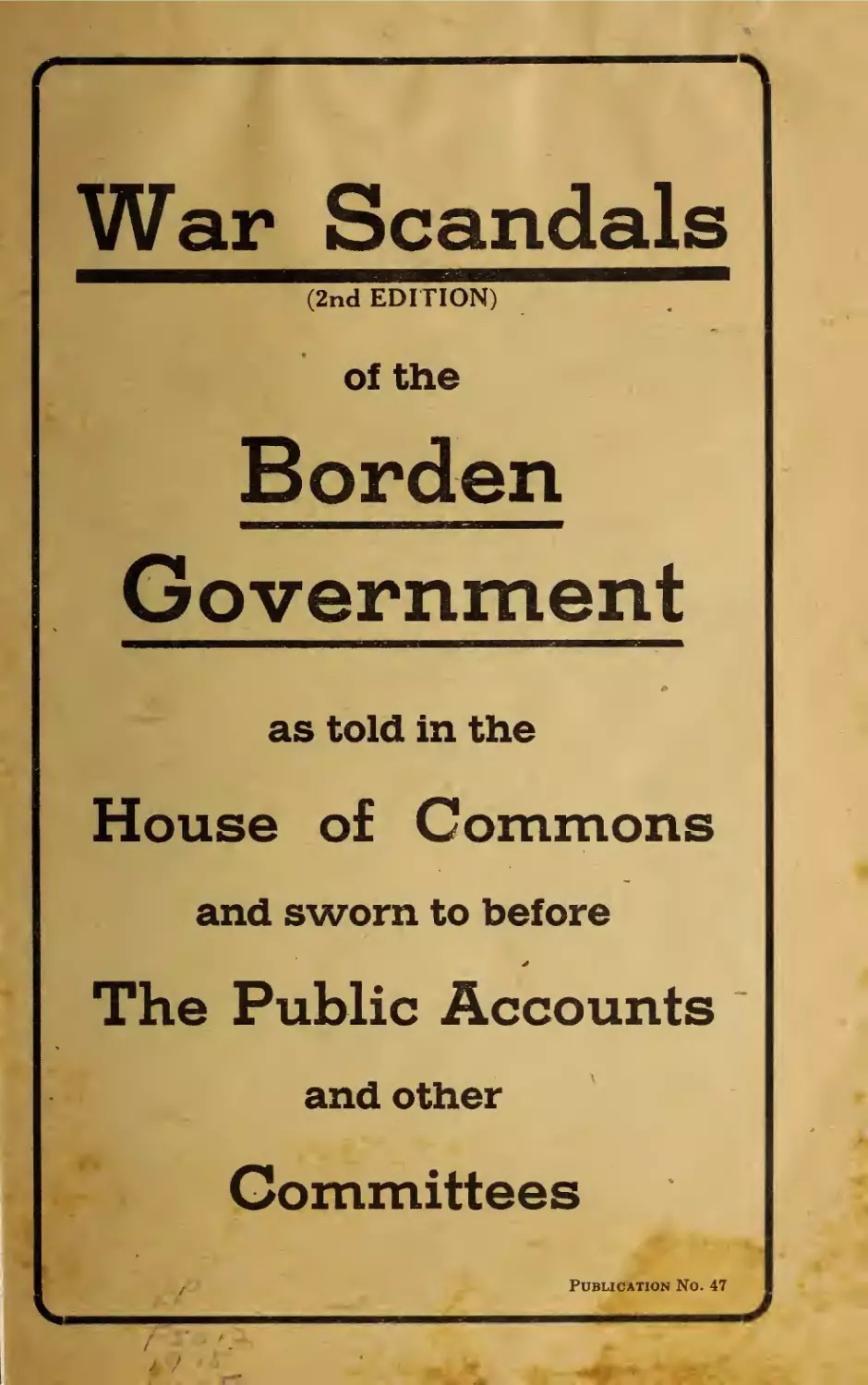
                    War

Scandals
(2nd EDITION)

of

the

Borden

Government
as told in the

House
and

of

Commons

s^AT^orn to

before

The Public Accounts
and other

Conimittees
,,/:

•

or

Publication No. 47

INDEX.
«»

Page

War Scandals
Sir Sam Hughes'

3

Letter to Premier,

May

13th 1915.

Horses
Oliver

Equipment

4
8
12

:

Boots

14

Binoculars

15

Motor Trucks

16

Ross

18

Rifles

Clinical

Thermometers

19

Field Dressings

Drugs and Medical Supplies
Submarines
Revolvers and Pistols
Morrisburg Customs Port thrown open
Shield Shovels

Camp Groimds
Lumber:
Burning of Clothing
The Lindsay Arsenal
American Horses in Preference to Canadian
Nickel

19
20
21
23
24
26
26
28
28
29
30
39

Bicycles

31

Housewives
Premier's statement

31
in regard to scandal

-

Subscribe for the

Canadian Liberal Monthly, Ottawa.
25c a year

32

^VAR SCANDALS
The Story

as

Taken From the Records

,

That page of our history which tells of the outrageous war
scandals perpetrated either with the connivance or through the
gross negligence of the Borden Government should bring the
blush of shame to every true citizen of Canada. When war
broke out in August of 1914, apd the determination of the German
forces became clear, it was evident that no small contest was
before the world, but that many years of preparation warranted
the belief that a prolonged and desperate struggle would be
waged.

The entry of Great Britain into the war appealed to her
sons wherever found, and no heartier response to the call of duty
was ever given than that of Canada. When in the special Session
of the Canadian Parliament held in August, 1914, the great
Liberal leader laid before the country the position he and all his
followers were prepared to take in rallying to the support of the
Government in whatever was found necessary to prosecute the
War to a successful conclusion, he touched a chord that awakened
a ready response in every Canadian heart. Sir Wilfrid Laurier
and his supporters in that Session rendered and ever since have
rendered all possible assistance, and throughout the Dominion,
the people irrespective of partv affiliations have in the most
generous manner contributed in men, money and supplies to the
cause of the Allies.
The Government was given an absolutely free hand in the
conduct of the War. Every facility was afforded to enable
Canada to make the most favorable contribution to the Great
Cause. The utmost latitude compatible with careful administration was accorded to the Government, and in the hope that every
effort would be made with an eye single to the main purpose,
the people were inclined to repose the utmost confidence in Sir
Robert Borden and his Colleagues.
It was absolutely clear from the outset that the probabilities
pointed to a long and expensive contest. It was also known or
should have been known to the Government that in this, as in
other wars, parasites, profiteers and middlemen would swarm
around the Departments to filch from the treasury every dollar
they could get, and for which no equivalent would be given.
Upon the Government was laid the grave responsibiUty of exercising the utmost care and vigilance for the protection of Canadian
interests and in a particular sense guarding the honor of the

country. How the Government has discharged this responsibiUty is told in part in the following pages.

A

Nation's Disgrace.

The record is an unenviable one for a country such as ours;
a disgraceful one for any nation situated as we are in relation
to the Empire and in connection with the tremendous struggle
for human liberty which demanded of us as never before the
exercise of those national virtues without which a country is a
source of weakness rather than of strength to its allies. While
Canada was paying the price of Empire in money and blood the
vampires were gathering in the political horizon. All too early
did they get full opportunity to gorge themselves at the expense
of the harrassed taxpayers of the Dominion, while the national
guardians stood idly by, or even aided this shameful situation.
A riot of extravagance, graft, profiteering and political maggotry
such as Cahada had never seen, and, let us hope, never will see
again, followed the announcement of our participation in the
War. Not only was the money of Canada wasted but absolutely
no protection was afforded representatives of the British administration purchasing goods in this country. The British
buyers were permitted to be fleeced by the same crew as was
operating in the Dominion under various guises.
it is

Interference,

Intriguing, Parti-

zanship by Cabinet Ministers
Was Evident Early in
the

War

In the House of Commons on January 27th, 1917, Sir Sam
Hughes read a letter which he had addressed to the Prime Minister,
Sir Robert Borden, on May 13th, 1915 and which contained most
serious accusations.

partizanship
five

months.

Price of

Sir

Sam

accused his colleagues of intrigue,
Second Contingent for

and holding back the
This letter

is

as follows:

Goods Enhanced and Quality

Inferior,

Owing

to

Colleagues Interfering.
Ottawa,

"Dear

May

13th, 1915.

Sir Robert,

my

return from England last November, I have repeatedly
owing to the interference and plans of the 'so-called'
"sub-committee and to the repeated hold-ups and needless obstruction

"Since

"notified you that

"of some of my colleagues in the affairs of this department, the Con"tract branch has been very much hampered and practically blockaded;
"delays have been very prolonged; the cost has been greatly enhanced
"and the goods supplied have been, in many cases. Inferior. Indeed,

"the MOST ARDENT AGENTS OF THE GERMAN GOVERNMENT
"COULD SCARCELY HAVE BEEN MORE SUCCESSFUL IN HOLDING
"UP THE PROPER EQUIPMENT OF OUR FORCES, HAD THEY BEEN
"IN CONTROL.

Second Division Held in Canada five Months on Account
Colleagues Haggling over the Question of Paying
Commissions to Agents on the Sale of Motor Trucks.
"As one of many specific examples. Take the trucks for the
"Second Division. They should have been ready last December, they

my

colleagues constituted themselves
Some of
of this or that truck and brought about delays whereby
"untried trucks would be purchased; high prices would be paid in
"commissions to agents, and the Government, and the country, would
policy, as you may remember,
**be treated practically as a retailer.
"in this and in all other matters, was to force dealers to give the Govern"ment wholesale, or manufacturers' rates.

"are not ready yet.

"champions

My

Robert Borden permitted Cabinet to Block
Equipment until the Quartermaster-General Had Grown Sick.

Sir

Requisitions for

"At the present time there are upwards of one hundred requisitions
"that have long been in. The Quartermaster-General has over and
"over and over again, until his heart has grown sick, brought them
"before me, they have been promptly passed on to|the Director of Con"tracts, and the great majority of them, when passed on to the Privy
"Council, have been held up in Council, or by the Treasury Board,
"laid aside or sent back but always delayed; while the Director of
"Contracts and his officers have unceasingly been interfered with,
"delayed, and given endless and unnecessary work by the sub"committee.

—

A

Shortage in Supplies and Equipment.

"I saw, by an article in the Free Press, that it is current everywhere
"among the soldiers and officers, that they are short of nearly every
"class of equipment and supplies. In fact, three times recently I
"have been severely reproached about shortages in supplies and equip"ment, by outsiders w^ho had learned of these shortages from soldiers

"and

officers of the force.
"Further, to my surprise, I was spoken to in Montreal this week,
"and informed that our Medical units going over were only half
**equipped,- while many of our combatant units are not properly

"outfitted.

"In addition to the serious aspect of the case and from the view"point of the efficiency of our soldiers, there is the disheartening side.
"It is not only unfair to the gallant boys, who are giving and willingly
"risking their lives for the cause, and making domestic sacrifices, but
"it is absolftitely unjust to me and my officers.

Interference Causing Injury and Inefficiency of

the Canadian Soldiers.
fvlilitia, I must respectfully

**Therefore, as Minister of

5

.

enter

my

"protest, as I have frequently before entered it, at the interference
"and delays caused in all these things. It tends, not only to the injury
"and inefficiency of our soldiers, thus jeopardizing the success of
"British arms, but it must politically reflect seriously upon the Govern**ment.

Sub-Committee

of Cabinet Given Contracts for Soldiers'
Clothing to Manufacturers of Women's Underwear,
Women's Blouses and Women's Corset-Makers.

"It is charged that the sub-committee have given contracts for
"soldiers* clothing to be made by jobbers, who sub-let them and never
"entered a stitch themselves. Women*s linen underwear, women's
"blouse makers, women's corset makers and truss makers, have all

"been among these contractors.

"We

believe,

we are

in a position in this

department to truthfully

"say that there was never such a volume of business so successfully
"and economically transacted, or under such an efficient system of
"purchase and inspection, as had been developed by us up to the time
"when I went to Europe, and when the sub-committee took control.**
"I feel very fortunate in having under me officers, both civU and
"military, in all the leading departments, in whom I can place absolute
"trust. They have done nobly, under very adverse surroundings,
"and I can conceive of no plan by which the work could haye been
"more honestly, economically and effectively done, than was ourfc.**
"I regret to have to submit these facts once more, but in justice
"both to myself, as well as to the splendid gallant soldiers we are
"endeavouring to equip for the front, I must ask your serious con*sideration of these matters."
"I have but one desire, the upbuilding of Canada, the Empire and

*

"humanity."
"Let me hope that you will regard this letter as written with due
"respect to myself, to my country, to you, as my leader, and in justice
"to our soldiers."
Faithfully,
(Sgd.) Sam

Hughes."

Were there ever more serious charges made than those made
by the Ex-Minister against his colleagues ? A few weeks delay in
the supplying of this equipment may have cost our soldiers
thousands of lives. Trucks which should have been ready in
December, 1914, were not ready on May 13th, 1915, due to the
fact that Ministers of the Crown could not determine the sort
of truck to purchase or the commission which should be paid to
agents.
Necessary equipment for the soldiers had been held up
for months.
In short if German agents had been in control they
could not have been more successful in holding up these supplies
than this sub-committee of the Council.
ask if this whole thing is not too horrible to intelligently
conceive of, and we also ask if this is an example of the mis-

We

management that has been going on from the time«Canadian
started to enlist?
Surely these accusations are
most serious and thorough investigation.
It is such conditions as outlined in this letter that we
shall expose in these pages.
It is a record that should be read
soldiers

first

worthy

of the

by every Canadian,

It is an Indictment
regardless of party.
a charge against our national integrity
that we should all resolve shall never again be made possible in
this or any generation.
When this story has been unfolded to the people of Canada
those who have passed through the trials, sufferings and heart
breaking experiences which war entails, will in no uncertain
tone express their opinion of an administration so regardless of
common decency and honor in the management of public affairs.

of our national honor,

At the outbreak of the War Sir Robert Borden was Prime
Minister, General Sam Hughes, Minister of Militia and Defence,
Hon. J. D. Hazen, Minister of Naval Defence and Hon. Thos.
White, Minister of Finance.
On these four ministers devolved chiefly the task of war
administration, but at the same time it is clearly understood
that the other members of the ministry are not absolved from
responsibility.
They too must share the heavy burden irksome though it be. Cabinet responsibility in this country is
established.

The machinery at the disposal of the Government for careful
and honest administration is sufficient if properly utilized, to
prevent extravagance, imposition or fraud, and if the safeguards
which through manj^" years have been adopted from time to time
to protect the treasury had been observed millions of dollars,
even though a war was on our hands, would have been saved.
It is evident, however, that in the early stages of the war safeguards were cast aside, regulations ignored and statutes forsaken,
and the door thrown open to all kinds of adventurers, grafters
and middlemen.

The Government Started Wrong.
The first surprising intimation in regard to the war purchases
came from the Auditor General the statutory guardian of the
treasury who, when writing to the Militia Department on December 4th, 1914, complained that war goods amounting to
over $1,000,000 had been purchased without orders-incouncil as required by Law.
Before the Public Accounts Committee on March 17th,
1915, the Auditor General in explanation of this letter, stated,
**The Government purchasing system was loose, irregular

and illegal, that the practice was contrary
and even more than that they were not

to regulations
in compliance

with the Act.
Everything by Patronage.
Subsequently the Director of contracts in the Militia Department appeared before the Public Accounts Committee and

on April 9th, 1915, stated:
**From 1906 to 1911 there was not very much in
the way of a patronage list; I was given a pretty free
hand and I bought without much reference to any
patronage list There is now a patronage list. We
buy from that list— It is a very large list now. I suppose we have 8,000 names on that list.'*
This is the statement of the Director of Contracts in the
Militia Department whose sworn evidence on this point must
be taken as correct.
Nothwithstanding this, however, Parliament had presented
to it in the dying hours of the Session of 1915 the sorry spectacle
of Major General Sir Sam Hughes the then Minister of Militia
stating, regardless of this fact and in his bumptious manner that
there was no patronage list in his Department.
The evidence produced was overwhelming that there was a
very large patronage list in the Department, and that this list
w^as used on all suitable occasions.
Not only was it used but in
many cases middlemen were employed and each in his respective
case drew his blood money.
One instance may be cited from the
evidence before the Public Accounts Committee given on March
23rd, 1915, by Mr. W. J. Shaver, representative of Bauer &
Black, of Chicago, manufacturers of Surgical Dressings, who swore
**! saw Colonel Jones, an officer of the
as follows:
Militia Department. He said that the Government
would not do business direct with our company.
We were prepared to do business direct if the Government saw fit to do business with us as we do in other
countries. The prices we charged Powell (the middlemen who added $9,000 profit) are the prices we charge
the French, British or Russian Governments for
hundreds of carloads of goods."

—

—

,

The facts in regard to scandals as contained in the following
pages are taken from the records of the Government or from the
sworn evidence of the Public Accounts and other Committees.

Horses
The story of the purchase of horses for the first and subsequent Canadian contingents has oft been referred to in the
House of Commons, in the Public Accounts Committee and in
the Press.
It furnishes a glaring sample of what partisanship
and party heelers can accomplish in the way of grafting and
misappropriation of public funds.
At the outbreak of war the Government arranged to purchase horses.
8,164 were purchased for the first contingent.
398 were taken from the permanent corps in Canada.
Making a total of 8,562 horses assembled at Valcartier for this

Before the soldiers left for overseas service which
than three weeks after these horses were assembled at
Valcartier, out of a total of 8,562 horses, only 7,911 were considered fit to ship to England.
Of these misfits 651 horses purchased by **friends of the
governement'* had died at Valcartier or were left behind by
the First Contingent as undesirable.
Other horses failed to stand the journey across the ocean.
And others on reaching England were discarded and slaughtered immediately on disembarking.
Of the 7,9^11 horses which left Canada for England with the
first contingent it is known that when the unfit ones in England
had been weeded out only 6,700 remained fit for service.
We quote herewith from the official Hansard of the British
House of Commons March 10th, 1915, page 1406, the question that was asked in regard to Canadian horses, and also
the reply which was made by Mr. Tennant, under-Secretary
contingent.

was

less

of State:

**Mr. Rendall asked the Under-Secretary of State

War whether he
patment of the War

for

is

aware that the Remount De-

Office have for some time sanctioned a slaughter house for horses in a wooden building alongside the main road from Avonmouth to

Shirehampton; whether he is aware that the stench
from the carcasses of the dead horses is continuous
and penetrates a considerable distance, and makes
the use of the road and foot-path impossible without
breathing an atmosphere which is dangerous to
health; whether he is aware that there has been an
epidemic of throat complaints at Avonmouth, especially

among

the school children

who have

to pass

and repass within a foot or two of the slaughter-house
daily; and can he arrange for the removal of the
slaughter-house to a spot much further removed
from the public foot-path and highway?
**Mr. Tennant: The slaughter-house referred to,
which is a temporary structure, had to be erected near
a good road with as little delay as possible for the
reception of horses destroyed on disembarkation from
Canada. It is 150 yards away from the nearest dwelling
house, and every effort is being made to keep it sanitary
Arrangements are in progress for building a road to a
more suitable situation some distance from the main
road.'*

The achievements of the Borden .Government in the pur^ihase
must have left a strong odoriferous impression on the

of horses

British people.

$302,575.00 Lost in the Purchase of Horses.

The weeding out of these undesirables disposed of 1,862
The Militia Department has informed the Government that horses purchased for this first contingent cost
on an average $162.50. At this rate the country suffered a

horses.

loss of $302,575.00.
The Arch-politicians of horse purchasers seem to be Mr. A.
Dewitt Foster, ex-M.P., for Kings County, N.S., and Mr. R. J.
Fallis, ex-M.P.P. for Peel County, Ontario.
Mr. Foster at the outbreak of war surrounded himself with
some American gentlemen and also some close personal political
friends of Kings County, N.S. to purchase horses.
The Government placed at his disposal a large sum of money for this purpose.
Mr. Foster signed the Government cheques in blank and handed
them to the Secretary of the Conservative Association of Kings
County to fill in amounts and the number of horses purchased.
Political friends of Mr. Foster's took advantage of the opportunity, the lame, the halt and the blind horses were accepted.
Here are some of the sample purchases :-rA knee sprung horse was sold to the Government for $150.
A bone spavined horse was sold for $100.
The Dark Bay Mare too old for the South African
War was now sold to the Government for $130.
A sorrel horse which was knee sprung and which a short
time before was traded for a drake and two ducks was sold
for $90.

An eighteen year old horse which was not worth wintering and was going to be killed unless it was grabbed up by these
politicians.

The Abner Wood worth

now

horse, 15 years old costing $50 was
sold for $130.
At Berwick a horse was sold for $100 which had two spavins

and one hip down.
rise

At Somerset, N.S., a horse that fell down and could not
without assistance was purchased at $165.
Another horse, eleven years o|d and badly puffed was

sold for $160.

Another horse which had been purchased six years
before at $55 was sold for $180.
^ They were all purchased through the agency of Mr. Dewitt
Foster.

There is evidence that not only were poor horses purchased
but exhorbitant prices paid and that even at this the Government were charged higher prices than the purchasers got.

Somebod'y Grafted.

When

i

these horse purchases were being investigated
10

by

Commissioner Sir Charles Davidson he remarked:
''The price paid for the horses did not equal the
amounts placed in the hands of the horse buyers.*'
So outrageous was the conduct of the parties entrusted with
the purchase of horses in King's County that the Premier was
compelled to state in the House of Commons on April 15th, 1915,
that:

**Mr. Foster was appointed as purchasing agent
without the knowledge or consent or approval of any
member of the Government. I knew nothing of it
or I should certainly have absolutely prevented his
undertaking any such duties. The Minister of Militia
knew nothing of it.'*
Here the Prime Minister of Canada admits tliat a Conservative member of Parliament was enabled to take $72,000 out
of a Department to squander, in the pretence of buying horses,
and that neither he (the Prime Minister) nor any of his colleagues
knew anything about it. Not only was this unheard of liberty
permitted, but to this day the Prime Minister has not compelled Mr. Dewitt Foster to file a statement as to how this money
was spent. He simply went through the form of reading Mr.
Foster out of the House after the glaring exposure could not

be overlooked.

The Purchase

of Horses in Ontario.

The purchase

of horses in Peel County was little better.
M.P.P. by some means, probably Mr. Richard
Blain, M.P. for Peel can say, was placed in a position by the
Government whereby all horses for sale in that locality had to
pass through his hands. The evidence is convincing that poor
horses in this case were also accepted, but evidence just as strong
establishes that the middleman, Mr. Fallis, demanded his pound
of flesh for every horse purchased.
So much in fact was
this the case that Sir Charles Davidson was constrained to
remark **So the farmer got less and the Government paid
more for horses as a result of your intervention.** Fallis
admitted that such was correct. When the electors of Peel
County had an opportunity shortly after to deal with Mr. Fallis
they lost no time in rejecting him.

Mr. R.

J. Fallis

Quebec Horses.
The only other horse transaction, investigated was in connection with the purchase of horses at Sherbrooke, Quebec
where Major Fletcher, one of the horse buyers, purchased three
splendidly bred Clydesdale mares in foal, for $250, $225, and
$190 respectively and when he had brought these mares to
his farm he exchanged them and gave to the Government three
11

geldings instead. The exchange was certainly worth hundreds
of dollars to Major Fletcher and for which the Government
did not get a cent, and so far as known have done nothing to
recover the amount lost.
of the way the Governof horses through the Dominion

Taking these purchases as a sample

ment were handling the purchase
would appear that the

half has not yet been told and that the
country as between the prices paid to the farmer
and the prices charged by the Government are enormous.
it

losses to the

Oliver

Equipment

Every soldier before going into the trenches is supplied with
an equipment which can best be described as a sort of harness
which is so made as to go over his shoulders and strapped around
This equipm^ent contains pockets and pouches, a
his body.
water bottle, cups etc., a place for his blankets, in fact a soldier's
full marching equipment, and is fitted in such a manner as to
not interfere with- his movements when marching and firing
his

rifle.

The Canadian soldiers have been supplied with what is known
as the Oliver Equipment which is a sort of hybrid equipment
parts of which are made of canvas and other parts of leather.
The British War Office early in the War selected as their standard
equipment what is known as the Webb, and all of the British,
Belgian and Russian soldiers are supplied with this Webb equipment.

When war was declared the manufacture of this Webb equipment who resides in Worcester, Mass., met General Sir Sam
Hughes and some officials of the Militia Department and pointed
out to them that as the British Government had adopted the
Webb the Canadian Government should adopt the same equipment. This manufacturing Company from Worcester, Mass.,
gave full details of what they were prepared to do and went so
far as to say that if they were given a substantial order they
would come to Canada, establish a plant and manufacture this
Webb equipment in Canada. They were informed by General
Sir Sam Hughes that the matter would be given consideration.
The manufacturer returned to Worcester, and later received
word to proceed to New York to discuss an order for Webb
Much to his surequipment for the Canadian Government.
prise on reaching New York he found that negotiations were to
be carried on by the J. Wesley Allison combination. Being
anxious to secure this business the manufacturer consented, and
after details had been gone into they were given a small order for
this Webb equipment.
The price to be paid was $4.40 per set
12

,

•

the manufacturers were instructed, to ship the goods direct to
Ottawa, but to send the bills to the office of J. Wesley Allison,
the Manhattan Hotel, New York.

Allison

Crowd Were to Get Commission

of $1.10 Per Set.

The work was proceeded with and in a short time a shipment of these Webb equipments were made and the bills sent
In due time the second shipment was ready, but
as directed.
the manufacturer not having been paid for his first shipment
and not feeling any too secure in looking to the Allison crowd
for payment had a representative come to Ottawa to look into
This representative on reaching Ottawa discovered,
the matter.
much to his surprise, that the Government was being charged
$5.50 for this Webb Equipment and not $4.40 the price the
manufacturer was charging Allison and his crowd.

Cabinet Ministers Powerless.

The representative of this manufacturing company protested.
The matter was eventualy brought to the attention of Sir Thomas
White, Minister of Finance, Hon. Mr. Doherty, Minister of Justice
Solicitor General, but without success,
as these gentlemen stated they were powerless to act in the
matter. The representative then informed the Government that
in view of this exhorbitant Middleman's price which was being
charged the Government, his Company would be compelled
to in future either deal direct with the Government or cancel
the order. They were then informed that there did not appear
any other way to proceed except in the way already outlined.
The manufacturers, at once, told the Government they could
not deliver the goods under these conditions and immediately
cancelled the order.
The Government not being willing to buy this Webb equipment except through Allison and his gang in New York, proceeded
to purchase from^ other manufacturers who were making what is
known as the Oliver Equipment.
Thousands and thousands
of these Oliver Equipments have been thus manufactured and purchased by the Canadian Government. The price charged for the
Why such an
first year of the war was $6.75 and $7.25 a set.
exhorbitant price was paid nobody knows. On leaving Canada
the soldiers were equipped with this Oliver equipment. They
used it in England for training purposes, but before the Canadian soldiers left England for France the Oliver equipment was
discarded and the Webb equipment supplied by the British
Government was given to the Canadian soldiers instead.

and Hon. Arthur Meighen,

The

Price of Every Oliver

Thus the summing up

of the

Equipment

whole story

i5

is

Lost.

that the Canadian

Government refuses to purchase the Webb Equipment because
the manufacturers would not permit J. Wesley Allison to take
his blood toll of $1.10 per set.
The Canadian Government went
ahead and supplied the soldiers with an equipment which costs
not $4.40, but $6.75 and $7.25 a set. The soldiers are sent to
England. The Oliver equipment changed for the Webb, and
when the British Government renders their bill to the Canadian
Government for the care, maintenance and equipment of our
soldiers in Great Britain the price for these Webb equipments
will be included.
Thus through the stupidity of our Canadian
Government and their endeavor to play into Allison's hands, a
double equipment has been purchased and will have to be paid
for.

There

is

Evidence of Graft.

To-day there is in the hands of the Liberal leaders affidavits
showing that commissions have been paid by one of the manufacturers of this. Oliver equipment to a person closely associated
with a Member of the Conservative Party. This may explain
why thousands and thousands of dollars have been squandered
on this Oliver Equipment.

Boots
The story of supplying boots to the Canadian soldiers at the
commencement of the War is a disgraceful one, but quite in
keeping with the other scandals of the Borden Government.
8,000 or more "good boys" had to be placed on the patronage
list of the Militia Department and naturally out of this number
some were boot manufacturers. When the Government wanted
boots for the soldiers they applied to these manufacturers and
The boots were made and sold to the Governalso to middlemen.
ment, but at the investigation which followed it was proven
that not only was the leather bad, but in some cases cardboard
was substituted for leather for these boots. All sorts of
tricks were resorted to in connection with the soles and
heels.
Pieces were glued together and covered up with
varnish and a hundred other means of deceiving the inspecthe result that when the Department were comtors, with
pelled to appoint a Commission to investigate these shoes,
the Commission reported that:

''That the boot was of unsuitable shape and make
and that the leather contained no water-resisting

medium:
''That the heels and soles are unprotected and
poor quality:

sole-fitting is often

14

''That the boot was unsuitable for the soldiers
for that particular work for which they were
provided, because:
''(a) ''The shape is such that the average foot
has not room for the free movement of the toes and is
thus not suitable for marching:
(b) **The leather is dry, containing no grease, and
consequently quickly absorbs the waters:
'Soles and heels not being re-inforced with
(c)
metal, soon wear down, especially when wet."
The middlemen also got their innings. In Winnipeg a
They
senior ordnance officer purchased 3,798 pairs of boots.
had been manufactured in Ontario and Quebec at from $3.40 to

and

*

$3.60 per pair

What has

who

sold to the

Sir Herbert

Government

Ames

for

to Say

$4.00

per pair.

About This?

Quarter-Master Sergeant Wainwright of the 31st Battalion
Calgary, before the Special Boot Committee describes the boots
Out of the 1,093 pairs of boots that
as too light and flimsy.
came under his inspection not one dozen pairs were good. All
the pairs that he examined and found defective he said that the
largest percentage were made by the Gauthier Company of
Quebec, and Ames, Holden and McCready Co., of Montreal.
The boots were so bad that in some cases the soldiers discarded
them and tied shingles to their feet. At Halifax the soldiers
tied canvas bags to the soles of their boots so as to prevent
their feet from coming through to the ground. Evidence
proved that the health of the men had been effected on account
of the poor quality of the boots supplied them and some had
contracted heavy colds and had become tubercular.
When this was all proven and the facts shown to the Country,
the Conservative members on the Boot Commission had the
boldness to force through by brute majority a whitewashing
report.

Binoculars
In the purchase of binoculars the full effect of the Tory
patronage system with its ever present middlemen was proven

most conclusively.
The Government could not or would not go direct to the
manufacturer. Their friends had to be soothed. With the
unfortunate middleman and his enormous profits, binoculars
which originally sold for $9.00, $15.00, $25.00 and $28,00 cost
the Government from $41.00 to $58.00. The channell for pur15

chasing binoculars was narrow but the profits big.

a sad one.

_
Six

The

story

is

'

Middlemen.

&

Bausch
Lomb of New York the original makers and importers sold to Milton Harris a New York broker. Mr. Harris
sold to Mr. Bilsky a reputable Ottawa jeweller.
Bilsky offered
to sell to the Government all the binoculars they wanted of standard make, at $45.00 each, but he had no chance to do business
with the Government because he was a Liberal. Mr. Bilsky
sold to Mr. T. M. Birkett a son of a former Conservative M.P.
from Ottawa.
Mr. Birkett sold to Sam Hughes' "Good Boys" namely
P. W. Ellis & Co of Toronto who sold to the Government after
charging a 10% commission for handling the goods and Sir Sam
said that he was very sorry that he had not allowed these "Good
Boys" P. W. Ellis Co., a 20% profit.
Thus it will be seen that from the manufacturer to the dealer
six middlemen received their blood toll.
But that is not the worst feature. The binoculars were not
of a stipulated quality.
They were for the use of Canadian officers and on the accuracy and power of the glasses might easily
If
depend the lives of whole companies of Canadian soldiers.
an officer is furnished a poor binoculars, which is worse than
nothing, the soldier suffers.
In this case however, the soldier
was given the second consideration and the middleman
had the preference.
Read the report which was passed by the Public Accounts
Committee and presented to the House of Commons which is
as follows:

**From the evidence it appears a number of binocular glasses were of poor quality, low range and inferior efficiency, but passed inspection and were paid
for at excessive prices; and this was due to misrepresentation and inadequate inspection."

Motor Trucks
The purchase of motor trucks for the various contingents
of the Overseas Forces reeks with graft, middlemen's profits,
commissions and delays which were in evidence even before
the war broke out. The channels for corrupt practice seemed
to be well opened in the Militia Department, where we find that
a gentleman by the name of Mr. J. H. McQuarrie had been
selling his influence with Sir Sam Hughes in order that the
might get an order from the Militia Department for motor
16

trucks.
Here is a copy of the receipt which Mr. McQuarrie
gave when selling his influence:
**
Received from Wylie Limited on April 22nd,
1912, $1,200, for my influence with Col. Sam. Hughes,
Minister of Department of Militia and Defence in
securing from the Department an order for three

Gramm

Motor Trucks. This is in accordance with
agreement with your company, February 19th, 1912.
(Signed) J. H. McQuarrie.''
be noted that when War broke out and the
Government wanted to purchase a great number of motor trucks

And

for the

and

it

will

army

this

political

who was the protege
Sam Hughes was called to

same Mr. McQuarrie

henchman

of Sir

the Department and practically given control of the purchase
of these motor trucks.
Read the letter which Sir Sam Hughes gave to McQuarrie
and his partner on that occasion:
**Dear Sirs: I have pleasure in commissioning
you to select for me, for the Department of Militia
and Defence, using your best judgment, as many
motor trucks as you can conveniently secure, up to
twenty-five (25) to be delivered at Valcartier, Quebec,
by the end of two weeks from to-day the 28th instant.
I shall be obliged if you will also supply us with
chauffeurs for these trucks.
Faithfully,

—

—

(Signed)

Sam Hughes."

But the worst was yet to come.
The Liberal Members in the House of Commons in the
Public Accounts Committee exposed this man McQuarrie and
the selling of his influence, and it must be fairly admitted
that the amount of money to be expended on motor trucks for
the War was too large to permit Sir Sam and his close friends
to have full say as to who should, and who should not get commissions when purchasing these motor trucks. The other
Members of the Borden Government evidently interfered with
this to such an extent as to annoy Sir Sam with the result that
on May 13th, 1915, Sir Sam wrote Sir Robert Borden as follows:
**Take the trucks for the Second Division. They
should have been ready last December, they are not
ready yet. Some of my colleagues constituted themselves champions of this or that truck and brought
about delays whereby untried trucks would be purchased; high prices would be paid in commissions
to agents, and the Government, and the country,
'would be treated practically as a retailer."
And to this day no member of the Government has attempted
We know,
to deny what Sir Sam stated on that occasion.
according to statements of Sir Robert Borden and Sir Sam
'

17

Hughes in the House of Commons that these motor trucks have
been discarded on reaching England and not permitted to go
across into France, a loss to the country of hundreds of thousands of dollars.

Ross

Rifle

Much
No

has been written and stated in regard to the Ross
better summing up of the whole situation can be
given than the statement which was made by the Hon. Frank
Oliver in the House of Commons on Monday, February 5th,
1917 in the following words:
Rifle.

**

After we, Canada, have paid to the amount of
$6,500,000 for Ross Rifles made in Canada, not one
battalion, not one platoon of Canadian troops at the
front is armed with that rifle, after two and a half
years of war.
**The question of the furnishing of our troops
with what is called small arms, with rifles, is the most
important question with which we have to deal; but
we are dealing to-day with a vote of $500,000,000 appropriated in bulk for expenditure by this Government, for the support of Canada's part in the war, and
on the most vital point in all this vast expenditure.
We find the result that I have already stated, that we
have spent $6,500,000 and we practically have not a
rifle in the firing line, and we are being called upon
to-night to vote, if
hon. friend presses his motion,
to pay $2,660,000 for rifles that are not yet manufactured and that will never see the front after they are
manufactured. This is a far reaching matter. If
such is the record of the Government on this the most
important feature connected with the war so far
as we are concerned, what are we to believe in regard
to the other phases which involve the whole of this

my

stupendous expenditure?
The incompetency exhibited by the Government in the
handling of this rifle, the forcing of it upon the soldiers in the
trenches, the thousands of men who have been killed from the
a serious matter and one for which the Governbe brought sternly to account.

result of this is

ment

will

Cancelled Order for a Rejected Rifle Because
Delivers Were to Slow.

And now the Government have cancelled the contract and
the reason given for so-doing was *Hhat the Ross Company
18

are not delivering these rejected Ross Rifles fast enough."
Just think of it had the Ross Rifle been delivered faster the
contract would have gone on.

Clinical

Thermometers

At the outbreak of war the Militia Department bought from
Mr. T. A. Brownlee, Druggist in Ottawa, 962 clinical thermometers. Mr. Brownlee charged $1.00 each for these thermometers and received a cheque from the Government on August
21st, 1914 for $702 and on October 29th, 1914 for the $260.
The case was so brazen and the charges so exorbitant that
the story of these purchases created considerable comment.
On February 10th Mr. William Chisholm, Liberal M.P. for
Antigonish N.S. asked for details in regard to the purchase of
these clinical thermometers and was told that $1.00 each had
been paid but that subsequently Mr. Brownlee discovered an
error in his charge and refunded half of this money, making the
net price of these thermometers .50 each.
Mr. Chisholm pressed his question and elicited the further
information that Mr. Brownlee only discovered the error and only
niade the refund on February 11th the next day after
Mr. Chisholm had originally made enquiry in the House
Matters were becoming warm and
in regard to this purchase.
Mr. Brownlee evidently decided that it was time to disgorge.
In addition to this transaction Mr. Brownlee supplied the
Government with over $25,000 worth of orders. One order for
medicine boxes amounting to S12,750. No tenders were asked,
no competition sought, the ^Government simply ordered the
goods and Mr. Brownlee filled in the price.
Later on when the Government were forced to buy these
medical boxes direct from the wholesale dealers it was found
that they could be purchased for fifty percent less than charged
by Mr. Brownlee.

Field dressings
Field dressings,

Canadian

soldiers

bandages,

lints,

salves etc.

had to pay the usual blood

for

wounded

toil.

They had to be purchased through a Tory middleman.
This middleman was at first supposed to be a young man by the
name of Powell in the employ of Mr. W. F. Garland, ex-M.P.
for Carleton County, Ont., but it was afterwards discovered that
the real culprit was Mr. Garland himself who was reaping the
profit, practically selling the goods to the Government although
under the Independence of Parliament Act. A member of
19

is absolutely prohibited from doing this
The result
after the exposure, but not before, Mr. Garland was
compelled to resign his seat as member of the House of Commons.
The manufacturers of these field dressings, Messrs. Bauer and
Black wanted and expected to do the business direct with the
Government, the same as this firm have always done with all
the Government in the World. But they could not do the
business direct. They were told so according to the evidence
of their representative, Mr. Shaver before the Public Accounts
Committee on March 23rd, 1915, who stated as follows:

Parliament

was that

**We were prepared to do business direct if the
fit to do business with us as we do
in other countries/'
**I went to see Colonel Jones, of the Militia Department and he said that the Government would
not do business direct with our Company.
The Public Accounts Committee after investigating this
matter on March 26th passed the following resolutions:
**The Committee begs to report to the House the
evidence adduced in respect to the contract for supplies purchased from Mr. E. Powell and to express its
opinion that the contracts for such supplies do not
appear to have fully protected the public interests;
and the committee therefore recommend that the
evidence adduced and all papers connected with the
matter should be referred by the House to the Department of Justice for any further necessary investigation and for the recovery of any moneys overpaid and
the taking of such further action as may be warranted
by the facts.*'

Government saw

,

Other Drugs and Medical
Supplies
Mr. Garland was not the only druggist in Canada. The
young Nationalist member, Mr. Albert Sevigny, then Deputy
Speaker of the House of Commons, now Minister of Inland
Revenue of the Borden Government, had a sister by the name of
Mde. G. P. Plamondon of Quebec, the owner of a drug store.
This Nationalist member who in 1911 would not permit
of Canada taking any part in Britain's wars could in 1914 recommend that his sister Mdme. Plamondon be permitted to sell
war drugs and war medical supplies to the Government. The
bill amounted to approximately $23,200.

The various items were investigated before the Public
Accounts Committee. It was shown that the profit on these
goods to Mdme. Plamondon varied from 70% to 200% and even
20

some cases to 300%. When figuring these percentages an
allowance was made for any increase of prices owing to the war.
Before the Public Accounts Committee Mdme. Plamondon
stated that her brother, Mr. Sevigny had got her name placed
upon the" Government patronage list and Mr. Sevigny also stated
that he had asked that the payment for these accounts be exin

pedited.

Submarines
One of the first actions of the Borden Government in connection with the War was to purchase two submarines for the
defence of our Pacific Coast.
Coast was Unprotected.

The coast was entirely without protection because there was
no Canadian Navy to protect it, one of the armed cruisers which
had been purchased from the British Government by the Laurier
Government having been dismantled by the Borden Government. It was known that there was a squadron of German
cruisers in South American waters that might easily make a dash
for Victoria, Vancouver and Prince Rupert before British or
Japanese warships in the Pacific could head them off.
Thus, at the very outbreak of hostilities, actual war demonstrated to the Canadian people the need of a Canadian navy in
Canadian waters, to protect Canadian coasts and Canadian
shipping.

Boats Rejected as no Good.
It was under these circumstances that the Borden Government undertook to make up for the lack of a Canadian Navy
by going to Seattle where they purchased two submarines which
had been built by the Electric Boat Company of New Jersey for
the Chilean Government but were rejected by the Naval Commission of the Chilean Government, as being unfit for service,
lacking buoyancy and considerably out of date as to style and

pattern.

The

following is an extract from a statement which Capt.
Chairman of the Chilean Naval Commission, gave to the
and which was published in the Seattle Sunday Times of
July 26, 1914.—
**I can only confirm the report you have, that the
two submarines built here for my government have
not been accepted and that at this time they do not
meet the full requirements of the contract between
the Government of Chile and the Electric Boat ComPlaza,
Press,

21

pany

of

New

Jersey."

Commenting on this statement by the Chilean expert, the
Seattle Times said
**It is apparent however, that aside from the discovery that the two submarines lack the proper buoyancy to make certain their safety and efficiency, they
are considerably out of date as to style and pattern.
They were designed several years ago, and, it is known
they do not compare with the type of submarines now
building here and elsewhere for the United States
Government. In fact, it is understood, were the two
submarines satisfactory in point of saJFety and efficiency, they would scarcely measure up in standards
of destructive power, speed and other requirements
to the submarines recently built or on the ways in
various ship yards of the country."

An Enormous

Price Paid.

The contract price which the Chilean Governement agreed
to pay for these boats when completed, on or about August 1st,
1914, was $818,000 as ascertained when Sir Charles Davidson
investigated at Victoria the purchase of submarines. The
Canadian Government stepped in and with the aid of Sir Richard
McBride paid not the contract price $818,000 for these boats,
but $1,150,000 or an increase of $332,000, for a pair of "rejected,"
"out of date as to style and pattern" and "lacking buoyancy"
submarines. The Government undertook to make no defence
of this transaction, simply stating that Sir Richard McBride
had acted in the matter and that he had to be reimbursed to the
extent of $1,150,000.

How

was the money paid?
Before the Public Accounts Committee March 31st, 1915,
the Auditor General swore that three drafts were drawn as
follows:

No. 15862 on the Canadian Bank

of

Commerce,

of

Commerce,

of

Commerce,

N.Y

$500,000,00

No. 15883 on the Canadian Bank

N.Y

399,437.00

No. 84894 on the Canadian Bank

249,961.00

Seattle

Two of these drafts aggregating $900,000, went to New York
where the boats were built, and $250,000 remained in Seattle.
This $250,000 was made payable to J. V. Patterson, the gentleman who negotiated the sale. Notwithstanding the fact that
Sir Charles Davidson has exonerated the Government from any
wrong-doing in this matter does it look reasonable that the
whole of this $250,000 should remain in Seattle?
22

Purchase

of Revolvers
Pistols by the Militia

and

Department
At the outbreak of the War the Militia Department required
a lot or revolvers and pistols. At that time Sir Sam Huges'
handy man, **guide, counsellor and friend J. Wesley Allison"
was authorized to purchase these articles. He proceeded with
the work and- in due time delivery was made but much to the
surprise of the Auditor General the price paid was exhorbitant.
The Auditor General knew perfectly well that $18.50 for these
automatic pistols was excessive, and consequently opened up
negotiations with the Department of Militia to ascertain why
such prices were paid. The Auditor General first satisfied himself that $14,00, was a fair price, and one at which any retailer
in Canada could purchase the pistols.
He also ascertained that
the New York State Government were buying thousands of
The whole matter was
these very same pistols at $14.00 each.
On January 3rd, 1916, Gen.
referred to Sir Charles Davidson.
Sir Sam Hughes appeared before Sir Charles Davidson and made
the following statement:
**I may say that the British Government and the
Canadian Government as well, are in every sense
under a. deep obligation to Colonel Allison for his
services.
He never charged one cent yet for the transfer of thousands and tens of thousands of dollars
worth of stuff across the river. I do not know how he
it, but I know that it was done, and he has never
rendered his bill yet, so that anything he had done has
been a labour of love."
The same date J. Wesley Allison gave evidence under oath
and the following is a pertinent extract from the evidence taken:
Q. Or are you the agent of any Company who sold
any revolvers or pistols to the Canadian Government?
A.— No.
Q. Did you profit by way of commission on any
revolvers or pistols that were sold to the Canadian
Government or to the Department of Militia and
Defence? A. No, sir.
Q. Not in any way? A. No.
Q. Neither directly or indirectly? A. No.
These two ordinary statements would make any ordinary
person believe that Allison did not receive any commission for
negotiating for these pistols.
The pistols were bought from the
Colts Patent Fire Arms Manufacturing Co., of Hartford, Conn.,
Mr. Samuel M. Stone who is Vice-President of this Company
happened to be in Ottawa on February 13th, 1916, and Com-

did

—

—

—
—

—

—

23

—

missioner Sir Charles Davidson took this opportunity of putting
him under oath and asking him a few questions. The following
is an extract from this evidence:

—

Sir Charles Davidson: In connection specifically
with these purchases (pistols and revolvers?)
Mr. Stone: We have given to Colonel Allison

—

sums

of

Mr.

money

for his general services.

Charles

Davidson:

— In

connection

with

government work?

— In connection with government work
Sir Charles Davidson: — Define what you mean by
the words
large.'*?
Mr. Stone:— Throughout Europe and this conMr. Stone:

at large.

**at

&

tinent.

Later on Sir Charles Davidson asked:
Sir Charles Davidson :— Had he (Colonel Allison
anything to do with securing for your Company these
contracts with the Canadian Government?
Mr. Stone: As I explained at the outset, Colonel
Allison was used largely by the Canadian Government
as a means of assisting them in getting arms. COL-

—

ONEL ALLISON WAS SUGGESTED TO US FOR THAT
PURPOSE AT THE OUT-START.
*
Thus we find that Allison as usual received the blood money
for purchasing these pistols and with the full consent and authority
of Sir Sam Hughes, Minister of Militia and Defence.

Morrisburg Customs Port
Thrown Open.
Minister of Customs Tells One Story, Sworn
Evidence Proves the Contrary.
If there is one man in Canada who holds an unenviable
reputation it is J. W. Wesley Allison, in fact wherever his name
appears one immediately inhales the gas of graft and corruption

and middlemen's profits.
At the outbreak of War he was taken up by

Sir

Sam Hughes

as his ^'confidential friend, counsellor and guide,*' he was
Anything
in fact the right-hand man of the Minister of Militia.
that the Department wanted to purchase Col. J. Wesley Allison
was the man to purchase it, and to this day, and in this pamphlet
there is no evidence to prove that J. Wesley Allison ever bought
5c worth of material for the Government that he did not take
his blood toll.

24

Customs Port Wide Open.
One of the worst scandals of the whole action of the Government in this matter was the throwing wide open of the port of
Customs at Morrisburg to permit Allison and his gang to bring in
thousands and thousands of pounds of truck either for or which he
was trying to sell to the Canadian Government. Evidence
before the Public Accounts Committee in March 1916 proved
conclusively that Allison brought in military clothes, uniforms
and boots and shoes, and that he had a suite of rooms in Morrisburg for the purpose of changing the labels attached to these
goods and then forward them on to Ottawa. He also brought
in shovels, revolvers and pistols.
No entry was made and no
customs duties charged, the port was wide open for anything that
Allison brought along.

The Hon. Mr.

Reid, Minister of Customs Should
Twice Before Speaking.

Think

The Public Accounts Committee was investigating, and the
Government saw that their deeds were to be exposed, when along
came the Minister of Customs Hon. J. D. Reid who was responsible for the opening of the Port and told the Public Accounts
Committee that the Port was not open wide, for the free entry
of Allison's goods.
And then the Minister of Customs undertook
to smooth the whole matter over by stating that the only thing
that it was intended to bring in at this Port was the Sifton Gun
Battery.

Here are the words which the Hon. Mr. Reid, Minister
Customs used

of

**Captain Sif ton's father was making a large
contribution to this Machine Gun Battery, and he
went to the Commissioner of Customs and asked
permission to bring them over at a point to be named
afterwards."
**With reference to this case at Morrisburg all I want
the Committee to know, and all I want the public to
understand is, that the application was made by
Captain Sifton to Commissioner McDougald for the
goods he was bringing in at that time."
**Outside of that I never heard of any permission or
application for any goods to be brought into Morrisburg except those connected with Mr. Sifton's Machine Gun Battery."
Sifton's Battery

Came

Into Canada at Cornwall.

The Minister of Customs stated this and expected the
country to believe it, but a few days later on March 22nd, 1916,
25

Mr. Brookins the express agent of the New York Central Road,
whose line enters Canada at Cornwall was placed on the witness
stand and swore that the Sifton Battery did not come in at
Morrisburg at all, but that it came into Canada over the New
York Central Railway at the Port of Cornwall.
Thus we find that the Minister of Customs misled the Public
Accounts Committee and as yet he has never made any satisfactory explanation as to why the Port of Customs at Morrisburg
was opened to J. Wesley Allison.

Shield-Shovels
A young lady stenographer, private secretary to Sir Sam
Hughes patented the shield-shovel. The Government purchased $33,750 worth of these shovels and to this day they have
not been used and are not of any value to the soldiers, an absolute
misappropriation of funds to the extent of $33,750 to satisfy the
egotistical

whims

of Sir

Sam Hughes.

The Shovels were Discarded

in Favor of
Pattern.

In the British
1915, the question
McAdam shovels.

One

of Service

House of Commons on Thursday March 11th,
was asked by Mr. MacVeagh in regard to the

—

Question: Mr. MacVeagh asked whether the
spades with which the Canadian soldiers
were supplied at Salisbury Plains have been discarded
and, if so, under what circumstances.
Answer: Mr. Tenant (Under Secretary of State
for War.) It is necessary that the entrenchement implement should be carried on the person, and as the
Canadian troops had no means of doing this with their
spade, the Service pattern with the appropriate fitment was issued to them. (See British Parliamentary

McAdam

—

March 11th, 1915.)
ludicious excuses of Sir Sam for foisting this worthless
shovel with a hole in it upon the Canadian Forces at an absolutely
unjustificable expense suggest the antics of a circus clown.
debates, Thursday

The

—

Camp Grounds
special delight of the Minister of Militia of the Borden
in spending money on camp
grounds. In 1914 when the War broke out there were distributed

The

Government, seems to have been

throughout Canada 365,000 acres of camp grounds as follows:

'

Aldershot, N.S
Sussex, N.B..:

^

Farnham, P.Q
Three Rivers, P.Q
Levis, P.Q
Petawawa, Ont
Barriefield, Ont
Niagara, Ont

966 acres
"
300
"

1,318

306
1,248
70,400

Carling Heights, Ont., near

788
656
80

London

Hughes, Man
90,000
Moose Jaw, Sask., remount depot training
grounds
62,269
Medicine Hat, Alta, remount depot and

Camp

training area

124,000

Sarcee Camp, Alta., and Vernon,
areas not given
Kamloops, B.C., Tunkwa Lake

One
located

of the finest

camp grounds

was Petawawa with an

area, as

—

"
"
"
"
"
"
''

"
*'

B.C.,

5,760

"

in the

Dominion

centrally

shown

in this

of 70,400

list,

one of the finest artillery ranges in existence was already
established there; the necessary equipment for housing thousands
and thousands of soldiers; an excellent training ground, but Sir
acres;

Sam Hughes and the Government thought this was of no avail.
The moment war broke out Valcartier Camp had to be established.
Money and time was lavishly spent putting it into shape. The
were rushed there to complete their training on a camp
ground half finished. Everything was in a turmoil. Millions
of dollars were spent.
Huts, houses and palaces were built.
32,000 soldiers drilled there for approximately four weeks and
then were sent to England.
It was stated that Valcartier was going to be the large
central camp of the Dominion, but from that day to this not
more than 15,000 soldiers have ever camped at Valcartier at one
soldiers

time.

Camp

Borden.

During the Summer of 1915 the Government had another
**wild cat scheme*' placed before them by someone, namely,
to establish another large central camp in Simcoe County, Ont.,
to be known as Camp Borden.
Here again over 17,000 acres
were purchased. Millions of dollars were spent in getting this
into shape.
Long before the Camp was ready for occupation
battalions were rushed to it from London, Toronto, Niagara
and from other Ontario points. The soldiers were unanimous
in their condemnation of the place.
It had appropriately been
27

a miner coming out of a mine. Cooking tents and utensils
were covered with dust. The soldiers were compelled to eat
their food covered with this dust, but notwithstanding this they
were forced to remain there until they went overseas or the Winter
of 1917 forced them out.
To show the extravagance and absolute foolishness of establishing Camp Borden, it can be stated without fear of contradiction that Valcartier capable of accomodating at least
50,000 soldiers, except for the first year, not more than 15,000
Before it could be used as a camp ground a million stumps had
to be burned or dug out.
The soldier coming off parade looked
described as the sandy desert filled with pit-falls of black ashes,
were ever camped there at a time. Petawawa capable of accomodating from 75,000 to 100,000 yet not more than from 5,000
to 10,000 soldiers ever camped there at any time during the last
like

two

years.

Niagara Camp one of the best in the Country Was only
accomodating one-third the number of soldiers which she was
capable of accomodating.
London Camp was absolutely abandoned, and scores of
other small camp grounds throughout Canada were practically

abandoned also. One of the darkest spots in the record of the
Borden Government is the absolute waste and extravagance
of the expenditure of the Government on these two camp grounds,
Valcartier and Camp Borden.

Lumber

Department
Ottawa

for Militia
in

In the winter of 1915 the Militia Department required some
lumber in connection with the housing of the soldiers in and
around Ottawa. Ottawa is the home of wholesale lumber dealers.
Millions of feet of lumber could be bought at any time from the
wholesale dealers in Ottawa. When the Government wanted
it, however,' they went to a middleman, Mr. W. R. McGee brother
of the law partner of the Conservative member for Ottawa, Mr.
A. E. Fripp.

Mr. McGee supplied the lumber taking his blood toll of
$1.25 per thousand feet. Mr. McGee never saw the lumber,
never raised his finger to assist in the delivery; simply took the
order, sent in his bill, accepted the middleman's profit and waited
for more.

Burning

of Clothing

Considerable criticism has been heard in regard to the
quantities of clothing which were burned at the closing of Val28

cartier camp in the Fall of 1914
of 1916.

and at

Camp Borden

in the Fall

The Public Accounts Committee have not had time to investigate in regard to the wastage at Camp Borden, but in regard
to the wastage at Valcartier Mr. Adam Aitken of Valcartfer in
the Public Accounts Committee in 1915 swore that he saw ]»iles
He and some of his frmeds
of clothes being burnt at Valcartier.
offered $5.00 a piece for some of the coats, but the werk of destruction was continued and the clothing burnt. Mr. Aitken
swore that he saw eight or nine piles of clothing and blankets
burning and that in his judgment there were at least 200 or 300
He als@^saw good caps being
coats and blankets in each pile.
burnt up.
At Camp Borden similar rumors are in circulation. From
absolutely well informed people it is stated that scores and scores
A Ford Autoof tent floors were piled up and burnt last Fall.
mobile which had done good service and was in good repair was
run on to a pile of burning material and burned. It is also
stated that provisions were destroyed.

The Lindsay Arsenal
Apart altogether as to whether it was advisable or not to
build a large arsenal at Lindsay, Ontario, no conscientious person
will defend the action of the Governemnt in the procedure followed
in awarding the contract.
No tenders were called for, no competition asked. The Westinghouse, Church Kerr Company of
New York were given a forced contract, plus 10% of the cost
in other words the more the contractors made the building
cost, the more the contractors received.
From the outset Mr. John Carew, M.P.P. for Victoria,
whose home is in Lindsay, seemed to be **the
on the job."
He was an ever present person in time of need. When the
contractors needed men, John Carew was asked to O.K. them,
and if by chance a Liberal who was not persona grata to John
Carew, secured a job he held it only for a day or two. Practically
everything required in the way of material had to be o.k'd by
this Provincial Member.
Even some of the massive and

man

valuable machinery which was to be installed in the
Arsenal was shipped into Lindsay addressed to John
Carew. In fact John Carew M.P.P. was an understudy
of Sir

Sam

Hughes.

While American engineers and architects were employed
mistakes in construction were in evidence everywhere. Before
the building was half completed gangs of men were at work on
various parts making alterations. American employees, such
as carpenters, labourers etc., were brought in from Buffalo.
g9

American carpenters were paid 55c an hour with their board and
fare paid, while Canadians received only 40c to 45c an hour and
boarded themselves. American Labour was treated better and
given higher pay in every class of work than received by Canadian workmen. The whole system seemed to be more expense
the better.

American Horses
Preference to Canadian

Purchase
in

of

^Horses.
One

grave accusations which the Borden Government
it makes an appeal to the country is that
in the purchase of horses for the Canadian and British armies,
they have permitted the horse buyers to neglect Canada and go
to the United States for the major portion of these horses.
When the War broke out the Borden Government undertook
to purchase horses.
They found that they could not control
their partisan horse buying friends throughout the country,
with the result that shortly after, the Imperial authorities undertook to purchase all horses necessary for the equipment
of the Canadian forces.
The result is that Parliament has been
unable to get any definite information as to just how these
purchases have been made but the fact remains that Canadian horses have been refused and American horses taken
in preference. There is in Canada an abundant supply
of good first class army horses as is evidenced by the fact
that even up to the present time the French Government
are purchasing some here.
will

of the

have to face when

Nickel
Volumes have been written in regard to Canadian Nickel
reaching Germany. The question, except in time of war, is
one for the Provincial Governments to deal with. In time of
War, however, when Canadians are making every effort to assist
the Allies, the exportation of nickel to Germany is a serious
matter.
That it has been reaching Germany since the War
broke out is a fact. On February 22nd, 1916, in the House of
Commons Col. John Currie, Conservative Member of Parliament
spoke as follows:
**Why, the German guns that fired sheels at
soldiers and myself day after day in Flanders, were
made of Canadian nickel and chrome steel. The
rifles that fired at us had .barrels that were made out of

my

30

Canadian nickel steel. Every one of them was stamped
''Nickel steely" but they should have borne the motto
**mined in Canada."
"If we deprive the Germans of our nickel,
dominence as an arm producing country

their prewill cease

for ever."

At that time Col. Currie said a great deal more than Hansard
reports and added **that every bullet shot out of German
rifles was capped with Canadian nickel, but for some reason

What are the facts.
that nickel mined in Sudbury in 1915, shipped
in matte to the International Nickel Company, New Jersey,
which refined it and sold some 800 odd tons to a smelting Company
This smelting Company have already sent to
in New Jersey.
Germany, via the submarine Deutchland 200 tons of this Canadian nickel. Another 100 tons is lying in New London now
awaiting the Deutchland which for reason "is detained." This
smelting Company now have in their warehouse in New Jersey
another 500 tons which will be sent to Germany at the very first
opportunity.
These are facts which cannot be contradicted if the truth
is told and yet Conservative headquarters at Ottawa are saying
that Canadian nickel is not reaching Germany."
this

statement does not appear in Hansard.
It is

known

Bicycles
When

the Government started to purchase bicycles at the
outbreak of War, communications were sent them from Bicycle
manufacturers who were willing to supply bicycles in lots of 50
to 100 at $34.00 each, and at a less price for an order of 1,000
The Government did not even acknowledge
bicycles or more.
this communication from a Toronto manufacturer, but went
ahead and purchased bicycles to the extent of 1,200 and paid
By this transaction
for each one from $55.00 to $62.00 each.
alone the Government lost over $28,000.

Housewives
Purchased without tender from the President of the Ottawa
Conservative Association.

A housewife is a small piece of cloth arranged as to be tied up
and contains threads, needles, twist, darning needles, darning
cotton, etc.
Each soldier is supposed to have one of these utility
packages in his equipment. Without asking for tenders and
without securing any competitive prices, the Government got
into communication with Mr. Stewart McClenaghan of Ottawa,
the owner and proprietor of the 2-Macs store and President of
the Conservative Association for Ottawa, and asked him to give
a price for supplying housewives. He quoted 53 ^c each and
was immediately given an order for 30,000. In the following
31

three months this was increased to 100,000, and the same price
53 ^c each was maintained.
According to Mr. McClenaghan's own statement his profit
on these goods had been 24%, 16% of which he had charged to
overhead expenses and 8% to clear profit. On April 13th, Mr.
T. McNichol of the J. M. Garland Company, Ottawa, refused to
produce their original invoices to show what they had paid for

these goods.

Why?

The Premier's Statement
Regard to Scandal

in

Much has been said of the stand taken by the Prime Minister
Robert Borden in regard to graft and scandal and what he
would do to those who were guilty of extorting middlemen's
profits out of the blood money of Canada.
In the House of Commons on April 15th, he made a grand
stand appeal as to what he was going to do. He practically read
two Members out of the Conservative Party, Mr. Dewitt Foster,
M.P., of Kings Co. N.S., and Mr. Garland, M.P. for Carleton
County, Ont. He went on to show how the doors of the jails
were yawning for just such men as these who had exploited the
money of the country for their own personal gain. At this time
Sir Robert Borden had before him the report on the rotten
boots which were supplied the soldiers. He had in his hand the
report from the Quarter-Master Sergeant who stated that all
the boots that he had examined and found defective the largest
percentage had been made by Gauthier of Quebec, and Ames
HoMen and McCready Co., of Montreal, but Sir Robert has
not to this day made any effort to castigate any of these boot
manufacturers, notwithstanding that the Mr. Ames referred to
in this company, is a Member of the House of Commons ?
The middlemen who purchased binoculars; the
middlemen who made money by purchasing horses; the
middlemen who took the blood toll out of the submarines;
out of the motor trucks; out of the land deals; out of the
rotten boots; out of the drugs and medicines and bandages,
and scores of other things have all remained free citizens
and the gates of the penetentiaries are still yawning.
But Sir Robert must have forgotten that less than 4 months
previously he had accepted as his candidature for Carleton, N.B.
the Hon. J. K. Flemming of New Brunswick, who had been
kicked out of the Premiership of New Brunswick because he was
proven guilty by a Royal Commission of extorting monies, through
an agent, from timber limit holders in that Province. Is Sir
Robert Borden making fish of one candidate and flesh of another,
Sir

or

is

he playing the game of

Politics.

Issued by the Centra! Liberal information Office, Ottawa, Ont.

32