/


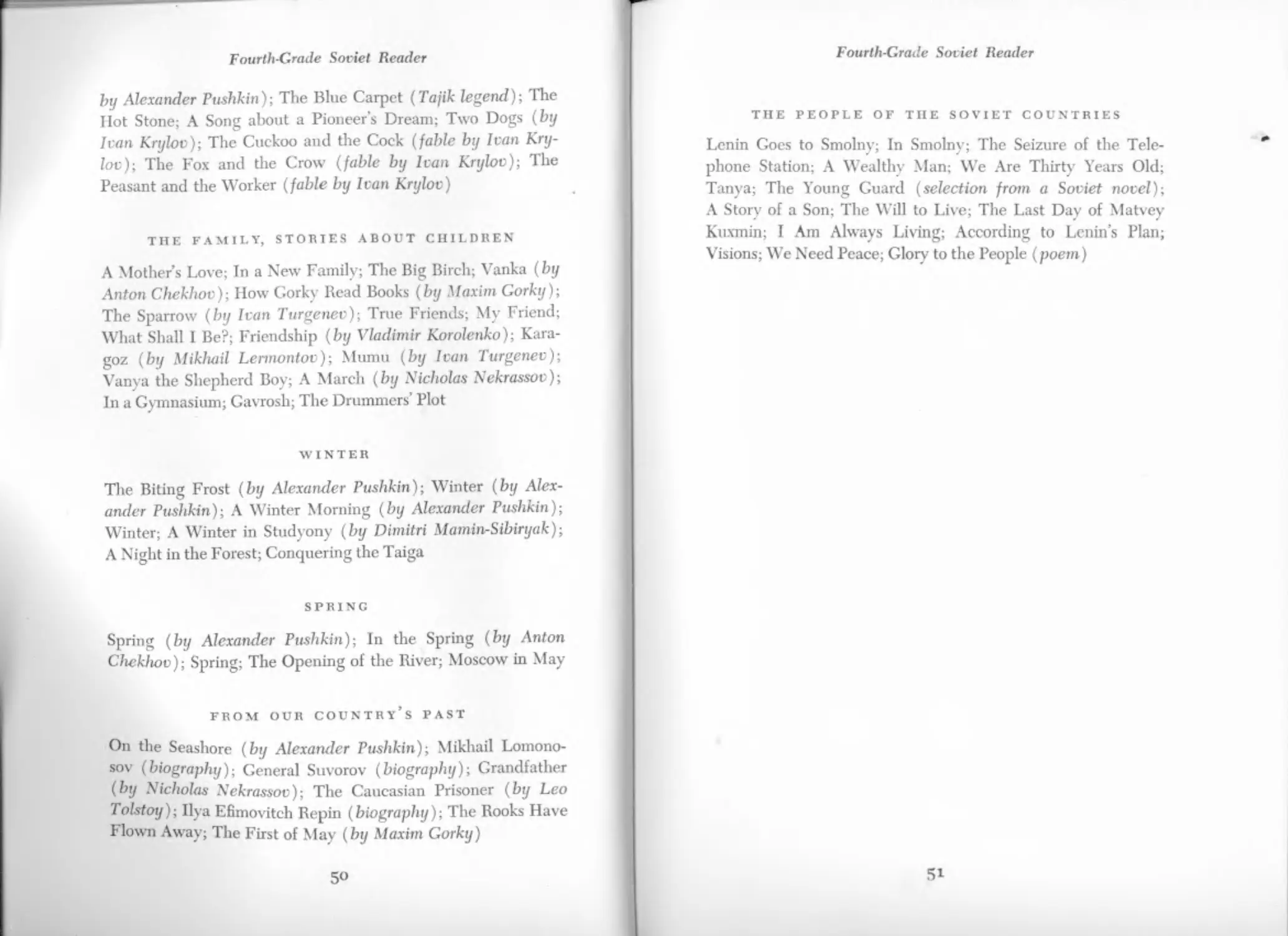


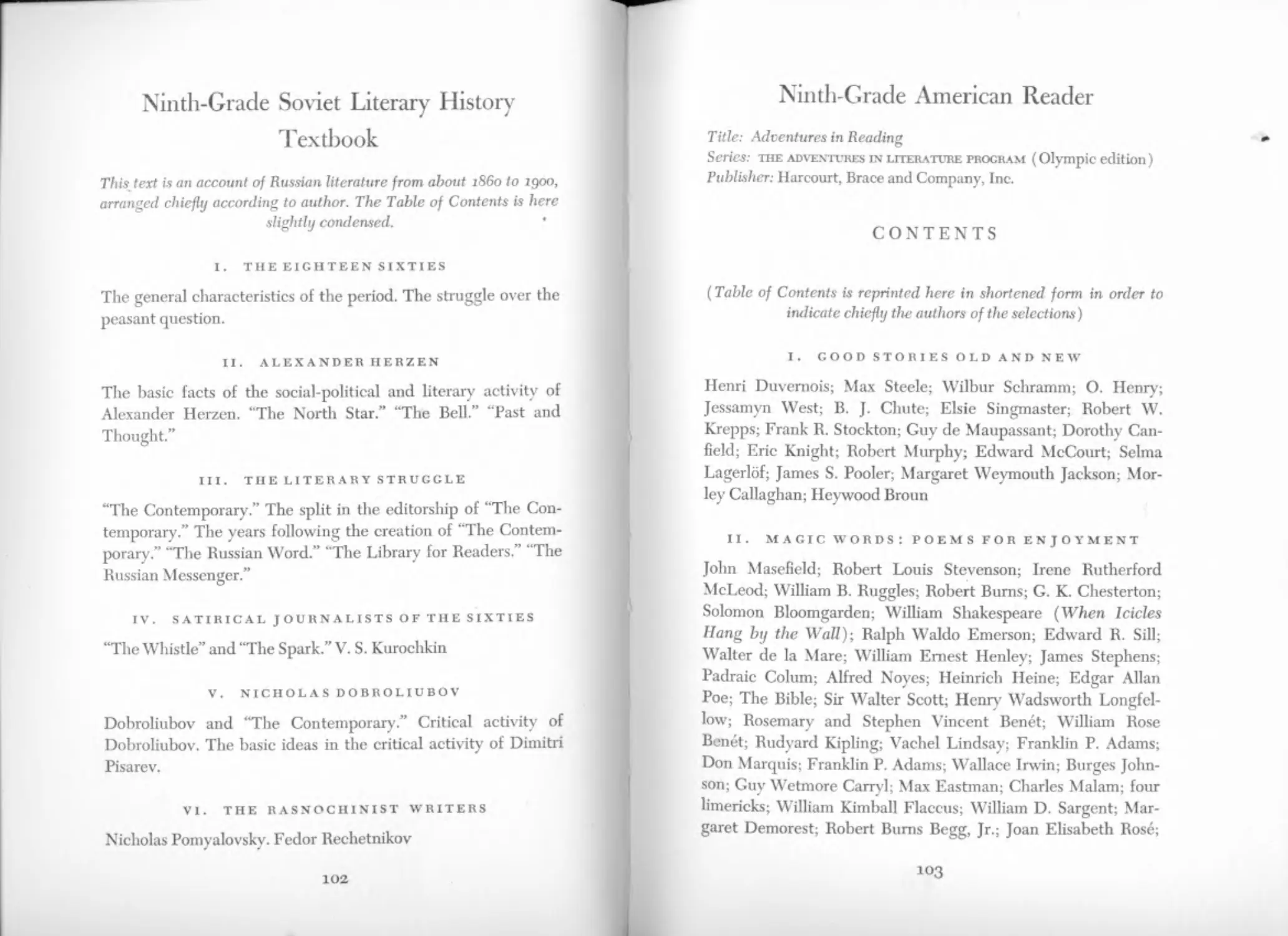
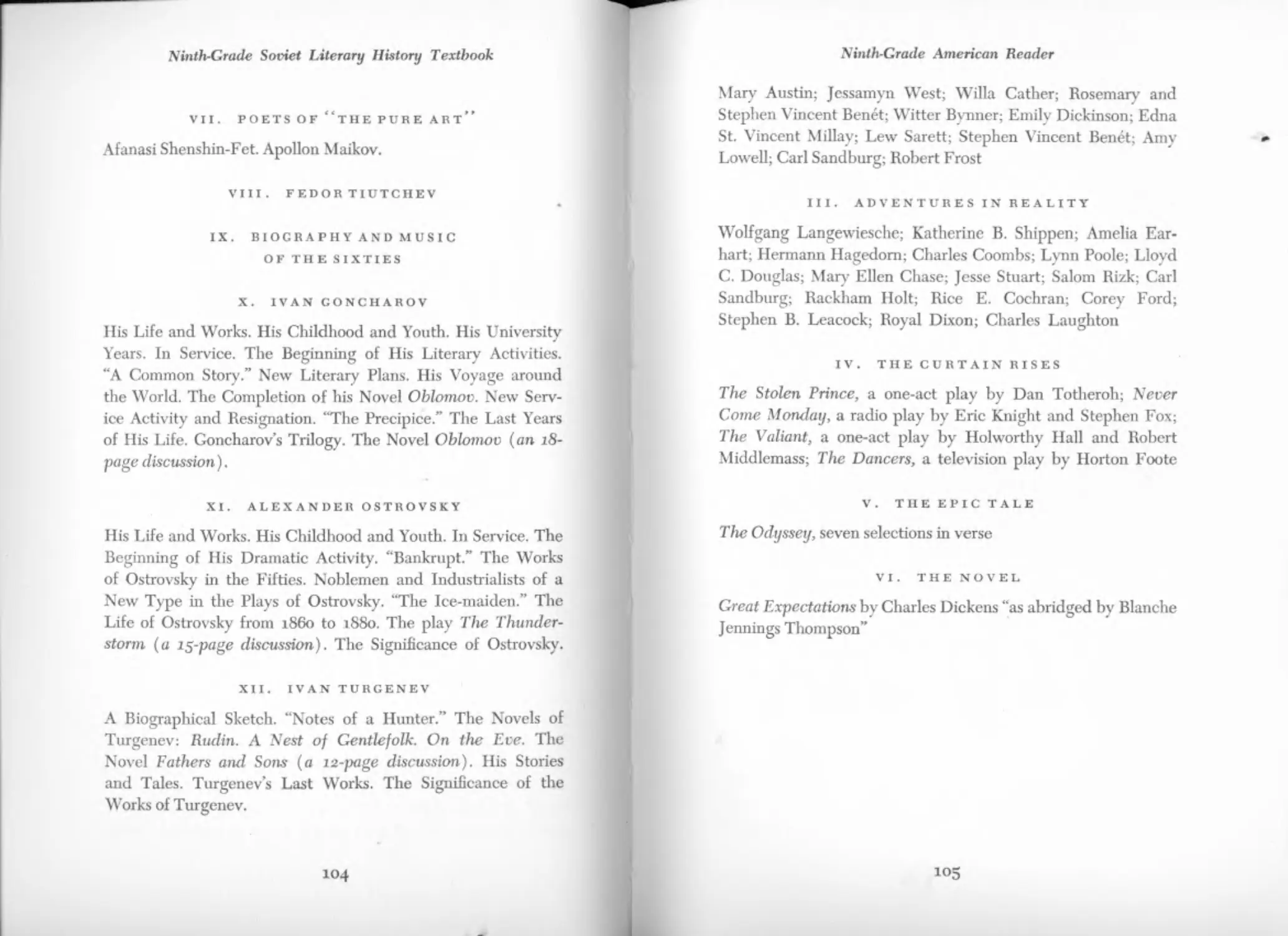
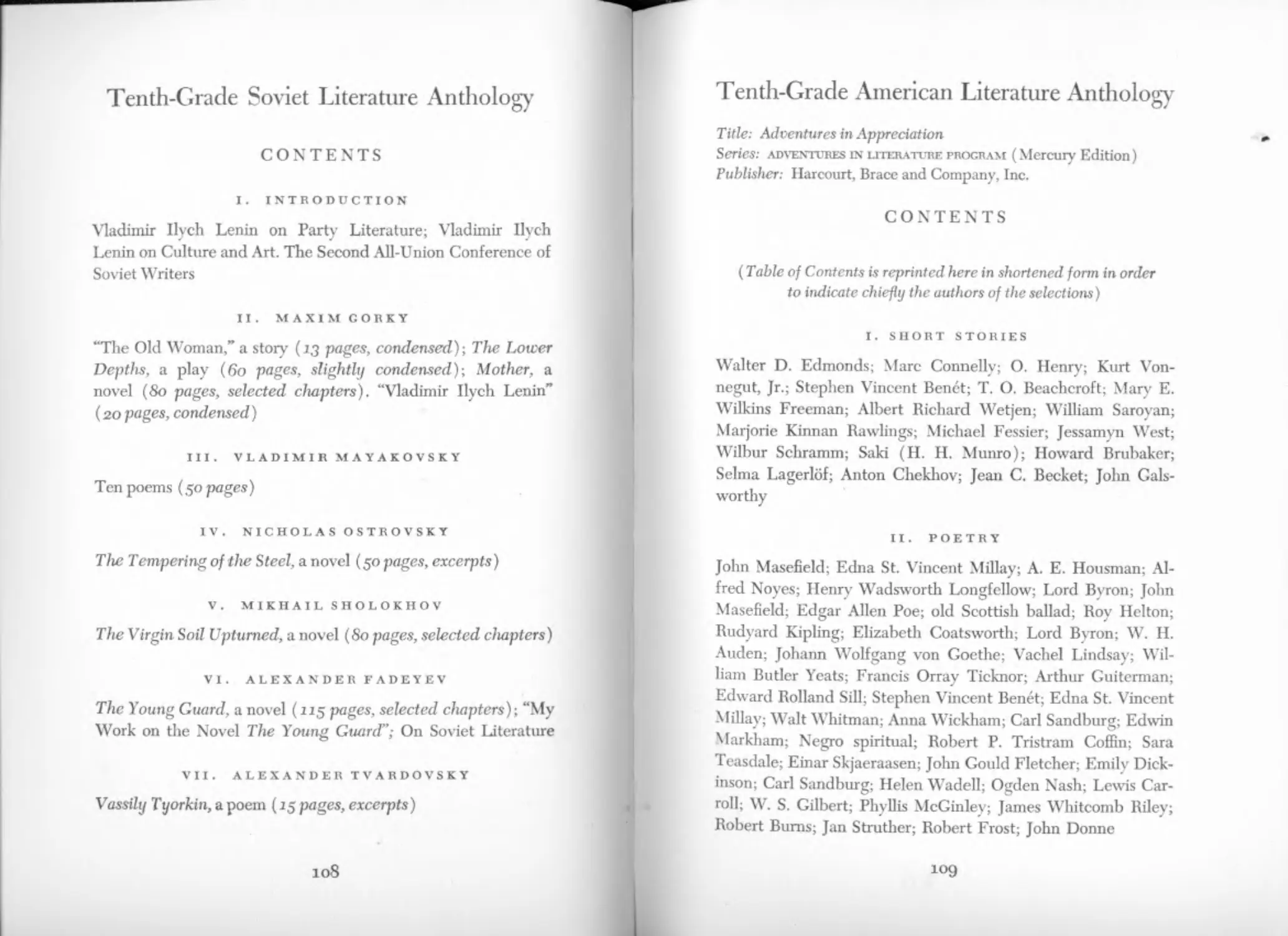
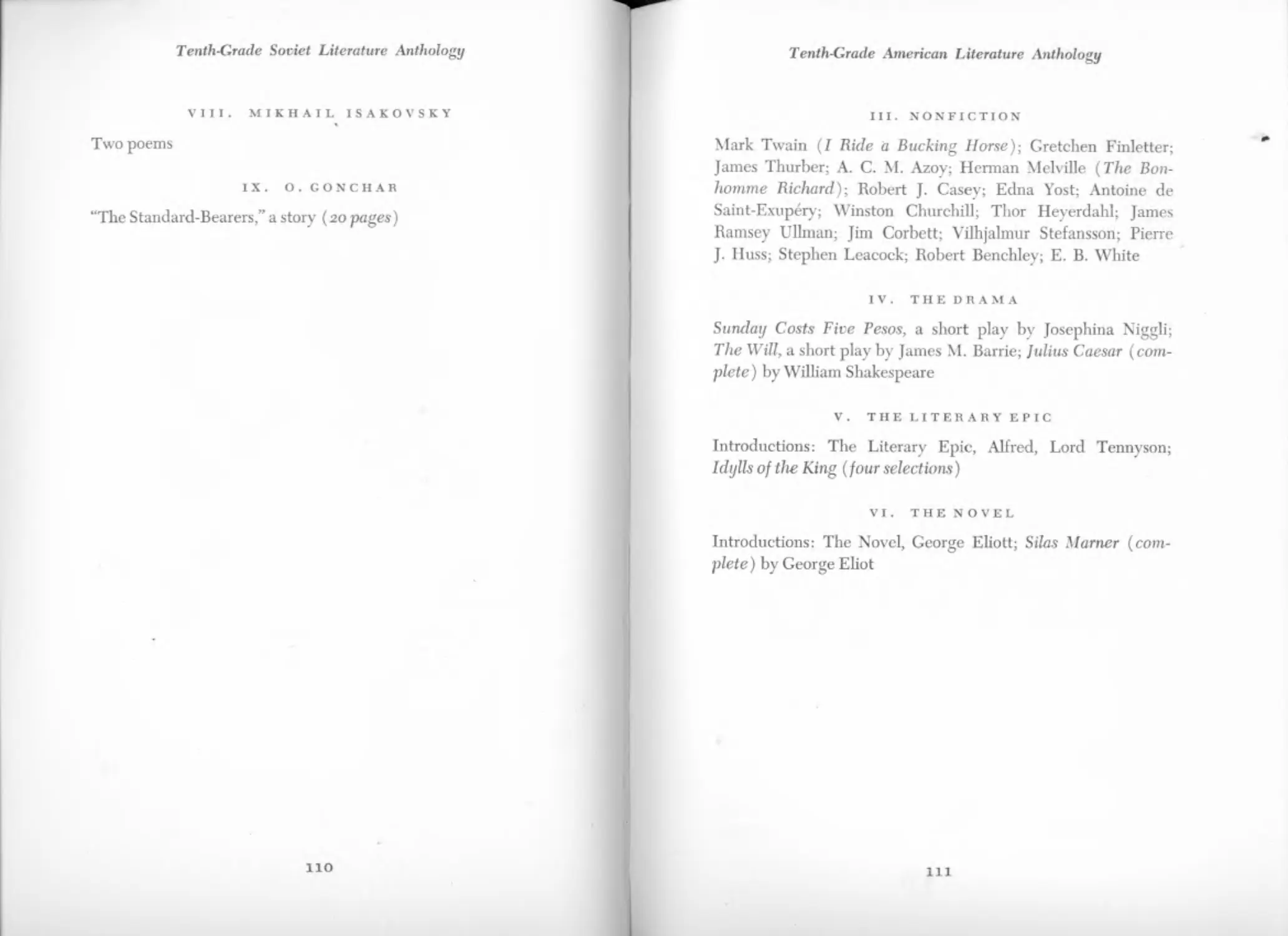





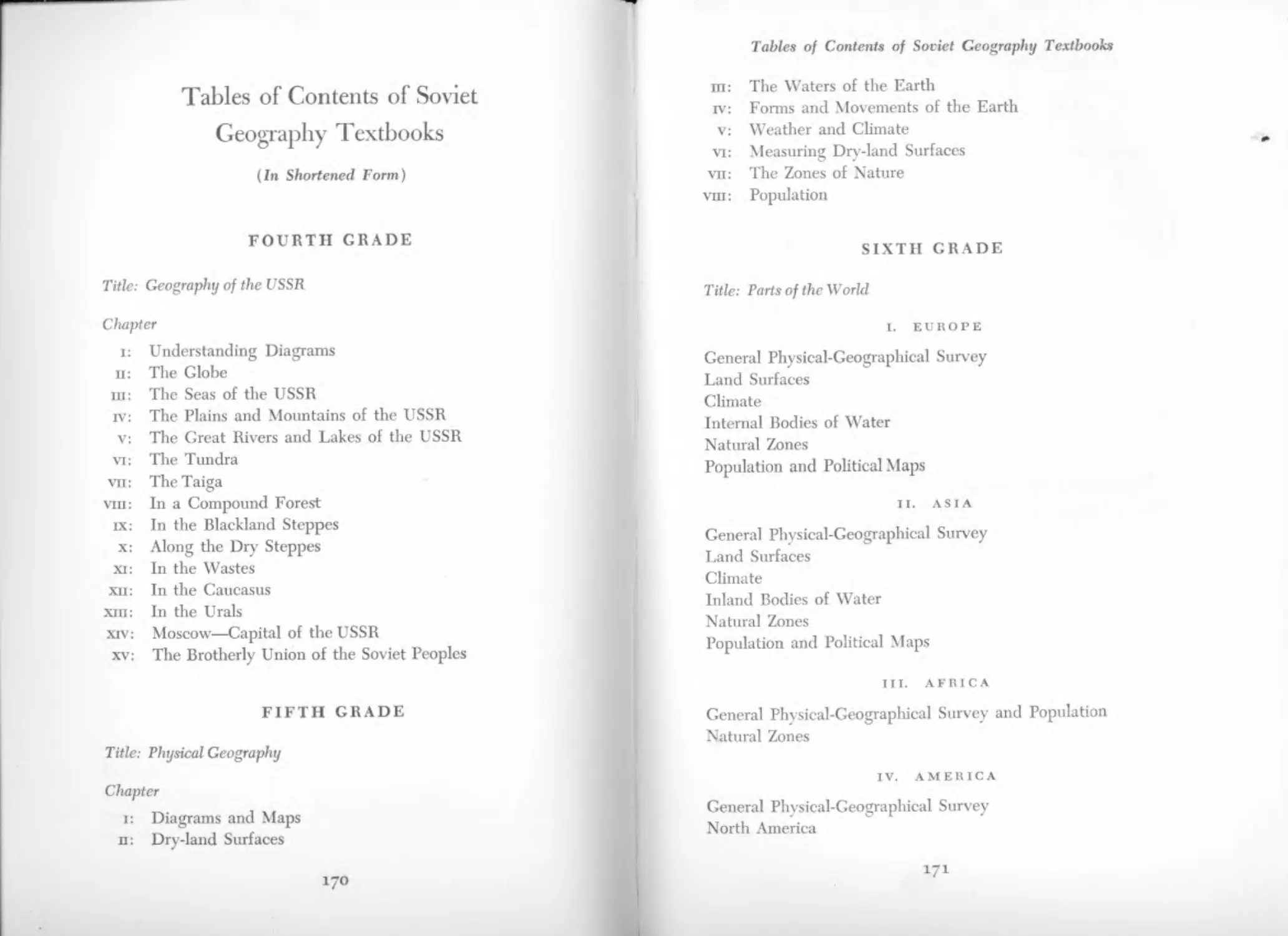
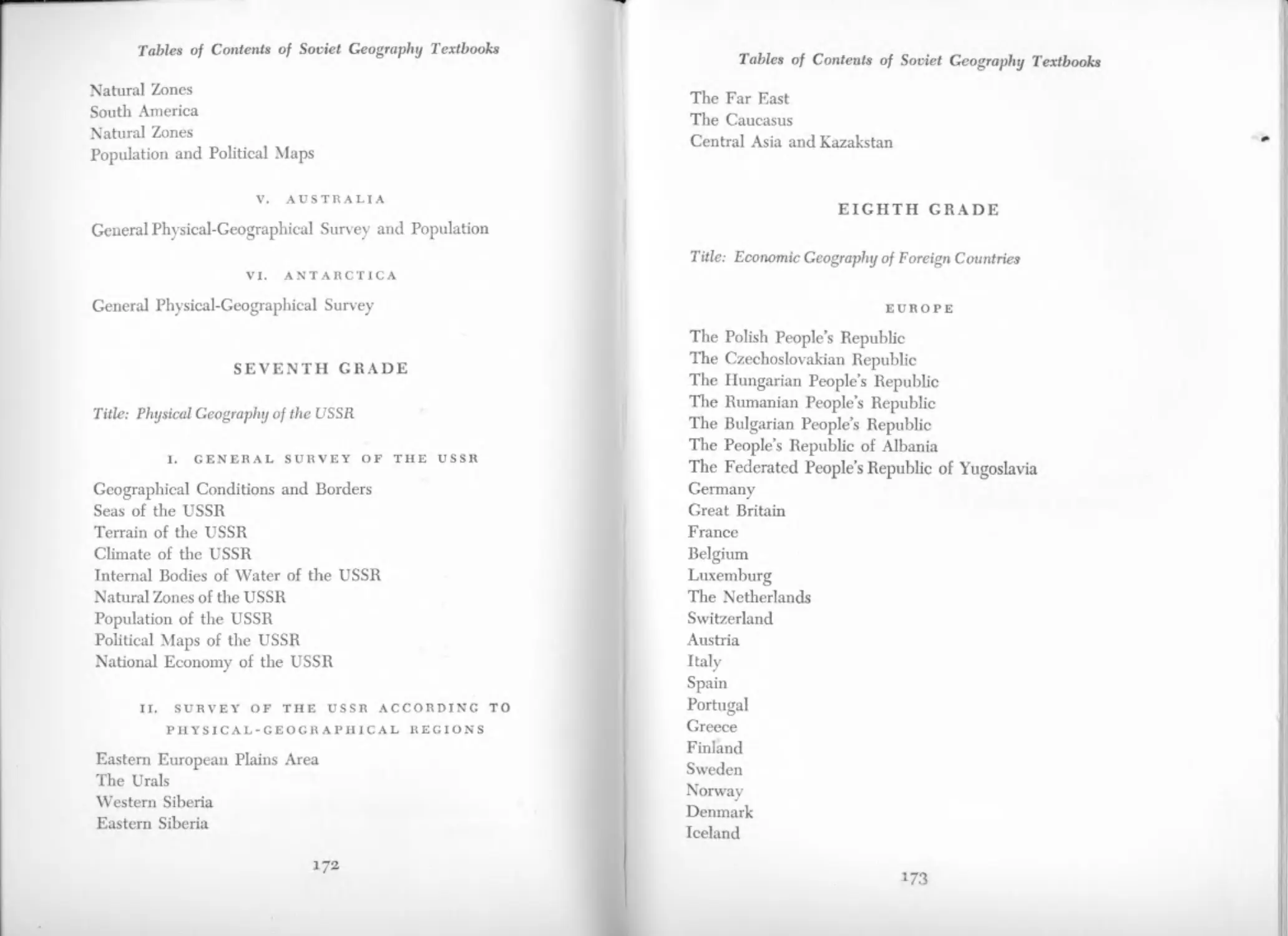
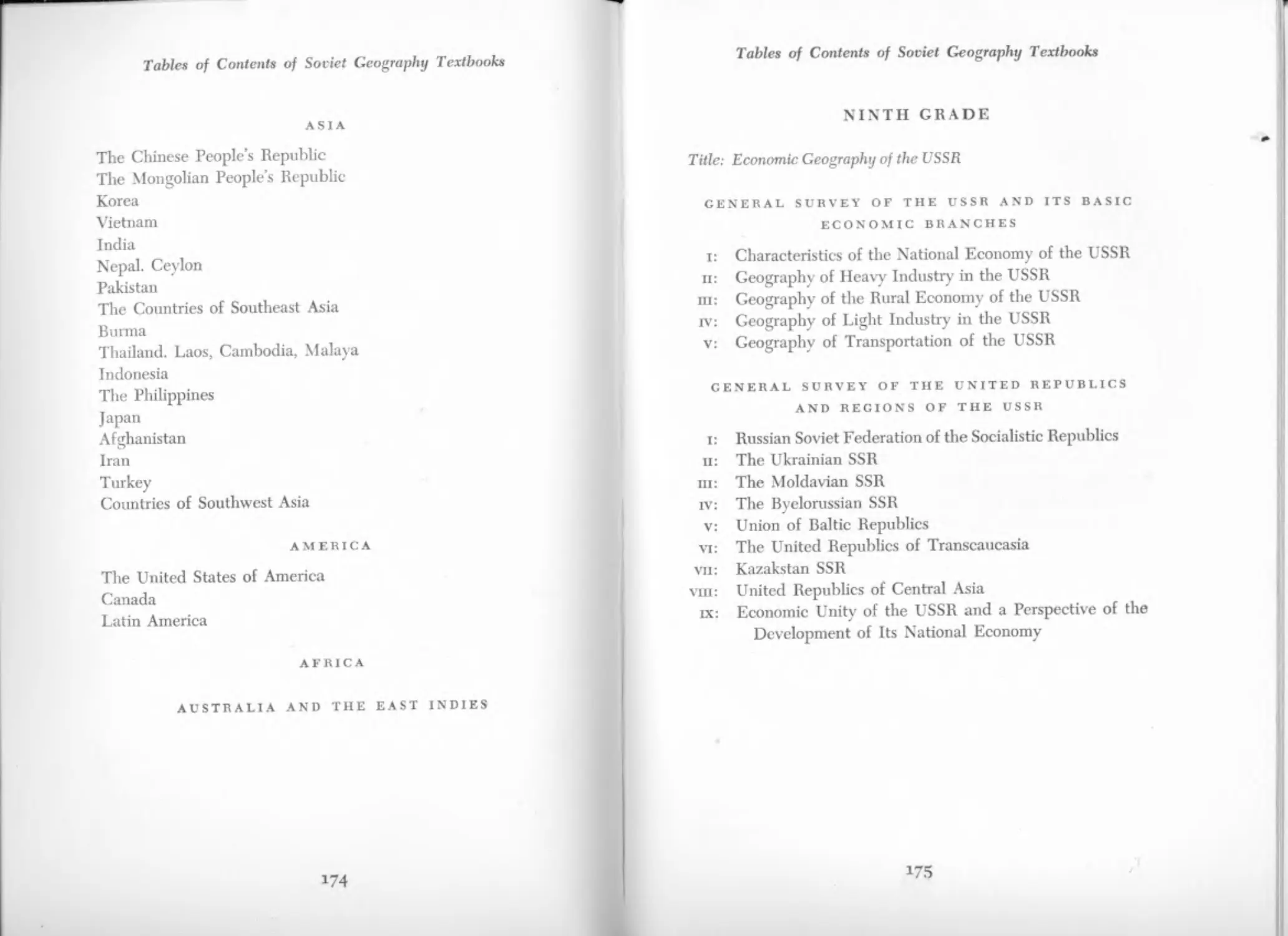
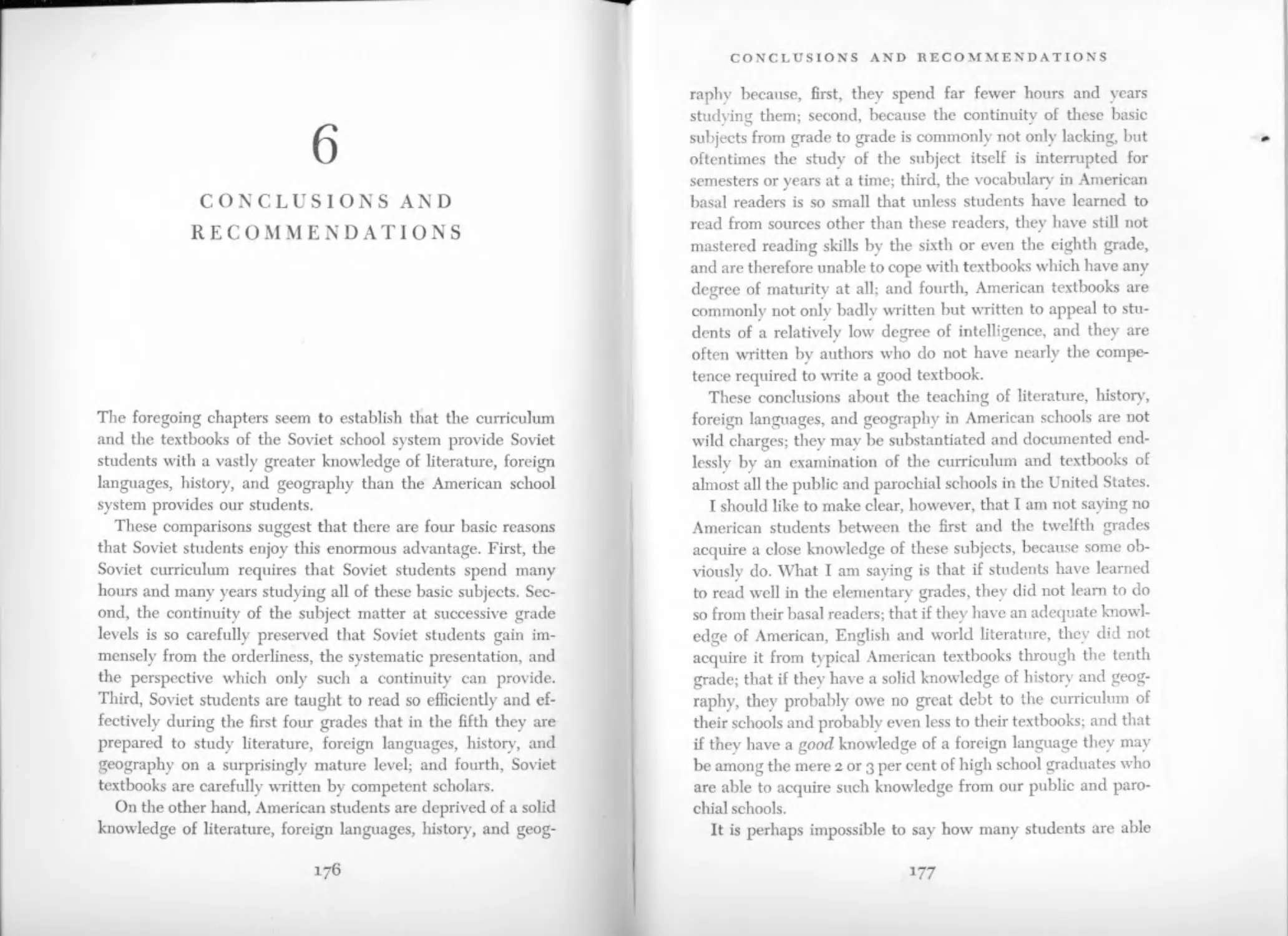


Text
What Ivan Knows That Johnny Doesn’t

What Ivan Knows
That Johnny
Doesn’t
ARTHER S. TRACE, JR.
Random House : New York
FIRST PRINTING
© Copyright. 1961, by Arther S. Trace, Jr.
All rights reserved under International and Pan-American Copyright
Conventions. Published in New York by Random House, Inc.,' and
simultaneously in Toronto, Canada, by Random House of Canada, Limited
Library of Congress Catalog Card Number: 61—14894
Manufactured in the United States of America by H. Wolff, New York
ACKNOWLEDGMENTS
The author wishes to thank the following for permission to re-
print material included in this book:
American Book Company—for selection on pages 31 and 33, from Open Win-
dows, the first-grade volume of the Golden Rule Series in The Modem
McGuffey Readers, by Ullin W. Leavell, Mary Louise Frieblc, Trade Cush-
man, and Alex M. Caughran.
Bobbs-Merrill Company, Inc.—for selection on page 21, from Our Happy Ways,
by William H. Burton, Clara Belle Baker, and Grace K. Kemp, Copyright
© 1950. 1959-
Follett Publishing Company—for selection on pages 161-162, from Friends Near
and Far, by J. G. Meyer, Frank E. Sorenson, and Alta McIntire, Copyright
1949;—for selection pages 164-166, from Exploring the Old World, by
Stuart Hamer, Orlando W. Stephenson, Ralph Sandlin Yohe, Ben F. Ahl-
schwede, Dwight W. Follett, and Herbert H. Gross, Copyright © 1955,
1957-
Ginn and Company—for selection on pages 43 and 43, from This Is Our Valley,
the third-grade reader in the Faith and Freedom Series, by Sister Mary
Marguerite and others;—for selection on pages 91, 93, and 95, from Door-
ways to Discovery, the seventh-grade reader in the Ginn Basic Readers
scries, by David H. Russell, Mabel Snedaker, and Doris Gates.
Harcourt, Brace & World, Inc.—for selection on pages 97, 99, and 101, from the
Olympic Edition of Adventures for Readers, edited by Egbert W. Nieman
and Elizabeth C. O’Daly;—for selection on pages 103 and 105, from the
Olympic Edition of Adventures in Reading, edited by Evan Lodge and
Marjorie Braymer;—for selection on pages 109 and ill, from the Mercury
Edition of Adventures in Appreciation, edited by Luella B. Cook, Walter
Loban, and Susanna Baxter.
Holt, Rinehart and Winston, Inc.—for selection on pages 37 and 39, from Peo-
ple on Parade, by Russell C. Stauffer, Alvina T. Burrows, and Evelyn R.
Spencer, The John C. Winston Company, a division of Holt, Rinehart and
Winston, Inc., © i960;—for selection on page 137, from Story of Nations,
by Rogers, Adams, and Brown, © i960.
Houghton Mifflin Company—for selection on pages 85, 87 and 89, from Bright
Peaks, the sixth-grade reader in the Reading for Meaning scries, by Paul
McKee, Annie McCowen, M. L. Harrison, and Elizabeth Lehr, Copyright
© >957-
Tl»e Macmillan Company—for selection on page 28, from The World I Know
(Teacher’s Manual), the fifth-grade book in The Macmillan Readers series,
by Arthur I. Gates and Celeste Comcgys Peardon, Copyright 1951;—for
selection on pages 79 and 81, from A World to Enjoy, the fifth-grade reader
in The Macmillan Readers series, by Arthur I. Gates and Celeste Comcgys
Peardon, Copyright 1953;—for selection on page 139, from Living To-
gether in the Old World, the sixth-grade book in The Macmillan Social
Studies series, by Prudence Cutright, Walter Lefferts, Harry H. Shapiro,
and Israel Soifer, © 1958.
Acknotcledgm en ts
Row, Peterson and Company—for selection on pages 21-22, from Day In and
Day Out, the basic primer of The Alice and Jerry Basic Reading Program,
by Mabel O'Donnell and others:—for selection on page 49, from Singing
Wheels, the fourth-grade reader in The Alice and Jerry Basic Reading
Program, by Mabel O’Donnell and others.
Contents
INTRODUCTION, 3
I:	READERS AND THE TEACHING OF READING IN SOVIET
AND AMERICAN SCHOOLS, 9
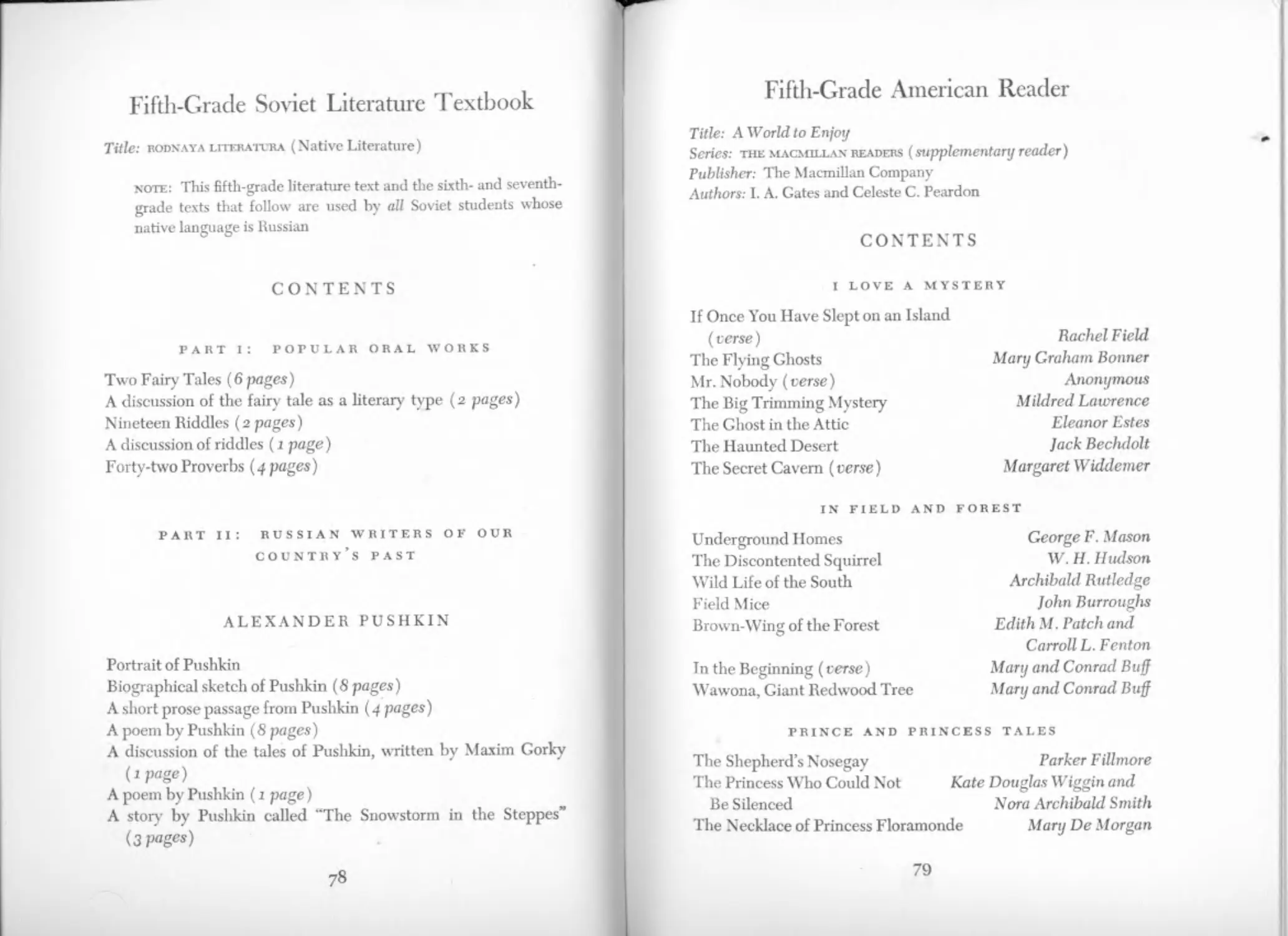
Tables of Contents of Soviet and Typical American
Readers, 30
II:	LITERATURE IN SOVIET AND AMERICAN SCHOOLS, 52
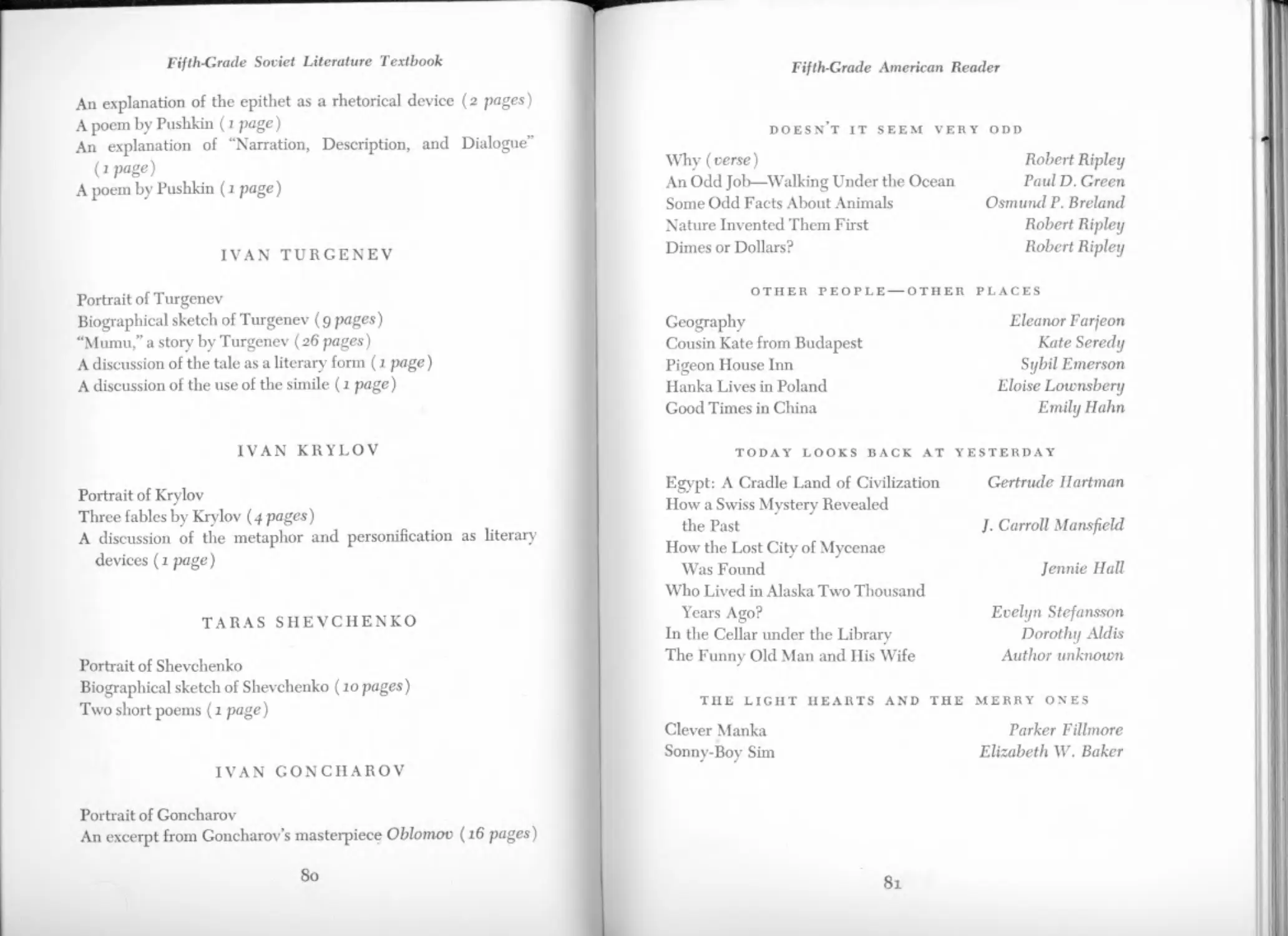
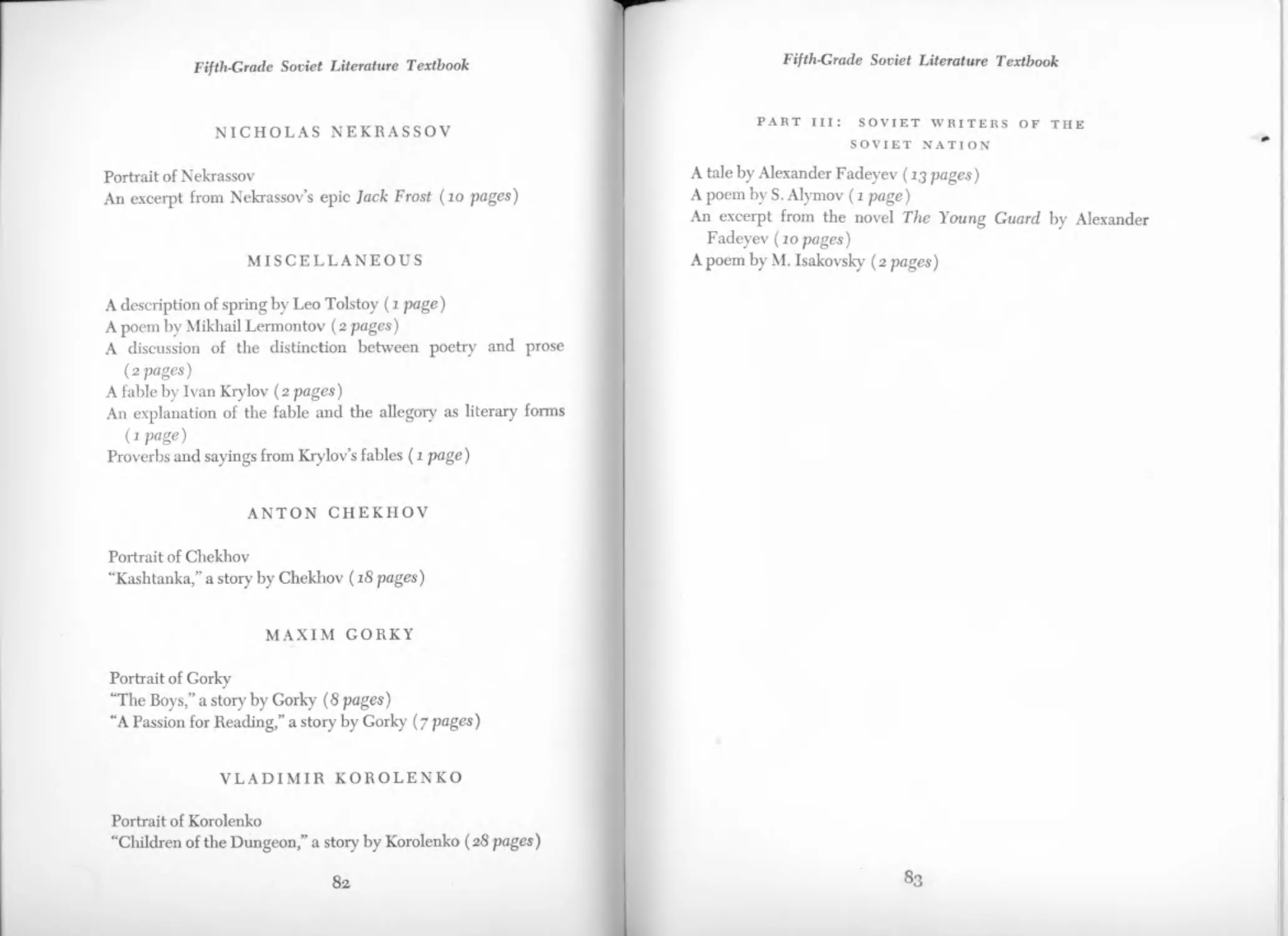
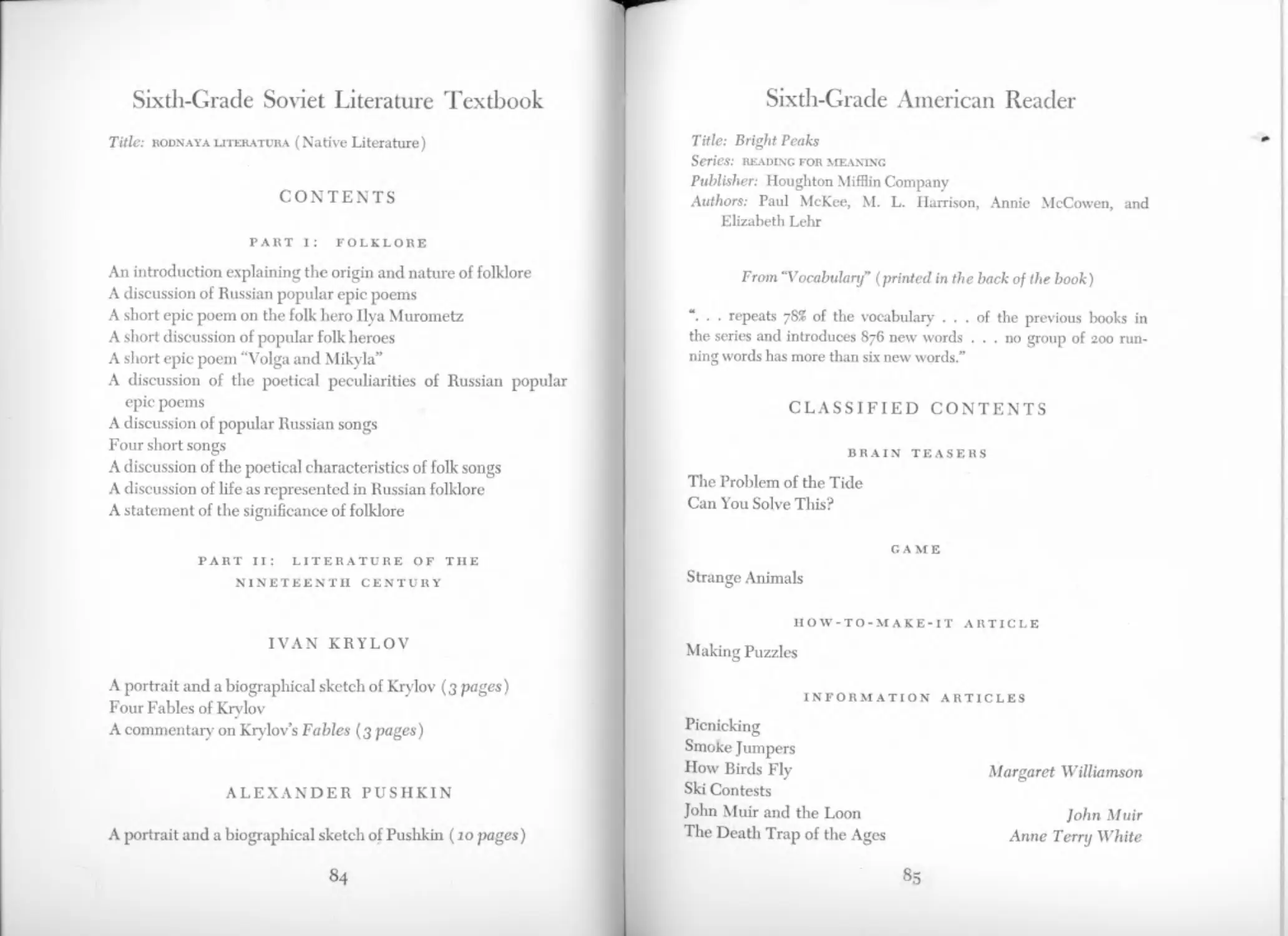
Tables of Contents of Soviet and Typical American
Literature Textbooks, 78
III:	FOREIGN LANGUAGES IN SOVIET AND
AMERICAN SCHOOLS, 111
IV:	HISTORY IN SOVIET AND AMERICAN SCHOOLS, 126
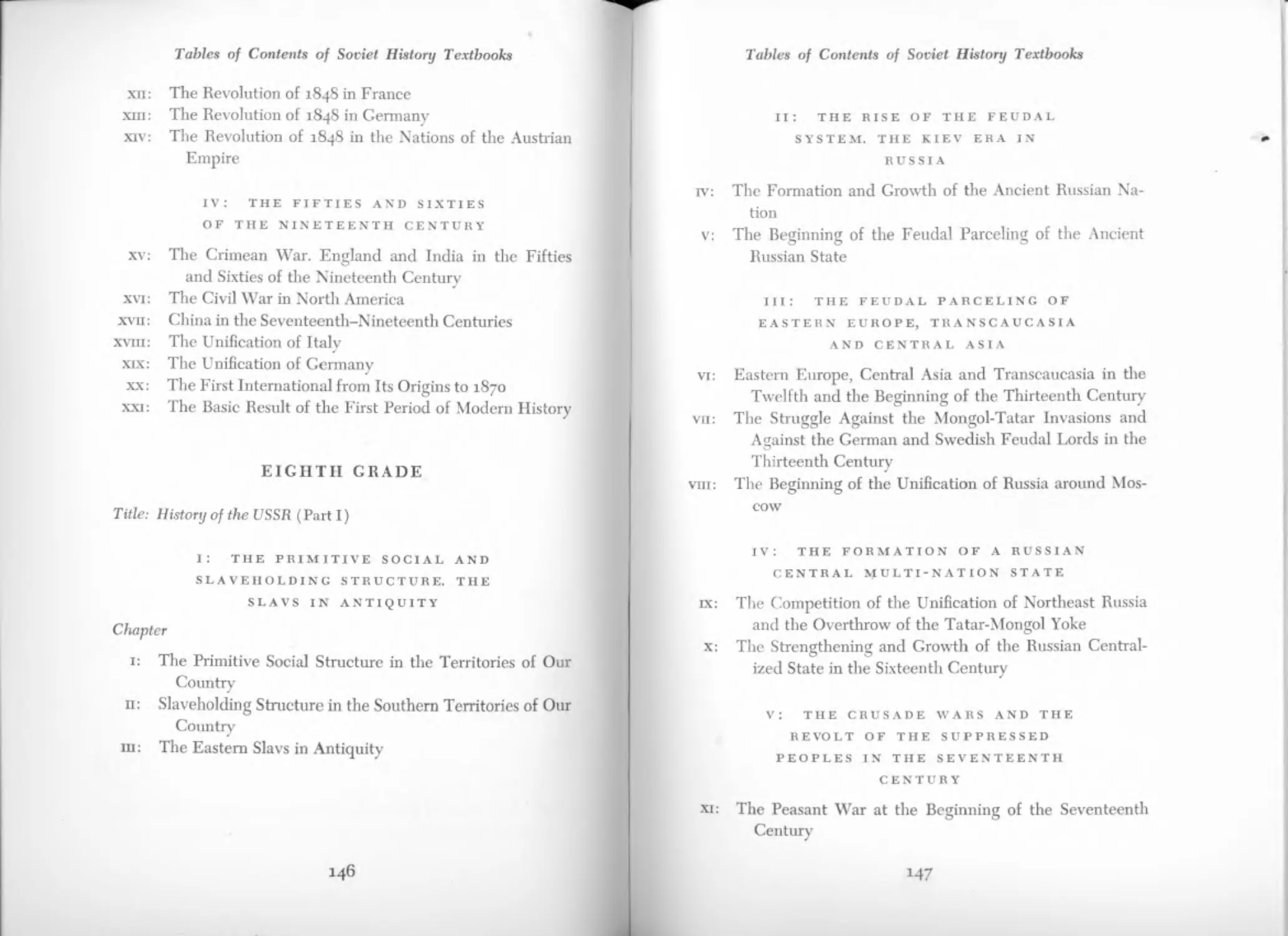
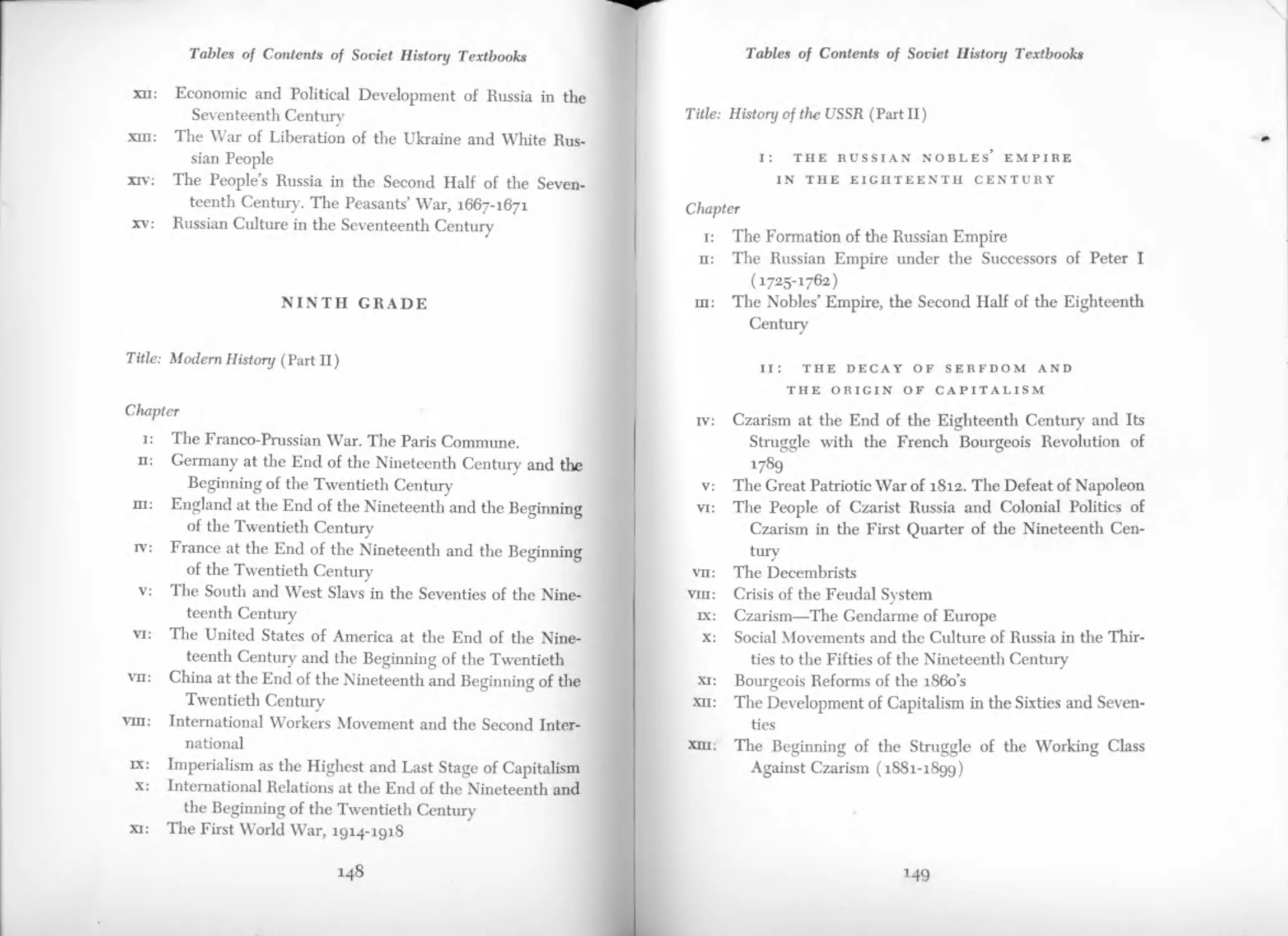
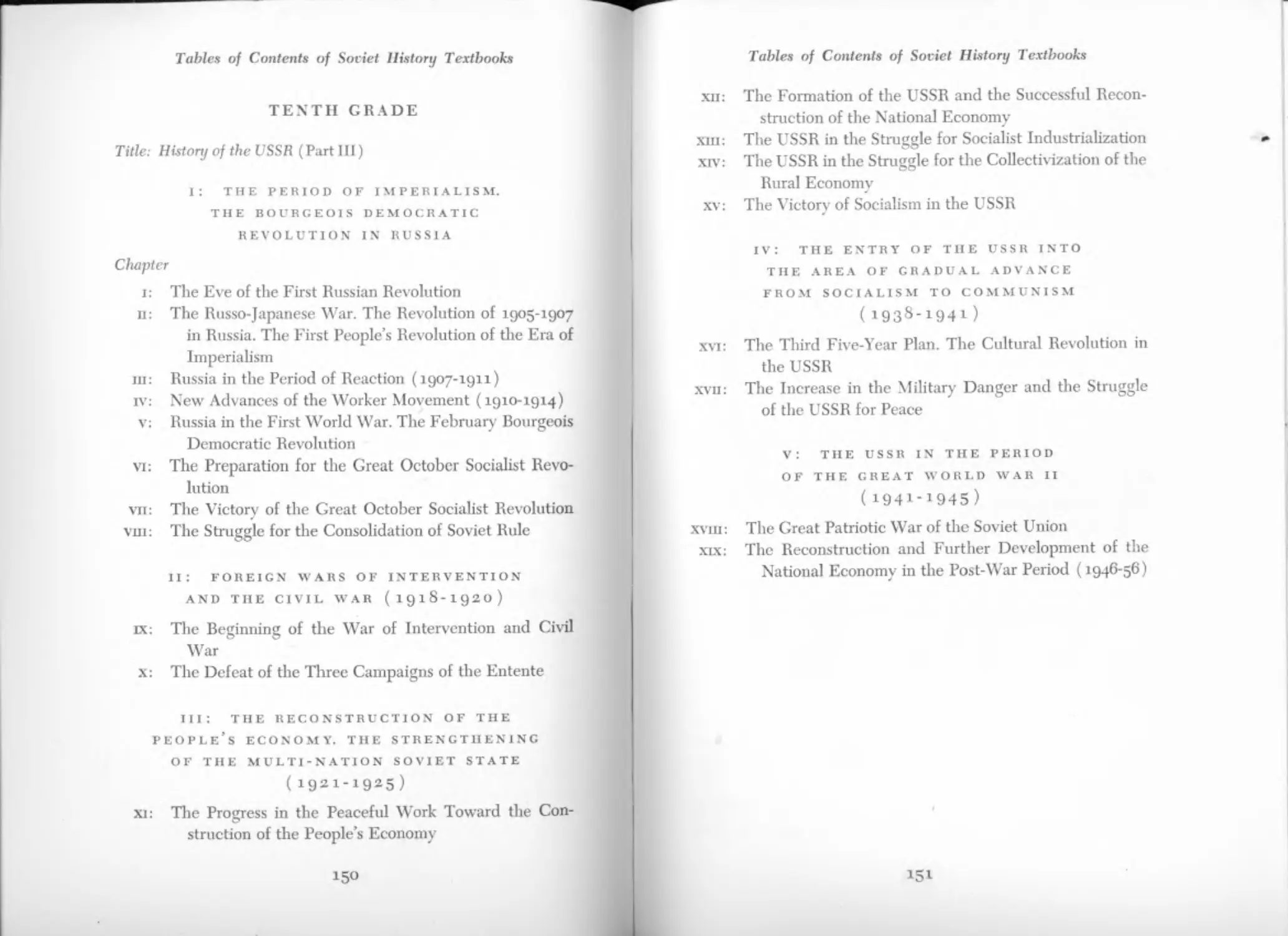
Tables of Contents of Soviet History Textbooks, 142
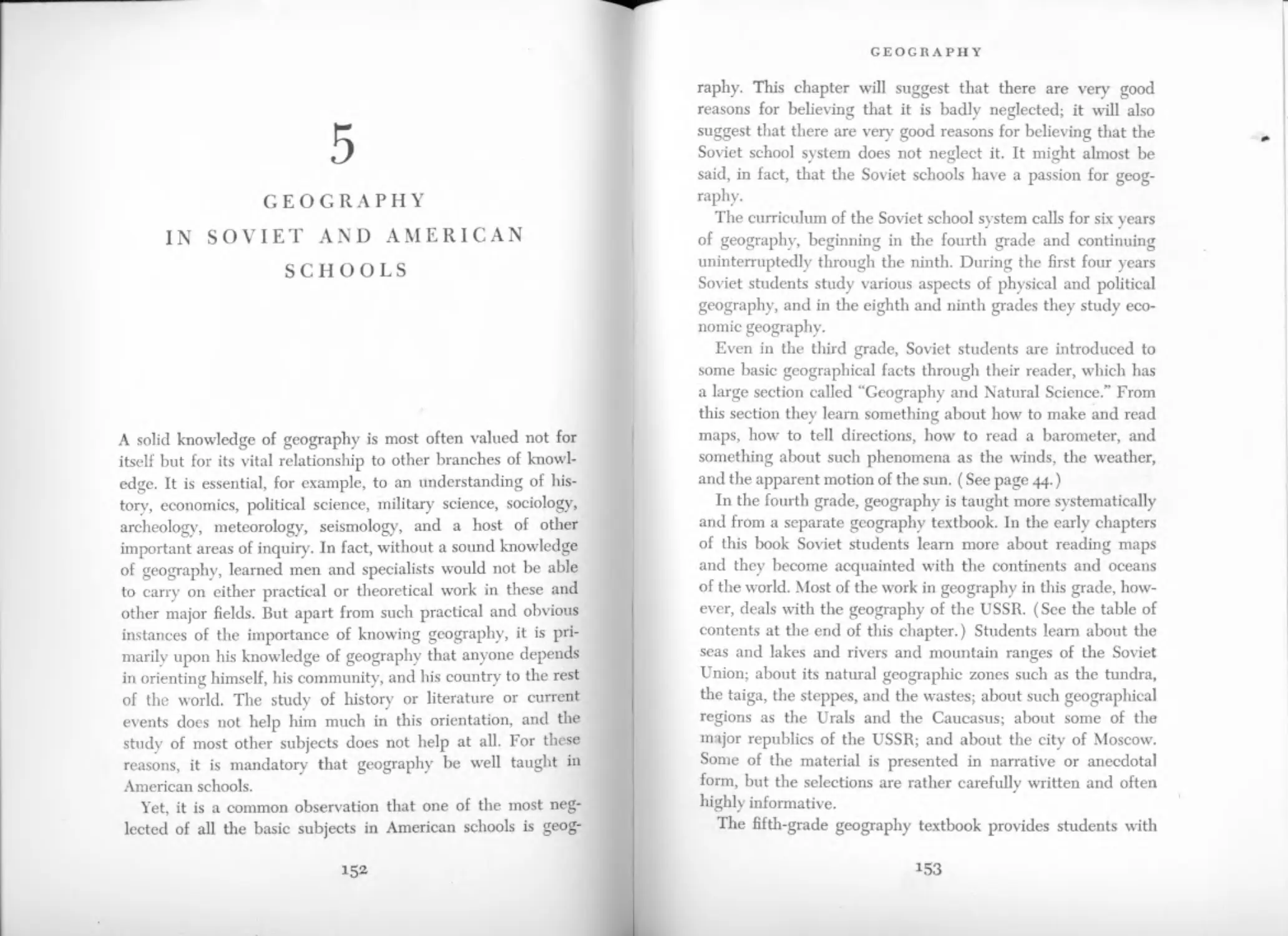
V:	GEOGRAPHY IN SOVIET AND AMERICAN SCHOOLS, 152
Tables of Contents of Soviet Geography Textbooks, 170
VI:	CONCLUSIONS AND RECOMMENDATIONS, 176
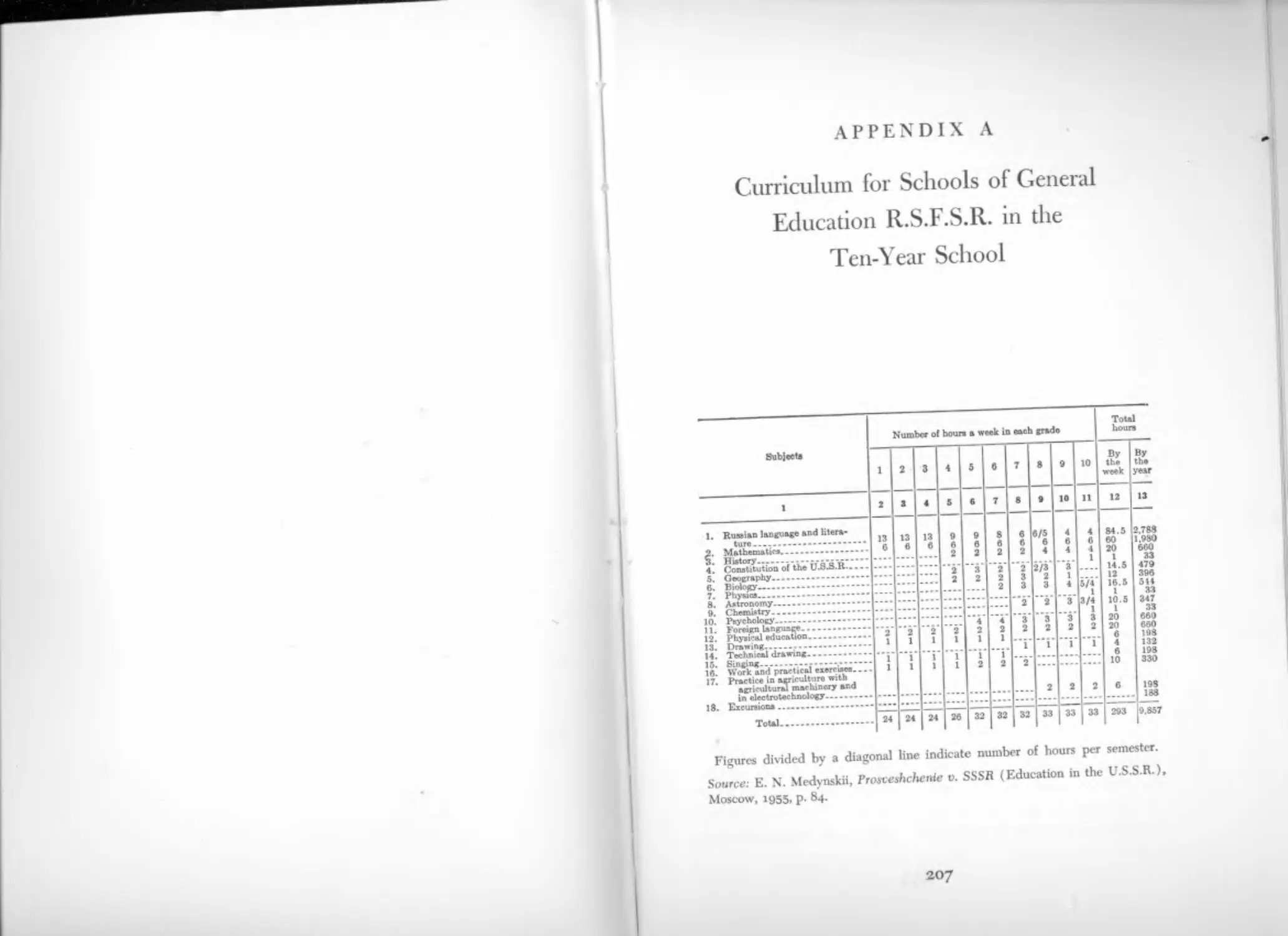
Appendix A:	The Soviet Curriculum in the
10-Year School, 207
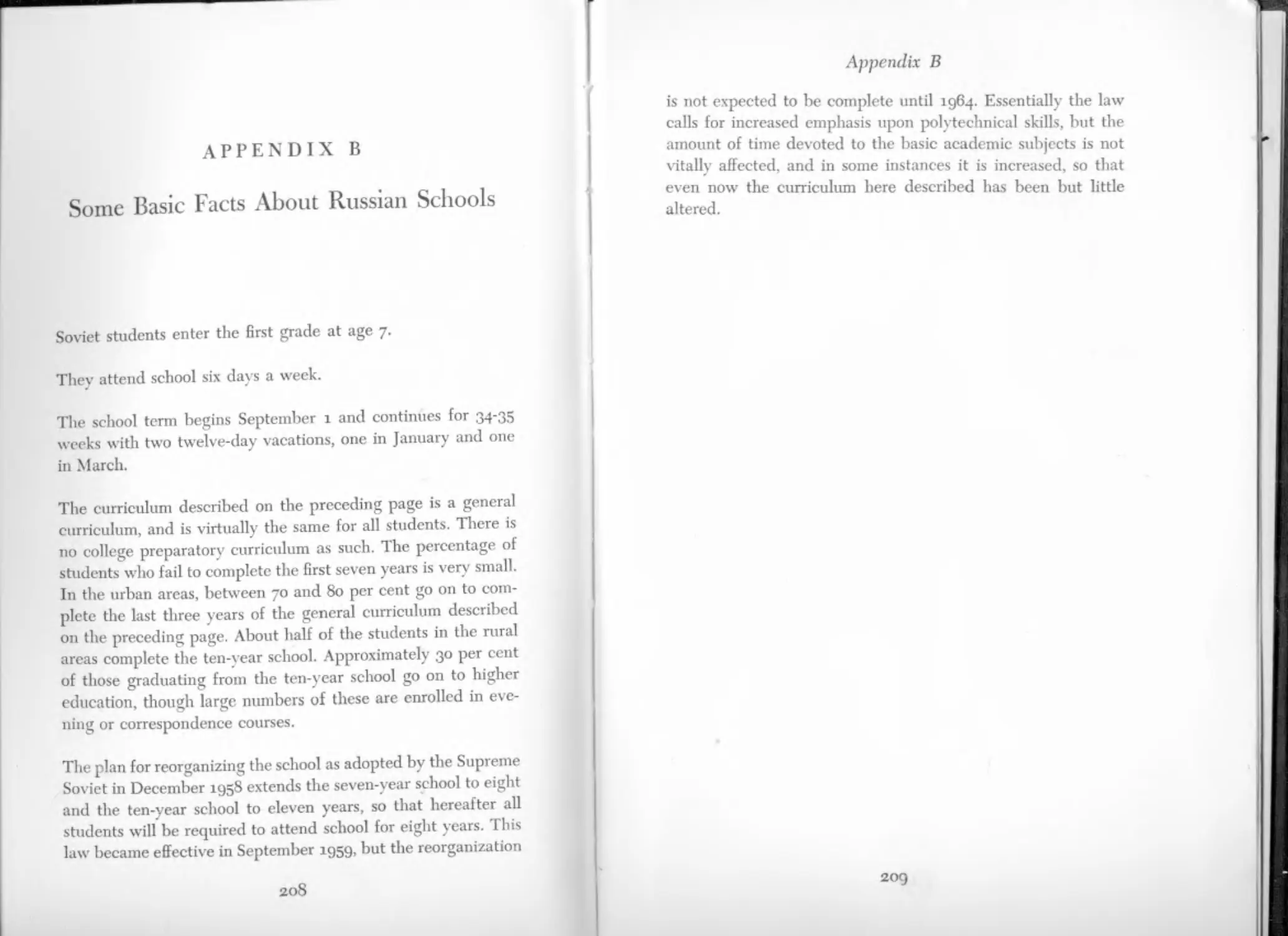
Appendix В:	Some Basic Facts about Soviet Schools, 208
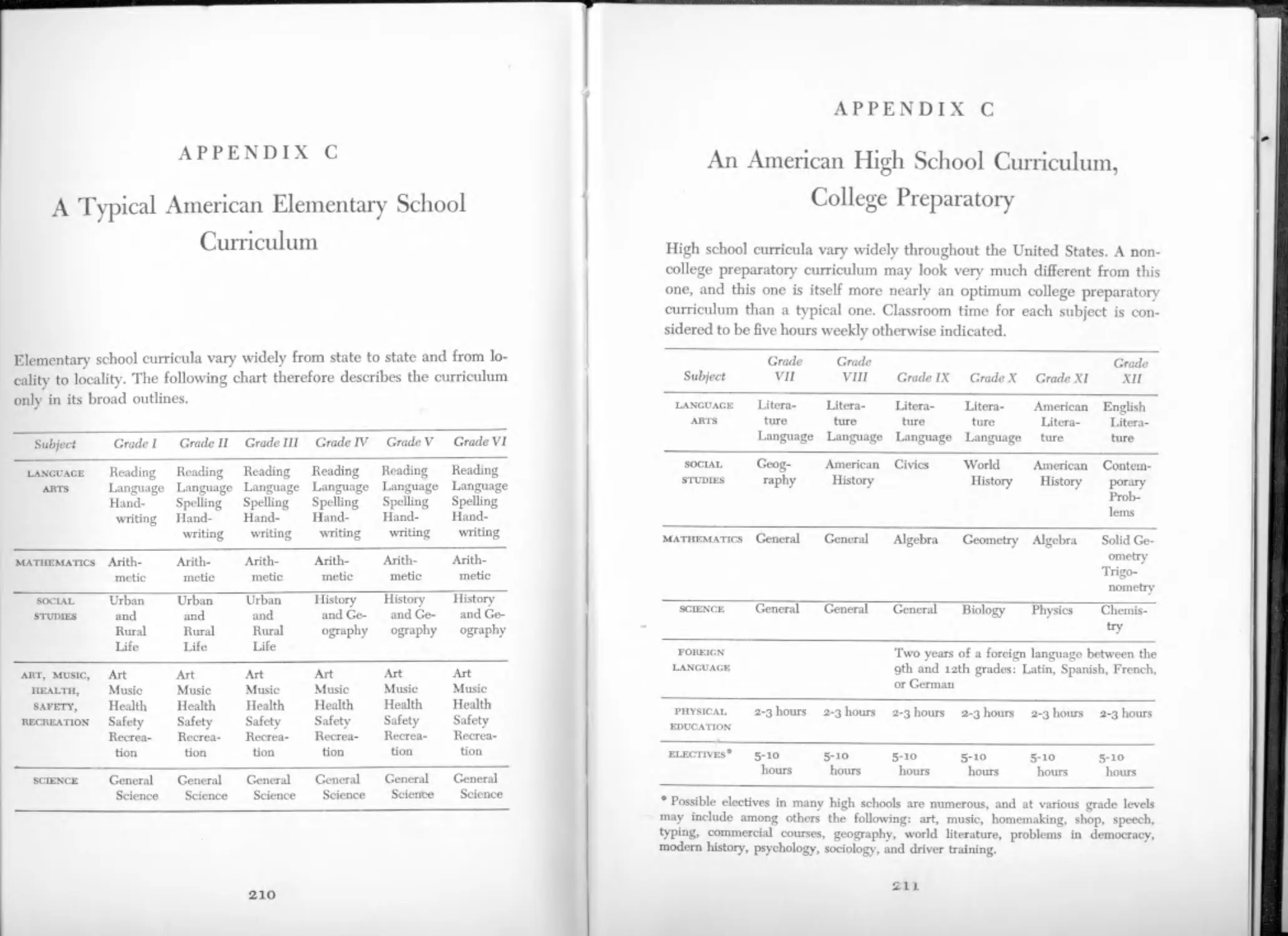
Appendix C:	A Typical American Elementary and
High School Curriculum, 210
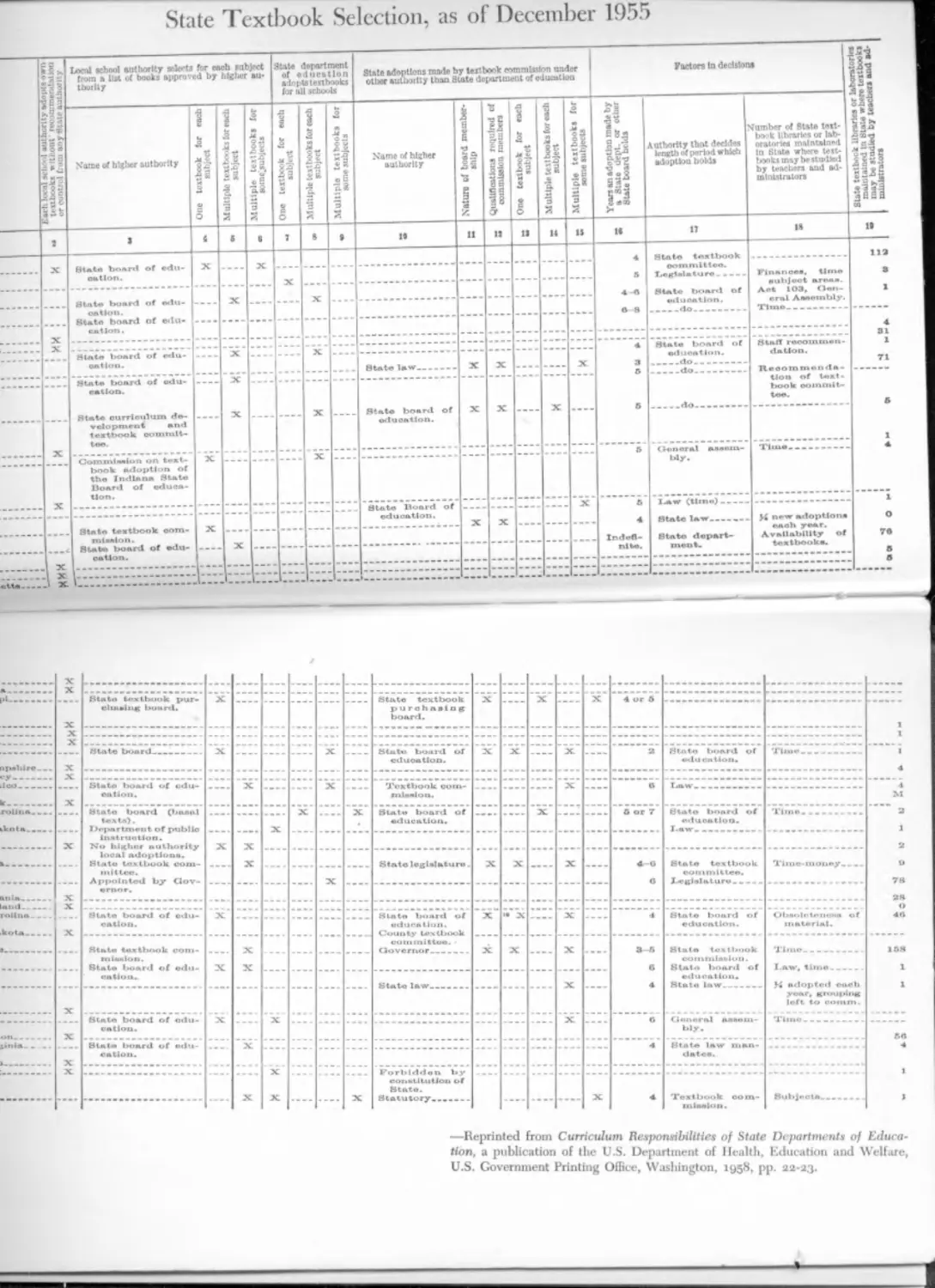
Appendix D:	State Textbook Selection, 212
What Ivan Knows That Johnny Doesn’t

INTRODUCTION
The challenge of Soviet technology in recent years has
prompted many comparisons between the American and
Soviet school systems. These studies originate from the grow-
ing realization that intellectual strength is one of the chief
means by which the free world will check and defeat com-
munism or by which communism will check and defeat the
free world.
The concern of most of the recent comparative studies of
American and Soviet schools has been to show that American
schools arc lagging woefully behind Soviet schools in the teach-
ing of mathematics and the sciences. These studies have em-
phasized that whereas all Russian students who graduate from
high school* have studied physics for five years, chemistry for
four years, biology for six years, and astronomy for one year,
only some American high school graduates have studied bi-
ology or physics or chemistry for one year. Hardly any have
studied one of these subjects for more than a year, and very few
have studied all three. Similarly, in the teaching of mathe-
matics, American schools regularly lag two years lx*hind Soviet
* Sec Appendix B.
3
What Ivan Knows That Johnny Doesn’t
schools, and a close look at the mathematics program of both
school systems will show that in some places the lag is nearer
three or even four years.
In view of the tremendous importance of education in the
struggle between communism and the free world, this vast dis-
parity between Soviet and American schools in the teaching of
mathematics and the basic sciences is more than a little terrify-
ing. Educators and school administrators readily admit, as they
must, that this great disparity exists. Some efforts have been
made to strengthen the science and mathematics programs, but
the results thus far are inconclusive.
But American educators and hymen alike tend to take con-
siderable comfort in the belief that in the American schools
at least the other basic subjects, the subjects commonly re-
ferred to as the humanities—chiefly, literature and history—
and the subjects closely related to the humanities, are in a
thriving condition, whereas in the Soviet Union, so they think,
the humanities run counter to Communist interests and are
therefore suppressed in the Soviet schools. This book proposes
to present some evidence which it is hoped will pretty thor-
oughly shatter that illusion. It proposes to show that the Amer-
ican system of education, especially at the elementary and the
junior high school levels, is so far from being a bastion of the
humanities that the humanities are, in fact, shamefully and
dangerously neglected. Furthermore, it proposes to show that
Soviet education, even though it uses the humanities and the
subjects directly related to the humanities for the indoctrina-
tion of communism, affords its students vastly more thorough
training in these subjects than American schools afford our
students.
It is, of course, easier to generalize about Soviet schools than
about American schools, because Soviet education is central-
ized, and the curriculum, textbooks, and standards arc—with
few exceptions—uniform throughout the Soviet Union; whereas
in our country there is considerable variation in these respects
4
INTRODUCTION
from state to state and from community to community. None-
theless, it is possible to draw sound and important conclusions
about our school system as a whole by examining the textbooks
and the courses of study available to our students. I have not
been concerned with American private schools in this study,
however, because they educate only a small percentage of our
students and the course of study in them is usually quite differ-
ent from that of the other schools.
Anyone who wishes to determine the quality of the school
system of his own community, state, or country, or the school
system of any other country, may proceed in any of several
ways. He may take a tour of a school or of a number of schools,
examining the lighting and seating arrangements of the class-
rooms, the audio-visual aid equipment, the library facilities, the
gymnasium, and the hot-lunch program; or he may talk with
teachers and school administrators and collect statistics about
the number of students in the school, the size of the classes, the
financial condition of the school system, and the qualifications
of the teachers and the school administrators themselves. Or,
lacking the opportunity to get this information first-hand, he
may be content to form his impressions by reading written
accounts by those who have made such tours.
All this information will, of course, contribute something to
an understanding of how good or how bad a school system may
be. But such information can Ire misleading, not only because
it tends to be highly impressionistic but also because the school
with the newest building, the most spacious library, the most
modem gymnasium, the brightest classroom, the smallest
classes, the shiniest equipment, and the hottest lunch program
may still be a school in which very little learning is going on.
There is, in fact, a strong tendency in this country to measure
the quality of a school by examining the conditions under
which children learn rather than examining what they learn.
The fact is that none of this information can provide more
5
What Ivan Knows That Johnny Doesn't
than a fraction of what is needed to arrive at an accurate esti-
mate of the quality of education which a school provides. Bv
far the most important information to help determine the qual-
ity of education of any school or any school system is informa-
tion about its curriculum and its textbooks. The curriculum
reveals what subjects are studied, by whom, and for how long,
but a study of tire curriculum alone can also be misleading,
particularly regarding American schools. For as this book will
indicate, even though the curriculum at any given grade level
may call for literature or reading or history, the amount of lit-
erature, reading, or history that is actually taught may often be
slight indeed.
Wherever the curriculum is found to be satisfactory, there
still remains the vital problem of the quality of the textbooks,
for no one dares to underestimate the importance of textbooks
in the teaching of any of the basic subjects. In fact, in such
basic subjects as reading, literature, history, geography, and
mathematics, textbooks are perhaps the heart of the school
system, since even the best teacher is limited by the quality
of the texts. Audio-visual aids, class discussions, visiting lec-
turers, and the teacher’s own imparted knowledge and wisdom
all contribute in varying degrees to our children’s education in
these basic subjects, but nothing contributes so much as their
textbooks, for it is primarily textbooks which determine the
organization and presentation of the material and the thor-
oughness with which the basic subjects are studied. Further-
more, students discuss textbook material in class, they are
asked questions about it, they take tests on it, their homework
assignments arc usually based on it, and whatever else they do,
they are expected to master it.
A textbook is in fact a tyrant, because the teacher is fairly
well obliged to plan course work around it, particularly in
teaching the basic subjects. And since in the future even the
most ingenious teaching machines cannot be expected to re-
place textlwoks in the basic subjects, it is more than likely that
6
INTRODUCTION
the schools of the future, if they are to be good schools, will
still have to rely heavily upon textbooks at all educational
levels.
It will be evident, therefore, that if a student’s textbooks are
excellent he may be able to get an excellent education indeed
if he has good teachers and if he studies hard; but if his text-
books are poor, his education is bound to be correspondingly
poor no matter how excellent his teacher may be or how hard
he studies. It matters even less whether his school building has
the latest design, whether his classroom is spacious and well-
lighted, or whether his gymnasium is fully equipped.
In the following chapters 1 shall make some comparisons be-
tween Soviet and American elementary and high school educa-
tion in the areas of (i) reading, (2) literature, (3) foreign lan-
guages, (4) history, and (5) geography; and I shall base these
comparisons upon an examination of the textbooks used in both
school systems and upon an examination of the curricula.
These comparisons and the conclusions which necessarily
come from them may well shock those who have not been in
close touch with what has been going on in our schools during
the past thirty years. 1 wish to make perfectly clear, however,
that the aim of this book is not to recommend that American
schools imitate Soviet schools; in fact, the following chapters
will serve to point up some of the distortions of Soviet educa-
tion. Rather, the aim is to show that those basic subjects arc
ven poorly represented in the curriculum and textbooks of
American schools even when compared to the curriculum and
textbooks of the schools in a Communist country. How seri-
ously American schools neglect the humanities can be even
>nore readily demonstrated by a comparison between our cur-
riculum and textbooks and those of Western European schools;
but it seems vastly more significant to show that the curriculum
and textbooks of the schools of a country governed by a philos-
ophy which is commonly thought to suppress the humanities
7
What Ivan Knows That Johnny Doesn't
and to stress technological education, do in fact provide far
more thorough training in the humanities than the curriculum
and textbooks of American schools. In other words, this book
proposes to show that instruction in these basic subjects in
American schools is poor by any standards. This is not, then, a
book about Soviet schools; it is a book about American schools.
The intention of this book is not merely to lay bare some of
the serious deficiencies of our schools, but to insist upon the
importance of giving American students a thorough education
in the humanities, and to make concrete, and, it is hoped, prac-
tical proposals for a dramatic improvement in the quality of
American schools. These proposals are made not only so that
our schools can make a greater contribution to rolling back
the incursions of communism, but also so that the intellectual
resources of our children and of America may be greatly
strengthened for any eventuality.
Perhaps the most attractive feature of these proposals is that
they can be executed without money. All that is needed is a
little determination and hard work on the part of parents,
teachers, school administrators, members of school boards, and
all others who are concerned with improving the quality of our
schools.
The basic source material used in this study consists of the
textbooks and syllabi used in Soviet schools, a large number of
textbooks used in American schools, and numerous authorita-
tive and recently published studies on Soviet and American
education. I wish to acknowledge my indebtedness to the U. S.
Office of Education for its full co-operation in making available
to me its reports on Soviet and American schools. The transla-
tions from the Russian are my own.
8
READERS AND THE
TEACHING OF READING
IN SOVIET AND AMERICAN
SCHOOLS
Tn a profound sense the reading program is the backbone of the
curriculum of any school system. Perhaps no factor more
strongly dictates the success of a student’s academic career
than his ability to comprehend the printed page. How much a
student learns in school is, in fact, directly related to how well
he can read. Not only history and geography and the sciences,
but virtually every other academic subject that he studies de-
mands that he read textbooks and other material—and he must
be able to understand what he reads; otherwise, he will be
handicapped in school and in later life as well.
Because of our increasing awareness of the importance of
education in the struggle between communism and the free
world, it seems particularly appropriate at this time to examine
how well American schools measure up to the Soviet schools
in the teaching of reading. I should like in this chapter, there-
fore, to make some comparisons between Soviet and American
readers that are now- being used in the first four grades, since
it is primarily upon these readers that both school systems de-
pend in teaching students to read.
Despite a great many language variations, students through-
9
What Ivan Knows That Johnny Doesn't
out the Soviet Union study pretty much the same material at
each grade level. As a result, the textbooks used in Soviet
schools are, with few exceptions, standardized in all subjects
for all grades.
As examples of the printer’s art they have little to recom-
mend them, especially compared to American textbooks. They
are virtually all the same size (6" x 9"), and since they arc also
thin and lightweight they are easily manageable, but the paper
is cheap, especially in texts for the upper grades, and they
are cheaply and flimsily bound. Nor are the illustrations at all
comparable either in quality or quantity to those in American
texts, which commonly, and especially in the lower grades,
have color illustrations on nearly every page. In the Soviet
texts from the fifth grade up, the illustrations tend to be sparse
and consist chiefly of carefully drawn but badly reproduced
engravings or line drawings. It is interesting to note, too, that
for better or for worse, Soviet texts tend to introduce normal-
sized print and normal line-spacing as early as the third grade,
whereas American texts commonly delay introducing normal
print and especially normal line-spacing until the ninth or
tenth grade.
The textbooks from which Soviet students are chiefly taught
to read consist of a bukvar, or alphabet book, and a series of
four readers called rodnaya rech (Native Language), one for
each of the first four grades. On the whole, the format of these
books is not unattractive. The bukvar is an over-sized book con-
taining many colored pictures. The rodnaya rech readers
also have a number of full-pagc color illustrations and numerous
black and white illustrations. In the readers of the first two
grades the print is large and highly readable.
The chief aim of the reading program in Soviet elementary
schools is to teach students to read anything of moderate
difficulty by the end of the fourth grade. In fact, in the fifth
grade, as the next chapter will indicate, Soviet students begin
a systematic study of Russian literature, and at that time they
10
READERS AND THE TEACHING OF READING
begin to read adult selections from some of Russia’s best
authors, often unaltered from the original.
Soviet students are taught to read according to a phonics
system. They start out by learning from their bukvar all the
letters of their Cx rillic alphabet and the sounds of these letters,
alone and in various combinations, and they practice reading
sentences and short paragraphs with a vocabularly of about
300 words. All this they do in a few weeks’ time. They then pro-
ceed to their first-grade reader, which has some 130 selections
and a vocabulary of about 2,000 words; but since they have
already been thoroughly trained in the phonics of the Russian
language, thev are expected to have no great difficulty in
handling a vocabulary so large.
Their second-grade reader is a somewhat larger book, with
about 165 selections and a vocabulary of approximately 4,000
words. Their third-grade rodnaya rech reader is a formidable
book indeed, and consists of 384 closely printed pages with
relatively few illustrations and a vocabulary of 7,000 or 8,000
words. The fourth-grade rodnaya rech reader has fewer, but
longer and considerably more difficult, selections—with a vo-
cabulary of about 10,000 words.
It seems desirable to give some account of the contents of
these readers, because many interesting—indeed, important—
comparisons can be made between what Soviet students find
in their readers and what American students find in theirs. As
the ensuing description proceeds, the reader may wish to refer
from time to time to the tables of contents of these readers as
they have been translated and reproduced at the end of this
chapter.
The selections in these rodnaya rech readers may be con-
veniently divided into four groups, as follows: (1) selections
which are purely for purposes of Communist indoctrination;
(2) exemplary selections, usually in a narrative style, which
more or less pointedly exhort students to act or refrain from
acting in one way or another and which are aimed at character
11
What Ivan Knows That Johnny Doesn’t
building; (3) selections which are chiefly informational and
which tend therefore to be expositor}' rather than narrative in
style; and (4) literary selections, including a large number of
poems, which are often highly artistic and which sometimes,
though not always, seem to have no other purpose than to instill
in young students a love of reading and to develop their aes-
thetic sensibilities. Many selections, of course, attempt to per-
form two or three of these functions simultaneously. For ex-
ample, a poem may be purely propagandistic, or a highly
artistic story may be rather directly aimed at illustrating some
virtue, or a selection written in a narrative style may lie de-
signed chiefly to convey factual information.
Selections intended as Communist indoctrination are sprin-
kled throughout Soviet readers in the early grades. In the
closing pictures of his bukvar, the first-grade scholar is reas-
sured that ‘The Communist Party resolutely leads the people
along the Leninist path.’ He also finds there a large picture
of Lenin, and he sharpens his reading skill on a few paragraphs
that explain who Lenin was.
Most of the propaganda selections in the first-grade reader
are concentrated in the short section called “In Lenin’s Day.”
One of these selections, which is designeel to illustrate that
Lenin loved children, tells how Lenin visited an orphan’s home,
playeel some games with the children (including cat and
mouse) and how Lenin’s sister then brought in some toys which
were distributed to the children amid squeals of delight. The
story is accompanied by a full-page color illustration of Lenin
sitting on a park l>ench with his arm around a little girl as he
listens to a little boy who is standing in front of him and re-
citing from a book.
There is also a poem about a little boy and his sister explor-
ing the wonders of the Lenin Museum. Still another selection,
entitled "What the Legacy of Lenin Has Accomplished,” de-
scribes how a large estate was inhabited before the Revolu-
tion by a rich landowner who had servants to do all the work,
12
READERS and the teaching of reading
who forbade peasants and workers to enjoy his grounds, and
who allowed only his own children to plav in the garden, but
how, after the Revolution, the estate was turned into an orphan-
age where fifty children were clothed, fed, schooled, and al-
lowed to romp about the garden. This selection is accompanied
by two half-page illustrations: one shows in pre-Revolutionary
davs an elegantly dressed dowager sitting on the porch, peer-
ing through a lorgnette into the garden, and flanked on either
side by a pet dog and a table with a samovar and a tea serv-
ice; the second illustration shows post-Revolutionary orphans
swarming all over the same porch.
A large number of the selections in this first-grade reader
are hortatory or exemplar}' in tone and intent. For example, the
first section, entitled "School,” has selections which urged stu-
dents to like school, to be on time, to sit up straight at their
desks, to let classmates do their own homework, and to study
hard themselves. The section ends with a story by Leo Tolstoy
about Little Philip, an underage boy who is so eager to be
in school that one day he slips out of the house, runs through
tire village to the school, and bursts into the classroom where
his brother is a student. He is allowed to stay when the teacher
discovers that his older brother has alreadv taught him to read.
Another section, entitled “The Family,” has selections illus-
trating the love of a little girl for her mother, the pride a boy
takes in his father, and the devotion of another boy to his little
sister. One rather grotesque story called “Mama Is an Airplane
Pilot” ends when a little girl who has expressed a desire to fly
away with her mother in an airplane is confronted with her
mother’s question, “But who would look after Papa if we both
flew away?” Whereupon the little girl agrees to stay behind.
Another story illustrates tire error of stealing plums and es-
pecially of denying having stolen them, and another suggests
that when an old woman stumbles and falls, it is well for little
boys to help her up even though she may not be their grand-
mother. Elsewhere in the book there are stories urging children
13
What Ivan Knows That Johnny Doesn't
to wash every morning and evening, to keep their teeth clean
always, to feed the birds in winter, to kill beetles in May be-
cause they cat the leaves of tender plants, not to kill hedge-
hogs at any time because they eat mice and snails, to consider
the advantages of being a sailor, and to appreciate the miracle
of the telephone and the wonders of the Moscow subway.
In the first-grade reader, selections which are primarily in-
formational avoid the danger of a dull expository style which
might blunt a young student’s interest; as a result, most of them
are in narrative or anecdotal form. A large number of selections,
under general headings such as “The City,” “Winter,” “Spring,”
and “Domestic and Wild Animals,” manage to dispense in-
formation about such subjects as: what can be found in Mos-
cow, where and how squirrels spend the winter, why shadows
van in length at various times of the day, how bees live, which
mushrooms are edible and which are not, and so on.
A fourth kind of selection that appears in this first-grade
reader consists of a surprising number of genuinely artistic and
literary pieces by famous Russian authors, most of whom are
pre-Soviet, not Soviet, authors. For example, there are 2 anec-
dotes, 3 stories, one fable, and one fairy tale (a version of
“The Tlnce Bears”) by Leo Tolstoy; there are 3 poems bv
Pushkin, one fable by Krylov, a poem by Nicholas Nekrassov
and one by Lermontov. There are also a rather large number of
anonymous tales, poems, stories, and particularly animal fables
drawn from a rich Russian folklore tradition, and which have a
distinct literary value. There are also a number of selections
by well-known contemporary Soviet authors. Altogether, about
one-third of the selections in the first-grade rodnaya rech
reader have genuine literary merit, and some are written bv
Russia’s greatest authors.
The second-grade reader in the rodnaya rech series (see
the table of contents at the end of this chapter) is planned
along the same lines as the first-grade reader, though the selec-
tions are noticeably more difficult. The selections intended
M
READERS and the teaching of reading
for Communist indoctrination appear chiefly in the sections
entitled “The Great October Socialist Revolution,” “The Soviet
Army,” and “The Celebration of the First of May.” The sec-
tions on wild and domestic animals, on the seasons, on the
school, the family, and the city correspond to those in the first-
grade reader.
Stories illustrating courage, bravery, self-sacrifice, and devo-
tion to duty are rather common in this reader and throughout
the series. Many of these are adventure stories and are often
exciting. Purely informational selections are still rather rare,
though there is some straightforward botany in the selections
entitled “The Forest” and “The Kitchen Garden.”
Again the literary- value of many’ of the selections is consid-
erable—about one-third of them contribute to the Soviet stu-
dent’s familiarity with his cultural heritage. Leo Tolstoy, Kry-
lov, Pushkin, Nekrassov, Maikov, Lermontov, and Chekhov
account for about 22 of these selections. In addition, there are
many more folk tales and poems, dealing particularly with
animals.
The third-grade reader in the rodnaya rech series is, as I
have indicated, an imposing book. It is divided into three main
parts: a literary section, a geography and nature section, and a
history section. It may l>e noted that the “Literary Section" is
indeed literary (sec the table of contents at the end of this
chapter). Thirty-five of the 77 selections are of established lit-
erary' value, and only 5 of the 35 are bv Soviet writers (Isakov-
sky and Alexei Tolstoy). Many of the other pre-Sovict selections
are drawn from the Russian folk-tale tradition.
It will be noted that this reader contains a good many selec-
tions in the second and third sections that are primarily in-
formational. Even some of these are bv Russia’s best authors.
Some of them are cast in a narrative style, but many others are
wholly expository- and often rather technical. The section on the
human body, for example, has discussions accompanied by
diagrams and illustrations of the skeleton, the rib cage, the
L5
What Ivan Knows That Johnny Doesn’t
muscular system, the lungs, the digestive tract, and the heart.
There arc even illustrations of the way six different kinds of
bacteria look under a microscope. There are also short biog-
raphies of famous Russian inventors and explorers. And as the
table of contents for this reader also shows, the “History Sec-
tion” has almost fifty selections dealing with important events
of Russia’s past.
The fourth-grade rodnaya rech reader, as the table of con-
tents reprinted at the end of this chapter indicates, retains
many of the sections, such as those dealing with the seasons and
the family, of the earlier readers; and although beginning in
the fourth grade, history is taught as a separate subject with a
separate textbook, there is also in the reader a section entitled
“From Our Country’s Past,” and another called “The People of
the Soviet Countries,” which include additional historical and
geographical material.
Selections for Communist indoctrination are not rare in this
reader, and as the table of contents shows, students encounter
three of them in the opening pages of the book. The final
section, moreover, also has some selections which further
apprise Soviet students of the activities of Lenin. But of the 84
selections in this book, a good many are by pre-Sovict authors,
the most frequently represented of whom are Pushkin, Nekras-
sov, Krylov, and Turgenev. In addition there appear in various
places in the book biographical sketches of such famous authors
as Pushkin, Herzen, Nekrassov, Gorky, and Lomonosov. When
the anonymous Russian folk talcs and poems and selections from
the better Soviet authors are added to these, it turns out that
about half the selections in the fourth-grade rodnaya rech
reader have true literary distinction.
These observations cannot provide a full picture of what the
rodnaya rech readers are like, but they will perhaps serve to
make what appear to be some crucial comparisons with the
16
READERS and the teaching of reading
readers widely used in the United States in the first four grades
of our schools, both public and parochial.
From what sort of readers, then, do our children leam to
read in the first four grades of American elementary schools?
No uniformity of textbooks is imposed upon American schools
as it is upon Soviet schools; but unfortunately, as we shall see,
there is a strong tendency for textbooks in any given subject
at anv given grade level to resemble one another so closely that
there is often little to choose from among them.
This sameness is perhaps nowhere so evident as among
elementary school readers. It is true that there are a large num-
ber of so-called “supplementary readers” on the market which
vary widely in quality but which include many good readers
and some excellent ones. However, though they are used in
varying degrees, depending upon the school, they remain
largely, as their name implies, “supplementary.”
The core of the reading program of the overwhelming
majority of public and parochial schools in this country is a
series of carefully graded readers commonly referred to as
“basal” readers. A fairly large number of these basal read-
ing series are currently available. The most elaborate ones
and in general the most widely used ones run through at least
the sixth grade and some through the eighth grade, usually
with a reader for each semester in the early grades. Some even
include a special reader series for slow learners, and most of
them also include a string of primers and pre-primers. The
following fist accounts for most of the basal reader series that
run through at least the sixth grade which are now on the
market:
ALICE AND JERRY BASIC READING PROGRAM, grades 1-6 ( ROW, PcteT-
son and Company)
new basic reading program, grades 1-8 (Scott, Foresman and
Company)
17
What Ivan Knows That Johnny Doesn’t
betis basic: readers, grades 1-6 (American Book Company)
cathedral basic reapinc program, grades 1-8 (Scott, Forcsinan
and Company)
crabtree basic series, grades 1-6 (University Publishing Com-
pany)
developmental reading series, grades 1-8 (Lyons and Carna-
han)
easy growth in reading sehifs, grades 1-6 (John C. Winston
Company)
FAITH -AND freedom readehs, grades 1-8 (Ginn and Company)
GINN basic READERS, grades 1-8 (Ginn and Company)
colden rule series, grades 1-8 (American Book Company)
LAIDLAW readers enrichment series, grades 1-8 (Laidlaw
Brothers)
learning to read, grades 1-6 (Silver Burdett Company)
MACMILLAN readers series, grades 1-8 (The Macmillan Com-
pany )
reading for interest series, grades 1-6 (D. C. Heath and Com-
pany )
reading for meaning, grades 1-8 (Houghton Mifflin Company)
SHELDON basic headinc series, grades 1-8 (Allyn and Bacon, Inc.)
Despite the variety that this list may seem to suggest, all of
these reader series, and a number of others which run only
through the third grade, resemble one another in some im-
portant ways: (i) in the size of the vocabulary, (2) in the
vocabulary-control apparatus, and (3) in the kind of reading
selections which they contain. Each of these three aspects of
American elementary readers warrants comparison with those
of the rodnaya rech readers.
Perhaps the most salient fact about the vocabulary of these
readers is that the vast majority of them for the first four grades
introduce only 300 or 400 new words in each grade, so that
whereas the first-grade rodnaya rech reader has a 2,000-word
vocabulary, most American first-grade readers have a vocabu-
lary that docs not exceed the vocabulary of a Soviet student’s
alphabet book. Similarly, whereas the fourth-grade rodnaya
18
READERS AND THE TEACHING OF READING
rech reader has a vocabulary approaching 10,000 words, most
American fourth-grade readers have a vocabulary of well under
1,800 words.
It is true that American first graders arc usually only six years
old, whereas Soviet first graders are almost always seven, but in
the matter of reading, American elementary students do not
gain from starting a year earlier because, as we have seen,
Soviet first graders learn the alphabet and phonics of their
language and learn some 300 words from their btikvar in a
matter of weeks. Therefore, first-grade Soviet readers very
quickly give first-grade Soviet students an opportunity to over-
take American second-grade students in reading vocabulary.
There is a marked discrepancy, too, between the sheer num-
ber of words that appear in the typical American reader series
and in the rodnaya rech readers. One popular and typical
American reader series, for example, supplies the information
that the running word total of the entire scries through the
fourth grade is 66,071 words. By contrast, the running word
total in the rodnaya rech series through the third grade is
well over twice that number. In fact, the third-grade rodnaya
rech reader alone has nearly twice that number.
One reason that the vocabulary and the total number of
words in American elementary readers are small is that they arc
largely predicated upon the assumption that our children will
be taught to read by the “whole-word” method or the 'sight”
method or the “look-and-sav” method, as it is variously called.
This method requires that students memorize each word by
the wav it looks on the page, much as Chinese students must
learn Chinese ideographs. It was first introduced into the
schools some thirty years ago, and is now in widespread use,
though it is usually accompanied by a procedure of introducing
the sounds of the letters at the rate of one or two a month over
a period of two, three or even four years. There is a limit to the
number of words that even a bright child can learn when he is
not taught the sounds of the individual letters of a word but is
19
What lean Knows That Johnny Doesn’t
rather made to memorize the way each one looks on the page.
There arc also other strict rules of vocabulary control in these
basic readers besides the practice of introducing only three or
four hundred words at each grade level. One such rule is that
all the words should be taken from certain approved “basic
word lists” or “core-vocabulary lists,” which arc highly restric-
tive. Another is that only one or two or, in the more daring
readers, three new words are permitted to appear on any given
page. Still another is that each word has to be repeated some-
where in the reader a certain number of times, at least five
and preferably ten times, and the more times it can be repeated
on the same page the better. These last two rules are in recog-
nition of die fact that students can memorize onlv a few words
at a time bv the "whole-word" method, and then only when they
have seen them repeatedly.
Sometimes these rules of vocabulary' control are downright
exquisite. One widely used reader, for example, explains in the
back pages diat the maximum number of new words introduced
per sentence is one; per page, two; per story', eight; per “ac-
tivity,” two; and that the maximum total yvords per sentence is
fifteen. Other readers make a point of not introducing any more
new yvords than are absolutely necessary. One second-grade
reader states that there arc “113 pages with no new yvords.”
Another widely used first-grade reader states that one of the
puqioses of the book is “to keep the introduction of new words
to a minimum” and that in the last 137 pages of the book “no
new words arc introduced.”
All of these rules naturally do much to determine the nature
of the selections which appear in these readers. But there is
also one other major consideration yvhich accounts for the kind
of selections that they contain. I refer to a highly influential
theory of education which proposes that the schools must teach
students to adapt themselves to their immediate community
environment. But it is a bit ironic that the environment com-
monly represented in these readers is an oversimplified, exclu-
20
READERS AND THE TEACHING OF READING
sivelv middle-class idealization, almost always unrelated to real
life—a fact which even many children can readily perceive.
The selections in elementary school readers, particularly for
the first two or three grades, consist chiefly of little stories
which take place very close to home and preferably at home.
One reader, which is fairly typical, describes this policy as
follows: "The story content portrays children carrying on
everyday activities, gradually extending their experiences in
both home and community. It emphasizes typical neighbor-
hood conditions, with children of different characteristics play-
ing and working together.” As a result, the selections in ele-
mentary school readers for the early grades deal chiefly with
cardboard boys and girls who participate in trivial episodes
involving mommies and daddies, baby sisters and visiting
aunts, grandfathers who own farms, mailmen, comer cops and
corner grocers, and other assorted people in a hypothetical
and sterilized community.
It is no easy matter to write exciting or even interesting
stories which have a vocabulary of only a few hundred pre-
chosen words, which introduce only a few new words on each
page, which repeat them frequently, and which impose severe
limitations in setting and scope. They are likely to turn out
like this one from a typical elementary school primer:
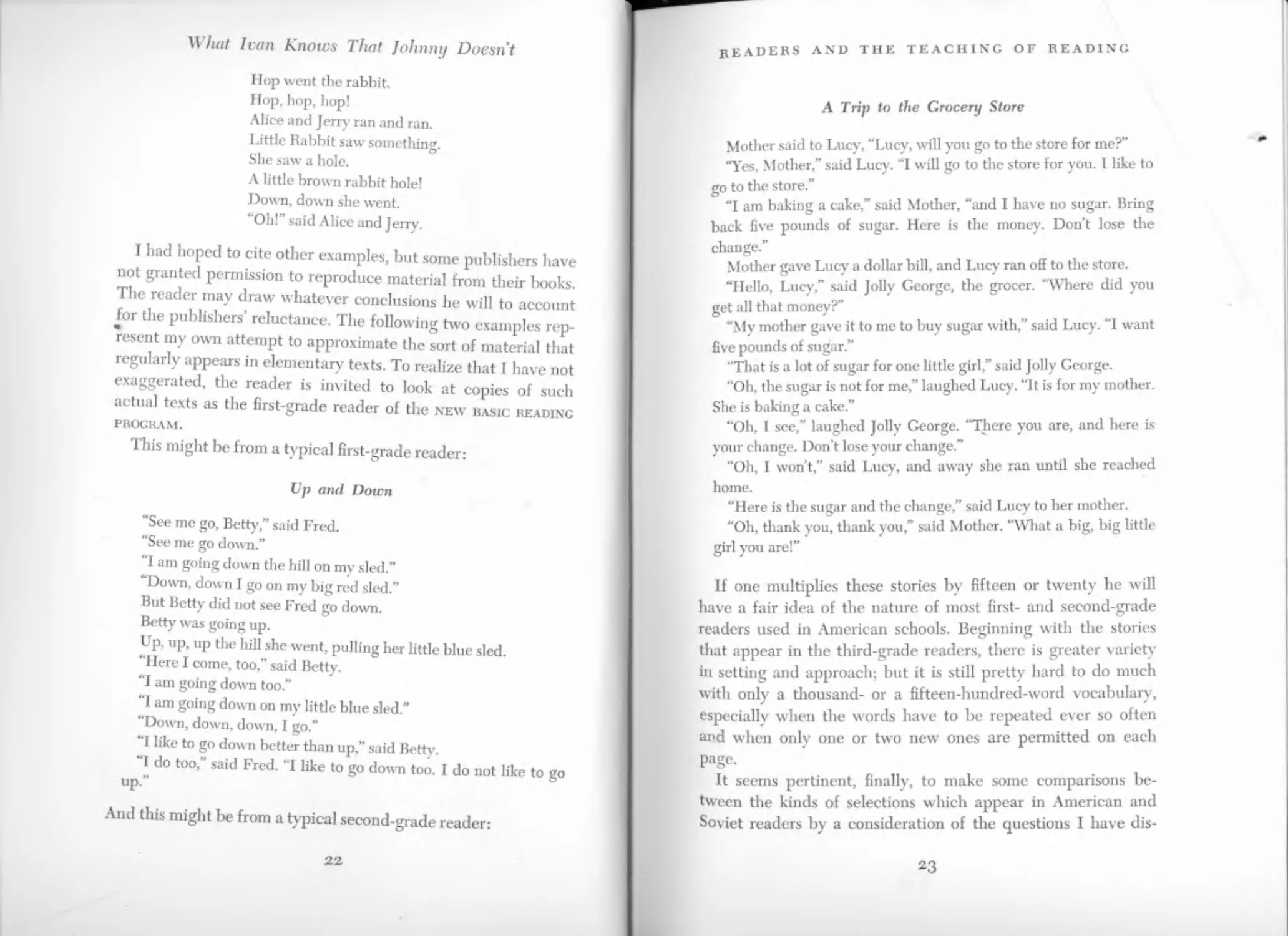
Little Rabbit
“Alice, Alice!” said Jerry.
“Come here! Come here!
I see something brown.”
Alice looked down.
She saw something little.
She saw something brown.
She saw a little brown rabbit.
“Oh, look, Jerry,” said Alice.
Little Rabbit saw Jerry.
She saw Alice, too.
21
What han Knows Thai Johnny Doesn't
Hop went the rabbit.
Hop, hop, hop!
Alice and Jerry ran and ran.
Little Rabbit saw something.
She saw a hole.
A little brown rabbit hole!
Down, down she went.
“Oh!” said Alice and Jerry.
I had hoped to cite other examples, but some publishers have
not granted permission to reproduce material from their books.
The reader may draw whatever conclusions he will to account
for the publishers’ reluctance. The following two examples rep-
resent my own attempt to approximate the sort of material that
regularly appears in elementary texts. To realize that I have not
exaggerated, the reader is invited to look at copies of such
actual texts as the first-grade reader of the new basic reading
PROGRAM.
This might be from a typical first-grade reader:
Up and Down
“See me go, Betty,” said Fred.
“See me go down.”
“I am going down the hill on my sled.”
“Down, down I go on my big red sled.”
But Betty did not see Fred go clown.
Betty was going up.
Up, up, up the hill she went, pulling her little blue sled.
“Here I come, too,” said Betty.
“I am going down too.”
“1 am going down on my little blue sled.”
“Down, down, down, I go.”
"I like to go down better than up,” said Betty'.
“I do too,” said Fred. “I like to go down too. 1 do not like to go
up.”
And this might be from a typical second-grade reader:
22
beaders and the teaching of reading
A Trip to the Grocery Store
Mother said to Lucy, “Lucy, will you go to the store for me?”
“Yes, Mother,” said Lucy. ”1 will go to the store for you. I like to
go to the store.”
“I am baking a cake,” said Mother, “and I have no sugar. Bring
back five pounds of sugar. Here is the money. Don't lose the
change.”
Mother gave Lucy a dollar bill, and Lucy ran off to the store.
“Hello, Lucy,” said Jolly George, the grocer. “Where did you
get all that money?”
“My mother gave it to me to buy sugar with,” said Lucy. “I want
five pounds of sugar.”
“That is a lot of sugar for one little girl,” said Jolly George.
“Oh, the sugar is not for me,” laughed Lucy. “It is for my mother.
She is baking a cake.”
“Oh, I see,” laughed Jolly George. "There you are, and here is
your change. Don't lose your change.”
“Oh, I won't,” said Lucy, and away she ran until she reached
home.
“Here is the sugar and the change,” said Lucy to her mother.
“Oh, thank you, thank you,” said Mother. "What a big, big little
girl you are!”
If one multiplies these stories by fifteen or twenty he will
have a fair idea of the nature of most first- and second-grade
readers used in American schools. Beginning with the stories
that appear in the third-grade readers, there is greater variety
in setting and approach; but it is still pretty hard to do much
with only a thousand- or a fifteen-hundred-word vocabulary,
especially when the words have to be repeated ever so often
and when only one or two new ones are permitted on each
page.
It seems pertinent, finally, to make some comparisons be-
tween the kinds of selections which appear in American and
Soviet readers by a consideration of the questions I have dis-
23
What Ivan Knows That Johnny Doesn’t
cussed in connection with the rodnaya rech series. Do these
American basal readers instill a particular attitude toward our
country? Do they contain selections which are aimed at the
moral development of our children? Do they contain selections
that are primarily informational? And, finally, do they contain
selections which have literary value? I should like to deal with
these first three questions briefly and with tire last one at more
length.
In the pages at the end of this chapter, I have printed the
tables of contents of a number of the most widely used basal
readers ranging from grades one through four, and have placed
them directly facing the tables of contents of the corresponding
rodnaya RECH readers. Although the titles of the selections do
not always give a good idea of the content, they do much to
indicate the general nature of these books, and the reader is
invited to make his own comparisons as this discussion pro-
ceeds. In order to make allowances for the fact that Soviet
students are a year older than American students at any given
grade level, the reader may feel that comparing the contents
of a Soviet reader with those of an American reader one grade
higher is more equitable.
Selections in the rodnaya rech readers not only try to im-
press upon students the importance of the Communist Revolu-
tion, the glorious leadership of the Communist Party in general
and of Lenin in particular, but they also exhort students to five
for communism, to work for communism, and to make all man-
ner of sacrifices for communism. These readers also continually
exhort Soviet students to love their country, to love its people,
to appreciate its greatness and its beauty, and to learn more
about its past.
By way of contrast and without attempting a judgment, I
should like to point out simply as a fact that the vast majority
of the basal readers used in our schools in the first four grades
have no selections devoted to praising the virtues of the demo-
cratic way of life, or which invite young students to consider
24
READERS AND THE TEACHING OF READING
how fortunate they are to live in a free country. Nor can one
easily find selections in these readers which encourage stu-
dents to love their country, to appreciate its greatness or its
beauty, or to learn about its past, or which even remind them
of what country they five in.
We have seen too that the rodnaya rech readers contain
numerous selections exhorting students to work hard, to study
hard, to be willing to make sacrifices, to be brave, to love and
obey their parents, to be clean, and to be kind to old ladies and
animals. The dominance of secularism in this country has pre-
vented American basal readers, except those designed for paro-
chial schools, from being concerned with spiritual values, but
many selections in some readers are aimed directly or indi-
rectly at the student’s moral development. The golden rule
series and the faith and freedom series, for example, are full
of selections of this sort.
Many of these basal readers also present ethical questions
in an artificially simple light. There are many stories, usually
animal stories, which stress, for example, that children should
not try to be or do something they arc not or cannot do, that
they should share their candy and be otherwise considerate of
others, and that they should not be different from the members
of their peer group.
But unlike the rodnaya rech readers, dramatic representa-
tions of such manly virtues as bravery and devotion to duty are
rather scarce in American readers for the early grades, and the
policy of limiting the stories to settings that are close to home
not only prevents much in the way of genuine excitement or
high adventure, but also thereby automatically rules out a good
amount of the best literature for young people. And it must be
observed finally that many of the stories in these readers of the
first four grades are to an excruciating degree insipid, trivial,
inane, pointless, and otherwise devoid of either pleasure or
profit.
We have seen that the informational value of the selections
25
What Ivan Knows That Johnny Doesn’t
in the rodnaya rech series is considerable, especially in the
third- and fourth-grade readers. Here, the contrast between
American and Soviet readers is marked. In the first place, ex-
pository writing in American readers of the early grades is very
rare, so that whatever of an informational nature is in these
readers is buried in a story of some sort, and consequently the
information actually is superficial, slight, and incidental. Fur-
thermore, it is not easy to be very informative when one h*as
only 1,000 or 1,500 words to work with, especially when only
one or two new words can appear on each page. Some, though
not many, fifth- and sixth-grade readers do have selections
which are informational, but they tend to run heavily to cow-
boy and Indian lore and thus often do little more than supple-
ment the information to be had from watching TV Westerns.
I know of no American reader series through the fourth grade
that has an informational section at all comparable in impor-
tance to the geography and history section in the third-grade
rodnaya rech reader (see the tables of contents at the end of
this chapter).
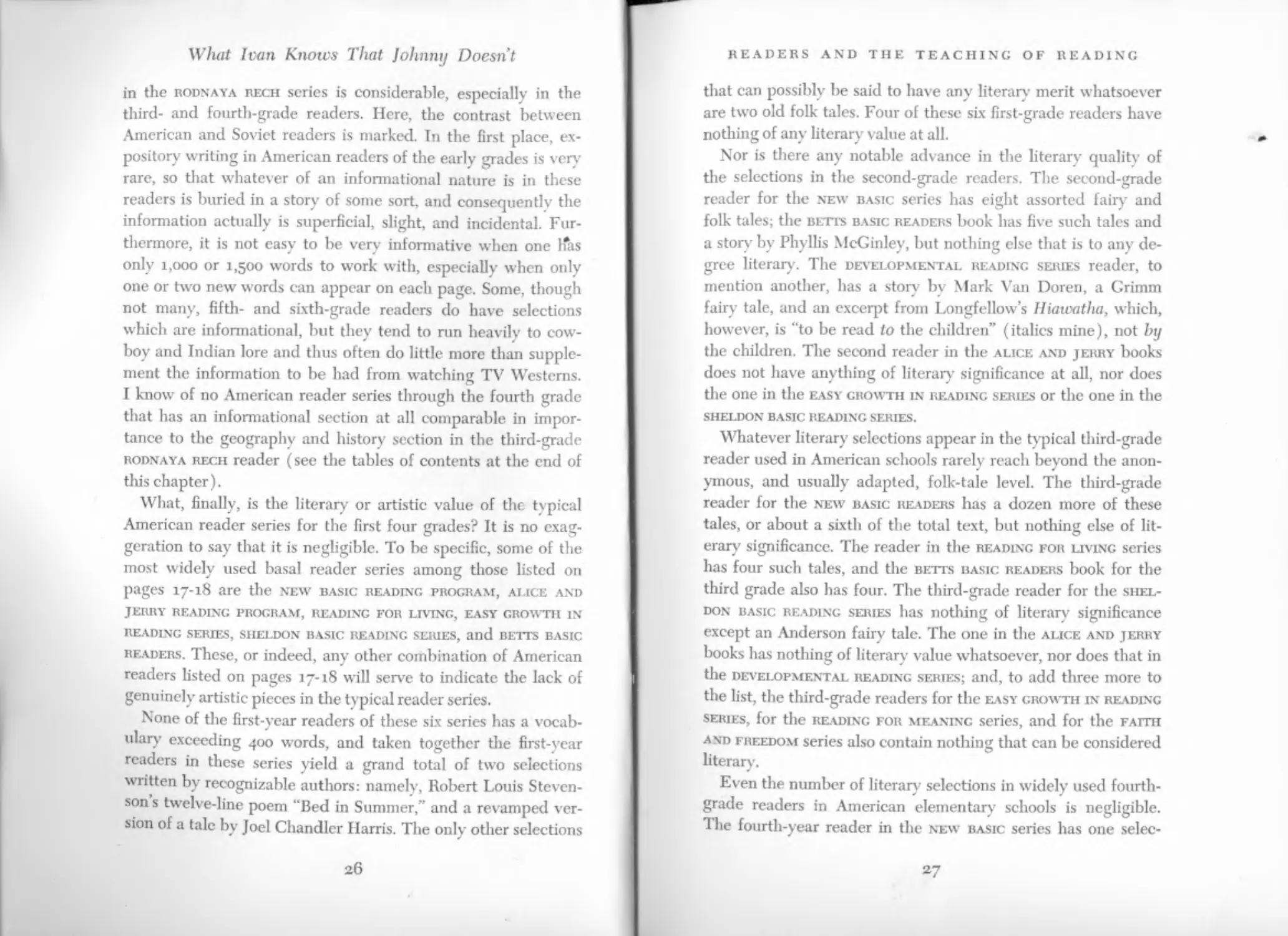
What, finally, is the literary or artistic value of the typical
American reader series for the first four grades? It is no exag-
geration to say that it is negligible. To be specific, some of the
most widely used basal reader series among those listed on
pages 17-18 are the new basic reading program, ai.ice and
JERRY READING PROGRAM, READING FOR LIVING, EASY GROWTH IN
READING SERIES, SHELDON BASIC READING SERIES, and BETTS BASIC
readers. These, or indeed, any other combination of American
readers listed on pages 17-18 will serve to indicate the lack of
genuinely artistic pieces in the typical reader series.
None of the first-year readers of these six series has a vocab-
ulary exceeding 400 words, and taken together the first-year
readers in these series yield a grand total of two selections
written by recognizable authors: namely, Robert Louis Steven-
son s twelve-line poem “Bed in Summer,” and a revamped ver-
sion of a talc by Joel Chandler Harris. The only other selections
26
READERS AND THE TEACHING OF READING
that can possibly be said to have any literary merit whatsoever
are two old folk tales. Four of these six first-grade readers have
nothing of any literary value at all.
Nor is there any notable advance in the literary qualitv of
the selections in the second-grade readers. The second-grade
reader for the new basic series has eight assorted fairy and
folk tales; the betts basic beaders book has five such talcs and
a story by Phyllis McGinley, but nothing else that is to any de-
gree literary. The developmental reading series reader, to
mention another, has a story bv Mark Van Doren, a Grimm
fairy tale, and an excerpt from Longfellow’s Hiawatha, which,
however, is “to be read to the children” (italics mine), not bt/
the children. The second reader in the alice and jerry books
does not have anything of literary' significance at all, nor does
the one in the easy growth in reading series or the one in the
SHELDON BASIC HEADING SERIES.
Whatever literary selections appear in the typical third-grade
reader used in American schools rarely reach beyond the anon-
ymous, and usually adapted, folk-tale level. The third-grade
reader for the new basic readers lias a dozen more of these
tales, or about a sixth of the total text, but nothing else of lit-
erary significance. The reader in the reading for living scries
has four such tales, and the betts basic readers book for the
third grade also has four. The third-grade reader for the shel-
don basic reading series has nothing of literary significance
except an Anderson fairy tale. The one in the alice and jerry
books has nothing of literary value whatsoever, nor does that in
the developmental reading series; and, to add tliree more to
the list, the third-grade readers for the easy growth in reading
series, for the reading for meaning series, and for the faith
and freedom series also contain nothing that can be considered
literary.
Even the number of literary selections in widely used fourth-
grade readers in American elementary schools is negligible.
Hie fourth-year reader in the new basic series has one selec-
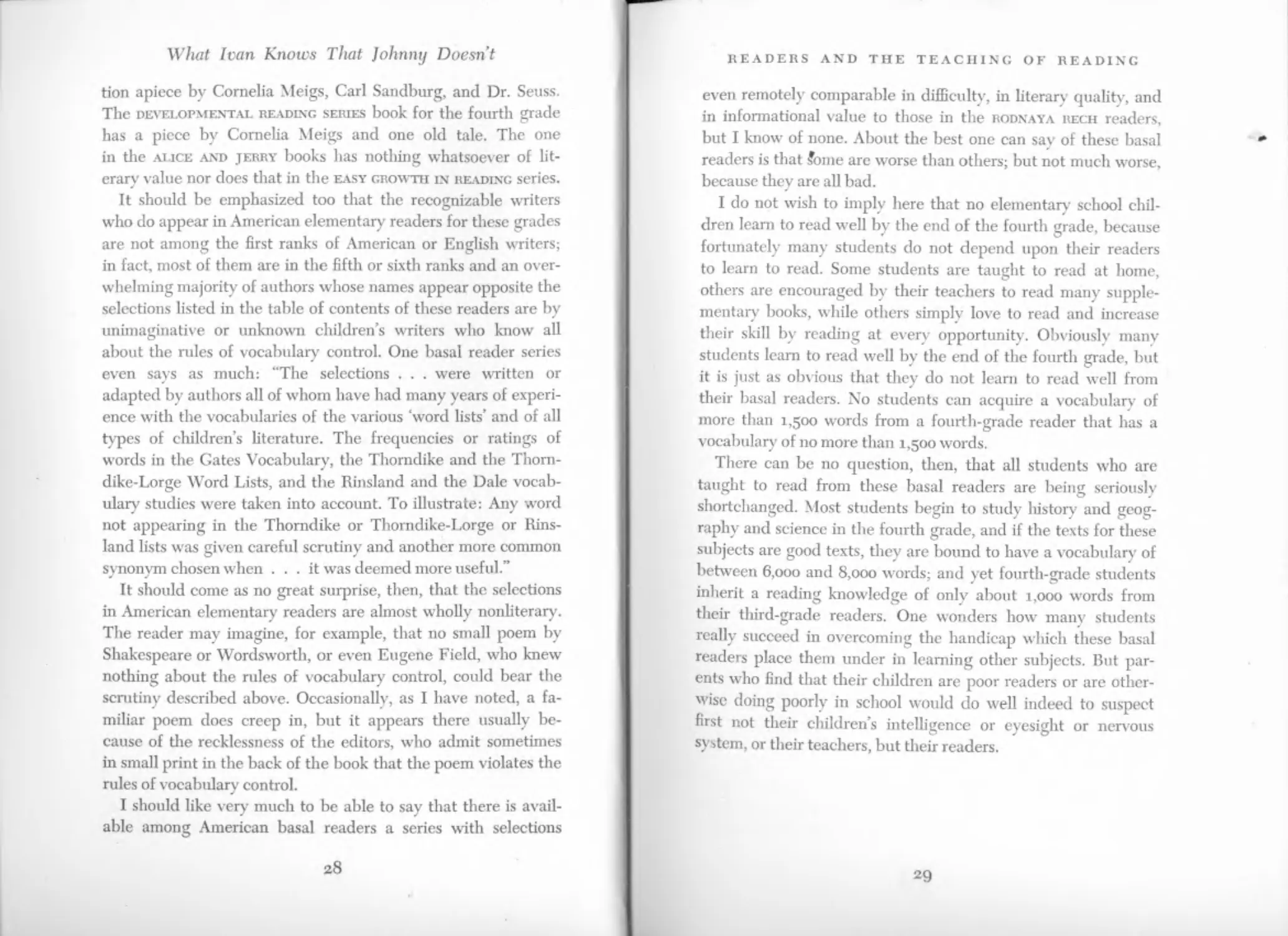
27
What Ivan Knows That Johnny Doesn’t
tion apiece by Cornelia Meigs, Carl Sandburg, and Dr. Seuss.
The developmental reading series book for the fourth grade
has a piece by Cornelia Meigs and one old tale. The one
in the Alice and jerry books has nothing whatsoever of lit-
erary value nor does that in the easy growth in reading series.
It should be emphasized too that the recognizable writers
who do appear in American elementary readers for these grades
are not among the first ranks of American or English writers;
in fact, most of them are in the fifth or sixth ranks and an over-
whelming majority of authors whose names appear opposite the
selections listed in the table of contents of these readers are by
unimaginative or unknown children’s writers who know all
about the rules of vocabulary’ control. One basal reader scries
even says as much: “The selections . . . w’ere written or
adapted by authors all of whom have had many years of experi-
ence with the vocabularies of the various ‘w’ord lists’ and of all
types of children’s literature. The frequencies or ratings of
words in the Gates Vocabulary, the Thorndike and the Thorn-
dike-Lorge Word Lists, and the Rinsland and the Dale vocab-
ulary’ studies were taken into account. To illustrate: Any word
not appearing in the Thorndike or Thomdike-Lorge or Rins-
land lists was given careful scrutiny and another more common
synonym chosen when ... it was deemed more useful.”
It should come as no great surprise, then, that the selections
in American elementary readers are almost wholly nonliterary.
The reader may imagine, for example, that no small poem by
Shakespeare or Wordsworth, or even Eugene Field, who knew'
nothing about the rules of vocabulary control, could bear the
scrutiny described above. Occasionally, as I have noted, a fa-
miliar poem does creep in, but it appears there usually be-
cause of die recklessness of the editors, who admit sometimes
in small print in the back of the book that die poem violates the
rules of vocabulary control.
I should like very much to be able to say' that there is avail-
able among American basal readers a series with selections
28
BEADERS AND THE TEACHING OF READING
even remotely comparable in difficulty, in literary quality, and
in informational value to those in the rodnaya rech readers,
but I know of none. About the best one can say of these basal
readers is that fome arc worse than others; but not much worse,
because they are all bad.
I do not wish to imply here that no elementary school chil-
dren learn to read well by the end of the fourth grade, because
fortunately many students do not depend upon their readers
to learn to read. Some students are taught to read at home,
others are encouraged by their teachers to read many supple-
mentary books, while others simplv love to read and increase
their skill by reading at every opportunity. Obviously many
students learn to read well by the end of the fourth grade, but
it is just as obvious that they do not learn to read well from
their basal readers. No students can acquire a vocabulary of
more than 1,500 words from a fourth-grade reader that has a
vocabulary of no more than 1,500 words.
There can be no question, then, that all students who are
taught to read from these basal readers are being seriously
shortchanged. Most students begin to study history and geog-
raphy and science in the fourth grade, and if the texts for these
subjects are good texts, they are bound to have a vocabulary of
between 6,000 and 8,000 words; and yet fourth-grade students
inherit a reading knowledge of only about 1,000 words from
their third-grade readers. One wonders how many students
really succeed in overcoming the handicap which these basal
readers place them under in learning other subjects. But par-
ents who find that their children are poor readers or are other-
wise doing poorly in school would do well indeed to suspect
first not their children’s intelligence or eyesight or nervous
system, or their teachers, but their readers.
29
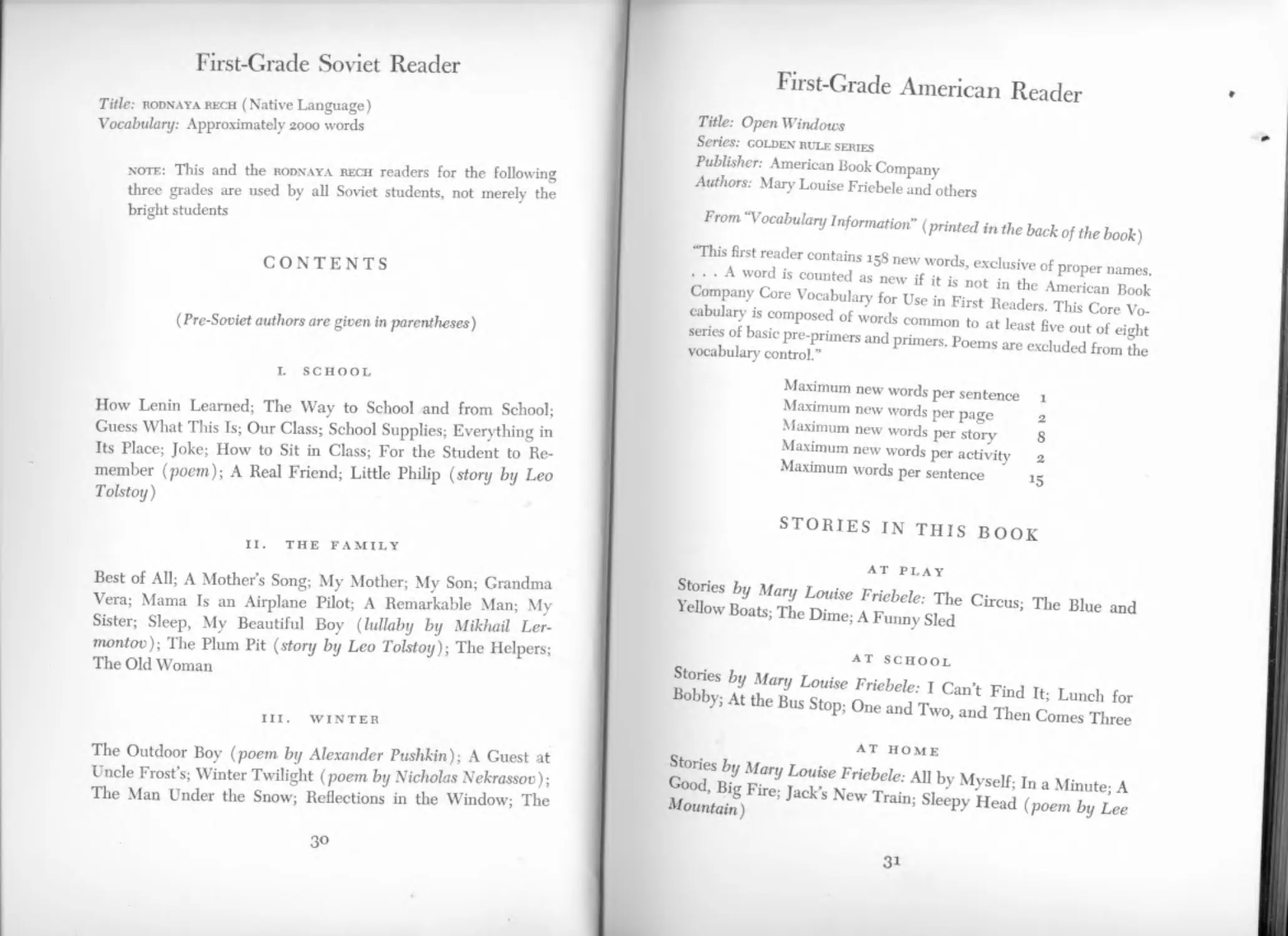
First-Grade Soviet Reader
Title: rodnaya rech (Native Language)
Vocabulary: Approximately 2000 words
note: This and the rodnaya rech readers for the following
three grades are used by all Soviet students, not merely the
bright students
CONTENTS
(Pre-Soviet authors are given in parentheses)
I. SCHOOL
How Lenin Learned; The Way to School and from School;
Guess What This Is; Our Class; School Supplies; Everything in
Its Place; Joke; How to Sit in Class; For the Student to Re-
member (poem); A Real Friend; Little Philip (story by Leo
Tolstoy)
II. THE FAMILY
Best of All; A Mother’s Song; My Mother; My Son; Grandma
Vera; Mama Is an Airplane Pilot; A Remarkable Man; My
Sister; Sleep, My Beautiful Boy (lullaby by Mikhail Ler-
montov); The Plum Pit (story by Leo Tolstoy); The Helpers;
The Old Woman
in. winter
The Outdoor Boy (poem by Alexander Pushkin); A Guest at
I ncle Frost’s; Winter Twilight (poem by Nicholas Nekrassov);
The Man Under the Snow; Reflections in the Window; The
30
First-Grade American Reader
Title: Open Windows
Series: golden rule series
Publisher: American Book Company
Authors: Man' Louise Fricbele and others
From “Vocabulary Information" (printed in the back of the book)
“This first reader contains 15S new words, exclusive of proper names.
. . . A word is counted as new if it is not in the American Book
Company Core Vocabulary for Use in First Readers. This Core Vo-
cabulary is composed of words common to at least five out of eight
series of basic pre-primers and primers. Poems are excluded from the
vocabulary control.”
Maximum new words per sentence	1
Maximum new words per page	2
Maximum new words per story	8
Maximum new words per activity	2
Maximum words per sentence	15
STORIES IN THIS BOOK
AT PLAY
Stories by Mary Louise Friebele: The Circus; The Blue and
Yellow Boats; The Dime; A Funny Sled
AT SCHOOL
Stories by Mary Louise Friebele: I Can't Find It; Lunch for
Bobby; At the Bus Stop; One and Two, and Then Comes Three
AT HOME
Stories by Mary Louise Friebele: All by Myself; In a Minute; A
Good, Big Fire; Jack’s New Train; Sleepy Head (poem by Lee
Mountain)
31
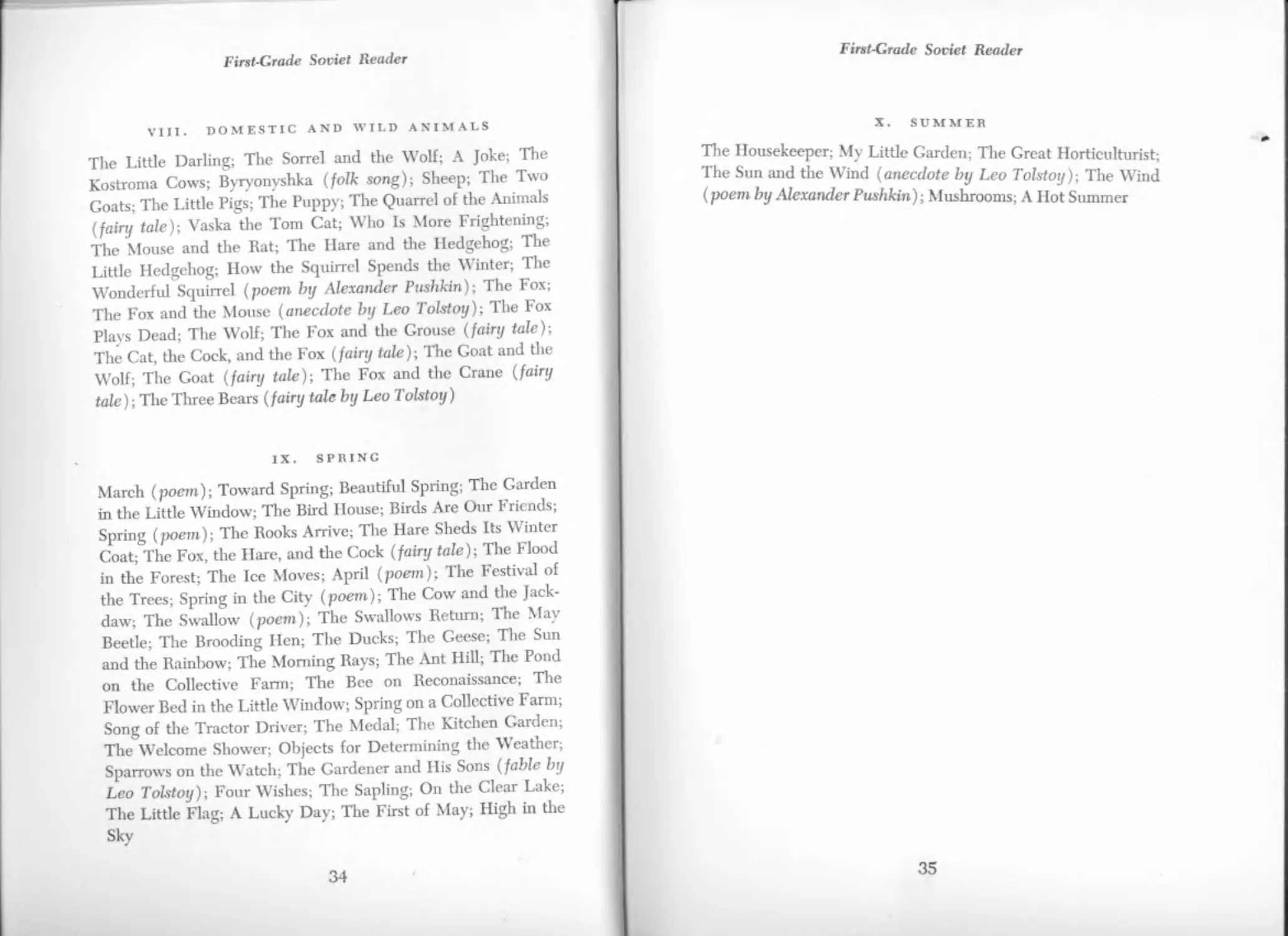
First-Grade Soviet Header
VIII.	DOMESTIC AND WILD ANIMALS
The Little Darling; The Sorrel and the Wolf; A Joke; The
Kostroma Cows; Byryonyshka (folk song); Sheep; The Two
Goats; The Little Pigs; The Puppy; The Quarrel of the Animals
(fairy tale); Vaska the Tom Cat; Who Is More Frightening;
The Mouse and the Rat; The Hare and the Hedgehog; The
Little Hedgehog; How the Squirrel Spends the Winter; The
Wonderful Squirrel (poem by Alexander Pushkin); The Fox;
The Fox and the Mouse (anecdote by Leo Tolstoy); The Fox
Plays Dead; The Wolf; The Fox and the Grouse (fairy tale);
The Cat, the Cock, and the Fox (fairy tale); The Goat and tlie
Wolf; The Goat (fairy tale); The Fox and the Crane (fairy
tale); The Three Bears (fairy tale by Leo Tolstoy)
IX.	SPRING
March (poem); Toward Spring; Beautiful Spring; The Garden
in the Little Window; The Bird House; Birds Are Our Friends;
Spring (poem); The Rooks Arrive; The Hare Sheds Its Winter
Coat; The Fox, the Hare, and the Cock (fairy tale); The Hood
in the Forest; The Ice Moves; April (poem); The Festival of
the Trees; Spring in the City (poem); The Cow and the Jack-
daw; The Swallow (poem); The Swallows Return; The May
Beetle; The Brooding Hen; The Ducks; The Geese; The Sun
and the Rainbow; The Morning Rays; The Ant Hill; The Pond
on the Collective Fann; The Bee on Reconaissance; The
Flower Bed in the Little Window; Spring on a Collective Farm;
Song of the Tractor Driver; The Medal; The Kitchen Garden;
The W’clcome Shower; Objects for Determining the Weather;
Sparrows on the Watch; The Gardener and His Sons (fable by
Leo Tolstoy); Four Wishes; The Sapling; On the Clear Lake;
The Little Flag; A Lucky Day; The First of May; High in the
Skv
34
First-Grade Soviet Reader
X.	SUMMER
The Housekeeper; My Little Garden, The Great Horticulturist;
The Sun and the Wind (anecdote by Leo Tolstoy); The Wind
(poem by Alexander Pushkin); Mushrooms; A Hot Summer
35
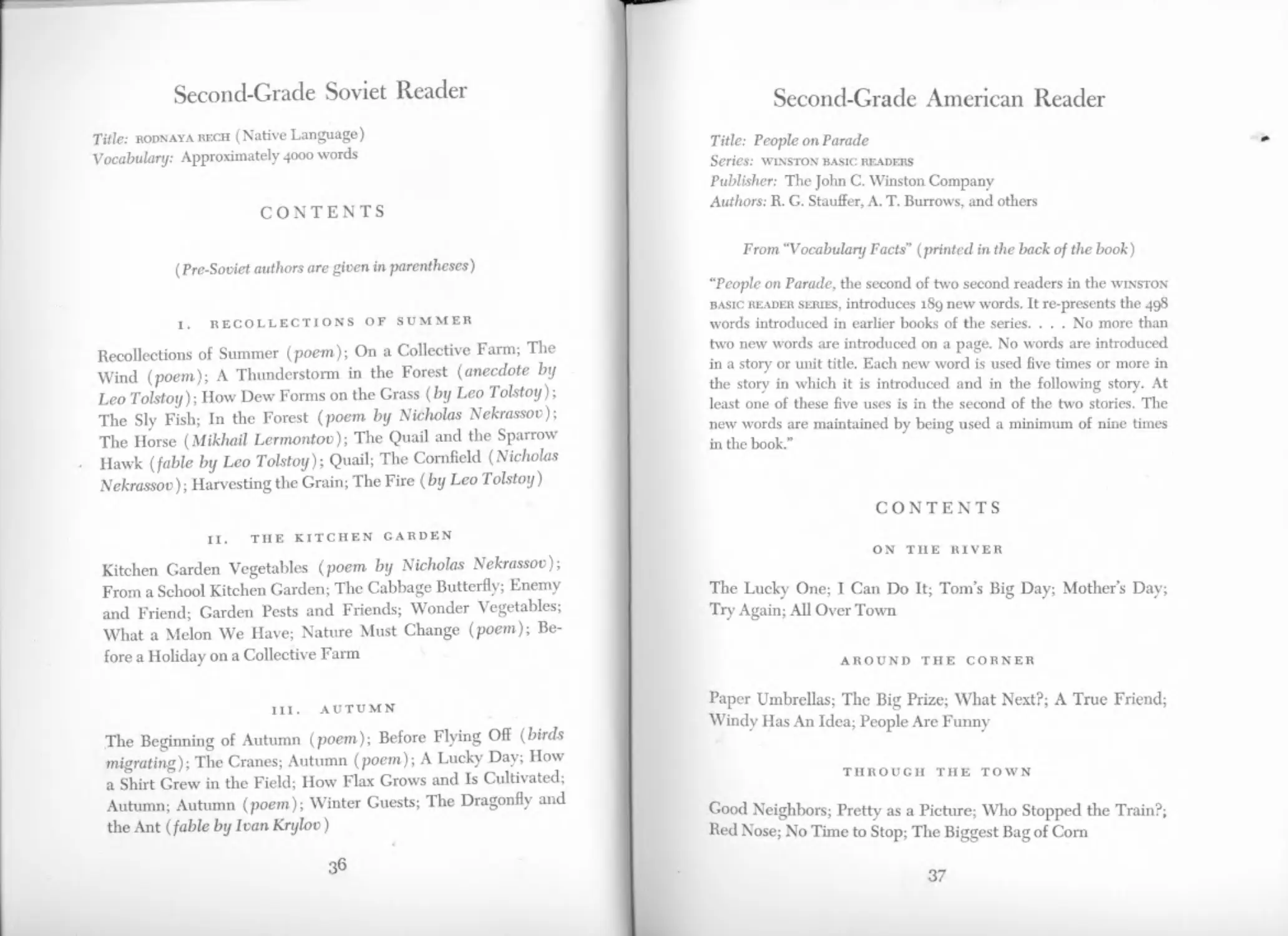
Second-Grade Soviet Reader
Title: rodnaya rech (Native Language)
Vocabulary: Approximately 4000 words
CONTENTS
(Pre-Soviet authors are given in parentheses)
I. RECOLLECTIONS OF SUMMER
Recollections of Summer (poem); On a Collective Farm; The
Wind (poem); A Thunderstorm in the Forest (anecdote by
Leo Tolstoy); How Dew Forms on the Grass (by Leo Tolstoy);
The Sly Fish; In the Forest (poem by Nicholas Nekrassov);
The Horse (Mikhail Lermontov); The Quail and the Sparrow
Hawk (fable by Leo Tolstoy); Quail; The Cornfield (Nicholas
Nekrassov); Harvesting the Grain; The Fire (by Leo Tolstoy)
It. THE KITCHEN CARDEN
Kitchen Garden Vegetables (poem by Nicholas Nekrassov);
From a School Kitchen Garden; The Cabbage Butterfly; Enemy
and Friend; Garden Pests and Friends; Wonder Vegetables;
What a Melon We Have; Nature Must Change (poem); Be-
fore a Holiday on a Collective Farm
111.	AUTUMN
The Beginning of Autumn (poem); Before Flying Off (birds
migrating); The Cranes; Autumn (poem); A Lucky Day; How
a Shirt Grew in the Field; How Flax Grows and Is Cultivated;
Autumn; Autumn (poem); Winter Guests; The Dragonfly and
the Ant (fable by Ivan Krylov)
36
Second-Grade American Reader
Title: People on Parade
Series: Winston bask: readers
Publisher: The John C. Winston Company
Authors: R. G. Stauffer, A. T. Burrows, and others
From “Vocabulary Facts” (printed in the back of the book)
“People on Parade, the second of two second readers in the winston
basic reader series, introduces 1S9 new words. It re-presents the 498
words introduced in earlier books of the series. ... No more than
two new words are introduced on a page. No words are introduced
in a story or unit title. Each new word is used five times or more in
the story in which it is introduced and in the following story. At
least one of these five uses is in the second of the two stories. The
new words are maintained by being used a minimum of nine times
in the book."
CONTENTS
ON THE RIVER
The Lucky One; I Can Do It; Tom’s Big Day; Mother’s Day;
Try Again; All Over Town
AROUND THE CORNER
Paper Umbrellas; The Big Prize; What Next?; A True Friend;
Windy Has An Idea; People Arc Funny
THROUGH THE TOWN
Good Neighbors; Pretty as a Picture; Who Stopped the Train?;
Red Nose; No Time to Stop; The Biggest Bag of Com
37
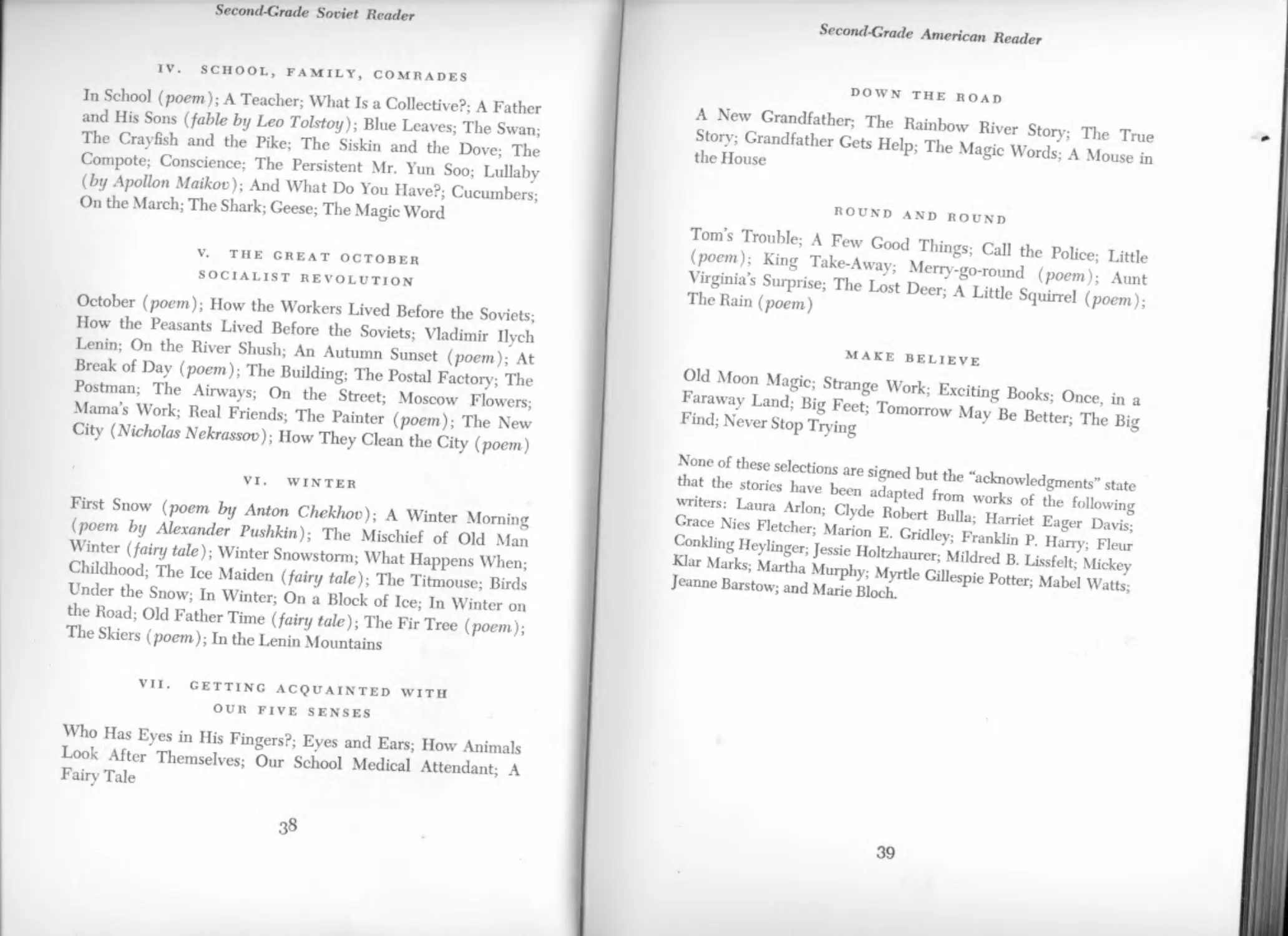
Second-Grade Soviet Reader
IV.	SCHOOL, FAMILY, COMRADES
In -School (poem); A Teacher; What Is a Collective?; A Father
and His Sons (fable by Leo Tolstoy); Blue Leaves; The Swan;
The Crayfish and the Pike; The Siskin and the Dove; The
Compote; Conscience; The Persistent Mr. Yun Soo; Lullaby
(by Apollon Maikov); And What Do You Have?; Cucumbers;
On the March; The Shark; Geese; The Magic Word
V.	THE GREAT OCTOBER
SOCIALIST REVOLUTION
October (poem); How the Workers Lived Before the Soviets;
How the Peasants Lived Before the Soviets; Vladimir Ilych
Lenin; On the River Shush; An Autumn Sunset (poem); At
Break of Day (poem); The Building; The Postal Factory; The
Postman; The Airways; On the Street; Moscow Flowers;
Mama’s Work; Real Friends; The Painter (poem); The New
City (Nicholas Nekrassov); How They Clean the City (poem)
VI.	WINTER
First Snow (poem by Anton Chekhov); A Winter Morning
(poem by Alexander Pushkin); The Mischief of Old Man
Winter (fairy tale); Winter Snowstorm; What Happens When;
Childhood; The Ice Maiden (fairy tale); The Titmouse; Birds
Under the Snow; In Winter; On a Block of Ice; In Winter on
the Road; Old Father Time (fairy tale); The Fir Tree (poem);
The Skiers (poem); In the Lenin Mountains
VII.	GETTING ACQUAINTED WITH
OUR FIVE SENSES
Who Has Eyes in His Fingers?; Eyes and Ears; How Animals
Look After Themselves; Our School Medical Attendant; A
Fairv Tale
У
38
Second-Grade American Reader
DOWN THE ROAD
A New Grandfather, The Rainbow River Story'; The True
Story'; Grandfather Gets Help; The Magic Words; A Mouse in
the House
ROUND AND ROUND
Tom’s Trouble; A Few Good Things; Call the Police; Little
(poem); King Take-Away; Merry-go-round (poem); Aunt
Virginias Surprise; The Lost Deer; A Little Squirrel (poem);
The Rain (poem)
MAKE BELIEVE
Old Moon Magic; Strange Work; Exciting Books; Once, in a
Faraway’ Land; Big Feet; Tomorrow May Be Better; The Big
Find; Never Stop Trying
None of these selections are signed but the “acknowledgments” state
that the stories have been adapted from works of the following
writers: Laura Arion; Clyde Robert Bulla; Harriet Eager Davis;
Grace Nies Fletcher; Marion E. Gridley; Franklin P. Harry; Fleur
Conkling Heylinger; Jessie Holtzhaurcr; Mildred B. Lissfelt; Mickey
Klar Marks; Martha Murphy; Myrtle Gillespie Potter; Mabel Watts;
Jeanne Barstow; and Marie Bloch.
39
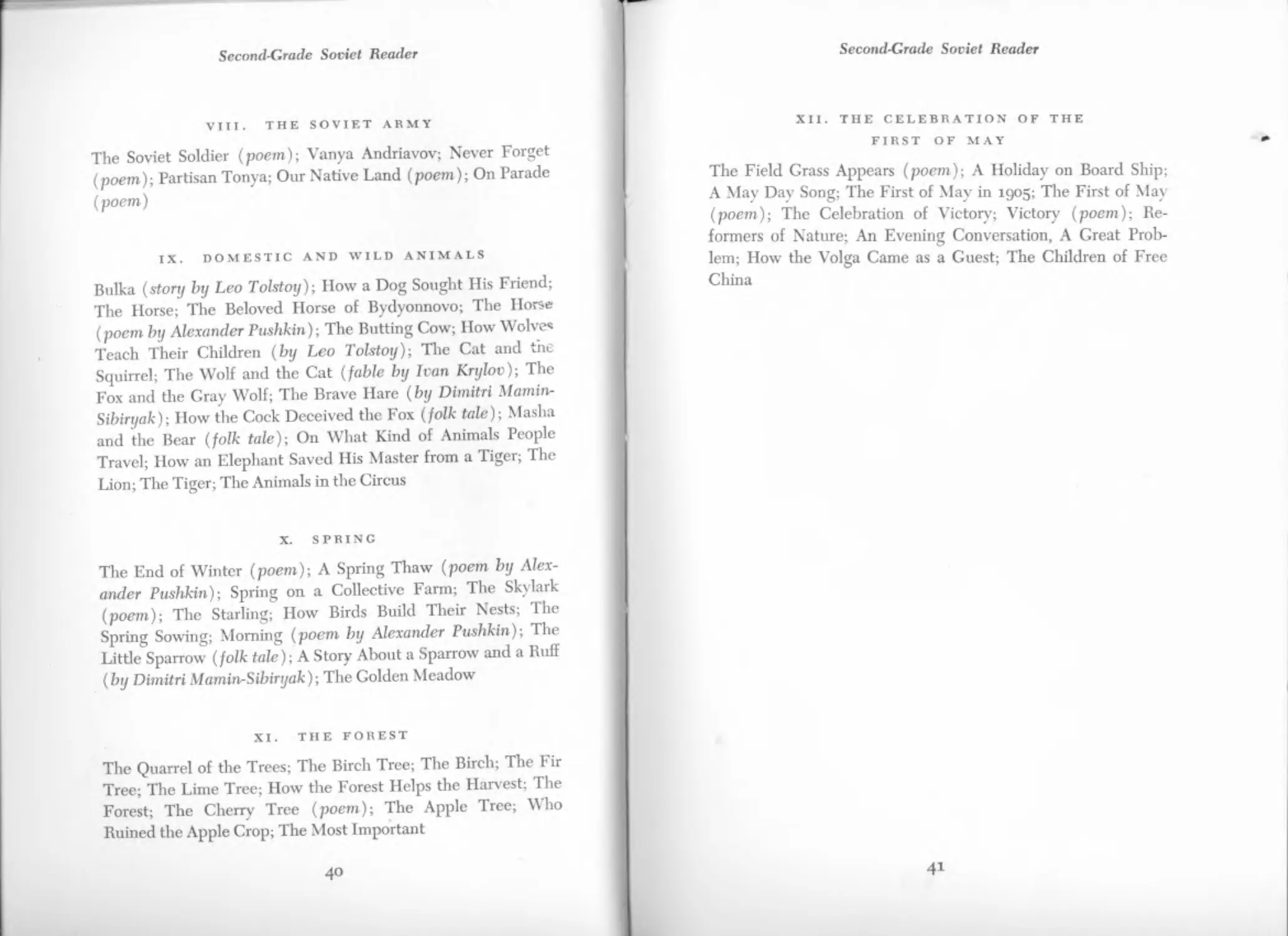
Second-Grade Soviet Reader
VIII.	THE SOVIET ARMY
The Soviet Soldier (poem); Vanya Andriavov; Never Forget
(poem); Partisan Tonya; Our Native Land (poem); On Parade
(poem)
IX.	DOMESTIC AND WILD ANIMALS
Bulka (story by Leo Tolstoy); How a Dog Sought His Friend;
The Horse; The Beloved Horse of Bydyonnovo; The Horse
(poem by Alexander Pushkin); The Butting Cow; How Wolves
Teach Their Children (by Leo Tolstoy); The Cat and the
Squirrel; The Wolf and the Cat (fable by han Krylov); The
Fox and the Gray Wolf; The Brave Hare (by Dimitri Mamin-
Sibiryak); How the Cock Deceived the Fox (folk tale); Masha
and the Bear (folk tale); On What Kind of Animals People
Travel; How an Elephant Saved His Master from a Tiger; The
Lion; The Tiger; The Animals in the Circus
x. SPRING
The End of Winter (poem); A Spring Thaw (poem by Alex-
ander Pushkin); Spring on a Collective Farm; The Skylark
(poem); The Starling; How Birds Build Their Nests; lhe
Spring Sowing; Morning (poem by Alexander Pushkin); The
Little Sparrow (folk tale); A Story About a Sparrow and a Ruff
(by Dimitri Mamin-Sibiryak); The Golden Meadow
XI. THE FOREST
The Quarrel of the Trees; The Birch Tree; The Birch; The Fir
Tree; The Lime Tree; How the Forest Helps the Harvest; The
Forest; The Cherry Tree (poem); The Apple Tree; Who
Ruined the Apple Crop; The Most Important
40
Second-Grade Soviet Reader
XII. THE CELEBRATION OF THE
FIRST OF MAY
The Field Grass Appears (poem); A Holiday on Board Ship;
A May Day Song; The First of May in 1905; The First of May
(poem); The Celebration of Victory; Victory (poem); Re-
formers of Nature; An Evening Conversation, A Great Prob-
lem; How the Volga Came as a Guest; The Children of Free
China
41
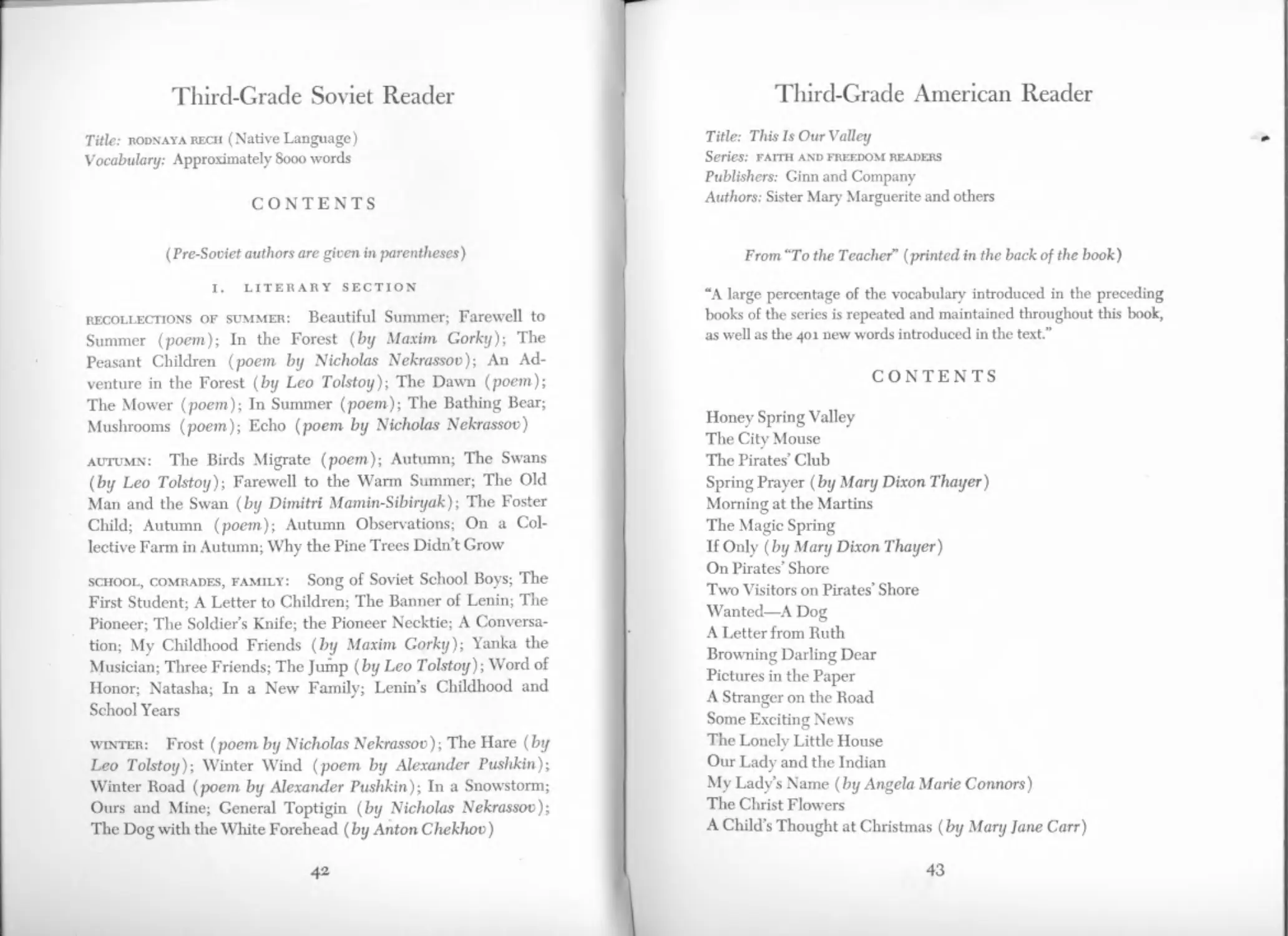
Third-Grade Soviet Reader
Title: rodnaya rech (Native Language)
Vocabulary: Approximately 8000 words
CONTENTS
(Pre-Soviet authors are given in parentheses)
I.	LITERARY SECTION
recollections of summer: Beautiful Summer; Farewell to
Summer (poem); In the Forest (by Maxim Gorky)-, The
Peasant Children (poem by Nicholas Nekrassov); An Ad-
venture in the Forest (by Leo Tolstoy); The Dawn (poem);
The Mower (poem); In Summer (poem); The Bathing Bear;
Mushrooms (poem); Echo (poem by Nicholas Nekrassov)
autumn: The Birds Migrate (poem); Autumn; The Swans
(by Leo Tolstoy); Farewell to the Wann Summer; The Old
Man and the Swan (by Dimitri Mamin-Sibiryak); The Foster
Child; Autumn (poem); Autumn Observations; On a Col-
lective Farm in Autumn; Why the Pine Trees Didn’t Grow
school, comrades, family: Song of Soviet School Boys; The
First Student; A Letter to Children; The Banner of Lenin; The
Pioneer; The Soldier’s Knife; the Pioneer Necktie; A Conversa-
tion; My Childhood Friends (by Maxim Gorky); Yanka the
Musician; Three Friends; The Jump (by Leo Tolstoy); Word of
Honor; Natasha; In a New Family; Lenin’s Childhood and
School Years
winter: Frost (poem by Nicholas Nekrassov); The Hare (by
Leo Tolstoy); Winter Wind (poem by Alexander Pushkin);
Winter Road (poem by Alexander Pushkin); In a Snowstorm;
Ours and Mine; General Toptigin (by Nicholas Nekrassov);
The Dog with the White Forehead (by Anton Chekhov)
42
Third-Grade American Reader
Title: This Is Our Valley
Series: faith and freedom readers
Publishers: Ginn and Company
Authors: Sister Mary Marguerite and others
From “To the Teacher” (printed in the hack of the book)
“A large percentage of the vocabulary introduced in the preceding
books of the series is repeated and maintained throughout this book,
as well as the 401 new words introduced in the text.”
CONTENTS
Honey Spring Valley
The Citv Mouse
The Pirates’ Club
Spring Prayer (by Mary Dixon Thayer)
Morning at the Martins
The Magic Spring
If Only (by Mary Dixon Thayer)
On Pirates’ Shore
Two Visitors on Pirates’ Shore
Wanted—A Dog
A Letter from Ruth
Browning Darling Dear
Pictures in the Paper
A Stranger on the Road
Some Exciting News
The Lonely Little House
Our Lady and the Indian
My Lady’s Name (by Angela Marie Connors)
The Christ Flowers
A Child’s Thought at Christmas (by Mary Jane Carr)
43
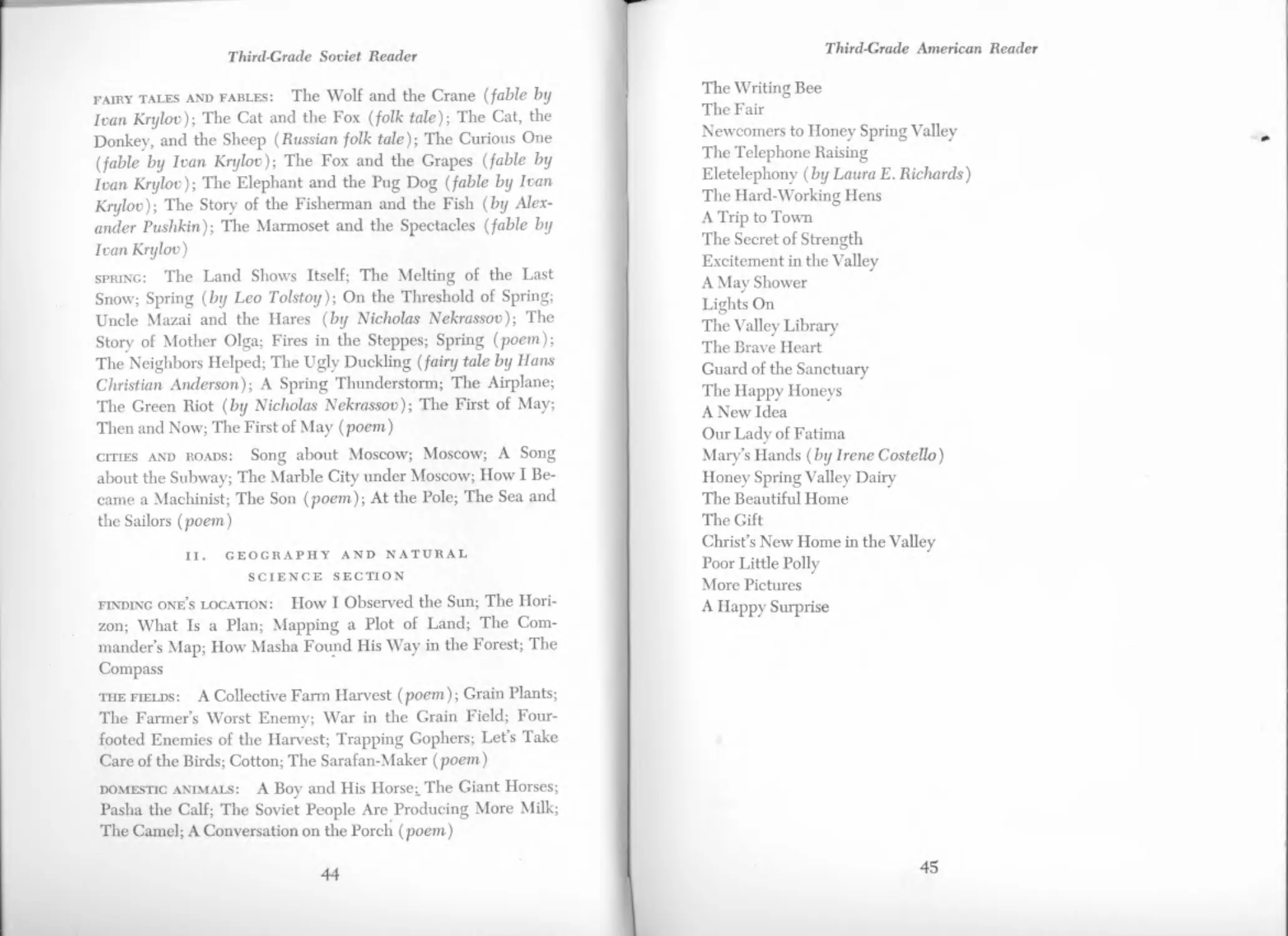
Third-Grade Soviet Beader
fairy tales AND fables: The Wolf and the Crane (fable by
Ivan Krylov); The Cat and the Fox (folk tale); The Cat, the
Donkey, and the Sheep (Russian folk tale); The Curious One
(fable by Ivan Krylov); The Fox and the Grapes (fable by
Ivan Krylov); The Elephant and the Pug Dog (fable by Ivan
Krylov); The Story of the Fisherman and the Fish (by Alex-
ander Pushkin); The Marmoset and the Spectacles (fable by
Ivan Krylov)
spring: The Land Shows Itself; The Melting of the Last
Snow; Spring (by Leo Tolstoy); On the Threshold of Spring;
Uncle Mazai and the Hares (by Nicholas Nekrassov); The
Storv of Mother Olga; Fires in the Steppes; Spring (poem);
The Neighbors Helped; The Ugly Duckling (fairy tale by Hans
Christian Anderson); A Spring Thunderstorm; The Airplane;
The Green Riot (by Nicholas Nekrassov); The First of May;
Then and Now; The First of May (poem)
cities and roads: Song about Moscow; Moscow; A Song
about the Subway; The Marble City under Moscow; How I Be-
came a Machinist; The Son (poem); At the Pole; The Sea and
the Sailors (poem)
II.	GEOGRAPHY AND NATURAL
SCIENCE SECTION
finding one’s location: How I Observed the Sun; The Hori-
zon; What Is a Plan; Mapping a Plot of Land; The Com-
mander's Map; How Masha Found His Way in the Forest; The
Compass
the fields: A Collective Farm Harvest (poem); Grain Plants;
The Farmer’s Worst Enemy; War in the Grain Field; Four-
footed Enemies of the Harvest; Trapping Gophers; Let’s Take
Care of the Birds; Cotton; The Sarafan-Maker (poem)
domestic animals: A Boy and His Horse; The Giant Horses;
Pasha the Calf; The Soviet People Are Producing More Milk;
The Camel; A Conversation on the Porch ( poem)
44
Third-Grade American Beader
The Writing Bee
The Fair
Newcomers to Honey Spring Valley
The Telephone Raising
Eletelephony (by Laura E. Richards')
The Hard-Working Hens
A Trip to Town
The Secret of Strength
Excitement in the Valley
A May Shower
Lights On
The Valley Library
The Brave Heart
Guard of the Sanctuary'
The Happy Honeys
A New Idea
Our Lady of Fatima
Mary’s Hands (by Irene Costello)
Honey Spring Valley Dairy'
The Beautiful Home
The Gift
Christ’s New Home in the Valley
Poor Little Polly
More Pictures
A Happy Surprise
45
Third-Grade Soviet Reader
the garden: Ivan Michurin (horticulturist); The Garden of
Victory; Let Us Adorn Our Country with Gardens
the forest: In the Forest (by Ivan Turgenev); The Forest
Glade; How Trees Move (by Leo Tolstoy); Why Forests Are
Valuable; The Forest of the Future (poem); Beetles; The For-
est Drummer (woodpecker); The Green Apothecary Shop;
Following Tracks; A Squirrel Hunt
forms of the earth’s surface: The Black Earth Plains; On
a Mountain Top; Along a Mountain Path in the Caucasus; Iron,
Steel, and Pen Knives
water in nature: How River Arc Formed; The Source of the
Volga; Ravines; Fortifying Ravines; The Moscow Canal; Our
Volga; The Terek (by Mikhail Lermontov); A Hurricane at
Sea
inhabitants of the water: In the Lake; The Whale; Hunt-
ing Whales; On the Antarctic Ice
amphibians and snakes: The Metamorphosis of Frogs; The
Grass Snake and the Adder
climate: Why Do We Have Wind? (bij Leo Tolstoy); During
a Storm (by Ivan Goncharov); The Barometer; Who Needs to
Know the Weather and Why; What Is Climate?
the human body: The Skeleton; The Skeleton of Men and
Horses; The Spine; Curvature of the Spine; The Rib Cage;
Muscles; The Work of Muscles; Muscles Develop with Use;
Food; Where Food Goes when We Eat; How to Take Care of
Your Teeth; Vitamins; Contagious Diseases; Microbes; How
Contagious Diseases Are Communicated; The Lungs; The Skin;
The Circulation of the Blood; The Heart; What to Do If You
Cut ^our Finger; The Organs of Sense; Sight; How Our Eyes
Are Protected from Many Dangers; Hearing; Taste; The Sense
of Smell; 1 he Sense of Touch
46
Third-Grade Soviet Reader
GREAT RUSSIAN INVENTORS AND EXPLORERS: I van PolzunOV ( Ш-
ventor); The Russian Inventor Ivan Kulibin; The Great Rus-
sian Inventor Alexander Popov; Maklai among the Papuans;
NicholasPrzhyevalsky (explorer)
III.	HISTORY SECTION
from our country’s past: How the Slavs Lived; Alexander
Nevsky; The Tatar Invasion of Russia: The Founding of Mos-
cow; Our Ancient Capital (poem); Moscow; On the Field of
Kulikovo; Minin and Pozharsky; The War with the Swedes;
The Founding of Petersburg; The Battle of Poltava (poem by
Alexander Pushkin); General Suvorov; The Capture of Izmail;
The War of 1812; The Bold Sailor; The Unreaped Field (poem
by Nicholas Nekrassov); The Struggle of the Peasants Against
the Landowners; A Revolutionary Song; Nicholas Petrovitch;
Bloody Sunday; The Overthrow of the Autocracy
from the history of ovn socialtst country: Storming the
Winter Palace; Civil War; Voroshilov at the Front; From the
Life of Nicholas Shchors; Chapayev in Battle; The Death of
Chapayev; The Brave Partisan; Gregory Kotovsky; A Trip to
Kashino; In the Lenin Museum (poem)
the five-year plans: The First Five-Year Plan; The Second
Five-Year Plan; A New River; Machine-Tractor Stations; A
Birthplace
the second world war: To A Noble People (poem); Stalin-
grad; A Song about Stalingrad; The Story of a Tank Driver;
The Nightingale (a war story)
postwar reconstruction: Lenin Is With Us (poem); The
Five-Year Plan; Our Glorious Homeland (poem); How Man
Uses Rivers
47
Fourth-Grade Soviet Reader
Title: rodnaya rech (Native Language)
Vocabulary: Approximately 10,000 words
CONTENTS
(Pre-Soviet authors are given in parentheses)
INTRODUCTION
A Word About Our Mother Country; Our Native Land; Be
Prepared for the Struggle in the Cause of the Communist Party
s и м м E R
Welcome, Young Travelers; The Happy Tourist; Grandfather
Tyeryoshkin; The Pioneer Campfire; Night; Hunting the Hawk;
How to Get over Groundless Fears (by Alexander Herzen)-,
The Peasant’s Children (by Nicholas Nekrassov); Nekrassovs
Childhood; A Woman’s Lot (by Nicholas Nekrassov); On the
Volga (by Nicholas Nekrassov); A Summer Fire; Rye (poem);
The Steppes
AUTUMN
Autumn (by Alexander Pushkin); An Autumn Day in the
Woods (by Ivan Turgenev); The Cranes Fly (by Ivan Tur-
genev); The Traveling Frog (by Vselovod Mikhadovitch
Carshin)
FAIRY TALES, LEGENDS, FABLES
The Green Oak (by Alexander Pushkin); From the Life of
Pushkin; The Fairy Tale of the Czar-Saltan (15-page poem by
Alexander Pushkin); Ruslan and Liudmila (mock-epic poem
48
Fourth-Grade American Reader
Title: Singing Wheels
Series: the alice and jerry basic reading program
Publisher: Row, Peterson and Company
Author: Mabel O’Donnell
From "Word List” (printed in the back of the book)
. includes 532 words . . . that were not taught in the preceding
books of the alice and jerry basic reading program"
CONTENTS
(All selections are unsigned and are thus presumably written
by the author)
STAGECOACH DAYS
Here Comes the Stage!; Wilder’s Inn; All Aboard! Stage Going!;
An Exciting Adventure; Hastings Mills
LOG CABIN DAYS
Getting Acquainted; The Smithy; Other Places to Go; The Old
Harness Shop; Home; Oil for the Big Woods; All Work and
No Play; Cabin in the Hill; The Screech Owl; Secrets Astir;
Indigo Blue; Fine Feathers; Bring Home the Deer; Waubon-
sie; Fox Fire; Butchering Time; Pigeon Pie; “Yankee-Doodle
“Whipping the Cat”; The Wolf Hunt
SNOWBOUND
School Days; Reading, Writing, and Arithmetic; Spelldown;
Whitling; The Christmas Clock; Tinkerer; Merry Christinas;
Frozen River
spring’s in the air
Sap’s Running; Sugaring Off; Bee Tree; The House on the Hill
49
Fourth-Grade Soviet Reader
by Alexander Pushkin); The Blue Carpet (Tajik legend); The
Hot Stone; A Song about a Pioneer’s Dream; Two Dogs (by
Ivan Krylov); The Cuckoo and the Cock (fable by Ivan Kry-
lov); The Fox and the Crow (fable by Ivan Krylov); The
Peasant and the Worker (fable by Ivan Krylov)
THE FAMILY, STORIES ABOUT CHILDREN
A Mother’s Love; In a New Family; The Big Birch; Yanka (by
Anton Chekhov); How Gorky Read Books (by Maxim Gorky);
The Sparrow (by Ivan Turgenev); True Friends; My Friend;
What Shall I Be?; Friendship (by Vladimir Korolenko); Kara-
goz (by Mikhail Lermontov); Mumu (by Ivan Turgenev);
Vanya the Shepherd Bov; A March (by Nicholas Nekrassov);
In a Gymnasium; Gavrosh; The Drummers’ Plot
WINTER
The Biting Frost (by Alexander Pushkin); Winter (by Alex-
ander Pushkin); A Winter Morning (by Alexander Pushkin);
Winter; A Winter in Studyony (by Dimitri Mamin-Sibiryak);
A Night in the Forest; Conquering the Taiga
SPRING
Spring (by Alexander Pushkin); In the Spring (by Anton
Chekhov); Spring; The Opening of the River; Moscow' in May
FROM OUR country’s PAST
On the Seashore (by Alexander Pushkin); Mikhail Lomono-
sov (biography); General Suvorov (biography); Grandfather
(by Nicholas Nekrassov); The Caucasian Prisoner (by Leo
Tolstoy); Ilya Efimovitch Repin (biography); The Rooks Have
flown Away; The First of May (by Maxim Gorky)
5»
Fourth-Grade Soviet Reader
THE PEOPLE OF THE SOVIET COUNTRIES
Lenin Goes to Smolny; In Smolny; The Seizure of the Tele-
phone Station; A Wealthy Man; We Are Thirty Years Old;
Tanya; The Young Guard (selection from a Soviet novel);
A Story of a Son; The Will to Live; The Last Day of Matvey
Kuxmin; I Am Always Living; According to Lenin’s Plan;
Visions; We Need Peace; Glory' to the People (poem)
51
2
LITERATURE
IN SOVIET AND AMERICAN
SCHOOLS
A sound literary education is of inestimable value to students,
for not only does a close acquaintance with important literary
works increase immeasurably the student’s ability to understand
and enjoy and use his language, but it provides emotional and
aesthetic and intellectual experiences which contribute to his
taste, his judgment, and his maturity in a way that no other
subject can. We may well ask how great a contribution to a
student’s education American textbooks make as compared to
Soviet textbooks.
LITERATURE IN THE FIFTH AND
SIXTH GRADES IN RUSSIAN
AND AMERICAN SCHOOLS
Although a fairly large proportion of the selections in the
rodnaya rech readers are from the works of the best Russian
authors, there is no attempt, of course, in these early grades to
introduce a formal study of literature. The chief aim of these
texts is to teach Soviet students to read well enough so that by
52
LITERATURE
the time they reach the fifth grade they can begin their formal
study of literature, which in fact they do.
The syllabus used in Soviet schools for the teaching of litera-
ture provides a useful description of the aims of the literary
program for the fifth and sixth grades.
Students in the fifth grade receive an elementary understanding
of the literature of Russian folklore and some of its categories
(fairy tales, proverbs, and riddles). By analyzing literary works
students learn to find the basic idea expressed in the work and be-
come acquainted with the peculiarities of its construction. In the
fifth grade the students are given a general understanding of nar-
ration and description. They also master an understanding of the
pictorial qualities of language in artistic works (the epithet, the
simile, the metaphor, and personification), and they receive an
elementary notion of the distinction between artistic and non-
artistic language.
In the sixth grade this elementary understanding of literary
theory is expanded and extended. Students become acquainted
with the peculiarities of the structure and language of folk litera-
ture (stories and folk songs). They are given an understanding of
the themes and ideas of literary works. From these elementary
observations about the structure of literary works, students of the
sixth grade proceed to a thorough understanding of the basic kinds
of expression in literary works: of narration, description, charac-
terization, dialogue, and also of the kinds of description (portraits,
landscapes, descriptions of objects, and of situations). From a gen-
eral notion of the poetry and prose of language, the sixth-grade
student proceeds to an acquaintance wdth the qualities of poetry
(an understanding of poetic rhythm, two and three syllable feet,
accent, and rhyme). Finally, in the sixth grade, students acquire
an understanding of the epic and the lyric poem and master the
important forms of narrative works (the tale, the story, the fable).
—Progratnmi srednei scholi, Russky tjazik i
literatumie chtenie, v-vii klassi
(Programs of the middle schools, Russian
language and literature, grades 5-7), pp. 23-24.
53
What lean Knows That Johnny Doesn’t
The contents of the Soviet fifth- and sixth-grade literature
texts clearly reflect these aims. A glance at the table of con-
tents of the Soviet fifth-grade literature book, which is no
longer called rodnaya rech (Native Language) but rodnaya
ltteratvra (Native Literature) will show that it is divided
into three main parts. (See the table of contents at the end of
this chapter.) It consists of (i) selections from Russian folk-
lore tradition; (2) selections from Russian writers of the past;
and (3) selections by Soviet writers. Of the 220 pages in this
book, all but 25 pages arc devoted to pre-Sovict literature, and
175 pages consist of poems, stories, tales, and fables by Pushkin,
Turgenev, Krylov, Shevchenko, Goncharov, Nekrassov, Leo
Tolstoy, Chekhov, Korolenko, and Gorky. In addition there
are one- or two-page discussions of such literary genres as the
tale, the fable, and the poem, and of such literary techniques
and devices as narration, description, dialogue, the epithet, and
the simile. There are also biographical essays, averaging 9
pages in length, of Pushkin, Turgenev, and Shevchenko. The
longer selections include Turgenev’s 26-page story "Mumu,”
a 16-page excerpt from Goncharov’s novel Oblomov, and an
18-page tale by Chekhov called "Kashtanka.” All of these selec-
tions are reproduced unaltered and unabridged from the orig-
inals.
The sixth-grade literature book used in the Soviet schools
is devoted entirely to Russian literature before 1900. (See the
table of contents at the end of this chapter.) It is divided into
two main parts. The first is a short collection (31 pages) of
early Russian tales, stories, and poems, including two- or three-
page discussions of Russian popular epic poems, popular folk
heroes, poetical peculiarities of Russian popular epic poems,
and the characteristics of folk songs. The second and much
longer part (225 text pages, without illustrations), consists of
selections from the works of five major Russian writers: Krylov,
Pushkin, Lermontov, Gogol, and Turgenev.
These selections are preceded by a biographical sketch of
54
LITERATURE
each author, ranging from 2 pages (Gogol) to 10 pages (Push-
kin). In addition, each selection is followed by a commentary*,
sometimes running to 5 or 6 pages, on each selection. The
longer works include Pushkin’s 60-page story Dybrovsky in its
entirety, and 55 pages of Gogol's Taras Bulba.
While the fifth- and sixth-grade literature program in Soviet
schools is thus in orbit, the literature program for the same
grades in American schools is fizzling on the launching pad.
The quality of the fifth- and sixth-grade books of the typical
American basal reader series shows no radical improvement
over the quality of the readers of the earlier grades. But the vo-
cabulary in most of them does expand at a somewhat faster
rate than in the earlier grades. The fifth-grade reader is likely
to have a vocabulary of 2,000 or 2,500 words, and the sixth-
grade reader a vocabulary of as many as 4,000 words, though
a number of readers have closer to 3,000 words—a smaller
vocabulary’ than is contained in the second-grade bodnaya
rech reader.
Some of these American readers do loosen their vocabulary-
control apparatus in the fifth and sixth grades by merely includ-
ing a glossary of hard words in the back of the book, but many
others follow the same procedure as the earlier books of intro-
ducing only’ a few words on each page—now sometimes as
many as six—and of repeating the words from time to time.
There is also some improvement in the choice of reading
selections for the fifth- and sixth-grade readers, but in general,
while fifth-grade Soviet students are reading Pushkin and Tol-
stoy and Chekhov’ in quantity’, American students are still read-
ing very much the same insipid stuff which fills their earlier
readers.
The fifth-grade book in the new basic reading program, for
example, has a few children’s selections by Kipling and Aesop
and A. A. Milne and Dr. Seuss, along with some Indian, Greek,
and Arabian tales, which, together with 82 pages of accounts of
a rather odd assortment of distinguished people, make up a
55
What Ivan Knows That Johnny Doesn’t
third of the book; but the other two-thirds has no literary
value whatsoever. The fifth-grade book in the glnn basic head-
ers series sports poems by Stephen Vincent Benet, Longfellow,
Rachel Field. James Russell Lowell, and Edward Lear as well
as four pages of The Peterkin Papers and some legends about
Pandora, Thor, Robin Hood, King Arthur, and William Tell,
but nothing else that is worth mentioning. The fifth-grade book
in the easy growth reading series has nothing more literary
than a selection from Eric Knight’s Lassie Come Home, and the
fifth-grade reader in the alice and jerry books has nothing of
any literary value whatsoever. The reader may wish to inspect
the table of contents of a typical fifth-grade reader, which has
been reprinted at the end of this chapter.
And while sixth-grade Soviet students are steeped in the
high-powered Russian literature of the nineteenth century,
their American counterparts are getting pretty low-voltage
stuff. The only impressive selections in the reader for the first
half of the sixth grade in the new basic reading program are 9
pages of Dr. Doolittle, 15 pages of Robert Lawson’s Ben and
Me, and a poem by Rachel Field. Winston’s sixth-grade reader
in the easy growth in reading seiues has only four recogniz-
able literary works, all poems, and one of them a nonsense
poem. Students who read the sixth-grade book in the ginn
basic readers series fare a little better. They read 7 lines of
Shakespeare; poems by Leigh Hunt, Lewis Carroll, and Ham-
lin Garland; stories by Cornelia Meigs and Dorothy Canfield;
and 35 pages of stories about the Trojan Horse, Demeter and
Persephone, David and Goliath, and the Sorcerer’s Apprentice.
But these selections make up only 12 to 14 per cent of the book.
The developmental reading program reader for the sixth
grade, which boasts a total vocabulary of 3,226 words and
which is called Stories to Remember, has only one selection
which has ever been remembered, namely Masefield s Sea
Fever.” Houghton Mifflin’s sixth-grade reader, which has “S76
new words,” has a poem apiece by Sara Teasdale, Dr. Seuss,
56
LITERATURE
Carl Sandburg, Robert Frost, Arthur Guitennan, and a story by
Andrew Lang in adapted form, all mixed in with a vast amount
of wretched writing. The sixth-grade reader in the alice and
jerry books still has absolutely nothing of literary merit. The
table of contents of a typical sixth-grade reader is printed at
the end of this chapter.
It will be evident, I think, that I have given the widest pos-
sible interpretation to the word literary in assessing the literary
value of these selections, inasmuch as many of even the best
of them are only on the fringes of literature, and of these,
several are selections by children’s authors. And there are of
course no discussions of literary works or literarv theory, be-
cause these books have so few literary works to discuss or to
theorize about.
One can thus conclude that the contribution which the typi-
cal fifth- and sixth-grade American readers make to our chil-
dren’s literary education is negligible, and that the contribution
that the fifth- and sixth-grade Soviet literature textbooks make
to the literary education of Soviet students is impressive.
RUSSIAN LITERATURE TEXTBOOKS
IN THE SEVENTH THROUGH
TENTH GRADES
There are fewer selections in the seventh-grade Soviet litera-
ture book, which is still called rodnaya literatura (Native
Literature), than in the one for the sixth grade. A large part
of the book is devoted to the works of Soviet writers, though
some of the best Soviet writers arc represented, namely, Gorky,
Mayakovsky', and Nicholas Ostrovsky. However, the first part
of the book is assigned to nineteenth-century Russian writers
and includes selections from Nekrassov, Leo Tolstov, and Che-
khov, followed by short discussions of literary' types, humor,
and satire, and a brief essay on the significance of Russian fit-
57
What Ivan Knows That Johnny Doesn't
erature. (See the table of contents at the end of this chapter.)
But despite the mature style of the selections and the rather
sophisticated discussion of literary terms, the seventh-grade
literature 1юок on the whole offers less-distinguished selections
than the ones in later grades.
The literature anthologies for the eighth, ninth, and tenth
grades mark the final stage of the literary program in Russian
schools—a detailed survey of Russian literature from its origins
to the present time. The books are supplemented by three other
volumes, which present a similarly detailed study of the history
of Russian literature as well as considerable training in literary
theory and criticism.
This stage of the program begins in the eighth grade with
an enormous anthology of 660 pictureless pages called busskaya
litekatuba (Russian Literature), which consists entirely of
Russian literature written before 1850. (See the end of this
chapter for the table of contents to this book.) It is divided
into three parts, as follows: (1) literature of ancient Russia
(28 pages); (2) literature of the eighteenth century (42
pages); and (3) literature of the nineteenth century (580
pages). The first part includes excerpts from early chronicles
and epic poems; the second consists of selections by eighteenth-
century Russian writers, including Lomonosov, Derzhavin, Fon-
vizin, Radishchev, and Karamzin. The third and much
longer part includes from among the works of Pushkin, 19
poems, one short play and Boris Godunov (condensed),
Eugene Onegin (his famous novel in verse, slightly con-
densed), and his novel The Captains Daughter (complete).
Lermontov’s A Hero of Our Time (abridged) is also included,
as well as Gogol’s Dead Souls (abridged) and his play The
Inspector General (complete); finally there appear a large
number of articles and letters from the works of the nineteenth-
century critic Vissarion Belinsky.
But studying this imposing array of masterpieces of Russia’s
greatest writers docs not constitute all the literary training that
58
LITERATURE
Soviet students receive in the eighth grade. They arc also sup-
plied with a 300-page companion volume to the large anthol-
ogy. This book, also called russkaya literatvra, is in fact a
history of Russian literature from its origins to 1850. It consists
of detailed and thoroughly adult discussions of the authors,
periods, literary movements, influences, and major literary
works that make up Russian literary history. Each chapter is
followed by questions, and students are expected to master all
the material in the book.
The ninth-grade literature program continues the approach
of that of the eighth grade, but the readings cover only the last
half of nineteenth-century Russian literature and some foreign
classics from various periods. They include selections from
Goncharov’s novel Oblomov, Alexander Ostrovsky’s play The
Thunderstorm, chapters from Chernyshevsky’s What Is to Be
Done?, some poems by Nekrassov, some tales by Saltykov, Tol-
stoy’s War and Peace in its entiretv, Chekhov’s The Cherry
Orchard, Shakespeare’s Hamlet, and Goethe’s Faust, Part I.
These readings are similarly accompanied by a 340-page book
which discusses in detail tire main literarv movements, the
chief Russian writers, and the most important works between
the years 1850 and 1900. (Sec the table of contents at the end
of this chapter.)
The literature program for the tenth grade continues this
detailed study of Russian literature and concentrates on the
literature of the twentieth century. The text includes the play
The Lower Depths (condensed) and 80 pages from the novel
Mother from the works of Cork}', some poems by Mayakovsky,
excerpts from Nicholas Ostrovsky’s novel The Tempering of the
Steel, from Sholokhov’s novel The Virgin Soil Upturned, and
from Fadeyev’s novel The Young Guard, and some selections
from non-Russian Soviet writers. All this is supplemented by a
400-page companion volume which is a detailed history of
Russian literature in the twentieth century.
It seems evident from this program that by the time the
59
What Ivan Knows That Johnny Doesn’t
Soviet student finishes the tenth grade he has been fairly
thoroughly exposed to the literature of his language. Both the
quantity and the quality are impressive, and it should perhaps
be re-emphasized that the majority of the selections in these
anthologies are prc-Soviet, and that many of them are by au-
thors who are widely read in our own country. For ideological
reasons, the only major pre-Soviet writer not represented at all
in these anthologies is Dostoyevsky', but several pages in the
ninth-grade literature text are devoted to a discussion of his
life and works—referring to him as “a famous Russian writer —
and his novels Poor Folk, The Insulted and the Injured, and
Memoirs from a Dead House arc on the list of recommended
outside reading, though none of his later and more important
works are so recommended.
But the quantity and quality of the readings are not the only
impressive features of the literary program in the Soviet schools;
equally impressive is the thorough training Soviet students re-
ceive in the history of Russian literature, in biographical knowl-
edge of the authors, and in literary history and literary theory
—training which, as I have indicated, begins in the fifth grade
and continues through the tenth. How far this literary theory
and literary criticism are distorted to sene Communist ends I
shall suggest in the concluding chapter of this study. I wish
here only to point out that the theory and criticism arc thorough
and detailed. The thoroughness with which the literary' works
themselves are studied may be suggested by' the fact that in the
ninth grade, teachers arc instructed to spend fourteen class
periods on Turgenev’s Fathers and Sons and twenty-eight hours
on Tolstoy’s War and Peace.
60
LITERATURE
LITERATURE IN THE SEVENTH
THROUGH NINTH GRADES IN
AMERICAN SCHOOLS
The readers and anthologies used in the junior high schools
in the United States constitute a kind of literary limbo. There
is very little good literature in them, some mediocre literature,
and a great deal that is not literature at all.
By and large, the literature textbooks used in these grades
are not literature anthologies at all, but readers from which
students are still learning to read. The distinction between the
approach and purpose of a reader and a literature anthology
can be seen bv a quick glance at the contents. If the contents
arc arranged according to author or according to types of
literature, e.g., poems, short stories, plays, novels, and so forth,
or according to chronological periods, i.e., by centuries or
other commonly designated periods, then the book attempts
to be a genuine literary anthology. On the other hand, if the
selections are arranged according to subject or general topic—
such as our animal friends, stories of adventure, people to re-
member, and so on—then it is not a literature anthology7 but
a reader.
This distinction is important because the selections in the
readers in the junior high schools arc usually quite inferior in
quality to the selections in a genuine literature anthology7.
When selections in a reader are grouped around general sub-
jects, the overwhelming tendency among editors is to find
pieces which fit in with the general topic, and if they come
out of an old copy of Bot/s' Life or the most recent story in a
popular magazine, so much the better; or if a piece happens
to be written by an established author, it is commonly among
his lesser works because his best works do not fit into the
general scheme of the book. The tables of contents of both the
61
What Ivan Knows That Johnny Doesn’t
Soviet and the American readers and anthologies printed at
the end of this chapter illustrate this phenomenon.
The readers and anthologies most commonly used in our
junior high schools are also published in series, like those of
the lower grades. The worst of them, generally speaking, are
the seventh- and eighth-grade readers that are continuations
of the reader series for the first six grades, such as the seventh-
and eighth-grade readers of the ginn basic readers series, the
new basic reading program (Scott, Foresman), the reading
FOR MEANING PROGRAM, the MACMILLAN READERS SERIES, ОГ the
sheldon basic reading series (Allyn and Bacon). Readers of
this sort merely continue the practice of the earlier books in the
scries of avoiding selections that are either very difficult or very
good. But the literary value of the selections is nearly as limited
in the carlv volumes of such high school series as the adventures
in literature program (Harcourt, Brace), the literature and
life series (Scott, Foresman), the prose and poetry series
(Singer), the America reads .series (Scott, Foresman), the
reading for ijff. series (Lippincott) or the reading liter-
ature series (Row, Peterson).
The newest and in most cases the most widely used series
arc strongly influenced by the educational philosophy which
holds that students should learn about the minutiae of daily
living on school time. Most of these readers, for example, have
a section on sports. The titles of a few of the selections suggest
well enough what students read under this heading: "Pass
That Puck!” "Lou Gehrig Joins the Yankees,” “Fast Ball” by
Bob Feller, and “Baseball and Books” by Wally Moon, which
consists of 6 pages with 14 illustrations of Moon and the Car-
dinals in action and a rundown of Moon’s batting average over
a threc-year period.
Most of these readers also have a section of humorous stories
and poems which may go under some such title as "For the
Fun of It” or “Laughing Together.” But many of the selections
here do not rise much about the limerick level or the Private
62
LITERATURE
Zoo” level of Ogden Nash, and some are proudly nonsensical.
Many third graders are quite capable of understanding and
fully appreciating the majority of selections which appear un-
der this head in a junior high reader.
Sometimes the headings themselves are utterly inane, as for
example, “Here We Are” or “It Might Happen to You,” and
under them can be and generally are grouped selections that
can and do illustrate almost anything—except good literature.
There are usually sections, too, which treat various aspects
of American history, biography, and science, and though the
informational value of some of the selections is considerable
and even though some are written by recognizable authors,
the over-all literary quality of these is unimpressive, to say the
least. At any rate rarely are the biographies by or about the
most noteworthy men, or the history selections about the most
important events, or the science section about the great land-
marks of scientific discovery. The biography section of one
ninth-grade literature book, for example, does have ten chap-
ters from Sandburg’s Abe Lincoln Grotes Up, but also included
are such selections as “My Papa” by Lloyd C. Douglas, “My
Grandmother and Iler Many Harbors” by Mary Ellen Chase,
“The Thread That Runs So True,” by Jesse Stuart, "Son of the
South,” by Rackham Holt, and “A Dishwasher Addresses Ro-
tan,” by Salom Rizk. None of these last selections are wholly
valueless, though in the light of the biographical classics the
book might have included, they are very nearly so.
I wish now to dispel any impression I may have created that
there is nothing of literary value in these junior high school
textbooks. In the poetry selections, for example, there are such
poets as Phyllis McGinley, Ogden Nash, Rosemary and Stephen
Vincent Benet, Cornelia Meigs, Robert Frost, Sara Teasdale,
Jesse Stuart, Carl Sandburg, John Greenleaf Whittier, Eugene
Field. Vachcl Lindsay, and Henn' Wadsworth Longfellow
among others, but many are much less well known or virtually
unknown.
63
What Ivan Knows That Johnny Doesn’t
In the matter of short stories, there are, of course, some
stories by established authors, such as Jack London, Bret Harte,
O. Henry’, James Thurber, and Edgar Allan Poe, and even
Maupassant, but again the largest percentage are by unimpor-
tant authors whom even the most widely read persons will find
totally unfamiliar.
However, the drama section in these readers—if there is one
—is almost alway s highly suspect. Here the educational theory
that students must be kept abreast of the most recent develop-
ments of life around them has exerted a strong influence. The
customary practice is to include texts or librettos or scripts of
plays or musical comedies which have had a recent success—
the more recent the better—on Broadway or on television or
radio. The drama section of one highly popular ninth-grade
junior high school literature book, for example, consists of the
following: a one-act play called The Stolen Prince by Dan
Totheroh, a radio play called Never Come Monday by Eric
Knight and Stephen Fox, a one-act play called The Valiant by
Holworthy’ Hall and Robert Middlemass, and a television play
called The Dancers by Horton Foote.
The English novel, if one is included, is usually the high point
of the typical ninth-grade reader or anthology', though the
novel may be abridged.
One particularly interesting phenomenon sometimes observ-
able in these readers and anthologies is the inclusion of selec-
tions from the works of America’s best authors, but presented
not in their original form but in some other and modernized
form. Thus one eighth-grade book has Oliver Wendell Holmes’
poem “The Deacon’s Masterpiece” adapted for radio in the
form of a dialogue between a “Narrator” and a “Stooge”; an-
other eighth-grade reader presents the whitewashing scene in
Tom Sawyer as a television play, with nearly as many words
of stage directions as of dialogue.
In examining these readers and anthologies one naturally
asks tire question: to what extent are America’s finest authors
64
LITERATURE
represented? Where, for example, are appropriate selections
from the works of Nathaniel Hawthorne, Herman Melville,
Henry David Thoreau, Washington Irving, Ralph Waldo Emer-
son, James Fcnimore Cooper, Edith Wharton, Mark Twain,
Edwin Arlington Robinson, Benjamin Franklin, Thomas Jeffer-
son, Francis Parkman, and so on. It would be a mistake indeed
to say that none of these authors are presented in our junior
high school literature books, but it is no mistake to say that
in any given book most of them are not represented and that
those who are represented are usually poorly represented.
One may well ask, too, how well English authors are rep-
resented in these literature textbooks. Since the English people
speak and write a language not unlike our own and since their
literature has achieved a certain degree of distinction, one
might expect to find English literature well represented in these
textbooks. But again, though one cannot say that it is entirely
neglected in them, it is almost neglected, or if not neglected,
then badly represented.
By the same token it should be observed that a junior high
literature book is rare indeed if more than 5 per cent of its
selections were written before 1800, or if more than 30 per
cent were written before 1900. The emphasis is overwhelmingly
upon twentieth-century authors, and unfortunately upon the
relatively unimportant ones.
But there is yet another important feature of the typical
junior high school literature textbook which speaks against it.
The rank childishness of the readers used in the elementary
schools makes it seem necessary for many of the editors and
publishers of junior high literature textbooks to do everything
but stand on their heads in order to entice the student to read
the words that are in the text, if not to enjoy them. Not only-
are tlie covers of these books colorful, but the books them-
selves contain many illustrations, often in color, and many
photographs, drawings, and even cartoons, so that often every
other page is decorated with a picture of some sort, and the
65
What Ivan Knows That Johnny Doesn't
print in most of these books is very large. In one book, the in-
troduction is written by Mary Martin and the text of the in-
troduction is interspersed with 19 illustrations (7 in color) of
Mary Martin as she appears at home and on the set of a per-
formance of Peter Pan.
As a result of shenanigans of this sort, one cannot help
being struck with the immaturity of many of the junior high
literature texts now on the market. It can be said in defense of
them that even if they don’t contain much literature, they are
at least pretty to look at, and indeed some of them are very
pretty to look at. It would seem, however, that the very aes-
thetic features of the format of these books in fact work against
the student, for it is as if there were a desperate attempt to
make tlie written word seem palatable, as if the enjoyment of
the pictures were a reward for the rather nasty job of reading
the words. The net effect, however, may well be that the
student turns the page not to see what the next page says but
what the next picture looks like. At any rate, insofar as the
colorful and funny illustrations have the effect of drawing at-
tention away from the printed words, they ill prepare a student,
psychologically and actually, to cope with good books, the vast
majority of which have no pictures, colored or otherwise, and
in which tire print is rarely anything but normal-sized. The
transition from the newest junior high school literature text-
books to the abundance of good literature available in paper-
back form, for example, is a transition so formidable that
students may prefer to avoid making it.
Everyone, of course, welcomes a book with a handsome
format, but in the matter of textbooks it is well to select those
which will contribute to a student’s maturity rather than re-
tard it. Yet, the trend seems to be that the newer the junior high
literature textbook is, the prettier it looks, the more colored
pictures it has, the larger the print, the fewer the words, and
the less literary the selections. One eighth-grade reader has
a selection entitled “Telling a Favorite Story in a New Way.”
66
LITERATURE
The selection turns out to be a story told in pictures and
captions of how another story is told on TV. At the present
rate, this may be a hint of what the junior high literature
textbook of the future will be like. But even the typical
junior high literature textbook of the present, it must be con-
cluded, does precious little to acquaint our children with their
literary heritage.
LITERATURE IN AMERICAN
HIGH SCHOOLS
Even as late as the tenth grade, our students are not likely to
learn very much about literature from their textbooks. Few of
the books are organized around authors or around literary
periods, though they are often organized around literary types.
These observations are corroborated by a publication of the
U. S. Office of Education reporting on a survey of 285 courses
of study in 44 states. This report points out that “approximately
60 per cent of the local courses of study containing unit topics
suggest that some or all literature in grade 10 be organized
and taught by literary type. Eighteen per cent of all local
courses recommend that the thematic or idea-centered unit
predominate. The remaining 22 per cent suggest one or more
types of organization: Author, literary period, or chronological
development.” (Arno Jewett, English Language Arts in Ameri-
can High Schools. U. S. Department of Health, Education, and
Welfare. Office of Education. Bulletin 1958, No. 13, p. 65.)
One of the important differences between the Soviet and
American literature programs in the tenth grade is that the Soviet
student is exposed to a systematic presentation of the major
Soviet authors, whereas the American tenth grader reads a
scattering of stories, poems, plays, and novels from various
periods, making the systematic study of literature impossible.
Students may or may not enjoy reading a play by Shakespeare
67
What Ivan Knows That Johnny Doesn’t
or a novel by George Eliot in the tenth grade, but, unless their
teachers are extraordinarily talented, they will learn little from
such a hodgepodge about either Elizabethan drama or the
Victorian novel on the one hand or Shakespeare or George
Eliot on the other. In this connection the U. S. Office of
Education pubheation referred to above further states that
“as in the junior high school, few classics arc prescribed for
study in grade io,” and it goes on to point out that the notable
exceptions are Julius Caesar, Silas Marner, and A Tale of
Two Cities, the first of which is required in the tenth grade
by about half the local courses of study. All in all, however, tire
literature program of the first year of high school is commonly
not auspicious, at least in those classes which use the typical
tenth-grade English anthology. (See the table of contents at
the end of this chapter.)
Until the new eleven-year school program gets underway in
the Soviet Union, most Soviet students, especially those in the
cities, end their formal schooling with the tenth grade.* But,
as we have seen, they leave school with a pretty thorough
awareness of the literature written in the Russian language.
Hundreds of thousands of our students leave school at the
end of the twelfth grade, after having been in school for two
years longer than Soviet students, but our students’ textbooks—
particularly through the tenth grade—have given them very
little cumulative knowledge of the literature written in the
English language.
It is true that in the eleventh grade of most high schools our
children are finally introduced to the serious study of literature
—but it is the classic example of too little, too late. Approxi-
mately So per cent of the students in the eleventh grade study
American literature, usually based on a chronological ap-
proach. Here for tire first time they become acquainted with
some of the best American authors and learn about literary
movements and literary periods, and they often learn from as
* See Appendix B.	•
68
LITERATURE
good textbooks as could be expected for a survey course.
It is by no means certain, however, that they will continue
their literary education in the twelfth grade. The publication
refeiTcd to above, for example, states that “in grade 12, the tra-
ditionally required course in English literature, organized on
a chronological basis, seems to be slowly losing ground.” It
reports that fewer than half the local courses of study have a
required course in English literature, though 12 per cent offer
it in the eleventh grade. World literature fares even worse
than English literature in American high schools, for it is
required in the twelfth grade in only 13 per cent of the local
courses of study which specify programs in literature, and by
a negligible number in the earlier grades. Thus, the chances
that a student will get courses in American literature and Eng-
lish literature anti world literature are slight, and he has less
than an even chance of getting any two of these courses.
But even if he were to take both American literature and
English literature survey courses, our curriculum compares
very unfavorably with that of Soviet schools. It will be ob-
served, for example, that whereas Soviet students spend three
years in a detailed study of Russian literature presented chron-
ologically in the eighth, ninth, and tenth grades, our students
try to cover comparable ground in one year. The quick sur-
vey of American literature from Captain John Smith to H.
Allen Smith, and the similar twelfth-grade survey of English
literature from Beowulf to Virginia Woolf, is bound to leave
them bewildered. It even leaves college sophomores bewil-
dered.
Some readings in the eleventh- and twelfth-grade survey
courses no doubt make vivid and lasting impressions on some
students, and good teachers in these grades are able to give
some students a lasting love for literature and a genuine under-
standing of it. But about all that most high school seniors are
likely to have left at the end of these two survey courses is a
jumbled recollection of names and titles and snatches of poems
69
What Ivan Knows That Johnny Doesn’t
and bits of prose. They arc just as likely to come away from
their American-1 iterature survey course thinking that Henry
James wrote The Scarlet Letter aboard the Mayflower as they
are to come away from their English-literature coarse thinking
that Samuel Johnson was a famous nineteenth-century Eliza-
bethan playwright. English professors know that I am not ex-
aggerating.
It will be seen, then, that the contrasts in the degree of
thoroughness between the literature programs in Soviet and
American schools are rather sharp. The lack of depth in the
teaching of literature in our schools may perhaps be most dra-
matically illustrated by a description of how much more thor-
oughly Soviet students study major authors than American
students do. In their study of Tolstoy, for example, Soviet stu-
dents read 7 selections by him in the first grade, 8 in the second,
5 in the third, and one in the fourth. In the literature anthol-
ogies of the later grades, they read one selection in the fifth,
and one in the seventh: a chapter of War and Peace. In the
ninth they read virtually the entire novel War and Peace, and in
addition they read a 55-pagc commentary on Tolstoy’s life and
works in their history-of-Russian-literatiire text.
Soviet students read even more by and about Pushkin. Ten
of his poems are in the readers of the first three grades, and 9
are in their fourth-grade reader. In the literature anthologies
and histories of the later grades, they read 30 pages of Pushkin’s
life, his poems, his stories, and commentaries on his works in
the fifth grade, more than 80 pages of his works in the sixth
grade, and 220 pages in the eighth grade, including 19 poems,
2 plays, his verse novel Eugene Onegin, and his novel The
Captains Daughter. All this is in addition to 80 pages of bio-
graphical and critical material on Pushkin which appears in the
textbook on the history of Russian literature for the eighth
grade.
70
LITERATURE
The thoroughness with which Soviet students study other
major pre-Soviet Russian authors can be similarly demonstrated
by reference to the selections and the biographical and critical
commentaries in Soviet textbooks on Gogol, Turgenev, Che-
khov, Krylov, Belinsky, Goncharov, Lomonosov, and others.
This study of major pre-Soviet Russian authors which begins
as early as the first grade and continues almost uninterrupt-
edly through the eighth or ninth grade involves not only wide
reading in the works of these authors, but considerable bio-
graphical and critical commentary, so that over a period of
eight or nine years, the literature as well as the lives of major
pre-Soviet Russian writers is bound to make an indelible im-
pression on the minds of even the most mediocre students, and
this knowledge ami literary experience thus become an im-
portant part of the Soviet student’s education.
American textbooks, on the other hand, give our students
nothing comparable in thoroughness and depth in their study
of American authors. Educators and scholars would no
doubt find great difficulty' in agreeing on the ten or twelve
greatest American authors, but perhaps among twenty or
thirty of the greatest, most of them would include Nathaniel
Hawthorne, James Fenimore Cooper, Ralph Waldo Emerson,
Washington Irving, Emily Dickinson, Herman Melville, Henry
James, Walt Whitman, Edgar Allan Poe, Mark Twain, and
Henry David Thoreau. At what grade, then, do our children
read these authors or at least read about them in their text-
books? As I have indicated, the nature of their readers in the
elementary grades precludes their reading anything at all by
them unless by chance a poem or two by Emily Dickinson has
been inserted surreptitiously. The nature of the typical junior
high school reader also places strong odds against students’
reading much of the works of these authors, though it is not im-
possible that some Poe or a chapter of Tom Sawyer may be in
their reader, or perhaps a radio script of The Legend of
Sleepy Hollow. Nor can one by any means safely assume that
71
What Ivan Knows That Johnny Doesn’t
tenth-grade literature textbooks will represent any of these
authors. Students can, it is true, be fairly certain of reading
snatches from the works of most of these authors in the eleventh
grade, but only along with the works of twenty or thirty lesser
authors with whom they might easily be confused.
If major American literary works and authors are badlv rep-
resented in textbooks for the first ten grades, it seems unneces-
sary to observe that major English works and authors are even
more poorly represented. In fact, except for the English novel
and the Shakespearian play that usually appear in the tenth-
grade anthologies and except for some isolated poems by
nineteenth- and twentieth-century English poets, English lit-
erature in most readers and literature anthologies before the
twelfth grade is slightly regarded.
It is interesting to note too that Soviet literature books de-
vote a good deal of space to the biographies of famous Russian
writers, even as early as the fifth and sixth grades. These writers
are advanced as heroes of a sort and are offered as objects of
admiration if not emulation. .Any Soviet student who has mas-
tered the biographical information which these literature text-
books offer knows a great deal indeed about Russian authors,
though it must be admitted that this information often creates
a false impression of the author’s life.
American readers and literature books, on the other hand,
commonly devote little attention to the lives of famous Ameri-
can authors. One reason for this, of course, is that, as we have
seen, the works of most of our best authors arc not represented
in the readers and anthologies before the eleventh grade. And
sometimes it is as if the editors of American textbooks were try-
ing to hide the very existence of our authors. Some readers, for
example, do not even print the names of such authors as Robert
Frost, Carl Sandburg, and Sara Teasdale opposite the name of
their selections in the book, but mention them only in the Ac-
knowledgments. And in many, if not most, readers at the junior
72
LITERATURE
high level such biographical information about authors as mav
be supplied is often simply a squib, with no emphasis on distin-
guished authors.
Fortunately, in their grade school and high school years
some American students do a considerable amount of outside
reading. How much of this outside reading is assigned or en-
couraged by the schools and how much by the parents or how
much students do on their own initiative, the students them-
selves best know. Some of the books thev read outside of class
are often no doubt of a rather high quality—and they are almost
bound to be of a higher quality and more advanced than the
selections in their readers. But some observations are perhaps
due on this matter of outside reading. There is first of all the
probability that the more difficult and the more important
literary works arc of more value to students in textbooks,
where they can be studied by all with the help of a teacher.
Second, the multitude of students who successfully avoid out-
side reading also successfully avoid reading much of literary
value at all, because their readers don’t have much. Third, for
all the outside reading that some American students do, it is
doubtful that on the whole it compares favorably in amount or
in quality with what Soviet students read.
On this last point a statement in the recent U. S. government
pubfication entitled Soviet Commitment to Education is telling.
It reads as follows:
In a Kazan boarding school with grades 1-6 we [i.e., members
of the “First Official U. S. Education Mission to the U.S.S.R.”]
asked the teacher of a 6th-grade literature class whether the chil-
dren had reading difficulties. She said they did not and seemed to
consider our question a little foolish because children had learned
to read long before the 6th grade. She also told us that children
in this school read, on the average, 100 books a year, that the cur-
riculum required a minimum of 30 (books of 150-300 pp.) but that
73
What Ivan Knows That Johnny Doesn't
some children read up to 150 books. They report on the books in
class, in reading conferences, and sometimes at evening parties.
—Soviet Commitment to Education.
U. S. Department of Health, Education,
and Welfare. Office of Education.
Bulletin 1959, No. 16, p. 45.
It may be noted first of all that tins sixth-grade teacher is not
exaggerating when she says that Soviet students have learned
to read long before the sixth grade. As we have seen, by the end
of the fourth grade they have read enough and have acquired
a large enough vocabulary to begin to study literature seriously
in the fifth grade. Furthermore, since students will read on
their own only when they have acquired the ability to read, the
outside reading program, especially in the elementary grades,
is tied directly to the methods used in teaching reading and to
the quality of the readers themselves.
The truly amazing thing about the Kazan schoolteachers
description of the outside reading program in her schools is
not that some students read 150 books a year or that on the
average they read 100 books a year, for no doubt there arc also
American students who read as many books, but that all Soviet
students are required to read 30 books a year. It is highly doubt-
ful that this program of outside reading is matched in any
sixth-grade class anywhere in the United States. Among the
reasons that it is not matched is that our students are so handi-
capped by the meager 3,000- or 4,000-word reading vocabu-
lary with which their readers have supplied them and by the
way they arc taught to read that they couldn’t read 30 good-
sized books a year if their lives depended upon it. The fact
that a small percentage of elementary' school students do read
a great deal outside of class is obviously in spite of their read-
ers, not because of them.
Something of the strength of the outside reading program in
Soviet schools is further indicated in the official syllabi which
74
LITERATURE
deal specifically with the teaching of literature and which
teachers are instructed to follow. In one of these syllabi the
recognition of the importance of outside reading is stated as
follows:
Outside reading has an especially great significance: it teaches
students to analyze books independently, it widens their horizons,
develops their literary taste and enriches their knowledge of lan-
guage. The teacher should make maximum use of this powerful
means of education and enlightenment.
—Programmi srednei scholi, Russky yazik i
literaturnie chtcnie, v-vii klassi
(Programs of the middle schools, Russian
language and literature, grades 5-7), p. 36.
The literature syllabi for grades five through ten contain lists
of a large number of books recommended for outside reading.
Each grade has a list, and each list is divided into four sections,
as follows: (1) folklore, (2) Russian literature before 1917,
(3) Soviet literature, and (4) foreign literature. The clas-
sical Russian authors are plentifully represented in these lists,
as also, needless to say, are the Soviet authors; but of particu-
lar interest are the authors and books recommended from
among foreign literatures. For the fifth grade, for example, the
list includes Harriet Beecher Stowe’s Uncle Tom’s Cabin, Jules
Vernes Twenty Thousand Leagues under the Sea, Daniel De-
foes Robinson Crusoe, Robert Louis Stevenson’s Treasure Is-
land, Mark Twain s Tom Sawyer and Huckleberry Finn. Among
tlie foreign authors and titles listed for the sixth grade are James
Fenimore Cooper’s The Pathfinder, the stories of Jack London,
Jonathan Swift s Gullivers Travels, and Sir Walter Scott’s Ivan-
hoe; those for the seventh grade include Dickens’ Oliver Twist,
Cervantes Don Quixote, and selected works by Victor Hugo,
James Fenimore Cooper, and Jack London. For the eighth
grade, they include Shakespeare’s King Lear, and Dickens’
75
What Ivan Knows That Johnny Doesn’t
Pickwick Papers and Nicholas Nickleby; for the ninth grade:
Shakespeare’s Romeo and Juliet, Dickens’ Dombey and Son,
and selected works by Beaumarchais, Schiller, Hugo, Balzac,
and Maupassant; and for the tenth grade: Homer’s Iliad and
Odyssey, Aeschylus’ Prometheus Bound, Shakespeare’s Trage-
dies, and selected works from Goethe, Stendhal, Heine and
Romain Rolland.
These are only some of the foreign authors and titles recom-
mended to Soviet students for outside reading, and it is by no
means safe to assume that only a few Soviet students read
only a few of these books. The emphasis upon outside reading
in Soviet schools is very great, and the full texts in translation
of most of the above-mentioned titles and others are made
easily available by the Soviet government for use in the schools.
Some comparisons between the outside reading program of
American and Soviet schools seem in order. Inasmuch as Ameri-
can students are able to get from their fifth-grade readers
only a 2,500-word vocabulary, and have a highly limited read-
ing experience, they are ill equipped indeed to read Treasure
Island or Toni Sawyer, much less Huckleberry Finn or Robin-
son Crusoe—unless they are among those who have learned to
read despite the limitations of their readers. On the other hand,
Soviet students are, as we have seen, well equipped to read
these works in their entirety. The same fetters bind our students
in the later grades and continue to bind them so long as their
readers are merely readers and so long as the vocabulary in
them is controlled.
The ironic but fortunate thing about the teaching of read-
ing in our schools is that most students don’t really learn to
read from their readers, but rather from their history or geog-
raphy or language books or from other books in which the
vocabulary is not so carefully controlled and in which it is a
good deal larger. Nonetheless, it is not only possible but even
probable that more Soviet students at the end of the sixth grade
have read more, and better, classics of English and American
LITERATURE
literature than our own students have at the same point in their
education. The same may be equally true for the tenth grade.
And there can be no question that Soviet students at the end
of the tenth grade are better acquainted with foreign literatures
than our students arc at the end of the twelfth grade.
We perhaps need to remind ourselves from time to time how
fortunate wc are that English is our native language and that
much of the world’s best literature is written in our language.
The extent of our good fortune may be brought home to us,
for example, if we imagine ourselves living in a country with a
little-known language and no significant literary heritage, or in
a country where the literacy level is low or where good litera-
ture is difficult to obtain. Much of the population of the world
exists in fact under some or all of these conditions. The United
States suffers none of these deprivations. The English language
is perhaps the greatest literary language in the world—not ex-
cepting Classical Greek; its literary achievements and its heri-
tage are unsurpassed, the literacy level of the United States is
among the highest in the world, and virtually everywhere in
our country good literature is readily attainable either free or
at modest cost. Yet, for all these blessings, there is no escaping
the conclusion that the textbooks used in our grade schools and
junior high schools present English as if it were an impover-
ished language, as if it had no literary heritage and no literary
significance, and as if all our children were mentally defective.
77
Fifth-Grade Soviet Literature Textbook
Title: rodnaya lttehatvba (Native Literature)
note: This fifth-grade literature text and the sixth- and seventh-
grade texts that follow are used by all Soviet students whose
native language is Russian
CONTENTS
PART I : POPULAR ORAL WORKS
Two Fairy Tales (6 pages)
A discussion of the fairy tale as a literary type (2 pages)
Nineteen Riddles (2 pages)
A discussion of riddles (1 page)
Forty-two Proverbs (4 pages)
PART 11 : RUSSIAN WRITERS OF OUR
country’s PAST
ALEXANDER PUSHKIN
Portrait of Pushkin
Biographical sketch of Pushkin (8 pages)
A short prose passage from Pushkin (4 pages)
A poem by Pushkin (8 pages)
A discussion of the tales of Pushkin, written by Maxim Gorky
(ipage)
A poein by Pushkin (1 page)
A story by Pushkin called “The Snowstorm in the Steppes”
(3 pages)
78
Fifth-Grade American Reader
Title: A World to Enjoy
Series: the macmillax readers (supplementary reader)
Publisher: The Macmillan Company
Authors: I. A. Gates and Celeste C. Peardon
CONTENTS
I LOVE A MYSTERY
If Once You Have Slept on an Island
(verse)
The Flying Ghosts
Mr. Nobody (verse)
The Big Trimming Mystery
The Ghost in the Attic
The Haunted Desert
The Secret Cavern (verse)
Rachel Field
Mary Graham Bonner
Anonymous
Mildred Laurence
Eleanor Estes
Jack Bechdolt
Margaret Widdemer
IN FIELD AND FOREST
Underground Homes
The Discontented Squirrel
Wild Life of the South
Field Mice
Brown-Wing of the Forest
Tn the Beginning (terse)
Wawona, Giant Redwood Tree
George F. Mason
W. H. Hudson
Archibald Rutledge
John Burroughs
Edith M. Patch and
Carroll L. Fenton
Mary and Conrad Buff
Mary and Conrad Buff
PRINCE AND PRINCESS TALES
The Shepherd’s Nosegay	Parker Fillmore
The Princess Who Could Not Kate Douglas Wiggin and
Be Silenced	Nora Archibald Smith
The Necklace of Princess Floramonde	Mary De Morgan
79
Fifth-Grade Soviet Literature Textbook
An explanation of the epithet as a rhetorical device (2 pages')
A poem by Pushkin (1 page)
An explanation of “Narration, Description, and Dialogue”
(rpage)
A poem by Pushkin (1 page)
IVAN TURGENEV
Portrait of Turgenev
Biographical sketch of Turgenev (9 pages)
“Mumu,” a story' by Turgenev (26 pages)
A discussion of the tale as a literary’ form (J page)
A discussion of the use of the simile (1 page)
IVAN KRYLOV
Portrait of Krylov
Three fables by Krylov (4 pages)
A discussion of the metaphor and personification as literary
devices (1 page)
TARAS SHEVCHENKO
Portrait of Shevchenko
Biographical sketch of Shevchenko (10 pages)
Two short poems (1 page)
IVAN GONCHAROV
Portrait of Goncharov
An excerpt from Goncharov’s masterpiece Oblomov (16 pages)
80
Fifth-Grade American Beader
doesn’t it seem very odd
Why (verse)
An Odd Job—Walking Under the Ocean
Some Odd Facts About Animals
Nature Invented Them Fir st
Dimes or Dollars?
Robert Ripley
Paul D. Green
Osmund P. Breland
Robert Ripley
Robert Ripley
OTHER PEOPLE--OTHER PLACES
Geography
Cousin Kate from Budapest
Pigeon House Inn
Hanka Lives in Poland
Good Times in China
TODAY LOOKS BACK AT
Egypt: A Cradle Land of Civilization
How a Swiss Mystery Revealed
the Past
How the Lost City of Mycenae
Was Found
Who Lived in Alaska Two Thousand
Years Ago?
In the Cellar imdcr the Library
The Funny Old Man and His Wife
Eleanor Farjeon
Kate Seredy
Sybil Emerson
Eloise Lownsbery
Emily Hahn
YESTERDAY
Gertrude Hartman
J. Carroll Mansfield
Jennie Hall
Evelyn Stefansson
Dorothy Aid is
Author unknown
THE LIGHT HEARTS AND THE MERRY ONES
Clever Manka	Parker Fillmore
Sonnv-Bov Sim	Elizabeth W. Baker
J J
81
Fifth-Grade Soviet Literature Textbook
NICHOLAS NEKRASSOV
Portrait of Nekrassov
An excerpt from Nekrassov’s epic Jack Frost (10 pages)
MISCELLANEOUS
A description of spring by Leo Tolstoy (1 page)
A poem by Mikhail Lermontov (2 pages)
A discussion of the distinction between poetry and prose
(2 pages)
A fable by Ivan Krylov (2 pages)
An explanation of the fable and tire allegory as literary forms
(1 page)
Proverbs and sayings from Krylov’s fables (1 page)
ANTON CHEKHOV
Portrait of Chekhov
“Kashtanka,” a story by Chekhov (18 pages)
MAXIM GORKY
Portrait of Gorky
“The Boys,” a story by Gorky (8 pages)
“A Passion for Reading,” a story by Gorky (7 pages)
VLADIMIR KOROLENKO
Portrait of Korolenko
“Clrildren of the Dungeon,” a story by Korolenko (28 pages)
82
Fifth-Grade Soviet Literature Textbook
PART III: SOVIET WRITERS OF THE
SOVIET NATION
A tale by Alexander Fadeyev' (13 pages)
A poem by S. Alymov (1 page)
An excerpt from the novel The Young Guard by Alexander
Fadeyev (10 pages)
A poem by M. Isakovsky (2 pages)
83
Sixth-Grade Soviet Literature Textbook
Title: rodnaya literatura (Native Literature)
CONTENTS
PART I: FOLKLORE
Au introduction explaining the origin and nature of folklore
A discussion of Russian popular epic poems
A short epic poem on the folk hero Ilya Murometz
A short discussion of popular folk heroes
A short epic poem "Volga and Mikyla”
A discussion of the poetical peculiarities of Russian popular
epic poems
A discussion of popular Russian songs
Four short songs
A discussion of the poetical characteristics of folk songs
A discussion of life as represented in Russian folklore
A statement of the significance of folklore
PART II: LITERATURE OF THE
NINETEENTH CENTERY
IVAN KRYLOV
A portrait and a biographical sketch of Krylov (3 pages)
Four Fables of Krylov
A commentary on Kry lov’s Fables (3 pages)
ALEXANDER PUSHKIN
A portrait and a biographical sketch of Pushkin (10 pages)
84
Sixth-Grade American Reader
Title: Bright Peaks
Series: readinc for meaning
Publisher: Houghton Mifflin Company
Authors: Paul McKee, M. L. Harrison, Annie McCowan, and
Elizabeth Lehr
From “Vocabulary" (printed in the back of the book)
. repeats 78ft of the vocabulary ... of the previous books in
the series and introduces 876 new words ... no group of 200 run-
ning words has more than six new words.”
CLASSIFIED CONTENTS
BRAIN TEASERS
The Problem of the Tide
Can You Solve This?
G а м E
Strange Animals
HOW-TO-.MAKE-IT ARTICLE
Making Puzzles
INFORMATION ARTICLES
Picnicking
Smoke Junipers
How Birds Fly-
Ski Contests
John Muir and the Loon
The Death Trap of the Ages
Margaret Williamson
John Muir
Anne Terry White
85
Sixth-Grade Soviet Literature Textbook
Five poems, each followed by a short discussion
Dubrovsky, a tale by Pushkin (60 pages)
A discussion of Dybrovsky (6 pages)
MIKHAIL LERMONTOV
A portrait and a biographical sketch (7 pages)
A short poem followed by two pages of commentary
Lay of the Czar Ivan the Terrible and the Merchant Kalashni-
kov, a poem by Lermontov, followed by 3 pages of commen-
tary
A discussion of Russian versification (3 pages)
NIKOLAI GOGOL
A portrait and a biograpliical sketch (2 pages)
Taras Bulba, a story by Gogol, here condensed to 55 pages and
followed by a 6-page discussion of the story
An excerpt from “The Bewitched Spot,” a story by Gogol
(2 pages)
A brief discussion of kinds of literary works: the epic, the story,
and the tale
IVAN TURGENEV
A portrait and a biographical sketch (2 pages)
An excerpt from “Notes of a Hunter,” a story by Turgenev (17
pages) followed by a 3-page discussion of the work
A discussion of the technique of narration in artistic works, i.e.,
straight narrative, description, and dialogue (2 pages)
86
Sixth-Grade American Reader
Rockets
Do You Know?
Sea Heroes	jean g. Dukelow and
Hanson Hart Webster
Louis Braille
Stars and Planets	George F. Nardin
About the Picture
Top-Notch Baseball	Carberry
The Boy Who Put the World on Wheels
Treasure Trove	Edward Rowe Snow
JOKES AND TRICKS
Grins and Chuckles
A Mathematical Trick
A Mysterious Paper Strip
Which Hand?
A Laugh for You
PLAYS
Twelve Bright Trumpets
The King’s Pie
Margaret Leighton
Abbie Farwell Brown
POEMS
Circus Elephant
The Runaway
Sunset on the Range
A Windy Dav
Grizzly Bear
Of Courtesy
Gossip
The Rabbit, the Bear,
and the Zinniga-Zanniga
The Falling Star
Katheryn Worth
Robert Frost
Elizabeth Ellen Long
Winifred Howard
Mary Austin
Arthur Guiterman
Lexie Dean Robertson
Dr. Seuss
Sara Teasdale
87

Sixth-Grade American Reader
Primer Lesson
A Lesson
Carl Sandburg
Aline Hughes
SKILL LESSONS
Getting the Meaning of a Word
Studying a Paragraph
Locating Information Quickly
Making Stories Talk
Punctuation Marks and Other Helps
Using the Ears and Eyes of Your Mind
Making and Using an Outline
Learning to Read Graphs
STORIES
Kelly Mentioned Bears
The Doughnuts
Caught in His Own Trap
Massacree!
A Prace on Hide-Rack
Truckload of Trouble
The King and the Princess
The Green Ginger Jar
I Meet the Sheriff
Double Rescue
The Crimson Arrow
Miss Pickercll’s Great Adventure
Town Air Is Free Air
Gulliver the Great
The King of Calf Island
Charles Tenney Jackson
Robert McCloskey
Andrew Lang
Carol Ryrie Brink
Glenn Balch
Charles Coombs
Jack O’Brien
Clara Ingram Judson
Ralph Moody
Elbert M. Hoppcnstedt
Russell Gordon Carter
Ellen MacGregor
Margaret Leighton
Walter A. Dyer
Edward Rowe Snow
89
Seventh-Grade Soviet Literature Textbook
Title: rodnaya literatura (Native Literature)
CONTENTS
I. RUSSIAN WRITERS OF THE
NINETEENTH CENTURY
NICHOLAS NEKRASSOV
A portrait and a biographical sketch
"Reflections at the Main Entrance”
A discussion of the poem "Reflections at the Main Entrance”
"The Railroad”
A discussion of the poem “The Railroad"
LEO TOLSTOY
A portrait and a biographical sketch
“Petva Rostov,” a selection from Tolstoy’s novel War and Peace
ANTON CHEKHOV
A portrait and a biographical sketch
"Thick and Thin,” a story by Chekhov
"The Chameleon,” a story by Chekhov
Understanding Literary Types
Understanding Humor and Satire
The Significance of Russian Literature
9°
Seventh-Grade American Reader
Title: Doorways to Discovery
Series: the ginn basic readers
Publishers: Ginn and Company
Authors: David H. Russell. Mabel Snedaker, Doris Gates
CONTENTS
IT MIGHT HAPPEN TO YOU
Archie and the April Fools
Old-Timer
After All and After All (poem)
Country Christmas
Stopping by Woods on a Snowy Evening
(poem)
Bertie Comes Through
Hot Weather Song (poem)
Days (poem)
The Beach and Denny
February Twilight (poem)
Hold Fast Your Dreams (poem)
B. J. Chute
Marion Garthwaite
Mary Carolyn Davies
Frances Frost
Robert Frost
Henry Gregor Felsen
Don Marquis
Karie Wilson Baker
Elizabeth Coatsworth
Sara Teasdale
Louise Driscoll
THE STORY BEHIND
Treasure
Tom Sawyer and His Band
An Orphan Comes to
the Rileys
Little Orphant Annie (poem)
Mafatu, Stout Heart
A Story of the South Seas
The Runaway (poem)
A Poet of New England
A Time to Talk (poem)
THE STORY’
Mark Twain
Albert Bigelow Paine
Jeannette Covert Nolan
James Witcomb Riley
Armstrong Sperry
Robert Frost
Robert Frost
91
Seventh-Grade Soviet Literature Textbook
II. SOVIET WRITERS
MAXIM GORKY
A portrait and a biographical sketch
“Childhood,” an excerpt from the story by Gorky
A discussion of the story “Childhood”
“A Song about Sokol,” a story by Gorky
“A Song about Buryevyestnik,” a story by Gorky
VLADIMIR MAYAKOVSKY
A portrait and a biographical sketch
“An Unusual Adventure,” a poem by Mayakovsky
A discussion of the poem “An U nusual Adventure”
An excerpt from Mayakovsky’s poem “Fire”
The Peculiarities of Mayakovsky’s Poetic Skill
NICHOLAS OSTROVSKY
A portrait and a biographical sketch
An excerpt from Ostrovsky’s novel The Tempering of the Steel
A discussion of the novel The Tempering of the Steel
DZHAMBIL DZHABAEV
A Lullaby
92
Seventh-Grade American Reader
A FEW CHILLERS
The Giant Ghost	Elizabeth Hough Sechrist
The Ride-by-Nights (poem)	Walter de la Mare
The Legend of Sleepv Hollow (radio script,
from the story by Washington Irving)
The Open Window
Spooks (poem)
Running Wolf
Dead Water (poem)
The Listeners (poem)
Saki (H. H. Munro)
Nathalia Crane
Algernon Blackwood
Mary Austin
Walter de la Mare
THEY LIVED FOR ALL MANKIND
Printer’s Apprentice
The Trial
The Pioneer (poem)
Marie Curie
Clara Barton (poem)
David Livingstone
The Enchanted Shirt (poem)
Jeanette Eaton
Elizabeth Janet Gray
Arthur Guiterman
Rosemary and Stephen Benet
John Hay
WHEN SPORT IS KING
Pass That Puck
Skiing in a Nutshell
Skating (poem)
Lou Gehrig Joins the Yankees
Casey at the Bat (poem)
56-H. K. Smith
Leslie McFarlane
Dorothy Maywood Bird
Herbert Asquith
Frank Graham
Earnest L. Thayer
Franklin M. Reck
THE BRIGHT FACE OF DANGER
Peter’s Canyon Adventure
Do You Fear the Wind? (poem)
One Minute Longer
Mary and Conrad Buff
Hamlin Garland
Albert Payson Terhune
93

Seventh-Grade American Reader
Escape from the River of
the Wolves
The Lion Decides
The Glove and the Lions (poem)
Up the World's Highest Mountain
Columbus (poem)
DOWN TO THE
From Psalm 107
Pelorous Jack
A Wanderer’s Song (poem)
The Enchanted Islands
A Nautical Extravagance (poem)
A Mystery of the Sea
The Lost Poacher
Stephen W. Meader
Alden Stevens and
Patricia Kendall
Leigh Hunt
Joaquin Miller
SEA
The Old Testament
Alice Gall and Fleming Crew
John Masefield
Nora Benjamin
Wallace Irwin
Dod Orsborne
Jack London
LIFE AND ITS WONDERS
Surface of the Mustangs
Children of the Wind (poem)
The Cutthroat Trout
High Flight (poem)
Penicillin—The Life-Saver
I Rode a Tornado
Skywriting (poem)
J. Frank Dobie
Carl Sandburg
Sally Carrighar
John Gillespie Magee
Irmengarde Eberle
Joseph S. Stocker
Mary Maxtone
95
Eighth-Grade Soviet Literature Anthology
Title: busskata literatura (Russian Literature)
This textbook is an anthology of Russian literature from its
beginnings to about 1850.
CONTENTS
PABT It THE LITERATURE OF
ANCIENT RUSSIA
Six excerpts from Old Russian Chronicles; An Heroic Epic
(Old Russian and Modern Russian in a side-by-side transla-
tion); Two short prose accounts of medieval historical events
PART 11: LITERATURE OF THE
EIGHTEENTH CENTURY
MIKHAIL LOMONOSOV
One poem
GABRIEL DERZHAVIN
Three poems
DENIS IVANOVICH FONVIZIN
The Toung Hopeful, a play in five acts (condensed)
96
Eighth-Grade American Reader
Title: Adventures for Readers: Books
Series: adventures in literature program (Olympic Edition)
Publisher: Harcourt, Brace and Company, Inc.
CONTENTS
(Table of Contents is reprinted here in shortened form in order
to stress the authors of the selections)
I. HE II ewe are
Roselee Rockman; Mark Hager; Irwin Shaw; Nathalia Crane
(poem); Robert Burns (poem); Frank B. Gilbreth, Jr., and
Ernestine Gilbreth Carey; Phyllis McGinley (poem); Emily
Dickinson (poem); Helen Louise Miller; Carl Sandburg
II. laughing together
B. J. Chute, Ogden Nash (8 short poems); James Thurber;
Ludwig Beinelmans; Richard Armour (poem); Phyllis Mc-
Ginley (poem); Robert Benchley; Morris Bishop; Corey Ford;
6 limericks; Leslie Lieber and Charles D. Rice
III. SPORTS AND SPORTSMANSHIP
W. L. Heath; Bob Feller; Wally Moon; Ernest LawTence
Thayer; Roger Bannister; Coles II. Phinizy; Herbert Asquith;
Franklin M. Reck
IV. EARLY DAYS IN AMERICA
Ogden Nash; Captain John Smith; Arthur Guitcnnan; Esther
Forbes; Henry Wadsworth Longfellow (Paul Reveres Ride);
Ralph Waldo Emerson (The Concord Hymn); Francis Scott
Key (The Star-Spangled Banner); W. P. Covington; Bruce
97
Eighth-Grade Soviet Literature Anthology
ALEXANDER RADISHCHEV
Voyage from Petersburg to Moscow, a novel (excerpt)-, a letter
(excerpt); “Freedom,” a poem (condensed)
NIKOLAI KARAMZIN
“Poor Liza,” a story (condensed)
PART III: LITERATURE OF THE
NINETEENTH CENTURY
VASSILY ZHUKOVSKY
Tliree poems
KONDRATEY R1LYEYEV
Four poems
ALEXANDER BRIBOYEDOV
The Folly of Being Wise, a play (excerpt); an essay by Ivan
Goncharov on the play The Folly of Being Wise
ALEXANDER PUSHKIN
Nineteen poems; one short play; Eugene Onegin, a verse novel
(condensed to So pages); Boris Godunov, a play in verse
9«
Eighth-Grade American Reader
Catton; Stephen Foster; Rosemary and Stephen Vincent Benet;
An Old Sea Chantey; Mark Twain (10 pages of Cub Pilot on
the Mississippi)
V.	AMERICA NOT SO LONG AGO
Robert Frost; J. Frank Dobie; Two Western Songs; Carl Sand-
burg; Clarence Day; Johh Steinbeck (A Model T Named “IT”)-,
George and Helen Papashvily; Charles A. Lindbergh
VI.	MAKERS OF MODERN AMERICA
William Bridgeman and Jacqueline Hazard; Mildred Plew
Meigs; С. B. Wall; Ira Wolfert; Eric Berger; H. J. Rand
VII.	FAVORITE AMERICAN STORIES
O. Henry; Mark Twain (Tom Sawyer: The Glorious White-
washer, adapted for television by Alvin Sapinsley); Telling a
Favorite Story in a New Way (a picture story); Edward
Everett Hale; Washington Irving (The Legend of Sleepy
Hollow)
VIII.	FAVORITE AMERICAN POEMS
John Greenleaf Whittier; Oliver Wendell Holmes; Walt Whit-
man; Emily Dickinson; Robert Frost; Henry Wadsworth Long-
fellow (Evangeline)
IX.	SUSPENSE AND DANGER
Hunt Miller; "Tenzing of Everest” and James Ramsey Ullman;
Allred, Lord Tennyson; Robert Browning; Sir Walter Scott;
David Grinwell; Mary Roberts Rinehart
X.	THE WORLD O F NATURE
Anya Seton; William Shakespeare (Under the Greenwood
Tree); Jesse Stuart; Emily Dickinson; Robert Frost; Ruth
99
Eighth-Grade Soviet Literature Anthology
(condensed to 48 pages); The Captains Daughter, a novel
(80 pages)
VISSARION BELINSKY
An essay on the works of Alexander Pushkin (excerpt)
MIKHAIL LERMONTOV
Twelve poems; A Hero of Our Time, a novel (condensed to
loopages)
VISSARION BELINSKY
An essay “On A Hero of Our Time" (excerpt)
NIKOLAI GOGOL
The Inspector General, a play; Dead Souls, a novel (condensed
to loopages)
VISSARION BELINSKY
Six essays; two letters
100
Eighth-Grade American Reader
Elizabeth Tanner; Richard Armour; Percy Bysshe Shelley; Carl
Sandburg; Melvine Cane; O. A. Battista; Robert P. Tristram
Coffin; Edwin Way Teale; William Wordsworth
XI.	THE YEARS AHEAD
Oscar Schisgall; William O. Douglas; E-Yeh-Shure; Pearl S.
Buck; Edward Hodnett; Jessamyn West; Dwight D. Eisen-
hower
101
Ninth-Grade Soviet Literary History
Textbook
This tert is an account of Russian literature from about i860 to 1900,
arranged chiefly according to author. The Table of Contents is here
slightly condensed.	*
l.	THE EIGHTEEN SIXTIES
The general characteristics of the period. The struggle over the
peasant question.
II.	ALEXANDER HERZEN
The basic facts of the social-political and literary activity of
Alexander Herzen. “The North Star.” “The Bell.” “Past and
Thought.”
III.	THE LITERARY STRUGGLE
“The Contemporary.” The split in the editorship of “The Con-
temporary.” The years following the creation of “The Contem-
porary.” “The Russian Word.” "The Library for Readers.” “The
Russian Messenger.”
IV.	SATIRICAL JOURNALISTS OF THE SIXTIES
“The Whistle” and “The Spark.” V. S. Kurochkin
V.	NICHOLAS DOBROLIUBOV
Dobroliubov and “The Contemporary.” Critical activity of
Dobroliubov. The basic ideas in the critical activity of Dimitri
Pisarev.
VI.	THE RASNOCH1NIST WRITERS
Nicholas Pomyalovsky. Fedor Rechetnikov
102
Ninth-Grade American Reader
Title: Adventures in Reading
Series: the adventures in literature progham (Olympic edition)
Publisher: Harcourt, Brace and Company, Inc.
CONTENTS
(Table of Contents is reprinted here in shortened form tn order to
indicate chiefly the authors of the selections)
I. GOOD STORIES OLD AND NEW
Henri Duvernois; Max Steele; Wilbur Schramm; O. Henry;
Jessamyn West; B. J. Chute; Elsie Singmaster; Robert W.
Krepps; Frank R. Stockton; Guy de Maupassant; Dorothy Can-
field; Eric Knight; Robert Murphy; Edward McCourt; Selina
Lagerlof; James S. Pooler; Margaret Weymouth Jackson; Mor-
ley Callaghan; Heywood Broun
II. magic words: poems for enjoyment
John Masefield; Robert Louis Stevenson; Irene Rutherford
McLeod; William B. Ruggles; Robert Bums; G. K. Chesterton;
Solomon Bloomgardcn; William Shakespeare (When Icicles
Hang by the Wall); Ralph Waldo Emerson; Edward R. Sill;
Walter de la Mare; William Ernest Henley; James Stephens;
Padraic Colum; Alfred Noyes; Heinrich Heine; Edgar Allan
Poe; The Bible; Sir Walter Scott; Henry Wadsworth Longfel-
low; Rosemary and Stephen Vincent Benet; William Rose
Benet; Rudyard Kipling; Vachel Lindsay; Franklin P. Adams;
Don Marquis; Franklin P. Adams; Wallace Irwin; Burges John-
son; Guy Wetmore Carry!; Max Eastman; Charles Malam; four
limericks; William Kimball Flaccus; William D. Sargent; Mar-
garet Demorest; Robert Bums Begg, Jr.; Joan Elisabeth Rose;
103
Ninth-Grade Soviet Literary History Textbook
VII.	POETS OF “the PURE art”
Afanasi Shenshin-Fet. Apollon Maikov.
VIII.	FEDOR TIUTCHEV
IX.	BIOGRAPHY AND MUSIC
OF THE SIXTIES
X.	IVAN GONCHAROV
His Life and Works. His Childhood and Youth. His University
Years. In Service. The Beginning of His Literary Activities.
“A Common Story.” New Literary Plans. His Voyage around
the World. The Completion of his Novel Oblomov. New Serv-
ice Activity and Resignation. “The Precipice.” The Last Years
of His Life. Goncharov’s Trilogy. The Novel Oblomov (an 18-
page discussion).
XI.	ALEX AN DER OSTROVSKY
His Life and Works. His Childhood and Youth. In Service. The
Beginning of His Dramatic Activity. “Bankrupt.” The Works
of Ostrovsky in the Fifties. Noblemen and Industrialists of a
New Type in the Plays of Ostrovsky. “The Ice-maiden.” The
Life of Ostrovsky from i860 to 1880. The play The Thunder-
storm (a 15-page discussion). The Significance of Ostrovsky.
XII.	IVAN TURGENEV
A Biographical Sketch. “Notes of a Hunter.” The Novels of
Turgenev: Rudin. A Nest of Gentlefolk. On the Eve. The
Novel Fathers ami Sons (a 12-page discussion). His Stories
and Tales. Turgenev’s Last Works. The Significance of the
Works of Turgenev.
104
Ninth-Grade American Reader
Mary Austin; Jcssamyn West; Willa Gather; Rosemary and
Stephen Vincent Benet; Witter Bynner; Emily Dickinson; Edna
St. Vincent Millay; Lew Sarett; Stephen Vincent Benet; Amv
Lowell; Carl Sandburg; Robert Frost
III. ADVENTURES IN REALITY
Wolfgang Langewiesche; Katherine B. Shippen; Amelia Ear-
hart; Hermann Hagedorn; Charles Coombs; Lynn Poole; Lloyd
C. Douglas; Man- Ellen Chase; Jesse Stuart; Salom Rizk; Carl
Sandburg; Rackham Holt; Rice E. Cochran; Corey Ford;
Stephen B. Leacock; Royal Dixon; Charles Laughton
IV. THE CURTAIN RISES
The Stolen Prince, a one-act play by Dan Totheroh; Never
Come Monday, a radio play by Eric Knight and Stephen Fox;
The Valiant, a one-act play by Holworthy Hall and Robert
Middlemass; The Dancers, a television play by Horton Foote
v. THE EPIC TALE
The Odyssey, seven selections in verse
VI. THE NOVEL
Great Expectations by Charles Dickens “as abridged by Blanche
Jennings Thompson”
105
Tenth-Grade Soviet Literature Anthology
CONTENTS
I.	INTRODUCTION
Vladimir Ilych Lenin on Party Literature; Vladimir Ilych
Lenin on Culture and Art. The Second All-Union Conference of
Soviet Writers
II.	MAXIM GORKY
"The Old Woman,” a story (13 pages, condensed); The Lower
Depths, a play (60 pages, slightly condensed)-, Mother, a
novel (So pages, selected chapters). “Vladimir Ilych Lenin”
(20 pages, condensed)
III.	VLADIMIR MAYAKOVSKY
Ten poems (50 pages)
IV.	NICHOLAS OSTROVSKY
The Tempering of the Steel, a novel (50 pages, excerpts)
V.	MIKHAIL SHOLOKHOV
The Virgin Soil Upturned, a novel (80 pages, selected chapters)
VI.	ALEXANDER FADEYEV
The Young Guard, a novel (115 pages, selected chapters); “My
Work on the Novel The Young Guard”; On Soviet Literature
VII.	ALEXANDER TVARDOVSKY
Vassily Tyorkin, a poem (15 pages, excerpts)
108
Tenth-Grade American Literature Anthology
Title: Adventures in Appreciation
Series: adventures in utebatvhe program (Mercury Edition)
Publisher: Harcourt, Brace and Company, Inc.
CONTENTS
(Table of Contents is reprinted here in shortened form in order
to indicate chiefly the authors of the selections)
I.	SHORT STORIES
Walter D. Edmonds; Marc Connelly; O. Henry; Kurt Von-
negut, Jr.; Stephen Vincent Benet; T. O. Beachcroft; Mary E.
Wilkins Freeman; Albert Richard Wetjen; William Saroyan;
Marjorie Kinnan Rawlings; Michael Fessier; Jessamyn West;
Wilbur Schramm; Saki (H. H. Munro); Howard Brubaker;
Selma Lagerlof; Anton Chekhov; Jean C. Becket; Jolm Gals-
worthy
II.	poetry
John Masefield; Edna St. Vincent Millay; A. E. Housman; Al-
fred Noyes; Henry' Wadsworth Longfellow; Lord Byron; John
Masefield; Edgar Allen Poe; old Scottish ballad; Roy Helton;
Rudyard Kipling; Elizabeth Coatsworth; Lord Byron; W. H.
Auden; Johann Wolfgang von Goethe; Vachel Lindsay; Wil-
liam Butler Yeats; Francis Orray Ticknor; Arthur Guitcrman;
Edward Rolland Sill; Stephen Vincent Benet; Edna St. Vincent
Millay; Walt Whitman; Anna Wickham; Carl Sandburg; Edwin
Markham; Negro spiritual; Robert P. Tristram Coffin; Sara
Гeasdale; Einar Skjaeraasen; John Gould Fletcher; Emily Dick-
inson; Carl Sandburg; Helen Wadell; Ogden Nash; Lewis Car-
roll; W. S. Gilbert; Phyllis McGinley; James Whitcomb Riley;
Robert Bums; Jan Struthcr; Robert Frost; John Donne
109
Tenth-Grade Soviet Literature Anthology
VI J I . MIKHAIL ISAKOVSKY
*
Two poems
IX. O. GONCHAR
“The Standard-Bearers,” a story (20 pages)
110
Tenth-Grade American Literature Anthology
III.	NONFICTION
Mark Twain (7 Ride a Bucking Horse); Gretchen Finletter;
James Thurber; A. С. M. Azoy; Herman Melville (The Bon-
homme Richard); Robert J. Casey; Edna Yost; Antoine de
Saint-Exupery'; Winston Churchill; Thor Heyerdahl; James
Ramsey Ullman; Jim Corbett; Vilhjahnur Stefansson; Pierre
J. Huss; Stephen Leacock; Robert Benchley; E. B. White
IV.	THE DRAMA
Sunday Costs Five Pesos, a short play by Joscphina Niggli;
The Will, a short play by James M. Barrie; Julius Caesar (com-
plete) by William Shakespeare
V.	THE I. ITER A RY EPIC
Introductions: The Literary Epic, Alfred, Lord Tennyson;
Idylls of the King (four selections)
VI.	THE NOVEL
Introductions: The Novel, George Eliott; Silas Marner (com-
plete) by George Eliot
in
3
FOREIGN LANGUAGES
IN SOVIET AND AMERICAN
SCHOOLS
In the matter of foreign-language training, there can be no
doubt that American schools have a sorry record indeed com-
pared either to Soviet schools or to the schools in any other
European country. The weakness of foreign-language train-
ing in our schools is to a degree understandable, because the
United States suffers from severe linguistic isolation. Much of
the population can go for years at a time, perhaps even a whole
lifetime, without hearing anyone speak a foreign language or
seeing any publication w’ritten in a foreign language. Further-
more, Americans have always capitalized upon the willingness
of people in other countries to learn English, and the attitude
is common that non-English-speaking people have an obliga-
tion to learn our language but that we have no obligation to
learn theirs. Such conditions, however, and such attitudes w ill
no longer excuse the appalling linguistic ignorance of the
citizens of a country which has become the leader of the free
world, especially in these times.
One way of understanding the state of foreign languages in
our schools at the present time is to make some comparisons
betwreen the percentage of students w ho are now taking foreign
112
FOREIGN LANGUAGES
languages with the percentage who were studying them fifty
years ago. Latin, of course, has suffered the greatest decline.
In 1910 as many as 49 per cent of high school students were
studying Latin, whereas now less than 8 per cent are studying
it. But the modem languages have suffered almost as severely:
whereas approximately 24 per cent of high school students
were taking German in 1910, less than 2 per cent are taking it
now; over 15 per cent of high school students were taking
French as late as 1922, but only 6 per cent are studying it now.
Even Spanish has declined from 11 per cent in 1922 to about
g per cent at the present time. The percentage of students
studying Italian or Russian or any other language than those
mentioned is infinitesimal. Forty-nine per cent of the public
high schools in the United States do not even offer a modem
foreign language.*
In terms of total figures, the unhappy facts are that in 1910
84 per cent, or about five out of six students, were studying a
foreign language, whereas about 25 per cent, or one out of four
students, are studying one now.
But these statistics do not tell the whole story. Much more
disheartening is the fact that of the meager 25 per cent who do
study a foreign language in high school, approximately 90 per
cent do so for only two years. And since even the most optimis-
tic foreign-language teachers have to admit that two years of
a foreign language at the high school level are by no means suf-
ficient to enable a student to speak, read, or write it with any
degree of proficiency, no more than 3 per cent of all students
who attend high school (namely, those who study a language
for three or four years) are able to acquire any degree of
skill in it. This number would be slightly increased if one
included college students who continue with the same language
they studied in high school, but even at the college level nine
• See John F. Latimer, What’s Happened to Our High Schools (Public Affairs
Press, Washington. D. C., 1958), pp. 26-27. See also Modern Foreign Lan-
guages in the High School (U. S. Department of Health, Education, and
Welfare. Office of Education. Bulletin 1958, No. 16), pp. 42-44.
ИЗ
What Ivan Knows That Johnny Doesn’t
out of ten students study a foreign language for only two years.
These statistics present a deplorable picture, and they bring
great shame upon our schools, particularly at a time when
foreign language training ought to be at an all-time high rather
than at an all-time low.
An examination of the foreign-language curriculum in So-
viet schools will sene to point up the extent of the weaknesses
in foreign-language teaching in the United States, even with-
out considering the content of the respective foreign-language
courses.
The unhappiest comparison comes from the fact that whereas
only 25 per cent of American high school students study a
foreign language and 90 per cent of those do so for only two
years, all Soviet students study a foreign language, and in the
regular ten-year schools they study it continuously for six years.
They begin the study of a foreign language in the fifth grade
and they continue with the same language until they have fin-
ished the tenth grade. They are permitted to choose English or
German or French. Some 45 per cent choose English, 35 per
cent choose German, and about 20 per cent choose French. In
the. new eleven-year schools they will study one of these
languages for seven consecutive years.
Fifth-grade students begin at once with a foreign-language
textbook which combines a study of grammar with practice in
reading in the language. Considerable attention is also given
to both pronunciation and conversation in the classroom, espe-
cially in these early grades, but the students’ w ork in a foreign
language, even in the fifth grade, is concerned chiefly with the
material in their textbook.
In their first year of German or French, for example, they
learn the alphabet and some of the rudiments of the grammar
of these languages and they are given practice in both reading
and writing about 400 words. Here, for example, is a reading
J14
FOREIGN LANGUAGES
lesson in German in the fl/M-grade textbook used in Soviet
schools.
Die Sohne
Am Brunncn stchen drei Frauen. Hire Eimer sind voll Wasser.
Da sitzt auch ein Mann. Die Frauen stehen am Brunnen und
sprechen uber ihre Sohne.
Die erste Frau sagt: “Mein Sohn singt schon. Kein Knabe ini
Dorf singt so schon wie er.”
Die zweite Frau sagt: “Mein Sohn ist stark. Kein Knabe iin Dorf
ist so stark wie er.”
Die dritte Frau aber schweigt. Die anderen Frauen fragen sie:
“Warum schweigst du?”
Da antwort et die dritte Frau: “Mein Sohn ist nicht stark. Er
singt auch nicht schon.”
Der Mann hort das Gespriich der Frauen. Die Frauen nehmen
ihre Eimer und gehcn nach Hause. Da sehen sie auf der Strasse
drei Knaben. Das sind ihre Sohne. Der erste Knabe singt ein Lied.
Der zweite macht einen Handstand. Der dritte Knabe aber nimrnt
die Eimer der Mutter und triigt sie nach Hause. Die Frauen sagen
zu dem Mann: “Siehst du, Grossvater, das sind unsere Sohnel”
Der Mann aber antwortet: "Sohne? Ich sehe hier nur einen Sohn.”
And here is a similar fifth-grade reading lesson in French:
Deux Amis
Mainan est dans sa chambre. Elie lit tin livre. Elie entend un
grand bruit. Elie ecoute: une chaise tombe, les gardens orient,
Nina pleure. Mainan va dans la chambre des enfants. Elie ouvre la
porte. Mainan demande:
—Pourquoi pleures-tu, Nina?
—Mon chat! Mimi! Oh est Mimi?
Nicholas est pres de la fendtre. Il dit:
—Ton chat est dans la cour. Regarde, il est sur eet arbre.
“5
What Ivan Knows That Johnny Doesn’t
Maman s’approche de la fcnetrc. Elie voit Mimi sur un arbre.
Elie appelle:
—Mimi! Mimi!
Mimi saute sur la fenetrc. Maman prend Mimi dans ses bras.
Elie dit a Nicolas:
—Prends ton chien dans les bras.
Nicolas prend Ami dans ses bras et s’approche de Maman. Elie
carcsse 1c chat. Elie caresse le chien. Elie dit a Nina:
—Apporte une assiette avec du lait.
Nina apporte une assiette avec du lait. Elie pose 1’assiette a
terre. Maman pose Mimi a terre. Voila le nezdu chat dans 1'assiette.
Nicolas pose son chien a terre. Ami met le nez dans 1’assiette.
Maman caresse le chien et la chat. Ils mangent dans la meme
assiette.
Training in the grammar and the reading and writing of
German or French continues through the tenth grade, along
with some practice in conversation, until the students have
something like a mastery of the grammar of either of these
languages (which after all is relatively simple compared to the
complexities of Russian grammar) and a reading vocabulary of
about 2,500 words.
In direct contrast to the procedure in many American ele-
mentary schools, Soviet students are taught to read English bv
the phonics method. They are told at the outset that the Eng-
lish language has 26 letters which represent 44 basic sounds,
and by the time they have finished the text used in the fifth
grade, they are not only expected to have mastered the letters
and sounds, but they have considerable training in reading,
writing, translating, and speaking about 400 words. This means
that Soviet students at the end of their first year of the study
of English can learn more about written English than our own
students can learn from their first-grade readers, which, it will
be recalled, usually have a vocabulary of only a little more
than 300 words. In fact, in the matter of reading vocabulary,
many American readers do not pull ahead of Soviet English-
116
foreign languages
language textbooks until the fourth or fifth year. Furthermore,
Soviet students may find their elementary reading lessons in
English more interesting than our students find theirs. Here, for
example, is a passage from an adaptation of Mark Twain’s The
Prince and the Pauper, which appears in the Soviet second-year
English text:
The prince thought a little about Tom Canty’s words. Then he
said: “Is your life very hard at Offal Court?”
“No, not very hard. Only when I am hungry. We have very
little food sometimes. But we boys in Offal Court often laugh and
play. In the summer we have very much time to play. We often
play in the river.”
“Oh, I want to do that too!” cried the prince. “Tell me more."
“We dance and we sing near the river, we play in the water
and . .
"I want very much to play in the water!” cried the prince. “I
want to have your clothes. I want to walk without shoes. I want to
play in the water.”
“And I want very much to put on your beautiful clothes,” cried
Tom.
“Listen, boy; you put on my clothes for a few minutes and I
shall put on your clothes,” said the prince, “but only for a few
minutes.”
It may be that there are American sixth graders who would
have difficulty getting through this passage.
It is important to note, too, that the reading selections in
these foreign-language texts become increasingly literary in
the higher grades, and numerous selections deal with the his-
torical and cultural aspects of the countries in which the lan-
guages arc spoken natively. The ninth- and tenth-grade German
textbooks, for example, have selections about Schiller, Goethe,
and Heinrich Heine, and stories or poems by them, though
often in adapted form. Needless to say, information about
Marx and Engels is not omitted. Similarly, the French text-
117
What Ivan Knows That Johnny Doesn’t
books of the upper grades have numerous selections by and
about Victor Hugo, Balzac, Emile Zola, Anatole France, Mau-
passant. and Flaubert.
Of particular interest are literary selections which appear
in the Soviet students’ English textbooks in the upper grades,
because they serve to emphasize once again the lack of literarv
value of American readers in the elementary and junior high
grades.
The second-year English text used in the sixth grade in Soviet
schools, for example, has selections with far greater literary
value than those which appear in tire sixth-grade readers in
American schools. There are, in addition to the adaptation of
Mark Twain’s Prince and the Pauper, an adaptation of Oscar
Wilde’s "The Selfish Giant,” and some animal fables which must
seem incomparably more exciting to Soviet students than any-
thing our elementary school students are likely to find in their
readers.
The third-year English readers (seventh grade) used in So-
viet schools introduce students to some of the masterpieces
of English and American literature, including a summary of
the story of Robinson Crusoe, Jane Eyre, and The Pickwick
Papers, as well as of Tom Sawyer and Uncle Tom’s Cabin.
Selections in the fourth-, fifth-, and sixth-vear English-language
textbooks include summaries of Dickens’ Our Mutual Friend,
Jonson’s Volpone, Shakespeare’s King Lear, and excerpts from
Thackeray’s The Rose and the Ring, George Eliot’s The Mill
on the Floss, Pepys’ Diary (on the great fire of London), Oscar
Wilde’s The Devoted Friend, Hardy’s Tess of the D’Urbervilles,
and selections from Jerome K. Jerome, H. G. Wells, John Gals-
worthy, and George Bernard Shaw. There are lyric poems by
Shakespeare, Bums, Wordsworth, Thomas Moore, and Bvron,
and there are short accounts of some of the most important
English writers, and portraits of Shakespeare, Defoe, Fielding,
Scott, Shelley, Byron, Dickens, and Thackeray.
All this means simply that Soviet students who study Eng-
118
FOREIGN LANGUAGES
lish in these grades are certain to be learning more about
English literature from their English-language texts than our
elementary school students are learning from theirs.
Such, then, is the foreign-language program in the Soviet
schools. How favorably does the foreign-language program in
our own schools compare with it?
One dramatic wav of answering this question is to imagine
how many American students in the fifth or sixth grades could
read the French or German passages reprinted on pages 115-
116 or a similar passage in Spanish or any other foreign lan-
guage. The few public schools that have begun to experiment
with the study of foreign languages in the upper grades of
elementary school do not concentrate on teaching the students
to read the language.
It would be quite difficult to find an eighth-grade student
who could read these passages as a result of attending our
schools, because, except in rare instances, American eighth-
grade students arc still not being taught to read a foreign
language. And as wc have seen, three-fourths of our high
school graduates cannot read such passages either, because
they have never studied a foreign language at all.
It is perhaps even more embarrassing to conjecture how
many parents or teachers or even school administrators can
read these passages or similar passages in another foreign lan-
guage. The number, one suspects, is distressingly small. Or,
when students or parents or teachers or school administrators
arc found who can read these passages, can they also read this
somewhat more difficult passage which appears in the Soviet
eighth-grade German text?
Der Geheimnisi'olle Verfol ger
Der Schneider Schlorke, der in einem kleinen Stadtchen lebte,
kehrte von einer Reise zuriick. Er ging vom Bahnhof nach Hanse.
119
What Ivan Knows That Johnny Doesn’t
Es war gegcn Mittemacht, und der Weg war schlecht beleuchtet.
Plotzlich beinerkte dcr Schneider einen Mann, der ihm folgte.
Schlorke ging schnellcr, aber der Mann hinter ihm tat es auch.
Da ging er langsamer, aber sein Verfolger ging auch langsainer.
Nun kamen sie in die Nahe eines Gartens. Herr Schlorke versuchte
eine Kriegslist: er lief schnell in den Garten und hoffte, sich auf
diese Weise von seincm Verfolger zu befreien. Der Mann капа
jedoch auch in den Garten. Ilalbtot vor Angst lief Herr Schlorke
schnell durch die Alleen des Gartens, aber der Mann blieb ihm
dicht auf den Fersen. Endlich drehte sich Herr Schlorke urn und
fragte vol! Angst: “Erlauben Sie mal . . . Was wollen Sie von
mir?” “Adi, verzeihen Sie,” antwortete der Frernde, “ich wollte
Frau Miihlbach ein Paket bringen und fragte am Bahnhof nach
dem Wege. Da sagte der Bahnbeamte zu mir: ‘Gehen Sie nur im-
mer diesem Herrn nach; er wohnt in demselben Haus!’”
Or this from the corresponding Soviet eighth-grade French
text:
Mateo Falcone
Ccpendant Mateo et sa femme parurent sur le sentier. En voyant
les soldats Mateo savanna vers la maison. L’adjudant vint an dc-
vant de lui.—Bon jour, frere, dit-il. Nous avons de la chance
aujourd'hui. Et il raconta qu'ils avaient arrete Gianetto. “Il s etait
bien cache, dit-il, mais le petit Fortunato nous a aide й le trouver.”
Gianetto sourit dun sourirc etrange en voyant Mateo Falcone;
puis se toumant vers la porte de la maison, il cracha sur le seuil,
en disant: “Maison dun traitrel”
Mateo, accable, porta sa main au front.
Les soldats emporterent 1c bandit bless6.
Fortunato jeta un coup d’oeil inquiet sur le pere qui le regardait
i»vcc colere.
—Tu commences bien! dit-il enfin dune voix calme, mais
effrayante.
—Mon pere! s ecria 1'enfant en s’avan$ant, les larmes aux yens.
Mais Mateo cria:
—Arriere de moi!
120
FOREIGN LANGUAGES
L’enfant s’arreta, immobile a quelques pas de son pere et eclata
en sanglots.
Giuseppa, la mere de Fortunato, s’approcha. Elie vit la chaine
de la montre qui sortait de la chemise de Fortunato et lui demanda
dun ton severe, qui lui avait donnecette montre.
Le gar^on repondit que c’ctait l’adjudant.
Falcone saisit la montre, le jeta avec force eontre une pierre et
la init en millc morceaux.
11 rejeta son fusil sur lepaule et se dirigea dans la foret en criant
a Fortunato de la suivre. L’enfant obeit. Giuseppa counit apres
Mateo et lui saisit le bras.
—C’est ton fils, lui dit-elle dune voix tremblante.
—Laisse-moi, je suis son pere, repondit Mateo.
Giuseppa embrassa son fils et rentra en pleurant dans la maison.
Falcone marcha dans le sentier; il s’arreta dans un petit ravin.
—Fortunato, va aupres de la grosse pierre, ordonna-t-il.
L’enfant obeit, il se mit a genoux.
—Oh, mon pere! Grace! Pardonnez-moi! Je ne le ferai plus . . .
11 parlait encore, il essaya de se relever et d’embrasser les
genoux de son pore.
Mais il n’eut pas le temps . . . Mat^o fit feu, et Fortunato
tomba raide mort
—Adapted from Prosper Мёгйпбе
One docs not have to be a college professor to be able to
read foreign-language passages comparable to these reprinted
here. Soviet students who get through the eighth grade can
read them and so can almost any other European student who
gets through the eighth grade. Needless to say, the selections
from the ninth- and tenth-grade foreign-language texts in the
Russian schools are considerably more advanced than these.
It may be noted too that the foreign-language requirements
in Soviet schools are modest compared to those in the schools
of other European countries. Soviet students are required to
study only one foreign language if their native language is
Russian; if it is not, they must study Russian and another
121
What Ivan Knows That Johnny Doesn’t
foreign language as well. But the tvpical European gymnasium
requires as many as two, three, or four foreign languages, de-
pending upon the country and the curriculum in which the
student is enrolled. Thus, among the highly civilized countries
of the world, the linguistic ignorance of the United States is in
a profound and distressing sense unique.
While eighth-grade Soviet students have advanced as far
with a foreign language as the above-quoted passages suggest,
virtually none of our students, except some in private schools
and an insignificant number of public and parochial schools,
have even begun to read a foreign language in school. But as
we have seen, about a fourth of them do take a foreign lan-
guage somewhere between the ninth and the twelfth grades.
Here, over a two-year period, they learn the rudiments of the
grammar of a foreign language and they acquire a reading
vocabulary which, though not large enough to enable them to
read a language comfortably, at least gives them a good start.
There is often vigorous emphasis upon conversation, some-
times, however, at the expense of the written language. A
very small percentage go on to study a third and perhaps a
fourth year of a language, the minimum amount of time neces-
sary to acquire a satisfying knowledge of it.
Some high school foreign-language teachers do very well
indeed with the little time they have to try to teach students
a foreign language. Nonetheless, regardless of how excellent
the teacher or the textbooks may be, two years of a foreign
language at the high school level is wholly inadequate, and it
can be said that virtually no high school student after his two-
year course can read or write, much less speak, a foreign lan-
guage with any degree of competence. Even two years of a
foreign language at the college level rarely provides any real
competence either in reading or in speaking the language.
Foreign-language teachers have long recognized the inade-
quacy of the foreign-language program in our schools, but they
122
FOREIGN LA N G V A G E S
have been working against tremendous opposition in their
attempts to improve it. The recommendation has often been
made—and is being made more frequently and more loudlv
now—that high school students should study a foreign lan-
guage for four years rather than two. The Modern Language
Association even advocates that students begin to study a lan-
guage as early as the fourth grade and continue with tire same
language through the twelfth. These proposals stem partly
from the realization that foreign languages are of immense
importance because of the major contribution they make to
our children’s liberal education and to their skill in using lan-
guage. They also stem from the realization that the tremen-
dous advances in communication and transportation, and the
rise of the United States as leader of the free world and the
main bulwark against the threat of communism have made it
mandatory that large numbers of Americans acquire a good
knowledge of at least one foreign language.
It is only fair to say that a few schools in the countrv have
made some effort to respond to the great need for thorough
foreign-language training in the curriculum. Experiments have
been particularly lively on the elementary level, where more
and more schools are taking steps, though timid and uncertain,
to introduce foreign-language instruction as early as the fourth
or fifth grade. I would point out, however, to those who are
proud of the gains that our schools have made in the past two
years in foreign-language instruction, that these gains are still
pitifully meager.
It is important to note, however, that in the vast majority of
these elementary school experiments in foreign-language teach-
ing the procedure is almost diametrically opposed to the way
foreign languages are taught in Soviet schools and in European
schools generally. The basic difference between the European
method and the American method is that European students
(including, as we have seen, Soviet students) use textbooks
123
What Ivan Knows That Johnny Doesn’t
from the very beginning, and from them they loam the gram-
mar of the language. They are given considerable practice
both in reading and writing the language even in the early
grades. They have textbooks for each grade, beginning often
with the fifth grade; and in each grade the grammar, the read-
ing selections, and the writing exercises become increasingly
difficult. Attention is, of course, given to pronunciation
and there are signs that greater emphasis is being given to
conversation, but European students learn a foreign language
chieflv through the use of textbooks.
The overwhelming tendency in American elementary
schools, on the other hand, is to teach foreign languages with-
out any textbooks at all, and in fact the most widely approved
methods forbid the written word in any form whatsoever in
the classroom in the early grades: the entire effort is directed
toward trying to teach children to speak a foreign language,
the idea being that speaking should come before reading.
Whether or not it is actually possible to teach students to speak
a foreign language merely through classroom experience or
even, at the high school level, with the aid of a “language
laboratory,” remains to be seen.
In any case, it is evident that the primary problem of foreign-
language teaching in our schools is one of curriculum rather
than methods. There are not nearly enough students studying
a foreign language, and those who are do not study it nearly
long enough, nor do they start early enough. Undoubtedly one
of the most effective ways of improving foreign-language in-
struction in the schools is for the colleges and universities to
raise their foreign-language entrance recpiirements. Perhaps
nothing accounts so readily for the sorry state of language
instruction in our schools as the fact that, as the Modern Lan-
guage Association reported in a 1958 survey of 1,005 accredited
four-year colleges and universities, only 28.3 per cent of those
offering a B.A. degree have a foreign language entrance re-
quirement and only 23.1 per cent of those offering a B.S. degree
124
FOREIGN LANGUAGES
had such a requirement.* The MLA report issued in September
i960 shows an insignificant gain on this score and observes that
even now “more than two-thirds of American colleges will
accept students for admission who have never been exposed to
a language other than their mother tongue.”
These facts severely limit the incentive for our high schools
to increase the foreign-language requirement. Furthermore, it
is likely that so long as a foreign language remains an elective
in our high schools, students will continue to avoid study-
ing it. But one thing in all this is abundantly clear: until
major curricular changes are made in our schools in favor of
much more time devoted to foreign-language study, the tradi-
tional linguistic ignorance of this country will remain tradi-
tional—and an increasingly heavy liability.
• See Publications of the Modern Language Association, Vol. LXXIV, No. 4,
part 2 (September, 1959), p. 34.
125
HISTORY
IN SOVIET AND AMERICAN
SCHOOLS
Since no man can understand the century or the age in which
he lives unless he can compare it with other centuries and
other ages, history is one of the most important of all areas
of human knowledge. How much our own times are like for-
mer times and how much they differ from former times are
questions which only a systematic and thorough study of his-
tory can answer. The best evidence that a nation has to show
that its people “never had it so good” is the evidence of history,
the best evidence of the consummate evil of ty ranny is the
evidence of history, the best evidence of the preciousness of
freedom is the evidence of history, the best evidence of the
superiority of the democratic way of life is the evidence of
history’, and the best evidence of a thousand other truths about
men and institutions is the evidence of history. Therefore, the
nation that underestimates the importance of history invites
disaster, especially in these times.
It cannot be said that the Soviet education system under-
estimates the importance of history; in fact, few education
systems are more aware of the powerful influence history can
126
HISTORY
have on the minds of men. Specifically, the Soviet schools use
history to show the superiority of the communistic system to
that of any other system, past or present. A look at the cur-
riculum and the history' textbooks used in Soviet schools will
suggest how thoroughly history is studied in order to strengthen
the Communist world view.
Soviet students begin the formal study of history in the third
grade inasmuch as a large section (about 20,000 words) of
their third-grade reader is devoted to describing the major
events of Russia's past. (Sec the table of contents at the end
of Chapter 1.) Most of the selections in this part of the book
are written in a straightforward expository' style and include
accounts of such major historical episodes and subjects as the
early Slavs, the invasion of the Tatars, tire Battle of Kulikovo,
the war with the Swedes, the war of 1812, the 1905 uprising,
the revolution of 1917, the five-year plans, the Second World
War, and the postwar period, as well as accounts of historical
figures such as Alexander Nevsky and Field Marshal Suvorov,
and events such as the founding of Moscow and of St. Peters-
burg, the capture of Izmail, and the siege of Stalingrad. Some
selections treat historical events in the form of a dramatic nar-
rative, and there are poems by' Pushkin, Nekrassov, and other
poets celebrating historical events. Altogether there are forty-
five selections carefully' arranged in chronological order, from
the beginning of Russian history to the present time.
In the fourth grade in Soviet schools, history becomes a
separate subject and is taught with a separate textbook. This
book is called The History of the USSR and consists of a 150-
page account (about 27,000 words) of the history of Russia
from its beginnings to the present. (See the table of contents
at the end of this chapter.) From their readings in the third
grade, Soviet students already have an acquaintance with the
major events and some of the major figures in Russian history',
but this fourth-grade book is a formal history written in a
fairly formal expository' style. It is somewhat simplified, but it
127
What Ivan Knows That Johnny Doesn’t
is carefully written and it describes major historical events in
a dramatic, even vivid manner.
Strict attention is paid to chronology, so that students grasp
the continuity between what happened in the sixteenth and
seventeenth centuries, and so on. This procedure is simply in
accord with the realization that history means most to those
who have a detailed knowledge of the sequence of events.
Needless to say, the Communist view of history shows tip in
its worst and ugliest outlines in this book. But what needs to
be stressed here is not the interpretation of history but the
wealth of detail and the systematic presentation of it. As we
shall see, it is not nearly so detailed as the Russian history that
appears in the textbooks of the higher grades, but it is remark-
able indeed for the fourth-grade level. Illustrations appear
occasionally, but by no means as a substitute for text material;
major battles are diagrammed; supplementary information is
provided in captions beneath the illustrations, and questions
for students to answer appear at the end of each subsection.
It can be said, then, that by the end of the fourth grade
Soviet students are able to receive from their history textbooks
a fairly detailed historical perspective of their country, even
though the perspective is distorted, like the image in a fun-
house mirror.
The history program in Soviet schools for the fifth through
the tenth grades needs to be broadly described in order that
its plan and scope may be understood. In general, the aim of
the program is twofold. First, to give Soviet students a fairly
detailed knowledge of the development of civilization, from
prehistory to the present time. This preparation extends ovei
a period of five years, from the fifth grade through the ninth.
Second, to give students a thoroughly detailed study of Russia,
from its historical origins to the present, over and above the
training in history they have received in the third and fourth
grades. This phase begins in the eighth grade and extends
through the tenth. Thus in both the eighth and ninth grades,
128
HI S Т О В Y
Soviet students alternate semesters of world history with semes-
ters of Russian history. But the main point to be made here is
that Soviet students study history in each semester in every
grade between the fourth and the tenth grades.
It was pointed out in tire previous chapter that Soviet stu-
dents are taught to read well enough by the end of the fourth
grade so that in the fifth they can begin readings in literature
at an adult level. The adult level is also maintained in their
history7 readings. From the fifth grade on, their history books
make almost no perceptible concessions, either in style or
vocabulary7, to the students’ youthfulness. The style differs
from that of a professional historian only in that the sentence
structure may be simpler and the paragraphs shorter. The
print in these history7 books is normal-sized, with normal line
spacing. Illustrations, however, are sparse and crude, and tire
quality of the paper is terrible.
In the fifth grade and the first semester of tire sixth grade,
Soviet students study ancient history from a textbook entitled
History of the Ancient World. (See the table of contents at the
end of this chapter.) In the first semester of the fifth grade
they acquire an amazingly detailed knowledge of ancient
Egypt, the empire of Outer Asia and of Persia, of ancient India
and ancient China. The account of ancient Egypt, for example,
describes the people, the development of farming and han-
dicrafts, the slaveholding system, the development of the
Egyptian empire, the construction of the py ramids, scientific
knowledge, and the Egy ptian written language, the literature
and art of ancient Egy pt, and the fall of the Egyptian empire.
The treatment of some of these topics is rather technical and
detailed and is sometimes accompanied by illustrations. For
example, a number of Egyptian hieroglyphics are reproduced
alongside their Russian equivalents.
After thus studying the history7 of the ancient East in the
first semester, fifth-grade Soviet students proceed to a study of
the history of ancient Greece, to which they devote the whole
129
What Ivan Knows That Johnny Doesn't
second semester. They begin with a general account of the
geography and population of ancient Greece, then proceed to
an account of the Greek myths, with special attention to the
story of the Trojan war and to Homer's Odyssey. This is fol-
lowed by chapters on the Graeco-Persian wars, Greek culture,
the Peloponnesian War, and the empire of Alexander the Great.
The detail in these chapters is often considerable. In the
chapter called “The Growth of Culture in Greece,” for ex-
ample, there is a general account of the social and historical
conditions which favor the development of culture in the Medi-
terranean area, an account of the origin and nature of the
Olympic games, a description of the Greek theater, of the
major Greek drama in general and of Sophocles’ Antigone in
particular, of Greek architecture and sculpture, including spe-
cial discussions of the Acropolis, the Parthenon, the famous
Discobolus of Myron (with an illustration), and the statuary
of the Parthenon. The chapter concludes with a description of
the learning and the schools of ancient Greece, heightened by
an account of Herodotus’ history of the Gracco-Persian wars
and a summary statement of the significance of ancient Greek
culture.
For their history lessons in the first semester of the sixth
grade, Soviet students use the same texts as in the fifth, but
they devote the entire semester to the study of ancient Rome.
All the major historical events of the rise and fall of Rome are
discussed and considerable attention is given to major historical
figures. Here arc a few of the more than 150 questions which
appear in the chapters on Roman history, questions which all
sixth-grade Soviet students are expected to be able to answer:
1.	Indicate on the map the Tiber River, the City of Rome,
and the location of the Latin settlements.
2.	What events in Greece were taking place during the time
the Roman Republic was being established?
130
Н 1 S Т О R Y
3.	What changes occurred in the government of Rome in
the fifth to the third centuries before our era?
4.	What were the causes of the First Punic War?
5.	Indicate on the map the territory of the Roman Republic
and the Carthaginian empire after the First Punic War.
6.	Show on the map the locations of the chief battles during
the time of the Second Punic War.
7.	How did the Third Punic War differ basically from the
first two?
8.	What changes took place in the condition of the slaves
from the sixth to the second century before our era?
9.	How did Augustus concentrate tire power of Rome into
his own hands?
10.	How did the changes in the Roman Army brought about
by Marius prepare the way for the dictatorship of Sulla?
11.	What innovations occurred in Roman architecture and
sculpture?
12.	When and why did Roman oratory begin to decline?
Beginning with the second half of the sixth grade, Soviet
students are given a new history textbook called History of the
Middle Ages, which they use until the end of the seventh grade.
(See the table of contents at the end of this chapter.)
In the second semester of the sixth grade they read about
the German and Slavic tribes, the fall of tire Roman Empire, the
establishment of tire feudal system in Europe, the formation of
the Frankish state, the Empire of Charlemagne, the establish-
ment of the feudal system in the Byzantine and in Eastern
Europe: the conquests of the Arabs, the collapse of the Arabian
Caliphate, and the feudal system in India and China.
The seventh-grade history program devotes a whole year to
a study of historical events occurring between 1150 and 1650.
г31
What Ivan Knows That Johnny Doesn't
In the textbook for this period, the history of even’ important
European country is covered, in addition to various cultural de-
velopments, geographical discoveries, and technological ad-
vances; special attention is given to a host of major historical
and cultural figures, such as Dante, Petrarch, Leonardo da
Vinci, Raphael, Thomas More, Luther, Erasmus, Copernicus,
Bruno, Galileo, Cervantes, and Shakespeare.
It can be seen, then, that Soviet students spend three years
studying medieval and Renaissance history and that they do
so with a remarkable degree of thoroughness.
As I have already indicated, Soviet students in the eighth
and ninth grades study the history of the USSR in the first
semester of each grade and world history in the second. Tire
world-history textbook for the eighth and ninth grades is called
Novaya Isstoria (New History, or Modern History) and is pul>
lished in two volumes, one for each grade.
The volume for the eighth grade covers the period from 1650
to 1870. (Sec the table of contents at the end of this chapter.)
The overwhelming emphasis, as might be expected, is on Euro-
pean history, especially the history of England, France, and
Germany, though the history of India and China is not ignored,
and American history is represented by two chapters. The sec-
ond volume of Novaya Isstoria, used in the ninth-grade world-
history course, covers the period from 1870 to the end of the
First World War. The first chapter discusses the Franco-
Prussian War and is followed by chapters on Germany, Eng-
land, France, the United States, and China during that period.
Also included are chapters on the International Workers Move-
ment and one on international relations during that period. The
textbook concludes with a long chapter on the First World War
and an account of the October Revolution in Russia, which
established communism as a form of government and as a way
of life.
Soviet students round out their study of history in the high
schools with a three-year program in the history of the USSR
132
HISTORY
beginning in the eighth grade and ending in the tenth. Thus,
in effect, they study the liistory o£ their own country in five
different grades during their academic career: in tire third
grade, in the fourth grade, and again in a sequence of courses
in the eighth, ninth, and tenth grades.
The textlwok for the history of their own country in these
upper grades is called simply the History of the USSR, and is
in three volumes, one for each grade. Together these volumes
total about 800 pages of normal-sized print—with a few illus-
trations—or about 260,000 words. In the eighth grade, Soviet
students study the history of Russia from its beginnings to
about 1750; in the ninth grade, from 1750 to about 1900; and
in the tenth, from 1900 to the present. (See the table of con-
tents for each grade at the end of this chapter.) It is important
to note that these divisions in a general way parallel the Soviet
student’s study of tire literature of his country, from grade to
grade, so that his sense of history and of chronology is doubly
strengthened.
From this review of tire history program in Soviet schools it
will be seen that Soviet students study liistory' uninterruptedly
from the latter part of the third grade through the tenth grade.
They spend three and a third years studying the history of
their own country', beginning in the latter part of the third
grade, during all of the fourth grade, and concluding with a
detailed study in the first semesters of the eighth and ninth
grades and all of the tenth grade. In addition, they spend four
years studying world history: ancient and medieval history in
the fifth, sixth, and seventh grades, and modern history’ in the
second semester of the eighth and ninth grades.
HISTORY IN AMERICAN SCHOOLS
It is not so easy to describe the history program in American
schools as in Soviet schools, because our program is not as
133
What Ivan Knows That Johnny Doesn't
standardized. Nevertheless, a curriculum pattern in most
American schools is readily discernible, so that some valid and
important generalizations can be made.
The status of history in American schools at the present time
becomes clear only in the light of the development of what has
come to be known as “the social studies,” a concept which is
now dominant both in the elementarv and in the high schools
in this country. Briefly, the social-studies concept was intro-
duced in order to give students a better awareness of current
social developments, and to emphasize the conditions of their
own particular environment in their own time. The net effect
of this concept has been to reduce the importance of a knowl-
edge of history and of the past generally, and to stress the
contemporaneous and the immediate. Furthermore, history,
instead of remaining a separate subject taught every year, has
become swallowed up in the social-studies programs and in
some schools has now all but lost its identity. In its place a new
emphasis is given to such courses as current events, civics,
problems in democracy, contemporary problems, and courses
which are simply called “social studies,” and which, as we shall
see, can include the study of almost anything.
One way of illustrating the decline of the teaching of history
in American schools is to compare the recommendations of the
Committee of Ten—which was appointed by the National Edu-
cation Association and which was extremely influential in deter-
mining the curriculum of high schools during the first quarter
of the century—with the recommendations of the Committee
on Social Studies of the National Education Association, which
were made in 1913.
The Committee of Ten in 1892 recommended a history pro-
gram for the high schools as follows:
Grade 7: American history and civil government
Grade 8: Greek and Roman history
Grade 9: French history, medieval and modem
134
HISTORY
Grade 10: English history, medieval and modem
Grade 11: American history
Grade 12: Intensive studv of a special period, and civil
government
—Franklin Patterson, 7/ig/i Schools for a
Free Society. The Free Press, Glencoe,
Illinois, i960, p. 36.
The Committee on Social Studies, however, wished to em-
phasize the social, civic, and political problems that are current
at any given time, and therefore strongly de-emphasized the
studv of history. Their conclusions and recommendations have
so won the day that in effect the history program in the major-
ity of American high schools now follows this pattern:
Grade 7: History most often not taught at all
Grade 8: U. S. History
Grade 9: History most often not taught at all
Grade 10: World History'’
Grade 11: U. S. History’
Grade 12: History most often not taught at all
—Richard E. Gross and Leslie D. Zeleny,
Educating Citizens for Democracy.
Oxford University’ Press, New York,
1958’ P- "°-
This tabulation does not mean, of course, that no students
study history in the seventh, ninth, or twelfth grades. In the
seventh grade, some studv the history of the United States
rather than geography, which is the social-studies subject most
commonly offered; in the twelfth grade, some study the history’
of the United States rather than “contemporary problems,”
which is also most commonly taught; and a few may study
state history in the ninth grade, where civics is most commonly
taught. Nevertheless, as this table suggests, the majority of
135
What Ivan Knows That Johnny Doesn’t
American students study history during only three of their six
years in junior high and senior high school, and only one of
these years is devoted to history other than American history.
American history is, in fact, most frequently taught at inter-
vals of three years, beginning with the fifth grade, so that stu-
dents usually study it in the fifth, the eighth, and the eleventh
grades. Thus students do, in fact, spend a sizable portion of
their time studying .American history, though the practice of
offering it at wide intervals precludes the possibility of their
studying it in anything like the detail that Soviet students study
Russian history in the eighth, ninth, and tenth grades. Further-
more, although our students are thus given the opportunity to
review what they have already learned, the three-year interval
between courses creates a tendency to confuse what is new
with what is review.
But as important as a good knowledge of American history
is to all Americans, it in fact makes up only a small part, albeit
an important part, of the historv of the world. We may be re-
minded of how small a part it is by the fact that of the thirty-
nine chapters in H. G. Wells’ book The Outline of History,
American history docs not make its appearance until Chapter
35-
Yet, another glance at the table on page 135 will show that
world history is studied for only one year in our high schools.
Among notable exceptions are schools in Oregon and Wiscon-
sin, where a two-year sequence of courses in world history in
the ninth and tenth grades is offered. But it is quite possible
that students may graduate from high school without studying
world history at all, because sometimes modem history is of-
fered instead; and where world history is an elective, a tenth-
grade history course may be avoided altogether.
Many high school students do, however, get some sort of
world-history course in the tenth grade. But it is a quickie
course, a survey of history from Plato to the present, and the
students move so fast from one civilization to another and one
136
HISTOHY
age to another that their heads are set aswim, and the historical
knowledge they are able to pick up is necessarily both super-
ficial and slight.
One widely used high school world-history text (Story of
Nations), for example, explains the situation this way:
In writing a textbook for high school students that will cover the
whole span of world history, it is necessary to present only the
high points—the mountain peaks of men’s experiences. Many of
the hills and valleys and waterfalls are pretty and interesting hut
they are likely to clutter up the landscape and confuse rather than
enlighten the student. We have, therefore, tried to exclude every-
thing that does not shed strong light on our story.
It would be highly desirable for students to know about the
pretty valleys and waterfalls of history' even at the risk of being
confused, inasmuch as these might do much to enhance the
students’ interest in history. But as the above passage indicates,
there is even less time and space for them than for many of the
towering mountain peaks of man’s experience which are also
left out of this and similar world-history textbooks at the high
school level.
Thus while Soviet students study world history systemati-
cally over a period of five y ears, American students try to do
it in one year, and some, as we have seen, don't try it at all. The
contrasts between the Soviet world-history program and the
American program are bound to be sharp. For example, the
American text called Story of Nations, which is widely used in
tenth-grade world-history courses, devotes about 10,000 words
to ancient Creek civilization as against 13,000 words in the
h/t/i-gradc Soviet history textbook. But even this disparity is
minor compared to the respective treatment of the Middle
Ages. Story of Nations has a section called “Europe During the
Middle Ages,” which covers the period from 700 a.d. to 1400
a.d. in less than 15,000 words as against the treatment of the
137
What Ivan Knows That Johnny Doesn't
same period in the sixth-grade Soviet history text which has
27,000 words, or nearly twice as much text. Nor docs the Story
of Nations compare favorably with regard to maps and illus-
trations. The American text for this section has 16 illustrations,
none of them full-page illustrations, and only 3 maps; the cor-
responding section in the Soviet text has 42 illustrations, 7 of
them full-page illustrations, and 21 maps.
Such comparisons between the Soviet history text and the
Story of Nations or Mans Story or World History or A History
of the World or any similar high school world-history texts
may be multiplied endlessly. It should be pointed out, however,
that these discrepancies are less reflections on world-history
textbooks themselves than on a curriculum which permits only
one year for the study of world history. Whereas Russian stu-
dents devote a whole year to the ancient civilizations, American
students devote little more than a month. An American student
who had to stay home with a bad cold could miss out on Greek
civilization, and if he happened to contract pneumonia he could
miss out on the entire ancient world. But even if he hasn’t
missed a day, he is bound to come away from this one-year
course with a knowledge of world history that is shallow and
badly confused, as any history professor who teaches college
freshmen will warmly testify.
American students also study history in elementary schools,
usually beginning with the fourth grade, but again there is a
serious problem in the curriculum. In the first place it should
be noted that whereas in the Soviet schools students in every
grade from the fourth through the ninth take courses in both
history and geography, American elementary students as well
as junior high and senior high students at any given time are
studying either history or geography, and there are many times,
especially under a social-studies program, when they are not
studying either one. But even when they are studying history
it is often difficult, in fact it is almost impossible, to detect any
continuity or sequence of courses from grade to grade, for stu-
138
HISTORY
dents may well be studying world history in one grade, for ex-
ample, and American history or no history at all in the next.
A second problem in the teaching of liistory in the elemen-
tary7 grades is that textbooks now often attempt to correlate his-
tory and geography, so that both subjects are combined as a
kind of historio-geographv course. Under this program, the
time devoted to this subject is not commonly doubled or even
increased, and the textbooks themselves suggest that this pro-
cedure results in an ineffectiveness in the teaching of both.
The chief difficulty here is that history must be presented
chronologically and that geography cannot be presented chron-
ologically; therefore, to combine them means that one or the
other of them must be presented illogically. In practice, how-
ever, a compromise is usually worked out, so that both are pre-
sented illogically, as the table of contents of this elementary
“unified-studies” text called Living Together in the Old World
will show:
Unit i. Our Earth
Unit 2. How Early Man Lived and Learned
Unit 3. The Countries of the Middle East
Unit 4. The Countries of the Far East
Unit 5. Greece and Its Neighbors
Unit 6. Ancient Rome and Modem Italy
Unit 7. Life in the Middle Ages
Unit 8. Spain and Portugal
Unit 9. France and the French Colonies
Unit 10. Great Britain and the Commonwealth of Nations
Unit 11. Belgium and the Netherlands
Unit 12. Scandinavia and Finland
Unit 13. Germany, a Great Industrial Nation
Unit 14. The Countries of Central Europe
Unit 15. The Union of the Soviet Socialist Republics
Unit 16. The Continent of Africa
Unit 17. Islands of the Pacific
139
What Ivan Knows That Johnny Doesn’t
Generally speaking, the organizational principle of this book
appears in some way to accord with geographical areas,
though some of the earlier units suggest that it is based upon
historical periods. Although a sketch of the history of each
country is given, it becomes extremely difficult for students to
get any notion of what the sixteenth or the eighteenth century
or any other century was like when history is thus presented.
Furthermore, when spatial and time relationships are thus con-
fused, the student cannot always be quite sure when he is
studying geography and when he is studying history; it might
be more accurate to say that he is studying a new subject which
might be called “geostory” or “histraphy,” or more accurately,
a combination of these, “geohistoraphy.” The disadvantages of
such a text appear to far outweigh any possible advantages.
A third difficulty that textbooks present in the teaching of
history in the elementary schools is that students who graduate
from tire third grade inherit a vocabulary of only about 1,000
words from their third-grade reader, so that unless they have
learned to read from somewhere besides their readers, they
tend to find the words in a good history book largely incom-
prehensible. As a result the choice is often whether to select a
history textbook which children can understand but from which
they cannot learn much history or a history text from which
they can learn much history but which they cannot understand.
Still another threat to the teaching of history in the elemen-
tary' schools, and also in the junior high schools, is a course en-
titled simply “social studies,” which provides for the study of
a great many things that have nothing to do with history. In
practice, almost any subject can be, and often is, presented in
the name of social studies. Samples of “units” or “projects,”
which have been recommended by social-studies experts or
have actually been used in the classroom are the following: the
value of part-time work; the need for self-analysis; vocational
opportunities; plans for participation in tomorrow’s world; buy-
ing insurance; planning a home; learning to play; the rise of
140
HISTORY
typical American games; the postal service; theaters; movies;
adjusting successfully to school; getting along better with peo-
ple; the development of highways; the high school; the origin
of social clubs and organizations; entering a new school; under-
standing myself and others; and vacation trips.
I have deliberately made this a long catalogue of possible
social-studies topics, in order to suggest the limitless variety of
subjects which are permitted to dwell under the social-studies
roof. No one will deny that at least a few of these subjects are
not without value, inasmuch as they may do something to ad-
just students to life, but it will be observed that neither these
nor a host of other such subjects which stretch as far as the
imagination can reach, have anything important to do with
learning history.
All of these considerations lead to the conclusion that it
would be extremely difficult to show that the history program
in the vast majority of American schools, whether at the ele-
mentary, the junior high, or the senior high level, is at all ade-
quate, and it would be even more difficult to show that it is not
far weaker than that of the Soviet schools.
141
Tables of Contents of Soviet
History Textbooks
FOURTH GRADE
Title: History of the USSR
Chapter
i: Ancient Russia
n: The Formation and Growth of the Russian State
ш: Russia in the Eighteenth and First Half of the Nine-
teenth Century
iv:	Capitalism in Russia
v:	The Great October Socialist Revolution and the Civil
War
vi:	The Creation of the USSR and the Construction of So-
cialism
vn: The Great Patriotic War of the Soviet People against the
Fascist Invaders
viii: The Soviet People Build Communism
FIFTH AND SIXTH GRADES
Title: History of the Ancient World
Chapter
i: The Life of Primitive Peoples
ii: The East in Ancient Times
iu :	The Chief States of Outer Asia and Persia
iv:	Ancient India
v:	Ancient China
vi:	Ancient Greece
142
Tables of Contents of Soviet History Textbooks
vn: The Establishment of a Slaveholding System and the
Formation of the State in Greece
VW: The Graeeo-Persian Wars and the Growth of Slavery in
Greece
ix:	The Growth of Culture in Greece
x:	The Peloponnesian War and the Decline of Greece
xi:	The Formation and Collapse of the Empire of Alexander
the Great
xn: Formation of the Roman Slaveholding State and the
Conquest of Italy
xiii:	The Transformation of the Roman Republic into a Strong
Mediterranean Empire. Further Growth of Slavery in
Rome
xiv:	Intensification of the Class Struggle in Rome in the Sec-
ond Half of the Second Century b.c.
xv:	'Die Fall of the Roman Republic. The Roman Empire in
the Period of Its Power
SIXTH AND SEVENTH GRADES
Title: History of the Middle Ages
I: THE DEVELOPMENT OF THE
FEUDAL COUNTRIES
Chapter
i: The Germans and the Slavs. The Fall of the Western
Roman Empire
и: The Eastern Roman Empire and the Slavs
Ш: The Establishment of the Feudal System in Europe
iv: The Establishment of the Feudal System in the East
143
Tables of Contents of Soviet History Textbooks
11: THE STRENGTH AND FURTHER
DEVELOPMENT OF THE FEUDAL
SYSTEM. THE FORMATION OF
THE CENTRAL STATES
i: The Development of Handicrafts and Trade. The
Growth of the Cities
n: The Crusades
in: The Mongol Invasion
iv: The Formation of the Central States in Europe
v: The Attack on the German Feudal Lords in the East and
Their Fall
vt: The Struggle Against the German Forces and the Peas-
ants War in Czechoslovakia
vii: The Turkish Conquests
vui: The Culture of Western Europe in the Twelfth and Thir-
teenth Centuries
ix: The Origin of the Bourgeoisie and Bourgeois Culture
III: THE BEGINNING OF THE DECAY
OF FEUDALISM AND THE ORIGIN OF
CAPITALISTIC ATTITUDES
i: Geographical Discoveries at the End of the Fifteenth
and the Beginning of the Sixteenth Centuries
n: The Reformation and the Peasants’ War in Germany
Ш: Absolute Monarchy in France
iv: England in the Sixteenth Century and the Beginning of
the Seventeenth Ccnturv
v: The Netherland Bourgeois Revolution
M: Eastern Europe in the Sixteenth and First Half of the
Seventeenth Century
vn: China in the Fourteenth-Seventeenth Centuries
vin: The Development of Technology, Science, and Art in the
Sixteenth and First Half of the Seventeenth Century
144
Tables of Contents of Soviet History Textbooks
EIGHTH GRADE
Title: Modem History (Part I)
I: THE BEGINNINGS OF
MODERN TIMES
Chapter
i: The English Bourgeois Revolution in the Seventeenth
Century
n: The Enslavement of English India. The Beginning of
the Industrial Revolution in England
in: The War for Independence in North America
iv:	Tire Feudal Structure in European Mainland Countries
II:	EUROPE AT THE END OF THE
EIGHTEENTH CENTURY AND
THE BEGINNING OF THE
NINETEENTH CENTURY
v:	The French Bourgeois Revolution of the Eighteenth
Century
vi:	Europe from 1794 to 1815
Hi: FROM THE CONGRESS OF
VIENNA TO THE REVOLUTION
OF 1848
mi: The Congress of Vienna. The Holy Alliance. The Revo-
lutionary Movement of the First Twenty Years of the
Nineteenth Century
ViU: France from 1815 to 1848
ix: England from 1815 to 1848
X: Utopian Socialism (Saint-Simon, Fourier, Owen)
xi: The Rise of Scientific Communism—Karl Marx and
F. Engels
145
Tables of Contents of Soviet History Textbooks
xn: The Revolution of 1848 in France
xiii:	The Revolution of 1848 in Germany
xiv:	The Revolution of 1848 in the Nations of the Austrian
Empire
IV: THE FIFTIES AND SIXTIES
OF THE NINETEENTH CENTURY
xv:	The Crimean War. England and India in the Fifties
and Sixties of the Nineteenth Century
xvi:	The Civil War in North America
xvit: China in the Seventeenth-Nineteenth Centuries
xvni: The Unification of Italy
xix:	The Unification of Germany
xx:	The First International from Its Origins to 1870
xxi:	The Basic Result of the First Period of Modern History
EIGHTH GRADE
Title: History of the USSR (Part I)
I : THE PRIMITIVE SOCIAL AND
SLAVE HOLDING STRUCTURE. THE
SLAVS IN ANTIQUITY
Chapter
i: The Primitive Social Structure in the Territories of Our
Country
n: Slaveholding Structure in the Southern Territories of Our
Country
in: The Eastern Slavs in Antiquity
146
Tables of Contents of Soviet History Textbooks
11 : THE RISE OF THE FEUDAL
SYSTEM. THE KIEV ERA IN
RUSSIA
iv:	The Formation and Growth of the Ancient Russian Na-
tion
v:	The Beginning of the Feudal Parceling of the Ancient
Russian State
III:	THE FEUDAL PARCELING OF
EASTERN EUROPE, TRANSCAUCASIA
AND CENTRAL ASIA
vi:	Eastern Europe, Central Asia and Transcaucasia in the
Twelfth and the Beginning of the Thirteenth Century
vii: The Struggle Against the Mongol-Tatar Invasions and
Against the German and Swedish Feudal Lords in the
Thirteenth Century
viii: The Beginning of the Unification of Russia around Mos-
cow
iv: THE FORMATION OF A RUSSIAN
CENTRAL MULTI-NATION STATE
lx: The Competition of the Unification of Northeast Russia
and the Overthrow of the Tatar-Mongol Yoke
X: The Strengthening and Growth of the Russian Central-
ized State in the Sixteenth Century
✓
V: THE CRUSADE WARS AND THE
REVOLT OF THE SUPPRESSED
PEOPLES IN THE SEVENTEENTH
CENTURY
xi:	The Peasant War at the Beginning of the Seventeenth
Century
✓
147
Tables of Contents of Soviet History Textbooks
xii:	Economic and Political Development of Russia in the
Seventeenth Century
xin: The War of Liberation of the Ukraine and White Rus-
sian People
xrv: The People’s Russia in the Second Half of the Seven-
teenth Century. The Peasants’ War, 1667-1671
xv: Russian Culture in the Seventeenth Century
NINTH GRADE
Title: Modem History (Part II)
Chapter
1: The Franco-Pnissian War. The Paris Commune.
n: Germany at the End of the Nineteenth Century and the
Beginning of the Twentieth Century
Ш: England at the End of the Nineteenth and the Beginning
of the Twentieth Century
rv: France at the End of the Nineteenth and the Beginning
of the Twentieth Century'
v: The South and West Slavs in the Seventies of the Nine-
teenth Century'
vi: The United States of America at the End of the Nine-
teenth Century' and the Beginning of the Twentieth
vn: China at the End of the Nineteenth and Beginning of the
Twentieth Century
nn: International Workers Movement and the Second Inter-
national
ix: Imperialism as the Highest and Last Stage of Capitalism
X: International Relations at the End of the Nineteenth and
the Beginning of the Twentieth Century
xi: The First World War, 1914-1918
148
Tables of Contents of Soviet History Textbooks
Title: History of the USSR (Part II)
i: THE RUSSIAN nobles’ empire
IN THE EIGHTEENTH CENTURY
Chapter
i: The Formation of the Russian Empire
n: The Russian Empire under the Successors of Peter I
(1725-1762)
m: The Nobles’ Empire, the Second Half of the Eighteenth
Century
II: THE DECAY OF SERFDOM AND
THE ORIGIN OF CAPITALISM
rv: Czarism at the End of the Eighteenth Century and Its
Struggle with the French Bourgeois Revolution of
1789
v: The Great Patriotic War of 1812. The Defeat of Napoleon
vi: The People of Czarist Russia and Colonial Politics of
Czarism in the First Quarter of the Nineteenth Cen-
tury
✓
vn: The Decembrists
viu: Crisis of the Feudal System
ix: Czarism—The Gendarme of Europe
X: Social Movements and the Culture of Russia in the Thir-
ties to the Fifties of the Nineteenth Century
xi: Bourgeois Reforms of the 1860’s
xn: The Development of Capitalism in the Sixties and Seven-
ties
хш. The Beginning of the Struggle of the Working Class
Against Czarism (1881-1899)
49
Tables of Contents of Soviet History Textbooks
TENTH GRADE
Title: History of the USSR (Part HI)
1 : THE PERIOD OF IMPERIALISM.
THE BOURGEOIS DEMOCRATIC
REVOLUTION IN RUSSIA
Chapter
i: The Eve of the First Russian Revolution
П: The Russo-Japanese War. The Revolution of 1905-1907
in Russia. The First People’s Revolution of the Era of
Imperialism
in: Russia in the Period of Reaction (1907-1911)
iv: New Advances of the Worker Movement (1910-1914)
v: Russia in the First World War. The February Bourgeois
Democratic Revolution
vi: The Preparation for the Great October Socialist Revo-
lution
vn: The Victory of the Great October Socialist Revolution
viii: The Struggle for the Consolidation of Soviet Rule
11: FOREIGN WARS OF INTERVENTION
AND THE CIVIL WAR (1918-1920)
ix: The Beginning of the War of Intervention and Civil
War
x: The Defeat of the Three Campaigns of the Entente
III: THE RECONSTRUCTION OF THE
people’s economy, the strengthening
OF THE MULTI-NATION SOVIET STATE
( I92I-I925)
Xi: The Progress in the Peaceful Work Toward the Con-
struction of the People’s Economy
150
Tables of Contents of Soviet History Textbooks
xn: The Formation of the USSR and the Successful Recon-
struction of the National Economy
хш: The USSR in the Struggle for Socialist Industrialization
xiv: The USSR in the Struggle for the Collectivization of the
Rural Economy
xv: The Victory of Socialism in the USSR
IV : THE ENTRY OF THE USSR INTO
THE AREA OF GRADUAL ADVANCE
FROM SOCIALISM TO COMMUNISM
( 1938-1941 )
xvi: The Third Five-Year Plan. The Cultural Revolution in
the USSR
xvn: The Increase in the Military Danger and the Struggle
of the USSR for Peace
V: THE USSR IN THE PERIOD
OF THE GREAT WORLD WAR II
( 1941-1945)
xvui: The Great Patriotic War of the Soviet Union
xix: The Reconstruction and Further Development of the
National Economy in the Post-War Period (1946-56)
151
5
GEOGRAPHY
IN SOVIET AND AMERICAN
SCHOOLS
A solid knowledge of geography is most often valued not for
itself but for its vital relationship to other branches of knowl-
edge. It is essential, for example, to an understanding of his-
tory, economics, political science, military science, sociology,
archeology, meteorology, seismolog)', and a host of other
important areas of inquiry. In fact, without a sound knowledge
of geography, learned men and specialists would not lx* able
to carry on either practical or theoretical work in these and
other major fields. But apart from such practical and obvious
instances of the importance of knowing geography, it is pri-
marily upon his knowledge of geography that anyone depends
in orienting himself, his community, and his country to the rest
of the world. The study of history or literature or current
events does not help him much in this orientation, and the
study of most other subjects docs not help at all. For these
reasons, it is mandatory that geography be well taught in
American schools.
Yet, it is a common observation that one of the most neg-
lected of all the basic subjects in American schools is geog-
152
GEOGRAPHY
raphy. This chapter will suggest that there are very good
reasons for believing that it is badly neglected; it will also
suggest that there are very good reasons for believing that the
Soviet school system does not neglect it. It might almost be
said, in fact, that tire Soviet schools have a passion for geog-
raphy.
The curriculum of the Soviet school system calls for six years
of geography, beginning in the fourth grade and continuing
uninterruptedly through the ninth. During the first four years
Soviet students study various aspects of physical and political
geography, and in the eighth and ninth grades they study eco-
nomic geography.
Even in the third grade, Soviet students are introduced to
some basic geographical facts through their reader, which has
a large section called “Geography and Natural Science.” From
this section they learn something about how to make and read
maps, how to tell directions, how to read a barometer, and
something about such phenomena as the winds, the weather,
and the apparent motion of the sun. (See page 44.)
In the fourth grade, geography is taught more systematically
and from a separate geography textbook. In the early chapters
of this book Soviet students learn more about reading maps
and they become acquainted with the continents and oceans
of the world. Most of the work in geography in this grade, how-
ever, deals with the geography of the USSR. (See the table of
contents at the end of this chapter.) Students learn about the
seas and lakes and rivers and mountain ranges of the Soviet
Union; about its natural geographic zones such as the tundra,
tire taiga, tire steppes, and the wastes; about such geographical
regions as the Urals and the Caucasus; about some of the
major republics of the USSR; and about the city of Moscow.
Some of the material is presented in narrative or anecdotal
form, but the selections are rather carefully written and often
highly informative.
The fifth-grade geography textbook provides students with
153
What Ivan Knows That Johnny Doesn't
more detailed information about the physical features of the
earth. (See the table of contents at the end of this chapter.)
They learn still more about maps and kinds of maps, and about
various kinds of dry-land surfaces and bodies of water. They
learn about the movement of the sun and earth, about weather
and the instruments for measuring weather, about climate and
its relation to living things, and about population and the
various races of the earth. The style in this textbook is entirely
expository and businesslike, for as we have seen, by the fifth
grade Soviet students are expected to be able to read well.
The sixth-grade geography text discusses the continents of
the world in some detail, and in systematic fashion. (See the
table of contents at the end of this chapter.) First the location
and boundaries of each continent are described, then the char-
acteristics of the land anil water surfaces and natural zones are
indicated, and then the geographical features of the major
countries and cities of each continent are discussed. Forty-five
pages, for example, are devoted to the section called "America.”
These include a 3-page description of the land mass of North
and South America; a onc-page account of Columbus’ discovery
of America; a 2-page account of the general features of North
America; a 4-page discussion of the climate of North America,
with the aid of four maps and numerous statistics; and a 3-page
discussion of the natural geographical zones, with more maps
and pictures. After a similar treatment of the geography of
South America, the section concludes with a 7-page discussion
of the population and political boundaries of North and South
America.
The seventh-grade gcographv textbook used in Soviet schools
treats the physical geography of the USSR, but this time in
more detail than the fourth-grade geography text. (See the
table of contents at the end of this chapter.) The first half of
the book is a general survey of the geography of the USSR and
consists of five- to ten-page discussions of the borders, the seas,
the terrain, the climate, the internal Ixidics of water, the natu-
154
GEOGRAPHY
ral geographic zones, the political divisions, and the national
economy of the USSR. The second part describes the geog-
raphy of the individual republics of the USSR.
The curriculum in the Soviet schools places great emphasis
upon economic geography, and Soviet students studv it in both
the eighth and ninth grades. The eighth-grade course deals
with the economic geography of foreign countries, and the
ninth-grade course is concerned with the economic geography
of the USSR. The textbooks for both courses are large and
extremely detailed, and, of course, include a great deal of physi-
cal and political geography also.
In the eighth-grade text the economic geography of the
major foreign countries is treated at length. (See the table of
contents at the end of this chapter.) The United States and
China, for example, are covered in 22 pages each, Great Britain
in 18 pages, and India in 13 pages. But every small country
that has any economic significance at all is also discussed. For
example, Iran gets 6 pages, Pakistan, Vietnam, and Indonesia
each get 4 pages, and Iceland, Portugal, and Luxemburg get
one apiece. Generally speaking, each country is described ac-
cording to its general geographical conditions, its population,
its industry and agriculture, its cities, and its governmental
structure. Statistical data are furnished at every turn.
Tire ninth-grade geography text, a 340-page book with rather
closely printed pages, heats the economic geography of the
USSR in considerable detail. (See the table of contents at the
end of this chapter.) The first half of the book discusses
the characteristics of the national economy, the geography of
heavy industry, of light industry, of the rural economy, and of
transportation. The second part consists of a survey of the
various republics and regions of the USSR.
Even in so objective a studv as geography, Soviet textbooks
overlook no opportunity for Communist indoctrination, not
principally by altering geographical facts, but, as the conclud-
ing chapter of this book will indicate, by the interpretation of
155
What Ivan Knows That Johnny Doesn't
them. Nevertheless, it will be seen that the geography program
in Soviet schools is a strong one indeed.
The strongest feature of the program lies in the fact that
Soviet students study geography continuously for a period of
six years. At no time from the fourth through the ninth grades
are they not studying it. There is a tendency for the geography
text of one grade to review material of a previous grade and
at the same time to present new and more detailed material, so
that the amount of geography taught in the eighth and ninth
grades is very substantial indeed.
But apart from the curriculum, there are certain features of
the textlmoks themselves which contribute immensely to the
effective teaching of geography. The most important of these
is that the material is presented in highly systematic fashion.
The principle here is that students should learn, first, all the
most important geographical facts and should then proceed to
learn the more dependent and detailed facts. Thus Soviet stu-
dents learn first about the continents in general, then the vari-
ous countries, and then the cities. Or, in learning about the
climate or the surface characteristics of a geographical area,
they proceed from the general to the particular, so that no basic
facts are omitted and so that more detailed geographical facts
arc seen in their proper perspective. As the last chapter indi-
cated, basic geographical information cannot be presented in
chronological order but only in logical—or illogical—order.
The effective teaching of geography depends heavily upon a
logical and systematic presentation of it. Even a glance at the
table of contents of the Soviet geographies as they are reprinted
at the end of this chapter will suggest that the presentation is
logical and systematic indeed.
Another important feature of Soviet geographies is the heavy
reliance upon maps. A map is worth almost as many words as
a picture, particularly- to a student who is learning geography.
It is all well and good to have large classroom maps for com-
mon use, and many Soviet classrooms have such maps, but for
156
geography
either class work or homework there is no substitute for a stu-
dent having his own maps. Certainly Soviet geography text-
books reflect the realization that very' little geography can be
learned without maps, and special care is taken to see that
students have ready access to their own private maps. Each
geography textbook has a map supplement in loose-leaf form.
These maps are all in color and are of various sizes, depending
upon their purpose. In addition, however, the pages of the
geography texts beginning with the sixth grade are liberally
sprinkled with black and white maps of all sorts and sizes. For
example, the sixth-grade textbook, in addition to the 12-map
supplement, has 55 black and white maps scattered throughout
its pages; the seventh-grade text has 12 color maps and 23 black
and white maps; the eighth-grade economic-geography text
has 17 color maps and 74 maps in black and white, and the
ninth-grade text, which deals with the economic geography of
the USSR, has 116 black and white maps.
Still another feature that makes the teaching of geography
effective in Soviet schools is that, since most students are ex-
pected to be able to read well by the end of the fourth grade,
few concessions need be made in the matter of vocabulary in
the geography texts; therefore the style, though not very’ often
exciting, is mature and extremely informational.
How, then, does the geography program in .American schools
compare with that in Soviet schools with regard, first, to cur-
riculum, and second, to textbooks?
The social-studies program, which is largely peculiar to the
American school system, has done perhaps even more harm to
the geography curriculum than to the history curriculum. As
we have seen, social-studies programs leave semesters and even
entire school years during which students do not study history
at all. The social-studies programs allow even more semesters
and years during which students do not studv geography.
The social-studies curriculum varies somewhat from system
to system at all grade levels, so that one cannot say that geog-
157
What Ivan Knows That Johnny Doesn’t
raphy is or is not taught at any given grade level. But it is
possible to state with a fairly high degree of accuracy the total
number of semesters or years that students spend studying
geography during their school days. And unfortunately the
total is not very large.
Generally speaking, geography is not taught systematically
after the seventh grade, except sometimes as an elective course
in high school, where it is studied by approximately 7 per cent
of the students. Similarly, it is ordinarily not taught systemat-
ically before the fourth grade since, unlike Soviet third-grade
readers, American third-grade readers usually tell students
nothing about geography. Many American students do in fact
study geography in the seventh grade, though they may do so
from a "unified social-studies’ textbook which, as we saw in the
last chapter, attempts to combine geography and history. Also,
somewhere between the fourth and the sixth grades all students
are certain to get some training in geography, though it is un-
likely to be a separate course taught during the same term as
history, as in the Soviet schools. Rather, it has to compete with
history in these grades, and is either alternated with semesters
of history or mingled with it in a historio-geograpliy course. In
some schools it may also compete with other social-studies sub-
jects or "units” which have nothing important to do with either
history or geography. Thus, American students do not gener-
ally spend more than a year and a half on geography in the
elementary' grades and they may spend less. This year and a
half of elementary school geography added to the year that
most students study geography in the seventh grade totals two
and a half years for most American students, as against six
years for Soviet students.
What, then, are our children able to learn from their text-
books during the few years in which they study geography?
Fortunately, there is a considerably wider range in the quality
of basal-geography textbooks available to our schools than of
basal readers, and a few in fact do present geography syste-
158
CEOGRA PHY
matically, thoroughly, effectively and interestingly. I wish
here, however, to dwell upon certain features of some basal
geographies which appear to seriously impede students in their
attempt to acquire a good knowledge of geography during the
short time that they study it.
One of these difficulties is the practice of "unified-studies”
textbooks to attempt to combine history and geography, a prac-
tice which, as has been stressed, necessarily reduces the effec-
tiveness of learning both history and geography, because it
prevents the systematic presentation of either subject and be-
cause it provides for serious gaps in the presentation of both.
But even in textbooks in which geographs does not have to
compete with history, the presentation of the material is often
still illogical. Some textbooks, lor example, sacrifice a presenta-
tion of basic geographical information in order to concentrate
upon a few countries which have widely varying geographical
conditions. This kind of geography is perhaps best described
as “sample geography.” Л typical elementary geography text
entitled Our Big World will illustrate the “sample-geography”
approach. It contains chapters on the following countries: Ice-
land, Norw’ay, Holland, Switzerland, Greece, Egypt, the Congo,
Australia, the Philippines, and the China Coast; and a chap-
ter called “Alaska to Cape Horn,” which touches on Alaska,
California, Ecuador, Peru, and Chile. In such a geography, most
of the basic geographical facts of the world arc necessarily ig-
nored, and many of the most important countries and areas of
the world are not even mentioned.
But even the organizational principle of a geography of this
sort may have some, though not much, justification. Other
geographies used in the elementary grades are based upon an
organizational principle that is patently false. In the Foreword
to another elementary school geography, called Journey
through Many Lands, there appears, for example, the state-
ment that an understanding of geography is “especially depend-
ent” upon an understanding of the various means of transporta-
159
What Ivan Knows That Johnny Doesn’t
tion. An understanding of geography is, of course, far more
dependent upon other things than modes of travel, hut this
principle lends support to the presentation of a particular kind
of geography, which is, in fact, commonly described as “journey
geography.” The idea here is that a student will become more
interested in geography if he imagines himself or some other
child taking a trip through the lands that are discussed in his
geography book. Geography thus takes on the character of a
story, which in theory at least might do something to interest
students who otherwise might not be interested. In practice,
however, this “journey-geography" or you-are-there geography
is often coupled with “sample geography," so that many texts
thus combine the bad features of both, i.e., an incomplete
coverage of basic geographical information and a highly in-
efficient presentation of geography as a result of glossing over
in the narrative the few facts that are presented.
The elementary' geography, Journeys through Many Lands,
for instance, has a chapter entitled “Across the United States
on the Lincoln Highway.” Tn the course of the ensuing auto-
mobile trip, the students visit New York City, Philadelphia,
Pittsburgh, Chicago, Omaha (with a side trip to Yellowstone
Park), Salt Lake City, Sacramento, and San Francisco. The
chief difficulty is that any region or state or city that is not on
or near the Lincoln Highway does not have much of a chance
—except Yellowstone Park. The fact that this book also has
chapters on the Congo, Egypt, Holland, Switzerland, and Nor-
way, but does not even mention England, Germany, or Russia,
suggests how shamelessly the geography textbooks tend to imi-
tate one another.
Another elementary school geography, called My World of
Neighbors, proceeding on the same principles of “sample geog-
raphy” combined with “journey geography,” begins with Peter
and Dad preparing for a long trip. The reader by this time can
without difficulty imagine what countries Peter and Dad visit:
Brazil, Holland, Switzerland, Egypt and, not the Congo this
160
GEOGRAPHY
time, but Uganda. Dad and Peter never get to France or Ger-
many or England or Russia, or to most of the other important
countries in the world. First, however, Peter and Dad must
cross the United States. Since Dad works for an airline they go
by plane rather than bv car, but they nonetheless flv along the
route of the Lincoln Highway, and they land at—let the reader
guess, if he will let his memory work in reverse—Salt Lake City
(with an inevitable side trip to Yellowstone Park), Omaha,
Chicago, Pittsburgh, not Philadelphia this time but Washing-
ton, D.C., and New York.
“Lincoln-Highway” geography appears to be a solidlv estab-
lished tradition among American geographies in the elementary
grades. The second chapter of another of these geographies,
Our Neighbors Near and Far, is entitled "We Cross Our Own
United States." “We" of course cross it by way of the Lincoln
Highway, following the same route as the other “journey geog-
raphies," including the side trip to Yellowstone Park. It is as if
these geographies were in competition with one another to see
which could present the least geography. They arc all strong
candidates for the winner.
But there is even a worse kind of geography than these, for
sometimes the story element in these elementary geographies
so far gets the upper hand that the author forgets to present any
geography at all. One of these, which belongs to the “unified-
studies” species and is called Friends Near and Far, will illus-
trate this difficult}-. The foreword to this book says that “each
unit consists of a well-written story, with a plot centering around
a particular family and their friends and neighbors.” A sample
from Unit I, entitled “Pimwe, Jungle Boy,” will give the reader
an idea of what American geography texts can be like:
Pimwe looked up into the treetops. He could see them swaying
with the wind. The sky was growing darker. He knew that the
afternoon rain was coming.
Suddenly it started to pour. But they kept walking through the
161
What Ivan Knows That Johnny Doesn’t
jungle. Thev had no clothing to get soaked. They knew the rain
soon would stop.
After the rain, the whole forest was soaking wet. So was even'
plant and animal in it. The monkeys shook themselves to get rid
of the water. The butterflies were so wet they could hardly fly. For
several minutes afterward little showers fell from every overhang-
ing branch.
“Come along,” Pika called to the boys. “We must find the trap.”
Piinwe darted ahead of the others. He was anxious to know
what was in the trap. Soon he called back. “Father, the trap is
empty.” Pimwe was disappointed. He had hoped to find a wild
pig, or at least a squirrel.
Pika was disappointed too. “I was afraid it would be like that.
The animals are moving farther into the forest. They do not like
the neighborhood of our village. This trap has been here for sev-
eral days. If any animals still roamed this part of the forest, we
should have caught one.”
“But how can I learn to hunt and be a man if there are no ani-
mals?” Bua asked.
Pimwe and Pika laughed. “That is right. It does not do much
good to be a clever hunter if you have nothing to hunt.” said Pika.
“And how shall I ever kill my first deer?” asked Pimwe.
When they gathered around the fire for supper that evening,
Topo looked at Pimwe. “Couldn’t you find the deer you were going
to kiU?”
“No, Mother. We did not find anything. Even in the trap there
was nothing. My brother will never learn to hunt if he sees only
shadows and tapir tracks.”
“That is right. Food is growing scarce around here. I heard your
uncles say that the chief is calling a meeting of all the men. It
will be tomorrow. Many people think we should move the village
to a place where there is more food.”
“That is good,” said Pika. “My brothers and I shall meet with
the chief. We shall then decide what is best to do.”
This sort of geography might be described as “anonymous
geography” or “guess-wherc?” geography, because tire student
is never told where Pimwe lives. If he is observant, however,
162
GEOGRAPHY
he will find hints such as occasional mention of the Amazon
River and a strip map of the Amazon River, which together
with the mention of “Brazil nuts” may lead him to the conclu-
sion that Pimwe lives in Brazil, provided that he knows there is
such a country as Brazil. Another unit in this book is about Jose,
who lives somewhere in Central America, but the only place
even this information is obtainable is in one of the captions
under an illustration. Another unit tells a story about Tommy,
who lives in Milltown, which is somewhere in the Midwestern
part of the United States; and another is about Joe Many Goats,
who lives in the Southwest. There are also stories about Chris,
who apparently lives somewhere in Scandinavia, and about
Nancy in Eskimo land.
It must be said that the authors of this book protect them-
selves by not calling it a geography. In fact, in the Foreword is
the observation that “Much of it might well be classified as
elementary sociology. Geography, history, science, art, music,
and other subjects have been woven together into one unified
whole.” The Foreword doesn’t say what it is a “whole” of, and
it is difficult to know what subject the book is about, since the
students who use it can’t learn any more about sociology, his-
tory, science, art, music, or any other subject than they can
about geography. It might, of course, make a good story book,
were it not for the fact that it is badlv written.
J
Perhaps one of the best wavs of illustrating the virtues and
defects of both the American and Soviet geography textbooks
is to place side by side their respective treatments of a single
country. Following is a sample of how a typical seventh-grade
American textbook of the “journey-geography” type treats the
subject of Denmark and of how the Soviet eighth-grade geog-
raphy treats it. A seventh-grade American text is perhaps best
chosen here because American students do not normally studv
geography after the seventh grade; and an eighth-grade Soviet
text is best chosen because in the seventh grade Soviet students
study the geography of the USSR rather than of the world.
163
What Ivan Knows That Johnny Doesn’t
From Exploring the Old World
Denmark Crows Breakfast for Europe
All about is the hustle of the busy harbor of Copenhagen (ко'
pen ha' gen), the capital of Denmark. Small fishing boats go chug-
ging by. A ferryboat, loaded with people and cars, heads for
Sweden, a few miles away. A long blast comes from an ocean liner
bound for America.
Even before we land, we hear the noise of the city—the clatter
of great cranes unloading ships, the honking of auto horns, and the
shrill whistles of factories.
Copenhagen is the heart of Denmark. Nearly 800,000 people
live in this great port city. It is the manufacturing, trading, and
cultural center of the country.
Our ship nudges the dock, the gangplank goes down, and we
hurry ashore. A friendly customs official inspects our passports and
wishes us a pleasant stay in Denmark.
Beautiful Copenhagen. We spend our first day sight-seeing in
Copenhagen. When we return to our hotel, wc talk over the many
interesting sights we have seen.
"What did you like most about Copenhagen?” asks Mrs. Gray.
“Oh, the beautiful parks with their statues and fountains,” an-
swers Sue.
“The stores,” says Fred. “Tire department stores here look just
like ours at home."
“I liked the trip through the big diesel factory,” adds Tony,
“but I thought the restaurant where we had lunch was the most
interesting place of all. Boy, I have never seen such a big menu! It
was four feet long and had over 500 different items on it.”
“I was impressed by the number of bookstores wre saw,” says
Mr. Gray. “It must be true that the Scandinavian people get a
good education.”
“I’ll tell you what I liked best,” says Pegg}'. “The people! Every-
one tried to help us. And do you remember the thousands of peo-
ple going home from work on their bicycles? Did you ever see so
many cheerful faces? That’s what 1 liked best.”
164
GEOGRAPHY
Denmark is a tiny country. It is made up of a small peninsula
and many scattered islands. Much of the land is low, rolling plains.
Unlike the other Scandinavian countries, Denmark has no moun-
tains and has few forests.
A land of many factories. Most of Denmark’s factories process
foods such as butter, cheese, meats, and sugar. Iler other impor-
tant factories make cloth, chemicals, and machinery.
Visiting a farm family. The next morning we drive through a
gently rolling countryside, past fields of potatoes, sugar beets,
wheat, and other grain. We turn off the blacktop road and stop be-
side a white farmhouse with a neat lawn and beds of petunias and
geraniums.
Two things catch our eye—the red-and-white flag of Denmark
flying from a pole and the whole family dressed in their Sunday
best, standing ready to greet us.
“Welcome to our farm,’’ a tall blond boy says, as we step from
the car. “This is my family—my father and mother, Mr. and Mrs.
Karl Pedersen, my brother Erik, and my sister Karen. My name is
Chris. I learned English in high school.’’
Erik says something in Danish. “He wants you to know that this
is his birthday,” says Chris. “That’s why the flag is flying.”
Later, Mrs. Pedersen show's us through the home. Pictures of the
family hang on the walls, and potted plants bloom in the window
sills. Mrs. Pedersen is proud of her kitchen, with its electric stove
and new refrigerator.
A land where pigs, cows, and chickens are very important. “Now
would you like to see our farm?” asks Chris. We walk across the
courtyard to a new brick barn. Inside is a long row of pens filled
with squealing pigs. "They think wc have come to feed them,”
says Chris, as he scratches one of the pigs behind the ear.
Next we walk through the well-scrubbed dairy barn. A long line
of red cows stand munching sweet-scented hay. “We also have
chickens,” Chris tells us. “Bacon, butter, and eggs are important
products of Danish farms.”
“Who eats all the bacon, butter, and eggs?” asks Fred.
“You probably ate some for breakfast when you were in the
British Isles and Germany,” answers Chris. “In return for our
foods, we get steel, coal, iron goods, and cotton and other textiles.
’65
What Ivan Knows That Johnny Doesn’t
So you see why it is so important for Danish farmers to take good
care of their land, use large amounts of fertilizer, and grow big
crops.”
From the Soviet Eighth-Grade Geography Text:
Economic Geography of Foreign Countries—Denmark
Area, 43,000 square kilometers; Population, 4.4 Million
Constitutional Monarchy. Capital—Copenhagen
Geographical conditions. Denmark is located between the Bal-
tic and the North Seas. It occupies a large part of the Jutland
Peninsula and the group of neighboring islands, the most impor-
tant of these being Sealand and Fyn. Its only dry-land border is
in the South with the Federation of German Republics; on the
north its nearest neighbors are the countries of the Scandinavian
peninsulas—Sweden and Norway—from which it is divided by
narrow straits (see the map), through which runs an important
seaway from the Baltic to the North Sea.
On the Baltic Sea the island of Bornholm belongs to Denmark
and in the Atlantic Ocean the Faeroes Islands. Also Denmark
owns the largest island in the w orld—Greenland (see inap).
Natural conditions. Denmark is a maritime country. The sea
has had a great influence upon its nature and its economy. The
eastern shores of Jutland and the shores of the islands have sharp
divisions, thanks to which they have many coves and natural fiords,
favorable to the early development of maritime and fishing in-
dustries. As to the structure of the land surface of Denmark, it dif-
fers from tile other European countries in that it consists of gently
rolling lowlands, formed by deposits of former ice-floes which oc-
curred ten or twelve thousand years ago. In the region of this
countrv there is not a single significant elevation.
The climate formed under the influence of warm west winds is
maritime and damp. The mean temperature for July is 19е (centi-
grade), for January it is about o' (centigrade). The precipitation
is relatively evenly distributed during the course of the year.
The soil (in the east it is clayey, in the west sandy and swampy)
demands the application of fertilizer and careful cultivation.
166
GEOGRAPHY
Three-quarters of the territory of the country is used for agricul-
ture, the rest consists of small forests, wastes, sand dunes, and
swamps. The climatic and soil conditions are more favorable for
the cultivation of grasses and forage-cap, which comprise the food
base for livestock.
Useful Minerals. Denmark does not have the important minerals
—coal, oil, iron ore, and the ore of colored metals. ЛИ these it
must import from abroad. Its mineral resources consist of layers
of porcelain-clay and a small quantity of peat. Recently a large
salt deposit has been discovered.
Population. The Danes by virtue of their language and cul-
ture are related to the Scandinavian people—the Swedes and Nor-
wegians. A large part of the population lives on islands (the mean
density on the island of Zealand is 240 men per square kilometer).
The population of the Jutland peninsula is significantly less dense.
Here the population is predominantly in the city. There have been
many seamen among the Danes. Some of them reached the shores
of America earlier than Columbus. The fairy tales of the Danish
writer Anderson are widely known.
Agriculture. The basis of the agriculture consists in the large
quantities of meat and dairy products from poultry and cattle
raising. The products from such livestock arc fresh butter, bacon,
eggs, and cheese exported to England, West Germany, and other
European countries. Agriculture serves chiefly for cattle raising.
Grasses, beets for fodder, turnips, oats, anil barley arc raised.
Part of the feed is imported from abroad. As in cattle raising, so
also in agriculture, reigning conditions belong to an economy of
the capitalistic type in which machines are used, mineral fertilizer,
and the widespread use of hired workers for agricultural work.
The financing and control by the banks has an important signifi-
cance for the agricultural farms with feed, fertilizer, and machines.
By means of the co-operatives, they conduct the wholesaling of
agricultural products for foreign and domestic markets.
Industry. Industry7 yields more than one-third of the national in-
come. The branches of heavy industry (metalworking, shipbuild-
ing, agricultural machinery) and also the textile industry operate
with imported raw materials. These are distributed in the maritime
port cities. The branches of the food industry' (dairy, butter prod-
167
What Ivan Knows That Johnny Doesn't
nets, and tinned meat products) are prepared from their own
agriculture products and are distributed throughout the country.
A prominent place in the country is occupied by navigation and
fishing.
Cities. Copenhagen (1.2 million inhabitants), the capital and
chief industrial center and port of Denmark, is one of the oldest
cities in Europe. It has important shipyards and plants for the
manufacturing of machinery. The food industry is growing. Vari-
ous textile goods are made there and shoes, jewelry, and porcelain
manufacture. Danish porcelain ware is highly valued abroad.
The virtues and defects of both the American and Soviet
geographies are to a degree represented in these passages.
There can be no doubt that the treatment of Denmark in the
American textbook would have a greater appeal for some stu-
dents. Euthcrmore, the American account is calculated to instill
in students a friendly attitude toward Denmark, whereas the
Soviet presentation does not have that effect.
On the other hand, there seems also to be no doubt that the
Soviet version furnishes far more geographical information
about Denmark, that it does so in a far more systematic manner,
and in a prose style that is not deliberately oversimplified. The
presentation of geographical information in the American ver-
sion is not only disorganized and chaotic but is so watered
down that if a few sentences and a few words were deleted the
rest might be equally descriptive of a dozen European coun-
tries and a hundred European cities anywhere in Europe. Given
the obvious severe limitations of both methods of presentation,
the question still remains, which serves to inform its students
better, for presumably the chief reason for studying geography
is to learn geography.
I would emphasize again that not all American geographies
on the market are bad. but the fact that the bad geographies
far outnumber the good ones certainly suggests that bad geog-
raphies are more widely used in our schools. Needless to say,
in such vital aspects of geography as instruction in map reading,
168
GEOGRAPHY
bad American geographies make a ven’ poor showing indeed
compared to Soviet geographies, not only in the explanation
of the principles and tlie kinds of maps, but in exercises in
reading maps.
In terms of quality, the maps that appear in American
geographies arc, by and large, far superior to those in Soviet
geographies. Color maps in American geographies arc often as
fine as one could hope for. Some American texts, however, leave
much to be desired in the way of large-scale maps of individual
countries or small but important geographical areas, and often
they are not sufficiently detailed or in sufficient number. Few
of the junior high school geographies that I have seen come
close in either the number (see page 157 above) or the kinds
of maps that appear in the eighth- or ninth-grade Soviet geog-
raphies, or in the number of times in which students are in-
vited to consult their maps. Each of the 50 sections in the Soviet
sixth-grade geography book, for example, begins with rather
extensive exercises, under the heading "Map Work.”
How much our students are able to learn about geography
over and above what they learn in the short time they spend
studying it in school and with the handicap of poor textbooks,
is not easily measurable, but the reflection that our students
probably spend only two and a half years or less studying geog-
raphy and studying it from bad textbooks and that Soviet stu-
dents spend six years studying geography from thorough and
mature and carefully written textbooks appears to leave little
doubt as to which students learn more geography.
169
Tables of Contents of Soviet
Geography Textbooks
(In Shortened Form)
FOURTH GRADE
Title: Geography of the USSR
Chapter
i: Understanding Diagrams
и: The Globe
hi: The Seas of the USSR
iv: The Plains and Mountains of the USSR
v: The Great Rivers and Lakes of the USSR
vi: The Tundra
vn: The Taiga
vni: In a Compound Forest
ix:	In the Blackland Steppes
x:	Along the Dry Steppes
xi:	In the Wastes
xii:	In the Caucasus
xin: In the Urals
xiv: Moscow—Capital of the USSR
xv: The Brotherly Union of the Soviet Peoples
FIFTH GRADE
Title: Physical Geography
Chapter
i: Diagrams and Maps
n: Dry-land Surfaces
170
Tables of Contents of Soviet Geography Textbooks
m: The Waters of the Earth
iv:	Forms and Movements of the Earth
v:	Weather and Climate
vi:	Measuring Dry-land Surfaces
vn: The Zones of Nature
vni: Population
SIXTH GRADE
Title: Parts of the World
I.	EUROPE
General Physical-Geographical Survey
Land Surfaces
Climate
Internal Bodies of Water
Natural Zones
Population and Political Maps
II.	ASIA
General Physical-Geographical Survey
Land Surfaces
Climate
Inland Bodies of Water
Natural Zones
Population and Political Maps
III.	AFRICA
General Physical-Geographical Survey and Population
Natural Zones
IV.	AMERICA
General Phvsical-Geographical Survey
North America
Vi
Tahles of Contents of Soviet Geography Textbooks
Natural Zones
South America
Natural Zones
Population and Political Maps
V.	AUSTRALIA
General Phvsical-Geographical Survey and Population
VI.	ANTARCTICA
General Physical-Geographical Survey
SEVENTH GRADE
Title: Physical Geography of the USSR
1. GENERAL SURVEY OF THE USSR
Geographical Conditions and Borders
Seas of the USSR
Terrain of the USSR
Climate of the USSR
Internal Bodies of Water of the USSR
Natural Zones of the USSR
Population of the USSR
Political Maps of the USSR
National Economy of the USSR
II. SURVEY OF THE USSR ACCORDING TO
PHYSICAL-GEOGRAPHICAL REGIONS
Eastern European Plains Area
The Urals
Western Siberia
Eastern Siberia
172
Tables of Contents of Soviet Geography Textbooks
The Far East
The Caucasus
Central Asia and Kazakstan
EIGHTH GRADE
Title: Economic Geography of Foreign Countries
EUROPE
Tlie Polish People’s Republic
The Czechoslovakian Republic
The Hungarian People’s Republic
The Rumanian People’s Republic
The Bulgarian People’s Republic
The People’s Republic of .Albania
The Federated People’s Republic of Yugoslavia
Germany
Great Britain
France
Belgium
Luxemburg
The Netherlands
Switzerland
Austria
Italy
Spain
Portugal
Greece
Finland
Sweden
Norway
Denmark
Iceland
173
Tables of Contents of Soviet Geography Textbooks
ASIA
The Chinese People’s Republic
The Mongolian People’s Republic
Korea
Vietnam
India
Nepal. Ceylon
Pakistan
The Countries of Southeast Asia
Burma
Thailand. Laos, Cambodia, Malaya
Indonesia
The Philippines
Japan
Afghanistan
Iran
T urkey
Countries of Southwest Asia
AMERICA
The United States of America
Canada
Latin America
AFRICA
AUSTRALIA AND THE EAST INDIES
174
Tables of Contents of Soviet Geography Textbooks
NINTH GRADE
Title: Economic Geography of the USSR
GENERAL SURVEY OF THE USSR AND ITS BASIC
ECONOMIC BRANCHES
i: Characteristics of the National Economy of the USSR
11: Geography of Heavy Industry in the USSR
in: Geography of the Rural Economy of the USSR
rv: Geography of Light Industry in the USSR
v: Geography of Transportation of the USSR
GENERAL SURVEY OF THE UNITED REPUBLICS
AND REGIONS OF THE USSR
i: Russian Soviet Federation of the Socialistic Republics
u: The Ukrainian SSR
in: The Moldavian SSR
iv:	The Byelorussian SSR
v:	Union of Baltic Republics
vi:	The United Republics of Transcaucasia
vii : Kazakstan SSR
vhi: United Republics of Central Asia
lx: Economic Unity of the USSR and a Perspective of the
Development of Its National Economy
175
б
CONCLUSIONS AND
R E С О M M Е N D А Т1 О N S
The foregoing chapters seem to establish that the curriculum
and the textbooks of the Soviet school system provide Soviet
students with a vastly greater knowledge of literature, foreign
languages, history, and geography than the American school
system provides our students.
These comparisons suggest that there are four basic reasons
that Soviet students enjoy this enormous advantage. First, the
Soviet curriculum requires that Soviet students spend many
hours and many years studying all of these basic subjects. Sec-
ond, the continuity of the subject matter at successive grade
levels is so carefully preserved that Soviet students gain im-
mensely from the orderliness, the systematic presentation, and
the perspective which only such a continuity can provide.
Third, Soviet students are taught to read so efficiently and ef-
fectively during the first four grades that in the fifth they are
prepared to study literature, foreign languages, history, and
geography on a surprisingly mature level; and fourth, Soviet
textbooks are careful!}' written by competent scholars.
On the other hand, American students are deprived of a solid
knowledge of literature, foreign languages, history, and geog-
176
CONCLUSIONS AND RECOMMENDATIONS
raphy because, first, they spend far fewer hours and years
studying them; second, because the continuity of these basic
subjects from grade to grade is commonly not only lacking, but
oftentimes the study of the subject itself is interrupted for
semesters or years at a time; third, the vocabulary in American
basal readers is so small that unless students have learned to
read from sources other than these readers, they have still not
mastered reading skills by the sixth or even the eighth grade,
and are therefore unable to cope with textbooks which have any
degree of maturity at all; and fourth, American textbooks are
commonly not only badly written but WTitten to appeal to stu-
dents of a relatively low’ degree of intelligence, and they are
often written by authors who do not have nearly the compe-
tence required to write a good textbook.
These conclusions about the teaching of literature, history,
foreign languages, and geography in American schools are not
wild charges; they mav be substantiated and documented end-
lessly by an examination of the curriculum and textbooks of
almost all the public and parochial schools in the United States.
I should like to make clear, however, that I am not saying no
American students between the first and the twelfth grades
acquire a close knowledge of these subjects, because some ob-
viously do. What I am saving is that if students have learned
to read well in the elementary grades, they did not learn to do
so from their basal readers; that if they have an adequate knowl-
edge of American, English and world literature, they did not
acquire it from typical American textbooks through the tenth
grade; that if they have a solid knowledge of history and geog-
raphy, they probably’ owe no great debt to the curriculum of
their schools and probably even less to their textbooks; and that
if they have a good knowledge of a foreign language they may
be among the mere 2 or 3 per cent of high school graduates who
are able to acquire such knowledge from our public and paro-
chial schools.
It is perhaps impossible to say how many’ students are able
177
What Ivan Knows That Johnny Doesn’t
to acquire a respectable knowledge of these subjects with the
help of their parents at home or their teachers through outside
or special assignments, but the generally disappointing results
of tests administered by the army would indicate that the num-
ber is very small indeed.
It would be a serious error, however, to suppose that only the
Soviet schools demand that students acquire a sound know ledge
of literature, foreign languages, history, and geography. Soviet
education, in point of fact, is merely a part of the great tradition
of European education, and has been since the time of Cath-
erine II. With but a few exceptions, the curriculum of the
Soviet schools and the curriculum of the schools in any Western
European country are virtually indistinguishable.
What distinguishes the Soviet school system most sharply
from the school systems of Western Europe is not the curricu-
lum or the demands that are made upon the student, but the
orientation of the schools to the promotion of the Communist
cause. {The overriding aim of Soviet education is to promote
Communist doctrines and the Communist system generally; it
is not calculated to develop the human person as a person with-
out reference to his contribution to the advancement of com-
munisimj
The humanities—literature, history, philosophy, art, and the-
ology—are traditionally the areas of human knowledge which
most carefully preserve and propagate the values and ideas
that mark men as truly and peculiarly human persons and
which affirm far better than any other areas of knowledge the
dignity of the human person. The humanities also reaffirm spir-
itual qualities of man which are inviolable and which in par-
ticular are not subject to the laws of the society in which he
lives. It is this latter function of the humanities that has led
many people, particularly Americans, to believe that the Soviet
education system suppresses the humanities. It docs indeed
suppress the study of theology in order to establish a belligerent
atheism, and it limits philosophical inquiry largely to the Marx-
178
CONCLUSIONS AND RECOMMENDATIONS
ist-Leninist framework. But as we have seen, the Soviet educa-
tion system, far from suppressing literature and history, in fact
emphasizes them and turns them to the advantage of commu-
nism.
Soviet students are provided with a thorough knowledge of
the literature of their country so that they mav understand that
some of the greatest literary minds of the past have foreseen
that the deprivations and subjugation of the working classes in
the eighteenth and nineteenth centuries were due first to the
evils of the feudal system and later of the capitalistic system,
and that only with the growth of communism have the working
classes been able to achieve dignity and live a decent life.
By reading selected works from these pre-Soviet authors, So-
viet students not only see the pre-Revolutionary miseries of the
Russian people, but also, since imaginative literature appeals
strongly to the emotions, feel them too, just as by reading Soviet
literature they can both see and feel the glories of communism.
Thus, a thorough knowledge of Russian literature can condi-
tion a student’s will so that, emotionally as well as rationally,
he becomes convinced of the superiority of the Communist
system.
Similarly, Soviet students are given a thorough knowledge of
the history of Western civilization because they can thus be
made to believe that the slaveholding system of ancient civiliza-
tions, the feudal system of the Middle Ages, and the capitalistic
system of the eighteenth and nineteenth centuries were merely
imperfect governmental and economic systems which led to the
establishment of a superior and terminal Communist system.
This detailed and carefully presented view of history provides
Soviet students with a historical perspective so clear and so per-
suasive that they feel a sense of the destiny of the triumph of
communism, which is precisely the effect the Soviet education
system intends to produce.
Soviet textbooks in literature and history are thus carefullv
designed to provide students with an abundance of literary ex-
179
What lean Knows That Johnny Doesn’t
pcrienccs and historical proof which will persuade them of the
superiority and destiny of communism. In the literature text-
books this aim commonly results in a misrepresentation of the
ideas and attitudes of famous Russian authors of the eighteenth
and nineteenth centuries, not basically through any tampering
with their works, but by a careful selection of them and, in the
later grades, by a distortion of literary history. In history text-
books this aim results in a serious distortion of the events of the
past, again not so much by a deliberate altering of historical
facts but by a careful selection of facts and a dishonest interpre-
tation of them. Nonetheless, Soviet students, as we have seen,
are given a thorough knowledge of the literature and history
of their country, for the assumption is that the firmer the knowl-
edge of these subjects, the firmer will be the student s convic-
tion of the superiority and eventual world-wide triumph of
communism.
Nor is it difficult to understand why the Soviet education
system places great emphasis upon foreign languages. No coun-
try, perhaps, is more aware than the Soviet Union of the im-
mense political and propaganda value of foreign languages. The
educational authorities of Soviet schools arc fully aware that
among the best weapons to beat down anti-Communist opposi-
tion is a large number of its own people who can read the liter-
ature and write and speak the language of its adversaries or its
potential allies. The Soviet government knows that these coun-
tries are not going to be persuaded of the advantages of com-
munism if the arguments, printed or spoken, are presented in
an unknown tongue. Ten million Russians arc not learning
English because they love America.
Likewise, the reason Soviet education attaches so much im-
portance to geography is plain enough. In the first place, much
of the effectiveness of a student’s knowledge of history, eco-
nomics, political science, and current events depends upon his
knowledge of geography; secondly, it is good for all citizens
of a Communist country to have a detailed knowledge of which
18o
CONCLUSIONS AND RECOMMENDATIONS
territories communism has already conquered and which terri-
tories are yet to be conquered. The recent emphasis upon
economic geography in the upper grades merely senes better
than anything else to demonstrate to Soviet students the eco-
nomic superiority of the Communist system.
It must not be thought that the major reorganization the
Soviet schools arc now undergoing will lead to a reduction in
the amount of time devoted to the humanities. It is true that
the law which was passed by the Supreme Soviet in December
1958 calls for a significant increase in the time students devote
to polytechnical skills. Nonetheless, at the same time, the so-
called “incomplete” high school program is to be expanded from
seven grades to eight, and the “complete” high school program
from ten grades to eleven, so that much of the increased em-
phasis upon polytechnical training poses no threat to the time
devoted to the humanities. Furthermore, the law itself warns
against any reduction in the humanities, and on this point reads
as follows:
The reorganization of the schools should by no means result in
a reduction or weakening of education in the humanities, which
is of great importance for the formation of the pupils’ Communist
world outlook.
—Strengthening the Tics of the School with
Life, and Further Developing the System
of Public Education. Soviet Booklet No. 4.
Soviet Booklets, London, December 1958,
p. 12.
In fact, in the reorganized program for the new eight-year
school, present provisions call for 1,662 school hours to be de-
voted to the humanities as opposed to 1,400 in the old seven-
year school. (Elizabeth Moos, Soviet Education Today and
Tomorrow. The National Council of American-Soviet Friend-
ship, New York, p. 33.)
It is perhaps well to say once again that the point at issue is
181
What Ivan Knows That Johnny Doesn’t
not simply the difference between Soviet and American educa-
tion but between American education and European education
in general. Whatever else is true of the European system of
education, it has rightly held that a sound knowledge of litera-
ture, history, foreign languages, the basic sciences (physics,
chemistry, biology), mathematics, and geography arc so funda-
mental to the welfare of the individual as well as the nation
that students must study these subjects thoroughly and system-
atically over a period of many years. The European educa-
tion system holds, furthermore, that the primary purpose of
the schools is to sec that students acquire this knowledge.
The American school system, on the other hand, seems dur-
ing the past thirty years to have come to believe that it is not
ven important for our students to have a thorough knowledge
of these basic subjects, but that it is important that they be
thoroughly familiar with the minutiae of community living and
that they should above all learn to become adjusted to their
environment as they find it. As a result, a great deal of the time
our students spend in class in both the grade schools and the
high schools is taken up with learning things which have noth-
ing, or virtually nothing, to do with the basic subjects.
It is commonly said in defense of the present practices of our
American schools that the job of the schools is to educate all
the students, not merely an intellectual elite. But in reply it
must be observed that it is precisely the aim of the Soviet seven-
year (and now cight-year) schools to educate all students too,
and yet it is primarily in the first seven or eight years that the
curriculum and textbooks of American schools compare so badly
with those of Soviet schools. It is also commonly said in defense
of our schools that our education system is "best for our so-
ciety.” The implication is that in a highly democratic society
such as ours, learning the basic subjects well is not really very
important. But this position is patently false, and it is in the
prevalence of this attitude that much of the danger to our
educational system lies.
182
CONCLUSIONS AND RECOMMENDATIONS
American schools have not, of course, abandoned the basic
subjects entirely: all our students do study their own language,
though they don’t learn it ven- well; they all do study literature,
though not very much or very good literature; they all do study
history and geography, though not ven' much for verv long;
they all do study mathematics, though many never get beyond
arithmetic; most of them study a basic science, though for onlv
a year; and some of them study a foreign language, but not long
enough to learn it. Clearly, then, American schools, merely by
virtue of the fact that the curriculum provides for the study of
at least most of the basic subjects, have not abandoned the be-
lief in the importance of these subjects, but as the foregoing
chapters have shown, they have tragically abandoned thor-
ough instruction in them. And herein lies the crucial difference
not merely between American education and Soviet education,
but between American education and European education.
Whatever may be said in criticism of European education,
it must be said that no European nation permits its students
to go to school for six years without learning to read more than
4.000 different words from their readers. No European nation
lets its students go to school for ten years without giving them
a close acquaintance with the major literary works in their
language; no European nation lets its students graduate from
high school without a relatively sound knowledge of the history
and geography of their country and of the world which enables
them to orient themselves in time and in space. No European
nation permits its students to go to school for eight or twelve
years without learning to read and write at least one foreign
language. No European nation lets its school children reach
the age of fourteen without a knowledge of mathematics that
does not exceed simple arithmetic; and no European nation
lets its students go to school for nine years without studying
physics or chemistry or biology.
It is not intellectual backwardness that explains the tre-
mendous emphasis of the Soviet and European education sys-
183
t
What Ivan Knows That Johnny Doesn’t
terns upon these basic subjects, and it is not intellectual en-
lightenment and progress that explain why American educa-
tion neglects them. The basis and structure of knowledge is
the same on one side of the Atlantic Ocean as it is on the other;
it docs not change its character in transit. The wisdom of Eu-
rope and of the ages has recognized the supreme importance of
the studv of language, literature, history, geography, mathe-
matics, and the basic sciences in the intellectual development
of all men, and that without such knowledge, men are intellec-
tually paralyzed.
If, in the years to coine, the world should be fortunate
enough to escape a third world war, then the world will enter
into a state of competitive co-existence between the free world
and communism. The role of the American school system in
this competition must be to strengthen the intellectual re-
sources of America by making certain that our children receive
a solid knowledge of the basic subjects in our schools.
This means that American schools must without delay make
major and, where necessary, drastic reforms to insure that our
students acquire a solid knowledge not only of mathematics
and the basic sciences, but also of their own language and the
languages of other countries, of the literature of their own
country and of other countries as well, of the history' and geog-
raphy of their own country and of the world. And, perhaps most
important of all, our students must be taught to read early
enough and well enough so that they will be equipped to begin
the study of these subjects early and thoroughly.
I hope that I will be spared the charge that I am advocating
that American schools imitate Soviet schools. Nothing perhaps
impresses upon one the weaknesses of Soviet education so
much as a reading of the textbooks used in Soviet schools. The
knowledge which these textbooks provide is never knowledge
for its own sake or knowledge intended to be used freely for
whatever purposes students may later on desire to use it. It is
always knowledge intended to strengthen and promote the
184
CONCLUSIONS AND RECOMMENDATIONS
cause of communism. Free inquiry into ideological areas is
stifled as a matter of course. The treatment of American history
in eighth- and ninth-grade history textbooks used in Soviet
schools is in itself enough to condemn Soviet education as a
process that brutally and viciously warps young minds. And
the practice of requiring Soviet students to memorize and re-
cite party-line opinions which are italicized in their textbooks
is unspeakable. These and similar aspects of Soviet education
are not only deplorable but horrifying.
By the same token, I should like to indicate that I recognize
fully the many virtues of the American school system. No
one who studies the history of our school system can fail to be
impressed by its immense contribution to the growth and de-
velopment of America as a strong democratic society. It has
in the past also served admirably in the formation of intelligent
and worthy American citizens and intelligent and worthy
human beings; and the fact that it provides for the education
of all Americans brings it the admiration of all the world.
However, as this and numerous other recent studies have
shown, there has been a serious deterioration in the past thirty
years in the intellectual content of the curriculum and text-
books of our public and parochial schools. In fact, the intel-
lectual content of the American curriculum and textbooks is
weakest at the very point in history when the times demand
that it be strongest. Never before in the history of America
has a rigorous intellectual program in our schools been more
urgently needed. Without exaggerating, one may say that the
continued existence of a free world may in large measure de-
pend upon the establishment of such a program.
But in order that our public and parochial schools may ade-
quately’ fulfill the needs of the nation and the needs of the stu-
dents themselves, the schools must be willing to make major
changes in the curriculum and textbooks for the purpose of
strengthening instruction not merely in mathematics and the
sciences, but also in the subjects which are concerned with

What Ivan Knows That Johnny Doesn't
ideas, i.e., the humanities and the subjects closely related to
the humanities. It is quite as important that the ideological po-
sition of the free world be strengthened as it is that its techno-
logical position be strengthened, and it is through a renewed
emphasis upon the humanities in our schools that our ideo-
logical position will be made more effective. To underestimate
the importance of ideas in determining the course of history or
in determining the course of the current struggle against com-
munism itself is not to understand history.
Thus, if Soviet education can use literature as a highly ef-
fective means of persuading Soviet students of the superiority
of the Communist way of life, then surely American education
can give our students a thorough enough understanding of lit-
erature to reaffirm not only the dignity of man but the spiritual
worth of the individual, and therefore to strengthen their faith
and devotion to the democratic way of life which preserves
that dignity and that spiritual worth. And if Soviet education
can use history to persuade Soviet students that all political
and economic systems are inferior to communism, then surely
American education can teach our children enough of the
history of the world to convince them honestly of the meaning
and value of freedom in a democratic society. There is hardly
a more effective way of giving students an understanding and
appreciation of the democratic way of life in general and of
America in particular than to provide them with a close knowl-
edge of the civilizations and tyrannies of the past—and only
a genuine and thorough study of history can provide that knowl-
edge. It is primarily by means of the humanities, including
literature and history, that we can most effectively not only
puncture the Communist dialectic, but also strengthen our own
faith in the importance of the spiritual worth of the individual
and of human freedom.
Likewise, our schools will not be communistic if they adopt
textbooks which can teach our children to read well by the
end of the fourth grade, with a vocabulary of 7,000 or 8,000
186
CONCLUSIONS AND RECOMMENDATIONS
words rather than the 1,500 words or less that are all that even
the bright students now get from their readers; nor is it being
communistic to require students to spend six or eight years
learning to read, write, and speak a foreign language rather
than the two years they now spend if they are among the 25
per cent who study one at all; and it is certainly not being
communistic to give our students a thorough knowledge of
the geography of the world and of America, so that history
and economics and political science and current events can
have some meaning for them.
Alxive all, it is not communistic for students to study hard
in school and at home so that they can train their minds well
enough to become the competent professional leaders and
intelligent citizens that America and the free world desperately
require. There is an inordinate fear among parents and even
among school administrators and teachers that our children
will be overworked in school and that they must have plenty
of time for recreation. But as things stand now, they have noth-
ing to fear. No children in the world are less overworked or
more overrecreated than American children. They enjoy the
freedom of long vacations; tire vast majority of them enjoy a
freedom from homework in the earlv grades and some even in
the later grades, and many also enjoy a freedom from learning
even during school hours. This fear that children will work too
hard at their studies is merely one more manifestation of the
anti-intellectual spirit that pervades so much of our thinking
in this country. At the present time it is the least enlightened
position that one can take, for unless we rise to the recogni-
tion that education is the bulwark of the free world, this unwill-
ingness to permit children to work hard in school can do as
much to bring about the destruction of the free world as any
weapon in the Communist arsenal. We need to be remindeel of
Aristotle’s maxim that all learning is accompanied by pain, and
particularly the corollary that where there is no pain there is
no learning. But it is just as true that learning can also be ac-
187
What Ivan Knows That Johnny Doesn’t
companied by pleasure, and most students derive much pleas-
ure from being intellectually challenged.
There has, of course, been a growing realization in the past
few years that all is not well in American education, and there
have been some honest efforts to improve it. It should be
pointed out, however, that such reforms as are now being
carried on have largely been confined to the high schools.
Except for a few efforts to teach foreign languages without
textbooks and some isolated attempts to beef up math-
ematics, the elementary and junior high schools placidly main-
tain the status quo with apparent impunity. Yet, the record of
our elementary and our junior high schools is far worse than
even that of most of our high schools.
SOME RECOMMENDATIONS
What, specifically, can the schools do in order to assure that
our children acquire the thorough knowledge of the basic sub-
jects which they must have in order to be reasonably well-edu-
cated men and women as well as good and useful citizens? The
notion is common that the quality of American education
cannot be improved without spending money; and many par-
ents, teachers, and school administrators in communities where
increased funds for schools are not available experience a
sense of frustration and feel that their hands are tied.
But there is, in fact, a great deal that they can do to improve
the quality of education in their schools, a great deal which
does not cost money. It is quite true that solving the problems
of the teacher shortage and the classroom shortage requires
money, and a good deal of it. But the fact is that even if teach-
ers were plentiful and well trained, even if classrooms were
abundant and roomy and well lighted, and even if school build-
ings and school equipment were all new and shiny, students
188
CONCLUSIONS AND RECOMMENDATIONS
would still be likely to receive a poor education in the basic
subjects if the curriculum and the textbooks remained poor.
And yet, it is a very consoling truth that a good textbook
does not cost any more than a bad textbook, and it is just as
true that a good curriculum does not cost any more money
than a bad curriculum. In fact, a curriculum in which the
humanities and the subjects directly related to the humanities
are properly represented may well cost less than one in which
they are not, because rarely is special and expensive equipment
required in teaching these basic subjects.
Below are some rather specific suggestions as to what
changes in textbooks and in the curriculum will greatly in-
crease the effectiveness in teaching reading, literature, foreign
languages, history, and geography in American grade schools
and high schools, whether they are public or parochial.
Reading
Since reading is the key to a thorough knowledge of all the
basic subjects, the most pressing need in the early grades is to
develop a vastly more effective reading program than almost
all the public and parochial schools in this country now have.
In order to insure that the average student learns to read at a
rate somewhat near that of which he is capable, he must be
taught from readers that have three to five times the vocabu-
lary and at least twice as much text as the typical reader scries
now has. A sixth-grade reader must have an absolute minimum
of a io,ooo-word vocabulary if it is to be at all adequate;
good fourth-grade readers should have no less than a 5,000-
word vocabulary, rather than the 1,200- or 1,500-word vocabu-
lary that they now have; and second-grade readers must have
a 2,000-word vocabulary rather than a 700-word vocabulary.
I am not speaking here of supplementary readers, but of basic
189
What Ivan Knows That Johnny Doesn’t
or basal readers from which all students learn to read, for even
after due consideration has been given to “individual differ-
ences” there are very few students who are not capable of
learning to read at the rate I have indicated, and many can
learn at a much faster rate.
To teach students to read at this rate is neither impossible
nor even difficult. Nor is this recommendation radical: Soviet
students, as we have seen, arc taught to read at an even faster
rate, and European students generally, including British stu-
dents, learn at as fast a rate. The McGuffey readers of the last
centurv assumed that students read at least as quickly as I
have suggested, and the fifth- and sixth-grade McGuffey read-
ers assumed that they can learn to read much faster.
School administrators and teachers may argue among them-
selves as to the best means to teach reading from second-grade
readers with a 2,000-word vocabulary and sixth-grade readers
with a 10,000- to 15,000-word vocabulary. The only intolerable
argument is that it cannot be done.
But regardless of what methods are decided upon to teach
students to read at the rate at which they should learn to read,
the main point is that the typical reader series now used in
the schools is wholly inadequate. Parents themselves can usu-
ally recognize whether the readers from which their children
are learning to read are inadequate by a quick examination of
them. The readers of most of these series, particularly for the
first four grades, have some sort of “vocabulary information”
in the back pages which indicates how large or how small the
vocabulary in the book is and how the words are handled. If
this information corresponds at all to that described in the
first chapter of this book, or if the reader belongs to any of the
reader scries listed on pages 17-18 of this book, parents can
be certain that the reading program in their children’s school
is ven- poor. In fact, in the face of the evidence, no school
authority who undertakes to defend the typical reader series
as described in Chapter 1 of this book or as listed on pages 17-18
19°
CONCLUSIONS AND RECOMMENDATIONS
can any longer be said to have the interests of American educa-
tion at heart.
The most urgent step, then, to be taken in order to insure a
satisfactory reading program in American elementary’ schools
might be outlined as follows:
Adopt basic readers which hat e a vocabulary of not less
than 10,000 words at the sixth-grade level, not less than
5,000 words at the fourth-grade level, and not less than 2,000
words at the second-grade level.
It will be seen that elementary readers which have as large a
vocabulary as they ought to have can also contain selections
which are not only’ interesting and exciting, but which are also
highly rewarding—as the selections in the tvpical reader series
now in use commonly are not. Thus, just as proper methods and
proper readers can teach children to read well, so proper selec-
tions can teach them to enjoy reading.
The establishing of a good reading program in the elemen-
tary grades is so vital that unless it is done, attempts to im-
prove the teaching of all the other basic subjects will flounder.
Literature
One of the cardinal functions of American schools is to see
that American students get a good literary education. Unfor-
tunately, however, students can acquire a good literary educa-
tion only by reading and studying literature over a period of
many years. The student’s literary education ought ideally to
begin in the first grade and continue through the twelfth.
Actually, there is no reason why it cannot, since “English,” or
“language arts" as it is now’ more commonly called, is taught
at every grade level. In fact, the primary' problem of giving our
J 91
What lean Knows That Johnny Doesn’t
students a good literary education is not one of curriculum,
but of textbooks.
The first and second chapters of this book have shown that
even the best of the typical reader series now used in our
elementarv schools make a negligible contribution to our chil-
dren’s literarv education. Therefore, any elementary school
system that uses them is bound to have an ineffective literature
program, because no elementary school can rely exclusively
upon a “supplementary” or upon a “voluntary” reading pro-
gram. Too many students can successfully escape such a pro-
gram, and many of the supplementary readers and books are
no more literary than the typical basal readers.
Therefore, to insure that the maximum number of children
receive the best literary education possible in the early grades,
elementary' schools must depend chiefly on basic readers that
contain the best possible selections rather than the worst pos-
sible selections. In addition, every encouragement should, of
course, be given to as many children as possible to read good
books in or out of the classroom.
If second graders are taught to read from readers with a
2,000-word vocabulary’, then these readers can draw from an
unbelievably rich store of fables, fairy tales, folk tales, and
children’s poems and stories which are a part of the literary
heritage not merely of America but of the world. Not only
should our children read these stories and poems, but they will
take immense delight in reading them.
In order that the reader may see how literary an American
sixth-grade reader can be, and in fact has been, below is re-
printed from the Table of Contents of a sixth-grade McGuffey
Reader the authors there represented. (The figures in paren-
theses indicate the number of selections by each author if
there is more than one selection):
Addison, Joseph (2)	Atherstone, Edwin
Arnold, George	Bacon, Sir Francis
192
CONCLUSIONS AND RECOMMENDATIONS
Beecher, Lyman (2)
Bible, 'file (3)
Blackstone, Sir William
Blackwood's Magazine
Brown, John
Browning, Elizabeth B.
Bryant, William Cullen (3)
Bulwer-Lytton, Sir Edward
George
Burke, Edmund
Byrd, William
Byron, George Gordon
(Lord) (3)
Calhoun, John C.
Campbell, Thomas (2)
Cary, Alice
Channing, William Ellery
Chorley, H. F.
Coleridge, Samuel Taylor
Colman, George
Cowper, William
Dana, Richard H., Jr.
Davy, Sir Humphry
Dewey, Orville
Dickens, Charles
Disraeli, Benjamin
Drake, Joseph Rodman
Dryden, John
Dwight, Timothv
Emerson, Ralph Waldo
Everett, Edward
Fields, James T.
Flagg, Wilson
Fox, Charles James
Franklin, Benjamin
Goldsmith, Oliver
Gratian, Henry
Gray, Thomas
Greeley, Horace
Greenwood, F. W. P.
Grirnke, Thomas
Halleck, Fitz-Greene
Hayne, Robert Young
Hazlitt, William
Hernans, Felicia D.
Henry, Patrick
Holmes, Oliver Wendell (2)
Hood, Thomas
Hopkinson, Francis
Howells, William Dean
I lowitt, William
Hunt, Leigh
Hutton, Joseph
Irving, Washington (3)
Jackson, Helen Hunt
Jefferson, Thomas
Johnson, Samuel (2)
Jones, Sir William
Kennedy, John P.
King, Thomas Starr
Lee, Henry
Lefebvre-Laboulaye, Edouard
Longfellow, Henry Wadsworth (4)
Macaulay, Thomas Babington
Mackenzie, Henry
Milton, Jolin
Mitford, Mary Russell
Neal, John
Parkman, Francis
Percival, J. G.
Phillips, Charles
Pierpont, John
Pitt, Sir William
Poe, Edgar Allan
Pope, Alexander
Porter, Noah
193
What Ivan Knows That Johnny Doesn’t
Prentice, George D.
Prescott, William
Procter, Adelaide Anne
Read, T. B.
Rogers, Samuel
Ruskin, John
Scott, Sir Walter (4)
Shakespeare. William (9)
Sheridan, Richard Brinsley
Simms, William Gilmore
Sparks, Jared
Sprague, Charles
Spring, Gardiner
Sumner, Charles
Taylor, Bayard
Tennyson, Alfred Lord
Thackeray, William Makepe;
Thomson, James
Thrale, Hester Lynch
Tiinrod, Henry
Tobin, John
Tyndall, John
Von Herder, J. G.
Waller, Edmund
Walpole, Sir Robert
Webster, Daniel (3)
Whitney, Adeline
Whittier. John Greenleaf (2)
Wilson, John C.
Winthrop, R. C.
Wirt, William
Wordsworth, Samuel
Wordsworth, William
The reader may ascertain how far the literary quality of
modern readers and anthologies has deteriorated by compar-
ing these authors with the ones represented in any typical
reader now used in the sixth, seventh, eighth, ninth, and even
the tenth grade. (See the tables of contents reprinted at the
end of Chapter 2.)
But in order that sixth graders may be prepared to read
selections by authors comparable to many of those listed above,
they must, of course, be given the opportunity in the earlier
grades to read literary selections that are challenging enough
to correspond with their capabilities. And this practice should
reach all the way back to the first grade.
Beginning in the seventh grade, literature should be studied
systematically and from genuine literary anthologies which in-
troduce students to the best authors, rather than from mere
readers which introduce them to the fourth- and fifth-rate
authors.
The seventh- and eighth-grade literature courses might be
194
CONCLUSIONS AND RECOMMENDATIONS
organized around literary genres or authors, so that by the
ninth grade it might be appropriate to introduce the chrono-
logical study of literature.
It is clear, however, that in order to institute immediately an
effective literature program in the junior high schools, much
care must be taken to choose the best textbooks, since most of
those now on the market are totally unsatisfactory. The use of
paperback books at the junior high level should be considered
strongly wherever first-rate literature anthologies are not avail-
able, or until they are made available.
In the senior high schools, the tenth- and eleventh-grade
literature courses should give students an even closer acquaint-
ance not only with American literature but with English liter-
ature—and with the historical development of literature. The
twelfth-grade literature course might well be given over to a
study of world literature, so that students can become ac-
quainted with some of the major literary works of other coun-
tries and other cultures, including a selection of Greek and
Latin classics. There would appear to be no defense for the
practice in almost half the high schools in this country of not
requiring English in the twelfth grade.
These recommendations for improving the literature pro-
gram in American schools may, then, be summarized as follows:
At the Elementary School Level
Use basic readers with selections which acquaint students
in all the elementary grades with the rich literary heritage
which the English language offers, as virtually none of the
basal reader series now do.
At the Junior High School Level
Use literature textbooks or paperback books which intro-
duce students to the lives and works of the best English and
195
What Ivan Knows That Johnny Doesn’t
American authors, not merely the third and fourth best.
These textbooks should also introduce students to a system-
atic study of literary theory, literary types, literary move-
ments and, to some extent, literary chronology and history.
At the Senior High School Level
i.	Require English in the twelfth grade wherever it is not
already required.
2.	Wherever possible, relegate the “types” course to the
junior high grades, to insure that every student takes at
least one year of American literature and one year of
English literature.
3.	Offer a course in world literature in the twelfth grade.
Most of the recommendations made here to improve the lit-
erature program in the schools do not require any basic changes
in the curriculum. The problem is simply one of assuring more
students of getting a far better literary education than most of
them now get, and it is a problem that in the long run requires
little or no money to solve.
Foreign Languages
It will be readily evident that the chief difficulty with the
foreign-language program of most American schools is a prob-
lem of curriculum. The greatest need is to increase the foreign-
language requirement at the high school level from two to four
years. As I have already indicated, this increase could be
brought about most effectively—and, in fact, most properly—if
colleges and universities were to include four years of a foreign
language among their admissions requirements; but until such
a requirement is forthcoming, the high schools will have to take
the initiative themselves if students are to acquire a truly effec-
tive knowledge of a foreign language. Urging more students to
196
CONCLUSIONS AND tt ECOM M E KDAT IO NS
study a foreign language and introducing foreign languages
into high schools which do not now offer them are also highly
important measures.
The elementary schools need and deserve every’ possible en-
couragement to introduce foreign languages into the early’
grades. However, before basing language teaching at this level
solely on the conversational approach, there should be real
proof that the approach works, that students arc actually learn-
ing to speak the language and arc not merely picking up a few
phrases here and there and forgetting even these over the sum-
mer vacation. School authorities would do very’ well indeed to
also consider teaching foreign languages with the use of text-
books, since there is no doubt that children can learn to read a
foreign language in the classroom, even though they may not
be able to make much headway in learning to speak it.
In any case, time devoted to study ing foreign languages in
the elementary schools will largely turn out to be time wasted
unless there arc provisions to continue the study of the lan-
guage in the junior high school grades. Thus, a massive co-
ordinating effort will be required if such a program is to be
made effective.
It must be realized above all, however, that any’ foreign-
language program is a failure if it docs not give students a
good reading knowledge or a good speaking knowledge of the
language.
Recommendations for assuring successful foreign-language
programs in our schools may’ be summarized, then, as follows:
At the Elementary and Junior High Level
1. Introduce the teaching of foreign languages in the ele-
mentary' grades, provided there is some chance that the
program will succeed and provided that it can eventually
be correlated with neighboring junior high school pro-
grams.
197
What Ivan Knows That Johnny Doesn't
2. Consider the manifest advantages of basing a foreign-
language program in the elementary and junior high
grades upon the use of textbooks rather than exclusively
upon a conversational approach.
At the High School Level
i. Require four years of a foreign language, beginning with
the ninth grade.
2. Urge or reqtiire many more students to study a foreign
language.
H ISTORY
The effective teaching of history is, like the teaching of
foreign languages, also primarily a matter of improving the cur-
riculum. American history, instead of being taught for three
years at three-year intervals, is much better taught at the junior
high level, ending with the ninth or tenth grade and presented
in a three-year sequence of courses in order that students may
study it in the detail that they should. Similarly, if the world-
history program is to be at all adequate it must be represented
by at least a two-year sequence of courses rather than by the
one-year tenth-grade course that now prevails. Like the Amer-
ican-history sequence, the world-history sequence should also
be required, not merely elective.
The elementary schools can best do their part by making pro-
visions for a year-long introductory course in American history’
and another year-long introductory’ course in world history, re-
gardless of whatever other social studies activities are carried
on.
Thus, the most important recommendations for improving
the history’ programs in American schools would include the
following:
198
CONCLUSIONS AND RECOMMENDATIONS
At the Elementary School Level
i. Establish a one-year introductory course in American his-
tory.
2. Establish a one-year introductory course in world history
or world civilizations.
At the High School Level
i. Establish a three-year sequence of Ainerican-history
courses required of all students somewhere between the
seventh and twelfth grades.
2. Establish a two-year sequence of world-history courses
required of all students somewhere between the ninth and
twelfth grades.
G E О G В A P II Y
The geography curriculum must also be greatly strengthened
if American students are to acquire anything like an adequate
knowledge of geography. In the elementary' grades neither his-
tory nor geography is likely to be taught effectively unless they
are taught during the same term rather than in alternate semes-
ters. And to combine them, as some textbooks do, is, as we have
seen, merely to weaken the teaching of both.
A good geography program can, and probably should, termi-
nate at the end of the ninth grade, but if the program is to be
effective, students will need to spend approximately twice as
much time studying geography as they now do, and they must
study it from efficient and worth-while geography textbooks.
The minimum geography program which would cover all the
basic aspects of geography would be as follows:
i.	Establish a full two-year introductory course in geography
at the elementary level.
J
199
What Ivan Knows That Johnny Doesn’t
2.	Establish a full two-year course in physical and economic
geography at the junior high school level.
3.	Select geography textbooks which present the subject
thoroughly and systematically and yet interestingly and
which therefore avoid the fragmentary and watered-down
presentation of many geographies now in use.
The foregoing suggestions are offered merely as guides. The
danger of making recommendations of this sort too specific are
almost as great as not making them specific enough. But it is
hoped that those offered here will at least give some indication
as to what might—indeed, what must—be done to improve in-
struction in these basic subjects. A few schools have already
made major changes in order to strengthen tire teaching of the
basic subjects, and many have at least made a beginning, but
many others, particularly at the elementary and junior high
school levels, have not even done that.
It will be observed that in order to improve the foreign-
language and history and geography programs, these recom-
mendations call for major revisions of the curriculum. And in-
deed major changes must be made if these basic subjects arc
to be taught at all adequately. In most schools this will involve
not simply patchwork but a complete reorganization of the cur-
riculum; some subjects will have to be entirely eliminated from
the curriculum in order to give proper priority to the basic sub-
jects. Great danger lies in devoting too many classroom hours
to unessential subjects at the expense of the basic subjects, and
yet no schools in the past thirty years have gone farther in
giving priority to largely extraneous subjects than American
schools.
But the times now require that parents and teachers and
school administrators and members of school boards regard
closely all the consequences of not giving American students a
thorough education in the basic subjects. In reshaping the cur-
riculum in our schools, administrators will henceforth have to
200
CONCLUSIONS AND RECOMMENDATIONS
make sharp and often painful distinctions between the courses
that are absolutely necessary and those that are merely desir-
able.
But even after a curriculum has been established in which
foreign languages and history and geography are propcrlv em-
phasized, school authorities must also assure that these subjects
are taught in thorough and systematic fashion. This they can
best do by making certain that only the best possible textbooks
are selected.
In many instances the efforts to improve the quality of edu-
cation in our schools by reforming the curriculum and by adopt-
ing better textbooks will not be easy. Attempts to find really
good textbooks will often be frustrated because it will seem
that no such textbooks are on the market; and, indeed, in many
instances they are not. Similarly, the machinery' involved in
changing the curriculum at any grade level is often extremely
complicated, and the opposition to changing it can be fierce.
Yet none of these obstacles are insurmountable. A serious de-
mand for better textbooks on the part of school administrators,
teachers, and parents will result in better textbooks being pub-
lished.
One of the reasons that it is so difficult to find good textbooks
is that too many influential educators are committed to highly
dubious theories of education, which reduce the level of instruc-
tion to the lower third of the class, and which lead to the pub-
lication of textbooks that arc in accord with these theories. Bad
textbooks arc copied by other bad textbooks and good text-
books are thus often driven out altogether. It is for this reason,
for example, that the basal reader series listed on pages 17-18
are uniformly bad. This also explains why a large number of
geographies and junior high school readers are also bad.
Those who are in charge of establishing educational stand-
ards in any school system are the ones in the best position to
influence the choice of textbooks. It is their job not only to
select the best possible texts available but also to demand that
201
What Ivan Knows That Johnny Doesn’t
publishers publish good textbooks if good textbooks are not
available. If they do not do both, then teachers and parents and
those who are in a position of authority can play their part. An
effortless inquiry will discover who is responsible for choosing
the textbooks used in any school system, whether it is a teacher
or a principal or a superintendent, or a committee, or whether
the selection of the textbooks is made at a local level or by the
state board of education or some other state organization. Thus,
much can be done to see that the best available texts are used
and that demands are made upon publishers to publish better
textbooks by thoroughly competent authors. The fact that in
many systems textbooks, once chosen, are used for a three- or
four-year period suggests how grave a responsibility textbook-
selectors have.
Wherever the responsibility can be pinpointed, the possibil-
ities for improvement are strong. The chart which is given in
Appendix D on page 212 of this book helps to fix the responsi-
bility for the textbooks in all states, and is particularly helpful
in providing information as to whether the choice of textbooks
in any state is under state control.
The business of making certain that high-quality textbooks
and a strong academic curriculum are introduced into the
schools should have a particular meaning for parents who hope
that their children will one day attend a college or university.
Admissions officers are already looking unfavorably upon high
school graduates who are ill prepared in reading, writing, his-
tory, geography, literature, and foreign languages, to say noth-
ing of mathematics and the sciences. And in the coming years,
as everyone knows, the scramble to get into a respectable col-
lege will become even more fierce.
The colleges and universities know' that these are the sub-
jects and skills which must be mastered before a student may
be said to be educated and before he can acquire any degree
of professional competence. The likelihood of high school
graduates’ being accepted by a good college or university and
202
CONCLUSIONS AND RECOMMENDATIONS
the likelihood of their being able to continue once they have
been accepted are directly proportionate to how well they have
learned the basic subjects in their elementary and high school
years. No critics of our elementary schools and our high schools
are more severe than college freshmen.
But whether the motives for improving the teaching of read-
ing, literature, foreign languages, history, and geography in
our schools reflect self-interest, or whether they stem from more
patriotic or more philosophical and far-sighted considerations,
the arguments for a drastic improvement in the textbooks and
the curriculum in these subjects are overwhelming, and the
arguments against a drastic improvement of them are indefens-
ible.
203
Appendixes

APPENDIX A
Curriculum for Schools of General
Education R.S.F.S.R. in the
Ten-Year School
Subjects
Total
LOUTS
Number of hours a week in each grade
By
the
6/5
2/3
10.5
10
14.5
12
16.5
84.5
60
20
By
tho
year
13
Russian language and liters*
turn .................
2. Mathematics................
3. History... —...............
Constitution of the U-S.S.R.
Geography.
5.	t—. ~ »» ti
6.	Biology__
7.	Ptawea....
8.	Astronomy..
9.	Chemi* try..
10.	Psychology..
11.	Foreign language..
12.	Physical education.
13.	~
14.
15.
16.
17.
s't
3/4
18.
Drawing.........
Techmeal drawing.
Singing.... -.....
Work and practical exercises..
Practice in agriculture with
agricultural machinery and
in dec trvUchnulogy......-
Excursions .............
Total.
20
20
2.783
1.980
660
33
470
m
oil
33
347
33
660
060
198
132
198
330
193
188
9.857
Figures divided by a diagonal line indicate number of hours per semester.
Source: E. N. Medynskii, Prosveshchcnie v. SSSR (Education in the U.S.S.R.),
Moscow, 1955. p. 84.
207
APPENDIX В
Some Basic Facts About Russian Schools
Soviet students enter the first grade at age 7.
They attend school six days a week.
The school term begins September 1 and continues for 34-35
weeks with two twelve-day vacations, one in January and one
in March.
The curriculum described on the preceding page is a general
curriculum, and is virtually the same for all students. There is
no college preparatory curriculum as such. The percentage of
students who fail to complete the first seven years is very small.
In the urban areas, between 70 and 80 per cent go on to com-
plete the last three years of the general curriculum described
on the preceding page. About half of the students in the rural
areas complete the ten-vear school. Approximately 30 per cent
of those graduating from the ten-ycar school go on to higher
education, though large numbers of these are enrolled in eve-
ning or correspondence courses.
The plan for reorganizing the school as adopted by the Supreme
Soviet in December 1958 extends the seven-year school to eight
and the ten-year school to eleven years, so that hereafter all
students will be required to attend school for eight years. This
law became effective in September 1959, but the reorganization
208
Appendix В
is not expected to be complete until 1964. Essentially the law
calls for increased emphasis upon polytechnical skills, but the
amount of time devoted to the basic academic subjects is not
vitally affected, and in some instances it is increased, so that
even now the curriculum here described has been but little
altered.
20g
APPENDIX С
A Typical American Elementary School
Curriculum
Elementary school curricula vary widely from state to state and from lo-
cality to locality. The following chart therefore describes the curriculum
only in its broad outlines.
Subject	Crude I	Grade II	Grade III	Grade IV	Grade V	Grade VI
LANGUAGE	Reading	Reading	Reading	Reading	Reading	Reading
ARTS	Language	Language	Language	Language	Language	Language
	Hand-	Spelling	Spelling	Spelling	Spelling	Spelling
	writing	Hand-	Hand-	Hand-	Hand-	Hand-
		writing	writing	writing	writing	writing
MATHEMATICS	Ari th-	Arith-	Arith-	Ari tli-	Arith-	Arith-
	metic	metic	metic	metic	metic	metic
SOCIAL	Urban	Urban	Urban	11 is ton'	History	History
STUDIES	and	and	and	and Go-	and Ge-	and Ge-
	Rural	Rural	Rural	ography	ography	ography
	Life	Life	Life
ART, musk:,	Art	Art	Art	Art	Art	Art
HEALTH,	Music	Music	Music	Music	Music	Music
SAFETY,	Health	Health	Health	Health	Health	Health
RECREATION	Safety	Safety	Safety	Safety	Safety	Safety
	Recrea-	Recrea-	Recrea-	Recrea-	Recrea-	Recrea-
	tion	tion	tion	tion	tion	tion
SCIENCE	General	General	General	General	General	General
	Science	Science	Science	Science	Science	Science
210
APPENDIX С
An American High School Curriculum,
College Preparatory
High school curricula vary widely throughout the United States. A non-
college preparatory curriculum may look very much different from this
one, and this one is itself more nearly an optimum college preparatory
curriculum than a typical one. Classroom time for each subject is con-
sidered to be five hours weekly otherwise indicated.
Subject	Grade VI!	Grade Vlll	Grade IX	Grade X	Grade XI	Grade XII
LANGUAGE ARI'S	Litera- ture Language	Litera- ture Language	Litera- ture Language	Litera- ture Language	American Litera- ture	English Litera- ture
SOCIAL STUDIES	Geog- raphy	American History	Civics	World History	American History	Contem- porary Prolr- lems
MATHEMATICS	General	General	Algebra	Geometry	Algebra	Solid Ge- ometry Trigo- nometry
SCIENCE	General	General	General	Biology	Physics	Chemis- try
FOREIGN LANGUAGE			Two years of a foreign language between the 9th and 12th grades: Latin, Spanish, French, or German
PHYSICAL EDUCATION	2-3 hours	2-3 hours	2-3 hours	2-3 hours	2-3 hours	2-3 hours
ELECTIVES*	5-ю hours	5-10 hours	5-ю hours	5-ю hours	5-ю hours	5-ю hours
• Possible electives in many high schools are numerous, and at various grade levels
may include among others the following: art, music, homemaking. shop, speech,
typing, commercial courses, geography, world literature, problems in democracy,
modern history, psychology, sociology, and driver training.
211
State Textbook Selection, as of December 1955

	> ।	1	«I.	I	Eachlucnl эгЬ».| auuicrity • •	'	u м '	•	'	у t •* textbooks »lihout recamnMndaUM J *	I	J	.	'	or control from any Шлм authority	Local school authority selects for each subject from a list of books ajiproved by litghcr au- tbutily					Stale liepartmnnl of education a:k|:48 textbooks t'M nil schools			Stet» adoptions made by tert book rommtolon under other aullwrtty than Slate dnpertment at edumlluQ								Factors In declstone			1Й Pt Ы! гЗ^ ё ml «0 18 11Э 8 1 4 81 1 71 8 1 4 1 О 78 в 8
		Xome of higher authority J State board of edu- cation. . .. — — State board of edu- cation. State board of edu- cation . — — — — — —	— — — —	— Я tat a board of edu- cation. State board of odu- nation. State ourrloulum dr»- velopnirut	and textbook commit- tee. Commliuiioii on text- book adoption of the Indiana SUU Bonn! of educa- tion. - — - — — —	— — — — — — — — — — — — .. . . — — — — — iiUtn textbook oom- mlMilon. Stab» board of edu- cation.	1	1 One textbook for each 1	I г 4 X	Multiple textbooks for each A 1	•	°*	subject ।	t	Multiple textbook! for 1 i n | r	aomcjubjects	, One textbook for each X । M 1	subject	,. 4	!	A	Multiple textbooks tor each /	•	• 1	y;i i	!	! i	1 Multiple textbook» lor *	1	•	sum* subjects	Name nt higher authority !•	ii!! _ Nature &I board member-  i i i	*•	ship »	1	1	«	_	-	J	J	!	J	1-1 QueUfioatkins required cf ।	।	»	•	•* 1 commission members	J }	}	;	Ona textbook tar each i • i •	••	subject (iii		!	!	!	!	1	1 XtnlUnleU st books Cor cncli	1 *•	subject	cpotqns buios	1 •» 1	।	1	«	4 N, »»ooqixei etdntnK “ 1 < • | J	iii		*	• • ! ! ! a	!	i	• •	Years an adoption roads by i i i 5 i	1	1	• ।	£a State dept, or Other < ; ; =1	•	]	; ;	• *	Sut. t»«d tald» 1 1 1 Г 1 А СЯ *	Oil	W	Ok III	i	'		11	-*	1	-	Authority that decides length of period which adoption bold* 17 State textbook oommilteo. l.rgl.inUirc 	 HUitc Ьояп! of aducatlnn. ___--do_-------- Stale bn»rcl of otl iont l<m. -----do-.------ Ho			Number of State text- book libraries or Iftb- oralodM maintained In State where text- books n»y be studied by teachers uad ad- ministrators 1Я ———————————————— rinnnool, tlrnn Miilijaiut ariMo*. Ant 103, Oen- «лгм.1 ЛааетЫу. Tiuio	....	 HtiUY reootnman» «1м Lion. Hr com mnn <ta - tlon of t«>xt • book Qommit> t.w*.
			X X		’ x" ’ X X X			’ x X x		•'•••“!	! !	? ! 5 ! ! i ii : ift: i: И Hi Ш * HU H И iFM s:: : :? ill 1 1	•: ° :: ill	X X X	X X X			X		1 1	1	I	1	1	II ::!	:	:	xi	::	:	:	x	::: i i	i	i	«	1	» •	 »	•	•	•	'

																			Gon er al fiimtsto- bly. Law (tlma)	 State law.	... State» depart- maul. — — — — — —— — —— — — — — — —	Time	 — — — -	— — . — — — — — — ———————————————— К new Mdoptlona wioh year. Availability of textbooks. ————————————————
						L—
	X X . w —— X
	X X

>1-—		HtMtii inxltwirik pur» clui»iiig buurd,	X X						State textbook purohftBiog board.	X	—	X	—	X	4 or 8
	X X X				---«		X											1 1

										X	X
---------		———————————————										—	X			—
		Stu to board—-								Statu board of education.						2	State board of udui'iition.		1 4
npaliirc	 i-y		88 •

Jeo			State board of edu- cation.				X			X		^Textbook oorn- т1«и1ока.	....	....		X	----	О			4 M
X- -.	X
ikatn.... .		State board (baaal tcxM). Ilrpnrtment of public	—		X	X	....	X	Statu board of «ducat ion.	....		X	—	—	8 or 7	State board of ••du cation. I.MW. _	Timo ..........	I 1 а м 4 »C>3DCMm|*
	X	iuNtrtintion. No Mgb*#* authority	X	: ! 8 8
		local adoption*. Stato textbook, eom- mltteo. Appointed by gov- ernor.							State lotsUlaturu.	X	X	—•	X	....	4 -O О	State textbook committee. JegHluturo-- - ..	Tiiue-moiiey.. --
							X
Mtfab		: 88

Mtid
kota-_		X	State board of edu- cation.	X						State linurd of uduca Li и ri. Oouuty Ufxtbuok euttinii ttoe. Governor—. _ - -.	X	•• X		X		4	State board of education.	Ol>en|ntone«e of material.
к				fttMta taxtl>r»nk com- >п1мм1о1>. State board of edu- cation-	X	X X						X	X		X		3 -Ji	Stalo textbook con iDllulon . Stat.» buiLX-il of		15Я 1 1
															6 4
									«tat., law				X			•idueatiuu. 1.» uz	К adopted each year, grouping left to ciornm.
	X
		State board of edu- cation.	X		X								X	—	C	Gnn«n»l ПЖИЛП1- bly.	7ianO-.«	88 4 1 J
• >n -	X
(ioia		 .		State board of adu- eMtiou.	...	X											4
1		: 88															date*.
					8 8				Porblddon by cunaLiLutloo of State.
				X				X						X	4	Textbook com-* niaekm.

—Reprinted from Curriculum Responsibilities of State Departments of Educa-
tion, a publication of the U.S. Department of Health, Education and Welfare,
U.S. Government Printing Office, Washington, 1958, pp. 22-23.

Illlllllllllllllllllllllllll
Wat ehouse - BK743I697
Whal Ivan Inows that Johnny tfoesn"t
Used. Good
(uG) XH